Ontdek de Fascinerende Wereld van UFO's en UAP's: Jouw Bron voor Onthullende Informatie!
Ben jij ook gefascineerd door het onbekende? Wil je meer weten over UFO's en UAP's, niet alleen in België, maar over de hele wereld? Dan ben je op de juiste plek!
België: Het Kloppend Hart van UFO-onderzoek
In België is BUFON (Belgisch UFO-Netwerk) dé autoriteit op het gebied van UFO-onderzoek. Voor betrouwbare en objectieve informatie over deze intrigerende fenomenen, bezoek je zeker onze Facebook-pagina en deze blog. Maar dat is nog niet alles! Ontdek ook het Belgisch UFO-meldpunt en Caelestia, twee organisaties die diepgaand onderzoek verrichten, al zijn ze soms kritisch of sceptisch.
Nederland: Een Schat aan Informatie
Voor onze Nederlandse buren is er de schitterende website www.ufowijzer.nl, beheerd door Paul Harmans. Deze site biedt een schat aan informatie en artikelen die je niet wilt missen!
Internationaal: MUFON - De Wereldwijde Autoriteit
Neem ook een kijkje bij MUFON (Mutual UFO Network Inc.), een gerenommeerde Amerikaanse UFO-vereniging met afdelingen in de VS en wereldwijd. MUFON is toegewijd aan de wetenschappelijke en analytische studie van het UFO-fenomeen, en hun maandelijkse tijdschrift, The MUFON UFO-Journal, is een must-read voor elke UFO-enthousiasteling. Bezoek hun website op www.mufon.com voor meer informatie.
Samenwerking en Toekomstvisie
Sinds 1 februari 2020 is Pieter niet alleen ex-president van BUFON, maar ook de voormalige nationale directeur van MUFON in Vlaanderen en Nederland. Dit creëert een sterke samenwerking met de Franse MUFON Reseau MUFON/EUROP, wat ons in staat stelt om nog meer waardevolle inzichten te delen.
Let op: Nepprofielen en Nieuwe Groeperingen
Pas op voor een nieuwe groepering die zich ook BUFON noemt, maar geen enkele connectie heeft met onze gevestigde organisatie. Hoewel zij de naam geregistreerd hebben, kunnen ze het rijke verleden en de expertise van onze groep niet evenaren. We wensen hen veel succes, maar we blijven de autoriteit in UFO-onderzoek!
Blijf Op De Hoogte!
Wil jij de laatste nieuwtjes over UFO's, ruimtevaart, archeologie, en meer? Volg ons dan en duik samen met ons in de fascinerende wereld van het onbekende! Sluit je aan bij de gemeenschap van nieuwsgierige geesten die net als jij verlangen naar antwoorden en avonturen in de sterren!
Heb je vragen of wil je meer weten? Aarzel dan niet om contact met ons op te nemen! Samen ontrafelen we het mysterie van de lucht en daarbuiten.
I believe I found evidence that aliens used their biological built in body weapon to turn an enemy to stone on Mars. It's in the NASA photo right there! See the head, neck, two arms and legs where it was standing against the wall? Now, combine that with the KGB document called "Siberian soldiers turned to stone," and you understand that some alien species has the ability to turn any species that threatens it to stone using energy from the alien body itself. A built in genetic self defense mechanism...that leaves bodies of stone to put fear into enemies every time they look at the stone bodies.
Let's sum up the document fast for you all.
Soviet troops allegedly shot down a UFO over Siberia. Five small aliens emerged from the wreck. The beings reportedly merged into a single glowing sphere. The sphere emitted a burst of energy 23 soldiers were instantly “turned to stone.” Only two survived because they were partially shielded
So, you get it. Have a look at the figure I found on Mars thats is evidence of such an attack. Mars...was the place of a great battlefield, a battle that ended in extinction.
Scott C. Waring - UFO Sightings Daily
RELATED VIDEOS
Did Alien Creatures Turn Russian Troops Into Stone?! | NASA's Unexplained Files | Science Channel
Did an “Alien Attack” Turn 23 Soviet Soldiers Into “Stone Pillars”? CIA Doesn't Deny KGB’S UFO Story
NASA's Artemis II crew might be living out a real–life sci–fi blockbuster, but the daring astronauts are also big fans of on–screen space adventures.
In an adorable moment, NASA's Mission Control quoted Project Hail Mary while speaking to the Artemis II crew.
The crew – Reid Wiseman, Victor Glover, Christina Koch, and Jeremy Hansen – is currently making the 250,000–mile (402,300 km) journey home after a successful lunar flyby.
As Commander Reid Wiseman described the incredible view of the lunar surface, Mission Control playfully responded: 'Amaze! Amaze! Amaze!'
For those who haven't seen the film, that is the catchphrase of 'Rocky', the friendly alien encountered by scientist Ryland Grace, played by Ryan Reynolds.
On social media, both film and space fans have flocked to share their excitement over the unexpected movie reference.
One commenter wrote: 'When the NASA team is using a catchphrase from a science–fiction film, that's priceless!'
Another simply added: 'This brings me so much joy.'
In an adorable moment, NASA's Mission Control quoted from Project Hail Mary while speaking to the Artemis II crew
The surprising exchange came as the Artemis II crew made their six–hour lunar flyby, passing around the far side of the moon 41,072 miles (66,098 km) above the lunar surface.
The Orion crew capsule reached a staggering 252,756 miles (406,771 km) from Earth, surpassing the distance achieved by the Apollo missions and setting a new record.
As they made the record–breaking journey, the astronauts took turns to radio back to Ground Control and describe what they were seeing.
Mr Wiseman told NASA: 'We just realised we have Earth at window four and the Moon at window three, and it gives you the best idea of scale we have had yet.
'The Moon is about three to four times the size of the Earth, and it is almost full, and the Earth is just a small crescent out there. It's magnificent – I got a picture of it with the wide lens. Such a majestic view out here.'
This prompted the Ground Control team to respond: 'Amaze! Amaze! Amaze! Thank you, Reid.'
NASA and the Artemis II crew are well known to be big fans of the film and original book by Andy Weir.
The crew even watched a special screening of the movie alongside their families while waiting in quarantine before launch.
As Commander Reid Wiseman described the incredible view of the lunar surface, Mission Control playfully responded: 'Amaze! Amaze! Amaze!' This is the catchphrase of 'Rocky' (pictured), the friendly alien encountered by scientist Ryland Grace, played by Ryan Reynolds
This exchange came as the Orion crew capsule made their lunar flyby, passing around the far side of the moon 41,072 miles (66,098 km) above the lunar surface
Speaking during an event organised by the Canadian Space Agency, Jeremy Hansen said that the film helped the crew with 'getting us ready to go on our own space adventure'.
'Art imitates science and vice versa,' said Mr Hansen.
'I thought it was just such an inspirational example – somebody who goes out there and just gets what was done to save humanity. It's a pretty extraordinary example that we can all follow.'
Earlier this year, Ryan Gosling and the team behind Project Hail Mary even visited NASA's Jet Propulsion Laboratory to discuss the connection between science and filmmaking.
On social media, fans have gushed over NASA's nod to a beloved character.
One commenter wrote: 'I love how this movie/story is now forever connected to this historical event!'
'That rocky quote paired with Artemis II's view is NASA flexing pure cosmic poetry,' one commenter added.
While another chimed in: 'This makes me a lot happier than it should.'
The Artemis II crew are well–known fans of the film Project Hail Mary, having seen an exclusive screening during the quarantine before launch
Earlier this year, Ryan Gosling (middle) and the team behind Project Hail Mary even visited NASA's Jet Propulsion Laboratory to discuss the connection between science and filmmaking
This exchange came shortly before the Orion crew capsule entered a planned communications blackout, as the bulk of the moon briefly blocked out radio signals.
The 'loss of signal' began at 6.43 pm ET, and connection was restored after about 40 minutes of nerve–wracking silence.
Artemis II has now begun to transmit back the first pictures taken of the moon's far side during that blackout.
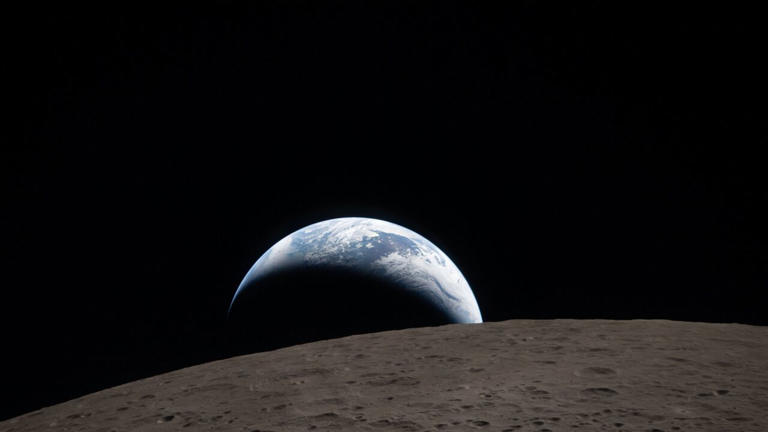
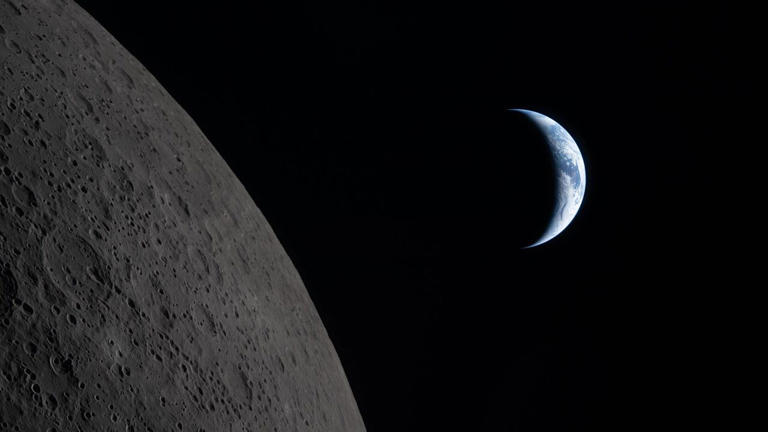
These include a stunning photograph titled 'Earthset', which was taken from the far side of the moon and shows the Earth dipping beyond the lunar horizon.
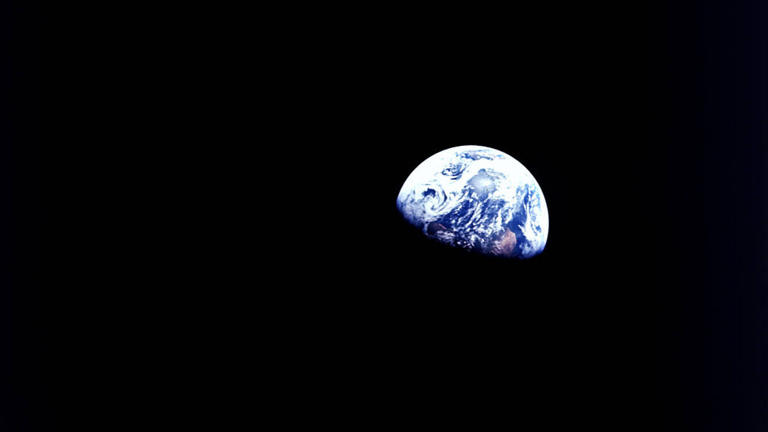
This is a nod to Earthrise – the famous photo captured by NASA's Apollo 8 mission more than 50 years ago.
Having passed the moon, the Orion crew capsule will now ride the tug of Earth's gravity back home over the coming days, with splashdown expected on Friday.
Their final ordeal will be a blazing re–entry into the planet's atmosphere, as the capsule hits the atmosphere at around 25,000 miles per hour (40,200 km/h) before deploying its parachutes and landing in the Pacific Ocean.
Revealed: The 10 things you DIDN'T see in NASA's new 'Earthset' photo - including Australia, a hidden reference to the Apollo missions, and a decade-old camera
While it looks as if the Earth is setting, this effect is actually caused by the Orion crew capsule drifting over the moon's far side out of the view of Earth.
As the capsule drifted around the moon, the four astronauts took turns photographing the lunar surface, sketching, and recording audio descriptions of what they saw.
Many of the features they witnessed had not been seen by human eyes since the last Apollo mission half a decade prior.
The Earthset image reveals swirling clouds over Oceania and Australia, the peaks of ancient craters, and the wreckage of meteor impacts.
Here are 10 things that you might not have known about NASA's new 'Earthset' photo.
This image, titled 'Earthset', was taken from the far side of the moon and shows the Earth dipping beyond the lunar horizon. Here are 10 things you might not have spotted
The Artemis II crew trained to spot and photograph important regions of the moon. During their six–hour flyby, they took over 10,000 images. Pictured: Canadian astronaut Jeremy Hansen practices photographing the moon
1. Taken on an £800 commercial camera
While you might expect NASA to use the latest cutting–edge cameras, this image was actually captured using a decade–old piece of equipment.
According to NASA's Flickr post, this incredible image was captured using a Nikon D5.
This is a commercially available DSLR launched in 2016 that was quite poorly reviewed upon launch.
However, the camera's rugged construction, reliable mechanisms, and extremely high light sensitivity make it perfectly suited to space photography.
And, while it cost over £5,000 when first released, you can now pick up one of these high–end cameras for a little over £800.
2. A nod to the Apollo missions
The Artemis II Earthset image is actually a nod back to NASA's earliest moon missions, mirroring the iconic 'Earthrise' photo.
The Earthset image is a nod to the iconic 'Earthrise' photo taken by NASA astronaut Bill Anders during the Apollo 8 mission in 1968
The 10 things you didn't see in NASA's Earthset photo
Nod to Apollo missions - mirrors the 'Earthrise' photo taken in 1968
Record-breaking distance - taken 252,756 miles from Earth
Lucky timing - three minutes before Orion slipped behind the moon
Crescent Earth and crescent moon
Meteor craters across the lunar surface
Bumpy horizon thanks to the rims of thousands of craters
A view of the swirling clouds of Australia and Oceania
Earth appears bright as light is reflected by clouds and oceans
Commercial camera equipment - taken on the Nikon D5
One of the more than 10,000 photos taken by the Artemis II crew
This earlier image, showing a distant Earth rising over the moon's horizon, was taken by the crew of the Apollo 8 mission.
In 1968, Apollo 8 became the first crewed spacecraft to leave Earth's gravitational influence and the first time that humans had reached the moon.
Just like the Artemis II mission, the crew of Apollo 8 travelled around the moon and back to Earth, paving the way for future lunar landings.
During their trip, Apollo 8 astronaut Bill Anders managed to snap an image of the Earth just as their craft emerged from behind the moon.
However, Apollo 8 had a much easier time getting this stunning shot since they orbited the moon 10 times before returning home, while Artemis II only had one opportunity.
3. Taken from a record–breaking distance
The Earthset photo was taken while the Artemis II crew made its record–breaking lunar flyby.
The Orion crew capsule travelled at a height of 41,072 miles (66,098 km) above the lunar surface.
The image of the Earth setting behind the moon was taken just three minutes before the Orion crew capsule lost connection to Mission Control during a planned radio blackout
From this distance, the moon looked about as large as a basketball held at arm's length, so the crew had to use zoom lenses to capture this unique photo.
This flyby also carried the crew to a staggering 252,756 miles (406,771 km) from Earth.
This surpassed the distance achieved by the Apollo missions, meaning the crew of Artemis II reached the furthest from Earth any human has ever been.
4. Lucky timing - three minutes before Orion slipped behind the moon
This photo was taken at 18:41 EDT (23:41 BST) on Monday, April 6.
This was only three minutes before the Orion crew capsule slipped behind the bulk of the moon, entering a planned communications blackout.
With the moon blocking any radio signals from Earth, the astronauts continued along their pre–programmed flight path without real–time guidance from Mission Control, relying entirely on onboard systems.
After 40 minutes of nerve–wracking silence, Christina Koch reestablished contact with Earth and confirmed that all was well.
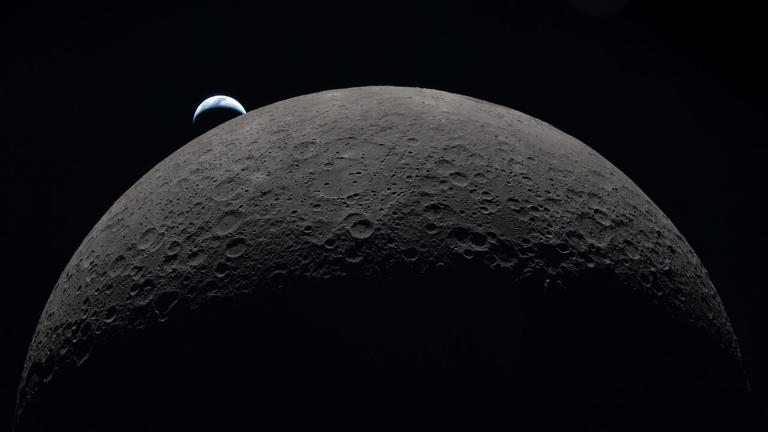
From this unique perspective, the daytime side of the Earth appears as a thin crescent silhouetted against the blackness of space. What these pictures don't show is that only 20 per cent of the moon was illuminated at this time
This meant that the stunning image captured by the Artemis II crew could only be sent back to Earth after they had passed all the way around the moon.
5. A crescent Earth alongside a crescent moon
In the image, you can see that the Earth is covered by a curved shadow, with half the planet experiencing day and the other half night.
What is harder to see in this image is that the Artemis II crew were also seeing a crescent moon.
As they passed around the moon's far side, only 20 per cent of the lunar surface was illuminated by the sun.
This meant that large parts of the moon were still hidden from view and extremely difficult for the astronauts to observe.
6. The 38–mile–wide Ohm crater
Without any atmosphere to protect it, the moon is constantly battered by a bombardment of meteor impacts.
In the Earthset image, you can see the Ohm crater (pictured). This is a 38–mile–wide (62 km) depression formed by an ancient meteorite impact
This is a massive boon for geologists since, without any wind to erode them, these craters record a detailed history of the moon's evolution.
In the Earthrise image, you can see the 38–mile–wide (62 km) Ohm crater.
This crater features distinctive terraced edges and a central peak, formed by a meteor impact that melted the surface, causing it to splash and rebound.
The image is so clear that you can even make out the system of 'ray' impacts stretching out from the Ohm crater.
These rays are straight lines of smaller craters, created by enormous chunks of moon rock shot out over the surface by the original impact.
7. Earth's smooth horizon contrasted with the moon's bumpy horizon
In this image, you can see the smooth, clean edge of the Earth's horizon silhouetted against the darkness of space.
By contrast, if you look closely, you can see that the moon's horizon is bumpy, jagged, and irregular.
What you are seeing here is actually the rims of thousands of craters that pockmark the far side of the moon more densely than the near side.
These range from small, simple impact craters no more than six to nine miles (10 to 15 km) in diameter, to vast basins over 186 miles (300 km) across formed by catastrophic collisions.
Seen from the low angle of the Orion crew capsule, these overlapping depressions give the moon's horizon a distinctive serrated appearance.
8. A view of Australia and Oceania
As well as giving a wonderful view of the moon, this photo also offers a fantastic perspective on our own planet.
In the daylight portion of Earth, you can see swirling clouds of Australia and Oceania.
9. Earth lit up thanks to its clouds and oceans
It might be surprising that the Earth appears to be so much brighter than the moon, even though the crew were much closer to the lunar surface.
This is because the Earth reflects a lot more light than the moon does, bouncing back about three times more sunlight.
The majority of that light is reflected by clouds and oceans, which the moon lacks, making the Earth seem far brighter in comparison.
10. Earthset is just one of thousands of photos
While the Earthset photo is certainly impressive, it is actually just one of the more than 10,000 photos taken by the Artemis II crew.
Working in shifts and using 17 different handheld cameras, the crew worked to gather as much detail as possible about the moon's far side.
During their training, each member of the team was specifically trained to identify and photograph specific lunar features such as craters and patches of cooled lava.
These images will reveal details that satellite cameras might have missed in stunning levels of detail.
That will help scientists build better maps of the lunar surface and gain a greater understanding of lunar geology.
With NASA planning to establish a permanent lunar outpost by 2030, this information could prove extremely valuable in the coming years.
During their lunar flyby, the Artemis II crew were even able to observe several features that had never before been seen by humans.
This included the vast Mare Orientale basin, a 577-mile-wide (930 km) impact basin in the Moon's southern hemisphere.
Because this crater is so large, previous Apollo missions weren't able to see the structure in its entirety from their low lunar orbit.
Additionally, the Artemis II crew spotted a number of new craters formed by meteors that had hit the lunar surface since the end of the Apollo programme.
Christina Koch told the NASA control room: 'All the really bright, new craters, some of them are super tiny, most of them are pretty small, there's a couple that really stand out, obviously, and what it really looks like is a lampshade with tiny pinprick holes and the light shining through.'
Canadian astronaut Jeremy Hansen made a special request to NASA mission control to name two of these new craters that they had 'observed, both with our naked eye and with our long lens'.
The first he asked to name Integrity, after the name the astronauts have given to their Orion crew capsule, and the other Carroll, to commemorate Reid Wiseman's late wife, who died of cancer in 2020.
The crew embraced each other after deciding to name a new crater Carroll, to commemorate Reid Wiseman's late wife, who died of cancer in 2020.
Mr Hansen said in an emotional tribute: 'A number of years ago we started this journey... and we lost a loved one and there's a feature on a really neat place on the moon... at certain times of the Moon's transit around Earth we will be able to see this from Earth.'
The announcement prompted the astronauts to embrace, while mission control in Houston fell silent in a rare moment of reflection.
Having passed the moon, the Orion crew capsule will now ride the tug of Earth's gravity back home over the coming days, with splashdown expected on Friday.
Their final ordeal will be a blazing re–entry into the planet's atmosphere, as the capsule hits the atmosphere at around 25,000 miles per hour (40,200 km/h) before deploying its parachutes and landing in the Pacific Ocean.
Thankfully, the latest weather predictions suggest that Artemis II will have favourable conditions for reentry.
According to AccuWeather, the southern coast of California will see winds of only seven to 14 miles per hour (11 to 22 km/h) and waves no larger than five feet.
John Feerick, AccuWeather Senior Meteorologist, says: 'Mission controllers and recovery crews at sea will be watching conditions closely up to splashdown.
'NASA says there can be no rain or thunderstorms within 30 nautical miles of the recovery site. Waves should be under six feet, and winds need to stay below 25 knots for the recovery boats.'
RELATED VIDEOS
See the 'Earthset' shot and other stunning photos from NASA's historic moon mission
NASA Has Just Revealed Never-Before-Seen Images Captured From the Orion Spacecraft of Artemis II
What NASA Found Hidden Behind The Moon Changes Everything | Artemis II Lunar Photos
Paolo Di Lazzaro, an Italian physicist and chief researcher at the ENEA Research Centre in Frascati in Italy, spent five years attempting to reproduce the body image seen on the Shroud of Turin.
The relic is believed to be the burial cloth that wrapped Jesus after he died on the cross and is said to bear his image left after the resurrection. Di Lazzaro and his team attempted to recreate the image using powerful ultraviolet lasers.
Researchers fired intense bursts of ultraviolet light at clean linen fabric similar to the shroud, altering the chemical structure of the outer fibers and turning them faintly yellow.
Despite successfully creating small areas of shroud-like discoloration, the team found that recreating the full body image was beyond modern technology.
Their calculations showed that producing a life-sized image would require an enormous burst of ultraviolet energy delivered in an extremely short time, far more than current laser systems can generate.
The findings were recently discussed on the Shaw Ryan Show, where biblical scholar Jeremiah Johnston said Di Lazzaro estimated the process would require extraordinary energy.
He said: 'Paolo told me it would take 34,000 billion watts of energy traveling in one 40th of a billionth of a second to change the chemical makeup of a fine linen shroud to leave that image. 'And he said, "We don't have that power on Earth.'"
Researchers fired intense bursts of ultraviolet light at clean linen fabric similar to the shroud, altering the chemical structure of the outer fibers and turning them faintly yellow
They were able to recreate parts of the image displayed on the shroud, but only faintly
The Shroud of Turin is a 14-foot-long piece of linen featuring a faint image of the front and back of a man who Christians believe to be Jesus.
The cloth was first presented to the public in the 1350s, when it was exhibited in a small collegiate church in Lirey, a village in northern France. Some believe it to be a medieval fake.
Di Lazzaro published the study in 2010, saying that his laboratory had more than three decades of experience studying how ultraviolet radiation interacts with different materials, including metals, plastics and fabrics.
Their work has shown that ultraviolet light affects only the outermost surface of materials, rather than penetrating deep inside.
When ultraviolet energy strikes linen, it is absorbed by the very top molecular layers of the fibers.
This changes the chemical structure only at the surface, without burning or heating the fabric.
Scientists believe this surface-level reaction is important because the image on the Shroud of Turin is known to be extremely shallow, affecting only the outer fibers.
Beginning in 2005, the team carried out repeated tests using linen cloth woven between 1930 and 1950 that had never been washed or chemically treated, ensuring the material behaved in a predictable way.
Despite successfully creating small areas of shroud-like discoloration, the team found that recreating the full body image was beyond modern technology
The relic is believed to be the burial cloth that wrapped Jesus after he died on the cross and is said to bear his image left after the resurrection
The process involved firing controlled bursts of ultraviolet laser light at the linen, altering the chemical bonds in the cellulose fibers and changing their appearance.
After years of testing, researchers identified a precise combination of laser settings, including pulse duration, energy strength and number of bursts, that produced faint yellow coloring similar to features observed on the Shroud.
The results showed several similarities to the historic cloth, including coloration limited to the tops of threads, adjacent fibers that remained uncolored, reduced fluorescence and a faint negative-style appearance, all characteristics previously documented on the Shroud of Turin.
There is a debate within Christianity as to where Jesus was buried. Some believe it was the Garden Tomb, while others suggest it was the Church of the Holy Sepulchre (pictured)
Scientists cautioned that while the experiments successfully produced linen discoloration similar to some microscopic features of the shroud, the results do not provide definitive proof of how the original image was formed.
Johnston, however, said the image was created through a nuclear event.
'I'm saying that in short form because according to the physicists, the amount of energy it would take because there's no pigment, because there's no dye, because there's no paint,' he explained.
'Science has proven and published that we, science has to ask how this image is there?
'And there was a chemical change to the shroud that if it had lasted longer than one 40th of a billionth of a second, it would've just, it would've scorched.
'It would've just burned up. It would've been gone. And so what for the physicist watching this is called power.'
The city of Moenjo-daro, which was one of the largest cities of the Bronze Age (Picture: Quratulain/Cover Media)
One of the ancient world’s great urban centres is much older than previously thought, according to new research which could transform our understanding of how civilisation developed.
Fresh excavations at Mohenjo-daro, in present-day Pakistan, suggest its origins date back several centuries earlier than had been previously established.
Situated along the Indus River in Sindh’s Larkana district, Mohenjo-daro covers more than 620 acres and is thought to have supported up to 40,000 people at its peak – making it one of the largest cities of the Bronze Age.
New radiocarbon dating from excavations carried out between 2025 and 2026 indicates that the site was already occupied during the Early Harappan, or Kot Diji, phase between about 3300 and 2600 BC. That makes the city even older than the pyramids.
New discoveries at the site could reshape understanding of how urban centres developed (Picture: Junhi Han/Cover Media)
Researchers say this challenges the long-held view that urban life in the Indus Valley emerged rapidly around 2600 BC, instead pointing to a more gradual process of development.
The project, led by Pakistan’s Dr Asma Ibrahim and Ali Lashari along with Dr Jonathan Mark Kenoyer from the University of Wisconsin focused on an area west of the site’s Stupa Mound.
Archaeologists re-examined a large mudbrick structure first uncovered in 1950 by Mortimer Wheeler, who had interpreted it as a flood-control embankment. New analysis suggests a different conclusion.
Using stratigraphic study and radiocarbon dating, researchers found the structure to be a multi-phase mudbrick city wall, built and expanded over several centuries rather than serving a purely defensive or hydraulic function.
Samples from its lowest levels date its earliest construction to around 2700–2600 BC, towards the end of the Early Harappan period.
Fresh evidence at Moenjo-daro suggests that the city developed in phases (Picture: Cover Media)
Further evidence beneath the wall revealed even earlier settlement activity, including pottery typical of the Kot Diji phase. This indicates the city evolved from an existing community, rather than being constructed from scratch during the later, more developed phase of the civilisation.
Upper levels of the wall show continued construction during the Mature Harappan period, after 2600 BC, when Mohenjo-daro reached its height.
Researchers say the wall was expanded and maintained until at least 2200 BC, suggesting long-term planning and resource management.
Although the latest findings focus on the city’s earliest phases, Mohenjo-daro has continued to yield discoveries from much later periods.
Mohenjo-daro is known for its advanced urban planning, including grid-like streets, standardised baked bricks and sophisticated drainage systems, as well as monumental structures such as the Great Bath.
Mohenjo-daro is known for its advanced urban planning, including grid-like streets (Picture: Solophar/Cover Media)
However, one of its greatest mysteries remains unsolved: the Indus script, found on seals and tablets, has yet to be deciphered. If and when it is, the story of the city’s emergence could become far more accessible.
Without written records, archaeologists rely on physical evidence and scientific techniques to reconstruct the city’s past.
The findings mark a shift in understanding the rise of urban life in the Indus Valley, say researchers.
Rather than a sudden emergence of cities, the evidence suggests a gradual, multi-phase development, with early communities laying the foundations for one of the world’s earliest civilisations.
Another scientist with ties to America's space program has now joined the growing list of deaths and disappearances around the US.
Michael David Hicks, a research scientist at NASA's Jet Propulsion Laboratory (JPL), passed away on July 30, 2023 at the age of 59, but the cause of death was never made public, and no record of an autopsy being performed could be found.
Hicks, who worked at JPL from 1998 to 2022, was credited with publishing over 80 scientific papers and was part of multiple teams helping NASA understand the physical properties of comets and asteroids.
Specifically, Hicks was involved with the DART Project, NASA’s test to see if humans could deflect dangerous asteroids away from Earth. He also worked on the Deep Space 1 Mission, which tested new spacecraft technology that flew by a comet in 2001.
While there have been no public allegations of foul play, Hicks' case marks the ninth person with ties to America's space or nuclear secrets who has died or mysteriously vanished in recent years, which has set off alarm bells among US national security experts.
Moreover, three of these scientists had close ties to Hicks, as all of them worked at the Jet Propulsion Lab or participated in NASA missions there. Monica Reza, JPL's new Director of the Materials Processing Group, vanished without a trace in June 2025, just months after beginning her tenure at the NASA lab.
Two other men with deep ties to JPL died recently, including a long-time coworker of Hicks, Frank Maiwald, who died in July 2024 at age 61, with even less public acknowledgement of his untimely passing.
Meanwhile, astrophysicist Carl Grillmair, 67, was murdered on the front porch of his home on February 16, 2026. The California Institute of Technology researcher's work was heavily supported by NASA's JPL, and Grillmair was personally involved with major space telescope missions led by NASA.
Michael David Hicks (Pictured) was a research scientist at NASA's Jet Propulsion Laboratory prior to his death in 2023
The Daily Mail has reached out to NASA, Hicks' alma mater at the University of Arizona, and the scientist's friends and colleagues for comment on the circumstances surrounding his death.
Strangely, a series of online obituaries dedicated to Hicks did not mention any health issues before the 59-year-old's death, which appeared to happen suddenly, roughly one year after leaving NASA JPL.
A similar situation unfolded after Maiwald's death on July 4, 2024, when the prominent JPL researcher died in Los Angeles from unknown circumstances.
Despite Maiwald being a JPL Principal - an award given to scientists 'making outstanding individual contributions' in their fields - there were no public comments from authorities after the esteemed scientist's death, and the only public record marking his passing was a single obituary posted online.
NASA and JPL have not commented on the deaths of Maiwald or Hicks, and did not reply to Daily Mail's inquiries into the nature of the scientists' work before their deaths.
In June 2023, just 13 months before his death, Maiwald was the lead researcher on a breakthrough that could help future space missions detect clear signs of life on other worlds in the solar system and beyond.
As for the other JPL-connected scientist, Grillmair had contributed to the discovery of water on a distant planet, with colleagues calling his work 'ingenious' and adding that the research could point to signs of life less than 160 light-years from Earth.
According to his Caltech profile, he also worked on the NEOWISE and NEO Surveyor, infrared space telescopes that track asteroids. However, experts have also expressed concern that this technology has also been used in advanced missile designs.
Frank Maiwald (Left) and Carl Grillmair (Right) had deep ties to NASA's Jet Propulsion Lab in California before both men died within the last two years
Monica Reza (Pictured) went missing during a hike in California in June 2025. Reza had worked on the creation of advanced rocket technology before becoming a director at NASA JPL
The string of deaths and missing person cases has drawn the attention of Congress and members of the US intelligence community, who see a disturbing pattern surrounding experts with knowledge of missiles and rocket engines.
Former FBI Assistant Director Chris Swecker recently told the Daily Mail: 'You can say these are all suspicious, and these are scientists who have worked in critical technology.'
Swecker claimed that multiple foreign intelligence services, including enemies and allies of the US, have been targeting Americans possessing secrets of the nation's technology for decades.
’China, Russia, even some of our friends – Pakistan, India, Iran, North Korea - they target this type of technology,’ Swecker revealed.
Tennessee Congressman Tim Burchett told the Daily Mail in March: 'There have been several others throughout the country that have disappeared under suspicious circumstances. I think we ought to be paying attention to it.'
Burchett was referencing at least four other investigations around the US in recent months, including the high-profile disappearance of retired Air Force General William Neil McCasland and the murder of respected physicist Nuno Loureiro.
Pictured: NASA's Jet Propulsion Laboratory Pasadena, California
McCasland, 68, was the latest disappearance, vanishing without a trace on February 27, 2026, after reportedly leaving his home on foot with only a handgun.
The disappearance of McCasland, who reportedly held nuclear and UFO-related secrets, has been tied to Reza and Grillmair through their work on advanced missile or rocket science.
While commanding the Air Force Research Lab (AFRL), the general supervised and approved funding for Reza's work to invent a new metal used to create space-age rocket engines.
Meanwhile, Grillmair's work with NEOWISE and NEO Surveyor has also been linked to the Air Force, as the NASA telescopes used the same systems the military relies on to track satellites and hypersonic missiles.
While Loureiro's murder has not been directly connected to the other deaths and disappearances, Burchett, Swecker and independent investigators have noted that his revolutionary work in nuclear fusion may have made him a target of a greater conspiracy against US scientists.
Nuno Loureiro, 47, was assassinated at his home in the Boston suburb of Brookline on December 15, 2025. Authorities said the gunman was Claudio Neves Valente, a former classmate from Portugal.
’It’s been happening since the Cold War,’ Swecker explained. ’Especially when nuclear technology and missile technology were first coming to the forefront.'
Nuno Loureiro (Pictured) was leading efforts to create fusion energy, a form of clean energy that could upend the multi-trillion-dollar fossil fuel energy
Two others with ties to nuclear research went missing just weeks apart. Anthony Chavez and Melissa Casias, who both worked at the Los Alamos National Laboratory (LANL), vanished from their homes in 2025 under nearly identical circumstances.
Chavez, 79, worked at the nuclear research lab until his retirement in 2017. Casias, 54, was an active administrative assistant at the facility and is believed to have had top security clearance.
Both were last seen leaving their homes in New Mexico on foot, leaving behind their cars, keys, wallets and phones before disappearing without a trace nearly one year ago.
In another mysterious incident, Jason Thomas, a pharmaceutical researcher testing cancer treatments at Novartis, was found dead in a Massachusetts lake on March 17, 2026, after disappearing without a trace three months earlier.
Burchett has blasted the nation's intelligence community, specifically calling out the so-called 'alphabet agencies' such as the FBI, for being unhelpful and frustrating his attempts to find out the truth about what has happened to these scientists.
'The numbers seem very high in these certain areas of research. I think we'd better be paying attention, and I don't think we should trust our government,' he warned.
10 Cases That Continue to Baffle Investigators Today | Unsolved Mysteries of Modern Day
In beeld: de mooiste kiekjes genomen door de astronauten van maanmissie Artemis II
Artikel door Michael Torfs, Nils Schillewaert, Pieterjan Huyghebaert
Op 1 april vertrokken voor het eerst in ruim 50 jaar opnieuw astronauten naar de maan, tijdens de zogenaamdeArtemis II-missie. Reid Wiseman, Vitor Glover, Christina Koch en Jeremy Hansen maken een 10-daagse vlucht rond de maan, ter voorbereiding op een maanlanding in 2028.
Tijdens hun 'lunar fly-by' op 6 april observeerde het viertal uitgebreid de achterkant van de maan. En ook aardlingen mogen daarvan meegenieten, met dank aan de vele foto's die ze hebben gemaakt.
'Earthset': de aarde gaat onder achter de maanhorizon
Druppelsgewijs werden foto's vrijgegeven die de Artemis II-bemanning nam toen ze rond de maan vloog. Daar is onder meer de foto 'aardondergang' (Earthset) bij, waarbij de aarde onder lijkt te gaan achter de maan. Op de voorgrond is het grove maanlandschap te zien. Op de achtergrond de aarde.
De foto doet denken aan de iconische 'aardopkomst'-foto (Earthrise) die in 1968 tijdens de Apollo 8-missie werd genomen. Dat was de eerste bemande vlucht rond de maan. De foto werd genomen door de Amerikaanse astronaut Bill Anders.
Op een volgende foto zien we opnieuw 'de aardondergang'. Het donkere deel van de aarde dat in beeld is, bevindt zich in de nacht. Aan de dagkant kun je wervelende wolken zien boven Australië en Oceanië.
IN BEELD: de mooiste kiekjes genomen door de astronauten van maanmissie Artemis II
Hoewel de maan op deze foto's vertrouwd grijs oogt, zagen de astronauten met hun eigen ogen tal van verschillende kleuren. "Aristarchus (een krater) had groenachtige tinten", beschreef de Canadese missiespecialist Jeremy Hansen. 'Het was heel bijzonder, ik heb zoiets nergens anders aan deze kant van de maan gezien. En toen zag ik veel van wat ik als bruinachtige tinten zou omschrijven."
Eclipsbrilletjes in de ruimte
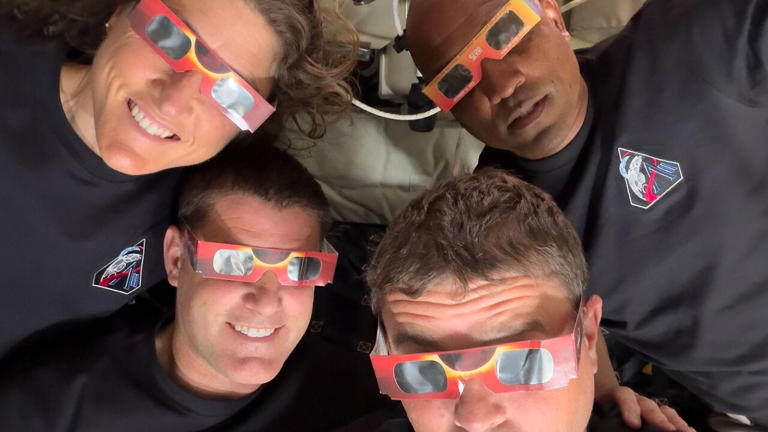
Naast maanfoto's, stuurden de astronauten van Artemis II ook selfies de wereld in, of liever: het heelal. Met speciale eclipsbrilletjes, bijvoorbeeld. Die droegen ze om hun ogen te beschermen tijdens een zonsverduistering op 6 april. De zon, de maan en het Orion-ruimtevaartuig stonden perfect op één lijn.
Volgens NASA was het voor het eerst dat er eclipsbrillen mee waren aan boord van een ruimtereis.
IN BEELD: de mooiste kiekjes genomen door de astronauten van maanmissie Artemis II
De astronauten delen ook foto's van 2 maankraters waarvoor ze tijdens deze missie namen hebben verzonnen. Het gaat om kraters die de astronauten met het blote oog konden zien, maar die nog niet eerder beschreven waren.
Een van de kraters willen ze graag 'Carroll' dopen. Een emotioneel eerbetoon aan de vrouw van commandant Reid Wiseman, die in 2020 overleed aan de gevolgen van kanker. Voor de andere krater stellen ze 'Integrity' voor, de naam die de astronauten hun Orion-ruimtevaartuig gaven.
De voorstellen zullen na de missie officieel ingediend worden en moeten daarna nog worden goedgekeurd.
Maankraters in loepzuiver detail
De beelden die de bemanning van Artemis II maakte van de achterkant van de maan zullen wetenschappers nog maanden en jaren zoet houden. Zoals deze zeer gedetailleerde detailfoto's van het maanoppervlak.
Intussen zijn de 4 astronauten stilaan terug op weg naar huis. Hun missie naar de maan bracht hen dieper de ruimte in dan een mens ooit is geweest. Ze bereikten een recordafstand van 406.771 kilometer. Naast foto's van de maan, maakten ze ook foto's van zichzelf tijdens die unieke reis.
Als alles goed gaat zal de crew weer op aarde landen op 10 april lokale tijd (11 april Belgische tijd) in de Stille Oceaan, voor de kust van San Diego.
A famousUFOexpert, dubbed a real-life 'X-Files investigator, has died following a battle with cancer.
Nick Pope, who examined UFO phenomena while employed at the UK's Ministry of Defence (MOD), passed away at the age of 60 on Monday afternoon at his home in Tucson, Arizona.
His wife, Elizabeth Weiss, shared the loss of her husband on X, saying: 'The last few weeks of his life, even as he suffered, he managed to do a few interviews from home.
'I was so lucky to have met and to have married Nick. He was a wonderful husband. I loved him dearly.'
Pope announced that he had been diagnosed with Stage 4 esophageal cancer, a disease where malignant cells form in the tissue of the esophagus, back in February, noting it had metastasized to his liver.
The former MOD official led Britain's so-called 'UFO Desk' for three years between 1991 and 1994.
He investigated UFO sightings, analyzed radar data and photos and briefed ministers on whether Unidentified Aerial Phenomena (UAP) posed a defense threat.
His wife, Elizabeth Weiss, shared the loss of her husband on X. 'My heart is breaking,' she said
'A while ago, following some digestive issues, I was diagnosed with esophageal cancer,' Pope wrote on February 12. 'Unfortunately, it's Stage 4 and has metastasized to my liver.
While I know that it's kindness and hope that lead people to suggest healers and supposed miracle cures, and to say things like "fight it" and "you can beat it," I'm afraid my diagnosis and my situation leave no doubt whatsoever: I can't beat it.'
In the message, he reflected on his life, calling it 'an amazing adventure.'
'A 21-year career at the UK Ministry of Defence, where I got involved in subjects ranging from financial policy to counter-terrorism; from military policing to UAP,' Pope continued.
'And I saved six cows; it's a long story. The things I've done, the places I've been, the people I've met, and the secrets I've been privy to. I wouldn't have swapped it for the world.'
After leaving government service, his involvement in UFO investigations brought him to global attention, turning him into a frequent commentator on television news programs and documentaries.
He later worked as a consultant and spokesperson on UFO- and alien-themed films, television series and video games, earning the nickname the 'real-life Fox Mulder' from the 1990s hit series The X-Files.
The sci-fi mystery series, which ran from 1993 to 2002, follows FBI agents Fox Mulder and Dana Scully as they investigate unsolved paranormal cases known as the X-Files.
Nick Pope , who examined UFO phenomena while employed at the UK's Ministry of Defence (MOD), passed away at the age of 60 on Monday afternoon at his home in Tucson, Arizona
He earned the nickname the 'real-life Fox Mulder' from the 1990s hit series 'The X-Files'
Pope recalled his wife with such admiration, saying: 'She's a real-life Agent Scully: a scientist, a skeptic and a redhead.
'We met randomly in the lobby bar of the Fairmont Hotel in downtown San José (she was an anthropology professor at San José State University) in October 2010 and got married three months later.'
They applied for his Green Card and Elizabeth had him 'shipped to the US, where Pope continued his public work on UFO investigations while appearing at conferences, live events and television productions, including serving as moderator for the touring show 'Ancient Aliens Live.'
He remained active in media appearances and public events until shortly before stepping back from work due to declining health.
Pope concluded the post with: ' It's all been amazing, and I'm grateful for the things I've done, not mournful for the things that I won't now get to do. Per Aspera Ad Astra!'
Real Life Fox Mulder Nick Pope passes away #ancientaliens #ufoinvestigator #uforesearch #disclosure
A video of a pot of Nutella floating around the Orion capsule has been dubbed the 'greatest free advert in history'.
The hilarious footage was inadvertedly captured by NASA as its four Artemis II astronauts slingshotted around the moon.
A huge pot of the chocolate spread can be seen floating past Christina Koch, with the label perfectly displayed to the camera.
'I never thought my daily childhood spread would be floating in a space craft around the moon,' one shocked viewer tweeted.
Another added: 'Nutella got to the moon before most countries did.'
And one joked: 'Zero gravity, maximum brand exposure!'
Now, even Nutella has joined in on the fun.
Taking to X, it said: 'Honored to have traveled further than any spread in history. Taking spreading smiles to new heights.'
A video of a pot of Nutella floating around the Orion capsule has been dubbed the 'greatest free advert in history'
The hilarious moment took place just three minutes and 55 seconds before the Artemis II crew topped Apollo's record to become the humans who have travelled the farthest from our planet.
The footage has garnered huge interest across X, with many viewers shocked that a jar of Nutella had made it to the moon's orbit.
'Bit risky taking a jar! Couldn't it break if it hits the side??' one user asked, before others pointed out that the jar is likely made from plastic instead of glass.
Another joked: 'floating nutella cameo in the middle of a pivotal moment in the artemis II mission is FRYING me.'
And one quipped: 'What an advert for Nutella!! 252000 miles away in space!'
Believe it or not, Nutella is just one of nine condiments on board the Orion capsule.
Ahead of the mission, NASA released the crew's menu, confirming they'd have access to maple syrup, peanut butter, hot sauce, spicy mustard, strawberry jam, honey, cinnamon, and almond butter – as well as chocolate spread.
In addition, more than 10 types of beverages are available, including mango–peach smoothies, lemonade, apple cider and hot chocolate, as well as enough coffee for 43 cups.
The hilarious moment took place just three minutes and 55 seconds before the Artemis II crew topped Apollo's record to become the humans who have travelled the farthest from our planet
Ahead of the mission, NASA released the crew's menu, confirming they'd have access to maple syrup, peanut butter, hot sauce, spicy mustard, strawberry jam, honey, cinnamon, and almond butter – as well as chocolate spread
For breakfast, the team has been tucking into sausages, granola with blueberries or a tropical fruit salad.
Meanwhile, lunch and dinner items include vegetable quiche, BBQ beef brisket, spicy green beans, broccoli au gratin and macaroni and cheese – alongside the 58 tortillas that have been loaded for the journey.
Having swung around the moon, the crew – Reid Wiseman, Victor Glover and Christina Koch, and Jeremy Hansen – have set a new record for traveling 252,756 miles from Earth.
The astronauts completed the six–hour flyby after flying behind the moon, becoming the first humans in more than half a century to witness the distant hemisphere with the naked eye.
Communication was cut off at 6.43pm ET as the Orion spacecraft slipped behind the moon, triggering a planned blackout caused by the lunar surface blocking radio signals between the spacecraft and antennas on Earth.
Inside the capsule, the astronauts continued along their pre–programmed flight path without real–time guidance from Mission Control.
Instead, they relied entirely on onboard systems during one of the mission's most dramatic phases.
Known as a loss of signal, the blackout is a routine part of lunar missions, but it remains one of the most tense moments as crews move completely out of Earth's reach while hidden behind the moon.
'We will see you on the other side,' Mr Glover said moments after referencing the teachings of Jesus, including the message to love your neighbour as yourself, just before communication with the ground team was lost.
Thankfully, contact was restored roughly 40 minutes later as Orion reappeared from behind the moon, officially ending the flyby.
The astronauts have now started their journey back to Earth, with splashdown expected Friday.
RELATED VIDEOS
Viral Moment: Nutella Jar Floats Through Artemis II Cabin
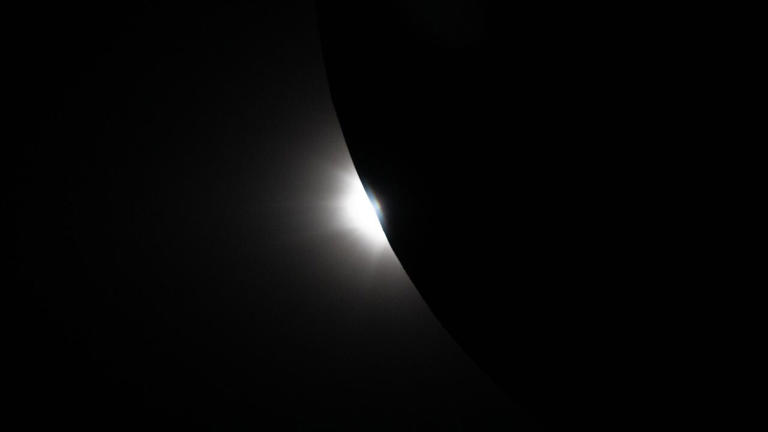
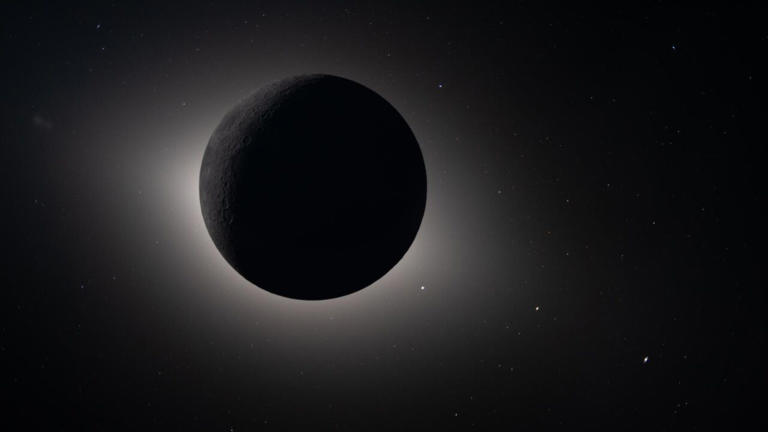
NASA releases the first photos from the Artemis II mission: Stunning shot shows the moon eclipsing the SUN - while 'Earthset' is a nod to Apollo's famous 'Earthrise' image
NASAhas released the first set of photos taken by the Artemis II moon mission.
The first image, titled 'Earthset', was taken from the far side of the moon and shows the Earth dipping beyond the lunar horizon.
This is a nod to Earthrise – the famous photo captured by NASA's Apollo 8 mission more than 50 years ago.
'The Artemis II crew captured this view of an Earthset on April 6, 2026, as they flew around the Moon. The image is reminiscent of the iconic Earthrise image taken by astronaut Bill Anders 58 years earlier as the Apollo 8 crew flew around the Moon,' NASA explained on X.
The second photo is titled 'The Artemis II Eclipse', and shows the moment the moon eclipsed the sun.
'Totality, beyond Earth,' the White House said as it shared the photo on X. 'From lunar orbit, the Moon eclipses the Sun, revealing a view few in human history have ever witnessed.'
The images have been released hours after NASA astronauts Reid Wiseman, Victor Glover and Christina Koch, along with Canadian astronaut Jeremy Hansen, became the first people to travel around the far side of the moon in over 50 years.
NASA has released stunning images captured by the Artemis II crew. Pictured is an epic show of the solar eclipse the team viewed from the Moon
The first image, titled 'Earthset', was taken from the far side of the moon and shows the Earth dipping beyond the lunar horizon
The second photo is titled 'The Artemis II Eclipse' and shows the moment the moon eclipsed the sun
A total solar eclipse with only part of the Moon visible in the frame as it fully obscures the Sun
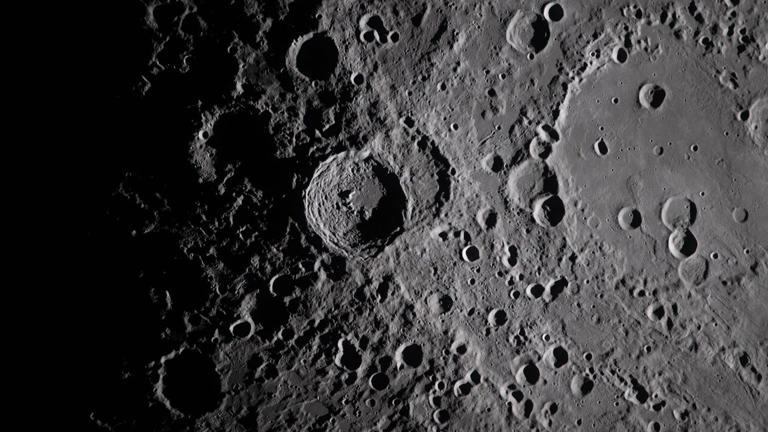
A third photo, meanwhile, shows the rings of the Orientale basin.
'At the 10 o’clock position of the Orientale basin, the two smaller craters – which the Artemis II crew has suggested be named Integrity & Carroll – are visible,' NASA explained.
During their six–hour lunar flyby, the Artemis II crew reached a distance of more than 252,756 miles (406,771km) from Earth, surpassing the distance achieved by the Apollo missions and setting a new record.
In doing so, they became the first humans in half a decade to witness the far side of the moon with the naked eye.
From their position 41,072 miles (66,098km) above the lunar surface, the moon appeared about as large as a basketball held at arm's length.
After the White House shared the Earthset image, one social media user commented that it was the 'most beautiful picture' they had ever seen.
'We are tiny. It's something incredible,' another added.
One wrote: 'Humanity keeps needing to leave Earth to remember what Earth is.'
A third photo, meanwhile, shows the rings of the Orientale basin. 'At the 10 o’clock position of the Orientale basin, the two smaller craters – which the Artemis II crew has suggested be named Integrity & Carroll – are visible,' NASA explained
This photo shows Earth setting over the Moon's curved limb at 6:41 PM EDT (10:41 GMT), April 6, 2026, as seen from the Orion spacecraft
A view of Earth passing the Moon as photographed through the Orion spacecraft window April 6, 2026
'Earthset' is a nod to Earthrise – the famous photo captured by NASA's Apollo 8 mission more than 50 years ago
Lunar flyby timeline
(In UK time)
6:30pm: NASA held conversation with the crew to go over objectives and timeline
6:56pm: The Artemis II crew surpassed the record previously set by the Apollo 13 crew for the farthest humans have ever travelled from Earth
7:45pm: The seven–hour lunar observation period began
11:47pm: Mission control loses communication with the crew
12:02am: Astronauts made their closest approach to the moon
12:27am: NASA's mission control re–acquired communication with the crew
2:20am: Flyby observation period ends. Astronauts began transferring some imagery to the ground
Meanwhile, the Artemis II Eclipse photo was dubbed 'absolutely breathtaking' by one viewer.
Another said: 'Absolutely surreal… seeing the Sun vanish behind the Moon from lunar orbit is something only a handful of humans have witnessed!'
And one quipped: 'This is absolutely mind blowing, it almost doesnt look real. These brave astronauts are living their dream right now, so jealous!!!'
As the astronauts passed by the far side of the moon, they recorded as much as they could about the surface below, taking photographs, sketching, and making audio recordings of their own observations.
The moon's far side looks very different from the familiar near side, with heavily cratered terrain, a thicker crust and far fewer of the dark volcanic plains visible from Earth.
As the astronauts swept over the far side in the Orion capsule, they reported seeing striking geometric patterns, winding formations they called 'squiggles' and unexpected shades of green and brown across the rugged lunar terrain.
Although satellites have taken images of the moon's far side, some of these features have never been seen by the human eye.
In particular, astronauts spotted newly formed craters on the lunar surface that stand out like tiny holes in a lampshade.
The astronauts spotted newly formed craters on the lunar surface that stand out like tiny holes in a lampshade
This stunning snap shows crescent Earth setting along the Moon's limb, as seen from the Orion spacecraft on April 6, 2026
Christina Koch told the NASA control room: 'All the really bright, new craters, some of them are super tiny, most of them are pretty small, there's a couple that really stand out, obviously, and what it really looks like is a lampshade with tiny pinprick holes and the light shining through.'
Canadian astronaut Jeremy Hansen made a special request to NASA mission control to name two of these new craters that they had 'observed, both with our naked eye and with our long lens'.
The first he asked to name Integrity, after the name the astronauts have given to their Orion crew capsule, and the other Carroll, to commemorate Reid Wiseman's late wife, who died of cancer in 2020.
Mr Hansen said in an emotional tribute: 'A number of years ago we started this journey... and we lost a loved one and there's a feature on a really neat place on the moon... at certain times of the Moon's transit around Earth we will be able to see this from Earth.'
The announcement prompted the astronauts to embrace, while mission control in Houston fell silent in a rare moment of reflection.
Having passed the moon, the Orion crew capsule will now ride the tug of Earth's gravity back home over the coming days, with splashdown expected on Friday.
Their final ordeal will be a blazing re–entry into the planet's atmosphere, as the capsule hits the atmosphere at around 25,000 miles per hour (40,200 km/h) before deploying its parachutes and landing in the Pacific Ocean.
The Brit ran the Government's 'UFO Desk' for three years.
(Image: Getty)
The UK's top UFO expert, Nick Pope, has died aged 60 after being diagnosed with Stage 4 oesophageal cancer, his heartbroken wife has announced. The former Ministry of Defence official ran the Government'sUFO Project - dubbed Britain's "UFO Desk" for three years in the 1990s, working on some of the most high-profile sightings and cases.
This included investigating the case file of the Rendlesham UFO incident, known as Britain’s Roswell, which occurred in 1980. His wife, Elizabeth Weiss, announced his tragicpassingon Monday (April 6). “My heart is breaking. Nick passed away this afternoon at our home," she said in a statement. “The last few weeks of his life, even as he suffered, he managed to do a few interviews from home. I was so lucky to have met and to have married Nick. He was a wonderful husband. I loved him dearly."
Once a report was made, Mr Pope's team would then begin assessing the potential impact on national security and aviation safety
(Image: Getty Images for A E Networks)
The UK Government's UFO Project, managed by the MoD, also known as the "X-Files Desk", ran for over 60 years before closing in 2009. It documented thousands of sightings, with around 95% deemed conventional misidentifications and 2-3% remaining unexplained. Thousands of files are now public at the National Archives.
Once a report was made, Mr Pope's team would then begin assessing the potential impact on national security and aviation safety. He said the number of sightings is much higher than most people realise, estimating they received up to 300 a year on average.
While he was bound by the Official Secrets Act, he often shared a rare glimpse into a world of classified files and unknown technology. Once asked which case stands out, he confessed: "The file on the Rendlesham Forest incident still keeps me up at night".
In December 1980, US Air Force personnel reported strange lights and a metallic craft in a forest near RAF Woodbridge and RAF Bentwaters inSuffolkat around 3am. Witnesses, including Sgt. Jim Penniston and John Burroughs, reported finding ground depressions and broken branches. Col. Halt reported increased radiation levels on the second night. Sgt. Penniston claimed to have encountered and touched a craft, reporting that it was warm and had hieroglyphic-like markings. Conventional explanations suggest ameteoror a military prank.
Nick Pope led the UK Government's UFO Project from 1991 to 1994
(Image: The People)
Mr Pope revealed his devastating diagnosis with a heartbreaking social media post in February. He wrote: “A while ago, following some digestive issues, I was diagnosed with oesophageal cancer.
“While I know that it’s kindness and hope that leads people to suggest healers and supposed miracle cures, and to say things like “fight it”, and “you can beat it"...
“… I’m afraid my diagnosis and my situation leaves no doubt whatsoever: I can’t beat it.
“What an amazing adventure I’ve had. A 21-year career at the UKMinistry of Defence, where I got involved in subjects ranging from financial policy to counter-terrorism; from military policing to UAP.
“The things I’ve done; the places I’ve been; the people I’ve met; and the secrets I’ve been privy to.
“I wouldn’t have swapped it for the world.”
RELATED VIDEOS
(Re-release) UK UFO Researcher - Nick Pope
Former UK UFO Investigator Dies After Illness | Nick Pope Passed Away | Info X Now
Nick Pope Cause Of Death, Journalist, Wife, Age, Kids, Family, Net Worth, Career, Lifestyle & Bio
Today marks the 60th anniversary of the "Westall incident".
(Australian Story)
Tania Vassie was playing on the school oval when she looked up into the clear autumn sky to see a "strange, rounded, two-storey disc floating up above".
The 13-year-old watched, transfixed, as the object moved through the sky erratically, dashing at speed from one direction to another.
Then she ran, yelling, into the school.
Tania Vassie says she saw a disc "zigzagging" in the sky above the school oval.
(Australian Story: Tom Hancock)
"I remember rushing down the corridor, screaming: 'Flying saucer, flying saucer,'" Tania tells Australian Story.
"Children came from everywhere; teachers came from everywhere."
So began one of Australia's most intriguing mysteries — an event so unusual and surrounded by conspiracy theories that it's only been in recent years Tania has felt comfortable talking about what she swears she saw 60 years ago.
Tania Vassie pictured as a child.
(Supplied: Tania Vassie)
Tania wasn't the only one to see it. Scores of people watched from the school oval — some in amazement, some in terror — as an unidentified flying object swept across the skies above Westall High School and the adjacent primary school in Melbourne's south-east on April 6, 1966. Some saw up to three objects.
It remains the biggest mass sighting of a UFO in Australian history.
Some of the many witnesses to the "Westall incident" draw what they remember seeing in broad daylight.
(Australian Story)
A case of mass hysteria?
Many UFO enthusiasts are convinced it was an extra-terrestrial visitation. Others believe the answer to the mystery lies in a more Earth-bound explanation.
Ken Stallard, a former Westall student and retired school principal, believes the object was likely part of a secret military program but argues that, by definition, it was a UFO.
"I saw what I saw and so did all my school friends, hundreds of us," he says. "It was unidentified, it was flying and it was clearly an object."
Richard Saunders questions the reliability of human memory.
(Australian Story: Tom Hancock)
Richard Saunders of Australian Skeptics Inc does not doubt something happened that day.
"It's just trying to find the most reasonable explanation without jumping to fantasy … or the very unlikely event of an alien in a spacecraft," Mr Saunders says.
"People would rather jump to a conclusion which is quite far-fetched, and be satisfied, than simply say: 'We just don't know.'"
Westall researcher Grant Lavac points out some sceptics suggest mass hysteria could be at play.
"I don't think it's something that can be completely discounted," he says. "But in the absence of documentary evidence, I can only go off what the witnesses recall and testify to. And so, it's clear they saw something."
A mural at Westall Secondary College in Melbourne.
(Australian Story: Tom Hancock)
The Dandenong Journal covered the mysterious 1966 sighting.
(Supplied: Dandenong Journal)
James Fox, a US filmmaker who directed the 2020 documentary The Phenomenon that focused on UFOs in the US but included Westall, says most sightings can be explained in "conventional, prosaic terms".
But, he argues, about 10 or 15 per cent remain confounding. Westall is one of them.
"The significance of the Westall case is the fact that there were so many people, the sheer volume of firsthand eyewitnesses saying the same thing 60 years ago as they are today," Mr Fox says.
Not only did so many see the objects but multiple witnesses report that within 30 minutes, men in uniform arrived at a spot close to the school where some say they saw the craft descend.
And then, the shutters came down. The school principal assembled the students and told them it was a weather balloon and not to talk about it. Some were ushered into a room where unidentified men told them to not to discuss what they'd seen.
Eyewitnesses like Joy Clarke and Terry Peck wonder if they saw something out of this world 60 years ago.
(Australian Story: Tom Hancock)
Today, on the 60th anniversary, witnesses are demanding answers. Many are retired and no longer worried about being ridiculed or jeopardising their jobs by speaking out.
What were the objects? Were they top-secret military prototypes? And why aren't there any government records documenting these events?
"What frustrates me and I think all the other pupils," says Tania, who became a marketing and business manager, "is the attempt of having it buried.
"If it really was nothing of significance, well, let's explain it. I think that's all that everybody wants to know. Please, tell us what it was."
'Saucer-shaped' object 'the size of cars': Vivid witness accounts
What a scene it must have been: scores of kids and teachers, standing in the school grounds, all peering skywards, pointing, slack-jawed, marvelling.
Even today, the witness accounts from former students are strikingly consistent. Ken Stallard remembers a flying object that was "large, easily visible, circular, silver".
Ken Stallard was playing footy on the school oval when he saw something moving slowly across the sky.
(Australian Story: Tom Hancock)
Former nurse Marilyn Smith says, "there were no windows … it was an oval shape about the size of two or three cars". Joy Clarke says it moved at incredible speed and was "shiny, metallic [with a] dome in the middle".
Self-confessed "naughty" student Terry Peck recalls how she and others vaulted the school fence to race after the "saucer-shaped" craft as it moved to a nearby area of bush known as the Grange.
Terry Peck says she saw a swirly pattern of yellowed grass at the Grange.
(Australian Story: Tom Hancock)
"There was this strange thing just sitting there, hovering above the ground, quite big, about one-and-a-half times the size of a large sedan," Terry says.
Then, she watched as the craft rose slowly into the air. "It turned on its side and it just went straight up into the air, so fast it was almost instantaneous."
Left behind, says Terry and multiple other students, was a swirly pattern of yellowed grass — and a lifetime of questions.
For Mr Saunders, the consistency of witness accounts should be treated with caution.
"The big misconception is that we have good memories. We don't," he says. "When people are on the same page, more or less, there's a group reinforcement of the common story … This is perfectly natural but it can be misleading."
Researcher Shane Ryan at the Flying Saucer playground near Westall Secondary College.
(Australian Story: Tom Hancock)
Curiosity led former teacher and public servant Shane Ryan to seek answers in 2005 — and he's been researching ever since.
Mr Ryan learned that four days prior to the Westall sighting, engineer James Kibel was in the backyard of his home in the nearby suburb of Balwyn when he saw a flash of light in the sky.
James Kibel says he took this photo four days before the incident at the school.
(Supplied: Courtesy James Fox)
Mr Kibel said he quickly snapped a Polaroid photo of a silver disc in the air. Mr Ryan acknowledges today that it could be a photo of something more mundane, like a bicycle bell or a hub cap.
"I know what James Kibel told me," he says. "I'm just not in a position to know one way or another."
Mr Ryan's detailed research into the Westall sighting has led him to speak with 142 people from the school and surrounding properties who saw the object or objects in the sky and 197 people who saw the ground marks. Seventy-seven witnesses saw both.
"Every person has a slightly different perspective and a slightly different angle," he says. "It's amazing to me that there is so much commonality across the witness testimonies."
Working nearby when the incident occurred, Paul Smith remembers an object changing colour and "becoming translucent at the same time".
(Australian Story: Tom Hancock)
Paul Smith was 16 at the time, and working close by at a market garden, when he stood up to ease his sore back. That's when he saw something in the sky.
"I didn't believe it because it couldn't be happening," he says.
"And I thought: 'No, it's not an aeroplane … It's just sitting above the powerlines in the sky.'"
Shane Ryan says there are people who very clearly remember a military presence on the day of the sighting.
(Australian Story: Tom Hancock)
Many told Mr Ryan that over the years, they'd mentioned their close encounter to others and many times, they'd been ridiculed.
Witness Joy Clarke says people have criticised her. "I've had abuse over the years and people … calling me crazy. I have one question. Were you there? And they all say no. What have we got to lie about?"
Being able to tell their story to a non-judgemental listener was cathartic for them, Mr Ryan says, "like a relief valve being opened".
One teacher reported seeing the objects flying at "unimaginable speeds vertically" over the oval, pictured here in 2026.
(Australian Story: Tom Hancock)
One of the people he contacted was Claude Miller, one of the last surviving Westall teachers, who missed seeing the UFO because he was having a tea break before starting playground duty.
But he saw the aftermath: the frenzy of the kids and teachers, the chaos, the confusion.
Teacher Claude Miller (circled) remembers the chaos of the day.
(Supplied)
Claude remembers bumping into his friend, science teacher Andrew Greenwood, as he walked back into the school, excited.
"The first words he said to me," Claude recalls, "was something like: 'Did you see it? Did you see it?'"
Andrew told Claude that he'd seen a flying craft that accelerated at "unimaginable speeds vertically, disappeared from one spot, turned up in another spot, changed direction, dropped and faded to nothing, then appeared somewhere else".
Like others that day on the oval, Andrew also saw conventional light aircraft in the sky, seemingly interacting with the objects. The school was near Moorabbin airport.
Students were interviewed, then silenced
Later that day, a special assembly was called. School principal Frank Samblebe laid down the law. There were no such thing as flying saucers, he said. They were not to talk about what they saw to anyone. Get on with your studies and forget about it.
Some have interpreted this as an attempt to cover up the story. Others, like teacher Claude Miller, say the principal's directive was understandable because: "No-one would have wanted their school to be the centre of a UFO sighting."
Then, some students were taken, separately, to meet with men they'd never seen before. Tania was one of them.
She recalls the men suggesting she had seen a weather balloon.
When she disagreed, they changed their approach, suggesting she should stay quiet. She did so for 50 years.
"I kept my word to the point where I did not discuss it with my mother," she says. "I did not discuss it with anybody."
Marilyn Smith was interviewed by The Dandenong Journal on the day of the sighting.
(Australian Story: Tom Hancock)
Other kids were bolder. Marilyn and Joy recall walking out of the school that day to see a Channel 9 news team waiting. The two girls and a few boys eagerly recounted the sighting, pointing to the sky in a re-enactment.
As the interviews were wrapping up, a policeman arrived to tell the journalists to leave. Both girls received detention.
An illustration based on a student's recollection from the day.
(Supplied: Bill Chalker)
Teacher Andrew Greenwood also spoke with the local Dandenong Journal newspaper. It would bring him into the sights of government officials who he claimed threatened him with losing his job if he spoke further.
In an interview recorded before Andrew died, he said: "I was told that I would be prosecuted … and that I had to keep quiet about it. Why did I have to keep quiet?"
Science teacher Andrew Greenwood spoke in a 2020 documentary, explaining he was told to "keep quiet".
(Australian Story)
Australia’s Biggest UFO Cover-Up | The Westall Incident (1966)
Government secrecy was part of the climate in 1966.
The Cold War was on, the space race was in full sprint, Pine Gap was being planned, and Australia was increasingly used as a staging point for military programs spearheaded by the US.
A boy watches an unmanned Moon landing on television in 1965. The 1960s was the height of Space Race fascination.
(Getty Images: Bettmann)
"The fact that the story seemed to have been shut down by somebody would make me think it's more likely to have been military or government involvement," says witness Ken Stallard.
It was also a time of burgeoning sightings of UFOs, a phenomenon that became part of popular culture when US pilots started reporting encounters after World War II.
The HIBAL balloon program in Mildura helped measure levels of radioactivity in the stratosphere.
(Mildura Rural City Council)
One theory was that the object could be related to the HIBAL high-altitude balloon project which measured radioactivity levels in the stratosphere after nuclear tests. The balloons — enormous and silver in colour — launched from Mildura, hundreds of kilometres from Melbourne.
"Some of those balloons got away," Mr Saunders says. "Did it happen that one of those balloons drifted down to Melbourne? It would explain possibly the appearance of government officials at the school."
John Sutcliffe says there was no record of a balloon coming down at Westall the day of the incident.
(Australian Story: Simon Winter)
Electronics specialist John Sutcliffe is one of the last remaining members of the Mildura HIBAL team working in 1966. He has no recollection of anything coming down unexpectedly in Melbourne on the day of the sightings.
"We went to a great deal of trouble to make sure they didn't land in a metropolitan area," he says.
"As far as I'm aware, and I'm probably nearly 100 per cent, there was no HIBAL balloon involved in Westall. I would have certainly known about it if it had … and I wasn't aware of anything like that ever happening."
In 1968 the ABC's This Day Tonight reported on the production of the pilotless Jindivik.
(ABC Archives)
The Jindivik radio-controlled target drone, developed by Australia for guided missile testing, was another suspect, as were the U-2 high-altitude plane flights.
But the Jindiviks and U-2s looked like aircraft — with wings and a fuselage.
A meteorological balloon.
(ABC Archives)
Mr Ryan also chased down the weather balloon theory, following on from an article in The Age newspaper at the time, suggesting the object might have been a weather balloon.
"The weather bureau released a balloon at Laverton at 8:30am and the westerly wind blowing at the time could have moved it into the area where the sighting was reported," the newspaper said.
Mr Ryan disagrees, maintaining the wind data from the day indicates it was blowing from the south-west — meaning that the weather balloon's most likely track was in a more northerly direction after launching from Laverton in Melbourne's west.
"There's no mention of the weather balloon being collected and being identified. And when I looked into the weather data for that day it actually didn't stack up at all," he says.
Mr Saunders is less sure. "If we were to invoke the principle of Occam's Razor, which basically says the simpler explanation is often the best one to choose, then the weather balloon is the likely candidate," he says.
This April 21, 1966 newspaper article included a drawing of the craft by student Marilyn Smith (Eastwood).
(Supplied)
Mr Ryan also scoured newspaper files to find local publication The Dandenong Journal did most of the coverage of the event, picking up on witness reports there were up to five planes flying near the UFOs. The reporters' attempts to find pilots who could add anything to the mystery failed.
"So, the trail went cold and it went cold pretty quickly," Mr Ryan says.
Retired Australian Army Lieutenant Colonel Neil Smith, who now works as a military historian, has studied the available evidence about Westall.
He believes the sightings over Westall could have been part of a secret research and development project, most likely run by the US.
And something went wrong.
The fact that other aircraft were sighted near the UFOs suggest to him that "these three UFOs, were off track or going off track".
"That would account for the rapidity, incredible rapidity of the troops, if I can call them that, who responded within the hour on that day," he says.
"I can well understand that the witnesses … would have been encouraged not to say anything about what they had seen."
'What have you got to hide?' Witnesses want answers
Sixty years on, Joy Clarke and her former classmates believe it's way past time for an official explanation of what happened that day.
"No harm done explaining it now," says Ken Stallard, who argues technology would have moved on significantly. "What have you got to hide? Whoever you are."
Joy Clarke says she was punished for talking to a news crew.
(Australian Story: Tom Hancock)
Yesterday, to mark the 60th anniversary, witnesses and locals gathered at the Flying Saucer Playground at the Grange, built by the local council to commemorate the event.
"History is something that's really fragile," Mr Ryan says as he wanders through the grounds. "Having something physical here then creates an opportunity for people who have come afterwards to know something happened that day, something mysterious."
For Tania Vassie, the anniversary is a reminder that it's time for answers.
"It's OK to talk about it now … at my age, it doesn't matter if somebody thinks I'm a little bit loony," she says. "I know what I saw."
Watch Australian Story's The Westall UFO Mystery on ABC iview.
UFO Mystery Back In Spotlight As Witnesses Claim Cover Up | 10 News+
Westall 1966: The School UFO Incident That Still Haunts Australia
UFO fleet Winterhaven, California USA April 3, 2026 UAP Alien Paranormal Breaking News 📰 Video!!!
Date of sighting: April 3, 2026
Location of sighting: Winterhaven, California, USA
Source: NUFORC #196922
Guys check this out. A fleet of orb UFOs were glowing powerfully near the freeway in California causing drivers to feel panic and awe. The UFOs are in a fleet flying in formation and one by one they disappear. They never leave formation, just disappear from view. It's one of the best UFO videos I've seen this year. Just like in the MJ12 reports and CIA files, they disappear one by one. They are 100% real.
Scott C. Waring - UFO Sightings Daily
Eyewitness states:
Lights on object, Aura or haze around object 4 large floating orbs with lights around each orb, and they slowly separated and then came back together in formation. Then disappeared My adult children and I were driving East on Interstate Hwy 8 and I saw 4 large orbs floating around the area of Winterhaven on the right side above Mexico border. As we got closer, the orbs started separating and would go from 4 to 3 to 1 orb, then all 4 came back into a symmetrical formation. Then one by one they disappeared.
UFO fleet Winterhaven, California USA April 3, 2026 UAP Alien Paranormal Breaking News 📰
At about 9pm Springfield news was airing live and caught a small green triangle craft zipping around like it was out for a good time. The way it moves tells me it's an intelligent alien drone that does have feelings. How? Don't ask, but I experienced first hand 2 meters from me a sphere and it panicked and shot away when I grabbed my camera on tripod to aim at it. So they do experience emotions. This green object...is a UFO.
I posted this late because I never saw it before till today.
There are some amazing and fantastic ancient artifacts on Mars in this gigapan photo. This is all manufactured technology of an alien race that may or may not exist anymore. This photo has many heads, often sitting upright, the eyes, nose, mouth and jaw are all there, one even has curly hair (bottom screenshot in this post). That particular face almost looks like the Roman Emperor Nero but its facial features are slightly different from humans in that it has a bumpy facial skin area. There are even many entrance ways to structures that these alien species once lived in. Each different sizes, much like human homes. There was even a fossil of some shell creature visible.
We’ve recently reported on the unusual surge of fireballs streaking across skies worldwide, many of them breaking apart mid-air and crashing to the ground. This is not something that used to happen with such frequency, yet now, it seems to be occurring almost constantly.
Just two days ago, on 4/4/26 in the evening, a massive fireball was captured by witnesses over Lampung in Sumatra, roughly 400 kilometers from Jakarta, Indonesia. Footage shows the object racing across the sky, appearing to fragment before ultimately impacting the ground and igniting a large fire.
Officials are quick to label these events as routine meteor activity, noting that this time of year typically brings increased meteor sightings. However, that explanation is being met with growing skepticism. Even more striking is the lack of coverage from mainstream media, both globally and within Indonesia, despite clear indications that something significant may have crashed in Sumatra.
Some suggest these fireballs could be space debris rather than meteorites. But while a single incident might be explained that way, a continuous stream of similar events occurring around the world raises serious questions.
Something unusual appears to be happening in our skies, something that doesn’t neatly fit the explanation of meteorites or space junk. What exactly is happening, or what may be being concealed, remains unclear.
The next two videos show the anomaly in Sumatra, Indonesie.
'History in the making': NASA crew releases landmark image of the moon as astronauts set for historic fly-by - after being forced to fix the loo again!
NASA’s astronauts have released a landmark image of the moon as they approach the lunar surface for a historic flyby.
The picture offers a rare look at a feature long hidden from view – the full expanse of the Orientale basin.
It is visible along the very right edge of the lunar disk, marking the first time it has ever been seen in its entirety by human eyes.
The enormous impact basin, measuring 200 miles wide, formed 3.7 billion years ago by an asteroid smashing into the surface at nine miles a second.
The destructive impact of the asteroid is hard to comprehend, as it is three times the size of the one believed to have wiped out Earth’s dinosaurs.
Apollo astronauts partially saw it half a century ago, but from a far lower altitude than Artemis II’s crew.
While it has been photographed by satellites, it usually appears as a shadowy smear.
‘This mission marks the first time the entire basin has been seen with human eyes,’ NASA said.
The Orientale basin is visible along the very right edge of the lunar disk, marking the first time it has ever been seen in its entirety by human eyes
The enormous impact basin, measuring 200 miles wide, formed 3.7 billion years ago by an asteroid smashing into the surface at nine miles a second. Until now, it has only been imaged in full by satellites. Pictured: A computer model of the basin, with gravity anomalies depicted in different colours
In an interview from the Orion space capsule, which is more than two-thirds of the way to the moon, mission specialist Christina Koch said: ‘What we are probably most excited as a crew about seeing on the moon would be an amazing feature called Orientale.
‘It is sometimes known as the Grand Canyon of the moon because it has all kinds of multi-layered crater rims and a lot of different land formations, and it has lava fields all throughout.
‘It’s very distinctive and no human eye previously had seen this crater until today, when we were privileged enough to see it, so we can’t wait to share more when we get closer to the moon.’
So far, the 685,000-mile (1.1 million km) round trip to the dark side of the moon and back has gone relatively smoothly.
But of all the issues the Artemis II crew have faced, the toilet has been the most persistent.
Shortly after launch the loo appeared to malfunction, with astronauts reporting a ‘blinking amber fault light’.
Luckily, after several hours of troubleshooting the issue, it emerged the toilet simply needed a while to ‘warm up’ and was cleared for use.
But the contraption has broken down a second time – and on this occasion a frozen vent was to blame.
The Artemis II crew (pictured from left) Canadian astronaut and mission specialist Jeremy Hansen, Commander Reid Wiseman, mission specialist Christina Koch and pilot Victor Glover
Within hours of launch, astronauts on-board Artemis II noticed issues with their toilet. Pictured (right): A training mockup of the toilet used to practice on Earth
Orion crew capsule: Key specs
* Unlike the Space Shuttle or ISS, Orion is designed to go far beyond Earth's orbit
* Can support four astronauts for up to 21 days
* Has a built-in escape rocket that can pull the crew away from danger during launch
* Boasts largest heat shield ever built for a human spacecraft
* The astronauts will live in about 330 cubic feet of space - roughly the size of two minivans
* To get some shut-eye, crew members will strap sleeping bags to the wall
* Has a mini gym equipped with a compact flywheel exercise device
* t will take astronauts further from Earth than any humans have travelled since the Apollo missions
Mission Control at NASA’s headquarters were able to orient the spacecraft so that the vent was facing the sun in an attempt to melt the blockage.
During this time, the crew were only allowed to use the toilet for ‘number twos’ and had to make use of a bag-and-funnel system called a Collapsible Contingency Urinal (CCU) for ‘number ones’.
Thankfully, after several hours of pointing the vent at the sun, whatever was blocking it melted and a waste dump was conducted.
The toilet then returned to full operational use.
Mission control told the crew: 'Breaking news. At this time you are go for all types of uses of the toilet.'
The titanium toilet, which uses air suction to remove waste, is located in the 'floor' of the capsule, with a door and curtain for privacy.
The system collects urine and solid waste separately – urine is vented into space and 'number twos' are stowed for the return trip.
The loo is an upgraded version of an experimental toilet that launched to the International Space Station in 2020.
Compared to the toilet on the ISS, Orion's lavatory has been modified to be more practical for female astronauts. NASA also found enough space on Orion to fit the toilet in its own tiny room.
On Apollo, astronauts had to simply float in a corner while doing their business, but Artemis II's crew have the luxury of a tiny cabin in the 'floor' of the capsule.
Artemis II astronaut Jeremy Hansen previously described this as 'the one place we can go during the mission where we can actually feel like we're alone for a moment.'
Another new feature is the automatic start of air flow when the toilet lid is lifted, which also helps with odour control.
Tomorrow, on flight day six, Orion will reach its farthermost point from Earth as it sails 6,400 miles (10,299km) beyond the lunar surface before looping back and beginning its journey back to Earth.
It will take another four days to return, which the astronauts will fill by conducting key safety demonstrations, including testing procedures designed to shield the crew against dangerous radiation from solar flares.
As Orion approaches Earth, it will separate key components before plunging into the atmosphere at speeds of about 25,000mph (40,233kph) and splashing down in the Pacific Ocean.
The voyage aims to pave the way for a moon landing in 2028 which, if successful, will be the first time humans have set foot on the moon since December 1972.
RELATED VIDEOS
ARTEMIS II LIVE: Historic Moon Flyby Begins | First Crewed Mission in 50+ Years | NASA | N18G
Countdown to Artemis II lunar flyby
NASA’s Artemis II Daily News Conference (April 4, 2026)
A NASA video has sparked a firestorm online, with conspiracy theorists claiming it 'proves' Artemis II is staged.
The crew gave a live interview to CNN over the weekend to discuss their journey to the moon while a plush toy named 'Rise' floated around the capsule as a zero-gravity indicator.
The video in question, filmed from a television screen by a smartphone, appeared to show unusual visual distortions with fragmented white text, including partial letters such as 'TAN' and 'OW,' flickering across the toy's head and body.
And some viewers quickly seized on it as supposed evidence of digital manipulation. 'It's fake. NASA has been misleading the American public since the '60s. Fake Apollo moon landing. Fake Artemis 2,' one user shared on X.
The viral clip, however, was not digitally altered but recorded from a television display with chromakey overlay processing active. Chromakey, commonly known as the blue- or green-screen effect, is routinely used by broadcasters to insert graphics, captions and lower-third text into live footage.
Live interviews routinely include graphic overlays added by the network, such as name banners, logos, and scrolling captions, which are digitally layered over the video in real time.
During the NASA interview, CNN likely displayed standard on-screen graphics identifying the astronauts and the mission.
When the viral clip was recorded from a television screen rather than taken from the original broadcast feed, the phone camera captured both the video and those graphics at slightly different refresh rates.
That timing mismatch can cause fragments of on-screen text to briefly overlap with bright or moving objects, such as the colorful plush toy, creating the illusion that letters were appearing directly on it.
The video in question, filmed from a television screen (RIGHT), appeared to show unusual visual distortions with fragmented white text, including partial letters such as 'TAN,' flickering across the toy's head and body
The Daily Mail has reached out to NASA for comment.
The strange letters likely came from standard on-screen graphics, such as name banners and captions, that networks routinely layer over live interviews.
When the clip was recorded from a television screen rather than taken from the original broadcast feed, the camera captured both the video and those graphics at slightly different refresh rates.
That mismatch can cause fragments of the on-screen text to briefly overlap with bright or moving objects, such as the colorful plush toy.
The original NASA and CNN footage shows the toy floating normally, without the flickering letters or distortions seen in the viral clip.
The Artemis II crew, which includes NASA astronauts Reid Wiseman, Victor Glover and Christina Koch, and Canadian astronaut Jeremy Hansen, is on their final approach to the lunar surface ahead of this evening's flyby, which will see it break the record for the farthest distance ever travelled by humans.
As part of the mission, the team will take photos and videos of the moon and record their observations.
But there will be a tense 40 minutes when the lunar surface blocks radio signals needed for the Deep Space Network to connect with the spacecraft.
The Artemis II crew, which includes NASA astronauts Reid Wiseman (LEFT), Victor Glover (RIGHT) and Christina Koch, and Canadian astronaut Jeremy Hansen
During this time, there will be a communications blackout between mission control and the astronauts.
And it means that if something goes wrong, there is no way the astronauts can contact Earth for help.
‘When we’re behind the moon, out of contact with everybody, let’s take that as an opportunity,’ Artemis pilot Victor Glover previously told the BBC.
‘Let’s pray, hope, send your good thoughts and feelings that we get back in contact with the crew.’
At around 1.56pm ET, the crew is expected to surpass the record previously set by the Apollo 13 mission in 1970 for the farthest humans have ever travelled from Earth.
The team will then commence seven hours of moon observations and will be able to get a close look at both the near and far sides of the moon.
Since room at the windows is limited, the crew will divide into pairs with two observing for 55 to 85 minutes while the other pair exercises or works on other tasks.
The most terrifying moment will come at 6.47pm ET when mission control will lose communication with the crew as Orion passes behind the moon.
During this time, the astronauts will make their closest approach to the moon. At this distance, it will appear about the size of a basketball held at arm’s length.
NASA’s mission control should re-acquire communication with the astronauts at 7.27pm ET
The crew will have another two hours of flyby observation before they begin transferring imagery and data to the ground.
Interview with Artemis II Astronauts: 'There is Nothing Normal About This
Artemis II Crew Shares Experience in Deep Space Interview
Meer van UFO'S of UAP'S, ASTRONOMIE, RUIMTEVAART, ARCHEOLOGIE, OUDHEIDKUNDE, SF-SNUFJES EN ANDERE ESOTERISCHE WETENSCHAPPEN - DE ALLERLAATSTE NIEUWTJES