Trump posts mysterious AI images featuring an Alien and Cosmic War

Trump posts mysterious AI images featuring an Alien and Cosmic War
Fresh wave of UFO files to be released after Trump sparked chaos with alien picture
The second phase of the Trump Administration's UFO disclosure is underway, with officials saying the next batch of files is expected to be released 'very soon.'
Chief Pentagon spokesperson Sean Parnell announced Monday on X that the materials are currently 'actively being processed' for publication.
The first release, published on May 8, included never-before-seen photos, videos and government documents tied to unidentified anomalous phenomena, also known as UAPs.
Lawmakers previously noted that the initial disclosure was only the beginning, teasing that far more explosive material remained hidden from the public.
Tennessee Representative Tim Burchett, one of Congress’ most outspoken advocates for UFO transparency, fueled speculation after the May 8 release by claiming: 'The 1st drop will be big, but in comparison to what is coming, they will be a drop in the bucket.'
'I would say "Holy Crap" is coming,' Burchett added.
The latest update arrived just one day after President Donald Trump posted an AI-generated image of himself standing beside a handcuffed alien at a US military base, further intensifying online discussion surrounding the administration’s disclosure campaign.
The surreal image, shared on Trump’s Truth Social account, showed the president and his security detail escorting the extraterrestrial figure across the tarmac while armed military personnel looked on.

The President and bodyguards flank the handcuffed extraterrestrial at a US military base, in the image posted on Truth Social Sunday
News of the second release flooded social media, where one user said: 'Finally! The government's processing UFOs faster than my laptop processes a software update.
'Either we're getting disclosure or the world's longest episode of coming soon. Either way, grab your tinfoil hat, things are getting interesting.'
Others, however, are not sold on the notion that the files will be released soon.
One X use posted: 'The phrase "actively being processed" is classic government doublespeak, suggesting momentum while committing to absolutely nothing, keeping the UFO hype alive without releasing a single page.
'It's the perfect way to acknowledge public curiosity without ever having to deliver, turning transparency into an endless process rather than an event.'
READ MORE
EXCLUSIVE

Burchett also made similar statements in a video posted on Monday, suggesting the files could be withheld.
'The problem we have right now is that the Deep State's fighting a president on release. And he kept his word,' he told Morell Media.
'I suspect some of our not-so-friendly comrades in some alphabet agencies are slow-walking a lot of information. It's about power, it's about control. That's kind of what runs Washington.'

Above the horizon of the lunar surface, as viewed from the landing site of Apollo 12 in 1969, an area of interest points to unidentified phenomena. This image was released on May 8

A reported sighting of a UAP in Japan, resembling a football, from a 2024 US military video. This image was released on May 8
The release of the first batch was teased the evening of May 7 by Florida Representative Anna Paulina Luna, who posted cryptic messages suggesting it would happen the next day at 8am ET.
The documents were made public months after the President ordered the Secretary of War, Pete Hegseth, to declassify government records related to UFOs and alleged extraterrestrial activity.
Among the most striking materials were images and transcripts linked to NASA's Apollo 12 and Apollo 17 missions. One photo taken from the lunar surface appears to show three unexplained dots hovering in the dark sky above the moon.
The disclosure also included FBI images from New Year's Eve 1999 that appear to show unidentified objects near US military aircraft, along with photographs captured by military pilots allegedly showing fast-moving objects streaking past planes mid-flight.
A bizarre glowing object resembling an 'eight-pointed star' streaking across the sky was among the most chilling videos released in Friday's bombshell UFO disclosure.
The eerie infrared footage, captured by US military personnel in 2013, appears to show something darting through the darkness with uneven, shape-shifting arms.
Interest surrounding the disclosures intensified after Luna, chair of the House Oversight Task Force on Declassification, previously said dozens of military UFO videos remained hidden from the public.

One image released in the first batch appeared to show a bright circular object within a military targeting reticle, although officials said the description should not be interpreted as confirmation of the object's nature or significance
Luna had requested the release of 46 classified UAP videos earlier this year, including footage allegedly captured near military bases, war zones and restricted airspace.
The Pentagon missed an April deadline to release the materials, later attributing the delay to what officials described as a clerical issue.
Officials have not confirmed whether the second phase will include additional videos, radar data, pilot testimony or classified intelligence assessments.
Scientists are baffled by mysterious blue flashes coming from deep space that are 'unlike anything we have observed before'
For almost a decade, scientists have been baffled by a series of mysterious blue flashes emerging from deep space.
Since the first lit up astronomers' telescopes in 2018, only 14 of these strange pulses have been detected, making them some of the rarest astronomical events on record.
Known as Luminous Fast Blue Optical Transients (LFBOTs), these lights burn faster and up to 100 times brighter than anything else scientists have seen.
Now, a group of scientists think their origin lies in the unlikely collision between a black hole and an ultra–hot sun.
LFBOTs come and go astonishingly fast, reaching their dazzling peak and fading into oblivion over days compared to the weeks or months of most stellar explosions.
Strangely, they also maintain their unique blue glow over the entire course of their brief display, which suggests they must be extremely hot the whole time.
Lead author of a new paper investigating these flashes, Dr Anya Nugent, from Harvard & Smithsonian, says this makes them 'unlike anything we have observed before'.
However, Dr Nugent now believes that LFBOTs' origins are just as violent, unusual, and unlikely as their spectacular effects.

Scientists have been baffled by mysterious blue flashes emerging from distant galaxies for almost a decade. Now, researchers say they could be caused by black holes hitting bright stars. Pictured: A blue flash coming from AT 2024wpp, a galaxy 1.1 billion light–years from Earth
In their pre–print paper, Dr Nugent and her co–authors examine the kinds of galaxies that the few confirmed blue flashes have been seen in.
By measuring the rates of star formation, mass, and levels of metallic elements in these galaxies, the researchers paint a picture of how LFBOTs might form.
This data suggests that they could be caused by ultra–dense objects like black holes or neutron stars colliding with an exceptionally bright sun called a Wolf–Rayet star.
Wolf–Rayet stars begin their lives as one part of a binary star system, in which two stellar giants orbit around a central point.
As these stars creep closer together, the larger of the two starts to feast on its neighbour's outer layers.
If they are just the right size, the 'donor' star's outer hydrogen layer is stripped away without destroying it completely, leaving the bright helium core known as a Wolf–Rayet star.
At the same time, the cannibal grows so fat on hydrogen stolen from the donor that it collapses under its own enormous bulk.
The star collapses inwards and detonates in a supernova explosion that leaves behind a stellar remnant, in the form of a black hole or neutron star.

Known as Luminous Fast Blue Optical Transients (LFBOTs), these lights burn faster and up to 100 times brighter than anything else scientists have seen (artist's impression)

Scientists now say that LFBOTs may emerge from Wolf–Rayet stars, a massive class of stars that form when a black hole strips away the sun's outer hydrogen layer. Pictured: A Wolf–Rayet star 15,000 light–years from Earth that is 30 times the mass of the sun
That black hole continues to feed on its neighbour until, over hundreds of thousands of years, it falls into the stellar core and destroys it, triggering an LFBOT.
Co–author Professor Brian Metzger, of Columbia University, told the Daily Mail: 'When the compact object plunges into the Wolf–Rayet star, it can rapidly accrete the stellar [material] and release a huge amount of gravitational energy.
'Some of that energy drives powerful outflows or jets, which then collide with material around the star.
'That interaction can produce a very hot, bright flash of light on a short timescale.'
Wolf–Rayet stars are ideal candidates for producing LFBOTs for a few critical reasons.
First, the light from LFBOTs doesn't show the telltale signature of elemental hydrogen, which suggests they should come from stars that have lost their hydrogen layer.
Wolf–Rayet stars are also massive and dense, which allows the black hole to feed as fast as possible and produce a colossal burst of light.
Finally, Professor Metzger adds: 'They can also have dense material around them from earlier episodes of mass loss, which gives the explosion something to crash into and helps power the observed emission.'

When a black hole falls into its neighbouring Wolf–Rayet star, the destruction releases a massive burst of energy which briefly appears as LFBOT, such as this one spotted by NASA in 2023
Previously, scientists had thought that the bright surge of light could either come from an unusual type of supernova explosion or from a large star being torn apart by gravitational forces.
However, the LFBOTs that scientists have seen don't come from galaxies where either of these would be likely.
These galaxies either tend to have a rate of new star formation that is either too fast or too slow to fit with known types of supernovae.
Additionally, the black hole collision theory also helps to solve the biggest mystery surrounding these blue flashes.
LFBOTs are often found in the very outer reaches of their host galaxies, far away from the densely packed galactic centre.
For example, one flash was spotted breaking out from a region some 55,000 light–years away from its galaxy's core.
Another known as 'The Finch', found by NASA in 2023, was spotted on its own more than 50,000 light–years from the nearest spiral galaxy.
This is extremely unusual because, if they are being triggered by stars, you would expect to see them more often in regions where stars are the most tightly packed.

Scientists had thought that the bright surge of light could come from an unusual type of supernova explosion, but the galaxies where LFBOTs are found don't match those where these explosions are likely
Dr Nugent says: 'We think it's because their progenitors must have received a "kick" to push them out of their birthsite and away from these regions in their host galaxies.
'Stars can get strong kicks from supernova explosions, and if LFBOTs do indeed come from compact object–Wolf–Rayet star mergers, it is more than likely that the star that created the compact object underwent a supernova that gave the binary system the kick.'
The researchers admit that, since the number of LFBOTs is still so small, this is far from a 'closed case'.
Many more observations will be needed before scientists can be absolutely certain what is triggering these bizarre explosions.
However, they expect that the Vera C. Rubin Observatory and its newly started decade–long Legacy Survey of Space and Time should help provide those answers.
Huge asteroid with the potential to obliterate an entire city will skim past Earth TONIGHT – here's how you can watch the narrow miss live
An enormous asteroid with the potential to destroy an entire city will skim past Earth this evening.
Astronomers say the space rock, called 2026 JH2, is up to four times the size of a London bus and will get 'as close as you can without hitting'.
It is expected to zoom by our planet at an estimated distance of around 56,000 miles (90,000km) at 10:23pm BST.
This is exceptionally close – the equivalent of just a quarter of the distance between us and the moon.
Estimates place the size of the space rock between 52 and 115ft (16 and 35 metres) in diameter, and it is racing towards Earth at around 20,000mph (32,000 kmph).
Despite having enough mass to wipe out a city, simulations suggest there is no chance of impact for at least the next 100 years.
While it will be too faint to see with the naked eye, it may be visible through amateur telescopes under dark sky conditions. But for those without access to stargazing equipment, you can still watch the unusually close encounter.
Astronomers in Italy will be sharing a livestream of the flyby, recorded through a telescope, on The Virtual Telescope Project's YouTube channel. The broadcast will start at 8:45pm BST.

This illustration shows the orbit of asteroid 2026 JH2 (grey) relative to Earth's orbit (light blue). Its oval–shaped orbit takes it nearly as far out as Jupiter

Thankfully, simulations suggest there is no chance of an impact for at least the next 100 years (stock image)
People in the UK will have the best chance of spotting asteroid 2026 JH2 from dark–sky locations with a clear northern horizon.
Around closest approach, it should be moving through the region of Ursa Major, fairly high in the sky.
Binoculars probably won't be good enough unless they are very large. However, it should be visible with small telescopes.
It will look like a faint moving dot, rather than a dramatic streak.
The asteroid was first discovered on May 10 by astronomers at the Mount Lemmon Observatory near Tucson in Arizona.
Data suggests it likely circles the sun every 3.7 years on an oval–shaped orbit that takes it nearly as far out as Jupiter.
The size of the asteroid is an estimate based on the amount of light reflecting off its surface, which means that measurements cannot be entirely certain.
If the asteroid is made of a particularly dark or unreflective material, then it could be nearer to the higher end of the estimate range or potentially even larger.

2026 JH2 is expected to zoom by our planet at an estimated distance of around 56,000 miles (90,000km) tonight

Estimated to be between 16 and 35 metres (52 to 115ft) across, 2026 JH2 is a similar size to the 20–metre Chelyabinsk meteor (pictured), which exploded with 30 times the energy of the atomic bomb dropped on Hiroshima
However, even at the lower end of its estimated range, the asteroid still carries a huge destructive potential.
'It's the kind of thing that would ruin a city quite efficiently, if it hit,' Mark Norris, from the University of Lancashire, told New Scientist.
Experts say if 2026 JH2 did strike Earth, it would cause an event comparable to the Chelyabinsk meteor.
In 2013, an 18–metre (59ft) meteor exploded over the city of Chelyabinsk in Russia, near the border with Kazakhstan.
The resulting explosion was 30 times more powerful than the atomic bomb dropped on Hiroshima, producing a shockwave that travelled twice around the world.
Directly beneath the explosion, 28 miles (45km) above the ground, the heat was so intense that people were left with burns and retinal damage.
Around 1,500 people were injured and over 3,600 homes were damaged, even though only 0.05 per cent of the original rock made it to the ground.
With a potential size up to 35 metres (115ft) in diameter, 2026 JH2 has the potential to be even more destructive – possibly even ranking it as a 'city killer' size asteroid.
However, although the asteroid will pass extremely close to the planet, it poses no threat whatsoever to Earth.
READ MORE

Thanks to careful study by the network of planetary defence telescopes, astronomers are able to make very precise calculations of asteroids' orbits
The next sizable space rock that will get this close to Earth will likely be the 'God of Chaos' asteroid, 99942 Apophis, which will fly within 20,000 miles (32,000 km) of Earth on April 13, 2029.
After Apophis, the next major flyby will be from 2024 YR4, also known as the 'city killer' asteroid, which will zoom past the moon at a minimum distance of around 13,200 miles (21,200 km) in 2032.
RELATED
Neil DeGrasse Tyson: If Any Of These
“For Years We Couldn’t Understand It”: What’s the Massive Anomaly Lurking in the Clouds Over Venus?

A mysterious weather anomaly on Venus has finally been explained in new research, providing deeper insights into the weather volatility of other planets in our solar system.
University of Tokyo researchers revealed their findings in a recent paper published in the Journal of Geophysical Research, focused on their investigation of a massive cloud disturbance observed on the second planet from the Sun.
This unusual cloud phenomenon involves a 6,000-kilometer-wide wave front that travels around Venus over just a few Earth days, and scientists believe it could potentially affect future space missions.
Japan’s Akatsuki Venus orbiter first observed Venus’s enormous, 6,000-kilometer-wide atmospheric wave move across the planet’s equator at tremendous speed in 2016. Now, a decade later, the University of Tokyo team has some answers about this peculiar feature.
Compared to Earth, Venus is a slow mover, with its rotation even slower than its 243-day orbit. Despite this, Venusian clouds move at an incredible pace, 60 times the planet’s rotational speed in what is known as “superrotation,” a phenomenon also observed on Mars, the Sun, and Earth’s supersonic atmosphere.
“We identified the phenomena, but for years we couldn’t understand it,” said lead author Professor Takeshi Imamura from the Graduate School of Frontier Sciences at the University of Tokyo. “However, thanks to this research, we’re now able to show that this cloud disruption is caused by the largest known hydraulic jump in the solar system.”
Credit: ©T. Imamura, Y. Maejima, K. Sugiyama et al., 2026 CC-BY
The Venusian atmosphere is hot, dense, and toxic, being composed of almost 97% carbon dioxide. This results in constant cloud cover, which rains sulfuric acid. While this creates a deadly environment for humans, at a distance, it’s a perfect natural weather laboratory. This extreme cloud density makes hard-to-spot weather patterns and processes more readily apparent than they would be on a planet such as ours.
The strange formation in the Venusian atmosphere resulted from a sudden slowdown of the fluid, known as a hydraulic jump, produced when a large atmospheric Kelvin wave moving east across Venus becomes unstable in the lower to middle cloud region. The Kelvin wave’s sudden slowing produces an updraft, pushing sulfuric acid vapor into the upper atmosphere, where it can condense into clouds. As though clouds trail, they form the enormous wavefront spotted by Akatsuki Venus.
“Venus has three distinct cloud layers, and the dynamics of the lower and middle layers are not so well understood,” said Imamura. “Our discovery of a hydraulic jump on Venus connecting a very large-scale horizontal process with a strong localized vertical wave is unexpected, as in fluid dynamics these are usually disconnected.”
The Japanese researchers used a fluid-dynamic model to simulate the hydraulic jump observed on Venus, combined with a microphysical box model to track air flow through the atmosphere. In their analysis, the University of Tokyo researchers identified how the cloud disturbance maintains the Venusian atmosphere’s superrotation.
“Up until now, we used a global circulation model (GCM) for Venus that is similar to Earth’s, but this model doesn’t include the hydraulic jump which we have now identified,” explained Imamura. “Our next step will be to test this discovery within a more inclusive climate model that includes other atmospheric processes. We will face challenges due to the significant processing power required to run such simulations. Even with modern supercomputers, it isn’t easy.”
Mount Roraima: Evidence of Ancient Cutting Technology?

Rising abruptly from the lush, untamed jungles of southeastern Venezuela, Mount Roraima is a geological behemoth that defies logic. With its perfectly flat plateau and sheer, vertical cliffs plunging thousands of feet into the mists below, it looks less like a natural mountain and more like a colossal, ancient fortress. For decades, alternative researchers and mystery enthusiasts have looked at these impossibly straight geological lines and asked a controversial question: could Mount Roraima be the result of artificial cuts? This massive tepui, surrounded by a harsh and isolated landscape, continues to capture the imagination of explorers and scientists alike.
The sheer scale of Mount Roraima is breathtaking, with its summit covering roughly 31 square kilometers (12 square miles) and its highest point reaching 2,810 meters (9,219 ft). The walls of the tepui are so remarkably vertical and smooth that they appear to have been sheared off by advanced machinery. This visual anomaly has fueled endless speculation about ancient, highly advanced civilizations or even extraterrestrial architects who may have terraformed the region in the distant past. However, distinguishing between the myths of ancient builders and the harsh realities of geological time requires a deeper look into both the stone and the people who live in its shadow.

A traveler sitting on the rocky, alien terrain of Mount Roraima's plateau, looking out over the clouds and sheer cliffs.
To understand the intense speculation surrounding Mount Roraima, one must first look at its baffling geography. The mountain is part of the Pacaraima chain, a series of tepuis, table-top mountains that dominate the Gran Sabana region. When clouds roll in, obscuring the base of the mountain, Mount Roraima appears to float in the sky like a solid island of rock. It is this otherworldly appearance that inspired Sir Arthur Conan Doyle's famous 1912 novel, "The Lost World." The stark 90-degree angles of the cliff faces look distinctly non-natural, leading many to draw comparisons to ancient megalithic structures like Stonehenge or the perfectly cut stones of Puma Punku.

A dramatic view of a tepui's vertical stone walls rising out of the mist. Visually represents the "artificial cuts" debate.
Proponents of the artificial cuts theory point to the immense, block-like formations that litter the plateau and the base of the cliffs. Some of these gigantic stone blocks appear uniformly rectangular, resembling quarried masonry on a scale far beyond human capability. Could a lost civilization have used advanced technology to mine this mountain for precious minerals? While this theory is incredibly compelling and makes for fantastic lore, modern science offers a different, yet equally fascinating, explanation for these supposedly artificial features.
Geological studies have consistently shown that the secret to Mount Roraima lies in the immense power of deep time. According to a comprehensive 2019 study by Sauro et al., the tepuis are composed of ancient Precambrian quartz arenite sandstones. Over millions of years, a unique weathering process known as "arenization" slowly dissolved the quartz. This relentless chemical and physical weathering, combined with massive structural collapses, naturally creates the sheer vertical walls and the giant, block-like sinkholes that mimic artificial cuts. Nature, given enough time, is the ultimate master mason.
While modern science attributes the shape of Mount Roraima to the slow dissolution of quartz sandstone, the indigenous peoples of the region have their own profound explanations. For the Pemon and Kapon tribes, who have inhabited the Circum-Mount Roraima landscape for centuries, the tepui is deeply woven into their cultural DNA. They do not see the mountain as an artificially cut quarry, but rather as the sacred remnants of a cosmic event. Anthropological research, including recent ethnographies by Riris et al. (2025), details the rich oral traditions that view Mount Roraima as the stump of the mighty "Tree of Life."

Blue-tinted ancient rock art showing human and animal figures. Represents the region's indigenous presence and ancient myths.
According to local folklore, this colossal tree once bore all the fruits and vegetables of the world, providing endless sustenance for humanity. However, a legendary trickster figure named Makunaima chopped down the tree in a moment of greed or folly. The massive trunk crashed to the earth, unleashing a terrible flood, and the sheer, flat-topped stump that remained became Mount Roraima. This powerful myth beautifully explains the "cut" appearance of the tepui without the need for alien lasers or lost technological empires. It highlights a profound spiritual connection to the geological landscape.
The folklore surrounding Mount Roraima is not merely a collection of ancient bedtime stories; it is a vital part of indigenous identity. The mountain is considered sacred ground, heavily protected by spirits, and historically, scaling its walls was strictly forbidden. The mists that perpetually shroud the summit are said to be the smoke from the fires of the spirits. This deep-rooted reverence demonstrates how ancient humans naturally created complex, mythical frameworks to make sense of the awe-inspiring and intimidating geological anomalies of their environment.

A lush, dense tropical waterfall in the Venezuelan jungle, representing the impenetrable Gran Sabana surrounding the tepuis.
While the theory of artificial cuts remains firmly in the realm of alternative history, there is undeniable evidence of ancient human presence in the shadow of Mount Roraima. Recent archaeological expeditions have begun to reveal that the seemingly impenetrable Canaima National Park complex was not entirely devoid of early human activity. Although the brutal environment makes the preservation of organic material difficult, researchers have found enduring marks left in stone. A 2026 study by García et al. documented the exciting discovery of new rock art sites and lithic tools in the region.

A wide landscape shot showing the massive scale of the tepui plateau rising above the savanna.
These recent findings provide a tangible link between the modern indigenous populations and their prehistoric ancestors. The newly discovered petroglyphs feature intricate geometric patterns, human figures, and representations of the diverse local fauna. The presence of these ancient artists suggests that the area around Mount Roraima has been a site of cultural significance for thousands of years. The lithic tools found nearby indicate that these ancient people were not just passing through, but were actively hunting, gathering, and surviving in this challenging environment.

A moody, dramatic shot of ancient stone monoliths under a stormy sky (Stonehenge style). A thematic image to accompany the "ancient builders" or megalithic theories.
The discovery of prehistoric rock art adds a crucial layer of authenticity to the region's historical narrative. It shifts the focus from unsubstantiated claims of advanced ancient engineering to the very real, hard-fought survival of indigenous groups in South America. These ancient people did not need advanced machinery to leave their mark on the world. Their legacy is etched into the stone faces of the Gran Sabana, proving that the true magic of Mount Roraima lies not in hypothetical artificial cuts, but in the enduring relationship between the mountain and the humans who have revered it since antiquity.
Ultimately, Mount Roraima stands as a testament to the staggering power of geological forces and the boundless capacity of human imagination. Whether viewed as the petrified stump of the Tree of Life, a naturally sculpted masterpiece of quartz sandstone, or a canvas for prehistoric artists, it remains one of the Earth's most mesmerizing mysteries. While the vertical cliffs were carved by water and time rather than ancient saws, the true wonder of Mount Roraima is that it continues to inspire a profound sense of awe in everyone who gazes upon its towering walls.
FAQs
{ https://www.ancient-origins.net/news-history-archaeology }
EXCLUSIVE - I'm an exorcist... Here's the chilling encounter that made me believe UFOs are the work of Satan
By ROB WAUGH
A Catholic priest and exorcist who has encountered demons first-hand has revealed a chilling experience that led him to believe UFOs are actually the work of the devil.
Father Carlos Martins, an Ontario-born priest who has performed exorcisms around the world, believes the UFO phenomenon is part of a larger spiritual deception designed to undermine Christianity and cast doubt on the Bible.
The priest said a longtime friend who later converted to Christianity once witnessed a gigantic spacecraft hovering silently over a suburban park before it shot away 'instantly to the speed of a bullet.'
The object was allegedly so enormous that the two witnesses could see details on its surface and estimated it stretched across 'many football fields in size.' Yet despite the extraordinary sighting, no one else in the town appeared to notice the object, and there were no local news reports about the alleged encounter.
Years later, after converting to Christianity, Martins' friend came to believe the vision had not been an alien craft at all, but a supernatural illusion sent by the devil.
Speaking to the Daily Mail, Martins said Satan could use belief in extraterrestrial civilizations to create 'a competing account' to Christian scripture and weaken belief in divine revelation.
He also claimed modern UFO encounters, particularly alien abduction stories, often mirror the psychological and physical torment seen during cases of alleged demonic possession.
'If the devil brings it about, he can put it into the human imagination that there is extraterrestrial life, that there are civilizations out there, then he can cause doubt in the Scriptures,' Martin said.

Father Carlos Martins has encountered the Devil and his minions in many forms
'What he's done then is set up a competing account to the Christian scriptures, something the Judeo-Christian scriptures cannot account for, and so there's an indirect repudiation of the truth of revelation. He's accomplished that.'
The idea that UFOs may have demonic origins has gained traction in some conservative religious circles in recent years.
Vice President J D Vance said on a podcast in March: 'I don't think they're aliens, I think they're demons.'
Martins converted from atheism to Christianity while studying as an undergraduate and says one of his closest friends experienced an encounter that radically shaped his understanding of UFOs.
The priest recalled: 'I have a good friend who is a convert. He converted to the Christian faith in his late teens or early 20s. We grew up in the same hometown.
'[My friend] was walking with another friend on a weeknight along a trail in a suburb that ran between two homes and opened into a large park.
'They looked up into the sky and saw this enormously large spaceship. It was immensely large, many football fields in size.'
The two men allegedly watched the giant craft hovering silently overhead and were close enough to make out details on its surface.

Father Carlos Martins, an Ontario-born priest who has performed exorcisms around the world, believes the UFO phenomenon is part of a larger spiritual deception designed to undermine Christianity and cast doubt on the Bible (stock)
Martins said: 'They look at one another, and then they look back at the ship, and it would have been less than a minute.
'All of a sudden, it takes off with a speed that's just unfathomable, instantly to the speed of a bullet. So it just shot out of the sky. There wasn't an acceleration, it was just instant darting away.'
According to Martins, the most disturbing aspect of the encounter was that nobody else seemed to have witnessed the gigantic craft.
There were no reports in local newspapers, no emergency calls and no indication anyone else in town had seen the alleged spacecraft.
For years, his friend struggled to understand the experience until later converting to Christianity.
'My friend, when he converted, or after he converted, we talked about this again, Martins said.
'I remember a couple of times, and I said to him, "Look, what do you think that was?" He said, "No question. It was the devil."'
'He said, "If I were to buy into this concept, then of their being ET life, then it would cast a doubt on the Christian account of what exists in the universe of God's plan for it."'
He said reports involving UFOs and alien encounters have increasingly appeared alongside exorcism cases during the last decade.
'There's definitely been a rise, I would say, in the last 10 years of integration of UFO and extraterrestrial, alien life stuff and exorcism,' Martins explained.
'I wouldn't say that it's common, but I would say it's definitely on the rise.'

Above, a still from a video released in the Trump administration's disclosure appears to show a glowing object resembling an 'eight-pointed star' with uneven arms moving across the sky, which almost seemed to shape-shift in mid-air
Martins believes many UFO sightings are elaborate illusions created to deceive human senses.
'The senses can be deceived. Fake sense experience can be produced. That's the point,' he said. 'So an illusion, a mirage, which I've seen many times.'
The priest said he witnessed this phenomenon firsthand while performing an exorcism on a firefighter he believed was possessed.
Martins said he secretly flicked a tiny amount of holy water onto the man's clothing while walking behind him.
According to Martins, the man suddenly reacted violently.
'He shot up out of his chair and started hissing, and his teeth seemed to grow some two inches, like there were fangs at that moment,' Martins said. 'For a split second, the fangs were protruding from his mouth.'
Martins believes the apparent transformation was not physically real, but rather a visual illusion generated by demonic forces.
'The devil is perfectly capable of bending light. He's perfectly capable of causing a mirage and illusion,' the priest said. 'I mean, he is by far the greatest magician, the greatest sleight of hand performer that has ever existed.'
The priest also argued that alleged alien abductions closely resemble accounts of demonic oppression and possession.
'When you read accounts of abductions of people that have been allegedly abducted, very similar to ones that are demonically tortured,' Martins said. 'There are large gaps in memory.'
He added: 'The phenomenon, the experience of the victim, is kind of always the same. Across the board, there's an abuse of the body, an abuse of the person.'
Martins believes modern fascination with extraterrestrials emerged during the Space Age and gradually replaced older supernatural folklore.
'This is the modern-day folk account of leprechauns, tooth fairies and pixies,' he said. 'It was only when we entered the Space Age.
'Then the view of man changed, and that became kind of the new realm, the blank slate by which the devil could approve and kind of begin to dictate a new story.'
RELATED VIDEOS
Aliens on Anlaby school roof and ETs sending invisible cars to Goole - the weird tales unearthed by UFO investigator

It was not long after the Christmas holidays on a Wednesday in 1978 at Anlaby Primary School when "Peter" - a pseudonymous pupil - is reported to have had a close encounter of the third. Later that day, the seven year old told his puzzled mum that, while in the playground, he had heard a sharp whistling noise and looked up to see a flying saucer that was changing colour as it came in to land on the school's flat roof.
Three humanoid beings are said to have got out of the craft - they appeared to be armless and wearing gold suits with wires or tubes hanging from their backs which connected them to the craft. Peter ran off to tell a friend but looked back to see the beings had got back into the craft - which took off slowly before flying away "like a boomerang" once it had cleared nearby buildings
Peter's sighting - only a couple of months before Steven Spielberg's blockbuster Close Encounters Of The Third Kind hit British cinemas - is just one of several bizarre accounts from the Humber region researched by Scunthorpe UFO investigator Nigel Watson, who has spent much of his life peering into people's experience of the phenomenon.
Now, with the US Government's release of so-called UFO files and supposed whistleblowers coming forward in recent years, Nigel has highlighted several astonishing tales from his book - Portraits Of Alien Encounters Revisited: High Strangeness British UFO Cases - which was published last year and includes cases predominantly from the 1970s and 80s.
Nigel, who was a founder of the Scunthorpe UFO Research Society in the early 1970s, was drawn to the subject amid the space race in the '60s and began interviewing people from across the North of England, who claimed to have seen mainly anomalous lights in the sky. Many, he supposes, were actually satellites, flares or other more pedestrian explanations.

Nigel Watson is a UFO researcher who has penned Portraits of Alien Encounters Revisited: High Strangeness British UFO Cases.
(Image: Nigel Watson)
But, for Nigel, a handful of really incredible stories stuck out - with some reported on his doorstep. The Anlaby encounter came only months after the eerily similar Wawne Primary case.
Nigel explained: "Children saw a craft fly over their school. The headmaster got them to do drawings and plasticine models afterwards, and they all seemed to be very similar."
On the same day, 12 miles to the North West of Wawne, a mother and her seven year-old son were going to the youth club at Middleton when they saw a brilliant cone of blue light. They reported it travelling silently at high speed, and that as it moved it got larger. Nigel says the boy's description of it as "like a rocket" suggests they saw a meteor or fireball.
Nigel, who describes himself an "optimistic sceptic", said: "I think the accounts change on the basis of what they think aliens should look like. In the early years, people always seemed to report aliens in space suits with helmets and taking samples.
"Of course, that's exactly what the Apollo astronauts were doing on the moon. It's quite logical, but after Spielberg's film, it's been more about these 'greys', which don't wear space suits. The way people perceive aliens seem to be influenced by things like films and that might be because people see something ambiguous and then interpret it as an alien."
Another locally specific chapter in the book concerns a man from Hull who said he said he faced a number of disturbing experiences through practising meditation. The pseudonymous "Martin", who had owned his own company in the city, talked of being invited by aliens to ride in a UFO, with him being sent to meet an invisible vehicle in a field near Goole which would take him to the craft.
Even though that case Nigel surmises to be based on the man's imagination and psychological turmoil, he says not all bizarre reports can be dismissed out of hand.
He added: "I suppose over the years I've got more sceptical, but I'm still fascinated by the subject. There's some fantastic accounts in my book and people do think they have had these experiences. I think you have to respect what people believe in."
What is light, and in what ways does a laser differ from a flashlight?
Have you ever contemplated the differences between a laser and a conventional flashlight? Addressing this inquiry necessitates a succinct historical overview and a detailed examination of the nature of light. This will be the focus of our discussion now.
Laser show. Source: phys.org
May 16 is observed as the International Day of Light, initiated by the United Nations. This date is not arbitrary; on this day in 1960, Theodore Maiman first demonstrated the operation of a solid-state laser. One might inquire why the date was not chosen to coincide with the invention of the electric light bulb or a flashlight based upon it. The response to this inquiry prompts a counter-question: how does a flashlight fundamentally differ from a laser? Can a laser be considered a type of flashlight? And what precisely is light? Let us commence with this final question.
Since antiquity, humans have been captivated by the nature of light. As early as the 5th century BC, the ancient Greek philosopher Empedocles examined concepts related to rays and their origins. Two centuries thereafter, Euclid provided a mathematical description of the laws governing light reflection. Subsequently, Ptolemy investigated the phenomena of light refraction.
Theodore Maiman and the laser he invented. Source: Wikipedia
However, no one was able to elucidate the composition of the sunlight or the stars observed. It was not until 77 B.C. that the ancient Roman scholar Lucretius proposed that light consists of a stream of particles interacting with the human eye. Nevertheless, other ancient writers were gradual in accepting this theory.
This concept did not become widely popular until the subsequent millennium, and it was Indian and Arab scholars — not European researchers — who were the initial adopters.
Nevertheless, by the 17th century, the theory that light consisted of a stream of very small particles (corpuscles) had already become predominant in European science. The initial experiments validating this theory had already been performed. However, Francesco Grimaldi subsequently discovered the phenomena of light interference and diffraction, leading to the conclusion that light is a wave — a vibration that propagates through a medium filling all of space, which was then referred to as the ether. Over the following three centuries, numerous experiments were undertaken: some unequivocally confirmed that light is particulate, while others convincingly demonstrated that it is a wave.
Refraction of light. Source: Wikipedia
The debate regarding the nature of light was among the most comprehensive in global history. It was not resolved until the early twentieth century. Initially, investigations into the internal structure of the atom suggested that electrons sometimes exhibit behavior characteristic of both particles and waves.
Albert Einstein then utilized these theories to elucidate the photoelectric effect — a phenomenon wherein light incident on specific materials induces an electric current to flow within a closed circuit connected to them. It is this very phenomenon that forms the fundamental basis for the operation of contemporary solar panels and photovoltaic cell-based motion sensors.
Einstein elucidated the photoelectric effect by stating that an electron cannot orbit the nucleus of an atom in arbitrary paths, but only along specific trajectories, with the differences between these paths corresponding to precisely defined quantum of energy. It is these quanta of energy that the electron absorbs upon collision with a photon. If, subsequently, the electron transitions to a sufficiently excited state, it commences movement from one atom to another. This process is the mechanism by which an electric current is generated.
Light diffraction. Source: Wikipedia
Interestingly, Einstein’s original papers from 1905 to 1917 do not use the modern name for the particle — the photon. That term was proposed by Gilbert Lewis in 1926. Einstein himself referred to it specifically as a “light quantum.”
The recognition of a particle of light as a quantum has definitively resolved the longstanding debate regarding its fundamental nature. Indeed, photons, along with all other elementary particles, demonstrate wave-particle duality. In essence, they can exhibit momentum and a trajectory of motion akin to a ballistic object, while simultaneously possessing frequency and amplitude characteristic of a wave in the ocean.
Concurrently, a photon’s energy is contingent upon its frequency, and not on its amplitude. Moreover, it certainly does not depend on mass, as photons inherently lack mass. It is due to this fact that photons in a vacuum consistently travel at the maximum attainable velocity within our universe: 299,792,458 meters per second. This velocity is commonly referred to as the speed of light.
The photoelectric effect. Source: Wikipedia
Another notable feature of the photon is that it possesses no intrinsic electric charge. Nevertheless, it functions as a mediator of electromagnetic interaction. In fact, visible light constitutes only a minor segment of the electromagnetic spectrum, which extends from radio waves to gamma rays.
It is unsurprising that photons are represented by the Greek letter γ, which is also used for the most intense form of radiation. This correspondence arises because they are essentially identical particles, distinguished only by their varying energies. Similarly, the same principle applies to infrared and ultraviolet light.
In conclusion, our Sun emits photons across a broad spectrum. The most hazardous portion of this radiation is effectively obstructed by our planet’s magnetic field and ozone layer. Of the remaining radiation, we perceive only photons with wavelengths between 400 and 780 nanometers. Consequently, what we observe as visible light is, in fact, a composite of particles with varying frequencies, given that this attribute is inversely proportional to wavelength.
You may observe this phenomenon firsthand by witnessing light disperse into a spectrum. In the natural environment, this process is quite commonplace, with its most prevalent form being the one produced by numerous water droplets suspended aloft in the sky. This optical phenomenon is commonly known as a rainbow.
Electromagnetic spectrum. Source: Wikipedia
Light is also dispersed into a spectrum within various containers filled with water. However, this process is typically executed intentionally through the use of prisms. The fundamental principle involves employing reflection and refraction to cause particles, which were previously traveling in unison, to diverge at different angles. These variations are perceived as distinct colors.
Our chromatic perception functions in a comparable manner with regard to the surrounding objects. When an object absorbs all photons within the visible spectrum except for a narrow band that is reflected, we perceive it as possessing a particular color.
With colored light produced by a transparent medium — such as in stained glass — the principle is similar, but with a slight difference. In that case, the material also absorbs most of the visible spectrum, but the remainder is not only reflected but also transmitted through it.
Once the nature of light was comprehended, individuals initiated the pursuit of more advanced techniques for its generation. Historically, the prevalent approach entailed the utilization of heated objects or gaseous byproducts resulting from exothermic reactions. Furthermore, heat represents a manifestation of electromagnetic interaction, transmitted via photons.
A thermal imager operates by detecting infrared radiation. Source: Wikipedia
In the case of an open flame, this is not immediately apparent, as it is necessary to first understand that the combustion reaction initially generates a dense cloud of hot gases (the flame), which emits photons. Concurrently, because the transfer of energy between electrons and atomic nuclei occurs in a chaotic manner, the photons produced possess a range of frequencies and energies.
Consequently, any object subjected to sufficient heating emits photons. However, not all photons possess a frequency within the visible light spectrum. An example of this can be observed in infrared thermal imaging cameras. Their remarkable capability to operate effectively in darkness is merely a result of detecting low-frequency photons and transforming the resulting image into a visible format.
Another example is heating metal until it glows. Typically, this produces a red color. The reason is that the hotter a body gets, the higher the frequency of the emitted photons becomes. And the first color in the visible spectrum that they encounter is red. To produce other colors, the material must be heated to a temperature at which most metals melt or react with atmospheric gases.
Energy distribution in an incandescent lamp. Source: Wikipedia
However, individuals discovered alternative methods to circumvent this limitation even prior to Einstein’s establishment of the quantum nature of light. The solution involves a tungsten filament, which is integrated into an electrical circuit and mounted within a glass vacuum bulb. This device is referred to as an incandescent lamp, and until recently, it represented the most prevalent method for illuminating residential spaces.
The most intriguing aspect of this method is that, owing to its imperfections, the spectrum of photons generated when an electric current traverses a filament exhibits a slight shift toward the red end of the spectrum in comparison to sunlight. However, this characteristic has become so familiar to us that it is commonly referred to as “warm incandescent light.”
Nevertheless, in contemporary practice, we predominantly employ lighting fixtures that utilize more energy-efficient LED technology. Indeed, an incandescent bulb is so designated because it primarily emits energy in the infrared spectrum, which does not contribute to enhancing indoor illumination.
In fact, Light Emitting Diodes (LEDs) emit blue light, which is subsequently transformed into white light.The underlying principle of the energy efficiency of Light Emitting Diodes (LEDs) resides in the fact that photons are emitted not during the excited state of atoms, but as a consequence of electron transitions between different types of semiconductors. The nature of these transitions is dictated by the composition of the materials involved. The energy of the emitted photons remains constant, resulting in the emission of light of a singular color.
The paradox lies in the fact that it cannot be considered the “white sunlight” it appears to be, such as when a flashlight is turned on. This is because, as previously noted, sunlight itself is a combination of various wavelengths.
In reality, no LED is truly white. It is either a blue LED coated with a yellow phosphor that emits yellow light, together producing the desired color, or it consists of three separate LEDs — red, green, and blue — that collectively generate the same effect.
This raises the question: Is it even feasible to produce a light source capable of generating the purest possible electromagnetic waves across any frequency spectrum? The answer is the laser. More precisely, the answer resides in the principle of stimulated emission of photons, which underpins its operation.
All the light sources described heretofore emit photons passively, as a consequence of other processes. However, Einstein himself proposed as early as 1916 that electrons could be induced to emit photons collectively simply by prompting their transition from one orbital level to another.
For this phenomenon to occur consistently, it is essential that the majority of atoms within a given volume be in an excited state. Additionally, the environment in which the process occurs must be enclosed by a mirrored surface capable of reflecting photons. As a result, the number of photons within the generator will continuously increase, and it is then sufficient to leave a single narrow aperture through which they can pass, thereby producing a beam of intense radiation.
A distinguishing characteristic of such a system is that, akin to LEDs, all emitted photons possess identical frequencies. Nevertheless, a notable distinction exists between them. Spontaneous emission in semiconductors transpires with phase and directional mismatches. Conversely, in a laser beam, all electromagnetic oscillations are flawlessly superimposed. This phenomenon is termed coherence, and it fundamentally differentiates a laser from all other sources of light.
Lasers emitting at various wavelengths. Source: Wikipedia.
Recall the initial stages of our study on light? It began with rays. However, rays emanating from all light sources gradually diverge in every direction as they propagate, and at a certain distance, they form a large spot. In contrast, with lasers, due to their coherence, this process occurs at a significantly slower rate.
This is precisely why they are utilized as indicators. The concept underlying beam weapons similarly relies on this principle, as well as on the fact that pumping a medium can produce a significantly large number of photons. Furthermore, a high photon density per unit cross-sectional area of the beam corresponds to a substantial amount of energy being transferred to the material.
In essence, the laser is regarded as the most exemplary source of illumination ever developed by mankind. It is therefore not surprising that the United Nations designated the date of its initial demonstration as World Light Day. After all, it was at that juncture that humanity achieved comprehensive mastery over this enigmatic phenomenon, the nature of which had been subject to debate for centuries.

What is light, and in what ways does a laser differ from a flashlight? -PART II
Have you ever contemplated the differences between a laser and a conventional flashlight? Addressing this inquiry necessitates a succinct historical overview and a detailed examination of the nature of light. This will be the focus of our discussion now.
This raises the question: Is it even feasible to produce a light source capable of generating the purest possible electromagnetic waves across any frequency spectrum? The answer is the laser. More precisely, the answer resides in the principle of stimulated emission of photons, which underpins its operation.
All the light sources described heretofore emit photons passively, as a consequence of other processes. However, Einstein himself proposed as early as 1916 that electrons could be induced to emit photons collectively simply by prompting their transition from one orbital level to another.
For this phenomenon to occur consistently, it is essential that the majority of atoms within a given volume be in an excited state. Additionally, the environment in which the process occurs must be enclosed by a mirrored surface capable of reflecting photons. As a result, the number of photons within the generator will continuously increase, and it is then sufficient to leave a single narrow aperture through which they can pass, thereby producing a beam of intense radiation.
A distinguishing characteristic of such a system is that, akin to LEDs, all emitted photons possess identical frequencies. Nevertheless, a notable distinction exists between them. Spontaneous emission in semiconductors transpires with phase and directional mismatches. Conversely, in a laser beam, all electromagnetic oscillations are flawlessly superimposed. This phenomenon is termed coherence, and it fundamentally differentiates a laser from all other sources of light.
Lasers emitting at various wavelengths. Source: Wikipedia.
Recall the initial stages of our study on light? It began with rays. However, rays emanating from all light sources gradually diverge in every direction as they propagate, and at a certain distance, they form a large spot. In contrast, with lasers, due to their coherence, this process occurs at a significantly slower rate.
This is precisely why they are utilized as indicators. The concept underlying beam weapons similarly relies on this principle, as well as on the fact that pumping a medium can produce a significantly large number of photons. Furthermore, a high photon density per unit cross-sectional area of the beam corresponds to a substantial amount of energy being transferred to the material.
In essence, the laser is regarded as the most exemplary source of illumination ever developed by mankind. It is therefore not surprising that the United Nations designated the date of its initial demonstration as World Light Day. After all, it was at that juncture that humanity achieved comprehensive mastery over this enigmatic phenomenon, the nature of which had been subject to debate for centuries.

How to choose a humanoid robot in 2026
This year, humanoid robots have moved from lab demonstrations to the real market. Several companies are already taking orders or beginning their first shipments.
A modern humanoid robot in 2026.
Source: humanoidroboticstechnology.com
The robot currently closest to consumers is NEO from 1X. It is a lightweight robot weighing 30 kg with quiet electric motors, designed specifically for the home environment. Unlike industrial platforms, it does not require a specially prepared space and is designed specifically for ordinary homes.
NEO is a lightweight humanoid robot from 1X, designed for home use.
Source: humanoidroboticstechnology.com
NEO cleans, organizes items, and gradually learns new tasks through interaction with humans. The first shipments to customers are scheduled for 2026, and this makes NEO a humanoid that is truly moving toward the mass consumer market.
Among them all, Ameca from Engineered Arts stands out. It’s not just a work tool, but a platform for social interaction featuring over 50 facial expressions and natural body movements. It’s used in the service industry, education, and media—fields that focus more on how a robot communicates than on what it does.
Ameca is a humanoid robot developed by Engineered Arts that can produce over 50 facial expressions.
Source: humanoidroboticstechnology.com
In terms of facial expressiveness, Ameca has no equal among modern humanoids. Conversational artificial intelligence allows it to maintain natural dialogue, respond to questions, and adapt to its conversation partner. This robot comes closest to the image of a robot that, for decades, existed only in science fiction.
Several platforms stand out in the industrial market. Tesla’s Optimus Gen 2, which stands 1.73 meters tall and weighs 57 kilograms, is designed for factory production lines and home automation. Its estimated price is around $30,000—relatively affordable for the corporate sector.
Optimus Gen 2 is a humanoid robot developed by Tesla for factory production lines and home automation.
Source: humanoidroboticstechnology.com
Boston Dynamics’ Electric Atlas sets the standard for mobility among industrial humanoids. Standing 1.9 meters tall with a reach of 2.3 meters, it is capable of working in environments where it would be inconvenient or dangerous for humans. The first batches have already been distributed to Hyundai and Google DeepMind, with subsequent deliveries scheduled for early 2027.
Electric Atlas is a humanoid robot developed by Boston Dynamics for industrial tasks and harsh manufacturing environments.
Source: humanoidroboticstechnology.com
Most humanoids in 2026 weigh between 30 and 90 kg, operate for 2 to 5 hours on a single charge, and can carry loads of 15 to 20 kg. The specifications are similar, but their purposes differ: some platforms are designed for factory lines, while others are intended for home use or public interaction.
A common trend is that manufacturers are moving away from flashy demonstrations and toward actual deployment. Some models are already available for order, while others are in the final stages before commercial launch—and it appears that 2026 will be the first year that humanoid robots leave the laboratory on a large scale.
Finding extraterrestrial life: Patterns matter more than molecules
Scientists have proposed a new method for searching for signs of life on other worlds in the Solar System. Instead of focusing on individual chemical compounds, they suggest analyzing statistical patterns in organic molecules.
This illustration symbolizes the search for specific chemical compounds as biomarkers. A new study suggests that analyzing statistical patterns in amino acids and lipids may be a more promising approach.
Source: nasa.gov
The traditional approach to searching for biomarkers involves identifying specific substances: oxygen, methane, and nitrous oxide. The problem is that these same compounds can form without the involvement of living organisms. Meteorites, asteroids, and laboratory simulations of prebiotic conditions—all of them can contain amino acids and lipids, so their presence alone proves nothing.
Researchers from the Weizmann Institute of Science in Israel and the University of California, Riverside, have developed a statistical system based on the concept of ecological diversity.
This concept originated in ecological theory, where it is used to describe the structure of biological populations: how many species are present and how evenly they are distributed. Scientists have applied the same logic to molecular sets—amino acids and fatty acids.
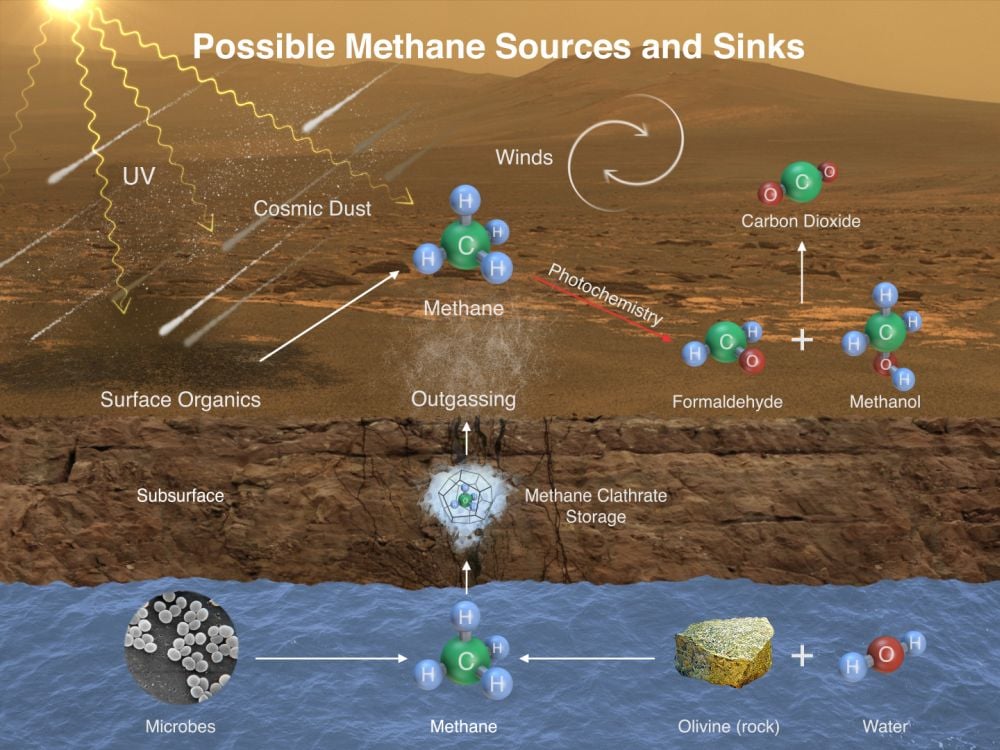
Infographic showing possible sources of methane on Mars. Microbes are just one of them, so the detection of this gas is not definitive evidence of life.
Credit: NASA/JPL-Caltech. Source: nasa.gov
It turns out that amino acids of biotic origin are more diverse and more evenly distributed than those formed abiotically. The situation is the opposite for fatty acids: abiotic samples show a higher degree of uniformity in distribution.
It is important to note that these patterns remain stable even after the molecules have been significantly degraded. Among the samples studied were fossilized dinosaur eggs—and the statistical signal of biotic origin was preserved in them.
The authors specifically highlight Europa—a moon of Jupiter—where radiolysis is considered the primary factor in the breakdown of organic matter in the near-surface ice. Using this specific example, they simulated the degradation of molecules and confirmed that the method remains reliable even under such conditions. It does not replace other approaches, but it adds another independent line of evidence to future research.
“When different methods point in the same direction, it becomes very convincing,” said Fabian Klenner, a co-author of the study. The study was published in Nature Astronomy.
UFO files: What woman told FBI about ‘alien in earthly form’ in 1967

The woman allegedly claimed the extraterrestrial being shared confidential information before eventually leaving Earth.
(Unsplash/ Representational)
Declassified records tied to the Federal Bureau of Investigation detailed extraordinary claims made by a woman who allegedly reported a UFO encounter to authorities in 1967.
According to a report published by The Mirror US, the unidentified woman told FBI personnel she had interacted with a being from another world that had “assumed earthly form.”
The files reportedly describe the woman as a “young white female” who contacted the bureau and later expressed fear for her safety.
The declassified documents cited by the outlet claim the woman warned investigators that “persons who saw UFOs have died mysteriously in the past.”
According to the report, she would only agree to meet through the FBI’s Dallas field office and supplied a phone number for communication if Air Force officials wished to interview her further.
Also Read:
The woman allegedly claimed the extraterrestrial being shared confidential information before eventually leaving Earth.
Among the more sensational allegations was a supposed incident over Africa on May 22, 1962, where an antimissile weapon was reportedly fired at a UFO. The object, she claimed, survived because it was protected by a “force field.”
The documents also allegedly referenced a UFO being detected over the “Dewline,” a Cold War radar defense network stretching across northern regions.
According to the woman’s account, the craft was later brought down, and extraterrestrials were attempting to recover debris connected to the incident.
The claims have not been independently verified, and no public evidence has emerged confirming the alleged encounters or events described in the files.
Also Read:
Interest in older UFO records has intensified following recent document releases by President Donald Trump.
Posting on Truth Social, Trump said his administration had released a “first tranche” of UFO and UAP records in the interest of “Complete and Maximum Transparency.”
“Whereas previous Administrations have failed to be transparent on this subject, with these new Documents and Videos, the people can decide for themselves,” Trump wrote before adding: “WHAT THE HELL IS GOING ON? Have Fun and Enjoy!”
Meanwhile, Jared Isaacman publicly backed the transparency effort, saying NASA would continue to “follow the data” while remaining candid about what remains unknown regarding unidentified aerial phenomena.
Declassified FBI files expose terrifying messages from outer space

Featured Image Credit: Getty stock
FBI documents have been released, which reveals what aliens allegedly really think about humans, and it’s not ideal.
Remember when UFOs and little green men were nothing but fiction? Yeah, me too.
But apparently, the tin-foil-hat society was a little closer to the mark than any of us would like to admit.
Decades of conspiracies have floated around the internet, putting the US government at the centre of a huge cover up regarding extra-terrestrials.
However, even after documentaries, alleged probing victim statements, and numerous sightings, nothing was ever officially confirmed.
Until recently.
The last couple of years has been major for alien news, with little snippets of information being revealed: namely, that aliens are real and spaceships have been actually seen up close.

Oddly, nobody was all that surprised to learn that it was true, but what they might end up getting their backs up about is the new information which shows how these space-beings feel about us.
After the Trump administration ordered a huge info dump to be dropped, with FBI classified files being revealed, it turns out we’re not the greatest species after all.
More like the ants of the universe.
The information is contained in an FBI memo of the 1955 interrogation of the Detroit Flying Saucer Club – a prominent UFO group.
According to the files, Randall Cox, a member of the club, told the FBI that aliens had been sending communication to them, revealing that all other planets had ‘conquered outer space,’ with Earth just left in the dust.
Oh, and they also consider us the ‘lowest form of universal existence.’
I didn’t think I’d have beef with space, but here we are.

Anyway, the documents went on to suggest that aliens had been prepping us for their arrival, stating: "He feels the purpose of contacts with Earth is limited at this time to preparing people to receive landings from outer space."
However, not to fear – apparently the UFOs were ‘friendly to the US.’
The files were dropped on the orders of Secretary of War Pete Hegseth under Donald Trump’s orders, leading to some political figures to take a swipe at the administration after it had denied the files existence.
One of the critics, Tennessee Representative Tim Burchett, wrote on X that things are going to get messy, writing: "The 1st drop will be big, but in comparison to what is coming they will be a drop in the bucket. I would say 'Holy Crap' is coming."
EXCLUSIVE - Top scientist admits universe is 'teeming with life'... and reveals what first contact will look like amid Trump's UFO disclosure
One of America's most popular scientists says there is no doubt the universe is teeming with extraterrestrial life as UFO disclosure gets underway.
Neil deGrasse Tyson, the famed astrophysicist, author and podcast host, spoke to the Daily Mail about the first wave of files released by the Pentagon on May 8 and what secrets could still be coming.
When asked if aliens really exist, Tyson said: 'Anyone who's studied the problem would answer without hesitation that we are not alone.'
'We're made of the most common ingredients in the universe. So life, if anything, was opportunistic, working with the materials that it was given in the early Earth. So, anyone who's studied the problem is ready for the universe to be teeming with life.'
While Tyson, 67, was skeptical that US intelligence officials were preparing to reveal a living alien or the corpse of one, he was certain the world was prepared for the watershed moment when the existence of life on other planets was confirmed.
'Of course, we're ready, because movies have been prepping us ever since War of the Worlds. We've already been told the government has them in the back shed; they just haven't brought them out yet. So, society didn't collapse in the face of that knowledge,' the scientist declared.
With first contact in mind, Tyson noted that humanity would need to take key steps to prove its intelligence to visitors who have the power to travel millions of miles through interstellar space.
That includes remembering a set of key facts he said every child learned in middle school - the Pythagorean theorem and the periodic table of elements.

Neil deGrasse Tyson (Pictured) has revealed what he believes will be the key information alien life would need to hear from humanity during first contact

The Pentagon began releasing the first files related to UFO encounters and the search for alien life on May 8
'Science and math would be universal languages. They would need to know science and math to get here. They don't know English, they don't know Latin, they don't know any of our languages, they don't know our culture, but they'll know science,' Tyson explained.
'It'll be a first step towards endearing them to us, and that we're not just worms crawling beneath their feet.'
The astrophysicist did not believe that face-to-face contact with alien life has actually taken place yet, despite the growing interest in UFO disclosure.
He noted that if aliens had really landed, it would be unlikely that only the government would know, especially with so many cameras and people having access to technology worldwide.
Tyson was also skeptical that aliens would only appear in restricted military airspace, as some UFO whistleblowers have detailed.
'I think a first encounter would not necessarily be with a military pilot. It could just be anybody who's got one of these recording devices. In a first encounter, it could be anybody, anywhere on the Earth.'
However, there was one group of people Tyson said should not receive the honor of making first contact with alien life, flat earthers.
'I'd be scared if the first person the alien found was a flat earther. Then it's like, okay, there's no hope for civilization if they're trying to convince the alien that Earth is flat. The alien would just run home to their home planet and report that there's no sign of intelligent life on Earth. We don't want that to happen.'

Tyson (Left) has released a new book which focuses on the topic of alien abduction and the real-life physics that the scientist said would make these encounters possible

A government graphic, based on witness reports from 2023, depicts a massive ellipsoid-shaped object that witnesses claimed emerged from a bright light in the sky before vanishing

Newly released FBI files have revealed shocking details of mysterious four-foot-tall crewmen exiting a UFO in the 1960s
Although Tyson has previously stated there has been insufficient evidence to prove that extraterrestrials have visited Earth, his new book, 'Take Me To Your Leader,' is bracing for the possibility of shocking revelations as UFO disclosure continues.
The author described the book, which delves heavily into the realm of alien abductions, as a celebration of how humans have imagined extraterrestrials, while comparing it with realistic possibilities based on physics and biology. It is available for purchase starting May 12.
Tyson added his stance on the question of alien encounters has changed because of high-ranking military, intelligence and government insiders who have come forward with serious claims, including that the military has been reverse-engineering alien craft for decades.
'That ship has sailed, because we had people from deep within the government testifying in front of Congress,' Tyson noted.
However, the astrophysicist noted that he was still taking a scientific approach to the decades-old reports and witness testimony presented in the first tranche of UFO documents released, saying it was not true evidence of alien life.
Referencing alien abduction claims, Tyson said: 'Testimony does not count as evidence. Evidence is evidence. So, if you had a high-res video walking onto an alien ship, and they did an anal probe, that's pretty good evidence.'
'What I want in the disclosure is to disclose the alien. Bring out the alien. If you got one in the back, bring it out,' he added.
The UFO files are online and the space aliens are still missing

Here they are — the US government documents on UFOs, now unclassified. At last, the conspiracy to hide them is unmasked!
Okay. We would not wish to be persecuted by the Conscience Fairy for deceiving anyone in this matter so let the articulate University of Rochester astrophysicist Adam Frank speak for us about what that really means:
I get up early and starting pouring through them. I click. I read. I watch videos. I click again. And then I realize…
There’s nothing here.
This highly touted disclosure amounts to just an endless parade of fuzzy images (or videos) and unverifiable personal testimony. Some of the documents go back 70 years but it’s all basically the same. Taken as a whole, it’s the kind of thing we’ve seen for decades: fuzzy images; unverifiable personal testimony; no hard evidence. There’s even a laughable image of flashing “orb‘ in a wheat field made by photoshopping a bad cartoon onto to a photo. It was an FBI technician’s attempt to illustrate someone’s account of a sighting.
“The End of UFOs?,” Everyman’s Universe, May 13, 2026
He goes on to complain, “Given the explosive congressional hearings we seen where witness claim the government has lots in crashed alien spaceships and dead alien bodies, I was kinda hoping for a whole lot more. It was all just so… boring.”
The US government probably made a wise call in this matter because almost all of the conspiracy nonsense revolved around the word “classified.” Not any more. Now, if you want to wade through pages of fuzzy nothing, nothing other than your sense of the value of your time is stopping you.
Spielberg should make a bundle off this.In the US edition of Spectator, David Whitehouse has it right about what secrecy does:
It launched the careers of a new wave of UFO celebrities who fed the growing number of UFO YouTube channels and conferences. There were speaking tours, TV spots and book deals. They fueled the decades old suspicion that there is a cover-up, a conspiracy hiding our contact with so-called non-human intelligence and retrieved crashed spaceships. The key word was disclosure. Stephen Spielberg caught the zeitgeist and his new film, “Disclosure Day,” is out soon.
“The only thing out there is the UFO industrial complex,” May 11, 2026
For all some of the rest of us know, it was pressure from various actors to keep their profitable gigs going that kept the UFO secrecy in place all these years.
Call that a conspiracy theory if you want. But remember, it does not involve any aliens. Just speculations about the hard business calculations from known earthly actors. I could be wrong but it is definitely not weird.
Look, maybe we are alone in the universe. Or maybe not. But real space exploration, the tough stuff, is the only way we can hope to find out.
260 Giant Monuments Found In Sahara Desert, Where A Dangerous New Gold Rush Is Heating UpBy Tom Hale
While the Egyptian pharaohs were raising their pyramids above the sands of Giza, another culture was quietly burying its dead in grand monuments just across the desert. For thousands of years, these landmarks have lain in obscurity in one of the most punishing landscapes on Earth, but new research is finally bringing them to light.
An international team of archaeologists has uncovered 260 previously undocumented structures deep in the Eastern Desert, the corridor of the Sahara wedged between the Nile River and the Red Sea in eastern Sudan. They found them not by trekking through the brutal terrain of endless dunes, but by searching through vast troves of satellite imagery.
The structures consist of circular mass graves, some up to 80 meters (262 feet) in diameter, filled with the skeletal remains of people and animals, such as cattle, sheep, and goats. Many are ringed by a low outer wall, with a single individual laid to rest at the very center of the ring.
Since the structures haven’t yet been closely investigated by archaeologists with boots on the ground, precise details, like when they were built, are not immediately obvious. However, thanks to strikingly similar structures excavated over the past century, known as Atbai Enclosure Burials, the researchers believe they were constructed around 4,500 to 6,500 years ago.
Just like the other Atbai Enclosure Burials, the people buried here were likely nomadic pastoralists who herded livestock across the region. It's no coincidence, then, that most of the monuments are located close to ancient watering holes, dried-up riverbeds, and oases.
They were made at a time when the Sahara was undergoing a dramatic shake-up. The Sahara is locked in a cyclic rhythm, swinging between arid desert and lush savanna roughly every 21,000 years. The last of these "Green Sahara" periods was between roughly 15,000 and 5,000 years ago, precisely the era when these monument-builders thrived.
As the green pastures receded and the sands advanced, this culture appears to have vanished. And it wouldn't be the last time this happened. In the Ténéré Desert, another remote corner of the Sahara, another troop of archaeologists have uncovered a deeply mysterious site known as Gobero, consisting of 200 human skeletons, as well as thousands of artifacts. Once again, this site appears to have been abandoned when aridification swept through the Sahara around 5,000 years ago.
The Sahara may look lifeless today, but these sites are proof that it was once a thriving stage for countless human cultures whose stories we are only beginning to recover.
Which is exactly why the researchers are sounding the alarm. The Eastern Desert is currently in the grip of a new gold rush, drawing people, money, and guns deep into the once-empty region. The study found that at least 12 of the ancient structures had already been damaged by mining activity and vandalism. As the lust for gold heats up, the destruction is only set to worsen.
'The biggest El Niño event since the 1870s': 'Super' El Niño is now the most likely scenario by the end of this year — and the humanitarian cost could be huge
A "very strong" El Niño is now the most probable scenario for the October-to-February period.

A "super" El Niño is now the most likely scenario from October 2026 to February 2027, according to a new forecast from the National Oceanic and Atmospheric Administration's (NOAA) Climate Prediction Center.
El Niño is the warmer phase of the natural El Niño-Southern Oscillation (ENSO) climate cycle, a periodic shift in the waters of the tropical Pacific Ocean that supercharges global temperatures, in turn impacting weather patterns and crops worldwide.
Now, in a new ENSO forecast published May 14, NOAA estimates that there's a 65% chance that the upcoming El Niño will be classified as strong or very strong starting in October, potentially placing it among the strongest in recorded history.
You may like
'Super El Niño' could push global temperatures to unprecedented highs, forecasters say
A "very strong" El Niño — meaning a 3.6-degree-Fahrenheit (2 degrees Celsius) rise in sea surface temperatures, and unofficially called a "super" El Niño — is now the most probable scenario for the October-to-February period.
There is also now an 82% chance that El Niño will arrive between now and July, with the phase looking highly likely to continue until February 2027. This is a roughly 20 percentage-point increase in certainty from NOAA's April forecast that El Niño is right around the corner.

El Niño most likely to be "strong" or "very strong" from October to February.
(Image credit: NOAA Climate Prediction Center)
El Niño events occur every two to seven years, when shifts in wind and current patterns in the tropical Pacific Ocean cause sea surface temperatures to rise 0.9 F (0.5 C) above historical averages, resulting in profound knock-on effects on the global climate. The world is rapidly exiting the neutral phase.
The world's most recent El Niño spanned from May 2023 to March 2024 and was partially responsible for 2024 being the hottest year on record. If the upcoming El Niño is strong or very strong, 2027 could surpass the previous record, according to Climate Brief's State of the Climate assessment, published April 21.
In fact, the impending El Niño may itself break records. "Confidence is clearly shifting higher on potentially the biggest El Niño event since the 1870s," Paul Roundy, a professor of atmospheric and environmental sciences at the University at Albany, wrote on X on May 5.
If a "super" El Niño does occur, it could rival the strongest on record: a catastrophic 1877 event that spurred the 1876-to-1878 global famine. The famine killed over 50 million people, or 3% of the world's population at the time.
Although the social, political and economic landscapes have changed since the 1877-to-1878 El Niño, the upcoming event could still seriously threaten food, water and economic security around the world, Deepti Singh, head of the Climate Extremes and Impacts Lab at Washington State University, told The Washington Post.
What to read nextEl Niño could be here by May, new forecast reveals — here's what it means for summer weather
Live Science Today: Super El Niño looms and Starlink hits 10,000 satellites in orbit
"What is different now is that our atmosphere and oceans are substantially warmer than they were in the 1870s, which means the associated extremes could be more extreme," Singh said.
More recent examples demonstrate the threat of strong and very strong El Niño phases. For example, an El Niño in 1997 to 1998 led to an estimated global economic loss of $32 billion to $96 billion.
NOAA ENSO forecaster Nathaniel Johnson recently told Live Science that a very strong El Niño would impact fisheries and crops, as well as heighten the risk of wildfires and hurricanes in parts of the world.
"You've got more people that are living in poverty already and if you get a reduction in crop yields because of drought or flooding [from El Niño] then that drives prices even higher," Liz Stephens, a professor of climate risk and resilience at the University of Reading in the U.K., told the BBC. "So we're looking at potentially quite huge humanitarian impacts this year, especially if the crisis in the Middle East continues."
The next NOAA ENSO forecast will arrive June 11.
Mars Express Reveals A Chaotic Feature Carved into the Martian Surface By Ancient Waters

Martian chaos created by craters, lava, and water was observed by the European Space Agency’s (ESA) Mars Express in the Shalbatana Vallis, providing an in-depth look at this fascinating feature of the Red Planet’s terrain.
This channel, close to the Martian equator, the Shalbatana Vallis, stretches between the highland Xanthe Terra and the lowland Chris Panitia, carved by natural processes long ago. Even after two decades, Mars Express continues to provide scientists with stunning new details of the Martian terrain, filling in our understanding of Earth’s planetary neighbor.

This image from the ESA's Mars Express Orbiter shows the beginning of Shalbatana Vallis, and ancient water channel on Mars. It begins in jumbled chaos terrain in Orson Welles crater and extends for 1300 km across the Martian surface.
Image Credit: ESA/DLR/FU Berlin. LICENCE: CC BY-SA 3.0 IGO or ESA Standard Licence

*This zoomed-in image shows more of the detail in the chaos terrain at one end of Shalbatana Vallis. The dark patch is volcanic ash blown into the channel by Mars' winds.
Image Credit: ESA/DLR/FU Berlin. LICENCE: CC BY-SA 3.0 IGO or ESA Standard Licence*
Since its 2003 launch, Mars Express has been exploring the Red Planet with a suite of eight onboard instruments. Consisting of a lander, Beagle 2, and the Mars Express orbiter, the spacecraft has been especially prolific, mapping the Martian surface color and three dimensions at never-before-achieved resolution over the last two decades.
Shalbatana Vallis is a channel close to the Martian equator.
Credit: NASA/USGS; ESA/DLR/FU Berlin
An earlier Mars Express video, captured in October 2025, observed the channel from beginning to end. Yet, this new image captured by the Mars Express’s High Resolution Stereo Camera (HRSC) focuses more tightly on a northern segment of the 1300-kilometer-long Shalbatana Vallis, providing exquisite, high-resolution detail on this intriguing surface feature.
Scientists believe that, as large amounts of groundwater rose to the surface to flood this equatorial region roughly 3.5 billion years ago, that catastrophe produced the Shalbatana Vallis, cutting a winding path through the rock. The main valley cuts 500 meters deep, yet extends about 10 kilometers wide as it meanders across the Martian surface.
As weathering carved the valley, scientists believe this also filled it in over time. The precise materials that infilled the once-deep valley cannot be pinpointed, yet some clues exist. Researchers believe that a blue-black material in part of the modern channel is volcanic ash strewn about by Martian winds.

A chaotic area in the Shalbatana Vallis lies near a patch of likely volcanic ash.
Credit: ESA/DLR/FU Berlin
Other valleys of Shalbatana Vallis’s type abound in the region, which is home to many marks of local volatility. On one side are the northern lowlands, relatively smooth, while the highlands to the south are heavily cratered from ancient space impacts. It also lies near Chris Planitia, likely an ancient ocean, based on its status as one of the lowest points on the Martian surface and the many outflow channels leading into it.
Often accompanying outflow channels, such as Shalbatana Vallis, are scattered rock mounds and raised blocks known as chaotic terrain. In this instance, a section of chaotic terrain appears in the images near the blue/black portion identified as likely volcanic ash. Such features are likely born in the collapse of the surface ground, as water ice below melts, creating instability. Mars Express has previously captured such features in the areas of Pyrrhae Regio, Iani Chaos, Ariadnes Colles, Aram Chaos, and Hydraotes Chaos.
Remnants of impact craters in the area now lie partially obscured by later burial, long-term wear, and even a covering of material ejected during the initial impact. Volcanic activity has, over time, flooded the regions with lava, smoothing many of these ancient features before cooling and shrinking into wrinkle ridges. Presently, a few isolated portions of the earlier surface still remain, now as hill tops scattered through the channel.
Going forward, with the help of software updates that occurred last year, ESA scientists are expected to keep Mars Express operational through 2034, providing ever more data ahead of any potential crewed landings on the Red Planet.