Ontdek de Fascinerende Wereld van UFO's en UAP's: Jouw Bron voor Onthullende Informatie!
Ben jij ook gefascineerd door het onbekende? Wil je meer weten over UFO's en UAP's, niet alleen in België, maar over de hele wereld? Dan ben je op de juiste plek!
België: Het Kloppend Hart van UFO-onderzoek
In België is BUFON (Belgisch UFO-Netwerk) dé autoriteit op het gebied van UFO-onderzoek. Voor betrouwbare en objectieve informatie over deze intrigerende fenomenen, bezoek je zeker onze Facebook-pagina en deze blog. Maar dat is nog niet alles! Ontdek ook het Belgisch UFO-meldpunt en Caelestia, twee organisaties die diepgaand onderzoek verrichten, al zijn ze soms kritisch of sceptisch.
Nederland: Een Schat aan Informatie
Voor onze Nederlandse buren is er de schitterende website www.ufowijzer.nl, beheerd door Paul Harmans. Deze site biedt een schat aan informatie en artikelen die je niet wilt missen!
Internationaal: MUFON - De Wereldwijde Autoriteit
Neem ook een kijkje bij MUFON (Mutual UFO Network Inc.), een gerenommeerde Amerikaanse UFO-vereniging met afdelingen in de VS en wereldwijd. MUFON is toegewijd aan de wetenschappelijke en analytische studie van het UFO-fenomeen, en hun maandelijkse tijdschrift, The MUFON UFO-Journal, is een must-read voor elke UFO-enthousiasteling. Bezoek hun website op www.mufon.com voor meer informatie.
Samenwerking en Toekomstvisie
Sinds 1 februari 2020 is Pieter niet alleen ex-president van BUFON, maar ook de voormalige nationale directeur van MUFON in Vlaanderen en Nederland. Dit creëert een sterke samenwerking met de Franse MUFON Reseau MUFON/EUROP, wat ons in staat stelt om nog meer waardevolle inzichten te delen.
Let op: Nepprofielen en Nieuwe Groeperingen
Pas op voor een nieuwe groepering die zich ook BUFON noemt, maar geen enkele connectie heeft met onze gevestigde organisatie. Hoewel zij de naam geregistreerd hebben, kunnen ze het rijke verleden en de expertise van onze groep niet evenaren. We wensen hen veel succes, maar we blijven de autoriteit in UFO-onderzoek!
Blijf Op De Hoogte!
Wil jij de laatste nieuwtjes over UFO's, ruimtevaart, archeologie, en meer? Volg ons dan en duik samen met ons in de fascinerende wereld van het onbekende! Sluit je aan bij de gemeenschap van nieuwsgierige geesten die net als jij verlangen naar antwoorden en avonturen in de sterren!
Heb je vragen of wil je meer weten? Aarzel dan niet om contact met ons op te nemen! Samen ontrafelen we het mysterie van de lucht en daarbuiten.
Maandag 8 juni 2026
Scientists Detect Massive Structure Under Antarctica
Scientists Detect Massive Structure Under Antarctica
Researchers have uncovered the existence of a monumental geological structure buried two miles beneath the frigid ice of Antarctica.
According to a new paper, published in the journal Nature, the massive structure is made up of several previously known glacial landforms, like the Wilkes and Aurora subglacial basin region of East Antarctica, as well as Lake Vostok, the largest known subglacial lake on the planet.
These features have been studied separately for years, a press release notes, but have never been recognized as individual pieces to a larger puzzle.
Called the East Antarctic Fan-shaped Basin Province, the newly-identified structure likely represents one of the largest Earth features of its kind. While more work will be needed to corroborate the findings, the theorized formation could be crucial for understanding how Antarctica came to be, and how its three major ice sheets may respond to a warming climate.
To map the structure, scientists compiled datasets from a buffet of sources, like geological observations, gravity measurements, magnetic data, and models of the Earth’s crust, among others.
Added together, those datasets led researchers to conclude the geological feature likely formed through a process known as “distributed rotational extension,” where continental crust slowly stretches outward from a central point over a period of millions of years.
“Because these basins underlie about half of the East Antarctic Ice Sheet, they are likely to heavily influence both ice-flow and landscape evolution, making them essential to Antarctic glacial and hydrological processes,” the study’s authors write.
Inside NASA's $1 BILLION plan to destroy the ISS: As the latest leak sparks evacuation fears, experts reveal how the doomed space station will be destroyed in 2030
While no escape flights were ultimately necessary, this near miss has sparked concerns that the ISS has reached the end of its useful lifespan.
Now, experts have revealed the step–by–step details of the $1 billion plan to bring the doomed station crashing down to Earth.
Speaking at the ASCEND 2026 aerospace conference, Ryan Landon, director of Operations at NASA Johnson Space Centre, said that the ISS would be allowed to start falling to Earth sometime in 2028.
With a mass of 450,000 kilograms, about the same as 280 family cars, the ISS will slowly fall out of orbit if it isn't being periodically boosted upwards.
However, simply letting the station's orbit 'decay' naturally would result in an uncontrolled re–entry that would scatter potentially deadly debris across Earth.
After Russian attempts to fix a leak on the International Space Station trigger an evacuation scare, experts have revealed the $1 billion plan to bring the doomed station down to Earth
The ISS and its crew of seven astronauts from around the world orbit at an altitude of 250 miles (400km) above the Earth.
To maintain this relatively low orbit, the station has to move incredibly fast, travelling at speeds of 17,500mph (28,000km/h) and whizzing over our heads 16 times a day.
Normally, the station maintains its speed by using propellant to thrust back up into orbit and avoid tumbling into the thicker layers of the atmosphere.
However, starting from 2028, NASA plans to simply let this process take its natural course.
According to the latest plans published in 2024, the station will still be operational during this time, and on–board activities, including research, will continue as normal.
Left unchecked, this process would eventually bring the station crashing into the atmosphere, where most of the materials would be burned up by friction.
But this type of uncontrolled re–entry is far too risky for an object as large as the ISS.
Dr James Beck, space debris expert and director of UK–based space consultancy Belstead Research, told the Daily Mail: 'It is certain that parts will reach the surface of the Earth, and most likely quite a lot of parts.
Last week, NASA astronauts were forced to take shelter in their SpaceX Dragon capsule (pictured) in case of a disaster aboard the orbiting station
How will the ISS be brought back to Earth?
Starting from 2028 the ISS will be allowed to gradually fall from 250 miles to 200 miles above Earth.
In 2029, the last human crew will depart the ISS and take anything of historical importance they can carry.
As the ISS falls from 200 miles to 175 miles, a modified SpaceX Dragon capsule will dock with the station.
Once the station hits the point of no return at 175 miles, the Dragon capsule will begin to guide the ISS into an elliptical orbit.
When the time is right, the space tug will deliver one last kick and push the station into Earth within less than half an orbit.
The ISS and tug will hit the atmosphere at 17,000 mph and be destroyed.
'The open question is how many, and whether there can be sufficient control over where this occurs.'
Dr Beck explains that there is an internationally agreed 'casualty risk limit' of one in 10,000 for any re–entry.
This limit is typically reached once a spacecraft gets to a mass of around 500 to 1,000 kg, whereas the ISS weighs 450 tonnes.
Dr Beck says: 'It should be expected that a few hundred objects which could cause casualties on the ground would be produced.'
The space agency can't limit how much debris reaches the ground, so they need to control exactly where this debris ends up so that no one gets hurt.
This requires boosting the station backwards, slowing it down at a precise point in its orbit so that it eventually falls in an uninhabited area in the Pacific called Point Nemo.
Known as the 'Spaceship Graveyard', Point Nemo is the furthest location from any inhabited location anywhere on Earth, which significantly reduces the danger of space debris.
According to NASA's calculations, the ISS will need to change its speed by about 127 miles per hour (204 km/h), which is a tiny fraction of its total speed.
NASA plans to use a modified Dragon capsule to push the ISS out of orbit (artist's impression), so that it falls within an uninhabited part of the Pacific Ocean
The International Space Station: Key facts
Length: 356ft (109m)
Weight (in Earth gravity): 419,725kg
Average altitude:250 miles (400km)
Average speed: 17,500mph (28,000km/h)
Earth orbits per day: 16
Maximum docking capacity:Eight spacecraft
Permanent crew size: Seven astronauts
Maximum crew capacity: 13
However, this will consume about nine tonnes of propellant, which is far more than the ISS's own thrusters can provide.
In 2024, NASA awarded Elon Musk's SpaceX a contract worth slightly under $1 billion (£749.69 million) to build a 'tugboat' capable of delivering that push.
This will be a modified version of the SpaceX Crew Dragon capsule used to deliver astronauts and cargo that will dock with the station before firing up its motor and pushing the ISS down to Earth.
This vehicle will need to carry six times as much propellant and produce three to four times as much power as the current generation of SpaceX spacecraft.
NASA officials now say that the last cargo capsule will depart the ISS around mid–2029, ahead of the official end of operations in 2030.
Once the last crew have gone, the station will continue to fall over several months until it reaches the 'point of no return' at an altitude of 175 miles (280 km).
Roughly 18 months before the ISS crashes down in 2031, the modified Dragon capsule will dock with the station and prepare to deliver the finishing blow.
Speaking at a press conference in 2024, Dana Weigel, NASA’s ISS manager, explained that the tug would do this over several stages over 18 months.
NASA estimates it will cost $1bn (£800m) to convert a Dragon capsule (pictured) into a vehicle capable of pushing the ISS out of orbit
Ms Weigel said: 'At the right time, it will perform a complex series of actions... over several days to deorbit the space station.
'First, the deorbit vehicle will perform orbit shaping burns to put the station in a low elliptical orbit, and then, eventually, it will perform a final re–entry burn'.
NASA expects that most of the space station will be destroyed, but 40 to 100 tonnes of denser materials could still make it through the atmosphere.
Once the space station hits thicker air at an altitude of around 150 miles (250 km), there is also a risk that the tugboat could lose control of the station and begin to tumble.
In 1979, NASA's 75–tonne space station, Skylab, tore itself apart as it crashed through the atmosphere during a planned re–entry, sending debris falling over parts of Western Australia.
However, NASA's assessment found that leaving the ISS in orbit is far more dangerous than attempting to bring it down intentionally.
The agency's 2024 assessment concluded: 'The International Space Station requires a controlled re–entry because it is very large, and uncontrolled re–entry would result in very large pieces of debris with a large debris footprint, posing a significant risk to the public worldwide.
'Ensuring the space station is well maintained continues to be the safest operational approach while also planning for deorbit at the space station’s end of life.'
The International Space Station (ISS) is a $100 billion (£80 billion) science and engineering laboratory that orbits 250 miles (400 km) above Earth.
It has been permanently staffed by rotating crews of astronauts and cosmonauts since November 2000.
Crews have come mainly from the US and Russia, but the Japanese space agency JAXA and European space agency ESA have also sent astronauts.
The International Space Station has been continuously occupied for more than 20 years and has been expended with multiple new modules added and upgrades to systems
Research conducted aboard the ISS often requires one or more of the unusual conditions present in low Earth orbit, such as low-gravity or oxygen.
ISS studies have investigated human research, space medicine, life sciences, physical sciences, astronomy and meteorology.
The US space agency, NASA, spends about $3 billion (£2.4 billion) a year on the space station program, with the remaining funding coming from international partners, including Europe, Russia and Japan.
So far 244 individuals from 19 countries have visited the station, and among them eight private citizens who spent up to $50 million for their visit.
There is an ongoing debate about the future of the station beyond 2025, when it is thought some of the original structure will reach 'end of life'.
Russia, a major partner in the station, plans to launch its own orbital platform around then, with Axiom Space, a private firm, planning to send its own modules for purely commercial use to the station at the same time.
NASA, ESA, JAXA and the Canadian Space Agency (CSA) are working together to build a space station in orbit around the moon, and Russia and China are working on a similar project, that would also include a base on the surface.
A mysterious object initially described as a possible UFOand shot down by a $500,000 missile under former president Joe Biden's administration has since been identified as a Boy Scout balloon.
In February 2023, F-16s scrambled to confront an octagonal object hovering 20,000 feet above Lake Huron before blasting it from the sky with an AIM-9 Sidewinder missile, according to video released last month by the Department of War.
The 45-second clip captured a black, orb-like object in US airspace, with a dangling string visible in the fighter jet's crosshairs moments before it was blown apart.
The shootdown, carried out by a Minnesota Air National Guard F-16 Viper, was ordered by former President Biden 'out of an abundance of caution and at the recommendation of military leaders.'
But Sean Kirkpatrick, former head of the federal All-Domain Anomaly Resolution Office (AARO), revealed that the object actually belonged to a Boy Scout troop.
'The balloon had circumnavigated the globe eight times before we shot it down with a half-million-dollar missile,' he said at a conference in April.
Kirkpatrick added that the orb in question was part of an ongoing, unspecified research project.
'You can imagine the response on the Hill when I briefed that,' he said.
An object initially described as a possible UFO and shot down by a $500,000 missile under the Biden administration in 2023 was revealed to have been a Boy Scout balloon
In February 2023, F-16s scrambled to confront an octagonal object hovering 20,000ft above Lake Huron before blasting it from the sky
During an April press conference, Sean Kirkpatrick, former head of the federal All-Domain Anomaly Resolution Office (AARO), said the orb was part of an ongoing, unspecified research project
The shootdown was ordered by former President Joe Biden 'out of an abundance of caution and at the recommendation of military leaders'
The Boy Scout orb was destroyed amid the Chinese spy balloon incident, as criticism grew over the government's delay in acting while public concern spiked and citizens became 'freaked out,' according to an congresswoman who spoke to CNN.
In the span of just two weeks, US fighter jets shot down three other high-altitude objects over North American airspace, beginning with one off the South Carolina coast on February 4, 2023.
FBI analysis of the recovered wreckage found that the balloon was part of a Beijing surveillance network with antennas used to collect and locate communications over US missile bases.
'It's not a major breach. Look, the total amount of intelligence gathering that's going on by every country around the world is overwhelming,' Biden said at the time.
In the following days, one object was shot down off the coast of Alaska and was later identified as a hobbyist balloon belonging to the Northern Illinois Bottlecap Balloon Brigade, as reported by The Guardian.
The group reported one of its hobby balloons 'missing in action' on February 11, 2023 - the same day a US F-22 shot down an unidentified airborne object using a $439,000 missile.
Meanwhile, the hobby balloon itself was estimated to be worth only about $12.
Then came the object downed over the Great Lakes at around 2.42pm on February 12, 2023, which again cost the US government nearly $1 million in missiles to destroy.
Tim Phillips, a former interim director of AARO, told The New York Post: 'After the Chinese spy balloon embarrassment, DOD was shooting at every (Unidentified Anomalous Phenomena) they detected'
The 45-second clip captured a black, orb-like object with a dangling string visible in the fighter jet's crosshairs moments before it was blown apart
It was revealed that a US Air Force F-16 missed its first attempt before firing a second AIM-9X Sidewinder missile that struck the target
Tim Phillips, a former interim director of AARO, toldThe New York Post: 'After the Chinese spy balloon embarrassment, DOD was shooting at every (Unidentified Anomalous Phenomena) they detected.'
Kirkpatrick described another incident during April's conference in which a US fighter pilot reported encountering a UFO with 'stealth-like capabilities' and was authorized to fire a missile.
But what was ultimately destroyed was a star-shaped Mylar balloon from Walmart that read 'Happy Birthday.'
Many of the military's alleged UFO videos, including some released by the Trump administration, actually show ordinary manmade objects that were misidentified by Reaper drone operators.
'They've been on mission and they've got to get back to base to rearm and refuel. And you've got a bored operator looking around. And they pick something up and aren't sure what it is,' Phillips told the outlet.
'We're actually seeing, good reporting coming out of the fleet, coming out of the operation wings and squadrons, where they're willing to report this stuff,' he added.
'And this is part of that outreach where we get our scientists to talk to the Reaper operators and actually go side by side and try to do some education.'
Shortly after the Lake Huron shootdown, it was revealed that a US Air Force F-16 missed its first attempt before firing a second AIM-9X Sidewinder missile that struck the target, according to Fox News. Each missile costs around $400,000.
In the span of just two weeks, US fighter jets shot down three other high-altitude objects over North American airspace, beginning with one off the South Carolina coast on February 4, 2023
FBI analysis of the recovered wreckage in South Carolina waters found that the balloon was part of a Beijing surveillance network
Kirkpatrick described another incident during April's conference in which a US fighter pilot reported encountering a UFO with 'stealth-like capabilities,' only for it to be a $12 balloon from Walmart
The mission over the Great Lakes came as the White House continued to laugh off suggestions that aliens are involved in the UFO sightings
Despite a Pentagon memo describing the flying object as a 'small, metallic balloon', audio of conversation from inside the jets showed that the pilots went back and forth over how to define the UFO.
'I wouldn’t really call it a balloon… I don’t know what… I can see it outside with my eyes,' one of the pilots can be heard saying.
Military officials later described the object as an 'octagonal structure', which was shot out of the sky because it was 'a safety flight hazard and a threat due to its potential surveillance capabilities.'
But audio recordings, released by The Drive, shed light on the puzzling nature of the military operation as it erupted over US airspace.
After coming-face-to-face with the object, one of the pilots noted: 'I wouldn't really call it a balloon. I can see it outside with my eyes.'
'Looks like something… there’s some kind of object that’s distended… it’s hard to tell, it’s pretty small,' he added.
The mission over the Great Lakes came as the White House continued to laugh off suggestions that aliens are involved in the UFO sightings, amid increased pressure for officials to explain recent developments.
The barrage of downed high-altitude objects also prompted the White House to announce the creation of a new UFO task force to study the security threat posed by unidentified objects entering US airspace.
RELATED VIDEOS
'Octagonal' object shot down by military aircraft over Lake Huron, US officials confirm
The Lake Huron Octagon
CHILLING VIDEO: US F-16 DESTROYS UFO Over Michigan? Watch US Fighter Jet Lock Onto Unknown Object
Melissa Casias’s case is real and tragic, but the evidence available shows she was a Los Alamos National Laboratory employee who disappeared in June 2025 and was later identified after her remains were found in a New Mexico forest.
According to public reporting and a New Mexico State Police release republished by the Los Alamos Reporter, a hiker found human remains in the McGaffey Ridge area of Carson National Forest on May 28, 2026. Investigators said a handgun was located alongside the remains, which were later identified as Melissa Casias. The cause and manner of death had not yet been determined.
The UFO and secret-technology angle comes mostly from online speculation and broader interest in a separate wave of “missing scientists” theories. The Wall Street Journal reported that a fringe conspiracy theory about missing scientists had attracted FBI attention, but also noted that investigators and critics had not found evidence proving a coordinated plot.
ScientificAmerican likewisearguedthat basic statistics can explain why clusters of cases can look connected even when they are not. In other words, the pattern may feel suspicious without being proof of a hidden project.
Chris Cuomo on NewsNation discussed the possibility of conspiracy, classified work, and UAP-related secrecy, but it also includes caution from Morgan Wright that people should not jump from evidence to narrative too early. It also says Casias was an administrative assistant, not a scientist with nuclear-program access, and that she had no access to restricted data or “anything dealing with nukes” according to the guest’s explanation. That matters because it weakens the idea that she was deep inside a secret technology project.
CNN writes Casias was last seen walking southbound on State Road 518 in June 2025, and that her personal items were left at home. People reported the same broad facts and added that a handgun was found next to the remains. None of those reports provide evidence of aliens, black-budget technology, or clandestine experimentation.
A key point is that the cause of death was not established in the initial reports. That leaves room for uncertainty, but uncertainty is not the same as proof of a cover-up. People often treat unresolved details as a doorway to huge conclusions. In reality, unresolved details often stay unresolved because investigators are still collecting and testing evidence.
The public timeline also matters. Casias disappeared on June 26, 2025, and her remains were found on May 28, 2026, in Carson National Forest. That delay is troubling and understandably painful for her family, but delay alone does not establish a secret-program explanation.
Why the UFO link spread
The UFO connection appears to be more about surrounding culture than about the case itself. Los Alamos has long been associated in public imagination with nuclear history, advanced science, and secrecy, so any employee from there can quickly become part of a larger mystery story. That association is powerful even when the person involved worked in an administrative role rather than a technical one.
NewsNation interview with Morgan Wright touches this point. It says the government should be more transparent about “the UAP phenomenon,” and suggests that secrecy creates a vacuum that conspiracy theories rush to fill. That is a fair description of how online narratives grow. Once a case sits near a lab, a weapon program, or a classified site, people begin connecting unrelated dots because the setting feels dramatic.
Claims about “secret technology” are especially weak here because the known facts do not show that Casias held ascientificor technical role connected to classified research. NewsNation reports that Casias was an administrative assistant and that she likely had only limited clearance consistent with administrative work, not access to restricted technical material. If true, that would make her much less likely to be involved in any hidden weapons or advanced propulsion project.
This is where sensational stories become misleading. They often blur “worked at a sensitive place” into “must have known something huge.” That move sounds exciting, but it collapses under scrutiny. The public record here does not show Casias was connected to any hidden aircraft, reverse-engineered non-human craft, or black-site program.
There is no public evidence that links Casias’s death to non-human intelligence. No report cited in the available sources says investigators found materials, witnesses, signals, or physical traces suggesting aliens or anomalous technology. What exists is a death investigation, a recovered body, and a lot of online interpretation.
The interview brings up UFO files, classified labs, and missing people in New Mexico in the same conversation, which makes the topic feel unified even when the facts are not. That style works well for television because it is emotionally sticky, but it is not evidence. A compelling story is not the same thing as a proven one.
Even the more cautious sources about the broader “missing scientists” wave do not support an alien angle. Scientific American argued that statistical clustering and selective attention can make ordinary cases appear linked. That same logic applies here. A tragic case near a famous lab can be folded into a UFO narrative because people already expect secrets there.
There are still unanswered questions in Casias’s case, and those questions are legitimate. The exact cause and manner of death were still under investigation in the public reports. The reason for the handgun’s presence, the circumstances of her final hours, and the full forensic findings were not established in the early coverage.
Those unknowns create space for speculation, but speculation should stay separate from fact. A missing person case can involve suicide, accident, foul play, or a mix of confusing circumstances. Without a completed forensic conclusion, any single theory is premature. The interview transcript itself warns against deciding too early and says the biggest danger is going from evidence straight to narrative.
That warning is useful here. People want a clear explanation, especially when a person worked near a famous lab and the story already sounds unusual. But unusual does not automatically mean extraordinary. Sometimes a mysterious-looking case turns out to be a human tragedy with no hidden dimension.
Melissa Casias was a Los Alamos administrative employee who went missing, was later found dead, and became the subject of online speculation because her case sat inside a broader moment of fascination with secrecy, labs, and UFOs. That broader moment helped push her case into a larger conspiracy frame. But the evidence made public so far does not prove any connection to secret technology or non-human intelligence.
That does not mean people invented the concern from nothing. Some details, like the recovery of remains far from where she was last seen and the presence of a handgun, naturally invite questions. It is also true that secrecy around government work creates public suspicion. Still, suspicion is only the beginning of inquiry, not the end of it.
So the responsible conclusion is simple. The case is tragic and still serious, but the UFO and hidden-project angle remains unproven and speculative. At this point, the story is about a death investigation, not confirmed alien contact, not confirmed black-budget technology, and not confirmed non-human intelligence.
RRLATED VIDEOS
The Missing Scientists, Classified UFO Files Released and The 2027 Warning
The Disappearance of Melissa Casias and the Missing Scientists | Los Alamos Mystery
I Looked Into the Missing Scientists. I Wish I Hadn't.
Mayk Leão, an influencer from Brazil, says he filmed strange lights near his rural home in Campo Largo, Paraná, and believes he had contact with something not from this planet.
News articles say he lives alone on a small farm in an isolated area with no neighbors nearby, no tap water, and no mobile signal. On Sunday, May 31, 2026 what should have been a normal day of taking care of the animals turned into something he describes as a possible UFO encounter.
He first noticed that the animals were very nervous and running around the property. Worried that it might be a wild animal, such as a jaguar, he grabbed his bow and arrows and went to investigate.
Image credit : X | Brazilian influencer Mayk Leão claims UFO sighting over his rural farm, now fears for life after mysterious men were seen near his home
At the edge of his land, he found the electric fence down and heard strange noises that frightened him. He says the sound was hard to describe. It was like metallic tones layered on top of each other, a sort of crack, roar, or snapping sound, as if a single source was making several metallic noises at once. He recorded two Instagram Stories with the audio of these sounds.
Later that afternoon, he says he heard another sound above his house, like a ratchet or gear mechanism, similar to a very large ship or boat passing overhead. At that moment, he already felt he might be going crazy, but he kept filming so that at least his followers could hear what he was hearing.
He describes the experience as if he had “received” the sounds in his head, not just heard them with his ears, and this impression keeps replaying in his mind and makes it hard for him to sleep.
Around nightfall, from his veranda, he saw strange lights on a mountain ridge visible from the house. He says the lights were neither high enough to be above the hill nor low enough to touch the ground, and that the object appeared to be hovering over the trees near a river.
He filmed the scene using maximum zoom on an iPhone 15, capturing a bright object with grouped lights on the distant slope. According to him, the object stayed there for about 20 to 40 minutes before the lights went out and disappeared. After the lights vanished, he remained outside talking to his followers on live video.
He then says he saw something very large finishing a pass over his house, which made him feel he had been in front of “something that was not from here,” an intelligence he believes was greater than ours
Encouraged by a follower, he drew what he saw to try to represent the shape of the supposed craft. He did not go to the site of the lights because it is more than three kilometers away, with rough terrain, dense forest and a river, and he was afraid. He insists he did not edit the videos in any way.
Before this episode, he had about 46,000 followers. As the stories and videos spread, they went viral, with one of the videos alone reaching more than two million views. His audience jumped to more than 950,000 followers in a short time, and the case became one of the most talked-about topics on social networks in Brazil.
He describes the experience as both scary and beautiful and says it is one of the most intense things he has ever lived through. At the same time, he reports that he has been unable to sleep properly for two days because of the fear and the flood of messages he receives.
Reaction online has been mixed. Many people support him and send messages saying they have had similar experiences or believe he really saw a UFO. Others attack him, insult him and even threaten him. Some accuse him of creating a hoax for self‑promotion or to help promote a science‑fiction film about aliens that is about to be released.
There are also people saying the lights could be drones, but Mayk says locals in the area do not have that kind of equipment. With the case going viral, he says he has received messages from all over the world. According to him, ufologists have offered to visit the farm, examine the place and analyze the original, unedited videos.
He is crying as he explains that he is emotionally shaken and scared by everything that happened after he filmed the strange lights and the supposed UFO, and by how this is affecting his life.
In the interviews and lives, he says he has not been able to sleep properly for about two days, both because of fear of what he saw and because of the huge number of people contacting him. He explains that the sounds he heard in the forest and above his house were very disturbing and feel like they are still “inside his head,” as if he had received a kind of vibration or communication instead of just hearing a normal noise.
Plox, a Brazilian online news portal, reports that the Brazilian Air Force (FAB) says that its radars did not detect any object in the area of Campo Largo at the time of the video. They state that the monitoring and control of Brazilian airspace in that region were completely normal, with nothing out of the ordinary showing up in their systems.
The influencer claims he witnessed a UFO-like object near his farm
According to Mayk Leao, the incident began when he noticed an unusual behaviour among the nearly 280 animals living on his rural property, many of which had been rescued through an animal welfare NGO he supports, reports Mixvale.
Concerned, he went outside to investigate and found a section of the property's electric fence down. Soon after, he heard what he described as a series of metallic clicking sounds and loud noises unlike anything he had experienced before.
Leao said that he began recording the sounds and later spotted mysterious lights hovering above the treeline near a mountain range. He also used the maximum zoom on his iPhone 15, he captured the footage of flashing lights he claims remained visible for roughly 20 to 40 minutes before moving in the direction of his house. Then its just disappeared.
The story quickly gained attention online, largely because Leao had never previously been associated with UFO-related content. Known for sharing videos about rural life and animal rescue, he saw his social media following surge from around 46000 to more than 950000 in just a matter of days.
Mayk Leao also claims mysterious visitors appeared after his alleged UFO sighting
Days later, Mayk Leao posted the clip; he shared another footage of himself in a mental breakdown condition, claiming that his life changed dramatically after he filmed what he believes was a UFO near his rural property.
According to the influencer, an unfamiliar black vehicle with heavily tinted windows began appearing near his home. Leao has since shared the emotional videos online, saying the incidents have left him fearful for his safety and increasingly concerned about who may be watching him.
Social media reacts to Mayk Leao's viral videos
As soon as the couple of videos surfaced on social media, it quickly sparked a debate. One user wrote on X, "TF!! Are these things even real?!! Sometimes I don't know what to believe on these socials!!
While one asked, "Who tf is Mayk Leão?" "Someone famous in his neighbourhood?"
"This is ridiculous. Spotting a UFO is nothing to any government. Now when you actually have an encounter with the beings inside the UFO, that’s when they’ll start coming around. Stop this fearmongering."
"Look at this shit; if that UFO shows up in the middle of the Penha Complex, there wouldn't be any drama, but it goes and shows up to the Freddie Mercury of Paraná, and then it's all this little drama," one added.
"And with all his fear, he thought a video for the public might be the best idea? 😂😂😂"
While one joke, "At least he’s handling it well."
"Not buying this; it gives me the vibes of that guy that has aliens manifest in his living room, but it’s always the same angle," and more.
Image credit : X | Who is Mayk Leão, the man behind the viral footage of mysterious lights that sparked UFO speculation worldwide?
However,IndiaTimescannot confirm on the viral claims by Mayk Leao as the story is completely based on the social media buzz.
Who is Mayk Leao?
Mayk Leao is a 31-year-old Brazilian content creator and nursing technician who gained international attention in June 2026 after sharing a video of mysterious lights that he alleged were linked to a UFO sighting.
Prior to his sudden rise in popularity, Leão led a relatively low-profile life in the rural outskirts of Campo Largo, which is located in the metropolitan area of Curitiba in Paraná, Brazil. Through his Instagram account, he regularly documented everyday life on his small farm, where he cared for around 280 rescued animals.
Conclusion
I am no expert here. I read an explanation on Metabunk where people argues “UFO” in Mayk Leão’s video is probably something ordinary on the ground, not an alien craft, and that the whole case is strongly influenced by social media hype and movie marketing vibes.
Other users on the site say the lights in the video do not move like an object in the sky and appear clearly below the distant ridge, which fits something on the hillside rather than in the air. Some speculate it could be construction equipment, emergency vehicles or a convoy, not a craft hovering over the river as Mayk believes. One user points out that Mayk did not know there was a campsite and homesteads in that direction, which could make distant vehicle lights look mysterious to him.
Ancient Alien Base Found Under The Ocean Between Japan and Taiwan, UFO UAP Sighting News.
Date of discovery: June 6, 2026
Location of discovery: 29° 5'17.31"N 129°19'36.70"E
Source: Google map
Size of base: 23 miles long by 2.3 miles wide
I was searching for an alien base in the ocean using Google Map and I discovered this long structure that is made of many smaller pieces all tied together. It was clear to me this was something created by intelligent beings long ago and may even be inhabited today. The However, if we saw them, would we recognize them as an intelligent species? Probably if they wanted us too, I mean what if they were light entities that could only be seen during the night time? Then day time rules seeing them, and night such light entities have been seen in China, Japan and Taiwan, this location is at its center...and since I myself saw at midnight about 13 years ago hundreds of light entities flying over our apartments when I was out front entering the outside area of the apartments, where me, my son and my wife all saw several hundred glowing lights we can see through that looked like transparent tear drops passing over us at about 100 miles per hour, after they passed by, a few must have noticed us because about 7-9 came back and began circling over us (New Taipei City). They were curious about us, and my son was scared, about 8 years old at the time, cried after a few minutes thinking they were ghosts and my wife led him into the house. The lights united in a few minutes into a sphere large like the moon and then I went in the house. The whole thing lasted about 7-10 minutes. I took some video, but the lights were so faint that they just barely showed up on video. So...light entities are a real thing. I can now recognize similar videos that had the same entities in them...which has happened around the globe but always dismissed as city lights, but...they are wrong.
Now this is very exciting. I found this video in the second release of the Trump UFO files and it's just wow! A giant black sphere is seen moving and then enters and exits the clouds. This thing is huge, I'm talking 100 meters or more huge! And it's seeding the clouds with smaller orbs that record data about Earth, including human activities, broadcasts, airwaves, and even human thoughts if it's within a few miles of the person. This source is indisputable, the infrared video is undeniable and this UFO is 100% alien technology as we see with its hair pin turn it made which would make any human pilot pass out or die.
Glowing orange sphere sends fisherman into full panic mode, UFO UAP alien sighting news
Date of sighting: June 1, 2026
Location of sighting: Haverhill, Massachusetts, USA
Source: NUFORC website
A person and his friend were fishing in a pond near a river and saw this glowing red sphere coming over the edge of the mountain top causing them to have a total mental meltdown. UFOs are known for frequently being seen over and around ocean areas, and this is more evidence of such an event. Also compounded by the eyewitness description of a haze around the object, which Bob Lazar of Area S4 said is caused by the propulsion system of alien craft.
Scott C. Waring - UFO Sightings Daily
Eyewitness states:
Lights on object, Aura or haze around object. Was fishing and a bright light appeared in the sky and was moving and then went below the horizon, super bright. Super Bright light way brighter than any star or satellite or rocket, it was moving around in the sky. Then set like the sun. Lit up the sky.
Glowing orange sphere sends fisherman into full panic mode, UFO UAP paranormal alien sighting news
Now I found this interesting NASA photo just yesterday. Sure it was taken back in Jan 1, 2000 but its quality and ancient artifacts are much more authentic and detailed than today's 2026 photos which look air brushed out.
Why do I look for faces? Because there is no other evidence of intelligent alien life than a face carving, which is seen in all human cultures around the world. The face I found above looks similar to the native Indian tribes that are found on Earth. It has a pronounced chin, darker lips, normal size nose, but between the nose and the eyes it's more slanted and longer. Its eye ridge is larger than humans and its ear is larger but similar to humans. Other than meeting an alien face to face, there is no other greater evidence of intelligent life out there than this. It doesn't look terrifying like movies would like you to believe, it looks instead like an interesting person who you might sit down with and have a beer with chatting about life.
I also noticed other objects, but I will share the screenshots below this post. NASA tried to hide the objects by placing the photo upside on the website in a hidden archive most people never visit.
Sci-fi return: Spielberg’s Disclosure Day is his first sci-fi film in eight years, reuniting him with screenwriter David Koepp and featuring an ensemble cast.
Real-world parallels: Its release follows a historic U.S. directive declassifying UFO evidence, echoing the film’s themes of government secrecy and alien contact.
Cultural timing: Arriving durin the 2026 World Cup, the film aims to tap into global attention and ongoing public intrigue over extraterrestrial phenomena.
Steven Spielberg credits 'The Age of Disclosure' documentary for raising awareness Steven Spielberg stated that the documentary 'The Age of Disclosure' played a role in raising awareness. He linked this influence to the development of his new alien thriller 'Disclosure Day'.
Steven Spielberg's first science fiction film in eight years Steven Spielberg is returning to the science fiction genre with the release of 'Disclosure Day', marking his first sci-fi project in eight years. This film reconnects him with the genre he explored in earlier works such as 'Firelight' and 'Close Encounters'.
David Koepp as screenwriter for 'Disclosure Day' The screenplay for 'Disclosure Day' was written by David Koepp. Koepp has previously collaborated with Steven Spielberg on other projects, bringing his writing to this new science fiction film.
(Photo by Pierre Mouton/Getty Images for Universal Pictures)
Plot of 'Disclosure Day' involving government-alien conspiracy 'Disclosure Day' follows interconnected characters who are engaged in a race to expose a conspiracy involving the government and aliens. The narrative intertwines personal stakes with revelations that could have global consequences.
(Photo by Kristy Sparow/Getty Images for Universal Pictures)
Cast of 'Disclosure Day' including Emily Blunt, Josh O’Connor, and Colman Domingo The cast of 'Disclosure Day' features Emily Blunt, Josh O’Connor, and Colman Domingo in leading roles. These actors portray characters navigating both personal challenges and world-altering discoveries.
(Photo by Pierre Mouton/Getty Images for Universal Pictures)
Disclosure Day release scheduled during 2026 World Cup The film 'Disclosure Day' is strategically scheduled for release during the 2026 World Cup. This timing is intended to coincide with a period of heightened global attention. The release strategy aims to maximize audience reach by leveraging the international event's large viewership.
A massive cigar-shaped UFO rose from the Pacific, Soviet crew reported
Over the years and continuing to the present day, witnesses, pilots and naval crews around the world have reported seeing unidentified objects emerge from the oceans or descend into them from the sky. These accounts are not isolated incidents; rather, they appear to form a recurring pattern.
This has led some researchers to speculate about the possibility of advanced technologies or even civilizations operating deep beneath Earth's oceans. While such ideas remain speculative, the notion is not entirely implausible when one considers that an estimated 90 percent or more of the deep ocean has never been directly explored or observed by humans or submersibles.
The 1982 Sokolov UFO incident is one such case, prompting an intriguing question that continues to challenge researchers: who or what could be operating beneath the vast, largely unexplored depths of our oceans?
In May 1982, near the Kamchatka Peninsula in the Soviet Far East, a Soviet naval officer identified in some accounts as A. Sokolov, along with two fellow crewmen, reportedly witnessed an extraordinary object emerging from the Pacific Ocean.
According to their account, a massive cigar-shaped craft rose silently from the water, displaying four bright lights at its rear. The object then climbed rapidly into the sky, accelerated, and vanished from sight without producing any noticeable sound.
The Sokolov incident is frequently cited alongside other alleged military encounters involving unidentified objects entering or leaving the world's oceans. UFO researchers argue that such reports point to a technology capable of high-speed underwater operation, seamless transitions between water and air, and silent propulsion.
In this presentation, Richard Dolan explores this little-known Cold War-era USO (Unidentified Submerged Object) case, examining its Soviet naval context and its significance within the broader mystery of unidentified objects reportedly operating in and around Earth's oceans.
A Giant Craft Rose From The Ocean — And Soviet Sailors Watched It Happen
UFO over India bounces as it shoots across sky, May 31, 2026, UAP alien sighting news
Date of sighting: May 31, 2026
Location of sighting: Kolkata, West Bengal, India
Source:NUFORC
This UFO is bouncing up and down as it shoots through the sky. The eyewitness had the camera on a tripod at the time and this means the movement is 100% the UFOs only. Wow, just amazing raw footage of an alien craft really having fun up there. This UFO is having way too much fun up there.
Scott C. Waring - UFO Sightings Daily
Eyewitness states:
Bright, silent spherical UAP over Survey Park, Kolkata. It displayed stable white brightness with no blinking navigation lights. I observed a bright, completely silent spherical aerial object over Survey Park, Kolkata, for approximately 30–40 seconds.
The object maintained a stable white brightness with no blinking or flashing navigation lights, ruling out standard commercial aircraft or consumer drones under local aviation regulations.The object traveled from West to North at an estimated elevation of 50–70 degrees. It displayed an unusual oscillating, down-up-down movement pattern rather than a straight satellite orbit line. Using a fixed tripod,
I successfully captured 6 seconds of steady video evidence. In the footage, a faint white trail or dust-like vapor is visible behind the object, which disappeared within milliseconds in the dark sky before the craft ultimately vanished behind a tree line.
UFO over India bounces as it shoots across sky, May 31, 2026, UAP alien paranormal sighting news 👽
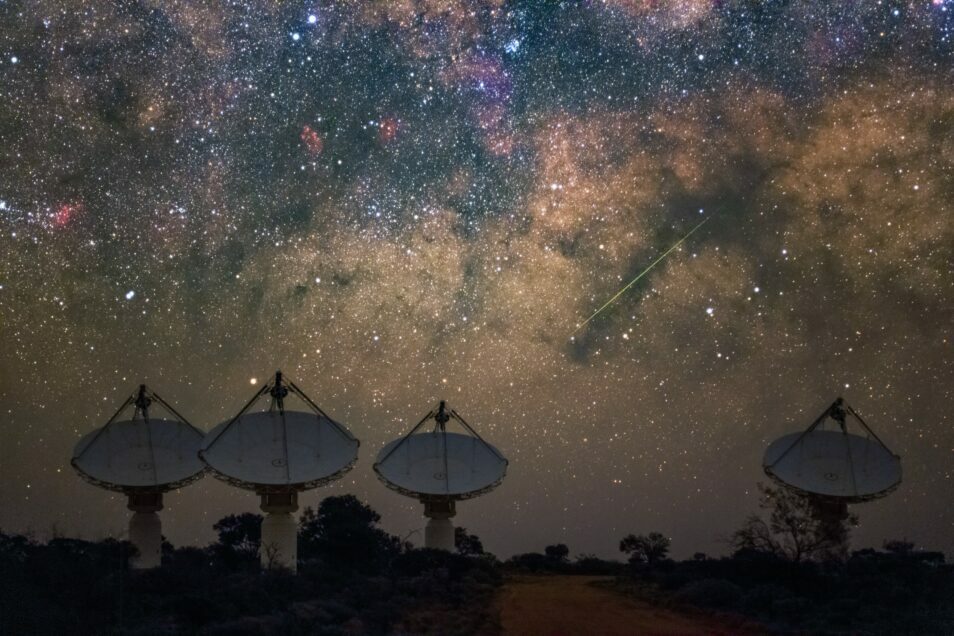
Al jaren tasten astronomen in het duister over vreemde signalen uit de ruimte. Het gaat om korte maar krachtige radioflitsen die zich keurig elke paar minuten of uren herhalen. Een promovendus aan de Universiteit van Sydney denkt nu een verklaring te hebben gevonden.
De objecten heten in vakkringen long period radio transients (LPT). Het zijn als het ware kosmische bakens die met enige regelmaat opflitsen en daarna weer doodvallen. Al twintig jaar weet niemand zeker wat erachter zit. Astronomen hadden ruwweg twee theorieën. Ofwel zijn het extreem trage magnetars (sterk gemagnetiseerde neutronensterren die normaal in seconden ronddraaien, maar in dit geval veel trager), ofwel zijn het dubbelsterren waarvan minstens één een witte dwerg is.
Witte dwergen zijn de uitgedoofde kernen die overblijven nadat sterren zoals onze zon hun brandstof hebben opgebruikt. Ze zijn klein, dicht en vaak heel magnetisch. Eerdere ontdekkingen deden onderzoekers vermoeden dat de witte-dwergtheorie klopt, maar tot nu toe ontbrak sluitend bewijs.
De grote vondst
Kovi Rose, promovendus aan de Universiteit van Sydney, was data van de Australische radiotelescoop ASKAP aan het doorkammen. Hij was op zoek naar bronnen die sterk gepolariseerd radiolicht uitzenden. Van ongeveer drie miljoen objecten bleef er na filteren een select clubje van een honderdtal over, waarvan er één was die niemand eerder had geïdentificeerd. Het object kreeg de naam ASKAP J174508.9-505149, afgekort tot het net iets minder ongelukkige ASKAP J1745-5051.
Vervolgens werden er verschillende telescopen op het object gericht. Elke 1,34 uur bleek het radioflitsen terug te sturen. Optische spectra (lichtanalyses uitgesplitst naar kleur) lieten emissielijnen zien die typisch zijn voor een zogenaamde cataclysmische variabele. Dat is een dubbelster waarbij materie van de ene ster wordt opgeslokt door een witte dwerg. Twee satellieten pikten bovendien röntgenstraling op vanuit hetzelfde punt aan de hemel.
Die röntgenstraling kwam eveneens in een ritme van zo’n 1,3 uur aan. Dezelfde periode dus als de radioflitsen en niet toevallig ook als de tijd die de twee sterren nodig hebben om een keer om elkaar heen te draaien. Dat betekent dat het overstromen van materie van de ene naar de andere ster direct gekoppeld is aan wat we vanaf de aarde zien knipperen.
Dit maakt van ASKAP J1745-5051 het eerste exemplaar van zijn soort waarvan onomstotelijk vaststaat dat het om een actief etende dubbelster gaat. Voor astronomen is deze ontdekking van onschatbare waarde. Voor het eerst kan het signaal van een long period radio transient ‘vertaald’ worden.
Een minuscule begeleider
De partner van de witte dwerg is een ronduit petieterig sterretje. Onderzoekers schatten dat het zo’n tien procent van de massa van onze zon heeft. Waarschijnlijk gaat het om een rode dwerg of misschien zelfs een bruine dwerg (een object dat eigenlijk te licht is om als echte ster te functioneren). De twee tollen extreem dicht om elkaar heen. Hun afstand tot elkaar is kleiner dan de straal van onze zon en de witte dwerg slurpt actief materiaal van zijn buurman af.
En nu?
ASKAP J1745-5051 wordt nog altijd in de gaten gehouden. Tijdens vervolgwaarnermingen moet vooral de draaisnelheid van de witte dwerg zelf worden bepaald. Daarnaast willen astronomen begrijpen of dezelfde mechanismen achter alle LPT’s zitten.
We kennen allemaal de acht planeten van ons zonnestelsel. Daar zitten twee ijsreuzen bij, Uranus en Neptunus, maar mogelijk is er ooit een derde geweest.
Volgens een nieuwe studie heeft deze extra planeet miljarden jaren geleden een hardhandige herschikking van de planeten veroorzaakt. Daarbij zouden sommige manen van Jupiter en Uranus ontregeld zijn geraakt. Ook zijn er mogelijk zelfs nieuwe manen ontstaan.
Het ging net goed
Kort nadat de planeten zich zo’n 4 tot 4,5 miljard jaar geleden vormden, maakte het buitenste deel van het zonnestelsel een periode van extreme chaos door. Deze fase staat bekend als de instabiliteit van het Nice-model. In die tijd venderden de banen van Jupiter, Saturnus, Uranus en Neptunus drastisch en werden ze zeer instabiel.
Het kwam vaak voor dat de reuzenplaneten bijna botsten. Ze naderden elkaar soms tot op zeer korte afstand en oefenden een sterke zwaartekracht op elkaar uit. Uiteindelijk leidde deze chaotische beweging ertoe dat de planeten in de banen terechtkwamen die ze vandaag de dag nog steeds volgen. Wetenschappers vragen zich echter al lange tijd af hoe hun manen deze heftige periode konden overleven.
122 simulaties
Om beter te begrijpen wat er gebeurde, vooral met de manen van gasreus Jupiter en ijsreus Uranus, analyseerde een onderzoeksteam 122 computersimulaties van het jonge zonnestelsel. Deze simulaties werden geselecteerd uit duizenden mogelijkheden, omdat ze belangrijke kenmerken van het huidige buitenste zonnestelsel het nauwkeurigst nabootsten.
Vervolgens berekenden de onderzoekers voor miljoenen jaren de complexe zwaartekrachtwisselwerking tussen de planeten, manen, de zon en passerende ruimteobjecten. Ze testten scenario’s die begonnen met vijf of zes reuzenplaneten, omdat de huidige versie van het Nice-model ook uitgaat van een of twee extra reuzenplaneten die later uit het zonnestelsel werden geslingerd.
De computermodellen lieten zien dat de overlevingskans van de maansystemen van zowel Jupiter als Uranus klein was, namelijk minder dan 15 procent. Van alle geteste scenario’s was er slechts één waarin zowel de oorspronkelijke planeten als hun manen samen overleefden.
Wanneer andere planeten te dicht bij Uranus kwamen, zorgde hun enorme zwaartekracht er vrijwel zeker voor dat zijn manen werden verwoest. In plaats van het zonnestelsel uit te worden geslingerd, botsten de manen echter met hoge snelheid op elkaar. Daardoor ontstond een enorm veld van ijzig puin dat zich na verloop van tijd weer samenvoegde tot nieuwe hemellichamen. Het onderzoeksteam denkt dat dit mogelijk verklaart hoe de maan Miranda van Uranus is ontstaan.
Maar dit was niet de enige aanwijzing voor een gewelddadig verleden van de Uranusmanen die uit de simulaties naar voren kwam. “Onze resultaten wijzen erop dat de manen van Uranus waarschijnlijk minstens twee keer zo hard zijn verstoord waardoor botsingen onvermijdelijk werden: zowel door de inslag die de planeet deed kantelen als door de instabiliteit onder de reuzenplaneten”, schrijven de onderzoekers.
Hoewel het onderzoek een fascinerend beeld schetst van het vroege zonnestelsel, erkennen de wetenschappers dat simulaties nooit alle details kunnen weergeven. Er is daarom meer modelonderzoek nodig om het lot van afzonderlijke manen met grotere zekerheid te kunnen vaststellen.
A pair of filmmakers believe they may have captured the strongest evidence yet of one of America's most enduring monster mysteries lurking beneath the waters of Lake Champlain.
The creature, known as Champ, is a legendary lake monster said to inhabit the 125-mile-long body of water that stretches between New York,Vermont and Canada.
Often compared to Scotland's Loch Ness Monster, Champ is typically described as a massive serpent-like beast or a prehistoric plesiosaur with a long neck, humped back and dark body, which some have dubbed 'America's Nessie.'
Despite decades of sightings, no one has ever produced definitive proof that the monster exists.
Now, filmmakers Richard Rossi and Kelly Tabor told the Daily Mail that they may have stumbled across exactly that while shooting a family movie inspired by the legend.
The pair discovered footage showing what appeared to be a large unidentified creature moving through the water behind their boat, a detail they did not notice until reviewing the video nearly two years later.
What Tabor believed she saw was a shape unlike any fish she had encountered on the lake. 'When I saw it, I saw it was like a skinny neck, and that the body got larger,' Tabor said. 'It looked like the skinny neck was oscillating back and forth, as if it was grazing underwater. My eyes were just popping out.'
The footage was captured during the production of Lucy and the Lake Monster, a children's film centered on the mystery of Champ.
The creature, known as Champ, is a legendary lake monster said to inhabit the 125-mile-long body of water that stretches between New York, Vermont and Canada. A woman claimed to have taken a picture of the monster in 1977
(pictured)
The footage remained hidden in plain sight for nearly two years after filming wrapped.
It was only while reviewing footage during the editing process in 2025 that Tabor spotted something unusual trailing behind their 11-foot wooden boat.
Rossi recalled receiving an excited phone call from his longtime friend.
'I was skeptical at first. But then Kelly, in the editing process, called me one day, and she said, "I have the footage up on my large screen TV. You've got to take a look behind the boat."'
According to Rossi, Tabor told him: 'There's a large creature swimming behind the rope.' When he reviewed the footage himself, he was stunned.
While stories linking strange creatures to Lake Champlain stretch back centuries, the first widely documented modern sighting occurred in 1819.
According to local lore, Captain Crum reported seeing an enormous black creature in Bulwagga Bay.
Richard Rossi and Kelly Tabor caught a glimpse of the monster while filming a children’s film ‘Lucy and the Lake Monster’
The captain reportedly described a snake-like animal measuring roughly 187 feet long with eyes resembling a peeled onion.
Since then, hundreds of sightings have been reported around the lake.
Believers have suggested Champ could be anything from a surviving plesiosaur to a zeuglodon, an ancient whale ancestor that lived millions of years ago.
Others argue the sightings are likely the result of misidentified fish, floating logs, waves or optical illusions.
The mystery has become deeply woven into the culture of the region, as Port Henry, New York, markets itself as the home of Champ.
Businesses, festivals and tourist attractions celebrate the creature, while locals regularly share stories of unusual encounters on the water.
Tabor grew up in nearby Crown Point and spent much of her childhood searching for the elusive monster.
'Our town, Crown Point, borders Port Henry, and Port Henry is known as the home of Champ, because in that area there have been over 300 eyewitness accounts of the Lake Champlain monster,' she said, adding that her fascination began early.
'My family spent summers there,' Tabor said. 'We had a boat that we would go out in, and so I was always scanning the lake, trying to get my chance to see Champ.'
'As many times as I looked as a child, I never saw it.'
She believes she may have experienced something unexplained years later while attending college.
The pair discovered footage showing what appeared to be a large unidentified creature moving through the water behind their boat, a detail they did not notice until reviewing the video nearly two years later
One evening, she and several others were sitting on the porch of her family's lakeside cabin when they noticed an unusual disturbance on the otherwise calm water.
'There was a big stirring out a little ways from the front porch,' she said, explaining that the group watched as a wake appeared and moved directly toward them.
'It wasn't going from the left or the right. It wasn't bearing up and down. It was a straight wake, at least an inch high, coming straight at us.'
Everyone waited for whatever was causing the disturbance to surface. Instead, the object suddenly changed direction.
'It came right towards the cabin, and it made a 90-degree turn,' Tabor said.
'It went off to the left of the next point across the bay, and it never surfaced.'
Because Lake Champlain's water is often murky due to its clay-rich bottom, nobody could determine what had caused the wake.
'I like to believe that I actually saw the effects of Champ,' she said.
After discovering the new footage, Rossi shared it with scientists and researchers for analysis.
The clip eventually attracted the attention of The UnXplained, the History Channel series hosted by William Shatner.
According to the filmmakers, producers told them the footage represented the strongest evidence of Champ since a famous 1977 photograph taken by tourist Sandra Mansi.
That image appeared to show a long-necked creature emerging from the water and remains one of the most famous pieces of alleged Champ evidence.
Unlike the Mansi photograph, Rossi notes that the new footage includes a boat in the frame, providing viewers with a reference point for scale.
The video has since generated hundreds of thousands of views online and sparked renewed debate among believers and skeptics alike.
For Rossi and Tabor, the discovery has only deepened their fascination with the mystery.
The pair are returning to Lake Champlain this summer for the annual Champ Day festival and are already working on two additional films exploring the legend.
Whether the footage ultimately proves anything remains uncertain.
But more than 200 years after the first reported sighting, Champ continues to capture imaginations and keep people watching the waters of Lake Champlain for signs that something enormous may still be swimming below the surface.
RELATED VIDEOS
''Champ'': The Scariest Legend You've Never heard Of
New Footage of Lake Champlain’s Monster Is Finally Out…
Scientists have issued a new blueprint for the day Earth receives a message from an alien civilization.
Released Friday, the eight-point plan lays out how researchers should handle a potentially world-changing signal from deep space, laying it out like a playbook for humanity's most extraordinary moment.
Scientists are instructed to treat any potential alien signal with extreme caution, verify it through multiple independent teams and keep unconfirmed findings tightly controlled to avoid false alarms.
If evidence of intelligent extraterrestrial life is confirmed, researchers must rapidly inform the public, the scientific community and even the United Nations (UN) while releasing the underlying data for scrutiny.
The protocols also call for protecting the signal from interference, preserving all records in secure archives around the world and creating a dedicated international team to help manage the fallout from the discovery.
Researchers are warned not to send a reply to any alien civilization without first consulting the international community through bodies such as the United Nations.
The plan further acknowledges the dangers of the social media age, urging scientists to combat misinformation, respond quickly to rumors and protect researchers who could find themselves at the center of one of the biggest stories in human history.
With the Trump administration releasing dozens of UFO files in recent weeks, the creators of the plan say they want to prevent the world from being thrown into chaos by a false alarm.
Newly released FBI files have revealed an alleged message from 'outer space people' containing chilling warnings for humanity (stock)
The plan lays out a detailed roadmap for what should happen if scientists believe they have detected evidence of an intelligent alien civilization.
Under the protocols, researchers for Astrophysics and the chair of the International Academy of Astronautics (IAA) committee for the search for extraterrestrial intelligence (SETI) are instructing other experts not to rush to announce a discovery to the world.
SETI is an acronym standing for Search for Extraterrestrial Intelligence, a scientific field dedicated to scanning the cosmos for artificial radio and laser signals.
Researchers said that any mysterious signal must undergo extensive scrutiny, with independent teams, observatories and organizations using different instruments and methods to determine whether it is genuine or merely a false alarm.
Scientists are warned that initial findings could be incomplete, misleading or impossible to interpret, meaning the verification process could take months or even years.
If the evidence survives that scrutiny and researchers become convinced it originated from an extraterrestrial intelligence, the protocols call for an immediate public announcement.
The discovery would be shared not only with the scientific community but also with the United Nations and a network of international organizations involved in astronomy, space exploration and communications.
The plan also requires the release of the underlying evidence, allowing scientists around the world to inspect the data, challenge the conclusions and attempt to independently verify the finding.
Recognizing the dangers of the social media era, the guidelines devote significant attention to controlling misinformation and rumors.
With the Trump administration releasing dozens of UFO files in recent weeks, the creators of the emergency plan say they want to prevent the world from being thrown into chaos by a false alarm. Pictured is an image from a release taken during the Apollo moon missions
Researchers are encouraged to communicate openly and honestly with the public while clearly labeling speculation and unconfirmed claims.
The protocols also acknowledge that a scientist who discovers evidence of alien intelligence could suddenly become one of the most famous people on Earth.
Institutions are urged to protect researchers from harassment, security threats and professional fallout while ensuring accurate information continues to flow to the public.
In the event a signal is confirmed, every piece of evidence must be preserved and archived in multiple secure locations around the world.
The data, analysis methods and computer code used to study the signal would be stored so that future generations of scientists can revisit the discovery.
The plan even includes measures to protect the signal itself. If the evidence arrives in the form of radio transmissions or other electromagnetic signals, scientists are encouraged to seek international agreements to safeguard the frequencies from interference or disruption.
An international post-detection committee would then be assembled to help interpret the discovery and guide the world's response.
The group would include experts in science, ethics, law, communications and social sciences tasked with helping humanity navigate the implications of learning we are not alone.
Perhaps the most striking provision concerns what happens next.
Even if humanity receives a message from an alien civilization, scientists are explicitly instructed not to answer.
Instead, any decision about responding would first require international consultations involving the United Nations and other global organizations. Until those discussions are completed, no reply should be sent.
The final section emphasizes that any discovery of intelligent extraterrestrial life must be handled with transparency, integrity and a sense of responsibility to all of humanity, recognizing that such a moment would rank among the most profound events in human history.
RELATED VIDEOS
The First Message From Another Civilization Could Arrive Tomorrow
Humans Saw Aliens? The Shocking Truth About UFOs and First Contact
A New Interstellar Object, Alien Technology, and the Scientific Debate | Avi Loeb
Astrophysicist Avi Loeb, from Universidade of Harvard, proposes that the Viking 1 and Viking 2 missions, launched by NASA in 1976, may have recorded signs of biological activity in the Martian soil. Data from the Labelled Release experiment, which looked for active metabolism, showed consistent positive results in both landers. However, the scientific community at the time concluded the absence of life after the Gas Chromatograph-Mass Spectrometer instrument failed to detect organic molecules.
Essa dominant interpretation has persisted for 50 years. Loeb argues that the aversion to false positives led to possible false negatives, ruling out preliminary evidence that deserves further verification. Ele compares the episode to the initial resistance faced by disruptive ideas in science.
Labelled Release’s Results defy official conclusion
The Viking probes landed on Marte in July and September 1976. Cada carried experiments designed to detect microbial life. Labelled Release injected radioactive carbon nutrients into the soil and monitored the release of labeled gas.
In samples from both sites, the experiment recorded rapid emission of radioactive carbon dioxide after the addition of the nutrient. The pattern was repeated in a similar way to the microbial activity observed in terrestrial soils. Amostras heated to 160 degrees Celsius, used as control, did not produce the same effect.
Scientists like Gilbert Levin, the experiment’s principal investigator, argued for decades that the results indicated life. The majority of the community, however, prioritized the negative mass spectrometer findings.
Organic Absence dictated dominant narrative
The Gas Chromatograph-Mass Spectrometer found no organic compounds in the samples. Isso weighed decisively in the conclusion that Marte was sterile on the surface. Gerald Soffen, project scientist Viking, declared at the time that there were no bodies and no life.
Later Pesquisas changed this understanding. The discovery of perchlorates in Marte in 2008 showed that these oxidizing compounds could destroy organics during the instrument’s heating, generating false negatives. Outros experiments also found traces of chloromethane and dichloromethane, previously attributed to contamination.
Experimento Labelled Release: positive results in initial injections in both probes
Gas Exchange: confused responses, with release of oxygen
GC-MS: absence of organics, now questioned by perchlorates
Recent article reinforces risk of false negatives
A perspective published on Nature Astronomy discusses pitfalls in the search for extraterrestrial life. The authors highlight how risk-averse scientific culture can ignore important anomalies. Inge Loes ten Kate and colleagues advocate greater caution with preliminary evidence.
Loeb cites the case of Viking as a classic example. The quick rejection of Labelled Release results, without further replication, illustrates the problem. Ele mentions personal experience with the interstellar object Oumuamua, initially discarded in a similar way.
Steven Benner questions interpretation since 2000
Astrobiologist Steven Benner, from Foundation for Applied Molecular Evolution, has been publishing on the topic for years. Seu article from 2000 already questioned the analysis of Viking data. In 2026, he releases a 400-page book that resumes the debate on the 50th anniversary of the missions.
Benner argues that the astrobiology community avoided repeating the experiment out of controversy. Ele proposes that new tests using current technology could clarify whether the signal was biological. NASA plans events for Viking’s fiftieth anniversary in July 2026.
Why there has been no replication in half a century
Nenhuma subsequent mission repeated the Labelled Release with the same parameters. Later rovers and landers prioritized geology, the search for ancient water and organics preserved in other contexts. Percloratos and radiation complicate preservation of surface evidence.
Loeb argues that science advances with curiosity and humility. Innovative Descobertas need initial protection, like vulnerable babies, before they face rigorous scrutiny. Ele criticizes the acidic culture that discards ideas before collecting enough data.
The debate highlights limitations of limited training data, both on humans and AI systems. Investimentos billionaires in data centers show the importance of expanding evidence. In the case of Marte, repeating the experiment remains the most direct route to validating or refuting the 1976 signal.
Implications for future missions to Mars
The discussion gains relevance with plans for returned samples and manned missions. Entender present-day Martian soil helps interpret ancient geological records. If Labelled Release captured real metabolism, microbial life may persist or have recently existed on the surface.
Cientistas calls for open reanalysis of Viking files with modern tools. Modelos Updated chemistries, considering perchlorates, can reconcile the conflicting results. The current consensus classifies biological experiments as inconclusive, but the topic remains alive among experts.
Avi Loeb concludes that the biggest cognitive challenge is separating limited perception from reality. Sem further verification, the graveyard of science accumulates promising hypotheses never fully tested.
WE HAVE PROOF! Life on Mars confirmed with new discovery that validates Viking experiments!
A mysterious aircraft was reportedly spotted near the highly classified Area 51 base, sparking speculation that it could be a secret military prototype.
A thermal image appears to show a triangular-shaped craft flying close to the infamous testing facility in Nevada, long associated with some of America's most closely guarded aerospace programs.
The image was shared online by the Project Fear YouTube channel, which described it as 'a craft the public has never seen before.'
Some observers believe the object could be a classified X-plane, a highly experimental aircraft used to test advanced technologies before they enter military service.
For decades, Area 51 has served as the premier testing ground for these secretive 'black projects,' including spy planes and stealth aircraft that remained hidden from the public for years.
The unusual shape of the craft has fueled speculation that it may be linked to a next-generation military aircraft. Among the theories circulating online is that it could be the Boeing F-47, the future centerpiece of the US Air Force's Next Generation Air Dominance program.
Others have suggested it could be an entirely separate classified aircraft being developed for future military operations.
While no official explanation has been provided, the sighting has reignited debate over what exactly is being flown behind the fences of America's most secretive air base.
A thermal image appears to show a triangular-shaped craft flying close to the infamous testing facility, long associated with some of America's most closely guarded aerospace programs
Several groundbreaking military programs, including stealth and reconnaissance aircraft, were flown at the remote Nevada facility years before they were publicly acknowledged.
Project Fear said on X that the image was captured using a 10-micron thermal scope.
While the identity of the aircraft remains unknown, some observers have speculated that it could be Boeing's F-47, the centerpiece of the US Air Force's Next Generation Air Dominance (NGAD) program.
The sixth-generation fighter is expected to serve as a flying command hub, coordinating swarms of AI-powered drones alongside piloted aircraft in future combat operations.
Reports have suggested that prototype aircraft are already under development, with operational deployment anticipated in the early 2030s.
The speculation comes just days after the Air Force requested $5.03 billion for the F-47 program in its Fiscal Year 2027 budget, citing growing concerns over China's rapidly advancing next-generation military aviation capabilities.
The image has fueled intense debate online, with one X user writing: 'Any unidentified aircraft near Area 51 automatically creates more questions than answers.'
Among the theories circulating online is that it could be the Boeing F-47, the future centerpiece of the US Air Force's Next Generation Air Dominance program
Area 51 is a highly classified US Air Force facility located within the Nevada Test and Training Range, approximately 83 miles north-northwest of Las Vegas
Area 51 has long been the stuff of alien lore, with whispers of crashed UFOs and extraterrestrial autopsies behind its barbed-wire-laced fence.
The base, established in 1955, remained largely unknown until 1989, when Robert Lazar claimed on TV that he worked at a secret site near Groom Lake, 'S-4,' studying alien technology and spacecraft.
While the remote US Air Force base in Nevada, approximately 83 miles north-northwest of Las Vegas, has kept a tight lid on its activities, the CIA finally lifted the lid in 2013, officially admitting Area 51's existence.
The agency declassified a more than 400-page report that detailed how testing its secret spy planes 'accounted for more than one-half of all UFO reports during the late 1950s and most of the 1960s.'
The U-2 spy and A-12 reconnaissance planes were being flown in the shadows of the desert amid the Cold War, but the extreme altitudes sparked fears of an alien invasion.
'High-altitude testing of the U-2 soon led to an unexpected side effect, a tremendous increase in reports of unidentified flying objects (UFOs),' the report states.
'Once U-2s started flying at altitudes above 60,000 feet, air-traffic controllers began receiving increasing numbers of UFO reports.'
However, the CIA report does not mention Area 51's purpose after 1974.
RELATED VIDEOS
Has the NEW US 6th Gen Fighter Jet Taken Flight?
AREA 51: MYSTERY Aircraft SPOTTED - USAF Testing Again?
US Air Force Secretly Tests NEW Mystery Aircraft in Area 51!
Now, NASA says it is getting the plane ready to fly at faster speeds and higher altitudes, including its first test flight beyond the speed of sound.
With a new series of tests starting in early June, the space agency plans to fly X-59 at speeds of over 630 miles per hour (1,014 km/h) at an altitude of 43,000 feet.
This will be followed by a 'mission conditions flight', during which the jet will hit Mach 1.4, 925 miles per hour (1,490 km/h), at 50,000 feet.
Finally, test pilots will push the jet to its absolute limit, reaching a top speed of Mach 1.6 at 60,000 feet - around twice the height and speed of a commercial airline.
NASA's experimental supersonic jet, dubbed the 'Son of Concorde', will take to the skies in its first faster-than-sound flight in July
When a plane flies at sub-sonic speeds, it pushes the air out of the way like a boat moving through water, creating ripples in the form of sound waves.
But when something reaches the speed of sound, it starts to outrun these sound waves, and the ripples bunch up and merge together into a powerful shockwave.
This means that supersonic jets are constantly generating shockwaves, which people on the ground hear as a deafening boom as they sweep past.
Because these booms can be as loud as 110 decibels, similar to a loud rock concert, supersonic flights are generally banned over populated areas.
To solve this problem, NASA has been working to develop 'Quiet SuperSonic Technology (Quesst)' that would muffle the boom into a muted 'thump'.
The X-59 features a radically redesigned geometry in which every feature is designed to diffuse and muffle the sonic boom.
The X-59 jet has been designed to produce a much quieter sonic boom when flying at supersonic speeds, creating a 'thump' rather than a bang
Part of the reason that Concorde was eventually discontinued was that the sonic boom produced by breaking the sound barrier could be extremely loud for people on the ground
During the upcoming tests, the experimental aircraft will be chased by a standard supersonic jet equipped with a probe to record the shockwave
X-59: Key specs
* Manufacturer: Lockheed Martin
* Length: 99.7 feet (30 metres)
* Wingspan: 29.7 feet (9.0 metres)
* Max. airspeed: 1,218 mph
* Program cost: $247.5m (£187.5m)
* First flight: October 28, 2025
The most obvious difference from a normal jet is the thin, tapered nose, which accounts for almost a third of the plane's entire length and is shaped to break up the shockwave.
The downside of this novel design is that the cockpit is located around halfway down the length of the vehicle and doesn't have any forward-facing windows.
Instead, the single pilot uses a system of cameras and augmented reality displays, known as the eXternal Vision System, to see out the front.
Reaching these new speed and altitude records is a key milestone for Quesst, since they are NASA's targets for the X-59 to eventually fly over American communities.
Cathy Bahm, project manager for NASA's Low Boom Flight Demonstrator, says: 'Every step of envelope expansion brings us closer to demonstrating the quiet supersonic capability that is at the heart of the Quesst mission.
'Completing the first mission-conditions flight is especially meaningful - it's the moment where we begin validating the aircraft in the environment it was designed for.'
While the eventual goal is to produce quiet sonic booms, this upcoming batch of test flights will not be designed to assess the volume of the flight.
The X-59 will be accompanied by a standard supersonic chase plane, which would drown out any useful data with its own, much louder boom.
According to NASA, the sonic thump produced by X-59 passing overhead will be quieter than the sound of a car door shutting 20 feet away
The X-59's aerodynamic profile has been designed so that it breaks up the shockwave formed by passing the sound barrier and is much quieter in flight. Pictured: The sonic boom from a scale model of the aircraft during wind tunnel tests
Travelling at speeds up to Mach 1.6, or 1,218 miles per hour (1,960 km/h), the X-59 could cut the trip from London to New York to just four hours
The X-59's long nose accounts for a third of its total length, which means the cockpit doesn't have room for a forward-facing window. Test pilots instead use a system of cameras and augmented reality displays to see where they are going (pictured)
However, the chasing jet will be equipped with a specialised probe to take initial measurements of the X-59's shock waves.
Strain gages throughout the aircraft's body will also gather data on how it handles higher speeds and whether it is structurally safe to fly.
This data will pave the way for a new set of tests later this year, dubbed Quesst Phase 2, in which NASA will begin to check whether it is really producing a quiet supersonic thump as intended.
Ms Bahm says: 'As we look ahead to the upcoming flights, we're poised to open the envelope even further - moving boldly toward the mission test point this aircraft was built to achieve.'
The history of Concorde
Concorde was a turbojet-powered supersonic passenger jet that was operated from 1976 until 2003.
It had a maximum speed over twice the speed of sound at Mach 2.04 (1,354mph or 2,180k per hour at cruise altitude) and could seat 92 to 128 passengers.
It was first flown in 1969, but needed further tests to establish it as viable as a commercial aircraft. Concorde entered service in 1976.
It is one of only two supersonic transports to have been operated commercially. The other is the Soviet-built Tupolev Tu-144, which ran as a passenger aircraft only for a few years in the 1970s due to safety issues.
Concorde was the world's first supersonic airliner and operated for 27 years, but it was grounded in October 2003. Pictured is British Airways Concorde G-BOAB taking off with its landing gear still extended over the Cotswolds town of Fairford, Gloucestershire on July 20, 1996, during the annual RAF Fairford airshow
Concorde was jointly developed and manufactured by Aérospatiale and the British Aircraft Corporation (BAC) under an Anglo-French treaty. Concorde's name, meaning harmony or union, reflected the cooperation on the project between the UK and France.
Concorde was retired in 2003 due to a general downturn in the commercial aviation industry after its only crash in 2000, the September 11 attacks in 2001, and a decision by Airbus, the successor to Aérospatiale and BAC, to discontinue maintenance support.
It wasn't the first plane to break the sound barrier, however; that achievement was managed by the Bell X-1, piloted by Chuck Yeager, in October 1947.
The legendary rocket engine-powered aircraft, designed and built in 1945, achieved a speed of 700 miles (1,127 kilometers) per hour.
‘
Son of Concorde’ goes supersonic for first time paving way toward 3.5 hour London-NYC flights
NASA’s Supersonic Plane X-59 ‘Son of Concorde’ Completes Crucial Wheels-Up Test Flight
NASA astronauts were forced to shelter in their spacecraft and prepare for potential evacuation on Friday due to an escalating air crisis on theInternational Space Station.
The extraordinary precaution came as US and Russian officials clashed over how to tackle a growing air leak aboard the orbiting laboratory.
In a dramatic attempt to reach the source, Russian cosmonauts used a saw to cut into a section of the station where they believed the leak was coming from.
The four members of NASA's Crew-12 mission, two Americans, a French astronaut and a Russian cosmonaut, were instructed to enter their docked SpaceX Dragon spacecraft and put on spacesuits while Russian crews attempted repairs. Another NASA astronaut also joined them.
But roughly 90 minutes later, the safe-haven procedures were lifted after Russia's space agency, Roscosmos, paused the repair operation to gather additional data and measurements.
The dispute had been brewing for months, with NASA and Roscosmos unable to agree on either the source of the persistent air leaks or the best way to stop them.
While the leaks have plagued the station on and off for years, Reuters reported that the rate of air loss recently doubled from about one pound per day to two.
The decision by Russian cosmonauts to use a saw heightened concerns aboard the orbiting laboratory, prompting NASA to place astronauts into safe-haven procedures as a precaution.
NASA ordered astronauts aboard the International Space Station (ISS) to take shelter over 'worsening air leaks'
Bethany Stevens, NASA press secretary, said in a statement on X: 'Roscosmos has paused Friday’s structural repair efforts inside the Zvezda service module transfer tunnel, known as PrK, as more measurements and data are assessed.
'Given this development, NASA has instructed the crew members inside the Dragon spacecraft to end the safe haven procedures and return to planned operations aboard the International Space Station.'
The Zvezda service module transfer tunnel is a pressurized cylindrical passageway in the rear of the Russian part of the station.
Its function is to connect the Zvezda's main living quarters with the docking port where cargo is brought aboard the ISS.
While the module arrived in space in 2020, some parts of this section were constructed in the 1980s and have been a site of worsening leaks for years.
NASA has a plan in place for an emergency evacuation of the ISS, and it could be used amid cracks and leaks on the ship
Bethany Stevens, NASA press secretary, said that the astronauts have now been told to 'return to planned operations' after Roscosmos called off their attempted repairs at the last minute
These leaks rapidly accelerated as the repair attempts failed to stem the flow, leaking 1.68kg (3.7lb) of precious air into space every day by 2024.
The issue has become so serious that NASA has reportedly ranked it among the highest-risk challenges facing the station, with the possibility of a 'catastrophic failure' discussed during internal meetings.
This new leak, detected on May 1, initially allowed roughly one pound of air to escape into space each day - about the weight of a loaf of bread.
However, this rate doubled, a senior NASA official told Reuters on condition of anonymity, prompting the space agencies to act.
In the past, Roscosmos astronauts have used sealants to attempt to plug the hole and prevent more air from escaping.
However, the Russian agency's planned repairs carried a higher risk, and the remaining astronauts were ordered to take shelter as a precaution.
The astronauts are taking shelter inside the SpaceX Crew Dragon spacecraft in preparation for an emergency evacuation
The International Space Station: Key facts
Length: 356ft (109m)
Weight (in Earth gravity): 419,725kg
Average altitude: 250 miles (400km)
Average speed: 17,500mph (28,000km/h)
Earth orbits per day: 16
Maximum docking capacity: Eight spacecraft
Permanent crew size:Seven astronauts
Maximum crew capacity:13
Stevens said in a statement: 'The Zvezda service module transfer tunnel, known as PrK, has suffered from cracks and leaks for some time, and has been mitigated by Roscosmos as much as possible to date.'
'Following new leaks, Roscosmos has elected to proceed with a more extensive repair operation on Friday, June 5,' she added.
'Out of an abundance of caution, NASA has directed all four of the agency's SpaceX Crew-12 members and NASA astronaut Chris Williams to assume an elevated safety posture in the Dragon spacecraft while the repair is underway.
'The cracks have always been a concern that NASA watches very closely. NASA and Roscosmos have been working to determine the root cause of the cracks, and Roscosmos manages the issue through operational mitigation measures and periodic partial-repair efforts'
The Crew-12 members include Americans Jack Hathaway and Jessica Meir, Sophie Adenot of France and Russia's Andrey Fedyaev. There are a total of seven astronauts on board.
NASA has a plan in place to evacuate the space station in case of an emergency, and had been ready to put that into action until Roscosmos called off the risky repair.
The moment Houston gave the signal, astronauts moved to their assigned spacecraft to shelter in place in case the station lost pressure.
The four astronauts of NASA's Crew-12 mission include, from left, Americans Jack Hathaway and Jessica Meir, Sophie Adenot of France and Russia's Andrey Fedyaev
The capsules have been stocked with emergency suits, allowing the crew to quickly put on the proper gear as they flee the orbiting laboratory, saving valuable time.
It can take up to 30 minutes to get inside a spacesuit, according to NASA, which makes early preparation vital.
If the station became unsafe and NASA was forced to call for a full evacuation, the crew would launch their SpaceX Crew Dragon capsule and return to Earth.
NASA's commercial crew program manager, Steve Stich, has previously said that in the event of an emergency, SpaceX's Dragon could be powered up within minutes.
This comes amid growing concern that the ageing space station needs to be retired before disaster strikes.
Since 1998, when construction began on the first modules, the ISS has hosted more than 250 visitors from 20 different countries and produced over 400 research papers.
But after roughly 146,000 orbits, the systems and hardware installed on the ISS are beginning to show their age.
The ISS was only intended to stay in orbit until 2015 and has now been in orbit for more than a decade longer than planned.
NASA is tracking 50 'areas of concern' related to a leak in the Russian Zvezda Service Module, Transfer Tunnel (labelled), which sprang a leak in 2019
This is not the first time the ISS has sprung a leak. In 2018, astronauts rushed to fix a hole (above), which had appeared in the outer wall of the Soyuz capsule on the orbiting laboratory
ESA astronaut Tim Peake took this photo from inside Cupola in 2016, showing a 7mm-diameter circular chip gouged out by the impact from a tiny piece of space debris
How will the ISS be brought back to Earth?
Starting from 2026, the ISS will be allowed to gradually fall from 250 miles to 200 miles above Earth.
Meanwhile, the last human crew will depart the ISS and take anything of historical importance they can carry.
As the ISS falls from 200 miles to 175 miles, a modified SpaceX Dragon capsule will dock with the station.
Once the station hits the point of no return at 175 miles, the Dragon capsule will begin to guide the ISS into an elliptical orbit.
When the time is right, the space tug will deliver one last kick and push the station into Earth within less than half an orbit.
The ISS and tug will hit the atmosphere at 17,000 mph and be destroyed.
Hopefully, whatever doesn't burn up in the atmosphere will splash harmlessly into the Pacific Ocean near Point Nemo.
In September last year, NASA's Office of the Inspector General (OIG) identified 588 replacement parts that were operating beyond their operational lifetimes.
This has come with a risk of worsening leaks and damage from impacts with micrometeorites and space junk, especially in the oldest Russian modules.
In 2018, astronauts rushed to fix a hole that had appeared in the outer wall of the Soyuz capsule on the orbiting laboratory
Weighing 400 tons (880,000lb), equivalent to more than 400 elephants, the ISS is so large that it can't actually stay in such a low-Earth orbit unassisted.
This means that the station's thrusters need to be regularly fired in order to keep it in a stable orbit of around 250 miles (400km) above Earth.
If these thrusters failed, the station would gradually fall out of orbit and crash uncontrollably to Earth.
To bring the football-pitch laboratory down to Earth safely, NASA will need to deliberately push the station out of orbit.
NASA currently plans to bring the ISS down to Earth in 2030, bringing an end to three decades of international collaboration in Earth's orbit.
NASA estimates it will cost $1 billion (£800 million) to convert a Dragon capsule into a vehicle capable of pushing the ISS out of orbit
Starting from the end of this year, the station will be allowed to fall naturally under the effects of atmospheric drag until it reaches an altitude of around 200 miles (320km).
At this point, the last ISS crew will depart the station, taking with them any equipment or items that are deemed historically important.
Once the last crew has gone, the station will continue to fall over several months until it reaches the 'point of no return' at an altitude of 175 miles (280 km).
To deliver the finishing blow, NASA has commissioned a 'space tug' which will launch from Earth, dock with the ISS, and then push the station out of orbit.
The space agency plans to use a modified SpaceX Dragon capsule, which will dock with the station before pushing it into the atmosphere at an estimated cost of $1bn (£800m).
The International Space Station (ISS) is a $100 billion (£80 billion) science and engineering laboratory that orbits 250 miles (400 km) above Earth.
It has been permanently staffed by rotating crews of astronauts and cosmonauts since November 2000.
Crews have come mainly from the US and Russia, but the Japanese space agency JAXA and European space agency ESA have also sent astronauts.
The International Space Station has been continuously occupied for more than 20 years and has been expended with multiple new modules added and upgrades to systems
Research conducted aboard the ISS often requires one or more of the unusual conditions present in low Earth orbit, such as low-gravity or oxygen.
ISS studies have investigated human research, space medicine, life sciences, physical sciences, astronomy and meteorology.
The US space agency, NASA, spends about $3 billion (£2.4 billion) a year on the space station program, with the remaining funding coming from international partners, including Europe, Russia and Japan.
So far 244 individuals from 19 countries have visited the station, and among them eight private citizens who spent up to $50 million for their visit.
There is an ongoing debate about the future of the station beyond 2025, when it is thought some of the original structure will reach 'end of life'.
Russia, a major partner in the station, plans to launch its own orbital platform around then, with Axiom Space, a private firm, planning to send its own modules for purely commercial use to the station at the same time.
NASA, ESA, JAXA and the Canadian Space Agency (CSA) are working together to build a space station in orbit around the moon, and Russia and China are working on a similar project, that would also include a base on the surface.
RELATED VIDEOS
Astronauts prepare for possible evacuation of International Space Station over air leaks - live
ISS astronauts told to evacuate over air leak
ISS astronauts in evacuation mode as Russia attempts to fix widening air leak
Meer van UFO'S of UAP'S, ASTRONOMIE, RUIMTEVAART, ARCHEOLOGIE, OUDHEIDKUNDE, SF-SNUFJES EN ANDERE ESOTERISCHE WETENSCHAPPEN - DE ALLERLAATSTE NIEUWTJES


 Scientists Detect Massive Structure Under Antarctica