What’s Behind Steven Spielberg’s Lifelong Obsession With Flying Saucers and Extraterrestrial Visitors?
Half a century after “Close Encounters of the Third Kind,” the director returns to the subject of UFOs with “Disclosure Day.” His science fiction films are informed by his fascination with alien encounters in American suburbia
Jake New | Freelance Writer
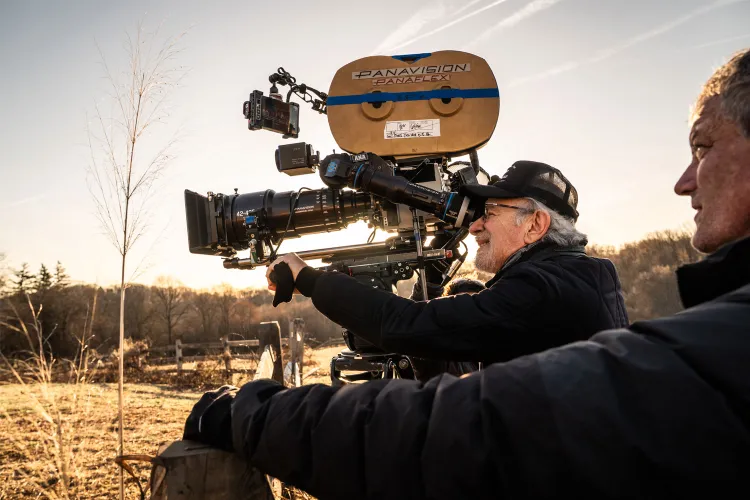
Director Steven Spielberg on the set of Disclosure Day, his latest UFO-inspired film Niko Tavernise / Universal Pictures and Amblin Entertainment
Two deputies were hot off a coffee run when they first crossed paths with the cosmic unknown.
Near the end of a late-night patrol in Portage County, Ohio, the men stumbled across an abandoned vehicle facing the wrong direction. One of them cautiously approached the driver’s side before scanning the nearby woods. Nothing. Suddenly, a bright light emerged directly above the treetops, filling the air with a heavy electric hum.
The glow appeared to come from a strange egg-shaped object as “big as a house,” the officers later recalled. Back in their cruiser, they radioed the sheriff’s office. A sergeant instructed them not to let the unidentified flying object out of their sight.
The pair chased the UFO across some 70 miles of eastern Ohio and Pennsylvania. Two more officers from neighboring towns joined the pursuit, which lasted nearly an hour. At daybreak, the four men stood together outside a gas station in Conway, Pennsylvania, watching in disbelief as the craft shot into the sky and vanished from view.
If this scene sounds familiar, that’s because Steven Spielberg borrowed it for an early sequence in his 1977 film, Close Encounters of the Third Kind. The Portage County incident was one of several purported UFO encounters that inspired the movie, for which Spielberg drew on decades of reports and research.
“If you believe, it’s science fact; if you don’t believe, it’s science fiction,” Spielberg told Sight and Sound ahead of the film’s release. “I’m an agnostic between the two beliefs, so for me it’s science speculation. It’s not ten light-years away. It’s right in the heart of American suburbia.”
Close Encounters cemented Spielberg as one of Hollywood’s pre-eminent directors and laid the foundation for his lasting association with stories about aliens and UFOs. Nearly 50 years later, he has built one of the most successful careers in American cinema—and it’s populated with visitors from the stars.
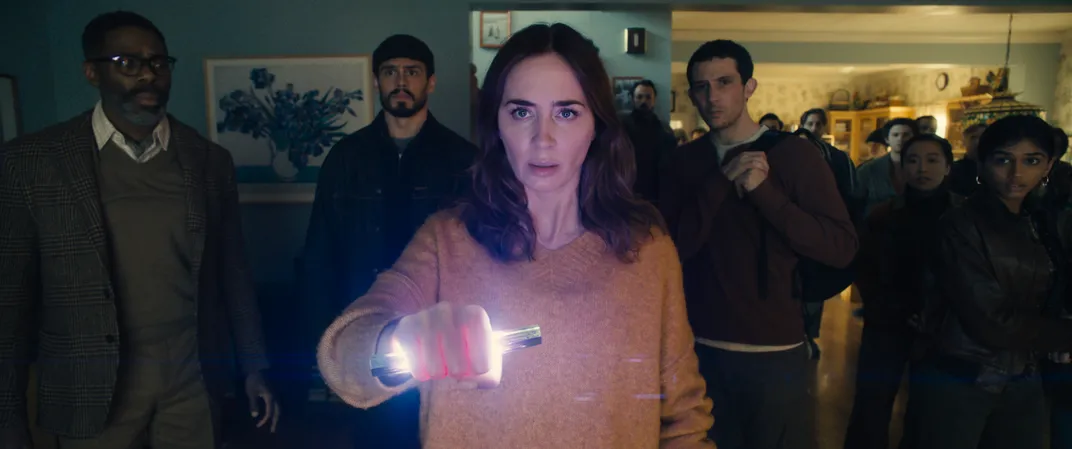
Now, Spielberg’s latest project, Disclosure Day, revisits the subject once again. Arriving in theaters on June 12, the director’s new movie imagines humanity receiving definitive proof of alien life and discovering the measures that powerful groups have taken to keep this fact hidden.
“He wanted to make a film about What’s the truth, and how does it come out?” David Koepp, the film’s screenwriter, tells Smithsonian magazine. “He viewed this as the summation of what he had to say on what is perhaps the single most important subject to him.”
Flying saucers
June 14, 1947. Morning.
America’s most famous UFO case began just after a spring storm swept across the high plains outside Roswell, New Mexico. Rancher W.W. Brazel had driven out to inspect his property for damage, but what he found scattered across the sand didn’t look like storm debris.
Brazel decided that the expansive pile of metallic scrap might be worth reporting to the nearby Roswell Army Air Field (RAAF). On July 8, the Roswell Daily Record published the Army’s assessment under the headline “RAAF Captures Flying Saucer on Ranch in Roswell Region.”
The military ultimately concluded that the wreckage was a weather balloon. But the Roswell incident was far from the only UFO encounter reported that summer. On June 24, a pilot spotted nine objects in the skies near Washington’s Mount Rainier, setting off a frenzy of similar reports. Newspapers called them “flying saucers.”
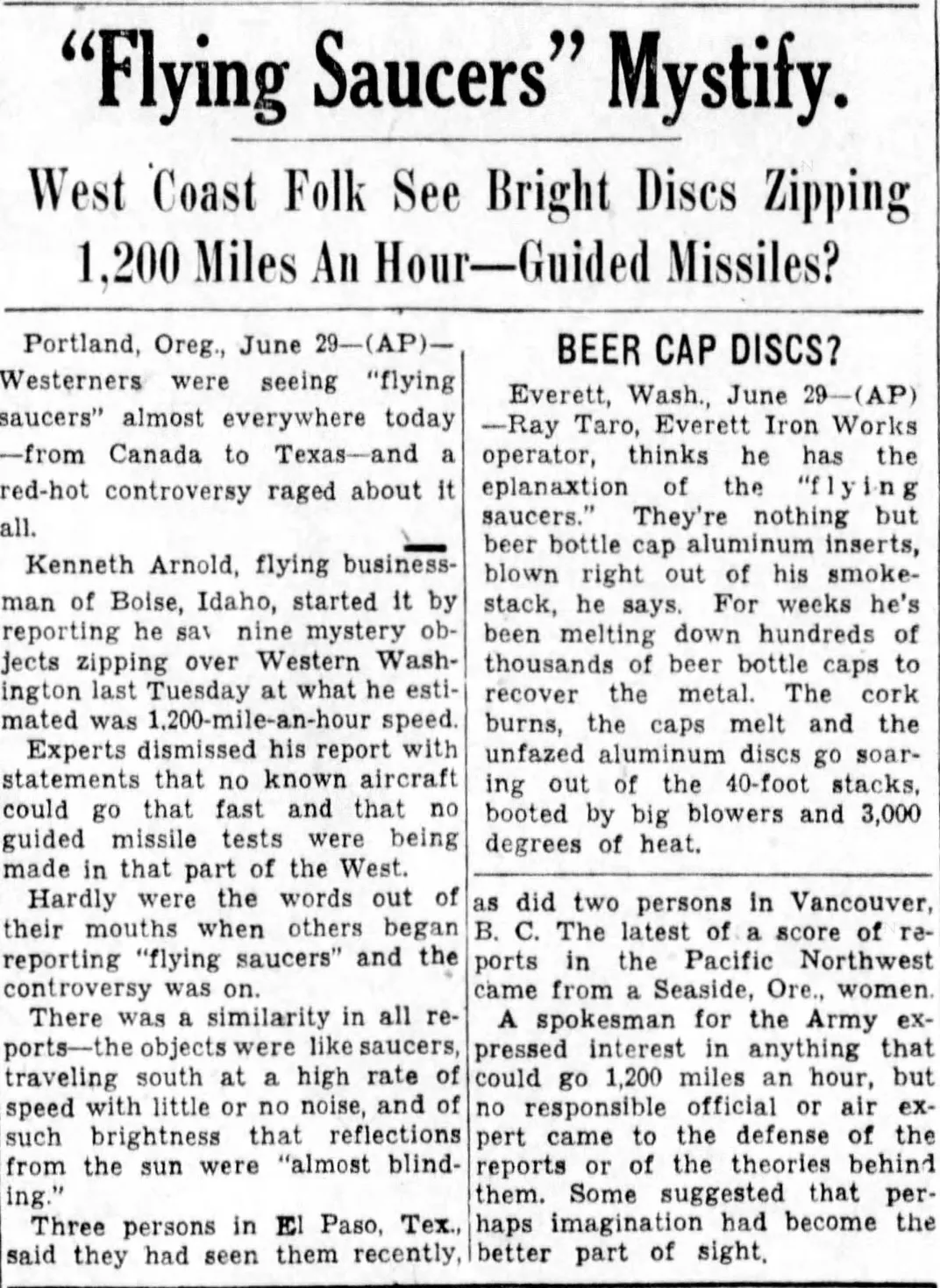 A 1947 newspaper article about flying saucers Cincinnati Enquirer via Newspapers.com
Spielberg had been born just six months earlier, in December 1946. During the first year of his life, Americans reported more than 800 UFO sightings.
“Carl Jung suggested that a belief in UFOs stems from ‘an emotional tension having its cause in a situation of collective distress or danger, or in a vital psychic need,’” film historian Joseph McBride writes in Steven Spielberg: A Biography. “The Cold War and collective anxieties about the dangers of nuclear war helped stimulate that tension in Spielberg’s formative years.”
McBride also points to other tensions that may help explain Spielberg’s affinity for aliens. The director’s father, Arnold, was a workaholic electrical engineer who helped design early computers. His mother, Leah, was an eccentric concert pianist with a love of the arts. Both were the children of Jewish immigrants. More than a dozen of Arnold’s relatives died during the Holocaust.
“Spielberg is always interested in the rewards and problems involved in the meeting of cultures,” McBride tells Smithsonian. “With his immigrant family background, that comes naturally to him, and growing up Jewish in progressively more WASPish communities heightened that concern for him. UFOs and other forms of aliens fascinate him for that reason.”
For a kid growing up in the 1950s, those anxieties came packaged as flying saucer movies. Spielberg devoured UFO classics like The Day the Earth Stood Still (1951) and It Came From Outer Space (1953). But for the would-be director, movies weren’t simply something to be watched. After seeing Cecil B. DeMille’s The Greatest Show on Earth (1952) in theaters, he began making his own films with his father’s eight-millimeter camera. Arnold often assisted behind the scenes, building miniature sets and designing lighting rigs.
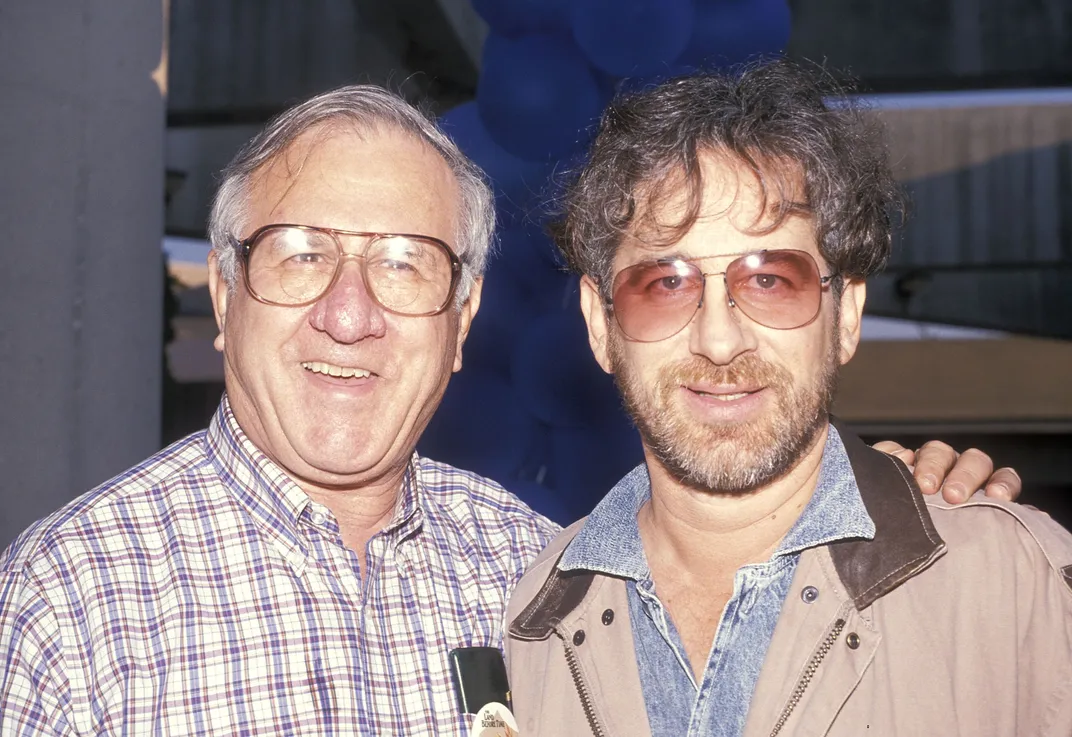 Steven Spielberg (right) and his father, Arnold Spielberg (left), in 1988
Ron Galella Collection via Getty Images
When Spielberg was 17, he produced his first feature-length film, Firelight. Made on a budget of about $500, the science fiction thriller follows a group of scientists investigating strange lights in the skies above Arizona. Spielberg screened the movie during a sold-out, one-night run at a local theater, ultimately earning $1 in profit.
After graduating from high school, Spielberg enrolled at California State University, Long Beach, but grew restless and dropped out before earning a degree. Soon after, in 1969, he became the youngest director ever signed to a long-term studio contract.
Kindred seekers of truth
October 18, 1973. Night.
As far as UFO witnesses go, the men inside the helicopter were unusually credible: four United States Army reservists, all experienced air crewmen and self-described flying saucer skeptics.
Captain Lawrence Coyne was flying the crew to Cleveland when he nearly collided with a cigar-shaped craft with a red light on its nose. The object stopped directly above the helicopter, bathing the cockpit in an eerie green glow. The crew attempted to descend but instead found themselves rising more than 3,500 feet into the sky. Then, the object released the helicopter and vanished.
By the early 1970s, UFO reports had fallen sharply in the U.S. Aliens had become the domain of amateur investigators and sensationalist tabloid publications like the National Enquirer. In a 1971 essay for the Saturday Evening Post, science fiction author Arthur C. Clarke, who co-wrote the screenplay for the Stanley Kubrick film 2001: A Space Odyssey, declared that “flying saucers are dead.”
As it turns out, Clarke’s assertion arrived too early. The Coyne incident was part of a wave of UFO reports in 1973 that revived interest in the strange events.
“There’s this absolutely stunning spate of sightings that comes out of nowhere and kind of shocks everybody,” says Greg Eghigian, a historian at the Pennsylvania State University and the author of After the Flying Saucers Came: A Global History of the UFO Phenomenon. “That ushers in a renaissance in the UFO world. There’s this generation of young people starting to get into UFOs.”
Spielberg was an enthusiastic member of this new generation of UFO devotees. By then a professional filmmaker, he hoped to return to the ideas he’d first explored in Firelight. But he found that, wunderkind or not, he lacked the clout to get such an unusual movie off the ground. Even after striking a deal with Columbia Pictures in 1973 to direct a science fiction feature, he struggled to secure the creative freedom required to make a serious-minded UFO film. “Everybody thought, ‘What, you want to make a movie about the National Enquirer?’” Spielberg recalled earlier this year.
The studio changed its tune after Spielberg released Jaws (1975), a movie so successful that it created the summer blockbuster. Columbia gave the director free rein to make his passion project.
Spielberg pored over magazine and newspaper articles about UFOs and interviewed people who claimed to have seen them. He also sought access to the classified archives of Project Blue Book, a government program tasked with investigating reports of UFOs, and studied the work of J. Allen Hynek, the project’s famous defector.
Quick facts: The government’s take on Close Encounters of the Third Kind
- According to Spielberg, NASA sent him a 20-page letter denouncing the movie. The Department of Defense and the U.S. Air Force also declined to assist with the production.
- “The proposed film leaves the distinct impression that UFOs, in fact, do exist,” officials wrote in a memo. “It also involves the government and military in a big cover-up of the existence of UFOs. These two points are counter to Air Force and Department of Defense policy and make support to the production inappropriate.”
Hynek, an astronomer, had joined the program as a skeptic, but he grew increasingly troubled by how easily the military dismissed cases that he believed were credible. He went public with his doubts, publishing The UFO Experience in 1972. The book describes the Portage County chase as “a fine example … of a Close Encounter of the First Kind.”
Under Hynek’s system, a First Kind encounter refers to a UFO observed at close range. A Second Kind encounter involves a UFO that leaves behind physical evidence. Close Encounters of the Third Kind concern sightings that feature “animated creatures.” Spielberg cribbed the phrase for the title of his new UFO film.
When Hynek learned that his work was being used without permission, he wrote to the director. Spielberg apologized and pledged to make The UFO Experience required reading for his creative team. The production later hired the astronomer as a technical consultant and gave him a cameo in the film.
“That shows that Spielberg’s heart was in the right place,” says Mark O’Connell, Hynek’s biographer. “I strongly believe that Hynek perceived Spielberg as a fellow traveler, a kindred seeker of truth.”
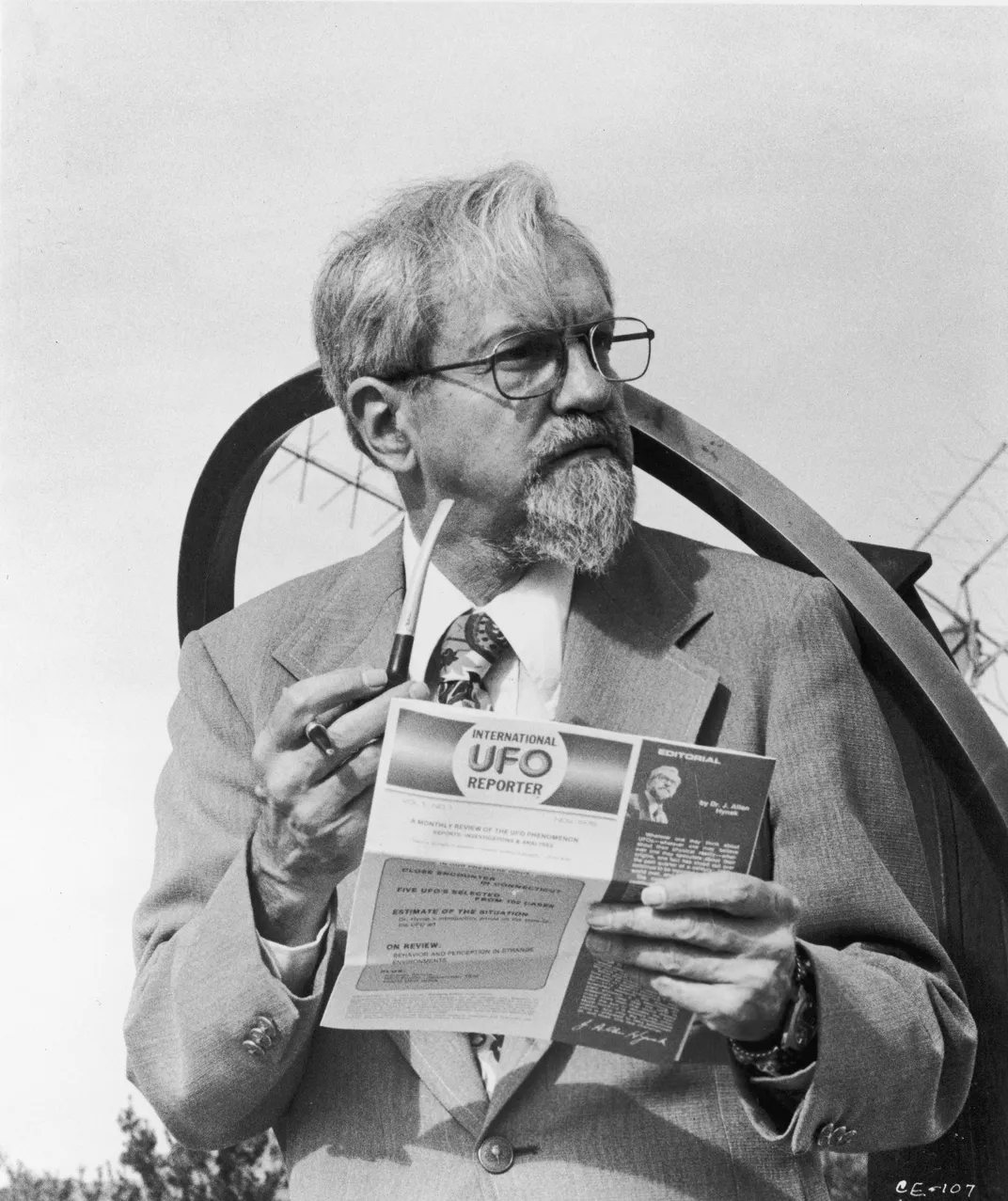 J. Allen Hynek on the set of Close Encounters of the Third Kind
Columbia Tristar / Getty Images
The Hopkinsville goblins
August 21, 1955. Dusk.
After spending an evening playing cards with family and friends near Kelly, Kentucky, Billy Ray Taylor stepped outside to gather some water from the backyard well. When he returned, he claimed that he’d seen something “real bright, with an exhaust all the colors of the rainbow,” pass over the farmhouse.
Taylor and his companions later said that they saw a small figure emerge from the thick darkness outside. About three and a half feet tall, it had long arms and large, luminous eyes. Another followed. And then another. The creatures circled the property, appearing at the farmhouse’s windows, floating among the trees and easily avoiding gunfire.
During a break in the chaos, the group fled to the nearby Hopkinsville police station to report what they’d seen. But officers found no evidence of the so-called Hopkinsville goblins.
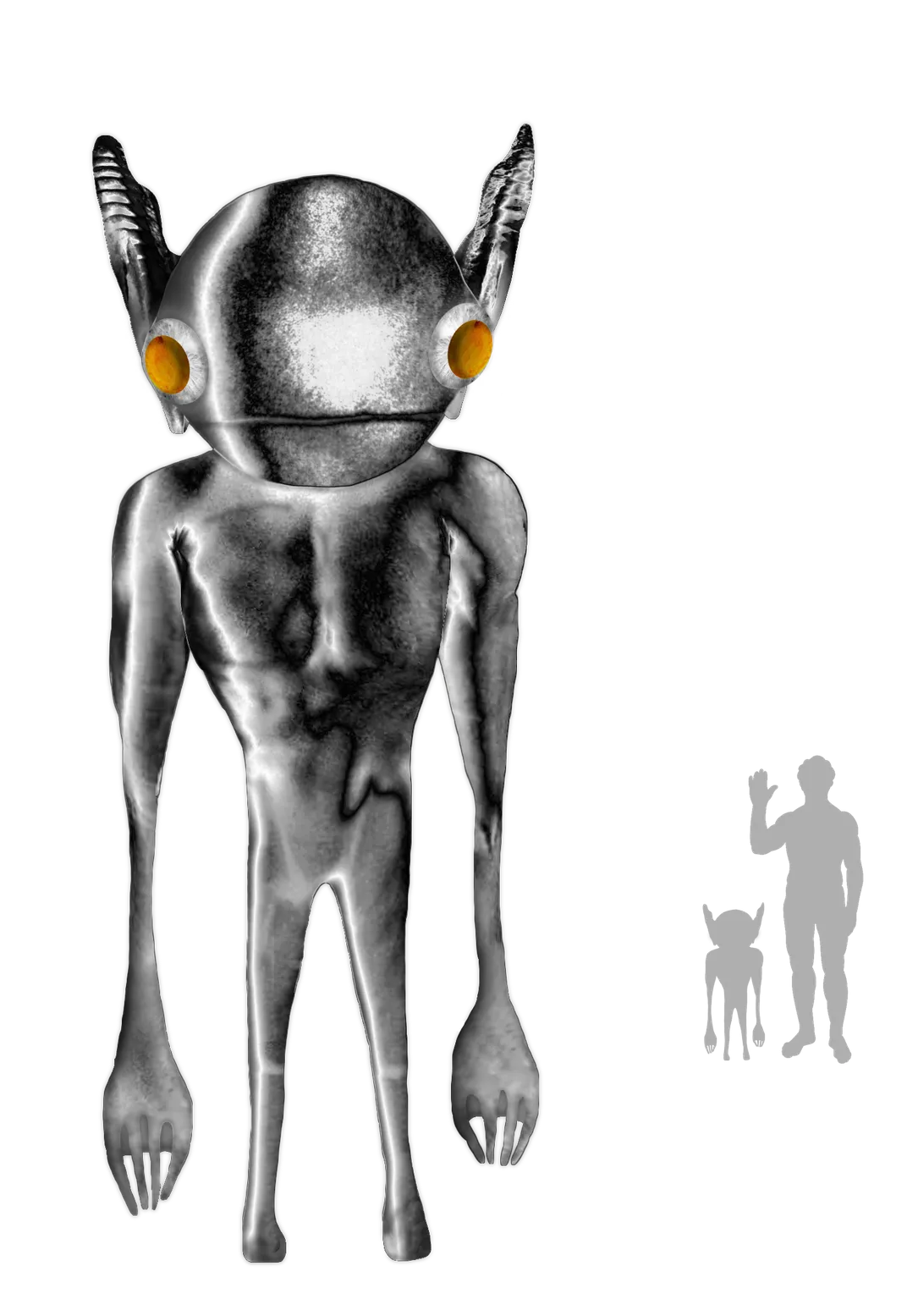 An artist's rendering of a so-called Hopkinsville goblin
Tim Bertelink via Wikimedia Commons under CC BY-SA 4.0
“The Kelly-Hopkinsville case, if considered entirely apart from the total pattern of UFO sightings, seems clearly preposterous, even to offend common sense,” Hynek wrote in The UFO Experience. “The latter, however, has not proved a sure guide in the past history of science.”
When Columbia Pictures asked for a follow-up to Close Encounters, Spielberg once again mined Hynek’s case files for inspiration, gravitating toward the Hopkinsville incident. The proposed sequel, titled Night Skies, would have focused on a group of aliens terrorizing a rural family.
An emphasis on families in peril was emerging as a recurring motif in the director’s films. When Spielberg was a teenager, his parents’ marriage began to unravel, and they divorced in 1966.
In a 1999 interview on “Inside the Actors Studio,” host James Lipton theorized that Close Encounters’ famous musical exchange between humans and aliens was an attempt to resolve the tensions within Spielberg’s own family. “Your father was a computer scientist. Your mother was a musician,” Lipton said. “When the spaceship lands, how do they communicate? They make music on their computers, and they are able to speak to each other.”
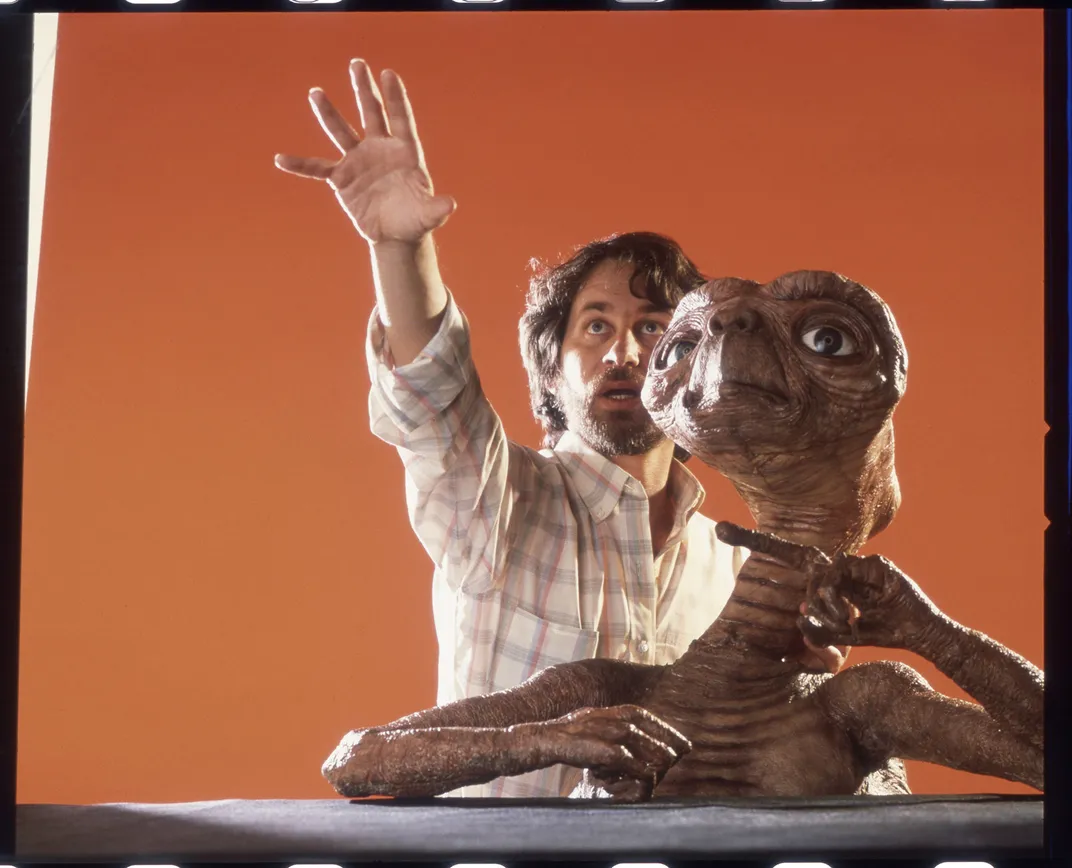 Spielberg poses with E.T. in 1982.
Mark Sennet / Getty Images
Spielberg eventually abandoned the sequel to Close Encounters—but he salvaged one major element. The cadre of evil aliens included a gentle being named Buddee who befriended the family’s son. Buddee became the basis for E.T. the Extra-Terrestrial (1982), which would prove to be another hit for Spielberg.
E.T. stars a lonely boy named Elliott who helps a stranded alien find his way home. The plot follows a family in peril, but this time, the danger comes from something more personal: the fallout of a divorce. The movie begins with Elliott and his siblings mourning the collapse of their family. The audience never meets the children’s father, but his presence looms large, haunting conversations around the dinner table.
“How do you fill the heart of a lonely child, and what extraordinary event would it take to fill Elliott’s heart after losing his dad?” Spielberg said in a 2017 documentary. “It would take something as extraordinary as an extraterrestrial coming into his life.”
{ https://www.smithsonianmag.com/ }


 Atlantic 'cold blob' caused by weakening ocean current system that's likely nearing a tipping point, reanalysis finds