Naar de inhoud

UFO'S of UAP'S, ASTRONOMIE, RUIMTEVAART, ARCHEOLOGIE, OUDHEIDKUNDE, SF-SNUFJES EN ANDERE ESOTERISCHE WETENSCHAPPEN - DE ALLERLAATSTE NIEUWTJES

UFO's of UAP'S in België en de rest van de wereld
seniorennet.beseniorennet.be
Ontdek de Fascinerende Wereld van UFO's en UAP's: Jouw Bron voor Onthullende Informatie! Ben jij ook gefascineerd door het onbekende? Wil je meer weten over UFO's en UAP's, niet alleen in België, maar over de hele wereld? Dan ben je op de juiste plek! België: Het Kloppend Hart van UFO-onderzoek In België is BUFON (Belgisch UFO-Netwerk) dé autoriteit op het gebied van UFO-onderzoek. Voor betrouwbare en objectieve informatie over deze intrigerende fenomenen, bezoek je zeker onze Facebook-pagina en deze blog. Maar dat is nog niet alles! Ontdek ook het Belgisch UFO-meldpunt en Caelestia, twee organisaties die diepgaand onderzoek verrichten, al zijn ze soms kritisch of sceptisch. Nederland: Een Schat aan Informatie Voor onze Nederlandse buren is er de schitterende website www.ufowijzer.nl, beheerd door Paul Harmans. Deze site biedt een schat aan informatie en artikelen die je niet wilt missen! Internationaal: MUFON - De Wereldwijde Autoriteit Neem ook een kijkje bij MUFON (Mutual UFO Network Inc.), een gerenommeerde Amerikaanse UFO-vereniging met afdelingen in de VS en wereldwijd. MUFON is toegewijd aan de wetenschappelijke en analytische studie van het UFO-fenomeen, en hun maandelijkse tijdschrift, The MUFON UFO-Journal, is een must-read voor elke UFO-enthousiasteling. Bezoek hun website op www.mufon.com voor meer informatie. Samenwerking en Toekomstvisie Sinds 1 februari 2020 is Pieter niet alleen ex-president van BUFON, maar ook de voormalige nationale directeur van MUFON in Vlaanderen en Nederland. Dit creëert een sterke samenwerking met de Franse MUFON Reseau MUFON/EUROP, wat ons in staat stelt om nog meer waardevolle inzichten te delen. Let op: Nepprofielen en Nieuwe Groeperingen Pas op voor een nieuwe groepering die zich ook BUFON noemt, maar geen enkele connectie heeft met onze gevestigde organisatie. Hoewel zij de naam geregistreerd hebben, kunnen ze het rijke verleden en de expertise van onze groep niet evenaren. We wensen hen veel succes, maar we blijven de autoriteit in UFO-onderzoek! Blijf Op De Hoogte! Wil jij de laatste nieuwtjes over UFO's, ruimtevaart, archeologie, en meer? Volg ons dan en duik samen met ons in de fascinerende wereld van het onbekende! Sluit je aan bij de gemeenschap van nieuwsgierige geesten die net als jij verlangen naar antwoorden en avonturen in de sterren! Heb je vragen of wil je meer weten? Aarzel dan niet om contact met ons op te nemen! Samen ontrafelen we het mysterie van de lucht en daarbuiten.

The Real Disclosure May Not Be About Aliens

The Real Disclosure May Not Be About Aliens

Real Alien Face

How Governments Have Changed the Conversation About UAPs

By The UFO Times Editorial Desk  


Disclosure Day Is Not About Aliens

For decades, the UFO debate revolved around a single question: "Are UFOs real?"

Today, that question has largely been answered — not in the way many expected, but in a way that is arguably more important.

Governments around the world, including the United States, no longer deny that unidentified objects are sometimes detected in restricted airspace. Military pilots, radar operators, intelligence analysts, and government agencies openly acknowledge that some aerial incidents remain unexplained after investigation.

This does not mean governments have confirmed extraterrestrial visitors.

What has changed is something subtler, but potentially more significant.

The institutions themselves have changed.

A Shift Few People Noticed

Only a decade ago, a military pilot who reported seeing an unexplained object risked ridicule and possible damage to his or her career.

Today, reporting procedures exist.

The U.S. Department of Defense created the All-domain Anomaly Resolution Office (AARO) to investigate unidentified phenomena affecting national security. Congress has held public hearings. Intelligence agencies have declassified videos, reports, and historical records.

Regardless of what ultimately explains these cases, the subject has moved from the margins into official government policy.

That alone represents one of the most remarkable changes in the modern history of the UFO phenomenon.

Why UFOs Are Hiding Our Oceans & How The CIA Trained Psychic Spies | Admiral Tim Gallaudet

The Debate Has Changed

The central public question is no longer: "Do UFOs exist?"

Instead, lawmakers increasingly ask:

  • What information does the government possess?
  • Which agencies have access to it?
  • How much has been classified?
  • Is Congress receiving complete information?
  • Are there legitimate national security concerns that justify secrecy?

These are questions of governance, oversight, and transparency — not speculation.

From Ridicule to Investigation

For much of the twentieth century, unidentified aerial phenomena were often dismissed without serious public discussion.

Today, military encounters are documented, analyzed, and in some cases released to the public. Pilots are encouraged to report unusual incidents. Sensor data receives technical analysis. Congress requests briefings. Inspectors General review allegations.

Whether every case has an ordinary explanation or some remain genuinely anomalous, the investigative process itself has become institutionalized.

That is a profound change.

Transparency Is Not the Same as Disclosure

One of the most common misconceptions is to equate declassification with confirmation. They are not the same.

Governments can acknowledge that unusual events occurred while remaining uncertain about their causes. A report stating "unidentified" does not imply "extraterrestrial." Likewise, releasing documents does not necessarily reveal every classified program or every relevant piece of evidence.

Good journalism requires resisting the temptation to fill those gaps with speculation.

Why This Matters

History is often measured not by spectacular events but by gradual institutional change. Consider what has happened over the past several years:

  • Congress has held multiple public hearings on UAPs.
  • The Pentagon established a permanent investigative office.
  • Military reporting procedures have been formalized.
  • Intelligence agencies have declassified historical records.
  • Scientific organizations have begun studying the topic with greater seriousness.
  • Mainstream media now cover UAP developments as matters of national security rather than fringe curiosity.

Viewed individually, each development may appear modest. Taken together, they represent a transformation in how governments approach unidentified aerial phenomena.

Jesy Nelson baby name NOT nod to Little Mix bandmate as real reason ...

What Still Has Not Been Proven

It is equally important to recognize what has not been established.

There is no publicly available evidence confirming that any government possesses recovered extraterrestrial spacecraft or non-human technology. Several whistleblowers have made extraordinary allegations, but those claims remain unverified in the public domain.

Similarly, many UAP cases eventually receive conventional explanations, while others remain unresolved because available evidence is incomplete. An unresolved case is not, by itself, evidence of extraterrestrial origin.

Maintaining that distinction is essential for credible reporting.

Looking Ahead

The next major breakthrough may not come from another blurry cellphone video or another anonymous internet claim.

It may come from a policy decision. A court ruling. A congressional investigation. Additional declassified documents. Improved sensor technology. Or greater international cooperation among governments studying unidentified phenomena.

These developments may ultimately prove more consequential than any single sighting.

Final Thoughts

At The UFO Times, we believe the most important story unfolding today is not simply what may be in our skies.

It is how governments, scientists, and democratic institutions are changing the way they investigate the unknown.

Whether the final answers point toward advanced technology, natural phenomena, foreign intelligence capabilities, or something entirely unexpected, one fact is already clear:

The conversation has fundamentally changed. And history may remember that change as the beginning of a new chapter in the study of unidentified aerial phenomena — not because all the answers were found, but because the questions were finally taken seriously.

The UFO Times Evidence Scale

We apply this framework to every story we cover. Readers should always know where a claim stands.

  • ESTABLISHED FACTS

    Supported by official documents, verified sensor data, or multiple independent sources. The existence of AARO, congressional UAP hearings, and the release of Navy UAP footage fall into this category.

  • CREDIBLE BUT UNVERIFIED

    Statements from identifiable witnesses or whistleblowers that have not yet been independently corroborated. David Grusch's congressional testimony is an example — credible and protected, but not yet confirmed by physical evidence.

  • SPECULATIVE THEORIES

    Hypotheses that fit some evidence but lack sufficient supporting data. Extraterrestrial explanations for most UAP cases currently fall here — possible, but unproven.

  • UNSUPPORTED CLAIMS

    Assertions for which no credible evidence is currently available. We report these only when they are relevant to the broader story — and we always label them clearly.

The UFO Times Editorial Principles

  • Evidence over assumption. We report what the evidence shows — not what we hope it shows.
  • Questions over conclusions. We begin every investigation with an open question, never a predetermined answer.
  • Transparency over certainty. When we don't know, we say so. Honest uncertainty is more valuable than false confidence.
  • Facts First. Mystery Second. Speculation Last.

— The UFO Times Editorial Board  ·  theufotimes.com  ·  Est. 2010

{ https://theufotimes.com/gov-files }

Hoe vind je dit bericht?
Geschreven door peter om 00:00 Stuur door

Nimitz Tic Tac Incident

Nimitz Tic Tac Incident

Pixel art USS Nimitz Tic Tac UAP case file scene with jets, ocean, and FLIR-style targeting frame

The Nimitz Tic Tac incident is one of the strongest modern UAP case files because it combines named military witnesses, radar discussion, and officially released U.S.

Navy video.

The case sits at the centre of the modern UAP conversation because it feels more contemporary than Roswell, more documentable than many classic sightings, and more connected to present-day institutions than older Cold War cases.

The useful way to approach the Nimitz encounter is not as final proof of anything extraordinary. It is a modern military case with a real public record, serious witness testimony, and a large amount of interpretation built around an incomplete evidence set.

What Happened In The Nimitz Tic Tac Incident?

In November 2004, U.S. Navy personnel connected to the USS Nimitz carrier strike group encountered an unusual object during training operations off the coast of southern California. The object later became widely known as the "Tic Tac" because witnesses described it as a smooth, white shape resembling a capsule or mint.

The case became famous for several connected reasons:

  • radar operators reported unusual contacts
  • Navy aviators later described a strange airborne object during an intercept attempt
  • a military video associated with the event became public
  • the Department of Defense later officially released historical Navy videos, including one taken in November 2004

That does not make every detail equally documented. It does put the case on firmer public footing than many famous UFO stories.

Quick Timeline Of The 2004 Encounter

StageWhat is commonly reported
Pre-encounter context Carrier strike group units were conducting workup and training operations off southern California
Radar interest Personnel associated with the USS Princeton reported unusual contacts before the intercept
Intercept attempt Commander David Fravor and other aviators were directed to investigate one of the anomalies
Visual encounter Fravor later described seeing a white Tic Tac-shaped object moving in unusual ways above the water
Later footage A cockpit video associated with the November 2004 event entered the public domain and later became part of the officially released historical Navy videos
Public turning point The case became a pillar of the modern UAP conversation after late-2010s media coverage and the 2020 Department of Defense release

That timeline matters because the Nimitz case is not just one video clip. It is a bundle of radar discussion, witness recollection, military context, and later public documentation.

What David Fravor And Other Witnesses Said They Saw

The most visible human source for the case is retired Commander David Fravor. In his written statement for the 26 July 2023 House Oversight hearing, Fravor said that in November 2004 he was serving with Strike Fighter Squadron 41 aboard USS Nimitz during a workup cycle preparing for deployment. He described being redirected from a training mission to investigate something unusual after the USS Princeton had been tracking anomalous objects.

Fravor's account is one reason the case has held public attention. He described seeing a white, elongated object moving above a disturbance in the water below. In later public discussions and testimony, he said the object appeared to manoeuvre in ways that did not match his expectations for conventional aircraft.

That testimony comes from a trained military aviator speaking under his own name in a formal public setting. It does not settle the case by itself, but it gives the encounter more weight than anonymous retellings or internet folklore.

Witness testimony is one kind of evidence. It is not the same thing as a complete technical reconstruction. The Nimitz case remains important partly because people often blur that distinction.

What The Released Video Does And Does Not Show

One reason the Nimitz encounter reached beyond UFO subculture is the video.

On 27 April 2020, the U.S. Department of Defense released three unclassified historical Navy videos. In that release, the Department said one of the videos was taken in November 2004 and two others were taken in January 2015. The Department also said the aerial phenomena observed in the videos remain characterised as "unidentified."

That official release did two important things:

  • it confirmed the footage was genuine historical Navy video
  • it stopped the debate over whether the clips were fabricated or fake

It did not prove what the object was. Official release is not official explanation.

The video gives the public a real artefact to inspect, which already puts the case in a stronger category than many famous incidents. But the footage is still limited. It is a partial visual record, not the whole event. Readers who lean too heavily on the clip alone usually flatten a larger case into one image.

What Is Officially Documented

The strongest public anchors for the case are relatively clear.

What is officially documented in a public-facing sense:

  • the Department of Defense released historical Navy videos on 27 April 2020
  • that release states one of the videos was taken in November 2004
  • the Department said the phenomena observed remain characterised as unidentified
  • David Fravor gave a formal written statement to Congress in 2023 describing the incident from his perspective

What is also part of the public case record:

  • sustained public witness discussion from military participants
  • the larger late-2010s media and congressional wave that elevated the case into mainstream UAP conversation
  • the way the case became a reference point for modern pages such as AARO and NASA's UAP study

If you want to inspect the primary public record yourself, start with the source trail near the end of this page.

How The Case Changed Modern UAP Discussion

The Nimitz encounter helped shift UFO discussion from old mythology into modern state, military, and public-policy language.

Older cases often live inside a fog of retellings, incomplete files, and cultural legend. The Nimitz case still has uncertainty, but it belongs to a different era. It sits alongside public video discussion, congressional testimony, post-2017 media attention, official UAP institutions, and scientific review frameworks.

That makes the case a hinge point. It is not simply a famous sighting. It is a case that helped define what modern UAP discourse sounds like.

For Otherworlders, that also makes it a useful bridge between foundational pages such as what is a UFO and newer investigation-focused pages such as Navy footage and congressional pressure.

What Remains Unresolved

The Nimitz case is important because it is not cleanly settled.

Several things remain unresolved in the public record:

  • the public does not have a complete technical reconstruction of the event
  • not all underlying sensor data is publicly available
  • the public record is stronger on some parts of the case than others
  • later commentary often moves beyond what the released material alone can support

That is why the case should not be oversold. It can support serious interest, careful reading, and debate about military reporting and evidence limits. It cannot yet support a final explanation everyone agrees on, proof of extraterrestrial origin, or a complete public understanding of every sensor, witness, and chain-of-command detail involved.

The gap between significance and certainty is exactly why the case still matters.

The Grounded Takeaway

The Nimitz Tic Tac incident is one of the strongest modern UAP cases because it leaves the public with enough real material to ask disciplined questions.

There is a military context. There is named witness testimony. There is officially released video. There is later congressional attention. That already puts the case in a different category from rumour-led UFO stories.

At the same time, the public record remains incomplete. The case is best understood as a serious modern UAP encounter with unresolved elements, not as a solved mystery or confirmed extraterrestrial event.

That balance is what makes the Nimitz incident worth reading carefully.

Source Trail

FAQs

What was the Nimitz Tic Tac incident?

It was a November 2004 U.S. Navy encounter involving personnel connected to the USS Nimitz carrier strike group, unusual radar contacts, witness testimony from aviators including David Fravor, and a video later included in the Department of Defense release of historical Navy videos.

Did the Navy confirm the Tic Tac video was real?

The Department of Defense officially released historical Navy videos on 27 April 2020 and said one of them was taken in November 2004. That confirms the footage was genuine military video, but not what the object ultimately was.

What did David Fravor say he saw?

In public testimony and his 2023 written congressional statement, Fravor described being redirected to investigate an unusual object and later seeing a white Tic Tac-shaped craft behaving in ways he considered highly unusual.

Does the Nimitz case prove extraterrestrial origin?

No. The case is important because it has a real public record and remains unresolved in important ways. That is different from proving an extraterrestrial explanation.

The SHOCKING Truth About the "Tic Tac" UFO Incident

{ https://otherworlders.com/ }

Hoe vind je dit bericht?
Geschreven door peter om 23:16 Stuur door

A photographic history of UFOs

A photographic history of UFOs ILLUSTRATIVE RECONSTRUCTION // NOT EVIDENCE

Overview

Blind Magazine’s latest feature traces a photographic history of UFOs as something more than a catalog of unexplained lights in the sky. In curator Philippe Baudouin’s view, these images are also cultural evidence—documents that reveal how public imagination, belief, and skepticism have evolved alongside changing ideas about extraterrestrial life. Presenting “Nous ne sommes pas seuls. Images extraterrestres” (“We Are Not Alone. Extraterrestrial Images”) at Espace Croisière through October 4, 2026, Baudouin frames the subject not as proof of alien visitation, but as a visual archive of humanity’s enduring uncertainty about its place in the universe.

Photography as a Record of Belief

Baudouin begins from a cosmological premise that many scientists and philosophers would recognize: with “billions of galaxies, billions of stars, and probably as many planets as there are grains of sand on a beach,” he argues, “what would be unreasonable is to think we are alone in the universe.” Yet he is careful to distinguish between possibility and evidence. Whether that life is microbial or intelligent, he says, “I’m simply incapable of telling you.” That uncertainty is precisely why the exhibition focuses on UFO imagery rather than definitive extraterrestrial proof. Photography, in this context, becomes a stand-in for scientific knowledge that remains elusive, offering a record of what people have seen, believed, or wanted to believe at different moments in time.

A Cult Image, and the Mystery Behind It

Among the exhibition’s standout images is a striking 1993 photograph by Yves Bosson, Jean-Claude Ladrat, constructeur de soucoupes volantes (“Jean-Claude Ladrat, Builder of Flying Saucers”), which captures a man seated beside his homemade flying saucer as if it were an ordinary piece of furniture. The image evokes a distinctly French episode of amateur ufology and popular television memory: Ladrat’s appearance on the cult documentary program Strip-Tease in La Soucoupe et le perroquet (“The Saucer and the Parrot”), where viewers saw him building a craft in his mother’s garden in Germignac, apparently destined for the Bermuda Triangle. Baudouin notes that Bosson’s photograph had “never been published or shown” before, sitting for years in the photographer’s archives. The story underscores one of the exhibition’s central ideas: some UFO photographs survive not because they solve a mystery, but because they preserve a memorable encounter between obsession, eccentricity, and belief.

From Science Fiction Icon to Archive

The exhibition also opens with a familiar cultural touchstone: the I Want to Believe poster made famous by The X-Files. Baudouin points out that the image behind that emblem was itself lifted from a real photograph taken in 1975 by Swiss farmer Eduard Albert “Billy” Meier, who claimed to have photographed more than 1,400 UFOs in the Swiss countryside between 1975 and 1980. One of Meier’s images was reportedly used without authorization to create the poster. That detail is revealing: even one of television’s most iconic symbols of UFO skepticism and wonder is rooted in a contested photograph. In Baudouin’s telling, this is where the exhibition’s logic becomes clearest—beneath the popular myth lies an image, and beneath the image, an unresolved mystery.

Why These Images Still Matter

Baudouin insists he is not a ufologist, but his curatorial approach suggests that the history of UFO photography is inseparable from broader questions about media, memory, and belief. These pictures do not merely illustrate a fringe topic; they show how societies have tried to visualize the unknown. In that sense, Blind Magazine’s feature presents UFO photography as both artifact and argument: a body of work that captures not only alleged objects in the sky, but also the enduring human desire to find meaning in what cannot yet be explained.


UFO Mysteries That Defy Explanation | Unidentified: Inside America's UFO Investigation

The Global Threat (Full Episode) | UFOs: Investigating the Unknown

{ https://usubjects.com/  }

Hoe vind je dit bericht?
Geschreven door peter om 22:56 Stuur door

Expert explains what to do if you spot a UFO

Expert explains what to do if you spot a UFO

An expert has shared some advice on what to do if you spot a UFO - revealing the apps that can help determine whether it's a genuine sighting or if there is a more Earthly explanation.

An expert investigator has explained what do to if you spot a UFO.

An expert has explained the steps to take after a UFO sighting

An expert has explained the steps to take after a UFO sighting

Mick West - who has looked into around 1,000 potential unidentified aerial phenomenon [UAP] sightings over the years - has given an insight into the steps you should take if you spot something strange in the sky revealing the apps that can help determine whether it's a genuine sighting or if there is a more Earthly explanation.

The most important factor in determining whether a sighting is genuine is having an original video - rather than a downloaded copy - and it's even better if there's audio too.

West recommends a number of apps and programs which can be used to analyse the footage including Invisor, which can display and compare technical information about video, audio, and photo files, and the took he created himself called Sitrec, which uses line of sight mapping, flight data integration and sensor recreation.

He also highlights free-to-use app FlightRadar24, which tracks the movements of aircraft and can help establish what might be up in the air at the time of the sighting.

In a piece written for Skepticalinquirer.org, West explained how he used flight tracking to determine the validity of a potential sighting which appeared as three lights "hovering over a building" in the US state of Cincinnati.

He wrote: "One of the more common sources of UAP sightings is aircraft. In decades past, UFO researchers would have to call the local airports, or even travel agents, to try to determine what planes might have been seen.

"Now plane schedules are all online, and beyond that, we can now replay the flight activity over a certain area to see what planes might have been visible ...

"In a recent example, a spotter near Cincinnati saw what looked like a triangle of three lights hovering over a building at 00:14 UTC on October 12. I suspected this was three planes heading toward the camera.

"So, I ran through the process above, and sure enough there were three planes in a row heading straight for the camera location."

West also explained that some strange goings-on in the night sky can also be explained by stars, planets, and satellites.

He added: " Celestial objects, such as stars, planets, and satellites, can be viewed on sites (or apps) such as Stellarium. This allows you to see what the night sky would look like at any time, from any position on Earth.

"Many UAP sightings are planets, bright stars (such as Sirius), or satellites. Stellarium is clunky but powerful and accurate."


How scientists use math to help explain UFO videos

The UFO 'cookbook': How the American government investigates the unexplainable

{ https://www.femalefirst.co.uk/ }

Hoe vind je dit bericht?
Geschreven door peter om 22:43 Stuur door

Lost Desert City Buried for 1,600 Years Unearthed in Egypt

Lost Desert City Buried for 1,600 Years Unearthed in Egypt

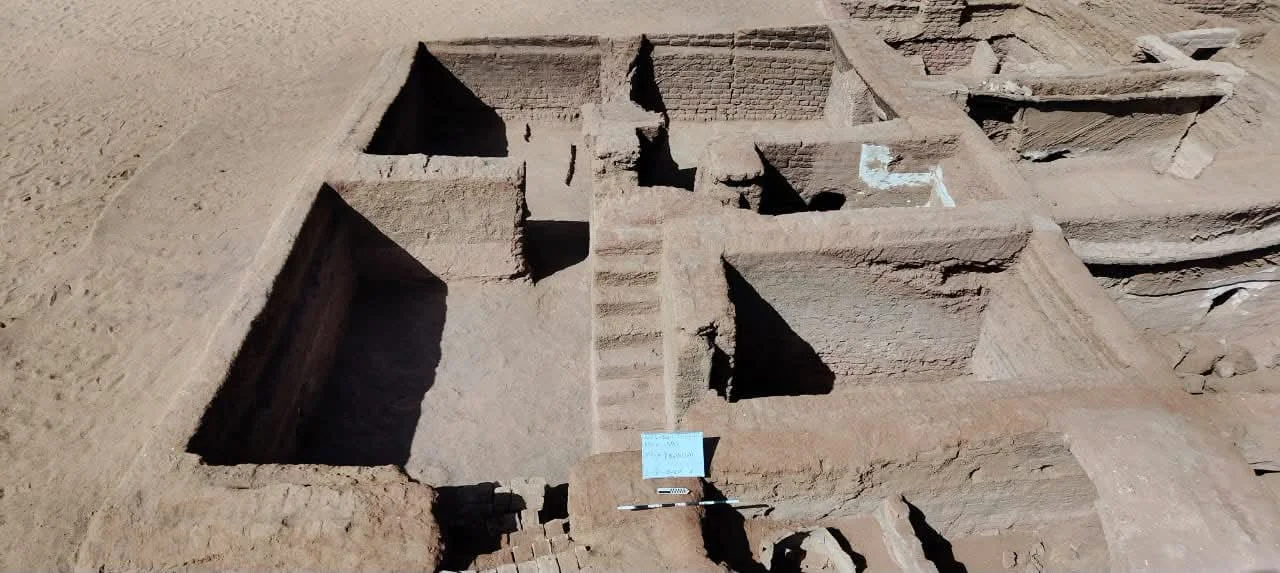
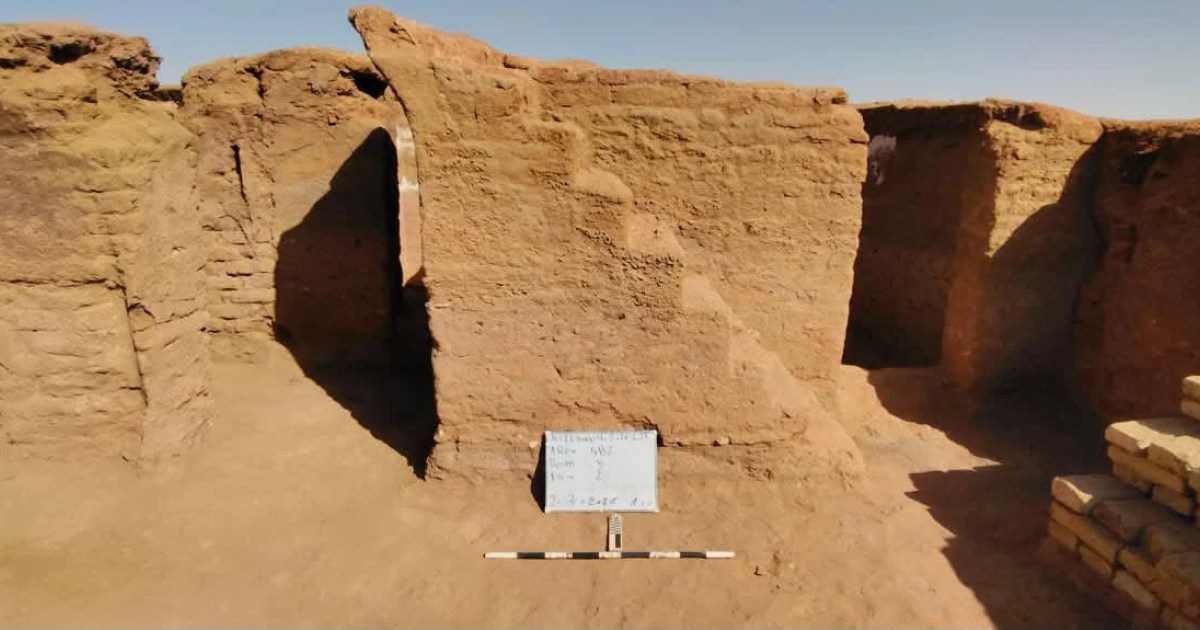
Excavated mudbrick residential quarter at the former Byzantine city known today as Ain al-Sabil, Dakhla Oasis, Egypt. Official excavation photograph released July 2026

RamseyHardin

For 1,600 years, a once-thriving frontier settlement lay buried beneath Egypt's western desert. Once governed by Byzantine officials, the city was covered by drifting sand that covered the streets and markets. Now, archaeologists have uncovered fourth-century workshops, a basilica-style church in the Dakhla Oasis, and well-preserved stone homes. Scattered coins and pottery fragments tell a story of everyday life during the Byzantine Empire’s struggles to maintain power in Egypt.

A Byzantine Settlement Emerges from the Sand

Mahmoud Massoud, Director General of Dakhla Antiquities and head of the excavation mission, expressed surprise at the “rich assemblage of artifacts and the components of a fully functioning community.” Discovered in Egypt's New Valley Governorate in the Western Desert during ongoing excavations at the Ain Al-Sabil archaeological site, the settlement is now on UNESCO's Tentative List, just a step away from being added to the World Heritage List.

According to Dr. Zahran Mahdi, director of the Excavations Department at the Islamic and Coptic Antiquities Sector, it is rare to find an intact Byzantine urban settlement. Islamic, Mamluk, and Ottoman building initiatives expanded over or reused earlier Byzantine layers. Urban construction projects used unfired mud bricks, so older layers were eroded or demolished. Intact settlements are usually discovered in remote arid regions where unsuccessful settlements were abandoned.

Excavated mudbrick residential buildings at the Byzantine city of Ain al-Sabil, Dakhla Oasis, Egypt

Excavated mudbrick residential buildings at the Byzantine city of Ain al-Sabil, Dakhla Oasis, Egypt.

(Supreme Council of Antiquities/Egyptian Ministry of Tourism and Antiquities)

Egypt Under Byzantine Rule

The Byzantine period in Egypt began in 395 AD, after the death of Emperor Theodosius I. The Roman Empire was divided into eastern and western regions, and Egypt became part of the Eastern Roman, or Byzantine, Empire, though the capital, Constantinople, was hundreds of miles away. The recently discovered settlement offers a glimpse of life at a time when Roman traditions, Christian beliefs, and Egyptian culture overlapped.

Egypt was both a wealthy and strategically important province because of its thriving agriculture and grain exports. It was known as the Breadbasket of the Byzantine Empire. During the Byzantine era, Christianity changed Egypt's religious and cultural practices. Christians built churches and monasteries in urban areas. Across Egypt, towns expanded under imperial rule. Unfortunately, religious disputes between the Byzantine authorities and the Coptic Christian congregations over differing beliefs about the nature of Christ created problems. The Byzantine Empire controlled Egypt until 641 AD, when Arab Muslim forces conquered the country. Many settlements built before 620-640 AD were abandoned or buried by the desert.

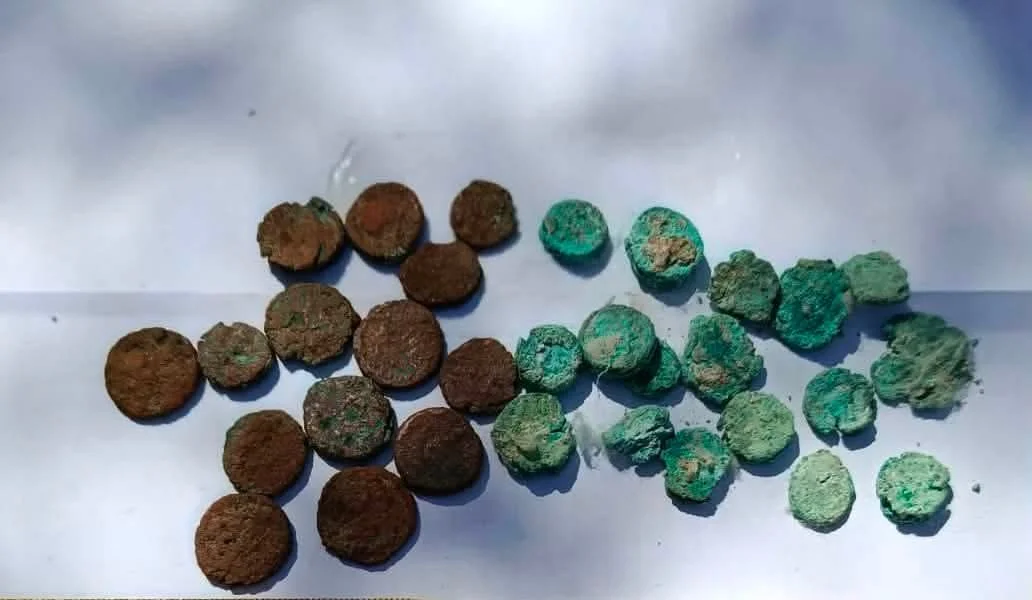
Bronze Byzantine coins excavated from the Ain al-Sabil settlement, Dakhla Oasis, Egypt.

Bronze Byzantine coins excavated from the Ain al-Sabil settlement, Dakhla Oasis, Egypt.

(Supreme Council of Antiquities/Egyptian Ministry of Tourism and Antiquities)

Unearthing the Lost City

The mission from Egypt’s Supreme Council of Antiquities discovered the Byzantine city at the Dakhla Oasis and began excavations at the Ain Al-Sabil site. Dr. Hisham El-Leithy, secretary-general of the Supreme Council of Antiquities, believes the discoveries have helped researchers better understand the settlement’s urban design, social organization, and economic activities. They discovered a planned urban city, with intersecting streets, a central church, and substantial fortifications. There are open squares and courtyards throughout the settlement. The defensive structures include thick walls and two watchtowers.

Dr. Mamoud pointed out that the residential district contained many spacious homes with large halls and vaulted ceilings. Residents had bread ovens and kitchens with food storage. There were special areas with stone tools for grinding grain. One of the most impressive buildings, the home of a church deacon, Tisus, dates to the second half of the fourth century AD. Archaeologists also uncovered the house of Tapibos that served as a house-church before the construction of the basilica.

Artifacts Reveal Commercial Transactions

According to Dr. Mahdi, the most informative discovery was a collection of about 200 ostraca, or inscribed pottery fragments, written in both Coptic and Greek. They provide a record of commercial transactions, personal correspondence, and other aspects of daily life.

“One of the excavation’s most significant discoveries is a collection of nearly 200 inscribed ostraca (pottery fragments used as writing material) bearing texts in both Coptic and Greek,” Mahdi said.

The inscriptions record commercial transactions, correspondence, and other details of daily life. The discovery of a set of bronze coins featuring portraits of Byzantine emperors, Latin inscriptions, and Christian symbols, along with a group of gold coins dated to the reign of Roman Emperor Constantius II (337-361 AD), shows the changing circumstances and the residents’ connections during the Byzantine era.

The Importance of the Lost Byzantine Settlement

The Byzantine settlement under the desert sands is quite different from Egypt’s temples and pyramids. The town was not constructed to honor kings. Rather, it was part of the lives of ordinary people. The discoveries at the Dukhla Oasis provide the information that historians need to reconstruct life in the centuries between the ancient and medieval worlds.

  • Top Image: Excavated mudbrick residential quarter at the former Byzantine city known today as Ain al-Sabil, Dakhla Oasis, Egypt. Official excavation photograph released July 2026.
  • Source: Supreme Council of Antiquities/Egyptian Ministry of Tourism and Antiquities

By Ramsey Hardin

References


The Lost Egyptian City Buried Beneath the Desert | Incredible Ancient Discovery

Buried in the Sand: The Forgotten Byzantine World of Ain el Sabeel

{ https://www.ancient-origins.net/news-history-archaeology }

Hoe vind je dit bericht?
Geschreven door peter om 21:56 Stuur door

If you saw an alien ship landed on Earths moon, would you even recognize it? UFO UAP Sighting News.

If you saw an alien ship landed on Earths moon, would you even recognize it? UFO UAP Sighting News.

Screenshot%202026-07-06%20at%206.07.14%E2%80%AFPM.png
UFO_moon.png

Date of discovery: July 6, 2026
Location of discovery: Earths moon, Apollo 15 image
Source photo: 

The moon is a junkyard for discontinued alien ships. Guys, I found a lot of these things last night and I really wanted to share them with you today. So take your time, stare at the ones for a while to let your eyes adjust to the black and white. And don't worry if you don't see it, it took me decades, since I've been doing this since 1975. There are not a few, but hundreds of structures on the moon, in just this one single photo. I noticed that there is a white crater rim around each of these structures that I found, and I pieced together that maybe these are not craters at all because the objects in the middle of them looked like they were man-made intelligently made structures. So I kind of pieced together that these structures are actually ships. You see the ships are landing on the surface of the moon and as they get close to the moon, they stir up a lot of dust.This dust is fresh and white because it's deeper and it has not been exposed to the sun. So this dust turns into a white oval or circle surrounding the alien ship that landed in that location. Now don't try to decide for yourself what an alien ship should look like, because you and I are not aliens. As humans we think like a human, we assumes things are supposed to be a certain way due to our human cultures and teachings. Therefore we must look at things scientifically...you need to look for intelligently made designs things that have a 90° angles to them in many different positions. Things that just don't look natural to you. And it is very possible that if it's on the moon and you will find one of these objects, and it will have a 95% chance to be alien technology.

Scott C. Waring - UFO Sightings Daily

Screenshot%202026-07-06%20at%206.11.32%E2%80%AFPM.png

Screenshot%202026-07-06%20at%206.10.15%E2%80%AFPM.png

Screenshot%202026-07-06%20at%206.10.08%E2%80%AFPM.png

Screenshot%202026-07-06%20at%206.08.55%E2%80%AFPM.png

Screenshot%202026-07-06%20at%206.08.28%E2%80%AFPM.png

Screenshot%202026-07-06%20at%206.08.10%E2%80%AFPM.png


Screenshot%202026-07-06%20at%206.06.44%E2%80%AFPM.png

Screenshot%202026-07-06%20at%206.06.16%E2%80%AFPM.png

Screenshot%202026-07-06%20at%206.05.59%E2%80%AFPM.png

Screenshot%202026-07-06%20at%206.05.45%E2%80%AFPM.png

Screenshot%202026-07-06%20at%206.04.21%E2%80%AFPM.png

Screenshot%202026-07-06%20at%206.04.06%E2%80%AFPM.png

Screenshot%202026-07-06%20at%206.03.57%E2%80%AFPM.png

Screenshot%202026-07-06%20at%206.03.41%E2%80%AFPM.png

Screenshot%202026-07-06%20at%206.02.30%E2%80%AFPM.png

Screenshot%202026-07-06%20at%206.01.58%E2%80%AFPM.png

Screenshot%202026-07-06%20at%206.01.49%E2%80%AFPM.png

Screenshot%202026-07-06%20at%206.01.34%E2%80%AFPM.png

Screenshot%202026-07-06%20at%206.01.07%E2%80%AFPM.png

Screenshot%202026-07-06%20at%206.00.30%E2%80%AFPM.png

Screenshot%202026-07-06%20at%205.59.38%E2%80%AFPM.png

Screenshot%202026-07-06%20at%205.58.42%E2%80%AFPM.png

Screenshot%202026-07-06%20at%205.58.31%E2%80%AFPM.png

Screenshot%202026-07-06%20at%205.57.18%E2%80%AFPM.png

Screenshot%202026-07-06%20at%205.56.51%E2%80%AFPM.png

Screenshot%202026-07-06%20at%205.56.12%E2%80%AFPM.png

Screenshot%202026-07-06%20at%205.55.38%E2%80%AFPM.png

Screenshot%202026-07-06%20at%205.54.19%E2%80%AFPM.png

Screenshot%202026-07-06%20at%205.52.31%E2%80%AFPM.png

Screenshot%202026-07-06%20at%205.30.20%E2%80%AFPM.png

Screenshot%202026-07-06%20at%205.28.49%E2%80%AFPM.png

{ https://www.ufosightingsdaily.com/ }

Hoe vind je dit bericht?
Geschreven door peter om 21:26 Stuur door

One and done! NASA Artemis II astronaut Jeremy Hansen dramatically RETIRES after a single mission around the moon – as one fan asks 'what do you guys see up there that you don't want to go back?'

One and done! NASA Artemis II astronaut Jeremy Hansen dramatically RETIRES after a single mission around the moon – as one fan asks 'what do you guys see up there that you don't want to go back?'

Colonel Jeremy Hansen has dramatically retired, after just one mission into space with NASA. 

The Canadian astronaut was one of four members of the Artemis II team, who made history earlier this year by flying around the moon. 

While that mission was Colonel Hansen's first, he has now revealed that it was also his last. 

Taking to X, he said: 'Today, I am sharing a significant next step in my journey. 

'This September, after 32 years of military service and 17 years as a Canadian Space Agency astronaut—culminating in the incredible privilege of flying around the Moon on Artemis II—I will be transitioning from my full–time role at the CSA.'

The news has left many fans devastated, with one claiming that Colonel Hansen's retirement has come 'too soon'. 

Another said: 'Can only imagine how you top circling the moon. But I imagine you will.'

And one ominously asked: 'Many astronauts step down from active space flight duty after returning to earth. What do you guys see up there that you don't want to go back?' 

Colonel Jeremy Hansen has dramatically retired, after just one mission with NASA

Colonel Jeremy Hansen has dramatically retired, after just one mission with NASA

The Canadian astronaut was one of four members of the Artemis II team, who made history earlier this year by flying around the moon. Pictured (from left): Jeremy Hansen, Victor Glover, Reid Wiseman and Christina Koch

The Canadian astronaut was one of four members of the Artemis II team, who made history earlier this year by flying around the moon. Pictured (from left): Jeremy Hansen, Victor Glover, Reid Wiseman and Christina Koch

While Colonel Hansen has only been to space once, he has been an astronaut since 2009, when he was selected through the CSA's astronaut recruitment campaign.

In 2013, he took part in a mission here on Earth, dubbed the CAVES program, in which he lived underground for six days. 

The following year, he lived on the ocean floor in the Aquarius habitat for seven days. 

However, it was not until 2023 that he was finally selected for a mission into space – being assigned as mission specialist for Artemis II, the first crewed mission to the moon since the Apollo missions over 50 years ago. 

From 1–10 April, Colonel Hansen and his crewmates – Reid Wiseman, Victor Glover, and Christina Koch – travelled around the moon and back aboard the Orion spacecraft. 

The crew made history by travelling farther than any humans in history, breaking the record previously held by the crew of Apollo 13. 

Colonel Hansen also became the first Canadian and first non–American to take part in a lunar mission.

'Colonel Jeremy Hansen made history as the first Canadian to take part in a lunar mission, an achievement that has inspired every generation of Canadian,' said The Honourable Mélanie Joly, Minister of Industry and Minister responsible for Canada Economic Development for Quebec Regions.

Colonel Hansen became the first Canadian and first non¿American to take part in a lunar mission

Colonel Hansen became the first Canadian and first non–American to take part in a lunar mission

From 1¿10 April, Colonel Hansen and his crewmates ¿ Reid Wiseman, Victor Glover, and Christina Koch ¿ travelled around the moon and back aboard the Orion spacecraft

From 1–10 April, Colonel Hansen and his crewmates – Reid Wiseman, Victor Glover, and Christina Koch – travelled around the moon and back aboard the Orion spacecraft

The Artemis II crew

Reid Wiseman – Commander 

  • A US Navy aviator and test pilot with 27 years of experience.
  • Wiseman has previously spent 165 days in space onboard the ISS

Victor Glover – Pilot 

  • A US Navy aviator and test pilot with 3,500 flight hours in more than 40 aircraft 
  • Glover served as Flight Engineer on the ISS during a 168–day mission

Christina Koch – Mission specialist

  • An engineer and scientist specialising in electrical engineering
  • Holds the record for longest spaceflight by a woman, spending consecutive days on the ISS

Jeremy Hansen – Mission specialist

  • Selected by the Canadian Space Agency to join Artemis II
  • A Canadian Armed Forces fighter pilot, physicist, and experienced aquanaut

'His extraordinary achievements have not only advanced Canada's role in space exploration but have shown young Canadians what is possible when talent, determination and ambition are matched with opportunity.'

While Colonel Hansen is retiring, he says this is 'far from a departure.' 

'To ensure continuity in this mission, the Royal Canadian Air Force is enabling my transition into a Reservist role,' he explained. 

'This unique position is a deliberate launchpad designed to leave the door open for creative, ongoing ways to support and enable the vital work happening in Canada with respect to space, and I'm excited for the new challenges it will bring. 

'Our future depends on a fierce continuation of Canadian innovation and exploration in space. 

'The technological breakthroughs and economic benefits born from this sector are vital for our country and the world, and I am as determined as ever to push that work forward. 

'To the Canadian Armed Forces, the CSA, NASA, our international partners, and my family: thank you. 

'And to all Canadians: thank you for believing in what our country can achieve when we aim high. The mission continues.'


The news comes shortly after NASA revealed its all–male crew for the Artemis III mission. 

Read More

article image

NASA's Randy Bresnik, Frank Rubio and Andrew Douglas will join European Space Agency (ESA) astronaut Luca Parmitano in orbital tests ahead of the lunar landing. 

Scheduled for 2027, Artemis III will test rendezvous and docking operations between the Orion spacecraft and commercial human landers in low–Earth orbit as part of preparations for future lunar exploration.

But the reveal of the crew quickly drew criticism on social media, where users pointed out that none of the astronauts selected for the historic mission are women.

Artemis II: Key facts

Launch date: April 1

Mission objective: To complete a lunar flyby, passing the 'dark side' of the moon and test systems for a future lunar landing.

Total distance to travel: 620,000 miles (one million km)

Mission duration: 10 days 

Estimated total cost: $44billion (£32.5billion)

+ NASA Space Launch System rocket: $23.8billion (£17.6billion)

+ Orion deep–space spacecraft: $20.4billion (£15billion)

Crew: 

+ Commander Reid Wiseman

+ Pilot Victor Glover

+ Mission Specialist Christina Koch

+ Mission Specialist Jeremy Hansen

Mission Stages:

1. Launch from Kennedy Space Centre Launch Pad 39B

2. Manoeuvre in orbit to raise the perigee using the Cryogenic Propulsion Stage

3. Burn to raise apogee using the Cryogenic Propulsion Stage

4. Detach from Cryogenic Propulsion Stage and perform translunar injection

5. Fly to the moon over four days

6. Complete lunar flyby at a maximum altitude of 5,523 miles (8,889 km) above the moon's surface

7. Return to Earth over four daysSeparate the crew module from the European Service

8. Module and the crew module adapter

9. Splashdown in the Pacific Ocean  

{ https://www.dailymail.com/sciencetech/index.html }

Hoe vind je dit bericht?
Geschreven door peter om 21:08 Stuur door

Earth's second MOON is revealed for the first time: Chinese satellite beams back incredible image of rare 'micromoon'

Earth's second MOON is revealed for the first time: Chinese satellite beams back incredible image of rare 'micromoon'

Scientists have captured the first image of a rare 'minimoon' that loops around the Earth like a dance partner.

Asteroid 2016 HO3, also known as Kamoʻoalewa, is locked into an orbit around the sun while tracing a circle around our planet.

It was first spotted around a decade ago by the Pan–STARRS 1 asteroid survey telescope on Haleakala, Hawaii.

Now, a probe sent by the China National Space Administration (CNSA) mission has just returned its first picture of our small celestial neighbour.

The image shows a grey space rock with jagged edges, with the vastness of space as a backdrop.

While it is too distant to be considered a true satellite of our planet, it is the best and most stable example to date of a near–Earth companion, or 'quasi–satellite'.

'After a 400–day, one billion–kilometre (621 million–mile) journey, the Tianwen–2 probe recently made a successful encounter with asteroid 2016 HO3, reaching a distance of 20 kilometres (12.4 miles) from the asteroid to begin scientific exploration. During its approach to the asteroid, the probe acquired image data,' CNSA said in a statement.

As part of its mission, Tianwen–2 will conduct in–orbit observations of the rock and even collect samples to bring back to Earth.

This is the first image of the rare ¿minimoon¿, 2016 HO3, that loops around the Earth like a dance partner

This is the first image of the rare 'minimoon', 2016 HO3, that loops around the Earth like a dance partner

Kamo'oalewa, whose name alludes to an offspring that travels on its own, was discovered by the PanSTARRS telescope in Hawaii in 2016. Its orbit in relation to Earth and the sun is pictured

Kamo'oalewa, whose name alludes to an offspring that travels on its own, was discovered by the PanSTARRS telescope in Hawaii in 2016. Its orbit in relation to Earth and the sun is pictured

Tianwen–2 launched on 29 May 2025 from the Xichang Satellite Launch Center as part of CNSA's first asteroid sample–return mission.

After its long journey from Earth, the probe made its first optical detection of Kamoʻoalewa on June 6, and by June 19, it had approached to within 1,242 miles (2,000 km).

By July 2, it was just 12.4 miles (20km) away from the asteroid – close enough to capture an image clearly showing the space rock, which is believed to be 130 to 328 feet (40 to 100 metres) in diameter.

The probe's mission was described in a paper published in Space Science Reviews earlier this year.

'Among the known near–Earth asteroids, 2016 HO3 is an exceptionally rare Earth co–orbital object,' physicist Rongqiao Zhang, of the Lunar Exploration and Space Engineering Centre in Beijing, and his colleagues, wrote.

'As an Earth quasi–satellite, its orbital period is close to that of Earth, enabling low energy transfer…and providing favourable conditions for tracking, control, and communication.

'Its unusual orbit, enigmatic origin and largely uncharacterized physical properties make it a compelling candidate for addressing fundamental questions about the origins of Earth's quasi–satellites and the dynamical evolution of their orbits.'

The asteroid is one of only seven Earth quasi–satellites identified to date – but it is the closest at around 25.8 million miles (41.6 million kilometres) away.

As part of its mission, Tianwen-2 will conduct in-orbit observations of the rock and even collect samples to bring back to Earth

As part of its mission, Tianwen–2 will conduct in–orbit observations of the rock and even collect samples to bring back to Earth

After launching from Earth (1) the probe travelled to the quasi¿moon for analysis and to collect samples (2¿4). After spending nine months at this asteroid, Tianwen¿2 will drop off a capsule of samples from the quasi¿moon during a flyby of Earth (5¿6) before continuing to main¿belt comet 311P (7¿9)

After launching from Earth (1) the probe travelled to the quasi–moon for analysis and to collect samples (2–4). After spending nine months at this asteroid, Tianwen–2 will drop off a capsule of samples from the quasi–moon during a flyby of Earth (5–6) before continuing to main–belt comet 311P (7–9)

What are quasi–moons? 

2023 FW13 is a quasi–moon – a subcategory of near–Earth asteroids that orbit the sun but remain close to Earth.

Quasi–moons follow elliptical (not perfectly circular) orbits around the sun that are very similar to Earth's.

They often look like they are orbiting Earth, like the moon, but actually remain gravitationally bound to the sun rather than Earth.

The samples that the probe sends back to Earth will help confirm whether 2016 HO3 is a fragment of the moon, which has been suggested in previous studies.

Renu Malhotra, a University of Arizona space expert, said analysis of light reflected from the space rock suggests it's made from the same material as minerals in lunar rocks from NASA's Apollo missions.

When the asteroid was first discovered, Paul Chodas, manager of NASA's Centre for Near–Earth Object (NEO) Studies, said: 'Since 2016 HO3 loops around our planet, but never ventures very far away as we both go around the sun, we refer to it as a quasi–satellite of Earth.

'Our calculations indicate 2016 HO3 has been a stable quasi–satellite of Earth for almost a century, and it will continue to follow this pattern as Earth's companion for centuries to come.'

In its yearly trek around the sun, asteroid 2016 HO3 spends about half of the time closer to the sun than Earth and passes ahead of our planet, and about half of the time farther away, causing it to fall behind.

Its orbit is also tilted a little, causing it to bob up and then down once each year through Earth's orbital plane.

In effect, this small asteroid is caught in a game of leapfrog with Earth that will last for hundreds of years.

The asteroid's orbit also undergoes a slow, back–and–forth twist over multiple decades.

Read More

article image

'The asteroid's loops around Earth drift a little ahead or behind from year to year, but when they drift too far forward or backward, Earth's gravity is just strong enough to reverse the drift and hold onto the asteroid so that it never wanders farther away than about 100 times the distance of the moon,' Dr Chodas said.

'The same effect also prevents the asteroid from approaching much closer than about 38 times the distance of the moon. In effect, this small asteroid is caught in a little dance with Earth.'

After spending nine months at this asteroid, Tainwen–2 will drop off a capsule of samples from the quasi–moon during a flyby of Earth.

Then, it will continue on to main–belt comet 311P, which is past Mars.

Explained: The difference between an asteroid, meteorite and other space rocks

An asteroid is a large chunk of rock left over from collisions or the early solar system. Most are located between Mars and Jupiter in the Main Belt.

A comet is a rock covered in ice, methane and other compounds. Their orbits take them much further out of the solar system.

A meteor is what astronomers call a flash of light in the atmosphere when debris burns up.

This debris itself is known as a meteoroid. Most are so small they are vapourised in the atmosphere.

If any of this meteoroid makes it to Earth, it is called a meteorite.

Meteors, meteoroids and meteorites normally originate from asteroids and comets.

For example, if Earth passes through the tail of a comet, much of the debris burns up in the atmosphere, forming a meteor shower.


Astronomers Just Found Earth's Secret Second Moo

Earth's Second Moon 2024 PT5 Explained: Rare Celestial Event

{ https://www.dailymail.com/sciencetech/index.html }

Hoe vind je dit bericht?
Geschreven door peter om 20:43 Stuur door

Mysterious interstellar comet 3I/ATLAS could be three times OLDER than Earth, study reveals

Mysterious interstellar comet 3I/ATLAS could be three times OLDER than Earth, study reveals

Scientists have revealed the age of the mysterious interstellar comet, 3I/ATLAS, for the first time.    

The strange object sparked fears of an alien invasion when it whizzed through our solar system at the end of the last year. 

Thankfully, NASA soon confirmed that it was simply a comet. 

'We want very much to find signs of life in the universe... but 3I/ATLAS is a comet,' Amit Kshatriya, a senior NASA official, said at the time. 

While 3I/ATLAS is definitely a comet, its composition and age have remained unclear.

Now, astronomers have used the European Southern Observatory's Very Large Telescope (VLT) to solve these mysteries. 

According to their observations, 3I/ATLAS likely originated in the outskirts of an old star system, and is around three times older than Earth. 

'The field of interstellar objects is still very new, and we do not really know what to expect. Every time a new one is discovered, we have new surprises,' said Cyrielle Opitom, a researcher at the University of Edinburgh.

Scientists have revealed the age of the mysterious interstellar comet, 3I/ATLAS, for the first time

Scientists have revealed the age of the mysterious interstellar comet, 3I/ATLAS, for the first time

3I/ATLAS is only the third interstellar object ever discovered, after 1I/ʻOumuamua and 2I/Borisov, which were spotted in 2017 and 2019, respectively. 

The composition of the first two interstellar objects was difficult to determine, as they were too faint. 

However, thanks to 3I/ATLAS' unprecedented brightness, scientists were able to determine its composition – and therefore age.

The team measured the ratios of carbon and nitrogen isotopes in cyanide molecules present in the gas around the comet, which are known to be good indicators of a comet's origin. 

'Unlike comets from our Solar System, this interstellar visitor carries unusually high carbon and nitrogen isotopic ratios,' explained Aravind Krishnakumar, a researcher at the University of Liège and co–author on the new study. 

According to the analysis, the comet likely formed in the outer regions of an old, 'low–metallicity' star.

As the name suggests, this is a type of star with few elements heavier than helium, that is thought to have formed when the universe was much younger – and less chemically rich – than it is now. 

For this reason, the team suggests that 3I/ATLAS originated around a star much older than the sun. 

The team measured the ratios of carbon and nitrogen isotopes in cyanide molecules present in the gas around the comet ¿ known to be a good indicator of a comet's origin

The team measured the ratios of carbon and nitrogen isotopes in cyanide molecules present in the gas around the comet – known to be a good indicator of a comet's origin

article image

'3I/ATLAS is a really exciting opportunity to probe the composition of another planetary system, one that formed long before our Sun and Solar System even existed,' said co–author Rosemary Dorsey, a researcher at the University of Helsinki, Finland. 

3I/ATLAS is now moving away from the sun, meaning it is getting progressively fainter. 

Unfortunately, this means that opportunities to view the comet with the VLT are also nearing their end. 

However, the European Southern Observatory is currently working on an even bigger telescope, appropriately named the Extremely Large Telescope (ELT), which could provide further viewing opportunities in the future.

Explained: The difference between an asteroid, meteorite and other space rocks

An asteroid is a large chunk of rock left over from collisions or the early solar system. Most are located between Mars and Jupiter in the Main Belt.

A comet is a rock covered in ice, methane and other compounds. Their orbits take them much further out of the solar system.

A meteor is what astronomers call a flash of light in the atmosphere when debris burns up.

This debris itself is known as a meteoroid. Most are so small they are vapourised in the atmosphere.

If any of this meteoroid makes it to Earth, it is called a meteorite.

Meteors, meteoroids and meteorites normally originate from asteroids and comets.

For example, if Earth passes through the tail of a comet, much of the debris burns up in the atmosphere, forming a meteor shower.


Is 3I-ATLAS Older Than Earth? Scientists Investigate | WION Podcast


Hoe vind je dit bericht?
Geschreven door peter om 20:17 Stuur door

July #13 MUFON eNewsletter - JUNE 2026 sightings report

July #13 MUFON eNewsletter - JUNE 2026 sightings report

NATIONS OF THE WORLD

UNITED STATES 387

UNITED KINGDOM 21

CANADA 18

BRAZIL 9

INDIA 5

FRANCE 5

AUSTRALIA 4

MEXICO 3

GERMANY 3

THAILAND 3

ITALY 3

ARGENTINA 2

IRELAND 2

CHILE 2

SLOVENIA 2

NEW ZEALAND 2

HUNGARY 1

SAINT VINCENT AND THE GRENADINES 1

TURKEY 1

BAHAMAS 1

CYPRUS 1

NETHERLANDS 1

SPAIN 1

JORDAN 1

POLAND 1

TAIWAN 1

MOROCCO 1

UKRAINE 1

BELARUS 1

DENMARK 1

ISRAEL 1

SRI LANKA 1

VENEZUELA 1

CAMBODIA 1

GUATEMALA 1

MALAYSIA 1

PORTUGAL 1

AUSTRIA 1

COLOMBIA 1

IRAN 1

NEPAL 1

SOUTH AFRICA 1

BOTSWANA 1

PANAMA 1

SWEDEN 1  

TOTAL: 500

SHAPE

Circle 82

Sphere 63

Unknown 41

Other 36

Disc 30

Oval 28

Star-like 22

Triangle 18

Cylinder 15

Tic Tac 14

Square/Rectangular 12

Cigar 11

Fireball 11

N/A 10

Bullet/Missile 6

Flash 5

Boomerang 5

Diamond 5

Blimp 4

Egg 3

Cross 3

Saturn-like 2

Cone 2

Cigar 6

STATES OF THE U.S.A.

California 45

Florida 26

Texas 25

Arizona 20

Washington 19

New York 19

Pennsylvania 18

Ohio 18

Michigan 15

Illinois 15

Georgia 11

North Carolina 10

Colorado 10

Tennessee 9

Nevada 9

Virginia 9

New Jersey 8

Indiana 8

Kentucky 8

Oregon 8

Idaho 7

Oklahoma 7

Massachusetts 6

Arkansas 6

Alabama 4

Maryland 4

South Carolina 4

Minnesota 4

Mississippi 4

Iowa 4

Louisiana 4

Connecticut 3

Utah 3

Alaska 2

Hawaii 2

New Mexico 2

Rhode Island 2

Wisconsin 2

Missouri 2

West Virginia 1

South Dakota 1

District of Columbia 1

North Dakota 1

New Hampshire 1

DISTANCE

< 100 ft 64

101-500 ft 51

501 ft - 1 Mile 85

Over 1 Mile 81

Unknown 63

NO VALUE 25

ERT

Most impressively there were 18 Landings, Hovering, or Takeoffs reported, and 42 Entities observed.


{ https://mufon.com/ }

Hoe vind je dit bericht?
Geschreven door peter om 18:48 Stuur door

Ancient 'lost world' discovered off the US West coast rewrites story of first Americans who arrived 13,000 years ago

Ancient 'lost world' discovered off the US West coast rewrites story of first Americans who arrived 13,000 years ago

A remote 'lost world' off California's coast could rewrite the story of the first Americans. 

Hidden among the Channel Islands are 13,000-year-old human remains, ancient settlements and evidence suggesting some of the continent's earliest inhabitants may have arrived by boat rather than crossing an inland ice corridor. 

If correct, the theory would overturn decades of conventional thinking that the first Americans crossed a land bridge from Siberia and traveled south through an ice-free corridor in western Canada. 

Instead, it suggests Ice Age humans reached North America thousands of years ago by following a coastal 'kelp highway,' using boats to move along the Pacific shoreline and settle places like the Channel Islands. 

The islands have also yielded the bones of pygmy mammoths and remarkably preserved archaeological sites that offer an unprecedented glimpse into Ice Age life.  Scientists have described the chain of islands as a place where ancient landscapes and human history have been frozen in time. 

Researchers said the evidence points to a forgotten maritime migration that could fundamentally change our understanding of America's earliest people. And they believe many of the answers may still be waiting to be uncovered. 

The Channel Islands have been studied by scientists and archaeologists for more than a century, with some of their most important discoveries, including the remains of Arlington Springs Man, emerging during excavations in the mid-20th century. 

Now, a new documentary released on June 30 on the YouTube channel Timeline is bringing fresh attention to these discoveries and the mysteries that still lie beneath the islands and surrounding waters.

The eight California Channel Islands lie in the Pacific Ocean off Southern California, stretching from Point Conception near Santa Barbara to south of Los Angeles. Pictured is Santa Cruz, one of the islands

The eight California Channel Islands lie in the Pacific Ocean off Southern California, stretching from Point Conception near Santa Barbara to south of Los Angeles. Pictured is Santa Cruz, one of the islands

article image

Not all archaeologists agree that the Channel Islands provide definitive proof of a maritime migration. 

While many researchers now accept that people were present in the Americas before the Clovis culture, experts continue to debate exactly when the first settlers arrived and whether they traveled by sea, by land, or through a combination of routes. 

The eight California Channel Islands lie in the Pacific Ocean off Southern California, stretching from Point Conception near Santa Barbara to south of Los Angeles.

Author Frederic Caire Chiles, who has a PhD in history from the University of California at Santa Barbara, said in the film: 'They are the trace of a vanished world.'

The four northern islands – San Miguel, Santa Rosa, Santa Cruz and Anacapa – were not always where they are today.

Geologists say they were once located much farther south, near present-day San Diego, before tectonic forces slowly carried them north and rotated them by around 110 degrees.

The islands have become a treasure trove for archaeologists because their ancient deposits have remained remarkably undisturbed, preserving evidence erased elsewhere by rising seas and thousands of years of human activity.

Among the most significant discoveries is Arlington Springs Man, human remains found on Santa Rosa Island and eventually dated to at least 13,000 years old. 

Pictured is the site where the Arlington Springs Man was discovered

Pictured is the site where the Arlington Springs Man was discovered 

Bones of a man were uncovered 37 feet below waterlaid sand, mud and gravel sediments in 1959.

Dr Thomas Stafford, a geologist and radiocarbon dating expert, said that after testing the remains in 2001, the bones were the oldest dated human skeletal remains in North America.

The discovery was particularly important because the remains are roughly the same age as the Clovis culture, long considered the first people to inhabit the Americas. 

But unlike the Clovis sites found inland, Arlington Springs Man was discovered on an offshore island, suggesting some of North America's earliest inhabitants may already have been skilled seafarers. 

The Clovis people, known for their distinctive fluted spear points, were once thought to have entered North America through an ice-free corridor in Canada.

The Channel Islands discovery raised the possibility that another group may have reached the continent by boat, following the Pacific coastline instead. 

The islands have also yielded the bones of pygmy mammoths and remarkably preserved archaeological sites that offer an unprecedented glimpse into Ice Age life

The islands have also yielded the bones of pygmy mammoths and remarkably preserved archaeological sites that offer an unprecedented glimpse into Ice Age life

Five of the islands have been established as a national park

Five of the islands have been established as a national park

But the Channel Islands presented a puzzle. People living on an offshore island 13,000 years ago would have needed boats to get there, suggesting seafaring technology existed much earlier than previously believed. 

Some researchers have argued that the ice-free corridor may not have been fully open or ecologically viable when the first people reached the islands, raising the possibility that they arrived by sea instead.

Researchers call this the 'kelp highway' hypothesis. Dr John Johnson, curator of anthropology at the Santa Barbara Museum of Natural History, said: 'All the way from Japan to Baja California, there are kelp forest ecosystems that have very similar suites of animals.

'This connects with the whole idea of a coastal migration, an ancient coastal migration where people would have been using watercraft and going around glaciers when they encountered them and working their way down until they came to California.'

'People showed up on this island 13,000 years ago or thereabouts and evolved through time into the group we know as the Chumash.'

The Chumash ancestral homeland spans California's central and southern coast and includes the four northern Channel Islands.

During the Ice Age, mammoths roamed what was once a single larger island made up of today's northern Channel Islands before evolving into dwarf versions known as pygmy mammoths.

Pictured is a view from across Santa Rosa Island

Pictured is a view from across Santa Rosa Island

The species vanished around the same period humans appeared on the islands, fueling speculation that some of North America's earliest inhabitants may have encountered, and perhaps hunted, the miniature elephants.

For thousands of years, the islands became the homeland of the ancestors of the Chumash people, who developed sophisticated maritime communities and traded shell bead money with mainland groups.

The islands were forever changed after Portuguese explorer Juan Rodríguez Cabrillo became the first European to reach California in 1542.

'This was the furthest projection of Europe into a world that they knew nothing about,' one historian explained.

Disease, colonization and social upheaval eventually devastated Indigenous communities and led to the abandonment of the islands.

One of the most remarkable stories to emerge from this period is that of the 'Lone Woman of San Nicolas Island,' later immortalized in the novel Island of the Blue Dolphins. She survived alone on the island for about 18 years before being rescued in 1853.

Today, scientists believe the islands still hold countless secrets beneath their rugged landscapes and surrounding waters.

During the Ice Age, sea levels were hundreds of feet lower, meaning areas that are now underwater were once dry land that may have been inhabited by some of America's earliest people.

RELATED VIDEOS

Scientists Unearth 13,000-Year-Old Mystery Beneath California Coast

First Americans Reached CALIFORNIA's Islands 13000 Years Ago By Boat and That Was Not Possible

Scientists Found a Lost City at the Bottom of the Ocean

Lost History: The Mysterious Origins of Humanity and Forgotten Civilizations

{ https://www.dailymail.com/sciencetech/index.html }

Hoe vind je dit bericht?
Geschreven door peter om 23:51 Stuur door

Scientists develop diving suits for cyborg cockroach swarms – and it could enable them to explore Mars

Scientists develop diving suits for cyborg cockroach swarms – and it could enable them to explore Mars

Once again proving that mad scientists aren't just a Hollywood invention, researchers have built diving suits for their cyborg cockroach swarms.

The tiny 3D-printed suits will allow insects remotely controlled with electrical implants to survive without oxygen for up to three hours.

Scientists sent these robo-bugs crawling underwater and through tunnels filled with suffocating CO2 with no ill effects.

In the future, their suits could even be adapted to survive the harsh conditions of space and enable creepy crawlies to explore the surface of Mars.

For now, however, scientists say that cyborg insects could be an invaluable team during search and rescue operations.

While that sounds far-fetched, 10 augmented roaches were used to help search for survivors as part of Operation Lionheart following the 2025 Myanmar earthquake.

Equipped with their own little oxygen tanks, the researchers say that these robot bugs will be able to delve into even more inaccessible locations.

Lead researcher Professor Hirotaka Sato, of Nanyang Technological University in Singapore, says: 'By expanding the operating parameters of our cyborg insects to include underwater travel, we believe they can enhance search-and-rescue efforts.'

Researchers at Nanyang Technological University in Singapore have created miniature diving suits to allow cyborg cockroaches to explore underwater ruins

Researchers at Nanyang Technological University in Singapore have created miniature diving suits to allow cyborg cockroaches to explore underwater ruins

While their search and rescue aims are already ambitious, the researchers want to prepare their cyborgs to explore even more dangerous environments.

Professor Sato told the New Scientist: 'The ultimate goal is to [take this technology to] space.

'It’s kind of one step, one big step, towards space suits for cyborg insects. Exploration over the Mars surface, for example.'

While robots are often seen as the future of space exploration, cyborgs are far more energy efficient, cheaper to make, and can survive for longer without power.

However, space agencies are likely to object to using living organisms over fears that they might contaminate alien planets with biological materials.

That could lead to a 'false positive' in later searches for signs of life, something that is a major ambition for Mars exploration.

The research team now plan to test the diving suits in the sorts of environments cockroaches might encounter out in space.

That includes very low or high temperatures, airless vacuums, and intense radiation exposure.

The cyborg cockroaches (pictured) have tiny electrodes implanted in their bodies that allow scientists to remotely steer them through small electrical signals

The cyborg cockroaches (pictured) have tiny electrodes implanted in their bodies that allow scientists to remotely steer them through small electrical signals 

In 2021, Professor Sato and his co-researchers first demonstrated that they could transform Madagascar hissing cockroaches into tiny cyborgs by fitting them with electric backpacks.

These allowed the cockroaches to be remotely controlled by applying an electrical current to sensory organs known as cerci.

When current is applied to the left or right cerci, the roach rotates in that direction, allowing scientists to steer their cyborg creations with a surprising level of accuracy.

Later, in 2024, Professor Sato developed the concept further by driving a swarm of 20 cyborg insects that coordinated to avoid obstacles and each other.

Although it might sound mad, hijacking an insect is actually a pretty sensible solution for a search and rescue operation.

The electronic components are only telling the cockroach where to go, while the insect's own muscles do all the heavy lifting.

That means cyborgs use very little power compared to robots of a similar size, allowing them to work for longer without refuelling while carrying a smaller battery.

Cockroaches are also incredibly tough, come with their own fuel supply, and have reflexes that let them move over rough terrain and dodge obstacles far better than any robot.

The cyborgs are controlled by applying an electrical current to sensory organs known as cerci. When current is applied to the left or right cerci, the roach rotates in that direction

How do you make a cyborg cockroach?

A cyborg is simply any biological organism that has been augmented with technology.

To turn cockroaches into cyborgs, scientists implant tiny electrodes into their carapaces.

These electrodes carry a small electrical signal to appendages called cerci.

Normally, these would be used to detect vibrations or wind directions, but the electrical current allows scientists to 'steer' the cockroach.

The insect itself is still doing all the walking and working out how to navigate the terrain; the only difference is that its direction can now be controlled.

The only problem is that, unlike robots, cyborgs are still powered by the insect's own respiratory system and can't operate in areas without oxygen.

Cockroaches, like many other insects, don't breathe through their lungs, but rather through tiny holes called spiracles.

If these get blocked by water or gases like CO2, the cyborgs soon collapse and stop responding to commands.

'This is important because real disaster sites can be challenging after heavy rain or flooding, blocking access routes in the rubble, drains and narrow gaps,' says Professor Sato.

The solution, naturally, was to build tiny diving suits for the army of swarming cyborg cockroaches.

Professor Sato says: 'Our new insect diving suit works like the oxygen tank used by human divers.'

Where this differentiates from diving tanks used by humans is that the cockroach doesn't have a pressurised tank of air.

Instead, the researchers used a small amount of dilute hydrogen peroxide and a sponge coated with a catalyst, which constantly produces a steady supply of oxygen.

The diving suit protects the insect's breathing holes and contains a small oxygen generator that provides them with up to three hours of air

The diving suit protects the insect's breathing holes and contains a small oxygen generator that provides them with up to three hours of air

For now, the cockroaches are intended for use in underwater search and rescue operations, but they could have a role exploring distant planets in the future

For now, the cockroaches are intended for use in underwater search and rescue operations, but they could have a role exploring distant planets in the future 

Also, because the flexible shell would get in the way of the bug's legs, the suit uses four small tubes to carry air to the spiracles on its thorax.

Co-author Professor Shinjiro Umezu, of Waseda University, says: 'The key engineering challenge was to build a system that was small, light and flexible enough for the insect to wear while still producing enough oxygen for long-duration underwater movement.

'This allows the insect to retain its natural mobility while being protected from an environment that it cannot normally survive in.'

article image

Fitted with their new suits, the cyborgs were able to walk underwater for up to three hours at a time at a depth up to 50 centimetres and make their way through tunnels filled with CO2.

Remarkably, being underwater barely slowed the land-dwelling insects down, dropping the suit-wearing cyborgs' speed from 87.5 millimetres per second to 78.4 millimetres per second.

And the roaches showed no adverse reactions to having explored such unnatural environments, with all five insects that were monitored after wearing the suits still healthy three days later.

This could allow swarms of robot cockroaches to make their way through rubble, collapsed buildings, and flooded areas after natural disasters.

HOW COULD CYBORG COCKROACHES HELP IN DISASTER ZONES?

In November 2014, researchers at North Carolina State University fitted cockroaches with electrical backpacks complete with tiny microphones capable of detecting faint sounds.

The idea is that cyborg cockroaches, or ‘biobots’, could enter crumpled buildings hit by earthquakes, for example, and help emergency workers find survivors.

‘In a collapsed building, sound is the best way to find survivors,’ said Alper Bozkurt, an assistant professor of electrical and computer engineering at North Carolina State University.

North Carolina State University researchers have developed technology that allows cockroaches (pictured) to pick up sounds with small microphones and seek out the source of the sound. They could be used in emergency situations to detect survivors

North Carolina State University researchers have developed technology that allows cockroaches (pictured) to pick up sounds with small microphones and seek out the source of the sound. They could be used in emergency situations to detect survivors

‘The goal is to use the biobots with high-resolution microphones to differentiate between sounds that matter - like people calling for help - from sounds that don't matter - like a leaking pipe. 

‘Once we've identified sounds that matter, we can use the biobots equipped with microphone arrays to zero-in on where those sounds are coming from.’

The ‘backpacks’ control the robo-roach's movements because they are wired to the insect’s cerci - sensory organs that cockroaches usually use to feel if their abdomens brush against something.

By electrically stimulating the cerci, cockroaches can be prompted to move in a certain direction.

In fact, they have been programmed to seek out sound.

One type of 'backpack' is equipped with an array of three directional microphones to detect the direction of the sound and steer the biobot in the right direction towards it.

Another type is fitted with a single microphone to capture sound from any direction, which can be wirelessly transmitted, perhaps in the future to emergency workers.

They ‘worked well’ in lab tests and the experts have developed technology that can be used as an ‘invisible fence’ to keep the biobots in a certain area such as a disaster area, the researchers announced at the IEEE Sensors 2014 conference in Valencia, Spain. 

{ https://www.dailymail.com/sciencetech/index.html }

Hoe vind je dit bericht?
Geschreven door peter om 23:14 Stuur door

Hidden for 1,600 years: Incredible lost city discovered beneath Egypt's desert with ancient church, coins and homes still intact

Hidden for 1,600 years: Incredible lost city discovered beneath Egypt's desert with ancient church, coins and homes still intact

A remarkably well preserved 1,600-year-old city complete with a church, watchtowers and bustling streets has been unearthed beneath Egypt’s Western Desert.

Archaeologists have announced the discovery of a sprawling Byzantine-era settlement at the Dakhla Oasis.

Here, they unearthed homes with vaulted roofs, bread ovens, kitchens and stone mills that offer a rare glimpse into everyday life during the 4th century.

They also found around 200 inscribed pottery fragments recording commercial transactions, letters and a selection of coins.

The carefully planned settlement features broad north-south streets intersected by east-west roads to create public squares, while two watchtowers and a heavily fortified building protected its outskirts.

At its centre stands a basilica church overlooking one of the city’s main streets.

Experts say the discovery provides one of the clearest pictures yet of life in Egypt's remote oases during the Byzantine Empire.

The city, located in Egypt's western province of New Valley in the Western Desert, is on UNESCO's Tentative List, a step away from being added to the agency's World Heritage List.

Archaeologists have announced the discovery of a sprawling Byzantine-era settlement at the Dakhla Oasis

Archaeologists have announced the discovery of a sprawling Byzantine-era settlement at the Dakhla Oasis

They unearthed homes with vaulted roofs, bread ovens, kitchens and stone mills that offer a rare glimpse into everyday life during the 4th century

They unearthed homes with vaulted roofs, bread ovens, kitchens and stone mills that offer a rare glimpse into everyday life during the 4th century

They also found around 200 inscribed pottery fragments recording commercial transactions, letters and a selection of coins

They also found around 200 inscribed pottery fragments recording commercial transactions, letters and a selection of coins

Mahmoud Massoud, Director General of Dakhla Antiquities and head of the excavation mission, said the settlement contained all the architectural components of a fully functioning community.

Excavations also yielded a rich assemblage of artefacts reflecting everyday life and economic activity including domestic pottery, bottles used to store oils and perfumes, oil lamps and stone implements for grinding grain.

‘One of the excavation’s most significant discoveries is a collection of nearly 200 inscribed ostraca (pottery fragments used as writing material) bearing texts in both Coptic and Greek,’ Diaa Zahran, head of the Islamic, Coptic and Jewish Antiquities Sector, said.

The inscriptions record commercial transactions, correspondence and other details of daily life, offering an exceptional documentary record of the city’s inhabitants.

The discovery was one of two major archaeological finds announced by Egypt's Ministry of Tourism and Antiquities.

In a separate excavation at Marina el-Alamein, around 60 miles west of Alexandria on the Mediterranean coast, archaeologists uncovered 18 ancient tombs, including a huge 8ft-long granite sarcophagus containing human remains.

They also found a damaged plaster sphinx and several bodies buried with thin gold foils placed inside their mouths.

This funerary practice, known as the ‘golden tongue’, was believed by the ancient Greeks and Romans to help the dead speak in the afterlife.

The team uncovered bronze coins bearing the portraits of Byzantine emperors and gold coins dating to the reign of Roman emperor Constantius II, who ruled between AD337 and AD361

The team uncovered bronze coins bearing the portraits of Byzantine emperors and gold coins dating to the reign of Roman emperor Constantius II, who ruled between AD337 and AD361

Experts say the discovery provides one of the clearest pictures yet of life in Egypt's remote oases during the Byzantine Empire

Experts say the discovery provides one of the clearest pictures yet of life in Egypt's remote oases during the Byzantine Empire

In a separate excavation at Marina el-Alamein, around 60 miles west of Alexandria on the Mediterranean coast, archaeologists uncovered 18 ancient tombs

In a separate excavation at Marina el-Alamein, around 60 miles west of Alexandria on the Mediterranean coast, archaeologists uncovered 18 ancient tombs

Although Egypt is best known for its pharaohs and pyramids, it also spent more than 250 years as part of the Byzantine Empire.

During this period, from the late fourth to the mid-seventh century AD, Christianity became the dominant religion, towns expanded across the country and Egypt served as one of the empire's richest provinces. 

The newly uncovered settlement dates to this era, offering a rare snapshot of life at a time when Roman traditions, Christian beliefs and Egyptian culture overlapped.

Earlier this year archaeologists uncovered one of the Great Pyramid’s secrets – revealing how the ancient tomb has managed to withstand earthquakes for 4,600 years.

article image

Since it was built, the magnificent structure has experienced significant tremors with magnitudes of up to 6.8. Earthquakes of this size are capable of causing significant damage to buildings within 155 miles (250km) of their epicentre.

However the Great Pyramid, built for Egyptian Pharaoh Khufu, has suffered no major deterioration internally or externally.

Back in May experts finally worked out why – and it's all thanks to remarkable engineering techniques that the ancient Egyptians used.

This included building the structure on hard limestone bedrock, a symmetrical pyramid shape, a rigid overall design and creating pressure–relieving cavities above the King's Chamber.

Egypt under Byzantine rule

The Byzantine period in Egypt began in AD395, when the Roman Empire was divided into eastern and western halves following the death of Emperor Theodosius I. 

Egypt became part of the Eastern Roman, or Byzantine, Empire, with Constantinople – modern-day Istanbul – serving as its capital. 

Although the empire was ruled from hundreds of miles away, Egypt remained one of its wealthiest and most strategically important provinces thanks to its fertile farmland and grain exports.

Christianity flourished during the Byzantine era, transforming Egypt's religious and cultural landscape. 

Churches and monasteries were built across the country, while many towns expanded and prospered under imperial rule.

However, the period was also marked by religious disputes between the Byzantine authorities and Egypt's growing Coptic Christian population, particularly over differing beliefs about the nature of Christ.

The Byzantine Empire controlled Egypt for more than two centuries until AD641, when Arab Muslim forces conquered the country. 

Many settlements from the period were later abandoned or buried beneath shifting desert sands, making well-preserved discoveries such as the Dakhla Oasis site exceptionally rare. 

RELATED VIDEOS

The Ancient City Just Discovered Beneath Egypt’s Desert

Ancient City Discovered Beneath Egypt's Desert | Archaeologists Reveal Major Historical Find I

Mysterious Egyptian Excavations That Revealed Ancient Secrets

{ https://www.dailymail.com/news/index.html }

Hoe vind je dit bericht?
Geschreven door peter om 22:59 Stuur door

Look: Japan’s Hayabusa2 Spacecraft Just Had a Close Encounter with the Mysterious Asteroid ‘Torifune’

The asteroid Torifune, as photographed during Hayabusa2's recent close encounter
(Image Credit: JAXA)

Look: Japan’s Hayabusa2 Spacecraft Just Had a Close Encounter with the Mysterious Asteroid ‘Torifune’

The Hayabusa2 spacecraft completed its flyby of the asteroid Torifune over the weekend, according to a statement issued by Japan’s space agency.

The intrepid Japan Aerospace Exploration Agency (JAXA) probe’s visit marks one of the closest approaches a spacecraft has ever made to a distant asteroid, and follows Hayabusa2’s successful 2020 mission to return samples from the asteroid Ryugu.

Information obtained during the flyby, which occurred on Sunday, may help to provide new insights into both the composition of these ancient space rocks drifting through our solar system, as well as how to defend our planet if one large enough to pose a significant risk were ever to make its way here.

Hayabusa2 completes a Historic Close Encounter

At approximately 6:30 p.m. Japan Standard Time on Sunday, Hayabusa2 passed the asteroid while traveling at speeds approaching 5 kilometers per second.

The recent achievement comprises part of the probe’s extended mission, which will include a future visit to the small asteroid 1998 KY26, which is expected to occur in 2031.

Hayabusa2

Infrared image of the asteroid Torifune, obtained by JAXA’s Hayabusa2 spacecraft on July 5, 2026 (Image Credit: JAXA)

Over the weekend, the spacecraft’s flyby of Torifune helped to showcase Hayabusa2’s orbital guidance systems, as well as its ability to monitor asteroids and collect data to aid in the protection against potentially dangerous near-Earth objects (NEOs) before they become a threat, the Japanese Times reported.

Fortunately, asteroids with life-threatening potential only reach the Earth every few hundred years on average, and none currently being monitored by space agencies around the world are believed to represent any imminent threat.

Close Approach, not a Collision

One of the most difficult aspects of flybys like the one on Sunday involves the speeds at which spacecraft are moving, which can make avoiding a collision with the asteroid complicated. This is partly because of their dark coloration, which prevents visual confirmation of their location until just days before the flyby occurs, leaving only a small window for planning and preparation.

In a statement, Japan’s space agency said that these difficulties mean “that the flyby operation is similar to orbit-inducing technologies used to collide a spacecraft with an asteroid.”

If such technologies were to be used for planetary defense in the future, such a direct collision would be the goal, thereby aiming to set any potentially dangerous NEOs off course and keep Earth out of their line of fire.

Future Opportunities

In addition to the probe’s 2031 visit to 1998 KY26, JAXA officials say that additional opportunities for future reconnaissance will be likely, and that Sunday’s flyby served as an important dress rehearsal in that regard.

Additionally, data obtained from the flyby will be useful in helping JAXA officials and other space agencies around the world to know what to expect should a planetary defense effort become a requirement at any time in the future.

Once Hayabusa2 reaches 1998 KY26 in the early 2030s, it will mark the first time a spacecraft has engaged in close-range explorations of such an asteroid, which is currently estimated to be approximately 30 meters in diameter.

Additional details about the Hayabusa2 mission can be found at JAXA’s website.

  • Micah Hanks is the Editor-in-Chief and Co-Founder of The Debrief. A longtime reporter on science, defense, and technology with a focus on space and astronomy, he can be reached at micah@thedebrief.org. Follow him on X @MicahHanks, and at micahhanks.com.
RELATED

Asteroid Torifune imaged by Hayabusa2

62 Million Miles Away: Japan's Probe Spots 2-Headed Asteroid. Here's Why It Matters.

{ https://thedebrief.org/category/space/ }

Hoe vind je dit bericht?
Geschreven door peter om 22:30 Stuur door

Whistleblower claims NASA erased UFOs and Moon Structures from photos

Whistleblower claims NASA erased UFOs and Moon Structures from photos

Although NASA has consistently denied concealing evidence of UFOs or extraterrestrial structures, critics and some former insiders have alleged that the agency has, over the years, intentionally blurred or airbrushed unidentified objects and alleged artificial structures photographed on the Moon or Mars before releasing the images to the public. 
Moon%20Anomalies%20%20UFO%20aliens.jpg

This lunar image was originally released by NASA with the apparent structure completely airbrushed out. Using modern image enhancement techniques, independent researchers claim they uncovered what NASA had attempted to conceal: what they believe could be a possible (alien) mining machine on the Moon. 
One of the most frequently cited whistleblower accounts comes from Donna Hare, a former employee of NASA contractor Philco Ford Aerospace. 
Hare, who worked for the contractor between 1967 and 1981, claimed that while visiting a restricted photo lab at NASA's Johnson Space Center around 1970 or 1971, she was shown an image of a perfectly round white object hovering above a forest. 
When she asked the technician if it was a UFO, he reportedly replied, "I can't tell you that." Hare said she understood that to mean he was unable to discuss the object's true nature. According to her, the technician also claimed that unidentified objects were routinely airbrushed out of photographs before they were released to the public. 
Hare, who sadly passed away on February 7, 2021, shared her story publicly for many years, including during Dr. Steven Greer's National Press Club disclosure event in Washington, D.C., on May 9, 2001.
  
RELATED

UFO Whistleblower makes WILD Claims on Moon Bases, Stargates & the Secret Space Program

{ https://ufosightingshotspot.blogspot.com/ }

Hoe vind je dit bericht?
Geschreven door peter om 22:13 Stuur door

NASA’s Curiosity Rover is Investigating Unusual Polygon Structures That Look Like a “Giant Martian Honeycomb”

(Image Credit: NASA/JPL-Caltech/MSSS)

NASA’s Curiosity Rover is Investigating Unusual Polygon Structures That Look Like a “Giant Martian Honeycomb”

An unusual discovery on the Red Planet has revealed an odd-looking series of polygon-shaped structures, documented in new images obtained by NASA’s Curiosity Rover.

The curious features were discovered after Curiosity was dispatched to an area of interest on the Martian terrain initially identified from orbital imagery obtained by the Mars Reconnaissance Orbiter (MRO).

Upon its arrival at the area, which the satellite imagery had conveyed as appearing light in coloration and apparently smooth-surfaced, Curiosity discovered something vastly different.

Curiosity Uncovers a Martian Honeycomb

Writing at NASA’s Curiosity blog, Senior Research Scientist William Farrand of the Space Science Institute described the area in question as being “covered with polygonal structures like the top of a giant Martian honeycomb.”

polygon structures Curiosity rover Above: Unusual polygon-shaped structures discovered in the unit currently under exploration by NASA’s Curiosity rover (Image Credit: NASA/JPL-Caltech/MSSS)

Polygonal structures are a frequent occurrence in nature, as evidenced by the Curiosity team’s likening them to a “honeycomb” in appearance. Similar polygon-shaped features are often seen in geology, such as the famous Giant’s Causeway on Northern Ireland’s Antrim Coast, which consists of close to 40,000 interlocking basalt columns that bear a similar appearance to the features recently discovered on Mars by Curiosity.

This is also not the first time such features have been observed by Curiosity. Last May, NASA revealed similar discoveries of structural features resembling honeycomb or “waffle” patterns.

As Curiosity proceeded into the unusual area, imagery provided by the rover revealed additional polygonal features, albeit in a more eroded condition than the features it initially spotted.

“Littered about this unit are pebble to cobble-sized dark-toned rocks,” Farrand wrote, adding that among the unresolved questions researchers with the Curiosity team have “is whether these are bits of Mars that ‘floated’ down from higher in the stratigraphy, were ejected from distant impacts outside of Gale crater, or are meteorites from beyond Mars altogether.”

Clues Pointing to Meteorites?

A potential clue arises from the presence of nickel Curiosity detected in some of the darker stones. This may be significant, since nickel is generally rare in Martian rocks.

The same can’t be said for meteorites, though, which often contain an abundance of nickel and other metals. On Earth, meteors that flash in vivid shades of green as they collide with Earth’s atmosphere do so when nickel and magnesium are present within these space rocks.

It remains unclear whether all the darker-colored stones discovered by Curiosity are possible fragments from a meteorite or if their appearance is due to other factors that remain undetermined.

“Further investigations should help in answering this question,” Farrand added.

Ongoing Research by Curiosity

On Monday, June 29, 2026, Curiosity continued its investigations of these unusual features with its APXS and MAHLI instruments, with further plans to conduct additional viewing of an area the Curiosity team has dubbed the Miraflores butte, which features a small knob-like prominence.

  • sterile neutrino

{ https://thedebrief.org/category/space/ }

Hoe vind je dit bericht?
Geschreven door peter om 00:22 Stuur door

Mysterious 'space balls' that washed up on an Australian beach are likely pressure vessels from a rocket, experts confirm

Mysterious 'space balls' that washed up on an Australian beach are likely pressure vessels from a rocket, experts confirm

Six mysterious metal balls that washed up on an Australian beach this weekend are from a space launch vehicle, experts have confirmed.

On Friday, emergency services were alerted to the strange discovery of three bizarre spheres on Forrest Beach in Queensland.

A fourth was found on Saturday and two more on Sunday, prompting a 50-metre exclusion zone and urgent warnings to members of the public not to approach or touch the ‘potentially hazardous objects’.

The Australian Space Agency (ASA) has now revealed the unusual spheres are likely from a ‘foreign rocket body’ that had recently re-entered the atmosphere after being in orbit.

The objects are probably pressurised vessels used to store rocket fuel or gases and are among the most common pieces of space debris to survive re-entry, experts revealed. 

‘The recovered objects appear to be pressure vessels from a space launch vehicle,’ the ASA said in a statement.

‘The Agency has identified the likely source. The objects’ location and characteristics are consistent with debris from a foreign rocket body that recently re-entered the atmosphere from orbit.

‘The Agency is continuing to engage with international authorities to formally confirm the launch vehicle and launching state. Queensland emergency responders have assessed and recovered the objects and determined them to be safe.’

On Friday, emergency services were alerted to the strange discovery of three bizarre spheres on Forrest Beach in Queensland

On Friday, emergency services were alerted to the strange discovery of three bizarre spheres on Forrest Beach in Queensland

This prompted a 50-metre exclusion zone and urgent warnings to members of the public not to approach or touch the ¿potentially hazardous objects¿

This prompted a 50-metre exclusion zone and urgent warnings to members of the public not to approach or touch the ‘potentially hazardous objects’

Pressure vessels on a space launch vehicle are specialised, highly engineered containers designed to hold liquid gases at extreme pressures.

Their primary functions include storing cryogenic propellants such as liquid oxygen and holding pressurant gases such as helium to feed the engines.

More than 36,000 pieces of space junk larger than 10cm are currently tracked in orbit by international agencies, while millions of smaller fragments also circle the Earth.

Most eventually burn up harmlessly in the atmosphere, but dense components such as pressure vessels can sometimes survive the fiery descent because they are designed to withstand enormous internal pressures.

Their spherical shape and thick metal walls also help them endure the extreme temperatures experienced as spacecraft plunge back through Earth's atmosphere.

Flinders University Associate Professor Alice Gorman is a space archaeologist who researches space junk and orbital debris.

She said the spherical pressure vessels were one of the most commonly discovered pieces of space junk and are nicknamed 'space balls'.

‘This is a classic example of what is known as “space balls”,’ she told ABC News. ‘Many rockets and spacecraft have liquid fuel systems that involve fuels under high pressure that are in these pressure vessels made of robust material.’

The spheres are likely pressurised vessels used to store rocket fuel or gases, and are among the most common pieces of space debris to survive re-entry

The spheres are likely pressurised vessels used to store rocket fuel or gases, and are among the most common pieces of space debris to survive re-entry

The ASA has warned that further potentially hazardous debris may be found.

‘Never touch, move, or recover suspected space debris and assume it to be hazardous — move away and contact emergency services,’ it said.

article image

This is not the first time that mysterious objects have been spotted on Australia's shoreline.

In 2023, India confirmed that a giant metal dome that washed up on a Western Australian beach near Perth was from one of its rockets.

A spherical object similar to those discovered this weekend was also found in remote grassland in Namibia, southern Africa, in 2011.

Experts at the time said they believed it was most likely a fuel tank or bladder tank containing hydrazine - a highly volatile propellant - from an unmanned rocket.

RELATED 

Mystery Debris Found On Queensland Beach Likely From A Space Launch Vehicle | 10 News

Toxic space debris washes up on Queensland beach | 7NEWS
Space debris on Queensland beach could contain explosive rocket fuel | ABC NEWS

{ https://www.dailymail.com/sciencetech/index.html }

Hoe vind je dit bericht?
Geschreven door peter om 00:00 Stuur door

What is Varginha UFO incident? Brazil’s ‘alien case’ back in spotlight amid Pentagon files release

What is Varginha UFO incident? Brazil’s ‘alien case’ back in spotlight amid Pentagon files release

A decades-old UFO mystery from Brazil is back in focus as campaigners demand secret files be released, reviving claims of aliens, military cover-ups, and a story that refuses to die.

The skies turned black, the rain came down in sheets, and suddenly, a quiet Brazilian town found itself at the center of one of the world’s strangest mysteries. Nearly three decades later, the so-called Varginha UFO incident is making headlines again, with campaigners and lawmakers demanding the release of hidden files that could finally reveal what really happened. Was it a close encounter with something not of this Earth, or one of the biggest misunderstandings ever blown out of proportion?

What happened in Varginha in 1996?

The story begins on January 20, 1996, in the city of Varginha, Brazil. That afternoon, three young women reported seeing a bizarre creature crouching near a wall in a vacant lot. They described it as humanoid, with a large head, red eyes, and strange skin marked with vein-like patterns. Terrified, they ran home and told their family they had seen something chilling. “I’ve seen the devil,” one of them reportedly said, and from that moment, the story exploded.

Rumours spiral: UFOs, creatures and deaths

As news spread, the claims grew wilder, and residents began reporting sightings of unidentified flying objects in the skies above Varginha. Some said multiple creatures had been spotted. Others claimed the Brazilian military had moved in to capture them. Soon, the rumours took an even darker turn. There were reports of strange animal deaths at a local zoo, animals found mysteriously dead under unexplained circumstances.

Stories also emerged about a police officer who allegedly fell ill and died after coming into contact with one of the creatures. To believers, it all pointed to one thing that something extraordinary had landed in Varginha.

The ‘Brazil’s Roswell’ label

The case quickly earned a nickname “Brazil’s Roswell.” Like the infamous 1947 UFO incident in the United States, Varginha became a magnet for conspiracy theories, UFO hunters, and media frenzy. Ufologists claimed the Brazilian military had secretly captured extraterrestrial beings and transported them away, possibly with foreign assistance. Some even alleged the creatures were taken to hospitals before being removed under tight security.

What did authorities say?

Years later, an official investigation by the Brazilian military poured cold water on the alien narrative. According to their findings, the “creature” seen by the young women was likely a local man, dirty, crouching, and caught in heavy rain, mistaken for something otherworldly. The increased military presence was routine operations, and the supposed UFO activity was probably misinterpretations. Authorities concluded there was no evidence of extraterrestrial involvement. Many also argued that the entire incident was a case of mass hysteria amplified by sensational media coverage.

Believers vs skeptics: The battle continues

Despite official denials, many in Varginha, and beyond, remain unconvinced. Some witnesses still insist they saw something truly unexplainable. “It really was something unique,” one local recalled years later, describing the eerie events that unfolded during that stormy January, as reported by The Guardian. Others claim there was a cover-up, arguing that key evidence was hidden and witnesses silenced.

Why is Varginha back in the spotlight now?

Fast forward to today, and the Varginha incident is no longer just a local legend; it’s part of a global debate. Campaigners and lawmakers, particularly in the United States, are pushing for the release of classified UFO (or UAP) files. The Varginha case has become a key focus in this movement. Whistleblowers and officials argue that governments may be withholding critical information about unexplained aerial phenomena, and possibly even non-human encounters. “This information belongs to the American people. They own it. And they deserve the truth,” GOP Representative Eric Burlison said. That demand has reignited interest in long-forgotten cases like Varginha, raising fresh questions about what governments really know.

ALSO READ

RELATED VIDEOS

The Varginha Alien Encounter | Brazil's Most Chilling Incident

What's happening over Brazil? Unique UFO sighting terrifies local farm owner!

The Brazilian Alien Is Not What YOU Think! Shocking Revelation

{ https://me.mashable.com/science }

Hoe vind je dit bericht?
Geschreven door peter om 23:27 Stuur door

Declassified Pentagon UFO files detail mysterious 1947 incident in NH

Declassified Pentagon UFO files detail mysterious 1947 incident in NH

Hoe vind je dit bericht?
Geschreven door peter om 23:13 Stuur door

NASA accused of erasing UFOs from photographs before public release

NASA accused of erasing UFOs from photographs before public release

A former NASA contractor with top-secret security clearance accused the US space agency of quietly removing evidence of alien life from photos before sharing them with the public.  

Stunning allegations made by Donna Hare, who illustrated graphics for the agency, have resurfaced, alleging she was told that NASA photo lab technicians airbrush images of UFOs from satellite images.

Hare, who worked for NASA contractor Philco Ford Aerospace from 1967 to 1981, said she learned from a friend working in the photo lab that the space agency has had a plan in place to keep proof of extraterrestrial encounters hidden for decades.

She claimed in multiple interviews that in 1970 or 1971, while working in the restricted photo lab at NASA's Johnson Space Center in Houston, a lab technician showed her an image depicting a round white object with sharply defined edges hovering above a field of pine trees. 

Hare, who died in 2021, claimed she had never seen an object like this before and asked the NASA worker if it was a UFO, to which the photo lab tech replied: 'I can't tell you that.'

 'I knew he meant was "it was" but he couldn't tell me so I said "what are you going to do with this information" and he said "well, we always have to airbrush them out before we sell them to the public,"' she said.

The claims resurfaced online this year after NASA took sharp criticism for the poor photography of interstellar space object 3i/ATLAS, which some in the scientific community suggested may have been a piece of alien technology passing Earth.

Both NASA and the US government have maintained that there has never been any proof that UFOs and alien life exist in the cosmos or have visited Earth.

Former NASA contractor Donna Hare (Pictured) repeatedly claimed NASA photo lab technicians airbrushed evidence of UFOs from satellite pictures

Former NASA contractor Donna Hare (Pictured) repeatedly claimed NASA photo lab technicians airbrushed evidence of UFOs from satellite pictures

Unidentified objects have been seen in countless photographs over the last 80 years, but physical proof of UFOs has never been presented

Unidentified objects have been seen in countless photographs over the last 80 years, but physical proof of UFOs has never been presented

Hare first shared her story publicly in May 2001 at the Disclosure Project press conference at the National Press Club in Washington DC.

While she continued to give interviews over the next two decades, the original photo, the technician's name or any official statement regarding NASA's airbrushing policy has never been revealed. 

The Daily Mail has reached out to NASA for comment on the claims but has not received a response.

During her testimony, Hare became the next in a growing list of Americans to claim NASA astronauts told them aliens were real. 

Hare alleged that a NASA worker who worked with returning astronauts during their time in medical quarantine told her that almost every Apollo astronaut claimed they had seen alien craft on the moon.

'This particular man was in quarantine with them and was part of their debriefing. He said that a lot of them talked about their experience and seeing these craft follow them. I believe there were three on the moon when they landed,' Hare recalled during her interview with the Disclosure Project.

The former contractor claimed that the astronauts were told to keep quiet in the interest of national security. They also allegedly signed papers promising not to speak under penalty of imprisonment.

However, some Apollo astronauts did eventually go public with claims that they witnessed extraterrestrial activity while in space and during their test flights for the space program.

NASA pilot Edgar Mitchell (Pictured) was the sixth man to walk on the moon in 1971. The NASA astronaut publicly stated he believed he had seen extraterrestrial craft in flight

NASA pilot Edgar Mitchell (Pictured) was the sixth man to walk on the moon in 1971. The NASA astronaut publicly stated he believed he had seen extraterrestrial craft in flight

In an exclusive interview with the Daily Mail last year, the wife of one Apollo astronaut, Edgar Mitchell, revealed the secrets her husband shared before he died.

Mitchell, the sixth man to walk on the moon in 1971, reportedly told his former wife, Anita: 'There were UFOs out there, because so many of the pilots and astronauts had seen something.'

'I remember Gordy [Project Mercury astronaut Leroy Gordon Cooper Jr.] telling us at a dinner party in our house that he had seen something,' Mrs Mitchell said.

'He said, "Listen, we have nothing that goes that fast and goes that high," she recalled.

article image

Mitchell, a former US Navy Captain, had also stated publicly before his death that he believed that UFOs were real, that extraterrestrials had visited Earth and that governments worldwide were lying about what they knew.

A documentary called The Age of Disclosure, released in November, allegedly detailed the 80-year global cover-up of alien life and the technology humans have created using pieces of UFOs.

Filmmaker and director Dan Farah spent four years secretly interviewing high-level members of the US government and military regarding the existence of extraterrestrials.

His film debuted a month before the White House would order the Pentagon to begin publicly disclosing all files that have been kept classified regarding UFO encounters and the search for extraterrestrial beings.

As of July 2026, three tranches of files have been released by the Pentagon, including hundreds of pages of files and audio recordings from NASA and the Apollo missions.

No files have confirmed the accounts of Hare, and no images have been released that suggest the space agency doctored satellite photos to remove alien craft.

However, the files did contain several images from the moon landings in the 1960s and 1970s, which featured strange and unexplainable lights and shapes in space.

{ https://www.dailymail.com/sciencetech/index.html }

Hoe vind je dit bericht?
Geschreven door peter om 22:42 Stuur door

Meer van UFO'S of UAP'S, ASTRONOMIE, RUIMTEVAART, ARCHEOLOGIE, OUDHEIDKUNDE, SF-SNUFJES EN ANDERE ESOTERISCHE WETENSCHAPPEN - DE ALLERLAATSTE NIEUWTJES

↑ Terug naar de berichten