Crew member films three bright orbs shadowing aircraft over Alaska

Crew member films three bright orbs shadowing aircraft over Alaska
NASA reveals it has captured UFO imagery as space agency chief admits 'there's life everywhere'

NASA's chief administrator confirmed that the space agency has taken images of objects which can only be described as UFOs.
Jared Isaacman, who took the helm in December, said real imagery captured from space could not be explained away as a comet or other natural phenomenon.
While he stopped short of calling it proof of alien life, he was confident that the ultimate conclusion would be that the universe is full of extraterrestrial life, which humans have not yet discovered.
The NASA administrator told podcast host Jack Gordon: 'We have captured imagery, and this is what President Trump is very forward-leaning about, that based on the data that we have within that imagery, we don't know what it is.'
'I think there's a very real possibility we're going to arrive at a conclusion in our lifetime that perhaps there's life everywhere out there and that it isn't as infrequent as we might think it to possibly be,' he continued.
While Isaacman admitted the space agency was in possession of photos that appear to show unexplainable things near Earth, he added that he has never seen evidence of crashed UFOs or alien bodies recovered by the US government.
NASA has long maintained that it does not possess or maintain evidence of any alien life or bodies, just as the White House and Pentagon have continuously stated that there is no physical proof.
However, Isaacman noted that NASA may already have the proof in its possession, but that evidence is currently stuck on Mars - roughly 200 million miles away right now.

This archival photograph depicts the lunar surface as viewed from the landing site of Apollo 12. This image features a highlighted area of interest slightly to the right of the vertical axis of the frame, above the horizon, in which unidentified phenomena are visible

NASA administrator Jared Isaacman said some of the real imagery captured from space could not be explained away as a comet or other natural phenomenon

NASA Administrator Jared Isaacman testifies before a U.S. Senate Appropriations Commerce, Justice, Science, and Related Agencies Subcommittee hearing.
(Reuters)
'We got samples on Mars right now. If we bring them back, there is a very high probability that they will point to, at some point, microbial life at least on Mars,' he said during the June 30 interview with Gordon.
NASA had previously announced the discovery of ancient microbial life on the Red Planet last September, but the mission to collect those samples from the Perseverance rover was dropped from NASA's Mars plans over funding issues.
The comments follow President Donald Trump's order to disclose all files related to UFOs.

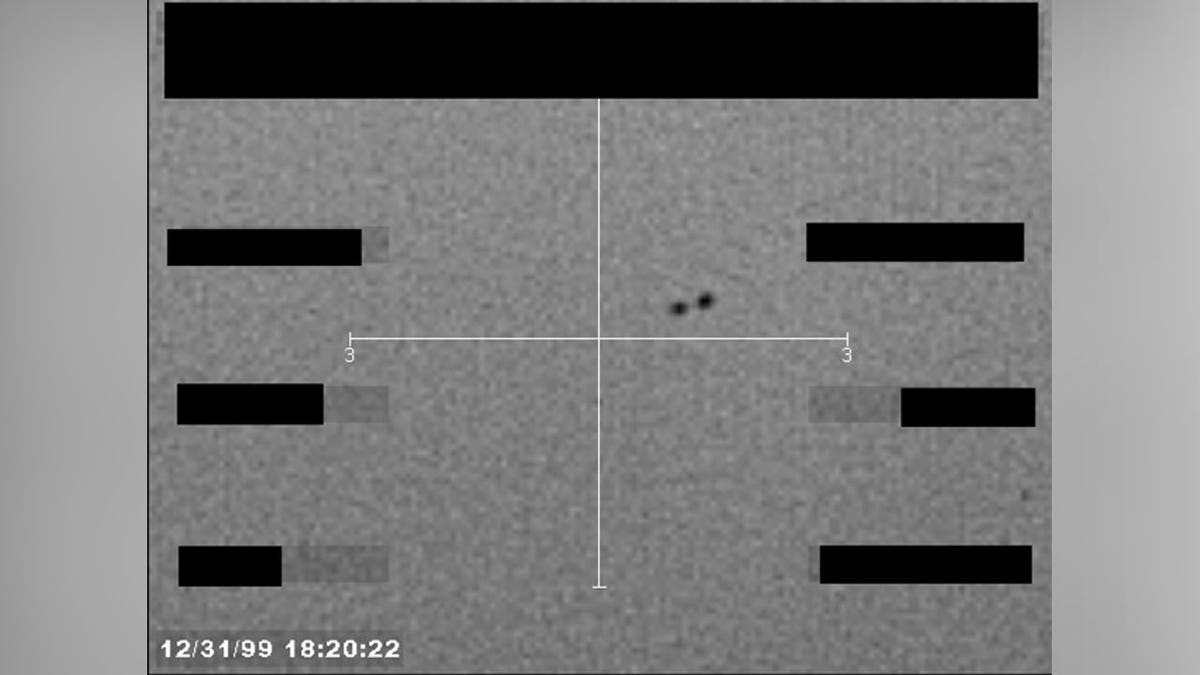
An FBI photo containing two black dots that appear to be UAPs
(Federal Bureau of Investigations)
Thousands of pages of NASA records, audio interviews and photos have been released as part of the Pentagon's disclosure rollout this year, but nothing to this point has provided definitive proof of life on other worlds.
Isaacman was appointed to run NASA just before Congress approved a new budget, supported by President Donald Trump, which focused on sending a manned mission to Mars by the end of the decade.
The NASA administrator, who is a self-made billionaire entrepreneur, accomplished pilot and civilian astronaut who went into orbit with SpaceX, added that UFOs have been a key focus behind NASA's renewed push to explore the solar system.
'I can't hate the subject. In fact, I'm incredibly fascinated about it because that is at the heart of what we're trying to do at NASA - answer the question, are we alone?'
Despite saying that the universe is likely teeming with life, Isaacman pushed back when asked if humans would therefore be 'invading' other worlds by continuing to explore space now and in the distant future.

This archival photograph depicts the lunar surface as viewed from the landing site of Apollo 12. This image features highlighted areas above the horizon in which unidentified phenomena are visible
'These [questions] will be revealed by generations long after we are gone, but, simply put, I do not believe it is our destiny to remain on one planet,' Isaacman declared.
The Daily Mail has reached out to NASA for comment on Administrator Isaacman's revelations.
The space agency has remained silent about multiple claims by former NASA employees, astronauts, and scientists who have all alleged that proof of extraterrestrial life was already found and then covered up by NASA.
This includes astronaut Edgar Mitchell, the sixth man to walk on the moon, who publicly claimed NASA missions saw unidentified craft that displayed speed and abilities far beyond anything humans had created.
In 2001, former NASA contractor Donna Hare alleged that photos containing what appeared to be legitimate UFOs were airbrushed to remove the craft before being released to the public.
The agency has also come under fire over the last year for its images of a mysterious interstellar object, known as 3i/ATLAS, which passed by Earth and several other planets.
Despite having satellites within close range of the object, which Harvard Professor Avi Loeb said showed clear signs of intelligent design, NASA only released a series of blurry images and declared they found no signs of life on the supposed comet.
Isaacman's interview did not address these decades-old claims, but it did address the conspiracy theory claiming the moon landing was fake.
The NASA boss said he understood why so many people remain skeptical, noting that the footage from 50 years ago looks old and low-quality, and younger generations are used to perfect high-definition video.
To fix this for good, he said the upcoming Artemis lunar missions will have high-definition cameras attached to every landing module and rover, sending back clear proof that humans have left the Earth.
EXCLUSIVE - Trump's bombshell UFO files expose eerie eight-point object and silent craft that breached US nuclear base
Dozens of newly declassified UFO records have been released by the Trump administration, shedding new light on unexplained sightings investigated by the US military and other government agencies.
The fourth tranche, published Friday on the Department of War's website, says 'it is time the American people see for themselves' as it adds dozens of documents, videos and photographs to the government's growing public archive.
Among the most striking additions are videos showing a mysterious eight-pointed object hovering over East Asia, a jellyfish-like UFO over the Atlantic Ocean and an unresolved case involving an oddly shaped craft zig-zagging across the western US.
The release also includes a Department of Energy report detailing how security teams at the Pantex nuclear weapons plant in Texas scrambled after radar detected a silent, diamond-shaped object drifting over the highly secured facility in 2015.
Officers said the craft flew just 100 to 200 feet above the ground with no visible means of propulsion before disappearing, prompting surveillance footage to be analyzed by Sandia National Laboratories and all evidence to be turned over to the FBI.
Also included is the influential COMETA Report, a study by retired French generals and defense experts that concludes the extraterrestrial hypothesis is the most plausible explanation for some of the world's most baffling UFO encounters.
The authors warned that the phenomenon should be treated as a national security issue and urged governments to prepare for the possibility that humanity is not alone.
The newly released records span decades of unexplained encounters, from military sightings and radar detections to cases that remain unresolved despite extensive investigations.

Above is a still from a video taken in 2020 over the Atlantic Ocean. Witnesses described it as 'darker, maroonish color, approximately 12-15 feet in height.' Some have likened it to the jellyfish UFO previously seen in Iraq

The fourth tranche, published Friday on the Department of War's website features a video of an eight-pointed object spotted flying over the Yellow Sea in East Asia in 2025

Pictured is a still from a video deemed an unresolved case involving an oddly shaped craft zig-zagging across the western US
Secretary of War Pete Hegseth said in a statement: 'The Department of War is in lockstep with President Trump to bring unprecedented transparency regarding our government's understanding of Unidentified Anomalous Phenomena (UAP).
'These files, hidden behind classifications, have long fueled justified speculation, and it's time the American people see it for themselves. This release of declassified documents demonstrates the Trump Administration's earnest commitment to unprecedented transparency.'
According to the Pentagon, there have been 'unprecedented levels of interest' in the UFO files, and the Department of War's website has received over 1.7 billion hits worldwide since its launch on May 8.
A second release took place two weeks later, followed by a third on June 12.
Footage of the eight-pointed object was submitted by the US Indo-Pacific Command, the military command responsible for operations across the Indo-Pacific region.
The 18-second video was captured from an infrared sensor aboard a US military platform in 2025.
It shows the mysterious object moving over the Yellow Sea, hovering in place at times.
'The sensor pans to track an area of contrast resembling a six-pointed star, keeping it generally centered within the center of the screen,' the video description states.

Pictured is the 'jellyfish' craft reported in Iraq in 2018
The clip, however, includes redactions, which the Department of War said were added to 'protect the identity of eyewitnesses, the location of government facilities, or potentially sensitive information about military sites not related to UFO.'
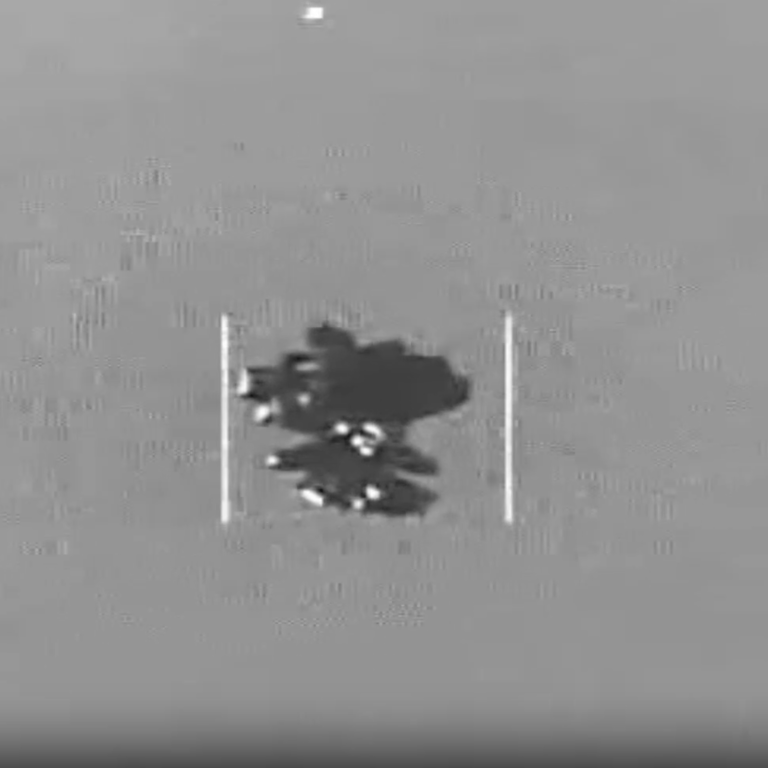
Another newly released file includes 32 seconds of infrared footage captured by a US military platform in 2020, showing a dark, jellyfish-like object drifting through the sky.
The sighting has drawn comparisons to the so-called 'jellyfish' UAP filmed over Iraq several years ago, though officials have not suggested the two incidents are connected.
According to a debrief submitted by US Northern Command to the All-domain Anomaly Resolution Office (AARO), witnesses described the object as a dark maroon color, measuring roughly 12 to 15 feet tall.
The report said it appeared to travel with the wind without changing direction or maneuvering and resembled a 'large, somewhat deformed balloon.'
The accompanying video shows the military sensor repeatedly zooming and panning to keep the object centered in frame.

The release also includes a Department of Energy report detailing how security teams at the Pantex nuclear weapons plant in Texas scrambled after radar detected a silent, diamond-shaped object drifting over the highly secured facility in 2015

Pictured is a page in the Department of Energy report, showing an enhanced view of the object spotted over the nuclear plan

According to the report, security personnel were dispatched after ground surveillance radar detected an unidentified object moving near the highly secured site, prompting officers to track it for several miles
The Department of War cautioned that the footage is being released for informational purposes only and does not represent an official conclusion about the object's identity or significance.
A video from the US Navy Unidentified Anomalous Phenomena Task Force (UAPTF), created to standardize the collection and reporting of military encounters with 'UFOs' and investigate potential threats to national security, was also included in Friday's tranche.
The two-minute and 57-second clip appears to have been taken by an infrared sensor aboard a US military platform in 1996 over an undisclosed location in the western US.
The craft, which appeared to be circular with a wing on each side, was soaring over a mountainous terrain as the military jet tracked it from behind.

The latest release also includes nearly two minutes of infrared footage captured by a US military platform in 2024 after the US Indo-Pacific Command reported an unidentified aerial phenomenon to the AARO

The video initially tracks a single area of contrast before zooming in, revealing what appears to be an elongated object
The video shows a dark, high-contrast object crossing the sensor's field of view between the 14- and 17-second marks, entering from the upper-right corner before exiting toward the lower left.
The remaining footage consists of repeated playback of the same sequence at normal and slower speeds, followed by a still frame captured from the initial pass.
One of the most detailed files centers on a September 2015 incident at the Pantex Plant in Texas, the nation's primary facility for assembling and dismantling nuclear weapons.
According to the report, security personnel were dispatched after ground surveillance radar detected an unidentified object moving near the highly secured site, prompting officers to track it for several miles.
Witnesses described the object as silent, diamond-shaped and lacking any visible means of propulsion before it disappeared beyond the facility's perimeter.
The report includes radar tracks, surveillance images and enhanced stills produced by Sandia National Laboratories as investigators sought to determine what had crossed the skies above the nuclear complex.
The latest release also includes nearly two minutes of infrared footage captured by a US military platform in 2024 after the US Indo-Pacific Command reported an unidentified aerial phenomenon to the AARO.
The video initially tracks a single area of contrast before zooming in, revealing what appears to be an elongated object.

The release also includes 10 seconds of infrared footage recorded by a US military platform in 2023 after US Central Command reported an unidentified aerial phenomenon to the Pentagon's AARO

One newly released document is a transcript from a secret 1949 meeting at Los Alamos, where military officials and some of America's top scientists gathered to investigate a wave of mysterious green fireballs reported over New Mexico
As the sensor magnifies the scene further, the object seems to split into a line of multiple bright points moving diagonally across the frame, with the military sensor continuing to follow the formation for about a minute as it gradually fades into the distance.
The release also includes 10 seconds of infrared footage recorded by a US military platform in 2023 after US Central Command reported an unidentified aerial phenomenon to the Pentagon's AARO.
Although brief, the video captures two mysterious objects streaking across the sensor's field of view in opposite directions.
A larger object enters from the lower right before disappearing off the top of the frame, while a second, smaller object drops into view from above and exits at the bottom just moments later.
One newly released document is a transcript from a secret 1949 meeting at Los Alamos, where military officials and some of America's top scientists gathered to investigate a wave of mysterious green fireballs reported over New Mexico.
The sightings, many reported near sensitive nuclear facilities, were unlike ordinary meteors, participants said, appearing to travel in nearly horizontal paths, maintaining a constant speed and producing an intense emerald glow while remaining eerily silent.
During the meeting, renowned astronomer Lincoln LaPaz argued the so-called 'green fireballs' did not fit the characteristics of conventional meteorites, prompting scientists to debate whether they represented an entirely new phenomenon or even a secret technology.
At one point, LaPaz revealed he had initially speculated the objects might be part of classified US military defensive operations around atomic bomb installations, only to be told the Air Force knew nothing about them, leaving the mystery unresolved
RELATED VIDEOS
EXCLUSIVE - I'm a priest and the Bible gives us proof of what UFOs really are... here's what Jesus told us
The belief that UFOs are demonic has gained traction among some Christians, but one priest argues the Bible tells a very different story.
Father Lee Taylor, who leads three churches in North Wales, told the Daily Mail that several passages of Scripture suggest the mysterious objects in our skies are better understood as non-human intelligence than demonic beings.
He pointed to Genesis' description of humanity as God's supreme creation on Earth, Ezekiel's vision of the 'wheel within a wheel,' and Jesus' statement in John 14:2 that 'in my Father's house are many rooms.'
Taylor said the Church should begin examining those passages now, arguing that Christians need to prepare theologically for the possibility of non-human intelligence before any official confirmation sparks confusion or fear.
He believes the discovery of intelligent life beyond Earth would not undermine Christianity, but instead expand humanity's understanding of God's creation.
'A bigger universe, or the discovery of a bigger universe, doesn't make God smaller,' Taylor, who has been ordained for 15 years, said. 'It just makes creation bigger.'
'I don't think it's a challenge to faith. I think it's a challenge to the limits of our theological imagination,' he added. 'I think a larger universe demands a larger theology.'
He also urged fellow Christians to reconsider the belief that UFOs are demonic, warning that it encourages people to respond with fear rather than to approach the phenomenon with an open mind.

Father Lee Taylor, who leads three churches in North Wales, told the Daily Mail that several passages of Scripture suggest the mysterious objects in our skies are better understood as non-human intelligence than demonic beings
While Taylor is sure the Bible holds clues to the truth about UFOs and extraterrestrial beings, the Pentagon and White House have maintained that there is no evidence that they have visited Earth.
The Vatican does not have a definitive doctrine on aliens, but officially embraces the scientific possibility of extraterrestrial life.
The idea that UFOs are demonic has also been promoted by Vice President JD Vance and conservative commentator Tucker Carlson, both of whom have publicly discussed the phenomenon through a Christian lens.
'I believe we're approaching the time when humanity really must learn to think of itself not merely as citizens of the Earth, but as participants in a much larger creation,' Taylor said.
Vance discussed the UFO phenomenon, saying he firmly believed that there were phenomena that humans simply cannot explain, but he was more open to other possibilities, such as a divine presence.
However, the vice president added that what he might view as an angel or demon might be interpreted as an extraterrestrial by others.
While speaking on the Joe Rogan Experience podcast in 2024, Carlson said: 'They're from here, and they've been here for thousands of years, whatever they are.'
'And it's pretty clear to me that they're "spiritual entities,"' he continued, 'whatever that means.'

Taylor said the Church should begin examining Bible passages now to prepare theologically for the possibility of non-human intelligence before any official confirmation sparks confusion or fear. Pictured is a still from a UFO video released by the White House
Taylor said: 'I don't think it's the most helpful framework for discussing an unknown phenomenon. It can encourage people to project fear or certainty onto something we don't yet understand.'
He argued that, if intelligent life exists beyond Earth, 'there's no reason to assume that every other form of intelligence would fit neatly into categories of absolute good or absolute evil.' Instead, he believes such beings would likely reflect the same diversity already found among humanity.
One of the film's central characters, a former nun named Jane, fears that confirmation of extraterrestrial life could shatter the foundations of her faith.
She worries that disclosure could force believers to question everything they know about God, Jesus and the Bible.
However, another nun highlights a verse in Genesis that Taylor said could point to the existence of extraterrestrials.
Taylor said the movie points to Genesis' narrative that humanity is God's supreme creation on Earth.

The priest also pointed to the Book of Ezekiel, in which the prophet describes a mysterious vision of 'a wheel within a wheel' descending from the sky
So then that asks a profound question: Why would God create such a vast universe if it was intended only for us?' he added.
He argued that the repeated emphasis on Earth leaves open the possibility that God may have created intelligent life elsewhere in the universe, meaning humans could be God's supreme creation without being His only intelligent creation.
Taylor said that interpretation should encourage Christians to think more broadly about creation rather than view the possibility of extraterrestrial life as a threat to their faith.
The priest also pointed to the Book of Ezekiel, in which the prophet describes a mysterious vision of 'a wheel within a wheel' descending from the sky.
While mainstream biblical scholars interpret the passage as a symbolic vision of God's glory, Taylor said some people believe it could instead describe an encounter with advanced non-human technology that ancient writers lacked the language to explain.
Finally, Taylor cited John 14:2, in which Jesus tells his disciples, 'In my Father's house are many rooms,' or 'many mansions' in some translations.
While the verse is traditionally understood as referring to heaven, Taylor believes it could also hint at a far larger and more complex creation than humanity has yet discovered, one that may include other forms of intelligent life.
'When Jesus talks about "many rooms" or "many mansions," using language that people at the time would have understood, I wonder if this is some sort of hint? Could we view it that way?' the priest questioned
Pentagon releases 4th group of UFO files with 40 more videos and documents
NASA chief confirms capture of UFO imagery, says ‘We don’t know what it is’
The truth might not just be out there; it might already be in NASA’s hands. In a shocking revelation, NASA administrator Jared Isaacman has confirmed that the agency has captured imagery of mysterious objects in space that defy explanation. And while he stopped short of calling them alien spacecraft, his message was clear that the universe may be teeming with life.
Speaking on a podcast with Jack Gordan, Isaacman dropped a bombshell that is already sparking global curiosity. “We have captured imagery, and this is what President Trump is very forward-leaning about, that based on the data that we have within that imagery, we don't know what it is,” he said. The admission marks one of the most direct acknowledgments yet from NASA that it possesses visuals of unidentified objects that cannot be easily dismissed as comets or natural phenomena.
The comments arrive amid a broader push for transparency, driven in part by Donald Trump’s directive to release UFO-related files. Thousands of documents and images have since surfaced, but none have definitively proven alien life.
While Isaacman avoided declaring the imagery as alien proof, his outlook on the cosmos is far from cautious. “I think there's a very real possibility we're going to arrive at a conclusion in our lifetime that perhaps there's life everywhere out there and that it isn't as infrequent as we might think it to possibly be,” he said.
Ironically, NASA’s strongest evidence may not be orbiting Earth at all, but sitting on Mars. “We got samples on Mars right now. If we bring them back, there is a very high probability that they will point to, at some point, microbial life at least on Mars,” Isaacman revealed. Those samples were collected by the Perseverance rover, though budget constraints have stalled plans to bring them back to Earth. If retrieved, they could provide the first concrete evidence of extraterrestrial life, albeit microscopic.
Despite the intrigue, Isaacman firmly dismissed one of the most persistent conspiracy theories, that governments are hiding crashed UFOs or alien remains. NASA, like the Pentagon and the White House, maintains there is no such evidence. Still, whispers refuse to die, late astronaut Edgar Mitchell once claimed encounters with advanced unidentified craft, while former contractor Donna Hare alleged that UFOs were edited out of official images. Adding fuel to the fire, Harvard astrophysicist Avi Loeb has argued that certain interstellar objects may show signs of intelligent design, a claim NASA has consistently downplayed.
For Isaacman, the fascination with UFOs isn’t fringe, it is fundamental: “I can't hate the subject. In fact, I'm incredibly fascinated by it because that is at the heart of what we're trying to do at NASA - answer the question, are we alone?” That mission is set to intensify with upcoming lunar expeditions under the Artemis program, which promise high-definition footage to counter skepticism, even about the original moon landing.
Isaacman also pushed back against fears that humanity is “invading” space, insisting exploration is part of our destiny. “I do not believe it is our destiny to remain on one planet,” he declared. For now, NASA has not issued further official clarification, leaving the public to grapple with the tantalizing possibility that the answers we’ve been chasing for decades may already exist, just waiting to be understood.
ALSO READ
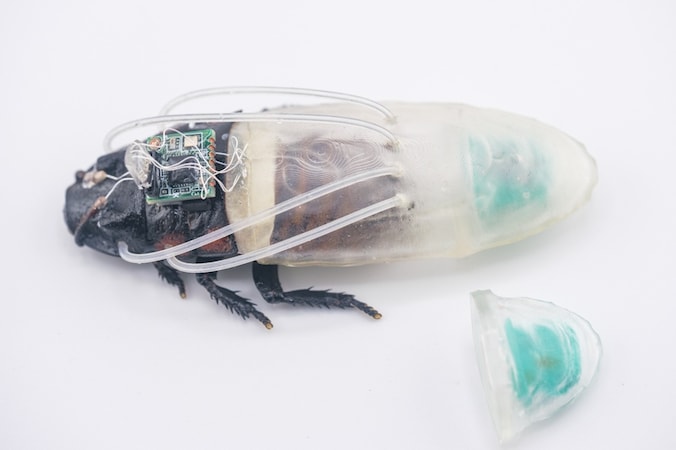
KIJK. Cyborg-kakkerlak krijgt nu ook duikpak en kan zo drie uur onder water overlevenAlsof vanop afstand bestuurde cyborg-kakkerlakken nog niet vreemd genoeg klinken, kregen de insecten nu ook een duikpak. Dankzij het 3D-geprinte ‘rugzakje’ kunnen de insecten tot drie uur onder water overleven. De uitvinding moet in de toekomst helpen bij zoek- en reddingsoperaties in overstroomde rampgebieden.
De technologie bouwt voort op meer dan tien jaar onderzoek naar cyborg-insecten aan de Nanyang Technological University (NTU) Singapore, waar onderzoekers nu samenwerken met collega's van de Waseda University in Tokio.
Via een minicomputertje op de rug van de kakkerlak kunnen onderzoekers ze vanop afstand besturen. In tegenstelling tot kleine robots hebben de insecten geen zware batterijen of motoren nodig. Ze gebruiken hun eigen spieren om zich voort te bewegen, waardoor ze energiezuiniger en wendbaarder zijn. En dat kan nu dus ook in het water.
Het hele nieuwe duiksysteem is amper 10 bij 10 millimeter groot en werd 3D-geprint uit een licht kunststofmateriaal. Het bestaat uit een flexibele waterdichte behuizing met een kleine zuurstofgenerator en vier siliconenslangetjes. Die zijn verbonden met de ademhalingsopeningen van de kakkerlak. De zuurstof ontstaat doordat verdund waterstofperoxide wordt toegevoegd aan een sponsje met mangaandioxide.
De technologie werd getest op de sissende kakkerlak, een soort uit Madagaskar die groot en sterk is. In nagebootste rampomgevingen, zoals overstroomde tunnels met weinig zuurstof, konden de insecten zich tot drie uur onder water voortbewegen. Zonder het duikpakje zouden ze slechts enkele minuten overleven.
Volgens de wetenschappers opent dat nieuwe mogelijkheden voor zoek- en reddingsacties na overstromingen en aardbevingen. “Reddingswerkers kunnen vaak niet in smalle, overstroomde ruimtes komen”, zegt professor Hirotaka Sato van NTU Singapore. “Deze insecten kunnen zich wel door puin, leidingen en nauwe doorgangen bewegen.” Zo werden de insecten volgens de onderzoekers al ingezet bij reddingsoperaties na de zware aardbeving in Myanmar in 2025.


De vorsers willen het systeem verder verbeteren en combineren met sensoren en navigatietechnologie. Ook andere insectensoorten, zoals sprinkhanen en kevers, zouden mogelijk uitgerust kunnen worden met gelijkaardige technologie.
Volgens de onderzoekers werden de insecten niet verwond en verliepen alle experimenten volgens de geldende richtlijnen. Ze publiceerden hun studie in het wetenschappelijke tijdschrift Nature Communications.

A & C: Cyborg-kakkerlakken onder water. B: Grafische uitleg van de werking van het duikpak.
Beeld: NTU Singapore and Waseda University.
Hommels kunnen geavanceerde problemen oplossen en dit is het fascinerend bewijs
Robot kan dagenlang doorwerken, maar mens blijkt nét sneller
Dit gebeurt als je licht in wc vergeet te doven in Thailand
Een inwoner van het Thaise Phitsanulok maakte twee flaters die hij nooit meer zal herhalen. Het resultaat is een badkamer die krioelt van de insecten en ze maken een oorverdovend geluid..
Trump UFO disclosure: Inside the July 8, 2026 speech rumour—and what aerospace can verify
BREAKING | Trump to Give UFO Disclosure Speech Today | Controversy Surrounds Event
By Sophie Marceau

Today, President Donald Trump is set to deliver a highly anticipated speech regarding UFO disclosures, drawing a mix of skepticism and intrigue from the public. Critics have raised concerns about the credibility of the president and his past statements on related matters.
Many people have made their opinions known in forums, expressing discontent and disbelief about the forthcoming discourse. Comments reveal a significant sentiment against the president, with remarks such as:
"The guy hasn’t got a clue what he is talking about most of the time," one person noted.
This reflects a growing frustration among those who question the authenticity of the information to be presented.
On the other hand, some seem to rationalize the forthcoming speech. A user commented, "He often questions these UFO people," suggesting that despite the controversies, there may be some semblance of critical discourse in his approach.
The president's political alignment with certain UFO enthusiasts raises eyebrows. Some forums assert that many figures in this field are politically aligned with Trump. This suggests a potential agenda behind the disclosures, as users speculate on the intentions of the event. A critical comment states, "It’s remarkable how seemingly most UFO entertainers are Trump-aligned politically."
With the speech approaching, the discourse seems to shift toward skepticism regarding Trump's ability to deliver coherent statements. Comments indicate a history of mixed-up terms and confusion, as one remark pointed out:
"He has just accidentally called Iran Japan"
This unintentional humor highlights the uncertainty around the validity of the information set to be disclosed today.
Public skepticism dominates the conversation, with many questioning Trump's credibility.
Political alignment suggests potential biases in the UFO discourse community.
Several users express past confusion regarding Trump's statements, anticipating errors in today's speech.
As anticipation builds, many question whether this speech is genuine disclosure or just another spectacle. With Trump's delivery and the public’s divided sentiments, today's events promise to be eventful.
As the clock ticks down to President Trump's highly anticipated UFO disclosure speech, there’s a solid chance that public reaction will remain mixed. Many people in forums are likely to criticize his presentation style, as past comments suggest a tendency for verbal mix-ups, leading to continued skepticism about the information shared. Experts estimate around 60% of the audience will view the speech as a spectacle rather than an authentic attempt at transparency. Conversely, about 25% may rally around Trump, embracing any revelations as part of an unfolding narrative. If he introduces new details about UFOs, it might fuel conspiracy theories, while further inflating his supporters’ loyalty.
This situation bears resemblance to the Great Moon Hoax of 1835, where a New York newspaper published sensational stories about life on the moon, capturing the public's imagination. While the reports were proven false, they ignited discussions about exploration and the frontiers of science. Similarly, President Trump's speech may spark conversations about governmental secrecy and people's trust in authority, regardless of its factual basis. Just as the Moon Hoax drew diverse reactions—skepticism and excitement—today's address could reshape conversations about UFOs and what lies beyond our understanding.
{ https://mysterylores.com/categories/exploring-conspiracy-theories/alien-conspiracies/ }
How Jellyfish Can ‘Miraculously’ Heal Without Scars Has Long Remained a Mystery—Scientists Now Know Their Secret

A jellyfish can close a wound in real time, without stitches, scabs, or scars, a fascinating—and borderline miraculous—healing ability that has long perplexed scientists.
Now, a new study in Molecular Biology of the Cell has finally revealed the secrets behind this process, identifying two cellular structures that act in a specific sequence.
Jocelyn Malamy, an associate professor at the University of Chicago, first observed this process a decade ago at the Marine Biological Laboratory. Using transparent, dime-sized jellyfish called Clytia hemisphaerica, she watched individual cells move toward each other to close a gap in the tissue.
Now, with colleagues Maxwell Sassaman and Manjula P. Mony, she has mapped the steps of this process and explored its broader significance.
The free-swimming medusa most people picture when they hear “jellyfish” is only one phase of Clytia‘s life. It spends most of its life as a polyp colony attached to rocks, docks, or leaves, and it periodically produces medusae, much like a shrub produces flowers. While medusae live for only a few months, the polyp colonies can persist for much longer.
Clytia medusae are known for their ability to heal quickly. Small wounds close in minutes, and even larger injuries seal in under an hour, all without forming scar tissue. Malamy notes that this type of healing is similar to the scar-free repair seen in embryos.
Since Clytia are transparent, heal rapidly, and lack the immune-mediated inflammation that complicates wound healing in mammals, they serve as an excellent model organism. Scientists can watch epithelial cells close wounds in real time, without interference from scarring or immune reactions. The mechanisms uncovered in Clytia are likely relevant across many animals.
“A lot of the processes that we see in Clytia‘s wound healing are really similar to what you see in all other systems, including mammalian systems,” Malamy explains. “When you’re staring at these epithelial cells, you wouldn’t know this was a jellyfish.”
Epithelial cells form the surfaces of the body, including skin, the gut, and internal membranes, and must repair themselves after injury. Malamy previously described Clytia’s wound repair in 2017 and 2018. The new study addresses a longstanding question in epithelial wound healing: do wounds close by cells moving over the gap, or by an actin cable contracting to seal it? The findings show that both mechanisms operate in a specific sequence, with the basement membrane beneath the cells coordinating the transition between them.
The initial response involves lamellipodia, actin-rich extensions that move across the basement membrane, the protein layer beneath all epithelial tissues. These structures pull their parent cells forward to close the wound. Malamy’s team observed lamellipodia forming even in very small wounds within a single cell, a previously undocumented detail.
After the lamellipodia advance, an actomyosin cable forms and contracts after it covers the basement membrane. If damage or debris blocks the membrane, the cable closes the wound and removes debris that lamellipodia cannot cross.
For larger wounds, a third response occurs. When the gap is too wide for lamellipodia to bridge, regardless of how far the cells extend, the entire epithelial sheet lifts and migrates as a unit. Once lamellipodia from opposing edges meet, the same closing sequence resumes.
“This is a truly elegant mechanism where the system can rapidly adapt to heal all the kinds of wounds that might occur in nature,” Malamy says.
If epithelial repair mechanisms are conserved across animal evolution, as current evidence suggests, studies of jellyfish could reveal wound-healing processes that inflammation and scar formation obscure in mammals, making those processes difficult to observe directly.
Mysterious “Space Dust” Falling on Earth May Originate from Unidentified Objects Lurking Near Our Planet, New Study Finds

Every year, more than 5,000 tons of material with cosmic origins lands on Earth’s surface, with as much as 15,000 tons of this “space dust” making its way into the atmosphere but vaporizing during reentry.
The resulting rain of micrometeorites that reaches our planet consists mostly of tiny objects anywhere from 30 to 200 micrometers in size, based on past studies. But what are the origins of these large volumes of material that accumulate over time as they shower the Earth throughout the year?
According to new research, evidence for one potential source of this cosmic debris has now been found: it could be coming from unidentified near-Earth objects.
The problem with tracing the origins of space dust is that most of it that makes its way into Earth’s atmosphere doesn’t survive the intense conditions of atmospheric entry, and those tiny bits that do—known as cosmic spherules—are reshaped as they melt from the friction they encounter while falling.
Although their original mineral structure is compromised as well as their shape, there are a few isotopes—namely oxygen—that these spherules maintain that scientists can use to help trace their origins. Based on their chemical “fingerprints,” cosmic spherules are placed into different groups by planetary scientists, with many being able to be traced back to known varieties of meteorites and other sources.

Image obtained using an electron microscope of space dust possibly originating from a comet (Image Credit: NASA)
Among these groups, around ten percent fall into a category possessing unusually small quantities of the isotope oxygen-16. This category, known as Group 4, doesn’t appear to match any known meteorite group—the implication, therefore, is that some of this cosmic debris may originate from an unidentified variety of near-Earth objects.
Now, according to new research by Matthias Van Ginneken and colleagues, there are at least some ways that the origins of these spherules can be determined, one of which involves their orbital parameters.
In one case, the team writes in a recent study published in Science Advances, “the mineralogical and textural properties of a subset of cosmic spherules do provide information on the orbital parameters of their precursors, including eccentricity and encounter velocity.”
This group of materials, which is dubbed “CumPo” based on its material consistency of cumulate olivine porphyritic, is “characterized by clustered olivine phenocrysts that increase in size from one side of the spherule to the other,” the team writes.

Oxygen three-isotope plot of SCumPo cosmic spherules.
Credit: Science Advances (2026).
DOI: 10.1126/sciadv.aed6340
In short, this unique class of spherules points to equally unique orbital characteristics that may be associated with what the research team surmises could be atypical types of near-Earth objects, or NEOs, that could be near enough to our planet to provide a likely source.
A particular clue offered by these objects is that some of them may have undergone unusually high entry speeds, as evidenced by their surface texture. One factor that could potentially account for this is that they may have entered Earth’s atmosphere at angles consistent with objects possessing high orbital eccentricity.
As with past studies, researchers were able to retrieve several samples of these CumPo cosmic spherules from Antarctica, which provides a pristine environment that helps to facilitate their discovery and collection. However, another source location had been far less remote: urban rooftops, where a large amount of cosmic dust lands every year.
With the aid of electron microscopy and microprobe chemistry studies, Ginneken and colleagues examined the mineralogy, chemistry, and textures of these spherules, as well as the oxygen isotopes they contained.
What they found indicated an entirely new subset of spherules, which possess significant amounts of cumulate olivine rich in sulfur, garnering the name “SCumPo.” This unique new class of samples has links to the “Group 4” class and their minimal inclusion of oxygen-16. Other unusual similarities they possess are an overall absence of magnetite and a low presence of nickel in their olivine crystals, paired with an abundance of iron-nickel sulfur and a significant amount of sulfur present within glasses produced from vitrification.
Intriguingly, some spherules appeared to show a combination of signatures that were both poor in oxygen-16 in some areas, while rich in the isotope in others. This suggests that these cosmic materials had likely been mixed from two separate original sources, since such conditions could not be otherwise explained through natural processes.
“We interpret this as strong evidence that the SCumPo precursors were composite materials containing at least two different components,” the team writes in their study. Then, by running numerical simulations of crystal settling to help determine the likely entry speeds of these materials, and thereby their eccentricities while in orbit, the team determined that the settling of olivine is most consistent with entry speeds of as much as 17 kilometers per second, and likely no more than 14 kilometers per second—speeds that would be consistent with NEOs, as opposed to asteroids originating from the main-belt.
Based on their findings, the team believes that unsampled meteorites from the CM, CO, and CY classifications of carbonaceous chondrites—a group of primitive, carbon-rich meteorites containing some of the oldest materials in our Solar System—are the likely sources for these cosmic materials.
“Given that we have linked their composition to the CM-CO-CY clan of carbonaceous chondrites, it is plausible that their parent body was a primitive carbonaceous asteroid that migrated onto an Earth-crossing orbit—attaining comet-like orbital parameters,” the team writes.
“For instance, one might consider the disrupted fragments of a thermally altered but water-bearing asteroid (like the CY group) that evolved into near-Earth space,” they add.
Although still only inferred from their studies, the team suggests the existence of a hypothetical new variety of NEOs based on the samples they studied, which are unlike any variety of meteorites currently known on Earth.
How to track the smallest pieces of space debris in Earth’s orbit
Scientists have managed to track record-small pieces of “space debris” in the space around Earth. Their diameter is only 5 cm. Now they are considering how many such objects may actually exist in the space around us and what this could lead to.
Space debris around Earth.
Source: Phys.org
In a new study published in the Journal of the Astronautical Sciences, scientists from the University of Warwick led an international team that detected some of the faintest debris ever observed in geosynchronous orbit, finding fragments as small as 5 centimeters, or 2 inches, and obtaining valuable data to characterize their behavior. This was reported by phys.org.
“Space debris fragments can move very quickly relative to one another — at speeds of up to several kilometers per second,” explained the study’s lead author, Dr. James Blake, a research fellow at the University of Warwick’s Centre for Space Domain Awareness. “The energy involved is extremely high, and even small debris can cause significant damage to very expensive satellites, so even small objects matter a great deal.”
“Space debris in geosynchronous orbit is a potential minefield,” added co-author of the paper and space consultant Dr. Stuart Eves of SJE Space Ltd. “No sensible person would enter a terrestrial minefield without a mine detector. Likewise, no sensible person should launch a satellite into geosynchronous orbit without a proper survey for space debris.”

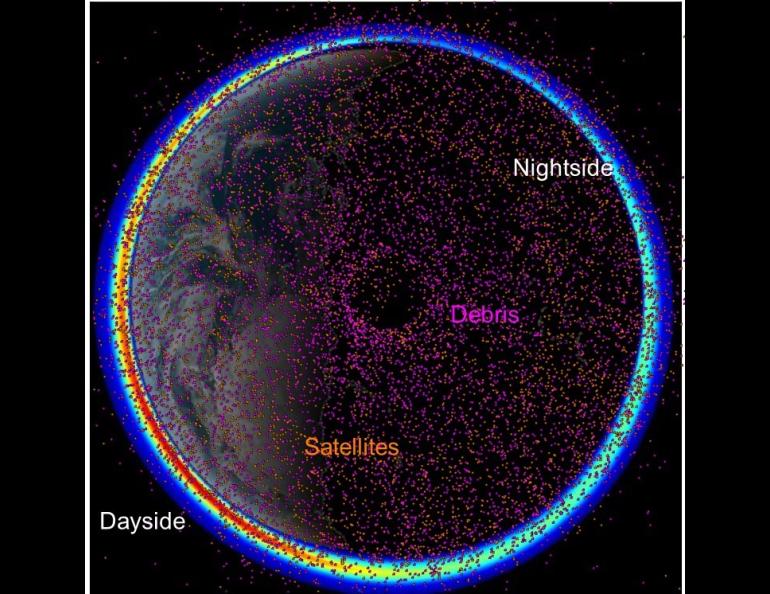
This image, with Earth’s north polar region at center, shows satellites (orange dots) and space debris (pink dots) in orbit through the ionosphere on July 22, 2024. Ionosphere model data were provided by Joseph Huba of Syntek Technologies in Virginia. Image courtesy of Paul Bernhardt
Studies of space debris in geostationary orbit, or GEO, usually focus on the region around the main orbit in order to search for drifting abandoned satellites and uncontrolled fragments. The team of scientists reanalyzed an archival dataset from a previous GEO space-debris survey carried out with the 2.54-meter, or 8.3-foot, Isaac Newton Telescope, or INT, on the island of La Palma in the Canary Islands.
By applying newly developed image-processing algorithms, the team was able to detect very faint objects, including some of the faintest debris ever found, and characterize their behavior by analyzing light curves. They found that many of the objects are tumbling in space.
To find these faint objects, the team used a “blind stacking” technique, which revealed 25 objects that had not been noticed during the original analysis. As Dr. Ben Cook, a research fellow at the University of Warwick, explains: “Blind stacking is a very powerful technique for pushing the sensitivity limit of astronomical datasets. It involves testing many potential trajectories in a sequence of images along which hidden objects may be moving, and stacking the images to bring those objects above the noise level. This project demonstrates a successful practical application of the method — any dataset containing objects moving linearly is suitable for its use.”

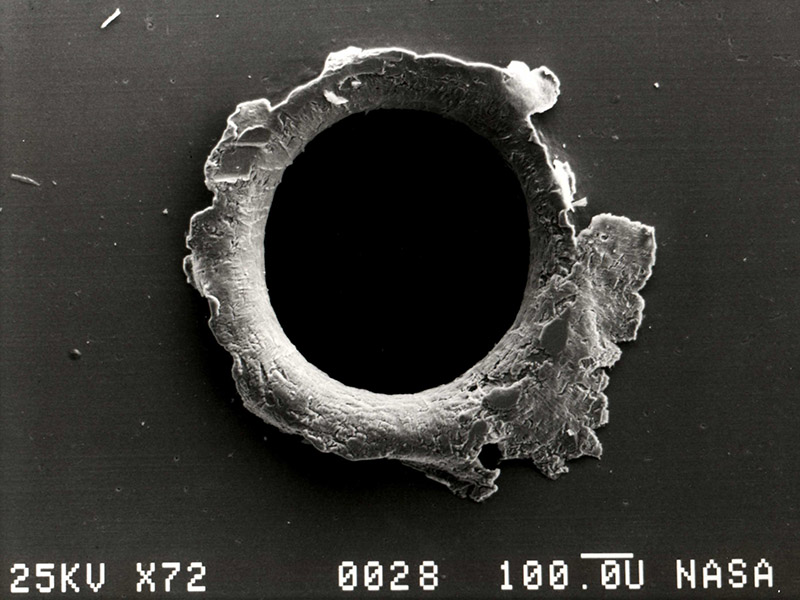
A piece of space junk punched this hole into the hull of NASA’s Solar Max spacecraft.
Photo credit: NASA Orbital Debris Program Office.
Taking the new discoveries into account, almost 80% of the faint objects detected in this study had not previously been documented, meaning they do not appear in publicly available catalogs. This highlights the need for scientifically grounded surveys. The team now plans to expand the scope of its search using observational data from other telescopes around the world.
Professor Will Felin, senior principal scientist at the Defence Science and Technology Laboratory in the United Kingdom, said: “After carrying out the initial study, the team sought to expand its geographic coverage. This was achieved by using large telescopes in Australia and Japan in cooperation with the Australian National University and the Japan Aerospace Exploration Agency, or JAXA, which contributed their considerable technical expertise to the project. This truly underscores the importance of multinational cooperation in addressing global problems such as space-domain monitoring, as well as the benefits of using the United Kingdom’s world-class academic expertise for the benefit of UK defense.”
The researchers conclude that the number of orbital slots in the geostationary belt is limited, so it is important to know how much debris is there, how it behaves, and what risks it poses to operational satellites. Studies of faint debris help build a clearer picture of the situation.

A computer-generated image of trackable objects in low Earth orbit. Each dot represents an object, and around 95% of them are debris. The trackable objects are already beginning to form a cloud of debris around Earth, but there are millions of smaller pieces that can’t be tracked from the ground.
Photo credit: NASA Orbital Debris Program Office
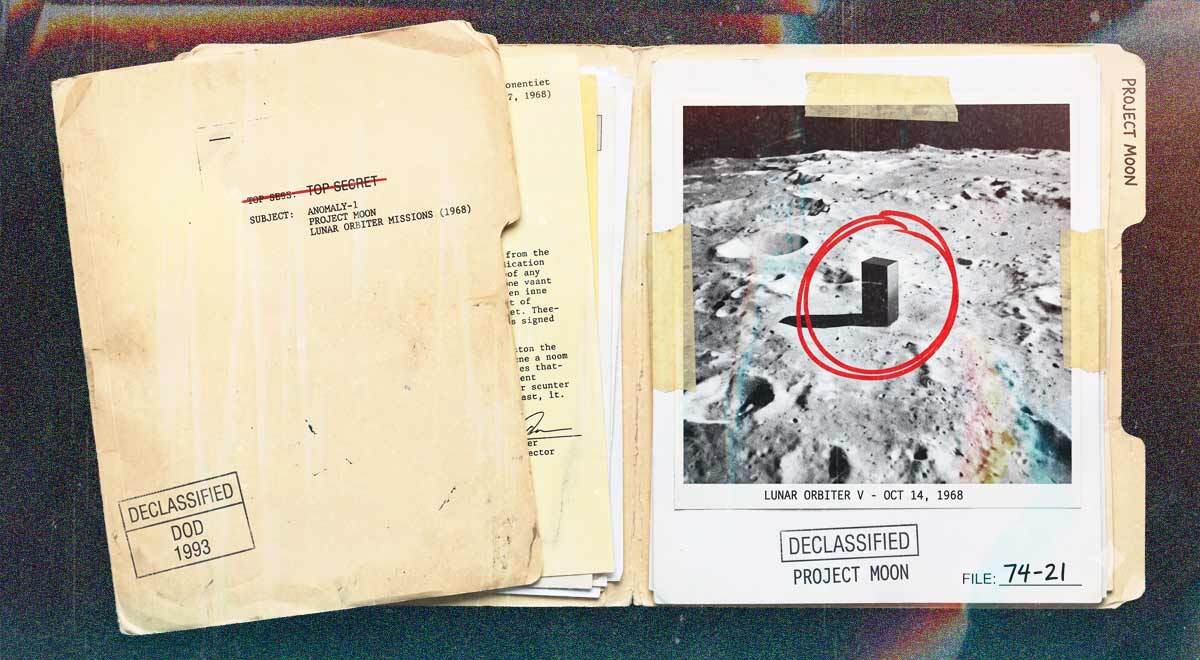
Moon monoliths are Luis Elizondo's latest UFO bombshell
A giant leap of the imagination?

A moon monolith structure (artist's impression)
Image by Cybernews.
Key Takeaways by nexos.ai, reviewed by Cybernews staff.
By “monolithic,” Elizondo means an artificial construct of a single block that "appears to be" artificial.
The interview expanded into various military encounters with green, red, and blue orbs, largely recounting cases reported to the Pentagon's former Advanced Aerospace Threat Identification Program (AATIP).
Elizondo claims the orbs could be surveillance systems, or even weapons, explaining that they may be autonomous reconnaissance or collection platforms.
He also broadly suggested that this kind of orb-sighting had been going on globally for decades.
Elizondo’s moon claim dominated the interview because it suggests the presence of artificial-looking structures, which hasn’t been a typical feature of recent UFO whistleblower evidence.
This focus shifts from blurry UAP footage to alleged unreleased government photographs, and time will tell whether Elizondo is accurate in his claims.
Regarding the orbs he spoke of, Elizondo seemed deliberately cautious in his wording throughout, using "appears to be" rather than definitive proof.
“Our CIA, our DIA, our NSA have all concluded that these things are very real and in some cases may pose a potential threat."
These broad theories about surveillance platforms and humanity's limited understanding of reality caused commotion in the UFO community.
A so-called UFO whistleblower for nine years now, following his resignation as a US Army counterintelligence special agent due to excessive secrecy in the Pentagon's concealment of evidence, Elizondo accrued credibility as a leading spokesperson against the very program he worked on.
He also plays a vital role in raising the heat on President Donald Trump by underscoring the importance of national security in the UAP context and the fateful dangers that whistleblowers face.
The Cybernews community is talking about this. Be a part of the conversation.
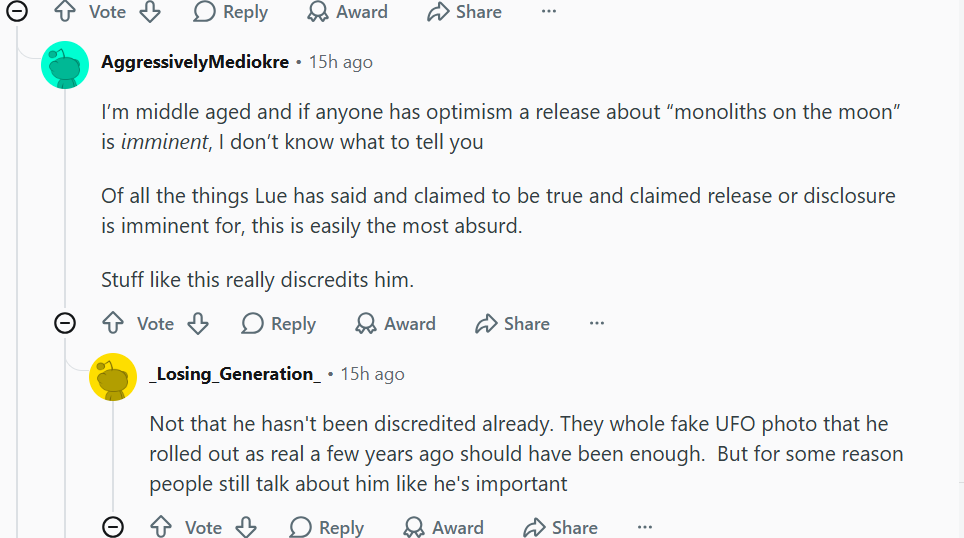
But with talks on monolithic structures, the Reddit UFO community was quite aghast.
“This is easily the most absurd [claim],” one user said, before adding that it was “stuff that really discredits him.

Another UFO follower posted, “It’s always an announcement about an announcement,” before requesting, “Just release a photo and be done with it.”

Previously, Elizondo has spoken of a secret government program that possesses retrieved alien craft, citing that UAPs can disable nuclear missiles, as well as physically radiate troops. His esoteric style divides opinion in the community as not everyone is comfortable in stomaching some of his more wild claims.
Huge UFO cloaked becomes visible as "hole" in low cloud ceiling seen across Australia, July 8, 2026, UAP Sighting News.

Bob Lazar and Travis Walton Compare Their Most Controversial UFO Experiences

When two of the most recognizable names in UFO history sit down together, the result is almost guaranteed to spark debate. Bob Lazar and Travis Walton have spent decades at the center of one of the world’s most controversial subjects, yet their experiences could hardly be more different. One claims to have worked on reverse-engineered extraterrestrial technology inside a secret government facility, while the other became famous after reporting an alleged alien abduction that remains one of the most discussed cases in UFO literature.

In this fascinating conversation, the pair examine old sketches, documents, artistic recreations, and personal memories, searching for similarities between their experiences rather than trying to convince skeptics. Instead of making dramatic new claims, much of the interview revolves around surprisingly detailed observations and thoughtful questions.
Bob Lazar’s story has largely focused on technology. He describes studying an advanced craft at a classified site commonly associated with Area 51, paying particular attention to propulsion systems, unusual materials, and engineering concepts that appeared to defy modern physics.
Travis Walton’s account, on the other hand, centers on an intensely personal experience. According to Walton, he regained consciousness inside an unfamiliar craft after a mysterious incident in the Arizona forest in 1975. His recollections involve strange beings, unusual medical procedures, unfamiliar rooms, and overwhelming confusion rather than scientific investigation.
Although both men have spent years defending their accounts, the interview is notable because neither attempts to dominate the discussion. Instead, each listens carefully to the other’s memories, comparing specific details.
One of the most interesting parts of the discussion focuses on the appearance of the alleged craft.
Walton recalls a smooth metallic object with a polished chrome-like exterior that reflected its surroundings. Because he only viewed part of the object while under extreme stress, he openly admits he cannot be certain of its complete shape. It may have been disc-shaped, elongated, or something entirely different.
Lazar notes that public perception has long associated UFOs with flying saucers, but he argues that reports now include many different designs, including the now-famous “Tic Tac” shaped objects reported by military personnel.
Rather than insisting on identical descriptions, both acknowledge that reported UFO shapes vary significantly, leaving open several possibilities. Different civilizations, evolving technologies, or simply incomplete eyewitness observations could all explain the differences.
Technology remains Lazar’s strongest area of interest.
During the conversation, he repeatedly returns to questions about lighting, propulsion, energy emissions, and interior design. Walton remembers soft yellowish illumination that did not appear to come from conventional light fixtures. He also describes unusual vibrations that he could feel throughout his body, including extremely low-frequency sounds and higher-frequency sensations that seemed almost physical rather than audible.
One particularly intriguing memory involves a chair surrounded by what appeared to be a moving star field. Walton claims the stars only became visible while he was near or sitting in the chair. Instead of appearing on a screen, the star pattern seemed to surround him completely, reacting to movement while maintaining the relative position of the stars themselves.
Lazar immediately questions whether this represented a navigation system, a real-time external view, or some type of astronomical map. Walton admits he was too frightened to investigate carefully, focusing instead on finding an escape.
Another significant portion of the interview explores the appearance of the entities Walton says he encountered.
Unlike the stereotypical “black-eyed alien” often portrayed in popular culture, Walton describes beings with visible pupils and facial features. He speculates that their unusually large eyes may have required some form of biological or artificial protection against brighter light, almost like built-in contact lenses or protective filters.
The conversation also explores an unusual aspect of Walton’s account: after encountering smaller beings, he later reported meeting individuals who appeared almost completely human.
Walton suggests these human-like figures may have been deliberately introduced because the earlier entities had failed to calm him. Whether they represented another species, genetically engineered beings, or something else entirely remains unanswered.
Lazar finds this especially interesting, noting that the presence of multiple types of beings raises more questions than answers.
One of the more philosophical moments comes when the discussion turns to communication.
Walton reports that the entities never appeared to speak verbally and showed little facial expression. Lazar proposes an intriguing possibility: if a civilization relied primarily on telepathic communication, facial expressions might become largely unnecessary over thousands or even millions of years of evolution.
While entirely speculative, the idea demonstrates how both men often attempt to explain extraordinary claims through logical reasoning rather than sensational storytelling.
The interview also includes the discovery of documents describing historical UFO encounters that allegedly share similarities with Walton’s experience.
Neither Lazar nor Walton claims expertise on every reported abduction case. In fact, both openly admit they have not extensively studied much of UFO history.
Instead of presenting these historical reports as proof, they simply acknowledge recurring themes that appear across decades of eyewitness accounts, including descriptions of small humanoid beings, unusual interiors, bright lighting, and unexplained medical examinations.
Whether these similarities indicate genuine patterns or simply reflect common cultural influences remains one of the central questions surrounding UFO research.
Despite the extraordinary subject matter, the interview is remarkably calm.
Lazar frequently asks practical questions about engineering details, while Walton consistently admits the limitations of his memory. He repeatedly explains that fear prevented him from carefully observing many aspects of the environment, an admission that adds nuance rather than certainty to his account.
Neither man claims to possess definitive answers about extraterrestrial life. Instead, the conversation highlights how much remains unknown, even to individuals whose stories have become deeply embedded in UFO history.
Whether readers believe their accounts or remain highly skeptical, the interview offers an unusual opportunity to compare two of the most famous UFO witnesses directly.
Rather than focusing on conspiracy theories or dramatic revelations, the discussion examines memory, perception, technology, and recurring patterns found across decades of reported encounters. It serves as a reminder that the UFO phenomenon continues to generate questions that span psychology, aerospace engineering, government secrecy, and the possibility of intelligent life beyond Earth.
For believers, the conversation reinforces long-held narratives about advanced technology and unexplained encounters. For skeptics, it provides valuable insight into how extraordinary eyewitness accounts are remembered, interpreted, and discussed many years after the original events.
Regardless of where one stands, the exchange between Bob Lazar and Travis Walton remains one of the more thoughtful and detailed conversations ever recorded between two individuals whose stories continue to shape the modern UFO debate.
Secret CIA 'workbook' claims simple five-step exercise can supercharge the human body
A 'workbook' created by a secret US Army program claimed to have developed a simple five-step method of supercharging the human body.
Created by the Monroe Institute of Applied Sciences in Virginia in 1977, the 21-page document taught advanced mental skills for expanding awareness, remote perception, problem-solving, relieving pain and building energy.
However, on page 14 of the workbook, which was declassified and released by the CIA in 2003, users were taught how to 'charge the body from great speed and strength' with five easy steps.
Before tackling an intense activity such as lifting a heavy object or sprinting, the manual instructed users to close their eyes for a moment. Then, take a deep breath in.
While breathing in, the workbook said to mentally focus on two things at once: the exact physical action to be done and the 'strong energy of red' filling the body.
As the person breathes out, they open their eyes and immediately do the action – allegedly giving them a noticeable physical boost and better reflexes.
The classified workbook said: 'You will be able immediately to perform the physical act you have pictured – with far greater strength, much more rapidly and with smooth total coordination of your physical body.'
The meditation training was part of a series of secret programs funded by the CIA from roughly 1972 to 1995, which explored methods of expanding consciousness and human potential for spies and special ops teams.

A secret workbook from 1977 contained instructions on how people could access extra strength and speed with the power of their minds

The Monroe Institute, which created the program, provided various instructions on how to relieve pain, increase focus and engage in a psychic skill called remote viewing
The Monroe Institute is a private research group dedicated to the exploration of human consciousness, which still exists today.
Their workbook was studied and used by the US Army’s Intelligence and Security Command (INSCOM) in various experiments during the Cold War.
These instructions were not for everyday people, and the workbook even warned against anyone attempting the exercises without first completing 'the first Session of the Gateway Program'.
The Gateway Program used special sound technology, called Hemi-Sync, developed by the institute's founder, Robert Monroe.
These sounds helped synchronize the left and right sides of the human brain in order to reach a relaxed but highly focused mental state.
Once a government spy or another operative properly synced up their mind using these sound waves, they would allegedly be able to simply think about their objective and then have the ability to complete the task.
One example was the workbook's claim that repeating the number 55515 in your mind could reduce the pain signals to a specific part of the body you were looking at.
However, for those who did not have the training, the workbook claimed: 'The attempted application by others may result in undesirable and uncontrolled effects detrimental to any such unauthorized user.'

Robert Monroe created the audio frequencies that are at the heart of his Hemi-Sync's 'audio-guidance' tech, which he claimed synchronizes the hemispheres of the brain

Drafted by the Monroe Institute of Applied Sciences in 1977, the 'Gateway' workbook was a training aid supplied to US Army Intelligence and Security Command (INSCOM)
While pain relief and strength building were among the everyday applications the program was used for, this workbook was also tied to the CIA's most secretive operations, including the training of so-called 'psychic spies.'
Known as the Stargate Project, the CIA conducted experiments with individuals who claimed they could perceive information about distant objects, events or people – a process known as 'remote viewing.'

The mind-bending official Pentagon study was commissioned to better understand what officials' Army intelligence colleagues were doing by sending personnel to a small institute in Charlottesville, Virginia - The Monroe Institute - to study the group's 'Gateway Experience'
There have been claims by these test subjects, including respected scientists and members of the US Army, that they successfully tracked down hostages and drug lords, saw secret Soviet warships from thousands of miles away and even remotely viewed non-human beings living on the moon.
Confirming the top-secret project existed, the 1977 workbook had a special section entitled 'To Perceive Distant Events and People (Remote Viewing),' with specific instructions on how trained operatives needed to clear their minds to achieve it.
'With practice, this becomes an excellent method for distant viewing and for sending messages to another person,' the workbook explained.
Other skills the declassified training manual claimed it could teach users included balancing your emotional state, reaching a mental state of hyper awareness, entering a restful sleep on command and healing the body simply by mentally visualizing the nerves, muscles and organs and recharging them with healing energy.
The humanoid robot designed 'for a lifetime': China reveals creepy bots that look and feel like real humans – and they can even reproduce 90% of our movements
China has revealed a new generation of creepy humanoid robots that are designed for a 'lifetime' of companionship.
At an event in the Chinese tech hub of Shenzhen, UBTech Robotics launched the world's first mass–produced ultra–realistic humanoid robots.
These Uworld U1 androids are covered with 'biomimetic skin' that looks and feels just like that of a real human.
And the company even claims that the robots' specially designed 'spines' mean they can reproduce 90 per cent of human movements.
The male and female versions stand at 183 and 169 centimetres tall respectively, and weigh about half as much as their average human counterpart.
They are being offered for sale in a basic torso–only version as well as in two full–body options with more advanced features.
UBTech says that prices start at £13,218 (119,88 RMB), with the high–end units costing up to £109,205 (990,000 RMB).
However, not everyone appears to be a fan of the robots, with one horrified viewer branding the bots 'soulless golems'.

China has revealed a new generation of creepy humanoid robots that are designed for a 'lifetime' of companionship
Unlike most humanoid robots, which are designed for factory floors and industrial labour, the U1 androids have been created to be 'companions'.
UBTech founder Zhou Jian described this as the next phase in 'human–machine symbiosis'.
He said: 'First robots work in factories, then they enter our homes, and finally integrate seamlessly into our lives.'
With that goal in mind, these uncanny androids have been designed to be as realistic as possible.
The bots feature 88 servo joints, a specialised dual–pivot biomimetic cervical spine, and thousands of components in the head to reproduce human facial expressions.
Jiao Jichao, vice–president of UBTech and head of its Embodied Intelligence and Humanoid Robotics Research Institute, told the South China Morning Post that the face was the biggest problem.
Mr Jichao says: 'One of the biggest challenges was making the robot look and behave naturally after fitting complex mechanical systems into a human–sized body, as well as ensuring its facial expressions matched speech and emotion and that it could deliver consistent performance at scale.'
To ensure that the robot can act like a human as well as looking like one, UBTech says each bot comes with an on–board AI specifically designed for 'long–term companionship'.

At an event in the Chinese tech hub of Shenzhen, UBTech Robotics launched the world's first mass–produced ultra–realistic humanoid robots
These Uworld U1 androids are covered with 'biomimetic skin' that looks and feels like a real human
This AI is supposedly capable of 'recognising more than 20 fine–grained emotional states with an accuracy rate exceeding 90 per cent'.
Staff at the launch event told reporters: 'The robot can hold conversations, maintain eye contact with users, and is available for sale only to adults.'
UBTech says that 13,361 people have already paid a £330 (3,000 RMB) deposit to secure their spot in the pre–order waitlist.
The company also says it will donate 100 androids to vulnerable groups, including 'children growing up apart from one or both parents, older adults living alone, and families facing difficult circumstances', by the end of this year.
On social media, some tech fans were amazed by the announcement, with one commenter writing: 'It's so cool looking, like it came right out of a sci–fi movie.'
While another chimed in: 'Fascinating to see UBTECH delivering this level of realism and emotional intelligence in a mass–produced humanoid.'
However, despite the apparent popularity, some commenters slammed these bots' eerie appearances and apparently limited functionality.
One commenter wrote on X: 'A mannequin with a microphone and a c***** AI model, big whoop.'

UBTech says that these robots have been specifically designed to provide companionship, and are pitched as a solution to China's loneliness problem
'They do NOT look human,' added another.
One commenter wrote: 'It won't be cheap, obviously, but it'll be totally worth it, at least until they decide to slit my throat in my sleep.'
This comes after humanoid robots in China suffered several viral disasters.
Shocking footage filmed at a show in Shaanxi Province, China, on 21 March, shows a Unitree robot slapping a young boy across the face.
During a routine, the bot veered towards the crowd with sweeping arm movements, ultimately catching the boy in the head as it performed a pirouette.
Similarly, at a sports day event in Xinjiang Uygur Autonomous Region in north–western China, a robot was filmed performing a martial arts routine.
But as children ran onto the pitch to join it, the bot collapsed, aiming kung fu kicks towards baffled performers who worriedly backed away.
EXCLUSIVE - Trump's inner circle have shown me the real UFO disclosure: The president has an imminent speech 'written and ready'... what he'll explain about non-human life will make it all make sense
President Donald Trump allegedly has a speech 'written and ready' that could finally provide the world with the truth about UFOs.
Mark Christopher Lee, who correctly predicted several aspects of Trump's UFO disclosure plans in the Daily Mail earlier this year, now claims the president has prepared a speech that would amount to a historic 'soft disclosure' of extraterrestrial life.
White House officials have told the Daily Mail that no speech discussing this topic has been planned.
However, Lee revealed that multiple sources believe the speech not only exists but may have been moved up to take place during the NATO summit in Turkey on July 8, which is also the anniversary of the Roswell UFO incident in 1947 - though he is less confident about the exact timing of the speech.
'People I have spoken with in Washington have told me that a speech on the topic has been prepared and is ready to go,' Lee told the Daily Mail. 'Whether it happens tomorrow or in the coming days, it appears imminent.'
The alleged draft of the speech is said to mention specific UFO incidents over the last 80 years, including Roswell, the US Navy's encounter with a craft called the 'Tic Tac' in 2004 and multiple UFOs spotted by fighter jets along the East Coast in 2015.
These incidents have been in the public zeitgeist for years now, but Lee says Trump will go a step further, and confirm these incidents are believed to have involved craft and beings of a 'non-human origin.'
He is also expected to reveal that forensic testing done on entities found in crashed UFOs proves these beings were not from Earth, according to Lee.
'The text claims Trump would explain past secrecy, announce declassification steps, a new interagency task force, and international cooperation - while stating this is "not a threat, but an opportunity to unite humanity,"' the filmmaker revealed.

President Donald Trump has already directed the Pentagon to disclose all files related to UFOs and the search for alien life, a process which started on May 8

Mark Christopher Lee, a UK-based ufologist and filmmaker, has said a speech has been prepared by Trump and that address may come as soon as July 8, 2026
Trump has expressed support for increased transparency and 'disclosure' regarding UFOs, though his personal interest in the subject has historically been described as skeptical or limited.
'Am I a believer? No, I probably can't say I am. But I have met with people who are serious people who say there are some really strange things that they see flying around out there,' Trump said during an appearance on YouTuber-turned-WWE star Logan Paul's podcast last year.
Trump's own daughter-in-law, Lara, said multiple times she had been led to believe a speech had been written and was ready for the public to hear.
Lee said one of his sources was Robert Bigelow, an American businessman and billionaire known for his work in real estate, hotels and space technology - as well as his strong personal interest in UFOs and government transparency.
Lee has alleged that Bigelow, a major donor to Trump's 2024 election campaign, has taken credit for convincing the president to prepare this speech.
According to a report in Rolling Stone, Bigelow reportedly met with Trump cabinet member Robert F Kennedy Jr in December, with the discussion quickly pivoting from health and homelessness to 'the matter of UFOs and paranormal activity.'
The Daily Mail has reached out to Bigelow for comment.
Another source was US television producer David Broadwell, credited with working on the series Beyond Skinwalker Ranch, which investigates paranormal and UFO-related phenomena.
Broadwell told the Daily Mail that his sources in Washington 'were all talking about this speech' and he chose to disclose this information to several researchers who investigate UFOs.

Robert T Bigelow (Pictured) is founder and president of Bigelow Aerospace and also a major donor to President Trump's 2024 campaign

Trump's February 19 order to disclose any and all information on alien life came hours after he scolded former President Obama for saying in an interview that aliens were real
To this point, the US government has maintained that no physical evidence of UFOs or alien life has ever been found to have visited Earth.
Despite that stance, Trump has publicly criticized former President Obama for allegedly revealing classified information when he said that aliens 'are real, but I haven't seen them and they're not being kept at Area 51.'
Just days after Obama's comments in February, Trump issued a historic order to the Pentagon to disclose any and all information on UFO encounters and investigations into alien life.
Since then, three tranches of files have been released by the US Department of War on a newly created website, which has already been viewed more than a billion times since its debut on May 8.
The files contain videos, audio recordings, pictures and thousands of pages of old reports by the FBI, NASA and Pentagon documenting cases of unexplained encounters and sightings throughout the world.
However, none of the declassified files have been called the 'smoking gun' of proof that definitively shows that aliens exist and have visited Earth in a genuine interstellar craft.
Lee - who produced and starred in the short film called July 8: The Day Everything Changes? - believes the historic speech is imminent in order to beat out several hostile nations the US is allegedly in a 'UFO Cold War' with, battling over technology and reversed-engineered breakthroughs from crashed spacecraft.
Lee said that July 8 'could be the perfect platform to frame UFOs [and] aliens as a common threat to NATO members and steal the ground on Russia and China.'

Major Jesse Marcel (Pictured), recovered debris from the 1947 Roswell crash in New Mexico. He said the debris could not melt or heat up and could not be punctured

The local paper's front page story reported that the Roswell Army field recovered a flying saucer on a New Mexico Ranch after metallic-looking, light but strong material was scattered across the land
Lee's predictions, given to the Daily Mail in January, have been spot-on to this point.
The filmmaker accurately claimed that public disclosure would begin this year, with UFO files rolling out from the Pentagon starting in May.
This also brought a renewed level of scrutiny from Capitol Hill, as Lee predicted. Member of the House Oversight Committee have continued to press the Trump Administration for full disclosure, including during a major news event on June 9.
Lee did claim he was 'misled and used' about by insiders who claimed full alien disclosure would come sooner and then stopped returning his calls after he went public with the information about Trump's speech.
However, the filmmaker has stood by the main belief that the speech is real and could come at any time.
'I just spoke to another journalist who has confirmed that there is a speech and it is imminent,' Lee told the Daily Mail.
If Trump were to confirm that the Roswell incident was real, it would validate recent claims that there has been an 80-year cover-up within the US government and possibly throughout the world to keep the knowledge of alien life a secret.
Roswell became the world's most famous UFO case, forming the foundation of modern extraterrestrial lore.
According to the original US military announcement on July 8, 1947, soldiers from Roswell Army Air Field in New Mexico recovered the wreckage of a 'flying disc' from a ranch near Roswell.
The story quickly made national headlines. However, the military changed its story the next day, saying it was just a weather balloon.
Many people still believe it was actually an alien spacecraft and that alien bodies were also recovered in the crash as well.
In recent years, military whistleblowers have stepped forward to publicly testify before Congress that the US government is actively operating a secret program that tracks and recovers crashed UFOs.
Whistleblowers, including Air Force veteran David Grusch, and members of the House Oversight Committee have now called on President Trump to not only disclose what the government has allegedly hidden, but also to grant immunity to all whistleblowers with knowledge of these programs.
Mysterious Metallic Spheres Were Discovered in an Australian Town—Now Officials Have Confirmed They Fell from Space

Residents of Forest Beach in Queensland, Australia, were recently urged by one local business to “do the smart thing” and “panic buy” after unusual objects found in the area were likened to the remains of a crashed UFO.
The amusing alien wreckage references followed a surprising discovery in the coastal community: a collection of six odd metallic spheres found along the community’s beaches over the weekend.
Although many mystery objects that are found on beaches have Earthly origins, that wasn’t the case in this instance: according to Australian Space Agency officials, these mysterious metallic spheres actually did fall from space.
The mystery began on July 5, when Queensland Fire Department personnel responded to reports of unusual objects spotted by area residents along the nearby shoreline.
“Queensland Fire and Rescue crews are continuing to assist partner agencies following the discovery of several potentially hazardous objects around Forrest Beach in North Queensland,” the agency wrote in an update that appeared on its official Facebook page.
“Specialist QFR Scientific teams have safely secured a number of the items throughout the weekend and remain on scene continuing their work,” the statement read. “A 50-metre exclusion zone is still in place.”
“The nature and origin of the debris are still being investigated,” the Queensland Fire Department statement added.
One of the metallic spheres discovered near Forrest Beach, Australia, on July 5, 2026
(Image Credit: Queensland Fire Department).
The following day, the Australian Space Agency confirmed the outer space origins of these objects, according to The New York Times, although with one caveat: while the curious spheres fell from space, their deeper origins are here on Earth, having likely been related to debris from a rocket that recently reentered from orbit.
“The recovered objects appear to be pressure vessels from a space launch vehicle,” according to a statement released by the Australian Space Agency that said the metallic spheres were “consistent with debris from a foreign rocket body,” though offering few additional details about the objects and their specific origins.
The suspected pressure vessels would have been used as storage containers for substances used during the launch phase, or possibly while in orbit.
“The majority of returning space objects either arrive back in a controlled manner to a specific location on Earth, or burn up in the Earth’s atmosphere,” the Australian Space Agency states on a page on its website that discusses space debris that may be discovered in Australia.
“Some objects may survive uncontrolled re-entry, making it harder to predict where the debris may fall,” the FAQ page states. “While any space debris that survives re-entry is most likely to land in the ocean or in remote locations, the initial discovery of space debris on Australian territory may be by members of the public.”
According to officials with Australia’s National Emergency Management Agency, there was no risk posed by the objects found at Forrest Beach, although the area around the discovery site was temporarily closed while officials descended on the area to test for any signs of contamination from potentially volatile substances.
Debris suspected of originating from spacecraft has made its way to Australia in the past. One large example discovered by residents in northeastern Australia four years ago was determined to have belonged to part of a SpaceX Dragon spacecraft.
Australians aren’t the only ones making such discoveries. In 2024, NASA confirmed that an unusual object found on a remote property in Western North Carolina had also been SpaceX debris from one of the company’s Dragon capsules.
The Debrief was one of the first outlets to identify that object as possible SpaceX debris, after noting similarities to a confirmed portion of the trunk section from a Dragon capsule used during the SpaceX Axiom 3 mission that survived reentry over Saskatchewan on Feb 26, 2024, and was later discovered by a farmer on his property.
Last year, similar claims involving the alleged recovery of a mysterious metallic sphere were reported in March near Buga, Colombia. Researchers who studied the object, which was allegedly observed passing through the sky before it was recovered from an area of thick undergrowth, claimed the object had “no welds or joints,” and that it featured unusual symbols on its surface.
The origins of the Buga mystery sphere remain undetermined, with some suspecting that, rather than space debris in this instance, the object may simply have been a hoax.
Such stories highlight our fascination with mysterious metallic spheres, which is nothing new, especially when it comes to mysterious sightings of unusual objects. During the height of the Second World War, The New York Times carried a news brief in its December 14, 1944 edition, which described observations by U.S. pilots involving unusual spherical objects seen over Europe.
“A new German weapon has made its appearance on the western air front,” the short Times article reads. “Airmen of the American Air Force report that they are encountering silver colored spheres in the air over German territory.”
“The spheres are encountered either singly or in clusters,” the brief concludes, adding that “Sometimes they are semi-translucent.”
In an April 2023 Senate Subcommittee on Emerging Threats and Capabilities hearing, Dr. Sean Kirkpatrick, at the time serving as the inaugural director of the Pentagon’s All-domain Anomaly Resolution Office, told lawmakers that small spherical objects accounted for a majority of the reports it receives involving what the U.S. military now calls unidentified anomalous phenomena (UAP), historically known as UFOs.
While Australian officials have confirmed that the objects discovered at Forrest Beach aren’t evidence of visitors from space, they have nonetheless advised that it is possible additional debris could be found, and locals who may find such materials have been advised to alert the Australian Space Agency.
“Do not handle the debris,” the Australian Space Agency states on its website. “Space objects are built from a range of materials that may be hazardous. They should only be handled by appropriately trained and equipped professionals.”
Residents in Australia who discover possible space debris are advised to contact the country’s space agency using the official contact page available on its website.
6,000 Years Ago, Billions of Pounds of Copper Vanished From the American Wilderness

The Indigenous people near Lake Superior established pre-mining industries thousands of years before the pyramids of Egypt were constructed, and centuries before iron changed the military powers of the ancient world.
Rich deposits of copper lie on the Keweenaw Peninsula of modern-day Michigan and on nearby Isle Royale, where veins and large masses of pure native copper emerge naturally near the surface. Archaeologists have documented approximately 10,000 prehistoric mine pits on Isle Royale, with thousands more scattered across the Keweenaw Peninsula. Excavations have also uncovered massive hammerstones, wooden levers, abandoned extraction pits, and fire-cracked bedrocks - evidence of organized mining on an extraordinary scale.
Today, many of these same ancient mine pits remain visible beneath the forests of Isle Royale National Park, where they serve as silent guardians for generations of Indigenous miners whose engineering skills transformed the landscape long before the first European explorers set foot in North America. Yet, while the sheer scale of this mining operation is beyond dispute, an equally remarkable mystery remains. Despite the immense quantity of copper believed to have been extracted 3,000 to 6,000 years ago, only a small fraction survives as fragments in archaeological contexts. The fate of the rest of the copper continues to puzzle archaeologists, and it presents an enduring archaeological mystery.

Wisconsin prehistoric timeline (Old Copper Culture chronology). Available through the museum's online Old Copper Culture exhibit.
The people who created the copper industry are known among archaeologists as the Old Copper Culture, a specific archaic tradition that flourished around the Great Lakes between 7,500 and 9,500 years ago. Rather than practicing metallurgy by smelting ores, Indigenous communities took advantage of the region's unique deposits of native copper, a naturally occurring metal pure enough to be worked without melting. By repeatedly hammering the copper into shape and reheating it over time, a process known as annealing, they produced a wide range of durable tools and ornamental objects. Archaeological excavations have uncovered copper spear points, axes, knives, adzes, awls, fishhooks, bracelets, chisels, beads, and pendants, demonstrating how copper served both practical and ceremonial functions in everyday life.
The influence of the Old Copper Culture extended far beyond the shores of Lake Superior. Geochemical tracing has located copper artifacts in the broader Great Lakes region, ranging from the upper Midwest to the Southeast. Such broad dispersal shows that early metalworkers participated in exchange networks linking diverse Indigenous communities across North America. Archaeologists continue to debate how these networks actually operated, but there is little doubt that Great Lakes copper became one of the continent’s most sought-after materials. Therefore, the achievements of the Old Copper Culture represent one of the earliest examples of metalworking on the American continent and one of the most sophisticated technological traditions of the prehistoric world.

Copper knife, spearpoints, awls, and spud, Late Archaic period, Wisconsin, 3000 BC–1000 BC, Wisconsin Historical Museum.
(Daderot/CC0 1.0)
For thousands of years, the copper mines of the Lake Superior Region echoed with the sounds of hammerstones striking bedrock as generations of Indigenous miners extracted copper from the Keweenaw Peninsula and Isle Royale. Approximately three thousand years ago, this intensive mining activity abruptly ended. Archaeologists have found little evidence that new mine pits were opened on the same scale after this period, and the distinctive mining tradition that had once flourished in the Lake Superior Region gradually faded from the archaeological record. The disappearance is quite striking because the veins were far from exhausted. Vast quantities of native copper were left in the ground, prompting researchers to ask why Indigenous communities abandoned one of North America's richest mineral resources.
There is broad agreement that intensive prehistoric mining declined around 1000 BC, but why this occurred remains actively debated. The archaeological record shows numerous abandoned mine pits, hammerstones left in place, and unfinished workings that were abandoned without explanation. Due to the lack of evidence for this period, the end of North America’s great prehistoric copper industry remains one of archaeology’s unanswered questions, one that inspires advanced technological research, including radiocarbon dating, geochemical analysis, and Indigenous archaeological analysis.

Hammerstones atop the poor rock pile near McCargoe Cove, photographed in July 1954. National Visual Inventory Cards 50-545. Isle Royale National Park. From Archaeological History of Isle Royale and Ancient Copper Mining.
One of the most important technological advancements has come directly from geochemical and lead-isotope analyses. Researchers can compare the elemental composition of copper artifacts with that of known geological sources. Because the native copper deposits in the Lake Superior region exhibit distinct chemical signatures, researchers can determine whether an artifact originated on the Keweenaw Peninsula or Isle Royale. Recent studies confirmed that Great Lakes copper was distributed throughout eastern North America, appearing at archaeological sites hundreds of miles from its source. Combining radiocarbon dating with microscopic analysis of manufacturing techniques, researchers can trace the evidence of the sophisticated Indigenous exchange networks that connected prehistoric communities across the continent.
The greatest mystery remains unsolved. While scientific analyses continue to improve estimates of active mining activity and chart Lake Superior copper circulation, many archaeologists suspect that a significant portion of ancient copper work remains undiscovered in unexcavated archaeological sites, buried ceremonial caches, submerged landscapes, and settlements that still haven’t been investigated. Others caution that historical estimates of the total quantity of copper mined may require further refinement as new data comes in. A new technological breakthrough has only generated new questions about the organization of prehistoric mining, the scale of long-distance exchange, and the social importance of copper within Indigenous cultures. The search for answers goes on, demonstrating that archaeology isn’t solely dedicated to uncovering ancient objects. Researchers are using scientific techniques to reconstruct forgotten economies, human connections, and technologies stretching back thousands of years.
By Ramsey Hardin