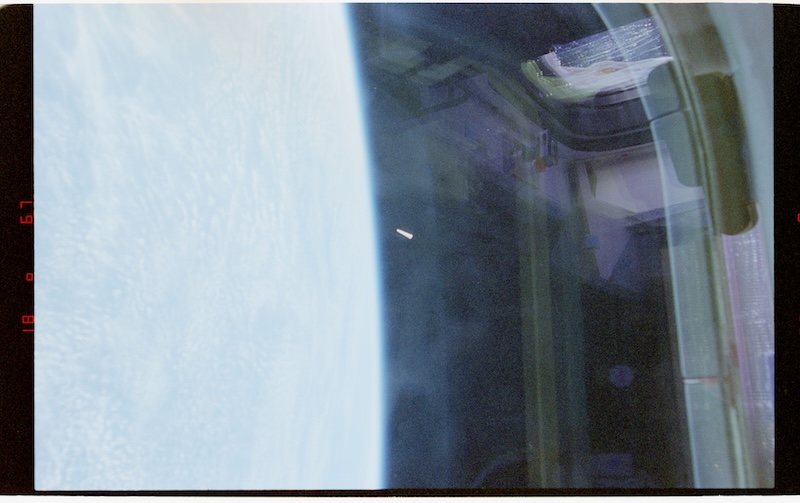
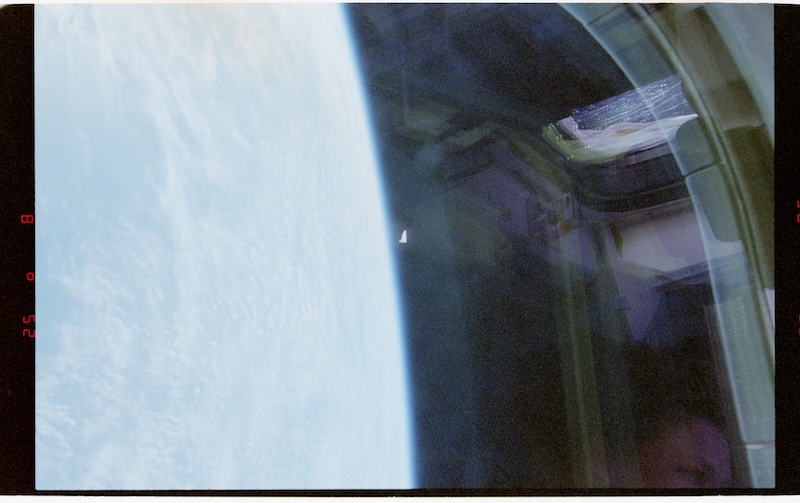
Strange pyramid-shaped triangle craft captured over Jequitinhonha Valley, Brazil

Strange pyramid-shaped triangle craft captured over Jequitinhonha Valley, Brazil
Curiosity reveals Martian sulfur crystals for the first time
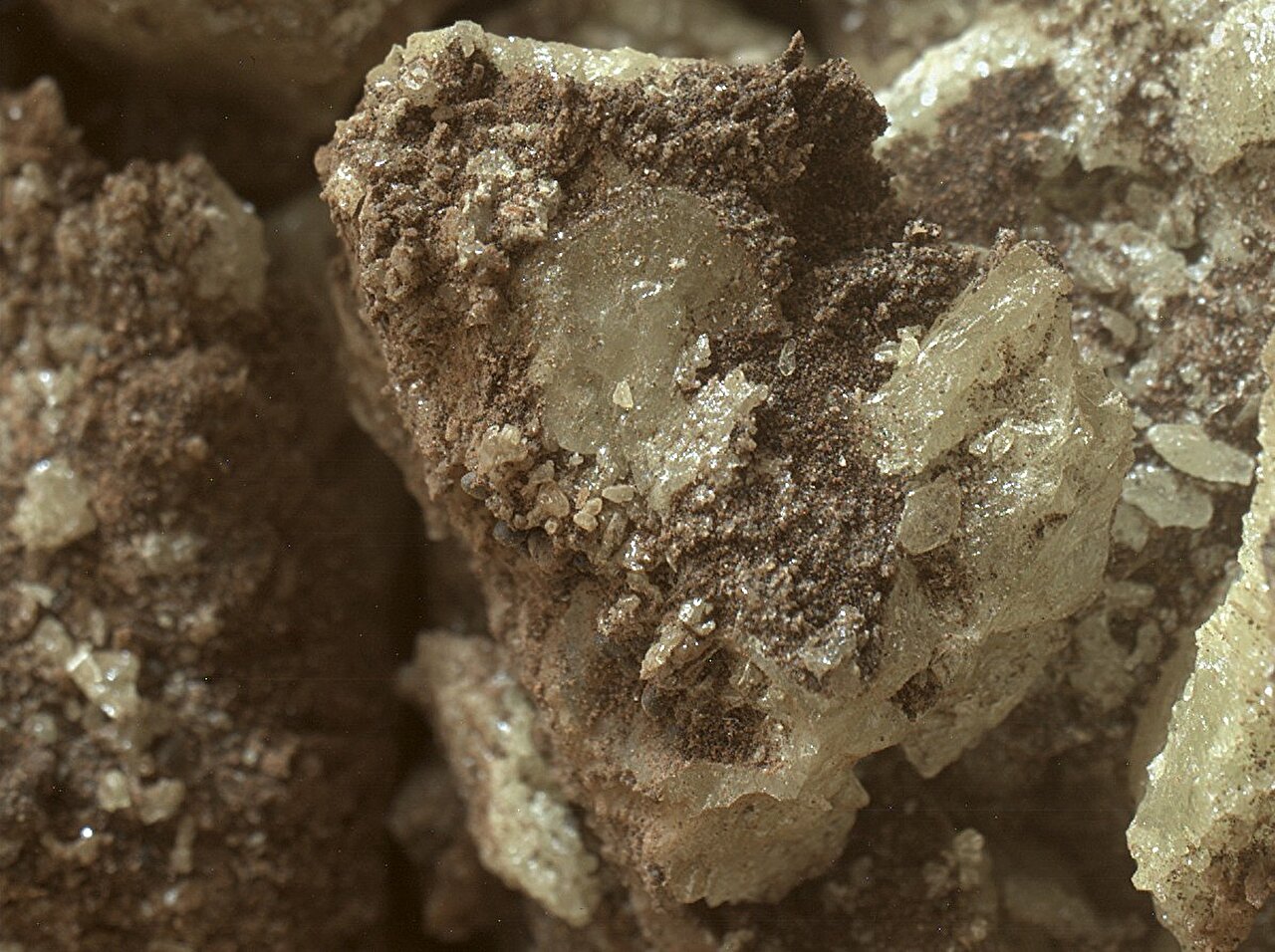
Recently, dirty-yellow crystals were spotted in one of the images taken by the Curiosity rover. They are sulfur, a substance that has already been detected many times in the rocks that make up the Martian soil. However, this is the first time it has been found in pure form.
Sulfur crystals.
Source: phys.org
NASA recently published a close-up image of a fragment of Martian soil. It was taken by the Curiosity rover on May 30, 2024. At that time, the rover drove over a piece of rock, crushed it, and the team operating the rover tried to point the camera at it.
The image published by phys.org shows dirty-yellow crystals. This is sulfur. Such formations are common on Earth, so now we know that they also exist on Mars.
In general, there is nothing surprising about finding sulfur crystals on the Red Planet. One of the most common types of minerals on this dry planet is sulfates — salts of sulfuric acid. However, until now, they had only been found as part of compounds. Now scientists have detected crystalline sulfur in its pure form on Mars for the first time.

Still, there is one interesting aspect to the discovery of sulfur crystals. For them to form, volcanic activity is required. Mars, however, has long been considered a geologically dead planet. This makes it very interesting to determine when these crystals actually formed.
It is quite possible that this happened only a few hundred million years ago. This would mean that Mars remained sufficiently active until relatively recently. And therefore, theoretically, it may be possible in the future to return it to such a state.

Pentagon releases documents on 2015 Texas UFO sighting at nuclear weapons facility

Last week, the Pentagon released a trove of documents relating to reports of UFO sightings around the country, including one of particular interest near a nuclear weapons facility in North Texas.
The Lone Star State incident occurred in September 2015 at the Pantex nuclear facility in Amarillo, according to documents detailing it at the time. The Pantex plant is the United States’ only nuclear weapons assembly and disassembly facility, according to the Texas Department of Health and Human Services.
According to a report by Pantex nuclear plant officials, the unidentified object traveled near the facility at approximately 10 to 15 mph, prompting a lockdown of the plant as officers assessed the object.
“On September 1, 2015 at approximately 0710 hours, the Pantex Ground Surveillance Radar (GSR) detection system identified an unknown flying object flying in a non-threatening manner west of Pantex facilities in a northerly trajectory,” the report stated.
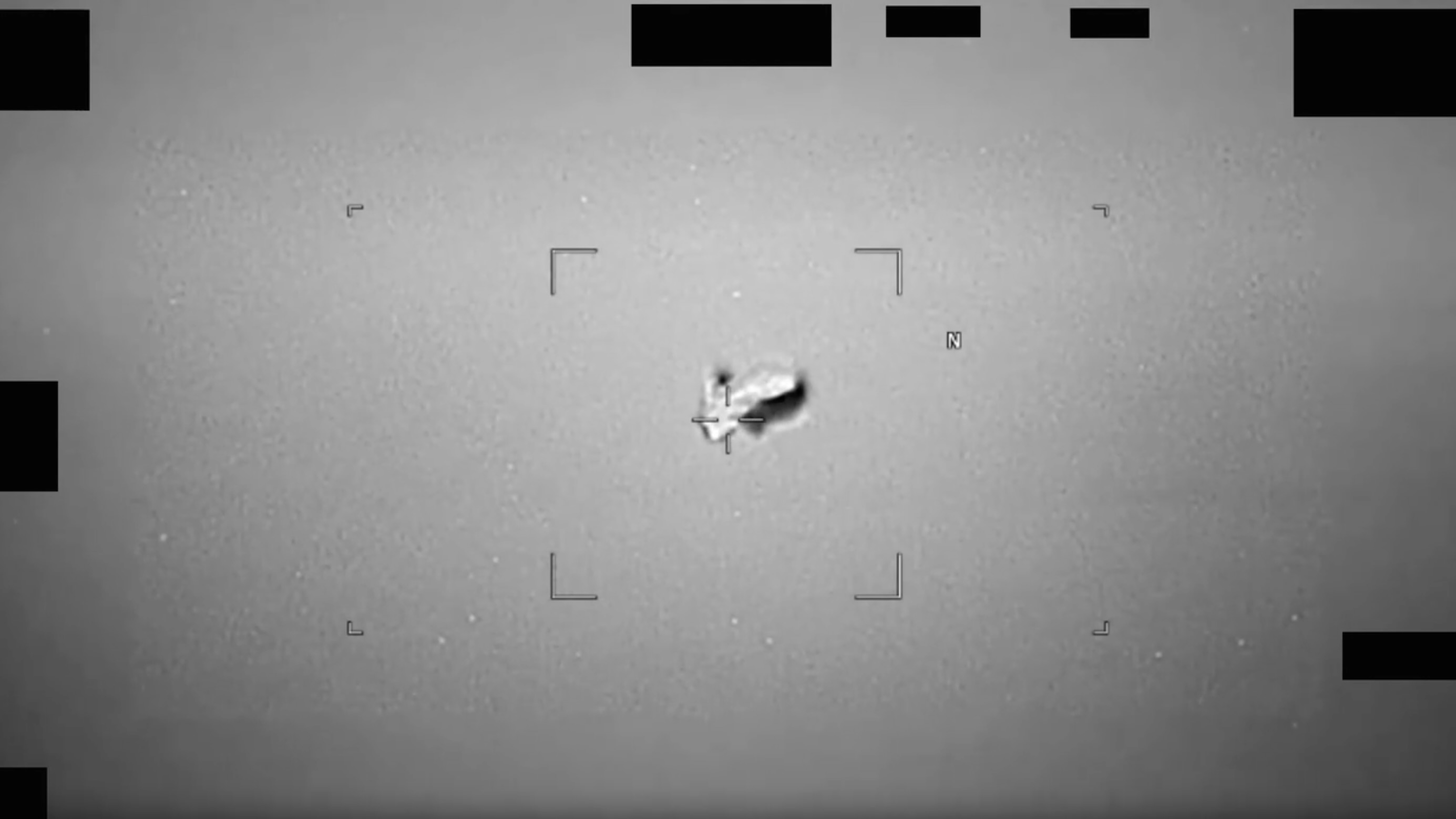
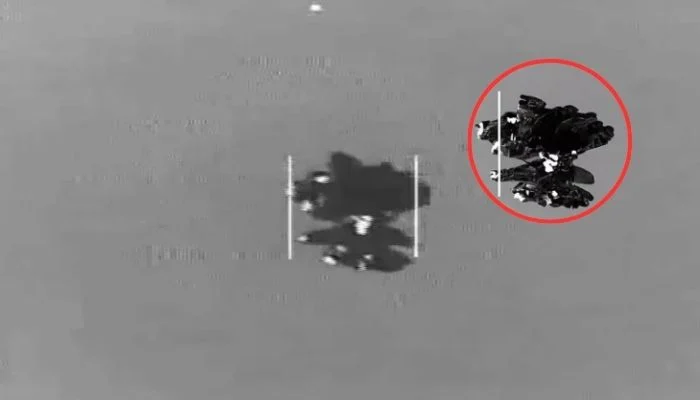
According to eyewitness accounts from employees at the facility, the object was approximately two feet high and four feet wide. Ground surveillance photos from Pantex captured a grainy image of the object in flight. Sandia National Laboratories, a research and development facility for the U.S. Department of Energy, then provided an enhanced image of the object, which was also included in the report.
The 16,000-acre Pantex site assembles, dissembles and stores nuclear weaponry. It also dismantles nuclear weapons being retired from the national stockpile. Site activities include handling high explosives, such as significant quantities of uranium, plutonium, and tritium, as well as a variety of non-radioactive toxic and explosive chemicals, according to DSHS.
Sandia National Laboratories released an enhanced image of the UFO that hovered over a nuclear facility in north Texas in 2015.
Credit: Courtesy / Sandia National Laboratories
Security personnel attempted to follow the object to gather more information on it, the report continued. A lieutenant and a security officer followed the object for several miles as it traveled north of the nuclear facility. Eventually, the pair lost sight of the object due to road access issues, according to the official account.
“Although they were unable to catch up to the object, they stopped their vehicle and got out. Once outside, they noted that the object did not make any sound,” the report stated.
“Furthermore, the [lieutenant] and [security officer] stated that they were unable to identify any type of propulsion system on the object while using binoculars to assess the object,” the document added. “It was noted that the object seemed to increase in speed and changed direction as it was being followed.”
The Texas incident is one of many UFO-related sightings disclosed by the Pentagon last Friday. Pentagon spokesperson Sean Parnell stated in a press release that the Defense Department is “actively working on the next release of UAP files,” adding that the department will continue to release UFO reports “on a rolling basis.”
The Phantom Airships: America’s First UFO Wave


On the stormy night of November 17, 1896, hundreds of residents in Sacramento, California witnessed something that should not have existed. Through the dark, rain-filled clouds, a bright light moved slowly across the sky about 1,000 feet above the city’s rooftops. Among the observers was George Scott, an assistant to the Secretary of State of California, who persuaded friends to join him on the observation deck above the capitol dome. From there, they thought they could see three lights, not one, with a dark, oblong shape above them.
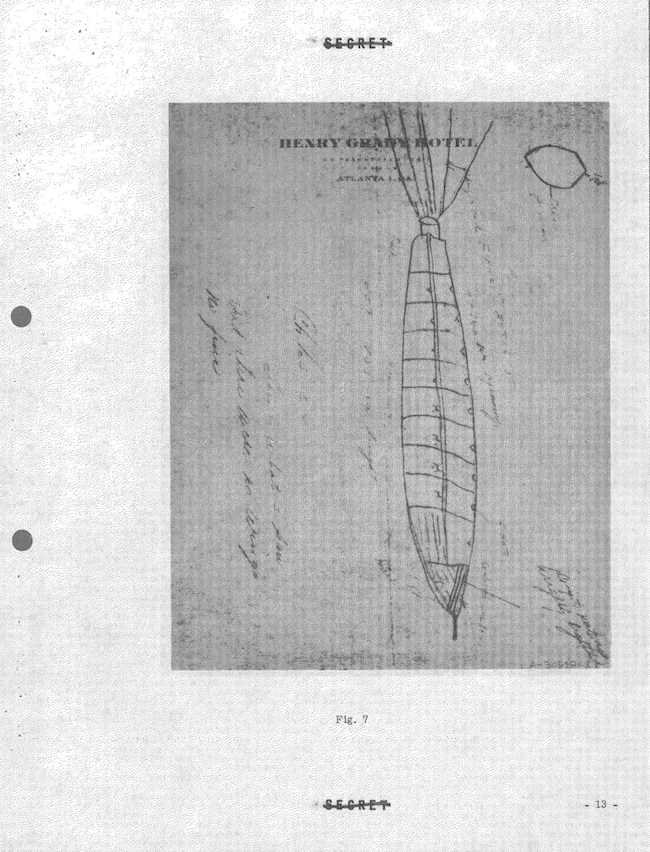
The most detailed account came from R.L. Lowery, a former streetcar employee who claimed he heard voices calling from above. “Throw her up higher; she’ll hit the steeple,” someone shouted from the craft. When Lowery looked up, he saw two men seated on what appeared to be a bicycle-like frame, pedaling to power the strange machine. Above them hung a cigar-shaped body with wheels on the sides, similar to paddle wheels on old steamboats. Lowery added with obvious humor that the captain seemed to be referring to a local brewery tower rather than any actual church steeple, as there were no churches nearby.
Deputy Sheriff Walter Mallory was among the many credible witnesses who observed the mysterious object. The sighting made headlines in local newspapers the next day, with stories titled “Strange Tale of Sacramento Men” and “What Was It?”

Five days after the initial sighting, on November 22, the airship returned to Sacramento. This time, thousands of people watched as it took nearly 30 minutes to cross the city, moving against the prevailing wind. Jacob Zemansky, equipped with a small telescope, reported that the lamp was “an electric arc light of intense power.” He also observed that the light didn’t move in a straight line but seemed to bob up and down in the wind. Edward Carragher, using field glasses, reported seeing a dark body above the light.
During this sighting, witnesses reported hearing talking or singing as the light passed overhead. Some claimed to hear conversations from the craft, with one voice saying, “We ought to get to San Francisco by tomorrow afternoon,” and another responding to a shout from the ground with, “San Francisco – we should be there by midnight.”

The same evening the airship appeared over Sacramento, it was also spotted in San Francisco, about 90 miles away. The craft was observed by hundreds of witnesses, including Mayor Adolph Sutro’s domestic staff. As the airship flew over the famous Cliff House and Seal Rocks, its powerful searchlight reportedly stretched more than 500 feet, frightening the seals and causing them to dive into the ocean for safety.
On November 29, over 100 residents of Tulare witnessed what they described as a spectacular display. The craft came down quite a distance, then rose up and took a straight course toward Hanford. Red, white, and blue lights were seen in succession, though no part of the actual ship was visible. Many people watched until it disappeared from sight.
Throughout November and December 1896, similar sightings were reported across dozens of California cities, including Anderson, Auburn, Red Bluff, Redding, Woodland, Chico, Marysville, San Jose, Hayward, Stockton, Visalia, Fresno, Bakersfield, Santa Barbara, and Los Angeles.

Colonel H.G. Shaw of Stockton provided one of the most unusual accounts. On November 19, 1896, Shaw claimed he encountered a landed spacecraft near Lodi while driving his buggy through the countryside. The metallic vessel was about 150 feet long and 25 feet in diameter, with pointed ends and a featureless surface except for a rudder.
Three tall, slender beings, approximately seven feet in height, approached Shaw while making strange warbling sounds. The beings were described as hairless and appeared to be examining Shaw’s buggy with great interest. They then attempted to physically force him to accompany them back to their airship, but gave up when they realized they lacked the physical strength to overpower him. The aliens returned to their craft, which lifted off and sped out of sight. Shaw believed the beings were Martians who had come to kidnap an earthling for unknown purposes.

After disappearing from California skies in December 1896, the airship phenomenon went quiet for two months. Then, on February 2, 1897, the Omaha Bee reported sightings over Hastings, Nebraska. Several residents reported seeing an airship hovering about 800 feet above the ground west of the city. The craft had first been noticed the previous fall, when it was seen floating about 500 feet above ground for approximately 30 minutes before beginning to circle and travel north for about two miles.
On Sunday evening, January 25, 1897, the large, glaring light was seen to circle around for a few minutes before descending about 200 feet. It then circled as it traveled at remarkable speed for about two miles before slowing up and circling for fully 15 minutes. Finally, it began to lower and disappear as mysteriously as it had appeared.
On February 5, the airship was sighted again near Invale, a tiny farm town 40 miles south of Hastings. People returning from a prayer meeting witnessed the craft, which seemed to be conical-shaped and perhaps 30 to 40 feet in length. It had a bright headlight and six smaller lights – three on each side – and appeared to have two sets of wings on each side with a large fan-shaped rudder. The witnesses claimed to hear rumbling engine noises and the voices of the airship’s occupants speaking to each other.

In Kansas, the airship made its presence known with several dramatic encounters. On the night of March 27-28, 1897, Topeka-area residents noted a mysterious object in the skies that was described as a “blood red light” moving slowly across the heavens. Several hundred witnesses observed the phenomenon, and some people were reportedly so frightened that they hid in their storm cellars, fearing that a great calamity was approaching. Among the witnesses was Governor John W. Leedy himself.
One local farmer reported that something from above had lowered a grapnel hook that snagged him and dragged him before setting him down unharmed. The Ellis County Republican quoted a clairvoyant as saying the airship mystery stemmed from “not one but a whole fleet of ships managed by strange and wonderful beings, bright intelligences from a far-off planet.”
The most famous Kansas encounter occurred at the ranch of Alexander Hamilton near Leroy. At about 10:30 p.m. on April 12, 1897, Hamilton was alerted by his agitated cattle and emerged from his house to investigate. He saw an airship slowly descending over his cow lot, about 220 yards from his house.
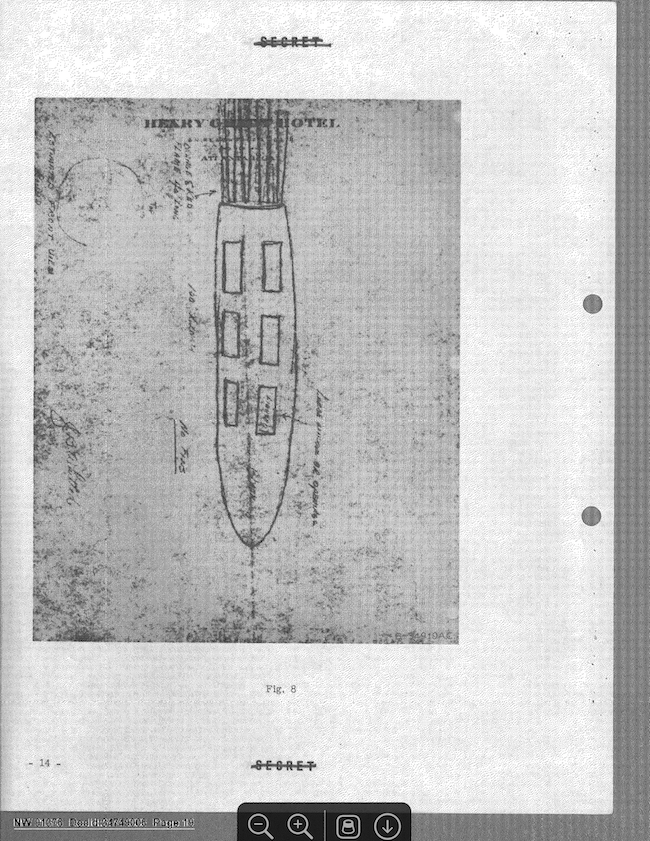
Calling for help from his tenant and son, Hamilton grabbed axes and ran toward the strange craft as it lowered to within 30 feet of the ground. The airship consisted of a great cigar-shaped portion, possibly 300 feet long, with a carriage underneath made of panels of glass or other transparent material alternating with narrow strips of some other substance. The craft was brilliantly lit from within, making everything clearly visible.
Inside, Hamilton could see six of the strangest beings he had ever encountered – two men, a woman, and three children. They were talking among themselves, but Hamilton could not understand a single word. When the occupants caught sight of the witnesses, they activated some unknown power, and a great turbine wheel about 30 feet in diameter began to buzz like a separator cylinder.
The vessel rose like a bird, and when it reached about 300 feet above them, it paused and hovered directly over a three-year-old heifer that was bawling and jumping in the fence. Upon investigation, Hamilton found a cable about half an inch thick fastened in a slip knot around the heifer’s neck, with one end passing up to the vessel and tangled in the wire fence.
Unable to remove the cable, Hamilton cut the wire fence loose and watched in amazement as the ship, cow and all, rose slowly and sailed off toward the northwest. The following evening, Hamilton learned that his cow’s hide, legs, and head had been discovered about 13 miles north and four miles west of his cattle lot, apparently dropped by the mysterious travelers.
Hamilton’s story was supported by several distinguished local residents who signed affidavits confirming his character and the truth of his account. However, decades later, it was revealed that Hamilton had fabricated the entire story as an entry in a local “Liars’ Club” competition.
As the airship wave moved into Illinois in April 1897, the encounters became even more detailed and bizarre. The first Illinois sightings occurred in Evanston and several other communities near Chicago on April 3. Local newspapers quickly spread rumors that the airship was filled with “English spies,” though this claim had no basis in fact.
The craft remained over Evanston for 45 minutes, observed by more than 500 people. Witnesses described it as “composed of two cigar-shaped bodies attached by girders,” while others claimed it had wings and sails. Professor G.W. Hough of the Dearborn Observatory dismissed the sighting without even looking, insisting it was merely the star Alpha Orionis.
Walter McCann, a news vendor in Chicago, provided what may have been the first photograph of the mystery airship. On April 12, while picking up newspapers at the Northwestern Railway depot, McCann spotted the ship approaching from the south. He rushed into his store to retrieve a camera his son had won in a contest and managed to snap two photographs as the craft passed overhead. The Chicago Times-Herald’s staff artists subjected the photos to acid tests and declared them authentic, though the original images have since been lost.
One of the most detailed landing reports came from near Springfield, Illinois, where two farmhands reported an extraordinary encounter. The airship landed in a field where they were working, and three occupants emerged – two men and one woman. The crew members told the startled workers that they would make a report to the government about their journey “when Cuba is declared free,” referring to the ongoing struggle for Cuban independence that would soon involve the United States in war with Spain.
After their cryptic announcement, the occupants waved goodbye to the farmhands and climbed back into their craft, which lifted off and disappeared into the sky. The workers noted that all three occupants appeared to be ordinary humans who spoke perfect English.
Near Mt. Vernon, Illinois, the city’s mayor was scanning the sky with his telescope when the airship came into view. In addition to observing the craft itself, the mayor claimed to see one of its occupants hovering in the sky around the vessel. The flying figure appeared to be a man with some sort of device strapped to his back that allowed him to maneuver freely through the air, apparently making repairs to the ship’s exterior.
This sighting was followed by several more landing reports in Nilwood, Downs Township, and Green Ridge, where the occupants were seen checking machinery on their craft before quickly departing when approached by curious witnesses. The pattern suggested the airship was experiencing mechanical difficulties that required frequent maintenance stops.
On April 10, 1897, the St. Louis Post-Dispatch published one of the most unusual encounter stories. W.H. Hopkins reported finding a grounded airship about 20 feet in length and 8 feet in diameter near Springfield, Missouri. The vehicle was propelled by three large propellers and appeared to be made of an unknown metallic material.
When Hopkins approached the craft, two crew members emerged – a beautiful woman and a bearded man, both completely nude. Hopkins attempted to communicate with them, trying various gestures and words to determine their origins. After several minutes of confusion, the crew members finally understood what he was asking. Both pointed toward the sky and uttered something that sounded distinctly like the word “Mars.”
The encounter lasted only a few minutes before the nude occupants returned to their craft and departed, leaving Hopkins to wonder if he had just met visitors from another world.
On Friday night, April 16, 1897, the mysterious airship passed over Vincennes, Indiana twice, providing one of the most well-documented sightings of the entire wave. The first appearance occurred around nine o’clock, when the craft traveled along the extreme eastern portion of the horizon. A sphere of golden light was clearly visible, and those near the ship claimed they could see the dark lines of its car, though no passengers were observed during this pass.
From his home on Burnett’s Heights, Sam Judah reported seeing the ship clearly with its fluttering wings, its movements resembling a side-wheeler steamboat sailing through the air with incredible velocity. Colonel Ewing, checking his thermometer at his doorway, initially thought the light was a falling star but soon realized it was moving too slowly for a meteor. He watched the airship for approximately four minutes.
Anton Simon noticed what appeared to be a ball of fire moving from northwest to southeast, which he later recognized as the mysterious airship. Victor Schonfeld, described as an expert observer who had made airships and balloons a lifelong study and had even made several balloon ascensions himself, testified that this was definitely a genuine airship.
An hour and a half later, the airship returned, passing over the northern portion of the city and traveling in a northwesterly direction. During this second pass, it seemed to fly directly over the fairgrounds (present-day Gregg Park) and traveled more slowly than during its first swift passage. Some witnesses claimed they could hear voices from the airship, and one gentleman watching from Burnett’s Heights reported seeing a man moving about inside the ship, apparently adjusting machinery.
The Table Rock Argus published one of the most disturbing airship accounts on April 16, 1897. A group of “anonymous but reliable” witnesses reported seeing an airship sailing overhead with many passengers visible through what appeared to be windows or transparent panels.
Among the passengers, the witnesses claimed to see a woman tied to a chair, another woman attending to her, and a man with a pistol who appeared to be guarding the bound prisoner. The implications of this sighting were deeply troubling – was someone being held against their will aboard the mysterious craft? Before the witnesses could decide whether to contact authorities, the airship had already disappeared into the distance, leaving them with only their disturbing observations and no way to help the apparent captive.
The Aurora, Texas incident of April 17, 1897, became one of the most investigated airship stories. According to S.E. Haydon’s report in the Dallas Morning News, the airship crashed into Judge J.S. Proctor’s windmill in the early morning hours, destroying both the craft and the mill. When townspeople rushed to investigate, they found metallic wreckage scattered across the judge’s property.
The debris was described as resembling a mixture of aluminum and silver, with strange hieroglyphic markings that no one could decipher. Among the wreckage, residents found the body of the pilot, who was clearly “not an inhabitant of this world.” After careful consideration, the townspeople decided the pilot must have come from Mars and gave him a Christian burial in the local cemetery.
When UFO researchers investigated the story in 1973, they found a rough-hewn gravestone that aviation reporter Bill Case of the Dallas Times-Herald believed marked the alien’s grave. The stone bore scratches that Case interpreted as representing an airship. A metal detector gave strange readings in the area, which investigators claimed indicated the pilot had been buried in some sort of metal uniform.
However, when investigators returned a few months later, both the headstone and any metallic material beneath it had mysteriously vanished. In 2008, the television show UFO Hunters was allowed to remove the capstone from the well where the airship debris had allegedly been dumped. They found no UFO wreckage but did discover high concentrations of aluminum in the water.
Minneapolis newspapers carried an extraordinary account of a physician from Rice Lake, Wisconsin, who claimed to have been abducted by the airship crew on the night of April 13, 1897. According to the story, the doctor was taken at gunpoint to care for the airship’s captain, who was suffering from influenza.
The account described how the doctor was forced aboard the craft against his will and found himself treating a sick man while flying through the night sky. After a struggle, the doctor reportedly escaped by leaping from the airship into the lake 40 feet below. However, the Rice Lake Chronotype provided a more mundane explanation, reporting that the doctor had simply fallen through the ice while trying to cross the lake on foot, with no airship involvement whatsoever.
Near Kalamazoo, Michigan, on April 12, 1897, residents of Pavilion reported witnessing the apparent destruction of the mystery airship. A couple tending to a sick horse in the early hours of April 13 described seeing the familiar bright front light and smaller side lights, along with visible propellers. The craft was moving at rapid speed when they heard a tremendous explosion or thunder-like sound, and the airship vanished from sight.
The next morning, a nearby farmer discovered a large metal coil on his property. Another resident found what appeared to be a propeller-like piece on his farm. Most remarkably, a man who had been shingling a barn the previous day returned the next morning with two other workers to find the roof covered with small pieces of metal debris.
The discovery of apparent airship wreckage created a sensation, with many believing they had finally found physical proof of the mysterious craft’s existence. However, no analysis was ever conducted on the metal pieces, and they eventually disappeared, leaving only the witness accounts as evidence of what may have been the airship’s destruction.
On April 16, 1897, the city of Waterloo, Iowa became the center of national attention when news broke that the mystery airship had been found. A 40-foot craft was discovered tucked away on circus grounds behind a cheese factory, complete with its builder, “Professor Jourgensen,” and his detailed logbook documenting flights over multiple states.
Thousands of people flocked to see the airship, and the discovery was reported in newspapers from coast to coast. The revelation seemed to solve the great airship mystery once and for all. However, upon closer examination, the hoax quickly unraveled. The materials used to construct the craft were extremely heavy and clearly unsuitable for flight.
Under questioning, the elaborate deception fell apart. Several local businessmen had designed and built the fake airship using $60 worth of materials, created a fictional logbook, and paid a man named Feathers from another town to pose as the mysterious Professor Jourgensen. The hoax briefly made Waterloo famous but ultimately demonstrated the public’s desperate desire for answers about the airship phenomenon.
By May 1897, airship sightings had largely ceased across the United States. The mysterious craft that had captivated the nation for months simply vanished from the skies as suddenly as they had appeared. No inventor ever came forward to claim credit, no working airship was ever publicly demonstrated, and no conclusive physical evidence was ever recovered.
The airship wave of 1896-1897 remains one of America’s most puzzling mass phenomena. Whether the result of mass hysteria, elaborate hoaxes, secret experiments, or something more extraordinary, the reports from thousands of witnesses across the continent created the first nationwide UFO flap in American history, setting the stage for similar mysteries that would follow in the decades to come.
Sources: KQED, Slightly Odd Fitchburg-01, Slightly Odd Fitchburg-02, Troy Taylor, Wikipedia-01, Wikipedia-02, Davenport Public Library, Travel KS, Kansas Semi-Weekly Capital, Omaha Nebraska Bee, The Valley Advance, Tales of History and Imagination, Kim Burrafato
NOTE: Some of this content may have been created with assistance from AI tools, but it has been reviewed, edited, narrated, produced, and approved by Darren Marlar, creator and host of Weird Darkness — who, despite popular conspiracy theories, is not an AI voice.
Victorian UFOs Soared High Over Cincinnati in 1897

Throughout the summer and autumn of 1897, H.G. Wells published his ground-breaking science-fiction novel, “War of the Worlds,” in serial form, over several issues of Cosmopolitan magazine. Simultaneously, the United States reported hundreds of UFO sightings, with dozens of witnesses in Cincinnati alone. Coincidence?
They didn’t call the mysterious aerial objects UFOs in those days, of course. They called them airships. To be precise—despite sightings occurring in widely dispersed locations at the same time—they called it “The Airship” in the apparent belief that it was one swiftly moving aircraft. Sometimes they blamed Martians. The Washington Times-Herald [April 14, 1897] opined:
“The mysterious and awful airship has been seen careering in its mad course over Omaha. There are fears that it may contain a reconnoitering party from the planet Mars.”
Maybe they were reading Mr. Wells’ new novel. The Memphis Commercial Appeal [April 19, 1897] pooh-poohed this idea based on the obvious fact that the possibility of interplanetary travel was ridiculous:
“The airship seems to be an accomplished fact, and the question is Where is it from, and how is it constructed? Conceding that the inhabitants of Mars or some nearer planet have succeeded in overcoming the force of gravitation, it is impossible that human life could be sustained while making the voyage to the earth.”
This belief seems not to have dissuaded Mr. Wells, who published his Cosmopolitan serial in book form the next year, to great acclaim.
For a month or more, as airship sightings transfixed Texas, Kansas, Nebraska, Illinois and Tennessee, Cincinnatians saw nothing floating through our muggy atmosphere. The Cincinnati Post [April 17, 1897] thought the airship might be avoiding the big telescopes at the Cincinnati Observatory:
“The managers of The Airship have manifested a spirit of indifference toward Cincinnati, which is duly appreciated. We have one of the five large telescopes of the country here, at Mt. Lookout, and with it would soon puncture the bauble reputation of the mysterious aeronauts.”
John J. Noonan, manager of the Ludlow Lagoon amusement park, smelled dollars to be had. Noonan sent a representative to Illinois to locate the airship’s owner and offer “any amount of money” so The Airship would soar about the Lagoon by opening day on May 2. The Cincinnati Times-Star [April 19, 1897] reported:
“If there is such a thing as a real airship, Manager Noonan of the lagoon will have it here in time for the opening of his pretty summer resort.”
As April ended and the month of May dawned, the airship at last appeared over the Queen City, usually in the wee hours, with no indication of owner, inventor or pilot. The Cincinnati Enquirer [May 5, 1897] reported a mass sighting:
“A number of people on Garfield place saw the airship last night about 9 o’clock and are willing to make affidavit that they have sighted the mysterious navigator that has been creating so much excitement over the country.”
Occasional reports had the airship sporting wings in addition to a cigar-shaped balloon.
From "Cincinnati Post", April 17, 1897
One observer that night, Dr. Louis Domhoff, said the airship was egg-shaped, red in color, and emitted beams of light. A retired businessman named William Thompson concurred that it was egg-shaped and looked like “an egg flying flat.”
Cincinnati Police Officer John Ringer told the Cincinnati Commercial-Tribune [April 29, 1897] that he saw the airship pass right over the city:
“I was standing at the corner of Eighth and Walnut streets at 10 o’clock, when my attention was called to a string of lights moving across the sky. I could see one large light in front, like the headlight of an engine, only much smaller, while behind this was a long row of little lights not much bigger than stars, and one right behind the other.”
The next day, the Commercial-Tribune reported that Philip Meagher, a bill-poster for the Cincinnati, Portsmouth & Virginia Railroad, saw the airship at the same time as Officer Ringer. The superintendent at the county infirmary claimed to have seen the airship, as did a retired businessman in Cumminsville, as did twenty members of a men’s club meeting at the Lion Brewery.
On May 9, the Commercial-Tribune announced that it had identified the airship’s inventor—a German immigrant living in Newport. He was too poor to afford a patent application, so he tested his invention only in the late-night darkness, in the presence of very few witnesses. The newspaper gave this second-hand description:
“The ship ascended so rapidly that it was only a few seconds until it was high in the air. A few moments more and it was speeding over Newport, over the river, over Cincinnati and out of sight. At first there was only a small light shining from the ship, but its general outlines could be distinguished for all that. After the altitude of about 200 feet had been reached two other lights were turned on, and as the ship passed over Cincinnati all who saw it agree to the reddish glare of its fairly large headlight.”
The identity of the Newport airship inventor was never revealed but, as it turns out, there was an authentic airship with a known pilot that year, cavorting above the grounds of the Tennessee Centennial Exhibition in Nashville. The pilot was Arthur Wallace Barnard, born in Massachusetts and more enthusiastic than knowledgeable, although he did not object when newspapers referred to him as “Professor Barnard.”
In late May and early June, Barnard only managed to loft his airship a handful of times from the Nashville exhibition grounds, in each case returning to earth in what might be termed controlled crashes, but his airship could fly and he could control its flight to a certain extent.
“Professor” Arthur Barnard really did get an actual airship off the ground in Nashville, but his landings were always more-or-less crashes.
From "Valentine Nebraska Democrat", May 27, 1897
Barnard’s airship was a cigar-shaped gas bag filled with hydrogen, from which was suspended a bicycle that powered a flimsy sort of canvas propeller. As it later emerged, Professor Barnard had copied the design of a prior airship, known as the “Skycycle,” invented by a New Yorker named Carl Myers, who had been sailing bicycle-powered balloons since 1892 and had—two years previously—demonstrated his invention over the small town in Maine where “Professor” Barnard worked at the YMCA.
In fact, there were at that time quite a few very similar airships undergoing testing in the United States. Almost all of them involved a bag filled with lighter-than-air gas and almost all were powered by pedals or lightweight steam engines. All were decidedly short-range vehicles and couldn’t possibly have achieved the range or velocity of powerful airships reportedly whizzing throughout the country. Some newspaper editors, noting that airship sightings mostly occurred after last call at the saloons, suggested that hallucination might be involved. The Commercial-Tribune [April 18, 1897] proposed a chronic condition:
“It is a remarkably dull month when the American public does not have an attack of some kind of mental fever. This month it is the airship, and pretty nearly every section of the Nation has succumbed to the disease.”
The Cincinnati Post [April 29, 1897] editor commented with wry humor:
“An Iowa paper thinks that some empty beer bottles picked up in that State were thrown from an airship. This is a clear case of mistaking cause for effect—the airship came from the bottles.”
{ https://www.cincinnatimagazine.com/category/news/history/ }
Pentagon's UFO files are a 'distraction' to hide terrifying 'nuclear' truth
BY Liam Randall - News Reporter

The Pentagon has officially declassified 40 new UFO files containing explosive information dating back to the 1940s - but an expert fears the drop is a calculated distraction to hide a terrifying nuclear reality.
Among the newly released documents is a high-level briefing detailing a conference between scientists at the Los Alamos National Lab - the historical base for the development of atomic bombs. The papers describe mysterious "green fireballs" sighted near the ultra-sensitive facility, raising major national security alarms.
Speaking on the release, investigative journalist Ross Coulthart told NewsNation that the pattern points to something far more sinister than random cosmic anomalies. He said: "Something is taking a very close intelligence surveillance and reconnaissance interest in nuclear weapons and nuclear power."

Coulthart highlighted that the unsealed records show a deeply unsettling focus on America's atomic arsenal.
He said: "One of them is over the Pantex nuclear plant in Amarillo, Texas. It's one of the most sensitive nuclear sites in America. One of the most highly protected."
The file details a chilling 2015 encounter where a silent, diamond-shaped craft was spotted directly over the secure facility by both local media and security personnel.
According to the documents, the object hovered completely silently with no visible engine or means of propulsion.
Coulthart said: "It hovered with apparent impunity over what is one of the most sensitive facilities in America, and that raised an extremely serious security concern."

While the files prove the Pentagon has been secretly monitoring the bizarre threats for nearly 80 years, they also suggest military officials were rarely caught off guard. In fact, they were expecting them.
Coulthart said: "They've been taking it very, very seriously, and right back in 1947, it's quite clear. The Pentagon's investigators from the US Air Force were anticipating these sightings. They could almost predict when they were going to happen."
Despite the massive data dump, the UFO expert is convinced the public is still being kept in the dark about the true, terrifying scope of the phenomenon.
He argues that the declassified files are merely scratching the surface of what the government actually holds in its vaults.
Coulthart added: "They clearly know a heck of a lot more than they're letting on, and really what we are being given, I think, really is the least sensational videos of what I'm being told they're really sitting on."
Most Of Moon’s Water Likely Remains Chemically Bound In Its Deep Interior
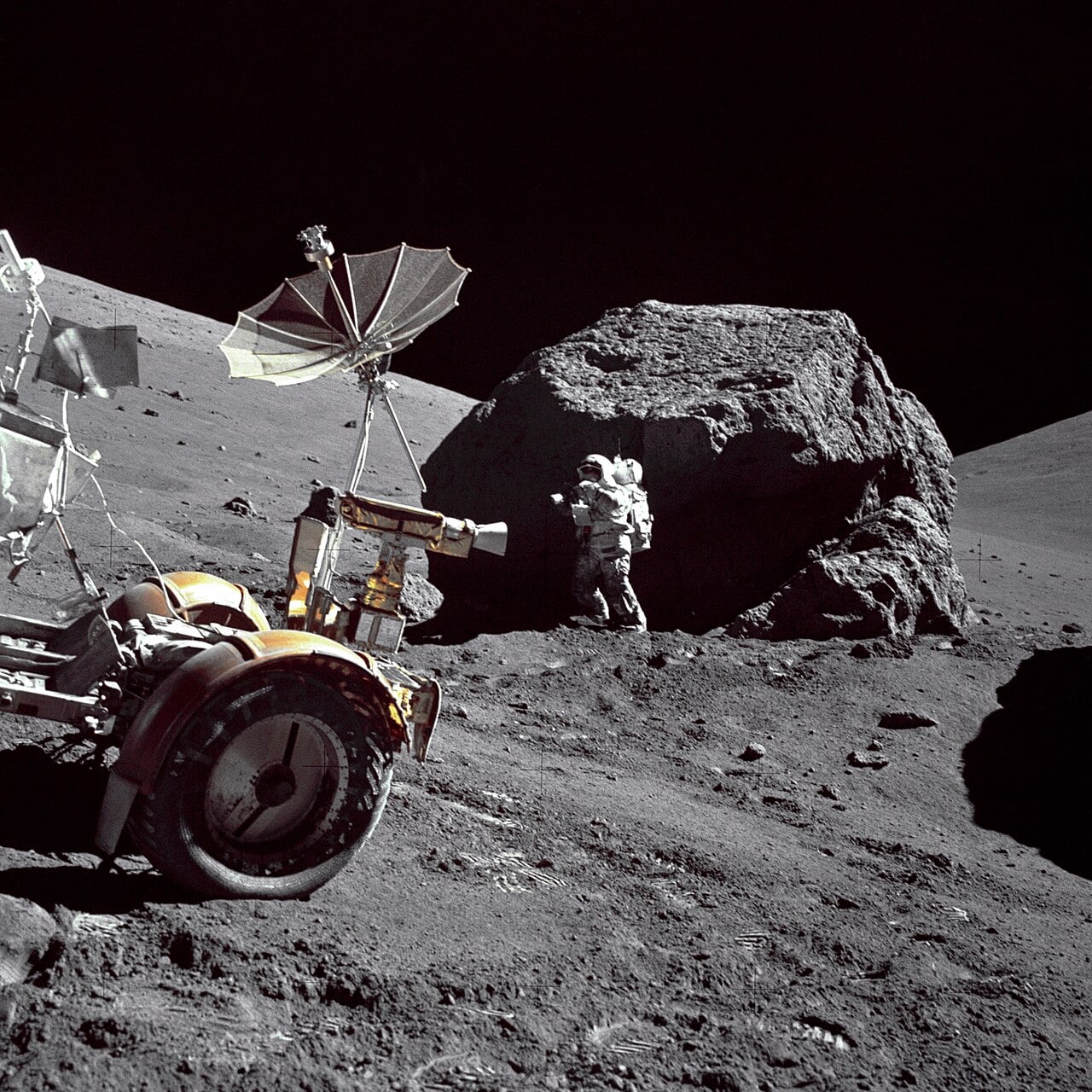
Geologist-Astronaut Harrison H. Schmitt is photographed standing next to a huge, split boulder at Station 6 on the sloping base of North Massif during the third Apollo 17 extravehicular activity (EVA-3) at the Taurus-Littrow landing site.
Credit: NASA
After decades of analyzing reams of lunar rocks back here on Earth, the canonical view of the Moon was that it was anhydrous; that it had extraordinarily little water. That all began to change in 2009 with new data from NASA’s Lunar Crater Observation and Sensing Satellite (LCROSS) and the much-ballyhooed evidence of water ice in the Moon’s permanently shaded polar regions (PSRs).
That’s still where most of the attention lies among future would-be colonists and lunar entrepreneurs.
But for scientific purposes, planetary scientists are still puzzling over whether the Moon has an abundance of water in its lunar interior, and the answer appears to be yes. But it's not the free-flowing water of Niagara Falls. Instead, this water is chemically bound up in rocks.
It was always a bit weird that the Apollo samples appeared to be so dry, Neil Bowles, a professor of planetary science at the U.K.’s University of Oxford, recently told me in his office.
Why is this important?
It gives us clues as to the initial water budget of our Earth-Moon system, which was created some 4.5 billion years ago when a Mars-sized impactor struck our nascent Earth. In the aftermath of the impact, our Moon soon coalesced from the resulting debris disk and into the body we see today.
Even so, many questions remain about how this putative water at the time of the impact was distributed into what became the Moon’s interior.
Lab-based investigations of returned lunar samples by Apollo missions using high-precision, low-detection, analytical instruments have for the first time provided the absolute abundance of water --- present mostly as structurally and minerally bound hydroxide (OH) in lunar samples, note the authors of a 2010 paper appearing the journal *Earth, Moon and Planets*.
The discovery of apatite, the only hydrous mineral phase of any significance in lunar samples, is of particular note.
Apatite is a type of mineral where its crystal grain structure, maybe a few hundred microns across, is good for holding onto water, Bowles says. And this apatite shows that the Moon had water and it's still present in the interior, basically bound to minerals, he says.
This was a surprise because initial analysis from the Apollo samples was that the Moon was extremely dry.
For lunar scientists and amateur enthusiasts alike, it's always been a puzzle as to why NASA hasn’t made more of a concerted effort to return to answer such lingering lunar science questions. But to be fair, the U.S. space agency did try to get to the bottom of the mystery surrounding the Moon’s putative water in early 2025.
Launched in February of last year, NASA’s Lunar Trailblazer orbiter spacecraft was due for a two-year nominal mission to detect and map the form, abundance and locations of water over the lunar landscape.
But then things went awry. A human induced failure --- caused by a misconfiguration of the spacecraft after separation from the launch vehicle, put an end to the mission.
One of its two instruments, the Lunar Thermal Mapper (LTM), was provided by the University of Oxford and funded by the U.K. Space Agency. And Bowles was the LTM’s instrument scientist.
Thus, despite this setback Bowles hasn’t given up because he’s still puzzled by where this lunar water actually lies; whether beneath the lunar surface, in the bottom of permanently shaded regions, or in the deep interior.
That’s one reason he’s hoping that a spare LTM instrument, which now lives in an Oxford basement lab, will soon bear fruit on a future lunar orbiter mission.
We're hoping that the spare lunar thermal mapper will go on a future NASA mission called UCIS (Ultra-Compact Imaging Spectrometer for the Moon), says Bowles.
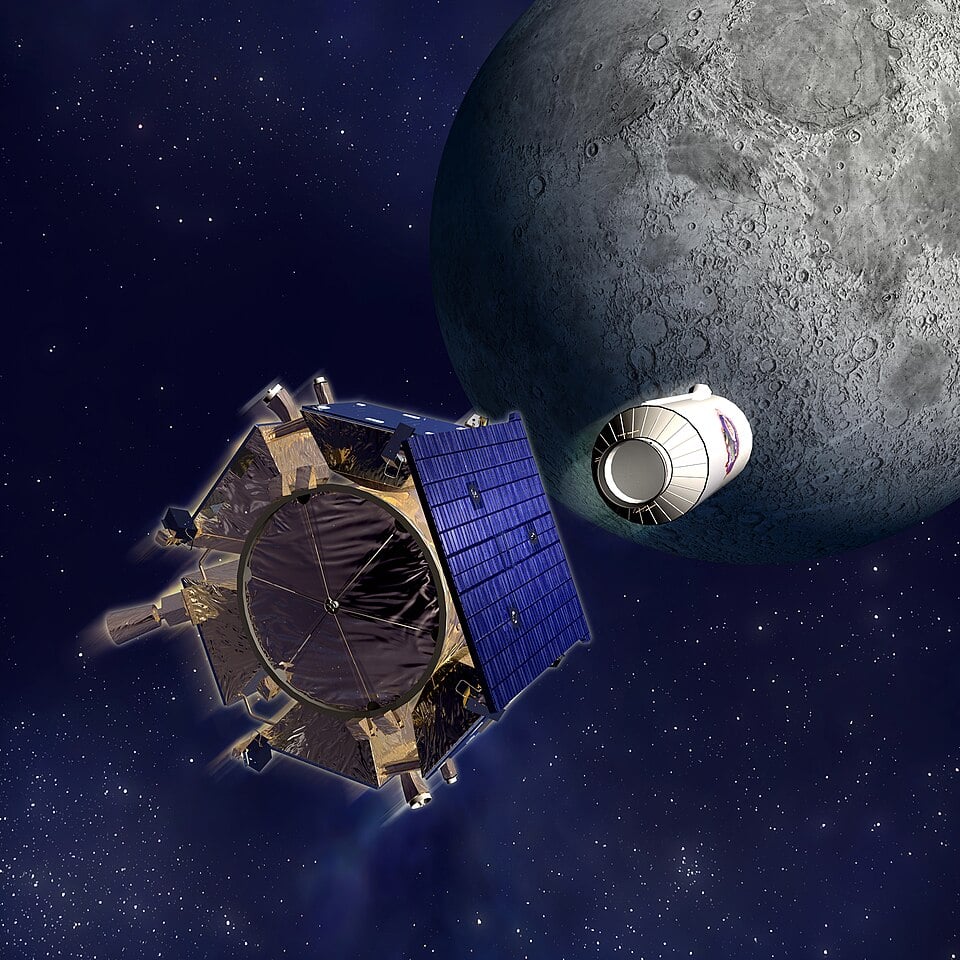
*An illustration of the LCROSS Centaur rocket stage and Shepherding Spacecraft as they approach impact with the lunar south pole on October 9, 2009.
Credit: NASA*
Why go back to the Moon?
We need all the evidence we can get to understand how you end up with the Moon as we see it today, but also how the Moon has influenced Earth, says Bowles. Because the Earth and Moon are a system in space together, very unusual in our solar system, in terms of the size of the Earth and our satellite, he says.
As for why Looking for water on the moon scientifically important?
Extracting water from the polar regions would tell us how it was brought there, where it was brought from, and would preserve a record of that delivery process in the solar system, says Bowles. That would then tell us a great deal of information about how things like water are moved around inside the solar system eventually end up heading towards Earth, he says.
The most mysterious places on Earth where not a single human has set foot, revealed
From the North Pole to the summit of Mount Everest, it might seem like intrepid explorers have already conquered every remaining frontier.
However, you might be surprised to learn just how many places on Earth have never been visited by a single living human.
From the impenetrable heart of ancient forests to the frozen peaks of sacred mountains, these are the last few truly untouched locations.
And, in the hidden depths of caves, there could be hundreds of miles of pristine territory that are still waiting to be discovered.
Like the terrifying peak of Gangkhar Puensum, the tallest unclimbed mountain in the world, some of these sites have been left untouched for religious or spiritual reasons.
However, areas like the crushing depths of the Arctic Ocean's Gakkel Ridge are simply too hostile and dangerous for humans to reach.
Meanwhile, out in Earth's last true wildernesses of Antarctica and Siberia, vast uncharted regions remain untrodden despite decades of attempted exploration.
Read on to find out where the most mysterious locations on Earth are hidden.

While it might seem like explorers have pushed back every frontier, there are actually many places yet to be visited by a single human. Pictured: Glaciers and rock outcrops in Marie Byrd Land, West Antarctica
Located in West Antarctica, Marie Byrd Land is one of the only true examples of Terra Nullius.
Literally meaning no-man's land, that status means these 620,000 square miles (1.61 million square km) of frozen expanse are the legal property of no nation.
Scientists estimate that 99.6 per cent of this area remains pristine wilderness totally untouched by humanity, compared to just 32 per cent of Antarctica as a whole.
Due to its vast size, covering the same area as Alaska, and extreme conditions, most of the region has never been visited by humans despite decades of exploration.
However, the region is also of critical scientific importance.
Andrew Fleming, Head of the Mapping and Geographic Information Centre at the British Antarctic Survey, told the Daily Mail: 'It includes Thwaites Glacier, the focus of the major International Thwaites Glacier Collaboration research programme.
'As one of the largest glaciers draining the West Antarctic Ice Sheet, the future behaviour of Thwaites Glacier and the surrounding ice sheet is of global significance, as it could contribute substantially to sea-level rise.;

Located in West Antarctica, Marie Byrd Land is one of the only true examples of Terra Nullius - meaning no-man's land
Spanning more than 12,000 square miles (30,296 square km), the Northern Forest Complex is one of Earth's last true wildernesses.
This dense jungle spans the mountainous land in the far North of Myanmar, stretching between the borders of India and China.
It is one of the largest tracts of intact forest in Southeast Asia, estimated to contain 6,000 species, of which 1,500 are believed to exist nowhere else.
The area was already extremely remote, and only sparsely inhabited by native groups, but access became even more restricted in the 1960s.
As political conflict swept through Myanmar, the nation closed the Northern Forest Complex to most researchers for the last 70 years.
This means that many of the forest's deepest areas are still yet to be explored.

The Northern Forest Complex in Myanmar covers more than 12,000 square miles (30,296 square km) of mountainous terrain, most of which remains unexplored
Standing at 24,836 feet (7,550 metres) and looming a full 9,800 feet (3,000 metres) above its neighbours, Bhutan's Gangkhar Puensum is the tallest unclimbed mountain in the world.
Harsh weather, a remote location, and a lack of proper mapping make the climb challenging, but this is not why the peak has been abandoned.
Instead, Ghangar Puensum cannot be climbed because of strongly held religious beliefs.
The Bhutanese people believe that mountains are sacred because deities live at their summits.
Several attempts were made in the 1980s, but climbers always turned back out of respect for local custom.
In 1994, the government banned climbing above 6,000 metres and, in 2003, completely prohibited mountaineering in the country.
So, while taller and more deadly mountains have been conquered, Gangkhar Puensum may remain unclimbed forever.

Bhutan's Gangkhar Puensum is the tallest unclimbed mountain in the world thanks to a strict religious prohibition on mountaineering in the country
This holy mountain, otherwise known as 'Mount Fishtail' after its notched summit, is arguably one of the least visited places on Earth.
The incredible twin peaks tower 22,943 feet (6,993 metres) above the Annapurna Conservation Area, in Northern Nepal.
According to the legends of the local Gurung people, the mountain is the home of Lord Shiva, one of the principal deities in Hinduism.
This means that the mountain has been almost entirely untouched throughout human history.
In 1957, a British expedition obtained permission to climb the peak but turned back within 150 metres of the summit, having promised the King of Nepal they would not touch the peak.
Since then, no new permits have been issued to climb, and the mountain remains untouched.
But not every unclimbed peak has been left for spiritual reasons.

Machapuchare, otherwise known as 'Mount Fishtail', in Nepal has never been climbed. A British team came within 150 meters of the summit in 1957 but turned back in respect for local religious traditions
Others, like the massive Summa Ri and Summa Ri II, are simply too dangerous and inaccessible for humans to reach - making this the tallest unclimbed mountain where climbing is allowed.
Located in a remote part of the Pakistan-China border, these peaks stand at 23,990 feet (7,312 meters) and 23,956 feet (7,302 meters) respectively, and have never been climbed.
While climbing is not officially banned in the area, attempting to reach the summit is essentially impossible.
Sandwiched in a politically sensitive area, there are no roads, trails or base camp to set out from.
Combined with glaciated terrain, deep crevasses, and avalanche-prone slopes, Summa Ri may remain unclimbed for many years to come.
However, if you thought unclimbed peaks were hard to come by, the imposing mountain range of Nyainqêntanglha East will quickly prove that notion wrong.
Stretching some 370 miles (600 km) along and 123 miles (200 km) wide, this impossibly remote mountain range is almost entirely untouched by humanity.

Standing at 23,990 feet (7,312 meters), Suma Ri is the tallest unclimbed mountain that can legally be attempted

In the imposing mountain range of Nyainqêntanglha East, 159 of the 164 peaks above 19,685 feet (6,000 metres) are yet to be climbed
The range is located on the southeastern rim of the Qinghai-Tibetan Plateau and is sometimes known as the 'Alps of Tibet'.
But, unlike the Alps, the vast majority of the peaks in this area remain unclimbed.
Out of the 164 peaks above 19,685 feet (6,000 metres), 159 are yet to be climbed.
A few western expeditions and a growing number of local climbers have now started to set new routes on untouched peaks, but those hunting for somewhere no human has trodden are still spoiled for choice.
Moving away from the heights of the mountains, the ocean's depths hide even more places yet untouched by humanity.
The National Oceanic and Atmospheric Administration estimates that just 28.7 per cent of the ocean floor has even been mapped, while only 0.001 per cent has been directly observed by humans.
Yet, of all those uncharted regions, the Gakkel Ridge is possibly the most inaccessible and fascinating.

The Gakkel Ridge is a 1,120-mile-long (1,800 km) underwater volcanic mountain range stretching across the Eurasian Basin in the Arctic Ocean, almost none of which has been explored
This is an 1,120-mile-long (1,800 km) underwater volcanic mountain range stretching across the Eurasian Basin in the Arctic Ocean.
Plunging between 15,090 feet (4,600 metres) and 16,730 feet (5,100 metres) beneath the surface, this trench between the North American and the Eurasian continental plates is one of the deepest points on Earth.
However, unlike the Marina Trench, the Gakkel Ridge is also covered by an almost impenetrable layer of sea ice all year round.
In October last year, a Chinese expedition was able to use icebreakers to launch a manned mission into the trench, but only a tiny fraction of its area has yet been explored.
Chris Lloyd, a geologist and cave explorer from the Association for Mexican Cave Studies, told the Daily Mail: 'There are not a lot of places on this planet that are truly still unknown; caves are some of those places.'
And no place has more potential for new discoveries than Mexico's Yucatan Cenotes, natural limestone sinkholes and cave systems that were flooded around 10,000 years ago.
There are about 7,000 cenotes in the Yucatan province, and only 142 are available to visit - meaning that 98 per cent are still unexplored.

Experts think the Yucatan Cenotes in Mexico could be hiding around 1,000 km of unexplored passages

Hang Son Doong, Vietnam, is the world's largest cave. While the main passage has been mapped, experts believe that many of its subterranean river systems and side passages remain unmapped and unexplored
Some of these may have once been inhabited by prehistoric groups before the waters rose, but there are many hidden depths that no human has ever visited.
Mr Lloyd says: 'There probably is at least as much more to explore in the cenotes as has already been explored, which means something like another 1,000 km of passages.'
Besides Mexico's Cenotes, the other great uncharted cave is Hang Son Doong in Vietnam.
Believed to be the world's largest cave, the mapped areas alone cover 38.5 million cubic meters and extend over 5.8 miles (9.4 km).
Despite decades of concerted exploration, divers are still finding more tunnels and chambers hidden within.
Even in 2019, a team of explorers discovered chambers that added another 1.6 million cubic meters of volume.
While the main passage has been mapped, experts believe that many of its subterranean river systems and side passages remain unmapped and unexplored.
EXCLUSIVE - MIT scientist explains how the theory we're living in a simulation could prove Christianity right
A leading computer scientist believes one of the most controversial theories in modern science could actually strengthen Christianity rather than undermine it.
Rizwan Virk, who studied computer science at the Massachusetts Institute of Technology (MIT), argues that if humanity is one day proven to be living inside a computer simulation, it would not disprove the Bible but instead offer a modern explanation for many of its central teachings.
The simulation hypothesis proposes that what humans perceive as physical reality is actually an artificial world generated by an advanced intelligence, much like an immensely sophisticated video game.
'The religions were trying to tell us that it's some kind of simulation, and that the soul is the player of the game,' Virk told the Daily Mail.
According to Virk, many of Christianity's core beliefs fit naturally within that framework. He believes the soul exists outside the simulated world as the true 'player,' while the human body functions as its avatar.
In his view, the biblical Book of Life resembles a complete recording of every action taken inside the simulation, while the life review reported by many near-death experiencers mirrors replaying those recorded events after death.
Virk also compared the Genesis account of God creating the universe by speaking to the way modern AI systems generate virtual worlds through simple prompts.
'So I think that it's more likely we're in a simulated world if Christianity is true, or even if any of the other religions are essentially true,' he said.

A leading computer scientist believes one of the most controversial theories in modern science could actually strengthen Christianity rather than undermine it
RELATED
The Milky Way is even BIGGER than we thought: Research reveals how our galaxy's gigantic spiral arms stretch 10% further than previously believed
The Milky Way is even bigger than we thought, a new study has revealed.
Scientists from the European Space Agency spotted the aftermath of three bright explosions echoing through the outer spiral arms of our galaxy.
By measuring the distance to those echoes, they found that the outer arms are actually 10 per cent further away than previously believed.
'We usually model the Milky Way's outer arms indirectly based on what we know of how our galaxy rotates, but doing it this way leaves room for error,' explained Beatrice Vaia of Istituto Nazionale di Astrofisica (INAF), Italy, who led the research.
'Instead, we did something new.
'We looked at the aftermath of three cosmic explosions that took place in far more distant galaxies.
'These explosions flung out X–rays that echoed through several of the Milky Way's outer arms – and we measured the distances to these echoes directly.'
The findings could help to shed light on the structure of our galaxy's outer regions.

Scientists from the European Space Agency spotted the aftermath of three bright explosions echoing through the outer spiral arms of our galaxy. By measuring the distance to those echoes, they found that the outer arms are actually 10 per cent further away than previously believed
While our solar system sits within the Milky Way, scientists still don't know much about its structure.
However, this is changing, as new telescopes offer fresh views of our galaxy.
For example, scientists were previously unsure if the Milky Way had two or four arms.
In 2020, observations by the Gaia space telescope confirmed that the answer is four.
In their new study, the team used the XMM–Newton and NASA's Chandra X–ray space telescopes to study the gamma–ray bursts thrown out by three bright explosions in the outer spiral arms of the Milky Way.
By studying how these bursts slowly expanded over time, the team was able to pinpoint the distance of the scattering dust grains.
As these lie in clouds within the arms of our galaxy, the researchers could then directly measure the distance of the arms.
The results revealed that two of the Milky Way galaxy's arms – Outer Scutum–Centaurus Arm and Outer Arm – lie up to 10 per cent further away than we thought.

By studying how these bursts slowly expanded over time, the team was able to pinpoint the distance of the scattering dust grains. As these lie in clouds within the arms of our galaxy, the researchers could then directly measure the distance of the arms
'This finding is a great example of how ESA's longer–standing missions – such as XMM–Newton, which launched in 1999 – still have a hugely important role to play in exploring the Universe,' said Erik Kuulkers, ESA XMM–Newton project scientist.
'Now in its third decade, XMM–Newton continues to return a steady stream of groundbreaking science on everything from the brightest–ever GRB, to stars being shredded by black holes, to X–ray snapshots of Mars.
Read More

'It's even more exciting when missions team up, as they did here.
'Together, they can reveal huge amounts about the skies around us.'
RELATED VIDEOS
Eerie pic of 4ft tall diamond-shaped UFO hovering 200ft over US nuclear plant released as gov ‘baffled’ by sightings
Antonio Ribera's Ten Commandments on UFOs
ILLUSTRATIVE RECONSTRUCTION // NOT EVIDENCE
Spanish ufologist Antonio Ribera remains one of the most influential voices in Hispanic UFO literature, and his 1982 essay on what he called the “Ten Commandments on UFOs” continues to surface in discussions about how the phenomenon has been interpreted in the Spanish-speaking world. Published in Encuentros con Humanoides, the text is less a declaration of certainty than a structured attempt to frame a mystery that Ribera believed deserved serious study. In it, he argues that UFOs are most likely advanced machines—possibly from elsewhere, possibly from another dimension, and perhaps even from the future. His phrasing reflects a style common in classic ufology: speculative, but grounded in what believers considered real-world traces such as radar returns and physical impressions on the ground.
Ribera’s first claim was that UFOs are, “in all likelihood, a super-machine created by a superior technology.” From there, he expanded the idea into a broader cosmology. He suggested that such craft may have conquered not only space but also time and interdimensional barriers, allowing both extraterrestrial and “pluridimensional” explanations to coexist. He also rejected the notion that UFOs are simply mental projections, noting that “mental constructs do not register on radar, nor do they leave behind ground impressions weighing up to thirty tons.” For Ribera, the reported occupants of these craft were likely living beings of humanoid appearance, though he allowed for the possibility that some witnesses may have encountered robots—either mechanical or biological, the product of highly advanced genetic engineering. Perhaps his most enduring line came when he wrote that “the UFO is a mirror that reflects the face of the beholder,” underscoring his belief that interpretations of the phenomenon often say as much about observers as they do about the objects themselves.

THE ALIENS ARE AMONG US!
THEY WISH TO COMMUNICATE!
AND HAVE EVEN CONSTRUCTED CITIES IN REMOTE PLACES WHILE THEY ARE HERE!
The story of UMMO starts with a series of letters and phone calls to various Spanish UFO researchers in 1965 that purportedly came from an extraterrestrial race. While the most commonly reported method of ET contact is clearly by telepathy, the aliens in this case tried a more direct, decidedly earthly method of communication.
The letters contained highly detailed discourses on such weighty topics as physics and medicine that could only have been written by experts on the cutting edge in those rarified fields that are light years beyond what a lay hoaxer could have come up with. One of the letters also predicted that a UFO sighting would occur on a certain day at a certain location in Spain, and the ship did indeed appear on schedule and at the appointed place. It was a rare event in the annals of Ufology, a supposed alien prediction that actually came true.
The race behind the letters and activity claimed to have come from a planet named UMMO, saying that they had arrived on Earth in 1950 and had been biding their time before contacting trustworthy Earthlings. They had come in response to a weak signal inadvertently sent out into space by a Norwegian ship conducting ionospheric research in 1934. It was later verified that both the ship and its experiments were indeed real-world events. The first landing took place near the Basses-Alps in France. The aliens from UMMO also claimed to have built an underground base in France as well, and later to have established other strongholds, including isolated small cities, much like the aliens in the new science fiction hit "District Nine."
The story kicks into higher gear when two additional sightings occurred near Madrid in 1966 and 1967. In both instances, the bottom side of the ship displayed the letters UMMO as well as a distinctive pictorial mark, seen throughout the book, that resembles our own notation for Uranus. According to the introduction written by Antonio Huneeus, seven clear photos of a classic flying saucer with a large UMMO symbol were taken by one of the Spanish witnesses during the second incident. Though they were later labeled as a hoax by Dr. J. Allen Hynek's Center for UFO Studies in Chicago, the photographer still stands by them.
Another aspect of the second sighting was a strange kind of debris left behind, what were thought at first to be small tubes of a metal resembling nickel. After being sent to Spain's National Institute of Aerospace Technology, they were determined to contain plastic sheets of polyvinyl fluoride, developed by DuPont. The catch is, however, that at the time the use of the material was restricted to the military only. So we have here the makings of another classic UFO case, one with the kind of similarities to previous cases that grounds it within the relative confines of reality while at the same time offering up newer details that add to the uniqueness of the case material.
The book begins with a longish opening section from the early 1990s in which an Earthling named simply "Tony" exchanges letters with an alien called Mr. X in which they discuss numerous aspects of life on Earth as seen from an alien perspective as well as inklings of the cosmic truth possessed by the aliens.
The Ribera text sits within a wider body of Hispanic ufology, where writers and researchers have long debated whether the phenomenon is truly extraterrestrial or something more complex. The source material points to Argentine military interest in UFO research, a reminder that in parts of Latin America, official institutions have periodically taken unexplained aerial reports seriously enough to investigate them. It also reflects a recurring skepticism within the field: some researchers have suggested that intelligence agencies could manipulate UFO narratives to obscure the existence of secret military craft or advanced aerospace programs. That theory, while unproven, has remained a durable part of UFO discourse because it offers a terrestrial explanation for at least some sightings without dismissing the entire subject.
What makes Ribera’s “commandments” notable is that they do not close off alternative interpretations; instead, they leave room for a range of possibilities that continue to animate UFO discussions today. Some researchers have favored non-extraterrestrial models, including interdimensional beings, while others have looked to non-human entities or other unusual intelligences that do not fit classic “little green men” assumptions. The source also notes more unconventional cultural theories, including the idea that rock music may be linked to abduction experiences, a claim that illustrates just how far the interpretive spectrum can stretch in UFO studies. Whether viewed as serious inquiry or cultural curiosity, these perspectives show that Hispanic ufology has often been as much about philosophy, psychology, and geopolitics as it has been about lights in the sky.
Ribera’s legacy lies in his willingness to combine openness with discipline: he did not claim to know what UFOs were, but he insisted they merited methodical attention. That balance helped make him a defining figure in Spanish-language ufology, alongside his work as a translator and writer who introduced major science-fiction and speculative ideas to new readers. More than four decades later, his framework still resonates because it captures a central tension in UFO research: the phenomenon is real enough to inspire investigation, but elusive enough to keep almost every explanation on the table.
Unresolved UAP report DOW-UAP-PR100 documented in the Yellow Sea in 2023
ILLUSTRATIVE RECONSTRUCTION // NOT EVIDENCE
A DVIDS video entry titled “DOW-UAP-PR100, Unresolved UAP Report, Yellow Sea, 2023” appears to document an unidentified anomalous phenomenon case recorded in the Yellow Sea last year, but the public listing provides very limited details about what was observed. The item is presented as an official or military media record within the Defense Visual Information Distribution Service, a platform used to distribute public-facing imagery and video from U.S. defense and government sources. While the case designation suggests a formal internal tracking process, the available material does not explain the nature of the sighting, the sensor data involved, or whether the object or event was ultimately attributed to a known cause.
The most notable element of the listing is the phrase “Unresolved UAP Report,” which indicates the case was not conclusively explained at the time of publication. The identifier DOW-UAP-PR100 suggests it may be part of a broader reporting system or file series, though the source material does not define the acronym or provide the underlying report text. The location reference to the Yellow Sea places the event in a strategically significant body of water between China and the Korean Peninsula, an area where military activity, maritime traffic, and surveillance operations are all common. That context matters, but it does not by itself clarify what was recorded.
The public-facing information attached to the video is sparse enough that it leaves more questions than answers. There is no description of whether the UAP was observed visually, captured on radar, tracked by infrared sensors, or seen through another system. Nor does the listing say whether the object exhibited unusual flight characteristics, whether multiple witnesses were involved, or whether weather and environmental conditions played a role. In UAP reporting, such omissions are not unusual when sensitive sources and methods are involved, but they also mean outside observers cannot evaluate the case on the merits of the available evidence alone. The unresolved designation should therefore be read as an administrative status, not proof of extraordinary behavior.
The appearance of an unresolved case in an official media repository reflects the continuing normalization of UAP as a topic of government interest. Over the past several years, defense and intelligence agencies have increasingly acknowledged that unexplained aerial or maritime observations may warrant structured review, particularly when they occur near military assets or within contested regions. However, the Yellow Sea reference also underscores a recurring challenge in UAP coverage: the most interesting cases often remain the least transparent. Without a public report, supporting footage, or an explanation from the issuing authority, the record cannot be independently assessed beyond its basic metadata.
For now, DOW-UAP-PR100 stands as a cataloged but largely opaque entry in the growing archive of official UAP-related material. The video title confirms only that the case was documented, considered unresolved, and linked to the Yellow Sea in 2023. It does not establish what was seen, who reviewed it, or whether further analysis later resolved the incident. In practical terms, the listing is important less for what it reveals than for what it signals: an official acknowledgment that at least one event in a high-interest maritime zone remained unexplained at the time it was recorded.
White House appoints Harvard astronomer Avi Loeb to lead new UFO study group
Harvard astrophysicist Avi Loeb has been appointed as the head of a new White House group to study unidentified anomalous phenomena or UAP, a new catch-all term for UFOs that might appear not just in the air but also in space or underwater. Loeb says the group is focused on evidence, instrumentation, data analysis and collection standards.
The move follows recent Trump administration initiatives to bring more transparency to the topic of UFOs, or UAP. The UAP Science Advisory Council, Loeb explains, was established by the White House, the Pentagon's All-Domain Anomaly Resolution Office (AARO), the Office of the Director of National Intelligence (ODNI), the Federal Bureau of Investigation, and other members of the Intelligence Community.
Loeb co-founded and leads the Galileo Project, designed to bring the search for extraterrestrial technological signatures of extraterrestrial technological civilizations "from accidental or anecdotal observations and legends to the mainstream of transparent, validated and systematic scientific research."
As chair of the just-formed UAP Science Advisory Council, Loeb has built a team of researchers that he describes as "an amazing A-team of exceptional scientists and experts."
Members of the group come from a wide range of disciplines from data science and instrumentation to biology, oceanography, anthropology and psychology.
You may likeThe UFO files: What did we learn from the Pentagon's 1st big release?
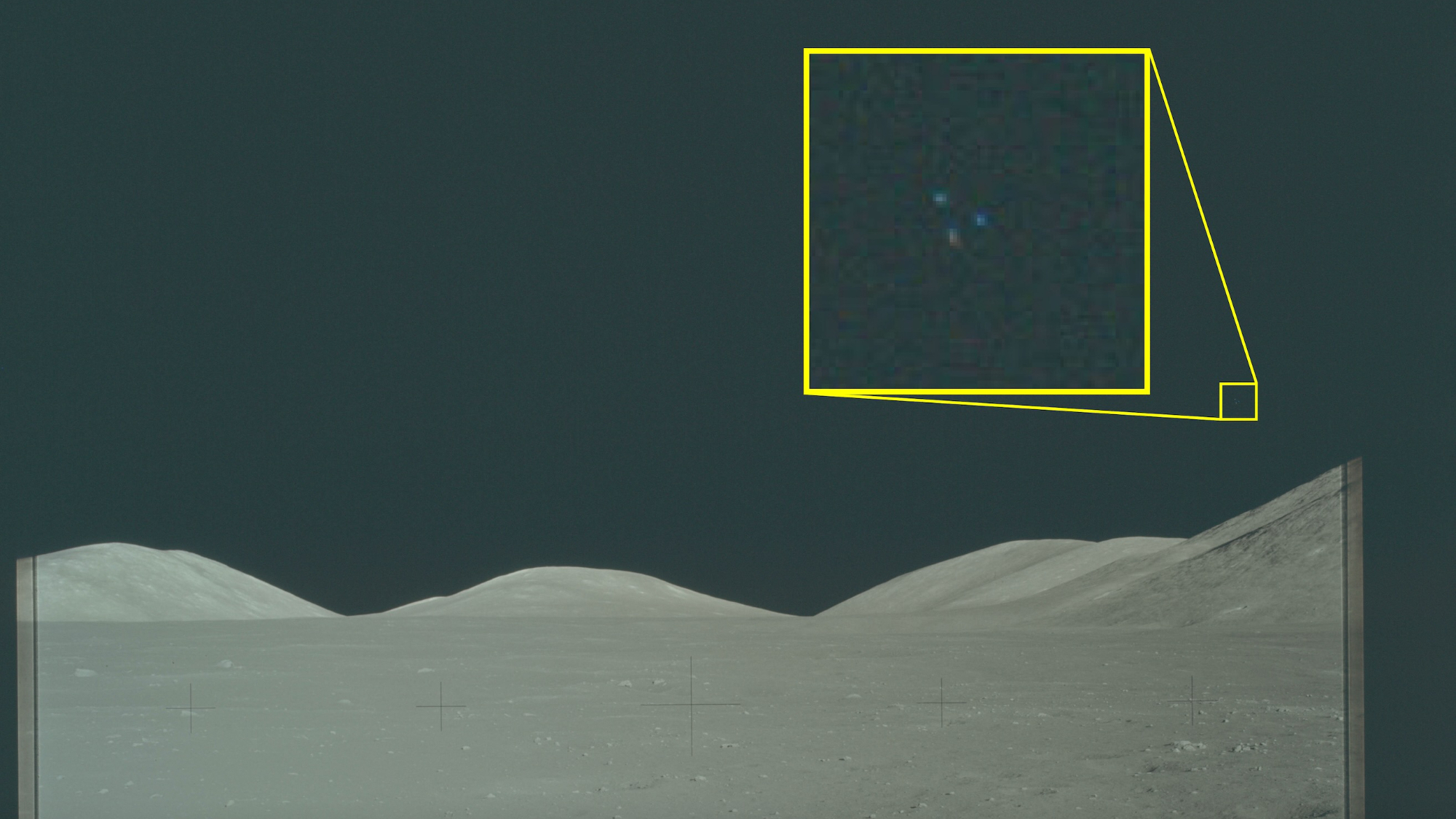
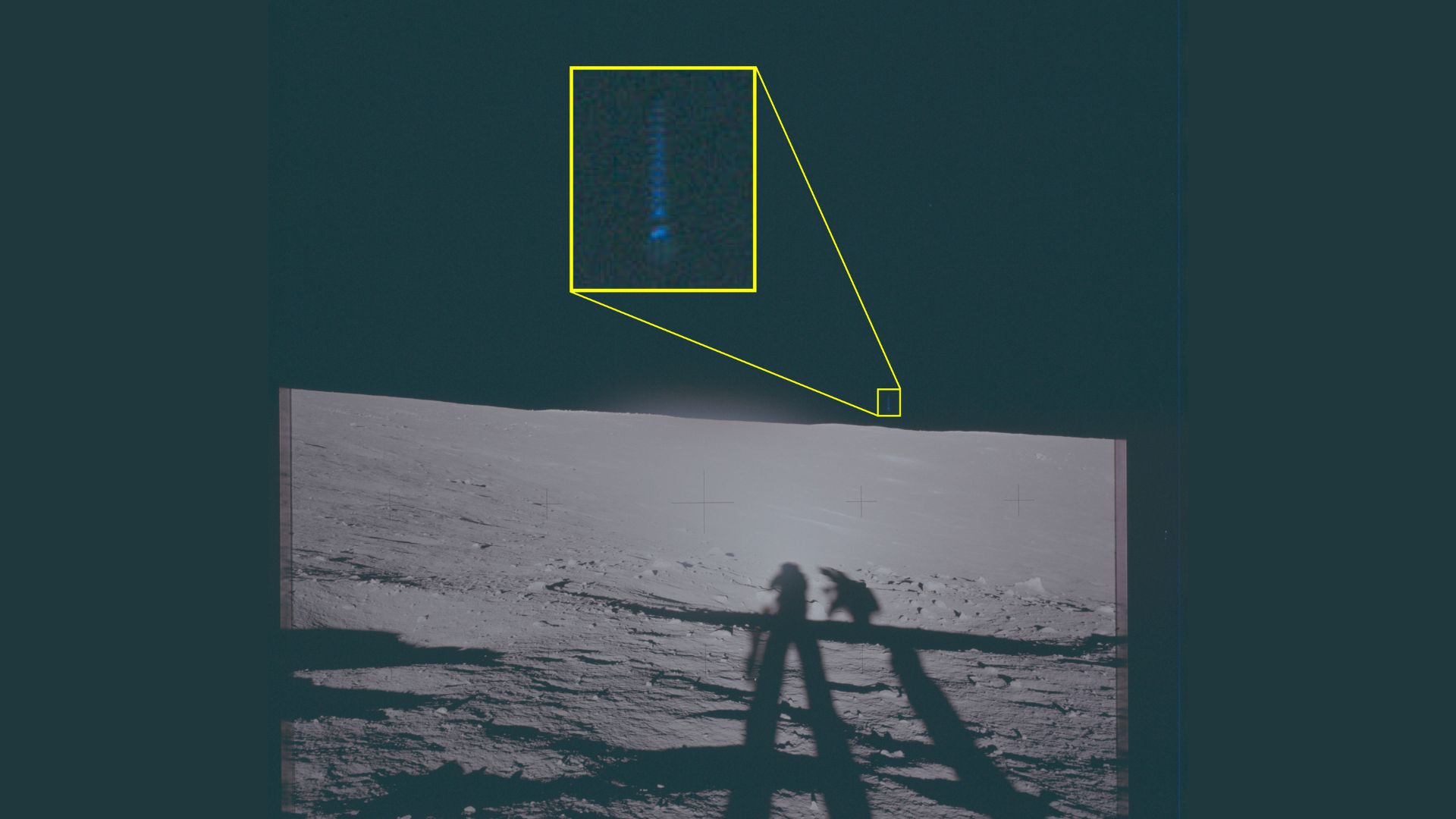
These Apollo 'UFO' images have been public for decades. So why are people talking about them now?
The council's stated purpose is to help government agencies study the nature of UAP through rigorous scientific methods, with an emphasis on collecting and analyzing higher-quality data rather than relitigating older material that cannot be independently verified.
But first things first.
What is the current membership makeup of Loeb's Council? It's quite a mix of talent to undertake a new look at UAP:
Space.com reached out to several of the UAP Council members to get their personal views on this new study approach.
"I expect the council and myself to follow methods and techniques deeply rooted in the scientific principles," said Devesh Nandal.
What to read nextGet ready for the next Pentagon file drop with our essential UFO reading list
"The UAP Science council in particular is focused on a data-driven and physics-based approach on the topic of UAP," said Nandal. "We approach this topic with the same rigor we apply in our respective scientific fields and we hope to provide an unbiased analysis on this topic."
Nandal said his role is to help with quantitative data analysis and apply his expertise in astrophysics to help the council decipher the origin of UAPs.

"My first and foremost passion is in stellar astrophysics where I study the life and death of massive and supermassive stars," Nandal said. "I also find the anomalous nature of UAP sightings to be quite intriguing, and whether these events are of terrestrial or extraterrestrial origin, I am excited to apply my understanding of physics to decipher their true nature," he said.
If such events can be explained using known principles, "that's excellent," Nandal advised, as this gives him a chance to test the laws of physics to explain a phenomenon that is captivating fellow humans.
"If such events are beyond our current understanding, I see this as a brilliant opportunity to learn all that I can about the Universe and share my findings with everyone," Nandal concluded.
Council member Liberty Capito said she's honored to be a part of the study group.
"Avi is one of the most brilliant scientists of our time and what he has put together, is what I believe to be a blueprint for re-establishing the public's trust in science by having people with vastly different views, beliefs and science on it," Capito said.
From Council member, Robin Hanson: "It's an honor to be invited, and it's a great cause. I worried at first if we could find much useful to do, but it seems that we do have some promising ideas."
Another member of the UAP Council is Carol Cleland, a professor in the Department of Philosophy at the University of Colorado Boulder. She is a Search for Extraterrestrial Intelligence Institute Affiliate and a member of CU Boulder's Center for Astrobiology.
"I anticipate having a council of outside experts will pressure the government to be more open about releasing information and allowing members of the council to interview UAP witnesses," Cleland told Space.com.
Identifying the unidentified deserves a high priority within the U.S. government and the scientific community, explains Loeb.
Nevertheless, for organizations that also continue to diligently sort out what's behind unidentified flying objects (UFOs) in the past and the current UAP tag line, they are taking a cautiously optimistic attitude.
"The involvement of serious, independent scientists is a potential positive development, and the government requires that for any thorough and credible investigation of UAP," said Mark Rodeghier, president and scientific director of the J. Allen Hynek Center for UFO Studies since 1986.
The key issue is not the credentials of the people involved, Rodeghier said, but the structure they are working within.
"If the Council lacks a clear mandate, access to relevant data, a collaborative relationship with those actually grappling with the UAP problem in the government, and then a path for public reporting, its practical value may be quite limited," Rodeghier told Space.com.

Robert Powell, an executive board member of the Scientific Coalition for UAP Studies, said he's adopting a "wait and see" attitude regarding the UAP Council at this point in time.
"Since the UAP Council seems to have the ear of some in Congress," Powell told Space.com, "I hope that they will spend some of their time advocating that Congress appropriate funding specific to the study of UAP through the National Science Foundation."
In SCU board meetings, Powell added, they are a strong proponent of making funding available to the scientific community and academia.
"We never know from where a breakthrough may occur in the study of UAP," Powell said, "and the more scientists involved from all areas of research, the better."
Ex-Pentagon official claims secret and 'intriguing' photos showing monolith-like structures on Moon exist and could be released soon; NASA clears air
As the Trump administration continues releasing classified "UFO Files" containing images of unidentified aerial phenomena (UAPs), former Pentagon UFO investigator Luis Elizondo has made a startling claim, saying the US government possesses unreleased photographs that appear to show giant monolith-like structures on the moon and that the images could be made public soon.
While speaking on podcast Disclosure Tonight with Thomas Fessler on Tuesday (July 7, 2026), Elizondo, who headed the Pentagon’s Advanced Aerospace Threat Identification Program, said, “There’s also photographs that I don’t believe have been made public yet that show on the lunar surface what appear to be large monolithic structures with right angle cuts.” He claimed that photographs of the monoliths were likely to be released soon, and called the images “intriguing.”
"So it's not naturally occurring obviously, right? And like we talked about before the show, if there is any objects on the moon, I mean anything that is not naturally occurring and has been manufactured by somebody, um that is also equally I think as groundbreaking as disclosure itself because it gives us insight that something else has been up there besides us and we're now just discovering that.” “It also shows us how much NASA has been lying to us this whole time," he added.
NASA breaks silence
A NASA spokesperson told the *New York Post* that the agency has mapped and photographed the Moon's entire surface and is unaware of any monoliths in its data. According to NASA, the Moon has been mapped at resolutions of up to 0.5 meters per pixel, and the agency says it has no knowledge of any structures matching those claims.
The assertion comes amid growing public interest in the disclosure of unidentified aerial phenomena (UAPs), as the Trump administration continues releasing previously classified "UFO files." While the documents have not provided evidence of alien life, they do include images of well-documented moving orbs along with other purportedly unusual phenomena that have drawn public attention.
The Department of War began releasing the UFO, or UAP, files on a rolling basis on May 8 after President Donald Trump pledged to declassify certain government records. Additional batches were released on May 22 and June 12. On Friday (July 10, 2026), the Pentagon released a fourth tranche of UFO files, consisting of 40 new files, including 19 videos.
Stephen Miller reportedly placed in charge of White House UAP disclosure strategy
ILLUSTRATIVE RECONSTRUCTION // NOT EVIDENCE
Reports circulating in UAP disclosure circles suggest that Stephen Miller has been placed in charge of coordinating White House strategy on unidentified anomalous phenomena, or UAP, disclosure. The claim, first amplified in a Substack post citing unnamed insider accounts, has not been formally confirmed by the White House. Even so, the report has drawn attention because it would signal a more centralized and aggressive approach to the federal government’s handling of UAP-related records and transparency efforts.
According to the report, Miller — long known as one of President Donald Trump’s most forceful policy operators — would be tasked with overseeing or coordinating the administration’s emerging disclosure strategy. The framing matters: if accurate, the assignment would place a highly influential political aide in a role that could shape how quickly agencies respond to document release requests, archival reviews, and interdepartmental disputes over classified materials.
The source material portrays Miller as a figure typically deployed when the White House wants a policy priority executed quickly and with minimal resistance. It describes him as someone who applies pressure across agencies, identifies bureaucratic bottlenecks, and forces decisions rather than allowing them to stall in committee or clearance processes. In the context of UAP transparency, that could mean greater momentum around FOIA backlogs, declassification reviews, and internal coordination among defense and intelligence entities.
The report also ties the development to Trump’s public comments over the years, including repeated calls to “release it” and let the public see the files, even as he has often stopped short of making substantive claims about what the files contain. In that sense, Miller’s reported involvement would not necessarily reflect a change in the administration’s stated position, but rather a shift in how aggressively that position is being operationalized.
For researchers, advocates, and former officials calling for more openness, the potential appointment is notable because disclosure efforts have often been slowed by fragmented authority and competing institutional interests. UAP information can sit at the intersection of the Pentagon, intelligence agencies, contractors, and legacy special-access programs, creating a maze that has historically frustrated oversight and public access. A politically powerful coordinator could accelerate movement through that maze — or, depending on the administration’s goals, tighten central control over what gets released.
That is why the report has been interpreted by some as a potentially significant turning point. If Miller is indeed involved, it suggests the White House is treating UAP disclosure as a strategic issue rather than a fringe topic. The difference is substantial: a topic once relegated to the margins of government discourse would now be moving closer to the center of executive-branch management.
Still, the reports remain unconfirmed, and the White House has not issued a statement verifying Miller’s role. As with many fast-moving political and UAP-related claims, the picture could evolve as more information emerges. That uncertainty is important, especially in a field where partial leaks, speculation, and advocacy often travel faster than official documentation.
Even so, the broader context is clear. Government UAP releases, renewed public interest, and continued pressure for transparency have already made disclosure a live policy issue. If the reports prove accurate, Miller’s involvement would mark one of the most consequential personnel developments yet in the ongoing effort to define how much the government is willing to reveal — and how fast.
RELATED
MIT Engineers Unleash New ‘Aerial-Aquatic’ Robot That Can Swim Underwater and Fly Like a Bird

Dubbed the “Flapping-Wing Aerial-Aquatic Vehicle” (FAAV), this lightweight robotic platform weighs less than 300 grams and can transition seamlessly between water and air with its very flexible flapping wings. Now, the team’s findings, published in the journal Science, could help scientists better understand how diving birds, which include puffins, petrels, loons, and gulls, are so adept at navigating two vastly different environments.
Such capabilities, the team says, could also pave the way toward advanced drones in the coming years that could transform ocean research.
Departing from conventional modern designs employed for aircraft or underwater vehicles, the team based their design on diving birds, which evolved to fly over water, then plunge beneath the waves to hunt for food, before surfacing and resuming flight.

MIT’s new aerial aquatic robot seen launching from water into the air
(Image Credit: Raphael Zufferey/MIT)
One problem when it comes to replicating these abilities in robots involves the density of water, which is around 1,000 times denser than air. Because of this, the engineering team had to carefully balance the flexibility of the robotic wings in their design, along with flapping frequency, tail angle, and other factors that allowed the robot to move efficiently through both environments without requiring propellers or separate propulsion systems.
Experiments were undertaken by the team in the lab and in Switzerland’s Lake Geneva, and helped the team determine that the robot achieved best performance with medium-sized wings that flap at approximately five times per second. Under such conditions, the robot was able to swim one meter per second, then by pitching upward at a 70-degree angle, it could break through the surface, and continue this same movement to propel itself through the air.
Although the robot still has some limitations compared to the avian examples that inspired it, interestingly, it does appear to have one advantage: unlike diving birds, which paddle using their feet to achieve aquatic launches into the air, the new robot has no such requirement, and can transition from water to air relying only on its wings and adjustable tail.
In the future, drones equipped with such capabilities could be leveraged to monitor marine ecosystems in a variety of ways. The team also says it could help to observe environmental concerns, such as water near glaciers or offshore infrastructure, or even collect data from hazardous locations that are either too difficult or simply too costly for ships to reach.
“Our dream vision is for oceanographers, marine biologists, and members of coastal communities to launch this robot from a boat, or from shore, and it would fly close to the area of interest, such as an iceberg or a port facility, or over a pod of whales,” according to Raphael Zufferey, assistant professor of mechanical engineering at MIT.
“It would dive into the water to take a measurement or collect a sample, and fly back to deliver the data at a fraction of the cost of traditional methods. Then it could go back out to dive for more,” Zufferey recently told MIT News.
Drawing from movements in nature influenced by evolution, the researchers hope their bird-inspired design may eventually help scientists by introducing cost-effective, but formidable new tools to help obtain information from some of the most challenging environments, all with help from robots that can do what only nature’s diving birds could once achieve.
The achievement is detailed in a new paper, “Leaping out of the water: aerial-aquatic locomotion with flapping wings,” which appeared in the journal Science.
Secretive Chinese probe snaps first photo of Earth's mysterious 'quasi-moon' — and it may pose a big problem
China's Tianwen-2 spacecraft has captured the first close-up photo of one of Earth's "quasi-moons," Kamo'oalewa. However, the image and the timing of its release suggest that it may be harder for the probe to collect samples from the space rock than originally planned.

A secretive Chinese spacecraft has captured the first-ever close-up photo of one of Earth's temporary "quasi-moons" after arriving there for a potential first-of-its-kind landing.
The space probe is supposed to scoop up samples from the newly imaged space rock and return them to Earth next year. However, the blurry photo and the timing of its release hint that this may be trickier than initially thought.
The Chinese National Space Administration (CNSA) probe, named Tianwen-2, launched from Xichang Satellite Launch Center in southern China on May 28, 2025, according to Live Science's sister site Space.com. Its primary target is Kamo'oalewa, also known as 2016 HO3, a fast-spinning asteroid that is classified as a quasi-satellite of Earth. That means it circles the sun alongside our planet, making it appear as if it were gravitationally bound to Earth when, in fact, it isn't. (This is only a temporary association; Kamo'oalewa will eventually fall out of sync with Earth and drift away from us.)
The CNSA has released minimal information about the parameters and timeline of the Tianwen-2 mission and only shared the first photo of the spacecraft several weeks after its launch. Based on one unverified timeline, Live Science previously reported that the probe had most likely arrived at Kamo'oalewa on June 7. However, Chinese officials have remained tight-lipped about the probe's progress.
But on Monday (July 6), the CNSA finally confirmed that, after a roughly 400-day-long journey spanning more than 600,000 miles (1 million kilometers), Tianwen-2 is now circling Kamo'oalewa, according to the state-run news outlet Xinhua. The agency also revealed that the probe first inserted itself into the asteroid's orbit on June 7, as originally predicted.
You may like
China's secretive Tianwen-2 mission arrives at Earth's 'quasi-moon' ahead of historic landing
China's top-secret 'dragon' space plane just released another unidentified object over Earth
Artemis II crew's iconic view of Earth shows simultaneous auroras over both poles
This photo of one of Tianwen-2's decagonal solar panels, captured in orbit, was the first image of the probe released by the CNSA.
(Image credit: CNSA)
The announcement was accompanied by the first clear photograph of Kamo'oalewa, captured at a distance of around 12.5 miles (20 km) from the quasi-moon. The blurry image suggests the space rock is around 130 feet (40 meters) across, according to the South China Morning Post, which is on the lower end of previous estimates that suggested the asteroid was up to 330 feet (100 m) wide.
Initial readings also suggest that Kamo'oalewa is a rubble-pile asteroid, which means it is loosely bound together and has an unstable surface. Until now, researchers were unsure of the asteroid's composition and hoped it had a solid, rocky surface, which would have allowed the spacecraft to attempt a first-of-its-kind landing using an "anchor and drill" technique. (It now seems unlikely that this sampling method will be used.)
The asteroid's small size, fragile composition and fast spin will make it harder for the probe to collect samples from the space rock's surface, even with other tried-and-true techniques. The new image also hints that there are few flat spots on the space rock where the probe could land safely.
"This greatly increases the complexity of the sampling process and the risk of the mission, making it much more difficult," CNSA representatives wrote in a report, according to the South China Morning Post.

Tianwen-2 launched into space May 28, 2025 on board one of China's Long March 3B rockets.
(Image credit: VCG/VCG via Getty Images)
The unverified mission timeline, which correctly predicted the probe's arrival date, stated that the sampling attempt would commence July 4. However, the fact that this has seemingly not happened yet further suggests that Chinese scientists are struggling to figure out how to collect their desired samples.
What to read next
Earth-based telescope shares image of Artemis II capsule near the moon — one of the farthest photos of humans ever taken
Declassified Apollo 12 images show UFOs on the moon — Space photo of the week
The moon is green and brown? Why scientists are already excited about Artemis II's historic lunar photosCNSA officials wrote that the probe "will progressively conduct more detailed scientific exploration to acquire data on the asteroid's morphology, material composition and internal structure, laying the groundwork for subsequent sample collection operations."
If Tianwen-2 does manage to snag some samples, the probe will release them in a capsule during a flyby of Earth in November 2027, and they will reenter the atmosphere at around 27,000 mph (43,500 km/h). This would make China the third country to successfully collect and return asteroid samples to Earth, following Japan, which returned samples from the asteroid Ryugu in 2020, and the U.S., which acquired material from the space rock Bennu in 2023.

Kamo'oalewa (a.k.a. 2016 HO3) circles Earth but does not orbit our planet. This simulation shows its predicted movements relative to Earth over the next few centuries.
(Image credit: NASA/Pheonix7777/Wikimedia)
Researchers hope the returned samples will help unravel the secrets of the early solar system and potentially shed light on how key compounds, such as organic molecules and water, ended up on Earth. They may also shed light on the seven other quasi-moons that are currently known to co-orbit the sun with our planet.
Some experts previously theorized that Kamo'oalewa may be a fragment of the moon that was knocked loose from our permanent companion by an ancient meteor strike. Others have even attempted to pinpoint which crater the asteroid may have come from and hope that the samples will help confirm their hypothesis.
"I am curious to find out the answer about its origin, since the debate on its [potential] lunar origin is still very open," Marco Fenucci, a mathematician at the European Space Agency's Near-Earth Object Coordination Centre who has co-authored multiple studies on Kamo'oalewa, previously told Live Science. Any returned samples should "definitely give us an answer to this matter," he added.
After its close approach to Earth next year, Tianwen-2 will slingshot farther into the solar system to begin its secondary mission to study 311P/PanSTARRS — a peculiar object beyond Mars that displays characteristics of both comets and asteroids — in 2035.
4th batch of Pentagon UAP files: ‘Floating brain’ goes viral
Clipped version of the jellyfish or “floating brain” video from over the Atlantic on January 1, 2020. It’s part of the 4th batch of Pentagon UAP files, released on July 10, 2026. Observers said the object didn’t maneuver or change direction and traveled with the wind. So it might be an unusually shaped balloon or clump of deflated balloons squashed together. Or it might be something else. An AI-enhanced version of this video went viral on the internet this weekend. Read more about the latest Pentagon UAP files below. Video via DoD/ Forbes.
The Pentagon released a 4th batch of UAP/UFO files on July 10, 2026. The release includes 19 videos, 14 documents, three images and four audio files. One video – dubbed the “floating brain” – was immediately altered with AI and re-released to the internet, where it went viral this weekend. Forbes reported:
An X user applied AI to enhance the Pentagon’s previously released UFO footage designated DOW-UAP-PR030, also called the ‘floating brain’ UAP. The enhanced image depicts an image that shape-shifts and performs a sharp high-speed maneuver before it accelerates away …
The AI-enhanced image took the internet by storm, sparking a fresh wave of speculation, with viewers drawing very different conclusions about what they’re seeing.
One user wrote, ‘It’s just a bunch of Mylar balloons tied together. Probably escaped a fair. They can ascend for thousands of feet without popping like latex balloons.’
Another one also presented its own theory, stating, ‘Yeah, that thing flew here from Alpha Centauri, or from the Andromeda Galaxy. Makes perfect sense. Look at its mystifyingly perfect symmetry. It can’t possibly be a distorted balloon or a random piece of garbage. Our lives are changed forever.’
Meanwhile, the non-AI-enhanced videos – like the ones found on this page – are also being widely distributed online. The recent batch of UAP files includes the data coming from various agencies, including FBI, NASA, CIA, Energy Department and Pentagon.
The AI-enhanced ‘floating brain’ UFO video went viral, sparking conspiracy theories.
See a video of this AI-enhanced image at X. Image via Forbes.
The Pentagon had released its 1st batch of declassified UAP/UFO materials on May 8, 2026. It released a 2nd batch on May 22, and a 3rd batch on June 12.
And as usual, Sean Parnell, Assistant to the Secretary of War for Public Affairs and Chief Pentagon Spokesman, said in a statement:
Today, the Department of War is publishing the fourth release of declassified and historical Unidentified Anomalous Phenomena (UAP) files as part of the Presidential Unsealing and Reporting System for UAP Encounters (PURSUE). The collection continues to be housed on WAR.GOV/UFO, and the Department will release additional files on a rolling basis.
And again, many of these files have been known about already, both historically and more recently, by researchers and others who follow the subject. But these centralized releases will help more of the general public to see them as well.
well.
The full video of the jellyfish or “floating brain” video from over the Atlantic on January 1, 2020. Video via DoD.
UAP video from the Middle East on January 1, 2023. A dark squarish object comes into view at the bottom of the video. Just as it reaches the top of the frame, a long, dark, skinny object suddenly enters the frame at the same spot, and crosses very fast toward the lower left corner. Video via DoD.
One of the most unusual-looking videos is from January 1, 2020, over the Atlantic Ocean. It was taken by a “U.S. military platform.”
The witnesses described the object as a “darker, maroonish color, approximately 12-15 feet [3.6-4.5 m] in height.” It had an odd, kind of layered look, with smaller pieces extending sideways and from the bottom. Indeed, some people have likened it to a jellyfish or “floating brain.”
Unfortunately, as is often the case, the release provides no other details. The accompanying Range Fouler Debrief stated that the object didn’t maneuver or change direction and traveled with the wind. So a good possibility is that this was an unusually shaped balloon or clump of deflated balloons squashed together.
A Range Fouler Debrief is a standardized reporting form the U.S. Navy uses to record the circumstances surrounding an unauthorized intrusion into controlled airspace during active military operations or training.
Also, another interesting military video from somewhere in the Middle East on January 1, 2023, shows a dark squarish object coming into view at the bottom of the video. Just as it reaches the top of the frame, a long, dark, skinny object suddenly enters the frame at the same spot, and crosses very fast toward the lower left corner.
It looks like the square object suddenly changed shape and direction extremely quickly. But is it two different objects as the description suggests?
The documents in this release include more historical documents, as well as some more recent ones.
One of these is a document from 1948, from Project Sign. It includes 100 reports from between 1947 and 1948. This was also the time when World War II pilots reported sightings of foo fighters, glowing orbs that followed their aircraft. And the infamous Roswell incident occurred in July 1947.
In addition, a review file from Project Blue Book is also included. It documents the 1966 and 1967 Scientific Advisory Board review. The board recommended that the Air Force contract a university-affiliated scientific team to investigate selected UAP sightings.
Plus, a more recent document records details of a UAP reported near the Pantex nuclear plant in Texas on September 1, 2015. The object was diamond-shaped and rounded on the top, about 4 feet tall and 2 feet wide (1.2-.6 m). It was silent and moved slowly, about 10-15 mph (16-24 kph), sometimes increasing speed.
Parts of this document had originally been released in the 2nd batch of files released on May 22, 2026.
There is also an Air Force assessment from 1949 called “Analysis of Flying Object Incidents in the United States.” It includes details and sketches from the famous Chiles-Whitted pilot UAP case from July 24, 1948.
And while it is not known what the object was, there has been a long history of UAP near or right over nuclear installations in the U.S.
Other documents from the DoD, CIA and FGI are also here.
View larger. | Sketch 1 from the Chiles-Whitted pilot UAP report on July 24, 1948. Image via DoD.
View larger. | Sketch 2 from the Chiles-Whitted pilot UAP report on July 24, 1948. Image via DoD.
There is also a complete transcript of the February 1949 Los Alamos conference. Edward Teller, the Hungarian-American theoretical physicist known as the father of the hydrogen bomb, organized the conference. It discussed “green fireballs” seen near Los Alamos and other nuclear sites.
And in another Range Fouler Debrief report from 2019, five military pilots reported an unauthorized intrusion into their airspace during active military operations or training. They described a small rectangular object that was caught on the camera of a surveillance plane. The witnesses described it as having flight characteristics they had never seen in 28 years of service for the Navy and Air Force. In addition, they reported that it moved fast enough to outrun the aircraft’s tracking system.
Another document, the “1966-1967 deliberations and recommendations of the U.S. Air Force (USAF) Scientific Advisory Board’s Ad Hoc Committee to Review Project Blue Book,” includes the CIA’s official position at the time to deliberately “debunk” the UAP issue in the minds of the public. It says:
… the Panel recommends … That the national security agencies take immediate steps to strip the Unidentified Flying Objects of the special status they have been given and the aura of mystery they have unfortunately acquired.
The CIA did this to “reassure the public” that there was no threat or “inimical forces behind the phenomena.” Plus there was also new training for military personnel to focus on “true indications of hostile measures” from adversaries.
View larger. | 1st of 3 images from the Space Shuttle Columbia mission STS-80 in 1996. A triangular object can be seen in the distance. Image via NASA/ DoD.
View larger. | 2nd of 3 images from the Space Shuttle Columbia mission STS-80 in 1996. A triangular object can be seen in the distance. Image via NASA/ DoD.
View larger. | 3rd of 3 images from the Space Shuttle Columbia mission STS-80 in 1996. A triangular object can be seen in the distance, but now it’s in front of Earth and more difficult to see (near center of image). Image via NASA/ DoD.
As with the previous releases, there are also some new NASA files. This includes three images and four audio files.
The images are from the Space Shuttle Columbia STS-80 mission in 1996. They show a long, narrow triangular object in the distance. The object has changed orientation between the first two images, and in the third Earth is behind it.
These images had been known about before, and in 2016, one of the astronauts on STS-80, Tom Jones, said that he thought the object was an ice particle or other debris.
The audio files are debriefings from the Apollo 14 and Apollo 17 missions. They discuss the “flashes of light” seen outside the astronauts’ capsules. This might have been a biological effect caused by high energy cosmic-rays passing through the astronauts’ eyes and striking the retina.
In related news, Avi Loeb at Harvard University said last month that the White House tasked him to lead a new UAP Science Advisory Council.
The council is part of a larger new UAP Governance Board. The Office of the Director of National Intelligence (ODNI) stated:
To support the President’s directive on UAP transparency, ODNI – alongside FBI and DOW [Department of War] – established a UAP Governance Board to provide guidance, recommendations and coordination at the interagency level, bringing together military, law enforcement, the intelligence community and other civilian agencies.
The 4th installment of the Pentagon’s UAP files has provided more videos, documents, images and audio to be examined and debated, but still no “smoking gun” hard evidence for any particular theory. What will the 5th release reveal? We’ll just have to wait to find out.
Bottom line: The 4th batch of the Pentagon UAP files has just been released. The files range from a “floating brain” video to more historical documents, including from NASA.
Read more:
The Vatican fired me after I claimed a word used 2,570 times in the Bible refers to alien beings
An Italian translator who says he was 'fired by the Vatican' for his interpretation of the original Hebrew Bible has revealed a radical reinterpretation of what God in scripture really is.
Mauro Biglino pointed to the word 'Elohim,' found 2,570 times in the Holy Book, which translates to 'God' or, in his opinion, 'Gods.'
Biglino, an Italian scholar who worked as a biblical translator for Edizioni San Paolo, a major Catholic publishing house linked to the Vatican, suggested that instead of detailing encounters with one God, the Bible describes encounters with a group of mortal, alien beings armed with high technology.
In a podcast interview with Project Unity, he said: 'When I started to write what I really read in the Hebrew Bible, I was fired in one minute.'
According to Biglino, his conclusions stem from translating the original Hebrew text literally rather than through centuries of theological interpretation.
He argued that many of the Bible's best-known passages have been reshaped by later religious tradition, masking what the ancient authors actually intended to convey.
Pointing out that Elohim is often treated as a singular name for God despite its plural form, he argued that the Bible describes multiple divine figures rather than one supreme being.
'There are multiple divine figures, with different names of God,' he said. 'If Elohim are not God, the Bible is another Book.'

Mauro Biglino pointed to the word 'Elohim,' found 2,570 times in the Holy Book, which translates to 'God' or, in his opinion, 'Gods'
Rather than viewing the Elohim as supernatural spirits, Biglino believes they were advanced beings of flesh and blood.
'The Elohim were flesh and blood, but with a longer lifespan, but still mortal, with higher technology and higher powers,' he told podcast host Jay Anderson.
His theory builds on the controversial ancient astronaut hypothesis popularized by Swiss author Erich von Däniken, who argued in his 1968 bestseller Chariots of the Gods that extraterrestrials visited ancient civilizations and shared advanced technology with humanity.
Before his death earlier this year, von Däniken collaborated with Biglino on the book Skies Aflame.
Unlike von Däniken, whose work centered on monuments such as the Egyptian pyramids and other archaeological mysteries, Biglino bases his conclusions on his own translations of the Hebrew Bible, arguing that key words have been misunderstood for centuries.