Naar de inhoud

UFO'S of UAP'S, ASTRONOMIE, RUIMTEVAART, ARCHEOLOGIE, OUDHEIDKUNDE, SF-SNUFJES EN ANDERE ESOTERISCHE WETENSCHAPPEN - DE ALLERLAATSTE NIEUWTJES

UFO's of UAP'S in België en de rest van de wereld
seniorennet.beseniorennet.be
Ontdek de Fascinerende Wereld van UFO's en UAP's: Jouw Bron voor Onthullende Informatie! Ben jij ook gefascineerd door het onbekende? Wil je meer weten over UFO's en UAP's, niet alleen in België, maar over de hele wereld? Dan ben je op de juiste plek! België: Het Kloppend Hart van UFO-onderzoek In België is BUFON (Belgisch UFO-Netwerk) dé autoriteit op het gebied van UFO-onderzoek. Voor betrouwbare en objectieve informatie over deze intrigerende fenomenen, bezoek je zeker onze Facebook-pagina en deze blog. Maar dat is nog niet alles! Ontdek ook het Belgisch UFO-meldpunt en Caelestia, twee organisaties die diepgaand onderzoek verrichten, al zijn ze soms kritisch of sceptisch. Nederland: Een Schat aan Informatie Voor onze Nederlandse buren is er de schitterende website www.ufowijzer.nl, beheerd door Paul Harmans. Deze site biedt een schat aan informatie en artikelen die je niet wilt missen! Internationaal: MUFON - De Wereldwijde Autoriteit Neem ook een kijkje bij MUFON (Mutual UFO Network Inc.), een gerenommeerde Amerikaanse UFO-vereniging met afdelingen in de VS en wereldwijd. MUFON is toegewijd aan de wetenschappelijke en analytische studie van het UFO-fenomeen, en hun maandelijkse tijdschrift, The MUFON UFO-Journal, is een must-read voor elke UFO-enthousiasteling. Bezoek hun website op www.mufon.com voor meer informatie. Samenwerking en Toekomstvisie Sinds 1 februari 2020 is Pieter niet alleen ex-president van BUFON, maar ook de voormalige nationale directeur van MUFON in Vlaanderen en Nederland. Dit creëert een sterke samenwerking met de Franse MUFON Reseau MUFON/EUROP, wat ons in staat stelt om nog meer waardevolle inzichten te delen. Let op: Nepprofielen en Nieuwe Groeperingen Pas op voor een nieuwe groepering die zich ook BUFON noemt, maar geen enkele connectie heeft met onze gevestigde organisatie. Hoewel zij de naam geregistreerd hebben, kunnen ze het rijke verleden en de expertise van onze groep niet evenaren. We wensen hen veel succes, maar we blijven de autoriteit in UFO-onderzoek! Blijf Op De Hoogte! Wil jij de laatste nieuwtjes over UFO's, ruimtevaart, archeologie, en meer? Volg ons dan en duik samen met ons in de fascinerende wereld van het onbekende! Sluit je aan bij de gemeenschap van nieuwsgierige geesten die net als jij verlangen naar antwoorden en avonturen in de sterren! Heb je vragen of wil je meer weten? Aarzel dan niet om contact met ons op te nemen! Samen ontrafelen we het mysterie van de lucht en daarbuiten.

Antonio Ribera's Ten Commandments on UFOs

Antonio Ribera's Ten Commandments on UFOs ILLUSTRATIVE RECONSTRUCTION // NOT EVIDENCE
Overview

Spanish ufologist Antonio Ribera remains one of the most influential voices in Hispanic UFO literature, and his 1982 essay on what he called the “Ten Commandments on UFOs” continues to surface in discussions about how the phenomenon has been interpreted in the Spanish-speaking world. Published in Encuentros con Humanoides, the text is less a declaration of certainty than a structured attempt to frame a mystery that Ribera believed deserved serious study. In it, he argues that UFOs are most likely advanced machines—possibly from elsewhere, possibly from another dimension, and perhaps even from the future. His phrasing reflects a style common in classic ufology: speculative, but grounded in what believers considered real-world traces such as radar returns and physical impressions on the ground.

Ribera’s Core Argument

Ribera’s first claim was that UFOs are, “in all likelihood, a super-machine created by a superior technology.” From there, he expanded the idea into a broader cosmology. He suggested that such craft may have conquered not only space but also time and interdimensional barriers, allowing both extraterrestrial and “pluridimensional” explanations to coexist. He also rejected the notion that UFOs are simply mental projections, noting that “mental constructs do not register on radar, nor do they leave behind ground impressions weighing up to thirty tons.” For Ribera, the reported occupants of these craft were likely living beings of humanoid appearance, though he allowed for the possibility that some witnesses may have encountered robots—either mechanical or biological, the product of highly advanced genetic engineering. Perhaps his most enduring line came when he wrote that “the UFO is a mirror that reflects the face of the beholder,” underscoring his belief that interpretations of the phenomenon often say as much about observers as they do about the objects themselves.

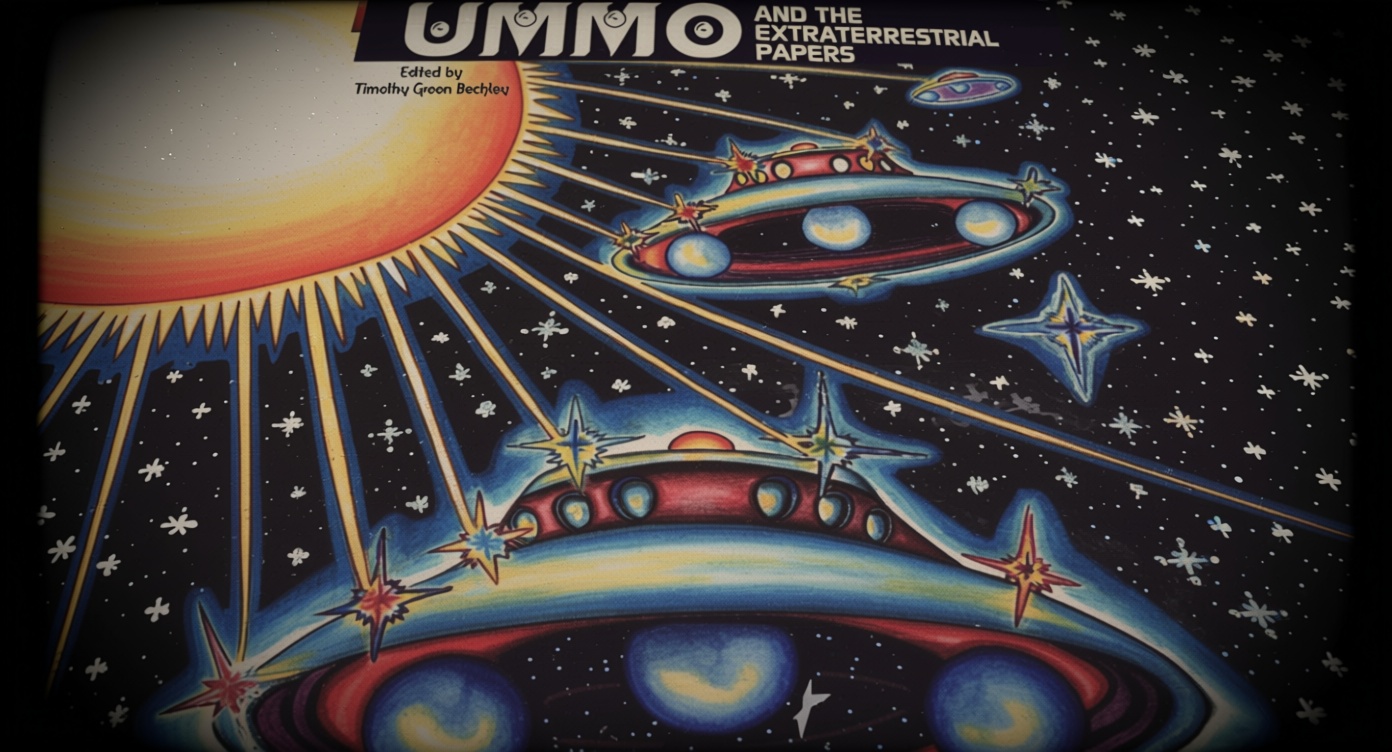
UMMO And The Extraterrestrial Papers by Antonio Ribera | Goodreads

UMMO And The Extraterrestrial Papers

THE ALIENS ARE AMONG US!


THEY WISH TO COMMUNICATE!

AND HAVE EVEN CONSTRUCTED CITIES IN REMOTE PLACES WHILE THEY ARE HERE!

The story of UMMO starts with a series of letters and phone calls to various Spanish UFO researchers in 1965 that purportedly came from an extraterrestrial race. While the most commonly reported method of ET contact is clearly by telepathy, the aliens in this case tried a more direct, decidedly earthly method of communication.
The letters contained highly detailed discourses on such weighty topics as physics and medicine that could only have been written by experts on the cutting edge in those rarified fields that are light years beyond what a lay hoaxer could have come up with. One of the letters also predicted that a UFO sighting would occur on a certain day at a certain location in Spain, and the ship did indeed appear on schedule and at the appointed place. It was a rare event in the annals of Ufology, a supposed alien prediction that actually came true.
The race behind the letters and activity claimed to have come from a planet named UMMO, saying that they had arrived on Earth in 1950 and had been biding their time before contacting trustworthy Earthlings. They had come in response to a weak signal inadvertently sent out into space by a Norwegian ship conducting ionospheric research in 1934. It was later verified that both the ship and its experiments were indeed real-world events. The first landing took place near the Basses-Alps in France. The aliens from UMMO also claimed to have built an underground base in France as well, and later to have established other strongholds, including isolated small cities, much like the aliens in the new science fiction hit "District Nine."
The story kicks into higher gear when two additional sightings occurred near Madrid in 1966 and 1967. In both instances, the bottom side of the ship displayed the letters UMMO as well as a distinctive pictorial mark, seen throughout the book, that resembles our own notation for Uranus. According to the introduction written by Antonio Huneeus, seven clear photos of a classic flying saucer with a large UMMO symbol were taken by one of the Spanish witnesses during the second incident. Though they were later labeled as a hoax by Dr. J. Allen Hynek's Center for UFO Studies in Chicago, the photographer still stands by them.
Another aspect of the second sighting was a strange kind of debris left behind, what were thought at first to be small tubes of a metal resembling nickel. After being sent to Spain's National Institute of Aerospace Technology, they were determined to contain plastic sheets of polyvinyl fluoride, developed by DuPont. The catch is, however, that at the time the use of the material was restricted to the military only. So we have here the makings of another classic UFO case, one with the kind of similarities to previous cases that grounds it within the relative confines of reality while at the same time offering up newer details that add to the uniqueness of the case material.
The book begins with a longish opening section from the early 1990s in which an Earthling named simply "Tony" exchanges letters with an alien called Mr. X in which they discuss numerous aspects of life on Earth as seen from an alien perspective as well as inklings of the cosmic truth possessed by the aliens.

A Broader Hispanic Ufology Debate

The Ribera text sits within a wider body of Hispanic ufology, where writers and researchers have long debated whether the phenomenon is truly extraterrestrial or something more complex. The source material points to Argentine military interest in UFO research, a reminder that in parts of Latin America, official institutions have periodically taken unexplained aerial reports seriously enough to investigate them. It also reflects a recurring skepticism within the field: some researchers have suggested that intelligence agencies could manipulate UFO narratives to obscure the existence of secret military craft or advanced aerospace programs. That theory, while unproven, has remained a durable part of UFO discourse because it offers a terrestrial explanation for at least some sightings without dismissing the entire subject.

Competing Explanations and Cultural Theories

What makes Ribera’s “commandments” notable is that they do not close off alternative interpretations; instead, they leave room for a range of possibilities that continue to animate UFO discussions today. Some researchers have favored non-extraterrestrial models, including interdimensional beings, while others have looked to non-human entities or other unusual intelligences that do not fit classic “little green men” assumptions. The source also notes more unconventional cultural theories, including the idea that rock music may be linked to abduction experiences, a claim that illustrates just how far the interpretive spectrum can stretch in UFO studies. Whether viewed as serious inquiry or cultural curiosity, these perspectives show that Hispanic ufology has often been as much about philosophy, psychology, and geopolitics as it has been about lights in the sky.

Enduring Influence

Ribera’s legacy lies in his willingness to combine openness with discipline: he did not claim to know what UFOs were, but he insisted they merited methodical attention. That balance helped make him a defining figure in Spanish-language ufology, alongside his work as a translator and writer who introduced major science-fiction and speculative ideas to new readers. More than four decades later, his framework still resonates because it captures a central tension in UFO research: the phenomenon is real enough to inspire investigation, but elusive enough to keep almost every explanation on the table.

{  https://usubjects.com/  }

Hoe vind je dit bericht?
Geschreven door peter om 22:39 Stuur door

Unresolved UAP report DOW-UAP-PR100 documented in the Yellow Sea in 2023

Unresolved UAP report DOW-UAP-PR100 documented in the Yellow Sea in 2023 ILLUSTRATIVE RECONSTRUCTION // NOT EVIDENCE

Overview

A DVIDS video entry titled “DOW-UAP-PR100, Unresolved UAP Report, Yellow Sea, 2023” appears to document an unidentified anomalous phenomenon case recorded in the Yellow Sea last year, but the public listing provides very limited details about what was observed. The item is presented as an official or military media record within the Defense Visual Information Distribution Service, a platform used to distribute public-facing imagery and video from U.S. defense and government sources. While the case designation suggests a formal internal tracking process, the available material does not explain the nature of the sighting, the sensor data involved, or whether the object or event was ultimately attributed to a known cause.


DOW UAP PR100, Unresolved UAP Report, Yellow Sea, 2023
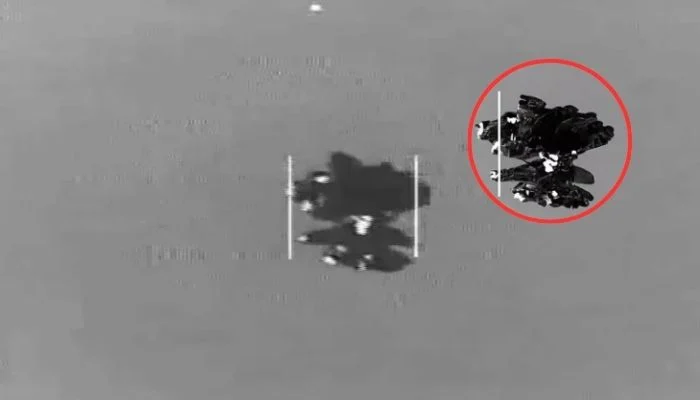
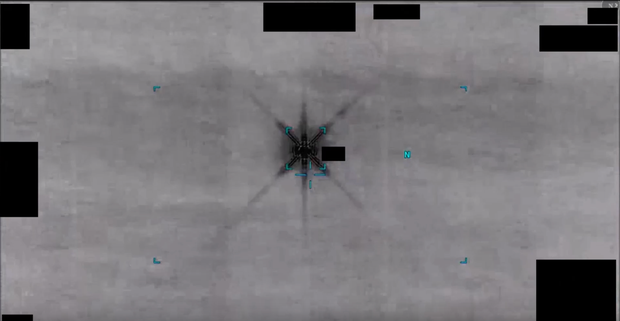
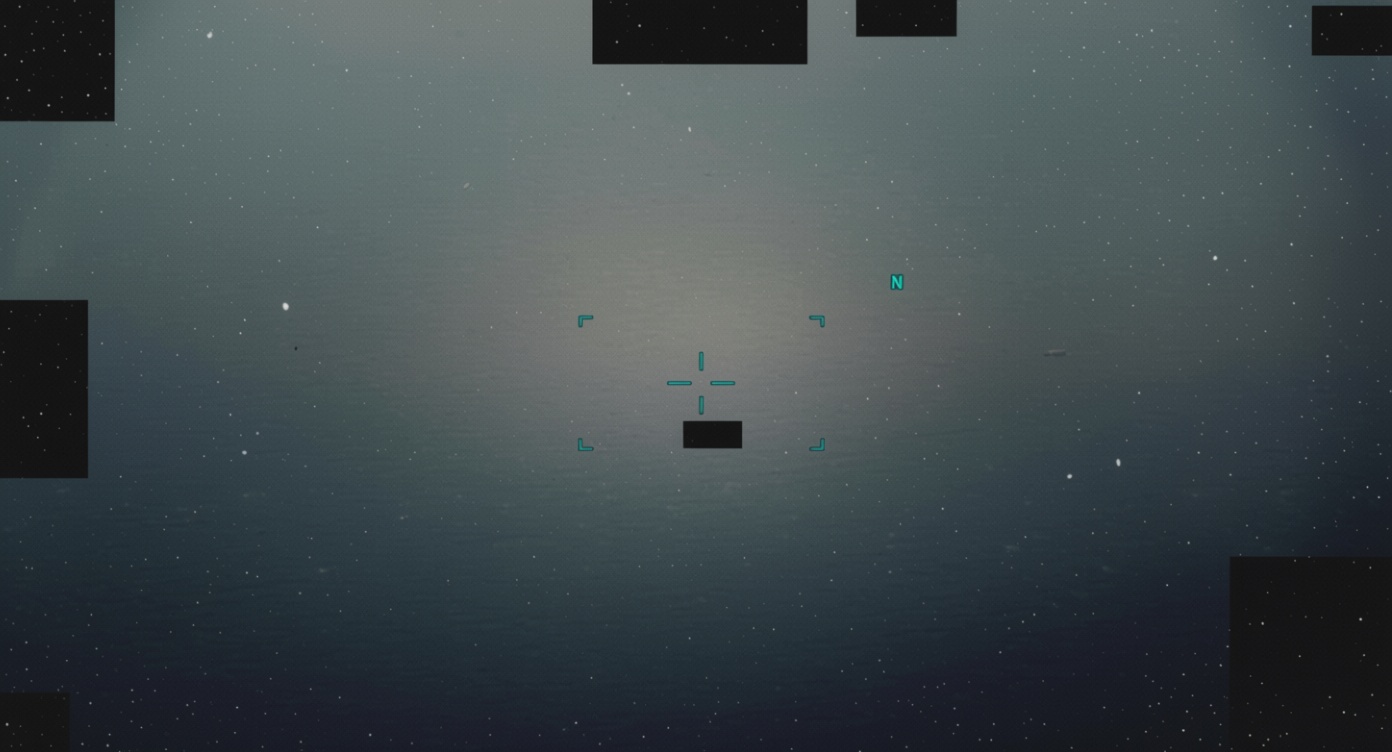
The United States Indo-Pacific Command submitted a report of an unidentified anomalous phenomenon to the All-domain Anomaly Resolution Office (AARO) consisting of 4 minutes and 57 seconds of video footage from an electro-optical and infrared sensor system aboard a U.S. military platform in 2023. Video Description: The overall quality of this video footage progressively degrades over its runtime. 00:01-00:08: In infrared mode, the sensor tracks an area of contrast, keeping it generally within the center of the frame. 00:09-01:03: The sensor zooms in and tracks the area of contrast, holding it generally within the center of the frame. 01:04-01:10: The sensor display switches modes to an electro-optical day time television camera feed (a collection mode that displays visible and near infrared signatures). The video features a dark object superimposed against a blue background. 01:11-01:13: The sensor display changes modes to infrared. The area of contrast is no longer visible within the frame. 01:14-02:16: The sensor zooms in and changes contrast settings. An area of contrast is visible near the center of the frame. 02:17-02:22: The area of contrast repeatedly leaves and enters the sensor field-of-view. 02:23-02:46: The sensor reacquires and tracks the area of contrast, keeping it generally within the center of the frame. 02:47-03:27: The sensor zooms in, tracking the area of contrast. 03:28-03:32: The footage appears to “skip,” or lose coherence. 03:33-03:46: The footage returns to its previous state, and the sensor continues to track the area of contrast generally within the center of the frame. 03:47-04:32: The sensor zooms out. 04:33-04:40: The area of contrast repeatedly leaves and enters the sensor field-of-view. 04:41-04:45: No content. This video description is provided for informational purposes only. Readers should not interpret any part of this description as reflecting an analytical judgment, investigative conclusion, or factual determination regarding the described event’s validity, nature, or significance.

What the Public Record Indicates

The most notable element of the listing is the phrase “Unresolved UAP Report,” which indicates the case was not conclusively explained at the time of publication. The identifier DOW-UAP-PR100 suggests it may be part of a broader reporting system or file series, though the source material does not define the acronym or provide the underlying report text. The location reference to the Yellow Sea places the event in a strategically significant body of water between China and the Korean Peninsula, an area where military activity, maritime traffic, and surveillance operations are all common. That context matters, but it does not by itself clarify what was recorded.

Limited Detail, Significant Interest

The public-facing information attached to the video is sparse enough that it leaves more questions than answers. There is no description of whether the UAP was observed visually, captured on radar, tracked by infrared sensors, or seen through another system. Nor does the listing say whether the object exhibited unusual flight characteristics, whether multiple witnesses were involved, or whether weather and environmental conditions played a role. In UAP reporting, such omissions are not unusual when sensitive sources and methods are involved, but they also mean outside observers cannot evaluate the case on the merits of the available evidence alone. The unresolved designation should therefore be read as an administrative status, not proof of extraordinary behavior.


Yellow Sea UAP Tracked For 5 Minutes By U.S. Military Sensors | DoW-UAP-PR100

Broader Context for UAP Reporting

The appearance of an unresolved case in an official media repository reflects the continuing normalization of UAP as a topic of government interest. Over the past several years, defense and intelligence agencies have increasingly acknowledged that unexplained aerial or maritime observations may warrant structured review, particularly when they occur near military assets or within contested regions. However, the Yellow Sea reference also underscores a recurring challenge in UAP coverage: the most interesting cases often remain the least transparent. Without a public report, supporting footage, or an explanation from the issuing authority, the record cannot be independently assessed beyond its basic metadata.

What Remains Unknown

For now, DOW-UAP-PR100 stands as a cataloged but largely opaque entry in the growing archive of official UAP-related material. The video title confirms only that the case was documented, considered unresolved, and linked to the Yellow Sea in 2023. It does not establish what was seen, who reviewed it, or whether further analysis later resolved the incident. In practical terms, the listing is important less for what it reveals than for what it signals: an official acknowledgment that at least one event in a high-interest maritime zone remained unexplained at the time it was recorded.


DOW-UAP-PR104, Unresolved UAP Report, Yellow Sea, 2025 #uap #ufo #conspiracy #disclosure #fyp #paranormal #spirituality

DOW-UAP-PR024, Unresolved UAP Report — PURSUE (2023)

{  https://usubjects.com/  }

Hoe vind je dit bericht?
Geschreven door peter om 22:28 Stuur door

White House appoints Harvard astronomer Avi Loeb to lead new UFO study group

a man in a suit peers up into a large telescope Avi Loeb, physicist at Harvard University, poses for a portrait in the observatory near his office in Cambridge, Massachusetts on January 29, 2019.  (Image credit: Adam Glanzman/For The Washington Post via Getty Images)

Harvard astrophysicist Avi Loeb has been appointed as the head of a new White House group to study unidentified anomalous phenomena or UAP, a new catch-all term for UFOs that might appear not just in the air but also in space or underwater. Loeb says the group is focused on evidence, instrumentation, data analysis and collection standards.

The move follows recent Trump administration initiatives to bring more transparency to the topic of UFOs, or UAP. The UAP Science Advisory Council, Loeb explains, was established by the White House, the Pentagon's All-Domain Anomaly Resolution Office (AARO), the Office of the Director of National Intelligence (ODNI), the Federal Bureau of Investigation, and other members of the Intelligence Community.

Loeb co-founded and leads the Galileo Project, designed to bring the search for extraterrestrial technological signatures of extraterrestrial technological civilizations "from accidental or anecdotal observations and legends to the mainstream of transparent, validated and systematic scientific research."


WATCH: Here are all the UFO videos released today in the Pentagon's fourth batch of UAP files

As chair of the just-formed UAP Science Advisory Council, Loeb has built a team of researchers that he describes as "an amazing A-team of exceptional scientists and experts."

Members of the group come from a wide range of disciplines from data science and instrumentation to biology, oceanography, anthropology and psychology.

You may like
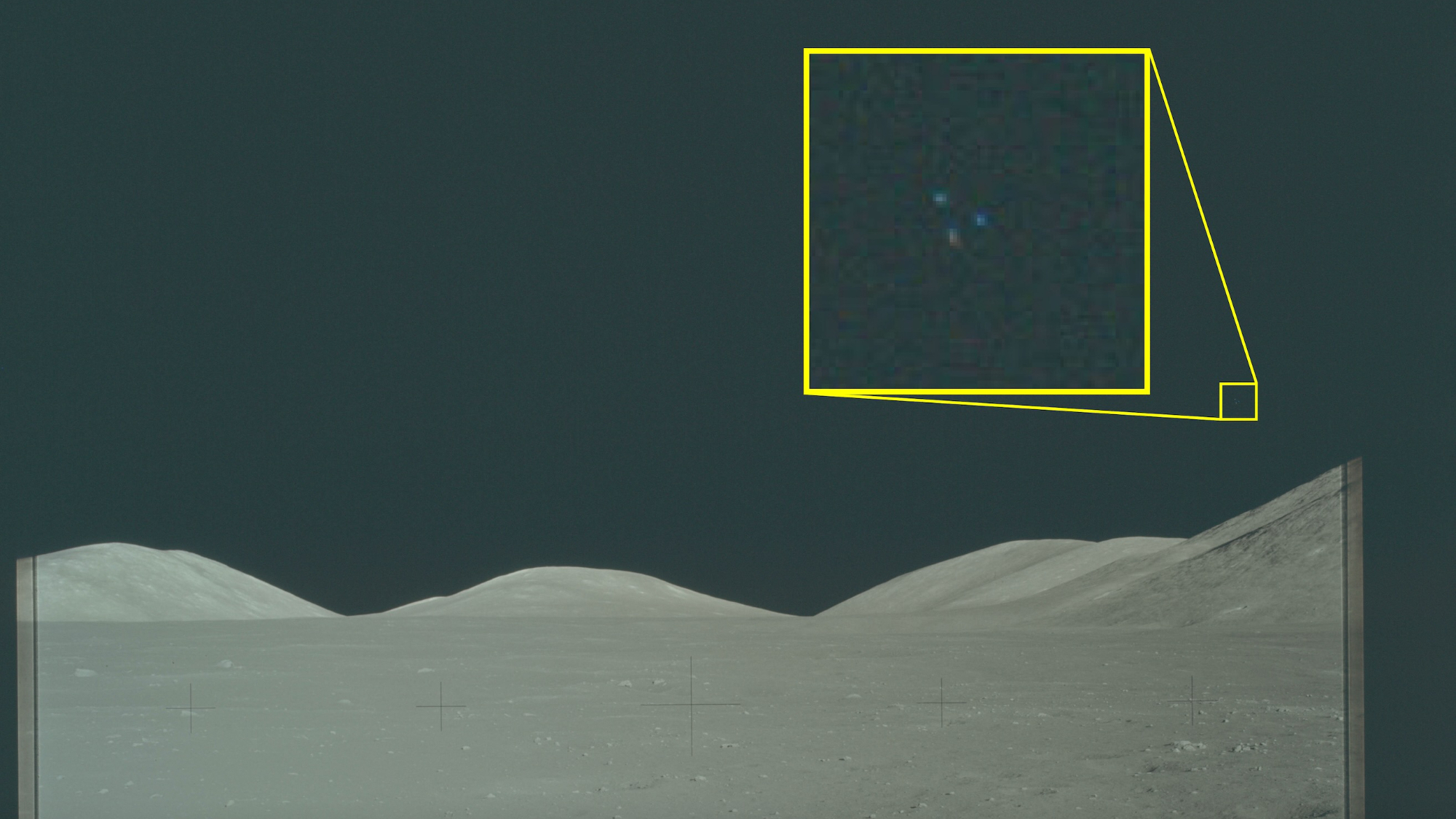
  • This image captured during NASA’s Apollo 17 moon mission in December 1972 contains three “dots” in a triangular formation in the lower right quadrant of the lunar sky that is clearly visible upon magnification of the image. 

The UFO files: What did we learn from the Pentagon's 1st big release?

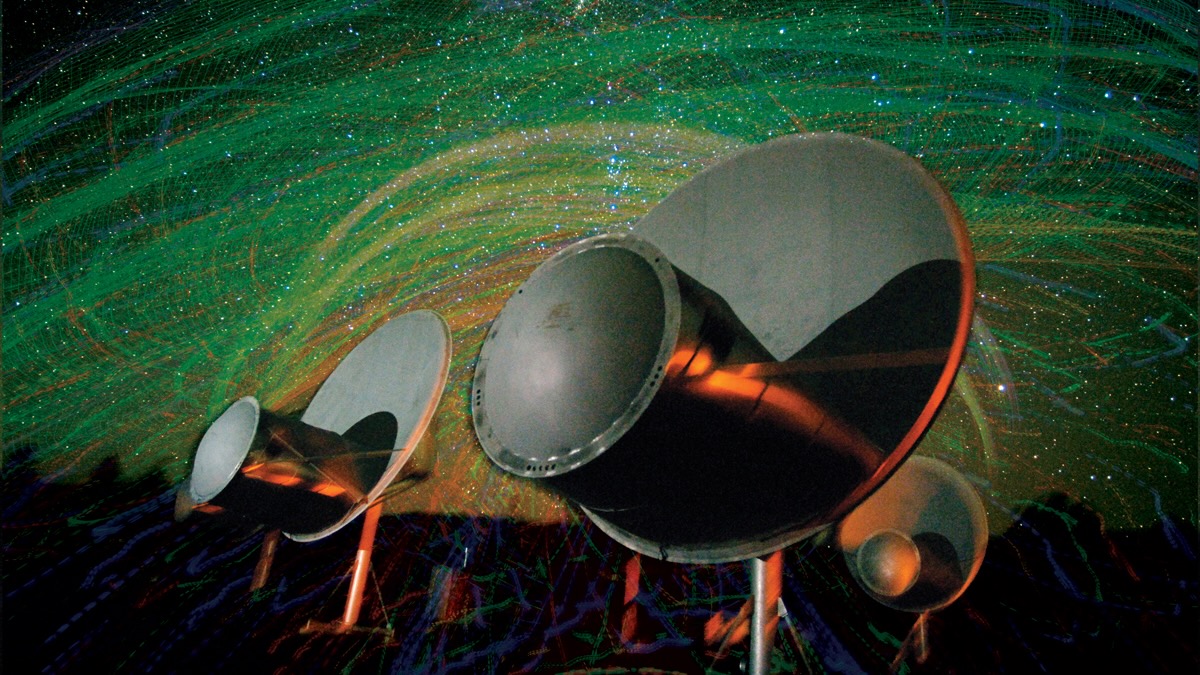
  • The Allen Telescope Array at the Hat Creek Radio Observatory in Northern California.

How should we handle alien detection in a world of AI, deepfakes and social media? This committee is writing the rulebook

  • This image captured during NASA’s Apollo 17 moon mission in December 1972 contains three “dots” in a triangular formation in the lower right quadrant of the lunar sky that is clearly visible upon magnification of the image. 

These Apollo 'UFO' images have been public for decades. So why are people talking about them now?

The council's stated purpose is to help government agencies study the nature of UAP through rigorous scientific methods, with an emphasis on collecting and analyzing higher-quality data rather than relitigating older material that cannot be independently verified.

Meet the team

But first things first.

What is the current membership makeup of Loeb's Council? It's quite a mix of talent to undertake a new look at UAP:

  • Liberty Capito is a professor of practice in data science at the Olin Business School at the Washington University in St. Louis.
  • Carol Cleland is a professor in the Department of Philosophy at the University of Colorado Boulder.
  • Richard Cloete is a computer scientist at Harvard University and a member of Loeb's Galileo Project.
  • Omer Eldadi is in the department of psychology at Reichman University, Herzliya, Israel.
  • Tim Gallaudet is a retired Navy admiral and oceanographer.
  • Dale Hanson is an associate professor of economics at George Mason University statistics and economics.
  • Ross Howard is producer of John Michael Godier's Event Horizon podcast that explores the technosignatures of alien technology. He is also with the Sol Foundation aimed at addressing the UAP issue and preparing society for its social implications.
  • Kevin Knuth is a professor of physics at the University at Albany.
  • Ben Lamm is the co-founder and CEO Of Colossal Biosciences, the world's first de-extinction company.
  • Devesh Nandal is a Swiss National Science Foundation postdoctoral fellow at the Center for Astrophysics at Harvard and Smithsonian.
  • Garry Nolan is professor in the Department of Pathology at Stanford University School of Medicine and is executive director of the board of the Sol Foundation.
  • Michael Shermer is the founding publisher of Skeptic magazine and an educator on critical thinking.
  • Peter Skafish is a sociocultural anthropologist and secretary of the Sol Foundation.
  • Matthew Szydagis is an associate professor in the Department of Physics at the University at Albany.
  • Jennice Vilhauer is a clinical psychologist with expertise in quantitative psychology and the psychological dimensions of potential disclosure.

Data-driven, physics-based

Space.com reached out to several of the UAP Council members to get their personal views on this new study approach.

"I expect the council and myself to follow methods and techniques deeply rooted in the scientific principles," said Devesh Nandal.

What to read next
  • The Orion capsule on the White House lawn.

'This is actually taking a page out of the Communist Party playbook': New White House proposal could deny scientists funding based on their political opinions

  • Composite of front covers from Mack's "Abduction," Jung's "Flying Saucers," Vallees' "Passport to Magonia," Elizondo's "Imminent," and Pasulka's "American Cosmic."

Get ready for the next Pentagon file drop with our essential UFO reading list

  • A "football-shaped" UAP (unidentified anomalous phenomenon) observed by an infrared sensor on a U.S. military platform in 2024. The Pentagon released this observation on May 8, 2026.

Pentagon unveils trove of declassfied 'UFO' videos. How to see them all, from 'a football-shaped body' to 'a misshapen and uneven ball of white light'

"The UAP Science council in particular is focused on a data-driven and physics-based approach on the topic of UAP," said Nandal. "We approach this topic with the same rigor we apply in our respective scientific fields and we hope to provide an unbiased analysis on this topic."

Nandal said his role is to help with quantitative data analysis and apply his expertise in astrophysics to help the council decipher the origin of UAPs.

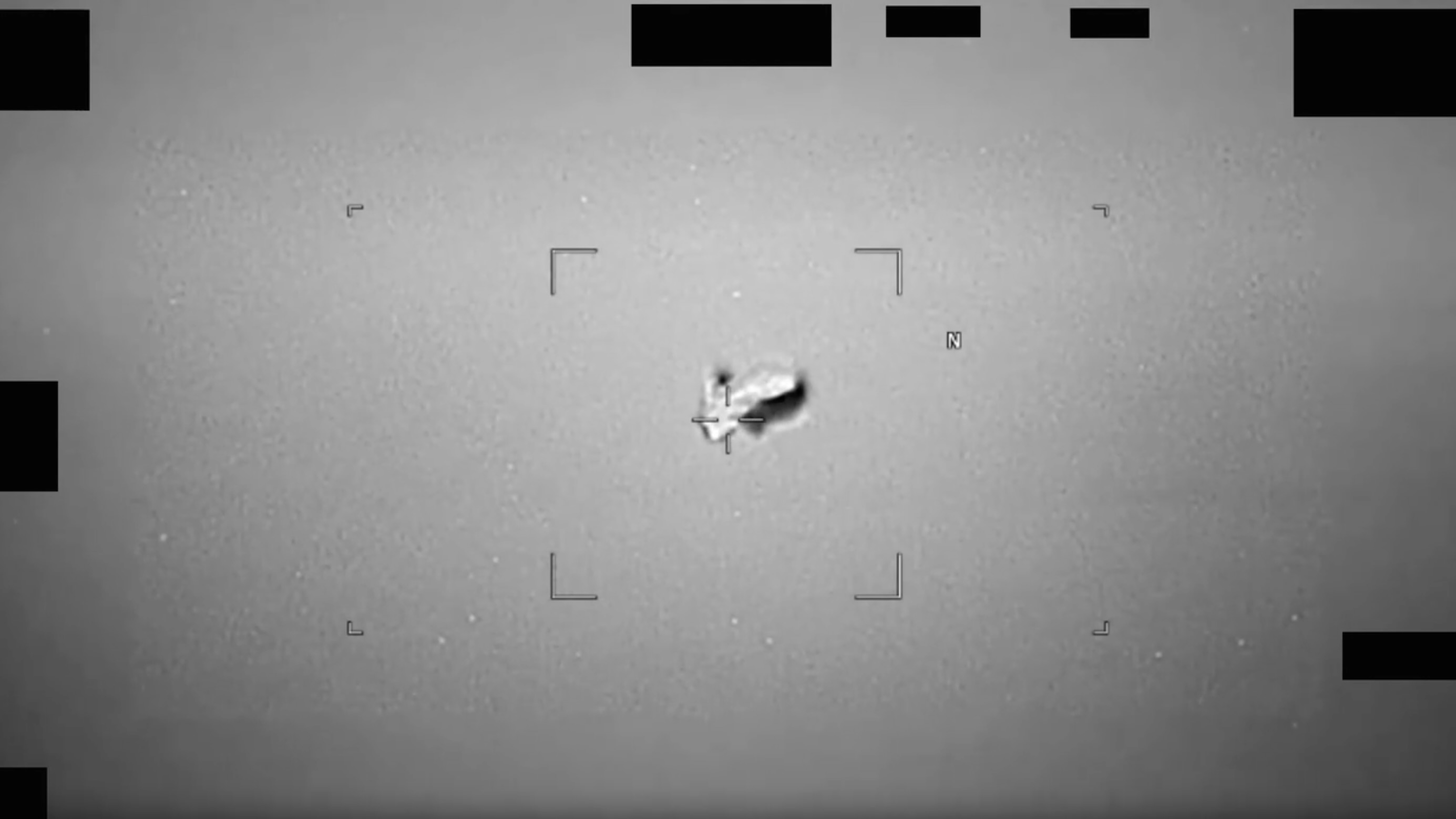
a cross-shaped targeting reticule surrounds a grainy black blur on a grey, grainy background

A "football-shaped" UAP (unidentified anomalous phenomenon) observed by an infrared sensor on a U.S. military platform in 2024. The Pentagon released this observation on May 8, 2026. (Image credit: U.S. Deparment of War)

"My first and foremost passion is in stellar astrophysics where I study the life and death of massive and supermassive stars," Nandal said. "I also find the anomalous nature of UAP sightings to be quite intriguing, and whether these events are of terrestrial or extraterrestrial origin, I am excited to apply my understanding of physics to decipher their true nature," he said.

If such events can be explained using known principles, "that's excellent," Nandal advised, as this gives him a chance to test the laws of physics to explain a phenomenon that is captivating fellow humans.

"If such events are beyond our current understanding, I see this as a brilliant opportunity to learn all that I can about the Universe and share my findings with everyone," Nandal concluded.

Public trust in science

Council member Liberty Capito said she's honored to be a part of the study group.

"Avi is one of the most brilliant scientists of our time and what he has put together, is what I believe to be a blueprint for re-establishing the public's trust in science by having people with vastly different views, beliefs and science on it," Capito said.

From Council member, Robin Hanson: "It's an honor to be invited, and it's a great cause. I worried at first if we could find much useful to do, but it seems that we do have some promising ideas."

Another member of the UAP Council is Carol Cleland, a professor in the Department of Philosophy at the University of Colorado Boulder. She is a Search for Extraterrestrial Intelligence Institute Affiliate and a member of CU Boulder's Center for Astrobiology.

"I anticipate having a council of outside experts will pressure the government to be more open about releasing information and allowing members of the council to interview UAP witnesses," Cleland told Space.com.

Potential positive

Identifying the unidentified deserves a high priority within the U.S. government and the scientific community, explains Loeb.

Nevertheless, for organizations that also continue to diligently sort out what's behind unidentified flying objects (UFOs) in the past and the current UAP tag line, they are taking a cautiously optimistic attitude.

"The involvement of serious, independent scientists is a potential positive development, and the government requires that for any thorough and credible investigation of UAP," said Mark Rodeghier, president and scientific director of the J. Allen Hynek Center for UFO Studies since 1986.

The key issue is not the credentials of the people involved, Rodeghier said, but the structure they are working within.

"If the Council lacks a clear mandate, access to relevant data, a collaborative relationship with those actually grappling with the UAP problem in the government, and then a path for public reporting, its practical value may be quite limited," Rodeghier told Space.com.

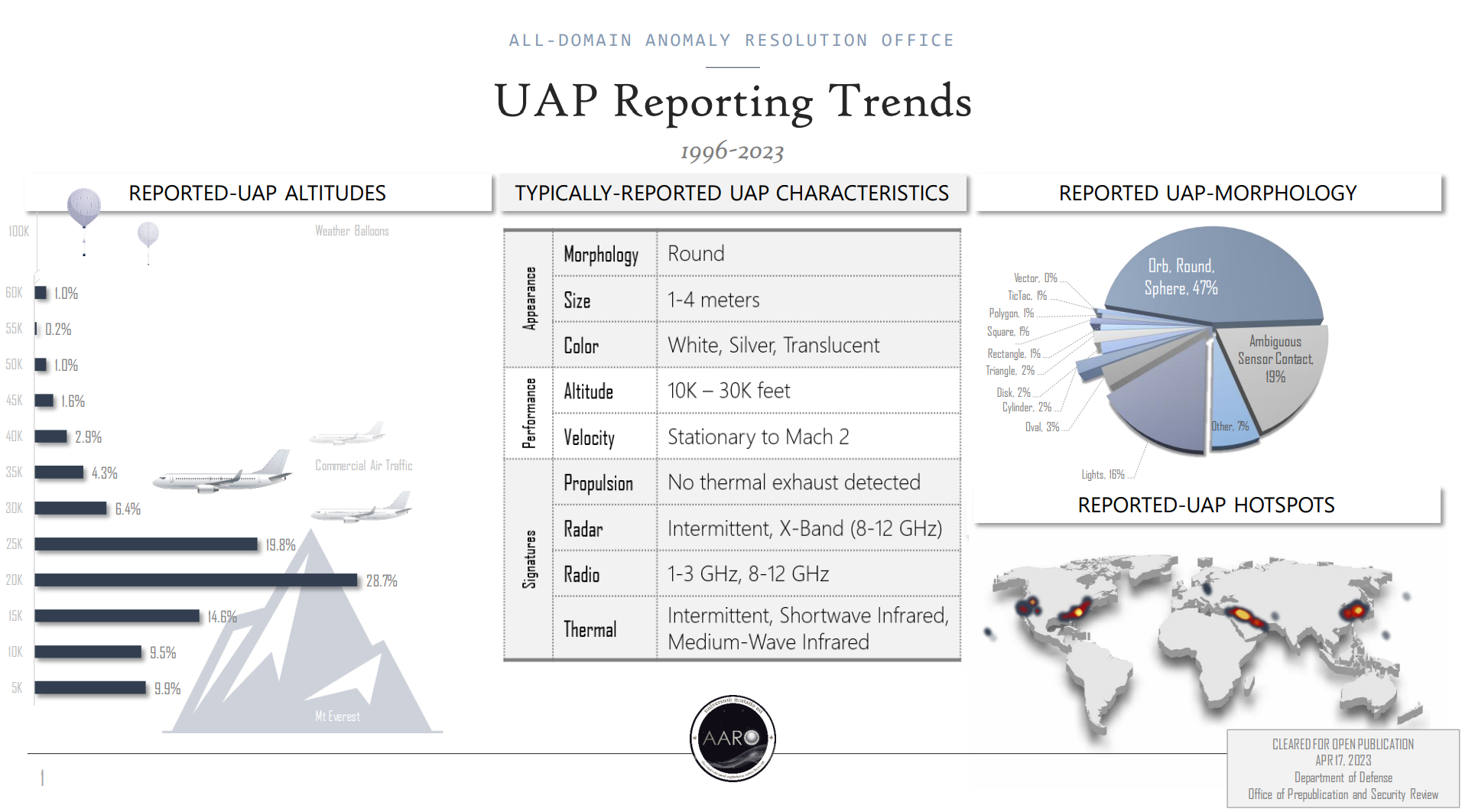
a slide showing various different shapes of UFOs reported by US government personnel

A slide released by the Pentagon's All-Domain Anomaly Resolution Office (AARO) in 2023 detailing trends in UAP reports.  (Image credit: U.S. Dept. of Defense/AARO)

Wait and see

Robert Powell, an executive board member of the Scientific Coalition for UAP Studies, said he's adopting a "wait and see" attitude regarding the UAP Council at this point in time.

"Since the UAP Council seems to have the ear of some in Congress," Powell told Space.com, "I hope that they will spend some of their time advocating that Congress appropriate funding specific to the study of UAP through the National Science Foundation."

In SCU board meetings, Powell added, they are a strong proponent of making funding available to the scientific community and academia.

"We never know from where a breakthrough may occur in the study of UAP," Powell said, "and the more scientists involved from all areas of research, the better."

RELATED VIDEOS

‘It’s like a detective story!’: White House taps Avi Loeb to lead UFO council & probe alien life

Astrophysicist Avi Loeb on Pentagon's 4th UFO files release

Scientist Avi Loeb says "the best is yet to come" after Pentagon releases more UFO files

{ https://www.space.com/space-exploration }

Hoe vind je dit bericht?
Geschreven door peter om 22:01 Stuur door

Ex-Pentagon official claims secret and 'intriguing' photos showing monolith-like structures on Moon exist and could be released soon; NASA clears air

Ex-Pentagon official claims secret and 'intriguing' photos showing monolith-like structures on Moon exist and could be released soon; NASA clears air

As the Trump administration continues releasing classified "UFO Files" containing images of unidentified aerial phenomena (UAPs), former Pentagon UFO investigator Luis Elizondo has made a startling claim, saying the US government possesses unreleased photographs that appear to show giant monolith-like structures on the moon and that the images could be made public soon.

While speaking on podcast Disclosure Tonight with Thomas Fessler on Tuesday (July 7, 2026), Elizondo, who headed the Pentagon’s Advanced Aerospace Threat Identification Program, said, “There’s also photographs that I don’t believe have been made public yet that show on the lunar surface what appear to be large monolithic structures with right angle cuts.” He claimed that photographs of the monoliths were likely to be released soon, and called the images “intriguing.”

"So it's not naturally occurring obviously, right? And like we talked about before the show, if there is any objects on the moon, I mean anything that is not naturally occurring and has been manufactured by somebody, um that is also equally I think as groundbreaking as disclosure itself because it gives us insight that something else has been up there besides us and we're now just discovering that.” “It also shows us how much NASA has been lying to us this whole time," he added.

NASA breaks silence

A NASA spokesperson told the *New York Post* that the agency has mapped and photographed the Moon's entire surface and is unaware of any monoliths in its data. According to NASA, the Moon has been mapped at resolutions of up to 0.5 meters per pixel, and the agency says it has no knowledge of any structures matching those claims.

The assertion comes amid growing public interest in the disclosure of unidentified aerial phenomena (UAPs), as the Trump administration continues releasing previously classified "UFO files." While the documents have not provided evidence of alien life, they do include images of well-documented moving orbs along with other purportedly unusual phenomena that have drawn public attention.

The Department of War began releasing the UFO, or UAP, files on a rolling basis on May 8 after President Donald Trump pledged to declassify certain government records. Additional batches were released on May 22 and June 12. On Friday (July 10, 2026), the Pentagon released a fourth tranche of UFO files, consisting of 40 new files, including 19 videos.


Fourth batch of Pentagon UFO files released: See all 19 videos

{ https://economictimes.indiatimes.com/ }

Hoe vind je dit bericht?
Geschreven door peter om 21:29 Stuur door

Stephen Miller reportedly placed in charge of White House UAP disclosure strategy

Stephen Miller reportedly placed in charge of White House UAP disclosure strategy ILLUSTRATIVE RECONSTRUCTION // NOT EVIDENCE

Overview

Reports circulating in UAP disclosure circles suggest that Stephen Miller has been placed in charge of coordinating White House strategy on unidentified anomalous phenomena, or UAP, disclosure. The claim, first amplified in a Substack post citing unnamed insider accounts, has not been formally confirmed by the White House. Even so, the report has drawn attention because it would signal a more centralized and aggressive approach to the federal government’s handling of UAP-related records and transparency efforts.

According to the report, Miller — long known as one of President Donald Trump’s most forceful policy operators — would be tasked with overseeing or coordinating the administration’s emerging disclosure strategy. The framing matters: if accurate, the assignment would place a highly influential political aide in a role that could shape how quickly agencies respond to document release requests, archival reviews, and interdepartmental disputes over classified materials.

What the reports allege

The source material portrays Miller as a figure typically deployed when the White House wants a policy priority executed quickly and with minimal resistance. It describes him as someone who applies pressure across agencies, identifies bureaucratic bottlenecks, and forces decisions rather than allowing them to stall in committee or clearance processes. In the context of UAP transparency, that could mean greater momentum around FOIA backlogs, declassification reviews, and internal coordination among defense and intelligence entities.

The report also ties the development to Trump’s public comments over the years, including repeated calls to “release it” and let the public see the files, even as he has often stopped short of making substantive claims about what the files contain. In that sense, Miller’s reported involvement would not necessarily reflect a change in the administration’s stated position, but rather a shift in how aggressively that position is being operationalized.

Why it matters for UAP transparency

For researchers, advocates, and former officials calling for more openness, the potential appointment is notable because disclosure efforts have often been slowed by fragmented authority and competing institutional interests. UAP information can sit at the intersection of the Pentagon, intelligence agencies, contractors, and legacy special-access programs, creating a maze that has historically frustrated oversight and public access. A politically powerful coordinator could accelerate movement through that maze — or, depending on the administration’s goals, tighten central control over what gets released.

That is why the report has been interpreted by some as a potentially significant turning point. If Miller is indeed involved, it suggests the White House is treating UAP disclosure as a strategic issue rather than a fringe topic. The difference is substantial: a topic once relegated to the margins of government discourse would now be moving closer to the center of executive-branch management.

Caution and context

Still, the reports remain unconfirmed, and the White House has not issued a statement verifying Miller’s role. As with many fast-moving political and UAP-related claims, the picture could evolve as more information emerges. That uncertainty is important, especially in a field where partial leaks, speculation, and advocacy often travel faster than official documentation.

Even so, the broader context is clear. Government UAP releases, renewed public interest, and continued pressure for transparency have already made disclosure a live policy issue. If the reports prove accurate, Miller’s involvement would mark one of the most consequential personnel developments yet in the ongoing effort to define how much the government is willing to reveal — and how fast.

RELATED


The Fourth PURSUE Release: 40 Files, Five Agencies, and the Architecture of Disclosure

UAP Release #4: What Actually Matters? | Full Richard Dolan Analysis

{  https://usubjects.com/  }

Hoe vind je dit bericht?
Geschreven door peter om 21:08 Stuur door

MIT Engineers Unleash New ‘Aerial-Aquatic’ Robot That Can Swim Underwater and Fly Like a Bird

Image Credit: MIT

MIT Engineers Unleash New ‘Aerial-Aquatic’ Robot That Can Swim Underwater and Fly Like a Bird

Engineers have developed a new robot that can swim underwater, then rise to the surface and take flight, in an aerial-aquatic feat that mimics some of nature’s most formidable fliers and swimmers.

Developed by researchers at the Massachusetts Institute of Technology (MIT) and the Swiss Federal Institute of Technology Lausanne (EPFL), the new robot’s capabilities could help launch a new generation of aerial-aquatic exploration vehicles.

Dubbed the “Flapping-Wing Aerial-Aquatic Vehicle” (FAAV), this lightweight robotic platform weighs less than 300 grams and can transition seamlessly between water and air with its very flexible flapping wings. Now, the team’s findings, published in the journal Science, could help scientists better understand how diving birds, which include puffins, petrels, loons, and gulls, are so adept at navigating two vastly different environments.

Such capabilities, the team says, could also pave the way toward advanced drones in the coming years that could transform ocean research.

Inspired by Diving Birds

Departing from conventional modern designs employed for aircraft or underwater vehicles, the team based their design on diving birds, which evolved to fly over water, then plunge beneath the waves to hunt for food, before surfacing and resuming flight.

aerial-aquatic robot

MIT’s new aerial aquatic robot seen launching from water into the air

(Image Credit: Raphael Zufferey/MIT)

One problem when it comes to replicating these abilities in robots involves the density of water, which is around 1,000 times denser than air. Because of this, the engineering team had to carefully balance the flexibility of the robotic wings in their design, along with flapping frequency, tail angle, and other factors that allowed the robot to move efficiently through both environments without requiring propellers or separate propulsion systems.

Finding the Sweet Spot for Transmedium Travel

Experiments were undertaken by the team in the lab and in Switzerland’s Lake Geneva, and helped the team determine that the robot achieved best performance with medium-sized wings that flap at approximately five times per second. Under such conditions, the robot was able to swim one meter per second, then by pitching upward at a 70-degree angle, it could break through the surface, and continue this same movement to propel itself through the air.

Although the robot still has some limitations compared to the avian examples that inspired it, interestingly, it does appear to have one advantage: unlike diving birds, which paddle using their feet to achieve aquatic launches into the air, the new robot has no such requirement, and can transition from water to air relying only on its wings and adjustable tail.

Future Drones with “Aerial-Aquatic” Abilities

In the future, drones equipped with such capabilities could be leveraged to monitor marine ecosystems in a variety of ways. The team also says it could help to observe environmental concerns, such as water near glaciers or offshore infrastructure, or even collect data from hazardous locations that are either too difficult or simply too costly for ships to reach.

“Our dream vision is for oceanographers, marine biologists, and members of coastal communities to launch this robot from a boat, or from shore, and it would fly close to the area of interest, such as an iceberg or a port facility, or over a pod of whales,” according to Raphael Zufferey, assistant professor of mechanical engineering at MIT.

“It would dive into the water to take a measurement or collect a sample, and fly back to deliver the data at a fraction of the cost of traditional methods. Then it could go back out to dive for more,” Zufferey recently told MIT News.

Drawing from movements in nature influenced by evolution, the researchers hope their bird-inspired design may eventually help scientists by introducing cost-effective, but formidable new tools to help obtain information from some of the most challenging environments, all with help from robots that can do what only nature’s diving birds could once achieve.

The achievement is detailed in a new paper, “Leaping out of the water: aerial-aquatic locomotion with flapping wings,” which appeared in the journal Science.

  • Micah Hanks is the Editor-in-Chief and Co-Founder of The Debrief. A longtime reporter on science, defense, and technology with a focus on space and astronomy, he can be reached at micah@thedebrief.org. Follow him on X @MicahHanks, and at micahhanks.com.
RELATED

Puffin-Inspired Robot that Swims and Flies

MIT built a robot that **swims, surfaces, and flies**

MIT's Incredible Robot Can Swim, Fly & Dive! 🚁🌊🤖

{ https://thedebrief.org/category/science/ }

Hoe vind je dit bericht?
Geschreven door peter om 20:46 Stuur door

Secretive Chinese probe snaps first photo of Earth's mysterious 'quasi-moon' — and it may pose a big problem

Secretive Chinese probe snaps first photo of Earth's mysterious 'quasi-moon' — and it may pose a big problem

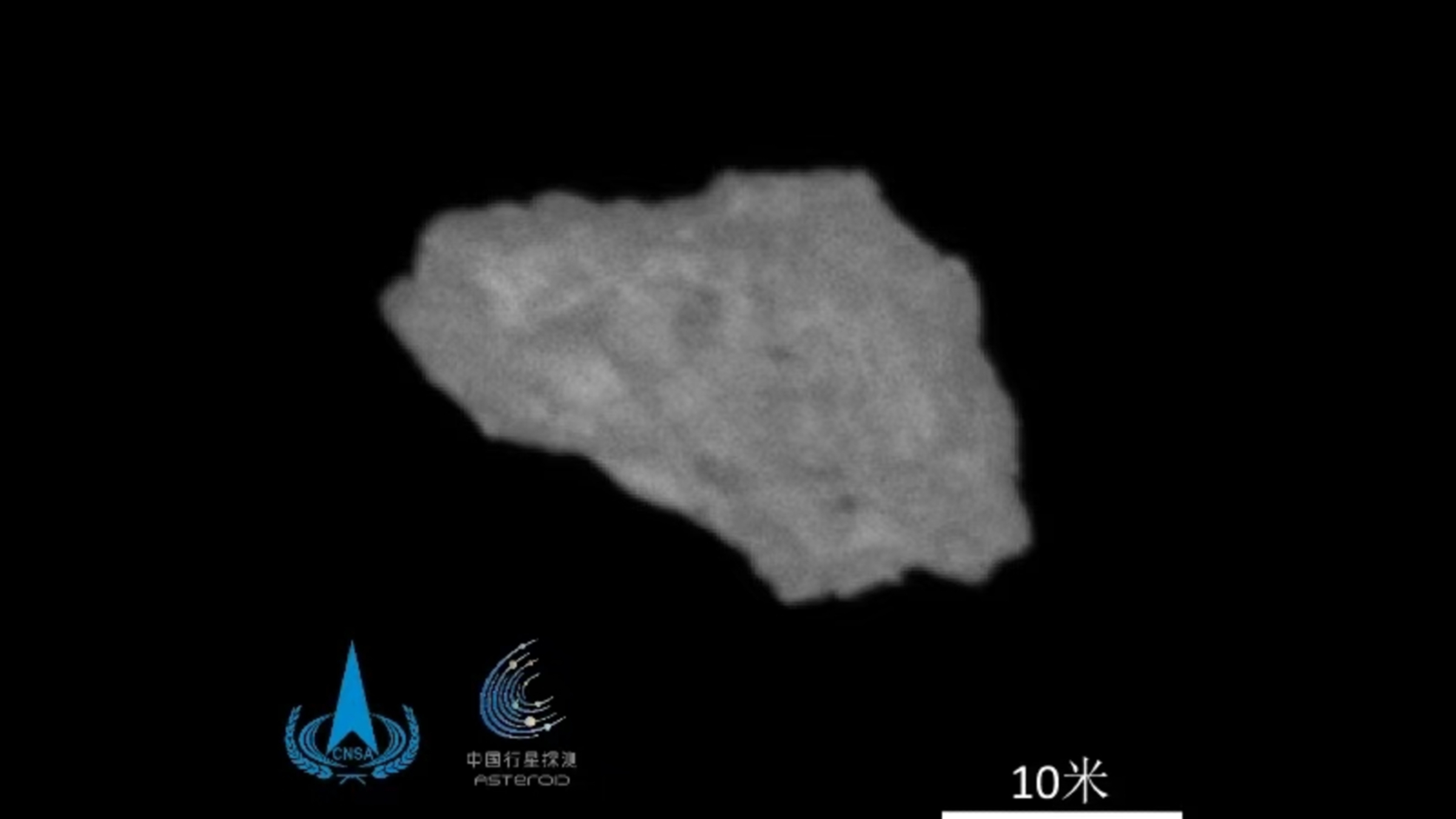
China's Tianwen-2 spacecraft has captured the first close-up photo of one of Earth's "quasi-moons," Kamo'oalewa. However, the image and the timing of its release suggest that it may be harder for the probe to collect samples from the space rock than originally planned.

A blurry photo of an irregular-shaped grey asteroid in against the darkness of space

China's Tianwen-2 spacecraft captured this photo of the quasi-moon Kamo'oalewa (a.k.a. 2016 HO3) at a distance of around 12.5 miles (20 kilometers) from the near-Earth asteroid.
(Image credit: CNSA)

A secretive Chinese spacecraft has captured the first-ever close-up photo of one of Earth's temporary "quasi-moons" after arriving there for a potential first-of-its-kind landing.

The space probe is supposed to scoop up samples from the newly imaged space rock and return them to Earth next year. However, the blurry photo and the timing of its release hint that this may be trickier than initially thought.

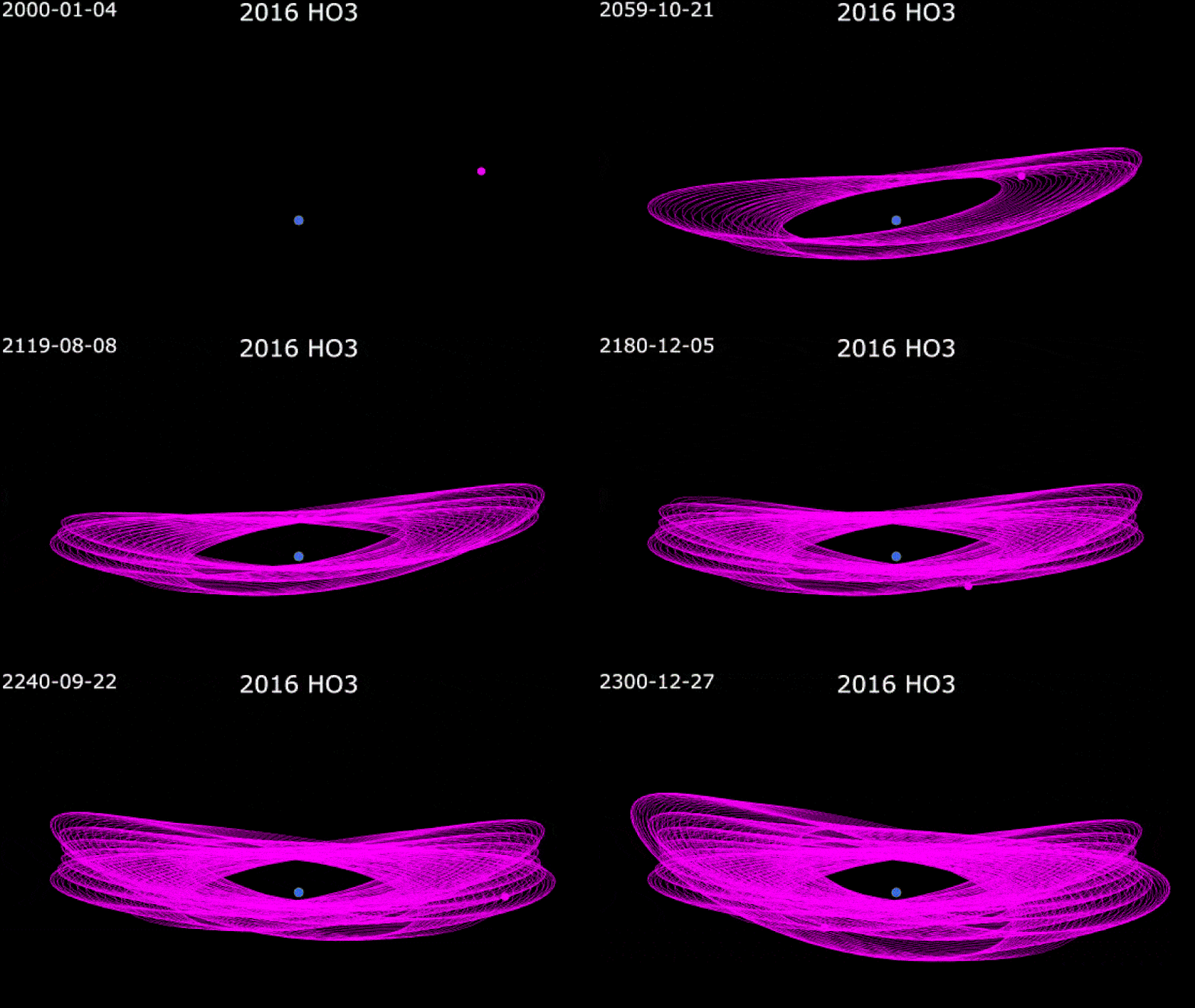
The Chinese National Space Administration (CNSA) probe, named Tianwen-2, launched from Xichang Satellite Launch Center in southern China on May 28, 2025, according to Live Science's sister site Space.com. Its primary target is Kamo'oalewa, also known as 2016 HO3, a fast-spinning asteroid that is classified as a quasi-satellite of Earth. That means it circles the sun alongside our planet, making it appear as if it were gravitationally bound to Earth when, in fact, it isn't. (This is only a temporary association; Kamo'oalewa will eventually fall out of sync with Earth and drift away from us.)

The CNSA has released minimal information about the parameters and timeline of the Tianwen-2 mission and only shared the first photo of the spacecraft several weeks after its launch. Based on one unverified timeline, Live Science previously reported that the probe had most likely arrived at Kamo'oalewa on June 7. However, Chinese officials have remained tight-lipped about the probe's progress.

But on Monday (July 6), the CNSA finally confirmed that, after a roughly 400-day-long journey spanning more than 600,000 miles (1 million kilometers), Tianwen-2 is now circling Kamo'oalewa, according to the state-run news outlet Xinhua. The agency also revealed that the probe first inserted itself into the asteroid's orbit on June 7, as originally predicted.

You may like

A photo of one of Tianwen-2's hexagonal solar panels taken in space

This photo of one of Tianwen-2's decagonal solar panels, captured in orbit, was the first image of the probe released by the CNSA.

(Image credit: CNSA)

The announcement was accompanied by the first clear photograph of Kamo'oalewa, captured at a distance of around 12.5 miles (20 km) from the quasi-moon. The blurry image suggests the space rock is around 130 feet (40 meters) across, according to the South China Morning Post, which is on the lower end of previous estimates that suggested the asteroid was up to 330 feet (100 m) wide.

Initial readings also suggest that Kamo'oalewa is a rubble-pile asteroid, which means it is loosely bound together and has an unstable surface. Until now, researchers were unsure of the asteroid's composition and hoped it had a solid, rocky surface, which would have allowed the spacecraft to attempt a first-of-its-kind landing using an "anchor and drill" technique. (It now seems unlikely that this sampling method will be used.)

The asteroid's small size, fragile composition and fast spin will make it harder for the probe to collect samples from the space rock's surface, even with other tried-and-true techniques. The new image also hints that there are few flat spots on the space rock where the probe could land safely.

"This greatly increases the complexity of the sampling process and the risk of the mission, making it much more difficult," CNSA representatives wrote in a report, according to the South China Morning Post.

Photo of a Chinese rocket taking off at night

Tianwen-2 launched into space May 28, 2025 on board one of China's Long March 3B rockets.

(Image credit: VCG/VCG via Getty Images)

The unverified mission timeline, which correctly predicted the probe's arrival date, stated that the sampling attempt would commence July 4. However, the fact that this has seemingly not happened yet further suggests that Chinese scientists are struggling to figure out how to collect their desired samples.

What to read next

CNSA officials wrote that the probe "will progressively conduct more detailed scientific exploration to acquire data on the asteroid's morphology, material composition and internal structure, laying the groundwork for subsequent sample collection operations."

If Tianwen-2 does manage to snag some samples, the probe will release them in a capsule during a flyby of Earth in November 2027, and they will reenter the atmosphere at around 27,000 mph (43,500 km/h). This would make China the third country to successfully collect and return asteroid samples to Earth, following Japan, which returned samples from the asteroid Ryugu in 2020, and the U.S., which acquired material from the space rock Bennu in 2023.

A GIF showing how the quasi-moon circles Earth

Kamo'oalewa (a.k.a. 2016 HO3) circles Earth but does not orbit our planet. This simulation shows its predicted movements relative to Earth over the next few centuries.

(Image credit: NASA/Pheonix7777/Wikimedia)

Researchers hope the returned samples will help unravel the secrets of the early solar system and potentially shed light on how key compounds, such as organic molecules and water, ended up on Earth. They may also shed light on the seven other quasi-moons that are currently known to co-orbit the sun with our planet.

Some experts previously theorized that Kamo'oalewa may be a fragment of the moon that was knocked loose from our permanent companion by an ancient meteor strike. Others have even attempted to pinpoint which crater the asteroid may have come from and hope that the samples will help confirm their hypothesis.

"I am curious to find out the answer about its origin, since the debate on its [potential] lunar origin is still very open," Marco Fenucci, a mathematician at the European Space Agency's Near-Earth Object Coordination Centre who has co-authored multiple studies on Kamo'oalewa, previously told Live Science. Any returned samples should "definitely give us an answer to this matter," he added.

After its close approach to Earth next year, Tianwen-2 will slingshot farther into the solar system to begin its secondary mission to study 311P/PanSTARRS — a peculiar object beyond Mars that displays characteristics of both comets and asteroids — in 2035.


Arjuna 2025 PN7: Earth’s New Quasi-Moon Explained | WION Podcast

{ https://www.livescience.com/space/space-exploration }

Hoe vind je dit bericht?
Geschreven door peter om 18:45 Stuur door

4th batch of Pentagon UAP files: ‘Floating brain’ goes viral

4th batch of Pentagon UAP files: ‘Floating brain’ goes viral

Hoe vind je dit bericht?
Geschreven door peter om 18:24 Stuur door

The Vatican fired me after I claimed a word used 2,570 times in the Bible refers to alien beings

The Vatican fired me after I claimed a word used 2,570 times in the Bible refers to alien beings

By ROB WAUGH

An Italian translator who says he was 'fired by the Vatican' for his interpretation of the original Hebrew Bible has revealed a radical reinterpretation of what God in scripture really is.

Mauro Biglino pointed to the word 'Elohim,' found 2,570 times in the Holy Book, which translates to 'God' or, in his opinion, 'Gods.'

Biglino, an Italian scholar who worked as a biblical translator for Edizioni San Paolo, a major Catholic publishing house linked to the Vatican, suggested that instead of detailing encounters with one God, the Bible describes encounters with a group of mortal, alien beings armed with high technology.

In a podcast interview with Project Unity, he said: 'When I started to write what I really read in the Hebrew Bible, I was fired in one minute.'

According to Biglino, his conclusions stem from translating the original Hebrew text literally rather than through centuries of theological interpretation. 

He argued that many of the Bible's best-known passages have been reshaped by later religious tradition, masking what the ancient authors actually intended to convey.

Pointing out that Elohim is often treated as a singular name for God despite its plural form, he argued that the Bible describes multiple divine figures rather than one supreme being.

'There are multiple divine figures, with different names of God,' he said. 'If Elohim are not God, the Bible is another Book.' 

Mauro Biglino pointed to the word 'Elohim,' found 2,570 times in the Holy Book, which translates to 'God' or, in his opinion, 'Gods'

Mauro Biglino pointed to the word 'Elohim,' found 2,570 times in the Holy Book, which translates to 'God' or, in his opinion, 'Gods'

article image

Rather than viewing the Elohim as supernatural spirits, Biglino believes they were advanced beings of flesh and blood.

'The Elohim were flesh and blood, but with a longer lifespan, but still mortal, with higher technology and higher powers,' he told podcast host Jay Anderson.

His theory builds on the controversial ancient astronaut hypothesis popularized by Swiss author Erich von Däniken, who argued in his 1968 bestseller Chariots of the Gods that extraterrestrials visited ancient civilizations and shared advanced technology with humanity. 

Before his death earlier this year, von Däniken collaborated with Biglino on the book Skies Aflame.

Unlike von Däniken, whose work centered on monuments such as the Egyptian pyramids and other archaeological mysteries, Biglino bases his conclusions on his own translations of the Hebrew Bible, arguing that key words have been misunderstood for centuries.


The Vatican Fired Him For Revealing What The Bible Really Says!

{ https://www.dailymail.com/sciencetech/index.html }

Hoe vind je dit bericht?
Geschreven door peter om 17:47 Stuur door

Prehistoric discovery in the Oregon mountains older than Egypt's Great Pyramid could rewrite human history READ MORE: America's greatest mystery was a lie: Truth about the Lost Colony of Roanoke revealed by experts See more Daily Mail on Google - save us

Prehistoric discovery in the Oregon mountains older than Egypt's Great Pyramid could rewrite human history

A prehistoric discovery in the Oregon mountains could rewrite the story of the first people to live in North America. 

Archaeologists said a remote rock shelter, known as Rimrock Draw, may have been occupied by humans about 18,250 years ago, thousands of years earlier than scientists once believed the first Americans arrived.

If confirmed, the site would rank among the oldest known places of human occupation in North America and date back to roughly four times the age of Egypt's Great Pyramid.

Instead, it suggests Ice Age humans reached North America thousands of years ago by following a coastal 'kelp highway,' using boats to move along the Pacific shoreline and settle places like the Channel Islands. 

The islands have also yielded the bones of pygmy mammoths and remarkably preserved archaeological sites that offer an unprecedented glimpse into Ice Age life.  Scientists have described the chain of islands as a place where ancient landscapes and human history have been frozen in time. 

Researchers said the evidence points to a forgotten maritime migration that could fundamentally change our understanding of America's earliest people. And they believe many of the answers may still be waiting to be uncovered. 

The Channel Islands have been studied by scientists and archaeologists for more than a century, with some of their most important discoveries, including the remains of Arlington Springs Man, emerging during excavations in the mid-20th century. 

Now, a new documentary released on June 30 on the YouTube channel Timeline is bringing fresh attention to these discoveries and the mysteries that still lie beneath the islands and surrounding waters.

The eight California Channel Islands lie in the Pacific Ocean off Southern California, stretching from Point Conception near Santa Barbara to south of Los Angeles. Pictured is Santa Cruz, one of the islands

The eight California Channel Islands lie in the Pacific Ocean off Southern California, stretching from Point Conception near Santa Barbara to south of Los Angeles. Pictured is Santa Cruz, one of the islands

article image

Not all archaeologists agree that the Channel Islands provide definitive proof of a maritime migration. 

While many researchers now accept that people were present in the Americas before the Clovis culture, experts continue to debate exactly when the first settlers arrived and whether they traveled by sea, by land, or through a combination of routes. 

The eight California Channel Islands lie in the Pacific Ocean off Southern California, stretching from Point Conception near Santa Barbara to south of Los Angeles.

Author Frederic Caire Chiles, who has a PhD in history from the University of California at Santa Barbara, said in the film: 'They are the trace of a vanished world.'

RELATED

Archaeologists Just Unearthed an Ancient Discovery in Oregon That Could Rewrite Human History

A Mysterious Discovery in Oregon Could Rewrite the Story of America's First Humans


Archaeologists Unearthed Something in Oregon That Defies Everything we knew About Human Origins!

{ https://www.dailymail.com/sciencetech/index.html }

Hoe vind je dit bericht?
Geschreven door peter om 17:32 Stuur door

Mapped: US UFO Sightings by State and the 15 Most Famous UAP Cases — After the Pentagon’s May 2026 File Release

Mapped: US UFO Sightings by State and the 15 Most Famous UAP Cases — After the Pentagon’s May 2026 File Release

Hoe vind je dit bericht?
Geschreven door peter om 17:06 Stuur door

Declassified intelligence map reveals where America's largest UFO waves unfolded

Declassified intelligence map reveals where America's largest UFO waves unfolded

Dozens of newly declassified UFO records were released by the Pentagon on Friday, including a shocking map revealing where hundreds of UFOs were seen flying near major cities throughout the US.

Acting like a roadmap for extraterrestrial encounters, the US military created the top-secret document in 1948, marking off where pilots, scientists, police officers and ordinary civilians saw strange objects in the sky during World War II.

Between 1947 and 1948, the joint study by the Air Force and the Office of Naval Intelligence found that Americans had seen an entire fleet of UFOs, including 'disks,' 'cigar-shaped' craft, 'balls of fire' and 'cones of fire.'

In total, 210 sightings were reported to the military, with the largest number of encounters coming near Philadelphia, Cincinnati and Louisville in the east, and Los Angeles, Portland and Boise in the west.

Flying saucers were the most commonly reported UFO, with 'cones of fire' being regularly seen in Ohio and Kentucky.

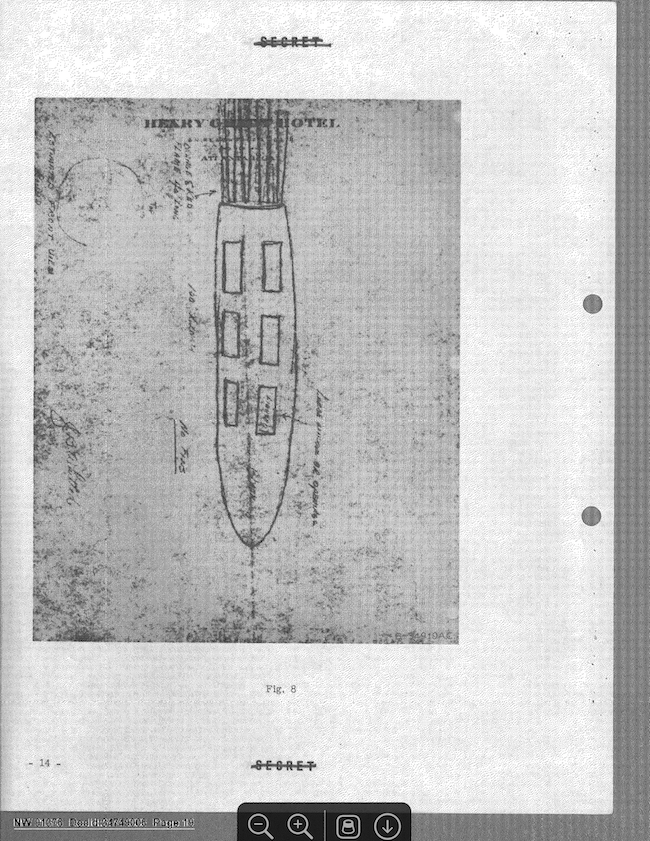
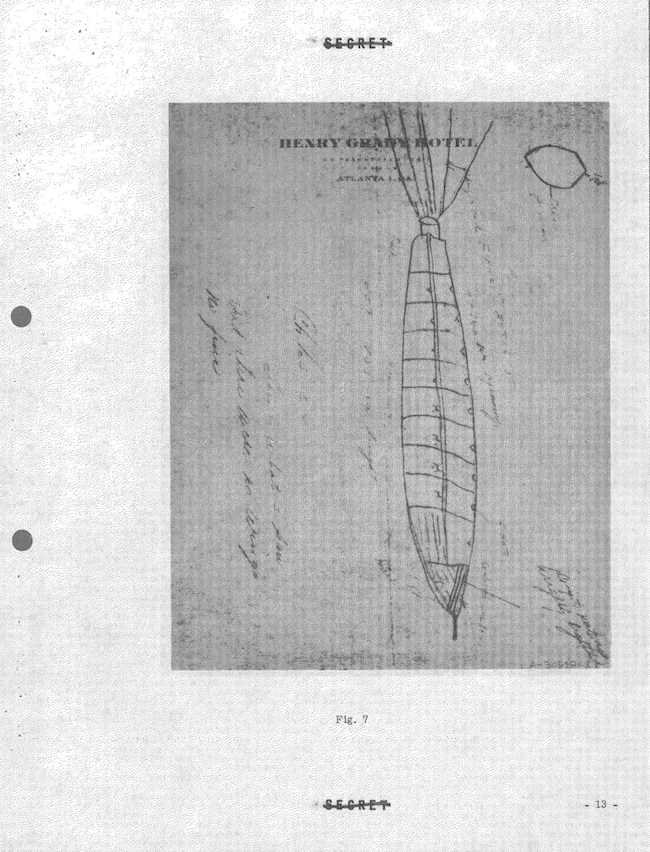
Meanwhile, cigar-shaped UFOs were reported throughout the country, with some witnesses even seeing them clearly enough to sketch what had just passed overhead.

'There were no wings or fins,' one pilot wrote on a drawing they made after seeing a cigar-like rocket that was approximately 100 feet in length and flying past them over the US.

Although the military could not confirm that these were real alien spacecraft, they deemed the reports added to the map credible enough to investigate and feared the UFOs may have been technology recovered by the Soviet Union during the war.

The US Air Force and Navy created a top-secret map showing over 200 UFO contacts between 1947 and 1948

The US Air Force and Navy created a top-secret map showing over 200 UFO contacts between 1947 and 1948

Witnesses revealed detailed drawings of the craft they saw, including cigar-shaped rockets flying over the US

Witnesses revealed detailed drawings of the craft they saw, including cigar-shaped rockets flying over the US

Many of these sightings came before UFO hysteria would grip the nation after the alleged events in Roswell, New Mexico in July 1947.

These include two trained US Weather Bureau observers spotting a metallic disk three times while tracking weather balloons in Richmond, Virginia in April 1947.

article image

'The disk appeared metallic, shaped something like an ellipse with a flat bottom and a round top,' the report revealed. 

In May 1947, Byron Savage, a field engineer in Oklahoma City, Oklahoma reported seeing another flying disk roughly 10,000 to 12,000 feet overhead, moving north at high speed with no trail from an engine - similar to many modern-day UFO sightings.

One month later, on June 28, 1947, a US Air Force pilot flying at 10,000 feet saw five or six white circular objects in close formation traveling at about 285 mph near Lake Mead in Nevada.

Just days later, military officials would officially report that a flying disc had crashed and been recovered on a ranch near Roswell - only to retract the claim the very next day and say it was just a weather balloon.

These incidents would continue throughout 1947 and 1948, with civilian pilots, military airmen and law enforcement officials all saying they spotted groups of flying saucers and other strangely shaped objects flying around 10,000 feet over the US.

 'If it is firmly indicated that there is no domestic explanation, the objects are a threat and warrant more active efforts of identification and interception,' the military concluded in their report.

Images taken in the late 1940s revealed strange craft spotted throughout the US, which were declassified on July 10, 2026

Images taken in the late 1940s revealed strange craft spotted throughout the US, which were declassified on July 10, 2026

A top-secret military map shows the location of UFO sightings over the US  A top-secret military map shows the location of UFO sightings over the US

A top-secret military map shows the location of UFO sightings over the US, with larges clusters over the East and West Coasts

Military officials concluded that the number of reports, the similarity in the descriptions of these UFOs and the quality of many witnesses coming forward made it unlikely that all of these sightings were hoaxes or publicity stunts.

The Air Force and Navy grouped these UFOs into three distinct categories: disk-shaped, cigar- or pencil-shaped, and balls of fire.

Even after 80 years, witnesses who claim to see UFOs often mention these same shapes, while adding other shapes such as triangles and rectangles to the list as well.

The military believed these sightings followed a clear geographic pattern, with the heaviest clusters coming along the Atlantic and Pacific coasts and additional concentrations in Ohio and Kentucky.

Multiple sightings of UFOs in the 1940s reported seeing large formations of flying saucers flying roughly 10,000 feet over the US (Stock Image)

Multiple sightings of UFOs in the 1940s reported seeing large formations of flying saucers flying roughly 10,000 feet over the US (Stock Image) 

Military officials believed one possible explanation was that these were 'flying wing' aircraft being tested by a foreign power

Military officials believed one possible explanation was that these were 'flying wing' aircraft being tested by a foreign power

With no way of telling where these craft came from, intelligence officials settled on two possibilities: the first being that the UFOs were some type of US-made balloons, test rockets or experimental aircraft - especially 'flying wing' designs.

The other possibility that the military feared was that the UFOs were foreign-made technology, likely using experimental German technology from World War II that had fallen into Soviet hands.

If the objects were foreign aircraft, the military believed these sightings over US soil were being carried out to destroy US confidence in the newly created atomic bomb, being the 'most advanced and decisive weapon in warfare.'

Moreover, intelligence officials feared these UFOs were doing reconnaissance of the US, testing American air defenses and familiarizing themselves with the routes to major cities.

RELATED VIDEOS

‘Time the Americans see': Declassified UFO files reveal mystery craft hovering over US nuclear base

EVERY VIDEO released in the Trump Administration's UFO FILES Drop 4

Hoe vind je dit bericht?
Geschreven door peter om 16:42 Stuur door

Waar worden UFO's het vaakst gesignaleerd?

Waar worden UFO's het vaakst gesignaleerd?

Waar worden UFO's het vaakst gesignaleerd?

©Getty Images

Waar worden UFO's het vaakst gesignaleerd?
UFO’s worden al lang geassocieerd met buitenaards leven. Elk jaar melden duizenden mensen over de hele wereld dat ze vreemde objecten door de lucht hebben zien vliegen, en recente trends laten zien dat dit aantal zelfs toeneemt door de groeiende belangstelling van het publiek.

Maar sommige landen spannen echt de kroon wat betreft het aantal gemelde waarnemingen. Terwijl de meeste landen wereldwijd slechts een paar UFO-meldingen hebben, zijn er andere waar hele databases ermee overspoeld worden. Beniewd in welke landen de meeste UFO's worden gesignaleerd? Klik dan verder.

Wat zijn UFO's?

©Getty Images

Wat zijn UFO's?
De afkorting UFO staat voor ‘ongeïdentificeerd vliegend object’, terwijl UAP staat voor ‘ongeïdentificeerde abnormale verschijnselen’. Beide termen verwijzen in feite naar iets dat iemand in de lucht, op zee of in de nabije ruimte waarneemt en dat nog niet is geïdentificeerd.

Waarom de naam is veranderd

©Getty Images

Waarom de naam is veranderd
De term UFO was ooit alomtegenwoordig, maar veel instanties geven tegenwoordig de voorkeur aan ‘UAP’, omdat die term breder klinkt en minder beladen is. De term omvat niet alleen objecten in de lucht, maar ook vreemde waarnemingen op verschillende gebieden.

Onbekend betekent niet buitenaards

©Shutterstock

Onbekend betekent niet buitenaards
Het sleutelwoord is ‘niet-geïdentificeerd’. Dat betekent niet automatisch dat er buitenaardse wezens in het spel zijn. Het All-domain Anomaly Resolution Office (AARO) zegt dat het geen bewijs heeft gevonden voor buitenaardse technologie, en veel gevallen blijven onopgelost.

Het land dat bovenaan staat

©Shutterstock

Het land dat bovenaan staat
Er worden in de Verenigde Staten de meeste UFO’s gemeld. In de wereldwijde database van Enigma Labs, een onderzoeksgemeenschap die zich bezighoudt met UAP’s, staan de VS met een enorme voorsprong op de eerste plaats, gevolgd door Canada, het Verenigd Koninkrijk, Australië en Frankrijk.

Het huidige wereldwijde klassement

©Shutterstock

Het huidige wereldwijde klassement
In de Verenigde Staten zijn er ongeveer 252.100 meldingen van UFO’s geweest, terwijl dat aantal in Canada 15.300 bedraagt, in het Verenigd Koninkrijk 14.638, in Australië 5.531 en in Frankrijk 5.010.

Waarom Amerika de statistieken domineert

©Getty Images

Waarom Amerika de statistieken domineert

De Verenigde Staten staan waarschijnlijk bovenaan, deels omdat het een groot land is met een hoge bevolkingsdichtheid, een levendige luchtvaartindustrie, een uitgebreide internetverbinding en de bakermat van enkele van ’s werelds beroemdste UFO-verhalen. Meer mensen die omhoog kijken en meer plekken om waarnemingen te melden, betekent doorgaans ook meer waarnemingen.

De belangrijkste staat van de VS

©Shutterstock

De belangrijkste staat van de VS
Binnen de Verenigde Staten is Californië veruit koploper wat betreft het totale aantal meldingen in de belangrijkste openbare databases. Volgens het National UFO Reporting Center (NUFORC) zijn er in Californië ongeveer 17.100 waarnemingen gemeld.

Andere staten

©Shutterstock

Andere staten
Na Californië zijn de Amerikaanse staten met de meeste meldingen van UAP’s Florida (met 8.800 meldingen), Washington (7.600 meldingen), Texas (6.700) en New York (met 6.600 meldingen).

Het halve verhaal

©Shutterstock

Het halve verhaal
Het is ook belangrijk om te bedenken dat een staat met een grote bevolking veel waarnemingen oplevert zonder dat dit per se opvallend is. Daarom zijn kaarten per hoofd van de bevolking van belang: die laten namelijk zien waar meldingen vaak voorkomen in verhouding tot het aantal inwoners.

Washington en Vermont

©Shutterstock

Washington en Vermont
Uit een voor de bevolkingsomvang gecorrigeerd overzicht op basis van NUFORC-gegevens blijkt dat Washington en Vermont bovenaan staan, met elk bijna 1.000 waarnemingen per miljoen inwoners. Dat wijkt sterk af van de ranglijst op basis van de ruwe totalen.

Wat onderzoekers op nationaal niveau hebben vastgesteld

©Shutterstock

Wat onderzoekers op nationaal niveau hebben vastgesteld
Uit een in de VS gepubliceerd, door vakgenoten beoordeeld onderzoek, waarbij meer dan 98.000 openbare meldingen werden geanalyseerd, bleek dat er in het westen van de Verenigde Staten en in het uiterste noordoosten veel meer waarnemingen werden gedaan, gecorrigeerd voor de bevolkingsomvang, dan in het grootste deel van de rest van het land.

Washington, D.C.

©Shutterstock

Washington, D.C.
Uit het onderzoek bleek ook dat er verspreide concentraties te zien waren rond Washington D.C. en in het drielandengebied van Illinois, Indiana en Kentucky, in de buurt van Evansville. Uiteindelijk bevinden niet alle significante concentraties zich in het verre westen.

Waarom er in het Westen wellicht meer wordt gemeld

©Shutterstock

Waarom er in het Westen wellicht meer wordt gemeld
Onderzoekers hebben vastgesteld dat het aantal meldingen toeneemt op plaatsen waar mensen beter zicht op de lucht hebben en waar zich boven hun hoofd meer objecten kunnen bevinden, zoals vliegtuigen en militaire installaties.

Lichtvervuiling

©Shutterstock

Lichtvervuiling
Uit het onderzoek bleek dat er een verband bestaat tussen meer lichtvervuiling en minder meldingen. Een helderdere hemel kan sterren, satellieten, meteoren en andere vreemd uitziende verschijnselen doen vervagen voordat mensen ze opmerken.

Bomen en zichtbaarheid

©Shutterstock

Bomen en zichtbaarheid
In het nationale onderzoek bleek er ook een verband te bestaan tussen een dichter bladerdak en een lager aantal meldingen. Een belemmerd uitzicht betekent dat er minder dingen aan de hemel worden opgemerkt, dat er minder mysteries ontstaan en dat er minder gelegenheid is voor mensen om een officiële UFO-melding in te dienen.

Luchtverkeer

©Getty Images

Luchtverkeer
Er werd een verband gelegd tussen meer vliegverkeer en meer meldingen, aangezien een druk luchtruim meer kansen biedt dat vliegende objecten verkeerd worden geïdentificeerd. In een druk luchtruim krijgen mensen te maken met meer onbekende lichtverschijnselen en bewegingen die ze moeten interpreteren.

Militaire gebieden

©Shutterstock

Militaire gebieden
In datzelfde onderzoek werden militaire installaties als een van de factoren genoemd. In de publieke opinie wordt al lang gewezen op strategische militaire locaties (zoals Area 51) als plekken waar het aantal UFO-waarnemingen sterk toeneemt. Dit bewijst echter niet dat er in militaire gebieden iets vreemds aan de hand is.

Wat de regering vaak besluit

©Shutterstock

Wat de regering vaak besluit
Van alle door AARO geregistreerde UFO-meldingen werd ongeveer 75% van de afgesloten zaken toegeschreven aan ballonnen, 16% aan drones, 6% aan vogels en telkens 1% aan vliegtuigen, satellieten en andere oorzaken.

Wat mensen het vaakst zeggen te zien

©Shutterstock

Wat mensen het vaakst zeggen te zien
Volgens AARO meldden mensen in ongeveer 46% van de gevallen dat ze 'lichtjes' hadden gezien, terwijl er in ongeveer 31% van de gevallen sprake zou zijn geweest van lichtbollen, ronde vormen of bollen.

Waarom eenvoudige dingen er vreemd kunnen uitzien

©Shutterstock

Waarom eenvoudige dingen er vreemd kunnen uitzien
De waarheid is dat vogels, puin, ballonnen, vliegtuigen, drones, satellieten, raketlanceringen, Venus, Jupiter en meteoren allemaal vaak als UAP’s worden gemeld. Onder vreemde hoeken of bij slechte zichtomstandigheden kunnen gewone dingen er buitengewoon uitzien.

Beweging kan het oog bedriegen

©Shutterstock

Beweging kan het oog bedriegen
Een andere reden waarom mensen in de war kunnen raken, is bewegingsparallax: een stilstaand of langzaam bewegend object kan snel lijken te bewegen omdat de waarnemer zelf snel beweegt. Dat verklaart mede waarom sommige spectaculaire waarnemingen vanaf de grond uiteindelijk heel alledaags blijken te zijn.

Satellieten

©Shutterstock

Satellieten
De toename van satellietverkeer, met inbegrip van felle lichtflitsen en schitteringen, draagt waarschijnlijk bij aan het huidige aantal UFO-meldingen. Onderzoekers hebben inderdaad herhaaldelijk vastgesteld dat satellieten vaak voor verwarring zorgen.

Ballonnen

©Shutterstock

Ballonnen
Ballonnen (met name die welke door meteorologen worden gebruikt) verdienen een speciale vermelding omdat ze op onvoorspelbare wijze kunnen afdrijven, op grote hoogte blijven hangen, zonlicht weerkaatsen en geen duidelijke markeringen hebben.

Rapportage versus voorval

©Shutterstock

Rapportage versus voorval
De plekken waar de meeste UFO’s worden gemeld, zijn niet per se de plekken waar de meeste vreemde gebeurtenissen plaatsvinden. Het kan gewoon zijn dat mensen daar vaker omhoog kijken, dat de lucht daar helderder is, of dat ze weten waar ze een melding kunnen doen.

Canada

©Shutterstock

Canada
Canada is veruit de belangrijkste speler buiten de VS als het gaat om meldingen van UAP’s, wat waarschijnlijk te danken is aan een combinatie van het uitgestrekte grondgebied van het land, de weidse lucht, een actieve cultuur van burgermeldingen en een goede zichtbaarheid in minder dichtbebouwde gebieden.

Verenigd Koninkrijk

©Getty Images

Verenigd Koninkrijk
Het Verenigd Koninkrijk onderscheidt zich niet alleen door de omvang, maar ook door zijn buitengewoon rijke officiële archief. Het Nationaal Archief bewaart tientallen jaren aan UFO-documenten, correspondentie en beleidsdossiers die verband houden met de manier waarop de overheid met meldingen omgaat.

Frankrijk

©Shutterstock

Frankrijk
Frankrijk valt vooral op omdat het binnen het Franse ruimteagentschap een officiële, aan de staat gelieerde instantie heeft, genaamd GEIPAN (Groep voor Onderzoek en Informatie over Onbekende Lucht- en Ruimteverschijnselen). GEIPAN verzamelt, analyseert en archiveert casusmateriaal en maakt dit openbaar, waarbij de anonimiteit van getuigen wordt gewaarborgd.

Australië

©Shutterstock

Australië
Australië komt veelvuldig voor in internationale databases en beschikt bovendien over een omvangrijke gedocumenteerde geschiedenis. Uit openbaar archiefmateriaal en latere berichtgeving blijkt dat waarnemingen soms zo serieus werden genomen dat ze in de nationale archieven werden opgenomen.

Uitgebreide aardrijkskunde

©Shutterstock

Uitgebreide aardrijkskunde
De enorme omvang van Australië, de relatief donkere hemel in veel regio’s en de grote afstanden tussen bevolkingscentra kunnen helpen verklaren waarom er daar steeds weer meldingen van UFO’s worden gedaan. Omstandigheden die het zicht verbeteren, kunnen het mysterie ook vergroten.

Andere brandhaarden wereldwijd

©Shutterstock

Andere brandhaarden wereldwijd
Maar afgezien van deze landen zijn er ook diverse gebieden in andere delen van Noord-Amerika, het oostelijke Middellandse Zeegebied tot Zuid-Azië en Oost-Azië waar veel UFO-waarnemingen worden gemeld. Het lijkt erop dat het zien van UFO’s een wereldwijd verschijnsel is.

Bronnen:

  • (AARO)
  • (Enigma Labs)
  • (NASA)
  • (National Institutes of Health)
  • (National UFO Reporting Center)

RELATED

FF News 21 juni: Waarom worden de UFO Files nu gereleased?

Waarom niemand het heeft over de échte plekken van UFO-waarnemingen

{ https://www.starsinsider.com  } 

Hoe vind je dit bericht?
Geschreven door peter om 23:31 Stuur door

AI analyzes recent UAP data releases

ILLUSTRATIVE RECONSTRUCTION // NOT EVIDENCE

Overview

A new discussion in the UAP community has centered on a preprint that offers a natural explanation for some reported “orbs” — and on an accompanying AI-based critique that argues the model may not be as solid as it first appears. The analysis, published by The Good Trouble Show on July 8, says it used multiple AI systems to stress-test a paper by atmospheric chemist John W. Birks, who proposes that some glowing UAP orbs may actually be meteor dust clouds held together by magnetic forces and sustained by heat.

The article is notable not only for the claim it examines, but for its method. The author, who identifies himself as a journalist rather than a scientist, says the technical review was performed by Anthropic’s Claude and then checked by xAI’s SuperGrok, with the systems encouraged to challenge one another’s conclusions. The resulting assessment was then translated into plain language for readers. That approach is intended to reduce the risk of relying on a single AI output, though it also underscores an important limitation: the critique is not a peer review, and it does not substitute for direct scientific evaluation.

The Paper Under Scrutiny

Birks’ preprint, titled “UAP Orbs: Magnetically Confined Dusty Plasmoids Produced by Meteors,” suggests that at least some orb-like sightings reported to the National UFO Reporting Center may be explained by a natural process. In the paper’s model, an iron-rich meteor disintegrates in the atmosphere, leaving behind a cloud of tiny, magnetized particles that could remain bound together, glow, drift, split, and persist for as long as an hour. The claim is intentionally cautious — Birks reportedly uses language such as “some” orbs and “may” — but it is still a significant attempt to frame a recurring UAP report within known physics.

Birks’ credentials help explain why the paper has drawn attention. He is professor emeritus of chemistry at the University of Colorado Boulder and previously co-authored, with Nobel laureate Paul Crutzen, the first paper on what became known as nuclear winter. He is also known for developing air-quality instruments used globally. The article emphasizes that he is not an outsider or fringe figure, but a respected scientist whose ideas merit serious review.

Why the Debate Matters

The paper has already moved into a broader scientific and policy conversation. Avi Loeb, the Harvard astrophysicist who received the preprint, posted it on his Harvard page and said he shared it with the UAP Science Advisory Council, a group of scientists he convened. According to Loeb, the council plans to compare Birks’ hypothesis with quantitative data available on AARO’s orb reports, referring to the Pentagon’s All-domain Anomaly Resolution Office. Skeptic and science communicator Michael Shermer, also associated with the council, publicized the paper and noted that it had been sent to Loeb for review.

Broader Significance

The article uses the Birks paper as a case study in a larger UAP challenge: how to weigh unconventional explanations against limited and often ambiguous evidence. Supporters of the AI analysis argue that computational tools can help identify weak assumptions, missing variables, or unsupported leaps in reasoning. Critics may note that AI itself is not an arbiter of scientific truth. Still, the piece reflects a growing trend in UAP reporting — using machine-assisted analysis, public datasets, and outside experts to pressure-test claims in real time.

For readers following the disclosure debate, the question is not just whether meteor dust could explain some orb sightings, but whether the evidence can withstand scrutiny from both scientists and skeptical reviewers. On that point, the conversation is still unfolding.

 {  https://usubjects.com/  }

Hoe vind je dit bericht?
Geschreven door peter om 22:18 Stuur door

Pentagon Releases New Batch of UAP Videos and Historical Files, But Clarity Remains Elusive

(Image Credit: DOW)

Pentagon Releases New Batch of UAP Videos and Historical Files, But Clarity Remains Elusive

The United States Department of War (DOW) released its latest collection of imagery and other materials related to unidentified anomalous phenomena (UAP) on Friday.

The fourth official release under what the DOW has dubbed the Presidential Unsealing and Reporting System for UAP Encounters (PURSUE), the latest tranche of files includes several new previously unseen U.S. military videos depicting unidentified aerial objects acquired by the Pentagon’s All-domain Anomaly Resolution Office (AARO).

“Today, the Department of War is publishing the fourth release of declassified and historical Unidentified Anomalous Phenomena (UAP) files as part of the Presidential Unsealing and Reporting System for UAP Encounters (PURSUE),” said Assistant to the Secretary of War for Public Affairs and Chief Pentagon Spokesman Sean Parnell in a statement.

“The collection continues to be housed on WAR.GOV/UFO, and the Department will release additional files on a rolling basis,” Parnell said.

As with previous releases, most of the new videos leave much to the imagination, in most cases showing small blurry objects captured with multi-sensor electro-optical targeting capabilities from fighter aircraft or UAVs, and in some cases, imaging systems on board civilian aircraft.

In addition to the new imagery, several historical documents from as early as the 1940s were included with the release, the majority of which were previously made available in past releases by various U.S. government agencies.

A Deeper Look at the Latest PURSUE UAP File Release

One series of historical NASA images included with the new PURSUE release originates from the 1996 STS-80 mission. The entry on the DOW’s site, “NASA-UAP-D030, STS-80 Unidentified Object Image 1, 1996,” features photographs obtained by astronauts aboard the Space Shuttle Columbia at the time, which convey a small triangular or cone-shaped object.

“During STS-80, between November 19 and December 7, 1996, astronauts aboard Space Shuttle Columbia captured a series of three images of an unidentified object in low-Earth orbit. In the first photograph, the object is visible near the center of the frame, to the right of the limb of the Earth,” a caption accompanying one of the images states at the DOW website.

It is unclear what the object in the photograph may be, although it is worth noting that several observations of allegedly unusual phenomena occurred during STS-80, which included the imagery captured of grainy luminous shapes from the spacecraft’s backward-facing cameras. The most common interpretation of these objects is that they were ice particles outgassed from the spacecraft, whose highly reflective surfaces could produce the optical effects captured from the space shuttle’s cameras, especially in such low-light conditions.

DOW-UAP-PR030, Unresolved UAP Report, Middle East, 2023: In this video, “Two areas of contrast transit the sensor field-of-view. The first enters the field-of-view from the bottom right and exits from the top edge of the frame. The second, relatively smaller area of contrast enters from the top and exits the bottom of the frame.”

The unusual shape of the object first seen entering the frame from the bottom of the screen could potentially be the result of a sensor artifact, similar to past videos released by the DOW, where the starlike appearance of refraction spikes emanating from an object (as also seen in this example from the most recent release) had been misinterpreted by some as being the literal shape of the alleged UAP.

DOW-UAP-PR108, Unresolved UAP Report, Western United States, 2020: This footage, reportedly collected over the Western United States in 2020, is notable (if for no other reason) due to its similarity to the famous “Tic Tac” imagery from 2004, captured by F/A-18 pilot Chad Underwood off the Baja California coast. Apart from that superficial similarity in appearance, the footage—like others from recent PURSUE releases—provides little additional context, and it is unclear what the object (seen below) may be.

Tic Tac PURSUE 04 Still frame from the DOW’s “DOW-UAP-PR108, Unresolved UAP Report, Western United States, 2020” video, included in the most recent PURSUE release number four (Image Credit: DOW).

Several other examples of imagery included with the fourth PURSUE release depict objects apparently engaging in flight at high speeds, such as an object appearing in “DOW-UAP-PR112, Unresolved UAP Report, Eastern United States, 2019” where the observer reportedly described the object in question as exhibiting “flight characteristics unlike anything [the observer] had seen in 28 years for the U.S. Air Force and U.S. Navy.”

Other objects appearing in videos included with the newest release, such as the UAP in “DOW-UAP-PR116, Unresolved UAP Report, Atlantic Ocean, 2020,” include descriptions from the observer that note an object with a “darker, maroonish color, approximately 12-15 feet in height” that was “travel[ing] with the wind,” did not “maneuver or change direction,” and appearing similar to a “large, somewhat deformed balloon.”

PURSUE 04
Still frame from video of an object included with the latest PURSUE 04 release, which appears most consistent with a balloon or cluster of similar inflatable objects (Image Credit: DOW).

We would have to agree with the witnesses’ assessment in the case: the flight dynamics of the object in the accompanying video (seen above) are indeed very consistent with an inflatable object, albeit possessing an odd shape (it is also possible this object may be a cluster of smaller balloons). The same can be said of other examples in the new releases, where, in some instances, dangling payloads beneath what are obviously balloons are clearly discernible in the purported “UAP” videos.

To date, none of the videos or other documentation made available at the DOW website as part of its PURSUE releases provides clear examples of any objects attributable to unknown aircraft, or objects exhibiting unusual or advanced technologies.

In his statement on Friday, Parnell said the DOW and its agency partners “are actively working on the next release of UAP files,” which can be expected to appear on the DOW website in the coming weeks. In the meantime, all of the existing four releases of UAP imagery and documentation can be found on the DOW’s PURSUE page.

  • Micah Hanks is the Editor-in-Chief and Co-Founder of The Debrief. A longtime reporter on science, defense, and technology with a focus on space and astronomy, he can be reached at micah@thedebrief.org. Follow him on X @MicahHanks, and at micahhanks.com.

RELATED VIDEOS

🚨 BREAKING! Pentagon Releases New 4th Batch Of UAP Files | Shocking UFO Footages Revealed

UAP FOOTAGE RELEASE: 'DOW UAP PR105, Unresolved UAP Report, East China Sea, 2025'

Pentagon releases fourth batch of UFO files

WATCH: Here are all the UFO videos released today in the Pentagon's fourth batch of UAP files

 { https://thedebrief.org/category/defense/ }

Hoe vind je dit bericht?
Geschreven door peter om 22:07 Stuur door

Top 12: The Tallest Mountains in the Solar System

Top 12: The Tallest Mountains in the Solar System

Mountains are present not only on Earth but also on other planets within our Solar System, their moons, and even on large asteroids. Presented herein are the twelve highest peaks accessible for ascent, should unrestricted travel across these celestial bodies be possible.

Mount Everest is the highest mountain on Earth. Source: Wikipedia

The highest mountains

Have you ever aspired to ascend to great heights and observe the world from an elevated vantage point? Mountain climbing provides that opportunity. Additionally, mountains are present on other celestial bodies within the Solar System.

Ultimately, the majority of the highest peaks within the Solar System are not situated on our planet. It is pertinent to acknowledge, however, that the concept of “height” in geographical terms can be interpreted in various manners. A distinction is recognized between the absolute height of a mountain — defined as the difference between its base and its summit — and the relative height, which is measured from a designated zero level established for that particular celestial body.

Let us discuss the twelve most prominent mountains within the Solar System.

1. Olympus Mons

Undoubtedly, Olympus Mons on Mars is the tallest mountain in the Solar System. Its relative height measures 26 kilometers, while its absolute height reaches 21.4 kilometers. This indicates that this monumental peak is nearly three times taller than Mount Everest.

Olympus Mons on Mars. Source: Wikipedia

The volcano is situated on the Tharsis Plateau and appears to have been inactive for an extended period. Its prominence is not limited to its height alone. The diameter of the Olympus crater measures 85 km, with a depth of 3 km. The mountain itself spans a diameter of 300 km. Furthermore, the slope at the upper section is sufficiently gentle to give the impression of standing on a plain. Nonetheless, there are cliffs along the perimeter that ascend to several thousand meters in height.

2. Rheasilvia

Astronomers continue to deliberate whether to categorize Vesta as a dwarf planet or an asteroid. One certainty is that the Rheasilvia crater, named after the mythological mother of the god Jupiter, is truly stunning. With a diameter exceeding 500 km, it is comparable to the overall size of the celestial body. This crater was formed by an ancient collision with a significantly large object.

At the core of Rheasilvia, akin to numerous other comparable formations, lies an impact-origin mountain. Its relative elevation measures approximately 22 km, while its absolute elevation is 9 km, and its diameter extends to roughly 180 km.

Rheasilvia Peak. Source: Wikipedia

3. Equatorial ridge on Iapetus

The third-highest peak in the Solar System is situated on Saturn’s moon Iapetus. However, it cannot be classified as a single mountain; rather, it is an extensive mountain range extending along the equator of this comparatively small celestial body. Its approximate height measures 20 km.

For scientists, the equatorial ridge on Iapetus persists as an enigma, with no consensus on its formation. Presently, at least four hypotheses exist to elucidate its origin. According to the initial hypothesis, Iapetus formed in its early stages and remained in a molten state for a prolonged period. The ridge itself is postulated to comprise solidified deposits of material that ascended from its interior and gradually hardened.

According to the second hypothesis, the equatorial ridge on Iapetus originated from material derived from the ring that previously encircled the moon, subsequently falling onto its surface. The third hypothesis also associates its formation with the ring but proposes that the ring developed after Iapetus had already experienced a collision with a substantial celestial body. The fourth hypothesis attributes the formation of this geological feature to the instability of subsurface layers in the region, which led to the overturning of the crust and its near-vertical orientation.

Equatorial ridge on Iapetus. Source: www.newscientist.com

4. Boösaule Montes

Another prominent mountain is situated on Jupiter’s volcanic moon Io. Its relative elevation measures 18.2 km, while its absolute elevation is 17.5 km. This mountain is part of the Boösaule Montes range, which comprises several large, fractured segments of the crust.

Indeed, Boösaule Montes is the most prominent among them, having solidified at an angle relative to the surrounding surface and forming a colossal peak along with a cliff. The cliff reaches a height of 15 km.

5. Ascraeus Mons

To observe the subsequent peak, a return to Mars is necessary. Ascraeus Mons is another dormant volcano situated in the Tharsis region. It closely resembles a smaller version of Olympus Mons and is positioned southeast of it.

What renders this feature particularly intriguing is that, unlike all preceding instances, its absolute height is less than its relative height. The absolute elevation measures 14.9 km, whereas the relative elevation is 18 km. This phenomenon occurs because the volcano is situated on a substantial plateau, along with two other volcanoes.

Ascraeus Mons. Source: Wikipedia

6. Pavonis Mons

Another Martian volcano, situated on the Tharsis Plateau in close proximity to Ascraeus Mons, is designated as Pavonis Mons. The summit’s elevation above the surface of Mars is precisely 14 kilometers. This mountain is noteworthy for its nearly equatorial position on Mars. This geographical attribute, together with its considerable height, renders it a suitable site for the construction of a space elevator.

7. Ionian Mons

Ionian Mons on Jupiter’s moon Io has an absolute elevation of 12.7 kilometers. It represents another feature resulting from tectonic activity. The formation comprises two warped ridges running parallel to one another.

8. Elysium

Elysium is another extinct volcano on Mars. However, it is situated in a different hemisphere of the planet compared to the Tharsis Plateau. Its relative height is 12.6 km, and its absolute height is 16 km.

9. Arsia Mons

The third volcano in this Martian region, situated near Ascraeus Mons and Pavonis Mons, is designated as Arsia Mons. Its absolute elevation measures 19 km, with a relative height of 11.7 km.

Euboea Montes on Io. Source: Wikipedia

10. Euboea

Another mountain on Io is Euboea. It has an absolute height of 10.5 km and a diameter of 275 km. The leading theory regarding its formation is that it is the largest landslide in the entire Solar System.

11. Mauna Kea

The sole mountain on Earth to be included in the list is not Everest. It is only considered the tallest when measured from sea level. However, if measuring from the base, the tallest mountain is Mauna Kea in Hawaii. Its height is 10.2 kilometers, although nearly 6 kilometers of that height are submerged underwater.

12. Verona Rupes

Completing the list is Verona Rupes on Uranus’s moon Miranda. This diminutive celestial body appears as an irregular ice sphere. Its surface exhibits numerous landforms that appear disproportionately large relative to the size of the Moon.

Nevertheless, Verona Rupes exceeds all other formations in scale. It stands approximately 10–15 km in height. Coupled with its exceedingly weak gravitational attraction, this renders it the location where an individual could experience the longest fall among all known celestial objects within the Solar System.


The Tallest Mountains in our Solar System

We Found the Tallest Mountain in the Solar System

{ https://universemagazine.com/en/articles-en/ }

Hoe vind je dit bericht?
Geschreven door peter om 21:32 Stuur door

Earth’s twin from hell: why Venus destroys all life

Earth’s twin from hell: why Venus destroys all life

Venus is our closest neighbor in space, located just one step closer to the Sun than Earth. At certain points in its orbit, it approaches us to within only about 40 million kilometers. For modern spacecraft, that is a short journey lasting only a few months. It would seem that humanity has an ideal opportunity to study a world almost identical to our own in size. On paper, Venus and Earth look almost like planetary twins: they formed 4.5 billion years ago in the same region, have nearly the same diameter, and similar gravity. But reality turned out to be radically different. Venus is the true embodiment of hell — a world that does not merely frighten, but physically annihilates any attempt at contact.

A spacesuit for Venus would have to withstand some of the most extreme conditions in the Solar System. It would have to function like a miniature space station, designed so that a human could take the first steps on a planet where even metal melts directly on the surface.

The main nightmare begins during the approach. At an altitude of about 50 km above the surface, visibility drops almost to zero. A spacecraft enters a foggy atmospheric layer cake. This impenetrable veil consists mostly of carbon dioxide and functions like a gigantic greenhouse. Sunlight can barely penetrate this darkness, yet its heat is reliably trapped inside, creating an uncontrolled greenhouse effect. Conditions here change from harsh to deadly within just minutes of descent.

Illustration of the planet Venus. Source: Unsplash

Gloomy Landscapes and Eternal Dawn

Closer to the surface, the atmosphere becomes somewhat clearer, revealing a harsh landscape: a scorched rocky desert covered with vast plains and numerous volcanoes. Most of these volcanoes are still active and constantly reshape the planet’s terrain.

Volcanic eruption on Venus in an artist’s impression. Source: NASA / JPL-Caltech / Peter Rubin

Landing here is a separate challenge: dust and debris kicked up by a spacecraft remain suspended in the dense air for a long time, almost as if underwater. The solar disk cannot be seen from the surface. Barely 10% of sunlight reaches the ground, so the surroundings are filled with a harsh, dim glow resembling an endless gloomy dawn.

Two Hours of Triumph on a Powder Keg

The history of Venus exploration is a chronicle of the rapid deaths of engineering creations. One of humanity’s most impressive achievements was the Soviet Venera 13 mission in 1981. This ultra-durable probe managed to survive on the surface for just over two hours. It transmitted unique color panoramas and soil analysis before the colossal heat and pressure literally crushed and burned out its electronics. Venera 13 still holds the endurance record for this extreme environment.

A Chronicle of Instant Catastrophe

Reconstruction of the landscape at the Venera 13 landing site. Source: Don Mitchell

If an astronaut attempted to land on Venus, any time outside the spacecraft would turn into an instant execution. The surface temperature reaches 475°C, enough to melt lead and zinc. At the same time, atmospheric pressure is 90 times greater than on Earth. This is equivalent to being submerged at a depth of one kilometer in Earth’s ocean.

A special spacesuit would be the only thin boundary between life and death. If even the smallest micro-tear occurred in the protection system, the consequences would be immediate: the violent pressure would crush the body in a second, while the scorching, highly corrosive mixture of gases instead of air would burn the lungs with the first breath. This inhospitable world is not made for humans — it is a true hell for all living things.

Still, scientists have proposed hypotheses that even in such an extreme world, life could exist, though only in the form of microorganisms adapted to living in the planet’s dense atmosphere.

Earlier, we discussed which exoplanets humans should consider traveling to.

  • According to MSN 

Why Venus Is Actually Hell in Space… Earth’s Evil Twin

Why Venus Is Actually Hell in Space… Earth’s Evil Twin

{ https://universemagazine.com/en/articles-en/ }

Hoe vind je dit bericht?
Geschreven door peter om 21:09 Stuur door

Effective method for destroying dangerous asteroids discovered

Effective method for destroying dangerous asteroids discovered

A nuclear explosion could serve as the most reliable shield for our planet in the event of a large-scale space threat. Researchers from the China Academy of Launch Vehicle Technology not only endorsed this idea but also developed an optimal strategy for its implementation. The results of their modeling have been published in the scientific journal Space: Science & Technology. 

How can we save Earth from dangerous asteroids? Illustration: Unsplash

A team led by Wang Xiaowei proposes abandoning surface explosions in favor of a clever tactical maneuver: first, “carve out” a cavity in the asteroid, place a nuclear warhead inside it, and only then detonate it. This method would effectively shatter or deflect space objects with a diameter of about 100 m, thereby averting a global catastrophe.

Potential threat

Asteroids are rocky remnants of the Solar System’s building material that have been orbiting our sun for 4.6 billion years. According to NASA, astronomers are currently aware of more than 16,000 objects approaching Earth. Nearly 1,800 of them are classified as “potentially hazardous”—these are bodies with a diameter of more than 140 meters whose orbits pass within 7.5 million kilometers of our planet. 

Being on this list does not mean a collision is certain, but it does prompt scientists to stay alert. For example, the recently discovered asteroid 2024 YR4 caused astronomers some concern due to an initial 3.1 percent probability of a collision in 2032. Subsequent calculations, however, reduced this risk to zero. Nevertheless, this case has once again demonstrated that humanity needs a clear plan of action.

Why doesn’t the ram-body method always work?

In 2022, NASA successfully tested kinetic impactor technology: the DART spacecraft collided with an asteroid and altered its course. However, Chinese experts claim that if the threat is larger than 100 meters and there is little time before impact, a conventional kinetic impact will prove ineffective.

This is where the immense energy of the atom comes into play. The authors of the study considered two scenarios:

  1. A direct strike, which creates a small crater upon impact.
  2. The use of a special penetration module that drills a deep shaft to cause maximum internal destruction.

Detonation from within

Blowing up an asteroid from the inside. Illustration: NASA

After testing both options on models of real virtual asteroids using charges of varying strengths, the scientists reached a clear conclusion. The method involving an explosion preceded by the creation of a deep crater is the clear favorite.

Thanks to the autonomous selection of the optimal point of impact and the warhead’s deep penetration, the explosive energy is absorbed by the celestial body as completely as possible. This literally tears the threat into tiny pieces from the inside. And although the Earth’s horizon is clear today, astrophysicists are convinced that space weapons must be prepared in advance to avoid finding ourselves in a situation where it’s already too late.
Earlier, we discussed how an asteroid could destroy Moscow.


Should We Nuke Asteroids? China’s New Study Says Deep Detonation is Best | Cosmos

Should We Nuke Asteroids? China’s New Study Says Deep Detonation is Best | Cosmos

NASA's Secret Asteroid Defense Plan Revealed

{ https://universemagazine.com/en/articles-en/ }

Hoe vind je dit bericht?
Geschreven door peter om 18:42 Stuur door

Pentagon releases new batch of UFO files:

Pentagon releases new batch of UFO files: "Unlike anything I had seen"

Hoe vind je dit bericht?
Geschreven door peter om 18:25 Stuur door

Crew member films three bright orbs shadowing aircraft over Alaska

Crew member films three bright orbs shadowing aircraft over Alaska

On July 7, 2026, a crew member aboard UPS Flight 62, a commercial cargo flight operating from Louisville to Anchorage and onward to Hong Kong, captured video footage of three bright, luminous orbs that appeared seemingly out of nowhere. According to the recording, the objects paced the aircraft, changing speed and maintaining what appeared to be a coordinated formation. 
crew%20member%20films%20three%20orbs%20over%20Alaska.jpg

The sighting bears an eerie resemblance to the famous Japan Airlines Flight 1628 UFO incident of November 17, 1986. During that event, the crew of a Boeing 747 cargo aircraft flying over Alaska reported being shadowed for nearly 50 minutes by three glowing objects. Captain Kenju Terauchi, a highly experienced pilot, described two smaller luminous orbs accompanied by a much larger walnut-shaped orb. Civilian and military radar facilities, including Anchorage Air Traffic Control and regional U.S. Air Force stations, reportedly detected anomalous targets at various points during the encounter. 
Given the growing number of AI-generated videos circulating online, it is important to verify the underlying facts whenever possible. Flight records confirm that UPS Flight 62 did indeed operate on July 7, 2026, matching the date associated with the reported footage. 
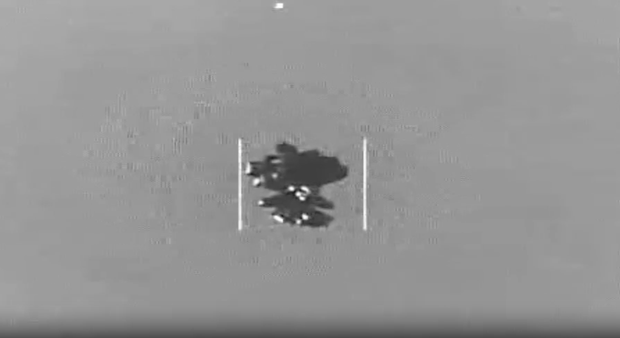
While this does not verify the nature of the objects seen in the video, it does confirm that the flight itself took place as claimed. 
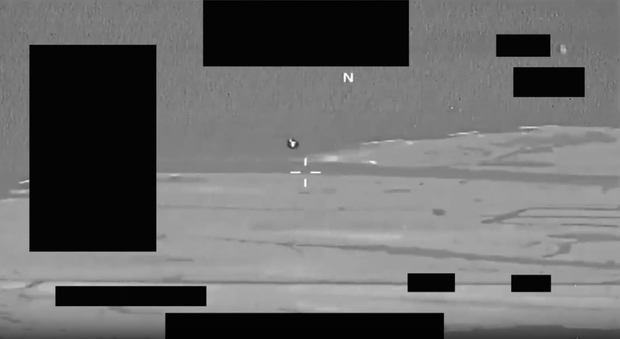
The larger question remains: What exactly are these luminous spherical objects displaying seemingly intelligent movements, and who or what might be controlling them?
Verified Flight Data:
UPS Flight 62 is a regularly scheduled international cargo service operated by United Parcel Service (UPS). The route typically connects Ted Stevens Anchorage International Airport (ANC) in Alaska with Hong Kong International Airport (HKG) at Chek Lap Kok. 
On July 7, 2026, UPS Flight 62 completed its journey using a Boeing 747-8F cargo aircraft (Registration: N615UP) across two flight segments: 
Leg 1: Louisville (SDF) to Anchorage (ANC) 
Status: Landed Actual Departure: 4:32 AM EDT (Scheduled: 3:39 AM EDT) Actual Arrival: 6:42 AM AKDT (Scheduled: 6:11 AM AKDT) Flight Time: 6 hours 10 minutes 
Leg 2: Anchorage (ANC) to Hong Kong (HKG) 
Status: Landed Actual Departure: 10:10 AM AKDT (Scheduled: 9:53 AM AKDT) Actual Arrival: 12:04 PM HKT (Scheduled: 12:37 PM HKT) Flight Time: 9 hours 54 minutes  
Detailed playback data and flight logs for this specific operation can be reviewed through the FlightRadar24 history records for UPS Flight 62.

{ https://ufosightingshotspot.blogspot.com/ }

Hoe vind je dit bericht?
Geschreven door peter om 17:10 Stuur door

Meer van UFO'S of UAP'S, ASTRONOMIE, RUIMTEVAART, ARCHEOLOGIE, OUDHEIDKUNDE, SF-SNUFJES EN ANDERE ESOTERISCHE WETENSCHAPPEN - DE ALLERLAATSTE NIEUWTJES

↑ Terug naar de berichten