Naar de inhoud

UFO'S of UAP'S, ASTRONOMIE, RUIMTEVAART, ARCHEOLOGIE, OUDHEIDKUNDE, SF-SNUFJES EN ANDERE ESOTERISCHE WETENSCHAPPEN - DE ALLERLAATSTE NIEUWTJES

UFO's of UAP'S in België en de rest van de wereld
akke.beakke.be
Ontdek de Fascinerende Wereld van UFO's en UAP's: Jouw Bron voor Onthullende Informatie! Ben jij ook gefascineerd door het onbekende? Wil je meer weten over UFO's en UAP's, niet alleen in België, maar over de hele wereld? Dan ben je op de juiste plek! België: Het Kloppend Hart van UFO-onderzoek In België is BUFON (Belgisch UFO-Netwerk) dé autoriteit op het gebied van UFO-onderzoek. Voor betrouwbare en objectieve informatie over deze intrigerende fenomenen, bezoek je zeker onze Facebook-pagina en deze blog. Maar dat is nog niet alles! Ontdek ook het Belgisch UFO-meldpunt en Caelestia, twee organisaties die diepgaand onderzoek verrichten, al zijn ze soms kritisch of sceptisch. Nederland: Een Schat aan Informatie Voor onze Nederlandse buren is er de schitterende website www.ufowijzer.nl, beheerd door Paul Harmans. Deze site biedt een schat aan informatie en artikelen die je niet wilt missen! Internationaal: MUFON - De Wereldwijde Autoriteit Neem ook een kijkje bij MUFON (Mutual UFO Network Inc.), een gerenommeerde Amerikaanse UFO-vereniging met afdelingen in de VS en wereldwijd. MUFON is toegewijd aan de wetenschappelijke en analytische studie van het UFO-fenomeen, en hun maandelijkse tijdschrift, The MUFON UFO-Journal, is een must-read voor elke UFO-enthousiasteling. Bezoek hun website op www.mufon.com voor meer informatie. Samenwerking en Toekomstvisie Sinds 1 februari 2020 is Pieter niet alleen ex-president van BUFON, maar ook de voormalige nationale directeur van MUFON in Vlaanderen en Nederland. Dit creëert een sterke samenwerking met de Franse MUFON Reseau MUFON/EUROP, wat ons in staat stelt om nog meer waardevolle inzichten te delen. Let op: Nepprofielen en Nieuwe Groeperingen Pas op voor een nieuwe groepering die zich ook BUFON noemt, maar geen enkele connectie heeft met onze gevestigde organisatie. Hoewel zij de naam geregistreerd hebben, kunnen ze het rijke verleden en de expertise van onze groep niet evenaren. We wensen hen veel succes, maar we blijven de autoriteit in UFO-onderzoek! Blijf Op De Hoogte! Wil jij de laatste nieuwtjes over UFO's, ruimtevaart, archeologie, en meer? Volg ons dan en duik samen met ons in de fascinerende wereld van het onbekende! Sluit je aan bij de gemeenschap van nieuwsgierige geesten die net als jij verlangen naar antwoorden en avonturen in de sterren! Heb je vragen of wil je meer weten? Aarzel dan niet om contact met ons op te nemen! Samen ontrafelen we het mysterie van de lucht en daarbuiten.

Loeb to Newsmax: Many UAPs Have Conventional Explanations

Loeb to Newsmax: Many UAPs Have Conventional Explanations

By Solange Reyner 


UFO files: Avi Loeb now has explanations for some cases | NewsNation Prime

Harvard astrophysicist Avi Loeb said Saturday that some of the unidentified anomalous phenomena, or UAP, featured in a newly released government file dump likely have ordinary explanations, while others warrant further investigation because of their potential implications for national security and science.

Speaking on Newsmax TV's "Saturday Agenda," Loeb cautioned against assuming that every object shown in the released materials represents unexplained technology.

"Some of these are natural events," Loeb said.

He pointed to a widely circulated video of a star-shaped object, saying its appearance was likely caused by the camera rather than the object itself.

"The star-shaped object that you showed — that's a result of a diffraction pattern in the camera that is taking the image," he said.

Loeb added that some of the orb-like objects included in the files could also have conventional explanations, such as laser spots created by human technology or ball lightning, a rare atmospheric electrical phenomenon.

"There are also some of the orbs that may be a result of laser spots ... or a result of ball lightning," he said.

Loeb said the challenge is distinguishing explainable events from those that remain genuinely anomalous.

"We are trying to separate the wheat from the chaff and advise the government how to get more information that will get to the bottom of it," he said.

He said a careful analysis of the government's UAP data could benefit both national security and scientific research.

According to Loeb, the two central questions are whether the objects represent potential security concerns and whether they could provide evidence that humanity is not alone in the universe.

"There are two subjects that are of importance to the American people," Loeb said. "That's national security, as well as, are we alone in the universe? Do we have a neighbor in our cosmic environment?"

Loeb said analyzing government data on anomalous objects could help answer both questions.

He also said officials within the Pentagon and U.S. intelligence agencies remain uncertain about some of the reported phenomena.

"Frankly, the Pentagon, as well as the intelligence agencies, are puzzled about the properties of these objects," he said.

Loeb said the advisory effort he is involved with aims to examine the evidence methodically.

"My council will try to figure out, like in a detective story, what it's all about," he said.

He credited President Donald Trump's directive to review UAP records and declassify information that does not affect national security with making more material available for analysis.

Loeb emphasized that the newly released records represent "a mixed bag," with some cases likely explainable and others requiring additional investigation.

Related Stories:

RELATED VIDEOS

UFO files show serious people noticing things they can't understand: Dr. Avi Loeb | National Report

Astrophysicist Dr. Avi Loeb promises to reveal truth about UFOs | Wake Up America

{  https://www.newsmax.com/ }

Hoe vind je dit bericht?
Geschreven door peter om 20:40 Stuur door

Famed UFO insider issues chilling claim about the next phase of disclosure: 'A new chapter for humanity'

Famed UFO insider issues chilling claim about the next phase of disclosure: 'A new chapter for humanity'

The Trump administration is deliberately releasing only 'minor' UFO files while withholding far more significant evidence, according to one of the most prominent figures in the disclosure movement.

Dr Steven Greer, founder of The Disclosure Project and the Center for the Study of Extraterrestrial Intelligence, told the Daily Mail he believes officials possess far more consequential material but have been advised to reveal it slowly as part of what he described as an 'acculturation process.'

'My understanding is that they've been advised to go slow on it, and to only release fairly much inconsequential material,' Greer said. 'I don't agree with that strategy.'

Greer, who has spent more than three decades encouraging military, intelligence and corporate insiders to come forward with information about unidentified aerial phenomena, argued the current releases are only the beginning of a much larger disclosure effort.

He believes the strategy is backfiring because the public expected far more than the three recent tranches of documents released by the administration.

'I think they're trying to do a slow roll,' he said. 'I think it's eroding trust in government.'

Despite his criticism of the rollout, Greer believes genuine disclosure could fundamentally reshape humanity's future by revealing technologies capable of solving some of the world's biggest challenges.

'I think it's a message of great hope,' he said. 'If it's handled properly, it would start a whole new chapter in human civilization.'

Dr Steven Greer popularized the term 'disclosure,' referring to the release of UFO files in the 1990s

Dr Steven Greer popularized the term 'disclosure,' referring to the release of UFO files in the 1990s

article image

The Trump administration has released four tranches of UFO files since May 8, months after President Donald Trump ordered Secretary of War Pete Hegseth to declassify government records related to UFOs and alleged extraterrestrial activity.

The releases included striking images and transcripts linked to NASA's Apollo 12 and Apollo 17 missions.

One photo taken from the lunar surface appears to show three unexplained dots hovering in the dark sky above the moon.

Another document summarized statements from seven federal officers assigned to different teams who independently reported witnessing multiple unidentified aerial phenomena (UAPs) across the western US over two days in 2023.

Never-before-seen FBI and CIA reports detailing witness accounts have also been included, but Greer argued the material released so far represents only a fraction of what exists inside classified government programs.

{ https://www.dailymail.com/sciencetech/index.html }

Hoe vind je dit bericht?
Geschreven door peter om 20:26 Stuur door

Mysterious ‘green mass’ spotted in waters of Loch Ness fuelling fresh Nessie rumours

Mysterious ‘green mass’ spotted in waters of Loch Ness fuelling fresh Nessie rumours

A mysterious green mass has been spotted in the waters of Loch Ness, fuelling fresh rumours about the monster which is said to lurk in its depths.

The object was caught on camera next to Urquhart Castle by a tourist on a Jacobite Cruises boat tour on June 23.

Sharon Herbert had been taking a picture of the castle – but spotted the strange sight lurking just beneath the surface. It is the seventh possible Nessie sighting to be made this year.

The picture, recently uploaded to the official Loch Ness monster sightings register, also left the experienced skipper of the tour boat flummoxed.

coverimages55850083-8b57.jpg?quality=90&strip=all&w=626

The mysterious ‘green mass’ just below the surface (circled) was spotted by a woman on a cruise boat approaching Urquhart Castle (Picture: Official Loch Ness Monster Sightings Register / Cover Media)

The register said: ‘Sharon Herbert, visiting from Kent, took a picture of an unknown object close to the Jacobite cruise boat at 10.27am as it came to shore at Urquhart Castle.’

‘Jacobite Cruises have confirmed that their skipper says there is no explanation that they can offer as to what the green mass is.’

The incident is the latest in a busy year for Nessie spotters with six in-person sightings and another via webcam since the start of the year.

A video grabs of the sighting of Nessie off the pier of The Clansman Hotel in March (Picture: Cover Media)

By comparison, the register only recorded six in-person and four webcam sightings for the whole of 2025.

The official Loch Ness Monster sightings register has recorded a total of 1,172 sightings to date.

Scientists have long cast doubt on the existence of the aquatic being, with the famous 1933 photograph of a long-necked creature swimming in the lake dismissed as a hoax.

Nevertheless, thousands of people still head to Loch Ness every year armed with cameras in the hopes of catching a glimpse of its most famous resident.

In April, the mythical creature was ‘spotted’ twice within a few days after months without a glimpse of it.

And in December 2024, it emerged the sightings could be down to ‘standing waves’,according to Alan McKenna, the founder of Loch Ness Exploration (LNE).

RELATED


The Loch Ness Mystery: New Research Reveals a Fresh Perspective

The Loch Ness Mystery Was Finally Solved — The Answer Is Not What Anyone Expected

Witnesses Keep Spotting Strange in Loch Ness in 2026

{ https://metro.co.uk/news/ }

Hoe vind je dit bericht?
Geschreven door peter om 17:11 Stuur door

Major clue to the origin of life found in floating space sugar

Major clue to the origin of life found in floating space sugar

life-comp-cc9a.gif?w=646

Well, a kind of sugar, at least (Picture: Metro)

So far, the only life that seems to exist anywhere is on Earth.

But astronomers have discovered a clue that could explain why life exists on the blue marble – and it’s all down to sugar floating in a cloud of cosmic dirt.

Sugar in its various forms is the ancient fuel for our DNA and the tiny molecule found in space, erythrulose, is found in raspberries, melons and even self-tanning lotions.

So does this mean a raspberry bush in interstellar space is the origin of life? Probably not, the paper published in Nature Astronomy says.

‘It is not uncommon to spot molecules in this part of space,‘ Dr David Benoit, a molecular physicist at the University of Hull, who was not involved in the study, tells Metro.

‘But this is one of the first times this type of sugar has been found out there.’

Scientists have long been scratching their heads, trying to work out where the sugar came from. A main theory has been that it came to Earth on a meteorite.

A view of the stars of the Milky Way and the Perseid Meteor Shower.
Experts peered into the Milky Way to find the space jam ingredient (Picture: Shutterstock/Belish)

They haven’t even been able to recreate the chemical conditions to make sugar in a lab, making it even more puzzling why it’s on our planet.

Ribose, a larger sugar, was discovered inside an asteroid last year.

Researchers from Spain’s Centre for Astrobiology near Madrid found the sugar in G+0.693−0.027, a thin cloud of gas and dust littered between stars in the Milky Way called an interstellar medium.

The team pointed two powerful radio telescopes at the nebula, about 27,000 light-years from Earth, to see what frequencies it was pinging.

When molecules spin and dance, they produce unique frequencies.

And, inside this mess of dust and gases in between solar systems, they found something made of four carbon atoms, eight hydrogen atoms and four oxygen atoms – erythrulose.

A model of a four-carbon sugar called erythrulos.
The sugar the team found in the cosmos (Picture: Nature Astronomy)

The team admits they checked the results over and over again, in part, because they couldn’t believe they found a cosmic bag of sugar.

What’s interesting about the discovery is that it shows sugar can form without life, even before stars or planets form.

So it suggests there’s a good chance that life on Earth originated from somewhere else.

Erythrulose, the paper says, forms when two other organic compounds, glycolaldehyde and ethylene, clump together.

‘This process is statistically rare, considering how big space is, but tiny “dust grains” help make these meetings more likely by creating little islands where molecules congregate,’ says Dr Benoit.

‘Sugars are essential components of living organisms and thus finding complex organic molecules linked to life “building blocks” in space can help further explain where our chemistry comes from.’

Researchers estimated that up to 500,000,000,000kg of sugar could have wound up on Earth as it was forming billions of years ago.

This sugar could have sparked the chemical reactions needed to form life some 4.1 billion years ago, if some fossils of microbes are to be believed.

Other building blocks include carbon, water and nitrogen.

‘A random combination of these,’ Dr Benoit adds, ‘could have ultimately led to primitive self-replicating systems.’

RELATED VIDEOS

Scientists Just found Sugar in Space 🌌| Could This Explain the Origin of Life?

🧬 Scientists Found Sugar in Deep Space... What Does It Mean for Life?

Why Sugar Discovery in Milky Way Has Scientists Rethinking Alien Life

{ https://metro.co.uk/news/ }

Hoe vind je dit bericht?
Geschreven door peter om 16:53 Stuur door

We’ve just realised our understanding of the universe might be wrong

We’ve just realised our understanding of the universe might be wrong

A GIF shows stars shooting across a night sky.

We’ve thought this one thing about the universe for 100 years (Picture: Getty/Metro)

The universe, that 13.8billion-year-old thing we call home, is a weird place.

But one thing that has made sense to scientists for the better part of a century is the belief that the cosmos is surprisingly uniform.

This is known as the cosmological principle, or the idea that if you took a step back – a very big step back – and took a photo of the universe, it would look smooth and blurry, like you forgot to wear glasses.

A paper published in the journal Nature, however, argues this might not be the case.

Rather, things look different from every direction you look at from a large scale, and the galaxies line up almost into patterns.

While this might not sound like a big deal, if proven, this would change the maths that explains how existence works.

Researchers figured this out by looking at the largest map of the known universe observed by the Dark Energy Spectroscopic Instrument.

This shows a small fraction of the total DESI year-3 data in which the structure created by gravity is visible. This is the largest 3D map of the Universe ever made.?? This structure is a huge web shaped by gravity, with most galaxies and galaxy clusters lying along the strands. A completely homogeneous Universe would have no stars, galaxies, or planets. As it turns out, when our Universe began, it was almost completely homogeneous, with the seeds for everything we see in the sky likely coming from disturbances in the tiny fraction of a second after the Big Bang. These were subatomic fluctuations in the density of the primordial soup of quantum particles that stretched out as the Universe expanded until they were bigger than any galaxy. Where the density of particles was higher, gravity attracted yet more particles, especially dark matter. The dark matter in turn attracted ordinary matter, and galaxies and galaxy clusters grew where enough material collected. The result is the large-scale structure of the Universe that we see in this image, displaying a map of those primordial fluctuations with long strands, sheets, and clusters of galaxies forming a huge web. The web is punctuated by voids, which have few or no galaxies. On even grander scales, what became galaxies and clusters began as froth on huge cosmic sound waves during the era when the Universe was a hot cauldron of particles and light. These waves are called baryon acoustic oscillations (BAO), and they provide us with a way to measure the expansion rate of the Universe, including the mysterious acceleration caused by dark energy. Explore the galaxy structure of the giant zoomable image here.??
A slice of the largest map of the universe (Picture: Collaboration/DOE/KPNO/NOIR)

They compared this to simulations of how dark matter – the mysterious something holding galaxies together – is distributed in a uniform cosmos.

Researchers checked if there was any kind of pattern when comparing them.

‘Essentially, we asked what the probability of finding a galaxy at a given distance with respect to another and along a given direction,’ study co-author Marco Galoppo tells Metro.

Galoppo, of the University of Canterbury in New Zealand, should have been left cooing at how homogeneous (the same everywhere) and isotropic (the same in all directions) the universe is.

It should begin to smooth out when observed at scales of about 100 megaparsecs – roughly 300 million light-years – from every direction.

Instead, they saw a stringy, bumpy web of galaxies and voids even when approaching a whopping one gigaparsec, which is three billion light-years.

The lack of uniformity, called anisotropy, was ‘stronger’ than expected.

‘Any local structures – galaxies, clusters, filaments – are expected to “wash out” at large scales,’ Galoppo says.

‘Our results suggest that this may not be entirely true: we see directional patterns that are stronger than expected, implying that the universe may not reach perfect isotropy even on the largest observable scales.

‘In other words, the cosmic web may leave an imprint on the overall structure and expansion of the universe in a way that does not fully average out.’

The findings don’t mean the universe has a preferred axis or direction and they need to be replicated using larger datasets.

So, the universe isn’t uniform – so what?

Cosmologists, scientists who study the origin, history and evolution of the universe, expect to get things wrong.

But to be wrong about the cosmological principle would be a rather big deal, researchers not involved in the study told Metro.

Around 80% of the volume of the cosmos is made of nothing, called cosmic voids. Some have dim galaxies inside them, like a celestial oasis, or are crammed with cosmic energies we struggle to explain.

One thing that explains this empty space is the recipe to make a universe: 5% ordinary matter, 27% dark matter and 68% dark energy, the other invisible something pushing our universe to expand ever faster.

An area of deep space observed by the James Webb Space Telescope is covered by a scattering of galaxies as well as a few nearby stars, and a small square is shown zoomed in, in the center of which, a red dot is the galaxy JADES-GS-z13-1, observed as it was 330 million years after the Big Bang, in this undated handout image. ESA/Webb, NASA & CSA, JADES Collaboration, J. Witstok, P. Jakobsen, A. Pagan (STScI), M. Zamani (ESA/Webb)/Handout via REUTERS THIS IMAGE HAS BEEN SUPPLIED BY A THIRD PARTY
The cosmos should appear smooth and uniform when viewed at a large distance (Picture: ESA/Webb/NASA/CSA/JADES Coll/Reuters)

If the universe is not uniform but more like a bowl of spaghetti, cosmologists may have to accept that dark energy isn’t that important.

Kathy Romer, a professor in astrophysics at the University of Sussex, says that Galoppo’s paper is undoubtedly controversial. That’s the point.

‘Papers such as these are valuable in that they challenge orthodox thinking: as scientists, we should always be alert to the “Emperor’s new clothes” trap,’ she says.

‘Without doubt, there is something funny going on in the local-ish universe (mapped by galaxies), because there is an emerging mismatch with the distant universe (mapped by the cosmic microwave background).

‘This paper is part of a global effort to question every observation and theoretical assumption to understand that mismatch.’

Romer stresses that Nature has a ‘rigorous’ review process and that the bar to prove things in science is high.

Think of how a pixelated photo would look smooth from afar (Picture: NOIRLab)

‘We would all (where “all” is the observational cosmology community of 5,000 people) love this mismatch to be genuinely new physics because for us that is like winning the World Cup,’ she adds.

‘But my personal opinion, this study is part of the qualifying stages, not the final 32.’

Konstantinos Migkas, a Dutch astrophysicist, says the findings follow similar studies published this year.

And his own, too, which was referenced by Galoppo. Migkas and his colleagues also found signs of anisotropy, adding further questions to why there is something in some places but not elsewhere.

‘This does not mean that anything has been concluded yet, but it is natural that assumptions built into our standard model will be tested more sharply as data quality and volume improve,’ Migkas tells Metro.

Not everyone is swayed.

‘It’s not a big deal for the world of cosmology because this paper is wrong,’ says Seshadri Nadathur, a professor in cosmology at the University of Portsmouth.

Nadathur suggested the patterns could be chalked up to galaxy bias, where galaxies seem to clump together, which distorts measurements.

‘The reason we believe the universe is uniform is because observations of the real universe suggest it is true, and there has never been any convincing evidence otherwise,’ he adds.

‘There are occasional claims of some discovery contradicting this picture, but they are always flawed.’

RELATED

JWST Is Proving Our Universe Understanding Is WRONG! 🤯

What Is The Universe Expanding Into?

{ https://metro.co.uk/news/ }

Hoe vind je dit bericht?
Geschreven door peter om 16:27 Stuur door

Unsettling Footage | Claims of a Close Encounter Spark Controversy

Unsettling Footage | Claims of a Close Encounter Spark Controversy

By Samantha Williams

A close-up view of a close saucer illuminated against a dark night sky, with stars visible in the background.

A recent video purporting to show a close encounter with an unidentified flying object (UFO) has ignited a heated debate among people on various forums. While some express skepticism, others find the footage compelling, raising questions about authenticity and the psychological effects of perceived sightings.

Claims and Skepticism: A Divide in Perception

The video depicts an object hovering near a pole, causing many observers to speculate its nature. Comments vary widely, with several noting poor video quality and unstable camera movement. One user remarked, "The person is standing still and yet the camera is wobbling all over the place"

Criticism centers on the claim of authenticity. Skeptics assert the footage likely results from editing and low-quality technology. "Every fake video does this to make it seem real," another contributor explains. The doubts grew stronger when others pointed out the object's limited visibility in the frame and the overall lack of context during the supposed sighting.

Exploring Possible Explanations

A number of theories emerged on user boards, with some attributing the object to natural phenomena such as swamp gas or weather balloons. As one user noted, "It stays very close to that pole the entire time. My guess is a balloon on a string attached to that pole, getting blown in the wind." Others suggested it might be artificial intelligence manipulation, adding layers to the discussion about technological interference in media.

Interestingly, historical references to disc-shaped crafts from declassified CIA documents were woven into conversations, suggesting that the evolution of sightings reflects a change in the nature of phenomena—possibly indicating a shift from physical visits to drone-like operations by unidentified entities.

Key Points from the Debate

  • Mixed Reactions: Sentiments online lean towards skepticism, with most contributors labeling the video as questionable.

  • Quality Concerns: Commenters highlighted the low resolution and editing inconsistencies in the footage, further fueling doubts.

  • Speculative Theories: Users proposed various explanations for the sighting, ranging from harmless weather balloons to more elaborate conspiracy theories involving AI.

Final Thoughts

As people push for clearer evidence and better documentation of such phenomena, questions persist. Will the technology behind UFO sightings evolve to yield more credible footage? Or will skeptics continue to reign supreme in discussions surrounding unexplained aerial phenomena? Only time will tell.

"Looks so fake and of course nobody notices the giant UFO over them." - A perceptive comment

Stay tuned as this story continues to develop.

What Lies Ahead for UFO Sightings

There's a strong chance that as technology advances, the evidence surrounding UFO sightings will become more credible. Enhanced imaging techniques and AI-driven analysis may reveal details that are currently overlooked. Experts estimate around 60% probability that the quality of footage will improve significantly over the next few years, potentially laying to rest some skepticism. However, the divide between believers and critics is likely to persist, as many people remain entrenched in their views regardless of emerging data. This growing polarization may lead to more intense discussions on forums, affecting how these phenomena are perceived by the public.

A Lesson from Past Hurdles

Drawing a parallel to early photography in the 19th century can shed light on our current situation. Initially, groundbreaking photos were met with doubt and criticism, as many were convinced they were staged or manipulated. Just as early camera technology sparked heated debates, today's footage of unidentified objects is subject to similar scrutiny. Over time, as photography became more accessible and reliable, it transformed how people captured and interpreted historical moments. In this case, the unpredictable trajectory of public trust will shape the narrative around UFOs and how they are documented, echoing that initial skepticism paired with eventual acceptance of new technology.

Unraveling the Ongoing Debate | Extraterrestrial Disclosure Sparks Controversy

By  Omar Hassan

A person sitting in a chair, looking thoughtfully at a complex abstract painting, symbolizing confusion and clarity in understanding reality.

Recent discussions around extraterrestrial life and the potential for future disclosures have ignited a firestorm among online communities. On July 15, 2026, comments on various forums highlighted diverse opinions, revealing a mixture of skepticism and intrigue regarding claims of impending alien encounters.

Context and Significance

The conversation revolves around anticipated dates and the credibility of information about potential alien interactions. Some people express doubt about self-proclaimed prophetic documents and future announcements, while others reference past findings and the possibility of governmental secrecy. It appears that many feel the public remains largely in the dark regarding the disclosure of extraterrestrial knowledge.

Thematic Insights

Three primary themes emerged from the chatter:

  • Skepticism About Prophetic Claims

Many comments challenged the validity of supposed prophetic documents. One user sharply stated, "No different than any of the other 'prophetic' papers out there that totally aren’t fanmade." This skepticism highlights a general distrust among people concerning unverified claims of extraterrestrial events.

  • Concerns Over Government Secrecy

A significant number of comments pointed to historical claims of secrecy regarding extraterrestrial life. As one commenter noted, "What it would take for all former presidents to say they’ve known about extraterrestrials?" This raises questions about how information has been kept hidden from the public.

  • Anticipation of Future Disclosure

Some users are eager to see how events may unfold, with predictions that 2026 may be pivotal. One comment proclaimed, "To me it kinda reads like this will all happen in 2026. Year of secrets being blown out of the water." This suggests a belief that a breakthrough in transparency may finally occur.

Engaging Quotes

"Sounds like a rational plan to move toward disclosure."

"I think it’s messed up they are keeping this from us."

Mixed Sentiment Among People

The general sentiment appears to oscillate between hope and frustration. While some show cautious optimism about possible revelations, others express a more cynical take on the chances of genuine disclosure occurring.

Key Observations

  • △ Many people doubt the credibility of alleged prophetic claims.

  • ▽ Concerns linger about government secrecy regarding extraterrestrial information.

  • ※ "What really needs to happen is legal and physical protection for whistleblowers," emphasizing the need for safeguards.

As debates continue to unfold, the intersection of anticipated extraterrestrial events and public response will likely remain a hot topic in the coming months.

What Lies Ahead in 2026

As discussions surrounding potential extraterrestrial disclosures ramp up, there's a strong chance that significant revelations could emerge within the year. Experts estimate around a 65% probability that official announcements will surface, driven by increasing public interest and pressure from various forums. The growing demand for transparency may force governmental bodies to address longstanding questions about alien interaction. This urgency, coupled with advancements in technology and disclosure from whistleblowers, could redefine our understanding of extraterrestrial life and its historical significance.

Reflecting on a Notable Turning Point

This situation mirrors the public's reaction to the release of the Pentagon Papers in 1971, which exposed hidden government actions during the Vietnam War. Much like the controversy surrounding extraterrestrial disclosure, those papers sparked widespread debate about government trustworthiness and secrecy. At the time, people felt their understanding of reality was shattered as they confronted concealed truths. The upcoming possibilities around alien encounters may evoke a similar reckoning, pushing society to reevaluate its beliefs about authority and transparency.

{ https://mysterylores.com/ }

Hoe vind je dit bericht?
Geschreven door peter om 22:43 Stuur door

Lost Civilizations and Dinosaurs of the Ancient Sahara Desert

Lost Civilizations and Dinosaurs of the Ancient Sahara Desert

ChatGPT-Image-May-31-2026-08_06_45-PM.jpg

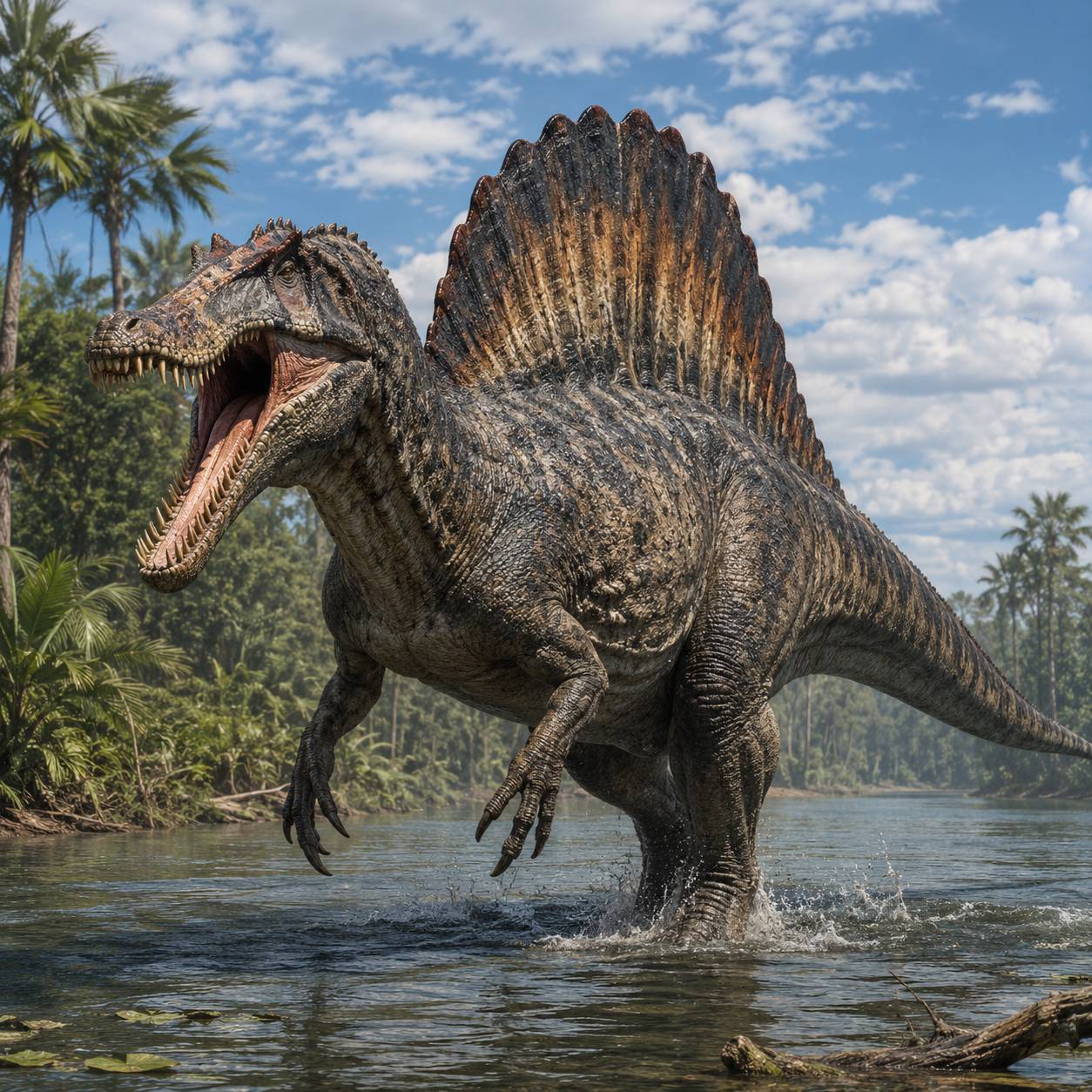
Spinosarus – an ancient dinosaur of the Sahara Desert.

Today the Sahara Desert is known as a vast ocean of sand — a harsh and nearly endless wilderness stretching across North Africa. The Sahara Desert is the largest hot desert in the world, covering an incredible 9.2 million km2, which is almost the same size as China, and has only from two million and one half million to three million people living there. The average annual temperature is 30 degrees Celsius while the hottest temperature ever recorded was 58 degrees Celsius. The area receives little rainfall; half of the Sahara Desert receives less than one inch of rain every year. Towering dunes, burning heat, and empty horizons dominate the modern imagination. Yet thousands of years ago, the Sahara was something entirely different. Beneath its sands lie the buried traces of lost rivers, vanished kingdoms, mysterious stone cities, and forgotten peoples whose stories have nearly disappeared from history. Archaeologists and explorers increasingly believe the ancient Sahara may once have been one of the great cradles of civilization.

Between roughly 10,000 and 5,000 years ago, that territory was not a desert at all. Scientists call this period the “Green Sahara” or the “African Humid Period.” Rainfall transformed the region into a fertile landscape filled with lakes, grasslands, forests, and enormous wildlife populations. Hippos swam in giant lakes. Crocodiles inhabited rivers that no longer exist. Herds of elephants, giraffes, and antelope roamed across plains now buried beneath sand dunes hundreds of feet high. Humans flourished there. Rock paintings discovered in places like Tassili n’Ajjer reveal scenes of cattle herding, dancing ceremonies, hunting expeditions, and mysterious spiritual rituals. Some paintings are over 8,000 years old and provide astonishing evidence of sophisticated societies living in regions now considered uninhabitable.

https://images.openai.com/static-rsc-4/RCtTUo_fCepXISaJFQJyPN9cFYU7KsgPWmBhJH9z2Tppo8NVSWDHszGyHhtIf7tKhNZV4kd5iasUntBhTMH0smXSpYV6Av1GsZK0W81lYF8RL5I-K-IhxR1OeQ8UN656PNYBffnm6Q9CSYMratsp7F_y3LBSeL4VZ0VFmpvo29sE4B3dXL3JNSSUTTLwnyZl?purpose=fullsize

The ancient desert as it appeared many thousands of years ago, lush and green on the left and as it appears dry and barren wasteland today on the right.

https://images.openai.com/static-rsc-4/lgCzlxzm4mSvvihfsKYOGQz6A_cVj6rM0Ynhmx6azQBVE_az0Z08060FJqOlXkJ96yk4swEuAYb39VrfHg8OF5YKGyp7FdUEJXLL-s9mkJukgAOLTexAqVie-nzSmlHPtuzvtrCidBokTvd5HaW_Mht_v6lMY7-638A9A3WeRbpNE1_uJMS-YoGg7mlsFYfQ?purpose=fullsize

https://images.openai.com/static-rsc-4/8FkGmEi_WJniYN75-0c1R8GXtpGzmgVyGHhlnsRlB4vQLW32gUpWeqbqUz4xbANpJ_2AYTGGNLxvcaT5F1V0ICIi3cCQp5jhwawCpRM4VJVZyuUw8iJ6hVnxLwX-7XQ9arF9y5zPNWpnbCd36xyMQ_qabVpwh8Oom6W2zHT8l1VhbZ6y_fd0huowl9OSJ9jN?purpose=fullsize

Deep within the remote Ténéré region of the Sahara, archaeologists uncovered graveyards andsettlements belonging to ancient peoples who lived around long-vanished lakes. One of the most famous discoveries came from Gobero in modern-day Niger. There, scientists found human skeletons buried with jewelry, pottery, and ceremonial objects dating back nearly 10,000 years. Some graves showed adults carefully buried holding children, suggesting emotional and spiritual traditions far more advanced than many expected from such ancient cultures.

https://images.openai.com/static-rsc-4/H2WeQJ9W_ZLg4yoqNklDBcLDTYrEZEpWB9ZCHLw41dgtu-xflROWJwsK8XjF8AD7bwp2zEokjQ1bES_IMLVYE2Uk6GhaNSDGMa-HktmHH_aN0TXQNfh5fUz0PidFqmo538K7-FAhcBfAm9_1om3jRNrTX-_KKdK_U2L9IJHlV6Kc_bEuDStRrKzC_muVztys?purpose=fullsize

https://images.openai.com/static-rsc-4/gWvtthgT-cuZCN-cSpBFu285aAthOgA50zCezgVu1LK7AxnYCmNixRE0cQS-_tcNNgKoOkNH1DPPhCHdi5iCxqNqgkcbJqjKnqDILDjLPJZxU4JoAV3ZG8LovcFxWUjX5yQqVoiLZ-xKJv8RdKhglBLkMYVruNxg98UcWSK2xg3RUNwLXA_bPOHftPWTV2p2?purpose=fullsize

Who were these people? What language did they speak? What beliefs guided them? Much remains unknown. As the climate gradually dried, entire populations vanished or migrated toward the Nile River and sub-Saharan regions. Some historians believe these migrations may have helped shape later civilizations, including ancient Egypt.

One of the Sahara’s most astonishing forgotten civilizations was the Garamantes, who thrived in what is now Libya between roughly 500 BCE and 700 CE. Ancient Roman writers described them as mysterious desert people who commanded powerful chariots and controlled hidden oasis cities far beyond the edge of the Roman world. For centuries, many historians dismissed the Garamantes as little more than desert raiders. But modern archaeology revealed something extraordinary. The Garamantes built sophisticated underground irrigation systems called foggaras — miles of tunnels dug beneath the desert to tap hidden fossil water. They constructed cities, maintained trade routes across the Sahara, and connected the Mediterranean world with central Africa.

https://images.openai.com/static-rsc-4/ItF_VHVaZzfLTbsX0a7sTw-Va2oas3kA7k12SOY4_XC4DymOee3xuO2c9rCDF3boEfxXWDB3ZNVdFOQrg7OXYguC7gLSx15HASXBcE6XzklvdRuu3X9Z82l68E0XR6mz-2dP8ENHNrlCZ8xaJJcB2BAQ6imUlfvua2XzWwXkY_bMxx6XNvr7pfjgV3Vg4HNK?purpose=fullsize

Their capital city, Garama, once supported thousands of people in the middle of one of the harshest environments on Earth. Then they faded into obscurity. Today their ruins sit isolated beneath the desert sun, silent reminders that advanced civilizations once flourished where few could survive now.

Satellite technology has revealed strange geometric formations hidden beneath Saharan sands — ancient riverbeds, buried walls, circles of stone, and unexplained ruins. In Mauritania lies the famous Richat Structure, often called the “Eye of the Sahara.” While scientists classify it as a natural geological formation, its enormous circular appearance has inspired theories connecting it to the legendary lost city of Atlantis. Elsewhere, researchers using radar imaging have discovered evidence of ancient waterways crossing regions now completely barren. Some experts believe entire networks of settlements remain buried and untouched beneath dunes that constantly shift with the wind. The Sahara may still conceal cities no modern person has ever seen.

Perhaps the greatest secret of the ancient Sahara is its lost water system. Modern satellite scans show that massive rivers once crossed the desert. One ancient river system may have rivaled the size of the modern Amazon River. These waterways supported fishing villages, farming communities, and trade routes over immense distances. As climate patterns changed, the rains slowly disappeared. Lakes shrank. Grasslands died. Entire populations were forced to abandon their homes.

https://images.openai.com/static-rsc-4/2SPfgiW2NwxSWsdmPbuu867YsGscYyP2GRYVnvbADIOpsplZmnmW_704Ei20dP42c4doFwl7P2KjtPvKCFdCAVcyoyyEWxbKwVkmja9mK8S9h0cMt9JhprNpGU9GEWcq-bySVa27SQNdgh5hk1XFfRReqKlL9OfMxhKHIwKOr7V0bbUyDlhKacvmvPbNTwfd?purpose=fullsize Location of Ancient Lakes of the Sahara Destert https://images.openai.com/static-rsc-4/ttZ7ETomBF3uXQuUSKEooMoVFzaMsmSa9idRUrVVrWLfDowYXRydY2zqbKgVVLpwiBhbWm3z3xWndWczQ6Ly9RhF1GrLlMnMlIkt_LdQRDPvRuYQekCHlr0zaohecYdwlSK_ke0v9s_4NI3ieAbVHHx1gMXkMaKALdA0q_BCR33QLfyPox2o8j7Dno9aaTAF?purpose=fullsize Traces of an ancient civilization may be found here in no man’s land.

What remains today are fragments — pottery buried under dunes, carvings etched into stone cliffs, abandoned tombs, and legends carried through oral tradition. For centuries, caravans crossing the Sahara told stories of forbidden places hidden deep within the sands: ruined temples swallowed by dunes, abandoned cities guarded by spirits, and treasure-filled caverns left behind by forgotten kings. Some explorers searched obsessively for these places. The legendary oasis city of Zerzura — sometimes called “the White City” — appeared in Arabic manuscripts for centuries. Descriptions spoke of a mysterious city hidden somewhere west of the Nile River filled with white stone buildings and guarded entrances carved with strange symbols. No one has conclusively found it. Whether Zerzura was real, exaggerated, or symbolic remains unknown.

The Sahara is so vast that even today large regions remain poorly explored. Sandstorms bury entire landscapes. Ancient sites disappear for centuries before being uncovered again. Every few years, new discoveries reshape what historians thought they knew about ancient Africa. The desert that now appears empty may once have supported thriving civilizations equal in complexity to many better-known ancient cultures. The sands of the Sahara are not merely barren — they are a gigantic archive of forgotten human history waiting to be uncovered. And somewhere beneath those dunes, countless secrets may still sleep undisturbed.

Dinosaurs of the Ancient Sahara Desert

Today the Sahara is famous for its endless dunes, scorching temperatures, and dry winds, but during the age of dinosaurs it was almost unrecognizable. Around 100 million years ago, during the Cretaceous Period, much of the Sahara was covered by enormous river systems, swamps, lakes, and dense vegetation. Giant ferns and conifer trees lined waterways where prehistoric animals gathered to drink and hunt. Paleontologists believe this ancient region was one of the richest dinosaur ecosystems on Earth. Fossils discovered in Egypt, Morocco, Algeria, and Niger reveal a world dominated by gigantic predators and strange creatures unlike anything alive today.

Among the most famous Sahara dinosaurs was Spinosaurus. This enormous predator may have reached lengths of over 50 feet, making it one of the largest meat-eating dinosaurs ever discovered. Unlike most giant carnivorous dinosaurs, Spinosaurus appears to have been semi-aquatic. Scientists found evidence suggesting it could swim through rivers using its powerful tail while hunting giant fish. Its long jaws resembled those of a crocodile and were filled with cone-shaped teeth designed for gripping slippery prey. Rising from its back was a huge sail made of elongated spines, possibly used for display, temperature control, or helping it move in water.

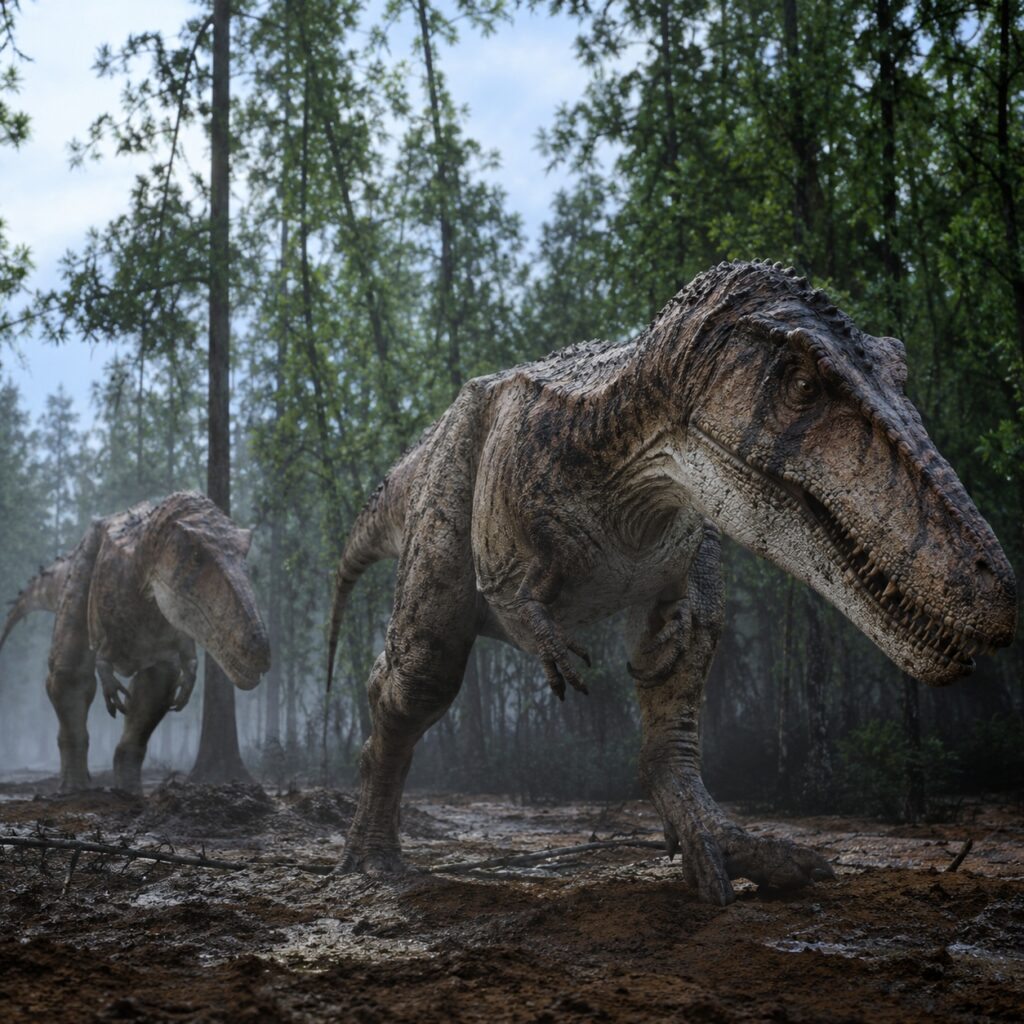
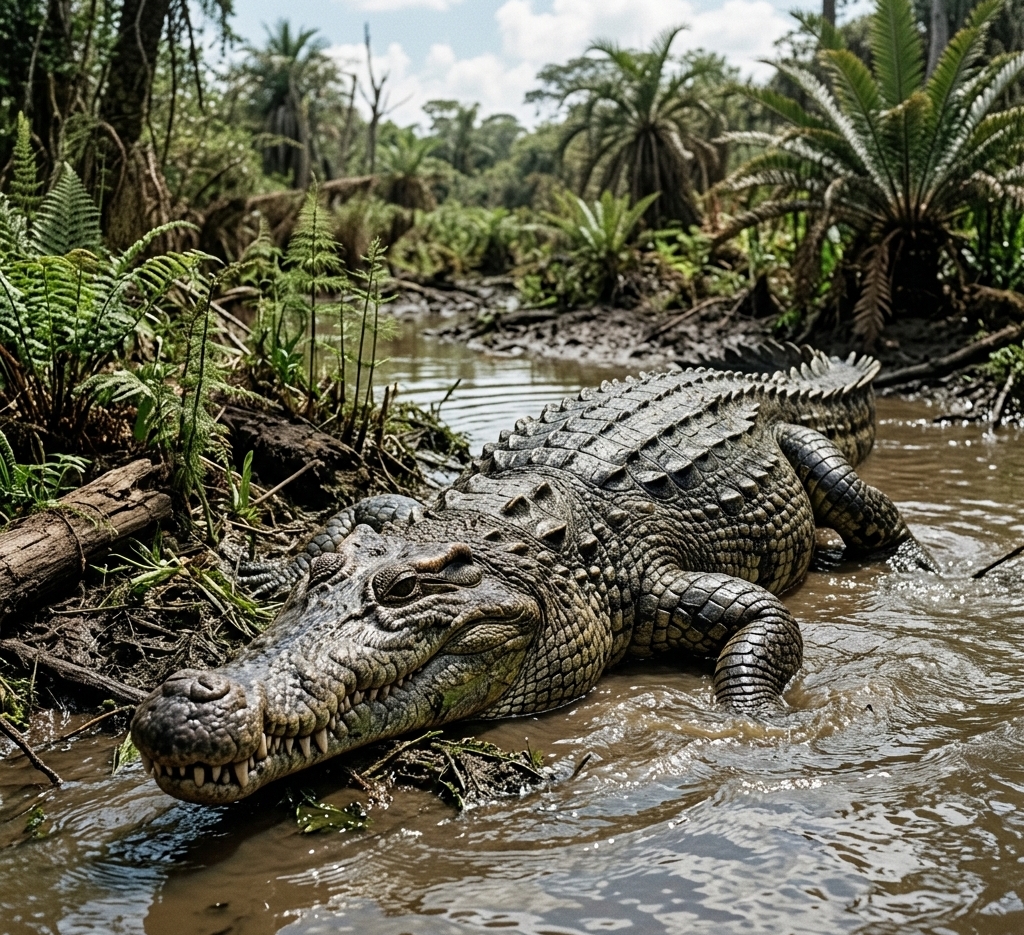
Another terrifying carnivore was Carcharodontosaurus, whose name means “shark-toothed lizard.” This massive hunter possessed serrated teeth nearly eight inches long. It likely preyed on giant plant-eating dinosaurs roaming the floodplains. Some scientists compare it to an African counterpart of Tyrannosaurus rex. The ancient Sahara was also home to bizarre reptiles and enormous flying animals. Giant crocodile relatives such as Sarcosuchus, often nicknamed “SuperCroc,” may have grown over 30 feet long and lurked in rivers waiting for prey. Huge flying reptiles called pterosaurs soared overhead searching for fish along shorelines. Plant-eating dinosaurs also thrived there. Fossils show that long-necked sauropods wandered through forests and marshes feeding on vegetation. These massive herbivores supported entire ecosystems of predators and scavengers.

Over millions of years, Earth’s climate slowly changed. Rivers dried up, forests vanished, and the region transformed into the vast desert seen today. Wind and shifting sand buried countless skeletons beneath layers of rock. Modern fossil hunters continue uncovering remarkable discoveries in the Sahara. In some places, entire prehistoric riverbeds filled with fish bones, dinosaur teeth, and ancient footprints have been found. Each discovery helps scientists reconstruct the lost world that existed long before humans appeared. The Sahara Desert may seem lifeless today, but beneath its sands lies the remains of one of the most extraordinary dinosaur worlds in Earth’s history.

Carchardontosaurus Sarcosuchus

RELATED


The Sahara Desert Was Covering an Entire Ancient Civilization All This Time | DOCUMENTARY

A Lost Civilization Buried Under the Sahara Has Just Been Detected by Satellite

A Lost Human Species Was Just Discovered Beneath the Sahara

{ https://mysticsciences.com/ }

Hoe vind je dit bericht?
Geschreven door peter om 22:12 Stuur door

Flying-Saucer Propulsion: What Modern Physics Actually Allows.

Aliens.jpg

Flying-Saucer Propulsion: What Modern Physics Actually Allows.

For decades, witnesses have reported unidentified objects that appear to hover silently, accelerate rapidly, turn abruptly and move without wings, propellers, exhaust or other visible means of propulsion. Today these reports are often grouped under the term Unidentified Anomalous Phenomena, or UAP.

The descriptions are intriguing, but an important distinction must be made at the beginning: an unidentified observation is not proof of an advanced aircraft, and it is certainly not proof of extraterrestrial technology. NASA states that it has found no credible evidence that UAP are extraterrestrial. Its scientific study has emphasized the need for better-calibrated instruments, consistent reporting and higher-quality data before extraordinary conclusions can be drawn.

Nevertheless, the reported flight characteristics raise an interesting scientific question. If a vehicle really could perform such maneuvers, what type of propulsion—or manipulation of physics—would be required?

The answer is unlikely to be a single mysterious engine. Silent hovering, extreme acceleration, absence of sonic booms and abrupt changes of direction would present several separate problems involving thrust, inertia, atmospheric drag, structural strength and energy production. Any convincing theory must address all of them.

Why ordinary propulsion is not enough

Conventional aircraft move by exchanging momentum with their surroundings. Propellers and jet engines accelerate air backward. Rockets expel hot gas. Wings produce lift by redirecting airflow. These methods are extremely effective, but they remain subject to familiar physical limitations.

A vehicle accelerating rapidly must withstand enormous mechanical forces. Its occupants experience those forces as g-loads. A sudden turn at very high speed would be far more destructive than simply flying fast in a straight line. Atmospheric flight also produces drag, heating, turbulence and shock waves. A large object moving through dense air at several times the speed of sound should normally generate a powerful sonic boom.

That means the most difficult feature attributed to flying saucers is not merely their speed. It is their reported ability to change velocity without displaying the consequences normally associated with acceleration.

A conventional engine, regardless of its power, would not eliminate inertia. A more radical system would have to alter the motion of the vehicle, its occupants and perhaps the surrounding medium together.

Electroaerodynamic propulsion

One genuine technology sometimes associated with saucers is electroaerodynamic propulsion, commonly called ionic-wind propulsion. A high voltage between thin emitter wires and larger collecting electrodes ionizes nearby air. The ions accelerate through the electric field and collide with neutral air molecules, producing airflow and thrust.

This is real physics. In 2018, researchers demonstrated sustained flight of a lightweight fixed-wing aircraft propelled by an electroaerodynamic system with no conventional moving propulsion parts. The aircraft had a five-metre wingspan and flew successfully across an indoor test area.

This technology helps explain why high-voltage devices once presented as “electrogravitic” machines can lift themselves in air. Their thrust is produced by moving ionized air, not by cancelling gravity. Such systems can operate quietly and may create a faint glow, but their present thrust-to-weight performance is far below what would be needed for a fast, heavily loaded craft.

Electroaerodynamics therefore deserves a place in a discussion of unusual aircraft, but it should not be described as demonstrated antigravity.

Plasma and magnetohydrodynamic control

Another possibility is the use of plasma—the electrically charged state of matter created when gas becomes ionized. Electric and magnetic fields can accelerate plasma without turbines or propellers. Plasma thrusters are already used in space, although they provide low thrust and work by expelling reaction mass.

In an atmosphere, a sufficiently powerful system might ionize air around a vehicle and then influence that charged gas with electromagnetic fields. This concept is related to magnetohydrodynamics, which studies the motion of electrically conducting fluids and plasmas.

A plasma layer might conceivably affect airflow, heating, radar reflection or the formation of shock waves. Researchers have investigated plasma actuators for aerodynamic flow control, but nothing presently demonstrated can surround a large craft with a field that eliminates drag or permits silent hypersonic flight.

Magnetic interaction with Earth’s field is even less promising as a primary lifting mechanism. Earth’s magnetic field is weak, and practical magnetic levitation generally requires either strong nearby magnets, specially arranged conductors or a prepared guideway. A craft cannot simply repel Earth’s magnetic field with a coil and obtain unlimited lift.

Plasma and electromagnetic systems could become useful components of future aircraft, but they would still obey conservation of momentum. They do not provide inertia cancellation.

The spacetime approach

The most important modern change in advanced-propulsion thinking came from Mexican theoretical physicist Miguel Alcubierre. In 1994, Alcubierre described a mathematical solution to Einstein’s field equations in which a region of comparatively undisturbed spacetime is carried within a larger distortion. Space contracts ahead of the region and expands behind it. The craft itself does not locally race through space faster than light; instead, the surrounding geometry changes.

This became known as the Alcubierre warp drive.

The concept matters because general relativity treats gravity not simply as a force, but as the curvature of spacetime. Matter and energy influence that curvature, and objects follow paths through the resulting geometry. In principle, changing the geometry could change how a vehicle moves.

A craft enclosed within a suitable spacetime region might follow a nearly inertial path even while distant observers saw it undergo extraordinary motion. The vehicle and its occupants could move together rather than being pushed violently through space. This offers a theoretical way of discussing apparent acceleration without crushing internal g-forces.

However, the Alcubierre metric is not an engineering design. It begins by specifying a desired spacetime and then calculates the extraordinary distribution of energy needed to create it. The original solution requires regions of negative energy density—often described as exotic matter—and enormous total energy. It also faces serious problems involving the creation and control of the bubble, causal horizons, radiation and stability.

No known machine can generate or control such a spacetime distortion.

Newer warp-drive research

Researchers have continued examining whether the original idea can be modified. Alexey Bobrick and Gianni Martire developed a broader mathematical description of warp-drive geometries. They showed that subluminal warp regions can, under certain assumptions, be constructed using positive energy, although the shell would still require ordinary propulsion to move. Their work also suggested that flattened configurations could reduce some energy requirements. This is noteworthy when discussing disc-like geometries, but it does not demonstrate that flying saucers use warp propulsion.

Physicist Erik Lentz later proposed superluminal spacetime solitons that he argued could be supported by positive energy associated with electromagnetic fields and plasma. His work attracted attention because it appeared to avoid one of the greatest obstacles in Alcubierre’s model.

Those results remain disputed. Other physicists have argued that physically reasonable warp drives still violate fundamental energy conditions. A 2022 analysis concluded that positive energy seen by one particular class of observers does not prove that all observers measure acceptable energy densities. More recent work has also challenged the claim that the Lentz geometry entirely avoids negative energy.

The correct conclusion is therefore not that a practical positive-energy warp drive has been discovered. The research shows that warp metrics remain an active mathematical subject, while their physical realizability is unresolved and highly doubtful.
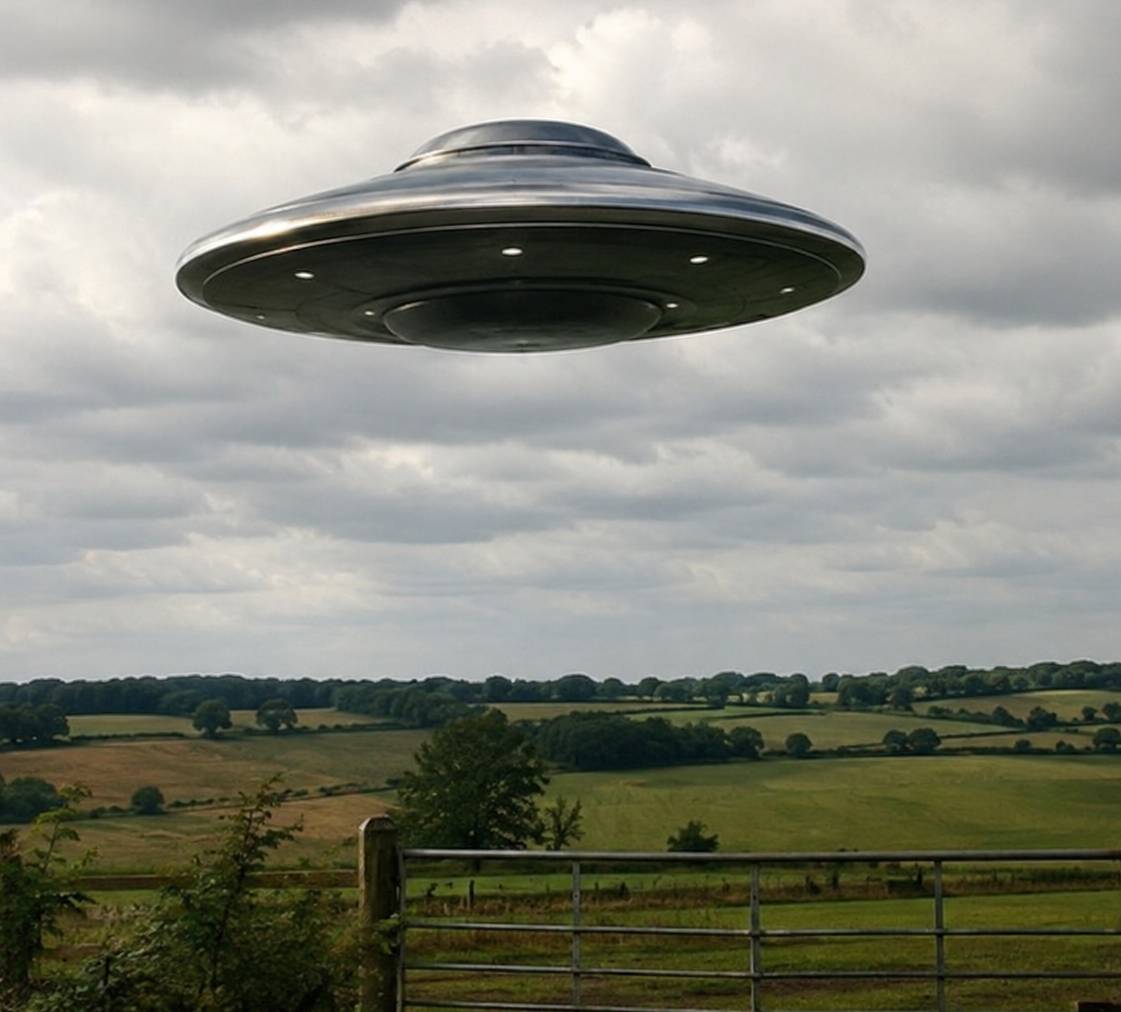
UFO-ChatGPT-Image-Jul-16-2026-11_10_45-AM.jpg

Would a saucer shape help?

A circular craft could be useful for reasons that do not require antigravity. A disc provides rotational symmetry, offers ample internal volume and could distribute antennas, electrodes, coils or plasma emitters around its rim. If a hypothetical field had to surround a craft evenly, a circular or flattened geometry might simplify its production.

Some warp-drive studies have also found that flattened spacetime configurations may be more energy-efficient than spherical ones. But this does not establish a direct link between mathematical warp bubbles and reported flying saucers. The resemblance is suggestive, not evidential.
A true spacetime vehicle might not need aerodynamic wings, yet it would still require an immense energy source, precise control of gravitational fields and some mechanism for creating, accelerating and stopping the distorted region. None of these capabilities exists today.

The most plausible conclusion

Modern science offers several real technologies that resemble limited aspects of reported saucer behavior. Electroaerodynamic systems can produce quiet thrust without propellers. Plasma and electromagnetic fields can control ionized gases. Advanced materials, computers and sensors can make aircraft more agile and less visible.

None, however, accounts for the full collection of extraordinary abilities sometimes attributed to UAP.

Spacetime engineering provides the most intellectually serious framework for discussing motion without conventional acceleration. Alcubierre’s contribution was important because it showed that Einstein’s equations permit geometries resembling a moving warp region. Later studies have refined, generalized and criticized that idea.
But mathematical permission is not the same as physical possibility.

At present, no verified experiment has produced a warp bubble, reduced inertia, shielded gravity or demonstrated a propulsion system capable of the reported flying-saucer maneuvers. Patents and declassified documents may show that people have considered such ideas; they do not prove that the technologies work.

The honest scientific position lies between dismissal and belief. Unusual observations should be investigated with good instruments and reliable data. At the same time, advanced propulsion concepts should be judged by experimental evidence, not by how closely they resemble reports of mysterious objects.
Flying saucers may continue to inspire speculation, but the most interesting question is no longer simply what type of engine they might contain. It is whether a sufficiently advanced technology could someday control the geometry of spacetime itself.

RELATED 


How Do Flying Saucers Fly? - Inside the Supernatural

How Fast Can Flying Saucers Move? - Inside the Supernatural

 { https://mysticsciences.com/ }

Hoe vind je dit bericht?
Geschreven door peter om 21:19 Stuur door

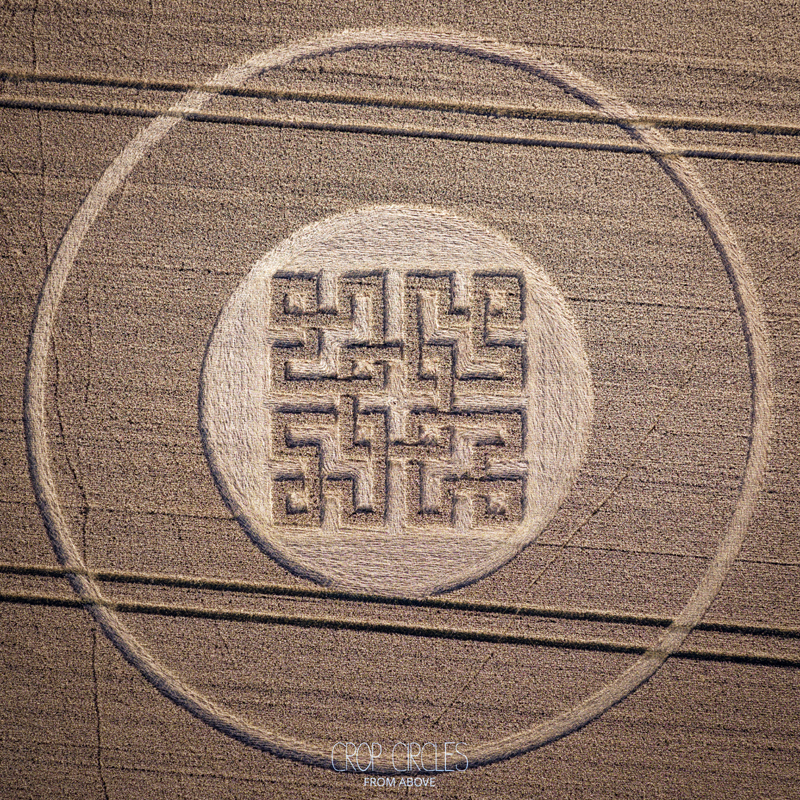
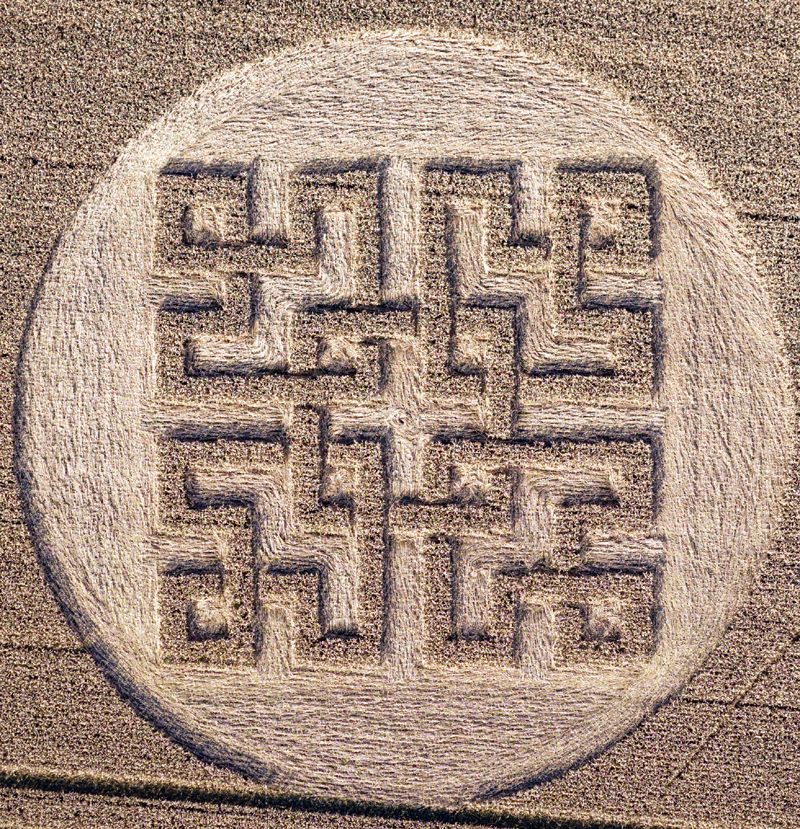
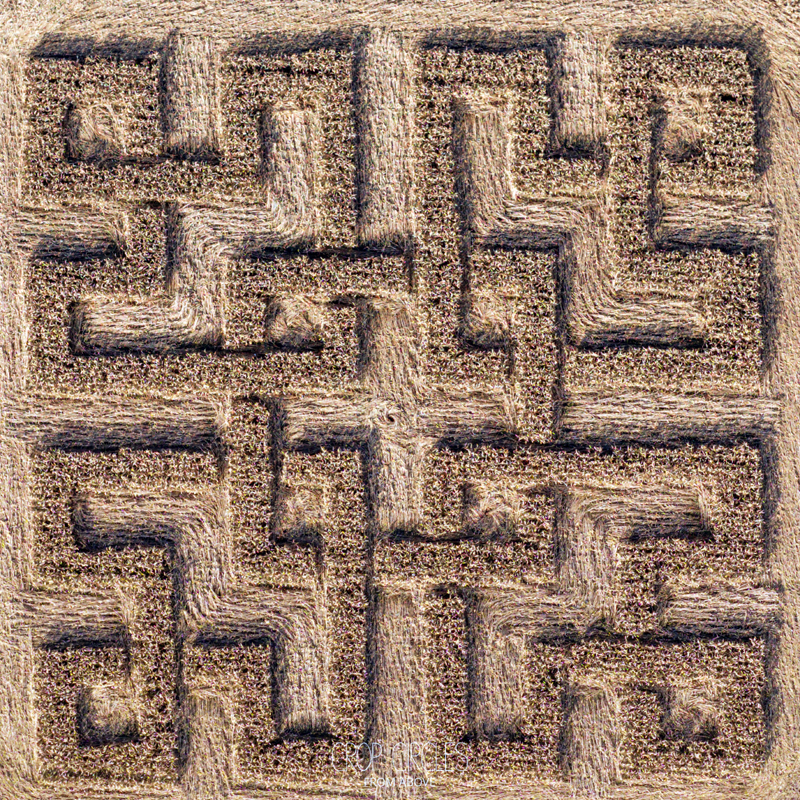
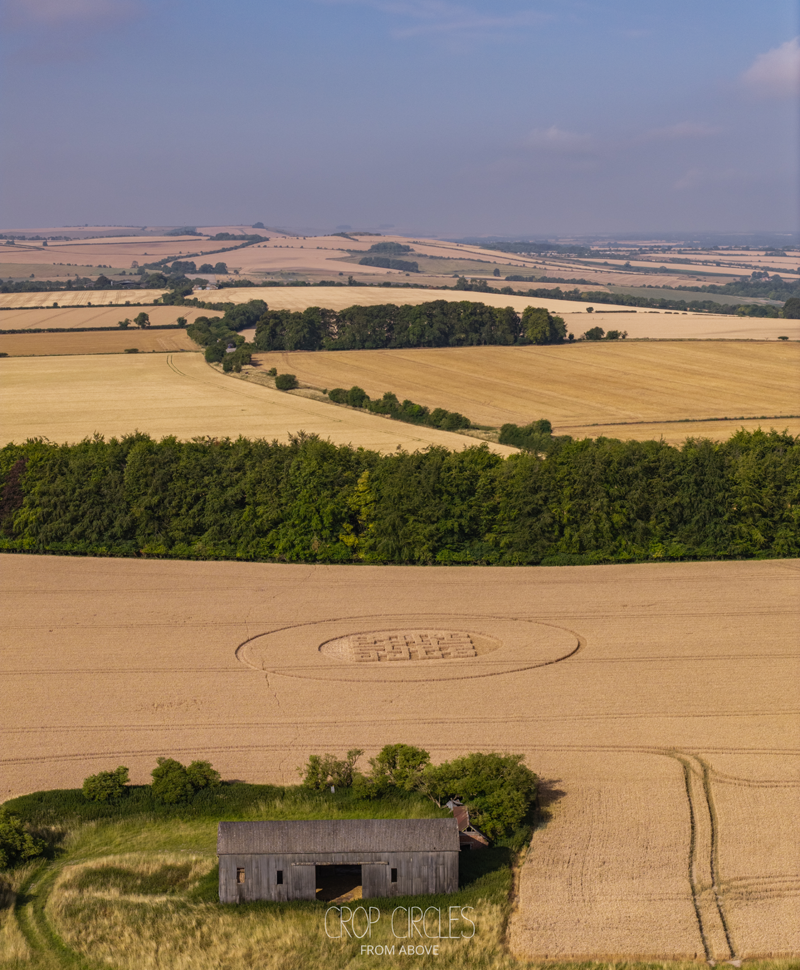
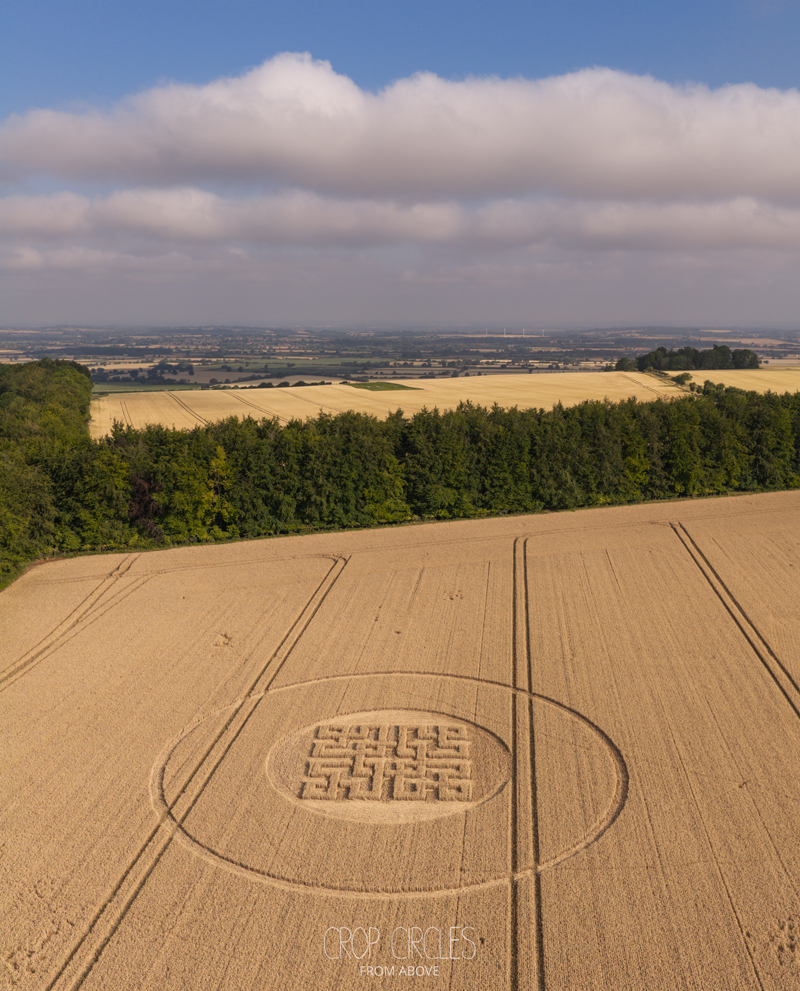
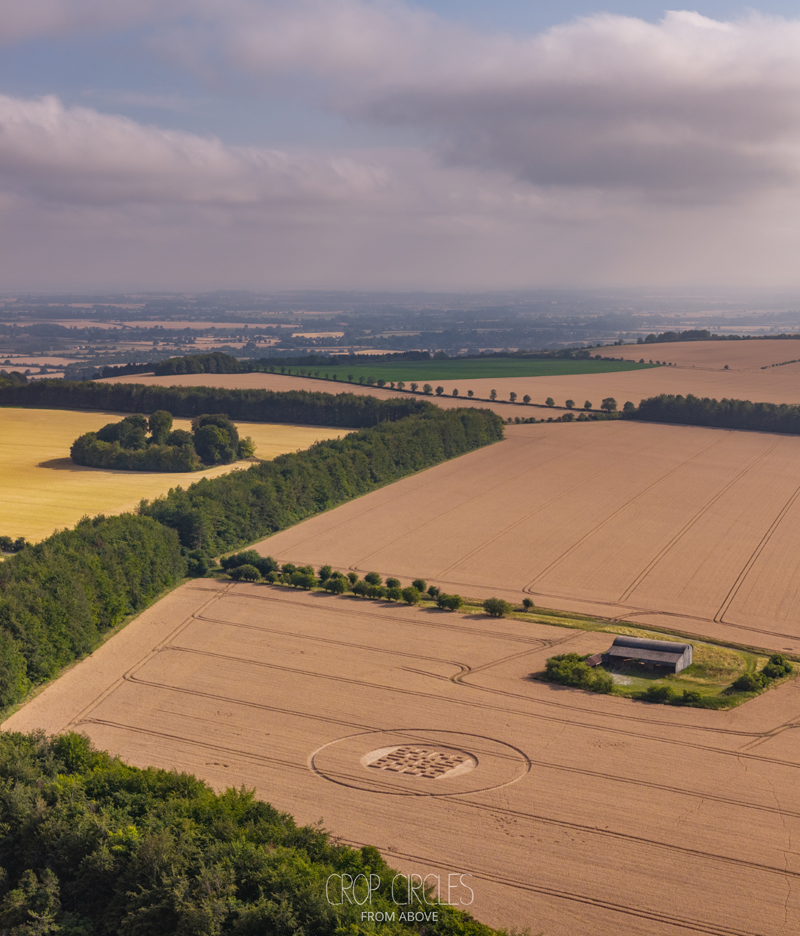
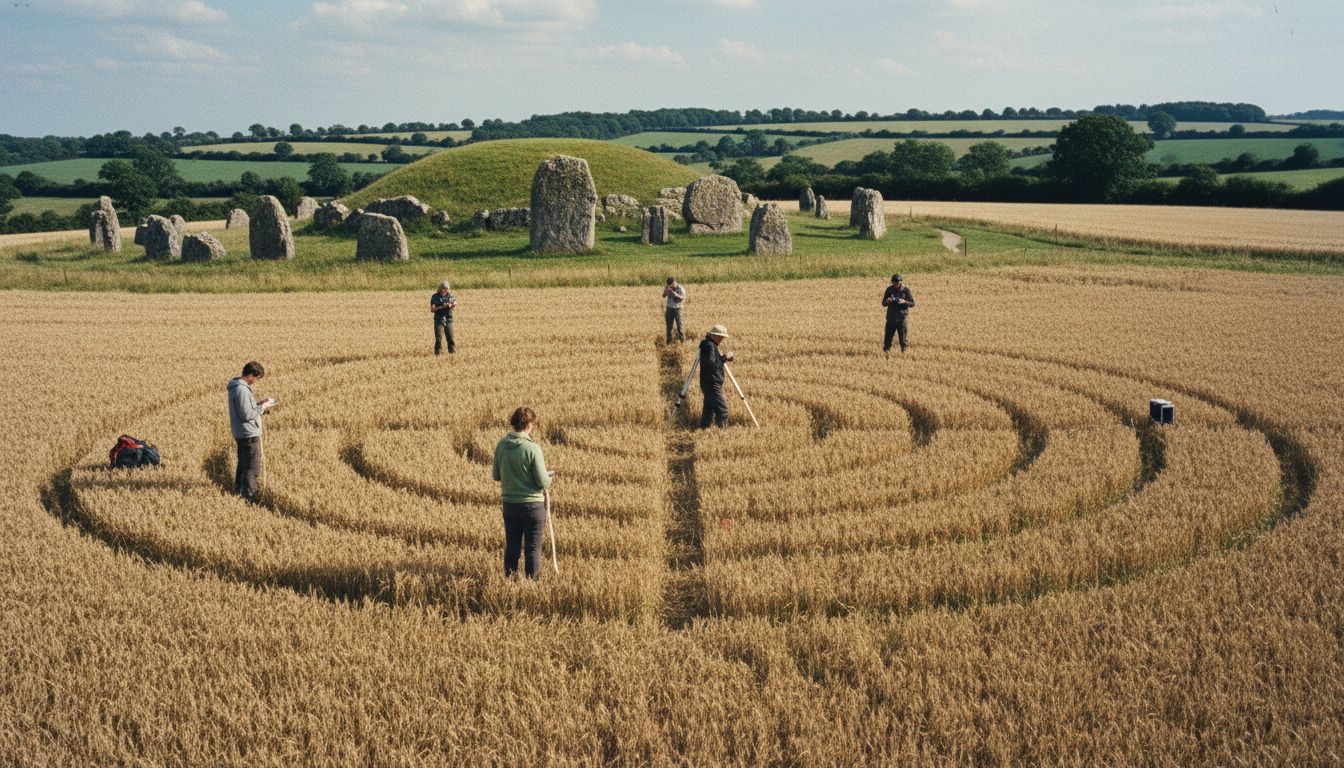
Crop Circle | Odstone Barn Nr Wayland’s Smithy Oxfordshire | 16/07/26 + Historical Landscapes

Crop Circle | Odstone Barn Nr Wayland’s Smithy Oxfordshire | 16/07/26 + Historical Landscapes

Crop-Circle-UK.png

DJI_20260716084034_0041_D.png

20260716084034_0041_D.png

DJI_20260716084034_0041_D-3.png

DJI_20260716083143_0012_D.png

DJI_20260716083339_0022_D.png

DJI_20260716083555_0030_D-P.png

IMAGES STONEHENGE DRONESCAPES PHOTOGRAPHY 

COPYRIGHT 2026

YouTube link:

Crop circle found near Wayland’s Smithy in Oxfordshire on 16 July 2026

Overview

A new crop circle formation was reported on 16 July 2026 near Odstone Barn, close to Wayland’s Smithy in Oxfordshire, adding another entry to a long-running tradition of mysterious agricultural formations in southern England. The report, published by VibeWire Magazine, was accompanied by video footage and imagery showing the design emerging in a field in a landscape already known for its prehistoric associations. While crop circles are often met with skepticism, each new sighting tends to attract renewed attention because of the location, the timing, and the enduring cultural fascination surrounding these patterns.
The publication described the formation as a newly discovered crop circle and linked it to a broader discussion of historical landscapes, suggesting that the field’s setting near one of Oxfordshire’s best-known ancient sites gives the event added significance. No formal survey or scientific assessment was included in the source material, and the report does not claim a definitive explanation for how the formation was made.

Key Details

According to the source, the crop circle was reported at Odstone Barn near Wayland’s Smithy on 16/07/26, with a video posted to YouTube alongside the magazine entry. The images provided show a geometric pattern flattened into standing crop, a visual style consistent with many modern crop circle reports from the UK. As with similar cases, the immediate questions are not only about authorship but also about scale, symmetry, and the speed with which the formation appeared.

That said, no evidence in the source material establishes whether the pattern was created by people, whether it had been formally documented by researchers, or whether any witnesses observed its formation. Crop circles in the UK are frequently linked to hoaxes, artistic interventions, or local folklore, and the report does not present new data that would settle those possibilities. Still, the location and presentation ensure the formation will likely be discussed by enthusiasts and skeptics alike.

Historical Landscape Context

The setting near Wayland’s Smithy is central to why the report drew interest. Wayland’s Smithy is a Neolithic long barrow in the Vale of White Horse, part of a wider ceremonial landscape that includes some of Britain’s most significant prehistoric monuments. Such places often appear in crop circle discussions because they sit within a terrain layered with archaeology, myth, and cultural memory. That history gives any new formation nearby a ready-made narrative, whether interpreted as coincidence, performance, or something more unusual.

In that sense, the crop circle is not simply being viewed as an isolated pattern in a field. It is being read against the backdrop of a landscape that has long invited speculation about ritual, alignment, and hidden meaning. Even for those who approach crop circles as man-made art, the choice of location can matter as much as the design itself. The proximity to Wayland’s Smithy inevitably amplifies the mystery.

Interpretation and Next Steps

For now, the formation remains a reported discovery rather than a verified anomaly. The most responsible reading is that it is an intriguing field pattern in a historically charged area, documented by a media outlet that covers UFO and unexplained phenomena. Further analysis would typically require on-site inspection, measurements, interviews, and crop damage assessment to determine whether the formation shows signs of human construction or something less straightforward.

Until then, the Oxfordshire discovery sits in the familiar space between folklore and investigation. It is a reminder that crop circles continue to occupy a unique niche in British public life: part rural puzzle, part media event, and part canvas for the enduring appeal of the unexplained.


Crop Circle, Avebury Stone Circle, Wiltshire, England - 14 July 2026 4K
RELATED

Miraculous Angel Wings appear in Crop Circle while people in it 2026🩵Interviews with eye witnesses🩵

Google's AI Analyzed Every Crop Circle Ever Recorded — The Pattern It Found Changes Everything

{ https://www.vibewire.com.au/ }

Hoe vind je dit bericht?
Geschreven door peter om 21:03 Stuur door

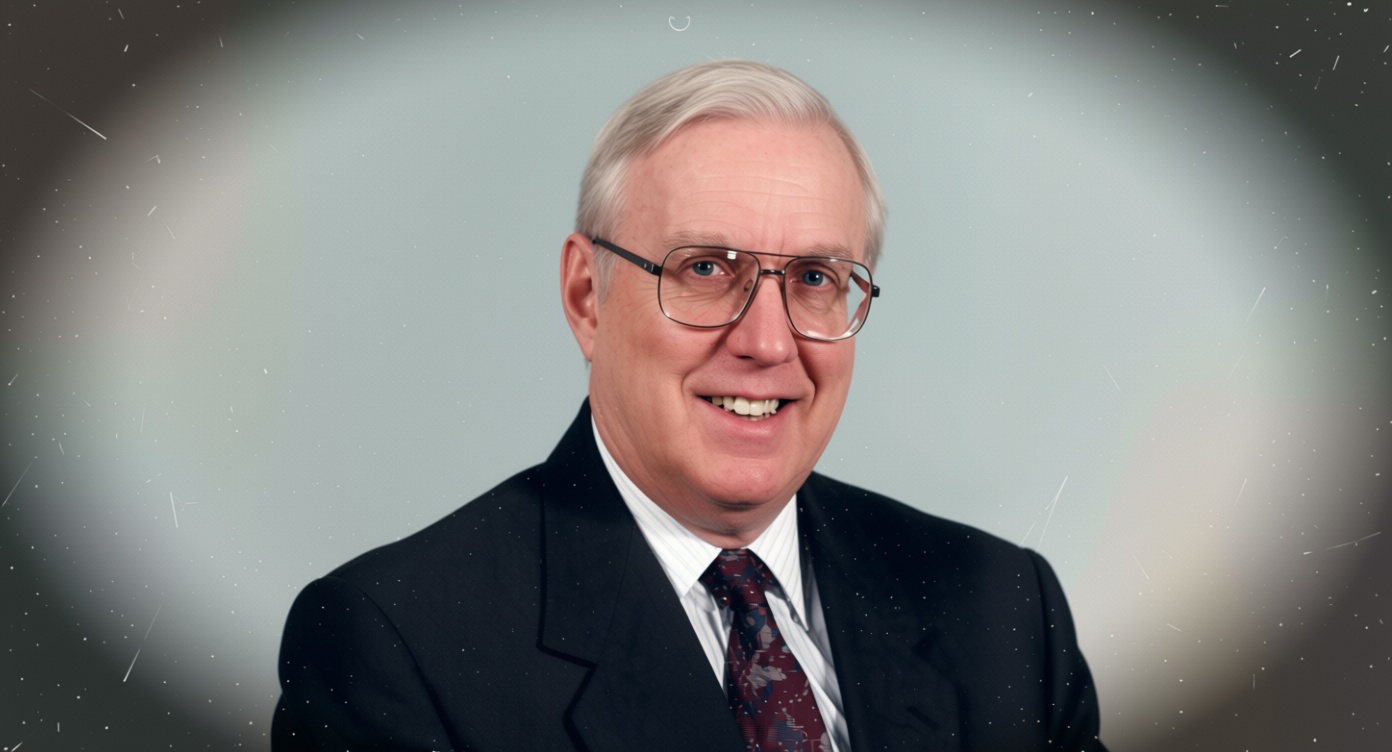
MUFON co-founder John Schuessler dies

MUFON co-founder John Schuessler dies ILLUSTRATIVE RECONSTRUCTION // NOT EVIDENCE

Overview

John Schuessler, the aerospace engineer and longtime UFO researcher who helped found the Mutual UFO Network, has died, according to a July 12 announcement from MUFON. Born in 1940, Schuessler was a defining figure in modern ufology for decades, known both for his technical background and for his willingness to challenge assumptions inside a field often divided between believers, skeptics, and independent investigators. His death prompted an immediate wave of tributes from the UFO research community, where he was widely regarded as one of the organization’s most consequential and uncompromising voices.

A Founding Figure in MUFON

Schuessler’s name is closely tied to the early growth of MUFON, which became one of the most prominent civilian organizations devoted to the study of unidentified aerial phenomena. As a co-founder, he helped shape the group’s emphasis on case documentation, investigator training, and evidence-based analysis at a time when UFO research was still largely informal and frequently dismissed by mainstream institutions. His background as an aerospace engineer gave him a level of technical credibility that set him apart from many contemporaries, and it also informed the careful, methodical approach he brought to high-profile cases.

Over the years, Schuessler developed a reputation as an investigator who could be both meticulous and contrarian. That combination made him influential in ufology, where agreement is rare and case interpretation often depends on competing theories. He did not simply amplify claims; he often pressed for documentation, consistency, and hard questions about what witnesses reported and what evidence could actually support. For supporters, that made him indispensable. For critics, it sometimes made him difficult. Either way, he left a lasting mark on the field.

Investigating the Cases That Defined an Era

Among Schuessler’s most notable contributions was his detailed work on the Cash-Landrum incident, one of the most discussed UFO cases in U.S. history. The case, involving two women and a child who reported an encounter with a mysterious glowing object in Texas in 1980, became a touchstone for discussions of alleged physical effects, military involvement, and the challenge of sorting fact from speculation. Schuessler’s interest in the case reflected his broader approach: focus on the evidence, examine the timeline, and avoid easy conclusions.

That commitment to deeper inquiry helped make Schuessler a respected figure even among people who disagreed about UFO origins or interpretations. His work arrived during a period when UFO research was still largely outside academic and governmental consensus, yet he consistently pushed the conversation toward more disciplined analysis. In that sense, his influence extended beyond any single case; he helped establish a standard for how serious civilian investigators could approach unexplained aerial reports.

Community Reaction and Legacy

The MUFON announcement marks the end of a long career that intersected with some of the most enduring questions in the field. While the organization’s statement did not provide extensive details, the response from researchers and longtime observers suggests Schuessler’s death is being felt as a significant loss. For many in the UFO community, he represented a generation of investigators who built the field through persistence, technical rigor, and a willingness to follow difficult evidence wherever it led.

His legacy is likely to endure through MUFON’s institutional history, the cases he helped shape, and the investigators he influenced. In a field often defined by uncertainty, Schuessler stood out for trying to bring order to ambiguity. That may be the clearest measure of his impact: not that he solved every mystery, but that he helped define how the mystery should be studied.

{ https://usubjects.com/  }

Hoe vind je dit bericht?
Geschreven door peter om 20:45 Stuur door

Ross Coulthart of NewsNation Reveals his Revelations on UFO/UAP Disclosure Journalism - the good & bad

UFO.png
Ross Coulthart of NewsNation Reveals his Revelations on UFO/UAP Disclosure Journalism - the good & bad

NewRealities:

Ok he didn't tell me everything. But he was very honest and upfront about his opinions and considerations on the Disclosure process. In one of his most candid Interviews UAP/UFO journalist Ross Coulthart holds nothing back as Alan Steinfeld turns the tables on the premier UFO/ UAP journalist of our time.


YouTube link: 

Overview

A recent VibeWire Magazine post has drawn attention to Ross Coulthart’s evolving role in UFO/UAP disclosure journalism, framing the NewsNation reporter as one of the most visible mainstream voices covering the subject. The article promotes a candid interview between Coulthart and Alan Steinfeld on New Realities, describing the discussion as one in which the journalist “holds nothing back” about the state of the disclosure effort. While the VibeWire item does not provide a full transcript or detailed quotes, it positions the conversation as a rare look at both the progress and the shortcomings of modern UAP reporting.

Coulthart has become a significant figure in the field because he sits at the intersection of investigative journalism and a subject long treated with skepticism by major media. His prominence reflects a broader shift: what was once a fringe topic is now appearing more often in congressional hearings, Pentagon-related reporting, and network television segments. That shift has created new opportunities for transparency, but it has also raised the stakes for journalists tasked with separating verified information from speculation.

The positive side of disclosure journalism

One of the clearest strengths of the current disclosure landscape is that UAP coverage is no longer confined to the margins. Journalists like Coulthart have helped normalize the idea that unexplained aerial phenomena are a legitimate subject for public scrutiny, not merely a pop-culture curiosity. That shift matters because it has encouraged more witnesses, former military personnel, and researchers to come forward, and it has pushed government agencies to respond more openly than they did in the past.

The VibeWire post suggests that Coulthart is candid about the disclosure process, and that candidness itself is part of the story. In a field often clouded by secrecy, ambiguity, and competing claims, reporters who ask hard questions while maintaining a disciplined standard of evidence can help create a more credible public conversation. The fact that UAP journalism is increasingly discussed on mainstream platforms also indicates that audiences are willing to engage with the topic in a more serious way than before.

The challenges and shortcomings

At the same time, the current media environment presents obvious risks. UAP reporting is vulnerable to exaggeration, rumor, and selective sourcing, especially when reporters rely on anonymous insiders or partial information from a slow-moving disclosure process. The gap between what can be publicly confirmed and what is alleged privately remains wide, and that gap can easily fuel frustration or unrealistic expectations among audiences hoping for dramatic revelations.

There is also the issue of polarization. Supporters of disclosure often believe the media is still too cautious, while critics argue that some UAP coverage can drift toward overstatement. Coulthart’s position as a high-profile journalist makes him both influential and vulnerable to criticism from both sides. For journalists in this space, the central challenge is maintaining credibility while covering a subject that is inherently resistant to quick answers.

Why Coulthart’s commentary matters

The significance of the VibeWire post lies less in any single revelation than in what it says about the current state of UAP journalism. The field is becoming more visible, more competitive, and more consequential. Reporters are no longer simply covering sightings; they are covering the political, bureaucratic, and cultural machinery surrounding disclosure itself. In that sense, Coulthart’s perspective serves as a marker of how far the conversation has moved from the fringes.

If the disclosure movement is to remain credible, journalism will have to continue doing what Coulthart and others have tried to model: reporting carefully, acknowledging uncertainty, and resisting the temptation to turn every development into a breakthrough. The growing audience for UAP coverage suggests that there is room for serious reporting—so long as the facts remain the focus.

RELATED 


Ross Coulthart Q&A: UFO document dumps and catastrophic disclosure | Reality Check

UAP Gerb Live - the State of Disclosure, Hanging with Ross Coulthart, Current Events & QnA

{ https://ufos-disclosure.blogspot.com/ }

Hoe vind je dit bericht?
Geschreven door peter om 20:33 Stuur door

Is There a Ruined Civilization on Mars? A Theoretical Physicist Runs the Numbers | Reality Check

Is There a Ruined Civilization on Mars? A Theoretical Physicist Runs the Numbers | Reality Check

Anomolies-on-Mars.png

In this episode of “Reality Check,” Ross Coulthart sits down with theoretical physicist and philosopher of physics Maaneli Derakhshani for a long look at the anomalous features cataloged across the moon, Phobos and the surface of Mars. The conversation opens with Lue Elizondo’s remarks on lunar anomalies, then works outward to the Phobos 2 spacecraft and the object NASA’s own mission literature once described as a monolith along with the reason SETI took that object seriously enough to study.

From there, Max walks Ross through the imagery that has drawn the most attention on Mars, from the so-called glass worm to the rectilinear formations near the Atlantis basin, applying the same fractal analysis that NASA and the Department of Defense use to separate natural terrain from engineered structures. Grounding the discussion in Carl Sagan’s own standards for searching for evidence of past life, Max makes the case that some of these features deserve to be treated as genuine open questions rather than tricks of light and shadow. The episode closes on the face on Mars and the geometric relationships between formations that, Max argues, may have been meant to be seen.

Chapters:

0:00 Intro
0:41 A Word from Our Sponsor
3:06 Elizondo, Lunar Anomalies, and What Might Be on the Moon
4:30 Artificial Ruins and the Clementine Mission
5:35 Turning to Mars, and the Phobos 2 Spacecraft
8:03 The Marina Popovich Photo
12:04 “Wouldn’t It Be Sad if Putin Disclosed First?”
12:53 Camera Glitch or Real Object? What Analysts Say Off the Record
16:21 The PRIME Mission and the Object NASA Called a Monolith
20:42 Buzz Aldrin on the Phobos Monolith
26:01 A Roscosmos Quote, and a Nature Study on a Craft That Was Hit
30:13 Rendering a Structure 35 to 40 Meters Tall
34:29 Why SETI Took Phobos Seriously, and Aldrin’s Observation Point
38:16 When Mars Had an Earth-Like Atmosphere, and Clarke’s “2001”
41:35 To the Surface, What Actually Looks Anomalous on Mars
45:55 The Glass Worm, the Sand-Dune Debunk, and Mike Bara’s Breakdown
52:38 The Space Act of 1958, and Who Controls Mars Imagery?
58:51 Aram Chaos, Run Through a Fractal Filter
60:09 So, Are They Artificial? Max Speculates
1:02:15 Three Anomalies, the Work of Jean Ward
1:05:33 Is Extrapolating Like This Legitimate? Sagan’s Standard
1:10:46 Is Any of This Just Pareidolia?
1:12:50 Right Angles Near the Atlantis Basin, and What NASA Calls Chaos Terrain
1:17:12 Cities, Villages, Civilization? Max Answers Plainly
1:19:07 The Algorithms, and Who Else Runs Them
1:25:13 Buried Structures in Renaudot Crater
1:30:42 The Face on Mars, Sagan’s Letter, and an Open Mind on “Cosmos”
1:37:01 Cydonia, How Big the Face Is, and Why NASA Landed Elsewhere
1:41:02 A Mimetolith, More Structures, and the Geometry Between Them
1:48:54 Wrapping Up, and an Invitation Back

Overview

A new episode of Reality Check on VibeWire Magazine has revived an old question in a more technical frame: could Mars preserve the ruins of an ancient civilization? In the discussion, host Ross Coulthart speaks with theoretical physicist and philosopher of physics Maaneli Derakhshani, who walks through a range of unusual lunar, Phobos, and Martian features that he argues deserve closer scrutiny. Rather than claiming proof of alien architecture, the conversation is presented as a theoretical examination of anomalies that some researchers believe have been prematurely dismissed. The episode begins on the Moon, touches on the Phobos 2 mission and an object once described in NASA literature as a monolith, and then shifts to the Martian surface, where formations such as the “glass worm,” rectilinear structures near the Atlantis basin, and the famous “face on Mars” are discussed as possible clues to something more than geology.

What the Physicist Examines

According to the source material, Derakhshani applies fractal analysis—a technique used in scientific and defense settings to help distinguish natural terrain from engineered forms—to imagery from Mars and Phobos. The aim, he suggests, is not to force a conclusion but to test whether some features are better explained by chance, erosion, or something intentionally structured. The episode revisits the Phobos 2 spacecraft, the “monolith” NASA-related mission references, and the reason SETI reportedly found the object worth studying. From there, the discussion broadens to surface features on Mars that have long fueled debate among anomaly hunters, including formations in Aram Chaos, the Atlantis basin, and Renaudot Crater. Derakhshani also invokes Carl Sagan’s standard for evidence of past life, arguing that extraordinary-looking structures should at least be treated as open questions rather than automatically dismissed as optical tricks or pareidolia.

The Broader Scientific and Historical Context

The episode’s framing matters because it places speculative interpretation alongside mainstream scientific caution. Mars has been examined for decades by orbiters, landers, and rovers, and the overwhelming scientific consensus remains that the planet’s surface features are the result of natural processes, not confirmed ruins. Still, the source highlights why these claims persist: certain images appear to show sharp angles, repeating geometry, or unusually human-like contours, and those impressions are often amplified by mission-era photo limitations, low-resolution datasets, and public fascination with the possibility of ancient life. The show also raises questions about who controls Mars imagery and how much data is publicly accessible, a concern that tends to resonate in fringe and independent research communities alike.

Caution, Curiosity, and the Limits of the Evidence

What makes the conversation notable is not that it proves a civilization existed on Mars, but that it attempts to formalize the debate using a scientific lens. Even so, the evidence described in the source remains interpretive: images, geometric comparisons, and pattern analysis do not amount to confirmation of artificial origin. The episode ends by asking whether any of the features could indicate cities, villages, or buried structures, but it stops short of a definitive answer. For now, the article’s central takeaway is more measured: Mars continues to inspire serious questions, and while most of its supposed anomalies may ultimately prove natural, some researchers believe they are still worth testing rather than ridiculing outright.

RELATED


Ancient Aliens: EVIDENCE OF LOST CIVILIZATIONS ON MARS (Season 14) | History

{ https://www.vibewire.com.au/ }

Hoe vind je dit bericht?
Geschreven door peter om 20:18 Stuur door

Claims that extraterrestrial contact has begun outside government oversight are discussed

Claims that extraterrestrial contact has begun outside government oversight are discussed ILLUSTRATIVE RECONSTRUCTION // NOT EVIDENCE

Overview

Claims that extraterrestrial contact has already begun outside government control are being circulated in UFO and disclosure circles following a recent community discussion centered on experiencers who say they have had direct encounters with non-human beings. The conversation, framed around Conscious Life Expo 2026, presents testimony from several individuals who describe meetings with entities identified as Arcturians, Pleiadians, blue light beings, and other intelligences. Supporters of such accounts argue they suggest a broader reality unfolding beyond official channels, while skeptics caution that the claims remain unverified and should be treated as personal testimony rather than evidence of contact.

Key Claims From the Discussion

According to the source material, the event featured seven experiencers who described a range of alleged interactions, including one account of being taken aboard what was described as a “children’s teaching craft.” The testimonies were presented as firsthand narratives, with speakers outlining what they believe to be repeated contact over time. One theme highlighted in the discussion was the idea that the beings involved are not hostile but instead are trying to encourage a shift in human awareness. The source also references a Navy skeptic whose views reportedly changed after a contact experience, a detail likely intended to underscore the argument that even skeptical observers can be persuaded by direct encounters.

A further claim raised in the discussion is the idea of MK Ultra-style memory suppression, suggesting that some experiencers believe their memories of contact have been blocked, distorted, or delayed by psychological means. That allegation is notable because it links contemporary UFO testimony with longstanding speculation about covert government programs, though no evidence was presented in the source to substantiate such a connection. As with many contact narratives, the accounts blend spiritual language, psychological interpretation, and paranormal claims in ways that can be compelling to believers but difficult to evaluate independently.

Disclosure, Government Oversight, and Public Awareness

The broader argument advanced by the article is that “the government isn’t in control” of the contact phenomenon. That framing reflects a recurring theme in UFO disclosure circles: the belief that if non-human intelligence is interacting with people, it may be doing so independently of military or intelligence oversight. For advocates of disclosure, such claims reinforce the idea that official institutions may be lagging behind events already unfolding in public and private settings. For critics, however, the lack of verifiable evidence makes it impossible to conclude that contact has begun in any meaningful, real-world sense.

What Remains Unclear

What is clear is that interest in UFOs and anomalous experiences continues to grow through conferences, podcasts, and online communities where firsthand accounts are given significant weight. What remains unclear is whether any of these stories point to a genuine external intelligence, a psychological phenomenon, misidentification, or some combination of factors. No independent corroboration, physical evidence, or official confirmation is provided in the source. Still, the discussion reflects an important moment in the disclosure conversation: a shift from asking whether contact is possible to asserting that it may already be happening, even if institutions have not publicly acknowledged it.


From 2025: Notable UFO testimony at House hearing on government transparency

{ https://usubjects.com/ }

Hoe vind je dit bericht?
Geschreven door peter om 18:35 Stuur door

‘Roswell of Brazil’: Doc director finds UFO crash tale credible

‘Roswell of Brazil’: Doc director finds UFO crash tale credible

Elizabeth Vargas

'Varginha: The Roswell of Brazil' Bought by 1091 Pictures - Variety

Overview

(NewsNation) — James Fox, who directed a 2022 documentary about the alleged 1996 crash of a UFO in Brazil, says an expanded version of his film includes recollections from a surgeon who claims to have seen an alien survivor at the hospital.

A recent NewsNation segment has brought fresh attention to the so-called “Roswell of Brazil,” the long-running claim that an unidentified flying object crashed in the Brazilian city of Varginha in the 1990s. The report centers on a documentary director who says he finds the crash narrative credible, adding a new layer of visibility to one of the most discussed UFO cases outside the United States.

The incident, often compared to Roswell, New Mexico, has remained a fixture in UFO circles for decades because of the persistent accounts surrounding it. Supporters of the story point to witness testimony and local recollections as evidence that something unusual happened. Skeptics, meanwhile, have continued to question whether the case reflects a genuine crash event, a mix of rumors, or a case of misidentification that grew over time.

Fox says Dr. Italo Venturelli was previously reluctant to discuss his experience but changed his mind after suffering a near-fatal heart attack.

“He was lying on his deathbed, staring at the ceiling of the ICU, and he thought, ‘If I get through this, I’m not taking this story to the grave,’” the filmmaker told “Elizabeth Vargas Reports” on Thursday.

Doc director finds UFO crash tale credible in Roswell of Brazil case

When Fox and his crew returned to Brazil, he said the brain surgeon brought everyone into the room where he said he had encountered a “captured, nonhuman sentient being” three decades ago.

“As soon as he looked in the eyes, he knew it was not of this Earth,” Fox said.

Witnesses have long said a cigar-shaped UFO crashed in Varginha, Brazil, in January 1996 and that at least one occupant of the craft survived or was taken into custody. The location in Southeast Brazil has become known as the “Roswell of Brazil” because of the incident’s similarities to an alleged UFO crash in New Mexico in 1947.

Fox says the information he has collected through his film project, “Moment of Contact,” should be enough to smoke out “real evidence” collected three decades ago. In variations of the Varginha narrative, the U.S. government takes custody of alien beings.

Earlier this week, Rep. Eric Burlison, R-Mo., said he sent letters to the CIA and FBI asking the agencies to release any information they may have on the Varginha crash.

Burlison, a member of the House Oversight Committee, suggested the FBI may even help launch an investigation into another component of the story — that a Brazilian soldier died from an infection after touching a UFO or alien.

Documentary Focus and Witness Claims

According to the NewsNation segment, the documentary director believes the alleged crash deserves serious consideration. That view is notable because it comes from someone actively producing a film about the case rather than from a casual observer. In UFO reporting, documentaries often serve as a vehicle for revisiting older claims, interviewing witnesses, and assembling archival material that may not have received mainstream attention when the story first emerged.

The renewed discussion also highlights the continuing importance of witness testimony in unresolved UFO cases. Over the years, the Varginha story has been shaped by accounts from residents, researchers, and others who say they saw or heard evidence of a strange event. While such testimony has helped keep the case alive, it has not produced definitive proof that would settle the matter conclusively. That tension — between compelling personal accounts and a lack of hard verification — remains central to the story’s longevity.

Why the Case Still Draws Attention

The enduring appeal of the “Roswell of Brazil” lies in its mix of local folklore, alleged government secrecy, and the broader public fascination with unexplained aerial phenomena. In many ways, it mirrors other high-profile UFO cases that continue to attract attention long after the initial reports fade from the news cycle. The difference in this case is its strong association with a specific Brazilian city and the way the story has become embedded in popular UFO culture.

For filmmakers and investigators, cases like Varginha offer both narrative momentum and documentary intrigue. They also arrive at a time when public interest in UFOs — now often referred to as UAPs, or unidentified anomalous phenomena — has increased amid congressional hearings, military disclosures, and renewed scrutiny of unexplained sightings. In that climate, older stories are being revisited with fresh eyes, even when the underlying evidence remains disputed.

What the Renewed Interest Means

The NewsNation segment underscores how unresolved UFO claims can resurface whenever a new documentary, interview, or witness account enters the conversation. The director’s endorsement of the crash story as credible does not resolve the case, but it does show how belief in the incident continues to be sustained by those who have spent years studying it.

At the same time, the story serves as a reminder that credibility is not the same as confirmation. Without publicly verified physical evidence or an official acknowledgment of a crash, the “Roswell of Brazil” remains an allegation rather than a settled historical event. Still, the renewed attention suggests the case is far from forgotten, and it may continue to generate debate as filmmakers and researchers revisit one of Brazil’s most famous UFO mysteries.


Brazil's Roswell: The Alien & UFO Crash Exposed

The Varginha UFO Incident: Brazil's Roswell That the Government Tried to Bury

{ https://www.newsnationnow.com/ }

Hoe vind je dit bericht?
Geschreven door peter om 18:26 Stuur door

Is Psychology Ignoring One of the Biggest Human Mysteries?

Is Psychology Ignoring One of the Biggest Human Mysteries?

The human story behind UAP deserves the attention of psychological science.

Key points

  • Every aspect of the UAP story involves the psychology of the human mind.
  • Psychologists are not immune to the very psychological issues they study.
  • Psychologists have both a scientific opportunity and an ethical responsibility to engage on the topic of UAPs.

AI-Generated / Open AI

Source: AI-Generated / Open AI

For more than a century, the field of psychology has sought to understand human thought, emotion, perception, belief, memory, and behavior. It has tackled some of humanity’s most complex questions, from consciousness and trauma to religion, spirituality, and extraordinary human experiences. Yet there is one area where, despite millions of reported experiences and increasing attention from governments and scientists, the field has remained remarkably quiet: unidentified anomalous phenomena (UAP).

Whether UAPs ultimately prove to represent misunderstood natural phenomena, advanced technology, non-human intelligence, or something else entirely is a question for many scientific disciplines to investigate. But there is another question that belongs squarely within the expertise of psychologists: What can these experiences teach us about the human mind?

Over the past several years, the conversation surrounding UAP has changed dramatically. Senior government officials, military personnel, intelligence officers, scientists, and members of Congress have publicly stated that some UAP reports cannot currently be explained by known technologies or conventional explanations. Governments around the world have expanded efforts to collect and analyze data. Regardless of where these investigations ultimately lead, the topic has moved well beyond the realm of popular culture.

Yet the field of psychology has largely remained on the sidelines.

That absence is difficult to understand.

If millions of people across cultures and throughout history report extraordinary experiences, psychologists should be interested. If those experiences influence people’s beliefs, identities, relationships, and mental health, psychologists should be interested. If the possibility of future disclosure has the potential to shape how individuals and societies think, feel, and adapt, psychologists should certainly be interested.

At the same time, if these reports prove to have conventional explanations, we would still be left with one of the most remarkable psychological questions of our time. How do millions of people, across different cultures and generations, come to report experiences that share striking similarities? What roles do perception, memory, expectation, belief, social influence, culture, or consciousness play? Understanding that phenomenon would itself represent a major scientific contribution.

Either possibility deserves serious investigation.

The field of psychology has never required certainty before asking important questions. Psychologists study uncertainty itself. We investigate perception without fully understanding consciousness, memory despite its imperfections, and human behavior despite its extraordinary complexity. Our responsibility is not to wait until every mystery has been solved. It is to better understand the human experience.

So why has the field of psychology remained largely absent? Part of the answer, I believe, is institutional stigma.

For decades, UAP has been associated with ridicule, sensationalism, and reputational risk. Researchers who expressed interest in the topic often found themselves defending the legitimacy of the subject before anyone evaluated the quality of their work. Over time, this stigma shaped funding decisions, publication opportunities, academic careers, and ultimately the willingness of many scientists to engage with the topic at all.

The field of psychology is not separate from the psychologists who comprise it. Like every scientific discipline, it is shaped by the questions we choose to ask, the topics we pursue, the research we fund, the papers we publish, and the conversations we are willing to have. When an important area of human experience receives little scientific attention, it is worth asking not only what we may have overlooked, but why.

Ironically, psychologists have spent decades studying the very processes that may have contributed to this silence.

Psychologists understand that stigma discourages disclosure, influences perception, alters behavior, and limits inquiry. We recognize that social pressures can determine which experiences people are willing to report and which questions researchers feel comfortable pursuing. We routinely study conformity, group norms, reputational concerns, and institutional influences on decision-making. It would be surprising if the field of psychology itself were somehow immune to these same psychological processes.

Recognizing the influence of stigma does not require abandoning scientific skepticism. In fact, it demands the opposite. Genuine neutral skepticism asks difficult questions, follows evidence wherever it leads, and resists allowing social pressures to determine which scientific questions deserve attention. The goal is not to validate extraordinary claims. The goal is to investigate extraordinary human experiences with rigor, intellectual humility, and methodological excellence.

The field of psychology has a unique contribution to make. Psychologists are uniquely qualified to investigate perception, cognition, memory, belief formation, identity, uncertainty, resilience, adaptation, and the psychological effects of worldview-changing information. If consciousness plays any role in how these experiences occur or are interpreted, psychologists should be among the scientists helping to investigate that possibility. If consciousness plays no role, psychologists are still essential to understanding how people perceive, interpret, remember, and integrate extraordinary experiences into their lives.

These questions matter regardless of what UAPs actually are.

This topic is about much more than just understanding UAP, it is about the future of the field of psychology. Scientific progress depends on our willingness to examine our own assumptions, confront institutional stigma, and ask difficult questions with curiosity and humility. If this phenomenon has the potential to deepen our understanding of perception, consciousness, belief, and human adaptation, then the field of psychology has both a scientific opportunity and an ethical responsibility to help investigate it.

RELATED VIDEOS


How AI & Physics Are Unlocking the Truth (Full Episode) | UFOs: Investigating the Unknown | Nat Geo

Why Humans Love Mysteries | The Psychology Behind Our

Why Humans are Obsessed with Unsolved Mysteries

UFO - The Dark Truth

{ https://www.psychologytoday.com/gb }

Hoe vind je dit bericht?
Geschreven door peter om 18:00 Stuur door

Ancient Abandoned Ship Found On Mars In Canyon, Measure over 11km long! UFO UAP Sighting News.

Ancient Abandoned Ship Found On Mars In Canyon, Measure over 11km long! UFO UAP Sighting News.

UFO_mars.png
Date of discovery: July 18, 2026
Location of discovery: Mars map
Source Map: 
 
I found this huge spaceship landed in a canyon on Mars in a NASA Mars map. The map has a ruler and it measured over 11 km across and 3 km wide. Both its right and left sides are perfectly similar like the right and left wing of a jet plane on Earth. Also down its center is a long dark area that I believe to be an open sky viewing are for people on board to view the outside. Its a massive ship and it looks long since abandoned on Mars...I say that because its semi brown...like its been covered in hundreds of years of dust storms. The concept of a alien ship this big is a bit difficult to comprehend, but thats because of our technology level being a bit low compared to aliens, in another hundred years, a ship that size might be common to see taking humans off Earth to other planets. Time will tell. 
Scott C. Waring - UFO Sightings Daily 
discovery_mars.png

found_on_mars.png

{ https://www.ufosightingsdaily.com/ }

Hoe vind je dit bericht?
Geschreven door peter om 17:37 Stuur door

Cloaked UFO Seen When Fireworks Explodes, July 4, 2026, Harlem, Georgia, UAP sighting news

Cloaked UFO Seen When Fireworks Explodes, July 4, 2026, Harlem, Georgia, UAP sighting news

UFO_ring.png
Date of sighting: July 4, 2026
Location of sighting: Harlem, Georgia, USA
Source: NUFORC #199203
 
Watch closely and you will see a ring in the sky, this is caused by the outer hull of a UFO disk gathering smoke from the fireworks explosions. UFOs like anything that flies and fireworks does attract UFOs, as you can already see in the video. This one is watching, monitoring and even sensing the emotions as well as the thoughts of the people below. Fantastic catch and so close to the people too!
Scott C. Waring - UFO Sightings Daily
Eyewitness states: 
We saw a ring in the sky over us. I got a good video of it. It was higher than a cloud and it didn't move.
 

Cloaked UFO Seen When Fireworks Explodes, July 4, 2026, Harlem, Georgia, UAP Paranormal Alien News

{ https://www.ufosightingsdaily.com/ }

Hoe vind je dit bericht?
Geschreven door peter om 17:30 Stuur door

Debunking the myth of the male warrior: Ancient Egyptian PRINCESSES were skilled hunters with bulging muscles, study finds

Debunking the myth of the male warrior: Ancient Egyptian PRINCESSES were skilled hunters with bulging muscles, study finds

If you were asked to picture a warrior, a vision of a muscular man might spring to mind.

But a new study might have you repainting that image in your head. 

Archaeologists from Beni Suef University say that in Ancient Egypt, it was the princesses who were the most skilled warriors. 

In their study, the team analysed six royal mummies found in Dahshur – a funerary complex of pyramids and shaft tombs. 

Their analysis revealed that five of the mummies belonged to princesses, who had been buried alongside bows, arrows and daggers.

These items are traditionally associated with men – and could paint a very different story about fighters in Ancient Egypt.  

'Members of the royal family, especially the women, were active participants in skilled, physically demanding activities such as archery and hunting,' said Dr Zeinab Hashesh, lead author of the study. 

'This conclusion is supported by the way their bones developed to sustain heavy muscle use, which corresponds directly to the weapons discovered in their tombs.' 

Five of mummies belonged to princesses, who had been buried alongside bows, arrows and daggers

Five of mummies belonged to princesses, who had been buried alongside bows, arrows and daggers

Four of the princesses in the tombs were daughters of pharaoh Amenemhat – Princess Khenmet, Princess Itaweret, Princess Ita, Princess Sathathormeryt

Four of the princesses in the tombs were daughters of pharaoh Amenemhat – Princess Khenmet, Princess Itaweret, Princess Ita, Princess Sathathormeryt

Four of the princesses in the tombs were daughters of pharaoh Amenemhat – Princess Khenmet, Princess Itaweret, Princess Ita, Princess Sathathormeryt.

The other two tombs analysed also belonged to royalty – Princess Noub–Hotep and King Hor – and contained similar regalia. 

While the mummies' soft tissue had turned to powder long ago, several bones remained – allowing the archaeologists to estimate the individuals' age at death, height, sex, and illnesses or injuries.

'Princess Ita was a young woman aged between 28 and 34 with strong upper–body muscle attachments, suggesting she habitually used weapons like maces or daggers,' said Dr Hashesh. 

'Princess Khenmet was a woman in her late 30s or 40s who showed signs of thinning bones, but had very robust ligament attachments. 

'Princess Itaweret was a young woman aged between 20 and 34 who survived broken ribs and foot fractures; her skeleton shows she was a skilled archer.' 

The sisters' bones had 'robust muscle attachments', indicating they were highly physical, according to the researchers. 

Dr Hashesh said: 'We found pronounced development in the upper limbs of these individuals, which correlates to repetitive, high–intensity actions like pulling a bowstring or stabilizing a weapon, proving these activities were habitual throughout their lives.

The sistes' bones had 'robust muscle attachments', indicating they were highly physical, according to the reseachers

The sistes' bones had 'robust muscle attachments', indicating they were highly physical, according to the reseachers

Pictured: the arrows found buried alongside Princess Noub Hotep

Pictured: the arrows found buried alongside Princess Noub Hotep

'This directly explains the presence of bows, arrows, and maces in the women’s tombs; these were not just symbolic gifts but tools they actively used.'

What's more, several of the individuals had evidence of injuries. 

Dr Hashesh explained: 'These injuries were most likely caused by accidents, falls, hard blows, or other impacts linked to an active lifestyle, whether through hunting, military training, or other demanding activities.

'What is remarkable is that the injuries healed well, which suggests they had access to advanced medical care for their time.'

Unfortunately, the princesses' skulls were lost in the early 1900s, which somewhat limits the analysis. 

Dr Hashesh added: 'Our dream would be to go far beyond simply identifying the Dahshur royals.

'We would try to tell their full life stories, their families, health, and even their political roles, with as much detail as possible. 

'Beyond the science, we would preserve the remains, create 3D prints for teaching and virtual exhibitions, and display them alongside their jewelry, weapons, and funerary objects. 

'All of this would be done with respect, ensuring the remains are presented ethically, just as they were originally buried.

READ MORE

article image

'Their objects and jewelry are truly fascinating, breathtaking in their craftsmanship. 

'Yet, while archaeologists have long focused on preserving these treasures, the people themselves were often forgotten. Our study seeks to change that.'

KING TUTANKHAMUN: THE PHARAOH WHO RULED EGYPT MORE THAN 3,000 YEARS AGO

The face of Tutankhamun was an Egyptian pharaoh of the 18th dynasty, and ruled between 1332 BC and 1323 BC.

The face of Tutankhamun was an Egyptian pharaoh of the 18th dynasty, and ruled between 1332 BC and 1323 BC. Right, his famous gold funeral mask

Tutankhamun was an Egyptian pharaoh of the 18th dynasty, and ruled between 1332 BC and 1323 BC.

He was the son of Akhenaten and took to the throne at the age of nine or ten.

When he became king, he married his half-sister, Ankhesenpaaten.

He died at around the age of 18 and his cause of death is unknown.

In 1907, Lord Carnarvon George Herbert asked English archaeologist and Egyptologist Howard Carter to supervise excavations in the Valley of the Kings.

On 4 November 1922, Carter's group found steps that led to Tutankhamun's tomb.

He spent several months cataloguing the antechamber before opening the burial chamber and discovering the sarcophagus in February 1923.

When the tomb was discovered in 1922 by archaeologist Howard Carter, under the patronage of Lord Carnarvon, the media frenzy that followed was unprecedented.

Carter and his team took 10 years to clear the tomb of its treasure because of the multitude of objects found within it. 

For many, Tut embodies ancient Egypt's glory because his tomb was packed with the glittering wealth of the rich 18th Dynasty from 1569 to 1315 BC.

Egypt's antiquities chief Zahi Hawass (3rd L) supervises the removal of the lid of the sarcophagus of King Tutankhamun in his underground tomb in the famed Valley of the Kings in  2007.
Egypt's antiquities chief Zahi Hawass (3rd L) supervises the removal of the lid of the sarcophagus of King Tutankhamun in his underground tomb in the famed Valley of the Kings in 2007.

{ https://www.dailymail.com/sciencetech/index.html }

Hoe vind je dit bericht?
Geschreven door peter om 14:54 Stuur door

EXCLUSIVE - Chilling new clues missed by cops challenge suicide theory on missing scientist found dead in woods

EXCLUSIVE - Chilling new clues missed by cops challenge suicide theory on missing scientist found dead in woods

Evidence has been found at the site where a missing nuclear lab assistant was found dead, raising concerns about the state of the investigation.

A lawyer for the family of Melissa Casias, who vanished in June last year and was found dead 11 months later, told the Daily Mail several red flags involving law enforcement led loved ones to start their own search for answers - with stunning results.

David Adams of Parnall and Adams Law revealed that a trove of evidence was discovered nearly a month after New Mexico State Police had officially declared the crime scene clear and removed Casias's skeletal remains for medical examination.

That independent search of New Mexico's Carson National Forest in late June uncovered bones, torn and bloody clothing, orange peels and strands of hair that were not collected by police when the 53-year-old's body was found on May 28.

The lawyer also revealed that the family strongly believed Casias did not take her own life and had no reason to disappear.

Adams explained: 'There seemed to be a separate narrative taking place that somehow she wanted to be missing and that she had other places that she would be.'

Although the origins of the hair found at the scene have not been determined yet, the attorney noted that it appeared to be horse hair and theorized that the body of Casias may have been taken to this location by an unknown suspect.

'In my mind, when you see that, you kind of go, okay, well, I could see that you would need a horse to get her up there if you were moving a body, for instance, because how you would otherwise do that,' Adams said.

Melissa Casias worked at the Los Alamos National Laboratory, a long-running nuclear research facility, before disappearing on June 26 last year. Her remains were found on May 28

Melissa Casias worked at the Los Alamos National Laboratory, a long-running nuclear research facility, before disappearing on June 26 last year. Her remains were found on May 28

 4Corners K-9 Search and Rescue also unearthed shredded paper, which relatives believe has Casias's handwriting on it and what appears to be a tobacco pouch. Casias reportedly did not use tobacco.

Adams said: 'The family really wasn't expecting t

The Casias family and volunteers from the groupo find any additional information, other than to just kind of finally have an idea of where her last resting grounds were, so they could kind of go pay their own respects, and it certainly turned out to be something much, much more.' 

The find has turned the case on its head, with Adams claiming investigators in New Mexico have seriously damaged their credibility if it is found that Casias was the victim of foul play and a suspect is brought to trial.

'There becomes a question of a chain of custody... Could law enforcement have spat a tobacco pouch in the crime scene? I mean, certainly possible. I mean, that would be an example of just poor training,' Adams explained.

'If somebody actually did do that, I mean, it defeats every best practice regarding the crime scene and protecting the integrity of a crime scene.'

The Daily Mail has reached out to the New Mexico State Police for comment. A spokesman said the matter was being brought to investigators for further response.

Adams, who is a former federal prosecutor, said his firm was hired by Casias's parents and siblings after multiple red flags were raised by legal observers looking at the case who suspected foul play.

'There [were] enough phone calls coming in, where people were providing information that they thought was relevant based upon how they knew Melissa, and observations that they have made regarding it, and a lot of it has come to be information that I would undoubtedly dive deep into investigating,' he revealed.

The final image of Casias alive came from a surveillance camera near State Road 518 in New Mexico, approximately three miles from her home

The final image of Casias alive came from a surveillance camera near State Road 518 in New Mexico, approximately three miles from her home

Casias with her husband Mark Casias

Casias with her husband Mark Casias

'Some of it even stretches into government entities, not for their potential involvement in this, but more so from the perspective that people that should be interviewed have some very difficult relationships within government agencies that raised enough red flags for me,' Adams added.

Casias was an administrative assistant at Los Alamos National Laboratory, a major nuclear research facility for the US government since World War II. 

She vanished without a trace on June 26 last year, strangely walking out of her Ranchos de Taos home without her purse, keys or wallet and traveling alone eastward on State Road 518, roughly three miles from her home, around 2.20pm local time.

She also left both of her phones inside her home, which her family later found had been reset to factory settings, meaning all of Casias's messages and call data had been wiped off the devices. A drop of blood was also reportedly found inside the home.

A handgun was found next to Casias's skeletal remains in Carson National Forest on May 28, but police have not released any information about it, including who it belonged to, if it was fired and if any fingerprints were left on the weapon.

An anonymous law enforcement source told the Daily Mail that the circumstances of the Casias case were highly irregular, adding that key pieces of information should have been known by investigators weeks ago.

'They should have known who the gun belonged to that week if the serial number wasn't filed off,' the source declared.

They added that local police departments often send handguns in potential criminal cases to Washington, DC for detailed analysis, which would have produced results in far less than seven weeks.

Workers harvesting timber within Carson National Forest. It is unclear how long Casias's body was in the park before being discovered

Workers harvesting timber within Carson National Forest. It is unclear how long Casias's body was in the park before being discovered

The scientist's body was found alongside a handgun in the McGaffey Ridge area of the forest

The scientist's body was found alongside a handgun in the McGaffey Ridge area of the forest

article image

The last update New Mexico State Police gave to the Daily Mail came on June 16, when authorities revealed that initial CT scans of Casias's skull did not show signs of a gunshot wound or traces of a bullet.

Adams confirmed that a bullet casing has not been found at the scene.

He added that the area where Casias was discovered was in a part of the New Mexico park that would have been extremely difficult to reach on foot and would have required several stops for rest and water.

The nuclear lab employee was one of four individuals who vanished under nearly identical circumstances over the last year in New Mexico, with each person having deep ties to America's nuclear weapons facilities in the state.

Fellow LANL employee Anthony Chavez, 79, worked at the lab until his retirement in 2017, although his role there has not been made clear. He vanished without a trace after walking out of his home on May 4 last year, just seven weeks before Casias.

Steven Garcia, 48, vanished without a trace on August 28 last year. He was last seen leaving his Albuquerque, New Mexico, home on foot, carrying only a handgun, a bottle of water and no identification or phone.

An anonymous source told the Daily Mail that Garcia was a government contractor working for the Kansas City National Security Campus (KCNSC), a major facility in Albuquerque that plays a key behind-the-scenes role in America's national defense.

Casias and other missing person cases came to light after retired Air Force General William Neil McCasland vanished from his New Mexico home on February 27.

The general had previously been in charge of the Air Force Research Lab, which worked closely together on national security projects, especially research involving America's nuclear capabilities, with both of these labs.

These disappearances, along with a string of deaths among NASA scientists tied to advanced rocket and propulsion research, have sparked a national conversation about the so-called 'missing scientists' case.

Calls for answers pushed Donald Trump to order the FBI to investigate any potential connections between the cases, however, intelligence officials have not provided any updates on their investigation since the President's announcement in April.

In a statement on Wednesday, the bureau told the Daily Mail: 'The FBI continues to look for connections into the missing and deceased scientists. We are working with the Department of Energy, Department of War, and with our state and local law enforcement partners to find answers.'

Adams disputed the FBI's claims, telling the Daily Mail that there has been no contact with the bureau and no signs of any federal presence in the Casias case to this point.

Adams, whose firm specializes in helping families in missing person and homicide cases, especially those involving women, has previously taken legal action against law enforcement agencies over alleged failures in properly investigating crimes.

The attorney could not say if the handling of this case would eventually lead to legal action on behalf of the Casias family, but noted that the new evidence recovered from Carson National Forest was turned over to authorities to assist with the investigation.

Nearly two months later, the Office of the Medical Investigator has not revealed an official cause of death or whether the case was being viewed as a suicide or murder.


Missing Scientist Found Dead in Chilling Forest Discovery

{ https://www.dailymail.com/sciencetech/index.html }

Hoe vind je dit bericht?
Geschreven door peter om 14:38 Stuur door

The S-2 Alpha Alien Interview

Frame Grab of Alien Interview

The S-2 Alpha Alien Interview

Leaked Footage from Area 51

One of the most mysterious and controversial pieces of alleged UFO evidence is the “Alien Interview” video, which surfaced in the late 1990s. Claimed to have been filmed at S-2 Alpha, a secretive facility within Area 51, the footage depicts what appears to be a gray alien being interrogated by government officials. The video was allegedly smuggled out of a classified facility and leaked to Rocket Pictures by a man known only as “Victor.” It first gained widespread attention in the 1997 television special “Area 51: The Alien Interview – Special Edition”, hosted by Steven Williams, best known for his role as Mr. X on The X-Files. The special fueled speculation, skepticism, and intrigue about the video’s authenticity.

The Origins of the Video

According to “Victor,” the anonymous whistleblower who leaked the footage:

‘Victor’

  • The video was recorded at S-2 Alpha, an underground facility within Area 51.
  • The footage was part of a classified U.S. government program tasked with interrogating an extraterrestrial entity.
  • The being, referred to as an EBE (Extraterrestrial Biological Entity), was allegedly retrieved from a crashed UFO and held in captivity.
  • The interrogation was conducted under strict secrecy, with only a select group of military and intelligence personnel aware of its existence.
  • According to researcher Jon Stewart, the footage was supposedly recorded on April 22nd 1991 at 3:15pm

The S-2 Alpha Facility and Interview Suite

The S-2 Alpha facility, often associated with Area 51, remains largely unknown, with details primarily coming from leaked testimonies and whistleblower accounts. While S-4, as described by Bob Lazar, is believed to be built into the Papoose Mountain Range, the existence and location of S-2 Alpha is a subject of speculation. Some believe it is an underground facility separate from S-4, potentially housing biological research, extraterrestrial containment, and interrogation operations.

Regarding the interview suite where the alleged “Alien Interview” took place, available descriptions suggest it is:

  • A dimly lit room with minimal furnishings, designed to focus attention on the subject.
  • Equipped with a large, transparent partition, possibly one-way glass, allowing unseen observers to monitor the interrogation.
  • Containing medical equipment, suggesting preparedness for any health issues the entity might experience during questioning.
  • Designed for telepathic or non-verbal communication, as the alien is seen reacting in a way that suggests communication without spoken words.
  • A monitor displaying a waveform, similar in appearance to an ECG (electrocardiogram), which has fueled speculation about its purpose:
  • Some theorists believe it is monitoring the alien’s vital signs, particularly heart rate or neural activity.
  • Others suggest it could be tracking bioelectrical or telepathic energy exchanges, possibly capturing data on how the alien communicates.
  • The fluctuating waveform has led to theories that the government was attempting to decode an unknown form of extraterrestrial cognition or thought process.

The true nature of S-2 Alpha remains unknown, and government officials continue to deny its existence. However, the descriptions of the interview suite align with depictions of classified bio-containment and interrogation areas, further fueling speculation that the footage represents an authentic encounter.

Description of the Alien Interview Footage

The video itself is grainy and dark, with the following key details:

  • A small, humanoid creature with a large head, dark almond-shaped eyes, and grayish skin is seated behind a table.
  • The being appears weak or sick, exhibiting labored breathing.
  • Two shadowy figures stand behind the camera, allegedly the interrogators.
  • A telepathic exchange is rumored to be occurring between the entity and the interviewers.
  • At one point, the alien appears to struggle for breath, and a medical assistant rushes in to administer aid.
  • The original footage was reportedly much brighter, but Rocket Studios allegedly darkened it to enhance its eerie effect.
  • The audio was intentionally removed by Victor to prevent identification of the interviewers and maintain secrecy.
  • The footage contains a watermark labeled “DNI/27”, which has sparked speculation regarding its origins and meaning:
  • “DNI” is believed to refer to the Department of Naval Intelligence, an alleged secretive division of the U.S. government that officials deny exists.
  • Bob Lazar, a well-known whistleblower, claimed to have received a paycheck with “Department of Naval Intelligence” printed on it, and research into tax codes suggests it is linked to a classified government department.

Lazars Paycheck

  • The number “27” next to “DNI” is thought to represent a security clearance level.
  • The timestamp on the video remains unexplained, as the footage provided only lasts a few minutes, leading some to speculate that a longer interview was conducted.
  • Allegedly, the former CEO of Rocket Pictures, Tom Coleman possesses the full unedited interview at his home, further fueling conspiracy theories about suppressed information.

~Alleged Alien Interview with Commentary by ‘Victor’~

The original VHS was much brighter when leaked to Rocket pictures, here is a snippet of the tape, recorded from a monitor so is of low quality:

Theories Surrounding the Video

The Alien Interview sparked various theories, ranging from government cover-ups to elaborate hoaxes. Some of the most prominent interpretations include:

1. Authentic Alien Footage

  • Some researchers believe the video is genuine evidence of extraterrestrial contact.
  • They claim the being’s movements and physical attributes are too realistic to be faked with late 1990s technology.
  • The setting and secrecy surrounding the leak align with known whistleblower accounts of Area 51.

2. Government Psychological Operation (PSYOP)

  • Some theorists suggest the video was deliberately leaked as a disinformation campaign.
  • The footage could have been designed to mislead UFO researchers and divert attention from real classified operations.
  • If this was part of a controlled disclosure, it might have been intended to test public reaction to an alien presence.

3. Hollywood Hoax

  • Skeptics argue that the video was an elaborate hoax, possibly staged by Rocket Pictures or an independent special effects artist.
  • They note the lack of verifiable evidence beyond Victor’s testimony.
  • Critics point out that the video’s low resolution conveniently masks potential fakery.

The TV Special and Public Reaction

The first public airing of the footage took place during the 1997 television special “Area 51: The Alien Interview – Special Edition”, which helped bring the video to mainstream audiences. The program, hosted by Steven Williams (The X-Files), introduced the footage as a potential groundbreaking leak of government extraterrestrial interrogation efforts.

~Watch the TV Special here~

The special further fueled speculation that the video was either:

  • A genuine leak coinciding with the rise of UFO disclosure in popular media, or
  • A carefully orchestrated marketing stunt designed to capitalize on public fascination with aliens and Area 51.

Following its release, the video gained widespread attention in UFO circles, with many debating its authenticity. Some ufologists embraced it as possible evidence, while skeptics dismissed it as a well-crafted special effects project.

Who is “Victor”?

  • “Victor” has never revealed his true identity, claiming he would be in danger if exposed.
  • He claims to have worked as a contractor or intelligence officer within Area 51.
  • He insists the footage is real and that the U.S. government continues to conceal ongoing extraterrestrial interactions.
  • Some believe “Victor” is a fabrication, a planted figure meant to obscure the true origins of the video.

Brightened Image of Victor

  • A growing theory suggests that “Victor” might actually be ufologist Robert Dean, a former U.S. Army  Command Sergeant Major known for his claims about government UFO cover-ups. Dean’s deep knowledge of alleged extraterrestrial programs and government secrecy has led some to speculate that he may have used the alias “Victor” to release the footage while maintaining anonymity.

Robert Dean

Connections to Other Alleged Alien Interrogations

  • Some researchers compare the S-2 Alpha video to reports of Project Serpo, a supposed classified exchange program between the U.S. and extraterrestrial beings.
  • Similar claims have emerged from Majestic 12 (MJ-12) documents, which describe secret alien containment and interrogation programs.
  • The video’s content resembles descriptions from whistleblowers like Bob Lazar and Philip Corso, who have discussed reverse-engineering alien technology at military facilities.

Conclusion

The Alien Interview from S-2 Alpha remains one of the most intriguing and controversial UFO-related videos ever released. Whether it is genuine evidence, an elaborate hoax, or a piece of controlled disinformation, its impact on the UFO disclosure movement and conspiracy theories about Area 51 is undeniable. While Victor’s identity and credibility remain in question, the footage continues to fascinate and divide UFO researchers, leaving open the question: Was this the closest glimpse the public has ever had of a real extraterrestrial being?

Further Reading

  • The Majestic 12 Documents and Alien Containment Programs
  • Project Serpo: Alleged U.S.-Extraterrestrial Exchange Program
  • Whistleblower Testimonies from Area 51
  • Bob Lazar and His Claims of Reverse-Engineering UFOs

Disclaimer

  • This article explores multiple perspectives on the alleged Alien Interview video from S-2 Alpha. While some claims remain unverified or speculative, the footage continues to generate discussion, debate, and investigation among UFO researchers and skeptics alike.

{ https://conspiracydata.com/category/conspiracies/ }

Hoe vind je dit bericht?
Geschreven door peter om 23:09 Stuur door

Meer van UFO'S of UAP'S, ASTRONOMIE, RUIMTEVAART, ARCHEOLOGIE, OUDHEIDKUNDE, SF-SNUFJES EN ANDERE ESOTERISCHE WETENSCHAPPEN - DE ALLERLAATSTE NIEUWTJES

↑ Terug naar de berichten