Ontdek de Fascinerende Wereld van UFO's en UAP's: Jouw Bron voor Onthullende Informatie!
Ben jij ook gefascineerd door het onbekende? Wil je meer weten over UFO's en UAP's, niet alleen in België, maar over de hele wereld? Dan ben je op de juiste plek!
België: Het Kloppend Hart van UFO-onderzoek
In België is BUFON (Belgisch UFO-Netwerk) dé autoriteit op het gebied van UFO-onderzoek. Voor betrouwbare en objectieve informatie over deze intrigerende fenomenen, bezoek je zeker onze Facebook-pagina en deze blog. Maar dat is nog niet alles! Ontdek ook het Belgisch UFO-meldpunt en Caelestia, twee organisaties die diepgaand onderzoek verrichten, al zijn ze soms kritisch of sceptisch.
Nederland: Een Schat aan Informatie
Voor onze Nederlandse buren is er de schitterende website www.ufowijzer.nl, beheerd door Paul Harmans. Deze site biedt een schat aan informatie en artikelen die je niet wilt missen!
Internationaal: MUFON - De Wereldwijde Autoriteit
Neem ook een kijkje bij MUFON (Mutual UFO Network Inc.), een gerenommeerde Amerikaanse UFO-vereniging met afdelingen in de VS en wereldwijd. MUFON is toegewijd aan de wetenschappelijke en analytische studie van het UFO-fenomeen, en hun maandelijkse tijdschrift, The MUFON UFO-Journal, is een must-read voor elke UFO-enthousiasteling. Bezoek hun website op www.mufon.com voor meer informatie.
Samenwerking en Toekomstvisie
Sinds 1 februari 2020 is Pieter niet alleen ex-president van BUFON, maar ook de voormalige nationale directeur van MUFON in Vlaanderen en Nederland. Dit creëert een sterke samenwerking met de Franse MUFON Reseau MUFON/EUROP, wat ons in staat stelt om nog meer waardevolle inzichten te delen.
Let op: Nepprofielen en Nieuwe Groeperingen
Pas op voor een nieuwe groepering die zich ook BUFON noemt, maar geen enkele connectie heeft met onze gevestigde organisatie. Hoewel zij de naam geregistreerd hebben, kunnen ze het rijke verleden en de expertise van onze groep niet evenaren. We wensen hen veel succes, maar we blijven de autoriteit in UFO-onderzoek!
Blijf Op De Hoogte!
Wil jij de laatste nieuwtjes over UFO's, ruimtevaart, archeologie, en meer? Volg ons dan en duik samen met ons in de fascinerende wereld van het onbekende! Sluit je aan bij de gemeenschap van nieuwsgierige geesten die net als jij verlangen naar antwoorden en avonturen in de sterren!
Heb je vragen of wil je meer weten? Aarzel dan niet om contact met ons op te nemen! Samen ontrafelen we het mysterie van de lucht en daarbuiten.
Woensdag 22 juli 2026
When the Grid goes Dark!
When the Grid goes Dark!
Don't think it could never happen, but the possibility of a high-altitude electromagnetic pulse (EMP) is far from unimaginable. If such an event were to occur, it could cripple the technological backbone of modern civilization. Power grids, communications, transportation, and financial systems could all be severely disrupted, leaving millions without essential services. In the aftermath, widespread confusion, shortages, and social unrest could follow as governments struggle to restore critical infrastructure.
This report of 'Redacted' examines the effects of a high-altitude electromagnetic pulse (EMP), an intense burst of electromagnetic energy generated when a nuclear weapon is detonated between approximately 30 and 400 kilometers (20–250 miles) above Earth's surface.
Unlike a nuclear explosion at ground level, a high-altitude detonation produces little direct blast or thermal damage. Instead, its primary effect is the creation of a powerful electromagnetic pulse capable of disrupting or permanently damaging electrical and electronic systems across an enormous area.
When a nuclear weapon detonates at high altitude, it generates three distinct electromagnetic pulse components:
E1 – Fast Pulse: Lasting only a few billionths of a second, the E1 pulse is the most destructive to modern electronics. It can disable computers, communication networks, vehicles equipped with sensitive electronics, and the control systems that operate electrical power grids.
E2 – Intermediate Pulse: The E2 pulse is comparable to a powerful lightning strike. Although it can damage electronic equipment, many systems already incorporate lightning protection, making this component generally less destructive than E1.
E3 – Slow Pulse: The E3 pulse lasts from several seconds to a few minutes. It disturbs Earth's magnetic field and induces powerful electrical currents in long conductors such as power lines, pipelines, railway systems, and undersea cables. These currents can severely damage high-voltage transformers and other critical infrastructure.
A large-scale high-altitude EMP could:
Disable significant portions of the electrical grid. Disrupt internet, cellular, and radio communications. Interfere with GPS navigation and satellite operations. Damage satellites through radiation and electromagnetic effects. Interrupt banking and financial transactions. Disrupt transportation systems that depend on electronic controls. Severely impact emergency services, water distribution, fuel supplies, and food logistics.
The most well-known demonstration of an EMP occurred during the Starfish Prime nuclear test on July 9, 1962. The United States detonated a 1.4-megaton nuclear device approximately 400 kilometers (250 miles) above the Pacific Ocean.
Although the explosion occurred far above the Earth, its electromagnetic effects were detected roughly 1,450 kilometers (900 miles) away in Hawaii. Streetlights failed, burglar alarms were triggered, communication systems experienced disruptions, and several satellites in orbit were damaged or suffered shortened operational lifespans.
Conclusion:
A high-altitude EMP is fundamentally different from a conventional nuclear attack. Rather than destroying cities through blast and heat, its strategic purpose is to disable the electronic infrastructure upon which modern society depends. While the immediate physical destruction on the ground may be limited, the cascading failure of electrical, communication, transportation, and financial systems could create widespread disruption across an entire region.
We already know this impact knocked billions of stars into looping sausage–shaped paths, but researchers now say it may have also flipped our galaxy.
Lead author Dr Kirill Batrakov, of Durham University, says: 'We already know that the Milky Way had a massive head–on collision.
'So, we think that the Milky Way disc likely flipped in the past.'
Scientists say the Milky Way underwent a dramatic 'disc flip' in the distant past. These pictures show a simulation of a Milky Way–like galaxy undergoing a similar flip, starting from the oldest image (z=3.4) to its final position (z=0)
This revelation about our galaxy's past transformations actually emerged from the quest to solve one of the Milky Way's greatest puzzles.
The majority of the stars in our galaxy are located in the flat spiral disk, a region about 120,000 light–years in diameter and 1,000 light–years thick.
This is surrounded by the sparsely populated stellar halo, an enormous region roughly 300,000 light–years across, but extending over a million light–years in diameter at its absolute outer limits.
This is largely made up of stars that have been pulled into the Milky Way from other galaxies over time through galactic mergers.
What makes the Milky Way's stellar halo so unusual is that it rotates incredibly slowly compared to other galaxies.
The European Space Agency's Gaia mission found that it could take up to a billion years for a star in this outermost region to make its way around the galactic core.
Until now, researchers have had no idea why this would be the case.
In their paper, presented this week at the Royal Astronomical Society's National Astronomy Meeting in Birmingham, researchers analysed the simulated evolution of 25 Milky Way–like galaxies.
Scientists think that this ancient flip could explain why the stellar halo, the outermost disc of the galaxy, rotates so slowly. Pictured: An artist's impression of the Milky Way seen from above
The flip may have been caused by a collision between the Milky Way and a dwarf galaxy called Gaia–Sausage–Enceladus between 10 and 11 billion years ago. Pictured: Artists' impression of the collision with the simulated positions and motions of the stars in Gaia–Enceladus shown with yellow arrows
The Milky Way
Type:Barred spiral galaxy
Central black hole: Sagittarius A*
Diameter of stellar disc: About 120,000 light–years
Diameter of stellar halo: Up to one million light–years
Stars: Approximately 100 to 400 billion
Age: Roughly 13.6 billion years
Distance of Sun from centre:About 26,000 light–years
Solar System’s location: Orion Spur
Time for Sun to orbit galaxy: About 230 million years
Nearest large galaxy: Andromeda
The scientists followed these simulated galaxies' evolution over billions of years and watched how they changed.
They discovered that the galaxies with the slowest stellar halos had two things in common: they had all had a head–on collision with another galaxy, and they had all undergone a major disc flip.
The fact that the Milky Way has both a glacial stellar halo and a head–on collision in its ancient past, therefore, makes it likely that the galaxy also underwent a disc flip.
This means that the galaxy we recognise today might have looked and behaved dramatically differently several billion years ago.
'A disc flip also means most of the Milky Way's stars once moved on very different trajectories than they do today – possibly even our own Sun,' says Dr Batrakov.
'Meaning our "stable" spot in the galaxy might not have been so stable for the Solar System's whole lifetime.'
Since we live inside the Milky Way, we can study its workings better than any other galaxy in the cosmos, making it the perfect laboratory for testing ideas about galaxy evolution.
With this extra knowledge about our own galaxy's history, scientists can start to make more sense of the baffling variety of cosmic structures out in the universe.
These images show the evolution of a Milky Way–like galaxy that did not have a collision with another galaxy and, therefore, did not experience a disc flip
Dr Batrakov adds: 'Finding that its disc flipped adds a new chapter to that story, one we must account for when placing the Milky Way in a broader context of other galaxies.
A star discovered in 2018 is thought to be one of the oldest in the Milky Way.
Scientists at the Instituto de Astrofísica de Canarias (IAC) in Spain believe that it might have formed about 300 million years after the 'Big Bang'.
IAC researcher Jonay González Hernández said: 'Theory predicts that these stars could form just after, and using material from, the first supernovae, whose progenitors were the first massive stars in the Galaxy.'
Researchers hope the star, known as J0815+4729, which is in line with the Lynx constellation, will help them learn more about the Big Bang, the popular theory about the galaxy's evolution.
IAC director Rafael Rebolo said: 'Detecting lithium gives us crucial information related to Big Bang nucleosynthesis. We are working on a spectrograph of high resolution and wide spectral range in order to be able to measure (among other things) the detailed chemical composition of stars with unique properties such as J0815+4729.'
Cosmic Gymnastics: Our Milky Way Galaxy Flipped On Its Side | Fineprint | WION
Did the Milky Way Slowly Flip on Its Side After a Cosmic Crash?
Scientists are sounding the alarm over a worsening situation in Earth’s oceans and freshwater systems, according to a new study that warns of “irreversible” changes our planet could be facing.
New research led by the Scripps Institution of Oceanography at UC San Diego has revealed the rapid disappearance of oxygen from bodies of sea and fresh water, leading to environmentalchanges that could endure for centuries if left unmitigated.
The new study, which appeared in the journal Limnology and Oceanography, argues that widespread aquatic deoxygenation—reduced levels of dissolved oxygen in oceans and coastal waters, lakes, rivers, and streams—is increasingly becoming a problem, and one that influences nine other crucial environmental processes.
These processes are all included in what is known as the Planetary Boundaries framework, a science-based tool that outlines the requirements of a safe operating space for humanity. Introduced in 2009 by Earth system scientists led by Johan Rockström, this framework identifies nine critical environmental processes that regulate Earth’s stability.
Specifically, the nine planetary boundaries outlined in this framework are climate change, biosphere integrity, land use changes, biogeochemical flow of nutrients, ocean acidification, freshwater changes, atmospheric aerosol loading, stratospheric ozone depletion, and pollution.
Now, the Scripps researchers behind the recent study say they believe dissolved oxygen levels should also be formally included in this framework.
Aquatic Deoxygenation is a Growing Concern
Erica Ferrer, a Scripps Oceanography alumna and current postdoctoral scholar at UC Santa Barbara’s National Center for Ecological Analysis and Synthesis and lead author of the new study, says that her team’s work “is designed to elevate the profile of aquatic deoxygenation as a global threat and show that it does not operate in isolation.”
“The health and stability of our planet depends on the health and stability of aquatic ecosystems, which need oxygen to function normally,” Ferrer said.
Driving this growing problem, the new research says, is the excessive influx of nutrient pollution into water bodies, as well as anthropogenic warming, and changes occurring in natural ventilation systems within deep ocean waters.
With depleting oxygen levels scientists are seeing, longer-term changes to chemical and biological processes that regulate our planet’s climate are expected to occur. The decline, Ferrer and her colleagues argue, is also likely to impact a diverse range of aquatic organisms and ecosystems.
Even ocean mammals that acquire air at the surface are likely to be impacted, since deoxygenation can either cause the relocation or outright depletion of the organisms that make up their diets. This, in addition to causing severe damage to habitats and alterations to the food webs they depend on.
Ferrer and her colleague, study co-author and Scripps biological oceanographer Lisa Levin, are hopeful that their findings will encourage a deeper level of engagement on the potential ramifications of aquatic oxygen loss, and how other environmental challenges outlined in the planetary boundaries framework can act as multipliers, rather than separate existential concerns.
“Adding aquatic deoxygenation to the Planetary Boundaries framework will help us understand its impacts on Earth system stability,” Ferrer said in a statement, adding that mitigation of ocean deoxygenation impacts “represents a critical component of maintaining biodiversity and climate.”
Levin, Ferrer, and their colleagues’ study, “Abundant interactions and feedbacks between aquatic deoxygenation and the other planetary boundaries suggest ‘unsafe’ levels of oxygen loss with far‐reaching impacts,” appeared in the journal Limnology and Oceanography on June 30, 2026.
Micah Hanks is the Editor-in-Chief and Co-Founder of The Debrief. A longtime reporter on science, defense, and technology with a focus on space and astronomy, he can be reached at micah@thedebrief.org. Follow him on X @MicahHanks, and at micahhanks.com.
James Herbert’s model airships. Including the one seen by Casimir Werk, were constructed of paper and filled with hot air from a paraffin lamp.From "Cincinnati Post," August 23, 1905
Casimir Werk, grandson of the millionaire soap maker and vintner for whom Werk Road is named, saw a UFO one balmy Sunday evening in 1905. The unidentified flying object was soon revealed as an identified flying object but yielded an even bigger mystery.
According to the Cincinnati Enquirer [August 28, 1905] Werk watched an unidentified object he believed might be an airship explode while it flew westward on the previous evening:
“Mr. Werk was standing in front of his parents’ home on La Feuille avenue, Westwood, about 6 o’clock, when he saw a peculiar formation in the sky. He secured field glasses and soon had them focused upon the object which he believes to have been an airship. He claims it was about 100 feet long and shaped like a projectile.”
While following the flying object with his binoculars, Werk watched it rock up and down like a ship tossed by waves in the ocean. It then burst into flame, the entire structure consumed, and fell from the sky, lost in the evening haze. The Enquirer was unable to locate anyone else who saw the thing, nor anyone who found any wreckage:
“The police knew nothing of the doings up above the sky line of Cincinnati, nor did the Coroner receive any report of the mangled remains of an airship operator being found within the limits of the county.”
Apparently, neither Werk nor the Enquirer reporter had read the previous Wednesday’s Cincinnati Post [August 23,1905], containing a lengthy feature about a teenage boy in Camp Washington and his attempts to build an airship capable of carrying passengers.
“Undaunted by poverty, working alone on a principle he believes will ultimately succeed, even beyond his fondest dreams; toiling only in spare hours, because he had to earn a living, James Herbert, scarcely more than 18, of 3067 Colerain-av., is building an airship, which he thinks will fly.”
The Post described how young Herbert constructed large balloons out of paper, filled them with air heated by a paraffin-fueled burner, and directed their flight by a spring-powered propeller.
On Sunday, the very day Werk saw his mystery airship, the Cincinnati Commercial Tribune [August 27, 1905] published its own profile of young James Herbert and claimed the young inventor was inspired by a contest sponsored by the newspaper:
“James started in several years ago when a children’s contest was on in The Commercial Tribune and his drawing of an airship model and ideas of the same were accepted by The Commercial Tribune and printed with his photo.”
Herbert, according to this report, had already launched several airship models of rather impressive size:
“A few days ago one twenty feet long and seven feet in diameter was sent up from an empty lot near Herbert’s home. Its weight was fifteen pounds, and its lifting power an additional fifteen pounds. It came to earth near a large building in Lick Run, the gas having given out. It was made of heavy tissue paper.”
James Herbert prepares one of his large model airships for launch.
From "Cincinnati Post," August 23, 1905
A Camp Washington resident informed the Enquirer [August 29, 1905] that Werk’s mystery airship was among the experimental flights of young Herbert. The Cincinnati Times-Star [August 29, 1905] calmed a very much relieved Werk by proving he had not been hallucinating:
“‘That’s exactly it,’ said Casimir Werk, jun., of Westwood, when the airship he saw Sunday evening was described to him Tuesday by a Times-Star reporter. ‘Yes, sir, that is just what I saw Sunday evening. No, I have not heard from young Herbert, the inventor. I never heard of him before.’”
The Times-Star interviewed James Herbert’s father, who expressed a frustrated resignation about his son’s aeronautical obsession:
“‘I’m down on this airship business. I don’t take any stock in it and pay little attention to this thing of trying to fly around in the air like birds.’ Such is the opinion of George Herbert, father of Jas. Herbert, the Colerain avenue lad who is bent on building a craft with which to navigate the upper air.”
The Enquirer chided the skeptics who refused to believe Casimir Werk:
“Those who saw fit to twit Mr. Werk yesterday for having seen what they did not will now have to back water.”
With that, James Herbert, boy inventor, fades from the annals of history. Only one additional newspaper story, printed in the Enquirer [September 2, 1905], references James Herbert’s airships, but doesn’t mention him by name, identifying him only as “the young Cumminsville inventor.” That story describes two bright lights floating high above League Park—later to be rebuilt as Crosley Field—at 7:30 p.m., either remaining quite steady or traveling against a “stiff breeze.” Among the witnesses was Cincinnati Police Lieutenant John W. Scahill, who asserted that the lights were attached to a controlled aircraft and not to a kite or balloon. (The Reds were in Chicago that day, losing 3-2.)
Here is the mystery: There is no record of a James Herbert living on Colerain Avenue anywhere near this time. The censuses of 1900 and 1910 record no one by that name at all. None of the city directories from that time list a James Herbert on or near Colerain Avenue. The census and city directories do record several George Herberts, but none of them live on Colerain Avenue and none have a son named James. Additionally, the Sanborn Insurance Map for 1904 shows 3067 Colerain as a vacant lot.
The Commercial Tribune claims that James Herbert got his start in aircraft design by entering a children’s contest “seven years ago” with his portrait and a picture of an airship printed in the newspaper. In fact, the Commercial Tribune did sponsor a contest, “What Is Your Idea Of A Successful Flying Machine?”, in April 1899, six years previous. The winning entries were published on April 16 and April 23, with occasional late entries appearing later in the year. None were submitted by anyone named James Herbert.
It’s unlikely the newspapers got James Herbert’s name wrong. Miraculously, for that time, three newspapers spelled his name identically. Two newspapers cited the same address. The mystery deepens. Whatever became of Cincinnati’s airship inventor, James Herbert?
It’s not like Cincinnatians had never seen an airship, as motorized balloons were called back then. Even as James Herbert was enjoying his 15 minutes of fame, the Hamilton County Fair announced that either Roy Knabenshue or Leo Stevens, two competing dirigible pilots, would fly around the Carthage Fairgrounds that September.
Trump directs agencies to waive NDAs for former employees involved in UFO investigations: report
The nondisclosure agreements have proved an impediment to government investigations into UAPs, also known as UFOs, and the directive is intended to ease this source of reluctance.
President Donald Trump has directed federal agencies to waive the nondisclosure agreements that former government employees and contractors signed while they were working on investigations involving unidentified anomalous phenomena (UAPs), also known as UFOs.
The directives were given to the Department of War and the intelligence community, Fox News reported, citing unnamed sources.
The order asks that the agencies allow former government employees and contractors who have relevant information about UAPs to come forward to meet with representatives of Trump's UAP taskforce, the All-domain Anomaly Resolution Office (AARO). Any NDAs they signed would be waived under the order.
A senior administration official stressed that the directive is not a "declassification directive" and only allows employees and contractors to come forward through government channels.
The NDAs have proved an impediment to government investigations into UAPs, and the directive is intended to ease this source of reluctance.
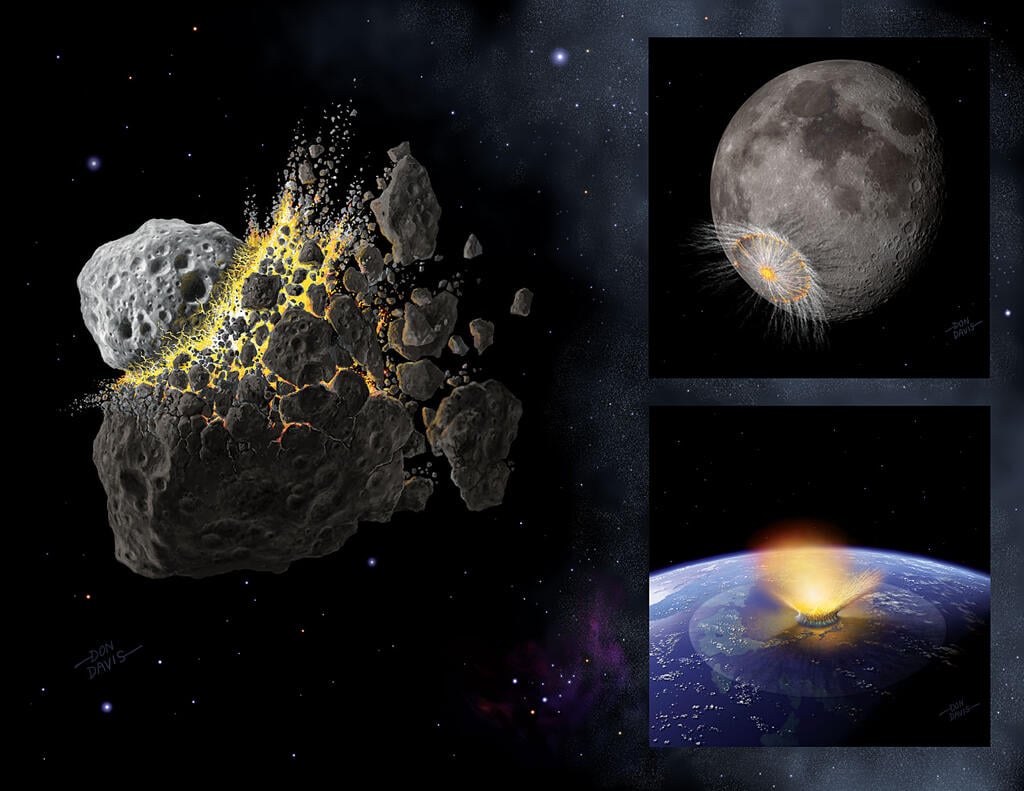
Artist's depicion of the cause and consequnece of the Eulalia asteroid catastrophe. Credit - SwRI/Don Davis
On Earth, it’s hard to track events that reshape its surface, as the surface itself is being reshaped constantly by weather and tectonic or volcanic upheavals. However, the Moon is much more static, and scientists have been slowly unraveling a pattern that is noticeable in its craters - that something dramatic happened around 800 million years ago. A new paper by researchers at the Southwest Research Institute (SwRI), led by Dr. William F. Bottke, and accepted for publication in the Planetary Science Journal, suggests they might have found a culprit - the parent body of a family of asteroids now known as Eulalia.
So what exactly is Eulalia? Now, it’s a “family” of asteroids with similar geological makeups that asteroid researchers believe were originally part of a single, much larger asteroid. Estimated to be around 100 km in diameter, this asteroid suffered a catastrophic collision around 800 million years ago that broke it into thousands of much smaller pieces. That happens all the time throughout the solar system, but what made this one more impactful was where it happened.
Eulalia’s parent body was believed to be very near the 3:1 mean motion resonance with Jupiter, meaning it would rotate three times around the Sun for every single orbit of Jupiter. This orbital position, more commonly called J3:1, critically serves as a gravitational escape hatch for the asteroid belt, flinging objects that cross its path into planet-crossing regions throughout the solar system.
Fraser talks about asteroids striking the Moon.
According to the paper, when the catastrophic collision happened 800 million years ago, some of those fragments were immediately sent into the J3:1 point, and then distributed throughout the inner solar system. And over the next 150 million years or so, other fragments from the collision were slowly pushed into that position through a non-gravitational thermal acceleration force known as the Yarkovsky effect.
The end effect of these asteroid fragments being flung into that resonance point is the inner solar system seems to have suffered a pretty heavy asteroidal bombardment around this time. Many of the Near-Earth asteroids currently orbiting near our home planet appear to be remnants from this collision, as samples from Ryugu and Bennu have shown. But the most critical evidence comes from the Moon.
According to crater surveys on our nearest neighbor, there was a massive uptick in crater formation around 800 million years ago. Notably, the 93 km wide Copernicus crater was created in this time frame, but samples collected by the Apollo astronauts show it wasn’t the only one - tiny glass beads formed by the intense heat of impacts show a clustering of radiometric ages around 800 million years ago.
Fraser talks about how we might destroy an asteroid.
But if this inner solar system bombardment did happen, it wasn’t just the Moon that was affected. In fact, a general rule of thumb means that for every impact on the Moon, there should be 20 of a similar size on Earth due to its higher gravity level. 800 million years ago, Earth’s climate underwent a dramatic change known as the Bitter Springs Anomaly, which was marked by huge disruptions to Earth’s carbon cycle. The paper posits this as a speculative connection intended to inspire future research, suggesting that the increased amount of asteroid dust in the atmosphere could have contributed to an atmospheric cooling event that drove some evolutionary diversification of marine life just before the “Snowball Earth” glaciation period.
Mars would have been hit too, with the authors pointing out that there was a peak in the formation of massive volcanic calderas right around 800 million years ago. The impact shocks from repeated pummeling by asteroids could have destabilized Martian magma reservoirs, triggering a planetary surge in volcanic eruptions.
Venus, on the other hand, had something even more dramatic happen approximately 650 million years ago. The authors calculate the average surface age of Venus is right around that mark, and present the speculative hypothesis that the barrage of asteroid remnants from the Eulalia breakup could have sparked a catastrophic, planet-wide volcanic resurfacing event.
That is definitely a leap, though admittedly a logical, and (critically) a testable one. The authors already used some collisional and dynamical models to reverse-engineer the Eulalia family’s history, so there’s already a level of rigorous orbital dynamics proven in part of the paper. But tying such massive biological and geological changes such as Earth’s Snowball Period or Venus’ entire surface restructuring requires extraordinary evidence. This undoubtedly won’t be the last we hear of this theory, but it might be some time before enough additional evidence is gathered to be able to disprove it. Until then, the theory drives home just how critical asteroids can be in the development of a planet - and how critical it is that we find any capable of doing that to our own, modern home.
Spherical UFO filmed flying over the mountains near Ensenada, Mexico
On July 18, 2026, while in the mountains near Ensenada, Mexico, a witness reported seeing a silent spherical object emerge from a ridge between two hills as he was scanning the surrounding area.
According to the witness, who posted the sighting on his Facebook page, similar spherical objects have reportedly been seen emerging from the same hillside on multiple occasions, often following a bright white light. On this occasion, he says he finally succeeded in capturing one of these objects on video.
Could the footage show a genuine unidentified flying object, or is there a more conventional explanation? The video leaves that question open.
A man claiming to be a time traveler from the year 2045 says the world will gain definitive proof that aliens exist, cash will be extinct and the US will no longer be a country within the next four years.
Calling himself Adam Archon, the mysterious man claimed the technology to travel in time will become publicly accessible in 2028, the same year he said extraterrestrials land on Earth and end decades of secrecy by governments worldwide.
Archon, who claimed he was born on December 6, 2019, without any proof, recorded his supposed knowledge of the future during a March 2019 video which recently resurfaced online amid the public release of classified UFO files by the Pentagon.
While allegedly connected to an active lie detector machine, Archon said: 'Yes, it is true that aliens did land on Earth in August 2028. In fact, we have known of the existence of aliens before 2028, but it isn't until 2028 that it becomes public knowledge.'
Archon, whose face was blurred and voice altered during the interview with the YouTube channel Apex TV, said he had traveled back to a time before he was born to experience history in-person, which he claimed was a common practice in the future.
'Time travel was released to the public in 2028, but it was invented in 1981. It was just kept secret until they released it publicly,' he claimed.
Moreover, Archon claimed that most UFO sightings today were actually the craft used by time travelers from the future to go back in time to visit historical events.
According to the ten-minute interview, which has been viewed more than 1.3 million times, Archon was telling the truth, with Apex TV claiming every answer registered as truthful on the lie detector test.
A man calling himself Adam Archon alleged in 2019 that he was a time traveler from the year 2045
Archon claimed that current UFO sightings were actually time travel capsules containing humans from the future
Archon also mentioned the public will start getting an implanted chip called 'The One' in their right hand in February 2029.
The device allegedly lets users pay for items, boosts brain function and improves health. This system will supposedly replace all global currencies, making cash extinct.
This technology has existed for the last decade, with people having the ability to get a small microchip implanted in their hand so they can pay for things such as coffee or groceries just by waving their hand near a scanner typically used for credit cards.
According to the self-proclaimed time traveler, who did not show any physical proof he was from the future in his interview, this new system of digital money would debut right before the third chilling world event - the end of the US government.
Archon claimed that in 2030, the US would no longer be an independent nation and would instead become part of a new world government that splits up the globe by continent - with the US becoming part of 'District 3.'
The new world order, he said, was also said to be run by an AI program named The Light that will be released in 2033.
Archon claimed it was built into every electronic device, allowing anyone to talk to it and ask it anything. However, a group of ten government officials monitored all of The Light's decisions to make sure it was ruling ethically.
By 2045, Archon said scientists developed the technology to clone dinosaurs, creating a real-life 'Jurassic Park' where the public can visit prehistoric creatures.
'You can see T-rexes, Triceratops, velociraptors. If they existed, you can see them. People can go and visit things in the past, like to go visit the dinosaurs or major world events.'
Skeptics have claimed that Archon's January 2019 video was 'rehearsed' and fake, noting the time difference in the supposed three-minute speech
A self-proclaimed time traveler from 2045 has claimed that scientists developed the ability to clone and recreate dinosaurs (artist's impression)
While the March 25, 2019, video claimed that Archon was telling the truth, multiple pieces of his story did not add up and would be impossible under US laws.
In a separate video posted in January 2019, Archon started by claiming that there would be a documented increase in the number of UFO sightings worldwide that same year. While that did actually happen, his information about 2020 was way off.
'In 2020, there will be a robot released to the public that causes a lot of controversy,' he said in the three-minute video that did not involve a lie detector.
There has been no clear evidence that a robot was released that caused major controversy in the US or worldwide.
Archon also failed to mention anything about the coming Covid-19 pandemic or anything for the following seven years.
Viewers of his January video claimed that Archon's statement was suspicious since the clock seen next to him showed nearly 15 minutes of real time passing despite the clip only being three minutes long.
One skeptic said: 'Does anyone else see that the video is 3:36 minutes long but the clock in the back moves a good 15 minutes? That means this was rehearsed and they had to cut out the mistakes.'
Meanwhile, Archon's shocking claim about the final president in US history would seem to be completely implausible.
'Yolanda Renee King does become, and she is in fact noted as the greatest president of the United States, yes I can confirm,' Archon claimed while taking the lie detector test.
King, 18, is the only grandchild of Martin Luther King Jr and is already known for being an author and activist, specifically against gun violence.
However, Archon's timeline with King becoming president could not come true if the US were no longer an independent nation by 2030.
King will turn 35 years old in 2043, the age at which an American citizen can legally run for office under current US law. The next presidential election would not be until 2044.
Scientists have stated that time travel into the past is not only possible; the math to make it happen actually aligns with Einstein's famed theory of general relativity - which says that space and time are linked together as 'spacetime,' and gravity is the result of massive objects like planets and stars curving this spacetime.
Despite the theory of time travel appearing to be plausible, there has been no concrete evidence that humans can regularly move backward through time, or have a craft capable of doing that.
Meanwhile, the US government has repeatedly stated that no physical proof of extraterrestrials or UFOs has ever been presented.
Archon had claimed in the video that the aliens who make contact with humans in 2028 'do not come from space.'
'I cannot elaborate on where they come from because of the possibility of a paradox,' he alleged.
RELATED VIDEOS
The Man Who Claims He Came From 2045 😱#TimeTraveler #FuturePrediction #fact #ViralShorts #Future2045
Disturbing Confessions From Alleged Time Travellers
The Einstein Paradox: Is Time Travel Actually Possible? 🕰️
EXCLUSIVE: President Donald Trump has directed federal agencies to waive prior nondisclosure agreements (NDAs) for former government employees and contractors cooperating with unidentified anomalous phenomena investigations, Fox News Digital has learned.
"President Trump recently directed the Department of War and the intelligence community to allow former government employees or contractors, that have relevant information about the disclosure of UAP, to come forward to meet with designated government representatives — AARO or the President’s UAP taskforce, ‘PURSUE’ — and have their prior NDAs abrogated," a senior administration official said, with AARO referring to the All-domain Anomaly Resolution Office, the Pentagon office established to investigate UFOs and other unidentified anomalous phenomena (UAPs).
Another senior administration official emphasized the move was not a "declassification directive" and only allowed employees to come forward through government channels.
Officials say years of congressional inquiries, whistleblower allegations and newly declassified records have raised questions about whether additional witnesses have remained silent because they believed prior nondisclosure agreements prevented them from cooperating with government investigations.
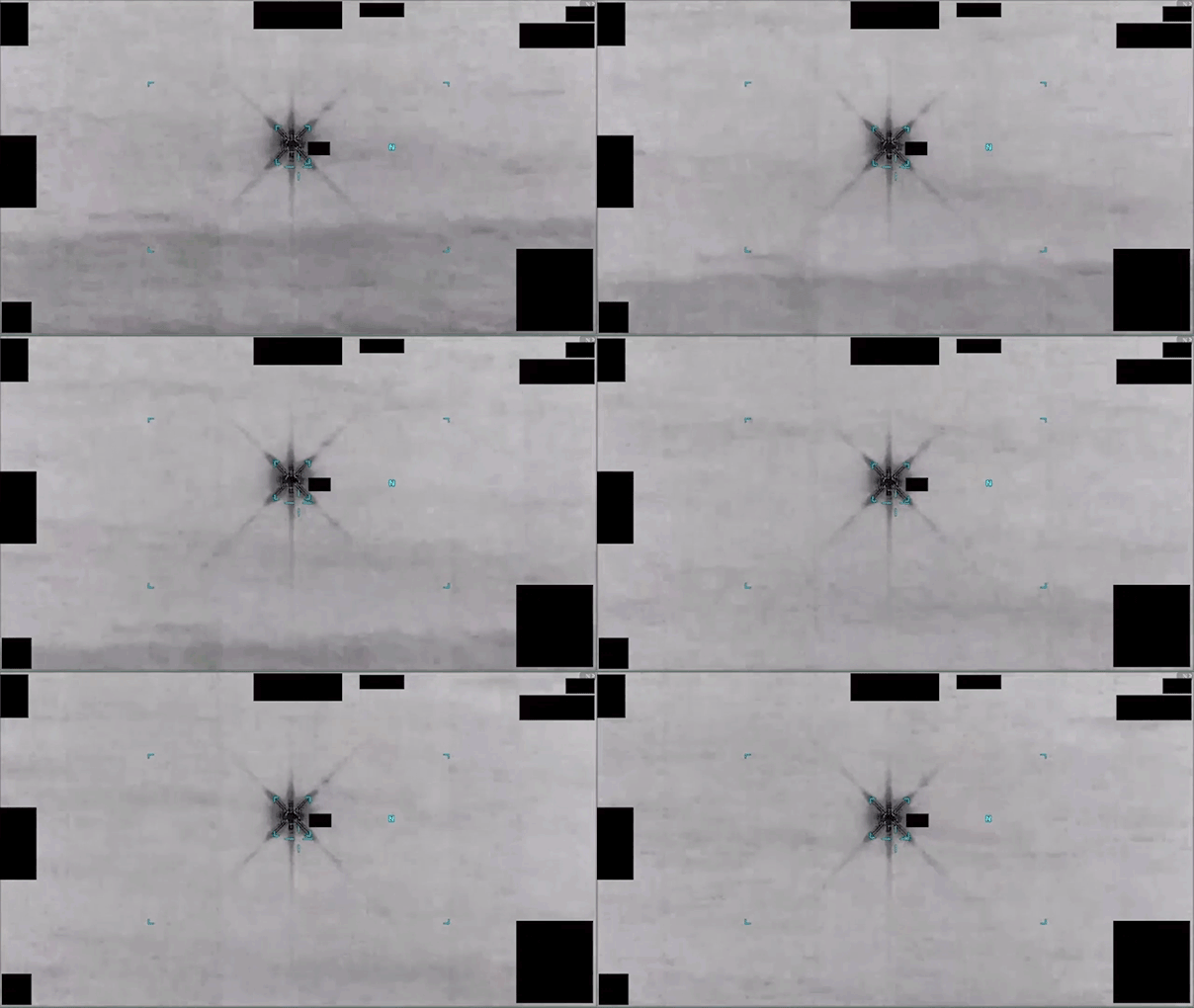
Newly released infrared footage from U.S. Indo-Pacific Command shows an object officials described as resembling a six-pointed star over the Yellow Sea Jan. 1, 2025.
"People who believe that they have information have expressed reluctance in coming forward," the official said. "We are eliminating that source of reluctance."
Like other government employees and defense contractors with access to classified information or sensitive national security programs, many witnesses would have signed nondisclosure agreements as a condition of receiving security clearances or access to restricted information. Those agreements generally prohibit unauthorized disclosure of classified or otherwise protected information and typically remain in effect even after an individual leaves government service.
Former officials and contractors who disclose protected information without authorization risk losing security clearances, facing civil penalties or, in some circumstances, criminal prosecution if classified information is improperly disclosed.
Under the new process, former government employees and contractors who believe they possess relevant UAP information would first meet with designated officials at the Pentagon's All-domain Anomaly Resolution Office (AARO) or the president's UAP task force, PURSUE, who hold the appropriate security clearances. During those authorized discussions, any applicable nondisclosure agreements could be waived, allowing witnesses to share information without fear of violating prior agreements.
Information provided through the process would be reviewed through the administration's existing declassification procedures.
"Any information that is received that sheds light on the UAP mystery will ultimately be made public," the official said.
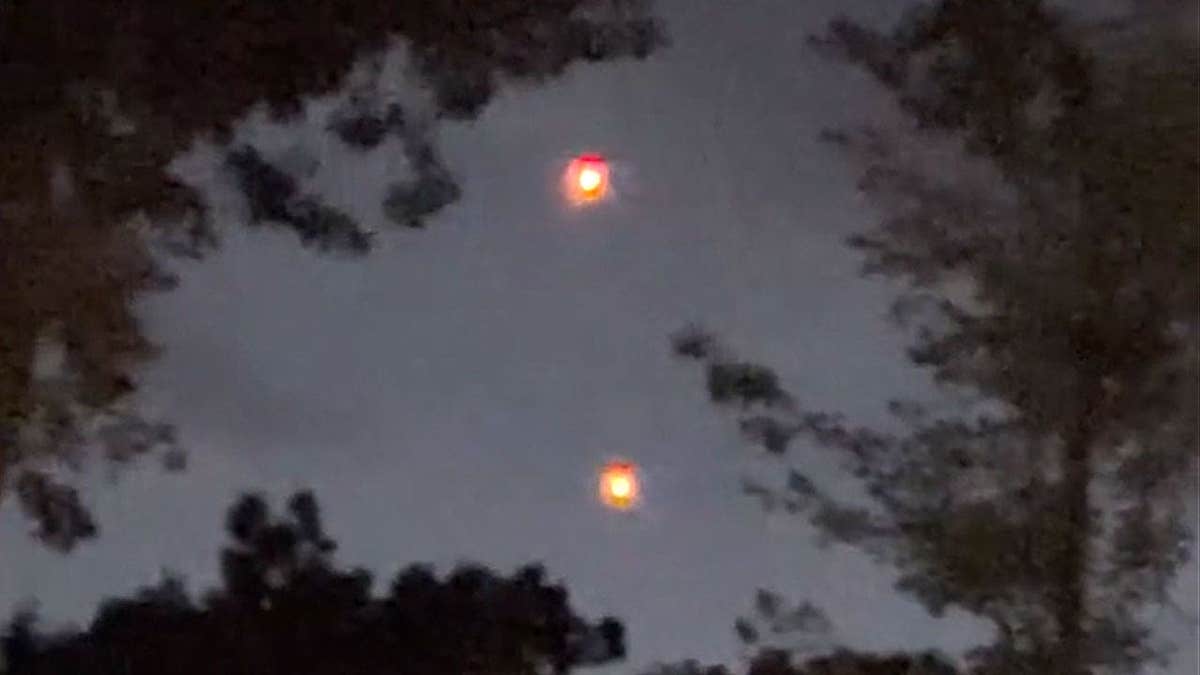
A screenshot of video footage from an alleged unidentified anomalous phenomenon (UAP) sighting in the northeastern United States in July 2025, which was detailed in files released by the DOW and originally obtained by the FBI.
(DOW/FBI)
The official said the administration does not know whether potential witnesses actually possess significant new information, but wants to remove any perceived legal barriers so investigators can determine whether previously undisclosed information exists.
"You don't know what you don't know," the official said.
The official said the focus is on incidents that remain unexplained, rather than known foreign technology, classified U.S. programs or natural phenomena.
The latest directive builds on the Trump administration's broader effort to declassify decades of government records related to unidentified anomalous phenomena. Previous releases have included FBI and Pentagon records describing unexplained sightings reported by military personnel, law enforcement and astronauts, including accounts of glowing "mother orbs" that witnesses said released smaller objects near a sensitive U.S. national security site, mysterious orange spheres observed during military operations, and Apollo-era transcripts in which astronauts described unexplained lights and "jagged, angular fragments" drifting outside their spacecraft.
The latest tranche of UAP records included expanded details and imagery from a 2015 incident involving an unidentified object over the Pantex nuclear weapons facility in Texas, along with newly declassified infrared footage showing a mysterious six-pointed star-shaped object tracked by a U.S. military sensor over the Yellow Sea on Jan. 1, 2025.
The official said the next tranche of files will be made available "very soon."
The directive follows years of complaints from some lawmakers and whistleblowers that former officials with firsthand knowledge were reluctant to come forward because of secrecy obligations.
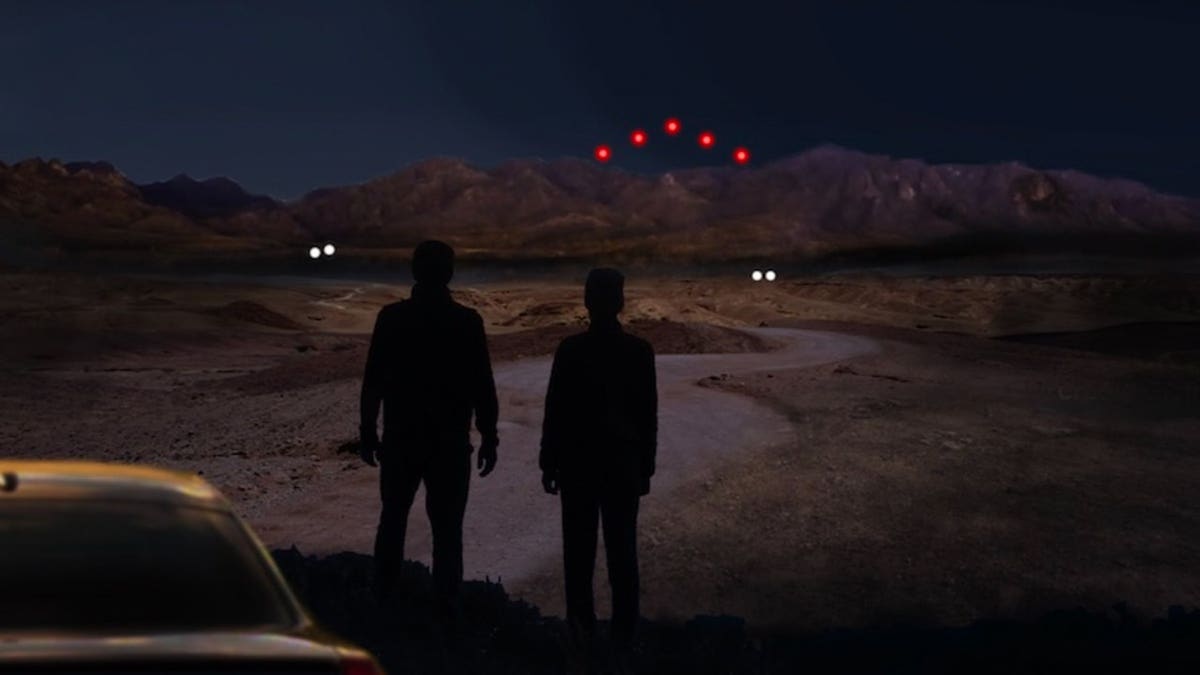
An artist's rendering released by the U.S. Department of War depicting a 2023 sighting of "orbs launching other orbs" near a national security site in the western United States.
(Department of War)
Secretary of State Marco Rubio, then the vice chairman of the Senate Intelligence Committee, said in 2023 that multiple individuals with firsthand knowledge had approached the committee but were hesitant to speak publicly because of potential repercussions.
"Some of these people still work in the government and frankly, a lot of them are very fearful — fearful of their jobs, fearful of their clearances, fearful of their career, and some, frankly, are fearful of harm coming to them," he said on News Nation in June 2023.
"Grant immunity to anyone who has already come forward, and everyone who will come forward. Open the door and let them speak," Rep. Eric Burlison, R-Mo., demanded during a June 9 press conference on Capitol Hill.
Public interest in UAPs accelerated in 2017 after The New York Times revealed the Pentagon had quietly operated a secret program to investigate unexplained aerial encounters and published Navy cockpit videos showing objects exhibiting unusual flight characteristics.
Since then, Congress has held multiple bipartisan hearings on the issue, lawmakers have pressed intelligence agencies for greater transparency, and former intelligence officer David Grusch's allegations that the government had concealed information about UAP programs renewed calls for additional disclosure, despite the government's denial of his central claims.
During the same event, former Air Force intelligence officer Grusch renewed his allegations that secret UAP programs had operated outside normal congressional oversight, calling it "a real fraud, waste and abuse issue" and claiming his investigation uncovered "slush funds to the tune of billions of dollars per annum for these activities."
The Pentagon has disputed Grusch's central claims, and AARO has said its investigations found no verified evidence of extraterrestrial technology or credible evidence that the government has secretly recovered or reverse-engineered craft of non-human origin.
LIVE | Congress Hearing On UFOs | Trump Administration Says America Can 'Handle The Truth' | US
The zoo hypothesis and a Mussolini-era UFO incident
ILLUSTRATIVE RECONSTRUCTION // NOT EVIDENCE
Overview
In a recent Q&A segment on NewsNation’s Reality Check, Special Correspondent Ross Coulthart and producer Meagan Medick fielded viewer questions ranging from Mars imagery and whistleblower retaliation to the long-running controversy surrounding UAPs and classified military technology. The discussion, which also echoed themes familiar in UFO circles such as the “zoo hypothesis” and alleged non-interference by advanced intelligences, blended established context with a number of claims that remain unverified. Coulthart framed the broader issue as one in which official secrecy and public skepticism continue to shape the debate over whether non-human technology has been recovered and studied by parts of the U.S. national security system.
Mars, Whistleblowers, and Official Resistance
One of the earliest topics was the enduring fascination with the so-called “Mars face” and other surface anomalies. Coulthart attributed the apparent changes in Martian features to sun angle, shadowing, and image contrast, noting that NASA generally explains such formations as pareidolia—the tendency to perceive familiar shapes in random data. He nevertheless said he remained interested in research that suggests Mars may once have hosted a prior civilization, including claims involving Soviet-era interference with Martian probes. Separately, Coulthart addressed allegations that the Office of the Director of National Intelligence (ODNI) has targeted UAP whistleblowers. While he acknowledged rumors of “treason threats” against figures such as Dylan Borland and Matthew Brown, he said journalistic standards require more than hearsay. He reiterated support for whistleblowers including David Grusch and Jeff Nocetelli, and argued that the “national security state” has shown a pattern of resistance to disclosure.
Reassessing the 2004 Tic Tac Incident
Coulthart also pushed back on a recent claim attributed to Jacques Vallee’s Forbidden Science 7 that the 2004 Tic Tac UAP may have involved drones launched from a U.S. submarine. He said that assertion did not hold up because the USS Alexander Hamilton had been decommissioned in 1993, years before the incident off the Southern California coast. According to Coulthart, the submarine actually present, the USS Louisville, detected no acoustic signatures or anomalies consistent with conventional drone activity. He said he remains convinced that the Tic Tac object was not a known U.S. platform, and repeated his belief that it was tied to Lockheed Martin, a claim that has not been publicly verified.
The “Legacy Program” and Classified Weapons Claims
The segment then turned to what Coulthart described as a deeply compartmentalized “UAP Legacy Program” stretching back to the 1940s. He said the alleged program exists across government and private aerospace networks and is intended to recover, analyze, and reverse-engineer non-human technology and biologics. Coulthart argued that the consistency of accounts from unrelated witnesses amounts to “multiple corroboration”, though the underlying evidence remains largely anecdotal. The discussion also touched on directed-energy systems, including the Navy’s HELIOS laser and claims linked to “Havana Syndrome.” Coulthart referenced Donald Trump’s past remarks about a “discombobulator”—an alleged classified weapon used in a 2020 operation in Venezuela against Chinese and Russian-supplied defense systems—while noting that the most troubling claims involve reported effects on human health as well as electronics.
Historical Claims and Ongoing Questions
Coulthart closed by revisiting the 2007 Isaac/CARET documents, which describe reverse-engineered extraterrestrial technology at a Palo Alto laboratory and are widely dismissed as a hoax. He said he is still investigating the material and is not prepared to rule it out, citing the level of technical detail in the papers. Across the segment, Coulthart’s central argument was that, even if hard proof remains shielded by secrecy, the accumulation of testimony from whistleblowers and independent witnesses makes the existence of a “Legacy Program” highly plausible. For now, however, the claims discussed remain part of an unresolved and highly contested UAP debate, where historical anecdotes, classified programs, and public skepticism continue to collide.
Italy’s UFO Crash Before Roswell? The 1933 Magenta Incident Revealed #BeforeRoswell
Aliens Are Secretly Watching Us Like Zoo Animals – The Zoo Hypothesis
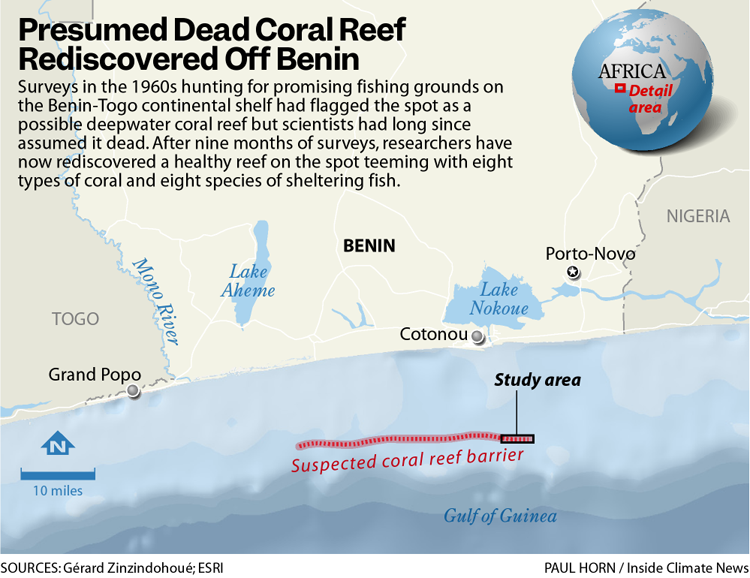
A team of scientists exploring a possible deep-sea coral reefoff the coast of Benin that 1960s researchers had deemed likely dead found a living, thriving reef supporting a complex underwater ecosystem, including several coral and fish species.
Led by scientists from the Institut de Recherches Halieutiques et Océanologiques du Bénin, the discovery is the first known mesophotic coral reef in the region and offers scientists a tantalizing target for future deep-sea marine-life expeditions.
Deep-Sea Coral Reef Spotted in the 1960s was Considered Dead
According to a statement announcing the unexpected discovery, previous historical surveys of the area had indicated a possible reef more than 50 meters below the water’s surface. When a 1960s survey detected the unusual feature, they suspected it was a coral reef that was likely dead.
When team leader Gérard Zinzindohoué and colleagues studied the features, they suspected that the team from the 60s may have provided them with a golden scientific opportunity. Although the feature’s depth ruled out a typical shallow-water coral reef, the researchers note that it could be an entirely different kind of reef structure, known as a mesophotic coral ecosystem, that can inhabit such depths.
The examined region may be part of a much larger system stretching nearly 25 miles parallel to Benin.
“A mesophotic coral ecosystem lives deeper than the usual shallow coral reefs, in zones where light is much more limited,” Zinzindohoué explained. “Unlike typical shallow reefs, it does not always form a single continuous reef structure. Instead, it can appear as patchy or scattered coral communities spread across the seafloor.”
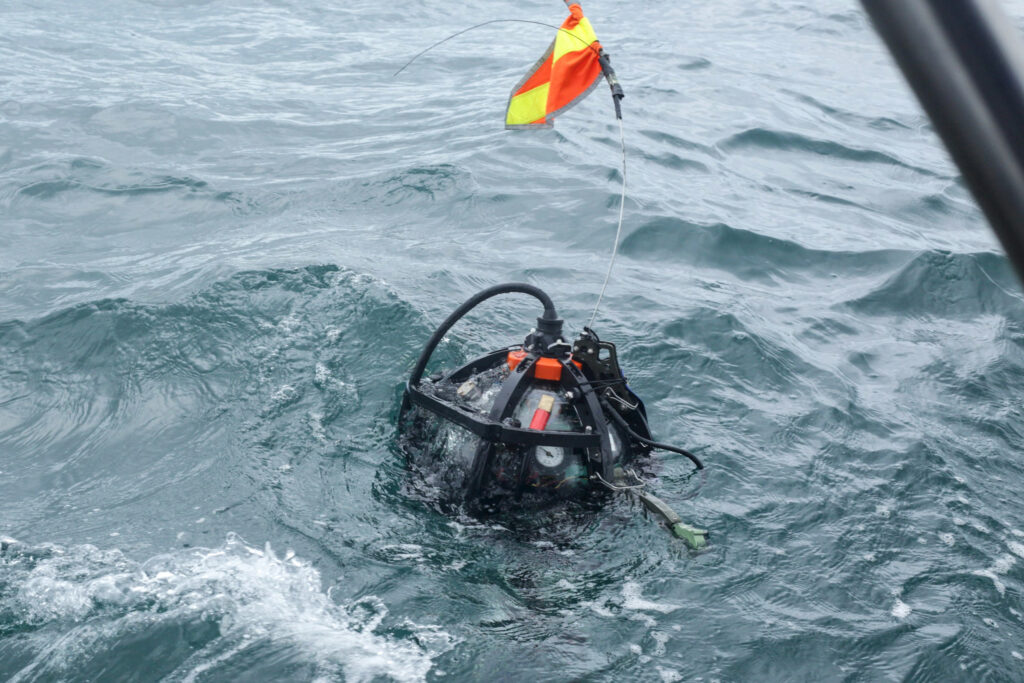
Instead of using mid-twentieth-century technology to settle the debate, the team turned to the National Geographic Exploration Technology Lab, which provided access to its Deep-Sea Camera System.
A Deep Sea Camera System from National Geographic’s Exploration Technology Lab resurfaces after capturing footage of the coral reef.
Credit: Ghislain Adjahouisso
“We Could Actually See the Sea Floor”
Following the path set out by the 1960s survey, the team used the underwater camera to map the seafloor with sonar. After several passes, the team covered a total of 11.5 kilometers. Zinzindohoué highlighted the difficulty of the effort, noting that it was “not an easy field campaign.”
“It was a mix of long days at sea, technical problems, and a lot of uncertainty,” the researcher explained. “But then we saw structures on the sonar that looked like they could be reef signatures, which gave us hope that we were close.”
The closer the team drove the Deep-Sea Explorer’s cameras, the more the shockingly unexpected scene began to unfold.
Image Credit: Gérard Zinzindohoué
“That was a big moment for us, because suddenly we could actually see the seafloor,” Zinzindohoué said.
Instead of the dark, lifeless structure anticipated by the original survey team, the new team found a healthy reef containing eight distinct types of coral. The system was also actively supporting eight fish species, with the camera capturing them feeding and sheltering among the corals. The species identified by the team include golden African snappers, blackbar soldierfish, Guinean angelfish, West African goatfish, the Monrovia doctorfish, three-banded butterflyfish, and two distinct species of damselfish.
Image Credit: Gérard Zinzindohoué
“I still remember seeing those first images,” Zinzindohoué recalled of the vibrant ecosystem lying directly in front of the cameras. “It was a mix of excitement and disbelief, because after all this time thinking about this reef, suddenly there was something real in front of us.”
More Research Needed to Determine if the Coral Reef Was Ever Dead
When discussing the discovery’s significance, Zinzindohoué said that to the team’s knowledge, “this is the first confirmed record of a living mesophotic coral ecosystem on the Gulf of Guinea continental shelf.”
Although the cameras captured a complex ecosystem, the researchers said that the reef does not appear to be a continuous barrier. Instead, the deep-sea environment consists of several patches of coral that occupy rocky seabed areas most suitable for their survival. Still, they add that further surveys may identify more reefs in the same area.
Footage from the National Geographic Exploration Technology Lab’s Deep Sea Camera System captures a sea floor rich with marine life.
Credit: Gérard Zinzindohoué/IRHOB
“I think what we found is probably not an exception,” Zinzindohoué said. “It is more likely a reflection of how little we still know about coastal regions in West Africa and elsewhere. If we were able to find this reef again after 60 years, how many others are still undocumented or simply forgotten?”
Since the team was unable to sample the corals directly, they were unable to confirm the species identification with genetic analysis. The team was also hesitant to condemn the original 1960s survey, noting that it is impossible to tell, without more data, whether the corals were dead at the time and have since rebounded.
“This is still an initial exploration,” Zinzindohoué said. “The historical reports suggested that this could be a continuous coral reef barrier extending roughly 40 kilometers parallel to the coast. We only surveyed a small section of this area, and we had a limited number of visual transects.”
Although there are no immediate plans for a return expedition, the research leader said the only thing holding them back from learning more about these ecosystems, which are “still poorly known in this part of the world,” is adequate financial support.
Mesophotic coral reefs live at deeper depths than typical, shallower coral.
“If I had all the grant money in the world, the first thing I would do is return to the site with a proper scientific diving and sampling program,” he said, before adding that “every additional piece of information matters.”
“I do believe there are more coral systems out there that we have not yet documented,” he said. “But we should not assume they are everywhere. Each discovery needs to be confirmed. Without going back into the field, we are really just guessing.”
On a personal note, the team leader said the most exciting part is understanding the reef’s history and the lessons that can be gleaned from this underexplored region.
“It feels like we have only just started to read an archive that has been there for a very long time.”
Christopher Plain is a Science Fiction and Fantasy novelist and has spent the last six years as Associate News Editor and Head Science Writer at The Debrief. Follow and connect with him onX, learn about his books at plainfiction.com, or email him at christopher@thedebrief.org
Coral reef long presumed dead rediscovered "teeming with life" off coast of Africa | SWNS
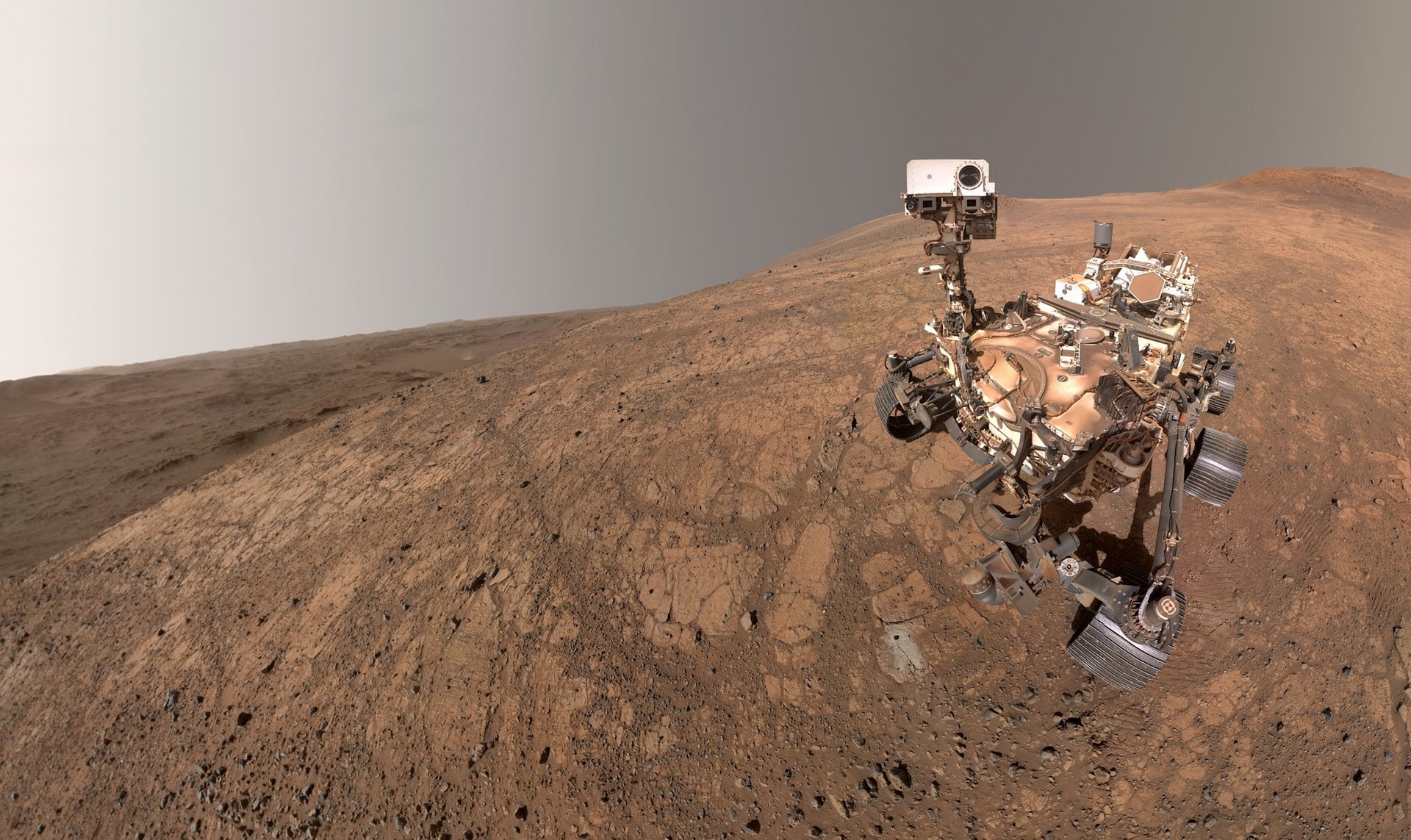
NASA’s Perseverance took this selfie at “Witch Hazel Hill” on Jezero Crater’s rim on May 10th, 2025. Credit: NASA/JPL-Caltech/MSSS
NASA's Perseverance rover continues to explore the rim of the Jezero Crater, an impact basin in Mars' northern hemisphere that once supported a lake. In so doing, the rover's mission team continues to reveal more about the Red Planet's past, when liquid water once flowed across its surface. In addition, the rover has made several findings that are leading to a better understanding among scientists of the planet's geological history and the forces that shaped its surface.
In a study that appeared earlier this week in the *Journal of Geophysical Research: Planets*, a team led by researchers from Imperial College London announced that they had uncovered an ancient feature formed by repeated asteroid impacts. This 75-meter (245-foot) thick stack of layered bedrock, known as the “Broom Point member” by the rover’s science team, likely formed over 3.9 billion years ago. This makes it some of the oldest terrain ever examined by the Martian rover and a window into the Solar System’s Late Heavy Bombardment Era.
US-SPACE-AEROSPACE-NASA-MARS
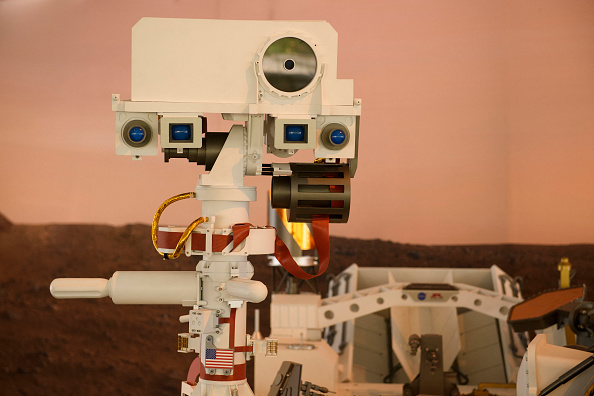
A full scale model of the Mars 2020 Perseverance rover is displayed at NASA's Jet Propulsion Laboratory (JPL) on February 16, 2021 in Pasadena, California. The Mars exploration rover will search for signs of ancient microbial life and collect rock samples for future return to Earth to study the red planet's geology and climate, paving the way for human exploration. Perseverance also carries the experimental Ingenuity Mars Helicopter - which will attempt the first powered, controlled flight on another planet. (Photo by Patrick T. FALLON / AFP) (Photo by PATRICK T. FALLON/AFP via Getty Images)
This period, which occurred between 4.1 and 3.8 billion years ago, was one of the most dynamic and chaotic in the history of the Solar System. As the name suggests, it was characterized by a higher-than-normal rate of asteroid and comet impacts on celestial bodies in the inner Solar System, including Earth, the Moon, and Mars. After leaving the Jezero Crater in late 2024, Perseverance began exploring the western rim and surrounding environment using its suite of scientific instruments.
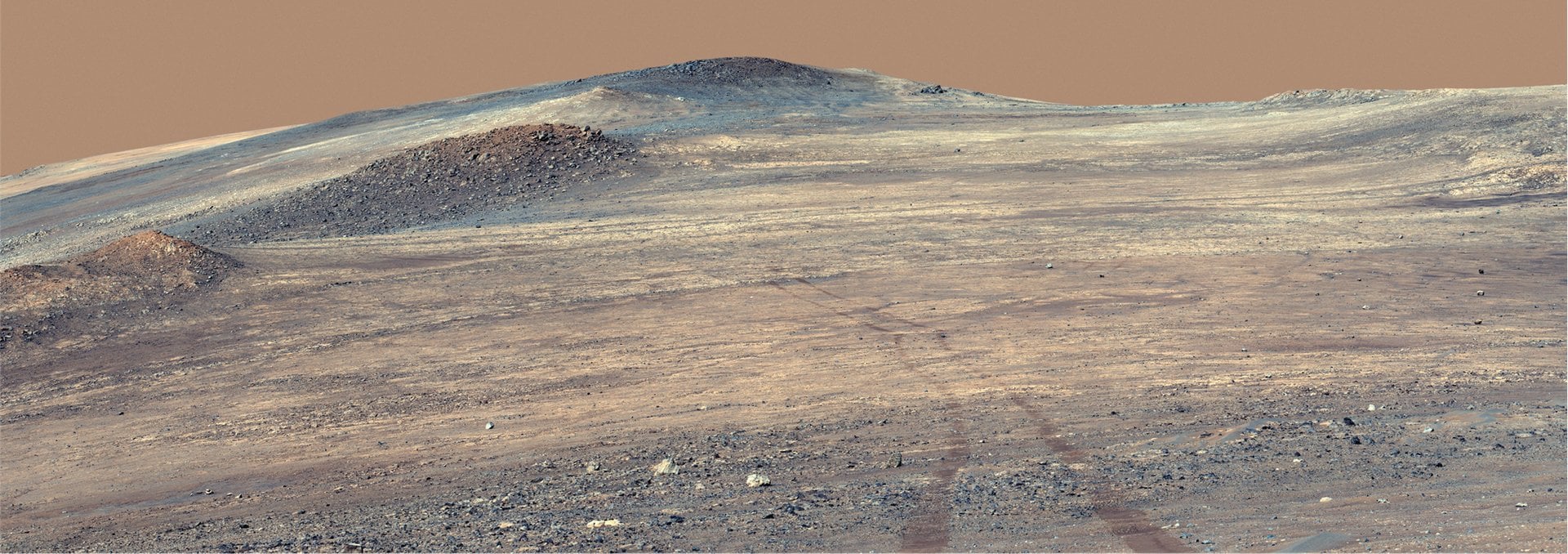
*NASA’s Perseverance rover captured its own tracks descending from the rim of Jezero Crater.
Credit: NASA/JPL-Caltech/ASU/MSSS*
Said Ken Farley, Perseverance's deputy project scientist at Caltech, in a NASA-JPL press release:
Since leaving Jezero, Perseverance has been exploring a brand-new frontier, both geographically and geologically — a chapter of Martian time that predates the crater itself. On Earth, our earliest geologic history has been fundamentally broken up, deformed, and erased by plate tectonics. Because Mars lacks plate tectonics to recycle its crust, this ancient record remains intact, giving us a rare glimpse into a geological time period that doesn’t exist on our own planet.
The data gathered at Broom Point revealed six distinct rock types, arranged in layers between angular fragments (breccias) and fine-grained rock dust. Fragments within the breccias further showed evidence of cavities formed by gas bubbles, indicating they were once molten. Another key indicator was the dark glass beads found within the layers, which form in the presence of volcanism or high-energy impacts. The largest of these were comparable to those found in ejecta caused by the ancient Chicxulub asteroid's impact on Earth (which led to the Dinosaurs' extinction).
The repeated appearance of these rock types in layered form also indicates that the high-energy impact events happened repeatedly in this region. As Farley notes, some of the rock layers have a near-vertical tilt (more than 80 degrees), far too steep to have been caused by the same impact that created Jezero Crater around the same time. Said Alex Jones, a Ph.D. student in planetary geology at ICL and lead author of the paper:
The different rock layers are a record of variable-sized impacts occurring at different distances from where this rock sequence was accumulating. Some large impacts took place very far away, some small impacts nearby. Their debris all ended up landing here, constructing this thick section of rock.
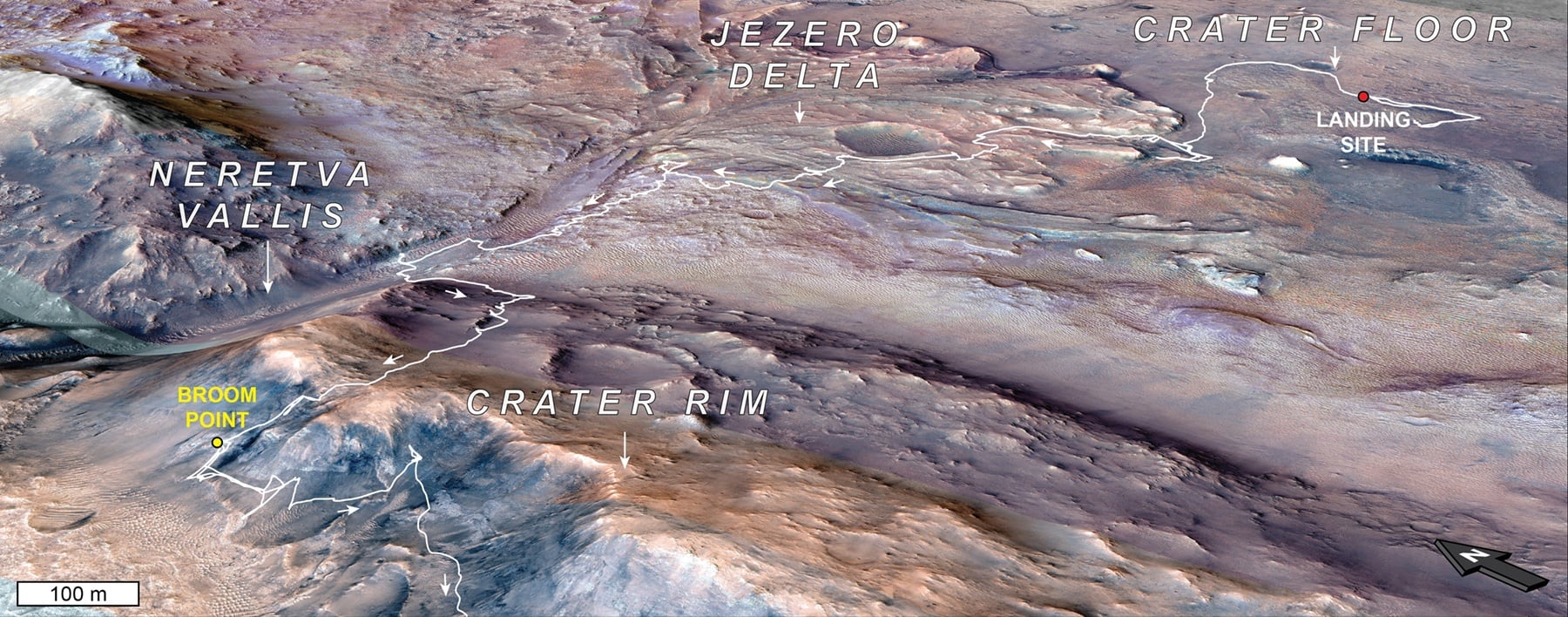
*This orbital map shows the path NASA’s Perseverance Mars rover took from its 2021 landing site in Jezero Crater to the “Broom Point” location in mid-2025.
Credit: NASA/JPL-Caltech/MRO/HIRISE/UA/ICL*
The layered formation of the rock may also suggest interactions with water or ice, while some appear to have formed from rapid debris flows. On Earth, these flows can occur when molten rock comes into contact with water or ice, instantly transforming them into steam. The team theorizes that a massive asteroid impact and the presence of water or ice shaped the landscape billions of years ago. The impact came first and formed the 1,900-km (1,200-mi) wide Isidis Basin, one of the planet's largest impact basins.
This was likely followed by a second asteroid impact that formed the Jezero Crater, fracturing and uplifting the already-tilted rocks into the formation found there today. Along with impact basins found elsewhere on Mars, the Moon, and Mercury, these craters and related features are helping scientists construct a timeline of the Solar System's geological history.
Bear Island in the Barents Sea which is a paleontological hotbead known for preserving ancient microfossils. Credit: Wikipedia
How life started on our own planet may not seem as sexy as finding evidence for life on Mars, or the icy moons of Europa or Enceladus. But the search for the first eukaryotes here on Earth remains as important to astrobiology as finding life on a far-flung planet. That’s in part because for ninety percent of Earth's history, life here was microbial.
On Earth, we had origins of life over three and a half billion years ago, Ross Anderson, a paleontologist at the U.K.’s University of Oxford, told me in his office. We had cyanobacteria and oxygenic photosynthesis at least 2.3 billion years ago; then we had eukaryotes at least 1.7 billion years ago, he says.
They were followed by algae at least a billion years ago, probably even earlier. Then the animal kingdom arrived at least 570 million years ago; probably slightly earlier.
But to find the common ancestor of the plant and animal kingdom you must go back to something like 1.6 billion years ago, says Anderson.
And so-called crown eukaryotes, the earliest eukaryotes on Earth are thought to have been fundamental to the development of complex life here on Earth. In fact, Anderson unequivocably considers eukaryotes as Earth’s first complex life.
What Are Eukaryotes?
Eukaryotes have a cell nucleus where DNA is enclosed, but they also have organelles, subcellular structures in their cells, such as the mitochondrion, that allows energy-intensive lifestyles.
It’s the eukaryotes which have developed complex multicellularity and macroscopic forms; all the animals, plants and fungi that we see around the world are eukaryotic, says Anderson.
No organism older than 500 million years had shells and skeletons as they hadn’t evolved yet. As a result, paleontologists are reliant on quite unusual environmental settings where cellular remains and soft tissues can be preserved. Consequently, researchers know very little about how life was evolving across a period which makes up 90 percent of Earth’s history.
As for Anderson?
I'm interested in how we went from a planet which just had bacteria to one which had complex multicellular organisms, says Anderson. Those kinds of multicellular fossils are hard to find, so I do a lot of work on the chemistry of the rocks to find out in which settings they are preserved, he says.
One problem is that eukaryotic microfossils are subject to billions of years of degradation.
But we know that the transition from single cellular to multicellular happened multiple times on different parts of the Earth, says Anderson. We're interested in how animals became so diverse today, he says.
Most of their diversity got set up across the Ediacaran/Cambrian transition. That’s an epoch some 540 million years ago that represented a major evolutionary step between soft bodied biota and the Cambrian explosion of life with mobility, shells and skeletons.
As for where to look for such ancient eukaryotic microfossils?
Anderson and colleagues are particularly interested in a 100sq. km area in what was a shallow sea, some 80 degrees North in a remote group of islands near Svalbard, Norway.
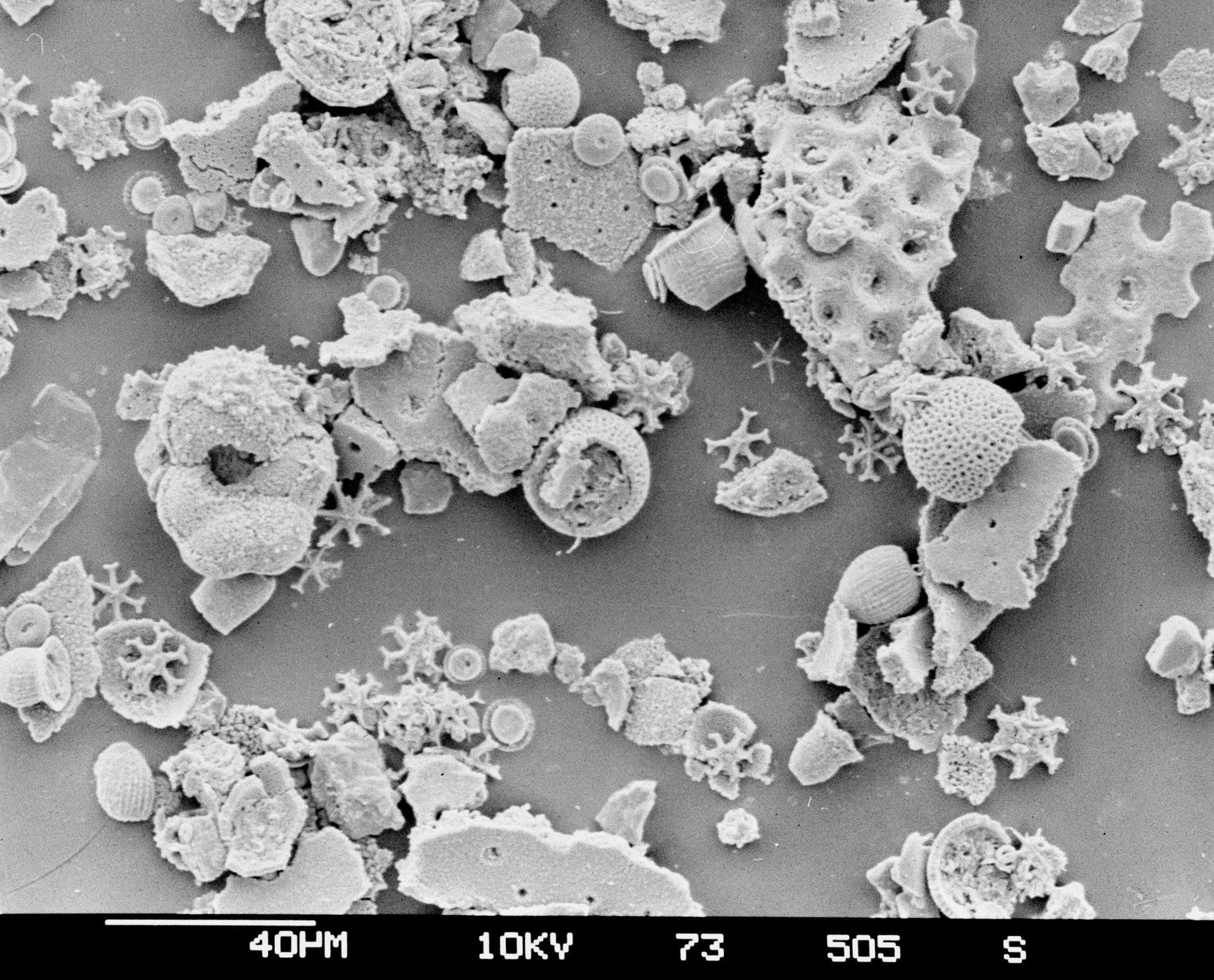
*Deep Sea Microfossils.
Credit: Wikipedia*
And just last year, in Australia researchers found some of the oldest eukaryote microfossils ever discovered, dating back some 1.75 billion years.
The sweet spot for such microfossils usually is in ancient coastal areas, where eukaryotes would have had access to rich organics and plentiful nutrients, enabling them to grow in both multicellularity and diversity.
The idea is to go to areas that are either pristine or have not been sampled to any great extent. Anderson himself specializes in looking in areas that were subject to massive clay deposits that might have helped preserve these ancient eukaryotes.
Today, you’re looking at places that are desert or Arctic, where there's no vegetation so rocks are exposed, says Anderson.
None of which is easy. Looking for eukaryote microfossils is truly a herculean task, because they are both tiny and consist of unprotected soft tissue which has left them subject to massive degradation over billions of years.
The biggest challenge now is that we have an under sampled fossil record, says Anderson.
Are we any closer to answering the big questions about how complex life first started here?
We’ve started to figure out which are the right rocks to find early fossils and that's starting to give us the data with which we can record the history of Earth’s earliest life, says Anderson.
The Bottom Line?
A lot of the work we've done on clays was motivated by finding life on other planets, says Anderson. We’d better understand how life happened here if we hope to understand the likelihood of it happening elsewhere, he says.
Ancient alien base off California Coast! With Face of species that made it! UFO UAP Sighting news.
Date of discovery: July 20, 2026
Location of discovery: Coast of California, USA
Source: Google Earth map
Guys this is cool. I found an under ocean alien base right off the coast of California. It really explains a lot too, since California is in so much chaos, and aliens using telepathy to do experiments using humans to do tasks, get reactions...all for science.
There is a long base visible, now it could be a ship landed there that is being used as a base, but it appears to have been there for hundreds of years. Right next to it is half a face, of the alien species that created this base. This actually doubles the evidence we have on this base.
Scott C. Waring - UFO Sightings Daily
Ancient alien base off California Coast! With Face of species that made it! UFO UAP Paranormal news.
For almost two decades, I have been reporting UFOs on the NASA live cam at the space station. This time...its the US gov reporting them...except its 36 years late. This white ceramic craft was seen by the crew of the space shuttle Columbia and the UFO was in Earths orbit, but not holding still, its seen in three different photos taken by a hand camera held by one of the astronauts on board the shuttle. The UFO is reported to have passed between the Earth and the shuttle, coming close enough that aliens could both see it with their own eyes and even use their technology to read the thoughts, emotion, and attitudes of the crew of the shuttle. Oh...they also usually download the full contents of the persons memories...taking about 4-6 seconds without asking for permission from the subjects. Judging by the distance, I would estimate this UFO to be about 50 meters across.
This craft is one of the white ceramics...thats a white craft or alien building that is so reflective of light that its nearly impossible to get a 100% focused photo of them. There are four types of UFOs...white ceramics, the metallics (metal), the non reflective black (absorb light), and the pure energy entities (plasmoids). This is from my personal research experience of craft and structures I have found over the last few decades.
Scott C. Waring - UFO Sightings Daily
PS, I added shadow only to the photos to make the UFOs come into focus due to the craft detail being lost in too much light.
RELATED
Secret NASA Photos & US Department of Defense UAP Files: WHAT did NASA photograph in space in 1996?
From computer programmers tolawyers, several jobs are already at risk of being taken by artificial intelligence (AI).
Now, it seems not even cage fighters are safe from the robot takeover.
Shocking footage has emerged from China, showing two humanoids battling it out in a mixed martial arts (MMA) fight.
The fight took place in Shenzhen last week, and saw two robots go head–to–head in a cage as hundreds of spectators looked on.
In one particularly shocking moment, one of the robots had its head kicked off entirely – yet continued to fight.
Taking to Reddit, one viewer said: 'Finally we have Real Steel,' in comparison to the 2011 blockbuster.
Another warned: 'We're training the next generation lifeform on Earth how to defeat us. Poetic.'
Elon Musk even joined in on the fun, sharing a video of the fight on X and joking: 'Robot fights are fun.'
Shocking footage has emerged from China , showing two humanoids battling it out in a mixed martial arts (MMA) fight
The fight took place as part of the Ultimate Robot Knock–out Legend (URKL) event at Shenzhen's Nanshan Cultural Sports Centre.
This competition – dubbed the 'robot version of the UFC' – features 32 competitors from more than 20 countries.
These teams have been whittled down from 200, and include the likes of Stanford University, the University of Hong Kong and Zhejiang University.
'The competition adopts a comprehensive multi–stage tournament structure consisting of a Qualifying Stage, Group Stage, and Double–Elimination Finals,' EngineAI, the organiser of the competition, explains on its website.
'The tournament is designed to comprehensively evaluate teams across simulation algorithms, on–site hardware deployment, and autonomous humanoid robot combat performance.'
The teams all use EngineAI's T800 – a full–size humanoid robot that retails for up to $85,000.
According to the South China Morning Post, the prize for the winning team will be a belt made from 10kg of pure gold, worth up to 10 million yuan (£1.09 million).
So far, several fights have taken place, but the one that has really stirred up interest on social media was between team Bullfighter and White Eagle.
So far, several fights have taken place, but the one that has really stirred up interest on social media was between team Bullfighter and White Eagle
The teams all use EngineAI's T800 – a full–size humanoid robot that retails for up to $85,000
Shortly after stepping into the specially designed hexagonal cage, the White Eagle robot delivered a devastating kick to its opponent's head, decapitating it entirely.
Amazingly, Bullfighter's bot continued to fight completely headless – and even managed to bag a 3–2 win.
Many viewers were left impressed by the robots' fighting abilities.
'I would love to see the part of the code for dealing with a situation where your head is suddenly gone,' one fan joked on Reddit.
Another added: 'Imagine a future where there's a massive dome filled with robots sponsored by different companies, fighting in a giant Battle Royale–style arena. Robots equipped with flamethrowers, machine guns, and all kinds of crazy weapons. I'd definitely pay to watch that.'
And one joked: 'I like how the robot keeps going with his head detached. Robotic voice: "'tis but a scratch.'
However, others have raised concerns that the fighting robots could be a glimpse into our future.
One said: 'I don't think that is a good idea. Please just teach em to fold laundry and do dishes.'
Another asked: 'Is this what causes them to eventually rise up against us?'
What if flying saucers come from beneath Earth itself — not outer space — and have been here all along, hiding in plain sight?
cryptoterrestrial hypothesis - U.S. National Archives (NAID 303938034) / Public domain
(via Wikimedia Commons)
Most UFO theories reach for outer space. The cryptoterrestrial hypothesis reaches down instead: it proposes that flying saucers come not from distant planets but from an advanced, hidden civilization that has been living on Earth all along - under the oceans, inside mountains, or beneath our feet.
Theory Briefing
The cryptoterrestrial hypothesis flips the standard UFO assumption: the craft originate from Earth, not from another star system.
Instead of alien visitors, the theory proposes an advanced civilization already here — underground, undersea, or otherwise concealed.
The hypothesis reframes decades of sighting reports as evidence of something native to Earth evading detection, not arriving from space.
It raises the question of why a terrestrial origin is considered more fringe than an interstellar one, given the same evidence.
The idea has deep roots in pulp and the occult, from H.G. Wells's underground Morlocks to a 1940s magazine craze around a man who claimed to be in radio contact with subterranean beings. (His editor later revealed he had spent eight years in a mental institution.) The writer Mac Tonnies gave the idea its name in the 2000s. Even sympathizers keep it at arm's length; one scholar of conspiracy theories calls the whole thing "really more of a thought experiment designed to raise questions."
It has not gone away, either. In the 2025 documentary The Age of Disclosure, the UFO-disclosure advocate Luis Elizondo floats the cryptoterrestrial hypothesis as one way to read the government's own unexplained sightings.
Sen. Ron Johnson explains how the democrats continue to obstruct.
Avi Loeb, the Harvard astronomer chosen last month by the White House to lead a UFO advisory council, believes he was brought on because federal officials are "baffled" by the many unidentified objects the U.S. military has captured over the past several decades.
Loeb, known for arguing that alien spacecraft may have already reached Earth, said his newly formed team of more than a dozen scientists is combing through four batches of public UFO sighting disclosures released by the Trump administration in recent months.
His mission began in early June when an official from the Office of the Director of National Intelligence (ODNI) visited his home and asked him to form a group of experts to make sense of UFOs, now referred to by the U.S. government as unidentified anomalous phenomena (UAP). This is an umbrella term that accounts for objects seen zipping underwater and in space.
"The U.S. government had me at hello," Loeb told Fox News Digital in an interview Saturday. "The fact that they are reaching out to scientists like myself indicates, in my mind, that they are baffled by what they are seeing, and they think that maybe it's not human-made."
Avi Loeb speaks during the SALT conference in Manhattan, N.Y., Sept. 14, 2022.
(David 'Dee' Delgado)
Loeb's council will report its findings to the UAP Governing Board, a recently established body under the direction of ODNI.
According to the council's website, Loeb and his colleagues will only be reviewing already-declassified materials on UAPs.
However, Loeb told Fox News Digital he has asked the Pentagon and other agencies for 50 videos, images and other documents related to known UAP incidents. Those materials haven't been given to him yet, with the custodian agencies citing national security concerns.
"It's not so much the targets that are the issue. It's that the sensors that were used were for national security purposes. The U.S. government doesn't want to reveal to adversarial nations the kind of sensors being used. So, that's the main obstacle right now," Loeb said.
A satellite image shows a UFO spaceship at night amid an FBI investigation and alien evidence near Area 51, capturing a flying saucer and galaxy survey of a mysterious object in the sky.
Loeb's goal is to figure out whether UAPs that have been captured by the U.S. military originate from other nations or if they don't come from humans at all.
"In the second case, if it's not human-made, then that's the biggest discovery ever made by science, and the U.S. government has the privilege of ushering in this new realization that we have a neighbor visiting us," Loeb said.
Loeb sought to temper expectations, saying that many of the phenomena they are studying could turn out to be mundane. Often, he said, the strange looking objects people see in the sky are merely space junk or broken satellites.
"Unless they maneuver in ways that cannot be explained by gravity, you should assume that they are space junk," Loeb said.
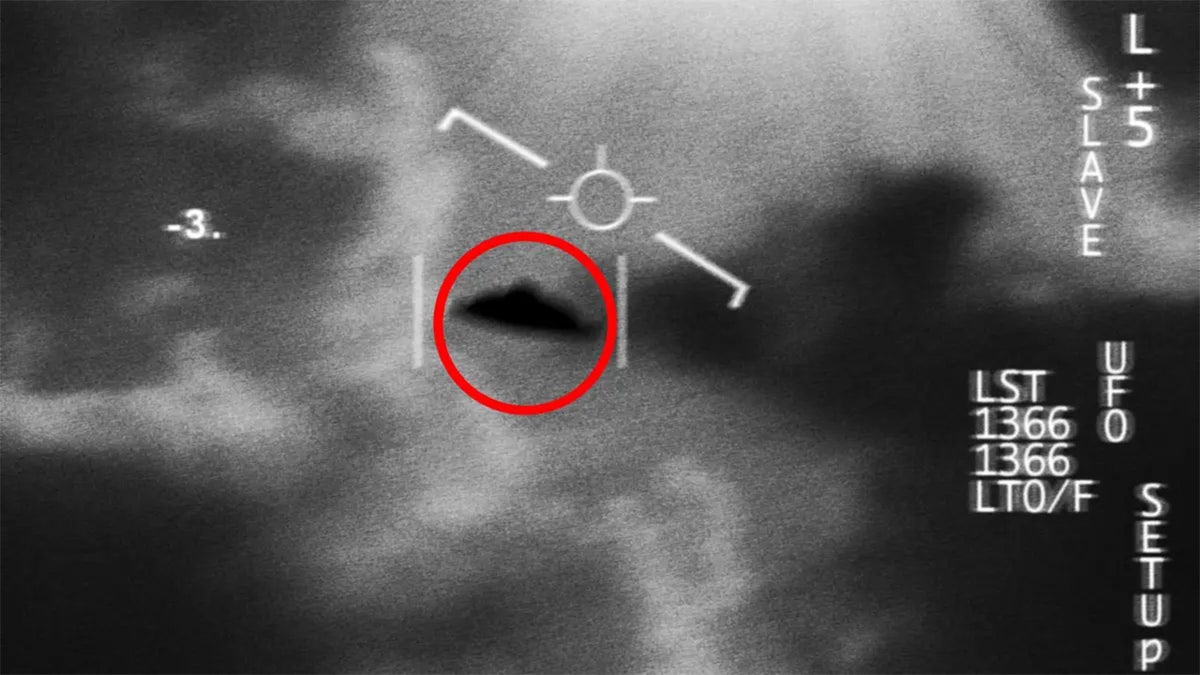
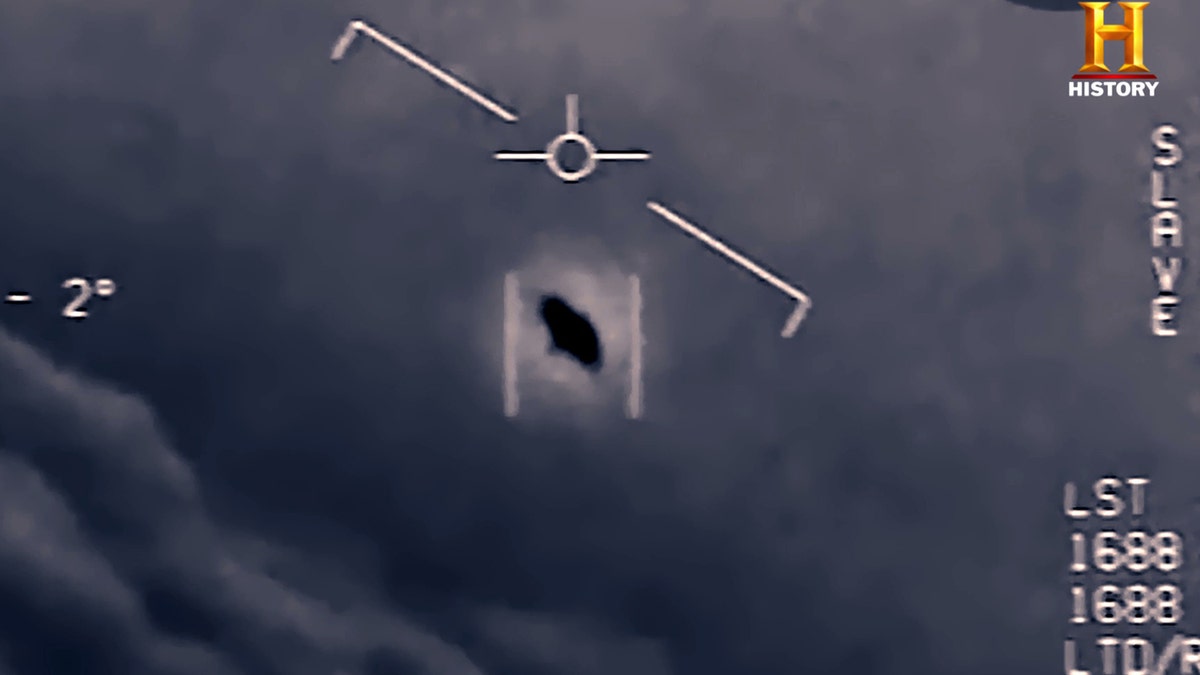
In 2014 and 2015, pilots with the U.S. Navy reported multiple UFO sightings during training maneuvers. ( )
Nonetheless, he praised the White House for its push for transparency on this issue. In February, President Donald Trump ordered the Pentagon and other agencies to declassify files related to aliens and UAPs because of "tremendous interest."
One of the most important aims of Loeb's council is to recommend better sensors so that the government can capture UAPs with more confidence in the future.
"If we are dealing with drones of some unusual qualities that the Chinese are using, it's good for the U.S. to have better sensors that can help it identify those. Right now, they are reported as orbs. They may not be drones, but I'm saying that, at the very least, we will help national security," Loeb said.
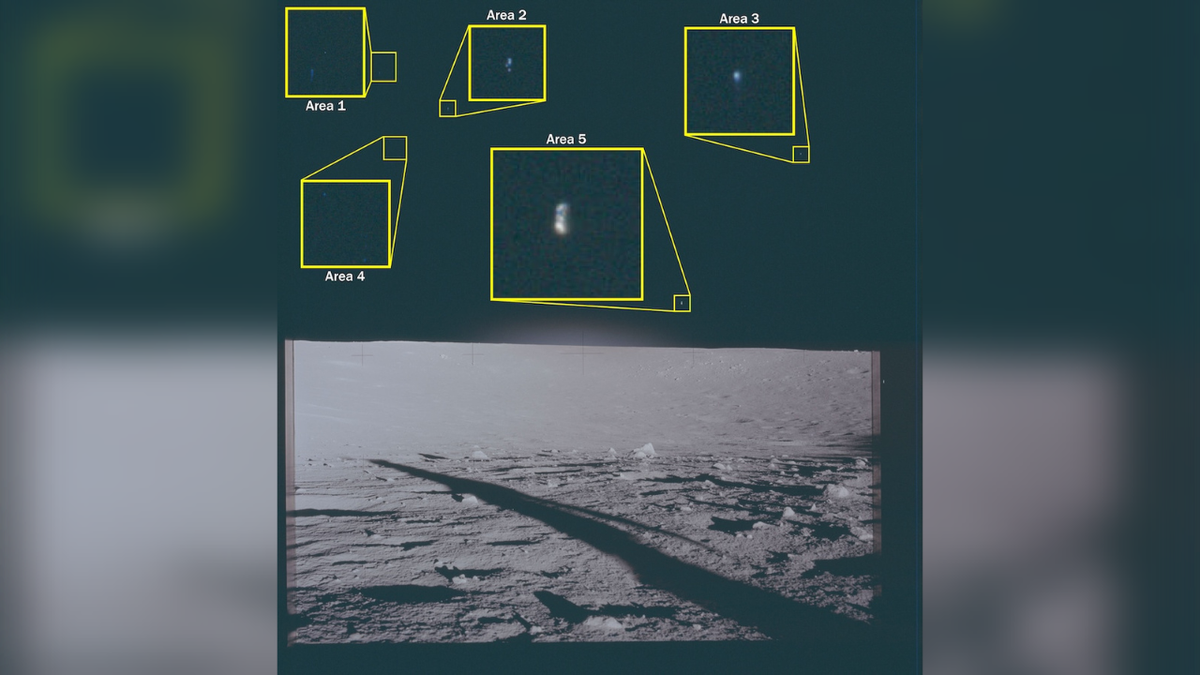
Loeb made the remarks after the Department of War on Friday released the fourth and latest batch of UAP materials to the public. Loeb commented on one of the most sensational releases from the first batch, which were photos from the Apollo 12 mission on the Moon in 1969.
One of the photos has five "unidentified phenomena," but Loeb said federal authorities have now officially concluded that those blue flashes are most likely cosmic rays.
A picture of unidentified phenomena on the moon during the 1969 Apollo 12 mission.
(NASA)
Until 2020, Loeb headed up Harvard University's astronomy department, where he studied black holes, the formation of the universe's first stars and extraterrestrial life.
In 2017, when scientists discovered a remnant of a Pluto-like world in the solar system, Loeb disputed those findings, arguing that the object was possibly a light sail from an alien civilization.
After this claim earned him widespread respect in the UFO community, Loeb founded the Galileo Project at Harvard to search for artifacts from extraterrestrial civilizations.
RELATED
‘Biggest discovery ever?': White House appoints Harvard professor to investigate UFOs
Avi Loeb Now Leading The U.S. Government UAP Science Advisory Council.
Exclusive: Trump's 'Alien Hunter' Harvard Professor AVI Loeb Decodes Mystery of UFOs | Gravitas
Who were the nephilim? The word nephilimappears twice in the Old Testament of the Bible. They are first mentioned in chapter 6 of the book of Genesis and then again in Number 13:33. But their brief mention in the Bible has led to an ongoing debate as to who or what the nephilim were. Much of this debate stems from the passage in the Bible that states:
When people began to multiply on the face of the ground, and daughters were born to them, the sons of God saw that they were fair; and they took wives for themselves of all that they chose. The Nephilim were on the earth in those days - and also afterward - when the sons of God went in to the daughters of man, who bore children to them. These were the heroes that were of old, warriors of renown. – Genesis 6: 1-4
The Sons of God Saw the Daughters of Men That They Were Fair (1923) by Daniel Chester French. Corcoran Gallery of Art. (CC0)
What Does ‘Nephilim’ Mean?
The traditional definition of Nephilim is giant. Some dictionaries describe the nephilim as being giants who also possess super human strength. The Greek Septuagint, an ancient translation of the Hebrew Bible, refers to them as gigantes, which actually means "earth -born," a concept we will be coming back to as we continue.
It is believed that the word Nephilim comes from the root word "Naphal" which means to fall. In biblical circles this definition has quickly put the Nephilim into the role of the children of the fallen angels. The word Naphal, however, is never directly associated with the concept of fallen angels. Its meaning in context is more closely associated with the idea of lying prostrate or of prostrating oneself. There are also ties in this word to the concept of failure, falling short, or being cast down.
Over the years a mythos has developed around the concept of the nephilim. It alleges that these giants were the offspring of the "Sons of God" and the "Daughters of Man". Are the nephilim the children of the untoward relationship?
The connection between the biblical text and this claim, although commonly pointed to as the basis of this belief, is unfounded. The document in which we find statements that support this claim actually comes from the apocryphal Book of Jubiliees:
And it came to pass when the children of men began to multiply on the face of the earth and daughters were born unto them, that the angels of God saw them on a certain year of this jubilee, that they were beautiful to look upon; and they took themselves wives of all whom they chose, and they bare unto them sons and they were giants. The Book of Jubilees - Chapter V: 1
Is the claim that the nephilim were the offspring of the sons of god and the daughters of men supported by sources outside the Judeo-Christian tradition? In other words, does mythology worldwide support this belief?
The Sons of God Saw the Daughters of Men That They Were Fair, by Maurice Greiffenhagen.
The notion of giants roaming the earth can be found in cultures worldwide. Greek mythology tells us that the Titan Cronus castrated his father Uranus in order to gain control of the Greek pantheon. It is from the blood of the castrated Uranus that fell upon the earth that the giants, the "earth-born", were created.
The Earth-born, when compared to us, were giants. The giants, lived under the rule of Cronos during the golden age, in a time that was free from sorrow or care and everyone lived happy and joyous lives.
It was only after Cronos' son Zeus fought for control of both the heavens and the earth that everything changed. In his new role, Zeus, according to Greek myth, put the giants to work. It was just a matter of time before the giants started ignoring the god's mandates.
Bell krater depicting Zeus fighting against the giant Porphyrion.
(Egisto Sani/CC BY NC SA 2.0)
They were no longer prostrating themselves to the will of the gods. Their lack of complete servitude and their failure to comply with the god’s demands incited the "children of god" into a full blown rebellion against the heavenly gods. Heavy losses were taken on both sides, but their revolution was finally suppressed by the gods.
A truce was declared. As part of their reparations to the giants it was decided to create a new race to handle the burdens that were cast upon the giants - man.
Padraic Column in his book entitled Orpheus, Myths of the World, relates this tale about the creation of man: Aztec legend recounts how the Earth-mother, Citlalicue, gave birth to a flint knife. When the knife was flung down onto the Earth, it was transformed into sixteen hundred "earth-gods." (Is there connection between the flint knife, flung down by Citlalicue, and the sickle used by Cronus to castrate his father?)
These newly formed earth-gods lived as men and women and labored in search of food. After some time, the Earth-gods began to think that this work was below their station. They were, after all, the children of the Sky-father and Earth-mother. They asked their mother Citlalicue to make a race who would serve them and bear the burdens they faced. With the help of Citlalicue, mankind was created.
‘A group of natives in the central highlands of Mexico, capturing and putting to death a giant.’
Based upon these mythological traditions it seems clear that the earth-born giants, the nephilim, existed long before man first inhabited the earth. Thus when you read the line "The Nephilim were on the earth in those days - and also afterward" it seems clear from this perspective that the authors were not being vague. Instead they were just making a statement of fact - that the Nephilim, the earth-born, were on the earth at that time.
The Offspring of the Sons of God and the Daughters of Man
So who were the offspring of the sons of god and the daughters of man? The Hebrew Bible refers to them as gibborim. The inferred meaning of this word is men of great stature, heroes, men who are valiant or brave.
The Greek Septuagint identifies them as the renominati or men or renown. In Greek mythology the gods have a long history of having relations with humans. The names of some of these "demi-gods", or semi-human individuals, whose names have withstood the tests of time include were Hercules, Perseus, and Achilles. In India they are called Hanuman and Garuda and in Sumer Gilgamesh and Adapa.
Interestingly, a parallel myth to this biblical narrative does exist. It comes to us from the pages of the Hindu epic the Ramayana. The Ramayana is the epic tale of Rama, the 7th avatar of the supreme god Vishnu.
Rama lived during the Treta Yuga. It was an age where the world was filled with giants. Around the same time as Rama's birth, the supreme god Vishnu, knowing what was in store for him, requested that all of the gods descend to the earth and mate with the apes and the bears. This request was made in order to, when the time was right, provide Rama with an army he could use to help him conquer Ravana - the giant demon king of Lanka.
The offspring of these unions obtained an array of impressive skills from their divine parents. The mighty Sugríva was the ruler of the vanara, the ape-men. His father was Surya, the chief solar deity. The demi-god Hanúmán was the son of the wind god and is described as being able to travel very fast, while Nala was the son of the god of building and construction and is the vanara that helps Rama to build a bridge from mainland India to Lanka.
These thousands did the Gods create Endowed with might that none could mate, In monkey forms that changed at will; So strong their wish the fiend to kill.
Are the nephelim the offspring of the sons of god and the daughters of man? No. They were the race of earth-born giants who lived before the creation of man. They are the group who revolted against the gods in antiquity.
They are also the ones responsible for the creation of mankind. Additionally, based upon the references that come to us from the Ramayana, it does seem clear the when the gods mated with "ape-men" their offspring were men of renown, heroes, or individuals who are valiant or brave.
Top Image: ‘Norandino and Lucina Discovered by the Ogre’ (1624) by Giovanni Lanfranco.
New NASA imagery has revealed a growing Martian “crescent” and surface details on the Red Planet as the agency’s Psyche spacecraft recently completed a flyby of Earth’s nearby planetary neighbor.
Launched on October 13, 2023, Psyche is currently on its way toward a rendezvous with a metal-rich asteroid after which the space probe was named. Now, in a series ofcomposite imagescaptured as the spacecraft flew past Mars during a gravity assist in early May, the growing crescent shape of the Red Planet is shown in successive views of Earth’s nearby planetary neighbor.
“After these views were captured by the spacecraft’s multispectral imager instrument, Mars began to overfill the field of view as Psyche made close approach with the planet and captured a series of high-resolution images of the surface,” read a NASA statement accompanying the imagery.
Composite imagery of Mars recently obtained by NASA’s Psyche spacecraft (Image Credit: NASA)
In several of the images, Mars appears as a thin sliver due to the high phase angle of approach as Psyche made its way toward the planet. In the days that followed, the crescent is shown as it appears to “grow” as more sunlight illuminates its surface.
A Detailed Glimpse of the Martian Surface Captured by Psyche
The recent crescent features weren’t all that Psyche captured during its recent near approach to Mars. In additional images released by the American space agency, the Martian surface appeared in colorful views obtained by the spacecraft’s multispectral imager instrument.
The resulting “mosaic” was created from four separate images acquired near the end of Psyche’s recent visit, shown in enhanced color that highlights several details visible on the Martian surface.
Traveling along a southwesterly path with relation to the Martian poles, the mosaic imagery appears slightly blurry, as it represents close to six minutes of travel above the planet. According to NASA, pixel scale resolution in the imagery “varies from 381 meters per pixel on the right to 440 meters per pixel on the left.”
Imagery showing the Iapygia region of the rugged southern highlands of Mars, obtained by NASA’s Psyche spacecraft
(Image Credit: NASA)
Color enhancements to the imagery, collected with the imager’s green, blue, and near-infrared filters, reveal additional details about the various features of the volcanic region of Mars that Psyche flew over on May 15, 2026, known as the Iapygia region.
This area comprises part of the Martian southern highlands, and in the recent imagery, Fournier crater—the largest shown in the new imagery—can be seen, alongside hills, cliffs, and other features, including the irregular Oenotria Scopuli cliff system, forming one side of the boundary of a massive ancient impact feature on the Red Planet.
Additional details about the new imagery, as well as information about Psyche’s mission, can be found on NASA’s official mission page.
Micah Hanks is the Editor-in-Chief and Co-Founder of The Debrief. A longtime reporter on science, defense, and technology with a focus on space and astronomy, he can be reached atmicah@thedebrief.org. Follow him on X @MicahHanks, and at micahhanks.com.
RELATED
NASA’s Psyche Mission Aces Mars Flyby and captured this
NASA’s Psyche spacecraft just pulled off an incredible flyby past Mars 🚀🔴
Mars Looks Blue and Bruised in Surreal New Images From Psyche Spacecraft
Meer van UFO'S of UAP'S, ASTRONOMIE, RUIMTEVAART, ARCHEOLOGIE, OUDHEIDKUNDE, SF-SNUFJES EN ANDERE ESOTERISCHE WETENSCHAPPEN - DE ALLERLAATSTE NIEUWTJES


 When the Grid goes Dark!