Naar de inhoud

UFO'S of UAP'S, ASTRONOMIE, RUIMTEVAART, ARCHEOLOGIE, OUDHEIDKUNDE, SF-SNUFJES EN ANDERE ESOTERISCHE WETENSCHAPPEN - DE ALLERLAATSTE NIEUWTJES

UFO's of UAP'S in België en de rest van de wereld
seniorennet.beseniorennet.be
Ontdek de Fascinerende Wereld van UFO's en UAP's: Jouw Bron voor Onthullende Informatie! Ben jij ook gefascineerd door het onbekende? Wil je meer weten over UFO's en UAP's, niet alleen in België, maar over de hele wereld? Dan ben je op de juiste plek! België: Het Kloppend Hart van UFO-onderzoek In België is BUFON (Belgisch UFO-Netwerk) dé autoriteit op het gebied van UFO-onderzoek. Voor betrouwbare en objectieve informatie over deze intrigerende fenomenen, bezoek je zeker onze Facebook-pagina en deze blog. Maar dat is nog niet alles! Ontdek ook het Belgisch UFO-meldpunt en Caelestia, twee organisaties die diepgaand onderzoek verrichten, al zijn ze soms kritisch of sceptisch. Nederland: Een Schat aan Informatie Voor onze Nederlandse buren is er de schitterende website www.ufowijzer.nl, beheerd door Paul Harmans. Deze site biedt een schat aan informatie en artikelen die je niet wilt missen! Internationaal: MUFON - De Wereldwijde Autoriteit Neem ook een kijkje bij MUFON (Mutual UFO Network Inc.), een gerenommeerde Amerikaanse UFO-vereniging met afdelingen in de VS en wereldwijd. MUFON is toegewijd aan de wetenschappelijke en analytische studie van het UFO-fenomeen, en hun maandelijkse tijdschrift, The MUFON UFO-Journal, is een must-read voor elke UFO-enthousiasteling. Bezoek hun website op www.mufon.com voor meer informatie. Samenwerking en Toekomstvisie Sinds 1 februari 2020 is Pieter niet alleen ex-president van BUFON, maar ook de voormalige nationale directeur van MUFON in Vlaanderen en Nederland. Dit creëert een sterke samenwerking met de Franse MUFON Reseau MUFON/EUROP, wat ons in staat stelt om nog meer waardevolle inzichten te delen. Let op: Nepprofielen en Nieuwe Groeperingen Pas op voor een nieuwe groepering die zich ook BUFON noemt, maar geen enkele connectie heeft met onze gevestigde organisatie. Hoewel zij de naam geregistreerd hebben, kunnen ze het rijke verleden en de expertise van onze groep niet evenaren. We wensen hen veel succes, maar we blijven de autoriteit in UFO-onderzoek! Blijf Op De Hoogte! Wil jij de laatste nieuwtjes over UFO's, ruimtevaart, archeologie, en meer? Volg ons dan en duik samen met ons in de fascinerende wereld van het onbekende! Sluit je aan bij de gemeenschap van nieuwsgierige geesten die net als jij verlangen naar antwoorden en avonturen in de sterren! Heb je vragen of wil je meer weten? Aarzel dan niet om contact met ons op te nemen! Samen ontrafelen we het mysterie van de lucht en daarbuiten.

UFO Representative Claims 'Deep State' Is Planting Fake Evidence in New Alien Files

UFO Representative Claims 'Deep State' Is Planting Fake Evidence in New Alien Files

Congressman Tim Burchett warns of potential misinformation in upcoming UFO file releases, sparking a heated debate over the authenticity of evidence

Hoe vind je dit bericht?
Geschreven door peter om 22:53 Stuur door

China increases surveillance of geostationary satellites from an unusual orbit

China increases surveillance of geostationary satellites from an unusual orbit

This summer, a spacecraft entered Earth orbit whose trajectory immediately puzzled specialists in several countries. It is moving in such a way that the entire ring occupied by communications and military reconnaissance satellites will gradually come within its field of observation. The official mission description was limited to a few words about studying the space environment. Independent analysts are convinced that its actual purpose is different.

A Long March 3B rocket lifts off from the Xichang Satellite Launch Center on June 16 carrying the Shijian-31 satellite. Credit: CASC

An Unusual Trajectory

Shijian-31 was launched on June 16 aboard a Long March 3B rocket from the Xichang Satellite Launch Center. The China Aerospace Science and Technology Corporation, or CASC, described its purpose in a single sentence about studying the space environment and released no images of the satellite.

Aviation warnings and the type of launch vehicle indicated a geostationary transfer orbit. Observers later detected the spacecraft moving along a highly elliptical Molniia-type orbit already used by several other Chinese satellites. This time, however, the familiar configuration was applied in a way that had never been seen before, SpaceNews reports.

The Principle Behind the Established Orbit

The 63.4-degree inclination characteristic of such orbits keeps the apogee above the same latitude. Without this condition, Earth’s uneven mass distribution would gradually rotate the elongated ellipse within its own orbital plane. The point farthest from Earth would drift toward the equator and then farther south, requiring engine burns to compensate for the movement.

In the conventional use of this orbit, the farthest point lies over the Northern Hemisphere. The spacecraft remains visible from high latitudes for several hours at a time, allowing a pair of such satellites to maintain continuous communications over the Arctic and detect the thermal signatures of missile launches.

Surveying the Geostationary Belt

In the case of Shijian-31, the apogee is located not over northern latitudes but in the equatorial region. This is precisely where the geostationary belt lies, at an altitude of approximately 35,786 kilometers, occupied by communications, reconnaissance, and early-warning satellites.

Its orbital period is 12.5 hours rather than the 12 hours typical of this configuration. Because of this difference, each successive orbit shifts by approximately 15.7 degrees in longitude, allowing the entire belt to enter the spacecraft’s field of view over 23 days.

The highest point of the orbit is approximately 39,900 kilometers, several thousand kilometers above the belt itself. This approach provides a complete view without requiring close approaches to foreign spacecraft, which are the maneuvers that usually provoke diplomatic protests.

Analysts’ Assessments

Integrity ISR was the first company to draw attention to the unusual trajectory in a June 26 publication based on data from the Space-Track catalog. A month later, the observations were confirmed by ComSpOC, a company that monitors activity in near-Earth space and described it as an orbit unlike anything previously seen.

It will be difficult to obtain a clear view of the spacecraft itself or determine what equipment it carries. Its perigee is slightly below 2,000 kilometers, far above most imaging spacecraft in low Earth orbit, while thousands of kilometers separate it from U.S. inspection satellites operating near the geostationary belt.

At the same time, descending to the geostationary satellites themselves would not be difficult. A braking maneuver at perigee involving a velocity change of only 50 meters per second would lower the apogee to approximately 36,671 kilometers. The resulting trajectory would pass directly through the belt’s operational zone, while requiring very little fuel.

Competition above the Equator

Victoria Samson, an expert at the Secure World Foundation, described the mission in comments to SpaceNews as highly unusual and difficult to characterize based on the currently available data. She noted that the spacecraft had been in orbit for only a month, so its subsequent behavior could reveal much more.

The mission is likely part of a broader trend toward the deployment of inspection satellites and growing attention to activity at geostationary altitudes. The United States operates the Geosynchronous  Space Situational Awareness Program, or GSSAP, in this region. Russia relies on Luch-2 after the failure of its previous spacecraft in January, while China has previously explored even more unconventional options, including a lunar swing-by to enter a retrograde geosynchronous orbit. 

Posted in Launches, News


China successfully launches Shijian-31 satellite to study the orbital environment

{ https://universemagazine.com/en/articles-en/ }

Hoe vind je dit bericht?
Geschreven door peter om 22:34 Stuur door

AARO’s Latest UAP Report Finds No Evidence of Exotic Technology, But Mysteries Remain

AARO’s Latest UAP Report Finds No Evidence of Exotic Technology, But Mysteries Remain

UAP DOW

Welcome to this edition of The Intelligence Brief… This week, the Pentagon’s All-domain Anomaly Resolution Office (AARO) finally released its long-delayed Fiscal Year 2025 report on unidentified anomalous phenomena, revealing the latest findings from the Office’s growing number of UAP cases. In our analysis, we’ll be looking at 1) what the latest report reveals about AARO’s growing database of nearly 2,000 UAP reports, 2) why satellite flares continue to account for many recent sightings, 3) the report’s intriguing references to unresolved incidents near sensitive military installations and critical infrastructure, and 4) what AARO’s latest findings suggest about the challenges investigators still face in explaining a small but persistent number of UAP reports.

Quote of the Week  

“AARO seeks to capitalize on a diverse set of sensor technology capabilities and intelligence analytic tradecraft…  to improve the USG’s effort to investigate and respond to UAP in the air, maritime, and space domains at scale and speed.”

– AARO FY 2025 ANNUAL REPORT

If you enjoy the news and perspectives offered by The Debrief, make sure that you aren’t missing our stories by making us one of your “preferred sources” on Google News. You can simply follow this link to add The Debrief to your list of favorites, and you can read more about Google’s preferred sources in our article here.

Pentagon’s AARO Releases Long-Delayed UAP Report

This week, the Pentagon’s All-domain Anomaly Resolution Office (AARO) finally released its 2025 annual report on unidentified anomalous phenomena, or UAP.

You read that correctly: the long-delayed report for fiscal year (FY) 2025 has been MIA since its expected release date last October, and finally appeared at AARO’s website just three months (or so) ahead of the scheduled release date for its next annual report. Hey, better late than never.

According to AARO’s latest findings, there were no cases it resolved that point to advanced foreign technology or extraordinary capabilities exhibited by UAP, but close to 200 reports from its latest batch remain unexplained due to insufficient data.

AARO also reiterated two conclusions that have remained consistent across previous reports: investigators have found no evidence that the U.S. government or any private organization has recovered or exploited materials derived from UAP, and the office has received no verified reports of adverse health effects directly associated with UAP encounters.

Beyond that, here’s a look at some of the report’s primary findings.

Key Findings in AARO’s 2025 Report

Offering an overview of the office’s investigations of cases collected between June 2, 2024, and May 30, 2025, the new report conveys that AARO received 319 new UAP cases during the reporting period, bringing its total case holdings to 1,870 since the office’s creation.

274 incidents occurred in the air domain, while 44 involved objects observed in space, and one occurred in the maritime domain. “The single maritime domain UAP case AARO received involved a report from U.S. Navy assets operating off the coast of Virginia,” AARO’s report states. “The report described approximately 100 airborne UAP and two, likely uncrewed, surface systems. AARO is actively investigating this event in coordination with the reporting unit.”

The brief description of this single maritime incident AARO received is intriguing, although very little context is provided, and it is unclear whether it may be describing UAVs and uncrewed launch platforms observed at sea, which might be attributable to a U.S. foreign adversary.

A Whole Lotta Satellites

As for those “objects observed in space,” AARO’s report makes it clear that none of the space-domain cases originated from space-based sensors, but instead mostly came from civilian pilots reporting through the Federal Aviation Administration (FAA). The other two originated from U.S. Space Command ground-based sensors.

“AARO applied all-source analysis techniques and three-dimensional modeling to render a high confidence assessment for each of these cases as being attributable to satellite flaring,” the report reads.

The fact that satellite flaring has significantly contributed to recent alleged UAP sightings is nothing new. In 2022, following a series of sightings by pilots involving what were characterized as “racetrack UAPs,” it was determined that the sightings resulted from an optical illusion created by SpaceX Starlink satellites.

While 114 of the 319 new cases AARO has received have been resolved, it says that 191 cases have been placed into AARO’s “active archive,” which involves reports that presently lack sufficient data required to make an assessment.

“UAP cases held in active archive inform AARO’s locational and trend analyses and remain open to future resolution should further information or improved analytical techniques enable a more conclusive resolution,” the report states. Additionally, there were nine cases referred to members of the Intelligence Community and AARO’s science and technology partners for further technical analysis.

Trends in the Data

The report also identifies several trends among the incoming reports. In terms of appearance, spherical shapes remain the winning category, comprising close to 40 percent of reported UAP morphologies, with lights representing around 33 percent. Around 25 percent of sightings lacked enough information to give any clear indication of shape at all.

In terms of altitude, most airborne sightings occurred between 10,000 and 35,000 feet, while reports above 45,000 feet declined significantly from the previous reporting period; notably, AARO attributes this to its progress in identifying satellite flares.

Fortunately, no flight safety-related incidents were reported for the period discussed in the FY 2025 report, although there were two cases that “contained descriptions of electronic or avionic interference reported as attributable to UAP in proximity to an operational aircraft.” AARO says it remains unclear whether those effects were directly related to the observed UAP.

See Also

The Pentagon’s New Plans for Military Operations in the Pacific

UAP Near Critical Infrastructure?

Perhaps one of the most significant elements of the new report is that there were reportedly several new cases logged near sensitive military installations and critical infrastructure. “Some narrative reports were suggestive of phenomena whose performance characteristics exceed the known state-of-the-art within a given domain,” the report states, though adding that “No technical data accompanied these reports.”

“If validated, the attendant phenomena underlying these reports may represent a currently unmitigated threat vector,” the report states. “Part of AARO’s mission is to provide data and analysis that helps mitigate potential UAP-related national security threats or operational hazards.”

The report additionally documents a significant increase in reports involving unmanned aerial systems operating near U.S. nuclear infrastructure, with 50 incidents referred to AARO by the National Nuclear Security Administration and Nuclear Regulatory Commission—a 178 percent increase over the previous year’s total.

It is clearly stated that none of these objects were genuine UAP or exhibited anything unusual. “The reports contained descriptions of UAS morphologies ranging from small hobbyist-sized UAS to larger multi-rotor models. Quadcopters were the most reported morphology,” AARO’s report states.

As with past AARO annual reports, the FY 2025 updates leaves much to the imagination—a fact that is very in keeping with recent UAP imagery and documentation released by the Pentagon through its PURSUE initiative. Still, the report’s findings—vague as they are—do indicate one fundamental issue: objects or phenomena that remain difficult to attribute to any known sources continue to be tracked by U.S. defense personnel.

With nearly 2,000 reports in its current collection, AARO concedes that while it has found no evidence of links to any extraordinary phenomena, there are also still a good number of cases that remain unresolved, and which warrant further attention.

Perhaps that’s the real takeaway—not that AARO has found evidence of anything extraordinary, but that some reports do continue to defy straightforward explanation.

That concludes this week’s installment of The Intelligence Brief. You can read past editions of our newsletter at our website, or if you found this installment online, don’t forget to subscribe and get future email editions from us here. Also, if you have a tip or other information you’d like to send along directly to me, you can email me at micah [@] thedebrief [dot] org, or reach me on X: @MicahHanks.


BREAKING: AARO Releases 2025 UAP Report... They Say Every UFO Was Explained

AARO STOLE UFO TRACKING DESIGNS | NEW CLUES SURFACE FOR MISSING UFO GENERAL | UAP SME NETWORK SETUP

{ https://thedebrief.org/category/defense/ }

Hoe vind je dit bericht?
Geschreven door peter om 21:31 Stuur door

A New Theory May Explain One of the Dead Sea Scrolls’ Biggest Mysteries

dead-sea-360x240.jpg

(Image Credit: Paul Niskanen/University of St. Thomas)

A New Theory May Explain One of the Dead Sea Scrolls’ Biggest Mysteries

For decades, scholars have debated whether the Qumran sect associated with the Dead Sea Scrolls actually used its unusual 364-day calendar, or viewed it as more of a theoretical ideal.

Now, a new study published in the Tarbiz Quarterly for Jewish Studies suggests that neither explanation is fully accurate. Instead, Prof. Eshbal Ratzon argues that the community used the calendar for a time before seasonal drift and changing Hasmonean politics prompted them to abandon the system.

A Calendar as a Religious Statement

Ratzon, a professor at Tel Aviv University, set out to answer a question that has puzzled scholars for decades. Unlike the approximately 365.25-day solar year, the Qumran calendar consisted of exactly 364 days. The calendar used 364 days because the number divides evenly into 52 seven-day weeks, so every festival would always fall on the same weekday each year.

To the Qumran sect, this order in the calendar demonstrated what they saw as God’s perfect design. They believed God set the calendar at Creation and that people could not change it. This belief clashed with Jerusalem’s religious leaders, whose priests used a lunisolar calendar that most Jewish people followed during the Second Temple period.

Reading the Evidence Differently

The mathematics that gave the calendar its perceived order also led to practical issues. A 364-day year lags behind the solar year by about a day and a quarter each year, causing festivals to drift by nearly a month over two decades. After several decades, a spring harvest festival could fall in winter. For a group that linked its holidays to agriculture, this gradual shift was a serious problem.

Two main theories have shaped the debate for years. One suggests that the sect occasionally added extra days to correct the drift, while the other argues that the 364-day calendar was only a theoretical model and not used in daily life. Ratzon argues that the Dead Sea Scrolls do not clearly support either view. Nearly twenty of the recovered scrolls concern calendars or astronomy, highlighting the importance of the subject within the community. The Book of Jubilees, a key text for the sect, goes further by criticizing the lunar calendar and presenting the 364-day system as the original calendar given to Moses at Sinai.

“The Qumran calendar has long been regarded as one of the Qumran sect’s defining features, but also as one of the most baffling mysteries of the Dead Sea Scrolls,” Ratzon said.

Why the Sect Moved On

Ratzon’s reconstruction sees the abandonment of the calendar as a two-stage process, rather than a single failure. The growing seasonal drift made the calendar increasingly impractical. At the same time, the sect’s relationship with the Hasmonean rulers improved under Alexander Jannaeus, who supported religious decisions closer to the sect’s views and disagreed with the Pharisees who led the Temple in Jerusalem.

  • red dwarf exoplanet

{ https://thedebrief.org/category/science/ }

Hoe vind je dit bericht?
Geschreven door peter om 21:14 Stuur door

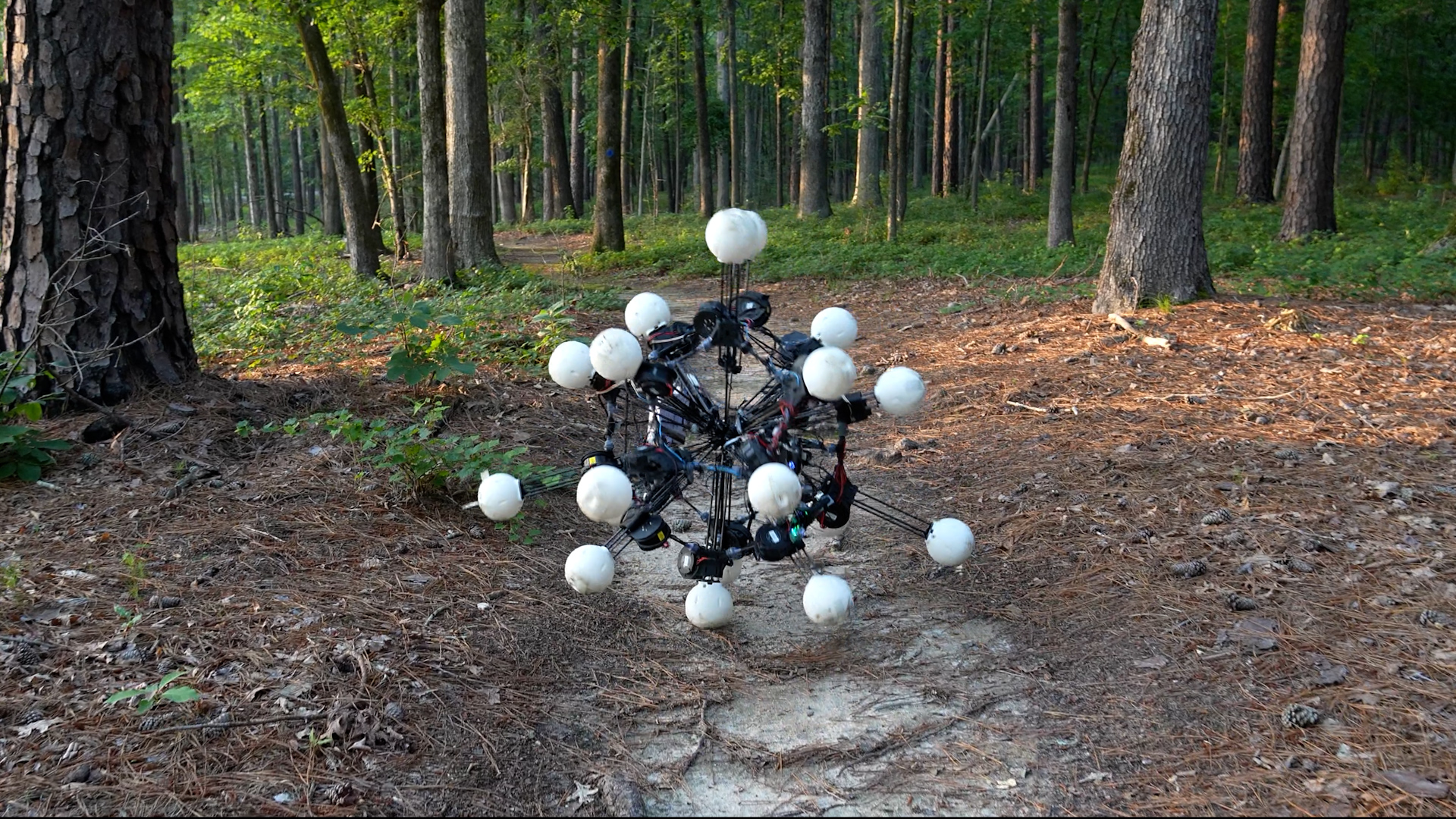
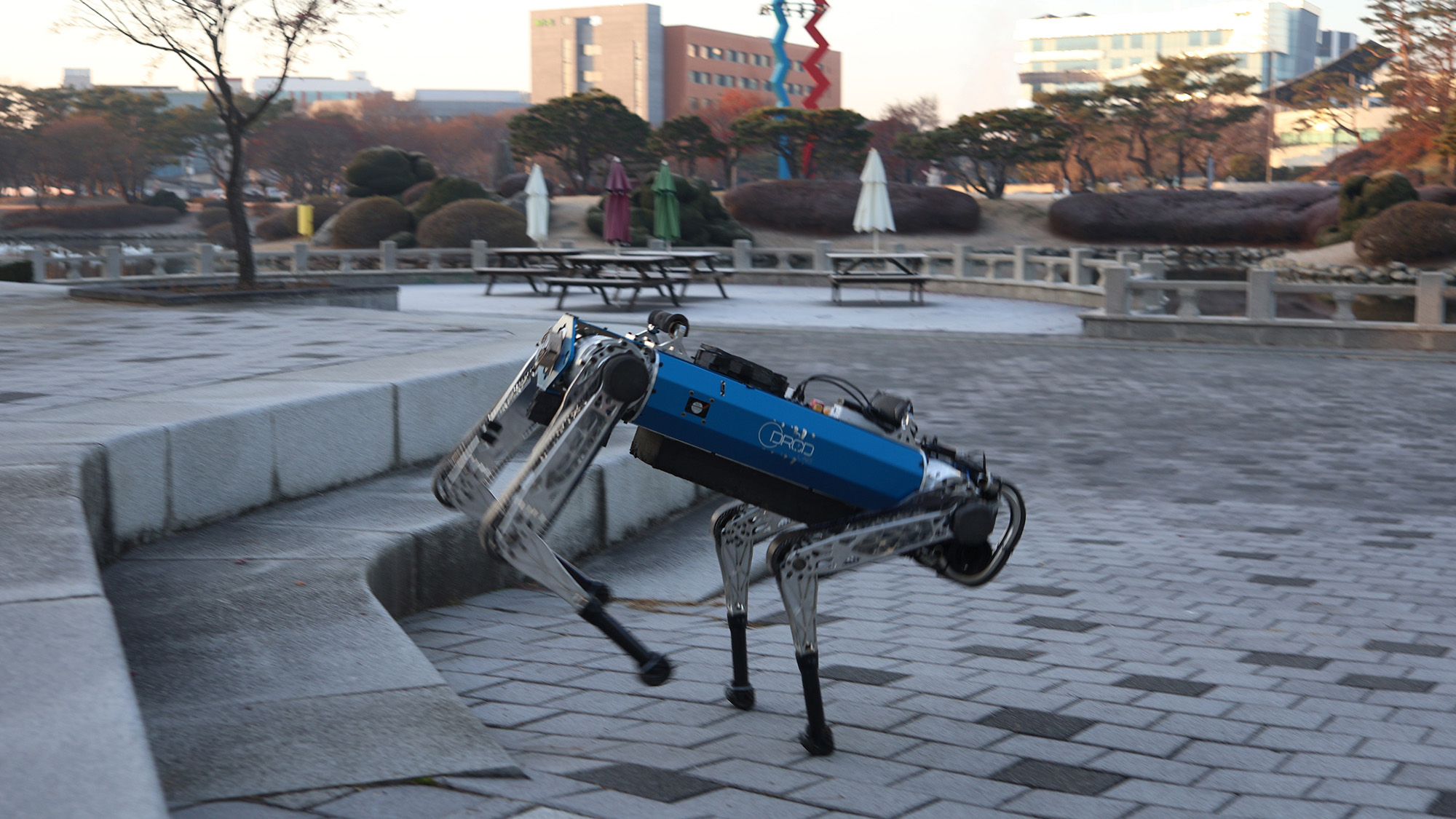
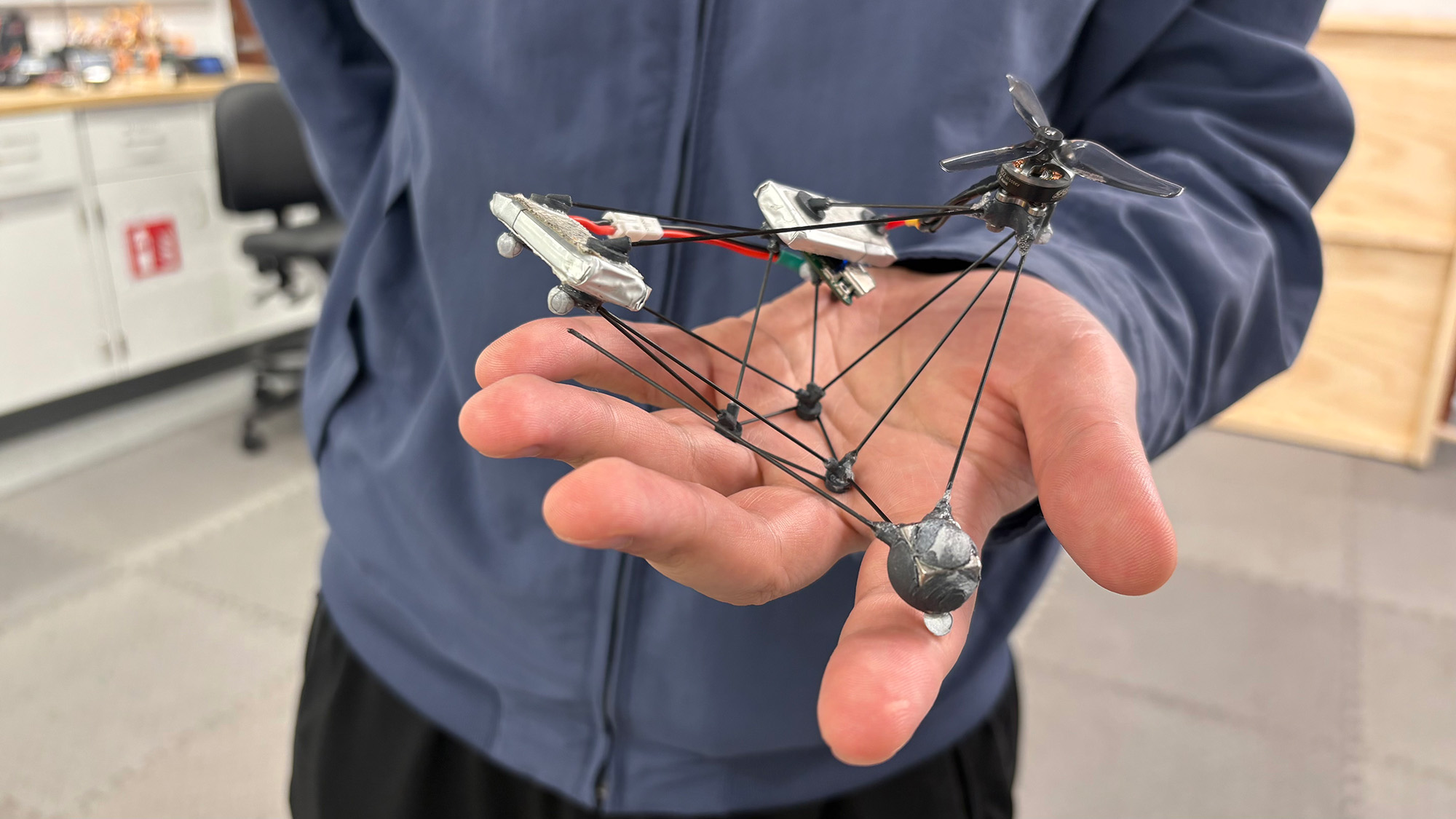
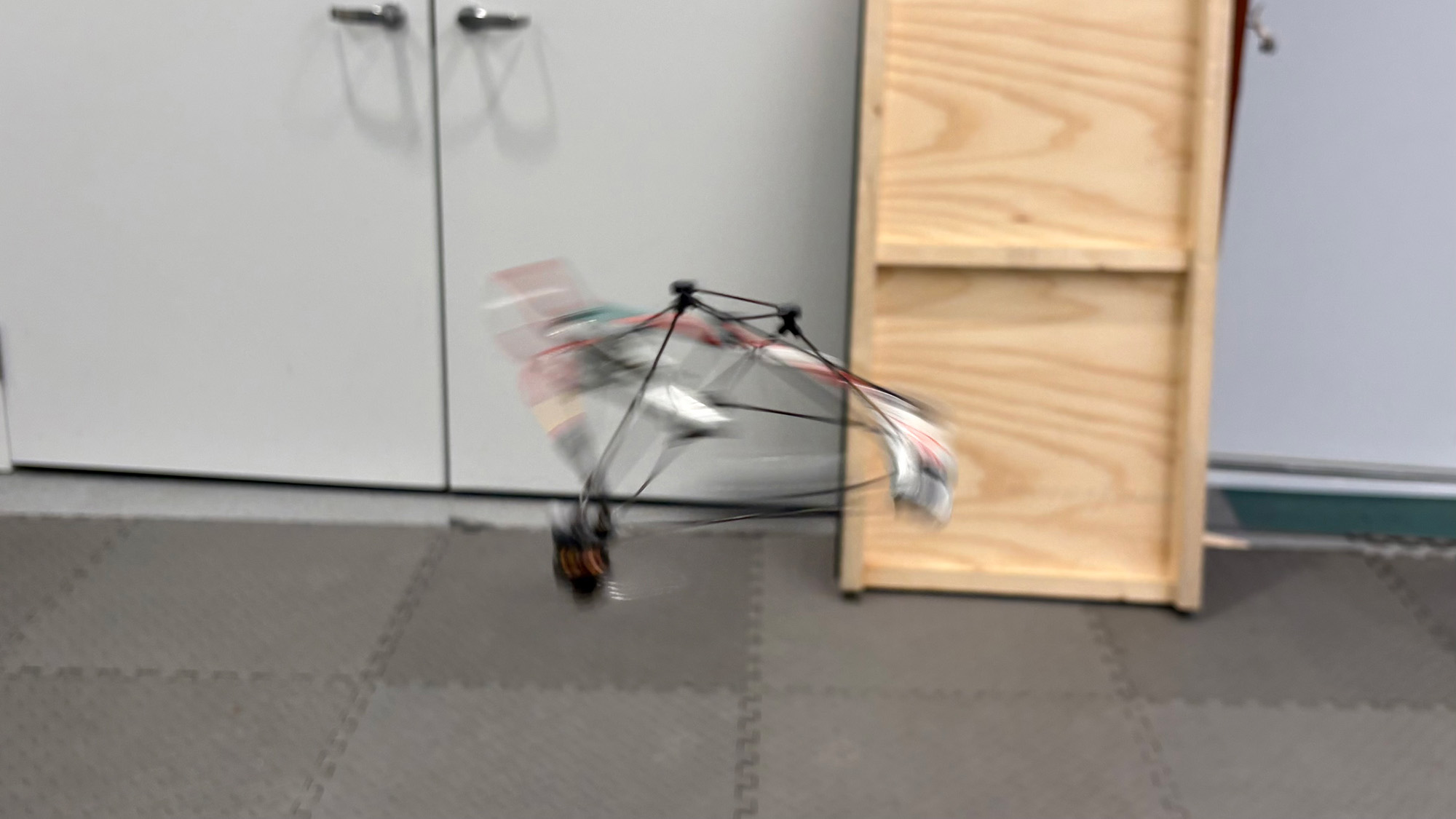
Meet Phantom Twist, a stealthy new drone that hides in plain sight by tricking your eyes

Meet Phantom Twist, a stealthy new drone that hides in plain sight by tricking your eyes

High-speed rotation exploits the concept of motion blur to conceal a new drone while it's in flight.

Hoe vind je dit bericht?
Geschreven door peter om 20:43 Stuur door

‘There Has Been A Massive Cover Up’ When It Comes To UFO Disclosure By The US Government, Claims Dr. Phil

‘There Has Been A Massive Cover Up’ When It Comes To UFO Disclosure By The US Government, Claims Dr. Phil

by Douglas Charles

Unidentified-Flying-Object-UFOs

Stockphoto

Dr. Phil McGraw read the Pentagon’s recently released UFO files before the public and claims that after doing so, he believes there has been a huge cover-up by the United States government.

Why was Dr. Phil given access to the Pentagon’s UFO files before the general public? According to NewsNation, while the administration was weighing disclosure, it sought a trusted voice rather than an astrophysicist to gauge how the public might react to the files. He is also part of the Religious Liberty Commission that President Donald Trump established.

“I think we have to look at what’s going on with all of this in different pieces,” McGraw said on Reality Check with Ross Coulthart. “What are we going to disclose to the American public, but once we tell them what we tell them, what are we going to do with reaction?”

He also stated that he believes the government’s excuse of being scared to reveal information to the public because it’s “too shocking” is not true, and he finds it patronizing to the public.

“I have sat with people, and I’ve seen them deal with difficult situations time and again,” McGraw said. “I think we are very resilient as the human race.”


As for the UFO files themselves, Dr. Phil claims the imagery released so far is intentionally grainy, that far better gun camera video and radar tracks exist and that Reps. Tim Burchett and Anna Paulina Luna are helping him press for their release.

“There are two things that have jumped out at me as I’ve gone through all of this, and certainly in the one that we had the opportunity to dig into before it became public, two things,” Dr. Phil said. “Number one, there has been a massive cover up. And two, there’s no question there are unexplained phenomena happening in our atmosphere here.”

Is the US government hiding anti-gravity UFO technology?

Dr. Phil McGraw’s observations come as Oliver Stone’s son Sean also claims that the government is hiding anti-gravity UFO technology.

“If we’re working with anti-gravity propulsion, say goodbye to oil and gas, that whole industry is gone,” Sean Stone told The Scoop. “And that’s a big reason why some people speculate that the UFO thing has been so suppressed. It’s like, well, once we understand that like you don’t need propulsion from a jet blasting off, you know, jet fuel and stuff, man, that’s that’s like how much of your world economy just got destroyed, you know, by that, you know, your oil and gas industry, you’re talking what, trillions of dollars, you know, globally, right? I mean, it’s huge.”

President Trump orders the cancellation of non-disclosure agreements

In related news, President Donald Trump has ordered federal agencies to cancel non-disclosure agreements with former government employees and contractors who have cooperated with the United States government in investigations into UFOs.

“President Trump recently directed the Department of War and the intelligence community to allow former government employees or contractors, that have relevant information about the disclosure of UAP, to come forward to meet with designated government representatives — AARO [All-domain Anomaly Resolution Office] or the President’s UAP taskforce, ‘PURSUE’ — and have their prior NDAs abrogated,” Fox News reports a senior administration official said.

{ https://brobible.com/category/culture/ }

Hoe vind je dit bericht?
Geschreven door peter om 18:43 Stuur door

Evidence Mounts That Martian Intelligent Life Was Silica Based, Not Carbon Based. UFO UAP Sighting News.

Evidence Mounts That Martian Intelligent Life Was Silica Based, Not Carbon Based. UFO UAP Sighting News.

silica_life.jpg

Date of discovery: July 23, 2026 (Taiwan time 12hr ahead of USA)
Location of discovery: Mars, Spirit Rover SOL 725
Source photo: 
 
We talked about this subject many times earlier. A stone foot, possibly even petrified from an alien weapon or even never truly broke down in the environment because...life does not necessarily have to build its bodies on Mars the same way life on Earth does. Many scientists and myself have proposed that there could be intelligent life forms made not from carbon like humans, but silica based skeletal tissues. Many organisms already use silica as a structural material like Diatoms, Radiolarians, and some sponges. Imagine if Martians intelligent life evolved to suse silica throughout much of their bodies. They may be bipedal and have two arms and a head, but the similarities end there. The tissue of the Martian would have living cells embedded in a silica matrix. Flexible organic proteins reinforced with microscopic glass fibers. Silica bones extending throughout the body. Thus...after death, only the organic portions would decay, leaving much of the body's framework which would already be mineral (silica), making it resemble stone almost immediately. Also, silica life forms would thrive in ultra hot high pressure environments avoid of oxygen and water...Mars. Below I have inclued several feet some with shoes broken...petrified...in other NASA photos that I have posted over the years. 
Scott C. Waring - UFO Sightings Daily
 
Screenshot%202026-07-23%20at%203.00.23%E2%80%AFPM.png

Screenshot%202026-07-23%20at%203.27.56%E2%80%AFPM.png

time%20travel,%20Tardis,%20ovni,%20UFO,%20UFOs,%20sighting,%20sightings,%20alien,%20aliens,%20Louvre,%20museum,%20SETI,%20news,%20navy,%20volcano,%20area%2051,%20shoe,%20nike,%20puma,%20sandle,%20bipedal,%20cloak,%20,%20NYC,%20nellis%20AFB,%20new,%20scientist,%204.png

,%20%E7%9B%AE%E6%92%83%E3%80%81UFO,%20UFOs,%20sighting,%20sightings,%20alien,%20aliens,%20ET,%20boot,%20ancient,%20archaeology,%20astrobiology,%20paleontology,%20waarneming,%20vreemdelinge,%20shoe,%201.png

AI_Robot-1.png

head,%20skull,%20alien,%20ET,%20space,%20tiny,%20men%20from%20mars,%20little%20green%20men,%20UFO,%20UFOs,%20award,%20sighting,%20sightings,%20news,%20paranormal,%20research,%20new%20scientist,%201.png

Screenshot%202026-07-23%20at%203.34.04%E2%80%AFPM.png

{ https://www.ufosightingsdaily.com/ }

Hoe vind je dit bericht?
Geschreven door peter om 18:33 Stuur door

Juno takes temperature of Jupiter's fiery moon Io

Juno takes temperature of Jupiter's fiery moon Io

The north polar region of Jupiter’s volcanic moon Io was captured by NASA’s Juno during the spacecraft’s 57th close pass of the gas giant on Dec. 30, 2023. Data from that flyby and one on Feb. 3, 2024, is helping scientists understand Io’s interior. Credit: NASA/JPL-Caltech/SwRI/MSSS Image processing by Gerald Eichstädt

NASA's Juno mission has provided the first measurements of the temperature below the surface of Jupiter's moon Io, revealing significant heating within the shallow subsurface of the most volcanically active world in the solar system. Collected during two close flybys, the data also show that most of Io's surface is remarkably smooth and composed of material with very low density.

Published in the Journal of Geophysical Research: Planets, these findings break new observational ground for both fiery and icy worlds beyond our planet.

Io's extreme volcanism is powered by tidal heating. The moon is constantly stretched and squeezed by Jupiter's immense gravity as it travels in a slightly elliptical orbit, generating internal heat output many times greater than Earth's. Until now, virtually everything known about that heat came from infrared observations, which sense only the temperature of the surface. The latest findings are based on data collected by the spacecraft's Microwave Radiometer (MWR) instrument.

"The Juno Microwave Radiometer directly observed Io's heat output by looking below the surface," said Scott Bolton, study co-author and Juno's principal investigator at Southwest Research Institute in San Antonio. "The surprising discovery that we could see below a rocky moon's surface has important implications for studying Earth's volcanoes. Juno has taught us that if we look with an MWR-type instrument near a volcano on Earth, we might see a similar signature in the subsurface temperature gradient, providing new information on how terrestrial volcanoes work."

NASA’s Juno Takes Temperature of Jupiter’s Fiery Moon Io

This graphic illustrates the areas of Io sampled by the Microwave Radiometer instrument aboard NASA’s Jun

How Juno looked underground

Juno's Microwave Radiometer was designed by Bolton to peer beneath Jupiter's cloud tops to investigate the dynamics and composition of the gas giant's deep atmosphere. The MWR's six microwave antennas serve as a single instrument, simultaneously detecting microwaves at a wide range of wavelengths, from about half an inch to 20 inches (1.3 to 51 centimeters). During the mission's extended phase, the MWR instrument has provided the opportunity to observe three of the planet's Galilean moons: Ganymede, Europa and Io.

"The technique is novel in that each wavelength explores different depths, providing a new way to characterize the deep atmosphere of giant planets and the subsurface crusts of icy and rocky moons," said Bolton. "At Ganymede and Europa, we explored tens of miles below the surface, assuming their ice shells were mostly pure water, but the ability to probe volcanic rock on Io was an unexpected discovery."

During flybys on Dec. 30, 2023, and Feb. 3, 2024, the solar-powered Juno spacecraft came within about 930 miles (1,500 kilometers) of the moon's surface.

NASA’s Juno Takes Temperature of Jupiter’s Fiery Moon Io
This map represents data captured by the Microwave Radiometer instrument aboard NASA’s Juno, indicating heat rising from just beneath the surface of Jupiter’s moon Io. The colors illustrate a distinct temperature gradient across the moon, with the most extreme, localized heat output in red. Credit: NASA/JPL-Caltech/SwRI/USGS

Two explanations for the heat

"The instrument measured Io's thermal emission at depths ranging from a few inches to tens of feet. Everywhere we looked, we found the temperature rising by more than 40 degrees Fahrenheit just several feet into the surface—a gradient far steeper than solar heating alone can explain," said Shannon Brown, the paper's lead author at NASA's Jet Propulsion Laboratory in Southern California.

The data suggest two possible explanations. First, heat could be rising steadily through a conductive crust. While this background heat flow—measured at 1 to 3 watts per square meter—is relatively gentle on a local scale (roughly equivalent to a small nightlight glowing under every square yard), across the entire moon it represents a release of energy up to 30 times Earth's average. Alternatively, the signal could be coming from cooling lava flows, capped by roughly 30 to 35 feet (9 to 11 meters) of solidified crust, that cover about 10% of the moon's surface at any given time.

"Io provides a unique window into how tidal heating works throughout the cosmos, a fundamental process that provides energy and heat to worlds that are far from their parent star," said Bolton. "This process can not only create the most volcanic body in the solar system, in the case of Io, but also fuel the subsurface oceans on the moons of giant planets, such as Europa and Ganymede. Until this point, we could only observe the heat escaping at the surface or through eruptions. Now we can characterize how the heat is moving from the interior toward the surface."

A surprisingly plain-like surface

Another major insight gained from the two flybys is just how smooth Io is. Before the recent findings, the moon was known for its tall mountains, but the MWR indicates that apart from this visible topography, the surface features expansive smooth patches that stretch for 60 miles (100 kilometers) or more. Because Juno flew by overlapping regions of Io at different angles, the team was able to map how the surface reflects microwaves, much like an airline passenger might see the ocean flash with sunlight only at specific angles.

"Away from its mountains, the surface is more like the Great Plains of North America, and even though Io is a rocky body, the surface material has a very low density—more like pumice or fluffy volcanic ash than solid rock," said Brown.

Publication details
  • Shannon Brown et al, Io Sub‐Surface Temperature Profile Observed by the Juno Microwave Radiometer, Journal of Geophysical Research: Planets (2026). DOI: 10.1029/2025je009622

Journal information: 

RELATED VIDEOS

NASA’s Juno Takes Temperature of Jupiter’s Fiery Moon Io

NASA Looked Beneath Io—and Found a World Still Burning

NASA Juno Maps Io's Hidden Heat — The Volcanoes Beneath Jupiter's Moon

{ https://phys.org/space-news/ }

Hoe vind je dit bericht?
Geschreven door peter om 18:22 Stuur door

NASA whistleblowers claim 'alien presence' is hidden in altered moon photos

NASA's most famous astronauts secretly claimed that they encountered an alien presence on the moon and were told to keep it quiet for decades.

Physicist Maaneli Derakhshani told the American Alchemy podcast that multiple Apollo missions allegedly captured photos of UFOs around the moon during the 1960s and 1970s, only to have those images altered before the public saw them.

Derakhshani, who researches lunar and Martian surface anomalies, detailed instances where famous NASA photos taken by astronauts on the surface of the moon had been clearly altered when compared to public copies of the same images.

The scientist said: 'One scan from the Lunar and Planetary Institute - this is an archive that NASA has managed since the 1970s - and it's an Apollo 14 photograph with Ed Mitchell standing on the lunar surface.'

'You see his long shadow stretched out and... essentially the lunar sky is completely black in this version. You zoom in everywhere, it's completely black,' Derakhshani revealed.

'However, if you look at the "March to the moon" version of that same frame, which is managed by Johnson Space Center and Arizona State University, there is a blue orb in the lunar sky very clearly. It's very obvious above Mitchell.'

Derakhshani and podcast host Jesse Michels also noted that several astronauts, including Neil Armstrong, the first human on the moon, have reportedly claimed they received telepathic messages from extraterrestrials warning them not to return.

The bombshell whistleblower stories come as NASA prepares to land on the lunar surface by 2028 – ending a nearly six-decade absence which has sparked unproven conspiracy theories as to why the US never returned to the moon.

Physicist Maaneli Derakhshani claimed on the American Alchemy podcast that NASA photos from the moon have been altered to erase signs of UFOs    Physicist Maaneli Derakhshani claimed on the American Alchemy podcast that NASA photos from the moon have been altered to erase signs of UFOs

Physicist Maaneli Derakhshani claimed on the American Alchemy podcast that NASA photos from the moon have been altered to erase signs of UFOs

Physicist Maaneli Derakhshani (left) and American Alchemy host Jesse Michels (right) discussed the many claims of an alien cover-up involving NASA astronauts and the moon

Physicist Maaneli Derakhshani (left) and American Alchemy host Jesse Michels (right) discussed the many claims of an alien cover-up involving NASA astronauts and the moon

During the final moon mission, Apollo 17 astronauts Eugene Cernan and Harrison Schmitt took many photos while visiting the lunar surface in 1972.

However, Derakhshani revealed on the podcast that one famous frame showed three solid blue lights in the black sky above a lunar hill. When brightened, the area between the lights gets brighter, suggesting they might be attached to a larger object.

NASA’s own description of this image during the first batch of declassified UFO files released in May noted that a 'special investigation' had been opened because experts examining it believed the lights may be part of a large physical object in space.

The scientist noted that other photos from the same mission captured blue metallic-looking streaks in space, but when zoomed in and brightened, the streaks resembled insectoid-like objects with faint trails from an alleged engine.

Skeptics, including astrophysicist Neil deGrasse Tyson, have claimed that the images were only displaying cosmic rays, but Derakhshani called the odds of this statistically improbable, as the objects were solid round lights – not gaseous streaks or lens flares.

Despite releasing tranches of photos and hours of audio recordings from the Apollo moon missions as part of the Trump Administration's UFO disclosure campaign, NASA and the Pentagon continue to deny that proof of alien life has been found.

Derakhshani added that the altered pictures and other sightings were not definitive proof of aliens, but said the patterns are hard to explain as natural geology, camera glitches or ordinary space debris.

However, the strongest evidence of a NASA cover-up may come from the alleged confession of an actual NASA astronaut who claimed he was ordered to destroy potential proof of UFO sightings near the moon.

This archival photograph depicts the lunar surface as viewed from the landing site of Apollo 12. This image features a highlighted area of interest slightly to the right of the vertical axis of the frame, above the horizon, in which unidentified phenomena are visible

This archival photograph depicts the lunar surface as viewed from the landing site of Apollo 12. This image features a highlighted area of interest slightly to the right of the vertical axis of the frame, above the horizon, in which unidentified phenomena are visible

This archival photograph depicts the lunar surface as viewed from the landing site of Apollo 12. This image features highlighted areas above the horizon in which unidentified phenomena are visible

This archival photograph depicts the lunar surface as viewed from the landing site of Apollo 12. This image features highlighted areas above the horizon in which unidentified phenomena are visible

article image

'There's also Ken Johnston Sr, who was one of the pilots who trained the NASA astronauts and was a backup astronaut for the Apollo missions if I remember correctly,' Derakhshani said in the July 20 episode on YouTube.

'He says he was told to destroy a bunch of first-generation or early-generation Apollo negatives because they had some anomalies on them and they're not supposed to be there, and they don't want to release them publicly and he actually saved some of them and put some of his copies online.'

The Daily Mail has reached out to NASA for comment. 

Michels then brought up the alleged confessions of astronauts Cernan and Armstrong, who both reportedly mentioned having similar experiences during their lunar flights involving a warning received from extraterrestrials.

'There are all these apocryphal stories of Neil Armstrong telling similar stories in Washington, DC, saying, "We were told not to come back to the moon,"' the host said.

Michels referenced a previous interview with Steve Colbern, a lab analyst who participated in surgeries to remove alleged alien implants from people, who also claimed Armstrong was overheard at a party for high-level political guests repeating this warning.

Meanwhile, Cernan reportedly told his friend and Japanese NASA museum curator Josen Takano that during the trip to the moon, he received some type of telepathic message, saying: 'We don’t really want you here.'

The next mission scheduled to circle the moon, Artemis III, is expected to take place at some point in 2027. The following mission, a year later, Artemis IV, is expected to be the first lunar landing since the Apollo program.

RELATD VIDEOS

NASA whistleblowers claim 'alien presence' is hidden in altered moon photos

🌕 Alien on the Moon? Strange Apollo Footage Sparks New Debate

Is It Possible That Aliens Might Be Present on the Moon? 🌕👽

{ https://www.dailymail.com/sciencetech/index.html }

Hoe vind je dit bericht?
Geschreven door peter om 17:51 Stuur door

What could go wrong? Watch as two humanoid robots perform SURGERY on pigs - as scientists say humans could be next

Humanoid robots have performed surgery on live animals for the very first time in an astonishing new breakthrough.

As part of a pre-clinical trial, two humanoid robots were remotely operated by surgeons to perform keyhole surgery on pigs.

In one operation, a teleoperated robot was assisted by a human to remove a pig's gallbladder.

Meanwhile, a first-of-its-kind operation saw two robots working side by side in a robot-robot team.

The Unitree G1 robots, nicknamed Surgie, were fitted with specialised adapters so they could hold surgical tools but were otherwise unmodified.

The researchers say Surgie is just as precise as a conventional surgical robot, but only costs a fraction of the price and is far easier to set up and use.

And with a growing shortfall of skilled surgeons to meet patients' needs, the researchers say the bots could one day be used to operate on humans.

Senior author Professor Michael Yip, of UC San Diego, says: 'You can imagine these robots being deployed in remote communities where staffing is challenging, or in austere environments like search and rescue scenarios.'

Humanoid robots have performed surgery on live animals for the very first time in an astonishing new breakthrough

Humanoid robots have performed surgery on live animals for the very first time in an astonishing new breakthrough

The Unitree G1 robots were fitted with specialised adapters to hold surgical tools and remotely controlled by a human operator

The Unitree G1 robots were fitted with specialised adapters to hold surgical tools and remotely controlled by a human operator 


The researchers began by testing the robots' capacity for fine motor skills, having them handle inanimate objects and standard surgical equipment.

Once the team was satisfied, the robots graduated to performing real surgical procedures on anaesthetised pigs.

According to a report published in the journal Nature, both operations were completed successfully.

At one point there was some minor bleeding, but the robots were able to quickly stem the flow.

In fact, the researchers say that they were 'surprised' at just how well the robots functioned.

Controlling the movements of a humanoid felt more natural than moving the arms of a large surgical robot, especially for people not trained on those specialised systems.

This raises the possibility that humanoid robots could soon be a key part of surgical teams working on real human patients.  

Professor Yip says: 'Remotely operated and autonomous humanoid robots have real potential for amplifying access to critical surgeries to which patients would otherwise not have access.'

In one surgery, a humanoid robot was assisted by a human while it performed a gallbladder removal on an anaesthetised pig

In one surgery, a humanoid robot was assisted by a human while it performed a gallbladder removal on an anaesthetised pig 

The researchers say that these humanoid robots are cheaper, lighter, and easier to control than traditional robotic surgical systems
+5
View gallery

The researchers say that these humanoid robots are cheaper, lighter, and easier to control than traditional robotic surgical systems 

Surgeons already use specialised robotic surgery systems equipped with three or four robotic arms to operate on patients.

The problem is that these systems can weigh up to 800kg (1,800lb), require a large team to set up, and take up a lot of space in the operating room, which usually needs to be retrofitted to accommodate it.

By contrast, Surgie is just five feet (1.5m) tall and weighs just 27kg (60lb), even with its specialised adapters fitted.

This makes these compact humanoids a perfect option for situations where cumbersome traditional robots just aren't feasible.

Co-author Dr Shanglei Liu, a surgeon at UC San Diego, says: 'It's a fraction of the cost and it takes a fraction of the space in an operating room. So it’s easy to deploy, anywhere from rural areas to the battlefield, and even to space.'

However, the robots are far from perfect, and the researchers say there are still a few problems that need ironing out.

Most notably, Surgie had to be recalibrated multiple times throughout the operation; this took up valuable time and meant the surgery took a lot longer than expected.

Similarly, the latency, a delay between the operator's input and the robot's output, will need to be reduced before the bots are fully practical.

In the future, robots like these could be used to treat humans in areas where large surgical teams and specialised robots aren't feasible
In the future, robots like these could be used to treat humans in areas where large surgical teams and specialised robots aren't feasible 

Yet the team are extremely optimistic that these issues are solvable in the near future, pointing out that the first robotic keyhole surgery took six hours to complete a task that now takes 30 minutes.

article image

Even if Surgie isn't quite ready to put a human under the knife, the researchers say that it could have a bright future as an assistant.

Since the humanoid bots can walk about and perform most tasks that a human can do, they would be perfect for fetching tools and cleaning up after an operation.

Professor Yip adds: 'Many communities struggle with adequate staffing on the surgical team, which means patients are not being treated.

'Our goal is an operating theatre of the future, where humanoid robots and humans work side by side as an integrated team to deliver procedures to those in need.'

WILL YOUR JOB BE TAKEN BY A ROBOT? PHYSICAL JOBS ARE AT THE GREATEST RISK

Physical jobs in predictable environments, including machine-operators and fast-food workers, are the most likely to be replaced by robots.

Management consultancy firm McKinsey, based in New York, focused on the amount of jobs that would be lost to automation, and what professions were most at risk.

The report said collecting and processing data are two other categories of activities that increasingly can be done better and faster with machines. 

This could displace large amounts of labour - for instance, in mortgages, paralegal work, accounting, and back-office transaction processing.

Conversely, jobs in unpredictable environments are least are risk.

The report added: 'Occupations such as gardeners, plumbers, or providers of child- and eldercare - will also generally see less automation by 2030, because they are technically difficult to automate and often command relatively lower wages, which makes automation a less attractive business proposition.'

RELATED VIDEOS

Humanoid robots successfully performed gallbladder surgery on pigs

Humanoid robots successfully performed gallbladder surgery on pigs

Surgeons Just Controlled Humanoid Robots To Perform Real Surgery On Live Pigs

{ https://www.dailymail.com/sciencetech/index.html }

Hoe vind je dit bericht?
Geschreven door peter om 17:30 Stuur door

Orb shape-shifts to become balloon, to relax watchers, July 10, 2026, UFO UAP Sighting News.

Orb shape-shifts to become balloon, to relax watchers, July 10, 2026, UFO UAP Sighting News.

shapeshifting_UAP.png

jellyfish_UAP.png
Date of sighting: July 10, 2026
Location of sighting: Lake Oswego, Oregon, USA
Source: NUFORC
 
Guys, bear with me on this one...you wont like what I have to say...but its 100% accurate. Plasmoid UFOs or energy entities as I call them...can shapeshift and change into any living or non living thing they want...and they do this sometimes if they think they want to see who is talking to them, and let them see it, but without knowing who they really are. This is something UFO researchers might protest against, however I have experienced such things first hand, and my son saw it hovering around me circling 7 times over me (red star balloon with string...just out of my reach) and hid in the tree, then after I asked it to come back out, it did and circled me a few more times and then flew off over the roof of the neighbors...this was at night in Bountiful, Utah last year in my back yard. I called it, it came, it was intelligent, and behaved nothing like a balloon!
 
Here we have just such an occurrence. This plasmoid UFO is faking a string, however it doesn't have a string but instead a glowing light of plasma not shooting from it, but an extension of itself. Plasmoids are sensitive to your emotions...if you panic, they panic, if you are amazed, they feel you feelings too. Telepathic remember? So yes, they do the balloon shapeshift to get close, let you see them...which gives you what you wanted, and to read your thoughts. So next time, continue talking to it if its a balloon, it may respond by showing you its true self...if it trusts you. 
 
Believe it or not...
Scott C. Waring - UFO Sightings Daily - Now in Taiwan
 
Eyewitness states: 
Lights on object Spotted a stationary object in the sky, unknown distance, shiny and glistening Object was completely stationary for extended period of time. Had to go inside so I'm not sure the duration of how long it was there. Object was shining and glistening at certain angles. Looked like a balloon potentially, but it was unmoving, and much too far to still be inflated. Video was taken. I’ve never seen an object like this. 

Orb shape-shifts to become balloon, to relax watchers, UFO UAP Alien Paranormal Sighting News.

{ https://www.ufosightingsdaily.com/ }

Hoe vind je dit bericht?
Geschreven door peter om 23:39 Stuur door

Bipedal Alien 8 inches tall standing on Mars watching rover in NASA photo, UFO UAP Sighting News.

Bipedal Alien 8 inches tall standing on Mars watching rover in NASA photo, UFO UAP Sighting News.

alien_species.png
Date of discovery: July 22, 2026
Location of discovery: Mars Perseverance 1912
Source Photo: 
Based on all the past discoveries I made on Mars using NASA photo, I now believe that Mars had more than one species and that these species may have been brutal enemies. One such species is seen in the screenshot above, which shows a living white entity, bipedal, standing and watch as the rover passes it. Its no more than 8 inches tall at most and fits the entrances to the structures I found near it, which were also about 8-10 inches tall. Unlike other structures I reported a few weeks ago, which had entrances of 2-2.5 meters high. I also found some large faces carved in stone, maybe the smaller species or perhaps faces of the larger species. 
 
From the faces found on Mars in the past by me and other researchers, I find that there are at least four or more different species that once lived on Mars together. Not advanced like us perhaps, but held back in technology due to their bitter rivalries with each other. 
 
Scott C. Waring - UFO Sightings Daily 
Mars_life.png
The skull above is about 1 foot in size.
 
The entrances in the building below are only about 8-10 inches high.
Breaking_news.png
The golden statue, only 8 inches tall, below has an alien face on it, a body, and a throne-like chair.
Gold_statue.png


The head statue below, fallen on its side with its top cut wide open is about 1 meter from chin to forehead cut area. 
MARS_FACE.png

The foot below is about 1.5 feet from toe to heel, a foot of a larger species. 
AI_Robot.png

The doorway below is only about 7 inches tall and 7 inches wide. 

science_discovery.png

The face carved in stone below shows two eyes, a huge wide nose, mouth, chin and a big forehead with lots of hair. But was it made by the tiny 8 inch tall species? I think yes.
 
MARS_DISCOVERY.png

{ https://www.ufosightingsdaily.com/ }

Hoe vind je dit bericht?
Geschreven door peter om 23:39 Stuur door

When the Grid goes Dark!

When the Grid goes Dark!

Don't think it could never happen, but the possibility of a high-altitude electromagnetic pulse (EMP) is far from unimaginable. If such an event were to occur, it could cripple the technological backbone of modern civilization. Power grids, communications, transportation, and financial systems could all be severely disrupted, leaving millions without essential services. In the aftermath, widespread confusion, shortages, and social unrest could follow as governments struggle to restore critical infrastructure. 
EMP.png

This report of 'Redacted' examines the effects of a high-altitude electromagnetic pulse (EMP), an intense burst of electromagnetic energy generated when a nuclear weapon is detonated between approximately 30 and 400 kilometers (20–250 miles) above Earth's surface. 
Unlike a nuclear explosion at ground level, a high-altitude detonation produces little direct blast or thermal damage. Instead, its primary effect is the creation of a powerful electromagnetic pulse capable of disrupting or permanently damaging electrical and electronic systems across an enormous area. 
When a nuclear weapon detonates at high altitude, it generates three distinct electromagnetic pulse components: 
  • E1 – Fast Pulse: Lasting only a few billionths of a second, the E1 pulse is the most destructive to modern electronics. It can disable computers, communication networks, vehicles equipped with sensitive electronics, and the control systems that operate electrical power grids. 
  • E2 – Intermediate Pulse: The E2 pulse is comparable to a powerful lightning strike. Although it can damage electronic equipment, many systems already incorporate lightning protection, making this component generally less destructive than E1. 
  • E3 – Slow Pulse: The E3 pulse lasts from several seconds to a few minutes. It disturbs Earth's magnetic field and induces powerful electrical currents in long conductors such as power lines, pipelines, railway systems, and undersea cables. These currents can severely damage high-voltage transformers and other critical infrastructure.  
A large-scale high-altitude EMP could: 
Disable significant portions of the electrical grid. Disrupt internet, cellular, and radio communications. Interfere with GPS navigation and satellite operations. Damage satellites through radiation and electromagnetic effects. Interrupt banking and financial transactions. Disrupt transportation systems that depend on electronic controls. Severely impact emergency services, water distribution, fuel supplies, and food logistics. 
The most well-known demonstration of an EMP occurred during the Starfish Prime nuclear test on July 9, 1962. The United States detonated a 1.4-megaton nuclear device approximately 400 kilometers (250 miles) above the Pacific Ocean. 
Although the explosion occurred far above the Earth, its electromagnetic effects were detected roughly 1,450 kilometers (900 miles) away in Hawaii. Streetlights failed, burglar alarms were triggered, communication systems experienced disruptions, and several satellites in orbit were damaged or suffered shortened operational lifespans. 
Conclusion:
A high-altitude EMP is fundamentally different from a conventional nuclear attack. Rather than destroying cities through blast and heat, its strategic purpose is to disable the electronic infrastructure upon which modern society depends. While the immediate physical destruction on the ground may be limited, the cascading failure of electrical, communication, transportation, and financial systems could create widespread disruption across an entire region.
  

RELATED


When The Grid Goes Dark

5 Things to Do the Moment the Grid Goes Dark

{ https://ufosightingshotspot.blogspot.com/ }

Hoe vind je dit bericht?
Geschreven door peter om 23:25 Stuur door

Cosmic gymnastics: Study reveals how our Milky Way once underwent a dramatic FLIP

Cosmic gymnastics: Study reveals how our Milky Way once underwent a dramatic FLIP

While the Milky Way might look calm and stable today, scientists say a grand display of cosmic gymnastics once turned our galaxy upside down.

Researchers have discovered that the Milky Way once underwent a dramatic 'major disc flip'.

At some point in the distant past, the vast stellar disc changed orientation by more than 90 degrees – dragging our solar system along for the ride.

According to the results of a new study, this likely happened after a violent head–on collision with another drifting galaxy.

About 10 to 11 billion years ago, the Milky Way smashed into a massive dwarf galaxy known as Gaia–Sausage–Enceladus, or the Gaia Sausage for short.

We already know this impact knocked billions of stars into looping sausage–shaped paths, but researchers now say it may have also flipped our galaxy.

Lead author Dr Kirill Batrakov, of Durham University, says: 'We already know that the Milky Way had a massive head–on collision.

'So, we think that the Milky Way disc likely flipped in the past.'

Scientists say the Milky Way underwent a dramatic 'disc flip' in the distant past. These pictures show a simulation of a Milky Way-like galaxy undergoing a similar flip, starting from the oldest image (z=3.4) to its final position (z=0)

Scientists say the Milky Way underwent a dramatic 'disc flip' in the distant past. These pictures show a simulation of a Milky Way–like galaxy undergoing a similar flip, starting from the oldest image (z=3.4) to its final position (z=0)

This revelation about our galaxy's past transformations actually emerged from the quest to solve one of the Milky Way's greatest puzzles.

The majority of the stars in our galaxy are located in the flat spiral disk, a region about 120,000 light–years in diameter and 1,000 light–years thick.

This is surrounded by the sparsely populated stellar halo, an enormous region roughly 300,000 light–years across, but extending over a million light–years in diameter at its absolute outer limits.

This is largely made up of stars that have been pulled into the Milky Way from other galaxies over time through galactic mergers.

What makes the Milky Way's stellar halo so unusual is that it rotates incredibly slowly compared to other galaxies.

The European Space Agency's Gaia mission found that it could take up to a billion years for a star in this outermost region to make its way around the galactic core.

Until now, researchers have had no idea why this would be the case.

In their paper, presented this week at the Royal Astronomical Society's National Astronomy Meeting in Birmingham, researchers analysed the simulated evolution of 25 Milky Way–like galaxies.

Scientists think that this ancient flip could explain why the stellar halo, the outermost disc of the galaxy, rotates so slowly. Pictured: An artist's impression of the Milky Way seen from above

Scientists think that this ancient flip could explain why the stellar halo, the outermost disc of the galaxy, rotates so slowly. Pictured: An artist's impression of the Milky Way seen from above 

The flip may have been caused by a collision between the Milky Way and a dwarf galaxy called Gaia-Sausage-Enceladus between 10 and 11 billion years ago. Pictured: Artists' impression of the collision with the simulated positions and motions of the stars in Gaia-Enceladus shown with yellow arrows

The flip may have been caused by a collision between the Milky Way and a dwarf galaxy called Gaia–Sausage–Enceladus between 10 and 11 billion years ago. Pictured: Artists' impression of the collision with the simulated positions and motions of the stars in Gaia–Enceladus shown with yellow arrows

The Milky Way

Type: Barred spiral galaxy

Central black hole: Sagittarius A*

Diameter of stellar disc: About 120,000 light–years

Diameter of stellar halo: Up to one million light–years  

Stars: Approximately 100 to 400 billion

Age: Roughly 13.6 billion years

Distance of Sun from centre: About 26,000 light–years

Solar System’s location: Orion Spur

Time for Sun to orbit galaxy: About 230 million years

Nearest large galaxy: Andromeda

The scientists followed these simulated galaxies' evolution over billions of years and watched how they changed.

They discovered that the galaxies with the slowest stellar halos had two things in common: they had all had a head–on collision with another galaxy, and they had all undergone a major disc flip.

The fact that the Milky Way has both a glacial stellar halo and a head–on collision in its ancient past, therefore, makes it likely that the galaxy also underwent a disc flip.

This means that the galaxy we recognise today might have looked and behaved dramatically differently several billion years ago.

'A disc flip also means most of the Milky Way's stars once moved on very different trajectories than they do today – possibly even our own Sun,' says Dr Batrakov.

'Meaning our "stable" spot in the galaxy might not have been so stable for the Solar System's whole lifetime.'

Since we live inside the Milky Way, we can study its workings better than any other galaxy in the cosmos, making it the perfect laboratory for testing ideas about galaxy evolution.

With this extra knowledge about our own galaxy's history, scientists can start to make more sense of the baffling variety of cosmic structures out in the universe.

These images show the evolution of a Milky Way-like galaxy that did not have a collision with another galaxy and, therefore, did not experience a disc flip

These images show the evolution of a Milky Way–like galaxy that did not have a collision with another galaxy and, therefore, did not experience a disc flip

Dr Batrakov adds: 'Finding that its disc flipped adds a new chapter to that story, one we must account for when placing the Milky Way in a broader context of other galaxies.

article image

'What excites me the most is that this complex history can be reconstructed just from present–day observations.'

The researchers also found that the Milky Way's stellar halo is closely linked to the rotation of the invisible, but critical, dark matter halo.

This hidden disc of undetectable matter makes up the majority of the mass in the galaxy and holds the structure together like a gravitational glue.

That means understanding the origin of our own slow–moving stellar halo could help shed light on one of science's greatest mysteries.

THE MILKY WAY'S OLDEST STAR

A star discovered in 2018 is thought to be one of the oldest in the Milky Way.

Scientists at the Instituto de Astrofísica de Canarias (IAC) in Spain believe that it might have formed about 300 million years after the 'Big Bang'.

IAC researcher Jonay González Hernández said: 'Theory predicts that these stars could form just after, and using material from, the first supernovae, whose progenitors were the first massive stars in the Galaxy.'

Researchers hope the star, known as J0815+4729, which is in line with the Lynx constellation, will help them learn more about the Big Bang, the popular theory about the galaxy's evolution.

IAC director Rafael Rebolo said: 'Detecting lithium gives us crucial information related to Big Bang nucleosynthesis. We are working on a spectrograph of high resolution and wide spectral range in order to be able to measure (among other things) the detailed chemical composition of stars with unique properties such as J0815+4729.'


Cosmic Gymnastics: Our Milky Way Galaxy Flipped On Its Side | Fineprint | WION

Did the Milky Way Slowly Flip on Its Side After a Cosmic Crash?

{ https://www.dailymail.com/sciencetech/index.html }

Hoe vind je dit bericht?
Geschreven door peter om 22:19 Stuur door

Scientists Warn Something is Vanishing from Earth’s Oceans at an Alarming Rate, Driving the Planet Into an “Unsafe Space”

(Image Credit: Unsplash)

Scientists Warn Something is Vanishing from Earth’s Oceans at an Alarming Rate, Driving the Planet Into an “Unsafe Space”

Scientists are sounding the alarm over a worsening situation in Earth’s oceans and freshwater systems, according to a new study that warns of “irreversible” changes our planet could be facing.

New research led by the Scripps Institution of Oceanography at UC San Diego has revealed the rapid disappearance of oxygen from bodies of sea and fresh water, leading to environmental changes that could endure for centuries if left unmitigated.

The new study, which appeared in the journal Limnology and Oceanography, argues that widespread aquatic deoxygenation—reduced levels of dissolved oxygen in oceans and coastal waters, lakes, rivers, and streams—is increasingly becoming a problem, and one that influences nine other crucial environmental processes.

These processes are all included in what is known as the Planetary Boundaries framework, a science-based tool that outlines the requirements of a safe operating space for humanity. Introduced in 2009 by Earth system scientists led by Johan Rockström, this framework identifies nine critical environmental processes that regulate Earth’s stability.

Specifically, the nine planetary boundaries outlined in this framework are climate change, biosphere integrity, land use changes, biogeochemical flow of nutrients, ocean acidification, freshwater changes, atmospheric aerosol loading, stratospheric ozone depletion, and pollution.

Now, the Scripps researchers behind the recent study say they believe dissolved oxygen levels should also be formally included in this framework.

Aquatic Deoxygenation is a Growing Concern

Erica Ferrer, a Scripps Oceanography alumna and current postdoctoral scholar at UC Santa Barbara’s National Center for Ecological Analysis and Synthesis and lead author of the new study, says that her team’s work “is designed to elevate the profile of aquatic deoxygenation as a global threat and show that it does not operate in isolation.”

“The health and stability of our planet depends on the health and stability of aquatic ecosystems, which need oxygen to function normally,” Ferrer said.

Driving this growing problem, the new research says, is the excessive influx of nutrient pollution into water bodies, as well as anthropogenic warming, and changes occurring in natural ventilation systems within deep ocean waters.

With depleting oxygen levels scientists are seeing, longer-term changes to chemical and biological processes that regulate our planet’s climate are expected to occur. The decline, Ferrer and her colleagues argue, is also likely to impact a diverse range of aquatic organisms and ecosystems.

Even ocean mammals that acquire air at the surface are likely to be impacted, since deoxygenation can either cause the relocation or outright depletion of the organisms that make up their diets. This, in addition to causing severe damage to habitats and alterations to the food webs they depend on.

Ferrer and her colleague, study co-author and Scripps biological oceanographer Lisa Levin, are hopeful that their findings will encourage a deeper level of engagement on the potential ramifications of aquatic oxygen loss, and how other environmental challenges outlined in the planetary boundaries framework can act as multipliers, rather than separate existential concerns.

“Adding aquatic deoxygenation to the Planetary Boundaries framework will help us understand its impacts on Earth system stability,” Ferrer said in a statement, adding that mitigation of ocean deoxygenation impacts “represents a critical component of maintaining biodiversity and climate.”

Levin, Ferrer, and their colleagues’ study, “Abundant interactions and feedbacks between aquatic deoxygenation and the other planetary boundaries suggest ‘unsafe’ levels of oxygen loss with far‐reaching impacts,” appeared in the journal Limnology and Oceanography on June 30, 2026.

  • Micah Hanks is the Editor-in-Chief and Co-Founder of The Debrief. A longtime reporter on science, defense, and technology with a focus on space and astronomy, he can be reached at micah@thedebrief.org. Follow him on X @MicahHanks, and at micahhanks.com.

{ https://thedebrief.org/category/science/ }

Hoe vind je dit bericht?
Geschreven door peter om 00:16 Stuur door

Casimir Werk Saw a UFO in 1905 and Then the Mystery Got Even Deeper

Casimir Werk Saw a UFO in 1905 and Then the Mystery Got Even Deeper

The continued misidentification of UFOs in Victorian Cincinnati.
Hoe vind je dit bericht?
Geschreven door peter om 23:49 Stuur door

Trump directs agencies to waive NDAs for former employees involved in UFO investigations: report

Trump directs agencies to waive NDAs for former employees involved in UFO investigations: report

The nondisclosure agreements have proved an impediment to government investigations into UAPs, also known as UFOs, and the directive is intended to ease this source of reluctance.

By Kevin Killough

President Donald Trump has directed federal agencies to waive the nondisclosure agreements that former government employees and contractors signed while they were working on investigations involving unidentified anomalous phenomena (UAPs), also known as UFOs. 

The directives were given to the Department of War and the intelligence community, Fox News reported, citing unnamed sources. 

The order asks that the agencies allow former government employees and contractors who have relevant information about UAPs to come forward to meet with representatives of Trump's UAP taskforce, the All-domain Anomaly Resolution Office (AARO). Any NDAs they signed would be waived under the order. 

A senior administration official stressed that the directive is not a "declassification directive" and only allows employees and contractors to come forward through government channels. 

The NDAs have proved an impediment to government investigations into UAPs, and the directive is intended to ease this source of reluctance. 

{ https://justthenews.com/government/federal-agencies }

Hoe vind je dit bericht?
Geschreven door peter om 23:05 Stuur door

800 Million Years Ago, a Catastrophic Asteroid Breakup Rained Fire on the Inner Solar System

800 Million Years Ago, a Catastrophic Asteroid Breakup Rained Fire on the Inner Solar System

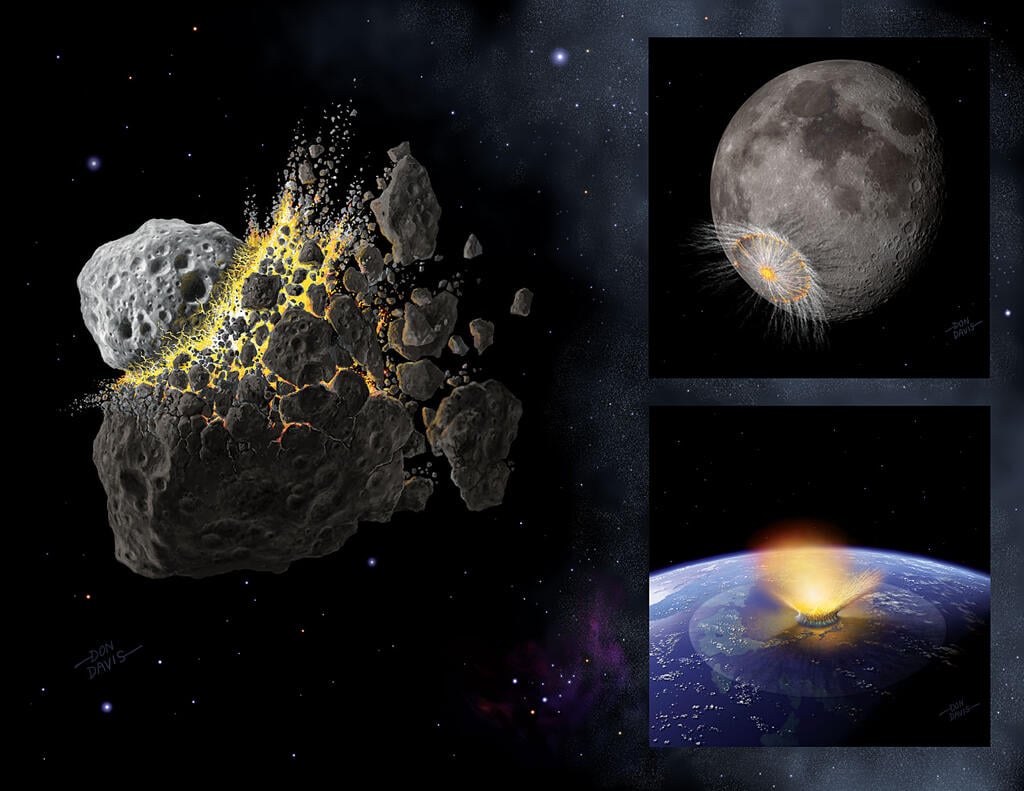
Artist's depicion of the cause and consequnece of the Eulalia asteroid catastrophe. Credit - SwRI/Don Davis Artist's depicion of the cause and consequnece of the Eulalia asteroid catastrophe. Credit - SwRI/Don Davis

On Earth, it’s hard to track events that reshape its surface, as the surface itself is being reshaped constantly by weather and tectonic or volcanic upheavals. However, the Moon is much more static, and scientists have been slowly unraveling a pattern that is noticeable in its craters - that something dramatic happened around 800 million years ago. A new paper by researchers at the Southwest Research Institute (SwRI), led by Dr. William F. Bottke, and accepted for publication in the Planetary Science Journal, suggests they might have found a culprit - the parent body of a family of asteroids now known as Eulalia.

So what exactly is Eulalia? Now, it’s a “family” of asteroids with similar geological makeups that asteroid researchers believe were originally part of a single, much larger asteroid. Estimated to be around 100 km in diameter, this asteroid suffered a catastrophic collision around 800 million years ago that broke it into thousands of much smaller pieces. That happens all the time throughout the solar system, but what made this one more impactful was where it happened.

Eulalia’s parent body was believed to be very near the 3:1 mean motion resonance with Jupiter, meaning it would rotate three times around the Sun for every single orbit of Jupiter. This orbital position, more commonly called J3:1, critically serves as a gravitational escape hatch for the asteroid belt, flinging objects that cross its path into planet-crossing regions throughout the solar system.

Fraser talks about asteroids striking the Moon.

According to the paper, when the catastrophic collision happened 800 million years ago, some of those fragments were immediately sent into the J3:1 point, and then distributed throughout the inner solar system. And over the next 150 million years or so, other fragments from the collision were slowly pushed into that position through a non-gravitational thermal acceleration force known as the Yarkovsky effect.

The end effect of these asteroid fragments being flung into that resonance point is the inner solar system seems to have suffered a pretty heavy asteroidal bombardment around this time. Many of the Near-Earth asteroids currently orbiting near our home planet appear to be remnants from this collision, as samples from Ryugu and Bennu have shown. But the most critical evidence comes from the Moon.

According to crater surveys on our nearest neighbor, there was a massive uptick in crater formation around 800 million years ago. Notably, the 93 km wide Copernicus crater was created in this time frame, but samples collected by the Apollo astronauts show it wasn’t the only one - tiny glass beads formed by the intense heat of impacts show a clustering of radiometric ages around 800 million years ago.

Fraser talks about how we might destroy an asteroid.

But if this inner solar system bombardment did happen, it wasn’t just the Moon that was affected. In fact, a general rule of thumb means that for every impact on the Moon, there should be 20 of a similar size on Earth due to its higher gravity level. 800 million years ago, Earth’s climate underwent a dramatic change known as the Bitter Springs Anomaly, which was marked by huge disruptions to Earth’s carbon cycle. The paper posits this as a speculative connection intended to inspire future research, suggesting that the increased amount of asteroid dust in the atmosphere could have contributed to an atmospheric cooling event that drove some evolutionary diversification of marine life just before the “Snowball Earth” glaciation period.

Mars would have been hit too, with the authors pointing out that there was a peak in the formation of massive volcanic calderas right around 800 million years ago. The impact shocks from repeated pummeling by asteroids could have destabilized Martian magma reservoirs, triggering a planetary surge in volcanic eruptions.

Venus, on the other hand, had something even more dramatic happen approximately 650 million years ago. The authors calculate the average surface age of Venus is right around that mark, and present the speculative hypothesis that the barrage of asteroid remnants from the Eulalia breakup could have sparked a catastrophic, planet-wide volcanic resurfacing event.

That is definitely a leap, though admittedly a logical, and (critically) a testable one. The authors already used some collisional and dynamical models to reverse-engineer the Eulalia family’s history, so there’s already a level of rigorous orbital dynamics proven in part of the paper. But tying such massive biological and geological changes such as Earth’s Snowball Period or Venus’ entire surface restructuring requires extraordinary evidence. This undoubtedly won’t be the last we hear of this theory, but it might be some time before enough additional evidence is gathered to be able to disprove it. Until then, the theory drives home just how critical asteroids can be in the development of a planet - and how critical it is that we find any capable of doing that to our own, modern home.

Learn More:


An Ancient Asteroid Wiped Out Earth 800 Million Years Ago #asteroid #spacenews #nasa #trending

Jupiter Destroyed the Solar System 800 Million Years Ago — And Almost Took Earth With It #Shorts

{ https://www.universetoday.com/ }

Hoe vind je dit bericht?
Geschreven door peter om 21:37 Stuur door

Spherical UFO filmed flying over the mountains near Ensenada, Mexico

Spherical UFO filmed flying over the mountains near Ensenada, Mexico

On July 18, 2026, while in the mountains near Ensenada, Mexico, a witness reported seeing a silent spherical object emerge from a ridge between two hills as he was scanning the surrounding area. 
spherical%20UFO%20Mexico.jpg

According to the witness, who posted the sighting on his Facebook page, similar spherical objects have reportedly been seen emerging from the same hillside on multiple occasions, often following a bright white light. On this occasion, he says he finally succeeded in capturing one of these objects on video. 
Could the footage show a genuine unidentified flying object, or is there a more conventional explanation? The video leaves that question open.
  
Hoe vind je dit bericht?
Geschreven door peter om 21:15 Stuur door

Time traveler claiming to be from the year 2045 delivers alarming predictions for the next four years

Time traveler claiming to be from the year 2045 delivers alarming predictions for the next four years

A man claiming to be a time traveler from the year 2045 says the world will gain definitive proof that aliens exist, cash will be extinct and the US will no longer be a country within the next four years.

Calling himself Adam Archon, the mysterious man claimed the technology to travel in time will become publicly accessible in 2028, the same year he said extraterrestrials land on Earth and end decades of secrecy by governments worldwide.

Archon, who claimed he was born on December 6, 2019, without any proof, recorded his supposed knowledge of the future during a March 2019 video which recently resurfaced online amid the public release of classified UFO files by the Pentagon.

While allegedly connected to an active lie detector machine, Archon said: 'Yes, it is true that aliens did land on Earth in August 2028. In fact, we have known of the existence of aliens before 2028, but it isn't until 2028 that it becomes public knowledge.'

Archon, whose face was blurred and voice altered during the interview with the YouTube channel Apex TV, said he had traveled back to a time before he was born to experience history in-person, which he claimed was a common practice in the future.

'Time travel was released to the public in 2028, but it was invented in 1981. It was just kept secret until they released it publicly,' he claimed.

Moreover, Archon claimed that most UFO sightings today were actually the craft used by time travelers from the future to go back in time to visit historical events.

According to the ten-minute interview, which has been viewed more than 1.3 million times, Archon was telling the truth, with Apex TV claiming every answer registered as truthful on the lie detector test.

A man calling himself Adam Archon alleged in 2019 that he was a time traveler from the year 2045

A man calling himself Adam Archon alleged in 2019 that he was a time traveler from the year 2045

Archon claimed that current UFO sightings were actually time travel capsules containing humans from the future

Archon claimed that current UFO sightings were actually time travel capsules containing humans from the future

Archon also mentioned the public will start getting an implanted chip called 'The One' in their right hand in February 2029.

The device allegedly lets users pay for items, boosts brain function and improves health. This system will supposedly replace all global currencies, making cash extinct.

This technology has existed for the last decade, with people having the ability to get a small microchip implanted in their hand so they can pay for things such as coffee or groceries just by waving their hand near a scanner typically used for credit cards.

According to the self-proclaimed time traveler, who did not show any physical proof he was from the future in his interview, this new system of digital money would debut right before the third chilling world event - the end of the US government.

Archon claimed that in 2030, the US would no longer be an independent nation and would instead become part of a new world government that splits up the globe by continent - with the US becoming part of 'District 3.'

The new world order, he said, was also said to be run by an AI program named The Light that will be released in 2033.

Archon claimed it was built into every electronic device, allowing anyone to talk to it and ask it anything. However, a group of ten government officials monitored all of The Light's decisions to make sure it was ruling ethically.

By 2045, Archon said scientists developed the technology to clone dinosaurs, creating a real-life 'Jurassic Park' where the public can visit prehistoric creatures.

'You can see T-rexes, Triceratops, velociraptors. If they existed, you can see them. People can go and visit things in the past, like to go visit the dinosaurs or major world events.'

Skeptics have claimed that Archon's January 2019 video was 'rehearsed' and fake, noting the time difference in the supposed three-minute speech   Skeptics have claimed that Archon's January 2019 video was 'rehearsed' and fake, noting the time difference in the supposed three-minute speech

Skeptics have claimed that Archon's January 2019 video was 'rehearsed' and fake, noting the time difference in the supposed three-minute speech

A self-proclaimed time traveler from 2045 has claimed that scientists developed the ability to clone and recreate dinosaurs (artist's impression)

A self-proclaimed time traveler from 2045 has claimed that scientists developed the ability to clone and recreate dinosaurs (artist's impression)

article image

While the March 25, 2019, video claimed that Archon was telling the truth, multiple pieces of his story did not add up and would be impossible under US laws.

In a separate video posted in January 2019, Archon started by claiming that there would be a documented increase in the number of UFO sightings worldwide that same year. While that did actually happen, his information about 2020 was way off.

'In 2020, there will be a robot released to the public that causes a lot of controversy,' he said in the three-minute video that did not involve a lie detector.

There has been no clear evidence that a robot was released that caused major controversy in the US or worldwide. 

Archon also failed to mention anything about the coming Covid-19 pandemic or anything for the following seven years.

Viewers of his January video claimed that Archon's statement was suspicious since the clock seen next to him showed nearly 15 minutes of real time passing despite the clip only being three minutes long.

One skeptic said: 'Does anyone else see that the video is 3:36 minutes long but the clock in the back moves a good 15 minutes? That means this was rehearsed and they had to cut out the mistakes.'

Meanwhile, Archon's shocking claim about the final president in US history would seem to be completely implausible.

'Yolanda Renee King does become, and she is in fact noted as the greatest president of the United States, yes I can confirm,' Archon claimed while taking the lie detector test.

King, 18, is the only grandchild of Martin Luther King Jr and is already known for being an author and activist, specifically against gun violence.

However, Archon's timeline with King becoming president could not come true if the US were no longer an independent nation by 2030.

King will turn 35 years old in 2043, the age at which an American citizen can legally run for office under current US law. The next presidential election would not be until 2044.

Scientists have stated that time travel into the past is not only possible; the math to make it happen actually aligns with Einstein's famed theory of general relativity - which says that space and time are linked together as 'spacetime,' and gravity is the result of massive objects like planets and stars curving this spacetime.

Despite the theory of time travel appearing to be plausible, there has been no concrete evidence that humans can regularly move backward through time, or have a craft capable of doing that.

Meanwhile, the US government has repeatedly stated that no physical proof of extraterrestrials or UFOs has ever been presented.

Archon had claimed in the video that the aliens who make contact with humans in 2028 'do not come from space.'

'I cannot elaborate on where they come from because of the possibility of a paradox,' he alleged.

RELATED VIDEOS

The Man Who Claims He Came From 2045 😱#TimeTraveler #FuturePrediction #fact #ViralShorts #Future2045

Disturbing Confessions From Alleged Time Travellers

The Einstein Paradox: Is Time Travel Actually Possible? 🕰️

{ https://www.dailymail.com/sciencetech/index.html }

Hoe vind je dit bericht?
Geschreven door peter om 20:33 Stuur door

Meer van UFO'S of UAP'S, ASTRONOMIE, RUIMTEVAART, ARCHEOLOGIE, OUDHEIDKUNDE, SF-SNUFJES EN ANDERE ESOTERISCHE WETENSCHAPPEN - DE ALLERLAATSTE NIEUWTJES

↑ Terug naar de berichten