Naar de inhoud

UFO'S of UAP'S, ASTRONOMIE, RUIMTEVAART, ARCHEOLOGIE, OUDHEIDKUNDE, SF-SNUFJES EN ANDERE ESOTERISCHE WETENSCHAPPEN - DE ALLERLAATSTE NIEUWTJES

UFO's of UAP'S in België en de rest van de wereld
akke.beakke.be
Ontdek de Fascinerende Wereld van UFO's en UAP's: Jouw Bron voor Onthullende Informatie! Ben jij ook gefascineerd door het onbekende? Wil je meer weten over UFO's en UAP's, niet alleen in België, maar over de hele wereld? Dan ben je op de juiste plek! België: Het Kloppend Hart van UFO-onderzoek In België is BUFON (Belgisch UFO-Netwerk) dé autoriteit op het gebied van UFO-onderzoek. Voor betrouwbare en objectieve informatie over deze intrigerende fenomenen, bezoek je zeker onze Facebook-pagina en deze blog. Maar dat is nog niet alles! Ontdek ook het Belgisch UFO-meldpunt en Caelestia, twee organisaties die diepgaand onderzoek verrichten, al zijn ze soms kritisch of sceptisch. Nederland: Een Schat aan Informatie Voor onze Nederlandse buren is er de schitterende website www.ufowijzer.nl, beheerd door Paul Harmans. Deze site biedt een schat aan informatie en artikelen die je niet wilt missen! Internationaal: MUFON - De Wereldwijde Autoriteit Neem ook een kijkje bij MUFON (Mutual UFO Network Inc.), een gerenommeerde Amerikaanse UFO-vereniging met afdelingen in de VS en wereldwijd. MUFON is toegewijd aan de wetenschappelijke en analytische studie van het UFO-fenomeen, en hun maandelijkse tijdschrift, The MUFON UFO-Journal, is een must-read voor elke UFO-enthousiasteling. Bezoek hun website op www.mufon.com voor meer informatie. Samenwerking en Toekomstvisie Sinds 1 februari 2020 is Pieter niet alleen ex-president van BUFON, maar ook de voormalige nationale directeur van MUFON in Vlaanderen en Nederland. Dit creëert een sterke samenwerking met de Franse MUFON Reseau MUFON/EUROP, wat ons in staat stelt om nog meer waardevolle inzichten te delen. Let op: Nepprofielen en Nieuwe Groeperingen Pas op voor een nieuwe groepering die zich ook BUFON noemt, maar geen enkele connectie heeft met onze gevestigde organisatie. Hoewel zij de naam geregistreerd hebben, kunnen ze het rijke verleden en de expertise van onze groep niet evenaren. We wensen hen veel succes, maar we blijven de autoriteit in UFO-onderzoek! Blijf Op De Hoogte! Wil jij de laatste nieuwtjes over UFO's, ruimtevaart, archeologie, en meer? Volg ons dan en duik samen met ons in de fascinerende wereld van het onbekende! Sluit je aan bij de gemeenschap van nieuwsgierige geesten die net als jij verlangen naar antwoorden en avonturen in de sterren! Heb je vragen of wil je meer weten? Aarzel dan niet om contact met ons op te nemen! Samen ontrafelen we het mysterie van de lucht en daarbuiten.

Trump Promised Transparency. His Administration Keeps Finding New Ways to Hide Records.

Trump Promised Transparency. His Administration Keeps Finding New Ways to Hide Records.

"The most transparent president in history" keeps chipping away at laws like FOIA meant to keep the government honest.

An illustration of Donald Trump surrounded by redacted documents | Joe Sohm/Dreamstime/Midjourney

(Joe Sohm/Dreamstime/Midjourney)

President Donald Trump claimed in 2019 that he was "the most transparent president in history." Throughout his second term, Trump's spokespeople have used that phrase over and over again. The administration has made a big show of opening the archives on old mysteries: the assassination of President John F. Kennedy, the existence of UFOs, and the case of well-connected sex predator Jeffrey Epstein. While the JFK files included some genuinely shocking revelations, the UFO files were thin on substance.

And the Epstein files turned into an infamous boondoggle. The administration handed a group of influencers binders labeled "Phase 1," which turned out to hold heavily redacted copies of already-public documents, then never followed up. After it was leaked to the press that the actual FBI file on Epstein included a sexually suggestive letter from Trump himself, Congress dragged the files out of an embarrassed and defensive administration.

But the Trump administration has also fouled up the everyday mechanisms for Americans to see what their leaders are up to and how their tax dollars are being spent. Officials have tried to hide documents from the Freedom of Information Act (FOIA) or outright exempt government activities from FOIA. In fiscal year 2025, the federal government granted a little under 50 percent of FOIA requests, a record low since 2010, according to data compiled by The New York Times. The Department of Justice fought in court to overturn the Presidential Records Act, which requires the White House to preserve its files for posterity. In between his two terms, Trump infamously hid papers in his bathroom.

Trump had ironically ridden to power on the back of an earlier outrage about transparency. Much of the 2016 election focused on Democratic candidate Hillary Clinton's emails. Back when she was secretary of state, Clinton  had secretly moved her emails to a private, nongovernment server, both exposing them to hackers and concealing them from public FOIA requests. Trump said on the campaign trail that Clinton was trying to "cover up her crimes." In the decade since then, the Trump administration has done a lot more to cover up its own activities.

Beyond the political irony, the Trump administration's attack on transparency highlights how the struggle to keep politicians honest works. American journalists, lawyers, and crusading gadflies have won the right to inspect a wide variety of government records. The FOIA regime is a model for the rest of the free world—and the unsung source of a lot of politically relevant scoops, including at Reason. The political operators undermining transparency know what they're doing.

A Quick History of Modern Presidents Trying To Shield, or Release, Records

"One of the contradictory things about the United States is that an incredible amount of the government is dedicated to doing things in secret," geographer Trevor Paglen writes in Blank Spots on the Map: The Dark Geography of the Pentagon's Secret World. "At the same time, it's one of the world's most open governments."

That openness was a hard-won right. The Administrative Procedure Act of 1946 had left federal officials with wide discretion in what information to release to the public, and they became increasingly tightfisted with Cold War paranoia. The original FOIA was passed in 1966 as a "product of years of slow campaigning by a network of journalists, scientists, and politicians seeking to make the government more transparent," according to State of Silence: The Espionage Act and the Rise of America's Secrecy Regime by historian Sam Lebovic. The Watergate scandal a few years later turbocharged those demands for transparency.

In the 1970s, President Richard Nixon grew paranoid about internal leaks after the theft and publication of the Pentagon Papers, the U.S. military's secret internal history of the (then-ongoing) Vietnam War. He fretted to National Security Adviser Henry Kissinger that his sabotage of Vietnamese peace talks or his undeclared war in Cambodia might be revealed. Nixon assembled the "Plumbers," a team of intelligence operatives, to "destroy" Pentagon Papers leaker Daniel Ellsberg and hunt down other alleged traitors by "any means."

When the Plumbers were caught burglarizing Democratic National Committee offices in the Watergate complex in 1972, the resulting scandal not only forced Nixon to resign, but also set off a congressional campaign to rein in the executive branch, especially the national security complex. Congress amended FOIA in 1974 and 1976. Most importantly, the new rules allowed courts to review classified documents and punish noncompliant officials in response to FOIA requesters' lawsuits.

Congress also passed the Presidential Records Act of 1978 in response to Watergate. Nixon, ever the paranoiac, had secretly bugged the White House with tape recorders. When he attempted to destroy the tapes to avoid their being used as evidence against him, Congress clarified that White House records are the property of the nation, not the private property of the president himself. The act both preserved presidential papers and subjected them to FOIA from five years after the end of an administration.

The interpretation of the laws seesawed back and forth for some time. The Carter administration ordered officials not to withhold documents from FOIA requesters unless they could prove harm from releasing them. The Reagan administration flipped that rule around, stating that it would defend any official's decision to withhold documents if there was a defensible legal basis. The Clinton administration flipped back to the Carter position, and the George W. Bush administration flipped back to the Reagan stance.

{ https://reason.com/tag/government-secrecy/ }

Hoe vind je dit bericht?
Geschreven door peter om 20:29 Stuur door

Autopsy reveals chilling new details in mysterious death of missing scientist found skeletonized in the woods

Autopsy reveals chilling new details in mysterious death of missing scientist found skeletonized in the woods

Shocking new details have emerged concerning the mysterious disappearance and death of a New Mexico woman who worked at a secretive US nuclear lab.

Authorities have revealed that Melissa Casias, whose body was discovered on May 28, was shot in the head at or around the time of her death, but it remains unclear if this was murder or a suicide. Her body was found well after her death.

Casias, an administrative assistant at the Los Alamos National Laboratory, vanished without a trace on June 26, 2025 after strangely walking out of her home without any identification, keys or way of contacting her.

Her skeletal remains were discovered 11 months later in Carson National Forest, propped up against a tree with a handgun near the body.

The official autopsy noted that Casias had been shot through the base of the skull, with the bullet exiting through the left side of her head. However, the Office of the Medical Investigator could not say if this wound was what killed the 53-year-old.

Due to the amount of decomposition of Casias's remains when she was found, the medical examiner could only say that the gunshot occurred 'perimortem,' meaning it took place around the time she died but may not have been the actual cause.

The medical examiner's report added that the woman's left hand and left leg were both found about 20 feet away from the body and showed signs of being attacked by wildlife who likely scavenged through the remains after death.

While the medical examiner could not tell if Casias's death was a suicide or involved foul play, an anonymous law enforcement source told the Daily Mail the new details in the case point to murder.

Melissa Casias worked at the Los Alamos National Laboratory, a long-running nuclear research facility, before disappearing on June 26 last year. Her remains were found on May 28

Melissa Casias worked at the Los Alamos National Laboratory, a long-running nuclear research facility, before disappearing on June 26 last year. Her remains were found on May 28

The autopsy of Melissa Casias has been released and authorities have determined that the nuclear lab worker had been shot in the head

The autopsy of Melissa Casias has been released and authorities have determined that the nuclear lab worker had been shot in the head

The newly released autopsy noted that the bullet was fired into the right side of Casias's cranial base, hitting the bottom of the skull near the large hole where the spinal cord connects to the brain.

It also damaged the topmost neck bone, known as the C1 vertebra, before exiting through the left side of the head, through the flat, thin part of the temple.

'There's no way this was suicide, not from that angle,' the law enforcement source claimed, noting the reported position of the bullet when it entered Casias's skull. 

The source believed that, if Casias was really holding the handgun at that angle, the gun would have recoiled, causing the bullet to change direction instead of passing straight through her skull.

'The kickback would have made the gun go straight up. That's ridiculous. She was murdered,' the source alleged.

Officially, the medical examiner has labeled Casias's cause of death as 'undetermined,' adding that the autopsy could not even determine how close the gun was to the nuclear lab worker's head when it was fired.

New Mexico State Police told the Daily Mail that their investigation is still active, but did not reveal if investigators have interviewed any new suspects in the case.

Casias' husband, Mark, was one of the last people to see his wife alive in 2025, when he was dropped off at LANL for work on the morning of her disappearance.

Melissa Casias (Left) pictured with her husband Mark Casias.

Melissa Casias (Left) pictured with her husband Mark Casias

Casias's body was found alongside a handgun in the McGaffey Ridge area of Carson National Forest

Casias's body was found alongside a handgun in the McGaffey Ridge area of Carson National Forest

article image

Casias reportedly said she had forgotten her work badge needed to access the base at the couple's Taos, New Mexico home.

Shortly after, she was seen bringing a sandwich to her daughter's place of work, telling the teen that she would be working from home after forgetting the badge.

However, Casias never reported for work at LANL that day, with her family returning home to find a drop of blood inside the house and both of the wife and mother's cellphones wiped and rebooted to their factory settings.

She was last seen on surveillance cameras walking alone eastward on State Road 518, roughly three miles from her home, around 2.20pm local time.

David Adams, a lawyer hired by Casias's parents and siblings, previously told the Daily Mail the family has continued to suspect foul play after multiple red flags were raised by legal observers looking at the investigation into her disappearance and death.

Adams revealed in July that the woman's relatives and other volunteers had unearthed a trove of evidence at the scene in Carson National Forest nearly a month after New Mexico State Police officially declared the crime scene clear and removed Casias's remains.

The search team found bones, torn and bloody clothing, a tobacco pouch, orange peels and strands of someone or something else's hair that were not collected by police when the 53-year-old's body was recovered. 

The discovery has turned the case on its head, with Adams claiming investigators in New Mexico have seriously damaged their credibility if it is found that Casias was the victim of foul play and a suspect is brought to trial.

'There becomes a question of a chain of custody... Could law enforcement have spat a tobacco pouch in the crime scene? I mean, certainly possible. I mean, that would be an example of just poor training,' Adams explained.

The medical investigator's report determined that Melissa Casias was shot in the lower right-hand side of her skull, with the bullet exiting through the left temple

The medical investigator's report determined that Melissa Casias was shot in the lower right-hand side of her skull, with the bullet exiting through the left temple

Casias was last seen walking alone in New Mexico after dropping off her husband at work at Los Alamos National Laboratory in June 2025, but not reporting for work herself

Casias was last seen walking alone in New Mexico after dropping off her husband at work at Los Alamos National Laboratory in June 2025, but not reporting for work herself

Casias's work at LANL has raised fears that the administrative assistant may have been the target of a larger plot to steal classified government data on nuclear research or rocket technology.

Her disappearance has been linked to several other missing person cases in the Southwest, including a retired employee from LANL and former US Air Force General William Neil McCasland, who oversaw the military's ties to research at the nuclear lab.

Overall, more than ten nuclear lab workers, NASA scientists and military personnel have been connected to the so-called 'missing scientist' case over the last year, with the White House ordering the FBI to investigate for any ties between the deaths and disappearances.

According to Adams, however, there have been no signs that the FBI has been looking into the death of Casias.

RELATED

Bizarre New Evidence in Missing Scientist Case Takes Chilling Turn


Missing Scientist Found Dead in Chilling Forest Discovery

{ https://www.dailymail.com/sciencetech/index.html }

Hoe vind je dit bericht?
Geschreven door peter om 20:15 Stuur door

Ancient 250-mile blob moving toward NYC leads scientists to shocking discovery

Ancient 250-mile blob moving toward NYC leads scientists to shocking discovery

Scientists probing an ancient hot ‘blob’ moving toward New York City discovered a mysterious column lurking nearby.

Called the Northern Appalachian Anomaly (NAA), the roughly 250-mile-wide mass is composed of unusually hot rock buried deep beneath New England.

A 2025 study found that the NAA is drifting southwest at approximately 12 miles per million years and could pass beneath New York City within 10 to 15 million years.

Researchers have now used seismic waves from distant earthquakes to create the most detailed three-dimensional images yet of the anomaly and surrounding mantle.

The scans revealed that the blob extends from approximately 37 to 124 miles beneath New England and is confined to the upper mantle.

But they also exposed a separate, narrow column beneath Connecticut that plunges hundreds of miles deeper.

Unlike the hot blob, which slows seismic waves, the column allows them to travel unusually quickly, suggesting it is made from colder, denser material.

Scientists believe it could be a fragment torn from the rocky underside of North America or the sinking side of a vast current circulating through the mantle.

Scientists believe a nearly 250-mile blob called the Northern Appalachian Anomaly is still moving and shaping mountains in the US

Scientists believe a nearly 250-mile blob called the Northern Appalachian Anomaly is still moving and shaping mountains in the US

The latest study was led by researchers from Yale University and the University of Minnesota and published in the Journal of Geophysical Research: Solid Earth.

The team created the underground images using seismic tomography, which works in a similar way to a medical CT scan.

Instead of X-rays passing through a human body, the technique measures the time taken for seismic waves from distant earthquakes to travel through different parts of the planet.

Those waves slow down or accelerate depending on the temperature, density and composition of the rock they encounter.

The researchers combined readings from USArray, the Canadian National Seismograph Network and other permanent monitoring stations with data from three temporary networks deployed across New England.

The temporary stations were positioned approximately three to 16 miles apart, allowing the scientists to see smaller features that might have been blurred or missed by earlier surveys.

At its most extreme point, P-waves, the fastest seismic waves created by earthquakes, traveled approximately four percent slower through the NAA than expected.

The slower speeds support the conclusion that the blob is made from hotter or otherwise altered mantle material, although it is not a hollow chamber or a giant underground lake of liquid magma.

The team has recently idnetified a column made from colder, denser material near the blob

The team has recently idnetified a column made from colder, denser material near the blob

The scans also showed that the NAA appears to end within the upper mantle and is not physically connected to other slow-wave anomalies detected in the deeper mantle transition zone.

article image

However, the mysterious Connecticut column is different.

Researchers described it as a small, nearly vertical structure positioned adjacent to the NAA, rather than enclosed inside the blob.

The column appears to extend through the upper mantle to the bottom of the mantle transition zone, potentially reaching approximately 410 miles below the surface.

It is also not a tunnel or opening inside the Earth, but a three-dimensional volume of rock identified because seismic waves travel through it faster than they do through the surrounding material.

The researchers’ leading theory is that the column represents a piece of continental lithosphere, the rigid layer formed by the crust and the uppermost mantle, that detached and began sinking under its own weight.

If that occurred, hotter and more buoyant material may have risen from below to replace the missing fragment, potentially creating or contributing to the neighboring hot blob.

The scans revealed that the blob extends from approximately 37 to 124 miles beneath New England and is confined to the upper mantle

The scans revealed that the blob extends from approximately 37 to 124 miles beneath New England and is confined to the upper mantle

Scientists refer to that process as lithospheric delamination, or lithospheric loss.

Another possibility is that the blob and the column are opposite sides of an edge-driven convection cell, a gigantic loop of slowly circulating mantle rock.

Under that scenario, hot material would rise beneath the blob while colder, denser rock descended through the column, much like a conveyor belt operating over millions of years.

However, the study does not prove that the structures are connected or that one created the other.

Researchers conducted tests intended to determine whether the column might be an artificial feature caused by gaps or limitations in the seismic data, but its precise composition and origin remain uncertain.

The NAA has puzzled geologists because regions of anomalously hot mantle are normally associated with volcanoes or active tectonic plate boundaries.

New England has neither and has remained far from an active plate boundary for approximately 180 million years.

‘This thermal upwelling has long been a puzzling feature of North American geology,’ Professor Tom Gernon, an Earth scientist at the University of Southampton, said following the 2025 study.

The blob is moving about 12 miles every million years, putting it beneath New York City in about 15 million years

The blob is moving about 12 miles every million years, putting it beneath New York City in about 15 million years

Gernon and researchers from the Helmholtz Center for Geosciences in Germany proposed that the anomaly is part of a slow-moving ‘mantle wave’ triggered by an ancient continental breakup.

Their computer simulations suggested that the process began approximately 80 million years ago as Canada and Greenland separated and the Labrador Sea opened between them.

The disturbance destabilized the rocky underside of the tectonic plate, causing dense material to form drips that sank into the deeper mantle.

As those drips descended, lighter and hotter rock moved upward to replace them, creating slow-wave anomalies similar to blobs rising and falling inside a lava lamp.

Scientists call this process a Rayleigh-Taylor instability.

The 2025 model suggested that the NAA formed approximately 1,100 miles from its current location before slowly migrating southwest beneath North America.

The instability may also explain why the Appalachian Mountains remain unusually elevated despite hundreds of millions of years of erosion.

Heat at the base of the continent can weaken and remove portions of its dense root, making the land above lighter and more buoyant.

That process could have lifted parts of the ancient mountain range during the past several million years, counteracting some of the effects of erosion.

Neither the blob nor the newly imaged column poses an immediate threat to Connecticut, New York or surrounding states.

RELATED


A blob twice the width of the US is heading towards Florida's coast

There’s a Superheated Blob Moving Toward NYC… and No One’s Talking About It Beneath the Appalachian Mountains, scientists have detected a massive underground anomaly—an ancient blob of superhot rock slowly drifting toward New York City. Known as the

{https://www.dailymail.com/sciencetech/index.html }

Hoe vind je dit bericht?
Geschreven door peter om 18:31 Stuur door

New AI technique helps robots complete tasks twice as fast by letting them 'think ahead'

New AI technique helps robots complete tasks twice as fast by letting them 'think ahead'

A new AI system lets robots plan their next move while they're in motion — removing reaction delays and doubling task speeds without any extra computing overhead.

Hoe vind je dit bericht?
Geschreven door peter om 22:48 Stuur door

New X-Files Comic Series Lands Release Date As Franchise Veteran Returns For Next Major Release

Mulder and Scully in an X-Files promo image

New X-Files Comic Series Lands Release Date As Franchise Veteran Returns For Next Major Release

4 By 

A new X-Files series is coming soon, and a franchise veteran will be returning along with it. One of the most popular science fiction television shows in history, The X-Files brought fringe concepts such as alien abductions and conspiracy theories to the mainstream. The X-Files unnerved a generation of viewers, all while keeping them entertained.

The product of producer Chris Carter, The X-Files quickly rose from its Friday night origins to become one of Fox’s signature shows. It made stars out of its leads, David Duchovny and Gillian Anderson, who played FBI agents Fox Mulder and Dana Scully, respectively. Mulder, a true-believer in the phenomenon he investigates, at first clashed with the skeptical Scully, and viewers found this tension compelling on many levels. The X-Files ran for 11 seasons, and spawned two motion pictures. A director’s cut for the second, I Want to Believe, will debut on Hulu on August 14.

  • As with any popular science fiction franchise, The X-Files crossed over into other media as well, including comic books.

As with any popular science fiction franchise, The X-Files crossed over into other media as well, including comic books. The now defunct Topps Comics were the first to produce books based on the television show. The book was as much a hit as its source material, and copies still go for premium dollars on secondary sites. IDW published a handful of X-Files comics to coincide with the franchise’s mid-2010s revival, but all has been quiet since. While fans wait for director Ryan Coogler’s reboot, Dynamite is taking fans back to the classic era of Scully and Mulder.

Dynamite Reminds Fans the Truth is Still Out There in a New X-Files Comic

Dynamite Is Bringing Back An X-Files Veteran to Write the New Book

The X-Files Dynamite 1 COVER

Today, Dynamite Entertainment announced a new The X-Files comic, which will debut this winter. Dynamite did not release any details on the plot, but was able to confirm that Joe Harris, who penned X-Files stories for both Topps and IDW, will be returning to chronicle the new adventures of Scully, Mulder and their allies. Dynamite also released the cover to the first issue, as well as artist Riley Brown’s character designs for the series’ leads.
The X-Files Dynamite Scully Design

The X-Files Dynamite Mulder Design

Bringing an established franchise veteran such as Joe Harris back to The X-Files was a major priority for Dynamite when putting together this book. Harris was excited to be returning to play in the sandbox, saying:

From my own early TV fandom on Friday and Sunday nights to getting to work on one of the greatest supernatural thriller/science fiction franchises in history, the further adventures of Agents Mulder and Scully have occupied a very special place in my head and career. I am beyond honored to write them and I am absolutely over the moon to work with Dynamite on this new series.

Dynamite did not release any additional information on the book, promising more would be revealed in the days and weeks ahead.

The X-Files return to comics is part of a larger deal between Dynamite and Disney, who holds the rights to the franchise. This partnership has already had great returns for both parties, as Dynamite’s Ducktales Kickstarter campaign performed very well. Furthermore, the publisher has plans to reboot classic Disney shows such as Tailspin. The X-Files will no doubt keep this hot streak going.

The Return of The X-Files Could Not be More Timely

David Duchovny and Gillian Anderson in The X-Files (season 5)

Mulder holding a gun and grinning in The X-Files

Scully in a winter coat in The X-Files

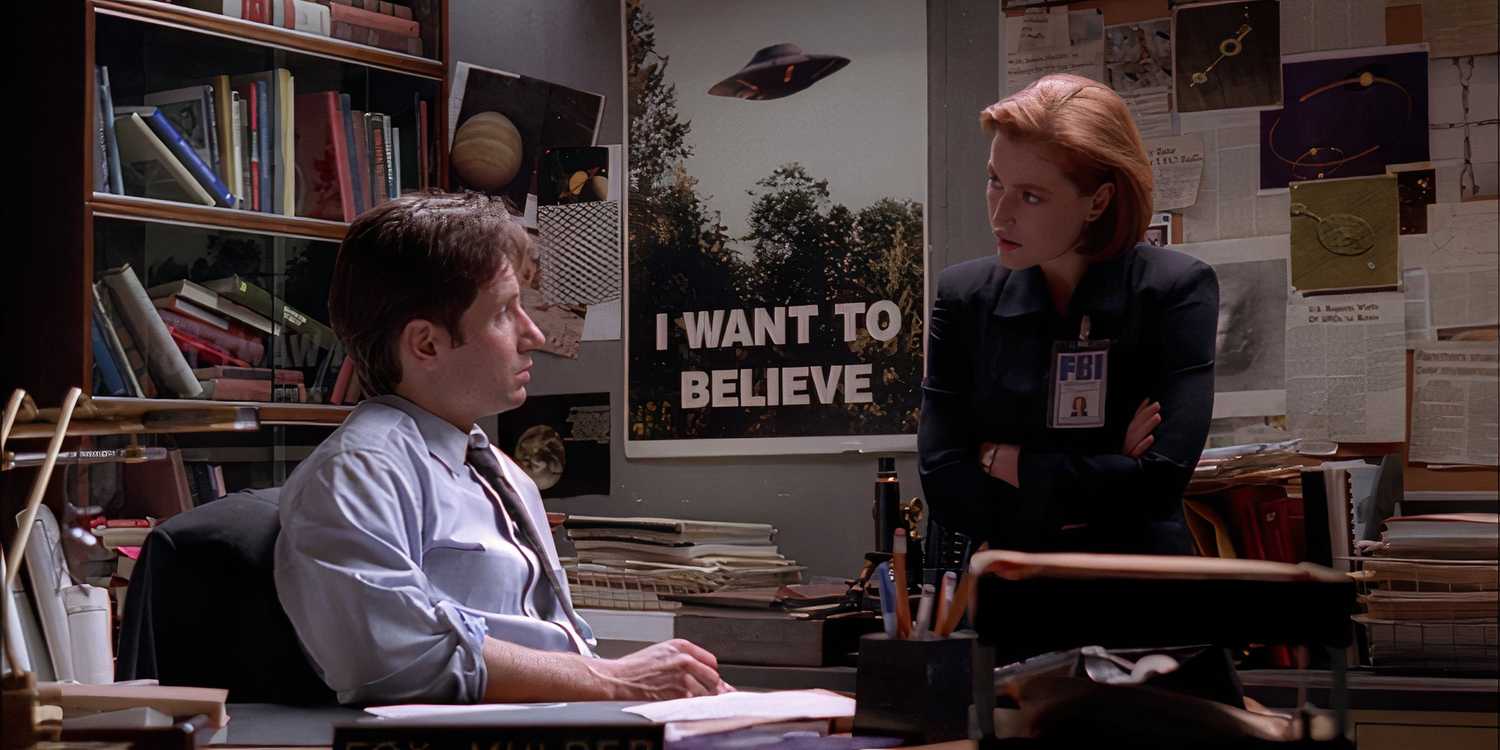
x-files shot showing mulder (david duchovny) and scully (gillian anderson) sitting at mulder's desk with the 'i want to believe' poster in the background

Mulder (David Duchovny) briefs Scully (Gillian Anderson) as she looks at a case file in The X-Files all souls

The X-Files struck a chord with audiences in the early 1990s. Viewers might have been aware of conspiracy theories, especially in light of the Watergate scandal. Many Americans did not trust their own government, leading to a number of thrillers such as Three Days of the Condor or The Parallax View. Yet The X-Files brought a creepy and paranoid vibe to these types of stories. The conspiracies seen on The X-Files ran so much deeper than influencing elections: these were about the survival of the human race.

Related

Gillian Anderson's Agent Scully in The X-Files I Want to Believe 2008

The X-Files reboot, helmed by Sinners director Ryan Coogler, has sparked a heated debate over the iconic sci-fi thriller franchise's future.

By 

These distrustful emotions are still unfortunately present in the national mood, making the return of The X-Files timely and relevant. Coogler’s impending revival will most likely carry on this tradition, updating it for modern times. Yet the classic adventures of Scully and Mulder are timeless, and laid the foundation for a great franchise. Now, an X-Files veteran is returning to see it in a new era.

  • The X-Files #1 is on sale this winter from Dynamite Entertainment!

RELATED


The X-Files Theme Song HQ
THE X-FILES: I Want To Believe Official Trailer (2026) New Mulder & Scully Sci-Fi Movie | 4K

THE X-FILES (The Purity Virus, Alien Hybrids & Ending) EXPLAINED

{ https://screenrant.com/exclusives/ }

Hoe vind je dit bericht?
Geschreven door peter om 22:00 Stuur door

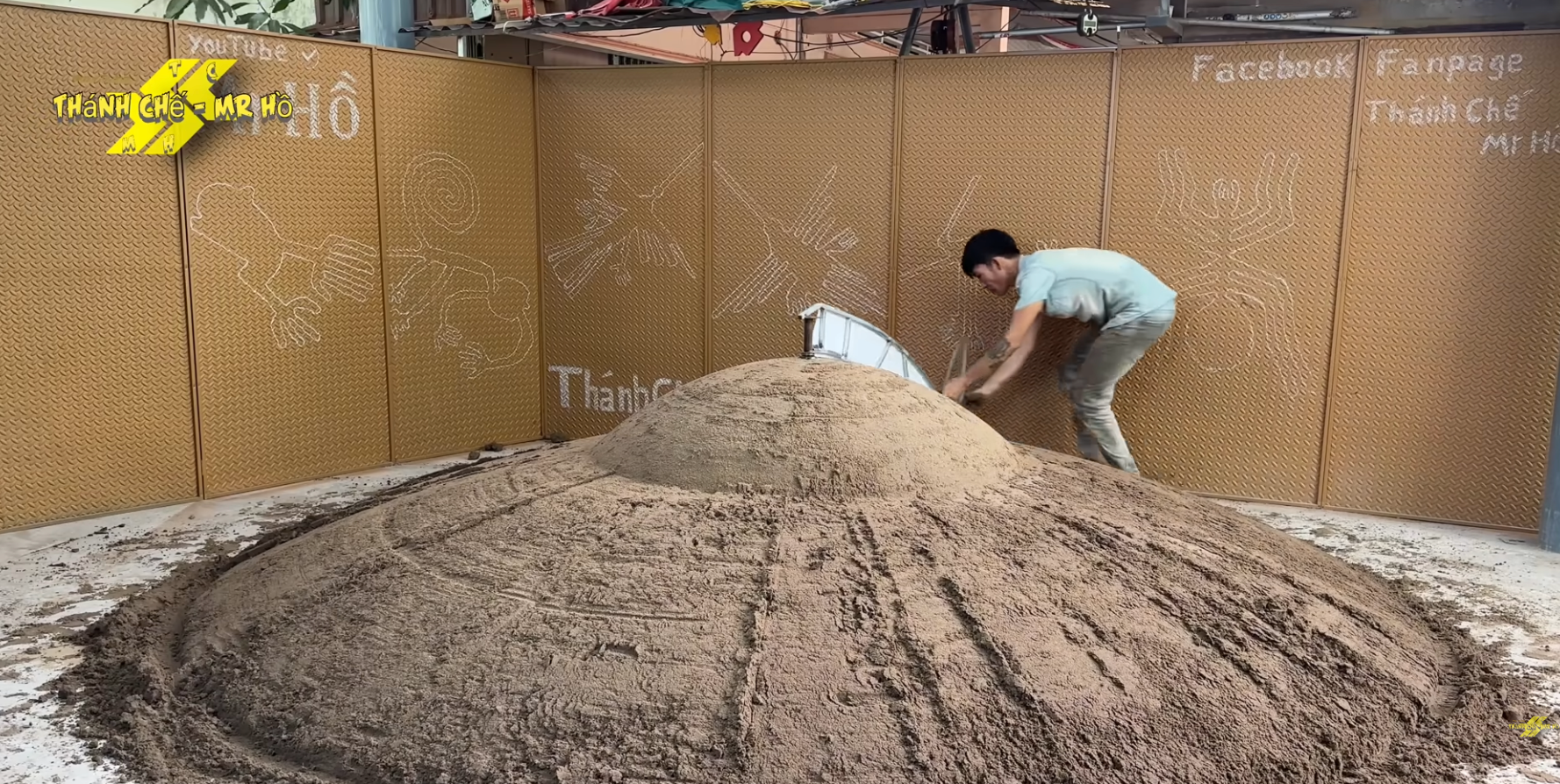
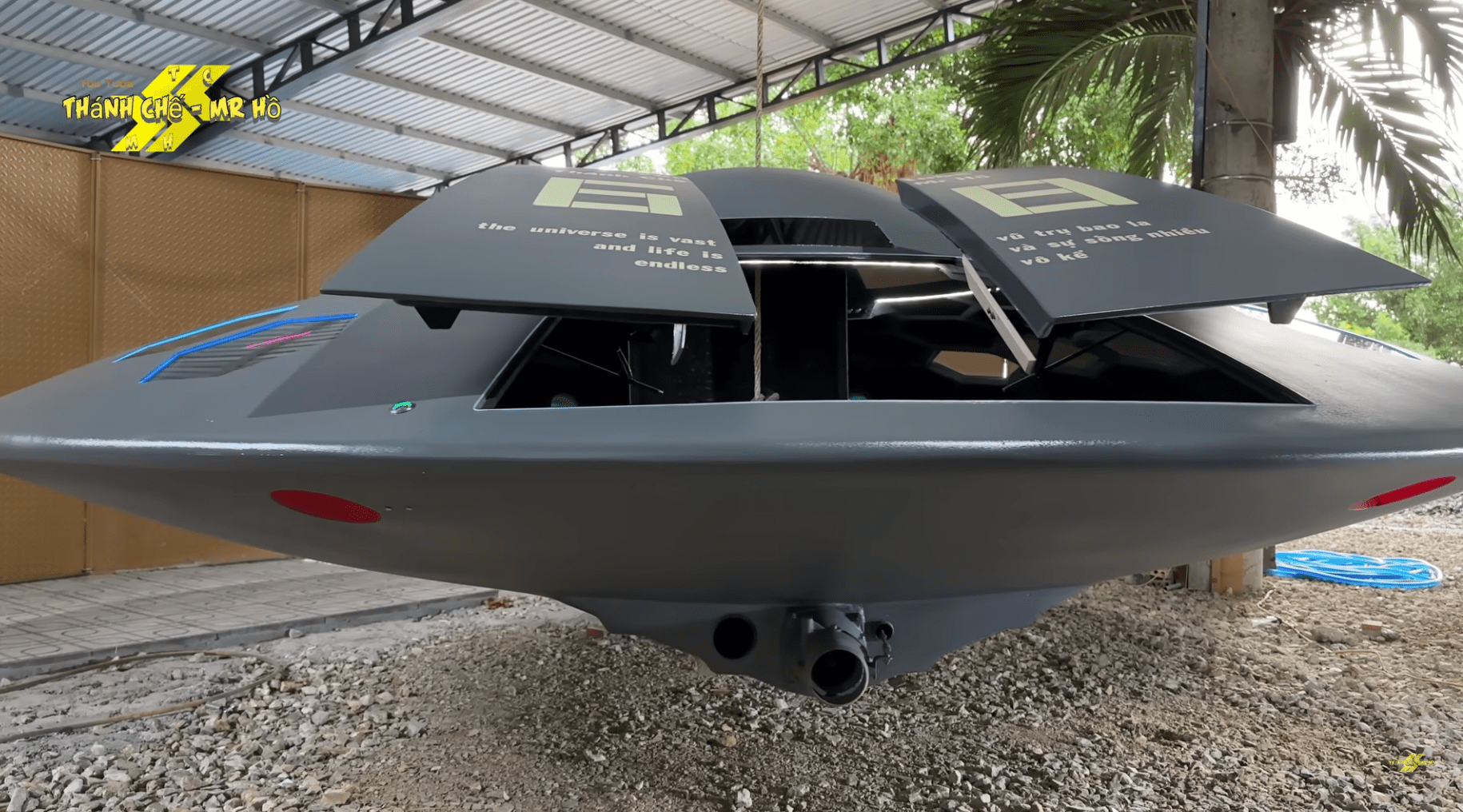
Man builds jet ski UFO of his (literal) dreams

Man builds jet ski UFO of his (literal) dreams

The DIY amphibious flying saucer boat flies down rivers and must be piloted lying down.

{ https://www.popsci.com/category/technology/ }

Hoe vind je dit bericht?
Geschreven door peter om 21:21 Stuur door

Deze nieuwe beelden van de zon laten iets zien wat we nog nooit eerder zagen

Main-Inouye-Image-Horizontal-1-scaled_1.jpg

Deze nieuwe beelden van de zon laten iets zien wat we nog nooit eerder zagen

  Yorick La Rivière - Wetenschapsredacteur astro e.a. + moderator Disqus

Een ontdekking van mini-draaikolken op de zon, vastgelegd door ’s werelds krachtigste zonnetelescoop, geeft eindelijk een verklaring voor de extreme hitte van de corona.

De zon is nog altijd een bron van grote raadsels. Eén van de meest hardnekkige vragen is waarom de buitenste atmosfeer, de corona, miljoenen graden heter is dan het zichtbare oppervlak. Die vraag is mogelijk beantwoord dankzij onthutsend gedetailleerde beelden die onlangs zijn vrijgegeven door de NSF Daniel K. Inouye-zonnetelescoop op Hawaï.

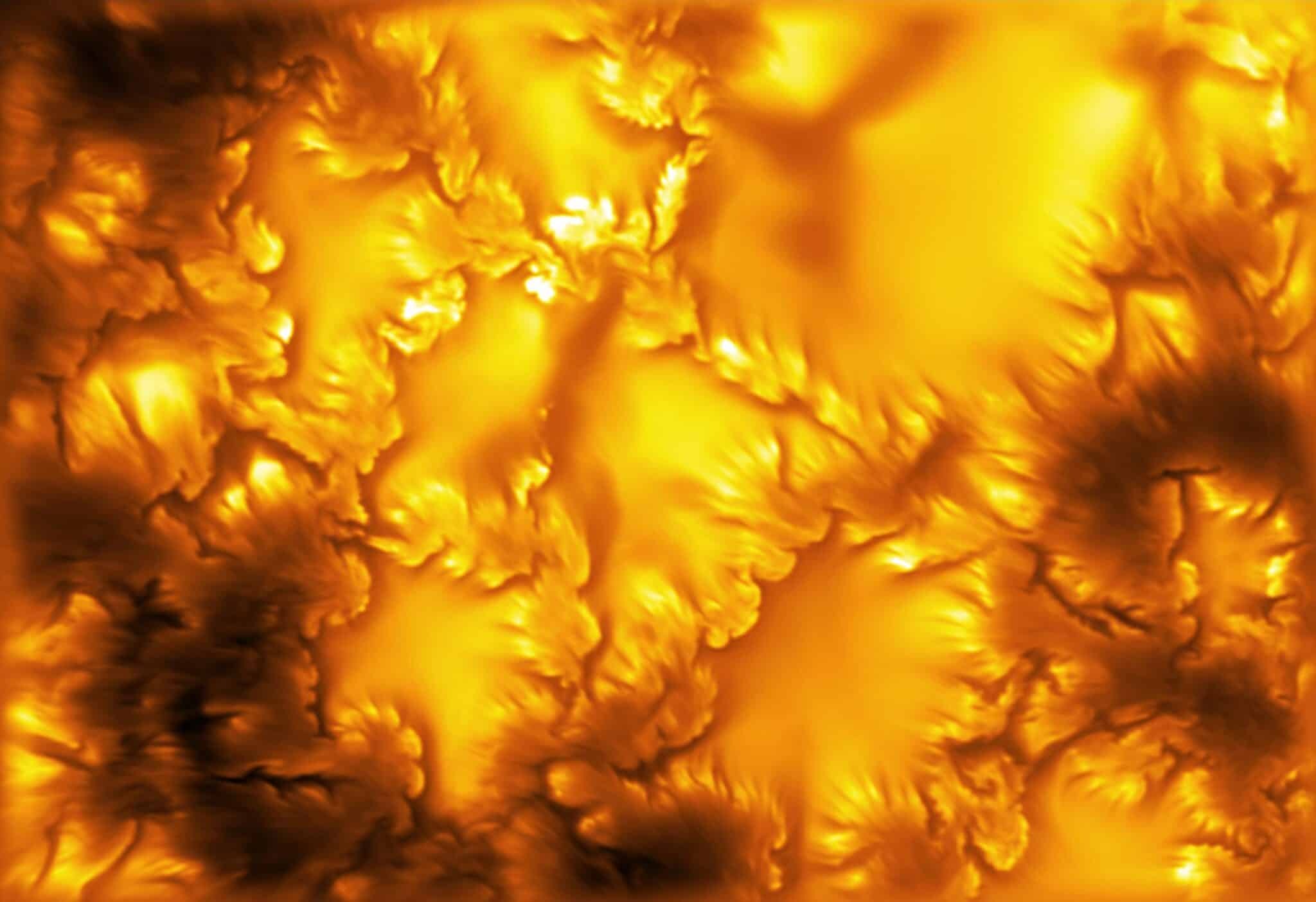
Een nieuwe opname van het zonsoppervlak, vastgelegd door de Inouye-zonnetelescoop, toont de kenmerkende spiraalvormige structuren van ‘Kelvin-Helmholtz-instabiliteiten’, zichtbaar als kleine wervelingen in het turbulente plasma. Foto: NSF/NSO/AURA/MPS

Mini-draaikolken onthuld

De nieuwe opnamen, gemaakt met de krachtigste zonnetelescoop ter wereld, tonen het zonsoppervlak in een nooit eerder gezien detail. Astronomen konden structuren onderscheiden van nog geen 20 kilometer groot in een actief, magnetisch gebied vlakbij een zonnevlek. Op die beelden zagen ze kleine, dynamische wervelingen die lijken op kleine draaikolken of brekende oceaangolven. Deze wervelingen blijken de handtekening te zijn van het zogenoemde Kelvin-Helmholtz-instabiliteit (KHI).

Meer dan mooie plaatjes

Deze instabiliteit is al lang bekend in de vloeistofdynamica en treedt op wanneer twee lagen plasma met verschillende snelheden langs elkaar schuiven. Hierdoor ontstaat er een schuifspanning op de grenslaag, die kleine verstoringen laat uitgroeien tot spiraalvormige wervels . “Mijn eerste reactie was: ‘Wauw, hoe kunnen we zulke kleine, fijnschalige structuren op de zon zien?’,” zegt de aan het observatorium verbonden astronoom Dr. David Kuridze. “Dit is iets wat we nog nooit eerder hebben gezien in zonne-observaties”. De vondst is niet alleen esthetisch; hij heeft diepgaande wetenschappelijke implicaties.

Een simulatie van de ‘Kelvin-Helmholtz-instabiliteit’, waarbij twee lagen plasm ametverschillende snelheden langs elkaar schuiven en zo de karakteristieke draaikolken vormen die nu voor het eerst op de zon zijn waargenomen. Wat begint als een glad grenslaagje, raakt al snel in een chaotische warreling van wervelingen die energie van grotere naar kleinere schalen overbrengen. Animatie: Empetrisor/Wikimedia/CCA-SA-4.0

Het mysterie van de hete corona

Wetenschappers weten al langer dat de extreme hitte van de corona, die miljoenen kelvin kan bedragen, verband houdt met het magnetische veld van de zon. De heersende theorie is dat magnetische veldlijnen zich op een gegeven moment als vlechten in elkaar draaien, waarbij energie wordt opgeslagen die plotseling kan vrijkomen bij een zogenoemde magnetische recombinatie. Het grote vraagteken was echter: wat veroorzaakt dat vervlechten in de eerste plaats? De nieuw ontdekte draaikolken lijken nu de ontbrekende schakel. Ze zijn overal aanwezig waar het magnetisch veld sterk genoeg is, en fungeren als een constante motor die de magnetische veldlijnen in beweging houdt en in elkaar draait.

Een directe vergelijking tussen een echte opname van de Inouye-zonnetelescoop (linksboven) en een gesimuleerd beeld (rechtsboven) op basis van geavanceerde fysische modellen. De opmerkelijke overeenkomst bevestigt dat de waargenomen wervelingen daadwerkelijk Kelvin-Helmholtz-instabiliteiten zijn. De simulatie van het magnetische veld op het zonsoppervlak (rechtsonder) toont daarbij hoe deze processen de magnetische veldlijnen fysiek vervormen en verbuigen. Afbeelding: NSF/NSO/AURA/HAO

De vondst heeft grote gevolgen voor ons begrip van de zonneatmosfeer. “Kelvin-Helmholtz-instabiliteit is waarschijnlijk een mechanisme dat bijdraagt aan de verhitting van de buitenste atmosfeer en een deel van de oplossing vormt voor het aloude raadsel waarom sterren een corona hebben van een miljoen graden Kelvin,” zegt Dr. Thomas Rimmele, hoofd techniek bij het National Solar Observatory. De data tonen bovendien dat dit draai-effect zowel gemagnetiseerd als niet-gemagnetiseerd plasma op het zonsoppervlak efficiënt mengt, waardoor magnetische velden zich sneller over de zonneatmosfeer kunnen verspreiden.

Die versnelling is cruciaal. Het magnetische veld van de zon wordt opgewekt door dynamoprocessen die als gigantische kosmische motoren werken en de rotatie-energie van de ster omzetten in magnetische velden. Maar omdat de magnetische cyclus van de zon slechts (gemiddeld) elf jaar duurt, opvallend snel in kosmische termen, moet de gegenereerde magnetische flux efficiënt kunnen verdwijnen. “Bestaande modellen hebben moeite om deze snelle diffusie te verklaren,” aldus Dr. David Kuridze, astronoom bij het National Solar Observatory. “De Kelvin-Helmholtz-instabiliteit die we in de fotosfeer van de zon hebben ontdekt, kan fungeren als een belangrijke bron van deze ontbrekende magnetische diffusie.”

De kracht van de Inouye-telescoop

Deze doorbraak is volledig te danken aan het ongelofelijke oplossend vermogen van de NSF Daniel K. Inouye Solar Telescope. De telescoop, die vlakbij de top van de vulkaan Haleakalā op Maui staat, is uitgerust met een enorme vier meter brede spiegel en geavanceerde instrumenten. De beelden die de telescoop leveren kan, zijn zó scherp dat het vergelijkbaar is met een onderscheidingsvermogen van een muntstuk op 180 kilometer afstand. “Deze waarnemingen zijn dé validatie met de hoogste resolutie van magnetohydrodynamische simulaties tot nu toe,” verklaart Dr. Matthias Rempel, betrokken bij de analysen van de nieuwste beelden.

De NSF (National Science Foundation) Daniel K. Inouye Solar Telescope op de top van Haleakalā op Maui, Hawaï, Verenigde Staten. Foto: NSO/AURA/NSF

Leestip: 

Een nieuwe blik op onze ster

De ontdekking van de Kelvin-Helmholtz-instabiliteit op het zonsoppervlak is een mijlpaal in de zonnefysica. Het is een essentiële aanwijzing dat de kleinste, tot nu toe onzichtbare structuren een sleutelrol spelen in de grootste processen op de zon, van de mysterieuze verhitting van de corona tot het ontstaan van ruimteweer dat onze technologie op aarde kan beïnvloeden. De Inouye-telescoop blijkt een venster te zijn naar een compleet nieuw niveau van detail, dat ons begrip van onze eigen ster en verre sterren voorgoed zal veranderen.

{ https://scientias.nl/nieuws/astronomie-ruimtevaart/ }

Hoe vind je dit bericht?
Geschreven door peter om 20:49 Stuur door

Green Dust Storm On Mars, Could Confirm Water Exists! NASA Photo, UFO UAP Sighting News.

Green Dust Storm On Mars, Could Confirm Water Exists! NASA Photo, UFO UAP Sighting News.

UFO,%20UFOs,%20UAP,%20UAPs,%20UFO%20sighting,%20UFO%20files,%20UFO%20video%20UAP%20files,%20UAP%20video,%20department%20of%20war,%20alien,%20aliens,%20infrared%20UFO,%20IR%20UFO,%20official%20UFO,%20Gov%20UFO,%20USA%20UFO%20copy.png

Screenshot%202026-08-14%20at%2010.28.03%E2%80%AFAM.png

Date of sighting: Aug 13, 2026
Location of sighting: Mars
Photo: 
Source: 
 
Lets talk about this a bit, because NASA doesn't want too. This photo on the NASA site was clearly over looked by NASA editing staff or it would never have made it this far. There is a green...yes you heard me right, green dusk storm on the far right of this NASA rover photo and it could be an indication of water on Mars. 
 
You see, in the past many times I have found water leaking down the hills near the Mars rover. This green cloud could mean theres a geological dust storm happening. Serpentine is a greenish stone which can form when water interacts with olivine rich rocks...which after the water dries up...could be blown into a green dust storm which we see in the photo. Maybe its not a direct indicator of water right now, but defiantly shows that water once existed on Mars in the past...and where there is water...there is life. 
 
Update: Oh, and I got a few messages from readers saying it might be radioactive dust...I assume from a massive war that may have wiped out the entire planet. I like that theory, and yes its possible for sure. 
Scott C. Waring - UFO Sightings Daily

{ https://www.ufosightingsdaily.com/ }

Hoe vind je dit bericht?
Geschreven door peter om 18:39 Stuur door

How the 'space jellyfish' phenomenon lights up the night sky and why it happens

How the 'space jellyfish' phenomenon lights up the night sky and why it happens

Story by Hayley Vawter
 

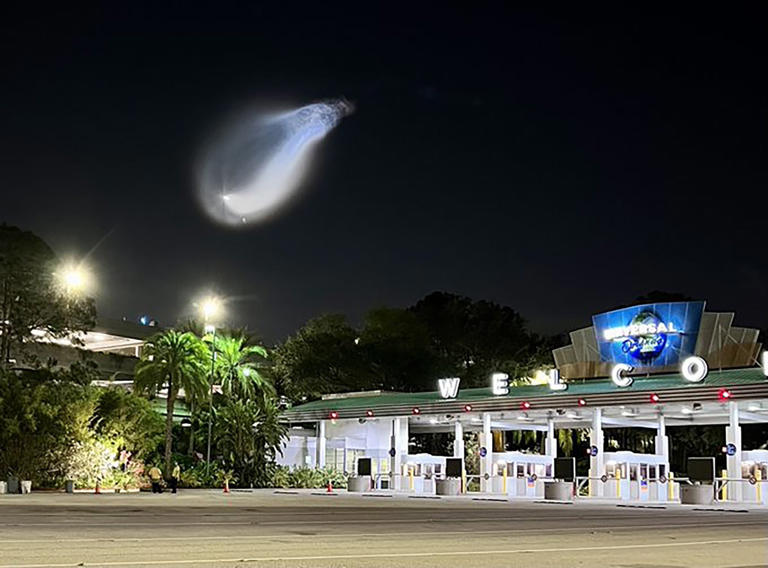
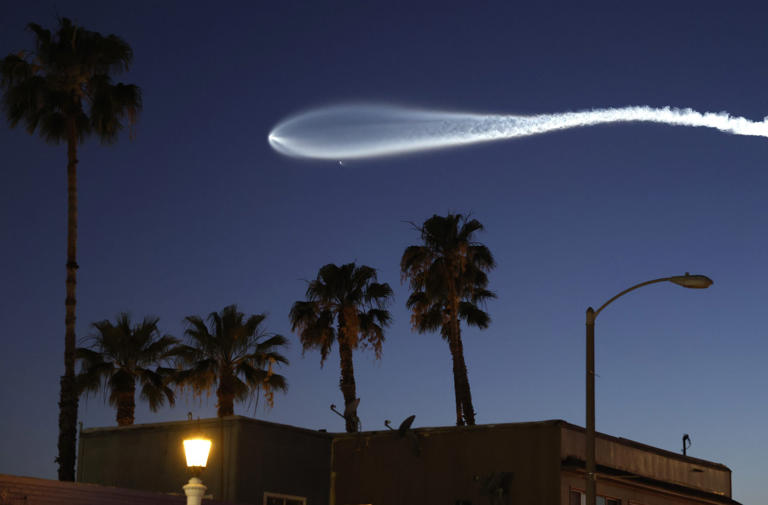
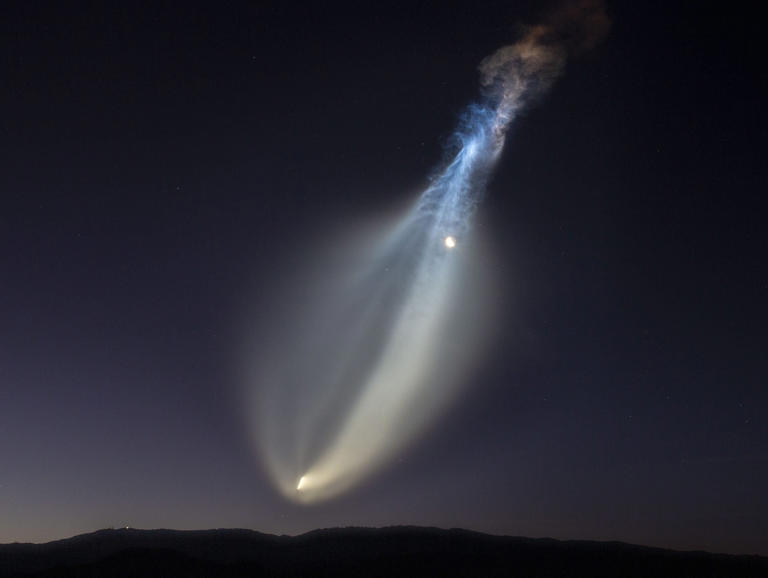
Most people hear the term "space jellyfish" and assume it probably has something to do with the animal in our oceans, but it's actually a phenomenon that happens after some rocket launches. 

Space jellyfish are typically seen in the sky following a SpaceX rocket launch. 

A space jellyfish was seen over Central Florida after SpaceX's launch of another batch of Starlink satellites. Getty Images
A space jellyfish was seen over Central Florida after SpaceX's launch of another batch of Starlink satellites.
Getty Images© Orlando Sentinel File/Tribune News Service

This happens particularly during a Falcon 9 rocket launch, and it's because the rocket's engines expel water vapor and carbon dioxide, according to Space.com. 

As the rocket climbs higher into the sky, the temperature drops and water vapor freezes quickly, forming ice crystals that trail behind the rocket. 

PASADENA, CALIFORNIA - APRIL 06: A SpaceX Falcon 9 rocket rises after launching from Vandenberg Space Force Base carrying 25 Starlink internet satellites on April 6, 2026 as seen from Pasadena, California. Getty Images
PASADENA, CALIFORNIA - APRIL 06: A SpaceX Falcon 9 rocket rises after launching from Vandenberg Space Force Base carrying 25 Starlink internet satellites on April 6, 2026 as seen from Pasadena, California.
Getty Images© Getty Images

The result is a jellyfish-shaped plume that can be colorful, or just plain white, like in the photo above. 

It's all dependent on the timing of the launch. 

If the rocket launch happens around twilight, the effect can have a rainbow or iridescent-like appearance. 

LOMPOC, CA - JANUARY 24: SpaceX, an American aerospace manufacturer, successfully launches a pre-dawn (under a crescent moon) a Falcon 9 rocket with multiple Starlink satellites from Vandenberg Space Force Base on January 24, 2025, in Lompoc, California. Getty Images
LOMPOC, CA - JANUARY 24: SpaceX, an American aerospace manufacturer, successfully launches a pre-dawn (under a crescent moon) a Falcon 9 rocket with multiple Starlink satellites from Vandenberg Space Force Base on January 24, 2025, in Lompoc, California.
Getty Images© Getty Images

If it happens in the dark or during the daylight, it's much less likely to be seen. 

SpaceX launches Falcon 9 rockets quite frequently for its missions to get Starlink and other equipment into space. 

Their primary launch locations are in California and Florida, and occur about every two to three days. 

Original article source: How the 'space jellyfish' phenomenon lights up the night sky and why it happens

Related Links:


Florida's Giant "Space Jellyfish" Explained | Why the SpaceX Falcon 9 Lit Up the Sky

SpaceX Launch Lights Up Florida Skies with Stunning Jellyfish Effect
Hoe vind je dit bericht?
Geschreven door peter om 18:19 Stuur door

The Navy once tested 'invisible' ships. Now, one man sits at the center of the 'Philadelphia Experiment' conspiracy.

The Navy once tested 'invisible' ships. Now, one man sits at the center of the 'Philadelphia Experiment' conspiracy.

Story by Darren Orf

This urban legend has survived decades despite being thoroughly debunked by top military brass.

This urban legend has survived decades despite being thoroughly debunked by top military brass.

© VICTOR HABBICK VISIONS/SCIENCE PHOTO LIBRARY - Getty Images

Here’s what you’ll learn when you read this story:

  • The Philadelphia Experiment is one of the strangest military conspiracy theories, and even inspired a 1984 film based on its grandiose claims of invisibility and time travel.
  • The theory involves the USS Eldridge—a U.S. destroyer escort that, in the late summer of 1943, allegedly teleported from the Philadelphia Naval Yards to Norfolk, Virginia.
  • Although thoroughly debunked by the U.S. Navy and other experts, the “experiment” remains remarkably persistent, in part due to its immense specificity.

It’s the late summer of 1943, and the world is at war.

With the myth of Japanese naval dominance smashed at Midway the previous summer and Nazi Germany's advance halted at Stalingrad that winter, Allied forces were firmly on the offensive. In the midst of this paroxysm of military activity, one of the strangest urban legends in history began to gather steam. This conspiracy theory wasn’t born from secretive murmurings about a doomsday weapon being constructed in New Mexico or submarines that silently plied the depths of enemy waters. No, this myth involved a relatively unassuming Cannon-class destroyer escort, one of the more than 500 destroyer escorts constructed during the war.

The story goes like this. Late in the summer of 1943, the USS Eldridge was drydocked at the Philadelphia Naval Shipyard. Supposedly outfitted with a new kind of a technology, an eerie green glow surrounded the ship, and it disappeared—not just from radar, but completely. Hours later, reports from the crew of the civilian merchant ship SS Andrew Furuseth began to narrate sightings of the Eldridge at the Naval Operating Base in Norfolk, Virginia. Crewmembers were reportedly disfigured in this horrendous teleportation and time travel experiment, and—so the story goes—the U.S. military has kept this incident classified for decades.

Containing secret wartime experiments, a disappearing ship, and time travel, this persistent urban legend has all the trappings of a Hollywood sci-fi film (which is probably why they made one about it 1984). But all of the “information” about this experiment comes from the mind of Carl Allen, whose ravings about Albert Einstein’s “unified field theory” eventually reached the desk of the Navy’s Office of Naval Research (ONR) some 15 years after the supposed “experiment.” These ravings came from the annotations of a UFO book written by amateur astronomer Morris Jessup, and for reasons never explained, ONR published more than 100 copies of this book—annotations included—planting the seeds of the “Philadelphia Experiment” conspiracy.

The U.S. Navy has provided detailed movements of the USS Eldridge (as well as the Andrew Furuseth), along with descriptions of an in-depth search of documents regarding experiments related to invisibility or time travel. Needless to say, Allen’s assertions don’t quite add up. One piece of evidence offered up in favor of the “experiment” claim is that the ship was outfitted with a new kind of technology—a device designed to scramble magnetic signatures in a process called “degaussing.” While this caused invisibility of a sort, it wasn’t the stuff dreamed up in Allen’s musings.

“Degaussing equipment was installed in the hull of Navy ships and could be turned on whenever the ship was in waters that might contain magnetic mines, usually shallow waters in combat areas,” the Naval History and Heritage Command wrote in a post. “It could be said that degaussing, correctly done, makes a ship ‘invisible’ to the sensors of magnetic mines, but the ship remains visible to the human eye, radar, and underwater listening devices.”

Despite being thoroughly debunked, the urban myth of the Philadelphia Experiment remains, and one expert who studied the hoax believes its lasting power might rely on its incredible specificity.

“Vague stories about merely curious or unusual happenings naturally fail to hold an audience’s interest for very long,” French author Jacques Vallée wrote in his paper “Anatomy of a Hoax: The Philadelphia Experiment Fifty Years Later” in 1994. “Thus for a hoax to reach mythic proportions, as the Philadelphia Experiment does, it must be truly amazing by the boldness of its claims, and it must have a well-defined localization in time and space.”

In the end, the lasting legacy of the Philadelphia Experiment might have less to do with its exaggerated claims of secretive time travel technology, and more to do with the mysterious inner workings of the human mind.

RELATED

The Philadelphia Experiment - The truth about invisibility, teleportation and time travel

The Terrifying Philadelphia Experiment

{ https://www.popularmechanics.com/ }

Hoe vind je dit bericht?
Geschreven door peter om 18:06 Stuur door

Mysterious 'jellyfish' spotted in NASA Mars photo sparks theories of life on the Red Planet

Mysterious 'jellyfish' spotted in NASA Mars photo sparks theories of life on the Red Planet

An unearthed NASA image of Mars has captured a strange object in the distance, which some have suggested was a jellyfish-like being or mechanical device.

NASA's Curiosity rover, which has been investigating whether Mars could have supported microbial life for the last 14 years, snapped the image on August 20, 2023 at around 6.27pm ET.

It shows the dusty Martian landscape with rocky hills and large mountains. 

However, the panorama also revealed a small figure in the left corner that appeared to have a large black body perched atop two spindly legs.

Fueling speculation that NASA’s rover had captured something moving across Mars, images taken of the same area less than a minute earlier showed no sign of the mysterious figure. 

Moreover, the photo with the object was the last image posted on NASA's website for that day. The next picture from Curiosity was taken nearly two hours later with the camera pointed in a different direction.

In September 2025, NASA declared it had found the clearest signs of ancient microbial life on Mars in a sample collected by the Perseverance rover. 

However, the space agency and White House have maintained that no signs of intelligent life have ever been found.

An image from NASA's Curiosity rover captured a strange figure standing in the distance in 2023

An image from NASA's Curiosity rover captured a strange figure standing in the distance in 2023

The object was seen in Gale Crater and was not present in images taken seconds before

The object was seen in Gale Crater and was not present in images taken seconds before 

There were no other photos from August 20, 2023 posted by NASA that revealed if the object kept moving, approached the rover or if it was simply a glitch of the camera - which space officials refer to as an 'artifact.' 

The 2023 image was reposted on Wednesday by social media user Kari Sivertzen, a space enthusiast who regularly shares public NASA images that contain strange anomalies that cannot be easily explained. 

Sivertzen said on X: 'Sometimes I spot things that catch my eye, and I share them here. I believe there is life on other planets, and since NASA has found potential traces of life on Mars, it’s the perfect place to look.'

'One of the best Mars UFO photographs I've seen!' one person replied.

Independent Mars researcher Jean Ward said on X: 'Jellyfish-shaped UFO/UAP Spotted on Mars. This one seems to be interacting with the surface. 

'It also reminds me of a tripod-like object.'

Some have compared the distant object to the giant alien walkers seen in the science fiction movie 'War of the Worlds.'

However, many skeptics argued that the small black figure standing in the distance was nothing more than corrupted pixels in Curiosity's photo.

Moreover, the photo with the object was the last image posted on NASA's website for that day. The next picture from Curiosity was taken nearly two hours later with the camera pointed in a different direction

Moreover, the photo with the object was the last image posted on NASA's website for that day. The next picture from Curiosity was taken nearly two hours later with the camera pointed in a different direction

article image

Another doubter claimed the object was actually a human-made craft. 

Specifically, they claimed it was the Ingenuity Mars Helicopter, which made the first powered and remotely controlled flight on another planet in 2021.

However, this claim was quickly debunked as Ingenuity is more than 2,000 miles away in a completely different crater on Mars.

Curiosity rover has been exploring Gale Crater since 2012. The area is a huge impact crater roughly the size of Connecticut and Rhode Island combined, with a towering mountain rising from its center.

Scientists believe this location will provide more evidence that life once existed on Mars thousands, and possibly millions, of years ago.

Like the Perseverance rover, it is using onboard instruments to study rock layers, clay deposits and climate history to look for microbial traces of life.

'Looks like a tower or some type of structure, a dome on top... a relic from Mars distant past civilization,' one person describing the object from 2023 claimed.

'Looks like a scarecrow to me! Really, what is it? Doesn't look like a dust devil!' another viewer said.


Another doubter claimed the object was actually a human-made craft. Specifically, they claimed it was the Ingenuity Mars Helicopter, which made the first powered and remotely controlled flight on another planet in 2021. But this craft was 2,000 miles away

Another doubter claimed the object was actually a human-made craft. Specifically, they claimed it was the Ingenuity Mars Helicopter, which made the first powered and remotely controlled flight on another planet in 2021. But this craft was 2,000 miles away

As Perseverance and Curiosity send back more and more images from the Martian surface, eagle-eyed viewers have been finding a growing number of strange objects which look like doorways, ancient statues and even people walking on the Red Planet.

Such discoveries frequently capture public attention because the human brain naturally attempts to recognize familiar shapes in ambiguous images, a phenomenon known as pareidolia.

It is the same psychological effect that can cause people to see faces in clouds, animals in rock formations or human-made structures across the barren Martian landscape.

Mars has produced several famous examples, most notably the so-called ‘Face on Mars,’ which was photographed by NASA’s Viking 1 orbiter in 1976.

Higher-resolution images later revealed that the apparent face was an ordinary eroded hill whose human-like appearance resulted from shadows and the relatively poor quality of the original photograph.

NASA and the Trump Administration are now planning for the first manned mission to Mars by the end of the decade.

RELATED VIDEOS

“Jellyfish”-shaped UFO Spotted on Mars

A “Jellyfish UFO” Was Spotted on Mars… And It’s Hard to Explain

NASA Found a “Honeycomb” on Mars… WHY? 🔴 | Hidden File #007. #mystery #spacemystery #history

{ https://www.dailymail.com/sciencetech/index.html }

Hoe vind je dit bericht?
Geschreven door peter om 17:42 Stuur door

9 steps to take after spotting a UFO, according to experts

9 steps to take after spotting a UFO, according to experts

Jenny Milam

Hands holding smartphone recording a distant event

Photo by teka nakazawa

9 Steps to Take After Spotting a UFO, According to Experts

Unidentified Anomalous Phenomena (UAPs), formerly known as UFOs, continue to captivate our imagination. With reports on the rise, many people find themselves wondering what to do if they encounter something unexplainable in the sky. The U.S. government and organizations like the All-Domain Anomaly Resolution Office (AARO) are actively investigating these phenomena, but what steps should you take if you’re the one spotting a potential UAP?

Longtime UFO investigator Mick West suggests a methodical approach to exploring these mysteries. By following a set of logical steps, you can help discern whether you’ve witnessed something extraordinary or merely a misinterpreted natural event. Here are 9 steps to take after spotting a UFO.

9. Capture the Moment

First things first, document what you see. A video recording can provide crucial evidence.

Ensure you capture clear footage, and if possible, include audio to offer additional context. This documentation is essential for any further analysis.

man wearing black corded headphones while holding phone

Photo by Attentie Attentie

8. Analyze the Evidence

Use tools like Invisor to extract technical details from your video.

This app helps you retrieve information such as the recording date, resolution, and location, which can be invaluable for investigators.

An airplane leaves a contrail across a clear blue sky.

Photo by Leandro De Torres

7. Check Flight Paths

Consult FlightRadar24 to see if any aircraft were in the vicinity at the time of your sighting.

This tool provides real-time flight information, helping you rule out conventional explanations such as commercial airplanes.

man in black shirt sitting in front of computer

Photo by Faizur Rehman

6. Recreate the Scene

Use Sitrec, a situation recreation tool, to integrate flight data and satellite imagery with your video.

This can provide a clearer understanding of the event and help identify potential sources of the anomaly.

green grass field

Photo by Clark Young

5. Consider Weather Phenomena

Check for weather phenomena like lenticular clouds that could explain what you saw.

These saucer-shaped clouds can often be mistaken for UFOs, providing a logical explanation for your sighting.

Colorful software or web code on a computer monitor

Photo by Markus Spiske

4. Post on UFO Databases

If you’re still unsure, share your experience on databases like Enigma or MUFON.

These platforms allow you to connect with other enthusiasts who might offer insights or similar experiences.

Close-up of hands typing on a laptop next to a cup of coffee on a wooden desk.

Photo by Pixabay

3. Join Forum Discussions

Engage with online communities like Metabunk.org for discussions and debunking resources.

These forums are valuable for sharing experiences and gaining feedback from experienced investigators.

grayscale photo of person holding book

Photo by franco alva

2. Keep an Open Mind

Approach your investigation with a balance of skepticism and open-mindedness.

While most sightings have logical explanations, remaining open to possibilities can lead to a deeper understanding of the phenomenon.

green and black trees under blue sky

Photo by Albert Antony

1. Report to Official Channels

If your sighting remains unexplained, consider reporting it to official channels like the FAA or military.

These organizations can conduct more thorough investigations and contribute to the broader understanding of UAPs.

Read More:


The Belgium UFO That Defied Physics (S4) | The Proof Is Out There | History

{ https://www.aol.com/ }

Hoe vind je dit bericht?
Geschreven door peter om 22:48 Stuur door

zeven stappen om te nemen na een mogelijke UFO-waarneming

Zeven stappen om te nemen na een mogelijke UFO-waarneming

Wat te doen als je een UFO ziet: Wat je moet weten en de juiste stappen om te nemen

Ik wil het graag geloven.

Ja, dat is de tagline van The X-Files, de televisieserie uit de jaren ’90 die ik vaker heb gekeken dan ik wil toegeven. Maar het is ook een soort levensmotto, niet alleen voor Fox Mulder, maar voor heel veel mensen over de hele wereld die ooit een close encounter hadden met een onidentificeerd vliegend object (UFO), dat tegenwoordig bekend staat als “onbekend anomalous fenomeen” of UAP.

Heb jij er ooit een gezien? Ik wacht nog steeds—voor zover ik weet—maar ik ben niet zo chagrijnig als agent Scully over het idee. Onze huidige overheid houdt zich er wel mee bezig: sinds januari 2026 hebben ze honderden documenten vrijgegeven die verzameld zijn sinds 1950 onder een nieuw programma genaamd PURSUE, oftewel het Presidentiële Onthullings- en Rapportagesysteem voor UAP-ontdekkingen. De vijfde grote vrijgave van bestanden kwam net op 7 augustus.

In dit artikel neem ik je mee door wat je moet doen als (uh, wanneer!) je een UFO of UAP ziet, en hoe je je waarneming kunt melden bij autoriteiten, het internet, Hollywood en iedereen die jouw verhaal interessant en het onderzoeken waard vindt. Lees verder voor de zeven stappen die je moet nemen als je een UFO spot.

Abonneer je op de nieuwsbrief ‘Read Up’ van Reader’s Digest voor meer curiositeiten, nieuws, tips, humor, reizen, technologie en leuke weetjes de hele week door.

Hoeveel UFO-waarnemingen zijn er jaarlijks in de Verenigde Staten? Dat hangt ervan af wie de rapporten bijhoudt.

Het officiële overheidsarchief heet het All-Domain Anomaly Resolution Office (AARO), en hun meest recente openbare rapport, over het fiscale jaar 2025, vermeldt 319 waarnemingen—114 daarvan werden “opgelost,” wat betekent dat ze bleken gewoon prozaïsche objecten te zijn zoals ballonnen, satellieten, vogels, vliegtuigen en onbemand luchtvaartuigen (UAS).

Als 319 waarnemingen voor een heel jaar vrij weinig lijkt, is het goed om hier te vermelden dat het AARO alleen rapporten accepteert van huidige of voormalige overheidsmedewerkers, militairen en contractanten. Mijn schoonmoeder, die zweert dat ze een UAP heeft gezien en dat in detail kan navertellen, wordt dus niet meegeteld.

Voor gewone mensen zoals zij (en misschien jij) zijn de belangrijkste bronnen het National UFO Reporting Center, oftewel NUFORC, dat al bestaat sinds 1974, en de Mutual UFO Network (MUFON), dat UFO-onderzoek doet sinds 1969. Beiden hebben uitgebreide online databases waarin je waarnemingen kunt filteren op datum, locatie en andere details, zoals de dramatiek van de waarneming.

Tot nu toe dit jaar heeft NUFORC meer dan 1.800 meldingen van UAPs ontvangen. In de afgelopen jaren varieerden de aantallen van net onder de 4.000 meldingen in 2018 tot bijna 8.000 in 2020. MUFON ontvangt tussen de 500 en 1.000 meldingen per maand.

Dus, wat moet je doen als je een onduidelijk vliegend object ziet? Stel je voor: een mysterieuze, enge UFO boven een gehulde figuur. Op een spookachtig landweggetje. Op een mistige winteravond. David Wall/Getty Images Naast NUFORC en MUFON zijn er tegenwoordig veel bronnen die UAP-waarnemingen verzamelen en bundelen, maar voordat je meteen met je video langsgaat bij één van hen, is het slim om eerst te achterhalen wat je mogelijk hebt gezien zodat je het op de juiste manier kunt rapporteren—indien nodig.

Dus wat moet je doen als je een ongeïdentificeerd vliegend object ziet?

Police helicopter forced to dive after unidentified objects at RAF base ...

Hier is wat je moet doen:

  1. Blijf kalm De meeste UAPs vormen geen bewijs voor buitenaardse bezoekers, of zelfs maar overtuigend bewijs dat ze bestaan. Ben je vlakbij een luchthaven? Is het meteorenseizoen? Is Walmart begonnen met dronebezorging en hoor je sindsdien alleen maar constante vliegpaden boven je huis? (Dat is waarschijnlijk gewoon ik.)

Als geen van deze dingen van toepassing is, pak dan je telefoon.

  1. Documenteer alles Maak foto’s of een video van het object. Volgens NASA is het ook handig om de volgende gegevens te noteren:
  • Datum en tijd in jouw regio
  • Locatie en perspectief
  • Hoe lang je het object hebt waargenomen
  • Hoe lang het duurde om door de lucht te bewegen
  • Hoe snel het ging
  • De richting waarin het zich bewoog
  • Hoe fel het was in vergelijking met andere objecten in de lucht
  1. Neem contact op met je lokale sterrenkundeclub Het klinkt misschien ouderwets, maar NASA’s Night Sky Network is een doorzoekbare database met sterrenkundige clubs door heel de VS. De ruimtevaartorganisatie adviseert om contact met zo’n club op te nemen. Deze clubs zitten vol deskundige sterrenkijkers die het vaker doen en je graag kunnen helpen met plausibele verklaringen voor jouw waarneming.

  2. Reconstrueer de nachtelijke hemel Gebruik Stellarium, een app en website die de sterrenhemel reconstrueert op basis van jouw locatie en de datum/tijd. Zo zie je welke sterren, planeten, de maan en andere hemellichamen zichtbaar waren of zouden moeten zijn op dat moment.

  3. Controleer vlucht- en satellietgegevens Gebruik gratis online tools zoals FlightAware en Flightradar24 om te zien wat er op dat moment boven je vliegt. Satellite Tracker van Star Walk helpt je om satellieten zoals Starlink, de Hubble, het International Space Station en andere ruimtevaartuigen te volgen.

Bijvoorbeeld: Starlink-satellieten vormen vaak een keten van lichtjes, een zogenaamde “satelliettrein,” die erg UFO-achtig kan lijken. Findstarlink.com houdt deze treinen bij en kan helpen om je waarneming te vergelijken met bekende satellieten.

  1. Gebruik geavanceerde tools om je video te vergelijken Voor de meer ervaren UFO-speurneurs is er SitRec (Situational Recreation). Dit is een app die videobeelden van UAP’s analyseert en een reconstructie maakt van wat er op dat moment en op die locatie gebeurde (“sitch”). Je kunt je eigen video uploaden en vergelijken met de recreatie om te zien of je waarneming verklaard kan worden door bekende objecten of fenomenen.

  2. Meld je bevindingen Als je na alle bovenstaande stappen nog steeds denkt dat je iets buitenaards hebt gezien, is het tijd om je melding te maken. Voor militairen, overheidsmedewerkers of contractanten is er de handige online rapportagetool van AARO. Voor de rest van ons zijn NUFORC en MUFON de meest betrouwbare opties. In Belgie geb heb je het Belgisch Ufo Meldpunt, waar  je je waarneming kwijt  kan.

Daarnaast zijn er nieuwe spelers zoals Enigma, een online en app-gebaseerde tool waarmee je foto’s en video’s kunt uploaden, details kunt invoeren en meldingen kunt ontvangen over soortgelijke waarnemingen.

Wat nu? Meestal is het melden van je waarneming al op zich een beloning. Je hebt geholpen aan het vergroten van de wetenschap en nieuwsgierigheid. Je draagt bij aan de verzameling van data die misschien ooit zal leiden tot een doorbraak in het begrijpen van deze mysterieuze fenomenen.

Wil je dat er iemand langs komt om je waarneming te onderzoeken? Geef je rapport door aan MUFON. Elke melding krijgt een veldonderzoeker die contact met je opneemt voor meer details.

Heb je een video die interessant lijkt? Deel het met de media of op je sociale media. Misschien hebben anderen die hetzelfde hebben gezien. Dit is ook een mooie gelegenheid om contact te leggen met andere UAP-liefhebbers, of lid te worden van een sterrenkundeclub om meer te leren over het universum. Als we niet alleen zijn, is samen optrekken zeker geen slecht idee.

BRONNEN

{ PETER2011 }

Hoe vind je dit bericht?
Geschreven door peter om 22:26 Stuur door

Verbijsterende ontdekking in Nieuw-Zeelandse grot onthult fossielen van 1 miljoen jaar oud

Verbijsterende ontdekking in Nieuw-Zeelandse grot onthult fossielen van 1 miljoen jaar oud

341d52416674-1024x576.webp
Interessante fakta – Verbijsterende ontdekking in Nieuw-Zeelandse grot onthult fossielen van 1 miljoen jaar oud

Adembenemende vondst werpt nieuw licht op prehistorische dieren

Een spectaculaire paleontologische ontdekking in een grot op het Noordereiland van Nieuw-Zeeland heeft fascinerende geheimen prijsgegeven over de evolutie van dieren in deze regio. Wetenschappers hebben verstarde overblijfselen gevonden van landdieren die ongeveer een miljoen jaar oud zijn, waardoor we nu kunnen reconstrueren hoe het leven eruitzag lang voordat mensen hun intrede deden. Deze bevindingen schudden onze aannames over de krachten die de biodiversiteit in het verleden hebben gevormd grondig op.

Het onderzoek, gepubliceerd in het vakblad Alcheringa: An Australasian Journal of Palaeontology, documenteert de allereerste verzameling fossielen van landdieren uit die tijdsperiode – het vroege Pleistoceen, dat zich uitstrekte van ongeveer 2,6 miljoen tot 780.000 jaar geleden. Deze vondsten bieden een verrassend nieuwe kijk op hoe vogels transformeerden en welke uitstervingsgolven zich voltrokken, eeuwen voordat de mens een voet op het eiland zette.

Een tijdcapsule uit een grot gaat open

Wetenschappers uit Australië en Nieuw-Zeeland hebben in een grot bij Waitomo op het Noordereiland van Nieuw-Zeeland oude dierlijke resten ontdekt. De fossielensite bevat resten van zo'n miljoen jaar oud, waaronder 12 oude vogelsoorten en vier soorten kikkers. Onderzoekers noemen het een zeldzaam venster op de wilde dieren van Nieuw-Zeeland, lang vóór de komst van mensen.

Verdwenen diversiteit en dramatische veranderingen in de fauna

Bij de analyse van fossielen uit de zogenaamde Moa Eggshell Cave, gelegen nabij de beroemde Waitomo-grotten, identificeerden onderzoekers overblijfselen van vier kikkersoorten uit het geslacht Leiopelma en twaalf verschillende vogelsoorten. Het verbazingwekkende is dat minstens vier, mogelijk zelfs zes van deze vogels nooit meer opdoken in latere fossielvondsten. Dit wijst op ingrijpende verschuivingen en vervanging van soorten gedurende het afgelopen miljoen jaar.

Het artikel stelt nadrukkelijk dat het bestaan van deze fauna vóór de Kidnappers tephra aantoont dat de vogelpopulatie met 33 tot 50 procent is veranderd over het laatste miljoen jaar. Deze aslaag, achtergelaten door een gigantische vulkaanuitbarsting, fungeert als een natuurlijke tijdsmarker die de precieze datering van de resten mogelijk maakt.

Een mogelijke verwant van de kākāpō valt op

Een van de opvallendste vondsten is een oude verwant van de kākāpō, de grote, loopvogelachtige papegaai die vandaag nog leeft. In sommige berichtgeving wordt deze oeroude vorm beschreven als mogelijk beter in staat om te vliegen dan de moderne kākāpō. Dat detail is belangrijk, omdat het laat zien hoe sterk de vogelwereld van Nieuw-Zeeland in de loop van de tijd is veranderd. Zelfs bekende soorten hebben een diepe, veranderlijke geschiedenis.

Twee baanbrekende soortontdekkingen

Tussen de meest opmerkelijke ontdekkingen bevinden zich beschrijvingen van twee nooit eerder geziene soorten. De eerste is Strigops insulaborealis uit de familie Strigopidae, een oude verwant van de huidige kakapo-papegaai. De tweede is Porphyrio claytongreenei uit de familie Rallidae, een uitgestorven voorouder van de moderne takahē.

Het onderzoek meldt ook voor het eerst de aanwezigheid van prehistorische duiven uit de phabine-groep in de oude geschiedenis van Nieuw-Zeeland. Het enorme verschil tussen de dieren uit deze grot en die welke vlak voor de komst van mensen leefden, toont aan dat het uitsterven en vervangen van soorten frequent en ingrijpend was.

Natuurkrachten als oorzaak van massale uitstervingen

De studie benadrukt dat deze uitstervingsgolven werden veroorzaakt door natuurlijke krachten, specifiek razendsnelle klimaatveranderingen en grootschalige vulkaanuitbarstingen. Dit doorbreekt het populaire beeld dat massale uitsterving alleen verband hield met de aankomst van mensen op het eiland, ongeveer 750 jaar geleden.

Volgens Trevor Worthy, hoofdauteur van het onderzoek, demonstreert dit werk dat natuurkrachten zoals supervulkanen en dramatische klimaatschommelingen al meer dan een miljoen jaar geleden de unieke samenstelling van de fauna vormgaven. De vulkanische aslagen maken het mogelijk om de ouderdom van de gevonden resten nauwkeurig vast te stellen.

De prehistorische wilde dieren van Nieuw-Zeeland stonden niet stil voordat mensen arriveerden. Vulkanische activiteit, klimaatveranderingen en milieuveranderingen bepaalden welke dieren overleefden. De fossielen vullen een gat op tussen veel oudere vondsten en recentere fauna uit de tijd vóór de mens. Ze laten zien dat het landschap al te maken had met natuurlijke veranderingen.

Kikkers voegen een extra laag toe

De fossiele kikkers zijn belangrijk, omdat amfibieën vaak minder zichtbaar zijn in openbare discussies over de natuur van Nieuw-Zeeland. Hun aanwezigheid helpt het oude milieu te reconstrueren, inclusief vochtigheid, habitatstructuur en klimaat. Een fossiele grot is niet alleen een lijst met botten. Het is een verslag van een ecosysteem.

Precisiedatering dankzij vulkanische aslagen

Wetenschappers slaagden erin de exacte ouderdom van de fossielen te bepalen dankzij twee lagen vulkanische as die in de grot werden aangetroffen. De onderste laag ontstond na een uitbarsting die 1,55 miljoen jaar geleden plaatsvond, terwijl de bovenste laag gevormd werd na de Kidnappers-superuitbarsting van 1 miljoen jaar geleden.

Daarnaast ontdekten onderzoekers aan het oppervlak van de sedimenten een speleotheem – een mineralenformatie zoals een stalagmiet – die 535.000 jaar oud is. Deze combinatie van vulkanische lagen en mineraalformaties maakt nauwkeurige datering mogelijk, waardoor deze locatie de oudst bekende fossielegrot op het Noordereiland van Nieuw-Zeeland is.

Multidisciplinair team ontraadselt mysteries

Een multidisciplinair team van paleontologen van Flinders University en Canterbury Museum werkte samen met vulkanologen van de Universiteit van Auckland en Victoria University in Wellington om de soorten te identificeren. Ze vergeleken de gevonden botten met huidige soorten en andere fossielen, waarbij ze uitgebreide studies uitvoerden naar hun vorm en structuur.

Worthy benadrukt dat deze fossielen een cruciale basis bieden die ontbrak in de natuurlijke geschiedenis van het land. Ze vormen een essentieel referentiepunt voor het analyseren van de evolutie van de inheemse fauna.

Nieuwe theorieën over overleven op afgelegen eilanden

Deze ontdekking levert ongekende informatie over de evolutie van biodiversiteit in de regio. De bevinding dat voorouders van de kakapo-papegaai waarschijnlijk konden vliegen, samen met duivensoorten verwant aan Australische neven, maakt het mogelijk om nieuwe hypotheses te formuleren over hoe vogels aankwamen, zich verspreidden en aanpasten in Nieuw-Zeeland.

Tegelijkertijd vult het onderzoek een belangrijke lacune in de fossielengeschiedenis van de regio, waarin tot nu toe geen gegevens waren over landdieren van die ouderdom in grotten. Dit werk onderstreept het belang van het herstellen en bestuderen van oude fossielverzamelingen om te begrijpen hoe dieren reageren op extreme milieucrises.

De informatie verkregen uit de Moa Eggshell Cave zal een fundamentele bron zijn voor toekomstig onderzoek naar hoe soorten uitsterven, diversifiëren en overleven op oceanische eilanden. Deze grot biedt een zeldzaam venster op een verborgen wereld die ons begrip van de natuurgeschiedenis volledig hervormt.

Uitsterven heeft een langere geschiedenis

De komst van mensen veranderde de wilde dieren van Nieuw-Zeeland ingrijpend, maar deze ontdekking laat zien dat er daarvoor ook al verliezen en veranderingen waren. Dat neemt de huidige verantwoordelijkheid niet weg. Het helpt wetenschappers juist om te begrijpen hoe natuurlijke druk en menselijke druk van elkaar verschillen. De grot onthult een verloren wereld, maar ook een waarschuwing over hoe snel uniek eilandleven kan veranderen.

{ https://bloedjesbloemen.nl/ }

Hoe vind je dit bericht?
Geschreven door peter om 17:45 Stuur door

Creepy 'demon' fish with no eyes found hidden beneath 'Area 51' military base

Creepy 'demon' fish with no eyes found hidden beneath 'Area 51' military base

Scientists have discovered a bizarre, eyeless 'demon fish' living in toxic underground pools beneath a secretive US military base tied to UFO rumours

BY Liam Randall - News Reporter

An eerie 'demon fish' with no eyes and transparent skin has been discovered lurking in subterranean waters

An eerie 'demon fish' with no eyes and transparent skin has been discovered lurking in subterranean waters

(Image: Jam Press/Matthew L. Niemiller, Niemiller Nature LLC)

An eerie "demon fish" with no eyes and completely transparent skin has been discovered lurking in subterranean waters directly beneath a secretive US military base dubbed "Alabama's Area 51".

The tiny, creepy creature, measuring just two inches long, was uncovered in a single, pitch-black underground cave system beneath the US Army's Redstone Arsenal in Huntsville.

Scientists who stumbled across the terrifying-looking specimen have officially named it Demogorgonichthys arcanus, or the "demon cavefish".

Despite being discovered beneath a high-security facility closely tied to classified rocket research and long-standing UFO rumours, the strange organism isn't an alien lifeform. However, genetic analysis revealed it is an incredible evolutionary anomaly that split from its closest ancestors over 11.6 million years ago.

The creature was uncovered in an underground cave beneath the US Army's Redstone Arsenal

The creature was uncovered in an underground cave beneath the US Army's Redstone Arsenal

(Image: Jam Press/Matthew L. Niemiller, Niemiller Nature LLC)

Having adapted to a life of total, relentless darkness deep underground, the fish completely shed its eyes and skin pigmentation, replacing them with specialized sensory organs scattered across its body to hunt and navigate.

Astonishingly, it evolved side-by-side in the exact same cave pools alongside another species, the Southern Cavefish (Typhlichthys subterraneus), but followed an entirely different genetic path.

Dr Matthew Niemiller, associate professor of biological sciences at the University of Alabama, said: "This is one of the last places we'd have bet on it.

Scientists who stumbled across the terrifying-looking specimen have named it the 'demon cavefish'

Scientists who stumbled across the terrifying-looking specimen have named it the 'demon cavefish'

(Image: Jam Press/Matthew L. Niemiller, Niemiller Nature LLC)

"Finding an entirely unknown, new genus of freshwater fish in eastern North America today is a little like finding a new kind of big cat.

"The group is so well known, we thought the big surprises were behind us. To have one turn up in a cave we've watched for three decades is a real reminder to stay curious. It was genuinely surprising."

Only a handful of the ghostly fish were spotted between 2019 and 2025 during surveys published in Scientific Reports.

Because it exists only within a single location beneath the military base, experts warn it is critically endangered and extremely vulnerable to environmental changes.

Iron-clad security around Redstone Arsenal has inadvertently protected the cave from public developments.

However, researchers discovered the creature's fragile habitat is actively contaminated with toxic remnants of chemical weapons and explosives.

Writing in their study, the research team said: "Trace metals, including cadmium, chromium, and lead, have been detected at elevated concentrations in water samples from Bobcat Cave over the past two decades."

The contamination stems from an old industrial zone on the base where the military historically disposed of weapons materials, which slowly leaked into the groundwater.

First opened in 1941, Redstone Arsenal was the birthplace of NASA and currently employs over 45,000 personnel.

However, its recent selection as the headquarters for US Space Command has sparked wild internet conspiracies that ET technology was relocated there from Area 51 in Nevada.

Before her death in 2022, local anti-gravity researcher Amy Eskridge fuelled the rumours during an interview, claiming: "Redstone Arsenal in Huntsville, Alabama is the biggest f****** deal that you've never heard of."

RELATED

The Eyeless Demon Cavefish Beneath a Military Base #CreepyNature #Science

Scientists Found a “Demon Fish” Hiding Beneath Alabama — And It Has No Eyes

{ https://www.dailystar.co.uk/ }

Hoe vind je dit bericht?
Geschreven door peter om 17:27 Stuur door

Arctic fossil abandoned in 1948 proves to be record-size Triassic hunter

Arctic fossil abandoned in 1948 proves to be record-size Triassic hunter

What the fossil of Arctobatrachus urdensis looked like in 1948 (A–C), the skull today (D), and a reconstructed drawing (E). Scale bar = 10 cm. Credit: Schoch et al. 2026

Nearly 80 years ago, a British expedition discovered the battered remains of a giant fossil on the peak of an Arctic island. Unable to take it with them, they snapped some pictures, took some bones and left the fossil to be ravaged by the icy winds and rain. Little did they know it would be found again decades later and turn out to be the first of its kind and a giant among its peers.

The fossil found on Bjørnøya (Bear Island) all those years ago has now been identified as a new species of ancient amphibian-like creature, a plagiosaurid, researchers reported in a study published in Papers in Palaeontology. Named Arctobatrachus urdensis, the creature was a giant, roughly 2.7 m (about 8.9 feet) long, making it by far the largest plagiosaurid ever discovered.

"This species was one of many winners of an extremely hot period that caused a huge extinction a few million years earlier," said Rainer Schoch, a paleontologist at the State Museum of Natural History Stuttgart.

A fossil forgotten in the Arctic

Plagiosaurids were a group of extinct bottom-dwelling, flat-bodied creatures that lived during the Triassic period (~251 to 201 million years ago). What set them apart was their extremely bizarre body shape. "The skull was much wider than long, and its outline resembles a boomerang," Schoch said.

Fossil abandoned in the Arctic in 1948 identified as new species of giant plagiosaurid

Arctobatrachus urdensis skull (A) compared to those of various other plagiosaurid species. Scale bar = 5 cm. Credit: Schoch et al. 2026

According to the study, these creatures lived at the bottom of rivers, lakes and seas, where they would lie in wait for anything that came too close, sucking in their prey through wide, gaping mouths lined with tiny teeth.

Their fossils have been discovered across the ancient world, from Brazil to China, but one fossil, discovered in 1948, would not be recovered until decades later. Assuming the harsh Arctic winters wouldn't allow the fossil to survive, researchers had long given up on it until a Norwegian field party made a chance rediscovery in 1984.

In the 37 years since it was last seen by human eyes, the fossil had been thoroughly beaten, and various cracks and missing bones told a tale of decades exposed to Mother Nature's harsh climate.

After a weeklong excavation, it was finally retrieved, yet it would sit mostly unexamined for a few more decades until it was fully prepared at the Stuttgart museum for the current study.

A giant predator of the Triassic seas

Using photographs taken in 1948, the researchers reconstructed the missing portions of the skull. The skull alone was a whopping 70 cm (~27.6 inches) wide, but only around 21 cm (~8.3 inches) long, giving it an unusual shape. The skull was much wider than long, and its outline created a near-perfect semicircle.

Its massive size, large teeth and unusually wide mouth all suggested it had been an active hunter and possibly a top predator. In addition, its features were unlike any other, suggesting it was an entirely new species. They named it Arctobatrachus urdensis.

Analysis of its position in the family tree revealed it was one of the earliest members of the plagiosaurids, giving researchers a rare window into what the ancestors of this bizarre lineage may have looked like. Initially, these creatures were more active swimmers with less flat bodies before evolving into more sedentary, flatter-bodied animals.

The discovery adds to the growing understanding of these elusive marine creatures.

"Many people are fascinated by our past," Schoch said. "What did the planet, its climate and life look like, say 240 million years ago?" Fossils like this giant flat-headed plagiosaurid offer a glimpse into that ancient world.

Written for you by our author Sandee Oster, edited by Gaby Clark, and fact-checked and reviewed by Robert Egan—this article is the result of careful human work. We rely on readers like you to keep independent science journalism alive. If this reporting matters to you, please consider a donation (especially monthly). You'll get an ad-free account as a thank-you.

Publication details
  • Rainer R. Schoch et al, A giant plagiosaurid temnospondyl from Bjørnøya (Svalbard, Norway) and the origin of the plagiosaurid body plan, Papers in Palaeontology (2026). DOI: 10.1002/spp2.70115

Journal information: 

{ https://phys.org/biology-news/paleontology/ }

Hoe vind je dit bericht?
Geschreven door peter om 17:05 Stuur door

Fossiel dat in 1948 in de buurt van de Noordpool werd achtergelaten, blijkt van gigantisch onbekend dier

Fossiel dat in 1948 in de buurt van de Noordpool werd achtergelaten, blijkt van gigantisch onbekend dier

fossil-abandoned-in-th-e1786554735476.jpg
Hoe het fossiel van Arctobatrachus urdensis er in 1948 uitzag (A–C), de schedel zoals die er nu uitziet (D), en een gereconstrueerde tekening (E). Schaalbalk = 10 cm.
Foto: Schoch et al. 2026

Bijna tachtig jaar geleden stuitte een Britse expeditie op de gehavende resten van een gigantisch fossiel op de top van Bereneiland, onderdeel van Spitsbergen. Het gevaarte bleek te groot om mee te nemen. De onderzoekers maakten foto’s, namen enkele botten mee en lieten de rest achter. Decennialang leek het fossiel verloren. Tot nu. Het blijkt te gaan om de grootste vertegenwoordiger ooit van een merkwaardige groep oeroude, amfibieachtige dieren.

De nieuwe soort krijgt de naam Arctobatrachus urdensis. Het dier behoorde tot de plagiosauriërs, een uitgestorven groep grote roofdieren die tijdens het Trias leefden, zo’n 251 tot 201 miljoen jaar geleden. Met een geschatte lichaamslengte van ongeveer 2,7 meter torende Arctobatrachus urdensis ver boven alle eerder bekende plagiosauriërs uit. “De soort was een van de overlevers van een extreem hete periode die enkele miljoenen jaren eerder een enorme uitstervingsgolf veroorzaakte”, vertelt paleontoloog Rainer Schoch van het natuurhistorisch museum in Stuttgart.

Fossiel raakte tientallen jaren uit beeld

Plagiosauriërs hadden een opvallend uiterlijk. Ze leefden op de bodem van rivieren, meren en ondiepe zeeën, waar ze roerloos wachtten tot een prooi dichtbij kwam. Vervolgens zogen ze die met hun enorme bek naar binnen. Hun brede kaken zaten vol met talloze kleine tanden. “De schedel was veel breder dan hij lang was en de omtrek lijkt op een boemerang”, zegt Schoch.

Fossielen van plagiosauriërs zijn eerder gevonden op uiteenlopende plekken, van Brazilië tot China. Het exemplaar van Bjørnøya, zoals Bereneiland officieel heet, kende echter een uitzonderlijke geschiedenis. Nadat het in 1948 was ontdekt, gingen onderzoekers ervan uit dat het de strenge Arctische winters niet zou overleven. Pas in 1984 stuitte een Noorse expeditie bij toeval opnieuw op het fossiel.

In de 37 jaar dat niemand het had gezien, had het flink te lijden gehad onder het poolklimaat. Scheuren en ontbrekende botten verrieden hoe wind, regen en vorst hun sporen hadden nagelaten. Na een opgraving van een week werd het fossiel veiliggesteld. Vervolgens bleef het opnieuw jarenlang grotendeels onaangeroerd, totdat het in het museum in Stuttgart zorgvuldig werd geprepareerd voor het huidige onderzoek.

Leestip: 

Gigantische schedel

De oude foto’s uit 1948 bleken van onschatbare waarde. Daarmee konden ontbrekende delen van de schedel worden gereconstrueerd. De schedel was ongeveer 70 centimeter breed, maar slechts 21 centimeter lang. Hij had een bijna perfecte halfronde vorm.

De enorme afmetingen, de grote tanden en de uitzonderlijk brede bek wijzen erop dat het dier een actieve jager was en mogelijk tot de toppredatoren van zijn leefgebied behoorde. Tegelijkertijd wijkt de bouw van het fossiel duidelijk af van alle bekende plagiosauriërs, waardoor duidelijk is dat het om een nieuwe soort gaat.

Analyse van de evolutionaire verwanten laat bovendien zien dat Arctobatrachus urdensis tot de vroegste leden van de plagiosauriërs behoort. Daarmee biedt het fossiel een zeldzame blik op de voorouders van deze opmerkelijke diergroep. In hun vroege geschiedenis waren plagiosauriërs actievere zwemmende dieren met een minder afgeplat lichaam. Pas later ontwikkelden ze de sterk afgeplatte lichaamsvorm waarmee ze langdurig op de bodem konden liggen.

De vondst levert daarmee nieuwe inzichten op in de evolutie van deze mysterieuze waterroofdieren uit het Trias. “Veel mensen zijn gefascineerd door ons verleden”, zegt Schoch. “Hoe zagen de planeet, het klimaat en het leven er bijvoorbeeld 240 miljoen jaar geleden uit? Fossielen zoals deze reusachtige plagiosauriër met zijn platte kop bieden een zeldzame blik op die verdwenen wereld.”

Bronmateriaal

{ https://scientias.nl/ }

Hoe vind je dit bericht?
Geschreven door peter om 16:43 Stuur door

UFO Makes Loops Over Cleveland, Texas, USA On Aug 10, 2026, UAP Sighting News.

UFO Makes Loops Over Cleveland, Texas, USA On Aug 10, 2026, UAP Sighting News.

UFO_Texas.png

UAP,%20Texas.png

Date of sighting: Aug 19, 2026
Location of sighting: Cleveland, Texas, USA
Source: 
Now spinning UFOs are not unheard of. I have seen hundreds of reports of UFOs spinning in loops, so don't think it doest happen. When this person posted the video people left comments saying it was Venus, clouds, ect and even came to the conclusion it was his truck causing Venus to bounce around. Clearly they didn't think this out or they would have noticed that when he was moving around, the from inside the truck to outside, it was still moving. And its focus was great, nothing out like telephone pole wires were shaking, instead the wires were steady and focused the whole time and so were the clouds, this means the UFO really was spinning in loops. 
Awesome rare footage. Don't let non believers change the truth into a lie.  The truth is in the details. To attack an eyewitness when the attackers were not even there to see it for themselves is a very ignorant act indeed. 
Scott C. Waring - UFO Sightings Daily 
 
Eyewitness states: 
Recorded this while at work yesterday. Any ideas as to what this might be?
 

UFO Flying In Loops Over Cleveland, Texas USA Aug 19, 2026, UAP Sighting Alien Paranormal News.

{ https://www.ufosightingsdaily.com/ }

Hoe vind je dit bericht?
Geschreven door peter om 16:23 Stuur door

Jellyfish-Like Entity Captured in the Martian Sky

Jellyfish-Like Entity Captured in the Martian Sky

To this day, unusual objects continue to be observed in the Martian atmosphere. Some have been interpreted as possible UFOs or other unknown phenomena moving through Martian airspace. While there is no confirmed evidence that these objects represent intelligent life, their presence has raised questions about what may still exist on or beneath the surface of Mars. 
The next image was captured by the Right Navigation Camera aboard NASA’s Curiosity rover on Sol 3924, corresponding to August 20, 2023, at 22:27:46 UTC. 
jellyfish%20like%20entity%20Mars.jpg

It appears to show a strange entity in the Martian sky resembling a tripod-like or jellyfish-like life form, seemingly interacting with the surface below. 
Coincidence? The entity's appearance is remarkably similar to the tripod-like creatures depicted in War of the Worlds and the heptapod-like beings featured in Arrival. There may be more happening on Mars than NASA is telling us. 
Kari Sivertzen, who discovered the jellyfish-like object, as well as Joe White, Scott Waring and Jean Ward also identified several other possible UFO's in images of the Martian sky. According to their analysis, these UFO's appear to be more than simple camera artifacts or dust particles on the lens. 
UFOs%20martian%20sky.png

In the next video, Jean Ward examines the mysterious entity and UFO's in greater detail.
  

{ https://ufosightingshotspot.blogspot.com/ }

Hoe vind je dit bericht?
Geschreven door peter om 16:10 Stuur door

Scientists discover a never–before–seen astronomical object that's a mashup of a black hole and a huge star – and it could explain the mysterious red dots in deep–space images

Scientists discover a never–before–seen astronomical object that's a mashup of a black hole and a huge star – and it could explain the mysterious red dots in deep–space images

A never-before-seen astronomical object has been discovered in the very early universe – and scientists believe it's a mashup of a black hole and a huge star.

Researchers were using the James Webb Space Telescope (JWST) to hunt for the earliest galaxies when they spotted an impossibly bright and incredibly red object.

It looked like a vast star, stretching out to cover an area as large as our entire solar system.

However, scientists were shocked to see that this bizarre dot was somehow pumping out 100 billion times more energy than any star can physically produce.

Lead author Dr Rohan Naidu, of the Massachusetts Institute of Technology and University of Hawai'i, says: 'That means you can't be powering this by nuclear fusion, which is the energy source that sits at the heart of all the stars we have.'

In a new paper, published in the journal Nature, Dr Naidu argues this must be an entirely new form of astronomical object known as a 'black hole star'.

The black hole star, dubbed MoM–BH*–1, is an enormous cloud of gas powered, not by fusion, but by the terrible forces of a central black hole.

The researchers estimate that this black hole has a mass 100,000 times greater than our sun and creates so much energy that it shines through its dense gas cocoon.

Scientists have discovered a never-before-seen object in the early universe that is a mashup of a black hole and a star (artist's impression)

Scientists have discovered a never–before–seen object in the early universe that is a mashup of a black hole and a star (artist's impression) 

Dr Naidu and his colleagues didn't set out to find a black hole star, but were trying to investigate the very bright galaxies that appear extremely early in the universe's history.

But, while conducting their 'Miracle or Mirage' survey, the researchers spotted a dot that was different to anything they had seen before.

Just as smoke from a wildfire can make the sky over nearby cities turn crimson, clouds of dust in the universe often give sources of light a distinctive red tinge.

However, this red dot's other characteristics didn't match up with what scientists have come to expect from a drifting cloud of gas and dust.

Dr Naidu says: 'The way its light is almost entirely red and abruptly disappears below a certain wavelength is so dramatic that there is no comparison among any prior set of objects.'

That drop-off in light, known as a Balmer Break, is usually associated with dense gases soaking up photons in the atmospheres of stars that are a few hundred million years old.

This phenomenon isn't rare, and scientists can even see it in the light coming from Vega, one of the brightest stars in the night sky.

However, the Balmer Break coming from this red dot was the deepest scientists had ever seen, ruling out 'ordinary' stars as a potential source.

This 'black hole star' is a solar-system-sized cloud of dense hydrogen that is powered, not by fusion like a normal star, but by an enormous black hole with a mass 100,000 times greater than our sun

This 'black hole star' is a solar–system–sized cloud of dense hydrogen that is powered, not by fusion like a normal star, but by an enormous black hole with a mass 100,000 times greater than our sun

Even stranger, the red dot's light didn't contain any signatures of metal that would normally be found in a star, and only contained hydrogen and helium.

'It is a very special thing to find an object with no comparison given the vast stores of data on billions of stars, galaxies, and black holes that we have in astronomical archival databases,' Dr Naidu says.

'But it made us wonder if we were seeing a new kind of "stellar atmosphere", but on a spectacular scale'.

The researchers ran various computer simulations to see what combinations of astronomical features would explain the dot's distinctive colouration and brightness.

But it was only when the team replaced the star with an active black hole cocooned in hydrogen that their simulations started to match what they were seeing in reality.

The simulation that was the closest match for MoM–BH*–1 was a vast black hole 100,000 times the mass of the sun surrounded by a cocoon of hydrogen so dense that it resembles the surface of a solar system-sized star.

'The rapidly feeding black hole at its centre is the source of its energy,' Dr Naidu explains.

'The energy may be transmitted in the form of radiation or winds or shocks that slam against the dense shrouds of gas enveloping the black hole.'

Scientists say this could explain the origins of the 'little red dots' that NASA's James Webb Space Telescope has spotted forming in the first few hundred years of the universe

Scientists say this could explain the origins of the 'little red dots' that NASA's James Webb Space Telescope has spotted forming in the first few hundred years of the universe 

article image

That would explain the extreme brightness, the light-blocking Balmer Break, and the lack of anything other than hydrogen and helium that the astronomers observed.

Critically, the researchers think that MoM–BH*–1 could be just one of hundreds of black hole stars that have been hiding in plain sight.

The JWST has spotted hundreds of 'little red dots' that appear in the first hundred million years of the early universe, but seem to have vanished by the present day.

Now, Dr Naidu and his co-authors believe that each and every one of these little red dots could be hiding a black hole star at their core.

'Black Hole Star may lie at the heart of every Little Red Dot,' says Dr Naidu.

'The redness of the little red dots is because their blue light is soaked up by the dense shrouds of gas blanketing the Black Hole Star.

'All the peculiarities and puzzles surrounding the Little Red Dots begin to make sense once you place black hole stars at their centres.'

BLACK HOLES HAVE A GRAVITATIONAL PULL SO STRONG NOT EVEN LIGHT CAN ESCAPE

Black holes are so dense and their gravitational pull is so strong that no form of radiation can escape them - not even light.

They act as intense sources of gravity which hoover up dust and gas around them. Their intense gravitational pull is thought to be what stars in galaxies orbit around.

How they are formed is still poorly understood. Astronomers believe they may form when a large cloud of gas up to 100,000 times bigger than the sun, collapses into a black hole.

Many of these black hole seeds then merge to form much larger supermassive black holes, which are found at the centre of every known massive galaxy.

Alternatively, a supermassive black hole seed could come from a giant star, about 100 times the sun's mass, that ultimately forms into a black hole after it runs out of fuel and collapses.

When these giant stars die, they also go 'supernova', a huge explosion that expels the matter from the outer layers of the star into deep space. 

RELATED 

Scientists Just Discovered a Brand New Type of Object in the Universe: The "Black Hole Star"

{ https://www.dailymail.com/sciencetech/index.html }

Hoe vind je dit bericht?
Geschreven door peter om 15:21 Stuur door

Meer van UFO'S of UAP'S, ASTRONOMIE, RUIMTEVAART, ARCHEOLOGIE, OUDHEIDKUNDE, SF-SNUFJES EN ANDERE ESOTERISCHE WETENSCHAPPEN - DE ALLERLAATSTE NIEUWTJES

↑ Terug naar de berichten