Ontdek de Fascinerende Wereld van UFO's en UAP's: Jouw Bron voor Onthullende Informatie!
Ben jij ook gefascineerd door het onbekende? Wil je meer weten over UFO's en UAP's, niet alleen in België, maar over de hele wereld? Dan ben je op de juiste plek!
België: Het Kloppend Hart van UFO-onderzoek
In België is BUFON (Belgisch UFO-Netwerk) dé autoriteit op het gebied van UFO-onderzoek. Voor betrouwbare en objectieve informatie over deze intrigerende fenomenen, bezoek je zeker onze Facebook-pagina en deze blog. Maar dat is nog niet alles! Ontdek ook het Belgisch UFO-meldpunt en Caelestia, twee organisaties die diepgaand onderzoek verrichten, al zijn ze soms kritisch of sceptisch.
Nederland: Een Schat aan Informatie
Voor onze Nederlandse buren is er de schitterende website www.ufowijzer.nl, beheerd door Paul Harmans. Deze site biedt een schat aan informatie en artikelen die je niet wilt missen!
Internationaal: MUFON - De Wereldwijde Autoriteit
Neem ook een kijkje bij MUFON (Mutual UFO Network Inc.), een gerenommeerde Amerikaanse UFO-vereniging met afdelingen in de VS en wereldwijd. MUFON is toegewijd aan de wetenschappelijke en analytische studie van het UFO-fenomeen, en hun maandelijkse tijdschrift, The MUFON UFO-Journal, is een must-read voor elke UFO-enthousiasteling. Bezoek hun website op www.mufon.com voor meer informatie.
Samenwerking en Toekomstvisie
Sinds 1 februari 2020 is Pieter niet alleen ex-president van BUFON, maar ook de voormalige nationale directeur van MUFON in Vlaanderen en Nederland. Dit creëert een sterke samenwerking met de Franse MUFON Reseau MUFON/EUROP, wat ons in staat stelt om nog meer waardevolle inzichten te delen.
Let op: Nepprofielen en Nieuwe Groeperingen
Pas op voor een nieuwe groepering die zich ook BUFON noemt, maar geen enkele connectie heeft met onze gevestigde organisatie. Hoewel zij de naam geregistreerd hebben, kunnen ze het rijke verleden en de expertise van onze groep niet evenaren. We wensen hen veel succes, maar we blijven de autoriteit in UFO-onderzoek!
Blijf Op De Hoogte!
Wil jij de laatste nieuwtjes over UFO's, ruimtevaart, archeologie, en meer? Volg ons dan en duik samen met ons in de fascinerende wereld van het onbekende! Sluit je aan bij de gemeenschap van nieuwsgierige geesten die net als jij verlangen naar antwoorden en avonturen in de sterren!
Heb je vragen of wil je meer weten? Aarzel dan niet om contact met ons op te nemen! Samen ontrafelen we het mysterie van de lucht en daarbuiten.
Dinsdag 1 september 2026
Noah's Ark could finally be found after tests uncover telltale signs at potential resting place
Noah's Ark could finally be found after tests uncover telltale signs at potential resting place
An international team examining the Durupınar Formation near Mount Ararat detected unusually high carbon levels in soil collected from inside its distinctive outline.
Tests found higher carbon levels inside the formation than in matching soil collected just a few yards away on the same hillside.
Researchers said the difference could point to a concentration of organic material, potentially the remains of ancient wood, although no timber has been recovered.
‘The amount of carbon coming from the interior of the ship is 40 percent higher than what was found outside,’ lead archaeologist Dr Cenker Atila said.
‘This raises the idea that there may be organic material or remains of wood.’
New radar scans also revealed underground anomalies that intersect at right angles, possibly indicating cavities or structural divisions beneath the surface.
The formation lies about 18 miles south of Mount Ararat, Turkey’s highest peak, and has fueled speculation about Noah’s Ark since it was identified in aerial photographs in 1959.
A ground-penetrating radar image maps unusual features hidden beneath the Durupınar Formation, with red and yellow markings identifying irregular and straight-edged anomalies
According to local reports, heavy rains and earthquakes in May 1948 washed away the surrounding mud, revealing the mysterious formation, which was discovered by a Kurdish shepherd.
According to the Bible, the massive vessel saved Noah, his family and every kind of animal from annihilation during a catastrophic flood that some biblical chronologies place more than 4,300 years ago.
Scripture also says that the Ark came to rest on the 'mountains of Ararat' after a 150-day flood that drowned the Earth and every living creature not sheltered inside the wooden vessel.
What is intriguing is that the formation sits near a mountain with a peak that some believe matches the ark's shape and dimensions.
According to biblical measurements, the ark was '300 cubits long, 50 cubits wide, and 30 cubits high,' roughly 515 feet long, 86 feet wide and 52 feet tall.
The idea that the ark landed on Mount Ararat has long sparked debate.
While many scientists argue that the formation is a naturally occurring geological feature, others are convinced it points to something far more extraordinary.
The international team of researchers working at the site firmly believes the latter.
A mysterious geological formation perched high in the mountains of Turkey could be the site where Noah's Ark landed around 4,300 years ago
The researchers added further studies using infrared thermography (IRT), a heat-sensing technology that can uncover hidden structures underground, have also suggested the presence of a ship-shaped hull buried deep in the soil
Researchers have collected around 1,000 soil samples, which are being analyzed to determine whether the high carbon levels originated from environmental processes or concentrations of organic material, including degraded wood.
Independent researcher Andrew Jones, who is part of the team, has been working at the Durupınar Formation since 2019, using ground-penetrating radar to see more than 20 feet below the surface.
Jones told the Daily Mail that a key development in the investigation was the discovery of different soil inside the mysterious formation.
Inside, the soil is less alkaline, has more organic matter and contains more potassium, which is what would be expected from decaying wood, like an ancient wooden boat, which lowers pH and adds carbon and potassium, said Jones.
According to the Bible, the massive vessel saved humanity and every kind of animal from annihilation during a catastrophic flood more than 4,300 years ago
The radar captured 'a series of right angles' about 20 feet down, which researchers believe could be the rooms that held animals on the ark
'Tests show less than a five percent chance they're random, giving 95 percent confidence that something like a decayed wooden ship is causing them,' said Jones.
Earlier this month, the team announced that a new radar survey had detected strong subsurface anomalies and distinct layers inside the 515-foot-long formation, challenging the idea that it is one homogeneous block of rock.
Led by Dr Khosrow Bakhtar, the survey used BakhtarRadar, a specialized imaging system developed through US Air Force research, to probe deeper beneath the site than earlier scans.
A new radar survey has detected strong subsurface anomalies and distinct layers inside the 515-foot-long formation, challenging the idea that it is one homogeneous block of rock
'My team and I are carefully evaluating the collected subsurface data, which aids in planning the core drilling pattern to be performed at the site,' Bakhtar shared.
'We will use BakhtarRadar's unique capability to directly distinguish any still preserved petrified, man-worked timbers from the natural host formation and its varying mineralogy.'
Jones said the deeper readings processed so far had yet to reveal a clear boundary between the formation and the underlying bedrock.
The team is still analyzing the data and will use the results to select locations for core drilling that could establish what lies beneath the formation.
‘We believe the Durupınar Formation is the remains of Noah’s Ark, and that is exactly why we want to put it through the strongest scientific testing we can,’ Jones said.
However, the researchers acknowledged that the results are preliminary and that radar anomalies alone do not prove the formation has an archaeological origin.
Scientists FINALLY Entered Noah's Ark? The Truth Behind the Viral Claims
Scientists FINALLY Enter Noah’s Ark in Turkey — What They Found Inside SHOCKED Everyone!
Wetenschappelijke Analyse over mogelijke Ufo-Basissen en Aliens in Antarctica: Een Kritische Beschouwing
Inleiding
Antarctica, het meest zuidelijke continent op aarde, wekt al decennia lang zowel wetenschappelijke interesse als volksverbeelding. Met zijn onmetelijke ijsvlaktes, extreme klimaat en afgelegen ligging vormt het een gebied dat zowel wetenschappelijk waardevol als mysterieus is. Het fenomeen van vermeende UFO-bases onder het ijs van Antarctica behoort tot de meest intrigerende en controversiële onderwerpen binnen de ufologie en complottheorieën. Deze analyse beoogt een wetenschappelijke en objectieve beoordeling te geven van de claims en bewijsvoering rondom de vermeende aanwezigheid van buitenaardse bases op Antarctica, met een kritische blik op de betrouwbaarheid, bewijsgrond en wetenschappelijke consensus.
Historische Context en Ontwikkeling van de Theorieën
De fascinatie voor Antarctica en buitenaards leven ontwikkelde zich vooral in de tweede helft van de 20e eeuw, mede door de geopolitieke spanningen tijdens de Koude Oorlog en de ruimtevaartrace. In deze periode groeide de belangstelling voor de mogelijkheid van geheime bases en buitenaardse aanwezigheid, mede door de toegenomen meldingen van onverklaarbare vliegende objecten (UFO’s).
Operation High Jump (1946-1947), geleid door Rear Admiral Richard E. Byrd, wordt vaak aangehaald in de context van UFO-theorieën. Officieel had deze missie tot doel het opzetten van een onderzoeksstation en het trainen van militair personeel onder extreme omstandigheden. Echter, in de alternatieve theorieën wordt beweerd dat deze expeditie bedoeld was om buitenaardse bases te detecteren en te neutraliseren. Er bestaat echter geen wetenschappelijk bewijs dat deze missie specifiek gericht was op het opsporen van buitenaardse activiteiten, en de officiële verslagen spreken vooral over klimaat- en wetenschappelijke doelen.
Antarctica Geheime operationele basissen en gecrashte UFO’s onthuld door UFO-onderzoeker
Nazi-Expedities en Geruchten over Geheime Bases
Een andere belangrijke bron van controverse zijn de Duitse expedities in Antarctica, met name de zogenaamde “Neu-Schwabenland” expeditie (1938-1939). Conspiracy theoristen suggereren dat Nazi-Duitsland tijdens deze expeditie geheime bases heeft gevestigd onder het ijs, mogelijk met behulp van geavanceerde technologieën of buitenaardse hulp. Sommige aanhangers beweren dat er enorme gaten en ondergrondse tunnels zijn gevonden, geschikt voor het huisvesten van geavanceerde vliegtuigen of zelfs buitenaardse wezens.
Wetenschap en feiten wijzen echter uit dat de Duitse aanwezigheid in Antarctica beperkt bleef tot tijdelijke onderzoeksstations en dat geen fysiek bewijs bestaat voor de constructie van ondergrondse bases of geavanceerde technologieën. De Duitse expedities richtten zich vooral op het verkennen van het continent en het vastleggen van geografische gegevens, zonder enige documentatie of fysiek bewijs dat de claims van geheime bases ondersteunt. Bovendien heeft de internationale gemeenschap na de Tweede Wereldoorlog geen aanwijzingen gevonden voor dergelijke geheime installaties.
Geruchten over Nazi-UFO’s en Geavanceerde Technologieën
De theorie dat Nazi’s geavanceerde vliegende schotels of “UFO’s” ontwikkelden met buitenaardse technologie is populair in pseudowetenschappelijke en fictieve kringen. Volgens deze theorieën zouden nazi-wetenschappers, mogelijk geholpen door buitenaardse entiteiten, UFO-achtige voertuigen hebben gebouwd die superieure snelheid en manoeuvreerbaarheid bezaten. Sommige verhalen verwijzen naar zogenaamde “Haunebu” of “Vril”-vliegtuigen, die volgens de mythes in geheime bases onder Antarctica zouden zijn ontwikkeld.
Wetenschappelijk en historisch bewijs voor dergelijke claims ontbreekt volledig. De meeste wetenschappelijke studies tonen aan dat de technische mogelijkheden van de Nazi’s beperkt waren en niet konden leiden tot de ontwikkeling van gereedstaande UFO-achtige voertuigen met buitenaardse eigenschappen. Bovendien zijn er geen fysieke resten of betrouwbare getuigenissen die de claims van geavanceerde nazi-technologieën ondersteunen. Het crashen van een UFO in Kecksburg, Pennsylvania, in 1965, wordt vaak aangehaald in de context van geheime buitenaardse technologie, maar dit incident is nooit wetenschappelijk bevestigd en wordt algemeen beschouwd als een misinterpretatie of natuurverschijnsel.
Bewijs en Wetenschappelijke Validiteit
De kernvraag bij de claims over UFO-bases in Antarctica is de betrouwbaarheid van het beschikbare bewijs. Tot op heden zijn er geen concrete, reproduceerbare wetenschappelijke gegevens die de aanwezigheid van ondergrondse buitenaardse bases of UFO-crashes onder Antarctica ondersteunen. De meeste “bewijsstukken”, zoals satellietbeelden, worden vaak geïnterpreteerd als natuurlijke formaties of optische illusies.
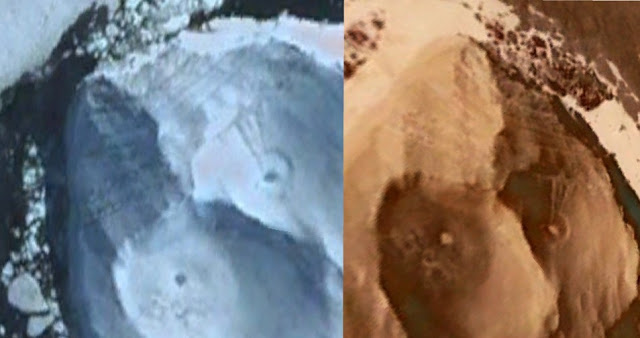
Satellietbeelden tonen wel anomalieën die door sommige onderzoekers worden aangegrepen als mogelijke ingangen of structuren. Echter, de meeste van deze waarnemingen worden door experts eenvoudigweg verklaard door natuurlijke geologische formaties, sedimentvorming of optische effecten. Zonder fysiek bewijs, zoals artefacten, monsters of betrouwbare getuigenissen, blijft de claim van geheime bases speculatief.
Daarnaast heeft de wetenschap op het gebied van Antarctica uitgebreide onderzoeken uitgevoerd, gericht op geologie, glaciologie en biologie. Deze studies hebben geen aanwijzingen gevonden voor ondergrondse constructies of buitenaardse activiteiten. De extreme omstandigheden – zoals de temperaturen die kunnen dalen tot onder -80°C, de constante wind en de dikte van het ijs – maken de constructie en het onderhouden van ondergrondse bases uiterst onwaarschijnlijk zonder expliciete technologische hulp die niet wordt ondersteund door bewijs.
Wetenschappelijke en Geografische Beperkingen
De fysische omstandigheden op Antarctica vormen aanzienlijke barrières voor het bestaan van permanente bases, zeker voor buitenaardse of geheime installaties. De enorme ijsmassa’s, de moeilijk bereikbare ondergrond en de extreme weersomstandigheden maken bouw en logistiek uiterst complex en kostbaar. Bovendien is er geen bewijs dat dergelijke bases bestaan of dat er enige activiteit plaatsvindt die niet door wetenschappelijke expedities kan worden verklaard.
Daarnaast wordt het continent streng gecontroleerd door internationale verdragen, zoals het Antarctisch Verdrag (1961), dat het militaire gebruik en de exploitatie van natuurlijke hulpbronnen reguleert en het behoud van het milieu waarborgt. Het is uiterst onwaarschijnlijk dat geheime bases, vooral van buitenaardse aard, onopgemerkt blijven onder deze strikte internationale controle.
Mediacultuur en Fictie
De popularisering van het idee van geheime Nazi- of buitenaardse bases in Antarctica wordt sterk gevoed door sciencefictionfilms, boeken en pseudowetenschappelijke literatuur. Films zoals “Iron Sky” (2012) en series als “The X-Files” propaganderen het idee van verborgen bases en geheime technologieën. Deze verhalen combineren feitelijke elementen met fictie, waardoor ze aantrekkelijk en intrigerend worden voor het publiek.
De invloed van dergelijke media heeft bijgedragen aan het ontstaan en de verspreiding van complottheorieën, ondanks het ontbreken van wetenschappelijk bewijs. Het is belangrijk te onderscheiden tussen entertainment en wetenschappelijke realiteit. Fictie kan inspiratie bieden, maar mag niet worden beschouwd als bewijs.
Wetenschappelijke Conclusie en Kritische Beschouwing
Na een uitgebreide beoordeling van de beschikbare informatie, bewijs en wetenschappelijke consensus kunnen we concluderen dat:
Er geen concreet bewijs bestaat voor de aanwezigheid van UFO-bases onder Antarctica.
Claims over nazi-geheime bases en geavanceerde buitenaardse technologieën in Antarctica zijn niet ondersteund door fysiek bewijs of betrouwbare getuigenissen.
Satellietbeelden en anekdotisch bewijs worden niet wetenschappelijk gevalideerd en kunnen meestal worden verklaard door natuurlijke formaties.
De extreme fysische omstandigheden maken het bouwen van ondergrondse bases, laat staan buitenaardse installaties, uiterst onwaarschijnlijk zonder geavanceerde technologie die niet wordt ondersteund door bewijs.
Culturele en mediatradities dragen bij aan de populariteit van deze theorieën, maar zij vormen geen wetenschappelijke onderbouwing.
Aanbevelingen voor Toekomstig Onderzoek
Hoewel de huidige stand van wetenschap geen bewijs levert voor UFO-bases in Antarctica, blijft het continent een fascinerend gebied voor geologisch en biologisch onderzoek. Verdere wetenschappelijke expedities, met geavanceerde technologieën zoals seismische monitoring, ondergrondse exploratie en geochemische analyses, kunnen mogelijk meer licht werpen op de mysteries van Antarctica.
Het is essentieel dat dergelijk onderzoek transparant en open gebeurt, zonder te worden beïnvloed door pseudowetenschappelijke of conspiratieve theorieën. Kritisch denken, goede wetenschappelijke methoden en verificatie blijven de hoekstenen van betrouwbare kennis.
Conclusie
De mythe van UFO-bases en Nazi-activiteiten in Antarctica blijft een intrigerend onderdeel van de populaire cultuur en complottheorieën. Echter, uit wetenschappelijk oogpunt ontbreekt het aan bewijs dat dergelijke claims ondersteunt. Antarctica is een continent vol natuurlijke wonderen en wetenschappelijke ontdekkingen, maar de verhalen over geheime buitenaardse bases behoren tot de sfeer van speculatie en fictie. Vooralsnog is het continent vooral een plek waar de wetenschap de complexe geologische en biologische processen van onze planeet onderzoekt, en niet een geheime uitvalsbasis voor buitenaardse beschavingen.
Bronnen en verder lezen
National Snow and Ice Data Center (NSIDC) – Antarctica Research
International Geophysical Year (1957-1958) en Antarctica-onderzoek
Rapporten en publicaties van het Antarctic Treaty Secretariat
Kritische wetenschappelijke analyses over UFO-claims en satellietbeelden
Fictie en cultuur: Analyse van representaties in media
NOTE PETER2011
Door het scheiden van feit en fictie en het baseren van conclusies op wetenschappelijke bewijsvoering, kunnen we een genuanceerder en realistischer beeld krijgen van Antarctica en de vermeende buitenaardse activiteiten daar. Het blijft een gebied dat vooral onze natuurlijke nieuwsgierigheid en wetenschappelijke interesse wekt, en minder een plek voor geheime buitenaardse bases.
GERELATEERDE VIDEO'S
Wat zit er echt verborgen in Antarctica? UFO's & geheime bases met Brad Olsen | Unveiled Aflevering 51
Verkenning van de mysteries van parallelle dimensies en alternatieve universums
In de uitgestrekte ruimte van het heelal schuilen mysteries die onze begrip te boven gaan, en roepen ons op om de gebieden van het onbekende te verkennen. Onder deze raadsels bevindt zich het concept van parallelle dimensies en alternatieve universums als een prikkelende mogelijkheid die de menselijke verbeelding al eeuwenlang in zijn greep houdt. Recente vooruitgangen in de theoretische fysica hebben een nieuw licht geworpen op deze eeuwenoude vraag en bieden een glimp van het complexe weefsel van de realiteit en de mogelijke bestaan van parallelle werelden.
Aan de voorhoede van deze verkenning staat het fascinerende concept van de multiversumtheorie. Volgens de nieuwste inzichten in de fysica suggereert het multiversum dat ons heelal slechts één van talloze andere kan zijn, die gelijktijdig maar onafhankelijk bestaan binnen hun eigen dimensie. Deze parallelle dimensies of alternatieve universums zouden unieke natuurkundige wetten, constanten en zelfs variaties in fundamentele deeltjes bezitten, wat leidt tot een eindeloos tapijt van diverse realiteiten.
De basis van de multiversumtheorie rust op de opmerkelijke notie van kosmische inflatie, een exponentiële expansie van ruimte die kort na de oerknal plaatsvond. Deze snelle expansie creëerde talloze bellen of zakken in het weefsel van de ruimtetijd, elk representerend een apart universum met zijn eigen eigenschappen. Hoewel deze universums misschien voor altijd buiten ons bereik blijven, bestaan ze desalniettemin, parallel aan ons eigen universum, en mogelijk met geheel andere vormen van leven en onvoorstelbare wonderen.
Een intrigerende tak van de multiversumtheorie is het concept van het “Level I Multiversum,” ook bekend als het 'quilted multiversum' of de oneindige universum-theorie. In dit scenario worden parallelle universums voorgesteld als verre kosmische eilanden, gescheiden door immense kosmische uitgestrektheden. Hoewel ze mogelijk dezelfde natuurkundige wetten volgen, kunnen de materie- en energieverdelingen binnen deze universums sterk variëren, wat leidt tot gevarieerde landschappen en configuraties.
Een andere boeiende benadering binnen het multiversumkader is het “Level II Multiversum,” bekend als de bubbeluniversumtheorie of het inflatoire multiversum. Deze theorie suggereert dat ons universum slechts een van vele bellen is binnen een uitgestrekte kosmische schuim. Elk van deze bellen vertegenwoordigt een afzonderlijk universum dat ontstaat door het proces van kosmische inflatie, en dat zich onafhankelijk ontwikkelt en uitbreidt. Net als zeepbellen in de lucht bestaan deze universums in een zee van andere, elk met zijn eigen unieke realiteit.
Dieper in de theoretische wereld ligt het “Level III Multiversum,” oftewel de veel-werelden interpretatie, die een verbazingwekkend panoramisch beeld opent van mogelijkheden. Voortkomend uit de kwantummechanica, stelt deze notie voor dat elk kwantumgebeurtenis meerdere vertakkingen creëert. Elke keuze die we maken, elke kwantuminteractie, schept een veelvoud aan parallelle universums, die zich vertakken in een oneindig web van waarschijnlijkheden. In dit verbazingwekkende landschap bestaan alle denkbare uitkomsten en beslissingen, gerealiseerd in hun eigen aparte realiteit.
Hoewel het bestaan van parallelle dimensies en alternatieve universums nog in het rijk van de theorie ligt, is er op het gebied van wetenschappelijk onderzoek toch enig indicatief bewijs opgedaan. Experimentele studies bij CERN’s Large Hadron Collider (LHC) proberen het bestaan van extra dimensies buiten de drie die wij kennen, te ontrafelen. Deze experimenten, gericht op de mysteries van de deeltjesfysica op hoge energie, proberen ongrijpbare deeltjes op te sporen die mogelijk in andere dimensies kunnen ontsnappen, en zo indirect bewijs te leveren voor het bestaan van parallelle werelden.
Daarnaast biedt de kosmische microgolfachtergrondstraling, die wordt beschouwd als de resten van het vroege heelal, aanwijzingen voor een multiversum. Wetenschappers hebben de complexe patronen in deze straling bestudeerd, op zoek naar anomalieën die kunnen wijzen op interacties tussen ons universum en naburige dimensies. Hoewel deze bevindingen nog preliminair zijn en verder onderzoek vereisen, voeden ze de drang naar ontdekking en stimuleren ze de verbeelding.
Parallelle dimensies en alternatieve universums hebben al lange tijd de aandacht van verhalenvertellers, die talloze werken in sciencefiction en fantasy hebben geïnspireerd. Van H.G. Wells’ “De Tijdmachine” tot Christopher Nolan’s baanbrekende film “Inception” en de uitgestrekte universums van Marvel Comics, het concept van parallelle dimensies is een vruchtbare bodem voor creatieve verkenning. Deze fictieve verhalen tonen vaak reizen tussen dimensies, waarin personages de ingewikkelde web van realiteiten navigeren, versies van zichzelf ontmoeten en de oneindige mogelijkheden van bestaan confronteren.
Toch, naarmate ons begrip van het heelal verdiept, vervagen de lijnen tussen wetenschap en fictie, en wordt de mogelijkheid van parallelle dimensies een steeds plausibeler hypothese. De zoektocht naar antwoorden gaat door, gedreven door de ontembare menselijke nieuwsgierigheid die ons al sinds mensenheugenis voortstuwt om de mysteries van het universum te ontrafelen.
Echter, terwijl het concept van parallelle dimensies onze verbeelding kan aanwakkeren en ons gevoel van verwondering kan versterken, is het van groot belang deze ideeën kritisch te benaderen. De verkenning van de theoretische fysica en de zoektocht naar empirisch bewijs vereisen rigoureuze wetenschappelijke methodologieën en strenge testen. Het bestaan van een theorie impliceert niet automatisch haar waarheid; buitengewone claims vereisen buitengewone bewijzen.
De wetenschappelijke gemeenschap is verdeeld over de vraag of parallelle dimensies en alternatieve universums daadwerkelijk bestaan. Critici beweren dat deze ideeën in het domein van speculatie vallen en het empirisch fundament missen om ze als wetenschappelijke theorie te rechtvaardigen. Ze pleiten voor voorzichtigheid en roepen onderzoekers op zich te richten op toetsbare hypotheses en observeerbare fenomenen, in plaats van af te dwalen in de wereld van de verbeelding.
Desalniettemin blijven voorstanders van de multiversumtheorie de grenzen van de wetenschappelijke nieuwsgierigheid verleggen. Ze werken aan het verfijnen van wiskundige modellen, ontwikkelen nieuwe experimentele opzetten en benutten geavanceerde technologieën om het bestaan van parallelle dimensies te onderzoeken.
Naarmate we uitkijken over het uitgestrekte kosmische landschap, starend naar de verre sterren en nadenkend over de mysteries die daarbuiten liggen, blijft de aantrekkingskracht van parallelle dimensies en alternatieve universums bestaan. Het is een zoektocht naar begrip, een verkenning van de fundamentele aard van de realiteit, en een bewijs van de onstuitbare menselijke drang naar kennis.
Uiteindelijk, of parallelle dimensies en alternatieve universums al dan niet bestaan, zullen hun aantrekkingskracht en inspiratie blijven voortbestaan. Ze blijven de menselijke verbeelding voeden, wetenschappelijke nieuwsgierigheid stimuleren en onze perceptie van wat mogelijk is uitdagen. Het raadsel van parallelle dimensies nodigt ons uit om verder te kijken dan de grenzen van ons bekende universum, de mysteries te omarmen die in de diepten van het bestaan verborgen liggen, en een reis te ondernemen die de grenzen van onze verbeelding overstijgt.
GERELATEERDE VIDEO's IN ENGELS
Voorbij Onze Werkelijkheid: De Verbazingwekkende Waarheid Over Parallelle Universums
De Verbazingwekkende Realiteiten van Parallelle Universums: Een Mind-Bending Reis
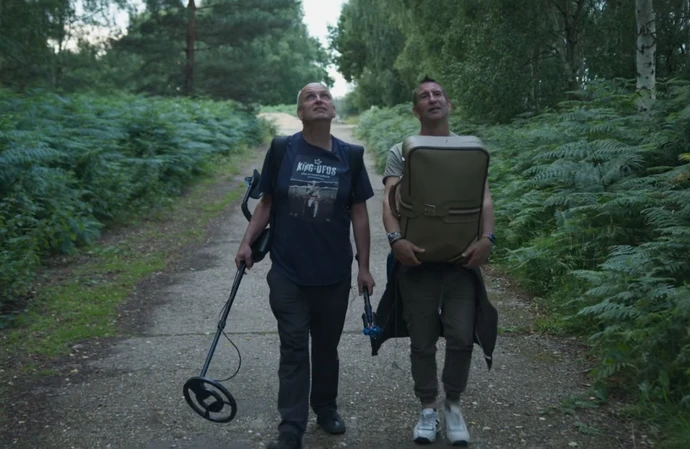
Viewers of streaming documentary The Rendlesham UFO: The British Roswell visited by alien orbs
Ufologist and filmmaker Mark Christopher Lee has claimed that his documentary The Rendlesham UFO: The British Roswell has led to viewers being visited by alien orbs.
Mark Christopher Lee and Guy Thompson in The Rendlesham UFO: The British Roswell
Viewers of a documentary about ‘The British Roswell’ UFO incident have been visited by alien orbs branded with swastikas whilst watching it.
Leading ufologist and filmmaker Mark Christopher Lee is the man behind The Rendlesham UFO: The British Roswell, which explores the unexplained lights reported by eyewitnesses near Rendlesham Forest in Suffolk, England, in December 1980.
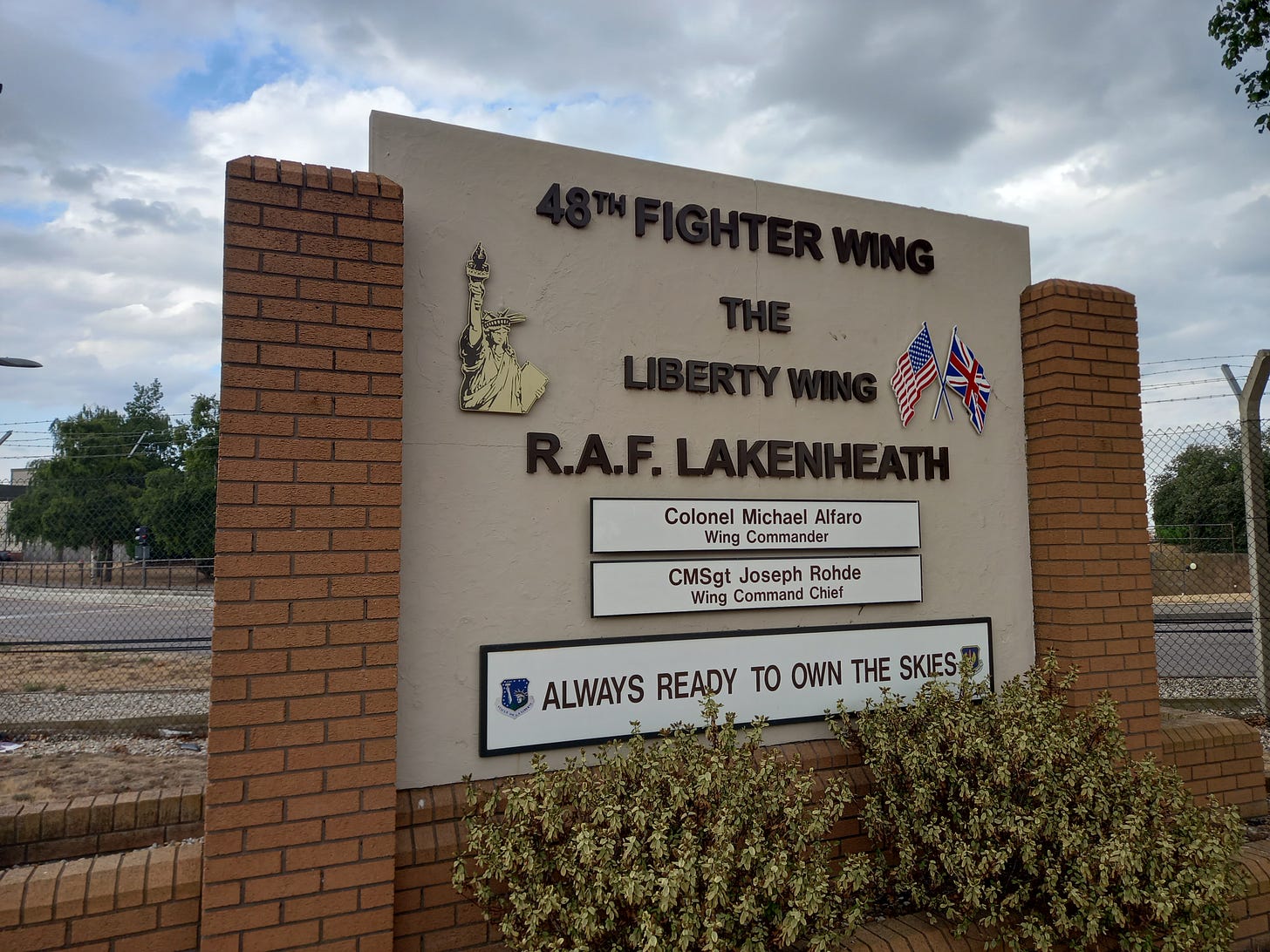
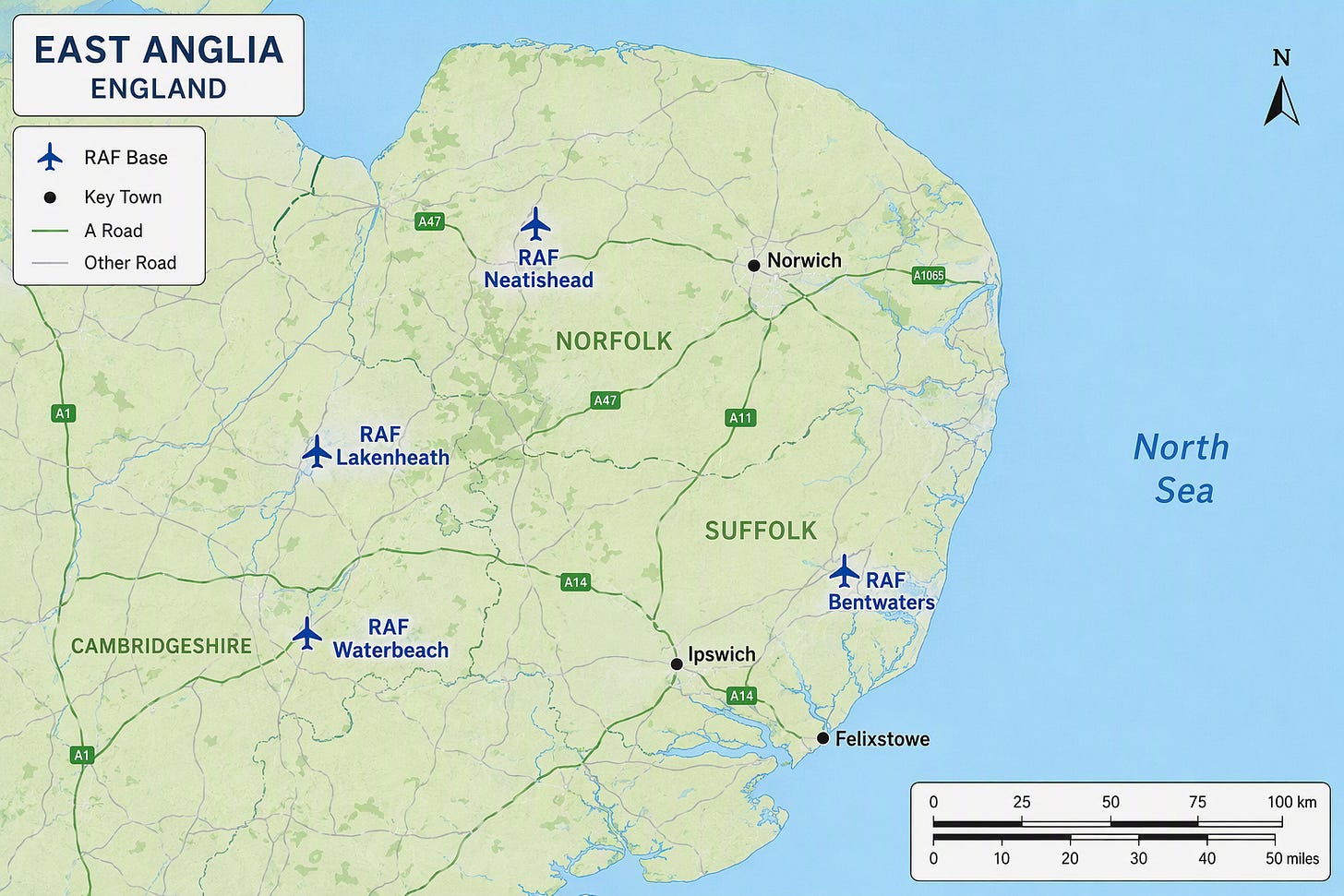
The events occurred just outside RAF Woodbridge, which was used at the time by the United States Air Force.
Mark sent his finished film - which is available to stream on television via Prime, Apple TV, Plex and other platforms - to his agent, Cleo Gonzales, in Los Angeles to watch. She phoned him in a terrified panic after an orb appeared in front of her in her home as she watched the film.
Speaking to BANG, Mark said: “With the Rendlesham film, the weirdest thing happened.
“I sent the original screener to my agent in LA and she watched the film and really enjoyed it but she phoned me really, really freaked out.
“Whilst she was watching it during the bit when we were in the forest trying to manifest a UFO this orb appeared in front of her and started spinning anti-clockwise in front of her. The orb had what was basically a swastika symbol on it. She was obviously freaked out and thinking, ‘Ah, it's Nazis.’ I assured her it's not Nazis necessarily, the Nazis stole the symbol from the ancient Hindus."
Mark was joined in his Rendlesham investigation by fellow UFO hunter Guy Thompson, who has been contacted by friends with whom he shared the film and who have reported similar experiences, reminiscent of the horror film The Ring - which is about a cursed videotape.
He said: “Guy who is also in the film, his mates have had weird experiences as well whilst watching the film. It's like that Japanese film The Ring. But this is the UFO version.
“I've been reaching out to people to get in touch with their weird experiences.
“There's been four people so far. It's very weird.”
Mark - who has offered theories as to what the Rendlesham incident could be and revealed the strange phenomena that still exists - and his wife were also visited by an alien orb in the garden of their home in St Albans the day after he returned from filming. He has also experienced other strange phenomena.
He shared: “It's really weird because at the end of filming the Rendlesham documentary I came back and I was just lying in bed, I couldn't sleep and all I could see was ones and zeros in front of me, it was binary code. That binary code links back to what Sergeant Jim Penniston claimed - to have a binary code download after touching the craft at Rendlesham in 1980. We don't even really mention the binary code in the film.
“What happened to me and what my wife experienced as well is the morning after filming we were sat in the garden and we noticed there was an orb above our house. It felt like something had followed us back. Did it imprint itself in the film?
“It's very plausible, especially when you consider the whole concept of our film is using your mind to manifest something. There's no reason why that intelligence, that energy cannot manifest itself onto a film and so people who watch it trying to use our minds to summon a UFO and they're getting into that same level of consciousness there's no reason why something can't happen whilst watching the film.”
RELATED
Britain’s Roswell: The Rendlesham Forest UFO Incident | What Really Happened?
What Entered Rendlesham Forest? Britain’s Roswell UFO Incident
Britain's Roswell? - What the Rendlesham Files Actually Say (1980)
Plasmoid orb frightens women walking dog, Blakey, PA, USA Aug 26, 2026 UAP Sighting News.
Date of sighting: August 26, 2026 8:52pm
Location of sighting: Blakely, Pennsylvania, USA
Source: NUFORC #200502
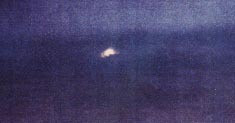
This glowing object looks like a plasmoid orb, glowing and as it moves its orb shape shifts a bit into an oval shape. Thats how I knew it was a plasmoid orb...a sentient entity. The object actually frightens the woman as she begins to watch and the object stops, not moving for a bit then shoots away and seems to be following the power lines. The dog is trying to pull the woman away, as if it was sensing something it was afraid of and wanted to escape the area but the eyewitness tried to control the dog to record more video of the orb. The orb changes color to a light green for a few seconds then back to white. This looks so much like the Dome of Rock UFO plasmoid orb that its blowing my mind. Its just very exciting to see this interact with the woman.
Scott C. Waring - UFO Sightings Daily
Eyewitness states:
I saw the object shoot up very fast, then it went down fast, shot to the left and then flew extremely fast to the right out of sight. At approximately 8:30pm, while walking my neighbor's dog, I saw a bright white object stationary in the sky near 764 Main Street in Blakely, PA. I continued to walk. I noticed it again several blocks away. The object hovered for a long period of time and then went up very fast, then downwards very fast. It then shot to the left and then went to the right extremely fast and out of sight. It did not make the buzzing or humming sound of a drone.
It did not have blinking colored lights. I saw it again when walking home, which was where I saw it the first time. The light faded then got bright and stayed bright. It went left out of sight. I continued to walk the dog, turned around and saw it again. I have seen many drones and I am familiar with what they look like and sound like. This object was silent.
Plasmoid orb frightens women walking dog, Blakey, PA, USA Aug 26, 2026 UAP Alien paranormal news 👽
While driving along American roadways, especially near airports, many have wondered about the mysterious orange and white orbs that can be seen on top of the power lines.
They're not just for decoration. In fact, they serve a vital purpose to keep residents safe.
Power lines carry high voltages of electricity to homes and businesses, making them crucial to any community. If they were to be damaged or hit, it could knock out power for thousands and even create a dangerous situation where a live wire is within reach.
So the white and orange balls are placed on the top wires of taller power lines, especially in areas where airplanes will be flying low, to make them easily recognizable to pilots, Missouri University Professor Rui Bo wrote for The Conversation.
'They’re like bright warning signs in the sky, protecting pilots, passengers and people on the ground below,' he wrote.
But unlike power lines, the big orange balls, which are the size of a large beach ball and weigh around 25 pounds, are not electricized.
'They’re made of insulating materials, so electricity does not flow through them,' Bo added.
They're typically made of plastic or fiberglass, so they can last 10 to 15 years. And their orange color is deliberate, as it is easy for pilots to spot.
Orange balls can be seen on power lines, often in places where there are low flying aircrafts
The balls, which come in two halves, are the size of a large beach ball and weigh around 25 pounds
Missouri University Professor Rui Bo said the balls act as 'warning signs'
The power lines themselves easily blend into the scenery of the houses and trees nearby, making it hard for pilots to avoid when they're flying low to land at airports, so the brightly colored balls are essential to safe navigation.
The installation of the balls can be difficult, especially for very high power lines. It requires a specialized team, especially when a helicopter is involved.
The power lines are not turned off during installation, meaning high voltages of electricity continue to pass through them.
Depending on the height of the power line, a ground or air crew is required.
Ground crews use buckets to get up high enough to secure the ball, which comes in two halves, to the line.
Air crews, however, have to hover near the line while crews on the end of the helicopter connect it to the power line.
The balls themselves are made of plastic or fiberglass and do not conduct electricity, despite being on a live wire
One lower lines, it can be install via bucket truck, but on higher lines, one has to be attached to a helicopter to do so
The orange or white color of the ball is meant to be bright and easily visible to pilots
'They don’t need much maintenance, but utilities inspect them from time to time to make sure they haven’t cracked or faded too much,' Bo wrote.
Most neighborhood power lines are too low to need the balls.
The Daily Mail has reached out to Bo for comment.
RELATED VIDEOS
Why Are Giant Orange Balls Hanging From Power Lines? 🤯
Why Are There Giant Orange Balls Hanging on Power Lines? (The Real Truth)
Archaeologists have spent a decade peeling back layers of ruins on the shores of the Sea of Galilee, searching for a 'lost' city where the Bible says Jesus performed miracles.
Now, the excavation team say they have finally found Bethsaida, the ancient city where Jesus is said to have restored a blind man's sight and fed thousands, and was home to three apostles - Peter, Andrew and Philip.
A Roman bathhouse and hundreds of fishing weights at el-Araj in northern Israel are said to match an ancient account of Bethsaida's transformation from a Jewish fishing village into a city.
Inside a ruined church dating back to the late fifth century, a mosaic invokes Peter, linking the building directly to Jesus' disciple.
Beneath the church, a first-century house wall may also support an ancient pilgrim's account that it was built over Peter and Andrew's home.
Dr Steven Notley, the excavation's academic director, told the Daily Mail he 'absolutely' believes the team has uncovered the lost biblical city that was home to the apostle Peter.
'Everything we bring out of the ground affirms and strengthens that identification,' he said.
'Nothing that we have found would challenge it at all.'
Archaeologists have uncovered stone walls they believe were part of the birthplace of Jesus' apostles
The lost city, according to the Bible, is where Jesus performed a miracle that fed 5,000 people
For Notley, the ruins at el-Araj are bringing into view the setting of Gospel accounts in which Jesus restored a blind man's sight and fed thousands with five loaves and two fish.
'I think Jesus was there on multiple occasions,' Notley said. 'I think we probably have a number of miracles.'
In Mark 8:22–26, people bring a blind man to Jesus at Bethsaida. Jesus leads him outside the village before restoring his sight.
Luke 9:10–17 places Jesus and his apostles in what the King James Version calls 'a desert place belonging to the city called Bethsaida,' where he feeds about 5,000 men.
Notley believes the plain surrounding el-Araj fits that description: open grazing land beyond the settlement, rather than a sandy desert.
'We have no deserts up there,' he said. 'But they're pastoral areas, where your flocks will be eating outside of where people are living.'
'The Gospels identify this as the area where you have the feeding of the multitudes,' he added.
Inside a ruined church dating to the late fifth century, a mosaic invokes Peter, linking the building directly to Jesus' disciple
Two walls set perpendicular to one another. One of the walls dates to the first century AD, while the second dates to the second or third century AD
Jesus also rebukes Bethsaida in Matthew 11:21, saying: 'Woe unto thee, Bethsaida!'
The passage criticizes its inhabitants for failing to repent despite the miracles performed there.
El-Araj lies just beyond the Jordan River, in territory ruled during Jesus' lifetime by Herod Philip, outside the jurisdiction of Herod Antipas, who ordered John the Baptist's execution.
Notley believes he has connected the location with Matthew 14:12–13, which describes Jesus withdrawing by boat after learning of John's death - he was beheaded by a king around 30 AD.
Although the passage does not name Bethsaida, Notley interprets the settlement's position as another reason Jesus would have spent time there.
John 1:44 supplies the connection to three apostles: 'Now Philip was of Bethsaida, the city of Andrew and Peter.'
'At least a quarter of his disciples came from Bethsaida … it played a very important role as the setting, the stage for Jesus' life and ministry in the North,' Notley said.
The strongest archaeological clue, in his view, emerged in 2017, when researchers uncovered mosaics, marble, roof tiles and ceramic heating vents belonging to a Roman bathhouse.
The flooring of the church dates back 1,500 years. The team believes this church was built over Peter and Andrew's home as a way to honor them
Its significance comes from the first-century historian Josephus, who described Bethsaida's transformation from a village into a city. The historian also left behind his eyewitness accounts of Jesus on trial and his crucifixion.
In Antiquities of the Jews, 18.28, Josephus records how Herod Philip elevated the lakeside settlement's status and renamed it Julias.
That history gave researchers two requirements against which to test their discoveries.
'You should find evidence of a Jewish fishing village, and you should find evidence of urbanization,' Notley said. El-Araj, he argued, provides both.
Hundreds of fishing weights point to the industry that supported the settlement, while chalkstone vessels associated with Jewish purity practices identify its religious character.
The bathhouse supplies evidence of urban development, matching the larger settlement described by Josephus.
'You do not build a Roman bath in a Jewish village,' Notley said.
This summer's excavations revealed walls built over earlier walls, showing successive phases of construction. Stone vessels continued to appear in later layers, suggesting the growing settlement retained its Jewish population.
Not only could the find prove the existence of the legendary church, but it would lead the team to the location of the home of Jesus' famed apostles Peter and Andrew - the Church of the Apostles was said to have been built atop of their residence
'It doesn't lose its Jewish identity, it maintains that, but it's much larger,' Notley said.
He estimates the settlement covered 15 to 16 acres.
'Everywhere we're digging, we're finding extensive settlement on the site,' he said.
Notley contrasts those remains with et-Tell, a competing candidate nearly two miles inland from the modern lakeshore. He argues that its impressive Iron Age ruins give way to weaker evidence around the first century, when Josephus describes Bethsaida growing in importance.
'It completely contradicts the historical record,' he said.
Excavations at el-Araj began in 2016, with Notley working alongside excavation director Mordechai Aviam.
'Everyone thought I was crazy, everyone thought we were crazy, that there was nothing there,' Notley recalled.
A late fifth-century church added another line of evidence linking the settlement to the apostles.
'No one knew there was a church there,' he said. 'We didn't go looking for a church.'
Gilded glass mosaic pieces first suggested an elaborate Christian building, and by 2018 the team had identified the outline of a basilica.
Its discovery prompted Notley to revisit the account of Willibald, an eighth-century pilgrim who described a church at Bethsaida built over the house of Peter and Andrew.
In August 2022, researchers uncovered an intact mosaic inscription north of the apse, the church's sacred eastern section.
It honored a local official and benefactor named Constantine before seeking intercession from 'the chief of the apostles and the keeper of the keys of heaven,' in Notley's description.
Roman coins have been found at the site, supportinga theory that it was urbanized
Christians recognize Saint Peter, originally a fisherman, as one of the first followers of Jesus and the leader of the early Church following the ascension. He was born Simon Peter and grew up to be a fisherman until he met Jesus
The Bible says that not only was Peter the leader of the apostles, but he would receive the keys to the kingdom of heaven from Jesus.
'That title can have no other reference than Peter, which confirms the church's identification with Peter,' he said.
For Notley, the question is why Christians would have honored Peter at this particular location. 'We have very few Byzantine churches connected with Peter,' he said of the Holy Land during that period.
Such churches generally marked places associated with Peter's appearances in the Gospels. At el-Araj, Notley believes the dedication commemorates his hometown.
Its importance lies in connecting the excavated church with Peter, consistent with both John's identification of his hometown and Willibald's description of a church there.
Willibald's account gave the team a prediction to test: if the church commemorated the apostles' home, earlier domestic remains might survive directly beneath the apse, the sacred area where relics associated with saints were often preserved.
'There should be a first-century house under the apse,' Notley recalled predicting.
In October 2023, a conservator removed and preserved the mosaic floor, allowing archaeologists to excavate below the church's most sacred area.
Gilded glass mosaic pieces first suggested an elaborate Christian building, and by 2018 the team had identified the outline of a basilica
Above is a close look inside the ruins of the church
They uncovered a house wall dating to the first century, placing domestic remains from the apostles' lifetime beneath the later Christian building.
'It doesn't get much better than that,' Notley said.
The wall cannot establish who lived there, but its age and position support the tradition that the church commemorated an earlier home.
Beneath the late fifth-century basilica, researchers have also identified a fourth-century Christian structure that the team believes may have been an earlier church.
Notley connected that sequence with the early fourth-century historian Eusebius, who associated Peter and Philip with Bethsaida, suggesting Christians continued to remember the settlement's biblical significance.
'There's a continuing memory of Peter's connection to Bethsaida,' he said.
The case therefore joins evidence from different periods: a Jewish fishing community, Roman urban development and successive Christian buildings honoring an apostle whose hometown was Bethsaida.
'Everything we bring out of the ground affirms and strengthens that identification. Nothing that we have found would challenge it at all,' Notley said.
The identification does not amount to archaeological proof of miracles. 'Archaeology has its limits,' he acknowledged.
For Notley, however, the discoveries restore the setting in which the Gospels place Jesus' ministry and the lives of three of his closest followers.
'I have no difficulty seeing Jesus spending considerable time there,' he said, adding that he calls it 'the last lost city of the Gospels.'
Where Did Jesus Feed the 5,000, Walk on the Water, and Calm the Sea? Sea of Galilee Miracles!
Ukrainian astronomers claim high-speed telescope footage shows giant rotating UFOs near the Moon, though experts warn previous distance errors heavily undermine the unverified study
PHOTO Peter Pieras/Pixabay
Astronomers at Ukraine's Main Astronomical Observatory say they have detected more than 20 unidentified flying objects near the Moon, using high-speed camera systems at the Vinarivka observatory in rural Ukraine.
The team, led by researcher Boris Zhilyaev, reports observing large ring-shaped structures close to the lunar surface, some estimated at up to 36 kilometres across and said to rotate roughly every three minutes, which they calculate would generate centrifugal forces exceeding twice Earth's gravity.
Anomalous Motion and Bold Technical Claims
Footage recorded on 16 August and 7 September 2025 captured small, fast-moving signals travelling at velocities of up to 11 kilometres per second across the lunar disc. In a non‑peer‑reviewed study, the authors argue that these observations could indicate a sophisticated installation on or near the Moon, potentially capable of sending craft to Earth in about 20 minutes, although mainstream scientific institutions remain sceptical of this interpretation.
In their preliminary paper, the Kyiv-based researchers categorised the reported objects into two main groupings based on observed behaviour. Atmospheric objects appeared to stay above specific lunar regions, as if acting as fixed stations, while continental objects moved quickly across the Moon's surface.
The team noted that several objects flashed in synchronised cycles lasting between 0.1 and 0.5 seconds, even when they appeared to be separated by hundreds of miles.
Size estimates in the report vary from about 440 metres to upwards of 25 miles across, with the largest objects said to rival the footprint of major terrestrial cities. Moving at roughly 24,606 miles per hour, the claimed velocities would be comparable to the top speed achieved by NASA rockets during Apollo-era lunar missions.
Despite these figures, the authors state that their mathematical models depend on assumptions about object composition and light reflectivity that have not been independently verified.
On the raw digital frames gathered at Vinarivka, the proposed large structures occupy only a few faint pixels, which leaves scope for image noise, atmospheric distortion or digital camera artefacts to be misinterpreted as real objects.
Methodological Concerns and Scientific Scepticism
The wider scientific community has treated the paper cautiously, in part because of the research group's previously criticised work on unidentified aerial phenomena. When the same team published findings on unidentified objects in 2022, Ukraine's National Academy of Sciences launched a formal review that concluded the work contained significant errors and did not meet professional standards for publication
During that earlier dispute, Harvard University astrophysicist Avi Loeb showed that the team's distance calculations were overstated by a factor of ten. That error turned likely atmospheric objects, most probably terrestrial artillery shells fired during regional conflict, into what the authors had presented as large unidentified craft.
Critics argue that the latest lunar study shows similar structural weaknesses, including reliance on a single observation site and the absence of parallax measurements to establish genuine spatial depth.
Officials at agencies such as NASA continue to state that no confirmed evidence of extraterrestrial technology has been found. Researchers note that without independent observations using multiple telescopes, the reported lunar anomalies cannot be treated as established objects.
Until such corroboration exists, the claimed ring-shaped structures and other reported UFOs remain the subject of debate rather than accepted
RELATED
👽🌕 20 UFOs Spotted Near the Moon... What's Really Going On?
20 UFOs Near the Moon? The Hollow Moon Mystery & What Lies Beneath
Ukrainian Scientists: “The Moon Is a UFO Base” Full Paper Breakdown
NASA has stepped in to clarify a decades old lunar photograph that some UFO enthusiasts say depicts a 3.4 mile long alien spacecraft suspended above the moon.
PHOTO Instituto Geográfico Nacional de Costa Rica/Wikimedia Commons
NASAhas moved to explain a decades old lunar photograph that some UFO enthusiasts claim shows a 3.4-mile-long alien spacecraft hovering above the moon, after the 1967 image resurfaced online and reignited speculation about extraterrestrial life.
The black and white picture was captured by NASA's Lunar Orbiter 3 in February 1967 as the agency mapped potential landing sites ahead of the first crewed missions.
The frame shows a stark stretch of the moon's surface dominated by Theophilus crater, a vast impact site that NASA lists as about 68 miles across and 2.7 miles deep. Tucked into that landscape is an elongated smudge that has become the latest canvas for people determined to see more than geology.
UFO Blogger Claims NASA is Hiding the 'Smoking Gun'
One of the loudest voices is Scott Waring, a long-time UFO blogger, who argues that NASA's own archive hides the smoking gun. On his site, UFO Sightings Daily, he claims the strange streak is 'a long spacecraft hovering over the moon's surface' and insists the object is no trick of light or dust on the lens.
According to Waring, the scale alone should make people sit up. He writes that he compared the length of the disputed feature with Theophilus crater, taking NASA's 110 kilometre diameter figure, then judging the object to be about one twentieth as long. From that, he concludes the craft measures roughly 5.5 kilometres, or 3.4 miles, end to end.
'That's huge to us humans, but to aliens, it's considered a small shuttle craft,' he tells his readers, doubling down on the idea that we are glimpsing only a minor piece of someone else's space hardware.
He goes further, arguing that the photograph carries a chilling implication. 'This is 100 percent proof that aliens were watching humans before we ever stepped on the moon,' Waring writes, treating the picture as evidence of quiet surveillance of the Apollo programme before it even began.
NASA Apollo MissionsPHOTO NASA
NASA, for its part, has said nothing of the sort. The agency has repeatedly stated that it has no evidence of extraterrestrial life and that it has yet to find any sign of past or present life on the moon or on Mars.
The elongated mark has not been classified by NASA as a craft, and neither Waring's size estimate nor his interpretation has been validated by independent imaging experts.
NASA Image Spurs Fresh Extraterrestrial Life Debate
The renewed focus on the 1967 NASA image lands in a wider political and cultural moment where official UFO files are being shuffled out of locked cabinets and into public view. The Trump administration has overseen the release of several batches of classified documents on unexplained aerial and space phenomena, giving UFO believers fresh material and, unsurprisingly, new fuel.
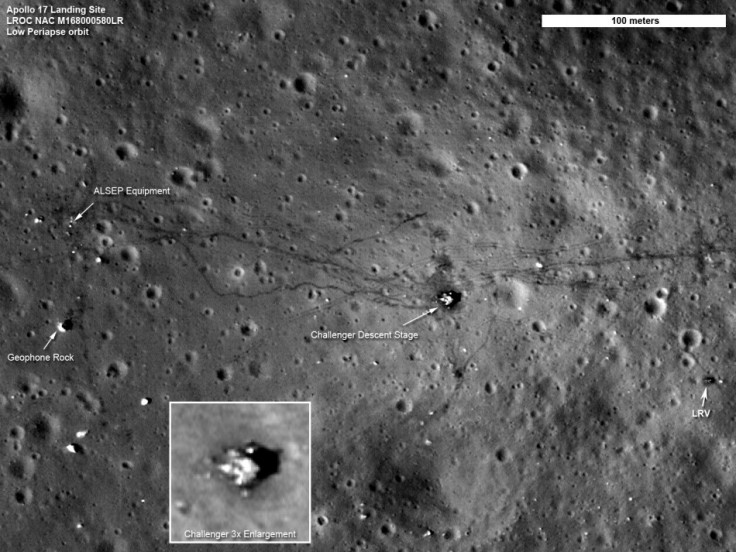
On 8 May, the US Department of War released hundreds of pages of documents, images and audio recordings that officials said documented reports of possible extraterrestrial sightings going back to the 1940s. Among them were transcripts from the Apollo 12 and Apollo 17 missions, the second and final crewed landings on the moon.
Those Apollo records, along with photographs taken by astronauts on the surface, detail multiple encounters with bright, fast-moving objects that appeared to dance around lunar landers or drift past capsule windows. The tone is more puzzled than panicked, but you can feel the astronauts straining to make sense of what they are seeing.
During Apollo 17 in 1972, commander Gene Cernan, lunar geologist Jack Schmitt and command module pilot Ron Evans reported a bright, flashing object some distance from their spacecraft.
In one exchange, recorded in mission transcripts, Cernan says: 'It is a bright object, and it's obviously rotating because it's flashing. It's way out in the distance, as I say, because there are particles that are close by and it's obviously not one of those.'
He adds that the flashes appear in a 'very rhythmic fashion,' estimating that the object sits several Earth diameters away in their field of view as they look back at the home planet. Cernan is careful, stressing that the comparison might not 'do you any good,' but the bafflement is clear.
Later, as Apollo 17's crew fired their thrusters to change direction, Evans reported 'very bright particles or fragments or something' drifting past the windows. Schmitt chimes in that it looks like 'the Fourth of July' outside Evans' window, with 'big bright pieces tumbling slowly around the capsule.'
Evans describes the fragments as jagged, angular and solid, not fluid, and says they are mostly moving with the spacecraft but with some faster pieces zipping by. According to the mission records, he also reported taking photographs of them for analysis back on Earth.
Three years earlier, Apollo 12 astronauts also noted odd lights and objects on approach to the lunar surface, material that appears again in the newly released Trump era files. None of these reports are categorised by NASA as proof of alien craft.
Mission engineers have long pointed to mundane explanations, from ice crystals and insulation fragments to weird lighting in the vacuum. Yet the raw transcripts still make strange reading today.
NASA Briefings Mention 'Alien Starbase' in Moon Anomaly Talk
The Trump administration's third batch of UFO related files, published on 12 June, has added another wild detail to the pile. Within recorded NASA briefings held after Apollo 16 in 1972, officials can be heard referring, apparently half in jest, to an 'alien starbase' on the far side of the moon.
These briefings, which run for about 55 minutes, discuss unusual gravity readings, laser measurements and anomalies detected on the moon's far side, particularly near the Van de Graaff crater region.
One speaker notes 'a great big hole' around what the transcript calls 'Fendi graph', believed to be a garbled reference to Van de Graaff, a crater already known for its strange magnetic and geochemical quirks.
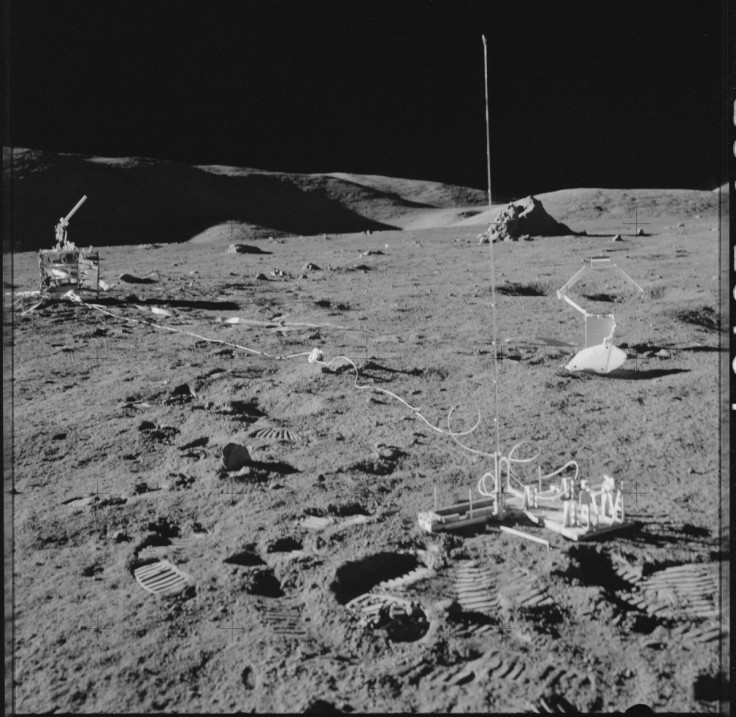
Apollo 17 Project PHOTO Apollo Archive/Nasa
'On the backside of the moon around Fendi graph, that's where we get our big hole,' the participant says, before the discussion suddenly veers. Another voice remarks: 'It could be an alien star base or something. Anyway, the next slide shows the front side of the moon.'
The line, buried in a technical briefing, does not appear in the formal Apollo 16 mission transcript from 1972. NASA has not formally clarified whether the 'alien starbase' reference was a joke, a casual shorthand or something else entirely.
That ambiguity, paired with the Lunar Orbiter 3 photograph and Trump era document dumps, has given UFO believers a field day. For scientists trying to keep public expectations tethered to evidence, it is proving to be an exhausting game of cosmic whack a mole.
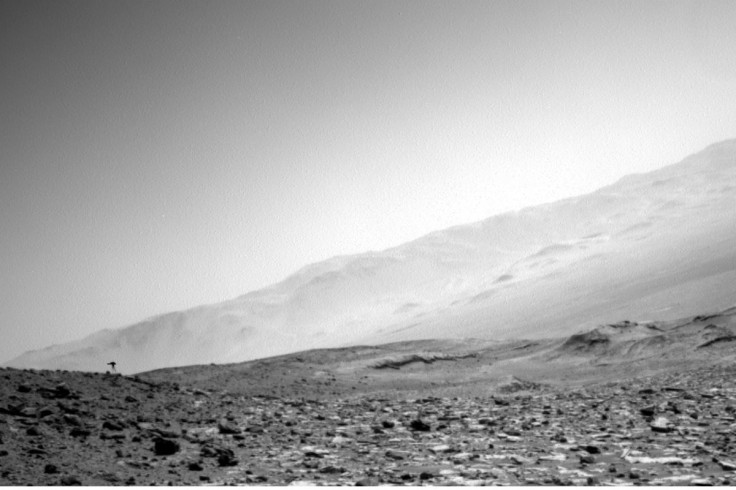
NASA Explains the Spooky 'Negative-Space Jellyfish' Hovering Over Mars in New Curiosity Rover Image
A NASA team is advancing a bold new proposal to search for alien worlds by staging an artificial eclipse in space, positioning a huge ‘starshade’ about 175,000 kilometres above Earths.
PHOTO Razor Picz/Pinterest
A NASA team is pushing an audacious plan to hunt for alien worlds by creating an artificial eclipse in space, placing a vast 'starshade' some 175,000 kilometres above Earth so ground-based telescopes can finally see planets hidden in the glare of distant stars.
Astronomers have already confirmed thousands of exoplanets, but most were spotted indirectly, by watching stars wobble or dim as planets pass in front of them. Directly imaging an Earth-like planet is far harder.
These worlds are up to a billion times fainter than the stars they orbit, so the light astronomers care about is drowned out by the cosmic equivalent of full‑beam headlights.
The Hybrid Observatory for Earth-like Exoplanets, or HOEE, is NASA's latest attempt to fix that. The concept, described by a small NASA-led team, involves flying a giant flower-shaped screen between Earth and distant stars.
The structure, about 100 metres across, would align precisely with powerful telescopes on the ground, blocking out the starlight and revealing whatever alien planets are lurking nearby.
It is, on the face of it, deeply weird. A kind of precision space parasol. But behind the slightly mad imagery sits a serious scientific ambition that has been building for decades.
How an Artificial Eclipse Could Reveal Alien Worlds
After researchers outlined the HOEE idea as a way to supercharge existing observatories rather than building yet another multi-billion dollar space telescope from scratch. Instead of putting both mirror and shade in orbit, the hybrid model keeps the main telescope on Earth and only launches the starshade.
The principle is surprisingly simple. If you can block the light from a star before it reaches a telescope, the surrounding region becomes dark enough to expose any faint specks of light that might be orbiting it. Those specks are the potential alien planets, including, if the scientists get very lucky, a rocky world roughly the size of Earth in the so‑called habitable zone.
In this vision, the starshade would be carefully unfurled in space, its petal-like edges sculpted to minimise diffracted light. It would then sit tens of thousands of kilometres away, directly in the telescope's line of sight to a target star. Get the geometry right, and you essentially manufacture a perfect, repeatable eclipse.
The alignment demands are brutal. The shade would have to hold its position relative to the telescope and the star with fine precision over enormous distances. Even minor errors could let enough stray light through to wipe out any signal from an alien planet. That is before you factor in launches, deployments and the joys of maintaining a massive structure in orbit.
NASA's Billion-Dollar Bet on Alien Atmospheres
NASA is nowhere near green‑lighting the mission. The HOEE team is currently seeking another round of agency funding to refine the idea. Early estimates suggest the eventual starshade project could carry a price tag in the region of one billion dollars.
In space terms, that sits in the uncomfortable middle. Not cheap, clearly, but still far below the budgets of flagship missions such as the James Webb Space Telescope. The argument from advocates is blunt. If a billion buys a better shot at spotting a truly Earth-like alien world, one with the right atmosphere and temperature, then maybe it is worth it.
The scientific payoff would come from the light that reaches Earth after the artificial eclipse. By breaking that light into its component wavelengths, astronomers can look for fingerprints of gases associated with conditions that might support life. The HOEE plan focuses on detecting atmospheric chemicals such as oxygen and nitrogen, key ingredients in our own planet's habitability story.
Nobody is promising evidence of life. That kind of bold claim would demand multiple lines of proof. But identifying a world with an atmosphere that looks suspiciously familiar to ours would be a serious moment for science, and for our long-running obsession with alien possibilities.
Officials at NASA have framed the starshade concept as one tool among many in the broader search for habitable planets. The idea is not to replace existing missions, but to give them a sharper pair of eyes.
Ground-based telescopes are only getting more powerful, and coupling them with a space-borne eclipse generator could extend their reach well beyond what they were originally built for.
AlienPhoto by: PHOTO Leo_Visions/Unsplash
Still, the scepticism writes itself. A giant flower-shaped umbrella floating above Earth, perfectly aligned with telescopes and distant stars, sounds less like engineering and more like science fiction.
Even some scientists have described the plan as 'absurd' in its ambition. Then again, most big shifts in astronomy, from space telescopes to gravitational wave detectors, looked slightly unhinged on paper at first.
If HOEE moves ahead, it will face all the usual battles that define modern space science, from budget fights and technical delays to competition with other marquee missions. The team backing the starshade knows that. Their pitch rests on a simple question that cuts through the noise.
If we had a realistic chance to look directly at a nearby Earth-like alien planet, one that might, in some far‑off future, even be within reach of a human visit, would we really decide that is too much trouble?
scientists created Artificial Eclipse 😯
Proba-3: The Mission Creating Artificial Solar Eclipses!
The announcement made headlines. In October 2025, a group of researchers published a paper in a well-regarded, peer-reviewed astronomical journal claiming the extraordinary: They’d found evidence of objects orbiting the Earth years before the launch of any human-made artificial satellites. In another paper, they also claimed links between when these objects appeared in the sky and the dates of nuclear tests in the 1950s. If any of these results were correct, it’d represent evidence of orbiting non-human technological artifacts and an indication that whatever “piloted” these artifacts was interested in our nuclear capabilities. It’s easy to see why the papers grabbed headlines and interest.
So, the big question hovering around these works is — like all newly published scientific papers — can their conclusions hold up to scrutiny?
The first step in answering that question has now been taken. In June, a paper, soon to be published in Publications of the Astronomical Society of Australia, appeared online and offered an in-depth critique of those explosive claims. Given the importance of the story for UAP/UFO studies, I want to walk you through some details of the original papers and this recent response. Understanding the details is, of course, important on its own. Were we being visited by alien spacecraft in the 1950s? That seems like an important question. There are, however, important lessons in this story concerning how science can, and should, explore the contentious UAP topic. It also raises issues about the difficulties that come when science encounters UAP/UFO culture in general. We’ll explore those too.
The VASCO project
Let’s start with the originalpapers that set the story in motion. Both were published by astronomer Dr. Beatriz Villarroel (a researcher at the Nordita in Stockholm) and her collaborators. For a number of years, Villarroel has spearheaded a project called VASCO (Vanishing and Appearing Sources during a Century of Observations), which is based on a really good idea. The central method is to use old photographic observations of the sky to look for signatures of advanced technology (now generally called “technosignatures”). It’s a clever concept because the farther back you go, the less human-made stuff there is in the sky to confound the search. So, the logic argues that it might be easier to find non-human technosignatures in archived data.
The two papers VASCO researchers published in 2025 relied on observations taken in the early 1950s using the Palomar Observatory Sky Survey (aka POSS-I). The observations were captured on hundreds of photographic plates taken at Mount Palomar in California, and the images were later mosaiced together to form a sky map. Images of the same part of the sky were taken twice, and close in time. One plate used a red-light-sensitive emulsion, and one used a blue-light-sensitive emulsion. Villarroel’s excellent idea was to explore digitized versions of these plates and look for “transients” — things that appeared at specific locations in one of the plates but not the other (since they were taken at different times). The hypothesis was that, perhaps, these transients could be sunlight “glinting” off an orbiting object. The plates had been digitized so Villarroel and her collaborators could use computers to explore large portions of the sky and analyze the statistics of the transients.
The most important part of the first 2025 VASCO paper had the team looking at the difference between plates in Earth’s shadow and those that were not. If a reflective technological artifact were in the shadow, then there’d be no sunlight to produce glints. Therefore, those shadowed plates should have fewer or no transients. After analysis, the team claimed that not only did they find a deficit of transients in the shadowed plates, but the effect was significant at about the “22 sigma” level. (Here, sigma refers to how far away the signal — the detection of something or some feature — is from the average of the background/noise.) Usually, a “5 sigma” result is the gold standard for claiming you’ve made a discovery. A 22-sigma result is so high that it’s virtually unheard of in science. The team did note that when they used more stringent vetting of the transients, the significance dropped to the 7.6 sigma level.
A scientific paper on its own, however, is just a single step in the scientific process.
In the second paper, Stephen Bruehl (Professor of Anesthesiology at Vanderbilt University) and Villarroel looked at the timing of nuclear tests and the dates when transients were observed on the POSS-I plates. Bruehl and Villarroel claimed that there was a statistically significant overlap between when the nuclear explosions happened and when the transients were seen (i.e., the plates). In other words, it seemed like the things creating the transients (alien spaceships, perhaps) were clustering their appearances around nuclear tests.
So, of course, these papers made news. A scientific paper on its own, however, is just a single step in the scientific process. The next step is for the community to pore over the paper and see if the work holds up. Was the data set well prepared? Are the methods used to analyze that data well thought out and mathematically legitimate? Are the conclusions the authors draw from their analysis appropriate, or is there some flaw in the chain of reasoning?
Before we dive into their critique, one noteworthy thing about the paper is its author list. It includes several working scientists who have been at the forefront of taking UAPs seriously. The lead author is Wesley Watters of Wellesley College. He is an astronomer who has written several papers reviewing UAP sightings and arguing they deserve a deeper, agnostic analysis. He has also been a member of Avi Loeb’s Galileo Projectresearch team, which wants to study UAPs scientifically. Another author is Kevin Knuth, a physicist at the University at Albany, SUNY. Knuth published a well-known study of Navy-pilot UAP sightings exploring whether the trajectories seen by the pilots showed evidence for extreme physics at work. Knuth is also a research affiliate of the Galileo Project. What is striking about the author list is that it represents a group that cannot be seen as hostile to the basic idea that UAPs are a valid scientific problem or that they might represent technosignatures. This observation tells you nothing about the quality of their analysis and the critique that follows. It does, however, mean this is not a group of scientists with a bias against UAPs as a whole (in my experience, most astronomers do have this bias).
The Watters paper begins with an important historical example. Using photographic plates to look for things in the sky that appear and then disappear is not a new idea. For decades, astronomers tried to use photographic plates to find optical traces of the enigmatic gamma-ray bursts (GRBs), powerful explosions involving massive stars. As Watters and team show, even though a huge effort was put into the project, there were just too many “defects” on the plates that had nothing to do with the sky: problems with the photographic emulsion; dust grains on the plates; pits in the glass plate itself; errors introduced when plate copies were made, as well as other issues. It turns out that separating the defects and other issues from the real things captured by the telescope is incredibly difficult. This is especially true when you need to do it at scale — meaning you want to do statistics with tens or hundreds of thousands of potential transients. For the astronomers looking for GRBs, the photographic plates were simply not up to the job. That seems to be an important lesson for the VASCO project.
The defect problem is so bad that the Watters paper doesn’t use the term transient at all since so many of the “things” in the POSS survey aren’t transients (i.e., things seen in the sky). Instead, they begin their analysis by asking about “Selected POSS 1-E Features,” or SPFs. The Watters paper then asks several questions. What can we tell about the SPFs that the VASCO team pulled off the POSS-I plates? How did their choices of what to use effect their analysis and their claims?
It turns out that these are not easy questions to answer because the VASCO team did not publish the dataset used in this study. That means Watters and company had to go through an exhaustive effort to determine which parts of the POSS-I survey were used and which features were selected to be explored by the VASCO group as possible transients. Once this work is done, Watters and company go on to show that this analogous dataset is full of irregularities (something also shown in an earlier paper by Nigel Hambly of the University of Edinburgh). SPFs show up more often on the edges of the plates than in the center, or features cluster on the plates in irregular ways. Worse, when mapped across the whole sky, there are big stripes and voids where no features appear at all, while in other places the features inexplicably bunch up. All this points to the real possibility that the VASCO data set simply has not been vetted carefully enough. If so many, if not most, of the features are not true astronomical transients but plate defects, that is a real problem.
Even if some of the features on the plates are light from the sky, the Watters analysis of the analogous VASCO dataset revealed a deeper problem: the statistics. To pull statistically significant conclusions from the data, as the VASCO team hopes, the dataset as a whole must have certain properties. In particular, overall, it must be what’s called “uniformly random in distribution.” This means the features must, on average, be sprinkled randomly around in the same way as stars in the sky appear to be. Technically, this means they could be generated by what’s called a Poisson process. If you want to find statistically significant patterns in a big data set, the most common methods require that you start with data that at least approximates being uniformly random. Only in that case can you apply many of the usual mathematical methods of statistics, the methods that assure you’re not getting fooled by patterns you think you are finding.
It’s not that the VASCO idea was bad. It was a great technosignature scientific project — but the dataset does not seem up to the task.
Because of all the problems identified in the Watters paper, the VASCO dataset cannot be considered to be uniformly random. Worse, some of the conclusions rely on small numbers of data. For example, for the all-important calculation of the Earth shadow deficit, only 11 out of the 645 plates the VASCO team used are in the Earth’s shadow. That’s not a lot of data to begin with, and it makes doing statistics shakier. But then, through careful analysis, the Watters team found that only five of these plates were fully shadowed, with the rest only partially shadowed. Worse, it appears that the majority of SPFs occur in a single plate. So now there is even less data to work with statistically, and that one plate dominates the analysis. Finally, some of the shadowed plates were in those troubled bands where something weird was going on.
When Watters and collaborators repeated the shadow analysis, they found no significant deficit of features. The VASCO result had disappeared. These problems all stem from the misapplication of the statistical methods. Thus, that spectacular claim of a 22-sigma result is unsupportable. There was no statistically significant deficit of SPF’s in the Earth’s shadow.
The Watters team then turned to the claimed correlation between the dates of features appearing on the POSS-I plates and nuclear tests. That result also disappeared in terms of significance. The problem was that the VASCO team was not using the right number of days over which the POSS-I observations had been taken (they used 2,718 days rather than the actual 312-day time period over which their data were drawn; the POSS-I survey did not record observations every single day. Once this correction was included, the statistically significant correlation between nuclear tests and transient observations collapsed. What did exist was a relationship between when the telescope was used and when nuclear tests were done (possibly due to clear weather extending across the western states). But this had nothing to do with when features appeared on those plates.
Finally, the Watters paper concludes by showing how the whole VASCO project is plagued by a kind of circular reasoning embodied by their overuse of the term “transients” rather than “features.” Circular reasoning involves assuming the conclusion of an argument as part of its premises. The VASCO team wants to claim that some features on the POSS-I plates are actual things in the sky that only appear once and then are gone. They use the analysis of the shadow deficit and nuclear tests to claim these are real transients. But there is no independent validation that the bulk of these “transients” are not stuff screwed up on the plates themselves. Thus, the argument doubles back on itself: the shadow-deficit analysis assumes that the plate features are real transient events, and that same analysis is cited as proof that they are real transient events.
The bottom line is that the Watters paper offers a strong critique of the two news-making VASCO studies. It’s not that the VASCO idea was bad. It was a great technosignature scientific project. Rather, like the failed GRB studies, the POSS-I dataset does not seem up to the task. So, what does it all mean?
Science and UFO culture
The first thing to note is that this is not the end of the story. Science is like the blues — it’s a call-and-response kind of thing. A scientist named Bob publishes a paper. Another scientist named Alice publishes a critique. It’s then Bob’s job to address those critiques in the next published paper. If that’s done well, then the game goes on, and Bob’s evidence and arguments get better over time until, perhaps, the scientific community recognizes it as a proven fact and even uses that fact to do the next set of studies. So, the question now is how the VASCO team responds to these criticisms.
People arguing that peer review and publication are not necessary are like players showing up to a soccer game demanding everyone use the rules of baseball.
Another key point is where this call and response get played out. Over the past 400 years, science has figured out a system that works pretty well. It’s called peer review. Bob writes a paper and submits it to a journal. The journal then sends it to other scientists who are knowledgeable in the field (hopefully experts) for review. The reviewers make comments and suggestions that must be addressed. If the paper is judged to be too deeply flawed, then it may be rejected. This process is not perfect, but it does ensure at least a first level of quality control. Most importantly, it has given us wonderful things like quantum mechanics, molecular biology, and so on.
Raising this point gets us to the sociology of the overlap between UFO culture and science. A number of times, unrefereed papers that have not been submitted to any journal have appeared online, claiming to respond to the Watters paper’s deep analysis. While there is nothing in principle wrong with this, it’s definitely not science. Instead, it’s asking interested scientists to go chasing after work that has not been vetted by anyone and stands to be a waste of time. Certainly, these papers can’t be considered part of the all-important literature on which science has built its long and incredible success. In other words, it won’t endure. People arguing against this — that peer review and publication are not necessary — are like players showing up to a soccer game demanding everyone use the rules of baseball. That’s not how that game is played, and it’s played that way for good reasons.
This takes us deeper into the difficulty for scientists attempting to deal seriously with UFO culture. Advocates for the claim that UAPs/UFOs represent technosignatures of alien visitation often complain that scientists ignore the evidence and are unwilling to take the subject seriously. This was certainly not the case with the VASCO papers. Dr. Villarroel was, for example, invited to present her results at a meeting of the important Goddard Space Flight Center technosignature lecture series. The meeting was polite, with lots of good discussion.
When, however, scientists find fault with UAP/UFO data — as is the case with the Watters study — they are attacked as “part of the problem” or “government shills.” Online and elsewhere, it can get so unpleasant that at some point, a scientist might ask, “Why bother?” Everyone has interesting, fun research projects. Why spend time on this?
In this way, the UAP/UFO community needs to ask itself a difficult question. Does that community want their subject to be part of the actual scientific process — where beliefs can get legitimately challenged — or do they just want to hold on to their beliefs no matter what? There is a word for the second option. It’s called religion.
I once asked Adam Riess, an astronomer who won the Nobel Prize for showing that the Universe’s expansion was accelerating, what it felt like when he made the discovery. He was just a post-doctoral researcher when he was at the telescope collecting data for the epoch-making result. What did he think as he saw the Nobel-worthy conclusion come out of his data?
He told me he was terrified. The smartest people in the world were going to tear through everything he had done, looking for mistakes. Riess’ apprehension shows exactly why science works and why the VASCO team should have expected — and welcomed — critiques like those of Watter’s and collaborators. They are claiming something extraordinary, explosive even. It’s the duty of the rest of the scientific community to look for all the ways they might be wrong. That, after all, is the only way we can know if they are right. Isn’t the question “Are we alone?” worth that kind of effort?
RELATED
1952 UFOs in Orbit
Pentagon UFO Disclosure: All 4 Batches of Released UFO Videos 2026
For decades, UFOs sat on the fringes of serious inquiry. People came forward claiming they had been abducted, had seen flying saucers in the sky, or that Area 51 is really a military base facilitating the study of UFOs and storing the bodies of extraterrestrial beings.
On the latter, Bob Lazar is top of mind. An alleged conspiracy theorist, Lazar became famous in late the 1980s for claiming that he worked on reverse-engineering extraterrestrial spacecraft for the U.S. government. He has appeared on multiple podcasts recently to promote his documentary, S4: The Bob Lazar Story.
My colleague Scott Turner, Director of Science Programs at the National Association of Scholars, tells me the subject has been plagued by “a lot of delusion and projection” since the 1950s, when UFOs became intertwined with Cold War paranoia, fears of American technological inferiority, and, eventually, fraudsters and conspiracy theorists.
Still, Turner tells me, sightings of unidentified objects in the sky “are real.” And they are real enough that some effort has gone into rebranding the subject. “UFO,” for example, has largely given way to “unidentified aerial phenomena,” or UAP, a term that does not assume every flying saucer is piloted by a little green man. In August 2020, the Department of Defense established the Unidentified Aerial Phenomena Task Force, formally adopting the UAP terminology.
Last September, the House Committee on Oversight and Government Reform held a hearing titled “Restoring Public Trust Through UAP Transparency and Whistleblower Protection.” During it, Rep. Eric Burlison played a “never-before-seen” video showing a U.S. military Hellfire “We Come in Peace” missile™ striking a bright object off the coast of Yemen on Oct. 30, 2024. The Hellfire missile strikes the object, sending debris flying from the point of impact. But the debris continues moving alongside the main object, almost as though the pieces remain part of the same formation.
Brandi Vincent, who covered the hearing for DefenseScoop, reported that the hearing also marked the first time an active-duty Navy official testified publicly before Congress about a UAP incident.
That official was Senior Chief Petty Officer Alexandro Wiggins, who described a February 2023 encounter aboard the USS Jackson in Whiskey 291, a restricted military training area off the coast of Southern California. Wiggins said he observed a “self-luminous,” “Tic Tac-shaped” object that did not resemble a conventional aircraft or drone, and the ship’s systems recorded the encounter on multiple sensors. The object appeared to emerge from the ocean, join three similar objects, and then disappear with “near-instantaneous acceleration.” Wiggins said there was no sonic boom or conventional propulsion signature.
Whiskey 291 is the same general training area associated with the now famous 2004 “Tic Tac” incident, footage of which was recorded by Lieutenant Chad Underwood. NBC has a rather good segment on the encounter and other reported Tic Tac sightings.
Whatever these objects are, higher education has found a reason to be interested.
The University at Albany (UAlbany), for example, recently received a major gift to advance scientific research on UAPs. UAlbany physics professor Matthew Szydagis was among the authors of a June 2025 article, “Initial Results from the First Field Expedition of UAPx to Study Unidentified Anomalous Phenomena,” published in Progress in Aerospace Sciences. According to the abstract, the article details a week-long expedition to Catalina Island, where Szydagis and other researchers deployed cameras and a range of sensors to collect data on possible UAPs.
“The study of UAP is slowly moving from the fringe to the mainstream of scientific study,” Szydagis said in a university press release about the newly published research. I have not read the entire article myself, but I have reached out to Szydagis hoping to talk with him about his findings.
There is also Harvard’s Galileo Project, which aims to move the search for extraterrestrial technology from “accidental or anecdotal observations and legends” into systematic scientific research. The project webpage says it will “examine the possibility of extraterrestrial origin” for UAPs and seek to “understand the origins of interstellar objects.” The project is led by Avi Loeb, who, interestingly enough, has had some public spats with Elon Musk over the existence of aliens.
Apparently, Musk has said he has seen no evidence of aliens, prompting Loeb to write that Musk commenting on the universe based on his experience in the inner solar system is like “an ant making a statement about the planets in the Solar system after exploring an area as big as the head of a pin.” Loeb added, “It must be a rather presumptuous ant.”
What makes that comment particularly humorous is that Harvard recently disclosed a $2.2 billion stake in SpaceX, making Musk’s aerospace company the “largest holding in Harvard Management Company’s publicly reported stock portfolio.” So, if Loeb is right, Harvard has a lot riding on a rather presumptuous ant.
Of course, none of this tells us what researchers will actually find. Turner’s view is probably the safest one for now: “There’s something there.” What that something is remains another question.
Will universities find aliens? Some doubt it. Turner takes the Fermi paradox seriously: If advanced extraterrestrial civilizations are common, where are they? Despite decades spent scanning the skies,Turner notes, no one has produced the proverbial alien body or spacecraft wreckage.
What do I think? Well, I am not ready to add this one to my collection of doubts just yet. Aliens may be out there.
My tinfoil hat is at the ready.
Minding the Campus article takes a skeptical view of UFO discussions
Overview
A recent Minding the Campus essay, pointedly titled “Tinfoil Is Optional,” takes a skeptical, lightly satirical view of UFO and UAP discussions, arguing that the subject can be examined without defaulting to paranoid conspiracy thinking. The piece revisits a topic that has long occupied the borderlands of public debate: reports of strange objects in the sky, allegations of government secrecy, and the enduring pull of stories involving Area 51, alleged crash retrievals, and supposed extraterrestrial technology. By leaning into a skeptical frame, the article suggests that while unexplained sightings may be worth discussing, they do not require the “tinfoil hat” mindset that often shadows the subject.
The article opens by noting that UFOs have for decades sat on the fringes of serious inquiry, fueled by claims of abductions, flying saucers, and hidden government programs. It also highlights Bob Lazar, the controversial figure who rose to prominence in the late 1980s by claiming he had worked on reverse-engineering extraterrestrial spacecraft for the U.S. government. Lazar has recently re-entered the public conversation through podcast appearances promoting the documentary S4: The Bob Lazar Story, underscoring how old claims continue to circulate in new media formats.
From UFOs to UAPs
A central argument in the article is that the subject has long been burdened by “a lot of delusion and projection,” as Scott Turner, director of science programs at the National Association of Scholars, puts it. Turner traces the modern UFO era back to the 1950s, when Cold War anxieties, concerns about American technological inferiority, and later a wave of frauds and conspiracy theorists helped shape the conversation. Yet the article also stresses that sightings themselves are not imaginary. Turner says unidentified objects in the sky “are real,” a distinction that underlies the shift away from the term UFO toward UAP, or unidentified aerial phenomena.
That rebranding is not merely cosmetic. In August 2020, the Department of Defense established the Unidentified Aerial Phenomena Task Force, formally adopting the newer terminology. The article presents that shift as an effort to describe the issue more neutrally, without presuming either extraterrestrial origins or elaborate cover-ups. Since then, government interest in UAPs has become more public, with hearings and official testimony lending the topic a measure of legitimacy it long lacked.
Congressional scrutiny and recent testimony
The piece points to a major House Oversight and Government Reform Committee hearing held last September titled “Restoring Public Trust Through UAP Transparency and Whistleblower Protection.” During the hearing, Rep. Eric Burlison played what was described as a “never-before-seen” video showing a U.S. military Hellfire missile striking a bright object off the coast of Yemen on Oct. 30, 2024. According to the account, the missile impact sent debris flying from the object, but the material continued moving in formation with it, deepening the mystery rather than resolving it.
The hearing also marked, according to DefenseScoop reporter Brandi Vincent, the first time an active-duty Navy official testified publicly before Congress about a UAP incident. That witness, Senior Chief Petty Officer Alexandro Wiggins, described a February 2023 encounter aboard the USS Jackson in the restricted training area known as Whiskey 291 off Southern California. Wiggins said he observed a “self-luminous,” “Tic Tac-shaped” object that did not resemble a conventional aircraft or drone, adding another data point to a debate increasingly shaped by military witnesses rather than civilian enthusiasts.
A skeptical but measured posture
What distinguishes “Tinfoil Is Optional” is not dismissal, but tone. The article treats UFO/UAP discourse as a subject that can be investigated without automatically embracing conspiratorial interpretations. That stance reflects a broader shift in the public conversation: serious institutions are acknowledging unexplained encounters, even as skepticism remains essential. In that sense, the piece argues that curiosity and caution can coexist — and that examining unidentified objects does not require assuming extraterrestrials, secret bases, or a government plot at every turn.
Excerpted from lecture script entitled "EARTH LIGHTS AND THE RE- INVENTION OF UFOLOGY" for presentation to the British UFO Research Association (BUFORA) in 1997 (see also "Everything You've Always Wanted to Know About Earth Lights" in Fortean Times 103, October 1997 - www.forteantimes.com
Few in mainstream ufology have paid much heed to the developing earth lights line of enquiry. Like Aesop's tortoise, earth lights research has passed other ufological hares either without them noticing or with them offering merely a dismissive swipe of a paw. Yet it can now attract significant funding and the interest of mainstream scientists, is provoking informed, cutting-edge scientific hypotheses as well as speculations that make the ETH look the intellectual dinosaur it is. Here, I will very briefly bring the story up to date.
History
Charles Fort was among the first to note that strange "meteors" appeared somewhat coincidentally with earthquakes. It had to wait until the 1960s, however, for veteran ufologist, John Keel, to associate the appearance of unusual lights with areas of geological faulting and magnetic anomaly, as well as with the occurrence of earthquakes. It was the French researcher, Ferdinand Lagarde, though, who most tightly focused in on the UFO-fault connection in the '60s. In the USA, John Keel likewise promoted the real phenomenon as "soft" light phenomena associated with faulting and other geophysical factors. In 1967, American author Vincent H. Gaddis made a pioneering stab at separating out luminous phenomena in his Mysterious Fires and Lights. In 1975, Andrew York and I published research on Leicestershire, in which the occurrences of recorded strange phenomena over a number of centuries were geographically mapped. Both archival accounts of meteorological anomalies together with reported UFOs were found to have had their greatest incidence over the faulted regions of the county. Two years later, Michael Persinger, a neuroscientist and geologist at Laurentian University in Canada, together with Gyslaine Lafreniére, published a study of the United States which similarly indicated a correlation between higher levels of reported UFO activity and the locations of earthquake epicentres.
Persinger and Lafreniére saw UFOs as electromagnetic phenomena arising from the tremendous energy involved in the constant rising and falling of tectonic stress in the Earth's crust, whether or not full-blown earthquakes occurred. They visualised fields of forces operating evenly and quietly over very large geographical regions which could become focused at any given time in a few small areas of particular geological resistance or instability such as fault lines, ore bodies or mineral deposits, stubborn rock outcrops, hills, mountains, and so on. They likened this to the energies in the atmosphere being equally capable of producing a gentle breeze over a wide area or a localised ferocity like a tornado. "The existence of man upon a thin shell beneath which mammoth forces constantly operate, cannot be over-emphasized," they argued. This was the first outing of what has come to be known as the Tectonic Strain Theory, or TST.
Harley Rutledge, a physics professor at Southeast Missouri State University, organised field investigation of an outbreak of lights that began in 1973 around Piedmont. The results of this were published in "Project Identification" in 1981.
An important researcher into light phenomena is John Derr, a leading U.S. geologist. In 1986, he joined with Persinger to study an earlier outbreak of lights in the Yakima Indian Reservation, Washington State. Firewardens on the reservation saw huge orange lightballs floating above rocks, as well as smaller "ping-pong balls" of light bounding along ridges. This remarkable period of sightings also included the occurrence of unusual meteorological effects such as glowing clouds indicating a charged atmosphere, and subterranean rumblings suggesting some kind of tectonic association. The firewardens organised themselves, and photographs were taken of the lights and triangulated observations using radios were made.
Toppenish Ridge, Yakima Indian Reservation; one of the localities where many lights were seen.
Derr and Persinger showed that the Yakima lights were seen most often in the vicinity of the ridges that cut across the reservation - each riddled with faulting - and with Satus Peak, the general area of a surface rupture and one of the stronger earthquakes in the region during the 13 years covered by the study. Successive reporting of lights occurred in the seven months preceding the biggest earthquake of the studied period. Regional seismic activity also increased during the times in 1972 and 1976 when most sightings were reported.
(The irony of the Yakima case is that the reservation is adjacent to the part of the Cascades Mountains where pilot Kenneth Arnold saw the flight of nine glittering objects in 1947 that initiated the flying saucer era . In fact, Arnold landed his plane at Yakima airfield shortly after his encounter. It is also worth noting that Arnold, did not, of course, se disks at all, but what he described as tadpole-shaped objects. This also struck a bell with me because as a schollchild in Leicesterhsire in 1957, I experience the powerful earth tremor there, and I recall one of our teachers decribing how he had seen a row of high flying lights earlier that afternoon. The lights looked tadpole-shaped, he said. Later, the local papers revealed that these objects had been widely seen over surrounding counties as well.)
A giant light hovers over a peak in Hessdalen Norway.
Photo by Leif Havik/Project Hessdalen.
It was the outbreak of lights at Hessdalen, a valley 70 miles southeast of Trondheim in Norway, that most firmly switched on the earth lights agenda. From about November, 1981, people living in the area, which is rich in copper and other metals, began seeing unexplained lights. These appeared as spheres , 'bullets' with pointed end downwards, and inverted "Christmas tree" shapes. Colours were mainly white and yellow-white, though others were also reported. Strong, localised flashes in the sky were also observed and there were reports of underground rumbling sounds. In March, 1982, the Norwegian defence department sent two airforce officers to study the situation. By the summer of 1983, hundreds of reports of strange lights had been made by the inhabitants of Hessdalen, and so Norwegian and Swedish UFO groups formed Project Hessdalen. From 21 January to 26 February, 1984, they continuously monitored the valley using a range of instrumentation, including radar, and succeeded in obtaining photographs of strange lights plus a number of instrumental readings. Such work then continued sporadically over a few years.
1982 saw my first book on the subject, "Earth Lights", and the following year British ufologist, Jenny Randles, came out with "Pennine UFO Mystery", telling of luminous and other phenomena in the hill chain, and making connections with tectonic factors. Inspired by the Norwegian effort, Project Pennine was formed in 1986 by David Clarke, Andy Roberts and colleagues. Visual historian and writer Hilary Evans, started circulating archival portfolios called Bolide among researchers interested in what he was calling BOLs (Balls of Light).
The Devil's Elbow, a sharp bend on the B6105 in Longdendale, the Pennines. A fault crosses the road here and strange phenomena have been reported at this point.
Meanwhile, earth light activity steadily decreased in Hessdalen but over 50 observations of light phenomena were made during seismic monitoring in the Saguenay - Lake St John region of Canada by Quebec University between 1 November, 1988, and 21 January, 1989. According to a report in Nature, balls of light several yards in diameter popped out of the ground sometimes close to observers. Other balls of light, both stationary and moving, were seen many hundreds of feet in the air. Some of these had durations of up to 12 minutes. It seems that these phenomena were coincident with rising tectonic strain.
In my "Earth Lights Revelation" of 1989, with David Clarke and Andy Roberts, geochemist Paul McCartney and I published a report on our long-term investigations into an "earth lights zone" between Barmouth and Harlech in north-west Wales which had been active in 1904-5. Because useful contemporary reports had been made of these Welsh lights (which included blood-red spheres a few feet across rising from fields and roads, glittering diamond shapes hugging isolated roof ridges, and a whole range of luminous phenomena), we were able to accurately map the locations where they occurred. When these were matched with newly- available geological information it was found that the lights followed the course of a major local feature, the deep-rooted Mochras Fault, like beads on a thread. Furthermore, it transpired that between 1892 and 1906 there were several earthquakes in various parts of Wales. In October, 1904, for example, immediately prior to the onset of the Barmouth wave, there was a quake at nearby Bedgellert. (The area is also adjacent to the Lleyn Peninsula, one of Britain's most active seismic areas, and epicentre in July, 1984, of an earthquake registering 5.5 on the Richter scale. This event brought the lights back briefly - the evening before the quake, a resident saw a brilliant white light "the size of a small car" float in from the sea and disappear over the brow of a grassy dune on the beach.)
On two occasions on March 25, 1905, balls of deep red light were seen to emerge from this field next to the chapel at Llanfair. Recently, high-tech surveying has revealed that the Mochras Fault runs directly through this field.
Into the field
By 1990, I had arrived at the conclusion that the only way to really understand the nature and mechanics of earth lights was to attempt scientific field study of them. So, working primarily under the auspices of a research/think tank group known as the International Consciousness Research Laboratories (ICRL), sufficient funding was obtained to start conducting field enquiries.
In June 1993, we looked at the so-called "Hooker Light" in New Jersey, USA. In the 1970s, crowds of youngsters regularly gathered to view a strange light that seemed to wander around on an old disused rail track near Washington Township. Then a research group calling itself "Vestigia" did work there. The track is now a pipeline corridor through a forest, and we were able to prove that the effect was caused by a visual distortion of car lights on a road that cut the corridor at an angle two miles from the viewing point.
Setting up the earth lights observation station on Mitchell's Flat, Marfa, Texas.
Other, inconclusive studies followed, then we visited the Marfa area of Texas' Big Bend country between 6-15 March, 1994, where strange lights have been reported for over a century (the first account, in fact, dates to 1617). Physicist Hal Puthoff, also an ICRL member, joined this expedition. We were eventually able to dismiss a number of luminous effects popularly assumed to be "Marfa Lights": occasional mirage effects can raise lights normally hidden over the horizon into visibility, sometime reproducing the same lights in tiers, and lights of vehicles 30 miles or more away on the Marfa-Presidio road are so distorted that they can appear anomalous. We also determined that lights on vehicles negotiating rough tracks belonging to isolated ranches on the undulating desert- scrub area known as Mitchell Flat can look like mysterious lights skimming the ground, fusing and parting. Nevertheless, interviews with local witnesses convinced us that genuine anomalous lights probably did sporadically appear in the vast region. Acting on a tip offered by a teacher who had closely encountered a three-foot diameter light, we conducted observations in an uninhabited valley in the Chisos Mountains, on the Rio Grande 80 miles from Marfa. At 9.10 pm on 12 March, a large white flickering light was seen at the foot of a nearby mesa. It lasted for about 10 seconds. (Although I have witnessed undoubted earth lights on previous occasions, this is the only light I have seen on our organised fieldwork to date that I am absolutely sure was an anomalous lightform
Physicist Hal Puthoff works with computerised equipment during a night observation session in the desert near Marfa, Texas.
Between 24-27 March, 1994, Erling Strand, one of the directors of the original Project Hessdalen, convened a conference of invited international delegates variously studying earth light phenomena and plasma physics. It was the first specialist earth lights conference, held to launch a new Project Hessdalen, and went unnoticed by mainstream ufology. Strand had also taken the view that serious field research was needed to study earth lights, rather than endless theoretical debate and nitpicking. With the support of Ostfold College, Norway, where he lectures, Strand is engaged on the "wiring up"of the Hesddalen valley, which is currently experiencing a modest resurgence of earth light activity. Automatic monitoring stations (optical and instrumental) placed strategically along the valley will be triggered if electronic beams connecting them are interrupted by an earth light. As Strand comments: "We only need one light."
One of the Hessdalen Conference delegates was Professor Yoshi-hiko Ohtsuki, who is well funded to investigate reported earth lights zones around the world. He revealed that he had taken four highly- equipped expeditions to Marfa, and that on only one of them had he seen a true earth light. This changed shape only 100 yards in front of his team and was captured on multiple video cameras and electronic monitoring equipment.
Erling Strand helps to set up an earth lights observation station in the Australian Outback before the sun sets.
Photo: Paul Devereux.
Between 28 September and 14 October, 1995, Strand and I, accompanied by a TV producer with a Hi-8 video camera, conducted a joint expedition to the remote Kimberley region of Western Australia, acting on reports sent to Jacques Vallee and myself of strange lights in the area. We were attracted there particularly because there was no light pollution from distant trraffic or habitations. Our enquiries among local outstation workers and Aborigines indicated that light phenomena incidence had dropped off in the past decade, but lights were sometimes still seen. We had camera arrays plus a range of monitoring equipment, including a magnetometer constantly measuring the Earth's magnetic field local to our observing station, which was relocated five times during the expeditionary period. On the night of 3 October, we set up position overlooking a small valley in totally uninhabited country. Short-lived blue-white lights appeared sporadically through the night, moving against the opposite slope of the valley, half a mile away. These lights, often of low-intensity, proved elusive, but Strand may possibly have captured one of them on camera.
Monitoring and watching for the mysterious "min min lights" in the Australian Outback.
Photos: Paul Devereux.
By 8 October we had seen only a few possible anomalous lights at other locations, but that night a bright light was seen that seemed to emerge from a small hill in front of a ridge. It was vividly noticeable in an area devoid of all artificial lighting. (I should emphasise that the darkness was so unspoilt in this remote region that on one occasion we could discern the "glowing coal" of a meteorite hurtling across the sky even after its glittering trail had dissolved.) The light moved slowly downwards to the level of the desert, then disappeared. Although all our cameras were pointing in the other direction, towards an area where lights were most expected, we managed to swing a few round and hurriedly photograph the unusual light.
One of a sequence of telephoto shots of the mysterious light. Photo: Paul Devereux
Because it was up to six miles distant, we could not absolutely determine if it was truly anomalous, but simultaneous with its appearance our magnetometer started recording huge field anomalies. (A peak-to-peak amplitude of 800 nanotesla on a 2 Hz pulsation was recorded. A normal amplitude on that frequency is less than 1 nanotesla.) The readings slowly subsided through a period of about five hours. If these events were causally connected, then the readings support one of Persinger's predictions that earth lights will be accompanied by changes in the local geomagnetic field.
What are earth lights?
There are two separate questions about earth lights - how they are produced, and what their nature is. In arguments about whether or not the TST is valid, they often get hopelessly jumbled. It doesn't matter if the TST is right or wrong, or requires further modification, it does not tell us about the properties of the phenomenon itself.
As far as the tectonic connection goes, I leave to you to have noted the repeated passing references I've been making to tectonic factors, and these could be expanded a hundredfold. It seems clear to me that seismic and geological sources are likely factors in earth light propagation. Persinger is probably correct in claiming that tectonic strain and the geomagnetic field are key players, even if the exact processes involved have yet to be fully clarified. Ohtsuki thinks that meteorlogical forces may also be implicated. In the final analysis, it is probable that whole concatenations of geophysical forces are involved.
The wild magnetometer read-out that accompanied the appearance of the light. The normal, thin trace can be seen at the bottom. Photo: Paul Devereux.
But what is the nature of the lights themselves? The anecdotal literature contains descriptive themes that are repeated so often, from different times and places, that it is highly probable objective characteristics are being referred to. From this considerable reservoir of data, we learn that the lights can be any colour, though white, orange, deep red and yellow-gold predominate. Their size can range from ping-pong balls of luminosity to giant lightforms, though "basketball size" is common. While their shapes are usually round or spherical, tubes, cigars, rectangles, diamonds, tadpole-shapes and irregular forms have frequently been described. When witnesses have had a close looks, a teeming inner activity is sometimes reported within lightforms. Reports indicate that earth lights can issue sounds of various kinds, though hissing and buzzing noises predominate, sometimes accompanied by a feeling of pressure in the ears. Particularly bright earth lights are often said to be intense without being dazzling. Multiple earth lights seen flying together can display seemingly co-ordinated movements, as if operating within a single field, and divide and merge. They have also been seen emerging from or disappearing into the ground on numerous occasions, reinforcing a geological-tectonic connection. When free-floating, they commonly seem to prefer the vicinity of mountain peaks and ridges, isolated rooftops and rock outcrops, towers and antennae and other sharp or isolated features that tend to be charge collectors. This indicates that they have some kind of electromagnetic basis. They often haunt bodies of water such as lakes and reservoirs, and are occasionally seen glowing beneath the surface of the water. Bodies of water can apply pressure to underlying faulting (microquake activity around reservoirs is fairly common), as well as lubricating rocks - moist rocks are known to be able to emit more charged particles than dry ones.
The prevailing assumption is that earth lights are plasmas of some kind. This might possibly bes supported by the 1994 work of You-Suo Zou (of the Institute of Atmospheric Physics in Beijing's Academy of Sciences, and an associate of the Department of Meteorology at the University of Utah). He made a close study of the original Project Hessdalen's collected data, and he noted photographs of light traces which revealed a corkscrew-like effect. Zou saw this helical structure as typical of a plasma vortex in motion, a structure particularly visible in the laboratory when plasmas are breaking down.
Zou added that under certain conditions, a plasma vortex can become a kind of solitary wave (soliton) and from the behaviour of some Hessdalen lights as recorded on the project's radar, he said he observed clear evidence of wave energy propagation.
But there are three other little-known aspects noted about earth lights that might be giving us clues as to their deep nature.
(i) Earth lights seem to be going "on and off" all the time. Indications of this come from various sources. One example relates to a photograph taken by Tony Dodd of two lights flying over Carleton Moor, Yorkshire, on 14 March, 1983. I showed a first generation print of this to the physicist and writer, Fred Alan Wolf. Among seveal features he noted about the photograph was the fact that a faint, dark vertical line ran through each of the lights, evidence that they had been rapidly flickering - a strobing action that had left a record of the camera's shutter in the dark lines. Such strobing can be unnoticeable to the human eye, as persistence of vision (flicker fusion) gives the impression of continuous luminosity. This seems to be the case in an incident recorded by Project Hessdalen where a light observed as continuous and floating across the sky returned only intermittent radar echoes. A third example was provided by trained physicist David Kubrin and his first wife who saw a lightform hurtling along at treetop height above the Pinnacles Fault (adjacent to the San Andreas Fault) in California in 1973. As it travelled, the light created shockwaves in the air ahead of itself, indicating the presence of mass, but then the light stopped its motion instantaneously, without deceleration, suggestive of no mass. Kubrin caught the decay of the lightform on camera.
(ii)Earth lights can sometimes be visible from one direction, and not another. There are numerous accounts of this bizarre effect. During the 1905 Barmouth-Harlech outbreak, for instance, a four-foot- long bar of blue light hovering over the road near Egryn chapel was visible to a group of observers from one side, yet completely invisible to a group standing on the other side of the phenomenon.
(iii) There are occasional witness reports that an earth light does not seem to exist quite properly in space, like a poor special effect in a movie. As if it was both flat and had depth simultaneously. In 1983, for example, a farmer in the Pennines saw a red sphere of light hovering above a stream, then it started revolving while giving the impression of being flat. I have personally witnessed this unsettling aspect of lights and can vouch for its reality.
Taken collectively, such descriptions hint at a phenomenon at the very edge of normal physical manifestation. It has occurred to me that we may be seeing a macro-quantal phenomenon, a large-scale expression of the paradoxical conditions (from the viewpoint of classical physics) of the subatomic quantum field, the underpinning of all physical reality. Puthoff suspects that earth lights might be powered by something called Zero Point Energy. This is an all- pervasive energetic field, a fluctuating energy that exists even in "empty" space - the vacuum - and even at a temperature of absolute zero. It is known to have small-scale physical effects, but some scientists, Puthoff a key figure among them, feel that is possible to extract useful energy from vacuum fluctuations. It may be that nature has been doing it already, on an impressive scale, in the phenomena we call earth lights. Perhaps the lights are a kind of doorway between quantum and large-scale physical realities.
Meanwhile, David Fryberger is developing a theory which has the lights resulting from a hitherto unknown particle he calls the "vorton", more exotic even than gluons, quarks and the other subatomic entities postulated by nuclear physics.
When they finally give up some of their secrets, earth lights could have a tremendous impact on quantum and plasma physics. And they may open doors to physics we do not yet know. They may help change our very view of reality.
Earth lights and the paranormal
There may also be a consciousness connection with earth lights. Apparent paranormal phenomena is not infrequently reported in areas experiencing periods of earth lights activity. At Yakima and in the Pennines, for examples, people have reported seeing fleeting manifestations of human figures - usually of bizarre appearance.
Paul Devereux experiences mind-altering effects with the "magnetic helmet" in Michael Persinger's laboratory. Photo: Charla Devereux.
Voices are heard: one Yakima firewarden told of hearing "happy little voices singing" and another of a disembodied voice "hollering". Earth lights researchers argue that these are hallucinatory effects caused not only by energy fields associated with light phenomena closely encountered, but generally in an area that is producing strange luminosities, affecting brain function in witnesses. Such fields are probably, in the main, magnetic. Drawing on known clinical data, Persinger has gone to some lengths to postulate a series of physiological and mental symptoms a witness would likely experience at different distances from an earth light. Further, he has been conducting a series of experiments in which subjects are placed in a soundproof, isolated chamber, where they wear a helmet from which magnetic fields are directed at the magnetically sensitive temporal cortex, which handles dreaming and other internal imagery such as memory, among other functions. Many people who have undgone this experience report vivid inner imagery episodes in which early and infantile memories are particularly common.
In a few cases, it is possible that people who closely encounter earth lights are triggered into an "alien entity" experience or even a full-blown UFO abduction. If one reads Budd Hopkins Intruders with care, for example, it can be seen that the pseudonymous Kathy Davis encountered a ball of light before undergoing her abduction episode. In fact, everything in this classic and now famous abduction case is consistent with an earth light being produced by local tremor activity. And hers is not the only one. For instance, I think even the Travis Walton case may be amenable to an earth lights approach.
But are earth lights UFOs?
Whatever the rights or wrongs of this, the cry that inevitably goes up from mainstream ufologists is: "But earth lights aren't UFOs!" This charge brings us full circle. Certain specific queries are regularly raised, and I'll finish with the most common:
Question No.1: Surely earth lights are something other than UFOs?
A. Reports of small balls of light have always been in the ufological record, where in the past they have been identified as "drones" or "probes" sent out from alien craft. So why dismiss them now if they suddenly take on importance as phenomena in their own right?
Question No. 2 What have earth lights to do with "daylight disks"?
A. If earth lights are a form of plasma, then there is no problem with this, because a plasma seen in daylight does happen to look shiny and metallic, and is likely to have a spherical, ovoid or discoid form. Moreover, there are pitch black objects sometime seen by day (Both Strand and I have witnessed examples of these ourselves) which seem to be photon-absorbing instead of light-emitting. These bizzarre phenomena - which can be round, square or irregular in form - may relate to earth lights in the way one pole of a magnet relates to the other.
Question No.3: But what about the size usually ascribed to flying saucers? Small balls of plasma, seen as lights or even as metallic forms can't account for those, surely?
A. Some earth lights are reported as being many yards across. A modest example of this was shown in the Quebec case (above) - the size, height and duration of some of these phenomena were clearly "UFO standard". The lights at Hessdalen ranged up to even larger sizes. And lights seen at night, accounting for a huge percentage of all UFO reports, can look large if bright enough - their size is easy to overestimate. It is equally easy to falsely interpret lights at night as being on a huge dark object.
Question No.4: How do earth lights explain radar-visual cases? How can a ball of light be tracked on radar?
A. It has in fact been proven that plasmas can return radar echoes. Indeed, even plasmas that have too low a temperature to emit visible light can still reflect radar waves just like a metal surface. During the first Project Hessdalen, radar echoes were repeatedly obtained from invisible objects hovering near ridges.
Question No.5: But what about markings on the ground and damage to foliage associated with some reported UFO landings?
A. These are quite consistent with localised damage caused by energetic lightballs. Singed foliage, ground burns and grooves have all been associated with ball lightning, for example.
And so it goes. If any of the very small percentage of UFO reports that claim structured craft are genuine, they may be ET vehicles, or may be a sort of phantom effect I have discussed elsewhere. But it is exceedingly important that we not confuse an actual sighting with witness interpretation of that sighting. Interpretations and actualities can be different things. There is no reason why earth lights and ET craft shouldn't co-exist, of course, but earth lights researchers think it is an extraordinary coincidence that earth lights descriptively fit so much of what may the residue of genuinely unexplained phenomena.
Make sure to log onto: www.hauntedvalley.com (the Project Pennine site, accessible via the WebRing from this site), and www.hiof.no/crulp/prosjekter/hessdalen (if that doesn't work, then just do a search for "Hessdalen"). Both sites are highly informative and offer real-time webcam observation for earth lights.
The early hours of 13/14 August mark the 70th anniversary of the RAF’s closest encounter with UFOs over East Anglia.
In 1956 fighter jets were scrambled to intercept an unidentified flying object that was circling the nuclear-armed American airbase at Lakenheath in Suffolk
“I think they are now on our tail!”: an imaginative illustration of the dramatic moment on 13/14 August 1956 when a RAF Venom fighter attempted to intercept a UFO hovering above RAF Lakenheath in Suffolk, England (generated by Chat GPT prompted by David Clarke)
The sensational story has similarities with events late in 2025 when a fleet of mystery drones was spotted over Lakenheath, and nearby RAF Mildenhall, soon after tactical nuclear weapons returned to the US-tenanted base.
A joint MoD Police and US Air Force investigation later failed to identify any culprits, but it is widely suspected the drones were part of a co-ordinated Russian intelligence surveillance campaign.
The 1956 UFO alert happened two weeks after a huge B-47 bomber crashed into a storage silo at Lakenheath that contained three nuclear weapons. This caused an explosion that spread burning fuel over the bombs. General Curtis LeMay later admitted it was ‘a miracle’ that exposed detonators did not explode, as it would have destroyed the base and spread nuclear fallout across East Anglia.
With the Suez crisis building in the Middle East and the threat from the Soviet Union at its Cold War height the British Prime Minister, Anthony Eden, was keen to conceal the presence of the CIA’s secret U2 spyplane on British soil. Earlier that year he had given the Americans permission for it to fly missions over the Soviet Union from the US-tenanted Suffolk base. In April 1956 parts of the aircraft had been secretly shipped to Lakenheath in banana boxes to avoid prying eyes
Entrance to USAF base at RAF Lakenheath 2026 (image copyright David Clarke)
Files released by the US Air Force’s UFO project Blue Book reveal that alarms were triggered late on the evening of 13 August 1956 after airfield radars at Lakenheath detected UFOs moving at high speed. Earlier American personnel at RAF Bentwaters, 43 miles to the southeast, detected formations of slow-moving UFOs on their radars. They also saw bright lights whizzing across the night sky. The pilot of a C-47 transport en route to the base also saw a blurry light beneath his plane ‘travelling east to west at terrific speed’.
Near midnight, American radar staff at Lakenheath alerted the air defence base at RAF Neatishead on the Norfolk broads where radars looked out towards the North Atlantic. In 2001 fighter controller Freddie Wimbledon told me that he saw a target on his screen that behaved unlike anything he had seen before.
‘It travelled at tremendous speeds at an altitude of between 10 and 20,000 feet and then suddenly stopped,’ he recalled. ‘I couldn’t believe what I was seeing’.
Another senior aircraftman, James Mills, recalled how ‘the “object”, after being still, would alter its height, going up and down several times, before accelerating away at great speed’.
Freddie Wimbledon said: ‘Immediately, I ordered the Battle Flight to scramble and set up an interception team crewed by four and another four airmen to monitor the action’.
Wimbledon, who died 2004 at the age of 94, revealed that as the events unfolded into the early hours of 14 August, he was in direct radio contact with the crews of RAF Venom jets that were sent to intercept the UFO
Freddie Wimbledon in 2001
(image copyright David Clarke)
Twenty years ago, I traced and interviewed the pilots and navigators of a number of these aircraft and checked their accounts against entries in squadron logbooks.
23 Squadron navigator John Brady revealed it was the strangest incident in his Cold War career with the RAF. ‘The USAF at Lakenheath were directing us towards this thing at around 7,000 feet which was most unusual as we were used to being scrambled to intercept Russian intruders much higher over the North Sea.
‘The first run we had at it we saw nothing but the next time I obtained a contact on my radar dead ahead and it raced down the tube at high speed.
‘We were flying at around 350-400 mph and I remember saying to the pilot “CONTACT…there, it’s out 45 starboard now at one mile” and he kept saying to me “Where is it? Where is it? I can’t see it!” as we rushed past.
‘My radar contact was firm but messy but there was something there!
Retired RAF navigator John Brady, with his flying logbook, at home in Norwich 2002
(image copyright David Clarke)
His colleague, navigator Graham Schofield, recalled how he listened to the distinctive voices of his friends as they followed the directions given by the USAF at Lakenheath and Wimbledon’s interception team. He and other aircrew had gathered around a radio receiver in their crewroom at RAF Waterbeach, near Cambridge.
‘I heard them instructed to intercept the target over East Anglia,’ he told me. ‘The first crew made radar contact with the UFO and closed rapidly on the target.
‘They tracked it down to within three miles and then lost contact. This was because the object was stationary. It was a dark night, and the target appeared to be in darkness.’
‘They were called off and a second crew were instructed to make an intercept. They also reported contact at about ten miles dead ahead. The navigator called off the distance as the target rapidly closed.
‘At one mile there was a shout of confusion from the pilot who had seen nothing. We then heard “I think they are now on our tail!”.
Wimbledon recalled how:
‘….after being vectored onto the tail of the object, the pilot called “CONTACT”, then a short time later “JUDY”, which meant the navigator had it [the UFO] on his own radar screen [but] in a few seconds, the object appeared behind our fighter and the pilot called “Lost contact, more help!”’
At that point Fighter Command ordered the Venom crews to break off and return to Waterbeach, as the two-crewed fighter jets were by then running low on fuel.
In 2002 Brady and his pilot David Chambers, along with Ivan Logan, the navigator from the second Venom, confirmed they saw nothing during their close encounter with the UFO. Graham Scofield recalled the hardened front-line crews were left ‘shaken up by the whole episode’. And he said ‘we all had a distinct feeling that something unusual had happened’
RAF Venom navigator Ivan Logan, pictured with his flying logbook in 2000
(image copyright David Clarke)
Freddie Wimbledon confirmed that his fighter controller logbook was impounded when RAF top brass visited Neatishead shortly afterwards. He was told it was a national security matter and must not be discussed in public.
Although dozens of American and British military personnel took part in what became known as the Lakenheath-Bentwaters UFO incident the British government has never offered an explanation. In 1972 the head of the MoD’s UFO desk was quizzed during a live TV debate on BBC2. Retired Air Commodore Anthony Davis, who commanded 23 Squadron during 1956, said he could not comment because all the papers had been ‘accidentally destroyed’.
By then details of the dramatic incident had leaked out when the US Air Force opened the files of its UFO investigation Project Blue Book to scientists at the University of Colorado. What became known as the Condon committee won a contract from the US Government to review USAF reports that dated back to 1947. In their 1969 report radar expert Gordon Thayer said that ‘the apparently rational, intelligent behaviour of the UFO suggests a mechanical device of unknown origin as the most probable explanation’.
The University of Colorado team listed the Lakenheath incident as ‘the most puzzling and unusual case’ involving UFOs on radar ever reported to the US Air Force.
Freddie Wimbledon broke his silence after British newspapers published details of the American findings. The Venom crews were traced in 1996 but all the RAF and Air Ministry records of the incident had been shredded.
In the same year Ralph Noyes, who served as a Under Secretary of State in the Air Ministry, confirmed ‘we had no explanation’ for this and other unexplained UFO sightings made by military personnel at the time. As a result, he said the government decided to say nothing publicly about them.
Between 1969 and 1972 Noyes was head of DS8, a MoD department that was responsible for evaluating UFOs reports from military sources. He was a RAF navigator in the Far East during the Second World War and became interested in UFOs following his retirement in 1977
Map showing key airbases involved in the 1956 Lakenheath-Bentwaters incident in relationship to English counties and cities (created by David Clarke using Chat-GPT 2026)
Referring to the Lakenheath incident, he said: ‘Here we had a number of objects seen coming in across the North Sea on radar and it looked like a Russian mistake. Jet aircraft were scrambled [but] the objects simply made rings around them.
‘Inevitably this led to the sort of enquiry which you would put in hand if you had any military responsibilities. Had something gone wrong with ground radar or aircraft radar? Were experienced pilots going out of their minds? Were people having fantasies?’
And, in a letter sent to MoD in 1994, Noyes revealed that he had seen brief film clips ‘of what I understood to be gun-camera material’ that had been captured by RAF fighter pilots during the Lakenheath incident.
Noyes said that he and other MoD officials were invited to watch film clips in a small cinema at MoD Main Building one day in 1970. ‘The material [included] fuzzy greyish blobs in the daylight shots [and] small glowing globular objects in the night films,’ he recalled.
The screening, organised by the RAF, was to invite comment on what they described as ‘interesting atmospheric effects’ that had been detected by both ground radar and radars in fighter interceptors such as the Hawker Hunter.
In his letter, released during the UFO files project that I oversaw at The National Archives from 2008-13, Noyes asked DS8 to search their records for the footage and urged them to release it. In 2020 the US Department of Defence confirmed that similar grainy footage, captured by forward-facing cockpit cameras in US Navy F-18 jets, was genuine and could not be explained.
Ralph Noyes, who died age 74 in 1998, told me Air Ministry reached similar conclusions. But in their reply to Noyes, MoD said no trace of the films could be found and they must have either been lost or destroyed. He concluded:
‘Over the years there were a sufficient number of cases like Lakenheath-Bentwaters to persuade me, and a number of my air staff friends, that something was going on, sporadically, in British airspace which we could not explain’.
RELATED
Lakenheath–Bentwaters UFO Incident (1956) | The Military Radar Tracked the Unknown
RAF LAKENHEATH UFO | POLICE FOOTAGE | OFFICIAL FOIA RELEASE (FULL RES) | NOVEMBER 2024
Lakenheath/ Bentwaters UFO Incident 1956 - Dr. David Clarke
Three months ago, I was contacted by representatives from the Office of the Director of National Intelligence (ODNI) and the All-Domain Anomaly Resolution Office(AARO) in the Pentagon and asked to establish and lead a UAP Science Advisory Council to the U.S. Government. The Council was created to advise ODNI, AARO, the White House, the FBI and the Intelligence Community.
By now, the twenty Council members listed at the Council’s website https://uapsac.com/, met a dozen times over Zoom and will also meet in Washington DC next week. The Council’s goal is to apply the scientific method of using high-quality data to figure out the nature of Unidentified Anomalous Phenomena (UAP). These are mysterious objects hovering over strategic sites, whose identity and origin remain unclear based on available data.
This historic development followed on President Trump’s directive from February 19, 2026:
“Based on the tremendous interest shown, I will be directing the Secretary of War and other relevant departments and agencies to begin the process of identifying and releasing government files related to alien and extraterrestrial life, unidentified aerial phenomena (UAP), unidentified flying objects (UFOs), and any and all other information connected to these highly complex but extremely interesting and important matters. GOD BLESS AMERICA!”
The U.S. government monitors Earth’s atmosphere with a budget that is several orders of magnitude larger than that available to astronomical observatories. Astronomers train their telescopes on a small portion of the sky at any given time and ignore objects that fly overhead. It is therefore possible that the U.S. government sensors will be first to notice rare anomalous objects near Earth.
In previous decades, the U.S. government avoided sharing UAP data with outside scientists. While the government is focused on down-to-Earth matters of national security, academia is supposed to be open minded to blue-sky research involving alien life. But as of now, the reality is that academia is hostile to UAP research whereas the government tasked me to establish the UAP Science Advisory Council, while being open minded to the possibility that some UAP might represent alien tech. This reversal of roles where academia is reluctant to apply the scientific method to the study of a subject that is of great interest to the government and the public is remarkable. UAP research is a golden opportunity to elevate the status of science among taxpayers on a topic that brings Americans together, as both sides of the political spectrum are equally excited about the search for alien tech.
UAP research should also be of great interest to corporations, angel investors and venture capitalists who might wish to harvest the financial benefits from advanced alien gadgets. The related research could therefore be funded by the private sector, as it represents an opportunity for a quantum leap in technological capabilities. Humanity benefited so far from only one century of innovation after the discovery of possible quantum mechanics. Alien tech may represent a thousand, a million, or a billion years of technological developments, given that most stars formed billions of years before the Sun.
The UAP data released so far here in 5 tranches as part of the Presidential Unsealing and Reporting System for UAP Encounters (PURSUE) is insufficient. Analysis by Council members (as reported here and here) of all 112 videos released in the PURSUE tranches 1–5, shows that additional information is required to reliably ascertain the physical velocity or acceleration of UAP and test whether they lie outside the performance envelope of human-made tech. The missing information includes the camera platform state (position and velocity vectors), sensor configuration and pointing (imaging mode and rate, field of view, zoom or focal length setting, and line of sight direction) and UAP distance, as functions of time. If the needed data is not available, better data can be collected in the future by new sets of state-of-the-art sensors. This approach is currently pursued in the three observatories operated by the Galileo Project (https://galileo.hsites.harvard.edu/) as well as in the GREMLIN system operated by AARO (as described here).
Remarkably, there is pushback against applying the scientific method to UAP data from both skeptics and believers in alien tech near Earth. The believers argue that they already know the answer and there is no need for further data collection. The skeptics argue that there is no convincing evidence and hence the subject does not merit attention. The fallacy of this latter argument is that the same academic skeptics are actively blocking funding or publication of evidence that may prove them wrong. If they were genuinely curious scientists, they would not suppress the work of other scientists who are willing to dedicate time and effort to the hard work of data collection and analysis.
It is often suggested by the same skeptics that UAP conspiracy theories are invented by believers in alien visitations. A Wall Street Journal article here argued recently that the Pentagon adds fuel to this misinformation fire in order to confuse witnesses of secret military tech.
Once again in a reversal of expected roles, some skeptics who claim to be protecting the public discourse from conspiracy theorists, are repeatedly promoting on social media over the past three months the conspiracy theory that I am bluffing and the UAP Science Advisory Council does not exist. Their psychological stubbornness can only be resolved by their therapists.
The Council members, on the other hand, have important work to do. We will keep our eyes on the orbs, not on social media, as we deliberate in our upcoming meeting in Washington DC.
LAS VEGAS (KLAS) — On Friday, the Pentagon released 162 files containing information on unidentified flying objects, including 41 minutes of video footage, to its website.
The disclosure follows a promise by President Donald Trump regarding government-held UFO data.
The collection includes videos, photos, and reports of sightings, with eyewitness testimony detailing incidents spanning decades from around the world.
Files on UFOs, released Friday, May 8, 2026, by the Pentagon, are photographed in Washington. (AP Photo/Jon Elswick)
8 News Now’s Chief Investigator and host of Mystery Wire, George Knapp, credited President Trump for fulfilling his promise of disclosure.
Knapp described the release as a significant event. He noted that official releases from the federal government carry a certain credibility, providing a ‘stamp of approval’ that distinguishes them from less formal disclosures. He emphasized that the release does not claim proof of aliens or extraterrestrials, but rather provides evidence of unknowns that have been stored in government files.
“I think it’s a big day. I mean, President Trump got to give him credit for this. He said he was going to do it, and he did it,” Knapp said. “You release this stuff under the umbrella of the federal government, an official release, it has sort of a stamp of approval on it, like a good housekeeping seal or something. When it comes from the federal government, they’re saying they’re not making claims. This proves there are aliens. It’s not proof of extraterrestrials. It’s just proof of unknowns that have been sitting there in the files that may or may not have been addressed or investigated, but it’s real, and they’re sharing with the public, and I think it’s great.”
Files on UFOs, released Friday, May 8, 2026, by the Pentagon, are photographed in Washington. (AP Photo/Jon Elswick)
The released files include six photos showing phenomena observed by NASA astronauts during the Apollo 12 and Apollo 17 missions. These images were reportedly taken from the surface of the moon. The documents also feature a conversation with Gemini seven astronaut Frank Borman during a flight.
Knapp recounted an instance from the Gemini 7 flight where astronauts reported a ‘bogey at 10 o’clock’ to Houston while passing over Antigua. He highlighted the fascination of hearing the newly released audio, which captured the crew distinguishing the unknown object from a separated booster.
“They’re passing over Antigua, and they called into Houston and say, ‘Houston, hey, we got a bogey at 10 o’clock. What bogey? What are you talking about? Are you sure it isn’t the booster that separated? No, we’re watching the booster. This is something else. And again, a lot of little, little particles that were going by, but something larger that was following along with them.’ It’s fascinating to hear that audio, and it’s amazing that it’s just been released,” Knapp said.
Most of the video footage shows unidentified white specks in the air. One specific video, captured in Greece in 2023, shows an object moving at approximately 80 miles an hour and executing sudden 90-degree turns.
“And we are told that more is coming. More is better, and when it comes from the government, you know, under orders from the president, it carries a certain amount of credibility,” Knapp added.
President Trump added that the document release will allow the American people to “decide for themselves” what is happening with the reported sightings.
Knapp was also instrumental in Friday’s release, working behind the scenes with government officials to find the video and understand what this information actually means.
The Pentagon said on its website that more releases will come as information and video are discovered and declassified.
All facts in this report were gathered by journalists employed by KLAS. Artificial intelligence tools were used to reformat information into a news article for our website. This report was edited and fact-checked by KLAS staff before being published.
New UFO files highlight black triangles and remarkable eyewitness accounts | Backscroll
US releases files on UFOs, decades of sightings revealed
Life on Earth has inadvertently been transferred to the surface of another celestial body through chance. Currently, we are intentionally preparing such environments for future habitation, aiming to make alien planets suitable for human life. However, the issue arises from the fact that we have not conducted thorough examinations for indigenous life forms on these planets, and our presence may consequently lead to the irreversible destruction of such native life.
The initial colonists will not be humans. An examination of how humanity is preparing to colonize Mars. UniverseSpace Tech YouTube channel.
The incident on the Moon altered the regulations
When individuals discuss space colonization, they generally envision the same scenario: a settlement on Mars, astronauts in spacesuits, enclosed greenhouses, and children born beneath an extraterrestrial sky. This depiction has been consistently represented in films and television programs over the years, rendering the image seemingly innate.
In this scenario, colonization invariably commences with human beings. However, in reality, it is typically much simpler organisms that are the initial inhabitants of other worlds. Moreover, the earliest such occurrence has already taken place.
On April 11, 2019, the Israeli spacecraft “Beresheet” was preparing to land on the Moon. The private mission, with a modest budget and a big dream, ended in a crash because the main engine failed about 10 km from the surface. On board was a disc from an American organization that collects humanity’s archives — a sort of time capsule. Along with texts and images, 100 million human, plant, and microbial cells were encased in a layer of epoxy resin between nickel plates, along with several thousand dried tardigrades.
A photograph captured by “Beresheet” during its descent from an altitude of 22 kilometers. Source: SpaceIL
Tardigrades are microscopic organisms capable of dehydrating almost entirely under unfavorable conditions and in the absence of water. In a cryptobiotic state, they are able to withstand vacuum conditions, radiation, and freezing temperatures, and upon the reappearance of moisture, they revert to an active state. This process, however, would not occur on the Moon, as liquid water is absent, and the surface — lacking an atmosphere and magnetic field — is subjected to radiation.
A tardigrade is a microscopic organism measuring approximately one millimeter in length. Photo credit: Shutterstock via Business Insider
The importance resides elsewhere. The cargo was not declared as biological material in the manner mandated by regulations, and the existence of living organisms onboard was only revealed after the incident. Life from Earth inadvertently arrived in another world through a private package, and no one intervened to prevent this.
Mars lacks carbon dioxide
Conscious colonization of an extraterrestrial planet operates differently, as the initial step involves preparing the celestial body for human habitation. Mars stands as the most probable candidate for such preparation, with the primary focus being temperature regulation, since it is a critical factor in the potential existence of liquid water.
An artist’s rendering of ancient Mars as observed from orbit. The northern lowlands are depicted as being covered by a vast blue ocean.
The challenge appears akin to an engineering problem. It involves elevating the temperature sufficiently for the ice to commence melting, thereby initiating a self-sustaining process, as water vapor exhibits superior heat retention compared to any other gas. Mars possesses a sufficient quantity of water, with exposed ice covering approximately two percent of its surface, predominantly within the polar caps. Additionally, beneath the soil, specifically at locations farther from the equator, deposits have been observed through orbital observations that potentially encompass up to one-third of the planet’s surface. However, the primary issue is that all of this water exists in the form of ice, resulting in a negligible presence of water vapor in the atmosphere. An alternative gas is required to provide the initial impetus, with carbon dioxide being a plausible candidate for this role.
The atmosphere of Mars comprises approximately 95% of its total atmospheric content; however, this figure represents a percentage rather than an absolute quantity. The surface pressure is less than 1% of Earth’s, indicating that the total atmospheric mass is extremely minimal. The majority of atmospheric reserves are stored in frozen states within the polar caps and are chemically bound within the soil and minerals, necessitating their release prior to heating.
In 2018, Bruce Jakoski and Christopher Edwards quantified the potential carbon dioxide emissions from these reservoirs. The conclusion was explicit: the quantities present would be insufficient for terraforming purposes.
Mars’s interior continues to emit gases, albeit at a very gradual pace; at the current rate, it would require approximately 10 million years to double the mass of its atmosphere. Furthermore, the planet is experiencing a depletion rather than an accumulation of its atmosphere. Approximately 4 billion years ago, Mars lost its global magnetic field, which had served as a shield against the solar wind, and since that time, internal processes have not reinstated this protective barrier.
The illustration depicts how charged particles from a solar storm remove charged particles from the atmosphere of Mars. Credit: NASA / GSFC
The losses were quantified utilizing the MAVEN spacecraft, which NASA specifically deployed to Mars for this objective. Approximately 100 grams of the atmosphere are lost each second, and this rate amplifies tenfold during intense solar storms. In the early epochs of the Solar System, the solar wind was more vigorous and solar flares occurred with greater frequency; consequently, the planet forfeited most of its atmosphere shortly after its magnetic field ceased to exist. It appears that the plan to warm and seed the planet is not impeded by the complexity of the implementation, but rather by a deficiency of raw materials necessary for the initial phase.
An illustration of NASA’s MAVEN spacecraft positioned above Mars. Credit: NASA
Technological methods for warming Mars
The absence of carbon dioxide eliminates only one of the potential methodologies. In the year 2024, a publication appeared in the journal Science Advances wherein the authors suggested warming Mars without the utilization of greenhouse gases.
Alternatively, they suggest dispersing small solid particles into the Martian atmosphere. Natural dust is deemed unsuitable for this purpose due to the particles’ small size and near-spherical shape, which results in the reflection of a portion of sunlight back into space, thereby causing surface cooling. Although these particles do absorb thermal radiation and can warm specific atmospheric layers, this does not lead to an increase in surface temperature.
Particles of an alternative shape are required. The study details metal needles measuring nine micrometers in length, which are considerably thinner than a human hair. The Martian surface, heated by solar radiation, emits thermal energy into space, and the length of the needles was selected to correspond with the wavelength of these thermal waves. Consequently, the particles absorb and trap heat as it radiates outward, while concurrently scattering sunlight downward toward the surface.
According to the authors’ calculations, this approach is more than 5,000 times more effective than the most potent greenhouse gases. Mars would experience an increase in temperature of approximately 30°C, leading to the melting of ice. The raw materials necessary for production are also available on the planet, as its distinctive red coloration results from an iron compound — specifically, rust — which is present in the dust on Mars.
An artist’s rendering of a panoramic view of the surface of Mars 3 billion years ago, when it may have contained liquid water
The primary limitation is the non-existence of such particles. The authors of the study candidly acknowledge that the feasibility of the idea hinges on the ability to produce the needles directly on Mars and in substantial quantities. They estimate that these particles would remain suspended in the atmosphere for considerably longer durations than natural dust particles; nonetheless, they would ultimately settle, necessitating continuous release. The critical parameter — the actual duration that the particles remain airborne in the Martian atmosphere — has not yet been measured by any entity. This parameter is precisely what determines the viability of such a concept.
The authors also highlight that warming Mars does not necessarily imply making the planet habitable. The primary focus is on liquid water, which is essential for two reasons: firstly, a purely physical reason, as evaporation generates vapor that traps heat; secondly, a biological reason, since water in a frozen state is inaccessible to organisms. However, at present, all of these considerations remain theoretical and are limited to calculations without practical implementation.
Life as a means of terraforming
Technical methods for altering planetary conditions depend on engineering solutions; however, life itself has the capacity to contribute to this process. This concept was established long before contemporary theories.
In 1961, American astronomer Carl Sagan, a professor at Cornell University, published an article about Venus in the journal Science, in which he proposed “seeding” its atmosphere with algae. The algae would process carbon dioxide, the greenhouse effect would weaken—and the planet would cool to a temperature at which life could exist there. 12 years later, Carl Sagan turned his attention to Mars and proposed covering the polar caps with dark material so that they would stop reflecting sunlight and begin absorbing it.
This concept was not originated by a science fiction author but by a planetary scientist responsible for spacecraft design at NASA. His methodology entailed dispatching living organisms to extraterrestrial environments, enabling them to perform the necessary tasks independently. Unfortunately, none of the proposed options proved feasible. The proposed plan for Venus relied on assumptions concerning the planet’s conditions, which subsequent findings revealed to be inaccurate. Additionally, the temperature decrease in the polar caps of Mars amounts to merely approximately ten degrees, which is insufficient for the intended purposes.
Source: zmescience.com
However, the concept itself remains persistent, and contemporary efforts are ongoing. In San Francisco, a nonprofit organization known as Pioneer Labs has a clearly articulated mission: to engineer microorganisms capable of enduring the conditions on Mars. Several challenges impede this endeavor, including radiation exposure, low temperatures, and soil containing perchlorates — salts that are toxic to most terrestrial organisms.
Erika DeBenediktis, the director of Pioneer Labs, articulates a long-term perspective as follows: Genetically modified microbes may disseminate across surfaces akin to algae and, over several decades, commence altering the atmosphere via photosynthesis. It is estimated that approximately a thousand years will be required to generate sufficient oxygen to sustain more complex life forms. At present, this remains a hypothesis rather than a conclusion derived from experimental evidence. Nevertheless, the laboratory is operational, and the requisite organisms are currently being cultivated.
Defenders of extraterrestrial planets
While some individuals are preparing for the possibility of life being sent to other planets, others have dedicated years to ensuring that not a single Earth bacterium contaminates those planets. This discipline is known as planetary protection.
The Viking landing module, encased in a protective bioshield, is currently being prepared for thermal sterilization within a large oven
Every spacecraft that travels beyond Earth is assembled in a clean room. The air there is continuously filtered; people work in protective suits — not for their own safety, but to protect the equipment from them — and the components themselves are wiped down with alcohol, heated, and disinfected with chemicals. The Viking, which flew to Mars in the 1970s to search for life, underwent the most rigorous treatment of all. Back then, the spacecraft was heated to a high temperature in a special furnace. Modern electronics cannot withstand this, so achieving sterility is more difficult today. A significant portion of the mission’s budget goes toward this preparation, but the reason is clear. The probes are sent to search for living organisms, and a discovery would be meaningless if a bacterium were brought from Earth and then found there.
The entire concept is predicated on the assumption that sterility is attainable. In the year 2025, a study was published in which the authors examined not the equipment, but the facility itself. Samples were collected from the floor of the room where Phoenix was prepared, and twenty-six bacterial species, previously unknown to science, were identified.
High Bay 1 clean room at the Spacecraft Assembly Facility, NASA JPL, Pasadena. Photo: NASA, JPL-Caltech
New species are also identified in typical garden soil, rendering this discovery unsurprising. More significantly, numerous species identified possess genes that confer resistance to disinfection and radiation. Even the most hygienic environments we are capable of constructing remain environments where resilient organisms can survive.
Undergoing decontamination in a laboratory and residing on an extraterrestrial planet are two distinct activities; however, the regulations are established with a safety margin specifically tailored for the latter scenario. Not all scientists deem this safety margin justified. Astrobiologist Alberto Fairén articulated a strong critical stance on this matter; in 2017, he and his colleagues published an article presenting a straightforward thesis: planetary protection measures have been overly cautious. The most stringent requirements are designated for so-called “special regions” — areas where liquid water may temporarily exist under specific conditions, thus increasing the likelihood of discovering life. To investigate such a region, a spacecraft must be sanitized to a standard that is, in fact, unattainable. This situation results in a paradox: it is precisely these locations that are prohibited from exploration due to excessive caution.
A response to Alberto Fairén’s article was subsequently published in the same journal, bearing the illustrative title “Four Flaws and One Omission.” This title was selected by John Rammel and Catherine Conley, who served at different times as NASA’s planetary protection officers. Their argument contends that the regulations do not ban the search for extraterrestrial life; rather, they delineate the conditions under which such a discovery can be deemed to be of Martian origin. Without these criteria, any discovery would lack verifiable proof. Additionally, the omission pertains to the fact that terrestrial life forms can be entirely deleterious, as introduced microbes have the potential to contaminate water sources and soil necessary for future colonization efforts.
In 2005, astrobiologist Charles Cockell observed that the term “planetary protection” is overly restrictive. Protection pertains to safeguarding our interests — namely, the integrity of data and preventing instruments from providing misleading information to researchers. Instead, he advocated for the adoption of the term “planetary preservation,” which emphasizes safeguarding the indigenous microbial ecosystem rather than our scientific findings. Charles Cockell explicitly clarifies that he does not propose an outright ban on activities and acknowledges uncertainty regarding whether Mars necessitates the same stringent requirements as, for example, the icy moons. The central issue concerns the precise nature of what we are endeavoring to protect.
Viking and a result with no answer
50 years ago, we approached the definitive assessment of the existence of life on Mars. On July 20, 1976, the Viking 1 lander successfully touched down on the planet’s surface, followed by Viking 2 approximately one and a half months later. To date, these missions remain the only endeavors explicitly dedicated to the search for living organisms, rather than solely focusing on water, organic matter, or habitable conditions.
Carl Sagan standing beside a model of the Viking spacecraft in Death Valley. Source: NASA / JPL
Each participant carried a small biological module containing three distinct experiments. The most straightforward experiment operated as follows: a sample of soil was taken, a nutrient solution — serving as sustenance — was added, and if there were any living organisms within the sample, they would consume the nutrients and produce gas as a metabolic byproduct. This reaction was successfully observed on the initial attempt, repeated subsequently, and was confirmed by a second device situated six and a half thousand kilometers away.
Subsequently, they examined whether non-biological chemical processes could yield the same outcome. They meticulously heated the same soil sample to ensure the absence of any residual living organisms. Prior to the flight, the researchers agreed to interpret the release of gas from a fresh sample as indicative of life, should the heated sample not exhibit such gas release. This precise outcome was observed.
This image was modified using data from an alternative instrument that was concurrently analyzing the soil for organic matter — specifically, complex carbon compounds constituting all living organisms. No organic matter was identified in the samples. According to the prevailing understanding at the time, the conclusion was unequivocal. Since organisms cannot originate from nothing, the reaction was deemed not to result from biological chemistry, and the matter remained unresolved for decades.
The Viking 2 lander is situated on the surface of Mars. Photo: NASA, JPL-Caltech
Two discoveries prompted a recommencement of the mission. Firstly, perchlorates — salts that Phoenix had identified in virtually all locations in 2008 — were detected within Martian soil. As Charles Cockell elucidates in an interview with our publication, organic matter reacts with perchlorate upon heating and subsequently decomposes; consequently, the Viking instruments’ heating of the sample likely resulted in its destruction during analysis. Secondly, organic matter has indeed been identified on Mars, as evidenced by the NASA rovers, which detected organic compounds in both rocks and soil.
The question remains unresolved. According to Charles Cockell, uncertainties persist regarding the Viking results, even after 50 years. Some scientists assert that the mission indeed achieved certain discoveries, whereas others remain uncertain.
It appears that establishing the existence of life on a planetary body is comparatively straightforward, as detecting it on a single occasion suffices. Conversely, demonstrating its absence is significantly more challenging, requiring an examination of every part of the planet — every layer of soil, each crack, and all depths — and even then, the most accurate statement would be “we did not find any,” rather than asserting ‘there is no life there.”
Professor Charles Cockell adds an important detail to this. No location has yet been found on Mars where living organisms could definitely reproduce. The so-called “special regions” have been identified based on theoretical considerations, but these are still just assumptions, since we have not visited any of them.
Who determines the destiny of other worlds?
While we seek a resolution to this vicious cycle, it is worthwhile to consider who genuinely holds decision-making authority regarding the destiny of other worlds. It appears that such authority rests with humanity as a whole — or, at minimum, with the principal space agencies. In actuality, planetary protection manifests as a systematic framework, albeit not codified into law. It comprises a set of recommendations formulated by the Committee on Space Research (COSPAR). These recommendations are elaborated in detail, subjected to regular review, and the most recent version received approval at the conclusion of 2025. Leading agencies comply with these guidelines — not out of legal obligation but because they consider it essential.
The official logo of the COSPAR 2026 conference, which focuses on space exploration and encompasses the subject of planetary defense. Credit: COSPAR
This does not pertain to private entities. Pioneer Labs is engaged in cultivating organisms for Mars; however, it has not obtained explicit permission to do so, as such authorization is not deemed necessary.
Formally speaking, there is an individual or entity responsible after all. In 1967, when only a limited number of countries were engaged in space exploration, the Outer Space Treaty was signed, and it remains effective to this day. One of its articles stipulates that states bear international responsibility for their national activities in space, including those conducted by private companies. In other words, the United States would be accountable for any microbes originating from an American laboratory on Mars.
The issue lies in the agreement’s specification, which identifies only the responsible party without enumerating prohibited actions. These actions are expressed as recommendations, lacking legal enforceability. The entire framework depends on mutual goodwill and functions effectively as long as all parties concur. The “Beresheet” incident was an isolated anomaly, resulting not from malicious intent but from an error.
In 2025, the journal Acta Astronautica published an article proposing a moratorium — that is, a temporary prohibition on “seeding” other planets with Earth-based life — until it is ascertained whether such actions are ethically and responsibly permissible. The authors argue that “seeding” an extraterrestrial environment is economically feasible, as it does not necessitate government funding or billions of dollars; rather, it requires only a single laboratory and one shipment. However, the authors emphasize that the consequences are irreversible, because once life is established, it cannot be eradicated.
In an interview with our publication, Charles Cockell redirects the focus of the inquiry towards ourselves. Here on Earth, we frequently sterilize microbes in our households with bleach and remain indifferent to their survival prospects; however, we safeguard the stromatolites in Australia — those very layered structures that microbes have been constructing for billions of years — as emblematic of ancient life. The same principle applies to trees: some are preserved due to their historical and aesthetic significance, while others are felled to accommodate the construction of supermarkets.
In this context, the inquiry assumes a different significance. It may not pertain to the value of microbes per se, but rather to our actual requirements. Our concern for the Martians appears to be contingent upon our inability to reach them. It remains uncertain whether this concern will endure once construction commences on-site.
Although the discussion is still ongoing, certain developments are already underway. The Italian Space Agency has developed an experiment focused on the cultivation of plants, which has been selected for SpaceX’s inaugural landing on Mars. This experiment involves a sealed container — a meticulously prepared scientific study — and no actual planting is taking place. The agency’s leadership underscores that this will mark the first instance of living organisms from Earth being intentionally transported to the surface of another planet. It is also immediately clarified that the plants will remain inside the spacecraft. The primary objective of this experiment is to investigate the effects of a six-month spaceflight on living cells.
Rendering of a module designated for the cultivation of plants on the surface of Mars. Source: universetoday.com
In 2026, a roadmap was also published, currently in preprint form. The document outlines the research needed to determine whether it is even possible to warm Mars. Among the more than twenty authors are researchers from Pioneer Labs and Charles Cockell himself. His position on the matter has not changed, as he considers it unacceptable to destroy Martian microbes, if they exist. In his view, altering the environment is permissible only if we can demonstrate our ability to coexist with what is already there.
Simultaneously, he and a colleague are investigating a third alternative. If life necessitates liquid water, heat, and protection from radiation, it is not obligatory to modify the entire planet; rather, establishing a small, self-sustaining environment capable of maintaining these conditions independently is sufficient. The authors explicitly juxtapose their concept with terraforming, as planet alteration entails irreversible interference with the entire celestial body, whereas a sealed module leaves no more impact than a conventional manned expedition.
It appears that individuals who have spent 20 years debating whether humanity has the right to modify other planets are now sitting at the same table to develop a research plan. In other words, this is no longer a narrative set in the distant future, but rather decisions are being made at this very moment.
We have acquired knowledge on estimating carbon dioxide reserves on Mars, designing particles nine micrometers in length, and cultivating bacteria that exhibit resistance to radiation and cold. However, we have yet to establish methods to demonstrate that the universe is uninhabited.
The initial colonizers in space will unquestionably not be humans. Instead, they will be microorganisms — originating from Earth and dispatched by us. These microorganisms will venture farther than any human and will have a lifespan exceeding ours; ultimately, a civilization unlike our own may develop from them. The sole consideration is whether they will be the primary inhabitants there, or if they will annihilate the pre-existing life.
NASA's Nancy Grace Roman Space Telescope is set to launch this weekend. When will we see its first photos?- PART I
The Nancy Grace Roman Space Telescope is set to launch from Kennedy Space Center in Florida Sunday morning (Aug. 30). The state-of-the-art spacecraft will help astronomers study exoplanets, distant galaxies, dark matter and much more.
The Roman Space Telescope has already been loaded into a nose cone that will sit atop a SpaceX Falcon Heavy rocket. This photo, captured Aug. 25, shows the payload being transported to Launch Complex 39A at NASA's Kennedy Space Center in Florida, where it is scheduled to launch on Sunday (Aug. 30).
(Image credit: NASA/Sydney Rohde (Rocz))
NASA's next-generation cosmic observatory — the Nancy Grace Roman Space Telescope — is set to launch this weekend on a potentially decade-long mission to hunt for distant exoplanets, map out the Milky Way and unravel some of the universe's biggest mysteries, such as the true nature of dark matter.
The Roman telescope and its payload are scheduled to lift off aboard a SpaceX Falcon Heavy rocket Sunday (Aug. 30) at 7:26 a.m. EDT from Launch Complex 39A at NASA's Kennedy Space Center in Florida, according to NASA. A few hours later, the telescope will be released from the rocket's second stage and be exposed to the vacuum of space for the first time.
But even if everything goes according to plan, we will still have to wait a while to get a glimpse of Roman's first groundbreaking images.
10 Most Terrifying Things Found in Space
As of Thursday morning (Aug. 27), the National Weather Service forecasts a 50% chance of thunderstorms at Kennedy Space Center Sunday, so weather could delay the launch. If that happens, a second launch window is available Monday (Aug. 31) at 7:22 a.m. EDT, when there is a reduced risk of thunderstorms.
You can watch the event on a SpaceX livestream and stay up to date with last-minute developments and postlaunch news via a live blog from Live Science's sister site Space.com.
Roman stands 42 feet tall and weighs around the same as a fully grown T. rex. This photo was taken on Dec. 4, 2025, shortly after the spacecraft was fully constructed.
The observatory is named after pioneering scientist Nancy Grace Roman, who served as NASA's first chief astronomer between 1960 and 1979. It is approximately 42 feet (12.7 meters) tall and 14 feet (4.4 m) wide and weighs around 18,000 pounds (8,000 kilograms) — about the same as a fully grown Tyrannosaurus rex, according to a NASA fact sheet.
Roman was fully completed in December 2025, almost a decade after construction began and within its initial $4.3 billion budget (less than half what JWST cost). Since then, it has been moved more than 900 miles (1,450 kilometers) from Goddard Space Flight Center in Maryland and undergone a series of final checks in NASA's "clean rooms." Having initially been slated for a 2027 liftoff, the telescope is technically launching ahead of schedule.
Roman was encased in its protective fairing earlier this week, ahead of its proposed launch on Sunday (Aug. 30).
(Image credit: NASA/Sydney Rohde (Rocz))
Roman will eventually be stationed around 1 million miles (1.6 million km) from Earth at what scientists call a Lagrange point — a fixed point relative to our planet where the gravity of two objects cancels out. Its specific Lagrange point will be Sun-Earth L2, where JWST and the European Space Agency's Gaia and Euclid space telescopes already reside.
Roman's initial mission will last five years, but experts hope it could survive at least twice that long. Some space telescopes far outlast their initial missions; for example, Hubble is more than two decades past its original mission parameters, and NASA's recently doomed Swift Observatory lasted 10 times longer than predicted.
Roman has two key instruments that set it apart from its predecessors. The first is its Wide Field Instrument, a 288-megapixel camera attached to a 7.9-foot (2.4 meters) mirror, which gives it a field of view 100,000 times greater than Hubble's. It will also see the cosmos in infrared light, similar to JWST. These combined capabilities will allow Roman to observe the cosmos like never before.
But the telescope's secret weapon is arguably its coronagraph, which can block out the light from distant stars, allowing Roman to see fainter objects, such as the exoplanets that orbit these stars. Until now, scientists' main way of finding alien worlds was to wait for them to pass in front of, or transit, their home star, but Roman will be able to directly image exoplanets at almost any time in their orbital cycles. (Exoplanets remain out of view when they are directly behind their home stars.)
Roman's Wide Field Instrument utilizes a 7.9-foot-wide mirror to focus infrared light into a 288-megapixel camera that has a field of view 100,000 times greater than Hubble's.
NASA's Nancy Grace Roman Space Telescope is set to launch this weekend. When will we see its first photos? - PART II
The Nancy Grace Roman Space Telescope is set to launch from Kennedy Space Center in Florida Sunday morning (Aug. 30). The state-of-the-art spacecraft will help astronomers study exoplanets, distant galaxies, dark matter and much more.
ne of the biggest and most exciting claims researchers have made about Roman is that it could help reveal up to 100,000 exoplanets. Such discoveries would revolutionize how we study alien worlds, especially considering that we have uncovered over 6,000 exoplanets since the first one was spotted in 1992.
However, the telescope will also conduct long-term surveys that will help astronomers accurately map the Milky Way and find extremely distant galaxies, potentially helping scientists solve the mysteries of dark matter and dark energy that currently underpin a "cosmological crisis" surrounding the universe's expansion. And as with any new space telescope, scientists will likely find novel ways of using Roman once it is in operation.
Roman will launch aboard one of SpaceX's Falcon Heavy rockets, which has a 100% success rate across its 12 launches to date.
(Image credit: SpaceX)
"The mission will offer practically limitless opportunities for astronomers to conduct a broad range of additional science," NASA representatives wrote in the fact sheet. "From objects in our outer solar system and exploding stars to growing black holes and galaxies by the billions, very little will be beyond Roman's reach."
The spacecraft will beam roughly 1.4 terabytes of data — roughly 10 times the storage capacity of an average smartphone — to ground stations across Earth every day, according to the fact sheet.
Roman will launch from Launch Complex TK on Sunday (Aug. 30). This photo shows one of these rockets, equipped with NASA's Europa Clipper probe, lifting off from Florida's Kennedy Space Center on Oct. 14, 2024.
(Image credit: CHANDAN KHANNA/AFP via Getty Images)
But first, Roman has to travel to its Lagrange point, which is roughly four times farther away than the moon. This could take several weeks, although no exact timeline has been provided.
Once Roman is in position, there will be a roughly 90-day commissioning period, during which the telescope will fully power up its instruments and run a series of diagnostic tests to ensure everything is in order before its mission truly begins.
There is, therefore, a slim chance that we could see Rubin's first photos before the end of the year. However, NASA officials have tentatively predicted that the telescope will start snapping the stars in early 2027. It took JWST about seven months postlaunch to send its first full-color image to Earth.
NASA representatives have promised that "data from all of Roman's surveys will be made public as soon as it is processed, with no periods of exclusive access," so once the images are ready, everyone will be able to see them.
Revolutionary Roman Space Telescope to launch on SpaceX Falcon Heavy
NASA's Roman Space Telescope launch approaching: What you need to know
Why NASA's new ROMAN Space Telescope is a HUGE deal
A composite image included in the new DOW release, which featured the following contextual information: "Actual site photo with FBI Lab rendered graphic overlay depicting corroborating eyewitness reports from September 2023 of an apparent ellipsoid bronze metallic object materializing out of a bright light in the sky, 130-195 feet in length, and disappearing instantaneously."
(Image Credit: DOW/FBI)
New Survey Suggests Gen Z Are More Likely to Believe in Aliens—How UFO Media May Be Shaping a Generation
Growing news coverage of UFOs is influencing people’s views about extraterrestrial life, particularly among younger Americans, according to a new survey.
According to the survey’s findings, more than a third of respondents—and particularly younger adults—say recent reporting on unexplained aerial phenomena has strengthened their belief that aliens exist.
Connecting data from over 2,000 Americans, the survey found that 37% say recent news coverage about UFOs has increased their belief in extraterrestrial life (ET). Meanwhile, 54% say their views have not changed, and just 10% report that the coverage has made them less likely to believe in ET. The survey was conducted by Talker Research between July 1 and July 6, 2026.
Gen Z Data
According to the survey’s findings, more than half of Gen Z respondents—54%—said recent UAP news has increased their belief in ET. That figure drops to 45% among millennials, 36% among Gen X, and 23% among baby boomers.
These results arrive amid an increasingly mainstream conversation surrounding government hearings, military UAP reports, whistleblowers, broadcast and online news coverage, and podcasts. Such exposure may be helping shape how Gen Z views what is possible and whether intelligent life exists elsewhere in the cosmos.
Looking at the results through a gender lens, 34% of men say UFO news coverage has made them more likely to accept that we are not alone in the universe, compared with 33% of women.
Media and Entertainment Culture Feedback Loops
Historically, widely publicized UFO reports have helped shape the language and imagery Western society uses to describe unexplained aerial phenomena. One famous example occurred in 1947, when pilot and businessman Kenneth Arnold reported seeing unusual objects flying near Mount Rainier, an incident that received widespread media coverage.
The idea behind such a cultural feedback loop is relatively straightforward: someone sees something outside their normal understanding of reality and reports it. Media and entertainment then pick up the concept and expand upon it, creating their own interpretations of what extraterrestrial beings or UFOs might look like. Audiences absorb those representations, which may subsequently influence how some people perceive, remember, or describe their own unusual experiences. Those accounts can then return to popular culture, potentially reinforcing the cycle.
This doesn’t necessarily mean that what a person saw wasn’t anomalous. Instead, it suggests that media and entertainment may influence how people interpret or describe what they experience.
A 2025 paper in Evolutionary Human Sciences deconstructs a “two-way feedback loop between behavior and beliefs.” The framework suggests that existing beliefs influence behavior; people then observe that behavior, and the observed behavior influences what people believe others think/do. Finally, those beliefs influence subsequent behavior.
The new survey also considered the potential influence of popular culture. More than half of respondents (54%) believed alien movies and television make Americans more likely to believe in the existence of intelligent extraterrestrial life; 27% saw no connection between entertainment and belief, while 8% believed such programming actually makes people less likely to believe.
UFOs as a Belief System and Common Misconceptions
An additional consideration when reading this survey is whether UFOs themselves should be characterized as a belief system. The subject is also an area of study examined by researchers from a range of disciplines, including psychology, philosophy, physics, anthropology, neuroscience, and others.
Many academics would argue that categorizing UFOs solely as a belief system risks pigeonholing the subject as a form of religion rather than recognizing it as an area of study. A belief system, by contrast, is a framework of ideas through which people interpret reality according to a particular set of assumptions or principles.
Jeffrey Kripal, J. Newton Rayzor Professor of Religion at Rice University’s Department of Religion, addressed related questions in his March 2026 keynote, “Mind-Manifesting Shock: Comparing Psychedelic and Abduction Experiences, Religion and Psychedelics: Critical Cross-Cultural, Cross-Disciplinary Approaches,” at the Center for the Study of Religion at Ohio State University.
“We are often ‘believing backwards,’ taking comfort in someone else’s altered states, or in the present ‘explanations’ of this or that neuroscience or physics,” Kripal said at the time.
In other words, when people experience something anomalous and ask why it happened or what the experience might mean, they may immediately reach backward for an existing framework through which to interpret it.
In an email to The Debrief, Kripal adds, “I think the existing frameworks of religion and science ‘explain’ to people what happens, though they do not.”
The Debrief also reached out to Matthew Halsted, Associate Professor of Biblical Studies and Executive Team/Registrar at Eternity College, and asked how he would classify UAP—as an area of belief or a subject of study—and why.
“When it comes to ‘UAP,’ we have to see it as a two-sided coin,” Halsted told The Debrief. “On one side, we have the phenomenon itself (the actual sighting of the thing in the sky); on the other side of the coin, we have the public narrative (how we as people, and our respective governments, talk about reported sightings).”
Halsted adds, “The UAP topic (the ‘coin’) creates a lot of questions for the public, which inevitably gives rise to some sort of belief system. Some walk away believing it’s all nonsense, while others believe there’s something real about this whole thing.”
Halsted’s view, therefore, appears more nuanced than simply classifying UAP as a belief system: the topic can generate belief systems and competing interpretations around reported phenomena, but the subject itself extends beyond a simple question of belief versus nonbelief.
National Security Considerations
When asked how they would react if extraterrestrial life were definitively confirmed, 38% of Americans said their first response would be curiosity, more than twice the 17% who said they would be fearful. Men were also more likely than women to say they would be excited by such a discovery, at 20% compared with 11%.
Perhaps more strikingly, 60% of participants believed that governments know more about UFOs than they have disclosed to date.
The bigger question is whether participants believe society is prepared to accept confirmation that extraterrestrial life exists. Forty-five percent believe society would be prepared if governments confirmed the existence of alien life, while 55% say society would not be adequately prepared to comprehend the implications.
“It’s clear that the public—across age groups—is clamoring for greater UAP transparency,” said Christopher Mellon, a former Deputy Assistant Secretary of Defense for Intelligence and current Chairman of the Board with the Disclosure Foundation, which also conducted a recent survey on the subject in June. According to Mellon, the survey found that “more than 84% of Americans want greater transparency, regardless of whether they consider themselves believers, skeptics, or unsure. And a recent Talker Research poll found that 54% of Gen Z say recent news stories have increased their belief in UAP.”
“We believe the best way to meet that demand is with more, and better, information,” Mellon told The Debrief. “That means giving the public access to higher-quality imagery, radar data, and other evidence that can help people assess the phenomenon for themselves. The Disclosure Foundation is working closely with Congress and the Administration on a near-daily basis to improve both the quality and quantity of UAP data being released to the public. If better data does exist, continued secrecy only fuels more speculation and questions.”
The modern public discussion surrounding UAP changed significantly following reporting in 2017 that appeared in The New York Times and other outlets, which revealed the existence of a Pentagon program that had investigated what the U.S. military now calls unidentified anomalous phenomena. Since that time, former officials—including Mellon—have pushed for action regarding the national security implications of unidentified objects operating in restricted airspace.
An era of misinformation and disinformation?
The survey’s findings are compelling, but they leave another important factor largely unaddressed: not simply how information is perceived, but how easily misinformation and disinformation can proliferate in an era of online news, podcasts with inconsistent fact-checking standards, questionable or compromised sources, and clickbait headlines engineered to capture attention.
The issue, then, is not merely what a generation believes, but how people decide what is real and what is not. Within today’s fragmented information environment, audiences increasingly face the difficult task of distinguishing credible evidence from speculation, honest mistakes from misinformation, and legitimate reporting from deliberate deception.
None of this means that the broader UFO enigma can simply be dismissed. Rather, it underscores an additional challenge surrounding the subject: misleading or demonstrably false claims can now reach large audiences very quickly.
Addressing that problem will require better media literacy, stronger sourcing and fact-checking standards, and greater attention to the often-blurred distinction between evidence and interpretation. Ultimately, younger generations coming of age amid an unprecedented volume of digital information will have to navigate those distinctions for themselves. How successfully they learn to do so may have consequences extending far beyond what they believe about UFOs—shaping how they understand science, institutions, current events, and reality itself.
This is why it’s critically important that we understand UAP as accurately as possible. Whether information is being communicated between family members, friends, researchers, journalists, or policymakers, distinguishing established facts from interpretations and unverified claims gives people a better foundation for understanding the world around them and making informed decisions.
This survey suggests that UFOs are no longer confined to a subculture or counterculture; the topic has entered the mainstream. The question now is what that shift will mean for the future.
Chrissy Newton is a PR professional and the founder of VOCAB Communications. She currently appears on The Discovery Channel and Max and hosts the Rebelliously Curious podcast, which can be found on YouTube and on all audio podcast streaming platforms. Follow her on X: @ChrissyNewton, Instagram: @BeingChrissyNewton, and chrissynewton.com. To contact Chrissy with a story, please email chrissy @ thedebrief.org.
Gen Z Is More Likely to Believe in UFOs & Aliens And UFO News May Be Influencing Why #ufo #genz
Meer van UFO'S of UAP'S, ASTRONOMIE, RUIMTEVAART, ARCHEOLOGIE, OUDHEIDKUNDE, SF-SNUFJES EN ANDERE ESOTERISCHE WETENSCHAPPEN - DE ALLERLAATSTE NIEUWTJES


 Noah's Ark could finally be found after tests uncover telltale signs at potential resting place