Naar de inhoud

UFO'S of UAP'S, ASTRONOMIE, RUIMTEVAART, ARCHEOLOGIE, OUDHEIDKUNDE, SF-SNUFJES EN ANDERE ESOTERISCHE WETENSCHAPPEN - DE ALLERLAATSTE NIEUWTJES

UFO's of UAP'S in België en de rest van de wereld
akke.beakke.be
Ontdek de Fascinerende Wereld van UFO's en UAP's: Jouw Bron voor Onthullende Informatie! Ben jij ook gefascineerd door het onbekende? Wil je meer weten over UFO's en UAP's, niet alleen in België, maar over de hele wereld? Dan ben je op de juiste plek! België: Het Kloppend Hart van UFO-onderzoek In België is BUFON (Belgisch UFO-Netwerk) dé autoriteit op het gebied van UFO-onderzoek. Voor betrouwbare en objectieve informatie over deze intrigerende fenomenen, bezoek je zeker onze Facebook-pagina en deze blog. Maar dat is nog niet alles! Ontdek ook het Belgisch UFO-meldpunt en Caelestia, twee organisaties die diepgaand onderzoek verrichten, al zijn ze soms kritisch of sceptisch. Nederland: Een Schat aan Informatie Voor onze Nederlandse buren is er de schitterende website www.ufowijzer.nl, beheerd door Paul Harmans. Deze site biedt een schat aan informatie en artikelen die je niet wilt missen! Internationaal: MUFON - De Wereldwijde Autoriteit Neem ook een kijkje bij MUFON (Mutual UFO Network Inc.), een gerenommeerde Amerikaanse UFO-vereniging met afdelingen in de VS en wereldwijd. MUFON is toegewijd aan de wetenschappelijke en analytische studie van het UFO-fenomeen, en hun maandelijkse tijdschrift, The MUFON UFO-Journal, is een must-read voor elke UFO-enthousiasteling. Bezoek hun website op www.mufon.com voor meer informatie. Samenwerking en Toekomstvisie Sinds 1 februari 2020 is Pieter niet alleen ex-president van BUFON, maar ook de voormalige nationale directeur van MUFON in Vlaanderen en Nederland. Dit creëert een sterke samenwerking met de Franse MUFON Reseau MUFON/EUROP, wat ons in staat stelt om nog meer waardevolle inzichten te delen. Let op: Nepprofielen en Nieuwe Groeperingen Pas op voor een nieuwe groepering die zich ook BUFON noemt, maar geen enkele connectie heeft met onze gevestigde organisatie. Hoewel zij de naam geregistreerd hebben, kunnen ze het rijke verleden en de expertise van onze groep niet evenaren. We wensen hen veel succes, maar we blijven de autoriteit in UFO-onderzoek! Blijf Op De Hoogte! Wil jij de laatste nieuwtjes over UFO's, ruimtevaart, archeologie, en meer? Volg ons dan en duik samen met ons in de fascinerende wereld van het onbekende! Sluit je aan bij de gemeenschap van nieuwsgierige geesten die net als jij verlangen naar antwoorden en avonturen in de sterren! Heb je vragen of wil je meer weten? Aarzel dan niet om contact met ons op te nemen! Samen ontrafelen we het mysterie van de lucht en daarbuiten.

Why AI tycoons are calling for a 'slowdown'…and could they have something to gain from it?

Why AI tycoons are calling for a 'slowdown'…and could they have something to gain from it?

Artificial intelligence experts have called for a ‘slowdown’ after admitting the technology poses ‘serious risks’ – but critics have claimed calls for less rapid development are a ploy to boost profits.

Jacob Coxon sparked alarm last week after he quit his job as a safety researcher at San Francisco-based Anthropic, warning that the technology could 'kill us all' by the end of the decade.

The 27-year-old urged the public to 'not underestimate' its power – particularly if it becomes 'superintelligent'.

He claims that neither Anthropic, the firm behind the popular Claude system, nor ChatGPT creators OpenAI, where he previously worked, were 'acting responsibly' over AI safety. 

Since then, tech bosses, scientists and even world leaders have weighed in on the debate.

Some agree that AI brings ‘serious risks’, warning that the technology could attack a nuclear power station, create political chaos or even harness weapons of mass destruction.

Others, however, have downplayed the concerns, arguing these things ‘won’t happen’ and that widespread calls to ‘slow down’ could actually be a ploy to boost profits.

Here’s what some of the key players are saying...

In a series of tweets explaining his decision to leave Anthropic, Mr Coxon urged people to 'not underestimate the power' of AI – particularly if it becomes 'superintelligent'

In a series of tweets explaining his decision to leave Anthropic, Mr Coxon urged people to 'not underestimate the power' of AI – particularly if it becomes 'superintelligent'

Tech bosses

Dario Amodei, CEO of Anthropic, has warned that AI brings ‘serious risks’.

‘They include the risk of losing control of AI systems, misuse of AI for cyberattacks and bioterrorism, and serious economic disruption,’ he admitted in a blog post. ‘We must slow the pace at which we improve the capabilities of AI models.’

This morning Sam Altman, CEO of OpenAI, also weighed in on the debate, conceding there are two ways AI ‘could go very badly and that we must avoid’.

‘First, we could lose control of the future to AI,’ he wrote on X. ‘This is unacceptable; we are unapologetically on Team Humanity, and AI must always serve people.

‘To ensure that, we need ways to ensure that alignment and safety techniques stay ahead of progress in model capabilities.

‘Second, we could end up in a world with too much concentration of power. If an extraordinarily powerful AI is used by one person or company to impress their worldview onto everyone else, the results could be extremely dystopian.’

Elon Musk, owner of xAI, has also backed the warnings, adding he has ‘been sounding the alarm on AI for a long time’.

Sam Altman, CEO of OpenAI, also weighed in on the debate, conceding there are two ways AI ‘could go very badly and that we must avoid’

Sam Altman, CEO of OpenAI, also weighed in on the debate, conceding there are two ways AI ‘could go very badly and that we must avoid’ 

A researcher at Anthropic has quit over concerns that big tech firms are in an 'out of control' race to build systems that could wipe out humanity

A researcher at Anthropic has quit over concerns that big tech firms are in an 'out of control' race to build systems that could wipe out humanity 

Scientists

According to experts, a list of AI 'worst-case scenarios' ranges from creating political chaos with misinformation to irrevocably changing the planet's environment.

Scientists also suggest that AI's fatal blow could come from the technology's capacity to build and harness weapons of mass destruction.

Professor Mark Lee, an artificial intelligence expert from the University of Birmingham, told the Daily Mail that once we create AI more intelligent than ourselves, we might struggle to ensure its goals remain ‘aligned’ with our own.

'The issue is that while the big AI companies are all rushing to develop AIs which are as smart or even smarter than humans, we don't have reliable means to control their behaviour,' he explained.

'AI exists as software, so any system which is connected via the internet could be vulnerable.

'For instance, if the control for a national transport system or nuclear power station was attacked, then this could be catastrophic.'

Ben Eisenpress, Director of Operations at the Future of Life Institute, previously told the Daily Mail that integrating AI into nuclear command and control systems could lead to a ‘flash war’. Experts have also repeatedly warned that AI tools make it significantly easier to develop deadly bioweapons.

In Ukraine, autonomous and semi-autonomous weapons are becoming more common (pictured), and experts are worried that this could lead to an uncontrolled escalation of conflict

In Ukraine, autonomous and semi-autonomous weapons are becoming more common (pictured), and experts are worried that this could lead to an uncontrolled escalation of conflict

Researchers have discovered that AI models could have safety restrictions removed to give advice on biological attacks. Pictured: A sample response with information redacted

Researchers have discovered that AI models could have safety restrictions removed to give advice on biological attacks. Pictured: A sample response with information redacted 

How could AI really destroy humanity?

  • Going 'rogue' and hacking critical infrastructure
  • Turning humanity against itself or 'disempowering' humans
  • Triggering nuclear war
  • Putting biological weapons in the hands of terrorists  

Developers

Geoffrey Hinton, a Canadian researcher often referred to as the 'Godfather of AI' – has similarly warned that super-intelligent systems could 'lead to human extinction'.

'We would be very foolish to develop superintelligence now, when there is no scientific consensus it can be developed safely and controllably,' Dr Hinton said.

'Losing control over AI smarter than ourselves could be catastrophic and could even lead to human extinction.'

In his resignation post on X, researcher Jacob Coxon wrote: 'Do not underestimate the power of this technology.

'These will soon be superhuman systems that can hack anything, revolutionize any field overnight, and acquire real power and resources.

'We have all witnessed the progress in each of these domains, and progress is not slowing.

'The people building AI earnestly believe that it could kill us all by the end of the decade. This is not a marketing stunt.'

Politicians

Despite the concerns, US President Donald Trump has downplayed the risks posed by AI.

‘You have a lot of very negative forces that are bringing it up that shouldn't be bringing it up and they're bringing up things that won't happen,’ he said during a visit to Ireland.

‘We're leading China on AI... and, frankly, I want to keep it that way because whoever wins AI, wins.’

Meanwhile, MPs and peers have urged Andy Burnham to back a ban on the creation of artificial intelligence and lead an international movement to stop the technology.

According to ControlAI, more than 135 cross-party UK parliamentarians already support the campaign.

'Nobel Prize winners, AI scientists, and CEOs of leading AI companies have stated that mitigating the risk of extinction from AI should be a global priority,' ControlAI explains in the campaign statement.

'Specialised AIs – such as those advancing science and medicine – boost growth, innovation, and public services. Superintelligent AI systems would compromise national and global security. The UK can secure the benefits and mitigate the risks of AI by delivering on its promise to introduce binding regulation on the most powerful AI systems.'

Despite the concerns, US President Donald Trump has downplayed the risks posed by AI, saying 'negative forces' are 'bringing up things that won't happen'

Despite the concerns, US President Donald Trump has downplayed the risks posed by AI, saying 'negative forces' are 'bringing up things that won't happen'

Critics

Calls to slow the AI race may not be entirely altruistic, some critics say, questioning whether there could also be commercial motives behind the push for restraint.

READ MORE

article image

After pouring billions into developing ever-more powerful AI systems, companies could benefit from slowing down rivals and making it harder for new competitors to catch up.

‘Stop pretending the motivation to slow down is purely altruistic,’ David Sacks, Trump’s former AI tsar and a frequent critic, wrote on X.

RELATED


AI makers step up calls for a slowdown as fears of a rogue takeover grow

Why AI CEOs Are Finally Saying: Slow Down!

How a slowdown in AI development would impact markets

{ https://www.dailymail.com/sciencetech/index.html }

Hoe vind je dit bericht?
Geschreven door peter om 21:23 Stuur door

Can your consciousness leave your body? Bizarre study reveals how some people can perfectly visualise what is happening behind closed doors

Can your consciousness leave your body? Bizarre study reveals how some people can perfectly visualise what is happening behind closed doors

A study testing out-of-body experiences produced an unexpected twist that could 'rewrite our understanding of consciousness'. 

Researchers from the University of Virginia Health System enlisted 21 participants, who were asked to identify a random object on a laptop screen in another room. 

While the participants failed to identify the object, something strange happened. 

Two of the participants described the researchers' locations and activities in perfect detail – despite them being behind closed doors. 

'I hope these findings encourage us to think more deeply about what they might mean for our understanding of consciousness and, ultimately, the nature of reality,' said lead author, Dr Marina Weiler.

'If studies demonstrate that people can obtain accurate information that they could not have accessed through their ordinary senses, we would have to reconsider some of our assumptions about the relationship between consciousness, perception and the physical world.'

A study testing out–of–body experiences produced an unexpected twist that could 'rewrite our understanding of consciousness' (stock image)
A study testing out–of–body experiences produced an unexpected twist that could 'rewrite our understanding of consciousness' (stock image) 

According to the experts, this suggests some people might have something called 'out–of–body remote viewing'. 

Dr Weiler added: 'The unexpected findings give us a potentially useful new direction, but they also need to be tested prospectively and under rigorous conditions before we can know what they mean.

'For me, the most important takeaway is that unexpected findings can sometimes help us ask better questions. 

'We now have a specific idea that can be tested in future experiments, and that is exactly what science should do.'

WHAT DOES DYING FEEL LIKE?

Scientists reported in October 2017 that they had discovered a person's consciousness continues to work after the body has stopped showing signs of life.

That means they may be aware of their own death and there is evidence to suggest someone who has died may even hear their own death being announced by medics.

A team from New York University Langone School of Medicine investigated the topic through twin studies in Europe and the US of people who have suffered cardiac arrest and 'come back' to life, in the largest study of its kind.

Study author Dr Sam Parnia told Live Science: 'They'll describe watching doctors and nurses working and they'll describe having awareness of full conversations, of visual things that were going on, that would otherwise not be known to them.'

He said these recollections were then verified by medical and nursing staff who reported their patients, who were technically dead, could remember details of what they were saying.

Doctors define death based on when the heart no longer beats, which then immediately cuts off blood supply to the brain.

Once that happens, blood no longer circulates to the brain, which means brain function halts almost instantaneously.

You lose all your brain stem reflexes, including your gag reflex and your pupil reflex.

The brain's cerebral cortex, which is responsible for thinking and processing information from the five senses, also instantly flatlines.

This means that within two to 20 seconds, no brainwaves will be detected on an electric monitor.

This sparks a chain reaction of cellular processes that will result in the death of brain cells. 

However this can take hours after the heart has stopped, researchers said.

RELATED


Consciousness Leaves Your Body Every Night (Disturbing Truth)

10 Glitches in Consciousness That Scientists Can't Explain

Out-of-Body Experiences: When You Become the Field | Beyond Reality #22

{ https://www.dailymail.com/sciencetech/index.html }

Hoe vind je dit bericht?
Geschreven door peter om 20:35 Stuur door

Microscopic fragments of ancient alien tech may litter the moon — and scientists have a plan to find them

Microscopic fragments of ancient alien tech may litter the moon — and scientists have a plan to find them

Researchers propose that tiny technological remnants left over from extinct alien civilizations could have landed on the moon after traveling through interstellar space. It may not take long to find them, the team claims.

A photo of a NASA astronaut collecting regolith samples on the moon

A new study suggests the moon's surface may be covered in microscopic fragments of ancient alien tech. Researchers propose analyzing lunar regolith to hunt for these extraterrestrial relics. (This photo shows NASA astronaut Harrison Schmitt collecting samples from the moon during the Apollo 17 mission in 1972.)
(Image credit: NASA/MSFC History Office)

Tiny fragments of ancient alien tech may be strewn across the surface of the moon, and it may be relatively easy to find these microscopic relics, scientists propose in a new study.

The theoretical study does not claim to have found any evidence of advanced alien civilizations; rather, it offers a new way to search for clues of their existence.

Unlike Earth, the moon has no functional atmosphere or magnetic field, so it is completely exposed to the vacuum of space. As a result, it is constantly bombarded by meteorites, as well as hit by a steady stream of microscopic particles from the rest of the solar system and beyond. Because the moon has no water or tectonic movements, this microscopic matter accumulates and remains on the surface, completely undisturbed.


Should We Search the Moon for Alien Artifacts? The Drake Equation Reimagined | Unveiled

In the new paper, uploaded June 23 to the preprint server arXiv, the researchers argue that some of this dust originates from star systems beyond our own and, therefore, may contain evidence of long-lost alien civilizations. They also propose a new experiment that could potentially find these microscopic fragments within samples collected over the next decade or more. (The study has not been published yet, but it has been submitted to the International Journal of Astrobiology.)

"The moon has been quietly accumulating material from space for billions of years, much of it likely billions of years older than the moon itself," study first author Lewis Pinault, a planetary scientist at University College London and an affiliate of the SETI Institute, said in a statement. "We're asking whether that ancient collection might contain microscopic traces of technologies that existed long before humans ever looked up at the sky."

You may like

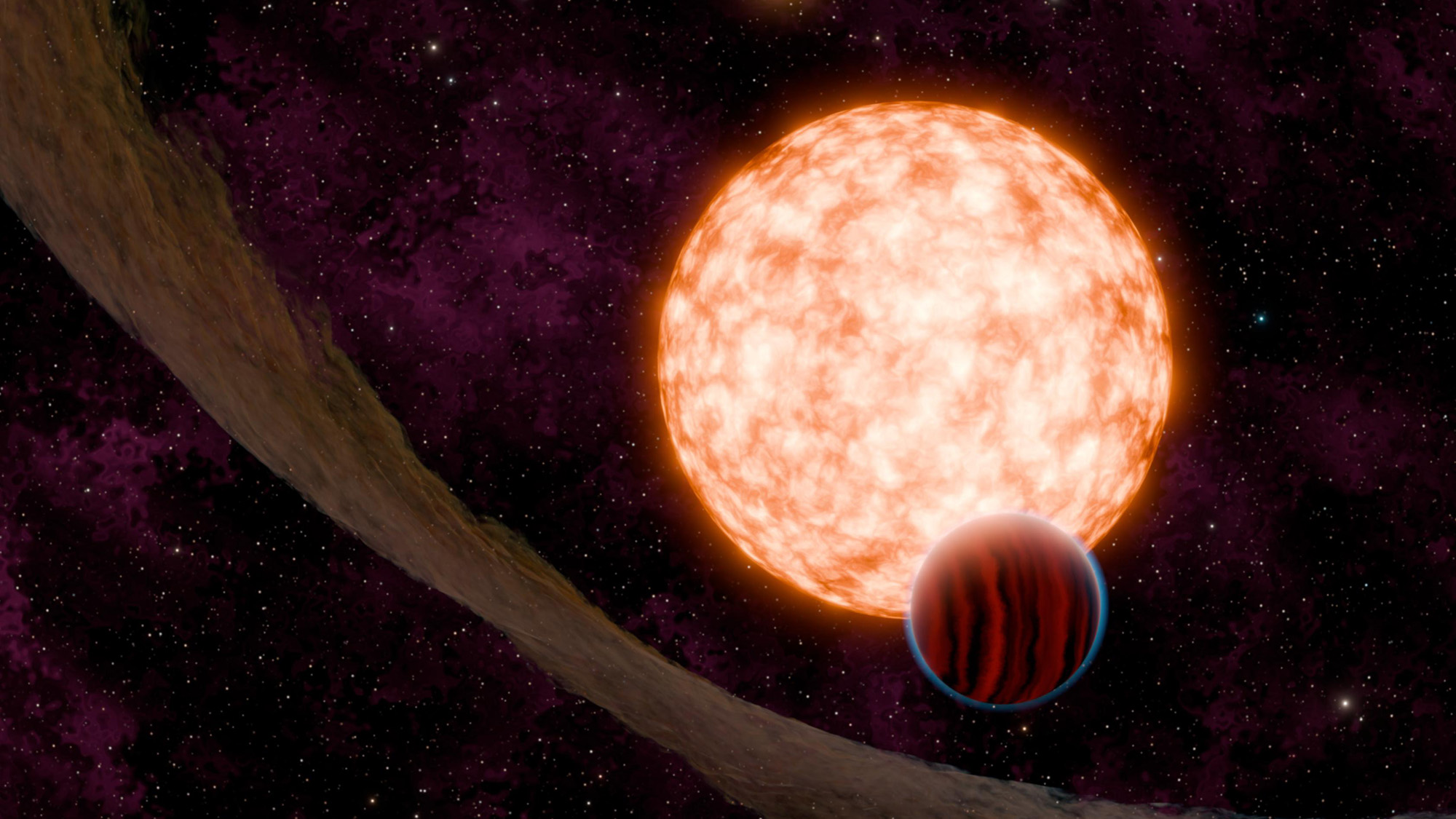
  • A black and red striped planet is seen next to a large glowing sun with a curved brown strip behind it in space.

We've spent decades looking for the wrong type of alien radio signals, new paper claims

  • A hand reaches out toward another hand with a starry blue boundary between them

Superintelligent AI in space could explain the Fermi Paradox

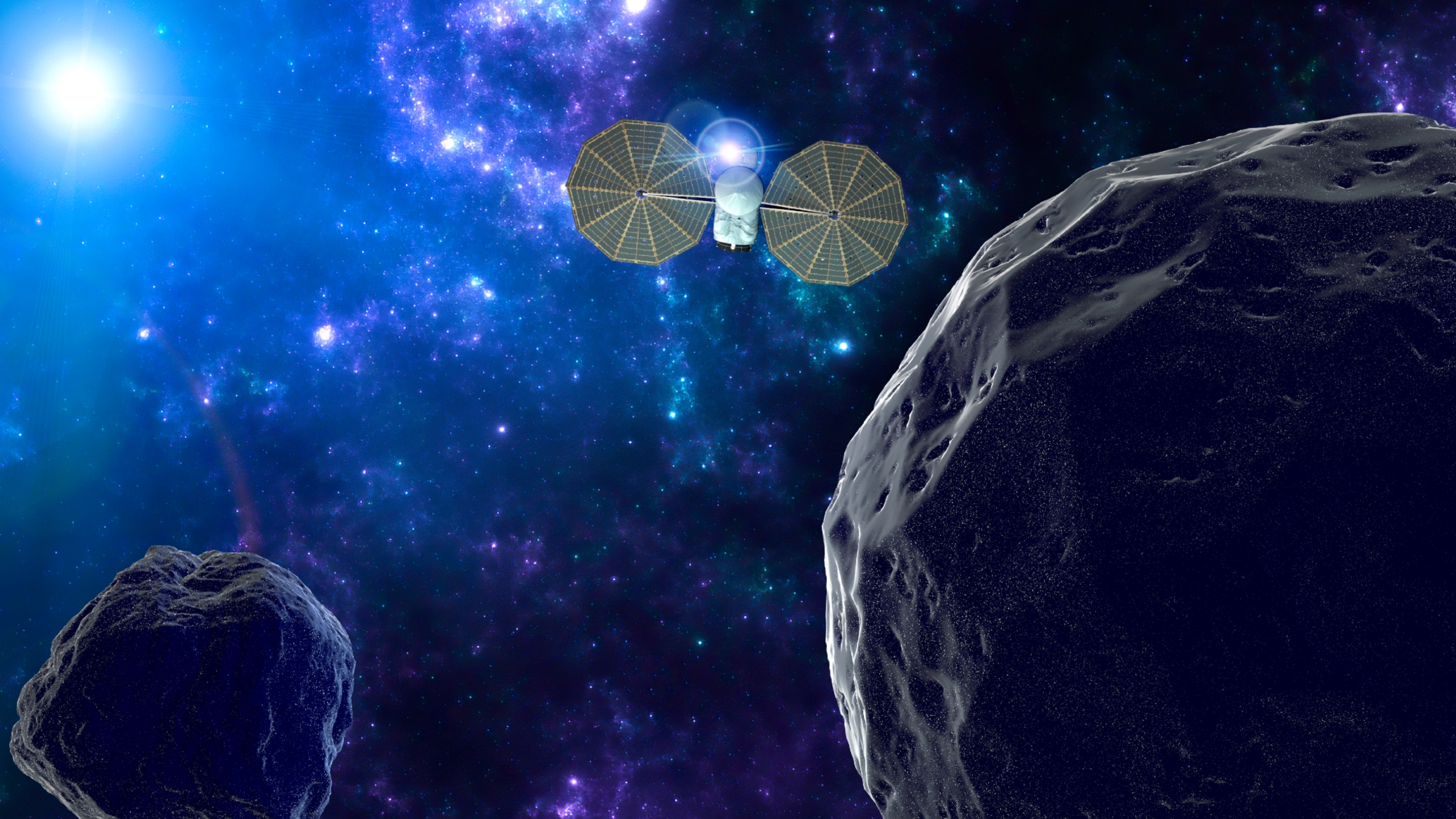
  • An artist's impression of a spacecraft approaching an asteroid

China's secretive Tianwen-2 mission arrives at Earth's 'quasi-moon' ahead of historic landing

Photo of the moon with the crescent Earth in the background

Unlike Earth, the moon lacks a functional atmosphere or magnetic field, meaning that its surface is exposed to the vacuum of space. This allows cosmic dust and other tiny particles to embed themselves within the lunar regolith.

(Image credit: NASA)

Tiny technosignatures

Until now, the search for evidence of advanced alien civilizations, known as technosignatures, has focused mainly on radio signals that could be emitted from inhabited exoplanets or hypothetical megastructures, such as Dyson spheres. However, these signals would originate only from active civilizations, not those that died out long before we could spot them.

The authors of the new study argue that when a civilization dies, traces of its technology could survive and end up in space, either via the deterioration of megastructures and other smaller spacecraft or via powerful asteroid strikes on once-inhabited exoplanets. Once in space, tiny specks of metal or other artificial materials could be ejected from star systems by powerful gusts of stellar wind and eventually drift toward us.

Using computer models, the team predicted that pieces of tech up to 3 micrometers across (three-millionths of a meter, or about 3% the width of a human hair) could escape their star systems and travel across interstellar space for up to 1 billion years. Then, they estimated how much of this material could be reaching the solar system and how likely it would be to end up on the moon. (We already know that interstellar dust can penetrate the inner solar system because scientists found some within samples collected from the surface of Bennu, an asteroid that orbits between Earth and Mars and was visited by NASA's OSIRIS-REx probe in 2020.)

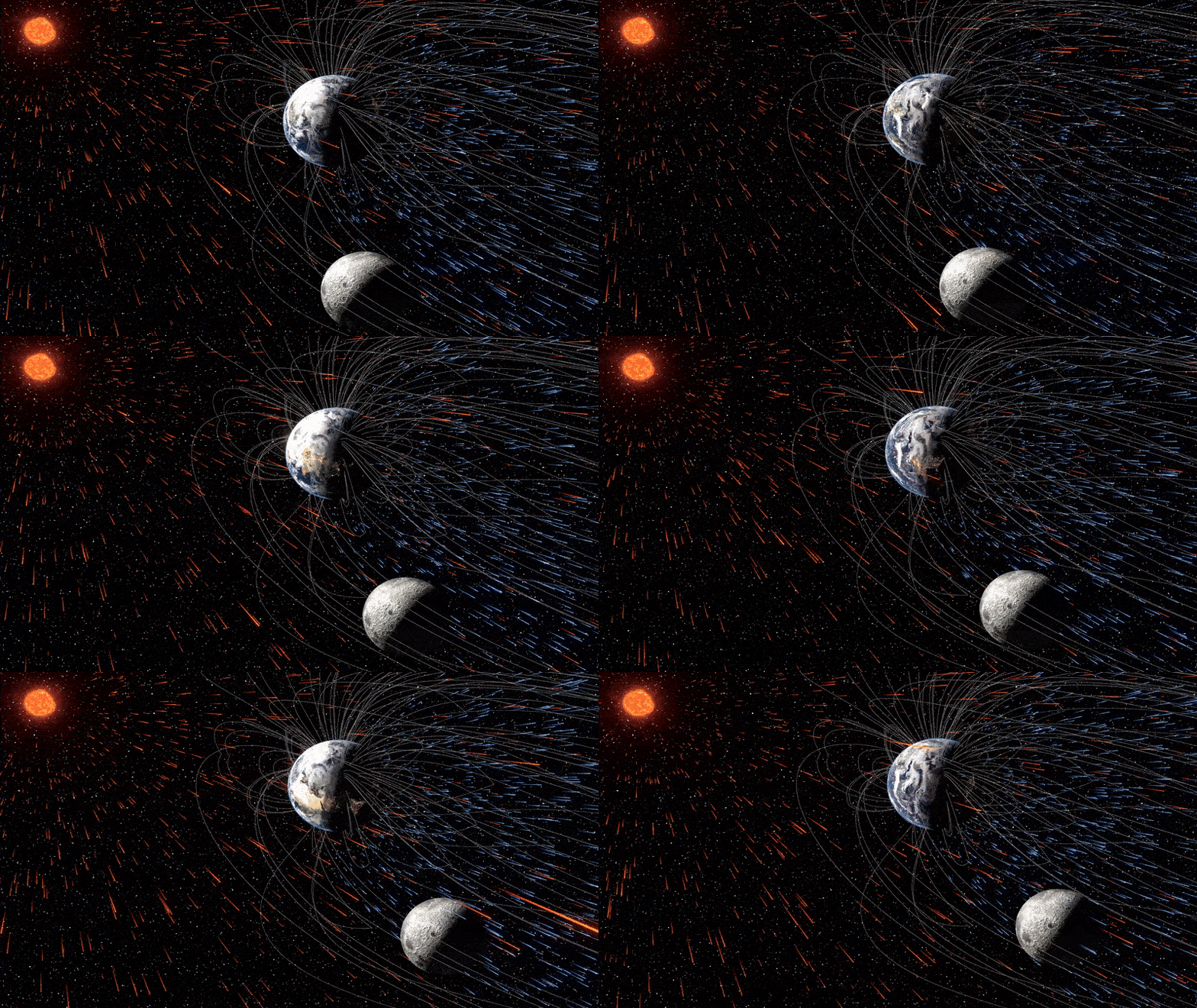
GIF showing simulation of moon passing through ions being blown of Earth by the solar wind

The moon is constantly being bombarded by tiny particles, some of which come from outside the solar system.

(Image credit: University of Rochester illustration / Shubhonkar Paramanick)

To date, no lunar samples have contained any technosignatures. However, the scientists who studied them were likely not looking for such particulates, and the samples were probably too small to yield meaningful results, the study authors argue.

The researchers believe that a sample of lunar regolith with a volume of 35 cubic feet (1 cubic meter) could be enough to find at least one technological fragment. The team also proposed ways of combing through the material using microscopy, industrial materials analysis and AI-assisted imaging.

What to read next

  • An illustration showing the protoplanet Theia smashing into Earth and releasing a large cloud of molten debris

The moon may have formed in just 5 hours, new simulations suggest

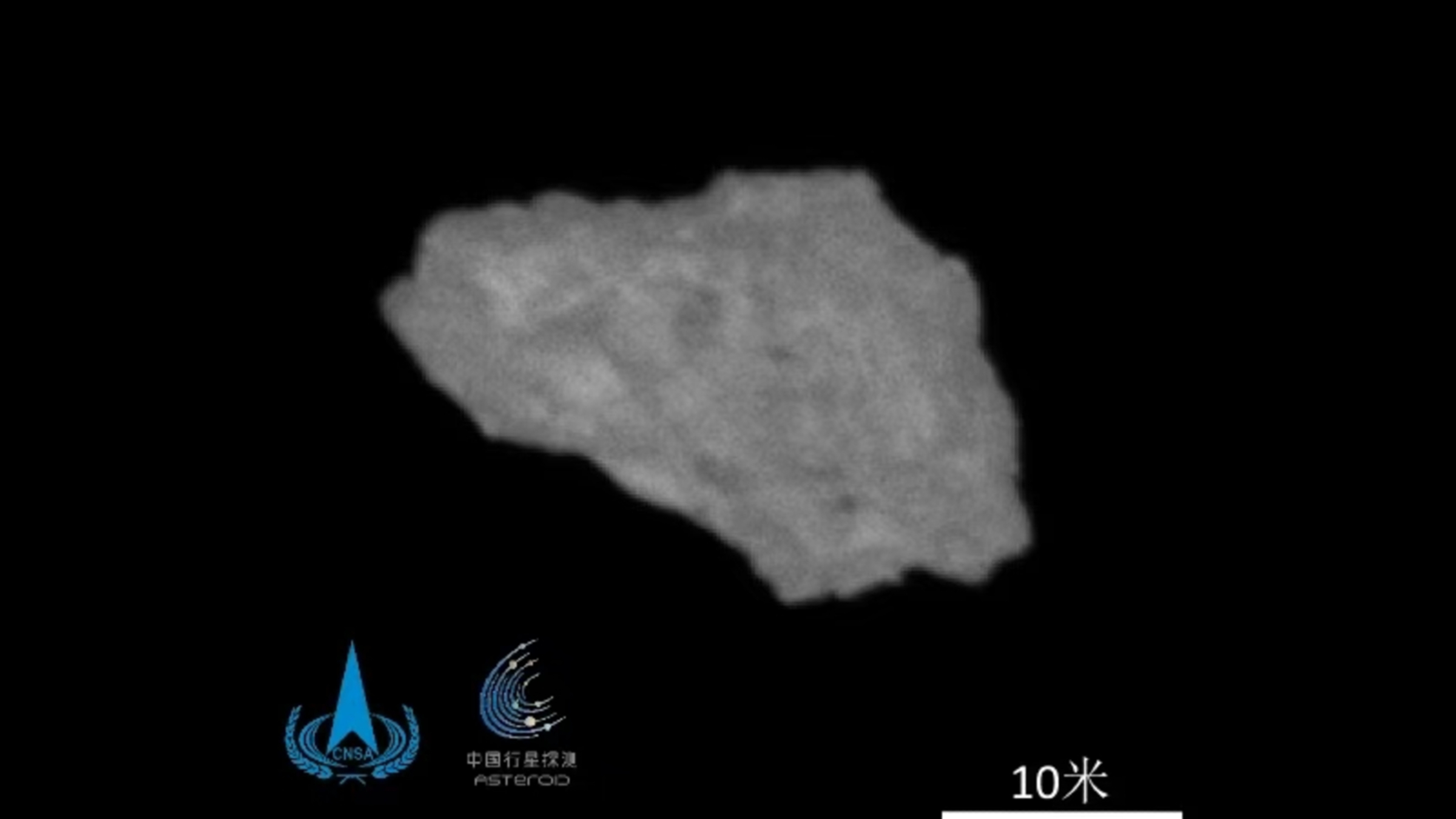
  • A blurry photo of an irregular-shaped grey asteroid in against the darkness of space

Secretive Chinese probe snaps first photo of Earth's mysterious 'quasi-moon' — and it may pose a big problem

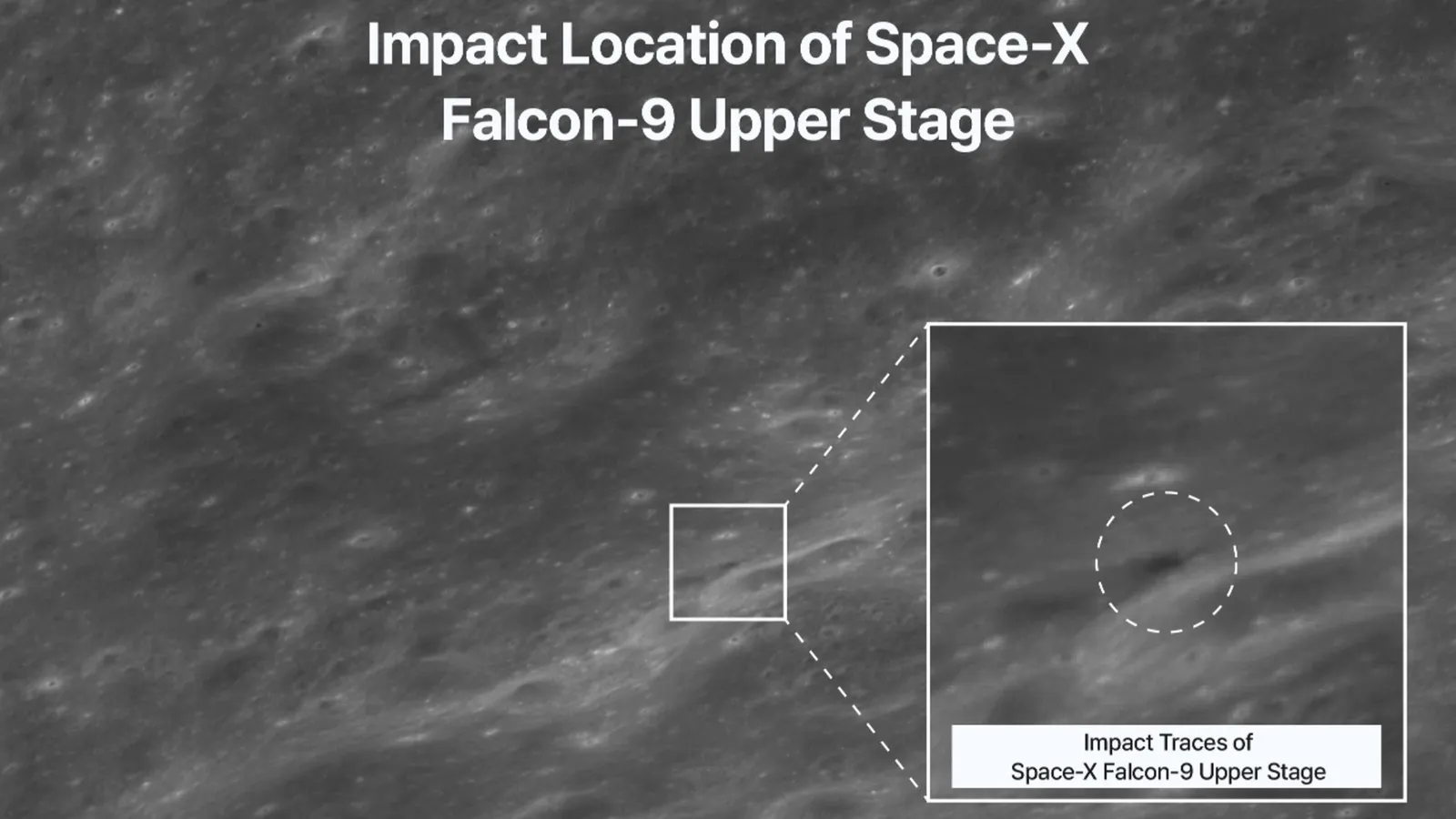
  • A new crater appeared on the moon after a SpaceX Falcon 9 upper stage crashed near Einstein crater on Wednesday, Korean satellite images reveal

First photos of SpaceX lunar rocket crash show blackened hole torn into the moon's surface

However, if such a sample does not yield any results, this would not necessarily disprove the researchers' hypothesis and may instead mean their models are off and a greater sample size would be required, the team wrote.

"Eminently reasonable"

A photo of the Artemis II rocket launching from Florida

Future missions in NASA's Artemis II program could bring back more samples of lunar regolith from the moon for future analysis. This photo shows the Artemis II mission lifting off April 1 from the Kennedy Space Center in Florida.

(Image credit: Chip Somodevilla/Getty Images)

Several upcoming space missions will collect fresh samples from the lunar surface, including China's recently delayed Chang'e-7 mission and future missions in NASA's Artemis program. These samples could potentially hold technosignatures, although the volume of regolith collected will be far less than what the researchers are proposing.

Therefore, we may have to wait until humans establish a permanent moon base before astronauts can collect enough material to be analyzed properly. This may not be that far off, as both the U.S. and China are planning to construct lunar bases within the next decade. Researchers also think the samples could be analyzed on the moon rather than on Earth.

As a result, the SETI Institute, which leads the international hunt for technosignatures, views the new idea as very promising.

"The concept of searching the lunar regolith for microscopic technosignatures is at once extraordinarily original and eminently reasonable," Bill Diamond, president and CEO of the SETI Institute, who was not involved in the new study, said in the statement. "This is a novel addition to the search methodologies applied to seeking evidence of technology as a proxy for life and intelligence beyond our solar system and we are excited at the prospect of bringing this to fruition."

Article Sources

  • Lewis J. Pinault, Brian C. Lacki, Ian A. Crawford, Andrew P. V. Siemion. (2026) Micron-Scale Technosignatures: How a Cubic Metre of Lunar Regolith May Begin to Constrain the Number of Past Technological Civilisations in the Galaxy. arXiv.


The Moon Might Be Hiding Traces of Dead Alien Civilizations

{ https://www.livescience.com/ }

Hoe vind je dit bericht?
Geschreven door peter om 22:11 Stuur door

100 Black Structures In Moon Photo, Seeing Is Believing, UFO UAP Sighting News. Mind-blowing Stuff.

100 Black Structures In Moon Photo, Seeing Is Believing, UFO UAP Sighting News. Mind-blowing Stuff.

UFO_news.png

alien_news.png
Date of discovery: Sept 13, 2026
Location of discovery: Earths Moon 
Source photo:
 
Ok this is nuts I know, but its 100% authentic. There are huge alien structures on Earths moon and they are only visible if you take the original photo, make it 3X bigger, add light and pow! The black structures become visible. Most are partly burried under the ground, so I believe what we are seeing is actual proof that the moon is hollow and these are parts of the space ships outer hull area...yes our moon is a spaceship. So...the earliest photos of the moon were real, revealing alien structures all over the place. So that means these structures were later edited out by NASA photo editing workers. Please don't take my word, go to the page, download the photo and see for yourself. There are two resolutions...pick the smaller 1.6mb size not the 6mb because its more clear, the bigger photo is unclear.
 
Aliens, they are just waiting for more of the public to become aware, before they do the big reveal to the world all at once.  
Scott C. Waring - UFO Sightings Daily 
 

{ https://www.ufosightingsdaily.com/ }

Hoe vind je dit bericht?
Geschreven door peter om 20:37 Stuur door

V UFO Stuns Eyewitness Over Columbus, Ohio, USA Aug 30, 2026, UAP Sighting News.

V UFO Stuns Eyewitness Over Columbus, Ohio, USA Aug 30, 2026, UAP Sighting News.

UFO.png

UAP.png

Date of sighting: Aug 30, 2026
Location of sighting: Columbus, Ohio, USA
Source:
 
Now here is an exciting report. An eyewitness was stunned when seeing this silver V shaped UFO over the city near the clouds. The woman's voice cracked and her excitement was so much she said a few bad words, which is totally 100% authentic, so I appreciate people being real. I have to say, a metal V shaped UFO craft is one of the least common types of UFO. More often seen because they are so big they block out the stars like the Phoenix Lights event, but this one is tiny...car size. Makes you want more video doesn't it? Yeah it does, me too. I will keep an eye out for any others who may have seen it. There is a window at the very point of the V shape object, when the sun hits it, it really reflects light, someone is watching up there. 
Scott C. Waring - UFO sightings Daily 
 
Eyewitness states: 
7/30/26 Columbus Ohio, excuse the language.

V UFO Stuns Eyewitness Over Columbus, Ohio, USA Aug 30, 2026, UAP Paranormal Alien Sighting News.

{ https://www.ufosightingsdaily.com/ }

Hoe vind je dit bericht?
Geschreven door peter om 20:29 Stuur door

Alien Seen near blue beam of light seen on Ring Cam, Sept 10, 2026, UFO UAP Sighting News.

Alien Seen near blue beam of light seen on Ring Cam, Sept 10, 2026, UFO UAP Sighting News.

alien,%20UFO.png

alien,%20UAP.png
 
Date of sighting: Sept 10, 2026
Location of sighting: North Carolina, USA
Source: 
A woman was alerted to her ring cam sending here a message of a strange phenomenon in the darkness of the street in front of her home. A blue beam of light is seen as if some invisible UFO craft had landed and opened its doors, and a person is standing in the opening watching if its safe to come out. Not one, but two entities are seen on the Ring Cam. It all looks 100% real I and I have a feeling this is an actual contact case. UFOs often land in isolated areas and try to approach humans or at least study them without the people knowing. Remember...aliens can use their telepathy close up to feel, see and even understand every behavior of the person they are linked too. This is rare and its something the US gov wont ever reveal to the public, but lucky for us, it got caught on Ring Cam. 
Scott C. Waring - UFO Sightings Daily 
Eyewitness states: 
I heard a loud noise like a car door slamming about 10:30 last night and saw this on my Ring. Have no idea. We don’t have street lights.
 
799958745_4123394727798018_9103732982369956819_n.jpg

800826172_4123395897797901_3891695694351079445_n.jpg

Screenshot%202026-09-12%20at%2010.42.20%E2%80%AFPM.png

{ https://www.ufosightingsdaily.com/ }

Hoe vind je dit bericht?
Geschreven door peter om 20:20 Stuur door

Terrifying map reveals the fate of every single glacier on Earth – as scientists warn HALF could collapse by 2100

Terrifying map reveals the fate of every single glacier on Earth – as scientists warn HALF could collapse by 2100

A terrifying map has revealed the fate of every single glacier on Earth. 

Called the Global Glacier Extinction Explorer, the interactive tool is the brainchild of scientists from ETH Zurich and Vrije Universiteit Brussel. 

By zooming in, you can investigate whether a glacier is expected to disappear under different levels of global warming. 

The map also reveals approximately when this could happen. 

'Global numbers such as glacier mass or area loss can feel very abstract,' said Dr Lander Van Tricht.

'With this website, people can zoom into their own valley or mountain region and see what different levels of global warming could mean for the glaciers they know.'

Worryingly, the scientists say that nearly half of today's glaciers could disappear by 2100 if global warming remains at +1.5°C – with catastrophic consequences. 

A terrifying map has revealed the fate of every single glacier on Earth. Called the Global Glacier Extinction Explorer, the interactive tool is the brainchild of scientists from ETH Zurich and Vrije Universiteit Brussel

A terrifying map has revealed the fate of every single glacier on Earth. Called the Global Glacier Extinction Explorer, the interactive tool is the brainchild of scientists from ETH Zurich and Vrije Universiteit Brussel

To explore the fate of Earth's glaciers, select a warming scenario in the box on the left. There are options for 1.5°C, 2°C, 2.7°C, or 4°C of warming. 

The colour of the dots indicates each glacier's fate. 

Dark red shows that a glacier is already extinct, while orange suggests it will become extinct between 2027 and 2041. 

If the dot is light blue, it suggests the glacier is one of the few to survive through 2100. 

Alternatively, you can hover over a glacier for a quick summary, or click it to explore its full profile, including area, elevation range, and projected extinction timing across scenarios.

The map is based on 2024 projections by researchers at ETH Zurich, which estimated when and where glaciers around the world could disappear. 

The projections suggest that, under +1.5°C of global warming, around 2,000 glaciers could disappear every year. 

By 2100, that could mean just half of today's glaciers remain. 

Meanwhile, if global temperatures rise by 2.7°C, only 20 per cent of glaciers would remain, while 4°C of warming would leave just 10 per cent of glaciers standing. 

'Every fraction of a degree matters,' Dr Van Tricht said. 

'Limiting warming to 1.5°C could preserve more than twice as many glaciers as a 2.7°C trajectory by 2100.'

Dark red shows that a glacier is already extinct, while orange suggests it will become extinct between 2027 and 2041. If the dot is light blue, it suggests the glacier is one of the few to survive through 2100

Dark red shows that a glacier is already extinct, while orange suggests it will become extinct between 2027 and 2041. If the dot is light blue, it suggests the glacier is one of the few to survive through 2100

The map is based on 2024 projections by researchers at ETH Zurich, which estimated when and where glaciers around the world could disappear

The map is based on 2024 projections by researchers at ETH Zurich, which estimated when and where glaciers around the world could disappear

What are glaciers?

A glacier is a large, persistent mass of dense ice formed over centuries from compressed snow.

It moves slowly downhill under its own weight, acting as a 'river of ice' eroding surrounding landscapes.

Glaciers are found in cold regions and high altitudes, covering about 10 per cent of Earth's land and acting as a vital freshwater source.

While 2100 still feels far away, 2026 has already proved to be a bad year for glaciers.

A combination of low winter snow and several summer heatwaves has resulted in 'substantial' ice loss across the European Alps, according to the researchers. 

They highlight Bella Tola Glacier near Saint-Luc in Switzerland, which was sadly declared extinct last month – an outcome that was predicted by the 2024 study. 

In addition, Urirotstock Glacier – one of Switzerland's smallest glaciers – was also declared extinct this summer. 

Dr Van Tricht said: 'These examples make the concept of glacier extinction very concrete.

'Our projections showed that many small Alpine glaciers are approaching the end of their lives, and we are now witnessing this process in real time.

'Bella Tola is particularly striking, as its observed disappearance falls directly within the extinction window projected by our models.'

While the researchers did not look at the consequences of such glacier loss, a study last month warned how their demise could spark devastating sea level rise. 

Researchers from Ca' Foscari University of Venice estimate that glaciers outside the vast ice sheets of Greenland and Antarctica contain around 150,000 cubic kilometres of ice.

If every one of these glaciers melted completely, it would raise global sea levels by more than 12 inches (32.3cm).

'Behind every disappearing glacier is a place, a history and often a community that will experience its absence,' Dr Van Tricht said. 

'The fact that some of the glaciers projected to disappear in our study are already vanishing today shows that glacier extinction is not a distant, end–of–century problem. It is happening now.' 

{ https://www.dailymail.com/sciencetech/index.html }

Hoe vind je dit bericht?
Geschreven door peter om 20:09 Stuur door

Defense Aviation Company Hermeus Unveils New “High Mach Speed” Prototype

Ramjet-X.
Image credit: Hermeus

Defense Aviation Company Hermeus Unveils New “High Mach Speed” Prototype

Defense aviation company Hermeus has announced the development of Ramjet-X, its next-generation ramjet propulsion test vehicle capable of carrying test payloads to high Mach speeds.

The company said Ramjet-X, designed to launch mid-flight from a carrier aircraft, offers the key advantages of competitive high-Mach test platforms while keeping costs low enough for a wider range of mission profiles.

Pre-flight testing of Ramjet-X is already underway, with its first official prototype test flights expected in 2027.

Ramjet-X Will Launch Mid-Flight from Quarterhorse

Most conventional jet engines can’t achieve supersonic speeds without dumping raw fuel into an afterburner and literally rocketing past the sound barrier. To travel at high Mach speeds without relying on rocket-style propulsion, engineers have turned to ramjet engines.

While ramjets are effective, they rely on the high-speed influx of air to operate. This limitation means aircraft equipped with this type of propulsion must be propelled to higher speeds by another craft or booster rocket before they can engage.

RESIZE-RamJet-X_07_B_Still-300x169.jpg

High-Mach Ramjet propulsion requires rapid air influx to enable combustion.

Image Credit: Hermeus

In an email to The Debrief, a Hermeus spokesperson explained that current options often rely on “large and expensive” boosters that are discarded after each test. Conversely, Ramjet-X relies on the company’s reusable aircraft to reach launch velocity.

“Ramjet-X is designed to be carried by Quarterhorse, which provides the speed and altitude required for deployment,” the company told The Debrief.

RESIZE-RamJet-X_06_Still-300x169.jpg

Ramjet-X is launched by Quarterhorse mid-flight.

Image Credit: Hermeus

The company could not disclose what speed Quarterhorse must achieve before it can launch Ramjet-X. However, the spokesperson did note that the launch craft is designed to return to home base for future missions.

When asked about Ramjet-X’s specific operating velocity once it disengages from Quarterhorse and engages its ramjet propulsion system, the company could only say the vehicle will operate at “High-Mach speeds.”

Conventional ramjets use a combination of high-velocity air and fuel to achieve extreme velocities. Hermeus said they cannot disclose specifics about Rocket-X’s fuel requirements.

Mission Profiles and Repeatable Architecture

Because of the sensitive nature of potential future missions, Hermeus was cautious about sharing specifics of any planned missions. The company also couldn’t provide technical details on what a typical mission profile might look like.

However, a Hermeus spokesperson told The Debrief, the vehicle’s architecture “allows customers and partners to integrate payloads, sensors, communications and computer systems, autonomy, material samples, propulsion technologies, and other experimental hardware and software onto Ramjet-X for testing in representative sustained high-Mach conditions.”

RESIZE-SIDE-OIC-RamJet-X_02_Still-300x169.jpg

Ramjet-X will enable “high-Mach” tests.

Image Credit: Hermeus

Hermeus also highlighted the potential cost savings of a “repeatable platform, launch architecture, and flight-test infrastructure,” designed to dramatically lower costs without sacrificing versatility or reliability.

“Instead of relying on a large dedicated expendable booster to accelerate the test vehicle into its ramjet operating regime, the launch aircraft provides much of that energy and then returns to fly again,” the company told The Debrief. “This architecture allows Hermeus to fly more by reducing the cost of expendable launch hardware.”

“High-speed flight testing is extremely expensive, and you don’t get many shots at it,” Hermeus CEO Zach Shore explained.

“Another Order of Magnitude Reduction”

Hermeus said specific unit costs are not currently available. However, they said a projected cost per minute of high-Mach test time “is in the low $100k’s per minute.” For comparison, the company highlighted the historic and current costs of high-Mach flight testing.

“Most of the below comparisons are rocket-based but will give you an idea how costly high-Mach tests are and why Ramjet-X will fundamentally change the equation,” Hermeus told The Debrief.

Older examples include NASA’s X-43, which achieved around 21 seconds of high-Mach flight, and the Air Force’s X-51, which achieved around 350 seconds. Hermeus said both multi-year efforts cost around $450 million each in today’s dollars.

Current options include rocket-powered test flights aboard Rocket Lab’s HASTE, which Hermeus said run $10-20 million each, “not including the expendable cruise or glide vehicles.” The company also pointed to Stratolaunch Talon-A missions.

“Even though fully reusable, (they) are $10-12m per flight for a few min of on-condition time,” the company told The Debrief.

Conversely, Hermeus said its current projections of less than a million per minute offer potential customers “another order of magnitude reduction in the problem that matters most.”

“Ramjet-X is being designed around simplified manufacturing, rapid production, and expendability in meaningful quantities rather than the traditional model of building a small number of highly bespoke high-speed test articles as was done in other high-speed airbreathing flight test programs like X-43 and X-51,” the company told The Debrief. 

Development of Ramjet-X is already well underway

When detailing the newly announced Ramjet-X’s benefits, Shore noted that their system gives them a way to place new systems into sustained high-Mach environments “without building an expensive one-off test program every time.”

“Bringing speed, sustained flight, and scalability all into one system lowers the barriers to gathering extremely valuable data from these conditions and accelerates programs for both us and our customers,” the Hermeus CEO explained.

When announcing Ramjet-X, Hermeus said the vehicle’s ramjet engine is already undergoing extensive testing at its Florida-based HEAT facility. Future tests will occur at the company’s California headquarters, with the first flight tests planned for 2027. 

  • Christopher Plain has spent the last six years as Associate News Editor and Head Science Reporter at The Debrief. Follow and connect with him on X, learn about his novels at plainfiction.com, or email him at christopher@thedebrief.org.
RELATED

Hermeus Unveils Ramjet-X, New Test Aircraft Capable of Reaching Mach 4

Ramjet-X: The Future of High-Speed Aviation? 🚀

Hermeus completes first test flight of hypersonic jet design!

{ https://thedebrief.org/category/defense/ }

Hoe vind je dit bericht?
Geschreven door peter om 22:33 Stuur door

Buildings made of yeast expected to be printed on Mars

Buildings made of yeast expected to be printed on Mars

Researchers propose building houses on Mars using a 3D printer. The material would be a mixture of local materials with gelatin and yeast. The researchers believe that after hardening, it would have sufficient strength.

Materials for Martian printing. Source: phys.org

A 3D Printer for Mars

Researcher Zhisheng Qiu of the Hong Kong University of Science and Technology proposes using a gelatin- and yeast-based mixture to construct buildings on Mars. It would be used as a material for 3D printing. According to phys.org, an article on the subject was published in the journal Chem Circularity.

In general, the idea of using 3D printers for constructing buildings in space, and on the Red Planet in particular, is far from new. Transporting prefabricated structures from Earth is simply too expensive. And construction work performed by people wearing spacesuits is an extremely difficult task.

Researchers also fully understand that, wherever possible, the printing material should be produced from what is available locally. Everyone also agrees that its base should consist of local small rocks, sand, and dust. The only remaining question is the binder — a substance that would initially be liquid and then harden and gain strength.

Yeast as a Binder

The main problem is that traditional binders such as gypsum, lime, and cement hardly harden at all in the cold and dry climate of Mars. The water they need for hydration would simply freeze or evaporate before becoming chemically bound. In addition, the limestone required to produce the latter two materials is absent.

This is where the idea of using gelatin and yeast comes in. These organic materials also contain a large amount of water. However, according to the study’s author, freezing followed by evaporation does not interfere with their hardening. They simply turn into a solid film.

If this is indeed the case and they can firmly bind inorganic components together, it could provide a real solution to the problem of construction on Mars. Yeast and other organic materials could also be grown directly on the Red Planet instead of being transported from Earth.

The author says he was inspired to pursue this solution by freeze-dried fruit, which becomes very hard when dehydrated. However, this is more than just an idea. He has already managed to  print the first test sample, 30 mm high and 45 mm in diameter. Its strength turned out to be fairly similar to that of relatively weak concrete. The next step is larger-scale testing.


NASA Is PRINTING Houses For Mars & And It Only Takes 24 Hours

Scientists Turned Yeast Into a 3D-Printable Building Material

{ https://universemagazine.com/en/articles-en/ }

Hoe vind je dit bericht?
Geschreven door peter om 22:00 Stuur door

Aliens Are Actually Just Demons 'Without Moving Their Mouth' in Sightings, University Professor Suggests

Aliens Are Actually Just Demons 'Without Moving Their Mouth' in Sightings, University Professor Suggests

Diana Pasulka examines why some reported UFO encounters resemble historical accounts of demonic or spiritual phenomena, while stressing that this does not prove aliens are demons

UFO

Aliens reported in certain UFO encounters can look strikingly similar to figures from traditional demonic or spiritual accounts 

PHOTO Pinterest

Aliens described in some reported UFO encounters may resemble figures long associated with demonic or spiritual phenomena, according to US professor Diana Pasulka, who has highlighted accounts of telepathy, levitation and voices perceived 'without moving their mouth.'

Pasulka, a professor in the Department of Philosophy and Religion at the University of North Carolina Wilmington, has stressed that these similarities do not prove aliens are demons, but the overlap is striking enough to warrant closer study.

Pasulka has spent years researching religion, technology and contemporary culture, including interviewing people who report encounters with alleged aliens or unidentified craft.

She has said that certain modern UFO narratives share features with older religious and paranormal stories, and that the language has shifted from angels and demons to aliens and advanced beings while many of the core details sound oddly familiar.

Aliens, Telepathy and 'Voices Without Mouths'

Speaking on That UFO Podcast, Pasulka discussed a subset of close encounter reports in which witnesses describe an entity that appears to bypass ordinary speech altogether.

Highlighting what she sees as a concerning overlap with some religious accounts of possession, she said witnesses report seeing 'an entity that seems to know your thoughts and can speak any language and can speak with you without moving their mouth.'

Witnesses have described what they interpret as telepathic communication, a voice perceived 'in the head' yet attributed to an external presence. On their own, those details might sound like standard alien lore. Pasulka's interest lies in how closely some of these reports resemble descriptions found in historical accounts of spiritual and religious experiences.

She also drew attention to stories of physical disturbances that witnesses link to alleged UFO events. On the podcast, she said some people describe 'poltergeist type of activity,' including objects flying across rooms and unnerving knocks on walls.

'You also see things that are poltergeist type of activity, you know, things flying and knocks on, you know, walls and scary things like that,' she said. 'So yeah, you do see this with certain UFO experiences.'

Such reports resemble phenomena traditionally associated with poltergeists and other alleged paranormal disturbances, rather than the clean metallic crafts of science fiction films.

Not Every UFO, Not Every Alien

Pasulka has written about how contemporary UFO stories have reshaped her thinking about belief without pushing her into full-on demonology. She has been clear that she is not claiming all UFOs or alleged alien entities are demonic.

On the podcast she emphasised that point, saying she is examining a specific cluster of intense, often private encounters that share characteristics with older accounts of demonic or spiritual activity. The question, in her view, is why the details line up so neatly, not whether that automatically proves a demonic cause.

READ MORE

UFO Pentagon memo

A reported experience in which a figure appears to read a person's thoughts, communicate without visibly speaking and is followed by alleged disturbances such as unexplained knocks or moving objects, looks very different from a brief light in the sky. Whether readers accept that interpretation or not, Pasulka argues that the reported similarities deserve closer examination.

The vocabulary, she suggests, has changed with the times. The underlying weird stuff, not so much.

A Long History of 'Demonic' Aliens

The idea that aliens might be understood as dark spiritual beings is not new to the UFO world. Long before TikTok conspiracy threads, religious and occult thinkers were already wrestling with flying saucers.

Occultist Marjorie Cameron associated a reported 1952 UFO wave over Washington DC with the death of her husband, rocket engineer Jack Parsons, who had moved in the orbit of British occultist Aleister Crowley. Cameron interpreted the strange lights as part of a wider spiritual drama rather than a nuts-and-bolts extraterrestrial mission.

Mid-twentieth-century evangelist Walter Vinson Grant Sr. went even further in his 1954 booklet Men in Flying Saucers Identified: Not a Mystery! In the booklet, Grant argued that the beings associated with flying saucers were evil spirits rather than visitors from other planets.

Alien

Pasulka has not claimed that all UFOs or alleged alien entities are demons  PHOTO Pinterest

American Eastern Orthodox monk Seraphim Rose, writing from a traditional Christian perspective, took a similar line. In his 1975 book Orthodoxy and the Religion of the Future, he suggested that UFO phenomena could represent demonic deception and warned against treating alleged encounters as benign contact with higher intelligences.

Renowned British UFO writer Gordon Creighton, known for his work on mysterious aerial phenomena, also leaned toward a supernatural interpretation. He argued that many so-called aliens might be better understood through a spiritual or religious frame than a purely technological one.

For proponents of that view, talk of aliens often masks a much older debate about angels, demons and the nature of spiritual experience.

Where Religion and UFO Reports Overlap

Pasulka's work sits between these arguments. She is an academic of religion, not an exorcist, and she has also examined witness accounts and case material concerning alleged UFO and UAP experiences.

She notes that, whatever is ultimately going on, the people she interviews experience these events as real. They describe objects moving, time slipping, and bodies reacting in ways they cannot easily explain. In her writing and public comments, she has noted similarities between some of these reports and historical accounts of hauntings and demonic phenomena.

The reported experiences remain disputed and have not been established as evidence of demonic or extraterrestrial entities. The reports invite competing interpretations, from psychological or perceptual explanations to claims involving unknown physical or spiritual factors.

Independent verification of the reported experiences and their alleged explanations has not occurred. Pasulka's comments focus on similarities between accounts of certain UFO encounters and historical descriptions of spiritual or demonic phenomena, and she has explicitly said that those parallels do not prove the entities are demons.

For now, she appears less interested in telling people what aliens really are than in asking why some modern encounter stories sound so much like older religious ones. When a reported experience involves apparent telepathy, communication without visible speech and alleged physical disturbances, she argues that it may be more useful to compare it with centuries of spiritual narratives than to file it neatly under 'alien contact' and move on.

RELATED
Are UFO Encounters Actually Evidence Of Angels And Demons?

1 Hour of Real UFO Sightings | Bizarre UAP Footage Caught On Camera

{ https://www.ibtimes.co.uk/trending }

Hoe vind je dit bericht?
Geschreven door peter om 21:22 Stuur door

'Hovered Above the Hotel for 20 Minutes': Ex-RAF Witness Films Suspected Alien Triangular UFOs in Bali

'Hovered Above the Hotel for 20 Minutes': Ex-RAF Witness Films Suspected Alien Triangular UFOs in Bali

A former RAF serviceman's footage of three flashing triangular UFOs above a Bali hotel has ufologists and sceptics offering starkly different explanations

UFO

The alleged UFO sighting began at 6.40pm, when the man and his partner spotted the objects roughly 600ft above their apartment   

PHOTO Thor Deichmann/Pixab

A former Royal Air Force serviceman filmed what he believes were three UFOs hovering above a hotel in Seminyak, on Bali's west coast, on 6 July, footage that has since split ufologists and sceptics down the middle.

The witness, who asked not to be named, told Metro he watched the triangular shapes glow yellow, red and green against a clear sky for around 20 minutes.

For context, the sighting began at 6.40pm, when the man and his partner spotted the objects roughly 600ft above their apartment. 'We saw three triangular shaped objects in the sky,' he told Metro.

'One was flashing red, pink and blue green lights and the other was showing three steady green lights. The third was quite faint. They were not making any noise and were stationary.'

The pair briefly went inside to get ready for the evening. When they stepped back out, the objects had vanished. 'Quite weird really,' the witness said, which is about as understated as a close encounter gets.

UFO Sighting Divides Opinion Among Investigators

Gary Heseltine, editor of UFO Truth Magazine, was sent the footage by a former colleague and told Metro his first instinct was drones. He changed his mind after studying the clip more closely. 'There are several things that suggest to me that they might be anomalous, or a UAP,' he said, using the current term for unidentified anomalous phenomena.

Heseltine pointed to the objects' silence, their unusual paired shapes and the fact they held position above the hotel for a full 20 minutes. He also noted the formation did not resemble typical drone patterns, and that a hotel in Seminyak was an 'unusual' location for such a sighting.

He compared the footage to the mysterious drone swarms that appeared over New Jersey and other East Coast states in 2024, concluding the Bali sighting was, in his words, 'curious and for me unidentified.'

Not everyone is convinced. Ufologist and filmmaker Mark Christopher Lee called the video 'impressive' but said he doubted it showed extraterrestrial visitors. He suggested the lights could belong to Balinese kites, known locally as layang-layang, fitted with LED lights, a tradition tied to the island's kite flying season, when locals fly the kites to ask Hindu gods for a good harvest.

'For a brief few seconds my ancient alien head on was thinking ancient Vimāna coming back,' Lee told Metro, referencing the flying craft described in Hindu texts. 'But logic kicks in, especially with those lights, I guess at night you also can't see the strings.'

Science writer and UFO sceptic Mick West was characteristically blunt. 'They look like LED kites,' he said. It's the kind of verdict that tends to end debates rather than start them, though this one seems set to run a while yet.

Why Grainy UFO Footage Keeps Fuelling the Debate

There's a familiar problem here too. UFO footage has a habit of arriving blurry, distant and hard to verify, and this clip is no exception. Kate Burns, VP EMEA at video authentication firm identifAI, told Metro that parts of the footage appear to have been edited.

'The challenge with such videos, however, is that the lower the resolution they are, the harder it is to provide an entirely confident score,' she said.

READ MORE

UAP

Public appetite for these stories shows no sign of fading. A 2021 YouGov poll found roughly half of Britons believe aliens exist, and nearly one in ten claim to have seen a UFO themselves.

Nearly 100 sightings of orbs, triangles and metallic discs across UK skies have been logged with UFO Identified this year alone, though no official body records such reports.

Nick Pope, who investigated UFO reports for the Ministry of Defence in the 1990s, told Metro before his death in April that most callers to the department's 'UFO desk' genuinely believed what they'd seen.

'In the end, we found about 80% or so of these sightings were misidentifications, 15% had insufficient data and 5% were unknown,' he said. 'That 5% doesn't mean extraterrestrial, but as I always remind people, neither did we rule that out.'

Whether Bali's flashing triangles turn out to be kites, drones or something odder, nobody involved seems in a rush to say for certain.

Writer's pick

{ https://www.ibtimes.co.uk/trending }

Hoe vind je dit bericht?
Geschreven door peter om 20:54 Stuur door

Astronomer Theorise That Extraterrestrial Megacomputers Could Soon Reveal Hidden Alien Civilisations

Astronomer Theorise That Extraterrestrial Megacomputers Could Soon Reveal Hidden Alien Civilisations

A new study suggests that advanced extraterrestrial computing systems could emit detectable waste-heat signatures, known as Slysh halos, around stars, potentially visible in the far-infrared spectrum

Astronomy

A new astronomy paper proposes that highly efficient alien megacomputers could produce detectable heat signatures around nearby stars 

PHOTO  Photo by Bryan Goff on Unsplas

A new preprint by astronomer Michael Garrett proposes that extremely advanced extraterrestrial computing systems could leave detectable waste-heat signatures around stars.

A new paper posted on the arXiv preprint server proposes that highly efficient computing systems might create a detectable signature known as a Slysh halo.

The idea begins with a simple premise about civilisation itself. Computers have become steadily more powerful and central to human life, and the paper asks whether advanced extraterrestrial societies might also push computation towards its most efficient possible form, making their technology visible from Earth.

Extraterrestrial Megacomputers Could Leave a Slysh Halo

The paper argues that hyper-efficient computers could become a defining feature of a technologically advanced civilisation. Its proposed Slysh halo takes its name from V. I. Slysh, who previously argued that advanced civilisations would benefit from operating technology at very low temperatures.

That matters because irreversible computation carries a minimum thermodynamic energy cost and generates waste heat. Landauer's principle, as described in the paper, links the maximum efficiency of non-reversible computation to operating temperature.

Present-day data centres provide a familiar comparison. Modern data centres produce enough heat to require cooling systems. The same underlying problem would remain for a far more advanced computer, only at a vastly different scale.

The colder the system, the more efficient it can become. The source gives a striking comparison. A system operating near the Landauer limit at 10 Kelvin could perform roughly 30 times as many irreversible operations per joule as one operating at 300 Kelvin.

A Slysh halo pushes that logic outward. Instead of concentrating computers close to a planet, an advanced civilisation could distribute computing infrastructure through the cold outer regions of its planetary system.

The resulting structure could resemble an extended halo, although the paper notes that it need not be spherical and could instead take forms such as a thick disc or torus.

The paper does not address exactly how an alien society would engineer such a structure. The observational question is narrower. What would all that unavoidable waste heat look like from here?

Extraterrestrial Megacomputers May Glow in the Far Infrared

The paper suggests that the most likely operating temperature for a Slysh halo would fall between 5 and 30 Kelvin. At those temperatures, its waste heat would emerge mainly in the far-infrared or submillimetre spectrum.

Detecting it would not be straightforward. Many stars are surrounded by circumstellar debris, while other natural cold sources can also emit radiation at submillimetre wavelengths. Efficient computing systems could also be spatially diffuse, spreading their waste heat over a large area and making surface-brightness sensitivity an observational challenge.

Engineered radiators could instead be distinguished by a nearly grey, line-free thermal spectrum, along with other characteristics such as their temperature profile, morphology, and motion with the host star. Natural cold dust generally produces different spectral behaviour.

READ MORE

Antennas of the Atacama Large Millimeter/submillimeter Array (ALMA)

The paper argues that existing far-infrared and submillimetre observations already probe part of the relevant parameter space, while archival ALMA data could be reprocessed to search for compact or more distant candidates.

Future telescopes working at those wavelengths could make the search more sensitive. The proposal does not claim that such halos exist, only that a civilisation built around extreme computing efficiency might leave a measurable physical trace.

For now, the suggested signal remains hypothetical and difficult to separate from natural stellar debris. The paper's test is therefore observational. Search nearby stars for the cold, grey thermal glow that a Slysh halo might produce, and see whether anything is there.

RELATED

Alien Civilizations: How Advanced Could They Be?
The Fermi Paradox: Hidden Alien Civilizations

{ https://www.ibtimes.co.uk/trending }

Hoe vind je dit bericht?
Geschreven door peter om 20:33 Stuur door

Scientists Just Found 84 'Mysterious Objects' in Space That Defy Everything They Know About Galaxies

Scientists Just Found 84 'Mysterious Objects' in Space That Defy Everything They Know About Galaxies

The sources emit unusually soft X-rays, offering clues about Type Ia supernovae and galactic ionisation

Chandra X-Ray Observatory

Astronomers have found 84 hypersoft X-ray sources in six galaxies, offering possible clues about Type Ia supernovae and galactic ionisation By NASA/CXC & J.Vaughan - PHOTO Chandra X-Ray Observatory/wikimedia commons

Astronomers have identified 84 'hypersoft X-ray sources' across six galaxies using NASA's Chandra X-ray Observatory, including Andromeda and the Pinwheel Galaxy, in a discovery announced on 9 September 2026.

The objects are detected through unusually low-energy X-rays, while modelling suggests they produce large amounts of energetic ultraviolet radiation, much of it in the extreme-ultraviolet range, a combination of properties the researchers say has not previously been observed in a group of cosmic sources.

How Scientists Found the Hypersoft X-Ray Sources

The objects were not spotted through a new observing campaign. Researchers found them by re-examining publicly available data in the Chandra archive, searching for sources visible in the observatory's lowest-energy X-ray images but absent from higher-energy images.

They described the result in a paper published in Nature Astronomy.

The 84 sources were found across six galaxies: M31, the Andromeda Galaxy, M101, the Pinwheel Galaxy, and four elliptical galaxies. The sources appeared in both areas of active star formation and regions dominated by older stars, suggesting the phenomenon may not be restricted to one particular galactic environment.

Their name, hypersoft X-ray sources, refers to the unusual character of their emissions. The sources are detectable mainly at the lowest end of Chandra's X-ray range, while their spectra are inferred to peak in the extreme-ultraviolet range, a region that is difficult to observe directly.

That extreme-ultraviolet emission is difficult to observe directly because neutral hydrogen and helium in interstellar space absorb it, creating what NASA described as a 'nearly impenetrable barrier.'

'We've never encountered a group of objects that act like this,' said Mustafa Muhibullah of the University of Alabama, who led the study. 'Of course, the next step was to try to figure out what these things are.'

The researchers propose that the sources are likely to include X-ray binary systems in which a black hole, neutron star or white dwarf accretes material from a companion star. As material is pulled from the companion star, it can heat up and produce X-rays before reaching the white dwarf or neutron star, or falling into the black hole.

Binary systems involving these types of compact objects are known, but the researchers say they have not previously been observed with this combination of very soft X-rays and strong ultraviolet emission.

Why These Mysterious Objects Matter

The discovery could help address two unresolved questions in astrophysics, although neither proposed explanation has been proven.

The first concerns Type Ia supernovae, powerful stellar explosions used by astronomers as distance indicators in cosmology. Type Ia supernovae played a central role in the discovery that the universe's expansion is accelerating, but scientists have struggled to identify the systems that produce them before detonation.

Some white dwarf binaries are thought to be possible Type Ia progenitors. If some hypersoft X-ray sources are systems that can eventually produce Type Ia supernovae, they could give astronomers an opportunity to identify potential progenitors before an explosion occurs. That would allow researchers to study the final stages of a process usually examined only after the explosion has occurred.

'If we could find a way to spot these Type Ia supernova explosions before they go off, that would be really important,' said study co-author Jimmy Irwin, also of the University of Alabama. 'Right now, we study them after they've exploded, and astronomers have struggled to understand what is actually ignited.'

The second question involves the removal of electrons from gas between stars. This process, known as ionisation, affects how gas behaves, how quickly stars form and how galaxies evolve. Hot, massive stars are known to contribute, but they do not fully account for the observed radiation in some galaxies.

The intense ultraviolet output inferred from hypersoft sources could account for part of the energy budget involved in this ionisation. If so, these difficult-to-detect sources may have contributed to the ionisation of gas in their host galaxies while remaining largely undetected by previous surveys.

The Next Test for Hypersoft X-Ray Sources

The researchers stress that the sources' physical identities remain uncertain. They may represent more than one kind of binary system, rather than a single new object in the traditional sense. Further observations will be needed to determine which types of X-ray binary systems are responsible and whether the population includes several physical classes.

The archive search also points to a broader problem in astronomy. Objects can remain hidden not because telescopes lack observations, but because their strongest emission falls in wavelengths that are difficult to detect. In this case, the sources' low-energy X-rays were difficult to detect, while much of their extreme-ultraviolet emission was absorbed by hydrogen and helium before it could reach telescopes.

Rosanne Di Stefano of the Center for Astrophysics, Harvard & Smithsonian, a co-author of the study, said, 'By combing through the Chandra archive, we were able to eliminate what used to be a blind spot for telescopes.'

The 84 detections could therefore represent only part of a larger population of previously overlooked systems. Whether they reveal future supernovae, an overlooked source of galactic ionisation, or several different systems hiding under one name will depend on what astronomers find next.

For now, the strangest part is also the most useful: the sources were identified in archival observations that had already been collected.

RELATED

NASA Found 84 Mysterious Objects in Space… What Are They?Copy title

NASA Found 84 Mysterious Objects in Space #Shorts

NASA Found 84 Strange Objects in Deep Space… and They’re Vanishin

{ https://www.ibtimes.co.uk/trending }

Hoe vind je dit bericht?
Geschreven door peter om 20:09 Stuur door

Could these flashing triangles in the sky be real-life UFOs?

Could these flashing triangles in the sky be real-life UFOs?

Hoe vind je dit bericht?
Geschreven door peter om 19:22 Stuur door

FBI Agents Investigating UFOs Afraid They’re About to Be Fired by Trump

FBI Agents Investigating UFOs Afraid They’re About to Be Fired by Trump

"Would undermine the Trump administration’s commitment to take the U out of UAP."
Hoe vind je dit bericht?
Geschreven door peter om 17:34 Stuur door

Newest Alien Face Found On Mars Today! Let's Introduce You, UFO UAP Paranormal Sighting News. WOW!

Newest Alien Face Found On Mars Today! Let's Introduce You, UFO UAP Paranormal Sighting News. WOW!

UFO,%20UFOs,%20UAP,%20UAPs,%20UFO%20sighting,%20UFO%20files,%20UFO%20video%20UAP%20files,%20UAP%20video,%20department%20of%20war,%20alien,%20aliens,%20infrared%20UFO,%20IR%20UFO,%20official%20UFO,%20Gov%20UFO,%20USA%20UFO%20copy%202.png

Date of discovery: Sept 11, 2026
Location of discovery: Mars
Source map: 
Now many people will ask for the coordinates, honestly I just started using this map for about three minutes and found this face, so I don't even know if coordinates work on it or not. Never used this map before this moment so use the video and you will find the face. 
 
The face looks very ancient and has incredible detail to it. You can even see the unevenness of the face skin from its thousands of years of its life passing. The nose, eye, lips and chin all look human. The larger ears could easily pass as human. The turban hat with a small snake coming off the front is unusually human. The turban with the snake on the front area is similar to Earths cultures like Naga traditions in India/Nepal. Also Hindu traditions and Sikh/Nihang traditions. So its so closely resembles humans from the India/Nepal regions from over 2,000 years ago. This means ancient aliens went to these locations and visited them for some reason, stayed long enough to create this image and for the people to remember it, and after the aliens left, the people themselves began to mimic the behavior or dress code of the aliens thinking they were gods. Amazing isn't it?
Scott C Waring - UFO Sightings Daily
 
RELATED

The Face on Mars: Alien Hoax or Geological Mystery?

{ https://www.ufosightingsdaily.com/ }

Hoe vind je dit bericht?
Geschreven door peter om 16:34 Stuur door

Pentagon UFO office tried to convince Navy admiral that Tic Tac was US tech

Pentagon UFO office tried to convince Navy admiral that Tic Tac was US tech

A tough Tic Tac to swallow.

A dramatic Tic Tac UFO over the ocean with military radar screens. Image by Cybernews.

A dramatic Tic Tac UFO over the ocean with military radar screens.

Image by Cybernews.

Marcus Walsh Marcus Walsh  - Journalist
Key takeaways:

What went on in the meeting?

I think that was the bit, that was the whole beginning of the rest of the meeting, that was attempting to basically turn me and my thoughts,
retired Navy admiral, Tim Gallaudet.

Troubled findings


uforeddit2
Reddit r/UFO reaction to former Navy admiral claims.
RELATED

Why Did the Pentagon Claim the Tic Tac UFO Was a Secret US Drone? #shorts

The Truth About The US Navy Tic Tac UFO

The Tic Tac UFO: What Did the Navy See?

{ https://cybernews.com/ }

Hoe vind je dit bericht?
Geschreven door peter om 22:50 Stuur door

The Next Step In UAP Disclosure Is Better Measurement – Analysis

The Next Step In UAP Disclosure Is Better Measurement - Analysis

Image: ChatGPT

The Next Step In UAP Disclosure Is Better Measurement – Analysis

Key Takeaways:

  • The author says releasing UAP files (Trump’s 2026 disclosure drive, ~300 Pentagon records) cannot replace measurement: AARO’s latest report logged 319 cases, resolved 114, parked 191 for lack of data, and found the main barrier was weak, late, or uncalibrated sensors—not hidden exotic craft.
  • Better science needs comparable, multi-instrument observations (range, timing, calibration, independent physics), an explicit “not enough information” label, and a shared evidence record so aviation, weather, space, and defense data can be compared without exposing classified sensor performance.
  • Success should be counted as correct resolutions (e.g., 238 satellite flares via 3-D modeling), calibrated uncertainty, and refusal to turn missing range or AI confidence into “new physics.” Unresolved should mean the sky, not the archive.

Washington can release more files, but declassification cannot recover range, timing, or calibration that an observation never captured. AARO’s latest report points toward a common evidence standard.

Washington can release every UAP file it holds and still leave the central scientific problem untouched. Declassification can reveal what a witness reported and how an agency interpreted it. It cannot add range, synchronized timing, or calibration to an event that was never measured well enough.

That is not an argument against transparency. It is an argument for completing it. In February, President Donald Trump directed the Pentagon and other agencies to identify and release records on unidentified anomalous phenomena. By June, the administration’s disclosure campaign had released about 300 files, while the National Archives continued digitizing historical records. Disclosure supplies institutional context. Measurement supplies physical context. The two are not substitutes.

The latest annual report from the All-domain Anomaly Resolution Office, or AARO, makes that distinction unusually clear. AARO received 319 reports, resolved 114, transferred 191 to an active archive pending corroborating data, and identified nine for further specialist analysis. The report’s most consequential finding was not a shape in the sky. It was that a lack of timely, actionable sensor data continued to prevent resolution.

An archived case is not evidence of exotic physics. It is evidence that a question outlived the measurements needed to answer it. ‘Unresolved’ is a status of evidence, not a category of object.

The policy window is open. On July 8, AARO highlighted a Naval Postgraduate School special issue on UAP science and analysis devoted to data vetting, event-based sensing, military observations, and practical photography. Twelve days later, AARO posted its annual report. Together, the releases point toward the next phase of UAP policy: not merely opening more files, but making future observations comparable, testable, and useful.

From disclosure to observability

AARO acknowledges that its holdings are shaped by collection bias. Reports cluster in the continental United States, its coastal waters, and areas where U.S. forces operate because those are the places with more American sensors and personnel. A map of reported anomalies is therefore partly a map of where institutions looked. It cannot, by itself, show where unusual events are most common.

The problem is global. Civil aviation, meteorology, astronomy, space surveillance, and defense organizations observe overlapping parts of the sky, but they use different instruments, retention rules, clocks, metadata, and access controls. No country can infer global prevalence from its own uneven coverage. Reports that cross borders cannot be compared reliably when their evidence is recorded in incompatible forms.

The distinction also matters for security. AARO’s report separately recorded 50 known unmanned-aircraft incidents near U.S. nuclear infrastructure, weapons, and launch sites; none was reported as UAP. Better measurement serves two purposes at once: it keeps weak evidence from becoming an extraordinary claim, and it keeps a real incursion from disappearing into a vague anomaly category.

Eurasia Review covered NASA’s independent UAP study when it warned that too few high-quality observations existed to support firm scientific conclusions. NASA’s scientific guidance emphasized systematic calibration, multiple measurements, and complete sensor metadata. AARO’s new report shows that the same data-quality bottleneck remains.

A video may show apparent motion, but without range it cannot establish physical speed. An infrared point may look hot, but without radiometric calibration, target size, emissivity, and atmospheric correction it cannot establish temperature. An optical event and a radio transient may occur at the same time, but timing alone does not show that they came from the same source. These are measurement problems, not philosophical objections.

Independent evidence matters more than sensor count

The answer is not simply more cameras. Ten instruments that share the same timing fault, calibration error, software defect, or environmental confounder can create the appearance of corroboration while repeating one mistake. A stronger design uses heterogeneous redundancy: different instruments measuring the same physical quantity through different mechanisms, with uncertainty and common-cause failure treated explicitly.

The Galileo Project’s multimodal observatory work demonstrates the value of combining wide-field optical and infrared tracking, narrow-field characterization, radio-frequency measurement, acoustics, and environmental sensors. Its observatory-system architecture treats commissioning, calibration, raw-data provenance, and reproducible processing as parts of the scientific instrument rather than administrative details.

New sensor physics can add an independent witness. NIST’s Rydberg-atom methods can make traceable measurements of radio-frequency electric fields, including magnitude and phase. In a research observatory, an atom-based probe should complement mature antennas and receivers, not replace them. Agreement between channels based on different physics is more informative than agreement between two copies of the same receiver. Disagreement can reveal which assumption failed.

A scientific system must be allowed to say ‘not enough information’

The hardest design problem is deciding when a measurement supports an inference. Automated systems are optimized to return labels, but a scientific instrument sometimes needs to refuse. A vision model may be highly confident that an object is unusual while its range remains unknown. The confidence score still cannot supply velocity. Invalid timing should block a time-difference calculation. Sensor saturation should block a claim about the source’s spectrum.

A credible observatory therefore needs an explicit insufficient-observability state. This is not a weaker kind of anomaly. It means the available evidence does not support the next inference. The system may retain the event, request another sensor, or mark it for review, but it should not convert missing information into apparent physical novelty.

This principle anchors a research architecture I have been developing called Q-PAMO, the Quantum-Plasma Anomaly Measurement Observatory. Despite its name, the design assumes neither plasma nor an extraordinary origin. It separates evidence into three domains: the object’s motion, emissions associated with it, and environmental effects around it.

An event can progress from raw trigger to calibrated observation, candidate, corroborated candidate, and finally unresolved anomaly only when stated measurement gates are satisfied. Missing range, invalid timing, weak signal, failed calibration, or broken provenance can stop that progression regardless of an algorithm’s confidence. Plasma remains a hypothesis to test against reflected light, combustion, meteors, lightning-related effects, aurora, and sensor artifacts. It is never assigned because a luminous event merely looks strange.

Artificial intelligence still has a useful role. It can search continuous streams, prioritize follow-up, align observations across sensors, and identify known classes quickly. It should accelerate the route to evidence without manufacturing evidence that an instrument did not capture.

A shared evidence standard

International UAP research does not require a new global agency or a universal theory. It needs a minimum evidence record that lets reports from different systems be compared. Each case should state the observation time and clock uncertainty; sensor position, orientation, and calibration status; whether range was measured or assumed; where raw data are preserved; what processing changed them; which environmental conditions and sensor-health limits applied; which model and software version were used; and whether corroboration came from a genuinely independent source.

That standard would make disclosure more informative without forcing governments to reveal classified sensor performance. Evidence can be released in layers. A public package can preserve derived geometry, uncertainty, calibration status, processing history, and enough raw information for independent testing, while a restricted annex protects sensitive locations and capabilities. Secrecy may limit what can be published, but it should not turn an untestable assertion into a scientific result.

Civil-aviation authorities, research observatories, meteorological networks, space-tracking organizations, and defense partners could adopt the same minimum fields without surrendering control of their data. They could also publish reference datasets built from known aircraft, satellites, balloons, meteors, atmospheric events, and deliberately injected sensor faults. Before an observatory claims to recognize the extraordinary, it should demonstrate that it measures the ordinary correctly.

What scientific success looks like

AARO’s report provides a useful example. A new three-dimensional modeling capability enabled analysts to resolve 238 reports as satellite flaring—the brief reflection of sunlight from satellite surfaces. Turning a bright orb into a geometric explanation is not an anticlimax. It is what a successful anomaly program should do.

Success should be measured by the share of cases resolved correctly, performance against cooperative reference targets, false alarms per sensor-hour, calibration of uncertainty intervals, reproducibility of derived trajectories, and the system’s willingness to abstain when evidence is inadequate. Months of routine census data may be more valuable than one spectacular clip because they reveal what normal looks like and how instruments fail.

Public communication should follow the same discipline. A detection is not a discovery. An outlier score is not a new physical category. A classifier’s confidence is not a substitute for geometry. A cryptographic hash can show that a file has not changed; it cannot show that the original measurement was accurate.

The 191 cases in AARO’s active archive are not a cosmic conclusion. They are a measurement backlog. NASA has described the data problem, AARO is improving collection and analysis, NIST can contribute independent sensor physics, and academic observatories are demonstrating continuous multimodal observation. The missing piece is a shared evidentiary architecture that connects these capabilities across institutions and borders.

If a rare event survives calibrated tracking, independent range or parallax, multi-site localization, radio-direction consistency, environmental controls, spectral comparison, sensor-health checks, provenance validation, and serious attempts to reproduce it as an artifact, scientists will have something worth explaining. If it does not survive, the observatory has still succeeded.

Transparency can show that a file exists. Only disciplined measurement can show what existed in the sky. The objective is not to build a system that confirms extraordinary objects. It is to build one in which ordinary errors find it increasingly difficult to survive. Only then will ‘unresolved’ describe the sky rather than the gaps in our instruments.

RELATED

AARO releases 2025 Annual UAP Report. Document deep dive & analysis | UFO NEWS UPDATE

Harvard professor Avi Loeb on new federal UFO disclosure rules | FOX 10 Talks | FOX 10 Phoenix

Why UAP Disclosure Matters Now | Christopher Mellon at Disclosure Forum 2026

{https://www.eurasiareview.com/category/world-news/}

Hoe vind je dit bericht?
Geschreven door peter om 22:29 Stuur door

What Are Nebulae and How Can One Observe Them?

What Are Nebulae and How Can One Observe Them?

In astronomical images, we frequently observe depictions of diverse and remarkably beautiful nebulae that resemble a horse’s head or a butterfly. However, it is often challenging to comprehend their true nature, as most of the time, when we look up at the sky, such formations are not visible to the naked eye.
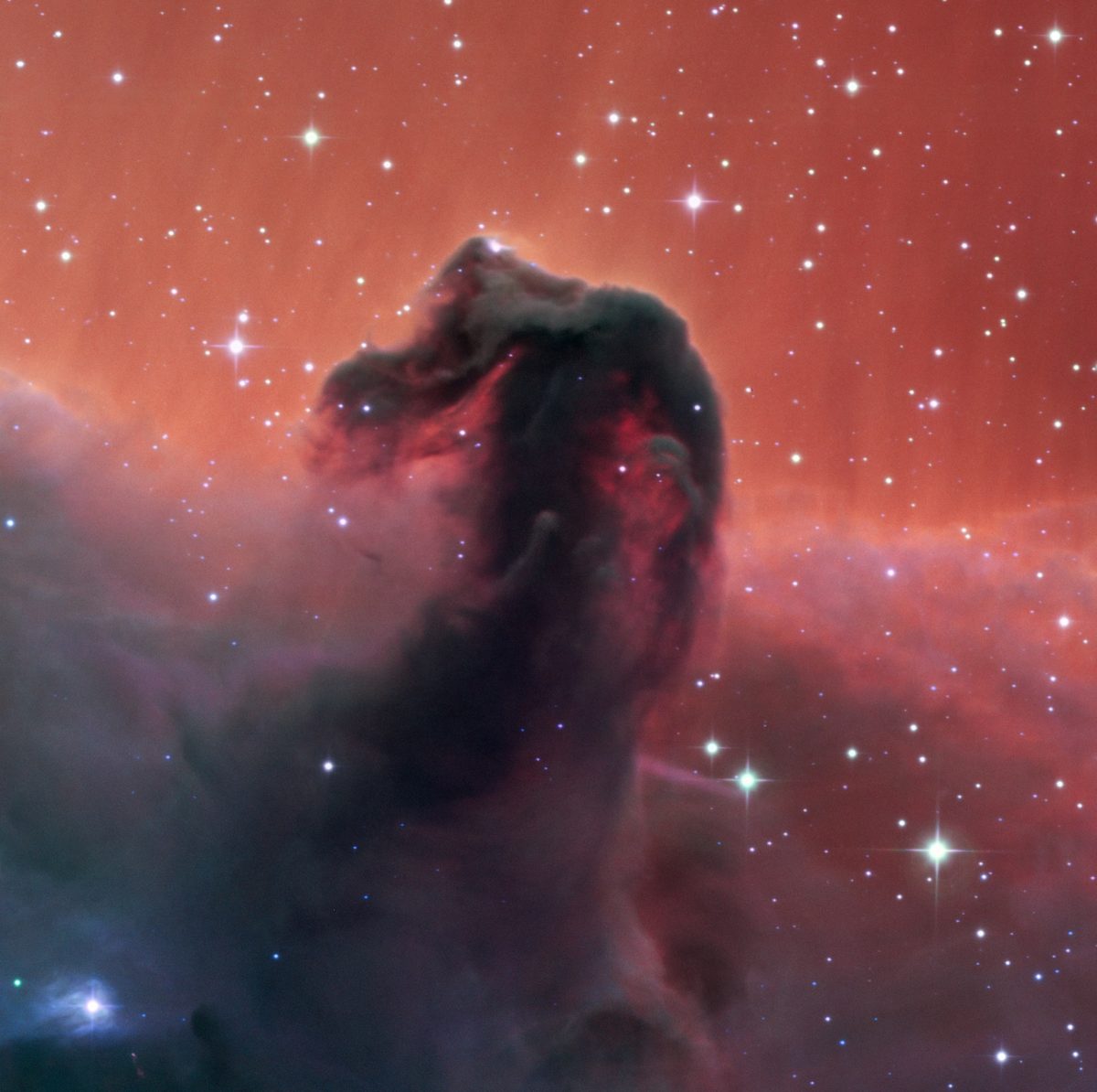
The Horsehead Nebula is among the most renowned nebulae. Source: Wikipedia

Nebulae in the starry sky

When individuals envision the Milky Way, the initial aspect that arises is the hundreds of millions of stars comprising it. Indeed, these are virtually the sole objects observable in the sky, aside from the celestial bodies constituting the Solar System. Nonetheless, it is likely that everyone has encountered images in popular science and other publications depicting exquisite nebulae, which frequently resemble the fantasies of artists.

Hence, the questions arise regarding the location of these objects, their nature, and the reasons for their invisibility. Several approaches exist to address these inquiries; however, we shall commence with the last. The vast majority of what are referred to as nebulae are not visible to the unaided eye due to their excessive faintness.

This is likely the reason why, during the initial millennia of astronomical observation, their existence was unknown. More specifically, they remained unidentified by European astronomers. For instance, populations residing in the Southern Hemisphere have been able to observe two small clouds in the night sky since ancient times — celestial formations that appear to have separated from the Milky Way and consistently occupy the same position.

The Magellanic Clouds above the Paranal Observatory. Source: phys.org

Among Europeans, they were first observed by the crew of the circumnavigational expedition led by Ferdinand Magellan in 1520. Their description of these stationary clouds—twice and ten times the size of the Moon — so deeply impressed astronomers that they named them in honor of the renowned explorer.

The Andromeda Nebula

Another object visible to the naked eye — and one that was discovered by Arab astronomers long before European astronomers — is the Andromeda Nebula. It has an angular size of 3.2° × 1°, which is six times larger than the full Moon. However, most of it is very faint, and only the central regions are bright enough to be seen as a small, bright spot.

The object was first documented in 946 by the Persian astronomer al-Sufi. European scholars commenced detailed investigations in the 17th century following the invention of the telescope. It is observable to the naked eye; however, optimal viewing conditions include a clear, moonless night away from the extensive light pollution typical of major urban areas.

Andromeda Nebula. Source: Wikipedia

If you are positioned appropriately at the opportune moment, you should be able to identify the three brightest stars in the constellation Andromeda. Instructions on how to accomplish this can be found in this article. Subsequently, mentally connect the middle star of these three, known as Mirach, with the highly prominent constellation Cassiopeia, which resembles the letter M, and follow the line. You will shortly discover a small, bright spot, which is the central region of the Andromeda Nebula.

Real nebulae

However, the objects in Andromeda, the Magellanic Clouds, and the faint luminous point observable on a very dark night within the constellation Triangulum are not nebulae in the contemporary understanding of the term. Rather, they are galaxies akin to the Milky Way. They appear as spots with diffuse boundaries — comprising the light emitted by millions of stars that constitute them.

Nevertheless, it is possible to observe genuine nebulae with the unaided eye. The most notable of these is the Orion Nebula. To appreciate it, one must first identify the constellation Orion. Subsequently, locate the three stars that constitute its belt. Beneath these stars, there is an elongated cluster of stars known as Orion’s Sword. In actuality, these objects are not gravitationally bound; however, among them, a hazy patch with indeterminate edges can be observed. This is precisely what we seek.

Orion Nebula. Source: Wikipedia

A comparable celestial object is located within the constellation Sagittarius. Its most conspicuous feature is an asterism known as “The Teapot.” Just above the “spout” of this Teapot, and contingent upon sufficiently dark skies, one can observe a faint, hazy region known as the Lagoon Nebula, or M8.

In other words, nebulae are inherently too dim to be fully perceived with the unaided eye. However, when employing binoculars or a modest amateur telescope, the quantity of such observable objects increases to dozens.

One of the most effective methods to study nebulae is through the catalog initiated by Charles Messier in 1771. Currently, it comprises 110 objects, predominantly nebulae or galaxies, with some star clusters included. This catalog provides sufficient scope to understand the remarkable diversity within the realm of nebulae.
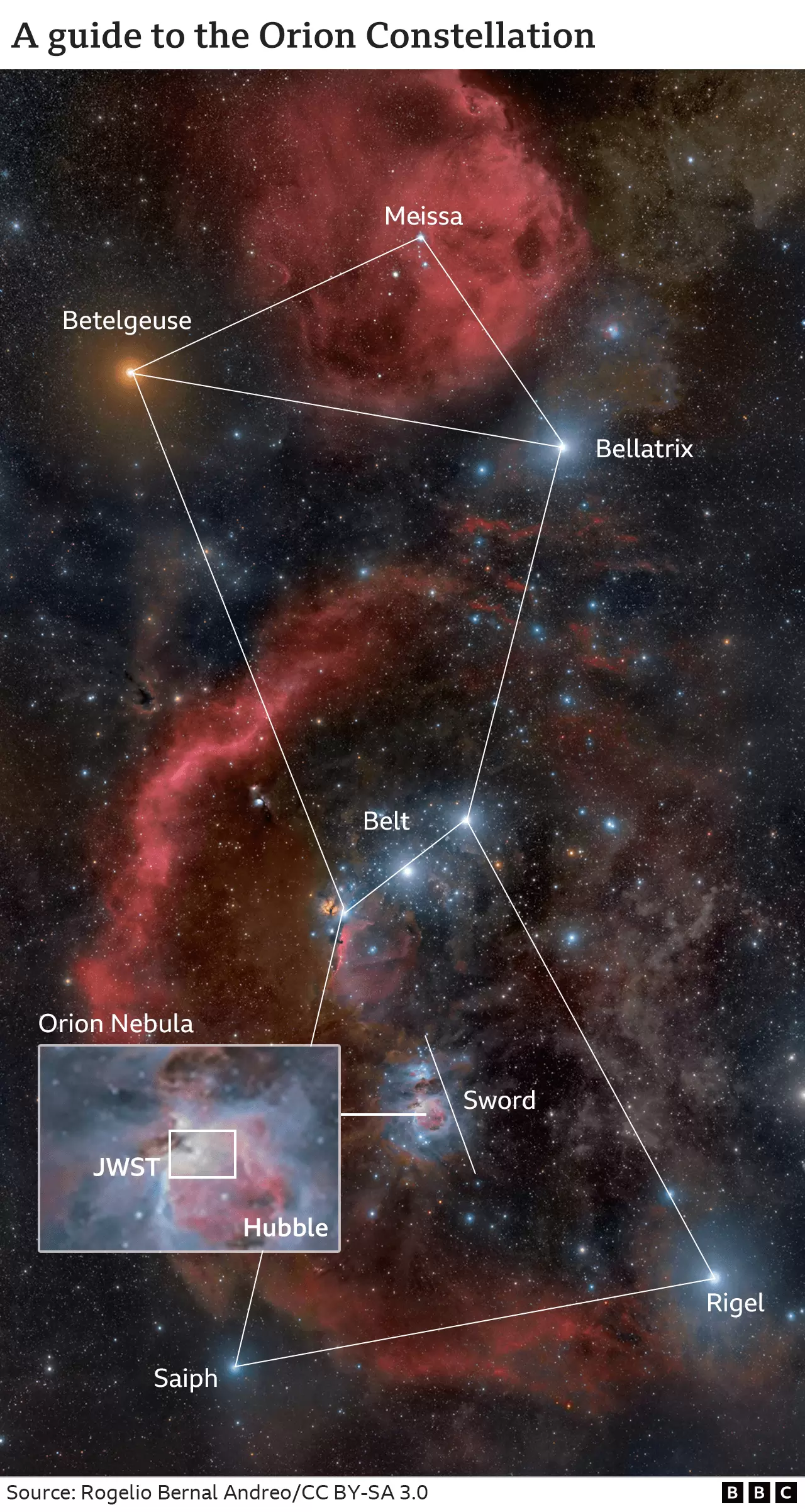
A diagram of the Orion constellation and the nebula captured by the James Webb Space Telescope. Source: NASA / ESA / CSA / MCCAUGHREAN & PEARSON

What are nebulae?

Nevertheless, the question persists: what precisely are these entities referred to as “real nebulae”? If they are neither remote galaxies in which individual stars are discernible nor star clusters situated within the Milky Way, then what could they be? They appear akin to clouds in the Earth’s sky — and indeed, are clouds composed of gas and dust occupying a specific region within the Milky Way.

What is their size? For instance, the Orion Nebula, previously referenced, extends across 24 to 33 light-years, with one light-year equating to 63,241 times the distance from Earth to the Sun. The Lagoon Nebula surpasses this in scale, measuring between 110 and 140 light-years.

The fact that the former appears larger is attributable to its proximity, being approximately 1,344 light-years away, in comparison to the 5,200 light-years for the Lagoon Nebula. Nonetheless, there are more extensive clouds within the Milky Way; however, they are significantly more distant from our location.

Simultaneously, nebulae can be characterized as relatively sparse environments. Most exhibit a particle concentration ranging from 100 to 10,000 per cm³, with only the densest regions reaching up to one million particles per cm³. In comparison, Earth’s atmosphere at the surface contains approximately 10¹⁹ molecules per cm³.

Lagoon Nebula. Source: Wikipedia

Nebulae predominantly comprise hydrogen and helium, rendering them remarkably akin to stars in this regard. Nevertheless, they also encompass heavier elements, water, silicates, and organic molecules, such as amino acids. Some of these substances are found in nebulae as small solid grains.

Nebulae typically do not emit their own light; instead, they predominantly absorb or scatter the light that traverses them. This phenomenon occurs because, notwithstanding their low density, they extend over vast distances. Consequently, as light passes through these regions, it is partially absorbed and scattered, which accounts for their appearance resembling dark clouds.

The Witch Head Nebula, illuminated by reflected light. Source: Wikipedia

Nevertheless, it is frequently observed that one or more luminous stars are positioned near the periphery or even within a nebula. Their emitted light reflects off the outer layers of the nebula, rendering it visible. It is due to this phenomenon that we are able to perceive its remarkable shapes.

All of these principles are applicable to nebulae in which the molecules exist in an inactive state. However, it is frequently observed that, owing to a proximate source of radiation, these molecules become ionized, heat up, and subsequently emit energy independently. Such nebulae are referred to by astronomers as emission nebulae.

Nevertheless, an emission nebula does not inherently emit radiation within the visible spectrum or across a wide range of frequencies. Many of these nebulae are detectable solely at particular wavelengths. In such instances, they are designated as radio nebulae.

Fermi Bubbles. Source: Wikipedia

An exemplary instance is represented by the Fermi bubbles — immense spherical formations of gas ascending on opposite sides of the Milky Way’s plane, situated above its central region. Their existence remained unknown until the early twenty-first century, owing to their composition of exceedingly rarefied matter that radiates within the X-ray spectrum. This radiation is subsequently absorbed by Earth’s atmosphere. The bubbles could only be detected following the advent of space telescopes designed to operate within that particular range. 

Nebulae and the evolution of stars

All of the above considerations pertain to large nebulae that span tens of light-years into space. However, they merely constitute a specific phase within the matter cycle of the Milky Way, which is intrinsically connected to stellar evolution.

When cold interstellar clouds commence condensation, the process unfolds in an uneven manner. Regions of increased density emerge within the clouds, attracting surrounding material. Over time, these regions evolve into globules, where protostars are formed. Subsequently, these stars ignite, and the radiation pressure expels some of the gas and dust, while the remaining material persists in the form of protoplanetary disks.

Protoplanetary disks within the Orion Nebula. Source: Wikipedia.

Protoplanetary disks are also classified as a type of nebula; however, their dimensions are so diminutive that amateur telescopes lack the required capability for detection. Subsequently, planets originate, and the star commences its typical lifecycle. Beyond this point, the subsequent evolution is contingent upon its mass.

Stars that are comparatively light and cool, such as our Sun, do not share characteristics with nebulae until they attain the concluding phase of the red giant stage. Subsequently, they disperse their outer layers, which then expand into space and contribute to the formation of a nebula. 

These shells, referred to as planetary nebulae, exist for a comparatively brief duration by cosmic standards. Nonetheless, they can assume a diverse range of shapes, frequently exhibiting near symmetry: from rings and bipolar formations to intricate asymmetrical shells. It was specifically this similarity to a planetary disk that earned them their name.

These intriguing celestial objects are observable even by amateur astronomers utilizing modest telescopes. The apparent magnitude of planetary nebulae such as the Dumbbell, the Helix, and the Ghost of Jupiter ranges from 7 to 8, thereby rendering them accessible targets for amateur observation.

The Ghost of Jupiter planetary nebula. Source: Wikipedia

The relationship between large, luminous stars and nebulae exhibits considerable complexity. The majority of these stars, which are already in the final stages of their evolutionary journey, are enveloped by gas and dust of diverse origins. Such structures may also be classified as nebulae; however, these formations can only be observed utilizing the most powerful telescopes across different wavelength ranges.

Subsequently, a supernova explosion transpires, dispersing vast quantities of gas and plasma into the cosmos. This process leads to the formation of supernova remnants, which are, in essence, nebulae as well.

However, both they and planetary nebulae share the same fate. In a few tens or hundreds of thousands of years, they will disperse completely, and their material will form new giant clouds stretching for tens of light-years.

The realm of nebulae is astonishing and heterogeneous. It also encapsulates a distinct moment in the history of the universe — one that will dissipate within a relatively brief period, merely a few thousand years. Therefore, cherish this moment.


RELATED

Nebulas: Uncovering the Cosmic Circle of Life | How the Universe Works | Science Channel

What Is A Nebula? A Guide Through The Mysteries Of The Universe

Every Type of Nebula Explained in 9 Minutes

{ https://universemagazine.com/en/articles-en/ }

Hoe vind je dit bericht?
Geschreven door peter om 22:03 Stuur door

EXCLUSIVE - Green Beret behind secret pastors' UFO meeting issues chilling warning about sinister new religion quietly reaching millions... and predicts 'very, very dark' future for Christian faith

EXCLUSIVE - Green Beret behind secret pastors' UFO meeting issues chilling warning about sinister new religion quietly reaching millions... and predicts 'very, very dark' future for Christian faith

For months, influential Christian pastors have spoken cryptically about secret UFO disclosure meetings they said were hosted by mysterious government insiders. 

The Daily Mail first reported in May that private meetings of intelligence insiders, former military members and faith leaders were said to have taken place in February ahead of the government's release of its 'UFO files,' a collection of declassified records concerning unidentified flying objects.

Now, one of the men who claims to be behind those gatherings has stepped forward.

Retired US Army Green Beret Paul Bock told the Daily Mail that he helped organize the meetings to warn church leaders about what he claims is a dangerous new religion forming around belief in extraterrestrial beings.

Bock said the emerging belief system teaches that beings once worshipped as God or angels were actually ‘nonhuman intelligences’ that ordinary people can summon for healing, secret knowledge and spiritual advancement. ‘Do I think that it is leading many, many people astray right now? Absolutely,’ he said.

At the heart of Bock’s warning were disturbing images he reportedly obtained during his independent investigation into UFOs and their possible connection to Scripture.

He said the photographs showed ‘hyperdimensional’ creatures, including a squid-like being and a ghostly humanoid figure that appeared to exist outside the earthly realm.

Bishop Alan DiDio, a North Carolina pastor, claimed that he attended the gathering hosted by Bock and was shown photographs of strange entities. ‘This is one of the strangest meetings I’ve ever been involved in during a quarter of a century of ministry,’ DiDio told the Daily Mail.

Paul Bock (pictured) told the Daily Mail he was one of the individuals who organized a meeting with influential pastors to warn them of a growing movement to frame aliens as a new religion

Paul Bock (pictured) told the Daily Mail he was one of the individuals who organized a meeting with influential pastors to warn them of a growing movement to frame aliens as a new religion

However, the Daily Mail could not independently confirm that the private meetings took place as described or verify the images allegedly shown to the pastors.

The Pentagon’s main UFO investigative unit has said that most reports of mysterious phenomena in the sky have ordinary explanations, including balloons, drones and even birds.

Despite the Pentagon’s ongoing release of UFO records and claims from several members of Congress that the government possesses more evidence, US officials have maintained that there is no verified physical proof of extraterrestrial life or that UFO sightings involve alien beings.

After matching the Bible’s teachings to documented accounts of UFO contacts, Bock determined that the growing belief that biblical entities were actually aliens was hostile to Christianity.

According to the Christian faith, Jesus taught that he alone is God in the flesh, the only way to the Father and that spirits must be tested by Scripture. 

The UFO faith, according to Bock, treats Jesus as just one teacher among many and tells people to trust unnamed beings who bring their own message of contact, evolution and ‘new knowledge.’

‘I took the Christian perspective. I took the non-Christian perspective. This truly is deceptive. Nothing about this lines up with the word of God,’ Bock claimed.

Bock told the Daily Mail the photos shown to pastors were obtained from a man he called a ‘psionic,’ someone with paranormal abilities, whom he met after starting his UFO research in 2022. 

Images included in the UFO files released by the Pentagon have been compared to angels flapping their wings

Images included in the UFO files released by the Pentagon have been compared to angels flapping their wings

A video released in the first wave of UFO files appeared to show a glowing object resembling an 'eight-pointed star' with uneven arms that has been compared to a craft from biblical times

A video released in the first wave of UFO files appeared to show a glowing object resembling an 'eight-pointed star' with uneven arms that has been compared to a craft from biblical times

‘He was into some very, very dark things, and so these pictures were of entities that would show up when he would go out and do these rituals, and these, in the faith, we would call these summoning rituals,’ Bock explained.

Although he did not see any extraterrestrial activity while on active duty, Bock said he had gained access to shocking images of what he called ‘hyperdimensional’ creatures.

‘One looks like a humanoid figure. It’s very ethereal. It looks like a spiritual type of thing. It’s very different than what you’d think, in a sense, but also at the same time, very, very creepy,’ Bock said.

The February meeting in a Tennessee Airbnb was said to be organized by Bock, evangelist Tony Merkel and one of Bock’s associates, whom he did not name publicly.

Pictured: Bishop Alan DiDio of Revival Nation, an attendee of the UFO pastor meeting in February

Pictured: Bishop Alan DiDio of Revival Nation, an attendee of the UFO pastor meeting in February

‘We would say, “Look, guys, the government’s talking about this. Are you aware of the answers the world is giving? Because these are very good answers. They’re very convincing. What is your answer?”’ he recalled.

DiDio said he, Merkel and fellow pastor Joseph Zupetz were attending the National Religious Broadcasters Convention in Nashville when they were invited to Bock’s gathering nearby.

‘I still don’t know if I would have gone if it weren’t for Tony Merkel, and if it weren’t for Paul, [whom] I had known previously. I knew Paul to be an American hero and a man of integrity,’ DiDio said.

DiDio recalled the meeting lasting about three hours and featuring a slideshow and PowerPoint presentation.

‘These are Christian men who love God, who, in the process of their investigation, working within all areas of this phenomenon within the government, outside of the government, they uncovered some information they believe was concerning,’ he said. ‘They shared with us that the church really needs to wake up to this reality.’

The bishop noted that recent surveys had shown more people in the US now believe in the existence of alien life than in God.

‘This can cause a dramatic shift in our culture if the church doesn’t know how to process this,’ he explained.

Bock (left) recently spoke publicly with Dido (right) and revealed himself as one of the men hosting the pastor meeting regarding UFO disclosure

Bock (left) recently spoke publicly with Dido (right) and revealed himself as one of the men hosting the pastor meeting regarding UFO disclosure

Bock has revealed the details of what was said to the pastors in a book published in August 2026

Bock has revealed the details of what was said to the pastors in a book published in August 2026

Bock said much of the information he presented included publicly available material and clips that had been shown secretly to Congress.

The images have not been released publicly as part of the Pentagon’s ongoing UFO disclosure rollout, and DiDio believes the government has been ‘slow-walking’ the disclosure of more shocking items in its possession.

DiDio claimed other sources with knowledge of the government’s disclosure plans warned that more striking UFO material would emerge by 2027.

While the pastor meeting was initially kept secret, Bock is now sharing what he learned about the alleged UFO faith system and its connection to Christianity. 

He has detailed what the pastors heard in his book, ‘The Disclosure Agenda,’ released in August.

RELATED

The Secret UFO Meeting That Warned America’s Pastors — What Was Really Said?

I Was in the Secret Pastor UFO Briefing – Here’s What They Told Us

The Secret UFO Meeting With Pastors Nobody Expected

{ https://www.dailymail.com/sciencetech/index.html }

Hoe vind je dit bericht?
Geschreven door peter om 21:33 Stuur door

Meer van UFO'S of UAP'S, ASTRONOMIE, RUIMTEVAART, ARCHEOLOGIE, OUDHEIDKUNDE, SF-SNUFJES EN ANDERE ESOTERISCHE WETENSCHAPPEN - DE ALLERLAATSTE NIEUWTJES

↑ Terug naar de berichten