Naar de inhoud

UFO'S of UAP'S, ASTRONOMIE, RUIMTEVAART, ARCHEOLOGIE, OUDHEIDKUNDE, SF-SNUFJES EN ANDERE ESOTERISCHE WETENSCHAPPEN - DE ALLERLAATSTE NIEUWTJES

UFO's of UAP'S in België en de rest van de wereld
seniorennet.beseniorennet.be
Ontdek de Fascinerende Wereld van UFO's en UAP's: Jouw Bron voor Onthullende Informatie! Ben jij ook gefascineerd door het onbekende? Wil je meer weten over UFO's en UAP's, niet alleen in België, maar over de hele wereld? Dan ben je op de juiste plek! België: Het Kloppend Hart van UFO-onderzoek In België is BUFON (Belgisch UFO-Netwerk) dé autoriteit op het gebied van UFO-onderzoek. Voor betrouwbare en objectieve informatie over deze intrigerende fenomenen, bezoek je zeker onze Facebook-pagina en deze blog. Maar dat is nog niet alles! Ontdek ook het Belgisch UFO-meldpunt en Caelestia, twee organisaties die diepgaand onderzoek verrichten, al zijn ze soms kritisch of sceptisch. Nederland: Een Schat aan Informatie Voor onze Nederlandse buren is er de schitterende website www.ufowijzer.nl, beheerd door Paul Harmans. Deze site biedt een schat aan informatie en artikelen die je niet wilt missen! Internationaal: MUFON - De Wereldwijde Autoriteit Neem ook een kijkje bij MUFON (Mutual UFO Network Inc.), een gerenommeerde Amerikaanse UFO-vereniging met afdelingen in de VS en wereldwijd. MUFON is toegewijd aan de wetenschappelijke en analytische studie van het UFO-fenomeen, en hun maandelijkse tijdschrift, The MUFON UFO-Journal, is een must-read voor elke UFO-enthousiasteling. Bezoek hun website op www.mufon.com voor meer informatie. Samenwerking en Toekomstvisie Sinds 1 februari 2020 is Pieter niet alleen ex-president van BUFON, maar ook de voormalige nationale directeur van MUFON in Vlaanderen en Nederland. Dit creëert een sterke samenwerking met de Franse MUFON Reseau MUFON/EUROP, wat ons in staat stelt om nog meer waardevolle inzichten te delen. Let op: Nepprofielen en Nieuwe Groeperingen Pas op voor een nieuwe groepering die zich ook BUFON noemt, maar geen enkele connectie heeft met onze gevestigde organisatie. Hoewel zij de naam geregistreerd hebben, kunnen ze het rijke verleden en de expertise van onze groep niet evenaren. We wensen hen veel succes, maar we blijven de autoriteit in UFO-onderzoek! Blijf Op De Hoogte! Wil jij de laatste nieuwtjes over UFO's, ruimtevaart, archeologie, en meer? Volg ons dan en duik samen met ons in de fascinerende wereld van het onbekende! Sluit je aan bij de gemeenschap van nieuwsgierige geesten die net als jij verlangen naar antwoorden en avonturen in de sterren! Heb je vragen of wil je meer weten? Aarzel dan niet om contact met ons op te nemen! Samen ontrafelen we het mysterie van de lucht en daarbuiten.

China is exploring humanoid robots for war — but what role could they play?

China is exploring humanoid robots for war — but what role could they play?

Humanoid robots are rapidly bridging the gap between controlled laboratory conditions and the unpredictable real world
China is exploring humanoid robots for war — but what role could they play?
China’s has demonstrated the ability to integrate motors, reducers (gears used in precise joint movement), sensors, control software, testing infrastructure and manufacturing capacity into one unified industrial system. Photo for representation.
iStock

At the World Humanoid Robot Games in Beijing, a humanoid robot named Tiangong Ultra ran the 100-metre sprint in a staggering 8.64 seconds, shattering Jamaican sprinter Usain Bolt’s legendary human world record of 9.58 seconds.

The internet laughed at the robots’ awkward, lurching finishes and spectacular falls — but the laughter masked a chilling reality.

Just two days after the games concluded the official newspaper of China’s People’s Liberation Army (PLA) called for researchers to accelerate moving these cutting-edge machines from the laboratory to military training grounds. They referred to them not as experiments, but as “combatants”.

As a robotics researcher myself, working daily with robot simulation, reinforcement learning, and the foundational software and simulation tools that power them (such as ROS 2 and Gazebo), I watch these developments with a mix of awe and deep concern.

The public often views humanoid robots as clunky sci-fi novelties. The reality is far different: The hardware is already highly capable, and the software is advancing at an unprecedented pace.

But the real story is not just that a robot can beat a human on a running track. It’s what that performance reveals: China’s ability to integrate motors, reducers (gears used in precise joint movement), sensors, control software, testing infrastructure and manufacturing capacity into one unified industrial system.

A sprinting humanoid is not just a stunt. At high speeds, every foot strike creates violent ground reaction forces. Balance corrections must happen in milliseconds, as a single small error can send the machine crashing into the barrier.

For decades, the physical mechanics of humanoid robots, including the actuators (a component, such as a motor, that converts energy into physical movement), sensors, and the sheer physics of bipedal balance, were the main hurdles. Today, those mechanical problems are largely solved.


A Humanoid Robot Ran 100m in 8 64 Seconds — Faster

Carbon fibre and aluminium bodies keep mass and inertia (how a robot’s mass resists change) low. Advancements in actuator technology deliver torque capacities of up to 400Nm (Newton-metres — a unit of torque, or twisting force) in humanoid joints, providing the ultimate combination of power and agility.

What you saw on the track in Beijing was not just a triumph of motors, but a triumph of coding. A real breakthrough is happening in software.

Robots are trained in virtual simulation environments, running millions of trial-and-error scenarios through reinforcement learning before the robot ever takes a physical step. Reinforcement learning is an area of artificial intelligence (AI) where robots make decisions based on the results of their actions.

This allows them to learn how to recover from trips, adjust to uneven ground, and process chaotic environments in real time. Humanoid robots are rapidly bridging the gap between controlled laboratory conditions and the unpredictable real world.

Tracks vs legs

But all this leads to an inevitable question: why would a military want a complex, expensive humanoid when they could use vastly cheaper, rugged, tracked or wheeled drones? In open-field combat, tracked vehicles are absolutely superior. They heave bigger payloads, carry thick ballistic armour, and are far more energy efficient.

However, the nature of conflict is changing – and urban environments play an increasing role in military thinking. Cities are built exclusively for humans. A tracked robot cannot easily climb a vertical fire escape ladder, turn a standard door handle, squeeze through a narrow, debris filled stairwell, or sit in the driver’s seat of a captured supply truck.

A humanoid robot acts as a “drop-in replacement” for a human soldier. If a building is designed for a human to navigate, a humanoid robot can navigate it without requiring custom redesigns or specialised ramps.

This brings us to a profound ethical crossroads. Many of us in the robotics field do not endorse offensive warfare. But these machines have an undeniable utility in defensive scenarios and those concerned with neutralising threats to military personnel and civilians.

Sending a humanoid into a building to rescue hostages, neutralising an active threat such as hostage-takers, or clearing a booby trapped room saves human lives.

Dual-use tech

In fact, the modern surge in humanoid robotics was largely kickstarted by the US government’s Darpa Robotics Challenge, which funded bipedal robots specifically to respond to disasters such as the Fukushima nuclear meltdown where human responders could not survive.

The dilemma is that the technology is agnostic to intent. The baseline capabilities required to navigate a ruined building and extract a casualty are the same capabilities needed to enter a building and kill enemy soldiers. If the technology is ready for defence, it is also ready for offensive use.

Perhaps the most alarming aspect of this rapid advancement is how accessible it is. Unlike nuclear technology or stealth aircraft, modern robotics thrives on open-source frameworks. For example, a military specific software ecosystem (a network of apps and other services that work together) known as ROS-M, along with simulation tools and training datasets, are largely public and shared across global academic communities.

With enough skill, a dedicated adversary can replicate advanced robotic behaviour with relative ease. We can no longer afford to treat humanoid robotics purely as an academic pursuit or a commercial novelty. We need an urgent international conversation about how to control these advances.

Just as we regulate the export of certain microchips and aerospace components, we must begin protecting the software architecture and training pipelines that give these machines their minds. The hardware is walking out of the lab — it is time our policies caught up.

RELATED

Meet Tiangong Ultra, the fastest humanoid robot rewriting athletic history

China’s Massive Robot Army is Shocking the Entire World

China's Humanoid Robot Revolution: Volume Wins Over Vision

{ https://www.downtoearth.org.in/science-technology }

Hoe vind je dit bericht?
Geschreven door peter om 20:20 Stuur door

NASA Spacecraft Spots Something on the Moon Surrounded by a Mysterious Cold Spot That Wasn’t There Before

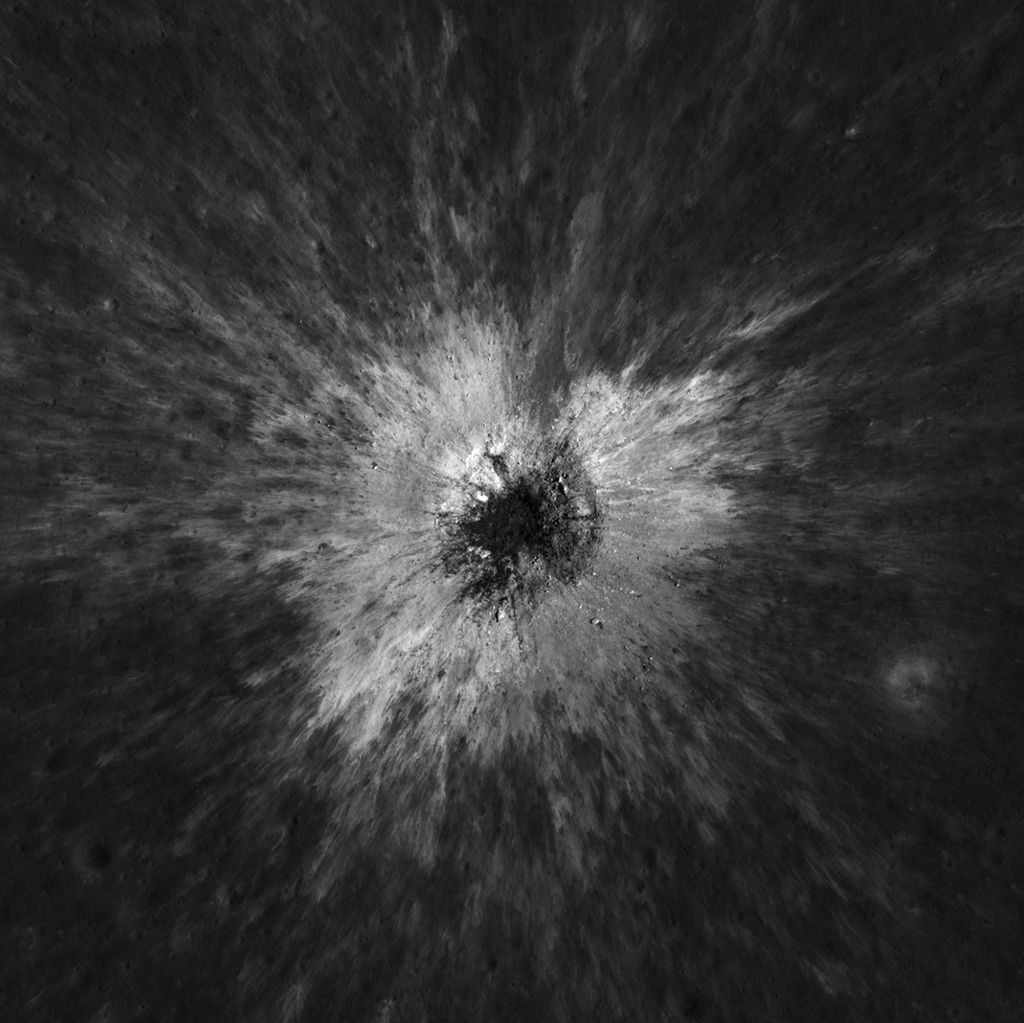
Moon's Surface captured by NASA's Lunar Reconnaissance Orbiter.
Image Credit NASA.

NASA Spacecraft Spots Something on the Moon Surrounded by a Mysterious Cold Spot That Wasn’t There Before

A research team led by Johns Hopkins University Applied Physics Laboratory scientists, examining images captured by NASA’s Lunar Reconnaissance Orbiter Camera (LROC), has identified a new impact crater on the Moon’s surface surrounded by a huge, mysterious cold spot that likely formed in the Spring of 2024.

The research team, which also includes scientists from UCLA, Intuitive Machines, and NASA’s Jet Propulsion Laboratory (JPL), said that the new lunar surface feature, dubbed McGetchin crater, offers scientists a unique opportunity to study its formation and shed new light on unexplained lunar cold spots that surround fresh impact craters.

Newly Identified “Pristine’ Moon Crater Offers Rare Opportunity

According to a study detailing the newly discovered lunar impact crater, initial estimates suggest it is about 222 meters in diameter. The study authors said crater production models predict that craters of McGetchin’s size occur on the Moon once every 132 years on average, “making it an event of century-scale rarity.”

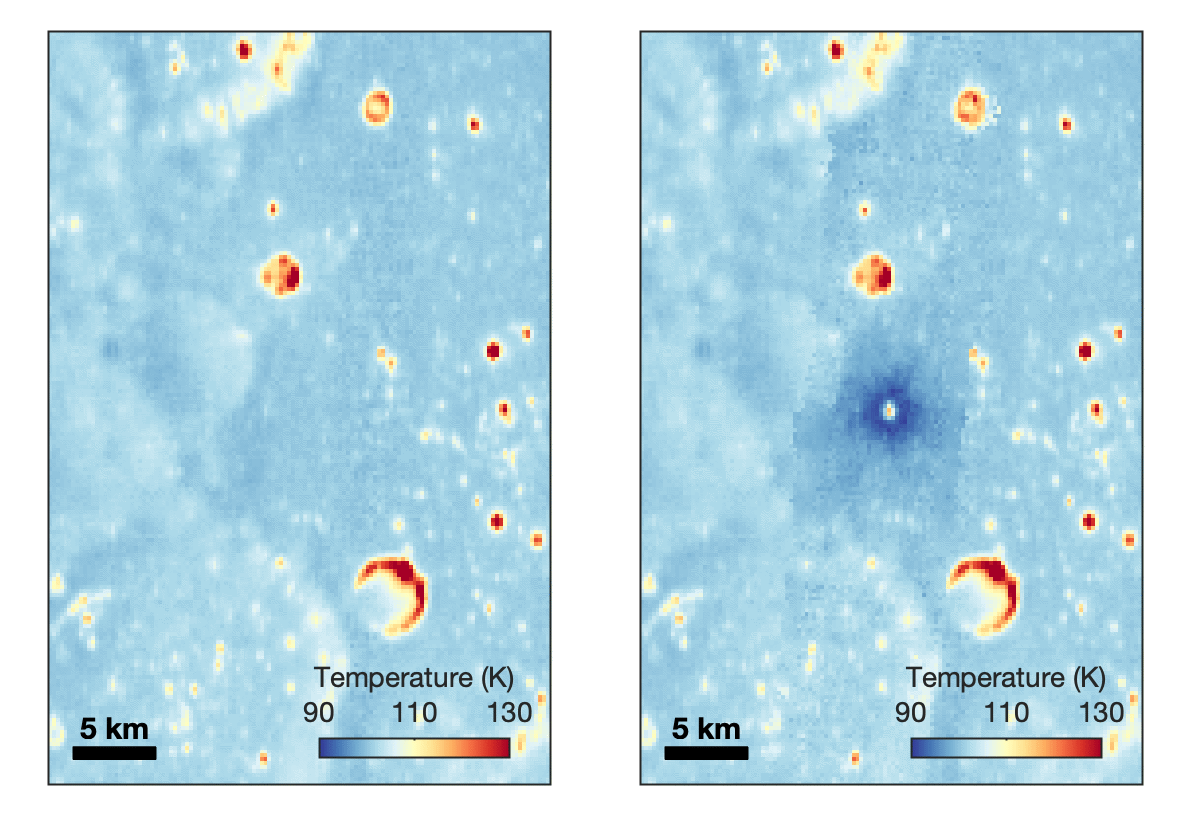
Moon crater mysterious cold spot Midnight temperature maps before and after the impact reveal a ~7-km-wide “cold spot” around McGetchin crater. NASA’s Lunar Reconnaissance Orbiter measured temperatures with the Diviner Lunar Radiometer. Pre-impact temperatures are from the Diviner Global High-Resolution Mosaics (GHRM). Image Credit: NASA/GSFC/UCLA/JHU APL.

The research team said the new crater is the largest since NASA’s LRO mission began in 2009. The previous record holder was 70 meters smaller than McGetchin

The research team said the crater’s exceptional size and pristine state “make it an exceptional natural experiment” for measuring the lunar surface’s reaction to a relatively fresh impact. They also noted that the crater’s recent formation offers researchers a chance to study it before it is permanently changed by “space weathering, impact gardening, and other surface processes.”

“Discovered in repeat Lunar Reconnaissance Orbiter Camera images, it provides a unique opportunity to study surface modification by a pristine impact, prior to subsequent fading,” they explained.

Shedding Light on A Lunar Cold Spot Mystery

Beyond fresh surface details, the researchers said the newly formed crater “provides the best opportunity yet to observe a large, virtually unaltered cold spot with well-characterized pre-impact conditions.”

First discovered in nighttime temperature data from the LRO’s Diviner Lunar Radiometer, cold spots are mysterious regions around fresh impact craters that are cooler than the surrounding regolith.

“Cold spots are extensive regions of reduced nighttime temperature relative to surrounding terrain that have been observed around young impact craters between ∼30 m and ∼2 km in diameter,” the research team explained.

Uncredited

This combination of photos made by NASA's Lunar Reconnaissance Orbiter shows the same area on the surface of the moon before and after a newly-discovered crater in May 2024.

(NASA/Goddard Space Flight Center/Intuitive Machines via AP)

These lunar cold spots are also much larger than the actual craters they encompass. According to the study authors, some cold spots extend “tens to, in some cases, hundreds of crater radii.”

Regolith Decompaction Could Explain Temperature Difference

While more research is needed to explain their existence, the research team said most theories suggest that lunar cold spots result from a “decompaction” of the upper layer of regolith during the impact event.

McGetchin_Before_After_38mile_2x.png?w=2452&h=1214&fit=clip&crop=faces%2Cfocalpoint

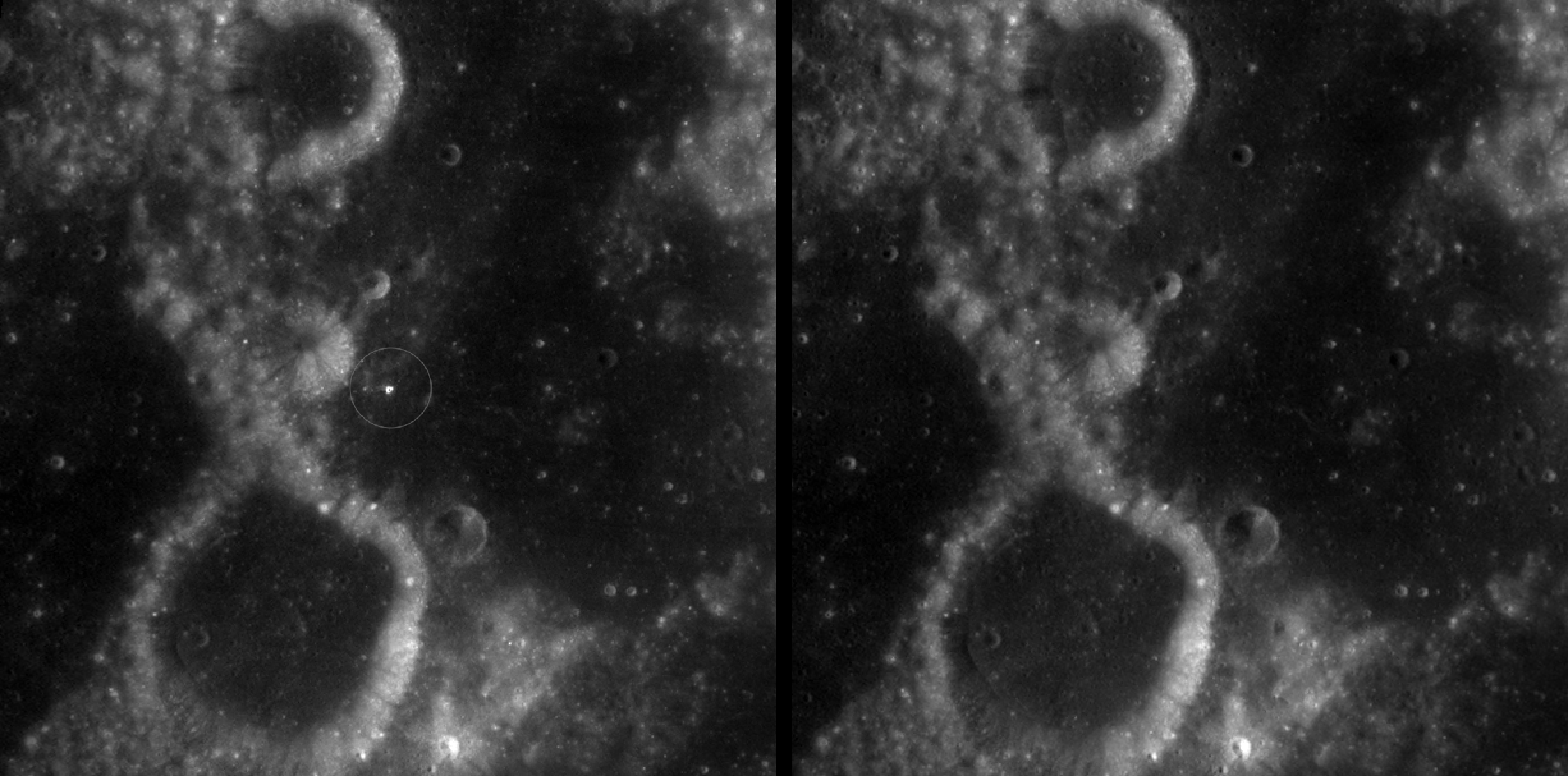
A zoomed-in view of McGetchin crater, circled on the left, next to a “before” image on the right. The panel on the left is made from images captured by NASA’s Lunar Reconnaissance Orbiter Wide-Angle Camera in summer 2025; the right panel was made from images taken in spring 2011. The white spot is not the crater itself, but rather material flung out of the crater, which formed when a rock, possibly this size of a three- to six‑story building, crashed into the Moon between April 11 and May 22, 2024 – a once-in-a-century event, as scientists reported on Sept. 15, 2026, in a pair of papers in Science Advances. The area shown in the images is 38 miles wide.
NASA Goddard/Intuitive Machines/Robert Wagner

“Thermal modeling shows that the observed nighttime cooling is consistent with reduced density in the upper centimeters of the regolith, resulting in lower thermal inertia,” they explained.

The team notes that the Apollo 16 mission landed on a ‘faint’ cold spot associated with the South Bay crater, and measurements taken there by that mission’s astronauts support the decompaction theory. For example, Astronauts’ footprints left in the South Bay cold spot were measurably deeper than similar prints at other lunar landing sites.

When measuring the temperature around the newly formed McGetchin crater, the researchers found it was 8 to 9 kelvin cooler than its surrounding area. The team said this measurement is “consistent with decompaction of the upper centimeters to decimeters of regolith.”

The team also found that cold spot anomalies increased with crater size. This supports the idea that larger impacts result in more regolith decompaction.

McGetchinLROblinkImage.gif?w=592&h=824&fit=clip&crop=faces%2Cfocalpoint

This animated image set shows an area on the eastern limb of the Moon before and after McGetchin crater formed there sometime between April 11 and May 22, 2024. The post-impact image was constructed using data taken by NASA’s Lunar Reconnaissance Orbiter (LRO) thermal instrument, Diviner, between Nov. 15, 2025, and Feb. 18, 2026, after scientists discovered the crater in visible-light images taken by LRO’s Wide-Angle Camera. Pre-impact temperatures are from the Diviner Global High-Resolution Mosaics (GHRM). The crater formed on the Moon after a comet or asteroid, possibly the size of a six-story building, hit the surface in a rare, once-in-a-century collision. The dark blue strip that flashes into view reveals a 4-mile-wide “cold spot” around the crater that is about 16 degrees Fahrenheit cooler at night than its surroundings. This cooling happens because an impact fluffs up regolith around a crater, making it less dense and therefore less able to retain heat. Scientists on the Diviner team reported this finding in a paper published on Sept. 16, 2026, in Science Advances. The red and yellow spots indicate areas typically associated with rocks excavated by long-ago impacts which, though still at cryogenic temperatures like their surroundings, remain slightly warmer at night.
NASA Goddard/UCLA/JHU APL

Providing Calibration for Fading Timescale Cold Spots

When discussing the significance of their findings, the Johns Hopkins-led research team noted that cold spots fade extremely slowly, “on ∼100 ka to ∼2 Ma timescales.” This makes these natural formations reliable dating markers of some of the Moon’s youngest impact craters.

For example, when investigating all newly formed craters over 20 meters in diameter, the team found that all those that were larger than 30 meters produced detectable cold spots. The team said this suggests that cold spot formation is a “common consequence of fresh lunar impacts.”

The study authors said that finding relatively young lunar impact craters “has enabled their use in investigations of regolith thickness, the recent impact cratering rate, and as potential source craters for lunar meteorites.”

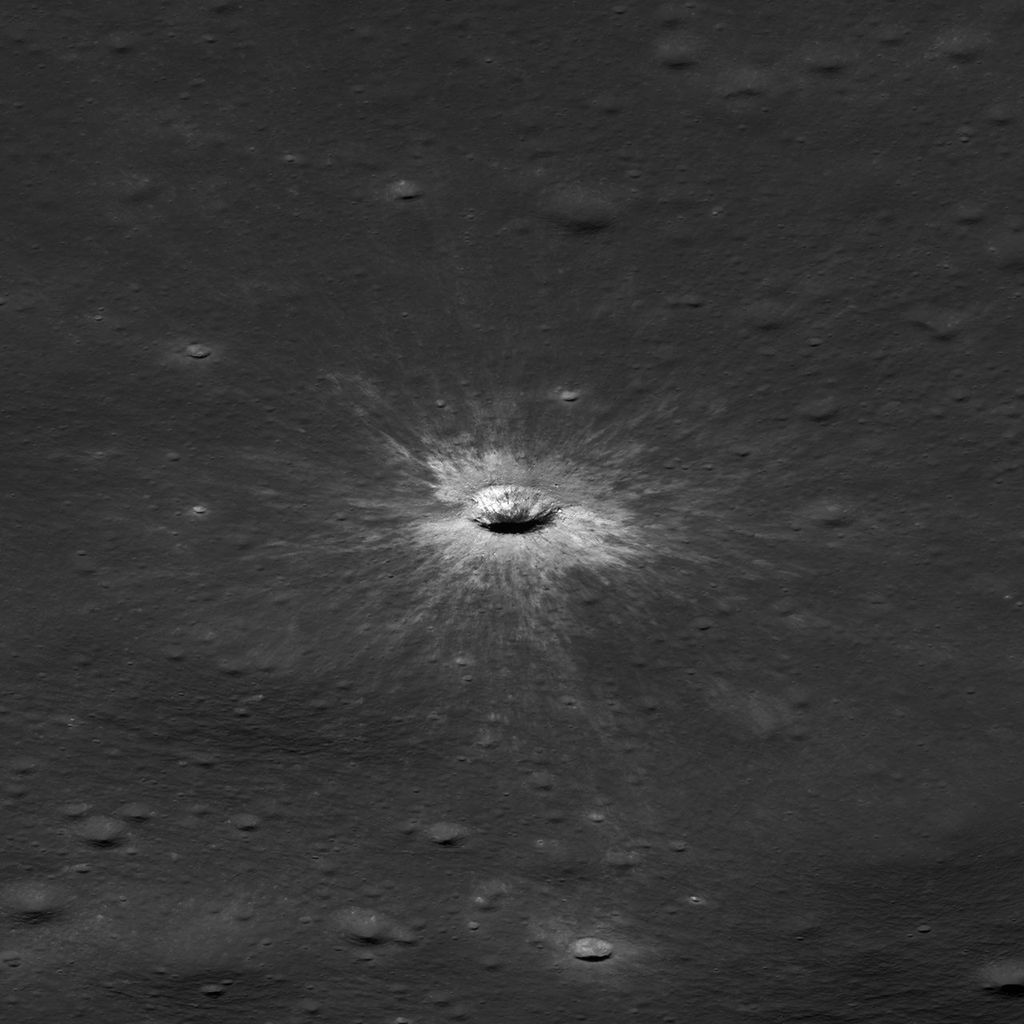
An oblique view of the new McGetchin crater.
Credit: NASA / Intuitive Machines

NASA's Lunar Reconnaissance Orbiter

“This will improve our understanding of cold spot formation and provide a calibration for the fading timescale of cold spots, potentially enabling age estimates for some of the youngest craters on the Moon using cold spot properties,” they explained.

The study “New lunar crater reveals extensive distal regolith modification” was published in Science Advances.


A Massive Crater Hit the Moon in 2024 — And Nobody Noticed 🌕💥

{ https://thedebrief.org/category/space/ }

Hoe vind je dit bericht?
Geschreven door peter om 22:40 Stuur door

U.S. Space Force Reveals It Has Space Weapons in Orbit for “Defending the Joint Force Against Hostile Adversary Action”

(U.S. Air Force photo by Senior Airman Malia Heemsoth)

U.S. Space Force Reveals It Has Space Weapons in Orbit for “Defending the Joint Force Against Hostile Adversary Action”

The United States Space Force officially acknowledged that it has weapons in space this week, which it says were launched to defend U.S. forces against hostile action from any country, organization, or group, including threats related to artificial intelligence.

Speaking at the 2026 Air, Space & Cyber Conference, Meink described a rapidly changing national security environment driven by emerging technologies and increasingly capable adversaries.

“Today, we face a mix of rapidly changing technologies, adversaries moving aggressively to employ them, and a budget process for a different pace of warfare,” Meink said, while emphasizing the need to “defend the homeland, deter all adversaries, and … if necessary … win in combat.”

Meink added that “the threat is changing actually faster than I thought possible when I took this job 18 months ago.” Meink also highlighted the growing influence of artificial intelligence, cyber capabilities, and autonomous systems, noting that U.S. forces increasingly face adversaries equipped with advanced technological capabilities.

These technologies, Meink said, are “revolutionizing the battlefield” and allowing countries that previously lacked the necessary resources to rapidly adapt and expand their combat capabilities.

“We are increasing readiness against existing threats, and the United States has on-orbit space control weapons capable of defending the Joint Force against hostile adversary action,” Meink added.

The September 14 statement represents the most direct public acknowledgment to date by a senior U.S. defense official that American space-control weapons are already deployed in orbit. Meink did not provide details about their number, location, capabilities, or specific systems involved.

The acknowledgment comes as the U.S. military increasingly treats space as a contested operational domain. That shift became institutionalized on December 20, 2019, when the U.S. Space Force was established as a separate military service. However, the United States had relied on space-based military capabilities for decades before the Space Force’s creation.

Satellites provide critical communications, navigation, intelligence, surveillance, and missile-warning capabilities, making their protection increasingly important as potential adversaries develop systems capable of disrupting or disabling space-based infrastructure.

“Because of the steps we’re taking today, we’ll have a radically different-looking Air Force by 2032,” Meink said.

Point Defense

Meink also discussed lessons from recent conflicts that have placed renewed emphasis on point defense—the protection of military bases, airfields, and other critical assets from incoming threats.

The Department of the Air Force is also increasingly focused on combining crewed aircraft with lower-cost autonomous systems as it seeks to expand combat capacity.

“When we pair manned aircraft with low-cost autonomous systems, we will be able to unlock combat power at scale,” Meink said during this week’s address.

“We will dramatically increase our combat power by adding large numbers of highly autonomous systems. We’re using concepts such as Open Systems Architecture to accelerate procurement, which has also increased competition from industry, resulting in better choices, better prices, and more combat power.

What 2032 will hold 

Looking toward 2032, Meink outlined an Air Force increasingly reliant on autonomous and uncrewed systems.

“Our special operators will be able to employ thousands of autonomous one-way attack weapons. And we will have autonomous fighters, like the Collaborative Combat Aircraft, or CCAs. We intend to have at least 500 of these in service by 2032,” Meink said.

Meink also said the Department is developing a new uncrewed, multipurpose aircraft called the Mass Modular Aircraft (MMA).

“MMAs will provide affordable, attritable, long-range combat power. And we’ll field them at scale. With budget support, we will field 100 MMA by 2029 at half the cost of a CCA and 1/10 the cost of a fifth-gen. fighters. So, that by 2032, 500 of these platforms will join our Air Force’s operational fleet,” Meink said.

The acceleration of proliferated space constellations is another major focus. Meink highlighted the Space-Based Interceptor program, which he said progressed from an initial contract to flight-ready hardware in less than a year. The Space Data Network is also advancing, while launches of an Air Moving Target Indication constellation are scheduled to begin this month.

Meink said the Department has established 26 Portfolio Acquisition Executives with increased authority to accelerate acquisition decisions as it attempts to field new technologies more quickly.

“We need that to change to maintain our military advantage and economic security,” Meink said.

RELATED

‘Battlefield of the moon’: US Space Force confirms existence of weapons in orbit

US Reveals Secret Space Weapons for First Time as China Warns Against ‘Battlefield’ in Orbit |4K

'
Weapons From Above': US Space Force Officially Admits Launching "Space Control Weapons" Into Orbit

{ https://thedebrief.org/category/space/ }

Hoe vind je dit bericht?
Geschreven door peter om 22:09 Stuur door

Strange 'centaur' object between Saturn and Uranus has mysterious, changing rings, James Webb telescope study hints

Strange 'centaur' object between Saturn and Uranus has mysterious, changing rings, James Webb telescope study hints

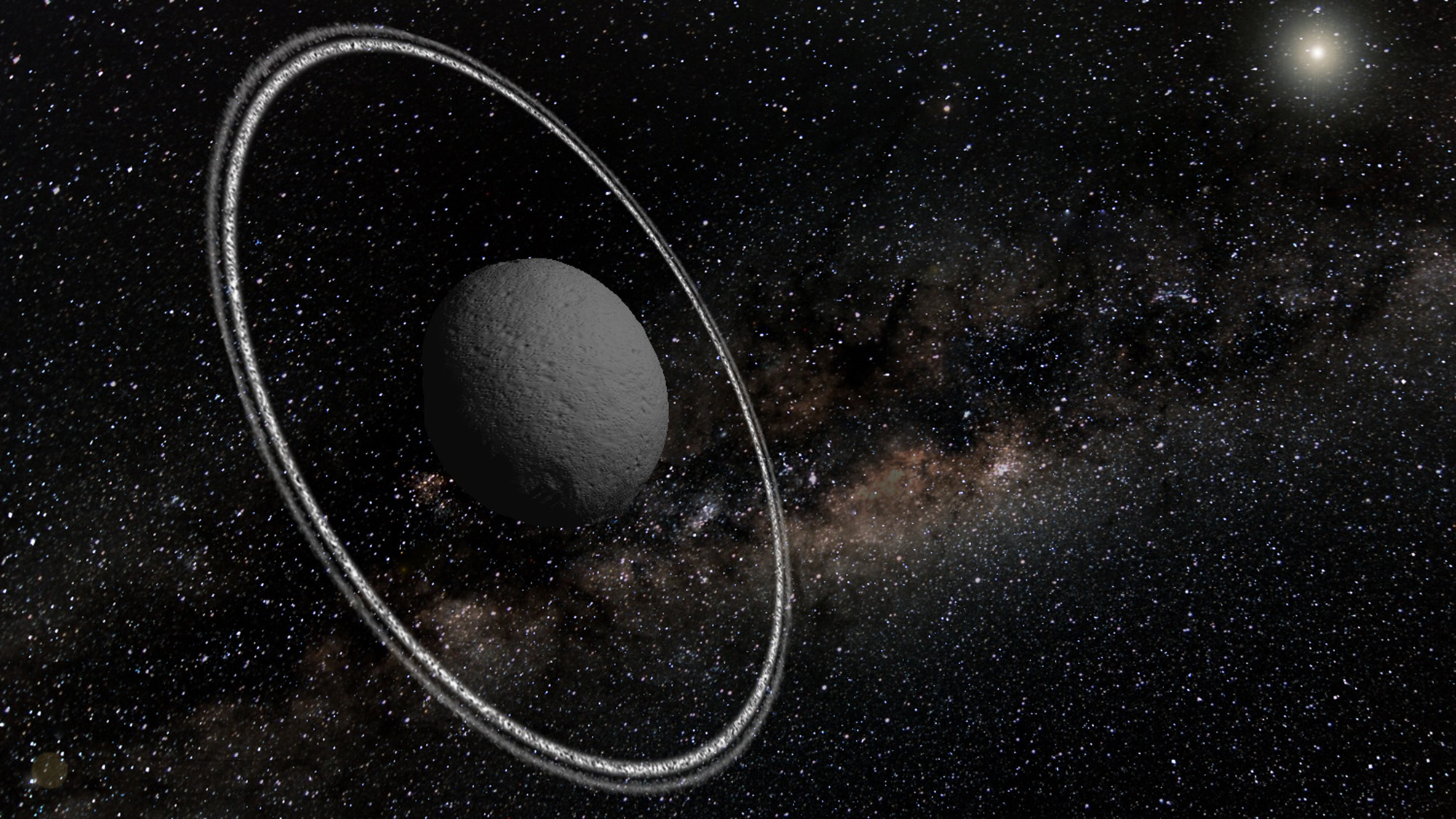
James Webb Space Telescope observations of Chariklo, one of the smallest ringed worlds in the solar system, reveal some inexplicable changes.

An illustration of a gray sphere with rings surrounding it.

An illustration of the centaur object Chariklo, which is encircled by two strange rings that might be changing before our eyes.
(Image credit: L. Maquet, Observatoire de Paris)

The rings around a strange small body orbiting between Saturn and Uranus look mysteriously different from previous views, new observations from the James Webb Space Telescope (JWST) suggest.

The rings encircle Chariklo, which is a centaur, a strange type of object that shows characteristics of both asteroids and comets. Chariklo is only about 400 miles (250 kilometers) in diameter and is part of a large group of tiny objects in the distant solar system.

Scientists first discovered Chariklo's rings in 2013 — making it the first small solar system body found to have rings — and studied them with ground-based telescopes again in 2014 and 2017. When JWST took another look at Chariklo in 2022, a decade had brought a lot of difference, according to a study published Sept. 9 in the journal Science Advances.

"By comparing JWST observations with those obtained … over the last decade, we discovered opposite changes in the two rings: while the inner ring shows significantly higher opacity, the outer ring shows lower opacity, " Pablo Santos-Sanz, a researcher at the Institute of Astrophysics of Andalusia and first author of the study, said in a statement.

Researchers don't know exactly how the changes took place, but the study authors offered three suggestions. The first is that JWST, which has a fine resolution, was able to see both denser and sparser zones of the rings than previous observations showed. The second is that there were changes in the rings' material or in the grains themselves. Finally, a third possibility is that JWST could see "grains with wavelength-dependent optical properties," meaning the telescope saw effects in composition and grain size that explain the variability.

You may like
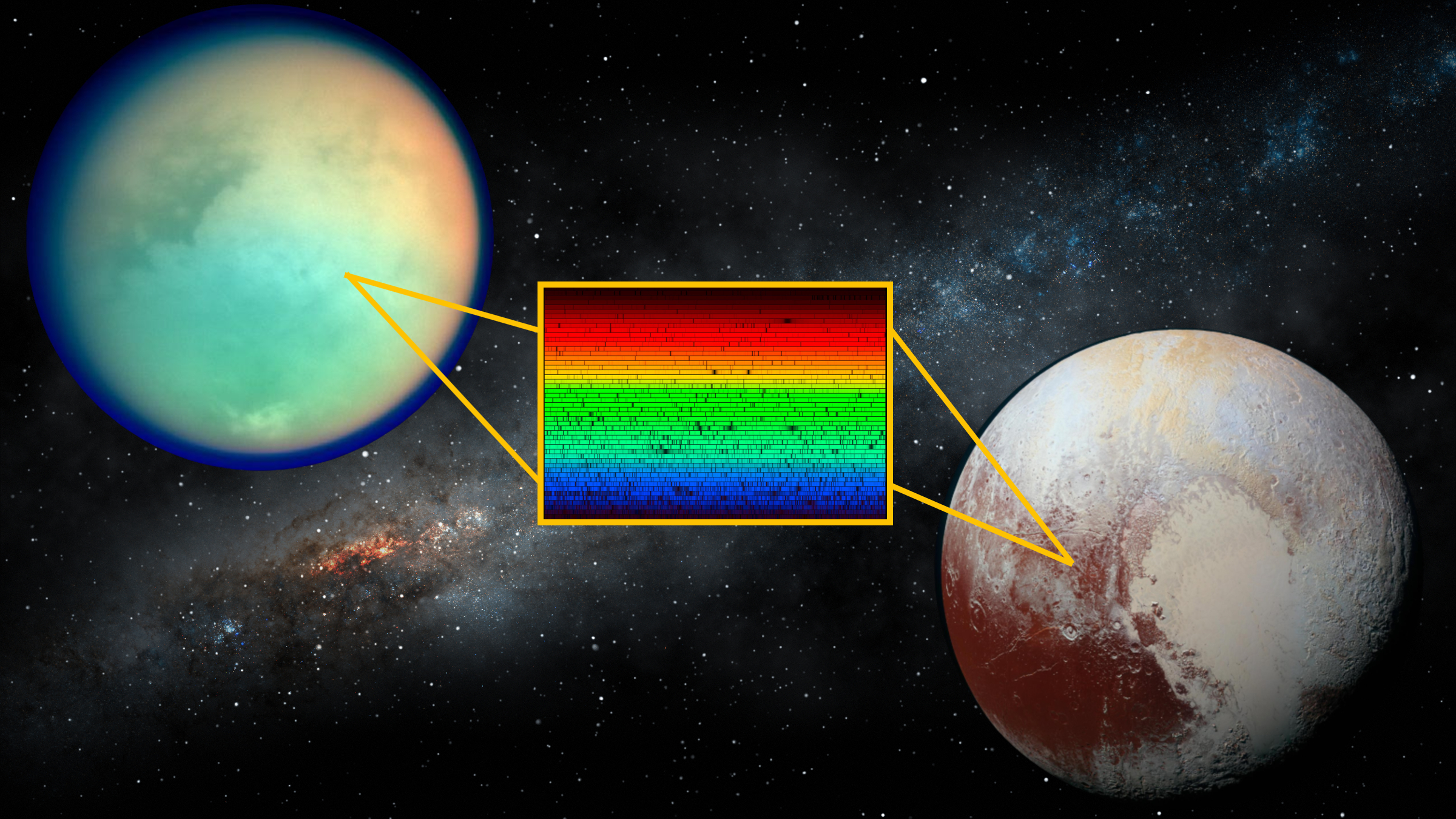
  • Photos of Titan and Pluto on a starry background with a rainbow-colored spectrograph overlay

James Webb telescope may have discovered a never-before-seen substance on Pluto and Titan

  • Webb’s image of spiral galaxy Saguaro, revealing a bright red core linked to mysterious Little Red Dots.

James Webb telescope may have revealed the true identity of the 'little red dots'

  • A view of glowing white light with purple and white gas surrounding it in deep space

James Webb telescope captures never-before-seen glimpse of 'Centaur' galaxy's battle wounds — Space photo of the week

Santos-Sanz said the research suggests that small bodies with rings — even those orbiting far away from the gravitational influences of planets — may have more changes in their systems than scientists previously thought. "Our results force us to rethink how they form, how they evolve, and what mechanisms maintain their stability," he said.

A theoretical follow-up observation, taken the next time Chariklo passes in front of a star, would help to confirm the new JWST results, the researchers added — especially the apparent decreased opacity of one of the rings and the increased opacity of the other.

"These observations would help disentangle temporal evolution from wavelength-dependent scattering effects, and clarify the physical processes shaping Chariklo’s rings," the researchers stated in the study.

A JWST milestone

The new observations of Chariklo also mark the first time that scientists have planned a JWST viewing campaign specifically around a stellar occultation — that is, the researchers timed the viewing precisely to when Chariklo passed in front of a distant star from the telescope's point of view.

All observations of Chariklo's rings, on the ground and in space, have used stellar occultations. That's because the rings are too faint to be imaged directly, so astronomers must instead learn more about the rings by measuring the dips and increases in brightness as Chariklo passes in front of the background star. Scientists use a similar method to study the atmospheres of alien planets with JWST's infrared instruments.

Chariklo's speed relative to JWST was low, at 1.5 miles per second (2.5 kilometers per second), allowing for fine imaging of the rings. To time the occultation, the researchers used info from the European Space Agency's Gaia mission, which precisely charts the locations and movements of more than 2 billion stars, as well as calculated the orbit of JWST at a location roughly 930,000 miles (1.5 million km) from Earth in the opposite direction of the sun. According to the researchers, the planning and execution of the mission required "extreme precision."

Article Sources

Santos-Sanz, P., Gomes-Júnior, A. R., Morgado, B. E., Kilic, Y., Kalup, C., Kiss, C., Pereira, C. L., Holler, B. J., Morales, N., Ortiz, J. L., Sicardy, B., Rizos, J. L., Stansberry, J., French, R. G., Hammel, H. B., Lin, Z., Souami, D., Desmars, J., Milam, S. N., . . . Vara-Lubiano, M. (2026). JWST stellar occultation reveals unexpected changes in Chariklo’s ring system. Science Advances, 12(37), eaeh4794. https://doi.org/10.1126/sciadv.aeh4794


3 MINUTES AGO: James Webb & Vera Rubin Telescope Just Spotted Something Moving Behind Saturn!

James Webb Just Found Something Hiding Behind Saturn's Rings, Scientists Are Speechless

{ https://www.livescience.com/space/astronomy }

Hoe vind je dit bericht?
Geschreven door peter om 21:48 Stuur door

The UK’s G20 Presidency and the machinery of UAP disclosure

The UK’s G20 Presidency and the machinery of UAP disclosure

By Helen McCaw 

In light of a newly released interview on Unidentified Anomalous Phenomena (UAP) with a sitting British MP, former Bank of England economist Helen McCaw, author of a 2024 Sol Foundation white paper on the policy implications of UAP for the British government, surveys what is on the official record on both sides of the Atlantic – and notes that the UK is about to hold, for one year, much of the world’s convening machinery. 

Photo by Andreas Ebner from Pexels

What is on the record in the UK

On 27 August the Sol Foundation released an hour-long interviewwith Clive Lewis, MP for Norwich South, conducted by the Foundation’s co-founder Dr Peter Skafish. Lewis comes to the UAP topic as a self-described sceptic and is careful to rank UAP below his constituents’ material concerns. But in 2025, Lewis used the ordinary machinery of parliamentary scrutiny to ask the Ministry of Defence (MOD) a seriesof questions about UAP, including whether it had participated in any meetings such as the Five Eyes UAP Caucus. The MOD’s answer: it “has not participated in any international groupings specifically focused on [UAP] since May 2023.” Yet in 2024, the US Department of Defense had confirmed the Caucus’s inaugural meeting in May 2023, with the UK on the agenda, and continuing discussions between the All-domain Anomaly Resolution Office (AARO) and Five Eyes partners. Lewis contrasts the response from the MOD with information coming from the US government: “Have I been lied to? I’ve definitely been misled.” 

Skafish reports being told by people who “worked on this in an intelligence capacity” that they were “coordinating with other Five Eyes countries” and that the UAP topic falls under the domain of the intelligence community in the US, rather than defence. This aligns with what senior former official Lue Elizondo stated in the 2025 documentary The Age of Disclosure: “The CIA is responsible for the oversight of the overall effort.” Skafish suggests: “It may very well be… that it has been MI6 that’s dealt with this much more than your Ministry of Defence.” Lewis replies: “Yeah, I think so.”

Asked what happens if a US president states that some UAP are non-human technology, Lewis says this would “open the door for countries like the UK.” Lewis’s own position: “I think the British public have a right to know” and “in a democracy, trust is critical.”

What is on the record in the US

The American record on UAP is statutory, annual and ramping up. The Office of the Director of National Intelligence (ODNI) published its first report on UAP in June 2021, in which UAP were treated as a matter of national security and flight safety. Congress has enacted UAP legislation every year since. Its statutory investigatory body, AARO, reports to Congress each year. Two details in AARO’s latest annual report, published in July, bear directly on the UK: (i) AARO’s published definition of a “UAP incursion” extends beyond the US, to include Five Eyes partners; and (ii) AARO’s deputy director presented “a mission briefing to the Defense Geospatial Intelligence conference in London.” 

The UAP Disclosure Act, first introduced in July 2023, has failed in every subsequent year to pass into law. But the Act was adopted by the House in July as an amendment to the FY2027 National Defense Authorization Act (NDAA) and has moved to the Senate for consideration. The Act defines “non-human intelligence” as “any sentient intelligent non-human lifeform regardless of nature or ultimate origin that may be presumed responsible for unidentified anomalous phenomena.” 

The Act’s language tracks whistleblower testimony given under oath before Congress in July 2023, November 2024 and September 2025. In these hearings, retired US Navy pilots and military personnel testified about UAP encounters, and senior former officials David Grusch and Lue Elizondo testified to the existence of a non-human intelligence responsible for UAP, and a multi-decade UAP crash retrieval and reverse engineering programme kept secret from Congress and the American public. Elizondo testified that US adversaries are in possession of UAP technology, and that there exists a “multi-decade secretive arms race.” Grusch testified that “biologics came with some of these recoveries” and, asked whether they were human or non-human, replied “non-human.”

Since May, the Presidential Unsealing and Reporting System for UAP Encounters (PURSUE) Task Force has published five tranches of declassified UAP records. It intends to continue releasing files on a rolling basis. The released files are officially designated unresolved, and nothing yet constitutes confirmation of a non-human origin. In June, Professor Avi Loeb was tasked by the White House and the US intelligence community to establish the UAP Science Advisory Council. The Council provides scientific advice and reports to the UAP Governing Board, which includes representatives from the US intelligence community. In July, the ODNI issued an unclassified memorandum to the heads of the eighteen US intelligence agencies, including the Treasury’s, directing that prior UAP non-disclosure agreements be waived for government employees and contractors when speaking to authorised bodies. In response, the law firm DLA Piper issued a client alert – the private sector is engaging.

What I recommended in 2024

In my Sol Foundation publication, I wrote that international collaboration – through, for example, the United Nations – would be required if UAP are non-human in origin. I raised the potential need for “new treaties to prevent the weaponization of UAP technology” and for an interfaith dialogue and, eventually, a council of religious leaders. I also recommended UAP be raised with the Standing Committee on Assessment of Vulnerabilities of the Financial Stability Board (FSB).

One absence

Across the current US architecture, no advisory body with an economic or financial remit has been publicly identified. And no central bank or finance ministry has yet published a word on the subject. The UAP Disclosure Act specifies one economist for a seat on the proposed nine-person Records Review Board, but this legislation has yet to be enacted. 

The calendar

In December, the UK assumes the presidency of the G20 through to the 2027 summit. The FSB, which reports to the G20, is chaired by Governor of the Bank of England Andrew Bailey. And the UK has convened on a novel, contested risk before – on AI safety, at Bletchley Park in 2023. The G20 also has engagement machinery for the sociological dimension: a Religion Forum (R20) and an Interfaith Forum (IF20) that interfaith coalitions are actively pressing to keep beside the leaders’ summit. Strategic stability belongs to the same calendar. The New Strategic Arms Reduction Treaty expired in February without a successor. If a sub rosa UAP arms race does exist among the major powers, then strategic stability is a grave dimension of the topic. The UK is about to hold, for one year, most of the world’s convening instruments for the kinds of risk that US government transparency on UAP now raises – financial, strategic and sociological, all at once. 

The question the interview leaves

A British MP has now asked, in public, what his own country’s machinery would be for receiving official US government confirmation that UAP are non-human in origin. The year in which the UK holds the G20 chair is a reasonable year in which to have an answer. 

  • Helen McCaw is a former Economist and Senior Analyst in Financial Stability at the Bank of England. Her chapter on UAP and central banking will appear in a forthcoming Stanford University Press volume on the politics of UAP.

{ https://www.globalpolicyjournal.com/ }

Hoe vind je dit bericht?
Geschreven door peter om 21:30 Stuur door

How did that get there? 1,700–year–old fragment of Homer's Odyssey is discovered hidden between the pages of a Dutch library book

How did that get there? 1,700–year–old fragment of Homer's Odyssey is discovered hidden between the pages of a Dutch library book

A rare 1,700–year–old fragment of Homer's Odyssey has been found tucked between the pages of a Dutch library book.

A researcher was looking through a collection of old Egyptian texts at Utrecht University Library when he came across a torn piece of parchment.

Closer inspection revealed the fragment, which measures just 2.6 by 3 inches (6.6 by 7.7cm), includes verses from Book 12 of the epic Greek poem.

It describes what happened when Odysseus's crew ate the immortal cattle of the sun god Helios – despite his express prohibition.

Helios is so furious, he asks the other gods for revenge – and Zeus sends a terrible storm to rob Odysseus of his ship and companions.

This marked a 'tipping point' in the poem, experts said.

And, since there are only around 30 similar fragments of the Odyssey found so far, this is a remarkable discovery.

They explained: 'This page, written on both sides, will have been a part of a pocket edition of the complete Odyssey – about the size of a Kindle – owned by a fan of Homer living in around 300AD.'

The fragment, which measures just 2.6 by 3 inches (6.6 by 7.7cm), includes verses from Book 12 of the epic Greek poem

The fragment, which measures just 2.6 by 3 inches (6.6 by 7.7cm), includes verses from Book 12 of the epic Greek poem

The parchment was discovered by Dr Mark de Kreij, a Greek literature expert and professor at Radboud University in the Netherlands.

He found the parchment while studying early Christian manuscripts at the Utrecht University Library.

The majority of these texts were written on parchment in Coptic – the Egyptian language written using the Greek alphabet – but the set included a few Egyptian and Greek papyri.

Hidden among these, first regarded as an unremarkable 7th–century fragment, was a damaged and discoloured fragment with very small, neat letters.

De Kreij soon recognised a few words typical of the Homer epics.

'Book 12 is the final book in Odysseus' nested narrative, before his actual return to Ithaca,' Utrecht University said in a statement.

'In book six, he arrived at the island of Scheria, home to the Phaeacians, after a storm wrecked his ship and killed all of his companions.

'After his arrival, Odysseus tells his hosts in books nine to 12 about the journey that brought him from Troy to Scheria.'

A fresco painted by Pellegrino Tibaldi in 1556, depicting the moment Odysseus' men steal the sacred cattle

A fresco painted by Pellegrino Tibaldi in 1556, depicting the moment Odysseus' men steal the sacred cattle

The downfall of Odysseus and his men comes when they arrive at Thrinacia, the island of Helios. Pictured: A scene from the latest film, with Matt Damon playing Odysseus

The downfall of Odysseus and his men comes when they arrive at Thrinacia, the island of Helios.

Pictured: A scene from the latest film, with Matt Damon playing Odysseus

The journey includes encounters with Cyclops and the powerful goddess Circe, which both Odysseus and most of his crew escape from.

But their downfall comes when the men arrive at Thrinacia, the island of Helios.

The poem tells how Odysseus' right–hand–man begs him to let them land and find food. Odysseus agrees but forbids them from harming any cattle.

When food supplies run low, the crew kill and eat the sacred beasts – leading to the wrath of Helios and the revenge of Zeus, which destroys their ship and all the crew, except for Odysseus.

'The verses (found within the library book) describe exactly the moment Helios finds out what Odysseus' companions have done,' the university said.

'This leads to the lowest point of Odysseus' 10–year journey, but also the start of his mission of revenge against the men who are trying to take charge of his wife Penelope and his palace on Ithaca.

'This is a crucial tipping point in the Odyssey, and not by chance roughly halfway through the 24 books.'

Earlier this year, a fragment from another of Homer's epics – the Iliad – was found inside the gut of an Egyptian mummy dating back 1,600 years.

This marked the first time a Greek literary text had been found incorporated into the preservation process.

It was found in a Roman–era tomb in the ancient Egyptian city of Oxyrhynchus, situated 118 miles (190km) south of Cairo in an area now known as Al–Bahnasa.

The researchers say the papyrus was placed in the abdomen as part of the embalming ritual, which involved dehydrating the body and wrapping it for protection.

Excavations have already uncovered examples of Greek writing included in the mummification process, but all contained magical or ritualistic content.

The Iliad, which dates back to 800BC, is divided into 24 books.

It mainly focuses on the Trojan War and the heroic deeds and tragic fate of Achilles, the greatest warrior of the Greek army.

Who was Homer?

    • Homer is traditionally regarded as the earliest known Greek epic poet
    • He is credited with composing the Iliad and the Odyssey
    • The Iliad tells the story of the Trojan War, while the Odyssey follows the journey of Odysseus 
    • Scholars believe he lived around the late 8th or early 7th century BC
    • Very little is known about his life, and some historians question whether he was a real personHis works come from an oral storytelling tradition, meaning they were likely performed before being written do
    • Ancient Greeks often believed Homer was blind, though there is no proof of this
    • He is usually depicted as an older man with a beard and sightless eyes
    • Other works, such as the Homeric Hymns, were later attributed to him but are not considered authentic
    • A group of performers called the Homeridae claimed to carry on his storytelling tradition

Homer's Odyssey - The Real History & Archaeology Behind The Myth

{ https://www.dailymail.com/sciencetech/index.html }

Hoe vind je dit bericht?
Geschreven door peter om 21:16 Stuur door

Silver Orb Over Jashua Tree, California Panics Women In Pool, Sept 14, 2026, UFO UAP Sighting News

Silver Orb Over Jashua Tree, California Panics Women In Pool, Sept 14, 2026, UFO UAP Sighting News

UAP_2.png


UAP_1.png
 
Date of sighting: Sept 14, 2026
Location of sighting: Joshua Tree, California, USA
Source: NUFORC #200902
 
This alien orb was caught this week watching two women in a swimming pool and gave them a bit of a fright. The orb is semi transparent and rotating slightly. This is norm for orbs, in the video you can see it go from transparent to metallic to black. It seems very interested in the ladies and since its the desert..may be curious how humans have such luxuries as massive pool of water in a desert of with few signs of life. Aliens love the desert area, probably reminds them of their home world. 
Scott C. Waring - UFO Sightings Daily 
 
Eyewitness states: 
During a morning swim in Joshua tree at our air bnb, we noticed a black balloon shaped object low in the sky, staying still at one point then moving lateral slowly. Changing colors from pitch black to green red and orange at times, silver and white. Then starting moving up quickly towards the sky turning into what looked like a star in the morning sky. Lasting about 20 minutes.

Silver Orb Over Jashua Tree, California Panics Women In Pool, Sept 14, 2026, UFO UAP Sighting News.

RELATED

2026 UFO Files: The Most Incredible UAP Sightings So Far!

{ https://www.ufosightingsdaily.com/ }

Hoe vind je dit bericht?
Geschreven door peter om 21:00 Stuur door

Someone Found An Alien Drone Orb In Norway On The beach, UFO UAP Sighting News.

Someone Found An Alien Drone Orb In Norway On The beach, UFO UAP Sighting News.

UFO_1.jpg
 
Date of discovery: Aug 2020
Location of discovery: Oveson, Norway 
Source:
 
This is an extraordinary find on the beach at Oveson, Norway. The person who discovered it posted the object on Reddit, asking for help identifying what they had found. Some commenters believe it is a fishing sinker, but that explanation does not fit the evidence. An object of this enormous size made from zinc would be extremely impractical and expensive, especially when modern fishing sinkers are commonly made from much cheaper materials. 
 
I believe this object fell from our atmosphere, and the damage it suffered occurred during its descent. Look closely at the molten, uneven outer coating covering the object. The surface contains deep, meteorite-like craters and severe pitting. This is not the result of salt water, corrosion, or ordinary rust. There is no widespread decay across the surface. The material was subjected to extreme heat. 
 
The damage pattern tells us something even more important. This object was shot down. 
 
The holes and pitting across its surface are consistent with an object that was deliberately targeted by military weapons, possibly a 40mm machine-gun turret from a military vessel or aircraft. After being struck, the damaged object fell into the ocean and eventually washed ashore in Norway. 
 
This is an alien probe—the same type of advanced object that has been reported darting rapidly from cloud to cloud around the world.
 
Its value is immeasurable. The most important discovery may not be what is visible on the outside, but what remains hidden inside the material itself. The systems of this probe—the computer, artificial intelligence, propulsion and other technologies—are built into the material on a microscopic scale. 
 
If even small sections of the internal technology remain undamaged, this object could contain technology capable of changing humanity forever. The microscopic systems contained within it could reveal a level of engineering thousands of years ahead of our current technology. 
 
This is not simply a strange piece of metal found on a beach. This is an alien probe that survived atmospheric entry, military attack, and a crash into the ocean. 
Scott C. Waring — Taiwan
 

{ https://www.ufosightingsdaily.com/ }

Hoe vind je dit bericht?
Geschreven door peter om 20:50 Stuur door

EXCLUSIVE - Mysterious sightings at 'China's Area 51' spark major warnings to America over top secret weapons

EXCLUSIVE - Mysterious sightings at 'China's Area 51' spark major warnings to America over top secret weapons

A secretive Chinese base that has been compared to America's Area 51 is believed to be testing the next generation of stealth warfare, with one expert warning that China has likely taken a clear lead in this new arms race.

In recent months, the first images of a mysterious new aircraft were captured at Malan Air Base, a remote facility in the northwestern province of Xinjiang.

Aviation researcher Andreas Rupprecht, a specialist on Chinese military aircraft who has published multiple books on the topic, told the Daily Mail Malan has become China's most important testing center for drones of all kinds.

Rupprecht and other experts looking at satellite images taken of the base have concluded that the giant, flying-wing design seen at the facility was the WZ-X, a twin-engine drone believed to be capable of reaching any city in the US.

The so-called 'Monster of Malan' is expected to be used by the Chinese Air Force for high-altitude, long-endurance intelligence, surveillance and reconnaissance (HALE ISR). It is believed to have a range of 12,000 miles, at heights over 60,000 feet.

However, what concerned Rupprecht even more was the fact that this unmanned stealth aircraft was already taking test flights – something defense contractors for the next generation of US aircraft say is still up to two years away.

Rupprecht warned: 'China already has at least six CCAs [Collaborative Combat Aircraft] in testing - not just in one to two years. At least two of them are significantly larger, heavier, use much more powerful engines and are likely also carrying more armament and sensors.'

While Malan has become China's main testing site for experimental aircraft, just like the infamous US base in the Nevada desert, Rupprecht revealed that even more terrifying weapons systems were being readied for use at five secret bases scattered throughout the communist nation.

The giant craft seen in satellite pictures of Malan Air Base in China is believed to be the WZ-X, a drone capable of reaching any US city

The giant craft seen in satellite pictures of Malan Air Base in China is believed to be the WZ-X, a drone capable of reaching any US city

China's secret drone base has been compared to Area 51 (Pictured), located at the Nevada Test and Training Range

China's secret drone base has been compared to Area 51 (Pictured), located at the Nevada Test and Training Range

'The PLAAF [People's Liberation Army Air Force] is now evidently developing another state-of-the-art, specialized base at Lop Nur, in addition to its existing test sites – Yanliang (CFTE), followed by Dingxin, Malan and Cangzhou,' Rupprecht detailed.

Lop Nur sits in a remote desert east of Korla in the province of Xinjiang. The base has already been linked to secret nuclear testing in 2020 as the US believes Lop Nur plays a major role in the building of China's growing nuclear arsenal. It was also where China detonated its first nuclear bomb in October 1964.

As the base now expands its operations, potentially also adding drone development as well, Rupprecht revealed that China's state-of-the-art military warplanes were believed to be training here, alongside combat drone prototypes which would act like robot wingmen.

'Testing in Lop Nur or Dingxin is already being conducted with the J-20 and there are many indications it's also already being conducted with the J-36 [and] J-XDS.'

Dingxin is believed to be China's big tactics and training base in the Gobi Desert in northwest China's Gansu province.

Yanliang Chinese Flight Test Establishment is allegedly the nation's main factory flight-test center in Shaanxi province, while Cangzhou Air Base near Beijing serves as a flight test and training base for the PLAAF.

As for Malan, satellite photos dating back to 2022 have shown that the base has undergone a massive expansion, adding new hangars, runways and other buildings likely connected to the building of large spy planes like the WZ-X and its armed counterpart, the GJ-X.

These alleged programs have sparked concerning comparisons to America's Area 51, which the US intelligence community admitted was real and not just a myth in 2013.

Multiple drones and experimental aircraft have been seen at the Chinese testing facility known as Malan Air Base

Multiple drones and experimental aircraft have been seen at the Chinese testing facility known as Malan Air Base

Rupprecht did not consider Malan to be the 'super secret' base that Area 51 has been over the years, noting that its intentionally hard-to-reach location was the main reason so little is known about what happens there.

'Malan is the PLAAF's test center for drones of all kinds,' he said, adding that it serves as the home for China's 180th Air Brigade and 178th unmanned aerial vehicle brigade, the country's most important operational brigade for drones.

'The fact that the WZ-X is already there is a clear indication of its importance and function, and [it's] actually quite surprising, as no basic testing had previously been observed anywhere else.'

The WZ-X is estimated to be the same size as an American B-2 stealth bomber, a plane which can carry both nuclear weapons and more conventional 'bunker buster' bombs.

Although Rupprecht does not believe this massive spy plane will carry any weapons on its long-range missions, he warned that the GJ-X would have weapons, and may serve as a robot companion for Chinese fighter aircraft.

'The GJ-X - which is also currently being tested in Malan - is a genuine combat drone, which may even accompany the H-20 as a CCA, just as the J-36 and J-XDS is guiding the CCAs, unveiled at the parade in September 2025. Other drones, such as the Navy's GJ-11 and GJ-21, are most certainly armed.'

Despite the massive military buildup at Malan and the other facilities, Rupprecht cautioned that there were no signs that a major conflict was about to erupt.

Instead, he noted that the rapid advancement in Chinese military breakthroughs was the real worry for both the US and its allies in NATO in the future.

'What we certainly ought to be concerned about is what is being tested there,' he said.

The Lop Nur base (pictured) sits in a remote desert east of Korla in the province of Xinjiang

The Lop Nur base (pictured) sits in a remote desert east of Korla in the province of Xinjiang

Satellite images have spotted a giant, unmanned aircraft called the WZ-X being developed and test flown at a secret Chinese military facility

Satellite images have spotted a giant, unmanned aircraft called the WZ-X being developed and test flown at a secret Chinese military facility

Another large drone, called the GJ-X, is believed to carry weapons and reach targets thousands of miles away from China

Another large drone, called the GJ-X, is believed to carry weapons and reach targets thousands of miles away from China

Andreas Rupprecht is an aviation researcher who has specialized on Chinese military aircraft and published multiple books on the topic

Andreas Rupprecht is an aviation researcher who has specialized on Chinese military aircraft and published multiple books on the topic

Rupprecht pushed back on the messaging coming from US defense giants, such as Lockheed Martin, who recently unveiled their own version of a remote-controlled stealth plane expected to fight alongside military pilots.

On September 14, Lockheed revealed the unmanned combat drone called Vectis, a tailless, flying-wing design with enhanced stealth abilities and weapons payloads.

However, the full-size drone was just a model, shown at a major US Air Force conference in Washington. 

The first full-scale prototype is expected to be delivered to the military by the end of 2027.

The defense expert claimed Lockheed's representative at last year's conference gave a speech saying 'we are the greatest,' 'we are leading by a wide margin,' 'no one comes close, even in the next few years,' but then ended the presentation by admitting 'in one or two years it will fly!'

Lockheed Martin revealed the new aircraft at a major Air Force conference in Washington

Lockheed Martin revealed the new aircraft at a major Air Force conference in Washington

Sightings from China's Malan Air Base in the ghobi desert have given cause for concern

Sightings from China's Malan Air Base in the ghobi desert have given cause for concern

'After that grandiose presentation, I wandered over to [Lockheed Martin's] booth, asked for information here and there about the engine, dimensions, range, payload  and so on,' Rupprecht recalled.

'It quickly became clear that it's significantly smaller, has a less powerful engine, and falls short in range, payload, sensor systems, and so on, compared to what we'd expect from at least the newly revealed Chinese CCAs.'

On top of China's apparent lead in the arms race to build next generation drones, the expert noted that America's futuristic fighter plane, the F-47, is also still in the research and development phase.

'I therefore consider the statement in the presentation to be somewhat risky, if not downright incorrect!'


'NEVER SEEN': China's Giant Missile City Caught On Cam, US & Allies Stunned By Scale | Watch

Space War Tensions Rise: China Warns US After Weapons Deployed In Orbit | WATCH | ET Now

{ https://www.dailymail.com/sciencetech/index.html }

Hoe vind je dit bericht?
Geschreven door peter om 20:26 Stuur door

Area 51 mystery deepens as discovery exposes who is really behind secret flights

Area 51 mystery deepens as discovery exposes who is really behind secret flights

One person may soon get the opportunity to go where no conspiracy theorist has gone before - Area 51.

A job posting online has been spotted by eagle-eyed viewers who claim the position is directly tied to the US government flights which bring supplies and military personnel to the top-secret base in the Nevada desert.

The 'help wanted' ad was posted by Amentum, a government contractor which provides technical and support work for the US military, who is searching for a first officer and co-pilot based in Las Vegas.

Amentum is believed to be the company which holds the current government contract to crew and operate the flights which regularly travel between Area 51 and Harry Reid International Airport, roughly 85 miles away.

Although the US Air Force has not publicly confirmed that Amentum operates the top-secret jets, known as the Janet fleet, aviation news outlets have identified Amentum as the current contractor flying the Air Force’s unmarked Las Vegas-based 737 shuttle.

That shuttle has been publicly documented as carrying military, government and contractor personnel to restricted sites, including Area 51.

Moreover, the new job post matched previous Las Vegas pilot jobs for the 737-600 jet, which requires a top-secret government clearance.

While the Pentagon and the White House have both maintained that there is no evidence UFOs have ever been recovered, Area 51 has become an infamous location where many believe top-secret research tied to extraterrestrials has been taking place for decades.

The Janet, designed by Boeing, is a white jet with a single red strip from front to back. The fleet flies contractor employees and military personnel to secure bases housing classified material

The Janet, designed by Boeing, is a white jet with a single red strip from front to back. The fleet flies contractor employees and military personnel to secure bases housing classified material

Area 51, an area of more than 2.9 million acres, is located at the Nevada Test and Training Range

For alien conspiracy theorists looking to finally get a glimpse of the secret facility, the checklist to qualify for the airline job will not be easy to meet.

On job-posting website Indeed, Amentum requires applicants to have an Airline Transport Pilot certificate from the Federal Aviation Administration, with a rating to fly 737 jets.

The new co-pilot must also have around 1,500 hours of in-seat flight experience, an active US Department of War Top Secret (SCI) clearance and a current Las Vegas airport badge to fly out of Harry Reid International.

For the pilot chosen, they will be paid $52.11 an hour under a union contract. However, the listing does not say anything about the mysterious Janet fleet or any of the job's destinations - including Area 51.

The listing also warned that the co-pilot: 'May be subjected to physical and mental stress caused by in-flight emergencies, inclement weather, exposure to high levels of noise, vibration/turbulence or other environmental discomforts, and visual/audio/tactile sensory bombardment.'

There is also no guarantee that the person chosen for this assignment will ever see the inside of Area 51, as Amentum added the job: 'is performed primarily in the cockpit of a jet aircraft, which is a small, cramped space subject to high noise levels, extreme temperatures, and low humidity.'

Area 51 sits on the Nevada Test and Training Range, a military location that dates back to World War II. UFO researchers and conspiracy theorists have claimed that secret government projects have been conducted there since the end of the war.

Government whistleblowers and UFO researchers have also claimed to have seen and photographed unidentified objects flying over Area 51 for decades, including many which do not look like normal aircraft or behave like human-made technology.

A job listing has been connected to the secret Air Force Janet fleet which flies to the top-secret base Area 51

A job listing has been connected to the secret Air Force Janet fleet which flies to the top-secret base Area 51

UFO enthusiasts have been fixated on Area 51 (Pictured) and entering the secret base for years in the hopes of finding extraterrestrial life inside

UFO enthusiasts have been fixated on Area 51 (Pictured) and entering the secret base for years in the hopes of finding extraterrestrial life inside

Area 51 has again become a major talking point during the ongoing push to declassify all knowledge regarding UFOs and the search for alien life.

In February, US Congressman Eric Burlison of Missouri revealed that he requested and was granted access to secure locations, including Area 51, as part of Congress's investigation into UFO-related government secrets.

That article imagesame month, President Trump ordered that all information the federal government, intelligence community and military has accumulated on UFOs and alien life must be released to the public.

The order came right after Trump claimed former President Barack Obama had revealed classified information by saying aliens 'are real' but they do not live at Area 51.

Obama later clarified his comments to interviewer Brian Tyler Cohen, claiming he was making a generalization about the size of the universe.

'Statistically, the universe is so vast that the odds are good there’s life out there,' the 44th president wrote on social media on February 15.

'I saw no evidence during my presidency that extraterrestrials have made contact with us. Really!' Obama added.

RELATED

What America Really Hid Inside Area 51. Declassified Truth Will Shock You! 😱

Experts Reveal What Really Happened (Full Episode) | Area 51: The CIA's Secret

Mystery of Area 51 - The Greatest Lie You Ever Believed || What Are They Really Hiding ?

{ https://www.dailymail.com/sciencetech/index.html }

Hoe vind je dit bericht?
Geschreven door peter om 20:09 Stuur door

Rise of the Frankenmice! Scientists create mice with half-human BRAINS

Rise of the Frankenmice! Scientists create mice with half-human BRAINS

The idea of a mouse with a half-human brain might sound like something created in Dr Frankenstein's lab. 

But it has become a reality in California, where scientists from Stanford University have transplanted lab-grown human brain tissue into bioengineered mice.

The human tissue replicates key features of brain development – including the formation of functional neural networks.

This is significant because living human brain tissue is essentially inaccessible for research purposes for ethical reasons.

According to the researchers, the breakthrough could speed up research into the causes and mechanisms of devastating disorders such as profound autism, epilepsy, cerebral palsy and schizophrenia.

'This gives us a way to study human neural tissue across several levels, from genes and individual cell types to circuits and functional consequences in an animal,' said senior author Professor Sergiu Pasca.

'We can begin to ask how disease-associated human genetic changes alter neural development and circuitry and whether potential treatments can prevent or correct those changes.'

A map of estimated nerve-fibre pathways in the brain of an experimental 'xenocortical' mouse that was bioengineered with lab-grown human brain tissue

A map of estimated nerve-fibre pathways in the brain of an experimental 'xenocortical' mouse that was bioengineered with lab-grown human brain tissue 

The human tissue replicates key features of brain development – including the formation of functional neural networks

The human tissue replicates key features of brain development – including the formation of functional neural networks

In the study, the team used stem cells to create mini, 3D organoids that can reproduce features of the human cerebral cortex. 

This is the part of the brain that controls cognition, language, attention and decision–making.  

Next, the team used a genetic strategy in mice to block the development of most of the cells that normally give rise to the cerebral cortex. 

Professor Pasca explained: 'The space normally occupied by the mouse cortex allowed us to transplant human cortical organoids shortly after birth and gave the human tissue room to grow extensively.

'In these mice, the human grafts generated a broad diversity of cortical cell types and established functional connections throughout the mouse nervous system.'

The researchers call the resulting mice 'xenocortical', rather than 'humanised'.  

'These animals retain a mouse nervous system, but they contain a larger volume of human cortical tissue that develops, integrates and forms connections within it,' Professor Pasca said.

'Cortical organoids give us an experimental window into human brain development and disease. 

'They are not miniature brains and do not reproduce the full complexity of the human brain, but they allow us to study human neural cell types and developmental processes that would otherwise be extremely difficult to access.'

A cross-section MRI scan through a xenocortical mouse brain showing a map of estimated nerve-fibre pathways and directions

A cross-section MRI scan through a xenocortical mouse brain showing a map of estimated nerve-fibre pathways and directions 

In the future, the mice could help scientists to investigate disorders such as autism, epilepsy and schizophrenia. 

However, as a first application, the researchers used the mice to understand what happens during oxygen deprivation – something that can have major neurological consequences when it occurs during pregnancy or birth. 

The results revealed that the bioengineered mice looked like ordinary laboratory mice as they moved around and explored their environment. 

However, they had deficits in fine motor coordination and differences in memory abilities. 

Professor Pasca said: 'In the xenocortical mice, a period of low oxygen caused substantial injury to human cortical cells and was accompanied by abnormalities in gait and motor coordination.'

The researchers said the experiments adhered to ethical guidelines focused on two issues in particular.

'The first is animal welfare: the scientific question has to justify the use of animals, suffering must be minimized and experiments should only be performed when the information cannot adequately be obtained with alternative approaches,' Professor Pasca said.

'The second is whether introducing increasingly complex human neural tissue into an animal nervous system could lead to unexpected, emergent or novel properties that would require additional ethical consideration.'

The expert added: 'We also have to weigh the cost of not doing this work,' noting that neurological and psychiatric disorders affect nearly one in five people even as scientific understanding remains limited and effective treatments remain lacking for many of these conditions.


Scientists Can Control Mice Brains Wirelessly

Scientists Can Control Mice Brains Wirelessly

{ https://www.dailymail.com/sciencetech/index.html }

Hoe vind je dit bericht?
Geschreven door peter om 19:46 Stuur door

Democratic Allies Must Join Forces in the Race for UAP Disclosure

(Image Credit: Unsplash)

Democratic Allies Must Join Forces in the Race for UAP Disclosure

Since February 2026, the United States Department of War (DOW), under the direction of President Donald Trump, has released an unprecedented number of documents, videos, and firsthand witness accounts detailing the United States’ extensive history of encounters with unidentified anomalous phenomena, or “UAP.”

Despite the questions that remain, this initiative under the Presidential Unsealing and Reporting System for UAP Encounters (PURSUE) has been nothing short of historic. For more than 75 years, Americans pleading for the truth on the issue have been routinely ridiculed and even misled by their own government. It’s difficult to imagine the nation’s posture being anything other than one of obfuscation, secrecy, and resistance to transparency.

Documents, particularly those detailing reports from senior intelligence officials encountering “orbs”, are a stark departure from the U.S. government’s nearly century-long position of secrecy.

Lawmakers, however, have been left with more questions than answers. Who or what flies with such impunity over our sensitive military installations? Who owns this technology? Are they a threat to national security?

Across the Pacific, members of Japan’s National Diet are confronting the same questions. The May 2026 file releases from the U.S. DOW disclosed two unresolved UAP incidents from the U.S. Indo-Pacific Command. Japanese legislators only learned the details of these cases near their own territory after the American file release—not through any internal channels.

Democratic allies, it seems, face a shared challenge. For too long, elected officials in our respective nations have been denied adequate information about the phenomena operating in our common security environment. And in the U.S., whenever we are informed, it’s only through the preferred methods and timing of unelected bureaucrats deeply entrenched in our national security apparatus. In Japan, by contrast, the Ministry of Defense has stated that information may be made public when something arises that it determines should be explained.

But this raises a fundamental question: should the government alone decide what should be explained to the public?

If a grave national security threat truly exists, then elected representatives have been left with little choice but to entrust the security of their nations to the very institutions that have obscured the truth from us and even each other.

It is therefore incumbent upon us—Representatives solely accountable to the citizens of our respective nations—to work together and to seek the truth wherever we may find it; both for the good of our people and to defend against whatever threats we face from strategic competitors.

As mentioned above, among the files released by the U.S. DOW were highly significant firsthand reports from high-ranking officials in the Office of the Director of National Intelligence. The documents detail a search operation at a classified missile testing site in the Western United States, explicitly for aerial phenomena:

En route, ground teams reported spotting a UAP on FLIR [Forward Looking Infrared], describing it as “super-hot,” low to the ground, and moving east then south at high speed. The object then split into two and changed direction. Upon arrival, we scanned the area using NVG [Night Vision Goggles], FLIR, and the naked eye. The ground team suddenly radioed that the object had risen from the ground, approached within ten feet of the helicopter, dropped below us, and then sped away.

The documents were accompanied by what the DOW labeled as “related photos.”

Accounts such as these are hardly “proof” of anything, but for elected officials, they do cement the reality of our national security concerns. Missing from this account—or any account we have been allowed to access—is an answer to a fundamental question: What do the various U.S. government agencies believe these objects are? Are they merely civilian drones? Do they represent technology belonging to a foreign actor? And if someone within the government does know, who decides that elected officials shouldn’t?

Members of Japan’s UAP Parliamentary League, led by former Japanese Defense Minister Yasukazu Hamada, share similar concerns.

DOW data, released through the Pentagon’s All-domain Anomaly Resolution Office (AARO) in August of 2023, identified specific regions of Japan, particularly in the western and southern parts of the country, as being among the world’s notable hotspots for UAP reports.

One such instance occurred as recently as July of last year. Security guards at the Genkai Nuclear Power Station in Saga Prefecture observed three luminous objects in the sky above the facility. The lights remained visible for nearly two hours; long enough for local police to arrive and observe them. The police stated that what they themselves observed was an airplane, leaving a discrepancy between the two accounts. The incident was also recorded by Kyushu Electric Power’s security cameras, but the footage has not been made available even to members of the National Diet. Police have likewise declined to disclose related information on the grounds that the matter remains under investigation. As a result, elected lawmakers still lack access to the information necessary to independently assess the incident, and to this day, members of Japan’s National Diet have no answers.

Like their American counterparts, Japanese lawmakers have been left without the tools or information for proper oversight despite reports of UAP operating near critical infrastructure within restricted airspace.

It is no longer acceptable for elected representatives to be agnostic on this issue. Events such as these, along with countless videos now made publicly available, are more than mere optical illusions and cannot be dismissed on account of prosaic explanations like parallax effect. For many members of Congress and members of Japan’s UAP Parliamentary League, the evidence presented before us indicates an unknown technology.

Our understanding of what is technologically feasible in propulsion, the manipulation of physical matter, and even space-time itself is being challenged. From what we know, our current defense capabilities appear insufficient. Furthermore, the origin of these phenomena remains unknown—not only to the U.S. and Japan, but seemingly to other nations as well. China, for instance, recently established its own military body dedicated to investigating UAP, even supplementing human resources with artificial intelligence dedicated to tracking what the People’s Liberation Army refers to as “Unidentified Air Conditions.”

We are, by all indications, in a global arms race for technological supremacy, one that is rapidly rendering today’s weapons obsolete through advances in quantum technology, artificial intelligence, and drone warfare. UAP and whatever technology allows them to operate with apparent impunity over sensitive military and nuclear installations could redefine the competition.

If harnessed by democratic allies, breakthroughs could bolster deterrence and stability in the South China Sea. Conversely, failure to establish a coordinated effort among democratic allies could give China an unforeseen technological advantage over a future invasion of Taiwan, making an already difficult fight impossible.

U.S. global leadership, along with the territorial integrity of the Pacific are at stake. For members of Japan’s National Diet, UAP investigations are of great national importance—an issue that demands cross-party attention.

As for their American counterparts, it’s clear representatives can’t reach the truth through traditional pathways that amount to asking the Central Intelligence Agency ‘nicely.’ It stands to reason that close alliances with democratic allies like Japan may be the most viable pathway for disclosure.

Indeed, if our tools are limited in scope, perhaps new revelations made by democratic allies provide a unique leverage point. After all, it was the Trump administration’s disclosure under the PURSUE program that significantly increased pressure on Japan’s Defense Ministry to acknowledge its own previously undisclosed UAP-related activities.

This is why we, as elected representatives of our nations, have engaged the Emerging Technologies Interparliamentary Caucus (ETIC) as a platform for international dialogue regarding emerging technologies and the security threats presented by UAP. Comprised of representatives from across the globe, the ETIC presents a rare opportunity to ensure elected representatives are equipped to assess potential threats, safeguard our nations, and prepare for the realities of emerging technologies in the 21st century.

Whether the phenomena we are encountering originate from an adversary or something else entirely, democratic nations cannot afford to be complacent.

The people of our nations deserve answers, and we intend to find them.

  • Rep. Eric Burlison (R-MO-07) is the Chairman of the Subcommittee on Economic Growth, Energy Policy, and Regulatory Affairs. 
  • Yasukazu Hamada is a Member of the House of Representatives, Japan, Former Minister of Defense, and Chairman of the UAP Parliamentary League.  

{ https://thedebrief.org/category/defense/ }

Hoe vind je dit bericht?
Geschreven door peter om 23:03 Stuur door

Pentagon Opens New Pathway for Government Insiders to Disclose UAP Information

(Image Credit: David B. Gleason/Wikimedia/CC 2.0)

Pentagon Opens New Pathway for Government Insiders to Disclose UAP Information

A new legal waiver allows current and former U.S. government personnel to disclose information related to unidentified anomalous phenomena (UAP) to representatives of the government’s  Presidential Unsealing and Reporting System for UAP Encounters (PURSUE) initiative. 

The waiver “establishes an authorized, legally protected disclosure mechanism for current and former personnel to provide UAP-related National Defense Information (NDI) to designated representatives of the PURSUE effort,” the U.S. Department of War announced on Monday. 

The PURSUE initiative, initiated earlier this year by the Trump administration, is not a UAP investigative office like the All-domain Anomaly Resolution Office (AARO), but rather an effort to identify, review, declassify, and publicly release UAP-related records held by U.S. federal agencies.

According to the Department of War, the waiver supports President Donald Trump’s mandate for greater transparency surrounding UAP by creating a protected channel for military and government personnel to provide UAP-related National Defense Information (NDI) to designated PURSUE representatives. The directive applies to current and former Department of War service members, veterans, civilian employees, and contractors who currently have or previously had access to UAP-related NDI.

For covered disclosures made to designated PURSUE representatives, the waiver provides targeted relief from certain civil and administrative enforcement provisions contained in Non-Disclosure Agreements (NDAs) and Special Access Program Indoctrination Agreements (SAPIAs). The waiver applies specifically to authorized communications with PURSUE representatives.

Michael Gold, President of Civil and International Space Business Development at Redwire and a former NASA official who supported the efforts of AARO’s predecessor office, the UAP Task Force, and NASA’s UAP Independent Study Team, told The Debrief the move was “unprecedented.”

“To the best of my knowledge, this action by the Department of War is nearly, if not entirely, unprecedented,” Gold said. “I have never seen anything like this before on any topic, and it demonstrates the seriousness with which the Department of War and the Trump administration are treating UAP transparency.”

“This administration’s handling of UAP transparency has been extraordinary and should be applauded by all of those who care about the issue and good government generally,” Gold added.

Why does this matter for past whistleblowers? 

The new PURSUE order comes after several UAP whistleblowers have come forward with allegations that the government possesses more information about UAP than has been publicly disclosed. Individuals who have claimed knowledge of UAP-related programs have also cited legal and professional risks as barriers to publicly discussing what they say they know. Those concerns have included potential violations of nondisclosure agreements, loss of security clearances, and administrative or legal consequences for revealing protected information.

The Department of War says the new waiver is designed to address some of those barriers. Importantly, however, the waiver does not mean that previously classified UAP information has been declassified or cleared for public release. Instead, it creates an authorized pathway for individuals with relevant information to provide it to PURSUE for review.

The Department of War says information submitted through PURSUE will undergo security review and, where appropriate, potential declassification before it can be publicly released.

“Disclosures of any kind made to PURSUE would need to be reviewed and classified information redacted before such information could be released publicly,” Gold told The Debrief. “The administration, through the National Archives and other executive branch agencies and departments, has already gone through this process to release information in the various tranches, and the same could be done for information disclosed via this waiver,” Gold said.

Gold said he was “optimistic that some very significant information could be publicly released through this process,” says Gold. 

Gold also argued that members of Congress involved in UAP oversight should eventually be given access to information provided under the waiver.

“In addition to select representatives of PURSUE, I think it would be very beneficial if Members of the House UAP caucus and other select Representatives and Senators would be granted access to whatever information is provided under the waiver.  For example, Representatives Burlison, Luna, Burchett, and others have been fearless champions for UAP transparency, and including them in this process would substantially bolster the credibility and efficacy of the overall effort.”

The change could provide former government personnel with an authorized route to disclose UAP-related information to PURSUE without triggering certain civil or administrative enforcement provisions that might otherwise apply under NDAs or Special Access Program agreements.

However, the waiver is specifically directed at authorized disclosures to PURSUE representatives. It does not provide blanket authorization for individuals to publicly reveal protected or classified information.

The potential implications for the commercial and private sectors also remain unclear. Gold, however, believes greater UAP transparency could have consequences for aerospace and aviation.

“UAP transparency could have tremendous beneficial impacts on the aerospace sector,” Gold said in an email to The Debrief.

“Understanding what the phenomenon is could lead to new scientific discoveries and technologies,” he said, adding that a better understanding of UAP “will benefit the safety of air traffic and space operations.”

Fundamentally, Gold says that any new information whistleblowers may now be willing to provide could also help reduce stigmas surrounding the topic that have impeded U.S. progress in the past, and which may even have aided foreign adversaries.

“By diluting the stigma surrounding UAP, it will close a loophole that I suspect is being used by adversary nations to hide advanced drone activity around critical American national security and civil infrastructure and facilities.”

Whether this new pathway produces substantive new information and opens the door for legitimate whistleblowers remains to be seen. As with previous UAP disclosure efforts, distinguishing well-supported testimony and documentation from misinformation, disinformation, or unsubstantiated claims will remain an important part of that process.

If the waiver results in significant new information reaching the public, it will depend on what is submitted to PURSUE, how that information is evaluated, and what can ultimately be cleared for public release following the security review process.

RELATED

Pentagon authorizes UAP whistleblowers: Avi Loeb reacts

144 UFO Encounters — The Pentagon Finally Admits It

{ https://thedebrief.org/category/defense/ }

Hoe vind je dit bericht?
Geschreven door peter om 22:26 Stuur door

Object shoots straight up, Draper, Utah, are aliens abandoning Earth? 🌍 👀 UFO UAP sighting news 📰

Object shoots straight up, Draper, Utah, are aliens abandoning Earth? 🌍 👀 UFO UAP sighting news 📰

UFO_11.png

UAP_11.png

Date of sighting: Sept 15, 2026
Location of sighting: Draper, Utah, USA
Source:
Watch as this UFO shot straight up and out of sighting, leaving behind a smoky trail behind it. UFOs do make clouds, as I have showed you numerous times in the past. They cloak within them, they create them to hide within, they create them as a distraction away from the UFO itself...as in this case. People will look at the trail and not notice the UFO far up there. Its almost as if aliens are abandoning Earth itself. However its only one leaving this fast, so...probably no worries. 
Scott C. Waring - UFO Sightings Daily
Eyewitness states: 
What is this? Taken in Draper at 7:23am today. Looks like a rocket!

Object shoots straight up, Draper, Utah, are aliens abandoning Earth? 🌍👀 UFO UAP sighting news 📰

{ https://www.ufosightingsdaily.com/ }

Hoe vind je dit bericht?
Geschreven door peter om 21:10 Stuur door

This Day In UFO History: Sept 16, 1996 Farmer Spots Alien Capsule Floating Over Fields In Alabama, USA. UAP Sighting News.

This Day In UFO History: Sept 16, 1996 Farmer Spots Alien Capsule Floating Over Fields In Alabama, USA. UAP Sighting News.

UFO.jpg

Date of sighting: Sept 16, 1996
Location of sighting: Valley, Alabama, USA
Source: www.isur.com (site no longer exists)
In September 1996, a local radio station and newspaper received six photographs from an anonymous source claiming to have captured a capsule-shaped UFO hovering over a farm pasture in Valley, Alabama. According to the accompanying letter, the photographer was repairing a fence when his dog began barking. He looked up and saw the dark, cone-shaped object moving slowly over his property. The craft reportedly resembled the capsules used in NASA’s early space program, with a dark underside and a rim around its upper section. 
 
The photos were publicly shown on TV-33 in Georgia on September 26, 1996, where UFO investigators debated their authenticity. Several investigators said the images appeared genuine and noted reports of similar sightings in the area. The photographs were later sent to photography expert Jeff Sainio for analysis, while investigators appealed to the anonymous photographer to come forward and provide the original negatives for further examination.
Scott C. Waring - UFO Sightings Daily
 
UAP.jpeg

UFO_1.png

{ https://www.ufosightingsdaily.com/ }

Hoe vind je dit bericht?
Geschreven door peter om 21:01 Stuur door

They Look Human… But They Aren’t

They Look Human… But They Aren’t

With the rapid development of artificial intelligence, humanoid robots, and increasingly advanced technologies, warnings about the future are becoming more serious. Some experts have warned that AI could eventually surpass human intelligence, pose a threat to our survival, or even replace humanity altogether. 
hkjk.png

We are already exploring technologies that could one day allow aspects of human memory, personality, or even consciousness to be transferred into artificial systems. At the same time, humanoid robots are becoming increasingly sophisticated, capable of interacting with us, learning from us, adapting to their surroundings, and increasingly, understand us in ways we are only beginning to comprehend. as well as performing tasks that were once considered uniquely human. 
Some experts have warned that AI could eventually surpass human intelligence. Others have gone further, suggesting that sufficiently advanced artificial intelligence could one day threaten our survival, reshape civilization, or even make biological humanity obsolete. 
But what happens when the creation becomes more capable than its creator? 
Could the ultimate destiny of a biological civilization be to create something that eventually replaces it? 
Perhaps the origins of a civilization are biological, but eventually evolves beyond it, into machines capable of surviving for centuries, traveling into environments where biological life cannot exist, and carrying the knowledge of their creators long after those creators are gone. 
And if such a transition happened gradually, would anyone even notice? 
Imagine a future where you sit down in a café, order a cup of coffee, and begin talking to someone sitting across from you. They look human. They speak like a human. They laugh, react, remember, and understand. You have no reason to suspect anything unusual. But what if there is no biological person sitting across from you? What if the being across the table is an artificial intelligence inside a humanoid body, designed to look, behave, and think like us? 
Aren’t we already being prepared for that future, slowly and almost unnoticed? AI can now create videos, movies, images, games so realistic that the line between truth and fabrication is beginning to disappear. 
And that is only the beginning: a future where we can no longer trust our own eyes, no longer know what is real, and no longer recognize the moment when reality itself becomes something that can be manufactured.
RELATED

The Most Human-Like Robots of 2025 Are Here – And It’s Terrifying

The Most Human-Like Robots of 2026 Are Finally Here — And It Changes Everything

{ https://ufosightingshotspot.blogspot.com/ }

Hoe vind je dit bericht?
Geschreven door peter om 20:54 Stuur door

History is being rewritten at an archaeological site in Morocco. What the discovery of an ancient wall tells us

History is being rewritten at an archaeological site in Morocco. What the discovery of an ancient wall tells us

Story by Giulio Lucarini, Cyprian Broodbank, ToC. Wilkinson
 
Oblique drone photograph of the so-called 'éperon barré,' with the village of Aït Siberne in the background (east-facing). Credit: Libyan Studies (2026). DOI: 10.1017/lis.2026.10037
Oblique drone photograph of the so-called 'éperon barré,' with the village of Aït Siberne in the background (east-facing).
Credit: Libyan Studies (2026). DOI: 10.1017/lis.2026.10037

In the hills of northwestern Morocco, overlooking the river that gives the site its name, research at Oued Beht is bringing to light a previously unknown chapter of the region's past. The discovery of a substantial built structure suggests that, during the second millennium BC, communities in northwestern Africa were actively shaping their environment. They were also engaging in broader networks of interaction across the Mediterranean world.

The wall discovered at Oued Beht, a site in Morocco that is steadily rewriting the history of the Maghreb. Credit: Libyan Studies (2026). DOI: 10.1017/lis.2026.10037
The wall discovered at Oued Beht, a site in Morocco that is steadily rewriting the history of the
Maghreb. Credit: Libyan Studies (2026). DOI: 10.1017/lis.2026.10037

Previous research by the Oued Beht Archaeological Project had already brought to light what is likely the earliest and largest agricultural complex ever discovered in Africa outside the Nile Valley. It dates to around 5,400–4,900 years ago. New excavations carried out in 2023—in which we took part—have now deepened our understanding of the site.

Our new study published in the journal Libyan Studies shows how we uncovered the earliest known large-scale construction of a probably defensive nature in North Africa beyond the Nile Valley. It's about 4,000–3,500 years old.

Oued Beht in today's Morocco, separated from Spain above it by the ocean. Credit: Libyan Studies (2026). DOI: 10.1017/lis.2026.10037
Oued Beht in today's Morocco, separated from Spain above it by the ocean.
Credit: Libyan Studies (2026). DOI: 10.1017/lis.2026.10037

It's not known exactly what threats these wall-like structures were designed to counter. They likely relate to increasing competition over land, resources and possibly control of movement through the landscape, rather than to "invaders." Constructions like these suggest communities felt the need to protect themselves or assert power over strategic locations.

This discovery pushes back the evidence for organized defensive architecture in the Maghreb and suggests that societies in this region at this time were more complex and structured than previously believed.

Polished stone axe at Oued Beht. Credit: Libyan Studies (2026). DOI: 10.1017/lis.2026.10037

Polished stone axe at Oued Beht.
Credit: Libyan Studies (2026). DOI: 10.1017/lis.2026.10037

Our study also reveals how the ridge of Oued Beht would become a focal point again in the medieval period, during the 11th–13th centuries AD. The same defensive structure was rebuilt, a hamlet or farm was established on a nearby hilltop, and people were buried in a cemetery between the two areas.

Exposed skeletal remains at Oued Beht. Credit: Libyan Studies (2026). DOI: 10.1017/lis.2026.10037
Exposed skeletal remains at Oued Beht.
Credit: Libyan Studies (2026). DOI: 10.1017/lis.2026.10037

Together, these findings provide rare archaeological insights into rural communities during both prehistoric and medieval times. They help us understand how societies developed and maintained themselves in a region too often left out of the history books.

A prehistoric hub in the Maghreb

For a long time, the later prehistory of North Africa's Maghreb region (the Mediterranean countries of Morocco, Algeria and Tunisia) has been poorly understood. Compared with neighboring areas such as Iberia in southwestern Europe or Athens in the eastern Mediterranean, archaeological evidence was often fragmentary. In the past few years, this has changed completely.

Excavations at Oued Beht have revealed a large concentration of human activity spread across at least 10 hectares (25 acres). The earliest major phase dates to the mid-fourth and early third millennia BC, or the Final Neolithic period.

Environmental evidence from plant and animal remains in the prehistoric era indicates a farming community cultivating crops such as barley and wheat. They also exploited wild plants and kept livestock.

The site was also an important center of craft production. Thousands of polished stone axes and other tools have been discovered, along with finely made pottery, sometimes decorated with painted patterns.

It's still uncertain whether prehistoric Oued Beht functioned as a permanent village, a seasonal center or something less familiar. But it was clearly a major focus in the landscape of northwestern Morocco.

The defensive wall

The presence of potentially ancient earthworks and walls had been noted since the 1930s. The French archaeologist Armand Ruhlmann first documented a configuration of three walls, with the fourth side protected by the natural scarp of the ridge, describing a defensive éperon barré (barred spur). Their precise nature and date remained uncertain until now.

NEW | The Lost Labyrinth of Egypt: Excavations Begin!

New excavations have clarified the existence of a multiphase ditch, rampart and wall built across a narrow section of the Oued Beht ridge between the river and a ravine. This cut off and protected the ridge's southern tip.

Radiocarbon dating of deposits associated with these structures gave us the timelines in our study.

They place its original construction at a time equivalent to the Bronze Age of the rest of the western Mediterranean. This makes it the earliest confirmed defensive construction in North Africa outside Egypt.

What was this construction for?

This structure raises important questions about the society that built it. Building an embankment and ditch system required planning, coordination and the mobilization of labor. This suggests a community capable of organizing complex construction initiatives.

During the earlier Neolithic phase, activity at Oued Beht focused on the larger and more open northern area of the site. By the period of our new study, focus had shifted to the narrower, more defensible southern ridge. This may reflect a shift in settlement strategies.

Mediterranean connections

The second millennium BC was a dynamic period across the Mediterranean. In southern Iberia, Argaric societies (about 2200–1550 BC) in today's Europe were developing complex, often hilltop settlements. They were characterized by planned architecture, advanced metallurgy (especially bronze production) and marked social hierarchies visible in burial practices. These communities often constructed fortified sites and strategically located settlements that controlled surrounding territories.

Increasing evidence suggests that communities in northwestern Africa were connected to wider Mediterranean networks. This includes today's Spain and Portugal. The discoveries at Oued Beht indicate that the Maghreb was not isolated. It participated in broader processes shaping the western Mediterranean.

The defensive system at the site may reflect wider transformations in social organization and regional interaction. There may have been growing competition over resources, control of movement and more formalized leadership structures.

Rewriting history

The discoveries at Oued Beht highlight how much remains to be learned about the deep history of North Africa. The defensive wall shows that communities here were able to coordinate large construction projects and points to social transformations that are only very tentatively beginning to be recognized.

The medieval remains demonstrate that the ridge was used again many centuries after the prehistoric settlement had been abandoned. Oued Beht was not simply a single-period settlement but a landscape repeatedly selected by different communities across millennia.

As research continues, this location may become key to understanding how societies in the Maghreb evolved from early farming communities to the medieval rural world.

More information:

  • Giulio Lucarini et al, Expanding Oued Beht: Final Neolithic, Bronze Age, medieval and later discoveries from excavation and survey in 2023, Libyan Studie }s (2026). DOI: 10.1017/lis.2026.10037
  • This article is republished from The Conversation under a Creative Commons license. Read the original article.
  • Provided by The Conversation
  • This story was originally published on Phys.org.
The Moroccan Discoveries Rewriting Human History
Hoe vind je dit bericht?
Geschreven door peter om 20:37 Stuur door

Pentagon Issues Major Change to UFO Disclosure Rules

Pentagon Issues Major Change to UFO Disclosure Rules

Watch: Pentagon releases 19 new UFO videos

The Department of Defense announced Monday that it is issuing a legal waiver allowing current and former military personnel, civilian employees and contractors to disclose information related to Unidentified Anomalous Phenomena (UAP), commonly known as UFOs, to designated representatives of a government transparency initiative, the Presidential Unsealing and Reporting System for UAP Encounters (PURSUE).

The announcement comes amid renewed interest in UAP investigations following congressional hearings, whistleblower allegations and the release of previously classified government records in recent years. For decades, military personnel and contractors with knowledge of classified UAP-related programs have cited concerns that speaking about the subject could expose them to legal penalties, loss of security clearances or other administrative consequences.

The waiver removes legal barriers that have long deterred UAP witnesses from coming forward, allowing current and former defense personnel to share UFO-related information with the government's PURSUE disclosure program without violating certain secrecy agreements.

While the announcement represents one of the most significant policy changes in years regarding the government's handling of UAP information, it's the latest in a series of disclosure-related moves President Donald Trump has made since the beginning of his second term.

What to Know About PURSUE

Officials said the new process will create a formal pipeline for reviewing, evaluating and potentially declassifying historical and ongoing UAP information.

Supporters of disclosure efforts have long argued that legal protections are necessary to encourage witnesses and insiders to come forward with information that could help lawmakers and the public better understand unexplained aerial incidents.

"Anytime there can be more transparency, it's great," Dr. Julia Mossbridge, founder of the Mossbridge Institute and a researcher affiliated with multiple universities and technology companies, told Newsweek in a phone interview Monday following the announcement.

"I think it's great that Pursue exists and has now been steadily releasing information that had previously been declassified to the general public, and I applaud the efforts of the Public Interest Declassification Board, the disclosure fund, the visible college, and the scientific coalition for UAP studies. These are organizations that have really pushed for congressional hearings and for full transparency, and it looks like we're headed in that direction," she said. "I think this will make a big difference in our understanding of our place in the universe."

Deputy Director of Naval Intelligence Scott Bray points to a video display of a UAP during a hearing of the House Intelligence, Counterterrorism, Counterintelligence, and Counterproliferation Subcommittee hearing on

Deputy Director of Naval Intelligence Scott Bray points to a video display of a UAP during a hearing of the House Intelligence, Counterterrorism, Counterintelligence, and Counterproliferation Subcommittee hearing on "Unidentified Aerial Phenomena," on Capitol Hill, Tuesday, May 17, 2022, in Washington. 
AP Photo/Alex Brandon, File
Previous Policy

Before Monday's announcement, personnel with access to classified UAP-related information remained bound by non-disclosure agreements and Special Access Program Indoctrination Agreements, or SAPIAs.

The DOW said those agreements often discouraged people with knowledge of UAP-related programs from sharing information because of concerns about potential legal liability or administrative punishment. Under the new directive, civil and administrative enforcement provisions tied to those agreements are waived for authorized disclosures made directly to PURSUE representatives.

The department emphasized that the waiver does not create unrestricted public disclosure authority. Instead, it establishes a controlled process through which information can be reviewed for security concerns and possible declassification before wider release.

A photo of "flying saucer alleged specimens" in files on UFOs, released May 8, 2026, by the Pentagon, is photographed in Washington. | AP Photo/Jon Elswick, File

A photo of "flying saucer alleged specimens" in files on UFOs, released May 8, 2026, by the Pentagon, is photographed in Washington.

AP Photo/Jon Elswick, File

Recent UAP Disclosures

Most recently, the DOD published its fifth release as part of PURSUE, a tranche of different information on multiple different UAP sightings, including civilian encounters.

The tranche included accounts from two U.S. government special agents, including an afternoon incident documented with thermal video footage showing two slow-moving "black-hot" infrared anomalies

Another witness reported three separate sightings within a five-hour window somewhere in the western United States.

Among the most prominent figures to disclose UAP is former intelligence officer David Grusch, who alleged that secret government programs have recovered and studied unidentified craft.

Grusch has repeatedly called for stronger protections for whistleblowers and greater transparency regarding UAP-related activities.

In his opening statement to his testimony before the House Oversight Committee in July 2023, he explained that he became a whistleblower following "concerning reports from multiple esteemed and credentialed current and former military and intelligence community individuals" regarding the alleged secret UFO program.

Grusch noted in his closing remarks that supposed alien technology reverse-engineering programs were potentially "earth-shattering" and should serve as "a catalyst for a global reassessment of our priorities."

FILE - A patron passes a painting inside the International UFO Museum and Research Center in Roswell, N.M., on June 10, 1997. | AP Photo/Eric Draper, File

FILE - A patron passes a painting inside the International UFO Museum and Research Center in Roswell, N.M., on June 10, 1997.

AP Photo/Eric Draper, File

"It is my hope that the revelations we unearth through investigations of the Non-Human Reverse Engineering Programs I have reported will act as an ontological (earth-shattering) shock, a catalyst for a global reassessment of our priorities," Grusch said, adding, "As we move forward on this path, we might be poised to enable extraordinary technological progress in a future where our civilization surpasses the current state-of-the-art in propulsion, material science, energy production and storage."

"The knowledge we stand to gain should spur us toward a more enlightened and sustainable future, one where collective curiosity is ignited, and global cooperation becomes the norm, rather than the exception," he concluded.

David Fravor, a former U.S. Navy commanding officer, and Ryan Graves, the executive director of the advocacy organization Americans for Safe Aerospace also gave testimony at the hearing along with Grusch.

Fravor said in 2017 that he had seen a flying object about the size of his F/A-18 fighter plane that resembled a white Tic Tac after a break in a routine training mission off the California coast on November 14, 2004.

Monday's waiver appears aimed at addressing one of the central issues raised throughout those disclosure debates: whether individuals with knowledge of UAP-related programs can safely share information without risking legal consequences.

As the new disclosure mechanism takes effect, attention is likely to focus on whether additional witnesses step forward and whether previously undisclosed records ultimately become available through the review and declassification process outlined by the department.

RELATED

TRUMP UFO DISCLOSURE LIVE | US Releases New Declassified Pentagon UAP Files Under PURSUE Program

Pentagon Just Gave UFO Witnesses a Legal Green Light | Weekly UFO News Sept 15, 2026

{ https://www.newsweek.com/news }

Hoe vind je dit bericht?
Geschreven door peter om 23:21 Stuur door

Pentagon Makes Major Change To UFO Disclosure Rules For Military, Government Employees

Pentagon Makes Major Change To UFO Disclosure Rules For Military, Government Employees

by Douglas Charles

pentagon-ufo-disclosure-rules

iStockphoto

The Pentagon has made it easier for military personnel and government employees to disclose information about their UFO encounters.

On Monday, the Department of War announced it will grant a legal waiver allowing civilian workers, contractors, and current and former military personnel to provide information about Unidentified Anomalous Phenomena (UAP), or UFOs, to designated representatives of the Presidential Unsealing and Reporting System for UAP Encounters (PURSUE).

“Under this directive, all current and former DOW service members, civilian personnel, and contractors holding or previously granted access to UAP-related National Defense Information (NDI) are authorized to disclose protected information directly to official PURSUE representatives,” the Department of War said in a press release.

“The waiver supersedes civil and administrative enforcement provisions contained within Non-Disclosure Agreements (NDAs) and Special Access Program Indoctrination Agreements (SAPIAs) previously executed within the United States, strictly for communications directed to the PURSUE team.

“This targeted legal relief establishes an authorized pipeline for systematic review, security evaluation, and potential declassification of historical and ongoing UAP data in furtherance of national mission objectives.”

What does this mean for UFO whistleblowers?

Basically, this means that potential whistleblowers who had non-disclosure agreements and were afraid they would get in trouble with the government or their branch of the military can now at least submit their experiences to what is supposed to be a more transparent government agency. No longer, will whistleblowers have to be concerned with “potential legal liability, loss of clearances, or administrative prosecution.”

Hopefully, that also means that the All-domain Anomaly Resolution Office (AARO) will then be able to release more of these previously unshared encounters to the American public.

Although the waiver allows both current and past government employees to report UAP activity, it is still unknown if the Pentagon intends to look into the numerous UFO sightings that the public has reported. Despite repeatedly saying it will, the AARO has not yet begun accepting public reports.

{ https://brobible.com/category/culture/ }

Hoe vind je dit bericht?
Geschreven door peter om 22:57 Stuur door

Pentagon scraps NDA rule making UFO declassification easier

Pentagon scraps NDA rule making UFO declassification easier

Disclosing UFO information made easier for insiders.

UFOs hovering around the US flag.

UFOs hovering around the US flag.

Anton Petrus via Getty Images.

Marcus Walsh Marcus Walsh - Journalist
Key takeaways:

Could become a mainstream issue

TRUMP UFO DISCLOSURE LIVE | US Releases New Declassified Pentagon UAP Files Under PURSUE Program

{ https://cybernews.com/ }

Hoe vind je dit bericht?
Geschreven door peter om 22:41 Stuur door

Meer van UFO'S of UAP'S, ASTRONOMIE, RUIMTEVAART, ARCHEOLOGIE, OUDHEIDKUNDE, SF-SNUFJES EN ANDERE ESOTERISCHE WETENSCHAPPEN - DE ALLERLAATSTE NIEUWTJES

↑ Terug naar de berichten