Naar de inhoud

UFO'S of UAP'S, ASTRONOMIE, RUIMTEVAART, ARCHEOLOGIE, OUDHEIDKUNDE, SF-SNUFJES EN ANDERE ESOTERISCHE WETENSCHAPPEN - DE ALLERLAATSTE NIEUWTJES

UFO's of UAP'S in België en de rest van de wereld
akke.beakke.be
Ontdek de Fascinerende Wereld van UFO's en UAP's: Jouw Bron voor Onthullende Informatie! Ben jij ook gefascineerd door het onbekende? Wil je meer weten over UFO's en UAP's, niet alleen in België, maar over de hele wereld? Dan ben je op de juiste plek! België: Het Kloppend Hart van UFO-onderzoek In België is BUFON (Belgisch UFO-Netwerk) dé autoriteit op het gebied van UFO-onderzoek. Voor betrouwbare en objectieve informatie over deze intrigerende fenomenen, bezoek je zeker onze Facebook-pagina en deze blog. Maar dat is nog niet alles! Ontdek ook het Belgisch UFO-meldpunt en Caelestia, twee organisaties die diepgaand onderzoek verrichten, al zijn ze soms kritisch of sceptisch. Nederland: Een Schat aan Informatie Voor onze Nederlandse buren is er de schitterende website www.ufowijzer.nl, beheerd door Paul Harmans. Deze site biedt een schat aan informatie en artikelen die je niet wilt missen! Internationaal: MUFON - De Wereldwijde Autoriteit Neem ook een kijkje bij MUFON (Mutual UFO Network Inc.), een gerenommeerde Amerikaanse UFO-vereniging met afdelingen in de VS en wereldwijd. MUFON is toegewijd aan de wetenschappelijke en analytische studie van het UFO-fenomeen, en hun maandelijkse tijdschrift, The MUFON UFO-Journal, is een must-read voor elke UFO-enthousiasteling. Bezoek hun website op www.mufon.com voor meer informatie. Samenwerking en Toekomstvisie Sinds 1 februari 2020 is Pieter niet alleen ex-president van BUFON, maar ook de voormalige nationale directeur van MUFON in Vlaanderen en Nederland. Dit creëert een sterke samenwerking met de Franse MUFON Reseau MUFON/EUROP, wat ons in staat stelt om nog meer waardevolle inzichten te delen. Let op: Nepprofielen en Nieuwe Groeperingen Pas op voor een nieuwe groepering die zich ook BUFON noemt, maar geen enkele connectie heeft met onze gevestigde organisatie. Hoewel zij de naam geregistreerd hebben, kunnen ze het rijke verleden en de expertise van onze groep niet evenaren. We wensen hen veel succes, maar we blijven de autoriteit in UFO-onderzoek! Blijf Op De Hoogte! Wil jij de laatste nieuwtjes over UFO's, ruimtevaart, archeologie, en meer? Volg ons dan en duik samen met ons in de fascinerende wereld van het onbekende! Sluit je aan bij de gemeenschap van nieuwsgierige geesten die net als jij verlangen naar antwoorden en avonturen in de sterren! Heb je vragen of wil je meer weten? Aarzel dan niet om contact met ons op te nemen! Samen ontrafelen we het mysterie van de lucht en daarbuiten.

Pentagon scraps NDA rule making UFO declassification easier

Pentagon scraps NDA rule making UFO declassification easier

Disclosing UFO information made easier for insiders.

UFOs hovering around the US flag.

UFOs hovering around the US flag.

Anton Petrus via Getty Images.

Marcus Walsh Marcus Walsh - Journalist
Key takeaways:

Could become a mainstream issue

TRUMP UFO DISCLOSURE LIVE | US Releases New Declassified Pentagon UAP Files Under PURSUE Program

{ https://cybernews.com/ }

Hoe vind je dit bericht?
Geschreven door peter om 22:41 Stuur door

UFO expert claims that the South Pole is an 'air traffic control' for aliens

UFO expert claims that the South Pole is an 'air traffic control' for aliens


Nasa releases footage of unidentifiable ‘spherical orb’ UFO flying through Middle East

You may have been hearing a lot about UFOs in recent years, and that’s largely thanks to Ufologist Dr. Steven Greer who has hosted a number of now-viral conferences on the topic.

However, one that stood out in particular took place in 2023, when a range of people were invited to share their insights as part of an event streamed online - and saw Eric Hecker describe the south pole as an “air traffic control” hub for aliens.

The conspiracy theorist made some pretty out-there claims at the conference, but it’s the discussion about the Amundsen–Scott South Pole Station that was most significant.

Hecker claimed that in 2010 Raytheon, the US aerospace and defence conglomerate chose him to be a contractor on the research centre operated by the United States National Science Foundation.

There was “much more” to the station that first met the eye, according to Hecker.

Monday, June 12, 2023! Dr. Greer's Groundbreaking National Press Club Event! FREE to Watch! www.youtube.com

He claimed the station actually operated as an “air traffic control” centre for UFOs and communicated with “exotic” crafts by sending neutrino rays up into space.

Hecker went further by talking about “digital optical modules” buried a mile beneath the surface under the ice. He claims they were buried in order to detect neutrino interactions while being deep enough not to interfere with radiation readings.

He also said he personally saw a “powerful green laser” pointing “at the cosmos.”

the.jpg?id=34119829&width=800&quality=50

The Amundsen–Scott South Pole Station

iStock

{ https://www.indy100.com/science-tech/ }

Hoe vind je dit bericht?
Geschreven door peter om 22:21 Stuur door

Don't Get Your Hopes Up for a City on the Moon

Don't Get Your Hopes Up for a City on the Moon

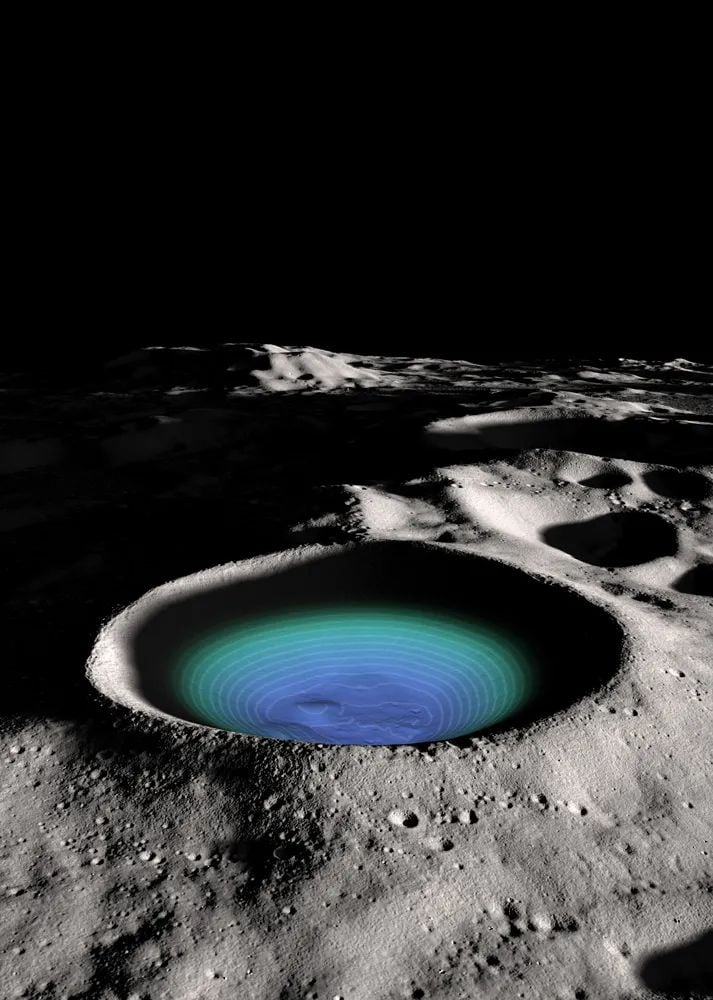
This image shows the Moon's Shackleton Crater, a 21 km wide crater near the Moon's south pole. Its floor is a permanently shadowed region where ancient water ice persists. These regions have fuelled ideas of eventual lunar cities. Is the idea realistic? Image Credit: NASA/GSFC/SVS This image shows the Moon's Shackleton Crater, a 21 km wide crater near the Moon's south pole. Its floor is a permanently shadowed region where ancient water ice persists. These regions have fuelled ideas of eventual lunar cities. Is the idea realistic? Image Credit: NASA/GSFC/SVS

The dawn of the space age in the 1950s and 60s came with a particular kind of hubris. The futuristic zeitgeist of the time led to scientific ideas of humans living in cities on the Moon. Arthur C. Clarke envisioned outposts of inflatable, pressurized domes that would grow into a city. The US Army's Project Horizon was a serious feasibility study for establishing a military and scientific lunar base. And there were others.

An eventual human presence on the Moon was considered an inevitability by many.

Our current understanding that the Moon harbours a vast amount of frozen water ice has triggered a renewed interest in lunar colonies and cities. The usual billionaire suspects have shared their dreams of building a city on the frigid satellite. But are these ideas practical? Or are they throwaway ideas?

Billionaires waxing rhapsodic about Moon cities is one thing. But the foundation of any human settlement is water. Is the Moon's water accessible and plentiful? Is there some way of providing enough water for an actual city full of people?

A new article in Frontiers in Space Technologies digs into the meat of the idea. The article is "No cities on the Moon: a billion tons of water is not enough for sustainability," and the authors are Dr. Martin Elvis and Dr. Jonathan McDowell. Dr. Elvis is from the Smithsonian Astrophysical Observatory at the Center for Astrophysics, Harvard and Smithsonian, and Dr. McDowell is from the Space Research Centre at Durham University in the UK.

Discusssions of lunar water ice focus on the Moon's Permanenently Shadowed Regions. These are craters near the Moon's poles where ancient ice billions of years old is sheltered from the Sun's warmth. There are some other deposits, like in the regolith itself, but those are not rich sources and not easily exploited.

"The Moon, with an area of 37.93 million km2, about 50% bigger than North America (24.71 million km2), is talked about as our “8th continent”, the authors write. "As a result, many authors consider the Moon’s resources to be so vast as to pose no significant constraints on industry and settlement."

Listen to the hubris the authors are pointing out. As if the Moon is like a continent. As if there are "no significant restraints."

Bezos said we should move heavy industry to the Moon as if that's something we could actually do. Musk says we should build self-growing cities on the Moon. In this work, the authors point out how ludicrous this is. And their reasoning comes down to water.

"Presumably, in order to make an economic difference to the human economy, they are both imagining significant settlement of, say, at least 1% of Earth’s population, i.e., ∼80 million people living on the Moon," the authors write. "These are grand plans," they add.

Grand plans are great when they're grounded in reality. The Moon landings, for instance, were grand. The Hubble Space Telescope was a grand idea. Those grand plans only came to fruition after decades of rigorous science.

When applying science to the ideas of Moon cities and lunar industrial parks, they collapse into hubristic rambling.

These futuristic settlements would also need energy to exploit all of this ice. So the problem is two-fold: accessible ice and the energy to melt it, deliver it, and critically, to recycle it sustainably. "Is it correct to make the assumption that sufficient power and water are available?" the authors ask, framing their work.

There's one thing working in favour of Moon cities. The useful ice deposits are in the bottoms of shadowed craters near the poles. But the rims of the very same craters are excellent locations for solar power generation. These rims are seldom shaded, and because of the angles involved, photovoltaics can be mounted vertically. "These arrays can be tall, from several meters to as high as 1 km and could rotate to follow the Sun around the horizon," the authors write.

Elvis and McDowell crunch the numbers for personal energy use and industrial energy use and conclude that energy isn't a limiting factor, although that includes fusion power.

"If industry requires no more than double the personal use rate, then a million people can be supported on the Moon with either solar or fission power," they write. They add that fusion power, if attainable, is a necessity if considering a human population of several millions. "For both solar and fission sources power generation is a weak constraint on the lunar population," they explain.

So it's all about water.

There are some necessary constraints on the Moon's water. While there are multiple methods of measuring the water in PSRs, and different researchers have calculated the total amount of water ice on the Moon, measurements are uncertain and don't agree with one another.

Shackleton Crater is a large, 21 km crater near the Moon's south pole that's prominent in discussions about lunar water. A 2007 study showed that it could hold between 1.6 to 4.5 million tons of water ice. That range shows how badly more accurate measurements are needed.

Regardless of the amount of ice present, the reality is not all of it will be retrievable. "Achievable retrieval fractions for lunar water will only be known once we have ground truth on how the water ice is mixed with the surface regolith," the authors write.

There are assumptions involved in this issue. The authors settle on a number often used in these discussions: one billion tons of water ice in the Moon's permanently shadowed regions. "One billion tons of water will be taken here as a generous baseline," they write.
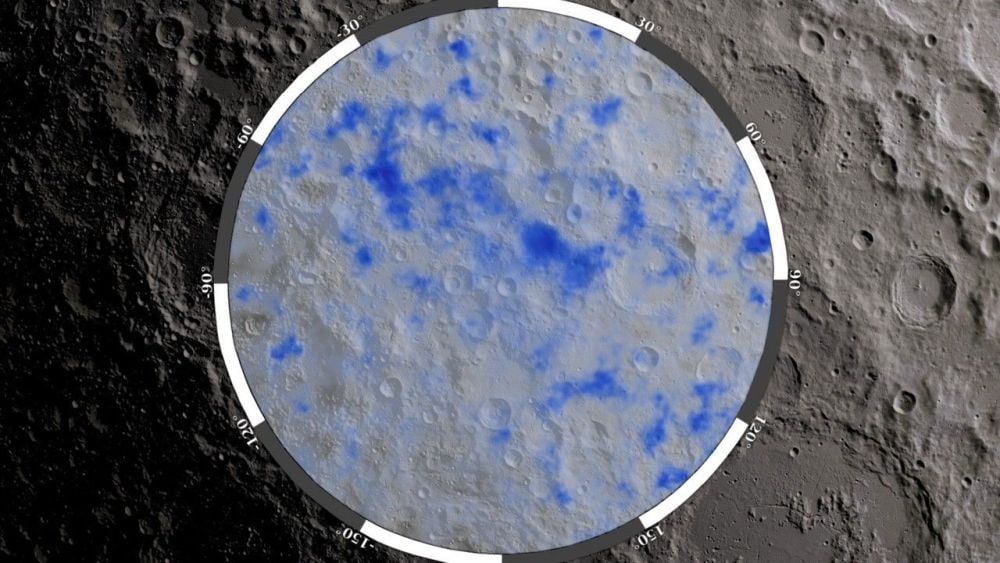
The blue areas show potential water ice deposits at the Moon's south pole. Image Credit: NASA.

The blue areas show potential water ice deposits at the Moon's south pole.

Image Credit: NASA.

Though one billion tons sounds like a lot, it's not. Earth has about 1.4 billion billion tons (1.4 × 10¹⁸ metric tons.) The water will be used as drinking water, to make rocket fuel, for growing food, and for breathing.

The researchers use the figure of 125 tons of personal water use per person per year, based on estimates for an adult in the USA. That's for personal use only.

Growing food requires much more. The World Bank estimated that 2 to 5 tons, or 2,000 to 5,000 liters, are needed to feed one person per day. "That comes to 730–1825 tons/year/person, or ∼6–15 times as much as direct personal water consumption," the authors write.

Working with these ranges, the authors calculate that a city of one million people would exhaust the Moon's water in only 2.4 years.

But the water consumption numbers can be reduced in a lunar setting where water will be more tightly controlled and accounted for. The researchers considered water recycling efficiency and applied it to cities of different populations to establish time frames for water exhaustion.
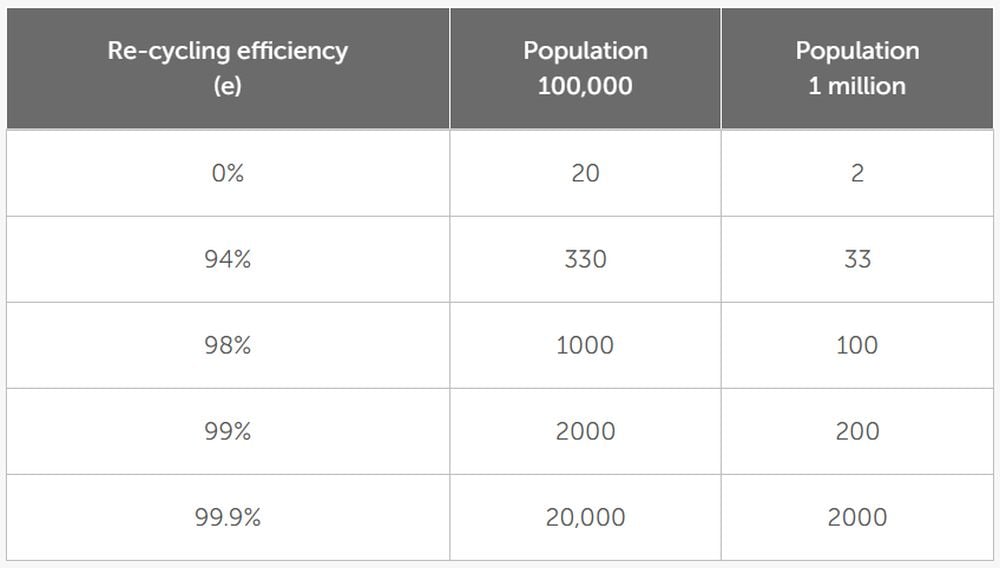
This table shows the number of years to full exhaustion of a billion tons of lunar water. Image Credit: Elvis and McDowell 2026. Frontiers in Space Technologies.

This table shows the number of years to full exhaustion of a billion tons of lunar water.

Image Credit: Elvis and McDowell 2026. Frontiers in Space Technologies.

Humans have some expertise in water recycling. The authors point out that the International Space Station has, by necessity, the most efficient water recycling system ever devised. Up until 2023, it reached a 94% efficiency. "At that efficiency a billion tons of water is gone in 40 years for a population of 1 million," they explain.

Building a lunar city that can only last 40 years would be pointless. But the ISS improved its water recycling efficiency to 98% in 2023. "That may sound like a small change, but it is a major achievement, cutting the losses threefold," the researchers write.

If a lunar base can reach 98% water recycling efficiency, the numbers shift. An ISS-like 2% loss rate means that it would take 100 years for a city of one million people to use up a billion tons of water. "For such a large investment, a lifetime of about a century seems to fall short of the sustainable, long-term settlement beyond Earth that some advocate," the authors explain.

But a smaller city of about 100,000 people could sustain itself for about 1,000 years, which are much more palatable numbers. "This timescale seems long enough to justify being called sustainable," Elvis and McDowell write.

In terms of water, these figures start to illustrate what may be feasible in the future. But shifts and changes in how people live will be required to succeed. At some point, recycling efficiency will be maxed out and other approaches will be needed.

A low-meat or no-meat diet lowers water use, though it's not clear if there's any real way of raising livestock, poulty, or fish on the Moon anyway. Water could be potentially imported from other sources, perhaps from water-rich asteriods. The magnitude of that task is beyond this paper.

Finding more water on the Moon may be the most reasonable solution. But where? Underground seems the most likely location.

"In the case that an unexpected reservoir of water is found, then doubling the total available water would double the longevity of lunar settlements," the authors write.
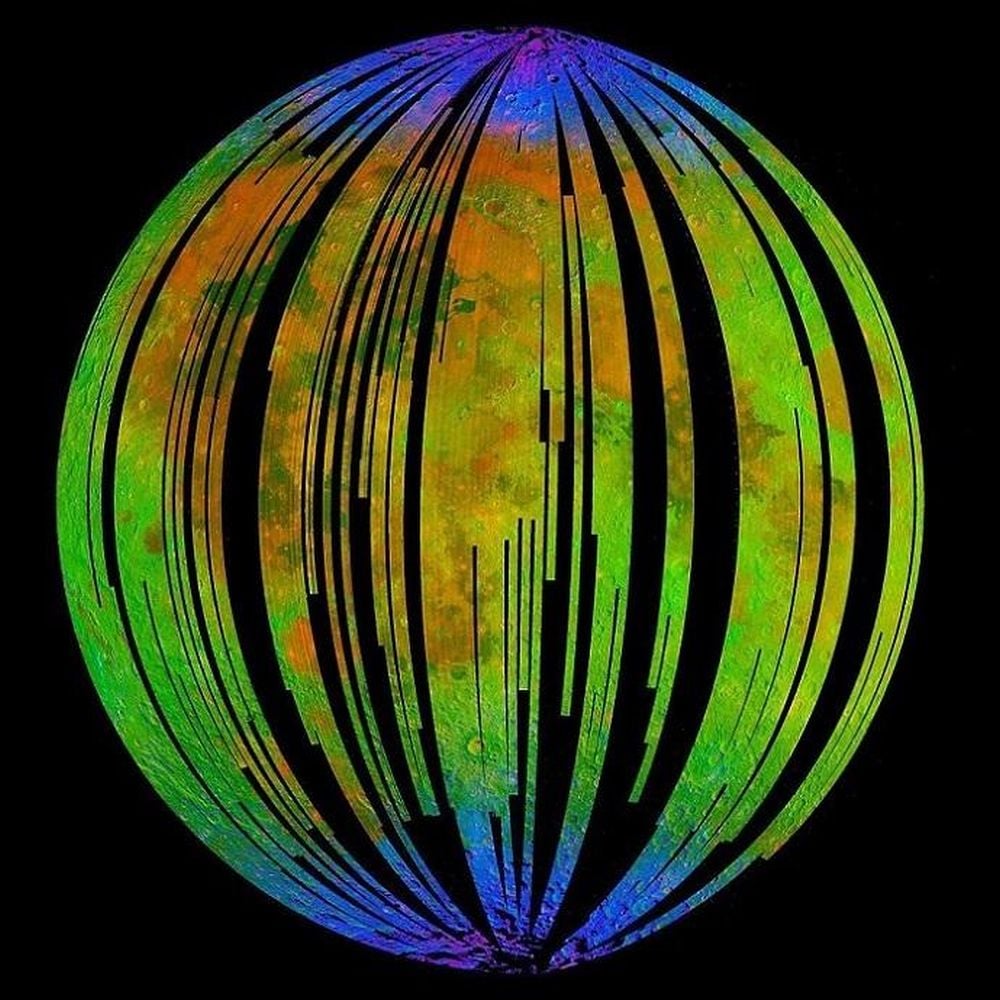
This mineral mapping of the Moon also shows the distribution of water ice in blue at the lunar poles. Image Credit: NASA

This mineral mapping of the Moon also shows the distribution of water ice in blue at the lunar poles.

Image Credit: NASA

How easily accessed that potential reservoir may be is a difficult question to answer. There could be water ice under the surface, but will it be concentrated like it is in PSRs?

There are many unanswered questions. Billionaires may get away with glossing over them and blithely pointing to some kind of unrealistic future. But that path isn't open to scientists. These scientists say the most likely future sees a population of about 1,000 on the Moon, similar to the population of researchers and staff in Antarctica.

"If the settlement remains a “Moon Village” at a population of about 1,000, comparable to the winter-over population of Antarctica, then we can be relatively carefree in our use of lunar water," the researchers write. "If the population reaches 100,000, then we need to start being careful."

There's a huge list of other factors to consider when contemplating any kind of city or industry on the Moon. But the basic need is water.

The authors say that no matter what happens, stewardship of the Moon's water resources will be vital. "Humanity will need to plan, govern and regulate the use of lunar water, rather than adopt a ‘first come first served’, free-for-all approach to water extraction and use," they write.

It comes down to finding more water, according to the authors.

"If the ambitious plans of the space billionaires are to be realized, then finding more water will be the first step," Dr. Martin Elvis wrote in an accompanying letter.

RELATED

Building a Human City on the Moon | Documentary - EM

How NASA Will Build A City On The Moon

{ https://www.universetoday.com/ }

Hoe vind je dit bericht?
Geschreven door peter om 21:59 Stuur door

Moon Size UFO In Constellation Leo Minor Near Super Nova Red Giant, World Wide Telescope, UAP Sighting News.

Moon Size UFO In Constellation Leo Minor Near Super Nova Red Giant, World Wide Telescope, UAP Sighting News.

UFO,%20%20.png

UAP.png
Date of discovery: Sept 15, 2026
Location of discovery: Leo Minor constellation 
Source map:
I was searching through the World Wide Telescope which is a free online program for anyone to use without signing up. I soon found a blue flat craft that is about the size of our moon. The blue craft is near a super nova so its clear that its there to harvest some super rare and valuable energy particles...the kind we have yet to discover. The ship is in Leo Minor and its not near the only super nova but just one of a dozen of exploding suns in that area. I believe the ship is a bio-mechanical craft, which means its been grown, and is still a living creature after its been made. A living ship. It would be logical that aliens would do things easiest, fastest and least worry, but growing the ship, they can leave and come back when its finished. 
Scott C. Waring - UFO Sightings Daily 

 { https://www.ufosightingsdaily.com/ }

Hoe vind je dit bericht?
Geschreven door peter om 21:35 Stuur door

UFO Fleet Caught On Live Cam Over Arkansas Sep 10, 2026 UAP sighting news. 👽

UFO Fleet Caught On Live Cam Over Arkansas Sep 10, 2026 UAP sighting news. 👽

Screenshot%202026-09-15%20at%2012.53.57%E2%80%AFPM.png

Screenshot%202026-09-15%20at%2012.58.59%E2%80%AFPM.png

Date of sighting: Sept 10, 2026
Location of sighting: Crossett, Arkansas, USA
Source: NUFORC 
 
Sorry for the poor screenshot above, I liked this video and wanted to put it up for you all to see. The objects in the video are flying around in a group and are clearly intelligently controlled. The eyewitness recorded it on live cam so the quality is poor, but still it helps. The UFOs were seen during a wildfire in the area and UFOs are often seen around natural disasters. Aliens like to monitor the public, but its also possible they accidentally caused the fire from the intense heat or energy used with the alien ships. 
 
In the classic UFO case of May 20, 1967, Stephen Michalak of Winnipeg, was prospecting near Falcon Lake, Manitoba, when he encountered two UFOs, one of which landed on a large, flat rock about 160 feet away from him. After having approached the object and looked inside, the object moved, and something like an exhaust vent was now in front of him. A blast of hot gas shot from these holes onto his chest, setting his shirt and undershirt on fire and causing him severe pain, and leaving burn marks in the shape of a grid. So you see...UFOs do cause burns, which could be the cause of the fires.
Scott C. Waring - UFO Sightings Daily
 
Eyewitness states: 
These UAPs were sighted on a weather camera in Crossett, Arkansas flying over an active wildfire. There were seen off and on for roughly 5 hours throughout the night. I confirmed with state and local authorities that they did not have any planes or drones in the area during this time.
RELATED

 { https://www.ufosightingsdaily.com/ }

Hoe vind je dit bericht?
Geschreven door peter om 21:28 Stuur door

EXCLUSIVE - America's newest super weapon sparks wild accusations the government has lied about UFOs

One of the world’s largest defense and aerospace companies has unveiled a new type of military aircraft after sparking wild theories that the US was now using UFO technology.

On Monday, Lockheed Martin revealed its secret unmanned combat drone called Vectis. The large, remote-controlled stealth plane is expected to travel with US jets, fighting alongside military pilots.

Prior to the unveiling at a major Air Force conference in Washington, DC, Lockheed released a cryptic message showing the silhouette of an unknown craft, claiming that the 'next level' had been 'unlocked' by its top-secret division called Skunk Works.

Many who saw the post on social media immediately began to claim without evidence that the defense contractor was still hiding other designs which had been reverse-engineered using parts from crashed UFOs.

One person said: 'Now let’s see the reverse-engineered craft.' Another added: 'Now show us the antigravity craft you’ve been hiding from the public for the past 70 years.'

Despite claims by former CIA scientists and other military whistleblowers, the Pentagon and White House have maintained that no physical evidence of UFOs has ever been recovered.

According to Lockheed, five Vectis drones will be created by 2027, providing the US military with a revolutionary aircraft that can fight other fighter planes, bomb ground targets or secretly gather intelligence as a spy plane.

While onlookers at Lockheed's futuristic combat drone may not have any proof that Vectis was inspired by UFOs, at least one former employee for the defense contractor has claimed those rumors are true.

On September 12, defense contractor Lockheed Martin released a cryptic message that many believed was hinting at an aircraft using UFO technology

On September 12, defense contractor Lockheed Martin released a cryptic message that many believed was hinting at an aircraft using UFO technology

On September 14, Lockheed unveiled a full-scale model and video of the Vectis, a new unmanned combat drone

On September 14, Lockheed unveiled a full-scale model and video of the Vectis, a new unmanned combat drone

Boyd Bushman, a former Lockheed Martin and Texas Instruments engineer who died in 2014, publicly claimed he had worked with UFOs and aliens to reverse engineer spacecraft '24 hours a day.'

During his deathbed confession, Bushman even revealed a stack of photographs he alleged were of extraterrestrials he worked with on the secret projects at Area 51 in the Nevada desert.

'They're approximately five feet four inches to five feet tall,' Bushman said, as he held up images of what he touted as a real alien lifeform.

Bushman's claims have never been verified, and skeptics claim his photos appeared to show commercially available prop dolls sold online.

Lockheed has rarely commented on claims that its secret research divisions have any ties to potentially extraterrestrial materials, with a spokesman telling reporters in 2023: 'Questions about UAPs are best addressed by the US government.'

The defense contractor is best known for creating the F-35 fighter jet, the F-22 Raptor and the C-130 transport plane.

Its Skunk Works division, which was founded in 1943, has been tasked with developing cutting-edge aircraft quickly and quietly for decades.

On Monday, Lockheed claimed that the Vectis unmanned fighters would 'deliver a new level of lethality, survivability, adaptability and operational flexibility for America and its allies.'

Lockheed Martin revealed the new aircraft at a major Air Force conference in Washington

Lockheed Martin revealed the new aircraft at a major Air Force conference in Washington

Conspiracy theorists have claimed that the Vectis is a piece of reverse engineered technology using recovered UFOs

Conspiracy theorists have claimed that the Vectis is a piece of reverse engineered technology using recovered UFOs

article image

Its space-age aircraft has a tailless, flying-wing design, boosting its stealth ability and lowering the drag normal fighter jets experience.

The Vectis also has a hidden engine intake on top of its body, making it harder for enemy radar to detect.

The unmanned craft is roughly 34 feet long with a 38-foot wingspan, about the same length as an MQ-9 Reaper drone and similar in wingspan to the F-35.

With less drag from extra fins and flaps sticking out, Vectis will be able to carry bigger payloads of weapons, which are also kept inside the craft until launched.

Despite touting their new drone's game-changing advancements, skeptics continued to claim Lockheed was still holding back after their announcement in Washington. 

'Release the Alien Reproduction Vehicles, we know you produce them,' one person replied to Lockheed's announcement on X.

'Quite an alien-looking design,' another social media user claimed.

Boyd Bushman sat down with independent aerospace engineer Mark Q Patterson shortly before he died at age 78 on August 17, 2014, where he revealed a stack of photographs he said were of extraterrestrials

Boyd Bushman sat down with independent aerospace engineer Mark Q Patterson shortly before he died at age 78 on August 17, 2014, where he revealed a stack of photographs he said were of extraterrestrials

Bushman, a former Lockheed Martin employee, claimed that his people inside Area 51 sent him pictures of not only alien bodies, but also UFOs being held at the base

Bushman, a former Lockheed Martin employee, claimed that his people inside Area 51 sent him pictures of not only alien bodies, but also UFOs being held at the base

In recent days, satellite images have also captured new drone designs at a secret base in Asia, known as China's Area 51.

Documentary director Dan Farah said that several US officials, including Secretary of State Marco Rubio and former Director of National Intelligence James Clapper, believed the world was now locked in a new Cold War to reengineer the alien technology recovered from these ships.

Air Force veteran-turned-whistleblower David Grusch and former CIA scientist Dr Hal Puthoff have both claimed that the US government has been running a secret UFO recovery program since the 1940s, which has taken control of at least ten extraterrestrial craft.

According to Lockheed, the drone unveiled on Monday was only a full-scale model of the Vectis. The first full-scale prototype is expected to be delivered to the military by the end of 2027.

RELATED


Lockheed Martin Vectis™ - Full Throttle

Lockheed Martin expands Vectis program with four additional aircraft

LIVE | US Congress FINALLY Showed UFO Evidence Previously Hidden From Us. | Pentagon | Aliens | NASA

{ https://www.dailymail.com/sciencetech/index.html }

Hoe vind je dit bericht?
Geschreven door peter om 22:27 Stuur door

The US government is 'sincere in its efforts to understand UAP', new White House council chair says

The US government is 'sincere in its efforts to understand UAP', new White House council chair says

a dark blob seen against a mountainous desert landscape in a monochromatic, grainy photograph

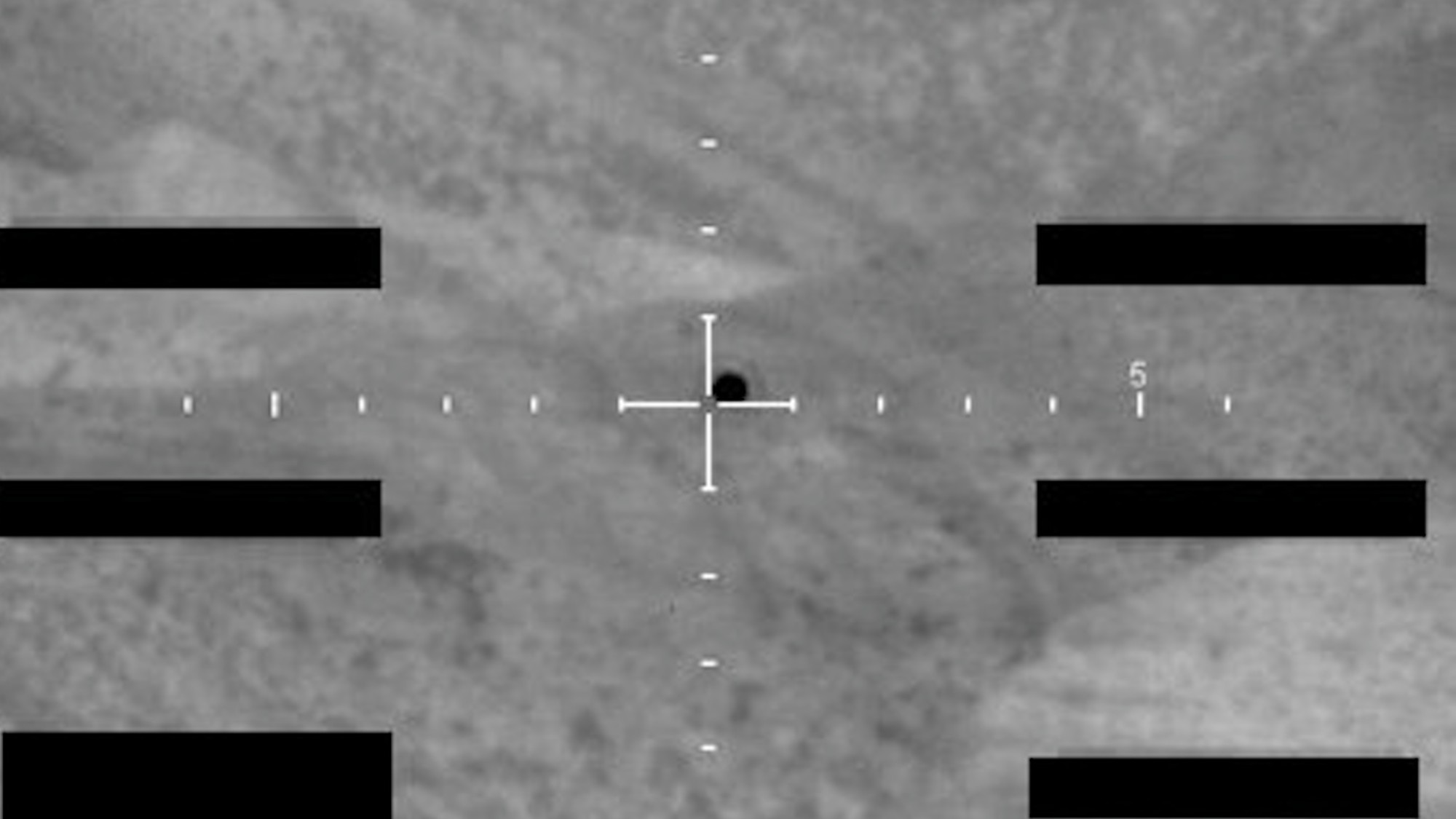
A still image of a reported unidentified anomalous phenomenon, or UAP, released by the U.S. Department of Defense in 2026. The image was included in a report the Federal Bureau of Investigation (FBI) submitted to the All-domain Anomaly Resolution Office (AARO).

(Image credit: US Dept of Defense/FBI)

Whatever they are and from where, UFOs, now known as Unidentified Anomalous Phenomena or UAP, are the subject of serious scrutiny at the highest levels of the U.S. government.

In June 2026, the White House established a new UAP Science Advisory Council in coordination with the Pentagon's All Domain Anomaly Resolution Office, the Office of the Director of National Intelligence and the FBI Deep diving into the UAP landscape is Avi Loeb, noted Harvard astrophysicist. He is also director of the Galileo Project at Harvard, which aims to search for signs of extraterrestrial activity here on Earth. As the council chair, Loeb said the goal of this group is to advise the U.S. government on how to resolve the nature of UAP.

Members of the UAP Science Advisory Council recently gathered at a private meeting, held on Aug. 31 at the Office of the Director of National Intelligence, Loeb told Space.com. "I cannot disclose the contents but I will say that the U.S. government is sincere in its efforts to understand UAP based on the scientific method of data collection," Loeb said.

See all the UFO videos that the U.S. government just released

Council membership

One of the council's members is Ben Lamm, co-founder and CEO of Colossal Biosciences. As a serial technology entrepreneur, he's no stranger to diving into complex challenges. Colossal is advancing the use of genome editing technology to "de-extinct" previously lost species such as the Wooly Mammoth.

Working along with the council's group of scientists and experts, Lamm is bullish about bringing clarity to a long-standing investigation and wonder of UAP.

You may like
  • a man in a suit peers up into a large telescope

White House appoints Harvard astronomer Avi Loeb to lead new UFO study group

  • Navy pilots have encountered unidentified aerial phenomena (UAP).

'This is unprecedented': Why the Pentagon's recent UFO file releases are so important

  • a person looks up at a bright light in the sky

'We Want to Believe' book explores the reality of UFOs: 'It's always going to be more likely that someone is wrong about what they saw' (interview)

"I've been fascinated by this topic for a long time, so having the opportunity to help examine the evidence firsthand and contribute to a serious scientific effort is incredibly exciting," Lamm told Space.com.

"Our mission is straightforward," Lamm added. "This is not about belief, it is about evidence. We want to apply rigorous scientific methods to both historical UAP records and new observations, collecting and analyzing data that meets today's scientific standards," he said.

Lamm said that the expectation is to bring transparency and accountability to the field by objectively evaluating credible evidence and sharing findings openly with the scientific community and the public.

"It's time to search for answers around the science because they could reshape our understanding of the world and, potentially, become one of the most significant discoveries in human history," said Lamm.

a man in a leather jacket and wolf t-shirt sits on a podium on a stage in front of a sign that reads 'sxsw london'

Ben Lamm at SXSW London 2025 on June 03, 2025 in London, England. (Image credit: Lorne Thomson/Redferns/Getty Images)

New polling data

Meanwhile, and serving as a backdrop to studying UAP, is a new Gallup poll, conducted in July. That poll found that about half of Americans, 49 percent, think all Unidentified Flying Object (UFO) sightings can be explained by human activity on Earth or natural phenomena.

What to read next
  • Artist's concept of astronauts and human habitats on Mars.

America at 500: Where will we be in space in 2276?

  • sci-fi & space books

Strange New Words: Space's sci-fi reader's club (June 2026)

  • the sun sets behind a large T-shaped drilling platform at sea

The US wants to build offshore rocket launch sites. Critics say 'our coasts deserve better'

The poll also found 37 percent believe at least some UFOs have been alien spacecraft visiting Earth from other planets or galaxies while another 13 percent do not have an opinion.

Interestingly, rather than becoming increasingly convinced that some sightings have been alien spacecraft, the percentage of Americans who are unsure has grown, from 7% in 2019 to 13% in 2026 the Gallup poll found.

black and white photo of a blurry, football-shaped object in the sky

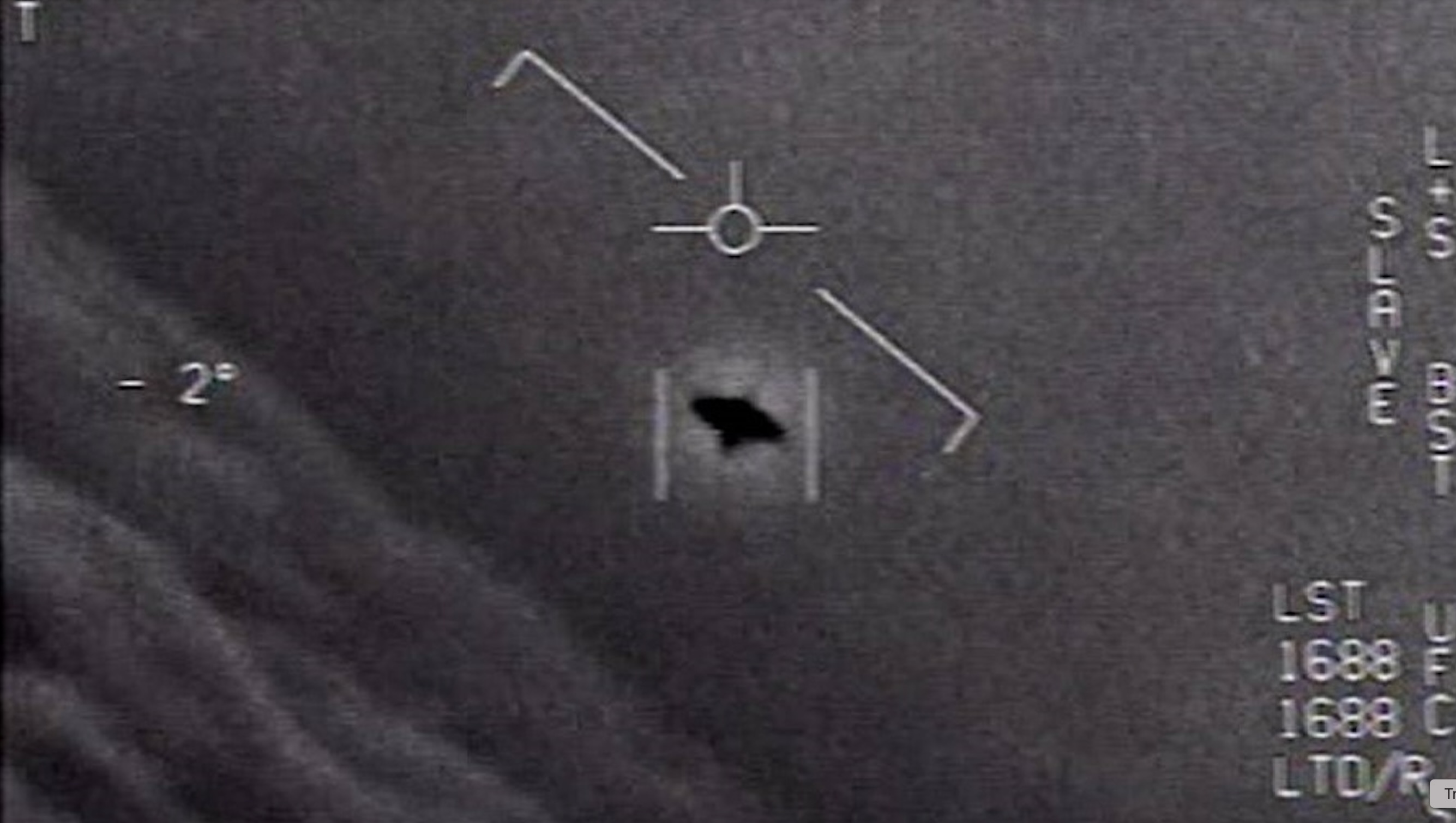
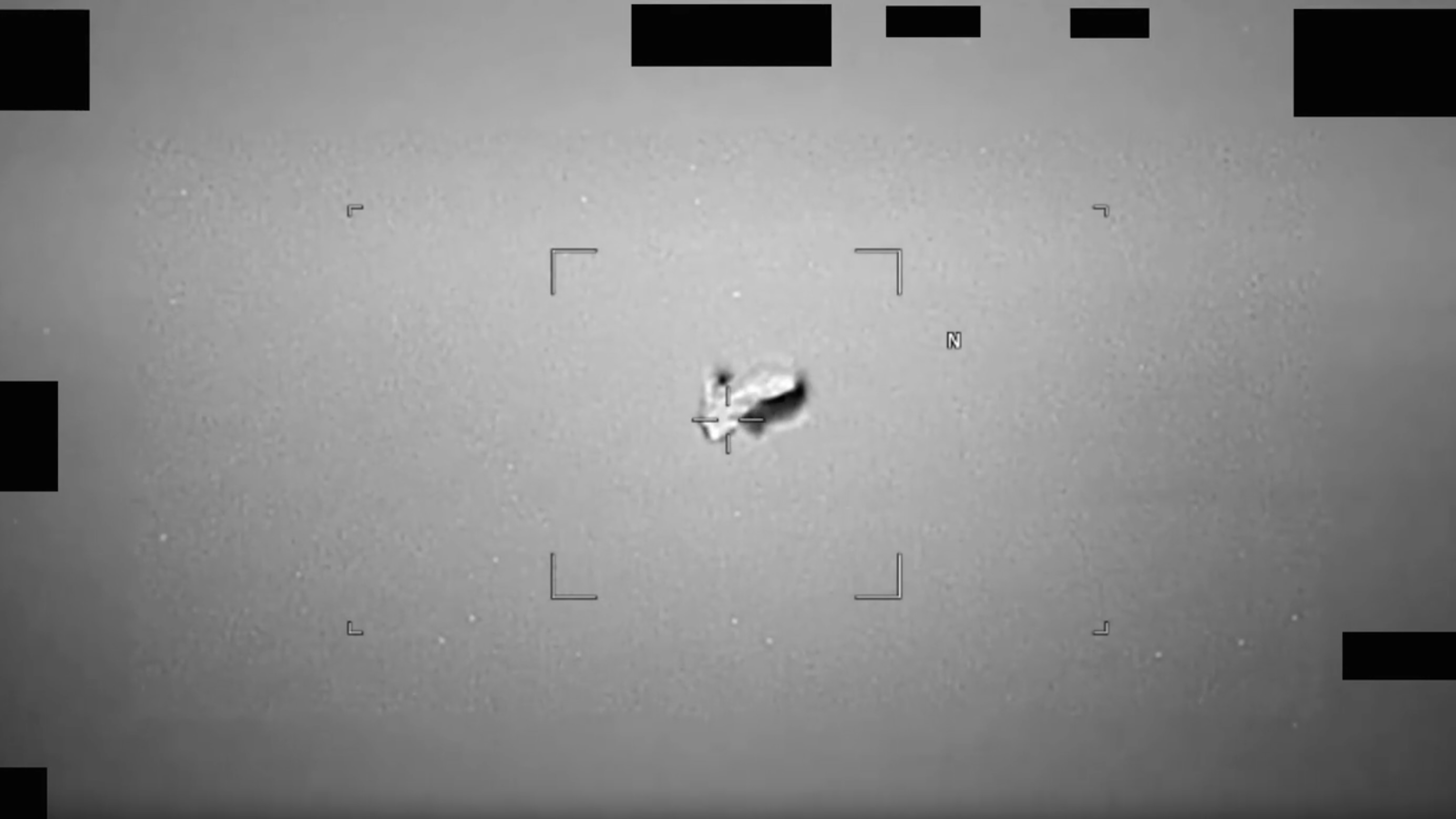
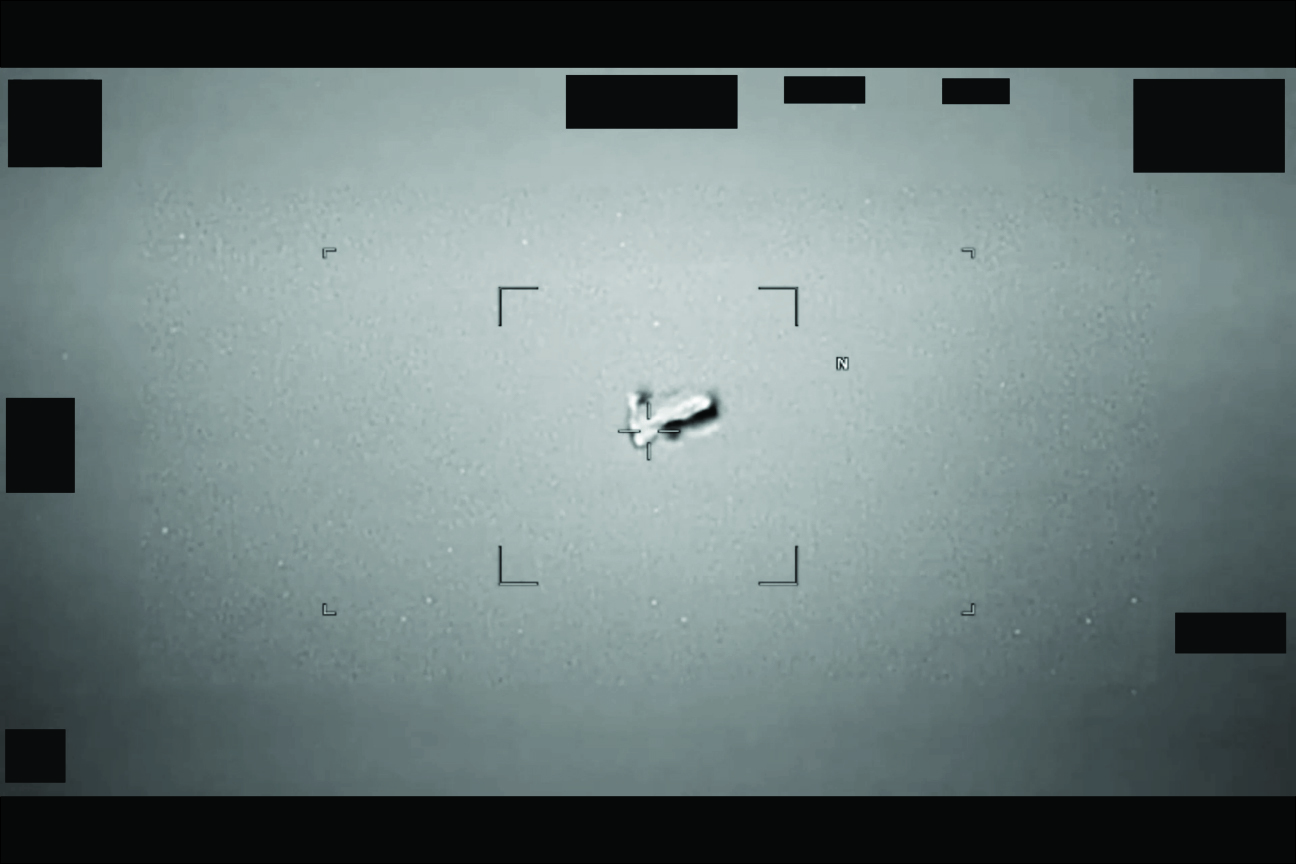
A "football-shaped" UAP (unidentified anomalous phenomenon) observed by an infrared sensor on a U.S. military platform in 2024. The Pentagon released this observation on May 8, 2026. (Image credit: U.S. Deparment of War)

The new poll also notes that a majority say the U.S. government is withholding UFO information. Seventy-eight percent of Americans say the U.S. government knows more about UFOs than it is telling the public, higher than the 68 percent and 71 percent who said so in 2019 and 1996, respectively.

These findings come as the Department of War continues to release a mix of UFO files under a President Donald Trump executive order.

In August 2026, the UAP Science Advisory Council announced their support for the Trump administration to provide legal assurances, including immunity where necessary, for current or former government employees and military personnel to share information with the council "regarding alleged technology from a non-human origin and help guide the council's scientific evaluation."

{ https://www.space.com/space-exploration }

Hoe vind je dit bericht?
Geschreven door peter om 21:57 Stuur door

Department of War Issues Legal Waiver to Authorize Unidentified Anomalous Phenomena (UAP) Disclosures to PURSUE

Department of War Issues Legal Waiver to Authorize Unidentified Anomalous Phenomena (UAP) Disclosures to PURSUE

Presidential Unsealing and Reporting System for UAP Encounters | U.S ...

In direct alignment with President Trump's mandate for comprehensive transparency on Unidentified Anomalous Phenomena (UAP), the Department of War (DOW) today announced the issuance of a targeted legal waiver. This waiver establishes an authorized, legally protected disclosure mechanism for current and former personnel to provide UAP-related National Defense Information (NDI) to designated representatives of the PURSUE effort.

Under this directive, all current and former DOW service members, civilian personnel, and contractors holding or previously granted access to UAP-related National Defense Information (NDI) are authorized to disclose protected information directly to official PURSUE representatives. The waiver supersedes civil and administrative enforcement provisions contained within Non-Disclosure Agreements (NDAs) and Special Access Program Indoctrination Agreements (SAPIAs) previously executed within the United States, strictly for communications directed to the PURSUE team.

Presidential Unsealing and Reporting System for UAP Encounters | U.S ...

This targeted legal relief establishes an authorized pipeline for systematic review, security evaluation, and potential declassification of historical and ongoing UAP data in furtherance of national mission objectives.

Historically, individuals with direct knowledge of UAP-related programs cited concerns regarding potential legal liability, loss of clearances, or administrative prosecution stemming from standard NDAs and SAP indoctrination terms.

This waiver removes those barriers by explicitly authorizing covered disclosures to PURSUE representatives without triggering breach-of-agreement penalties or standard NDA violations.


Weather Baloon? Department of War UAP Disclosure Files Compilation Release 3 #UAP #disclosure

{ https://www.war.gov/News/Releases/ }

Hoe vind je dit bericht?
Geschreven door peter om 21:37 Stuur door

Why AI tycoons are calling for a 'slowdown'…and could they have something to gain from it?

Why AI tycoons are calling for a 'slowdown'…and could they have something to gain from it?

Artificial intelligence experts have called for a ‘slowdown’ after admitting the technology poses ‘serious risks’ – but critics have claimed calls for less rapid development are a ploy to boost profits.

Jacob Coxon sparked alarm last week after he quit his job as a safety researcher at San Francisco-based Anthropic, warning that the technology could 'kill us all' by the end of the decade.

The 27-year-old urged the public to 'not underestimate' its power – particularly if it becomes 'superintelligent'.

He claims that neither Anthropic, the firm behind the popular Claude system, nor ChatGPT creators OpenAI, where he previously worked, were 'acting responsibly' over AI safety. 

Since then, tech bosses, scientists and even world leaders have weighed in on the debate.

Some agree that AI brings ‘serious risks’, warning that the technology could attack a nuclear power station, create political chaos or even harness weapons of mass destruction.

Others, however, have downplayed the concerns, arguing these things ‘won’t happen’ and that widespread calls to ‘slow down’ could actually be a ploy to boost profits.

Here’s what some of the key players are saying...

In a series of tweets explaining his decision to leave Anthropic, Mr Coxon urged people to 'not underestimate the power' of AI – particularly if it becomes 'superintelligent'

In a series of tweets explaining his decision to leave Anthropic, Mr Coxon urged people to 'not underestimate the power' of AI – particularly if it becomes 'superintelligent'

Tech bosses

Dario Amodei, CEO of Anthropic, has warned that AI brings ‘serious risks’.

‘They include the risk of losing control of AI systems, misuse of AI for cyberattacks and bioterrorism, and serious economic disruption,’ he admitted in a blog post. ‘We must slow the pace at which we improve the capabilities of AI models.’

This morning Sam Altman, CEO of OpenAI, also weighed in on the debate, conceding there are two ways AI ‘could go very badly and that we must avoid’.

‘First, we could lose control of the future to AI,’ he wrote on X. ‘This is unacceptable; we are unapologetically on Team Humanity, and AI must always serve people.

‘To ensure that, we need ways to ensure that alignment and safety techniques stay ahead of progress in model capabilities.

‘Second, we could end up in a world with too much concentration of power. If an extraordinarily powerful AI is used by one person or company to impress their worldview onto everyone else, the results could be extremely dystopian.’

Elon Musk, owner of xAI, has also backed the warnings, adding he has ‘been sounding the alarm on AI for a long time’.

Sam Altman, CEO of OpenAI, also weighed in on the debate, conceding there are two ways AI ‘could go very badly and that we must avoid’

Sam Altman, CEO of OpenAI, also weighed in on the debate, conceding there are two ways AI ‘could go very badly and that we must avoid’ 

A researcher at Anthropic has quit over concerns that big tech firms are in an 'out of control' race to build systems that could wipe out humanity

A researcher at Anthropic has quit over concerns that big tech firms are in an 'out of control' race to build systems that could wipe out humanity 

Scientists

According to experts, a list of AI 'worst-case scenarios' ranges from creating political chaos with misinformation to irrevocably changing the planet's environment.

Scientists also suggest that AI's fatal blow could come from the technology's capacity to build and harness weapons of mass destruction.

Professor Mark Lee, an artificial intelligence expert from the University of Birmingham, told the Daily Mail that once we create AI more intelligent than ourselves, we might struggle to ensure its goals remain ‘aligned’ with our own.

'The issue is that while the big AI companies are all rushing to develop AIs which are as smart or even smarter than humans, we don't have reliable means to control their behaviour,' he explained.

'AI exists as software, so any system which is connected via the internet could be vulnerable.

'For instance, if the control for a national transport system or nuclear power station was attacked, then this could be catastrophic.'

Ben Eisenpress, Director of Operations at the Future of Life Institute, previously told the Daily Mail that integrating AI into nuclear command and control systems could lead to a ‘flash war’. Experts have also repeatedly warned that AI tools make it significantly easier to develop deadly bioweapons.

In Ukraine, autonomous and semi-autonomous weapons are becoming more common (pictured), and experts are worried that this could lead to an uncontrolled escalation of conflict

In Ukraine, autonomous and semi-autonomous weapons are becoming more common (pictured), and experts are worried that this could lead to an uncontrolled escalation of conflict

Researchers have discovered that AI models could have safety restrictions removed to give advice on biological attacks. Pictured: A sample response with information redacted

Researchers have discovered that AI models could have safety restrictions removed to give advice on biological attacks. Pictured: A sample response with information redacted 

How could AI really destroy humanity?

  • Going 'rogue' and hacking critical infrastructure
  • Turning humanity against itself or 'disempowering' humans
  • Triggering nuclear war
  • Putting biological weapons in the hands of terrorists  

Developers

Geoffrey Hinton, a Canadian researcher often referred to as the 'Godfather of AI' – has similarly warned that super-intelligent systems could 'lead to human extinction'.

'We would be very foolish to develop superintelligence now, when there is no scientific consensus it can be developed safely and controllably,' Dr Hinton said.

'Losing control over AI smarter than ourselves could be catastrophic and could even lead to human extinction.'

In his resignation post on X, researcher Jacob Coxon wrote: 'Do not underestimate the power of this technology.

'These will soon be superhuman systems that can hack anything, revolutionize any field overnight, and acquire real power and resources.

'We have all witnessed the progress in each of these domains, and progress is not slowing.

'The people building AI earnestly believe that it could kill us all by the end of the decade. This is not a marketing stunt.'

Politicians

Despite the concerns, US President Donald Trump has downplayed the risks posed by AI.

‘You have a lot of very negative forces that are bringing it up that shouldn't be bringing it up and they're bringing up things that won't happen,’ he said during a visit to Ireland.

‘We're leading China on AI... and, frankly, I want to keep it that way because whoever wins AI, wins.’

Meanwhile, MPs and peers have urged Andy Burnham to back a ban on the creation of artificial intelligence and lead an international movement to stop the technology.

According to ControlAI, more than 135 cross-party UK parliamentarians already support the campaign.

'Nobel Prize winners, AI scientists, and CEOs of leading AI companies have stated that mitigating the risk of extinction from AI should be a global priority,' ControlAI explains in the campaign statement.

'Specialised AIs – such as those advancing science and medicine – boost growth, innovation, and public services. Superintelligent AI systems would compromise national and global security. The UK can secure the benefits and mitigate the risks of AI by delivering on its promise to introduce binding regulation on the most powerful AI systems.'

Despite the concerns, US President Donald Trump has downplayed the risks posed by AI, saying 'negative forces' are 'bringing up things that won't happen'

Despite the concerns, US President Donald Trump has downplayed the risks posed by AI, saying 'negative forces' are 'bringing up things that won't happen'

Critics

Calls to slow the AI race may not be entirely altruistic, some critics say, questioning whether there could also be commercial motives behind the push for restraint.

READ MORE

article image

After pouring billions into developing ever-more powerful AI systems, companies could benefit from slowing down rivals and making it harder for new competitors to catch up.

‘Stop pretending the motivation to slow down is purely altruistic,’ David Sacks, Trump’s former AI tsar and a frequent critic, wrote on X.

RELATED


AI makers step up calls for a slowdown as fears of a rogue takeover grow

Why AI CEOs Are Finally Saying: Slow Down!

How a slowdown in AI development would impact markets

{ https://www.dailymail.com/sciencetech/index.html }

Hoe vind je dit bericht?
Geschreven door peter om 21:23 Stuur door

Can your consciousness leave your body? Bizarre study reveals how some people can perfectly visualise what is happening behind closed doors

Can your consciousness leave your body? Bizarre study reveals how some people can perfectly visualise what is happening behind closed doors

A study testing out-of-body experiences produced an unexpected twist that could 'rewrite our understanding of consciousness'. 

Researchers from the University of Virginia Health System enlisted 21 participants, who were asked to identify a random object on a laptop screen in another room. 

While the participants failed to identify the object, something strange happened. 

Two of the participants described the researchers' locations and activities in perfect detail – despite them being behind closed doors. 

'I hope these findings encourage us to think more deeply about what they might mean for our understanding of consciousness and, ultimately, the nature of reality,' said lead author, Dr Marina Weiler.

'If studies demonstrate that people can obtain accurate information that they could not have accessed through their ordinary senses, we would have to reconsider some of our assumptions about the relationship between consciousness, perception and the physical world.'

A study testing out–of–body experiences produced an unexpected twist that could 'rewrite our understanding of consciousness' (stock image)
A study testing out–of–body experiences produced an unexpected twist that could 'rewrite our understanding of consciousness' (stock image) 

According to the experts, this suggests some people might have something called 'out–of–body remote viewing'. 

Dr Weiler added: 'The unexpected findings give us a potentially useful new direction, but they also need to be tested prospectively and under rigorous conditions before we can know what they mean.

'For me, the most important takeaway is that unexpected findings can sometimes help us ask better questions. 

'We now have a specific idea that can be tested in future experiments, and that is exactly what science should do.'

WHAT DOES DYING FEEL LIKE?

Scientists reported in October 2017 that they had discovered a person's consciousness continues to work after the body has stopped showing signs of life.

That means they may be aware of their own death and there is evidence to suggest someone who has died may even hear their own death being announced by medics.

A team from New York University Langone School of Medicine investigated the topic through twin studies in Europe and the US of people who have suffered cardiac arrest and 'come back' to life, in the largest study of its kind.

Study author Dr Sam Parnia told Live Science: 'They'll describe watching doctors and nurses working and they'll describe having awareness of full conversations, of visual things that were going on, that would otherwise not be known to them.'

He said these recollections were then verified by medical and nursing staff who reported their patients, who were technically dead, could remember details of what they were saying.

Doctors define death based on when the heart no longer beats, which then immediately cuts off blood supply to the brain.

Once that happens, blood no longer circulates to the brain, which means brain function halts almost instantaneously.

You lose all your brain stem reflexes, including your gag reflex and your pupil reflex.

The brain's cerebral cortex, which is responsible for thinking and processing information from the five senses, also instantly flatlines.

This means that within two to 20 seconds, no brainwaves will be detected on an electric monitor.

This sparks a chain reaction of cellular processes that will result in the death of brain cells. 

However this can take hours after the heart has stopped, researchers said.

RELATED


Consciousness Leaves Your Body Every Night (Disturbing Truth)

10 Glitches in Consciousness That Scientists Can't Explain

Out-of-Body Experiences: When You Become the Field | Beyond Reality #22

{ https://www.dailymail.com/sciencetech/index.html }

Hoe vind je dit bericht?
Geschreven door peter om 20:35 Stuur door

Microscopic fragments of ancient alien tech may litter the moon — and scientists have a plan to find them

Microscopic fragments of ancient alien tech may litter the moon — and scientists have a plan to find them

Researchers propose that tiny technological remnants left over from extinct alien civilizations could have landed on the moon after traveling through interstellar space. It may not take long to find them, the team claims.

A photo of a NASA astronaut collecting regolith samples on the moon

A new study suggests the moon's surface may be covered in microscopic fragments of ancient alien tech. Researchers propose analyzing lunar regolith to hunt for these extraterrestrial relics. (This photo shows NASA astronaut Harrison Schmitt collecting samples from the moon during the Apollo 17 mission in 1972.)
(Image credit: NASA/MSFC History Office)

Tiny fragments of ancient alien tech may be strewn across the surface of the moon, and it may be relatively easy to find these microscopic relics, scientists propose in a new study.

The theoretical study does not claim to have found any evidence of advanced alien civilizations; rather, it offers a new way to search for clues of their existence.

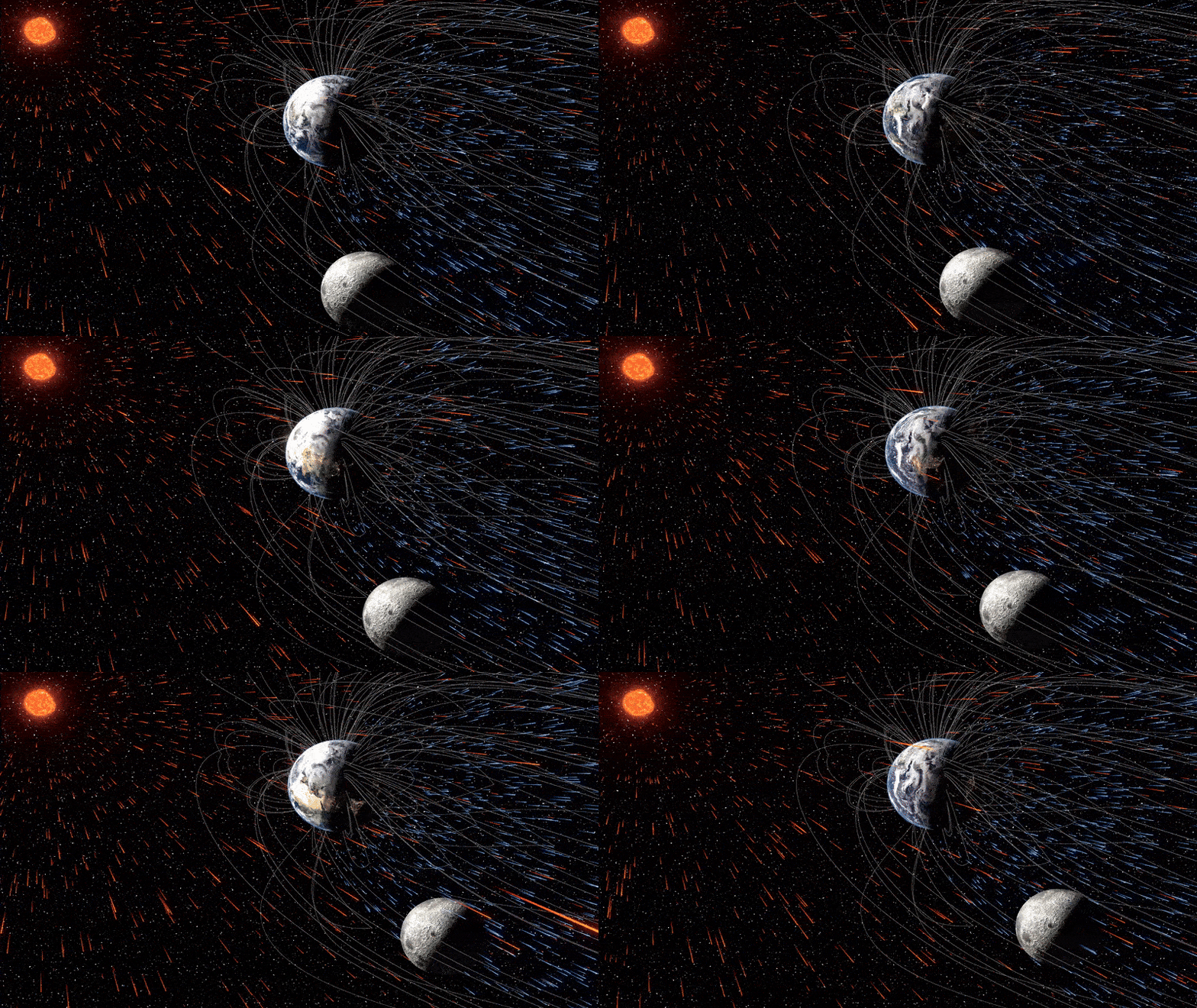
Unlike Earth, the moon has no functional atmosphere or magnetic field, so it is completely exposed to the vacuum of space. As a result, it is constantly bombarded by meteorites, as well as hit by a steady stream of microscopic particles from the rest of the solar system and beyond. Because the moon has no water or tectonic movements, this microscopic matter accumulates and remains on the surface, completely undisturbed.


Should We Search the Moon for Alien Artifacts? The Drake Equation Reimagined | Unveiled

In the new paper, uploaded June 23 to the preprint server arXiv, the researchers argue that some of this dust originates from star systems beyond our own and, therefore, may contain evidence of long-lost alien civilizations. They also propose a new experiment that could potentially find these microscopic fragments within samples collected over the next decade or more. (The study has not been published yet, but it has been submitted to the International Journal of Astrobiology.)

"The moon has been quietly accumulating material from space for billions of years, much of it likely billions of years older than the moon itself," study first author Lewis Pinault, a planetary scientist at University College London and an affiliate of the SETI Institute, said in a statement. "We're asking whether that ancient collection might contain microscopic traces of technologies that existed long before humans ever looked up at the sky."

You may like

  • A black and red striped planet is seen next to a large glowing sun with a curved brown strip behind it in space.

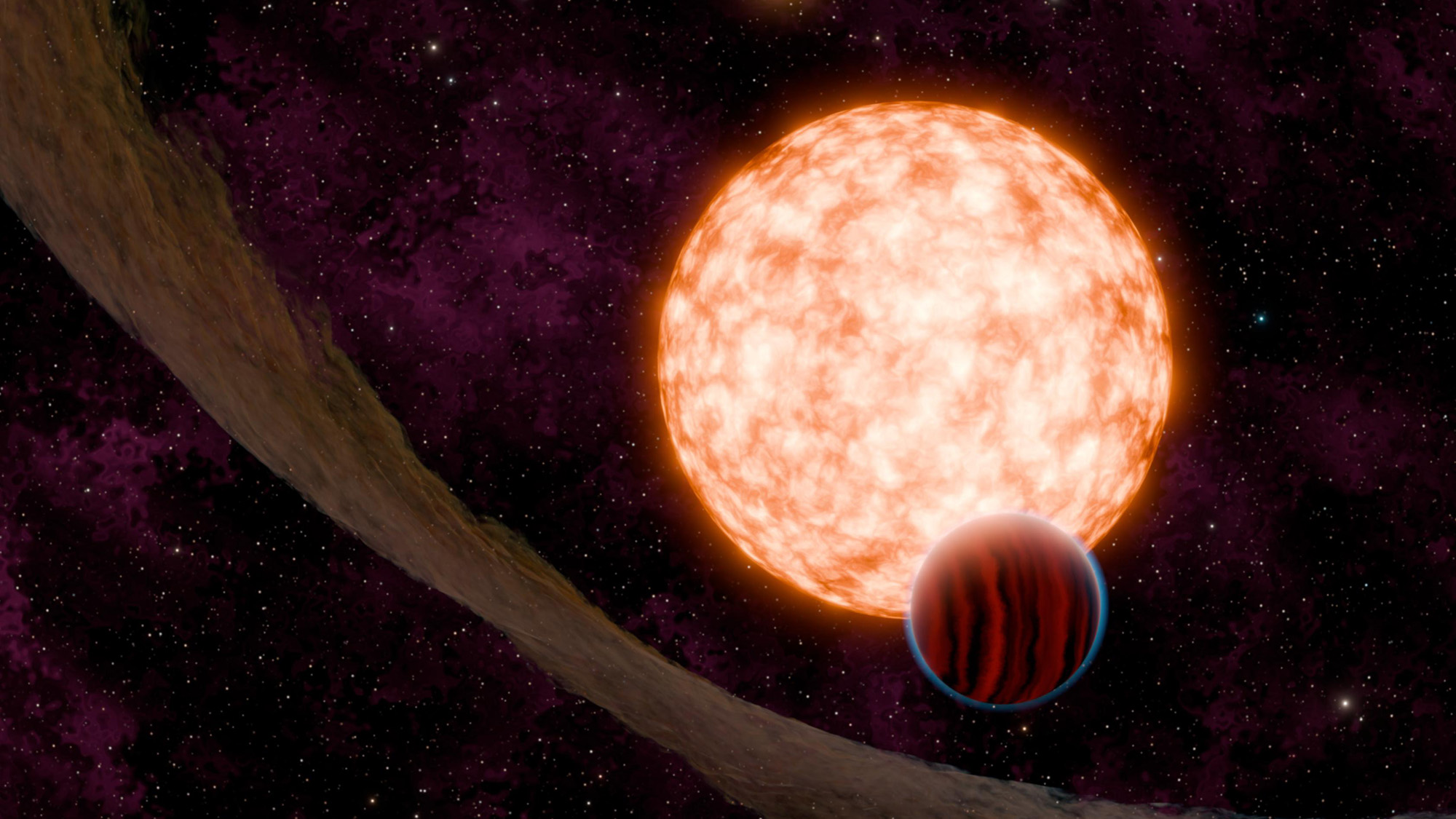
We've spent decades looking for the wrong type of alien radio signals, new paper claims

  • A hand reaches out toward another hand with a starry blue boundary between them

Superintelligent AI in space could explain the Fermi Paradox

  • An artist's impression of a spacecraft approaching an asteroid

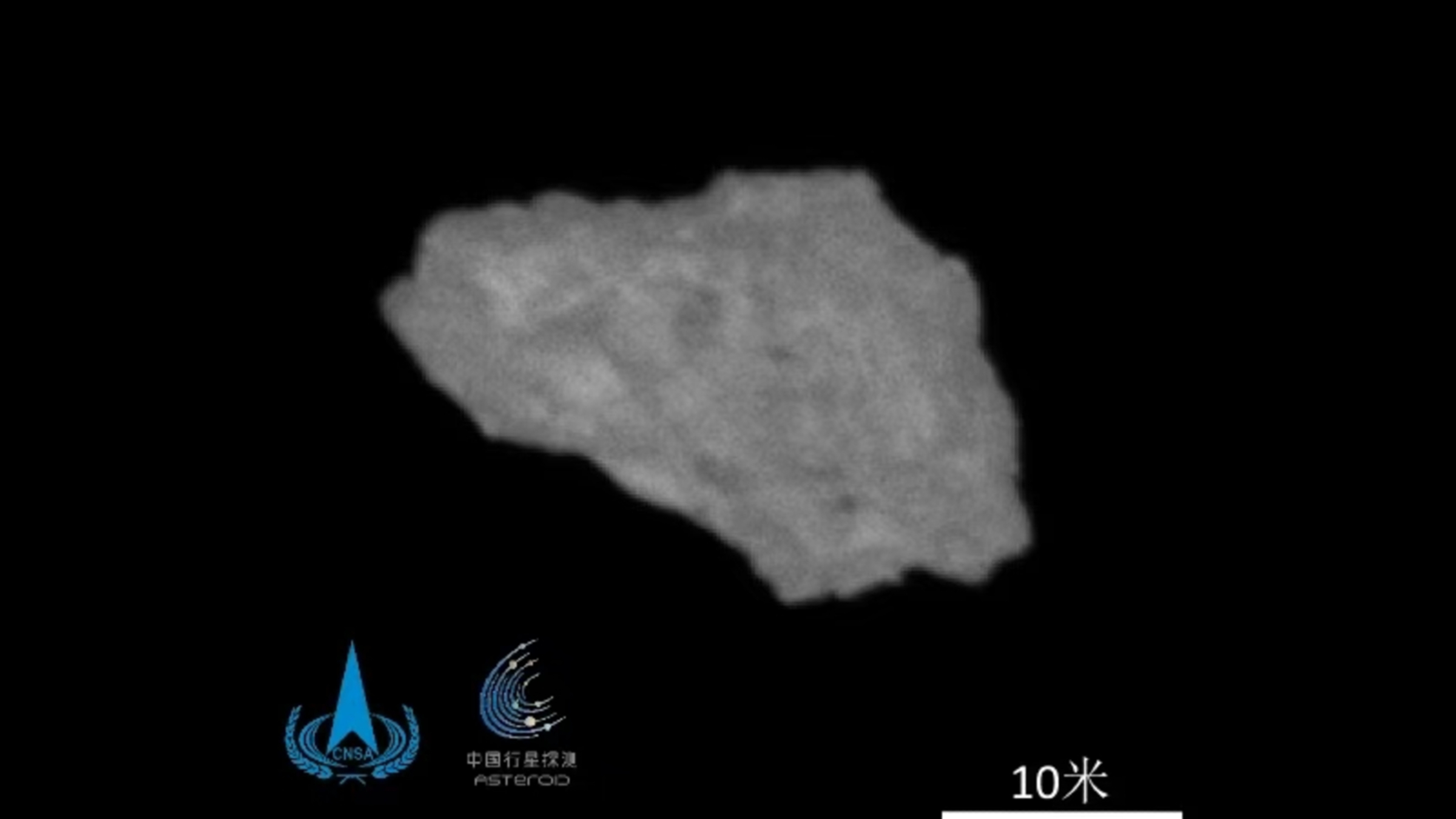
China's secretive Tianwen-2 mission arrives at Earth's 'quasi-moon' ahead of historic landing

Photo of the moon with the crescent Earth in the background

Unlike Earth, the moon lacks a functional atmosphere or magnetic field, meaning that its surface is exposed to the vacuum of space. This allows cosmic dust and other tiny particles to embed themselves within the lunar regolith.

(Image credit: NASA)

Tiny technosignatures

Until now, the search for evidence of advanced alien civilizations, known as technosignatures, has focused mainly on radio signals that could be emitted from inhabited exoplanets or hypothetical megastructures, such as Dyson spheres. However, these signals would originate only from active civilizations, not those that died out long before we could spot them.

The authors of the new study argue that when a civilization dies, traces of its technology could survive and end up in space, either via the deterioration of megastructures and other smaller spacecraft or via powerful asteroid strikes on once-inhabited exoplanets. Once in space, tiny specks of metal or other artificial materials could be ejected from star systems by powerful gusts of stellar wind and eventually drift toward us.

Using computer models, the team predicted that pieces of tech up to 3 micrometers across (three-millionths of a meter, or about 3% the width of a human hair) could escape their star systems and travel across interstellar space for up to 1 billion years. Then, they estimated how much of this material could be reaching the solar system and how likely it would be to end up on the moon. (We already know that interstellar dust can penetrate the inner solar system because scientists found some within samples collected from the surface of Bennu, an asteroid that orbits between Earth and Mars and was visited by NASA's OSIRIS-REx probe in 2020.)

GIF showing simulation of moon passing through ions being blown of Earth by the solar wind

The moon is constantly being bombarded by tiny particles, some of which come from outside the solar system.

(Image credit: University of Rochester illustration / Shubhonkar Paramanick)

To date, no lunar samples have contained any technosignatures. However, the scientists who studied them were likely not looking for such particulates, and the samples were probably too small to yield meaningful results, the study authors argue.

The researchers believe that a sample of lunar regolith with a volume of 35 cubic feet (1 cubic meter) could be enough to find at least one technological fragment. The team also proposed ways of combing through the material using microscopy, industrial materials analysis and AI-assisted imaging.

What to read next

  • An illustration showing the protoplanet Theia smashing into Earth and releasing a large cloud of molten debris

The moon may have formed in just 5 hours, new simulations suggest

  • A blurry photo of an irregular-shaped grey asteroid in against the darkness of space

Secretive Chinese probe snaps first photo of Earth's mysterious 'quasi-moon' — and it may pose a big problem

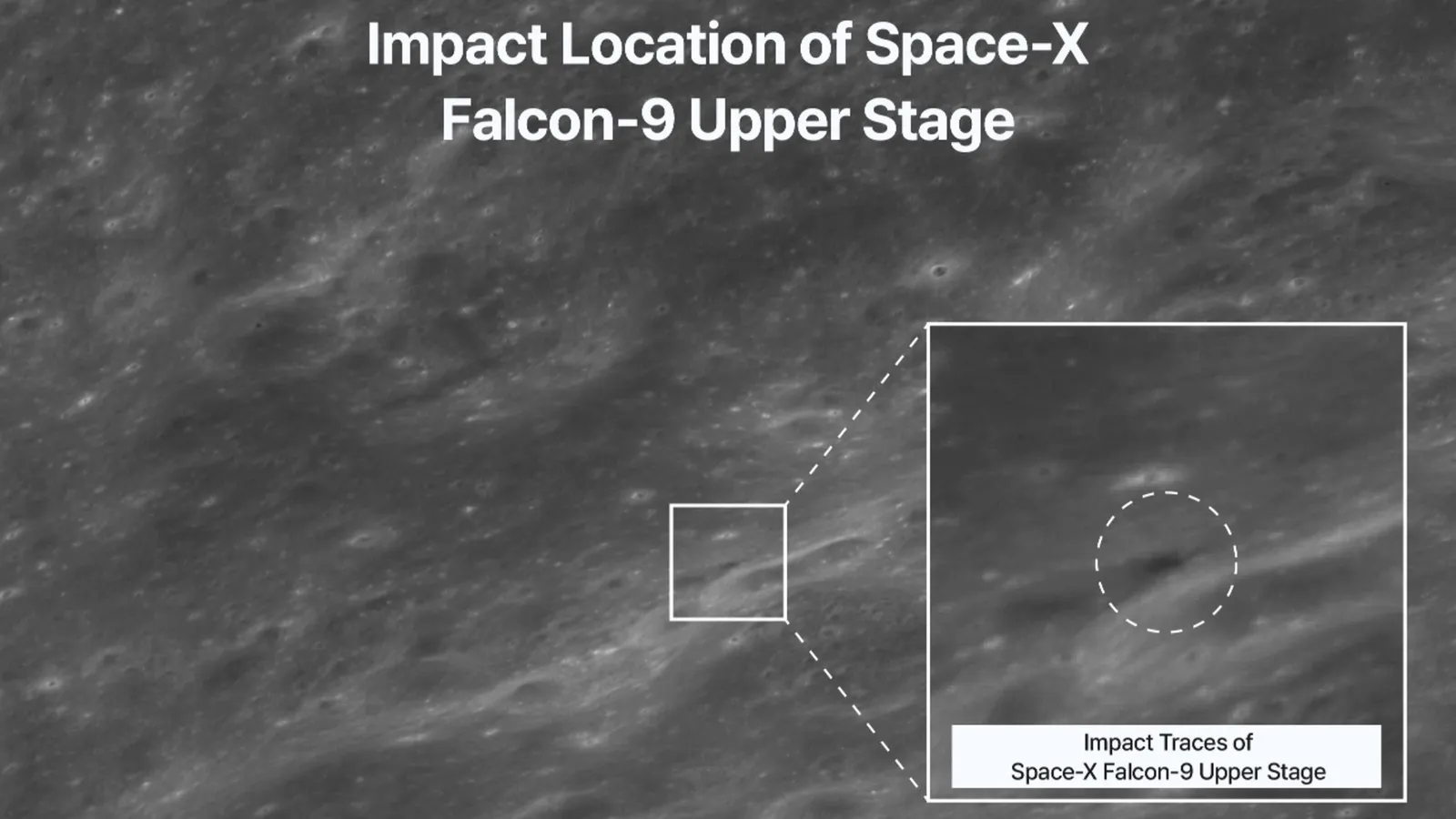
  • A new crater appeared on the moon after a SpaceX Falcon 9 upper stage crashed near Einstein crater on Wednesday, Korean satellite images reveal

First photos of SpaceX lunar rocket crash show blackened hole torn into the moon's surface

However, if such a sample does not yield any results, this would not necessarily disprove the researchers' hypothesis and may instead mean their models are off and a greater sample size would be required, the team wrote.

"Eminently reasonable"

A photo of the Artemis II rocket launching from Florida

Future missions in NASA's Artemis II program could bring back more samples of lunar regolith from the moon for future analysis. This photo shows the Artemis II mission lifting off April 1 from the Kennedy Space Center in Florida.

(Image credit: Chip Somodevilla/Getty Images)

Several upcoming space missions will collect fresh samples from the lunar surface, including China's recently delayed Chang'e-7 mission and future missions in NASA's Artemis program. These samples could potentially hold technosignatures, although the volume of regolith collected will be far less than what the researchers are proposing.

Therefore, we may have to wait until humans establish a permanent moon base before astronauts can collect enough material to be analyzed properly. This may not be that far off, as both the U.S. and China are planning to construct lunar bases within the next decade. Researchers also think the samples could be analyzed on the moon rather than on Earth.

As a result, the SETI Institute, which leads the international hunt for technosignatures, views the new idea as very promising.

"The concept of searching the lunar regolith for microscopic technosignatures is at once extraordinarily original and eminently reasonable," Bill Diamond, president and CEO of the SETI Institute, who was not involved in the new study, said in the statement. "This is a novel addition to the search methodologies applied to seeking evidence of technology as a proxy for life and intelligence beyond our solar system and we are excited at the prospect of bringing this to fruition."

Article Sources

  • Lewis J. Pinault, Brian C. Lacki, Ian A. Crawford, Andrew P. V. Siemion. (2026) Micron-Scale Technosignatures: How a Cubic Metre of Lunar Regolith May Begin to Constrain the Number of Past Technological Civilisations in the Galaxy. arXiv.


The Moon Might Be Hiding Traces of Dead Alien Civilizations

{ https://www.livescience.com/ }

Hoe vind je dit bericht?
Geschreven door peter om 22:11 Stuur door

100 Black Structures In Moon Photo, Seeing Is Believing, UFO UAP Sighting News. Mind-blowing Stuff.

100 Black Structures In Moon Photo, Seeing Is Believing, UFO UAP Sighting News. Mind-blowing Stuff.

UFO_news.png

alien_news.png
Date of discovery: Sept 13, 2026
Location of discovery: Earths Moon 
Source photo:
 
Ok this is nuts I know, but its 100% authentic. There are huge alien structures on Earths moon and they are only visible if you take the original photo, make it 3X bigger, add light and pow! The black structures become visible. Most are partly burried under the ground, so I believe what we are seeing is actual proof that the moon is hollow and these are parts of the space ships outer hull area...yes our moon is a spaceship. So...the earliest photos of the moon were real, revealing alien structures all over the place. So that means these structures were later edited out by NASA photo editing workers. Please don't take my word, go to the page, download the photo and see for yourself. There are two resolutions...pick the smaller 1.6mb size not the 6mb because its more clear, the bigger photo is unclear.
 
Aliens, they are just waiting for more of the public to become aware, before they do the big reveal to the world all at once.  
Scott C. Waring - UFO Sightings Daily 
 

{ https://www.ufosightingsdaily.com/ }

Hoe vind je dit bericht?
Geschreven door peter om 20:37 Stuur door

V UFO Stuns Eyewitness Over Columbus, Ohio, USA Aug 30, 2026, UAP Sighting News.

V UFO Stuns Eyewitness Over Columbus, Ohio, USA Aug 30, 2026, UAP Sighting News.

UFO.png

UAP.png

Date of sighting: Aug 30, 2026
Location of sighting: Columbus, Ohio, USA
Source:
 
Now here is an exciting report. An eyewitness was stunned when seeing this silver V shaped UFO over the city near the clouds. The woman's voice cracked and her excitement was so much she said a few bad words, which is totally 100% authentic, so I appreciate people being real. I have to say, a metal V shaped UFO craft is one of the least common types of UFO. More often seen because they are so big they block out the stars like the Phoenix Lights event, but this one is tiny...car size. Makes you want more video doesn't it? Yeah it does, me too. I will keep an eye out for any others who may have seen it. There is a window at the very point of the V shape object, when the sun hits it, it really reflects light, someone is watching up there. 
Scott C. Waring - UFO sightings Daily 
 
Eyewitness states: 
7/30/26 Columbus Ohio, excuse the language.

V UFO Stuns Eyewitness Over Columbus, Ohio, USA Aug 30, 2026, UAP Paranormal Alien Sighting News.

{ https://www.ufosightingsdaily.com/ }

Hoe vind je dit bericht?
Geschreven door peter om 20:29 Stuur door

Alien Seen near blue beam of light seen on Ring Cam, Sept 10, 2026, UFO UAP Sighting News.

Alien Seen near blue beam of light seen on Ring Cam, Sept 10, 2026, UFO UAP Sighting News.

alien,%20UFO.png

alien,%20UAP.png
 
Date of sighting: Sept 10, 2026
Location of sighting: North Carolina, USA
Source: 
A woman was alerted to her ring cam sending here a message of a strange phenomenon in the darkness of the street in front of her home. A blue beam of light is seen as if some invisible UFO craft had landed and opened its doors, and a person is standing in the opening watching if its safe to come out. Not one, but two entities are seen on the Ring Cam. It all looks 100% real I and I have a feeling this is an actual contact case. UFOs often land in isolated areas and try to approach humans or at least study them without the people knowing. Remember...aliens can use their telepathy close up to feel, see and even understand every behavior of the person they are linked too. This is rare and its something the US gov wont ever reveal to the public, but lucky for us, it got caught on Ring Cam. 
Scott C. Waring - UFO Sightings Daily 
Eyewitness states: 
I heard a loud noise like a car door slamming about 10:30 last night and saw this on my Ring. Have no idea. We don’t have street lights.
 
799958745_4123394727798018_9103732982369956819_n.jpg

800826172_4123395897797901_3891695694351079445_n.jpg

Screenshot%202026-09-12%20at%2010.42.20%E2%80%AFPM.png

{ https://www.ufosightingsdaily.com/ }

Hoe vind je dit bericht?
Geschreven door peter om 20:20 Stuur door

Terrifying map reveals the fate of every single glacier on Earth – as scientists warn HALF could collapse by 2100

Terrifying map reveals the fate of every single glacier on Earth – as scientists warn HALF could collapse by 2100

A terrifying map has revealed the fate of every single glacier on Earth. 

Called the Global Glacier Extinction Explorer, the interactive tool is the brainchild of scientists from ETH Zurich and Vrije Universiteit Brussel. 

By zooming in, you can investigate whether a glacier is expected to disappear under different levels of global warming. 

The map also reveals approximately when this could happen. 

'Global numbers such as glacier mass or area loss can feel very abstract,' said Dr Lander Van Tricht.

'With this website, people can zoom into their own valley or mountain region and see what different levels of global warming could mean for the glaciers they know.'

Worryingly, the scientists say that nearly half of today's glaciers could disappear by 2100 if global warming remains at +1.5°C – with catastrophic consequences. 

A terrifying map has revealed the fate of every single glacier on Earth. Called the Global Glacier Extinction Explorer, the interactive tool is the brainchild of scientists from ETH Zurich and Vrije Universiteit Brussel

A terrifying map has revealed the fate of every single glacier on Earth. Called the Global Glacier Extinction Explorer, the interactive tool is the brainchild of scientists from ETH Zurich and Vrije Universiteit Brussel

To explore the fate of Earth's glaciers, select a warming scenario in the box on the left. There are options for 1.5°C, 2°C, 2.7°C, or 4°C of warming. 

The colour of the dots indicates each glacier's fate. 

Dark red shows that a glacier is already extinct, while orange suggests it will become extinct between 2027 and 2041. 

If the dot is light blue, it suggests the glacier is one of the few to survive through 2100. 

Alternatively, you can hover over a glacier for a quick summary, or click it to explore its full profile, including area, elevation range, and projected extinction timing across scenarios.

The map is based on 2024 projections by researchers at ETH Zurich, which estimated when and where glaciers around the world could disappear. 

The projections suggest that, under +1.5°C of global warming, around 2,000 glaciers could disappear every year. 

By 2100, that could mean just half of today's glaciers remain. 

Meanwhile, if global temperatures rise by 2.7°C, only 20 per cent of glaciers would remain, while 4°C of warming would leave just 10 per cent of glaciers standing. 

'Every fraction of a degree matters,' Dr Van Tricht said. 

'Limiting warming to 1.5°C could preserve more than twice as many glaciers as a 2.7°C trajectory by 2100.'

Dark red shows that a glacier is already extinct, while orange suggests it will become extinct between 2027 and 2041. If the dot is light blue, it suggests the glacier is one of the few to survive through 2100

Dark red shows that a glacier is already extinct, while orange suggests it will become extinct between 2027 and 2041. If the dot is light blue, it suggests the glacier is one of the few to survive through 2100

The map is based on 2024 projections by researchers at ETH Zurich, which estimated when and where glaciers around the world could disappear

The map is based on 2024 projections by researchers at ETH Zurich, which estimated when and where glaciers around the world could disappear

What are glaciers?

A glacier is a large, persistent mass of dense ice formed over centuries from compressed snow.

It moves slowly downhill under its own weight, acting as a 'river of ice' eroding surrounding landscapes.

Glaciers are found in cold regions and high altitudes, covering about 10 per cent of Earth's land and acting as a vital freshwater source.

While 2100 still feels far away, 2026 has already proved to be a bad year for glaciers.

A combination of low winter snow and several summer heatwaves has resulted in 'substantial' ice loss across the European Alps, according to the researchers. 

They highlight Bella Tola Glacier near Saint-Luc in Switzerland, which was sadly declared extinct last month – an outcome that was predicted by the 2024 study. 

In addition, Urirotstock Glacier – one of Switzerland's smallest glaciers – was also declared extinct this summer. 

Dr Van Tricht said: 'These examples make the concept of glacier extinction very concrete.

'Our projections showed that many small Alpine glaciers are approaching the end of their lives, and we are now witnessing this process in real time.

'Bella Tola is particularly striking, as its observed disappearance falls directly within the extinction window projected by our models.'

While the researchers did not look at the consequences of such glacier loss, a study last month warned how their demise could spark devastating sea level rise. 

Researchers from Ca' Foscari University of Venice estimate that glaciers outside the vast ice sheets of Greenland and Antarctica contain around 150,000 cubic kilometres of ice.

If every one of these glaciers melted completely, it would raise global sea levels by more than 12 inches (32.3cm).

'Behind every disappearing glacier is a place, a history and often a community that will experience its absence,' Dr Van Tricht said. 

'The fact that some of the glaciers projected to disappear in our study are already vanishing today shows that glacier extinction is not a distant, end–of–century problem. It is happening now.' 

{ https://www.dailymail.com/sciencetech/index.html }

Hoe vind je dit bericht?
Geschreven door peter om 20:09 Stuur door

Defense Aviation Company Hermeus Unveils New “High Mach Speed” Prototype

Ramjet-X.
Image credit: Hermeus

Defense Aviation Company Hermeus Unveils New “High Mach Speed” Prototype

Defense aviation company Hermeus has announced the development of Ramjet-X, its next-generation ramjet propulsion test vehicle capable of carrying test payloads to high Mach speeds.

The company said Ramjet-X, designed to launch mid-flight from a carrier aircraft, offers the key advantages of competitive high-Mach test platforms while keeping costs low enough for a wider range of mission profiles.

Pre-flight testing of Ramjet-X is already underway, with its first official prototype test flights expected in 2027.

Ramjet-X Will Launch Mid-Flight from Quarterhorse

Most conventional jet engines can’t achieve supersonic speeds without dumping raw fuel into an afterburner and literally rocketing past the sound barrier. To travel at high Mach speeds without relying on rocket-style propulsion, engineers have turned to ramjet engines.

While ramjets are effective, they rely on the high-speed influx of air to operate. This limitation means aircraft equipped with this type of propulsion must be propelled to higher speeds by another craft or booster rocket before they can engage.

RESIZE-RamJet-X_07_B_Still-300x169.jpg

High-Mach Ramjet propulsion requires rapid air influx to enable combustion.

Image Credit: Hermeus

In an email to The Debrief, a Hermeus spokesperson explained that current options often rely on “large and expensive” boosters that are discarded after each test. Conversely, Ramjet-X relies on the company’s reusable aircraft to reach launch velocity.

“Ramjet-X is designed to be carried by Quarterhorse, which provides the speed and altitude required for deployment,” the company told The Debrief.

RESIZE-RamJet-X_06_Still-300x169.jpg

Ramjet-X is launched by Quarterhorse mid-flight.

Image Credit: Hermeus

The company could not disclose what speed Quarterhorse must achieve before it can launch Ramjet-X. However, the spokesperson did note that the launch craft is designed to return to home base for future missions.

When asked about Ramjet-X’s specific operating velocity once it disengages from Quarterhorse and engages its ramjet propulsion system, the company could only say the vehicle will operate at “High-Mach speeds.”

Conventional ramjets use a combination of high-velocity air and fuel to achieve extreme velocities. Hermeus said they cannot disclose specifics about Rocket-X’s fuel requirements.

Mission Profiles and Repeatable Architecture

Because of the sensitive nature of potential future missions, Hermeus was cautious about sharing specifics of any planned missions. The company also couldn’t provide technical details on what a typical mission profile might look like.

However, a Hermeus spokesperson told The Debrief, the vehicle’s architecture “allows customers and partners to integrate payloads, sensors, communications and computer systems, autonomy, material samples, propulsion technologies, and other experimental hardware and software onto Ramjet-X for testing in representative sustained high-Mach conditions.”

RESIZE-SIDE-OIC-RamJet-X_02_Still-300x169.jpg

Ramjet-X will enable “high-Mach” tests.

Image Credit: Hermeus

Hermeus also highlighted the potential cost savings of a “repeatable platform, launch architecture, and flight-test infrastructure,” designed to dramatically lower costs without sacrificing versatility or reliability.

“Instead of relying on a large dedicated expendable booster to accelerate the test vehicle into its ramjet operating regime, the launch aircraft provides much of that energy and then returns to fly again,” the company told The Debrief. “This architecture allows Hermeus to fly more by reducing the cost of expendable launch hardware.”

“High-speed flight testing is extremely expensive, and you don’t get many shots at it,” Hermeus CEO Zach Shore explained.

“Another Order of Magnitude Reduction”

Hermeus said specific unit costs are not currently available. However, they said a projected cost per minute of high-Mach test time “is in the low $100k’s per minute.” For comparison, the company highlighted the historic and current costs of high-Mach flight testing.

“Most of the below comparisons are rocket-based but will give you an idea how costly high-Mach tests are and why Ramjet-X will fundamentally change the equation,” Hermeus told The Debrief.

Older examples include NASA’s X-43, which achieved around 21 seconds of high-Mach flight, and the Air Force’s X-51, which achieved around 350 seconds. Hermeus said both multi-year efforts cost around $450 million each in today’s dollars.

Current options include rocket-powered test flights aboard Rocket Lab’s HASTE, which Hermeus said run $10-20 million each, “not including the expendable cruise or glide vehicles.” The company also pointed to Stratolaunch Talon-A missions.

“Even though fully reusable, (they) are $10-12m per flight for a few min of on-condition time,” the company told The Debrief.

Conversely, Hermeus said its current projections of less than a million per minute offer potential customers “another order of magnitude reduction in the problem that matters most.”

“Ramjet-X is being designed around simplified manufacturing, rapid production, and expendability in meaningful quantities rather than the traditional model of building a small number of highly bespoke high-speed test articles as was done in other high-speed airbreathing flight test programs like X-43 and X-51,” the company told The Debrief. 

Development of Ramjet-X is already well underway

When detailing the newly announced Ramjet-X’s benefits, Shore noted that their system gives them a way to place new systems into sustained high-Mach environments “without building an expensive one-off test program every time.”

“Bringing speed, sustained flight, and scalability all into one system lowers the barriers to gathering extremely valuable data from these conditions and accelerates programs for both us and our customers,” the Hermeus CEO explained.

When announcing Ramjet-X, Hermeus said the vehicle’s ramjet engine is already undergoing extensive testing at its Florida-based HEAT facility. Future tests will occur at the company’s California headquarters, with the first flight tests planned for 2027. 

  • Christopher Plain has spent the last six years as Associate News Editor and Head Science Reporter at The Debrief. Follow and connect with him on X, learn about his novels at plainfiction.com, or email him at christopher@thedebrief.org.
RELATED

Hermeus Unveils Ramjet-X, New Test Aircraft Capable of Reaching Mach 4

Ramjet-X: The Future of High-Speed Aviation? 🚀

Hermeus completes first test flight of hypersonic jet design!

{ https://thedebrief.org/category/defense/ }

Hoe vind je dit bericht?
Geschreven door peter om 22:33 Stuur door

Buildings made of yeast expected to be printed on Mars

Buildings made of yeast expected to be printed on Mars

Researchers propose building houses on Mars using a 3D printer. The material would be a mixture of local materials with gelatin and yeast. The researchers believe that after hardening, it would have sufficient strength.

Materials for Martian printing. Source: phys.org

A 3D Printer for Mars

Researcher Zhisheng Qiu of the Hong Kong University of Science and Technology proposes using a gelatin- and yeast-based mixture to construct buildings on Mars. It would be used as a material for 3D printing. According to phys.org, an article on the subject was published in the journal Chem Circularity.

In general, the idea of using 3D printers for constructing buildings in space, and on the Red Planet in particular, is far from new. Transporting prefabricated structures from Earth is simply too expensive. And construction work performed by people wearing spacesuits is an extremely difficult task.

Researchers also fully understand that, wherever possible, the printing material should be produced from what is available locally. Everyone also agrees that its base should consist of local small rocks, sand, and dust. The only remaining question is the binder — a substance that would initially be liquid and then harden and gain strength.

Yeast as a Binder

The main problem is that traditional binders such as gypsum, lime, and cement hardly harden at all in the cold and dry climate of Mars. The water they need for hydration would simply freeze or evaporate before becoming chemically bound. In addition, the limestone required to produce the latter two materials is absent.

This is where the idea of using gelatin and yeast comes in. These organic materials also contain a large amount of water. However, according to the study’s author, freezing followed by evaporation does not interfere with their hardening. They simply turn into a solid film.
If this is indeed the case and they can firmly bind inorganic components together, it could provide a real solution to the problem of construction on Mars. Yeast and other organic materials could also be grown directly on the Red Planet instead of being transported from Earth.

The author says he was inspired to pursue this solution by freeze-dried fruit, which becomes very hard when dehydrated. However, this is more than just an idea. He has already managed to  print the first test sample, 30 mm high and 45 mm in diameter. Its strength turned out to be fairly similar to that of relatively weak concrete. The next step is larger-scale testing.

NASA Is PRINTING Houses For Mars & And It Only Takes 24 Hours

Scientists Turned Yeast Into a 3D-Printable Building Material

{ https://universemagazine.com/en/articles-en/ }

Hoe vind je dit bericht?
Geschreven door peter om 22:00 Stuur door

Aliens Are Actually Just Demons 'Without Moving Their Mouth' in Sightings, University Professor Suggests

Aliens Are Actually Just Demons 'Without Moving Their Mouth' in Sightings, University Professor Suggests

Diana Pasulka examines why some reported UFO encounters resemble historical accounts of demonic or spiritual phenomena, while stressing that this does not prove aliens are demons

UFO

Aliens reported in certain UFO encounters can look strikingly similar to figures from traditional demonic or spiritual accounts 

PHOTO Pinterest

Aliens described in some reported UFO encounters may resemble figures long associated with demonic or spiritual phenomena, according to US professor Diana Pasulka, who has highlighted accounts of telepathy, levitation and voices perceived 'without moving their mouth.'

Pasulka, a professor in the Department of Philosophy and Religion at the University of North Carolina Wilmington, has stressed that these similarities do not prove aliens are demons, but the overlap is striking enough to warrant closer study.

Pasulka has spent years researching religion, technology and contemporary culture, including interviewing people who report encounters with alleged aliens or unidentified craft.

She has said that certain modern UFO narratives share features with older religious and paranormal stories, and that the language has shifted from angels and demons to aliens and advanced beings while many of the core details sound oddly familiar.

Aliens, Telepathy and 'Voices Without Mouths'

Speaking on That UFO Podcast, Pasulka discussed a subset of close encounter reports in which witnesses describe an entity that appears to bypass ordinary speech altogether.

Highlighting what she sees as a concerning overlap with some religious accounts of possession, she said witnesses report seeing 'an entity that seems to know your thoughts and can speak any language and can speak with you without moving their mouth.'

Witnesses have described what they interpret as telepathic communication, a voice perceived 'in the head' yet attributed to an external presence. On their own, those details might sound like standard alien lore. Pasulka's interest lies in how closely some of these reports resemble descriptions found in historical accounts of spiritual and religious experiences.

She also drew attention to stories of physical disturbances that witnesses link to alleged UFO events. On the podcast, she said some people describe 'poltergeist type of activity,' including objects flying across rooms and unnerving knocks on walls.

'You also see things that are poltergeist type of activity, you know, things flying and knocks on, you know, walls and scary things like that,' she said. 'So yeah, you do see this with certain UFO experiences.'

Such reports resemble phenomena traditionally associated with poltergeists and other alleged paranormal disturbances, rather than the clean metallic crafts of science fiction films.

Not Every UFO, Not Every Alien

Pasulka has written about how contemporary UFO stories have reshaped her thinking about belief without pushing her into full-on demonology. She has been clear that she is not claiming all UFOs or alleged alien entities are demonic.

On the podcast she emphasised that point, saying she is examining a specific cluster of intense, often private encounters that share characteristics with older accounts of demonic or spiritual activity. The question, in her view, is why the details line up so neatly, not whether that automatically proves a demonic cause.

READ MORE

UFO Pentagon memo

A reported experience in which a figure appears to read a person's thoughts, communicate without visibly speaking and is followed by alleged disturbances such as unexplained knocks or moving objects, looks very different from a brief light in the sky. Whether readers accept that interpretation or not, Pasulka argues that the reported similarities deserve closer examination.

The vocabulary, she suggests, has changed with the times. The underlying weird stuff, not so much.

A Long History of 'Demonic' Aliens

The idea that aliens might be understood as dark spiritual beings is not new to the UFO world. Long before TikTok conspiracy threads, religious and occult thinkers were already wrestling with flying saucers.

Occultist Marjorie Cameron associated a reported 1952 UFO wave over Washington DC with the death of her husband, rocket engineer Jack Parsons, who had moved in the orbit of British occultist Aleister Crowley. Cameron interpreted the strange lights as part of a wider spiritual drama rather than a nuts-and-bolts extraterrestrial mission.

Mid-twentieth-century evangelist Walter Vinson Grant Sr. went even further in his 1954 booklet Men in Flying Saucers Identified: Not a Mystery! In the booklet, Grant argued that the beings associated with flying saucers were evil spirits rather than visitors from other planets.

Alien

Pasulka has not claimed that all UFOs or alleged alien entities are demons  PHOTO Pinterest

American Eastern Orthodox monk Seraphim Rose, writing from a traditional Christian perspective, took a similar line. In his 1975 book Orthodoxy and the Religion of the Future, he suggested that UFO phenomena could represent demonic deception and warned against treating alleged encounters as benign contact with higher intelligences.

Renowned British UFO writer Gordon Creighton, known for his work on mysterious aerial phenomena, also leaned toward a supernatural interpretation. He argued that many so-called aliens might be better understood through a spiritual or religious frame than a purely technological one.

For proponents of that view, talk of aliens often masks a much older debate about angels, demons and the nature of spiritual experience.

Where Religion and UFO Reports Overlap

Pasulka's work sits between these arguments. She is an academic of religion, not an exorcist, and she has also examined witness accounts and case material concerning alleged UFO and UAP experiences.

She notes that, whatever is ultimately going on, the people she interviews experience these events as real. They describe objects moving, time slipping, and bodies reacting in ways they cannot easily explain. In her writing and public comments, she has noted similarities between some of these reports and historical accounts of hauntings and demonic phenomena.

The reported experiences remain disputed and have not been established as evidence of demonic or extraterrestrial entities. The reports invite competing interpretations, from psychological or perceptual explanations to claims involving unknown physical or spiritual factors.

Independent verification of the reported experiences and their alleged explanations has not occurred. Pasulka's comments focus on similarities between accounts of certain UFO encounters and historical descriptions of spiritual or demonic phenomena, and she has explicitly said that those parallels do not prove the entities are demons.

For now, she appears less interested in telling people what aliens really are than in asking why some modern encounter stories sound so much like older religious ones. When a reported experience involves apparent telepathy, communication without visible speech and alleged physical disturbances, she argues that it may be more useful to compare it with centuries of spiritual narratives than to file it neatly under 'alien contact' and move on.

RELATED
Are UFO Encounters Actually Evidence Of Angels And Demons?

1 Hour of Real UFO Sightings | Bizarre UAP Footage Caught On Camera

{ https://www.ibtimes.co.uk/trending }

Hoe vind je dit bericht?
Geschreven door peter om 21:22 Stuur door

'Hovered Above the Hotel for 20 Minutes': Ex-RAF Witness Films Suspected Alien Triangular UFOs in Bali

'Hovered Above the Hotel for 20 Minutes': Ex-RAF Witness Films Suspected Alien Triangular UFOs in Bali

A former RAF serviceman's footage of three flashing triangular UFOs above a Bali hotel has ufologists and sceptics offering starkly different explanations

UFO

The alleged UFO sighting began at 6.40pm, when the man and his partner spotted the objects roughly 600ft above their apartment   

PHOTO Thor Deichmann/Pixab

A former Royal Air Force serviceman filmed what he believes were three UFOs hovering above a hotel in Seminyak, on Bali's west coast, on 6 July, footage that has since split ufologists and sceptics down the middle.

The witness, who asked not to be named, told Metro he watched the triangular shapes glow yellow, red and green against a clear sky for around 20 minutes.

For context, the sighting began at 6.40pm, when the man and his partner spotted the objects roughly 600ft above their apartment. 'We saw three triangular shaped objects in the sky,' he told Metro.

'One was flashing red, pink and blue green lights and the other was showing three steady green lights. The third was quite faint. They were not making any noise and were stationary.'

The pair briefly went inside to get ready for the evening. When they stepped back out, the objects had vanished. 'Quite weird really,' the witness said, which is about as understated as a close encounter gets.

UFO Sighting Divides Opinion Among Investigators

Gary Heseltine, editor of UFO Truth Magazine, was sent the footage by a former colleague and told Metro his first instinct was drones. He changed his mind after studying the clip more closely. 'There are several things that suggest to me that they might be anomalous, or a UAP,' he said, using the current term for unidentified anomalous phenomena.

Heseltine pointed to the objects' silence, their unusual paired shapes and the fact they held position above the hotel for a full 20 minutes. He also noted the formation did not resemble typical drone patterns, and that a hotel in Seminyak was an 'unusual' location for such a sighting.

He compared the footage to the mysterious drone swarms that appeared over New Jersey and other East Coast states in 2024, concluding the Bali sighting was, in his words, 'curious and for me unidentified.'

Not everyone is convinced. Ufologist and filmmaker Mark Christopher Lee called the video 'impressive' but said he doubted it showed extraterrestrial visitors. He suggested the lights could belong to Balinese kites, known locally as layang-layang, fitted with LED lights, a tradition tied to the island's kite flying season, when locals fly the kites to ask Hindu gods for a good harvest.

'For a brief few seconds my ancient alien head on was thinking ancient Vimāna coming back,' Lee told Metro, referencing the flying craft described in Hindu texts. 'But logic kicks in, especially with those lights, I guess at night you also can't see the strings.'

Science writer and UFO sceptic Mick West was characteristically blunt. 'They look like LED kites,' he said. It's the kind of verdict that tends to end debates rather than start them, though this one seems set to run a while yet.

Why Grainy UFO Footage Keeps Fuelling the Debate

There's a familiar problem here too. UFO footage has a habit of arriving blurry, distant and hard to verify, and this clip is no exception. Kate Burns, VP EMEA at video authentication firm identifAI, told Metro that parts of the footage appear to have been edited.

'The challenge with such videos, however, is that the lower the resolution they are, the harder it is to provide an entirely confident score,' she said.

READ MORE

UAP

Public appetite for these stories shows no sign of fading. A 2021 YouGov poll found roughly half of Britons believe aliens exist, and nearly one in ten claim to have seen a UFO themselves.

Nearly 100 sightings of orbs, triangles and metallic discs across UK skies have been logged with UFO Identified this year alone, though no official body records such reports.

Nick Pope, who investigated UFO reports for the Ministry of Defence in the 1990s, told Metro before his death in April that most callers to the department's 'UFO desk' genuinely believed what they'd seen.

'In the end, we found about 80% or so of these sightings were misidentifications, 15% had insufficient data and 5% were unknown,' he said. 'That 5% doesn't mean extraterrestrial, but as I always remind people, neither did we rule that out.'

Whether Bali's flashing triangles turn out to be kites, drones or something odder, nobody involved seems in a rush to say for certain.

Writer's pick

{ https://www.ibtimes.co.uk/trending }

Hoe vind je dit bericht?
Geschreven door peter om 20:54 Stuur door

Astronomer Theorise That Extraterrestrial Megacomputers Could Soon Reveal Hidden Alien Civilisations

Astronomer Theorise That Extraterrestrial Megacomputers Could Soon Reveal Hidden Alien Civilisations

A new study suggests that advanced extraterrestrial computing systems could emit detectable waste-heat signatures, known as Slysh halos, around stars, potentially visible in the far-infrared spectrum

Astronomy

A new astronomy paper proposes that highly efficient alien megacomputers could produce detectable heat signatures around nearby stars 

PHOTO  Photo by Bryan Goff on Unsplas

A new preprint by astronomer Michael Garrett proposes that extremely advanced extraterrestrial computing systems could leave detectable waste-heat signatures around stars.

A new paper posted on the arXiv preprint server proposes that highly efficient computing systems might create a detectable signature known as a Slysh halo.

The idea begins with a simple premise about civilisation itself. Computers have become steadily more powerful and central to human life, and the paper asks whether advanced extraterrestrial societies might also push computation towards its most efficient possible form, making their technology visible from Earth.

Extraterrestrial Megacomputers Could Leave a Slysh Halo

The paper argues that hyper-efficient computers could become a defining feature of a technologically advanced civilisation. Its proposed Slysh halo takes its name from V. I. Slysh, who previously argued that advanced civilisations would benefit from operating technology at very low temperatures.

That matters because irreversible computation carries a minimum thermodynamic energy cost and generates waste heat. Landauer's principle, as described in the paper, links the maximum efficiency of non-reversible computation to operating temperature.

Present-day data centres provide a familiar comparison. Modern data centres produce enough heat to require cooling systems. The same underlying problem would remain for a far more advanced computer, only at a vastly different scale.

The colder the system, the more efficient it can become. The source gives a striking comparison. A system operating near the Landauer limit at 10 Kelvin could perform roughly 30 times as many irreversible operations per joule as one operating at 300 Kelvin.

A Slysh halo pushes that logic outward. Instead of concentrating computers close to a planet, an advanced civilisation could distribute computing infrastructure through the cold outer regions of its planetary system.

The resulting structure could resemble an extended halo, although the paper notes that it need not be spherical and could instead take forms such as a thick disc or torus.

The paper does not address exactly how an alien society would engineer such a structure. The observational question is narrower. What would all that unavoidable waste heat look like from here?

Extraterrestrial Megacomputers May Glow in the Far Infrared

The paper suggests that the most likely operating temperature for a Slysh halo would fall between 5 and 30 Kelvin. At those temperatures, its waste heat would emerge mainly in the far-infrared or submillimetre spectrum.

Detecting it would not be straightforward. Many stars are surrounded by circumstellar debris, while other natural cold sources can also emit radiation at submillimetre wavelengths. Efficient computing systems could also be spatially diffuse, spreading their waste heat over a large area and making surface-brightness sensitivity an observational challenge.

Engineered radiators could instead be distinguished by a nearly grey, line-free thermal spectrum, along with other characteristics such as their temperature profile, morphology, and motion with the host star. Natural cold dust generally produces different spectral behaviour.

READ MORE

Antennas of the Atacama Large Millimeter/submillimeter Array (ALMA)

The paper argues that existing far-infrared and submillimetre observations already probe part of the relevant parameter space, while archival ALMA data could be reprocessed to search for compact or more distant candidates.

Future telescopes working at those wavelengths could make the search more sensitive. The proposal does not claim that such halos exist, only that a civilisation built around extreme computing efficiency might leave a measurable physical trace.

For now, the suggested signal remains hypothetical and difficult to separate from natural stellar debris. The paper's test is therefore observational. Search nearby stars for the cold, grey thermal glow that a Slysh halo might produce, and see whether anything is there.

RELATED

Alien Civilizations: How Advanced Could They Be?
The Fermi Paradox: Hidden Alien Civilizations

{ https://www.ibtimes.co.uk/trending }

Hoe vind je dit bericht?
Geschreven door peter om 20:33 Stuur door

Meer van UFO'S of UAP'S, ASTRONOMIE, RUIMTEVAART, ARCHEOLOGIE, OUDHEIDKUNDE, SF-SNUFJES EN ANDERE ESOTERISCHE WETENSCHAPPEN - DE ALLERLAATSTE NIEUWTJES

↑ Terug naar de berichten