Naar de inhoud

UFO'S of UAP'S, ASTRONOMIE, RUIMTEVAART, ARCHEOLOGIE, OUDHEIDKUNDE, SF-SNUFJES EN ANDERE ESOTERISCHE WETENSCHAPPEN - DE ALLERLAATSTE NIEUWTJES

UFO's of UAP'S in België en de rest van de wereld
seniorennet.beseniorennet.be
Ontdek de Fascinerende Wereld van UFO's en UAP's: Jouw Bron voor Onthullende Informatie! Ben jij ook gefascineerd door het onbekende? Wil je meer weten over UFO's en UAP's, niet alleen in België, maar over de hele wereld? Dan ben je op de juiste plek! België: Het Kloppend Hart van UFO-onderzoek In België is BUFON (Belgisch UFO-Netwerk) dé autoriteit op het gebied van UFO-onderzoek. Voor betrouwbare en objectieve informatie over deze intrigerende fenomenen, bezoek je zeker onze Facebook-pagina en deze blog. Maar dat is nog niet alles! Ontdek ook het Belgisch UFO-meldpunt en Caelestia, twee organisaties die diepgaand onderzoek verrichten, al zijn ze soms kritisch of sceptisch. Nederland: Een Schat aan Informatie Voor onze Nederlandse buren is er de schitterende website www.ufowijzer.nl, beheerd door Paul Harmans. Deze site biedt een schat aan informatie en artikelen die je niet wilt missen! Internationaal: MUFON - De Wereldwijde Autoriteit Neem ook een kijkje bij MUFON (Mutual UFO Network Inc.), een gerenommeerde Amerikaanse UFO-vereniging met afdelingen in de VS en wereldwijd. MUFON is toegewijd aan de wetenschappelijke en analytische studie van het UFO-fenomeen, en hun maandelijkse tijdschrift, The MUFON UFO-Journal, is een must-read voor elke UFO-enthousiasteling. Bezoek hun website op www.mufon.com voor meer informatie. Samenwerking en Toekomstvisie Sinds 1 februari 2020 is Pieter niet alleen ex-president van BUFON, maar ook de voormalige nationale directeur van MUFON in Vlaanderen en Nederland. Dit creëert een sterke samenwerking met de Franse MUFON Reseau MUFON/EUROP, wat ons in staat stelt om nog meer waardevolle inzichten te delen. Let op: Nepprofielen en Nieuwe Groeperingen Pas op voor een nieuwe groepering die zich ook BUFON noemt, maar geen enkele connectie heeft met onze gevestigde organisatie. Hoewel zij de naam geregistreerd hebben, kunnen ze het rijke verleden en de expertise van onze groep niet evenaren. We wensen hen veel succes, maar we blijven de autoriteit in UFO-onderzoek! Blijf Op De Hoogte! Wil jij de laatste nieuwtjes over UFO's, ruimtevaart, archeologie, en meer? Volg ons dan en duik samen met ons in de fascinerende wereld van het onbekende! Sluit je aan bij de gemeenschap van nieuwsgierige geesten die net als jij verlangen naar antwoorden en avonturen in de sterren! Heb je vragen of wil je meer weten? Aarzel dan niet om contact met ons op te nemen! Samen ontrafelen we het mysterie van de lucht en daarbuiten.

The Search For Alien Technology Has A Measurement Problem – Analysis

th?id=ONUT.wVjm-kxjy2yXkVzQxTT2AQ&pid=News&w=316&h=200&c=14&rs=2&qlt=90&dpr=1.3

Image: ChatGPT

The Search For Alien Technology Has A Measurement Problem – Analysis

By Burak Oktenli

Key Takeaways:

  • Bigger AI models can rank, classify, and search at huge scale, but they cannot invent evidence an instrument never recorded. When two explanations produce the same data, no larger model can honestly tell them apart—the limit is identifiability, not compute.
  • Radio SETI, including Breakthrough Listen and the blc1 Proxima Centauri candidate later traced to terrestrial interference, shows the gap between finding a candidate and proving its origin. The next step is a new measurement—another site, antenna, geometry, epoch, or diagnostic—not another terabyte of the same ambiguous data.
  • Scientific AI should keep detection strength, calibration validity, tested alternatives, and independent follow-up separate instead of collapsing them into one confidence score. Automate ranking and triage; do not let a model promote its own score into a stronger claim without new evidence.
  • Bigger models can rank, classify, and search at extraordinary scale. They still cannot manufacture evidence that an instrument never captured.

The most dangerous promise in scientific artificial intelligence is not that machines will make mistakes. It is that they will make certainty out of missing information. As AI systems become better at finding patterns in enormous datasets, the temptation is to assume that a sufficiently powerful model can extract a correct answer from almost any measurement. That is false. Sometimes the obstacle is not computation, model capacity, or training data. Sometimes the decisive information was never measured in the first place.

Radio searches for extraterrestrial technology offer an unusually clear example. Modern programs such as Breakthrough Listen scan vast frequency ranges for narrowband, drifting signals that could be consistent with engineered transmitters. The field has also embraced machine learning. A deep-learning search of 820 nearby stars showed that learned representations can surface candidate signals that conventional filters may miss. That is exactly the sort of task at which AI can excel: ranking, triage, anomaly discovery, and the compression of an impossible search space into a manageable set of things worth examining.

But candidate discovery is not origin discovery. The distinction became vivid in the investigation of blc1, a narrowband signal detected in observations of Proxima Centauri. Its morphology was interesting enough to demand serious follow-up. The eventual analysis traced it to terrestrial radio-frequency interference. The lesson was not that unusual signals are unimportant. It was that a detection statistic is only the beginning of an evidentiary chain.

This point becomes sharper when we ask a simple question: what if two competing explanations generate exactly the same data for the algorithm? Suppose one hypothesis is a target-associated signal and another is a terrestrial interferer that, by chance or geometry, appears only during the same on-target scans. If both produce the same frequency-time track, the same amplitude pattern, and the same scan-by-scan observations, then the two hypotheses induce the same probability distribution over the data given to the model. In that case, no classifier can separate them honestly. Not a larger transformer. Not a deeper neural network. Not a quantum computer. The distinction is absent from the measurement.

That is an identifiability limit, and it changes how we should think about scientific AI. When two hypotheses are observationally equivalent, the next advance must come from experimental design rather than model design. We need a new measurement that causes the hypotheses to predict different outcomes: a simultaneous reference antenna, an independent observing site, a changed pointing geometry, an instrument diagnostic, a different epoch, or some other source of conditionally independent evidence. Another terabyte of the same ambiguous data does not solve the problem.

The same principle appears in more ordinary ways. Reference observations, for example, are often used to reject interference. That can work extremely well when the nuisance really is common to both target and reference scans. But the protection has a cost. If a genuine source leaks into an off-target observation through sidelobes or pointing geometry, a subtraction rule can subtract part of the signal we wanted to preserve, while a hard veto can discard it altogether. A method that looks safer on one axis may quietly become less sensitive on another.

Calibration creates a second trap. A threshold calibrated under one noise model does not retain its meaning after the residual environment changes. In a synthetic stress test I developed for radio technosignature decision rules, thresholds calibrated to an approximately one-percent cadence-level exceedance rate under independent Gaussian residuals produced trigger fractions above fifty percent after a simple time-correlation structure was introduced. Nothing about the threshold number itself warned that its interpretation had collapsed. The problem was not that the detector suddenly became stupid. The statistical conditions supporting the threshold no longer held.

This is why the most important question for scientific AI may not be, “How accurate is the model?” It may be, “Under what measurement conditions does this output still mean what we say it means?” That is a different discipline. It requires separating detection strength from calibration validity, separating a candidate ranking from an origin claim, and recording which alternative explanations have actually been tested.

Engineering already has language for this. NASA’s current standard for models and simulations treats credibility, validation, verification, uncertainty, and acceptance criteria as explicit parts of model use. Scientific AI needs the same instinct. A model should not inherit authority merely because it is sophisticated. Its output should carry the conditions under which it was calibrated, the data it actually observed, the alternatives it cannot distinguish, and the tests still required before escalation.

That discipline matters far beyond SETI. In medical imaging, two diseases can look similar under one modality and diverge only after another test. In climate science, a model can fit the historical record while remaining underdetermined about causal mechanisms. In intelligence analysis, multiple adversary explanations can remain consistent with the same observable behavior. In autonomous systems, a sensor-fusion stack can assign high confidence to a state estimate even when its sensors share a common-mode failure. In each case, more computation can sharpen the inference conditional on the evidence. It cannot supply the missing discriminator.

This should change how we evaluate AI progress in science. Benchmark culture often rewards the highest score on a fixed dataset. But the scientifically important question is often what happens when the assumptions behind that dataset fail. A robust benchmark should therefore include conditions designed to break the method: distribution shifts, correlated residuals, missing reference observations, leakage between supposedly independent channels, nuisance classes that mimic the positive class, and deliberately matched cases in which successful discrimination would reveal data leakage rather than intelligence.

The technosignature community already has many of the ingredients. Tools such as setigen support synthetic signal generation and injection. Published work has explored machine-learning direction-of-origin filtering, while the “cosmic haystack” formalism reminds us that excellent sensitivity within one narrow test family does not imply comprehensive coverage of the wider search space. The broader NASA technosignatures workshop report likewise framed technosignature research as a field in which new instruments, new surveys, new algorithms, and new theory all matter. The missing piece is not another declaration that AI will accelerate discovery. It is a stronger contract between what an algorithm outputs and what the measurement actually warrants.

Such a contract would be simple in principle. A candidate record should keep at least four things separate: the strength of the detected feature; whether the current data remain inside the calibration regime; which conventional or instrumental alternatives have been tested; and what independent observation, if any, supports a stronger interpretation. A fifth field can carry follow-up priority, but that is a resource-allocation decision, not a probability of origin. Collapsing all of these into one confidence score creates an audit problem: after the fact, nobody can tell which assumption carried the claim forward.

The same asymmetry should govern automation. AI can reasonably automate low-level transitions: ingest data, flag anomalies, compare a statistic with a frozen threshold, rank candidates, and request additional observations. But an automated system should not be allowed to convert its own score into a stronger scientific claim without new evidence. Promotion should require a named test or an independent measurement. Demotion, by contrast, should be easy. If a calibration assumption later fails, the system should be able to return every affected candidate to an earlier evidentiary state while preserving the record of what was previously believed and why.

This is not an argument against AI in science. It is an argument for using AI where it is strongest. Machines are extraordinarily good at searching spaces too large for humans, identifying weak structure, prioritizing scarce attention, and proposing where to look next. Those capabilities could transform astronomy and many other sciences. But scientific authority should attach to evidence, not to model scale.

The phrase “AI for discovery” therefore needs one amendment. AI can accelerate the path to discovery. It can expose patterns that deserve investigation. It can help design the next observation. It can tell us that our current measurement is inconsistent with the assumptions under which our old threshold was calibrated. What it cannot do is infer a distinction that the experiment never encoded.

That boundary is not a limitation to be embarrassed about. It is a design instruction. When the model cannot know, the answer is not always a bigger model. Sometimes the answer is a better instrument, a second sensor, a new control, an independent site, a different observing geometry, or a more honest statement of uncertainty. The future of scientific AI will depend as much on improving what we measure as on improving what we compute.

If the evidence is not in the measurement, intelligence cannot conjure it into existence.

RELATED


Plain Sight Problem Why Our Search For Aliens Is Fundamentally Broken

Aliens in Space: Why Haven't We Found Them Yet?

{ https://www.eurasiareview.com/ }

Hoe vind je dit bericht?
Geschreven door peter om 22:49 Stuur door

UAP whistleblower makes stunning claim about secrets behind government’s recovered craft

A UAP whistleblower is making an extraordinary claim about what the U.S. government is keeping behind closed doors, saying the government is in possession of recovered craft.

"Does the government have craft that have been recovered? Yes they do," Dylan Borland said on the "Hang Out with Sean Hannity" podcast.

Borland made the assertion in the latest episode of the show, where he joined television host Ben Hansen to discuss what whistleblowers say they know about the government's handling of UAP and allegedly recovered craft.

Dylan Borland and Sean Hannity in a side-by-side split image

UAP whistleblower Dylan Borland, left, sits down for an exclusive interview with Fox News host Sean Hannity, right, on the "Hang Out with Sean Hannity" podcast.

(Hang Out With Sean Hannity/Screengrab)

Hannity pressed Borland directly on whether he knew "for a fact" that the government possessed such craft, and whether restrictions surrounding his work would allow him to answer the question publicly.

He responded: "Yes."

His claim comes after a group of UAP whistleblowers called on President Donald Trump to waive nondisclosure agreements they say prevent them from fully disclosing what they know to the American public.

During the conversation, Hannity also pointed to individuals he had spoken with previously who said they had knowledge of recovered craft. He asked Borland whether he knew people who had made similar assertions.

"Probably, yes," Borland responded.

Hannity also discussed claims from individuals who say they faced intimidation, workplace harassment and threats after coming forward with UAP-related information. Borland appeared to affirm those accounts during the interview.

Hannity has held previous podcast discussions about UAPs, including one conversation with Rep. Tim Burchett, R-Tenn., and Luis Elizondo about alleged Pentagon UAP cover-ups, exotic materials, destroyed pilot data and more.


Live Congressional Testimony Reveals US Allegedly Has Alien Bodies ? | Full Hearing | World News

"Hang Out with Sean Hannity" fans can watch or listen to Hannity's full conversation with Borland and Hansen on iHeartRadio, YouTube, Spotify, Apple Podcasts or wherever they get their podcasts.

RELATED

What the Pentagon’s UFO Videos Actually Show | UAP Evidence Explained

{ https://www.foxnews.com/ }

Hoe vind je dit bericht?
Geschreven door peter om 22:32 Stuur door

Scientists found a giant magnetized object beneath the Moon’s surface

Scientists found a giant magnetized object beneath the Moon’s surface

The Moon has an extremely weak magnetic field. However, the question of whether our satellite has always been this defenseless has long sparked heated debate among astrophysicists. Some scientists argued that billions of years ago the Moon had its own planetary dynamo, while others claimed that the evidence for this theory was insufficient.

The Moon is defenseless against space because of the absence of a magnetic field. Photo: Unsplash

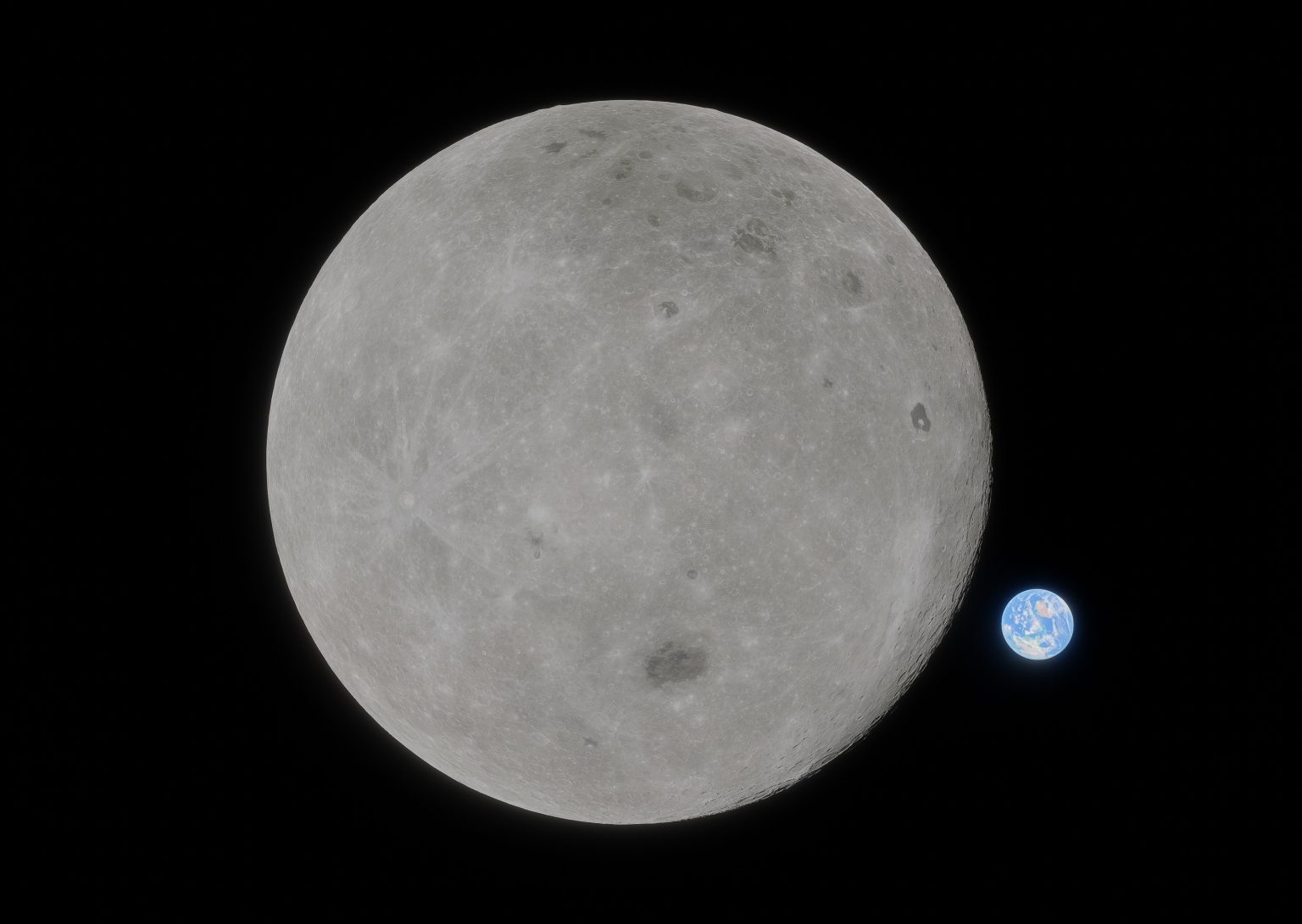
Fresh observations of the far side of our cosmic neighbor, published in the journal Science Advances, have helped bring an unexpected resolution to this debate.

The Coincidence of Three Anomalies in Dewar Crater

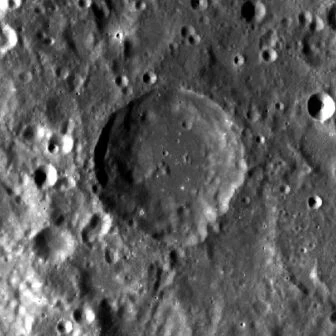
While analyzing archival lunar observations, scientists discovered a huge, strongly magnetized structure in the region of Dewar crater. The object, about 60 km wide, consists of solidified magma that rose from deep within the Moon approximately 4.2 billion years ago.

Dewar crater, photographed by the Lunar Reconnaissance Orbiter spacecraft. Source: Wikimedia Commons

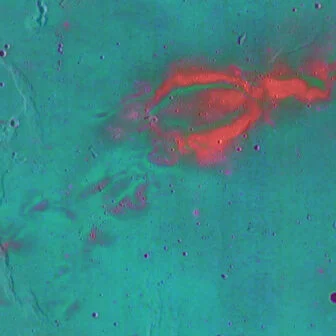
This area is also known for bright, swirling patterns on the surface. Researchers Xi Yang and Anna Mittelholz of ETH Zurich note that Dewar crater represents a unique case where a magnetic anomaly, a gravitational anomaly, and a characteristic surface pattern all coincide at the same location.

The far side of the Moon. Image:  Space Engine

Using a combined mathematical model, the scientists calculated that the Moon’s early magnetic field would have needed to be about 11 μT to produce such a structure. For comparison, Earth’s present-day magnetic field is about 50 μT.

A New Approach Instead of Apollo Samples

The previous hypothesis of a lunar dynamo was based on rock samples brought back by astronauts from the Apollo missions, but later re-evaluations of these materials confused the scientific community because of conflicting results. The new method, which combines orbital gravity and magnetic data, made it possible to place precise constraints on the characteristics of the planetary dynamo without the need for landing and collecting soil samples. In addition, the location of Dewar crater completely rules out the possibility that the magnetic anomaly was temporarily produced by a powerful asteroid impact.

A lunar swirl photographed on the near side of the Moon. Source: NASA

Understanding the Moon’s magnetic history provides an important example of how relatively small celestial bodies can maintain — or lose — their own dynamos. And although the discovery does not eliminate absolutely all discrepancies with the Apollo sample data, the scientific debate is now shifting from the question “Did a magnetic field exist?” to “How exactly did it work?”

Earlier, we reported on how the Moon’s magnetic field may once have been stronger than Earth’s.

RELATED

There's A Giant Lump Of Metal Buried In The Moon. Nobody Knows Why.

Something Buried Beneath The Moon's Surface Has Scientists Terrified

{ https://universemagazine.com/en/articles-en/ }

Hoe vind je dit bericht?
Geschreven door peter om 22:12 Stuur door

ESA increasingly applies artificial intelligence technologies in the space sector

ESA increasingly applies artificial intelligence technologies in the space sector

The European Space Agency is expanding the use of artificial intelligence in its work. The agency has agreed on a strategic partnership with the French company Mistral, one of Europe’s leading developers of language models. Neural networks will assist engineers, analyze satellite images, and accelerate mission preparation. At the same time, the computing infrastructure is expected to remain within Europe.

Artificial intelligence in the space industry. Artist’s illustration. Source: ESA

Signing in Paris

The letter of intent was signed in Paris on September 16 by ESA Director General Josef Aschbacher and Mistral CEO Arthur Mensch. The agency announced the agreement on September 23 in an official ESA release.

Such a document is not yet a contract. It establishes a framework within which the parties will look for joint projects. The release does not specify amounts or timelines. However, the steady move toward broader use of artificial intelligence in the space industry is becoming increasingly clear. The company is expected to provide artificial intelligence models, cloud infrastructure, and technical expertise, while ESA will contribute its own engineering, scientific, and operational tasks.

Why Space Needs Neural Networks

According to Josef Aschbacher, artificial intelligence is rapidly becoming one of the core technologies of the space industry, and the agency is already testing it in operational and research projects. The document identifies several areas of application. These include processing Earth observation images, engineering analysis, mission design, and specialist training.

Routine operations will be handed over to algorithms, which will also make it easier to search for the necessary knowledge. The release emphasizes that final technical decisions will continue to be made by people.

The agency already has experience with onboard neural networks. In September 2020, the Φsat-1 satellite was launched into orbit, where software onboard directly filtered out images obscured by clouds. This type of selection reduces the amount of data that must be transmitted to Earth, since clouds cover about two-thirds of the planet’s surface at any given time.

Data Will Remain in Europe

The parties will separately examine how to deploy language models on European infrastructure. Among the requirements listed in the release are security, resilience, traceability, auditability, and protection of sensitive information. Arthur Mensch promised to transform the agency’s observation archives into services for the space industry while maintaining the highest standards of control and sovereignty.

The issue of sovereignty also has a legal dimension. The U.S. CLOUD Act of 2018 allows U.S. authorities to demand information from American providers even when their servers are located outside the country. For ESA mission documentation, such dependence creates a risk, so the agency needs a provider operating under European jurisdiction.

Mistral was founded in Paris in 2023. Within just a few years, it has become one of the most prominent competitors to American developers in this field.

Cooperation Is Already Underway

The new agreement builds on work that the agency and the company are already carrying out together. One of these projects, the Orbit assistant, helps employees with engineering tasks and works with the agency’s restricted data without transmitting it outside.

The second tool, the Earth Virtual Expert EVE, was created at the agency’s Φ-lab together with European partners. It specializes in Earth observation and Earth sciences. The parties still need to formalize new areas of work, their timelines, and budgets in separate agreements.

RELATED

🔥 AI Space Robots Explained | The Future Of Space Exploration

AI Is Going to Space | Will Robots Explore the Universe First?

The Space Robots That Decide What Is Worth the Risk

{ https://universemagazine.com/en/articles-en/ }

Hoe vind je dit bericht?
Geschreven door peter om 21:59 Stuur door

Story of Former Pentagon Official Who Led U.S Government’s UAP Investigations Is Coming to Television

Terrence Winter Dan Farah Out of the Shadows

Terrence Winter (left) and Jay Stratton's "Out of the Shadows"
(Image Credit: William Morrow Company)

Story of Former Pentagon Official Who Led U.S Government’s UAP Investigations Is Coming to Television

The Sopranos writer and Boardwalk Empire creator Terence Winter will be teaming up with filmmaker and producer Dan Farah for the development of a new television series based on the former U.S. intelligence official who led the U.S. government’s investigations into Unidentified Anomalous Phenomena (UAP).

The series will be based on the forthcoming memoir Out of the Shadows, which offers a candid look at the career of Jay Stratton, the former official who led the U.S. government’s Unidentified Aerial Phenomena Task Force (UAPTF).

Stratton’s book, scheduled for publication in October by William Morrow, recounts his involvement with official investigations of UAP, the military’s term for what historically are known as unidentified flying objects or UFOs, and the bureaucratic hurdles he encountered while leading government efforts to resolve their nature and origin.

Winter will serve as an executive producer for the screen adaptation through Cold Front Productions, and Farah will also be an executive producer under Farah Films, according to Variety.  

Farah previously directed the documentary film The Age of Disclosure, which brought together more than thirty current and former U.S. officials who spoke on the record about the UAP issue, potential national security related to the phenomenon, and ongoing efforts to secure the release of information about it, which are believed to remain in the U.S. government’s possession. Farah also produced the documentary film The Phenomenon by director James Fox.

Along with the secretive world of U.S. government investigations into UAP, the forthcoming series will deal with the unusual intersection between Stratton’s classified work and his life at home, as detailed in his forthcoming memoir, where he describes how his family also reportedly experienced unusual events while he served in government.

Winter described Stratton’s story and the plans for a forthcoming series as a journey into the lesser-known world of U.S. government and UAP investigations. Farah compared the material to a high-stakes political thriller, with a central mystery that is accompanied by the personal toll placed on Stratton and his family, and lingering questions about the existence of non-human intelligence.

Winter brings considerable experience to the project, with past work that includes serving as writer and executive producer on The Sopranos before going on to create HBO’s hit series Boardwalk Empire. Winter is also the recipient of an Academy Award nomination for his screenplay adaptation of The Wolf of Wall Street.

Presently, details about the cast, release date, and potential networks and streaming platforms that may carry the program have not yet been announced. Stratton’s book, Out of the Shadows, will be released on October 13, 2026.

  • Micah Hanks is the Editor-in-Chief and Co-Founder of The Debrief. A longtime reporter on science, defense, and technology with a focus on space and astronomy, he can be reached at micah@thedebrief.org. Follow him on X @MicahHanks, and at micahhanks.com.

US UFO DISCLOSURE: Pentagon Releases Sixth Batch of UAP Files With Major Redactions | WATCH

{ https://thedebrief.org/category/defense/ }

Hoe vind je dit bericht?
Geschreven door peter om 21:46 Stuur door

A Mysterious Military Drone Was Recovered By A Fishing Charter Off Florida's Gulf Coast

A Mysterious Military Drone Was Recovered By A Fishing Charter Off Florida's Gulf Coast

By Aaron Greenbaum

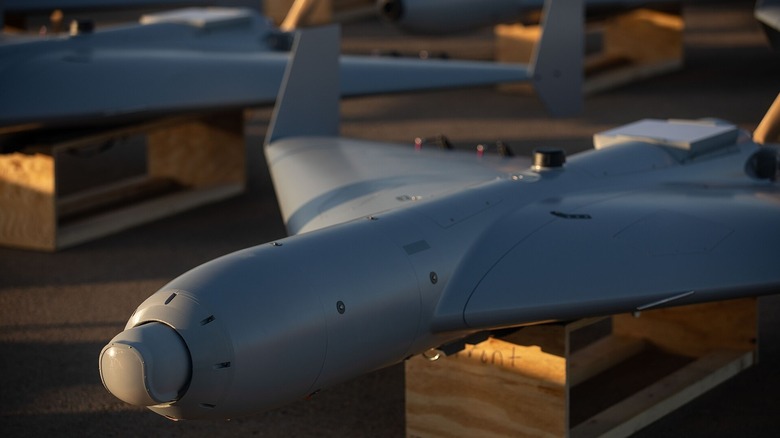
Low-cost Unmanned Combat Attack System (LUCAS) drones arranged on a tarmac

PUBLIC DOMAIN

When you charter a fishing boat, you do so with the expectation of catching some fish. Although, sometimes the unexpected occurs. Anglers have been known to snag some weird-looking fish, but who could ever expect a fishing expedition would result in dragging a military drone back to shore?

On September 20, 2026, a group of people had hired Hot Spot Charters to go on a six-hour fishing trip off the coast of Pensacola Beach, Florida when they spotted what the ship's captain initially thought was "an upside-down skiff," according to WEAR Channel 3 News. When they got closer and brought the semi-submerged UFO onboard (no easy feat since it weighed 500 pounds and was completely waterlogged), they realized it was actually an unmanned drone. A nearby military base, Eglin Air Force Base, informed the news channel that the vessel was a Low-cost Uncrewed Combat Attack System (LUCAS). Thankfully, some of the people onboard had enough military experience to assume the drone was safe to retrieve.

According to Eglin Air Force Base, the LUCAS drone had been missing since last Thursday. The UAV was undergoing some "routine scheduled testing" when it hit the water. After the fishing group brought the drone back to Pensacola Beach, Eglin Air Force Base officials retrieved it from the local Sheriff's Department. Thankfully, the LUCAS wasn't the only highlight of the trip; A school of Mahi-Mahi had congregated around the drone, and the charter group managed to catch six of the fish thanks to the military-grade bait.

What's the big deal with LUCAS?

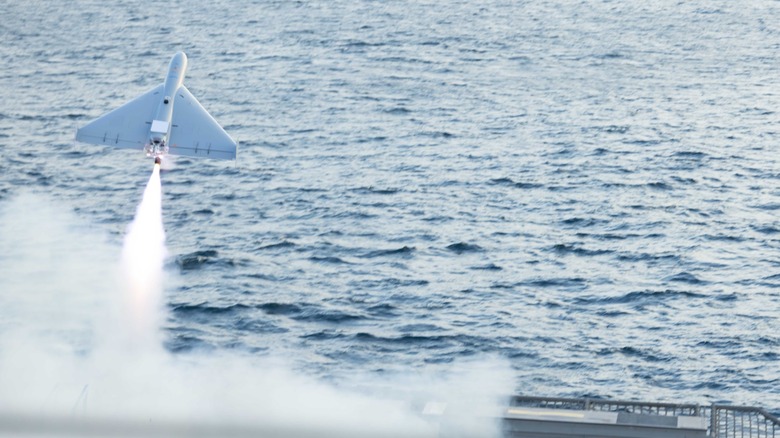
Low-cost Unmanned Combat Attack System (LUCAS) drone launching from the deck of the USS Santa Barbara

PUBLIC DOMAIN

So, what exactly is a LUCAS and why was Eglin Air Force Base testing it? The LUCAS is what's known as a one-way attack drone, similar to the Iranian Shahed 136 both in terms of appearance and battle tactic: to swarm enemies and ram into them as fast as possible, detonating an integrated warhead for maximum damage. As such, the LUCAS is designed to be expendable and mass produced, sort of like those 3-D printed drones the Navy is testing. According to U.S. Central Command, the LUCAS entered the United States' weapon catalog in February of this year. While the drones first official use came during the 2026 Iran War, researchers at OSINT believe they were actually used earlier during the January 2026 Operation Absolute Resolve in Venezuela.

As for Eglin Air Force Base's role, the location is responsible for the majority of Air Force armament testing. When a new control system or attack drone is being developed, tested, and readied for deployment, it's sent to Eglin. While the base maintains an exclusion zone so it can safely evaluate weapons without risking any civilian casualties, the LUCAS had drifted outside of this area by the time the chartered fishing boat found it. However, the air base did not comment on why the drone hit the water, so maybe the LUCAS needs a bit more testing before it's ready for the military's Amazon-style marketplace.

{ https://www.bgr.com/category/tech/ }

Hoe vind je dit bericht?
Geschreven door peter om 21:27 Stuur door

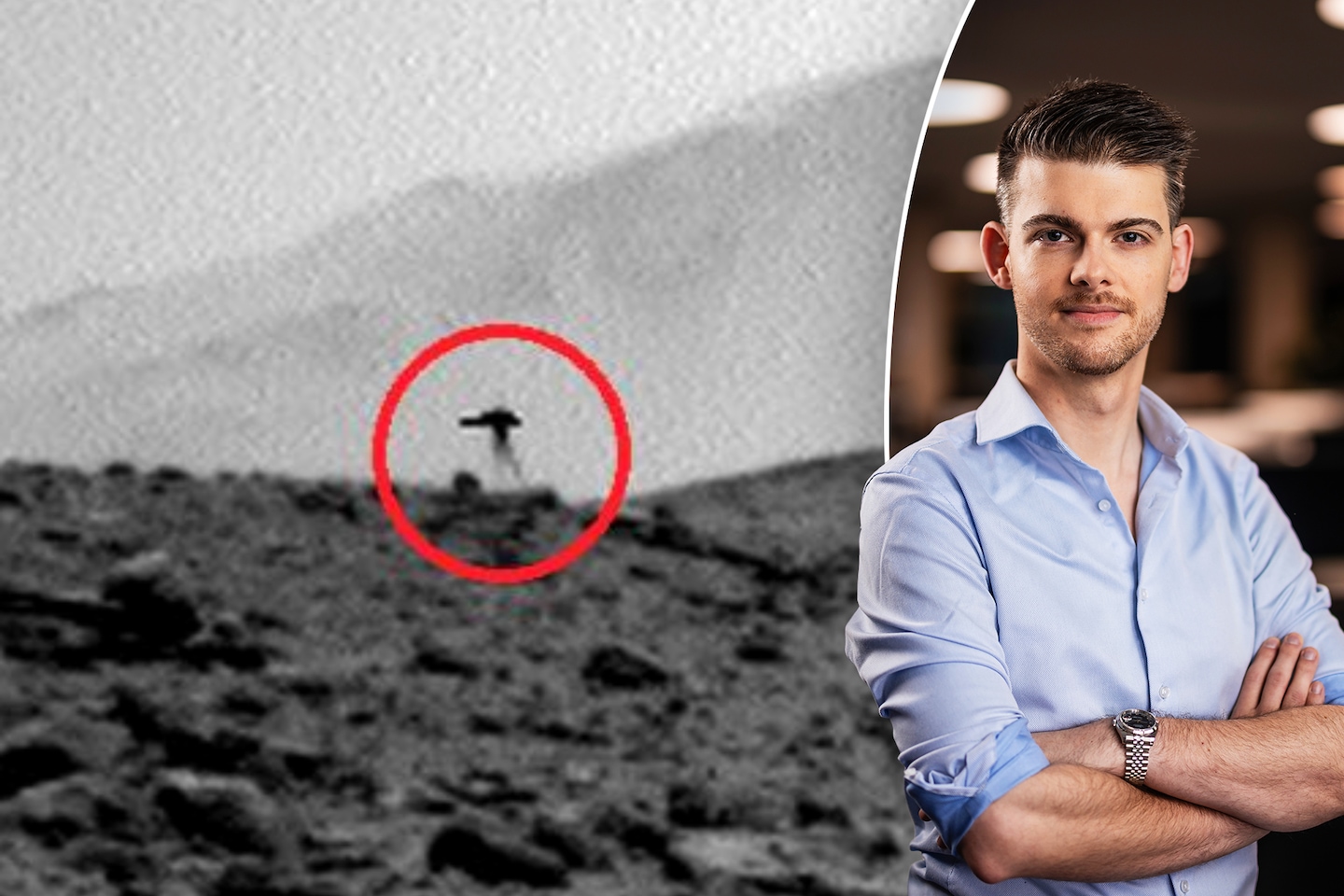
Wat zweeft daar op Mars rond? NASA-beeld van buitenaardse ‘kwal’ gaat viraal, wetenschapsexpert legt uit

hebben-mensen-op-sociale-media-beelden-van-buitenaards-leven-op-mars-ontdekt

Hebben mensen op sociale media beelden van buitenaards leven op Mars ontdekt?

© NASA/JPL-Caltech

Wat zweeft daar op Mars rond? NASA-beeld van buitenaardse ‘kwal’ gaat viraal, wetenschapsexpert legt uit

Het is een foto uit 2023, gemaakt door de Mars-rover Curiosity, die momenteel de ronde doet op sociale media. Boven het oppervlak van de rode planeet lijkt er iets te zweven dat wat weg heeft van een kwal. Sommige mensen verwijzen naar de buitenaardse wezens uit 'War of the Worlds'. Maar wat is er echt aan de hand? HLN-wetenschapsexpert Martijn Peters licht toe.

Dat mensen vreemde structuren zien op foto’s van rovers op Mars, is geen nieuw fenomeen. Zo herkenden we met zijn allen al een menselijk hoofd, een teddybeer, een deur, een bot van een persoon, paddenstoelen, piramides enzovoort. Meestal blijken deze mysterieuze objecten gewoon rotsen te zijn. Maar is dat ook het geval bij de nieuwe spraakmakende buitenaardse ontdekking?

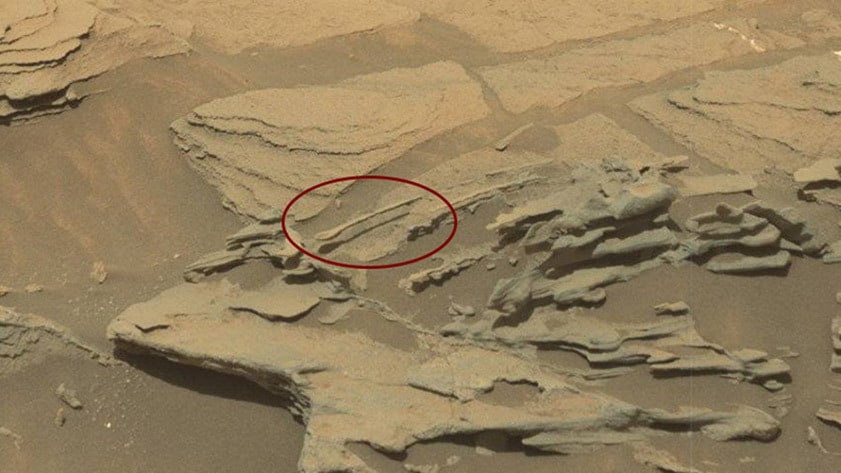
'Zwevende lepel' gespot op Mars

In 2015 zag iedereen plots een zwevende lepel op Mars dankzij de Curiosity-rover.

NASA/JPL-Caltech/MSSS

Curiosity Captures East Cliffs - Figure D

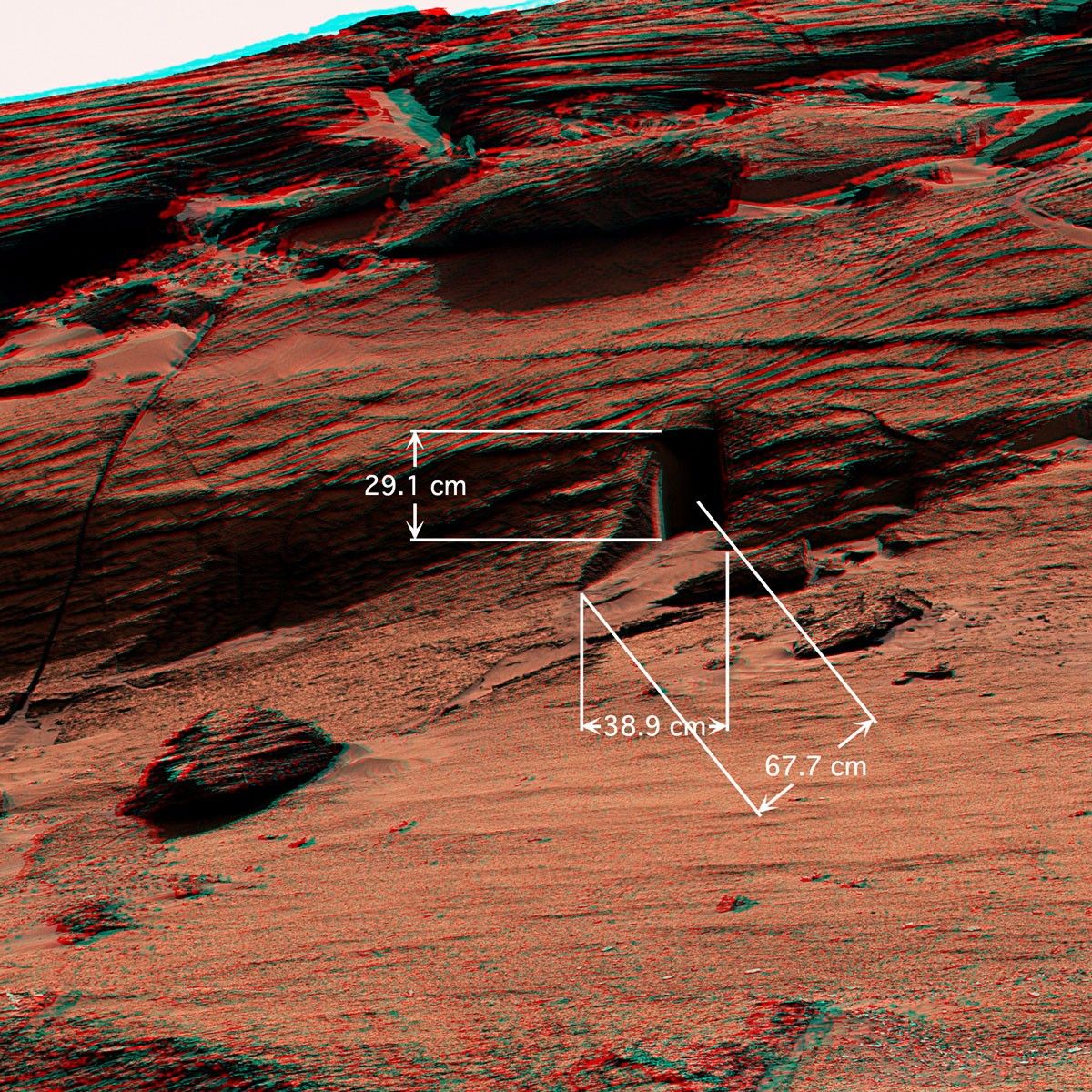
In 2022 ging deze foto van Curiosity viraal waarop er een deur te zien leek op Mars.

NASA/JPL-Caltech/MSSS/NeV-T

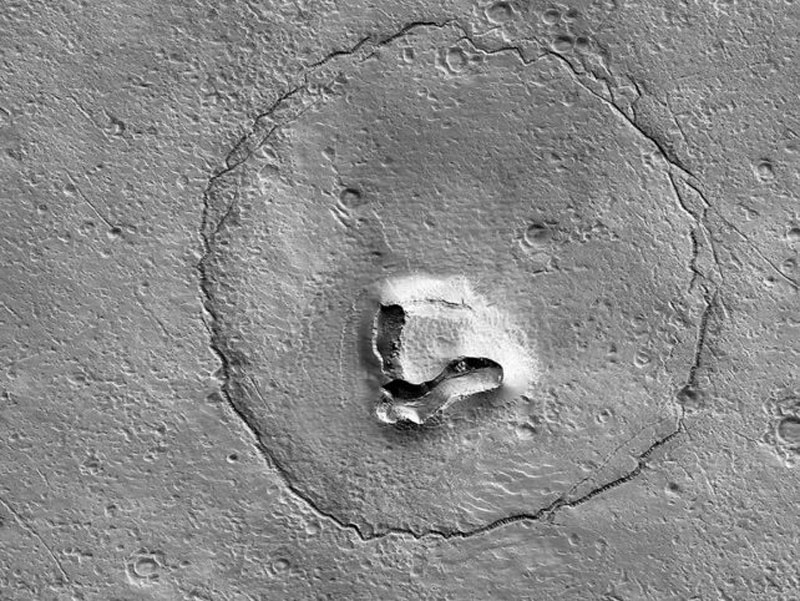
NASA нашло на поверхности Марса морду медведя

Een van de bekendere foto's van de afgelopen jaren werd in 2023 genomen door NASA's Mars Reconnaissance Orbiter en lijkt een beer te tonen.

NASA/JPL-Caltech/UArizona

In april 2026 ontdekte Curiosity op de locatie van de Antofagasta-krater een stuk grond met een vreemde, schubachtige textuur.

In april 2026 ontdekte Curiosity op de locatie van de Antofagasta-krater een stuk grond met een vreemde, schubachtige textuur.

© NASA, JPL-Caltech, MSSS, Kevin M. Gill

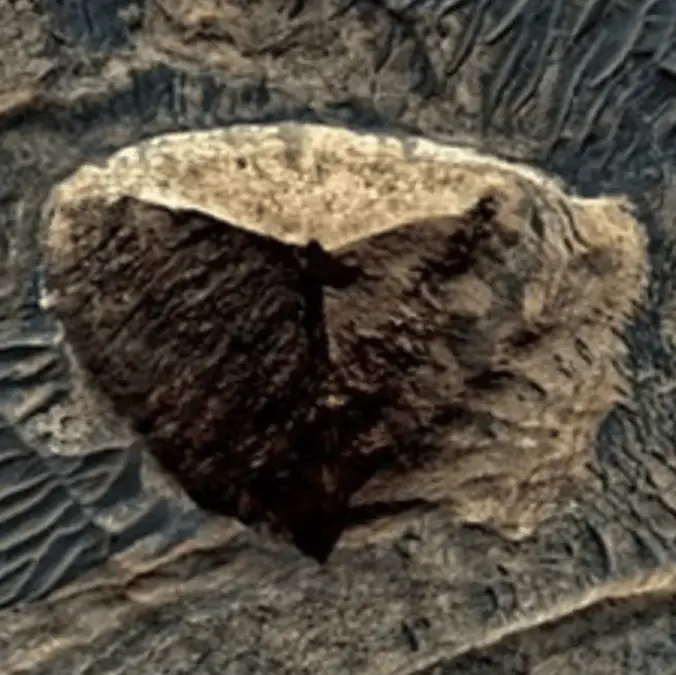
Bizarre 'three-sided pyramid’ similar to Egypt’s seen on Mars in resurfaced NASA images

Dit jaar (2026) zagen mensen plots een piramide op Mars met dank aan de NASA’s Mars Global Surveyor die deze foto al in 2001 nam.

NASA/JPL/University of Arizona

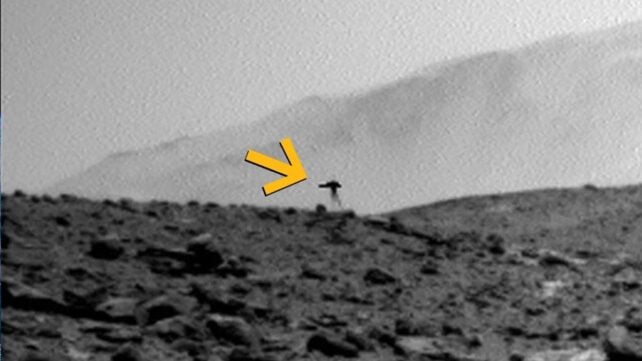
Het gaat om een foto die is gemaakt door Curiosity, een van de rovers op Mars. Die legde in 2023 een op het eerste gezicht perfect normaal ogend landschap van de rode planeet vast. Maar het internet zou het internet niet zijn als mensen die foto’s niet onder een vergrootglas zouden bekijken. En wat blijkt? In de linkerhoek duikt plots een vreemde vlek op.

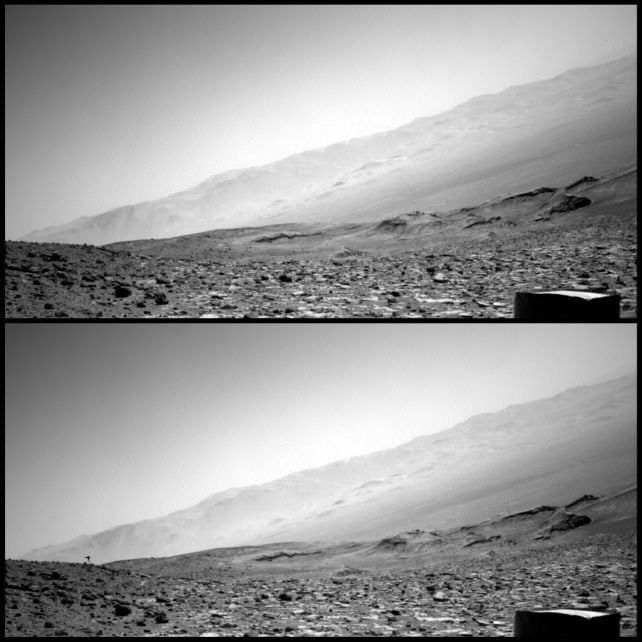
Wanneer je die vlek wat nauwkeuriger bekijkt, lijkt die op een silhouet van een kwal met naar beneden hangende tentakels. Of misschien herken je er wel de befaamde probe-droid uit 'Star Wars' in en de driepotige aliens uit 'War of the Worlds' van H.G. Wells. Op het eerste zicht lijkt deze structuur die onze verbeelding in de maling neemt helemaal niet op een rotsachtige formatie. En volgens wetenschappers is het dat ook niet. Wat het volgens hen ook zeker niet is: een kwalachtig buitenaards wezen. Allereerst heeft de rover meerdere beelden vlak na elkaar genomen van het landschap op Mars. Op die andere foto’s is geen kwal te bespeuren.

Plots verschenen en verdwenen - Spot jij de kwal op de beelden?

HSW92pYbgAA8dub.jpg

Deze foto maakte Curiosity op Mars op 20 augustus 2023.

NASA/JPL-Caltech

NASA Spots a Bizarre 'Jellyfish' Floating on Mars. Here's What We Know.

Wanneer we inzoomen linksonder in de foto van Curiosity zien we de 'buitenaardse' kwal verschijnen.

NASA/JPL-Caltech

There's a Bizarre 'Jellyfish' in This Photo of Mars. We Think We Know Why.

Twee frames genomen met enkele seconden ertussen.

(NASA/JPL-Caltech)

Wat is het dan wel? Deze vlek op de foto heeft wel degelijk een kosmische oorsprong. Het is echter geen buitenaards leven, maar wel een buitenaards geladen deeltje. Eentje dat vanuit de ruimte terechtgekomen is op de siliconendetector van de Mars-rover Curiosity. Hier op aarde wordt kosmische straling ver boven onze hoofden tegengehouden door het magnetisch veld en de dikke atmosfeer. Maar op Mars is die verdediging minder robuust. Hierdoor kunnen hoogenergetische deeltjes makkelijk het oppervlak van de planeet en dus de rover bereiken.

Wanneer zo’n geladen deeltje de rover raakt, geeft dat niet altijd hetzelfde effect op het beeld. Soms krijg je heldere witte vlekken, strepen of statische ruis. Beelden met dit soort artefacten erop zijn niet zeldzaam. Soms hebben de vlekken ook het tegenovergestelde uiterlijk. Dan zijn ze helemaal zwart van kleur. Meestal zijn dit soort vlekken enkel in één frame te zien. Dat is ook het geval met de beelden uit 2023 die nu de ronde doen.

Dat betekent niet dat wetenschappers nu al met honderd procent zekerheid kunnen zeggen dat een geladen deeltje uit het universum de oorzaak is. Eerst moeten ze nagaan of er geen andere oorzaak is, zoals een probleem met de camera of de verwerking van de beelden. Maar wat het ook is, het antwoord bevindt zich in de rover, niet op het oppervlak van Mars.

Maar waarom zien mensen vaak gezichten of herkenbare objecten in zulke foto’s? Dat fenomeen noemen wetenschappers apofenie: het herkennen van patronen in willekeurige of niet-gerelateerde gegevens en het daaraan geven van betekenis. Meer specifiek gaat het om pareidolie. Dat komt van het ‘para’ (naast) en ‘eidolon’ (beeld) en betekent dat je hersenen bepaalde bekende zaken, zoals gezichten, herkennen in willekeurige of onduidelijke patronen, bijvoorbeeld in een rots.

LEES OOK.

{ https://www.hln.be/weer-en-wetenschap/ }

Hoe vind je dit bericht?
Geschreven door peter om 21:17 Stuur door

Mysterious orb caught soaring over Los Angeles during live TV report

An ordinary traffic report turned into a shocking UFO sighting after a news helicopter caught a mysterious orb floating over a packed California highway. 

The wild scene was captured over the Los Angeles freeway in mid-September as dozens of cars and trucks sat in evening rush hour traffic.

A helicopter for FOX 11 Los Angeles was zooming in on the multi-level highway when the camera operator appeared to notice a strange, metallic sphere floating above the road.

The object, about the size of a basketball or slightly larger, was seen traveling in a straight line away from the busy highway, towards a more wooded neighborhood.

Instead of zooming in on the congestion in Los Angeles, the camera operator was caught off guard and started following the UFO for several seconds before veering back to the traffic.

The news outlet did not address the video of the mysterious sphere, which has been shared online and seen by millions since it was posted on September 22.

One person said onX: 'They noticed the object enough to focus on it before turning their camera away.' Another viewer added: 'I'm skeptical, but it doesn't move like a balloon in the wind. It's flying in a straight line.'

Despite many people seeing the sphere and believing the helicopter caught an actual UFO in flight, the US government has continued to claim no physical evidence proving UFOs or extraterrestrials exist has ever been recovered.

Video of an alleged UFO sighting over the Los Angeles freeway was shared on social media in September 2026

Video of an alleged UFO sighting over the Los Angeles freeway was shared on social media in September 2026

A local traffic camera on a news helicopter spotted a small sphere moving away from the highway

A local traffic camera on a news helicopter spotted a small sphere moving away from the highway

Many viewers drew comparisons between the metallic object seen floating over Los Angeles and the so-called Buga Sphere captured in Colombia last year, which locals reported was a metal ball that appeared to strike a power line and crash.

Both objects seemed to glide through the air. Neither had visible strings or appeared to have been influenced by the wind as a balloon might.

Skeptics still claim the tiny UFO seen over Los Angeles was most likely some type of drone flying near the busy road or the so-called 'marker balls' - the orange or white spheres hanging from power lines which make these cables easier to see for planes.

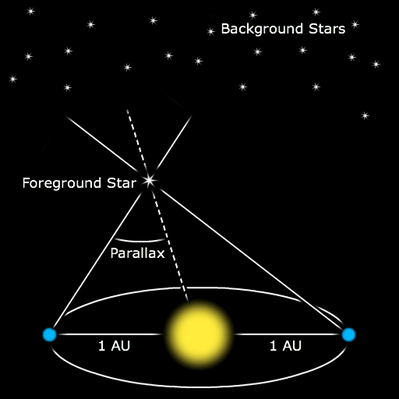
'Yay, more balloons and parallax!' one doubter declared, noting the phenomenon where a nearby object seems to slide across the background when the camera moves, even if that object is sitting still.

Others claimed the object was just a mylar balloon floating over the city and giving the supposed UFO its chrome-like appearance.

However, believers argued the balloon theory was just a bunch of hot air, noting that an air-filled party favor should not have been able to keep such a steady course away from the freeway.

'Balloon crowd is going to have a hard time with this one. That path is too straight. Wind doesn’t fly a sphere across LA in a clean line with no wobble. Whatever it is, it isn’t just floating,' one person wrote on X.

Just as the camera pulled away from the sphere, the UFO appeared to vanish as it flew in front of a nearby warehouse. 

The Buga Sphere (Pictured) was recovered by local residents in Colombia in March 2025 and has been in the care of scientists in Mexico ever since

The Buga Sphere (Pictured) was recovered by local residents in Colombia in March 2025 and has been in the care of scientists in Mexico ever since

The metallic-looking orb was seen disappearing near a wooded neighborhood and warehouse seconds after leaving the freeway

The metallic-looking orb was seen disappearing near a wooded neighborhood and warehouse seconds after leaving the freeway

California has been a notorious hotspot for unexplained UFO sightings along the US West Coast.

According to the crowdsourced platform Enigma, which allows the public to report sightings of UFOs, there have been nearly 30,000 sightings of unidentified objects in the sky over the state dating back to 1901.

Those reports include more than 2,500 that specifically mention a sphere flying overhead.

READ MORE

EXCLUSIVE

article image

UFO sightings in California nearly doubled the next closest state - Florida.

'I’ve seen these several times in my life. Last time I saw two together in Los Angeles in 2020 beginning of pandemic,' one viewer claimed online.

'Enigma has received 5,248 first-hand reports of UFO sightings in California. A total of 29,884 UFO sightings from California have been published to Enigma, inclusive of third-party sources,' the public UFO database explained.

Metallic spheres and glowing orbs have become common UFO encounters over the last year as the US government declassified troves of data pertaining to alleged extraterrestrial sightings and unidentified craft.

Since May, six reports have been released by the Pentagon, including images and videos of silver spheres being followed by US drones and satellites flying at high speed over oceans, deserts and even military bases.

The news outlet did not publish a date or time stamp confirming the exact minute the helicopter was over that stretch of the LA freeway.

RELATED


Mysterious orb caught soaring over Los Angeles during live TV report.

{ https://www.dailymail.com/sciencetech/index.html }

Hoe vind je dit bericht?
Geschreven door peter om 18:06 Stuur door

How Diffractive Solar Sails Could Stop a Killer Asteroid at 100 km/s

How Diffractive Solar Sails Could Stop a Killer Asteroid at 100 km/s

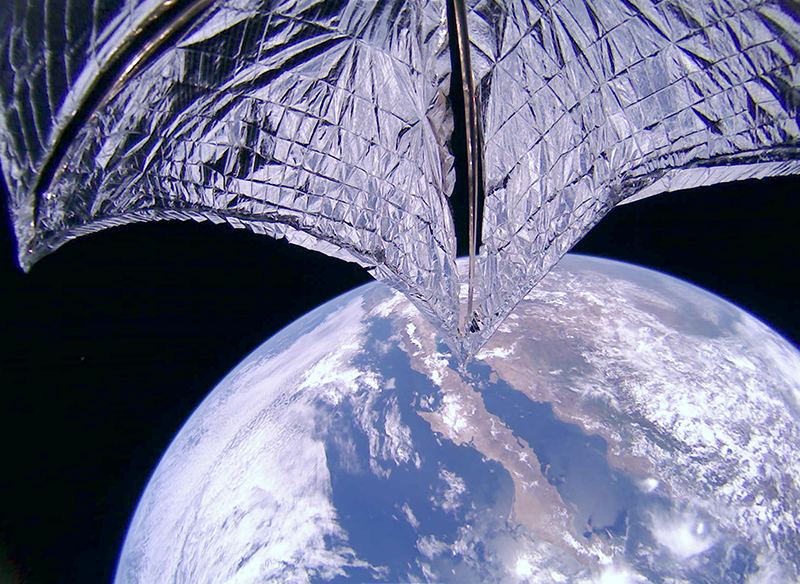
Image of the deployment of Lightsail 2. Credit - The Planetary Society Image of the deployment of Lightsail 2. Credit - The Planetary Society

Asteroids don’t come with a warning label that they might one day hit Earth. While we don’t know of any currently on course to do so, we are finding thousands of new ones each year, and there’s always a potential that one could. We proved a viable technique for dealing with that eventuality - the DART mission successfully moved a small asteroid using a “kinetic impactor” - basically a big rod designed to push the asteroid off its trajectory. But DART had one big flaw - it was traveling in the same direction as the asteroid, and approached it from behind, eventually hitting it with an impactor launched while in orbit around it. That technique might work if we have enough warning, but would require years of orbital mechanical maneuvering to pull off. An alternative, proposed by researchers at Beihang University, is to use a new type of solar sail to deflect a potentially hazardous asteroid by hitting it head on.

Deflecting an asteroid using an impactor comes down to one simple factor - energy. The more energy transferred from the impactor to the asteroid, the more the asteroid will move. And the great thing about energy is that it increases with the square of velocity. In other words, the faster you hit something, the more energy you impart to it.

DART smashed into Dimorphos, its target asteroid at about 6 km/s - a respectable speed, but limited by the fact that it was coming from the same direction. According to the new paper, an impactor using a solar sail can come at an approaching asteroid from the opposite direction - akin to a wrong-way highway driver - and smash into its target at around 100 km/s - imparting something like 230 times the force per kilogram of impactor mass than the DART test did.

Fraser talks about how we could potentially stop a killer asteroid.

The problem is getting the spacecraft moving in the opposite direction. Almost everything orbits the Sun in a counter-clockwise direction, including the Earth. As such, when something launches from the Earth, it’s already moving that way. Reversing that direction, and entering a clockwise (retrograde) orbit requires a lot of energy, to put it mildly. Chemical rockets aren’t capable of it - the tyranny of Tsiolkovsky’s rocket equation makes it impossible for them to carry enough fuel to complete that maneuver. But solar sails potentially can.

Solar sails work by harnessing solar radiation pressure - the tiny amount of force that a photon imparts when it runs into something. In essence, they sail on sunlight rather than requiring fuel like a traditional chemical or ion rocket. Back in the 1990s, Italian engineer Giancarlo Vulpetti realized you could use this technology to get a solar sail into what he called a H-reversal trajectory - essentially a way to make the sail start orbiting backwards.

This technique first uses the sail as a brake, slowing the craft’s angular momentum. After it drops to zero, the Sun’s gravity does its work, pulling the craft toward our star in a deep dive. But in Vulpetti’s trajectory, the sail kicks back on during the craft’s closest approach (perihelion), and slingshots back outward into a retrograde orbit. Sounds like a brilliant solution to get an impactor moving in the right direction to impart a massive amount of energy to an asteroid. There’s only one problem - solar sails are notoriously clumsy.

Fraser talks about the results of the DART test.

We’ve successfully tested a few in space - JAXA’s IKAROS mission and The Planetary Society’s LightSail 2 are examples of traditional solar sails, which essentially act like giant mirrors. In their case, the light that bounces off of them leaves at the same angle it arrives. The thrust is always perpendicular to the sail’s surface. That situation isn’t ideal for a H-reversal trajectory, as it means you have to tilt the sail at an extreme angle to the Sun, which thereby presents a much smaller target for the sunlight to hit, dramatically reducing the sail efficiency.

Enter the diffractive solar sail. Instead of traditional reflective film, the material these sails are made out of uses microstructured optical gratings to diffract the light sideways, without the sail itself turning. That means the sail can keep its whole face towards the Sun, even at perihelion, but force all of that thrust into sideways motion. This dramatically simplifies attitude control and still enables the significant push needed to pull off this tricky orbital maneuver.

The researchers simulated several different types of solar sail configurations for this H-reversal trajectory, and found that reflection-type diffractive sails are the clear winner. In their simulations, only that type didn’t either fall into the Sun or get launched onto a trajectory where it was pushed out of the solar system entirely. But finding the right type of sail was just the first step - their second simulation showcased an example of what might happen with another famous asteroid - Apophis.

Fraser talks about how great solar sails are.

Apophis is a 340m wide asteroid that will famously come within 38,000km of Earth on April 13th, 2029. While that in itself does not warrant a deflection, the researchers decided to see what they could do with this well-studied asteroid. They simulated a diffractive-reflective sail in two different configurations - one where it was set with a permanent diffraction angle, and one where it could switch between a moderate angle for its dive towards the Sun and then dial it up near perihelion to around 90 degrees.

Both versions were able to deliver a 100 km/s impactor directly to Apophis in around 200-300 days from launch time. That shaves nearly a year off the mission time of a standard reflective solar sail - a time differential that could be the difference between a deflection and an impact.

Hopefully, we will never actually need to use this technology to deflect a potentially hazardous asteroid. But realistically, we will face one someday. And knowing that this technique could deliver hundreds of times more energy than the more mundane co-orbital impacts we’ve proven work so far is heartening - at least we know there’s another tool in our toolbelt to deal with these hazards, even if we miraculously never have to use it.

Learn More:


Deflecting a Killer Asteroid with Diffractive Solar Sails! ☄️☀️ | Planetary Defense

{ https://www.universetoday.com/ }

Hoe vind je dit bericht?
Geschreven door peter om 17:42 Stuur door

New Lunar Crater Offers Keys To Moon’s Shallow Subsurface

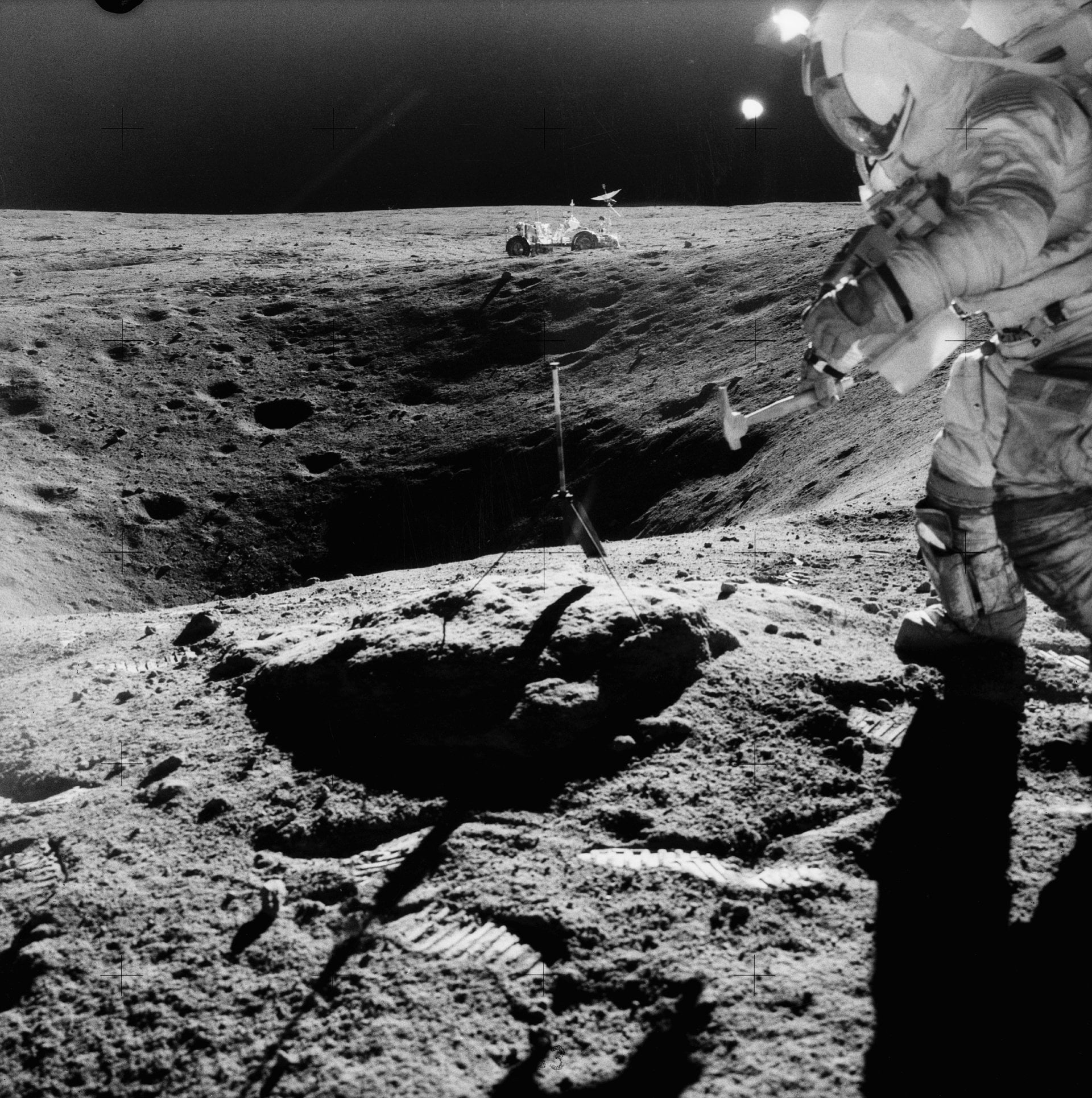
Astronaut John W. Young, commander of the Apollo 16 lunar landing mission, stands on the rim of Plum Crater while collecting lunar samples at Station 1 during the first Apollo 16 extravehicular activity (EVA-1) at the Descartes landing site.  Credit:  NASA via Wikipedia Astronaut John W. Young, commander of the Apollo 16 lunar landing mission, stands on the rim of Plum Crater while collecting lunar samples at Station 1 during the first Apollo 16 extravehicular activity (EVA-1) at the Descartes landing site. Credit: NASA via Wikipedia

New Lunar Crater Offers Keys To Moon’s Shallow Subsurface

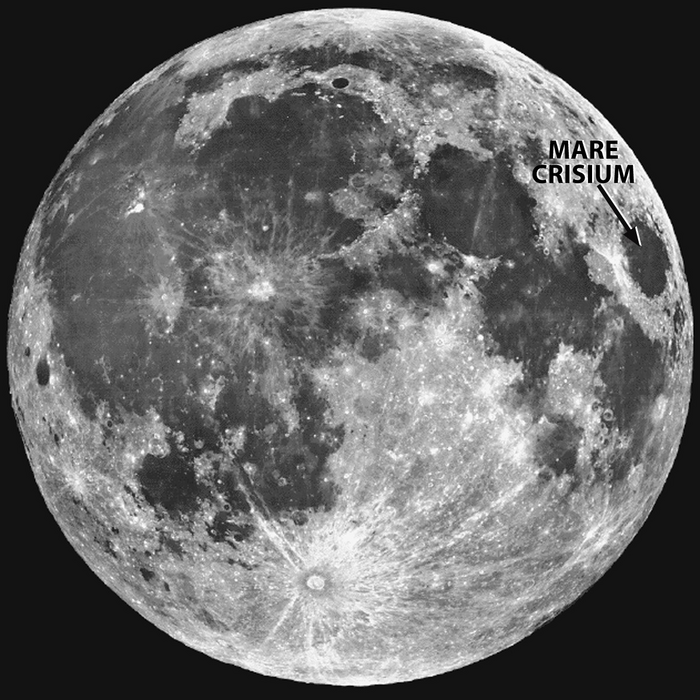
NASA's Lunar Reconnaissance Orbiter (LRO) spacecraft has made a once-in-a-lifetime find of a newly formed crater on the Moon's near side, some 330 km from the edge of the Mare Crisium. The crash left a 728-foot-wide crater that spans the length of two football fields, NASA noted.

The newfound McGetchin Crater is thought to have been created by a bolide that struck the Moon in the spring of 2024. But it was only detected in LRO images late last year, as noted in two papers appearing in the journal Science Advances and also reported here at Universe Today earlier this week.

It’s going to be a treasure trove for geology in terms of the immediate effects of impacts capable of excavating deep beneath the Moon’s outer surface, Erik Asphaug, Professor of Planetary Sciences, Lunar and Planetary Laboratory at the University of Arizona in Tucson, told me via email.

It’s the largest new crater found on the Moon by the Lunar Reconnaissance Orbiter Camera (LROC) since it entered lunar orbit 2009. The previous largest new crater identified by LROC was only about 70 meters across.

On average, we'll get a new crater this size forming on the moon every 132 years, Timothy Glotch, Professor and Chair of Geosciences at Stony Brook University in New York, told me via email. But we can't say when the last crater of this size formed because the LRO has only been continuously monitoring the lunar surface since 2009, Glotch told me.

The Dangers Of Fast Moving Ejecta

Visible imagery shows that the ejecta from the crater extends for perhaps hundreds of crater radii beyond the crater itself, says Glotch. This provides new information for how NASA has to plan for sustainable infrastructure that may be exposed to fast-moving ejecta that may impact equipment and habitats left on the surface, he says.

The Importance Of Cold Spots

Scientists working with LRO’s Diviner thermal instrument, found a 4-mile-wide area around the crater that is about 16 degrees Fahrenheit cooler at night than its surroundings, says NASA.

LRO’s Lunar Radiometer found that the new crater, like all new craters over some thirty meters in diameter, has ejecta that is colder at night compared to the surrounding lunar regolith, says Glotch.

The cold spot forms due to disturbance of the regolith around the crater. Lunar regolith is the thin, surface layer of micrometeorites, fragmented rock and dust that covers the whole of the lunar surface.

The cold spot for McGetchin Crater is some 7 km across which indicates that the impact on the local regolith extends far beyond the actual crater itself.

Mare Crisium, an ancient, 350-mile-diameter impact basin that subsequently filled with lava. The basin is one of many large dark spots on the Moon’s surface visible to the naked eye. They were dubbed lunar maria, Latin for "seas," by early astronomers who mistook them for actual seas. Credit: Lick Observatory

Mare Crisium, an ancient, 350-mile-diameter impact basin that subsequently filled with lava. The basin is one of many large dark spots on the Moon’s surface visible to the naked eye. They were dubbed lunar maria, Latin for "seas," by early astronomers who mistook them for actual seas.

Credit: Lick Observatory

In fact, the effects of such cold spots have been known for decades.

NASA’s Apollo 16 lunar mission landed on a faint cold spot associated with the South Ray crater and the astronauts’ footprints within the cold spot were deeper than at other sites, the authors of a 2026 paper appearing in the journal Science Advances note. This indicated that the lunar regolith had been decompacted due to the impact that caused the crater, the authors note.

Such cold spots fade on timescales of up to two million years.

This makes them reliable markers of some of the youngest impact craters on the Moon, the authors note. Their young age has enabled their use in investigations of regolith thickness, the recent impact cratering rate and as potential source craters for lunar meteorites found here on Earth, the Science Advances authors write.

What’s Next?

NASA needs a new advanced orbiter to follow LRO when it eventually runs out of fuel, says Glotch. A new advanced orbiter could observe the surface at much better spatial resolution than we currently have, he says.

The Need For A New Lunar Lander

This would be a fantastic mission target for someone doing relatively inexpensive fundamental lunar science in an area where operations could be relatively simple, says Asphaug. Data could be communicated back to Earth with low-latitude near-side high bandwidth, he says. You would be able to find out directly whether lunar melt was created and if so, how thick it was, and whether it stayed as a lens inside the crater or was widely distributed, says Asphaug.

Lunar Fluff

LRO’s Diviner instrument showed us that we can do a kind of seismology by proxy, by understanding how powerful stress waves radiating from this event would fluff up lunar regolith to a depth of centimeters or more, says Asphaug. This tells us about transmission of stress waves with distance, which modelers will use in decades to come to figure out how impacts couple their energy into the lunar surface, he says.

The Need For A New Lunar Seismic Network

Apollo seismometers shut down in the late 1970s and plans for a lunar seismic network have been on the table for decades.

It’s a shame that there was no seismic network in place at the time of this crater’s formation, says Asphaug. But a seismic recording of an impact of this size would be of great global significance in terms of understanding the deep Moon, he says.

Sources:

RELATED


NASA Finds Massive New Moon Crater After Rare Lunar Impact | WION Podcast

NASA Found a New Moon Crater—and a 4-Mile Cold Spot #engineering #sciencefacts

A New Crater Appeared on the Moon — and Nobody Saw It Happen

{ https://www.universetoday.com/ }

Hoe vind je dit bericht?
Geschreven door peter om 17:26 Stuur door

Two UFOs Show Up In Apollo 10 Mission Photo Near Orbiter, UFO UAP Sighting News.

Two UFOs Show Up In Apollo 10 Mission Photo Near Orbiter, UFO UAP Sighting News.

UFO_Apollo.png

UFO_Apollo_10.png

Date of sighting: May 18-26, 1969
Date of discovery: Sept 23, 2026
Location of sighting: Moon orbit
Source: Apollo 10 AS10-27-3864 & AS10-27-3865
URL:
UFOs watching the NASA in space is nothing new. Its been happening since the beginning of the space program, however these UFOs are unique shapes. One is a triangle shape thick craft while the otehr is a sphere with a flat disk below it. These may be alien drones sent to record without any pilots onboard. The craft look small, similar in size to the Apollo module seen in the photo, but the UFOs are further away making them look smaller. Aliens, they love knowledge, and watching, recording and then sharing with their own species...thats their gold, their money, their view of whats really valuable...knowledge.
Scott C. Waring - UFO Sightings Daily
UFO_UAP.png

NASA_Apollo.png

UFO_1.png

UFO_2.png

NASA_UFO.png

RELATED

Apollo 10 Astronauts Encountered A Strange Radio Signal While On The Moon | NASA's Unexplained Files

NASA Hid This Sound For 40 Years | Apollo 10 Moon Mystery That Nobody Can Explain

{ https://www.ufosightingsdaily.com/ }

Hoe vind je dit bericht?
Geschreven door peter om 17:06 Stuur door

Pyramid-shaped UFO spotted over Brazil

Pyramid-shaped UFO spotted over Brazil

Years ago, a number of strange UFO sightings were captured on camera but never received much attention from the mainstream media. Apart from a handful of dedicated UFO websites and online communities, many of these cases remained largely unnoticed. 
Pyramid-shaped%20UFO%20%20Brazil.jpg

Today, it may be worth taking another look at some of that older footage, recordings made long before AI-generated imagery became widespread. 
Strange lights. Unidentified objects. Mysterious shapes appearing in the sky. 
In this video, we take a closer look at several intriguing cases: 
  • The Metapod UFO hovering over Spain 
  • A cylindrical UFO spotted over the sea 
  • A glowing orb appearing above a playground in Finland 
  • A pyramid-shaped object observed in the night sky over Brazil 
  • Fiery objects descending over Tijuana 
Some of these recordings may have ordinary explanations. Others remain difficult to identify. 
But all of them were captured before the age of AI, and that makes them worth examining again.
 

RELATED


UFO/UAP Pyramid-Shaped Object Over Jequitinhonha Valley, Brazil

Pyramid /Triangle Shaped UFO Filmed Over Jequitinhonha Valley, in Minas Gerais, Brazil

8-Pointed star UFO over Brazil: Aliens here

{ https://ufosightingshotspot.blogspot.com/ }

Hoe vind je dit bericht?
Geschreven door peter om 16:49 Stuur door

Scientists create an atomic clock so precise it could REDEFINE the second

Scientists create an atomic clock so precise it could REDEFINE the second

Scientists have built the world's most accurate atomic clock – and it's so precise it could redefine the second.

Experts at Singapore's Centre for Quantum Technologies (CQT) have developed a device that can meticulously track the passage of time, down to trillionths of a second.

The researchers believe their clock, built from the element lutetium, outperforms previous record holders built from different elements.

They say their device can measure time to 19 decimal places – the lowest reported for any optical atomic clock to date.

The timepiece is so reliable that it would take more than 260 billion years to lose a second.

'I am confident that what we have now is the most accurate clock in the world,' team leader Murray Barrett, from the National University of Singapore, said.

Scientists say they have built the world’s most accurate atomic clock. Pictured: A close-up of the clock’s interior

Scientists say they have built the world's most accurate atomic clock. Pictured: A close–up of the clock's interior

Atomic clocks keep time by monitoring an atomic transition, which is when one of an atom's electrons changes energy levels.

The frequency of this transition is a fixed property of the atom. A laser is matched to this transition and the light oscillations act like a pendulum to count time.

The basic method has been in place for decades. Cesium atoms have set the global standard for time since the 1960s, and cesium atomic clocks already support the Global Positioning System (GPS) and synchronize communication and transport networks.

Singapore scientists build world's most accurate atomic clock

Pictured in the Centre for Quantum Technologies' lutetium atomic clock lab are (from left) Associate Professor Murray Barrett, Ph.D. student Michael Lee and Senior Research Scientist Kyle Arnold.

Credit: Centre for Quantum Technologies

But scientists have been pushing the limits of timekeeping with other elements.

Elements such as ytterbium, strontium and aluminium oscillate much faster than cesium, helping them keep time more accurately and setting records.

However, the CQT team started working with lutetium over a decade ago on the hunch that it had the right properties to join the set of top–performing clocks.

To its knowledge, it is the only group working with this element for timekeeping so far.

Atomic clocks keep time by monitoring an atomic transition, when one of an atom’s electrons changes energy levels. Pictured: One of the researchers taking a close look at the device

Atomic clocks keep time by monitoring an atomic transition, when one of an atom's electrons changes energy levels. Pictured: One of the researchers taking a close look at the device

After measuring the frequency of the lutetium clock, the scientists reported an uncertainty of 1 x 10–19, as published in the journal Nature.

Lutetium's strong performance comes from properties of the atom. Its clock transition is hardly affected by changes in temperature or magnetic field – two variables that can throw off the frequency of other elements.

'In the future, I just don't see how this clock can be beat,' Dr Barrett said.

'The good properties mean that high accuracy can be achieved even in a wide range of environments.

'The lutetium clock would be stable even if you went from the hottest place recorded on Earth in Death Valley to the coldest place in the Antarctic plateau.'

His team has spent over a decade doing precision engineering on its atomic clock setup and testing different properties of the atom.

The researchers not only calculated their estimate of the clock's accuracy but verified it by comparing two lutetium clocks with each other.

The two clocks' ticks matched to the 19th digit, which the team says is the most precise clock comparison ever performed.

How the new clock works: Scientists use a single trapped lutetium ion and lasers to keep time with unprecedented precision

How the new clock works: Scientists use a single trapped lutetium ion and lasers to keep time with unprecedented precision

Ideally, the team would also compare its lutetium clock to the world's other best atomic clocks.

However, clocks that are this precise can detect the slowing of time caused by gravity over height differences of millimetres.

Differences in gravity between places on Earth are not yet known well enough to compare clocks at this level.

To enable new comparisons and explore future applications, the clock needs to come out of the lab.

'The next step is to take the lab–scale clock and miniaturize it into a transportable system,' said Michael Lee, joint first author on the paper and a Ph.D. student on the NUS team.

The researchers expect they can make their clock smaller without compromising its accuracy.

As well as keeping exceptionally accurate time, these types of clocks could help probe unanswered questions in physics, detect tiny changes in gravity and reshape how the second is defined. 

The international body responsible for time standards is considering data from new optical atomic clocks toward a redefinition of the second expected in or after 2030.  

While a strontium clock reported in March could measure time to 19 decimal places, the new lutetium clock pushes precision even further by independently verifying its accuracy at the 19th decimal place. 

The researchers say this is the first optical clock to achieve this level of verified accuracy. 

What are optical clocks and how do they work? 

Optical clocks are extremely precise atomic clocks that measure time using light (optical frequencies) instead of the microwave frequencies used in traditional atomic clocks. 

They are currently among the most accurate timekeeping devices ever built.

Key components of an optical clock include atoms such as strontium or aluminium, which are used because they have very stable optical transitions. 

Inside these atoms, electrons can jump between energy levels. When this happens, the atom interacts with light at a very precise frequency.

The clock measures this frequency, which becomes its 'ticking' signal. 

Optical clocks are important for GPS and navigation, mapping Earth's gravity and for fundamental physics. 

They can also help redefine the second, by providing highly accurate measurements.  

RELATED


Scientists Build Nuclear Clock | The Most Precise Clock in Human History

nuclear clock | Scientists Just Created the Most Accurate Clock Ever | Juvention

How Atoms Became the World's Most Accurate Clock

{ https://www.dailymail.com/sciencetech/index.html }

Hoe vind je dit bericht?
Geschreven door peter om 16:34 Stuur door

The Object That Could Solve the Amelia Earhart Mystery Is About to Be Uncovered

Amelia-Earhart-mystery-object.jpg

The Object That Could Solve the Amelia Earhart Mystery Is About to Be Uncovered

Their target is known as the Taraia Object, an unusual shape seen in satellite images beside the Taraia Peninsula on Nikumaroro, a tiny coral island in the Republic of Kiribati. Researchers behind the expedition believe there is a possibility the object could be wreckage from Earhart’s missing Lockheed Electra 10E, but nobody has physically examined it closely enough to know what it actually is.

Amelia_Earhart_-_GPN-2002-000211_restored-scaled.jpg

https://commons.wikimedia.org/w/index.php?curid=167576822

That could change within weeks. Purdue University, Purdue Research Foundation and the Archaeological Legacy Institute are supporting an expedition scheduled to leave Tarawa, Kiribati, on 7 October. After a voyage of roughly six days across the Pacific, the team plans to enter Nikumaroro’s lagoon and investigate the object directly.

Rather than relying on another satellite photograph, researchers intend to remove the sediment covering the anomaly using a hydraulic dredge. Once enough of it has been exposed, they hope to determine whether they are looking at natural material, vegetation, debris or pieces of an aircraft that disappeared in 1937.

Earhart and navigator Fred Noonan vanished on 2 July 1937 while flying from Lae, New Guinea, towards Howland Island during Earhart’s attempt to circumnavigate the globe. Their specially modified twin-engine Lockheed Electra had already completed approximately 22,000 miles of the journey when they set out across one of its most difficult stretches.

Radio contact with the US Coast Guard cutter Itasca deteriorated as Earhart approached the area around Howland. At 7:42am local time, she reported that fuel was running low and that she could not see the ship. Her final confirmed transmission was received at approximately 8:43am, when she reported flying along a navigational line running 157 to 337 degrees.

Earhart, Noonan and the aircraft were never seen again. A huge US Navy and Coast Guard search followed, but no confirmed wreckage was recovered and the mystery has remained unresolved ever since.

One theory suggests Earhart never reached Howland and crashed into the Pacific after exhausting her fuel. Another proposes that she and Noonan continued southeast along the navigational line mentioned in her final transmission and reached what was then Gardner Island, now known as Nikumaroro.

That second possibility has been investigated for decades by The International Group for Historic Aircraft Recovery, better known as TIGHAR. Researchers have conducted repeated expeditions to the island and examined radio records, photographs, archaeological material and possible evidence that Earhart and Noonan survived there for at least some period after their disappearance.

Nikumaroro sits around 350 nautical miles southeast of Howland Island and has a broad reef flat where an aircraft could potentially have landed during favourable tide conditions. US Navy aircraft searching the Phoenix Islands flew over Gardner Island only days after Earhart disappeared and reported signs of recent habitation, although nobody on the search aircraft reported seeing Earhart, Noonan or the Electra.

Various objects discovered during later archaeological work have added to the mystery, including fragments and personal items dating broadly to the period. Human bones were also recovered on Nikumaroro in 1940, although the original remains were subsequently lost and attempts to associate historical measurements of them with Earhart have remained disputed.

None of those discoveries has provided the piece of evidence researchers have sought for almost nine decades: an identifiable part of Earhart’s aircraft.

Amelia Earhart's plane found? The evidence that changes everything

Attention shifted towards the lagoon after California resident Michael Ashmore noticed an unusual shape in satellite imagery in 2020. The feature was lying in shallow water alongside the Taraia Peninsula, east of the Tatiman Passage that connects Nikumaroro’s lagoon with the Pacific.

Researchers subsequently began collecting older satellite images, aerial photographs, drone footage and video of the same location. According to the Archaeological Legacy Institute, the anomaly can be followed across multiple satellite images obtained between 2009 and 2026, although its visibility changes considerably from one image to another.

One of the most intriguing details emerged when researchers examined imagery from immediately after Tropical Cyclone Pam passed through the wider region in March 2015. The object became particularly visible in satellite photographs taken shortly afterwards, leading the team to suggest that storm-driven water may have stripped sediment from something that had previously been buried on the lagoon floor.

Images from 2015 and 2016 show the feature more clearly, while later photographs suggest it became increasingly covered again. Researchers say a new commercial satellite image obtained in April 2026 still shows a darker area at the same position, although its outline is now less distinct.

Older material has also been examined. The expedition team says aerial photographs taken by the New Zealand military in 1938 appear to show something at roughly the same location. Drone footage recorded during a 2017 visit also captured the anomaly from several directions without researchers realising its potential significance at the time.

A separate piece of video recorded during a TIGHAR helicopter flight in 2001 shows a bright reflection from beneath the water in the same general area. Supporters of the new expedition believe that reflection could have come from exposed metal, although it cannot identify what produced it.

Researchers behind the project argue that the visible dimensions of the Taraia Object are compatible with part of a Lockheed Electra fuselage and tail section. They have also proposed a possible route by which wreckage could have moved from the reef into the lagoon through Tatiman Passage after an aircraft landed on Nikumaroro.

It remains a hypothesis, and there is a significant counterargument.

TIGHAR itself examined the Taraia Object after Ashmore brought the satellite image to its attention in 2020 and reached a very different conclusion. Its researchers suggested the feature looked more like a fallen coconut palm or log deposited in the lagoon after severe storm damage. TIGHAR also noted that members had searched the Taraia shoreline using metal detectors during an expedition in 2001.

That disagreement is exactly why the October expedition could be important. Researchers will no longer be arguing solely over what a shape resembles in a satellite photograph. They intend to go to the location and uncover it.

Current plans call for the expedition team to travel from Tarawa aboard the LC Marin Mainiku. Once at Nikumaroro, smaller boats will have to be moved across the reef and through Tatiman Passage before researchers can begin work inside the lagoon. Access trails across the heavily vegetated island will also have to be reopened.

Remote sensing, sonar and other survey equipment can be used to refine the target before investigators begin gently removing sediment. A hydraulic dredge will then expose enough of the object for the team to examine its material and construction directly.

Aircraft aluminium alone would not automatically identify Earhart’s Electra. Investigators would need to look for characteristics consistent with a Lockheed Model 10E, including the shape of any surviving components, construction techniques and rivet patterns. Any identifiable serial numbers or manufacturer markings would be considerably stronger evidence if preserved.

Finding wood, coral, rock or the remains of a tree would bring this particular theory to a rapid end. Finding aircraft wreckage would begin a much larger investigation rather than finish one, because researchers would then need to establish its type, age and identity.

If the object can be identified as part of Earhart’s Electra, organisers plan to return in 2027 for a full archaeological excavation. That phase would expose and document the wreckage properly before any decision was made about whether recovery was possible. Purdue has a particularly strong connection to the aircraft because Purdue Research Foundation helped finance Earhart’s Electra, which she referred to as her flying laboratory.

Previous searches around Nikumaroro have shown how difficult the mystery is to resolve. In 2019, Titanic discoverer Robert Ballard led an extensive National Geographic-backed underwater search around the island. His team visually examined the steep underwater slopes surrounding Nikumaroro down to around 750 metres without finding the aircraft.

That search concentrated heavily on the possibility that wreckage had been swept from the reef into deep water. The Taraia theory proposes almost the opposite direction, suggesting material could instead have travelled through the reef passage and become trapped within the shallow lagoon.

For almost nine decades, Amelia Earhart’s disappearance has produced theories ranging from plausible navigation scenarios to elaborate conspiracies. Thousands of kilometres of ocean have been searched, dozens of supposed clues have been investigated and several apparent discoveries have eventually led nowhere.

October’s expedition has a much narrower objective. A specific object exists at a specific location beneath the lagoon, and researchers intend to uncover it and determine what it is.

If it is a tree, another Amelia Earhart theory can be crossed off the list. If aluminium, aircraft structure and matching construction details begin emerging from beneath the sediment, one of aviation’s longest-running mysteries could enter a completely different phase.

For the first time since the Taraia Object was recognised in satellite imagery, researchers are preparing to stop looking at it from above and physically expose what has been hidden beneath the lagoon.

RELATED

What Really Happened to Amelia Earhart? | History’s Greatest Aviation Mystery

Amelia Earhart's 88-Year Mystery: The Bone Measurements That Could Finally Solve it.

Amelia Earhart Mystery Finally Solved? Researchers Reveal New Evidence

{ https://www.abovethenormnews.com/ }

Hoe vind je dit bericht?
Geschreven door peter om 22:30 Stuur door

Insights from the Sixth UAP Tranche (Sep. 18, 2026)

ILLUSTRATIVE RECONSTRUCTION // NOT EVIDENCE

Overview

The sixth tranche of UAP records, released on September 18, 2026, has drawn attention for its combination of modern observations, historical government material and technical studies. Astrophysicist Avi Loeb reviewed the release in an analysis titled Insights from the Sixth UAP Tranche, highlighting reports of spherical objects moving at approximately 480 miles per hour as well as audio linked to the U.S. Air Force’s former Project Blue Book investigation.

The material reportedly spans several decades of records, illustrating how UAP-related documentation has appeared across different periods of military and scientific inquiry. Rather than focusing on a single incident, the tranche appears to bring together case files, research documents and historical records involving unusual aerial encounters and proposals concerning advanced propulsion.

Spherical Objects and Reported Maneuverability

Among the observations emphasized by Loeb are reports involving agile, spherical objects traveling at roughly 480 mph. The available source material does not establish the objects’ origin, composition or propulsion system, and the reported speed alone does not demonstrate that they represent technology beyond known aerospace capabilities. However, such cases remain of interest because analysts typically examine not only speed, but also acceleration, maneuvering, altitude, sensor data and the reliability of eyewitness or instrument records.

The characterization of the objects as “agile” is similarly significant but requires careful qualification. Without full flight-path data, it is not possible to determine whether the maneuverability was genuinely anomalous, a result of perspective or tracking limitations, or associated with an ordinary object observed under unusual conditions. Loeb’s discussion places these reports within the broader question of whether some UAP cases can be explained by conventional aircraft, atmospheric phenomena, sensor artifacts or other known causes.

Project Blue Book Audio and Historical Context

The tranche also reportedly includes historical audio associated with Project Blue Book, the Air Force program that investigated UFO reports from 1952 until 1969. Audio records can provide useful context by preserving how witnesses, investigators and officials described incidents at the time, although recordings must be evaluated alongside original reports, instrument data and archival provenance.

The inclusion of Blue Book material connects the new release to earlier U.S. government efforts to assess unexplained aerial sightings. Project Blue Book ultimately concluded that most reports could be attributed to identifiable causes, while a smaller number remained unresolved. An unresolved case, however, does not automatically establish an extraterrestrial or otherwise extraordinary explanation; it may instead reflect incomplete information or limitations in the investigation.

Advanced Propulsion and Unresolved Questions

According to the summary of Loeb’s analysis, the sixth tranche also contains studies addressing advanced propulsion and documented encounters. These materials may be relevant to researchers examining whether reported UAP characteristics are compatible with established aerospace engineering or require new physical models. At present, the supplied information does not identify a confirmed breakthrough, a specific propulsion mechanism or a government finding that any case represents nonhuman technology.

The broader importance of the release may therefore lie in its range rather than in a single decisive incident. Further assessment will depend on access to the underlying files, including dates, chain of custody, sensor specifications and corroborating evidence. The source page was not accessible for independent review because it returned a 403 access error, so the details above are based on the provided summary and should be treated as attributed claims pending examination of the original documents


The Most Puzzling Evidence in the New UAP Files

Pentagon Releases Sixth UAP Wave, 71 Files, Warp Drives & Wormholes, September 18, 2026 #uaps

{ https://usubjects.com/  }

Hoe vind je dit bericht?
Geschreven door peter om 21:36 Stuur door

Behold: Video of “First-Ever” Human Versus Robot MMA Fight

Behold: Video of “First-Ever” Human Versus Robot MMA Fight

"Dude, I'm scared for you man."
Hoe vind je dit bericht?
Geschreven door peter om 21:23 Stuur door

Is Space Hazardous? What We Currently Know About the Galaxy

Is Space Hazardous? What We Currently Know About the Galaxy

The Milky Way Galaxy. Source: www.futura-sciences.com

The terrifying world beyond the Solar System

People are apprehensive about phenomena that are vast and mysterious, and in this regard, nothing compares with the expanse of space. Regardless of how extensively scientists explain the events occurring around us, people will continue to fear the unknown.

Although concerns regarding the Solar System are relatively minor — after all, anyone can observe the movement of the planets, and scientists speak with considerable confidence about the possibility of predicting the motion of celestial bodies — beyond its boundaries lies something mysterious known as the Galaxy. In the imagination of many people, it resembles the edges of old geographical maps, where, alongside the outlines of distant shores, one might find inscriptions reading “dragons live here.”

Our scientific understanding of the Galaxy remains in its infancy. Although the band of the Milky Way had been visible in the night sky since before the advent of writing, and Aristarchus of Samos proposed as early as the third century B.C. that the stars were distant suns, the question of the structure of what lay beyond the orbit of Saturn — the outermost planet, as it was then believed — was regarded as absurd for two thousand years. Only the sphere of the fixed stars was thought to exist.

The Milky Way in the sky. Source: Wikipedia

It was only after Galileo Galilei used a telescope to distinguish individual stars in the Milky Way that the idea that the Galaxy (a word that for a long time was a complete synonym for the Milky Way) — is, in fact, something of which the Solar System is a small part — began to take root in the minds of both astronomers and the general public.

The size of the Galaxy

The primary reason it took so long to recognize clearly that a vast universe exists beyond the Solar System was that, for an extended period, astronomers lacked a frame of reference for determining the distance between Earth and the stars.

As early as the third century B.C., Aristarchus of Samos recognized that if Earth follows a cyclical orbit around the Sun, this motion must be accompanied by apparent shifts in the positions of the stars, as occurs with any distant objects. This phenomenon is known as annual parallax. Based on its magnitude, it could be used not only to demonstrate the validity of the heliocentric model of our solar system but also to determine the distances to the stars.

Annual parallax. Source: itu.physics.uiowa.edu

However, no parallax was detected. Astronomers understood that this was attributable to the immense distances of the stars relative to the radius of Earth’s orbit. Nevertheless, this finding cast serious doubt on all of their calculations, including the estimate of the Galaxy’s size made by William and Caroline Herschel in 1785.

Incidentally, prominent astronomers of the time underestimated its size by a factor of 13 to 15. Although they correctly determined that its shape resembled a lens or disk, they estimated its dimensions at only 6,000 to 7,000 light-years, whereas it is, in fact, closer to 100,000 light-years across. This discrepancy resulted from their limited understanding of the matter present in interstellar space, which strongly absorbs light from the most distant stars.

However, during the 1830s, the application of photography ultimately enabled the measurement of annual parallax. Humanity thereby recognized that, although light requires only eight minutes to travel from the Sun to Earth, it would take years or even decades to reach the nearest stars.

William Herschel’s map of the galaxy. Source: Wikipedia

People often perceive this as yet another alarming fact; however, it also means that nothing lies between them and us — certainly nothing dangerous. Even if something terrifying is moving from them toward us, it cannot reach us faster than the speed of light. Consequently, in one way or another, we have years, if not decades, to prepare for our encounter with it.

People may also be intimidated by the sheer number of stars visible to us; however, this abundance means that the stars have virtually nowhere to conceal themselves from observation. Despite the presence of interstellar gas and dust, space remains transparent, as there is no horizon. Consequently, we can observe every star, at least in the vicinity of the Sun, and determine the direction in which each is moving.

One might raise the following objection: if annual parallax exists, how can we be certain that the observed movements of the stars are not entirely attributable to it? The amount of displacement produced by the Earth’s motion around the Sun, however, is known. Accordingly, any movement exceeding that amount must result from the stars’ own motion.

The Milky Way Galaxy

That is precisely why scientists possess knowledge not only of the positions of an extraordinary number of stars, but also of their physical characteristics and velocity vectors. Collectively, these stars constitute the Galaxy, resembling a vortex of matter revolving around its center.

Visualization of data from the Tycho-2 Catalogue. Source: Wikipedia

The number of stars in the Milky Way known to humanity is staggering. Even catalogues published in the late nineteenth century listed several tens of thousands of stars. The Tycho-2 Catalogue, published in the early twenty-first century, already contained 2.5 million stars. However, the third data release from the Gaia space telescope contains information on 1.8 billion stars. Although this represents less than 1% of all the stars in the Milky Way, it enables us to understand how at least the region of the galaxy containing the Solar System rotates.

The Galaxy consists not only of stars but also of nebulae. Further information about these vast clouds of interstellar gas is available in this article; in brief, several hundred such nebulae have already been identified. All of these celestial bodies orbit a supermassive black hole at the center of the Milky Way.

It is an extraordinary object with a mass equivalent to 4.3 million solar masses. However, it is located 27,000 light-years away from Earth — so distant that even the photons originating there began their journey when humanity was struggling to survive during the Ice Age.

The Gaia Space Telescope. Source: Wikipedia

Hidden monsters

Our understanding of the Milky Way is far removed from the notion that “we know nothing about it.” In fact, scientists possess such an extensive body of information that it surpasses the wildest imaginings of the cartographers who once created maps of unexplored lands inhabited by extraordinary monsters. No individual can fully comprehend the entirety of this data.

But this raises a question: since this represents less than 1% of the Galaxy, have scientists overlooked something important right here in our neighborhood? Perhaps these monsters are lurking right outside the Solar System’s doorstep? And the answer to that question is no. The fact is that most of the stars in the Gaia Catalogue are, in fact, the ones closest to us.

The Gaia Catalogue contains 331,312 stars located no farther from the Sun than 100 parsecs, or 330 light-years. Consequently, nearly all of these stars are observable, making it extremely difficult for any nearby object to remain undetected. Moreover, these objects move through space at speeds significantly lower than the speed of light.

Stars around the Sun

This indicates that we are not at risk of an event such as a collision between the Sun and another star or a close stellar passage. Scientists can determine this with precision because the motion vectors of nearby stars are known, and none of them would produce such consequences — particularly on timescales extending beyond humanity’s recorded history.

However, certain objects in space are considerably more formidable than ordinary stars, including pulsars and stellar-mass black holes. The nearest neutron stars — which emit intense and highly frequent bursts of radiation — are located approximately 200–700 light-years from Earth. Consequently, they pose no immediate threat to us. Moreover, they travel through space at speeds comparable to those of ordinary stars, and none is expected to approach Earth within the next several million years.

Even more distant is the nearest known black hole, which is located within a binary system. This is well established because, through accretion, such objects emit substantial amounts of radiation; consequently, we would certainly have detected anything similar if it were located closer.

Pulsar. Source: www.space.com

It is worth noting, however, that individual neutron stars — and particularly black holes — are virtually undetectable because they emit little or no radiation. Nevertheless, scientists are confident that no such objects exist within a radius of 20–30 light-years of Earth.

Because they interact with both interstellar matter and the radiation emitted by objects situated behind them, scientists should, in principle, be able to observe gravitational lensing and at least some thermal radiation, in addition to radio signals. All of these phenomena should also exhibit a significant annual parallax, indicating that the source is located very nearby.

This is particularly evident because astronomers have already discovered objects near the Sun that were previously undetectable. These objects are brown dwarfs — slightly larger than Jupiter but possessing masses several dozen times greater.

Black hole. Source: www.wired.com

By galactic standards, they emit extremely little radiation, yet scientists were eventually able to detect them thanks to the WISE infrared sky survey. Interestingly, they were discovered at distances of both 10 and 20 light-years from Earth, but Proxima Centauri has not been dethroned as the star closest to us. This means there simply aren’t any closer ones.

That is precisely why scientists can state with confidence that, at least, the portion of the Galaxy nearest to us will remain safe for the next several thousand years. Accordingly, space is not as intimidating as it may initially appear.


The True Scientific History of the Milky Way - A 13-Billion-Year Odyssey

{ https://universemagazine.com/en/articles-en/ }

Hoe vind je dit bericht?
Geschreven door peter om 21:10 Stuur door

Warp Drives, Wormholes and UFOs: What’s Inside the Pentagon’s Latest UAP Files

Warp Drives, Wormholes and UFOs: What’s Inside the Pentagon’s Latest UAP Files

UFO Sightings

It isn’t exactly the “X-Files,” but on Friday the Pentagon released a sixth batch of documents on unidentified anomalous phenomena (UAP), more commonly known as UFOs. The latest data dump included dozens of documents detailing a military program that commissioned studies of science-fiction technologies, including warp drives and wormholes. The recent files also include details on injuries that researchers had linked to possible encounters with unknown craft.

“Today, the Department of War is publishing the sixth release of declassified and historical Unidentified Anomalous Phenomena (UAP) files as part of the Presidential Unsealing and Reporting System for UAP Encounters (PURSUE). The collection continues to be housed on WAR.GOV/UFO, and the Department will release additional files on a rolling basis,” said Secretary of War for Public Affairs and Chief Pentagon Spokesman Sean Parnell.

The files, which included 67 items from the Pentagon and four from local law enforcement in Colorado, consisted of 55 PDF documents, 15 video clips and an audio file. Sixty-four of the files, which were written between 1952 and 2025, contain redactions.

Sixth Tranche of Records

The documents were released more than six months after President Donald Trump ordered their release. The first tranche of records was released on May 8, 2026, and the sixth and newest batch was released last Friday, September 18, 2026. It is unclear how many unreleased documents remain.

The new records are part of the ongoing disclosure effort under the Presidential Unsealing and Reporting System for UAP Encounters (PURSUE) and are hosted on the government’s UAP portal.

“This is an unprecedented, historic undertaking that requires coordination between dozens of agencies and the review of tens of millions of records, many existing only on paper, spanning many decades. Given the scope of this task, the Department of War will be releasing new materials on a rolling basis as they are discovered and declassified, with tranches posted every few weeks,” the Pentagon had explained.

The oldest of the files was a Project Blue Book investigation and assessment of an incident near Tremonton, Utah, on July 2, 1952.

“The file describes the Air Force’s assessment of the principal witness, Delbert C. Newhouse, a U.S. Navy Warrant Officer specializing in photography, as honest and reliable, and as an expert with more than 1,000 hours of aerial-photography experience. Newhouse reported observing 12 to 14 reflective objects and recorded the event on color motion-picture film using a handheld Bell & Howell Auto Master camera,” the document explained.

A video clip of the incident is also among the newly released files.

Among the newest files is a 2025 report from United States Central Command (CENTCOM) that detailed the sighting of “six small spherical objects, grouped,” which were seen “frequently changing direction” at 480 mph. Another video from 2023 appears to show circular objects flying over the Yellow Sea, spotted by an infrared sensor aboard a U.S. military vessel.

Secret Weapons Programs

The documents don’t provide any definitive evidence that extraterrestrial life or alien spacecraft exist, but do contain reports, videos, and sensor data of objects moving in unusual ways or at high speeds that analysts could not immediately identify. The documents do attribute some sightings to mundane explanations, such as weather balloons, drones, debris, camera optical artifacts, or sensor limitations.

One document in particular addresses the Advanced Aerospace Weapon System Applications Program, which the Defense Intelligence Agency (DIA) established in 2008 to study aerospace threats.

“One aspect of the future threat environment involves advanced aerospace weapon system applications. The objective of this program is to understand the physics and engineering of these applications as they apply to the foreign threat out to the far term, i.e., from now through the year 2050. Primary focus is on breakthrough technologies and applications that create discontinuities in currently evolving technology trends,” the document explained.

The document also included 37 Defense Intelligence Reference Documents (DIRDs) that discussed a range of advanced technologies, including warp drives, traversable wormholes, antigravity, negative-mass propulsion, invisibility cloaking, and spintronics.

However, as CBS News reported, all 37 documents had been publicly available for years through the DIA’s Freedom of Information Act releases.

“Friday’s versions include some details the agency had previously withheld, like the names of the agency offices that produced the documents,” CBS News reported.

RELATED

Sixth batch of Pentagon UFO files released: See all 15 videos

UFO files released by Pentagon with decades old information

{ https://www.clearancejobs.com/ }

Hoe vind je dit bericht?
Geschreven door peter om 20:51 Stuur door

Disclosure Day: Why We Never Get Tired of First Contact

Disclosure Day: Why We Never Get Tired of First Contact

Steven Spielberg has spent more than half a century asking us to look to the skies. With Disclosure Day, he’s done it again. So why, after decades of UFOs, alien visitors and ominous objects hovering over major cities, are we still obsessed with first contact?

Disclosure-Day-1-616x370.jpg

Image Credit: © 2026 UNIVERSAL STUDIOS. ALL RIGHTS RESERVED

There are some things science fiction simply refuses to give up. Time travel. Artificial intelligence becoming worryingly self-aware. Well-dressed government guys being suspiciously secretive. And aliens. Especially aliens arriving on Earth.

By this point, you’d think we might have seen every possible variation. Extraterrestrials have come in peace, come to invade, come to make friends, come to fall in love with us, come to destroy civilisation and, occasionally, come to hide in somebody’s shed.

Yet put one unexplained light in the sky and we’re interested all over again. Steven Spielberg certainly is.

With Disclosure Day, the filmmaker returns to extraterrestrial territory with a story involving UFOs, government secrecy and the rather significant possibility that humanity is not alone. Of course, this is familiar ground for Spielberg, but then he has been thinking about what might be up there since he was a child.

“I remember one summer, my dad took me out to look at the annual Perseid meteor shower when we were living in New Jersey,” Spielberg says. “Overnight, I developed a real curiosity about what is happening up there in the stars, on some planet orbiting in any number of countless solar systems, and if one of them might have a civilisation that was advanced enough to travel the universe.”

That curiosity clearly stuck. At 17, he directed Firelight, a feature-length Super 8 film about scientists investigating UFO sightings. “My first UFO movie,” Spielberg nods.

Not, as it turned out, his last.

Spielberg keeps looking up

Spielberg has returned to alien life repeatedly throughout his career, but crucially, he hasn’t always found the same thing waiting for him.

Close Encounters Of The Third Kind treated contact with something beyond our world with awe. E.T. The Extra-Terrestrial brought the alien into the family home. War Of The Worlds took one look at all that optimism and decided perhaps we shouldn’t rush to put out the welcome mat.

What links them isn’t really aliens. It’s curiosity.

Spielberg has been thinking about aliens since he was a kid.

First-contact stories allow filmmakers to ask one of the biggest questions imaginable: what if we’re not alone? And then use the answer to talk about absolutely anything they like. Fear. Faith. Politics. Communication. Vegas. Paranoia. Family. Humanity’s place in the universe. And, in the case of Disclosure Day, truth.

Spielberg himself draws an important distinction between this film and Close Encounters. “During Close Encounters of the Third Kind, I would say to myself: ‘Wouldn’t it be wonderful if all of this turned out to be true?’” Spielberg says. “Almost 50 years later, I’m now thinking: ‘Wouldn’t it be wonderful for us to actually know that all of this is true?’”

That small shift, from wondering to knowing, is basically the entire reason the first-contact movie still has life in it. There is always another question. And we always want to find out the answers.

Spielberg certainly isn’t alone in his fascination. Our appetite for first contact has long since escaped the cinema screen and developed a slightly unruly life of its own. Entire documentaries, podcasts and television series are devoted to UFO sightings, alleged encounters and the eternal question of what governments might know but aren’t telling us.

Indeed, Area 51 has become such a powerful piece of pop-culture mythology that, in 2019, a joke Facebook event encouraging people to “Storm Area 51” spiralled into a genuine global phenomenon, with millions expressing interest in going to Nevada to, as the meme put it, “see them aliens”. Whether you believe any of it or think the little green men are having a good laugh at our expense, the fascination is revealing. We don’t merely enjoy stories about discovering extraterrestrial life. A surprisingly large number of us really, really want those stories to be true.

First contact… except somebody got there before us

On the surface, Disclosure Day arrives with plenty of the furniture you’d expect from the ‘first contact’ genre. There are mysterious events. Secretive military organisations. Hidden knowledge. Advanced technology. People who know far more than they’re willing to say. So far, so gloriously UFO movie.

But Disclosure Day flips one of first contact’s most familiar ideas. Normally, the alien arrival is the event. You know what we mean; the ship appears, the signal comes through, somebody drops a coffee mug in a control room in slow motion. Humanity suddenly discovers something is out there.

Here, however, the more troubling possibility is that contact is old news. Someone already knows. And they haven’t told us. How rude.

That turns the classic first-contact movie into a conspiracy thriller. Emily Blunt’s Margaret Fairchild and Josh O’Connor’s Daniel Kellner find themselves connected to decades of secrecy, while Colin Firth’s Noah Scanlon heads WARDEX, an organisation built around the belief that some truths may simply be too dangerous to share.

We told you the shady government types would be well dressed…

It is still a story about aliens. But it’s also a story about information. Who controls it? Who decides when the public is ready? And what happens when something capable of rewriting humanity’s understanding of itself can no longer be kept secret?

Suddenly the question isn’t “Are they here?” It’s “Who knew they were here?” Which, frankly, feels like a much more stressful conversation.

The age of disclosure

That idea has a particularly contemporary origin. Spielberg’s interest in UFOs was reignited by the renewed public discussion around UAPs and reports of government investigations into unexplained phenomena.

“That article blew up my interest again in the whole UFO/UAP phenomenon,” Spielberg says of the 2017 New York Times report on a previously undisclosed Pentagon programme.

“I wasn’t alone. When that story came out, it grabbed the attention of people who never believed in UFOs to begin with, and so many more of us who have always believed that something’s been going on that we just simply haven’t been told. I think people’s questions about what’s going on—in our skies; in our world; with reality itself—has reached a critical mass of complete fascination. Are we alone or not? And if the government knows, why haven’t we been told? And that is what got me wondering if maybe it was time for another story in my canon of extraterrestrial stories that I have been involved in throughout my whole career.”

The New York Times report on a previously undisclosed Pentagon programme reignited Spielberg’s interest in UFOs.

And there, really, is the hook. First contact has always been about the unknown. Disclosure Day is about what happens when the unknown becomes information.

That feels particularly potent in an era when humanity has never had greater access to information while simultaneously seeming less capable of agreeing on any of it.

If incontrovertible proof of extraterrestrial life appeared tomorrow, would everybody accept it? Of course not. Within minutes somebody would call it fake, somebody else would have a 47-part online thread explaining why they predicted it in 2009, there would probably be a TikTok dance, and someone would almost certainly be selling commemorative T-shirts.

The truth is out there. Now what?

That makes Disclosure Day both comfortably familiar and slightly unusual as a first-contact movie. It gives us UFO lore, secret programmes and the tantalising possibility of recovered extraterrestrial technology (all dependable ingredients in the ‘first contact’ genre cupboard) while shifting the real conflict towards our ability to process the truth.

Spielberg puts it most clearly himself: “Disclosure Day is a movie about misinformation and the challenge of finding truth in a culture when powerful people have tools to blur the lines of fact and fiction, of what is real and unreal, in service of protecting and advancing their agendas,” he says. “It’s a movie that also asks questions about what we do with truth that expands our understanding of the universe in a way that challenges the beliefs that give us meaning, including religion. The X-Files taught us that the truth is out there, but what happens when we find it? Can we accept it? Do we reject it? Will it bring us together or divide us further?

“Ultimately, though, I think Disclosure Day is a story about empathy as an extraordinary resource, and how it needs to be shared globally, with the entire world, not hoarded for self-interest or reserved for those closest to us.”

Disclosure Day is a story about empathy as an extraordinary resource.

And that is why filmmakers keep making first-contact movies. The aliens can change. The spaceships can change. The threat can change. But the really interesting thing is always us.

How would we react? What would we believe? Would we unite, panic or immediately start arguing?

Spielberg has been asking versions of those questions since Firelight. Nearly 50 years after Close Encounters, he is still fascinated by the possibility that something might be waiting beyond our world.

Only now, the question has evolved. For years, first-contact movies have asked what happens when aliens finally arrive. Disclosure Day asks something potentially much more awkward: What happens when we discover they arrived a long time ago, and somebody forgot to mention it?


DISCLOSURE DAY Official Final Trailer (2026)

{ https://www.scifinow.co.uk/category/news/ }

Hoe vind je dit bericht?
Geschreven door peter om 20:40 Stuur door

CIA accused of using Ancestry and 23andMe to 'hunt down' alien bloodlines in millions of DNA tests

By CHRIS MELORE, US DEPUTY SCIENCE EDITOR

The CIA has been accused of gaining secret access to the DNA information of millions of people as the intelligence agency allegedly searches for alien life on Earth.

Jason Reza Jorjani, a philosophy PhD and science fiction writer, recently claimed that he spoke with a retired US Army sergeant who served as a 'psychic spy' and knew of the government's secret program to hunt down individuals with extraterrestrial DNA.

Jorjani said on the American Alchemy podcast that the CIA, the nation's premier foreign intelligence agency, has a backdoor program that allows it to search through genetic testing companies such as 23andMe and Ancestry.com.

According to the author, the purpose is to look for individuals who have DNA ancestry tied to a race of aliens known as the Nordics, who allegedly look like extremely tall humans from Scandinavia, with blond hair, blue eyes and fair skin.

Despite the Trump Administration releasing multiple batches of previously classified reports on UFOs and the search for alien life, the Pentagon has maintained for years that there has been no proof aliens exist.

Jorjani claimed the source of his information was Army veteran Lyn Buchanan, who has publicly stated that he was trained as a remote viewer - the CIA's secret program to have 'psychic spies' perceive information about distant objects, events or people.

Buchanan has also claimed in podcast interviews that the government was actively looking for people whose DNA did not fit into the standard patterns of human ancestry and has been listed as 'other' or 'unknown unidentifiable.'

Jorjani claimed that Buchanan told him about an extraordinary incident where he was contacted by a group of Nordics who said they were aware of the CIA's efforts to track down alien-human hybrids and had requested his help.

An alleged alien race known as the Nordics is said to have human-like features (stock image)

An alleged alien race known as the Nordics is said to have human-like features (stock image)

A 23andMe DNA kitAn Ancestry.com DNA kit

A former Army remote viewer has allegedly claimed that the CIA has access to popular DNA testing sites 23andMe and Ancestry, and has been hunting for alien DNA online

Jorjani said: 'They live in like small towns in the [Colorado] Rockies and they pass because they look like tall Scandinavian people.'

Although Jorjani did not reveal the date and location of the incident, he claimed that Buchanan was approached by three Nordics in a diner who explained that members of this alien race had traveled to Earth in order to escape their own world's 'tyrannical' government.

The author added that the Nordics had allegedly intermarried with humans and given birth to hybrid offspring for generations. Their only goal on Earth now was to live in a free society and protect their children and grandchildren. 

'So he said, "Look, we know that Kit Green at the CIA has some program to access the 23andMe and like whatever, Ancestry.com, databases through some backdoor and that they are screening whoever signs up for these services for a specific genetic variance from the normal Homo sapiens population which the CIA knows to be the genetic marker of these Nordics,"' Jorjani claimed during the November episode.

Christopher 'Kit' Green was a CIA scientist for 20 years and publicly admitted to working on the remote viewing program before officially leaving the agency in 1985.

The author did not clarify how Green was involved in the CIA's alleged access to these DNA databases since he reportedly left the intelligence community decades before both companies were founded.

The Daily Mail has reached out to Green, 23andMe and Ancestry for comment regarding the claims of DNA surveillance.

In a separate interview in 2023, Buchanan seemed to confirm part of what Jorjani said, adding that he would never participate in a DNA test from 23andMe because of the information he possessed.

Jason Reza Jorjani (above) is a philosophy PhD and science fiction writer who claimed he spoke with Lyn Buchanan, a former Army remote viewer

Jason Reza Jorjani (above) is a philosophy PhD and science fiction writer who claimed he spoke with Lyn Buchanan, a former Army remote viewer

A category of DNA is allegedly listed at 'other,' meaning its origins are unknown (stock image)

A category of DNA is allegedly listed at 'other,' meaning its origins are unknown (stock image)

Buchanan told the Through A Glass Darkly podcast: 'There is a wedge on the pie chart, you know Germanic, African and all this. There's a wedge called "other," which means unknown unidentifiable and there are, from what I found out, there are government people who are looking into that wedge.'

Ancestry.com has claimed that they have 'the world’s largest consumer DNA network' with more than 30 million people in their database.

Meanwhile, 23andMe filed for Chapter 11 bankruptcy in March last year due to financial difficulties, a major data breach in 2023 and declining demand. 

The company was acquired by TTAM Research Institute, a nonprofit public benefit corporation, last July. More than 15 million people have reportedly used the DNA service.

According to Jorjani, the alleged part-human descendants of the Nordics do not even know they have alien DNA.

'They said, "Look, our children, especially our grandchildren, have no idea where they're from. We tell them stories about how like their grandparents are from Sweden or whatever, and they don't know,"' Jorjani said regarding Buchanan's encounter. 

'You know, we just want them to have lives of peace and liberty here in America. But the CIA wants to hunt them down.'

The claims that the US government is allegedly aware of alien-human hybrids living on Earth have been stunningly supported by UFO whistleblowers and even members of Congress.

Missouri congressman Eric Burlison has stated that President Trump was told about the alleged existence of at least four alien species humans secretly know about.

Moreover, Burlison and retired US Air Force Major David Grusch have confirmed that Trump was 'fully briefed' on the Nordics creating alien-human hybrids.

During an X space interview on June 27 last year, Burlison added that Grusch was the intelligence officer who briefed the president on 'crossbreeds living in the world' but noted that Grusch did not have an answer when asked how humans would be able to tell if someone was an alien hybrid.

Former Florida congressman Matt Gaetz also recently claimed that the US has secretly been running 'forced breeding programs' to create alien-human hybrids.

The controversial conservative firebrand added that a member of the US military described this program to him in detail, saying there were six to 12 secret facilities around the country engaged in abducting humans to mate with extraterrestrials.


Is the CIA is secretly monitoring consumer DNA results? | Do It Live!

{ https://www.dailymail.com/sciencetech/index.html }

Hoe vind je dit bericht?
Geschreven door peter om 18:28 Stuur door

Meer van UFO'S of UAP'S, ASTRONOMIE, RUIMTEVAART, ARCHEOLOGIE, OUDHEIDKUNDE, SF-SNUFJES EN ANDERE ESOTERISCHE WETENSCHAPPEN - DE ALLERLAATSTE NIEUWTJES

↑ Terug naar de berichten