Naar de inhoud

UFO'S of UAP'S, ASTRONOMIE, RUIMTEVAART, ARCHEOLOGIE, OUDHEIDKUNDE, SF-SNUFJES EN ANDERE ESOTERISCHE WETENSCHAPPEN - DE ALLERLAATSTE NIEUWTJES

UFO's of UAP'S in België en de rest van de wereld
seniorennet.beseniorennet.be
Ontdek de Fascinerende Wereld van UFO's en UAP's: Jouw Bron voor Onthullende Informatie! Ben jij ook gefascineerd door het onbekende? Wil je meer weten over UFO's en UAP's, niet alleen in België, maar over de hele wereld? Dan ben je op de juiste plek! België: Het Kloppend Hart van UFO-onderzoek In België is BUFON (Belgisch UFO-Netwerk) dé autoriteit op het gebied van UFO-onderzoek. Voor betrouwbare en objectieve informatie over deze intrigerende fenomenen, bezoek je zeker onze Facebook-pagina en deze blog. Maar dat is nog niet alles! Ontdek ook het Belgisch UFO-meldpunt en Caelestia, twee organisaties die diepgaand onderzoek verrichten, al zijn ze soms kritisch of sceptisch. Nederland: Een Schat aan Informatie Voor onze Nederlandse buren is er de schitterende website www.ufowijzer.nl, beheerd door Paul Harmans. Deze site biedt een schat aan informatie en artikelen die je niet wilt missen! Internationaal: MUFON - De Wereldwijde Autoriteit Neem ook een kijkje bij MUFON (Mutual UFO Network Inc.), een gerenommeerde Amerikaanse UFO-vereniging met afdelingen in de VS en wereldwijd. MUFON is toegewijd aan de wetenschappelijke en analytische studie van het UFO-fenomeen, en hun maandelijkse tijdschrift, The MUFON UFO-Journal, is een must-read voor elke UFO-enthousiasteling. Bezoek hun website op www.mufon.com voor meer informatie. Samenwerking en Toekomstvisie Sinds 1 februari 2020 is Pieter niet alleen ex-president van BUFON, maar ook de voormalige nationale directeur van MUFON in Vlaanderen en Nederland. Dit creëert een sterke samenwerking met de Franse MUFON Reseau MUFON/EUROP, wat ons in staat stelt om nog meer waardevolle inzichten te delen. Let op: Nepprofielen en Nieuwe Groeperingen Pas op voor een nieuwe groepering die zich ook BUFON noemt, maar geen enkele connectie heeft met onze gevestigde organisatie. Hoewel zij de naam geregistreerd hebben, kunnen ze het rijke verleden en de expertise van onze groep niet evenaren. We wensen hen veel succes, maar we blijven de autoriteit in UFO-onderzoek! Blijf Op De Hoogte! Wil jij de laatste nieuwtjes over UFO's, ruimtevaart, archeologie, en meer? Volg ons dan en duik samen met ons in de fascinerende wereld van het onbekende! Sluit je aan bij de gemeenschap van nieuwsgierige geesten die net als jij verlangen naar antwoorden en avonturen in de sterren! Heb je vragen of wil je meer weten? Aarzel dan niet om contact met ons op te nemen! Samen ontrafelen we het mysterie van de lucht en daarbuiten.

UFO Seen Over Taipei, Taiwan On Oct 7, 2026, Breathtaking Photos, UAP Sighting News.

UFO Seen Over Taipei, Taiwan On Oct 7, 2026, Breathtaking Photos, UAP Sighting News.

UFO_Taipei.png

Date of sighting: Oct 7, 2026
Location of sighting: Taipei, Taiwan
Source: 
This unusual anomaly was seen just a few miles from where I live in Taipei. It was seen over the Taipei 101 building last night and I have to say, its irritating me because being a UFO researcher...these kinds of lights are similar in many ways to energy entities, but energy entities often move together in a flowing pattern like trout in a stream. This however is not a huge UFO, but the buildings new light system to advertise the building called Taipei 101 for its 101 floors tall stature. 
 
Its easy to make the mistake of it being a UFO and I commend the person on their sharp eyesight and excellent photos, sharing them was the right thing to do. Just this time...it was explainable. Taipei does have a lot of UFO sightings recorded in the past, me personally recording a few. So...hopefully, Taipei people who are often called Sky Dragon People, will keep an eye out for the next sighting...which just might be the big one that opens peoples hearts, minds instilling the world with enlightenment...then again, if you keep an eye out...it could be you, where ever you are right now. 
Scott C. Waring - UFO Sightings Daily
 
Eyewitness states (translated): 
UFO? This is the first time I've ever seen a flying saucer 🛸. I saw that others have also seen it, it's unbelievable...
 
UFO_1.jpg

UFO_2.jpg

UFO_3.jpg

UFO_4.jpg


{ https://www.ufosightingsdaily.com/ }

Hoe vind je dit bericht?
Geschreven door peter om 15:56 Stuur door

The AI ‘mathpocalypse’: Artificial intelligence systems crack hundreds of unsolved problems, sparking fears that mathematicians could become obsolete

The AI ‘mathpocalypse’: Artificial intelligence systems crack hundreds of unsolved problems, sparking fears that mathematicians could become obsolete

OpenAI has sparked a crisis in the mathematics world after announcing an unreleased artificial intelligence tool has cracked hundreds of unsolved problems.

On Tuesday, the tech giant behind ChatGPT published a trove of 722 papers containing full or partial solutions to 372 of the hardest problems in maths.

These included two of the seven famously intractable Millennium Prize Problems, each of which carries a $1 million (£755,000) bounty if solved.

The release, which has already been dubbed the 'mathpocalypse', now has mathematicians wondering if their discipline could become obsolete.

It comes just a month after OpenAI released a proposed proof of the Navier-Stokes equation, another Millennium Prize Problem. 

Experts have been stunned by AI's rapid advancement, developing from systems that struggled with GCSE papers to PhD-level experts in just two years.

However, many are furious with OpenAI's approach, with one warning it will 'destroy the mathematical community.'

OpenAI announced that an unreleased artificial intelligence (AI) has cracked hundreds of unsolved problems, sparking a crisis in the mathematics world

OpenAI announced that an unreleased artificial intelligence (AI) has cracked hundreds of unsolved problems, sparking a crisis in the mathematics world

As the mathematicians sort through the enormous tranche of data, the academic community has become bitterly divided over whether OpenAI has acted responsibly.

On one hand, some mathematicians have hailed the release as one of the most significant contributions to the discipline in recent years.

Dr Levent Alpöge, a mathematician working for AI firm Anthropic, wrote on X: 'It’s obviously the most significant moment in mathematical history.'

However, many experts in the field have been outraged by what they call OpenAI's 'unsustainable' approach.

Foregoing the traditional peer-review and journal publication process, OpenAI elected to 'dump' the solutions directly onto GitHub, a code repository website.

These supposed proofs will take months for mathematicians to sort through and verify, and serious errors are already being discovered.

Just days after publishing, the company was forced to retract three of the papers due to elementary errors and amend many others that contained issues which invalidated their results.

Writing on The Conversation, Dr Melissa Lee, of Monash University, says: 'This suggests, at the least, a lack of sufficient vetting before publication.'

Likewise, many mathematicians who have tried to assess the papers claim that they are poorly written and, in some cases, contain nothing besides incomprehensible 'unreadable slop'.

Dr Lee says: 'A senior colleague of mine found one of his favourite problems among those solved and attempted to read the accompanying paper. He told me it was so unintelligible that, had he received it as an editor at a mathematics journal, "it would have gone straight into the bin".'

On Tuesday, the tech giant behind ChatGPT published a trove of 722 papers containing full or partial solutions to 372 of the hardest problems in maths

On Tuesday, the tech giant behind ChatGPT published a trove of 722 papers containing full or partial solutions to 372 of the hardest problems in maths

In a blog post announcing the solutions, OpenAI wrote: 'We want this progress to push the frontier of human knowledge and enable further progress in mathematics.'

However, many mathematicians have accused the company of failing to help maths advance in any meaningful way.

Terence Tao, a professor of mathematics at the University of California, Los Angeles, and widely regarded as one of the greatest living mathematicians, wrote on Mastodon: 'Problems are being solved autonomously by AI prompters who have no interest in the broader field itself once their initial target is "solved", and do not understand the AI output well enough to answer questions on the result, give talks, or otherwise interact with the rest of the field.'

He continued: 'Solutions to open problems are now being harvested at large scale in an unsustainable fashion, leaving entire fields of mathematics much less fertile than when such problems were solved in the traditional "Math 1.0" fashion.'

Meanwhile, the Association for Human Mathematics, a group of over 800 leading mathematicians, released a damning statement urging researchers to break their associations with OpenAI.

The group said: 'We reject OpenAI's assertion that this release advances our subject.'

Adding: 'Releasing over 700 files at once is not a demonstration of scholarship, but a demonstration of power.'

OpnAI claims that its methods for releasing solutions were developed by consulting with the independent Advisory Group on Mathematics and Artificial Intelligence at the Institute for Advanced Study⁠.

However, this group says that they specifically advised OpenAI against using their models to crack unproven solutions and share the results without explanation.

OpenAI claims that the proofs were released to 'push the frontier of human knowledge', but mathematicians claim their behaviour has been unhelpful and 'unsustainable'. Pictured: OpenAI CEO Sam Altman

OpenAI claims that the proofs were released to 'push the frontier of human knowledge', but mathematicians claim their behaviour has been unhelpful and 'unsustainable'.

Pictured: OpenAI CEO Sam Altman 

The group claims: 'We want to state clearly from the start: we do not endorse this practice, and we ask them to stop testing advanced mathematical problems on proprietary models.'

Similarly, many mathematicians have shared their accounts of seeing work that occupied their entire careers completed overnight.

Professor Hugo Duminil-Copin, a leading mathematician from Université de Genève who was awarded a Fields Medal - the discipline's highest honour - in 2022, was one of dozens who shared their stories on the Proofs and Prompts forum.

He wrote: 'I expected that one day we would be surpassed, and that it would happen systematically. But yesterday’s announcement hit with a force I had not anticipated.

'Dozens of papers deal with topics I was working on. Between results that beat you to the finish line and thousand-page proofs, I don’t even know where to look anymore.'

Likewise, Professor Henry Wilton, of the University of Cambridge, simply wrote: 'If OpenAI wanted to destroy the mathematical community, this would be a great way to go about it.'

RELATED

The Mathocalypse: OpenAI's AI just did 700 papers of homework

OpenAI Says Its AI Solved 100+ Unsolved Math Problems — But There’s a Bigger Problem

Did AI Just Crack Math's Hardest Problems? #AI #UK #Mathematics #OpenAI

{ https://www.dailymail.com/sciencetech/index.html }

Hoe vind je dit bericht?
Geschreven door peter om 15:22 Stuur door

Mystery man-made mounds in the Deep South are older than the Great Pyramid... and leave experts baffled over their creation

Mystery man-made mounds in the Deep South are older than the Great Pyramid... and leave experts baffled over their creation

Ancient mounds in Louisiana that predate Egypt’s Great Pyramid are still puzzling scientists roughly 5,500 years after construction began.

Native American hunter-gatherers built the eleven earthworks at Watson Brake, near Monroe, around 3500 BC, nearly 1,000 years before the pyramid.

‘It is unclear why Watson Brake and other Middle Archaic mounds were built,’ archaeologist Rebecca Saunders wrote for the Louisiana Endowment for the Humanities.

The complex was mapped in the 1980s, but scientific dating in the 1990s revealed its remarkable age. Construction continued in stages for 600 to 700 years, with the builders connecting the mounds with ridges to create an oval enclosure roughly 1,000 feet across.

Using baskets, deer antlers and their bare hands, they raised eleven mounds without draft animals, a feat that likely required large groups working across generations. 

The tallest mound rises 25 feet above the surrounding ground.

The discovery helped overturn the belief that only farming societies could build large monuments, revealing that hunter-gatherers could organize and sustain major construction projects. 

Archaeologist Vincas Steponaitis, an expert in Native American mounds, said: 'It's rare that archaeologists ever find something that so totally changes our picture of what happened in the past, as is true for this case.'

Native American hunter-gatherers built the eleven earthworks at Watson Brake, near Monroe, around 3500 BC, nearly 1,000 years before the pyramid

Native American hunter-gatherers built the eleven earthworks at Watson Brake, near Monroe, around 3500 BC, nearly 1,000 years before the pyramid

Although identified decades ago, Watson Brake was featured in a video published by YouTube channel The Silent Ruins on September 10.

The mounds have long been hidden in a dense forest, but local amateur archaeologist Reca Jones recognized the earthworks after timber clearing exposed parts of the site in the early 1980s. 

She worked with Harvard graduate student John Belmont to produce the first map of the complex.

Researchers initially associated the mounds with the much younger Poverty Point culture, best known for another Louisiana earthwork complex built around 1700 to 1100 BC.

Investigations in the early 1990s by archaeologist Joe Saunders, soil scientist E Thurman Allen and colleagues revealed evidence that Watson Brake was considerably older.

Strongly developed soils suggested the earthworks had been weathering for thousands of years. 

The team used radiocarbon analysis and an independent technique called luminescence dating to investigate their age.

Radiocarbon analysis dates carbon-bearing remains such as charcoal, while luminescence estimates when mineral grains in sediment were last exposed to daylight.

The findings, published in Science on September 19, 1997, placed Watson Brake roughly 1,900 years before other then-known North American mound complexes with earthen enclosures.

The mounds have long been hidden in a dense forest near, but local amateur archaeologist Reca Jones recognized the earthworks after timber clearing exposed parts of the site in the early 1980

The mounds have long been hidden in a dense forest near, but local amateur archaeologist Reca Jones recognized the earthworks after timber clearing exposed parts of the site in the early 1980

A detailed study published in American Antiquity in 2005 reinforced the chronology using 25 radiocarbon dates and six luminescence dates.

Food remains show that the builders relied on fish, shellfish, deer, nuts and other wild plants, rather than cultivated crops.

Stone tools, beads and fired-earth objects offer clues about their daily lives, but the reason they devoted so much labor to the mounds remains uncertain.

One possibility is that construction helped bring scattered communities together.

'It could have been a way to reinforce relationships and cooperation,' Diana Greenlee, station archaeologist at Poverty Point and an adjunct professor at the University of Louisiana at Monroe, told Heart of Louisiana in an article published in 2022.

She also suggested that the earthworks could demonstrate a community's resources and ability to undertake major construction.

Archaeologists have uncovered ancient arrow heads or spear points found at Watson Brake

Archaeologists have uncovered ancient arrow heads or spear points found at Watson Brake

Small bricks made of dirt have also been found at the mound site

Small bricks made of dirt have also been found at the mound site

The 2005 study proposed that mound building may have been a communal response to droughts and flooding that made food supplies less predictable. That remains a hypothesis.

The mystery has parallels at Poverty Point, a separate Louisiana site whose main complex was built around 1700 to 1100 BC, centuries after Egypt's Great Pyramid.

Its largest mound stands 72 feet high and contains enough earth to fill roughly 31,000 modern dump trucks. A 2013 study suggested it was built in fewer than 90 days, possibly as little as 30.

In research published in 2025, Tristram 'T R' Kidder and colleagues proposed that Poverty Point was a temporary gathering place for trade, socializing and worship. 

They suggested mound building and offerings may have been a shared religious response to severe weather and flooding.

Those interpretations remain proposals, while Watson Brake's original purpose is still unresolved.

Watson Brake is not open to the public. Some of its mounds stand on privately owned land, although Louisiana has acquired part of the site for preservation.

RELATED


The Smithsonian Cover-Up: What's Buried in Louisiana Is OLDER Than Egypt

A Million Mounds Across America and Nobody Is Talking About Them

15 Ancient Structures in Florida No One Can Explain!

{ https://www.dailymail.com/sciencetech/index.html }

Hoe vind je dit bericht?
Geschreven door peter om 15:02 Stuur door

statistics October #19 MUFON eNewsletter

Statistics October #19 MUFON eNewsletter

Worldwide Number of Reports by Country

UNITED STATES 300

CANADA 21

UNITED KINGDOM 18

AUSTRALIA 6

FRANCE 6

BRAZIL 5

NEW ZEALAND 4

IRAN 2

ITALY 2

GREECE 2

CHINA 2

SPAIN 2

KOREA, (South) 2

PARAGUAY 1

CZECH REPUBLIC 1

PUERTO RICO 1

MEXICO 1

TURKEY 1

IRELAND 1

PERU 1

KAZAKHSTAN 1

HONG KONG 1

COLOMBIA 1

ISRAEL1

PORTUGAL1

GEORGIA 1

SWITZERLAND 1  

TOTAL:386

Shape of Object

Number of Reports

Circle 70

Sphere 55

Other 38

Unknown 37

Star-like 23

Disc 21

Triangle 19

Oval 11

Cylinder 11

Cigar11N/A 10

Square/Rectangular 10

Tic Tac 7

Diamond 7

Bullet/Missile 5

Blimp 5

Cross 2

Fireball 2

Egg 2

Flash 2

Boomerang 2

Teardrop 1

Chevron 1

Saturn-like 1

Cone 1

Drumbell 1

State Number of Reports

California 34

Texas2 3

Florida 20

Washington 18

New York 16

Colorado 13

Michigan 13

North Carolina 12

Missouri 11

Illinois 11

Arizona 10

Tennessee 8

Ohio 7

Oregon 7

New Jersey 7

Arkansas 6

Pennsylvania 6

Georgia 5

Nevada 5

Kentucky 4

Montana 4

Utah 4

Oklahoma 4

Virginia 4

Massachusetts 4

Indiana 4

Iowa 4

Minnesota 4

New Mexico 4

Delaware 3

Kansas 3

Alabama 3

Wisconsin 3

Louisiana 2

Maine 2

Connecticut 2

Mississippi 1

District of Columbia 1

North Dakota 1

Hawaii 1

Nebraska 1

Vermont 1

Idaho 1

Maryland 1

New Hampshire 1

West Virginia 1

South Carolina 1

Distance from Witness

Number of Reports

< 100 ft - 55

101-500 ft - 40

501 ft - 1 Mile - 46

Over 1 Mile - 84

Unknown - 67

NO VALUE - 32

Most impressively there were 19 Landings, Hovering, or Takeoffs reported and 23 Entities observed. 

ERT

Number of abduction (ERT) cases submitted with Experiencer Questionnaires were 58.


{ https://mufon.com/ }

Hoe vind je dit bericht?
Geschreven door peter om 14:36 Stuur door

Sceptic Michael Shermer Reportedly Bets That 'Extraterrestrials Will Not Be Confirmed by 2030'

Sceptic Michael Shermer Reportedly Bets That 'Extraterrestrials Will Not Be Confirmed by 2030'

The Skeptic publisher's wager with Harvard astrophysicist Avi Loeb sets a high bar for official confirmation from three scientific organisations

DOW-UAP-PR46-Unresolved-UAP-Report-INDOPACOM-2024

Michael Shermer has wagered $1,000 that extraterrestrials will not be confirmed by 2030, despite a Trump-backed review of UAP records 

PHOTO Department of War/war.gov/ufo

Michael Shermer has wagered $1,000 that extraterrestrial visitation, technology or biological life will not be confirmed by 31 December 2030, even as the Trump administration reviews a vast archive of unidentified anomalous phenomena records in the United States.

The bet pits Shermer, the founder and publisher of Skeptic magazine, against Harvard astrophysicist Avi Loeb, who chairs a new UAP Science Advisory Council formed in response to the Trump administration's directive on UAP records.

Under the published terms, at least two of three organisations , NASA, the National Science Foundation and the American Astronomical Society must affirm by 31 December 2030 that extraterrestrial intelligence has been discovered, including through an extraterrestrial technological object or alien biological life found on Earth.

The wager is recorded through the Long Now Foundation's Long Bets programme. The $1,000 stake will go to the Galileo Project Foundation regardless of which man wins.

Why the Shermer Extraterrestrials Bet Matters

The news came after President Donald Trump ordered US agencies to identify and release government files concerning UFOs, UAPs and extraterrestrial life. Six tranches of records have been released under the programme, with the latest published on 18 September.

The released material includes military and intelligence documents, infrared data, video and audio clips, FBI and NASA records, correspondence and artists' renderings. According to reports, its database of about 155,000 unique UAP-record pages from seven countries contained no definitive evidence that any object was of extraterrestrial origin.

The archive is large and contains numerous unresolved reports, but the released material has not established an extraterrestrial origin for any of the cases discussed.

The UAP Science Advisory Council was announced in June 2026 to provide scientific advice to the US government on UAP investigations. It advises a wider interagency UAP governance structure involving the Office of the Director of National Intelligence, the FBI and the Department of War.

The council's published roster includes retired Rear Adm. Tim Gallaudet, Stanford professor Garry Nolan, anthropologist Peter Skafish and Shermer, whose sceptical position is hardly a secret.

Shermer's published wager is more precise than the headline version suggests. It does not claim that life cannot exist elsewhere. It predicts that, by the end of 2030, at least two of three named scientific organisations will not affirm that extraterrestrial intelligence has been discovered in the forms specified by the wager.

Winning the bet would not prove humanity is alone. It would mean only that the standard required for institutional confirmation has not been met.

What the UAP Files Actually Show

The released records include several incidents that sound extraordinary when stripped of their limitations.

In October 2023, federal law-enforcement personnel investigating drone activity near sensitive sites in the western US reported seeing fast-moving lights converge into a bright orb. A Pentagon memorandum described agents observing 'orbs launching other orbs,' according to reports.

The account is notable because it was documented in a government record, but the record does not establish what the objects were. There is no publicly available evidence in the report that settles what the agents saw.

The files also include records from a 1949 Los Alamos conference examining unexplained green fireballs near nuclear research facilities. Physicist Edward Teller attended, but the conference did not establish a definitive explanation for the phenomena..

AARO's historical review of US government involvement in UAP investigations, covering material dating back to 1945, reached a more restrained conclusion. The office found no evidence that a government investigation, academic study or official review had confirmed a UAP as extraterrestrial technology.

It said most sightings involved ordinary objects, natural phenomena or misidentification, while some may have involved experimental human technology.

'AARO has found no verifiable evidence that any UAP sighting has represented extraterrestrial activity,' Tim Phillips, then AARO's acting director, said in a March 2024 Defence Department briefing.

Loeb has not argued that every unexplained sighting is alien. His position is that even a very small chance deserves serious investigation. Loeb has argued that even a very small possibility of extraterrestrial technology would justify serious investigation, because such a discovery would be extraordinary.

A Bet With a Very High Bar

Former AARO director Sean Kirkpatrick has criticised the council's creation and Loeb's appointment, arguing that the panel's composition suggests the administration is more interested in fringe theories than hard science. Kirkpatrick has also described the council as serving no useful purpose and criticised it as a potential waste of taxpayers' money.

Loeb and supporters of the new panel argue that inadequate sensors, missing data and decades of secrecy have made unusual cases harder to assess.

Both arguments reflect concerns about the limitations of the publicly available evidence. Some released videos lack the raw data needed to determine an object's distance, speed or movement reliably. Without that data, dramatic footage can become a Rorschach test for whoever is watching.

The council has said its work will focus on scientific analysis and higher-quality data; reproducible methods and independently scrutinised evidence would provide a basis for assessing its findings. The Shermer extraterrestrials bet, meanwhile, gives the disagreement a fixed deadline and a clearly defined test.

Until then, the public is left with a remarkable archive, a government determined to appear open and a collection of reports that remain unexplained. The files raise important questions, but the released material has not established that any of the cases has an extraterrestrial origin.

RELATED


Michael Shermer: 95% of UFO Sightings Have Boring Explanations

The New UFO Files: What UFOs, UAPs, and the Evidence Really Show | Michael Shermer

{ https://www.ibtimes.co.uk/trending }

Hoe vind je dit bericht?
Geschreven door peter om 22:16 Stuur door

Jeremy Corbell discusses public pressure for UAP disclosure

Jeremy Corbell discusses public pressure for UAP disclosure ILLUSTRATIVE RECONSTRUCTION // NOT EVIDENCE

Overview

In Episode 94 of the Weaponized podcast, investigative journalists Jeremy Corbell and George Knapp examine the continuing campaign for greater government transparency on unidentified anomalous phenomena (UAP). The discussion, presented under the theme “The Disclosure Fight: Persistence and Attrition,” focuses less on a single revelation than on the sustained pressure required to obtain information from government institutions.

Corbell argues that the push for disclosure cannot succeed through public disengagement or periodic bursts of interest. Instead, he describes the effort as a prolonged contest shaped by “persistence and attrition.” In his view, journalists, researchers, lawmakers and members of the public must continue requesting information, challenging official statements and maintaining attention on the issue over time.

From Acknowledgment to Evidence

A central point in the conversation is Corbell’s contention that the existence of a UAP issue has already received a degree of official acknowledgment. Public discussion by government agencies and lawmakers has moved the subject beyond the complete dismissal that historically characterized many UAP reports, he suggests. However, acknowledgment alone does not resolve the most significant questions surrounding the phenomenon.

The remaining debate concerns the nature of the reported objects, the quality of available evidence and the extent of information held by government organizations. Corbell presents the current phase of the disclosure effort as a shift from establishing that UAP reports deserve consideration to determining what officials and agencies may know about them.

The Role of Whistleblowers

The podcast discussion places particular emphasis on insiders who are willing and able to provide information. Corbell argues that much of the next phase of public understanding may come from human sources rather than from scientific discovery alone. “Whistleblowers having the constitution and the motive to come forward,” he says, could become a primary driver of future disclosures.

That argument reflects the practical limits of publicly available data. While scientific analysis can evaluate imagery, sensor readings and other records, access to classified programs and internal government processes often depends on individuals with firsthand knowledge. At the same time, the claims of any whistleblower must be assessed carefully through documentation, corroboration and independent reporting.

National Security and Personal Risk

Corbell also acknowledges the difficult boundaries facing potential sources. He suggests that insiders should come forward “as far as they can” without placing themselves in unnecessary danger or compromising legitimate national-security interests. The distinction is significant: calls for transparency do not automatically justify the release of classified information, operational details or material that could endanger individuals.

For whistleblowers, the risks can include professional retaliation, legal exposure and personal consequences. The discussion therefore frames disclosure as a balancing act involving public interest, source protection and the government’s responsibility to safeguard genuinely sensitive information. Determining where that line should be drawn remains one of the most contested issues in the broader UAP debate.

An Ongoing Campaign

The episode’s broader conclusion is that disclosure is unlikely to occur through a single announcement or definitive event. Corbell and Knapp portray it instead as an incremental process driven by continued investigative reporting, public engagement and pressure on institutions to explain their actions.

Their position is presented as an argument for sustained scrutiny rather than a claim that every allegation has been proven. Persistence, corroboration and accountability remain essential to separating verifiable evidence from speculation. As the UAP conversation continues, the podcast suggests that the willingness of insiders to speak—and the ability of journalists and the public to evaluate their claims responsibly—will remain central to the search for answers.

RELATED

Jeremy Corbell: “They’re Holding Back Everything They Can” | UAP Files, Grusch & Whistleblowers

Jeremy Corbell: "The Government Has Been Lying to Us About UAP"
Hoe vind je dit bericht?
Geschreven door peter om 21:49 Stuur door

5 Sci-Fi Movies That Are (Shockingly) Based On True Stories

5 Sci-Fi Movies That Are (Shockingly) Based On True Stories

By Liz Young

Wikus smiling with two different eye colors in

TriStar Pictures/Sony Pictures Releasin

The fun of science fiction is usually the out-of-this-world civilizations and stories. "Star Wars" and "Star Trek" take us to fictionalized worlds, while others like "Back to the Future" utilize a contemporary setting with sci-fi technology we could only dream of. You aren't typically watching and waiting with a suppressed groan at the ready for the "Based On a True Story" text to appear before the opening sequence. 

However, even if that title card is absent, there is still a chance that the flick is inspired by something in our reality. In science fiction, it's not always as obvious, since it often features futuristic technology and places, but the inspiration is there. Real scientists' work, actual UFO sightings, and even documented government operations have all been inspirations in the genre.

You may have heard about some of these, but the sci-fi movies on this list probably don't initially come to mind, unless you know quite a bit about the history of neuroscience or are familiar with magazine ads from the 1990s. While the inspirations may differ, they're all science fiction films 

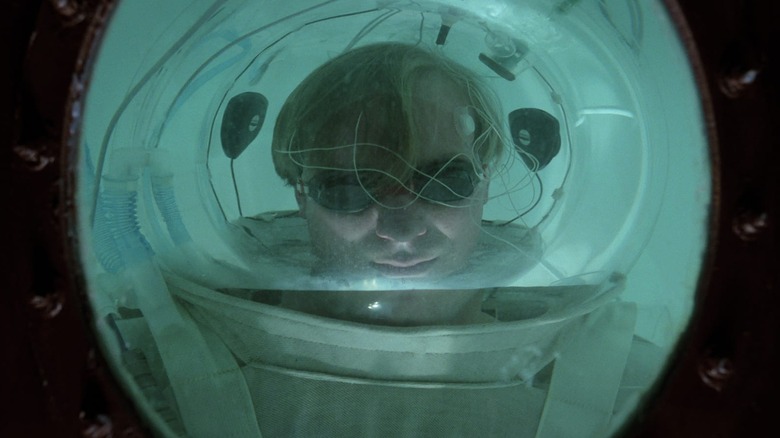
1. Altered States

Eddie in a suit in a sensory deprivation tank in

WARNER BROS

The surrealist sci-fi horror "Altered States" follows Harvard scientist and professor Edward Jessup (William Hurt) and his work with consciousness. With his personal life in shambles, he heads to Mexico to learn more about a hallucinogenic plant used by indigenous peoples, believing it could help with his research. However, his work takes a turn as he proceeds to keep using the substance, making himself his primary test subject. 

The underlying ideas of the story, and the Paddy Chayefsky book it's based on, are rooted in the work of neuroscientist John C. Lilly. While he's remembered for his work in studying brain activity, and is credited to be the first to create maps of pleasure and pain pathways, he dabbled in other fields as well, looking into dolphin communication and sensory deprivation.

"Altered States" takes inspiration from Lilly's work with the latter, specifically the flotation tank he invented and the use of mind-altering substances, notably ketamine and LSD. In the movie, Jessup both uses sensory deprivation tanks while studying states of consciousness and experiments with various hallucinogens. However, there are no accounts of individuals reverting into a previous species of human in Lilly's work, making that part of the film fictional.

2. Banshee Chapter

Anne screaming in

XLrator Media

Ann (Katia Winter) investigates the disappearance of friend and fellow journalist James (Michael McMillian) in "Banshee Chapter." He was researching Project MK-Ultra when he vanished, and Ann picks up where he left off, trying to follow his notes to figure out what happened to him.

While the sci-fi horror flick certainly takes some creative liberties, Project MK-Ultra was a real CIA operation. It was built on concerns that American prisoners overseas were being mind-controlled, so the CIA decided to do its own experiments on the topic. Over the span of two decades, the CIA researched electroshock therapy and mind-altering substances. Many participants were unaware that they were a part of a study. A project called Operation Midnight Climax used sex workers to gather individuals and give them LSD without their knowledge, creating an ethical issue regarding informed consent.

There are also conspiracy theories regarding the CIA's involvement in scientist Frank Olson's death in 1953. This was at the start of MK-Ultra, and Olson was given a cocktail containing LSD without his knowledge at a work retreat. He then died several days later. His death was originally ruled a suicide due to the circumstances. However, during the congressional investigation, it was found that his death was related to the experiment. Conspiracy theorists believe that the CIA planned his death to keep him quiet, similar to how James goes missing after using one of the substances they're testing.

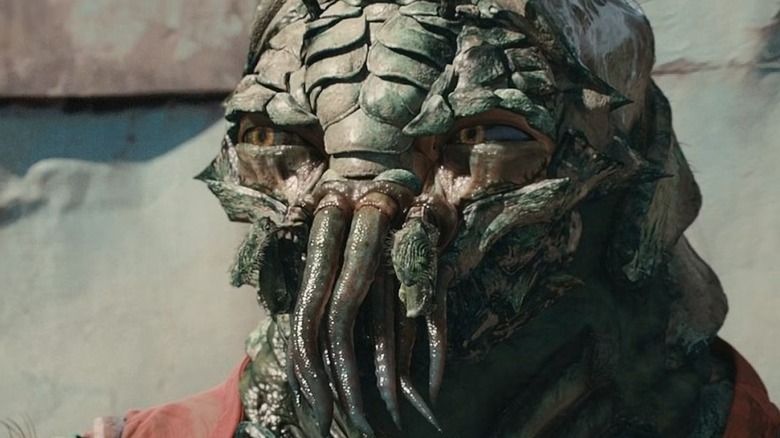
3. District 9

An alien in

TriStar Pictures/Sony Pictures Releasin

In Johannesburg, South Africa, a large spaceship brings aliens seeking refuge in the sci-fi action flick "District 9." While dynamics start off well, with the government giving the otherworldly creatures their own space, humans don't like them, and this results in rising tensions. In an effort to quell them, hired contractors come in to forcibly move the aliens elsewhere.

"District 9" is clearly inspired by the apartheid in South Africa. The name of the film itself is a reference to District Six, an area of Cape Town that experienced racial segregation during apartheid when it was declared that only white individuals could live in the municipality in 1966. This caused the forced relocation of the people of color living there. In Neill Blomkamp's movie, District 9 is where the aliens are initially sectioned off, but locals demand the relocation of aliens to a camp far from the city.

Blomkamp was raised in Johannesburg, and for him, the setting of the project was never a question. "In my opinion, the film doesn't exist without Jo'burg," The Guardian documents the director sharing with journalists in 2009. "It's not like I had a story, and then I was trying to pick a city. It's totally the other way around."

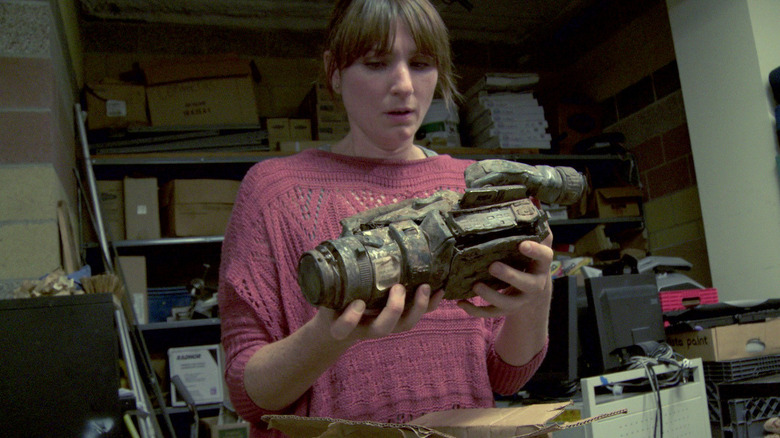
4. Phoenix Forgotten

Sophie holding a dirt-crusted camera in

Cinelou Films

"Phoenix Forgotten" follows a woman looking into her older brother's disappearance. He initially saw some strange lights in the sky during her sixth birthday party, and later went missing while searching for a UFO, which he believed to be the source of the lights. As an adult, she's now trying to better understand what he learned, eventually finding his tapes in a recovered school camera.

The found footage horror film is based on a 1997 incident that happened across Nevada and Arizona. Now referred to as the Phoenix Lights, on March 13, 1997, there were reports of a triangle-like light formation visible in the sky. These sightings began around 8:30pm and were reported for several hours. Based on the location of these sightings as they moved across the state, the source was moving quickly, with Phoenix New Times journalist Tony Ortega arguing that it could have been traveling as fast as "400 miles per hour."

The source has never been officially identified, with some suggesting it was a military training exercise from an air force base in Tucson, Arizona to the usual UFO theories that arise with incidents of this nature. "Phoenix Forgotten" leans into the latter, presenting the lights as evidence of alien activity in the southwest.

5. Safety Not Guaranteed

Kenneth frowning at Darius in

FilmDistrict

Aubrey Plaza's Darius Britt researches the individual behind an ad about time travel in "Safety Not Guaranteed." The man is serious, wanting to go back to 2001 to stop the death of someone he cares about. Darius gets close to him by pretending to be genuinely interested in going on the mission, but the situation continues to grow more confusing as she figures out he's probably lying about what happened in 2001.

This science fiction comedy is inspired by a real ad that appeared in a magazine in 1997. In the classified section of Backwoods Home Magazine, writer John Silveira included an ad asking for someone to time travel with. Written as a joke to fill in space in the section, Silveira discussed how the ad came to be in an article for Backwoods Home Magazine in 2010.

"In the early days of Backwoods Home Magazine, the publisher, Dave Duffy, used fillers when the classified ad pages came up short," he wrote. "He'd ask me to come up with jokes or riddles. I often did." The time travel ad was one of two Silveira wrote that appeared in the 1997 issue — the other was a girlfriend search. People across the world continue to respond to the former as it makes the rounds online. "Sometimes, the flow into my P.O. box is a mere trickle," the writer 

RELATED

15 MOST POWERFUL SCI-FI FILMS OF THE LAST 10 YEARS YOU MAY HAVE MISSED!

25 Sci-Fi Thrillers Everyone Forgot About… But They’re STILL AMAZING in 2026!

50 Greatest Sci-Fi Films of All Time

The Only Sci-Fi Movie List You'll Ever Need | TOP 20 Greatest Films Ranked

{ https://www.bgr.com/category/entertainment/ }

Hoe vind je dit bericht?
Geschreven door peter om 21:33 Stuur door

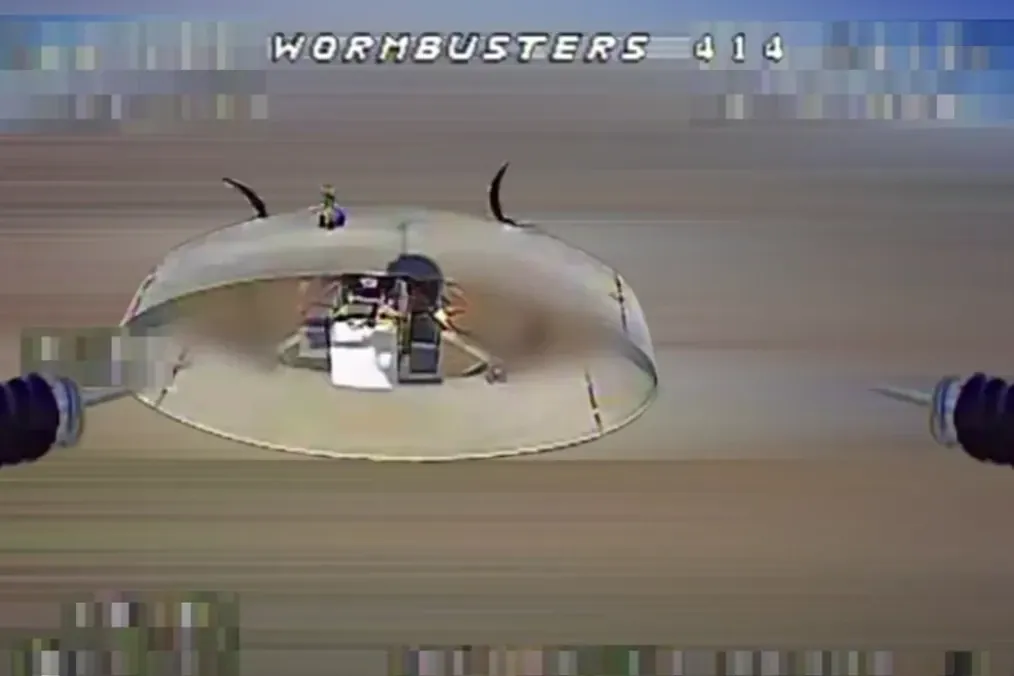
UFO or Russian Weapon? Ukraine Downs Mysterious Ring-Wing Strike Drone, Video

UFO or Russian Weapon? Ukraine Downs Mysterious Ring-Wing Strike Drone, Video

A Russian KVS strike drone with an unusual ring-shaped wing, filmed moments before being intercepted by Ukrainian operators of the 414th

A Russian KVS strike drone with an unusual ring-shaped wing, filmed moments before being intercepted by Ukrainian operators of the 414th "Birds of Magyar" Brigade. (Source: Birds of Magyar Brigade)

Ukrainian drone operators from the 414th "Birds of Magyar" Brigade downed an unusual Russian strike drone with a distinctive ring-shaped wing on October 8.

ArmyInform reported that Wormbusters pilots from the brigade intercepted the KVS, or "Knyaz Vladimir Svyatoslavich," and published footage of the engagement.

"What was that? Probably a UFO! It came out of nowhere... Oh, wait, it did fall," the brigade wrote in its post.

The KVS is a relatively new Russian strike drone developed by the Ushkuynik research and production center. The system uses a 10-inch frame and was designed for strikes at medium distances, according to data cited by ArmyInform.

Its defining feature is a ring-shaped wing surrounding the fuselage. The configuration is intended to combine vertical takeoff with more energy-efficient horizontal flight.

The KVS belongs to a broader family of Russian drones developed by Ushkuynik. The company also produced the "Knyaz Veshchiy Oleg" reconnaissance drone and the fiber-optic "Knyaz Vandal Novgorodskiy."

In April, Ukrainian intelligence disclosed that the reconnaissance model has a claimed range of up to 45 kilometers and endurance of up to 3.5 hours.

Earlier reports documented the destruction of other Russian drones developed by Ushkuynik. On February 18, Ukraine’s National Police reported that operators from the Dnipro-1 Regiment of the Liut United Assault Brigade had shot down a rare Knyaz Veshchiy Oleg reconnaissance drone.

The aircraft, used for deep reconnaissance and artillery fire correction, has a reported maximum speed of 130 km/h and an operational range of 45 kilometers. Another drone of the same model was destroyed by Ukraine’s 225th Separate Assault Regiment in January 2026.

RELATED


Russia's strange Ring Wing drone

Russia’s weirdest drone: Why the Ring Wing is back

{ https://united24media.com/war-in-ukraine }

Hoe vind je dit bericht?
Geschreven door peter om 21:01 Stuur door

Is Luis Elizondo becoming the government’s UFO megaphone?

Is Luis Elizondo becoming the government’s UFO megaphone?

Alienating UFO believers while hovering near the Pentagon.

A megaphone sounding off "UAP disclosure" in Washington DC.

A megaphone sounding off "UAP disclosure" in Washington DC.

Image by Cybernews.

Marcus WalshMarcus Walsh - Journalist
Key takeaways

Back on familiar turf


A sceptical reaction


elizondo reaction
UFO community reaction to Elizondo being hired. Screenshot from Reddit.
elizondo reaction2
UFO community reaction to Elizondo being hired. Screenshot from Reddit.
elizondo reaction3
UFO community reaction to Elizondo being hired. Screenshot from Reddit.

Luis Elizondo on Why the Government Stopped Using the Term "UFO"

{ https://cybernews.com/news/ }

Hoe vind je dit bericht?
Geschreven door peter om 20:45 Stuur door

Search for a hidden lava tunnel on the Moon

Search for a hidden lava tunnel on the Moon

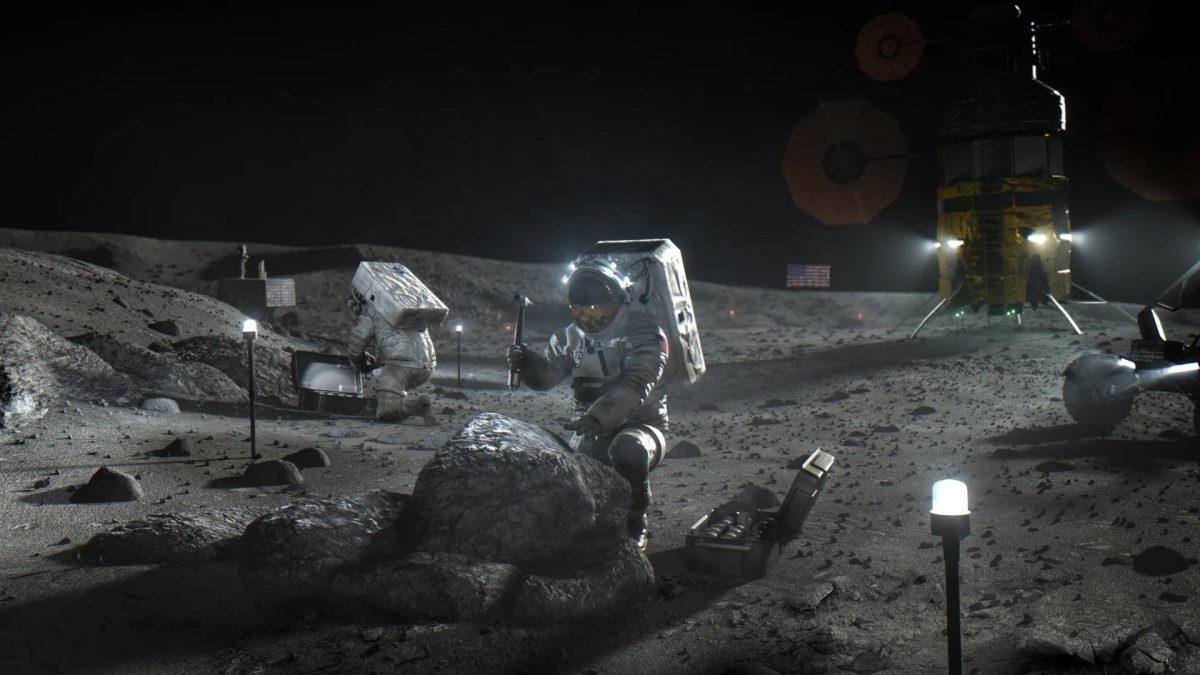
A collapse pit on the Moon’s near side may turn out to be an entrance to an ancient lava tube. NASA has selected a project whose team will investigate this directly from the surface. If a large cavity exists beneath the pit, it could provide natural shelter for astronauts.

Artist’s illustration of the Lunar Reconnaissance Orbiter above a lava tube in the Sea of Tranquility. Credit: NASA/JPL-Caltech

An Opening in the Roof of a Lava Tube

The Marius Hills pit was first spotted in 2009 in images taken by Japan’s Kaguya probe. According to later measurements from the Lunar Reconnaissance Orbiter, its opening measures between 49 and 57 meters across. It is approximately 44 meters deep from the rim and 51 meters deep from the surrounding plain.

Artist’s illustration of a lunar lava tube converted into a human settlement. Credit: Port San Antonio/XArc

Scientists consider such collapse pits to be openings in the roofs of lava tubes—underground channels through which molten rock once flowed beneath an already solidified crust. A NASA release emphasizes that the layer of rock above such a cavity would protect astronauts from radiation, micrometeoroids, and extreme temperature fluctuations.

Instruments for Subsurface Exploration

The Geophysical Investigation of the Marius Lunar Pit (GIMLI) instrument suite combines ground-penetrating radar, seismic sensors, a gravimeter, and cameras. Together, they will determine whether the pit extends into an underground cavity and, if so, how large it is.

Artist’s illustration of Artemis astronauts during a moonwalk. Credit: NASA

Project leader Nathaniel Putzig has long wanted to bring active seismic surveying, in which vibrations are deliberately generated in the ground, back into planetary science. Since the Apollo astronauts conducted the first seismic investigations on the Moon, this method has rarely been used beyond Earth.

According to the Planetary Science Institute, the seismic system, gravimeter, and cameras will be built by Honeybee Robotics, which is owned by Blue Origin. The Norwegian  Space Agency will provide the ground-penetrating radar.

A Name from the History of Astronomy

The Marius Hills lie in the Ocean of Storms and are among the Moon’s most diverse regions in terms of volcanic history. According to Universe Today, such lava tubes may have formed between 3.8 and 3 billion years ago, when the Moon was still geologically active.

Simon Marius

The region takes its name from the nearby Marius impact crater, named after the German astronomer Simon Marius. Between 1609 and 1610, Simon Marius discovered Jupiter’s four largest moons at almost the same time as Galileo Galilei. He proposed the names Io, Europa, Ganymede, and Callisto on the advice of Johannes Kepler.

Results Even Without a Cave

Even if no large cavity is found, the measurements will help explain how the collapse pit itself formed. Its walls expose layers of regolith and solidified lava that can reveal how lava flows spread and whether long pauses separated the eruptions.

The project was one of three selected by NASA under its PRISM program for lunar surface investigations. The launch date and budget have not yet been announced, nor has the company that will provide the lander and rover through the Commercial Lunar Payload Services (CLPS) initiative.

RELATED


Moon’s Hidden Lava Tunnels Discovered! 🌕🔥👇

NASA Images Reveal a Perfect Tunnel Hidden on the Moon - Who's Inside?

{ https://universemagazine.com/en/articles-en/ }

Hoe vind je dit bericht?
Geschreven door peter om 18:49 Stuur door

A 1,100-Mile-Long Cloud on Mars is Defying Physics—This Unexpected Discovery May Reveal Why

Credit: ESA/DLR/FU Berlin

A 1,100-Mile-Long Cloud on Mars is Defying Physics—This Unexpected Discovery May Reveal Why

Scientists investigating an enormous cloud that mysteriously appears over Mars each year have uncovered evidence of an exotic physical process never before identified in a planetary atmosphere.

The new research on the Arsia Mons Elongated Cloud (AMEC) was published in a recent Nature Geoscience paper, offering new insight into one of the Red Planet’s most striking features and what strange physics may lurk on distant exoplanets.

AMEC forms every year in Mars’s southern hemisphere, during the spring and summer dust season, consisting of water ice suspended in the air near the Arsia Mons volcano. During its seasonal appearance, the cloud can stretch up to 1,800 kilometers long, forming in the early morning before dissipating later in the day. This cycle repeats over several months.

Exploring Mars’s AMEC

The Martian cloud has intrigued researchers since its discovery in 2018. Previous work has explored AMEC’s behavior, evolution, and dynamics, identifying it as an orographic cloud that forms around mountains and volcanoes on Earth.

Despite years of investigation, this is the first time researchers have produced a model that closely matches observations of AMEC formation and behavior.

“To create the AMEC in our modelling, we found that we needed to include some exotic physics… physics that, while included in textbooks, is treated as theoretical and usually thought not to happen in nature. It certainly hasn’t been seen in action before,” said lead author Jorge Hernández-Bernal of LMD/CNRS/Sorbonne Université in Paris, France. “Once we included this physics in our simulations, the AMEC emerged just as we hoped.”

Cloud Formation on Mars

Scientists generally expect the fundamental processes governing cloud formation to be similar on Earth and Mars. As moist air cools, water vapor condenses into droplets or freezes into ice crystals, which remain suspended in the atmosphere to form clouds. Typically, those droplets and crystals require a nucleus, such as particles of salt, pollen, or dust, around which to form. Given Mars’s dusty surface conditions, scientists have long assumed Martian clouds form around suspended dust particles.

“For the AMEC, it seems that cloud formation takes place without needing any of this ‘stuff’,” adds Jorge. “Water vapour turns directly into icy cloud particles without any middle step. It’s akin to droplets of condensation appearing in the middle of a room, rather than on a window. We call this homogeneous nucleation, and we’ve never seen it before in a planetary atmosphere. It’s wholly unexpected.”

Such a process had previously been theorized as possible on Venus or in Earth’s upper atmosphere. For it to occur, however, conditions would have to be highly unusual, with water vapor reaching extreme levels of supersaturation. Scientists therefore suspected it would be an exceptionally rare occurrence, if it occurred at all. Before this research, such a cloud-forming process had not been identified in a planetary atmosphere.

“We’ve not seen these conditions on Mars before, but our finding now strongly suggests that the planet’s humidity can indeed reach these extreme levels,” says Jorge.

Explaining AMEC and Exoplanet Outlook

According to the researchers, a combination of Arsia Mons’s height and the thin Martian atmosphere creates unique conditions conducive to this type of cloud formation. As winds push past the roughly 12-mile-high volcano, they lift pockets of moist air to unusually high altitudes. The rapid ascent cools the air by about 30°C in approximately 10 minutes, while relative humidity climbs sharply, allowing ice crystals to form spontaneously.

Although the model closely reproduces the cloud’s behavior, further work remains to achieve an exact match with observations. Nevertheless, the team considers the findings a major advance, particularly given that scientists have far less observational data on the Martian atmosphere than on Earth’s.

  • misinformation

“Mars Express can also track how the cloud is changing on timescales of mere hours, which gives us an unrivalled view of short-lived phenomena on the planet,” says ESA Mars Express Project Scientist Colin Wilson. “Overall, this finding is a true accomplishment for the mission and its scientists: Mars Express discovered the AMEC, has followed up and monitored it for years, and is now helping reveal the secrets of its formation.”

The team’s biggest takeaway is that atmospheric processes on other planets may behave quite differently from those commonly observed on Earth, potentially requiring unusual physical conditions to explain their behavior.

“While clouds on Earth and Mars seem to be governed by the same ‘rules’, Wilson concluded, “understanding this exotic Martian cloud required exotic physics – and this may be true elsewhere in the cosmos.”

RELATED


Is Mars Hiding a Never-Before-Seen Form of Cloud Physics?

Clouds on Mars: This 1,800 km Cloud May Form Without Dust, Study Finds

{ https://thedebrief.org/category/space/ }

Hoe vind je dit bericht?
Geschreven door peter om 18:30 Stuur door

Forget stone tools! Neanderthals were master woodworkers who crafted spears, trays and even tripods, scientists discover

Forget stone tools! Neanderthals were master woodworkers who crafted spears, trays and even tripods, scientists discover

Neanderthals might be famous for their use of sophisticated stone tools, but new evidence suggests that they were also accomplished carpenters.

Archaeologists investigating the site of Abric Romaní in Spain discovered evidence of wooden tools, structures, and woodworking dating from 40,000 to 62,000 years ago.

The researchers uncovered the imprints and charred remains of 13 objects ranging from spears and a club to trays and tripods.

It appears that Neanderthals even specifically sought out different types of wood for different applications, displaying a surprising level of technical know-how.

A collection of small trays, for example, were shaped from the flexible bark of the juniper tree – perfect for lightweight, flexible equipment.

Meanwhile, the Neanderthal carpenters sought out Scots pine for their harder-wearing tools, selecting a wood which is 'relatively compact and resistant, yet easy to work with'.

In their paper, published in Science Advances, the researchers say that this small collection of artefacts shows 'a remarkable technological versatility and the diversified exploitation of wood as a raw material'.

Archaeologists have uncovered wooden tools created by Neanderthals, including a club that could have been used as a weapon in war or hunting. Pictured: The preserved impression of a club in the ground and a model of what it would have looked like

Archaeologists have uncovered wooden tools created by Neanderthals, including a club that could have been used as a weapon in war or hunting. Pictured: The preserved impression of a club in the ground and a model of what it would have looked like

The remains of wooden tools were found in the Abric Romaní, an enormous sheltered area covering more than 300 metres squared, where our ancient relatives once took shelter

The remains of wooden tools were found in the Abric Romaní, an enormous sheltered area covering more than 300 metres squared, where our ancient relatives once took shelter

Researchers also discovered trays, expertly shaped from the light, flexible bark of mulbury trees (pictured)

Researchers also discovered trays, expertly shaped from the light, flexible bark of mulbury trees

(pictured) 

The Abric Romaní is an important archaeological site tucked beneath a dense limestone cliff known as Cinglera del Capelló.

It comprises an enormous sheltered area covering more than 300m squared, where our ancient relatives once took refuge.

In the Middle Palaeolithic period, 300,000 to 30,000 years ago, the site was a vital corridor connecting inland Catalonia with the coast, attracting both Neanderthals and early Homo sapiens.

Excavations began in 1983, but what makes this site so important is the fact that it is one of the few places to preserve evidence of ancient woodwork.

Scientists have observed that even our distant primate relatives, such as chimpanzees, are capable of using simple wooden tools to crack nuts or catch ants.

This means that the evolution of wooden technology likely plays an extremely important role in the development of human society.

However, unlike stone tools which can survive for millennia, wood rapidly breaks down and decays, making evidence extremely rare.

Luckily, at Abric Romaní, researchers have found charred remains preserved by carbonisation and imprints preserved by a process called travertine incrustation.

The wooden works were mainly found as impressions in the surrounding ground, preserved through a process called travertine incrustation

The wooden works were mainly found as impressions in the surrounding ground, preserved through a process called travertine incrustation

Archaeologists say that Neanderthals could have used the club and wooden spear to hunt down animals such as deer and horses (artist's impression)

Archaeologists say that Neanderthals could have used the club and wooden spear to hunt down animals such as deer and horses

(artist's impression) 

This is a process by which calcium carbonate from the surrounding rock builds up in a layer around the wooden artefact as it slowly decays.

This leaves an impression on the rock which can preserve fine details, even down to the cellular level.

Using these remains, archaeologists have found extensive evidence of Neanderthal woodwork at the site, spanning a period of 22,000 years.

Some of the simplest are a collection of wooden trays crafted from bark that have been preserved in a carbonised state.

The researcher suggests that these may have 'functioned as containers for transporting food or as scoops or ladles, perhaps for collecting embers or ashes'.

The excavations have also revealed a collection of pointed sticks that appear to bear the marks of deliberate shaping.

These sticks could have been used as spears for hunting, fishing and warfare, or as simple tools for digging holes.

However, the archaeologists also uncovered evidence of more elaborate woodwork, including structural features.

In one part of the site, researchers found fragments of three sticks, each over a metre in length, that likely came together to form an elevated structure or tripod that could have been used in food processing.

In another, the team found a 16.7-feet-long (5.1m) tree that had been stripped of its branches, apparently intended to function as a 'structural element and as part of a resting area'.

Neanderthals also appear to have carved large pieces of wood to create structures, either for shelter or to help with processing food

Neanderthals also appear to have carved large pieces of wood to create structures, either for shelter or to help with processing food 

But the most advanced object of all is a unique wooden club carved from a single piece of wood.

Shaped almost like a kitchen knife, the club features a clear handle and head section that show a 'deliberate and technically controlled shaping process'.

The handle is wider towards the bottom end, making it more secure in the hand during a swing, and there is a sharp transition between handle and head which would have stopped the hand from slipping on impact.

Likewise, the 'blade' section is carefully tapered to a point to form a working point.

Wooden Neanderthal clubs like this are astonishingly rare, with only one other possible example dating from around 400,000 years ago, making it hard to determine what it was used for.

However, the researchers say that its shape suggests it might have been used as a weapon against other Neanderthals or for 'dispatching' animals like deer and horses.

So, although they might have lived in the Stone Age, the researchers say Neanderthals' craftwork may have been a lot more diverse than you would expect.

The researchers conclude: 'Beyond their deftness with stone, Neanderthals had a remarkable ability to work with organic materials such as bone, shell, fiber, and wood.'

RELATED


Neanderthals Weren't Supposed to Do This | Documentary

Neanderthals Were Physically Superior to Us — So What Actually Caused Their Extinction?

NEANDERTHAL TECHNIQUE - THE SECRET OF A MASTER TOOL

{ https://www.dailymail.com/sciencetech/index.html }

Hoe vind je dit bericht?
Geschreven door peter om 16:50 Stuur door

EXCLUSIVE - Scholars hail 2,000-year-old burial chest as first 'direct connection' to Jesus: Extraordinary etching clues after owner acquitted of forgery... as DNA tests begin on ancient bones

EXCLUSIVE - Scholars hail 2,000-year-old burial chest as first 'direct connection' to Jesus: Extraordinary etching clues after owner acquitted of forgery... as DNA tests begin on ancient bones

Some deem it 'the most significant item ever found' from the time of Christ.

The 2,000-year-old limestone chest, known as the James ossuary, measures roughly one foot nine inches long and ten inches wide and bears the inscription 'James, son of Joseph, brother of Jesus,' written in ancient Aramaic. Bone fragments have been recovered from inside the box.

But the inscription has been at the center of a decades-long forgery controversy. In 2003, the Israel Antiquities Authority (IAA) declared it a modern forgery carved into a genuine ancient burial box.

Its owner, Israeli collector Oded Golan, who says he acquired the box in the 1970s, was accused of adding the words 'brother of Jesus.' He was acquitted of forgery in 2012, although the judge stressed that the verdict did not establish the inscription's authenticity or its connection to the biblical Jesus.

Biblical scholar Dr Jeremiah Johnston, however, points to the acquittal and the support of leading experts in ancient inscriptions as evidence of its authenticity. 

Johnston also rejects the suggestion that a Christian added the words centuries later, arguing that the practice of collecting bones in burial boxes had disappeared from Jerusalem after AD 70. 

He and a team of experts plan to conduct a DNA analysis on the bone fragments in 2027.

'If it is truly his, we are looking at the only known archaeological artifact directly connected to the family of Jesus of Nazareth,' Johnston told the Daily Mail. 

A stunning 2,000-year-old ossuary could be the first link to Jesus' family

A stunning 2,000-year-old ossuary could be the first link to Jesus' family

The limestone burial chest is engraved with 'James, son of Joseph, brother of Jesus'

The limestone burial chest is engraved with 'James, son of Joseph, brother of Jesus'

Golan reportedly found the ossuary in an antiquities shop in Silwan, just outside Jerusalem's Old City, near the Siloam Spring.

He paid $200 for it, and years later had one of the world's leading experts on ancient Hebrew and Aramaic script, André Lemaire, analyze the limestone box.

'Its inscription read Ya'akov bar Yosef, akhui di Yeshua: "James, son of Joseph, brother of Jesus,"' Johnston wrote in his book The Jesus Discoveries. 

'Oded had always assumed it named three generations of one family. Lemaire reminded him that Jesus of Nazareth had a brother named James.'

Johnston, who has a PhD from Middlesex University in the UK and studied the James ossuary extensively, explained that the box fits a burial custom practiced in first-century Jerusalem: Families placed the deceased in a tomb, then returned about a year later to collect the bones and transfer them into a limestone ossuary.

James, Joseph and Jesus were all common names at the time. But Johnston argued that naming a brother makes this inscription particularly significant.

Of roughly 900 ossuaries in the catalog he cites, only about a quarter carry inscriptions, and Johnston said just one other names a brother. He believes the unusual addition suggests that the brother was a prominent figure.

Johnston also pointed to the first-century Jewish historian Josephus, who recorded the stoning of James, identified as 'the brother of Jesus who was called the Christ,' in AD 62.

According to the Bible, Jesus' brother, James, did not believe he was the Messiah throughout their lives

According to the Bible, Jesus' brother, James, did not believe he was the Messiah throughout their lives

Some experts believe 'brother of Jesus' was added later as a forgery

Some experts believe 'brother of Jesus' was added later as a forgery

Dr Jeremiah Johnston and a team of experts plan to conduct a DNA analysis on the bone fragments recovered from the ossuary

Dr Jeremiah Johnston and a team of experts plan to conduct a DNA analysis on the bone fragments recovered from the ossuary

'If James died in AD 62, custom says his bones were gathered about a year later, around AD 63,' Johnston said. 'That is precisely the window the ossuary’s style and epigraphy point to.'

Early examinations by two Geological Survey of Israel researchers supported the case for authenticity. 

However, the agency later endorsed findings that the mineral coating inside the inscription could not have formed under the region's natural conditions, highlighting the scientific disagreement.

The ossuary went on public display in 2002, attracting international attention and scrutiny from the IAA.

Golan was subsequently accused of adding 'brother of Jesus' to an ancient inscription reading 'James, son of Joseph,' and applying a coating to make the new lettering appear old.

'What followed was one of the most unusual trials in the history of archaeology,' Johnston said.

Experts challenged the forgery allegations, including the respected scholar of ancient handwriting Ada Yardeni, whom Johnston said defended the inscription’s authenticity in court.

A 1976 family photograph showing the box and its disputed inscription also became part of Golan’s defense. A photographic expert testified that the paper and fading were consistent with its age and found no evidence of tampering.

When Golan was acquitted of forgery the judge said that the verdict did not establish the inscription's authenticity.

Johnston nevertheless believes the evidence makes a compelling case.

'So where do I land? Exactly where honest history always lands: not absolute certainty, but historical probability,' he said.

The Daily Mail has contacted IAA for comment. 

RELATED


Scientists Opened A 2,000 Year Old Jewish Tomb — The DNA Told A Different Story

This 2,000-Year-Old Tomb Reveals Exactly How Jesus Was Buried

AI Just Read 2,000-Year-Old Herculaneum Scrolls Without Opening Them — And What It Revealed Was....

{ https://www.dailymail.com/sciencetech/index.html }

Hoe vind je dit bericht?
Geschreven door peter om 16:31 Stuur door

Mysterious NASA Mars photo fuels wild claim of a lost civilization on the Red Planet

Mysterious NASA Mars photo fuels wild claim of a lost civilization on the Red Planet

NASA's Perseverance rover is currently searching for ancient signs of life on Mars.

But an image from the robot's camera has led some viewers to believe it uncovered evidence of a lost civilization.

UFO researcher Scott C Waring shared the photo online, showing a stunning view of the Mars landscape littered with large boulders.

In the distance, however, one formation Waring believes is an ancient gateway left by a lost civilization.

Sharing a close-up of the site, he circled the feature resembling a tall, narrow doorway in the face of a jagged rock, with a dark center, tapered top and uneven stone edges giving it the appearance of a ‘portal' - as he wrote on the image.

'I found some ancient runes in a Mars photo today,' Waring shared on his website UFO Sightings Daily.

He also claimed to have found another formation supporting his claim about a lost civilization on the Red Planet. 

'A tiny doorway that measures about 7 inches high and 5 inches wide and enters a pyramid-shaped object,' Waring wrote.

An image from NASA's Perseverance rover has led some viewers to believe it uncovered evidence of a lost civilization

An image from NASA's Perseverance rover has led some viewers to believe it uncovered evidence of a lost civilization

UFO researcher Scott Waring shared the photo online, showing a stunning view of the Mars landscape littered with large boulders, and pointed to what he said was a portal

UFO researcher Scott Waring shared the photo online, showing a stunning view of the Mars landscape littered with large boulders, and pointed to what he said was a portal

While the formations resemble the structures Waring proposed, NASA has long maintained there is no evidence of extraterrestrial life. 

The mosaic shows boulders inside Jezero Crater, where NASA’s Perseverance rover was exploring in June 2021 using its Mastcam-Z cameras. 

It is labeled Sol 107, referring to the 107th Martian day of the mission. 

Jezero once held a lake billions of years ago, making it a key location in the search for signs of ancient microbial life. 

Waring's UFO Sightings Daily website features a range of NASA images he claims show proof of alien life.

In August, he posted a photo snapped by NASA's Curiosity rover on Mars in May 2022, which Waring and many others were sure contained a doorway.

The photograph appears to show a dark, rectangular opening cut into a rocky hill, which some observers have compared to the doorway of a primitive dwelling.

‘The entrance is approximately 6.6 feet tall and 3.3 feet wide, about the size of a doorway in an Earth home,’ Waring said.

He also included a shot of what he believes is a doorway among the rocks

He also included a shot of what he believes is a doorway among the rocks

He questioned why the rover did not approach the feature and speculated that NASA may have already investigated it without releasing the results publicly.

Waring did not explain how he calculated the alleged doorway’s dimensions or provide evidence that the space agency conducted a secret investigation.

Its actual size cannot be reliably determined from the panorama alone without knowing its precise distance from Curiosity or identifying a nearby object that could provide scale.

In August, Waring posted a photo snapped by NASA's Curiosity rover on Mars in May 2022, which Waring and many others were sure contained a doorway

In August, Waring posted a photo snapped by NASA's Curiosity rover on Mars in May 2022, which Waring and many others were sure contained a doorway 

The apparent entrance could therefore be significantly smaller, or larger, than Waring’s estimate.

NASA has not commented on the latest claim, but the agency addressed remarkably similar speculation after Curiosity photographed another door-shaped feature on Mars in May 2022.

That opening initially appeared large enough for a person to walk through, fueling theories that it was evidence of an artificial structure hidden within Mount Sharp.

Closer analysis revealed that it measured only approximately 12 inches tall and 16 inches wide, roughly the size of a dog door.

‘The mound, on Mount Sharp, has a number of naturally occurring open fractures,’ NASA explained at the time. ‘These kinds of open fractures are common in bedrock, both on Earth and on Mars.’

Scientists determined that the earlier ‘doorway’ was a small opening created where intersecting fractures caused pieces of rock to break away. 

RELATED


NASA shares insane NEW FOOTAGE of Mars. This is 140 million miles away from us! #mars

​MARS: The Hidden War That Wiped Out Life! ☄️👽 (Is humanity next?)

Mysteries on Mars | NASA's Unexplained Files | Science Channel

{ https://www.dailymail.com/sciencetech/index.html  }

Hoe vind je dit bericht?
Geschreven door peter om 16:08 Stuur door

The Sphinx’s secret: Egyptian monument was built from rocks filled with the hidden fossils of ancient crocodiles, scientists discover

The Sphinx’s secret: Egyptian monument was built from rocks filled with the hidden fossils of ancient crocodiles, scientists discover

The Sphinx is one of ancient Egypt's most enigmatic monuments, and now scientists have found that it could be hiding a very unusual secret.

According to new research, the legendary half-human-half-lion was built from rocks filled with the hidden fossils of ancient crocodiles.

Scientists discovered a new species of extinct crocodile in the rocks of the Mokattam Formation in northern Egypt, which are 54million years old.

This ancient predator has been dubbed Herugavialis cairensis, after the ancient Egyptian god Heru, which the Sphinx is believed to depict.

The fossil crocodile was found in the very same limestone rocks that had been quarried over 4,000 years ago to construct the legendary Great Sphinx of Giza.

And the scientists even think that the Sphinx itself might now contain fossils of these long-extinct crocs.

Lead author Dr Paul Burke, of the Swedish Museum of Natural History, told the Daily Mail: 'It could! It was built from the same rocks where Herugavialis was found, so who knows.

'What I don’t recommend is tearing apart the Sphinx to see if there is!'

According to new research, the Great Sphinx of Giza was built using rocks filled with the fossilised remains of ancient crocodiles

According to new research, the Great Sphinx of Giza was built using rocks filled with the fossilised remains of ancient crocodiles 

Scientists discovered a new species of extinct crocodile in the 54-million-year-old rocks of the Mokattam Formation in Egypt that were used to make the Sphinx, naming it Herugavialis cairensis (artist's impression)

Scientists discovered a new species of extinct crocodile in the 54-million-year-old rocks of the Mokattam Formation in Egypt that were used to make the Sphinx, naming it Herugavialis cairensis (artist's impression)

Co-author Professor Philip Mannion, of University College London, says: 'Given this coincidence with the famously missing nose of the Great Sphinx, we decided to name the new crocodile after the Egyptian god Heru, who was possibly the inspiration for this iconic monument.'

Herugavialis is a member of the gavial family, a group of crocodiles characterised by their long, thin snouts.

Today, there are only two living species, which are found in freshwater environments across the Indian subcontinent and Southeast Asia.

The fossilised skull of Herugavialis was actually discovered all the way back in the 1920s, during excavations on the Mokattam Formation.

However, scientists initially thought that the skull belonged to the 'false gharial', or Tomistoma schlegelii, one of the living species of gavials.

But today, analytical advances in palaeontology, including the use of CT scanning to look inside the skull, have allowed researchers to find key differences between the false gharial and the ancient fossil.

That meant the skull was from an entirely new, previously undiscovered species of extinct crocodile, described in a paper published in Royal Society Open Science. 

And, just like the Sphinx is famously missing its nose, the fossilised skull is missing the tip of its snout.

Scientists say that the Sphinx itself might contain more fossils of Herugavialis cairensis (artist's impression), but don't recommend taking it apart to find them

Scientists say that the Sphinx itself might contain more fossils of Herugavialis cairensis (artist's impression), but don't recommend taking it apart to find them

Just as the Great Sphinx is famously missing its nose, the fossilised skull of this ancient predator is missing the tip of its snout

Just as the Great Sphinx is famously missing its nose, the fossilised skull of this ancient predator is missing the tip of its snout 

Even though that part of the fossil is slightly damaged, this distinctive skull shape gives palaeontologists a clue as to how the animal might have once lived.

Dr Burke says: 'Herugavialis has a long, thin snout with razor-sharp, pointed teeth, similar to the extant Indian gharial, Gavialis.

'The Indian gharial feeds primarily on fish, so we think that Herugavialis did the same. In addition, the Mokattam Formation where Herugavialis was recovered from, also preserves plenty of fish fossils, so we assume they fed on these species.'

While the gavials have now vanished from the Mediterranean, the fossil records show that these aquatic hunters once spanned nearly the entire globe for more than 100million years, with many living in shallow marine habitats.

In fact, scientists think that Herugavialis would have once shared its home with at least two other species of long-snouted gavials.

Dr Paul Burke, of the Swedish Museum of Natural History, says: 'Throughout much of the last 50million years, the Mediterranean region hosted a high diversity of crocodiles, including gavials.

'However, this diversity fluctuated over time, seemingly corresponding to changes in global temperature and sea level, before the loss of all crocodiles in this region as a result of the drying of the Mediterranean approximately six million years ago.'

RELATED


What Archaeologists Found Near the Sphinx Changes Everything

Ancient Egypt’s Biggest Secret: The Sphinx Underground Mystery | HistoryVanta.
The Sphinx Mystery: Everything That Doesn’t Add Up in the Official Story

{ https://www.dailymail.com/sciencetech/index.html }

Hoe vind je dit bericht?
Geschreven door peter om 15:46 Stuur door

Mars mystery solved: Scientists reveal the secret behind ‘impossible’ giant cloud that appears and vanishes every day

Mars mystery solved: Scientists reveal the secret behind ‘impossible’ giant cloud that appears and vanishes every day

Scientists have finally solved one of Mars's most perplexing mysteries: the puzzle of an 'impossible' giant cloud.

Every day during spring and autumn, a vast trail of frozen water vapour emerges downwind of the Red Planet's 12.5-mile-tall (20km) Arsia Mons volcano.

The cloud forms, grows, and fades on a daily basis, reaching an astonishing length of 1,120 miles (1,800km) – nearly twice the length of the UK – before vanishing just as fast.

Known as the Arsia Mons Elongated Cloud (AMEC), this seemingly impossible behaviour has baffled scientists since it was first spotted in 2018.

Now, experts say this bizarre formation may be due to some very 'exotic' physics.

Lead author Dr Jorge Hernández-Bernal, of Sorbonne University, says: 'To create the AMEC in our modelling, we found that we needed to include some exotic physics… physics that, while included in textbooks, is treated as theoretical and usually thought not to happen in nature.

'Once we included this physics in our simulations, the AMEC emerged just as we hoped.'

Scientists have finally solved the mystery of a giant cloud which forms every day downwind of Mars' 12.5-mile-tall (20km) Arsia Mons volcano

Scientists have finally solved the mystery of a giant cloud which forms every day downwind of Mars' 12.5-mile-tall (20km) Arsia Mons volcano

The cloud forms, grows, and fades on a daily basis, reaching an astonishing length of 1,120 miles (1,800km) before vanishing just as fast

The cloud forms, grows, and fades on a daily basis, reaching an astonishing length of 1,120 miles (1,800km) before vanishing just as fast

Scientists now believe the cloud forms due to a piece of 'exotic' physics known as homogeneous nucleation, which allows water droplets to condense without any particles to form around

Scientists now believe the cloud forms due to a piece of 'exotic' physics known as homogeneous nucleation, which allows water droplets to condense without any particles to form around 

Scientists have a solid understanding of Mars' atmosphere and about the processes which form clouds, but AMEC stands out as exceptionally odd.

Dr Hernández-Bernal told the Daily Mail: 'What made it difficult to understand is that it seems to form the long tail by expansion from the origin point next to Arsia Mons, but given its high altitude it cannot be the result of the transport of water from the surface.

'Variations of temperature need to be the main driver, but in such a case we would usually expect the cloud to disappear when temperatures rise again after the starting point next to Arsia Mons.'

Likewise, when scientists tried to recreate the AMEC in a computer simulation, they couldn't get it to match the real-life observations made by the European Space Agency’s Mars Express orbiter.

On Earth, clouds form through a process known as heterogeneous nucleation, which involves water vapour condensing around a little speck of material in the atmosphere.

This could be a piece of pollen, a grain of salt, soot or, in the case of Mars, dust swept up from deserts below.

But that doesn't seem to be the case with the massive cloud that forms daily around Arsia Mons.

Instead, in a paper published in Nature Geoscience, scientists suggest that droplets in the AMEC condense without any particles at all to form around.

Dr Hernández-Bernal says: 'Water vapour turns directly into icy cloud particles without any middle step. It’s akin to droplets of condensation appearing in the middle of a room, rather than on a window.

'We call this homogeneous nucleation, and we’ve never seen it before in a planetary atmosphere. It’s wholly unexpected.'

Some scientists have previously suggested that this process might happen in the very upper reaches of the atmosphere on Earth and Venus, but it's never been observed.

The researchers now believe that the unique combination of Mars' thin atmosphere and the incredible height of Arsia Mons combine to create the rare conditions needed for this exotic cloud formation

The researchers now believe that the unique combination of Mars' thin atmosphere and the incredible height of Arsia Mons combine to create the rare conditions needed for this exotic cloud formation

As the wind blows over Arsia Mons, it creates a powerful wave that drags moist air up very quickly. That causes the temperature to drop and the relative humidity to increase, leading to homogeneous nucleation

As the wind blows over Arsia Mons, it creates a powerful wave that drags moist air up very quickly. That causes the temperature to drop and the relative humidity to increase, leading to homogeneous nucleation 

That's because homogeneous nucleation requires extremely specific conditions with extreme levels of humidity.

'In our daily lives it is uncommon to have relative humidities higher than 100 per cent, but we need around 100,000 times that for homogeneous nucleation to occur,' says Dr Hernández-Bernal.

Yet, however unusual it may be, once the scientists added this process into the simulation, their model started producing results that matched the real AMEC.

The researchers now believe that the unique combination of Mars' thin atmosphere and the incredible height of Arsia Mons combine to create the rare conditions needed for this exotic cloud formation.

As the wind flows past Arsia Mons, the bulk of the volcano creates a powerful wave that yanks parcels of moist air several miles into the sky within a few minutes.

That process rapidly cools the atmosphere, causing temperatures to drop by 30°C (54°F) in just 10 minutes and humidity levels to spike.

Those conditions allow water vapour to freeze directly into cloud particles, creating the enormous structure we can see from orbit as the AMEC.

Even though some details of the model don't exactly match the real cloud, the researchers say that the results are 'remarkable'.

Since we don't know as much about Mars' atmosphere as we do about Earth, even getting close to reality with a computer model suggests the researchers are on the right track.

And, if homogeneous nucleation really is going on in the Martian atmosphere, it might mean the Red Planet is a far stranger place than scientists had previously thought.

Dr Hernández-Bernal says: 'We’ve not seen these conditions on Mars before, but our finding now strongly suggests that the planet’s humidity can indeed reach these extreme levels.'

MARS: THE BASICS

Mars is the fourth planet from the sun, with a 'near-dead' dusty, cold, desert world with a very thin atmosphere. 

Mars is also a dynamic planet with seasons, polar ice caps, canyons, extinct volcanoes, and evidence that it was even more active in the past. 

It is one of the most explored planets in the solar system and the only planet humans have sent rovers to explore.

One day on Mars takes a little over 24 hours and a year is 687 Earth days.

Facts and Figures 

  • Orbital period: 687 days
  • Surface area: 55.91 million mi²
  • Distance from Sun: 145 million miles
  • Gravity: 3.721 m/s²
  • Radius: 2,106 miles
  • Moons: Phobos, Deimos
RELATED

Something Strange Is Forming Above Mars… Scientists Didn’t Expect This 😨

Cloud on Mars Finally Explained by Scientists | WION Podcast

{ https://www.dailymail.com/sciencetech/index.html }

Hoe vind je dit bericht?
Geschreven door peter om 14:29 Stuur door

‘Earth is almost entirely in the red’: Scientists warn ‘super-duper’ El Niño is still intensifying – and could continue into spring next year

‘Earth is almost entirely in the red’: Scientists warn ‘super-duper’ El Niño is still intensifying – and could continue into spring next year

Super El Niño is continuing to intensify, scientists have warned, with new forecasts suggesting the climate phenomenon could maintain its grip on global weather well into next year.

Experts say the event is now pushing into unprecedented territory, with vast swathes of the planet forecast to experience unusually warm conditions as the Pacific Ocean releases enormous amounts of stored heat.

The latest update from the World Meteorological Organization (WMO) predicts that El Niño will continue strengthening ahead of a forecasted peak in December.

Scientists say the powerful climate pattern is likely to influence temperatures and rainfall across much of the world in the coming months.

Britons have already been warned to expect large storms this autumn and winter, with the Department for Environment, Food and Rural Affairs urging people last month: 'If you've got a store of a bit of food that can keep you going for a while before the emergency services can get to you, you're going to be a lot better off than if you haven't.'  

The latest warning comes as meteorologists share striking maps showing large areas of the globe shaded red, indicating a heightened likelihood of above-average temperatures.

This map suggest Earth's climate engine is running hot, with unusually warm conditions forecast across much of the globe during the coming months as the powerful El Niño gathers strength. Pictured: The probability of above-average temperatures in November

This map suggest Earth's climate engine is running hot, with unusually warm conditions forecast across much of the globe during the coming months as the powerful El Niño gathers strength. Pictured: The probability of above-average temperatures in November

Forecasters expect Super El Niño to peak in December and remain strong into the spring of next year

Forecasters expect Super El Niño to peak in December and remain strong into the spring of next year

According to the WMO, there is a near-100 per cent chance that El Niño will persist through February next year.

US meteorologist Ryan Maue described the outlook in a post on X, writing: ‘New maps show Earth almost entirely in the red.

‘El Niño continues at 'maximum power' into the winter with planetary heating dialled up everywhere except the United States.’

The agency says the event could rank among the strongest observed since at least 1950.

WMO Secretary-General Celeste Saulo said: ‘El Niño is firmly established and strengthening rapidly.’

She explained that El Niño does not create new heat but instead releases heat that has accumulated beneath the ocean surface.

‘The ocean it's drawing from is the warmest we've ever measured it,’ Professor Saulo said. ‘There is simply more heat available to release.’

The widely used Niño 3.4 index rose from 1.6°C above normal in June to 2.5°C above normal in August, highlighting the rapid strengthening of the event.

WMO forecasts suggest the October-to-December average anomaly could reach about 3.7°C, with conditions peaking around December.

Experts say the event is now pushing into unprecedented territory, with vast swathes of the planet forecast to experience unusually warm conditions

Experts say the event is now pushing into unprecedented territory, with vast swathes of the planet forecast to experience unusually warm conditions

Scientists have warned that this year's 'Super El Niño' has already smashed historical temperature records, months before reaching its peak

Scientists have warned that this year's 'Super El Niño' has already smashed historical temperature records, months before reaching its peak

Climate scientist Zeke Hausfather said: ‘This year's El Niño continues its climb into uncharted waters.

‘Niño 3.4 region anomalies are now at 3.4°C above normal, higher than any prior El Niño event on record.'

Climate and energy researcher Leon Simons joked that forecasters are witnessing a ‘super-duper El Niño’, adding: ‘We're going to need a bigger y-axis.’

The update also points to an overwhelming likelihood of above-average sea surface temperatures across large parts of the globe during the final months of 2026.

Scientists warn that the combination of a powerful El Niño and exceptionally warm oceans could increase the risk of heat extremes, floods and droughts in different regions of the world for months to come.

Figures show that while sea surface temperatures are expected to start to slowly decrease in early 2027, El Niño will persist well into March.

How a Super El Niño will wreak havoc on the globe

El Niño is part of a naturally occurring weather cycle called the El Niño Southern Oscillation that changes between a hot and cool phase once every two to seven years.

During the hot, El Niño part of the cycle, the trade winds that normally blow warm water from the Pacific towards Australia slow or even reverse.

This allows warm water to collect near the surface of the equatorial Pacific Ocean off the west coast of South America, driving up global average temperatures.

Scientists have warned that this year's 'Super El Niño' has already smashed historical temperature records, months before reaching its peak.

Britons have been told to prepare for a stormy autumn thanks to the weather phenomenon.

According to scientists, Britons should prepare for 'heavy rainfall and flooding' from as early as October.

'A strong El Niño is likely to increase the chances of wetter, stormier conditions for the UK from October to December,' said Dr Amulya Chevuturi, senior hydroclimate scientist, UK Centre for Ecology & Hydrology.

'The North West is expected to be worse affected than the South East.'

A bit of rain might sound quite appealing following the months of relentless heat.

However, Professor Bill McGuire, Professor Emeritus of Geophysical Hazards, warns that the stormy autumn will likely be followed by a bitterly cold winter.

'Powerful El Niños typically bring mild, stormy Autumns and early Winters to the UK, followed by bitter cold, although this isn't set in stone,' he said.


El Niño Warning | Expert explains expected disruptions to weather patterns and impacts

{ https://www.dailymail.com/sciencetech/index.html }

Hoe vind je dit bericht?
Geschreven door peter om 14:13 Stuur door

UFO Whistleblower Claims US Forces Had a Deadly Shootout With Seven-Foot-Tall Reptilian Aliens

UFO Whistleblower Claims US Forces Had a Deadly Shootout With Seven-Foot-Tall Reptilian Aliens

Even Grusch admits he never saw the reptilians, and the Pentagon says no such evidence exists

David Grusch

David Grusch, the former Air Force officer behind the 2023 UFO disclosure hearings, during a recent podcast appearance

PHOTO TheBritishIntel/X

David Grusch, the former US intelligence officer who testified at the 2023 congressional UFO hearing, told Joe Rogan on 30 September that US forces allegedly shot dead about seven-foot-tall reptilian beings after a crashed craft, although he said he never personally saw them.

Speaking on The Joe Rogan Experience, Grusch described a crashed 'tic-tac' craft linked to what he framed as a clash between two groups of non-human beings. He said dead 'grays' were recovered alongside living reptilians, creatures he described as more than seven feet tall, with a gorilla-like build and scaly skin.

Those beings, he claimed, turned on US personnel, wounding and killing some before troops opened fire and killed them. He also described human-like beings said to resemble Greek gods, part of a wider set of alleged non-human types.

Grusch told Rogan the account came from a colleague, not from anything he witnessed, and he offered no physical evidence to back it. 'I cannot believe I'm talking about this on Joe Rogan,' he said during the episode. Rogan himself called the subject 'kooky talk', while allowing that 'if it was real, there's no way it doesn't sound kooky'.

The Claim That Divided UFO Watchers

Reaction inside Reddit's r/UFOs forum turned sharply sceptical rather than excited. Users questioned why Grusch had moved from pressing for government transparency earlier this year to sharing a vivid, unprovable crash story. Several criticised the account as attention-seeking or fictional, with one comparing it to something lifted from a bad novella. The shift matters because Grusch built his reputation on documents and sworn statements, not on dramatic retellings.

Why Credibility Is the Real Story

Grusch is not a fringe figure, which is what makes the latest claims so awkward. He served as an Air Force intelligence officer and as the National Reconnaissance Office's representative to a Pentagon task force studying unidentified anomalous phenomena. When he testified under oath to a House Oversight subcommittee on 26 July 2023, he presented allegations based largely on information provided by others.

Even then, he said his testimony was based on information he had been given, and he declined to share classified material when pressed. His new account, by contrast, rests entirely on what others allegedly told him.

What the Pentagon Has Found

Official findings have not corroborated the broader claims of recovered extraterrestrial technology. The Pentagon's All-domain Anomaly Resolution Office, known as AARO, published a historical review in March 2024 and reported no verifiable evidence that the US government has recovered or reverse-engineered alien technology. The office also determined that specific claims about people, locations, and documents tied to alleged reverse-engineering programmes were inaccurate.

Sean Kirkpatrick, AARO's first director, told the Senate in April 2023 that investigators had found no credible evidence of extraterrestrial activity.

What Happens Next

Grusch told Rogan to expect major disclosure before President Donald Trump leaves office and predicted a coming shift in what the public accepts as real.

For now, the story rests on a secondhand account with no publicly available footage, bodies, or records that independently verify the encounter. Readers weighing whether to believe it face the same basic evidentiary question: where is the physical evidence?

RELATED


SHOCKING: UFO WHISTLEBLOWER CLAIMS THE US. MILITARY ENCOUNTERED 7 FOOT TALL REPITILIAN LIKE ALIENS

SHOCKING: UFO WHISTLEBLOWER CLAIMS THE U.S. MILITARY ENCOUNTERED 7-FOOT-TALL, REPTILIAN-LIKE ALIENS👽

UFO Whistleblower Says Army Killed Surviving Reptilians

{ https://www.ibtimes.co.uk/trending }

Hoe vind je dit bericht?
Geschreven door peter om 22:16 Stuur door

Shooting Down UFOs Could Risk Conflict With Extraterrestrials, Durham Professor Warns

Shooting Down UFOs Could Risk Conflict With Extraterrestrials, Durham Professor Warns

Professor Michael Bohlander says UAP should generally be treated as non-aggressive unless they demonstrate hostile intent, while acknowledging there is no evidence they are extraterrestrial

Expert warns firing on UFOs without clear threat risks unlawful force and dangerous escalation

PHOTO Image: U.S. Department of War

Governments risk triggering a conflict humanity cannot win if they fire on unidentified flying objects that later turn out to be of non-human origin, a Durham University legal academic has warned.

Professor Michael Bohlander, the university's Chair in Global Law and SETI Policy, set out his argument in a commentary titled Should we Shoot Down UFOs?, published by Global Policy Journal on 30 September.

His case rests on a hypothetical. He does not claim that extraterrestrial craft have been shown to exist, and NASA says there is no evidence that unidentified anomalous phenomena (UAP) are extraterrestrial.

Call for Restraint Before Pulling the Trigger

Prof. Bohlander argues that UAP should generally be treated as non-aggressive unless they demonstrate hostile intent. Where an object's nature and intentions cannot be established, he says, the default should be protection rather than destruction. He also argues that the legal basis for attacking such an object is hard to establish.

He wrote that there is 'no guarantee' UAP would remain restrained if attacked, and that some 'may carry weapon systems equally advanced as their overall technology'. He questioned whether humanity should test them without good reason and a 'colourable case' that humans would prevail.

Prof Bohlander joined the German judiciary in 1991 and has served as an international judge at the Kosovo Specialist Chambers and as international co-investigating judge at the Extraordinary Chambers in the Courts of Cambodia.

Real-World Encounters Cited in Warning

UAP is a term used by US government agencies for observations that cannot immediately be attributed to known objects, actors or natural phenomena. The label does not itself indicate extraterrestrial origin.

Prof. Bohlander pointed to events in February 2023, when the US military shot down a Chinese high-altitude surveillance balloon off South Carolina. Three other unidentified objects were subsequently shot down over North American airspace.

Gen. Glen VanHerck, then NORAD commander, initially declined to rule out an extraterrestrial origin for the three objects, although officials later qualified the remark. Prof. Bohlander noted that the objects were reportedly observed without an apparent propulsion system. He said recordings of pilots' conversations during the Lake Huron encounter showed uncertainty over how to classify the object.

He also cited video shown at a 2025 US congressional hearing. Republican Rep. Lauren Boebert presented footage she said was taken on 30 October 2024, showing an MQ-9 drone tracking an object off Yemen while another launched a Hellfire missile. ABC News reported that the video appeared to show the missile bouncing off the object. No one has independently established what the object was.

Questions Over Secrecy and Rules of Engagement

Prof. Bohlander wrote that the US intelligence community has an 'iron grip' on the UAP environment. He argued there is little public transparency about the rules of engagement governing responses to such objects. That does not mean no rules exist, as such guidance can be classified.

Governments have released some UAP footage and records in recent years, but he maintains that important information remains too closed for public scrutiny.

Independent assessment of the precise origin and technical capabilities of the objects cited in his commentary is difficult, particularly where key data remains classified or has not been made publicly available.

{ https://www.ibtimes.co.uk/trending }

Hoe vind je dit bericht?
Geschreven door peter om 22:01 Stuur door

NASA is considering bringing the SR-71 Blackbird spy plane back into service

NASA is considering bringing the SR-71 Blackbird spy plane back into service

Satellite images of NASA’s Armstrong Flight Research Center in California captured a strange detail: the legendary reconnaissance aircraft SR-71 Blackbird, tail number 844, disappeared from an open display area near Edwards Air Force Base. The aircraft, which had remained stationary for decades as a museum exhibit, was moved into a hangar for inspection. This immediately sparked a wave of rumors about the possible return to flight of the fastest jet aircraft in aviation history.

Lockheed SR-71 Blackbird with an experimental propulsion system from NASA in 1998. Photo: NASA

NASA Administrator Jared Isaacman added fuel to the fire. During a presentation at a summit in Los Angeles, he unveiled a concept for a new aircraft with distinctive features — tail surfaces, cockpit design, and engines resembling those of the SR-71. Isaacman said that the space agency would soon once again fly “as high and fast as we did decades ago, and even faster.”

Records That Remain Unbroken

The SR-71 Blackbird reconnaissance aircraft made its first flight in December 1964 and entered service in early 1966. During 24 years of active service with the U.S. Air Force, the aircraft earned the status of the fastest and highest-flying production aircraft in the world.

Lockheed SR-71 Blackbird

In July 1976, the SR-71 set two absolute world records in its class:

  • Speed: 3,529.56 km/h (more than Mach 3);
  • Flight altitude: 25,929 meters.

Tail number 844 made its last official flight on October 9, 1999, after which it became part of a museum display.

Engineers’ Doubts

According to specialized publications, NASA did contact several former engineers and test personnel who had worked with the SR-71 in order to assess the possibility of reviving the project. However, the specialists themselves are highly skeptical.

Lockheed SR-71 Blackbird in a hangar before testing for NASA. Photo: NASA

Mike Relia, a 70-year-old veteran engineer of the U.S. Air Force and NASA, admitted that he was stunned by the question of restoring flight operations: “I wished them luck, but I do not believe it is possible under the current conditions.”

According to Relia, getting an airframe back into the air after it had spent 27 years exposed to open sun, wind, and sand would be an extremely difficult task.

Lockheed SR-71 Blackbird taking off. Photo: NASA

The main problem lies in the propulsion systems. Starting and maintaining them requires unique components, including the ignition chemical triethylborane, special high-temperature oils, hydraulic fluids, as well as specialized ground equipment and carts for removing the engines. Most of this equipment has been permanently lost. During the aircraft’s operational period, spare engines were also started every 180 days, while the current engines have been shut down for more than 30 years.

In addition, in 2007 the U.S. Air Force and NASA completely destroyed the remaining SR-71 spare parts, valued at about $600 million.

NASA’s Official Position

For now, the space agency is refraining from directly confirming any revival of the Blackbird. In comments to the media, NASA representatives said they appreciate the enormous public interest in the history of the SR-71, but currently have no additional information regarding the aircraft’s future.

Whether moving aircraft No. 844 is an attempt to give the legend a new life or merely a research step toward developing new hypersonic vehicles remains to be seen.

Previously, we reported on how the XB-1 aircraft broke the sound barrier live on air.

RELATED

Why NASA Wants the SR-71 Blackbird Back After 27 Years

NASA Just Pulled the SR-71 Out of Retirement

Where Are All the SR-71 Blackbirds Now?

{ https://universemagazine.com/en/articles-en/ }

Hoe vind je dit bericht?
Geschreven door peter om 21:44 Stuur door

Meer van UFO'S of UAP'S, ASTRONOMIE, RUIMTEVAART, ARCHEOLOGIE, OUDHEIDKUNDE, SF-SNUFJES EN ANDERE ESOTERISCHE WETENSCHAPPEN - DE ALLERLAATSTE NIEUWTJES

↑ Terug naar de berichten