Ontdek de Fascinerende Wereld van UFO's en UAP's: Jouw Bron voor Onthullende Informatie!
Ben jij ook gefascineerd door het onbekende? Wil je meer weten over UFO's en UAP's, niet alleen in België, maar over de hele wereld? Dan ben je op de juiste plek!
België: Het Kloppend Hart van UFO-onderzoek
In België is BUFON (Belgisch UFO-Netwerk) dé autoriteit op het gebied van UFO-onderzoek. Voor betrouwbare en objectieve informatie over deze intrigerende fenomenen, bezoek je zeker onze Facebook-pagina en deze blog. Maar dat is nog niet alles! Ontdek ook het Belgisch UFO-meldpunt en Caelestia, twee organisaties die diepgaand onderzoek verrichten, al zijn ze soms kritisch of sceptisch.
Nederland: Een Schat aan Informatie
Voor onze Nederlandse buren is er de schitterende website www.ufowijzer.nl, beheerd door Paul Harmans. Deze site biedt een schat aan informatie en artikelen die je niet wilt missen!
Internationaal: MUFON - De Wereldwijde Autoriteit
Neem ook een kijkje bij MUFON (Mutual UFO Network Inc.), een gerenommeerde Amerikaanse UFO-vereniging met afdelingen in de VS en wereldwijd. MUFON is toegewijd aan de wetenschappelijke en analytische studie van het UFO-fenomeen, en hun maandelijkse tijdschrift, The MUFON UFO-Journal, is een must-read voor elke UFO-enthousiasteling. Bezoek hun website op www.mufon.com voor meer informatie.
Samenwerking en Toekomstvisie
Sinds 1 februari 2020 is Pieter niet alleen ex-president van BUFON, maar ook de voormalige nationale directeur van MUFON in Vlaanderen en Nederland. Dit creëert een sterke samenwerking met de Franse MUFON Reseau MUFON/EUROP, wat ons in staat stelt om nog meer waardevolle inzichten te delen.
Let op: Nepprofielen en Nieuwe Groeperingen
Pas op voor een nieuwe groepering die zich ook BUFON noemt, maar geen enkele connectie heeft met onze gevestigde organisatie. Hoewel zij de naam geregistreerd hebben, kunnen ze het rijke verleden en de expertise van onze groep niet evenaren. We wensen hen veel succes, maar we blijven de autoriteit in UFO-onderzoek!
Blijf Op De Hoogte!
Wil jij de laatste nieuwtjes over UFO's, ruimtevaart, archeologie, en meer? Volg ons dan en duik samen met ons in de fascinerende wereld van het onbekende! Sluit je aan bij de gemeenschap van nieuwsgierige geesten die net als jij verlangen naar antwoorden en avonturen in de sterren!
Heb je vragen of wil je meer weten? Aarzel dan niet om contact met ons op te nemen! Samen ontrafelen we het mysterie van de lucht en daarbuiten.
Berichten van 1 november 2019 tot 30 november 2019
I was looking over Curiosity rover photos and found a fish fossil that the rover arm was examining. I could only find one photo with the fish fossil in it. Its not the only fish fossil I have ever found and reported, but actually the third or fourth over the years. This fossil has good detail, so good that had it been found on earth...there would be no doubt about what it is. I can make out its eye, mouth, sharp upper and lower ridges and its tail. Its lower stomach area clearly collapsed inward due to it drying out before becoming a fossil.
This photo was taken back in May 26, 1996. As the camera panned upward it settled on a glowing UFO near the shuttle Endeavor. The UFO then began to move away and upward. When I tried to find other photos of what happened next...I only found the next photos location to say"No Browse Image Available." This is the same NASA index where I found the legendary and viral photos of the Black Knight Satellites which I released back in 2011. This is 100% proof that the Shuttle Endeavor was visited by an alien ship while in orbit for those ten days. Scott C. Waring - Taiwan
Linda Moulton Howe discloses alien secrets beneath the ice in Antarctica
There is a huge secret hidden beneath the ice in Antarctica. Military whistleblowers report large alien structures under two miles of Antarctic ice.
It all started when Linda Moulton Howe received a shocking and astonishing email from a retired 60 year old U.S Naval officer first class engineer on the extremely strange events happening in the Antarctic.
The Naval Officer (Navy Seal Spartan 1) experienced and saw, like a huge opening in the ice in a no-fly area, when they were crossing with a medical emergency on board.
Then, Navy Seal Spartan 1 walked an alien hallway inscribed with mysterious hieroglyphs and tells Linda that Antarctica’s alien presence spans centuries, linked to Star Gate portals around Earth and beyond our solar system.
The new revealing documentary is now available at:
Astronomers discover supermassive black hole in the Milky Way galaxy 70 TIMES larger than the Sun that according to current scientific understanding should NOT exist
Black hole, dubbed LB-1, has a mass that is 70 times greater than the sun
Experts say it's impossible for something this size to form in the Milky Way
It couldn't have bee formed by a supernova, but by another physical mechanism
Astronomers have discovered a black hole in the Milky Way so massive that it challenges existing models of how stars evolve.
Called LB-1, this black hole is 15,000 light years from Earth and has a mass 70 times greater than the Sun.
LB-1's large mass falls into a range known as the 'pair instability gap' where supernovae should not have produced it, leading experts to believe this is a new kind a black hole, formed by another physical mechanism.
The Milky Way is estimated to contain 100 million stellar black holes but LB-1 is twice as massive as anything scientists thought possible, said Liu Jifeng, a National Astronomical Observatory of China professor who led the research.
Scroll down for video
LB-1 (artist impression) is 15,000 light years from Earth and has a mass 70 times greater than the Sun. The black holes's large mass falls into a range known as the 'pair instability gap' where supernovae should not have produced it
'Black holes of such mass should not even exist in our galaxy, according to most of the current models of stellar evolution,' he added.
Scientists generally believe that there are two types of black holes.
The more common stellar black holes -up to 20 times more massive than the Sun -- form when the center of a very big star collapses in on itself.
Supermassive black holes are at least a million times bigger than the Sun and their origins are uncertain.
But researchers believed that typical stars in the Milky Way shed most of their gas through stellar winds, preventing the emergence of a black hole the size of LB-1, Liu said.
'Now theorists will have to take up the challenge of explaining its formation.'
The Milky Way is estimated to contain 100 million stellar black holes, but LB-1 is twice as massive as anything scientists thought possible, researchers say
David Reitze, a physicist at the California Institute of Technology who was not involved in the discovery, told AFP: 'Astronomers are still only beginning to grasp 'the abundance of black holes and the mechanisms by which they form.'
Stellar black holes are usually formed in the aftermath of supernova explosions, a phenomenon that occurs when extremely large stars burn out at the end of their lives.
'LB-1's large mass falls into a range 'known as the 'pair instability gap' where supernovae should not have produced it,' Reitze said.
'That means that this is a new kind a black hole, formed by another physical mechanism!'
LB-1 was discovered by an international team of scientists using China's sophisticated LAMOST telescope.
Additional images from two of the world's largest optical telescopes -Spain's Gran Telescopio Canarias and the Keck I telescope in the United States -confirmed that the size of LB-1, which the National Astronomical Observatory of China said was 'nothing short of fantastic'.
WHAT ARE BLACK HOLES?
Black holes are so dense and their gravitational pull is so strong that no form of radiation can escape them - not even light.
They act as intense sources of gravity which hoover up dust and gas around them. Their intense gravitational pull is thought to be what stars in galaxies orbit around.
How they are formed is still poorly understood. Astronomers believe they may form when a large cloud of gas up to 100,000 times bigger than the sun, collapses into a black hole.
Many of these black hole seeds then merge to form much larger supermassive black holes, which are found at the centre of every known massive galaxy.
Alternatively, a supermassive black hole seed could come from a giant star, about 100 times the sun's mass, that ultimately forms into a black hole after it runs out of fuel and collapses.
When these giant stars die, they also go 'supernova', a huge explosion that expels the matter from the outer layers of the star into deep space.
Reusachtig zwart gat ontdekt dat eigenlijk niet kan bestaan. Astronomen staan voor een raadsel
Chinese astronomen hebben een supermassief zwart gat ontdekt dat zo zwaar is, dat er nog geen verklaring voor bestaat.
En dit is nog maar het topje van de ijsberg, zeggen sterrenkundigen.
De studie is woensdag gepubliceerd in het wetenschappelijke tijdschrift Nature. Het zwarte gat, met de naam LB-1, is 70 keer zo zwaar als de zon en staat op ongeveer 15.000 lichtjaar afstand.
Op de schop
Wetenschappers gingen er tot nu toe vanuit dat zwarte gaten in onze Melkweg niet veel zwaarder kunnen zijn dan 20 zonnemassa’s.
Het kan dus eigenlijk niet bestaan.
Als het resultaat klopt, moeten de theorieën over het ontstaan van zwarte gaten op de schop.
Uitdagende taak
Hoofdonderzoeker Liu Jifeng van de nationale sterrenwacht van China legde uit dat LB-1 twee keer zo groot is dan welk ander zwart gat in de Melkweg dan ook (en het zijn er naar schatting zo’n 100 miljoen).
“Zulke zware zwarte gaten zouden volgens de huidige modellen helemaal niet moeten bestaan in ons sterrenstelsel,” zei Jifeng.
Theoretici staan nu voor de uitdagende taak om met een verklaring te komen, voegde hij toe.
Nieuw soort
Natuurkunde David Reitze van het California Institute of Technology zei dat dit ‘een nieuw soort zwart gat is’.
In april onthulden wetenschappers de eerste foto van een zwart gat, gemaakt door de Event Horizon Telescope.
Wat is de kans dat voor de tweede keer binnen een korte tijd er wederom een object van buiten ons zonnestelsel langs komt?
Er wordt bovendien gezegd dat dit object onder een vreemde hoek van boven het zonnestelsel binnen komt, allemaal toeval of toch niet?
Wat opvalt is dat we nu in een kort tijdsbestek een tweede bezoeker hebben in ons zonnestelsel die hier niet thuis hoort. Dat is opmerkelijk want voor zover ons bekend is dit nog nooit eerder voorgekomen.
De komeet werd afgelopen zomer ontdekt door de Oekraïense amateurastronoom Gennadiy Borisov, naar wie het object ook is vernoemd. Onderzoekers denken dat het object uit het eigen planetenstelsel is geslingerd, nadat het tot een bijna-botsing kwam met een planeet.
Ze kletsen natuurlijk maar een stuk in de ruimte, want ze hebben werkelijk geen flauw benul wat dit object hier komt doen en waarom het hier is.
Een lezer schrijft (dank!) naar aanleiding van bovengenoemd nieuwsbericht het volgden
Graag mag ik uw site elke dag een paar keer checken om te zien of er nieuwe artikelen zijn geplaatst. Wellicht heeft u over het volgende al de nodige informatie ontvangen, maar ik stuur het u toch graag toe. Rond 7/8 december zal een komeet-achtig object de zon en de aarde passeren op een afstand van 300 miljoen kilometer. Het heeft een staart, maar gedraagt zich niet als een komeet, zo wordt geschreven. En het heeft een rode gloed.
Ik moest daarbij denken aan eerdere artikelen van u over Niburu en "komeet-planeet".
Er wordt geschreven dat de baan van het object van bovenaf komt door het zonnestelsel, en er dus zo doorheen is met ongelooflijke snelheid. Tegelijkertijd wordt vermeld dat het ruim een half jaar in het zonnestelsel blijft tot in 2020.
Zelf werk ik met droomboodschappen welke elke nacht doorgenomen. In de afgelopen jaren zaten daar meerdere bij over Niburu. In de afgelopen maand kwam o.a. de datum van 8 december door. In het Italiaans, ik weet nog niet precies waarom. De kortste afstand van het object tot de zon blijkt bereikt te worden rond 8 december. Misschien heeft het niks met elkaar te maken, maar ik vind het wel frappant.
Tot zover de lezer met een zeer interessant verhaal. Bovenstaande foto is enkele dagen geleden gemaakt en laat zien hoe groot de komeet is ten opzichte van de aarde.
Hiermee is het object te klein om de planeet Nibiru te kunnen zijn die naar verluid minimaal zes keer zo groot is als de aarde. Maar, het zou natuurlijk heel goed een soort voorbode kunnen zijn van de komst van het minizonnestelsel waartoe de planeet Nibiru behoort.
In dat kader is natuurlijk ook vorig jaar de eerste bezoeker van buiten ons zonnestelsel, Oumuamua, zeer interessant. Dit object had duidelijk alle kenmerken van een soort verkenner.
Eerder dit jaar hadden we te maken met een vreemd ruimteobject, dat werd omschreven en geclassificeerd als een komeet en dat van buiten ons zonnestelsel scheen te komen.
Sinds ons artikel zijn er alleen nog maar meer vragen gerezen over dit object dat inmiddels de naam Oumuamua heeft gekregen. Het object dat van een ander zonnestelsel kwam, om de zon draaide en weer verdween in de ruimte. The Minor Planet Center heeft bijgedragen aan de naamgeving, wat zoveel betekent als eerste boodschapper van ver weg.:
Accordingly, the object A/2017 U1 receives the permanent designation 1I
and the name ʻOumuamua.  The name, which was chosen by the Pan-STARRS team, is
of Hawaiian origin and reflects the way this object is like a scout or
messenger sent from the distant past to reach out to us (ʻou means reach out
for, and mua, with the second mua placing emphasis, means first, in advance of).
Volgens de European Southern Observatory (ESO) is Oumuamua een object dat we nog nooit eerder hebben gezien en bestaat het uit rots of metaal met een roodachtige kleur.
Het object moet er ongeveer als volgt uit zien. Een ander fenomeen is dat het om haar eigen as lijkt te draaien en dat de lichtintensiteit varieert.
Men probeert wanhopig om voor dit alles logische verklaringen te vinden, maar slaagt daar niet zo erg in.
Men vermoedt dat het uit de buurt komt van de ster Vega, maar ook dat schijnt niet te kunnen omdat in de tijd dat Oumuamua daar is vertrokken, die ster op een heel andere plek stond. Nu denken ze dat het object misschien wel helemaal nergens thuishoort en als een soort los projectiel door de ruimte zwerft.
De wetenschap zit (ook) wat dit object betreft met de handen in het haar, want niet één van de normale verklaringen past.
Waar we hier over praten, is een groot moederschip dat ons hier met een bezoek heeft vereerd. Dat is de enige logische verklaring en ook is er ook één die past in de omschrijving van het object en de gedragingen.
Nu komen er via NASA berichten dat een team van wetenschappers met behulp van gegevens van de Hubble ruimtetelescoop en andere bronnen heeft vastgesteld dat Oumuamua opeens accelereert en van koers is veranderd.
En dan zijn er natuurlijk nog de frappante voorspellingen van de Chileense astronoom Muñoz Ferrada, die medio vorige eeuw al sprak over de komst van de planeet Niburu die zich zou gedragen als een komeet.
WAT VEROORZAAKT DEZE VREEMDE CIRKEL OP BUIENRADAR ? ( VIDEO )
Wanneer je wilt weten waar je in ons land de komende uren buien kunt verwachten of hoelang het duurt voordat het droog wordt, dan kijk je op de buienradar.
In het algemeen zijn dit soort radars vrij betrouwbaar, maar nu gebeuren er vreemde dingen bij Buienradar.
Een buienradar bestaat eigenlijk nog niet zo gek lang en toch zijn we al heel erg gewend aan dit fenomeen.
In het algemeen kan een radar gedefinieerd worden als een elektronische installatie is,die bedoeld is om de omgeving af te zoeken naar objecten in de lucht, op het land of in de zee. Deze objecten zijn bijvoorbeeld vliegtuigen, raketten, schepen of auto's. De objecten worden via een beeldscherm zichtbaar gemaakt.
Een radar zendt via een antenne radiogolven (elektromagnetische straling) uit en ontvangt de door de objecten gereflecteerde radiostraling, oftewel echo, weer op via (meest dezelfde) antenne. Uit de aard van de ontvangen echo kunnen gegevens van het object bepaald worden ten opzichte van die radar, zoals richting, afstand, hoogte, vorm en snelheid.
Vanwege het zgn. Doppler- effect- d.w.z. dat de golflengte van de radiogolven verandert naarmate de afstand tot de bron groter of kleiner wordt- kan ook bekeken worden wat de intensiteiten van de neerslag in een wolk zijn en tevens wat de windkracht en - richting is; ook geldt dat hoe meer er van het signaal wordt teruggekaatst, des te intensiever de neerslag is.
Even kort door de bocht betekent dit dat de radar iets uitzendt wat weer teruggekaatst wordt. Hoe meer solide het object of hoe intensiever de neerslag des te sterker wordt de weerkaatsing. Kijk met dat in het achterhoofd even naar de volgende beelden van Buienradar die wij donderdagochtend kregen opgestuurd van een lezer (dank!).
Is het een natuurlijk fenomeen, waarbij onweersbuien een perfecte cirkel vormen? Of hebben we hier te maken met weermanipulatie, waarbij misschien technieken zoals HAARP worden gebruikt?
Feit is dat de radar iets teruggekaatst krijgt en omdat het Buienradar is, neemt men aan dat het neerslag is. Echter, we hebben eerder gezien hoe een weerradar gek kan doen als er bijvoorbeeld een ufo in de buurt is. Zoals dat gebeurde in Mexico, waar in 2012 een sigaarvormige ufo met een enorme snelheid de Popocatepetl vulkaan in dook.
Onderstaande afbeelding is afkomstig van de weerradar van Intellicast van 27 oktober, de dag dat een Ufo de vulkaan Popocatepetl in vloog. Het beeld bleef de hele dag online tot en met 28 oktober.
Hier zie je heel duidelijk de vorm van de vortex.
Het centrum van de vortex ligt precies op de plaats waar de vulkaan zich bevindt.
Was er misschien ook bij ons een verborgen ruimteschip of ufo? Een groot object dat zich verborgen hield in de dikke wolkenlaag en daardoor verscheen als een cirkelvormige onweersbui.
Dat dit helemaal niet vergezocht hoeft te zijn blijkt wel uit het feit dat de dag ervoor aan de Engelse oostkust ook een merkwaardig object werd waargenomen in de lucht.
De combinatie onweersbuien en ufo's komt in de praktijk heel veel voor en dan is er natuurlijk nog de mogelijkheid dat er zich boven Nederland een soort dimensieportaal heeft geopend, iets waarover wij regelmatig schrijven.
Kortom, wie het weet mag het zeggen, maar vreemd is het wel. Hierna nog wat bewegende beelden van het object boven Engeland.
Artificial Intelligence BREAKTHROUGH: 'Better than human' AI algorithm beats brain in test
AN ARTIFICIAL intelligence algorithm designed to interpret images and video has beaten human scientists at mapping active neurons in the brain, a shocking new study has claimed.
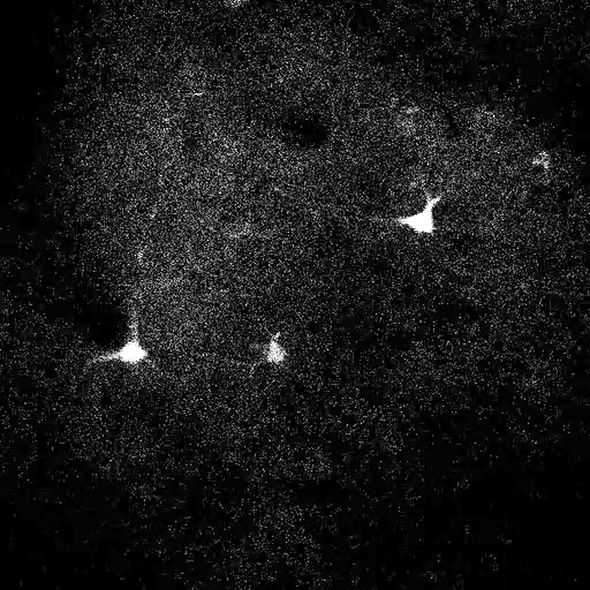
Bio-engineers studying the complexities of the brain in mice chart out each individual neuron as it fires off during periods of activity. Using a process known as two-photon calcium imaging, scientists see bright spikes and flashes of light in the brain – nerve impulses firing off in response to stimulus. The process is incredibly slow, arduous and requires scientists to circle every single neuron, which lights up like a lightbulb. However, an incredible artificial intelligence algorithm tested by Duke University in North Carolina, US, has proven to be much more effective at the job.
A Duke study published this week in the Proceedings of the National Academy of Sciences has found the AI automated process is as accurate but considerably faster.
The algorithm, according to its lead author, appears to be “better than human experts”.
Duke University said in a statement: “This new technique, based on using artificial intelligence to interpret images, addresses a critical roadblock in neuron analysis, allowing researchers to rapidly gather and process neuronal signals for real-time behavioural studies.”
Typically, the human-led process of mapping neuron activity in a 30-minute-long video would take researchers anywhere from four to 24 hours.
Artificial intelligence trialled by Duke, on the other hand, was able to complete the process in mere minutes.
Artificial intelligence: AI algorithms are as accurate and faster than human experts
(Image: GETTY)
The AI proved faster and does not require food, hydration, toilet breaks or sleep to operate at peak performance.
Sina Farsiu, an associate professor of engineering at Duke, said: “As a critical step towards complete mapping of brain activity, we were tasked with the formidable challenge of developing a fast automated algorithm that as accurate as humans for segmenting a variety of active neurons imaged under different experimental settings.”
Fellow Duke researcher and professor Yiyang Gong said: “The data analysis bottleneck has existed in neuroscience for a long time – data analysts have spent hours and hours processing minutes of data, but this algorithm can process a 30-minute video in 20 to 30 minutes.
“We were also able to generalise its performance, so it can operate equally well if we need to segment neurons from another layer of the brain with different neuron size or densities.”
And Somayyeh Soltanian-Zadeh, a Duke PhD student and the study’s lead author said: “Our deep learning-based algorithm is fast and is demonstrated to be as accurate as, if not better than, human experts in segmenting and overlapping neurones from two-photon microscopy recordings.
Algorithm is fast and is demonstrated to be as accurate as, if not better than, human
Somayyeh Soltanian-Zadeh, Duke University
Deep learning algorithms give scientists and researchers a chance to trawl through cast amounts of data with relative ease.
AI algorithms can be trained to identify different parts of a complex image for a specific purpose – in this case, to track firing neurons.
Duke’s researchers were so impressed with the algorithm’s ability to beat humans, they have made their software publicly available to the public.
Artificial intelligence: AI algorithms rapidly track firing neurons in mouse brains (pictured)
(Image: DUKE UNIVERSITY)
The scientists are confident the application of AI in researcher can boost the speed at which bio-engineers study the mysteries of the brain.
Ms Soltanian-Zadeh said: “This improved performance in active neuron detection should provide more information about the neural network and behavioural states, and open the door for accelerated progress in neuroscience experiments.”
The news comes after scientists have developed a machine capable of predicting the future.
Artificial intelligence: Deep learning can be trained to interpret images
(Image: GETTY)
Experts in the field of robotics and artificial intelligence have also warned the rise of intelligent machines threatens to displace millions of people from their workplaces.
Nisreen Ameen, a lecturer at Queen Marty University of London, argued in an article for The Conversation higher education might be affected by smart technologies.
She said: “Artificial intelligence is set to have a significant impact. And not just on teaching and learning, but also on the whole student experience – innovation infused with traditional academic processes.
“This will change the classroom experience and how universities communicate with students, with lectures and marking potentially done by robots.”
Authored by Dagny Taggart via the organic pepper blog
Experts have been warning us about potential dangers associated with artificial intelligence for quite some time. But is it too late to do anything about the impending rise of the machines?
Once the stuff of far-fetched dystopian science fiction, the idea of robot overlords taking over the world at some point now seems inevitable.
The late Dr. Stephen Hawking issued some harsh and terrifying words of caution back in 2014:
The development of full artificial intelligence could spell the end of the human race. It would take off on its own, and re-design itself at an ever-increasing rate. Humans, who are limited by slow biological evolution, couldn’t compete, and would be superseded. (source)
Elon Musk, the founder of SpaceX and Tesla Motors, warned that we could see some terrifying issues within the next few years:
The risk of something seriously dangerous happening is in the five year timeframe. 10 years at most. Please note that I am normally super pro technology and have never raised this issue until recent months. This is not a case of crying wolf about something I don’t understand.
The pace of progress in artificial intelligence (I’m not referring to narrow AI) is incredibly fast. Unless you have direct exposure to groups like Deepmind, you have no idea how fast — it is growing at a pace close to exponential.
I am not alone in thinking we should be worried.
The leading AI companies have taken great steps to ensure safety. They recognize the danger, but believe that they can shape and control the digital superintelligences and prevent bad ones from escaping into the Internet. That remains to be seen… (source)
Experts say it is time to study “machine behavior.”
Last week, a team of researchers made a case for a wide-ranging scientific research agenda aimed at understanding the behavior of artificial intelligence systems. The group, led by researchers at the MIT Media Lab, published a paper in Nature in which they called for a new field of research called “machine behavior.” The new field would take the study of artificial intelligence “well beyond computer science and engineering into biology, economics, psychology, and other behavioral and social sciences,” according to an MIT Media Lab press release.
Scientists have studied human behavior for decades, and now it is time to apply that kind of research to intelligent machines, the group explained. Because artificial intelligence is doing more collective ‘thinking,’ the same interdisciplinary approach needs to be applied to understanding machine behavior, the authors say.
“We need more open, trustworthy, reliable investigation into the impact intelligent machines are having on society, and so research needs to incorporate expertise and knowledge from beyond the fields that have traditionally studied it,” said Iyad Rahwan, who leads the Scalable Cooperation group at the Media Lab.
Machines are making decisions and taking action without human input.
Rahwan explains:
“We’re seeing the rise of machines with agency, machines that are actors making decisions and taking actions autonomously. This calls for a new field of scientific study that looks at them not solely as products of engineering and computer science but additionally as a new class of actors with their own behavioral patterns and ecology.” (source)
“We’re seeing an emergence of machines as agents in human society; these are social machines that are making decisions that have real value implications in society,” says David Lazer, who is one of the authors of the paper, as well as University Distinguished Professor of Political Science and Computer and Information Sciences at Northeastern.
We interact numerous times each day with thinking machines, as the press release explains:
We may ask Siri to find the dry cleaner nearest to our home, tell Alexa to order dish soap, or get a medical diagnosis generated by an algorithm. Many such tools that make life easier are in fact “thinking” on their own, acquiring knowledge and building on it and even communicating with other thinking machines to make ever more complex judgments and decisions—and in ways that not even the programmers who wrote their code can fully explain.
Imagine, for instance, a news feed run by a deep neural net recommends an article to you from a gardening magazine, even though you’re not a gardener. “If I asked the engineer who designed the algorithm, that engineer would not be able to state in a comprehensive and causal way why that algorithm decided to recommend that article to you,” said Nick Obradovich, a research scientist in the Scalable Cooperation group and one of the lead authors of the Nature paper.
Parents often think of their children’s interaction with the family personal assistant as charming or funny. But what happens when the assistant, rich with cutting-edge AI, responds to a child’s fourth or fifth question about T. Rex by suggesting, “Wouldn’t it be nice if you had this dinosaur as a toy?”
“What’s driving that recommendation?” Rahwan said. “Is the device trying to do something to enrich the child’s experience—or to enrich the company selling the toy dinosaur? It’s very hard to answer that question.” (source)
There is still a lot we don’t know about how machines make decisions.
What hasn’t been examined as closely is how these algorithms work. How do they evolve with use? How do machines develop a specific behavior? How do algorithms function within a specific social or cultural environment? These issues need to be studied, the group says.
There is a significant barrier to the type of research the group is proposing, however:
But even if big tech companies decided to share information about their algorithms and otherwise allow researchers more access to them, there is an even bigger barrier to research and investigation, which is that AI agents can acquire novel behaviors as they interact with the world around them and with other agents. The behaviors learned from such interactions are virtually impossible to predict, and even when solutions can be described mathematically, they can be “so lengthy and complex as to be indecipherable,” according to the paper. (source)
And, there are ethical concerns surrounding how AI makes decisions:
Say, for instance, a hypothetical self-driving car is sold as being the safest on the market. One of the factors that makes it safer is that it “knows” when a big truck pulls up along its left side and automatically moves itself three inches to the right while still remaining in its own lane. But what if a cyclist or motorcycle happens to be pulling up on the right at the same time and is thus killed because of this safety feature?
“If you were able to look at the statistics and look at the behavior of the car in the aggregate, it might be killing three times the number of cyclists over a million rides than another model,” Rahwan said. “As a computer scientist, how are you going to program the choice between the safety of the occupants of the car and the safety of those outside the car? You can’t just engineer the car to be ‘safe’—safe for whom?“ (source)
The researchers explain that it will take experts from a host of scientific disciplines to study the way machines behave in the real world, as a press release from Northeastern University states. “The process of understanding how online dating algorithms are changing the societal institution of marriage, or determining whether our interaction with artificial intelligence affects our human development, will require more than just the mathematicians and engineers who built those algorithms.”
As we watch robots, autonomous vehicles, artificial intelligence machines and the like slowly (and sometimes rapidly) permeate our world, it’s not hard to imagine them going from permeating to taking over. Reaching that point, even those who don’t watch sci-fi movies can see the possibility of rogue robots and AI machines using computer logic to eliminate the one thing that could stop their takeover – humans – and initiating a robot apocalypse. Fortunately, some computer scientists in California have developed an algorithm that trains robots to always avoid the bad, human-elimination decisions and stay on the path of good, obedient servitude instead. How well do you think this will work?
“We want to advance AI that respects the values of its human users and justifies the trust we place in autonomous systems.”
In a Stanford University press release announcing the publication in the journal Science of the paper “Preventing undesirable behavior of intelligent machines,” Emma Brunskill, an assistant professor of computer science at Stanford and senior author of the paper, illustrates the alleged noble goal of robot and AI developers – making them tools for the good of humankind – and describes the algorithm she and her colleagues have designed to accomplish – and hopefully guarantee – that goal.
“We show how the designers of machine learning algorithms can make it easier for people who want to build AI into their products and services to describe unwanted outcomes or behaviors that the AI system will avoid with high-probability.”
The idea is to describe bad decisions and behaviors mathematically. While “don’t do this or the patient will die” decisions are easy to describe, behaviors such as gender bias – a line AI is crossing as it’s used more and more to evaluate employment or school applications – requires a sense of fairness that is obviously much harder to define mathematically. The Stanford researchers modified the algorithm in a program designed to predict the future grade point averages of students and it learned to avoid bias toward one gender. While “fairness” is much more vague than “life or death,” the researchers believe it can – and should – be built into all AI using their algorithm.
Does all of this sound familiar? The paper refers to this solution as a “Seldonian algorithm” and fans of Isaac Asimov will recognize that obvious reference to Hari Seldon, the mathematics professor at Streeling University on the planet Trantor in Asimov’s “Foundation” sci-fi series. Seldon developed psychohistory, an algorithmic science that allowed him to predict the future in probabilistic terms. It worked for Hari Seldon … will it work for us?
“Given the recent rise of real-world ML applications and the corresponding surge of potential harm that they could cause, it is imperative that ML algorithms provide their users with an effective means for controlling behavior. To this end, we have proposed a framework for designing ML algorithms and
shown how it can be used to construct algorithms that provide their users with the ability to easily (that is, without requiring additional data analysis) place limits on the probability that the algorithm will produce any specified undesirable behavior.”
Why do humans want us to avoid bad behavior when bad behavior is so much fun?
In the paper’s conclusion on using machine learning (ML) algorithms to change robot behavior, that nasty word “probability” pops up. The algorithm is not a 100% guarantee of robot apocalypse prevention and even if it were, it depends on humans using it in all applications. Just as it’s easy to imagine a robot apocalypse, it’s easy to imagine it being caused by unscrupulous businesses leaving the “bad behavior prevention algorithm” out to cut costs or make more profits.
Henry Lee was the 19th century expert on sea serpents, as we have seen in several articles I wrote last week. As far as the 20th century is concerned, however, there is no doubt about to whom the crown was passed. It was one Bernard Heuvelmans, whose work, In the Wake of the Sea Serpents, is the defining book on the subject. Cryptozoologist Loren Coleman – who, with Patrick Huyghe, wroteThe Field Guide to Lake Monsters, Sea Serpents, and Other Mysterious Denizens of the Deep – said of Heuvelmans, who died in 2001: “From 1948 on, Heuvelmans exhaustively sought evidence in scientific and literary sources. Within five years he had amassed so much material that he was ready to write a large book. That book turned out to be Sur la piste des betes ignorees, published in 1955, and better known in its English translation three years later as On the Track of Unknown Animals.” As for In the Wake of the Sea Serpents, it became a classic – and, to this day, it very much remains a highly important research tool for creature-seekers everywhere.
Of particular significance is Heuvelman’s theory – based upon 358 sightings – that there are far more than just one kind of animal that falls into the sea serpent category. Heuvelmans’ list of creatures is an important one. It not only describes the physical appearances of the animals: it also reveals which kinds of creatures are most often seen – at least, at the time that Heuvelmans compiled his list. He began with what he termed the “long-necked” type, for which Heuvelmans had forty-eight reports. This particular group, he added, had necks that ranged from long to “very long,” a “median hump on the back,” and a pair of horns on the head. As for the color of the creatures, they were typically mottled.
Second on Heuvelman’s list was the “merhorse.” It had, said Heuvelmans, a “long floating mane,” huge eyes, a long neck, and whiskers on the face. For this entry, Heuvelmans had studied no less than thirty-seven cases. The third entry was focused on “many-humped” animals. As their title suggests, they had a “string of dorsal humps of virtually equal size.” The necks were not overly large, and had white stripes on their necks. Now, we move onto the “many finned” beast of the deep. As for these creatures they had “several triangular fins looking like a huge crest.” They also had a jagged crest on the spine and “prominent” eyes. Then, there was the “super otter.” Heuvelmans described it as having “a slender medium-length neck” and a “long tapering tail.” The color was beige or grey, according to the thirteen sightings that Heuvelmans had in his files.
The “super eel” plays an important role in Heuvelmans’ work, as in more recent times reports of massive eels are growing and growing. Twelve reports that Heuvelmans had on file allowed him to make a good image of the animals. They had a long neck, one which formed “am extension of the head.” The tail was “long [and] tapering,” “Leaps out of the water and falls back with a splash,” Heuvelmans told his readers. “The marine saurian” was very much like a crocodile, albeit seen in an “oceanic habitat.” Then, there was the “father-of-all-the-turtles.” Yes, we’re talking about giant turtles, a subject that I will return to here at Mysterious Universe on a later occasion. And, finally, Heuvelmans introduced his followers to “yellow belly,” a beast that was yellow with black stripes. Heuvelmans said of his list that, “It is not surprising that the types based on a few not very detailed sightings have few determining characteristics. It follows that the least well-defined types may include several different species, not necessarily related to one another.”
If you are into Cryptozoology and have not yet read Heuvelman’s classic book, you really should!
Villagers spooked by huge glowing oval-shaped UFO in the sky over Krasnodar, Russia
Astrange phenomenon has been filmed in the sky above a field by two friends while driving in a rural area in Krasnodar Region in Russia on November 27, 2019.
Wondering what the strange sky phenomenon could be, they decided to stop their car to take a closer look at the brightly shining oval-shaped object, hanging motionless in the air.
Although some people suggest that the phenomenon is just a sunset, the witnesses are convinced that they have filmed something that cannot be explained.
Weird object emitting red glow moving across the sky in Bradford, UK
While driving on the highway near Bradford on November 26, 2019, Juran Harrison noticed a huge object in the sky that seemly emitted a red glow on which he decided to film it.
According to Thetelegraphandargus - Juran said: "I would describe it as a burning red light, was moving sideways then down and away leaving a slight trail behind it, then, as quickly as it appeared, it is gone."
The footage, taken from a car shows the bright red glowing object moving across the sky above the roofline.
Did Anunnaki Ancient Aliens Build A Civilization On Earth Before Humans?
Discusses whether Out-of-Place Artifacts are evidence of a Lost Human or Ancient Anunnaki Alien Civilization
‘Out-of-Place Artifact’ (OoPArt) is a term coined by American naturalist and cryptozoologist Ivan T. Sanderson for an object of historical, archaeological, or paleontological interest found in a very unusual or seemingly impossible context that could challenge conventional historical chronology by being too advanced for the level of civilization that existed at the time, or showing human presence well before humans were supposed to exist.
The question that we are ultimately confronted with is who built the lost Civilization before human beings?
Was it the Ancient Anunnaki Aliens as suggested by alternative historical theories or some other unknown entity/ies?
The question persistently posed by Out of Place Artifacts is whether they are evidence of advanced past Ancient Alien or Lost Human Civilization.
Zechariah Sitchin and other proponents of the Ancient Astronaut Theory suggest that such artifacts are evidence of an Ancient Alien Civilization, whilst on the other end of the unacknowledged History spectrum you have Graham Hancock and others taking the position that it is evidence of an advanced Human Civilization.
We’ve covered the Anunnaki angle considerably as part of the ongoing ‘Anunnaki Chronicles‘ series, and today, we shed light on the alternative Graham Hancock argument on whether the past reveals the presence of an Ancient Alien or Lost Human Civilization.
The Evidence For A Lost Civilization
According to Hancock, the Ancient Astronaut Hypothesis emerges from ancient texts and traditions when they are read in the light of modern space-exploration technology. However, at present NO ancient archaeological site and NO ancient text or tradition provides persuasive evidence for the ancient astronaut hypothesis.
In his view, if one examines the original source material upon which Sitchin drew, and comparing what you find to how Sitchin presented it in his Earth Chronicles series, you would see that Sitchin has created a gigantic work of science fiction masquerading as fact.
As such. Out of Place Artifacts, the anomalies of history and prehistory pointed to by advocates of the ancient astronaut hypothesis are far better and more elegantly explained as emanating from a lost, advanced HUMAN civilization of prehistoric antiquity than from high-tech alien visitors from another Planet.
His verdict on whether the past reveals an Ancient Alien or Lost Human Civilization is therefore that it is a lost Human Civilization that we should credit and not Ancient Aliens.
Top 5 Anomalies & Out Of Place Artifacts
1. Klerksdorp Spheres
Resembling the ‘Death Star’ in Star Wars, the Klerksdorp Spheres were found by Miners in South Africa and their origin remains unknown.
They were found in rock dated 2.8 billion years old and their presence in this Archaeological layer remains perplexing.
2. The Antikythera Mechanism
The next perplexing artifact was recovered by sponge-divers from a shipwreck off the coast of Antikythera, Greece. Its a sophisticated mechanism of gears whose existence 2000 years ago cannot be explained.
3. The Battery Of Babylon
The 2000 Ancient Battery of Babylon was unearthed in Baghdad in 1938. The device could create an electric charge, and this find is particularly remarkable since we only invented batters in 1799.
4. Egyptian Helicopoters & Inca Planes
The mystery of the flying machines of the Gods continues to reign. Our previous entry on the Vimana Epics of Ancient India also shed some light on this extraordinary question.
Hieroglyphs such as those at the Egyptian Temple at Abydos only add to the mystery as they depict Helicopters, submarines and supersonic jets…Meanwhile Golden Ancient Inca Model Aircraft suggest the presence of aviation technology amongst the Ancient Civilizations of South America.
The suggestion that Ancient Civilizations possessed advanced Aviation Technology which we are only beginning to understand today remains, and the jury is still out on how that will be eventually resolved.
5. The Piri Ries Map
Last but not least, is the Piri Ries Map.
In 1929, a group of historians found an amazing map drawn on a gazelle skin. Research showed that it was a genuine document drawn in 1513 by Piri Reis, a famous admiral of the Turkish fleet in the sixteenth century.
The controversy lies in that the Piri Reis map shows the western coast of Africa, the eastern coast of South America, and the northern coast of Antarctica. The northern coastline of Antarctica is perfectly detailed even though the map was drawn 300 years before it was discovered, drawing the coastline in perfect detail even though it was under ice.
Conclusion: Anunnaki Ancient Aliens or Lost Human Civilization?
Whether Historical anomalies like Ancient Megalith Structures and Out of Place Artifacts demonstrate the existence of an Ancient Alien or Lost Human Civilization remains contested…Perhaps the answer lies in combining both theories instead of adopting a mutually exclusive approach to either theory.
In Ancient Aliens Debunked, our previous entry based on a documentary by the same name which you can read here, we also noted that the Ancient Astronaut Theory was not always correct in its interpretation of certain Out Of Place Artifacts, sometimes making exaggerated claims in order to shore up support of itself.
Nevertheless, its clear that unanswered questions remain and various new lines of enquiry continue to develop, expanding and enriching our understanding of the Human story…That in itself is progress, and we will continue to follow the latest revelations in an effort to answer what is perhaps Humanity’s ultimate question.
The Anunnaki Ancient Astronuat Theory also continues to provoke interest and debate on the question of our origins and whether the Historical Timeline of Civilization provided by the current historical paradigm is correct.
In Realm Of The Elohim, our own E-Book based on Zechariah Sitchin’s Lost Book of Enki, an effort was made to provide accessible and digestible information on the Ancient Astronaut Theory and the activities of the Anunnaki from the landing on Earth, the setting up of the first Base station at Edin, the creation of man, great deluge and the Nuclear destruction of Sumer up to the rise of Babylon under Marduk.
It also explores the implications of the Anunnaki Ancient Astronaut Theory for the existence of God and Spirituality
Due to the ongoing debate and interest on the topic especially online, a list of online references and Documentaries is also included for further individual research and exploration.
For more on Out of Place Artifacts and the Lost Human Civilization argument, peep the Ancient Astronaut Archive video below, as well as Graham Hancock’s website and his seminal work on the lost ancient Human Civilization, ‘Fingerprints Of The Gods’.
If you would like to explore more interesting Alternative History on the Anunnaki, you can click the Archive links below:
The Google Powered Search Box on the Home Page with custom links to official Egyptology and Sumerian Archaeological Texts, Records and Documentaries will also help you along your quest.
For decades, academic researchers have dismissed the study of UFOs as pseudoscience. But as the evidence becomes harder and harder to ignore, some organizations are finally taking steps to make the field legitimate.
For as long as humans have claimed they’ve seen UFOs—and it’s been a long, long time—the established scientific community has more or less considered them to be nonsense. While that hasn’t changed much, even as we’re in the midst of a modern ufological renaissance, some renegade scientists are fighting to bring academic rigor to UFO research.
Take Richard Hoffman, a 25-year information technology expert on contract with the U.S. Army’s Material Command at the Redstone Arsenal in Huntsville, Alabama. As a Senior Lead Architect, he keeps the Army’s digital infrastructure running and safe from attack.
He’s also a UFO researcher.
“The scientific community still has to deal with the decades of stigma associated with what they see as pseudoscience or fringe science,” Hoffman tells Popular Mechanics. “Many scientists do have interests in the phenomena, but are most often discouraged by others to embrace it so they hide it.”
Hoffman is one of three board members who run a nonprofit scientific organization known as the Scientific Coalition for UAP Studies (SCU). Unknown or unidentified aerial phenomena (UAP) is the current rebranding of unidentified flying objects (UFO), a term that many believe to carry too much cultural baggage.
“There are very few UFO organizations remaining today,” Hoffman says. “Of the few that do remain, they each have their unique contributions to the phenomena, but most are in data collection roles versus long term scientific study of cases.”
The difference with the SCU—and it’s a big one—is that it collects data that can be analyzed and studied by scientific experts, subsequently generating peer-reviewed papers published in journals and on websites, says Hoffman. The SCU doesn’t collect day-to-day UAP sighting reports, but rather, digs into the more complex cases where multiple sensory data like radar tracks and video may exist.
Library of CongressGetty Images
An Objective of Legitimacy
The SCU played a significant role in studying the Nimitz UFO Encounter, when it released a nearly 300-page report on the incident. The requisite refresher: Two year ago, the New York Times posted a story about Navy pilots who intercepted a strange object off the coast of San Diego in November 2004 and captured video of the object with their F-18’s gun camera.
Earlier this month, Popular Mechanics published a story about several other military personnel who also witnessed the Nimitz encounter on their radar systems and over their ship’s video system.
The SCU paper examined the available public data and testimony available regarding the case and concluded that the “results suggest that given the available information, the AAV’s capabilities are beyond any known technology.”
To be clear, the SCU hasn’t concluded that some non-human intelligence is responsible. Fully aware of the significant gaps in data, the organization has suggested that “the public release of all Navy records associated with this incident to enable a full, scientific and open investigation is strongly recommended.”
The UFO research community is used to having scant data on UFO incidents. The vast majority of cases are purely anecdotal. When physical evidence or data is available, the well-established ufological conspiracy and myth-making machines begin to put that data in jeopardy.
“To date, there hasn’t been an extensive and well-funded scientific investigation of these phenomena using state-of-the-art investigative tools and a dedicated investigative team,” Robert Powell, an SCU board member and device physics expert, tells Popular Mechanics. The SCU is aiming to change that. Membership in the organization requires a resume submission, and a committee meets to thoroughly vet each new member.
So who makes up the 69 active members of the SCU, exactly? Mostly scientists, former military officers, and former law enforcement personnel with technical experience and investigative backgrounds, Powell says. And the credentials are impressive: Try “two current and one former NASA PhDs, and members with backgrounds that include Lockheed, NORAD, and the U.S. Space Command,” he says.
To begin bridging the gap between the UFO research community and the scientific community, the SCU has a team in place that will begin a peer-reviewed journal. “Initial plans are for the journal to be biannual with the first published journal in the first half of 2020,” Powell says. “Anyone wishing to submit a paper to the journal should contact SCU.”
BettmannGetty Images
Fighting the Stigma
Yet for all the promising progress, the SCU and similar organizations are still facing an uphill battle. The decades-long taboo surrounding UFOs and their study is thoroughly entrenched in established scientific and academic communities. They are, in essence, a dirty subject that can kill a professional career.
In 1953, the Robertson Panel was formed to look at UFO reports at the behest of the government due to a string of odd aerial objects being spotted over Washington, D.C. the previous year. The panel concluded in its classified report that UFOs posed no risk to national security, and proposed that the National Security Council actively debunk UFO reports with the intention to ideologically inoculate the public to ensure UFOs become the subject of ridicule. The Panel even recommended that UFO investigative and research groups be monitored by intelligence agencies for subversive activity.
Seventeen years later, the infamous Condon Report, which was a product of the U.S. Air Force and the University of Colorado, was responsible for the death of the Air Force’s UFO study, Project Blue Book. The report became embroiled in controversy when a memorandum was released explaining that the report itself had to “trick” the public into thinking the study was objective, but would ensure that the final and official position is that all UFO incidents were hoaxes, delusion and human error.
“The wind is changing on this, just like it is on a lot of things.”
Officially, UFOs became the subject of ridicule. Tie that in with the rise of new-age UFO prophets and cults, stories of space men from Venus, alien bases in Antarctica, and the merging of UFO and conspiracy cultures, and those who used empirical data or maintained a rational and logical research approach became lumped into the same subculture as people claiming to be alien channelers or time-traveling alien ambassadors who often use people’s gullibility to earn a living.
It’s no wonder academics, professionals, and scientists publicly shy away from the subject. In research for this article, one physicist from a university in New York expressed their discomfort and asked that their name not be used because they were still trying to get tenure.
“I don’t get the sense the scientific community is any more interested or open than it was before,” Alexander Wendt, a political science professor at the Ohio State University, tells Popular Mechanics. “But what has changed, I think, is the politics. I think that the wind is changing on this, just like it is on a lot of things. And it’s probably young people in particular who are driving the change and are more open.”
Geography PhotosGetty Images
Forging a Scientific Future
Wendt, who has done academic work on the UFO question and presented a lecture at TEDx Columbus on the science of UFOs, sits on the board of UFOData, a project designed to create high-tech observation systems to monitor the skies and track anomalous phenomena. He knows that the taboo exists surrounding UFO research, and getting any grant money to study UFOs is still impossible. According to Wendt, neither the government nor any established scientific organizations are going to fund UFO research. The solution seems to be crowdfunding or finding private donors who will invest in these projects.
UFOData isn’t the only group engaged in observational studies. For three decades, Project Hessdalen, a small observatory station that monitors a valley in Norway subject to strange light phenomena, has been jointly funded by the Østfold University College and personal donations. Another organization, the UFO Data Acquisition Project (UFODAP), is also building small computer units designed to monitor and track aerial oddities. Using multiple sensors, the UFO Data Acquisition Unit is designed to record and track UAP, as well as provide metadata which can be analyzed.
Hoffman recognizes that contemporary ufology still makes academics and scientists nervous. Even with the recent announcement by the Navy that UAP do violate American airspace and that the Pentagon was running the Advanced Aerospace Threat Identification Program, people are starting to ask more questions and some scientists are starting to participate.
“We are encouraged by this and believe it will continue to advance, however, the UFO community itself is composed of factions which continue to make scientists cringe,” Hoffman says. “SCU is attempting to support scientists and serious researchers by focusing on what science can do to advance their interests. They see us as being a safe place where conspiracy theories are non-existent and scientific methodologies win.”
So while the existence of UFOs is no longer up for debate, their source very much is. The UFO community has always been comprised of cultural and social renegades who haunt the fringes of mainstream culture, subjects of ridicule more than respect. While some still smirk at the thought of anomalous aerial objects occupying our skies, the information slowly coming out into the public domain is starting to prove that these objects may not be a laughing matter.
Whether the source of some of these data-rich UFO incidents is secret government technology, an alien nonhuman intelligence, or something fundamentally beyond our physical and philosophical understanding, we’re left to wonder, as countless thinkers and, yes, even scientists, have before, “What if?”
NASA releases strange 'music' heard by 1969 astronauts
NASA has made public a recording of strange "music" that astronauts reported hearing in 1969 while on the far side of the Moon, out of radio contact with the Earth.
The Apollo 10 command module Charlie Brown piloted by US astronaut John W. Young is seen from the lunar module Snoopy after separation in lunar orbit on May 22, 1969
The story behind these unusual whistling noises was showcased Sunday night in a show on the cable channel Discovery, as part of a series called "NASA's Unexplained Files."
The noises reportedly were heard in May 1969 by the Apollo 10 astronauts as they circled the Moon, months before the first astronauts stepped foot on the lunar surface on July 21 that same year.
The three astronauts on board were Thomas Stafford, John Young and Eugene Cernan.
The sounds, which lasted about an hour, were recorded and transmitted to mission control in Houston.
A transcript of the text was released in 2008, but the actual audio has only just been made public.
"You hear that? That whistling sound?" asks Cernan, describing it as "outer-space-type music."
The trio felt the sounds were so strange that they debated whether or not to tell the chiefs at NASA, for fear they wouldn't be taken seriously and could be dropped from future space missions, according to the Discovery show.
NASA says the sounds could not have been alien music.
An engineer from the US space agency said the noises likely came from interference caused by radios that were close to each other in the lunar module and the command module.
Astronaut Al Worden, who flew on Apollo 15, disputed that explanation, saying "logic tells me that if there was something recorded on there, then there's something there," according to the Discovery show.
But Michael Collins, the pilot of Apollo 11, who became the first person to fly around the far side of the Moon by himself while Buzz Aldrin and Neil Armstrong were walking on the surface, said he too heard "an eerie woo-woo sound" but accepted the explanation of radio interference.
In fact, he'd been warned ahead of time, he wrote in his book, Carrying the Fire: An Astronaut's Journeys.
"Had I not been warned about it, it would have scared the hell out of me," he wrote.
"Fortunately the radio technicians (rather than the UFO fans) had a ready explanation for it: it was interference between the LM's and Command Module's VHF radios."
While most of the Star Wars saga has been filmed on sound stages in England and Australia, the filmmakers behind the ongoing space opera have sometimes traveled to real-life places to create the alien worlds of a galaxy far, far away. Here are 20 Star Wars movie locations you can visit in real life.
1. AJIM, TUNISIA
George Lucas used various locations around Tunisia to film exteriors for the desert planet Tatooine, most notably the ferry port town ofAjim. The town was used for the exteriors of Obi-Wan Kenobi’s home, which was actually an old mosque, plus the Mos Eisley Spaceport in A New Hope.
2. THE HÔTEL SIDI DRISS // MATMATAT-AL-QADIMAL, TUNISIA
The Hôtel Sidi Driss in Matmatat-Al-Qadimal, Tunisia was used as the Lars homestead (Luke Skywalker’s childhood home) in A New Hope. The hotel consists of five pits, four of them reserved for lodging and sleeping, the fifth dubbed the “Star Wars pit.” Guests can dine in the Lars family dining room, now the hotel’s restaurant. The set dressings were removed after filming in 1976, but returned in the year 2000 in order to film scenes for Attack of the Clones. Ever since, the decorations have remained. Fittingly, it's more commonly known as the "Star Wars hotel."
3. DEATH VALLEY NATIONAL PARK, CALIFORNIA
George Lucas used Death Valley National Park for pickup shots after shooting in Tunisia for A New Hope and Return of the Jedi. The area between Sierra Nevada and the Mojave Desert, along with Tunisia, were used to make the desert planet of Tatooine come to life, most notably in the scene when Obi-Wan Kenobi meets Luke Skywalker, C-3PO, and R2-D2 for the first time.
For Return of the Jedi, Twenty Mule Team Canyon in Death Valley was used to film the scene in which C-3PO and R2-D2 travel to Jabba's Palace.
The Empire Strikes Back'ssnowy opening battle scene on the ice planet Hoth was filmed on the Hardangerjøkulen Glacier, the sixth largest glacier in Norway.
5. FINSE, NORWAY
At the foot of the Hardangerjøkulen glacier is the small railroad town of Finse, Norway, which is located between Oslo and Bergen, and was used as the Rebel Alliance’s Echo Base on Hoth in The Empire Strikes Back. While shooting in 1979, a snowstorm hit the small town, allowing director Irvin Kershner to shoot two key scenes: Luke Skywalker's escape from the Wampa cave, as well as the young hero's interaction with the spirit of Obi-Wan Kenobi before he is rescued by Han Solo. Both scenes were shot just outside of the Finse 1222 Hotel.
In A New Hope, Lucas used ancient Mayan ruins, located in Guatemala's Tikal National Park, as the exterior of the Rebel Alliance’s Massassi Outpost.
7. YUMA DESERT, ARIZONA
Instead of returning to Tunisia for Return of the Jedi, the film's producers chose to shoot Buttercup Valley in Arizona's Yuma Desert for the Sarlacc Pit sequence. Jabba's Sail Barge and the Sarlacc Pit took more than five months to build, and more than 5500 cast and crew members lodged in Yuma during filming in 1982.
8. REDWOOD NATIONAL AND STATE PARKS, CALIFORNIA
California's Redwood National and State Parks portrayed the Forest Moon of Endor, the Ewoks’ home world, in Return of the Jedi. Several scenes, such as the speeder bike chase and the Ewok ambush, were shot in the parks’ many redwood groves in Marin County, which is close to Lucas’s home at Skywalker Ranch.
Most of Attack of the Clones and Revenge of the Sith were shot at Fox Studios Australia in Sydney using green screen. However, Lucas would occasionally send crews out to capture scenery in various locations around the world for the plate photography used in background shots.
One of the real-life places shot for Revenge of the Sith was the beautiful mountain range of Grindelwald, Switzerland, which was used as the backdrop for the planet Alderaan, Princess Leia’s home.
10. VILLA DEL BALBIANELLO // LENNO, ITALY
The Lake Retreat where Anakin Skywalker and Padme Amidala go into hiding in Attack of the Clones is located at the Villa del Balbainello in Lenno, Italy. Originally built in 1787, the villa overlooks Lake Como and served as a monastery before it was turned over to the National Trust of Italy in 1988. Villa del Balbainello makes another appearance at the end of Attack of the Clones, as the location for Anakin and Padme’s wedding.
The Palace of Caserta in southern Italy, just northeast of Napoli, was used to shoot the interiors of the Theed Royal Palace on Naboo in The Phantom Menace and Attack of the Clones. Originally built for Bourbon King Charles III in the 1750s, the Palace of Caserta is also the largest royal residence in the world.
12. PHANG NGA BAY // PHUKET, THAILAND
The beautiful island backdrop of Phang Nga Bay in Thailand was used as plate photography for the planet Kashyyyk, Chewbacca’s birthplace, in Revenge of the Sith. For certain scenes, shots of Guilin, China were combined with Phang Nga Bay.
Lucas used England's Whippendell Wood for two scenes in The Phantom Menace: In the first instance, it's where Qui-Gon Jinn and Obi-Wan Kenobi meet Jar-Jar Binks; the other shows the Wood as a sacred place for Jar-Jar's species, the Gungans.
14. PLAZA DE ESPAÑA // SEVILLE, SPAIN
The beautiful Plaza de España in Seville, Spain was used for the exterior of Theed on Naboo in Attack of the Clones. Anakin and Padme walk through the plaza before the pair go into hiding in the Lake Country.
15. MOUNT ETNA // SICILY, ITALY
LUCASFILM
Although Lucas actually didn’t shoot on Mount Etna, his team used Italy’s most active volcano for plate photography for the epic light saber battle between Obi-Wan and Anakin at the end of Revenge of the Sith. Mount Etna was actually erupting during filming, so Lucas sent a film crew to capture its flowing lava.
16. SKELLIG MICHAEL, IRELAND
LUCASFILM
The island planet of Ahch-To, which the exiled Luke Skywalker called home at the end of The Force Awakens, is actually the island of Skellig Michael, which is located about 7 miles off the southwest coast of Ireland. Around 600 CE, a group of monks built a monastery that sits more than 600 feet above sea level, along with hundreds of rock steps to reach the top. Today, it’s a popular tourist attraction for Star Wars fans because it’s where Rey received her Jedi training in The Last Jedi.
17. RUB' AL KHALI DESERT // ABU DHABI, UAE
LUCASFILM
From Rey’s scavenger marketplace to Poe Dameron and Finn’s crash landing in The Force Awakens, the desert planet of Jakku was filmed in a large section of the Rub' al Khali desert known as “The Empty Quarter,” which is located a few hours away from Abu Dhabi in the United Arab Emirates. The Star Wars cast and crew filmed for six months in the largest contiguous sand desert in the world under the production title “Avco,” named after the L.A. movie theater where director J.J. Abrams watched the original Star Wars for the first time in 1977.
Located near the crest of the Andes is Salar de Uyuni, the Earth’s largest salt flat. It stretches more than 4000 square miles across southwest Bolivia and was used as the filming location for Crait, a mineral planet covered in white salt and red soil where the Resistance held its last stand against the First Order in The Last Jedi. The salt flat was created when prehistoric lakes dried up during the last Ice Age and left more than 10 billion tons of natural salt behind.
19. LAAMU ATOLL, MALDIVES
INDUSTRIAL LIGHT & MAGIC, A DIVISION OF LUCASFILM ENTERTAINMENT
During the climax of Rogue One: A Star Wars Story, the Rebel Alliance, led by Jyn Erso (Felicity Jones), breaks into an Imperial Base located on the planet Scarif to steal the top secret blueprints for the Death Star.
Director Gareth Edwards used Gan and Berasdhoo—two very large islands in the Laamu Atoll island cluster in the Maldives—as the filming location for Scarif, a remote tropical planet in the Outer Rim. "Scarif is based on a paradise world, so we had to go to paradise to film it," Edwards said during Star Wars Celebration in 2016.
In addition, the interior of the Imperial Security Complex on Scarif was mostly filmed in the Canary Wharf Underground Station in London, England. Film crews worked on an exciting chase scene through the subway station between midnight and 4 a.m. when it was closed to the public.
In The Last Jedi, Canto Bight is a casino city on the planet Cantonica, where Finn and Rose embark on a mission to find a master codebreaker to disable the First Order’s new weapon. Director Rian Johnson used the walled seaside city of Dubrovnik, Croatia as the filming location for the lavish city.
Dubrovnik, which is known as the “Pearl of the Adriatic,” was also used as the filming location for King’s Landing on Game of Thrones. So the Croatian city gets double the nerd cred for Game of Thrones and Star Wars fans alike.
Fox News reporter Chad Pergram spent the day looking into a strange security threat on Capitol Hill Tuesday morning that has left security officials stumped.
Both the U.S. Capitol and the White House were on lockdown after the restricted airspace was breached and fighter jets were scrambled. The problem is that after several hours, no one knows what it was or even if it was real.
White House totally on lockdown. All press being sheltered in place inside briefing room. Similar reported response at the a U.S. Capitol + congressional office buildings
“With security incident this morning, Fox has specifically inquired whether Capitol security systems may have been hacked or if this may have been a ‘test’ by nefarious forces to judge how people may have responded,” Pergram tweeted Tuesday afternoon. “Fox is told neither of those scenarios were in play.”
He explained that Fox was told that security officials are still baffled and some even received different versions of a report on what happened, down to even the location and speed of the alleged aircraft.
“Officials heard it was ‘hovering’ and were even given ‘knots’ measuring its speed. But they still don’t know what it was,” Pergram continued.
“We don’t know what the hell it was,” one knowledgeable source told Pergram. He explained that the security doesn’t know “if it was birds, a ‘weather anomaly,’ a drone or what.”
Chad Pergram✔@ChadPergram
Security officials still baffled by this morning’s Congressional security threat: “We don’t know what the hell it was,” said one knowegeable source. They don’t know if it was birds, a “weather anomaly,” a drone or what
Fox is told security officials got different info as to location & speed regarding the aircraft in question potentially posing a security risk in DC today. Officials heard it was “hovering” & were even given “knots” measuring its speed. But they still don’t know what it was
With security incident this morning, Fox has specifically inquired whether Capitol security systems may have been hacked or if this may have been a “test” by nefarious forces to judge how people may have responded. Fox is told neither of those scenarios were in play.
Fox is told security officials got different info as to location & speed regarding the aircraft in question potentially posing a security risk in DC today. Officials heard it was “hovering” & were even given “knots” measuring its speed. But they still don’t know what it was
A new, theoretical type of time crystal could run without outside help
Long-range interactions between particles may create a structure that regularly repeats in time
Time crystals, a state of matter that repeats itself in time, were first created in 2012. But those materials require prodding from external sources like lasers to produce their rhythmic behavior. Now, scientists have proposed a new type of crystal that would operate free from outside influences.
A newly proposed type of time crystal could stand alone.
Time crystals are structures that repeat regularly in time, just as a standard crystal is composed of atoms arranged in a regularly repeating pattern in space. Scientists first created time crystals in 2016 (SN: 10/26/16). But those crystals require periodic blasts from a laser to initiate their rhythmic behavior.
Now, two scientists have sketched out a theoretical blueprint for a new version of the odd state of matter. Their time crystal would persist without any input from the outside world, the pair reports in the Nov. 22 Physical Review Letters.
First proposed in 2012 by theoretical physicists Frank Wilczek of MIT and Alfred Shapere of the University of Kentucky in Lexington (SN: 2/16/12), the idea of time crystals was initially controversial. Researchers soon proved a no-go theorem stating that, under typical conditions, time crystals couldn’t exist.
But wiggle room remained: Two situations not included in the no-go theorem left open the possibility of creating the unusual materials. One exception was systems for which energy is input from the outside, for example, via lasers. That’s what’s known in physics terminology as “driving” the system, and it’s how scientists had created all time crystals until now (SN: 5/4/18).
But theoretical physicists Oleksandr Kyriienko of the University of Exeter in England and Valerii Kozin of the University of Iceland in Reykjavik wanted to design a self-sustaining time crystal. “We said, ‘We don’t want to drive the system at all,’” Kyriienko says.
The pair exploited the second exception to the no-go rule — systems that involve very long-range interactions, in which atoms or other tiny particles separated by large distances could influence one another. Such long-range effects don’t typically occur in nature: Two atoms on opposite sides of a room normally don’t exert forces on one another, for example.
Based on such interactions, the researchers came up with a new time crystal scenario, consisting of a collection of many such particles, each with a spin — a quantum version of angular momentum. Interactions between the particles’ spins would be configured so that particles near and far would influence one another simultaneously, via some unspecified quantum gymnastics in the laboratory. And particles in the time crystal would be highly entangled with one another, meaning they share quantum links that can persist at large distances (SN: 6/15/17).
Under such conditions, distant parts of the time crystal could affect one another. The result is that the correlation between the spins — whether neighboring particles’ spins were aligned or not — would endlessly oscillate in time in a regular pattern, producing a time crystal, the researchers say.
Scientists have typically studied systems of particles in which the interactions are short-range, or local. But researchers have long known that “something weird occurs once the locality is violated,” says physicist Haruki Watanabe of the University of Tokyo, one of the researchers who proved the no-go theorem. “So I wouldn’t be surprised by these kinds of behaviors of long-range interacting systems,” he says.
But it’s unclear whether such systems could be created in the laboratory. It’s not an easy feat to produce long-range interactions between many particles at once. “I don’t think it is possible to realize the long-range interacting system they proposed,” Watanabe says. But Shapere is optimistic, suggesting that scientists might use quantum computers or cold atoms to create the proposed time crystal or one like it.
When Wilczek and Shapere first came up with the idea of time crystals, the pair had envisioned a system that would operate without any outside input. “This paper brings us much closer to that original idea,” Shapere says.
Step aside, Ceres. There's a new smallest dwarf planet in town.
The asteroid Hygiea may qualify as a dwarf planet — and it could steal the title of the smallest dwarf planet in the solar system!
Astronomers have captured high-resolution imagery of Hygiea, the fourth largest rock in the Asteroid Belt. And low and behold, Hygiea is spherical in shape. That's a pretty important dwarf-planet marker, and the only one Hygiea was missing until now.
Asteroids boast a variety of shapes, but the rounded shape of dwarf planets shows that they had enough mass for its own gravity to pull it into this round shape. Hygiea already met the other requirements for dwarf-planet classification since it orbits the sun, is not a moon orbiting another planet and has not cleared other objects out of its own orbit.
Hygiea, a contender for the smallest planet in the solar system, is featured in this new image from the European Southern Observatory's Very Large Telescope in Chile. (Image credit: ESO/P. Vernazza et al./MISTRAL algorithm (ONERA/CNRS))
So, how big is this potential new member of the dwarf planet family? The team of astronomers, led by researcher Pierre Vernazza of the Laboratoire d'Astrophysique de Marseille in France constrained Hygiea's size, and estimated its diameter is just over 267 miles (430 kilometers). For comparison, Hygiea is less than one-fifth the width of its most famous cousin, Pluto, which has a diameter of about 1,491 miles (2,400 km).
Ceres held the title of smallest dwarf planet until now, with a diameter of almost 590 miles (950 km).
Before Hygiea can be officially upgraded to dwarf planet status, the International Astronomical Union — the same group of astronomers who were responsible making Pluto a dwarf planet — must review all the evidence and take a vote.
"Thanks to these images, Hygiea may be reclassified as a dwarf planet, so far the smallest in the solar system," Vernazza said in a statement from the European Southern Observatory (ESO), which manages the SPHERE instrument that produced the high-resolution imagery in the study. SPHERE (which stands for Spectro-Polarimetric High-contrast Exoplanet Research) sits atop the Very Large Telescope at ESO's Paranal Observatory in Chile.
"Thanks to the VLT and the new generation adaptive-optics instrument SPHERE, we are now imaging main belt asteroids with unprecedented resolution, closing the gap between Earth-based and interplanetary mission observations," Vernazza added.
A new study published Oct. 28, 2019 in the journal Nature Astronomy found that Hygiea is spherical, potentially making it the smallest dwarf planet in the solar system. Vesta and Ceres are also dwarf planets.(Image credit: ESO/P. Vernazza et al./L. Jorda et al./MISTRAL algorithm (ONERA/CNRS))
A study detailing the new findings was published today (Oct. 28) in Nature Astronomy.
‘Onmogelijk’ zwart gat stelt astronomen voor raadsel
Sterrenkundigen hebben een zwart gat ontdekt dat eigenlijk niet kan bestaan. Het is 68 keer zo zwaar als de zon, en dat is veel te zwaar. Als het resultaat klopt, zijn de ideeën over het ontstaan van zwarte gaten aan herziening toe.
Een ‘artist impression’ van het zwarte gat, met de ronddraaiende schijf waterstofgas. Op de voorgrond de ster. Beeld Jingchuan Yu / Beijing Planetarium
‘Ik hoorde het nieuws om kwart voor drie in de ochtend’, zegt zwarte-gatenexpert Selma de Mink. ‘Ik was toevallig kort wakker en scande uit gewoonte mijn telefoon. Slecht idee. Geen slaap meer gehad die nacht.’
Een zwart gat is een gebied in de ruimte met zó veel zwaartekracht dat het alles uit zijn omgeving opslokt en er zelfs geen licht meer uit kan ontsnappen. Afgelopen voorjaar presenteerden sterrenkundigen voor het eerst een ‘foto’ van een zwart gat. Dat was een kolossaal monster in de kern van een ander sterrenstelsel.
Zulke zwarte gaten kunnen miljoenen of zelfs miljarden keren zo zwaar zijn als de zon. Maar het nieuw ontdekte zwarte gat moet ontstaan zijn in de nasleep van een supernova – de explosie van een zware ster die aan het eind van zijn leven is gekomen. Die ‘stellaire’ zwarte gaten zijn hooguit 45 tot 55 keer zo zwaar als de zon. Dacht iedereen.
De ontdekking, deze week gepubliceerd in Nature, is gedaan door een groot internationaal team van voornamelijk Chinese astronomen. Het zwarte gat is zelf niet zichtbaar, maar er draait een ster omheen die wél te zien is. De baanbeweging van die ster – één rondje in 79 dagen – verraadt overduidelijk de aanwezigheid van het zwarte gat.
Kosmische slokop
Dat de kosmische slokop maar liefst 68 keer zo veel weegt als de zon, blijkt uit metingen met gloeiend waterstofgas. Dat gas draait vermoedelijk in een platte schijf rond het zwarte gat. Maar volgens De Mink, verbonden aan Harvard University, zijn dat ‘ontzettend lastige metingen’. ‘Het is een baanbrekende ontdekking – als het waar is. Maar ik ben nog niet overtuigd.’
Teamlid Stephen Justham van de Universiteit van Amsterdam snapt dat wel. Sterren kunnen eenvoudigweg niet zó zwaar zijn dat ze na de supernova-explosie een zwart gat achterlaten van meer dan pakweg 50 zonnemassa’s. Maar Justham heeft voldoende vertrouwen in de Chinese metingen, die bovendien bevestigd zijn door andere grote telescopen.
Misschien is er niet sprake van één zwart gat, denkt hij, maar van twee zwarte gaten die in een kleine baan om elkaar heen draaien, elk zo’n 35 keer zo zwaar als de zon. Dat zulke dubbele zwarte gaten bestaan, is de afgelopen jaren gebleken uit metingen aan zwaartekrachtgolven – minieme rimpelingen in de ruimtetijd.
Maar als dat zo is, valt het niet mee om het bestaan van de rondcirkelende ster te verklaren, zegt De Mink. ‘Ik zou ontzettend graag willen dat dit allemaal waar is, want ik hou enorm van mysterieuze puzzels met dubbelsterren en zwarte gaten, maar ik ben nog erg sceptisch.’
Hoe dan ook, het nieuwe zwarte gat vormt zo goed als zeker het topje van een grote ijsberg van soortgelijke objecten. Het is namelijk voor het eerst dat een ‘stellair’ zwart gat is ontdekt via de schommelingen van een ster die eromheen draait. Volgens Justham is dit ‘een voorproefje van een compleet nieuwe populatie van zwarte gaten die we nog maar net beginnen te ontdekken’.
MEER OVER ZWARTE GATEN:
Luister hier onze podcast spoedcursus zwarte gaten.
Several Facebook pages have cropped up to promote Australia's answer to the infamous 'Storm Area 51' event.
Originally billed as a tongue-in-cheek effort to determine if there are aliens at Area 51 in Nevada, the original "Storm Area 51, They Can't Stop All of Us" event was posted up on Facebook in July.
When the actual day itself arrived however, only a small handful of the millions of signups actually turned up and the long advertised 'storming' of the base to look for aliens never materialized.
Now several months on, fans in Australia have decided to set up a 'storm' event of their own.
The destination they've chosen is Pine Gap - a US satellite surveillance base that some regard as Australia's answer to Area 51. The base is jointly run by the NSA, CIA and NRO.
Not everyone however is convinced that there are any aliens to uncover at the facility.
"I don't think the Americans are worried about finding aliens," said Northern Territory MLA Gerry Wood. "I think they'd be more worried about China and the Middle East."
"Besides Alice Spring would be an uncomfortable place for aliens to be, it's too hot."
"You'll also get in trouble if you storm that place, it's a secure site."
Whether any of the Facebook signups will attempt to go anywhere near the base remains to be seen.
Honderden mensen willen Australisch Area 51 gaan bestormen. Worden hier ook aliens bewaard?
Er zijn verschillende Facebookpagina’s verschenen die oproepen tot de bestorming van de Australische versie van Area 51.
Het is een reactie op het evenement dat in juli op Facebook werd verspreid, getiteld ‘Bestorm Area 51, ze kunnen ons niet allemaal tegenhouden’.
Er hadden zich miljoenen mensen aangemeld voor de bestorming, maar op de dag zelf verscheen er slechts een handjevol mensen. Van een bestorming is dus geen sprake geweest.
Amerikaanse basis
In Australië wordt nu een soortgelijk evenement georganiseerd. Er hebben zich al honderden mensen aangemeld.
In dit geval is de bestemming Pine Gap in Alice Springs, een Amerikaanse basis die sommigen ook wel het Australische Area 51 noemen.
De basis wordt gerund door de NSA, CIA en NRO, drie grote Amerikaanse inlichtingendiensten.
Aliens
Niet iedereen is ervan overtuigd dat er aliens op de basis kunnen worden gevonden.
“Ik denk dat de Amerikanen zich eerder zorgen maken om China en het Midden-Oosten dan aliens,” reageerde Gerry Wood.
Streng bewaakt
“Daarnaast is Alice Springs geen aangename plek voor aliens, het is er te warm,” vervolgde hij.
“Je komt bovendien in de problemen als je die plek bestormt,” klonk het. “De basis wordt streng bewaakt.”
Last week I received a lengthy, rambling series of messages from a guy in Salt Lake City, Utah that – when I finally got around to copy-pasting and formatting it all – amounted to eleven pages in single-spaced Word. I won’t detail the whole story, since it would take an entire batch of articles to do that. Sam (which is his real name) is a twenty-something who has never seen a UFO, has never been abducted by ETs, and has never had a particular interest in the subjects of UFOs and alien life. For a while, however, he did dabble in the occult, which may very well have led to what occurred just a few months back. Here’s the story: Sam found himself in a very weird situation that began in late August of this year, and that he claims is still going on. On the first night of weirdness, he woke up, around 5:00 a.m. in a state of complete confusion on his bed, rather than in it. Sam had had an extremely strange “nightmare” of having been placed into a state of what he called “mind control” a couple of hours earlier, which would have put the time it all began around 3:00 a.m. In that same nightmare, Sam got out of bed, dressed, and exited his apartment. But that’s not all: when he dressed, it was not in his regular, casual clothes. Rather, it was in a black suit, which he put on without giving it a thought. I should stress he doesn’t own a black suit.
Sam cannot remember what happened after he left the apartment, that is until he arrived at the doorstep of an apartment only two blocks down from his. He recalled knocking on the door, which was opened by a woman with a blank look on her face – and who seemed to have no problems about letting a complete stranger into her home at what, by now, was around 4:00 a.m. Sam recalls entering the living-room, with the woman in front of him. He then warned her never to talk about a UFO encounter that she had just a few days earlier – a case that involved “missing time” but not an “abduction.” In his strange state, Sam could hear himself saying the threatening words, but it was as if “it wasn’t me saying it. It was coming from my mouth, but it wasn’t me.” Sam then left, walked back to his home, and went to bed. He fell asleep – and then woke up around 5:00 a.m., as described earlier. In the morning, the suit was nowhere in sight. All that was left were the vivid memories of that odd night of what Sam fully believes was a case of possession, rather than just a bad dream.
Sam claims that roughly the same scenario has now occurred on three occasions: he wakes in the early hours, dresses in a black suit (which is never still there when he wakes at his usual wake-up time of 7:00 a.m.), and then heads off to the home of the targeted individual, which, so far, is always the same woman. As with the first occasion, he cannot recall how he gets to the home of the person, although he recalls walking back. Oddly, even though he knows the woman lives nearby, he is never able to find her apartment when he is in a normal state during the day. It’s as if (he believes) that he’s being prevented from finding the location – that is, until he is required to make another late night threat. Then, he has no problem at all finding the site. It’s a result of all this undeniable weirdness that Sam chose to contact me, having done some online research and seen that I have written several books on the MIB and one on the Women in Black phenomenon. Sam believes that demons have control of him and that those same demons are behind the MIB phenomenon. In Sam’s world, those same demons use us – in a hypnotized state – to prevent people from getting too close to the truth of the UFO enigma – which is, in Sam’s view, demonic, too. And they do that by literally turning random people into MIBs, via temporary possession of people like Sam. He believes.
When I began to dig into the story deeply, I realized that it was very similar to one that Timothy Green Beckley had shared with me back in September 2010 (specifically on the 21st of the month). The story, in Tim’s own words, went as follows: “There was one case where I might have been threatened by a Man in Black. There was a publication I wrote for in the 1970s called Official UFO. They published their address in the magazine, so they did get a few crank visitors to the offices. One of these was a gentleman who claimed he was being stalked by the Men in Black.” As Tim also told me, he eventually got to meet a guy who would later turn out to be an alleged Man in Black. They had a degree of correspondence for a while, as well as a few face-to-face encounters. By the end of the 1970s, however, things started to get very menacing, as Tim told me.
The man in question made a number of disturbing calls to Tim’s home phone number. It was something that led Tim to contact the police. When the police tracked the strange character down, Tim finally got the lowdown on who, exactly, the man really was. It transpired he was a homeless character, spending his nights and days on Grand Central Terminal in Manhattan, New York City. There was a very good reason – beyond just the threats the guy made – why Tim was concerned. Tim explained to me that the man “…must have called fifty times and left crazy, threatening messages that would go on and on. I spoke with his parents, who were in Florida, and they said that although he wasn’t always like this, something came over him now and again.”
Tim had an intriguing theory, one that echoes the story told to me last week by Sam. Tim said: “With cases like this guy, where something came over him, and with the MIB, it’s like a possession, where a paranormal force takes possession of the person and they become the Man in Black, doing what the force wants them to do, but without their knowledge. Afterward, they might not even remember any of it. These people are living on the fringe of society; they are simple-minded people who can easily be controlled and influenced. Someone, say, who might be living in some rundown apartment, is taken over in a kind of trance, and then he becomes one of the Men in Black. He threatens someone, and then he goes back to his normal life after the possession ends, and he doesn’t remember it. But, while he is under the control of whatever is doing this, he’s not quite right. And, like a zombie, is the best way I can describe it.”
I have to say that all of this paints a very strange, even sinister, picture. Of course, the most likely scenario is that Sam was already aware that I had previously addressed this very same theory (in my 2011 book, The Real Men in Black) that the MIB might actually be regular people in the throes of possession and used by…well…something. The least likely scenario is that supernatural, demonic entities are using us as vessels, as a means to threaten witnesses to UFOs (and to paranormal phenomena, too). I personally go with the “most likely” angle. The fact is, though, that in most MIB encounters, the witnesses describe the Men in Black as acting very strange, as if they aren’t fully self-aware, and as if they are performing a role, but they don’t completely understand what that role is – beyond making that veiled threat to keep people quiet about their particular encounter of the UFO- or paranormal-based type.
A very common trope of science fiction and fantasy is that of time travel. There has always been an allure to the idea of traveling between two point in time, of making runs to the past or the future to right wrongs or just out of curiosity of ages long past or of eras yet to come. Yet, is any of it really possible at all? In recent times scientists have put much serious thought into the conundrum of time travel, and it seems that even now no one really knows, and that it is all highly speculative and a slave to the domain of scientific speculation. One prominent scientist who very much liked to think about such things was a world renowned scientist who not only entertained the idea, but also threw a party hoping to entertain visitors from the far future.
The question of whether time travel is possible or not was rather deeply pondered and speculated upon by the late, legendary physicist Stephen Hawking, who over the years changed his stance on the possibility of traveling through time. Officially he seemed to not think it was possible in the traditional sense of the word, publishing a paper in the journal Physical Review D in 1992 called Chronology Protection Conjecture, in which he argued that going back into time was not possible in our current understanding of the laws of physics. In his paper he would state:
It seems there is a chronology protection agency, which prevents the appearance of closed timelike curves and so makes the universe safe for historians.
Stephen Hawking
However, Hawking was a self-professed dreamer, and simply could not resist the allure of contemplating time travel, and indeed he was rather obsessed with time in general. What he came up with as the only possible way that time travel would be even remotely possible was through the use of what is called the 4th dimension. What this means is that while every object that we perceive is in three detectable dimensions, height, width, and depth, physicists often talk of a 4th dimension, which is that of time. Theoretically, all one needs to do is to create a tunnel through this 4th dimension and voila, time travel. Yet it is not as simple as this barebones explanation I have provided here may make it seem.
These theoretical tunnels through the 4th dimension are called “wormholes,” which Einstein predicted linked two separate places in time, and which are thought to hypothetically already exist on an incredibly minuscule scale, at a size even smaller than molecules or even atoms, an impossibly small scale called the “quantum foam.” These wormholes form tiny wrinkles and cracks in time itself, constantly blinking in or out of existence, expanding and shrinking, caught in an eternal state of flux. Considering this very unstable nature and the fact that these theoretical wormholes are only around a billion-trillion-trillionths of a centimeter across, they would not be much good for practically travelling through in their current state, and this is where Hawking’s hypothetical time machine comes into play.
By creating some device that could enlarge these wormholes by several orders of magnitude, it is thought that perhaps they could be enlarged and somehow stabilized to the point that a person could theoretically pass through one point and come out in places far away across the cosmos or even in another time. It is a concept already well explored in science fiction, but could it be a reality? However, ultimately Hawking has deemed time travel to the past impossible due to the paradoxes it would cause, because it would violate a fundamental law of the universe in that effect always happens after the cause. He says of this in his article How to Build a Time Machine:
Through the wormhole, the scientist can see himself as he was one minute ago. But what if our scientist uses the wormhole to shoot his earlier self? He’s now dead. So who fired the shot? It’s a paradox. It just doesn’t make sense. It’s the sort of situation that gives cosmologists nightmares. This kind of time machine would violate a fundamental rule that governs the entire universe – that causes happen before effects, and never the other way around. I believe things can’t make themselves impossible. If they could then there’d be nothing to stop the whole universe from descending into chaos. So I think something will always happen that prevents the paradox. Somehow there must be a reason why our scientist will never find himself in a situation where he could shoot himself.
There is also the matter of the unsteady nature of the wormhole itself. Hawking explains that such a wormhole would create a sort of potent “feedback” that would prevent it from working. He compares this to a speaker at a rock concert, when the sound goes into a loop through the microphone and out of the speaker to create that screeching sound that everyone hates, getting louder on each loop until it potentially destroys the sound system. He says the same thing would basically happen with a wormhole, of which he says:
The same thing will happen with a wormhole, only with radiation instead of sound. As soon as the wormhole expands, natural radiation will enter it, and end up in a loop. The feedback will become so strong it destroys the wormhole. So although tiny wormholes do exist, and it may be possible to inflate one some day, it won’t last long enough to be of use as a time machine. Any kind of time travel to the past through wormholes or any other method is probably impossible, otherwise paradoxes would occur. So sadly, it looks like time travel to the past is never going to happen. A disappointment for dinosaur hunters and a relief for historians.
Despite his assurance that time travel to the past is most likely impossible, ever the dreamer Hawking nevertheless created a rather eccentric and some might even say bonkers experiment. In 2009 he decided that he would throw an extravagant party for any time travelers out there, complete with expensive champagne, balloons, hors d’oeuvres, the works. Hawking actually went through with all this, sparing no expense to set everything up at Gonville & Caius College, Cambridge, but the catch was that he would not send out the invitations, which contained the time, day, and coordinates, until after the party, his rationale being that real time travelers would be able to receive the invitation and travel back to the party. Hawking would say of these invitations:
I’ve drawn up an invitation giving the exact coordinates in time and space. I am hoping copies of it, in one form or another, will be around for many thousands of years. Maybe one day someone living in the future will find the information on the invitation and use a wormhole time machine to come back to my party, proving that time travel will, one day, be possible.
One of the invitations to the time traveler party
On June 28, 2009, the champagne was set out, including an elaborate champagne pyramid, the food was put out, and Hawking got all dressed up in his finest evening attire. For as much as a publicity stunt that it seemed, he was actually going through with it. Hawking sat there at his lavish party under a giant banner reading “Time Travelers Welcome,” waiting for his guests to arrive, then waited some more, and then continued to wait. Not a single person came through those doors, putting all of that food and champagne to waste. He would later say:
I have experimental evidence that time travel is not possible. I gave a party for time-travelers, but I didn’t send out the invitations until after the party. I sat there a long time, but no one came. What a shame. I was hoping at least a future Miss Universe was going to step through the door.
Now of course Hawking was probably only half-serious about this “experiment,” and it is mostly seen as purely a publicity stunt, but that hasn’t stopped people from discussing why no time travelers arrived. Besides the obvious reason, being that time travel will never exist, there have been an array of other possible reasons as well. For instance, the invitations may not have survived long enough into the future for time travelers to have seen them or the invitations were simply just never found. Time travelers might not have known about the party in the first place. There is also the possibility that the time travelers simply did not want to go to the party, and it also makes sense in that they likely wouldn’t want their existence known so why announce it by showing up to a party thrown expressly for the purpose of proving they are real?
Whatever the reasons, interestingly when Hawking passed away on March 14, 2018, his family actually went ahead and made an open invitation for time travelers to come to the funeral. On the webpage for The Stephen Hawking Foundation there was held a raffle for tickets to the event, and curiously there is a section for applicants born between 2019 and 2038, meaning that people from the future could apply. So, will time travel ever be possible, and if it will be, then where is everyone? Is this purely the realm of science fiction or is there anything to it all? Whether time travel exists or ever will, there are ideas, and at least I hope that Mr. Hawking got some good champagne and food out of the deal.
I found some structures in a Mars photo. One structure is a two tier black base that sits at the center of a crater. Another intesting object is a alien disk that has landed at a 25 degree angle in a crater. I made a video and hope you like it. Please remember to hit like and subscribe to my channel ET DATA BASE. This is absolute proof that aliens exist, yet NASA would never and has never addressed what these objects and others are. Thanks, Scott C. Waring - Taiwan
A bright red light was recorded over the city Bradford, UK two days ago. The light only lasted about a minute, but the eyewitness got a really great video of the event. Sadly the video released was reduced in quality since the uploader failed to enlarge it correctly, so its difficult to see any detail. However the screenshot above is from the original and as you can see, there is a disk-like object at its center. I believe that this object came from an underground base, transporting to its current location...and powered up...soon disappearing as it shot up and out of our atmosphere. I made a gif below to show the disk when I changed it to negative format and added contrast. The UFO then comes into focus. Scott C. Waring
What is this strange pulsing beam of light over Edmonton, Canada
The aliens are coming for a landing? A strange pulsing beam of light appeared in the sky over Edmonton, Alberta, Canada on November 29, 2019.
Tinkerbell Bear while driving home saw this really strange pulsing beam in the sky and said "I've never seen anything like it and it is so weird! Anyone know what it is or seen this before?"
According to cbc.ca - the Edmonton Fire Rescue Services determined that the beam of light is flaring and came from Imperial Oil's Strathcona refinery. Flares are used in refineries and petrochemical facilities to safely burn excess hydrocarbon gases that can't be recovered or recycled.
Below Tinkerbell's video of the weird beam of light. More images of the sky phenomenon, see cbc.ca
Flashing UFO ‘left bizarre landing marks and shut down nearby boat engines in terrifying encounter with two fishermen’ – The Sun
A UFO left strange landing marks on the ground and burnt the grass during a harrowing close encounter with two terrified fishermen in Brazil.
These photos, which have never been made public before, show the strange indentations in the soil and grass flattened in a circular formation.
Fishermen Fernando Beserra and Wilson da Silva Oliveira at the scene of the alleged landing
The strange landing marks and scorched grass that have puzzled UFO hunters
A drawing of what the UFO apparently looked like
Fishermen Fernando Beserra and Wilson da Silva Oliveira were gathering their nets when they saw the bright UFO land just a few metres away.
They thought it was a balloon at first, but when the speed of the object convinced them they were faced with something otherworldly.
According to the terrified witnesses, the UFO landed on an island called Ilha do Major, Soa Vicente, near São Paulo.
The UFO left marks on the ground and traces of radiation.
Fernando said: "When the light was over our heads, it changed direction and went to an a small island, where it landed.
"On the lower part of the UFO there was a number spinning lights.”
Wilson Oliveira added: “I almost died of fear. I hid in the bottom of the boat."
'BOAT ENGINE STOPPED WORKING'
The UFO had a yellowish hue and was so intense the two frightened fishermen tried to flee, but bizarrely they say their boat's engine stopped as the object passed over.
Fernando said: "We made about ten attempts until the engine started and then we left as fast as we could.
"We could see that the UFO had landed on a small island located between us and the mangroves of the Piaçabuçu river."
The fisherman also drew a map to show the exact 'landing spot'
After the scare, Fernando and Wilson made their way back home to tell their relatives.
At dawn the next day, the two fishermen returned to the scene and noticed a circular mark where they believed the UFO had landed.
It was a circle of 18ft in diameter, where the vegetation was dry, twisted and flattened in a clockwise direction.
Four marks from the object's rectangular support legs were also found, each measuring 10 by 15cm.
These markings were proportionately distributed and sank to a depth of 1.5cm into the soil.
It changed direction and went to an a small island, where it landed...on the lower part of the UFO there was a number spinning lights Fishermen Fernando Beserra
The fishermen returned home and reported their sighting to the newspaper "The Tribuna" in Santos.
Experts from the National Institute of Aerospace Phenomenab (INFA) immediately launched a probe and took plaster moulds of the landing marks.
Soil and vegetation samples were also taken as the investigators at INFA literally left no stone unturned.
The sighting on October 1 1995 was classified as being a Close Encounter of the Second kind, because of the following characteristics:
Mechanical effect, characterised by the marks left on the ground and by the crumpled
and broken vegetation at the same location
EM (electromagnetic) effects causing the boats engine to stop operating
Physiological effect on the witnesses, with both complaining of eye irritation and diarrhoea
Tests involving planting seeds in these soil samples curiously found in the soil samples taken within the burnt area the seeds germinated easily.
But those planted in the samples harvested outside the circle did not germinate and were attacked by fungi which has baffled the investigators.
Each landing gear would have weighed 25 kilos, although they believed the UFO was much heavier and that it may have not put all its weight into the soft ground.
It became clear to the researchers the marks were not from conventional helicopters or aircraft.
The Santos Military Air Base stated that it had no aircraft in the area at the time.
The vegetation was crumpled and scorched, according to a report
Brazil's leading investigator Thiago Thichetti, whose father was a pilot in the Brazilian air force, has been researching the UFO phenomenon for more than 22 years.
He has now written about the fascinating case in his new book "UFO Contacts in Brazil", published by British publisher Flying Disk Press.
He said: "The two witnesses have constantly stuck to their story and with the supporting physical markings left at the scene there is little doubt in what they had to say.
"The UFO investigators at INFA conducted a first class investigation and thanks to them we have clear photographs of the UFO landing area and UFO landing marks."
The site which allegedly bears the tell-tale signs of a landing
Huge UFO Scaring Away Fishermen and Leaving Landing Marks on the Ground
Newly released images show the mysterious marks and burnt grass left behind by an alleged UFO, which two fishermen claim to have observed while out on a late-night expedition.
In October 1995, more than two decades ago, Fernando Baserra and Wilson da Silvia Oliveira say they were on Ilha do Major island in Sao Paulo, Brazil gathering their nets when they spotted a disc-shaped UFO.
The pair say they initially thought it was a balloon, but it approached at speed they changed their mind and convinced it was an alien spaceship.
The intense light made the pair terrified. They ran away and jumped on their boat, just a few metres away the strange object landed moments later.
Wilson said he nearly died of fear as he hid in the bottom of the boat.
Fernando added he saw the UFO changed direction as the light was over their heads and went to a tiny island where it landed. He noticed several spinning lights on the lower part of the strange object.
The pair made around ten attempts until the engine started, and then they left as fast as they could.
They could see the UFO landed on a small island between them and the mangroves of the Piacabucu River.
Fernando and Wilson safely went back home after the scare and told their relatives about the incident but could not sleep despite taking a mild medication to help them calm down.
The duo claim they returned to the scene at dawn the next day and saw a circular mark 5.5 metres in diameter in the spot they thought the UFO had landed, where they noticed dry, twisted and flattened vegetation in a clockwise direction.
They found four marks from the rectangular support legs of the object, each measuring 10x15cm, distributed proportionately, and sank into the soil to a depth of 1.50cm.
A few days ago the white house reported that an airplane caused the Whitehouse to lock down and send up fighter jets to go investigate, but today they are changing their story. Now they say it was a unidentified flying objects seen on radar that appears to be blob shaped. Although visible on radar, to the naked eye it appears to be invisible, because no photos or eyewitnesses of this UFO have yet been reported. The US gov has scrambled to try to explain the situation saying its birds or a outdated radar system, and even saying its a creation by the weather system, they even said this huge object could be a tiny drone...they were really reaching. Clearly they have no idea what this object was...so it was unidentified...and it was flying and it was an object. This is absolutely a visit from alien craft. UFOs have been seen over Washington as far back as 1952 when for several weeks from July 12th until July 29. The objects in 1952 were first spotted on radar...just like he UFO this week. Then they saw on radar the movments of the craft were nothing like conventional craft, but moving around like nothin they had ever seen. Then an aircraft spotted one...saying it was like an orange ball of fire with a long trail, but others were white and tailless. They UFOs shot off after the pilot got too close. So you see...aliens have a high interest in the American President, the White House...I'm sure 1952 wasn't the first time that ever happened, and 2019 wont be the last. Aliens love seeing history being made first hand. Look at computers screens for them is not as real as...reality. Scott C. Waring-Taiwan
Several Navy officers who witnessed the now-famous Nimitz UFO encounter in 2004 say "unknown individuals" showed up after the event and made them turn over data recordings and videos, according to Popular Mechanics.
For several days in November 2004, a Navy missile cruiser sailing around 100 miles (160 kilometers) off the coast of southern California detected strange radar signals emanating from an object in the sky. The signals were erratic and didn't seem to match those given off by known aircraft. The Navy then deployed fighter jets to catch a closer glimpse of the strange object, and one succeeded in recording a blurry, black-and-white video that was, to the government's chagrin, publicly released in 2017along with two other videos of UFO sightings from years later.
Five Navy veterans recently spoke to Popular Mechanics about what they experienced at the time. The veterans were part of the Navy's Strike Carrier Group 11 and were sailing on the USS Princeton on a training mission prior to their upcoming deployment in the Arabian Sea.
The strange radar signals came from an object that would quickly change altitudes, sometimes lurking at 80,000 feet (24,000 meters) and other times hanging around at 30,000 feet (9,000 m), they told Popular Mechanics. The UFO (an "unidentified flying object," which doesn't necessarily belong to aliens) became known as "Tic Tac" because of its shape. Tic Tac gave off a phosphorus glow at night and would dart around in various directions, said one of the veterans, Gary Voorhis, who looked at the object through binoculars on the ship.
Voorhis recalled that sometime after the officers recorded these strange radio signals, two people showed up on a helicopter, and 20 minutes later, Voorhis' chain of command (a higher-up authority figure) told him to turn over the data recordings. His chain of command also told him to delete the recordings on the ship. "They even told me to erase everything that's in the shop — even the blank tapes," he told Popular Mechanics.
Similarly, Petty Officer Patrick "P.J." Hughes, who was an aviation technician, claimed that his commanding officer and two unknown men asked him to turn over the hard drives from the plane.
However, Cmdr. David Fravor, one of the pilots who got a close view of Tic Tac on a fighter jet, told a different story. In various past interviews, Fravor said the videotapes of the UFO disappeared — not because of any "men in suits" but because people had unintentionally recorded over them.
Fravor previously told The New York Times that he and Lt. Cmdr. Jim Slaight spotted the object, which was about 40 feet (12 m) long. As they descended in the fighter jet, the object ascended to meet them but then abruptly veered away and disappeared, he told the Times.
The details of what happened in 2004, both in the sky and down below, remain ambiguous. To learn more about what these Navy witnesses had to say, read Popular Mechanics' original feature.
The 1st-ever map showing the global geology of Saturn’s moon Titan reveals a dynamic world of dunes, lakes, plains, craters and other terrains.
View larger. | Labels point to several of Titan’s named surface features. The legend colors represent the broad types of geologic units found on Titan: plains (broad, relatively flat regions), labyrinth (tectonically disrupted regions often containing fluvial channels), hummocky (hilly, with some mountains), dunes (mostly linear dunes, produced by winds in Titan’s atmosphere), craters (formed by impacts) and lakes (regions now or previously filled with liquid methane or ethane). Titan is the only planetary body in our solar system other than Earth known to have stable liquid on its surface — methane and ethane.
Scientists have completed the first map showing the global geology of Saturn’s largest moon, Titan. The new map reveals a dynamic world of dunes, lakes, plains, craters and other terrains.
The map is based on radar and visible-light images from NASA’s Cassini mission, which orbited Saturn from 2004 to 2017.
Titan is the largest of planet Saturn’s 82 moons. Titan is the only planetary body in our solar system – other than Earth – known to have stable liquid on its surface. But on Titan the liquid that rains down from the clouds and fills lakes and seas isn’t water. It’s methane and ethane – hydrocarbons that we think of as gases but that behave as liquids on the frigid world of Titan.
NASA planetary geologist Rosaly Lopes is lead author of new research used to develop the map, published Monday (November 18, 2019) in the journal Nature Astronomy. Lopes said in a statement:
Titan has an active methane-based hydrologic cycle that has shaped a complex geologic landscape, making its surface one of most geologically diverse in the solar system.
Despite the different materials, temperatures and gravity fields between Earth and Titan, many surface features are similar between the two worlds and can be interpreted as being products of the same geologic processes. The map shows that the different geologic terrains have a clear distribution with latitude, globally, and that some terrains cover far more area than others.
The colorful globe of Saturn’s largest moon, Titan, passes in front of the planet and its rings in this true color snapshot from NASA’s Cassini spacecraft.
The researchers used data from the radar imager on the Cassini spacecraft, which did more than 120 flybys of Titan between 2004 and 2017. Lopes said:
This study is an example of using combined datasets and instruments. Although we did not have global coverage with synthetic aperture radar [SAR], we used data from other instruments and other modes from radar to correlate characteristics of the different terrain units so we could infer what the terrains are even in areas where we don’t have SAR coverage.
Planetary geologist David Williams of Arizona State University is a study co-author. He said:
The Cassini mission revealed that Titan is a geologically active world, where hydrocarbons like methane and ethane take the role that water has on Earth. These hydrocarbons rain down on the surface, flow in streams and rivers, accumulate in lakes and seas, and evaporate into the atmosphere. It’s quite an astounding world!
Bottom line: Map showing the global geology of Saturn’s largest moon Titan.
Washington (CNN)-A "slow-moving blob" that may have been a flock of birds triggered a lockdown of the White House and caused the US Capitol to be placed on "restrictive access" Tuesday morning.
Senior national security officials across the agencies convened to coordinate and monitor the situation after the mysterious "blob" was seen on radar at the Capitol Police command center flying just south of the National Mall, according to a law enforcement source.
Military aircraft were scrambled in response.
Initial assessments indicated that the "blob" was an unauthorized aircraft entering restrictive airspace, leading to the brief lockdown.
The airspace around Washington is more restricted than anywhere else in the country, according to the FAA, as "rules put in place after the 9/11 attacks establish 'national defense airspace' over the area and limit aircraft operations to those with an FAA and Transportation Security Administration authorization."
"Senior officials across the interagency are monitoring the situation on a national event conference call. NORAD aircraft are on site and responding. Plane is not considered hostile at this time," Pentagon spokesman Lt. Col. Chris Mitchell said during the early stages of the event.
But hours after the all clear was given, a defense official told CNN that a final determination had not yet been made as to what exactly caused the event.
There are currently three possible causes being analyzed, a US defense official confirmed to CNN: Birds, an atmospheric anomaly or a drone.
A US Capitol Police source also said it is "still not known" what happened other than there was "a big slow-moving blob of something" on radar that caused concern the object could be a drone.
US Coast Guard helicopters that arrived to intercept found no threat requiring further action, prompting law enforcement to search on the ground for a possible drone, the defense official said.
A White House official also told CNN that the lockdown was in response to a possible drone.
But two Capitol Police sources told CNN that the flying object may have just been a flock of birds, given how slowly it was moving and how it appeared on radar, then dissipated.
That theory has only been bolstered by the fact that military jets and helicopters scrambled in response reported that they saw nothing in the sky, according to a defense official.
A US official told CNN that the Federal Aviation Administration also did not see any aircraft on its radar.
However, air traffic control audio reviewed by CNN showed that the responding military aircraft, operated by a pilot going by the call sign "Blackjack," did report seeing a flock of birds while in the air.
Pilot: "And we, uh, almost just hit a flock of birds here at about one thousand three hundred."
Control: "Blackjack, you see the direction they're going?"
Pilot: "Yeah, they're going north, northwest."
"A trained radar operator should be able to differentiate between a flock of birds and an aircraft, but this mistake is actually a fairly common one," according to retired Air Force Col. Cedric Leighton.
"How the flock of birds appears on a radar screen can be very similar to the radar 'look' of a small aircraft. This happens sometimes with older radar systems," he added.
Tuesday's event highlights the need for radar images to be "enhanced by other sources of information that can either confirm or call into question the radar operator's -- or air traffic controller's -- interpretation of those blips on his or her screen," Leighton added.
The Capitol Police source said the US Capitol went to "Aircon yellow" at 8:27 a.m. when the object was first identified. AIRCON is the alert status triggered when an aircraft enters the restricted airspace in Washington without authorization.
It took 11 minutes before the object was in the range that caused the alert at the Capitol to go to aircon orange, indicating it was slow moving.
US Capitol Police spokeswoman Eva Malecki said on Tuesday that "access to Capitol Complex buildings was restricted for a short time" out of an "abundance of caution" and that the situation was cleared about 45 minutes after the report of a possible aircraft in restricted space.
This story has been updated with additional reporting.
CNN's Dave Brooks, Suzanne Malveaux and Chandelis Duster contributed to this report.
Mysterious VINCA Statuettes: Evidence of Extraterrestrial Contact?
Vinca statues seem to confirm that ancient people were visited by extra-terrestrials.
In almost every ancient culture to have been unearthed and sufficiently studied by archaeologists and historians, there is an amazing running theme. Each of these ancient civilizations reveals artifacts, texts, and monuments which seem indicate interaction with extra-terrestrial beings. One such prominent example is the Vinca civilization which existed in around 7000 BC and spread across several European countries including the Balkans and the North of Greece.
The Vinca people were highly advanced for the age that they lived in. Archaeologists have deduced that they developed a syllabic-alphabetic language and or linear writing system. This is remarkable considering that they managed to achieve this mark of a highly evolved society thousands of years before the great ancient civilizations of the Euphrates and Ancient Egypt. In fact, for many experts on the subject, they are a complete historical anomaly.
Recently, archaeologists investigating this mysterious ancient society have been carrying out extensive excavations of the land in the shadow of the Serbian city of Belgrade to find out more about the Vinca people. To their astonishment, they discovered no less than two thousand highly unusual figurines which are completely distinct to the art of the neighboring cultures in the region.
These figures have triangular shaped faces, almond shaped eyes and very slight mouths and noses. Some of the figurines almost appear to resemble animals such as grasshoppers and some depict hybrid humanoids which appear to be half-human and half-reptile.
The appearance of these figurines is striking. Many depictions of extra-terrestrials in ancient literature and art reference the same oval shaped heads, enormous almond eyes with dark pupils and small noses and mouths. The heads of the Vinca figurines are also considerably out of proportion to the slight proportions of the body. Once again, this is a common descriptive in ancient texts describing ‘gods’ that descended from the skies.
The appearance of these highly revealing figurines in conjunction with the remarkable advancement of the Vinca society has suggested to some people that these highly ancient people may well be have been in contact with extra-terrestrial beings. If the story of the Vinca people’s interaction with these aliens is similar to other cultures around the world, then it is likely that they worshiped these aliens as gods who brought them the illumination required to evolve their society to a more enlightened state.
Map showing the extent of the Vinča culture within Southeastern Europe. Image Credit: Wikipedia
The mysterious depictions of the Vinca Culture – Extraterrestrial beings?
‘Oumuamua – the weird object that entered our solar system in 2017 and quickly fled back toward interstellar space – might not be an asteroid or comet from a distant solar system, as many believed. It might instead be a “cosmic dust bunny.”
Artist’s concept of ‘Oumuamua, whose actual appearance is unknown. This illustration is based on the limited observations available. What was ‘Oumuamua? We know it entered our solar system – swept near our sun on September 9, 2017 – then headed back to interstellar space again. Astronomers are still trying to piece its story together.
When astronomers first spied ‘Oumuamua – in the fall of 2017 – they weren’t sure if it was one of our solar system’s asteroids or comets, or something else. It turned out to be an interstellar interloper, the first-known interstellar object. The astronomers watched it speed through the solar system, disappearing from view of even the largest earthly telescopes around January 2018 … as theories about its odd shape and behavior raged. Some said it was an unusually long asteroid. Others even proposed an extraterrestrial spacecraft, reminiscent of the one in Arthur C. Clarke’s famous sci-fi novel “Rendezvous with Rama.” The astronomers eventually settled on its being either an asteroid or comet from another solar system, albeit a weird one.
Now there’s a new idea. ‘Oumuamua might not be an interstellar asteroid or comet, but instead something never seen before: neither ice nor rock, but rather a very lightweight and “fluffy” conglomerate of dust and ice grains, sort of like a “cosmic dust bunny.” The new peer-reviewed research was published in The Astrophysical Journal Letters on November 11, 2019.
Popular Science published an article on this study on November 15. As explained by Charlie Wood at PopSci, the new study suggests ‘Oumuamua might be so porous that sunbeams could actually push it and give it its observed momentum.
When astronomers first spotted ‘Oumuamua, it was already on its way out of the solar system. There was limited time to observe it. But astronomers did notice something odd: the object was increasing slightly in speed. Comets could do that, as they lost ice and dust particles behind them in their tails. But ‘Oumuamua didn’t a tail.
What else could cause ‘Oumuamua to increase in speed? As Wood’s article in PopSciexplained:
One provocative paper suggested that pressure from sunlight itself was pushing the object away, as light particles have billiard ball-like momentum. But considering ‘Oumuamua’s assumed heft as an asteroid, it would need a giant flat surface to catch enough of the sun’s rays to get any kind of boost from the barrage of light particles.
This idea, though, led to the even wilder possibility. Perhaps ‘Oumuamua was artificial, something like a large flat light sail.
It was Amaya Moro-Martín – an astronomer at the Space Telescope Science Institute – who proposed ‘Oumuamua might be “fluffy.” It might be a lightweight conglomerate of dust and ice grains, known as a fractal aggregate: in essence, a dust fractal or “cosmic dust bunny.” The porous patterns in it would be repeated across different size scales, like a fractal. As co-author Eirik Flekkøy, a physicist at the University of Oslo, told PopSci:
It’s a completely new thing. I think if you hit this thing it would be a little bit like hitting a spider web.
Intrigued by Moro-Martín’s suggestion, Flekkøy and his colleagues set out to check whether the fractal aggregate hypothesis held up. They noticed that an observed slowing of ‘Oumuamua’s rotation supported the theory, because the speed of the slowing fit with a phenomenon where light can push harder on some parts of a surface—such as shinier parts—than it pushes on others. When the object cools after being heated up by the sun, the departure of heat exerts gentle pushes too. All these uneven nudges can add up to make a lumpy object spin faster or slower over time.
So if sunbeams could turn ‘Oumuamua, the researchers reasoned, perhaps they could speed it up too
This could explain the object’s slowing rotation and increase in speed, but would such a lightweight structure hold together?PopSci quoted Flekkøy as saying:
If this is such a filamentary, porous, fractal structure, would it survive? And the answer is fairly safely, yes.
Bottom line: ‘Oumuamua – the weird object that entered our solar system a few years ago – may not be an asteroid or comet at all, but rather a “cosmic dust bunny.”
The study offers new perspectives on the Fermi Paradox, which asks why we haven’t found signs of intelligent extraterrestrials in our galaxy.
There are plenty of scenarios in which aliens could exist but we haven’t heard from them, the study authors wrote. Aliens may have even visited Earth, they say, just not recently enough for us to have noticed.
The study suggests that aliens might wait for stars to move closer to one another before spreading across the galaxy
The Milky Way could be teeming with interstellar alien civilizations, according to a new study. We just don’t know about it because they haven’t paid us a visit in 10 million years.
The study, published last month in The Astronomical Journal, posits that intelligent extraterrestrial life could be taking its time to explore the galaxy, harnessing star systems’ movement to make star-hopping easier.
The work is a new response to a question known as the Fermi Paradox, which asks why we haven’t detected signs of extraterrestrial intelligence.
The paradox was first posed by physicist Enrico Fermi, who famously asked: “Where is everybody?”
The Gaia spacecraft maps the stars of the Milky Way.
Fermi was questioning the feasibility of travel between stars, but since then, his query has come to represent doubts about the very existence of extraterrestrials. Astrophysicist Michael Hart explored the question formally when he argued in a 1975 paper that there has been plenty of time for intelligent life to colonise the Milky Way in the 13.6 billion years since the galaxy first formed, yet we’ve heard nothing from them. Hart concluded that there must be no other advanced civilizations in our galaxy.
The new study offers a different perspective on the question: Maybe aliens are just taking their time and being strategic, the authors suggest.
“If you don’t account for motion of stars when you try to solve this problem, you’re basically left with one of two solutions,” Jonathan Carroll-Nellenback, a computational scientist and the study’s lead author, told Business Insider. “Either nobody leaves their planet, or we are in fact the only technological civilisation in the galaxy.”
Stars (and the planets around them) orbit the centre of the galaxy on different paths at different speeds. As they do, they occasionally pass each other, Carroll-Nellenback pointed out. So aliens could be waiting for their next destination to come closer to them, his study says.
In that case, civilizations would take longer to spread across the stars than Hart estimated. So they may not have reached us yet - or maybe they did, long before humans evolved.
Several antennas that are part of the Allen Telescope Array, radio telescopes that search for signals from alien life.
Researchers have sought to answer the Fermi Paradox in a number of ways – studies have investigated the possibility that all alien life forms in oceans below a planet’s surface, and posited that civilizations may get undone by their unsustainability before accomplishing any interstellar travel. There’s also the “zoo hypothesis,” which imagines that Milky Way societies have decided not to contact us for the same reasons that we have nature preserves or maintain protections for some uncontacted indigenous peoples.
A 2018 Oxford University study, meanwhile, suggested that there’s a roughly 2-in-5 chance we’re alone in our galaxy and a 1-in-3 chance we’re alone in the entire cosmos.
But the authors of the newest study point out that previous research hasn’t accounted for a crucial fact of our galaxy: It moves. Just as planets orbit stars, star systems orbit the galactic centre. Our solar system, for example, orbits the galaxy every 230 million years.
If civilizations arise in star systems far away from the others (like our own, which is in the backwaters of the galaxy), they could make the trip shorter by waiting until their orbital path brings them closer to a habitable star system, the study says. Then once settled in that new system, the aliens could wait again for an optimal travel distance to make another hop, and so on.
Proxima Centauri, the closest star to our sun, is 4.25 light-years away from Earth.
In this scenario, aliens aren’t jet-setting across the galaxy. They’re just waiting long enough for their star to get close to another star with a habitable planet.
“If long enough is a billion years, well then that’s one solution to the Fermi paradox,” Carroll-Nellenback said. “Habitable worlds are so rare that you have to wait longer than any civilisation is expected to last before another one comes in range.”
The Milky Way could be full of settled star systems
To explore the scenarios in which aliens could exist, the researchers used numerical models to simulate a civilisation’s spread across the galaxy. They factored in a variety of possibilities for a hypothetical civilisation’s proximity to new star systems, the range and speed of its interstellar probes, and the launch rate of those probes.
An illustration of NASA’s Voyager spacecraft drifting through space. Voyager 2 launched in 1977 and reached interstellar space in 2018.
The research team did not attempt to guess at aliens’ motivations or politics – a tendency that some astronomers view as a pitfall in other Fermi Paradox solutions.
“We tried to come up with a model that would involve the fewest assumptions about sociology that we could,” Carroll-Nellenback said.
Still, part of the problem with modelling the galactic spread of alien civilizations is that we’re only working with one data point: ourselves. So all our predictions are based on our own behaviour.
But even with this limitation, the researchers found that the Milky Way could be filled with settled star systems that we don’t know about. That still held true when they used conservative estimates of the speed and frequency of aliens’ interstellar travel.
“Every system could be habitable and could be settled, but they wouldn’t visit us because they’re not close enough,” Carroll-Nellenback said, though he added that just because that’s possible doesn’t make it likely.
Earth-like planets have varying sizes and compositions.
So far, we’ve detected about 4,000 planets outside our solar system and none have been shown to host life. But we haven’t looked that hard: There are at least 100 billion stars in the Milky Way, and even more planets. One recent study estimated that up to 10 billion of those planets could be Earth-like.
So the study authors wrote that concluding that none of those planets hold life would be like looking at a pool-sized amount of ocean water and finding no dolphins, then deciding that the entire ocean has no dolphins.
Aliens may have visited Earth in the past
Another key element in debates about alien life is what Hart called “Fact A”: There are no interstellar visitors on Earth now, and there is no evidence of past visits.
But that doesn’t mean they were never here, the authors of the new study say.
A group of protesters march in front of the General Accounting Office (GAO) in Washington, D.C. on March 29, 1995 to raise awareness about an examination being conducted by the GAO for documents about a weather balloon crash at Roswell, New Mexico in 1947. The protesters believed the balloon was a crashed UFO.
If an alien civilisation came to Earth millions of years ago (the Earth is 4.5 billion years old), there might be no remaining signs of their visit, the authors wrote. They pointed to previous researchsuggesting that we may not be able to detect evidence of past alien visits.
It’s even possible that aliens have passed near Earth since we’ve been here, but decided not to visit. The paper calls this the “Aurora effect,” named for Kim Stanley Robinson’s novel “Aurora.”
What’s more, aliens might not want to visit a planet that already has life, the authors said. To assume that they would, they added, would be a “naive projection” of a human tendency to equate expansion with conquest.
The study accounted for all of these considerations – the calculations assumed that alien civilizations would only settle a fraction of the habitable worlds they encountered. Still, the researchers said, if there are enough habitable worlds, aliens could easily have spread across the galaxy by now.
There’s still much more to learn
For now, the researchers don’t think we should get discouraged by any perceived silence from the universe.
“It doesn’t mean that we’re alone,” Carroll-Nellenback said. “It just means that habitable planets are probably rare and hard to get to.”
In the next few years, our ability to detect and observe other potentially habitable planets is expected to improve dramatically as new telescopes get built and launched into space.
NASA/Chris Gunn
The primary mirror of NASA’s James Webb Space Telescope consists of 18 hexagonal mirrors.
The Kepler telescope made leaps and bounds in the search for planets that might host life in our galaxy. In Earth’s orbit today, the Hubble Space Telescope and Transiting Exoplanet Survey Satellite (TESS) are continuing the search. NASA is also building the James Webb Space Telescope, which may be able to see as far through space and time as the Big Bang. It’s slated to launch in 2021.
Of course, what would really improve scientists’ ability to estimate the probability that we’re alone in the universe would be more data on the speed or ranges of interstellar probes. A better sense of how long hypothetical alien civilizations last would be useful, too.
“We’re in desperate need of some data points,” Carroll-Nellenback said.
Roughly 13.75 billion years ago, our universe came into existence. Very shortly thereafter, primordial light started shooting across the cosmos and spreading throughout the early universe. At this juncture, the universe itself was also expanding. The inflation of the universe slowed after the first initial burst, but since then, the rate of expansion has been steadily increasing due to the influence of dark energy.
Essentially, since its inception, the cosmos has been growing at an ever increasing rate. Cosmologists estimate that the oldest photons that we can observe have traveled a distance of 45-47 billion light-years since the Big Bang. That means that our observable universe is some 93 billion light-years wide (give or take a few light-years). These 93 some-odd billion light-years contain all of the quarks, quasars, stars, planets, nebulae, black holes…and everything else that we could possibly observe; however, the observable universe only contains the light that has had time to reach us.
" A lot more universe exists beyond what we are able to observe. "
How can the universe be 93 billion light-years across if it is only 13.8 billion years old? Light hasn’t had enough time to travel that far…? Ultimately, understanding this facet of physics is the key to understanding what lies beyond the edge of the observable universe and whether we could ever get there.
To break this down, according to special relativity, objects that are close together cannot move faster than the speed of light with respect to one another; however, there is no such law for objects that are extremely distant from one another when the space between them is, itself, expanding. In short, it’s not that objects are traveling faster than the speed of light, but that the space between objects is expanding, causing them to fly away from each other at amazing speeds.
Ultimately, this means that we could only reach the edge of the observable universe if we develop a method of transport that allows us to either 1) Travel faster than the speed of light (something which most physicists think is impossible) 2) Transcend spacetime (by using wormholes or warp drive, which most physicists also think is impossible).
According to the theory of cosmic inflation, the entire universe’s size is at least 10^23 times larger than the size of the observable universe.
Ultra Deep Field via Hubble/NASA
That’s a lot of universe that we are missing. So, what *exactly* are we missing? What is outside the observable universe? Unfortunately, since we can’t see it or measure it, we don’t know what lies beyond the bounds of the observable universe. However, we have several theories regarding what exists in the great unknown.
Encountering The Unknown
Despite its strangeness, this first idea is one of the easiest to digest. Astronomers think space outside of the observable universe might be an infinite expanse of what we see in the cosmos around us, distributed pretty much the same as it is in the observable universe. This seems logical. After all, it doesn’t make sense that one section of the universe would be different than what we see around us. And honestly, who can envision a universe that has an end—a huge brick wall lurking at its edge?
So, in some ways, infinity makes sense. But “infinity” means that, beyond the observable universe, you won’t just find more planets and stars and other forms of material…you will eventually find every possible thing. Every. Possible. Thing.
That means that, if this holds true and we follow it to its logical conclusion, somewhere out there, there is another person who is identical to you in every possible way, and there is also a you who is only slightly different from you in every possible way (one is an inch shorter; one got hit by a bus 5 years ago and died; one has a missing finger etc.). In fact, this “other you” may be reading this article right now; the only difference is that they just picked their nose while you didn’t (or did you?). This notion seems inconceivable. But then, infinity is rather inconceivable.
Another theory deals with something called “dark flow.” In 2008, astronomers discovered something very strange and unexpected—galactic clusters were all streaming in the same direction at immense speed, over two million miles per hour. One possible cause: Massive structures outside the observable universe exerting gravitational influence. As for the structures themselves, they could be literally anything: Amazingly huge accumulations of matter and energy (on scales we can hardly imagine) or even bizarre warps in space-time that are funneling gravitational forces from other universes. We simply don’t know what these massive objects could be. Notably, recent analyses have claimed to debunk the dark flow model, but this debunking is still being disputed.
Another option involves a universe of universes. Some believe that the whole of our universe could exist in a small “bubble” in the midst of a vast array of other bubbles. Theorists call this a “multiverse.” Interestingly, the idea asserts that these universes can come into contact with one another—gravity can flow between these parallel universes, and when they connect, a Big Bang like the one that created our universe may occur.
These ideas are just a few of the more popular hypotheses. There are a lot more out there but...
Extraterrestrial life could be more common than previously thought, new study says
Researchers believe there’s a specific type of star system very different from ours that provides a higher chance for intelligent life.
While some in the scientific community believe finding extraterrestrial life is “probably going to take a long time”, others believe aliens could be more prevalent than previously thought.
A new study suggests intelligent life is likely to inhabit a star system drastically different than ours. The researchers modelled a theoretical Earth into binary star systems – those with two stars – and found that 87 per cent of these “exo-Earths” should have their axis tilted similar to that of Earth, an important ingredient for intelligent life.
“Multiple star systems are common, and about 50 (per cent) of stars have binary companion stars. So, this study can be applied to a large number of solar systems,” said the study’s co-author, Gongjie Li, in a statement.
They probably won’t look like this, but scientists think aliens are more likely to exist in certain star systems.
Source:News Limited
These types of discoveries have been made in the past, including most recently LTT 1445 A b, a distant rocky exoplanet that has three stars. LTT 1445 A b is about 22 light-years from Earth. In 2016, NASA discovered a planet orbiting two stars in the OGLE-2007-BLG-349 system, 8,000 light-years away.
A light-year measures distance in space and equals 6 trillion miles.
The researchers compared Earth’s tilt to the tilt of Mars, noting the extreme variations between the two planets, and then looked at what Earth might be like if it were in the Alpha Centauri AB system, 4.4 light-years from Earth.
“Using numerical modelling in α Centauri AB, we show the following: there is a stark contrast between the planetary obliquity variations depending on the host star, planetary neighbours limit the possible spin states for Earth-like obliquity stability, and the presence of a moon can destabilise the obliquity, defying our Earth-based expectations,” the researchers added in the study.
“We simulated what it would be like around other binaries with multiple variations of the stars’ masses, orbital qualities and so on,” said Billy Quarles, the study’s principal investigator, in the statement. “The overall message was positive but not for our nearest neighbour.
The Alpha Centauri group is the closest ‘binary star system’, where the two stars orbit one another.
Picture: NASA/ESASource:Supplied
Going out further into deep space, the results became more promising, leading the researchers to believe it’s a possibility.
“In general, the separation between the stars is larger in binary systems, and then the second star has less of an effect on the model of Earth,” Prof Li added. “The planet’s own motion dynamics dominate other influences, and obliquity usually has a smaller variation. So, this is quite optimistic.”
The study has been published in the scientific journal Astrophysical Journal and was funded by NASA’s Exobiology Program.
A comprehensive study published in June found no evidence of extraterrestrial life among more than 1300 stars in proximity to Earth, a hunt that spanned more than three years.
A separate study published that month drastically cut the number of planets that could potentially host intelligent life, noting the definition for the “habitable zone” – the distance between a planet and star – “is likely limited relative to that for microbial life”.
In October, a former NASA scientist published a stunning op-ed, saying he is convinced the space agency “found evidence of life” on Mars in the 1970s. NASA has vehemently denied this claim.
This article originally appeared on Fox News and was reproduced with permission
NASA's Super Guppy transport plane, with the Orion crew capsule inside, on the ground at Mansfield Lahm Airport in Ohio on Nov. 24, 2019. Orion will undergo a series of tests at NASA’s Plum Brook Station.
NASA's Orion spacecraft just took a ride on one of the weirdest airplanes in the world.
Orion, which will help astronauts get to and from the moon and Mars, flew from Florida's Kennedy Space Center (KSC) to Ohio over the weekend aboard the Super Guppy, NASA's specialized oversized-transport plane.
The Super Guppy touched down at Mansfield Lahm Airport on Sunday (Nov. 24). Orion was removed from the plane and loaded onto a flatbed truck on Monday morning (Nov. 25), NASA officials said. The capsule is headed for NASA's Plum Brook Station, where it will undergo extensive testing inside the world's largest vacuum chamber.
The testing campaign will begin with a "thermal test," during which Orion's various systems will be powered on in a space-like environment.
"During this phase, the spacecraft will be subjected to extreme temperatures, ranging from minus 250 to 300 degrees Fahrenheit [minus 160 to 150 degrees Celsius], to replicate flying in and out of sunlight and shadow in space," NASA officials wrote in a statement. "The second phase is an electromagnetic interference and compatibility test, lasting about 14 days. This testing will ensure the spacecraft’s electronics work properly when operated at the same time."
After these tests are done, Orion will be ferried back to KSC, where technicians will begin integrating it with NASA's huge Space Launch System (SLS) rocket ahead of the Artemis 1 mission.
Artemis 1, which is targeted for November 2020, will send Orion on a three-week, uncrewed flight around the moon. That mission will be the first for the SLS and the second for Orion, which took a brief uncrewed jaunt to Earth orbit in December 2014. (That flight lifted off atop a United Launch Alliance Delta IV Heavy rocket.)
Artemis 1 will be a key milestone in NASA's Artemis program, which aims to put two astronauts down near the lunar south pole by 2024 and establish a long-term, sustainable human presence on and around the moon by 2028.
Accomplishing such goals will help NASA and its partners learn the skills needed to put boots on Mars, agency officials have said.
NASA Administrator Jim Bridenstine posted this photo on Twitter on Nov. 25, 2019, along with the following words: "Ohio welcomes NASA's Super Guppy carrying our newest Moon capsule! @NASA_Orion will be tested @NASAglenn's Plum Brook Station. The Orion spacecraft will launch on the #Artemis 1 mission and will travel 280,000 miles from Earth, thousands of miles beyond the Moon!" (Image credit: NASA/Jim Bridenstine via Twitter)-
NASA's Super Guppy transport plane waits to ferry the Orion capsule from Florida to Plum Brook Station in Ohio for testing. (Image credit: Kim Shiflett/NASA)
NASA's Orion capsule, wrapped up for transport, is guided toward the Super Guppy. (Image credit: NASA/Jim Bridenstine via Twitter)
Super Guppy opens wide for Orion. (Image credit: Kim Shiflett/NASA)
Super Guppy was designed to handle oversized loads such as Orion. (Image credit: Kim Shiflett/NASA)
The transport plane has been flying NASA cargo for more than five decades. (Image credit: NASA/Jim Bridenstine via Twitter)
This Orion capsule will fly Artemis 1, an uncrewed mission around the moon that's scheduled to launch in late 2020. (Image credit: Kim Shiflett/NASA)
The Super Guppy's cargo area is 111 feet long by 25 feet wide (34 by 7.6 meters). (Image credit: Kim Shiflett/NASA)
Orion slides right in. (Image credit: Kim Shiflett/NASA)
Another view. (Image credit: Kim Shiflett/NASA)
Room to spare! (Image credit: NASA/Jim Bridenstine via Twitter)
At Plum Brook Station, Orion will undergo extensive testing inside the world's largest vacuum chamber, showing how the capsule performs in a space-like environment. (Image credit: Kim Shiflett/NASA)
The Super Guppy has been hauling oversized NASA cargo for more than five decades. The plane's strange, bulbous shape makes perfect sense, given this role.
"Although there are other aircraft capable of carrying more weight than the Super Guppy, very few come close to its internal dimensions. Boasting an immense cargo area that is 25 feet in diameter and 111 feet long [7.6 by 34 meters], the Super Guppy can carry items that are virtually impossible to fit inside other cargo aircraft," NASA officials wrote in a description of the aircraft.
"The Super Guppy has a unique hinged nose that opens 110 degrees, permitting full frontal cargo loading," they added. "A control lock and disconnect system at the fuselage break allows the nose to be opened and closed without disrupting the flight or engine control rigging."
Mike Wall's book about the search for alien life, "Out There" (Grand Central Publishing, 2018; illustrated byKarl Tate), is out now. Follow him on Twitter @michaeldwall.
Despite the apparent shrinkage of clouds in Jupiter's Great Red Spot, the storm itself is still going strong, new research suggests.
Jupiter's Great Red Spot represents the most powerful storm in the solar system. While earlier studies have suggested that the storm has been shrinking since at least the 1800s, researchers from the University of California, Berkeley, argued today (Nov. 25) at a conference of the American Physical Society's Division of Fluid Dynamics that there is no evidence that the vortex that powers the cloud formation is changing.
"I don't think its fortunes were ever bad," Philip Marcus, a professor of fluid dynamics at the University of California, Berkeley, said in a statement released by the society. "It's more like Mark Twain's comment: The reports about [the storm's] death have been greatly exaggerated."
The Great Red Spot has been photographed by both professional and amateur astronomers. Photos captured in May and June 2019 revealed large red "flakes" spinning off from the storm, which fueled assumptions that the system is getting smaller.
However, observers don't see the storm directly, only the visible clouds above it, Marcus said. He and his colleagues suggest that the "flaking" observed around the storm is a natural consequence of storms interacting, rather than an indication that the Great Red Spot storm is itself weakening.
As a smaller storm spinning the opposite direction approaches the Great Red Spot, a point of stagnation form. Then, when a smaller storm spinning the same direction as the monster storm approaches, its clouds are shattered and flake away in a reddish extension like that observed on the east side of the storm this spring, said Marcus, whose research focuses on the fluid dynamics of vortices, waves, turbulence and hydrodynamic stability.
"These are very normal healthy activities for the Red Spot and its colleagues," Marcus said during a news conference held at the society's meeting.
In addition, Marcus said, he expects that the heating and cooling patterns around the vortex will continue to fuel the Great Red Spot.
"I think that unless something somewhat cataclysmic happens on Jupiter, it will last for the indefinite future, until the jet streams change, so I would say likely centuries," Marcus said in the news conference. "Of course, I probably just gave it the kiss of death and it'll probably fall apart next week but that's the way science works."
19 more galaxies mysteriously missing dark matter have been found
The newly found outliers defy ideas of how these star systems evolve
Most dwarf galaxies, like NGC 5477 seen in this image from the Hubble Space Telescope, have far more dark matter than normal everyday matter. But researchers recently found 19 dwarf galaxies that seem to be missing huge stores of dark matter.
A smattering of small galaxies appear to be missing a whole lot of dark matter.
Most of a typical galaxy is invisible. This elusive mass, known as dark matter, seems to be an indispensable ingredient for creating a galaxy — it’s the scaffolding that attracts normal matter — yet reveals itself only as an extra gravitational tug on gas and stars.
But now, researchers have found 19 dwarf galaxies — all much smaller than the Milky Way — that defy this common wisdom. These newly identified outliers have much less dark matter than expected. The finding, published November 25 in Nature Astronomy, more than quintuples the known population of dark-matter renegades, adding fuel to an already simmering mystery.
“We are not sure why and how these galaxies form,” says Qi Guo, an astrophysicist at the Chinese Academy of Sciences in Beijing. Typical dwarf galaxies concentrate dark matter far more than their larger cousins, she notes. Their smaller size leads to weaker gravity, which has trouble holding on to tenuous clouds of gas. That usually shifts the balance of mass in dwarf galaxies away from normal matter and toward dark matter.
“This new class of galaxy is straining our ability to explain all galaxies in one cohesive framework,” says Kyle Oman, an astrophysicist at Durham University in England who was not involved in this research.
In 2016, Oman and his colleagues identified two galaxies that appeared to be missing dark matter. In short order, two more oddballs turned up (SN: 3/28/18).
Guo and her colleagues wondered if these galaxies had more company. So using existing data from the Arecibo radio telescope in Puerto Rico, the team weighed dwarf galaxies by looking at how fast hydrogen whipped around each one. Higher speed means more total mass. The researchers then combined the mass of the hydrogen and of all the stars, inferred from starlight, to estimate how much of each galaxy’s mass is made up of normal matter.
For every galaxy, total mass added up to more than the mass of the gas and stars — not surprising, as that extra mass is the dark matter. But in about 6 percent of cases, there wasn’t as much extra mass as expected.
One oddball, designated AGC 213086, weighs in at around 14 billion suns. If it were typical, about 2 percent of its mass — nearly 280 million solar masses — would be gas and stars. Instead, its actual inventory of normal matter is about 3.8 billion solar masses, or about 27 percent of its total mass.
Of 324 dwarf galaxies analyzed, 19 appear to be missing similarly large stores of dark matter. Those 19 are all within about 500 million light-years of Earth, and five are in or near other groups of galaxies. In those cases, the researchers note, perhaps their galactic neighbors have somehow siphoned off their dark matter. But the remaining 14 are far from other galaxies. Either these oddballs were born different, or some internal machinations such as exploding stars have upset their balance of dark matter and everyday matter, or baryons.
It may not be a case of missing dark matter, says James Bullock, an astrophysicist at the University of California, Irvine. Instead, maybe these dwarf galaxies have clung to their normal matter — or even stolen some — and so “have too many baryons.” Either way, he says, “this is telling us something about the diversity of galaxy formation…. Exactly what that’s telling us, that’s the trick.”
NASA just showed us what a future moon lander might look like – CNET
This illustration shows what the midsize lander concept would look like on the moon.
NASA
NASA just gave us a peek at what a possible future moon lander might look like. The concept design the agency shared on Monday is essentially a space-faring delivery truck, meant to carry gear like rovers to the moon’s polar regions.
NASA doesn’t just want to send humans to the moon with its planned 2024 Artemis mission. The space agency wants to “establish a sustainable human presence on the Moon by 2028 to uncover new scientific discoveries, demonstrate new technological advancements, and lay the foundation for private companies to build a lunar economy.”
NASA unveils new next-generation spacesuits
The concept art highlights the lander’s utilitarian look. There’s a certainTesla Cybertruck-flairto the angular design topped with large solar panels.
NASA is working with commercial partners to eventually deliver science and technology payloads to the moon. The space agency hopes the lander reference design will give them some food for thought as they develop their own equipment.
While this concept is dedicated to a rover payload, designers could use some of the same ideas for future human landers or other types of lunar equipment deliveries.
Engineers, scientists and space fans will enjoy browsing through NASA’s technical paper (PDF) for all the details on the lander’s potential components. It’s a fascinating inside look at how a lunar-lander sausage is made.
Vrees van astronomen komt uit: vloot Starlink-satellieten van Elon Musk verstoort zicht op sterren en planeten - HLN.be
(En er komen nog duizenden exemplaren bij)
EPAEen streep Starlink-satellieten zichtbaar in de lucht nabij Salgotarjan, Hongarije (beeld van gisteren). De satellieten vliegen straks met honderden tot duizenden in gecoördineerde groepjes rond de aarde.
WETENSCHAP & PLANEET Het plan van SpaceX-baas Elon Musk om duizenden satellieten rond de aarde te brengen voor supersnel internet overal ter wereld werkt nu al op de heupen van astronomen. De satellieten verstoren namelijk sterrenkundige waarnemingen.
Eerder deze maand lanceerde het Amerikaanse ruimtebedrijf SpaceX een tweede cluster van mini-satellieten voor zijn toekomstige constellatie ‘Starlink’, dat wereldwijd - dus ook op afgelegen locaties waar internet nu afwezig, onbetrouwbaar of duur is - supersnel internet moet opleveren.
Per zestig worden ze gelanceerd en dan komen ze op zo’n 550 kilometer hoogte in onze atmosfeer terecht. Dat is hoger dan het ISS, maar lager dan de meeste andere satellieten. 120 exemplaren zweven op dit moment in de lucht, gespreid over verschillende ruimtebanen. Een peulschil, want SpaceX heeft al toelating gekregen om 12.000 kunstmanen de lucht in te schieten. Het heeft bovendien frequenties aangevraagd voor nog eens 30.000 satellieten.
Al van in het begin gaat het grootse breedbandinternet-project van Elon Musk gepaard met controverse. Zo wordt gevreesd voor overbevolking van satellieten in lage banen, met risico op botsingen. “Elon Musk vult de lucht met ruimteafval”, klinkt onder meer de kritiek. Astronomen vrezen ook een verstoring van sterrenkundige waarnemingen, doordat de satellieten heldere strepen door hun beelden trekken en sterren en andere hemellichamen versluieren.
“Ik ben in shock”
Wat blijkt? De satellieten kunnen inderdaad observaties hinderen. Daarover klaagt onder meer een astronome van het Cerro Tololo Inter-American Observatory (CTIO), in het noorden van Chili.
“Wow!! Ik ben in shock!!”, tweette wetenschapster Clarae Martínez-Vázquez. “De grote hoeveelheid Starlink-satellieten passeerde ons luchtruim vanavond”, zei ze. “Onze DECam-zichtbaarheid (Dark Energy Camera, red.) werd zwaar getroffen door 19 van hen. Het treintje Starlink-satellieten duurde langer dan vijf minuten.” De astronome voegde eraan toe dat ze dat “nogal deprimerend” vindt.
Wow!! I am in shock!! The huge amount of Starlink satellites crossed our skies tonight at @cerrotololo. Our DECam exposure was heavily affected by 19 of them! The train of Starlink satellites lasted for over 5 minutes!! Rather depressing… This is not cool!
Toen in mei de eerste zestig satellieten werden gelanceerd, kwam er al meteen kritiek toen de formatie heel helder en duidelijk werden gespot aan de nachtelijke hemel. Ook bij ons was een streep van tientallen lichtjes zichtbaar die op sterren leken. Een Nederlandse UFO-website werd overspoeld met meldingen van mensen die zich verbaasden over het mysterieuze lichtspoor.
Een maand later publiceerde de International Astronomical Union een officieel statement waarin werd geklaagd over de reflecterende satellieten. Er werd geargumenteerd dat de kunstmanen astronomisch onderzoek kunnen bemoeilijken en zelfs in gevaar kunnen brengen, onder meer gelet op de gevoelige capaciteiten van grote astronomische telescopen op de grond.
De Europese ruimtevaartorganisatie ESA moest in september dan weer een koerscorrectie uitvoeren met aardobservatiesatelliet Aeolus, om een botsing met een Starlink-satelliet te voorkomen. Door de toenemende drukte in de ruimte worden koerscorrecties steeds normaler, vreest de ESA.
EPA
Volgens astronomen verpesten dit soort satellieten het zicht op de kosmos en brengen ze toekomstige astronomische waarnemingen in gevaar.
Twitter @esaspaceflightDe Italiaanse astronaut Luca Parmitano heeft met succes vanuit het ISS een rover over een hindernissenparcours in Nederland gestuurd.
WETENSCHAP & PLANEET De Italiaanse astronaut Luca Parmitano heeft met succes vanuit het Internationaal Ruimtestation (ISS) een zogeheten rover over een hindernissenparcours op Aarde gestuurd. Het robotwagentje reed door een hangar op het voormalige vliegveld Valkenburg, bij het Nederlandse Katwijk.
Via een scherm kon de astronaut van het Europese Ruimtevaartbureau ESA zien waar hij het voertuig naartoe stuurde. Volgens ESA had de test nauwelijks beter kunnen verlopen. Voor de proef was een uur uitgetrokken, maar Parmitano trotseerde de baan in minder dan een halfuur.
Het ruimtevaartbureau is zeer enthousiast over de samenwerking tussen mens en robot. “Een rover op Mars zou weken over het werk hebben gedaan dat Luca en de Analog-1-rover in een halfuur verrichten”, zei projectmanager Kjetil Wormnes. En dat is zeer van belang voor ESA, want ESA stuurt volgende zomer met Rusland een robotjeep en een stabiel platform naar Mars. Hoofdvraag van die missie is of op de Rode Planeet ooit leven heeft bestaan.
Scientific rover-operating #Analog1 mission a success!
On the International @Space_Station, @astro_luca was enjoying driving the #Analog1 rover in the Netherlands so much he wanted to continue, but the experiment includes a questionnaire to fill in for @ISS_Research...
This #Analog1 experiment proves the technology behind a lunar rover such as for @esa's proposed Heracles mission. Ministers will convene at #Space19plus to decide on the Agency's future course.
De technieken die ESA vandaag heeft uitgeprobeerd, kunnen bij toekomstige missies goed van pas komen. Astronauten kunnen op deze manier veilig en comfortabel vanuit een ruimteschip of -basis een robot aansturen die op onderzoek uitgaat. Ze hoeven dan niet zichzelf in een ruimtepak te hijsen. Alleen al het aantrekken van zo’n pak en de deur “uitgaan” door een luchtsluis duurt uren.
This is the view @astro_luca sees in space as he moves the #Analog1 rover through a simulated lunar terrain in the Netherlands to search for scientifically interesting rocks.
Human Spaceflight✔@esaspaceflight
And this is what we see on Earth! Spooky to see the #Analog1 robot move, knowing the operator is thousands of kilometres away orbiting our planet.
EPAGemummificerde leeuwenwelpjes worden tentoongesteld in Saqqara.
WETENSCHAP In Saqqara, een begraafplaats uit het Oude Egypte in de buurt van hoofdstad Caïro, hebben archeologen gemummificeerde dieren aangetroffen. Het gaat onder meer om ibissen (heilige vogels bij de Oude Egyptenaren; nvdr) en vijf katachtigen. Volgens de eerste studies gaat het om leeuwenwelpjes van acht maanden. Minister van Antiquiteiten Khaled al-Anani deed de aankondiging vandaag tijdens een persconferentie.
Er werden ook 75 houten en bronzen standbeelden van katten gevonden, in verschillende vormen en maten. In houten dozen zaten gemummificeerde katten. Er waren ook standbeelden van andere dieren, zoals mangoesten en kleine krokodillen.
EPAEen gemummificeerde leeuw.
“Als de resultaten bevestigd worden, is het de eerste keer dat in Egypte intacte gemummificeerde leeuwenwelpjes ontdekt zijn”, aldus Mostafa Waziri als topman van de Hoge Raad van Antiquiteiten. Tot nu zijn enkel skeletten van leeuwen gevonden. De leeuwenmummies zouden in de zevende eeuw voor Christus begraven zijn.
EPAEen gemummificeerde kat.
In de bekende necropolis van Saqqara zijn honderdduizenden dieren geofferd en achtergelaten in graven.Egypte kondigde recent een reeks ontdekkingen aan die de toeristische sector in het land er weer bovenop zouden moeten helpen.
REUTERS
Standbeelden van katten.
EPA
Gemummificeerde katachtigen worden tentoongesteld in Saqqara.
AFP
Een van de recent ontdekte graftombes waar archeologen aan het werk zijn.
WETENSCHAP Rotsen van de rode planeet naar de aarde brengen om zo sporen van microben te vinden. Dat is het doel van de nieuwe ambitieuze marsmissie van het Europese en het Amerikaanse ruimtevaartagentschap (ESA en NASA). Hand in hand met dat ambitieuze doel gaat een spectaculair, eerder complex, plan dat werd voorgesteld.
Het plan werd ‘Mars Sample Return’ gedoopt en moet zo’n 500 gram gesteente dat afkomstig is van mars, naar onze aarde brengen. “En laten we duidelijk zijn, elke stap van de missie belooft behoorlijk uitdagend te worden”, zo stak Jan Wörner, directeur van de Europese ruimtevaartorganisatie, van wal tijdens de voorstelling.
Om het gesteente te verzamelen zullen in de eerste plaats twee marsrovers of robots worden ingezet. De eerste rover verzamelt de staaltjes in metalen buisjes, terwijl de tweede robot die buisjes in een container zo groot als een voetbal, moet opslaan. Vervolgens zal het materiaal in een baan rond mars gekatapulteerd worden door een raket om daar onderschept te worden door een onbemand ruimteschip. Tot slot zullen de staaltjes van mars per parachute in de woestijn in Utah gedropt worden.
Waarom de twee ruimtevaartagentschappen uitpakken met zo’n complex plan? Wetenschappers popelen om materiaal afkomstig van mars te bestuderen gezien de omstandigheden op de rode planeet miljarden jaren geleden vergelijkbaar waren met die op aarde. De planeet had destijds een dikke atmosfeer en er was stromend water te vinden op het oppervlak.
Vandaag is het grootste deel van die atmosfeer echter verdwenen en wetenschappers stellen zich de vraag of er vroeger sprake was van geëvolueerd leven.
Inadequate methodes
“We hebben op dit moment slechts twee manieren om het gesteente van mars te bestuderen”, aldus astrobioloog Susanne Schwenzer. “We kunnen sondes naar mars sturen en daar rotsmonsters analyseren of we kunnen stukjes bestuderen die als meteorieten op de aarde arriveren.”
Maar die methodes hebben enkele nadelen. De sondes worden belemmerd door hun (gelimiteerde) opslagplaats, batterijduur en ondervinden vaak problemen bij het landen op de rode planeet. En het bestuderen van meteorieten - stukjes rots die de ruimte werden ingeblazen nadat grotere meteorieten mars troffen - levert nog meer problemen op. “Vaak wordt het gesteente besmet na de aankomst op aarde. Bovendien weten we niet vanwaar op mars de meteorieten afkomstig zijn.”
Vandaar de luide roep van wetenschappers om het gesteente zelf te verzamelen en naar aarde te brengen.
Het is zeer onwaarschijnlijk dat we levende organismen naar de aarde zullen brengen
Sanjay Vijendran, lid van de ‘Mars Sample Return’
En wat met dat leven?
De halve kilogram aan gesteente van mars zal onderzocht worden door wetenschappers wereldwijd. Hun zoektocht naar leven zal zich daarbij vooral focussen op de aanwezigheid van fossiele microben. Al bestaat er een kleine kans dat er nog steeds leven is op mars. “Het is zeer onwaarschijnlijk dat we levende organismen naar de aarde zullen brengen. Zelfs als we dat doen, is het erg onwaarschijnlijk dat ze schadelijk zullen zijn”, verklaart Sanjay Vijendran, lid van de ‘Mars Sample Return’. “We kunnen dat echter niet als vanzelfsprekend beschouwen en alle maatregelen die ervoor zorgen dat de staaltjes geen bedreiging voor de planeet vormen, zullen genomen worden.”
6800 jaar oude steencirkel die drie keer zo groot is als de sarsen-cirkel van Stonehenge ontdekt. Archeologen doen ‘sensationele vondst’
Archeologen hebben in Polen een 6800 jaar oude steencirkel ontdekt. Het bouwwerk heeft een doorsnee van ruim 100 meter, en is daarmee drie keer zo groot als de binnenste sarsen-cirkel van Stonehenge.
Er wordt al sinds 2017 onderzoek gedaan naar de steencirkel.
Een Poolse overheidswebsite meldt dat onderzoekers het bouwwerk hebben gedateerd op 4800 voor Christus.
Steeds groter en dieper
De cirkel bevindt zich bij het dorp Nowe Objezierze, op zo’n 80 kilometer ten oosten van Berlijn.
Het bouwwerk bestaat uit een centraal gebied omgeven door drie poorten die naar het binnenste gedeelte leiden.
Eromheen bevinden zich vier greppels, die naar buiten toe steeds groter en dieper worden.
Vrij sensationeel
Soortgelijke steencirkels zijn eerder gevonden in gebieden rond de Donau. Gedacht wordt dat ze voor astronomische doeleinden of rituelen werden gebruikt.
“Dit is vrij sensationeel, aangezien het [bouwwerk] ongeveer net zo oud is als steencirkels die langs de Donau zijn ontdekt,” zei projectleider Lech Czerniak van de Universiteit van Gdansk.
Honderden botten
Zijn team probeert vooral te achterhalen waarom men de cirkel heeft gebouwd, waar men de benodigde kennis vandaan haalde en hoe vaak en hoelang het bouwwerk werd gebruikt.
Rond de steencirkel werden verder honderden botten, stukken aardewerk en andere voorwerpen gevonden.
A huge ancient ritual site dating back over 6,800 years has been discovered in Poland. It is believed to have been used by neolithic people for between 200 and 250 years, with new features added every few dozen years, archaeologists have said.
The circular structure is 360 feet in diameter, which is over three times the size of the inner Sarsen Circle at Stonehenge and roughly the same size as the monument's outer ditch.
The structure, which has been called a "roundel" because of its circular shape, was first spotted in 2017. Since then archaeologists have been working at the site to understand its significance. In an article on PAP, a website run by the Polish Ministry of Science and Higher Education Website, researchers have announced radiocarbon dating indicates the site was built before 4,800 B.C.
The roundel is located in the village of Nowe Objezierze, about 50 miles east of Berlin, Germany. It consists of a central area surrounded by three gates that lead to the interior. It then has four ditches circling it. Each ditch is larger and deeper than the last, and it appears they were dug at relatively regular intervals, with a new one being added every few dozen years. The ditches were about 4 to 6.5 feet deep.
Other similar circular enclosures dating to between 4,850 B.C. and 4,600 B.C. are found in a fairly limited area of Europe, including around the River Danube. These are generally thought to have had a ritual purpose and served as some sort of astronomical calendar.
Discussing the new roundel in Poland, project leader Lech Czerniak, from the University of Gdańsk, told PAP: "This is quite sensational, given the fact that it coincides with the dating of structures located on the Danube, considered the oldest. It seems equally important that the four ditches surrounding the central area of the structure probably did not function simultaneously, but every few dozen years, a new ditch with an ever larger diameter was dug.
"The primary focus of the project are questions about the social aspects of the functioning operation of roundels, including what prompted the inhabitants of a given region to make a huge effort in building and maintaining the roundel, where the idea and knowledge necessary to build this object came from, and how often and for how long the object was used."
As well as dating the roundel, archaeologists also excavated the area and found hundreds of bones, ceramics, stone and flint artifacts and shells and dye. The bones are now being analyzed by experts and the team hopes to find out more about the communities that used the structure for worship. It is thought that like the other circular enclosures, the Roundel was used as a “ritual calendar.”
“It is worth realizing that many so-called pre-literate communities celebrated the most important holidays once in a few, or even a dozen or so years, but very intensely,” Czerniak said.
Stock image of Stonehenge. The newly discovered roundel in Poland is thought to have served a similar function to this famous neolithic ritual site.ISTOCK
A huge ancient ritual site dating back over 6,800 years has been discovered in Poland. It is believed to have been used by neolithic people for between 200 and 250 years, with new features added every few dozen years, archaeologists have said.
The circular structure is 360 feet in diameter, which is over three times the size of the inner Sarsen Circle at Stonehenge and roughly the same size as the monument's outer ditch.
The structure, which has been called a "roundel" because of its circular shape, was first spotted in 2017. Since then archaeologists have been working at the site to understand its significance. In an article on PAP, a website run by the Polish Ministry of Science and Higher Education Website, researchers have announced radiocarbon dating indicates the site was built before 4,800 B.C.
The roundel is located in the village of Nowe Objezierze, about 50 miles east of Berlin, Germany.It consists of a central area surrounded by three gates that lead to the interior. It then has four ditches circling it. Each ditch is larger and deeper than the last, and it appears they were dug at relatively regular intervals, with a new one being added every few dozen years. The ditches were about 4 to 6.5 feet deep.
Other similar circular enclosures dating to between 4,850 B.C. and 4,600 B.C. are found in a fairly limited area of Europe, including around the River Danube.These are generally thought to have had a ritual purpose and served as some sort of astronomical calendar.
Discussing the new roundel in Poland, project leader Lech Czerniak, from the University of Gdańsk, told PAP: "This is quite sensational, given the fact thatit coincides with the dating of structures located on the Danube, considered the oldest. It seems equally important that the four ditches surrounding the central area of the structure probably did not function simultaneously, but every few dozen years, a new ditch with an ever larger diameter was dug.
"The primary focus of the project are questions about the social aspects of the functioning operation of roundels, including what prompted the inhabitants of a given region to make a huge effort in building and maintaining the roundel, where the idea and knowledge necessary to build this object came from, and how often and for how long the object was used."
As well as dating the roundel, archaeologists also excavated the area andfound hundreds of bones, ceramics, stone and flint artifacts and shells and dye. The bones are now being analyzed by experts and the team hopes to find out more about the communities that used the structure for worship. It is thought that like the other circular enclosures, the Roundel was used as a "ritual calendar."
"It is worth realizing that many so-called pre-literate communities celebrated the most important holidays once in a few, or even a dozen or so years, but very intensely," Czerniak said.
Meer van UFO'S of UAP'S, ASTRONOMIE, RUIMTEVAART, ARCHEOLOGIE, OUDHEIDKUNDE, SF-SNUFJES EN ANDERE ESOTERISCHE WETENSCHAPPEN - DE ALLERLAATSTE NIEUWTJES


 Fossilized Fish Being Examined By NASA Rover On Mars, Photo, Nov 30, 2019, UFO Sighting News.


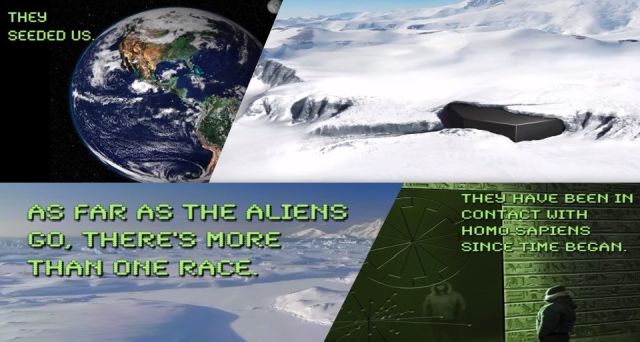


 Planet-wide storms could have caused Mars's water supply to...