Naar de inhoud

UFO'S of UAP'S, ASTRONOMIE, RUIMTEVAART, ARCHEOLOGIE, OUDHEIDKUNDE, SF-SNUFJES EN ANDERE ESOTERISCHE WETENSCHAPPEN - DE ALLERLAATSTE NIEUWTJES

UFO's of UAP'S in België en de rest van de wereld
akke.beakke.be
Ontdek de Fascinerende Wereld van UFO's en UAP's: Jouw Bron voor Onthullende Informatie! Ben jij ook gefascineerd door het onbekende? Wil je meer weten over UFO's en UAP's, niet alleen in België, maar over de hele wereld? Dan ben je op de juiste plek! België: Het Kloppend Hart van UFO-onderzoek In België is BUFON (Belgisch UFO-Netwerk) dé autoriteit op het gebied van UFO-onderzoek. Voor betrouwbare en objectieve informatie over deze intrigerende fenomenen, bezoek je zeker onze Facebook-pagina en deze blog. Maar dat is nog niet alles! Ontdek ook het Belgisch UFO-meldpunt en Caelestia, twee organisaties die diepgaand onderzoek verrichten, al zijn ze soms kritisch of sceptisch. Nederland: Een Schat aan Informatie Voor onze Nederlandse buren is er de schitterende website www.ufowijzer.nl, beheerd door Paul Harmans. Deze site biedt een schat aan informatie en artikelen die je niet wilt missen! Internationaal: MUFON - De Wereldwijde Autoriteit Neem ook een kijkje bij MUFON (Mutual UFO Network Inc.), een gerenommeerde Amerikaanse UFO-vereniging met afdelingen in de VS en wereldwijd. MUFON is toegewijd aan de wetenschappelijke en analytische studie van het UFO-fenomeen, en hun maandelijkse tijdschrift, The MUFON UFO-Journal, is een must-read voor elke UFO-enthousiasteling. Bezoek hun website op www.mufon.com voor meer informatie. Samenwerking en Toekomstvisie Sinds 1 februari 2020 is Pieter niet alleen ex-president van BUFON, maar ook de voormalige nationale directeur van MUFON in Vlaanderen en Nederland. Dit creëert een sterke samenwerking met de Franse MUFON Reseau MUFON/EUROP, wat ons in staat stelt om nog meer waardevolle inzichten te delen. Let op: Nepprofielen en Nieuwe Groeperingen Pas op voor een nieuwe groepering die zich ook BUFON noemt, maar geen enkele connectie heeft met onze gevestigde organisatie. Hoewel zij de naam geregistreerd hebben, kunnen ze het rijke verleden en de expertise van onze groep niet evenaren. We wensen hen veel succes, maar we blijven de autoriteit in UFO-onderzoek! Blijf Op De Hoogte! Wil jij de laatste nieuwtjes over UFO's, ruimtevaart, archeologie, en meer? Volg ons dan en duik samen met ons in de fascinerende wereld van het onbekende! Sluit je aan bij de gemeenschap van nieuwsgierige geesten die net als jij verlangen naar antwoorden en avonturen in de sterren! Heb je vragen of wil je meer weten? Aarzel dan niet om contact met ons op te nemen! Samen ontrafelen we het mysterie van de lucht en daarbuiten.

Berichten van 1 december 2017 tot 31 december 2017

Scientists ‘Inject’ Information Into Monkeys’ Brains

CreditChristoph Hitz

When you drive toward an intersection, the sight of the light turning red will (or should) make you step on the brake. This action happens thanks to a chain of events inside your head.

Your eyes relay signals to the visual centers in the back of your brain. After those signals get processed, they travel along a pathway to another region, the premotor cortex, where the brain plans movements.

Now, imagine that you had a device implanted in your brain that could shortcut the pathway and “inject” information straight into your premotor cortex.

That may sound like an outtake from “The Matrix.” But now two neuroscientists at the University of Rochester say they have managed to introduce information directly into the premotor cortex of monkeys. The researchers published the results of the experiment on Thursday in the journal Neuron.

Although the research is preliminary, carried out in just two monkeys, the researchers speculated that further research might lead to brain implants for people with strokes.

“You could potentially bypass the damaged areas and deliver stimulation to the premotor cortex,” said Kevin A. Mazurek, a co-author of the study. “That could be a way to bridge parts of the brain that can no longer communicate.”

In order to study the premotor cortex, Dr. Mazurek and his co-author, Dr. Marc H. Schieber, trained two rhesus monkeys to play a game.

The monkeys sat in front of a panel equipped with a button, a sphere-shaped knob, a cylindrical knob, and a T-shaped handle. Each object was ringed by LED lights. If the lights around an object switched on, the monkeys had to reach out their hand to it to get a reward — in this case, a refreshing squirt of water.

Each object required a particular action. If the button glowed, the monkeys had to push it. If the sphere glowed, they had to turn it. If the T-shaped handle or cylinder lit up, they had to pull it.

After the monkeys learned how to play the game, Dr. Mazurek and Dr. Schieber had them play a wired version. The scientists placed 16 electrodes in each monkey’s brain, in the premotor cortex.

Each time a ring of lights switched on, the electrodes transmitted a short, faint burst of electricity. The patterns varied according to which object the researchers wanted the monkeys to manipulate.

As the monkeys played more rounds of the game, the rings of light dimmed. At first, the dimming caused the monkeys to make mistakes. But then their performance improved.

Eventually the lights went out completely, yet the monkeys were able to use only the signals from the electrodes in their brains to pick the right object and manipulate it for the reward. And they did just as well as with the lights.

This hints that the sensory regions of the brain, which process information from the environment, can be bypassed altogether. The brain can devise a response by receiving information directly, via electrodes.

Dr. Mazurek and Dr. Schieber were able to rule out this possibility by seeing how short they could make the pulses. With a jolt as brief as a fifth of a second, the monkeys could still master the game without lights. Such a pulse was too short to cause the monkeys to jerk about.

“The stimulation must be producing some conscious perception,” said Paul Cheney, a neurophysiologist at the University of Kansas Medical Center, who was not involved in the new study.

But what exactly is that something? It’s hard to say. “After all, you can’t easily ask the monkey to tell you what they have experienced,” Dr. Cheney said.

Dr. Schieber speculated that the monkeys “might feel something on their skin. Or they might see something. Who knows what?”

What makes the finding particularly intriguing is that the signals the scientists delivered into the monkey brains had no underlying connection to the knob, the button, the handle or the cylinder.

Once the monkeys started using the signals to grab the right objects, the researchers shuffled them into new assignments. Now different electrodes fired for different objects — and the monkeys quickly learned the new rules.

“This is not a prewired part of the brain for built-in movements, but a learning engine,” said Michael A. Graziano, a neuroscientist at Princeton University who was not involved in the study.

Dr. Mazurek and Dr. Schieber only implanted small arrays of electrodes into the monkeys. Engineers are working on implantable arrays that might include as many as 1,000 electrodes. So it may be possible one day to transmit far more complex packages of information into the premotor cortex.

Dr. Schieber speculated that someday scientists might be able to use such advanced electrodes to help people who suffer brain damage. Strokes, for instance, can destroy parts of the brain along the pathway from sensory regions to areas where the brain makes decisions and sends out commands to the body.

Implanted electrodes might eavesdrop on neurons in healthy regions, such as the visual cortex, and then forward information into the premotor cortex.

“When the computer says, ‘You’re seeing the red light,’ you could say, ‘Oh, I know what that means — I’m supposed to put my foot on the brake,’” said Dr. Schieber. “You take information from one good part of the brain and inject it into a downstream area that tells you what to do.”

{ https://www.nytimes.com/section/science }

Hoe vind je dit bericht?
Geschreven door peter om 12:36 Stuur door

Boeing CEO Says Boeing Will Beat SpaceX to Mars

Boeing CEO Says Boeing Will Beat SpaceX to Mars

Hoe vind je dit bericht?
Geschreven door peter om 12:25 Stuur door

FIRST CONTACT: THE WOMAN WHO CLAIMED TO HAVE VISITED MARS BACK IN 1894!

FIRST CONTACT: THE WOMAN WHO CLAIMED TO HAVE VISITED MARS BACK IN 1894!

700_524bee05cb79cef54dfb418997233184.jpg?v=1512607397

There's always a cool story regarding alien abductions or some other form of extraterrestrial contact and any UFO/ET enthusiast will love to hear something new.

But what's the first documented extraterrestrial contact we have?

The surreal and fantastic tale of Mrs. Hélène Smith who was a medium back in the year 1894 claimed that she visited the Red planet Mars via visions when entering a trance like state. She met many alien entities on her journey and even stepped into unfamiliar worlds full of wonder and mystery.

She drew how the Martian landscapes looked like back when there was life. She drew and wrote about the strange lifeforms she encountered and how ancient the Martian civilization was. Mrs. Hélène Smith also learned how to write and speak the language of the Martian civilization with several examples of it's words put into paper back when she was alive.

Watch the following video to know more!  

RELATED ARTICLES

{ http://www.disclose.tv/ }

Hoe vind je dit bericht?
Geschreven door peter om 11:40 Stuur door

NASA CREW LIVE COMMENT ON UFO: "THE OBJECT IN QUESTION JUST, UH, PASSED OFF THE NOSE AGAIN"

NASA CREW LIVE COMMENT ON UFO: "THE OBJECT IN QUESTION JUST, UH, PASSED OFF THE NOSE AGAIN"

700_35d84731d3f02d317f44319fb07a64ca.jpg?v=1512722388

On the 9th of September, Space shuttle Atlantis was launched towards the international space station for the STS 115 mission. During the 13 day mission, there was a lot of UFO activity.

And we are not talking about rumours or " I heard it through the grapevine" type of reports. During the mission NASA broadcasted several hours of live downlink feed coming directly from space shuttle Atlantis.

2 UFO incidents stand out, because you can hear the space shuttle crew and ground control communicating about these mysterious objects. 

The first incident happened on the 19th of September when the crew filmed an object flying between the space shuttle and earth. You can hear someone at ground control talking about the object telling the astronauts that they will keep a close eye on it. The object itself is filmed and it looks like it's following the crew in space.

The second sighting happened on the next day. The incident was captured with 2 different cameras. You can hear one of the astronauts stating that "the object in question just, uh, passed off the nose again". Why would he use the word "Again". Maybe this wasn't the first time they encountered the strange alien object? During the second sighting 4 UFO's appear right in front of the Atlantis space shuttle.

Who knows what conversations take place once the live broadcast stops...? 

RELATED ARTICLES

{ http://www.disclose.tv/ }

Hoe vind je dit bericht?
Geschreven door peter om 11:25 Stuur door

Scientists find 'behemoth' black hole so big it could challenge our understanding of the universe's beginning

Scientists find 'behemoth' black hole so big it could challenge our understanding of the universe's beginning

Black holes shouldn't be quite so big, so young, astronomers say

Andrew Griffin  @_andrew_griffin

Scientists just found a very huge, very young supermassive black hole. As far as we know, it shouldn't be able to exist, and it just might re-write our understanding of the early universe.

It is the most distant black hole ever seen by scientists. And it is so far away that we are seeing something that formed when the universe was only five per cent of its current age – something that scientists say shouldn't be able to happen.

Our understandings of the formation and beginnings of the universe suggest that a black hole with such a huge mass shouldn't actually have been able to form, scientists say.

"This is the only object we have observed from this era," said Robert Simcoe, the Francis L. Friedman professor of physics at MIT's Kavli Institute for Astrophysics and Space Research. "It has an extremely high mass, and yet the universe is so young that this thing shouldn't exist.

"The universe was just not old enough to make a black hole that big. It's very puzzling."

The astronomer who found the strange black hole said that there's no way of explaining how a black hole would be able to pick up such mass, and that it might challenge out current understandings of how black holes form. "Gathering all this mass in fewer than 690 million years is an enormous challenge for theories of supermassive black hole growth," said Eduardo Bañados, the Carnegie scientist who spotted it.

Even in the most generous and optimistic estimate of the formation of black holes, creating such a massive one in such a relatively short period of time would be impossible. That suggests that another, entirely unknown, process was happening at the same time.

"If you start with a seed like a big star, and let it grow at the maximum possible rate, and start at the moment of the Big Bang, you could never make something with 800 million solar masses – it's unrealistic," Professor Simcoe said. "So there must be another way that it formed. And how exactly that happens, nobody knows."

To allow the formation of such a massive black hole, the very early universe might have had been able to create very large black holes with masses reaching 100,000 times the mass of the sun. That's far bigger than any we know today.

The black hole is even more puzzling because of what was happening in the universe at that time. It was taking shape just as the universe was undergoing a fundamental switch – one that saw the universe turn from being a misty cloud of hydrogen gas into a space where the very first stars were switch on.

"What we have found is that the universe was about 50/50 – it's a moment when the first galaxies emerged from their cocoons of neutral gas and started to shine their way out," said Professor Simcoe. "This is the most accurate measurement of that time, and a real indication of when the first stars turned on."

When the universe began, it was like a very hot soup of extremely energetic but formless particles. As the universe expanded in size, those particles cooled down, and as they did they formed into a neutral hydrogen gas during which it was completely dark.

Then gravity began to squash down matter into the first stars and galaxies, then creating light in the form of photons. Stars then switched on and reacted with the swirling hydrogen, beginning of process of re-ionization.

The quasar that made its way to Earth from the black hole began its life at that very important part of the history of the universe. That helped scientists estimate that the stars turned on roughly when it began its journey – about 696 million years after the big bang.

"This adds to our understanding of our universe at large because we've identified that moment of time when the universe is in the middle of this very rapid transition from neutral to ionized," said Professor Simcoe. "We now have the most accurate measurements to date of when the first stars were turning on."

More about: 

{ http://www.independent.co.uk/ }

Hoe vind je dit bericht?
Geschreven door peter om 11:13 Stuur door

Kolossaal zwart gat gevonden dat niet zou moeten bestaan. Deze wetenschappers staan voor een raadsel

Kolossaal zwart gat gevonden dat niet zou moeten bestaan. Deze wetenschappers staan voor een raadsel

Kolossaal zwart gat gevonden dat niet zou moeten bestaan. Deze wetenschappers staan voor een raadsel

Wetenschappers hebben zojuist een gigantisch, zeer jong supermassief zwart gat ontdekt. Voor zover we weten zou het niet moeten kunnen bestaan.

Het zwarte gat, dat 800 miljoen keer de massa van onze zon heeft, dwingt ons mogelijk de huidige visie op het jonge universum te herzien.

Het is het verst gelegen zwarte gat dat ooit is ontdekt door wetenschappers. Het staat zo ver weg dat we iets zien wat is ontstaan toen het universum nog piepjong was, iets wat volgens wetenschappers niet zou moeten kunnen gebeuren.

Zeer raadselachtig

Onze theorieën over het ontstaan en het begin van het heelal suggereren dat een zwart gat met zo’n enorme massa niet zou moeten kunnen bestaan, zeggen wetenschappers nu.

“Dit is het enige object uit dit tijdperk dat we hebben waargenomen,” zei professor Robert Simcoe van het Massaschusetts Institute of Technology.

“Het heeft een extreem grote massa en toch was het universum nog zo jong dat dit ding niet zou moeten bestaan,” voegde hij toe.

“Het universum was simpelweg niet oud genoeg om zo’n groot zwart gat te maken,” aldus Simcoe. “Dit is zeer raadselachtig.”

Geen manier

De astronoom die het vreemde zwarte gat heeft ontdekt zei dat er geen manier is om te verklaren hoe een zwart gat zoveel massa heeft weten te vergaren.

Het zet mogelijk de bestaande theorieën over het ontstaan van zwarte gaten op hun kop.

“Het verzamelen van al deze massa in minder dan 690 miljoen jaar is een enorme uitdaging voor theorieën over de groei van supermassieve zwarte gaten,” zei Eduardo Banados van het Carnegie Institution for Science.

Onmogelijk

Het creëren van zo’n enorm zwart gat in zo’n kort tijdsbestek is volgens de huidige modellen onmogelijk.

“Het moet op een andere manier zijn gevormd,” zei professor Simcoe. “Niemand weet echter hoe dat precies is gebeurd.”

De studie staat in vakblad Nature.

[Independent] 
Hoe vind je dit bericht?
Geschreven door peter om 10:58 Stuur door

Strange lights hover over a yard in Virginia

Strange lights hover over a yard in Virginia

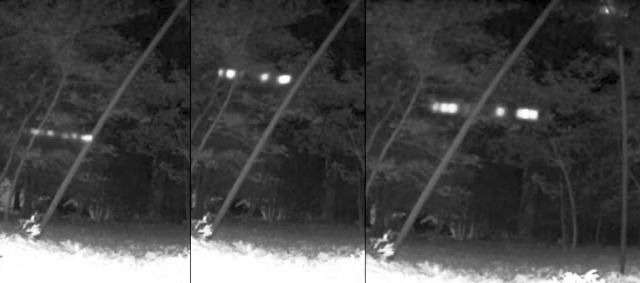
A security camera set up to watch deer has recorded a very strange flying object with bright lights hovering over a yard in Virginia on November 16, 2017.

ufo%2Borbs%2Bsphere%2Blights%2Byard%2B%2B%25281%2529.jpg

The owner of the cam stated that his ex wife was texting the video of the cam in her yard and said what the heck are these things?

Checking the video he saw strange lights flying like bugs but they don’t look like bugs or insects as you can see real bugs and insects flying around.

The lights are geometric and seem to be connected to each other and move in on the camera that gives off no light.

ufo%2Borbs%2Bsphere%2Blights%2Byard%2B%2B%25282%2529.jpg

The owner who has submitted the video to Mufon case 88593 wonders whether the object is a UFO or something that can be explained as he has never seen something like this before.

{ http://ufosightingshotspot.blogspot.com/ }

Hoe vind je dit bericht?
Geschreven door peter om 10:52 Stuur door

LEGENDARY UFO EXPERT ERICH VON DANIKEN ON HIS CHARIOTS OF THE GODS AT 50

LEGENDARY UFO EXPERT ERICH VON DANIKEN ON HIS CHARIOTS OF THE GODS AT 50

Contributed by
If you were alive in the 1970s and had any level of interest in the pervasive culture of UFOs, then you totally owned a dog-eared paperback copy of Erich von Daniken's ancient astronaut expose, Chariots of the Gods?

First published in 1968, the pioneering book ignited a worldwide craze for flying saucers, crop circles, extraterrestrial abductions, and ufology that slingshotted into the Swingin' '70s. No self-respecting stargazer or sci-fi conventioneer was without this bible of the bizarre, which postulated that our planet had been a stopover point thousands of years ago for interstellar visitors who shared futuristic technology with ancient civilizations.

Von Daniken theorized that many of Earth's most amazing structures and landmarks like the Egyptian pyramids, Stonehenge, the Moai of Easter Island, the Nazca lines in Peru, and cart-ruts in Malta and Australia had been influenced or utilized by these benevolent beings from beyond.

He also hypothesized that artwork throughout the world could be interpreted as depicting helmeted astronauts, fantastic air and space vehicles, intricate spaceports, and complex machines far outside any known human technologies of the time.

Controversial yet captivating, with significant pseudoscience at its core, Chariots of the Gods was eventually translated into 28 languages with total worldwide sales of 16 million copies.

The Swiss author went on to write another 32 sequels and companion novels on the spacey subject (selling a staggering 63 million copies) and his works have spawned multiple documentaries, Hollywood films, video games, and TV shows -- most notably the Ancient Aliens series on the History Channel. Chariots of the Gods and its legacy remain some of the most copied and referred-to texts within the UFO community, and next year the novel celebrates its 50th anniversary with a special deluxe edition from Berkley Publsihing.

Here's the official press release:

Berkley is thrilled to be commemorating the 50th anniversary of the classic CHARIOTS OF THE GODS by Erich von Däniken in July 2018 by re-releasing the groundbreaking book that introduced the theory that ancient Earth established contact with aliens in a beautiful anniversary edition with a new foreword and afterword by the author.Here, von Däniken examines ancient ruins, lost cities, spaceports, and a myriad of hard scientific facts that point to extraterrestrial intervention in human history. Most incredible of all, however, is von Däniken's theory that we are the descendants of these galactic pioneers--and he reveals the archaeological discoveries that prove it.

Check out SYFY WIRE's exclusive interview below with von Daniken, who makes his home in Switzerland, discussing the current state of ufology, how modern archaeologists and historians have debunked some of his groundbreaking theories, and what he hopes new generations of readers will take from his monumental book.

How do yo?u see the status of UFO culture today as opposed to its peak intensity in the '70s and '80s

Erich von Daniken: The spirit of time has changed. Although UFOs are for many persons something which does not exist and has to be ridiculed, many famous persons around the world accept the facts of UFO and even say this in public.

With science fiction so popular in entertainment offerings, how doesChariots of the Gods fit into the scene today?

Prometheus from Ridley Scott is a Chariots of the Gods theme. So are many other science fiction series, like for example Stargate from Roland Emmerich.


Did you ever meet Leonard Nimoy and what are your memories of Chariots of the Gods being featured on In the Search Of Ancient Astronauts show?

Unfortunately I never had the chance to meet Leonard Nimoy. The TV-Series Ancient Aliens from the History Channel is a full Erich von Däniken-documentary. It mostly has to do with my books. I am – so to say – the godfather of the series. Giorgio Tsoukalos who presents the series brilliantly has grown up with my knowledge and was my student. We are very good friends.

What are some of your favorite alien invasion or extraterrestrial abduction movies or TV shows?

The best movie in this connection is definitely 2001 and 2010: A Space Odyssey by Arthur C. Clarke. And in the Stargate TV series there are many elements from my books.

What do you hope a new generation of readers might absorb and understand from Chariots of the Gods?

They will realize, that humanity was never alone and that we are the offsprings of an extraterrestrial space family. And, of course, in the future it will be absolutely clear that the reason for so many religions comes from the deep past and has to do with extra-terrestrials.


Have you changed any of your theories or positions on ancient astronauts and extraterrestrial visitors since Chariots was published?

The general theory is in the meantime absolutely confirmed and provable. On the other hand, there were some mistakes in my earlier books. This is the normal way in scientific works.

How do you hope the book will be remembered today, and another 50 years from now for its 100th anniversary?

As a modest man, I don’t know what the future will bring. Of course, I hope, to be not completely forgotten.

Hoe vind je dit bericht?
Geschreven door peter om 01:43 Stuur door

Astronomer sees UFO in the sky on Tuesday

A fireball was visible in the Red Deer skies Tuesday morning. (Contributed photo)

Astronomer sees UFO in the sky on Tuesday

It could be space junk in our atmosphere, says the expert

It wasn’t a bird, it wasn’t a plane and it wasn’t Superman.

A Red Deer astronomer, Kevin Bilston, wonders if anyone else saw what he saw Tuesday morning.

He said he believes what he witnessed was a burning rocket or a piece of junk floating around in the atmosphere at 11:07 a.m.

The unknown fireball was bright, travelling from west to east and was visible to the naked eye.

Describing the fireball, the Rosedale resident said what he saw go past his house had a tail like comets do. But he’s positive, it wasn’t a comet or meteor.

Bilston, 60, has been following astronomy since he was 16 and has witnessed comets and meteors in his lifetime, but that’s usually at nighttime.

“The sky was completely blue and the sun was out so it was probably something else burning in our atmosphere,” he said.

He said when things are sent into space, they sometimes fall back and one can catch the bits from, say, space rockets with pieces falling back into Earth.

Whatever it was, Bilston hopes it wasn’t Santa’s sleigh burning up and so do we.

{ https://www.surreynowleader.com/news/ }

Hoe vind je dit bericht?
Geschreven door peter om 01:29 Stuur door

What If the Big Bang Wasn't the Beginning? New Study Proposes Alternative

What If the Big Bang Wasn't the Beginning? New Study Proposes Alternative

Hoe vind je dit bericht?
Geschreven door peter om 01:22 Stuur door

Humans Would Be Cool with Finding Aliens

Humans Would Be Cool with Finding Aliens

Hoe vind je dit bericht?
Geschreven door peter om 00:59 Stuur door

Researchers 3D-print shockingly realistic human organ models

Researchers 3D-print shockingly realistic human organ models

 BY MIHAI ANDREI

The new organs that researchers have 3D printed don’t only look like the real deal, but they also feel like it.

Researchers can attach sensors to the organ models to give surgeons real-time feedback on how much force they can use during surgery without damaging the tissue. Credits: McAlpine Research Group.

3D printing has taken the world by storm, and medicine especially can benefit from the technology. So far, people have 3D printed human cartilage, skin, and even artificial limbs — and we’ve just started to scratch the surface of what 3D printing can do. Now, researchers from the University of Minnesota have developed artificial organ models which look incredibly realistic.

“We are developing next-generation organ models for pre-operative practice. The organ models we are 3D printing are almost a perfect replica in terms of the look and feel of an individual’s organ, using our custom-built 3D printers,” said lead researcher Michael McAlpine, an associate professor of mechanical engineering at the University of Minnesota’s College of Science and Engineering.

The 3D-printed structures not only mimic the aspect of real organs, but also the mechanical properties, look and feel of real organs. They include soft sensors which can be customized depending on the desired organ. The sensors offer real-time feedback on how much force is being applied to them, notifying doctors when they are close to damaging the organ.

The technology could help students get a better feel for real organs and learn how to improve surgical skills. For doctors, it could help them prepare for complex surgeries. It’s a great step forward from previous models of artificial organs, which were generally made from hard, unrealistic plastic.

“We think these organ models could be ‘game-changers’ for helping surgeons better plan and practice for surgery. We hope this will save lives by reducing medical errors during surgery,” McAlpine added.

In the future, researchers want to develop even more complex organs, as well as start incorporating defects or deformities. For instance, they could add a patient-specific inflammation or a tumor to an organ, based on a previous scan, enabling doctors to visualize and prepare for an intervention.

Lastly, this could ultimately pave the way for 3D-printing real, functioning organs. There’s no fundamental reason why we can’t do this, it’s just that we’re not there yet. This invention could be a stepping stone for such advancements.

“If we could replicate the function of these tissues and organs, we might someday even be able to create ‘bionic organs’ for transplants,” McAlpine said. “I call this the ‘Human X’ project. It sounds a bit like science fiction, but if these synthetic organs look, feel, and act like real tissue or organs, we don’t see why we couldn’t 3D print them on demand to replace real organs.”

The research was published today in the journal Advanced Materials Technologies.

{ https://www.zmescience.com/ }

Hoe vind je dit bericht?
Geschreven door peter om 00:39 Stuur door

The Story of Human Migration Out of Africa Just Got Rewritten

chad rock paintings

For anyone trying to trace the roots of the human family tree, it would have been very convenient if our ancestors had left Africa in one great exodus, kicking off humanity’s global takeover with a single inaugural bang. And the first time we looked at fossils left behind by our ancestors, that indeed appeared to be the case. Like a series of Foursquare check-ins, the ages of the bones seemed to depict one long human trip out of Africa, across Asia, and into Australia that started 60,000 years ago.

But in recent years, scientists looking back at old fossils with new techniques have revealed discrepancies in the storyline — evidence of much older humans winding up in regions they weren’t supposed to reach for thousands of years, or DNA that isn’t as human as we first thought. A review published Thursday in Science compiles and analyzes all of these deviations from the “Out of Africa” (OoA) narrative, concluding that it’s time for a rewrite.

Doing so was a big break with the “elegant” old theory, says lead author and anthropologist Christopher Bae, Ph.D., of the University of Hawai’i at Manoa, but the evidence he and his team uncovered left them no choice.

“My co-authors and I work in different areas of Asia, and when we sat down and started comparing notes, we kept finding evidence (between 120 ka and 60 ka) of earlier modern human dispersals OoA,” he tells Inverse in an e-mail.

“So what we envision is that although there was likely a major dispersal OoA between 60 ka and 50 ka, which may or may not be due to paleoenvironmental fluctuations, there were waves of earlier dispersals by modern humans as well, though these earlier populations were smaller.”

Map of sites and postulated migratory pathways associated with modern humans dispersing across Asia during the Late Pleistocene.

Bae and his team came to this conclusion after reviewing multiple recent studies showing that humans traveled farther than we would have expected given the OoA time frame. One showed Homo sapiens fossils in China that were somewhere between 70,000 to 120,000 years old. Another found a fossil as far out as Australia dating to 60,000 years ago — which, according to the OoA theory, was when humans were just gearing up to leave for the first time. All of these aberrant finds, taken together, suggested that the original explanation was wrong.

The leading explanation for how these humans got to China and Australia tens of thousands of years before the theory predicted they would is that humans began leaving Africa much earlier than expected, the researchers write. Their new model proposes that there were multiple diasporas from Africa, the first of which might have happened 120,000 years ago.

That’s not to say that the original OoA theory is now entirely moot. New models aside, there’s still a preponderance of fossils dating back to the 60,000-year mark, which suggests that there was a mass dispersal around that time — it just wasn’t the only one.

“The initial dispersals out of Africa prior to 60,000 years ago were likely by small groups of foragers, and at least some of these early dispersals left low-level genetic traces in modern human populations,” said Max Planck Institute anthropologist Michael Petraglia, Ph.D., a co-author on the study, in a statement.

Neanderthal Neanderthal DNA still runs in our genomes, complicating the story of our origins.

Further complicating the story of human origins is the fact that some of the Homo sapiens fossils scientists have dug up were, unexpectedly, not entirely human. We had assumed for a long time that Homo sapiens branched off from the hominin tree very early on and forever remained separate from our closest cousins, the Neanderthals and the Denisovans. But now, genomic analysis in many studies has revealed that DNA from Homo neanderthalensis and Homo sapiens ssp. Denisova(it’s not clear yet whether they’re a different species or just a subspecies) runs through the genomes of many modern humans, suggesting that the ancient humans who left Africa all those years ago were either a “hybrid” species or fully modern humans that hooked up with other species along their travels, reintroducing those foreign genes.

For now, the researchers point out, the data we have suggests that all current non-African populations can trace their bloodlines back to a single group of humans that broke off of the family tree about 60,000 years ago, which likely represents the big OoA migration scientists long believed was our only move out of our ancestral home. But as researchers continue to uncover evidence of our ancestors in previously unexplored regions, like Asia, there’s plenty we might still learn about the people who dared to leave Africa before that — and who their descendants are today. Bae notes that, already, scientists have found that some two percent of the Papua New Guinean genome contains evidence of modern human dispersals that predate 60,000 years.

“[With] the increasing evidence of an early modern human presence across Asia, the possibility that these earlier dispersals may be detected in modern human genomes increases,” he says.


Photos via Bae et al. 2017. On the origin of modern humans: Asian perspectives. Science. Image by: Katerina Douka and Michelle O'Reilly, Flickr / p_a_h, Wikimedia
Hoe vind je dit bericht?
Geschreven door peter om 00:31 Stuur door

Psychologists Say Humans and ETs Will Get Along Just Fine

alien-1901834_1920-999x529.jpg

Psychologists Say Humans and ETs Will Get Along Just Fine

Stephen Hawking doesn’t want humans calling out to extraterrestrials because they may follow the signal and visit us. What is he afraid of? Whatever it is, a new study found that he’s in a small minority of people who fear our first (or perhaps next) contact with alien life forms. Based on how humans have reacted to stunning news in the past that seemed at the time to reveal that we’re not alone in the universe, the study suggests we’ll welcome them with open arms and shake however many hands or appendages they have.

Arizona State University (go Sun Devils!) is the center for this research where psychologist Michael Varnum asked the question, “How Will (Do) We React to the Discovery of Extraterrestrial Life?” and answered it in a new study with the same name. He and his co-authors conducted three interesting experiments. In the first, they looked at how the media has covered ET-ish stories in the past. They took five past possible encounter events (1967 discovery of pulsars, 1977 Wow! signal, 1996 finding of fossilized microbes on Martian meteorite on Earth, 2015 dimming of Tabby’s star, 2017 discovery of exoplanets in habitable zones), collected 15 news stories on the events by the New York Times, the Wall Street Journal and other leading sources, and fed them into a program that counted positive and negative words (you need a program to do this?). The Washington Post reported Varnum’s finding:

“The reaction seemed to be much more positive than negative.”

While Varnum sounds excited, skeptics say that most people tend to use more positive than negative words in general. (Have these skeptics ever read online comments?) The researchers next gave 500 people a fictional announcement that alien microorganisms had been discovered. Like the media, the people reacted with positive words but, when asked how the rest of the country might react, said that ‘those people’ would be less receptive. Varnum is obviously someone who reads online comments because he gave this reason for that response:

“Most Americans tend to think, on any desirable trait or ability, that they’re better than the average person.”

Yep.

Finally, a group was told the story about the Martian microbes on the meteorite (since determined to most likely be mineral deposits) as if it just happened. Like the other test subjects, they reacted positively.

What is the fly in the ointment here? It’s the fact that the ET stories were about aliens smaller than flies … microbes, not walking, talking big-headed aliens in spaceships. How would Americans react to human-sized aliens – especially before knowing their intentions? Varnum points out that Americans see things as “all good or all bad” but not both. He’d like to conduct the same tests on other cultures for comparison, as he believes the Chinese, for example, would see both positive and negative aspects of an alien encounter.

Sorry, ET

For know, it looks like Americans will welcome any ETs and get along with them … as long as they have the option of stepping on them.

{ http://mysteriousuniverse.org/ }

Hoe vind je dit bericht?
Geschreven door peter om 23:50 Stuur door

The Government’s Files on the Men in Black

files-999x540.jpg

The Government’s Files on the Men in Black

Does the U.S. Government have files on the Men in Black? Well, yes, to a degree. One example of more than a few revolves around the two men who, more than any others, brought the phenomenon to the attention of the UFO research community and to the public – and also to none other than the FBI. They were Gray Barker and Albert Bender. In 1956, Barker wrote a book about Bender’s MIB experiences, titled They Knew Too Much About Flying Saucers. Then, in 1962, Barker published Bender’s own book on the MIB, Flying saucers and the Three Men. Both men caught the attention of the FBI.

On 28 August 1953, an agent of the FBI visited Gray Barker and asked him a number of questions concerning Albert Bender’s International Flying Saucer Bureau. It turns out that Bender had mailed to Barker a package of business cards that he had printed identifying Barker as “Chief Investigator” for the International Flying Saucer Bureau. In the pages of They Knew Too Much About Flying Saucers, Barker admitted having given “four or five [of the cards] to close friends, who still had them when I checked with them one week later.” It was therefore something of a surprise when the FBI turned up on Barker’s doorstep with one of the aforementioned business cards and asking probing questions. “I have always been puzzled about how the Federal Bureau of Investigation got hold of one of them,” Barker later said.

“What’s this all about?” asked the agent, sternly. Somewhat nervously, a fidgeting and sweaty Barker explained that the IFSB was simply an organization formed to investigate “flying saucer phenomena” and that the business cards were simply a means by which IFSB investigators could be identified. The FBI man then proceeded to ask Barker if he knew of a certain individual, whose name Barker could not later recall but who lived in Florida. Barker replied that he did not. This then prompted the agent to advise Barker that the man had suffered an epileptic fit and had been taken to the nearby St Mary’s Hospital. Contained within his belongings was one of Bender’s IFSB cards. By now satisfied that Barker was not acquainted with the man in question, the FBI agent merely thanked him and departed as mysteriously as he had arrived.

“Then it struck me,” recalled Barker. “How in the world had anyone from Florida come into possession of one of my business cards?” As Barker told his readers, he began to seriously wonder if there really had been an epileptic man, or if this had simply been a very clever ruse to allow the FBI to covertly check out Barker, Bender, the IFSB and the story of Bender’s experience with the Men in Black. Barker voiced all of these concerns and suspicions in a lengthy report to Bender, who quickly wrote back: “I cannot for the life of me see why [the FBI] would be checking up. It certainly proves one thing – the government is more interested in the Saucers than we realize.”

Half a decade later, Barker and Bender – and their deep links to the mysterious Men in Black – were once again the subjects of FBI interest. On 22 November 1958, an inquiring citizen of Oklahoma City contacted J. Edgar Hoover about the FBI and the MIB. The letter-writer said: “Recently many rumors have been printed in UFO periodicals, concerning reports that Special Agents of the Federal Bureau of Investigation have discouraged certain saucer investigators, particularly Mr. Albert Bender of Bridgeport, Connecticut, from further research into the secret of these elusive discs. Since you are the Director of the FBI, I would like to know whether or not these reports are factual or whether they are just rumors.”

Hoover’s response to the letter-writer was swift: “I am instructing a Special Agent of our Oklahoma City Office to contact you concerning the matter you mentioned.” A note from Hoover to the special agent in charge at Oklahoma City added: “An agent of your office should contact [the letter writer] immediately and secure copies of or information concerning the periodicals described.”

J. Edgar Hoover

In a memorandum to Hoover dated 9 December 1958, the Oklahoma office of the FBI reported that the periodical in question was titled the Saucerian Bulletin and was published by Gray Barker. The FBI further noted for Hoover’s attention that the Saucerian Bulletin reported that the three men responsible for silencing Albert Bender were from “the FBI, Air Force Intelligence, and the Central Intelligence Agency.” An FBI report of 12 December reads as follows: “Bender formed the International Flying Saucer Bureau in Bridgeport, Connecticut, in 1952 to look into the flying saucer mystery. In 1953 Bender allegedly stated that he knew what the saucers are. Then ‘three men in black suits’ silenced Bender to the extent that even today Bender will not discuss the matter of his ‘hush-up’ with anyone.”

A month later, on 22 January 1959, Hoover was still on the trail of Barker, Bender and the Men in Black and wrote in a memorandum to one of his special agents: “The Bureau desires to obtain a copy of the book written by Gray Barker entitled They Knew Too Much About Flying Saucers. Reportedly, the book was published by University Books, Inc., Illinois. Contact this publishing house and if possible, obtain a copy of this book.”

Three weeks later, a copy of Barker’s book was in Hoover’s very own hands, as were all available copies of Bender’s Space Review magazine. The FBI subsequently noted that its files contained “no information pertaining to the hush-up of Bender.” On the subject of his Space Review journal the FBI noted: “This magazine contains numerous articles and squibs concerning the sighting of flying saucers throughout the world. It does not appear to have any security significance.”

This demonstrates that whoever Bender’s mysterious black-garbed visitors were, they were not FBI agents. It is highly curious to note, however, that nowhere in the declassified papers is there any mention of the FBI’s 1953 interview with Gray Barker. Was this simply an off-the-record interview? We may never know for certain. Bender quit Ufology in the 1960s. As for Barker, he continued to both write and publish – and up until the time of his death in 1984.

{ http://mysteriousuniverse.org/ }

Hoe vind je dit bericht?
Geschreven door peter om 23:49 Stuur door

George Adamski: “A Rather Comical Anarchist”

MaxPixel.freegreatpicture.com-Space-Ufo-Alien-Rendering-Fantasy-Spaceship-3d-2121467-copy-999x487.png

George Adamski: “A Rather Comical Anarchist”

There’s no doubt that the early-to-mid-1950s was the era in which the controversial UFO Contactee, George Adamski, was at his “height.” At least, in terms of popularity. By the late fifties, though, things weren’t quite so good. In early 1959, Adamski was invited to deliver a series of lectures in New Zealand: specifically in Wellington and Auckland. Notably, this lecture-tour was of interest to the world of government, and his presentations were clandestinely scrutinized by government operatives. A Foreign Service Dispatch of February 1959 was sent from the American Embassy in New Zealand to the Department of State in Washington, D.C., that summarized Adamski’s activities in New Zealand.

Also forwarded to the FBI, the CIA, the Air Force and the Navy, the report was titled “‘FLYING SAUCER’ EXPERT LECTURING IN NEW ZEALAND” and recorded the following: “Mr. George ADAMSKI, the Californian ‘flying saucer expert’ and author of the book Flying Saucers Have Landed and others, has been visiting New Zealand for the last two weeks. He has given well-attended public lectures in Auckland and Wellington as well as meetings with smaller groups of ‘saucer’ enthusiasts. In Wellington his lecture filled the 2,200 seats in the Town Hall. He was not permitted to charge for admission as the meeting was held on a Sunday night, but a ‘silver coin’ collection was taken up and this would more than recoup his expenses.”

The 2,000-plus people in attendance may have been impressed, but staff from the American Embassy certainly were not: “Adamski’s lectures appear to cover the usual mass of sighting reports, pseudo-scientific arguments in support of his theories and his previously well-publicized ‘contacts’ with saucers and men from Venus. He is repeating his contention that men from other planets are living anonymously on the earth and, according to the press, said in Auckland that there may be as many as 40,000,000 of these in total. He is also making references to security restrictions and saying that the US authorities know a lot more than they will tell.”

In an amusing part of the document we are told: “The report of Adamski’s lecture in Wellington in The Dominion was flanked by an article by Dr. I.L. THOMPSON, Director of the Carter Observatory, vigorously refuting Adamski on a number of scientific points. However, the news report of the lecture called it ‘the best Sunday night’s entertainment Wellington has seen for quite a time.'”

Moving on, there is this: “Interest in flying saucers in New Zealand seems to be roughly comparable to that in the United States. There is a small but active organization which enthusiasts have supported for some years. This organization publishes a small paper and receives and circulates stories of sightings. At the Adamski lecture in Wellington, approximately 40 members of the ‘Adamski Corresponding Society’ wore blue ribbons and sat in reserved seats in the front row. Press reports suggest that Adamski probably is making no new converts to saucer credence in his current tour. His audiences have given forth with a certain amount of ‘incredulous murmuring’ and are said to be totally unimpressed with his pictures of saucers.”

Almost twelve months on, Adamski was yet again the topic of FBI interest when an unidentified American citizen offered an opinion that Adamski was using the UFO controversy as a means to promote communism. In a report on the affair, the FBI recorded the following: “[Censored] said that in recent weeks she and her husband had begun to wonder if Adamski is subtly spreading Russian propaganda. She said that, according to Adamski, the ‘space people’ are much better people than those on earth; that they have told him the earth is in extreme danger from nuclear tests and that they must be stopped; that they have found peace under a system in which churches, schools, individual governments, money, and private property were abolished in favor of a central governing council, and nationalism and patriotism have been done away with; that the ‘space people’ want nuclear tests stopped immediately and that never should people on earth fight; if attacked, they should lay down their arms and welcome their attackers.

“[Censored] said the particular thing that first made her and her husband wonder about Adamski was a letter they received from him dated 10/12/59, in which it was hinted that the Russians receive help in their outer space programs from the ‘space people’, and that the ‘space people’ will not help any nation unless such nation has peaceful intent. It occurred to them that the desires and recommendations of the ‘space people’ whom Adamski quotes are quite similar to Russia’s approach, particularly as to the ending of nuclear testing, and it was for this reason she decided to call the FBI.”

From then on – as far as can be determined, at least – the worlds of the FBI and Adamski never again crossed paths; he died in 1965. All of the above demonstrates that Adamski and his claims provoked a great deal of commentary and controversy – and for wildly and widely varying reasons. Some years ago I interviewed Colin Bennett, the author of the Adamski-themed book, Looking for Orthon. I asked Bennett for his specific thoughts on why Adamski seemed to attract all kinds of attention. Bennett told me:

“Back in 1952, the FBI regarded Adamski as little more than a pop-eyed hippy nut case. He was, however, beginning to get a certain following, and he was watched as much later, John Lennon, Timothy Leary, Andrija Puharich, and Wilhelm Reich were watched. We can assume all possible cult followers, right up to the present day are taken note of in a similar manner. The flying saucer bit probably did not interest the FBI at all, even if they knew, cared, or understood anything about such things. On the other hand, they might well have been interested in Adamski’s racial and near-Nazi views. He did not make a big thing of such opinions, but he certainly voiced them after the War, at a time when hundreds of thousands of American dead were fresh in the memory, and that could not have gone down well.”

Bennett continued: “Another level of Intelligence interest might have been aroused concerning possible observation of unusual airborne devices which might well have been advanced secret surveillance craft of some kind, possibly launched from Russian submarines off the West Coast. There was also another good reason for suspicion. In the 1950s, myriad tests were being carried out on jets, rockets and missiles in the Mojave Desert where Orthon appeared originally. Many of these tests were carried out by imported Nazis rocket-scientists and technological experts, secretly smuggled into the U.S. by means of Operation Paperclip. Intelligence surveillance in this area was therefore high, for by 1953, the race for the moon had just commenced. Reports of exotic airborne vehicles may well have leaked from the Mojave area and created all kinds of ‘alien craft’ rumors.”

Also from Bennett: “Yet another reason for surveillance of Adamski was that security agencies of any and every kind operate on the principle that cults can turn political very quickly, and often in a very nasty way. As we know, countless assassins and terrorists arise from cults of many kinds. Official interest, to my mind, was therefore a passing criminal interest, not an esoteric one; although Adamski in his semi-paranoid act as a rather comical anarchist tried to make it so, implying all kinds of motivations to even minimal gumshoe levels of official inquiry. It must be remembered that before he became a famous author with a best-selling book, he was the kind of guy who sounded off about anything and everything. His murky ‘occult’ involvements with the esoteric underground on the wild West Coast between the time of his youth in World War 1 and the 1950s marked him out as a very odd character indeed.”

Bennett adds with respect to Adamski: “I asked myself: why should we be so alarmed by a man who says he met a supposed extraterrestrial being who stepped out of a so-called flying saucer? Why should such a man be regarded as a threat and be ridiculed for his trouble? It appears that certain kinds of fantastic claim, no matter how apparently ridiculous and plain stupid, somehow get to the core of our belief system, and push aside momentarily all plain practical rationalizations and thoroughly disturb our iron-bound consciousness.

“Most structured, factual arguments just do not have this kind of power. It appears that all things out of the ordinary are mental dynamite. They must be carefully managed by whatever control system is operational at any one time, whether religious, scientific, or military. The original Adamski ‘contact’ story makes us stare into an abyss, and our psychological management system tries automatically to shut this down; if only to allow us to get some sleep at night.”

{ http://mysteriousuniverse.org/ }

Hoe vind je dit bericht?
Geschreven door peter om 23:35 Stuur door

Strongest Possibility Yet for Life on Jupiter’s Moon Europa

Image result for youtube Strongest Possibility Yet for Life on Jupiter’s Moon Europa

Strongest Possibility Yet for Life on Jupiter’s Moon Europa

It’s a term that’s used too frequently and too lightly, but in this case it seems more than appropriate: “This could change everything.” ‘This’ is the discovery of tectonic plate movement on Jupiter’s moon, Europa. Those plates rubbing together under the moon’s frozen surface could move nutrients from the ice to the ocean believed to be beneath it, providing food to any life forms floating around down there. If life can exist deep underneath Antarctica, why not on Europa?

How do you get from plates moving to life existing? Good question. It starts at Brown University in Rhode Island where Brandon Johnson, an assistant professor in the Department of Earth, Environmental and Planetary Sciences, was trying to figure out how tectonic plates could move without heat. That’s the key ingredient here on Earth where the cold dense plates slide underneath each other into the underlying hot mantle in a process known as subduction. Subduction zones on Earth have high rates of earthquakes and volcanoes that are both products and propagators of the process. The energy created and released may have caused the chemical reactions that sparked life as well as the movements that stirred the waters and fed it nutrients.

But how can this work on frozen celestial bodies with no hot mantle? Johnson and his colleagues did what scientists do … created a model to figure out what would make ice plates move in the same way as rock plates. The simulations found that the secret ingredient was … pixie dust! Just kidding … it was salt. As salt melts it, an ice plate becomes less dense, causing it to rise so that a colder, more dense ice plate can slide under it. It then hits the warmer liquid in the ocean underneath the surface, melts to be come less dense and rises up again, causing further subduction.

And then what, Professor Johnson?

“Our work also implies that the plates will sink all the way to Europa’s subsurface ocean. This is important because material from the surface of Europa could act as food for life that may exist in Europa’s ocean.”

As he explains in the team’s paper published in the Journal of Geophysical Research, while it’s not yet proof that there is life on Europa, it moves the dots much closer together. Earth is the only body in the solar system known to contain and sustain life. It was also the only body with plate tectonics that cause subduction … until now. This give Europa one more building block towards life.

Salt is essential for life on Earth and its availability has been critical to the development of civilization. Is it about to do it all over again on Europa?

{ http://mysteriousuniverse.org/ }

Hoe vind je dit bericht?
Geschreven door peter om 23:26 Stuur door

Mysterious New ‘Death Planet’ Is Life’s Worst Nightmare

12_01_wasp_18b

WASP-18b, a so-called hot Jupiter planet.

Mysterious New ‘Death Planet’ Is Life’s Worst Nightmare

Space is scary. Aside from the soul-crushing emptiness, the mind-bending enormity, and the general inhospitality of the place, there are all of the unknowns. We’re only a few decades into our exploration of the great beyond, and while we think we have a handle on what’s going on in the universe, we likely have no idea what’s in store in other galaxies and the farthest reaches of space. It seems like every week there’s a new discovery made which challenges one or more of the assumptions we currently have about the way things work out there in physics land. Just last week, in fact, NASA astronomers announced the discovery of a planet so unlike anything we’ve found and so terrifying that some outlets have nicknamed it a “death planet.”

Size comparison between Jupiter, left, and WASP-18b, right.

Size comparison between Jupiter, left, and WASP-18b, right.

The planet lies about 350 light-years from Earth, orbiting its host star WASP-18 in the Phoenix constellation. WASP-18b is a type of planet known as a “hot Jupiter,” meaning it’s a gas giant which orbits quite close to its host star leading to extremely high temperatures. WASP-18b is also enormous, measuring about ten times the mass of our solar system’s largest planet, Jupiter. What makes WASP-18b interesting – and deadly – is its chemical composition. The planet’s atmosphere is composed almost exclusively of carbon monoxide without any indication of water, which is quite unusual. In a press release, Kyle Sheppard of NASA’s Goddard Space Flight Center says that this unique chemical composition makes this planet an astronomical oddball:

The composition of WASP-18b defies all expectations. We don’t know of any other extrasolar planet where carbon monoxide so completely dominates the upper atmosphere.

Scientists are already predicting that the discovery of this enormous, anomalous planet could revolutionize our understanding of planetary formation. WASP-18b’s searing temperatures, carbon monoxide atmosphere, and complete lack of water make it one of the least hospitable planets for life – at least by our current definition of life.

WASP-18b's carbon monoxide atmosphere is the first known of its kind.

WASP-18b’s carbon monoxide atmosphere is the first known of its kind.

Discoveries like these make you wonder: if there is some unknown form of life on a planet like this one which is believed to be completely inhospitable, would we even be able to recognize it as life? Before the invention of the microscope, we had no idea that there was microscopic life right under our noses. Scientists have been finding microbial life here on Earth in some of the least hospitable places possible, and there might even be microbes growing on the International Space Station in the vacuum of space. Advances in space technology could someday reveal whole new possibilities of life we have never imagined. While we’re calling WASP-18b a “death planet” for now, who knows what might be lurking at its core?

{ http://mysteriousuniverse.org/ }

Hoe vind je dit bericht?
Geschreven door peter om 23:15 Stuur door

Not Quite A Crop Circle, But…

Image result for Not Quite A Crop Circle, But…

Not Quite A Crop Circle, But…

Reports of Crop Circles chiefly date back to the late 1970s (with a few in the 1960s). There are, however, some reports that date back much earlier, such as these, which turned up in an old Second World War file created by MI5, which is the U.K.’s equivalent of the United States’ FBI. And, still on the matter of government agencies and Crop Circles, there is the following story that isn’t quite Crop Circle-based, but which is still interesting. It’s a story which can be found in an early-1950s-era U.S. Air Force file titled “Summary of Circumstances: Investigation of Possible Unidentified Flying Object – Arlington, Virginia 1-2 September 1952.” Prepared by the USAF Office of Special Investigations, it begins as follows:

“At 1600 hours on 3 Sep 52, the Directorate of Intelligence HQ USAF received a telephone call from Mr. Storm, SE, Washington, that an unusual circle was found marked on the lawn of his father, Mr. Storm on the morning of 2 Sep 52 and that he believed it might bear some relation to the USAF investigation of unidentified flying objects. Major Fournet, of the D/I called on the elder Mr. Storm at his residence, Arlington Va., during the evening of 3 Sep 52.”

The document continues: “The following was found on Mr. Storm’s rear lawn: A circle 18 feet in diameter and nearly perfectly formed was marked on the lawn by a deposit of some unknown gray substance which was adhering to the grass in clusters of fine globules. The band of the circle (around the periphery) was an average of approximately 6 inches wide. The deposits in the band were less pronounced and sometimes absent for short distances where depressions or unevenness in the ground surface occurred.”

Major Fournet continued: “A small evergreen bush was located at a point about 40 inches inside the circle and did not appear to have been disturbed in any way nor were any deposits present on around it. A clothes line frame located on a central pole overhung the circle somewhat and had been in place on the night in question. An antenna wire about 40 feet above the ground overhung the circle, exact amount undetermined. No other vegetation in the area contained any deposits or marks (small trees were present, as close as 6 or 8 feet from the circle). Three types of fertilizer were stored in covered drums near the garage about 15 feet away from the circle.”

Typical modern crop circle

And, there was much more to come: “Mr. and Mrs. Storm were interviewed and offered the following information: a. Mr. Storm cut the grass in the area in question around 1800-1900 hours on 1 Sep 52. The clippings were left where they fell. At 2300 hours on 1 Sep 52, Mr. Storm put his dog in the basement for the night. (Note: the dog barks at anyone who comes into the yard, and, until that time, had not sounded off). (As related to Mr. Storm later by Mrs. [Deleted] a neighbor immediately in the rear of the Storm residence and adjacent to the lawn in question.) Mrs. [Deleted] was awakened at about 0400 hours on 2 Sep 52 by barking of dog ‘which seemed to be in distress.’ She looked out of a window in the rear of her house but failed to see anything (it was a rather dark night).

The report adds the following: “Upon going out to his car at 0730 hours 2 Sep 52, Mr. Storm noticed the circle and walked over to examine it. He describes it as having at that time a brown, oily-sandy appearance with what seemed to be a very fine granular structure (as though a fine sand mixed with light oil had been spread to form the ring). He rubbed some of the substance between his fingers and found it faintly gritty and definitely oily. Mrs. Storm corroborates this description.”

As for the next day, we’re told: “During mid-afternoon of 2 Sep 52 Mrs. Storm reexamined the ring and found that the color had changed to grayish blue, and it no longer appeared to be oily. However it still felt oily but no longer felt gritty. She detected no odor upon smelling it. Upon returning from work at 1700 hours 2 Sep 52, Mr. Storm again examined it with his wife. He describes the color as purplish-gray; Mrs. Storm describes the color as bluish gray. Both agree that the substance had begun to form small, closely-packed globules on the blades of grass and that it had begun to ‘crystallize.’ Mr. Storm states that it then felt slick (like graphite) when rubbed between the fingers; Mrs. Storm describes it as a powdery feel. (NOTE: There has been no rain since before the evening of 1 Sep 52, and there was a hot sun all day on 2 Sep 52. However, there was a heavy rainfall during the night of 2/3 Sep 52).”

A further section of the document states the following: “During the morning of 3 Sep 52, Mr. Storm reexamined it and ‘was surprised to find it there after so much rain.’ He describes its appearance as darker (a slate gray) and still formed in globules on the grass blades. It still felt about like graphite. Perhaps a bit ‘thinner’ than the preceding evening. Mr. And Mrs. [Deleted] were not at home and, therefore, were not interviewed.. Samples of grass, leaves and soil, and of three types of fertilizer stored nearby were removed for analysis. Mr. And Mrs. Storm were very cooperative and appeared to be completely sincere. They stated that they have not recently evinced much interest in the subject of unidentified flying objects nor had they discussed the subject with anyone, thereby eliminating any obvious motive for a practical joke.”

Fairy ring

The USAF forwarded various samples to the FBI for analysis. While the results weren’t conclusive (the fertilizer was one issue addressed carefully), the likelihood is that this particular circle had a down-to-earth explanation. Namely, fungi. Consider the following: “Fairy rings are caused by a diverse family of soil-inhabiting fungi called basidiomycetes. They typically appear as dark green circles in the lawn ranging in size from a few inches to 200 feet or more in diameter. Lush rings of turf are formed by the release of nutrients, in particular nitrogen, from the activity of the fungus living on organic matter in the soil. A circle of mushrooms usually develops around the edge of the infected area.”

Of course, some might disagree with the tentative conclusions of the USAF and the FBI, but the likelihood is that in this case the answer was not to be found in the world of the unknown.

{ http://mysteriousuniverse.org/ }

Hoe vind je dit bericht?
Geschreven door peter om 23:00 Stuur door

“Eerste bewijs van zwemmende dino’s”: nieuwe soort lijkt kruising tussen zwaan en ‘klassieke’ dinosaurus - HLN.be

“Eerste bewijs van zwemmende dino’s”: nieuwe soort lijkt kruising tussen zwaan en ‘klassieke’ dinosaurus - HLN.be

sam 

Bron: belga

763?appId=2dc96dd3f167e919913d808324cbfeb2&quality=0.8

 AP
 Naast lopende en vliegende dinosaurussen bestonden ook zwemmende exemplaren, zo  blijkt uit het onderzoek van een fossiel dat ontdekt werd in Mongolië. Het gaat om een nieuwe soort die tussen 71 en 75 miljoen jaar oud is. Het onderzoek, dat staat in het wetenschappelijke tijdschrift Nature, werd gevoerd door een internationaal team van paleontologen, onder wie twee Belgen.

De dino, die luistert naar de naam Halszkaraptor escuilliei, had een lange, zwaanachtige nek, kleine vleugelachtige uitstulpingen en een snavel met kleine tanden. Het dier leefde zowel op het land als in het water. Zijn poten lijken op deze van loopvogels, zijn vleugels op de korte vinachtige voorste ledematen van pinguïns. Op basis van die eigenschappen besloten de wetenschappers dat nood was aan een nieuwe subfamilie in de grote dino-stamboom, die van de Halszkaraptorinae.video_placeholder.png

Lees ook

Belgen

Aan het onderzoek, onder leiding van de Italiaan Andrea Cau van het Museo Geologico Giovanni Capellini in Bologna, namen twee Brusselse wetenschappers deel: Pascal Godefroit van het Koninklijk Belgisch Instituut voor Natuurwetenschappen (KBIN) en Koen Stein van de afdeling AMGC (Analytical, Environmental and Geo- Chemistry) van de VUB. Godefroit zorgde er mee voor dat het fossiel onderzocht kon worden en dat het uiteindelijk werd teruggegeven aan Mongolië.

“Het fossiel was illegaal opgegraven en uit Mongolië gesmokkeld”, zegt Godefroit. “Daarna belandde het achtereenvolgens bij minstens vijf verschillende privé-eigenaars. Het was (de Franse paleontoloog) François Escuillié, een bekend verzamelaar, die het fossiel opmerkte en aankocht, waarna hij het aan het KBIN bezorgde voor repatriëring.”

Pascal Godefroit in 2008.

 Ã‚©PHOTO NEWS  Pascal Godefroit in 2008.

Nieuwe soort

Onderzoek van het fossiel door een synchrotron in het Franse Grenoble (de European Synchrotron Radiation Facility) bracht verborgen anatomische kenmerken van het dier aan het licht, waardoor het als een volledig nieuwe soort werd erkend. “Vroeger gingen we er altijd vanuit dat dinosauriërs op het land leefden”, verduidelijkt Godefroit. “Sedert een tiental jaar weten we ook dat er vliegende exemplaren bestonden. Nu ontdekten we door de scan met de synchrotron een speciale aanpassing aan de voorste ledematen van het dier, waarbij de eerste vinger langer is dan de andere. Eenzelfde aanpassing zien we bij nog levende dieren als de pinguïn.” Het fossiele dier bleek voorts een lange zwanenhals te hebben.

Koen Stein van de VUB deed onderzoek naar de leeftijd van het dier. “Ik onderzocht enkele stalen van het scheenbeen van het fossiel”, zegt Stein. Daaruit bleek “dat het dier één tot twee jaar oud moet zijn geweest toen het stierf”. Het was bijna volgroeid. “Op zich is dat al een aanwijzing dat het wellicht niet om een vogel gaat. De meeste moderne vogels zijn volgroeid binnen een periode van enkele maanden. Alleen bij grotere loopvogels kan de groei meer dan een jaar duren. Vogelachtige dinosauriërs hebben dikwijls een langere groeitijd.”

763?appId=2dc96dd3f167e919913d808324cbfeb2&quality=0.8

 AP

Tanden

Bij de scans in Grenoble waren duidelijk tanden in de onderkaak van het dier te zien. “De tanden verschillen opmerkelijk van deze van aan land jagende dinosauriërs. Waarschijnlijk was het een viseter.”

“Het is de eerste keer dat bewezen wordt dat er naast lopende en vliegende ook zwemmende dinosauriërs zijn”

“Het fossiel heeft enkele opvallende kenmerken van waterdieren, zowel van in het water levende reptielen als van watervogels”, aldus Stein. “Niet alleen zijn er de vinachtige voorste ledematen. Ook de relatief grote holtes rond de snavel (...) doen denken aan waterdieren.” Verder is het borstbeen van de Halszkaraptor escuilliei relatief licht, waardoor de eventuele vliegcapaciteit gehypothekeerd wordt, en is de botwand van de beenderen dik, een kenmerk van waterdieren.

“Dat alles doet ons besluiten dat het over een dier gaat dat zich ook in het water waagde, een watervogelachtige dinosauriër”, zegt Stein. “Daarmee is het de eerste keer dat bewezen wordt dat er naast lopende en vliegende ook zwemmende dinosauriërs zijn”, concludeert Godefroit.

Naam en vindplaats

De naam van de soort, Halszkaraptor escuilliei, is een eerbetoon aan de Poolse paleontologe Halszka Osmólska (1930-2008) voor haar bijdragen aan de paleontologie van de theropoden, en aan Escuillié.

De exacte vindplaats is niet bekend. “We weten waar de sedimenten voorkomen waarin het fossiel gevangen zit”, zegt Godefroit. “En dus ook de geologische formatie waar het in thuishoort. Daarmee kunnen we de vindplaats op een tiental kilometer precies benaderen.” 

{ https://www.hln.be/ }

Hoe vind je dit bericht?
Geschreven door peter om 22:51 Stuur door

What is the best day to spot a UFO?

What is the best day to spot a UFO?

By Chris Ciaccia | Fox News

If you're looking to have a close encounter with the third kind, you might be best off doing it on the Fourth of July.

According to an op-ed in the Syracuse Times by "UFO Sightings Desk Reference" co-author Cheryl Costa, the most popular day of the year for UFO sightings is Independence Day. It's unclear if this has any relation to the popular sci-fi movie of the same name, but Costa suggested it may be due to more people being outside, looking at fireworks.

"Some say the reason is because many people misidentify July 4 fireworks for UFOs," Costa wrote in the op-ed. "The other case is that there are lots of people with leisure time, outside in the dark waiting for the fireworks displays. Lastly, and I hear this frequently, the UFOs seem to like the fireworks and tend to loiter near significant displays."

TOP 25 CITIES FOR UFO SIGHTINGS ACROSS THE US

According to her data, July 4 represents 2.11 percent of the 121,000 UFO sightings from 2001 through 2015, more than any other specific date in the calendar.

States that have the top reported July 4 UFO sightings include California, Florida and Texas at the top, with Washington, Pennsylvania, New York, Arizona, Illinois, Michigan and Ohio rounding out the list. Costa noted that these ten states "account for more than 52 percent of the nation’s UFO reports."

Though Costa offered some possible explanations for why July 4 seems to have so many reported sightings of UFOs, she cannot explain the other dates in the top 15. These include New Year's Eve, New Year's Day, July 3, July 5 (which could be loosely tied to the aforementioned phenomena of people having parties or being outdoors), but dates such as June 15, July 15, Aug. 15, Sept. 15 and October 15 appear to have no plausible explanation. 

ALIEN HUNTERS DISCOVER 'UFO HIGHWAY' ACROSS AMERICA

On a weekly basis, Costa said that UFO sightings tend to pick up on Friday, with the peak being Saturday nights. Monday through Thursdays are roughly flat, according to her data.

Costa offered several reasons for the peak-Saturday conclusion, including more people outside driving at this time. Other possible causes include people going outside to walk their dogs or to smoke.

Temperature, weather and leisure time also played a part in Saturday nights being the most prevalent for UFO sightings.

"Since most people generally have Saturday nights off, add good weather to the mix, and you get UFO sighting reports," Costa wrote. 

Follow Chris Ciaccia on Twitter @Chris_Ciaccia

{http://www.foxnews.com/ }

Hoe vind je dit bericht?
Geschreven door peter om 12:58 Stuur door

Wetenschappers vragen in open brief verbod op killerrobots - HLN.be

Wetenschappers vragen in open brief verbod op killerrobots - HLN.be

Bron: Belga

In 2013 riep de Britse 'Campaign to Stop Killer Robots' ook al op tot een verbod op killerrobots. Dit was hun mascotte.

 Reuters In 2013 riep de Britse 'Campaign to Stop Killer Robots' ook al op tot een verbod op killerrobots. Dit was hun mascotte.
Aan de vooravond van een parlementaire hoorzitting roepen 88 Belgische wetenschappers de Belgische regering op een nationaal verbod in te stellen op killerrobots. De wetenschappers in robotica en artificiële intelligentie (AI) vragen in een open brief dat België zich aansluit bij de internationale beweging die deze wapensystemen wil verbieden.

Vandaag houdt de Kamer een hoorzitting over killerrobots naar aanleiding van een resolutie die oproept tot een verbod op deze volledig autonome wapens. Killerrobots kunnen doelen selecteren en aanvallen “zonder betekenisvolle menselijke controle”, zo wordt in een mededeling over de open brief uitgelegd.

Lees ook

De 88 wetenschappers zeggen dat de ontwikkeling van dergelijke wapensystemen een ernstige bedreiging vormt voor het internationaal recht en de mensenrechten. Killerrobots kunnen volgens hen ook de drempel om oorlog te voeren verlagen, terwijl een gewapend conflict op een grotere schaal dan ooit tevoren zou kunnen plaatsvinden.

De wetenschappers waarschuwen voor een wapenwedloop en escalatie van conflicten. Killerrobots roepen voorts vragen op met betrekking tot wie er verantwoordelijk is als er iets misgaat.

De oproep van de Belgische wetenschappers volgt op vergelijkbare initiatieven in Canada en Australië. In juli 2015 riepen luidens de mededeling al meer dan 3.000 wetenschappers op tot een verbod op volledig autonome wapens, terwijl in augustus dit jaar 116 CEO’s van robotica en AI-bedrijven, onder wie Elon Musk (SpaceX, Tesla, PayPal, ...) zich uitspraken tegen killerrobots.

{  https://www.hln.be/ }

Hoe vind je dit bericht?
Geschreven door peter om 12:45 Stuur door

Tom DeLonge on the Rogan Show talks about UFO cover-up but his body language tells another story!

Tom DeLonge on the Rogan Show talks about UFO cover-up but his body language tells another story!

Tom DeLonge who is the front man of the band Blink 182 and currently involved in a mysterious UFO project wrote on his Facebook Page "As promised, the first ever declassified videos of UFOs are on their way. The truth embargo, or UFO cover-up if you prefer that terminology, simply won't be able to survive this development.

Tom%2BDeLonge%2BUFO.jpg

Last week Tom came on the Rogan’s show to talk about himself, his new UFO research company ‘To The Stars Academy’ and of course the UFO subject.

While the conversation between Tom Delonge and Billy Corgan unfolds Tom is getting uncomfortable because Joe is questioning the he'll out of him, he looks frustrated / uncomfortable and finally got lost in his story.

Tom has put himself on the front page as the man who is going to end the UFO cover-up, but before we go on, we have to ask ourselves, he is really in the inside and he has the knowledge and power to realize what he is talking about or he is a dis-information agent recruited by certain organizations?

Analysis of Tom Delonge’s body language during the conversation shows if he is speaking the truth about the UFO subject or intentionally spreading false info.

Below analysis comes from a commenter specialized in analyzing the body language of a person.

01. Mr. DeLonge exhibits many of the "tells", my co workers and I, observed on a regular basis.

02. In most cases, the subject is not necessarily being deceptive, or lying, just not fully informed of what they are talking about, and "filling in the "gaps", of the truth, with their own version to lend "credibility" to their answers.

03. Notice how Joe's questions are slightly accusatory, mixed in with a dose of skeptical humor...this puts DeLonge in a defensive position, he "looks away" when telling the story of who and why he is involved, then "looks directly" at Joe, when talking about himself and his new company.

04. This is classic...DeLonge is telling the truth about what he knows is the truth (his new company and all) , but "winging it", about area's he is only being TOLD is the truth.

05. I watched this show the first time DeLonge was on Joe's show...I noticed the eye movement pattern within minutes, then re-watched it, to confirm his pattern.

06. In my opinion, DeLonge, actually does believe in what he is saying, and trusts those who are possibly manipulating him as a 'tool".

07. They know he is a celebrity, is wealthy, and has been an "enthusiastic" fan of the UFO subject for a long time.

08. He was already self, preconditioned to be used as a tool...a perfect "stooge", so to speak.

09. He is exactly the kind of person, that can be "recruited" successfully, by the pro's in mis, and disinformation opts.

10. There are simply too many connections, to too many areas outside the UFO subject, involving trillions of dollars, that will never allow a real disclosure snowball to begin to roll of the truth, with their own version to lend "credibility" to their answers.

Below video: the strange conversation between Tom Delonge and Billy Corgan and pay attention to the body language of Tom Delonge.

  
Hoe vind je dit bericht?
Geschreven door peter om 12:30 Stuur door

SECRET SPACE PROGRAM? Is this proof of the 'US TR-3B UFO built with ALIEN technology?’

SECRET SPACE PROGRAM? Is this proof of the 'US TR-3B UFO built with ALIEN technology?’

ALLEGED dark web video footage of a legendary UFO has surfaced, sending conspiracy theorists into overdrive.

TR-3B-UFO

YouTube

REAL UFO? An image of an alleged TR-3B UFO said to have been snapped in Belgium in the 1990s.

Viewers of the video, which is being shared on UFO websites, claim it could be a mysterious TR-3B, which is an alleged secret spy craft developed using alien technology.

The TR-3B is alleged by conspiracy theorists to be a secret "black project" spy craft of the US Government that can be flown into space.

The allegations are that these crafts are created at top-secret military bases like Area 51 in Nevada, by reverse engineering alien technology.

Others claim they are actual UFOs flown by aliens visiting Earth.

Various pictures and videos have flooded the web in recent years claiming to have captured the top-secret craft.

The latest clip of a strange object in the night has been branded "the best evidence ever of a TR-3B, after allegedly being filmed in the sky over an undisclosed part of Russia.

In a video entitled "A TR-3B type UFO was filmed in Russia - Best evidence ever", which has been shared by Belgian YouTube channel UFO Today, three lights are seen moving extremely slowly across the camera’s view.

They appear to change from red to yellow throughout.

RELATED ARTICLES

Tim Beckers, who runs UFO Today, claimed the "slow speed of the craft" means it could not have been made with any known technology used for standard air craft.

However, it has no emerged they may be nothing more than standard military flares.

Mr Beckers had said: “This footage was making headlines in underground UFO groups after it was posted on the dark web.

“The object is moving at a very slow pace, too slow to be classic airplane.

“The speed at which this object was moving is physically impossible for any airplane build by mankind.

"Reports generally describe this class of UFOs as large, silent, black triangular objects hovering or slowly cruising at low altitudes over cities and highways.

"Sightings usually take place at night. 

RELATED ARTICLES

The speed at which this object was moving is physically impossible for any airplane build by mankind.

Tim Beckers

"These objects are often described as having pulsing coloured lights that appear at each corner of the triangle."

More than 23,000 people saw the footage, with many offering their views.

One viewer posted on YouTube: "And people say they aren't real."

Others were not convinced it showed a TR-3B, with some adding it could just be a drone.

Another investigator said it was just military flares and the sighting had previously been debunked.

One poster added: “TR-3B’s have a light in the middle. This one did not.”

A third wrote: “Suspiciously poor quality.”

British UFO investigator Nigel Watson, author of the UFO Investigations Manual, said: "At night it is hard to gauge the distance and size of an object or lights, which in turn makes it difficult to judge their speed.

RELATED ARTICLES

"As this seems to be flying slower than an aircraft I'd say it is a drone with lights on it.

"Drones can hover and move slowly, with little noise.

"So I don't regard this video as evidence for ETs visiting us." 

Italian Scott Brando runs the debunking website ufoofinterest.org.

He looked at the case, and said the footage had previously surface and had been explained away at the time.

He told Express.co.uk: "It was a launch of cluster flares during military exercises over Russia. 

"This is an old explained case being re-shared."

Related articles

Hoe vind je dit bericht?
Geschreven door peter om 01:33 Stuur door

Jupiter's Weirdest Moon Looks Better Than Ever for Finding Aliens

Scientists suspect Jupiter’s moon Europa might be more Earth-like than we think. Thankfully, there are no sign of humans there.

That said, there might be something lurking on Europa, or in it. A new studypublished Monday in the Journal of Geophysical Research: Planets bolsters previous research that suggests the Jovian moon has plate tectonics, which could lead to life in what might be a subsurface ocean on the moon that’s 390 million miles from Earth.

Using computer simulations, a team of researchers at Brown University found that these hypothetical plates could interact with each other in subduction zones — regions where two plates converge and one moves under another.

According to the group’s model, different amounts of salt content on the plates — and therefore, different densities — could cause one slab to slip under the other. This is not the same as how subduction works on Earth, where temperature difference drive the process, not salt.

“Adding salt to an ice slab would be like adding little weights to it because salt is denser than ice,” the study’s lead author Brandon Johnson, an assistant professor in Brown’s Department of Earth, Environmental and Planetary Sciences, said in a statement. “So rather than temperature, we show that differences in the salt content of the ice could enable subduction to happen on Europa.”

Europa

If parts of Europa’s icy shell are reaching the moon’s hypothetical subterranean ocean, it could providing nutrients to alien life down there — heavy emphasis on “could,” of course.

“We have this evidence of extension and spreading, so the question becomes where does that material go?” Johnson said. “On Earth, the answer is subduction zones. What we show is that under reasonable assumptions for conditions on Europa, subduction could be happening there as well, which is really exciting.”

Europa’s surface contains oxidants, or substances that can snag electrons from other substances. These oxidants could feed whatever’s hiding in Europa’s waters.

“If indeed there’s life in that ocean, subduction offers a way to supply the nutrients it would need,” Johnson said.

Sadly, this doesn’t confirm life on Europa — but it does provide an added incentive for a mission to explore the mysterious moon. NASA: Please take note.


This is what it looks like to land on an alien moon.

Photos via NASA

{ https://www.inverse.com/ }
Hoe vind je dit bericht?
Geschreven door peter om 01:13 Stuur door

WAITING FOR "THE FLYING SAUCERS"

WAITING FOR "THE FLYING SAUCERS"

Robert D Morningstar's pictureBy Robert D Morningstar 

A Flying Saucer hugging  treelines over Georgia, USA

 WHAT IT WAS LIKE IN THE 1950s:

WAITING FOR "THE FLYING SAUCERS" 

and ...

"Creatures from Outer Space!"

By Jerrye Barre

TrueUfology Forest ufo-1951536_1280

https://pixabay.com/en/ufo-cover-alien-weird-spaceship-1951536

Recently on Facebook, Jerrye Barre wrote to the Editor of UFO Digest:

"I have to wonder how many dreams of flying are alien abduction experiences."

 As a child I remember adult family members excitedly discussing reports of "flying saucers" having been seen and apparently in the limited tv and radio "news" of the rural South in the 1950s. 

Lots of people were "watching the skies" curious to possibly get a glimpse of something mysterious we knew nothing about since there was no premise of any description of "aliens", and the word had not yet been coined.  

The best we could do was "creatures from outer space" at a time when Hollywood was churning out post WW II Japanese space creatures' films (like Godzilla) & which planted images of bizarre creatures and themes of the unknown "visitors from space" (The Mysterians) in our minds (making for more than one "restless night").

"THEM!"

But No One could have ever conceived anything like "The Greys" until some years after the crash of "a weather balloon" at Roswell, NM and later when Whitley Streiber's cover of "Communion" showed a staring, black-eyed grey depicted on the front cover. 

I often suspect that "dreams of flying,"  which are common to so many people, are possibly screen memories, blocking and covering-over real alien abduction experiences.  

During my childhood, multiple dreams had me flying over my neighboorhood on a "magic carpet" (which I did not see but was deeply impressed with the thought that it was my means of flying).

Jerrye Barre

December 4th, 2017

New Orleans, LA 

******* 

Spaceman+4.jpg

The Metaluna Monster!
 
Yikes !!! ...
 
"I want my Mommy! "
 
:)
 
from  This Island Earth

Then came ...

(yUCK!)

:)

"I Want My Daddy!"

Editor's Note"

Here's a link to an excellent 1950's Sci-Fi Retrospective

http://www.horrorfilmhistory.com/index.php?pageID=1950sa

man_from_planet_x_84.jpg

The Man From Planet X

Gave humanity a hint of the robotic, cybernetic nature of "The Greys. to come."

True UFO History ...

TrueUfology Forest ufo-1951536_1280

TRUE UFOLOGY

By Steve Erdmann

(Copyright, 2017, Steve Erdmann)
Permission granted for researchers and journalists to quote brief passages.

Part I 

TrueUfology Police poliziotto-lonnie-zamora

A UFO Disclosure Mistake

Stanton T. Friedman and Kathleen Marden are two of the remaining individuals who strongly defend the existence of paranormal objects flying in our atmosphere that many believe are extraterrestrial. The authors join together to state the various stages the phenomena has existed in since the 1940s. They also deal with the critics and debunkers of the phenomena and the UFO appearances.

TrueUfology Kathleen-Stanton-Friedman

 Stanton Friedman and Kathleen Marden

Fact, Fiction and Flying Saucers, Stanton T. Friedman, Kathleen Marden,

New Page Books, a division of the Career Press, Inc., 12 Parish Drive, Wayne, J.J. 07470,

www.careerpress.com, 1-800-career-1, 2016, 288 pages, $16.99.

TrueUfology Cover2 32074247._UY500_SS500_

The authors cite information about UFOs that many people are not aware of: there are more than 3,500 UFO observations by civilian and military pilots of “nonconventional aircraft” also observed on radar demonstratingaerial capabilities that aircraft from Earth cannot perform.

Out of 12,618 sightings recorded by Project Blue Book from 1947 to 1969, Battelle Memorial Institute said in 1955 of the “Project Blue Book Special Report – No. 14” that 21.5 percent of 3,201 reports were unknowns.  Of 308 “excellent” cases, 35 percent were “unknown.”  (pp. 11-17.)

(Unidentified [At the time called "unknown"] was a Unidentified Flying Object [UFO] report apparently containing all pertinent data necessary to suggest a valid hypothesis concerning the cause or explanation of the report but the descriptionof the object or its motion cannot be correlated with any known object or phenomena.)

The authors point out the large-scale research and development programs that were secret and whose existence was also secret for many years, many operating under classified code names, such as Need-to-Know, Confidential, Secret, Top Secret, Top Secret Code-Word Majic, Umbra, or Ultra.

In 1944, Project Manhattan was completely unknown to Senator Harry Truman until 13 days after he became president upon the death of President Roosevelt on April 12, 1945. Then, Truman was given the startling facts, and the decision to drop the atomic bomb on Japan.

Likewise, when the first atomic bomb test occurred only July 16, 1945, the cover-story was that it was an explosion of a huge ammunition dump.  The wife of General Leslie Groves (Groves was in charge of the Manhattan Project for two years) had no idea at all how the general was involved until she heard it was on the news on August 6, 1945.

Such secrecy also permeated the government UFO projects.

UFO PROJECT SECRECY

Stanton Friedman is a nuclear physicist who has worked on a variety of advanced, classified systems for major industrial companies, and has investigated high-caliber UFO cases as portrayed in his books Flying Saucers and Science and Top Secret/Majic.

Kathleen Marden is a best-selling author and award-winning UFO researcher and lecturer, portrayed on programs on History, Discovery, Natural Geographic, and  coauthor of  Captured!, The Betty and Barney Hill UFO Experience, as well as other books.

Two separate channels of UFO investigation came about with the closure of Project Blue Book:  One, normal and routine operation of “explaining-away UFO reports,” and, Two, a deeper channel to actually investigate more substantive UFO reports.

“The Bolender Memo”
USAF General Carroll H. Bolender, October 20, 1969, Unidentified Flying Objects
 www.nicap.org/bolender_Memo.htm

The Roswell and San Augustin, Aztec UFO crash episodes were both labeled Top Secret and Top Secret Code-word.

The 800 pages of secret UFO material as code-word Top Secret Umbra was eventually released as heavily-redacted with only a few words per page left and not blacked out (pp. 23-24).

*******

EARLY FINDINGS

The early days of ufology included the spectacular UFO crash around July 8, 1947 on the ranch of Mac Brazel 70 miles west of Roswell, New Mexico.  Intelligence Officer Jesse Marcel of the 509th bomb group, along with Captain Sheridan Cavitt, senior counter intelligence agent, inspected the site and collected samples of the debris from a gorge three-quarter of a mile long. 

Many details on the Roswell crash can be found in the general literature, but the authors highlighted one particular incident that should be noted as indicative of government manipulation. 

Officer Marcel had placed some of the debris on the desk of Brigadier General Roger M. Ramey preceding Marcel walking down the hall to the Map Room to show Ramey the crash site location.  When Marcel returned to the Ramey office, the debris had been ‘replaced’ by the remnants of a common weather balloon.  This was touted in the press as the final explanation of the UFO.

Marcel, however, was very familiar with the appearance of weather balloons.

TrueUfology Debris 248840

Captain Jesse Marcel with "Weather Balloon Debris"

.Because of the Roswell Incident and the accompanying “flap” of sightings, the July, 1947 Estimate of the Situation and the September, 1947 Twining Memo, say the authors, these reports led to a secret “AMC Opinion Concerning ‘Flying Disks’” sent to Brigadier General George Schulgren (assistant director of intelligence), demonstrating the Air Force’s deep concern.  This activity culminated in a February 11, 1948 Project Sign (Project Saucer) and a Secret and Restricted report of 243 cases concluding the UFOs were probably extraterrestrial craft (pp.29-31).  

The Federal Government saw their “disclosure mistake,” renaming Project Sign into Project Grudge during February, 1949, introducing an era of denial and debunking.

In 1952, however, a year of high UFO activity, the Air Force Aerial Technological Intelligence Command (ATIC) received 4,000 reports out of which 1,593 seemed highly unusual with 26.94 percent termed “unknowns.”  This included a small “invasion” over the Washington Capitol.

THE WASHINGTON INVASION

https://www.youtube.com/watch?v=MDTPI0h9sL0

Also, in 1952 the Washington D.C “invasion” appeared; it seemed to have begun about July 1, 1952 with jets scrambled to reports of UFOs over the nation’s capitol.  Airline crews reported said objects on July 10, 13 and 14.  Radar operators reported scanning the objects, one recorded at 7,000 miles per hour.  F-94 jet pilots reported three targets.  Major C.P. Carlson recorded said UFOs on July 25.  Air traffic Control Radar at Andrews Air Force Base had radar scans of such objects with up to 12 returns between them and also jet pilot radar.  

Two F-94s were scrambled at 11: p.m. At 10:30 p.m. a USAF B-25 was vectored to several targets. Major Dewy Fournet and Lieutenant John Holcomb called the observed objects “several good, solid targets.”  Then a second jet was scrambled, only to have the UFOs disappear. The same thing happened on July 26 in a “creeping appearance” of the UFOs as an F-94 investigated.

On July 27, 1952 more of the same “solid, metallic objects” appeared.

TrueUfology D.C. 1952FIG2

On July 29, 1952, Major General John A. Samford had a press conference where he declared:

“We have many reports from credible observers of  relatively incredible things.” 

General Samford’s Press Conference

DOD, Minutes of Press Conference, July 29, 1952

Click the link below to see General John Samford's entire news conference

Featuring comments by Major Philip Keyhoe (USMC)

https://www.youtube.com/watch?v=bAGZQT8FSPk

www.nicap.org/waves/press conf_1952.htm

*******

THE WORLD OF DEBUNKING

Noted critic and general debunker of UFO phenomena, Dr. Donald Menzel, discarded the Washington D.C flap as “temperature inversions.”

(“This is why inversion layers are called stable air masses. Temperature inversions are a result of other weather conditions in an area. They occur most often when a warm, less dense air mass moves over a dense, cold air mass. ... This cold air then pushes under the warmer air rising from the valley, creating the inversion.”  Aug 7, 2017 - Learn About Thermal Inversion - ThoughtCo
 -https://www.thoughtco.com/temperature-inversion-layers-1434435.”)

Taking cues from Menzel, The Civil Aeronautics Administration Technical Development and Evaluation Center (TDEC) said in May 1953 that the Washington, D.C UFOs were “temperature inversions.” 

The authors go into details that obviously belie the “inversion” explanation of the UFO “invasion.”

Dr. Donald Howard Menzel assumed the position of director of the Harvard College Observatory, the Paine Professor of Practical Astronomy, and also Professor of Astrophysics in 1954. Menzel worked previously in Theoretical Astrophysics at the Universities of Iowa, Ohio State and the University of California Lick Observatory.  Surprisingly, he was later identified as a member of the secretive cabal Operation Majestic 12 Committee which was formed to clandestinely investigate UFOS. Menzel was also discovered participating in secret government projects (p. 61).

"There was a Cosmic Watergate," say the authors, and Dr. Donald Menzel was in the middle of it.

*******

The Turning Point;

The U​S Navy Shoots Proof of UFOs 

The Delbert Newhouse Tremonton, Utah UFO Film

(1952)

https://www.youtube.com/watch?v=fa7GQIsYKCQ

Another significant ‘turning point’ in UFOlogy was to be the Tremonton, Utah movie of July 2, 1952 where US Navy Warrant Officer Delbert Clement Newhouse and his wife Norma, witnessed and filmed a dozen or so disk-shaped craft milling about the sky north of Tremonton.

The USAF laboratory at Wright Field, as well as the U.S Navy’s lab at An Costa, Maryland determined that the objects were:

 “…intelligently controlled vehicles that were not airplanes or birds in flight…defied explanation.”

In the middle of all this, the authors contend that the CIA had been secretly monitoring the UFO situation since 1951 and utilizing studies such as the Battelle Memorial Institute’s Machine Indexing System of 1,500 reports since 1947 (of which20 percent  were unknown objects).   This resulted in the CIA Robertson Panel’s Scientific Review Board of January 14, 1953 which eventually led to the August 1953 Air Force Regulation 200-2.   USAF Regulation 200-2 permitted only ‘positive’ and ‘debunked’ identification of UFOs, to work in tandem with JANAP 146 as well as Air Force Memo 55-1 to provide blanket censorship.   

"Arch-debunker" Philip Julian Klass entered the UFO debunking scene in 1966.

One major UFO case t at Phillip Klass critically attacked was a sighting on September 3, 1965 outside of Exeter, New Hampshire when Norman Muscarello sighted extremely bright red lights along Route 150.  Muscarello made a report to the Exeter Police Department,  Patrolman Eugene Bertrand discovered a distressed women who reported to him a huge, silent object with red lights that stopped above her vehicle.

Officer Eugene Bertrand and Muscarello went to the Kensington site and discovered the UFO rising above them as a dark form with blinding lights.  Officer Bertrand drew his gun in defense.  Dogs and horses apparently were disturbed in the area and made noises.  Officer David Huntarrived to see the object depart toward the coast.

The infamous Philip Klass (the "Archie Bunker" of  UFOlogy who effused bias, prejudice and skepticism from every pore) explained the episode away as a freak atmospheric electrical phenomena, a ‘plasma’ called ‘ball lightning.’ 

James E. McDonald - Wikipedia

https://en.wikipedia.org/wiki/James_E._McDonald

*******

However, UFO proponent and researcher Dr. James E. McDonald commented on September 28, 1966 that Klass’s explanation was bogus because ‘ball lightning’ only lasted seconds, didn’t have windows with struts and structures, and certainly didn’t match all the reported details.

Thus entered another classical aspect of UFO debunkers---attacks upon and character assassination of those who opposed critics; this was seen as Klass attacked McDonald whom Klass pursued at every turn. McDonald eventually committed suicide. The authors give a history of the dreadful attacks by Klass.

Klass attacked several famous UFO cases. The authors contended with several of his peculiar explanations, as well as Klass’s affinity to and alliance with government skepticism.  The reader can explore these sequences for themselves in reading the book.

One particular case that Klass acted upon was the Lonnie Zamora UFO case of April 24, 1964when a New Mexico policeman, Lonnie Zamora, ecountered a landed egg-shaped UFO with 2 occupants just off the road he was patrolling.

Zamora had come upon the sight of a shiny aluminum-white-ovoid object that was 12-15 feet long on its long axis, settled in a rough area and about 200 yards in the distance.  Zamora said there were two figures in what he mistook for white coveralls, perhaps small children. This was followed by metallic banging sounds, various frequency sounds, and then a load roar as the object took off in a swirl of dust and light blue flame on the underside.  Before the object disappeared, Zamora sighted an “arrow head”-type symbol or similar red insignia on the side of the object.

TrueUfology Zamora 50f8e9503c40607fa3af5ddb20c717b4_L

Artist's Depiction of the Lonnie Zamora UFO

Army Captain Richard T. Holden and FBI agent D. Arthur Byrnes found irregularly placed smoking vegetation and three smooth, circular marks 4-inches in diameter.  Another UFO report came from a travelling tourist on U.S 85 who said he saw the craft before it landed.  There were no human foot prints or tire tracks (pp.126-134).

Hector Quintanilla of USAF Project Blue Book stated that there was no conventional explanation for the object that Zamora saw or the landing marks that were left behind.

Captain Hector Quintanilla (USAF)

Director,Project Blue Files,

“Studies in Intelligence,” 1961

Klass suggested a “dust devil” plasma ball, on the one hand, or a “hoax,” on the other.  Menzel also suggested a hoax.  Both theorists ignored the facts and denigrated the chaaracter of the witness, and never addressed the facts, the evidence, the proof that remained around the landing site:

 "... irregularly placed smoking vegetation and three smooth, circular marks 4-inches in diameter."Klass and Menzel also ignored entirely the UFO eyewitness report of the travelling tourist on U.S. route 85 who said he saw the craft before it landed. 

TrueUfology Klass-y-Menzel

Dr. Donald Menzel (left) & Philip Klass (right)

-------------0------------

Part II 

Take Off Your Masks

The Condon Committee 

In the government’s scheme to “phase out” Project Blue Book and give the outward appearance that UFOs were of no concern,and that they were no longer investigating UFOs, General E.B. LeBaill from the Secretary of the Air Force Office of Information, Scientific Advisory Board, also called The O’Brien Committee, investigated and recommended contracts with a few universities to investigate in depth certain selected UFO sightings in order to relieve the Air Force of further responsibility and also to determine a final solution to UFOs.

The University of Colorado was selected and Dr. Edward Uhler Condon was picked as it director.  Condon had a meritorious background in science, including President for the American Association for the Advancement of Science, and Washington University chairman of Physics Department.

Condon had acquired a predetermined “bias” early on UFOs, and he often revealed it to the public with statements that clearly seemed prejudicial.

Dick Olive, “Most UFOs Explainable Says Scientist,” Star Gazette [Elmira, N.Y: 1991],www.nicap.org/docs/Hippler Letters, pdf, 5.

Many of the scientists on the Committee likewise carried a prejudice about UFOs.  The ‘Trick Memo’ is quoted at length in Saunders and Harkins’ UFOs? Yes!  (Appendix A, PR 242-244).

Friedman and Marden tell us that Condon’s emphasis was on describing those ‘seeing’ the UFOs rather than ‘examining’ the evidence itself (pp. 100-102).

Captain Edward Ruppelt had been replaced by Captain Charles Hardin who quickly reduced the previous 3 percent “unknowns” (was 20 percent “unknowns” in Blue Book Special Report No. 14 as based on Battelle Memorial Institute findings), and further reduced by the Air Force to 0.14 percent in 1957.

Condon demanded that the only ‘evidence’ he would accept was a physical spaceship or a body of an alien not of this planet (p. 97), though the findings of Roswell and other crashed UFOs were well-beyond his security clearance, such as Secret Code-word Majic, Umbra, or Ultra.

CLASSICAL KLASS

The authors lay out an epic portrayal of UFO cases that have stumped most investigators, and they also outline Phillip Klass’s ventures into some of them, beginning with his joining forces with the negativism of the Condon Committee.  A “Klass-Attack” occurred in the Betty Cash and Vickie Landrum sighting of December 29, 1980.

TrueUfology Landrum UFO Pininterest 9b87d862c65ef49f33fdeeb3e38e8e56

The Cash-Landrum UFO

.Cash and Landrum, and Colby Landrum, were in trek of a Bingo game and they were searching for Marker Road 1485.  Coming towards them was a diamond-shaped craft belching flames from its underside. The night was about 40-degrees Fahrenheit but the UFO warmed the witness area. The craft gave out shrill beeping noise when it was not shooting flame. They hid Colby under the dashboard for safety.  The witness found the door handle very hot, and then the interior of the auto just as hot. 

The object gave out a burst of flame and departed to the south-west. Suddenly, helicopters came streaming toward it.  The witnesses then made a turn onto Connector Road FM 2100 and again the craft appeared. The witnesses counted about 20 helicopters trailing the object.  Some copters had dual rotors, some had single. Cash claimed to have seen an U.S Air Force insignia on one copter.   

The witnesses were in comparatively good health, but about 9:50 p.m., blisters and swelling began to appear on Betty Cash’s head, face, back and neck as she said she was “burning from the inside out.”  The skin under her ring appeared unaffected. 

On December 30, Cash began to get a blinding headache, extreme weakness, nausea, vomiting, and diarrhea.  On January 8, 1981, she was taken to Parkway Hospital for 12 days. The symptoms made her unrecognizable to other members of her family, and those symptoms included swelling and seeping sores on face and head.

Betty spent 15 more days in the hospital treatment, including examination by ophthalmologist, radiologist, a neurologist, and an EEG for metal poisoning. 

Records of early blood tests disappeared and other medical records did as well.  The hospital checked her for whole-body radiation of a high level.  Dr. Brian McClellan discovered non-ionizing radiation, but with an ionizing component: It had been permanent and debilitating with on-going severe headache and nausea, redness of skin, scarring, loss of pigmentation, eye-inflammation, diarrhea, swelling of neck, loss of finger nails, hair loss, weight loss, and fatigue.

Colby Landrum contacted stomach paints, diarrhea, weight loss, eye inflammation, hair loss, tooth decay, anxiety and nightmares.  There was temporary photo-sensitivity to the sun. Colby had nightmares and a fear of helicopters.

Betty’s new 1980 Oldsmobile Cutlass had multiple electrical problems and the steering wheel’s plastic material fell off in large clumps. Handprints had left permanent identifications on the padded hot dashboard.  The windshield had exploded like it was hit with a baseball bat.

TrueUfology Witnesses Capturaaaa

Tragic Cash-Landrum Sufferings News Story

The attorney for the family felt that punitive damages went far beyond the $10,000 hospital bills and he filed Law Suite # 11-84-34B in the U.S District Court for Southern District of Texas for 10-million-dollars.  The family eventually lost the suit because the craft and helicopters could not be proven to belong to the government. 

The UFO witnesses cooperated fully with MUFON (Mutual UFO Network) investigator John Schuessler when Schuessler contacted the witnesses in February. 

Schuessler discovered CH-47 copters at Ellington AFB-South Houston. Also, the Dallas Naval AM station Commanding Officer Major Dennis Haire of the 136th Transport Unit at the Air Force Base was aware of eight Chinook helicopters with the Army National Guard, as well as 16 of them in Dallas, and also four Hueys and four 58s assigned to Houston.

Major Haire, however, said that no CH-47s were involved on December 29, 1980.  Twin rotor helicopters were seen at other dates at Fort Hood.  CH-47 Chinook helicopters with Army markings were seen at Ellington AFB on December 28, 1982, but nothing was pinpointed to December, 1980.

Later, Police Chief Lammar Walker and his wife claimed to have seen three groups of three Chinook helicopters flying in V-formation within 5 miles of the Ladrum UFO, but Lieutenant Colonel George Sarran of the Army Inspector General’s Office denied such activity (pp. 156-159).

Klass went to extraordinary lengths to obtain the medical records of the witnesses, but was rebuffed on personal privacy issues.  Klass used other ‘tricks’ to get the family’s medical files by claiming he was only interested in some vague “probability ratio” ruse, and again rebuffed when ABC’s That’s Incredible show used a similar prompting on April 1, 1982.

“I will not be a party to this in any way,” said the doctor.

Letter to Philip Klass from Peter Rank, MD, March 23, 1982, Lass’s Cash-Landrum Files, APS.

RADIATION

Dr. Rank believed some type of radiation was involved, though the precise manner could not be definitely ascertained, or whether the whole body was involved:  ultra-violet, low-energy x-ray or some particular radiation was suspected, but he felt that the symptoms were consistent with exposure to ionizing radiation causing demagogic symptoms and “no healing ulcerative lesions.”

Robert Sheaffer of CSICOP (Committee for the Scientific Investigation of Claims of the Paranormal), of which Philip Klass was a guiding member, claimed Betty used UV light to in duce her own injuries, an action related to some form of her portrayed and alleged “Munchausen Syndrome.” 

According to CSI's charter, the “Committee" maintains a network of people interested in critically examining paranormal, fringe science, and other claims, and in contributing to consumer education; prepares bibliographies of published materials that, supposedly, carefully examines such claims; encourages research by alleged objective and impartial inquiry in areas where it is needed.

Most researchers found Sheaffer’s summation of the Cash-Landrum UFO as slanderous and unscientific. Lieutenant Colonel George Sarran labeled the UFO witnesses as “credible witnesses.”  (p.163)

Billy Cox, from the Florida Sarasota Herald Tribune, travelled to Texas to investigate the case and came away convinced that a “very real and tragic event had occurred.”  Cox appraised Klass as “…a man who had a pathological disregard for the truth.”

Billy Cox, “Klass Act: No Principles,” Sarasota Herald Tribune, February 20, 2012. 

CLASSICAL UFO CASES

The readers will be intrigued by the authors’ equally analytic treatment of other spectacular UFO cases, their particular investigations by proponents and cynics alike, and the growing realization that the anti-UFO factions can’t forever conceal a reality that even the corrupted and criminal thinking of our human ‘elites’ persistently but unsuccessfully continue to try and hide.

Such a tacit and quickening realization of reality was encapsulated in the words of culprit Errol Childress to detective Rustin “Rust” Cohle when the sordid confluence of evil, crime and noir-like existence crashed about them:

“Take off your mask, little priests!”

Steve Erdmann / St. Louis, MO / December, 2017

{ http://ufodigest.com/ }

Hoe vind je dit bericht?
Geschreven door peter om 00:50 Stuur door

When Did Alien Sightings Turn Into Alien Abductions?

When Did Alien Sightings Turn Into Alien Abductions?

Reports of encounters with extraterrestrials took a turn in the 1980s. The question is why.

close encounters.jpg

Before the 1980s, most alien encounters were friendly, not scary.  (Courtesy Sony Pictures)
AIRSPACEMAG.COM 
For 25 years after the first accounts of “flying saucer” sightings appeared in American newspapers, reported encounters with aliens were mostly just that—chance meetings, often quite pleasant. By the mid-1980s, this had changed. A new set of stories moved into the limelight, like the one told by “Susan.”

After undergoing a number of hypnosis sessions, Susan recalled an incident that occurred when she was 16 years old and living in Vermont. One night driving home alone, she saw an odd darting light in the sky. She stopped her car to watch. As she stared at the object, she got the distinct feeling that it was aware of her presence and was trying to communicate with her. Suddenly, she felt herself floating upwards, and eventually came to rest on her back on a table, inside what she took to be a craft. Two of the craft’s occupants appeared, and oversaw what could only be described as an intrusive operation. In time, it became apparent that both Susan and her then boyfriend had been abducted by these strange beings.

Susan’s story was related to the public in 1987 by the New York artist Budd Hopkins. By that time, Hopkins had established himself as one of a small number of figures researching a phenomenon that came to be called “alien abduction.” Throughout the 1980s and 1990s, Hopkins—along with historian David Jacobs, writer Whitley Strieber, and psychiatrist John Mack—published bestselling books, gave talks, and did interviews detailing the accounts of individuals claiming to have been kidnapped by extraterrestrials and forced to undergo traumatizing medical procedures. Interest in these tales eventually helped inspire films like Fire in the Sky and the television series The X-Files.

To this day, the prevailing assumption is that all stories of alien contact have to do with abduction. But, in fact, accounts of contact with aliens went back more than a century and a half, and most had nothing to do with kidnapping and abuse. How and when did things change?

The idea that there are other inhabited worlds in the universe besides our own is an old one, dating back to at least the fourth century B.C. By 1750, most educated individuals in Europe accepted that extraterrestrial civilizations existed, and during the 19th century, many considered it likely that intelligent life existed on Mars, Venus, and even the moon.

Few considered it possible to establish contact with such beings, however. It wasn’t until the turn of the 20th century that we see more claims of meeting and communicating with aliens, sometimes by entering trance-like states. One of the more famous was a Swiss woman who went by the name of Hélène Smith. From 1894 to 1899, she claimed to have visions in which she visited Mars and spoke with the inhabitants there. She even offered drawings of the people and landscape.

Astane.png

In the 1890s Hélène Smith had visions in which she spoke to a Martian named Astané, and reported details of everyday Martian life, including the design of their lamps. (Illustration from From India to the Planet Mars, by Théodore Flournoy)

It wasn’t until after World War II, however, that witnesses began describing encounters with aliens here on Earth. Starting in the early 1950s, a series of individuals—most of them men living in the southwestern United States—claimed they came across extraterrestrial visitors, who looked like humans, recounted life on their planets, and explained that their purpose here was to warn us of the dangers of nuclear destruction. These “contactees” wrote books, lectured, and gave interviews about their supposed experiences.

The encounters reported by the early contactees were overwhelming friendly, their aliens benevolent. So, why did things change? It’s worth noting that some of the first claims of kidnapping and experimentation at the hands of extraterrestrials emerged as early as the mid-1960s, yet they drew only limited public interest until after 1980. In my research I’ve been considering a number of possible explanations. Heightened media attention on new reproductive technologies, growing concerns over unregulated human experimentation, and recognition of mental trauma suffered by victims of abuse all helped create a public atmosphere receptive to these new claims. For whatever reason, by the mid 1980s, alien abduction’s time had come. 

{ https://www.airspacemag.com/ }

Hoe vind je dit bericht?
Geschreven door peter om 23:34 Stuur door

Robot learns like a toddler to predict future outcomes in its environment

Robot learns like a toddler to predict future outcomes in its environment

BY TIBI PUIU

Credit: University of California, Berkeley.

Researchers at the University of California, Berkeley, have developed a robot that has the ability to learn like a human toddler, allowing it to predict outcomes. Called Vestri, the robot is capable of learning all by itself with no human supervision required.

Teaching a robot how to play

When toddlers play with toys, they’re doing more than just entertaining themselves. Effectively, with every twist or throw the children learn about how the world works. By manipulating objects, toddlers learn how these respond all by themselves and can then form judgments about how these objects will likely behave in the future if used in the same way.

This great learning strategy, sometimes called “motor babbling”, has been emulated by American scientists into the Vestri robot. The technology in question, called “visual foresight”, effectively enables the robot to imagine what its next action should be and what the likeliest consequences might look like, and then take action based on the best results.

“Children can learn about their world by playing with toys, moving them around, grasping, and so forth. Our aim with this research is to enable a robot to do the same: to learn about how the world works through autonomous interaction,” said UC Berkeley assistant professor Sergey Levine and lead author of the study which was presented at the Neural Information Processing Systems conference. “The capabilities of this robot are still limited, but its skills are learned entirely automatically, and allow it to predict complex physical interactions with objects that it has never seen before by building on previously observed patterns of interaction."

Scientists hope that in the future, such technology could enable self-driving cars to predict roads ahead but for now at least, this ‘robotic imagination’ is fairly simple and limited. Vestri can make predictions only several seconds into the future but even that’s enough to help it figure out how to best move objects around on a table without disturbing obstacles. Vestri chose the right path around 90 per cent of the time.

What’s crucial about this skillset is that no human intervention nor prior knowledge about physics is required. Everything Vestri learned, it’s done so from scratch from unattended and unsupervised exploration — ‘playing’ with objects on a table.

After it had trained itself, Vestri is able to build a predictive model of its surroundings. It then uses this model to manipulate new objects it had never encountered before.  The predictions are produced in the form of video scenes that had not actually happened but could happen if an object was pushed in a certain way.

“In the same way that we can imagine how our actions will move the objects in our environment, this method can enable a robot to visualize how different behaviors will affect the world around it,” said Levine. “This can enable intelligent planning of highly flexible skills in complex real-world situations.”

Because Vestri’s video predictions rely on observations made autonomously by the robot through camera images, the method is general and broadly applicable. That’s in contrast to conventional computer vision techniques which require human supervision to label thousands or even millions of images.

Next, the Berkeley researchers want to expand the number of objects Vestri is able to play with but also to enhance the movements its capable of making. By expanding its repertoire, the researchers hope to make Vestri more versatile and adapted to all sorts of environments.

“This can enable intelligent planning of highly flexible skills in complex real-world situations,” Levine concluded.

Scientific reference: NIPS Conference.

{ https://www.zmescience.com/ }

Hoe vind je dit bericht?
Geschreven door peter om 23:12 Stuur door

Bronze Age people used meteorites to create iron weapons

Bronze Age people used meteorites to create iron weapons

 BY MIHAI ANDREI 

It’s surprising enough that Bronze Age people were making iron weapons, but imagine they were even using materials from space.

Tutankhamen’s dagger was one item made from meteoric iron.

Image via Wikipedia.

As it says on the tin, the Bronze Age is when civilizations started to produce and use bronze, by smelting copper and alloying it with tin, arsenic, or other metals. Many other technological and social changes emerged during this period, but archaeologists typically consider this to be the most notable feature. The Bronze Age followed after the Neolithic and was succeeded by the Iron Age. However, when civilization started to transition to the Iron Age, some were already using iron — meteoric iron, that is.

It took a long time before people realized how to properly smelt iron, reduce impurities, and control the carbon content so that the result is just right. But as it sometimes happens, nature provided some people with what they needed (iron) without having to lift a finger — in the form of meteoric iron. Meteoric iron is a native metal found in meteorites and made from the elements iron and nickel, in mineralized forms. Archaeologists had found several Bronze Age artifacts made from meteoric iron, but they didn’t know if this was a rare feat or rather a common occurrence. Now, Albert Jambon, from the Institut de minéralogie, de physique des matériaux et de cosmochimie demonstrated that all iron used during the Bronze Age was meteoric. Space artifacts, as it turns out, aren’t as rare as we might think.

An iron meteorite.

Credits: H. Raab.

Jambon gathered a series of notable findings and analyzed them with a portable X-ray fluorescence spectrometer. X-ray fluorescence is widely used in metal analysis to determine the elemental and sometimes isotopic composition. With this, Jambon was able to identify the specific elemental signature of meteoric iron and determine whether or not the objects had been built from such meteorites.

Among others, he analyzed beads from Gerzeh (Egypt, −3200 BCE), a dagger from Alaca Höyük (Turkey, −2500 BCE) a pendant from Umm el-Marra (Syria, −2300 BCE); an axe from Ugarit (Syria, −1400 BCE), items from the Shang dynasty civilization (China, −1400 BCE), and the dagger, bracelet, and headrest of Tutankhamen (Egypt, −1350 BCE). These come from a wide geographical area from some of the most advanced civilizations of the time. All of them showed similar chemical make-ups, indicating that they were made from meteoric iron.

This makes a lot of sense. Meteoric iron is also already in a metal state, ready for use. It wasn’t abundant, but when it was found, artifacts were crafted from it and then cherished and preserved — which is what allowed scientists to find them in the first place. The Iron Age started around 1200 BCE. But for nearly 2,000 years before that, people were making weapons from space iron. If that’s not amazing, I don’t know what is.

Journal Reference:

{ https://www.zmescience.com/ }

Hoe vind je dit bericht?
Geschreven door peter om 22:58 Stuur door

Ginormous hydrogen clouds whizz around the Milky Way at phenomenal speeds

Ginormous hydrogen clouds whizz around the Milky Way at phenomenal speeds

BY TIBI PUIU

Right outside the Milky Way plane, strange and enormous clouds of hydrogen zip through intergalactic space at incredible speeds. Scientists have known for some time that these mysterious objects exist but it’s only recently that they’ve been mapped in great detail.

An all-sky map showing the radial velocity of neutral hydrogen gas belonging to the high-velocity clouds of the Milky Way and two neighbouring galaxies, the Large and Small Magellanic Clouds. Credit: ICRAR.

An all-sky map showing the radial velocity of neutral hydrogen gas belonging to the high-velocity clouds of the Milky Way and two neighboring galaxies, the Large and Small Magellanic Clouds.

Credit: ICRAR.

Everything about these clouds speaks to their grand scale. Some of the clouds are millions of times the mass of the sun and stretch over tens of thousands of light-years in diameter.

The hydrogen clouds cover about 13 percent of the night sky but it took the powerful radio telescopes employed by Australian scientists at the International Center for Radio Astronomy Research (ICRAR) to peer inside them. The new data enabled the researchers to construct a far more detailed map of the clouds that now shows never before seen features such as clumps and branch-like structures.

“It’s something that wasn’t really visible in the past, and it could provide new clues about the origin of these clouds and the physical conditions within them,” said Tobias Westmeier, one of ICRAR researchers involved in the new research, in a statement.

map-sky

A false-color all-sky map combining the column density and radial velocity of high-velocity neutral hydrogen gas.

Credit: ICRAR.

What makes these clouds particularly interesting, yet challenging, to study is the fact they move differently from the rotational movement of the galaxy itself. Traveling at break-neck speeds of 43.5 to 56 miles per second, the clouds also seem to be in a hurry to move towards or away from us.

It’s not clear at all at this point how the clouds got here or why they behave the way they do. It could be that the odd objects are leftovers from the formation of the galaxy itself. Alternatively, they could be sourced from some alien galaxy only to be caught in the Milky Way’s gravitational embrace.  This latter hypothesis seems to carry more weight given the chemical composition of the hydrogen-rich clouds differs from what you’d typically expect to find within the Milky Way.

Maybe you, dear reader, can help to answer this question. The map is freely available online for anyone to study.

The new findings appeared in the  Monthly Notices of the Royal Astronomical Society.

{ https://www.zmescience.com/ }

Hoe vind je dit bericht?
Geschreven door peter om 22:44 Stuur door

3D-printed “living tattoo” turns bacteria into sensors and computers you can wear

3D-printed “living tattoo” turns bacteria into sensors and computers you can wear

 BY ALEXANDRU MICU

MIT researchers have developed “living” tattoos. They rely on a novel 3D printing technique based on ink made from genetically-programed cells.

Living Tattoo.

Image credits Xinyue Liu et al., 2017, Advanced Materials.

There seems to be a growing interest in living, 3D-printable inks these days. Just a few days ago, we’ve seen how scientists in Zurich plan to use them to create microfactories that can scrub, produce, and sense different chemical compounds. Now, MIT researchers led by Xuanhe Zhao and Timothy Lu, two professors at the institute, are taking that concept, and putting it in your skin.

The technique is based on cells programmed to respond to a wide range of stimuli. After mixing in some hydrogel to keep everything together and nutrients to keep all the inhabitants happy and fed, the inks can be printed, layer by layer, to form interactive 3D devices.

The team demonstrated their efficacy by printing a “living” tattoo, a thin transparent patch of live bacteria in the shape of a tree. Each branch is designed to respond to a different chemical or molecular input. Applying such compounds to areas of the skin causes the ‘tree’ to light up in response. The team says the technique can be sued to manufacture active materials for wearable tech, such as sensors or interactive displays. Different cell patterns can be used to make these devices responsive to environmental changes, from chemicals, pollutants, or pH shifts to more common-day concerns such as temperature.

The researchers also developed a model to predict the interactions between different cells in any structure under a wide range of conditions. Future work with the printing technique can draw on this model to tailor the responsive living materials to various needs.

Why bacteria?

Previous attempts to 3D print genetically-engineered cells that can respond to certain stimuli have had little success, says co-author Hyunwoo Yuk.

“It turns out those cells were dying during the printing process, because mammalian cells are basically lipid bilayer balloons,” he explains. “They are too weak, and they easily rupture.”

So they went with bacteria and their hardier cellular wall structure. Bacteria don’t usually clump together into organisms, so they have very beefy walls (compared to the cells in our body, for example) meant to protect them in harsh conditions. They come in very handy when the ink is forced through the printer’s nozzle. Again, unlike mammalian cells, bacteria are compatible with most hydrogels — mixes of water and some polymer. The team found that a hydrogel based on pluronic acid was the best home for their bacteria while keeping an ideal consistency for 3D printing.

“This hydrogel has ideal flow characteristics for printing through a nozzle,” Zhao says. “It’s like squeezing out toothpaste. You need [the ink] to flow out of a nozzle like toothpaste, and it can maintain its shape after it’s printed.”

“We found this new ink formula works very well and can print at a high resolution of about 30 micrometers per feature. That means each line we print contains only a few cells. We can also print relatively large-scale structures, measuring several centimeters.”

Gettin’ inked

The team printed the ink using a custom 3D printer they built — its based largely on standard elements and a few fixtures the team machined themselves.

A pattern of hydrogel mixed with cells was printed in the shape of a tree on an elastomer base. After printing, they cured the patch by exposing it to ultraviolet radiation. They then put the transparent elastomer layer onto a test subject’s hand after smearing several chemical samples on his skin. Over several hours, branches of the patch’s tree lit up when bacteria sensed their corresponding stimuli.

Logic gates with ink.

Logic gates created with the bacteria-laden ink. Such structure form the basis of computer hardware today.
Image credits Xinyue Liu et al., 2017, Advanced Materials.

The team also designed certain bacterial strains to work only in tandem with other elements. For instance, some cells will only light up when they receive a signal from another cell or group of cells. To test this system, scientists printed a thin sheet of hydrogel filaments with input (signal-producing) bacteria and chemicals, and overlaid that with another layer of filaments of output (signal-receiving) bacteria. The output filaments only lit up when they overlapped with the input layer and received a signal from them.

Yuk says in the future, their tech may form the basis for “living computers”, structures with multiple types of cells that communicate back and forth like transistors on a microchip. Even better, such computers should be perfectly wearable, Yuk believes.

Until then, they plan to create custom sensors in the form of flexible patches and stickers, aimed at detecting to a wide variety of chemical and biochemical compounds. MIT scientists also want to expand the living tattoo’s uses in a direction similar to that developed at ETH Zurich, manufacturing patches that can produce compounds such as glucose and releasing them in the bloodstream over time. And, “as long as the fabrication method and approach are viable” applications such as implants and ingestibles aren’t off the table either, the authors conclude.

The paper “3D Printing of Living Responsive Materials and Devices” has been published in the journal Advanced Materials.

{ https://www.zmescience.com/ }

Hoe vind je dit bericht?
Geschreven door peter om 22:24 Stuur door

UFO ENCOUNTER CREATED STRANGE LIGHT PHENOMENOM IN MICHIGAN

UFO ENCOUNTER CREATED STRANGE LIGHT PHENOMENOM IN MICHIGAN

700_14d43ecbbea790c3feaf37eeccde39c2.jpg?v=1512590583

A post on Reddit was brought to the attention of Christopher Connelly on January 12, 2017, and it talked about a guy who was having a drink with his boss, who proceeded to tell him a story about a UFO incident.

This incident came to be known as the North Michigan strange light phenomenon.

LARGE BRIGHT LIGHTS APPEARED IN SKY OVER GLEN HARBOR   

At first, the guy thought that his boss was joking around, but then he got serious and began to tell him a very strange story. He said that when he had been driving along in his car some 20 years back in north Michigan close to Glen Harbor at around 2.30am his entire car had suddenly lit up even though he was in the middle of nowhere.

RELATED ARTICLES

He said that the light was insanely bright and there was a shrieking type noise that actually hurt his ears. The many had been out taking photographs of the region as he was a keen photographer and his camera was in the passenger seat of the car. At this point, he described getting out of the vehicle and seeing a strange craft that was hovering above him and it remained there for what seemed to be a very long time. He then reached into his car and grabbed his camera and began to take photographs.  

3.jpg

MAN CAPTURED PHOTOGRAPHS OF THE STRANGE LIGHTS

At this point, the man went over to a filing cabinet and started rustling around in some folders. He then showed his friend the photos and at this point, the hairs rose on the back of his neck and his jaw just dropped open as he realized that his friend was not joking.

The photographs seem to have come from a camera that is an older model than the ones on the market today. The only images that were available for investigation were photographs that had been taken of the original photographs and of course this was not the best for analyzing.

The photographs had been taken at night time and they showed snow on the ground, so the temperature would have been cold. The photographs did not reveal if there were clouds around or if there were any other types of meteorological formation. However, they do show that the ground is very heavily illuminated and this created almost complete coverage of the region. The light formations look like pillars that are rising up from the center of the area that is illuminated. The light seems to have a bluish tinge to it and no animals, vehicles or humans can be seen in the pictures. 

2.jpg

There does seem to be a signpost in the lower right-hand side of the photo, which is seen on the opposite side of the road and this could indicate that there is a side road leading off the main one. The strange lights do seem to be behind trees but the distance cannot be judged from the person taking the photograph.

An anonymous user had posted the photos on Reddit, who was said to be the co-worker of the person who witnessed the event. The date of the actual event is unknown but it was said to have taken place some twenty years previously.  

1.jpg

ANALYSIS OF PHOTOS WAS UNCLEAR

The photograph was analyzed and no craft was seen in the picture. What can be seen is that there appears to be a valley and this is where the lights are coming from. The lights also seem to be hitting a small cloud or fog that is low lying. It is possible that the site may be a construction or fracking site or it could be a city. The lights do seem to look like the light that a site or small town might make.  

highexposure01.png

The pillars of light could be explained away by ice crystals or maybe light pillars. Light pillars are an atmospheric optical phenomenon that seems to extend below or above the light source. The effect comes from the reflection of the light from many small ice crystals that are suspended in the clouds or the atmosphere. The light might come from the Sun if it is close to the horizon or below it. It is also possible that it might come from streetlights or the Moon. Light pillars are commonly found in colder climates, including in Michigan, where the photo was taken.

THE ORIGINAL REDDIT POST

“Was having a drink with my boss in his office today. I’m a conspiracy theorist and he picks at me from time to time regarding some of the stuff I share with him. So he goes “did I ever tell you my ufo story?”

I was like hahahahaha ok thanks for making fun of me, his face got serious and he goes “listen to this story…”

So he said “20 or so years ago I was driving in northern Michigan near glen harbor (sic) at 2:30am in the middle of nowhere and all of a sudden my entire car lit up”.

He described this insane light and shrieking noise that hurt his ears… and he’s going on and on and im waiting for him to laugh and be all like gotcha!!

He had been taking pictures of northern Michigan cuz photography is his hobby, so he had a camera on the passenger seat of his car.

He said he got out and this craft was hovering over him for what seemed like a very long time, he was afraid. Then he remembers he had his camera, so he took it out and said he took pictures.

Still I’m waiting for him to laugh. I gave him a “ya ok” look…then he rolled his chair over to his file cabinet and started rustling around folders…

See the photos attached to this post…the hairs stood up on the back of my neck and my arms. My jaw dropped.

https://www.reddit.com/r/UFOs/comments/7gsrl7/what_i_

thought_was_a_prank_from_my_boss_shocked_me/

RELATED ARTICLES

{ http://www.disclose.tv/ }

Hoe vind je dit bericht?
Geschreven door peter om 22:12 Stuur door

ALIEN INVASION? PHOTOJOURNALIST CAPTURES STRANGE ACTIVITIES OVER CASTLE ROCK

ALIEN INVASION? PHOTOJOURNALIST CAPTURES STRANGE ACTIVITIES OVER CASTLE ROCK

700_71e81d408a846a612037bfc2cd379277.jpg?v=1512585285

Strange things are going on in skies of Castle Rock.

Photojournalist Dominick Lee is wondering whether there has been an alien invasion in Castle Rock, Colorado after he captured something very strange on video.

CASTLE ROCK SUNRISE REVEALS TWO STRANGE OBJECTS 

Lee was covering the school board vote of Douglas County in Castle Rock on Monday when he focused his camera on something other than the administration building. He turned towards the Rock Park to take a landscape photograph and faced his camera to the northeast and started to capture the sunrise in a time lapse. When he positioned the camera and began recording there was nothing out of the ordinary in sight. 

It wasn’t until Lee got back to the station and he started to review the video he had captured on the sunrise that found there had been something strange happening. The video revealed objects that had been fast moving. The video showed two objects zooming over the screen and going behind the rocks. The objects were both heading north to south, and Lee said that they were moving far too fast to be any type of aircraft known to man.

BIRDS, INSECTS OR ALIEN INVASION? 

There was a great deal of talk in the newsroom where Lee works and people said that perhaps the objects were insects or birds. However, due to the speed at which they moved and went out of the video, this theory has been eliminated. So what could the strange objects be? Is it possible that they are two UFOs and it is the start of an alien invasion of Castle Rock?

Lee slowed the video down to 1% of its normal speed, and it is possible to see two objects streak across the sky, with one object being higher in the sky than the other. He then showed the video at 10% speed, and the objects could be seen flying very fast across the sky. When the video is played in real time, it is almost impossible to see the two objects as they move that fast.

RELATED ARTICLES

{ http://www.disclose.tv/ }

Hoe vind je dit bericht?
Geschreven door peter om 21:34 Stuur door

UFO CAPTURED OVER RUSSIAN AIRPORT

UFO CAPTURED OVER RUSSIAN AIRPORT

ufo_captured_over_russian_airport__235030.jpg?v=1512547287

This video supposedly shows a UFO hovering above the Russian airport of Moscow. The strange lighting is striking. Coloured rotating lights.

In my opinion, it doesn't look like CGI, but since the object and the airport are never visible at the same time, I'm not sure.

{ http://www.disclose.tv/ }

Hoe vind je dit bericht?
Geschreven door peter om 21:20 Stuur door

GEMINI IV MISSION UFO PICTURES FINALLY VIEWABLE

GEMINI IV MISSION UFO PICTURES FINALLY VIEWABLE

700_4f6cc6332a20b9038b969dc02d481543.jpg?v=1512584504

Retired USAF Commander McDivitt UFO files can now be viewed.

James McDivitt was a Brigadier General and the Gemini IV mission commander, along with others. What makes this flight stand out among the others is the fact that in June 1965 McDivitt saw something that was very different from what he had seen on all other space flights.

" It had a very definite shape – a cylindrical object – it was white – it had a long arm that stuck out on the side. like a beer can or a pop can, and with a little thing like maybe like a pencil or something sticking out of it.  "

UFO HAD ARM STICKING OUT FROM IT SAID MCDIVITT

McDivitt described seeing an object that had a cylindrical shape, and it had a shape that was definite and white. The USAF commander said that the object that looked like a long arm stuck out from the side, similar to a soda can or beer can and something that looked like a pencil that was sticking out from the object.

RELATED ARTICLES

McDivitt thought that the object was near to the spacecraft, but at the same time, there was some confusion. He said that he was not sure if he was looking at an object that was small and it was close to the craft or if the object was a very large one and it was further away. This was because there had not been anything that he could gauge it by. In other words, he really did not know how big the object was.

COMMANDER GRABBED CAMERA AND CAPTURED PHOTO OF UFO

The commander said that there were two cameras floating around in the spacecraft and he picked one up and captured a photograph of the object, and he then got the other camera and also took a photograph before switching on the rocket control system as he was frightened that the object might hit the spacecraft.

''I don’t know whether it was a very small object up close or a very large object a long ways away. There was nothing to judge by. I really don’t know how big it was.

We had two cameras that were just floating in the spacecraft at the time, so I grabbed one and took a picture of (the object) and grabbed the other and took a picture. Then I turned on the rocket control systems because I was afraid we might hit it.

At the time we were drifting – without checking I have no idea which way we were going – but as we drifted up a little farther the sun shone on the window of the spacecraft.

The windshield was dirty – just like in an automobile, you can’t see through it. So I had the rocket control engines going again and moved the spacecraft so that the window was in darkness again – the object was gone. "

gemini.png

McDivitt said that at the time of seeing the object their spacecraft was drifting around, so he did not have any idea as to which was it was moving without checking. He went on to describe that as his craft drifted further, he then saw the sun shining on the spacecraft window.

At this point, he said he could see that the windshield of the spacecraft was dirty and smeared, similar to that of a car, and he could not see through it. He had the rocket control engines going and then moved the craft, so the window was dark again, but the strange object had gone.

The photo that McDivitt took on that day has now been revealed and can be viewed by ufologists, and it is interesting. Many people will suggest conventional explanations as to what the object was, but others will say that this is undeniable proof that UFOs do exist and they are out there in space.

RELATED ARTICLES

{ http://www.disclose.tv/ }

Hoe vind je dit bericht?
Geschreven door peter om 21:14 Stuur door

WILD ACTIVITY FILMED IN THE SKY OVER AREA 51

WILD ACTIVITY FILMED IN THE SKY OVER AREA 51

I think the regular fighter jets, F22's etc were there as a distraction, to cover for the real testing of experimental Hypersonic aircraft. The burst of flame you captured is possible evidence of some type of Scram/ Ram Jet type technology, may be the cause of the double Sonic Boom?

{ http://www.disclose.tv/ }

Hoe vind je dit bericht?
Geschreven door peter om 20:06 Stuur door

A 'scaled-up version of Earth' with a gassy atmosphere that could host alien life is discovered 111 light years away

A 'scaled-up version of Earth' with a gassy atmosphere that could host alien life is discovered 111 light years away

  • Planet K2-18b orbits a distant dwarf-star and is a scaled-up version of Earth
  • Experts found that the distant 'super Earth' is likely made up of rock
  • K2-18b orbits within its star's habitable zone meaning it could host alien life
  • Researchers also found that K2-18b has a neighbour, a second 'super Earth'

A little-known planet beyond the solar system could be a scaled-up version of Earth, according to new research.

Experts found that the distant exoplanet, known as K2-18b, is likely a 'super Earth' made up of rock, just like our own planet.

K2-18b orbits within its star's habitable zone, making it an ideal candidate to hold liquid water on its surface, a key element needed for the presence of alien life.

Scroll down for video

A little-known planet beyond the solar system could be a scaled-up version of Earth, according to new research. Experts found that the distant exoplanet known as K2-18b (artist's impression), is a super Earth that is likely made up of rock

A little-known planet beyond the solar system could be a scaled-up version of Earth, according to new research. Experts found that the distant exoplanet known as K2-18b (artist's impression), is a super Earth that is likely made up of rock

COULD THE PLANETS HOST ALIEN LIFE?

Researchers found that K2-18b  is either a mostly rocky planet with a gaseous atmosphere – like Earth, but bigger – or a mostly water planet with a thick layer of ice on top of it.

K2-18b orbits within its star's habitable zone, making it an ideal candidate to have liquid surface water, a key element in harbouring conditions for alien life.

Its newly found neighbour, named K2-18c, is probably too hot to be in the habitable zone, like K2-18b it also appears to be a super-Earth.

The researchers say K2-18b will be a prime target for Nasa's James Webb Space telescope, which will search for planets with habitable atmospheres, when it launches in 2019.

The new study, from researchers at the University of Texas, Scarborough, and University of Montreal, Canada, also found that K2-18b has a neighbour.

This newly discovered exoplanet, named K2-18c, may be a second rocky super Earth - although it is unlikely to host alien life, scientists lclaim. 

Both planets orbit the red-dwarf star K2-18, located 111 light years from Earth in the constellation Leo. 

The new study used data collected by the European Southern Observatory (ESO), which has its headquarters in Munich, Germany.

'Being able to measure the mass and density of K2-18b was tremendous, but to discover a new exoplanet was lucky and equally exciting,' said lead author Ryan Cloutier, at the University of Montreal.

The data set used by the researchers came from the ESO's 3.6-metre (12 ft) telescope at the La Silla Observatory in Chile.

Readings of K2-18 were taken by the telescope's planet-finding High Accuracy Radial Velocity Planet Searcher (Harps) instrument.

Harps measures the 'radial velocity' of stars, which describes their speed of movement toward or away from the sun, and is affected by the presence of planets.

The researchers set out to find whether K2-18b was a scaled-up version of Earth made mostly of rock, or a scaled-down version of Neptune made mostly of gas.

The new study also found that K2-18b has a neighbour, which has been named K2-18c. The data used by the researchers came from the ESO's 3.6-metre (12 ft) telescope at the La Silla Observatory in Chile (file photo)

The new study also found that K2-18b has a neighbour, which has been named K2-18c. The data used by the researchers came from the ESO's 3.6-metre (12 ft) telescope at the La Silla Observatory in Chile (file photo

To do this, they first figured out the planet's mass, using radial velocity measurements of the K2-18 star and a machine learning calculator.

'If you can get the mass and radius, you can measure the bulk density of the planet and that can tell you what the bulk of the planet is made of,' Mr Cloutier said.

The team found the planet is either a mostly rocky planet with a gaseous atmosphere – like Earth, but bigger – or a mostly water planet with a thick layer of ice on top of it.

It was while looking through the data of K2-18b that Mr Cloutier noticed strange signals, which the researchers realised was a second exoplanet.

While the newly described planet K2-18c is closer to its star, and probably too hot to be in the habitable zone, like K2-18b it also appears to be a super Earth.

The researchers say K2-18b will be a prime target for Nasa's James Webb Space telescope when it launches in 2019.

'With the James Webb Space Telescope (JWST) we can probe the atmosphere and see whether it has an extensive atmosphere or it's a planet covered in water,' Mr Cloutier said.

Study coauthor Professor René Doyon, also from the University of Montreal, added: 'There's a lot of demand to use this telescope, so you have to be meticulous in choosing which exoplanets to look at.

'K2-18b is now one of the best targets for atmospheric study, it's going to the near top of the list.'


{ http://www.dailymail.co.uk/ }

Hoe vind je dit bericht?
Geschreven door peter om 19:54 Stuur door

Superaarde ontdekt waar leven kan bestaan. Wat gaan we aantreffen op deze unieke planeet?

Superaarde ontdekt waar leven kan bestaan. Wat gaan we aantreffen op deze unieke planeet?

Superaarde ontdekt waar leven kan bestaan. Wat gaan we aantreffen op deze unieke planeet?

Op een planeet die op 111 lichtjaar staat, bestaat mogelijk buitenaards leven. Dat blijkt uit nieuw onderzoek.

De exoplaneet staat bekend als K2-18b en wordt ook wel een superaarde genoemd: een grote, rotsachtige planeet waar leven zou kunnen bestaan.

K2-18b draait in de bewoonbare zone om zijn ster, wat betekent dat er vloeibaar water mogelijk is.

Buurman

De studie is uitgevoerd door onderzoekers van de Universiteit van Texas in Scarborough en de Universiteit van Montreal in Canada.

De wetenschappers hebben ook ontdekt dat de planeet een buurman heeft, genaamd K2-18c. Beide planeten draaien rond de rode dwerg K2-18, die in het sterrenbeeld Leeuw staat.

De onderzoekers wilden vaststellen of K2-18b rotsachtig was, zoals de aarde, of een gasreus zoals Neptunus.

Waterplaneet

Met behulp van de HARPS-telescoop wisten ze te achterhalen dat de planeet waarschijnlijk rotsachtig is en een atmosfeer heeft, net als de aarde. Mogelijk gaat het om een waterplaneet die bedekt is met een dikke laag ijs.

De andere planeet staat een stuk dichter bij zijn ster, wat betekent dat het er waarschijnlijk te heet is voor leven.

Bijna bovenaan

De atmosfeer van K2-18b zal verder worden onderzocht met de James Webb-ruimtetelescoop, die volgend jaar wordt gelanceerd.

Veel mensen willen gebruikmaken van de telescoop, dus je moet van tevoren keuzes maken, aldus professor Rene Doyon van de Universiteit van Montreal. “K2-18b staat bijna bovenaan onze lijst.”

Foto: Alex Boersma

[Daily Mail] 
Hoe vind je dit bericht?
Geschreven door peter om 19:36 Stuur door

RADIOSIGNAAL OPGEVANGEN VAN GROOT OBJECT DAT ONZE ATMOSFEER BINNEN KWAM

RADIOSIGNAAL OPGEVANGEN VAN GROOT OBJECT DAT ONZE ATMOSFEER BINNEN KWAM

pl4.jpg

Er bestaan radarsystemen die waken over de uiterste rand van onze atmosfeer om zo binnenkomende meteoren te kunnen registreren. 

Een dergelijke meteoor veroorzaakt een vrij kort signaal, maar enkele dagen geleden legden deze radarsystemen iets heel bijzonders vast. 


Het soort radarsystemen waar we het hier over hebben, kunnen ons niet lang van te voren waarschuwen dat er een onbekend object op de aarde af komt, want ze registreren deze pas op het moment dat het object, meestal een meteoor, onze dampkring binnen komt.

Een dergelijke meteoor of ander object laat bij binnenkomst van de dampkring een zogenaamd ionisatiespoor achter en het is dit spoor dat door een radarsysteem kan worden opgevangen. 

De hoogtes waarop deze waarnemingen plaatsvinden, ligger ergens tussen de 85 en 105 kilometer boven het aardoppervlak en schematisch ziet het er als volgt uit:


xxx

Normaal gesproken veroorzaken dit soort objecten naast een visueel signaal ook een kleine geluidsblieb die meestal een seconde of net iets langer duurt en er dan als volgt uitziet op een scherm:


xxx

Echter, op 2 december 2017 rond een uur of half acht in de avond gebeurde er iets bijzonders en registreerde het iets dat vele malen groter was dan normaal. Waar het geluid normaal ongeveer een seconde aanhoudt, duurde het dit keer ruim twee minuten en was ook veel luider dan gewoonlijk.


xxx

Het wil sporadisch wel eens voorkomen dat er langere echo's worden opgevangen en men noemt dit verschijnsel "Sporadic E". Wanneer dit gebeurt, duurt het alleen veel langer dan een paar minuten, soms dagenlang en wordt veroorzaakt door de reflectie van een radiostation via de ionosfeer, maar als dit verschijnsel zich voordoet, dan gebeurt het alleen gedurende de zomer op het noordelijk halfrond. 

Dus, wat er enkele dagen geleden gebeurde, was geen "Sporadic E".

De radarsignalen worden gepubliceerd via een website genaamd LiveMeteors.com en ze streamen dit ook live. De volgende video is de livestream en zo is te zien en horen wat voor effect normale meteoren hebben op dit radarsysteem.


En dan ter vergelijking wat er op die bewuste 2 december 2017 te horen en te zien was op de schermen. Een geluid dat minutenlang aanhield en een veel groter radarsignaal veroorzaakte dan gebruikelijk.


Vooralsnog blijft het een raadsel wat dit signaal veroorzaakt kan hebben. Het zou natuurlijk een technisch mankement kunnen zijn, hoewel daar niets over is vermeld. Het is ook heel onwaarschijnlijk dat we hier met "Sporadic E" te maken hebben.

En toch, als je op de radarsignalen afgaat, dan is er een enorm object onze dampkring binnen gekomen en wie weet wat het geweest zou kunnen zijn.


xxx

{ http://www.niburu.co/ }

Hoe vind je dit bericht?
Geschreven door peter om 19:27 Stuur door

Mutant Rats May Be Used in UK to Control Rodent Problems

rat-999x540.jpg

Mutant Rats May Be Used in UK to Control Rodent Problems

Researchers in Scotland are testing genetic engineering to create mutant rats in an attempt to control the out-of-control rodent population there and potentially around the world. All together now:

What could possibly go wrong?

A press release from The Roslin Institute, the animal science research wing of the University of Edinburgh (where Dolly the sheep was cloned), describes the noble goal of the program. Pest control costs the UK economy about £1.2 billion ($1.6 billion) annually and residents of British cities will tell you that it’s not working – estimates say the rat population in the UK numbers 10 million and in London it increased by 10 percent in the past year. Besides the damage and the continued spread of diseases, including the plague, rodent control by poisoning, shooting, traps and worse devices are often inhumane.

“We have the makings of a technology that could reduce or eliminate a pest population in a humane and species-specific manner. We need more research to better understand the risks, and whether these can be mitigated, but we believe the potential benefits merit further investigation.”

Professor Bruce Whitelaw of The Roslin Institute unveils the next generation in rat control — the allegedly humane practice of CRISPR/ Cas 9 DNA editing. Unfortunately, the technique the researchers plan to use has the inhumane name “x-shredding.” (Marketing is everything, even in vermin control.) If you remember from high school biology, male mammals have XY chromosomes while females have XX. The researchers will edit the male rodent DNA to install x-shredder code which will demolish the X chromosomes in their sperm so they can only pass Ys to their offspring, thus putting their chance of having female offspring at zero. Fewer females means fewer rat babies which means fewer adult rats, rodent damage and vermin control expenses.

Versions of this technique have been used before – most recently to create sterile male mosquitoes to stop the spread of the zika virus. X-shredding doesn’t sterilize the male rodents and only stops the creation of females – is this really the time to blame females of any species for a problem?

What could possibly go wrong?

“One of the biggest risks that we’re worried about is it if it were to de be deployed, we target an animal and it spreads to a non-targeted individual. So you target a rat in New Zealand and it makes its way to Asia where it could have unforeseen ecological consequences. But there are mitigation strategies that we could implement if this were to occur.”

Gus McFarlane, the doctoral student heading the x-shredding project, describes some problems. Migration could be restricted by targeting rats on an island and researchers are already testing self-destruct genes that lose their power over generations. On the other hand, there’s little information on what eating these modified rodents will have on native bird and animal populations.

As always, proponents point out that these techniques could be used on other pests like cane toads, conveniently forgetting that those pests themselves were introduced as a means of pest control.

Is CRISPR/ Cas 9 yet another technology moving too fast to be controlled? Do we have to wait for the answer to come from mutant rats?

{ http://mysteriousuniverse.org/ }

Hoe vind je dit bericht?
Geschreven door peter om 19:14 Stuur door

“Love & Saucers” – One Man’s ET Love Story is Ready for Release

logo-999x540.jpg

“Love & Saucers” – One Man’s ET Love Story is Ready for Release

How far would you travel for love? To another city? Another country? Another continent? How about to another galaxy? At the age of 17, a now-septuagenarian named David Huggins claimed he somehow charmed an extraterrestrial named Crescent who was visiting Earth and lost his virginity to her. He says their lovemaking resulted in around 60 hybrid children and Huggins eventually told anyone and everyone – believers or not – about his love through his loving paintings of Crescent and himself. Now the world is about to learn more about this intergalactic love story as the long-awaited documentary, Love & Saucers, is released for streaming on December 12th.

Without giving too much of the tale away, Love & Saucers is the story of David Huggins’ encounters with aliens, starting with the first in 1951 at age eight in Georgia, the first romantic embrace with Crescent at age 17, which led to trips to her spaceship for sex, and his life with her and the rest of these Earth visitors. Crescent and her fellow ETs cared for their hybrid children and forbade Huggins from telling anything about them to anyone. That changed in his late 40s and he reveals that the most therapeutic and loving way he could tell this story is through paintings. His unusual and often NSFW art has been displayed in galleries and published in a book.

That may have been the end of Huggins’ truly out-of-this-world tale if he hadn’t been heard on a radio interview in 2014 by Brad Abrahams. If that name sounds familiar, it may be because director Abrahams and his partner, producer Matt Ralston, recently started a crowdfunding campaign for Cryptozoologist, a documentary about the dedicated people who look for humanoids, monsters and other cryptid creatures. The pair has been interviewing and filming Huggins off-and-on since they met him and became convinced that he was serious and his story was worthy of a broader audience.

David Huggins

To illustrate thist, the filmmakers spent time in Hoboken, New Jersey, interviewing Huggins’ co-workers, neighbors, others who have had alien encounters, and his son. No, not one of the hybrids, but the human offspring of his human marriage to a human woman named Janice (they’re now divorced). Was there a love or hate triangle between the humans and the alien? You’ll have to see the documentary to find out.

The trailer for Love & Saucers shows a man who is sincere in telling his story and an artist who appears to love both the paintings and his subjects. He seems to be making one last attempt to convince the world that his encounters were real and not hallucinations, that his love was real and not fiction, and that his paintings are selfies, not CGI phonies. That’s a credit to both Huggins and the documentary team.

Love & Saucers will be released digitally on 12.12.

(Photos from the Love & Saucers Facebook page)

{  http://mysteriousuniverse.org/ }

Hoe vind je dit bericht?
Geschreven door peter om 18:47 Stuur door

Google’s Artificial Intelligence Creates an AI Child

Image result for youtube Google’s Artificial Intelligence Creates an AI Child

Google’s Artificial Intelligence Creates an AI Child

Do you trust Elon Musk and Stephen Hawking when they warn that artificial intelligence, particularly in autonomous weapons, may be advancing faster than we can control it? Have you ever been steered wrong by a Google map? Would you trust Google in more difficult tasks, like creating artificial intelligence? Do you believe Google has the best interests of humanity in mind in all that it does? Would you be excited if Google announced it had developed an artificial intelligence that created its own AI child that can outperform humans? Would like to check with Elon and Stephen again? Do you think it’s too late?

Researchers at Google Brain – a name that seems to be becoming more oxymoronic by the day – announced this week that they have developed an artificial intelligence called AutoML, which is short for Automated Machine Learning, but the ‘M’ could also stand for ‘Mother’ because its main purpose is to develop and generate its own artificial intelligences. You could call this new AI a ‘child’ but you’d be too late because Google Brain has already thought of that. However, to reduce the possibility of panic, its official name is the more innocent NASNet.

couple-640x400.jpg

NASNet? Won’t the other AI kids call him Nazzy?

In a post on the Google Research blog, the researchers explain that AutoML is more than just a parent — it’s a teacher as well. In the described experiment, AutoML trains its child NASNet to recognize objects in a video – things like people, cars, clothing items, etc. If this sounds like a human parent pointing to pictures in a book and getting their child to say “cat,” you’re right. If you can imagine that human parent correcting the child who said “cow” instead of “cat,” you’ve also described what AutoML does to NASNet. That doesn’t sound so bad, does it?

Oh, you gullible humans. Unlike a human parent, AutoML can correct and repeat this training thousands of times without getting frustrated, hungry or tired, and NASNet can endure this repetitive training without getting fidgety or needing to use the bathroom. Once the education was complete, NASNet was tested on two well-known datasets — ImageNet for images and COCO for objects – and outperformed all other computer vision systems.

Think about that for a minute. A machine made by a machine outperformed the best machines made by humans. Are we ready for this? Is Google?

teens-629046_640-640x426.jpg

Is this the future?

“We suspect that the image features learned by NASNet on ImageNet and COCO may be reused for many computer vision applications. Thus, we have open-sourced NASNet for inference on image classification and for object detection in the Slim and Object Detection TensorFlow repositories.”

Open source! Without any standards nor regulations in place, the Google Brain (do you see the oxymoron yet?) has unleashed its AI and its fast-learning child upon the world. Alphabet’s (Google’s parent company) own DeepMind company, which is supposed to be working on issues concerning the moral and ethical development of AI, didn’t have anything to say.

It’s easy to see how advanced object recognition will help applications like driverless cars. Are we ready for driverless cars to begat driverless golf carts that are smarter than their parents? Will they take us where we want us to go … or where they plan to dump us?

Elon? Stephen? Anyone? Bueller?

{ http://mysteriousuniverse.org/ }

Hoe vind je dit bericht?
Geschreven door peter om 18:36 Stuur door

Sky-Watcher Caught Giant Interstellar Cylinder UFO Near Orion Nebula

Sky-Watcher Caught Giant Interstellar Cylinder UFO Near Orion Nebula

Do you remember the mysterious cylindrical shaped object from interstellar space named Oumuamua that came within our solar system last month?

interstellar%2Bcylinder%2BUFO%2B%2B%25281%2529.jpg

Now, on November 29, 2017 a sky-watcher from North Carolina was out collecting data on M42 Orion Nebula.

As he still was fine focusing his 8 in astrograph / Newtonian Telescope a giant cylinder shaped UFO appeared on his laptop screen which he captured in a single 30.2 second frame.

interstellar%2Bcylinder%2BUFO%2B%2B%25282%2529.jpg

interstellar%2Bcylinder%2BUFO%2B%2B%25283%2529.jpg

Just as he thought the thrill was over several other objects appeared on the laptop screen which he also captured in a 5 frame sequence at 30.2 second frames and it clearly shows the movement of the objects at the bottom of the frames.

anigif.gif

GIF image: See the movement of the objects at the bottom of the frames.

The sky-watcher who has submitted the revealing space images to Mufon - case 88566, says: “It's not the first and surely not the last as I search the night sky for galaxies, nebula and the truth that's out there.”

{ http://ufosightingshotspot.blogspot.com/ }

Hoe vind je dit bericht?
Geschreven door peter om 18:17 Stuur door

Tom DeLonge Promises Disclosure Within Days

Tom DeLonge Promises Disclosure Within Days

tom-delonge

Tom DeLonge dropped a bombshell of a Facebook post in which he wrote, “As promised, the first ever DECLASSIFIED videos of UFOs are on their way. ” The truth embargo, or UFO coverup if you prefer that terminology, simply won’t be able to survive this development.

{ http://www.latest-ufo-sightings.net/ }

Hoe vind je dit bericht?
Geschreven door peter om 16:14 Stuur door

Artificial Organs: We’re Entering an Era Where Transplants Are Obsolete

Artificial Organs: We’re Entering an Era Where Transplants Are Obsolete

by Dom Galeon

Red plastic heart : Stock Photo

No More Heart Transplants

Around the world, lists of patients in need of an organ transplant are often longer than the lists of those willing (and able) to donate — in part because some of the most in-demand organs for transplant can only be donated after a person has died. By way of example, recent data from the British Heart Foundation (BHF) showed that the number of patients waiting for a heart transplant in the United Kingdom has grown by 162 percent in the last ten years.

Now, 50 years after the first successful heart transplant, experts believe we may be nearing an era where organ transplantation will no longer be necessary. “I think within ten years we won’t see any more heart transplants, except for people with congenital heart damage, where only a new heart will do,” Stephen Westaby, from the John Radcliffe Hospital in Oxford, told The Telegraph.

Westaby didn’t want to seem ungrateful for all the human lives saved by organ transplants, of course. On the contrary, he said that he’s a “great supporter of cardiac transplantation.” However, recent technological developments in medicine may well offer alternatives that could save more time, money, and lives.

“I think the combination of heart pumps and stem cells has the potential to be a good alternative which could help far more people,” Westaby told The Telegraph.

An Era of Artificial Organs

Foremost among these medical advances, and one that while controversial has continued to demonstrate potential, is the use of stem cells. Granted, applications for stem cells are somewhat limited, though that’s down more to ethical considerations more than scientific limitations. Still, the studies that have been done with stem cells have proven that it is possible to grow organs in a lab, which could then be implanted.

Science has also made it possible to produce artificial organs using another technological marvel, 3D printing. When applied to medicine, the technique is referred to as 3D bioprinting — and the achievements in the emerging technique have already been quite remarkable.

Thus far, scientists have successfully 3D-bioprinted several organs, including  a thyroid gland, a tibia replacement that’s already been implanted into a patient, as well as a patch of heart cells that actually beat. All of these organs were made possible by refinements to the type of bioink; one of many improvements to the process we can expect to see in the years to come, as there’s now an institution dedicated to advancing 3D bioprinting techniques.

Other technologies that are making it possible to produce synthetic organs include a method for growing bioartificial kidneys, the result of a study in 2016.

For his part, Westaby is involved in several projects working to continue improving the process: one uses stem cells to reverse the scarring of heart tissue, which could improve the quality of life for patients undergoing coronary bypass. Westaby is also working on developing better hardware for these types of surgical procedures, including inexpensive titanium mechanical heart pumps.

Together with 3D bioprinting such innovations could well become the answer to donor shortages. The future of regenerative medicine is synthetic organs that could easily, affordably, and reliably be printed for patients on demand.

{ https://futurism.com/ }

Hoe vind je dit bericht?
Geschreven door peter om 00:14 Stuur door

“Holy Grail” Particle: New Physics Research Shows Tetraquarks Must Exist

“Holy Grail” Particle: New Physics Research Shows Tetraquarks Must Exist

by Abby Norman  

background-2672604_1920-750x300.jpg

Quark Quirks Called Tetraquarks

Everything in the universe is made up of atoms — except, of course, atoms themselves. They’re made up of subatomic particles, namely, protons, neutrons, and electrons. While electrons are classified as leptons, protons and neutrons are in a class of particles known as quarks. Though, “known” may be a bit misleading: there is a lot more theoretical physicists don’t know about the particles than they do with any degree of certainty.

As far as we know, quarks are the fundamental particle of the universe. You can’t break a quark down into any smaller particles. Imagining them as being uniformly minuscule is not quite accurate, however: while they are tiny, they are not all the same size. Some quarks are larger than others, and they can also join together and create mesons (1 quark + 1 antiquark) or baryons (3 quarks of various flavors).

In terms of possible quark flavors, which are respective to their position, we’ve identified six: up, down, top, bottom, charm, and strange. As mentioned, they usually pair up either in quark-antiquark pairs or a quark threesome — so long as the charges ( ⅔, ⅔, and ⅓ ) all add up to positive 1.

The so-called tetraquark pairing has long-eluded scientists; a hadron which would require 2 quark-antiquark pairs, held together by the strong force. Now, it’s not enough for them to simply pair off and only interact with their partner. To be a true tetraquark, all four quarks would need to interact with one another; behaving as quantum swingers, if you will.

“Quarky” Swingers

It might seem like a pretty straightforward concept: throw four quarks together and they’re bound to interact, right? Well, not necessarily. And that would be assuming they’d pair off stably in the first place, which isn’t a given. As Marek Karliner of Tel Aviv University explained to LiveScience, two quarks aren’t any more likely to pair off in a stable union than two random people you throw into an apartment together. When it comes to both people and quarks, close proximity doesn’t ensure chemistry.

“The big open question had been whether such combinations would be stable,
or would they instantly disintegrate into two quark-antiquark mesons,” Karliner told Futurism. “Many years of experimental searches came up empty-handed, and no one knew for sure whether stable tetraquarks exist.”

Most discussions of tetraquarks up until recently involved those “ad-hoc” tetraquarks; the ones where four quarks were paired off, but not interacting. Finding the bona-fide quark clique has been the “holy grail” of theoretical physics for years – and we’re agonizingly close.

Recalling that quarks are not something we can actually see, it probably goes without saying that predicting the existence of such an arrangement would be incredibly hard to do. The very laws of physics dictate that it would be impossible for four quarks to come together and form a stable hadron. But two physicists found a way to simplify (as much as you can “simplify” quantum mechanics) the approach to the search for tetraquarks.

Several years ago, Karliner and his research partner, Jonathan Rosner of the University of Chicago, set out to establish the theory that if you want to know the mass and binding energy of rare hadrons, you can start by comparing them to the common hadrons you already know the measurements for. In their research they looked at charm quarks; the measurements for which are known and understood (to quantum physicists, at least).

Based on these comparisons, they proposed that a doubly-charged baryon should have a mass of 3,627 MeV, +/- 12 MeV. The next step was to convince CERN to go tetraquark-hunting, using their math as a map.

Smashing Atoms

For all the complex work it undertakes, the vast majority of which is nothing detectable by the human eye, The Large Hadron Collider is exactly what the name implies: it’s a massive particle accelerator that smashes atoms together, revealing their inner quarks. If you’re out to prove the existence of a very tiny theoretical particle, the LHC is where you want to start — though there’s no way to know how long it will be before, if ever, the particles you seek appear.

It took several years, but in the summer of 2017, the LHC detected a new baryon: one with a single up quark and two heavy charm quarks — the kind of doubly-charged baryon Karliner and Rosner were hoping for. The mass of the baryon was 3,621 MeV, give or take 1 MeV, which was extremely close to the measurement Karliner and Rosner had predicted. Prior to this observation physicists had speculated about — but never detected — more than one heavy quark in a baryon. In terms of the hunt for the tetraquark, this was an important piece of evidence: that more robust bottom quark could be just what a baryon needs to form a stable tetraquark.

The perpetual frustration of studying particles is that they don’t stay around long. These baryons, in particular, disappear faster than “blink-and-you’ll-miss-it” speed; one 10/trillionth of a second, to be exact. Of course, in the world of quantum physics, that’s actually plenty of time to establish existence, thanks to the LHC.

The great quantum qualm within the LHC, however, is one that presents a significant challenge in the search for tetraquarks: heavier particles are less likely to show up, and while this is all happening on an infinitesimal level, as far as the quantum scale is concerned, bottom quarks are behemoths.

The next question for Rosner and Karliner, then, was did it make more sense to try to build a tetraquark, rather than wait around for one to show up? You’d need to generate two bottom quarks close enough together that they’d hook up, then throw in a pair of lighter antiquarks — then do it again and again, successfully, enough times to satisfy the scientific method.

“Our paper uses the data from recently discovered double-charmed baryon to point, for the first time, that a stable tetraquark *must* exist,” Karliner told Futurism, adding that there’s “a very good chance” the LHCb at CERN would succeed in observing the phenomenon experimentally.

That, of course, is still a theoretical proposition, but should anyone undertake it, the LHC would keep on smashing in the meantime — and perhaps the combination would arise on its own. As Karliner reminded LiveScience, for years the assumption has been that tetraquarks are impossible. At the very least, they’re profoundly at odds with the Standard Model of Physics. But that assumption is certainly being challenged. “The tetraquark is a truly new form of strongly-interacting matter,” Karliner told Futurism,”in addition to ordinary baryons and mesons.”

If tetraquarks are not impossible, or even particularly improbable, thanks to the Karliner and Rosner’s calculations, at least now we have a better sense of what we’re looking for — and where it might pop up.

Where there’s smoke there’s fire, as they say, and while the mind-boggling realm of quantum mechanics may feel more like smoke and mirrors to us, theoretical physicists aren’t giving up just yet. Where there’s a 2-bottom quark, there could be tetraquarks.

{ https://futurism.com/ }

Hoe vind je dit bericht?
Geschreven door peter om 23:56 Stuur door

Our Future Pets May be Plastic and Metal Instead of Flesh and Blood

Our Future Pets May be Plastic and Metal Instead of Flesh and Blood

by Claudia Geib

aibo-2017-01-750x300.jpg
IN BRIEF
Robotic dogs and cats have garnered the love and attention of owners around the world, and are increasingly used for therapy purposes. What does our connection with these robots tell us about ourselves, and what could replacing living animals with robots do to humans?

The Perfect Pet

The Aibo is the perfect family dog. It’s attentive and engages eagerly with its owners, happy to follow wherever you go. It never makes a mess in the house. It sings and dances on request, and even greets you with a pleasant “good morning.”

That’s because the Aibo isn’t some exotic breed; it’s a type of robotic dog, manufactured by Sony.

However, its body of metal and plastic, rather than bones and fur, doesn’t change how Aibo owners connect with them. As illustrated in a New York Times mini-documentary, when Sony stopped manufacturing parts for the Aibo in 2014, owners were genuinely distressed that it meant the impending “death” of their pets — even going so far as to hold a funeral ceremony for them.

A child plays with the AIBO ERS-7. Image credit: Stuart Caie

Why can’t we help but connect with robo-pets, even when we know they’re not alive?

“It’s a very interesting question, and the research on very young children suggests that it’s not a learned behavior,” said Gail Melson, a psychologist and Professor Emerita at Purdue University, who has studied human-robot interactions and blogs about our connection with wildlife for Psychology Today. Melson told Futurism that while we haven’t identified a brain mechanism for this anthropomorphism, we can speculate that there’s an evolutionary basis to the bond.

“We are inherently social creatures,” Melson explained. “Because of that we have evolved to be attuned to other life forms, and not only other human life forms. We are predisposed to see the characteristics of life.”

Melson’s research has examined how children, ranging from age 4 to 15, interact with the AIBO robot dog, finding most treat the robotic pet differently from a real dog. However, most do not behave as if it were an inanimate object or a toy. Younger children, in particular, often ascribed emotions and thoughts to AIBO. Intriguingly, children of all ages placed the robo-animals in the moral dimension, with most expressing that it would be wrong to harm the AIBO dog or throw it out.

“What’s happening in our age is the emergence of new categories, that haven’t existed before,” said Melson, noting that this is particularly the case for children who have lived with computer technology since birth. “We’ve divided the world, up to now, into things that are alive, or were once alive and now are dead, or never were alive. But now we have, thanks to this technology, these hybrid categories.”

Good Dog, Bad Dog, Malfunctioning Pets?

Just as there has long been discomfort and concern over humanoid robots, and the ethics of their existence, these robotic animals and their uncertain categorization too raise ethical and societal questions.

On the one hand, robotic pets have shown growing therapeutic values. Artificially furry friends like the the Joy for All Companion, Hasbro’s line of reactive robot dogs and cats, and Paro, a robotic seal made for therapy applications, have been used successfully for dementia patients, who often experience anxiety and distress. The service that these animals provide are similar to those given by an actual animal, cutting the isolation and sadness caused by their condition with companionship and affection—without the feeding and care demands of living pets.

“In general, people respond to a pet robot like they would to an animal, by patting and cuddling it and speaking to it like its an animal,” said Elizabeth Broadbent, an associate professor at the University of Auckland researching human-robot interactions in health contexts. She noted that, unlike proposed robotic caretakers that are modeled after humans, humans “don’t expect much of a response except some animal noises and movements,” making them simple and effective in their design and execution.

A 2016 study compared how 61 dementia patients fared when given a robotic pet(specifically, the Paro seal) three times a week for 20 minutes, as opposed to a control group who received the usual standard of care. The results were notable: the group that spent time with Paro showed a decreased pulse rate and higher blood oxygen levels (a sign of decreased stress), a lower rating on scales for depression and anxiety, and a decreased need for both pain and behavior medication.

One small study also showed that children with autism engaged more with an AIBO robot dog than with a simple mechanical toy dog, displaying the verbal engagement and authentic, reciprocal interaction that autistic children often lack.

For allergy sufferers or those without the time or money to care for pets, a robotic version might also be a better and more ethical option. Those trying to be eco-friendly might also be attracted to a robot’s smaller carbon paw-print.

Yet developmental psychologists in particular have raised concerns: that humans exposed primarily to robotic animals, and not to living ones, might lack in the social or emotional connections provided by living creatures.

“We [already] see concerns about children using other technologies like iPads and cell phones,” says Broadbent. “One of the fears is that children grow up more isolated and lonely because they do not form the same close friendships with other children through social media sites as they can form through face to face social contact.” The same concern applies, she says, to robotic companions. 

Melson added: “That question has given people pause […] are we going to diminish treatment of living animals, and people, because of the greater and greater presence of robots that seem to be good substitutes?” She cited the example of robotic pets in nursing homes, wondering if a decision to use only robots, and never real animals, might diminish the potential therapy benefit.

“We certainly don’t have robotics at the level to reproduce the smell, the feel, the response of even the crankiest living dog,” she said. “It would be a great diminishment of the experience to envision this, and yet people are short staffed, people are looking to save money, you can see how robots would be ‘good enough.'”

However, Melson is optimistic that our “biophilia,” humans’ hypothesized attraction to life and nature, will prevent us from replacing living animals altogether. While researching the AIBO, she brought one of the little dogs home to test out its presence in her own home. “I have to say I was struck by the limitations rather than the possibilities,” Melson said.

However, she added: “One would have to look at the increasing levels of sophistication and understand the different applications. We’re not jumping to say, let’s think of this as a substitute for living animals. I think that they have their own place.”

{ https://futurism.com/ }

Hoe vind je dit bericht?
Geschreven door peter om 23:40 Stuur door

Collision illuminates the mysterious makeup of neutron stars

Collision illuminates the mysterious makeup of neutron stars

Recently detected crash provides hints to size, innards of these stellar cores

 
neutron star collision

SMASH HIT  The recently detected violent collision of two neutron stars (illustrated) is helping scientists understand the strange stuff that makes up the incredibly dense objects.

MARK GARLICK/UNIVERSITY OF WARWICK

On astrophysicists’ charts of star stuff, there’s a substance that still merits the label “here be dragons.” That poorly understood material is found inside neutron stars — the collapsed remnants of once-mighty stars — and is now being mapped out, as scientists better characterize the weird matter.

The detection of two colliding neutron stars, announced in October (SN: 11/11/17, p. 6), has accelerated the pace of discovery. Since the event, which scientists spied with gravitational waves and various wavelengths of light, several studies have placed new limits on the sizes and masses possible for such stellar husks and on how squishy or stiff they are.  

“The properties of neutron star matter are not very well known,” says physicist Andreas Bauswein of the Heidelberg Institute for Theoretical Studies in Germany. Part of the problem is that the matter inside a neutron star is so dense that a teaspoonful would weigh a billion tons, so the substance can’t be reproduced in any laboratory on Earth.

In the collision, the two neutron stars merged into a single behemoth. This remnant may have immediately collapsed into a black hole. Or it may have formed a bigger, spinning neutron star that, propped up by its own rapid rotation, existed for a few milliseconds — or potentially much longer — before collapsing. The speed of the object’s demise is helping scientists figure out whether neutron stars are made of material that is relatively soft, compressing when squeezed like a pillow, or whether the neutron star stuff is stiff, standing up to pressure. This property, known as the equation of state, determines the radius of a neutron star of a particular mass.

An immediate collapse seems unlikely, two teams of researchers say. Telescopes spotted a bright glow of light after the collision. That glow could only appear if there were a delay before the merged neutron star collapsed into a black hole, says physicist David Radice of Princeton University because when the remnant collapses, “all the material around falls inside of the black hole immediately.” Instead, the neutron star stuck around for at least several milliseconds, the scientists propose.

Simulations indicate that if neutron stars are soft, they will collapse more quickly because they will be smaller than stiff neutron stars of the same mass. So the inferred delay allows Radice and colleagues to rule out theories that predict neutron stars are extremely squishy, the researchers report in a paper published November 13 at arXiv.org. 

Using similar logic, Bauswein and colleagues rule out some of the smallest sizes that neutron stars of a particular mass might be. For example, a neutron star 60 percent more massive than the sun can’t have a radius smaller than 10.7 kilometers, they determine. These results appear in a paper published November 29 in the Astrophysical Journal Letters.

Other researchers set a limit on the maximum mass a neutron star can have. Above a certain heft, neutron stars can no longer support their own weight and collapse into a black hole. If this maximum possible mass were particularly large, theories predict that the newly formed behemoth neutron star would have lasted hours or days before collapsing. But, in a third study, two physicists determined that the collapse came much more quickly than that, on the scale of milliseconds rather than hours. A long-lasting, spinning neutron star would dissipate its rotational energy into the material ejected from the collision, making the stream of glowing matter more energetic than what was seen, physicists Ben Margalit and Brian Metzger of Columbia University report. In a paper published November 21 in the Astrophysical Journal Letters, the pair concludes that the maximum possible mass is smaller than about 2.2 times that of the sun.

“We didn’t have many constraints on that prior to this discovery,” Metzger says. The result also rules out some of the stiffer equations of state because stiffer matter tends to support larger masses without collapsing.

Some theories predict that bizarre forms of matter are created deep inside neutron stars. Neutron stars might contain a sea of free-floating quarks — particles that are normally confined within larger particles like protons or neutrons. Other physicists suggest that neutron stars may contain hyperons, particles made with heavier quarks known as strange quarks, not found in normal matter. Such unusual matter would tend to make neutron stars softer, so pinning down the equation of state with additional neutron star crashes could eventually resolve whether these exotic beasts of physics indeed lurk in this unexplored territory.

Citations

D. Radice, A. Perego and F. Zappa. GW170817: Joint constraint on the neutron star equation of state from multimessenger observations. arXiv:1711.03647. Posted November 13, 2017.

A. Bauswein et al. Neutron-star radius constraints from GW170817 and future detections. Astrophysical Journal Letters. Vol. 850, November 29, 2017, p. L34. doi: 10.3847/2041-8213/aa9994.

B. Margalit and B. Metzger. Constraining the maximum mass of neutron stars from multi-messenger observations of GW170817. Astrophysical Journal Letters. Vol. 850, November 21, 2017, p. L19. doi: 10.3847/2041-8213/aa991c.

Further Reading

E. Conover. Neutron star collision showers the universe with a wealth of discoveries. Science News. Vol. 192, November 11, 2017, p. 6.

R. Cowen. Neutron Star Stuff: Just neutrons, no quarks. Science News. Vol. 162, November 9, 2002, p. 292.

{https://www.sciencenews.org/ }

Hoe vind je dit bericht?
Geschreven door peter om 23:27 Stuur door

Meer van UFO'S of UAP'S, ASTRONOMIE, RUIMTEVAART, ARCHEOLOGIE, OUDHEIDKUNDE, SF-SNUFJES EN ANDERE ESOTERISCHE WETENSCHAPPEN - DE ALLERLAATSTE NIEUWTJES

↑ Terug naar de berichten