Ontdek de Fascinerende Wereld van UFO's en UAP's: Jouw Bron voor Onthullende Informatie!
Ben jij ook gefascineerd door het onbekende? Wil je meer weten over UFO's en UAP's, niet alleen in België, maar over de hele wereld? Dan ben je op de juiste plek!
België: Het Kloppend Hart van UFO-onderzoek
In België is BUFON (Belgisch UFO-Netwerk) dé autoriteit op het gebied van UFO-onderzoek. Voor betrouwbare en objectieve informatie over deze intrigerende fenomenen, bezoek je zeker onze Facebook-pagina en deze blog. Maar dat is nog niet alles! Ontdek ook het Belgisch UFO-meldpunt en Caelestia, twee organisaties die diepgaand onderzoek verrichten, al zijn ze soms kritisch of sceptisch.
Nederland: Een Schat aan Informatie
Voor onze Nederlandse buren is er de schitterende website www.ufowijzer.nl, beheerd door Paul Harmans. Deze site biedt een schat aan informatie en artikelen die je niet wilt missen!
Internationaal: MUFON - De Wereldwijde Autoriteit
Neem ook een kijkje bij MUFON (Mutual UFO Network Inc.), een gerenommeerde Amerikaanse UFO-vereniging met afdelingen in de VS en wereldwijd. MUFON is toegewijd aan de wetenschappelijke en analytische studie van het UFO-fenomeen, en hun maandelijkse tijdschrift, The MUFON UFO-Journal, is een must-read voor elke UFO-enthousiasteling. Bezoek hun website op www.mufon.com voor meer informatie.
Samenwerking en Toekomstvisie
Sinds 1 februari 2020 is Pieter niet alleen ex-president van BUFON, maar ook de voormalige nationale directeur van MUFON in Vlaanderen en Nederland. Dit creëert een sterke samenwerking met de Franse MUFON Reseau MUFON/EUROP, wat ons in staat stelt om nog meer waardevolle inzichten te delen.
Let op: Nepprofielen en Nieuwe Groeperingen
Pas op voor een nieuwe groepering die zich ook BUFON noemt, maar geen enkele connectie heeft met onze gevestigde organisatie. Hoewel zij de naam geregistreerd hebben, kunnen ze het rijke verleden en de expertise van onze groep niet evenaren. We wensen hen veel succes, maar we blijven de autoriteit in UFO-onderzoek!
Blijf Op De Hoogte!
Wil jij de laatste nieuwtjes over UFO's, ruimtevaart, archeologie, en meer? Volg ons dan en duik samen met ons in de fascinerende wereld van het onbekende! Sluit je aan bij de gemeenschap van nieuwsgierige geesten die net als jij verlangen naar antwoorden en avonturen in de sterren!
Heb je vragen of wil je meer weten? Aarzel dan niet om contact met ons op te nemen! Samen ontrafelen we het mysterie van de lucht en daarbuiten.
Berichten van 1 december 2017 tot 31 december 2017
DE MANEN VAN PLANEET NIBIRU NU DUIDELIJK ZICHTBAAR
De planeet Nibiru vormt onderdeel van een mini zonnestelsel, maar de planeet zelf heeft ook weer een aantal manen.
En naar het schijnt vormen deze manen niet alleen een vreemd patroon, ze worden vanaf de aarde steeds beter zichtbaar en moeilijker te verbergen.
Dat een planeet één of meerder manen heeft komt wel vaker voor en is dus op zich niet zo bijzonder, maar wel dat de manen niet om de planeet draaien zoals onze maan, maar er als een soort parelketting achteraan slingeren wel.
Degene die al sinds het einde van de vorige eeuw zich bezighoudt met de planeet Nibiru of Planet X is Nancy Lieder van de website Zetatalk. Zij zegt in contact te staan met een buitenaardse beschaving, de Zeta's en van hen heel veel informatie te ontvangen omtrent het mysterieuze mini zonnestelsel.
Zo schreef zij met de informatie van de Zeta's in 1997 al over de manen van Nibiru en vergeleek zij deze met een parelsnoer en de reden daarvoor is omdat deze manen niet in een baan om de planeet draaien, maar achter elkaar als een soort slinger achter Nibiru aan zwieren.
Naast de manen bevindt zich achter de planeet een lang gestrekte roodachtige wolk bestaande uit ruimtepuin die er ook uitziet als de rode draak zoals die in de Chinese cultuur een prominente rol speelt en binnen allerlei profetieën ook wordt genoemd in relatie tot deze onbekende planeet.
At thetime of the great destruction of Earth, God caused a dragon from out of Heaven to come and encompass her about. The dragon was frightful to behold, it lashed its tail, it breathed out fire and hot coals, and a great catastrophe was inflicted upon mankind.
Indertijd gaf Nancy aan dat het er ongeveer als volgt uit zou zien:
Het zogenaamde parelsnoer, de rij manen, is enige tijd zichtbaar geweest zo rond 2003 en 2004 toen het stelsel in de buurt van onze zon kwam.
Er zijn toen ook de nodige beelden vastgelegd.
Het parelsnoer verdween toen uit beeld, vanwege de positie achter de zon en was alleen in 2010 nog zichtbaar op de SOHO telescopen van NASA en toen plotseling in 2014 begonnen ze weer op te duiken.
Ongeveer een week geleden publiceerden wij een artikel over een vreemd verschijnsel dat enkele jagers in de Amerikaanse staat Missouri overkwam. Een vreemd lichtgevend object met 12 stralen dat weerkaatste op het water en waarboven in een soort halve cirkel nogmaals 12 objecten te zien waren.
Voor ons was het een groot moederschip dat even tijdelijk zichtbaar werd, met daarboven een aantal kleinere UFO's in de rol van verkenners of iets dergelijks, maar voor Nancy is het iets anders.
Zij zegt dat het de zon is die precies met 12 stralen op het water schijnt en dat de halve cirkel die daarboven zichtbaar is, niets anders is dan het parelsnoer, de manen van de planeet Nibiru.
Daarnaast is er op 5 oktober schijnbaar nog een foto genomen tijdens zonsopgang in Noorwegen waarop dit parelsnoer ook zichtbaar was.
Wanneer Nancy Lieder gelijk heeft met haar theorie, dan zullen er de komende tijd meer beelden en waarnemingen van deze sliert manen moeten opduiken. Zij zegt verder dat het door de grote rode stofwolk met puin steeds moeilijker wordt om Nibiru te zien, behalve wanneer het licht erop schijnt, waardoor je een tweede zon effect krijgt, maar dat het parelsnoer steeds beter zichtbaar zal worden en dat het dit zal zijn wat een einde zal maken aan de planeet Nibiru doofpot.
WATERGATE ADVOCAAT DOET SCHOKKENDE ONTHULLING OVER BUITENAARDSEN ( VIDEO )
Men heeft altijd beweerd dat Watergate, de inbraak in het hoofdkwartier in 1972 van de Democratische Partij, bedoeld was om de Democraten in verlegenheid te brengen in verband met de verkiezingen.
De echte reden was een hele andere zoals nu wordt onthuld door Douglas Caddy, de advocaat van E. Howard Hunt, de geheim agent en insider van de CIA die bij de inbraak betrokken was.
Het is een bekend gegeven dat de Amerikaanse politiek van schandalen aan elkaar hangt en wat dat betreft is er niets nieuws onder zon in verband met beschuldigingen van Russische inmengingen in verkiezingen.
Een schandaal dat al veel eerder speelde en ook met verkiezingen te maken had, was het beruchte Watergate schandaalwat zich afspeelde in 1972 en waardoor Richard Nixon gedwongen werd af te treden als president.
Kern van het schandaal was dat in opdracht van Nixon vijf mannen zouden hebben ingebroken in het hoofdkwartier van de Democratische Partij.
Een jaar later werden de vijf, plus Gordon Liddy en E. Howard Hunt, door rechter John Sirica schuldig bevonden aan de inbraak. Door met name de journalisten Bob Woodward en Carl Bernstein van The Washington Post kwam de werkelijke toedracht van de inbraak boven water. De verslaggevers ontdekten dat de inbraak slechts een onderdeel was van een geheime operatie, geleid door president Richard Nixon, om de verkiezingscampagne van de Democraten te dwarsbomen. De president beweerde echter bij hoog en laag niets met de illegale acties van doen te hebben.
De advocaat die destijds de vijf mannen verdedigde in de rechtbank is Douglas Caddy.
David Caddy was heel goed bevriend met één van de inbrekers en dat was de CIA agent en insider E. Howard Hunt. Tijdens de allerlaatste ontmoeting die Hunt en Caddy hadden, vertelde deze dat de werkelijke reden dat ze die bewuste inbraak hadden gepleegd, was om bewijs boven tafel te krijgen dat er een grote samenzwering was geweest om John F. Kennedy te vermoorden.
Hunt vertelde Caddy dat de werkelijke reden dat JFK was vermoord was omdat hij pogingen ondernam om buitenaards leven bekend te maken en dat hij deze kennis wilde delen met de Russen, met wie Amerika ook toen al was verwikkeld in een Koude Oorlog.
Na de gebeurtenissen bij Roswell en andere UFO incidenten eind jaren veertig werd er door de overheid een geheime groepering in het leven geroepen onder de naam Majestic 12, ook wel MJ12 genoemd, iets waarover wij al eerder schreven.
Het doel van MJ12 was het bestuderen van het buitenaardse fenomeen en via zogenaamde "reverse engineering" zelf ook dit soort ruimteschepen te bouwen.
Echter, de macht van deze MJ12 werd steeds groter, zodanig zelfs dat het niet meer onder de supervisie van de president viel. Deze groep opereerde als zelfstandige eenheid binnen de veiligheidsdiensten zoals de CIA. Toen John. F. Kennedy dit gewaar werd, ondernam hij een aantal initiatieven om dit recht te zetten en om zo eveneens controle te krijgen over de technologie die inmiddels was ontwikkeld op basis van de beschikbare buitenaardse voorbeelden.
Eén van de initiatieven die JFK ondernam, was een poging om hetgeen de Amerikanen wisten over buitenaardsen en hun ruimteschepen te delen met de Russen en om vervolgens gezamenlijk met hen een nieuwe ruimtevaart/maan programma te ontwikkelen om zodoende een nieuwe wapenwedloop te voorkomen.
Uit de beschikbare officiële memo's van JFK, waaronder Memorandum 271, blijkt dat Kennedy opdracht gaf om een samenwerking met de Russen in gang te zetten en uit een andere, net vrijgekomen, blijkt dat hij de CIA opdracht gaf om alle belangrijke UFO dossiers te overhandigen. Beide memo's waren gedateerd 12 november 1963, tien dagen voordat JFK in Dallas werd vermoord.
Het moge duidelijk zijn dat er elementen binnen de Amerikaanse overheid waren die niet van plan waren om geheimen met Rusland te gaan delen. Die het zo belangrijk vonden dat deze geheimen voor alles en iedereen verborgen bleven dat ze zelfs bereid waren om daarvoor een president te vermoorden.
Daarnaast zullen er andere redenen zijn geweest, zoals dat Kennedy vastbesloten was om de gelduitgifte uit handen van de centrale bankiers te halen, maar het lijkt alsof het onthullen van het UFO geheim het specifieke moment was waarop werd besloten hem uit de weg te ruimen.
In de volgende video heeft Dark Journalist (Daniel Liszt) een gesprek met Douglas Caddy over wat er zich allemaal werkelijk afspeelde in begin jaren zestig en daarna.
BIZARDe mythe van de yeti, ofwel de verschrikkelijke sneeuwman, is onuitroeibaar. De reusachtige aap wordt al eeuwenlang waargenomen in de Himalaya en het Tibetaanse Hoogland. Wetenschappers hebben negen vermeende sporen van de yeti onderzocht.
Het resultaat is ontnuchterend: het gaat om acht beren en een hond. De onderzochte sporen betreffen onder meer haren en tanden, zoals gevonden door de bewoners van de bergen in Nepal, Bhutan en China. De wetenschappers van onder meer de universiteit in het Amerikaanse Buffalo lieten de nieuwste genetische technieken op de aangedragen voorbeelden los.
Lees ook
Daar is ’ie weer: Bigfoot!
Maar de haren bleken van beren en de tanden behoorden tot het gebit van een hond, zo meldt The Guardian. Wel waren de sporen van sommige beren niet geheel thuis te brengen. De wetenschappers zeggen dat het om een onbekende berensoort gaat. De onderzoekers legden ook nog ‘bewijs’ van enkele musea en dierenparken onder de loep. Ook in deze gevallen ging het om materiaal van de bruine beer die in de Himalaya leeft.
thinkstockHoe ziet een yeti eruit? Aan schetsen op internet geen gebrek.
Strange Sky over Illinois, is it a sign of the time?
Over the past year the world has experienced unprecedented anomalies and strange phenomena in the skies and it seems that it continue to increase both in frequency and intensity.
Here is a small compilation of unusual sky phenomena captured around the world the past few days.
On December 1, 2017 another weird sky phenomenon has been captured over Illinois. The image original posted on Twitter shows a colorful streak of light in the middle of circular gap in the cloud formation. The rare phenomenon is a so-called fall-streak hole.
One day earlier we received an image taken by a reader in New Zealand, thanks, showing what looks like a glowing ball of light or second sun in the sky. Maybe the phenomenon is just lens flare or is it indeed something what we cannot explain?
Meanwhile onlookers captured a strange sky phenomenon in Chiang Mai province, northern Thailand. The phenomenon is known as a circumhorizontal arc. See also the video.
And what looks like three suns appeared in the sky over China. Two small colored patches, or 'phantom suns', can be seen positioned at the left and right side of the actual sun in the sky. Such phenomenon is known as 'sun dog' and is an optical illusion. See also the video.
Check out also our category Sky Phenomenona for more strange and unusual sky phenomena.
Bright Spheres and Evenly Spaced Beams of Light Below The Cloud Stun Deer Hunter In Missouri River, US
An image along with a report that was submitted to MUFON has intrigued UFO enthusiasts. A quality inspector for Boeing since 1980, who has worked before on or near fighter jets, has received a photo from his friend showing a mysterious phenomenon in the sky during sunset on 20th of November 2017. He felt it was so compelling that he reported it to the American-based non-profit organization, which investigates alleged cases of UFO sightings.
According to the report, his friend was with another guy making their way back to the boat ramp after a deer hunting along the Missouri River. When the sun had set around 15 minutes earlier, they saw an unusual group of lights over the clouds and beams of light reflecting off the river.
The bizarre event only lasted for seconds, but his friend managed to snap a picture it.
The quality inspector said that there’s a possibility it could be just a fantastic sun dog-type reflection, but he was having a difficult time explaining the “chevron shaped group of lights over the cloud.” Furthermore, he was not so sure about the evenly spaced beams of light coming from what looks like to be the sun shining down in the cloud.
The sun appears to be reflecting off the bottom of the cloud, and the beams seem to be reflecting off the river if you look at the bottom of the clouds in the image.
UFO Hunters Spot Bizarre White Object In NASA Launch Footage
A mysterious white object in NASA launch footage has brought some rumblings in the UFO community. Many believe it is an extra-terrestrial craft that has been orbiting the Earth secretly for thousands of years.
The unusual white object has been spotted in a NASA shuttle launch’s archive footage that happened in 2011.
Many UFO hunters around the internet are claiming it is evidence of an alien craft.
The shimmery white aerial thing can be seen in the clouds. Alongside of it is the discarded fuel tank from the space shuttle Endeavour after it blasts off in May 2011 for its final mission.
The old footage was originally posted on the official YouTube channel of NASA. UFO enthusiasts dug it up and re-examined it. It was uploaded again to the channel UFO Today, which is dedicated everything about UFO phenomena.
The channel suggests that the strange object is the White Knight Satellite, an extra-terrestrial craft that has been secretly orbiting our planet for thousands of years, but it has never been confirmed at least scientifically.
NASA has always expressed a dim view of these kinds of conspiracy theories, and it appears that the agency does not think humanity will make contact with extra terrestrials sooner rather than later. The discovery of alien life may only be a couple of decades away, according to the co-lead of the NExSS project of NASA at the Goddard Institute for Space Studies in New York, Tony del Genio.
Del Genio thinks that in two decades, humanity will have discovered one candidate of alien life. He recognises that extra-terrestrial life may well exist in places and forms so bizarre that it might be very different from Earth.
Are you frustrated that your favorite team seems to always lose to the Boston Celtics, New England Patriots or Boston Red Sox? Help may be coming, if you can wait a few years.
“The upwelling we detected is like a hot air balloon, and we infer that something is rising up through the deeper part of our planet under New England.”
That’s right. Seismologists report that a volcano is building up under the northeastern United States — Maine, Vermont, New Hampshire, Massachusetts, Rhode Island, and Connecticut. Vadim Levin, a geophysicist and professor in the Department of Earth and Planetary Sciences of Rutgers University, led the research and co-authored the paper published this week in the journal Geology. He and his team used data collected by the EarthScope program of the National Science Foundation (NSF) which has deployed thousands of seismic, GPS and other geophysical instruments across North America to monitor the forces behind volcanoes and earthquakes. That data shows that the area, particularly under central Vermont and western New Hampshire, has a force to be reckoned with.
“It is not Yellowstone (National Park)-like, but it’s a distant relative in the sense that something relatively small – no more than a couple hundred miles across – is happening.”
Enjoy it while you can
Gee, Professor Levin. If you don’t want us to worry, you shouldn’t be bringing up Yellowstone and its current upsurge in earthquakes. That kind of comparison can give one an upwelling in the throat.
The Rutgers press release says the team focused on New England because previous measurements showed its right above an area of comparative warming (hundreds of degrees Celsius warmer than neighboring areas) in the upper mantle. What were they looking for now-
“We’re interested in what happens at the interface between tectonic plates – thick, solid parts that cover our planet – and material in the upper mantle beneath the plates. We want to see how North America is gliding over the deeper parts of our planet. It is a very large and relatively stable region, but we found an irregular pattern with rather abrupt changes in it.”
“An irregular pattern with rather abrupt changes in it.” That’s not something you want to hear from your family doctor about a mole … or from your friendly neighborhood volcano researcher. Not only that, Levin points out that the last intense geologic activity in this area was 200 million years ago, so it’s overdue for a return. He says the data the team collected points to “a much more dynamic regime underneath this old, geologically quiet area.”
That old, geologically quiet area
NOW do you feel an upwelling, especially if you live in Burlington or Montpelier? Is there enough time to pack up your maple syrup and head for Florida?
“It will likely take millions of years for the upwelling to get where it’s going. The next step is to try to understand how exactly it’s happening.”
That’s a relief … except this forecast came from the same guy who says he found that “irregular pattern with rather abrupt changes in it.” Like the doc said about your mole, better keep an eye on it anyway.
The JerusalemPost is reporting the discovery of a rare and mysterious structure in the Negev desert region of southern Israel. The structure was spotted in a former military firing range area with the help of aerial drone photography. Archaeologists working on the excavation believe it could be around 2,200 years old, placing it in the Hellenistic period of Mediterranean history in between the conquest of Alexander the Great and the rise of the Roman Empire.
Aerial view of the site shows the structure to be a sprawling stone complex.
Dr. Oren Gutfeld of the Hebrew University of Jerusalem archaeologists from the Israel Antiquities Authority are leading the excavation. So far, the excavation has revealed a series of rooms, stone walls, and underground baths. Several artifacts have been uncovered, including incense altars and other stone vessels engraved with images of bulls and the moon, leading researchers to believe that the structure might have been a temple. Bull worship was common among the Edomite (or Idumean) civilization which built settlements in this area throughout the Hellenistic period, leading archaeologists to believe that this could be one an extremely rare discovery.
Some of the artifacts found at the site indicate trade with ancient Greece.
In a statement, the researchers underscore how unique such a find would be if confirmed:
If this was indeed an Idumean palace or temple, it is a rare and exciting find. Similar structures in this country can be counted on the fingers of one hand. It seems that the building was intentionally dismantled, possibly during the Hasmonean conquest of the region.
Archaeologists have found evidence of a large fire among the ruins, possibly indicating that the structure was burned down at some point, likely by one of the ruling dynasties of Judea.
A stone wall at the site, with a black “conflagration layer” (left) indicating a fire..
While the excavations will likely take years, this discovery reveals a fascinating glimpse into a little-understood period of Mediterranean history and is one more demonstration of how aerial drone photography is revolutionizing archaeology. Scattered stones and shards of artifacts had been found in the area of this new excavation site for years, but were assumed to be debris until a drone’s bird’s-eye view revealed the outlines of a larger structure. Just wait until remotely operated underwater vehicles (ROVs) catch up with their airborne counterparts. Atlantis, here we come.
'Equator Trap' May Complicate Search for Alien Life
By Mike Wall, Space.com Senior Writer
Artist's illustration of the Earth-size planet TRAPPIST-1d and its red-dwarf host star. New research suggests that potential signs of life in the atmospheres of planets like this could be tougher to detect than previously thought.
Credit: MPIA Graphics Department
Spotting signs of life in an alien planet's atmosphere may be tougher than scientists had thought.
One prominent such "biosignature" target, ozone, may get trapped near the equators of Proxima b, TRAPPIST-1d and other potentially habitable worlds that orbit close to their host stars, making the gas hard to detect from afar, a new study suggests.
"Absence of traces of ozone in future observations does not have to mean there is no oxygen at all," study lead author Ludmila Carone, of the Max Planck Institute for Astronomy in Heidelberg, Germany, said in a statement. "It might be found in different places than on Earth, or it might be very well hidden." [Exoplanet Discovery: The 7 Earth-Sized Planets of TRAPPIST-1 in Pictures]
Ozone is an unstable molecule that consists of three oxygen atoms. Here on Earth, the stuff is generally produced in the atmosphere after ultraviolet (UV) radiation from the sun splits "normal" diatomic oxygen (O2).
The vast majority of Earth's O2 is generated by living organisms — plants and photosynthetic microbes — so ozone serves as a sort of secondary biomarker, at least for Earth-like life.
Earth's atmospheric flows distribute most ozone relatively evenly into our planet's famous ozone layer, which helps shield life from harmful UV radiation. So hypothetical aliens studying Earth from afar with powerful telescopes would have a good chance of detecting the gas.
Earth's atmosphere has a "transportation belt" of air flows that move ozone trappfrom the main production areas near the equator toward the poles. This mechanism is important for creating Earth's global ozone layer.
Credit: MPIA (L. Carone & Graphics Dept.)
But the situation is likely different on Proxima b, TRAPPIST-1d and other tidally locked worlds — those that always show the same face to their parent stars, and therefore have a "dayside" and a "nightside" — according to Carone and her colleagues. (Tidal locking is a consequence of a very tight orbit; TRAPPIST-1d and Proxima b complete one lap around their stars every four Earth days and 11 Earth days, respectively.)
Modeling work performed by the researchers indicates that, on planets with orbital periods of 25 Earth days or less, airflows tend to concentrate ozone (and other photochemically produced molecules) in an equatorial band.
"We all knew from the beginning that the hunt for alien life will be a challenge," Carone said. "As it turns out, we are only just scratching the surface of how difficult it really will be."
The new results also suggest that worlds like Proxima b don't have a global ozone layer. That may or may not have a significant negative effect on their habitability, Carone said.
Tidally locked exoplanets could have air flows that trap ozone in the equatorial regions, presenting a previously unforeseen complication for the search for traces of life on these planets.
Credit: MPIA (L. Carone & Graphics Dept.)
"Proxima b and TRAPPIST-1d orbit red dwarfs, reddish stars that emit very little harmful UV light to begin with," she said in the statement. (Tidally locked planets pretty much have to orbit dim dwarf stars to be habitable; worlds that orbit so close to sunlike stars are far too hot to host life as we know it.)
"On the other hand, these stars can be very temperamental, and prone to violent outbursts of harmful radiation, including UV," she added. "There is still a lot that we don't know about these red dwarf stars. But I'm confident we will know much more in five years."
In five years, astronomers will have a lot more data — from telescopes such as NASA's $8.8 billion James Webb Space Telescope, which is scheduled to launch in early 2019 — to inform their inferences about the habitability of red-dwarf planets. And advances in modeling techniques over this time span should help as well, study team members said.
Mega-Landslides on Mars May Speed Down Slopes at 450 Mph
By Mike Wall,Space.com Senior Writer
One of the deepest craters in Mars' Tagus Valles region lies in the foreground of this perspective view. Numerous landslides have occurred within this crater, leaving grooves in the wall as material slumped to the floor below.
Credit: ESA/DLR/FU Berlin (G. Neukum)
Powerful landslides may rumble down Martian slopes at up to 450 mph (725 km/h), sped along by slippery ice, a new study suggests.
Researchers Fabio Vittorio De Blasio and Giovanni Battista Crosta, both of the University of Milano-Bicocca in Italy, modeled the dynamics of landslides on Mars, especially those inside Valles Marineris, the gigantic canyon system near the Red Planet's equator.
The duo found that ice — at the landslides' bases and/or spread widely throughout the Martian soil — is likely a key player in these dramatic flows of Red Planet rock ad dirt.
"Only if the presence of ice is included in the calculations do results reproduce reasonably well both the vertical collapse of landslide material in the scarp area, and the extreme thinning and runout in the distal area, which are evident characteristics of large landslides in Valles Marineris," they wrote in the new study, which was published this month in The European Physical Journal Plus.
This conclusion fits with other available evidence, the researchers added. For example, Valles Marineris landslides look a lot like landslides here on Earth that fall onto glaciers, they wrote.
And then there's the Martian landslides' speed.
New caption: Mars' gigantic Valles Marineris canyon system dominates in this mosaic of images taken by NASA's Viking 1 orbiter.
Credit: NASA
"The calculated velocity of landslides (often well in excess of 100 m/s and up to 200 m/s at peak) compares well with velocity estimates based on the run-up of the landslides on mounds," the researchers wrote. "We conclude that ice may have been an important medium of lubrication of landslides on Mars, even in equatorial areas like Valles Marineris."
One hundred meters per second is about 225 mph (362 km/h), and 200 meters per second is roughly 450 mph (725 km/h). To put that into perspective, the superfast "pyroclastic flows" that barrel down volcanic slopes during eruptions here on Earth top out at about 150 mph (240 km/h), according to the U.S. Geological Survey. And most terrestrial landslides are much slower than that.
The ancient city of Kish—the first city of the ‘Gods’ after the great flood
“After the flood had swept over, and the kingship had descended from heaven, the kingship was in Kish.” A total of twenty-two kings ruled for a period of 16, 480 years, which make up the first dynasty of Kish.
One of the most important ancient cities to have existed in ancient Mesopotamia is Kish.
Considered to have been located somewhere near modern-day Tell al-Uhaymir in the Babil Governorate of Iraq, east of Babylon and 80 km south of Baghdad, this ancient city was the place where the kingship had descended from heaven after the Great Deluge swept over Earth.
It is there, in Kish, where the Gods came down from the heavens and restored their reign after the total destruction caused by the great Flood, according to the Sumerian King List.
The first ruler of Kish, after the flood, is Jushur, who ruled for a period of 1,200 years. Experts not that his rule is historically uncertain, despite the fact its mentioned in the Sumerian King List.
In fact, according to modern scholars, all rulers mentioned in the Sumerian King List before Etana do not appear in any other known source, and their existence is archaeologically unverified.
Ruins of the ancient city of Kish.
Image via as.miami.edu
Following the rule of Jashur, twenty-two rulers are mentioned as kings of Kish. In total, they ruled for a period of 16, 480 years, which make up the first dynasty of Kish.
Nearly all of the rulers that reigned after the Great Flood, mentioned in the Sumerian King list lived through incredibly lengthy reigns.
Starting off with Jashur, the Sumerian King List mentions how he ruled for 1,200 years. After him, Kullassina-bel ruled for 960 years, Nangishlishma ruled over Kish for 670 years, his reign was followed by En-tarah-ana who ruled for 420 years, Babum ruled for 300 years, Puannum for 840 years, Kalibum ruled for 960 years, he was succeeded by Kalumum who reigned for 840 years, then Zuqaqip ruled for 900 years, Atab ruled for 600 years, Mashda, who was the son of Atab ruled for 840 years, Arwium, the son of Mashda reigned for 720 years and then came Etana, who is referred to as the “the shepherd, who ascended to heaven and consolidated all the foreign countries,” he ruled for 1,500 years. The son of Etana Balih ruled for 400 years, En-me-nuna ruled after Balih for 660 years, his son Melem-Kish ruled for 900 years after which his brother Barsal-nuna ruled for 1,200 years. Zamzug ruled over Kish for 140 years, Tizqar who was the sun of Zamug ruled for 305 years, Ilku ruled for 900 years, and he was succeeded by Iltasadum who ruled for 1,200 years. En-me-barage-si—he “who made the land of Elam submit” ruled for 900 years, and his sun Aga of Kish ruled for 625 years, and then Kish was defeated and the kingship was taken to E-ana.”
Etana, also known as the shepherd is regarded by some as the first king and founder of the ancient city of Kish.
The first archaeologically confirmed ruler of Kish was En-me-barage-si. He is believed to have captured the weapons of Elam, and in different literary references, he and his son Aga of Kish are portrayed as contemporary rivals of Dumuzid, the Fisherman, and Gilgamesh, early rulers of Uruk.
Today, the archeological site of Kish spans over an oval area of approximately 8 by 3 km, transacted by the dry former bed of the Euphrates River, encompassing around 40 mounds, the largest being Uhaimir and Ingharra.
A Trilogy Of Super Moons Is Approaching, And Here’s Why You Shouldn’t Miss It
A series of three Super Moons are set to occur very soon. You’ll have a chance to take a look at three Supermoons on December 3, 2017, January 1, 2018, and January 31, 2018.
Supermoons occur when a full moon coincides with the so-called lunar perigee, the point at which the moon’s orbit is located closest to the Earth.
Since the orbit of the Moon is elliptical, one side (apogee) is about 50,000 km farther from Earth than the other (perigee).
This Super Moon trilogy is your perfect chance to start observing the sky. Image Credit: Shutterstock
Full Moons in perigee seem about 14% larger and 30% brighter than full moons that are near the apogee in the lunar orbit.
“Super Moons are a great opportunity for people to start observing at the moon,” said Noah Petro, a researcher at NASA’s Goddard Space Flight Center.
It is difficult for our eyes to distinguish these small changes in size when the Moon is high in the middle of the vastness of the night sky.
But, each time a full Moon is observed as it rises or sets, while suspended on the horizon and shining through the silhouettes of trees or buildings, its apparent size can make it seem twice as large.
Get your telescopes ready.
In November of last year, the Moon reached the closest distance to Earth since 1948, which gave rise to a historical supermoon, but these three Super moon events also promise a great show in the sky.
The third Supermoon will be a special one
First of all, the January 31 supermoon will feature a total lunar eclipse, with a totality visible from western North America through the Pacific to eastern Asia.
The orbit of the Moon around our planet is tilted, so it usually falls above or below the shadow of the Earth. Approximately twice a year, a full moon is perfectly aligned with the Earth and the Sun so that the shadow of the Earth completely blocks the Sun’s light, which would normally be reflected in the Moon, explains NASA.
In certain areas around the world, on January 31, the Moon will lose its brightness and acquire a mysterious glow, weaker than normal, due to the scarce sunlight that crosses the Earth’s atmosphere.
Often emitted in a reddish hue due to the way the atmosphere doubles the light, the totally eclipsed Moons are sometimes called “Blood Moons”.
The supermoon of January 31 will also be the second full moon of the month.
Some people call the second Full Moon in a month a «Blue Moon», which makes it a «Super Blue Moon». The Blue Moons happen every two and a half years, on average.
With the total eclipse, it will be a “super blue blood” moon.
So, what does all of this mean? Well, if you ever wanted to start your career as an amateur astronomer, head on to the store and get yourself a nice amateur telescope, grab a few drinks while you’re at it, and prepare yourself for three s }tunning supermoons. Astronomers and fans around the world are already preparing to observe this fantastic trilogy.
Ancient copy of Jesus’ secret revelations to his brother discovered by biblical scholars
Researchers have recently found what is believed to be the ‘first-known original Greek copy’ of an ancient heretic Christian manuscript which describes Jesus’ ‘secret’ teachings to his brother James.
The ancient manuscript was discovered at Oxford University by biblical scholars at The University of Texas at Austin.
It is believed that to date, only a small number of texts from the Nag Hammadi library—a collection of 13 Coptic Gnostic books discovered in 1945 in Upper Egypt—have been discovered in Greek, their original language of composition say, researchers.
A piece of the Coptic translation of the First Apocalypse of James from the Nag Hammadi Codex V. Image Credit: Oxford University
However, earlier this year, researchers of religious studies at the University of Texas, Geoffrey Smith and Brent Landau uncovered several Greek fragments of fifth- or sixth-century Greek parts of the First Apocalypse of James, which was believed to have been maintained only in its Coptic translations until now, explains Science daily.
“To say that we were thrilled once we realized what we’d found is an oversimplification,” stated Smith, an assistant professor of religious studies.
“We never speculated that Greek fragments of the First Apocalypse of James remained from antiquity. But there they were, right in front of us.”
The ancient text details the ‘secret teachings’ of Jesus Christ to his brother James. In the text, Jesus reveals details about the heavenly realm, and future events set to occur, as well as James’ inevitable death.
“The text extends the biblical account of Jesus’ life and ministry by allowing us access to discussions that purportedly took place between Jesus and his brother, James — secret teachings that allowed James to be a good teacher after Jesus’ death,” Smith said.
As explained by Smith, such texts would have fallen outside of canonical boundaries set forth by Athanasius, Bishop of Alexandria, in his “Easter letter of 367” that characterized the 27-book New Testament: “No one may add to them, and nothing may be taken away from them.”
Researchers concluded that the text was most likely a ‘teachers model’ used to help students learn reading and writing, as it is neatly written, with uniform handwriting and words separated into syllables.
“The scribe has distributed most of the text into syllables by using mid-dots. Such divisions are very uncommon in ancient manuscripts, though they do show up regularly in manuscripts that were used in educative contexts,” explained Landau, a lecturer in the UT Austin Department of Religious Studies.
Smith and Landau published the discovery at the Biblical Literature Society’s Annual Meeting in Boston in November of 2017, and are working to publish their introductory conclusions in the Greco Roman Memoirs series of the Oxyrhynchus Papyri.
Featured image: The front page of the Gospel of Judas, one of the banned books of the Bible / Public Domain Wikimedia Commons.
Douglas Vakoch, the president of Messaging Extraterrestrial Intelligence (METI), is sending out signals into space in an effort to discover extraterrestrial life.
“If there are other civilisations in the universe, the next generation of radio telescopes will be powerful enough to detect them”
UFO investigator Nick Pope
METI is reaching out to any potential beings on the planet orbiting Proxima Centauri, the closest star other than the sun.
However, Mr Pope believes the point of contact will be much sooner.
NICK POPE
IMMINENT: UFO investigator Nick Pope believes the hunt for other life will soon end
He added: “I wouldn't be surprised if it was less than that - 10 years, five, maybe less than that. It really could happen any day now.”
A Suffolk mystery that has provided the inspiration for books, documentaries and a feature film is set to be told on television screens.
Documents relating to the Rendlesham UFO incident from 1980; Press cuttings from the incident in 1980.
According to Hollywood media, Sony Pictures Television has joined forces with the production company behind Foyle’s War to develop a drama series based on the Rendlesham UFO Incident.
Eleventh Hour Films enlisted writer and director of TV mini-series The Replacement, Joe Ahearne, to retell the story ‘Britain’s Roswell’, which unfolded outside RAF Woodbridge over two nights in December 1980.
According to American entertainment trade magazine Variety, a complex family drama will form the backdrop to the series, which will also fast-forward from the height of the Cold War to 2020 – the 40th anniversary of the incidents.
Sony Pictures Television is said to be handling distribution of the series, which is yet to find a broadcaster or platform.
The director was quoted as saying: “When Eleventh Hour Films drew my attention to this extraordinary piece of British and American history, it pressed all my buttons, and I think it will do the same for a wide audience.”
Earlier this year, retired US airforce commander Colonel Charles I. Halt revisited the twin bases of Bentwaters and Woodbridge, where he prepared a memo to the Ministry of Defence describing “unexplained lights”, and recorded what became known as the Halt Tape – a documented investigation in the forest, during which he saw mysterious lights like those witnessed by airmen Jim Penniston and John Burroughs two nights earlier.
In 2010, the ex-colonel signed an affidavit claiming the encounter was extraterrestrial and had been covered up by the government.
Other theories for what happened have included the glow of Orfordness Lighthouse, an elaborate hoax and a secret classified aircraft.
Among those joining Col Halt on his return to Rendlesham was Gary Baker, radar operator at RAF Neatishead from 1978-1980, who claimed to have been told “it never happened” by RAF officers, and that radar tapes and bridge logs from that evening vanished.
Nick Pope, who was formerly in charge of the Ministry of Defence’s UFO project, has previously described the Rendlesham Forest incident “one of the world’s most compelling UFO sightings.
360-video shows what the United Arab Emirates’ colony on Mars will look like in 100 years
As part of a plan to put mankind on Mars within the next 100 years, the United Arab Emirates (UAE) has presented its vision of what a colony on the surface of Mars would look like, and how things would work out for people living on the Red Planet.
Oh, and it is not anywhere near to what we saw in the Movie the Martian, starred by Matt Damon.
The 360 video begins with a ‘holographic’ representative of the “United Government of Mars” welcoming you to your “second home”.
The digital host explains that what you are seeing is “70 years after humanity has established a colony on Mars”, suggesting that the UAE projects a manned mission for the year 2047.
This is what the so-called City of Wisdom will look like.
Then a pod takes you on a 2.5-kilometer route showing you the ins and outs of the “City of Wisdom”, the name of the first human-robot settlement on another planet. This ‘Martian’ settlement has it all and is equipped with state of the art laboratories, a university, skyscrapers and beautiful architectured homes for around 600,000 inhabitants, or Martians.
As it was announced earlier this year at the World Government Summit in Dubai, the UAE aims to be the first Muslim country to contribute to an interplanetary mission.
For this, they have already taken the first steps in their incipient space program, with a robotic probe to be launched in 2020 with the aim of orbiting the red planet the following year, when the 50th anniversary of the founding of the country will be celebrated.
The VR Footage of the City of Wisdom on Mars revelers the city built on Mars by the UAE is equipped with a Hyperloop Transport system and is a place where robots—just like Sophia—walk among Martians. Countless vehicles are seen moving around in the city of Wisdom as well as people gathering in the city just as on Earth.
The UAE made sure to design the city to look as similar to Earth as possible, which is why they included plenty of vegetation in the City of Wisdom.
For the full experience, viewers should see the video using a VR headset.
For those who don’t have a VR headset, the video which has already been uploaded to YouTube is still an impressive experience.
In September, Dubai announced it will be building what is considered the LARGEST space simulation ever when it erects a city that will cover 1.9 million square feet. The city which will be built as an effort to simulate life on the Red Planet will cost more than $120 million dollars.
‘Mars Science City’ as it will be called, the massive simulation will be home to researchers who will live in the city for a year, carrying out experiments and growing foot, producing water and energy, just as people on Mars would need to do.
It is believed that the ‘Mars Science City’ will be home to extremely advanced laboratories that will simulate the harsh terrain, weather, and environment on Mars.
500 years before the Egyptians, an ancient civilization in Peru built incredible Pyramids
The Egyptians weren’t the first to build Pyramids. An ancient civilization in America, more precisely Peru, built stunning pyramids 500 years before the Ancient Egyptians. This ancient culture is considered as the oldest ‘developed’ civilization in America, and it predates by up to 1,500 years other advanced cultures in America like the Olmec civilization in Mexico.
Over 5,000 years ago, an ancient civilization in Peru created incredible Pyramids equally stunning when compared to the Pyramids erected by the ancient Egyptians. The Pyramids of Peru are believed to predate the Pyramids of the Giza plateau by at least 500 years.
Caral is an archaeological site where we find the remains of the main city of the ancient civilization of Caral.
Incredible planning and construction methods present at Caral.
Located in the valley of Supe, 182 kilometers north of Lima (Peru), 23 km from the coast and 350 meters above sea level, this ancient civilization existed in the region more than 5,000 years ago and is considered the oldest city in America.
So far, nowhere in America have archaeologists discovered the remains of a city with temples, monuments, and Pyramids with such a vast diversity.
The ancient city of Caral has been declared a World Heritage Site by UNESCO
The ancient civilization of Caral was contemporary with other ancient civilizations such as those of Egypt, India, Sumeria, China, but unlike them (which participated at least partially with the external world), Caral was developed in complete isolation.
One of the Pyramids of Caral.
Image Credit: Shutterstock.
In America, it is the oldest of the pre-Hispanic civilizations, surpassing in 1500 years the Olmec civilization, another important civilization located in Mesoamerica.
The age of the civilization of Caral was confirmed through 146 radiocarbon dating tests performed by laboratories from the United States. According to these, Caral is approximately 5,000 years old, meaning that it developed more than 1,500 thousand years before any other major culture in America.
The Pyramids of Caral are another reason why this culture is more than extraordinary.
We find Pyramids of various sizes at Caral.
There are 7 large pyramids in Caral surrounded by several smaller ones, adding up to 32 structures in total.
A Panoramic view of Ancient Caral.
Image Credit: Shutterstock
Its builders organized the city in 2 sectors: one to the north and another one to the south.
An old dry cause divides both sides.
In the upper sector, there are 6 main pyramids surrounding an empty space.
In the lower sector stands out the Pyramid of the Amphitheater and several minor buildings aligned with it.
Each of the Pyramids of Carl served different functions, each fulfilling a different role in the social and religious order of its inhabitants.
The Main Pyramid or ‘Piramide Mayor’ is 153.52 meters in length, 109.42 meters wide, and has a height of 28 meters. It consists of a stepped pyramid and a circular square attached to its façade. A long staircase 9 meters wide ascends 28 meters in height.
The so-called ‘Piramide de la Cantera’ has 78 meters in length, a width of 56 meters and a height of 13.40 meters.
The Lower Pyramid or ‘Piramide Menor’ has a length of 45.80 meters, a width of 37 meters and a height of 7.50 meters.
Caral also features the so-called ‘Piramide de la Galeria’ which is 110 meters in length, it has a width of 80 meters and a height of 17 meters.
The Pyramid of Huanaca has a length and width of 55 meters, and a height of 12 meters.
The Amphitheater Pyramid of Caral is the largest one with a length of 155 meters. IT is 81 meters wide and has a height of 11 meters.
The smallest of the Pyramids at Caral is the Pyramid of the circular altar which is 42.60 metes in length, it has a width of 28 meters, and a height of only 4 meters.
In addition to the fact that Caral is one of the oldest ancient civilizations in America, and features some of the oldest Pyramids on Earth, their culture is equally stunning because of their technological development.
Caral was one of the most advanced ancient cultures on Earth, 5,000 years ago.
“As for energy exploitation and fluid mechanics, Caral took advantage of the wind, now known as the Venturi Effect, by channeling it through underground ducts in order to achieve high temperatures through bonfires.”
“As for pharmacology, we found that Caral inhabitants used willow —containing the *active chemical ingredient in aspirin*— to relieve pain such as headaches.”
“Another highlight was the civil engineering, which continues to amaze since scientists applied the seismic resistance technology to the over-5000-year-old constructions.”
One of the most important things worth mentioning about Caral is that no weapons, mutilated bodies or any signs of warfare are present on the site. This according to scholars, points to the fact that Caral was a diplomatic and highly developed culture.
WASHINGTON — The 2017 Atlantic hurricane season was one for the books — deadly, destructive and the costliest on record. And for the nation’s meteorologists, it could not have ended soon enough.
“Be gone with you,” Taylor Trogdon, a senior scientist at the National Hurricane Center, posted on Twitter early Thursday.
Thursday marks the final day of the Atlantic season, which officially runs from June 1 to Nov. 30. The final tally: 17 named tropical cyclones, including 10 hurricanes and six major hurricanes that reached Category 3 or stronger.
In a report published Thursday, Dr. Phil Klotzbach, a meteorologist at Colorado State University, described the season as “extraordinarily active.”
“It’s going down as a top ten year for most tropical cyclone parameters that we measure in real-time,” Klotzback wrote in an email to HuffPost.
Two weeks later, Irma tore through the Caribbean, shattering several records before taking aim at Florida. The Category 5 storm went down as the strongest hurricane ever in the Atlantic Ocean (not including the Caribbean Sea or the Gulf of Mexico) and the first anywhere on Earth to maintain top winds of 185 miles per hour for 37 straight hours. It also ranked among the strongest tropical cyclones measured at landfall anywhere around the globe, as meteorologist Eric Holthaus noted on Twitter.
And before the Caribbean had time to recover from Irma, Maria devastated Puerto Ricoand other Caribbean islands, leaving behind “apocalyptic” conditions, local officials said. The death toll in Puerto Rico, now at 58, continues to rise. And more than two months after the disaster, roughly half of the island remains without electricity.
The 2017 season served as an important reminder of just how devastating hurricanes can be, Marshall Shepherd, director of the atmospheric sciences program at the University of Georgia and a former president of the American Meteorological Society, told HuffPost on Thursday. Prior to Harvey, the country went nearly 12 years without a major hurricane (Category 3 or higher) making landfall — the longest period on U.S. record.
“I think we had been in a drought for so long that people really just forgot how destructive, life-altering and society-altering they can be,” Shepherd said. “And to have essentially three major hurricanes just devastate very populated areas, that to me in itself is memorable.”
Shepherd added that the 2017 season carried the mark of climate change, with storms packing an extra punch, and gave America perhaps its first glimpse of what a future of extreme weather events and climate refugees could look like.
“We have to start thinking about, planning our cities and our infrastructure, with extreme weather in mind,” he said.
With damages exceeding more than $200 billion, this season has been pegged as the most destructive hurricane season in U.S. history, according to Weather Underground, which cited estimates from disaster research scientists. That figure includes loses of $114 billion from Hurricane Harvey, $60 billion from Hurricane Irma and $32 billion from Hurricane Maria.
Although 2017 was active, 2005 still holds the record for most named storms (28), named storm days (126.25), number of hurricanes (15) and number of major hurricanes (7), according to Klotzbach’s report.
Below, a look at how other meteorologists marked the end of the 2017 Atlantic hurricane season on Thursday:
The horrible 2017 #hurricane season comes to a close today. A lot of things will stick with me, but this GOES16 loop of #Irmajust blew me away at the time
Good riddance to one of the most destructive hurricane seasons on record. A debt of gratitude to all the hard-working first responders, emergency managers, disaster relief groups, @NWS@NWSNHC meteorologists, and survivors working to rebuild their communities.
On October 17, 2017, NASA’s Suomi NPP satellite captured this image of an unusual cloud pattern off the coast of southern Australia.
According to Paul Lainio, a meteorologist at Australia’s Bureau of Meteorology, the pattern was caused by a phenomenon in the atmosphere called gravity waves. Similar to a boat’s wake, which forms as water is pushed upward by the boat and pulled downward again by gravity, these clouds are formed by the rise and fall of air columns. As the wave moves along the cloud band, the wave peaks appear cloudy and the troughs appear cloud-free. In this case, the gravity waves developed as a result of instability on the flank of a strong jet stream moving ahead of the cold front. Lainio said:
This type of effect is relatively unusual since it requires a strong anticyclonic-curved jet that develops gravity waves of sufficient magnitude. The gravity waves are the atmosphere’s way of restoring balance, and they usually don’t last for lengthy periods.
Bottom line: Satellite image of cloud pattern off southern Australia.
The Small Magellanic Cloud is a dwarf galaxy orbiting our Milky Way and a beautiful night-sky gem for those in Earth’s Southern Hemisphere. Here it is in the light of atomic hydrogen. Whoa!
Atomic hydrogen gas in the Small Magellanic Cloud, via the Australian Square Kilometer Array Pathfinder
Astronomers at Australian National University (ANU) said on November 28, 2017 that they’ve created the most detailed radio image yet of the Small Magellanic Cloud, a famous sky-sight from Earth’s Southern Hemisphere and a dwarf galaxy orbiting our home galaxy, the Milky Way. The image shows the galaxy not in terms of its stars and dust, as optical images do, but in terms of its hydrogen gas. ANU astronomer Naomi McClure-Griffiths, who co-led the study, said:
Hydrogen is the fundamental building block of all galaxies and shows off the more extended structure of a galaxy than its stars and dust.
She said the image reveals distortions to the Small Magellanic Cloud, which likely occurred because of its interactions with the larger galaxies and because of its own star explosions that push gas out of the galaxy:
The outlook for this dwarf galaxy is not good, as it’s likely to eventually be gobbled up by our Milky Way.
Together, the [Large and Small] Magellanic Clouds are characterised by their distorted structures, a bridge of material that connects them, and an enormous stream of hydrogen gas that trails behind their orbit – a bit like a comet.
The Large and Small Magellanic Clouds by Justin Ng of Singapore.
The astronomers said their new radio image helps them understand how the Small Magellanic Cloud – and presumably the several dozen dwarf galaxies orbiting our Milky Way – formed and evolved.
The Commonwealth Scientific and Industrial Research Organization (CSIRO) – the federal government agency for scientific research in Australia – acquired the image via its new radio telescope, called the Australian Square Kilometre Array Pathfinder (ASKAP). Naomi McClure-Griffiths said:
The new image … reveals more gas around the edges of the galaxy, indicating a very dynamic past for the Small Magellanic Cloud. These features are more than three times smaller than we were able to see before and allow us to probe the detailed interaction of the small galaxy and its environment.
The new image (top of post) was created as part of a survey that aims to study the evolution of galaxies.
Philip Mantle Interview, discussing his involvement in ufology over many...
Alejandro Rojas live with UFO Updates and guest, Philip Mantle discusses several very interesting UFO cases in the UK, some fascinating unknowns, abduction accounts, recent book releases that he has published and what in the world the British tabloids are doing with the UFO topic.
Philip Mantle has been involved in four decades of UFO research and been at the forefront of British ufology since the first meeting of the Yorkshire UFO Society organised by Graham and Mark Birdsall. Their humble YUFOS newsletter eventually became the respected and much missed UFO Magazine in the UK.
His UFO research saw his investigate many strange cases in and around the Yorkshire region in northern England and he held the position of Director of Investigations with BUFORA (British UFO Research Association) for a number of years.
He is now very much active in the field of ufology and is an established author and publisher with Flying Disk Press.
In this interview conducted by Pierre Sabak and Anthony Beckett he talks candidly about his years of UFO research and his view on the phenomenon and the state of ufology now and in decades past.
Philip Mantle is an international UFO researcher, lecturer and broadcaster. His books have been published in six different languages around the world. He is the former Director of Investigations for the British UFO Research Association and former MUFON representative for England. Philip has written articles and features for numerous publications around the world and has been both editor and assistant editor of high street UFO publications. He lives in Pontefract, West Yorkshire, England
It’s finally here. The trailer for Marvel’s Avengers: Infinity War has arrived, and to call it a big one is an understatement. First things first, yes, this is an entirely different trailer than the one that was screened at San Diego Comic-Con this past July. Some shots are reused, notably Spider-Man swinging around in his snazzy new spider-suit, but this trailer is all-new. Alan Silvestri’s signature Avengers theme has been redone, with bleaker notes, to emphasize just how apocalyptic Thanos will be when he comes looking for the Infinity Stones.
As the 19th film in the interconnected Marvel Cinematic Universe, Infinity Warunites all the major movie superheroes (sorry, Defenders) to fight Thanos, who ravages New York, Wakanda, and who knows where else on planet Earth to wield ultimate power in his Infinity Gauntlet.
With so much going on in the trailer, here’s a breakdown of all the most important things to remember about the MCU and how they’re changing in Infinity War.
18. “There was an idea…”
If the opening narration sounds familiar, it’s Nick Fury’s “There was an idea…” speech redone by a few Avengers, each of them taking a line. Tony Stark (Robert Downey, Jr.), Vision (Paul Bettany), Thor (Chris Hemsworth), and Black Widow (Scarlett Johansson) all provide an ominous voice-over of Nick Fury’s inspiring pre-battle speech, which has a darker hue now as Thanos is here on Earth.
17. Bruce Banner Is Back
The big tension for the Hulk (Mark Ruffalo) in Thor: Ragnarok was whether or not Bruce Banner could turn back after being Hulked out for so long. Ragnarok ended with Bruce as the Hulk, leaving it in doubt whether or not the big green guy could transform back into mild-mannered Bruce. Well, the first five seconds of the trailer answers that question, with a stunned Bruce looking up at two familiar faces: Doctor Strange (Benedict Cumberbatch) and Wong (Benedict Wong).
16. Human Vision
Vision’s got some upgrades. The synthesized android appears in a more “human” form with Scarlet Witch (Elizabeth Olsen). And just like in the comics, his relationship with her has blossomed into something romantic.
Years after the Battle of New York in The Avengers, New York is the target for an invasion once more. As Thanos arrives on Earth, Manhattan erupts into chaos. People panic outside Doctor Strange’s Sanctum Sanctorum while Peter Parker (Tom Holland) experiences a severe form of his spider-sense.
13. Loki and the Space Stone
As seen in the Comic-Con preview, Loki (Tom Hiddleston) hands the Space Stone to a mysterious figure, who in all likelihood is Thanos. At the end of Ragnarok, Loki was in Odin’s vault when he took a second to gaze at the Space Stone, hinting that he took a great power with him.
12. Evil Has Never Looked So Good
Say hello to Thanos, played by Josh Brolin.
11. New Spidey Suit
As seen in the Comic-Con preview and promotional posters, Peter suits up with the new costume Tony Stark offered him at the end of Spider-Man: Homecoming. The footage seen in the trailer is roughly the same shots seen in the Comic-Con footage.
10. “Get this man a shield.”
The most kick-ass line in movie history has now been set. T’Challa, the king of Wakanda, is telling someone to get ol’ bearded Captain America — presumably under the name Nomad — a shield. Note that Cap doesn’t have his stars and stripes anymore.
9.Thanos’s Henchman
Speaking of, the person throwing a spear at Captain America seems to be one of Thanos’s cronies. We haven’t gotten a great look at any of them yet, but this appears to be Proxima Midnight.
8. HULKBUSTER RETURNS!
The Hulkbuster is back! Of course Tony Stark would bring out his biggest guns.
7. Look at These Big Spiky Things
In true Marvel fashion, big alien structures appear in Infinity War. While it’s unclear what Thanos’s exact game plan is, it’s safe to say that the big purple guy won’t invade Earth without some help. These spiky structures could be troop transports, satellites, or some terraforming tech to make Earth easier to conquer. Either way, they’re going to be everywhere.
6. Vision Gets Wrecked
Because Vision is powered by the Mind Stone, it was curious how Thanos would take it from him. Seems that answer is simple: He’s going to rip it out of his head. Man, Infinity War is going to hurt.
5. Bucky Marches With Wakanda
Also seen in the Comic-Con footage, Bucky (Sebastian Stan) leads an entire sect of Wakandan soldiers against Thanos. If you recall, Bucky is a prisoner of Wakanda at the end of Captain America: Civil War, but it’s all hands on deck when it comes to something as big as this.
Just before Infinity War will be Marvel’s Black Panther, hitting theaters in February, starring Chadwick Boseman as T’Challa as he deals with an insurrection in his kingdom. It’s going to be awesome, but the extra reason one shouldn’t skip Black Panther is because of how integral T’Challa will be in Infinity War. It seems Wakanda makes up the bulk of the army for the good guys. A lot of good people are going to die.
3. Your New Avengers Shot
Each of the Avengers movies has that one shot that defines the status quo. In Infinity War, it’s this: Cap (wearing new gauntlets?) reunited with War Machine, Hulk, Falcon, and Black Widow, who have all teamed up with Black Panther, Okoye (Danai Gurira), Bucky, and the Wakandan forces. We told you this would be a big one.
2. Yup, Thor’s Still Got an Eye Wound
The Comic-Con trailer featured heaping doses of the Guardians of the Galaxy, but this trailer keeps them until the very end. And it’s here where Thanos is introduced, showing he’s still missing an eye from fighting Hela.
1. The Guardians of the Frickin’ Galaxy
What a bunch of A-holes.
See the trailer for Avengers: Infinity War below.
Marvel’s Avengers: Infinity War will be released on May 4, 2018.
There were 1,800 UFOs tracked by NORAD radar over five years.
That equates to around 360 UFOs officially tracked by radar each year.
And as many as 75 - 15 EACH YEAR - have been intercepted as a result, according to information released by the North American Aerospace Defense Command (NORAD).
UFO investigators have hailed the statistics proof that the UFO phenomena is real and taken seriously by military leaders.
But there remains a veil of secrecy over what happened when they were intercepted or if any have been confined as not coming from Earth, with national security reasons being cited.
The figures were revealed to UFO investigators following a Canadian Access to Information Act request.
But officials refused to reveal any further data or specific details about individual UFO interceptions.
Candian UFO expert Victor Viggiani requested information on the tracking and intercepting of UFOs by NORAD after obtaining secret documents which detailed a case of jets being scramble to "three UFOs".
A response from NORAD said that requests for "unknown track reports" are classified and cannot be released on grounds of national security and espionage.
It said the information was not to be released to the public or media because they do not have a "valid need to know".
But the response did confirm the extent of UFO activity caught on radar.
It said: "The NORAD commander has approved the release of the following information regarding tracks of interest (TOI) and unknown tracks.
"The yearly average in the past five years has been 1,800 TOIs and 75 intercepts."
Intercepts are when NORAD scrambles a pair of fighters, which are on alert at sites around the US, to locate and attempt to identify the unknown object.
The fighters are armed and ready to take off within minutes of receiving a scramble order.
NORAD has refused to detail any of the 75 intercepts in the five year period, so it is unclear if any went off to be identified.
Although Mr Viggiani received some of the information using access to information laws, he claimed he was not permitted to share it or release it publicly and he had threatened with indictment if he did so.
The Canadian documents…indicate the Canadian government has been and remains vitally concerned about the unauthorised incursion of unidentified flying objects within Canadian airspace.
ZlandCommunicationsNewsNetwork website
And, in a public snub at the national security implications, he said: "I have here in front of me 11 documents…they are directly from NORAD and indicate that over the last five years an average of 1,800 tracks of interest, with 75 intercepts have been made, this is directly from the commander in NORAD.
"In reference to the NORAD documents, I have been threatened with indictment if I release that file.
"I am hereby releasing it to you and I dare the US government to charge me."
On the ZlandCommunicationsNewsNetwork website, which Mr Viggiani is involved with, it says the documents are proof the UFO phenomena is real.
It said: "The Canadian documents…indicate the Canadian government has been and remains vitally concerned about the unauthorised incursion of unidentified flying objects within Canadian airspace.
"All of the above raises serious and unacknowledged questions.
"What kind of craft are able to elude NORAD’s most sophisticated aircraft?
These and other questions bring into sharp focus substantial historical, on-going and covert discussions and documentation about the UFO phenomenon among Canadian government agencies - none of which has ever been openly addressed by bureaucrats, military officials or elected representatives."
It went on to state that the documenters "may represent" sufficient evidence - if not proof - that:
*Unidentified flying objects are real;
*Both Canada and the US have put in place mechanisms for tracking, reporting on, and pursuing unidentified flying objects;
*The Canadian and American governments consider these objects as authentic;
*No attempt has been made by government, NORAD or Canadian Air Force officials to inform the general public about these concerns.
It added: "Factual evidence exists that the UFO phenomenon is of sufficient authenticity as to be of a real and on-going concern to the Canadian government and its joint NORAD operations with the USA."
The website now wants an open inquiry into why this information is not shared with the public.
It added: "This lack of transparency surrounding a national security issue suggests that either Canadian government officials are totally ignorant of the facts surrounding the UFO matter or - they and the infrastructure of government and its military have something to hide with respect to the existence of UFOs."
REUTERSEen impressie van hoe de visetende Hamipterus tianshanensis leefde.
WETENSCHAPHet doet denken aan Jurassic Park of een andere ‘prehistorische’ kaskraker uit Hollywood. Wetenschappers hebben in de Noord-Chinese regio Xinjiang Uygur 215 gefossiliseerde pterosaurus-eieren gevonden. Het zijn de eieren van het fameuze reptiel dat ooit heerste in het luchtruim. Het visetende reptiel behoort tot de grootste vliegende dieren die deze planeet ooit heeft gezien.
De vondst zorgt voor opwinding onder paleontologen. Een Chinese onderzoeker sprak zelfs van een pterosaurusparadijs. Mogelijk liggen er nog meer eieren verborgen. Er werden wel eerder pterosaurus-eieren gevonden, onder andere in Zuid-Amerika en China, maar nooit zoveel tegelijk. Waarschijnlijk zijn ze tijdens heftige stormen op drift geraakt in een meer en naar eenzelfde punt langs de oever gestuwd voordat ze zonken. Elk ei meet ongeveer zeven centimeter in doorsnede.
De ontdekking werd gedaan in een blok zandsteen van ruim tien meter. Bijzonder is niet alleen het aantal maar ook de zestien complete embryo’s die in de eieren werden gevonden. Daaruit zou blijken dat de baby’s zeker niet meteen konden vliegen en waarschijnlijk jaren zorg nodig hadden van de ouders alvorens ze konden opstijgen, melden de wetenschappers in het vakblad Science.
REUTERSPterosaurussen hadden een spanwijdte van wel tien meter, een succesverhaal.
Vers uit het ei
“Dat ze eerst een tijd gevoed moesten worden, vind ik niet zo opmerkelijk. Als vogels vers uit het ei komen, hebben pa en ma ook nog wat werk voor de boeg”, zegt de Nederlandse onderzoeker Anne Schulp van het natuurhistorisch museum Naturalis in Leiden.
Zoveel eieren op een plek vindt hij intrigerend. Volgens Chinese en Braziliaanse onderzoekers die aan de vindplaats onderzoek deden, kan het wijzen op broedplaatsen van kolonies pterosaurussen. Hoe dan ook, net als de grote dino’s spreken de vliegende reptielen tot de verbeelding. Schulp: “Ze zijn het grote succesverhaal uit de tijd van de dinosauriërs. Ze waren heer en meester van het luchtruim, voordat de eerste vogels kwamen.”
Voordat de eerste vogels kwamen, waren ze heer en meester van het luchtruim
Anne Schulp, natuurhistorisch museum Naturalis
Vliegen niet bijzonder
Overigens plaatst Schulp daarbij wel een aantekening. Vliegen lijkt bijzonder, maar is een kunstje dat inmiddels best veel dieren voor elkaar hebben gekregen. “Na de vliegende reptielen had je de vogels, daarna de vleermuis, maar ook vliegende eekhoorns, er zijn hagedissen met flapjes en natuurlijk bij de insecten allerlei vliegers. Vliegen is meerdere malen ontstaan in de geschiedenis van het leven. Pterosaurussen hebben wel een heel bijzonder hoofdstuk geschreven. Vooral omdat sommige exemplaren uitzinnig groot konden worden met een spanwijdte van meer dan tien meter.”
In Jurassic Park worden de ontdekte dino-eieren tenslotte uitgebroed dankzij nieuwe technieken. Gaan we ze ooit terugzien, die machtige pterosaurussen? Schulp: “Nee hoor, prachtige fossiele eieren zijn het. Die doen het echt niet meer.”
EPA
Zoveel eieren van de Pterosaurus op een plek vinden is een unicum.
EPA
In het noordoosten van China troffen onderzoekers ruim 300 eieren aan. De grootste vondst ooit.
AFP
De gefossiliseerde resten van een Pterosaurus in een museum in Hami.
EPA
Uitbroeden van de versteende eieren kan alleen in films.
Alles is met elkaar verbonden en er is iets groters dan dit lichaam. Deze film is een bedreiging voor overheden en religies
The Reality of Truth is een zeer provocerende film waarin wordt gekeken naar de mysterieuze relatie tussen spiritualiteit en kruidengeneeskunde.
Het doel van de controversiële documentaire is het doorbreken van de ‘illusie van realiteit’ en kijkers te helpen een betekenisvoller bestaan te leiden.
“We zijn allemaal zenders en antennes,” zegt de Amerikaanse actrice Michelle Rodriguez in de film. “Je kunt je frequentie aanpassen. Niet alleen met je ademhaling, maar ook met je bewustzijn.”
Ontwaking
Te zien is hoe ze in Peru ayahuasca tot zich neemt. “Het vernietigde alles wat ik ooit heb geweten,” vertelt ze. “Ik heb een ontwaking gehad.”
Rodriguez kon dankzij haar ervaringen met het drankje naar eigen zeggen beter omgaan met het verlies van haar vriend en collega Paul Walker, die in 2013 om het leven kwam bij een auto-ongeluk.
Psychedelische drugs kunnen vaak leiden tot mystieke ervaringen, inzichten en positiviteit. Spiritualiteit en psychedelische drugs worden al heel lang met elkaar geassocieerd.
Verbonden
Sjamanen gebruiken in Zuid-Amerika al duizenden jaren psilocybine, paddo’s, peyote en ayahuasca.
We zijn allemaal met elkaar verbonden en er is een frequentie die ervoor zorgt dat je kunt leven op een manier dat je ontwikkeld bent, aldus Rodriguez.
“Uiteindelijk kun je mogelijk in dit leven een niveau van verlichting bereiken dat ertoe leidt dat je wellicht niet terug hoeft te komen,” licht ze toe.
Bedreiging
“Alles is met elkaar verbonden en er is iets groters dan dit lichaam,” stelt de actrice.
De makers van de documentaire zeggen zelf dat hun productie een ‘bedreiging is voor overheden, religieuze instellingen en grote corporaties’.
Barack Obama will share secret files on Aliens if you support him in the fight against AIDS
In the November 2017 Jimmy Kimmel show President Barack Obama talks about the fight against AIDS and the great progress that has been made towards getting rid of the disease once and for all.
During his speech he comes to the point that he is asking the people to join his fight against AIDS and says “If you do, I’ll share our files of Aliens.”
On which Jimmy Kimmel says “you can’t do that”
Obama:
“No?” “We can’t do that either?” “But I have them” “They’re in my desk right now” “Classified”
Kimmel again: “All right, Fine”
While in the 2015 Jimmy Kimmel show, President Barack Obama denies knowledge of Aliens now he suddenly states that he has secret classified UFO and Alien files right in his desk!
It is well known that White House officials and even US Presidents are kept in the Dark about any information on classified government programs involving UFOs and Aliens.
Nobody outside DoD, including the Secretary of State, is deemed to have a need to know about the country’s alleged secret UFO and alien database, including Area 51 in Nevada, so we may assume that even Obama, besides information on a "need to know basis", did not have access to any information on classified government programs involving UFOs and Aliens during his presidency.
So at least Obama’s statement is very unusual and we may wonder whether he really has such UFO and Alien files in his desk.
Besides, the fight against AIDS is reasonable even without the publication of the UFO and Alien files or it must be that he has a valid reason to connect classified UFO and Alien files with AIDS, from which it is said that it isn't caused by a virus at all, according to conspiracy theorists.
Weird Colored Cloud and Black Sphere Suddenly Appear Over Fields in Ontario, Canada
Early evening of August 29, 2017 between 6:30 and 7 pm approximately, I was driving home from Williamstown, Ontario, Canada. I had to take country roads to get home. Less than 5 minutes in my drive I noticed a strange colored bit of cloud that had some rainbow colors but the other clouds were not affected.
It was still daylight and the sun was showing up, a blue skies and sections with many clouds. There was no rain at all on that day. No signs of rain in my area, no thunder or lightning. Then, within a few minutes that weird cloud completely detached itself from the surrounding clouds and dropped below them.
Once fully detached the colors became very sharp. The colored piece of cloud was so weird and beautiful that I ended up stopping by the side of the road to take several pictures with my iPhone.
At some point that "cloud" was completely detached and was not moving as like the other clouds. It stood still, hanging low in the sky.
After, I had errands to run and forgot about this event until my memory card was almost full... That is 3 months later. So, on November 27th I went into my pictures to clear some in order to create more space on my phone's memory card. Seeing how cool that cloud was on the pictures I decided to send them to a friend of mine to have a look at that cool event.
Looking at the photos on my phone I only thought the round thing was a bird flying by. I am into UFOs and did not want my enthusiasm to make me see only what I wanted to see. So I rationalized it at the time.
But my opinion changed when my friend was looking at them on her computer and she mentioned that there were some things in the sky that were unusual.
So, looking at my pictures on a computer screen we both think there is at least one UFO on a few of the pictures with that weird colored cloud. I never noticed anything but the bizarre cloud while I was taking the pictures. I wish I had, but I was very focused on it.
We are pretty sure that there is at least one UFO on the pictures. As it is round, a perfect circle within another circle. This one we are pretty certain is NOT a bird flying by. Also, it appears that there were two others that were in formation farther away and maybe 2 more.
This weird cloud was a real oddity in itself as it was not moving like the other clouds and I may never know what all these objects were but I can say that I found this very unusual and very cool. I have submitted the pictures to the Mutual UFO Network under file 88479 for further investigation.
Clinical Trials of a New “Cancer Vaccine” Show That It May Actually Work
IN BRIEF
A new personalized cancer vaccine has been designed to target 20 mutated proteins unique to each patient's tumors. The vaccine seems to have prevented early relapse in 12 patients with skin cancer, keeping them cancer free for more than 2 years.
A THERAPY FOR EACH PATIENT
Cancer comes in many different forms, and it is not unusual for diagnosed patients to endure multiple kinds of treatments before one that is effective against their particular form of cancer is found. If it takes too long for doctors to find the right treatment, the consequences can be fatal.
Physicians and scientists led by Catherine Wu at the Dana-Farber Cancer Institute in Boston just presented their results of their new cancer therapy to the American Association for Cancer Research (AACR) in Washington, D.C. Their personalized vaccines have prevented early relapse in 12 patients with skin cancer, while also boosting patient immunity when combined with a cancer drug.
While earlier cancer vaccines targeted a singular cancer protein found ubiquitously among patients, these personalized vaccines contain neoantigens, which are mutated proteins specific to an individual patient’s tumor. These neoantigens are identified once a patient’s tumor is genomically sequenced, providing physicians with the information they need to pinpoint unique mutations. Once a patient’s immune system is provided a dose of the tumor neoantigens, it can activate the patient’s T cells to attack cancer cells.
NEOANTIGENS TO THE RESCUE
Unlike previous attempts towards cancer vaccines, which did not produce conclusive evidence in halting cancer growth, Wu’s team made their personal vaccine much more specific to each patient’s cancer, targeting about 20 neoantigens per patient. The vaccines were injected under the patients’ skin for a period of five months and indicated no side effects and a strong T cell response.
All of Wu’s patients who were administered the personal vaccine are still cancer-free more than 2.5 years after the trial. However, some patients with an advanced forms of cancer also needed an some extra punching power to fend off their diseases. Two of Wu’s patients who did relapse were administered an immunotherapy drug, PD-1 checkpoint inhibitor, in addition to the personalized vaccine. Working in conjunction with the enhanced T cell response from the vaccine, the drug makes it difficult for the tumor to evade the immune cells. The fusion of the two therapies eliminated the new tumors from both patients.
But we can’t get too excited yet. While these results are promising, the therapies are relatively new and require much more clinical testing. Many physicians around the world are working together to test the potency of neoantigens in order to verify if the vaccine works better than current immunotherapy drugs over a sustainable period of time. Personalized vaccines are costly and take months to create, a limiting factor in providing care to patients with progressing cancers.
Still, this study is an encouraging sign for many oncologists who are interested in using the immune system to fight cancer. More than a million new patients are diagnosed with cancer each year in the U.S. alone, and even in situations where the cancer is treatable, the available chemotherapy agents themselves can be very toxic. If proven safe and effective, this personalized cancer vaccine could give patients around the world hope for powerful treatment with fewer side effects.
In its early life, the Earth would have been peppered nearly continuously by asteroids smashing into our young planet. These fiery collisions made our world what it is today. It may seem like things have changed since then, given the vast assortment of life and wide blue oceans—and things have indeed changed. At least in some respects. However, Earth still receives thousands of tons of matter from space, but this is in the form of microscopic dust particles (as opposed to recurrent, energetic collisions).
Fortunately, in modern times, a large asteroid colliding with the surface of the Earth happens only very rarely. Nevertheless, it does happen from time to time.
As most are probably already aware, it is widely believed that an asteroid initiated the dinosaurs’ extinction some 65 million years ago. And more recently, the Russian Chelyabinsk meteor hit our planet in February of 2013. It entered at a shallow angle at 60 times the speed of sound. Upon contact with our atmosphere, it exploded in an air burst. The size of this body of rock (before it burned up and shattered) is estimated to be around 20 meters (across) and it weighed some 13,000 metric tons.
This isn’t large by any means, but it was enough to injure over a thousand people and damage nearly 20,000 buildings.
But what would happen if we were faced with a truly major threat today? Could we survive?
Well, it depends on the size of the object and where it hits, but in short…no. Unless an asteroid was very small, we wouldn’t be able to destroy it or vaporize it—this is simply beyond our technological capabilities (at the moment). We also don’t have the technology necessary to deflect the asteroid or veer it off course.
WHY WE NEED TO LEAVE EARTH
This is a bit of a problem because, assuming that humanity plans on sticking around for awhile, it is almost inevitable that we will have to face a large asteroid at some point. Of course, asteroids aren’t the only threat. There are a host of deadly diseases, volcanic eruptions, or other catastrophes that could bring about the end of civilization as we know it (and maybe even all life).
This is why it makes sense to transition into a multi-planet species as soon as possible. Blogger Tim Urban recently had a rather apt metaphor to illustrate why we need to leave our planet and venture out into the cosmos: Picture the Earth as a kind of hard drive. And on this hard drive we have saved everything. Every song. Every book. Every thought that has been thought and every word that has been uttered. Every memory.
And that’s not all: It also houses every single species. All of it is stored in a word document saved on that hard drive.
Oh, and the hard drive has broken before, and when it happened, we lost nearly everything. It got a virus and…that’s it, two-thirds of the population gone. It smashed into something and, alas, there goes another batch of data.
Blank pages. File corrupted.
So it makes sense to make a backup. As Urban puts it, “Now—if you owned a hard drive with an extraordinarily important Excel doc on it, and you knew that the hard drive pretty reliably tended to crash every month or two, with the last crash happening five weeks ago—what’s the very obvious thing you’d do? You’d copy the document onto a second hard drive.”
That is why we need to leave Earth. We need to have another plan. A safeguard.
Of course, we should also do it for exploration and discovery, but we need to do it for life itself. And that is one of the primary reasons that Elon Musk wants to head to the Red Planet. It is a way of ensuring humanity’s continued existence (assuming that we think the document is worth saving). And ultimately, it’s why he doesn’t want to go with just a select set of scientists and experts.
He wants to take a significant portion of the data on our hard drive—Musk would like to send 1 million people to Mars.
At the Wall Street Journal’s D: All Things Digital Conference in 2013, Musk explained his feelings, stating, “Either we spread Earth to other planets, or we risk going extinct. An extinction event is inevitable and we’re increasingly doing ourselves in. The goal is to improve rocket technology and space technology until we can send people to Mars and establish life on Mars.”
Of course, this will be no simple task. Mars is, currently, a wasteland of dirt and sand.
“Mars is a fixer-upper of a planet,” Musk said. “But we could make it work.” And honestly, even if we can’t make it work, it seems that we have no real choice but to try. Musk concludes, “I agree this is an unlikely outcome, but if we don’t keep improving technology every year, we won’t get there.”
Later this year, via his rocket firm SpaceX, Musk plans to disclose a spacecraft designed to transport as many as 100 people at a time to Mars.
Google's AutoML project, designed to make AI build other AIs, has now developed a computer vision system that vastly outperforms state-of-the-art-models. The project could improve how autonomous vehicles and next-generation AI robots "see."
An AI That Can Build AI
In May 2017, researchers at Google Brain announced the creation of AutoML, an artificial intelligence (AI) that’s capable of generating its own AIs. More recently, they decided to present AutoML with its biggest challenge to date, and the AI that can build AI created a “child” that outperformed all of its human-made counterparts.
The Google researchers automated the design of machine learning models using an approach called reinforcement learning. AutoML acts as a controller neural network that develops a child AI network for a specific task. For this particular child AI, which the researchers called NASNet, the task was recognizing objects — people, cars, traffic lights, handbags, backpacks, etc. — in a video in real-time.
Image Credit: Google Research
AutoML would evaluate NASNet’s performance and use that information to improve its child AI, repeating the process thousands of times. When tested on the ImageNet image classification and COCO object detection data sets, which the Google researchers call “two of the most respected large-scale academic data sets in computer vision,” NASNet outperformed all other computer vision systems.
According to the researchers, NASNet was 82.7 percent accurate at predicting images on ImageNet’s validation set. This is 1.2 percent better than any previously published results, and the system is also 4 percent more efficient, with a 43.1 percent mean Average Precision (mAP). Additionally, a less computationally demanding version of NASNet outperformed the best similarly sized models for mobile platforms by 3.1 percent.
A View of the Future
Machine learning is what gives many AI systems their ability to perform specific tasks. Although the concept behind it is fairly simple — an algorithm learns by being fed a ton of data — the process requires a huge amount of time and effort. By automating the process of creating accurate, efficient AI systems, an AI that can build AI takes on the brunt of that work. Ultimately, that means AutoML could open up the field of machine learning and AI to non-experts.
As for NASNet specifically, accurate, efficient computer vision algorithms are highly sought after due to the number of potential applications. They could be used to create sophisticated, AI-powered robots or to help visually impaired people regain sight, as one researcher suggested. They could also help designers improve self-driving vehicle technologies. The faster an autonomous vehicle can recognize objects in its path, the faster it can react to them, thereby increasing the safety of such vehicles.
The Google researchers acknowledge that NASNet could prove useful for a wide range of applications and have open-sourced the AI for inference on image classification and object detection. “We hope that the larger machine learning community will be able to build on these models to address multitudes of computer vision problems we have not yet imagined,” they wrote in their blog post.
Though the applications for NASNet and AutoML are plentiful, the creation of an AI that can build AI does raise some concerns. For instance, what’s to prevent the parent from passing down unwanted biases to its child? What if AutoML creates systems so fast that society can’t keep up? It’s not very difficult to see how NASNet could be employed in automated surveillance systems in the near future, perhaps sooner than regulations could be put in place to control such systems.
Thankfully, world leaders are working fast to ensure such systems don’t lead to any sort of dystopian future.
Amazon, Facebook, Apple, and several others are all members of the Partnership on AI to Benefit People and Society, an organization focused on the responsible development of AI. The Institute of Electrical and Electronics Engineers (IEE) has proposed ethical standards for AI, and DeepMind, a research company owned by Google’s parent company Alphabet, recently announced the creation of group focused on the moral and ethical implications of AI.
Various governments are also working on regulations to prevent the use of AI for dangerous purposes, such as autonomous weapons, and so long as humans maintain control of the overall direction of AI development, the benefits of having an AI that can build AI should far outweigh any potential pitfalls.
There was a time when women were not allowed to fly any kind of airplanes, let alone be test pilots for military fighter jets. Marina Popovich, who passed away on November 30 at the age of 86, changed all of that. After enlisting in the then Soviet Air Force, she broke the sound barrier in a MiG-21 supersonic jet fighter and went on to log over 6,000 flight hours in 40 different planes and helicopters, setting 102 aviation world records. She came close to becoming a cosmonaut but married one instead — Pavel Popovich, the 4th cosmonaut in space and the 6th person to orbit the Earth. With that kind of experience, it’s not surprising that people listened when “Madam MiG” talked about her UFO encounters and research and her Bigfoot sighting.
“We had been researching UFOs for 25 years and talking about it in small groups, but underground. People who tried to talk in public about UFOs were either fired or put in psychiatric hospitals.”
Marina Popovich
In reports of Marina Popovich’s passing, both RT and TASSmention her strong commitment to UFO research and the search for evidence of extraterrestrials, even when it was dangerous to do so. She claimed to have three encounters herself, beginning in 1962, but had to keep her findings quiet until Mikhail Gorbachov introduced transparency or glasnost, and the Soviet Union eventually broke up. That transparency inspired the title of her book, “UFO Glasnost,” in which she claimed that Soviet military and civilian pilots reported over 3,000 UFO sightings and that the KGB had the debris from five crashed spaceships hidden somewhere.
In a 1991 interview reported in the Los Angeles Times, Marina Popovich also revealed that she believes in intelligent extraterrestrials and gives this explanation why they haven’t contacted us (in their words):
“’We are not going to give you our technological information until you raise your spiritual and moral levels on Earth. And the only way to raise them is with unity, as one Earth together to reducing negative feelings, pollution and other detrimental-based energies.”
Other interesting thoughts from this interview with Marina Popovich:
Leonardo da Vinci, Jules Verne and Ray Bradbury received messages and directions from aliens.
Soviet President Gorbachev could also have been an extraterrestrial medium because “he’s an epoch-making phenomenon.”
90% of UFO sightings are due to hallucinations, space debris, marsh gas, weather balloons, first ascendancy stars and Friday-night vodka parties.
She may have been right about that last one. However, she gave no indications that vodka was involved in her encounter with a Bigfoot in the Pamir Mountains in 1982.
Test pilot, ufologist, environmentalist. Marina Popovich was truly an interesting and influential woman.
Growing evidence points to a once-habitable world—and recent findings suggest that life could exist on Mars today.
By Diana Kwon
MARTIAN MISSION: Since landing on the Red Planet on August 5, 2012, NASA’s Curiosity rover has roamed the environment collecting samples and taking photos in search of signs of life, both past and present.
NASA/JPL-Caltech/MSSS
This September, tech mogul Elon Musk unveiled his updated plans for colonizing Mars. By 2024, he said, his aerospace company SpaceX plans to deliver people to our neighboring planet in massive rocket ships, which he hopes to start constructing within the next year. Although perhaps the boldest declaration yet (outside of science fiction) of intent to actually spearhead extraterrestrial habitation, Musk’s ambition reflects an age-old curiosity: Can the Red Planet support life? Has it ever before?
In 1976, NASA’s Viking 1 and 2 set down on Mars with the primary mission of answering those questions. While the two landers discovered no clear signs of living microorganisms on the planet’s barren surface, photographs taken from orbit revealed geological features that suggested a once-watery environment—dry valleys that resembled those created by rivers on Earth. “If you assume that liquid water is all life needs, then this could count as the first evidence that life might have been possible on Mars in the past,” says Alfonso Davila, a research scientist at NASA Ames Research Center in California.
Subsequent missions to the planet started to paint a clearer picture of its potential biological history. For example, in the early 2000s, NASA rovers Spirit and Opportunity discovered sediments and minerals that couldn’t have formed without water, as well as materials, such as patches of silica, typically found in hot springs and steam vents, where extremophiles thrive on Earth. Most recently, the rover Curiosity, which landed on the planet in August 2012, has detected simple carbon-based organic compounds in the Gale Crater, a large cavity near the Martian equator.
Despite growing evidence that Mars might have been teeming with life eons ago, exploration of the planet has painted a bleak image of its contemporary environment.
Despite growing evidence that Mars might have been teeming with life eons ago, exploration of the planet has painted a bleak image of its contemporary environment. Because it lacks a thick atmosphere and a magnetic field, which are essential for making Earth a hospitable place to live, Mars is exposed to harmful ultraviolet (UV) light and ionizing radiation from cosmic rays. Those features, along with low temperature and pressure, “make the environment pretty hostile to life as we know it,” says Manish Patel, a senior lecturer in planetary sciences at the Open University in the U.K.
Nevertheless, scientists are uncovering aspects of the planet that indicate Mars could still be harboring isolated pockets of life. Although the chances may be small, these findings have major implications for continued missions to the Red Planet—and, of course, its potential future colonization by humans. (See “A Hostile Planet.”)
Remnants of a wet Mars remain the clearest hint that the planet once could have harbored life. Data gathered by Curiosity point to the existence of a massive freshwater lake in the Gale Crater billions of years ago, and scientists’ analyses suggest this environment had habitable conditions: a relatively neutral pH, low salinity, and elements that make up the building blocks of life—carbon, oxygen, hydrogen, sulfur, nitrogen, and phosphorus.1
Curiosity has also detected evidence of simple organic molecules in this region, including methane,2chlorobenzene,3 and hints of longer-chain molecules resembling fatty acids4—all of which have primarily biological origins on Earth. “The consensus is that Mars had a lot of water in its ancient past, and that life could have existed and grown then,” Patel says. (See “Ancient Microbes on Mars.”)
Nowadays, however, confirmed sources of Martian water exist solely as ice, primarily in the planet’s polar regions, with very recent evidence pointing to the possibility of ice patches at much lower latitudes, near the planet’s equator.5 And life—at least as we know it—needs liquid water to survive.
In 2000, scientists detected Martian gullies, channels traversing the landscape that appear similar to those created by flowing water on Earth.6 Images that the Mars Global Surveyor spacecraft captured along the sides of craters, pits, and valleys suggested that these formations are relatively young, as they lack geological features such as impact craters or dusty dunes. These images hinted at the possibility that liquid water might have existed in the planet’s recent past—and might still sometimes be present on the planet’s surface. More evidence for this idea emerged a few years later when researchers reported that new, light-colored streaks in the form of fingerlike branches had appeared in some of the gullies, further signaling recent activity.7
Subsequent analyses, however, revealed that the streaks could have been produced through other processes. In 2010, based on images from the Mars Reconnaissance Orbiter (MRO), scientists reported that the streaks appeared only during the Martian winters. During that time of year, water stays frozen and dry ice builds up on the planet’s surface, meaning that carbon dioxide, a gas that makes up more than 90 percent of the planet’s atmosphere, may have been the cause.8
Sure enough, when Patel and his colleagues tested this hypothesis last year, they found it to be a likely explanation. In the Open University’s Mars Chamber, which simulates the temperature, pressure, and atmospheric composition of the Red Planet, the researchers deposited carbon dioxide frost onto the surface of soil, then warmed the chamber with a heat lamp to mimic what happens when the sun rises. The resulting process of sublimation—where a solid transitions directly into gas—was enough to create very similar formations.9 And in another 2016 study, an independent group of researchers reported that data from MRO supplied no evidence of minerals associated with flowing water in those structures.10
Meanwhile, another feature of the steep Martian slopes, dubbed recurring slope lineae (RSLs), has provided more-tantalizing evidence that the planet could occasionally host liquid water. Unlike gullies, RSLs are dark streaks that appear during the warmest parts of the year, growing in the summer, when ice is most likely to melt, and fading in the winter.11 And although scientists have never directly detected liquid water, it may not take as much of it as some researchers expect to generate these features. In another Mars Chamber experiment, published last year in Nature Geoscience, Patel and colleagues placed a block of ice in the simulated Martian environment and found that a small amount of water, which boiled at much lower temperatures due to low pressure, was able to kick up the soil to create streak-like features.12 “That showed that if there is water, you need a lot less than originally [thought],” Patel says. Altogether, the presence of liquid H2O on the planet remains up for debate.
Two features of Mars’s surface suggest that water may, at times, flow on the planet. Channels known as gullies (top two images) that appear on steep slopes look comparable to formations created by flowing water on Earth, although recent analyses indicate that these were likely formed by other processes. More recently, researchers have identified recurring slope lineae (RSLs; lower two images), seasonal streaks also suggestive of flowing water. The primary theory, based on the identification of perchlorates, is that RSLs are formed by brine, or very salty water. Where the water would come from is still a mystery, and alternative theories challenge the idea that water is needed to form such structures. For example, some scientists have posited that dry sand avalanches could result in the same streaking pattern.NASA/JPL-CALTECH/UNIV OF ARIZONA
Salty surfaces
The case for contemporary water on Mars has been bolstered by signs of perchlorates, a type of salt, in the seasonal streaks.13 Perchlorates lower the freezing point and evaporation rate of water, which would allow H2O to exist as a liquid in Martian conditions. On Earth, perchlorates also act as an energy source for some microorganisms.
“People were getting really excited because they were thinking, well, bacteria can metabolize perchlorates, so perhaps these are potential habitats that we could maybe explore on future missions,” says Jennifer Wadsworth, a PhD student in astrobiology at the University of Edinburgh. “So we thought, okay, well let’s look at perchlorates and see [whether] bacteria could survive under Martian conditions.”
As it turned out, when bathed in UV light, these salts can actually be lethal. When Wadsworth and her advisor exposed the soil bacterium Bacillus subtilis to perchlorates while irradiating the cells with UV levels typical for the Martian surface, the microbes died within minutes.14 “Perchlorate seems to be quite abundant everywhere, and the radiation penetrates quite a few meters [beneath the planet’s surface], according to models,” Wadsworth says. “So it could mean that the top few meters of soil are in fact uninhabitable.” However, she adds, this finding does not rule out the possibility that there might be extremophiles that could survive these conditions, or that more-conventional microbes live farther underground.
Deep below the surface, UV and ionizing radiation are significantly reduced, while pressure and temperature begin to increase. “You can reach a point where you’re shielded from all the nasty things, and the temperature and pressure could be high enough to allow a habitable environment,” Patel says. “The evidence is piling up that if we want to find these signs of life on Mars, we really need to get down below the surface to get away from nasty oxidants and environmental influences.”
Experiments in the Open University’s Mars chamber, which simulates the environment on the planet, could help determine the conditions that form these geological structures.MANISH PATEL/OU
A LIVING LAKE?: More than 3 billion years ago, a massive meteor hit Mars, creating an approximately 155-km-wide crater in the planet’s surface. Data from NASA’s Curiosity rover suggest that this area, known as the Gale Crater, was once filled with water, and may even have hosted life. Analysis of the sediments also points to once-habitable conditions, with evidence of simple organic molecules that may have originated from biological sources.NASA/JPL-Caltech/ESA/DLR/FU Berlin/MSSSThe chances of finding life on Mars today may be slim, but many scientists believe that the planet hosted living organisms at some point during its history. One of the most promising regions for ancient Martian life is the Gale Crater, a large region near the planet’s equator. Data gathered from the crater by rovers and orbiters have revealed evidence both of past (and possibly present) water and of simple organic molecules—two essential ingredients for life.
Recently, while examining data collected by the rover Curiosity, a group of researchers discovered boron, a chemical element that can stabilize the sugars used to make RNA (Geophys Res Lett, 44:8739-48, 2017). Some scientists believe that this element may have even contributed to the origin of life on Earth. “Boron, when it’s dissolved in water, has very special properties—it can react with organic molecules to form other types of organic molecules,” says Patrick Gasda, a postdoc at Los Alamos National Laboratory. “We found boron in this area [that used to have] lots of water; if there were organics there, that could actually mean that you could do these types of reactions on Mars.”
Scientists currently only have speculative estimates about when the Red Planet was last amenable to life. For example, NASA researcher Alfonso Davila and his colleagues have proposed that parts of Mars may have been habitable as recently as 5 million to 10 million Earth years ago (Astrobiology, 13:334-53, 2013). They estimate that during that period, the planet was tilted at an angle that may have provided polar regions with enough solar energy to melt the subsurface ice. After completing additional analyses, the researchers also posited that the water composition in the atmosphere during these periods was similar to that seen in the driest parts of the Atacama Desert in Chile, where microbes have been found living in extremely arid soil (Astrobiology, 16:159-68, 2016).
“While this does not necessarily mean that Mars was as habitable as the Atacama during those periods, it does suggest that the habitability window near the surface might have closed not billions of years ago, but perhaps tens of millions to several hundred million years ago,” Davila says. And the current conditions on the planet, while probably not conducive to modern microbial activity, are promising for researchers searching for signs of living organisms in the planet’s history, he adds. “Those same conditions, extreme dryness and extreme cold, that prevent life from being active in the environment are also very good at preserving evidence of life.”
Curbing contamination
Of course, the most definitive way to confirm life on Mars would be to collect live or previously living specimens. ExoMars, a rover that the European Space Agency plans to send to Mars in 2020, will be equipped with a drill that can extract soil samples from depths down to two meters, the deepest of any Mars sampling to date. The robot’s onboard laboratory will carry out tests on collected specimens. Another upcoming rover expedition, NASA’s Mars 2020, plans to collect samples to set aside for future missions to ferry back to Earth.
Without knowing exactly what life-forms, if any, exist on our red, dusty neighbor, it is difficult to predict what people might encounter when they eventually get there. “How do you look for something that you don’t know [about]?” Patel asks. “It’s a real problem that we face. All we can do is look for what we do know—and even then, it’s incredibly difficult to measure everything.”
Directly probing for life on the Red Planet takes some finesse, as scientists must ensure that they do not accidently misidentify organisms that hitched a ride from Earth as Martian. Although it is not possible to reduce the risk of contamination to zero, researchers can take measures to lower the chances that they will introduce Earthly organisms into their experiments. Curiosity, for example, is barred from exploring the RSLs, due to concerns that the rover, which was not completely sterilized prior to launch, might contaminate the suspected water in those regions.
The evidence is piling up that if we want to find these signs of life on Mars, we really need to get down below the surface to get away from nasty oxidants and environmental influences.—
Manish Patel, Open University
“Being able to clean [spacecraft] well enough to identify Mars microbes if they might be present and distinguish them from the residual contamination from Earth is an extremely challenging problem,” says Cassie Conley, NASA’s planetary protection officer. Future rovers will be subjected to various sterilization strategies before launch, including wiping down surfaces with sterilizing solutions, baking heat-resistant components at high temperatures, and using highly sensitive biosensors to identify the presence of microbes.
Researchers are also trying to ensure that the human explorers NASA plans to send to Mars by the 2030s do not contaminate the planet—a much more difficult task, as most of the methods used to clean spacecraft cannot be applied to people. “We can be confident about how much contamination we sent on [robots], because we can measure it before launch and be confident that it won’t increase,” Conley says. “Once humans start landing on Mars, there will be associated microbes that come along.”
Monitoring microbial migrants within astronaut communities is also important for managing human health. In a study published earlier this year, Kasthuri Venkateswaran, a senior research scientist at NASA’s Jet Propulsion Laboratory who is involved in the Planetary Protection Program, and colleagues found that after four people spent 30 days in an enclosed habitat that mirrored conditions on the International Space Station, the diversity of certain fungi—including those associated with allergies and asthma—in their surroundings increased.15 In another recent investigation, researchers reported that bacterial communities in a simulated spacecraft changed after hosting six crew members for 520 days.16In this case, cleaning agents were able to keep the microbial populations under control, pointing to the importance of maintaining strict sterilization protocols in space.
Keeping any potential life-forms native to Mars from hitching a ride back to Earth is another concern. Scientists and policy makers want to ensure that samples brought back by rovers or human explorers—or living organisms that accidently hitch a ride—will not endanger species on Earth. Such Mars-to-Earth contamination, Conley says, presents “a much more complicated set of questions about public health and the potential for invasive species.”
NASA hopes to send humans to Mars by the 2030s, and private companies, such as SpaceX, Mars One, and Lockheed Martin, have grand plans to establish human settlements on the planet. But big questions remain about the plausibility and safety of such missions.
People who land on the Red Planet will face harsh conditions, such as frigid temperatures, low pressure, and an atmosphere with precious little oxygen. Micron-size dust particles may also be a major factor, as they could cause respiratory problems and contain toxic materials. In addition, Martian soil contains abundant amounts of perchlorates, a type of salt that can impair the functioning of the human thyroid, which could be hazardous to scientists digging in the dirt.
On the other hand, perchlorates might actually be extremely useful during a mission to the Red Planet. Not only are they a component of rocket fuel, the compounds could also be a source of oxygen for human consumption: many microbes metabolize perchlorates, generating this element as a by-product, and some scientists have proposed prototypes of portable emergency systems that exploit these microbial pathways to generate breathable air (Int J Astrobiol, 12:321-25, 2013).
A much more serious concern about living on Mars is radiation. Without a protective magnetic field like that surrounding the Earth, the surface of the Red Planet is constantly bombarded with galactic cosmic rays—high-energy particles from space that can lead to a variety of health problems. At the doses of cosmic radiation that humans would receive on a trip to the Red Planet, one of the primary problems they will face is cancer. According to analyses by Francis Cucinotta, a radiation biologist at the University of Nevada, Las Vegas, astronauts on the International Space Station can exceed their lifetime limits of radiation, based on NASA’s radiation standards, in just 18 months for women and two years for men (PLOS ONE, 9:e96099, 2014). And radiation levels would likely be even higher on a trip to Mars, which is far beyond the Earth’s protective magnetosphere. (The cancer risk is slightly higher in women because they have the added concerns of breast and ovarian cancer plus a greater risk of developing lung cancer, although the latter association is not well understood, Cucinotta says.)
Rodent experiments have revealed that exposure to radiation akin to that experienced on Mars can lead to an increased risk of cancer in “bystander” cells close to those damaged by radiation, which can release “oncogenic signals” (Sci Rep, 7:1832, 2017). Radiation exposure can also alter the tumor microenvironment in ways that promote cancer. Using mouse models of breast cancer, Mary Helen Barcellos-Hoff, a radiation oncologist at the University of California, San Francisco, and her colleagues discovered that when healthy epithelial cells were transplanted into an animal that had been exposed to Mars-like radiation, tumors developed from those unirradiated cells (Cancer Cell, 19:640-51, 2011). “You create the seed of the cancer with mutations, but they still have to be in the appropriate soil for the cancer to actually develop,” Barcellos-Hoff says. “[We’ve found that] the kind of radiation found in space likely perturbs [the tumor microenvironment] in a more profound way than radiation that’s found on Earth.”
More recently, scientists have amassed evidence suggesting that cosmic radiation may have worrisome effects on the brain. Specifically, Charles Limoli of the University of California, Irvine, and colleagues have shown in animal experiments, mostly with rodents, that these galactic particles can cause deficits in learning and memory, reduce the complexity and density of dendritic spines, and lead to persistent neuroinflammation (Sci Adv, 1:e1400256, 2015; Sci Rep, 6:34774, 2016). “The data suggests that the irradiated brain is never normal,” says Limoli. “Now, how precisely these cognitive deficits will manifest and impact astronaut performance is another important question that’s very difficult to pinpoint.”
While radiation risks are concerning, they are not deal breakers for future Mars travel, Limoli says, and researchers are now working on ways to mitigate these issues. For example, NASA is exploring ways to protect astronauts from radiation with compounds that repair damaged DNA. One such compound is nicotinamide mononucleotide, which scientists recently reported could reverse aging in mice by activating processes involved in DNA repair (Science, 355:1312-17, 2017).
In addition, Limoli and his colleagues are developing drugs that could help alleviate radiation effects in the brain. “We’re working on a variety of pharmacologic interventions,” Limoli says. “[And] we can always hope that our engineering colleagues come up with better and better shielding.”
Diana Kwon is a freelance science journalist living in Berlin, Germany.
J.T. Wilson et al., “Equatorial locations of water on Mars: Improved resolution maps based on Mars Odyssey Neutron Spectrometer data,” Icarus, 299:148-60, 2018.
M.C. Malin, K.S. Edgett, “Evidence for recent groundwater seepage and surface runoff on Mars,” Science, 288:2330-35, 2000.
M.C. Malin et al., “Present-day impact cratering rate and contemporary gully activity on Mars,” Science, 314:1573-77, 2006.
S. Diniega et al., “Seasonality of present-day Martian dune-gully activity,” Geology, 38:1047-50, 2010.
M.E. Sylvest et al., “Mass wasting triggered by seasonal CO2 sublimation under Martian atmospheric conditions: Laboratory experiments,” Geophys Res Lett, 43:12,363-70, 2016.
J.I. Núñez et al., “New insights into gully formation on Mars: Constraints from composition as seen by MRO/CRISM,” Geophys Res Lett, 43:8893-902, 2016.
A.S. McEwen et al., “Seasonal flows on warm Martian slopes,” Science, 333:740-43, 2011.
M. Massé et al., “Transport processes induced by metastable boiling water under Martian surface conditions,” Nat Geosci, 9:425-28, 2016.
L. Ojha et al., “Spectral evidence for hydrated salts in recurring slope lineae on Mars,” Nat Geosci, 8:829-32, 2015.
1J. Wadsworth, C.S. Cockell, “Perchlorates on Mars enhance the bacteriocidal effects of UV light,” Sci Rep, 7:4662, 2017.
1A. Blachowicz et al., “Human presence impacts fungal diversity of inflated lunar/Mars analog habitat,” Microbiome, 5:62, 2017.
P. Schwendner et al., “Preparing for the crewed Mars journey: Microbiota dynamics in the confined Mars500 habitat during simulated Mars flight and landing,” Microbiome, 5:129, 2017.
Former SETI director Jill Tarter: ‘An alien signal isn’t coming to the US, it’s coming to planet Earth’
During her career at SETI, Tarter thought she had made first contact with alien life on three occasions. As the search continues, she reflects on what first contact will mean... if it ever comes
For almost three decades, Jill Tarter was the person most likely to know if we’d made contact with an alien civilisation. As director of SETI from 1984 to 2012, Tarter was at the head of an organisation tasked with searching the cosmos for any signs that life on Earth is not a complete anomaly.
And we’re still searching. On three occasions during her career, Tarter thought she had made contact. But the readings turned out to be misleading. Her vast experience in one of humanity’s most profound and potentially endless quests gives her a unique outlook on our place in the universe and the future for the human race.
Tarter, now aged 73 but still very much involved in the field of astronomy, spoke to WIRED about algorithmic accountability, how science can rise to meet our greatest challenges and the importance of our continued search for alien life.
Jill Tarter on why science must reach out beyond academia
We need to be telling stories. We need to be telling stories in a way that the public can relate to. I think we need to be telling some of the positive stories that go along with meeting challenges associated with global climate change. Part of the push-back, I think, is that everything is doom and gloom. People who very seldom come up for air don’t want to just hear negative things.
On what she’d say to Donald Trump
I’d say to him that this planet, the whole planet, faces challenges that individual nations are not going to be able to solve on their own and he had better back off on this ‘Make America great again’ thing. Let’s think about making life on this planet great for as many people as we can.
On the accountability of algorithms
These are algorithms that no one sees and there’s no accountability. At the same moment we are having enormous amounts of success in deep learning, but when you build these neural networks they are essentially a black box. They’re very, very hard to understand and it’s equally hard to understand what biases you’ve built in. So I get nervous when we rush to adopt what we’ve created and say, “This is wonderful”, and we use it here, we use it there.
I’ve heard someone talking about using machine learning to make hiring decisions. The idea was that you build in all the rules that you’d like and then you remove bias from the process by letting the machine do it. But the problem is that the biases have been built in and you can’t shine a light on them. You get yourself into more trouble.
On making science matter to everyone
Science is about what we don’t know, science is about solving puzzles, science is a privilege, and science is something we all need. It has been the most successful of human endeavours, since the dark ages. It’s appalling to think of what it would have been like before science began to change how we lived our lives, before science began to help us live beyond our child-bearing years and to attack disease. That’s the thing that I’m always impressed with, that people who can say, “I don’t believe in science”, and “Science is doing all the wrong things and causing all these problems”, and yet they’re alive and their health is much better than previous generations because of science. I can’t understand how communities which have suffered these large increases in incidents of disease because of loss of herd immunity with the anti-vaccination, why they don’t suddenly say, “Oh, now I get it”.
On finding extraterrestrial life
There’s always a caveat with Mars that the life we find there might be related to us, but assuming that it’s a second genesis then that number two is all-important. If we’ve had two independent origins of life in this one tiny solar system then it’s going to be ubiquitous. Mars is a special case because early in the history of the formation of the planetary system Mars, Earth, Venus, all swapped rocks and therefore they could have swapped microbes within those rocks and if there’s life on Mars we could be related to them or we could be Martians.
I often start public talks by saying, “I’m here on a mission to change your point of view”, because you have to see the challenges that we’re all facing as a global issue, we’re not going to solve it nationally. A signal, if it ever arrives from an extraterrestrial, intelligent civilisation isn’t coming to the United States, it’s coming to planet Earth. Caleb Scharf, who’s the chairman at the Astrobiology Department at Columbia has a wonderful saying, “On a finite world, a cosmic perspective is not a luxury, it’s a necessity”, and once we saw the 1968 Earthrise image that Bill Anders took... if that doesn’t wake you up to say, “This is one world and look how fragile it is”, I don’t know what will.
Spotting signs of life in an exoplanet’s atmosphere may be tougher than we thought.
by Mike Wall, Space.com
Artist's illustration of the Earth-size planet TRAPPIST-1d and its red-dwarf host star.
MPIA Graphics Department
Spotting signs of life in an alien planet's atmosphere may be tougher than scientists had thought.
One prominent such "biosignature" target, ozone, may get trapped near the equators of Proxima b, TRAPPIST-1d and other potentially habitable worlds that orbit close to their host stars, making the gas hard to detect from afar, a new study suggests.
"Absence of traces of ozone in future observations does not have to mean there is no oxygen at all," study lead author Ludmila Carone, of the Max Planck Institute for Astronomy in Heidelberg, Germany, said in a statement. "It might be found in different places than on Earth, or it might be very well hidden." [Exoplanet Discovery: The 7 Earth-Sized Planets of TRAPPIST-1 in Pictures]
Ozone is an unstable molecule that consists of three oxygen atoms. Here on Earth, the stuff is generally produced in the atmosphere after ultraviolet (UV) radiation from the sun splits "normal" diatomic oxygen (O2).
The vast majority of Earth's O2 is generated by living organisms — plants and photosynthetic microbes — so ozone serves as a sort of secondary biomarker, at least for Earth-like life.
Earth's atmospheric flows distribute most ozone relatively evenly into our planet's famous ozone layer, which helps shield life from harmful UV radiation. So hypothetical aliens studying Earth from afar with powerful telescopes would have a good chance of detecting the gas.
Earth's atmosphere has a "transportation belt" of air flows that move ozone trappfrom the main production areas near the equator toward the poles. This mechanism is important for creating Earth's global ozone layer. MPIA (L. Carone And Graphics Dept.)
But the situation is likely different on Proxima b, TRAPPIST-1d and other tidally locked worlds — those that always show the same face to their parent stars, and therefore have a "dayside" and a "nightside" — according to Carone and her colleagues. (Tidal locking is a consequence of a very tight orbit; TRAPPIST-1d and Proxima b complete one lap around their stars every four Earth days and 11 Earth days, respectively.)
Modeling work performed by the researchers indicates that, on planets with orbital periods of 25 Earth days or less, airflows tend to concentrate ozone (and other photochemically produced molecules) in an equatorial band.
"We all knew from the beginning that the hunt for alien life will be a challenge," Carone said. "As it turns out, we are only just scratching the surface of how difficult it really will be."
The new results also suggest that worlds like Proxima b don't have a global ozone layer. That may or may not have a significant negative effect on their habitability, Carone said.
Tidally locked exoplanets could have air flows that trap ozone in the equatorial regions, presenting a previously unforeseen complication for the search for traces of life on these planets. MPIA (L. Carone And Graphics Dept.)
"Proxima b and TRAPPIST-1d orbit red dwarfs, reddish stars that emit very little harmful UV light to begin with," she said in the statement. (Tidally locked planets pretty much have to orbit dim dwarf stars to be habitable; worlds that orbit so close to sunlike stars are far too hot to host life as we know it.)
"On the other hand, these stars can be very temperamental, and prone to violent outbursts of harmful radiation, including UV," she added. "There is still a lot that we don't know about these red dwarf stars. But I'm confident we will know much more in five years."
In five years, astronomers will have a lot more data — from telescopes such as NASA's $8.8 billion James Webb Space Telescope, which is scheduled to launch in early 2019 — to inform their inferences about the habitability of red-dwarf planets. And advances in modeling techniques over this time span should help as well, study team members said.
Pluto, whether or not you want to call it a planet, is really, really far away from the sun—40 times farther than Earth is—which means it's really, really cold. Its surface may be as cold as minus 400 degrees Fahrenheit. But according to a recent paper published in the journal Icarus, deep inside Pluto, and other distant worlds like it, there may be a surprisingly balmy refuge for possible life.
“These objects need to be considered as potential reservoirs of water and life,” lead author Prabal Saxena, a planetary scientist at NASA’s Goddard Space Flight Center, said in a press release. “If our study is correct, we now may have more places in our solar system that possess some of the critical elements for extraterrestrial life.”
Eris seen with its moon Dysnomia, with the distant sun in the background.
NASA
Trans-Neptunian objects already have a couple of ways of staying warm despite the lack of sunlight. Certain forms of elements like uranium and potassium can decay radioactively, releasing a little heat as they do. Saxena and his colleagues wanted to look at another potential form of heating, caused by tidal forces.
Yes, that tidal, as in ocean tides here on Earth, produced by the gravitational interaction of the planet and its moon. Earth and moon have a pretty stable relationship at this point: The moon's orbit is circular, and paced with its rotation so that the same side of the moon always faces Earth. It's the sort of interaction that takes a lot of time to build as two celestial bodies iron out the irregularities in their orbits.
Pluto's texture in this photo is due to giant spikes of ice.
NASA/JHUAPL/SWRI
A side effect of this organized pattern is that the moon's gravitational tug pulls at Earth—but since the planet's surface is covered in liquid water, it simply sloshes over to appease that tug, creating tides.
Other worlds with moons are still finding their way to that stable relationship, but as it does develop, tides will start to develop there as well. That typically manifests as both bodies stretching and compressing each other as the moon orbits, creating friction that turns into heat.
So Saxena and his colleagues calculated how much heat would be produced between pairs of trans-Neptunian objects, like Pluto and its largest moon, Charon; Eris and its moon Dysnomia; and a handful of other distant pairs. Those calculations showed that tidal heating is strong enough that it could allow water to remain liquid under the surface of those objects.
We have accomplished a lot in our (relatively) short time on Earth. We’ve sent humans to the Moon and to live in space, developed massive and sophisticated telescopes to see the farthest reaches of the cosmos, and even rocketed rovers to Mars and probes to the edge of our solar system. However, a number of organizations have taken humanity’s voyage into the final frontier a step farther. NASA, the European Space Agency, and the research collective behind the Search for Extraterrestrial Intelligence (SETI) have been working tirelessly to find out if we are alone, once and for all.
Already, a number of projects exist that scan the stars for signs of intelligent life. And despite the fact that many of them have been looking to the skies for decades, we have yet to make contact. And that’s a bit of a problem.
0. The Paradox That Started It All
To put it mildly, our solar system is very old. In fact, scientists are still figuring out just how old — clues gathered from meteorites suggest it is almost 5 billion years old, and surrounding star systems are likely billions of years older. While interstellar travel still seems to be a distant dream, new technology is born every year that allows us to scan the skies for signals from civilizations in the most distant corners of the cosmos. The number of known alien worlds and star systems discovered through these technologies continues to rise, but our creative methods of listening to space have not yet revealed anything that resembles extraterrestrial communications or civilizations.
Given the size and age of our universe, it seems like we should have made contact. We, of course, have not.
In the early 20th century, physicist Enrico Fermi asked himself a now-famous question: Given the scope of our universe, why haven’t we found intelligent extraterrestrial life yet (or why haven’t they found us)? This is sometimes called the Fermi Paradox or the Great Silence. Scientists have floated many possible answers in the century since Fermi first asked this question. Here are some of the most plausiblereasons why he haven’t made first contact.
Basic probability asserts that alien life must exist. Since we haven’t made contact yet, one theory goes, there must be something barring life from interstellar travel or, at least, barring it from communicating with other alien species. This barrier is known as the “Great Filter,” and it is a force or event that stops a civilization from getting to the aforementioned point of interstellar travel or communication.
If the theory holds true, there are two primary reasons that we haven’t made contact: Because societies kill themselves off before they reach a state advanced enough to explore the stars or interstellar travel is simply not possible on a technological scale. Neither option is particularly pleasing.
And according to the experts behind the work, the filter event is of equal or greater probability than the existence of alien life itself. This is the point argued by Robin Hanson, a research associate at the Future of Humanity Institute at Oxford University, in his discussion of the topic.
No alien civilizations have substantially colonized our solar system or systems nearby. Thus among the billion trillion stars in our past universe, none has reached the level of technology and growth that we may soon reach. This one data point implies that a Great Filter stands between ordinary dead matter and advanced exploding lasting life.
Since we have not been able to detect alien life (or leave the solar system much, for that matter), how far are we from being caught up in some event that would bar us from ever finding aliens? “The easier it was for life to evolve to our stage, the bleaker our future chances probably are,” Hanson writes. In other words, the more life there is in the cosmos, the greater the likeliness that we are about to reach a cataclysmic, life-ending event or reach the cosmic limits of technological advancement.
2. Do Not Disturb the Aliens
Another hypothesis asserts that alien civilizations certainly exist, but they’re simply inactive. That’s the “aestivation hypothesis” (aestivation refers to an organism’s state of prolonged inactivity, similar to a bear hibernating or a frog that buries itself in sand during hot weather), which was put forth by researchers from Oxford’s Future of Humanity Institute and the Astronomical Observatory of Belgrade.
The theory, published in a paper in the Journal of the British Interplanetary Society in 2017, states that aliens may be “hibernating” until the environmental conditions are just right to become active and build their super society. The researchers argue that the laws of thermodynamics directly limit computation, as computing technologies need to be cooled in order to function. This makes it exceedingly difficult to create advanced technologies, as keeping them cool at scale quickly becomes prohibitively difficult. So the aliens are falling into a dormant until, to be blunt, the universe cools.
But distilling the development of a civilization to the kinds of conditions that our current, and somewhat imperfect, models can predict could be reductive. What if intelligent extraterrestrial life has found a way around the thermodynamic conditions that limit its ability to compute? “What if there are other forms of value that can be generated?” the study authors write. If they’re wrong about the relationship between thermodynamics and technology, the aestivation hypothesis would be moot. In this case, perhaps one of the other ideas here holds true.
According to the “Gaian Bottleneck” hypothesis, life needs particular environmental conditions to develop, and they’re not so common. Astrobiologists at the Australian National University penned their explanation to the Fermi Paradox in 2016.
Extinction is “the cosmic default for most life that has ever emerged on the surfaces of wet rocky planets in the Universe,” the researchers wrote. That’s because a planet has to be actually inhabited for it to be habitable, because organisms change the concentration of greenhouse gases in the atmosphere. A Catch-22 emerges: no life without habitability, no habitability without life.
For alien life to persist, the researchers write, it must hang on: “like trying to ride a wild bull. Most life falls off.” Life can only take place with the presence of an unlikely feedback loop. In this case, Earth is the exception to the rule.
4. Trapped in Deep Oceans
In 2015, after nearly a decade in transit, NASA’s New Horizons spacecraft became the first to do a close flyby of Pluto. It offered humanity its first look at its icy surface and raised questions about the possibility of subsurface oceans of water, and lots of methane and nitrogen. These questions put Pluto on a short but growing list of worlds with buried oceans trapped under a thick crust of ice and rock (some of the other worlds are Saturn’s moons Europa, Callisto, Enceladus and Ganymede, as well as Jupiter’s moon Titan).
Those oceans figure prominently into another theory of where life might be lurking, one that Alan Stern, the principal investigator for New Horizons, touches on. Since buried oceans form a much more stable ecosystem than flowing surface streams, changes such as altering tides and dissipationtake place over a longer time period. A hard outer shell protects hypothetical life in the oceans from a harsh climate and a lethal mix of gases on the surface. “Impacts and solar flares, and nearby supernovae, and what orbit you’re in, and whether you have a magnetosphere, and whether there’s a poisonous atmosphere — none of those things matter,” Stern told Space.com.
Any intelligent alien life that forms in these deep oceans would have to overcome a big hurdle to reach inhabitants of other worlds: drilling through that thick, protective crust. All that work would only get them to the surface — sending signals to other planets become even more unlikely.
For the past eighty years or so, we’ve been listening for signs of extraterrestrial life with radio technology. The Allen Telescope Array, situated 470 km (290 miles) northeast of San Francisco, is one of the biggest — since 2007, 42 dishes have stood at the ready to scan the skies regularly in the hope of receiving radio signals from extraterrestrial life.
But what if extraterrestrial life doesn’t operate on those frequencies? Attempts at contact could simply be passing us by simply because we don’t comprehend the right wavelengths.
Instead of using telescope arrays and scanning the skies for radio signals, Duncan Forgan at the University of St. Andrews in Scotland suggests creating a galactic communications network. The same way we blink our high beams to send a signal to other drivers, we could use the shadow that Earth creates when it passes in front of the Sun to send a message to our fellow inhabitants of the universe. Forgan suggests that we build powerful lasers that contain those encoded messages, which are sent out as we pass in front of the Sun.
“If you want to communicate with someone on the other side of the galactic centre, there’s lots of stuff in the way – dust, stars, a big black hole – so you can take the long way around using the network,” Forgan tells New Scientist. Rather than letting intergalactic messages get lost in the vastness of space, civilizations in different galaxies could agree to use this “galactic communications network” to ensure their messages get to their intended recipients – a unified system to cut through the chatter.
6. We are Being Impatient
We’ve only been actively reaching out for alien life for about a century — a mere blip in the long history of the solar system and of the universe overall. Evan Solomonides, an astrophysics and mathematics undergrad and researcherat Cornell University, suggests that it could take a while — about 1,500 years from now, to be precise — before we hear from any extraterrestrials.
In a paper submitted to the American Astronomical Society, Solomonides examines the probability of finding life. “We predict that under 1 percent of the galaxy has been reached at all thus far, and we do not anticipate to be reached until approximately half of the stars/planets have been reached.” Solomonides believes that we will have explore around half of the Milky Way galaxy before we hear anything, which will take a while since we’ve barely explored our own galactic neighborhood.
Solomonides is careful to note that the 1,500 years is not a deadline. “This is not to say that we must be reached by then or else we are, in fact, alone. We simply claim that it is somewhat unlikely that we will not hear anything before that time.”
Does a bright moon means you can’t see the northern lights? No. Here’s awesome proof that, for photographers at least, moonlight can enhance the view.
A composite of 6 overhead photos of the aurora and a bright moon – just 3 days past full – from Doug Short in Anchorage, Alaska. November 7, 2017.
Auroras are beautiful natural phenomena, whose primary cause is activity on the sun. They happen when charged particles from storms on the sun strike atoms and molecules in Earth’s atmosphere. The charged solar particles excite those earthly atoms, causing them to light up, creating the aurora. This sort of activity in Earth’s atmosphere happens during geomagnetic storms, and a full moon has absolutely no effect on either solar storms or geomagnetic storms. Still, as every astronomer knows, a full moon casts a lot of light in the sky. Can that light drown an aurora from view?
The answer depends on the strength of the aurora. A weak auroral display might be drowned in bright moonlight, just as bright moonlight can drown faint stars from view.
But, as the photos on this page show, a strong auroral display can withstand bright moonlight. AndyOz, who wrote a particularly good article on this subject, which you can access here, wrote:
If you get a moderate to high level of [auroral] activity … you should still get a good view of the northern lights. In some cases when there has been a solar storm and the level of activity is very high, the moon can actually enhance the viewing and make the display look even more magical. So it all really depends on how strong a display you are witnessing.
Aurora borealis and rising moon on February 14, 2013 from EarthSky Facebook friend Stigs Netrom in northern Norway.
Some photographers say they actually prefer to capture the aurora when there’s a moon in the sky. Todd Salat at the website AuroraHunter.com wrote of shooting the aurora in moonlight:
I personally like moonlight because it lights up the foreground and makes the sky a deep blue instead of pitch black like with no moon. I watch the lunar phase very carefully.
View larger. | Aurora and a full moon. Photo by Antti Pietikainen via the Aurora Zone. Antti created this mosaic from 10 images, taken from his backyard. He said the weather was good, no clouds and very cold. The moon was high in the sky, and it illuminated the whole landscape. “You could read a book outside!”
Bottom line: Contrary to what you might have heard, it is possible to see the aurora borealis, or northern lights, when there’s a bright moon, even a full moon, in the sky. The key is that the auroral display itself be moderate to strong. A weak display of the aurora might be drowned in bright moonlight.
Legendary Soviet first class test pilot Marina Popovich, dubbed “Madam MIG” for going supersonic in the cockpit of a MiG-21 fighter jet, has died at the age of 86. The aviatrix developed a passion for the extraterrestrial, claiming to have encountered UFOs and a Big Foot.
Born in 1937, Popovich enlisted in the Air Force in the post-war years to revenge the fascist killings in her native village in Smolensk Region. She would tell the Russian media her family was to repeat the fate of many others burned or shot dead by fascists on a killing spree in the village if it was not saved by local militias.
The horrific experience left a deep imprint on her. Popovich was only 16 when she wrote a letter to Soviet Minister of Defense Voroshilov asking to let her become a professional pilot, a career then closed to women. She would add several years to her age to pursue her dream, pretending she was 22 at the time she started training.
Since Popovich claimed she was six years older than she really was, and that deception was reflected in official documents, her “official” age differed from her actual one and caused confusion over the years.
In 1961, Popovich became the only Soviet first class test pilot and in 1964, a military test pilot. A year later, she broke the sound barrier reaching the speed of 2,320 km/h on a MiG-21, a supersonic jet fighter and interception aircraft.
During her long career in aviation, she flew 40 different planes and helicopters, setting 102 aviation world records.
Ten of these records were set on the Antonov An- 22 Antei heavy military transport aircraft, which remains the world’s largest turboprop-powered airplane to date. She retired in 1984, having flown nearly 6,000 flight hours.
After her retirement, Popovich focused on her other long-time passion, the search for evidence of extraterrestrial life. She was outspoken about her own experiences with UFOs, claiming to have witnessed them herself three times, first in 1962, and collected numerous accounts of sightings around the world.
She also claimed to have met the mythical Bigfoot creature during a trip to the Pamir Mountains in 1982.
In her book "UFO-Glasnost" she even wrote that Soviet military and civil pilots have reported some 3,000 UFO sightings and that the KGB had the debris of five crashed UFOs hidden away, claims she reiterated in public interviews.
“I believe UFO do exist, its behavior is logical, its behavioral motives are sensible, its origin is artificial…I made another conclusion for myself, a warning – you need to be cautious and vigilant when encountering UFOs, as sometimes these meetings can be tragic,"she wrote in her other book, "UFOs over Planet Earth," in 2003.
Popovich was awarded one of the highest state honors in the Soviet Union, the Hero of Socialist Labor, the Order of Courage in 2007, and other decorations.
Black holes think they can act however they want just because they’re massive voids. Sadly, a couple of unruly ones decided to photobomb our closest galaxy in a new image composed from X-ray data from NASA’s Chandra X-ray Observatory and optical data from ground-based telescopes.
Scientists have long thought that a source called LGGS J004527.30+413254.3 (AKA J0045+41) was located in the Andromeda Galaxy (AKA M31), was located just 2.5 million light-years away. Not only did astronomers find that J0045+41 was much farther away than they thought — about 2.6 billion light-years from Earth, to be exact — using NASA’s Chandra X-ray Observatory, the Gemini-North telescope in Hawaii and the Caltech’s Palomar Transient Factory in California, they discovered a tightly coupled pair of supermassive black holes within it. The team’s findings have been published in The Astrophysical Journal.
“We were looking for a special type of star in M31 and thought we had found one,” the paper’s lead author Trevor Dorn-Wallenstein of the University of Washington said in a statement. “We were surprised and excited to find something far stranger!”
The revolution will not be televised. It'll be sent to your inbox by us.
The researchers think the two black holes could have come from two galaxies that merged billions of years ago. Now, these two voids are just a couple of buddies who live less than a hundredth of a light-year apart. In fact, it’s possible this black pair might actually merge one day.
“We’re unable to pinpoint exactly how much mass each of these black holes contains,” the study’s co-author John Ruan of the University of Washington said. “Depending on that, we think this pair will collide and merge into one black hole in as little as 350 years or as much as 360,000 years.”
X-ray: NASA/CXC/Univ. of Washington/T.Dorn-Wallenstein et al.;Optical: NASA/ESA/J. Dalcanton, et al. & R. Gendler
While astronomers didn’t exactly find what they set out for, they found a couple of cosmic oddballs. I smell a buddy comedy.
Photos via X-ray: NASA/CXC/Univ. of Washington/T.Dorn-Wallenstein et al.;Optical: NASA/ESA/J. Dalcanton, et al. & R. Gendler
Black holes are the undoubtedly some of the hungriest boys in space. Though we’re unlocking some of the mysteries about these spooky voids, there’s still so much out there to be learned — for one thing, we’ve never even directly observed one.
Now, astrophysicists at Brown University and Harvard University who study gravitational waves say these ripples in the fabric of space and time could help them investigate the possible existence of a very specific kind of black hole, one that hypothetically formed right after the Big Bang. The team’s work on how scientists can do this in the future was published Thursday in Physical Review Letters.
Here’s the logic: In the moments after the Big Bang, the density of the cosmos fluctuated so much that this would have caused gravitational collapse, thus creating a number of primordial black holes across the universe. Some scientists have suggested these black holes would have created dark matter, or the mysterious stuff that makes up most of the material universe. But of course, there’s lots of layers of ambiguity and speculation to all of this.
When it comes to primordial black holes, there’s a lot left to investigate — and some very smart people have tried to do just that. In the 1970s, Astrophysicist Stephen Hawkingwas among the first to suggest the existence of primordial black holes — but alas, still no luck finding them.
Simulation frames from a NASA Goddard neutron star merger animation
The researchers involved in this new work think that gravitational wave detectors like those from the LIGO and VIRGO Scientific Collaborations — which had some incredible recent successes in their most recent observing run — could be helpful tools for primordial black hole hunting.
“The idea is very simple,” the study’s co-author Savvas Koushiappas, an associate professor of physics at Brown University, said in a statement. “With future gravitational wave experiments, we’ll be able to look back to a time before the formation of the first stars. So if we see black hole merger events before stars existed, then we’ll know that those black holes are not of stellar origin.”
Scientists use redshift — which describes the frequency of wavelengths — to determine how far back in time an event took place. The higher the redshift, the older an event.
For the sake of this study, the events in question would be black hole mergers. According to the researchers, gravitational wave detectors should be sensitive enough to detect a redshift of 40, which is equivalent to about 64 million years after the Big Bang. If they’re able to detect black hole mergers beyond this redshift, this could prove the existence of primordial black hole mergers.
At this point, there are still so many more questions than answers when it comes to primordial black holes. Future generations of gravitational wave detectors will be even more sensitive, allowing scientists to understand so much more about these space-time ripples.
At least the hunt for these ancient, hungry giants will be fun.
Supervolcano eruptions would make any other eruption pale in comparison.
Image via Wikipedia.
Volcanic eruptions come in many sizes and “flavors”. There are the basic, almost harmless lava flows like in Hawaii, the small rock-throwers, the pyroclastic flows, and then there are the really big ones; on top of all eruptions, in terms of strength, are the so-called supervolcano eruptions, large enough to change life as we know it and potentially return humanity to a pre-civilization state. Needless to say, we’d want to know as much as possible about these eruptions.
Thankfully, they happen quite rarely. A 2014 study estimated that such eruptions (which throw over 1,000 gigatons of material) happen once every 45,000 to once every 714,000 years. There’s no fixed cyclicity and there’s an inherent variability of such estimates, but even at the lower end, that’s not a panic-inducing figure. After all, 45,000 years is much longer than the time that has passed since mankind emerged as a proper civilization. But a new study concluded differently.
Researchers from the University of Bristol’s Schools of Earth Sciences and Mathematics report that, according to their analysis, the average time between such eruptions is only slightly greater than the age of our civilization. Jonathan Rougier, Professor of Statistical Science, says the “best guess value” is once every 17,000 years:
“The previous estimate, made in 2004, was that super-eruptions occurred on average every 45 – 714 thousand years, comfortably longer than our civilization.”
“But in our paper just published, we re-estimate this range as 5.2 – 48 thousand years, with a best guess value of 17 thousand years.”
They reached this conclusion by analyzing a large database. The difference doesn’t necessarily come from a different type of analysis or statistical approach, it comes from the fact that we now we have access to a larger database than we did a decade ago. Basically, we’ve had enough time to do more studies and we now know more about eruptions than we did in 2004.
Based on these recent figures, we’ve been quite lucky to evade supereruptions in our recent history, but it’s also important to note that volcanic activity follows no strict cycle or pattern. Just because eruptions tend to happen with this periodicity doesn’t mean they’ll always stick to it.
“On balance, we have been slightly lucky not to experience any super-eruptions since then,” Rougier added in a statement. “But it is important to appreciate that the absence of super-eruptions in the last 20,000 years does not imply that one is overdue. Nature is not that regular.”
The chances of such an eruption happening in the next 1,000 years is relatively small, and our civilization will change in unforeseeable ways in the next thousand years (just think of how much has changed in the past century). Furthermore, researchers argue, there are other issues far more pressingthan a supervolcano eruption.
Journal Reference:
‘The global magnitude-frequency relationship for large explosive volcanic eruptions’ by J. Rougier, S. Sparks, K. Cashman, and S. Brown, in Earth and Planetary Science Letters.
About 300 light years away lies a weird planet, unlike any other astronomers have ever seen. Called WASP-18b, this hot giant has 10 times the mass of Jupiter and a peculiar atmosphere mostly made of carbon monoxide. The data suggests that there’s no water vapor to be found in its stratosphere, which could change our understanding of the formation of such planets.
Artist impression of WASP-18b.
Credit: NASA.
WASP-18b was first identified by the Wide Angle Search for Planets survey which uses a double setup each comprising 8 cameras that cover 480 degrees of the sky. One set of cameras lies in the northern hemisphere, the other in the southern hemisphere. Since both setups entered operation in 2006, astronomers have used them to gather data on 30 million stars. By studying small changes or wobbles in the light of a star, scientists can determine whether a planet is passing by and, if yes, they can derive some of its properties. WASP-18b, along with another 100 planets or so have been discovered by the survey in this manner.
What's a Hot Jupiter
A ‘Hot Jupiter’ is an exoplanet like Jupiter but much hotter, with orbits that take it feverishly close to the parent star.
This behemoth planet is quite different from many others discovered by the WASP survey or the prolific Kepler Space Telescope responsible for over 2,000 confirmed exoplanet sightings. When NASA scientists directed the lenses of the Hubble and Spritzer telescopes towards WASP-18b, they determined that there likely isn’t any water in the stratosphere which is instead largely made of carbon monoxide. Data suggests the stratosphere is packed with hot gas while the lower troposphere is dominated by cooler carbon monoxide.
“The composition of WASP-18b defies all expectations,” said Kyle Sheppard of NASA’s Goddard Space Flight Center in Greenbelt, Maryland.
“We don’t know of any other extrasolar planet where carbon monoxide so completely dominates the upper atmosphere,” Sheppard said.
The team determined the two types of carbon monoxide signatures at a wavelength of about 1.6 micrometers and an emission signature at about 4.5 micrometers. This is the first time researchers have detected both types of fingerprints for a single type of molecule in an exoplanet’s atmosphere.
With a smothering stratosphere loaded with carbon monoxide and devoid of water, the hot-Jupiter-class planet WASP-18b may have formed quite differently from our own Jupiter: http://go.nasa.gov/2BA4PIj
All of these observations point to the curious possibility that this planet may contain 300 times more metals than other exoplanets of similar mass. If that’s true, WASp-18b clearly did not form in the same way as other Hot Jupiters before it.
“This rare combination of factors opens a new window into our understanding of physicochemical processes in exoplanetary atmospheres,” said Nikku Madhusudhan, a co-author of the study from the University of Cambridge.
SCIENTISTS HAVE CREATED A SEMI-SYNTHETIC ORGANISM THAT PRODUCES BIOLOGICAL COMPOUNDS UNKNOWN TO NATURE
The building blocks of DNA have been expanded by scientists who have created a semi-synthetic organism that is stable that is able to produce biological compounds that have never been seen before.
NEW LIFE-FORM RESEARCHERS DEVELOPED HAVE SIX NUCLEOTIDES NOT FOUR
DNA makes up all things that are living on Earth, and it is made up of four nucleotides that are basic. However, the new life-form researchers in the United States have developed have six, and this leads to things becoming very interesting. The SSO, or semi-synthetic organism, that has been engineered by a team from Scripps Research Institute in California has been made up from the four regular nucleobases that humans are.
Fluorescent image of Synthorx’s semi-synthetic organism
These are adenine, cytosine, guanine, and thymine, but it also has two nucleotides that are unnatural too. This means that it gets two more letters, X, and Y in the DNA base pairs, which are essentially the rungs of the ladder that hold the helix spirals of the DNA together.
Members of the research team engineered the same kind of synthetic DNA base pair in 2014, and this revealed that it could be incorporated into E. Coli bacteria that had been modified. This led to the creation of the first-ever living organism with extra letters in it, and it also gave way to the expansion of genetic code that could essentially allow for new types of biological process. However, there was an issue, and this was with the stability. The semi-synthetic organism was able to hold onto its unnatural nucleotides, but it was unable to maintain them when cells were dividing, indefinitely.
CRISPR-CAS9 WAS USED BY RESEARCHERS
Floyd Romesberg, the senior lead researcher, said that the genome is not only stable for a day; it needs to have stability over the scale of a lifetime. He went on to say that if the semisynthetic organism was going to be an organism, then it has to be able to maintain the information in a stable condition.
Professor Floyd Romesberg (right) and Graduate Student Yorke Zhang led the new study at The Scripps Research Institute
To work around this, the researchers came up with a way for the semi-synthetic organism to be able to hold onto the X and Y base pair that was unnatural. This was made possible due to a nucleotide transporter so that better DNA replication was better, a Y molecule that was optimized and an engineering system that was refined and which made use of CRISPR-Cas9.
RESEARCHERS REVEALED FIRST STABLE ORGANISM WITH 6-LETTER CODE IN JANUARY
The results of this were first revealed in January and it was the first ever organism formed that was stable using the 6-letter genetic code.
Now a new study has been published and the researchers have revealed that more improvements of that kind have been made to the molecular stability thanks to semi-synthetic bacterium that is able to transcribe and then translate the unnatural X and Y nucleotides with the exact same efficiency as the natural nucleotides, which are A, C, G, and T.
Thanks to a new transcription process the organism is able to synthesize proteins that contain the non-canonical amino acids and this is a process that might shed new light on ways of replicating molecules with reliance that is less on hydrogen bonds.
At an extremely high magnification of 44,818x, this colorized scanning electron microscopic (SEM) image reveals some of the morphologic details
The team of scientists said in a paper that this showed that for each step of information storage and its retrieval, the hydrogen bonds, which were central to the natural base pairs, might be in some part replaced with packing that was complementary along with hydrophobic forces. Despite the mechanism of decoding, which was said to be novel, the codons could be decoded just as efficiently as their natural counterparts.
BY-PRODUCTS ARE FIRST GENERATION DERIVED PROTEINS NEVER SEEN BEFORE
The scientists have revealed that the by-products are the first of a new generation of derived proteins that are semi-synthetic and which have never before been seen in nature due to them having stable and indefinite incorporation of the base pair that is unnatural. The researchers said that they had examined the decoding of the two unnatural codons and the UBP is not likely to be limited to them.
They went on to say that the first SSI that was reported is thought to be only the first of the new type of semi-synthetic life that can gain access to a wide range of forms and functions that have not been available to natural organisms. At the moment the researchers do not know where this is going to lead, however, one thing is for sure and this is that complexity of life on Earth has taken a huge step forward.
INTELLIGENT ALIEN LIFE DOESN'T EXIST IN THE UNIVERSE, SCIENTIST CLAIMS
When the Earth was formed, there was no life on the planet until proteins got together correctly and life burst forth.
For many billions of years, life on Earth was uninteresting and simple, the oceans were packed with simple single-cell organisms and it remained this way for many years.
Then life got more interesting as organisms began to get more complex and had more than a single cell. They grew larger, up to 10,000 times bigger by volume according to professor of evolutionary chemistry, Nick Lane, from the University College London.
INCREASE IN COMPLEXITY AND SIZE WAS IMPORTANT STEP TO EXISTENCE OF HUMANS
This step was one that was important and the sudden increase in the complexity and size is something that cannot be overstated. Without this step, more complex life, such as human beings, would not exist. But just how this step came to happen is one of the biggest questions in evolutionary biology. There are many theories as to how life managed to get so much more complicated. One theory that Lane has is a focus on energy.
Instinct, Study Claims Cells need energy in order to be able to build structures that are more complex. The theory of Lane is that single-celled organisms managed to merge with bacteria called mitochondria. This has an electrical charge and brings power to cells and it is possible, although not very likely, that the two bacteria fitted together and was able to survive and live, which is even less probable. The happening may have made possible all forms of complex life is rare, but Lane believes that it happened once.
EVERYTHING CAME FROM MERGER OF TWO CELLS
Lane said that it comes down to a merger of two cells, which then became one and then everything came from that. This includes humans, birds, fungus, algae, every type of life that can be seen and even those that we cannot, all came from that single cell.
When considering how life got so much more complicated it is important to consider the history of life on Earth and it could help to inform the search for life on other planets. Complex life is very rare but does this mean it is less likely for people to find intelligent life in the universe. Instead, should we look for something that is smaller and much simpler? Could it be possible that the universe that is outside of Earth is only populated by organisms that are single-celled? As the specific conditions are unlikely is it also possible that complex life might exist only on planet Earth?
MITOCHONDRIA HELPED WITH EVOLUTION OF ORGANISMS WITH MULTI-CELLS
Experts have debated the theory of Lane and asked if they think intelligent extra-terrestrial life is possible. Professor of biology at Duke University, Mohamed Noor, said that he thought Lane’s theory was true. He said that mitochondria arrived in the ancestor of plants, animals, and fungi a long time ago and it helped facilitate the evolution of organisms with multi-cells.
He also said that there is a single common ancestor in all life on Earth and it is carbon/water based and was replicated by nucleic acids and lived in conditions that existed on both ancient and in modern Earth. He went on to say that if life had arrived on a world that was much colder, other parameters in the environment would be different.
The director of research at the Mathematics Institute of Marseille said that the symbiosis between eukaryotes and bacteria had happened numerous times throughout the evolution of life. He said that cyanobacteria merged with plant cells and then became chloroplast. If the organisms such as bacteria and eukaryotes were present on any other planet, then symbiosis would happen.
He said that they did not have any other information about the type of life that might exist on other planets. However, planets and galaxies had managed to evolve a great deal throughout the history of the universe and so it may be possible that life would too.
FREE OXYGEN FUELED COMBINATION OF PRE-MITOCHONDRIAL BACTERIUM AND PRE-EUKARYOTE
Senior scientist at the SETI Institute, John Rummel, said that with the advantages that were offered by the symbiosis of pre-mitochondrial bacterium and pre-eukaryote, it might be possible that only once would have been enough as free oxygen might have been present and this would have fueled the combination.
He went on to say that we have no idea where and at what the eating of pre-mitochondria scale might have become popular on planet Earth. Biochemistry is the key to whether or not it is advantageous and whether or not it is widespread in the cosmos is a question that is more biochemical than a natural science one. With the advantages of mitochondrial, it may have been quite a struggle for anoxic, complex biochemistries to develop that would be able to support the evolution of intelligence on a world that was physically challenging, but not entirely impossible.
When astronomers working with the powerful Hubble Space Telescope captured images of around ten thousand galaxies in the distant universe, it was considered to be one of the richest and most phenomenal images of the universe to have ever been captured.
It was assumed that it would take a long time for astronomers to be able to top this incredible achievement. However, astronomers working in Chile seem to have managed to add to this astonishing accomplishment.
The stunning image of thousands of galaxies was captured by researchers working with the Hubble Space Telescope between September 2003 and January 2004. The researchers turned the telescope towards a small patch in the sky in the Fornax constellation – approximately in an area less than two percent of the area of the full moon – where thousands of galaxies could be found. It was immediately discovered that some of these galaxies were formed in the immediate aftermath of the Big Bang, approximately 13.8 billion years ago.
REMARKABLE NEW IMAGE FROM HUBBLE SHOWS 72 PREVIOUSLY UNDISCOVERED GALAXIES!
Now, astronomers using MUSE have found that this particular area of the universe is even richer than the images captured by the Hubble Space Telescope suggested. They were able to study an additional 1600 galaxies in that region by breaking down the light in the area into various colors using a technique called spectroscopy. Using this method, the astronomers discovered seventy-two galaxies which had not been detected by the Hubble Space Telescope, and they believe that these galaxies may have formed around 13 billion years ago, in the period following the Big Bang.
"MUSE can do something that Hubble can't — it splits up the light from every point in the image into its component colours to create a spectrum, "explained Roland Bacon from the Lyon Centre for Astrophysics Research who worked on the project, "This allows us to measure the distance, colours and other properties of all the galaxies we can see — including some that are invisible to Hubble itself.
The data produced by this study is considered to be of immense significance to scientists across various fields. It has been said that the observations made by the astronomers have turned up a veritable goldmine of information particularly when it comes to the hydrogen haloes that form around galaxies which were created in the immediate aftermath of the Big Bang.
The observations were published in the journal Astronomy & Astrophysics:
UT AustinGeoffrey Smith en Brent Landau deden de ontdekking.
WETENSCHAP & PLANEETTwee professoren van de universiteit van Texas in Austin hebben een uitzonderlijke ontdekking gedaan tijdens opzoekingswerk in de bibliotheek van de universiteit van Oxford. Ze vonden er een origineel exemplaar van een verboden christelijk geschrift waarin de geheime leer van Jezus staat.
In de teksten onthult Jezus aan Johannes een reeks geheimen over het rijk van zijn vader in de hemel en hoe hij daar kan binnenkomen, maar ook enkele toekomstige gebeurtenissen, waaronder de marteldood van Johannes zelf. Hij geeft ook raad over hoe hij bovennatuurlijke uitdagingen het hoofd kan bieden. Doel was dat hij die leer dan verder zou doorgeven na de dood van Jezus. “Het is een aanvulling op de figuur en het leven van Jezus die we kennen uit de Bijbel”, aldus professor Geoffrey Smith.
De geschriften werden in de vierde eeuw niet opgenomen in het boek dat later de Bijbel zou worden. Athanasius, de bisschop van Alexandrië, somde toen in zijn ‘Paasbrief van 367’ de 27 boeken op van het Nieuwe Testament en voegde toe: “Niemand mag er nog iets aan toevoegen of uit weglaten”. Daardoor werden ze als verboden en ketters beschouwd.
De professoren vermoeden dat het handschrift een model was dat een leraar gebruikte om zijn leerlingen te leren lezen en schrijven. “Bijna alle woorden zijn verdeeld in lettergrepen, wat bijzonder ongewoon is voor oude manuscripten, tenzij is een onderwijscontext”, aldus prof Brent Landau.
Volgens Smith en Landau gaat het om documenten uit de vijfde of zesde eeuw, maar zouden ze zelf ook afstammen van nog veel oudere teksten. Ze werden opgesteld in het Grieks en waren tot nu toe alleen bekend van latere Koptische vertalingen.
Uitzonderlijk
De vondst is uitzonderlijk, want tot nu toe werd maar een klein aantal originele Griekse exemplaren gevonden van de Nag Hammadigeschriften. Dat is een verzameling teksten uit de begintijd van het christendom, waarvan in 1945 een Koptische vertaling werd gevonden in Boven-Egypte.
“Zeggen dat we opgewonden waren toen we beseften wat we gevonden hadden, is te zacht uitgedrukt”, lacht Smith. “We hadden nooit durven denken dat er nog Griekse fragmenten van de Eerste Apocalyps van Johannes uit de oudheid bewaard gebleven zouden zijn. Maar daar waren ze.”
Er was helemaal geen oerknal. Braziliaanse wetenschapper zet kosmologie op zijn kop
Algemeen wordt aangenomen dat het universum is ontstaan na de Big Bang of oerknal. De Braziliaanse natuurkundige Juliano Cesar Silva heeft daar zo zijn bedenkingen bij.
Volgens hem is er geen oerknal geweest. In het tijdschrift General Relativity and Gravitation stelt Neves dat het universum op een cyclische manier uitdijt en samentrekt.
Hij denkt aan een cyclische versie van het heelal, zo zegt hij in gesprek met Sputnik Brasil. “Mijn kosmologische model houdt rekening met de expansie van het universum en andere bekende fenomenen zoals kosmische straling.”
Grootste onopgeloste problemen
“Het belangrijkste probleem is de Big Bang en het punt met een bijna oneindig grote dichtheid, de singulariteit,” vervolgt hij.
Het begrijpen van de vroegste fasen in de geschiedenis van het universum is momenteel één van de grootste onopgeloste problemen in de natuurkunde.
Wetenschappers denken dit probleem in de toekomst op te kunnen lossen met de hulp van de kwantumgravitatie, een theorie die de kwantummechanica en relativiteitstheorie met elkaar verenigt, maar nog niet bestaat.
Soms heb je situaties waarin je deze twee theorieën wel moet combineren, bijvoorbeeld vlak na de oerknal toen alle massa samengepakt zat in een hele kleine ruimte.
Kapot
Maar ook wanneer je naar onvoorstelbaar kleine afstanden gaat kijken, moet je beide combineren. Op de zogenoemde Planckschaal kun je niet meer één van de twee theorieën los gebruiken.
Op de meest fundamentele schaal, het kleinste van het kleinste, is de kwantummechanica óf relativiteit niet meer toereikend.
Die twee spreken elkaar gigantisch tegen en de natuurkunde gaat daar kapot.
Op de Planckschaal geldt de kwantum-zwaartekrachtstheorie. Maar die is nog altijd niet experimenteel bevestigd.
Cyclisch model
Volgens Neves kan dit probleem worden opgelost zonder kwantumtheorieën te gebruiken. In zijn model is er geen beginpunt.
De natuurkundige zegt dat er geen explosie of knal was, maar stelt een model voor waarin het heelal terugveert.
“Als dat zo blijkt te zijn, was er nog een andere fase voordat het universum begon uit te dijen,” zegt hij. “Als het momenteel uitdijt, moet het hiervoor zijn samengetrokken.”
Op basis hiervan kan een cyclisch model worden gemaakt waarin het universum steeds samentrekt en uitdijt, licht Neves toe.
Jekaterinburg: Bewohner melden Ufo-Absturz am Flughafen – VIDEOs
In der Ural-Stadt Jekaterinburg breiten sich am Montag Gerüchte über den Absturz eines unidentifizierten Flugobjekts (Ufo) aus. Amateurvideos zeigen einen Feuerball, der über den Himmel rast und dann niedergeht. Die Behörden haben den Vorfall vorerst nicht bestätigt.
In den sozialen Netzwerken spricht sich herum, dass im Raum des Flughafens Jekaterinburg Kolzowo möglicherweise ein Meteorit eingeschlagen sei.
Der regionale Katastrophenschutz teilte auf eine Sputnik-Nachfrage mit, in der Stadt seien keinerlei Vorfälle registriert worden.
Auch der Flughafen arbeitet nach eigenen Angaben ohne Beeinträchtigung.
Anfang 2013 war über dem Ural ein Meteorit mit einem geschätzten Durchmesser von 19 Metern in die Erdatmosphäre eingetreten und explodiert. Durch die Druckwelle und zersplitterndes Fensterglas wurden in mehreren Regionen mehr als 1500 Menschen verletzt. Der über den Horizont rasende Himmelskörper wurde von zahlreichen Zeugen gefilmt. Seine Splitter fielen wie Feuerbälle auf die Erde und richteten beträchtliche Schäden an. Am schlimmsten betroffen war das Gebiet Tscheljabinsk, nach dem der Himmelskörper schließlich benannt wurde.
Inwoners Russische stad in de ban van oplichtend object. Bekijk hier de beelden
Inwoners van de stad Jekaterinenburg in de Oeral hebben maandag een grote lichtbol gezien in de lucht. In filmpjes is een vuurbal te zien aan de hemel, meldt persbureau Sputnik.
Verschillende inwoners van de stad twitterden maandagochtend dat een ongeïdentificeerd oplichtend object was neergekomen aan de zuidelijke rand van de stad.
Het Russische ministerie van Noodgevallen vertelde aan persbureau RIA Novosti dat er geen meldingen over het incident waren binnengekomen.
Meteoriet
Een woordvoerder van vliegveld Koltsovo zei alleen tegen het persagentschap dat de luchthaven normaal functioneert.
Op sociale media wordt gezegd dat in de omgeving van het vliegveld mogelijk een meteoriet is ingeslagen.
19 meter
In 2013 explodeerde in de Oeral een meteoriet met een doorsnee van 19 meter in de atmosfeer. De schokgolf die daarbij ontstond deed veel ramen springen. Meer dan 1500 mensen raakten toen gewond.
De meteoriet werd door talrijke getuigen gefilmd. De explosie van de vuurbal richtte aanzienlijke schade aan.
Bekijk hieronder enkele video’s van de vuurbal in de lucht boven Siberië:
Meer van UFO'S of UAP'S, ASTRONOMIE, RUIMTEVAART, ARCHEOLOGIE, OUDHEIDKUNDE, SF-SNUFJES EN ANDERE ESOTERISCHE WETENSCHAPPEN - DE ALLERLAATSTE NIEUWTJES


 DE MANEN VAN PLANEET NIBIRU NU DUIDELIJK ZICHTBAAR






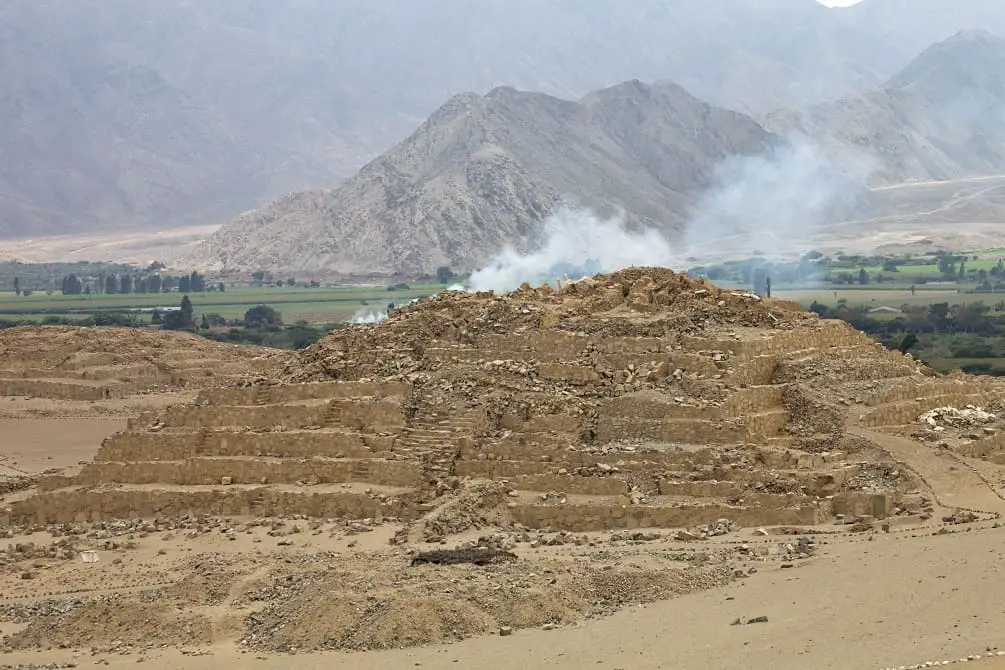








 Rothschild Sole Owner of Major Semi-conductor Patent Due To MH370
 DisappearanceScientists Created Living Organisms With Synthetic DNA - Have We Gone To Far?


 New Material Turns Greenhouse Gas Into Clean Air And Produces
 Energy At The Same TimeA Pediatrician Speaks Out, The Transgender Ideology Produces Large

 Snowden Reveals Documents: 'More Intelligent Homo Sapiens Exist Underground'
 Atheists Are More Intelligent Because They Override Religious

 Private Investigator Claims To Have Physical Evidence Of Intelligent Extraterrestrial Beings
 Prediction: Intelligent Alien Life Could Be Found by 2040

 Ancient galaxies detected by astronomers give new insight into the scale of the universe
 Our universe contains a staggering 2 TRILLION galaxies, 10x times more


