Naar de inhoud

UFO'S of UAP'S, ASTRONOMIE, RUIMTEVAART, ARCHEOLOGIE, OUDHEIDKUNDE, SF-SNUFJES EN ANDERE ESOTERISCHE WETENSCHAPPEN - DE ALLERLAATSTE NIEUWTJES

UFO's of UAP'S in België en de rest van de wereld
akke.beakke.be
Ontdek de Fascinerende Wereld van UFO's en UAP's: Jouw Bron voor Onthullende Informatie! Ben jij ook gefascineerd door het onbekende? Wil je meer weten over UFO's en UAP's, niet alleen in België, maar over de hele wereld? Dan ben je op de juiste plek! België: Het Kloppend Hart van UFO-onderzoek In België is BUFON (Belgisch UFO-Netwerk) dé autoriteit op het gebied van UFO-onderzoek. Voor betrouwbare en objectieve informatie over deze intrigerende fenomenen, bezoek je zeker onze Facebook-pagina en deze blog. Maar dat is nog niet alles! Ontdek ook het Belgisch UFO-meldpunt en Caelestia, twee organisaties die diepgaand onderzoek verrichten, al zijn ze soms kritisch of sceptisch. Nederland: Een Schat aan Informatie Voor onze Nederlandse buren is er de schitterende website www.ufowijzer.nl, beheerd door Paul Harmans. Deze site biedt een schat aan informatie en artikelen die je niet wilt missen! Internationaal: MUFON - De Wereldwijde Autoriteit Neem ook een kijkje bij MUFON (Mutual UFO Network Inc.), een gerenommeerde Amerikaanse UFO-vereniging met afdelingen in de VS en wereldwijd. MUFON is toegewijd aan de wetenschappelijke en analytische studie van het UFO-fenomeen, en hun maandelijkse tijdschrift, The MUFON UFO-Journal, is een must-read voor elke UFO-enthousiasteling. Bezoek hun website op www.mufon.com voor meer informatie. Samenwerking en Toekomstvisie Sinds 1 februari 2020 is Pieter niet alleen ex-president van BUFON, maar ook de voormalige nationale directeur van MUFON in Vlaanderen en Nederland. Dit creëert een sterke samenwerking met de Franse MUFON Reseau MUFON/EUROP, wat ons in staat stelt om nog meer waardevolle inzichten te delen. Let op: Nepprofielen en Nieuwe Groeperingen Pas op voor een nieuwe groepering die zich ook BUFON noemt, maar geen enkele connectie heeft met onze gevestigde organisatie. Hoewel zij de naam geregistreerd hebben, kunnen ze het rijke verleden en de expertise van onze groep niet evenaren. We wensen hen veel succes, maar we blijven de autoriteit in UFO-onderzoek! Blijf Op De Hoogte! Wil jij de laatste nieuwtjes over UFO's, ruimtevaart, archeologie, en meer? Volg ons dan en duik samen met ons in de fascinerende wereld van het onbekende! Sluit je aan bij de gemeenschap van nieuwsgierige geesten die net als jij verlangen naar antwoorden en avonturen in de sterren! Heb je vragen of wil je meer weten? Aarzel dan niet om contact met ons op te nemen! Samen ontrafelen we het mysterie van de lucht en daarbuiten.

Berichten van 1 mei 2019 tot 31 mei 2019

Robots and AI can help us better understand deep sea species, study reports.

Robots and AI can help us better understand deep sea species, study reports.

 BY ALEXANDRU MICU

Robots and artificial intelligence may be just what we need to meet the denizens of the ocean floor, a new study reports.

Scuba Diver.

Image via Pixabay.

Artificial intelligence (AI) has an important role to play in helping us understand the large variety of species living on the ocean floor, new research from the University of Plymouth reports. Such systems could finally allow marine researchers to push past the efficiency bottleneck created by human users analyzing recordings from the depths of the sea.

Davy Jones’ locker

“Autonomous vehicles are a vital tool for surveying large areas of the seabed deeper than 60m [the depth most divers can reach],” says PhD student Nils Piechaud, lead author on the study. “But we are currently not able to manually analyse more than a fraction of that data.”

“This research shows AI is a promising tool but our AI classifier would still be wrong one out of five times, if it was used to identify animals in our images.”

The new study analyzed the effectiveness of a computer vision (CV) system in taking over the role of humans in analyzing deep-sea images. All in all, the team found, such as system is around 80% accurate in identifying various animals in images of the seabed but can be up to 93% accurate for specific species if enough data is used to train the algorithm. The authors say that such results suggest CV could soon be routinely employed to study marine animals and plants. In such a case, it would lead to a major increase in data availability for conservation research and biodiversity management, they add.

“But we are not at the point of considering it a suitable complete replacement for humans at this stage,” Piechaud notes.

The team used Google’s Tensorflow, an open access library, to teach a (pre-trained) neural network to identify individuals of deep-sea species found in images taken by autonomous underwater vehicles (AUV). One of these AUVs, known as Autosub6000, was deployed back in May 2016 on the north-east side of Rockall Bank, UK, and collected over 150,000 images in a single dive. Around 1,200 of these images were manually analyzed, containing 40,000 individuals of 110 different kinds of animals (morphospecies), most of them only seen a handful of times.

Manual annotation ranged from 50 to 95% on this dataset; however, it was very slow. And, as you guessed from that ‘ranged’ part, it was quite inconsistent across different teams and work intervals. The automated method reached around 80% accuracy, approaching the performance of humans with a clear speed and consistency advantage. The software worked particularly well for certain morphospecies. For example, it correctly identified a type of xenophyophore 93% of the time.

So should we just use it instead of marine biologists? Well, the authors of this present study don’t think that would be a good idea. The study makes a case for automated systems working in tandem with marine biologists, not replacing them. The AIs could greatly enhance the ability of scientists to analyze the data before them.

And combining the ability of high-tech AUVs to survey large areas of the seabed, the fast data-crunching ability of AI, and expertise of marine biologists together could massively speed up the rate of deep-ocean exploration — and with it our wider understanding of marine ecosystems.

“Most of our planet is deep sea, a vast area in which we have equally large knowledge gaps,” says Dr Kerry Howell, Associate Professor in Marine Ecology and Principal Investigator for the Deep Links project.”

“With increasing pressures on the marine environment including climate change, it is imperative that we understand our oceans and the habitats and species found within them. In the age of robotic and autonomous vehicles, big data, and global open research, the development of AI tools with the potential to help speed up our acquisition of knowledge is an exciting and much needed advance.”

The paper “Automated identification of benthic epifauna with computer vision” has been published in the journal Marine Ecology Progress Series.

{ https://www.zmescience.com/ }

Hoe vind je dit bericht?
Geschreven door peter om 23:44 Stuur door

Man in New Zealand finds 12-million-year-old footprints of giant flightless bird

Man in New Zealand finds 12-million-year-old footprints of giant flightless bird

BY MIHAI ANDREI 

New Zealand is home to some of the world’s most unique creatures, and the Moa is definitely one of them.

Artistic depiction of moas.

Image credits: Heinrich Harder.

When Michael Johnston took his dogs aout for a walk, he wasn’t expecting much — it was a day like any other, a walk like any other. Because it was “quite a ripper” of a day, he decided to also go for a swim with the dogs, in a nearby swimming hole. But what he found there was amazing: a set of moa footprints from millions of yers ago, offering a rare glimpse into how life was in New Zealand before the ice age.

The stars aligned perfectly to allow Johnston to make the discovery. Not only did he need to be in the right place, but the imprints had been exposed by significant flooding in the area last year. They probably wouldn’t have survived another rainfall event.

“I’m amazed at the luck of finding them – catching it in this very brief window between being exposed and being scoured out, and then that somebody happened to be fossicking around and went for a swim and noticed them. If any one of those things hadn’t happened, we would never have known they were there, and it makes you wonder how many other moa prints are buried or destroyed, or no-one knows they’re there.”

Image credits: Otago Museum / Kane Fleury.

Moas were large, flightless birds, endemic to New Zealand, whose demise was decided the moment humans laid foot on the island. When New Zealand’s first settlers arrived, there wasn’t much in the way of food — except for some remarkable flightless birds. New Zealand has developed a unique and isolated ecosystem, with almost no native mammals. Because of this lack of mammals, the avian life has thrived and developed in ways which would just not be possible in other parts of the world. They had almost no predators, so flying was essentially renounced — large birds were trotting carelessly on the ground, sometimes not even being aware what a predator is. So when humans entered the scene, they found large flightless birds that were extremely easy to hunt.

Under normal circumstances, the moas would have continued their carefree existence. They were simply too large to be hunted by the island’s normal fauna. But after the Maori settled New Zealand, they were extinct within a century.

Paleontologists from the Otago Museum are now working to extract the footprints from the clay and place them in a museum, where they can be better studied and hopefully provide more information about these birds.

{ https://www.zmescience.com/ }

Hoe vind je dit bericht?
Geschreven door peter om 23:24 Stuur door

Atmospheric CO2 reaches record 415ppm — the highest it’s been in millions of years

Atmospheric CO2 reaches record 415ppm — the highest it’s been in millions of years

 BY TIBI PUIU

In less than a century, humans have managed the ignoble feat of raising atmospheric CO2 levels by more than 100 parts per million (ppm). Like every year, weather stations are measuring new record levels of CO2 in the atmosphere and according to data from the Mauna Loa Observatory in Hawaii, the concentration of CO2 in the atmosphere is now over 415 ppm, which is higher than at any point during the existence of our lineage.

Eric Holthaus
✔@EricHolthaus

This is the first time in human history our planet's atmosphere has had more than 415ppm CO2.

Not just in recorded history, not just since the invention of agriculture 10,000 years ago. Since before modern humans existed millions of years ago.

We don't know a planet like this.

Keeling_Curve
✔@Keeling_curve

415.26 parts per million (ppm) CO2 in air 11-May-2019 http://scripps.ucsd.edu/programs/keelingcurve/ … First daily baseline over 415ppm

  • 6,057 people are talking about this

Some believe that global warming, which is responsible for at least 1ºC (1.8ºF) of warming compared to pre-Industrial Age levels, has already triggered an irreversible feedback loop that will see much of the polar ice sheets melt. Whatever the case, the effects of man-made climate change are sorely felt around the world now. The Arctic, which warms twice as fast than the global average, lost nearly one million square kilometers (620,000 square miles) of winter sea ice cover since 1979 — that’s an area twice as large as Texas. Heat waves and droughts are more common and every new year seems like it’s the warmest on record. 

Scientists at the National Oceanic and Atmospheric Administration and the Scripps Institution of Oceanography have been measuring atmospheric carbon since 1958 when the program was started by the late Charles David Keeling. The famous, constantly updated graph that shows the accelerated rise of CO2 in the atmosphere, known as the Keeling Curve (shown above), is named after him.

The latest recorded figure, which stands at 415.26 ppm of CO2, is unprecedented in millions of years. The last time this happened, during the Pliocene Epoch, the Arctic was covered in trees and global sea levels were 25 meters higher than today.

Keeling_Curve
✔@Keeling_curve

Comment from Ralph Keeling, director of Scripps CO2 Program: “The average growth rate is remaining on the high end. The increase from last year will probably be around three parts per million whereas the recent average has been 2.5 ppm....” 1/2

  • 91 people are talking about this

The year’s increase in CO2 in the atmosphere has been partly fueled by El Niño conditions — changes in the sea-surface temperature of the tropical Pacific Ocean. This warms and dries tropical ecosystems, reducing their uptake of carbon, and exacerbating forest fires. However, the main factor responsible for the upward trend is, by far, the burning of fossil fuels.

According to a 2017 study, if the world continues on this business as usual route, by 2050 CO2 levels could rise beyond anything the Earth’s atmosphere has seen in the last 50 million years (600ppm). That’s not a death sentence in and of itself — life has flourished in those conditions before — but the shift is too fast and brutal for animals to adapt. A lot of today’s species will find it difficult (if not impossible) to adapt to those conditions in such a short time. As for humans, climate change threatens communities through rising sea levels, more frequent extreme weather, heat waves, and food shortages.

All the signs are pointing to an impending disaster if we don’t do something about it. This means moving to zero-emission energy generation as fast as possible. But that’s not enough — we also need to increase carbon capture and sequestration by planting more forests and developing new technologies that can safely lock excess carbon from the atmosphere.

The notion that the climate change we’re experiencing today is mainly driven by a natural climate cycle is silly and not rooted in scientific reality.

{ https://www.zmescience.com/ }

Hoe vind je dit bericht?
Geschreven door peter om 23:16 Stuur door

Het is er waarschijnlijk nog steeds. Volgens een onderzoeker kunnen we hier leven vinden op Mars

Het is er waarschijnlijk nog steeds. Volgens een onderzoeker kunnen we hier leven vinden op Mars

Het is er waarschijnlijk nog steeds. Volgens een onderzoeker kunnen we hier leven vinden op Mars

Er zijn allerlei aanwijzingen dat er ooit leven heeft bestaan op Mars. Ruimtesondes en Marsrovers hebben daarnaast nog maar een heel klein gedeelte van de rode planeet bestudeerd.

Het is goed mogelijk zich ergens op de planeet leven schuilhoudt, stelde onderzoeker Michael Finney tijdens een recente conferentie.

We weten dat er ooit enorme oceanen waren op Mars, die mogelijk wemelden van leven.

Nog steeds

Finney gelooft dat er waarschijnlijk nog steeds leven is op de planeet.

“Als er vier miljard jaar geleden leven was op Mars, is er nu nog steeds leven op Mars,” legde hij uit. “Er is niets gebeurd op Mars wat het leven volledig heeft uitgeroeid.”

“Als er dus leven was op Mars, heeft het zich wellicht verplaatst, of heeft het zich enige tijd verscholen onder de grond, maar het is er waarschijnlijk nog steeds.”

Water

Onderzoekers die Mars bestuderen hebben ontdekt dat er aardig wat ijs in de poolgebieden kan worden gevonden. Ook is een groot ondergronds meer ontdekt op de planeet.

Op aarde kunnen bepaalde diersoorten in de meest extreme omstandigheden overleven.

Aangepast

Zo zijn micro-organismen bestand tegen extreem hoge temperaturen en kunnen ze lange tijd zonder water.

Het is goed mogelijk dat levensvormen zich hebben aangepast om onder het Marsoppervlak te kunnen overleven.

[BGR]
© Copyright (c) NineForNews.nl
Hoe vind je dit bericht?
Geschreven door peter om 22:49 Stuur door

Reptilian Underground Bases "They Are Living Below Us"

Reptilian Underground Bases "They Are Living Below Us"

There is a hidden reptilian empire which consists of alien cultures and lost civilizations, their presence explains many of the myths of gods walking among humans.
 
Reptilian%2BRaces%2BUnderground.jpg

The reptoids may have sought out refuge underground after Earth underwent climate changes some 12,000 years ago.

The Shanidar Cave is a vast archaeological complex located on Bradost Mountain in the Erbil Governorate of Iraqi Kurdistan.
 

Shanidar%2BCave.jpg

The remains of 10 Neanderthals, dating from 35,000 to 65,000 years ago have been found within the Shanidar Cave.

The cave also contains two later “proto Neolothie” cemeteries, one of which dates back about 10,600 years and contains 35 ‘humanoids’ one such skill is extremely elongated and considered the Reptilian Elongated Race of Sumerians. Nobody know how vast the complex goes underground.

There are many accounts through history of lizard people and snake like bipedal’s from Sumeria to the Hopi Indians.

We will also explore the many accounts at the Dulce underground facility and how this all ties together.

We hope you will become aware of many facts you may have been previously unaware of in this 37-minute Reptilian Documentary.


https://ufosightingshotspot.blogspot.com/

{ https://beforeitsnews.com/v3/ }

Hoe vind je dit bericht?
Geschreven door peter om 22:38 Stuur door

Hairy Monsters & Stone Circles: A Connection?

stonehenge-947348_1920-999x540.jpg

Hairy Monsters & Stone Circles: A Connection?

Author Merrily Harpur has logged a fascinating account from one George Price, who had an undeniably bizarre experience on Salisbury Plain, England in September 2002, while then serving with the British Army. It was at the height of a military exercise, Harpur was told, and Price was a “commander in the turret of our tank, and we were advancing to contact our warriors.” Suddenly, Price’s attention was drawn to a “large, ape-like figure” that “looked scared because of the noise from the engines and tanks were moving at speed all around.” Although the beast was not in sight for long – it raced for the safety of “nearby prickly shrubs” – an amazed Price could see that “its fur was similar to an Orangutan in color…its height was impressive…[and] it seemed to run with its back low, i.e. bent over.” Salisbury Plain is not just home to military maneuvers, however. It is also home to one of the world’s most famous ancient stone circles: Stonehenge.

While most students of the legendary structure conclude it had its beginnings somewhere around 3,100 BC, evidence of human activity in the area has been found suggesting a presence as far back as 8,000 BC. And a degree of that same presence is indicative of ritualistic activity, even at that incredibly early age. But, regardless of when, precisely, large-scale construction of Stonehenge actually began, what can be said with certainty is that it is comprised of a ditch, a bank, and what are known as the Aubrey holes – round pits in the chalk that form a huge circle. And then, of course, there are those massive stone blocks.

No less than eighty-two of Stonehenge’s so-called bluestones, some of which weigh up to four-tons, are believed to have been transported from the Preseli Mountains in southwest Wales to the Wiltshire site, a distance of 240 miles. Although, the actual number of stones is in dispute since, today, barely more than forty remain. Certainly, such a mammoth operation to move such huge stones would be no easy feat in the modern era, never mind thousands of years ago. And yet, somehow, this incredible and mystifying task was successfully achieved. Stonehenge’s thirty giant Sarsen stones, meanwhile, were brought from the Marlborough Downs, a distance of around twenty-five miles. This might sound like a much easier task than having to haul the bluestones all the way from Wales. Hardly. As noted, the Welsh stones are in the order of four tons. Some of the Sarsen stones from the downs, however, weigh in at twenty-five tons, the heaviest around fifty. And people wonder why so much mystery and intrigue surrounds the creation of Stonehenge?

Now we come to the Rollright Stones, which are situated near Long Compton, a centuries-old little village in the county of Oxfordshire. Collectively, they are comprised of a tomb, known as the Whispering Knights, a classic circle of stones called the King’s Men, and a solitary stone referred to as the King’s Stone. As for the time of the construction of the Rollright Stones, this appears to be a clear-cut issue: in the Neolithic and Bronze Age eras. As with Stonehenge, legends and pet-theories abound as to the particular origin of the Rollright Stones. Certainly, the most engaging is that which surfaced in 1610 from a historian named William Camden. The story goes that the stones were not always stones. They originally represented an unnamed visiting king and his faithful knights who were turned to stone – in classic Gorgon-style, one might well suggest – by a legendary local witch, one Mother Shipton. The king, not surprisingly, became the King’s Stone. The bulk of his men were turned into the King’s Men. While a few who had initially avoided – but not for long, unfortunately – Mother Shipton’s malevolent powers quickly and collectively became the Whispering Knights.

In 1977, author Paul Devereux established what became titled the Dragon Project; the purpose of which was to study claims that certain British prehistoric sites had unusual forces or energies attached to them, including magnetic, infrared and ultrasonic anomalies. While investigating none other than the Rollright Stones, Devereux reported that one of the team members – described as being a well-known archaeologist  – was sitting in a van when an unidentified, hair-covered beast of considerable size walked by. An instant later, it utterly vanished, never to put in a re-appearance. It’s also worth noting that a large and lumbering beast was seen near the Peak District-based Ladybower Reservoir in November 1991. Less than one mile away, on Stanton Moor, stands a stone circle called the Nine Ladies. It was constructed during the Bronze Age era, and is a place at which, every year, druids and pagans alike celebrate the summer solstice. As the legend goes, the circle takes its name from nine women who were turned to stone as punishment for dancing on Sundays!

The Nine Ladies (Wikipedia)

Perhaps, in light of the extraordinary data contained in this article, we should be focusing our attentions far less on what’s going on in the relevant location of ancient stone circles right now, and far more on (A) the matter of what may have occurred there centuries or millennia ago, and (B) the issue of what may continue to linger and wander and, sometimes, terrorize the good folk of Britain, long after physical death claimed their lives in times past and largely forgotten. For the final word on the potential connection between unidentified, upright, hairy animals and places of specifically archaeological, spiritual, and historical nature, I refer you to the writings of one of the world’s leading authorities on the phenomenon of werewolves, Linda Godfrey, the author of such fine pieces of essential reading as The Michigan Dogman, Werewolves, Hunting the American Werewolf, and The Beast of Bray Road.

Of the Native American phenomenon known as the Skinwalker – which Linda describes as “entities created by magic ritual that look like animals but are really spirit doubles of the shaman that either go out from the physical body or envelope it like a supernatural costume” – she says they are “related to the Tibetan ideas” of Tulpas. Rather significantly, when one takes into account the various encounters that occurred in the vicinity of, or relatively close to, famous standing-stones, such as Stonehenge and the Rollright Stones, the following words from Linda most assuredly stand out as being of keen relevance to such matters. She says, still on the subject of Skinwalkers: “I can tell you that Native Americans from various locations have indicated to me that these things absolutely exist, as do zoomorphic (animal-shaped) spirit guardians made to watch over sacred grounds [Author’s Note: Italics Mine].” Linda also notes that in relation to ancient Native American burial mounds (“shaped like traditional ‘water panthers'”) the mounds are “located in almost exactly the same sites as manwolf posts.”

Perhaps, then, the American “man-wolf,” or werewolf, was created, Tulpa-style, to watch over ancient American sites of deep significance, in much the same way that Bigfoot-like creatures seem to be doing precisely likewise at a multiplicity of standing-stones, and circles of stone, in the U.K. One beast may exhibit ape-like characteristics and the other a far more wolfish appearance, but, at the end of the day, they may very well both be definitive supernatural “guard-dogs,” still faithfully patrolling the old sites they were created to protect all those centuries and millennia ago.

{ https://mysteriousuniverse.org/ }

Hoe vind je dit bericht?
Geschreven door peter om 22:30 Stuur door

Boynton woman's video captures rare 'positive' lightning bolt

Boynton woman's video captures rare 'positive' lightning bolt

When Erica Hite was filming a thunderstorm on Sunday in her home in Boynton Beach, Florida she had her camera ready at just the right time to capture a weird bolt of lightning.

Lightning.jpg

The National Weather Service in Miami identified the unusual weather phenomena.as 'positive lighting,' or a continuous current, which is up to ten times more powerful than a typical flash.

Hite told the Palm Beach Post: 'It was crazy. Very scary, very loud.' 'It was just at the right place at the right time. I could probably never in my life get something like that again.'

In Hite's 12-second video, the glowing bold of electricity can be seen striking a dumpster, crackling like gunfire or fireworks.


{ http://ufosightingshotspot.blogspot.com/ }

Hoe vind je dit bericht?
Geschreven door peter om 22:07 Stuur door

Black Ring UFO Over Argentina Recorded May 7, 2019, UFO Sighting News.

Black Ring UFO Over Argentina Recorded May 7, 2019, UFO Sighting News.

UFO%252C%2Bsighting%252C%2Bring%252C%2B.png

Date of sighting: May 7, 2019
Location of sighting: Argentina
Source: Email

I was sent this in an email. He said he was working on a foundation of  building when he and his coworkers saw this black ring object flying over head. He had an older phone, but took video of it best he could. 


The video shows the black ring moving like a disk...which is strange. Had this been a balloon it would be flipping like a wheel end over end. This one seems to stay flat, unlike any balloon I have ever seen.


Often when a UFO is nearby, people and animals sense its presence. I mean often they have an emotional aura that either pushes a person to look up and see it, or even make you relax almost in a trance meditative state. You have to seen one first had and feel it to know what I'm saying. Not all UFOs have this aura, but many do. 


I remember a sighting by the famous actor Dan Aykroyd where he was sleeping he woke up as if someone wanted to wake him, and heard a telepathic voice telling him to walk outside and look at the sky. When he did so, he saw a UFO. Thats what I mean. 

Scott C. Waring

{ https://www.etdatabase.com/ }

Hoe vind je dit bericht?
Geschreven door peter om 21:56 Stuur door

UFO At Space Station Seen For Almost 7 Minutes! May 10, 2019, UFO Sighting News.

UFO At Space Station Seen For Almost 7 Minutes! May 10, 2019, UFO Sighting News.

ovni%252C%2Bomni%252Cspace%2Bstation%252C%2B%25E7%259B%25AE%25E6%2592%2583%25E3%2580%2581%25E3%2582%25A8%25E3%2582%25A4%25E3%2583%25AA%25E3%2582%25A2%25E3%2583%25B3%252C%2B%2BUFO%252C%2BUFOs%252C%2Bsighting%252C%2Bsightings%252C%2Balien%252C%2Baliens%252C%2BET%252C%2Banomaly%252C%2Banomalies%252C%2Bancient%252C%2Barchaeology%252C%2Bastrobiology%252C%2Bnobel%2Bpeace%2B%2Bprize%252C%2Bwaarneming%252C%2Bvreemdelinge%252C%2Bstrange%252C%2Barea%2B51%252C%2BEllis%2BAFB%252C%2Bblack%2Bhole%252C%2B.png

Date of sighting: May 10, 2019
Location of sighting: Earths orbit, at ISS

I recorded this UFO on the old cams not the new cams. The new cams are on Youtube and seemed to be faked, since I noticed they put it on a loop most the time. 


The UFO seems curved on the top and sides, but flat on its bottom. The close up in the video shows its color changing as it moves past the space station slowly. This video is over six minutes and shows some serious close ups of a UFO that NASA does not want you to see. 


This is absolute proof that aliens have a high interest in the space station and how the astronauts on board are dealing with the unique environment of space. 

Scott C. Waring

I often post videos 12-24 hours before I make posts, so follow me on Youtube to stay uptodate. 


Hoe vind je dit bericht?
Geschreven door peter om 21:52 Stuur door

Leslie Kean New York Times AATIP Interview Transcript

Leslie Kean New York Times AATIP Interview Transcript

Alejandro Rojas: I am very happy, very, very happy, especially at this day and time to welcome back to the show. Leslie Kean. Hello Leslie.

Leslie Kean: Hello Alejandro. Great to be with you.

Alejandro Rojas: So thank you so much for coming on the show. I know that you have been absolutely swamped with media requests. What’s it been like?

Leslie Kean: Well, it’s been intense. I mean, and hard work the week after the article came out, it was really unbelievable as you know, there was so much attention drawn to it, so it was, you know, it’s, it’s, it’s been quite a ride. I mean it’s, it’s just been very, very intense demanding of a lot of time and energy. And right now I’m just sort of enjoying this weekend where there’s not as much I have to do. So.

Alejandro Rojas: When you go into these interviews, for example, with Tucker Carlson, you were on Fox News recently, which was kind of, people were like, wow, you know, Tucker Carlson having a UFO discussion on his show. But, which went very well, of course. How do you feel going into it? Do you have any idea, you know, the angle they’re going to take, whether they’re going to ridicule it or not.

Leslie Kean: I’m usually pretty sure they’re not going to ridicule it. I mean, I think, you know, especially the week following the New York Times story, which was when most of the interviews were, I mean they, people were just really turned on by the story. And this recent interview with Tucker Carlson, he made it very clear because my publisher set it up that he wanted to talk about my book. That’s what he said. He was interested in just having me on to serve as an expert not to focus on the, the, the Time story and it’s because he’s genuinely interested in this topic. And I, I remember watching the coverage he did after the Times story came out during that week and he did excellent coverage. I mean, very, very intelligent coverage. I was impressed with it and, and I was, his, his producers told us that he really has a genuine interested in this in this topic.

Leslie Kean: So I went in there not knowing what he was going to really want to talk to me about. I had no idea. And he just zeroed in on this O’Hare case, which, you know, took me by surprise, but I thought it was great. It was great that he actually knew something about a specific case which most anchors don’t and he just seemed to be very passionate about it. So I think he is genuinely interested in this topic. I really do believe that and I think he did a great job irrespective of what anything else has coverage that people might not, I’m not going to comment on Fox. Fox’s attitudes, but in terms of UFOs I think he did a terrific job and he really has a serious interest in the topic, which is great.

Alejandro Rojas: Yeah, you could get that from his, his enthusiasm, his excitement to talk to you and bringing up O’hare is great because you know, at this point we now have this, this, you know, the DoD had a program looking into this, taking it seriously. So now it’s, it’s a good time to reflect on the other great cases out there. And of course Chicago O’Hare was a really good one.

Leslie Kean: Really good one. I absolutely agree with you. It’s such, it’s such a strong case in terms of illustrating the lack of attention that our government has given to this topic.

Alejandro Rojas: Right. And the point where he was making and you are making that, you know, this thing popped through the clouds and, and when it shot up, these were seen by United personnel, um, in 2008 I think it was, right, 2006 to 2006 earlier. And um, but the FAA just called it a weather phenomenon. I think that’s what they ended up on. And the, at first they didn’t want to look into it at all. And He makes a great point that, yeah, which is the point I think everybody should be making is, you know, we obviously, it’s intuitively obvious that we should look into situations like this and not just ignore them.

Leslie Kean: Absolutely. And I, and he really made that point. He kept saying, why wouldn’t they do it? He was like, how outraged. And I thought that was great because it indicated that he had thought about this.

Alejandro Rojas: Yeah. So you were also on Don Lemon and I just wanted to hear your thoughts on this. And of course that interview went great. But I think the day after, or a couple of days after they had,, Neil deGrasse Tyson on and although he kind of Poo pooed at least the alien hypothesis, just saying we don’t have enough evidence for that. Which is a good point I think. Um, yeah, but he, he did go on to kind of say something along the similar vein as Tucker Carlson and that we should be looking into these things. He doesn’t mind that we spend $22 million looking into these unknown situations because we should be looking into them. When you saw him say that, what was that a bit shocking?

Leslie Kean: Yeah. I mean I was glad he said that. And I think also his point about we can’t assume that they’re alien is also a valid point. And the irony of that is that we’re not doing that, we didn’t do that in our article. We didn’t do that in any of it. Uh, no, it wasn’t even a hint of that we had done that, you know. So for him to sort of comment on the New York Times and criticize a point that we never even made isn’t really fair. But um, and then he goes on about, you know, when you have an alien it’ll take me out to lunch. I mean, you know, I’ll take them out to lunch. That’s not the point. The point is that we have an unknown phenomenon that needs further study and I think along those lines, he’s pretty, uh, he’s pretty okay with it as you said. He just likes to stretch it into this realm that isn’t where we went with it anyway in the first place.

Alejandro Rojas: And that would be my next question is frustration about that. You’re obviously very careful, you and the group who wrote the article on and how you crafted it and what information you’re putting in there and obviously very aware of the baggage that comes along with, with these sorts of stories. So like you said, you’re very careful not to make it about aliens. However much of the media, even Don Lemon is trying to press you on aliens and Elizondo has had the same experience. Everybody trying to push them on “What about alien? What about aliens?” And that hasn’t, that wasn’t part of the story. That’s not what you’re talking about.

Leslie Kean: It’s true. I mean, and obviously the extraterrestrial hypothesis is a valid one. I mean, I have said that all along. I said that in my book and I still say that and there are plenty of very respectable people who have studied this, you know, generals, pilots and government officials. As I put in the title of my book, that would all agree that the extraterrestrial hypothesis is valid and rational and, but given, even though that’s true, we still don’t know. We don’t know at the level that will satisfy the scientific community. And that’s where that’s, you know, that may be a while. We may eventually get there, but without investing more resources into this, we’re not going to get there. And that’s why a program like this is important. But I think, you know, I think it’s perfectly valid, but you know, you can’t make that leap. And I think one of the problems with a lot of the people in the UFO community is they, they’ve made that leap to such an extent that they say that it’s fact. And I understand why people assume that when they, when they know a lot about this subject, I mean, it’s, it’s, it’s easy to go there, but in terms of what we want to present to the world at large and where we are at in terms of a society dealing with this topic, we’re not there yet.

Alejandro Rojas: Right. And I mean, when you’re doing these interviews, which is a great point, and, and I think it’s difficult to explain that to people because people get frustrated with me for the same thing. Regardless of whatever my opinions are, regardless of whether or not I believe in that it’s a possibility or I believe aliens are here interacting with us, when you’re, when you’re speaking with a mainstream or when you’re writing a credible paper like what you guys, you all did, a credible article, you need to focus on the facts and what’s provable and what you can credibly substantiate, um, which makes,

Leslie Kean: Yeah, that’s exactly right. Yeah.

Alejandro Rojas: And it makes a piece more powerful and, and your pieces certainly have been powerful and they get a lot of attention for that reason.

Leslie Kean: Yeah. I mean, I think you have to, and you know, obviously with the writing, but the New York Times, we have a lot of editors involved as well. So, but yeah, I mean if it’s not provable, if it’s not documentable, it doesn’t go in the, in the article and that’s, that’s the way it should be. I think that’s the way it should be.

Alejandro Rojas: All right. So getting back to the last time we spoke. And that’s what, that’s what’s kind of funny in and validating is you, and this was right after the to the Stars Academy announced and we were both kind of, I think we’ve talked soon and maybe a week or so after your article on that. And we were both kind of surprised at the reactions and, and people seeming to not get the importance of, for instance, someone coming out and saying, I used to work for the Department of Defense Investigating, essentially, UFOs. You and I of course thought, wow, that’s incredible. But you know, we were both kind of like, I don’t know why people are so negative about all of this and a not looking at the juice, but it seems that there were people that certainly took notice, um, the Washington Post, POLITICO and then, oh, you, you all were able to put together this article for the Times that really started the whole thing off. How did that come about? How did the article come about?

Leslie Kean: Well. I went to a meeting on October 4th with some of that was arranged by some of Elizondo’s colleagues who also knew me. And so they wanted me to meet him basically. And I went down and went to Washington and we spent three or four hours together and Elizondo, you know, talked to me and I was shown documentation. I was shown the videos that were eventually released with our story. Um, and just given, you know, told all about Harry Reid, was shown documents about Harry Reid’s involvement and just the story was kind of laid out for me at this meeting. And I realized at that point that it was a New York Times level story given the documentation that was available for the program and for the people involved and everything else. And so that’s, that’s how it all started. And then I went to my colleague Ralph Blumenthal, who I’ve known for a long time, who’s a, who was on staff for the New York Times for 40, 45 years and has since become a freelance writer for the Times.

So he continues to work for the times and on a freelance basis. And I went to him and he, we ended up having, then we sat down with somebody in the New York Bureau of the New York Times and had an initial meeting, the three of us to, to lay out the story for them. That’s how it all started. And then that person, then there’s another meeting with the Washington bureau and you know, it took a while to get the times on board, but once they understood what we had, they assigned us a reporter to work with us. Helene Cooper has been absolutely fantastic. She’s their Pentagon reporter out of the Washington bureau and we just that’s how it all started. And then we just got going on the story and it took quite awhile to do it because the editing process is very intense at the Times.

And you know, there’s just a lot of, every single line is, you know, thought through very carefully. And so there were different drafts that had to go back and forth and you know, we had to decide what information would be included and what wouldn’t and all that kind of thing. But you’re working at the New York Times, you’re working with a team of people. So there’s a lot of considerations that go into a story that beyond the considerations of the three reporters that are writing it. And, and that was interesting for me to experience because in the past I’ve written for the Huffington Post where I basically have no editors. You know, I just write a story and I upload it and it’s there. That’s it. And so this is a very interesting process. It’s just another level of journalism than I’ve ever experienced before. And it’s just been an amazing opportunity and situation for me to be able to write for the Times. I’m just very grateful for that. That door’s been opened.

Alejandro Rojas: Were you skeptical that they would pick it up? I mean, and was Blumenthal? He must’ve been confident that they would be interested in the story.

Leslie Kean: Yeah. He thought they would be. Originally he was the one who originally pitched it to the Times, you know, through an email because he knows people there because he’s worked there for so long and that’s how it all started. So he was pretty confident in it and it wasn’t until we had our sit down meeting with the, um, with the, with Mark, I think his name was Mark Mazzetti. He’s the investigative investigations editor at The Washington bureau. He happened to be in New York shortly after we pitch the story and we sat down with him in New York and it was after that meeting I think that we were pretty confident, but he, he didn’t give us an answer right away. He said, well, I’m going to, I’m going to talk to people in Washington and get back to you. And we had to wait maybe a week before we heard back again. But um, then we, we got the green light. So

Alejandro Rojas: Were you all aware that the Post, the Washington Post and POLITICO were also working on stories?

Leslie Kean: Yeah, we heard rumors to that effect, which was, it was disconcerting for us. But, uh, we knew that, you know, we knew that we had a story that we didn’t think anybody else would be able to get, which is all the, on the record sources that we had. If you look at the POLITICO story, it didn’t have people on the record. A lot of them were, were anonymous sources and uh, we don’t, you know, the Times we’re not, we’re not going to do that in the New York Times.

Alejandro Rojas:  Yeah. And, and the Post story even seemed a bit more speculative.

Leslie Kean: Yeah. I mean, they didn’t have access to a lot of the sources that we had and that the documents and all kinds of stuff. So they, I don’t think any stories could match the one that we did just because we had access to a lot that the other media didn’t have.

Alejandro Rojas: One of the parts in the Post story that, you know, at least The Sun has asked me about and others and I want to see what your thoughts are on this is that they seem to be implying that or trying to imply that Elizondo was a little bit, you know, got the videos released under a false pretense a bit. They put in this part that there was some memo and it is kind of weird the way they wrote it. Um, the paragraph on this, some kind of memo that said he tried, he got it released in order to educate pilots on safety, but he alluded to, he really was doing it to get this out to the public and show that there’s this DoD department.

Leslie Kean: Yeah. I mean, I don’t know. I have the document that shows the process by which these videos were released and it doesn’t say anything along the lines of what the Post has said. So I don’t know where that came from.

Alejandro Rojas: The document about the release, does it say, does it say why he wanted it release and why they approved it?

Leslie Kean: Yeah, it was not educate pilots. I mean, I have to look at it again, but as I recall, there was nothing on there about that. And maybe at our break I can look at that document again.

Alejandro Rojas: Yeah. Because a big question is why did they allow him to release those videos? Um, and I guess, do you have that answer?

Leslie Kean: Um, let me look at that document again maybe and then we can respond. Yeah.

Alejandro Rojas: All right, well we’ll do that at break. We’ll look at that document again. But getting back to your story that, and of course George Knapp obviously has had somewhat of knowledge of some of this that was going on because he’s worked with Bigelow, so at least he knew Bigelow. A lot of us knew Bigelow was spending money on UFO research and these sorts of things back when this all was getting funded. Of course, none of us, at least I didn’t know. And I, I wouldn’t imagine you would have known it, maybe even George Knapp didn’t know that, you know, he was working with the Department of Defense at the time. Did you know that?

Leslie Kean: Um, I don’t think I did know that.

Alejandro Rojas: Yeah.

Leslie Kean: I mean, I knew that he was related to a government investigations and so on, but it was nothing specific, nothing specific like this.

Alejandro Rojas: But Knapp was able to get interviews with Harry Reid. And were you surprised with Harry Reid’s reaction? Will you all even got an interview in your story with Harry Reid.

Leslie Kean: We had the first interview with him.

Alejandro Rojas: How did you feel about his reaction?

Leslie Kean: Harry Reid’s? Oh, he was fantastic. Absolutely. I mean, our partner here, Helene Cooper was the one who flew to Las Vegas and met with him. And, uh, he was absolutely wonderful. He spent like an hour with her. He told her everything and you know, so that he wasn’t embarrassed or ashamed or sorry that he’d done this and he was just a very, very positive, great bright person. And the interview was, was really fantastic.

Alejandro Rojas: Yeah, I mean it’s, I think it’s a really important component to some of that what’s happened since your story and what it inspired is Harry Reid coming out and standing firm that he is very proud of creating this program. He has no regrets whatsoever. And that lends a lot of credibility to what Elizondo was doing and the seriousness that many people and the government really do take towards the UFO topic.

Leslie Kean: I agree with you. It was very, very important component to have him on the record. And we, we knew that from the beginning that we were, we wanted that to happen. So, we, we did a lot of our reporting first so we would have some, you know, we didn’t want to, we saved him more, a lot more or less for the end. We didn’t want to alert him too much in advance that we were doing this story. So, um, so yeah, but it’s extremely important part of it to have him speaking out about it.

Alejandro Rojas: And it feels at, at least for me, and I’m guessing for you a bit validating because although people like Don Lemon last time you were on his show or, you’ve done interviews for important stories you’ve written for like Chile and other UFO stories in the past few years, but the mainstream has been skeptical that anybody in the government does really take UFOs seriously or military or have since 1969 even though we can show evidence, we’ve got documentation to show, look, they did take it seriously. They have investigated certain cases, but still it doesn’t stick. You know, they still haven’t bought into that. But it seems to have changed when you have a Harry Reid, when you have an Elizondo out there now, it seems to have changed. Now it feels, and I’d love to hear what you think that they’ve kind of accepted that, okay, this situation, this, this, UFO investigations are a serious thing. There are at least taken seriously by some of our government and military.

Leslie Kean: Yeah. I mean this is the first time that we’ve known that there is an actual named program, you know, that we know how it was set up, how it was funded, how many years it went for, we know who the person was that was in charge of it. I mean these things were not known before and so it just takes everything to another level when you actually know for a fact that there was a, there, there is still a program, we know where is, we know who was in charge of it and you know, all this information about it and it has a name. So that’s very different from before when we just would sort of speculate about, well yeah, I’m sure that there’s government interest in this, but we don’t exactly know where it is or what it’s called. So yeah, I mean you’re right it, and it does of course.

That’s why the, the article was so important because now the mainstream, uh, you know, will take it seriously a lot more once they know that the, the Pentagon has a program and they can see videos and they can get information from that program. Uh, they understand this at another level that’s never been, you know, it just hasn’t happened since the close of Blue Book that anything that’s important I think has, has come out that’s going to elevate the position that the topic has in the, you know, among the political world and the the world that really is responsible for policy making. So it’s a huge change in that regard and it does absolutely elevate the seriousness that the top ic will have and I think it already has and hopefully it will continue to, it’ll continue that way. You know, I hopefully will have more information will come out and we’ll be able to keep this ball rolling.

Alejandro Rojas: Are you all planning another story to come out anytime soon?

Leslie Kean: We are exploring that. Yeah. It was just not something I really want to comment on. Yeah, no, we’re not, we’re not planning to drop the ball that’s for sure.

Alejandro Rojas: Which is great because a followup is good to keep this in people’s minds. And also because, you know, it does seem like, at least for the moment as we just mentioned it, there’s a shift. There’s, people are taking it more seriously right now.

Leslie Kean: I think that’s true. And I think that’s, that’s a really important, really, really important.

Alejandro Rojas: So it’s about time to take a break. So we will come back momentarily. But it is kind of interesting. I have a lot of people, you know, and maybe you’ve had this experience, saying that, you know, they’re getting calls from family and friend who are, are actually taking the topic seriously as well. Someone joked about it yesterday that even though they do all this research and writing and have several books their family hasn’t even read, all of us sudden now, years later after this person’s been been doing this, you know, they’re being taken seriously by their family where they haven’t up until now. So a demonstration of the impact of this article, but we’ll talk more about that after the break. For those of you listening on KGRA, you’re going to hear a short commercial break. For those of you listening on the podcast, you will hear just a short musical interlude and then we’ll be back with Leslie Kean so stay tuned.

Alejandro Rojas: Welcome back to open mind UFO radio. I’m your host Alejandro Rojas. And we are talking to journalists, Leslie Kean. And you say you were able to look at that memo to confirm that the Post’s statement about the videos being released for education and safety purposes. It’s not in there.

Leslie Kean: No, I mean his request for the release of the videos did not include anything to do with pilot education or aviation safety.

Alejandro Rojas: So they, they essentially are alluding to that he wasn’t straight forward with his superiors. But do you get that sense at all?

Leslie Kean: Not at all. I mean, I don’t, it’s nothing in this document that suggests that he wasn’t being straight forward and I’m absolutely nothing. Now, maybe the Post has some document that I’m not aware of because I don’t know what they, what they were referring to when they made that statement. I have no, I don’t know. All I know is what I have and my documents don’t suggest that. I also know that Elizondo is in a very, a person of incredible integrity and honesty and he wouldn’t, he just knowing him, I don’t think he would ever be careful, be comfortable, uh, being an all disingenuous about anything. He’s very honest, very careful, very astute. And uh, so I just, I have to not comment on that because unless they have some, they’re either making an error or they have some document that I’m not aware of, one or the other.

Alejandro Rojas: Well, and now talking to Elizondo, he doesn’t seem to, he doesn’t have any, um, at least in the discussions that I’ve had with him, he doesn’t seem to be frustrated with or upset with his superiors. He doesn’t seem to be at odds with the DoD. He still is a patriot. He still believes in their mission and he wants, he seems like he, and, and as mentioned, really wants to cooperate with them in what he’s talking about.

Leslie Kean: Yeah, that’s absolutely right. He has the highest respect for the Department of Defense, for the people he worked with. They’re not just in the UFO program at an all the other very, very sensitive jobs that he had a, he was a counter intelligence officer. He was in the field doing a lot of stuff. I mean, this was a small part of what he did this program. So he left the program with the utmost sense of respect of the, of the people he worked with and for the department and for the mission of the department. And the greatest respect for secretary Jim Mattis, who he knew well and actually served with in Afghanistan. And he, he considers MaTTis to be one of the finest people he’s ever known, so that there’s no negativity there at all about, about his work at the DoD. Um, he would, you know, he just needed to retire and he needed to make the point that more resources need to go to this study of this, of this issue.

And he felt the best way to do that was to do what he did, to draw attention to it because it was just sort of impossible for the program to function, uh, within the system there. And it was just dysfunctional. There was no resources for it. There were people that were opposed to it. It was not, you know, very secret. And so that needed to change. And so he made them, he made the step he did to try to facilitate that changing. But it has nothing to do with being critical of, of the people he worked with or the purpose of the department or anything else.

Alejandro Rojas: Yeah. You know, I think it was an opinion piece in the Times. It was another, in another paper, if not the Times. I’m pretty sure it was the Times, though. You, you may recall this story by someone who worked in intelligence. And one of the reasons he said, you know, a program like this would be, there were a few reasons why a program like this would be secret and one of those reasons is simply, and he gave other examples of more mundane sort of projects, but that for some reason have some sort of social stigma attached to them. And even though they may be important, because it’s easy to make fun of them, they don’t want to reveal to the public that they’re doing this sort of thing. And if Elizondo’s actions, which I believe they have, can legitimize this topic some more, then that may allow the military to not have to deal with or ridicule factor if they’re setting up a project or working on a project like this, which hopefully may entice the military or other institutions to do this sort of work. If we can get rid of that stigma that its’ something to giggle about.

Leslie Kean: Yeah, that’s certainly, certainly helps. And I think the New York Times story is, has helped to do that.

Alejandro Rojas: Did you all add then have the DoD or anybody look over the article before you released it or have a consultant that you worked with?

Leslie Kean: You mean within the DoD? Yeah. Oh No, no, no, no, no, no. The media is independent of, you know, the government that it’s reporting on. You don’t have to clear it.

Alejandro Rojas: Yeah. I just know some people I know like Charles Halt for instance, has ran stuff through his superiors before and Nick Pope. So I was just wondering if you all had done something or felt you had to do that. Um, Yep.

Leslie Kean: Cause those are, those are people who are actual employees or who part of the system of the government. So they may have to clear it, but an independent news organization doesn’t have to.

Alejandro Rojas: Hmm. And then I guess the other question is, you know, this whole now of course, and unfortunately the more kind of a fringe aspects of, of this field of which are large, maybe the, the majority of the UFO field, it’s really kind of very speculative and conspiratorial. So, of course there’s this idea that maybe Elizondo is on a secret mission to somehow frame or disinform, people on this topic. I mean, do you get that sense whatsoever?

Leslie Kean: Absolutely not. I mean, it’s just an absurd, absurd notion to me and I’ve, I’ve spent a lot of time speaking with him. And so I would say absolutely not. He’s, he’s genuine. He has high integrity and he’s doing what he’s doing for the reasons he says he is. It’s that simple.

Alejandro Rojas: And it’s funny because even though you say that, and I’ve talked to him and I feel the same way, I think that when you, you talk to him, you get an idea of his motivations, what his life is like, impacts this has had on his life, the sacrifices he’s had to make to get some of this information out. And I think even standing back, even without talking to him, I felt that way, looking at the whole situation. But there are so many people that really build these world-views that even if they were just speak to him, I think, there’s practically nothing that would convince them otherwise.

Leslie Kean: Yeah. I don’t, I don’t know why that is, unless they feel they’re just very, very, very mistrustful of anyone within government possibly, or maybe some of the people, you know, they’ve built their whole kind of careers and personalities around a particular theory that they have. And maybe they don’t want to let that go because it would, you know, they’ve built up their whole persona around it. So they’re very attached to trying to maintain their particular conspiracy theory and therefore they have to fit him into that rather than maybe shifting the way they look at things. But, you know, some of the things, yeah, it just, the conspiracies about, I mean, I wasn’t even aware that people were saying that were saying that, that he’s, he’s trying to deceive people. I mean, it’s just, you know, it’s just, to me it’s just ridiculous.

Alejandro Rojas: It’s unfortunate. And there’s a lot of it out there, even from, you know, more well known researchers, certainly people that you’ve interacted with as well. And it’s unfortunate, I agree with you especially to go there without gathering the facts and it’s missing the point. It’s focusing on the wrong thing. It’s focusing on how do I fit this story into my worldview in this scenario that I’ve built instead of just looking for at it for what it is, and then missing all the important parts of it, such as the effect that this has had on the mainstream, which is such a huge positive, I think for this topic being taken seriously.

Leslie Kean: Yeah. So that’s what I mean, you know, I’m, I’m just not that aware of what’s going on in sort of the, within the UFO community world, but just cause, you know, but so I dunno what else to say about it. Yeah.

Alejandro Rojas: Yeah. With, the, your story, there’s a couple of other important pieces that were in there. Oh. And I guess just to follow up on the last point real quick is yeah, that’s why I think it’s really important to have like you come on and talk about how this story came about. Because I think a lot of people think of, you know, these, these cabal people like an X-Files setting in a dark room at the New York Times coming up with a plan. “We’re going to write this story and that story. Who can we get to write it and who can we get in the DoD to be our guy to tell people this.” You know…

Leslie Kean: You mean like, it’s some kind of orchestrated planned thing by some organization or entity that controls all the information, right? I mean, I have never, ever encountered anything to give me even the smallest hint that that’s what’s going on in my own work. And certainly not in this article with the New York Times. I mean, we, it happened the way I’m telling you it happened, right? I got this information, we pitched it to the Times they said, hey, yes, this is a story. Let’s do it. It’s that simple.

Alejandro Rojas: Yeah. And that’s the tragedy with these conspiracy theories because then all of these people who are working with the mainstream media or you know, or, or production organizations on television shows or movies or documentaries, you know, they’re not giving credit that they’re the ones who came up with this idea. I mean, it was you going to Blumenthal, it was you all. That’s where it, that what generated the, this story and the situation or at least this story to get out. So people then, yeah, you know, it, it allows people to have these conspiracies where they’re not giving credit where credit’s due,

Leslie Kean: I guess. So, I don’t know. They’re so attached to that. I, you know, I don’t know. I mean, obviously there have been plenty of insiders over the years who know a lot more than is being revealed. And so maybe that’s what people are concerned about. A lot of the reason that a lot of stuff has not come out is simply be due to the fact that it’s classified, it’s highly classified and protected in special access programs and so on. And people who know about these things would go to jail if they talked about it. Yeah. So it’s a, you know, they can’t do it. And so you can’t fault them. It doesn’t mean there’s some grand conspiracy behind it. It just means like so many other topics certain things are kept secret for a lot of different reasons. And, you know, on this issue, I’ve learned a lot more about the, the role that, um, concern for our adversaries getting a hold of a lot of this information that plays a big role in the desire to protect it. And that’s legitimate. It’s legitimate. So I don’t know. I, I mean, I can understand that people are frustrated that more has not been released and that the government hasn’t acknowledged a lot of things. But

Leslie Kean: I don’t think, you know, creating this, this idea that there’s some vast cabal conspiracy controlling it and they’re like planning how they’re going to let you know they’re planning everything and they’ve set up to the stars because they’re manipulating Tom DeLonge to create this, this thing. And they’ve giving him certain information and then they’re controlling the next step, which is the New York Times. And then there, I just don’t, I’ve never seen that there’s any force behind these things that are, that are making them all happen.

I just don’t, I don’t understand where that theory comes from unless some of the people behind these theories, know something that I don’t know, but I, and that’s possible. I don’t know everything.

Alejandro Rojas: Yeah. Which may be possible in some cases, but in this case particularly there’s just so much speculation and people standing steadfastly to their speculation and as opposed to doing the hard work and speaking to people like you to figure out what the, how things actually didcome about.

Leslie Kean: I mean, why, why did they have a need to not just accept what’s, you know, what the truth is or why do they have a need to create all these, these complicated scenarios? I Dunno. I Dunno.

Alejandro Rojas: Yeah. I don’t either. So some of the more fascinating parts, some of the really incredible parts of this story. There’s the idea of, there’s a paragraph on a couple of the other things that they looked into, including some sort of metal that is in a Bigelow a building somewhere.

Leslie Kean: Yeah. I mean that of course is an extremely interesting component to me and we are trying to pursue that. I can’t comment any further on it and we would love to be able to learn more about that. Uh, so that’s all I can really say at this point.

Alejandro Rojas: So you can’t speak on its origins or…

Leslie Kean: It’s very, very, very hard to access information along those lines. But, so we’re, we’re, we’re, we’re, we’re seeing what we, you know, I just can’t comment or I’ll get in trouble.

Alejandro Rojas: Yeah, that’s fine. No problem. No problem. And then also on the second part of that paragraph, it talks about interviewing people who had, or at least believed they had, had physical effects due to an encounter with a UFO essentially. Did, were you able to find out much about who they talked to? Some speculation out there. Is that, this may be related to the Rendlesham incident?

Leslie Kean: Yeah, I mean, I guess that would be an example of a case where a close encounter certainly affected people. Absolutely. Um, we, you know, we were, we were writing more about cases that the program was involved with, which of course it wouldn’t have been Rendlesham. And, you know, a lot of the, the people who have had these effects are, do not want to go on the record, unfortunately. So, that’s always an issue as a journalist is getting people who are willing to put their names on it on a, on a case like that. And that’s very hard to come by. But, so that’s, that’s just, you know, something else too that we have to try to find more out about, but it is, most people involved in those kinds of effects don’t want to go public about it now. It certainly. Yeah. But I, I understand what you’re saying about Rendlesham that’s a good example. Yeah.

Alejandro Rojas: Do you know the cases that, that, that AATIP, now that we’re all calling it kind of due to the acronym, looked into, were those all submitted to them from the military or were they from the public or perhaps from, from pilots or other organizations?

Leslie Kean: No, they were all military cases, so that really limits, I mean they were sometimes brought by other agencies to them, but they were all cases involving military pilots. So they didn’t even, even cases that occurred during their tenure, such as the O’hare case in 2006, uh, oh wait, no, that was before they didn’t start to 2007. So I’m the wrong about that. But even any cases that just involves civilians or even commercial pilots were not under the purview of that program.

Alejandro Rojas: Do you know how many cases that they looked at?

Leslie Kean: Oh Gosh. I said, you know, at some point I got an estimate. Might’ve been like about maybe a dozen a year or something like that. 10 a year or something like that, as I recall. Yes.

Alejandro Rojas: And were these cases that were already vetted, in other words, the people who obtained or, or felt there was something about their case, did they already go over the investigation trying to figure out what it was before they submitted it to AATIP?

Leslie Kean: That’s a good question. I don’t know. I mean, I think they probably, my sense is they worked with AATIP to explore these cases and maybe didn’t know a lot about it before that because I don’t, yeah. But you know, it’s probably different for every case and I just don’t, I don’t feel I have enough information to answer that.

Alejandro Rojas: What about the number of unknowns?

Leslie Kean: That’s another question. I mean, these would be great things for you to ask Elizondo when you do your interview with him. Yeah. I mean, I, it, these are all questions I’d love to ask him and I just haven’t been focused on it in terms of how many of them, you mean, of those cases were actually resolved and explained versus how many yeah. And that as a question I can’t answer. I wish I could.

Alejandro Rojas: And then I guess, what about the third video? Is that going to be released soon? Do you know much?

Leslie Kean: I think it is going to be really soon, but that’s all I can say at this point. But yeah, I think it is.

Alejandro Rojas: Do you know if it will have more information, uh, along with it than perhaps the gimbal one, for example, it had zero information that came along with it.

Leslie Kean: I know. The problem is that information was classified, so they weren’t allowed to, we weren’t allowed to have access to it. I don’t know about the third one with respect to that. I don’t know. It may be a similar situation where you have the audio, but you don’t have much other data, which is, it’s difficult. But if it’s protected, you know, there’s something we can do about it.

Alejandro Rojas: Yeah. But I mean, luckily we did get one extraordinary case and, and, and this is great because, and that’s why I think I kept thinking 2008 was of course the Nimitz San Diego case which is a very exciting case and it’s wonderful that not only that this case has gotten more attention, and now we know it was taken seriously and investigated by Elizondo and the group. But it’s getting, it’s held up. I mean it’s a strong case and now we have these witnesses, a pilot going, pilots going and talking to people in the media. It’s another really strong case now that we can kind of add to the list of, of strong cases that we can point to for credibility for the topic.

Leslie Kean: Yeah. And I think that it helps the media take it seriously and it, because it was investigated by the program, even though it had occurred actually in 2004 before the program even started. But nonetheless, they went back and they did a bunch of interviews and they collected documents on it. And, uh, fortunately, you know, that case is not buried somewhere in some kind of system that we don’t have access to in the DoD. So I agree with you. It’s, and it was wonderful, Dave Fravor the pilot, uh, was an excellent interview and he’s very available to speak to the media, which has been great because we didn’t know if that would be the case or not when we had them in our story. But he’s very, very compelling and intelligent and, so that’s been an important, that was an important component of our story to have a case that we could bring forward as an example of the kind of things they investigated. And also to have the video of the, of the object that was, you know, or one of the objects if the, if there were more than one that was seen during the Nimitz. There was a period of days, but so it was, it was great to have that as a part of the story. I think really, really important to be able to include that. Yeah.

Alejandro Rojas: Well, I guess that’s everything. Thank you so much. I think that the conversations like this are really important. I think, you know, for people out there before you jump to wild conclusions, you got to vet that stuff. You got to go talk to the people who are doing things and you know, you and I talked about the media and these misperceptions about the media being taken over. And you know, I work with the media, I work closely and some of our colleagues such as James Fox who makes documentaries or at least Spiegel who worked at the Huffington post or George Knapp who works for mainstream news, you know, uh, or Bryce Zabel we’re going to have at the conference who works on movies. Um, you know, these people are the ones coming up with these great stories are, they’re the champions who are trying to, such as yourself get the credible information out and to say that they’re manipulated or somehow their projects came from top down when that’s not the case is unfortunate because these people just work hard to get this information out there and, and like your situation it sometimes takes a lot of work and effort, but it’s worth it because it’s very important and you know, you all deserve the credit for getting this out there. And it’s frustrating when people just kind of blow it off and “Oh, they were told to do that.”

Leslie Kean: I don’t know who they think is telling us.

Alejandro Rojas: I don’t know either, the smoking man.

Leslie Kean: Do you think I would like get on the phone or go in some dark room with a cigarette smoker and you know, I’m told what to do. I don’t know how they imagined that it works. But I can tell you it’s incredibly hard work. I mean, it was really, really, really hard work and do this and so many different levels and my whole life was on hold during this, you know, people read an article, they have no concept of how much goes into every single paragraph and how much background you have to cover in order to write that one paragraph, how much more you know, than is ever even in the article, you know, and just, uh, the, the, the editing process and the sensitivity of all of it and the reporting, it just takes a huge amount of time.

Leslie Kean: It’s very, very hard work. And we’re doing this because we believe that this information needs to reach the world so that we can change the paradigm. And, you know, there’s a whole team of people doing this and when you, when you do this work and then you hear these theories that, like you were just saying, it’s just like what, you know, what are, you know, what is that? Um, so, you know, yeah. I mean, it’s hard for me to have the time to talk to every single UFO researcher that has these concerns. But, you know, I’m, it does help to talk to the people that you’re, you’re preaching about you know, if they’re coming out and saying all these things about me and they’ve never even talked to me, it’s just you wonder where the information comes from. I don’t know. Um, but I, I just, you know, I, I’ve never encountered, and you know, they could say, well, it’s all behind the scenes, so you’re not aware of it. I really don’t think that the editors at the New York Times who decided to do this have anybody telling them what to do and not to do. Yeah. And I just, it just doesn’t work that way. Um, and it was just the moment, the reason the story came now was because Elizondo retired, right? Elizondo decided to that this was the time where he had to, he was, he was, he was frustrated enough that he couldn’t do what he needed to do inside. And that’s what precipitated the whole story. It wasn’t anything beyond that.

Alejandro Rojas: Well that’s great. I think that clears things up a lot. Thank you so much for coming on the show again and I’m really happy to talk to you about all of this and then, you know, thank you so much for pushing this story and getting it in the Times. I think, you know, your stories are, I mean, when you look at the timeline, let’s say, of progress on this topic have been so important and they often garners so much attention because of the careful way that you put them together. It’s just wonderful to have you out there doing this sort of staff and I think you deserve so much credit for this and thank you so much.

Leslie Kean: Well, thanks a lot Alejandro. I appreciate that. And um, thanks to all your listeners and you know, I’m on Facebook, so if anybody has questions about the conspiracies or any of that stuff, they can certainly come on my Facebook page and I’d be happy to dialogue on, on that with anybody.

Alejandro Rojas: All right, great. Thanks.

{ http://www.openminds.tv/ }

Hoe vind je dit bericht?
Geschreven door peter om 16:37 Stuur door

DoD Confirms They Released Navy F-18 FLIR UFO Videos

USS_Nimitz_USS_Bridge_and_USS_Princeton-585x330.jpg

The aircraft carrier USS Nimitz (CVN 68), guided missile cruiser USS Princeton (CG 59), and fast combat support ship USS Bridge (AOE 10) participate in an underway replenishment (UNREP).

(Credit: US Navy)

DoD Confirms They Released Navy F-18 FLIR UFO Videos


A document leaked by KLAS and a letter from the DoD given to a government documents researcher proves the Department of Defense (DoD) did release Navy videos related to UFO incidents, despite an earlier denial.

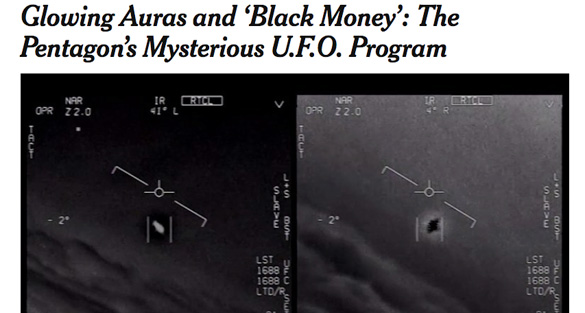
In the December 16, 2017 article published by The New York Times that revealed the existence of the Advanced Aerospace Threat Identification Program (AATIP), a secretive Pentagon project to investigate UFOs, there were two videos included. The videos were Forward Looking Infrared (FLIR) camera videos captured by Navy jet fighters of unidentified objects. The New York Times claimed these videos were “released by the Defense Department’s Advanced Aerospace Threat Identification Program.”

Much, not all, of the information The New York Times received about AATIP was from the former head of the program, Luis Elizondo. He retired from the DoD in October of 2017. The same month he joined Tom Delonge and other former high-level officials in a new venture called the To the Stars Academy (TTSA). This group also researches the UFO phenomenon.

Soon after The New York Times released the videos, TTSA also released them. According to TTSA, the videos were released “through the official declassification review process of the United States government and has been approved for public release.”

Questions first arose about the release of the videos soon after The New York Times published their article. The same day The Washington Post also published an article, and regarding the videos, they wrote: “Elizondo, in an internal Pentagon memo requesting that the videos be cleared for public viewing, argued that the images could help educate pilots and improve aviation safety. But in interviews, he said his ultimate intention was to shed light on a little-known program Elizondo himself ran for seven years: a low-key Defense Department operation to collect and analyze reported UFO sightings.”

I was able to interview Leslie Kean, one of the authors of The New York Times article, in January of 2018. I asked about The Washington Post’s claims. Kean said The New York Times had received the videos from the DoD and had verified they were real. She references a document called a DD 1910: Clearance Request For Public Release of Defense Information. She says although they have not made the document public, it was a release approved by the DoD that authorized the release of the videos. She says the document was vetted by The New York Times and is confident it is real.

In February of 2018, during a Q and A for the International UFO Congress, Elizondo was asked to give further information about the release of the videos. This was a question I slipped in. Here is an excerpt from the transcript of that interview.

Q: How were the videos released? Was it under a false pretense or a trick as the Washington Post suggests?
A: No, there was no trick, and there was no false pretense. The videos were released in accordance with the strict manner that DOD prescribes to DOD manuals and regulations involving the release of information. It went through the official DOPSR process and then furthermore an additional step was taken to have the videos reviewed by foreign disclosure representatives. In fact, the most senior foreign disclosure representatives in the department, and ultimately required OCA or original classification authority approval and review to release the video. So in essence, I didn’t release anything; the department of defense released those videos. The documentation is held by the department of defense, and the justification for releasing those videos were exactly as stated, and that was to create an unclassified database that people could then access and help us identify the signatures we were seeing.

Although Kean and Elizondo shared what they knew about the videos, researchers, rightfully, were still seeking official confirmation. However, the DoD threw us another curve ball. Researcher John Greenewald received a letter from the DoD that claimed, among other things, the “DoD has not released videos related to this program.”

WTF? Were The New York Times and Elizondo wrong or lying, or did the DoD spokesperson get it wrong? My guess was the latter. Kean had stressed they thoroughly vetted the videos. Also, historically, the military press departments often get information wrong regarding UFOs. Case after case we have seen this. Greenwald has also often received erroneous information from military and government press offices.

We finally got more insight into this situation just this week. On May 1, George Knapp and Matt Adams of KLAS 8 News Now in Las Vegas released a copy of the DD 1910.

KLAS wrote:

“The request specifies the three videos: Go Fast, Gimbal and FLIR, which was the original name for the Tic Tac encounter. Some personal information has been redacted, but the document shows authorization for release was granted on August 24 2017. The I-Team also acquired the Department of Defense directive which spells out how the release procedure works. The form shows the videos were released by the book.”

Not everyone was satisfied with this leak of the DD 1910. They argued this was still not an official statement. Fortunately, the DoD responded to a request by Greenewald for a confirmation that the DD 1910 KLAS leaked was real.

The DoD responded:

“I can confirm that the form DD1910 you asked about is a valid DD1910. The standard procedure is for blocks 1-7 on the form to be filled out by the submitter before sending to DOPSR; however, occasional exceptions have occurred. The submitter is responsible for any disclaimers on the form as approved, and also abiding by any amendments that may be included in additional communications from DOPSR to the submitter as part of the approval process. Per block 3 of this form DD1910, the submitter requested release of the videos solely for research and analysis purposes by the US government agencies and industry partners, and not for general public release.”

So Elizondo and Kean were right, and the DoD press department’s initial response regarding the videos was wrong. The DoD spokesperson did not directly address why they made their initial claim of having not released the videos. However, they added at the end of their response the claim that the videos were not released “for general public release.” It is readily apparent this is not accurate.

The DD 1910 is a request for “public release.” This DD 1910 was approved, so the videos were indeed approved for public release. The DoD spokesperson may have been referencing a note in the form that says the videos are not being released for “publication” which is not the same thing as the general public. A publication is an article, book, journals, etc.

The request said the videos would be released for “research and analysis ONLY and info sharing with other USG and industry partners for the purpose of developing a database to help identify, analyze, and ultimately defeat UAS threats.” There is nothing that prohibits these databases from being publicly available. Further, again, this DD 1910 is a form to approve information for “public release,” and it was approved.

Nowhere does this form limit the release to not include the “general public.” My guess as to why they added this note to the end of their response to Greenewald is that they are trying to justify their original false statement that the “DoD has not released videos related to this program.” Even if for some reason you agree the videos were not released for the “general public,” it is still not accurate to say the “DoD has not released videos related to this program.”

In the end, the DoD has now admitted the DD 1910 proving the DoD released the videos is real. The DoD did release the videos, just as Kean and The New York Times had discovered, and Elizondo had claimed.

{ https://www.patreon.com/ }

{ http://www.openminds.tv/ }

Hoe vind je dit bericht?
Geschreven door peter om 16:06 Stuur door

The History Behind the Pentagon’s UFO Program

The History Behind the Pentagon’s UFO Program

Open Minds UFO Radio: In this episode, we review the confusing and complicated timeline of how the Pentagon’s Advanced Aerospace Threat Identification Program (AATIP) UFO project got started, how we found out about, and the history of some of those involved. To really understand AATIP and all of the news coming at us about it, we have to understand this vital background. This includes why and how rockstar Tom DeLonge is involved, who Robert Bigelow is, the paranormal background of Dr. Hal Puthoff, what AAWSAP is and how it was taken down, AATIP’s relation to BAASS and TTSA, and much much more. We will not be interviewing Lue for a little while yet, but covering this background will make you all ready for it.

Alejandro on Patreon

Related links:

Glowing Auras and ‘Black Money’: The Pentagon’s Mysterious U.F.O. Program – The New York Times

Leslie Kean’s recent comments regarding UFO FLIR videos – Facebook

Inside Tom DeLonge’s UFO Obsession, Blink-182 Turmoil – Rolling Stone

I-Team: Documents prove secret UFO study based in Nevada – KLAS

Exclusive: I-Team obtains some key documents related to Pentagon UFO study – KLAS

What We Know And What We Believe Are Not Always The Same Thing. Here’s How Our Perception Of Fact Influences Our Worldview – Medium (By Elizondo)

George Knapp Hunt for the Skinwalker Interview Transcript – OpenMinds.tv

Leslie Kean – Former US Government Officials’ New UFO Research Initiative – October 17, 2017 – Open Minds UFO Radio

Leslie Kean – UFOs and The New York Times – January 16, 2018 – Open Minds UFO Radio

Hillary’s campaign manager’s leaked UFO emails – OpenMinds.tv

Tom DeLonge’s UFO research team revealed, includes government insiders – OpenMinds.tv

Hillary campaign manager held UFO meeting with USAF generals, rock star and top secret aircraft developer – OpenMinds.tv

Is a U.S. Air Force general from Wright-Patterson helping Tom DeLonge obtain official UFO disclosure? – OpenMinds.tv

Tom DeLonge strikes UFO gold – OpenMinds.tv

OpenMinds.tv in WikiLeaks as reference for Bill Clinton’s UFO interests and remarks – OpenMinds.tv

{ http://www.openminds.tv/ }

Hoe vind je dit bericht?
Geschreven door peter om 15:55 Stuur door

Krubera Cave - Journeying to the Depths of Georgia in One of the World’s Deepest Caves

Ice Cave Lake, Krubera Cave

Krubera Cave - Journeying to the Depths of Georgia in One of the World’s Deepest Caves

Krubera Cave was once thought to be the deepest cave on earth, although now it is generally regarded as the second deepest. This natural wonder, found in the Republic of Georgia , is renowned among cavers due to its arduous challenges and the subterranean depth.

The Geology and Layout of Krubera Cave

The cave is located in the Arabika Massif of the Gagra Range of the Western Caucasus and overlooks the Black Sea . It is not the only cave in the area, there are many others in the north-west of Georgia, and in fact Krubera is not far from the world’s deepest cave, the Voronya Cave system. It is a mere 80 feet (24 meters) or so deeper than the third deepest cave which is in the Austrian Alps .

The depth of the cave as measured from the entrance to the distance of the deepest explored point is approximately 7,200 feet (2,200 meters). The entrance is surprisingly narrow for such a large cavern and the bottom was only located in 2001.

Inside Krubera Cave, Georgia

Inside Krubera Cave, Georgia.

( Excitement N Net )

The geology of the cave is of limestone that dates from the Cretaceous and Jurassic ages. There are several underground springs and pools within it, and according to those who explored the system, it consists of a number of deep pits connected by passageways. The best known of these is the Cascade pit which is over 500 feet (152 meters) deep and the bottom has a pool of water. Many freezing sumps (water-filled pits) and water cascades have also been discovered.

Many freezing sumps and water cascades have also been discovered

Many freezing sumps and water cascades have also been discovered.

( Excitement N Net )

Speleological History of Krubera Cave

The cave was not explored until the 1960s. The local population was aware of the cave but did not have the means to explore it. The first experts to really study the Krubera Cave entrance were a group of Soviet speleologists who reported that they believed they had found an underground system that was unusually deep.

Soviet speleologists reported that they believed they had found an underground system that was unusually deep

Soviet speleologists reported that they believed they had found an underground system that was unusually deep.

( Excitement N Net )

This team named the underground system after a great Russian geographer, Alexander Kruber, who is regarded as one of the founders of speleology. He was one of the first to survey of the area and published several papers on the caves and their geology. An alternate name for the site is Crow's Cave ( Vronja), in recognition of all the crows who nest in its vicinity.

There were no further expeditions until the 1980s, when a group of Ukrainian speleologists conducted the first large-scale expedition into the caverns. They were able to push down into the narrow connecting chambers and through tight choke points to a depth of 900 feet (274 meters).

Due to the instability brought about by the collapse of the Soviet Union , the cave was not explored for the next two decades. In 2001 an American expedition revived interest in the cave and on a series of Krubera cave expeditions they gradually managed to discover more pits, meanders, tunnels, and passages. Underground divers explored the many bodies of water of the cave system.

Underground divers explored the many bodies of water of the cave system

Underground divers explored the many bodies of water of the cave system. ( Excitement N Net )

In 2012, a Ukrainian diver reached the deepest point of Krubera at a depth of over 2,000 feet (600 meters), which at the time was a world record. In 2017 a team proved that the Veryovkina Cave, also in Abkhazia, was the world’s deepest.

The Everest of Caves

To explore this site is an ambition of many cavers and it is known as the Everest of Caves. Descending into the caves requires great planning and resources, including tents and breathing equipment. One recent expedition to Krubera took two weeks exploring the underground labyrinth. It is only now, after 20 years of near constant exploration, that we have a reliable map of Krubera Cave and some believe that more pits and passageways remain undiscovered.

Exploring Krubera Cave is Not for Everyone

Garga, Abkhazia, is a breakaway region and is currently under the control of the Russian Federation and its local allies. Because of this, the cave is difficult to access. It is not possible to enter the region via Georgia and permission is needed to enter Abkhazia from Russia. Only highly trained experts should enter Krubera Cave as it is incredibly dangerous. Amateurs and visitors with a yearning for adventure can explore the area around the entrance.

Only highly trained experts should enter Krubera Cave as it is incredibly dangerous

Only highly trained experts should enter Krubera Cave as it is incredibly dangerous.

( Excitement N Net )

  • Top Image: Ice Cave Lake, Krubera Cave. Source: Zelenov, A / CC BY 3.0

By Ed Whelan

{ https://www.ancient-origins.net/ }

Hoe vind je dit bericht?
Geschreven door peter om 15:48 Stuur door

‘It failed’: NASA says SpaceX and Boeing’s recent spaceship-parachute tests did not go well

‘It failed’: NASA says SpaceX and Boeing’s recent spaceship-parachute tests did not go well

Hoe vind je dit bericht?
Geschreven door peter om 15:28 Stuur door

Researcher claims life may still exist on Mars, but it’s probably hiding

mars life

Researcher claims life may still exist on Mars, but it’s probably hiding

As far as we know, there’s no life that currently exists on Mars. Missions to the Red Planet have yielded tantalizing clues that life may have existed at some point in the past, but no living organisms have ever been spotted by any rover or other hardware humans have sent to Mars.

But Mars is a big place. Despite several rover missions and other trips to the planet we’ve still only barely scratched the surface of the secrets Mars may hold, and there’s still the possibility that life in some form persists there. At least that’s what Michael Finney, a researcher and co-found of The Genome Partnership, believes, and he said as much during a recent conference at UC Berkeley.

Mars, as imaged by NASA's Viking 1 orbiter in the 1970s.

Mars, as imaged by NASA's Viking 1 orbiter in the 1970s.
(Image: © NASA/JPL/USGS)

As Space.com reports, Finney spoke about the possibility of Martian life still existing on the Red Planet today. Mars, which at one point in its history had huge bodies of water across its surface, could have been teeming with various forms of life that have since been wiped out as the planet lost much of its atmosphere and surface water. If that was indeed the case, Finney believes something likely stuck around for the long haul.

“If Mars had life 4 billion years ago, Mars still has life,” Finney explained. “Nothing has happened on Mars that would’ve wiped out life. So, if there were life on Mars, it may have moved around, it may have gone into hiding a bit, but it’s probably still there,”

It might sound like a stretch, but it’s actually not that hard to believe when you look at some of the more Earth-like regions of Mars. Researchers studying the planet know that it still has quite a bit of ice in its polar areas, and liquid water might not be hard to find during certain times of the Martian year.

On Earth, life can be found in some of the most hostile environments imaginable. Microorganisms, in particular, have a habit of withstanding extreme temperatures and lack of water for long periods of time, and it’s entirely possible that life in some form has adapted to exist beneath the surface of Mars.

Future missions to the planet would be our best chance of proving or disproving that notion, but unfortunately, that means we’ll have to wait a while before we know for sure.

{ https://bgr.com/ }

Hoe vind je dit bericht?
Geschreven door peter om 15:14 Stuur door

Asteroid strike simulation blasts New York City

Asteroid strike simulation blasts New York City

It seems like play, but they’re serious. Every year, at the Planetary Defense Conference, asteroid experts from around the globe run days-long simulations of asteroids headed for major cities. In 2019, it was New York City’s turn.

Glowing asteroid with orange tail rushing downward toward Earth.

Artist’s concept of a large asteroid hitting Earth. In a new simulation conducted during the Planetary Defense Conference in early May, New York City was wiped out by just such a cataclysmic event.

Image via solarseven/Shutterstock.com.

We’ve all seen movies about what might happen if an asteroid were to hit the Earth. While these thrilling, apocalyptic dramas are not real, asteroid experts do consider the question of what it might really be like if an asteroid used Earth for target practice. For example, what if a large asteroid were heading toward New York City specifically? If we knew far enough in advance that the asteroid were coming, could the Big Apple be saved?

That was the question posed in a new simulation, called the Planetary Defense Conference Exercise 2019, presented during the International Academy of Astronautics Planetary Defense Conference (PDC) held April 29 to May 3, 2019 in Washington, D.C. The annual conference brings together asteroid experts from NASA, the European Space Agency (ESA) and other organizations to try to understand and plan how humanity would respond if an asteroid threat were to occur. How could Earth be saved?

This article describes a simulation, an exercise, and there is no real asteroid posing a threat to Earth at this time.

Astronomers hold a new simulation every year, in which they practice using their expertise and knowledge to spare various cities from ensuing calamity. In last year’s simulation, Tokyo was successfully saved after a nuclear bomb was used to destroy the asteroid. In previous simulations, however, other places such as the French Riviera and Dhaka (largest city of Bangladesh) were not so lucky. This year’s simulation got more publicity, in part because it was highlighted on social media. Day by day on Twitter, for example, the public was able to follow along, as experts participating in the simulation were giving new parameters to consider. Rüdiger Jehn, ESA’s head of Planetary Defence, explained in a statement why experts run simulations like these. He said:

The first step in protecting our planet is knowing what’s out there. Only then, with enough warning, can we take the steps needed to prevent an asteroid strike altogether, or to minimize the damage it does on the ground.

Diagram of elongated orbit of asteroid crossing Earth's orbit.

The imaginary orbit of asteroid 2019 PDC – an imaginary asteroid used in the recent Planetary Defense Conference simulation – compared to Earth’s orbit, from March 26, 2019, until the time of the simulated impact on April 29, 2027.

Image via PDC/CNEOS/JPL.

So what about New York? Was the catastrophe averted?

Unfortunately, no.

The simulation began on Day 1 of the conference. In this scenario, a large imaginary asteroid that the conference named after itself as 2019 PDC – said to be between 330 and 1,000 feet (100 and 300 meters) in diameter – was imagined to be on a near-Earth collision course. At first, according to the simulation, the asteroid had only about a 1 percent chance of hitting the Earth, so there was not too much reason to worry. Yet. A fake press release was issued, even though the chance of impact was still very small:

College Park, Maryland, USA, April 29, 2019. The International Asteroid Warning Network has announced that a recently discovered near-Earth asteroid could pass very close to the Earth 8 years from now, on April 29, 2027, and there is a small chance – 1 in 100 – that it could impact our planet.

Day 2 of the conference was in the simulation year 2021. NASA had launched a probe to look at the asteroid more closely. At that point in the simulation, the space rock was on a collision course with Earth, and the impact site had been narrowed down to Denver, Colorado.

Globe with red line crossing North America from about San Diego California to New York City.

The risk corridor for imaginary asteroid 2019 PDC during the recent simulation. The simulated impact was pictured as happening directly over New York City.

Image via PDC/CNEOS/JPL.

On Day 3 – the year 2024 in the simulation – the world’s space power nations had decided to build a fleet of six “kinetic impactors,” spacecraft designed to ram into the asteroid, slowing it down and hopefully deflecting it off course. The impactors were launched in 2024, still three years from impact, and three of them were imagined to hit the asteroid successfully. This was enough to fragment the asteroid, but there was still a problem. Although the biggest piece of the asteroid would no longer hit the Earth, a smaller fragment was imagined to be still on a collision trajectory, headed for the eastern United States.

At this point in the simulation, there wasn’t too much else that could be done. It was too late to try to nuke the incoming asteroid fragment, due to politics (as usual).

Now, analysis of the asteroid’s imaginary trajectory showed it would hit New York City. The only thing that could be done at this point was mass evacuation.

Toward the end of the simulation, the asteroid was imagined as striking Earth’s atmosphere at 43,000 mph (69,000 kmh) and exploding right over New York in a blast that was 1,000 times more powerful than the nuclear bomb dropped on Hiroshima, Japan. New York City, the largest city in North America, was no more.

All of this is, of course, just an exercise. But simulations like these help experts figure just what actions might be taken, if an asteroid were discovered to be on a collision course with Earth. At this point in Earth’s history, there are no large asteroids known to be headed our way. And the odds of a large asteroid hitting Earth at any given time are statistically exceedingly low. However, as astronomers have come to recognize more profoundly in recent decades, asteroid strikes do happen. They’ve happened before and could happen again.

Huge rock hitting Earth explosively with dinosaurs and flying pterodactyls.

A massive asteroid impact in what’s now the Yucatán Peninsula is thought to have wiped out the dinosaurs 65 million years ago. Could it happen again?

Image via Science Photo Library/Alamy Stock Photo.

The dinosaurs unfortunately experienced this firsthand, 65 million years ago. And if it happened before, it can happen again, at some point. We don’t know exactly when, though, so it is prudent to be ready at all times, even if the chance of the unthinkable happening is small.

About 20,000 near-Earth asteroids have been discovered so far, with another 150 or so new ones found every month, according to the Center for Near Earth Object Studies (CNEOS).

NASA and the Federal Emergency Management Agency (FEMA) also released an 18-page document in June 2018 explaining what steps the agencies would take over the next 10 years to prevent actual potential asteroid strikes and to prepare the country for the worst if one did hit us. That plan is two-fold, increasing ground-based surveillance of near-Earth asteroids and having a protocol in place for mass evacuations. This would require other nations to work with the U.S., a worthy goal since we don’t know just when or where an asteroid will hit, the next time one does.

In all probability, another asteroid will strike Earth, eventually, even if it’s tens of thousands of years from now. Let’s hope a future human civilization will fare better than the dinosaurs did 65 million years ago.

  • Bottom line: In 2019’s Planetary Defense Conference simulation, New York City was obliterated by an asteroid fragment that hit Earth in 2027. Although not based on reality, simulations such as these are designed to help NASA, ESA, FEMA and other agencies prepare for a time if – or when – just such a catastrophe really doeshappen again.
  • Via Live Science

{ https://earthsky.org/ }

Hoe vind je dit bericht?
Geschreven door peter om 14:40 Stuur door

Increase In UFO Sightings Prompts Military Action

Increase In UFO Sightings Prompts Military Action

Increase In UFO Sightings Prompts Military Action

Remember the Twilight Zone on television? Well, play that theme song in your head while you read this post…

The US Navy is drafting new guidelines for reporting Unidentified Flying Objects (UFOs) after a significant uptick in the number of sightings on (above?) American soil.

No, it doesn’t mean we’re being invaded by aliens (at least not yet). Nor does it mean that the US is about to live out the storyline from Colony, Netflix’s all-too-soon ended show about an Earth under alien control.

So what DOES it mean?

Key Points:

  • First, “UFO” does not equal alien. A UFO is anything in the sky that cannot be accurately identified — an animal, a device, an aircraft, or even some kind of natural phenomenon. UFOs are a significant concern, but not because they spell doom for humans due to an oncoming onslaught of alien warriors.
  • Instead, the risks are much more mundane. Flying devices can be used in attacks by foreign enemies, to import drugs across the border, and even to gather intel at America’s military bases.
  • Studying UFOs is extremely important. Regardless of what the object is, or what discoveries are made along the way, the information gathered is almost always useful. In some cases, that info is even critically important to national security, as it can reveal an impending threat, such as an aircraft flying in to attack.
  • UFOs may also indicate that a foreign entity or enemy has achieved a technological breakthrough, making them much more powerful, and thus, much more dangerous. In a world where tech is advancing more and more rapidly all across the world, this must be considered.
  • Even when the phenomenon turns out to be natural, studying it can be remarkably insightful. In 2009, researchers received reports of an “alien spaceship” that turned out to be a strange type of lighting filled with “blue jets,” later theorizing that the phenomenon may impact ozone and the weather.
  • The Navy’s statement announcing significant changes for reporting UFOs clarifies the issue further. “There have been a number of reports of unauthorized and/or unidentified aircraft entering various military-controlled ranges and designated airspace in recent years,” it reads. “For safety and security concerns, the Navy and the [U.S. Air Force] takes these reports very seriously and investigates each and every report.”
  • One such report includes a release from To the Stars Academy of Arts and Sciences that showcases a declassified video of two Navy pilots coming into close contact with a UFO. “GO FAST,” which has been certified authentic by the DoD, is a remarkable watch:

  • The UFO in the GoFast video was never identified, but that doesn’t mean studying it isn’t useful. The information within it can help our military better protect the country and improve tech equipment — far from a simple spooky alien story on television.
  • In fact, former Pentagon intelligence official Chris Mellon believes we should retire the term UFO altogether. Instead, he proposes “unexplained aerial phenomena,” which demystifies the subject and encourages a more scientific and analytical approach.
  • “Right now, we have a situation in which UFOs and UAPs are treated as anomalies to be ignored rather than anomalies to be explored,” he explains. “We have systems that exclude that information and dump it.”
  • Mellon also cautions against the assumptive mindset that most UFOs should be ignored. “…in a lot of cases [military personnel] don’t know what to do with that information, like satellite data or a radar that sees something going Mach 3. They will dump [the data] because that is not a traditional aircraft or missile.”

The new Navy guidelines will encourage and require sightings to be reported “to cognizant authorities” depending on the specifics of the incident. This could very well lead to technological advancement, improved national defense — and yes, maybe the discovery of new life, too.

You just never know.

{ https://beforeitsnews.com/v3/ }

Hoe vind je dit bericht?
Geschreven door peter om 12:31 Stuur door

Science’s Understanding of The Sun Turns Out To Be “Spectacularly Wrong”

The sun is mysterious.

Science’s Understanding of The Sun Turns Out To Be “Spectacularly Wrong”

You’d think at this point in humanity’s development, with our big ridiculous particle smashing machines, our spaceships, our plans to colonize other planets, we’d have a pretty solid understanding of something so basic as the sun. You’d be wrong. For starters, the sun is hardly basic, despite its constant presence, hanging in the sky every day since before there even were days. We often take the sun for granted and forget that it’s a giant ball of condensed nuclear fire, so heavy that it warps spacetime enough to keep a series of giant balls of rock spinning around it. Far from being basic, its mind-boggling.  In fact, because of our advancements in knowledge and understanding of the cosmos, scientists have recently realized that the sun is much more mysterious and strange than they’ve ever imagined.

Compiling over a decade’s worth of data from telescopes pointed at the sun, NASA scientists found that their predictions of the glow from gamma rays —the highest frequency band of light—were wrong. Not just a little bit wrong, but completely, utterly, and inexplicably wrong in a way that disrupts the entire understanding of the sun, and perhaps even our understanding of physics. According to particle physicist Brian Fields:

“It’s amazing that we were so spectacularly wrong about something we should understand really well: the sun.”

The sun

Hubris: looking at this thing and thinking you’ve got it all figured out.

Scientists had previously theorized that although the sun’s core would produce gamma rays, none would escape due to degradation as they try to escape the burning ball of nuclear fire. Despite that, scientists believed that the sun would still emit a gamma ray glow because of something called cosmic rays: protons that have been blasted into our solar system by supernovas or other violent cosmic events. When these cosmic rays hit the sun, scientists postulated, they would be reflected back by the suns magnetic field and burn up into gamma radiation.  Johnathan Beacom, one of the scientists who worked on the project explains it, in a way we can all understand, with cartoons:

“Remember the Road Runner cartoon? Imagine the proton runs straight toward that sphere, and at the last second it changes its direction and comes back at you.”

Except then the Road Runner burns up as a burst of radiation.

Scientists figured out that, based on the rate of cosmic rays hitting the sun and an expected one percent efficiency in bouncing them back, the sun would emit a faint glow of gamma rays. When they looked at the data they found that the gamma ray glow of the sun was seven times brighter than they had predicted. This suggests that if the cosmic ray theory is correct, the sun is bouncing cosmic rays back with 100% efficiency, which should be impossible. Even weirder, at the highest frequency of gamma rays the sun glows 20 times brighter than scientists had predicted. Weirder still, while most of the frequency bands of gamma rays are far brighter than scientists predicted, there is a conspicuous and unexplained dip in one band of frequencies that, according to astrophysicist Tim Linden, “defies all logic.” He says:

“It’s much easier to get bumps than dips. If I have something that comes out of the sun, OK, that’s an extra channel. How do I make a negative channel out of that?”

Artist's rendition of the sun.

The explanations for this unexpected weirdness in the sun all fall short in some way. Scientists have hypothesized that the sun’s core might be partially composed of dark matter, which, trapped and compressed by gravity could be annihilated and turned into gamma radiation, but that leaves the problem of how that gamma radiation could escape the sun. The other explanation is that something we don’t understand is happening with the sun’s magnetic field. According to astrophysicist John Giacalone the gamma ray signal “is probably telling us something very fundamental about the magnetic structure of the sun.”

However, no explanation accounts for the mysterious dip in the gamma ray frequency band. In fact, such a dip is so outside expectations that some experts think it’s a mistake in the data. According to Tim Linden, it’s no mistake:

“I think there are 15 pages in the appendix of different tests we ran to see whether we were miscalculating. Statistically, the dip appears very prominent.”

So rather than explaining and putting to rest the unsolved mysteries of the cosmos, science has once again shown us that the more layers you peel back, the more mysteries present themselves like a cosmic game of whack-a-mole. It is exciting though, and such a mystery will inevitably lead to a deeper understanding of our little slice of the the universe, and perhaps a deeper understanding of the fundamental substrate of reality as well. John Beacom sums it up nicely:

“The worst that can happen here is that we find out that the sun is stranger and more beautiful than we ever imagined. And the best that could happen is we discover some kind of new physics.”

{ https://mysteriousuniverse.org/ }

Hoe vind je dit bericht?
Geschreven door peter om 12:19 Stuur door

Could Quantum Mechanics Explain the Existence of Spacetime?

Could Quantum Mechanics Explain the Existence of Spacetime?

By Tom Siegfried 

Einstein’s general theory of relativity shows that gravity is the result of a mass, such as a planet or star, warping the geometry of the merger of time and space known as spacetime.

 (Credit: koya979/Shutterstock)

Rod Serling knew all about dimensions.

His Twilight Zone was a dimension of imagination, a dimension of sight and sound and mind, a dimension as vast as space and timeless as infinity. It was all very clear except for the space and time part, the dimensions of real life. Serling never explained them.

Of course, ever since Einstein, scientists have also been scratching their heads about how to make sense of space and time. Before then, almost everybody thought Isaac Newton had figured it all out. Time “flows equably without relation to anything external,” he declared. Absolute space is also its own thing, “always similar and immovable.” Nothing to see there. Events of physical reality performed independently on a neutral stage where actors strutted and fretted without influencing the rest of the theater.

But Einstein’s theories turned Newton’s absolute space and time into a relativistic mash-up — his equations suggested a merged spacetime, a new sort of arena in which the players altered the space of the playing field. It was a physics game changer. No longer did space and time provide a featureless backdrop for matter and energy. Formerly independent and uniform, space and time became inseparable and variable. And as Einstein showed in his general theory of relativity, matter and energy warped the spacetime surrounding them. That simple (hah!) truth explained gravity. Newton’s apparent force of attraction became an illusion perpetrated by spacetime geometry. It was the shape of spacetime that dictated the motion of massive bodies, a symmetric justice since massive bodies determined spacetime’s shape.

Verification of Einstein’s spacetime revolution came a century ago, when an eclipse expedition confirmed his general theory’s prime prediction (a precise amount of bending of light passing near the edge of a massive body, in this case the sun). But spacetime remained mysterious. Since it was something rather than nothing, it was natural to wonder where it came from.

Now a new revolution is on the verge of answering that question, based on insights from the other great physics surprise of the last century: quantum mechanics. Today’s revolution offers the potential for yet another rewrite of spacetime’s résumé, with the bonus of perhaps explaining why quantum mechanics seems so weird.

“Spacetime and gravity must ultimately emerge from something else,” writes physicist Brian Swingle in the 2018 Annual Review of Condensed Matter Physics. Otherwise it’s hard to see how Einstein’s gravity and the math of quantum mechanics can reconcile their longstanding incompatibility. Einstein’s view of gravity as the manifestation of spacetime geometry has been enormously successful. But so also has been quantum mechanics, which describes the machinations of matter and energy on the atomic scale with unerring accuracy. Attempts to find coherent math that accommodates quantum weirdness with geometric gravity, though, have met formidable technical and conceptual roadblocks.

At least that has long been so for attempts to understand ordinary spacetime. But clues to a possible path to progress have emerged from the theoretical study of alternate spacetime geometries, thinkable in principle but with unusual properties. One such alternate, known as anti de Sitter space, is weirdly curved and tends to collapse on itself, rather than expanding as the universe we live in does. It wouldn’t be a nice place to live. But as a laboratory for studying theories of quantum gravity, it has a lot to offer. “Quantum gravity is sufficiently rich and confusing that even toy universes can shed enormous light on the physics,” writes Swingle, of the University of Maryland.

A strange type of spacetime with unusual curvature known as anti de Sitter space, illustrated here, is nothing like the universe we live in, but could nevertheless provide clues to the quantum processes that may be responsible for producing ordinary spacetime. 

(Credit: U. Moschella/Seminaire Poincare 2005)

Studies of anti de Sitter space suggest, for instance, that the math describing gravity (that is, spacetime geometry) can be equivalent to the math of quantum physics in a space of one less dimension. Think of a hologram — a flat, two-dimensional surface that incorporates a three-dimensional image. In a similar way, perhaps the four-dimensional geometry of spacetime could be encoded in the math of quantum physics operating in three-dimensions. Or maybe you need more dimensions — how many dimensions are required is part of the problem to be solved.

In any case, investigations along these lines have revealed a surprising possibility: Spacetime itself may be generated by quantum physics, specifically by the baffling phenomenon known as quantum entanglement.

As popularly explained, entanglement is a spooky connection linking particles separated even by great distances. If emitted from a common source, such particles remain entangled no matter how far they fly away from each other. If you measure a property (such as spin or polarization) for one of them, you then know what the result of the same measurement would be for the other. But before the measurement, those properties are not already determined, a counterintuitive fact verified by many experiments. It seems like the measurement at one place determines what the measurement will be at another distant location.

That sounds like entangled particles must be able to communicate faster than light. Otherwise it’s impossible to imagine how one of them could know what was happening to the other across a vast spacetime expanse. But they actually don’t send any message at all. So how do entangled particles transcend the spacetime gulf separating them? Perhaps the answer is they don’t have to — because entanglement doesn’t happen in spacetime. Entanglement creates spacetime.

At least that’s the proposal that current research in toy universes has inspired. “The emergence of spacetime and gravity is a mysterious phenomenon of quantum many-body physics that we would like to understand,” Swingle suggests in his Annual Review paper. Vigorous effort by several top-flight physicists has produced theoretical evidence that networks of entangled quantum states weave the spacetime fabric. These quantum states are often described as “qubits” — bits of quantum information (like ordinary computer bits, but existing in a mix of 1 and 0, not simply either 1 or 0). Entangled qubits create networks with geometry in space with an extra dimension beyond the number of dimensions that the qubits live in. So the quantum physics of qubits can then be equated to the geometry of a space with an extra dimension. Best of all, the geometry created by the entangled qubits may very well obey the equations from Einstein’s general relativity that describe motion due to gravity — at least the latest research points in that direction. “Apparently, a geometry with the right properties built from entanglement has to obey the gravitational equations of motion,” Swingle writes. “This result further justifies the claim that spacetime arises from entanglement.”

Still, it remains to be shown that the clues found in toy universes with extra dimensions will lead to the true story for the ordinary spacetime in which real physicists strut and fret. Nobody really knows exactly what quantum processes in the real world would be responsible for weaving spacetime’s fabric. Maybe some of the assumptions made in calculations so far will turn out to be faulty. But it could be that physics is on the brink of peering more deeply into nature’s foundations than ever before, into an existence containing previously unknown dimensions of space and time (or sight and sound) that might end up making The Twilight Zone into Reality TV.

  • This article originally appeared in Knowable Magazine, an independent journalistic endeavor from Annual Reviews. Sign up for the newsletter.

{ http://discovermagazine.com/ }

Hoe vind je dit bericht?
Geschreven door peter om 01:19 Stuur door

What Mars’ giant dust storm taught us

What Mars’ giant dust storm taught us

Before we send people to Mars, we need to understand more about how Martian dust could affect astronauts and their equipment. Here are 3 things we’ve learned from the planet’s 2018 global dust storm.

Hoe vind je dit bericht?
Geschreven door peter om 00:32 Stuur door

Arsenic-breathing life discovered in Pacific

Arsenic-breathing life discovered in Pacific

Arsenic is a deadly poison for most living things, but new research shows that microorganisms are breathing arsenic in a large area of the Pacific Ocean.

People standing on boat, long-legged instrument in foreground, blue sea.

Researchers fix the line on an instrument that pumps large volumes of seawater in order to extract DNA. The instrument on the left measures properties such as temperature, salinity and depth and collects smaller samples of seawater.

Image via Noelle Held/Woods Hole Oceanographic Institution.

Arsenic is a deadly poison for most living things, but new research has found microorganisms in a low-oxygen area of the Pacific Ocean that breathe arsenic.

University of Washington professor of oceanography Gabrielle Rocap is a co-author of the study, published April 29, 2019, in the peer-reviewed journal Proceedings of the National Academy of Sciences. Rocap said in a statement:

We’ve known for a long time that there are very low levels of arsenic in the ocean. But the idea that organisms could be using arsenic to make a living – it’s a whole new metabolism for the open ocean.

The team analyzed samples collected during a 2012 research cruise to the tropical Pacific, off the coast of Mexico. The seawater samples came from a region below the surface, where oxygen is almost absent. Rocap said:

In some parts of the ocean there’s a sandwich of water where there’s no measurable oxygen. The microbes in these regions have to use other elements that act as an electron acceptor to extract energy from food.

2 large purple balls with red balls stuck to them.

A purple arsenic atom surrounded by four oxygen atoms is arsenate (left). An arsenic atom surrounded by three oxygen atoms is arsenite (right). The study found evidence of marine organisms that can convert one to the other to get energy in oxygen-deficient environments.

Image via Wikimedia.

Genetic analyses on DNA extracted from the seawater found two genetic pathways that are known to convert arsenic-based molecules as a way to gain energy.

According to the researchers, the microbes discovered in the water are probably distantly related to the arsenic-breathing microbes found in hot springs or contaminated sites on land.

Lake with bare spiky rock formations around and in it, blue sky.

California’s Mono Lake is naturally high in arsenic and is known to host microbes that survive by breathing arsenic. The organisms that live in the marine environment are likely related to the ones on land.

Image via Pixabay.

Biologists believe the strategy of using arsenic for respiration is a holdover from Earth’s early history. During the period when life arose on Earth, oxygen was scarce in both the air and in the ocean. Oxygen became abundant in Earth’s atmosphere only after photosynthesis became widespread and converted carbon dioxide gas into oxygen. Early lifeforms had to gain energy using other elements, such as arsenic, which was likely more common in the oceans at that time.

Jaclyn Saunders, a postdoctoral fellow at the Woods Hole Oceanographic Institution, is the study first author. She said:

We found the genetic signatures of pathways that are still there, remnants of the past ocean that have been maintained until today.

Arsenic-breathing populations may grow again under climate change. Low-oxygen regions are projected to expand, and dissolved oxygen is predicted to drop throughout the marine environment. Rocap said:

For me, it just shows how much is still out there in the ocean that we don’t know.

{ https://earthsky.org/ }

Hoe vind je dit bericht?
Geschreven door peter om 23:58 Stuur door

Virgin Galactic is moving its spaceship and crew to Spaceport America

Virgin Galactic is moving its spaceship and crew to Spaceport America

That apparently means the company is nearly ready to take passengers to the edge of space.
IayNn_6t?format=jpg&name=medium
Virgin Galactic

Virgin Galactic's deal with New Mexico entails moving its commercial spaceflight activities to Spaceport America when its vehicles and operations are ready for primetime. Looks like the company is nearly there, because, Sir Richard Branson and company have decided that it's time. Virgin Galactic has announced that its "program had advanced sufficiently to move the spaceline staff and space vehicles from Mojave, California to [its] commercial operations headquarters at Spaceport America, New Mexico."

The corporation conducted VSS Unity's first test flight with a passenger onboard back in February, two months after its first ever flight to space. It will now complete the vehicle's final tests from New Mexico after the company relocates it and its carrier aircraft, VMS Eve, over the summer. One of the flights could have Branson himself as a passenger, seeing as he intends to fly to the edge of space on July 16th, 2019 to celebrate the 50th anniversary of Apollo 11.

Virgin Galactic is also moving 100 staff members to its new HQ, since that's where it'll run things from now on. As the company said, the move "signals the final countdown" to the beginning of its commercial spaceflight service.

Sir Richard Branson said in a statement:

"Our Virgin Galactic adventure has been intertwined with New Mexico and Spaceport America right from the start and our stories have unfolded together. New Mexico delivered on its promise to build a world-first and world-class spaceport. Today, I could not be more excited to announce, that in return, we are now ready to bring New Mexico a world-first, world-class spaceline. Virgin Galactic is coming home to New Mexico where together we will open space to change the world for good."

View image on Twitter
Richard Branson
✔@richardbranson

It’s going to be special to see the world’s most beautiful spaceship fly from one of the world’s most wonderfully designed buildings, Spaceport America https://virg.in/UEw  @virgingalactic

  • 181 people are talking about this
Embedded video
Virgin Galactic
✔@virgingalactic

New Mexico will be one of the very few places on the planet which will be hosting human spaceflight launches. We are initiating the move of our spaceship and operations team to New Mexico’s @Spaceport_NM. https://virg.in/UEi 

  • 137 people are talking about this
Hoe vind je dit bericht?
Geschreven door peter om 23:47 Stuur door

Are octopuses alien? New theory argues Earth was ‘seeded’ by interstellar genetic code

Are octopuses alien? New theory argues Earth was ‘seeded’ by interstellar genetic code

OCTOPUSES are weird. This is not just because they look odd. It’s not because they’re disturbingly smart. And that could mean they’re alien.

Jamie Seidel

OCTOPUSES are weird. This is not just because they look odd. It’s not because they’re disturbingly smart. It’s because they have a strange power.

The ability to edit their own bodies.

This has biologists scratching their heads.

Evolution doesn’t work that way. It’s supposed to be spurred by genetic mutations — a change in DNA — that proves to be beneficial to the host.

So how could a creature evolve in such a way as to allow them to rebuild themselves?

Now a new train of thought has emerged.

They didn’t.

At least, not here.

Instead — it’s an advanced biological ability that came from outer space.

An ethereal octopus emerges from the depths. Picture: iStock

An ethereal octopus emerges from the depths.

Picture: iStockSource:istock

THE KRAKEN WAKES

In April last year, researchers found octopuses — and some of their cuttlefish and squid cousins — regularly edit their RNA.

This sets them apart from the rest of the animal world.

RNA, like DNA, records genetic code. But where DNA is a double-stranded molecule, RNA consists of just one strand. Its role within our body is to transmit genetic information to trigger the production of proteins.

But some scientists feel RNA may have been the original DNA, acting as the permanent storehouse of genetic code among Earth’s earliest organisms.

When it comes to cephalopods like the common squid, researchers have found that up to 60 per cent of the RNA in its nervous system had been edited after it was programmed by DNA. These changes adapted its brain to shifting temperatures in it ocean habitat.

Last year, it was discovered two species of octopus and one of cuttlefish does the same thing — routinely.

“This shows that high levels of RNA editing ... (is) an invention of the coleoid cephalopods,” US Marine Biological Laboratory researcher Joshua Rosenthal said.

How this ability is triggered, or controlled, is not yet known.

“It could be something as simple as temperature changes or as complicated as experience, a form of memory,” Rosenthal says.

But the ability to reshape physiologies on the fly has come at a price.

Coleoids aren’t evolving much.

This could be because the drive isn’t there: They’ve found editing RNA is way to adapt to — and survive — change. So their DNA doesn’t need to change.

“The conclusion here is that in order to maintain this flexibility to edit RNA, the coleoids have had to give up the ability to evolve in the surrounding regions — a lot,” Rosenthal wrote.

Nasa astronaut Ron Garan took this photo of a meteor through a window in the International Space Station. Picture: Twitter

Nasa astronaut Ron Garan took this photo of a meteor through a window in the International Space Station.

Picture: TwitterSource:Supplied

PANSPERMIA THEORY

The origin of life on Earth is one of the toughest nuts for science to crack. We know much of the chemistry involved. But not the circumstances that brings it all together into a living being.

There’s still a gap in our understanding large enough for gods and other extraordinary ideas to fit within.

Such as panspermia.

It’s the idea that life here began out there — with scatterings of organic molecules carrying their pre-programmed codes for life across the gulf of time and space.

Evidence is lacking.

But the idea is being examined.

Now a peer-reviewed article published in the science journal Progress in Biophysics and Molecular Biology is stirring the origins-of-life pot.

The recent Rosetta mission to Comet 67P Churyumov-Gerasimenko confirmed organic molecules that form the basis of sugars and amino acids were dusted among its mounds and valleys of frozen ice.

It’s not life.

But these materials are the building blocks of DNA.

The new report, Cause of Cambrian Explosion — Terrestrial or Cosmic?, argues that our existence isn’t based on these interplanetary building blocks alone.

Instead, it builds up the idea that our biochemistry has been contaminated by influences from beyond our own planet.

The authors argue that a cloud of organic material likely rained down upon the Earth about 500 million years ago. And that changed everything.

Could the code of life be carried across the cosmos in space dust? One group of researchers believes so. Picture: Hubble

Could the code of life be carried across the cosmos in space dust? One group of researchers believes so.

Picture: HubbleSource:Supplied

ALIEN IMPACT

The Cambrian Explosion is certainly mysterious. It was a period of time where life on Earth diversified dramatically, and rapidly.

It’s an event which took place shortly after the emergence of retroviruses in our environment.

It was especially dramatic for a type of mollusc called a cephalopod. Tentacles reached out from their shells and wove their way into enormous variety of creatures which eventually became the octopus, cuttlefish and squid we know today.

“We believe this coincidence is not fortuitous but is consistent with a key prediction ... whereby major extinction-diversification evolutionary boundaries coincide with virus-bearing cometary-bolide bombardment events,” the study’s abstract reads.

This idea is that space-borne retroviruses eventually found their way to the Earth’s surface before attaching themselves to living organisms. Once there, they reprogrammed the creatures’ evolution.

“A second focus is the remarkable evolution of intelligent complexity (Cephalopods) culminating in the emergence of the Octopus,” the study reads.

“A third focus concerns the microorganism fossil evidence contained within meteorites as well as the detection in the upper atmosphere of apparent incoming life-bearing particles from space.”

The paper argues the space-based transfer of life was likely on a larger scale than just retroviruses. Whole sets of frozen genetic material were cast about on the stellar winds before splashing down in our oceans.

Here, they thawed.

“Thus the possibility that cryopreserved squid and/or octopus eggs, arrived in icy bolides several hundred million years ago should not be discounted,” the study reads.

Therefore, octopuses are aliens.

It’s interesting conjecture. It’s an idea that fits the circumstances. But concrete evidence is yet to be produced. The idea is yet to be tested.

But it’s tantalising.

“Life may have been seeded here on Earth by life-bearing comets as soon as conditions on Earth allowed it to flourish (about or just before 4.1 Billion years ago); and living organisms such as space-resistant and space-hardy bacteria, viruses, more complex eukaryotic cells, fertilised ova and seeds have been continuously delivered ever since to Earth so being one important driver of further terrestrial evolution which has resulted in considerable genetic diversity and which has led to the emergence of mankind.”

{ https://www.news.com.au/ }

Hoe vind je dit bericht?
Geschreven door peter om 23:35 Stuur door

Ligt diep in onze planeet nog een andere aarde verscholen? Dit zet je aan het denken

Ligt diep in onze planeet nog een andere aarde verscholen? Dit zet je aan het denken

Ligt diep in onze planeet nog een andere aarde verscholen? Dit zet je aan het denken

Op 13 juni 2014 kondigden wetenschappers aan dat de aardmantel tot wel drie keer zoveel water bevat als alle oceanen op aarde.

De ontdekking liet zien dat we nog maar heel weinig weten over het binnenste van de aarde.

Het diepste gat ooit gemaakt door mensen is ongeveer 12 kilometer. “Dat is niets,” aldus natuurkundige John Brandenburg in het tv-programma Ancient Aliens.

Agartha

Tot dusver zijn er alleen theorieën over de samenstelling van de aarde. We hebben nog nooit diep genoeg geboord om ze te kunnen verifiëren.

Sommigen stellen dat er diep in onze planeet nog een andere aarde kan worden gevonden.

In boeddhistische geschriften wordt gesproken van een plek genaamd Agartha of Agharti, een wereld in de aarde die bewoond zou zijn.

Nog een zon

Gerespecteerde wetenschappers en wiskundigen hielden zich hiermee bezig.

Edmond Halley is vooral bekend geworden vanwege de komeet van Halley, maar hij stelde ook dat het binnenste van de aarde hol is en bestaat uit meerdere concentrische lagen.

Leonhard Euler, die algemeen wordt beschouwd als één van de belangrijkste wiskundigen aller tijden, was er ook van overtuigd dat de aarde hol is en dat er in onze planeet nog een zon kan worden gevonden.

Onbekend gebied

Euler zei verder dat zich rond de polen openingen bevinden die toegang verschaffen tot de holle aarde.

De beroemde wiskundige opperde dat er geavanceerde beschavingen leven diep in de aarde.

In 1947 maakte admiraal Richard Byrd verkenningsvluchten boven de Noordpool. Daar ontdekte hij naar verluidt een onbekend gebied, dat hij ‘het centrum van het onbekende’ noemde.

Mysterieuze vaartuigen

Hij deed een aantal opmerkelijke uitspraken. Zo werd hij naar eigen zeggen geconfronteerd met mysterieuze vaartuigen, die ‘van pool naar pool vlogen’.

Eenmaal terug in de Verenigde Staten zou de admiraal opdracht hebben gekregen om zijn mond te houden.

Bekijk het filmpje hieronder:

[History]
© Copyright (c) NineForNews.nl
Hoe vind je dit bericht?
Geschreven door peter om 23:07 Stuur door

"I Had A Near Death Experience, and It Was Beautiful!" (True Story!)

"I Had A Near Death Experience, and It Was Beautiful!" (True Story!)

A near-death experience is a personal experience associated with death or impending death. Such experiences may encompass a variety of sensations including detachment from the body, feelings of levitation, total serenity, security, warmth, the experience of absolute dissolution, and the presence of a light. NDEs are a recognized part of some transcendental and religious beliefs in an afterlife.

These are a collection of 100% TRUE paranormal Stories. Here at “Strange But True Stories”, we vow to bring you 100% True cases of: Paranormal Stories, Bigfoot stories, Time Glitches & the Mandela Effect, and so much more! You can submit your TRUE story to us at: strangebuttruestories2@gmail.com

What do you think about this video? Let us know in the comments section and thanks for stopping by Beforeitsnews!

{ https://beforeitsnews.com/v3/ }

Hoe vind je dit bericht?
Geschreven door peter om 23:00 Stuur door

Ancient Tools Reveal 500,000-Year-Old Migration Routes of Human Ancestors in ‘Cradle of Huanity’

Ancient Tools Reveal 500,000-Year-Old Migration Routes of Human Ancestors in ‘Cradle of Humanity’

by N.Morgan

During excavations in Eastern Sudan, the scientists from the Wrocław University’s Institute of Archeology found remnants of the humanoids’ presence which tell the untold story of the different phases of human species migration from half a million years ago.  

Instytut Archeologii Uniwersytetu Wrocławskiego/Facebook

A group of Polish archeologists have uncovered sensational proof that Homo Erectus, the ancestor of today’s humans, spread around the globe using previously undiscovered migration routes.

During excavations in Eastern Sudan, the scientists from the Wrocław University’s Institute of Archeology found remnants of the humanoids’ presence which tell the untold story of the different phases of human species migration from half a million years ago.

Discoveries in the Eastern Desert also confirm the long coexistence of Homo erectus with Homo sapiens in Africa: it is a period of at least 100,000 years, falling between 300,000 and 200,000 years ago. Both species lived there simultaneously. 

Instytut Archeologii Uniwersytetu Wrocławskiego/Facebook

The Polish archeologists, together with colleagues from Germany, Saudi Arabia, South Korea, and the United States decided to conduct their research north of the area, which is usually perceived as the cradle of humanity (along the Great Rift Valley, from Mozambique to the Red Sea) – the Eastern Desert in Sudan.

Enticed by the news, that gold miners in the area were uncovering prehistoric tools, the scientist not only confirmed this information but came across a lot more.

Enticed by the news, that gold miners in the area were uncovering prehistoric tools, the scientist not only confirmed this information but came across a lot more. 

Instytut Archeologii Uniwersytetu Wrocławskiego/Facebook

On March 6th, the archeologists summarized their project on the Institute of Archeology’s Facebook: 

“We just finished the last season of excavations in Sudan, which are carried out by our Institute in collaboration with Museum of Archaeology in Gdansk and Neelian University in Khartoum.

“This international project entitled ‘Homo erectus on the path to Eurasia…’ is focused on remains of Pleistocene settlement in the Eastern Desert. During this season we excavated four sites which yielded many finds.

“The oldest artifacts, which we found at archaeological site EDAR 7, are dated to 0,5 Ma [500 thousand years ago] and related to early middle Pleistocene Acheulean culture. This is the oldest known archaeological site in NE Africa.”

whdu4299ceaugu17vwmf4.jpeg

Homo Erectus migrations from Africa. 

PAP Infographics/PAP

What they found was that Homo Erectus traveled outside of Africa not only along the Nile river but also through what is now a desert which used to be a humid area with plants and rivers leading to the Red Sea.

Discoveries in the Eastern Desert also confirm the long coexistence of Homo erectus with Homo sapiens in Africa: it is a period of at least 100,000 years, falling between 300,000 and 200,000 years ago. Both species lived there simultaneously, although one gave birth to the other.

yd33cv87zvl95y84fs0b8.jpeg

The archeologists, led by Wrocław University’s Prof. Mirosław Masojć (pictured), discovered “… an assemblage of artifacts containing, among others, choppers and chopping tools, bifacial tools (hand axes and cleavers) and big flake tools. ”

Instytut Archeologii Uniwersytetu Wrocławskiego

The archeologists, led by Wrocław University’s Prof. Mirosław Masojć reveal they discovered “… an assemblage of artifacts containing, among others, choppers and chopping tools, bifacial tools (hand axes and cleavers) and big flake tools.

“Younger finds from the Middle Stone Age, which were manufactured using the Levallois method, can be linked to the settlement of this region by anatomically modern humans (Homo sapiens).

“Every day, we covered 90 kilometers in the desert from our base in Atbara to the sites. In the afternoons, after finishing field work, we devoted ourselves to analyses and recording of our artifacts. Some of the tools were chosen to be transported to Poland, which will allow us to conduct microscopic use-wear analyses.”

mugv9ltfmoj03b2wlw49rk6.jpeg

Reference:

Stories Contributed by N. Morgan

{ https://beforeitsnews.com/v3/ }

Hoe vind je dit bericht?
Geschreven door peter om 22:50 Stuur door

Secrets of the Solar System Documentary - Formation of Earth and Solar System

Secrets of the Solar System Documentary - Formation of Earth and Solar System

Our Solar System, and all other star systems, form from a collapsing nebula. Often called stellar nurseries, nebulae are the birthplace of stars.
 
They are made up of mostly hydrogen but also contain other matter like gases, dust, ice and rock. The gravity of the nebula pulls this matter into the centre, and the nebula experiences a gravitational collapse.
 
If the compression raises the core temperature enough to reach thermonuclear fusion, the centre mass generates a protostar. This process takes about 10 million years.

{ https://beforeitsnews.com/v3/ }

Hoe vind je dit bericht?
Geschreven door peter om 22:33 Stuur door

Electrical Grid Down: Crazy! Ball of Fire Moving Down Electric Line

Electrical Grid Down: Crazy! Ball of Fire Moving Down Electric Lines

Image result for image of Crazy! Ball of Fire Moving Down Electric Lines

Where have we seen these Electrical Balls Of Fire before? Both the Santa Rosa (2017) and Paradise (2018) as a reminder.

Ever since America has decided to take down the eletrical grid in Venezuela, mysterious eletrical surges have been reported.

Some people feel this is a result of Direct Energy Weapons (DEW Weapons) 

Watch the events in the video below and please share your thoughts on what continues to cause these Fire Balls to shoot down the eletrical lines!


{https://beforeitsnews.com/v3/ }

Hoe vind je dit bericht?
Geschreven door peter om 22:21 Stuur door

Ten Year Search Ends In Victory, Found Face On Moon Near Aollo Astronaut, UFO Sighting News.

Ten Year Search Ends In Victory, Found Face On Moon Near Aollo Astronaut, UFO Sighting News.

ovni%252C%2Bomni%252C%2Bmoon%252C%2BMUFON%252C%2B%25E7%259B%25AE%25E6%2592%2583%25E3%2580%2581%25E3%2582%25A8%25E3%2582%25A4%25E3%2583%25AA%25E3%2582%25A2%25E3%2583%25B3%252C%2B%2BUFO%252C%2BUFOs%252C%2Bsighting%252C%2Bsightings%252C%2Balien%252C%2Baliens%252C%2BET%252C%2Blife%252C%2Bancient%252C%2Barchaeology%252C%2Bastrobiology%252C%2Bpaleontology%252C%2Bwaarneming%252C%2Bvreemdelinge%252C%2Bstrange%252C%2Barea%2B51%252C%2BEllis%2BAFB%252C%2B.jpg
Date of discovery: May 11, 2019
Location of discovery: Earths moon
Mission: Apollo 14, Jan 31-Feb 6, 1971
Source photo 1:
Source photo 2:
Ever forget where something was? The car keys, a hat, your parked car? Well, I saw this photo with something in the background in the news over ten years ago. Just the photo and I knew I had to find it no matter what it takes. I have been on the lookout for it for a long time and had almost forgotten about it until I accidentally came across it today in the Apollo 14 image index. 

Why was I searching for this boring photo of rocks on the moon with a hammer and cup on a rock near an astronaut shadow? It couldn't possibly be that important right? Maybe it could be. You see, there was a face on the edge of the rock and I think that astronaut shadow is of him taking photos of his hammer and the rock with the face in the background, so that there would be a size comparison in the photo of the face. Yes, I believe he saw the face too. Its so old and covered in lunar dust, he may have wondered if it was just coincidence or an actual alien artefact. 

parodolia%252C%2Bmentaly%2Bprogram%252C%2Bcontrol%252C%2BUFO%252C%2Bsighting%252C%2Bnews%252C%2B.jpg

Parodolia you say?
Seeing faces where they don't exist? I have a masters in counselling,  I know psychology. I have also learned about a lot of secret psychological studies that the CIA conducted for decades. For instance, during the cold war the CIA manual for training agents had a cover entitled, "CIA Manual of Trickery And Deception." (see photo above). Did you know that the CIA only started spreading the word of parodolia because of me reporting faces on alien planets in 2010-11 when I was getting noticed by news agencies...and the CIA response was to get one word (parodolia) on TV news and newspapers through their agents working in areas of NASA,  US government, SETI, astronomy, oh and hired astronomers and astrophysicists like Phil Plait, Bill Nye and Degrasse Tyson. I have confronted Phil who attacked many UFO eyewitnesses on his blog about this on his own website. Just mention my name to him and he cringes in fear. Yes, they still do work to spread disinformation for the CIA...in turn, they get more public opportunities to speak provided by the CIA. So lets stop wasting our time being mentally programmed by the CIA, shall we?

I have accomplished a goal I set out to do over ten years ago. I am proud that I stuck to my guns until I found this important alien evidence. You see, the faces of aliens in rocks or hills and on the ground are the most important astronomy, astrophysics and astrobiology discoveries in the entire history of humanity. The faces teach us something that the CIA dreads the public knowing. The faces teach us what the species of aliens out there look like. And if you know what they look like...you realise they don't look so scary after all. Look closely at this face in the photo. The face is that of a human like alien with pointy long ears. This species looks a little like us! We...are not alone in our solar system...and we never have been. 

Victory is sweet! 

Scott C. Waring - Self-Proclaimed Astrobiologist


{ https://www.etdatabase.com/ }

Hoe vind je dit bericht?
Geschreven door peter om 22:08 Stuur door

Why This Martian Full Moon Looks Like Candy

Why This Martian Full Moon Looks Like Candy

These three views of the Martian moon Phobos were taken by NASA's 2001 Mars Odyssey orbiter using its infrared camera, THEMIS. Each color represents a different temperature range.
Credits: NASA/JPL-Caltech/ASU/SSI

For the first time, NASA's Mars Odyssey orbiter has caught the Martian moon Phobos during a full moon phase. Each color in this new image represents a temperature range detected by Odyssey's infrared camera, which has been studying the Martian moon since September of 2017. Looking like a rainbow-colored jawbreaker, these latest observations could help scientists understand what materials make up Phobos, the larger of Mars' two moons.

Odyssey is NASA's longest-lived Mars mission. Its heat-vision camera, the Thermal Emission Imaging System (THEMIS), can detect changes in surface temperature as Phobos circles Mars every seven hours. Different textures and minerals determine how much heat THEMIS detects

This movie shows three views of the Martian moon Phobos as viewed in visible light by NASA's 2001 Mars Odyssey orbiter. The apparent motion is due to movement by Odyssey's infrared camera, Thermal Emission Imaging System (THEMIS), rather than movement by the moon.
Credits: NASA/JPL-Caltech/ASU/SSI

"This new image is a kind of temperature bullseye — warmest in the middle and gradually cooler moving out," said Jeffrey Plaut, Odyssey project scientist at NASA's Jet Propulsion Laboratory in Pasadena, California, which leads the mission. "Each Phobos observation is done from a slightly different angle or time of day, providing a new kind of data."

On April 24, 2019, THEMIS looked at Phobos dead-on, with the Sun behind the spacecraft. This full moon view is better for studying material composition, whereas half-moon views are better for looking at surface textures.

"With the half-moon views, we could see how rough or smooth the surface is and how it's layered," said Joshua Bandfield, a THEMIS co-investigator and senior research scientist at the Space Sciences Institute in Boulder, Colorado. "Now we're gathering data on what minerals are in it, including metals."

Iron and nickel are two such metals. Depending on how abundant the metals are, and how they're mixed with other minerals, these data could help determine whether Phobos is a captured asteroid or a pile of Mars fragments, blasted into space by a giant impact long ago.

These recent observations won't definitively explain Phobos' origin, Bandfield added. But Odyssey is collecting vital data on a moon scientists still know little about — one that future missions might want to visit. Human exploration of Phobos has been discussed in the space community as a distant, future possibility, and a Japanese sample-return mission to the moon is scheduled for launch in the 2020s.

"By studying the surface features, we're learning where the rockiest spots on Phobos are and where the fine, fluffy dust is," Bandfield said. "Identifying landing hazards and understanding the space environment could help future missions to land on the surface."

Odyssey has been orbiting Mars since 2001. It takes thousands of images of the Martian surface each month, many of which help scientists select landing sites for future missions. The spacecraft also serves an important role relaying data for Mars' newest inhabitant, NASA's InSight lander. But studying Phobos is a new chapter for the orbiter.

"I think it's a great example of taking a spacecraft that's been around a very long time and finding new things you can do with it," Bandfield said. "It's great that you can still use this tool to collect groundbreaking science."

NASA's Jet Propulsion Laboratory manages the 2001 Mars Odyssey mission for NASA's Science Mission Directorate in Washington. THEMIS was developed by Arizona State University in Tempe in collaboration with Raytheon Santa Barbara Remote Sensing. The THEMIS investigation is led by Philip Christensen at Arizona State University. The prime contractor for the Odyssey project, Lockheed Martin Space in Denver, developed and built the orbiter. Mission operations are conducted jointly from Lockheed Martin and from JPL, a division of Caltech in Pasadena.

Andrew Good
Jet Propulsion Laboratory, Pasadena, Calif.
818-393-2433
andrew.c.good@jpl.nasa.gov

2019-085

Last Updated: May 9, 2019
Editor: Tony Greicius
Hoe vind je dit bericht?
Geschreven door peter om 12:53 Stuur door

If aliens can watch us how can they be less advanced?

If aliens can watch us how can they be less advanced?

While theories come and go, facts don't, and the fact is, aliens, as they are called these days, are not really aliens. They have been and are very much an integral part of human civilization that we live in today.  

Hoe vind je dit bericht?
Geschreven door peter om 12:37 Stuur door

GIMBAL: AUTHENTICATED UAP VIDEO

GIMBAL: AUTHENTICATED UAP VIDEO

UNPRECEDENTED HISTORICAL SIGNIFICANCE

GIMBAL is the first of three US military videos of unidentified aerial phenomenon (UAP) that has been through the official declassification review process of the United States government and has been approved for public release. This footage, and all official USG footage you will see on TTS Academy’s Community of Interest (COI), comes with essential chain-of-custody documentation validating that it is received in its original and unaltered form and is authentic. The US Department of Defense uses this process in order to meticulously ensure that information and material retain their integrity without revealing sources and methods.

This documentation is what sets this footage apart from anything else that has previously made its way to the public domain, by establishing its authenticity and thereby giving it enormous historical significance.

While that fact alone is of historical significance, what this 34 seconds of video provides is remarkable. Several key observations are contained in this one video that may help us collectively better understand the physics and technology being employed. In addition, we hear US fighter pilots struggling to determine the nature of object. Key findings include:

  • Low observability in both electro-optical and electromagnetic spectrums.
  • No distinguishable flight surfaces.
  • Lack of obvious propulsion system.
  • Never-before-seen flight capabilities.
  • Possible energy or resonance field of unknown nature.

The filename “GIMBAL” seems to be traceable to the unusual maneuvering of the UAP.

BACKGROUND

GIMBAL is a product of one of the most sophisticated tracking systems on US military aircraft. It was captured by a US Navy F/A-18 Super Hornet using the Raytheon AN/ASQ-228 Advanced Targeting Forward-Looking Infrared (ATFLIR) pod. The ATFLIR contains the most advanced sensors and powerful tracking lasers on the market and must be operated by a weapons sensor operator who the military trains at a cost of millions. The ATFLIR has high resolution and can locate and designate targets at distances exceeding 40 nautical miles.

The date, location, and other information have been removed by the originating authority as part of the release approval process.

The GIMBAL footage shows what was on display in the cockpit for the pilots of the Super Hornet. Here are the major features and what they mean:

Description of HUD (Heads Up Display) seen in the GIMBAL video as filmed by a US Navy F/A-18 Super Hornet using the Raytheon AN/ASQ-228 Advanced Targeting Forward-Looking Infrared (ATFLIR) pod.

ANALYZING THE VIDEO

As the video starts, this is what the pilots observe from inside their cockpit:

  • The sensor is in “white-hot” mode—white elements in the display are warmer than the dark, or cooler, areas. The UAP appears as a white shape in the middle of the screen.
  • The chasing aircraft is in a left-hand turn flying Mach 0.58 at an altitude of 25,010 feet.
  • The UAP is flying slightly below 2 degrees and 54 degrees to the left of the Super Hornet, traveling right to left.
  • Looking closely, we can see a dark, or opaque field that appears to surround or encapsulate the object.

The pilots aboard the Super Hornet are not only highly capable fighter pilots, but they are trained observers skilled at scrutinizing their observations and targets in order to ascertain “friend or foe.” They are specifically trained to look for discreet changes in shape, size position, flight attitude (angles), and speed in order to determine the nature of the threat. They are able to discern nuanced details that few people would normally recognize. Paramount to their training is their ability to handle stress and maintain radio discipline. In the footage audio, they are clearly struggling to understand what they are witnessing.

At 0:03, in the first radio transmission, we hear one of the pilots state that it is “a [expletive] drone” aircraft.

At 0:06, upon further observation, a different observer calmly states, “There is a whole fleet of them. Look on the ASA (radar display).” The first observer responds with “My gosh!” It is important to note that the ATFLIR has only a single object in its display. The radar is simultaneously providing the pilots a picture of the larger air space, where they are tracking multiple targets.

At 0:11, it is noted that “They are all going against the wind. The wind is 120 knots (138 mph) out of the west.” We can see that the speed and altitude of the object is unusual for any drone-type aircraft. On that information alone, the likelihood of an entire fleet of drones capable of operating under this scenario is highly improbable and would require resources only few nations could afford.

In the midst of this exchange, the sensor is switched from “white-hot” to “black-hot.” The imaging of the object is now much clearer. It has a distinct shape: a distorted oval with small protrusions from the top and bottom. The object’s opaque aura is now also very distinct: a “cool” glow that extends about a body thickness around the entire object. There appears to be no observable flight surfaces or exhaust plume, nor any typical components usually associated with conventional aircraft.

“Look at that thing, dude.” The observer is clearly surprised at what is being seen.

At 0:24, the object makes a small, but very sharp, altitude change, possibly indicating it may be operating in a vacuum environment. Its direction and speed remain unchanged despite the continuous 120-knot headwind it is encountering.

“That’s not [unintelligible] is it?”

At 0:27, the object begins a series of distinct rotations and changes orientation by almost 100 degrees. Its orientation is now perpendicular to the horizontal plane despite the headwinds. This maneuver is executed in a manner that is inconsistent with current principles of aerodynamics, and possibly indicative of a vacuum environment. As the video concludes, the object's orientation and performance seem to defy current principals of physics to include atmospheric resistance and normal aerodynamic forces. During the orientation change, it also slows to a near stop, but does not change altitude.

One observer states, “Look at that thing!”

Another observer says, “It’s rotating.”

IMPLICATIONS

With the chain-of-custody documentation, GIMBAL can officially be designated as credible, authentic “evidence” of a UAP. Evidence of a flying vehicle with a shape normally associated with something out of science fiction. Currently there are no other known technologies that we can compare to what is being observed in both performance and design, which means there’s a craft that demonstrates flight characteristics unlike anything we know, understand, or can duplicate. Because we cannot duplicate these flight characteristics, we can conclude that the object is employing technologies that are more advanced than our own.

GIMBAL is just one of several official videos obtained by TTS Academy that can be interpreted as credible proof that the physics of advanced flight exists. We are also in the process of collecting additional data from both military and civilian personnel and sensors. The question now changes from “Can it be done?” to “How is it done?” 

{ https://coi.tothestarsacademy.com/ }

Hoe vind je dit bericht?
Geschreven door peter om 12:25 Stuur door

Blue Origin is 'going to the MOON': Jeff Bezos unveils lunar lander at mysterious invite-only event in Washington D.C. and suggests his firm will hit VP Pence's 2024 deadline for putting humans back on the surface

Blue Origin is 'going to the MOON': Jeff Bezos unveils lunar lander at mysterious invite-only event in Washington D.C. and suggests his firm will hit VP Pence's 2024 deadline for putting humans back on the surface

  • Jeff Bezos revealed Blue Origin's lunar lander, Blue Moon on Thursday afternoon during a secretive event
  • The lander has been in development for three years, putting it on track for a 2024 landing, Bezos said 
  • Company also developing a new rocket engine for the system, which could be stepping stone for colonization 
  • Blue Origin teased an image of Ernest Shackleton's exploration ship Endurance, suggesting their moon plans
  • Shackleton is the name of a crater in the moon's famed South Pole-Aitken Basin, many noted ahead of event

Blue Origin is now in the running to put Americans back on the moon by 2024. 

Amazon CEO Jeff Bezos has revealed the ambitious next steps for his aerospace company at a highly-secretive media event in Washington, D.C. on Thursday.

During the event, which kicked off at 4 p.m., the billionaire and Blue Origin founder started off by sharing elaborate concept images of self-sustaining space habitats reminiscent of the film Interstellar, with lush greenery and futuristic homes within its walls.

But, the real star of the talk turned out to be something much closer to home – the moon. On stage, Bezos took the wraps off a massive model of what will be the firm’s first lunar lander, dubbed Blue Moon.

‘This is an incredible vehicle, and it’s going to the moon,’ Bezos said, according to CNN, which live-blogged the event.

According to the CEO, the lander has been in development for the last three years and is on track for a 2024 crewed moon landing – falling in line with the five-year deadline revealed earlier this year by Vice President Mike Pence. 

The plan could ultimately serve as a stepping stone for colonization of the moon and deeper space targets, Bezos suggested.

Scroll down for video 

Blue Origin is now in the running to put Americans back on the moon by 2024. Amazon CEO Jeff Bezos has revealed the ambitious next steps for his aerospace company at a highly-secretive media event in Washington, D.C. on Thursday. On stage, Bezos took the wraps off a massive model of what will be the firm’s first lunar lander, dubbed Blue Moon

Blue Origin is now in the running to put Americans back on the moon by 2024. Amazon CEO Jeff Bezos has revealed the ambitious next steps for his aerospace company at a highly-secretive media event in Washington, D.C. on Thursday. On stage, Bezos took the wraps off a massive model of what will be the firm’s first lunar lander, dubbed Blue Moon

'It's time to go back to the moon, this time to stay,' Bezos said during the event, according to CNN, mirroring a statement made repeatedly over the past few months by NASA Administrator Jim Bridenstine.

Blue Origin says its lunar lander will be able to carry all sorts of payloads to the surface and can hold ‘multiple metric tons.’

The craft will ’enable a sustained human presence on the moon,’ the company said. And, according to the CEO, the company already has about six customers.  

The lander builds upon technology the firm has been testing over the past few years in its New Shepard rocket, including propulsion and precision guidance, as well as the vertical landing system. The firm has quietly been developing Blue Moon for years.

According to CNN, Blue Origin is also developing a new rocket engine specifically for its planned moon landings. The system, called BE-7, has been in the works for three years.

Blue Origin says it could conduct the first test fire as soon as this summer.  

Bezos also delved into his visions for human colonization of the moon and eventually, deep space, touching on the concept of self-sustaining ‘O’Neill colonies’ exponentially larger than the International Space Station where humans and animals could live.

Blue Origin says its lunar lander will be able to carry all sorts of payloads to the surface and can hold ‘multiple metric tons’
According to the CEO, the lander has been in development for the last three years and is on track for a 2024 crewed moon landing – falling in line with the five-year deadline revealed earlier this year by Vice President Mike Pence

Blue Origin says its lunar lander will be able to carry all sorts of payloads to the surface and can hold ‘multiple metric tons.’ According to the CEO, the lander has been in development for the last three years and is on track for a 2024 crewed moon landing – falling in line with the five-year deadline revealed earlier this year by Vice President Mike Pence

Jeff Bezos announces Blue Moon, a lunar landing vehicle for the Moon, during a Blue Origin event in Washington, DC, May 9, 2019

Jeff Bezos announces Blue Moon, a lunar landing vehicle for the Moon, during a Blue Origin event in Washington, DC, May 9, 2019

Earth’s resources alone won’t be able to sustain humanity forever even with energy conservation, the mogul noted during the event, according to CNN.

Considering the possibility of a future that relies on strict rationing, Bezos suggests we must look toward space in order to continue thriving.

‘That’s the path that we would be on,' he said,’ according to CNN.

‘It would lead for the first time to where your children and grandchildren have worse lives than you. That's a bad path.

The event was first teased last month in a cryptic tweet from the Blue Origin Twitter account, where it shared an image of explorer Ernest Shackleton's Endurance, a polar exploration ship lost to the ice in in 1915.  

Additionally, in a notice sent to the reporters, the company said it 'will give an update on [Blue Origin's] progress and share our vision of going to space to benefit Earth.' 

Jeff Bezos, owner of Blue Origin, unveils a rocket engine that will be used on a new lunar landing module called Blue Moon

Jeff Bezos, owner of Blue Origin, unveils a rocket engine that will be used on a new lunar landing module called Blue Moon

During the event, which kicked off at 4 p.m on Thursday, the billionaire and Blue Origin founder started off by sharing elaborate concept images of self-sustaining space habitats reminiscent of the film Interstellar, with lush greenery and futuristic homes within its walls

During the event, which kicked off at 4 p.m on Thursday, the billionaire and Blue Origin founder started off by sharing elaborate concept images of self-sustaining space habitats reminiscent of the film Interstellar, with lush greenery and futuristic homes within its walls

Bezos also delved into his visions for human colonization of the moon and eventually, deep space, touching on the concept of self-sustaining ‘O’Neill colonies’ exponentially larger than the International Space Station where humans and animals could live. The moon landing plan could ultimately serve as a stepping stone for colonization of the moon and deeper space targets

Bezos also delved into his visions for human colonization of the moon and eventually, deep space, touching on the concept of self-sustaining ‘O’Neill colonies’ exponentially larger than the International Space Station where humans and animals could live. The moon landing plan could ultimately serve as a stepping stone for colonization of the moon and deeper space targets

WHAT IS THE BLUE MOON LANDER?

Blue Origin unveiled its lunar lander during a secretive event in May

Blue Origin unveiled its lunar lander during a secretive event in May

Jeff Bezos has revealed his space exploration company's new lunar lander, dubbed Blue Moon. 

The spacecraft is capable of carrying and delivering payloads to the moon's surface. 

'This is an incredible vehicle and it's going to the moon,' Bezos said. 

Blue Origin has long called out a mission to the moon as one of its foremost priorities and spent the past three years working to develop the craft. 

It harnesses many of the same 'propulsion, precision guidance, vertical landing and landing gear systems' utilized by New Shepard, Blue Origin's rocket meant to ferry humans to the moon.

The craft is equipped with fuel cells to provide 'kilowatts of power' that are capable of lasting for long-distance missions. 

Once Blue Moon arrives at its destination, it uses machine learning algorithms to land with precision on the lunar surface.  

Blue Moon can deliver several metric tons of payload to the moon, thanks to its top deck and lower bays, the latter of which will allow for 'closer access to the lunar surface and off-loading,' the firm said.

With this technology, Blue Origin hopes it will prepare us to be able to send humans back to the moon as soon as 2024.  

The spacecraft is capable of carrying and delivering payloads to the moon's surface. 'This is an incredible vehicle and it's going to the moon,' Bezos said

The spacecraft is capable of carrying and delivering payloads to the moon's surface. 'This is an incredible vehicle and it's going to the moon,' Bezos said

Blue Origin also shared a copy of the 'Earthrise' photo taken by NASA astronauts during the Apollo 8 mission, in addition to the image of Endurance it tweeted out.

Several Blue Origin fans were quick to point out that the image of Endurance may be an obscure reference to a future lunar mission. As it turns out, they were correct.

A crater located on the south pole of the moon, called Shackleton, was named after the famed explorer, suggesting that Bezos may have some lunar-related announcements up his sleeve. 

The Shackleton crater is located in the expansive South Pole-Aitken Basin, one of the largest known impact craters in the solar system, that spans 1,600 miles and is approximately eight miles deep. 

Scientists have long had their eye on the Aitken Basin, as they believe it could hold a bounty of life-sustaining resources.  

NASA hopes to conduct a mission to the moon's south pole as soon as 2024, while China's Chang'e 6 lander aims to explore the lunar south pole.

Many scientists are eyeing this area of the moon as they believe it could be host to huge sheets of ice that could be mined for drinking water or converted into hydrogen and oxygen for rocket fuel or oxygen to breathe. 

Blue Moon Brewing Co responded with its own hilarious tweets after the announcement
Many were quick to make the comparison to the beer - including Blue Moon Brewing Co itself

Many were quick to point out that Blue Moon is already used by the popular brewing company. Blue Moon Brewing Co quickly jumped into the conversation on Twitter

The craft will ’enable a sustained human presence on the moon,’ the company said. And, according to the CEO, the company already has about six customers

The craft will ’enable a sustained human presence on the moon,’ the company said. And, according to the CEO, the company already has about six customers

The event was teased in a cryptic tweet from Blue Origin's Twitter account, where it shared an image of explorer Ernest Shackleton's Endurance, an exploration ship lost to the ice in in 1915

The event was teased in a cryptic tweet from Blue Origin's Twitter account, where it shared an image of explorer Ernest Shackleton's Endurance, an exploration ship lost to the ice in in 1915

NASA'S PLAN TO PUT HUMANS BACK ON THE MOON

NASA could have humans back on the moon within the next five years under the latest orders from the Trump administration.

Vice President Mike Pencerevealed the new deadline during a speech at the fifth meeting of the National Space Council in Huntsville, Alabama today, where he told an audience that the president wants astronauts to touch down on the lunar south pole by 2024.

The VP called on NASA to ‘reignite the spark of urgency’ for space exploration and make it a priority to set ‘bold goals’ and stay on schedule.

This accelerated timeline, however will undoubtedly be met with many challenges; just weeks ago NASA said it was on schedule to have humans on the moon by 2028 – a full four years later than the new target.  turn, it could help sustain future human colonies on the moon.  

IN Blue Origin has also discussed its plans to build and launch a lunar lander, revealing concept images of the spacecraft in 2018.

'The future will be better for our children - and our children's children - if we use space to benefit life on Earth and enable millions of people to live and work in space,' the company said. 

'The next logical step in this path is a return to the Moon. To do this we need reusable access to the lunar surface and its resources.' 

As part of the mission, referred to as Blue Moon, the company hopes to deliver cargo to the moon's surface, as well as scout for sources of water. 

Blue Origin is also part of The Moon Race, a non-profit that aims to establish a new competition, enlisting teams to develop ways to produce energy, grow food and establish infrastructure on the moon in exchange for cash prizes. 

The Moon Race has also attracted support from Airbus and the European Space Agency.

Today's announcement could eventually tie into an expected update on Blue Origin's New Glenn rocket. 

New Glenn is the company's orbital rocket that it hopes to launch into space in 2021, though Blue Origin has released few details about the vehicle. 

It's thought that the heavy-lift launch rocket could help Blue Origin complete a mission to the moon.

Blue Origin's New Shepard rocket lands on May 2nd after its 11th successful test flight into space. The rocket has been eyed as a vehicle to deliver humans to the edge of space

Blue Origin's New Shepard rocket lands on May 2nd after its 11th successful test flight into space. The rocket has been eyed as a vehicle to deliver humans to the edge of space

The company has yet to conduct test flights of New Glenn and it has not been seen publicly.  

Meanwhile, a smaller rocket named New Shepard is envisioned to deliver humans to the edge of space later this year.    

Blue Origin conducted its 11th successful launch and landing of the New Shepard rocket earlier this month. 

The company faces stiff competition from a range of players, including Elon Musk's SpaceX and Richard Branson's Virgin Galactic, which some have coined the 'billionaire space race.'  

THE BILLIONAIRE SPACE RACE

Jeff Bezos in front of Blue Origin's space capsule

Jeff Bezos in front of Blue Origin's space capsule

Jeff Bezos' space tourism project with Blue Origin is competing with a similar programme in development by Space X, the rocket firm founded and run by Tesla CEO Elon Musk, and Virgin Galactic, backed by Richard Branson.

Bezos revealed in April 2017 that he finances Blue Origin with around $1 billion (£720 million) of Amazon stock each year.

The system consists of a pressurised crew capsule atop a reusable 'New Shepard' booster rocket. 

The richest man in the world, Jeff Bezos is pursuing Blue Origin with vigour as he tries to launch his 'New Glenn' rocket into low-Earth orbit by 2020.  

Whilst Bezos is yet to leave the atmosphere of Earth, despite several successful launches, Elon Musk's SpaceX programme has already sent the Falcon Heavy rocket into space.

On February 6 2018, SpaceX sent the rocket towards the orbit of Mars, 140 million miles away. 

On board was a red Tesla roadster that belonged to Musk himself.

Elon Musk with his Dragon Crew capsule

Elon Musk with his Dragon Crew capsule

SpaceX have won several multi-million dollar contracts from Nasa as the space agency hopes to use the rockets as a fast-track for its colonisation of the red planet. 

It has successfully sent a Dragon capsule to the ISS and undocked without a hitch.

NASA has already selected two astronauts who will be on-board the first manned Dragon mission.  

Richard Branson and Virgin Galactic successfully conducted two test flight of the Virgin Galactic’s Unity spaceplane. 

The first took place in December 2018 and the latest took place on February 22nd.

The flight accelerated to over 2,000 miles per hour (Mach 2.7). 

More than 600 affluent customers to date, including celebrities Brad Pitt and Katy Perry, have reserved a $250,000 (£200,000) seat on one of Virgin's space trips, 

The billionaire mogul also said he expects Elon Musk to win the race to Mars with his private rocket firm SpaceX. 

Richard Branson with the Virgin Galactic craft

Richard Branson with the Virgin Galactic craft

SpaceShipTwo can carry six passengers and two pilots. Each passenger gets the same seating position with two large windows - one to the side and one overhead.

The space ship is 60ft long with a 90inch diameter cabin allowing maximum room for the astronauts to float in zero gravity.

It climbs to 50,000ft before the rocket engine ignites. SpaceShipTwo separates from its carrier craft, White Knight II, once it's passed the 50-mile mark.

Passengers become 'astronauts' when they reach the Karman line, the boundary of Earth's atmosphere.

The spaceship will then make a sub-orbital journey with approximately six minutes of weightlessness, with the entire flight lasting approximately 1.5 hours.

Read more:

Hoe vind je dit bericht?
Geschreven door peter om 12:14 Stuur door

NASA Will Aim a DART at Target Asteroid in Upcoming Deflection Test

NASA Will Aim a DART at Target Asteroid in Upcoming Deflection Test

Hoe vind je dit bericht?
Geschreven door peter om 00:16 Stuur door

Here's the Winner of NASA's 3D-Printed Mars Habitat Challenge

Here's the Winner of NASA's 3D-Printed Mars Habitat Challenge

Hoe vind je dit bericht?
Geschreven door peter om 23:59 Stuur door

5 Extraordinary Stories That Could Suggest We Live in a Multiple Dimensional Reality

5 Extraordinary Stories That Could Suggest We Live in a Multiple Dimensional Reality

download%20(2)(2).jpg

Deja vu is to me a strong indication of parallel dimensions. I have one experience which was very strong. It was the first time I played basketball, in school.

At one precise moment I recognized everything I saw. The way the ball was flying, a guy jumping after the ball, another kid courtside shouting out, and finally me stumbling in an exact manner. And this was literally the first time I played basketball ever.

I remembered everything from before, all of it was “familiar”. But I remembered it the moment it happened. I froze up for several seconds in the middle of the game because I had no idea what was going on.

It’s something I didn’t think about much as a kid. It just didn’t make sense, right? But as an adult and having heard all these theories, well now there is at least a possible explanation to what happened. via the channel

{ https://beforeitsnews.com/v3/ }

Hoe vind je dit bericht?
Geschreven door peter om 23:27 Stuur door

Futuristic Sci-Fi Weapons That Actually Exist!

Futuristic Sci-Fi Weapons That Actually Exist!

Check out these Futuristic SCIFI Weapons That Actually EXIST! From amazing guns from the future like rail guns and laser guns to other futuristic sci-fi technology, this top 10 list of real scifi weapons will amaze you!

9. HEAT RAY

Developed by the U.S. military, the Active Denial System, informally known as the Heat Ray, is a non-lethal, directed-energy weapon designed for area denial, perimeter security, and crowd control. It’s called the ADS for short and works by heating the surface of targets, including human skin.

8. WEAPONIZED HYPERSONIC PLANES

Besides heat rays of the future, this might also remind you of something straight out of a science fiction movie. A ‘scramjet’ powered aircraft called the X-51A WaveRider has been successfully tested by the American military. During testing, it reached a hypersonic speed of Mach (mawk) 5.1, or 3,913 miles per hour (4,828 km/hr) – that’s over five times the speed of sound!

7. AN/SEQ-3 LASER WEAPON SYSTEM

In 2014, the US Navy deployed its first anti-drone laser for active duty in the Persian Gulf aboard the USS Ponce. Known as the An/Seq-3 Laser Weapon System, it’s intended for use against a variety of targets, from drones to small attack boats, and the commander of the USS Ponce is authorized to use it as he deems necessary.

6. ROBOT SOLDIERS

The MAARS, or Modular Advanced Armed Robotic System, is a small robot tank that was developed by QinetiQ North America. The fully-loaded system weighs 369 pounds and is equipped with sensors, weapons, and ammunition, along with a battery that can last three to 12 hours, as well as a sleep mode that lasts up to a week.

5. SELF-AIMING RIFLE

This terrifying, $17,000 piece of technology, known as the TrackingPoint XS1 scope, essentially equips sniper rifles with an automatic aiming system. Using advanced technology, the firearm tags targets; then, it factors in variables like wind speed and movement to calculate the perfect shot before firing.

4. RAILGUN

Before the railgun actually existed, it was a mythical weapon that made frequent appearances in video games and, occasionally, in movies, such as Transformers: Revenge of the Fallen. The railgun hurls metal slugs at hypersonic speeds using electromagnets and is considered the future of artillery and small arms.

3. PLASMA FORCE FIELDS

Researchers are attempting to keep up with the ever-advancing pace of weapons technology. A patent has been issued to aerospace and defense giant Boeing to develop a force field-like system that could protect military vehicles from shockwaves following explosions from missiles or IED’s, or improvised explosive devices.

2. CornerShot Rifle and Grenade Launcher

Despite the seemingly space-age nature of up-and-coming military technology, combat soldiers struggle with the ages-old problem of being able to see and fire weapons around corners. This is an especially prevalent issue when it comes to modern warfare in urban settings.

1. DIGITAL REVOLVER

Once again, the Armatix Digital Revolver resembles something out of a science fiction film, and something like it was actually featured in a James Bond movie. It’s a futuristic pistol designed with safety in mind – it’s equipped with a digital safety mechanism that can only be disabled by a special wristwatch worn by the operator, which sends an unlock signal to the gun once a password is put in and if it is within a certain distance.

Origins Explained is the place to be to find all the answers to your questions, from mysterious events and unsolved mysteries to everything there is to know about the world and its amazing animals!

{ https://beforeitsnews.com/v3/ }

Hoe vind je dit bericht?
Geschreven door peter om 23:21 Stuur door

Torpedo looking UFO flying over Ohio filmed by plane passenger

Torpedo looking UFO flying over Ohio filmed by plane passenger

A fast flying UFO has been filmed by a plane passenger at the moment the plane was at an altitude of 30,000 feet.

Torpedo%2BUFO.jpg

Plane passenger said "Taking video and pictures from 30,000 + feet is my favorite thing to do while flying and on May 3, 2019, I happen to catch this torpedo looking UFO."

"As you can see it has no wings or engines, heading west very very fast under the clouds/radar."

"I believe it was Imperial Ohio but I would have calculate the time we left California and the time of my video."
  
{ http://ufosightingshotspot.blogspot.com/ }
Hoe vind je dit bericht?
Geschreven door peter om 23:09 Stuur door

Researchers find water in samples from asteroid

Researchers find water in samples from asteroid

Researchers have discovered water in tiny dust particles from asteroid Itokawa. Japan’s Hayabusa spacecraft brought the asteroid dust to Earth in 2010.

Long potato shaped gray body with small craters and roughness all over.

Asteroid Itokawa is the much-battered remnant of a larger parent body. The samples studied by Jin and Bose came from the feature called the Muses Sea, which is the smooth area in the middle of Itokawa.

Image via Japan Aerospace Exploration Agency (JAXA).

Two cosmochemists have made the first-ever measurements of water in dust grains from the surface of an asteroid. The samples came from asteroid Itokawa and were collected by the Japanese space probe Hayabusa.

The team’s findings suggest that as much as half of our planet’s ocean water could have arrived via impacts by similar asteroids early in Earth’s history.

Ziliang Jin is a postdoctoral scholar in Arizona State University’s School of Earth and Space Exploration and lead author on the paper published May 1, 2019, in Science Advances. Jin said in a statement:

We found the samples we examined were enriched in water compared to the average for inner solar system objects.

The scientists worked with samples provided by the Japan Aerospace Exploration Agency (JAXA). In 2005, the Hayabusa spacecraft (Japanese for falcon) collected a small amount of dust from the Itokawa surface and delivered it to Earth five years later in June 2010. The samples that the researchers analyzed were each about half the thickness of a human hair.

Small angular pieces about 40 micrometers across.

The Itokawa particles studied by Jin and Bose are tiny: for comparison, a human hair is 100 to 500 microns in diameter.

Image via Z. Jin and M. Bose/ASU.

Maitrayee Bose, Assistant Professor of Earth and Space Exploration at Arizona State University is the study’s co-author. She said:

To figure out if asteroids like Itokawa were the source of water on Earth, we looked at the ratio of two forms – or isotopes – of hydrogen: hydrogen and deuterium. The planetary science community uses hydrogen as a proxy for water – which is made from two hydrogen atoms and one oxygen atom. It uses the ratio of deuterium to hydrogen (D/H) as a type of fingerprint to make connections between planetary bodies and question how the different objects received their water.

Ziliang and I found that Itokawa and Earth have the same D/H ratio, which suggests that they share a common source of water. Some objects, comets and asteroids from the outer solar system, have high D/H ratios, and if they collided with Earth and provided water, then our planet’s D/H ratio would be much higher. But we don’t see that. This led us to conclude that Earth got its water from Itokawa-like asteroids.

Read more from Maitrayee Bose about the study, here.

The measurements revealed the samples were unexpectedly rich in water. They also suggest, said Bose, that even nominally dry asteroids such as Itokawa may in fact harbor more water than scientists have assumed. Bose said:

Our results support the idea that several Itokawa-like bodies may have collided with the proto-Earth and provided water. These small bodies may be considered the fundamental building blocks of planets, bringing water and other materials like organics to the planets.

2 grinning scientists in white protective suits, one holding a glass-topped sample box.

Ziliang Jin (left) and Maitrayee Bose prepare Itokawa samples for analysis.

Image via Z. Jin and M. Bose/ASU

Asteroid Itokawa is more than 1,000 feet (305 meters) long and between 700 – 1,000 feet (213 – 305 meters) wide, roughly 10 times the size of a football field. It has a kind of peanut shape, like a pair of rubble piles crunched together. Itokawa circles the sun every 18 months at an average distance of 1.3 times the Earth-sun distance. Part of Itokawa’s path brings it inside Earth’s orbit, and at farthest, it sweeps out a little beyond that of Mars.

Itokawa is the remnant of a parent body that was at least 12 miles (19 km) wide, said the researchers. The parent body suffered several large shocks from impacts, with one final shattering event that broke it apart. In the aftermath, two of the fragments merged and formed today’s Itokawa, which reached its current size and shape about 8 million years ago.

{ https://earthsky.org/ }

Hoe vind je dit bericht?
Geschreven door peter om 15:23 Stuur door

Have you given up on alien life? Scientists haven't

Have you given up on alien life? Scientists haven't

The search for extraterrestrial intelligence is the stuff of science fiction, but turns out the real scientists are invested too.


NASA believes exoplanets like TRAPPIST-1f could have the right conditions for liquid water, meaning they could support life.

NASA/JPL-Caltech

Whether you grew up in the '60s under a cloud of Area 51 conspiracies or you were a '90s alternative kid with a die-hard love of David Duchovny, you've probably entertained theories about alien life.

But turns out, you're not alone. (In your wild theorizing, that is, not "not alone in the universe." We could very well be the only ones here, so if you're the last one to survive, please turn out the lights.)

The search for extraterrestrial intelligence (also known as SETI) has been a serious pursuit of modern scientists as far back as the early 1900s, when Guglielmo Marconi first claimed to pick up radio signals "seeming to come from beyond the Earth." (Nikolai Tesla suggested they could be from Mars -- thanks, Nik.)

Over the years, the search has only intensified. 

On this week's episode of Watch This Space, we take a look at the entirely scientific, entirely credible search for extraterrestrial intelligence being undertaken by scientists, astronomers and researchers around the world.

So, failing some kind of alien mothership landing on our planet, how do we search for proof? There's a few key ways to do it.

Messages from afar

Just like Marconi imagined, it's possible that we could pick up radio signals from distant planets and finally find out the truth about our (very, very distant) neighbours. Back in 1977, astronomer Jerry Ehman was picking through datafrom Ohio's "Big Ear" radio telescope when he found a radio signal lasting roughly 1 minute. Its origin still remains a mystery, but it's known as the "WOW Signal" for the word Ehman wrote in the margins of his reading printout.

The California-based SETI Institute is continuing this work. One of the leading agencies in the field of SETI research, the SETI Institute has a team of more than 80 researchers working across fields such as astronomy and astrobiology, and they continue to search for radio signals using their Allen Telescope Arraylocated in California's Cascade Mountains. The Institute says we could well find signs of extraterrestrial intelligence in the next two decades.

Exoplanets

So how do we choose where to point our telescopes? Well, the most likely candidates for life outside our solar system are exoplanets -- they're planets that orbit stars like our sun where conditions (such as the availability of surface water) could make them ripe for life.

The now-retired Kepler Space Telescope and the new Transiting Exoplanet Survey Satellite (TESS) have hunted out these exoplanets by pointing toward stars and looking for dips in their brightness. If a star is bright and then dims before becoming bright again, it could be a sign that a planet is orbiting that star. We've found hundreds of exoplanets this way, including a raft of Earth-like planets that could well support life.

Secret programs and wild conspiracies

It wouldn't be a search for alien life if we didn't look at the crazy programs launched by government agencies over the years. 

Back in 2017, the New York Times revealed that the Pentagon had been working on a secret UFO program, funded to the tune of $22 million by the federal government. While the Department of Defense decided to defund the Advanced Aerospace Threat Identification Program in 2012, it reportedly still exists.

Then in April 2019, Politico reported that the US Navy is working on procedures for reporting unidentified aircraft, though the Navy said it wouldn't be making the results of this program public.

While the secret details of Area 51 have now been declassified and many conspiracy theories remain just that -- theories -- there are still plenty of organisations showing a keen interest in what lies beyond our solar system. All that's left to do is find what's out there.

Hoe vind je dit bericht?
Geschreven door peter om 15:22 Stuur door

Why Pluto is losing atmosphere: Winter is coming

Why Pluto is losing atmosphere: Winter is coming

Pluto’s orbit is very elongated. Right now, it’s in a part of its orbit where its distance from the sun is steadily increasing. That fact is devastating its atmosphere.

Black circle with edge of light blue fading to dark blue against black space.

The spectacular layers of blue haze in Pluto’s atmosphere, captured by NASA’s New Horizons spacecraft.

Image via NASA/Johns Hopkins University Applied Physics Laboratory/Southwest Research Institute.

By Andrew A. Cole, University of Tasmania

The ominous warning – “winter is coming”, popularized by fantasy series “Game of Thrones” – applies equally well to Pluto.

The dwarf planet’s tenuous atmosphere appears to be on the verge of a stunning collapse due to a change in the seasons and approaching colder conditions, according to research to be published in the journal Astronomy & Astrophysics.

Discovered in 1930, it was only around 1980 that astronomers began to suspect Pluto might have an atmosphere. That atmosphere was tentatively discovered in 1985 and fully confirmed by independent observations in 1988.

At the time, astronomers had no way of knowing what dramatic changes were in store for the little world’s thin envelope of nitrogen, methane and hydrocarbons.

A cosmic coincidence

By a cosmic coincidence, the last decades of the 20th century and first decades of the 21st also saw a lucky alignment of Earth, Pluto and the dense stellar fields of the distant centre of the Milky Way.

Sequential views of Pluto from fuzzy spot to clear view of surface.

This animation combines various observations of Pluto over the course of several decades. Image via NASA.

This coincidence means Pluto passes relatively often between us and a background star. When this happens, its shadow falls on Earth, an event astronomers refer to as an occultation.

During an occultation, any observatory that happens to lie within the path of the shadow can watch the star seem to disappear as Pluto passes in front of it, and then to reappear as the planetary alignments shift. For any given place on Earth’s surface, a Pluto occultation lasts a couple of minutes at most.

The technique of occultations has been widely used to study the orbits, rings, moons, shapes and atmospheres of the worlds of the outer solar system, including asteroids, comets, planets and dwarf planets.

By comparing what observers see at different locations on Earth, the size and shape of the occulting world can be worked out. If the object has an atmosphere, then for a few brief seconds as the starlight winks out and then comes back on, the starlight can be altered by absorption and refraction as it passes through the planetary atmosphere.

Since the first successful occultation measurements in the 1980s, a succession of observations have established increasingly precise measures of Pluto’s radius, as well as continually sharpening our understanding of the temperature and pressure of its atmosphere.

Long orbit and seasons

Like Earth, Pluto has a seasonal cycle due to the inclination of its poles to the plane of its orbit. Over the course of Pluto’s long year – equivalent to 248 Earth years – first the north pole and then the south pole are angled toward the distant sun.

Diagram of Pluto's extra-long, slanted orbit with other solar system orbits.


A drawing of the solar system shows Pluto’s tilted orbit, which is also more elliptical than that of the planets.

Image via NASA (modified).

But unlike Earth, Pluto’s orbit is stretched into an extreme elliptical shape. Its orbit is so elongated that its distance from the sun varies from 4.4 to 7.4 billion kilometers [2.7 to 4.6 billion miles] (30 to 50 times as far as the Earth-sun distance).

By contrast, Earth’s distance from the sun varies by only 3.4 percent over a year. Pluto’s atmosphere was discovered just before Pluto reached its closest approach to the sun, which happened in 1989.

Since 1989, Pluto has been retreating from the sun. The temperatures have been decreasing accordingly.

Under pressure

At the time Pluto started moving away from the sun, astronomers expected that this would cause its atmospheric pressure to drop, in much the same way that the pressure in an automobile tire decreases with cold weather and increases in the heat. On the contrary, observations from 1988-2016 have shown a steady increase in the atmospheric pressure.

Immediately before the arrival of NASA’s New Horizons probe in 2015, occultation measurements discoveredthe atmospheric pressure on Pluto has tripled since 1988 (the equivalent on Earth would be to compare the pressure at the top of Mt. Everest to that at sea level).

What is the cause of the discrepancy? Any thought that the occultation measurements were in error was banished by the Radio Science Experiment (REX) aboard New Horizons, which returned direct measurements in agreement with the Earthbound observers.

The new research has solved the mystery using a seasonal model for the transport of gas and ice around the surface of the planet.

Even though Pluto is moving farther from the sun every year, its north pole is continuously sunlit during this part of its orbit, causing its nitrogen ice cap to revert to the gas phase.

This explains the rapid increase of atmospheric pressure over the past three decades.

But the climate modeling shows this trend will not continue.

Part of planet with long light orange features against light blue surface.

The frozen canyons of Pluto’s north pole captured by NASA’s New Horizons spacecraft.

Image via NASA/Johns Hopkins University Applied Physics Laboratory/Southwest Research Institute.

Winter really is coming

Pluto will continue to move farther from the sun until the year 2113, and the weak sunlight will not be sufficient to similarly warm the southern polar regions.

During the long northern autumn and winter, Pluto’s atmosphere is expected to collapse, frosting out onto the surface like ice on a car windscreen on a clear and cold winter night.

At its lowest ebb, the atmosphere is predicted to have less than five percent of its current pressure. The combination of Pluto’s close approach to the sun and northern hemisphere spring won’t recur until the year 2237.

Until then, it will be of critical importance to test our understanding of planetary atmospheric models under extreme low-temperature and low-pressure conditions through continued occultation measurements.

But these opportunities will become less frequent as Pluto’s orbit takes its apparent position farther from the dense starfields of the galactic center that helped us make the observations.

Andrew A. Cole, Senior Lecturer in Astrophysics, University of Tasmania

  • This article is republished from The Conversation under a Creative Commons license. Read the original article.
  • Bottom line: An astrophysicist explains why Pluto is losing its atmosphere.

{ https://earthsky.org/  }

Hoe vind je dit bericht?
Geschreven door peter om 14:40 Stuur door

US Military UFO Investigator Says He Still Has A UFO Part Today From Crash! Will Analysed Show Public, UFO Sighting News.

US Military UFO Investigator Says He Still Has A UFO Part Today From Crash! Will Analysed Show Public, UFO Sighting News.

ovni%252C%2Bomni%252C%2Bcrash%252C%2BMUFON%252C%2B%25E7%259B%25AE%25E6%2592%2583%25E3%2580%2581%25E3%2582%25A8%25E3%2582%25A4%25E3%2583%25AA%25E3%2582%25A2%25E3%2583%25B3%252C%2B%2BUFO%252C%2BUFOs%252C%2Bsighting%252C%2Bsightings%252C%2Balien%252C%2Baliens%252C%2BET%252C%2Banomaly%252C%2Banomalies%252C%2Bancient%252C%2Barchaeology%252C%2Bastrobiology%252C%2Bpaleontology%252C%2Bwaarneming%252C%2Bvreemdelinge%252C%2Bstrange%252C%2Barea%2B51%252C%2BEllis%2BAFB%252C.png

Youtube UFO investigator channel ThirdPhaseofMoon are onto some really interesting and dangerous evidence of a UFO crash. Of course the US government always denies everything. Thats their official stance on all UFO crashes, but it happens more often than the public would ever dream. 

In the video he states on the phone that he has in his possession a metal piece he pulled from a UFO crash and kept for himself. ThirdPhaseofMoon investigators will take that metal, photograph it, have its metal alloys analysed to find out if the metals are of unknown origin and if the metal may have a bio mechanical or living AI metal within its atomic structure itself. I have to tell you...I am really looking forward to seeing their next revealing video about this case. But it is dangerous...such evidence could undermine government intel and thats when people die. The death of my friend, the world famous UFO researcher Streetcap1, not long after a Russian interview he did. I warned him of the dangers, but he did the interview in his home anyways! I am too familiar with what can happen to UFO researcher.  Lets wish ThirdPhaseofMoon luck and safely alone the way. 
 
Scott C. Waring-Taiwan

{ https://www.etdatabase.com/ }

Hoe vind je dit bericht?
Geschreven door peter om 14:10 Stuur door

Black Hole Photos Could Get Even Clearer with Space-Based Telescopes

Black Hole Photos Could Get Even Clearer with Space-Based Telescopes

In space, the Event Horizon Imager (currently at concept stage) could have a resolution more than five times that of the Event Horizon Telescope on Earth, which took the first-ever picture of a black hole. Left: Model of supermassive black hole Sagittarius A* at an observation frequency of 230 GHz. Right: A simulation of what type of image EHT could produce of Sagittarius A*.
(Image: © F. Roelofs and M. Moscibrodzka, Radboud University)

The first-ever photo of a black hole amazed people across the world. Now, astronomers are aiming to take even sharper pictures of these enigmatic structures by sending radio telescopes into space.

The historic photo became public on April 10, when the worldwide research collaboration known as Event Horizon Telescope (EHT) unveiled the hazy but nevertheless incredible photo of the supermassive black hole at the center of the galaxy Messier 87. 

Astronomers at Radboud University in the Netherlands have recently shared their plans to work with the European Space Agency (ESA) and others to get a better look at black holes by placing two to three satellites in a circular orbit around Earth. The concept is called the Event Horizon Imager (EHI).

The resolution of a radio image is limited by the size of the telescope that receives the signal, and that's why EHT used a network of dish telescopes around the world to essentially turn Earth into a planet-size virtual telescope. By expanding the distances between the radio observations, astronomers could someday present the public with a clearer, more detailed view of a black hole, researchers said in a statement from Radboud University.

"There are lots of advantages to using satellites instead of permanent radio telescopes on Earth, as with the Event Horizon Telescope (EHT)," Freek Roelofs, a researcher at Radboud University and lead author of an article describing this potential project, said in the statement. 

The Event Horizon Telescope, a planet-scale array of eight ground-based radio telescopes forged through international collaboration, captured this image of the supermassive black hole and its shadow that's in the center of the galaxy M87.

(Image: © EHT Collaboration)

"In space, you can make observations at higher radio frequencies, because the frequencies from Earth are filtered out by the atmosphere," Roelofs added. "The distances between the telescopes in space are also larger. This allows us to take a big step forward. We would be able to take images with a resolution more than five times what is possible with the EHT."

A crisper look would offer more than just aesthetics. According to the statement, imagery by EHI could be used to test Einstein's Theory of General Relativity in greater detail, because ''you can take near perfect images to see the real details of black holes,'' Heino Falcke, radio astronomer at Radboud University and co-author on the new work, said in the statement. ''If small deviations from Einstein's theory occur, we should be able to see them."

EHI would initially function apart from EHT, but a hybrid system to combine space observations with those taken from the ground could be a possibility.

The plans are detailed in a forthcoming article in the scientific journal Astronomy & Astrophysics. 

{ https://www.space.com/ }

Hoe vind je dit bericht?
Geschreven door peter om 01:49 Stuur door

Mysterious 'Sub-Neptunes' Are Probably Water Worlds

Mysterious 'Sub-Neptunes' Are Probably Water Worlds

Hoe vind je dit bericht?
Geschreven door peter om 01:42 Stuur door

India aims for 1st landing near moon’s south pole

India aims for 1st landing near moon’s south pole

The moon’s south pole has never been explored from the ground, but India’s new Chandrayaan-2 mission will attempt a 1st-ever landing there, with a rover, this September.

Blue cylindrical spacecraft, rocket motor one end, attitude jets, nearby moon in background.

Artist’s concept of Chandrayaan-2 approaching the moon. If all goes well, a lander and rover will land near the lunar south pole in September of this year.

Image via India Today.

So far, only three countries have successfully landed on the moon – the United States, the former Soviet Union and China – but that might change soon, if all goes according to plan. India is preparing to launch its second lunar mission this summer, and this time the goal is to actually land on the surface, near the moon’s south pole. If successful, India would become the fourth nation to land on the moon and the spacecraft, Chandrayaan-2, would be the first of any country to land in that region.

The Indian Space Research Organization (ISRO) announced the plans via Twitter on May 1, 2019. As of now, the spacecraft is scheduled to launch sometime between July 9 and July 16, 2019, from the ISRO launch facility on Sriharikota, an island off India’s southeastern coast.

View image on Twitter
ISRO
✔@isro

🇮🇳 #ISROMissions 🇮🇳

We are ready for one of the most exciting missions, #Chandrayaan2. Launch window between July 9-16 & likely Moon-landing on Sept 6, 2019. #GSLVMKIII will carry 3 modules of this #lunarmission - Orbiter, Lander (Vikram), Rover (Pragyan).

More updates soon.

  • 8,993 people are talking about this

This new mission is more ambitious than any previous Indian mission to the moon, and will include an orbiter, lander (Vikram) and rover (Pragyan). The landing itself won’t happen until September 6, 2019. As ISRO said in a statement:

All the modules are getting ready for Chandrayaan-2 launch during the window of July 9, to July 26, 2019, with an expected moon landing on September 6, 2019. The orbiter and lander modules will be interfaced mechanically and stacked together as an integrated module and accommodated inside the GSLV MK-IIIlaunch vehicle. The rover is housed inside the lander.

After landing, the rover is designed to operate for at least 14 days on the surface and drive 1,300 feet (396 meters). That may not sound like a lot compared to NASA’s rovers on Mars, which have been able to drive for many years and travel at least several miles (as well as the Apollo rovers on the moon), but it will be a big accomplishment for ISRO if it succeeds, since it will be their first-ever moon rover. As K. Sivan, ISRO chairman, told The Times of India that, once Vikram lands on the lunar surface on September 6, the rover Pragyan will come out of the lander and roll out onto the lunar surface for about 300 to 400 meters (yards). It will spend 14 Earth-days on the moon, carrying out different scientific experiments. Altogether, he told The Times, there will be 13 payloads in the spacecraft: three payloads in rover Pragyan and the other 10 payloads in lander Vikram and orbiter.

Lander with ramp, rover and map of landing site.

Infographic detailing the lander and rover, as well as the landing site near the moon’s south pole. 

Image via C. Bickel/Science.

The rover will use three scientific instruments including spectrometers and a camera to analyze the content of the lunar surface and send data and images back to Earth through the orbiter.

The launch of this mission had originally been planned for April 2018, but it was delayed to changes in the spacecraft design. The four-legged Vikram lander (a qualification model) had also suffered a fracture in one of its landing legs during testing earlier this year, contributing to the delay.

The landing near the moon’s south pole will be uncharted territory, where no other spacecraft has landed before. Previous orbiter missions, including India’s Chandrayaan-1, have found evidence for water ice in craters in this region, in locations where there is permanent shadow. With no atmosphere to speak of, temperatures remain exceedingly cold in those areas – about minus 250 degrees Fahrenheit (minus 157 degrees Celsius) – even though they can be boiling hot in sunlit regions. Water ice would be a valuable resource for future crewed missions back to the moon.

This will be India’s second lunar mission. The first, Chandrayaan-1, orbited the moon but did not land. It launched in October 2008 and operated for 312 days, until August 2009. By all measures it was a great success, with the orbiter circling the moon about 3,400 times.

Lunar landscape, Earth in black sky, 4-tired vehicle.

Artist’s concept of the Chandrayaan-2 rover on the moon, near the south pole.

Image via ISRO/YouTube.

Heavily cratered south pole area.

Still frame from animation showing the moon’s south pole as seen by NASA’s Clementine spacecraft in 1994.

Image via NASA/Goddard Space Flight Center Scientific Visualization Studio.

On April 11, 2019, Israel’s Beresheet spacecraft attempted that country’s first landing on the moon – and the first landing of a commercial mission – but unfortunately it crashed after a problem with the main engine in the last few moments before landing. A little earlier, however, on January 3, 2019, China’s Chang’e-4 spacecraft did land successfully on the far side of the moon, another first in lunar exploration.

Hopefully this next mission from India will fare better, as a follow-on to the successful first Chandrayaan-1 mission. If so, this will be the first view from the ground near the moon’s south pole that we will have ever had from any spacecraft. Although studied from orbit, this part of the moon is still virtually unexplored, so it is an exciting opportunity to learn more about our nearest neighbor in space.

  • Bottom line: If all goes according to plan, India will become the first nation to land a spacecraft near the moon’s south in September of this year. Godspeed!
  • Via NBC News Mach
  • Via The Times of India

{ https://earthsky.org/ }

Hoe vind je dit bericht?
Geschreven door peter om 01:28 Stuur door

ELON MUSK RIDICULES JEFF BEZOS’ MOON LANDER

ELON MUSK RIDICULES JEFF BEZOS’ MOON LANDER

HEISENBERG MEDIA/BLUE ORIGIN/VICTOR TANGERMANN

Crude CEO

On Thursday, Amazon CEO Jeff Bezos’ space company Blue Origin presented its plans to reach the Moon, including a brand new design for its “Blue Moon” lander.

SpaceX CEO Elon Musk then took to Twitter to crudely imply that Bezos was building unwarranted hype for a plan that wasn’t going anywhere — a move that could be read as the ultimate example of “pot calling the kettle black” irony.

Twitter Tease

In the tweet, Musk writes “Oh stop teasing, Jeff,” along with a winky face emoji and a photoshopped image of the lander with “Blue Moon” replaced by the words “Blue Balls,” a reference to the uncomfortable feeling that can follow sexual excitement without release.

Maybe Elon Musk has never heard the proverb about how visionary CEOs who consistently fail to make good on their own ambitious promises about space travel shouldn’t throw stones. That’s how the saying goes, right?

Hoe vind je dit bericht?
Geschreven door peter om 00:58 Stuur door

Blue Origin: Amazon's Jeff Bezos unveils plans to send a spaceship to the moon

Blue Origin: Amazon's Jeff Bezos unveils plans to send a spaceship to the moon

The billionaire unveiled his unmanned lunar lander dubbed Blue Moon and spoke of his hopes to send people to the moon by 2024

Jeff Bezos unveils the lunar lander roccket Blue Moon

Jeff Bezos unveils the lunar lander rocket Blue Moon

The world's richest man, Jeff Bezos, has announced he is going to send a spaceship to the moon.

The Amazon tycoon said his space company Blue Origin will land an unmanned robotic ship about the size of a house.

Known as Blue Moon, the lunar lander is capable of carrying four rovers and uses a newly designed rocket engine.

Mr Bezos told an audience in Washington DC that his space firm could also help NASA meet its target to put astronauts back on the moon by 2024.

He said: "We can help meet that timeline but only because we started three years ago.

"It's time to go back to the moon, this time to stay."

The billionaire unveiled a model of one of Blue Moon's proposed rovers, which was roughly the size of a golf cart, and presented a new rocket engine called BE-7 which can blast 10,000lbs of thrust.

More from Blue Origin

Mr Bezos unveils the rocket engine

Mr Bezos unveiled the rocket engine that Blue Moon will use

Blue Origin is developing its New Shepard rocket for short space tourism trips and a heavy-lift launch rocket called New Glenn for satellite launch contracts.

It is aiming to deliver the New Glenn rocket by 2021, while launching humans in a suborbital flight later this year atop its rocket-and-capsule New Shepard.

Blue Origin has also previously discussed a human outpost on the moon.

Mr Bezos has talked about his broader vision of enabling a future in which millions of people live and work in space.

Mr Bezos unveiled his plans in Washington

Mr Bezos has spoken of his desire to colonise space

Unveiling his moon landing plan, he spoke of the importance of future human colonisation of space and mentioned two important issues: reducing launch costs and using resources already in space.

He said: "One of the most important things we know about the moon today is that there's water there.

"It's in the form of ice. It's in the permanently shadowed craters on the poles of the moon."

Mr Bezos' vision is shared by other billionaire-backed private space ventures including Elon Musk's SpaceX and aerospace incumbents such as United Launch Alliance, a partnership between Boeing Co and Lockheed Martin.

While Mr Bezos is angling to become a leading player in space exploration and win business from the US government, he has been the target of repeated criticism from President Donald Trump, who has referred to him as Jeff "Bozo".

Mr Bezos also owns the Washington Post, which Mr Trump has frequently branded "fake news".

{ https://news.sky.com/ }

Hoe vind je dit bericht?
Geschreven door peter om 00:51 Stuur door

Abrupt climate change killed off ancient South American populations

Abrupt climate change killed off ancient South American populations

BY MIHAI ANDREI

Humans colonized South America with impressive ease and speed, but some 8,000 years ago, a sharp decline started taking place. Now, researchers have shown that climate change was responsible for this decline.

Image in public domain.

The initial human colonization of South America was a rapid process. Hunter-gatherers arrived on the continent some 14,000 years ago, and within a few millennia, they covered every biome on the continent. However, while colonists were largely successful in their attempts, there was a period of about 4,000 years when things didn’t go so well. Researchers have found that a period called the Middle Holocene (8200 to 4200 cal BP) featured numerous shifts in climatic events.

“Archaeologists working in South America have broadly known that some 8,200 years ago, inhabited sites in various places across the continent were suddenly abandoned. In our study we wanted to connect the dots between disparate records that span the Northern Andes, through the Amazon, to the southern tip of Patagonia and all areas in between,” said Dr. Philip Riris (UCL Institute of Archaeology), lead author of the new study.

Through the analysis of radiocarbon dates using computer algorithms, they found that long-term rain patterns greatly correlate with the archaeological evidence. In other words, when the climate started to change, populations started to decline.

“Unpredictable levels of rainfall, particularly in the tropics, appear to have had a negative impact on pre-Columbian populations until 6,000 years ago, after which recovery is evident. This recovery appears to correlate with cultural practices surrounding tropical plant management and early crop cultivation, possibly acting as buffers when wild resources were less predictable,” added Dr. Riris.

However, it wasn’t the absolute magnitude of climate change that did most of the damage, but rather the frequency of exceptional climatic events. This is particularly interesting for us since while the overall trend of climate change is, in rough terms, rather clear, extreme weather events caused by climate change are much harder to foresee.

In other words, it wasn’t necessarily that there was more or less rainfall, but rather that the changes from low to high occurred much quicker than they were supposed to. Dr. Riris explained:

“We studied ancient records of rainfall such as marine sediments for evidence of exceptional climate events. Within windows of 100 years, we compared the Middle Holocene to the prevalent patterns before and after 8,200 years ago. Normal patterns of rainfall suggest on average an unusually dry or wet year every 16-20 years, while under highly variable conditions this increases to every 5 years or so.”

Climate change

If you’re a climate change denier, I know what you’re thinking: Aha! So climate has changed before in the past. Absolutely, our planet’s climate has changed and is changing all the time. However, there is overwhelming evidence that the current warming trends, along with all the events and consequences that derive from it, are caused by mankind’s emission of greenhouse gases, especially carbon dioxide.
This graph, based on the comparison of atmospheric samples contained in ice cores and more recent direct  measurements, provides evidence that atmospheric CO2 has increased  since the Industrial Revolution.  (Source: [[LINK||http://www.ncdc.noaa.gov/paleo/icecore/||NOAA]])

This graph, based on the comparison of atmospheric samples contained in ice cores and more recent direct measurements, provides evidence that atmospheric CO2 has increased since the Industrial Revolution.

(Credit: Vostok ice core data/J.R. Petit et al.; NOAA Mauna Loa CO2 record.) Find out more about ice cores (external site).

  • The study was published in Scientific Reports.

{ https://www.zmescience.com/ }

Hoe vind je dit bericht?
Geschreven door peter om 00:38 Stuur door

ZIJN HET TIJDREIZIGERS OF BUITENAARDSEN? ( VIDEO )

ZIJN HET TIJDREIZIGERS OF BUITENAARDSEN? ( VIDEO )

tijdr.jpg

Dat er objecten rondvliegen die door niemand kunnen worden geïdentificeerd is op zich geen nieuws meer. 
Wat wel nieuws is, is dat de herkomst van deze objecten misschien wel een heel andere is dan wij denken.

Er zijn op dit moment eigenlijk twee gangbare theorieën over de herkomst van ufo’s, oftewel niet geïdentificeerde objecten in de lucht.


De eerste is dat ze afkomstig zijn van andere planeten en dat het onze ruimtebroeders zijn die ons komen bezoeken. De tweede is dat de mensheid al veel verder is voor wat betreft technologie dan dat het publiek wordt verteld. Dat we al lang een geheime ruimtevloot hebben, gebaseerd op van buitenaardsen afkomstige technologie en dat er al talloze menselijke nederzettingen zijn zoals bijvoorbeeld op Mars. 

Beiden zijn uiteraard ook mogelijk en om een idee te krijgen welke vreemde dingen er zoal in de lucht gebeuren, onderstaand een videoclip van Tyler van Secureteam. 

Met daarin onder andere iemand die vanuit een vliegtuig opnamen maakt en opeens met hoge snelheid een object dat hij omschrijft als een soort torpedo, langs ziet schieten. 

En een andere waar een man geschrokken naar buiten rent vanwege een soort harde knal, allerlei dingen in de lucht ziet en waar vervolgens de complete hemel rood kleurt. 

Er schijnt weer een toename te zijn van het aantal waarnemingen van ufo’s en de Amerikaanse marine gaat zich nu serieus bezighouden met meldingen van vooral vliegend personeel, maar zal (uiteraard) dit soort gegevens geheim houden en echt niet met ons gaan delen. 


Naast bovengenoemde mogelijkheden is er sinds kort ook nog een derde. 

En die mogelijkheid is afkomstig van een Amerikaanse professor die denkt dat voor wat betreft de herkomst van ufo’s, we dit veel dichter bij huis moeten zoeken dan bij andere planeten. 

Michael M. Masters is professor aan Montana Tech University en zegt dat we hier heel goed te maken kunnen hebben met mensen uit de toekomst die een kijkje komen nemen in hun evolutionaire verleden. 

Met andere woorden, de inzittenden van deze ufo’s zijn geen buitenaardsen, maar tijdreizigers. 

Masters heeft hier een uitgebreid boek over geschreven, getiteld “Identified Flying Objects”. 

Hij gebruikt zijn opleiding antropologie om te verklaren hoe het komt dat mensen die contact hebben gehad met buitenaardsen, allemaal ongeveer hetzelfde verhaal vertellen. 

Ze praten over wezens die net als wij twee benen hebben, rechtop lopen, vingers hebben aan handen en tenen aan voeten en een symmetrisch gezicht bezitten met twee ogen, een mond en een neus en daarnaast zijn ze in staat om met ons te communiceren. 

Masters staat helemaal achter de door hem ontwikkelde theorie en is bereid om met eenieder die dat wil erover in discussie te gaan. 

Hij zegt dat hij het boek heeft geschreven voor zowel zijn wetenschappelijke collega’s als iedereen die geïnteresseerd is in het ufo fenomeen. 


Zou Masters gelijk kunnen hebben en zijn het mensen uit de toekomst die ons bezoeken of toch wezens afkomstig van andere planeten? 

Enkele jaren geleden hebben wij een soort handleiding gepubliceerd, afkomstig uit Rusland, met daarin alle buitenaardse wezens zoals die bekend zijn. En dat zijn er heel wat, dus misschien moeten we dan in plaats van twee mogelijkheden vanaf nu maar gewoon drie mogelijkheden aanhouden. Drie mogelijkheden die uiteraard ook allemaal tegelijk kunnen voorkomen. 

Hierna een deel uit dat eerdere artikel en mochten er lezers zijn die slimme ideeën hebben over dit onderwerp, laat het ons weten. 

In Rusland zijn ze over het algemeen wat verder met betrekking tot het fenomeen buitenaards leven en dat is dan ook het land waar veel nuttige informatie te vinden is. 

Zo is er in Rusland sinds 1946-47 een boek bijgehouden over buitenaardse rassen. 

Gelukkig is dit boek inmiddels vertaald in het Engels. 

Er komen de meer bekende rassen in voor zoals de Pleijadiërs, de Reptilians, de Zeta’s en de Anunnaki. 

Ook wordt in het boek de zogenaamde Council of Five genoemd. Die wordt gevormd door vijf buitenaardse rassen die klaarblijkelijk al miljoenen jaren de aarde en haar bewoners beschermen. 

Deze Council besefte dat toen de Anunnaki eenmaal begonnen te knoeien met ons DNA, wij uiteindelijk zouden samenkomen met andere goedwillende sterrenfamilies. 

Deze Council, of Raad, bestaat uit de vijf volgende buitenaardse rassen: Orela, Egarot, Ginvo, Redan en Emerther. 

Het schijnt dat de Emerther één van de meest invloedrijke rassen zijn volgens dit boek. Zij zijn degenen die drie keer een ontmoeting hebben gehad met de Amerikaanse president Dwight Eisenhower en ook drie keer met hooggeplaatste Sovjet autoriteiten. 

Klaarblijkelijk waren ze ook geïnteresseerd om de Amerikaanse president Nixon te bezoeken, maar deze wees het verzoek af, omdat hij te bang was dat de buitenaardsen in staat zouden zijn om zijn (mogelijk kwaadwillende) gedachten te lezen. 

Je kunt het boek online doorbladeren en lezen. Wil je het liever op een volledig scherm klik dan op het vierkantje in de rechterbovenhoek. 

{ http://niburu.co/ }

Hoe vind je dit bericht?
Geschreven door peter om 00:19 Stuur door

Zeer merkwaardige zonsondergang leidt tot theorieën over aliens. Bekijk de foto’s

Zeer merkwaardige zonsondergang leidt tot theorieën over aliens. Bekijk de foto's

Zeer merkwaardige zonsondergang leidt tot theorieën over aliens. Bekijk de foto’s

In Canada is een wel heel vreemde zonsondergang vastgelegd. Rond de zon waren mysterieuze kringen te zien, die op internet voor de nodigde consternatie zorgden.

Christine McNaughton uit Canada plaatste onderstaande foto’s op Twitter. Ze zijn gemaakt op Manitoulin Island, nabij Toronto.

“Jongens, kijk die zonsondergang!” schreef ze erbij.

Vliegende schotel

De beelden trokken onder meer de aandacht van mensen die zich bezighouden met buitenaards leven.

Scott C. Waring van de website ET Database zei bijvoorbeeld dat de vreemde kringen werden veroorzaakt door een opstijgende vliegende schotel.

De UFO zou overdag schuilen in een nabijgelegen meer en ’s avonds tevoorschijn komen.

Cirruswolken

Volgens website Earthsky.org ging het echter om cirruswolken, waarin ijskristallen zitten. Die breken het zonlicht en weerkaatsen het.

Dat proces zou volgens de website de vreemde kringen veroorzaken die op de foto’s te zien zijn.

View image on TwitterView image on TwitterView image on Twitter
Christine McNaughton@chancesmommy

Guys, check out the sunset! #ManitoulinIsland #Manitoulin

  • 61 people are talking about this
[Nieuwsblad]
© Copyright (c) NineForNews.nl
Hoe vind je dit bericht?
Geschreven door peter om 00:14 Stuur door

Meer van UFO'S of UAP'S, ASTRONOMIE, RUIMTEVAART, ARCHEOLOGIE, OUDHEIDKUNDE, SF-SNUFJES EN ANDERE ESOTERISCHE WETENSCHAPPEN - DE ALLERLAATSTE NIEUWTJES

↑ Terug naar de berichten