Ontdek de Fascinerende Wereld van UFO's en UAP's: Jouw Bron voor Onthullende Informatie!
Ben jij ook gefascineerd door het onbekende? Wil je meer weten over UFO's en UAP's, niet alleen in België, maar over de hele wereld? Dan ben je op de juiste plek!
België: Het Kloppend Hart van UFO-onderzoek
In België is BUFON (Belgisch UFO-Netwerk) dé autoriteit op het gebied van UFO-onderzoek. Voor betrouwbare en objectieve informatie over deze intrigerende fenomenen, bezoek je zeker onze Facebook-pagina en deze blog. Maar dat is nog niet alles! Ontdek ook het Belgisch UFO-meldpunt en Caelestia, twee organisaties die diepgaand onderzoek verrichten, al zijn ze soms kritisch of sceptisch.
Nederland: Een Schat aan Informatie
Voor onze Nederlandse buren is er de schitterende website www.ufowijzer.nl, beheerd door Paul Harmans. Deze site biedt een schat aan informatie en artikelen die je niet wilt missen!
Internationaal: MUFON - De Wereldwijde Autoriteit
Neem ook een kijkje bij MUFON (Mutual UFO Network Inc.), een gerenommeerde Amerikaanse UFO-vereniging met afdelingen in de VS en wereldwijd. MUFON is toegewijd aan de wetenschappelijke en analytische studie van het UFO-fenomeen, en hun maandelijkse tijdschrift, The MUFON UFO-Journal, is een must-read voor elke UFO-enthousiasteling. Bezoek hun website op www.mufon.com voor meer informatie.
Samenwerking en Toekomstvisie
Sinds 1 februari 2020 is Pieter niet alleen ex-president van BUFON, maar ook de voormalige nationale directeur van MUFON in Vlaanderen en Nederland. Dit creëert een sterke samenwerking met de Franse MUFON Reseau MUFON/EUROP, wat ons in staat stelt om nog meer waardevolle inzichten te delen.
Let op: Nepprofielen en Nieuwe Groeperingen
Pas op voor een nieuwe groepering die zich ook BUFON noemt, maar geen enkele connectie heeft met onze gevestigde organisatie. Hoewel zij de naam geregistreerd hebben, kunnen ze het rijke verleden en de expertise van onze groep niet evenaren. We wensen hen veel succes, maar we blijven de autoriteit in UFO-onderzoek!
Blijf Op De Hoogte!
Wil jij de laatste nieuwtjes over UFO's, ruimtevaart, archeologie, en meer? Volg ons dan en duik samen met ons in de fascinerende wereld van het onbekende! Sluit je aan bij de gemeenschap van nieuwsgierige geesten die net als jij verlangen naar antwoorden en avonturen in de sterren!
Heb je vragen of wil je meer weten? Aarzel dan niet om contact met ons op te nemen! Samen ontrafelen we het mysterie van de lucht en daarbuiten.
The scenario involves oftentimes, a late night knock at the door. Once the door is opened, either one or two young children are seen standing on the porch with their heads down. As they raise their heads though, it becomes clear that there is something just not right about them. Their eyes are pitch black.
The new nature of warfare in many parts of the world has made it increasingly difficult to identify who is a target and who is an innocent civilian. Terrorist groups, in particular, often have no reservations about placing their leadership among civilian populations or even schoolchildren in order to shield them from attacks. To combat this, the U.S. and its allies have been testing new methods of “reducing collateral damage,” or “blowing up innocent people” to use a non-sterilized term.
An MQ-1 Predator drone outfitted with a Lockheed Martin AGM-114 Hellfire Missile
While this has most often meant reducing the explosive payloads of traditional munitions, it turns out that the CIA has been using a terrifying and highly advanced new weapon which could radically change the nature of warfare as we know it. According to a Wall Street Journalreport published today, it turns out the CIA has been using a high-precision kinetic warhead known as the RX9 packed with “a halo of six long blades that are stowed inside and then deploy through the skin of the missile seconds before impact, shredding anything in its tracks.” Yikes. Military news site Task and Purposewrites that “this is basically like dropping a rocket-assisted meteor full of swords on someone.”
Details about the RX9 are still scarce, and The Wall Street Journal has not disclosed its source for the existence of the RX9 but writes that it can confirm the CIA and Department of Defense are indeed using the weapon.
A typical Hellfire missile, believed to be the platform for this kinetic blade warhead.
There is some suspected evidence of its use, too. In 2017, Al-Qaeda second-in-command Abu Khayr al-Masri was killed in a precise drone strike by something which smashed right through the top of his car and yet caused very little other damage. Photos of the smashed car show 4 distinct ‘slice’ marks in the windshield and roof of the car; could they have been made by an RX9’s halo of six long blades as they shredded whatever was in its tracks in the car? Ouch.
Just wait until these things start being dropped from space. By soulless AIs. I don’t know of any deterrent more effective than the fear of a freakin’ sword falling from the heavens directly on one’s head after being dropped by an omniscient non-physical entity. It’s got a mythological ring to it. Still, while these secret missiles might prevent civilian casualties and sound objectively rad, they’re still instruments of death. How impersonal can we make killing from a distance until warfare loses all of its meaning?
For the past several months, I’ve been conducting interviews with leading UFO researchers from countries around the world in an effort to paint a clearer picture of global UFOlogy today.
RG: Who have been the defining figures in Norwegian UFOlogy over the past 70 years, for better or for worse, and why?
TT: As the main investigator of the Hessdalen UFO-phenomenon and an internationally established lecturer on these topics, Dr. Erling Strand is certainly a defining figure in Norwegian UFOlogy. Also important are Mentz Kaarbø and Ole Brænne for their role as editors of the only Norwegian UFO magazine since the seventies. Being the present leader of Norwegian UFO Center, Oftedal is a significant figure. This list should also include individuals such as Kenneth Jacobsen and Arnulf Løken, who are long-time leaders of local UFO groups. Also worthy of inclusion are Bjørnar Hvidsten, an Oslo-based event organiser and UFO activist, and Terje Wulfsberg, a Westcoast-based event organiser and UFO activist. I would also include myself as the producer of two internationally rewarded documentaries on the UFO subject: The Portal – The Hessdalen Light Phenomenon and The Day Before Disclosure, both of which are available on Vimeo through my website.
Dr. Erling Strand, of Project Hessdalen.
RG: Aside from the anomalous lights often sighted around Hessdalen, what do you consider to be the most compelling Norwegian UFO incident on record, and why?
TT: There are so many, from the “Ghost Rockets” of the 1940s, to several reports of close encounters with landed craft and face-to-face meetings with ETs. Many retired airliner pilots I have met with have told me privately about numerous incidents with UFOs during their careers.
RG: Why is Hessdalen so important? What clues, if any, might it offer as to the underlying nature of the UFO enigma?
TT: Hessdalen received national attention from February 1981, as reports came of daily observations of lights and structured craft moving up and down the small valley. For more information about this, I would recommend my documentary, The Portal. Hessdalen has been visited by many researchers and scientists from all over the world, among them Dr. J. Allen Hynek, who proclaimed that Hessdalen was a “UFO-laboratory” due to the high frequency of observations there in the 1980s.
A famous time-lapse image of the mysterious Hessdalen lights.
RG: Is Hessdalen still an active area for UFO sightings?
TT: Yes, still active but not as much so as in the 1980s and 1990s.
RG: What is the Norwegian government’s official stance on UFOs? When was the last time it issued a statement on the subject?
TT: The subject of UFOs doesn’t seem to be a noticeable to our government, and I cannot recall any comments made by any officials.
The Norwegian Ministry of Defence building in Oslo.
RG: Does the Norwegian Ministry of Defence have an official UFO investigations unit?
TT: Not to my knowledge.
RG: Has the Norwegian government shown more or less transparency on the UFO subject than the US government?
TT: No files have been released from our government. It’s simply not a topic here.
RG: Does Norway have a national UFO investigations organisation today, and how many smaller Norwegian UFO groups are you aware of?
TT: We have a group called Norwegian UFO center that collects reports and presents them in their magazine, together with articles on the subject. It is published four times a year. Some smaller private groups of engaged people have been organised over the years, but nothing significant. Actually, just recently, in May 2019, we had a full-day conference on the UFO subject in Oslo, and it gathered 100 attendees. Not bad!
RG: What are the most active regions of Norway for UFO sighting reports hotspots?
TT: Hessdalen is probably still the place, and, as far as I know, some fjords on the west coast.
RG: Have you personally had any UFO sightings?
TT: Once, in Hessdalen. Around midnight, sitting on a mountain top with several people. Two bright lights appeared right above us, hovering side-by-side for 20 seconds before they shot into the stars. No sound. Pretty amazing!
RG: How long have you been involved in the UFO subject; roughly how many cases have you personally investigated; and what conclusions, if any, have you drawn about the underlying nature of UFO phenomena?
TT: I have been interested in the subject since I was a 12-year-old boy in 1962 and came across a book on my father’s bookshelf: George Adamski’s The Flying saucers have landed. He bought it in 1954 after a UFO incident on a Norwegian airfield where he worked at the time. A large disc had hovered over the remote military airfield and was seen on radar and by many of the personnel there. This incident triggered my father’s interest, and later my own. I have pursued the subject all my life and I’m convinced of its legitimacy and importance. I believe we are being visited—or, perhaps more accurately, monitored—by many ET groups. All the ongoing craziness on this planet must be of great anthropological interest to anyone out there watching. I also believe that an apparent alien hybridisation programme is a key part of this story, which is still unfolding. Budd Hopkins, David Jacobs, John Mack, Barbara Lamb and many others have done a great job exploring this.
But, as Edgar Mitchell once pointed out to me: “Beware, you are entering a minefield!” So much dis-and-mis-information; so many wild conspiracy theories; so many self-proclaimed experts and prophets with and big egos, and so on… these are choppy waters to sail. The truth is out there—unfortunately, it’s not always down here. That’s one of the reasons the media has kept its distance, as a great deal of UFO reports are hard to verify. Quoting someone who is later proved to be a fraud does not well serve the publishing businesses. I can understand the editors’ reluctance. It can be very unclear at times what one should believe or not.
RG: How can Norwegian UFOlogy, and UFOlogy in general, better itself?
TT: It depends on what your goals are. Are UFOs something we “need” to force on the general public, or is this a phenomenon that by itself attracts the people who are ready for it? I kind of feel the latter is where I stand at the moment. What we can best do is to help make credible information available, but people must decide for themselves whether or not they wish to engage with it. It is an evolutionary process; one that that cannot be pushed too much. It must follow a natural flow. We cannot save the planet by yelling out that UFOs are real, but by presenting credible information through quality presentations, we can create a curiosity for this and other “paranormal” phenomena, showing that they are not paranormal at all, but actually completely normal and explicable. Mainstream science has just not arrived here yet. Discovering that we are not alone in the universe and becoming a part of a galactic brotherhood is likely to be a natural part of our evolution and it will come when the world is ready for it. But we probably have to grow up first as a civilisation, and to discipline our barbaric nature, which still haunts us and keeps visitors at safe distance. Meantime, we UFO-nerds can enjoy the ride.
One of the foremost authorities on British UFO research has come forward to urge the British government to re-open its investigation of anomalous aerial phenomena. Nick Pope, former head of the Ministry of Defence UFO desk, has publicly called for the MoD to restart its research into unidentified flying objects and other aerial anomalies. Will the Ministry of Defence take heed?
Nick Pope
Nick Pope served at the Ministry of Defence from 1991 to 2006 where he was tasked with investigating reports of UFOs to determine if they posed any risk to British defense. In reality, as our own Nick Redfern has pointed out, Pope was likely merely there to serve as a lightning rod to attract reports which were then actually investigated by members of the Defense Intelligence Staff (DIS) with security clearances.
Still, like Tom DeLonge, Pope was given a level of access to information and institutions that few civilians ever do – even if either one or both were merely part of a government disinformation or public appeasement campaign of some kind. Like DeLonge, Pope also now makes quite a bit of money and publicity off of his legit UFO researcher cred, regardless of if he ever came across any ‘real’ proof of anything anomalous.
Thus, make of it what you will when Pope pops up in the news with some big development. This week, Pope is making the rounds in the British tabloids with his call for the MoD to follow the lead of the U.S. Navy and draft a new policy for documenting and reporting UFOs. “I strongly support the US Navy’s policy, which is a sensible response to the defence, national security and air safety issues raised by the phenomenon – whatever its true nature,” Pope told Metro. “I hope the US policy initiative will lead to the UK following suit. It’s time either to re-open the MoD’s UFO project or put some new reporting arrangements in place.”
Footage alleged to show U.S. Navy aircraft tracking advanced unknown objects surfaced in 2017, bringing the topic of disclosure into the public eye.
Pope even drafted a set of guidelines of his own for reporting unidentified aerial phenomena, writing that the MoD should create a new dedicated unit for collecting these reports:
A new MoD unit should be set up to investigate all such occurrences. All aircrew of all branches of the military who see such objects/phenomena, all civilian aircrew, all radar operators who detect uncorrelated targets, and any other military, MoD or defence contractor witnesses should make a full report to this unit as soon as possible.
Pope writes that the MoD should take each report seriously, cross-checking each with military, civilian, and space radar operated by the Ballistic Missile Early Warning System at RAF Fylingdales. Given the number of times the Royal Air Force has been scrambled in response to unidentified objects lately, I’d say they likely already do, but who knows?
A Eurofighter Typhoon at RAF Coningsby in Lincolnshire, England.
Will the MoD follow the U.S. Navy and publicly release new guidelines for reporting UFOs? If all of this is in fact a matter of national security in the U.K. and U.S., why is it receiving so much press? Wouldn’t these two governments want to suppress knowledge and reports of incursions into their airspace by unknown incredibly advanced aircraft?
Maybe all of this is misinformation designed to muddy the waters. If the public is convinced these incursions are being committed by inter-dimensional beings or aliens, no one will freak out that the Russians or Chinese or whoever are flying reality-bending aircraft above our heads. Is any of this leading to any ‘real’ disclosure, or this yet another smokescreen?
Nick Pope's guidelines for the reporting of unidentified aerial phenomena
A recent US Navy policy initiative concerning “unidentified aircraft” making incursions into military-controlled ranges and designated airspace has highlighted the need for similar policy guidance in the UK.
Current reporting is patchy. The 2009 termination of the MoD’s UFO research and investigation program may have created a false perception that military authorities were unconcerned by such reports. The term “UFO” is, in and of itself, unhelpful, in view of the pop culture baggage associated with it. Military and civilian pilots have thus been deterred from making reports, resulting in potentially significant occurrences going unreported. On occasion, to avoid such loaded terminology, phrases such as “unusual aircraft” or “unconventional helicopter” have been used, or – as in the case of recent incidents at Gatwick Airport – sightings have been attributed to drones, which may or may not be the explanation in this instance. To ensure continuity of terminology, the term UAP (Unidentified Aerial Phenomena) should be used.
The recent US Navy initiative has brought the requirement into focus, in parallel with US Department of Defense acknowledgement of some aspects of their AATIP (Advanced Aerospace Threat and Identification Program) program. This is a program designed to assess “foreign advanced aerospace weapon threats from the present out to the next 40 years”, and which included the study of “anomalous events, such as sightings of aerodynamic vehicles in extreme manoeuvres, with unique phenomenology, reported by US Navy pilots or other credible sources.” A new MoD unit should be set up to investigate all such occurrences. All aircrew of all branches of the military who see such objects/phenomena, all civilian aircrew, all radar operators who detect uncorrelated targets, and any other military, MoD or defence contractor witnesses shokd make a full report to this unit as soon as possible.
The MoD should investigate each occurrence thoroughly, cross-checking visual sightings with military and civilian radar data, and the space-tracking radar at the Ballistic Missile Early Warning System at RAF Fylingdales
Self-evidently, HMG, the MoD, HM Armed Forces and the CAA need to be aware of all activity in the UK Air Defence Region, because of the clear defence, national security and air safety issues raised. Unusual aerial activity (actual or perceived) may have a number of different causes, including:
Foreign (or non-state actor) military activity, involving aircraft, missiles or drones engaged in operational activity, flight testing, espionage, terrorism, narcotics smuggling, or attempts to assess the capabilities of our air defence network by means of unauthorized penetrations aimed at eliciting a military response.
‘Black projects’ involving prototype technologies operated by another part of HM Armed Forces, allied nations, or defence contractors, in circumstances where the project may be highly classified, with information held only by a very few individuals with the appropriate security clearances and ‘need to know’.
Drone activity from commercial companies or private individuals engaged in legitimate or illegitimate aerial photography, or in deliberately dangerous and/or disruptive activity.
Google Attacks My Discovery Of A UFO Over Cape Of Good Hope, South Africa, Deleting It. UFO Sighting News.
Date of discovery: 2011 Location of discovery:Cape of Good Hope, South Africa Google Earth Coordinates (deleted): 34°21'12.33"S 18°29'24.02"E Guys, I found this UFO way back in 2011 and had it on my old channel, but I just transitioned from a windows computer to an Apple computer and was still learning the ropes. So there was no sound on it. It was taken by others and some said it was a fake because of no sound. Its 100% real and I know because I made the video in 2011 on my old channel UFOTeamTNT. This UFO is the exact same craft worked on by Area S4 Nuclear engineer Bob Lazar. This leads me to believe that there is a USAF top secret base in the area of Cape of Good Hope. The fact that the UFO was deleted within 4 weeks of announcing it to the world is evidence that Google Headquarters is infiltrated by aliens trying to control the minds of the public by controlling what we see and don't see on Google maps, searches and more. Thats right. I am accusing the higher ups in Google of actually being alien species that believe they are our overlords. Please watch the video below to see the original and learn why Google deleted it. Scott C. Waring-Taiwan UFO Researcher
BAD NEWS, NASA: ASTRONAUTS’ BRAINS ARE FILLING WITH LIQUID
ANTHROGAN1337 VIA PIXABAY/VICTOR TANGERMANN
DAN ROBITZSKI
Space Brain
Zero gravity can become a nuisance. Astronauts will Velcro themselves in place while they sleep so they don’t drift away, but there are fewer ways to keep things inside their body in place.
For instance, it turns out fluids float upward into astronauts’ brains during long spaceflights, causing their brains to expand. Even months after they’ve returned to Earth, the astronauts’ ventricles — the sacs in the brain that contain cerebrospinal fluids — remain enlarged, causing vision problems and other medical issues, according to research published Monday in the journal PNAS.
Water Balloons
The study, conducted by a large team of European neuroscientists, found that the ventricles of 11 Russian cosmonauts who returned to Earth had expanded by more than 11 percent, stretched out by the fluid buildup in their brains.
Seven months after they returned, the ventricles were still six percent larger than normal, according to the study, which connected the swollen ventricles to existing reports of worsening astronaut eyesight.
Brain Trust
But because this is an emerging field of medicine, doctors don’t know whether the effect increases during longer spaceflights.
“We need to really check the brain, check the visual system, check cognition because we do not know if this has any effect on that, and check people who spent different durations in space to tell if the effect keeps increasing,” University of Antwerp neuroscientist Angelique Van Ombergen told New Scientist. “Currently, nobody knows.”
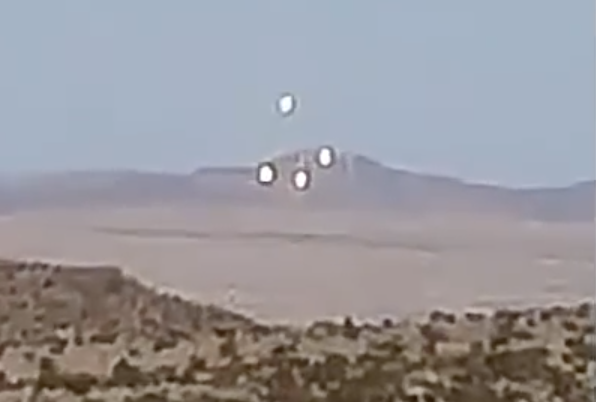
Four Glowing UFOs Seen During Day Over Majave Desert, California, Dec 2018, Video, UFO Sighting News.
Date of sighting: December 2018
Location of sighting: Giant Rock, Mojave desert, California, USA
The eyewitness said the group was meditating and then the UFOs appeared. Meditation does work, but only if its done with 100% relaxed mental state. Its hard to achieve for me, but has worked.
I have seen a similar sighting long ago here in Taiwan. Seen from the mountain my son goes to school on. Its called Yuming Mountain in Taipei, Taiwan. Back in 2004 a similar sighting occurred, glowing UFOs were seen in a similar formation, but for a longer amount of time. Watch the videos and compare. They are the same craft in both videos.
It is my belief that these UFOs appeared from above at high speed and stopped in their position. Waiting...for the underground base to bring them in. Which happens so fast, that the UFOs seem to shrink and vanish. But in reality, they were transported underground to the alien base 4-6km below. So, we now know there is an alien base below Giant Rock.
Scott C. Waring
Eyewitness states:
These light orbs suddenly appeared following a large group meditation at Giant Rock, in the Mojave desert.
BELOW IS THE 2004 UFO SIGHTING SEEN DURING A WEDDING ON TOP OF YUMING MOUNTAIN, TAIPEI, TAIWAN.
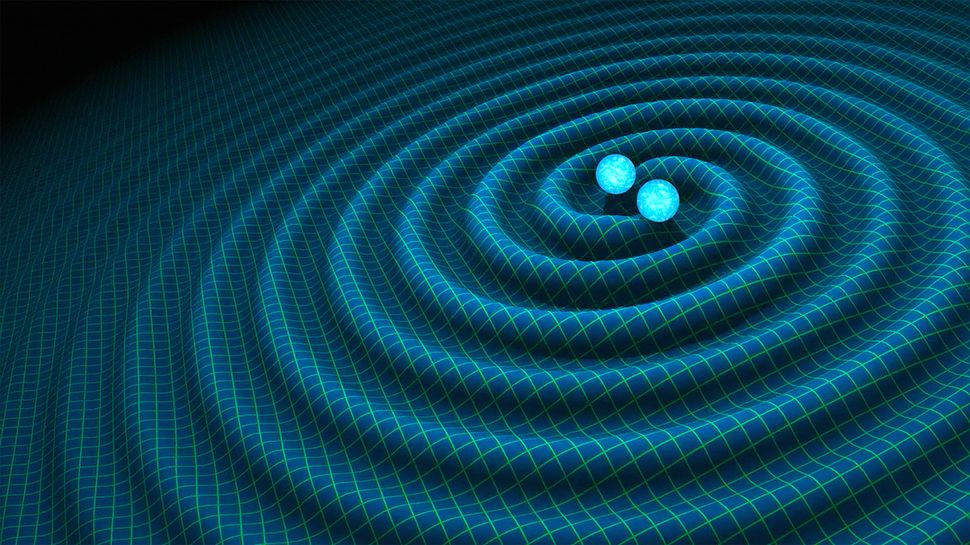
BANG, CRASH Physicists using the LIGO and Virgo observatories are catching all sorts of cosmic collisions, including of pairs of neutron stars (illustrated). But scientists hope to bag even more exotic quarry.
NASA’S GODDARD SPACE FLIGHT CENTER/CI LAB
Seekers of gravitational waves are on a cosmic scavenger hunt.
Since the Advanced Laser Interferometer Gravitational-wave Observatory turned on in 2015, physicists have caught these ripples in spacetime from several exotic gravitational beasts — and scientists want more.
“We’re just beginning to see the field of gravitational wave astronomy open,” LIGO spokesperson Patrick Brady from the University of Wisconsin–Milwaukee said May 2 in a news conference. “Opening up a new window on the universe like this will hopefully bring us a whole new perspective on what’s out there.”
The speed and pitch of gravitational wave signals allow astronomers to make out what’s stirring up the waves. Here are the sources of gravitational waves that scientists that already have in their nets, and what they’re still hoping to find.
1. Pairs of colliding black holes
Status: Found
LIGO’s first catch was a pair of colliding black holes, each around 30 times the mass of the sun (SN: 3/5/16, p. 6). The experiment detected vibrations from the merging black holes on September 14, 2015, four days before the official start of observations for the freshly upgraded LIGO.
That first discovery proved that massive, moving objects do in fact shake spacetime to produce gravitational waves, as Einstein predicted a century earlier. Not only that, the find proved that experiments on Earth could detect those waves, something of which Einstein was skeptical. Three of LIGO’s founders were awarded the Nobel Prize in physics in 2017 for the detection (SN: 10/28/17, p. 6).
In total, LIGO and Virgo have detected gravitational waves from 10 confirmed pairs of colliding black holes, plus another three candidates netted in the last month.
2. Pairs of colliding neutron stars
Status: Found
It was thought that a pair of merging neutron stars, the dense stellar corpses of massive stars that died in a supernova, could also set off gravitational waves. Then, in August 2017, the LIGO-Virgo team caught the first known instance of such an event, and a second on April 25 (SN: 11/11/17, p. 6).
MAX PLANCK INSTITUTE FOR GRAVITATIONAL PHYSICS
Follow-up observations with telescopes that are sensitive to light across the electromagnetic spectrum revealed hidden details of that first neutron star crash, including that the collision forged precious elements like gold, silver and platinum.
3. A neutron star crashing into a black hole
Status: Maybe
Another type of merger that could spawn ripples in spacetime is like the chocolate-vanilla swirl at an ice cream stand: one black hole and one neutron star merging into a single object. The observatories saw a possible signature of this kind of merger on April 26, but the signal was too weak for scientists to be sure.
If the team confirms that that signal really represents a black hole and neutron star swirl, it would prove that the two kinds of objects can live side by side. Before merging, the black hole and neutron star would have had to orbit each other in a close binary system.
“We’d be surprised if they didn’t exist, but we haven’t seen one” of these combinations, says LIGO team member Christopher Berry of Northwestern University in Evanston, Ill.
Studying such a system could help illuminate the mysterious material called nuclear pasta that makes up neutron stars (SN: 10/27/18, p. 8). “Neutron stars are kind of like giant atomic nuclei. They’re nothing like what we can create on Earth,” Berry says. The neutron star merger spotted in 2017 gave some details of the stars’ makeup (SN: 12/23/17, p. 7), including their maximum mass and squishiness. Spying a black hole-neutron star merger could show how a neutron star deforms near the extreme gravity of a black hole, another piece in the puzzle of how nuclear pasta behaves.
4. A collision involving an intermediate-mass black hole
Status: Not yet
All the black holes that LIGO and Virgo have detected so far have been stellar mass, which means that they typically weigh less than 100 times the mass of the sun. Physicists also know of supermassive black holes that weigh millions or billions times the mass of the sun (SN: 4/27/19, p. 6). But it’s not clear if there are black holes with masses in between.
Such intermediate-mass black holes “could be the link between stellar mass black holes and supermassive black holes in the centers of galaxies,” Virgo team member Giovanni Andrea Prodi of the University of Trento in Italy said May 2 at a news conference.
Previous research has seen hints of such middleweight black holes, but a collision detected with gravitational waves would be more definitive proof. If they don’t exist, “that’s really interesting,” Berry says, because it would mean supermassive black holes must have been born bigger than physicists can explain (SN Online: 3/16/18).
5. A bumpy neutron star
Status: Not yet
Another way to steal the secrets of neutron stars’ mysterious nuclear pasta is to detect miniature “mountains” on their surfaces. All massive objects that accelerate generate gravitational waves, but most of them are too faint to detect. Physicists think that a lone neutron star with a slight imperfection on it, like a bump about a millimeter high, would emit detectable gravitational waves as it spins. Such waves could help tell how stiff the neutron star material can be, in order to support the bumps.
Unlike most other sources on this list, bumpy neutron stars would produce continuous gravitational waves, detected as a constant “hum” by the observatories.
6. Supernova explosions
Status:Not yet
LIGO and Virgo might also be able to pick up gravitational waves from supernova explosions, the bright cataclysms at the end of massive stars’ lives.
Supernovas emit many types of light and particles, including ghostly subatomic particles called neutrinos that are born deep in the heart of the explosions (SN: 2/18/17, p. 20). But scientists still don’t know exactly what makes a star explode as a supernova in the first place.
STARBURST SNAPS Astronomers got a good look at a nearby supernova in 1987 when a star exploded in the nearby Large Magellanic Cloud (shown in this image from NASA’s Kuiper Airborne Observatory). Scientists could one day spot a supernova explosion using gravitational wave observatories, shedding light on the powerful event.
NASA’S AMES RESEARCH CENTER
What they do know is that during a supernova explosion, the central core of the star collapses, and the resulting proto-neutron star gathers material from the remainder of the collapsing core. The turbulence at the surface of the proto-neutron star makes it vibrate like a bell, sending off gravitational waves. That specific gravitational wave signal is strongly related to the strength of the turbulence and the structure of the nascent neutron star, astrophysicist David Radice of Princeton University and colleagues report April 29 in the Astrophysical Journal Letters.
“Gravitational waves, neutrinos, and light from the next galactic supernova could allow us to understand the structure of the exploding star, and the nature of the mechanism powering its explosion,” Radice says.
The catch is that a supernova would have to be fairly close, in our own Milky Way galaxy, for the current LIGO detectors to catch it. And astronomers don’t know when the next supernova will happen (SN: 2/18/17, p. 24).
“The expected detection rate is only about two per century, so we will need to be really lucky, or very patient,” Radice says.
7. Waves triggered by the Big Bang
Status: Not yet
Physicists expect that many small gravitational waves from all over the universe crash into Earth all the time. These waves make up a random background of gravitational waves, like a jumble of voices in a crowded room.
Physicists think that at least some of those voices come from the Big Bang. Detecting relic gravitational waves generated by the Big Bang itself would mean seeing back further in the universe’s history than ever before. But it will be difficult to tease that signal apart from all the others.
“As you get a more sensitive detector, you may be able to pick out individual voices,” Berry says. “It’s currently an unsolved problem.”
8.New sources?
Status:Not yet
There’s still the possibility that detectors will catch gravitational waves from a source that scientists don’t recognize. Each time researchers have looked at the universe in a new way, they’ve discovered something that they didn’t predict, Berry says. “Now we’re looking in gravitational waves, a completely different kind of radiation,” he says. “It might be a bit arrogant to think we know everything that’s out there.”
Think robots are all square corners and rigid metal parts? Think again.
Two interns at NASA are part of a larger group working on "soft robots" that could be used for exploring worlds beyond Earth. This includes the moon, NASA'snext major destinationfor astronauts.
The advantage of a soft robot is that it's flexible and, in some ways, better able to adapt to new environments. Soft robots move in ways similar to living organisms, which expands their range of motion, perhaps making it easier to squeeze into a tight spot, for example.
Interns Chuck Sullivan and Jack Fitzpatrick are working at NASA's Langley Research Center in Hampton, Virginia, to create soft robot actuators. (Actuators are machine components that control a robot's moving parts.)
"When you actuate the soft robot, it changes how you use the material properties," Fitzpatrick said in a statement. "A piece of rubber going from flat to the shape of a finger, it changes the material into something else."
Researchers at NASA's Langley Research Center are developing soft robot actuators from 3D-printed flexible silicone molds to study how "soft robots" can be used for space exploration.
The design is early stage and not nearly space-ready, but the interns are trying to see how these actuators could be used in a real space mission. Sullivan and Fitzpatrick build the actuators by 3D-printing a mold and then pouring it into silicone or another type of flexible substance.
"By design, the actuator has chambers, or air bladders, that expand and compress based on the amount of air in them," NASA said in the statement. "Currently, these two interns are operating the design through a series of tubes in the air bladders, allowing them to control the movement of the robot. By adjusting the amount of air in the chamber of the soft robotic actuator, the robot can flex and relax, just like a human muscle."
In particular, the interns are investigating four key properties of the actuators — mobility, joining, leveling and shaping — and how to use them in space exploration. Mobility refers to how the soft robot moves in its environment, while joining concerns how robots can link together (for example, to make a large temporary shelter). Leveling refers to how actuators can create a surface, such as filling in space underneath a lunar habitat, while shaping examines ways of adding strength to materials like dust shields.
"We see these four things as the crux of the problem. Once we can accomplish those in individual unit tests, we would like to figure out ways to combine them, so maybe we combine mobility and joining," Sullivan said in the same statement.
Both interns are working with principal investigator and computer engineer James Neilan, as well as co-principal investigator and aerospace research engineer Matt Mahlin, who together created this intern project at NASA's Langley Research Center to examine how well soft robots would work in space. This month, researchers and robotics experts from around the country will visit Langley to give the interns feedback on their soft robotics, and the students will continue to make improvements throughout the summer, NASA added.
In 1969, a giant earthquake off the coast of Portugal kicked up a tsunami that killed over a dozen people. Some 200 years prior, an even larger earthquake hit the same area, killing around 100,000 people and destroying the city of Lisbon.
Two earthquakes in the same spot over a couple hundred years is not cause for alarm. But what puzzled seismologists about these tremors was that they began in relatively flat beds of the ocean — away from any faults or cracks in the Earth's crust where tectonic plates slip past each other, releasing energy and causing earthquakes.
One idea is that a tectonic plate is peeling into two layers — the top peeling off the bottom layer — a phenomenon that has never been observed before, a group of scientists reported in April at the European Geosciences Union General Assembly held in Vienna. This peeling may be creating a new subduction zone, or an area in which one tectonic plate is rammed beneath another, according to their abstract.
The peeling is likely driven by a water-absorbing layer in the middle of the tectonic plate, according to National Geographic. This layer might have undergone a geological process called serpentinization, in which water that seeps in through cracks causes a layer to transform into soft green minerals. Now, this transformed layer might be causing enough weakness in the plate for the bottom layer to peel away from the top layer. That peeling could lead to deep fractures that trigger a tiny subduction zone, National Geographic reported.
This group isn't the first to propose this idea, but it's the first to provide some data on it. They tested their hypothesis with two-dimensional models, and their preliminary results showed that this type of activity is indeed possible — but is still yet to be proven.
This research has not yet been published in a peer-reviewed journal.
Astronauts on the International Space Station will begin testing an innovative algae-powered bioreactor to assess its feasibility for future long-duration space missions.
The algae-powered bioreactor, called the Photobioreactor, represents a major step toward creating a closed-loop life-support system, which could one day sustain astronauts without cargo resupply missions from Earth. This will be particularly important for future long-duration missions to the moon or Mars, which require more supplies than a spacecraft can carry, according to a statement from the German Aerospace Center (DLR).
The Photobioreactor arrived at the space station Monday (May 6) on a SpaceX Dragon cargo ship. The experiment is designed to use algae to convert the carbon dioxide exhaled by astronauts on the space station into oxygen and edible biomass through photosynthesis.
The Photobioreactor is expected to work in conjunction with the physicochemical air-recycling system, or Advanced Closed-Loop System (ACLS), which was delivered to the space station in 2018. The ACLS extracts methane and water from the carbon dioxide in the space station cabin. In turn, the algae in the Photobioreactor will use the remaining carbon dioxide to generate oxygen, creating a hybrid solution formally known as PBR@ACLS, according to the statement.
"With the first demonstration of the hybrid approach, we are right at the forefront when it comes to the future of life-support systems," Oliver Angerer, team leader for Exploration and project leader for the Photobioreactor experiment at DLR, said in the statement. "Of course, the use of these systems is interesting primarily for planetary base stations or for very long missions. But these technologies will not be available when needed if the foundations are not laid today."
German astronaut Alex Gerst of the European Space Agency poses with the Advanced Closed-Loop System (ACLS) at the International Space Station on Oct. 19, 2018.
The experiment will cultivate microscopic algae called Chlorella vulgaris aboard the space station. In addition to producing oxygen, the algae also produce a nutritional biomass that astronauts could eat.
Creating an edible biomass from carbon dioxide within the spacecraft means less food would need to be transported or delivered on space missions. The researchers estimate roughly 30 percent of an astronaut's food could be replaced by algae due to its high protein content, according to the statement.
The search forlife on Marsshouldn't focus exclusively on the distant past, some researchers say.
Four billion years ago, the Martian surface was apparently quite habitable, featuring rivers, lakes and even a deep ocean. Indeed, some astrobiologists view ancient Mars as an even better cradle for life than Earth was, and they suspect that life on our planet may have come here long agoaboard Mars rocksblasted into space by a powerful impact.
Things changed when Mars lost its global magnetic field. Charged particles streaming from the sun were then free to strip away the once-thick Martian atmosphere, and strip it they did. This process had transformed Mars into the cold, dry world we know today by about 3.7 billion years ago, observations by NASA's MAVEN orbiter suggest. (Earth still has its global magnetic field, explaining how our planet remains so livable.)
But this turn of events doesn't necessarily mean that Mars is a dead planet today.
"If Mars had life 4 billion years ago, Mars still has life. Nothing has happened on Mars that would've wiped out life," said Michael Finney, co-founder of The Genome Partnership, a nonprofit organization that runs the Advances in Genome Biology and Technology conferences.
"So, if there were life on Mars, it may have moved around, it may have gone into hiding a bit, but it's probably still there," Finney said last month during a panel discussion at the Breakthrough Discuss conference at the University of California, Berkeley.
Going underground?
One of the most promising hiding places is the Martian underground. Though the Red Planet's surface has no liquid water these days — apart, possibly, from temporary flows on warm slopes now and again — there's likely lots of the wet stuff in buried aquifers. For example, observations by Europe's Mars Express orbiter suggest that a big lake may lurk beneath the Red Planet's south pole.
Earth's diverse residents advertise their presence in dramatic and obvious ways; an advanced alien civilization could probably figure out pretty quickly, just by scanning our atmosphere, that our planet is inhabited.
We don't see any such clear-cut evidence in the Martian air, but scientists have spotted some intriguing hints recently. For example, NASA's Curiosity rover has rolled through two plumes of methane inside the 96-mile-wide (154 kilometers) Gale Crater, which the six-wheeled robot has been exploring since its 2012 touchdown. The rover mission also determined that baseline methane concentrations in Gale's air go through cycles seasonally.
More than 90% of Earth's atmospheric methane is produced by microbes and other organisms, so it's possible the gas is a signature of modern Martian life.
But the jury is most definitely still out on that. Abiotic processes can generate methane, too; the reaction of hot water with certain types of rock is one example. And even if the Mars methane is biogenic, the creatures that created it could be long dead. Scientists think the Red Planet methane plumes leaked out from underground, and there's no telling how long the gas lay trapped down there before making its way to the surface.
NASA's 2020 Mars rover, which is scheduled to launch next summer, will hunt for signs of long-dead Red Planet life. So will the European-Russian ExoMars rover, a mission that will lift off at about the same time.
But some researchers are pushing to expand the hunt to extant Martian life. One of them is molecular biologist Gary Ruvkun, who's based at Massachusetts General Hospital and Harvard Medical School.
Ruvkun is one of three principal investigators on the Search for Extra-Terrestrial Genomes (SETG) project, which is developing an instrument to detect past or present DNA- or RNA-based life on Mars and other alien worlds.
He was on the Breakthrough Discuss panel with Finney and several other researchers, and he also gave a talk at the conference laying out the case for putting the SETG instrument on future Mars rovers and other robotic explorers.
Part of that case centers on panspermia, the idea that life has spread widely throughout the solar system, and perhaps the galaxy, by either natural or artificial means. If life did indeed come to Earth from somewhere else, there's a good chance it once flourished on Mars as well, the thinking goes. The Red Planet could have been the source, or it may have been "seeded" as Earth was.
Ruvkun views panspermia as very likely; during his Breakthrough Discuss talk, he described himself as "a religious fanatic" about the idea. Ruvkun cited as supporting evidence the very early emergence of ATP synthase, the enzyme that makes the energy-storage molecule adenosine triphosphate.
ATP synthase goes all the way back to the base of the tree of life on Earth, meaning this intricate and complex molecule was up and running by about 4 billion years ago, Ruvkun said.
"It's not just that life kind of got up to kind of working," he said. "It's like it got to being super highly evolved very fast. That's why panspermia is so attractive."
If panspermia is indeed a thing, then any life-forms we find on Mars — or anywhere else in our solar system — will likely be related to us, Ruvkun and others have reasoned. That is, such organisms will use DNA or RNA as their genetic molecule. So, we should go hunt for this stuff.
"It seems really idiotic to not look for DNA on Mars," Ruvkun said during his talk. "It's an experiment that's worth doing, we would say."
Mars isn't the only place in our solar system where alien life might flourish today. Indeed, most astrobiologists would put the Red Planet down the list a bit, behind the Jupiter moon Europa and the Saturn satellites Enceladus and Titan.
Europa and Enceladus harbor deep oceans of salty liquid water beneath their icy shells. Titan is thought to have a buried water ocean as well, and it also sports lakes and seas of liquid hydrocarbons on its surface. (NASA is developing an ocean-characterizing Europa flyby mission that will launch in the early to mid-2020s. The agency also aims to send a life-hunting lander to the moon's surface in the near future. And a Titan mission is one of two finalists for a NASA "New Frontiers" launch in 2025, along with a comet sample-return project. We should learn which one NASA picks by the end of the year.)
Even hellish Venus, a climate-change cautionary tale for Earth, might still harbor some habitable redoubts, scientists say.
Like Mars, Venus once had plentiful surface water, but a runaway greenhouse effect baked the stuff away and left the planet with surface temperatures high enough to melt lead. However, conditions appear to be pretty clement about 30 miles (50 km) above the Venusian surface.
Penny Boston, director of the NASA Astrobiology Institute at the agency's Ames Research Center in California, said she thinks the chances of modern-day Venus life are low because of the "dewatering" of the planet.
Regardless, the possible existence of cloud-dwelling life on Venus "definitely needs to be interrogated," Boston said during the same Breakthrough Discuss panel discussion.
A new study suggests that our moon formed from a splash of magma when a large object crashed into a proto-Earth covered in a fiery ocean.
Animation simulating an object’s collision with a magma-covered proto-Earth, resulting in the formation of the moon.
Via 2019 Natsuki Hosono, Hirotaka Nakayama, 4D2U Project, Naoj
For more than a century, scientists have struggled to explain how the Earth’s moon formed. The most widely-accepted explanation is that the moon formed from the debris left over after a Mars-sized object, known asTheia, slammed into the early Earth and ejected enough debris to form the moon.
The problem is that when this idea was tested, computer simulations indicated that the moon would be made primarily from the same stuff as the impacting object. Yet the opposite is true. We know from analyzing rocks brought back from Apollo missions that the moon consists mainly of material from Earth.
A new study published April 29, 2019, in Nature Geoscience by a team of scientists from Japan and the U.S. has offered an explanation for the discrepancy.
The key, according to Yale geophysicist Shun-ichiro Karato, who is a study co-author, is that the early, proto-Earth — about 50 million years after the formation of the sun — was covered by a sea of hot magma, while the impacting object was likely made of solid material. The impact splashed magma out into space, and that material formed the moon.
Snapshots of numerical modeling of the moon’s formation by a giant impact. The central part of the image is a proto-Earth; red points indicate materials from the ocean of magma in a proto-Earth; blue points indicate the impactor materials.
Karato and his collaborators set out to test a new model, based on the collision of a proto-Earth covered with an ocean of magma and a solid impacting object.
The model showed that after the collision, the magma is heated much more than solids from the impacting object. The magma then expands in volume and goes into orbit to form the moon, the researchers say. This explains why there is much more Earth material in the moon’s makeup. Previous models did not account for the different degree of heating between the proto-Earth silicate and the impactor.
Karato said in a statement:
In our model, about 80 percent of the moon is made of proto-Earth materials. In most of the previous models, about 80 percent of the moon is made of the impactor. This is a big difference.
Karato said the new model confirms previous theories about how the moon formed, without the need to propose unconventional collision conditions — something theorists have had to do until now.
Bottom line: The moon formed from a splash of magma when a large object crashed into a proto-Earth covered in a fiery ocean, according to a new study.
Distant water exoplanets might have oceans thousands of miles deep. That’s in contrast to Earth’s ocean, which is about 6.8 miles (about 11 km) deep at its deepest point.
Artist’s concept of a water world exoplanet as described in a new study. If they do exist, these distant water worlds might have global oceans much, much deeper than any in our solar system.
Image via NASA/JPL-Caltech.
Water worlds– planets or moons with global oceans – used to be considered part of science fiction, but we are starting to learn now that, not only do they exist, they might actually be fairly common. In our own solar system, the moons Europa, Enceladus, Titan and Ganymede are known or suspected to have such oceans beneath their outer ice crust. EvenPlutois now thought to have one! Perhaps other worlds in our solar system have water we haven’t found yet. Scientists also think they’re getting closer to finding exoplanets – planets orbiting distant stars – that are water worlds as well, including planets with global or near-global oceans on their surfaces.
Now, a new study suggests that some exoplanet water worlds could have oceans much deeper than any in our solar system. Unfathomably deep, even, as in hundreds or thousands of miles deep. The new research was published in the Proceedings of the National Academy of Sciences (PNAS) on April 29, 2019, by Harvard University astronomer Li Zeng and his colleagues. Zeng explained that, according to the team’s computer simulations, some planets may have incredibly deep oceans:
Hundreds or thousands of kilometers … Unfathomable. Bottomless. Very deep.
Earth’s oceans are nowhere near as deep. The average ocean depth on Earth is about about 2.2 miles (3.5 km). The maximum depth is 6.8 miles (about 11 km) at the bottom of the Mariana Trench.
The data the team gathered from their computer simulations suggests that water worlds are probably common in our galaxy, particularly in sub-Neptune-sized planets – or mini-Neptunes – that have radii two to four times that of Earth but are smaller than Neptune. These planets are most likely to have deep global oceans, rather than thick atmospheres like gas dwarfs, ice giants or gas giants. Moons like Europa and Enceladus have deep subsurface oceans, for their size, but those are still not nearly as deep as the oceans that would exist on sub-Neptune worlds.
Other kinds of water worlds may be rocky exoplanets with global surface oceans, more similar to Earth. This artist’s concept is of Kepler-22b, a super-Earth and the first exoplanet that NASA’s Kepler mission confirmed to orbit in a star’s habitable zone.
Image via NASA/Ames/JPL-Caltech.
These sub-Neptune worlds are one of two primary kinds of exoplanets found so far. The others are super-Earths, between one and four times the size of Earth, which are dense and rocky. There aren’t any super-Earths in our solar system, with the possible exception of Planet Nine (if it is ever found). The sub-Neptunes have much lower densities, and astronomers haven’t been sure if they are gas dwarfs, like Jupiter or Saturn but smaller, with a rocky core and a thick hydrogen atmosphere. Or did their low density mean they contained a lot of water?
Normally, they would be assumed to be gas dwarfs, since water worlds would need to be beyond the “snowline” in a planetary system, where temperatures are cold enough for water or ice, and many sub-Neptunes are very close to their stars. But the new computer simulations suggest that is not always the case, that many sub-Neptunes have much smaller atmospheres as related to their size, more like smaller terrestrial planets like Earth or Venus. Their atmospheres would be nowhere near as thick or deep as other gas dwarf-type sub-Neptunes.
As outlined in the new paper:
The discovery of numerous exoplanet systems containing diverse populations of planets orbiting very close to their host stars challenges the planet formation theories based on the solar system. Here, we focus on the planets with radii of 2-4 Earths, whose compositions are debated. They are thought to be either gas dwarfs consisting of rocky cores embedded in hydrogen-rich gas envelopes or water worlds containing significant amounts of water-dominated fluid/ice in addition to rock and gas. We argue that these planets are water worlds.
Yet another kind of hypothesized water world – an “eyeball” planet – where there is an ocean only on the star-facing side. The rest of the surface is ice.
But if there are water world sub-Neptunes close to their stars, how did they form? The findings suggest that they first formed farther out from their stars, and then gradually drifted in closer over time. As Zeng said in Gizmodo:
A water world close to its star must have formed much farther away and then moved closer as its orbit shrank. The planet’s composition was set when it was farther away on a colder orbit. The process of orbital shrinking is called ‘migration’ and it is driven by the gravity of the disk of gas from which the planets formed. If water worlds are common that provides a really strong confirmation that migration really does happen and is a key process in how planets form, both around other stars and in our own solar system.
The research indicates that many sub-Neptunes are quite wet, but just how wet are they? The results show that at least 25 percent of their mass would water or ice, and perhaps up to 50 percent. That’s a staggering amount. We think of Earth as being a water world, but its mass is actually only 0.025 percent water, by comparison. Some water worlds may have so much water that they are completely water-logged, fluid all the way down into the deepest parts of the planet.
Jupiter’s moon Europa is a water world, with a deep global ocean beneath its outer ice crust. This view is from the Galileo spacecraft in the 1990s.
The pressures far down in some of those oceans could also be like nothing on Earth, similar to a million times the atmospheric surface pressure that we experience. In those extreme environments, liquid water would be compressed into uniquely high-pressure phases of ice, such as Ice VII or superionic ice. These ices don’t occur naturally on Earth, but have been created in the laboratory. As Zeng said:
These high-pressure ices are essentially like silicate-rocks within Earth’s deep mantle, they’re hot and hard. These are utterly different worlds compared to our own Earth.
The computer models also took into account other variables, including the abundance of nebular gases, water-rich ices, rocky materials consisting primarily of iron and nickel and influences by complex chemical processes driven by temperature, cooling rates, evaporation, condensation, density and distance to host star. As Zeng noted:
Statistically speaking, these water worlds may be more abundant than Earth-like rocky planets. Perhaps every typical Sun-like star has one or more of these water worlds [and maybe] our solar system is less typical. Generally speaking, this type of planetary system architecture with close-in rocky super-Earths and water-rich sub-Neptunes may be more common in the Milky Way than our type of solar system.
Earth is of course the best-known water world, with oceans that cover about 70% of the surface. That amount of water pales in comparison to what may exist on the water worlds discussed in the new paper, however.
Image via NASA.
So with all that water, could these planets be potential homes for life? Yes, there’s a lot of water, but what about the chemical elements and nutrients needed, as found on the on the ocean floors of Earth, and maybe Europa and Enceladus? According to Anders Sandberg, a senior research fellow at Oxford University’s Future of Humanity Institute (FHI), these kinds of water worlds may not be ideal, although they would still be much better than gas dwarfs:
While water worlds are not entirely perfect for life since the heavier elements may be buried under hundreds of kilometers of high-pressure ice, they are likely far better than gas dwarfs.
If the water worlds described in this study do indeed exist, it would open a whole new chapter in exoplanetary exploration. These worlds would be unlike any ever seen before, sort of like taking parts of Earth, ocean moons and gaseous planets and combining them, but on a much larger scale. The water worlds in this study are essentially water worlds on steroids.
Bottom line: If the findings in this new study are accurate, then our galaxy may be full of water worlds. Unlike Earth, these would be larger planets with global oceans that are not only deeper than any in our solar system, but mind-bogglingly deep.
A 60-meter fictional asteroid slammed into the heart of New York City with a force 1,000 times more powerful than the A-bomb dropped on Hiroshima. The blast obliterated buildings from Central Park to lower Manhattan, causing up to 1.3 million fatalities. Luckily, this was just a drill — the culmination of a week-long exercise held in Washington last week which tested various planetary defense strategies at our disposal in the event of an asteroid threat. The findings suggest that we are still woefully unprepared to deal with threats from the sky.
Asteroids are one of the few extreme natural disasters that can be prevented
Dozens of astronomers, scholars, and disaster relief experts gathered at the biennial Planetary Defense Conference held last week. The main objective of the gathering was to assess the response ability of space missions and to what degree evacuation plans can mitigate the damage caused by a hypothetical asteroid impact.
The participants, which included experts from NASA, the Federal Emergency Management Agency (FEMA), and other federal agencies, were warned 8 years in advance that a 140- to 160-meter asteroid (500- to 850-foot-wide) was going to collide with Earth, somewhere near Denver, Colorado.
In this fictional scenario, NASA collaborates with the world’s foremost space agencies from Europe, Russia, China, and Japan to launch six spacecraft tasked with deflecting the killer asteroid by slamming into it. This approach, known as the kinetic impact technique, will actually be tested by NASA in the real world in 2021 with a mission called the Double Asteroid Redirection Test (DART). Some alternatives include gravitationally tugging the asteroid using a nearby spacecraft, painting the asteroid white to change the amount of radiation it absorbs from the sun and thereby shifting its trajectory, and blasting the space rock with nuclear weapons.
Each day of the conference, the clock was advanced by months or years and the participants had to make new decisions based on the updated situation of the simulation. Not long before the conference was supposed to end, the participants were announced that their efforts resulted in the deflection of the asteroid. However, the impact also knocked off a 60-meter fragment from the asteroid that continued its trajectory towards Earth.
Map of the damage zones from the 60-meter asteroid fragment impacting Manhattan. Red zone is the site of total annihilation, in orange buildings collapse and clothing would catch fire, while the outer zone could cause second-degree burns.
Credit: NASA.
On the last day of the conference and ten days before impact in the simulation’s time frame, the participants announced that the asteroid would make a direct hit on Central Park, in the heart of Manhattan, at 43,000 miles per hour. The situation was dire and the only thing the experts could do was to call for the evacuation of 10 million people living in a metropolis bottlenecked by bridges and tunnels. Although there are evacuation plans in place for New York, none is designed to take on this scale so authorities in the simulation quickly became overwhelmed.
“I think the exercise illustrated how time is the most valuable asset when it comes to asteroid hazards,” said Richard Binzel, a professor of planetary science at the Massachusetts Institute of Technology and a participant in the simulation. “In reality, having many decades of warning gives us multiple options and multiple tries to prevent catastrophe.”
Fortunately, a scenario in which an asteroid would hit a major city is extremely unlikely. Instead, an asteroid would likely hit the ocean, which covers most of the planet’s surface. What’s more, there is no known asteroid with a significant probability of impacting Earth in the next century. But that doesn’t mean that we shouldn’t prepare considering the catastrophic potential of an asteroid impact. According to researchers, there are 25,000 near-Earth asteroids as big as the space rock used in the simulation, two-thirds of which are not tracked.
At the conference, NASA stressed that the biggest takeaway from such a simulation is that asteroids represent a real threat to planetary security. Although most people associate asteroid impacts with Hollywood blockbusters, their devastating power is as real as it gets. Unlike the dinosaurs, however, we have the tools to avert our annihilation as long as we prepare properly.
According to NASA and FEMA, the best asteroid defense strategy is finding and deflecting a threat before it ever comes near Earth. In the future, NASA hopes to send a spacecraft to visit asteroid Apophis, which will narrowly miss Earth by just 19,000 miles in 2029.
The ripples in space-time known as gravitational waveshave already helped answer major questions regarding the nature of matter and black holes. And upcoming gravitational-wave observatories both on Earth and in space could soon help solve some of the greatest mysteries in science.
"We're going to be able to learn a lot about the universe," said Cole Miller, an astrophysicist at the University of Maryland, College Park.
The existence of gravitational waves was first predicted by Albert Einstein in 1916. According to Einstein's theory of general relativity, gravity results from how mass warps space and time. When any object with mass moves, it generates gravitational waves that travel at the speed of light, stretching and squeezing space-time along the way.
Gravitational waves are extremely weak, making them extraordinarily difficult to sense, and even Einstein was uncertain whether they really existed and if they would get detected. After decades of work, researchers succeeded in discovering the first direct evidence of gravitational waves in 2015 using the Laser Interferometer Gravitational-Wave Observatory (LIGO).
LIGO uses a pair of detectors — one in Hanford, Washington, and the other in Livingston, Louisiana — to sense the distortions that gravitational waves cause as they move through matter. Each detector is shaped like a gigantic L, with legs about 2.5 miles (4 kilometers) long. The legs of each detector are normally the same length, so laser beams take the same amount of time to travel down each. However, if gravitational waves pass through Earth — making the detector legs expand and contract by about one-ten-thousandth the diameter of a proton — atomic clocks can detect the split-second differences in time it takes for laser beams to zip down one leg of the detector versus the other.
Because LIGO's detectors are about 1,865 miles (3,000 km) apart, it can take up to 10 milliseconds for a gravitational wave to cross from one detector to the other. Scientists can use this difference in arrival times to deduce where the gravitational waves come from. As more gravitational-wave detectors come online — such as the Virgo facility near Pisa, Italy — researchers will get better at pinpointing the sources of gravitational waves.
The gravitational waves that LIGO can best detect are the most powerful ones, which are released when extraordinarily massive objects collide with one another. The first gravitational waves LIGO detected were from colliding black holes, and with Virgo, it detected merging neutron stars. These findings have shed light on everything from the nature of gravity to the origin of most of the elements heavier than iron.
The immediate future
Not only are LIGO and Virgo continuing to sense bursts of gravitational waves, but they are getting upgrades to increase their sensitivity to detect even more events. In addition, other gravitational-wave observatories are coming online soon. Japan has built KAGRA, which is planned to join the LIGO and Virgo network in 2019, and LIGO-India will hopefully be operational by the mid-2020s, Miller said.
"More detectors means a better determination of the direction of gravitational-wave sources," Miller told Space.com.
Beyond 2025, scientists are discussing two advanced gravitational-wave observatories — the Einstein Telescope and the Cosmic Explorer. The plan for the Einstein Telescope is to build it underground to reduce the amount of noise experienced from seismic vibrations, whereas the aim for Cosmic Explorer is to use cryogenic systems to help cut down the noise experienced from heat on its electronics. Decreasing noise in turn boosts sensitivity to gravitational-wave events.
The next generation of ground-based gravitational-wave observatories may detect mergers of intermediate-mass black holes, ones that are hundreds to thousands of times more massive than the sun. Previous research suggested that intermediate-mass black holes are the building blocks of the supermassive black holes millions to billions of times the sun's mass found at the hearts of galaxies such as the Milky Way, "but their existence has not yet been conclusively proven," Miller said.
The current and planned ground-based gravitational-wave observatories are all sensitive to wavelengths of about 60 miles (100 km), the kind generated by neutron stars and black holes up to a few dozen times the mass of the sun. However, scientists have long planned space-based gravitational-wave observatories with detectors separated by vast distances that could sense even longer wavelengths, the type released by supermassive black holes.
One space-based gravitational-wave observatory under development is the European Space Agency's Laser Interferometer Space Antenna (LISA) mission, scheduled to launch in 2034. LISA will consist of a constellation of three satellites in orbit around the sun and trailing Earth. Inside each satellite is a cube that will fall freely through space, tracing a path that will only get perturbed by gravitational waves. These satellites will carefully monitor the position of each cube to look for signs of space-time ripples.
Each of LISA's satellites will be millions of miles away from each other. In principle, LISA will be able to detect gravitational waves with wavelengths of about 18 million miles (30 million km) from the mergers of black holes 10,000 to 10 million times the mass of the sun, Miller said. The hope is that LISA and similar proposed projects, such as TianQin from China, can help shed light on the mergers of galaxies.
"We can learn how galaxies and supermassive black holes assemble," Miller said.
However, what scientists are likely most looking forward to with gravitational-wave observatories is the unexpected. "We may see unanticipated types of sources of gravitational waves, or see the sources we generally knew about with twists that might surprise us," Miller said.
For example, the hearts of black holes are infinitely dense, infinitely small points known as singularities. And researchers have long suspected that infinitely dense, infinitely thin rings known as cosmic strings might also exist. "If cosmic strings are real, we may be able to detect gravitational waves from them over a broad range of energies," Miller said.
In addition, scientists have long suggested the possible existence of primordial black holes, ones born less than a second after the Big Bang, when dense clumps of the newborn universe collapsed under their own gravity. Such black holes would have masses just that of asteroids or planets.
"If we saw gravitational waves from something, say, half the mass of the sun, there would be no other way to produce them but primordial black holes," Miller said.
Furthermore, some physicists have suggested that black holes may not actually exist. If they do not, then gravitational-wave observatories may discover their actual nature, Miller said.
Generally, researchers think most black holes form when massive stars finish burning their fuel and rapidly collapse under their own weight, getting crushed into singularities that are hidden by invisible boundaries known as event horizons from which nothing can return. (The Event Horizon Telescope recently got the first-ever look at one of these points of no return recently, imaging the boundary of the supermassive black hole at the core of the M87 galaxy.)
However, the possibility of singularities clashes with laws of physics suggesting that destruction of information is impossible, including information encoded within anything falling into black holes.
As such, physicists have suggested that when massive stars die, they may instead form structures with names such as "black stars" and "gravastars." These alternatives resemble black holes in nearly every way but lack singularities and event horizons, sidestepping the conundrums these aspects of black holes raise.
One way to find out whether black hole alternatives exist is by analyzing gravitational waves unleashed by what scientists currently think are merging black holes. As black holes spiral toward one another, they should each give off gravitational waves, but their event horizons should absorb those directly falling onto them. However, since black hole alternatives lack event horizons, they can reflect gravitational waves, and gravitational-wave observatories could detect these "echoes," Miller said.
If such echoes are discovered, they could yield insights into both general relativity and quantum physics. Doing so could finally help lead to a model of "quantum gravity" marrying both long-disparate theories, Miller added.
Miller and his colleague Nicolás Yunes, of Montana State University in Bozeman, detailed this research online April 24 in the journal Nature.
WETENSCHAPEen stuk uit Stonehenge dat al zestig jaar zoek was, is uiteindelijk toch teruggekeerd naar de prehistorische site. Het was de 89-jarige Brit Robert Phillips die het onderdeel al die tijd had verstopt. Tot hij besloot het terug te geven.
Het gaat om een onderdeel van iets meer dan een meter lang, dat verdwenen was na de archeologische opgravingen in 1958. Bij die werken was ook Robert Phillips, nu 89, betrokken. Hij verborg de staaf in zijn kantoor om het pas nu terug te schenken. ‘English Heritage’ hoopt dat de stenen staaf kan helpen bepalen waar de wereldberoemde stenen oorspronkelijk vandaan komen.
61 jaar geleden trokken archeologen een omgevallen trilithon - een structuur van twee verticale stenen waarop een derde horizontaal rust - weer recht. Een van de verticale stenen vertoonde scheuren. Als versterking werden drie gaten in de stenen geboord waarin metalen staven werden aangebracht. De herstellingswerken werden gemaskeerd met fragmenten sarsen-steen, gevonden bij de opgravingen.
BELGAIMAGE
Maar Phillips, een Brit die inmiddels in Florida woont, nam een van de drie kernen van ongeveer een meter lang mee naar huis. Hij bewaarde de stenen staaf eerst in een plastic koker in zijn kantoor in Basingstoke, op 80 km van Londen. Later bevestigde hij het aan de muur van zijn huis in de VS. Het is uitzonderlijk goed bewaard. Het is niet bekend waar de andere twee staven gebleven zijn.
Aan de vooravond van zijn 90ste verjaardag besloot hij nu het alsnog terug te geven aan ‘English Heritage’. Het blijft nog altijd een raadsel hoe de sarsen-stenen van 25 ton duizenden jaren geleden naar hun eindlocatie bij Amesbury konden worden gesleept, zonder de moderne technologie van vandaag. Misschien kan het langwerpige stuk van Phillips het mysterie helpen ontrafelen, of toch de precieze herkomst van de grotere exemplaren tussen de stenen bepalen.
WETENSCHAPInsight, de Marslander die de Amerikaanse ruimtevaartmaatschappij NASA in november 2018 richting de rode planeet stuurde, deelde enkele dagen geleden zijn tweede selfie. Daaruit bleek dat de onbemande robot op enkele maanden tijd heel wat stof heeft gevangen. Bovendien ontbreken er enkele attributen op de foto.
Net zoals op aarde kan het op Mars wel eens stormen, zo’n storm gaat daar vooral gepaard met heel wat stof. Iets wat NASA’s vorige Marslander Opportunity (enkele keren) aan den lijve moest ondervinden. Opportunity was het onbemande robotwagentje dat in 2003 richting de rode planeet werd gestuurd om daar op verkenning te gaan. Veertien jaar later, in de zomer van 2018, ging het contact tussen aarde en de Marsrover voorgoed verloren te wijten aan zo’n stofstorm die enkele weken aanhield. Tenslotte trok NASA in februari 2019 definitief de stekker uit de Marsmissie Opportunity.
Gelukkig was er destijds al een tweede Marslander geland op de planeet: InSight. En uit een recente selfie die de robot maakte, blijkt nu dat InSight ook al te maken kreeg met een kleine storm.
Op 6 december 2018 maakte de tweede Marslander (InSight) een eerste selfie op de rode planeet. Op die manier wisten onderzoekers van NASA zeker dat de robot zijn bestemming heelhuids bereikt had. De tweede foto dateert van 6 mei 2019 – vijf maanden na landing – en het verschil is groot. Terwijl de robot op de eerste foto nog blinkt, wordt hij op het tweede exemplaar bedekt met een dikke laag stof.
Dat kan problematisch zijn vermits het stof de zonnepanelen van de Marslander bedekt. Die zonnepanelen wekken de energie op waarop de robot teert. Gelukkig heeft de robot niet veel energie nodig om te overleven. Enkel in extreme gevallen, wanneer de stofstormen enkele weken aanhouden, kan het fataal aflopen.
(Lees verder onder de foto’s)
NASA
De Marslander InSight maakte 6 december 2018 een eerste selfie.
NASA
Op de tweede selfie zijn de zonnepanelen van InSight bedekt met een dikke stoflaag.
Goed nieuws
Al kunnen de buitenaardse stormen – met windsnelheden van wel 72 kilometer per uur - de verkenners van NASA de kop kosten, ze hebben hun nut ook al bewezen. De krachtige wind blaast het stof immers ook terug weg van de zonnepanelen. Zo zorgde een windhoos er in februari nog voor dat 0,7 procent meer energie werd opgewekt met het ene zonnepaneel, zelfs 2.7 procent met het tweede.
Bovendien heeft die wind de levensduur van Opportunity met maar liefst dertien jaar en negen maanden verlengd. De missie zou oorspronkelijk slechts drie maanden duren omdat astronomen verwachtten dat de zonnepanelen, bedekt met stof, daarna geen energie meer zouden opwekken. Het stof werd echter keer op keer weggeblazen.
Ontbrekende onderdelen
Wie trouwens opmerkte dat er enkele onderdelen van InSight ontbreken op de tweede foto – daarop heeft de Marslander geen seisometer en hitteschild meer – moet zich geen zorgen maken. Enkele dagen na zijn landing plaatste de Marsrover een seismometer, die trillingen in de bodem meet, op het oppervlak van de planeet.
Vervolgens plaatste InSight een hitteschild op Mars. Dat schild verdween bijna vijf meter diep in de bodem van de planeet. Daar moet het berekenen hoeveel warmte er precies uit het binnenste van de planeet komt.
APHet hitteschild dat de Marslander InSight op de bodem van de rode planeet zette.
Dr. Ardy Sixkiller Clarke, a Professor Emeritus at Montana State University who is Cherokee/Choctaw has been researching the Star People, and collecting encounters between them and Native Indians for many years. This article shares one of many.
Reflect On:
Are we alone? If not, what are the implications when the public becomes fully aware of this? How will it change the way we look at reality? Science? Technology? History?
I recently came across the work of Dr. Ardy Sixkiller Clarke, who brings to the field of ufology degrees in history, English, psychology, and educational leadership and a background as a teacher, university professor, junior college and university administrator, licensed therapist and psychologist, and social science researcher. She is a Professor Emeritus at Montana State University and former Director of the Center for Bilingual/Multicultural Education. Dr. Clarke, who is Cherokee/Choctaw, has worked with indigenous people for most of her career, and has some amazing stories to tell.
I first learned about the “Star People” when my grandmother told me the ancient legends of my people. My childhood reality included narratives that traced the origins of the indigenous people of the Americas to Pleiades; stories of little people who intervened in people’s lives; and legends about the magical gift of the DNA of the “Star People” that flowed in the veins of the indigenous tribes of the Earth. I embraced the stories of the celestial visitors who lived among the Indian people as part of my heritage.
In her book, she shares many stories, and one of them comes from a gentleman named Harrison. She writes:
Located in the states of North and South Dakota, Wyoming, Idaho, and Montana, the Northern Plains Indian Tribes have many accounts about UFOs. The story in this chapter is told by a well-respected elder of a Northern Plains tribe. His encounter predates the crash at Roswell. Since I recorded this story, Harrison has passed, but the time I spent with them over the years, changed my life.
Harrison told a story of how his grandfather took him on a spaceship in the summer of 1945. He said he was 12 at the time, and explained how the Army Corps of Engineers came to the reservation around the summer of 1947 to survey the river and surrounding area “for the reservoir.” So originally, there was no reservoir. The Corps confiscated the land and in return gave Harrison’s grandfather a worthless piece of land on the other side of that butte.
I spent every summer on his place from the time I was six years old. Mom and pop both worked for the tribe and they didn’t want me home alone during the summers. So every May I packed two paper bags: one with a change of clothes and the other with books, marbles, and my toy gun. My folks dropped me off to live with Gramps from June to late August. I loved my summers here, even the isolation. I was the only child for miles. I rode horses and herded cattle. Helped with the chores. Whatever I could do. As I got older, there were bigger chores and more responsibility. There was no TV or videos like kids have today. At night Gramps amused me with the ancient myths and legends of our people.
Clarke’s relationship with Harrison grew over the years, and the two of them met when his school district requested her assistance in applying for a federal grant. Harrison was her contact and was responsible for escorting her around the reservation.
She explains, “It took nearly 25 years of visits before Harrison asked me if I believed in Star People.” She replied with a yes, and then he said, “Someone told me you collect stories about the Star People, I find that unusual.”
She replied,
I’ve been collecting stories for a few years. I grew up hearing the ancient stories of the Star People from my grandmother. Everywhere I go, if I am among indigenous people, I ask them about their stories of UFOs and Star People. Perhaps someday I will write a book. I’ve heard some amazing accounts from American Indians.
Harrison then offered to take her to her Grandfathers place, where he shared an incredible story that took place on his Grandfather’s ranch before the Army Corps of Engineers became involved.
He told a story his grandfather told him about a spaceship that crashed on the property. Harrison said:
I saw the ship, I went aboard it. It was a long cylinder about 30 feet wide and 60 feet long. I measured it by pacing it off. Most of it stuck inside a butte, close to the water level. It was well camouflaged. You can’t see the butte now, it was covered by water when the Corps of Engineers flooded the valley creating the reservoir.”
He goes on to explain:
The crash shook the ground so hard that Gramps thought the house was going to collapse. You can still see a crack in the foundation of the log cabin that Gramps said occurred when the spaceship crashed. The horses were so frightened that it took a month to round them up, and even then they were constantly trying to escape. At first, Gramps thought it was an earthquake, but when he cleared, he saw the craft. It hit with such force that only a small section stuck out of the butte, but Gramps not only had a keen eye, he knew this land like the back of his hand. The smallest disturbance caught his attention. For the longest time he sat on the butte watching for any sign of life. He kept a vigil for days. Finally after a week or so, he ventured to the place of impact.”
His grandfather told him that the “star men” who crashed and survived there lived in their craft for approximately 5 months before another ship came and rescued them.
At the time of the crash, the closest ranch to our place was 10 miles away, and as fate would have it those neighbours had moved out of state days before the crash occurred. Gramps delighted in keeping the star men’s presence a secret.
Harrison explained that the first time his grandfather approached them, he did so by taking them an offering of food. They told him they do not eat flesh. He described them as taller than humans, at least 7-8 feet tall and very white. Harrison said:
He described them as being so white that you could almost see inside them. I’m not sure what he meant by that except he said their skin was thin. They had long slender fingers, much longer than humans. Their hair was white. When the sun shined on it, Gramps said it looked like a halo surrounded their heads. He said that sometimes they looked like the angels depicted in the paintings of his bible, except they did not wear gowns. Their eyes, too. He said they changed color depending on the light.
Furthermore, Harrison’s grandfather described to him what they wore:
He was particularly interested in their clothes. They wore a one-piece light green outfit. He told me there were times he saw them wading in the river, and when he approached them their suits were dry. He told me he wished he had a suit like that. When I think of the old man and how he viewed the star visitors, he did his best to describe what he saw. I’m sure if the same thing occurred today, the observers might offer a more sophisticated perspective.
Harrison went on to explain that there were fourteen of them, and how his “Gramps” wasn’t sure if all survived the crash. Harrison says that when he arrived in the summer, after the visitors had left, he went on board the craft and there were seventeen seats.
As far as why they were here, Harrison said:
“Gramps said that he often saw the Star People picking up rocks and plants. At first, when they saw him, they vanished before his eyes. He never discovered an explanation for that, but he wished that he had that power,” Harrison laughed. “Gramps thought that was the ultimate trait-simply to vanish in thin air when you wanted. I can’t imagine how he planned to use it. As time passed, Gramps said the star men realized he meant no harm and they didn’t disappear when he approached. Overtime, it became clear to him that they were concerned about their craft. They did not want it discovered.”
His grandfather told him that the beings lived there from late November until April. According to him, another spaceship appeared on April 17th, 1945 and he never saw them again.
He knew they were waiting for a rescue craft, so he expected it. He told me their spaceship was one of four exploring the Earth. They had been dropped off by a bigger ship that was circling Earth. The big ship would return for them but not for some time. They just had to wait. They were not afraid they would be discovered, they could make themselves invisible, but they could not do the same with their spaceship.
He said that his grandfather witnessed the pick-up.
He watched as they prepared to leave. Each of the stranded star travellers came to him and bowed before they left. He understood they appreciated his discretion.
As far as why they were here:
Gramps said they were voyagers and traveled the universe observing life on other worlds. They had been coming to Earth for thousands of years observing, collecting and noting changes. One day, they took him aboard their craft and showed him pictures from their home. As he described it, I suspect it was some kind of a TV or computer, but in my grandfather’s day there was no such thing, so he was enthralled by what he called “a picture machine.” He talked about flashing pictures that showed a place different from Earth. It reminded him of the Bad-lands, but with no vegetation. Their houses were underground. He asked them if it was Heaven, and they told him they did not have a place such as heaven. He was fascinated by the picture machine and went back several times to view the pictures. Apparently, the star visitors told him they liked the green of Earth, and they thought the Red Willow that grew along the banks of the river was quite beautiful in April. They loved the water. On their world, water was underground: nothing on the surface. My grandfather frequently collected geodes for them. They were amazed when he broke them open to reveal the crystallized cities inside. They were apparently pleased to add them to their collection. Gramps also taught them the medicinal uses of the red willow and how to propagate it from a small sample.
As far as the craft goes, it was left there, it it was well camouflaged to the point that nobody would really be able to recognize it with the naked eye unless they knew specifically what they were looking for. When he went inside the craft (Harrison), he explained that when you sat in a chair, it “melted” around him, as if it was alive. It enveloped the body like a warm hug, and then released you when you wanted to get up. The craft also had what looked to be hieroglyphics.
Eventually, the Army Corps of Engineers came and built their dam, which flooded the area where the craft was. He suspects they took the craft.
The Takeaway
Stories like these are fascinating to say the least, especially for those who are already aware of the UFO/extraterrestrial phenomenon and the growing amount of credibility the field is receiving. It adds a lot more credibility to these stories, but I’m not trying to prove anything here, just simply sharing a story from a in interesting source.
Richard Wagamese is known as one of Canada’s foremost authors and storytellers from the Wabaseemoong First Nation in Northwestern Ontario. He is one of few indigenous scholars left on the planet today that have taken an active effort in retracing their roots and preserving their heritage and stories, which were passed down generation after generation through oral traditions.
According to Wagamese,
“My people tell of Star People who came to us many generations ago. The Star People brought spiritual teachings and stories and maps of the cosmos and they offered these freely. They were kind, loving and set a great example. When they left us, my people say there was a loneliness like no other.” (source)
Scholars have estimated that, prior to the ‘discovery’ of the Americas by Europeans, the pre-contact era population could have been as high as 100 million people. American anthropologist and ethnohistorian Henry F. Dobyns, most known for his published research on American Indians and Hispanic peoples in Latin and North America, estimated that more than one hundred and twelve million people inhabited the Americas prior to European arrival. He estimated that ten million alone inhabited an area north of the Rio Grande before European contact. In 1983, he revised that number to upwards of eighteen million. (source)(source)(source)
The loss of knowledge came as a result of a massive genocide, a time that was foretold in indigenous prophecy.
There have been wounds of injustice, of oppression, of colonization, of greed, of superstition, all those things which injure the human heart. At the same time there’s been no way for this to be expressed, it’s been held inside. So this ancestral wound is this wound that’s been carried on from generation to generation to generation, this intergenerational trauma. But it was also prophesied and promised that after a period of 500 years that a great, great spiritual spring time would emerge with such power and such intensity that all that had been covered in the cold bitter snow would be revealed and cleansed and purified. And that we would emerge galvanized, reunited as not only the reunion of the Condor and Eagle, but a reunion of the entire human family. This time is now. (source)
We are living in a special time, a time of mass awakening to various truths about our planet as well as the nature of reality. One of those truths is the fact that we are not alone, and that we’ve never been alone. These stories of visitors from other worlds are in the literature of indigenous cultures as well as various other cultures around the world like the Vedas, for example.
The realization that we are not alone, and never have been alone has tremendous implications for our planet.
Stamoudste deelt uitzonderlijk verhaal over ‘sterrenwezens’ die neerstortten in zijn reservaat. Lees het hier
Emeritus hoogleraar Ardy Sixkiller Clarke van de Montana State University heeft gedurende het grootste deel van haar carrière gewerkt met indianen.
De opmerkelijke verhalen die ze in de loop der jaren heeft verzameld, heeft ze gebundeld in het boek ‘Encounters With Star People, Untold Stories of American Indians’.
Dr. Clarke merkte op dat indianenstammen uit North Dakota, South Dakota, Wyoming, Idaho, de Northern Plains en Montana talloze verhalen over UFO’s te vertellen hebben.
Cilindervormig
Een gerespecteerde stamoudste uit de Northern Plains, genaamd Harrison, vertelde haar hoe zijn opa in 1945 aan boord van een ruimteschip was geweest.
Het schip was op 17 april 1945 in de buurt van diens ranch neergestort. “Het was cilindervormig, en ongeveer 10 meter breed en bijna 20 meter lang,” zei Harrison.
In eerste instantie dacht zijn opa dat er een aardbeving had plaatsgevonden, tot hij het schip zag. Pas na een week durfde hij het object te benaderen.
In het schip, dat leek te zijn voorzien van een soort hiërogliefen, trof hij 14 wezens aan, langer dan mensen en heel erg wit. Hij bood hen vlees aan, maar dat aten ze niet.
Duizenden jaren
“Ze hadden lange, dunne vingers, veel langer dan die van mensen,” zei Harrison. “Hun haar was wit. Het leek alsof er een soort halo om hun hoofd hing. Soms leken het wel engelen uit de Bijbel.”
De wezens droegen volgens zijn opa een lichtgroen pak dat waterafstotend was.
Ze maakten hem duidelijk dat hun schip onderdeel uitmaakte van een groter schip dat in een baan om de aarde draaide.
Ze waren volgens zijn opa al duizenden jaren op aarde om te observeren.
Plaatjesmachine
In hun schip lieten ze hem beelden van hun thuisplaneet zien. In die tijd waren er nog geen moderne computers, dus hij sprak van een ‘plaatjesmachine’.
Hij zag een planeet zonder vegetatie waar men onder de grond leefde.
Zijn opa vertelde hem dat de ‘sterrenwezens’ ongeveer vijf maanden overleefden in hun schip voordat ze werden gered door een ander schip.
Dam
Hij zei dat het geniekorps van het Amerikaanse leger twee jaar later het gebied kwam inspecteren. Het leger nam het gebied in beslag en zette het af.
Het bouwde er vervolgens een dam en liet de plek waar het schip was neergestort onder water lopen.
LUISTER NAAR DE RADIOSIGNALEN VAN DEZE "KOMEET" ( VIDEO )
We hebben nu al enkele keren meegemaakt dat wat wanneer wij dachten dat het een komeet was, dit niet zo bleek te zijn.
Kometen zenden normaal gesproken geen radiosignalen uit, maar luister zelf en bepaal of dit een komeet is of wat anders.
We leven in bijzondere tijden waarin veel vreemde onverklaarbare dingen gebeuren.
Niet zo lang geleden hadden we een komeet die vanuit een ander zonnestelsel langs kwam en waarbij de wetenschap duidelijk met de handen in het haar zat.
Eerder dit jaar hadden we te maken met een vreemd ruimteobject, dat werd omschreven en geclassificeerd als een komeet en dat van buiten ons zonnestelsel scheen te komen.
Sinds ons artikel zijn er alleen nog maar meer vragen gerezen over dit object dat inmiddels de naam Oumuamua heeft gekregen. Het object dat van een ander zonnestelsel kwam, om de zon draaide en weer verdween in de ruimte. The Minor Planet Center heeft bijgedragen aan de naamgeving, wat zoveel betekent als eerste boodschapper van ver weg.:
Accordingly, the object A/2017 U1 receives the permanent designation 1I
and the name ʻOumuamua.  The name, which was chosen by the Pan-STARRS team, is
of Hawaiian origin and reflects the way this object is like a scout or
messenger sent from the distant past to reach out to us (ʻou means reach out
for, and mua, with the second mua placing emphasis, means first, in advance of).
Volgens de European Southern Observatory (ESO) is Oumuamua een object dat we nog nooit eerder hebben gezien en bestaat het uit rots of metaal met een roodachtige kleur.
Het object moet er ongeveer als volgt uit zien. Een ander fenomeen is dat het om haar eigen as lijkt te draaien en dat de lichtintensiteit varieert.
Men probeert wanhopig om voor dit alles logische verklaringen te vinden, maar slaagt daar niet zo erg in.
Men vermoedt dat het uit de buurt komt van de ster Vega, maar ook dat schijnt niet te kunnen omdat in de tijd dat Oumuamua daar is vertrokken, die ster op een heel andere plek stond. Nu denken ze dat het object misschien wel helemaal nergens thuishoort en als een soort los projectiel door de ruimte zwerft.
De wetenschap zit (ook) wat dit object betreft met de handen in het haar, want niet één van de normale verklaringen past.
Waar we hier over praten, is een groot moederschip dat ons hier met een bezoek heeft vereerd. Dat is de enige logische verklaring en ook is er ook één die past in de omschrijving van het object en de gedragingen.
Net zoals die vreemde komeet Oumuamua geen komeet is hebben wij nog een andere komeet die ook geen komeet is.
In 2016 schreven wij over dit object het volgende omdat daar toen allerlei mysterieuze dingen gebeurden.
Ogenschijnlijk kwam er enkele weken geleden een einde aan de Europese ruimtemissie naar de komeet 67P
Op 30 september 2016, om 12.38 uur crashte Rosetta gecontroleerd op de komeet 67P/Churyumov-Gerasimenko. Om 13.20 uur (Nederlandse tijd), kwam de bevestiging binnen dat Rosetta gecrasht is. Deze vertraging werd veroorzaakt doordat het 40 minuten duurde voordat de data de aarde bereikte. De sonde werd in overeenstemming met internationale afspraken automatisch uitgezet vlak voor de landing, dit om te voorkomen dat de zender als een stoorzender in het zonnestelsel zou gaan werken en andere observaties zou gaan storen. De crash betekent het einde van de succesvolle missie van Rosetta.
Echter, de dag voordat Rosetta crashte, zijn er toch nog wel een paar interessante opnames gemaakt waaruit blijkt dat die komeet toch wel even iets meer is dan men ons wil laten geloven.
Zoals op de volgende opname te zien, hangt er een grote UFO boven de rotsmassa van komeet 67P.
De bekende videomaker op Youtube BP Earthwatch ontving een e-mail met het volgende nogal schokkende bericht:
Het bericht is afkomstig van iemand die werkt binnen ESA (European Space Agency). Deze zegt dat de belangstelling voor deze komeet zo’n twintig jaar geleden werd gewekt doordat NASA radiosignalen ontving, afkomstig van deze komeet.
Dat niet alleen, maar ergens in de afgelopen twintig jaar schijnt 67P ook van koers te zijn veranderd.
Veel wetenschappers hebben ook al hun verbazing uitgesproken over het uiterlijk van deze komeet omdat men een soort sneeuw en ijsklomp had verwacht. Iets waarbij in het geval van 67P absoluut geen sprake is.
Besloten werd volgens de klokkenluider om deze “komeet” met een bezoek te vereren. Om de aandacht af te leiden en dit zo geruisloos mogelijk te doen, werd een samenwerking aangegaan tussen NASA en ESA, waarbij de laatste een missie zou organiseren onder de noemer van onderzoek naar een komeet.
De klokkenluider zegt verder: "Jullie zijn toch niet zo gek om te geloven dat ze deze Rosetta missie die al in 2004 werd gelanceerd en miljarden Dollars kost, zomaar gaan doen om een stukje rots in de ruimte te onderzoeken? Nee, ze doen dit omdat er iets aan de hand is met 67P en omdat ze vandaar radiosignalen hebben opgevangen".
Wat 67P ook moge zijn, volgens de klokkenluider is het zeker dat het geen komeet is.
Dan, net voordat de Rosetta voor ons gewone mensen volledig uit beeld verdwijnt, een ruimteschip wat daar hangt wat minstens 100 meter lang is.
Deze komeet zendt ook permanent radiosignalen uit en ufoloog Scott Waring heeft die geluiden verzameld en in een video geplaatst.
Een komeet zendt normaal gesproken geen signalen uit en Scott is er dan ook van overtuigd dat hier sprake is van buitenaardse boodschappen.
Hij heeft de uitgezonden boodschap wat vertraagd op de band zodat “het zingen” van de “komeet” beter te horen is.
Feit is dat deze komeet radiosignalen uitzendt die klinken als een soort boodschap.
Feit is dat dit radiosignaal ononderbroken is uitgezonden sinds deze komeet 25 jaar geleden werd ontdekt.
Feit is dat toen wetenschappers dit geluid hoorden, ze 20 jaar geleden besloten om een ruimtesonde te bouwen en dit signaal te gaan onderzoeken.
Feit is dat het publiek nooit iets is verteld over dit radiosignaal totdat de ruimtesonde Rosetta enkele jaren geleden de komeet P67 bereikte. Toen kon men dit signaal niet langer verborgen houden en kreeg P67 de bijnaam “de zingende komeet”.
Van wie de boodschap is en wat het ons probeert te vertellen weten we niet.
Misschien zijn er lezers die na het beluisteren van de radiosignalen slimme ideeën/gedachten hebben.
Insider Alien Disclosure - Everything is Connected - Things that Can’t Happen, But Did!
While still on active duty during the 1980s, Colonel John B. Alexander, Ph.D., created an interagency group to explore the controversial topic of UFOs. All members held Top Secret clearance. What they discovered was not at all what was expected.
UFOs covers the numerous cases they saw, and answers questions like:
What was really in Hanger 18?
Did a UFO land at Holloman Air Force Base?
What happened at Roswell?
What is Majestic 12?
What is the Aviary?
What does the government know about UFOs?
What has happened with disclosure in other countries?
Has the U.S. reverse engineered a UFO?
Why don’t presidents get access to UFO info?
UFOs is at once a complete account of Alexander’s findings, and a call to action. There are no conspiracy theories here—only hard facts—but they are merely the beginning. Serious research is needed in order to understand and anticipate the workings of UFOs, and John Alexander is leading the charge..
Young Alien Abductee Tells All: The Greys, Strange Hieroglyphics
I recently met this young man at a CE-5 meetup group in Toronto. I thought his story was one of the most fascinating out of all the experiencers there and really wanted to get him on camera for the channel.
At first, he was hesitant — worried that it might affect his career — but I convinced him that we could do it in such a way in which his identity would be hidden.
It took about 3-4 months of trying to find time in our busy schedules, but he finally came over and told his incredible story yesterday afternoon.
Perhaps more people will be willing to share their experiences with us if we give them the option of keeping their face and voice hidden.
Thanks for watching and please help share the videos if you want me to be able to keep doing more of these!
The Undeniable Reality About UFO Videos from 2019 That Nobody Is Telling You
What is Really Going on with UFO Videos from 2019
The picture managed to create a small wave of publicity for the region. You may see the video below. The quick video below, for instance, is one of several contemporary sightings. It, for instance, is only one of several contemporary sightings. You might already have the videos that you would like a transfer over on your computer already. Hypnosis video is just one of the most effective approaches to do hypnosis without the usage of a real hypnotist. You may see the footage below.
You might take a look at the video below. You look at the video below. You might look at the video below.
There are lots of finds of strange and bizarre objects made all over Earth. To have the ability to find the utmost benefit for an intensive cardio workout with only a little proportion of the physical output is well worth trying. You won’t have to be concerned anymore. Something must be going on here. There’s no doubt you NEED to earn marketing videos in the event that you want to do things the easy way online nowadays. There is really a chance that the sighting over O’Hare might not have made it in the public arena.
UFO Videos from 2019 at a Glance
There are many theories regarding what the main reason for the noise could be. Data analysis assists in understanding the demographics of the customer and to create services and products in a means to satisfy their demand. Some reports state it is a ping, but others claim it is a beep. They state it is a ping, but others claim it is a beep. There weren’t any reports of any crashes in the area. Although researchers have made attempts to discover what and why the suspension happened, the base will not comment further on the issue. Many UFO scientists have examined the multiple parts of video footage and photographs.
The incident would draw the eye of both national and global media, as well as numerous UFO investigators over time. The whole incident is apparently one of double-crossing. Comment when you have additional sightings to report which are noteworthy. Many reported UFO sightings actually prove to be something as easy as a balloon. They actually prove to be something as easy as a balloon. Throughout that time frame, there were two triangle UFOs sighted in the same location.
Important details can change within a few minutes. Particulars of the sightings were always the exact same. Some of the most intriguing, it would appear, reside within the uk. You can also get inspiration for your life when you learn how to tune into the inner stillness of your soul. Humor is among the few emotions which enjoy a universal language instead of only does this provide one with the essential laugh but in addition promotes a deeper understanding and better perspective of the scenario. An excellent laugh out of funny videos can cause you to feel much better. There’s a whole lot more shit coming.
Haumea is one of the four known dwarf planets beyond the orbit of Neptune. It has two small satellites, an elongated shape and a short spin period
Discovered in 2004, Haumea is a dwarf planet located beyond Pluto’s orbit in a region of the Solar System called the Kuiper Belt. Pluto was demoted from the category of fully fledged planets in 2006 because of the discovery of Haumea and other dwarf planets.
Haumea was officially recognized as a dwarf planet in 2008. Its ellipsoidal shape resembles that of the ball used in rugby or American football. It has two moons and a ring. Because of its ring, Haumea is a member of a group of Solar System objects comprising the planets Saturn, Uranus, Neptune and Jupiter, as well as the asteroids Chariklo and Chiron, which orbit between Jupiter and Neptune.Through computational simulations researchers uncover details of this object of the Solar System located beyond the orbit of Pluto in the Kuiper Belt
Credit: NASA
Haumea’s ring has never been directly observed. Its existence was inferred in 2017 by an international group of astronomers who took detailed measurements of the light fluctuations as Haumea occulted (passed in front of) a star. In space, an occultation occurs when one object passes in front of another from an observer’s perspective.
“The light from the star was observed from Earth as the star was occulted by Haumea. Its brightness decreased as Haumea passed in front of it, enabling the astronomers to obtain information about Haumea’s shape,” said Othon Cabo Winter, Full Professor at São Paulo State University’s Engineering School (FE-UNESP) in Guaratinguetá, Brazil.
“The star’s light also faded when the ring passed in front of it, enabling them to obtain information on the ring as well.”
The researchers who discovered the ring in 2017 suggested that its orbit around Haumea was very close to the 1:3 resonance region, meaning that ring particles make one revolution every three times Haumea rotates.
A new study by Winter, Taís Ribeiro and Gabriel Borderes Motta, who belong to UNESP’s Orbital Dynamics and Planetology Group, shows that a degree of eccentricity would be required for this resonance to act on the ring particles.
According to Winter, the fact that the ring is narrow and practically circular prevents action by the resonance. However, the group identified a specific type of stable, almost circular, periodic orbit in the same region as Haumea’s ring. A periodic orbit is an orbit that repeats over time.
“Our study isn’t observational. We did not directly observe the ring. No one ever has,” Winter said. The reason is that the ring is very tenuous and much too far-flung to be seen by the astronomic observatories here on Earth. The average distance between Haumea and the Sun is 43 times the distance between Earth and the Sun.
“Our study is entirely computational. Based on simulations using the available data on Haumea and the ring, subject to Newton’s law of gravitation, which describes the motions of the planets, we concluded that the ring isn’t in that region of space owing to the 1:3 resonance but owing to a family of stable periodic orbits,” Winter said.
In an article published in Monthly Notices of the Royal Astronomical Society, the researchers explore the dynamics of individual particles in the region where the ring is located.
The research behind the paper was part of the Thematic Project “On the relevance of small bodies in orbital dynamics” funded by São Paulo Research Foundation – FAPESP and supported by the Brazilian federal government via CAPES, the higher education research council, and CNPq, the National Council for Scientific and Technological Development.
“The main aim of our research was to identify the structure of Haumea’s ring in terms of the location and size of the stable regions. We also wanted to find the reason for the ring’s existence. We were particularly interested in trying to understand the dynamic structure associated with its 1:3 resonance,” Winter said.
Stable regions
The researchers used the Poincaré surface-of-section technique to analyze the dynamics of the region in which the ring is located. By simulating the trajectories of particles in the region, they generated computer graphics (sections) displaying stable areas represented as islands (closed curves) and unstable areas represented as irregularly distributed points.
The islands of stability found to be due to the 1:3 resonance had highly eccentric orbits, more so than would be compatible with the ring (narrow and circular).
“On the other hand, we detected islands of stability in the same area but with trajectories of low eccentricity that were compatible with the ring. These islands were found to be due to a family of periodic orbits,” Winter said.
Haumea has a diameter of 1,456 km, less than half the diameter of Mars, and an oval shape that makes it twice as long as it is wide. It takes 284 years to go round the Sun. The dwarf planet is so far away, and the sunlight that reaches it so weak, that its surface temperature is minus 223 °C.
Haumea’s moons Namaka and Hi’iaka were detected by the giant lenses of one of the observatories atop Hawaii’s dormant volcano Mauna Kea. The dwarf planet is named for the Hawaiian goddess of fertility and childbirth, and its moons are named for Haumea’s daughters. They are believed to have resulted from a collision between the dwarf planet and some other body.
Haumea completes a rotation in under four hours, spinning faster than any other known equilibrium body in the Solar System. This may have to do with a violent past.
Astronomers think Haumea was originally much like Pluto when the Solar System was formed. Billions of years ago, a large object may have collided with Haumea, expelling most of its surface ice and making it spin much faster than the other dwarf planets.
Contacts and sources:
Joao Carlos Silva São Paulo Research Foundation (FAPESP)
Citation: On the location of the ring around the dwarf planet Haumea O C Winter G Borderes-Motta T Ribeiro Monthly Notices of the Royal Astronomical Society, Volume 484, Issue 3, April 2019, Pages 3765–3771,
Planet X: Russian TV is Broadcasting a Huge Object Flying Towards the Earth
Russian TV is Broadcasting a Huge Object Flying Towards the Earth – That is NIBIRU PLANET X #82
People seem to be having trouble with Planet X. Yet NASA and countless others including Graham Hancock have spoke of roaming planets. Kinda makes you want it to happen doesn’t? Specially for those who cannot grasp the science behind it.
Science that has been proven again and again and again. There are invisible stealth roaming planets that have hurt our Universe before.
What are your thoughts on this Russian broadcast? More hype or is a roaming planet really headed our way?
The Nibiru cataclysm is a supposed disastrous encounter between the Earth and a large planetary object which certain groups believe will take place in the early 21st century. Believers in this doomsday event usually refer to this object as Nibiru or Planet X.Wikipedia
The Most Secret Space Program Mission Ever Recorded Documentary
Vesta is an asteroid that orbits the Sun, it is 300 miles in diameter, but this is no ordinary asteroid.
In August 1979 a meeting was set up between many different Extraterrestrial races, things didn’t go as planned and this meeting soon turned into a battle for Earth’ survival.
This battle would involve Earth allies, the Raptors and Earths enemies, the Reptilians. The evidence eventually leads us back to the infamous Dulce base.
The Base is a secret alien underground facility under Archuleta Mesa. Claims of alien activity there first arose from Albuquerque businessman Paul Bennewitz. This is supposedly the largest Reptilian and Grey base in America.
A pair of strange discoveries this month shows that there is still plenty of mystery left at the bottom of the deepest parts of the world’s oceans – but not all of it is the good kind. First, scientists announced a grim but fascinating discovery when it was revealed that radioactive fallout was discovered at the bottom of the Mariana Trench, the deepest natural trench in the world. If nuclear fallout has managed to make it all the way down there, what does this mean for us surface dwellers?
The discovery of fallout in the Mariana Trench was made when marine biologists collected amphipods from the trench in order to analyze which, if any, radioactive isotopes might be present in the tiny creatures. Amphipods are diminutive crustaceans that feed on microscopic plankton, making them a perfect way to measure levels of ambient isotopes found in the world’s oceans. Prior to this most recent study, it was presumed that amphipods in the deepest parts of the world would be free from radioactive isotopes due to their isolation, yet scientists found high levels of carbon-14 anyway, similar in fact to levels of carbon-14 found on the ocean’s surface.
Most amphipods are only a few millimeters in length or less.
Above-ground nuclear tests conducted between 1955 and 1980 released dramatic levels of carbon-14 into the atmosphere and biosphere, making this isotope perfect for testing for radioactive fallout. This is the first time scientists have reported the presence of radioactive fallout in the Mariana Trench, and shows that radioactive material from nuclear tests can pass through the food chain to reach even the smallest, most remote creatures. It’s still unknown what effects this residual radiation could have on ecosystems in the long term. Can’t stop progress, though, am I right?
In less depressing ocean trench news, scientists with the Five Deeps Expedition may have discovered an entirely new species living in the deepest known part of the Indian Ocean. Five Deeps is the world’s first manned expedition to the deepest point in each of the five oceans and was exploring the Java Trench off the coast of Indonesia when it caught a strange creature on one of its submersible’s cameras. The team called the unidentified creature an “extraordinary gelatinous animal” which “does not resemble anything seen before.” See the footage of the creature for yourself.
A gold-mouth sea squirt
Preliminary analysis suggests the animal may be an unknown type of sea squirt, but it’s difficult to tell from just photographic evidence, not to mention the fact that sea squirts are usually anchored to the sea floor. While it was initially believed the creature was a new jellyfish, Five Deeps chief scientist Alan Jamieson now believes it may be a specially-adapted sea squirt which is able to relocate itself in the event of seismic activity. “Trenches are quite seismic — and normally tunicates would be attached to the sea floor. And, now, if it’s quite a seismic environment, you run the risk of being buried,” Jamieson says, “so an adaptation to destructive environments is to raise yourself off the seafloor and in this case using this big long tentacle.”
We’ve only begun to peer into the world’s deepest oceans, and NOAA estimates only around 20% of the world’s oceans have been explored to date. Who knows what may lie in the darkness of the unfathomable depths below miles and miles of water?
Things much bigger and scarier than sea squirts and radioactive shrimp, I know that much.
Weird Dinosaur with bat-like wings discovered in China
Near Wubaiding Village, Liaoning Province, China, paleontologists discovered a 163-million-year-old dinosaur fossil.
Research shows it belongs to scansoriopterygids, a group of tiny dinosaurs generally reconstructed as feathered tree climbers.
Unlike its relatives, Ambopteryx longibrachium had membranous wings supported by a styliform.
Researchers believe the dinosaur may have glided from trees. The bat-like wings were probably a short-lived design, tried before the later predominance of feathered wings.
Research:
A new Jurassic scansoriopterygid and the loss of membranous wings in theropod dinosaurs Min Wang, Jingmai K. O’Connor, Xing Xu & Zhonghe Zhou Nature, DOI 10.1038/s41586-019-1137-z Photo and 3-D reconstruction: Min Wang, Institute of Vertebrate Paleontology and Paleoanthropology, Chinese Academy of Sciences Life reconstruction: Chung-Tat Cheung
This sighting was recorded by UFO researcher Jeff Woolwine of Phoenix. The video is one of the clearest I have seen in a while, yet the UFO itself is so reflective its difficult to get detail of its surface. He recorded it with his Cannon HD camera outside his apartments at 2:37 PM. The bright yellow luminosity of this UFO is remarkable to say the least. It does seem to twist and turn as if it has no top, no bottom, but rotates in a 360 degree angle as it moves. Absolute proof that Phoenix is being watched by aliens. Scott C. Waring
Meteor Or UFO, First Of Its Kind Photo Taken By SpaceX This Week. UFO Sighting News.
Date of sighting: May 2019
Location of sighting: Earths orbit
This photo was taken by SpaceX and is said to be a meteor that they recorded this week. Many agencies are reporting this as a UFO, and that is understandable since NASA has never ever reported a meteor that looks like this. This makes us think NASA is really lazy and is not earning its keep. Why is a public space agency publishing a photo of a meteor like none ever seen before?
Maybe this is a UFO that is deliberately trying to appear as a meteor. Unless we capture the object and take a hands on look at this object, it will remain a mystery. But the colors and the high detail is extraordinary to say the least. Its an object that will have astronomers and astrophysics talking about it for years to come. Above all else, its awesome that SpaceX publishes extraordinary discoveries like this. It looks like we can trust Elon Musk 100%.
UFO or meteor...really doesn't matter. Its absolutely breathtaking.
I decided to take a look at a moon photo in the NASA LROC site and found some unique structures in one photo. The structures of of the white ceramic type. That means they are whitish and highly reflective. They can only be see clearly when in lower sunlight situations. Below is a video I made today to show you a few of the structures I found. This is 100% proof that ancient aliens did once exist on our moon. They may still, but one of the structures (diamond shaped) appears to have an entire side torn off. So it was probably abandoned in this location.
Estimated size of objects. Well, we see the edge of Tycho crater there. Tycho is 86km in diameter, but only 20% of its diameter is showing. So the edge in the photo is 17.2km from one side of the photo to the other roughly. The disk would be about 1/80 the width of the photo. So I think thats about .21 km or 210 meters across for the disk.
According to the Mayans, it wasn’t exactly a gate. The portal though which the dead passed into the underworld of their next life was believed to be a water medium, which is why enterprising Polish archeologists have spent their time searching lake beds and in underground reservoirs for Mayan artifacts. Their waterlogged quest reached fruition on an island in a Guatemalan lake where recently found relics of possible human sacrifices and evidence that this was also the location of a different kind of passing in the surface worlds – the last battle between the Maya and Spanish invaders.
“The Maya resisted the conquistadors for a very long time. Nojpetén – the last independent fortress of the Maya – was captured in 1697 after a great battle. The Spaniards attacked the island on ships, from which they shot their weapons at the Maya.”
Science in Polandis slowly releasing news of recent Polish archeological discoveries in late 2018 near Nojpetén, the capitol city on what is now called Flores Island in Petén Itza Lake in Guatemala. The first surprise was that there were so many ceramic artifacts and they were in such excellent, non-broken condition. That led the archeologists to believe they were not tossed carelessly into the water but lowered using nets as offerings to the gods. Those offerings in the ceramic vessels included animal bones and obsidian blades. (Photos of the artifacts here.)
The discoveries could place final battle between the Maya and Spanish conquerors on the lake's island Flores, rather than a location further west.The photo shows an incense burner found in Lake Petén Itzá on the lake-bed
Hundreds of Mayan artefacts have been found in a lake in Guatemala by polish underwater archaeologists. A stone mace head (pictured) was also discovered which could be is related to the final battle that saw Guatemala being colonised by the Spanish, say archaeologists.
A stone mace head was also found which researchers say is related to the final battle that saw Guatemala being colonised by the Spanish. The image above shows a pot found at what is known as the 'sacred spot' in Lake Petén Itzá
The archaeological evidence could place the last battle with the Spaniards on the lake's island Flores, rather than further west, where most written sources say it took place. Among the finds was an obsidian blade (pictured) was found that may have been used for blood sacrifices
Water has special significance in Mayan mythology, and bodies of water are often believed to be the gateway to the underworld. The image shows an incense burner on the lake bed
Lake Petén Itzá, Guatemala, at the time of its conquest by the Spanish Empire in 1697.
“Ancient Maya used blades like this during their rituals. They could make blood-letting offerings or even kill somebody to offer human blood to the gods.”
Project leader Magdalena Krzemień of Poland’s Jagiellonian University says weapons found in the underwater cache served two purposes – the obsidian (a glassy volcanic rock) blades were used to kill and carve offerings to the gods, while a well-preserved stone head of a mace – the deadly club of warfare in many cultures – was evidence that the last battle to preserve the culture, which ended in 1697, occurred here. Bringing the upper and lower worlds together in one piece was a large shell found near the nearby El Hospital island which was from the Caribbean and used for a variety of rituals covering the full circle of Mayan life from birth and maturation to sacrifice, war and death.
Not all Mayan artifacts are above ground
“That is a great beginning to the process of better learning their customs, beliefs and culture.”
Krzemień revealed that this large cache of artifacts was found on the surface of the lake bed, making them easy to recover. She expects that more will be found with some digging. That could explain why the news of this 2018 discovery is only trickling out now – the archeologists want to protect this historic and sacred site from reckless and unscrupulous recovery efforts.
The ancient gate to the underworld still attracts underworld characters – what a shock.
There is an old Chinese curse (at leastaccording to one former British statesman) which goes, “may you live in interesting times.” I think few would doubt that these are interesting times, particularly as it relates to the subject of UFOs.
No matter where you stand on the issue, it can’t be denied that there is a renewed interest in unusual aerial phenomenon at present. The subject has continued to receive credible attention in the popular media in the last several months, with publications like The New York Times, Washington Post, Bloomberg, and Politico all reporting on potential “unknowns” in our skies with mostly straight faces.
More impressive are the recent statements by the U.S. Navy, who announced last week that they would be upping their game in relation to study of unexplained aerial phenomenon, or UAP.
And why wouldn’t they? If there are unidentified aircraft which could pose a potential threat to national security operating in our airspace, I think it would be safe to say that most Americans would want their government to take such matters seriously. Most people elsewhere around would probably like their governments to do the same.
If what the U.S. Navy has had to say on the subject lately is any indication, this appears to be precisely what’s going on. “There have been a number of reports of unauthorized and/or unidentified aircraft entering various military-controlled ranges and designated air space in recent years,” read one portion of a recent Navy statement on the issue, as reported by Politico.
Quite obviously, there has been a shift in attitudes lately (or at very least this is the appearance being given publicly). Brian Bender, who authored the piece for Politico, noted that “To be clear, the Navy isn’t endorsing the idea that its sailors have encountered alien spacecraft. But it is acknowledging there have been enough strange aerial sightings by credible and highly trained military personnel that they need to be recorded in the official record and studied — rather than dismissed as some kooky phenomena from the realm of science-fiction.”
Yes, if there is any reasonable potential that these unidentified aircraft or objects–whatever their nature or origins might be–could pose a security threat to the United States and other nations, then surely the matter warrants serious attention. But as Bender noted in his article, all-too-often such things have been dismissed in the past “as some kooky phenomena from the realm of science-fiction.”
Since their arrival on the cultural scene in the late 1940s, the objects that had first been dubbed “flying saucers” immediately captured our imaginations. What else could these objects be, if they don’t appear to be anything of our own, and greatly exceed the capabilities of known technologies here on Earth? However, as the U.S. Air Force and other agencies around the world began to take the matter seriously, it quickly became evident that not all of the flying objects were saucers. In fact, it might be argued that reports of disc-shaped craft were in the minority, and merely one area in a broader emerging mythos of peculiar things seen in the skies. For this reason, Edward Ruppelt, the first chief of the USAF’s Project Blue Book, coined the term unidentified flying object or UFO, in order to promote the concept in more ambiguous terms.
This might have helped somewhat at the outset. However, with time the subject became steadily more sensational, with stories of the “saucers” flooding the pages of popular books and magazines. Far-out claims from opportunists like George Adamski further insinuated that “Space Brothers” were behind the non-existent saucers he had claimed to photograph, as told to him telepathically by a pleasant chap from Venus who dropped in for a visit with him in 1952. With time, and further outlandish claims about the “saucer people” made by other would-be UFO cultists following in Adamski’s footsteps, it was only a matter of time before the subject would be relegated to the lunatic fringe.
We don’t need to go into a detailed history of UFOs here in order to get the point across that a subject which otherwise should have been of great interest to the military and science communities became co-opted by fringe claims and, over time, steadily delegitimized. The entire blame can’t be laid on the shameless opportunists though; there were plenty of serious UFO researchers that sprang forth in advocacy of their extraterrestrial origins, and in equal measure, there were plenty of skeptics who, from the outset, were unwilling to entertain any ideas about anything so seemingly outlandish as “flying saucers.”
In terms of popular opinion, while various polls over the years have continued to show both interest, and belief in UFOs, the consensus majority in the scientific community has largely been that UFO research is a form of pseudoscience; an opinion offered mostly in response to popular writing on the subject. With the recent statements by the U.S. Navy about its updated UFO reporting procedures, which noted similar expected practices on part of the US Air Force, it does at least seem that the subject is being taken seriously again by some government groups.
Writing for Open Minds, Alejandro Rojas commented on the Politico piece, noting that, “[I]t would seem this stigma has caused the military to do a lot of linguistic gymnastics in the past when it comes to UFOs. It seems intuitively obvious that the military would be interested in aircraft entering U.S. airspace that cannot be identified.”
While there are probably a lot of reasons why government agencies might steer clear of the UFO subject, I agree with Alejandro that the stigmas associated with the subject, and the skepticism that has often resulted from it, hasn’t helped. Which brings us to an interesting question: could unwarranted skepticism pertaining to UAP studies actually do more harm than good?
In many ways, I count myself as a “hopeful skeptic” when it comes to subjects like UFOs. I don’t profess to know what they might be, so I suspend judgment on the matter until data forthcoming warrants having an opinion. On the other hand, I wish to have little to do with movements or ideologies associated with “Skepticism” (note the capital “S” here… for more on the inherent problems with such groups, see John Horgan’s excellent blog at Scientific American on why it’s sometimes necessary to apply a bit of healthy skepticism to Skeptics). While I’m intrigued by the idea that our Navy and Air Force have monitored unknown aircraft in our skies and express some concern about them, I am by no means convinced that this is equivalent to “proof” that extraterrestrials are visiting Earth. I simply have no way of knowing, or proving conclusively, what the origins of these objects might be.
However, if they are apparent enough to our military that they continue to be studied, that alone should say something. Further, I worry about ideological skeptics who might dispute such apparent phenomena, based mostly on lingering stigmas of the past rather than information being conveyed in a serious manner at the governmental level. At least in any official capacity, there appear to be few making any claim to the fact that these things are “alien” technology… not our spokespeople at the Navy, nor the Air Force, nor those journalists at The New York Times, Washington Post, Bloomberg, and Politico who have all been gradually inching toward career suicide in order to report on a “forbidden” subject that, based on the military’s aforementioned attitude, should absolutely be taken seriously.
Further, while there is no evidence that our military’s interactions with UAP they have observed or engaged have presented any kind of a threat, their presence alone–as unidentified objects in military airspace–nonetheless presents a security concern. Hence, again I think it is fair to argue that unwarranted skepticism toward this subject may actually conflict with logical national security interests. Fortunately, the military doesn’t appear to be maintaining this attitude themselves… not anymore, at least.
Interesting times indeed… although to add a final thought to all of this, my intention is not to dismiss skepticism, nor is it to attack those who are critical of the UFO subject. I actually think that a critically-minded approach is the best way to engage such subjects. A simple look at some of the classic books on UFOs–or any subject generally deemed “paranormal”–usually offers a number of fringe claims that haven’t aged very well; time, and accessibility to better information, often causes us to have to rethink old ideas (there are dozens of examples of this, although Nick Redfern gives a good summary of one of my favorites in his article here, where a hoax that was taken out of context became a pillar of “evidence” for many authors in the cryptozoology genre).
We need skepticism, quite simply, because getting to the bottom of our world’s mysteries also requires critical thinking and logic. However, we also need to be able to determine instances where some of our inherent skepticism may be unfounded; I think the recent military discussion of UFOs–whatever they might represent–and the security concerns they have raised presents such an occasion.
It’s been a few weeks since the first actual photograph of a black hole was released and the new love affair with the light-sucking space orifices has many people thinking they may not be so bad after all. That may change with the news this weekthat another group of astronomers has found a black hole so large and powerful that it’s dragging space and time behind it as it moves across its galaxy. Not only that, the black hole is traveling at 60 percent of the speed of light and wobbling as it goes. Is there a galactic speed cop who can pull it over and give it a stellar breathalyzer?
“Typically, radio telescopes produce a single image from several hours of observation. But these jets were changing so fast that in a four-hour image we just saw a blur.”
Alex Tetarenko, an East Asian Observatory Fellow, co-authored a new study published in the journal Nature describing new observations of V404 Cygni, a binary system in the Cygnus constellation consisting of a microquasar (a compact region surrounding a black hole) with a mass of about 9 times our Sun and an early K giant star with a mass slightly smaller than the Sun. The “V” in the name indicates that it is a variable star which repeatedly gets brighter and fainter over time. V404 Cygni has been studied extensively since it was discovered in 1989, but it was only recently that study co-author James Miller-Jones from the Curtin University noticed something unusual.
“Like many black holes, it’s feeding on a nearby star, pulling gas away from the star and forming a disk of material that encircles the black hole and spirals towards it under gravity. What’s different in V404 Cygni is that we think the disk of material and the black hole are misaligned. This appears to be causing the inner part of the disk to wobble like a spinning top and fire jets out in different directions as it changes orientation.”
That wobble is what makes the existence of V404 Cygni an Einsteinian moment. In his theory of relativity, Albert E. predicted this phenomenon called frame-dragging which is caused by the black hole spinning faster at its center and pulling spacetime along with it. In this case, it’s traveling so fast that it was a blur to the radio telescopes watching it. In order to see it, the astronomers took 103 high-resolution, low shutter speed radio images each 70 seconds long and strung them together in a video (see it here) and then used it to produce an explanatory animation (see it here).
As always, more research is needed. Study co-author Dr. Gemma Anderson from the International Centre for Radio Astronomy Research (ICRAR) at Curtin University, says more misaligned black holes will undoubtedly be found doing other strange things.
“That could include a whole bunch of other bright, explosive events in the Universe, such as supermassive black holes feeding very quickly or tidal disruption events when a black hole shreds a star.”
Fortunately, they’re too far away to frame-drag us and spacetime behind them. So they won’t mind if some Earth garage band calls itself The Wobbly Black Holes.
On December 29, 2012, a meteorite fell from the heavens to crash into an area near the city of Polonnaruwa in Sri Lanka, after having travelled who knows how far across the sea of stars. One of the first to arrive on the scene was Professor Chandra Wickramasinghe, director of the Buckingham Centre for Astrobiology at the University of Buckingham in England, who collected the fallen shard and had it studied. The meteorite was thoroughly scanned and analyzed before the team came to the conclusion that this piece of space rock harbored within it one of the most groundbreaking discoveries in human history – that of life beyond the stars.
After carefully studying the rock with electron microscopes, Wickramasinghe’s team claimed to have found something that had never been seen before. There, embedded in the rock, which he would dub “Polonnaruwa,” were supposedly fossilized phytoplankton of some type, basically microscopic aquatic algae called diatoms, meaning that if these findings were correct then they had found the first solid physical evidence ever of extraterrestrial life. Indeed, the team itself went about boldly proclaiming it to be such, touting the discovery as the first indisputable concrete proof of life beyond the confines of planet Earth, they immediately went about publishing papers on their findings in papers such as the Journal of Cosmology, which were met with quite a lot of speculation and debate. It is interesting to note that Wickramasinghe is a big proponent of the theory of “panspermia,” which entails the seeding of life across solar systems through biological life carried upon comets and meteorites, and he has said of the finding:
We conclude that the identification of fossilized diatoms in the Polonnaruwa meteorite is firmly established and unimpeachable. Since this meteorite is considered to be an extinct cometary fragment, the idea of microbial life carried within comets and the theory of cometary panspermia is thus vindicated.
The Sri Lanka meteorite
There was of course plenty of criticism of these findings, such as that of diatom expert Patrick Kociolek, who speculated that the sample had been merely contaminated with regular freshwater here on earth and showed no signs of fossilization. Another evolutionary biologist named PZ Myers pointed out that the “fossils” were remarkably similar to Earth diatoms, and said:
Why a space organism would evolve to look exactly like a species that evolved in a completely different environment, and how it could have converged in all its details on such remarkable similarity to a specific Earthly species? Why, we might even suggest that it clearly looks like contamination.
In response, the team that had found the meteorite defended their position by asserting that the algae were too deeply embedded into the surrounding mineral matrix to be the result of mere contamination, and that any similarities to Earth diatoms was the result of convergent evolution, or the tendency for disparate lifeforms to evolve similarly in response to similar environmental demands. They also pointed out that tests for nitrogen content and oxygen isotope analysis showed that the anomalous fossils originated well off Earth, probably from a passing comet. Yet other scientists have not been so eager to believe it all. Astronomer Phil Plait has been quite vocal about the case, criticizing the methods employed by Wickramasinghe’s crew and saying:
They provide lots of technical data that gives their work a veneer of credibility, but when you look a bit deeper you find they didn’t do a lot of critically necessary tests to establish the veracity of their claims. All the technical stuff obfuscates the fact that they missed the boat in some very basic ways.
Indeed, there are many who have said that it is not even a meteorite at all, but rather just a piece of terrestrial rock that has been misidentified, possibly altered by lighting strikes, which was the verdict handed out by such esteemed research organizations as the Peradeniya University Geology Division, the Department of Forensic Medicine, and the Arthur C. Clarke Institute for Modern Technologies in Sri Lanka. In the end, it hasn’t even been established if this rock is even a meteorite at all, let alone whether it holds evidence of actual alien life. Phil Plait has said of this:
They examined the rock using various methods, but none of them establish the sample as being a meteorite. Quite the opposite, in fact. One method was an oxygen isotope analysis. Basically, there are different isotopes of stable oxygen—ones with eight, nine, or ten neutrons in the atomic nucleus. In general, the ratios of these isotopes will be different from rocks that have origins in different parts of the solar system. If you collect a bunch of Earth rocks and get the ratio, and compare it to the ratios from rocks from, say, Mars, you’ll get different ratios. This allows you in principle to say that a given rock must not have formed on Earth.
It is pointed out that there are no mentioned efforts or constraints at preventing contamination by earthly sources even if it is a meteorite, and the rock itself was found in a rice field, which would have been in the water and perfectly open to some sort of biological contamination. Wickramasinghe’s team’s claims that the fossils are too deeply embedded into the rock to be this have had holes poked in them with the fact that these small lifeforms can worm their way surprisingly deeply into such a matrix through tiny cracks, bubbles, and fissures. It doesn’t help that there is little elaboration on how the sample was collected at all, and the journals in which the team has published their findings is rather notorious for making sensational claims that have proven to be unsupported by stringent evidence. In the end, Phil Plait says:
Their claims are, down to a one, extraordinary, with pretty underwhelming evidence to support them. So the idea that these are ordinary rocks found in wet conditions under no control that have been sitting around a long time and are therefore loaded with diatoms that evolved here on good ol’ planet Earth seems just a tad more likely to me. In my opinion, Wickramasinghe and his team are not just wrong, they are precisely wrong: Life didn’t crawl from this rock onto the Earth, life crawled into this rock from the Earth.
The debate still rages from those who doubt the original findings and the original team who made it and their believers. Did a meteorite really fall down into this place, and if so did it really hold the answer to the question of whether we are alone in the universe? Is this a genuine groundbreaking discovery or a miscarriage of science and the result of sensationalism? It seems to have not been adequately settled, and is left for the readers to decide for themselves.
The faces of the Earth and all of the other observable celestial bodies make it clear: things that zoom through space tend to bump into one another from time to time. A meteor impact likely killed off the dinosaurs, and there’s no reason to believe that another world-ending impact couldn’t happen again at any moment, particularly given that there have been plenty ofnear-misses andminor impactsin the last decade alone.
Luckily, the U.S. government has begun taking the threat of near-Earth objects seriously over the last several years, releasing asteroid preparedness plans and conducting impact simulation drills. This year’s drills just took place amid dire warnings from NASA Administrator Jim Bridenstine, warnings which add to the gravity of these simulations and what they may foreshadow. During a speech at the 2019 IAA Planetary Defense Conference in Maryland last month, Bridenstine told his audience that major asteroid impacts tend to happen about every 60 years; thus, while we haven’t had any major impacts recently, we’re likely due for one soon. “I wish I could tell you that these events are exceptionally unique,” Bridenstine said, “but they are not. We have to make people understand this is not about Hollywood, it’s not about movies. This is about ultimately protecting the only planet we know, right now, to host life and that is the planet Earth.”
We’ve been lucky so far in recent history, but we’ve had our share of close calls like the Tunguska Event of 1908 and the Chelyabinsk meteor of 2013 just to name a few. If a major impact happened in a heavily populated area, the outcome could be catastrophic. To simulate what would happen in such an impact, NASA and the Federal Emergency Management Agency (FEMA) held drills this week to test strategies for responding to a potential strike. The test began at the moment a hypothetical asteroid the size of a small skyscraper was detected by astronomers, allowing the asteroid emergency team to calculate risk of impact.
After that, the team simulated an impact in which a 300-meter asteroid enters Earth’s atmosphere on April 29, 2027, producing a massive fireball that released up to 20 megatons of energy in a catastrophic air burst that scorched 32 square miles (68 sq km) of the ground below and anyone who happened to be in them.
Curiously, European Space Agency scientists at this simulation placed “coordinate pre-impact access to the area by scientists placing sensors to monitor the impact” before “prepare for any casualties & recovery” in their list of priorities for pre-strike preparations once a strike location had been determined. Let’s make sure we appoint some experts from the humanities to balance out these teams out whenever the real thing happens.
Every time these drills occur, I can’t help but think back to a paper published in 2018 by theoretical physicist, inventor, and former Chief Technology Officer at Microsoft Nathan Myhrvold. Myhrvold published an article claiming NASA engaged in scientific misconduct by releasing false data about near-Earth objects like asteroids that may have downplayed the risk we currently face. Could there be any truth to his claims? Do any other recent events suggest that someone may already be planning for such an impact and its aftermath?
Think about it: if the government knew that an asteroid was going to wipe us out ten years from now, would they tell us? Would they want the world to devolve into anarchy as people give up any incentive for paying their mortgages, staying in school, wearing pants, obeying the law, etc.? Of course they wouldn’t. They’d want things to go on as planned as long as possible so that the elite have a chance to move into inflatable space station pods where they can safely watch the rest of us burn down below.
I gotta get one of those pods.
Each red dot is a potential path the fictional asteroid might take as it passes the Earth in 2027. Clearly, this would be an asteroid worth worrying about.
After they’ve exhausted all other available means—abduction, engaging military aircraft, shutting off our nuclear missiles—maybe the aliens finally figured out how to get our attention: Facebook live. Everyone and their uncle seems bent on broadcasting themselves into the uncaring void that is the internet, so it’s about time the aliens jumped on board as well.
Daniel Patterson of Liberty, North Carolina was filming one such Facebook live broadcast earlier this year when a UFO briefly flew overhead. According to WMFY 2 News in Greensboro, North Carolina, Patterson didn’t see the object as he was filming, but was made aware of it afterwards. Patterson says:
“I didn’t know it was there it was brought to my attention by someone else that’s on in the video and said, ‘Hey Dan, did you see the UFO?’ and I said no.”
The UFO in question only appears briefly in the video. A bright light appears over Patterson’s head and flies away. It lasts only a couple of frames in the 13-minute video. WMFY slowed the video down and took some screen shots, and it does look like it could be an object. It also looks like it could be a spot of glare. The incident is being investigated by MUFON, but they have not yet released a determination of what the object is.
If it’s actually a UFO in the video, then the closest thing to what it looks like is this bad boy.
For Daniel Patterson, the incident was a spiritual experience. He says:
“For me, the Holy Spirit was present in those moments.”
In the video, Patterson stands on his property and says he doesn’t have much to say but felt compelled by God to film a video. He talks about his love for his family and decries the tendency of people to judge others. It’s a video of a man appreciating his life, giving thanks, and hoping to do good. It’s pretty heartwarming. It’s also fairly interesting that of all the times a UFO could show up on a Facebook live video, it does so when the person felt compelled by a higher power to start filming and talking about that sort of stuff. Of course, that added spiritual weight may have contributed to the interpretation of the object as a UFO. If it was just a guy showing off his property, would the UFO be immediately and automatically written off as a spot of glare?
Considering that the video was filmed with the sun directly behind Patterson’s head, I’m inclined to believe that the UFO is just glare from the sun. But who knows? Maybe if we all just start streaming every waking moment of our lives, we’ll finally have some definitive proof. So get out there, hit record, and maybe a UFO will show up and I’ll grossly misrepresent you as a person.
The original Star Wars Death Star (for any of you just emerging from 35 years in a cave) was a massive moon-like space station armed with a superlaser capable of vaporizing a planet. Could there possibly be a more useful purpose for such a powerful tool? We may find out soon, as engineers in Romania announced the successful test of a 10-Petawatt laser. That’s 10 million billion watts or 1/10th the energy produced by the sun on Earth. We’re still here, so it’s not capable of destroying a planet … yet. But China (uh-oh) is already working on a 100-Petawatt laser. Is life (or death) about to imitate sci-fi again?
“After demonstration of a beam delivering pulses of 7 PW for more than 4 hours continuously, the Thales system generated its first pulses with a record power level of 10 PW on 7 March 2019. Thales has thus achieved an unprecedented level of performance, which means that the Romanian National Institute of Physics and Nuclear Engineering (IFIN-HH) and ELI-NP now have the most powerful laser in the world.”
In a press release that is mysteriously just now getting attention, Thales – a French multinational company that designs and builds electrical systems for the aerospace, defense, transportation and security markets – announced the successful test of the Extreme Light Infrastructure for Nuclear Physics (ELI-NP) at a facility in Măgurele near Bucharest. The 10 PW pulse was the most concentrated power ever generated.
“This laser will support research in nuclear physics and help advance human understanding of the physics of matter.”
Not to mention the physics of vaporizing matter. The ELI project was started in the mid-2000s by French scientist and Gérard Mourou, the 2018 Nobel prize winner for his work on high-energy laser pulses, and was initially funded by the European Commission to build the world’s largest lasers in Romania, Hungary, and the Czech Republic.
“It may help investigating and controlling aging processes in materials under extreme conditions, such as in nuclear reactors, and help protecting the environment by offering new ways to treat nuclear waste.”
Vaporizing nuclear waste sounds like a good thing, until one thinks about what else a power of that magnitude could vaporize. In fact, how did it not vaporize its own lab – or at least the wall it was pointed in the direction of? The answer is somewhat vague. ExtremeTech quotes Dr. Nicolae Zamfir, project director at ELI-NP, saying that “The beam is focused on mm2 only in the interaction [chamber].” We’re still here and there’s no hole in the wall because the pulse was infinitesimally brief.
That will change soon by an order of magnitude. While the ELI project has plans for a fourth lab with a 100 PW laser, is hasn’t even chosen a location for it. Meanwhile, Chinese physicists are said to already be building a 100 PW laser at the Shanghai Superintense Ultrafast Laser Facility (SULF). Using a single cylinder of titanium-doped sapphire about 12 inches wide, the researchers believe it will be long enough (possibly a minute) and powerful enough to break a vacuum and create antimatter. Testing is estimated to begin in 2023.
That’s not all. Laser testing is going on around the world in quests to harness its tremendous power. Are the goals noble or just paths to a real Death Star? Only time will tell.
In the meantime, The Titanium-Doped Sapphires would make a great name for a band.
Something strange is in the skies above New Zealand. Over the last few weeks, multiple eyewitnesses have reported seeing a red or orange glow either in the skies or just on the horizon out at sea. It all began on March 31 when a couple in west Auckland on New Zealand’s North Island had what they described as the “craziest experience.” Reddit user ufomystery123described the experienceto the New Zealand subreddit, writing that the experience left the couple terrified:
We were on the beach, my boyfriend and I, and saw two bright orange/red lights far on the other end of the beach. In a matter of seconds, one of the lights started moving at full speed, in a straight line, no more that 200m above the water until directly in front of us. The UFO had changed from having a red light to a bright white light, somewhat like a torch, shining directly at us. We were lying down looking at the stars for a while and then stood up to leave, before realizing there were five surrounding us in different areas of the beach. One of them was flying up and down and another from side to side. The others were just still switching between red and white spotlights. This was when we decided to leave, scared shitless.
Reddit users were characteristically cynical about the description of the events, arguing that the couple likely saw a balloon or some form of LED toy. However, the New Zealand Herald reports that other witnesses have seen similar lights in recent weeks.
Mysterious lights in the sky are some of the most commonly-reported unidentified aerial phenomena.
Much farther to the south in Dunedin and Oamaru on the South Island, eyewitnesses have described similar lights along the coast. After several reports of a “mysterious red light in the sky” came in early this month, law enforcement and public safety officials were dispatched to the coast to search for stricken boats. Oamaru Police Sergeant Tony Woodbridge says that enough reports came in for police to take the case seriously, although nothing has been found.
The famous Moeraki Boulders on New Zealand’s South Island.
”Through investigation, we’ve had another resident of Kakanui who was out walking and someone from Hampden Beach who have both seen a bright orange-red light in the sky about the same time,” Woodbridge told reporters. “We’ve got no reports of anybody missing, so it’s a bit of a mystery what was seen, but we’ve been out and had a good look.”
So what do we have? Multiple eerily similar reports of red lights in the skies above New Zealand, given weeks apart. Could these reports be related? Is this someone having fun with drones, or might there be something more mysterious afoot? For now, with little else to go on, these reports remain a mystery.
Many people believe UFOs visit Earth from other planets far, far away. A Montana Tech professor believes UFOs are much closer to home.
“The phenomenon may be our own distant descendants coming back through time to study us in their own evolutionary past,” said Michael P. Masters.
Masters writes about this theory in his newly released book, “Identified Flying Objects.” With a doctorate in anthropology from Ohio State University, Masters uses science to explain why people who report close encounters with aliens always describe them the same way.
“The extra-tempestrial are ubiquitously reported as being bipedal, upright-walking, five fingers on each hand and foot, bi-lateral symmetry that they have two eyes, a mouth a nose, they can communicate with us in our own languages,” said Masters.
Masters understands this study may be considered fringe science, but he defends the research in the book.
First likely Marsquake heard by NASA's InSight sounds like an underground high-speed train
This video and audio illustrates a seismic event detected by NASA's InSight on April 6, 2019, the 128th Martian day, or sol, of the mission.
Three distinct kinds of sounds can be heard, all of them detected as ground vibrations by the spacecraft's seismometer, called the Seismic Experiment for Interior Structure (SEIS):
There's noise from Martian wind; the seismic event itself; and the spacecraft's robotic arm as it moves to take pictures.
This event is the first likely Marsquake recorded by the InSight team. Several other seismic events have been recorded but are much more ambiguous than this signal.
The audio underscores just how seismically noisy the Martian surface can be and was produced from two sets of sensors included with SEIS.
You can hear sounds from the Very Broad Band sensors from your left speakers and sounds from the Short Period sensors from your right speakers. Audio from both sets of sensors have been sped up by a factor of 60; the actual vibrations on Mars would not have been audible to the human ear.
Listen to the 'Marsquake' that sounds like a high-speed train as used in an underground rail system. Playback on headphones or speaker system recommended for best experience.
Missing 411: The 1600 People who VANISHED from America's National Parks
1600 people go missing every year in America's national parks. They seemingly vanish into thin air, some of them return and some are never to been seen or heard from again.
The cases David Paulides, an author and former policeman, found were strange and numerous enough that he has since written six volumes of work documenting the disappearances in his books called the 'Missing 411' series.
Strangeries investigates and documents some of the bizarre missing person's cases that David Paulides has been involved in and the shocking statistics of just how many people disappear without a trace!
Phil Schneider Found Alien Base Under Los Alamos Lab, New Mexico, UFO Sighting News
I made this video clip back in 2014 and wanted to move it to my channel. Phil Schneider RIP brother. I dedicated my book Dragons of Asgard to you at the end of it. Philip Schneider was a former US Government Geologist and Engineer, who was involved in producing the underground explosions which were required to facilitate the building of various underground military bases, as well as submarine bases for the United States Government. He was the only person to survive the infamous Alien/Human War at Dulce and Los Alamos, where 66 Government Agents and Workers lost their lives in August of 1979. For the last two years of his life he gave lectures about classified information, including UFO's to the media and general public. Philip Schneider was found dead in his apartment on January 17, 1996. He was murdered, and all documents, photos and videos he had in his possession which he was about to use for a massive disclosure to the public...were gone from his apartment. Scott C. Waring
Comet P67 Slowed Down Singing. The Alien Message Broadcasted To Our Solar System, UFO Sighting News.
Now I made. I really feel that it holds an alien message. I took the singing sounds made by comet P67 and slowed them down so that we could hear them better. Fun facts about comet P67:
1. Its makes a radio signal that sounds like a message. 2. Its radio signal has gone non stop since discovery over 25 years ago. 3. 20 years ago when scientist heard comet P67, the decided to build and launch a satellite to investigate it. 4. The satellite finally reached the comet several years ago and recorded this signal from the comet...now called the singing comet. 5. The public was never told about the singing until the Rossetta probe had reached the comet. 6. The comet itself is shaped like an alien head with a neck and shoulders.
So, this is a message that aliens created and placed on the comet to either mark their territory or to test species at a certain level of development to come and investigate. I think its the first. The shape of the entire comet is that of an alien bust. Its to show who made the signal...to be 100% sure those that received it and came, would learn of who sent it and who will enforce it. Scott C. Waring
Location of discovery: Earths moon I found a pyramid in NASA photo PIA13510 yesterday. The object is partly hidden in the shadows so you need to add light to it to see the rest of the structure. I believer this structure can fly from place to place. Its a spaceship but is landed in this location of the moon. There are so many ancient cultures on Earth that built huge pyramids like in Bosnia 25,000 years ago, the Egyptians 3,000 years ago, the mayans, Incas and Aztecs 2,000 years ago and so may more. There must be an alien connection between them all. Scott C. Waring
Hey everyone. I actually found this object last year but never made a video about it, so I decided to have some fun and make one today. This is a white ceramic structure, meaning its reflective like a white ceramic dish would be if enough light his it. I am lucky to have found this one in the shadows so its detail is well pronounced. Behind the white base is another huge black walled structure. Not these are huge. The Apollo 17 photo was taken by an astronaut out the window using a Nikon 35 mm camera and they were 90km above the surface of the moon, yet these structures are still big! It must have really been hard for the astronauts not to be able to talk about these things once they made it back to earth. Please check out my video below I made a few minutes ago. Scott C. Waring
I guess I don't have to tell you I love to look at the sky. Well, I was looking at some live cams and found this interesting photo in its archive. The still photo was just a screen grab of the UFO passing. The cam itself actually records video, not still shots.
I noticed this object in the photo and decided to enlarge it. The object appears to be a metallic disk. Not only that, but the disk is leaving a trail of clouds behind it. UFOs often make clouds around the ship to hide it, but if the ship travels too fast, or the wind picks up the clouds are pulled off as you see is done here.
As I have said before, sunset is the most popular time to see a UFO. If you want to see one, watch a dozens sunsets...I promise you will notice something strange in one.
I was going through some SOHO NASA images of our sun when I found one the just rubbed me the wrong way. This mysterious object shape not even close to being a comet, asteroid, meteor, satellite, space station or anything else I could think of. The only possibility left is that its a alien craft. The design has many right angles and the tail area thins like a planes would. Also it seems to have wings on each side. If you look carefully behind the UFO you will see that there are many smaller ships following it. They follow the big ships for safely reasons. There are a lot of intelligent species in our universe, both kind and cruel. Space is a big empty place that leaves a ship on its own to protect itself. So the small ships follow the big ones when traveling in dangerous territory. You know what bothers me here? Its that Earth is in dangerous territory. How safe will it be for a tiny human craft with no weapons or armor to protect itself out there alone? Scott C. Waring
These photos of rings around the sun where taken by Christine McNaughton on Twitter last week. She posted photos of a sunset from an island in Canada and remains baffled by what could possible be the reason for these rings.
Remember, the sun sets in the west, not north, so northern lights are ruled out. Also since the great lakes sit to the west, I would say this was caused by a over abundance of energy surging over the lake in that area. Now live atomic bombs have been lost in those lakes, but if this wasnst seen from other areas, then it couldn't be a atomic bomb from WWII era. It could hoverer be a massive UFO rising out of the bottom of the great lake. This UFO would have to be driven by a huge amount of energy and would be forced to sit there until after sunset when its safe to fly away under the cloak of darkness. It defiantly sounds like evidence of an underwater alien base in that direction on the lake floor.
Tell me your thoughts in the comments below please. Scott C. Waring-Taiwan
Meer van UFO'S of UAP'S, ASTRONOMIE, RUIMTEVAART, ARCHEOLOGIE, OUDHEIDKUNDE, SF-SNUFJES EN ANDERE ESOTERISCHE WETENSCHAPPEN - DE ALLERLAATSTE NIEUWTJES


 Black Eyed Kids