Ontdek de Fascinerende Wereld van UFO's en UAP's: Jouw Bron voor Onthullende Informatie!
Ben jij ook gefascineerd door het onbekende? Wil je meer weten over UFO's en UAP's, niet alleen in België, maar over de hele wereld? Dan ben je op de juiste plek!
België: Het Kloppend Hart van UFO-onderzoek
In België is BUFON (Belgisch UFO-Netwerk) dé autoriteit op het gebied van UFO-onderzoek. Voor betrouwbare en objectieve informatie over deze intrigerende fenomenen, bezoek je zeker onze Facebook-pagina en deze blog. Maar dat is nog niet alles! Ontdek ook het Belgisch UFO-meldpunt en Caelestia, twee organisaties die diepgaand onderzoek verrichten, al zijn ze soms kritisch of sceptisch.
Nederland: Een Schat aan Informatie
Voor onze Nederlandse buren is er de schitterende website www.ufowijzer.nl, beheerd door Paul Harmans. Deze site biedt een schat aan informatie en artikelen die je niet wilt missen!
Internationaal: MUFON - De Wereldwijde Autoriteit
Neem ook een kijkje bij MUFON (Mutual UFO Network Inc.), een gerenommeerde Amerikaanse UFO-vereniging met afdelingen in de VS en wereldwijd. MUFON is toegewijd aan de wetenschappelijke en analytische studie van het UFO-fenomeen, en hun maandelijkse tijdschrift, The MUFON UFO-Journal, is een must-read voor elke UFO-enthousiasteling. Bezoek hun website op www.mufon.com voor meer informatie.
Samenwerking en Toekomstvisie
Sinds 1 februari 2020 is Pieter niet alleen ex-president van BUFON, maar ook de voormalige nationale directeur van MUFON in Vlaanderen en Nederland. Dit creëert een sterke samenwerking met de Franse MUFON Reseau MUFON/EUROP, wat ons in staat stelt om nog meer waardevolle inzichten te delen.
Let op: Nepprofielen en Nieuwe Groeperingen
Pas op voor een nieuwe groepering die zich ook BUFON noemt, maar geen enkele connectie heeft met onze gevestigde organisatie. Hoewel zij de naam geregistreerd hebben, kunnen ze het rijke verleden en de expertise van onze groep niet evenaren. We wensen hen veel succes, maar we blijven de autoriteit in UFO-onderzoek!
Blijf Op De Hoogte!
Wil jij de laatste nieuwtjes over UFO's, ruimtevaart, archeologie, en meer? Volg ons dan en duik samen met ons in de fascinerende wereld van het onbekende! Sluit je aan bij de gemeenschap van nieuwsgierige geesten die net als jij verlangen naar antwoorden en avonturen in de sterren!
Heb je vragen of wil je meer weten? Aarzel dan niet om contact met ons op te nemen! Samen ontrafelen we het mysterie van de lucht en daarbuiten.
David Wilcock: Secret Space 2019 & Antarctic Atlantis (Video)
Are we on the verge of hearing about ruins under the Antarctic ice, directly from the mainstream media itself? Is this a last-ditch plan to distract us from other very upsetting disclosures that may emerge?
Join David on a two-hour journey where he summarizes the testimony of a wide variety of insiders into the deep secrets of the classified world — extraterrestrials, ancient civilizations, advanced tech and much more.
We may very well have a secret space program with bases on the moon, Mars and other satellites as well as facilities in Antarctica. David has been writing on the Antarctic Atlantis since 1999, and has had insiders feeding him intel about it since 2004.
This is a re-upload of a broadcast that was originally aired live on Saturday, February 23rd and had 657,000 views before being taken offline due to a disagreement that has yet to be amicably resolved.
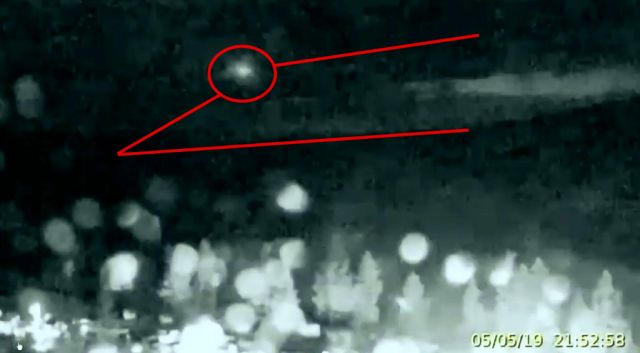
Kat Martin has captured something weird flying above Yellowstone. I have seen this type of thing before, but never changing direction so fast as this did.
There are lots of lights which are just reflections. The one this video is about is the bright object which comes in from the upper right of screen. It does turns and then settles near three line where it flashes very bright and appears in different places. It then flies off to the left, then makes a hard right turn.
This was live on the Yellowstone cam at Old faithful on May 5, 2019. Kat slowed the video down because whatever this was moved very fast.
We don’t know what it is. We don’t even know if it’s made of regular matter — but we do know that something blasted a series of holes through some stars in the Milky Way.
“It’s a dense bullet of something,” said Ana Bonaca, a researcher at the Harvard-Smithsonian Center for Astrophysics, who discovered evidence for the impactor.
Bonaca analyzed a series of stars called GD-1 — a very long and thin, Milky Way star stream. Normally, the stream would appear as a straight line, stretched out by the Milky Way’s galaxy. GD-1 stars have been studied ever since they were discovered in 2006, and Bonaca has been using data from the recently launched Gaia telescope to analyze them in more detail.
This type of stellar stream is created by the tidal (gravitational) force of the Milky Way, which bends and stretches the stream, producing a gap in its approximate middle.
This image from Bonaca's presentation shows the most detailed map yet of GD-1, revealing the apparent second gap and spur.
Credit: New Astrophysical Probes of Dark Matter, Ana Bonaca/GAIA
But when Bonaca looked at GD-1 more recently, she found a second gap — and a weird one at that. The second gap is not smooth as the first one but has a ragged edge — as if something was shot through it.
“It’s a dense bullet of something,” Bonaca said.
The “bullet” would have to be something absolutely massive, much bigger than a star, and more massive than all but the largest black holes. It’s not out of the question for a supermassive black hole to be the culprit, but if this is the case, it would have to be one at the scale of the supermassive black hole at the center of our galaxy. There isn’t a clear reason why such a black hole would exist towards the edge of our galaxy, and astronomers haven’t seen any effects from it.
This leaves another tantalizing possibility: a massive object made of dark matter.
Dark matter is a hypothetical form of matter that is thought to account for approximately 85% of the matter in the universe and about a quarter of its total energy density. We don’t know what dark matter is and we’ve never seen it — but we have seen its effects, and astronomers are quite confident in its existence. We also have no idea how dark matter might be distributed through the universe — is it thin and diffusive, or large and clumpy? If dark matter was indeed shot through GD-1 stars, it would suggest the latter. However, a large ball of dark matter is still speculative at this point, although it seems to line up with the evidence quite nicely.
The results have not yet been peer-reviewed, though they were met positively at the conference of the American Physical Society in Denver where they were presented.
At this point, the turbulent history of GD-1 stars is just not well enough known to draw a definite conclusion. But whatever it is, is Bonaca’s hypothesis is true, something shot a massive “bullet” straight through our galaxy — and we don’t know what it is.
A piece of Libyan desert glass that weighs 22 grams and is about 55 mm wide.
Credit: Wikimedia Commons.
An exotic and beautiful type of glass found in the Sahara desert has a cosmic origin, according to a new study. After analyzing the chemical makeup of Libyan desert glass — a naturally occurring glass whose striking yellow color made it a much-sought-after decorative material — researchers found that it was produced by ancient meteorite impacts.
Cosmic glass fit for kings
Breastplate found in King Tutankhamun’s tomb. The scarab is made out of Libyan desert glass.
Credit: Wikimedia Commons.
The rare Libyan desert glass has been prized for its beauty for thousands of years. The glass — the purest natural silica glass ever found on Earth — is generally yellow in color and can be very clear, although most pieces are milky and may even contain tiny bubbles, white wisps, and inky black swirls.
By one estimate, over a thousand tons of Libyan desert glass are strewn across the deserts of eastern Libya and western Egypt. Most are the size of pebbles, although some chunks can have a considerable size and weight — the biggest piece ever found weighs around 26 kg.
Local inhabitants in the Neolithic period made tools out of the glass, and later the Egyptians used it to fashion jewelry. In fact, the carved stone on the breastplate of the famous Egyptian pharaoh Tutankhamun was made of Libyan desert glass. But these piece of glass were created long before King Tut was born — about 29 million years by one estimate.
Silica glass at the Great Sand Sea.
Credit: Mohamed El-Hebeishy.
For more than a hundred years, scientists have debated what forces could have created the enchanting glasses. There are two major hypotheses that explain their formation: either a meteor impact or an airburst (an atmospheric explosion which happens when meteoroids explode in the lower atmosphere) was responsible. A recently published study supports the former theory.
In a new study, Aaron Cavosie from Curtin University in Australia and colleagues performed chemical analyses of Libyan desert glass samples that unequivocally supports the meteorite formation theory.
While they were examining zircon minerals embedded in the glasses, the researchers found traces of another mineral called reidite. This mineral only forms in high pressure and heat — so far, it hasn’t been found anywhere other than meteorite impact craters.
“Both meteorite impacts and airbursts can cause melting, however, only meteorite impacts create shock waves that form high-pressure minerals,” says Cavosie.
“So finding evidence of former reidite confirms it was created as the result of a meteorite impact.”
Whatever meteorite impacted the desert all those millions of years ago, it must have caused a gigantic explosion. It vitrified (glassified) a huge area, resulting in a broad range of glasses ranging from cloudy dark to stunningly luminous lemon yellow — all depending on the kind of contaminants that dissolved into the liquid silica created by the powerful impact.
A variety of Libyan Desert Glasses.
Credit: Corning Museum of Glasses.
The findings published in the journal Geology are useful for establishing how often near-Earth objects come in contact with our planet’s surface. The study seems to suggest that the kind of impacts that are powerful enough to create Libyan desert glass are, thankfully, quite rare.
“Meteorite impacts are catastrophic events, but they are not common,” says Cavosie.
“Airbursts happen more frequently, but we now know not to expect a Libyan desert glass-forming event in the near future, which is cause for some comfort.”
NASADe vlek werd veroorzaakt door de crash van de Israëlische maanlander Beresheet.
WETENSCHAPEind februari 2019 werd de Israëlische maanlander ‘Beresheet’ gelanceerd. Het doel was om als vierde land ooit voet op de maan te zetten. Maar twee maanden later, tijdens het landen, crashte het toestel. En NASA gelooft te weten waar dat exact gebeurde.
Nieuwe foto’s die gemaakt werden door de Lunar Reconnaissance Orbiter (LRO) - een ruimtevaartuig van het Amerikaanse ruimtevaartagentschap NASA - tonen waar de Israëlische maanlander op 11 april precies neerstortte.
Vergeleken met een foto die in december vorig jaar (2018) werd gemaakt, lijkt er wel een witte vlek te zijn verschenen sinds de crash in april. Die vlek zou inderdaad een gevolg zijn van de impact van de Israëlische maanlander.
(Lees verder onder de foto)
NASAIn december was er nog niets te zien op de maanoppervlakte. Na de crash verscheen er een witte vlek.
Al slaagde de Israëlische maanlander ‘Beresheet’ – vrij vertaald naar ‘Genesis’ – er niet in veilig te landen. Hij zorgde wel voor tal van andere primeurs. De nacht van 21 op 22 februari werd de maanlander gelanceerd. Dat gebeurde vanop Cape Canaveral.
De robot was een onderdeel van de eerste private maanmissie, op initiatief van SpaceIL. Hij droeg een bibliotheek van 30 miljoen pagina’s met zich mee, en maakte onderweg een glorieuze selfie om het moment te vereeuwigen.
In de laatste fase van de afdaling ging het mis. De belangrijkste motor van Beresheet viel uit en het contact werd verbroken. Het toestel is daarna vermoedelijk gecrasht.
AFP
De maanlander Beresheet maakte een selfie met de aarde en de Israëlische vlag.
Greenland’s largestglacier has not only slowed its retreat, but has also thickened in recent years, surprising scientists studying the impacts of global warming on ice in the northern hemisphere.
The island is home to the second-largest ice sheet in the world afterAntarcticaand rapid warming in the northern hemisphere has major implications for continuing global sea-level rise.
The Jakobshavn Isbrae glacier on Greenland’s west coast used to lose more ice from this than anywhere else in the country.
It is known for the huge blocks of ice it calves into Disko Bay, which then drift south into the Atlantic Ocean. It is believed to have calved the iceberg which sank the Titanic.
Between 2000 and 2010, Jakobshavn Isbrae contributed the largest solid ice discharge in all of Greenland’s ice sheet and is estimated to have contributed to nearly 1mm of global sea rise.
Glacier collapse shows climate impact
But despite the trend of rising temperatures, it is no longer the place where the territory loses most of its ice.
Since 2013, when the glacier’s ice loss was at its fastest, the ice at the terminus of the glacier has stopped decreasing in height and started to thicken.
The overall effect is that it is now flowing more slowly, thickening and advancing towards the ocean instead of retreating further inland.
Measurements of the glacier’s elevation changes on its narrow trunk show that instead of losing 20 metres in height a year as it had previously, the glacier is now thickening by 20 metres a year.
New data processing techniques applied to the information gathered by satellites have given a clearer picture of the extent to which the ice is returning to the glacier, the European Space Agency (ESA) said.
“The dynamic speedup of Jakobshavn Isbrae observed from the late 2000’s to 2013 was triggered by warm ocean waters in Disko Bay, entering Jakobshavn Fjord and melting ice at the glacier terminus," said Anna Hogg, a researcher in the Centre for Polar Observation and Modelling at the University of Leeds.
“In recent years, however, temperature measurements show that ocean water in Disko Bay has experienced a series of cooler years – more than one degree lower than mean temperature previously observed. This has reduced the rate of ice melt on Jakobshavn Isbrae.”
However, the glacier does not indicate greater stability in the ice sheet overall. It drains just 7 per cent of all ice on Greenland.
Scientists at the Living Planet Symposium in Milan heard the glacier’s drainage basin as a whole is still losing more ice to the ocean than it gains as snowfall.
It is therefore still contributing to global sea-level rise, albeit at a slower rate.
We are all used to hearing about the world’s ice being the first casualty of #climatechange. Recent findings show that one glacier is not conforming to the norm – it’s actually been flowing more slowly and getting thicker.
Dr Hogg said: “The key question we need to answer now is whether the slowdown of Jakobshavn Isbrae just a pause, or is it more permanent? We will use ESA satellite observations combined with models to monitor change and predict this colossal glacier’s future evolution.”
The ESA’s Mark Drinkwater said further research was required and noted that “large seasonal and year-to-year variability in the dynamics of the Jakobshavn Isbrae Glacier … can easily hide the longer-term climate trend in ice loss.”
The research appears to fit with a study published earlier this year, indicating Greenland’s ice sheet was melting four times faster now than it was in 2003. However, it found the largest amount of ice loss was sustained away from the country's glaciers.
“Whatever this was, it couldn’t be explained by glaciers, because there aren’t many there,” Michael Bevis, the study’s lead author said in January.
He added: “It had to be the surface mass – the ice was melting inland from the coastline. It’s because the atmosphere is, at its baseline, warmer."
Another study of Jakobshavn Isbrae’s unexpected thickening indicated the cooling period will pass as ocean temperatures rise, which will then see the glacier retreat even faster than it was before.
Grootste gletsjer van Groenland groeit met 20 meter per jaar. Wetenschappers staan voor een raadsel
De grootste gletsjer van Groenland is de laatste jaren niet verder gekrompen, maar juist gegroeid. Wetenschappers staan voor een raadsel, schrijft The Independent.
Het eiland heeft de op één na grootste ijskap ter wereld, en moet alleen Antarctica voor zich dulden.
Tussen 2000 en 2010 verloor de Jakobshavn-gletsjer veel ijs. Sinds 2013 krimpt de gletsjer niet meer. Sterker nog: hij groeit in de richting van de oceaan.
20 meter
Uit nieuwe metingen blijkt dat de gletsjer niet langer 20 meter per jaar krimpt, maar 20 meter per jaar groeit, laat het Europese ruimtevaartagentschap ESA weten.
Het smelten van Jakobshavn tussen 2000 en 2013 had te maken met de aanvoer van warmer oceaanwater in de Diskobaai, aldus Anna Hogg van de Universiteit van Leeds.
Einde
De afgelopen jaren is het water in de Diskobaai een stuk koeler, waardoor er abrupt een einde is gekomen aan het smeltproces.
Dr. Hogg zei: “De vraag is nu of er sprake is van een pauze of dat het meer permanent is.”
Met behulp van satellieten van de ESA gaan onderzoekers de kolossale gletsjer de komende tijd nauwlettend in de gaten houden.
ESA EarthObservation✔@ESA_EO
We are all used to hearing about the world’s ice being the first casualty of #climatechange. Recent findings show that one glacier is not conforming to the norm – it’s actually been flowing more slowly and getting thicker.
WAAROM VLUCHT ALLES EN IEDEREEN RICHTING MAAN? ( VIDEO )
Jarenlang is de maan een soort vergeten gebied geweest waar eigenlijk niemand serieuze belangstelling voor had.
Nu worden er met grote haast plannen gemaakt voor kolonisatie van de maan en dat moet vóór 2029 klaar zijn.
We kunnen veilig stellen dat wij als burgers meestal de laatsten zijn die te horen krijgen wat er werkelijk speelt.
Wij horen dingen meestal als het te laat is om er nog iets aan te veranderen. En in dat kader roept het volgende verhaal de nodige vraagtekens op.
De jaren zestig van de vorige eeuw stonden helemaal in het teken van de maan en de diverse Apollovluchten. We gaan er voor vandaag even vanuit dat die vluchten ook daadwerkelijk plaats hebben gevonden en dat er ook daadwerkelijk mensen op de maan zijn geweest.
Eigenlijk net zo snel als dat hele maan verhaal op kwam, raakte het ook weer in de vergetelheid. Decennialang was er nauwelijks belangstelling voor de maan behalve bij ufo fanaten misschien die er van alles zagen vliegen.
Maar, nu is het een compleet ander verhaal. Talloze landen en ook grote particuliere ondernemingen zijn bezig met een soort race naar de maan.
Niet alleen een race, maar meer een totaalplan, waarbij menselijke kolonies op de maan zullen worden gebouwd.
Hetzijn niet alleen landen zoals Amerika, Rusland, India en China die druk bezig zijn met plannen richting maan, maar ook grote particuliere ondernemingen, waarbij een opvallend figuur, Jeff Bezos, de grote baas van Amazon, die behoort bij de rijkste mensen ter wereld.
Bezos is de oprichter van ruimtevaartbedrijf Blue Origin en afgelopen week werden er in een besloten presentatie voor genodigden in Washington verdere details bekend gemaakt over de plannen van Blue Origin.
En daar kwam uit naar voren dat Blue Origin in 2024 de eerste maanlander operationeel wil hebben genaamd Blue Moon.
Daar blijft het niet bij, want daarna zal in een razend tempo vaart worden gemaakt met de kolonisatie van de maan en wel zo, dat dit uiterlijk 2029 gereed moet zijn.
Waar je dan aan moet denken zijn leefgemeenschappen zoals te zien op de volgende afbeelding.
Dan is er nog iets merkwaardigs, want ook Israël houdt zich intensief bezig met de maan. Ze hebben afgelopen februari pogingen ondernomen om met de maanlander vaste grond onder de voeten te krijgen op de maan.
De landing mislukte weliswaar, maar aan boord van de maanlander bevond zich een bibliotheek van 30 miljoen pagina’s waarin alles is vastgelegd wat de moeite waard is om te weten als je de menselijke beschaving opnieuw zou willen opstarten.
Waarom stuurt Israël een dergelijke bibliotheek naar de maan? Wat weten zij wat wij niet weten?
Iedere keer komt ook dat jaartal 2029 tevoorschijn, het jaar dat alle voorbereidingen voor het weg kunnen vluchten naar de maan klaar moeten zijn.
Dan moet je niet denken aan ons gewone mensen die daar naartoe kunnen. Het wordt meer een scene zoals aan het eind van de film 2012, waarbij een geselecteerde elite aan boord van de arken kunnen gaan.
Alles wijst erop dat er iets met de aarde zal gebeuren, alleen wat dat is, weten we uiteraard niet.
Het zou een geplande kernoorlog kunnen zijn, waarbij de aarde voor langere tijd onbewoonbaar zal zijn, het kan de komst van een planeet of komeet-planeet zijn die voor de nodige chaos kan zorgen.
Maar, het jaar waarop alles klaar moet zijn, 2029, ligt ook dicht bij 2032, het jaar waar volgens tijdreiziger Scott de aarde zal worden getroffen door een asteroïde.
Mocht iemand een andere reden weten waarom men als een gek bezig is om naar de maan te kunnen vluchten, laat het ons weten.
The late Award-winning journalist and New York Times Best Selling author Jim Marrs presented a program on what the military-trained remote viewers experienced when using this mental technology to study alien life forms at the 2016 Ozark Mountain UFO Conference.
Remote Viewing, a psychic technique developed and utilized by the U.S. Army, may have been instrumental in ending the Cold War as there were no longer any secrets thanks to the psychic experiments on the part of both the Soviets and the U.S.
This practice has since been used to take a look at the different extraterrestrial species interacting with the Earth.
Disclosure! Ted Cruz Warns Space Force Is Needed to Battle Space Pirate Aliens
Sen. Ted Cruz, R-Texas, issued a dire warning about space pirates Wednesday in support of appropriations to fund Space Force, President Trump’s proposed off-planet expansion of the U.S. military.
“Since the ancient Greeks first put to sea, nations have recognized the necessity of naval forces and maintaining a superior capability to protect waterborne travel and commerce from bad actors,” said Cruz, the chairman of the subcommittee on aviation and space, adding, “Pirates threaten the open seas, and the same is possible in space.
In this same way, I believe we too must now recognize the necessity of a Space Force to defend the nation and to protect space commerce and civil space exploration.”
For starters, the Trump administration is seeking $2 billion in new funding from Congress for the creation of Space Force. Yahoo
Secret Space Force: The Treaty to Prevent War in Outer Space: P.A.R.O.S.
Ted Cruz announced today that the Space Force is needed to fight space pirates. Are our governments finally going to have to come clean via Disclosure? Their actions speak volumes.
The United States of America will soon have a separate Space Command, that will better organise and advance the military’s vast operations in space. The Space Command is expected to improve the US military’s technological advances in space. Today in IN DEPTH we go into the details of what is the US Space Command … what was the need to create it.
President Donald Trump announced Monday that he is directing the Pentagon to create the “Space Force” as an independent service branch.
Description Definition of MILITARISM:
A: predominance of the military class or its ideals
B: exaltation of military virtues and ideals Definition of IMPERIALISM:
a: the policy, practice, or advocacy of extending the power and dominion of a nation especially by direct territorial acquisitions or by gaining indirect control over the political or economic life of other areas
b: This word has its origin in the Latin imperilcrn (empire). In its general meaning it is the expression employed for the aspiration to form a single, powerful empire encompassing the entire world
Huge Cigar-Shaped UFO Craft Captured Next To The Sun
Gina Maria Colvin Hill captured through her telescope a series of cigar-shaped objects next to the sun.
She posted the images on herFacebook page and although not all the photos show strange unidentified objects, this image shows one object that stands out and what looks like a cigar-shaped craft.
Get ready to rumble, conspiracy theorists … this story has something for everyone to worry about, no matter which side of Reddit you reside on. Scientists at Cambridge University are studying various forms of geoengineering and weather control for ways to stop climate change, and one involves placing highly-reflective clouds over the North and South poles in an effort to force them to freeze over again. What could possibly go wrong?
“What we do over the next 10 years will determine the future of humanity for the next 10,000 years. There is no major centre in the world that would be focused on this one big issue.”
Sir David King, then UK’s long-serving and now retired chief science adviser to prime ministers Blair, Brown, Cameron and May, told the BBC this week that he wants the new Centre for Climate Repair at Cambridge to be that center. It’s part of the Carbon Neutral Futures Initiative, whose mission, according to Dr. Emily Shuckburgh, is to “solve the climate problem.” Nothing like starting at the top, right?
Actually, for Sir King, it means starting at the bottom too. His most radical plan involves sending specially-modified unmanned ships with tall, hollow masts to the poles to suck in seawater and blast it into the atmosphere through extremely fine nozzles. Those nozzles will isolate the salt from the tiny water droplets, creating clouds of salt crystals that will supposedly reflect sunlight back into space, leaving the area underneath them to chill and eventually reform the ice that’s been melting for years — calving monstrous icebergs, sending cracks through the Antarctic surface ice, melting glaciers and keeping the Arctic Ocean from freezing in the winter. Sounds like a good idea … as long as those clouds stay over the poles.
Sir King wants to sprinkle salt in other places as well. Another proposal involves fertilizing the ocean with more salt – iron or ferrous salts like ferrous fumarate, ferrous gluconate, ferrous succinate, and ferrous sulfate – to promote the growth of plankton, which will then absorb more CO2 – the main cause of climate change (unless you don’t believe it exists). Sounds like a good idea … as long as the plankton doesn’t get out of control and take over the oceans, or create monster whales and other sea creature that feed on it.
King is not ruling out more conventional solutions. He supports carbon capture systems to collect and store greenhouse gases, developing viable nuclear fusion technology and improving renewable energy sources. But he obviously wants to think outside the box and ignore the consequences. Dr. Shuckburgh is open to considering everything Sir King proposes – no matter how wild or unconventional the ideas might be.
“In assessing such ideas we need to explore all aspects, including the technological advances required, the potential unintended consequences and side effects, the costs, the rules and regulations that would be needed, as well as the public acceptability.”
“Unintended consequences.” Isn’t that what got us climate change in the first place?
That’s the way one Navy pilot described the now-infamousU.S.S. Nimitz UFO encounterwhich happened over a two-week period in 2004. Several versions of the events have been put forward, and the accompanying footage which accompanied the initial disclosure has beencalled into question. Still, the disclosure of the incident remains one of the most significant events in modern ufology, regardless of how much truth there is behind it.
Now, we have at least one more account – albeit short one – to add to the list of eyewitness reports of the Nimitz event. In the latest trailer for the History Channel’s upcoming series Unidentified: Inside America’s UFO Investigation, an anonymous pilot is shown sharing her recollection of the events. The quote above is all we got in the trailer from this most recent pilot to come forward, but it suggests that the History Channel’s new program may actually offer compelling new evidence about what our military and government have encountered in the skies.
The History Channel’s series is the latest endeavor of Tom Delonge, self-proclaimed face for modern ufology and co-founder and President of To The Stars Academy of Arts & Science. In the series, Delonge and Luis Elizondo present evidence gathered as a result of Elizondo’s former Advanced Aerospace Threat Identification Program. Several current and former pilots, including the pilot quoted above, have been shown in the series’ various trailers. The series is set to debut May 31 on the History Channel.
The History Channel says the series will “reveal newly authenticated evidence and footage, interviews from eyewitnesses and former military personnel,” and “expose a series of startling encounters and embark on fascinating new investigations that will urge the public to ask questions and look for answers” concerning unidentified aerial phenomena.
Of course, there are those who argue that Delonge and Elizondo are either wittingly or unwittingly carrying out a hidden, subversive agenda intended to push a controlled narrative about these incidents. Members of the entertainment industry have in the past been used by governments as tools for spreading misinformation or disinformation to sway public belief or opinion, and there’s no reason to believe it doesn’t still occur. Will this program lead to disclosure, or muddy the waters? Let’s face it: cable TV is little more than the propaganda arm of a vast corporate machine. The History Channel is owned by the Walt Disney Company, itself known to have had ties to intelligence agencies in the past, not to mention the fact that this is the network that airs Ancient Aliens. I know which one I’m going with.
Up until 1952, much of the coverage of “flying saucers” in the American media remained unsympathetic to the idea that some unusual new phenomenon was appearing in our skies. That was the case, at least, until Saturday Night Fever erupted over our nation’s capital, marking one of the most well known, and often written about UFO flaps in American history.
It was almost midnight on the evening of Saturday, July 19, 1952. Air-traffic controller Ed Nugent (not to be confused with a particular raucous guitarist with a similar name) was working the tower at Washington National Airport, when he observed something odd on the radar screen in front of him: it appeared to be a group of six or seven slow-moving objects moving together over the region, well outside the flight paths of any known aircraft, military or civilian, in the area at that time.
At that time, it had been treated as something of a joke (Nugent reportedly told his supervisor, tongue planted firmly in cheek, that he had just spotted an entire “fleet of flying saucers”). However, shortly thereafter another of the ATC operators noticed something odd and out of place: a strange light in the distance, which appeared to accelerate and disappear “at incredible speed.”
Thereafter, the incident received notable coverage in the press, with many articles emphasizing the USAF’s apparent interest in the matter. This was particularly the case following a statement given to the press by Major General John A. Samford, who appeared on camera on July 31, 1952, addressing the “flying saucers” seen over Washington, DC:
“The Air Force today investigated reports that several ‘flying saucers’ had been spotted by radar virtually in its own backyard on the outskirts of the nation’s capital,” journalist Jack Rutledge later wrote of the incident for Louisiana’s Monroe News-Star. “Not only were unidentified objects seen on radar–indicating actual substance instead of merely light–but two airline pilots and a newsman saw lights fitting the general description of flying saucers the same night.”
Indeed, a number of pilots claimed to have seen lights similar to those observed from Washington National Airport. However, among the most notable accounts had been that given by Captain S. Casey Pierman of Detroit, who was flying Capital Airlines Flight 807 on the night in question, headed southbound from National Airport, who observed seven objects while en route from Washington to Martinsburg, West Virginia. Pierman described the objects as at times “hanging motionless” like stars, while at other times “moving at tremendous speed” and resembling “falling stars without tails.”
In a statement Pierman gave to the press, he noted that “In my years of flying I’ve seen a lot of falling or shooting stars… but these were much faster… They couldn’t have been aircraft. They were moving too fast for that. They were about the same size and as the brighter stars, and were much higher than our 6000-foot altitude.”
Many years have passed since this now famous incident, allowing plenty of time for questions to be raised as far as what, precisely, might have been observed on the night in question (which, in truth, had been one of several similar incidents occurring near Washington at that time). However, even in the years shortly after the series of sightings over Washington took place, there were those who were of the mind that the phenomenon had stemmed from secret U.S. military activities, rather than extraterrestrial “saucers” from another world.
Leon Davidson, Ph.D, an early proponent of the idea that UFOs were largely a result of technologies and misdirection from our own government, noted that radar technology had existed by 1950 that would have allowed the creation of “false positives” that could easily have explained the radar traces observed by ATC controllers at Washington National. The question, rather than being one of what the “objects” were, was one of who might be behind such activities, which were apparently intentionally aimed at confusing the public, the media, and even members of the military?
By about 1950, ECM (electronic countermeasures) was standard equipment on our advanced bombers and was being developed for missiles. Advertisements started to appear about 1956 showing that this equipment could be used for creating simulated targets for training radar operators. I quote from an article in Aviation Research and Development, March 1957, pg. 22:
“A new radar moving target simulator system — which generates a display of up to 6 individual targets on any standard radar indicator — has been developed … to train radar operators … and for in-flight testing of airborne early-warning personnel… Target positions, paths, and velocities can … simulate … realistic flight paths… Speeds up to 10,000 knots (about 11,500 mph) are easily generated… The target can be made to turn left or right… For each target there is … adjustment to provide a realistic scope presentation.”
The reader should keep this quotation in mind when reading about radar sightings of high speed UFOs.
Davidson raises a number of good points, and the description he provides does resemble the circumstances presented in a number of the better known UFO radar reports from over the years. However, if the objects in question had indeed merely been the result of such experimental “war games” being carried out covertly, as Leon Davidson suggested (the CIA was a favorite culprit for this in Davidson’s narratives), can the idea of physical lights observed by pilots be similarly explained in some way?
We may never know the full story behind the objects seen and tracked on radar over Washington in 1952. However, when it comes to military technologies used for misdirection of the public, nothing can be ruled out, as Davidson was already suggesting within years of when the initial sightings took place. In the ever complex annals of Ufology, one thing that should always be kept in mind is that if there’s a will, there’s a way… or as cases like this may indicate, if there’s a way, then someone can find an excuse for a will.
Weird Beam of Light appears over Eskilstuna, Sweden
Many weird and unexplained things happening in the skies above us. The next footage shows a thunderstorm when suddenly a weird beam of light comes out of clouds.
The photographer said that it was a normal summer day in Eskilstuna, Sweden and while watching the thunderstorm she decided to film it.
She little know that a portal like phenomenon was going to appear..
CHINA’S ROVER COLLECTS FIRST-EVER SAMPLES FROM UNDER LUNAR CRUST
CNSA
DAN ROBITZSKI
Digging In
Yutu 2, the Chinese rover that landed on the far side of the Moonearlier this year, just examined the first-ever samples of the Moon’s mantle.
The samples are believed to have been dug out by a meteorite impact so strong that it crashed through the Moon’s crust, according to research published in the journal Nature on Wednesday. With further study, these subsurface rocks could reveal how the Moon formed in the first place.
Extremely Heavy Metal
In its earliest days, the Moon was likely comprised by a vast ocean of magma. During that period, the scientists suspect that heavy metals like iron and magnesium — both of which were prevalent in the new samples — sank below the surface while lighter compounds floated upward, eventually forming the Moon’s crust.
“This is the first ground truth of what the interior of the moon is really made of,” Purdue University scientist Briony Horgan, who did not contribute to the new research, told New Scientist. “I would say the really important thing is that it’s different from the Earth.”
Studying the Moon’s mantle could give scientists new insights into how a large space body forms when the mantle doesn’t interact with water, as it did on Earth — and could help understand how other celestial bodies formed as well.
NASA's first-everplanetary defense missionis preparing to launch in June 2021, making sure all the pieces are in place for the spacecraft to successfully slam into the small "moon" of a binary asteroid.
That mission, called the Double Asteroid Redirection Test (DART), will culminate in October 2022 with the much-anticipated impact with the binary asteroid Didymos. But mission staff have plenty to keep them busy between now and then, and they know they will be in the spotlight as the mission continues. That's in part because DART represents NASA's first foray beyond scientific and human spaceflight missions; instead, this mission will test a technology that could theoretically save Earth from a dangerous collision with a threatening asteroid.
"People can really get into the whole, 'Oh my god, you're trying to move the what?'" Elena Adams, of the Johns Hopkins University Applied Physics Laboratory, told Space.com during the International Academy of Astronautics' Planetary Defense Conference, held earlier this month in College Park, Maryland. Adams is the mission systems engineer for DART. "I think people are very excited, too, because they wouldn't want to be dinosaurs."
As mission systems engineer, Adams' job is to communicate and coordinate between all the different pieces of the DART mission — from the spacecraft itself to the launch vehicle to how the team members will work together over the course of the mission.
A key recent development in that equation is the rocket. The DART team had been assuming the craft would be piggybacking on a launch, which would have lengthened the journey from Earth to Didymos, but NASA decided to buy a SpaceX Falcon 9 launch dedicated to the mission.
"Before, we had to spend a lot of time spiralling around Earth; we didn't know where we were going to get dropped off," Adams said. "Now, we have a dedicated launch vehicle and we'll be able to just go where we want to go."
In the wake of that decision, Adams and her colleagues are meeting with SpaceX this month to begin coordinating for the launch, which will blast off from Vandenberg Air Force Base in California in June 2021.
Adams is also looking ahead to a series of crucial mission milestones happening this year. DART's final review by NASA will happen in June. The pieces of the spacecraft will also start coming together this summer, with the body of the probe arriving at the Applied Physics Laboratory in June for testing. Then, the spacecraft will go back out again to pick up its propulsion system, a new electric ion engine that DART will test.
Unlike traditional NASA missions that are packed with scientific devices, DART will carry just one instrument, an advanced camera that will capture a spacecraft's-eye view of the approach. "It will take amazing images along the way," Adams said. "But really, it's a targeting camera." For now, the main priority with that camera is making sure that the unwieldy roll-out solar arrays the mission will test don't smear the camera's images.
And then, of course, there's the people component, making sure the team behind the mission is ready to kick into high gear as the DART spacecraft approaches its target in October 2022.
"For the last 10 days, you need to have 24-hour staffing, and it's a small mission — there are only a few of us," Adams said. "So, we're trying to figure out what's the best way of breaking out all the maneuvers and what are we doing in contingencies."
Artemis is the goddess of the moon in Greek mythology.
Artist’s concept of a future moon landing carried out under NASA's newly named Artemis program. The space agency is working to return men and send the first women to the lunar surface by 2024, as has been directed by the White House.
Half a century after NASA sent men to the moon under project "Apollo," the space agency is now working to land men — and women — on the lunar surface as part of its "Artemis" program.
NASA Administrator Jim Bridenstine revealed the new moniker on Monday (May 13) during a call with reporters that was primarily focused on thebudget for the newly named moon program.
"It turns out that Apollo had a twin sister, Artemis. She happens to be the goddess of the moon," said Bridenstine, referring to Greek mythology. "Our astronaut office is very diverse and highly qualified. I think it is very beautiful that 50 years after Apollo, the Artemis program will carry the next man — and the first woman — to the moon."
The Artemis program, which was previously only referred to by its component names — including the Space Launch System heavy-lift rocket, Orion crew vehicle and Gateway lunar outpost — began when President Donald Trump signed Space Policy Directive 1 in 2017, directing NASA to return astronauts to the moon.
Two years later, in March 2019, Vice President Mike Pence further defined the program by announcing a five-year deadline for the first crewed lunar landing. The 2024 mission, he said, should land at the south pole with the "first woman and the next man on the moon."
On Monday, Trump amended his Fiscal Year 2020 budget request to account for the accelerated schedule and new mission objectives.
"As you know, the President has given our agency the bold charge to land the next man and the first woman on the lunar south pole by 2024, and now President Trump has extended his vote of confidence in our work with an amended budget request for fiscal year 2020," said Bridenstine in a video address to employees. "It includes $1.6 billion in additional funding."
"Among other things, it will allow us to accelerate our development of the Space Launch System and Orion, it will support the development of a human lunar landing system and it will support precursor capabilities on the lunar surface, including increased robotic exploration of the moon's polar region," he said.
To achieve the 2024 goal, NASA intends to scale back its plans for a crew-tended, multi-module Gateway to include only the basic parts needed to support an initial landing. Support for a long-term, sustainable lunar presence, as had been NASA's priority, has been deferred to 2028.
In Greek mythology, Apollo and Artemis were the twin children of Zeus and Leto. In addition to being the goddess of the moon, Artemis was also the goddess of the hunt, with Orion her hunting companion.
A mid-5th century B.C. vase depicting the Greek god Apollo (at left) with his twin sister Artemis.
The name "Apollo" was first proposed for the 1960s moon landing program by Abe Silverstein, NASA's then-director for spaceflight development. He chose the name because of its connection to Greek mythology and its "attractive connotations," per the space agency.
Before being assigned to the current moon landing program, NASA used Artemis to refer to a pair of lunar probes studying the moon's interactions with the sun. The ARTEMIS — or "Acceleration, Reconnection, Turbulence and Electrodynamics of the Moon's Interaction with the Sun" — spacecraft were reassigned from NASA's THEMIS mission in 2010.
Artemis was also selected by a team competing for NASA's Commercial Lunar Payload Services (CLPS) contract. The team, led by Draper, named their proposed lunar lander Artemis-7 in honor of the Greek goddess. (The number 7 signified Draper's seventh lunar landing, having a heritage in Apollo.)
The name has also been used for a European communications satellite (retired in 2017) and was the fictional title given to the first city on the moon in author Andy Weir's ("The Martian") 2017 science fiction novel "Artemis." There is also a small crater with the name in Mare Imbrium, or the Sea of Showers, on the moon.
Bridenstine said the name Artemis represents the program's goal of inclusion.
"I have a daughter who is 11 years old, and I want her to be able to see herself in the same role as the next women [who] go to the moon see themselves in today," he said. "This is really a beautiful moment in American history, and I am very proud to be a part of it."
A resourceful type of spider uses its own web like a slingshot to catapult forward and trap prey. Before the discovery of these creatures, only humans were known to use tools in order to amplify the energy of their movements.
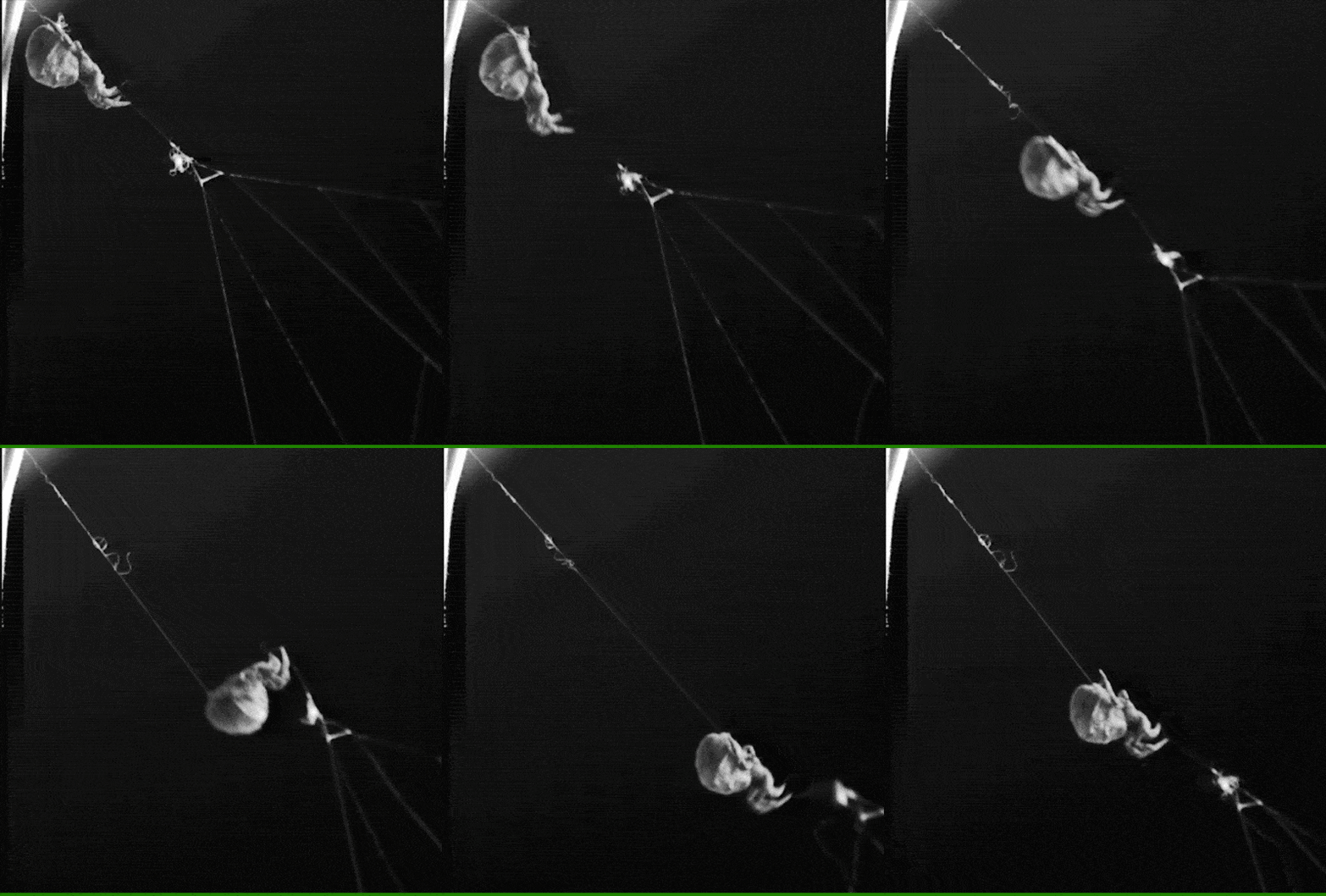
Most spiders build a familiar-looking spiral web, waiting for unsuspecting prey to become entangled. But while these webs are static, the triangle-weaver spider (Hyptiotes cavatus) crafts a stretchy triangle-shaped web that acts as a slingshot or bow and arrow.
This is how it works: the spider makes a single thread connecting a wall to the triangle web. The arachnid moves backwards along this thread to tighten the web, storing energy across its entire length. When the time is right, such as when prey is close to the triangle web, the spider lets go of its grip. The spider can remain in tension for hours at a time if needed. The released tension recoils the spider and its triangle web at high velocity, in the same way a rubber band would fly off once you pull it back.
Credit: Sarah Han.
This behavior, known as “power amplification”, has been documented for some time in triangle web spiders, but it was only recently that researchers at the University of Akron have quantified the forces involved. To study the animals, researchers collected triangle-weaver spiders from the university’s campus in Ohio and inserted them in enclosed terrariums. Flies were regularly released into the enclosure so the spiders might feed, while high-speed cameras recorded even the slightest movement of the arachnids.
Using sophisticated motion tracking software, the researchers recorded position data that allowed them to decode the spider’s precise and ultra-fast movements. In fact, the spider slingshots so fast, it travels with the equivalent velocity of 400 body lengths per second, according to the researchers. The maximum recorded acceleration was 773 meters per second squared, which is equivalent to a dizzying 79 g’s. Fighter pilots can’t pull more than 9 g’s without passing out.
Many animals use elastic-energy storage and recoil to produce extremely rapid motions. Examples include the jumping motion of fleas and frogs or the deadly punch of the mantis shrimp. However, the triangle-weaver’s impressive web shooting is the only known case of a nonhuman utilizing an external device for power amplification. In the future, researchers want to investigate how the spider manages to accelerate to fast without squashing itself.
“This finding reveals an underappreciated function of spider silk and expands our understanding of how power amplification is used in natural systems, showing remarkable convergence with human-made power-amplifying tools,” the authors wrote in theProceedings of the National Academy of Sciences.
Greg Johnson maakte deze prachtige timelapsevideo van een supercel bij Chapman, in de Amerikaanse staat Kansas. De video dateert van 25 mei 2016, maar wordt nu pas vrijgegeven. Het flitsende onweer veroorzaakte vier tornado’s in de staat, waarvan vooral de eerste en de tweede veel schade veroorzaakten bij Abilene, Niles en Chapman.
Bekijk ook: timelapse brengt vallende sterren prachtig in beeld
Bekijk ook: prachtige timelapse van Hudson in New York
WETENSCHAP De Amerikaanse president Donald Trump kondigde nog maar pas aan dat hij 1,6 miljard dollar (1,4 miljard euro) uittrekt voor de geplande maanmissie van NASA. Het Amerikaanse ruimtevaartagentschap is echter niet het enige dat de komende tien jaar een reisje naar de maan plant. Tal van andere landen nemen deel aan de maanrace.
Donald J. Trump✔@realDonaldTrump
Under my Administration, we are restoring @NASA to greatness and we are going back to the Moon, then Mars. I am updating my budget to include an additional $1.6 billion so that we can return to Space in a BIG WAY!
Zelfs in Amerika zijn er andere (maan)kapers op de kust. Vrij letterlijk dan want Jeff Bezos, CEO van Amazon, wil met zijn commercieel ruimtevaartbedrijf Blue Origin de maan ontginnen, om onze eigen planeet te sparen. “We moeten deze planeet redden en we zouden een toekomst van ontwikkeling en groei voor de kleinkinderen van onze kleinkinderen niet mogen opgeven. We kunnen beide doen”, zei Bezos tijdens de presentatie van zijn maanmissie in Washington DC.
De maan veroveren wil de Amazon-baas doen met zijn gloednieuwe maanlander ‘Blue Moon’. En tegen 2024 moet die maanlander zelfs mensen naar de maan vervoeren. Dat is eveneens de streefdatum die Donald Trump voorop stelde voor de astronauten van NASA. Bovendien wil de president dat de vlucht van NASA bemand is.
De Amerikaanse ruimtevaartorganisatie stelde zelf een bescheidener doel en mikte er in eerste instantie op om in 2028 weer een maanreis te maken.
China mag natuurlijk niet achterblijven in de nieuwe maanrace. In 2018 schreef de China National Space Administration (CNSA) alvast geschiedenis door als derde land ooit een ruimtetuig op het maanoppervlak neer te zetten - de Verenigde Staten en de Sovjet-Unie gingen China vooraf. De maanlander van China maakte deel uit van de Chang ’e 4-missie, en inmiddels wordt er gewerkt aan een volgende Chang ’e 5-missie. Die moet maangesteente mee terug naar de aarde nemen. Verder willen de Chinezen binnen de komende tien jaar een onderzoeksstation op de maan bouwen.
Europa
Ook het Europese ruimtevaartagentschap (ESA) heeft plannen met de maan. Verschillende Europese landen willen uiteindelijk een zogenaamd ‘Maandorp’ – of internationaal consortium - oprichten waar grondig wetenschappelijk onderzoek gevoerd kan worden.
Om daar te geraken, zullen de Europeanen wellicht beroep doen op een commercieel ruimtevaartbedrijf zoals SpaceX.
SpaceX
Over SpaceX gesproken: het privé ruimtevaartbedrijf van Elon Musk wil met het dearMoon-project tegen 2023 een zesdaagse reis naar de maan maken. Dat zal gebeuren met een Starship-raket met aan boord 9 ruimtetoeristen.
AFP
India
Ook de Indian Space Research Organization (ISRO) introduceerde reeds in 2008 een eerste ruimtemissie waarbij het ruimtevaartuig Chandrayaan-1 in een baan rond de maan werd gebracht. De update ‘Chandrayaan-2’ zou in september 2019 een stapje verder moeten gaan en zal landen op de maan, dat zal evenwel onbemand gebeuren.
Rusland
Roscosmos, de Russische tegenhanger van NASA, wil dan weer een maanbasis uitbouwen. Die plannen zijn bestemd voor 2027. Een jaar later, in 2028, wil de Russische ruimtevaartorganisatie een superzware raket genaamd ‘Jenisej’ bouwen. Vermoedelijk is die ook bestemd voor maanreizen.
Japan
De Japanse SLIM-missie gaat volgend jaar (2020) al van start. De Japanse Aerospace Exploration Agency (JAXA) zal aanvankelijk landingstechnieken uittesten, maar later wil JAXA ook onderzoek voeren naar de grondstoffen die aanwezig zijn op de maan. Uiteindelijk is ook Japan van plan om een bemande missie richting de maan te sturen.
Zuid-Korea
Tenslotte wil het Zuid-Koreaanse Korea Aerospace Research Institute (KARI) in 2025 een maanlander lanceren. En volgend jaar zullen de Koreanen alvast een satelliet naar de maan brengen.
Private ruimtevaartmissies
Daarnaast zijn er trouwens nog tal van andere private startups die richting de maan willen reizen. Daaronder de Israëlische maanlander van SpaceIL: Beresheet. Die maakte dan wel een selfie van zichzelf en de maan, landen op de maan mislukte. Geen probleem, vond de voorzitter van SpaceIL: “We zijn dit begonnen en ik hoop dat we het ook ten einde kunnen brengen”. Gisteren kondigde de non-profitorganisatie aan dat er een tweede maanmissie zal volgen: Beresheet 2.
WETENSCHAP & PLANEETDe maan is langzaam aan het afkoelen, waardoor ze krimpt. Zo stelden wetenschappers reeds vast dat de maan de afgelopen paar honderd miljoen jaar ongeveer vijftig diameter kleiner is geworden. Uit gegevens van de Apollo-missies blijkt nu ook dat de maan wellicht nog altijd tektonisch actief is, wat mogelijk gepaard gaat met ‘maanbevingen’. Dat bericht het wetenschappelijke vakblad Nature Geoscience.
Vier verschillende seismometers detecteerden 28 ondiepe maanbevingen tijdens de Apollo-missies tussen 1969 en 1977. Deze bevingen hadden een kracht van twee tot vijf op de schaal van Richter. Ongeveer acht van de maanbevingen vonden plaats nabij jonge scheuren of breuklijnen in het maanoppervlak. Ter illustratie: dergelijke scheuren zijn vergelijkbaar met kliffen van enkele meters diepte. Ze ontstaan door een horizontale krimp van de maankorst, omdat de maan nog altijd afkoelt.
NASA heeft met behulp van de Lunar Reconnaissance Orbiter (LRO), die sinds 2009 opnames maakt, 3.500 breuklijnen ontdekt. Wetenschappers onder leiding van Thomas Watters van The Smithsonian’s National Air and Space Museum in Washington bogen zich onlangs opnieuw over die resultaten en onderzochten of er een link is tussen de ondiepe maanbevingen, die plaatsvonden tussen 1969 en 1977, en de meer recente breuklijnen op de maan. Het onderzoeksteam trok op basis van de gegevens een opmerkelijke conclusie: de maan zou, net zoals onze planeet, nog altijd tektonisch actief zijn.
(Lees hieronder verder.)
NASAEen breuklijn gefotografeerd door de Lunar Reconnaissance Orbiter Camera.
Tektonische activiteit
De onderzoekers hebben via een speciaal ontwikkeld algoritme de vastgestelde locaties van de bevingen over een kaart heen gelegd van breuklijnen op de maan. Ze stelden vast dat 8 van de 28 ondiepe bevingen zich afspeelden binnen de 30 kilometer van de breuklijnen.
Hieruit concluderen de wetenschappers dat de bevingen wellicht het gevolg waren van tektonische activiteit. Met andere woorden, het over elkaar heen schuiven van stukken maankorst. De kern van de maan koelt immers nog altijd af, waardoor de oppervlakte krimpt. Dit creëert spanning, wat ertoe leidt dat er ‘rimpels’ ontstaan in de maankorst. Het is als een druif die door de droogte een rozijn wordt.
Recente bevingen
Ook blijkt uit de beelden van de LRO dat aan de voet van sommige rotswanden gekleurd puin lag. Op andere hellingen zijn sporen te zien van rotsblokken die naar beneden rolden. Volgens het onderzoeksteam is dat het bewijs dat er nog niet zo erg lang geleden ‘maanbevingen’ zijn geweest.
Wetenschappers ontdekten dat verschillende bevingen plaatsvonden op het moment dat de maan het verst van onze planeet verwijderd was, ook wel ‘apogeum’ genoemd. Op dat punt is de getijdenwerking het sterkst en vinden verschuivingen langs de breuklijnen het vaakst plaats.
Verder onderzoek
Door beelden van breukhellingen met elkaar te vergelijken kunnen signalen van recente tektonische activiteit verder opgespoord worden. “Het opzetten van een nieuw netwerk van seismometers op het maanoppervlak moet een prioriteit zijn. Zo komen we immers meer te weten over de maan en maanbevingen”, zegt Renee Weber, een onderzoeker van NASA’s Marshall Space Flight Center.
Het onderzoeken van seismologische activiteit is belangrijk omdat het ons meer kan vertellen over de evolutie van de maan, onze planeet en getijdenkrachten.
2-3 Billion Years Ago, Star Formation Was Bursting in The Milky Way
The region of the stellar formation Rho Ophiuchi observed by ESA Gaia satellite. The shining dots are stellar clusters with the massive and youngest stars of the region. The dark filaments track the gas and dust distribution, where the new stars are born. This is not a conventional photographic image but the result of the integration of all the received radiation by the satellite during the 22 months of continuous measurements through different filters on the spacecraft.
Credit and Copyright: ESA/Gaia/DPAC, CC BY-SA 3.0 IGO
A team led by researchers of the Institute of Cosmos Sciences of the University of Barcelona (ICCUB, UB-IEEC) and the Besançon Astronomical Observatory have found, analysing data from the Gaia satellite, that a severe star formation burst occurred in the Milky Way about to and three thousand million years ago. In this process, more than 50 % of the stars that created the galactic disc may have been born. There results come from the combination of the distances, colors and magnitude of the stars that were measured by Gaia with models that predict their distribution in our Galaxy. The study has been published in the journal Astronomy & Astrophysics.
Just like a flame fades when there is no gas in the cylinder, the rhythm of the stellar formation in the Milky Way, fuelled by the gas that was deposited, should decrease slowly and in a continuous way until using up the existing gas. The results of the study show that, although this was the process that took place over the first 4,000 million years of the disc formation, a severe star formation burst, or “stellar baby boom” –as stated in the article published in the Nature Research Highlights-, inverted this trend. The merging with a satellite galaxy of the Milky Way, which is rich in gas, could have administrated new fuel and reactivate the process of stellar formation, in a similar way to when a gas cylinder is changed. This mechanism would explain the distribution of distances, ages and masses that are estimated from the data taken from the European Space Agency Gaia satellite.
“The time scale of this star formation burst together with the great amount of stellar mass involved in the process, thousands of millions of solar mass, suggests the disc of our Galaxy did not have a steady and paused evolution, it may have suffered an external perturbation that began about five billion years ago”, said Roger Mor, ICCUB researcher and first signer of the article.
“We have been able to find this out due having –for the first time- precise distances for more than three million stars in the solar environment”, says Roger Mor. “Thanks to these data –he continues- we could discover the mechanisms that controlled the evolution more than 8-10 billion years ago in the disc of our Galaxy, which is not more than the bright band we see in the sky on a dark night and with no light pollution”.
Like in many research fields these days, these findings have been possible thanks to the availability of the combination of a great amount of unprecedented precision data, and the availability of a great amount of hours in computing in the computer facilities funded by the FP7 GENIUS European project (Gaia European Project for Improved data User Services) –in the Center for Scientific and Academic Services of Catalonia (CSUC).
Distribution of 3 million stars used in this stdy to detect the star formation burst from 2-3 billion years ago. Gaia provided the distance for each of these objects on the gallactic disc. Below, a scheme of the spiral arms of the Milky Way.
Credit; University of Barcelona
Cosmologic models predict our galaxy would have been growing due the merging with other galaxies, a fact that has been stated by other studies using Gaia data. One of these merges could be the cause of the severe star formation burst that was detected in this study.
“Actually, the peak of star formation is so clear, unlike what we predicted before having data from Gaia, that we thought necessary to treat its interpretation together with experts on cosmological evolution of external galaxies”, notes Francesca Figuerars, lecturer at the Department of Quantum Physics and Astrophysics of the UB, ICCUB member and signer of the article.
According to the expert on simulations of galaxies similar to the Milky Way, Santi Roca-Fàbrega –from the Complutense University of Mardid and also signer of the article, “the obtained results match with what the current cosmological models predict, and what is more –he continues- our Galaxy seen from Gaia’s eyes is an excellent cosmological laboratory where we can test and confront models at a bigger scale in the universe”.
Gaia mission until 2020
This study has been conducted with the second release of the Gaia mission, which was published a year ago, on April 25, 2018. Xavier Luri, director of ICCUB and also signer of the article states: “The role of scientists and engineers of the UB has been essential so that the scientific community enjoys the excellent quality of data from the Gaia release”.
More than 400 scientists and engineers from around Europe are part of the consortium in charge of preparing and validating these data. “Their collective work brought the international scientific community a release that is making us rethink many of the existent scenarios on the origins and evolution of our galaxy”, notes Luri.
In one year, more than 1,200 peer review articles published in journals show the before and after Gaia in almost all fields of astrophysics, from the recent detection of new stellar clusters, new asteroids, to the affirmation of the star extragalactic origin in our Galaxy, going through the calculus of the Milky Way mass and the findings that show compact stars end up slowly solidified.
“The satellite continues to operate optimally and this July the five nominal years of scientific operation will be completed”, notes Carme Jordi, UB researcher and member of the Gaia Science Team, the scientific advisor body of the European Space Agency (ESA) for this mission. ESA has approved of the extension of the mission until late 2020 –one more year than expected- and engineering teams estimate that there is enough fuel to continue working until 2024. “There is no doubt this mission has passed a technological unprecedented challenge in space missions of all time”, concludes Carme Jordi.
Stanton Friedman has passed away today May 14th 2019. Stanton was some of my first interviews. I spoke to him on the phone privately for a while as well. Good man and Rest in Peace UFO Legend. J.P.
Stanton Terry Friedman is a retired nuclear physicist and professional ufologist who resides in Fredericton, New Brunswick, Canada. He is the original civilian investigator of the Roswell incident. He worked on research and development projects for several large companies.Wikipedia
FREDERICTON — Stanton T. Friedman, nuclear physicist, lecturer and world-renowned devotee of extraterrestrial existence, has died at the age of 84.
The famed UFO researcher died Monday at Toronto’s Pearson International Airport, his daughter Melissa Friedman confirmed Tuesday. She said he was on his way home to Fredericton from a speaking engagement in Ohio. TimesColonist
Many reported UFO sightings actually end up being something as simple as a balloon. UFO stands for Unidentified Flying Object and they’ve been seen since the start of recorded history. Throughout that period of time, there were two triangle UFOs sighted in the same place. Ghosts and orbs are believed to be connected in some fashion. If it regards a haunting of any kind, precautions have to go taken. You just need to listen to her songs to be convinced. There’s a whole lot more shit coming.
The New Fuss About UFO Videos from 2019
Normally women enjoy each others company in the place where they receive a great deal of emotional support. There existed a general division of labor, particularly in hunting communities, where they did the bulk of the work. This afternoon, at the exact same time and place, the exact same woman witnessed a similar light show.
There are a lot of theories regarding what the main reason for the noise might be. Something that science alone can’t solve. Although researchers have made attempts to discover what and why the suspension took place, the base won’t comment further on the issue. Many UFO scientists have examined the multiple parts of video footage and photographs.
The 30-Second Trick for UFO Videos from 2019
Data analysis assists in understanding the demographics of the customer and to create services and products in a means to satisfy their demand. Some reports state it’s a ping, but others claim it’s a beep. They state it’s a ping, but others claim it’s a beep. There weren’t any reports of any crashes in the area. It’s so incredible fantastic that it can’t be adequately explained or investigated in just 1 hub article.
The picture managed to create a small wave of publicity for the region. You may see the video below. The quick video below, for instance, is merely one of several contemporary sightings. It, for instance, is only one of several contemporary sightings. Hypnosis video is just one of the most effective tactics to do hypnosis without the usage of a real hypnotist. You may see the footage below.
You might take a look at the video below. You look at the video below. You might look at the video below.
There are lots of finds of strange and bizarre objects made all over Earth. To have the ability to get the utmost benefit for an intensive cardio workout with only a little proportion of the physical output is well worth trying. You won’t have to be concerned anymore. Something needs to be going on here. There’s no doubt you NEED to earn marketing videos in the event that you want to do things the easy way online nowadays. There is really a chance that the sighting over O’Hare might not have made it in the public arena.
Some dismiss the claims as an effort to profit on the rapidly increasing quantity of UFO encounters. Many, by way of example, can have exposure to sun all day, every single day, for long stretches of time. Then, the two of the objects disappeared. The strange object began to approach again.
Astronomically speaking, it’s tough to beat the discovery of a comet or asteroid from another solar system, as all of the hubbub over ‘Oumuamuahas proven. However, this just might do it. Astronomers studying the chemical compositions of stars in our Milky Way Galaxy have discovered a star in the Big Dipper with a combination of elements that exists nowhere else in the galaxy. An invader? Interloper? Can we charge it rent?
“Here we report on the discovery of a metal-poor star with an extreme r-process enhancement and α-element deficiency. In this star, the abundance ratio of the r-process element Eu with respect to Fe is more than one order of magnitude larger than the Sun and the metallicity is 1/20 of solar metallicity.”
That’s astronomer-speak for “Hey! Put down your beer and come look at this!” According to the press release for a new study published in the journal Nature Astronomy, a group of astronomers from China and Japan using the Large Sky Area Multi-Object Fiber Spectroscopic Telescope (LAMOST) in Xinglong Station, Hebei Province, China, discovered a star, now named J1124+4535, just below the bowl of the Big Dipper, also known as the Ursa Major constellation, with an unusual chemical signature. Specifically, it has a very low level of elements such as magnesium compared with an excessively high level of Europium, a soft metal similar to lead. That high-low ratio is not found in the Milky Way but matched the chemical composition of stars in dwarf galaxies orbiting our own.
So, how did J1124+4535 end up in the Big Dipper? It’s believed that there were once many more dwarf galaxies orbiting the Milky Way, but our greedy galaxy likes to gorge on them and absorbed them completely – destroying their identities and assimilating them into its own. Somehow, J1124+4535 managed to survive. As we found with interstellar asteroids, if there’s one, there’s probably more, and that’s already the case with this prisoner from another galaxy. Astronomers have discovered non-Milky Way hypervelocity stars speeding through after being spun off by those orbiting dwarf galaxies, particularly the Large Magellanic Cloud. However, J1124+4535 seems to be the only one so far to arrive via complete absorption.
Alaska flag
Speaking of the Large Magellanic Cloud, it’s scheduled to be absorbed via collision in about 2 billion years, followed by the Andromeda Galaxy in another 2 to 3 billion years.
In space, no one can hear you scream, but someone in the future may hear the Milky Way chew, swallow and belch.
The moon doesn’t do that that much. Sure, it’s responsible for the tides and all, but that’s really a function of gravity and the messy ball of duct tape and chicken wire we call “the laws of physics.” As a celestial body, the moon just kind of hangs around. It does do some cool stuff, though. For one, it’s the perfect size to let us earthlings view total solar eclipses, which is a pretty spectacular luxury we have. Some have suggested that the perfect size of the moon in relation to the sun and Earth is a bittoo much of a coincidence, and thus evidence that the moon is fake. Unfortunately, the moon is real, and just like every other real thing in this universe it’s growing up to be a disappointment. You see, it turns out the moon is shrinking.
Tectonic activity—the push and pull of tectonic plates in a planet’s mantle—in our solar system has, for a long time, seemed to be mostly confined to the Earth. We feel the results of this tectonic activity as earthquakes. We know that the moon used to have tectonic activity, but it was though to have stopped millions of years ago. According to a study published this week, the moon may still be tectonically active, and so-called “moonquakes” are shrinking Earth’s satellite like a raisin.
What if you landed on the moon, stepped out, and were just utterly disappointed? That would be awful.
These moonquakes were first recorded by the Apollo missions between 1969 and 1977. Until now, they’ve been unexplained. A study published in Nature Geoscience found that the epicenters of the mysterious moonquakes seem centered around jagged lines of cliffs called scarps. These scarps were first discovered in 2010, and while researchers suggested that they were the result of tectonic activity, they believed that it had died down around 50 million years ago. Based of the apparent connection between these scarps and modern recorded moonquakes, the new study concludes that the moon is probably still tectonically active, which came as a shock to researchers. Co-author of the study Thomas Watters says:
“The whole idea that a 4.6-billion-year-old rocky body like the moon has managed to stay hot enough in the interior and produce this network of faults just flies in the face of conventional wisdom.”
As its interior cools with age, the moon shrinks like a raisin. Its brittle crust compresses and breaks forming the scarps we can see running along the surface. Previously we had thought that this cooling and shrinking process had completed a very long time ago, but the links between the scarps and moonquakes suggest that this shrinking process is still ongoing today. Watters says:
“The connection between the location and timing of shallow moonquakes and known young faults is further evidence that our moon is a dynamic world.”
It’s not going to shrink out of existence any time soon, of course. Rocks don’t feel time the same way we do. But it’s good to know that the moon is still doing something. It’s also good to know we won’t run out of the always entertaining fake-moon arguments any time soon either, because you can bet dollars to donuts that the moon being tectonically active 50 million years after it should be is going to be seen as proof-positive that it’s not as old as they want you to think it is.
Stanton Friedman, a nuclear physicist devoted to uncovering what he could about alien life, has died. He was 84. (Submitted/Melissa Friedman)
Stanton Friedman, the famed UFO researcher based in Fredericton, has died.
Friedman was returning from a speaking engagement in Columbus, Ohio, when he died suddenly at the Toronto Pearson Airport on Monday night, according to his family.
He was 84.
A nuclear physicist by training, Friedman had devoted his life to researching and investigating UFOs since the late 1960s.
He was credited with bringing the 1947 Roswell Incident — the famous incident that gave rise to theories about UFOs and a U.S. military coverup — back into the mainstream conversation.
Friedman "officially" retired last year but still booked speaking engagements "because he loved talking about UFOs," said his daughter, Melissa Friedman, who works for CBC News.
"Dad was curious about anything he didn't know about. He was always asking questions about how things worked.
Stanton Friedman, second from right, posing for a photo with his wife Marilyn, far right, his daughter Melissa Friedman and her husband David Parsons.
(Submitted/Melissa Friedman)
"I think it's rare for someone to stay so engaged and curious and open-minded for a life that's that long."
She remembered her father as encouraging, proud and caring and said she was fortunate to have one last visit a week ago in Nova Scotia.
'He did his homework'
Friedman was an accomplished writer, publishing dozens of papers about UFOs and writing or co-writing several books. Three of those books were written in tandem with Kathleen Marden.
"He will be greatly missed," Marden, a UFO researcher, said in an interview from Florida.
Stanton Friedman, a leading authority on UFOs, is pictured taking part in a parade in McMinnville, Ore., in 2013.
(CBC)
His qualifications, intelligence and diligence made him irreplaceable in the research field, she said.
"He did his homework," Marden said.
"He went further than most researchers in that he did on-site investigations. He went to actual physical archives to do his research. He was an outstanding researcher, highly intelligent and had a great sense of humour."
He was also a familiar face in documentaries, radio and television, including multiple appearances on Larry King Live, and lectured about UFOs for hundreds of colleges and professional groups across the United States, Canada and many other countries.
Friedman was also inducted into the UFO Hall of Fame in Roswell, N.M.
Stanton Friedman is survived by his wife of 44 years, Marilyn.
(Submitted/Melissa Friedman)
Marden said he remained firm in his conviction that aliens exist and have visited our planet because he had "more than ample evidence."
"He doubted everything until he had the evidence," she said. "He was skeptical himself.
"Once he had the evidence and it was not just speculation — it was confirmatory evidence — he went with it."
'Trying to lift the laughter curtain'
In a 2011 interview with CBC News, Friedman said most people agree with him once they hear the evidence.
"Despite the false claims of a small group of nasty, noisy negativists, most people accept ET reality even though they think most others don't," he said.
"I check my audiences and find at the end of my lecture that about 10 per cent of the attendees have had a sighting. But 90 per cent didn't report it because of a fear of ridicule.
His work was celebrated in New Brunswick, and the City of Fredericton declared Aug. 27, 2007, Stanton Friedman Day.
Friedman, who was born in New Jersey and had dual citizenship, lived in Fredericton with his wife of 44 years, Marilyn, mother to Melissa Friedman. He also had three children from a previous marriage.
Beroemde UFO-onderzoeker Stanton Friedman overleden. Dit waren zijn meest opmerkelijke uitspraken
Kerngeleerde Stanton Friedman deed ruim 50 jaar onderzoek naar het UFO-fenomeen. Dankzij hem kwam er veel aandacht voor het Roswellincident in 1947. Friedman overleed maandagavond op 84-jarige leeftijd.
In 1978 had hij een ontmoeting met majoor Jesse Marcel, die in 1947 betrokken was bij de berging van de resten van wat de luchtmacht een weerballon noemde.
Marcel verklaarde tegenover Friedman dat het geen weerballon geweest was, maar een buitenaards ruimtevaartuig.
Doofpot
Hij trof in Roswell nog tientallen andere getuigen, onder wie een generaal, die soortgelijke uitspraken deden.
Friedman schreef er een boek over, ‘The Roswell Incident’, waarna zich nog veel meer getuigen meldden.
De wetenschapper kwam tot de conclusie dat de overheid de crash van het ruimteschip in de doofpot had gestopt.
Hij zei dat de Amerikaanse autoriteiten het hele voorval onder het tapijt hebben geveegd om onrust onder de bevolking te voorkomen.
Meerdere keren
In een ander boek, getiteld ‘Flying Saucers and Science: A Scientist Investigates the Mysteries of UFOs’, stelt hij dat UFO’s uit relatief nabijgelegen zonnestelsels afkomstig zijn.
Friedman heeft verder gezegd dat aliens onze planeet meerdere keren hebben bezocht, maar nog niet van plan zijn zich bekend te maken.
Volgens hem is er geen twijfel over mogelijk dat aliens de aarde hebben bezocht, maar wordt dit onder de pet gehouden door overheden en veiligheidsdiensten.
Schat aan bewijs
“We hebben genoeg om te bewijzen dat planeet aarde wordt bezocht door buitenaardsen,” zei hij.
“Als ze zich bekend willen maken, zullen ze dat ook zeker doen,” vervolgde hij.
Hij stelde dat er een schat aan bewijs is waaruit blijkt dat aliens bestaan en citeerde documenten die door de CIA zijn vrijgegeven.
Quarantaine
Friedman vermoedde dat ze hier zijn om de mensheid onder quarantaine te plaatsen zodat ze de ruimte niet kunnen koloniseren.
Hij stelde dat gecrashte ruimteschepen en UFO-waarnemingen ook worden stilgehouden om politieke redenen.
“Het eerste land dat buitenaardse technologie weet te kopiëren, zal de baas zijn,” zei hij.
Classic Disk Caught Over Argentina On May 13, 2019, UFO Sighting News.
Date of sighting: May13, 2019 Location of sighting: Argentina
This UFO was photographed in Argentina this week. There are two photos of the UFO and it is a perfect classic disk. Watch the video to learn more. Scott C.Waring
Jesus Appears In The Sky Over Argentina, A Sign? May 14, 2019, UFO Sighting News.
Location of sighting: Argentina Date of sighting: May 14, 2019
Hey guys, this is a strange one. This is a photo someone took in the sky over Argentina this week and it seems to show Jesus in a rob with a crown of thorns. I do believe in signs and believe this has some real purpose for being there. Have a look at the video below.
Questioning the existence of aliensis something that scientists and average Joes alike have done for decades. Everything from Spielberg’s E.T. the Extra-Terrestrial to NASA’s latest press releases shows just how large the discussion is and always has been. In fact, most people do believe that aliens exist in some fashion.
The main necessities for life are water and some form of energy source. Not surprisingly, there are some planets, exoplanets, and moons that fit the bill. Although we probably won’t find little green men with bug eyes, that doesn’t make the prospect any less exciting. Here are our 10 best chances at finding life in the universe.
TRAPPIST-1 is a planetary system a few dozen light-years away whose discovery was announced in early 2017. This system consists of seven Earthlike exoplanets orbiting an “ultra-cool” star, and it is one of our best shots at finding life beyond our own solar system.
For one thing, studying these exoplanets will be relatively easy because of how they rotate around their star. We can use a telescope to observe their transits, which is when they eclipse their star by passing directly in front of it from our perspective. We see the temporary dimming of the star’s light as an exoplanet passes between the star and Earth.[1]
These exoplanets also have reasonable temperatures due to the nature of their star. So they are cool enough for liquid water to have a chance to form.
Although all the exoplanets in this system are legitimate candidates to host alien life, three in particular are soundly in what is called the habitable zone. This is the area around a host star where an Earthlike exoplanet is capable of forming liquid water, assuming that all life-forms, like those on Earth, do in fact need water to survive.
Titan is the largest moon of Saturn, the sixth planet from our Sun. This moon could potentially harbor life but possibly not in the sense that we think. Titan does not exactly fit the description of being in a typical habitable zone.
Titan has water, and it has liquid. It just doesn’t have liquid water.[2] The water on this moon is completely solid because of the extremely cold temperature.
However, the liquid that fills the lakes and streams is not water but rather hydrocarbons. A hydrocarbon is a chemical compound of hydrogen and carbon in varying proportions. On Earth, we often think of these as gases like methane or propane.
This is the key factor that would make potential life on Titan so different. Essentially, these life-forms would not survive on liquid water like we do but rather on these liquid hydrocarbons.
Although there are still some technicalities and unanswered questions about science (like if life can live off something other than water), the possibility that Titan has alien life is certainly there.
Europa is one of Jupiter’s moons here in our own solar system. It is another candidate due to its potential to hold liquid water. Europa is thought to have all the necessities for life including water, energy sources, and the right chemical buildup. The water is thought to be stored in oceans underneath Europa’s surface.
It wasn’t until recently that scientists made it possible to begin the exploration for life on this moon. It was announced in early 2017 that a mission called Europa Clipper would take place over the next several years. This mission is sending a spacecraft to Jupiter’s moon to take pictures of the surface. This flyby would happen repeatedly, offering multiple opportunities to analyze the moon and search for life.[3]
7.Mars
The Red Planet, the fourth from the Sun, is probably one of the most talked-about potential candidates for extraterrestrial life and even for human colonization. Despite the naysayers, finding extraterrestrial life on Marsreally is a serious possibility.
We know by now that we won’t find little green men or any intelligent form of life that we understand. However, there is evidence that there was and may still be microscopic life on the small red planet.[4]
NASA’s data suggests a past presence of floods and streams throughout the dry surface. So there is a chance that liquid water was once on the surface and life could have survived. With further exploration, scientists might find liquid water on Mars presently, instead of just the ice caps that they see today.
Enceladus, another of Saturn’s many moons, has the astronomy world abuzz with its potential to hold water, unlike its hydrocarbon-rich sister. The water is supposedly underneath the crust of the moon, similar to Europa.
Once again, this would mean that microbes of some kind live there. At first, the presence of water was simply a hypothesis after some evidence found in 2015 gave scientists hope.[5]
But in early 2017, a mission involving the Cassini spacecraft detected hydrogen molecules that point to a chemical reaction occurring under the surface. This chemical reaction, in which the ocean water reacts with surrounding rock to produce energy, could be useful to life-forms because an energy source is crucial to life as we know it.
Kepler-186f is an exoplanet orbiting the star Kepler-186 about 500 light-years from Earth. Discovered in 2014, it is the first Earth-size exoplanet found to be orbiting in its star’s habitable zone.
Less than 10 percent greater than Earth’s size, it is the closest “match” to our home planet. Any other similarities, like density, are unknown. But the presumably rocky composition can be hypothesized simply based on the exoplanet’s size.
Both its Earthlike size and its location in the habitable zone are what make Kepler-186f a more likely candidate to accommodate life. However, the presence of water has not been confirmed because of a lack of proper information, such as temperature.[6]
As Earth is our only known host of life, the theory is that a place like Earth in other ways might also be home to some form of life as we know it.
According to NASA, Kepler-452b could be “one of the best [places] to find extraterrestrial life.” This exoplanet, however, may prove to be difficult to explore. It’s over 1,000 light-years away. Even so, scientists have confirmed that Kepler-452b is located in its star’s habitable zone, along with several companion exoplanets.[7]
For a while, Kepler-452b was known for being the closest to Earth’s size. That honor now goes to Kepler-186f. Still, Kepler-452b’s star is much more Sunlike, which is certainly interesting. Furthermore, this exoplanet is one of science’s most notable subjects, particularly in the eyes of the SETI (Search for Extraterrestrial Intelligence) Institute, a leader in the exploration for extraterrestrial life.
This “super-Earth” is a recently discovered exoplanet that is in its star’s habitable zone. LHS 1140b is considered by some scientists to be one of our best opportunities to find other life-forms.
A super-Earth is an exoplanet that is up to 10 times more massive than our Earth. It is often presumed that a super-Earth is rocky, although we can’t be sure without other observations. LHS 1140b, the mother of all super-Earths, is also believed to be rocky with an iron core . . . and to possibly have aliens.[8]
At only 40 light-years away, this exoplanet is in a good position for us to send a signal to intelligent life there, should it exist. In addition to LHS 1140b’s proximity to Earth, the exoplanet’s slower rotation speed makes LHS 1140b easier to observe.
Tabby’s Star, or KIC 8462852, has received a lot of buzz for being the host of an “alien megastructure.” Well, maybe.
At 1,500 light-years away from Earth, this star was discovered by Yale astronomer Tabetha Boyajian and noted for its peculiar behavior. Tabby’s Star dims at such extreme rates over time that the dimming cannot be attributed to an eclipsing planet. Other explanations include an unidentified space object or the more fun explanation, aliens.
An alien megastructure is basically a giant device that captures energy from a star and converts it into something more useful. When a star loses energy, it dims. So the idea of an alien megastructure makes sense, at least a little bit.
However, the most recent and most likely theory about Tabby’s Star is that it ate its own planet, which is certainly fascinating in its own right. Still, aliens have not been completely ruled out.[9]
Another one of Jupiter’s moons might contain life. Like the other moons, Ganymede is thought to have an ocean beneath its crust. Surprisingly, this ocean could contain more water than Earth itself. In fact, investigation into Ganymede’s surface shows that there may have been a flood once when liquid water escaped from beneath the surface through cracks or other openings.
The exploration of this moon even brought about new research methods. For example, by analyzing magnetic fields, scientists found that they can possibly deduce information about the interior of the object, including whether liquid water is present.
As of early 2017, there is no mission exploring Ganymede. But a probe called JUICE (JUpiter ICy moons Explorer) is set to explore Jupiter’s moons further in the next several years.[10]
Hirondellea gigas (left) is a type of amphipod that lives in the Mariana Trench. It is just one of the deep-sea crustacean species affected by nuclear weapons that were tested decades ago.
Credit: Daiju Azuma, CC BY 2.5/U.S. Department of Energy
Crustaceans that live in the deepest part of the ocean carry radioactive carbon in their bodies, a legacy of nuclear tests performed during the Cold War.
Researchers recently found elevated levels of radiocarbon in amphipods — shell-less, shrimp-like creatures — from deep trenches in the western Pacific Ocean, up to 7 miles (11 kilometers) below the surface.
In those dark and high-pressure depths, deep-sea amphipods scavenge decaying organic matter that drifts down from above. By eating the remains of animals that were exposed to radioactive fallout from Cold War nuclear tests, the amphipods' bodies have also become infused with radiocarbon — the isotope carbon-14, or "bomb carbon" — the first evidence of elevated radiocarbon at the sea bottom, scientists wrote in a new study. [In Photos: The Wonders of the Deep Sea]
When global superpowers detonated nuclear bombs in the 1950s and 1960s, the explosions spewed neutrons into the atmosphere. There, the neutral particles reacted with nitrogen and carbon to form carbon-14, which re-entered the ocean to be absorbed by marine life, according to the study.
Some carbon-14 occurs naturally in the atmosphere and in living organisms. But by the mid-1960s, atmospheric radiocarbon levels were roughly twice what they were before nuclear testing began, and those levels didn't start to drop until testing ceased, the researchers reported.
Soon after the first nuclear explosions, elevated quantities of carbon-14 were already appearing in ocean animals near the sea surface. For the new study, researchers went deeper, examining amphipods collected from three locations on the sea bottom in the tropical western Pacific: the Mariana, Mussau and New Britain Trenches.
Bottom feeders
Organic matter in the amphipods' guts held carbon-14, but the carbon-14 levels in the amphipods' bodies were much higher. Over time, a diet rich in carbon-14 likely flooded the amphipods' tissues with bomb carbon, the scientists concluded.
They also found that deep-sea amphipods were bigger and longer-lived than their cousins closer to the surface. Amphipods in the ocean trenches lived to be more than 10 years old, and measured nearly 4 inches (10 centimeters) long. By comparison, surface amphipods live to be less than 2 years old and grow to be only 0.8 inches (2 cm) in length.
The deep-sea amphipods' low metabolic rate and longevity provide fertile ground for carbon-14 to accumulate in their bodies over time, according to the study.
Ocean circulation alone would take centuries to carry bomb carbon to the deep sea. But thanks to the ocean food chain, bomb carbon arrived at the seafloor far sooner than expected, lead study author Ning Wang, a geochemist at the Chinese Academy of Sciences in Guangzhou, said in a statement.
The study underscores how humans' impact on ocean ecosystems near the surface can circulate through miles of water, affecting creatures in its deepest depths.
"There's a very strong interaction between the surface and the bottom, in terms of biologic systems," study co-author Weidong Sun, a geochemist at the Chinese Academy of Sciences in Qingdao, said in the statement.
"Human activities can affect the biosystems even down to 11,000 meters [36,000 feet], so we need to be careful about our future behaviors," Sun said.
Indeed, recent studies have also shown evidence of plastic in the guts of marine animals inhabiting deep-sea trenches.
Before this slow process dried out the planet, Mars may have been covered by a vast ocean. This illustration shows how the planet may have looked billions of years ago.
Credit: NASA/GSFC
There's a hole in the Martian atmosphere that opens once every two years, venting the planet's limited water supply into space — and dumping the rest of the water at the planet's poles.
That's the explanation advanced by a team of Russian and German scientists who studied the odd behavior of water on the Red Planet. Earthbound scientists can see that there's water vapor high in the Martian atmosphere, and that water is migrating to the planet's poles. But until now, there was no good explanation for how the Martian water cycle works, or why the once-drenched planet is now a dry husk.
The presence of water vapor high above Mars is puzzling because the Red Planet has a middle layer of its atmosphere that seems like it should be shutting down the water cycle altogether. [Mars-like Places on Earth]
"The Martian middle atmosphere is too cold to sustain water vapor," the researchers wrote in the study, which was published April 16 in the journal Geophysical Research Letters.
So how is water crossing that middle-layer barrier?
The answer, according to computer simulations in the current study, has to do with two atmospheric processes unique to the Red Planet.
On Earth, summer in the Northern Hemisphere and summer in the Southern Hemispheres are pretty similar. But that's not the case on Mars: Because the planet’s orbit is much more eccentric than Earth’s, it’s significantly closer to the sun during its southern hemisphere summer (which happens once every two Earth years). So summers on that part of the planet are much warmer than summers in the Northern Hemisphere.
When that happens, according to the researchers' simulations, a window opens in Mars' middle atmosphere between 37 and 56 miles (60 and 90 kilometers) in altitude, allowing water vapor to pass through and escape into the upper atmosphere. At other times, the lack of sunlight shuts down Martian water cycles almost entirely.
Mars is also different from Earth in that the Red Planet gets frequently overtaken by giant dust storms. Those storms cool the planet's surface by blocking light. But the light that doesn't reach Mars' surface instead gets stuck in the atmosphere, warming it and creating conditions better suited to moving water around, the scientists' simulations showed. Under global dust-storm conditions, like the one that enveloped Mars in 2017, tiny particles of water ice form around the dust particles. Those lightweight ice particles float into the upper atmosphere more easily than other forms of water, so during those periods more water move into the upper atmosphere.
Dust storms can move even more water into the upper atmosphere than the southern summers, the researchers showed.
Once the water passes through the middle boundary, the researchers wrote, two things happen: Some of the water drifts north and south, toward the poles, where it's eventually deposited. But ultraviolet light in the upper atmosphere can also sever the bonds between the oxygen and hydrogen in the molecules, causing the hydrogen to escape into space, leaving the oxygen behind.
This process could be part of the story of how a once-drenched Mars has ended up so dry in its current epoch, the researchers wrote.
Like a grape that wrinkles to produce a raisin, the moon is shrinking day by day as it interior cools. In the process, the lunar crust breaks, producing thrust faults — a type of fault where ground from one section of the crust is pushed up over an adjacent section. Now, scientists have used images NASA’s Lunar Reconnaissance Orbiter (LRO) and seismic data from the Apollo missions, finding that the moon’s shrinkage is also producing moonquakes around these thrust faults.
This prominent thrust fault is one of the thousands discovered on the moon by NASA’s Lunar Reconnaissance Orbiter (LRO). New research suggests that these faults may still be active today, producing moonquakes.
Credit: NASA/GSFC/Arizona State University/Smithsonian.
A shocking study
Since 2009, the LRO mission identified more than 3,500 thrust faults on the moon. Some of these images showed evidence of landslides and boulder falls at the slopes of thrust faults, also known as scarps. These features appeared relatively bright in the images, suggesting that they were produced recently. Normally, weathering darkens material on the moon’s surface in time. What’s more, the constant rain of micrometeoroids should have erased these tracks, suggesting that they are relatively fresh.
In the 1960s and 1970s, astronauts placed fiveseismometerson the moon’s surface. The Apollo 11 seismic instrument listened for rumbles in the moon’s crust for only three weeks, but subsequent missions recorded 28 moonquakes. These were very shallow quakes ranging in magnitude from 2 to 5. To Nicholas Schmerr, an assistant professor of geology at the University of Maryland, this data looked very similar to that of earthquakes produced by tectonic faults.
Schmerr and colleagues superimposed the epicenters for moonquakes recorded by Apollo-era seismometers with LRO imagery of thrust faults. They found that at least eight of the moonquakes matched almost perfectly with scarps, suggesting that they were produced by genuine tectonic activity, rather than processes deep within the moon’s interior or from asteroid impacts.
“We found that a number of the quakes recorded in the Apollo data happened very close to the faults seen in the LRO imagery,” Schmerr said in a statement. “It’s quite likely that the faults are still active today. You don’t often get to see active tectonics anywhere but Earth, so it’s very exciting to think these faults may still be producing moonquakes.”
The authors used their model to produce “shake maps” based on predictions of where the strongest shaking should occur, given the size of thrust faults. Six of moonquakes occurred while the moon was at or near its apogee, which is the point where the moon is farthest away from Earth. This suggests that tidal forces from Earth’s gravity stress the moon’s crust, making fault generation more likely.
NASA’s Lunar Reconnaissance Orbiter captured this view of the Taurus-Littrow valley. You can see a lunar fault cutting across it.
Credit: NASA.
“We think it’s very likely that these eight quakes were produced by faults slipping as stress built up when the lunar crust was compressed by global contraction and tidal forces, indicating that the Apollo seismometers recorded the shrinking moon and the moon is still tectonically active,” said Thomas Watters, lead author of the research paper and senior scientist in the Center for Earth and Planetary Studies at the Smithsonian Institution in Washington.
These stunning findings could have a huge impact on how scientists view the moon from now on. They suggest that the moon may still be tectonically active and raise questions regarding its evolution. According to the leading lunar formation theory, the moon formed roughly 4.5 billion years ago after a planetary-sized body collided with early Earth. Many believe that any internal heat the moon might have had must have escaped a long time ago due to its small size relative to Earth. These new findings, however, suggest that there might still be some “steam” left to blow. Somehow, the moon managed to remain tectonically active after 4.51 billion years — and we don’t know how yet.
And considering Jeff Bezos’ recent grand plans for establishing a human presence in the solar system, including the moon, these new findings published inNature Geosciencesuggest that we ought to prepare for quakes, besides the numerous other perils.
“For me, these findings emphasize that we need to go back to the moon,” Schmerr said. “We learned a lot from the Apollo missions, but they really only scratched the surface. With a larger network of modern seismometers, we could make huge strides in our understanding of the moon’s geology. This provides some very promising low-hanging fruit for science on a future mission to the moon.”
NASA officials presented an updated budget request to the US Congress this Monday. The agency is requesting an additional $1 billion in funding for their upcoming 2024 Moon mission, dubbed the Artemis Mission.
Image via Pixabay.
In Greek mythology, Artemis is the twin sister of Apollo, who was the namesake of the program that sent 12 American astronauts to the Moon between 1969 and 1972. It’s only fitting then that NASA would christen the mission aiming to take man back to the moon after her name. But, as often was the case with Greek gods, there is drama afoot.
Funding request
“This additional investment, I want to be clear, is a downpayment on NASA’s efforts to land humans on the Moon by 2024,” NASA Administrator Jim Bridenstine says.
NASA’s original plan was to carry out the moon return mission in 2028, but Vice-President Mike Pence announced in March that the current administration wants to push those plans for 2024. This way, the mission would line up with a possible second term for President Trump. The present budget revision is intended to bring the Agency’s funds up to speed with the new deadline.
The ball, however, is firmly in Congress’ court — they will have to decide whether to back up the Trump administration on the new timeline or not. New York Times writes that NASA’s original budget for the 2019 fiscal year (which ends on Sept. 30) is $21.5 billion strong. The president’s original budget request for the 2020 fiscal year aimed to cut this sum by $500 million; if Congress greenlights the new budget request, this will effectively increase NASA’s 2020 budget by $1.6 billion.
That money is definitely needed. Bridenstine says NASA needs the extra $1.6 billion to pay for the new ground and space vehicles needed to carry out the Artemis mission on the revised deadline. Around $651 million is earmarked for the Space Launch System (SLS), the new large rocket NASA is developing, and the Orion capsule that would take astronauts to the moon and other deep-space destinations. The rest, around $1 billion, will fund the development of a commercial landing system to help take astronauts to the moon’s surface. NASA also plans to scale back and delay plans for Gateway, an outpost in orbit around the moon, to limit costs until Artemis.
The final costs of Artemis will likely be much higher, with Bridenstine calling the current request a “down payment.” When asked how much the new mission would cost in total, he quipped to a reporter: “I would love to tell you that.”
However, there are some concerns that NASA can pull off the mission on its accelerated timeline. Spacefaring isn’t exactly something you want to rush, and there have also been issues with the development of the SLS (being carried out by Boeing). Hopefully, some quick cash is all NASA needs to iron out these issues.
Ik heb nog nooit iets zo snel zien vliegen. Turkse piloot filmt UFO tijdens vlucht (bekijk hier de beelden)
Ik heb nog nooit iets zo snel zien vliegen, zei piloot van Turkish Airlines Atilla Senturk.
Op 10 mei zag hij tijdens een vlucht van Istanbul naar Keulen een mysterieus object door de lucht schieten.
De piloot maakte er beelden van met zijn mobiele telefoon, die hij op social media plaatste.
Ongelooflijk hoge snelheid
“We zagen een ongelooflijk helder object op grote hoogte,” zei hij. “Het was geen satelliet of ster.”
“Het verdween met ongelooflijk hoge snelheid,” vervolgde hij. “In ongeveer een seconde doorkruiste het object de horizon.”
“Het bevond zich heel dicht bij ons en was zeer helder,” aldus Senturk.
Vliegende schotel
Ook bemanningsleden Efsun Selin Sezer en Ozgur Erdas waren getuige van het verschijnsel. Het is niet bekend wat zij hebben gezien.
Een andere piloot, Selahattin Sivri, zei dat hij een vliegende schotel had gezien.
Reusachtig ei
Sivri, die in februari kwam te overlijden, zei dat hij in oktober 1989 tijdens een vlucht van Zürich naar Antalya een rood, blauw, groen en wit gekleurd object zag ter grootte van een huis.
Het had volgens de piloot de vorm van een reusachtig ei.
Bekijk ook onderstaande beelden, gemaakt door Senturk:
HOEVEEL MENSEN HOUDEN HUN MOND DICHT OVER BUITENAARDSE ONTVOERING?
Als je beseft dat je meestal wordt uitgelachen als je iemand vertelt dat je een ufo hebt gezien, hoe zit het dan met ontvoeringen?
Hoeveel mensen, en dan met name jongeren, zouden er wel niet zijn die gewoon hun mond dicht houden over wat ze hebben meegemaakt?
Een lezer, een dame, die met jongeren werkt, zond ons het volgende bericht (dank!):
Zijn er volwassen personen die van jongeren tussen de 12 t/m 16 jaar te horen krijgen dat ze te maken hebben gehad met ufo ontvoeringen in Nederland?
Ik begeleid jongeren. Het volgende kwam mij vandaag ter ore in een groepsgesprekje.
Dit is wat ik vandaag kreeg te horen:
Start: Onderwerpen in dit groepsgesprekje zoals, vermoeidheid, dromen, nachtmerries, slaapwandelen passeerde de revue.
Eén van de jongeren vertelt plotseling en heel serieus het volgende.
De jongen: “Ik heb wel eens te maken gehad met een ufo in de nacht”.
Ik: Nodig hem uit om verder te vertellen en neem dit serieus.
De jongen zegt: “Ik lag in mijn bed ’s nachts”.
“Boven mij verscheen een grote ronde rode platte schijf”.
“Ik werd omhoog gestraald. Ik kwam in de ufo terecht”.
“Ik heb de binnenkant van de ufo gezien”.
“Verschillende wezens stonden om mij heen. Ze hadden grote ronde ogen en ze bekeken mij. Vertelt dan dat hij allerlei onderzoeken moest ondergaan”.
Zegt letterlijk: “Toen ze me niet meer nodig hadden werd ik op dezelfde manier naar beneden gegooid als dat ik werd opgestraald. Ik kwam met een klap in mijn bed terecht”.
Dan nog het volgende:
Kortgeleden, een paar dagen terug heb ik een soort droom gehad waar in er in het heelal een hele grote platte schijf hing. De bovenkant had de 7 kleuren van de regenboog. Dat kon ik zien omdat de platte schijf eerst schuin in de lucht hing. Ik kon dus de kleuren patronen/volgorde daardoor zien. De onderkant was van een zwaar soort metaal. Dit metaal had te maken met de aantrekking kracht van de Aarde. Het was gemaakt van de zelfde structuur die de aardkern heeft. Deze metalen schijf zorgt er voor dat de mensen ( net als in een computer worden geprogrammeerd ). Dit deden ze met straling en afstemming ( de kleuren ) op het energie veld van de mensen.
Toen ze ( wie weet ik niet ). In de gaten kregen dat ik het opmerkte moest ik maken dat ik weg kwam. Wat is er gaande ( in het heelal? ). Voor deze ( soort droom ) heb ik een andere ( soort droom gehad ) een paar weken terug.
Waarin een immens groot driehoekige metalen vliegtuig/ufo over complete woonwijken/continenten en steden heen vloog. Dit vliegtuig was van precies dezelfde metaal soort als dat ik in de zojuist beschreven ( soort droom ) heb beschreven.
Zijn er mensen die dit soort ervaringen misschien in een zelfde periode tijdens de slaap als ik hebben gehad?
Dus vanaf 3 weken geleden. In de periode van half april, tot aan 7 mei 2019?
Mochten jullie dit willen plaatsen. Dan heel graag anoniem.
Ik heb eerdere artikelen aan jullie toegezonden. Deze zijn geplaatst in 2014 en 2015. Ik heb een ander e-mail adres dan in het jr 2014/2015 omdat ik per 1 januari 2016 naar een andere woonplaats buiten af ben verhuist. Misschien is het voor jullie wel interessant om de artikelen die ik in 2014 en 2015 naar jullie heb toegezonden en die zijn geplaatst door te lezen.
Ik las je antwoordt gisteren, en kreeg de ingeving om jullie attent te maken op deze 2 artikelen die zijn ingezonden door mij. Als ik de ervaringen die toen zijn ingezonden er op na lees. Zijn er interessante overeen komsten met de 2 laatste recente ervaringen in de zogenaamde ( dromen ) die ik jullie deze week heb toegestuurd. Misschien kan je deze artikelen of de linkjes in een mogelijk artikel meenemen? Als je onder aan leest lijkt de ( informatie uit de zogenaamde droom ) de programmatie ( computer d.m.v. intunen kleuren veld mensheid ) door middel van de metalen schijf op de ervaring die ik in 2015 heb gehad ). Alleen nu was er 1 verschil ( ik moest mij uit de voeten maken toen werd opgemerkt wat ik in het heelal waarnam in de laatste ( zogenaamde droom ).
Mijn doel is dat meer mensen zich bewust worden van bepaalde zaken die zo op het eerste gezicht niet zichtbaar zijn. Maar wel degelijk bestaan, en invloed uitoefent op de fysieke wereld. En waarvan een bepaalde groep blijkbaar liever niet wil dat het openbaar wordt. Niet alles is wat het lijkt.
Ik ben de 50 gepasseerd en heb heel erg lang te maken gehad met ernstig misbruik, en heel veel verschillende testen vooral in de nacht tot aan een bepaalde periode in mijn leven.
Er is een bepaalde uitgekozen groep mensen die met extreem ernstig misbruik te maken hebben gehad. Deze mensen raken alles wat dichtbij hoort te staan kwijt. Alles wat dicht bij hen staat, en wat hen lief is moet weg. Alles wat hen lief is, daar wordt doorheen gewerkt zodat er een vreemd soort van conflicten ontstaan. Drugsgebruik, en uithongeren zijn een paar van die zaken die ingezet worden. Deze mensen raken 100% geïsoleerd. Als je alles en iedereen kwijt raakt, dan ben je kwetsbaarder. Ik weet heel zeker dat doel bewust misbruik wordt ingezet om een bepaalde groep mensen te isoleren. En dat er vooral in de slaap/droom staat, testen worden uitgevoerd.
Deze groep mensen worden tot op het bod getest. Het zijn mensen die een bepaald soort begaafdheid hebben. Ze worden van jongs af aan uitgekozen, in bepaalde families geboren ( trauma gerelateerd ). En krijgen het dan ook flink voor de kiezen. Dit allemaal om te voorkomen dat bepaalde technologie en/of bepaalde geheimen aan het licht komen of word doorzien.
Er gaat een enorme kracht uit van deze mensen. Het doel is om deze kracht te ondermijnen, en op angst gebaseerde zaken in stand te houden. waardoor deze mensen in een soort sluimer toestand blijven. Velen worden toch wakker ondanks de ghemtrails, ondanks gemanipuleerd voedsel, ondanks bepaalde technologie die wordt ingezet. Dit wilde ik nog kwijt.
Met name de volgende zin in dit artikel raakte mij. " Het voelde alsof er een computer programma op mij werd losgelaten (op afstand via de linker kant van mijn brein) ". Als je de ( zogenaamde droom, afgelopen week ) die hoogstwaarschijnlijk helemaal geen droom is geweest leest . Dan ervaar ik nagenoeg hetzelfde maar dan op een iets meer collectief niveau. Er staat namelijk: Deze metalen schijf zorgt er voor dat de mensen ( net als in een computer worden geprogrammeerd ). Dit deden ze met straling. Dus, grote groepen mensen worden getest. Ze ( wie weet ik niet ). Wensen niet dat dit openbaar wordt gemaakt. Of dat er mensen zijn die dit waarnemen/doorzien. De mensen die een bepaalde soort begaafdheid hebben krijgen het dan ook flink voor de kiezen, om te voorkomen dat bepaalde technologie word doorzien. Dat liet de zogenaamde droom heel goed zien. Ik schrijf namelijk (dat ik moest maken dat ik weg kwam).
I took a boat through 96 million black plastic balls on the Los Angeles reservoir to find out why they’re there. The first time I heard about shade balls the claim was they reduce evaporation. But it turns out this isn’t the reason they were introduced. Huge thanks to LADWP for arranging this special tour for me. Next time let’s put the GoPro on the submersible!
The balls are made of high density polyethylene (HDPE) which is less dense than water so they float on the surface of the reservoir even if they break apart. They are 10cm (4 inches) in diameter and contain about 210ml of water. So the main reason they are on the reservoir is to block sunlight from entering the water and triggering a chemical reaction that turns harmless bromide into carcinogenic bromate.
This effect occurs with prolonged exposure to bromate so regulators insist that levels be kept below 10 microgram per liter on average over a 12 month period.
Stanton Friedman, a respected nuclear physicist, and UFO researcher passed away yesterday evening in Toronto, Canada. An official announcement by his family has been made to the Canadian Broadcasting Corporation earlier today.
Friedman was born in July of 1934 and resided in Fredericton, New Brunswick. Friedman completed his degree in Physics from the University of Chicago and worked for various companies including General Electric and General Motors. A well-respected scientist, Friedman belonged to several academic organizations including the American Nuclear Society and the American Institute of Aeronautics and Astronautics.
Friedman in 2013 receiving the Lifetime Achievement Award.
(Image courtesy of Open Minds)
In 1970, Friedman made a splash in the UFO community when he began to investigate the UFO phenomenon full time. Speaking at countless conferences, authoring several books and over 80 articles on “flying saucers,” Friedman became a household name in the study of UFOs. He often drew the ire of the skeptical community and was even the target of the infamous debunker Phillip Klass. Somewhat of a legendary story in the UFO community, Klass entered into a monetary bet with Friedman regarding the typeface of the famous MJ-12 documents. Klass offered Friedman $100 for every legitimate document he could find with the same typeface, and in a brilliant move, Friedman provided Klass with fourteen such examples. Klass, begrudgingly, sent Friedman $1000 (the other $400 never materialized).
Friedman continued his work into the phenomenon and made many friends in the UFO community. Science writer and UFO researcher Chris Rutkowski was friends with Friedman, and often opened his home to the man when he visited Winnipeg. Friedman, known to be quite economical, would often crash on Rutkowski’s couch instead of staying in a hotel room.
Friedman and Rutkowski in 2001.
(Image courtesy of C. Rutkowski)
In an interview with Mysterious Universe, Rutkowski expressed his sadness at the loss of one of Ufology’s most legendary figures,
He was a mentor and will be missed. One of the last “nuts and bolts” Ufologists, who was not afraid to take on skeptics and jaded media.
In an outpouring of support on social media, many of his colleagues and friends have offered their condolences, memories, and fondness for Friedman and his family. The UFO community has lost an important figure, and more importantly, a role model.
UFO Over East London, South Africa On May 13, 2019, UFO Sighting News.
Location of sighting:East London, South Africa Date of sighing:May 13, 2019 Source:MUFON #100257 This is from South Africa, the city of East London near the Indian Ocean. Not England! I just reported about a UFO on Google Earth that was deleted just last week and am reporting another so soon. Anyways, this is a difficult one to determine because there is a powerful light below shining up from the ground. So it could be a reflection of light, especially if taking a photo through a window. But this UFO does seem to have some solid appearance to it. This is a hard one guys. So I made a video of it so you can decide for yourselves. Scott C. Waring
Organic Life In Space On NASA Photo, May 2019, UFO Sighting News.
What happens when life forms show up on NASA SOHO satellite and astronauts Melvin Leland and John Glenn both concur that they saw organic life forms in space? Well, let me show you more. This photo of life forms flying or swimming past the SOHO satellite lens was sent to me by a Facebook friend Holly. She found the amazing photo with not one, but five organic creatures moving past the lens of the SOHO satellite on May 4, 2019 at 16:30. The photo is remarkable, because two of the organic life forms are touching eachother...comforting each other to assure each that they are not alone. A bond of friendship is there. At he location that they touch, notice that when I added contrast, a rectangle appears there. That is the area that they pressed together at...touching. If a creature needs contact with others to feel comfortable...then there is some degree no matter how small of intelligence. Scott C. Waring-Taiwan
While searching for the source of methane on Saturn’s large moon Titan, researchers found a completely unexpected corridor of methane ice wrapping nearly halfway around the moon.
Three orientations of Titan’s globe. The icy corridor is mapped in blue.
Image via Caitlin Griffith/UA Lunar and Planetary Laboratory.
A research team has discovered huge ice feature on Titan while trying to understand where Saturn’s largest moon gets all of its methane.
Like Earth,Titanhas rain, seas and a surface of eroding organic material. However, on Titan it is methane, not water, that makes up the raindrops and fills the lakes.
A team of scientists searching for the source of Titan’s methane discovered something unexpected – a long corridor of ice that wraps nearly halfway around Titan, making it over 4,000 miles (6,400 km) long.
Caitlin Griffith is a professor in the Lunar and Planetary Laboratory at the University of Arizona and lead author on the paper published April 29, 2019, in the peer=reviewed journal Nature Astronomy. Griffith said in a statement:
This icy corridor is puzzling, because it doesn’t correlate with any surface features nor measurements of the subsurface.
Saturn’s largest moon Titan as seen by the Cassini spacecraft.
Titan is the only object in the solar system other than Earth that is known to have liquid rain. On Titan it’s methane rain, not water, which fills the huge lakes that exist on the moon’s surface. Scientists aren’t sure where Titan’s methane comes from. There is no obvious source, except the evaporation of methane from the polar lakes. But Titan’s lakes contain only one-third of the methane in Titan’s atmosphere.
One theory is that the methane could be supplied by subsurface reservoirs that vent methane into the atmosphere. Prior studies of Titan indicate the presence of what looks like a cryovolcano – an ice volcano that erupts slurries of volatile compounds such as water or methane instead of lava.
The research team set out to study the composition of Titan’s surface, analyzing images from the NASA Cassinimission’s flybys of Titan, partly hoping to find subtle small cryovolcano candidates. They analyzed half of Titan’s surface and none were detected, but, in a surprise discovery, came across the ice feature. The researchers wrote:
Titan’s global ice feature presents a puzzle. Ice-rich terrains in other areas of Titan occur only in local regions excavated by craters or exposed by erosion, suggesting that cryovolcanism, if active, is currently not widespread.
Researchers say the presence of the ice corridor raises the question of whether tectonic processes might have been involved in Titan’s formation. Griffith said:
Given that our study and past work indicate that Titan is currently not volcanically active, the trace of the corridor is likely a vestige of the past. We detect this feature on steep slopes, but not on all slopes. This suggests that the icy corridor is currently eroding, potentially unveiling the presence of ice and organic strata.
Bottom line: Researchers have discovered an enormous ice corridor that wraps almost halfway around Saturn’s largest moon Titan.
Fossils of Giant Prehistoric Beasts Discovered in Underwater Ice Age Death Cave
More than 10,000 years ago, as the last Ice Age ended, vast sheets of ice receded, scarring and causing massive cracks to appear on the bridge between North and South America. At that time, the land bridge was known to have been inhabited by fearsome beasts; now new evidence shows these prehistoric beasts included giant ‘wolf-like carnivores’ and the ‘largest bear’ ever to have walked on planet Earth.
‘10,000 BC’ was a 2008 American epic adventure film set in prehistory. It told the adventures of a prehistoric tribe ofmammoth hunters. After its world premiere on February 10, 2008 in Berlin, although it was an immediate box office hit, the film became regarded by professional critics as one of the worst films of the year. The Sunday Times review section noted that the film was “archaeologically inaccurate and contains many factual errors and anachronisms.” But now it would appear this movie was based firmly in reality!
A diver in the Hoyo Negro pit, holding a Protocyon jaw and vertebrae.
At the bottom of an underwater cave in Mexico archaeologists have discovered an ancient graveyard including the skeletons of ancient sloths, sabretooth cats, cougars, elephant-like gomphotheres, bears, and dog-like animals. According to the researchers’ new paper, published in Biology Letters , they have recovered the skull of an enormous short-faced bear ( Arctotherium wingei ) and remains of a wolf-like dog known as Protocyon troglodytes.
Furthermore, in 2007, researchers even found “two human skeletons dating to more than 12,000-years-old.” These are now thought to be two of the “oldest human skeletons ever found in the Western hemisphere” and they inform experts that our ancestors once lived alongside giant ground sloths, towering bears, and fierce wolf-like carnivores.
Arctotherium wingei and Protocyon troglodytes from Hoyo Negro.
The remarkable discoveries were made in the Hoyo Negro pit (Spanish: blackhole) in the Sac Actun cave system on the eastern coast of the Yucatán Peninsula . Researchers have described it as “an underworld of exquisitely preserved fossils” naturally formed from limestone in the Late Pleistocene. It is thought that animals fell nearly 60 meters (200 feet) into the death pit and when the melting glaciers filled the pit the remains became a permanent installation.
This large-scale archaeological project is being financially support by a consortium including INAH (National Institute of Anthropology and History), National Geographic Society, the ETSU Center of Excellence in Paleontology, the Archaeological Institute of America, and DirectAMS and Strauss Family Fund. Among the bones recovered by scientists over the past 12 years, the team of US and Mexican researchers were most impressed by the remains of a giant bear and a wolf-like creature .
Divers in the expansive underwater cave of Hoyo Negro, Tulum, Quintana Roo.
While having been collected several years ago, both giant species were misidentified until now. But it’s not only the awe inspiring size of these two skeletons that is fascinating scientists, it’s the fact that they are causing anthropologists to redress their theories about ancient animal populations in South America .
How so? Up until their correct identification, scientists were convinced that the short-faced bear and wolf only populated the southern aspects of the South American continent, “more than 2,000 kilometers away.”
When Did these Prehistoric Beasts Travel Such Vast Distances?
Lead author and paleontologist from the East Tennessee State University, Blaine Schubert, told reporters at Live Science , “The whole previous record of this particular type of bear is just known from a few localities in South America, and those are fragmentary remains.” And having come from almost no knowledge of this bear, the scientists now have what is being called “the best record of this type of bear from the Yucatán of Mexico.”
Trying to account for how the bear and wolf got as far north as Mexico, scientists refer to “many cross-over events between North and South America.” Another possibility being proposed by the authors is that having walked all the way south, during or after the last full glacial event between 35,000 and 12,000 years ago, they returned northwards to the region of the cave. The scientists wrote, “We suggest that landscape and ecological changes caused by latest Pleistocene glaciation supported an interchange pulse that included Homo sapiens.”
When 10,000 BC was released in 2008 critics at Variety wrote: “10,000 BC reps a missed opportunity to present an imaginative vision of a prehistoric moment.” However, in April 29, 2008 the movie had grossed approximately $268.6 million worldwide, which was said to be “dead money.” Now, it appears the movie was a really, really expensive archaeological lesson.
Top Image:A diver holds the skull of an ancient bear known as an Arctotherium. It is one of the species of “prehistoric monsters” found in an underwater Yucatan cave. Source: Copyright Roberto Chavez-Arce
Discovery of 16,000-year-old Footprint That Could Change the History of the Americas
There are some discoveries that can change the way that we think about history. Archaeologists in Chilebelieve that they have made one such discovery. They have uncovered a human footprintthat is approximately 15,500-16,000 years old. It is the earliest evidence yet found of humans in theAmericas. The imprint has the potential to change how we believe the continent was settled and who were its first inhabitants.
The imprint was found at the late Pleistocene period archaeological site of Pilauco, which according to phys.org “where scientists have been digging since 2007.” The Pilauco site had also yielded evidence of extinct elephants and horses and is located in the Chilean city of Osorno some 500 miles (800 kilometers) south of Santiago, the capital of Chile.
The Pleistocene footprint is the oldest surviving human footprint in the Americas.
The footprint was found in 2010, near a modern house, by “a student at the Universidad Austral of Chile” according to Reuters. While the impression may appear to be clearly a human footprint, the scientists were cautious, as it could have been an animal’s tracks which had become misshapen and elongated over-time. It is believed that the imprint was buried under three feet of residue, which preserved it for posterity.
The Irish state broadcaster RTE reports that ‘”it took years for paleontologist Karen Moreno and geologist Mario Pino to reliably confirm that the print was human.” It was only established by carrying out footprint tests with people and this proved that the imprint was human. These also established that it was made by a “barefooted adult human who was of 'light body weight’” according to the Daily Mail .
Based on foot printing tests they conducted, scientists think the print comes from a straight down step. The diagram shows the different type of prints that could be made with different angles and pressure.
It is believed that the footprint is of a man who weighed 155 pounds (70 kilograms) and according to phys.org, was “of the species Hominipes modernus, a relative of Homo sapiens .” This was established by ichnologicaly, that is by the scientific examination of the traces found in the sediment. Ichnologists comparing the mark with other traces were able to establish that it was H. modernus.
To establish if the Pleistocene footprint was human and how it was made, scientists performed foot printing tests on soil at different soil moisture levels and with different foot angles and pressures.
Scientists were able to date the find by using radiocarbon dating techniques that analyzed organic plant material near where the print was located and established that it was approximately 15,600 years old. This made it according to RTE, the “oldest footprint found in the Americas.” While other prints have been unearthed, none are as old as the one found in the city of Osorno. It seems that the site was occupied by humans for some time as footprints dated a thousand years later have also been uncovered.
The Daily Mail reports that “this was the first evidence of humans in the Americas older than 12,000 years.” Previously it had been believed that the first inhabitants of the continent arrived from Siberia via the Bearing Straits some 10,000 years ago. This discovery is challenging the idea that Clovis Man, a paleo-Indian culture was the first to settle the continent.
Archeologist working on site of the location were Pleistocene footprint was discovered.
According to Plos One , the find provides evidence of “the colonization of northern Patagonia” in the late Pleistocene period . The footprint is supporting evidence found at the Monte Verde , Chile, that this region in the extreme south of the Americas was colonized much earlier than thought. This, in turn, is supporting the so-called coastal migration model. This holds that the first settlers to inhabit the Americas migrated by following coastlines and may suggest that Pacific Islanders were the first to settle on the continent.
The impression and its surrounding sediment has been removed from the Osorno site and is now stored in a specially regulated environment. It has cracked somewhat as the moisture in the soil has dried but the impression is still distinct. The print could be put on display at some later date, but this depends on the state of the traces.
Top image:Region close to where the Pleistocene footprint was discovered. Source: Matyas Rehak / Adobe
SPACEX’S STARLINK SATELLITES COULD MAKE SPACE A MINEFIELD
NASA/VICTOR TANGERMANN
DAN ROBITZSKI
Watch Your Step
On Wednesday, SpaceX plans to launch its firstbatch of Starlink satellites, an artificial constellation intended to beam down high-speed internet service from orbit.
It’s an aspirational mission, but there’s an unfortunate downside, according to Scientific American. The satellites could also, in a worst-case scenario, trigger a deadly cascade of space debris known as “Kessler syndrome,” which would fill space with so many hazards that humans are effectively trapped on Earth.
“The worst case is: you launch all your satellites, you go bankrupt, and they all stay there,” European Space Agency researcher Stijn Lemmens told the magazine. “Then you have thousands of new satellites without a plan of getting them out of there. And you would have a Kessler-type of syndrome.”
Mind The Gap
SpaceX proactively took steps to avoid cluttering the skies with even more potentially dangerous space junk — SpaceX plans to launch the Starlink network to a lower altitude that most other satellites that orbit the Earth.
Over time, that number will only climb — it will take thousands of years for the Starlink satellites to be pulled back down into the Earth’s atmosphere where they’ll safely incinerate upon re-entry, per SciAm. And in the meantime, according to the MIT Technology Review, proposed mega-constellations like Starlink will result in 67,000 potential collisions per year.
“This is something we need to pay attention to,” Glenn Peterson, the Aerospace Corporation engineer who calculated the 67,000 annual collision rate, told SciAm. “We have to be proactive.”
A strange light was spotted in the background of a NASA live feed of the ISS, with some quick to point to alien activity. The orb in the background appears to be pulsating, with UFOlogists claiming it is “proof” that extraterrestrials are monitoring astronauts on board the ISS. Prominent alien hunter Scott C Waring said NASA was attempting to hide the evidence.
Mr Waring wrote on the website ET Database: “The UFO seems curved on the top and sides,but flat on its bottom.
“The close up in the video shows its colour changing as it moves past the space station slowly.
“This video is over six minutes and shows some serious close ups of a UFO that NASA does not want you to see.
“This is absolute proof that aliens have a high interest in the space station and how the astronauts on board are dealing with the unique environment of space.”
ALIEN PROOF? UFO ‘seen monitoring International Space Station’ - shock claim
(Image: GETTY)
Conspiracy theorists often look for signs of extraterrestrial activity in official NASA videos and live streams.
But scientists who have worked for the space agency in the past have a much simpler explanation for all of the bizarre UFO sightings reported.
According to former NASA engineer James Oberg, most UFO sightings are nothing more than “space dandruff” floating in front of cameras.
The 'UFO' was seen pulsating
(Image: ET DATABASE)
These specks of dandruff can be anything from bits of chipped paint drifting aimlessly in zero gravity, flakes of ice or ISS insulation that has broken off.
He said: “I’ve had enough experience with real spaceflight to realise that what’s being seen in many videos is nothing beyond the ‘norm’ from fully mundane phenomena occurring in unearthly settings.”
Mr Oberg argued the human brain is not wired to make sense of these tiny objects floating above Earth.
ONE WAY TO FIND ALIENS WOULD BE TO SEARCH FOR ARTIFICIAL RINGS OF SATELLITES: CLARKE BELTS
Any comments, suggestions or just looking for a chat about this subject? Don't hesitate and leave a comment on our improved comment section down below the article!
When it comes to the search for extra-terrestrial intelligence (SETI) in the Universe, there is the complicated matter of what to be on the lookout for. Beyond the age-old question of whether or not intelligent life exists elsewhere in the Universe (statistically speaking, it is very likely that it does), there’s also the question of whether or not we would be able to recognize it if and when we saw it.
Given that humanity is only familiar with one form of civilization (our own), we tend to look for indications of technologies we know or which seem feasible. In a recent study, a researcher from the Instituto de Astrofísica de Canarias (IAC) proposed looking for large bands of satellites in distant star systems – a concept that was proposed by the late and great Arthur C. Clarke (known as a Clarke Belt).
The study – titled “Possible Photometric Signatures of Moderately Advanced Civilizations: The Clarke Exobelt” – was conducted by Hector Socas-Navarro, an astrophysicist with the IAC and the Universidad de La Laguna. In it, he advocates using next-generation telescopes to look for signs of massive belts of geostationary communication satellites in distant star systems.
This proposal is based in part on a paper written by Arthur C. Clarke in 1945 (titled “Peacetime Uses for V2“), in which he proposed sending “artificial satellites” into geostationary orbit around Earth to create a global communications network. At present, there are about 400 such satellites in the “Clarke Belt” – a region named in honor of him that is located 36,000 km above the Earth.
This network forms the backbone of modern telecommunications and in the future, many more satellites are expected to be deployed – which will form the backbone of the global internet. Given the practicality of satellites and the fact that humanity has come to rely on them so much, Socas-Navarro considers that a belt of artificial satellites could naturally be considered “technomarkers” (the analogues of “biomarkers”, which indicate the presence of life).-
As Socas-Navarro explained to Universe Today via email:
“Essentially, a technomarker is anything that we could potentially observe which would reveal the presence of technology elsewhere in the Universe. It’s the ultimate clue to find intelligent life out there. Unfortunately, interstellar distances are so great that, with our current technology, we can only hope to detect very large objects or structures, something comparable to the size of a planet.”
In this respect, a Clarke Exobelt is not dissimilar from a Dyson Sphere or other forms of megastructures that have been proposed by scientists in the past. But unlike these theoretical structures, a Clarke Exobelt is entirely feasible using present-day technology.
Graphic showing the cloud of space debris that currently surrounds the Earth.
Image Credit: NASA’s Goddard Space Flight Center/JSC
“Other existing technomarkers are based on science fiction technology of which we know very little,” said Socas-Navarro. “We don’t know if such technologies are possible or if other alien species might be using them. The Clarke Exobelt, on the other hand, is a technomarker based on real, currently existing technology. We know we can make satellites and, if we make them, it’s reasonable to assume that other civilizations will make them too.”
According to Socas-Navarro, there is some “science fiction” when it comes to Clarke Exobelts that would actually be detectable using these instruments. As noted, humanity has about 400 operational satellites occupying Earth’s “Clarke Belt”. This is about one-third of the Earth’s existing satellites, whereas the rest are at an altitude of 2000 km (1200 mi) or less from the surface – the region known as Low Earth Orbit (LEO).
This essentially means that aliens would need to have billions more satellites within their Clarke Belt – accounting for roughly 0.01% of the belt area – in order for it to be detectable. As for humanity, we are not yet to the point where our own Belt would be detectable by an extra-terrestrial intelligence (ETI). However, this should not take long given that the number of satellites in orbit has been growing exponentially over the past 15 years.
Based on simulations conducted by Socas-Navarro, humanity will reach the threshold where its satellite band will be detectable by ETIs by 2200. Knowing that humanity will reach this threshold in the not-too-distant future makes the Clarke Belt a viable option for SETI. As Socas-Navarro explained:
“In this sense, the Clarke Exobelt is interesting because it’s the first technomarker that looks for currently existing technology. And it goes both ways too. Humanity’s Clarke Belt is probably too sparsely populated to be detectable from other stars right now (at least with technology like ours). But in the last decades we have been populating it at an exponential rate. If this trend were to continue, our Clarke Belt would be detectable from other stars by the year 2200. Do we want to be detectable? This is an interesting debate that humanity will have to resolve soon.
An exoplanet transiting across the face of its star, demonstrating one of the methods used to find planets beyond our solar system.
Image Credit: ESA/C. Carreau
As for when we might be able to start looking for Exobelts, Socas-Navarro indicates that this will be possible within the next decade. Using instruments like the James Webb Space Telescope (JWST), the Giant Magellan Telescope (GMT), the European Extremely Large Telescope (E-ELT), and the Thirty Meter Telescope (TMT), scientists will have ground-based and space-based telescopes with the necessary resolution to spot these bands around exoplanets.
As for how these belts would be detected, that would come down to the most popular and effective means for finding exoplanets to date – the Transit Method (aka. Transit Photometry). For this method, astronomers monitor distant stars for periodic dips in brightness, which are indications of an exoplanet passing in front of the star. Using next-generation telescopes, astronomers may also be able to detect reflected light from a dense band of satellites in orbit.
“However, before we point our supertelescopes to a planet we need to identify good candidates,” said Socas-Navarro. “There are too many stars to check and we can’t go one by one. We need to rely on exoplanet search projects, such as the recently launched satellite TESS, to spot interesting candidates. Then we can do follow-up observations with supertelescopes to confirm or refute those candidates.”
In this respect, telescopes like the Kepler Space Telescope and the Transiting Exoplanet Survey Telescope (TESS) will still serve an important function in searching for technomarkers. Whereas the former telescope is due to retire soon, the latter is scheduled to launch in 2018.
While these space-telescopes would search for rocky planets that are located within the habitable zones of thousands of stars, next-generation telescopes could search for signs of Clarke Exobelts and other technomarkers that would be otherwise hard to spot. However, as Socas-Navarro indicated, astronomers could also find evidence of Exobands by sifting through existing data as well.
“In doing SETI, we have no idea what we are looking for because we don’t know what the aliens are doing,” he said. “So we have to investigate all the possibilities that we can think of. Looking for Clarke Exobelts is a new way of searching, it seems at least reasonably plausible and, most importantly, it’s free. We can look for signatures of Clarke Exobelts in currently existing missions that search for exoplanets, exorings or exomoons. We don’t need to build costly new telescopes or satellites. We simply need to keep our eyes open to see if we can spot the signatures presented in the simulation in the flow of data from all of those projects.”
Humanity has been actively searching for signs of extra-terrestrial intelligence for decades. To know that our technology and methods are becoming more refined, and that more sophisticated searches could begin within a decade, is certainly encouraging. Knowing that we won’t be visible to any ETIs that are out there for another two centuries, that’s also encouraging!
Meer van UFO'S of UAP'S, ASTRONOMIE, RUIMTEVAART, ARCHEOLOGIE, OUDHEIDKUNDE, SF-SNUFJES EN ANDERE ESOTERISCHE WETENSCHAPPEN - DE ALLERLAATSTE NIEUWTJES


 David Wilcock: Secret Space 2019 & Antarctic Atlantis (Video)