Ontdek de Fascinerende Wereld van UFO's en UAP's: Jouw Bron voor Onthullende Informatie!
Ben jij ook gefascineerd door het onbekende? Wil je meer weten over UFO's en UAP's, niet alleen in België, maar over de hele wereld? Dan ben je op de juiste plek!
België: Het Kloppend Hart van UFO-onderzoek
In België is BUFON (Belgisch UFO-Netwerk) dé autoriteit op het gebied van UFO-onderzoek. Voor betrouwbare en objectieve informatie over deze intrigerende fenomenen, bezoek je zeker onze Facebook-pagina en deze blog. Maar dat is nog niet alles! Ontdek ook het Belgisch UFO-meldpunt en Caelestia, twee organisaties die diepgaand onderzoek verrichten, al zijn ze soms kritisch of sceptisch.
Nederland: Een Schat aan Informatie
Voor onze Nederlandse buren is er de schitterende website www.ufowijzer.nl, beheerd door Paul Harmans. Deze site biedt een schat aan informatie en artikelen die je niet wilt missen!
Internationaal: MUFON - De Wereldwijde Autoriteit
Neem ook een kijkje bij MUFON (Mutual UFO Network Inc.), een gerenommeerde Amerikaanse UFO-vereniging met afdelingen in de VS en wereldwijd. MUFON is toegewijd aan de wetenschappelijke en analytische studie van het UFO-fenomeen, en hun maandelijkse tijdschrift, The MUFON UFO-Journal, is een must-read voor elke UFO-enthousiasteling. Bezoek hun website op www.mufon.com voor meer informatie.
Samenwerking en Toekomstvisie
Sinds 1 februari 2020 is Pieter niet alleen ex-president van BUFON, maar ook de voormalige nationale directeur van MUFON in Vlaanderen en Nederland. Dit creëert een sterke samenwerking met de Franse MUFON Reseau MUFON/EUROP, wat ons in staat stelt om nog meer waardevolle inzichten te delen.
Let op: Nepprofielen en Nieuwe Groeperingen
Pas op voor een nieuwe groepering die zich ook BUFON noemt, maar geen enkele connectie heeft met onze gevestigde organisatie. Hoewel zij de naam geregistreerd hebben, kunnen ze het rijke verleden en de expertise van onze groep niet evenaren. We wensen hen veel succes, maar we blijven de autoriteit in UFO-onderzoek!
Blijf Op De Hoogte!
Wil jij de laatste nieuwtjes over UFO's, ruimtevaart, archeologie, en meer? Volg ons dan en duik samen met ons in de fascinerende wereld van het onbekende! Sluit je aan bij de gemeenschap van nieuwsgierige geesten die net als jij verlangen naar antwoorden en avonturen in de sterren!
Heb je vragen of wil je meer weten? Aarzel dan niet om contact met ons op te nemen! Samen ontrafelen we het mysterie van de lucht en daarbuiten.
Berichten van 1 februari 2020 tot 29 februari 2020
Listen to the eerie magnetic 'song' Earth sings during a solar storm
Scott Sutherland Meteorologist/Science Writer
Monday, November 18th 2019, 5:40 pm - As if auroras weren't eerie enough, satellites have recorded bizarre 'sci-fi music' as solar storms passed by Earth
Solar storms can result in some spectacular and bizarre effects here at Earth. Brilliant auroras splash colours across the sky, we can experience fluctuations in our power grids, and satellites can record amazing effects in space.
In a new paper, published this week in the journal Geophysical Research Letters, a team of scientists looking through old data collected by the European Space Agency's Cluster mission, discovered something remarkable.
Earth's magnetic field emits waves in response to space weather, and these waves become far more complex and energetic when a solar storm sweeps past the planet.
Converting the magnetic data from two of these solar storms to audio, the researchers are treating us to the 'eerie sci-fi music' that Earth 'sang' during these events.
The Cluster mission's four satellites were designed to orbit through Earth's magnetic field, taking readings to show how the field reacts to the solar wind and the passage of solar storms.
This artist's rendition of the ESA's Cluster mission shows the four satellites in formation as they orbit the Earth, observing how the planet's magnetic field reacts to space weather.
Credit: ESA
Combing through years of data from the mission, the researchers discovered six times when the satellites recorded a solar storm impacting on the foreshock region - the part of Earth's magnetic field that faces towards the Sun and the first region affected by a solar storm.
According to the researchers, as the constant flow of charged particles in the solar wind streams past Earth, it causes the foreshock to emit simple waves that can be likened to a low, single musical note.
When a solar storm passes by Earth, however, the impact of it hitting the magnetic field's foreshock causes that 'music' to rise in pitch and become far more complex.
"It's like the storm is changing the tuning of the foreshock," Lucile Turc, a space physicist at the University of Helsinki and lead researcher of this new paper, said in an ESA press release.
This simulation, produced by the Vlasiator computer model developed at the University of Helsinki, shows the complex waves produced between the foreshock and bow shock of Earth's magnetic field during a solar storm.
Credit: Vlasiator team, University of Helsinki
As shown in the image above, as a solar storm impacts (from the right), waves produced by the foreshock propogate in a complex pattern downwards (to the left) until they hit the bow shock.
According to the ESA:
"The collision of the magnetic waves modifies the behavior of the bow shock, possibly changing the way it processes the energy of the incoming solar storm. Behind the bow shock, the magnetic fields of Earth start to resonate at the frequency of the waves and this contributes to the transmission of the magnetic disturbance all the way to the ground. It is a fast process, taking around 10 minutes from the wave being generated at the foreshock to its energy reaching the ground."
Magnetic disturbances from the solar wind and solar storms manifest as a type of space weather known as a geomagnetic storm.
Geomagnetic storms often result in displays of auroras - the northern and southern lights - as solar particles become trapped along the magnetic field lines, and stream down into the upper atmosphere near the poles. While these are spectacular to behold, there can also be negative impacts from strong geomagnetic storms, such as power blackouts.
With this research adding to our knowledge of space weather, it may provide more clues that could help us avoid the worse impacts of geomagnetic storms, and possibly make better predictions of their effects.
As we wait in anticipation for future life-seeking missions to Mars, asteroids and other space bodies in our solar system, speculation that these probes will find life forms is increasing, but most scientists agree that it will be bacteria or other microorganisms. One who doesn’t is leading British space scientist Professor Monica Grady.
“If there is something on Mars, it’s likely to be very small—bacteria. But I think we’ve got a better chance of having slightly higher forms of life on Europa, perhaps similar to the intelligence of an octopus.”
In a recent speech at Liverpool Hope University (covered by Phys.org), her first as the school’s new Chancellor, Grady explained that she’s confident Europa is home to higher-level life forms, but they’re in lower-level realms than on the surface. It’s slightly smaller than Earth’s moon but covered with a 15-mile thick layer of ice. That ice would protect creatures living underneath it from deadly solar radiation and asteroids – Europa’s atmosphere is too thin to protect it or support life. On the other hand, it’s likely that underneath all of the ice is liquid water of the salty kind, and hydrothermal vents that could spark the creation of life and then provide an environment to support it. If this sounds like Earth, Grady agrees.
“”But I think it’s highly likely there will be life elsewhere—and I think it’s highly likely they’ll be made of the same elements. Humans evolved from little furry mammals that got the opportunity to evolve because the dinosaurs were killed by an asteroid impact. That is probably not going to happen on every planet—but it’s at least possible based purely on a statistical argument.”
But octopuses?
“I’m fairly specified we’re all there is at our amount of intelligence in this planetary method. And even if there are octopuses on Europa, that does not give us a cause to damage our planet.”
Europa
Describing the chances for finding intelligent life at our level (we can debate the notion that we’re not so intelligent at another time) in the Milky Way as highly unlikely, Grady sees us as galactic environmentalists – protecting both our planet and any space body we set foot or probe on. Her choice of “octopus” to describe the highest level of life we might encounter may just be a backhanded reference to the movie ‘Europa Report’ in which the first mission to Europa discovers a tentacled, bioluminescent creature described as a cross between an octopus and a squid. On the other hand, many people believe that the mammal-like intelligence of octopuses is because they’re aliens on Earth. Could they be from Europa?
We’ll have to wait for the anticipated Jupiter Icy Moon Explorer, Europa Clipper or Europa Lander missions to find out.
Or, we could figure out a way to talk to an octopus.
1KM Long UFO Seen Over Mountain Range Heading Towards Nellis AFB, Video, UFO Sighting News.
Date of sighting: January 29, 2020
Location of sighting: 45 Miles From Baker, Nevada
This video was taken on the extraterrestrial highway. An area famous for its UFO sightings in the middle of nowhere. This video is an awesome capture of an actual alien craft in the Nevada area. This object is 40 miles from Baker city and 132 miles from Las Vegas, Nevada...which is easy to find out by looking at the road sign at the 14 second mark in the video. Las Vegas has Nellis AFB which has given some land behind the old firing range to the Tall White Species, in exchange for friendship and technology. But this is also not far from Area 51. This UFO is about 1km across using the mountains to determine its size. Thats a mothership...and its following the mountain range...and guess what? The mountain range leads directly to behind Nellis AFB...the Tall White location. This is 100% proof that alien activity is still happening in Nevada. I love the detail on this one. It has an open payload door area at its top, lower center has a white shiny half dome...classic disk shape.
Commercial pilot César Murillo Pérez, who flies for Colombian airline company Viva Air, recorded a video of what appears to be a metallic, roughly spherical object while in the air over Medellín, the capital of Colombia’s Antioquia province. He immediately posted the video to Tiktok site and it began to go viral with over 820,000 views. The object is clearly not a balloon since its sides are not round but actually more cube with protruding edges. This UFO looks very similar to the UFO that was released by accident by the government in infrared. Also the person really is a pilot who has posted other videos of aircraft, and sunsets above places around the globe. He flies from South America to Europe. This is absolutly a UFO and its the most legitimate and close up focused view of a UFO of 2020 so far. Scott C. Waring
A “beating heart” of frozen nitrogen controls Pluto’s winds and may give rise to features on its surface, according to a new study.
Only one earthly spacecraft has ever visited Pluto. New Horizons gathered the data to create this composite image in 2015. The heart-shaped feature is now called Tombaugh Regio. It’s a large, bright plain – largest feature on the planet – named for Pluto’s discoverer, Clyde Tombaugh. New research has revealed that this heart of Pluto’s makes the planet’s winds blow.
Wasn’t it wonderful when – after all the disappointment surrounding Pluto’s loss of major planet status in 2006 – the New Horizons spacecraft made its historic sweep past the planet in 2015 and discovered a big heart on its surface? Last week (February 4, 2020), scientists announced something new and interesting about Pluto’s heart, which is called Tombaugh Regio, and which is a vast plain on the planet covered with nitrogen ice. The new research shows that Pluto’s renowned nitrogen heart rules its atmospheric circulation. It causes Pluto’s winds to blow.
This new research was published February 4 in the Journal of Geophysical Research: Planets. This journal is published by the American Geophysical Union (AGU). A statement from AGU explained:
During the day, a thin layer of [the nitrogen ice covering Tombaugh Regio] warms and turns into vapor. At night, the vapor condenses and once again forms ice. Each sequence is like a heartbeat, pumping nitrogen winds around the dwarf planet.
The new work suggests that this cycle pushes Pluto’s atmosphere to circulate in the opposite direction of its spin – a unique phenomenon called retro-rotation. As air whips close to the surface, it transports heat, grains of ice and haze particles to create dark wind streaks and plains across the north and northwestern regions of Tombaugh Regio. According to the study’s lead author, astrophysicist and planetary scientist Tanguy Bertrand of NASA’s Ames Research Center in California:
This highlights the fact that Pluto’s atmosphere and winds – even if the density of the atmosphere is very low – can impact the surface.
Before New Horizons visited Pluto, the Hubble Space Telescope captured this image of the distant planet in 2010. Pluto’s heart hadn’t been revealed then, but it’s somewhat discernible in this image.
Pluto once was considered the outpost planet in our solar system, but no more. Now we know it’s one of many small bodies in the solar system’s frozen outer reaches, a realm now known as the Kuiper Belt. Pluto is located billions of miles from our planet Earth. It took New Horizons – one of the fastest spacecraft yet built by earthlings – nine years to get there. Once it did arrive, the information gathered by New Horizons required 4.5 hours to travel back to Earth, moving at the speed of light (186,000 miles per second).
In that distant realm of our solar system, nitrogen gas – the major component of Earth’s atmosphere – composes most of Pluto’s thin atmosphere, too. Most of the nitrogen ice on Pluto’s surface is confined to Tombaugh Regio, these scienists said. Describing Pluto’s heart, they said:
Its left ‘lobe’ is a 1,000-kilometer (620-mile) ice sheet located in a 3-kilometer (1.9-mile) deep basin named Sputnik Planitia – an area that holds most of the dwarf planet’s nitrogen ice because of its low elevation. The heart’s right ‘lobe’ is comprised of highlands and nitrogen-rich glaciers that extend into the basin.
This close-up image from New Horizons shows the center left of Pluto’s heart. It’s a vast, craterless plain, covered with nitrogen ice. It may be no more than 100 million years old and is possibly still being shaped by geologic processes. This frozen region has been named Sputnik Planitia (Sputnik Plain), after Earth’s first artificial satellite. The surface appears to be divided into irregularly-shaped segments that are ringed by narrow troughs. Features that appear to be groups of mounds and fields of small pits are also visible. Image acquired July 14, 2015. Features as small as 1/2 mile (1 km) across are visible.
Before New Horizons, everyone thought Pluto was going to be a netball – completely flat, almost no diversity. But it’s completely different. It has a lot of different landscapes and we are trying to understand what’s going on there.
To accomplish this, Bertrand and his team pulled from New Horizons’ data and then simulated Pluto’s nitrogen cycle with a weather forecast model. They then assessed how winds blew across Pluto’s surface. Their statement explained:
The group discovered that Pluto’s winds above 4 kilometers (2.5 miles) blow to the west – the opposite direction from the dwarf planet’s eastern spin – in a retro-rotation during most of its year. As nitrogen within Tombaugh Regio vaporizes in the north and becomes ice in the south, its movement triggers westward winds, according to the new study. No other place in the solar system has such an atmosphere, except perhaps Neptune’s moon Triton.
The researchers also found a strong current of fast-moving, near-surface air along the western boundary of the Sputnik Planitia basin. The airflow is like wind patterns on Earth, such as the Kuroshio along the eastern edge of Asia. Atmospheric nitrogen condensing into ice drives this wind pattern, according to the new findings. Sputnik Planitia’s high cliffs trap the cold air inside the basin, where it circulates and becomes stronger as it passes through the western region.
The intense western boundary current’s existence excited Candice Hansen-Koharcheck, a planetary scientist with the Planetary Science Institute in Tucson, Arizona, who wasn’t involved with the new study. She said:
It’s very much the kind of thing that’s due to the topography or specifics of the setting. I’m impressed that Pluto’s models have advanced to the point that you can talk about regional weather.
On the broader scale, Hansen-Koharcheck thought the new study was intriguing. She added:
This whole concept of Pluto’s beating heart is a wonderful way of thinking about it.
A map of the Tombaugh Regio area on Pluto, which includes the heart-shaped surface feature.
Bottom line: A heart-shaped feature on Pluto is partly covered in frozen nitrogen. During the day, nitrogen ice evaporates in the north, then condenses back to ice at night in the south. According to a new study, this process sets off winds in a westerly direction for most of the Plutonian year, which is opposite to the dwarf planet’s eastward spin. They also found fast and powerful near-surface winds along the western boundary of the Sputnik Planitia basin.
In the most extreme regions of the universe, galaxies are being killed. Their star formation is being shut down and astronomers want to know why.
The first ever Canadian-led large project on one of the world’s leading telescopes is hoping to do just that. The new program, called the Virgo Environment Traced in Carbon Monoxide survey (VERTICO), is investigating, in brilliant detail, how galaxies are killed by their environment.
Commissioned in 2013 at a cost of US$1.4 billion, ALMA is an array of connected radio dishes at an altitude of 5,000 metres in the Atacama Desert of northern Chile. It is an international partnership between Europe, the United States, Canada, Japan, South Korea, Taiwan and Chile. The largest ground-based astronomical project in existence, ALMA is the most advanced millimetre wavelength telescope ever built and ideal for studying the clouds of dense cold gas from which new stars form, which cannot be seen using visible light.
Large ALMA research programs such as VERTICO are designed to address strategic scientific issues that will lead to a major advance or breakthrough in the field.
Galaxy clusters
Where galaxies live in the universe and how they interact with their surroundings (the intergalactic medium that surrounds them) and each other are major influences on their ability to form stars. But precisely how this so-called environment dictates the life and death of galaxies remains a mystery.
Galaxy clusters are the most massive and most extreme environments in the universe, containing many hundreds or even thousands of galaxies. Where you have mass, you also have gravity and the huge gravitational forces present in clusters accelerates galaxies to great speeds, often thousands of kilometres-per-second, and superheats the plasma in between galaxies to temperatures so high that it glows with X-ray light.
In the dense, inhospitable interiors of these clusters, galaxies interact strongly with their surroundings and with each other. It is these interactions that can kill off — or quench — their star formation.
Understanding which quenching mechanisms shut off star formation and how they do it is main the focus of the VERTICO collaboration’s research.
The life cycle of interstellar matter stems from the hot diffuse gas that permeates much of the volume of the Galaxy (top of cycle). Through thermal instability, it can cool to form denser "clouds" of atomic gas that may be the building blocks of the still colder and denser molecular clouds that follow. As far as we know, all stars are formed from molecular clouds. Either through their formation or their eventual death, stars frequently destroy their natal or neighboring clouds (mechanically, or through their radiation), dispersing it back into the diffuse phase again, this time enriched with the heavy elements fused by the star during its lifetime.
The life cycle of galaxies
As galaxies fall through clusters, the intergalactic plasma can rapidly remove their gas in a violent process called ram pressure stripping. When you remove the fuel for star formation, you effectively kill the galaxy, turning it into a dead object in which no new stars are formed.
In addition, the high temperature of clusters can stop hot gas cooling and condensing onto galaxies. In this case, the gas in the galaxy isn’t actively removed by the environment but is consumed as it forms stars. This process leads to a slow, inexorable shut down in star formation known, somewhat morbidly, as starvation or strangulation.
While these processes vary considerably, each leaves a unique, identifiable imprint on the galaxy’s star-forming gas. Piecing these imprints together to form a picture of how clusters drive changes in galaxies is a major focus of the VERTICO collaboration. Building on decades of work to provide insight into how environment drives galaxy evolution, we aim to add a critical new piece of the puzzle.
An ideal case study
The Virgo Cluster is an ideal location for such a detailed study of environment. It is our nearest massive galaxy cluster and is in the process of forming, which means that we can get a snapshot of galaxies in different stages of their life cycles. This allows us to build up a detailed picture of how star formation is shut off in cluster galaxies.
Galaxies in the Virgo cluster have been observed at almost every wavelength in the electromagnetic spectrum (for example, radio, optical and ultra-violet light), but observations of star-forming gas (made at millimetre wavelengths) with the required sensitivity and resolution do not exist yet. As one of the largest galaxy surveys on ALMA to date, VERTICO will provide high resolution maps of molecular hydrogen gas — the raw fuel for star formation — for 51 galaxies.
With ALMA data for this large sample of galaxies, it will be possible to reveal exactly which quenching mechanisms, ram pressure stripping or starvation, are killing galaxies in extreme environments and how.
By mapping the star-forming gas in galaxies that are the smoking gun examples of environment-driven quenching, VERTICO will advance our current understanding of how galaxies evolve in the densest regions of the Universe.
Astronomers Find Huge Amount of Oxygen in Ancient Dwarf Star
Using high-resolution spectroscopic observations from the High-Resolution Echelle Spectrometer(HIRES) on the 10-m Keck I telescope at the W. M. Keck Observatory, an international team of astronomers and astrophysicists has detected large amount of oxygen in the atmosphere of SDSS J081554.26+472947.5 (J0815+4729 for short), an ancient dwarf star located 5,000 light-years away in the constellation of Lynx. The finding provides an important clue on how oxygen and other important elements were produced in the Universe’s first generations of stars.
This image shows the ancient dwarf star J0815+4729 (center).
Image credit: Centre de Données astronomiques de Strasbourg / SIMBAD / SDSS.
Oxygen is the third most abundant element in the Universe after hydrogen and helium, and is essential for all forms of life on Earth, as the chemical basis of respiration and a building block of carbohydrates. It is also the main elemental component of the Earth’s crust.
However, this element didn’t exist in the early Universe; it is created through nuclear fusion reactions that occur deep inside the most massive stars, those with masses roughly 10 times the mass of the Sun or greater.
Tracing the early production of oxygen and other elements requires studying the oldest stars still in existence.
“Stars like J0815+4729 are referred to as halo stars,” said Dr. Adam Burgasser, an astrophysicist in the Center for Astrophysics and Space Science at the University of California San Diego.
“This is due to their roughly spherical distribution around the Milky Way, as opposed to the more familiar flat disk of younger stars that include the Sun.”
Halo stars like J0815+4729 are truly ancient stars, allowing astronomers a peek into element production early in the history of the Universe.
Dr. Burgasser and colleagues measured the abundances of 16 chemical species in the atmosphere of J0815+4729, including oxygen.
“The primitive composition of the star indicates that it was formed during the first hundreds of millions of years after the Big Bang, possibly from the material expelled from the first supernovae of the Milky Way,” said Dr. Jonay González Hernández, a postdoctoral researcher in the Instituto de Astrofísica de Canarias and the Universidad de La Laguna, Spain.
The HIRES data of J0815+4729 revealed a very unusual chemical composition.
While the star has relatively large amounts of carbon, nitrogen, and oxygen — approximately 10, 8, and 3% of the abundances measured in the Sun — other elements like calcium and iron have abundances around one millionth that of the Sun.
“Only a few such stars are known in the halo of our Galaxy, but none have such an enormous amount of carbon, nitrogen, and oxygen compared to their iron content,” said Dr. David Aguado, a postdoctoral researcher at the University of Cambridge.
“Thirty years ago we started to study the presence of oxygen in the oldest stars of the Galaxy; those results had already indicated that this element was produced enormously in the first generations of supernovae,” said Dr. Rafael Rebolo, from the Instituto de Astrofísica de Canarias, the Universidad de La Laguna and the Consejo Superior de Investigaciones Científicas.
“However, we could not imagine that we would find a case of enrichment as spectacular as that of this star.”
The discovery is reported in a paper in the Astrophysical Journal Letters.
Jonay I. González Hernández et al. 2020. The Extreme CNO-enhanced Composition of the Primitive Iron-poor Dwarf Star J0815+4729. ApJL 889, L13; doi: 10.3847/2041-8213/ab62ae
Science fiction media has approached this question for decades. For those who die aboard spacecraft on the journey to Mars or some other cosmic destination (e.g., Spock'sdeath in "Star Trek II: The Wrath of Khan" and events in the recent film "Ad Astra"), the solution is always the same: toss 'em out of the airlock.
But what about burial? Burying people once we get to Mars seems like a decent option. But, if bodies were left out on the surface or buried on Mars, it's likely that they would only mummify over time, as the planet hosts no known bacteria that would decompose the body, and face the effects of radiation.
So, instead of throwing beloved crewmates out to freeze, float and eventually break apart in the vacuum of space or leaving friends out on Mars to mummify and get irradiated, it seems that, in real life, we might take more careful measures to mourn and dispose of our dead when off Earth.
J.J. Hastings practices dying on Mars with a Martian death garment specially designed and made by fashion designer Pia Interlandi. (Image credit: Chelsea Gohd/Space.com)
To date, three people have died in space. Following the Soviet Union's launch of the Salyut 1, the first space station, in 1971, the Soyuz 10 mission launched and returned back to Earth early following a problem in docking with the station. That crew made it back to Earth, but the next mission, Soyuz 11, faced trouble after it launched with cosmonauts Georgi Dobrovolski, Vladislav Volkov and Viktor Patsayev. While this crew made it to the station, too, during their descent to Earth (which was also early, due to problems), a valve opened too soon and the crew died from decompression when exposed to the vacuum of space.
With the ship already on a return mission to Earth with no surviving crewmembers onboard, there were no people to follow any procedures following the tragic deaths.
Currently, space agencies like NASA have procedures for surviving crew members to follow if someone dies in space. In his book "An Astronaut's Guide to Life on Earth" (Little, Brown and Co., 2013), retired Canadian Space Agency astronaut Chris Hadfield explained that astronauts conduct what are called "death sims." In these simulations, astronauts act as if a specific crewmember has died and work out what they should do.
They work through questions like "What are we going to do with his corpse? There are no body bags on station, so should we shove it in a spacesuit and stick it in a locker? But what about the smell? Should we send it back to Earth on a resupply ship and let it burn up with the rest of the garbage on reentry? Jettison it during a spacewalk and let it float away into space?" Hadfield wrote in the book.
But as it becomes more likely that humans will spend more time on off-Earth locations like the moon and Mars, it's important that we continue to heavily consider and develop plans for what should happen if and when someone dies.
What to wear to die on Mars
Now, just as we likely wouldn't zip our loved ones into a bag and just toss them out of an airlock if they were to die on a spacecraft, we'll likely have respectful approaches on other planets. Once on the surface of Mars, humans will likely have rituals and protocols surrounding death like those we have on Earth.
J.J. Hastings, a bioengineer and CEO of Analogs LLC who served as commander of Sensoria I (the first analog Mars mission as part of the Sensoria program), is exploring what it would be like to die on Mars alongside fashion design researcher Pia Interlandi. The project is made up of two main parts: a ritual death garment and a "human recycler" (my nickname for it, not the actual name of the process or technology).
Now, before we get to the "human recycler" aspect of the project, let's discuss the garment.
J.J. Hastings models the "Martian death garment" designed by Pia Interlandi inside the HI-SEAS habitat right next to the airlock. (Image credit: Chelsea Gohd/Space.com)
This project aims to conceptualize the process of death and grieving on Mars in a way that aligns with our human sensibilities, both Hastings and Interlandi explained to Space.com. Here on Earth, we have funerals, memorials, wakes, cremation, burial services and more. We have a litany of rituals surrounding death that give us an opportunity to say goodbye to our dead.
To create such a ritual for Mars, Hastings worked with Interlandi, who, along with her research, creates custom death garments on Earth for her work with "Garments for the Grave" and has exhibited her work all around the world at renowned institutions including the Museum of Modern Art. For this "Martian death project," Interlandi created a ritual death garment, which Hastings showed to Space.com at the HI-SEAS habitat during the Sensoria I mission. Throughout the mission, Hastings slept on a pillowcase with "Upon my death, here is everything you need" written on it. Inside the pillowcase were all of the pieces of the death garment.
Sleeping on the clothes they would wear after they die, the concept goes, would not only remind astronauts of their mortality, but also allow them to reflect in a unique way. The pillowcase would also provide a space-saving method for transporting the garment. It "needs to be transportable. It can't be interrupting things. It needs to be something that fits within your packing," Interlandi told Space.com.
The garment has four layers and is 100% biodegradable, so the body can decompose more easily without creating additional, synthetic waste. Interlandi's pieces are designed to be easy to put on a stiff corpse, she told Space.com. She further explained that the Martian garment, specifically, consists entirely of different types of silk (different weights and textures).
The project used silk because not only does it looks and feels nice, is lightweight, and is made out of protein from silkworms. That means that when the death ritual reaches the "human recycler" stage, the garment's proteins could be processed along with those from the human body. (Wool would also work for this reason, but silk was a better choice because of its feel, textures and weight, Interlandi explained).
J.J. Hastings "practices" dying on "Mars" just outside of the HI-SEAS habitat in Hawaii while wearing Pia Interlandi's "Martian death garment." (Image credit: Chelsea Gohd/Space.com)
The first layer of the garment is an undergarment, which lies directly against the body. It is a white tunic with ties on its sides.
Over this base layer is the second layer, which "is meant to be more decorative, and this would be if I was lying in the room so if there was a memorial or something else," Hastings told Space.com while wearing the flowing garment. This semi-translucent layer is made out of a light silk and features a gradual color fade from from the top to the bottom of the garment, white to dark gray.
Third, the garment features a light silk, gauzy piece that wraps around and covers the face.
J.J. Hastings practices dying on Mars, this up-close shot shows the gauze-y silk piece which covers the face as part of the "Martian death garment" designed by Pia Interlandi. (Image credit: Chelsea Gohd/Space.com)
Finally, the garment includes a large, blanket-like veil made out of a very simple silk that feels and looks almost like a large, thick web. This fourth piece wraps around the body over the other garments.
J.J. Hastings holding up the fourth and final layer of Pia Interlandi's "Martian death garment," which Hastings is wearing inside the HI-SEAS habitat. (Image credit: Chelsea Gohd/Space.com)
The pieces serve the practical purpose of covering the dead in biodegradable fabrics that are easy to put onto a stiff, dead body. But the act of dressing the dead in the different layers also creates a ritual that allows grieving parties to get close to the body. "The closing of the coffin is often too abrupt and too hard and too sudden. We need to have a process where we can slowly veil and conceal the body [so] that it's a softer, more gentle kind of fading out," Interlandi said.
At HI-SEAS, on the side of Mauna Loa in Hawaii, with Mauna Kea in the background, Hastings put on the garments. She demonstrated what a Martian death ritual might look like one day, as you can see in the video above.
A human recycler
Interlandi's thoughtful death designs serve as the first half of this "Martian death project." The garment facilitates a ritual. But following the ritual, humans living on Mars would need to dispose of deceased humans thoughtfully. And that's where the "human recycler" would come into play.
As an alternative, Hastings explained that this human recycler idea would work by composting the body and turning it back into its raw materials. These could then be repurposed and used on Mars.
When you're living off-Earth, whether on an orbiting space station, the moon, Mars or beyond, resources are everything. From food to water, energy and so much more, these resources are infinitely precious.
So, as Hastings explained, when people die in a location like Mars, the resources that are a part of their body cannot go to waste. From salt and other minerals to carbon, water and so much more, the human body is made up of an enormously long list of raw materials that could be valuable resources for living crewmembers.
Hastings said that the project can't yet reveal the specific details of this "human recycler." However, as Interlandi explained, the project members are exploring different options using existing technologies.
One such option would be compatible with the protein fabrics (silk) of the death garments. This method, alkaline hydrolysis, sometimes referred to as "green cremation," is an alternative to burial and cremation here on Earth that "has been used by the medical field and agricultural fields for the disposal of animals," Interlandi said. It works by essentially dissolving the proteins of the human body and leaving behind only liquid and bone.
As Interlandi suggested, the liquid could be used to, for example, provide nutrients to growing plants on Mars. She added that she and Hastings plan to conduct experiments in which they dissolve the fabrics used in the Martian death garments in this process, to see if there is any residue left over or if it poses any problems.
Solving for space solves for Earth
It might seem strange and even horrifying to some to simply dissolve their dead friends and family members. But, as both Hastings and Interlandi expressed, this work is yet another example of "solving for space solves for Earth."
Alkaline hydrolysis could be a suitable way to dispose of the dead on a place like Mars where sending the dead home may not be reasonable or even possible. And exploring how this disposal process would work under these extreme circumstances could inform us about whether it could be a useful and sustainable burial solution on Earth.
So, while it might seem like a far-out or even morbid topic, figuring out how to die on Mars could make life a little more sustainable here at home.
Professor Monica Grady from the Liverpool Hope University
(Image: Twitter)
A British space scientist says she believes it is “almost certain” that Europa - one of Jupiter’s moons - is home to octopus-like alien creatures.
Professor of Planetary and Space Science at Liverpool Hope University Monica Grady claims ice beneath the moon’s surface may have life forms that have a similar level of intelligence to octopuses.
Professor Grady also thinks deep caves on the surface of Mars could also contain alien life.
She said: “When it comes to the prospects of life beyond Earth, it’s almost a racing certainty that there’s life beneath the ice on Europa.
Europa could host aliens in its icy seas
(Image: The New Day)
“Elsewhere, if there’s going to be life on Mars, it’s going to be under the surface of the planet.
“There you’re protected from solar radiation. And that means there’s possibility of ice remain in the pores of the rocks, which could act as a source of water.
“If there is something on Mars, it’s likely to be very small bacteria.
“But I think we’ve got a better chance of having slightly higher forms of life on Europa, perhaps similar to the intelligence of an octopus.”
NASA’s Hubble Space Telescope found evidence of sodium chloride, known to us as salt, on the planet’s surface last year.
Professor Grady believes that any life on Mars is likely to be very small bacteria
(Image: NASA / SWNS)
This suggests that there is likely to be a giant sea containing salty water underneath Europa’s icy surface.
Europa is thought to be one of the moon's closest to Earth as it is understood to also have a surface ocean of salty water.
Speaking of what could lie beyond the Milky Way, Professor Grady said conditions that led to the creation of life on Earth are “highly likely” to exist elsewhere.
She explained: “Our solar system is not a particularly special planetary system, as far as we know, and we still haven’t explored all the stars in the galaxy.
“But I think it’s highly likely there will be life elsewhere - and I think it’s highly likely they’ll be made of the same elements.
She also said she believes it's "highly likely" that there will be life elsewhere outside of our galaxy(Image: Getty Images/iStockphoto)
Siberia’s Lake Baikal holds a number of world records for lakes – oldest lake, deepest, largest freshwater lake by volume, and subjectively, the world’s clearest lake. Its remoteness and close proximity to China has given it many myths and legends – a dragon’s tail cracked the earth and its fire melted the snows to fill it; a dragon turned into a beautiful woman and became the mother of the local Buryat people; a dragon still lives in the lake. There are tales from both World War I and II of lost gold in the lake and many sightings of UFOs above it and alien encounters around it and even underwater. While those myths and legends remain unsolved, a more recent one involving giant ice circles visible only by air may have finally been solved. UFO ice-fishing platforms? Dragon skating rinks? Mysterious lost treasure indicators?
“To fully understand the evolution of water structure and dynamics, there is a need to have better temporal resolution and larger time span. Starting from 2016, we have changed our monitoring strategy—every winter we carry out not one, but two field surveys that take place in mid‐February and (as usual) in late March. During each survey we perform (1) surface measurements of ice thickness and snow depth, as well as ice structure and roughness, (2) vertical profiles of temperature and conductivity, and (3) direct and indirect estimation of current field. We also install temperature loggers and current meters that stay in place between the February and March.”
Ice ring on Lake Baikal
Lake Baikal’s giant ice rings were first seen in 1969 and have been studied ever since without an explanation being discovered. There have been no consistent sizes nor locations nor water depths for the formations. Visible from space, the massive ice circles lasted from days to months. From 2010 to 2017, Alexei Kouraev, an assistant professor at the Laboratory for Studies in Spatial Geophysics and Oceanography (LEGOS) at the Federal University in Toulouse, France, led a new expedition using different techniques to solve the dilemma. As he explains in the journal Limnology and Oceanography, the research team drilled though as much as 700 feet of solid ice to drop temperature recorders and flow detectors that were left in place for as long as 1.5 months. What they found was surprising.
“Our hydrographic surveys beneath the ice rings in Lake Baikal in 2012–2014 and in Lake Hovsgol in 2015 have shown the presence of warm lens‐like (double‐convex form) eddies before and during the manifestation of ice rings (Kouraev et al. 2016).”
Ah-ha! The sensors showed eddies flowing clockwise beneath the ice. The temperature sensors showed that these eddies were 2 to 4 degrees Fahrenheit (1 to 2 degrees Celsius) warmer than the surrounding water. That combination forms the giant ice circles.
“We have shown that giant ice rings are a surface manifestation of these intrathermocline lens‐like eddies. These eddies exist before and during the manifestation of the ice rings. They have an isolated circular form and radial symmetry, and their position corresponds to the location of ice rings.”
Ice rings (NASA image)
The lens-shaped eddies – a shape seen in oceans but not in lakes – actually formed in the fall before the lake froze over, possibly sent into motion by winds blowing from nearby Barguzin Bay. The researchers found current speed variations within the eddies – they were weak in the center and strong at the edges – which explains why the ice in the rings is thicker in the middle and thinner around the edge.
While the mystery of the ice rings appears to have been solved, the mystery of why people still try to drive on the ice – to sometimes disastrous results – has not. Calling themselves the Fellowship of the Ice Rings, Kouraev and his fellow researchers publish detailed warnings on their website, including:
If you see a route on ice, even if there are dozens of cars that drove safely before, know that nothing guarantees that this is a safe route
If you see a crack with open water – do not approach the rim of this crack
Avoid driving when it’s snowing or when strong wind is blowing
Do not drive after consumption of alcohol. Ice is even more dangerous than asphalt
Do not trust advices of local people – in 50% of the cases they are not reliable
If you can’t trust the advice of the Fellowship of the Ice Rings, who CAN you trust?
People tend to give more credibility to UFO sightings by airplane pilots than any other sort of person. There are a few likely reasons for this. One, both pilots and UFOs are in the sky. Pilots are, objectively, more similar to UFOs than farmers. And if there’s anyone that’s supposed to know what does and doesn’t belong in the sky, it’s a pilot. This brings us to reason two: we really, really want to believe that the people at the controls of our airplanes are reasonable, rational human beings. Now, I would submit that one would have to be clinically insane to want to pilot an airplane, but that’s neither here nor there. Let’s talk about UFOs.
A Colombian commercial airline pilot recently shared footage of a UFO he claims to have filmed over Medellín, Colombia. César Murillo Pérez, a pilot for the Colombian airline Viva Air, says he filmed this bizarre black sphere floating some 30,000 feet in the air over Colombia. According to Pérez, the sighting occurred on January 1, 2020, but he only recently posted the footage to the social media site TikTok.
Andrés Clavijo Rangel✔@ClavijoAndres83
Este video fue publicado por un piloto de Medellín ¿opiniones? ¿Real (Ovni) o Fake (Montaje)?
It’s a weird one for sure. Being that the UFO in the footage looks like a simple black sphere, it would be fairly easy to write it off as a balloon. Yet Pérez says that it’s doubtful that a balloon could reach 30,000 feet. There are balloons that do reach those heights, such as weather balloons or whatever weird stuff Google is launching into the atmosphere, but all of those balloons are fitted with detection systems that allow airplanes to identify and track them. At the start of the video, Pérez pans the camera to the plane’s monitors to show that the object is not showing up. Pérez says:
“I would think it was a balloon, but the conditions do not lend itself to it. I doubt it, above all, because of the altitude and the physical characteristics.”
It’s also hard to tell exactly what shape the UFO is when it passes by so quickly.
The UFO looks very similar to other claimed sightings, including some of the sightings reported by US Navy pilots.
But some have questioned the authenticity of the video. The Colombian Civil Aeronautics agency requires all pilots to report mysterious, unidentified objects in the sky where they shouldn’t be. Usually, these reports are rogue balloons or drones. But the agency says that no such report was filed for this incident.
Pérez maintains that the video is genuine and says that he still has the raw footage on his phone. He also says that he wouldn’t be capable of faking a video like that, because he simply doesn’t know how. He says:
“I have seen that they have said that it is a very well done [fabrication], but I am a pilot, I do not know about [fabrications] or anything like that.”
So is it a UFO? Who knows. If the footage is in fact genuine, then it’s a pretty good one. Of course, it’s still hard to tell exactly what is being shown in the video. And just because it didn’t show up on the plane’s monitoring system doesn’t mean it isn’t a balloon. The ID system may have malfunctioned, or it could just be something not following the rules. Either way, if I saw that thing hanging out at 30,000 feet, I’d be a little freaked out.
Proof Ancient Civilizations Knew the Secrets of Space, Time and Our Holographic Universe
Laird Scranton explores the intersection of Egyptian, Dogon, Kabbalah and Vedic teachings to uncover the secrets of space, time and our holographic universe. By examining the mythological representations of what we now understand through geometry and science, he is able to suss out the main message for humanity which has been hidden before us, this whole time.
Laird Scranton is the author of a series of books and other writings on ancient cosmology and language. These include articles published in the University of Chicago’s Anthropology News academic journal, Temple University’s Encyclopedia of African Religion and the Encyclopedia Britainnica. He is featured in John Anthony West’s Magical Egypt documentary series and in Carmen Boulter’s documentary The Pyramid Code.
He is also a frequent presenter at conferences whose focus is on ancient knowledge. These include Walter Cruttenden’s Conference on Precession and Ancient Knowledge (CPAK), the A.R.E.’s Ancient Mysteries Conference, Scotty Roberts and John Ward’s Paradigm Symposium, the Fringe New Jersey Conference, and James Swager’s Megalithic Odyssey Symposium, in Marlborough, England.
A Legend That Turns Out To Be Real? Hibernating Alien Discovered Inside Secret Chamber In The Great Pyramid
A strange story about the Great Pyramid of Giza appeared in the March 2000 issue of the Egyptian magazine Rose El-Yussuf
According to the article, in 1988, French Egyptologist Louis Caparat, discovered this mummy in 1988 in a secret room of the Great Pyramid and, “was found in a crystalline transparent case. At first the alien appeared to be hibernating,” or in a state of suspended animation. It’s believed to be a “humanoid,” which is a mix between an extraterrestrial race and human DNA.
A papyrus found near the body tells of this being’s encounter with the Pharaoh Khufu. Apparently, it said that this convinced the Pharaoh to build the Great Pyramid as a tomb for this being after he had announced the future arrival of other beings of his species (Source: the Egyptian magazine “Rose El-Yussuf” relayed by “The World Of The Unknown” in Issue 283 April 2000).
It was also determined from the papyrus that the people whom lived in Egypt during the Neolithic period was already very mixed, mostly consisting of people from the Mediterranean and Negroid that were dolichocephalic (Greek word meaning to have an elongated head).
The last update on this was that “Caparat sent a message to a colleague in Spain, Francisco de Braga, a biologist, inviting him to come to Egypt” to take blood, cell, tissue and DNA samples from the dead alien.” But when Dr. de Braga arrived in Cairo, he was detained by the Egyptian Ministry of State Security and put on a plane back to Madrid. According to Rose El-Yussuf, the dead alien was taken to a laboratory at an undisclosed location by Egyptian military intelligence.
Editor’s Note: Please take this story with a grain of salt. Mysterious dead bodies have been turning up in the Great Pyramid since Abdullah Al-Mamun first broke into the Great Pyramid in 813 A.D. Abdullah, who was the son of the famous caliph, Haroun Al-Raschid, hired a crew of Egyptians who laboriously bored a hole right through the Pyramid’s wall.
According to author Peter Tompkins:
“Some Arabian authors have reported that Al-Mamun found in the sarcophagus a stone statue in the shape of a man. They say that within the statue lay a body wearing a breastplate of gold set with precious stones, an invaluable sword on his chest, and a carbuncle ruby on his head the size of an egg, which shone as with the light of day.” – Secrets of the Great Pyramid by Peter Tompkins
On the other hand, there have been a lot of strange goings-on at the Great Pyramid since 1996, including secret UNESCO teams visiting, unmarked military vehicles and black helicopters seen at Giza, and the recent round of heavy construction.. It’s anyone’s guess what is really going on out there.
Another mummified alien (5’ 3”) was also found buried in an ancient pyramid, but this time by the archaeologist, Dr. Viktor Lubek. This one was found near Lahun, when exploring a small pyramid south of the Dynasty doceaba of Senusret II, which contains the queen of the pharaoh. This of course was not revealed immediately to the public either, and dates back to about 1880 B.C. According to a source at the Egyptian Antiquities Department, “The mummy of what appears to be an alien, dates back (to about 1880 B.C.) and it seems it would be a humanoid.” Apparently this statement, along with details and photographs of the find, were made under the condition of remaining anonymous. Inscriptions on the tomb of the mummy showed that this being was a counselor to the pharaoh and was named Osirunet, meaning “star” or “sent from heaven.” The body was said to be buried with great respect and care, and was accompanied by a number of strange artifacts made of a synthetic material that is not found in any other Egyptian tomb. Also the source claimed, “It’s unclear what sex it was, but we do know it had unusual reptilian-type skin, no external ears and overly large, almond-shaped eyes.”
The anonymous person that provide this find’s details claimed that the discovery has caused great controversy among Egyptian officials, who want to keep it hidden until a “plausible explanation” for the strange mummy can be made. The Egyptian government has consulted a number of respected archaeologists, but to date none can explain the finding in ordinary terms. According to the source, “The Egyptians refuse to believe that their heritage came from outer space.” The last update on this was that the mummy was to be flown to a university in Florida where specialists will examine it more closely.
It turns out that the CIA has banned archaeologists to excavate in certain areas. Some journalists had already noticed that the CIA was very interested in making their own excavations before the ban was put in place. So far there are three “hidden” openings around the Sphinx that lead to underground tunnels that are prohibited. One opening is located in-between the two front paws, another on the south side, and one on the north side.
According to the British journalist Graham Hancock, the CIA has discovered not one, but 9 chambers under the Sphinx, some of which containing metal objects. These hidden underground chambers were actually recorded in the Emerald Tablets that were supposed to be written by Thoth/Hermes. The Emerald Tablets were said to be each molded out of a single piece of emerald (green) crystal, with its true origin (possible Atlantis) lost in legends that go back over 10,000 years. Its first known translation was made into Greek by Alexandrian scholars and was actually put on display in Egypt in 330 B.C. However, around 400 A.D. it was reportedly buried somewhere on the Giza plateau to protect it from religious zealots who were burning libraries around the world at that time.
If the intelligence agencies want to get their hands on a device or documents, it means they think that the civilization of ancient Egypt was, in some areas, much more advanced than ours. Two of the most well-known descriptions of aliens mating with humans, thereby creating humanoids, comes from Robert Temple’s “The Sirius Mystery” (which tells the story of the African Dogon Tribe) and Genesis in the Bible.
“The son of God saw the daughters of men were beautiful, and they took them wives which they chose among them. (…) There were giants in the earth in those days, and also later, because the son of God came in unto the daughters of men, and they bare children: these are powerful men who, from ancient times, were men of renown “(Genesis 6: 2-4)
Greek mythology refers to these giants as Nephilim, or fallen angels who have taught men: math, writing, music, witchcraft/alchemy, astrology, etc. These lessons were also listed in the Kabbalah, which caused many crusades to chase these secrets in Jerusalem.
We live in world of technology and innovation, yet political leaders have caused the whole world to stop trusting our fellow man. Telling us that nothing is true and all is fake. But I'm here to tell you that psychology would say that those people are actually projecting how they see themselves onto others...as one would look into the mirror yelling fake. We UFO researchers around the world have dedicated ourselves to an area that few are brave enough to fully cover the facts.
I know the people visiting this site already believe intelligent beings exist out there, but would you trust me when I say that alien structures are on the surface and below the surface of every planet and moon in our solar system? Would you give me that? I speak from years of searching and from own UFO sightings I personally witnessed. I found the famous face at Cydnia 43 years ago and have been searching ever since.
Why don't they come down and introduce themselves right? They have asked world governments for that permission on several occasions and yet each time the response was...not yet. Most aliens follow the rules, but a few aliens...scientists and researchers are allowed to get close and even visit, walk among us, even abduct and then return people.
But our governments lie to us and tell us that they are searching for intelligent life out there, but never have they purposely given any evidence to the people. So I search...for me, for you, for all of us that NASA lies too, in hope that our evidence will crack and break the wall of lies of the governments. To do so we must unite as a people. Stop hating each other and open hearts and minds to new possibilities. Change is hard, because its a door to somewhere new. A door with a frame of fears of the unknown. The other side of that door is where you will find your true potential.
Again a huge unknown greenish anomaly approaching the ISS - NASA cut off live feed!
For the fourth time within 2 weeks a huge greenish anomaly has been recorded via the ISS live feed app. This time, Tyler Lame captured several images of the anomaly before NASA cut off the live feed.
These anomalies are alien craft or bioforms in space? Or could it be that these greenish anomalies are debris from a huge celestial body that approaches our planet?
Whatever it is, it is certainly something that needs to be monitored.
Like Tyler Lame said: Someone please help me find out what this is. And why it gets cut off right after seeing it? Just like when everyone saw the ship approaching the ISS then it cut off.
Hundreds of thousands of asteroids are lurking in the solar system, and space scientists believe that one of these rocks could inevitably hit the earth in the future. In order to prevent a potential collision, NASA, the United States space agency is apparently developing a planetary defence weapon.
The primary purpose of this weapon is to nudge an asteroid from its collision course, and if this method does not work, the space agency will be compelled to nuke an approaching space rock.
Outer space treaties could elevate chances of asteroid hit
Representative image of asteroid approaching earthPixabay
However, David Koplow, professor of law at Georgetown University believes that outer space treaties between nations could elevate the chances of a future asteroid hit. Koplow also does not believe in the effectiveness of the planetary defence weapon, and he claims that the weapon is not tested properly, and it has no proven track record.
"There are two important treaties, both long-standing and joined by most of the countries in the world, that specifically forbid the placement of nuclear weapons in orbit and the use of nuclear explosions in space. Suppose there is an asteroid coming and we do try to deflect it, but we are only partially successful, instead of hitting country A, it hits country B.
There's a treaty that imposes absolute liability if your space activity causes harm to another country. Overall, we're not quite there yet in terms of a solution to these issues, but it's better to think through these contingencies now, rather than later," said Koplow, Express.co.uk reports.
Which species will survive if a doomsday asteroid hit earth?
Around 66 million years ago, a giant asteroid hit the earth and resulted in the extinction of dinosaurs. Apart from dinosaurs, around 70 percent of all species on the earth was wiped off after this event. If such an asteroid hits earth again, millions or billions may die within a second without even knowing what had happened.
Space expert Lembit Öpik believes that humanity will not survive if a doomsday asteroid hits the earth in its full fury. As per Öpik, only cockroaches, certain deep-sea creatures, and other living beings that feed on dead meat will survive after the asteroid impact.
The ‘Impossible’ Quantum Space Engine That Breaks Laws Of Physics
A couple of years ago, researchers at NASA’s Johnson Space Center proposed a thruster system which actually generates thrust, despite requiring absolutely no propellant. The implications of this discovery are far-reaching; applications for space flight and other technologies which require propulsion could one day become far cheaper, allowing space exploration to expand exponentially.
The existence of this technology also further validates the fact that energy can be derived from tapping into the quantum vacuum, also known as “zero-point.” Bottom line is that space is not empty, and the energy which lies within it can be used. This was experimentally confirmed when the Casimir Effect illustrated zero point or vacuum state energy, which predicts that two metal plates close together attract each other due to an imbalance in the quantum fluctuations(source)(source).
The propellant-less thruster is called the Cannae Drive, invented by Guido Fetta, and was tested by NASA over an eight day testing campaign that took place in August of 2013. It’s also known as the EM drive. It showed that a small amount of thrust was achieved inside a container, again, without the use of any fuel. The results were then presented at the 50th Joint Propulsion Conference in Cleveland, Ohio in July the next year. You can access the paper (titled “Numerical and Experimental Results for a Novel Propulsion Technology Requiring no On-Board Propellant”) that was presented at the conference here and inventor Guido Fetta’s paper here. Now, it’s about to be launched into spacee, and, according to many, like ScienceAlert.com, the EM “is as controversial as it gets, because while certain experiments have suggested that such an engine could work, it also goes against one of the most fundamental laws of physics we have. It’s a law that Issac Newton derived, called the law of conservation of momentum, which states that an equal and opposite reaction must stem from an action. In order for something to gain momentum it must expel some kind of propellent in the opposite direction, but not the EM drive, this invention taps into the ‘zero-point’ field of energy/electromagnetic waves, creating thrust by microwave photons bouncing around inside a cone shaped metal cavity. The cone shaped mental cavity is what accelerates it into the opposite direction. This is exciting, because it basically proves that we have a limitless resource of energy to tap into and utilize for space travel. This is currently the biggest barrier for modern day space travel and exploration.
A new type of engine that does not need propellant could help take astronauts to Mars.
IMAGE: FLICKR, U.S. DEPARTMENT OF AGRICULTURE
Science needs to be careful and stray far from getting caught up in the grip of scientific dogma. History has constantly shown us, especially within the realms of science, that what we accept as real always changes at another point in time. Our understanding and knowledge regarding the nature of our reality is constantly changing. “There is nothing new to be discovered in physics now. All that remains is more and more precise measurement.” This statement (worldview statement) was made by Lord Kelvin in 1900, which was shattered five years later when Einstein published his paper on special relativity. This one great, out of many. Today, engineers are inventing power generators that utilize these concepts, like Paramahamsa Tewari. These laws need to be refined to account for the fact that space is not empty, what we currently accept as fact is going to have to change, and developments like the EM drive, or electrical generators that used these concepts, are going to have to be acknowledged soon. Throughout history, new developments in fields such as energy have always taken their time to find it into the market place. In today’s world, there’s always a lot of Red Tape you’re going to have to go through, unfortunately.
Voyager 2 is taking the measure of its exotic surroundings once again.
On Jan. 25, the venerable probe, which has been exploring interstellar space since November 2018, failed to execute a spin maneuver as intended. As a result, two onboard systems remained on longer than planned, sucking up so much energy that Voyager 2 automatically shut off its science instruments.
Mission team members expressed confidence at the time that they could troubleshoot the problem, and their confidence has been borne out: Voyager 2's science gear is back up and running, NASA announced Wednesday (Feb. 5).
"Mission operators report that Voyager 2 continues to be stable and that communications between Earth and the spacecraft are good," agency officials wrote in a mission update yesterday. "The spacecraft has resumed taking science data, and the science teams are now evaluating the health of the instruments following their brief shut-off."
Voyager 2 and its twin, Voyager 1, launched a few weeks apart in 1977 to perform an unprecedented "grand tour" of the outer solar system. Both spacecraft conducted flybys of Jupiter and Saturn, revealing a great deal about the solar system's two biggest planets. Voyager 2 then zoomed past Uranus in 1986 and Neptune in 1989; the probe remains the only craft to have gotten up-close looks at either of these "ice giants."
And both Voyagers just kept on flying, entering extended interstellar missions. Voyager 1 popped free into interstellar space in August 2012, and its twin followed suit six years later.
The two spacecraft are still going strong after more than 42 years in space, but they can't keep up their pioneering work forever. The radioisotope thermoelectric generators that power the Voyagers are running low on juice and will likely be tapped out by the mid-2020s, NASA officials have said.
Voyager 1 and Voyager 2 are currently about 13.8 billion miles (22.2 billion kilometers) and 11.5 billion miles (13.5 billion km) from Earth, respectively. It takes more than 17 hours for light to travel from Earth to Voyager 2, meaning that mission team members have to wait a day and a half to see if their commands work.
In studying what's known as "flammable ice," researchers have discovered that microscopic bubbles within the strange material contain life. These findings could inform the quest to identify extraterrestrial life.
Flammable ice, also known as methane hydrate, is created when methane gas is trapped within ice's molecular structure. Sheets of this frozen gas and ice contain microscopic bubbles of oil and water. In a new study, scientists studying "flammable ice" in the Sea of Japan found microscopic, living creatures within these tiny bubbles.
The findings are derived from a study by professor Ryo Matsumoto of Meiji University in Japan, which aimed to find out if flammable ice might be used as a green energy source.
The researchers in this study came upon this discovery in a unique manner. While melting hydrate to study the methane gas it contains, Glen T. Snyder, a researcher at Meiji University and lead author of the new study, noticed a powder with little, microscopic spheroids in it that contained tiny spheres with dark centers in them. The finding was so strange that Snyder gathered a team together to probe further.
"In combination with the other evidence collected by my colleagues, my results showed that even under near-freezing temperatures, at extremely high pressures, with only heavy oil and saltwater for food-sources, life was flourishing and leaving its mark" inside these little bubbles in the "flammable ice," Stephen Bowden of the University of Aberdeen's School of Geosciences in Scotland, a co-author on this study, said in a statement.
To come to this conclusion, Bowden used analytic techniques developed at the University of Aberdeen that are specially designed for small sample sizes. Using these techniques, Bowden was able to show that the oil in this unique material was degrading in the tiny environments of the bubbles within the flammable ice.
So how does this work inform the search for extraterrestrial life? "The methane in 'methane hydrate' is known to form as microbes degrade organic matter on the seafloor. But what we never expected to find was microbes continuing to grow and produce these spheroids, all of the time while isolated in tiny cold dark pockets of saltwater and oil," Snyder said in the statement. "It certainly gives a positive spin to cold dark places, and opens up a tantalizing clue as to the existence of life on other planets."
"It certainly changes how I think about things," Bowden added, as he thought about what this discovery could mean for the search for life on cold exoplanets. "Providing they have ice and a little heat, all those frigid cold planets at the edge of every planetary system could host tiny microhabitats with microbes building their own 'death stars' and making their own tiny little atmospheres and ecosystems, just as we discovered here."
NASA's new experimental supersonic X-plane is on a fast track to flying.
The plane, officially named X-59 QueSST in 2018 and often referred to as just X-59, was greenlitfor final assembly during a critical design review in 2019. With this plane, NASA aims to create an ultraquiet craft that can travel over land faster than the speed of sound.
In 2020, Lockheed Martin, which NASA commissioned to build the plane, plans to mate the aircraft and completely finish the building process by the end of the year, a company representative told Space.com. "It's moving very fast on the shop floor in terms of manufacturing and production," the company said.
This follows a year of serious progress as the plane's wings have been assembled at Lockheed Martin Skunk Works in Palmdale, California, and innovative systems for the craft continue to develop.
After the "mating of the aircraft and final assembly," the representative said, "we'll take the airframe to do some proof testing and get some other parts installed, do some test runs of the systems, and then roll it out."
Once the plane is all together, it will take its first flight in 2021, the representative added.
NASA_Langley✔@NASA_Langley
Shake shake shake, shake shake shake Shake your eXternal Vision System
To revolutionize flight, @NASAaero created a forward-facing camera & display system for X-59 pilots. Vibration testing will validate the system's structural integrity so it can fly: https://go.nasa.gov/2GrYqmo
Assembly of the X-59 continues @LockheedMartin Skunk Works! Seen here? The wing assembly is lifted by a crane and moved to another area of the manufacturing floor in preparation for wing skin installation. Learn more about our mission to quiet the boom →http://nasa.gov/X59
But will a plane that travels at supersonic speeds, or faster than the speed of sound, really be quiet enough to avoid causing a major disturbance? According to the representative, the team behind the plane is confident that the craft will be ultrafast and ultraquiet.
"We're very confident. All kinds of modeling simulations and predictions align, so we believe, based on these models and simulations we've run, that it will achieve that low-boom sound once it reaches supersonic speeds."
NASA Aeronautics✔@NASAaero
It's a bird... It's a plane... It's the Shock Sensing Probe! Wait, what?!
This instrument will be used to observe various characteristics of the X-59’s shockwaves and confirm whether they match models to reduce the sound of a sonic boom→
NASA Tests Supersonic Probe Using Old NACA Technique
NASA recently completed flight testing of a state-of-the-art instrument designed to capture high-quality measurements of shock waves created by supersonic aircraft in flight. It’s called the Shock...
To ensure that this is the case and that the plane not only works correctly and reaches these incredible speeds, but also remains quiet enough to not be a public nuisance, additional testing will follow the completion of the plane in 2020.
As the Lockheed Martin representative explained, building the plane is really only Phase 1 of the entire project. With Phase 2, further testing, certifications and acoustic (or sound) validation will occur. After that, in the third phase, community-response testing will ensure that, with a low-boom (a quiet sonic boom) demonstration, will validate how people respond to the craft flying overhead.
According to a NASA statement, in the community response testing, the team will "fly the X-plane over select U.S. communities to gather data on human responses to the low-boom flights and deliver that dataset to U.S. and international regulators."
It was a calm evening at around 9:20 PM on August 25, 1951, and some professors from the Texas Technological College, now Texas Tech University, were sitting around chatting in the backyard of geology professor Dr. W.I. Robinson’s home in Lubbock, Texas. Joining him were chemical engineering professor Dr. A. G. Oberg, physics professor Dr. George and Dr. W. L. Ducker, who was head of the petroleum-engineering department. As they sat around drinking tea and discussing various scientific subjects, something caught their attention in the sky above, and when they looked up it would begin one of the most famous and well-publicized UFO flaps in United States history.
What those professors saw up there crossing the darkened sky was a V-shaped formation of approximately 20-30 bright blueish-green lights like large stars, which were perfectly circular and quickly passed overhead to be then followed by yet another similar formation moments later. The professors, all esteemed and respected professionals, could not figure out what they had just seen, ruling out conventional aircraft and meteorites, and they excitedly discussed it amongst themselves before going to the Lubbock Avalanche-Journal with their strange sighting. It made a lot of waves at the time, simply because these were trained scientists and considered to be very reliable witnesses, of which lead investigator on Project Bluebook, U.S. Air Force Captain Edward J. Ruppelt would later say, “If a group had been hand-picked to observe a UFO, we couldn’t have picked a more technically qualified group of people.” Making it even more intriguing still was that they were apparently not the only people who had seen something outlandish in the sky that evening.
There would soon come a report from Albuquerque, New Mexico, which is located about 350 miles away from Lubbock, that supposedly occurred at dusk on that same evening. In this case, a high ranking employee at the highly secretive the Atomic Energy Commission’s Sandia Corporation had been sitting outside with his wife when they a massive, airplane-like object with an array of weird bluish lights along its wings cruise through the sky above. Almost immediately after this there had been a sighting made by a rancher who said he saw a similar V-shaped formation of lights that looked like “an airplane without a body.” Three women in Lubbock would also report having seen the same exact thing at around the same exact time as the professors’ sighting and there would be yet another sighting report from a Dr. Carl Hemminger, a professor of German at Texas Tech.
In the meantime, the professors who had made the original report launched an investigation of their own into the lights over the coming weeks, finding that over a dozen other people had seen them, and indeed they would make 12 more additional sightings of the strange lights themselves. These reports were meticulously detailed, mentioning altitude, direction of movement, wind speed, and angle of travel, and it was all enough to get the attention of Captain Edward J. Ruppelt with the Air Force, and by the time he got involved there had been hundreds of sightings of the lights in the region, with every witness describing the same thing. It was all over the news and captured the imagination of people all over the country, especially those in Lubbock.
One of these curious locals was a Texas Tech freshman named Carl Hart, Jr, who had taken to keeping a lookout through his window in the hopes of seeing the phenomenon for himself. On August 31 he finally got what he wanted, when formations of the lights passed near his house a total of three times. Hart had been keeping vigil with his camera at the ready, and was able to snap a series of photographs of the lights, which would become the public face of what were now being called “The Lubbock Lights.” The pictures received heavy circulation in newspapers and major publications such as Life Magazine, further propelling the mystery of the strange UFO phenomena gripping Texas at the time. The Hart photographs themselves would be analyzed numerous times over the years, and have proven to be frustratingly inconclusive and hotly debated to this day.
One of the Hart photos
Considering the nationwide sensation the Lubbock Lights were becoming, there were a lot of theories as to what they could be. Aircraft, weather balloons, birds reflecting street lights, the ever popular Venus, top secret experimental aircraft, satellites, meteorites, you name it and it was probably proposed at one point or another, yet nothing seems to really completely fit, and the witnesses continue to deny any of those explanations. Captain Edward J. Ruppelt himself would give a rather cryptic summation on what he thought of the lights, saying:
I thought that the professors’ lights might have been some kind of birds reflecting the light from mercury-vapor street lights, but I was wrong. They weren’t birds, they weren’t refracted light, but they weren’t spaceships. The lights that the professors saw…have been positively identified as a very commonplace and easily explainable natural phenomenon…I can’t divulge exactly the way the answer was found because it is an interesting story of how a scientist set up complete instrumentation to track down the lights. Telling the story would lead to his identity and, in exchange for his story, I promised the man complete anonymity… With the most important phase of the Lubbock Lights “solved”—the sightings by the professors—the other phases become only good UFO reports.
Curiously, it remains unknown just what he means by “solved,” or what exact the “answer” really was, and neither Ruppelt nor his Air Force handlers have ever divulged anything more on the matter, leaving it maddeningly ambiguous and murky. The strange case of Lubbock Lights has in the meantime remained unsolved, with little progress in ascertaining just what was going on here. Was this some atmospheric phenomena, experiments with aircraft or rockets, birds, meteorites, or what? What makes this case very perplexing is the sheer amount of very qualified individuals who saw it, and who still stand by the idea that this was something from beyond their conventional understanding. Whatever the Lubbock Lights were, they have gone on to become a much-discussed and puzzling mass UFO sighting that will probably make the rounds for some time to come.
Special thanks to Steve Baxter for the cover artwork.
It was right around Christmas 1980 when one of the most significant of all UFO encounters occurred in Rendlesham Forest, Suffolk, England – near to the twin-Royal Air Force Bases, Woodbridge and Bentwaters. A memo prepared by the Deputy Base Commander, Lieutenant Colonel Charles Halt reveals the astonishing facts: “Early in the morning of 27 Dec 80 (approximately 0300L) two USAF security police patrolmen saw unusual lights outside the back gate at RAF Woodbridge. Thinking an aircraft might have crashed or been forced down, they called for permission to go outside the gate to investigate. The on-duty flight chief responded and allowed three patrolmen to proceed on foot. The individuals reported seeing a strange glowing object in the forest. The object was described as being metallic in appearance and triangular in shape, approximately two to three meters across the base and approximately two meters high. It illuminated the entire forest with a white light. The object itself had a pulsing red light on top and a bank(s) of blue lights underneath. The object was hovering or on legs. As the patrolmen approached the object, it maneuvered through the trees and disappeared. At this time the animals on a nearby farm went into a frenzy. The object was briefly sighted approximately an hour later near the back gate.” The notable encounter remains unresolved to this day.
In light of all the above, it’s interesting to note there is a UFO story – from the very same area – that dates way back to 1947. The account came from a man named Ronald Anstee, a long-time UFO researcher who died in November 2006. It transpires that Anstee had secured certain data that revolved around a flying saucer event in the summer months of 1947 – and very near to Rendlesham Forest, no less. The precise date was, and still is, unknown. What we do know, however, is that Anstee’s informant was a family member. Reportedly, the affair involved the sudden and brief appearance out of nowhere of a classic, saucer-shaped, metallic vehicle over RAF Bentwaters. It was said to have been around fifty feet in diameter. Such was the concern over what happened, senior military personnel were flown in and secret meetings were quickly arranged to try and figure out what had happened. The matter was never resolved to Anstee’s satisfaction: he fired off letters to the U.K.’s old Air Ministry, but failed to get meaningful answers. Anstee did, however, state that the presence of the UFO was somehow connected to a then-new radar system in the area. How he knew that, though, I don’t know.
In my 1997 book, A Covert Agenda, I wrote about radar-based research in that very area: “On January 28, 1935, the Tizard Committee, established under the directorship of Sir Henry Tizard, convened its first meeting, which ultimately led to the top secret development of a workable radar system of the type employed in the Second World War. Most pertinent of all, much of that highly classified research was conducted at Bawdsey Manor on the Deben Estuary. It’s just north of the town of Felixstowe, and a mere stone’s throw from what was for so many years the military bases of Royal Air Force Bentwaters and Royal Air Force Woodbridge.”
The reason why I know all of this is simple: I found the correspondence between Anstee and the Air Ministry at the National Archives in Kew, England. This was in 1994, when I spent significant time going through certain, newly-declassified UFO papers. I was able to see that Anstee had written a trio of letters to the Air Ministry – one of which concerned a 1954 UFO sighting of a Royal Air Force pilot named James Salandin. A deeper examination of the National Archives’ papers revealed that the office Anstee dealt with was called Secretariat 6, and whose staff were clearly not keen on getting into correspondence (or worse, into debate) with Anstee. This is made all the more clear by the fact that the only response from Secretariat 6 was to acknowledge they had received Anstee’s letters – and that was it!
It’s doubtful that today – more than seventy years later – we will ever get the answers to this intriguing (but short on data) case. It should be noted, though, that Anstee’s letters to the Air Ministry were written on January 30, March 7 and March 21, 1963. Nineteen-sixty-three was seventeen years before the Rendlesham Forest affair occurred. How intriguing it is then, that in the early 1960s, Anstee was digging into a story of a significant UFO encounter near RAF Bentwaters, which would go on to become known in relation to the Rendlesham case nearly two decades later. A connection? It all depends on how you put the pieces together. The best I can say right now is that one military base was involved in two incidents – and that’s it. Maybe there’s more to it all – but we’re certainly not there yet.
A type of black fungus that eats radiation was discovered inside the Chernobyl nuclear reactor.
In 1991, the strange fungus was found growing up the walls of the reactor, which baffled scientists due to the extreme, radiation-heavy environment.
Researchers eventually realized that not only was the fungi impervious to the deadly radiation, it seemed to be attracted to it.
A decade later, researchers tested some of the fungi and determined that it had a large amount of the pigment melanin -- which is also found, among other places, in the skin of humans.
People with darker skin tones tend to have much more melanin, which is known to absorb light and dissipate ultraviolet radiation in skin.
However in fungi, it reportedly absorbed radiation and converted it into some type of chemical energy for growth.
In a 2008 paper, Ekaterina Dadachova, then of the Albert Einstein College of Medicine in New York, noted that the fungi attracted to radiation are unlikely to be the first examples of their kind.
"Large quantities of highly melanized fungal spores have been found in early Cretaceous period deposits when many species of animals and plants died out. This period coincides with Earth’s crossing the “magnetic zero” resulting in the loss of its “shield” against cosmic radiation," the paper's introduction states.
The fungi indicate that there could be places in the cosmos -- which we are unaware of -- where organisms could live in radiation-filled environments.
In de kernreactor van Tsjernobyl is een schimmel ontdekt die straling eet. Tot verbijstering van wetenschappers
In de kernreactor van Tsjernobyl is een zwarte schimmel ontdekt die straling eet, schrijft Fox News.
Al in 1991 troffen wetenschappers de vreemde schimmel aan op de muren van de reactor. Ze waren verbijsterd dat een organisme onder zulke extreme omstandigheden kon overleven.
Tien jaar later besloten onderzoekers de schimmel te testen. In de monsters vonden ze hoge concentraties melanine, dat ook in de huid van mensen zit.
Waarschijnlijk niet de eersten
Mensen met een donkere huid hebben meer melanine, dat licht absorbeert en beschermt tegen uv-straling.
Bij schimmels blijkt melanine straling te absorberen en om te zetten in een soort chemische energie voor groei.
In 2008 merkte Ekaterina Dadatsjova in een paper op dat de schimmels in Tsjernobyl die aangetrokken worden door de straling waarschijnlijk niet de eersten in hun soort zijn.
Schild
Er zijn bijvoorbeeld grote hoeveelheden schimmelsporen ontdekt uit het Vroege-Krijt die ook hoge concentraties melanine bevatten.
In deze periode stierven veel dier- en plantsoorten uit. In dezelfde periode verloor de aarde haar ‘schild’ tegen kosmische straling.
De vondst suggereert dat er plekken in de kosmos zijn waar organismen kunnen leven in gebieden met hoge stralingsniveaus.
UFO investigation launched by Irish aviation officials after pilots flying BA and Virgin Airlines jets report seeing mysterious bright lights 'moving fast' above the country
BA pilot on flight from Canada to London reported 'very bright light' over Ireland
She said the object came up on the left side before it 'veered to the north'
Pilot of Virgin Airlines jet saw 'multiple objects following same sort of trajectory'
Irish Aviation Authority is investigating the UFO sightings after filing a report
A UFO investigation is under way in Ireland after pilots flying BA and Virgin Airlines jets reported seeing mysterious bright lights as they crossed the country.
The Irish Aviation Authority launched the probe after sightings on November 9 at around 7.40am.
The pilot of British Airways flight BA94 from Montreal to London contacted Shannon Air Traffic Control after seeing the object on the left-hand side of her Boeing 787.
A UFO investigation is underway in Ireland after pilots flying BA and Virgin Airlines jets reported seeing mysterious bright lights as they crossed the country
(stock image of a Boeing 787)
She asked whether military exercises were taking place, according to Airlive.
Air traffic control reportedly said nothing was showing on their radar systems, to which the unnamed pilot replied: 'OK. It was moving so fast.'
She added that after approaching on the left side, it 'rapidly veered to the north'. She described it as a 'very bright light' that 'disappeared at very high speed'.
The pilot of Virgin Airlines flight VS76 from Orlando to Manchester then reported seeing a similar thing, the website reports.
The pilot of Virgin Airlines flight VS76 from Orlando to Manchester then reported seeing a similar thing, the website reports
He described it as a 'meteor or another object making some kind of re-entry' and said it was 'multiple objects following the same sort of trajectory – very bright from where we were.'
Both planes were flying in high level airspace - an altitude from between 28,500ft and 42,000ft.
Airlive says a third pilot also saw the bizarre lights and that the Irish Aviation Authority has filed a report with the sightings due to be 'investigated under the normal confidential occurrence investigation process'.
Pilots observe a UFO over Ireland and communicate with ground control
The UFO sighting over Ireland took place two years ago. Skip right to 5:05 if you only want to hear the conversation between pilots and ground control.
Conversation between pilots and ground control.
BAW94: Shannon, Speedbird 94? EISN East ctr: Go Ahead. BAW94: Is there any military traffics up right now? EISN East ctr: There's nothing showing on either primary or secondary. BAW94: Okay, it was moving so fast and were just wondering what it was. Thank you. EISN East ctr: Alongside You? BAW94: It came up on our left hand side and then rapidly veered tot the north. We saw a bright light and then it disappeared at a very high speed. We were just wondering. We didn't think it was likely collision course. We were just wondering what that could be. IBK1768: ...Meteor or another object making some kind of re-entry. Appeared to be multiple objects followinf the same sort of trajectory and very bright where we were. EISN West ctr: Okay, that's copied. Is there a direction it was going or anything? IBK1768: (Answer not heard) VIR76X: Virgin 76 also saw that in our 11 o'clock position, 2 bright lights. EISN west ctr: Roger, that's copied, thank you. IBK1768: glad it wasn't just me. VIR76X: No, yeah, very interesting that one. Shannon, Virgin 76, we saw 2 bright lights 11 o'clock. Seemed to bank over tot the right. EISN west ctr: Okay, we are passing that on now, thank you. EISN east ctr: Speedbird 94, Shannon? BAW94: 94, go ahead. EISN east ctr: Okay, just so you know that other aircraft in the air have also reported the same thing. So we are going to have a look and see. BAW94: The thing was astronomical. EISN east ctr: Roger, thank you.
The Falcon Lake Close UFO Encounter in Manitoba, Canada (1967)
The Falcon Lake UFO Encounter tells the story of a UFO close encounter which occurred on May 20, 1967, near Falcon Lake, Manitoba, Canada. Stephen (Stefan) Michalak, a prospector was working alone searching for minerals in the wilderness when two strange crafts appeared in the sky. One craft landed nearby and the curious prospector ventured dangerously close to what he thought to be a spaceship. The resulting chain of events left him feeling lucky to survive. The Canadian police and military conducted an extensive investigation but never developed a conclusion. An extensive trail of paperwork related to the case was left behind. To this day there are many questions about what happened nearly 50 years ago at Falcon Lake, but no answers seem to be forthcoming.
Video – What does Cold War-era radar-tricking program have to do with recent UFO sightings? Area 51 & CIA veterans reveal
There’s never a shortage of UFO stories, with arguments raging between skeptics and those who want to believe. But a pair of CIA and Area 51 retirees claims the mysterious sightings might have quite a prosaic explanation. The mystery behind the unidentified flying objects was highlighted again recently when leaked videos – filmed by the US Navy’s Super Hornet jets – popped up in the public domain, showing the military aircraft interacting with UFOs. The Pentagon had stirred up much hype among ufologists, officially saying that the viral clips actually depicted “Unidentified Aerial Phenomena” (UAP).
But for veterans of two of America’s most secretive institutions, these sightings, at least, were not at all sensational. They claim the UFO encounters can be attributed to a top-secret radar-tricking program commissioned for the military, according to the Drive.
The website’s WarZone project, which covers military tech, examined the Navy’s top-secret project, awkwardly called ‘Netted Emulation of Multi-Element Signature against Integrated Sensors’ (NEMESIS).
It enables the Navy to trick enemy sensors and radars by giving the illusion of “ghost fleets” of vessels on and below the oceanic surface; the system can also simulate formations of aircraft in the sky. Incredibly, the tech resembles another secretive project developed at the height of the Cold War, as veterans of two of America’s most secretive institutions told the website.
The NEMESIS “takes me back to circa the 1960s when the CIA designed and was building the Mach 3 A-12 Blackbird to replace the U-2,” says T.D. Barnes, a retired engineer who worked at Area 51, referring to the top-notch spy planes used to collect imagery intelligence on the USSR and its allies.
The Soviet military couldn’t sit idle as it faced the threat of American spy aircraft snapping high-definition photos and flying away undetected. They commissioned a P-14 “Tall King” radar system that would be able to detect the A-12 flying over their airspace.
On their part, the CIA had responded by launching PALLADIUM – an audacious program to develop technology which could electronically produce “ghost aircraft,” thus tricking the Soviet radars into “seeing” what is actually non-existent.
The program used “submarine-launched balloon-based metallic spheres” that would simulate flocks of real jets, reveals a retired CIA executive officer, S. Eugene Poteat. The veteran, who founded and ran PALLADIUM, said descriptions of the “metallic spheres” sound somewhat similar to those of UFOs.
Barnes, in turn, said that many past UFO sightings in the Seattle and Southern California were actually advanced aerospace tests by Boeing or Lockheed Martin’s Skunk Works. The companies usually carry out “proof of concept” flights over these areas before bringing their aircraft to Area 51 in a bid to sell them to the Air Force or Navy.
“These were definitely UFOs because they were so secret that they didn’t exist,” said Barnes.The publication recalled sightings that US Navy pilots saw off the East Coast in 2014 and 2015, describing them as bizarre floating “orbs with cubes inside.”
The flying objects “had no visible engine or infrared exhaust plumes, but they could reach 30,000 feet and hypersonic speeds,” the pilots told the New York Times at the time.
“I don’t have the answers to what the Navy aviators saw, but in my mind, I’m thinking, we are doing it again,” Barnes explained.
An emotionally intelligent AI could support astronauts on a trip to Mars
A digital assistant that recognized emotions and responded to astronauts with empathy might vastly improve space missions that take months or years. Astronauts are among the most physiologically and psychologically fit individuals in the world. They are trained to keep calm even in life-threatening moments and can work with extreme focus over long periods of time.
Nevertheless, living, working, and sleeping in confined spaces next to the same people for months or years at a time would be stressful for even the toughest recruit. Astronauts also have to deal with the unique physical strains of space travel—including the effects of microgravity, which whittles away at bone and muscle mass, creates fluid shifts that puts painful pressure on the head or other extremities, and weakens the immune system.
An AI assistant that’s able to intuit human emotion and respond with empathy could be exactly what’s needed, particularly on future missions to Mars and beyond. The idea is that it could anticipate the needs of the crew and intervene if their mental health seems at risk.
Thanks to Stanley Kubrick and HAL 9000, the idea of AI in space has unfortunate connotations. But NASA already works with many different kinds of digital assistants. For example, astronauts on the International Space Station recently greeted a new version of IBM’s medicine-ball-size emotional robot, called CIMON (for “crew interactive mobile companion”), to assist them in their various tasks and experiments for three years. (The results so far are mixed.)
These current robots are stunted by a lack of emotional intelligence, says Tom Soderstrom, CTO at NASA’s Jet Propulsion Laboratory. That’s why JPL is now working with Australian tech firm Akin to develop an AI that could one day provide emotional support for astronauts on deep-space missions. “That’s the piece that excites me the most about Akin,” he says. “We want to have an intelligent assistant that can control the spacecraft’s temperature and direction, figure out any technical problems—that is also watching human behavior.”
Akin CEO Liesl Yearsley says the goal is not for the AI to simply run tasks and set reminders like Alexa or Siri, but to act as a companion that provides empathetic support. “Imagine a robot that’s able to think, ‘Mary’s having a bit of an off day today—I’ve noticed she seems a bit curt with her colleagues,’” she says. “The AI might then decide it’s prudent to make sure Mary’s on top of her agenda for the day, and find a way to be a little more nurturing and encouraging to mitigate some of the stress. Those are the sort of deeper layers we want to be able to process.”
Keeping track of a crew’s mental and emotional health isn’t really a problem for NASA today. Astronauts on the ISS regularly talk to psychiatrists on the ground. NASA ensures that doctors are readily available to address any serious signs of distress. But much of this system is possible only because the astronauts are in low Earth orbit, easily accessible to mission control. In deep space, you would have to deal with lags in communication that could stretch for hours. Smaller agencies or private companies might not have mental health experts on call to deal with emergencies. An onboard emotional AI might be better equipped to spot problems and triage them as soon as they come up.
The Akin partnership utilizes JPL’s new Open Source Rover project, which makes publicly available the basic designs of actual Mars rovers like Curiosity. Interested students and young engineers can learn to build their own six-wheel rovers for about $2,500. Over the past year, Yearsley and Soderstrom have been using Open Source Rover to test and develop Akin’s emotionally intelligent AI. The result is a rover dubbed Henry the Helper. Currently puttering around the JPL grounds and conversing with employees and site visitors, it demonstrates the AI’s ability to interact with humans and recognize human emotion.
Akin founder Liesl Yearsley (right) and her team working on Henry the Helper at NASA’s Jet Propulsion Laboratory.
COURTESY OF AKIN
Henry, like many other AI systems, uses deep learning to recognize patterns in human speech and facial expressions as they relate to emotional intent. It is then programmed to respond to those cues in appropriate, empathetic ways—such as offering directions or information to any tourists who seem lost or confused.
Later this year, the company will roll out two more prototypes: Eva the Explorer and Anna the Assistant. Eva’s mainly a more autonomous Henry, outfitted with more sensors that will allow the AI to pick up on subtle speech and facial expression cues as it participates in more complex conversations. Anna will be more like an autonomous lab assistant that anticipates the needs of JPL employees—taking notes, answering questions, handling objects and tools, and troubleshooting problems.
And in just a few years, Akin hopes to see Fiona the Future come to life. Fiona wouldn’t even necessarily be a physical robot, but rather a cross-platform system running on a spacecraft like Gateway (NASA’s upcoming lunar space station), or a habitat on the moon or Mars. There’s no commitment yet for this to be part of Artemis or Gateway, but the company is working actively with other players in the space industry to ink some sort of initiative. Yearsley says any hope of making Fiona a part of Gateway or Artemis means Akin must have reliable prototypes out by September. Should that fail, Akin will see if its AI can be tested in more isolated settings, like Antarctica, or in different contexts, such as assisting elderly or disabled people.
To make the AI work in the isolation of space, the system will rely on edge computing—moving computation and data storage away from large centers and relying more heavily on local storage and caching, with vastly reduced energy footprints. “There is no more literal edge than space,” says Soderstrom. Akin’s biggest obstacles are those that plague the entire field of emotional AI. Lisa Feldman
Barrett, a psychologist at Northeastern University who specializes in human emotion, has previously pointed out that the way most tech firms train AI to recognize human emotions is deeply flawed. “Systems don’t recognize psychological meaning,” she says. “They recognize physical movements and changes, and they infer psychological meaning.” Those are certainly not the same thing.
But a spacecraft, it turns out, might actually be an ideal environment for training and deploying an emotionally intelligent AI. Since the technology would be interacting with just the small group of people onboard, says Barrett, it would be able to learn each individual’s “vocabulary of facial expressions” and how they manifest in the face, body, and voice. It could come to understand how these expressions change in the context and environment of a space mission, under social settings involving other astronauts. “Trying to do this in a closed environment, for one or a few individuals, might actually be a more approachable problem than trying to do so in an open environment,” she says
The concept of what has become known as “perpetual motion” is simple at its core. It basically describes an object or body that remains in continuous motion forever without any external energy source. If a machine were to be built using some sort of perpetual motion technology, it would theoretically run forever without any needs of fuel, batteries, or power of any kind. This means basically unlimited energy, freeing us from the tethers of finite sources of fuel and giving us devices that will never wind down or die out. It has become a sort of holy grail for certain individuals, who continue to plug away at this seemingly unobtainable dream, and it is just how amazing how much the idea of perpetual motion has enthralled people over a large portion of history.
Such an invention would be groundbreaking, completely changing our world, and it is a fascinating thing to think about it, yet according to our current knowledge of physics it just simply isn’t possible, as such a machine would violate one or more of the laws of thermodynamics. To put it in simple terms, the First Law of Thermodynamics basically is about the conservation of energy, and says that energy cannot be created or destroyed, only transformed from one form to another, making the idea of a machine constantly creating its own energy without any outside influence impossible. There is also the Second Law of Thermodynamics, which in simple terms more or less says that an isolated system will always move toward a state of disorder, for instance heat will always dissipate and energy will be lost on any number of variables, including moving parts, friction, even sound, with the more energy formed meaning the more energy wasted. It is all much more complicated than this very basic explanation, but the gist is, a perpetual motion machine is impossible according to our current understanding of the universe and the laws of the conversation of energy. That is not to say that people haven’t tried, though.
Efforts to come up with a real life perpetual motion machine have been going on since way back into history. One of the first examples was built in the 12th century by Indian author and medieval mathematician Bhaskara, which was an off-balanced wheel that would supposedly keep spinning indefinitely through use of a system of containers of mercury on its rim that created imbalances that theoretically would keep bringing the wheel back around again and again for eternity. It didn’t really work, but it did display the ingenuity some were willing to produce in order to figure this conundrum out. Over the centuries there would come a stream of supposed designs, with various contraptions seeking to produce perpetual motion, including windmills, self-filling flasks, float belts, magnets, pulleys, gears, wheels, and many others, all equally impossible due to what we now know about physics, and none were ever successful, true perpetual motion machines, causing scientist Henry Dircks, author of Perpetuum Mobile: Or, A History of the Search for Self-motive in 1861 to lament:
There is something lamentable, degrading, and almost insane in pursuing the visionary schemes of past ages with dogged determination, in paths of learning which have been investigated by superior minds, and with which such adventurous persons are totally unacquainted. The history of Perpetual Motion is a history of the fool-hardiness of either half-learned, or totally ignorant persons.
However, the idea of perpetual motion is so alluring that even well into more modern times these machines have been proposed, physics be damned. Some of these proposed devices have even managed to create quite a bit of excitement in their time. One of the most infamous of these was first unveiled in 1812 by an until then rather unknown man named Charles Redheffer, who exhibited it in his home in Philadelphia, in the United States. His fantastical machine featured a gravity-driven pendulum with a large horizontal gear on the bottom, and a smaller gear that interlocked with the larger one, with the large gear and the shaft able to rotate independently. On the gear were two ramps that held weights, and it all supposedly worked by these weights pushing the large gear away from the shaft, which would create friction that would cause the shaft and gear to spin. This spinning gear would then power the interlocked smaller gear, and on and on it would go, supposedly forever unless the weights were removed.
Diagram of Redheffer’s machine
The machine was put on display and immediately became a smash sensation, drawing in droves of amazed spectators and scientists alike, all of whom were charged a hefty admission fee by Redheffer and none of who could figure out how it all worked. It was largely whispered that he had finally cracked perpetual motion, that he had achieved the seemingly impossible dream. Before long Redhefer was getting quite rich off of his oddball machine, and there was much excited speculation that he had actually done it and achieved true perpetual motion, despite raised eyebrows from the scientific community. Redheffer, emboldened by the response to his device, actually requested funding from the state of Pennsylvania to build a much larger version, and on January 21, 1813, state inspectors were sent to take a look at the machine before any money would be paid. Unfortunately for Redheffer, he had never let anyone ever take a good, close at his device, and it would soon become apparent why.
The inspectors arrived and were immediately suspicious when it turned out they could only view it through a window into a locked room. Even so, there were cracks appearing in Redheffer’s claims when it was noticed that the gear cogs were worn down in such a way as to suggest that the weights, shaft, and large gear were not powering the smaller gear, as Redheffer claimed, but rather the other way around. To them this was an obvious hoax, but the way they dealt with it is rather amusing. Rather than call out Redheffer on his scam, inspector Nathan Sellers hired a local engineer by the name of Isaiah Lukens to build a replica that was more compact and set within a solid baseboard with a square piece of glass at the top. There was no discernible way as to why it could work, yet concealed within the machine was a wind able motor that was wound through the covert use of a wooden decorative finial. With a little sleight of hand, the illusion was nearly perfect, and when he saw it Redheffer himself was so incredibly surprised to see what he took to be a real perpetual motion machine that he allegedly secretly offered Lukens a large amount of money to know the secret. After this, the news did the rest of the work and Redheffer was undone and exposed through a taste of his own medicine.
Amazingly, this did not put a stop to Redheffer. Undeterred, he simply moved to New York to set up shop there where his reputation hadn’t been as tarnished, once again enjoying some amount a fame and drawing in droves of curiosity seekers. One of these was an engineer by the name of Robert Fulton, who noticed something fishy as he observed the mysterious device in action. He could see a slight wobble to it, and also noticed a very slight unevenness to its speed and the sounds it made, both things that should not be present in a real perpetual motion device. A real device of this type would need to be frictionless and perfectly silent because friction and sound would be a loss of energy, so these were glaring clues that something was off, especially to his trained eye. Realizing that it was obviously being somehow powered by crank motion, Fulton confronted Redheffer on the spot, but the inventor amazingly held his ground, insisting that the machine was real.
Fulton then challenged Redheffer to allow him to search for any possible source of outside power, to which Redheffer foolishly agreed. After this, Fulton simply tore out a section of wall in full view of a gathered audience to find a concealed cable that led to an upstairs room, where an old man was found operating a crank. The spectators, who had all paid good money to see the amazing “perpetual motion machine,” were less than thrilled. They reportedly immediately took out their frustrations on the machine itself, smashing it to pieces, and might have done the same to Redheffer if he hadn’t already hi-tailed it out of there to later skip town. Unbelievably, Redheffer would claim several years later that he had created another machine, and that it was totally, for sure real this time, and he even got a patent for it in 1920, but since it was never put on display or examined and the patent was lost in a fire who knows if there was any truth to it.
Another notable perpetual motion machine was unveiled in 1979 by American inventor Joseph Newman. The machine was called the DC motor, and according to him worked by using “energy in a magnetic field consisting of matter in motion,” and which he claimed could produce more energy than was put into it. He even went about seeking a patent for his invention, but it was denied as the Patent Office could not see how it could feasibly work. When Newman appealed this decision, it was found in an investigation by the National Bureau of Standards that the device’s power output was never above 100% of the power supplied to it, which was not promising. Newman would continue to adamantly insist that his machine really worked, but he sort of fell into obscurity after making all manner of other crackpot claims over the years. Whether his supposed perpetual motion machine ever really worked or not remains unknown, but everything we know about science says probably not.
Interestingly, the United States Patent and Trademark Office gets a steady stream of proposals for perpetual motion machines even today, to the point where the whole patent system was changed because of it. Whereas previously a working model of an invention was not required, only that an examiner believe the concept could work or saw no reason why it shouldn’t, the USPTO Manual of Patent Examining Practice has been changed to refuse perpetual motion machine patents that do not have a physical prototype that can be examined. The United Kingdom Patent Office also has a policy against perpetual motion machines, stating “Processes or articles alleged to operate in a manner which is clearly contrary to well-established physical laws, such as perpetual motion machines, are regarded as not having industrial application.”
The reality of perpetual motion seems to be beyond us, and these patent offices realize this, yet people keep on trying, with new designs put out all of the time and not a single one of them that has been shown to actually work without some sort of trickery. The universe seems to be dead set on never allowing it to happen, so why do they keep trying? There are likely several factors. One is that the idea is so irresistible that for many it seems that it is worth pursuing no matter what the obstacles. Another is probably that for some it seems like a challenge, a way to break through long held paradigms like the revolutionary explorers, inventors and scientists of the past. After all many of the facts and laws of the universe that we take for granted now were once equally scoffed at and in some cases might as well have been magic. For these people there is a chance, no matter how small, that a way can be found to make perpetual motion work despite the physical limitations. On top of all of this is the unfortunate possibility that many of these would-be inventors simply don’t grasp the established impossibility of it all, and one Donald Simanek, a former physics professor at Lock Haven University of Pennsylvania, has offered his opinion on why people keep trying perpetual motion in an interview with Live Science:
My hunch is that they are motivated by their incomplete understanding of physics. The perpetual motion machine inventors’ view of physics is a collection of unrelated equations for specific purposes. They fail to grasp the greatest strength of physics — its logical unity. For example, the laws of thermodynamics do not arise by fiat. They are derivable from Newton’s laws and the kinetic model of gases and have been well-tested experimentally … You can’t simply discard one law you ‘don’t like’ without bringing the whole logical structure of physics crashing down.
Could there be some place where the geometry (and the physics) are different? Maybe, but we have no clue where to find that place, and one might wonder whether we could even go there, or exploit it for our purposes. That’s armchair speculation, and science-fiction, not science.
For now, the notion of a real working perpetual motion machine really does sit in the realm of science fiction, and it has mostly been a pursuit abandoned by most real scientists. It has come to be relegated to mad inventors working in their garages against all odds to try and make the impossible possible. There is little chance that there will ever be a practical solution to the physical hurdles in the way of achieving perpetual motion, but just as many have tried throughout history there are surely those who will still keep on trying. Whether it will ever gain any credence or results remains to be seen.
Just as you start to feel overwhelmed by all of the troubles going on in the world around you, NASA discovers events happening throughout the universe that give us a reassuring “Things could be worse.” The latest comes from astronomers who search the vast array of universal scans made by the Kepler space telescope for strange anomalies. In archival data they missed the first time around, researchers at the Space Telescope Science Institute (STScI) in Baltimore and the Australian National University in Canberra found a white dwarf that showed a sudden, intense glow … a glow that came from a nearby brown dwarf that it was sucking the life out of. Vampire stars are a thing … should we be worried?
“The white dwarf is stripping material from the brown dwarf, sucking its essence away like a vampire. The stripped material forms an accretion disk around the white dwarf, which is the source of the super-outburst. Such systems are rare and may go for years or decades between outbursts, making it a challenge to catch one in the act.”
In a recent press release, NASA used the term “vampire” to explain what lead author and astronomer Ryan Ridden-Harper calls a less-descript “new WZ Sagittae-type cataclysmic variable” in his paper published in the Monthly Notices of the Royal Astronomical Society. The Kepler space telescope has been retired since 2018, but its nearly decade-long scans of the universe to search for exoplanets left a huge database that astronomers continue to study for minute anomalies that could be major stellar events.
“At 25 days after the peak brightness a bump in the light curve appears to signal a subtle rebrightening phase implying that this was an unusual type-A outburst. This is the only WZ Sge-type system observed by K2/Kepler during an outburst.”
Whatever it looks like close up, it can’t be good
Anomalies like that one. Only Kepler could have detected this unusual super-outburst where a previously unknown dwarf nova suddenly brightened by a factor of 1,600 over less than a day before slowly fading. The cause was the white dwarf that the brown dwarf is orbiting at an extremely fast rate of once every 83 minutes at a distance similar to that between Earth and the Moon. The white dwarf is a dense dying star with sufficient gravity to suck what energy and matter is left in the dead brown dwarf … a kind of death dance where the partners swing around connected by an accretion disk of matter that causes the super-outburst.
A recreation of two stars in a death dance?
“This type of dwarf nova system is relatively rare, with only about 100 known. An individual system may go for years or decades between outbursts, making it a challenge to catch one in the act.”
Yet Kepler did, due to its relentless pace of taking a snapshot every 30 minutes with a view that only this space telescope could have. This discovery has astronomers enthused to go back through Kepler’s data and search for more of these rare vampire stars. To answer the question: no, we don’t have to worry. The vampire is in the Ursa Major constellation and our own Sun is a long way from being in either a vampire or dying state.
Kudos to Kepler and to NASA. It’s nice to see that NASA still respects the knowledge and experience of an old-timer … a lesson for us all.
Africa is not typically known by the mainstream for its UFO reports, but it is certainly ground zero for some of the strangest. It began as a calm, peaceful day at Ariel School in the small rural farming community of Ruwa, Zimbabwe, where on September 16, 1994 62 of the school children ranging in age from 5 to 12 years old and of mixed ethnic heritage were out playing in the playground during their break time as their teachers had a school meeting indoors. The air was filled with laughter and merriment, but this was soon to change to gasps of alarm when something very strange materialized out of the unknown. What would transpire next has become one of the most interesting UFO encounters to come out of the continent of Africa, and which has never really been satisfactorily explained.
There was allegedly a bright flash in the sky, and when the children looked up in bafflement, approaching the school were three or four silvery, disc-like objects with what appeared to be lit portals around their edges. These mysterious objects reportedly would vanish and reappear some distance away several times, suggesting that they were either moving very fast or teleporting, before one of the objects began to descend, following some electrical lines towards a brush choked patch of overgrown feral land adjacent to the school grounds, where it eerily descended to disappear behind the gnarled trees and tangled underbrush. At this point the kids were enthralled by what they were seeing, and one of the witnesses would later say of the object:
This thing, whatever it was, was beautiful. It had a circular-shaped bright light as the leader, and behind it were tails of light in beautiful colors: green, orange, and yellow. It moved slowly and looked as if it was just above the house. The amazing thing is that it moved absolutely silently.
The area into which the craft had come down in was off limits to the children, fenced off because it was deemed to be too dangerous, but they pressed as close as they could to this tangle of undergrowth and its barrier to peer within, and they saw only about 100 yards away the mysterious object. It was described as either sitting upon the gnarled weeds or hovering slightly over them, and at this point it still generated amazement in the gawking children. Yet this would change into alarm when the craft seemed to open to disgorge two strange beings, which were described as very thin, frail even, with slender neck and very large, outsized almond shaped, slanting black bug eyes, and dressed in tight-fitting shiny black and silver one-piece suits of some sort. Some witnesses would later say that the entities also possessed long, straight, black hair upon their heads. The enigmatic beings silently approached the children, although some of them would report having received telepathic contact during the encounter. One witness named Emily Trim would later explain of her version of events, saying:
All I can tell you is that two beings were hopping along beside Lisa and I. And … they were curious. They weren’t touching the ground [inaudible] … they were almost like mimicking us. All of a sudden they were in front of us. I describe them as being about arm’s reach. And we were frozen. Telepathic images started going across my face … communication through the eyes … that’s all I can really describe it as. It was just image after image after image. Those thoughts came from the man – the man’s eyes. One of the other girls standing beside me, she got more communication about the environment, and, for me, mine was more technology uses and [inaudible] uses of technology.
For many of the children, especially the younger ones, their astonishment and awe was turning to outright fear, and some of them began crying and screaming as these otherworldly beings frolicked and cavorted about. The creatures then apparently just vanished into thin air, after which the craft rose above the trees and shot off into the distance to leave them awestruck. The children then ran back to the school in a panic and explained the bizarre series of events to the adults, who were at first apprehensive and not a little skeptical about it all. The children were then asked to separately draw pictures of what they had seen, and spookily what was depicted on paper was eerily the same across the board. It was at this point that the adults began to believe that perhaps something really unexplainable had happened out on that rural schoolyard, and that it was not merely the imaginations of a bunch of scared kids.
One of the alien sketches
The incident began making the rounds in the news, helped along by local African UFO researcher Cynthia Hind, and when word got out into the open it attracted the attention of eminent American Harvard psychiatrist, Cambridge Hospital physician, and Pulitzer prize winning author Dr. John E. Mack, who made his way all the way to Zimbabwe to do an investigation. Along with Hind, Mack would spend several days meticulously interviewing witnesses and perusing the sketches the children had made, and they were both impressed with the calm sincerity with which these children told their tales. They came to the distinct conclusion that the kids at least truly believed that this had all happened, and that these were reliable witnesses, made even more remarkable due to the fact that many of these rural children had never even heard of UFOs before. Mack would become convinced that they were telling the truth, whatever that meant, and would say:
[The children] experienced a very powerful encounter with these beings and we’re left with a rather disturbing fact that this seems to be what it is and it seems to have no other psychiatric explanation. I would never say, yes, there are aliens taking people. [But] I would say there is a compelling powerful phenomenon here that I can’t account for in any other way. Yet I can’t know what it is but it seems to me that it invites a deeper, further inquiry.
This was pretty remarkable because Mack was far from some crackpot, being a highly respected psychiatrist at the top of his field, but it seems that it may have been detrimental to his career as his peers, who did not share his view that this was a real UFO event. Indeed, others in the psychiatric field looked upon the whole thing with raised eyebrows at best, and sheer scorn at worst, with one Paul McHugh of Johns Hopkins Medical School calling Mack, “a brilliant fellow who occasionally loses it, and this time he’s lost it big time.” It probably didn’t help that Mack had written a book on alien abductions called, Abduction: Human Encounters with Aliens, which had also somewhat tarnished his credibility among his peers and caused him to be labelled as a bit out there. It got to the point that Mack was actually investigated by a committee looking into whether he was really fit to provide clinical care and investigation for these people, the first time a tenured Harvard professor had ever been subjected to such an inquiry. Mack would say of the letter he received from the dean informing him of this:
One of the deans at the Harvard Medical School handed me a letter that called for the establishment of a small committee to investigate my work [on the alien abduction phenomenon]. After explaining vaguely that ‘concerns’ had been expressed to the university about what I was doing (although he told of no specific complaint, nor was any offered in the letter), he added pleasantly – for he had been a friend and colleague – that I would not have gotten into trouble if I had not suggested in the book [Abduction] that my findings might require a change in our view of reality, rather than saying that I had found a new psychiatric syndrome whose cause had not yet been established.
Mack would later be found by the Dean to be clear and free to “study what he wishes and to state his opinions without impediment.” Sadly, Mack would die in 2004 after being hit by a drunk driver in London, but his work lives on, and remains some of the best and deepest ever done into the Ariel School UFO encounter. In 2007, filmmaker Randall Nickerson travelled to Zimbabwe to make a documentary on the incident, interviewing witnesses further and sort of carrying on the torch from Mack’s work, yet it has still become a mostly rather obscure and forgotten case.
As for the witnesses themselves, it is interesting to note that even all of these years later, now adults, they still remember vividly that day and continue to stand by their stories. It is a remarkable case in that all of these kids, across ages and cultural and ethnic divides, managed to give the same exact story and stick with it well into adulthood when the case had already come and gone in the public conciousness. Along with the intrepid research of Hind and Mack, both of whom expressed genuine intrigue and cited the believability of the accounts, it certainly seems to be an obscure report that is deserving of consideration. No matter what happened on that day, the Ariel School incident had remained a little-known, but very pervasive UFO account in African UFO lore, and remains discussed to this day.
Orfeo Angelucci was a somewhat meek, fragile character who was blighted by ill-health and low-esteem from childhood. That is, until he had a series of life-changing UFO encounters that energized him and gave him a new lease on life. It’s fair to say that Angelucci was someone who very much rode on the coattails of the likes of the Contactees Georges one, two and three: that’s Adamski, Van Tassel, and Hunt Williamson. Angelucci never reached the stratospheric heights of Adamski. He was, though, one of the key players in the Contactee arena of the 1950s. In April 1952, Angelucci secured a good job with the Lockheed Aircraft Corporation in Burbank, California, specifically in the Plastics Unit. On May 23, 1952 Angelucci was working the late-shift at Lockheed. It wasn’t long after midnight when he finally hit the road, looking forward to seeing his wife. All was normal. That is, until it wasn’t.
While he drove along Los Angeles’ Victory Boulevard things became strange; very strange. Out of the corner of his eye, Angelucci saw a bright red light; it was moving low in the dark skies. Puzzled, he slowed down his car and kept his eye on the whatever-it-was. It didn’t appear to be a solid, nuts-and-bolts aircraft of some sort. Rather, it was a ball of light, around five times the size of an average traffic light. Somewhat disturbingly, and as Angelucci continued his drive, the light appeared to be shadowing him. Feeling nervous, he decided to keep driving and hoped that the light would vanish. It did not. Shortly after crossing a bridge over the Los Angeles River, and at an intersection which Angelucci described as a “lonely, deserted stretch of road called Forest Lawn Drive,” a pair of small lights – maybe around two feet in diameter – shot out of the larger light, which soared into the dark skies. Angelucci brought his car to the proverbial screeching halt. He could only sit and stare as the pair of lights bobbed in the air, like floating beach-balls. Suddenly, there was a development; an astounding one.
As Angelucci looked on, a voice emanated from one of the balls of light. According to the man himself, it was “a masculine voice in strong, well-modulated tones and speaking perfect English.” The voice assured Angelucci that he should not afraid; no harm would come to him. Stressing to Angelucci that he was in the company of friends, the voice said, in a typical, know-it-all Space Brother fashion: “Man believes himself civilized, but often his thoughts are barbaric and his emotions lethal. We do not say this as criticism, but state it only as fact. Thus it is best to approach all planetary visitors with friendly, welcoming thoughts.” The lights shot away, leaving Angelucci amazed and excited. Two months later, he would have yet another encounter.
It was the night of July 23, 1952 and Angelucci felt compelled to head out to the Glendale Hyperion Bridge, which crosses the Los Angeles River and Interstate 5. He did so on foot. In his own words, “dense, oblique shadows down below” transformed things into “a shadowed no-man’s land.” His breathing became shallow, his hands and legs tingled, and a rising panic-attack threatened to overwhelm him. Then, suddenly, a “huge, misty soap bubble squatting on the ground, emitting a fuzzy, pale glow” appeared before him. That soap bubble-type light suddenly transformed into what appeared to be a solid, metallic craft. Angelucci moved slowly towards it; entering the object through a small doorway and into a darkened room. It contained nothing but a chair. On sitting down, Angelucci soon felt unable to move; his body was suddenly weak and heavy. It was, he claimed, all due to the effects of G-forces: the craft was apparently high in the sky in no time at all. Peering out of a conveniently positioned window, Angelucci could see the bright lights of Los Angeles glowing far below him. The lights got fainter and fainter as the craft got progressively higher and higher: “I trembled as I realized I was actually looking upon a planet from somewhere out in space.”
Glendale-Hyperion Bridge
A booming voice suddenly filled the room: “Orfeo, you are looking upon Earth – your home! From here, over a thousand miles away, in space, it appears as the most beautiful planet in the heavens and a haven of peace and tranquility. But you and your Earthly brothers know the true conditions there.” He was warned that an “hour of crisis” was looming; that the human race was in a state of major uncertainty that just might lead to a disastrous atomic war between East and West. Instantly, and as the Lord’s Prayer boomed out of unseen speakers, Angelucci knew he had to do the bidding of the invisible entities on-board the spaceship: spread the word of friendly aliens from a faraway world. In minutes, he was returned to the shadow-filled bridge and left to make his way home. Angelucci’s life – which was to be filled with further encounters of the peace and love type – would never be quite the same again.
Like so many of the Contactees, Angelucci was soon on the lecture circuit, which included becoming a regular at George Van Tassel’s gigs out at Giant Rock, California. Angelucci also turned his attention to writing books; his most remembered one being 1955’s The Secret of the Saucers. He died in California on July 24, 1993 at the age of eighty-one.
The complex history of ET contact can be manipulated by mixing truth with fiction to cause confusion. Judy Carroll’s Extraterrestrial Presence on Earth: Lessons in History offers a unique perspective on the eons of ET contact–both genuine and falsified–and presents the hidden history of Earth, its hijacking by Reptoid “Controllers”, and their covert influence behind world governments and fundamentalist religions. This remarkable, groundbreaking book offers a greatly needed vision and hope.
Mass UFO sighting that was just submitted to MUFON. This was filmed over 20th July 2017 over Sedona, Arizona.
Witness report:
I didn’t think much of this until I saw another video recently on TV that looked just like this but it was in Mexico I think. I took the video because I couldn’t tell what these lights moving across the sky were and I thought if I had it on camera I could zoom in and get a better idea. I had no idea it might be UFO’s until I recently watched a show on TV with a video that had similar lights and they were identified as UFO’s. So here you go…hope it proves to be something of interest to you and that you might identify what these things are.
UFO Seen Flying Mysteriously Behind an Erupting Volcano
The moment the Popocatepetl volcano erupted with a fireball spewing from the crater, a UFO was spotted that appeared to float mysteriously in the background.
The volcano in central Mexico had two eruptions and exploded incandescent material on Monday.
But observers with eagle eyes were quick to point out the presence of a UFO in eruption footage.
The video shows the volcano erupting in a fireball and expelling incandescent material from the crater.
As the smoke starts billowing from the crater, a light appears streaking from left to right behind the volcano.
Many commented the light was a UFO. Some said everything was normal before the explosion, but UFO appeared after that.
Another one added that the scientists and media would say that it’s a meteorite.
One commented that the volcano served as an alien headquarter, and they closed the door to scare the people so that nobody goes there.
The authorities have cautioned citizens not to approach the volcano as it stays in the yellow alert phase two.
Volcanologists said that the volcano could erupt again at any time with potentially catastrophic consequences. They noted that it’s not known when this will occur or on what scale as volcanoes don’t erupt according to a schedule or timetable, and the next major eruptions could be far away in the future.
This is the missing massive Snow Cruiser in Antarctica?
Satellite images from 1984, which we have received from third parties, show a massive vehicle in the snow of Antarctica. Could it be the infamous snow cruiser? The 1984 images have since been censored by Google Earth.
The Antarctic Snow Cruiser with a length of 17 meters and a heigh, wheels extended of 4.9 meters was a vehicle designed from 1937 to 1939 intended to facilitate transport in Antarctica during the United States Antarctic Service Expedition (1939–41). The Snow Cruiser also known as "The Penguin, arrived at Little America in the Bay of Whales, Antarctica in early January 1940.
The massive Snow Cruiser generally failed to operate as hoped under the difficult conditions, and was eventually abandoned in Antarctica.
During Operation Highjump in late 1946, an expedition team found the vehicle and discovered it needed only air in the tires and some servicing to make it operational.
In 1958, an international expedition uncovered the snow cruiser using a bulldozer. It was covered by several feet of snow but a long bamboo pole marked its position.
They were able to excavate to the bottom of the wheels and accurately measure the amount of snowfall since it was abandoned. Inside, the vehicle was exactly as the crew had left it, with papers, magazines, and cigarettes scattered all around. It later disappeared again due to shifting ice conditions.
Weird spot in Antarctica depicts a giant wolf-like creature bending over an ancient symbol
Antarctica: A weird and unnatural looking spot in the middle of nowhere. What we see is an enormous overgrown spot of about 145 meters x 70 meters resembling a giant wolf like creature bending over an ancient symbol.
The wolf like creature and ancient symbol can only be seen from the sky, like the famous Nasca Lines in Peru, and are probably geoglyphs engraved in the soil of Antarctica thousands of years ago.
Click image to enlarge.
Apart from the question who made it and what it could mean, we may wonder whether this ancient design was created to attract aliens and was made big enough so that the aliens could see it from space or maybe the wolf and symbol stem from ritualistic behavior?
Europe has confirmed its participation in humanity's first full-on planetary-defense demo.
The European Space Agency (ESA) has officially approved the Hera mission, which will assess the results of NASA's asteroid-walloping Double Asteroid Redirection Test (DART).
DART is scheduled to launch atop a SpaceX Falcon 9 rocket in July 2021 and reach the Didymos two-asteroid system in October 2022. The NASA probe will then slam into "Didymoon," the 540-foot-wide (165 meters) satellite of the 2,540-foot-wide (775 m) space rock Didymos.
Telescopes here on Earth will document how the impact affects Didymoon and its orbit around Didymos, helping researchers gauge the effectiveness of the "kinetic impactor" asteroid-deflection strategy. The DART team had long hoped that such long-range data would be supplemented by up-close observations, and now that vision will become reality.
Hera will likely launch in 2023 or 2024 and get to the Didymos system two years later. The European spacecraft will gather a variety of types of data about the space rocks with the aid of two tiny cubesats, both of which will perform asteroid landings, ESA officials have said.
The Asteroid Prospection Explorer (APEX), which was provided by a Swedish-Finnish-Czech-German consortium, will investigate the interior structure and surface composition of both asteroids in the system. And Juventas, which was built by the Danish company GomSpace and the Romanian company GMV, will study Didymoon's structure and gravity field.
DART will also feature a cubesat. The Italian Space Agency's briefcase-sized Light Italian Cubesat for Imaging of Asteroids (LICIA) will separate from DART shortly before the big probe hits Didymoon; LICIA will observe the impact from a safe distance, beaming data and photos home to Earth.
Originally, by the way, an ESA craft was supposed to do this real-time impact-observing work. The Didymoon-whacking project, in its first incarnation, was a joint NASA-ESA effort called the Asteroid Impact and Deflection Assessment (AIDA). An ESA spacecraft called AIM (Asteroid Impact Mission) would have gotten to the Didymos system before DART arrived, collecting information both pre- and post-collision. But AIM was canceled in 2016, so AIDA was no more.
But the decision to approve Hera, which ESA announced last week at a gathering of European space leaders in Seville, Spain, means that NASA won't go it alone on this planetary-defense test.
"We are very pleased by the European Space Agency's decision to fund the Hera mission, a critical part of humanity's first attempt at deflecting an asteroid," the #SupportHera campaign, which has been advocating for the mission, wrote in a statement. "One day, the Hera mission could be crucial to protecting our planet from asteroids."
Kinetic impactors like DART aren't the only way to nudge dangerous asteroids away from Earth. For example, if the potential impact is far enough out in the future — a few decades, say — we could launch a "gravity tractor" probe out to the asteroid. This spacecraft would fly along with the rock, tugging it slightly but continuously onto a different trajectory.
And if the possible collision is just weeks or months away, we might be forced to go with the nuclear option, literally. Exploding nuclear bombs on or near the asteroid could blast the rock apart or at least push it off course, researchers have said.
DART won't be the first probe to smack an asteroid. Earlier this year, Japan's Hayabusa2 spacecraft sent an impactor barreling into the space rock Ryugu. That collision will likely help scientists better understand Ryugu's internal structure, so the Hayabusa2 mission could have planetary-defense applications. But that impact was designed primarily to unearth pristine material for sample collection.
The Mars Color Imager (MARCI) camera onboard NASA's Mars Reconnaissance Orbiter (MRO) shows the typical state of Mars, seen here in May 2018, and what the planet looked like during a planet-encircling dust storm in July 2018.
Massive dust towers on Mars that formed during global storms may be "space elevators" that contributed to the loss of the planet's ancient water, according to NASA's description of new research.
Dust towers can loom dozens of miles above Mars' surface and are part of larger dust storms that sweep up the planet's iconic reddish dirt, blanketing the world. One giant storm last year brought NASA's Opportunity mission to an end and masked Mars' features in a dull coating of dust, as seen in an incredible moving image from NASA's Mars Reconnaissance Orbiter. The scientists behind the new research said they wanted to better understand how storms like these work.
During a global storm, dust towers "are renewed continuously for weeks,'' the lead author for both papers, Nicholas Heavens of Hampton University in Hampton, Virginia, said in a recent NASA statement about the dust towers. The space agency said that in some cases, it observed multiple towers for as long as 3.5 weeks. These structures stretch upward, much like thunderstorm clouds do on Earth, and the researchers said the dust towers may have played a part in the evaporation of Mars' ancient water into space.
The sight of an Earthly thunderstorm cloud is unmistakable: The tall formation is ominous, and people exercise caution after spotting one, as the cloud could bring dramatic atmospheric activity like a lightning strike. Thunderstorm clouds grow tall because of the sun; as the heat from the star warms the moisture in Earth's atmosphere, water particles ascend higher into the sky.
That heat also powers dust towers on Mars. The dust clouds, described in NASA's statement as "space elevators," lift particles of water and dirt that have hitched a ride on the rising dust streamers that create the cloud. The updraft carries water vapor and one of its gaseous building blocks, hydrogen, up to the planet's upper atmosphere; here, in Mars' ancient past, these particles may have then evaporated and disappeared from the Red Planet in large quantities.
To understand how Earthly thunderstorm clouds affect our daily lives, meteorologists study the larger phenomenon, known as deep convection, that produces them. Mars has a deep convection system as well, and the scientists behind the new research studied that system for answers about Martian dust storms.
The yellow-white cloud at the bottom center of this image is a "dust tower" on Mars as seen by NASA's Mars Reconnaissance Orbiter on Nov. 30, 2010. (Image credit: NASA/JPL-Caltech/MSSS)
The first of the two recent papers published by Heavens' team laid out a framework for how to study this Martian convection system. Researchers called the Red Planet's atmospheric conveyor belt "dusty deep convection."
In their more recent paper, the researchers studied the last two dust events that engulfed Mars, which occurred in 2007 and 2018, and how water molecules were moving around the planet at the time.
There are still some mysteries about dust towers and the role they play in massive dust storms. One idea is that the dust towers form randomly from lifted dust; another is that they come together as hurricane-like storms that then envelop the planet in dust.
The November 2019 study was published in the Journal of Geophysical Research, and the October 2019 study was published in the Journal of the Atmospheric Sciences.
With a perfectly symmetrical ring circling a red sphere of stars, Hoag's object is one of the prettiest mysteries in the universe.(Image credit: NASA/ESA, Processing: Benoit Blanco)
Look closely at the serpent constellation slithering through the northern sky, and you might see a galaxy within a galaxy within a galaxy.
This cosmic turducken is known as Hoag's object, and it has befuddled stargazers since astronomer Arthur Hoag discovered it in 1950.
The object in question is a rare, ring-shaped galaxy measuring some 100,000 light-years across (slightly larger than the Milky Way) and located 600 million light-years from Earth. In a recent image of the oddball object taken by the Hubble Space Telescope and processed by geophysicist Benoit Blanco, a bright ring of billions of blue stars forms a perfect circle around a much smaller and denser sphere of reddish stars. In the dark gap between the two stellar circles, another ring galaxy — much, much farther away from us — peeks out to say hello.
What's going on here, and what tore Hoag's object in two? Astronomers still aren't sure; ring galaxies account for less than 0.1% of all known galaxies, and so they aren't the easiest objects to study. Hoag himself suggested that the galaxy's peculiar ring formation was merely an optical illusion caused by gravitational lensing (an effect that occurs when extremely high-mass objects bend and magnify light). Later studies with better telescopes disproved this idea.
Another popular hypothesis suggests that Hoag's object was once a more common, disk-shaped galaxy but an ancient collision with a neighboring galaxy ripped a hole through the disk's belly and permanently warped its gravitational pull. If such a collision occurred in the last 3 billion years, then astronomers looking through radio telescopes should have been able to see some of the fallout from the accident. No such evidence has been found.
If there was a cosmic crash at the core of Hoag's object, it must have happened so long ago that all the evidence has been swept away. With only a handful of other known ring galaxies available to study (none of which shows the perfectly symmetrical characteristics found in this one), Hoag's object remains a mystery wrapped in a riddle inside an enigma — you know, like a turducken.
Enigma of Alien Gargoyle Atop Ancient Scottish Church Now Solved
An ‘alien’ gargoyle carved on the exterior of a 12th-century Scottish abbey is causing waves on social media.
Believed to have been founded as a holy site in the 7th century by Saint Mirin (or Saint Mirren) the 12th century Paisley Abbey is a Scottish parish church of the Church of Scotland situated on the east bank of the White Cart Water in the center of the town of Paisley in Renfrewshire, about 12 miles (19 km) west of Glasgow.
A gargoyle carved high up on the abbey’s roof is making waves on social media because it mirrors the xenomorph creature from the 1979 movie Alien, and Glasgow Live reports photographs are going viral on Facebook and Twitter.
The outside of the Paisley Abbey in Scotland, where the alien gargoyle can be seen.
Architecturally, gargoyles are stonemasons’ tools, carefully carved with spouts, which are designed to take water away from the sides of buildings, therefore preventing rainwater from eroding masonry and its connecting mortar. Medieval architects sometimes created rows of ‘grotesques’ with water troughs cut in the backs of the gargoyle, and the reason these fantastical creatures often look ‘stretched’ is because the longer the gargoyle, the further rainwater was directed from walls.
Spiritually, however, the primary application of the gargoyle was to illustrate evil through the form of a tormented looking creature. Itself believed to frighten off evil spirits and protect those that it guards within the church. But the Paisley Abbey Alien gargoyle has a different story altogether. Now, before you get to thinking maybe Giorgio A. Tsoukalos from History Channel’s Ancient Aliens was right and start to think maybe a 12th century stonemason had travelled forward in time, watched the movie, and hopped back again, the answer is much simpler.
Alien Spotted At Paisley Abbey In 1990s
Reverend Alan Birss told BBC News that during a refurbishment project at the abbey in the early 1990s, 12 medieval gargoyles, which had been on the abbey for hundreds of years had been replaced and he thinks that one of the stonemasons must have been “having a bit of fun.” Only one of the original gargoyles remains outside the abbey today to demonstrate how they would have looked originally, before the alien took over. The building’s interior also features medieval grotesques.
12 Paisley Abbey gargoyles were replaced in 1991. The set includes ‘see no evil’, ‘speak no evil’, ‘hear no evil’ and the alien gargoyle.
Mr. Birss said a stonemason from an Edinburgh firm was contracted to create the new gargoyles when the film was “fairly new” but he thinks the mason wasn’t deliberately copying the alien in the film and it was just a “concept of an alien.” Mr. Birss also said that an internet search showed that someone had pointed out the similarity as far back as 1997.
From Alien Gargoyles To Treasure Filled Drains
Besides the carved alien on the roof of Paisley Abbey drawing attention, in the early 1990s an extremely finely constructed 13th century vaulted drain was rediscovered running from the abbey to the White Cart river. According to a Historic Environment Scotland document titled, Paisley Abbey , the drain measures at least 90 meters long (295 feet), up to 2 meters wide (6.5 feet) and up to 2.2m high (7 feet) and before archaeologists could access it they had to pump out water.
The walls of the ancient drain hold stonemasons’ marks, and it was found to contain many items, some of which are now on display in the abbey, including: a slate marked with musical notation, which is the oldest example of polyphonic music found in Scotland. According to Kenneth Elliot’s 2000 book Musical Slates: The Paisley Abbey Fragments, the drain also contained imported cloth seals, 15th century chamber pots, tweezers and carved bone handles. If you like you can take a virtual tour of the drain on YouTube.
Paisley Abbey Drain is designated by Historic Environment Scotland as a Scheduled Ancient Monument and as wonderful as it might be, perhaps the abbey’s most historically significant feature is the tomb in the choir incorporating a female effigy widely believed to be Marjorie Bruce , the mother of Robert II. Opposite Marjorie Bruce lie the tombs of Robert III of Scotland and Simon fitz Alan and furthermore, Paisley Abbey is also the burial place of all six High Stewards of Scotland and the wives of Robert II and King Robert III.
Marjorie Bruce statue on her tomb in Paisley Abbey, where the alien gargoyle can be seen.
Those visitors to Scotland on the trail of another 90s blockbuster, Braveheart , the Glasgow Live article reminds us of Paisley Abbey’s links with the legendary William Wallace , and that you can find out more by joining guided tours at the abbey on Tuesdays and Thursdays at 2pm.
Top image:The Paisley Abbey alien gargoyle (image had been cropped). Source: Colin / CC BY-SA 2.0
The Bosnian Pyramids: One of the Greatest Finds Ever?
In 2020, as we begin a new decade, Dr Sam Osmanagich and The Bosnian Pyramid of the Sun Foundation is celebrating its 15 th year since multidisciplinary investigations of the Bosnian Pyramidsbegan. This year’s upcoming summer excavation season promises to be the most active yet, with active archaeological excavations taking place across the pyramid valley, both above and below ground on the Bosnian Pyramids of the Sun and Moon, Vratnica Tumulus, Ravne Tunnels, Ravne3 Tunnels and the newly discovered Ravne4 Tunnels.
In 2005, Bosnian born anthropologist Dr Sam Osmanagich announced to the world’s media his discovery, that a group of hills in the vicinity of Visoko, a small town in central Bosnia, were not hills at all but were in fact buried and forgotten Pyramids of both monumental size and extreme age. The Bosnian Pyramid of the Sun, the largest of the Bosnian Pyramids, is estimated to be at least 300m (900ft) tall. The Bosnian Pyramid of the Moon, though smaller at 190m (600ft) tall, is still over 50m (150ft) taller than the Great Pyramid of Giza .
The response to his announcement was mixed, with equal amounts of excitement from those enthusiastic to esoteric ideas regarding the world’s ancient pyramids. But there was skepticism from many, including the local Bosnian population, and despite lack of any proper scientific investigation on their part, outright condemnation from academic circles intent on maintaining a crumbling paradigm.
When Dr Osmanagich first made his statement to the world press his pyramid hypothesis was based initially on several direct observations;
That a number of hills in the area local to Visokowere four sided with triangular faces.
The corners and slope angle of the triangular faces were regular.
Topographic map of the Bosnian Pyramid Valley showing the peaks of Sun (northwest), Moon (east) and Dragon pyramids (south) forming an equilateral triangle.
Like many other world pyramids and megalithic sites, the faces of these ‘hills’ were almost perfectly orientated towards the cardinal points, north, south, east, west.
The spatial arrangement of three of the largest pyramidal ‘hills’ (Sun, Moon & Dragon Pyramids) formed a near perfect equilateral triangle between their peaks.
The relative position and heights of the Sun and Moon Pyramids cause a shadow to be cast that marks the beginning of summer (Solstice) and the transition through to midsummer.
Photos show interaction between the shadow cast by the Bosnian Pyramid of the Sun upon the Bosnian Pyramid of the Moon. Image left shows shadow on Summer Solstice matching height of Moon Pyramid, which by midsummer moves to totally cover the pyramid (right).
With these direct observations made by Dr Osmanagich, were also the countless anecdotal stories told to him by the local population. The older generations would speak of how they used to play as children in underground tunnels all around Visoko. Tunnels that later had their entrances sealed by authorities during the time of Yugoslavia. Knowing the association between subterranean passages, hollow spaces (chambers) and almost all known ancient pyramids around the world, Dr Osmanagich recognized the significance of these locally told stories and would soon set to work on rediscovering and thus confirming the existence of these underground tunnels.
2006: The Excavation Begins…
Beginning in 2006, Dr Osmanagich would self-finance investigations of the Bosnian Pyramids in order to obtain empirical evidence to support his controversial pyramid hypothesis. Using satellites, geo-radar, seismic surveys and topographic analysis, a total of five principle sites were identified for initial investigation (later named Pyramids Sun, Moon, Dragon, Love and Temple of Mother Earth). Archaeological trenches were excavated across all these principle sites and were overseen by Dr Osmanagich and other experts in the field of archaeology, geology and geophysics.
Archaeological excavations taking place on the northern face of the Bosnian Pyramid of the Sun reveal blocks composed of an artificial geopolymer stronger than most modern-day concretes.
As well as the surface excavations, core drilling was also conducted, with samples undergoing geochemical and material analysis by several specialized university departments internationally. Results suggested the material was an artificial conglomerate geopolymer and though it looked like natural stone, it had dissimilar chemical and mechanical properties to the geological material found locally. Strength tests measured it to be considerably stronger than both the locally found conglomerates and even modern-day concrete.
The evidence obtained supported Dr Osmanagich’s original hypothesis, that these hills under investigation were not just regular hills, but were in fact either, at the very least, modified to look like pyramids, or were completely built from the ground up, by a civilization of great antiquity, unknown to the mainstream version accepted history, using methods of construction unknown to modern science.
Prof. Dr Khavroshkin & Prof. Dr Tsyplakov from Schmidt Institute of Russian Academy of Natural Sciences, Moscow, conducted seismic surveys of the Bosnian Pyramid of the Sun and concluded its seismic response matched that of the measurements they had made during a similar survey at the Great Pyramid of Giza.
Not long after the initial phase of investigations began, Dr Osmanagich would find an opening to the underground tunnel network spoken of, which would later be named the ‘Ravne Tunnels’. An opening to these tunnels was located approximately 2.5km northwest of the Bosnian Pyramid of the Sun. At the time of discovery, the entranceway was known locally but was only suspected as being a small cave of no significance. Upon closer inspection, Dr Osmanagich realized at the rear of the cave was an infilled passage.
Digital render of the Bosnian Pyramid of the Sun in relation to excavated and explored sections of the Ravne Tunnels.
In order to explore the passages at the Ravne Tunnels entrance, Dr Osmanagich began excavating the small cave. What was revealed was a shock to everyone, including the local historians. It was not simply the entrances to the tunnels that had been blocked up in more recent times. But seemingly the entire tunnel network, which is now known to run for thousands of meters, had been backfilled with loose rubble material, a painstaking task of such magnitude, it almost seems implausible to imagine that it could have been undertaken without being noticed and recorded by the local populations if it had occurred within the recent historic ages.
After only a few tens of meters of excavating, Dr Osmanagich had revealed multiple infilled passages heading in different directions, the junctions of which were marked by simple yet beautiful drywall constructions. They clearly indicated that the passages cutting through the solid rock, and their subsequent blockage, were not the work of nature but it was done so by intelligent and purposeful hands.
As work continued and more of the tunnel network was emptied of rubble, enabling hundreds of meters worth of tunnels to be explored, further intriguing discoveries were made. The existence of chambers with multiple passages leading to them were identified, shaped stones with possible proto-runic language inscribed on them. Also, large megalithic blocks clearly out of context with the surrounding geological material, now known as the Megaceramic blocks K1, K2 & K3 and the Egg-shaped Monolith, were found.
Once again, all these discoveries continued to support the initial statements made by Dr Osmanagich in 2005 regarding his prehistoric Bosnian pyramid hypothesis.
Top left; Dr Sam Osmanagich inside the Ravne Tunnels pointing to infilled passage with drywall construction in front of it. Top right; One of over 50 drywalls identified within the Ravne Tunnels. Bottom left; Excavation and subsequent removal of rubble blocking the Ravne Tunnels. Bottom right; Megaceramic block K2, estimated to weigh 8 tons.
Of course, none of these objective proofs brought to light by Dr Osmanagich were enough to convince the gatekeepers of the pre-existing historic paradigm. Authoritative critics of the project would make unfounded and somewhat preposterous accusations that Dr Osmanagich was shaping the hills to look like pyramids and that he was digging the tunnels himself ( we presume at night-time in total darkness ).
The European Association of Archaeologists called the Bosnian Pyramid Project a “hoax on an unsuspecting public,” whilst the publication ‘British Archaeology’ called the Bosnian Pyramids a “Great Scheme.” Disgraced Egyptian Minister of Antiquities, Dr Zahi Hawass, also had to have his say, undoubtedly from fear of losing tourist revenue, saying that Dr Osmanagich was suffering from “hallucinations” ( all be it persistent ones? ).
Slightly less preposterous was the unfounded conjecture that the tunnels were the product of a Yugoslavian army training exercise. Non-experts in this field also illogically concluded that the tunnels were the remains of a medieval gold mine, despite the fact there is no gold, or ever was, any mineral of economic importance within the rock unit the Ravne Tunnels cuts through.
Numerous websites and Wikipedia entries calling the Bosnian Pyramids a “pseudo-archaeological notion” were set up to misinform the curious public, sometimes through omission, other times through deceit, spin and outright lies. It seemed that while there were plenty of people ready to attack Dr Osmanagich on a personal level, no one was arguing directly against Dr Osmanagich’s raised proofs in an objective, scientific manor on a fair playing field.
Most Open and Transparent Site in the World
Besides the controversies generated by the Bosnian Pyramid Project, there is of course one other thing that differentiates the research taking place in the Bosnian Pyramid Valley to that of any other archaeological project. It is the most open and transparent archaeological site in the world. Unlike in Egypt for example, where it is almost impossible for anyone outside the clique of Egyptology to undertake independent or even cooperative research freely, the Bosnian Pyramid Valley is open to everyone.
Physicist Slobodan Mizdrak (left) and electrotechnical engineer Goran Marjanovic (center) are two of several independent researchers who came to measure the electromagnetic and ultrasonic emissions emanating from the structures within the Bosnian Valley of the Pyramids.
For example, since 2010, independent researchers have been coming to Visoko to investigate the electromagnetic and archaeoacoustic properties of the Bosnian Pyramids. Experts in their field from UK, Finland, Italy, Croatia and Serbia, each using different equipment and methodology, were all able to repeatedly detect and measure emissions being generated by the Bosnian Pyramids. Their investigations revealed that the Pyramid of the Sun produced both a focused and stable beam of resonating electromagnetic energy emanating from its peak, as well as accompanying diffusive sound at ultrasonic frequencies.
Poly-interference photography commonly used to photograph biological energy fields was also utilized across the Bosnian Valley of the Pyramids. The PIP camera was able to show how the Bosnian Pyramids manipulate the Earths naturally occurring EM-field. Imagery taken of nearby hills using the same technique showed a distinctly different EM-field pattern, clearly differentiating the energetic properties of the Bosnian Pyramids from that of the natural local landforms.
Independent researcher Harry Oldfield utilized his PIP camera at the Bosnian Valley of the Pyramids. Photo left is a natural hill with horizontal energy-fields above it. Photo right is taken of the Bosnian Pyramid of the Sun. The Earths naturally occurring energy-fields have been turned almost 90 degrees.
2018 and 2019: New Openings Lead to More Tunnels and 1000s of Artifacts
A more recent landmark discovery, made largely in part by the assistance of volunteers during the 2018 summer camp, was significant enough that for the first time since archaeological work began, the local municipal museum and its staff are now working in cooperation with the Bosnian Pyramid of the Sun Foundation. This partnership is a small but well-needed step in the development and acceptance of the research taking place within the Bosnian Pyramid Valley.
Groups of international volunteers during the summer 2018 excavation season working at the site now named ‘Ravne3’.
Surface excavations undertaken several hundred meters away from the known entranceway to the explored sections of the Ravne Tunnels revealed a completely new opening into the subterranean network. Like the tunnels before them, the entranceway had been blocked up with loose rubble and it was down to the volunteers to clear away this material. After two weeks of digging underground through the blocked passages, a large section of tunnels was revealed completely free of any loose blocking material.
Chambers and connecting passages were discovered and by the following spring of 2019 it was found that the raised floor within the open section was rich in archaeological material. Over the course of the 2019 summer season, over 3000 individual finds were recovered from the Ravne3 Tunnels. Pottery fragments, tiles, jewelry, coins, tools and lithic artifacts were excavated.
Left; A medieval pot partially reconstructed from fragments excavated from within the Ravne3 Tunnels. Right; A bronze pendant connector with Romanized Celtic motif recovered from the Ravne3 Tunnels.
Typological analysis conducted by archaeologists at the municipal museum indicated Neolithic, Roman and medieval periods were represented by these finds. By the end of the summer, as it seemed all the artifacts may had been recovered from within Ravne3. However, one last discovery of the season was made... two drywalls. By their form, material and context, the drywalls matched those discovered previously By Dr Osmanagich within the original Ravne Tunnels, linking the creation of the two tunnel sections together and inferring each being part of one large subterranean network.
At Least 6000 Years Old!
The work completed by the end of the 2019 summer season allowed for a minimum age to be given to the Ravne3 Tunnels, using both relative and absolute dating methods. Stratigraphically, the drywalls were found below the cultural layers containing artifacts and radiometric dating of geological material dated the creation of the Ravne3 Tunnels to being at least 6000 years old, with the expectation they are older. In summary, the work conducted at Ravne3 categorically disproved any notion that the Yugoslavian army, medieval miners or Dr Sam himself, were responsible for the creation of the Ravne Tunnels Network.
Left; A passage connecting two chambers within the Ravne3 Tunnels. Right; One of two drywalls found within the Ravne3 Tunnels.
For more information on the Ravne3 2018/19 excavations please see the Bosnian Pyramid of the Sun Foundations Geoarchaeological Summery Report; https://bit.ly/2QAMIvC.
Stumbling Upon the Ravne4 Tunnels and Outlook for 2020
Most recently and by complete chance, in the winter of 2019, while landscaping and maintenance work was being conducted within the grounds of the Ravne Park Complex, workers of the foundation uncovered yet another opening into the Ravne Tunnels Network. This opening led to more tunnels free from blocking material and is the closest tunnel section to the Bosnian Pyramid of the Sun yet located.
Top left; Small opening being enlarged to gain entry into Ravne4. Top right; The first chamber leads to several passages with one being free from blocking material. Bottom left; A drywall is identified, marking an infilled passage behind it. Bottom right; An open passage leads to a small chamber.
The discovery of the Ravne4 Tunnels has saved several years’ worth of excavations towards the Sun Pyramid and as such is now the Bosnian Pyramid of the Sun Foundations excavation priority for 2020. Besides the initial prospecting, work has barely begun at this newly identified location. Numerous branching passages, chambers and drywalls have so far been observed inside the Ravne4 Tunnels, with several of these passages heading south, in the direction towards the Bosnian Pyramid of the Sun, the biggest and oldest pyramid in the world.
Top image: Shot of the Bosnian Pyramid of the Sun and the surrounding area including Visoko city
Richard Hoyle (UK) is the Bosnian Pyramid of the Sun Foundation field geologist. For more information about the Bosnian Pyramid Volunteering program and how to apply please visit the official Bosnian Pyramid of the Sun Foundation webpage; https://bit.ly/2tgR0Py
From the early 1950s until 2009, a department in the United Kingdom's Ministry of Defence (MoD) documented and investigated reports of UFOs. Now, more than a decade after the program ended, many of those formerly classified files about UFO sightings will be made available to the public for the first time.
Previously, some MoD files about UFOs had been published online at the U.K. National Archives website, The Telegraph reported. However, all of the agency's UFO reports will be released this year on "a dedicated gov.uk web page," a spokesperson for the British Royal Air Force (RAF) told The Telegraph.
The decision came after PA Media, a British news agency, filed a request for the UFO files under the Freedom of Information Act, according to The Telegraph. MoD officials decided "it would be better to publish these records, rather than continue sending documents to the National Archives," the RAF spokesperson said.
The U.K.'s fascination with UFOs spiked around 1950, prompting the MoD to form the Flying Saucer Working Party to address the phenomenon, according to the U.K. National Archives. UFOs in the early 1950s even captured the attention of Prime Minister Winston Churchill, who sent a memo to his air minister in 1952 asking, "What does all this stuff about flying saucers amount to? What can it mean? What is the truth?"
The flying saucer group concluded that UFOs were hoaxes, delusions or ordinary objects that were misidentified, recommending "that no further investigation of reported mysterious aerial phenomena be undertaken." Nevertheless, other MoD divisions continued the work of official UFO investigation in the U.K., ushering such efforts into the 21st century, The National Archives reported.
The last UFO report to be published online by the MoD dates to 2009, covering sightings that took place from January through the end of November of that year. These included "a silver disc-shaped light" (reported in January 2009), "up to 20 orange and red glowing lights" (reported in June), "a large bright silver/white ball/sphere" (reported in July) and "three blazing gold orbs in a diagonal line in the sky" (reported in September).
After MoD enacted a policy change on Dec. 1, 2009, the agency no longer recorded or investigated UFO sightings, according to the report. But what they did find — including many recent UFO reports that were previously available only as hard copies — will be published online within the next few months, said Nick Pope, a former UFO investigator for the MoD.
"There should be some interesting nuggets in these new files," Pope told The Express.
Ancient Worldwide Flood Evidence That Will Challenge the Way You View Human History
What if the ancient tales of a worldwide flood were true? Since the late 1800’s, geologists hold firm that the geological records show no indication of a deluge affecting the entire planet. Michael Jaye brings forward the evidence he has collected, which he believes proves the differ.
He states that the landscape of ancient Earth was vastly different from what it is today and was obliterated by a massive cosmic event which increased the world’s water by more than 90%.
Michael Jaye, Ph.D., recently retired as an associate professor at the Naval Postgraduate School in Monterey, CA. He previously spent fifteen years teaching mathematics and its applications at West Point, NY. His interest in the worldwide flood began with Google Map images of the Monterey Canyon system.
WETENSCHAP Nieuwe beelden van de Amerikaanse ruimtevaartorganisatie NASA tonen hoe de Aarde er zou uitzien als alle oceanen werden drooggelegd. Op een wetenschappelijke animatie is te zien hoe over de hele wereld de zeebodem verschijnt naarmate de zeespiegel zakt en zo twee derde van het aardoppervlak wordt blootgelegd. En vanaf ongeveer 2 kilometer komen de eerste onderwaterbergen tevoorschijn.
NASA-wetenschapper Horace Mitchell maakte in 2008 al een animatie van een drooggelegde Aarde. Maar James O’Donoghue, voormalig NASA-wetenschapper en planetair onderzoeker aan het Japan Aerospace Exploration Agency, ging opnieuw met die beelden aan de slag. O’Donoghue verhoogde de resolutie en vertraagde de animatie, zodat de oceanen geleidelijk aan worden drooggelegd. Een tracker toont met hoeveel meter de zeespiegel zakt.
Vanaf enkele tientallen meters komen de eerste onderwaterlandschappen al tevoorschijn en vanaf ongeveer 2 à 3 kilometer ligt het overgrote deel van de zeebodem bloot. Vanaf 6 kilometer is het meeste water verdwenen, maar het laagste deel ligt nog eens 5 kilometer dieper. De Marianentrog in de Stille Oceanen, onder het vulkanische eiland Guam, is liefst 11 kilometer diep. Het is de diepste krocht ter wereld. Op de bodem van de Marianentrog is de druk meer dan 1.000 keer hoger dan aan de oppervlakte.
Onze voorouders gingen te voet naar Engeland
Op een opgedroogde Aarde komen plots nieuwe vulkanen en tektonische platen bloot te liggen. Maar de animatie vertelt ons ook iets over het leven van onze voorouders. Omdat veel van het huidige oceaanwater nog vastgevroren zat op de polen, lag de zeespiegel 20.000 jaar geleden nog zo’n 130 meter lager. Door die lagere zeespiegel konden mensen nog gebruik maken van landbruggen tussen eilanden en zelfs tussen continenten. Zo zou bijvoorbeeld een tunnel tussen Europa en het Verenigd Koninkrijk toen nutteloos geweest zijn, want daar lag gewoon een landbrug tussen. Ook Alaska en Rusland waren verbonden, net als Noord- en Zuid-Amerika.
NASA20.000 jaar geleden lag de zeespiegel 130 meter lager, waardoor mensen van Europa naar het Verenigd Koninkrijk konden wandelen, of van Noord- naar Zuid-Amerika.
Photo NewsEr is een nieuwe variant van het noorderlicht ontdekt. (Illustratiefoto)
WETENSCHAP & PLANEETFinse onderzoekers hebben samen met amateurfotografen een nieuwe variant van het noorderlicht ontdekt. Dat heeft natuurkundige Minna Palmroth van de Universiteit van Helsinki woensdag gezegd. De hobbyfotografen noemden de nieuwe vorm van een aurora “De Duinen” omdat het groene patroon van golven lijkt op duinen aan een zandstrand.
Het noorder- of zuiderlicht ontstaat wanneer elektrisch geladen deeltjes van de zonnewind door het aardmagnetisch veld in de buurt van de noord- en zuidpool worden afgebogen. De deeltjes dringen vervolgens met hoge snelheid de atmosfeer nabij de polen binnen en botsen op verschillende gassen, in het bijzonder zuurstof- en stikstofmoleculen. Daarbij ontstaat het veelkleurige en prachtige licht dat als het noorderlicht of poollicht bekendstaat.
Het nieuw aan de nachthemel ontdekte fenomeen is het resultaat van interactie tussen aangrenzende gebieden met hogere en lagere zuurstofdichtheid, zegt Palmroth. Dit soort poollicht is nooit eerder gezien. “De Duinen” zijn ontdekt op een hoogte van 80 tot 120 km, waar er maar weinig observaties zijn. Onderzoekers noemen dat atmosferisch gebied soms de “ignorosfeer”.
De wetenschapster zegt al jaren met amateurfotografen samen te werken. Die hadden haar benaderd om meer te leren over de de fysica achter het noorderlicht. Sommige foto’s die Palmroth ontving klopten echter niet met de gekende vormen van noorderlicht, waarop het onderzoek van start ging.
Meer van UFO'S of UAP'S, ASTRONOMIE, RUIMTEVAART, ARCHEOLOGIE, OUDHEIDKUNDE, SF-SNUFJES EN ANDERE ESOTERISCHE WETENSCHAPPEN - DE ALLERLAATSTE NIEUWTJES


 Listen to the eerie magnetic 'song' Earth sings during a solar storm




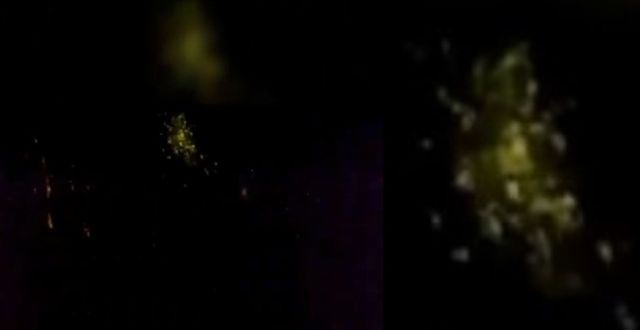





 It's a bird...
 It's a plane... It's the Shock Sensing Probe! Wait, what?!






 'What exactly is this?' Mysterious light is spotted in the...
 Is this a UFO? Baffled plane passenger films mysterious...