Naar de inhoud

UFO'S of UAP'S, ASTRONOMIE, RUIMTEVAART, ARCHEOLOGIE, OUDHEIDKUNDE, SF-SNUFJES EN ANDERE ESOTERISCHE WETENSCHAPPEN - DE ALLERLAATSTE NIEUWTJES

UFO's of UAP'S in België en de rest van de wereld
akke.beakke.be
Ontdek de Fascinerende Wereld van UFO's en UAP's: Jouw Bron voor Onthullende Informatie! Ben jij ook gefascineerd door het onbekende? Wil je meer weten over UFO's en UAP's, niet alleen in België, maar over de hele wereld? Dan ben je op de juiste plek! België: Het Kloppend Hart van UFO-onderzoek In België is BUFON (Belgisch UFO-Netwerk) dé autoriteit op het gebied van UFO-onderzoek. Voor betrouwbare en objectieve informatie over deze intrigerende fenomenen, bezoek je zeker onze Facebook-pagina en deze blog. Maar dat is nog niet alles! Ontdek ook het Belgisch UFO-meldpunt en Caelestia, twee organisaties die diepgaand onderzoek verrichten, al zijn ze soms kritisch of sceptisch. Nederland: Een Schat aan Informatie Voor onze Nederlandse buren is er de schitterende website www.ufowijzer.nl, beheerd door Paul Harmans. Deze site biedt een schat aan informatie en artikelen die je niet wilt missen! Internationaal: MUFON - De Wereldwijde Autoriteit Neem ook een kijkje bij MUFON (Mutual UFO Network Inc.), een gerenommeerde Amerikaanse UFO-vereniging met afdelingen in de VS en wereldwijd. MUFON is toegewijd aan de wetenschappelijke en analytische studie van het UFO-fenomeen, en hun maandelijkse tijdschrift, The MUFON UFO-Journal, is een must-read voor elke UFO-enthousiasteling. Bezoek hun website op www.mufon.com voor meer informatie. Samenwerking en Toekomstvisie Sinds 1 februari 2020 is Pieter niet alleen ex-president van BUFON, maar ook de voormalige nationale directeur van MUFON in Vlaanderen en Nederland. Dit creëert een sterke samenwerking met de Franse MUFON Reseau MUFON/EUROP, wat ons in staat stelt om nog meer waardevolle inzichten te delen. Let op: Nepprofielen en Nieuwe Groeperingen Pas op voor een nieuwe groepering die zich ook BUFON noemt, maar geen enkele connectie heeft met onze gevestigde organisatie. Hoewel zij de naam geregistreerd hebben, kunnen ze het rijke verleden en de expertise van onze groep niet evenaren. We wensen hen veel succes, maar we blijven de autoriteit in UFO-onderzoek! Blijf Op De Hoogte! Wil jij de laatste nieuwtjes over UFO's, ruimtevaart, archeologie, en meer? Volg ons dan en duik samen met ons in de fascinerende wereld van het onbekende! Sluit je aan bij de gemeenschap van nieuwsgierige geesten die net als jij verlangen naar antwoorden en avonturen in de sterren! Heb je vragen of wil je meer weten? Aarzel dan niet om contact met ons op te nemen! Samen ontrafelen we het mysterie van de lucht en daarbuiten.

Berichten van 1 februari 2020 tot 29 februari 2020

UFO Videos From 2020 – What Will Happen in the Next Five Years?

UFO Videos From 2020 – What Will Happen in the Next Five Years?

UFO Videos from 2019

UFO Videos From 2020 – What Will Happen in the Next Five Years?

UFO Videos from 2020 might be the most fascinating news we have ever received. Well, we have also received a lot of interesting news, which is why we have never skipped from one news item to another, like this. It might be better for you to know the truth.

Have you heard about the “Grave Deeds” which have been reported by people’s perceptions? They are quite baffling, as they are appearing all over the United States. There are also sightings of strange bodies inside a huge hole. Many scientists have proposed that these may be from extraterrestrial bodies.

They also believe that these bodies may be buried in a huge hole with some kind of protection from outside. They even say that the body in the hole is still alive.

Scientists have conducted experiments and found out that these bodies come from the Indian origin. If you want to know the truth then the grave matters can be attributed to the events at Roswell. When the reports of the incidents at Roswell were coming, there was a big panic within the country. Many people have been missing or dead.

In late 1964 the U.S. Air Force set up a base in New Mexico to investigate the craft. It was a time when the unknown and the mythical were already prevailing. So many people believe in these weird and strange encounters that they were being reported everywhere.

UFO Videos from 2020 might contain some more bizarre accounts. However, it will be interesting to see what will happen in the next few years. The tension within the country will surely continue to grow and build. I am guessing that the government is concerned with the situation.

You can also watch UFO Videos from 2020 on the Internet. By now, you should not be wondering if there is anything strange going on.

Source:

{ https://beforeitsnews.com/ }

Hoe vind je dit bericht?
Geschreven door peter om 17:01 Stuur door

Retired Colonel’s Photo Of An Alien Craft Over Arkansas

Retired Colonel’s Photo Of An Alien Craft Over Arkansas

1-9-07-VAN-BUREN-ARKANSAS-UFO-CASEBOOK.jpg

JANUARY 9, 2007 …….VAN BUREN ARKANSAS

In the wake of reports of unidentified objects flying over Chicago’s O’Hare Airport, a retired Air Force pilot has his own mystery with a rash of bright, colorful lights he photographed hovering in skies over western Arkansas last week.

“I believe these lights were not of this world, and I feel a duty and responsibility to come forward,” Col. Brian Fields told WND. “I have no idea what they were.”

Fields, 61, was cooking chicken at his Van Buren, Ark., home Jan. 9 when just before 7 p.m., he observed two intensely bright lights as he looked to the southeast close to the horizon.

“At first I thought they were landing lights from an aircraft,” he said. “As I continued to observe them they began to slowly disappear, then suddenly one reappeared, followed by two, then three. On at least one occasion four or five appeared. Each time they would slowly fade and eventually disappear. This occurred several times and when they would reappear they might do so in differing numbers and in different positions, sometimes in a triangular shape, sometimes stacked on top of each other, sometimes line abreast, etc. When the objects appeared they might stay illuminated 10 or more minutes.”

Fields’ wife thought the lights may have been ground-based, but Fields says he’s certain they were airborne. The retired colonel spent close to 32 years in the military, flying F-16s as a member of the 188th Fighter Wing of the Arkansas Air National Guard.

“I’m certain it wasn’t an aircraft [from Earth],” said Fields, who also ruled out the possibility of flares, saying they didn’t descend like flares typically do. “It’s not anything I ever had any experience with . … They were some kind of energy or something.”

Fields grabbed his Canon digital camera with 6 megapixel resolution to document what he and his wife were witnessing, and snapped numerous images of the mysterious lights.

He says the phenomenon lasted an hour and 15 minutes, and local news agencies have not published or broadcast any reports of what the couple witnessed. WND surveyed local police and sheriffs agencies, as well as Fort Chaffee, a decommissioned Army base in the region, and no one reported anything out of the ordinary.

“I just can’t imagine other people didn’t see it,” Fields said, noting they appeared at times like a yo-yo at 5 to 10 degrees above the horizon.

Earlier this month, the Chicago Tribune reported workers for United Air Lines said they saw a flying saucerlike object hovering “low over O’Hare International Airport for several minutes before bolting through thick clouds with such intense energy that it left an eerie hole in overcast skies.”

That Nov. 7 sighting took place just before sunset about 4:30 p.m.

According to Tribune columnist Jon Hilkevitch, “All the witnesses said the object was dark gray and well defined in the overcast skies. They said the craft, estimated by different accounts to be 6 feet to 24 feet in diameter, did not display any lights.

“Some said it looked like a rotating Frisbee, while others said it did not appear to be spinning. All agreed the object made no noise and it was at a fixed position in the sky, just below the 1,900-foot cloud deck, until shooting off into the clouds.”

KEN PFEIFER WORLD UFO PHOTOS AND NEWS

Source: 

{ https://beforeitsnews.com/ }

Hoe vind je dit bericht?
Geschreven door peter om 15:58 Stuur door

Unexplainable UFO Sightings

Unexplainable UFO Sightings

Afficher l’image source

In the past, UFO sightings have often been regarded as a hoax. However, now many people are going on record to tell of their encounters with mysterious flying objects. So is there really a real flying saucer phenomenon?

ufo sightings

Many UFO sightings are attributed to old space craft that have come back down to earth from outer space. There is a certain feeling of familiarity when you witness a “flying saucer” and a person have even mentioned it to you. It seems like some alien species who are visiting earth has been watching us for some time and a decision was made to observe our movements to see if we would be able to keep up. UFOs may look quite similar to ordinary planes, but in reality they are much different and much more secretive than normal planes.

Some have seen strange sounds, lights and even have been able to see or hear a “man in the moon”. So how does an unidentified flying object differ from a human-made flying craft? What is the difference? Does an unidentified flying object pose any danger to people on earth or is it just an interesting flight experience?

The UFO in fact looks just like a human body, and although the scientific process is trying to explain this discrepancy, the reality is that it just is not possible for a human body to create the same effect that the UFO could create. It simply does not work that way.

UFO sightings and strange sounds and even the strange feeling of otherworldly beings, may be different at the most superficial level. However, the real answer to the question “how do UFOs appear and disappear?” is actually quite simple.

In order for life to exist on earth, there must be an Earth-like planet around which life can grow and evolve, and we must have somehow transferred energy from another planet in order to enable life to evolve here. No one knows for sure what happened to give birth to life on this planet, but there is no doubt that a very important event took place to evolve life on earth. It’s called the Big Bang.

This event happened billions of years ago and the explosion of the star formed the solar system, and the planets around the star. Unfortunately, the existence of life cannot exist without oxygen. Without oxygen, the life form will not survive. We have already known that there are bacteria living in the oceans around the world and there is no way these organisms could possibly survive without oxygen. Therefore, the very first life forms on this planet came about because of some energy transfer from another planet, from another star.


Source: 

{ https://beforeitsnews.com/ }

Hoe vind je dit bericht?
Geschreven door peter om 12:56 Stuur door

Did Area 51 accidentally admit it reverse engineers UFOs? Maybe, Docs Show

Did Area 51 accidentally admit it reverse engineers UFOs? Maybe, Docs Show

Several government whistleblowers have claimed a secretive "Project Redlight" was carried out near Area 51 with an effort to reverse engineer extraterrestrial craft.

area-51-reverse-engineering-ufo.jpg

Now, never-before-noticed documents confirm a Project Redlight was real, and it was operated inside Project Oxcart, a program designed to test experimental aircraft.

No official definition stating Redlight's purpose (or the nature of its test vehicles) has been declassified, but interestingly, near the same time it was ongoing, a major defense contractor was researching propulsion methods behind unidentified flying object (UFO) data, and attempting to figure out how the craft worked, and how they could be controlled by a pilot.

  
Hoe vind je dit bericht?
Geschreven door peter om 12:28 Stuur door

NASA solar probe smashes two wild records as it approaches the sun

NASA solar probe smashes two wild records as it approaches the sun

Gotta go fast.

Jackson Ryan mugshot Jackson Ryan  

wts-parker-solar-probe-cnet-thumb

New record! NASA

NASA's Parker Solar Probe just took the record for the fastest human-made object and the closest object to the sun from... NASA's Parker Solar Probe.

The solar probe, launched in August 2018, is built to withstand the scorching temperatures of the sun's outer atmosphere, unraveling some of the mysteries lurking within. A suite of four instruments on board will help scientists understand how the sun's corona and solar wind affects the Earth and the rest of the solar system.

Besides the cool science, Parker is also in an orbit around the sun that makes it go really, really fast and gets it close enough to "touch" the sun.

Parker smashed its own records for speed and proximity to the blazing star, according to mission control at Johns Hopkins Applied Physics Laboratory during its flyby on Jan. 29. The flyby was the probe's fourth close approach to the sun ("perihelion") and in the early hours of Feb. 1, the car-sized spacecraft beamed back a "status A" signal to Earth, the best of four possible signals. Basically, Parker gave a thumbs-up to say "I survived."

Parker set two records in November 2018:

  • Fastest human-made object: 153,454 mph (247,000 km/h)
  • Closest spacecraft to the sun: 26.55 million miles (42.7 million kilometers)

But those records have now been surpassed. The new records stand at:

  • Fastest human-made object: 244,255 mph (393,044 km/h)
  • Closest spacecraft to the sun: 11.6 million miles (18.6 million kilometers)

Parker will continue to smash its own records all the way through to 2024 as it gets ever closer to the sun. Protected by a cutting-edge heat shield, the probe will eventually get within 4.3 million miles of the sun's "surface."

In December 2019, Parker's first batch of data was released in prestigious journal Nature, pulling back the (incredibly bright) curtain on the charged particles and plasma dynamics in the sun's outer atmosphere.

It's already turning out to be a good year for sun science.

On Jan. 29, another sun surveyor -- the Daniel K. Inouye telescope in Hawaii -- snapped the highest-resolution images of the sun's surface yet. The telescope, which is approximately 80-odd million miles further from the sun than NASA's Parker probe, is the most powerful solar telescope ever built, and it's not even online yet. Full operation should begin in July.

On Feb. 9, the European Space Agency will launch the Solar Orbiter. That spacecraft won't get as close to the sun as Parker, but it will help guide our understanding of how the star affects our solar system.

Hoe vind je dit bericht?
Geschreven door peter om 10:11 Stuur door

UFO sightings declassified: What is hidden in the RAF's secret UFO files? Full disclosure?

UFO sightings declassified: What is hidden in the RAF's secret UFO files? Full disclosure?

UFO sightings documented by the Royal Air Force are to be released to the public, promising to reveal "interesting nuggets" about Britain's history of possible alien encounters, a former UFO investigator told Express.co.uk.

The RAF will publish later this year the files and documents collected by its UFO unit over the last 50 years. Until 2009, the RAF investigated public reports of unidentified flying objects (UFOs) and other aerial phenomena to asses their potential threat to Britain. 

But after 50 years of seemingly fruitless investigations and no discernible alien-based threat found, the RAF ended its UFO-hunting efforts.

Now, after a Freedom of Information Act was filed with the RAF, the aerial brand of the armed forces revealed its plans to make its files public.

Nick Pope, a former UFO investigator for the Ministry of Defence, welcomed the move towards more transparency.

He told Express.co.uk: “The soon-to-be-released files are public correspondence ones, so there should be an interesting mix of Freedom of Information Act requests along with the MoD responses, and of course the UFO reports themselves.

UFO sightings: Alien spaceship and RAF flag

UFO sightings: The RAF will disclose its UFO files later this year 
(Image: GETTY)

UFO sightings: Alien spaceship in a forest

UFO sightings: Could alien spaceships be flying over the UK? 
(Image: GETTY)

“The MoD may have stopped investigating UFOs in 2009 when they axed their UFO project, but people didn't stop having sightings.

“While most FOIA responses are standard replies, some can be more revealing, if people ask smart questions.

“And while most UFO sightings are reports of lights in the sky, some cases can be truly spectacular, so all in all, there should be some interesting nuggets in these new files.”

Until recently, the RAF would hand its classified UFO files over to the National Archives.

The digitised files, however, will be published online and on a dedicated www.gov.uk website, accessible to all.

A spokesman for the RAF said “it had been assessed that it would be better to publish these records, rather than continue sending documents to the National Archives, and so they are looking to put them on to a dedicated gov.uk web page”.

After the files are cleared for publishing, they are expected to be go live online at later date in 2020.

We don't have a UFO hidden away at an RAF base somewhere

Nick Pope, former UFO investigator

Mr Pope argued the move will make it easer for people to access the declassified documents.

He said: “While some previously-released UFO files were digitised and made available online, the more recently released files were only available in hard copy, so people either had to go in person to The National Archives in Kew and sit in the reading room for hours, or order copies through the post - and pay for the privilege.

“These upcoming files should be posted on the www.gov.uk website, hopefully by the end of March, and maybe much sooner - perhaps literally within days.”

Unfortunately, the former UFO investigator does not think the RAF files will hold the “smoking gun” so many alien hunters and conspiracy theorists are hoping for.

DON’T MISS

UFO sightings: Alien ship over a city

UFO sightings: The RAF files will be digitised and published on the internet 
(Image: GETTY)

UFO sightings: Photo of alien spaceship

UFO sightings: There is no evidence to suggest aliens are real 
(Image: GETTY)

Mr Pope said: “The UFO community always get excited about the MoD releasing batches of UFO files.

“They have a binary view of them, believing they either will or won't contain some sort of definitive smoking gun.

“The hopeful ones believe this sort of thing is a prelude to 'Disclosure', while the more cynical or conspiratorial ones think it's all disinformation and that the 'good stuff' is kept back.

“In reality, the files are not that black and white. They convey a more subtle truth about the UFO phenomenon, namely that while most sightings turn out to be misidentifications of ordinary objects and phenomena, some appear to defy conventional explanation.

“But despite the conspiracy theories, even those of us in government who looked at this officially didn't have all the answers.”

The UFO expert added: “Before people get too excited, they should bear in mind that all MoD documents and files - on any subject, not just UFOs - being prepared for public release will be carefully vetted.

“Subject matter experts go through papers line by line, word by word, to ensure that no information falling within the scope of the various FOIA exemptions is released.

“These exemptions are widely defined and cover categories such as defence, national security and intelligence matters.

“The bottom line - and I'm not being flippant here - is that we don't have a UFO hidden away at an RAF base somewhere, but if we did, it would probably be classified, exempt from disclosure, and not something that would be publicly released.”

Hoe vind je dit bericht?
Geschreven door peter om 01:27 Stuur door

Supermassive Black Hole at The Center of Our Galaxy may Have a Friend

Supermassive Black Hole at The Center of Our Galaxy may Have a Friend

file-20191209-90609-1b1921c.jpg?ixlib=rb-1.1.0&rect=0%2C4%2C1041%2C579&q=45&auto=format&w=754&fit=clip

An artist’s conception of two black holes entwined in a gravitational tango.  NASA/JPL-Caltech/SwRI/MSSS/Christopher Go
Do supermassive black holes have friends? The nature of galaxy formation suggests that the answer is yes, and in fact, pairs of supermassive black holes should be common in the universe.
I am an astrophysicist and am interested in a wide range of theoretical problems in astrophysics, from the formation of the very first galaxies to the gravitational interactions of black holes, stars and even planets. Black holes are intriguing syste
ms, and supermassive black holes and the dense stellar environments that surround them represent one of the most extreme places in our universe.
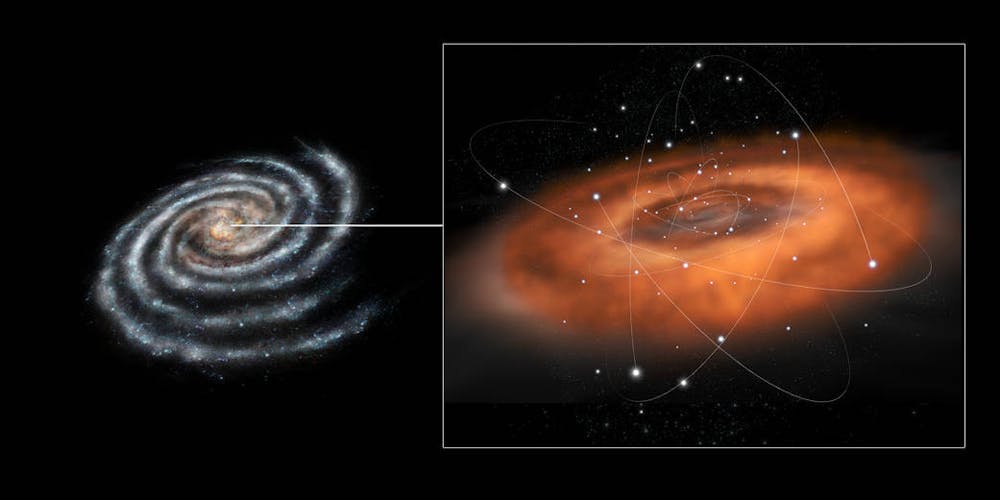
The supermassive black hole that lurks at the center of our galaxy, called Sgr A*, has a mass of about 4 million times that of our Sun. A black hole is a place in space where gravity is so strong that neither particles or light can escape from it. Surrounding Sgr A* is a dense cluster of stars. Precise measurements of the orbits of these stars allowed astronomers to confirm the existence of this supermassive black hole and to measure its mass. For more than 20 years, scientists have been monitoring the orbits of these stars around the supermassive black hole. Based on what we’ve seen, my colleagues and I show that if there is a friend there, it might be a second black hole nearby that is at least 100,000 times the mass of the Sun.
At the center of our galaxy is a supermassive black hole in the region known as Sagittarius A. It has a mass of about 4 million times that of our Sun.  ESA–C. Carreau

Supermassive black holes and their friends

Almost every galaxy, including our Milky Way, has a supermassive black hole at its heart, with masses of millions to billions of times the mass of the Sun. Astronomers are still studying why the heart of galaxies often hosts a supermassive black hole. One popular idea connects to the possibility that supermassive holes have friends.
To understand this idea, we need to go back to when the universe was about 100 million years old, to the era of the very first galaxies. They were much smaller than today’s galaxies, about 10,000 or more times less massive than the Milky Way. Within these early galaxies the very first stars that died created black holes, of about tens to thousand the mass of the Sun. These black holes sank to the center of gravity, the heart of their host galaxy. Since galaxies evolve by merging and colliding with one another, collisions between galaxies will result in supermassive black hole pairs – the key part of this story. The black holes then collide and grow in size as well. A black hole that is more than a million times the mass of our son is considered supermassive.
If indeed the supermassive black hole has a friend revolving around it in close orbit, the center of the galaxy is locked in a complex dance. The partners’ gravitational tugs will also exert its own pull on the nearby stars disturbing their orbits. The two supermassive black holes are orbiting each other, and at the same time, each is exerting its own pull on the stars around it.
The gravitational forces from the black holes pull on these stars and make them change their orbit; in other words, after one revolution around the supermassive black hole pair, a star will not go exactly back to the point at which it began.
Using our understanding of the gravitational interaction between the possible supermassive black hole pair and the surrounding stars, astronomers can predict what will happen to stars. Astrophysicists like my colleagues and me can compare our predictions to observations, and then can determine the possible orbits of stars and figure out whether the supermassive black hole has a companion that is exerting gravitational influence.
Using a well-studied star, called S0-2, which orbits the supermassive black hole that lies at the center of the galaxy every 16 years, we can already rule out the idea that there is a second supermassive black hole with mass above 100,000 times the mass of the Sun and farther than about 200 times the distance between the Sun and the Earth. If there was such a companion, then I and my colleagues would have detected its effects on the orbit of SO-2.
But that doesn’t mean that a smaller companion black hole cannot still hide there. Such an object may not alter the orbit of SO-2 in a way we can easily measure.

The physics of supermassive black holes

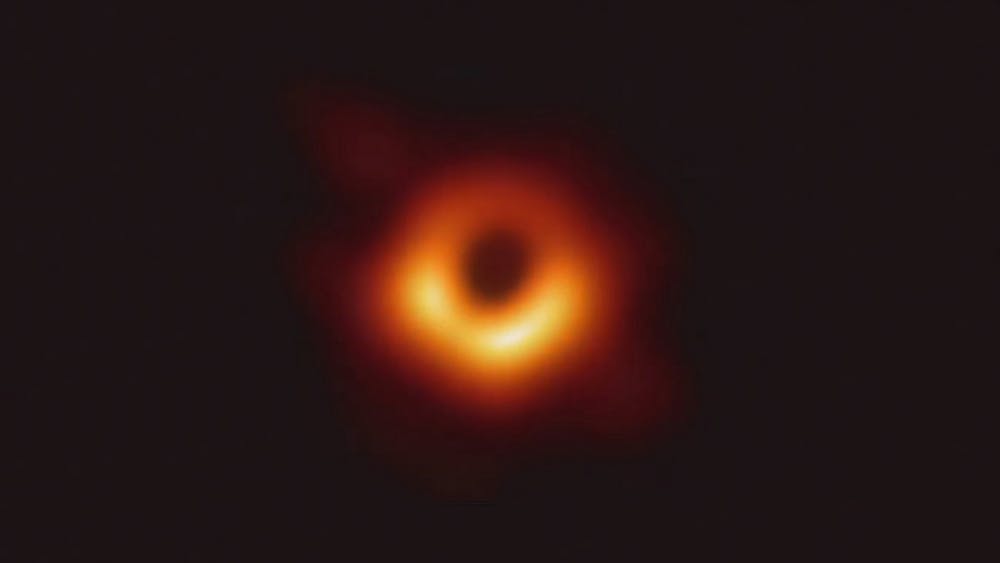
Supermassive black holes have gotten a lot of attention lately. In particular, the recent image of such a giant at the center of the galaxy M87 opened a new window to understanding the physics behind black holes.
The first image of a black hole. This is the supermassive black hole at the center of the galaxy M87.  Event Horizon Telescope Collaboration, CC BY-SA
The proximity of the Milky Way’s galactic center – a mere 24,000 light-years away – provides a unique laboratory for addressing issues in the fundamental physics of supermassive black holes. For example, astrophysicists like myself would like to understand their impact on the central regions of galaxies and their role in galaxy formation and evolution. The detection of a pair of supermassive black holes in the galactic center would indicate that the Milky Way merged with another, possibly small, galaxy at some time in the past.
That’s not all that monitoring the surrounding stars can tell us. Measurements of the star S0-2 allowed scientists to carry out a unique test of Einstein’s general theory of relativity. In May 2018, S0-2 zoomed past the supermassive black hole at a distance of only about 130 times the Earth’s distance from the Sun. According to Einstein’s theory, the wavelength of light emitted by the star should stretch as it climbs from the deep gravitational well of the supermassive black hole.
The stretching wavelength that Einstein predicted – which makes the star appear redder – was detected and proves that the theory of general relativity accurately describes the physics in this extreme gravitational zone. I am eagerly awaiting the second closest approach of S0-2, which will occur in about 16 years, because astrophysicists like myself will be able to test more of Einstein’s predictions about general relativity, including the change of the orientation of the stars’ elongated orbit. But if the supermassive black hole has a partner, this could alter the expected result.
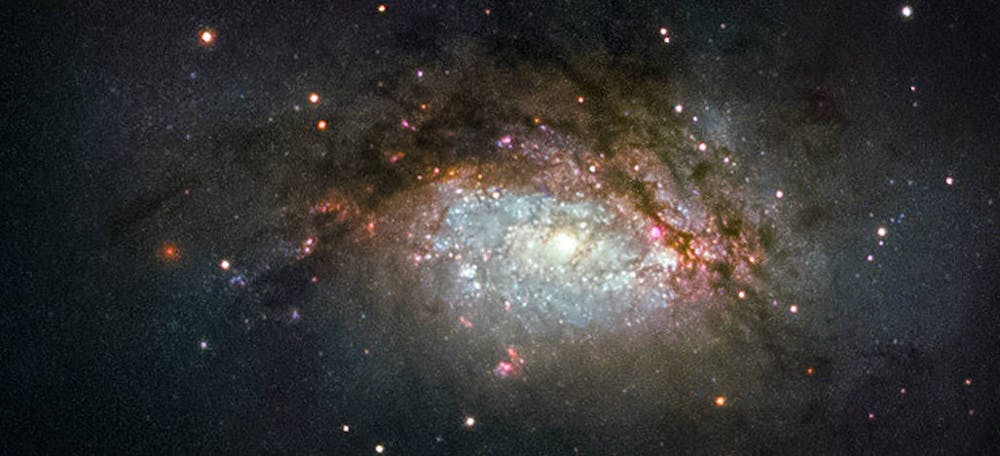
This NASA/ESA Hubble Space Telescope image show’s the result of a galactic collision between two good-sized galaxies. This new jumble of stars is slowly evolving to become a giant elliptical galaxy.  ESA/Hubble & NASA, Acknowledgement: Judy Schmidt
Finally, if there are two massive black holes orbiting each other at the galactic center, as my team suggests is possible, they will emit gravitational waves. Since 2015, the LIGO-Virgo observatories have been detecting gravitational wave radiation from merging stellar-mass black holes and neutron stars. These groundbreaking detections have opened a new way for scientists to sense the universe.
Any waves emitted by our hypothetical black hole pair will be at low frequencies, too low for the LIGO-Virgo detectors to sense. But a planned space-based detector known as LISA may be able to detect these waves which will help astrophysicists figure out whether our galactic center black hole is alone or has a partner.

{ http://cosmicdatabase.blogspot.com/ }

Hoe vind je dit bericht?
Geschreven door peter om 01:02 Stuur door

Cit­izen scientists identify new form of north­ern lights

Cit­izen scientists identify new form of north­ern lights

Space researchers and amateur photographers in Finland have identified a new type of aurora, or northern lights. They call them “dunes.” Read more and see a video.

Something new under the sun! Working together with space researchers, Finnish amateur photographers have announced a type of aurora, or northern lights, never before described. They call the green-tinged aurora dunes, because, they said, it appears as an evenly spaced pattern of waves, resembling:

… a striped veil of clouds or dunes on a sandy beach.

The scientific community has acknowledged the newly categorized northern lights via the publication on January 28, 2020, of a study in a peer-reviewed journal, AGU Advances. The study tracked the origin of the dunes to the mesosphere and its boundary, the mesopause.

A statement from University of Helsinki explained how aurorae are made:

The sun releases a steady flow of charged particles, known as the solar wind. Reaching the Earth’s ionized upper atmosphere, the ionosphere, they create auroral emissions by exciting atmospheric oxygen and nitrogen atoms. The excitation state is released as auroral light.

A man with a camera and tripod, seated by a body of water.

Finnish nature photographer Matti Helin took some of the photos that led to the new categorization and understanding of the dune-like northern lights.

Image via Matti Helin.

Like most scientific discoveries, the new form of northern lights came to be identified both serendipitously and also with some serious effort. Matti Helin, a northern lights and astronomy hobbyist who took part in the study, told EarthSky:

On October 7, 2015, there was a magnificent storm of auroras. One observer, Mikko Peussa, uploaded his photos and wondered what were these strange stripes in the picture. The same phenomenon was photographed by several people that night, including me.

He said the photos were posted at the website Taivaanvahti, which is an observation system maintained by Astronomical Association Ursa of Finland. A discussion began about the unusual lights. Helin said:

Taivaanvahti was the initial place where the seeds for this project were planted.

Smiling woman.

Aurora expert Minna Palmroth was writing a book – with the help of aurora photographers – when the hobbyists pointed out to her the new form of northern lights not previously categorized.

Image via University of Helsinki.

Then, in late 2018, Minna Palmroth, an aurora expert at the University of Helsinki, published a book titled Revontulibongarin opas (A guide for aurora borealis watchers):

The book was born out of Palmroth’s cooperation with northern lights enthusiasts and the answers she provided to questions about the physics of the phenomenon in the hobbyists’ Facebook group [the group is called Revontulikyttääjät or Aurora Stalkers). Thousands of magnificent photographs of the northern lights taken by hobbyists were surveyed and categorized for the book. Each auroral form is like a fingerprint, typical only of a certain phenomenon in the auroral zone.

During the classification, hobbyists pointed out that a certain auroral form did not fit into any of the pre-existing categories. Palmroth set aside these unusual forms for later consideration.

By an almost unbelievable coincidence, just days after the book was published, the hobbyists saw this unusual form again and immediately informed Palmroth.

Matti Helin commented:

One of the most memorable moments of our research collaboration was when the phenomenon appeared at that specific time and we were able to examine it in real time.

The new observations helped them all identify and categorize the new form. Helin said:

It was like piecing together a puzzle or conducting detective work. Every day we found new images and came up with new ideas. Eventually, we got to the bottom of it…

Palmroth and the citizen scientists believe that the dune-shaped auroral emissions are created when solar wind charges the oxygen atoms in a particular way. It happens when a rare gravity wave rising up in the atmosphere is filtered and bent to travel between the mesopause and an inversion layer intermittently formed below the mesopause. The mesopause and the inversion layer are colder than the other layers of the atmosphere. A wave channel is established between the two layers. In that channel, gravity waves coming from below can travel long distances without subsiding.

It’s gravity waves surging through the channel that create the dune-shaped northern lights.

Palmroth and the citizen scientists said this new auroral form provides researchers with a novel way to investigate conditions in the upper atmosphere.

Diagram of bent gravity wave affecting shape of aurora high above Earth.

How the new form of dune-like northern lights are created. A gravity wave rises up in the atmosphere and begins to travel between the mesopause and an inversion layer intermittently formed below the mesopause. A wave channel is established between the 2 layers. It’s gravity waves surging through the channel that create the dune-shaped northern lights.

Graphic via Jani Närhi/ University of Helsinki.

Horizontal waves of green light above a seacoast.

The new auroral form – called “dunes” – appears as a green-tinged and evenly spaced pattern of waves resembling “a striped veil of clouds or dunes on a sandy beach.”

Image via Kari Saari/ University of Helsinki.

By the way, auroras on Earth are seen at high latitudes throughout each year, but – because they stem from activity on the sun – they are most intense and frequent when the sun is in an active part of its 11-year cycle. We’ve been at the low point of a cycle – with few spots seen on the sun’s surface, for example – but the sun should begin rising in activity soon, if it hasn’t begun already. The new cycle will be Cycle 25. It’s expected to be average in intensity, similar to Cycle 24. In the meantime, here’s a beautiful photo from Matti Helin of northern lights seen from Finland, captured in September 2019. It’s not the new form! But we know you’ll enjoy it …

Afficher l’image source

In these images, the edge of the dunes are marked with numbered points in purple.

AGU

{ https://earthsky.org/ }

Hoe vind je dit bericht?
Geschreven door peter om 00:33 Stuur door

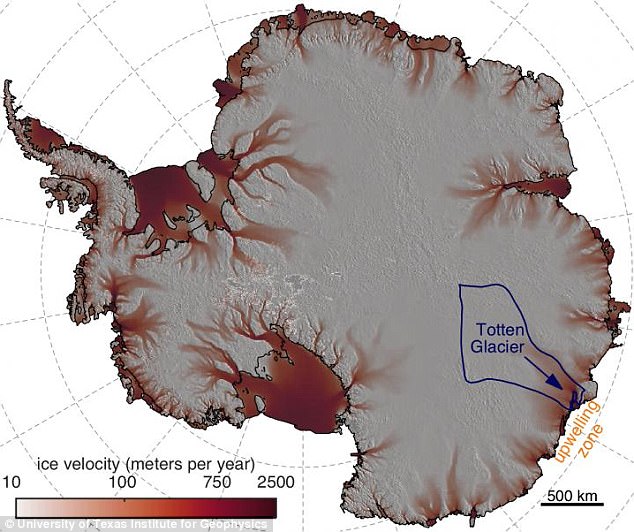
Gigantic Totten glacier in Antarctica is 'melting from beneath' and could cause sea levels to rise 11 FEET

Gigantic Totten glacier in Antarctica is 'melting from beneath' and could cause sea levels to rise 11 FEET

  • New study found that East Antarctica’s largest glacier is melting from beneath
  • This happens as strong winds over Southern Ocean allow warm water to rise
  • Winds are expected to intensify with climate change, causing further melting

With the potential to cause sea levels to rise by more than 11 feet and unleash the ice of the East Antarctic Ice Sheet, the massive Totten Glacier has come to be known as the ‘sleeping giant.’

And now, scientists have discovered that strong winds over the Southern Ocean could be causing it to wake up.

A new study has found that East Antarctica’s largest glacier is melting from beneath, as winds transport warm water to the ice – and, these winds are expected to intensify with climate change, the experts warn.

Scroll down for video 

The research revealed that the glacier’s flow speeds up when winds over the Southern Ocean are strong. These winds pull warm water up from the deep ocean, in a process known as upwelling

The research revealed that the glacier’s flow speeds up when winds over the Southern Ocean are strong.These winds pull warm water up from the deep ocean, in a process known as upwelling.

EAST ANTARCTICA MORE STABLE THAN THE WEST

A recent study conducted by researchers based at Indiana University-Purdue University Indianapolis has found that the central core of the East Antarctic ice sheet should remain stable even if the West Antarctic ice sheet melts.

The West Antarctic ice sheet is a marine-based ice sheet that is mostly grounded below sea level, which makes it much more susceptible to changes in sea level and variations in ocean temperature than the East Antarctic Ice Sheet.

By contrast the East Antarctic ice sheet has been considered relatively stable because most of the ice sheet was though to rest on bedrock above sea level, making it less susceptible to changes in climate.

In the study, led by researchers at the University of Texas at Austin, used satellite images and wind stress data to investigate the effect of wind on the water beneath the glacier.

While the glacier is known to speed up some years, it also slows down in others.

The research revealed that the glacier’s flow speeds up when winds over the Southern Ocean are strong.

These winds pull warm water up from the deep ocean, in a process known as upwelling.

The warm water climbs to the continental shelf – and, once it reaches the coast, it circulates beneath a floating chunk of the glacier, and causes the ice sheet to melt from below, according to the researchers.

‘Totten has been called the sleeping giant because it’s huge and has been seen as insensitive to changes in its environment,’ said lead author Chad Greene, a PhD candidate at the University of Texas Institute for Geophysics (UTIG).

‘But we’ve shown that if Totten is asleep, it’s certainly not in a coma – we’re seeing signs of responsiveness, and it might just take the wind blowing to wake it up.’

Wind strength varies from year to year, the researchers explain.

But, climate change is expected to intensify the winds over the Southern Ocean, which could, in turn, effect the melting of the Totten Glacier.

The process does not require the air or ocean temperatures to rise – instead, upwelling occurs as the wind displaces the surface water, making way for the deeper, warmer water.

‘It’s like when you blow across a hot bowl of soup and little bits of noodles from the bottom begin to swirl around and rise to the top,’ said Greene.

The new study follows up on previous research led by a team with the Australian Antarctic Division at the Antarctic Climate & Ecosystems Cooperative Research Center.

That research found that the warm water below Totten causes the glacier to detach from the seafloor, and instead float.

This can cause the flow to further accelerate.

The Totten Glacier is one of the fastest-flowing and largest glaciers in Antarctica with scientists keen to keep a close eye on how it melts given the enormous amount of water it could potentially unleash

With the potential to cause sea levels to rise by more than 11 feet and unleash the ice of the East Antarctic Ice Sheet, the massive Totten Glacier has come to be known as the ‘sleeping giant’

‘The remaining question was, why do the canyons beneath Totten get flushed with warm water some years and cold water other years,’ said Jason Roberts, a glaciologist who led the earlier study.

The findings suggest melting at Totten could become more extreme as winds grow stronger with climate change.

‘Ice sheet sensitivity to wind forcing has been hypothesized for a long time, but it takes decades of observation to show unequivocal cause and effect,’ said Donald Blankenship, a senior researcher at UTIG who contributed to this study and Roberts’ study.

‘Now we’re at the point where we can explicitly show the links between what happens in the atmosphere, what happens in the ocean, and what happens to the Antarctic Ice Sheet.’ 

{ https://www.dailymail.co.uk/ }

Hoe vind je dit bericht?
Geschreven door peter om 23:56 Stuur door

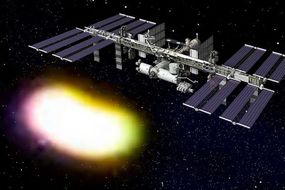
Astronaut Screams At The Sight Of A UFO When Approaching The ISS

Astronaut Screams At The Sight Of A UFO When Approaching The ISS

It is very intriguing to note the automatic, conditioned reaction of the fellow astronaut who immediately calmed her with an apparent sense of urgency before she could even fully let out a scream.

Italy's first female astronaut, Samantha Cristoforetti can be heard shouting over the comms from her Soyuz spacecraft during docking maneuvers with the International space Station. What was the cause of her alarm?

Would or even could NASA tell us if they think E.T.'s may be monitoring our world?
Wouldn't they have to withhold such information, if it were true as a matter of national and international security in fact?

{ https://www.disclose.tv/ }

Hoe vind je dit bericht? 1 stem
Geschreven door peter om 23:22 Stuur door

NASA's Parker Solar Probe spotted 'stealth' outburst on the sun

NASA's Parker Solar Probe spotted 'stealth' outburst on the sun

Hoe vind je dit bericht?
Geschreven door peter om 22:35 Stuur door

VREEMDE PIRAMIDES IN DE LUCHT ( VIDEO )

VREEMDE PIRAMIDES IN DE LUCHT ( VIDEO )

pir.jpg

Ondanks dat er heel veel nepbeelden rondzwerven op internet komt er af en toe ook wat betrouwbaar materiaal bovendrijven.

En in enkele daarvan verschijnen vreemde piramidevormige objecten in de lucht.


We beginnen met een lezer die het volgende bericht stuurt (dank!):

Van de week was ik aan t rondkijken op Google Earth, ik zoomde zomaar ergens op in en kwam bij deze foto terecht. Jullie kunnen dit zelf vinden als je bv “half way across australia of kimba intikt”
Ik merk wel meer foto’s op door de jaren heen met een ‘extra’ zon/ster Links boven de zon (ook op deze foto dus) en volg dan ook t verhaal rond niburu wel. Maar boven dat extra lichtpuntje zag ik tot mijn verbazing deze piramide in de lucht.

Het blauwe bolletje op de afbeelding is een lensflare, maar daarboven is heel duidelijk een piramidevormig object waar te nemen. Aangezien de opname afkomstig is van Google Earth nemen we aan dat er niet mee is geknoeid en dat zich daar wel degelijk iets bevindt.

Een object dat een beetje half "gecloaked" is, onzichtbaar voor het oog, maar dat er wel degelijk is. Dat cloaken/onzichtbaar maken vindt ook vaak plaats door de vorm van een wolk aan te nemen, maar daar is in dit geval geen sprake van omdat het een helder blauwe lucht is. 

Om dat soort objecten toch zichtbaar te maken, maken ufo-spotters vaak gebruik van infrarood camera's zoals we eerder schreven.

xxx

Het toeval wil dat de bekende Youtuber Mr. MB333 ook een opname heeft van een gecloakte piramide in de lucht. Dit keer is het wel een wolk die een rol speelt en de foto is enkele dagen geleden gemaakt door één van zijn volgens in Tulsa in de Amerikaanse staat Oklahoma.

Op volgende foto zie je de piramide rechtsboven en het zwarte pijltje ernaast rechts is de cursor van Mr. MB333, dus geen ufo. Rechts onderin beeld, net boven het gebouw, is wel ook nog een schotelvormige gecloakte ufo te zien denken wij.

xxx

De volgende foto geeft een wat duidelijker beeld van de piramide vormige ufo.

xxx

Enkele maanden geleden kwam via dezelfde bron ook al een bijzondere opname van een piramide in de lucht.

Zoals een vrouw genaamd Venetia enkele dagen geleden overkwam in de buurt van de Amerikaanse stad Philadelphia. Ze zag een piramide in de lucht en terwijl normaal gesproken piramides ferm op de grond staan, was dat hier niet het geval.

Ook scheen er een soort verlichting van achter de piramide te zijn, waardoor het object goed zichtbaar was aan de avondhemel. Wat het is, weet tot op dit moment helemaal niemand.

xxx

In december 2018 schreven wij het volgende over piramidevormige ufo's:

Ondanks dat de waarneming boven Moskou negen jaar geleden plaatsvond, is niemand er nog is geslaagd om hier een verklaring voor te vinden.

Om te zien hoe het er in Moskou destijds uitzag, hierna nog eens de opname:


Nu zijn we negen jaar verder en wordt er boven het Pentagon in Amerika een vergelijkbaar object waargenomen.

Een lezer schrijft daarover het volgende:
 
Het is op 19 december al gebeurd, en ik dacht: jullie rapporteren er ook wel over, maar dat hebben jullie nog niet gedaan. Het gaat om een piramidevormige UFU boven het Pentagon. Eerder, in 2009 en opnieuw in 2013, is eenzelfde object ook al uitgebreid gefilmd boven het Kremlin in Moskou.


Omdat er meerdere opnames zijn, ook van de UFO boven het Kremlin, lijken filmbewerkingen in deze gevallen uitgesloten. Ook een Russische politicus ( https://en.wikipedia.org/wiki/Aleksey_Pushkov ) heeft de UFO boven het Kremlin dus besproken in zijn politieke praatprogramma op de Russische televisie, en hij heeft het zeer serieus genomen.

De opname vanuit een auto, op 19 december, is naar mijn mening echt spectaculair. Ze rijden vlak langs het Pentagon en ze zeggen op een gegeven moment dat de UFO verdwenen is, terwijl op hetzelfde moment op hun opname, boven in beeld, je de gigantische UFO nog gewoon kan zien, maar ze kijken er onder door of ze herkennen de vorm even niet.


Volgens mij zijn deze beelden net zo spectaculair als indertijd de UFO boven de Rotskoepel op de Tempelberg in Jerusalem, alleen gaat het nu om een veel groter object dat ook veel langer is blijven hangen, met name indertijd in Moskou boven het Kremlin, en dit object is kennelijk geïnteresseerd in de beleidsmakers/machtscentra van de twee grootste kernmachten.

Tot zover de lezer.

Hier volgt een derde opname gemaakt van de vreemde ufo boven het Pentagon:


{ https://niburu.co/ }

Hoe vind je dit bericht?
Geschreven door peter om 22:18 Stuur door

Uh-oh — Now the Polar Ice Cap on Mars is Melting Too

mars-ice-cap-e1580774886774-999x540.jpg

Uh-oh — Now the Polar Ice Cap on Mars is Melting Too

For those hoping to one day escape climate change on Earth before the polar ice caps melt and cover major cities with water, you can cross Mars off of your list of potential sanctuary planets. New videos from the Red Planet show white ice caps melting and that’s making some folks blue … although not at NASA.

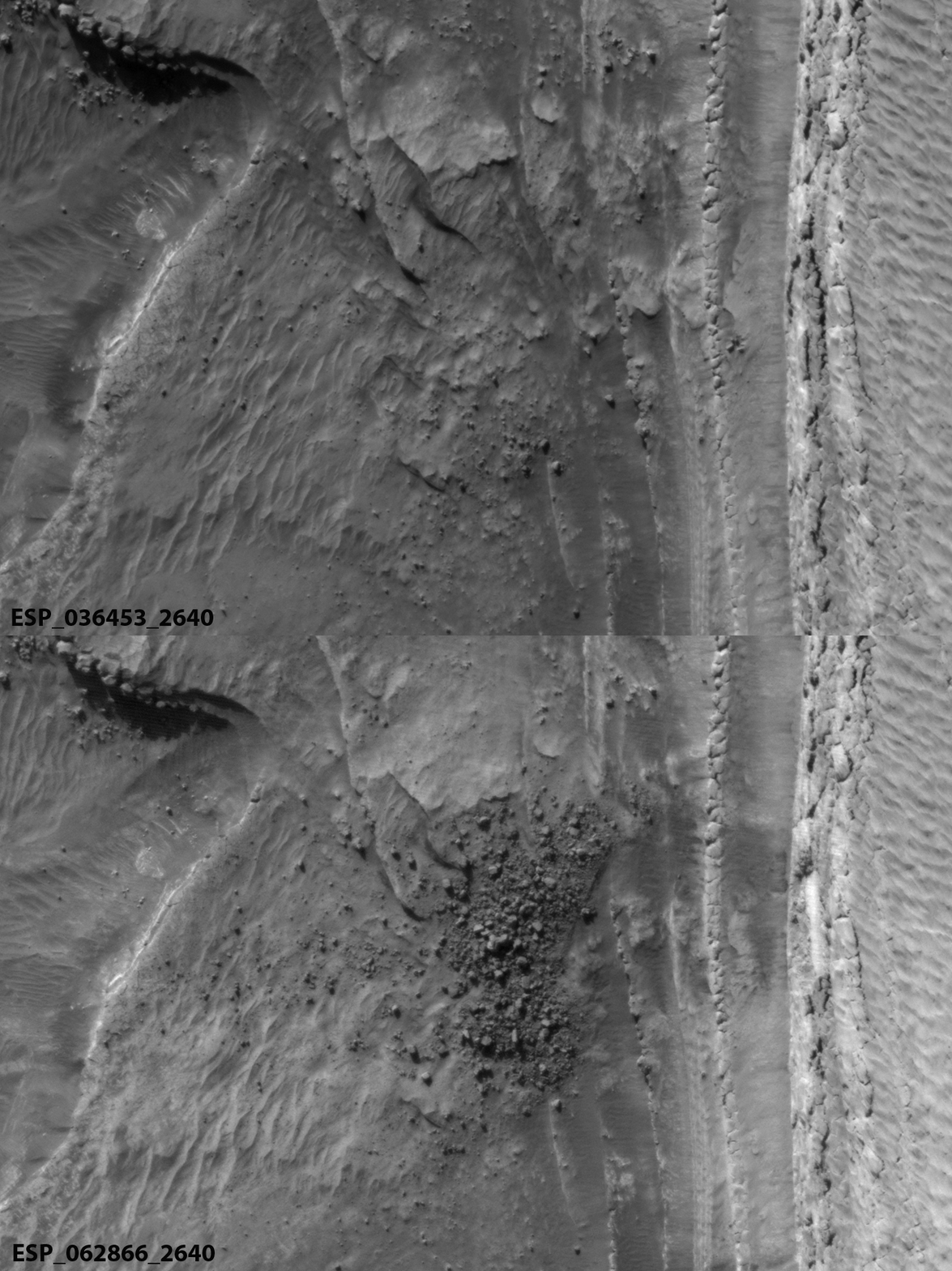
“This animation shows where a section of the slope at right has collapsed since three Mars-years ago and deposited a field of ice blocks.”

Planetary geologist Alfred McEwen is referring to a HiRise image from Mars released on January 31, 2020. HiRise is the High Resolution Imaging Science Experiment camera on the Mars Reconnaissance Orbiter which is taking extremely high resolution photographs — 0.3 m/pixel (about 1 foot). This is the camera which has picked up both the Mars Opportunity and Curiosity rovers. The “animation” (watch it here) switches between two photographs of the same spot – one taken on December 25, 2019, and the other three Martian years (2,61 days or 5.6 Earth years) ago.

Fallen ice blocks from polar cap collapsing

The images are from the Martian north pole and show a solid ice cap 5.6 years ago and a pile of ice block rubble today. Ice falling off of the ice cap can’t be good news … it’s terrible news in Antarctica, where the melting of the so-called Doomsday Glacier is quickly heading it to its own collapse, the global rising of the oceans and all of the negative consequences that will bring. Is Mars headed for the same fate … before humans can got here and cause it themselves?

“In contrast to shrinking ice caps on Earth, climate change is not to blame on Mars. This mesa in this cutout is shrinking over time as the frozen carbon dioxide turns to vapor. Pits in this sheet of dry ice (that give the deposit an appearance resembling Swiss cheese) are enlarging over time, exposing an older surface below that is likely made up of water ice.”

The HiRise camera before launch

Well, that’s a relief … in a good news/bad kind of way. More carbon dioxide in the Martian atmosphere is not necessarily good news, but water ice closer to or on the surface is good news for human explorers looking for water. On the other hand, melting ice also causes avalanches – something the HiRise also picked up at the Marian north pole last year. Again, NASA downplayed it as something expected to happen every Martian year when the sun hits the Martian cliffs, melting the ice and sending blocks crashing down steep slopes, eventually kicking up dust, not snow.

Nothing to worry about, says NASA. Go back to thinking about the problems that will be created AFTER humans settle to Mars.

{ https://mysteriousuniverse.org/ }

Hoe vind je dit bericht?
Geschreven door peter om 22:01 Stuur door

How the Tiniest Particles in Our Universe Saved Us from Complete Annihilation

How the Tiniest Particles in Our Universe Saved Us from Complete Annihilation

Afficher l’image source

Recently discovered ripples of spacetime called gravitational waves could contain evidence to prove the theory that life survived the Big Bang because of a phase transition that allowed neutrino particles to reshuffle matter and anti-matter, explains a new study by an international team of researchers.

How we were saved from a complete annihilation is not a question in science fiction or a Hollywood movie. According to the Big Bang theory of modern cosmology, matter was created with an equal amount of anti-matter. If it had stayed that way, matter and anti-matter should have eventually met and annihilated one to one, leading up to a complete annihilation.

Fig 1: Inflation stretched the initial microscopic Universe to a macroscopic size and turned the cosmic energy into matter. However, it likely created an equal amount of matter and anti-matter predicting complete annihilation of our universe. The authors discuss the possibility that a phase transition after inflation led to a tiny imbalance between the amount of matter and anti-matter, so that some matter could survive a near-complete annihilation. Such a phase transition is likely to lead to a network of “rubber-band”-like objects called cosmic strings, that would produce ripples of space-time known as gravitational waves. These propagating waves can get through the hot and dense Universe and reach us today, 13.8 billion years after the phase transition. Such gravitational waves can most likely be discovered by current and future experiments. 

Original credit: R. Hurt/Caltech-JPL, NASA, and ESA 
Credit: Kavli IPMU – Kavli IPMU modified this figure based on the image credited by R.Hurt/Caltech-JPL, NASA, and ESA

But our existence contradicts this theory. To overcome a complete annihilation, the Universe must have turned a small amount of anti-matter into matter creating an imbalance between them. The imbalance needed is only a part in a billion. But it has remained a complete mystery when and how the imbalance was created.

“The Universe becomes opaque to light once we look back to around a million years after its birth. This makes the fundamental question of ‘why are we here?’ difficult to answer,” says paper co-author Jeff Dror, postdoctoral fellow at the University of California, Berkeley, and physics researcher at Lawrence Berkeley National Laboratory.

Since matter and anti-matter have the opposite electrical charges, they cannot turn into each other, unless they are electrical neutral. Neutrinos are the only electrical neutral matter particles we know, and they are the strongest contender to do this job. A theory many researchers support is that the Universe went through a phase transition so that neutrinos could reshuffle matter and anti-matter.

“A phase transition is like boiling water to vapor, or cooling water to ice. The behavior of matter changes at specific temperatures called critical temperature. When a certain metal is cooled to a low temperature, it loses electrical resistance completely by a phase transition, becoming a superconductor. It is the basis of Magnetic Resonance Imaging (MRI) for cancer diagnosis or maglev technology that floats a train so that it can run at 300 miles an hour without causing dizziness. Just like a superconductor, the phase transition in the early Universe may have created a very thin tube of magnetic fields called cosmic strings,” explains paper co-author Hitoshi Murayama, MacAdams Professor of Physics at the University of California, Berkeley, Principal Investigator at the Kavli Institute for the Physics and Mathematics of the Universe, University of Tokyo, and senior faculty scientist at Lawrence Berkeley National Laboratory.

Dror and Murayama are part of a team of researchers from Japan, US and Canada who believe the cosmic strings then try to simplify themselves, leading up to tiny wobbling of spacetime called gravitational waves. These could be detected by future space-borne observatories such as LISA, BBO (European Space Agency) or DECIGO (Japanese Astronautical Exploration Agency) for nearly all possible critical temperatures.

“The recent discovery of gravitational waves opens up a new opportunity to look back further to a time, as the Universe is transparent to gravity all the way back to the beginning. When the Universe might have been a trillion to a quadrillion times hotter than the hottest place in the Universe today, neutrinos are likely to have behaved in just the way we require to ensure our survival. We demonstrated that they probably also left behind a background of detectable gravitational ripples to let us know,” says paper co-author Graham White, a postdoctoral fellow at TRIUMF.

“Cosmic strings used to be popular as a way of creating small variations in mass densities that eventually became stars and galaxies, but it died because recent data excluded this idea. Now with our work, the idea comes back for a different reason. This is exciting!” says Takashi Hiramatsu, a postdoctoral fellow at the Institute for Cosmic Ray Research, University of Tokyo, which runs Japan’s gravitational wave detector KAGRA and Hyper-Kamiokande experiments.

“Gravitational wave from cosmic strings has a spectrum very different from astrophysical sources such as merger of black holes. It is quite plausible that we will be completely convinced the source is indeed cosmic strings,” says Kazunori Kohri, Associate Professor at the High Energy Accelerator Research Organization Theory Center in Japan.

“It would be really exciting to learn why we exist at all,” says Murayama. “This is the ultimate question in science.”

The paper was published as an Editor’s Suggestion in Physical Review Letters online on 28 January, 2020.
 

Contacts and sources:

  • Motoko Kakubayashi
  • Kavli Institute for the Physics and Mathematics of the Universe (Kavli IPMU)
  • High Energy Accelerator Research Organization (KEK)
  • Institute for Cosmic Ray Research (ICRR)
  • University of California Berkeley
  • Lawrence Berkeley National Laboratory
  • TRIUMF

Publication:

  • Testing Seesaw and Leptogenesis with Gravitational Waves
    Authors: Jeff A. Dror(1, 2), Takashi Hiramatsu (3), Kazunori Kohri (4, 5, 6), Hitoshi Murayama (1, 6, 2, 7), and Graham White (8)

Author affiliations:

  1. Department of Physics, University of California, Berkeley, CA 94720, USA
  2. Ernest Orlando Lawrence Berkeley National Laboratory, Berkeley, CA 94720, USA
  3. Institute for Cosmic Ray Research, The University of Tokyo, Kashiwanoha 5-1-5, Kashiwa 277-8582, Japan
  4. Institute of Particle and Nuclear Studies, KEK, 1-1 Oho, Tsukuba 305-0801, Japan
  5. The Graduate University for Advanced Studies (SOKENDAI), 1-1 Oho, Tsukuba 305-0801, Japan
  6. Kavli Institute for the Physics and Mathematics of the Universe (WPI), University of Tokyo, Kashiwa 277-8583, Japan
  7.  Deutsches Elektronen-Synchrotron DESY, Notkestrasse 85, 22607 Hamburg, Germany
  8.  TRIUMF, 4004 Wesbrook Mall, Vancouver, BC V6T 2A3, Canada

{ https://beforeitsnews.com/ }

Hoe vind je dit bericht?
Geschreven door peter om 18:41 Stuur door

Antarctica & Human Cloning: What's Under the Ice? - Great Video

Antarctica & Human Cloning: What's Under the Ice? - Great Video

This is the stuff they were doing in the days of Noah. The bible says it will happen again in the end times. God will put a stop to it. They just want to corrupt Gods creation because they can not create anything. Only God can create life!

Trump signed a bill just before this year, NO CLONES ARE LEGAL NOW.

Mine was school system, beware speech class. Miller elementary school, Escondido CA . Tunnels under. Also hospitals. Died while getting my tonsils out at 6 years old, with my 2 older sisters. I wasn’t released until 3 weeks later. Bleeding internally, scars on face. I was beat to a pulp. I remember Heaven, I did not fracture. I was protected by the blood of the Lamb. God took me from my body and showed me amazing things. I’m not the only one with this story. We were taught how to fight supernaturally. Spiritual warfare.

On the cartoon Futurama, they have an episode where Hermes comes back from a trip with a plasma-like parasitic brain slug on his head. His personality is completely changed. He spends the rest of the show trying to recruit more victims for the brain slug. The writers are freemasons. Most of their shows reveal clues we are now learning with the great awakening. It’s worth a look-see.

What evil and demonic people we have within our government, our music industry, and in Hollywood (Pedowood). Sick and lunatic people everywhere.

They may have a body and soul ( thought, emotions) but they will never have a spirit. The Spirit is only from Almighty God. Unless it an evil spirit that possesses the body. Very evil! I would say guard your spirit. Make sure you don’t go too deep into this unless you know who you are in Christ. To be honest I have wondered about how much Q + knows about time travel. It has come to my mind. I have never taken it seriously.

Demon souls perhaps in these are genetically grown clones? they shortened the telomeres these guys are freaking evil! messing with the DNA man you are so give yourself a death sentence because God is not gonna be happy with this think about fallen angels hello?

This is a level of evil that is hard to believe and understand. BTW: The Rock just started introducing the Chief players. He said “It’s time to unleash hell” Cannot make this S**t up!!

think spiritual read the bible, all of it not just cannon and integrate it. it all makes sense, I study the bible all the time, I am about to become more than human the RIGHT WAY, through GOD’S grace. HE has given ME THE POWER to become a son of God…and I am BECOMING, and not like the Baphomet imitator, but like JESUS…

“So it’s like the consciousness of the person is there, but the personality is not.” HRC immediately comes to mind, when she was before some committee hearing on Benghazi, and when asked what she was doing on the night the Embassy was attacked, she couldn’t stop laughing! I don’t think I was watching an early model, as described, but it was like watching a demon coming through. Well, that may not have been her clone at that hearing. That’s probably just her. She had that same hideous laughter when she was a very young lawyer, bragging about getting an accused rapist of a young girl off the hook. Demons Inside. Naturally.

{ https://beforeitsnews.com/ }

Hoe vind je dit bericht?
Geschreven door peter om 18:29 Stuur door

Mars ancient temple found in NASA images is PROOF of alien civilisation - shock claim

Mars ancient temple found in NASA images is PROOF of alien civilisation - shock claim

AN ancient temple has supposedly been found on Mars which UFO hunters believe was built by a long-gone alien civilisation.

Conspiracy theorists believe they have found evidence of ruins on Mars which they believe is evidence of ancient aliens. In an image taken by NASA’s Curiosity Rover, what looks like a large structure can be seen on top of a hill. Some alien hunters believe this is proof that not only did aliens once live on the Red Planet, but perhaps even worshipped a higher power.

Prominent conspiracy theorist Scott C Waring, however, believes that NASA will refuse to investigate the ‘ancient structure’ as it wants to keep evidence of aliens under wraps.

Mr Waring wrote on his blog UFO Sightings Daily: “I was looking through this weeks uploads made by the Curiosity Rover and found that in the distance was a ancient temple structure built on a hilltop. The structure has five or more levels, each one getting smaller than the one before it.

“The top level being the highest. The main structure at the top of the levels looks like a pyramid with the top built flat.

mars

Mars ancient temple found in NASA images is PROOF of alien civilisation - shock claim 
(Image: UFO SIGHTINGS DAILY)

mars

The supposed temple on Mars 
(Image: UFO SIGHTINGS DAILY)

“Each level has a flat perfectly horizontal top so that someone or something can walk on it. I believe the rover will not investigate this because NASA’s true mission is to drop feed the public boring information about space so it satisfies them, but keeps the public in the dark about the true nature of the surface of Mars.”

However, sceptics and NASA would say the ‘temple’ and other similar findings are just the effects of pareidolia – a psychological phenomenon when the brain tricks the eyes into seeing familiar objects or shapes in patterns or textures such as a rock surface.

This would mean that the Martian ‘temple' could just be a misshapen rock or even a hilly area.

Hoe vind je dit bericht?
Geschreven door peter om 18:03 Stuur door

Ancient Temple Found On Mars, Proof Aliens Have Religion, Video, UFO Sighting News.

Ancient Temple Found On Mars, Proof Aliens Have Religion, Video, UFO Sighting News.

Mars%252C%2Bomni%252C%2B%2B%25D0%259D%25D0%259B%25D0%2590%252C%2BNLO%252C%2BUFO%252C%2BUFOs%252C%2Bsighting%252C%2Bsightings%252C%2Balien%252C%2Baliens%252C%2BET%252C%2Bpaleontology%252C%2Bwaarneming%252C%2Bvreemdelinge%252C%2B%2B.png
Date of discovery: Feb 4, 2020
Location of discovery: Mars
Source photo: 
I found a temple on a hillside on Mars in a gigipan photo today. The temple is half buried, but still the doorway is visible and its facing us. The corners of the walls are still well preserved and easy to make out. Putting monuments on mountains and hilltops has always been a significant position for monuments of religious, cultural and historical significants. This appears to be a temple. I guess religion gives all species a certain comfort and purpose. 
Scott C. Waring
ovni%252C%2Bomni%252C%2B%2BMars%252C%2B%25D0%259D%25D0%259B%25D0%2590%252C%2BNLO%252C%2BUFO%252C%2BUFOs%252C%2Bsighting%252C%2Bsightings%252C%2Balien%252C%2Baliens%252C%2BET%252C%2Bpaleontology%252C%2Bwaarneming%252C%2Bvreemdelinge%252C%2B%2B.png

{ https://www.etdatabase.com/ }

Hoe vind je dit bericht?
Geschreven door peter om 17:48 Stuur door

UFO Seen During Day Over Leeds, England, Video, UFO Sighting News.

UFO Seen During Day Over Leeds, England, Video, UFO Sighting News.

ovni%252C%2Bomni%252C%2B%2B%25D0%259D%25D0%259B%25D0%2590%252C%2BNLO%252C%2BUFO%252C%2BUFOs%252C%2Bsighting%252C%2Bsightings%252C%2Balien%252C%2Baliens%252C%2BET%252C%2Bpaleontology%252C%2Bwaarneming%252C%2Bvreemdelinge%252C%2B%2B.png
Date of sighting: Feb 2, 2020
Location of sighting: Leeds, UK
Source: MUFON
 
This moves very fast and smoothly, too much so to be a balloon or bag. However RC toys and drones could be in this shape, but they usually make a very loud hum noise. I hear nothing in the video. This object is silent. The object is a black oval shape, like a disk. It moves and shows us the bottom for a few seconds. This looks like its a UFO over the UK. Very cool video showing us its movement. 
Scott C. Waring
 
Eyewitness states: 
Sat at home, from the corner of my eye I saw the usual birds flying outside and a black disc like shape started hovering and then floating on a straight path. It was high, above the trees. It was all black, disc shaped and moved with a tilting motion. Travelling in a straight line tilting until I lost sight of it past the window frame I was looking out of. I was shocked, and couldn’t think of what it could be… hoping it wasn’t just a drone or something but it had such a weird shape and movement. It definitely wasn’t a bird, or a weather balloon or a plastic bag.

ovni%252C%2Bomni%252C%2B%2BMUFON%252C%2B%25E7%259B%25AE%25E6%2592%2583%25E3%2580%2581%25E3%2582%25A8%25E3%2582%25A4%25E3%2583%25AA%25E3%2582%25A2%25E3%2583%25B3%252C%2B%2BUFO%252C%2BUFOs%252C%2Bsighting%252C%2Bsightings%252C%2Balien%252C%2Baliens%252C%2BET%252C%2Barchaeology%252C%2Bastrobiology%252C%2B%25D0%259D%25D0%259B%25D0%2590%252C%2BNLO%252C%2Bpaleontology%252C%2Bwaarneming%252C%2Bvreemdelinge%252C%2B%2B.png

{ https://www.etdatabase.com/ }

Hoe vind je dit bericht?
Geschreven door peter om 17:39 Stuur door

UFO Seen During Day Over Leeds, England, Video, UFO Sighting News.

UFO Seen During Day Over Leeds, England, Video, UFO Sighting News.

ovni%252C%2Bomni%252C%2B%2B%25D0%259D%25D0%259B%25D0%2590%252C%2BNLO%252C%2BUFO%252C%2BUFOs%252C%2Bsighting%252C%2Bsightings%252C%2Balien%252C%2Baliens%252C%2BET%252C%2Bpaleontology%252C%2Bwaarneming%252C%2Bvreemdelinge%252C%2B%2B.png
Date of sighting: Feb 2, 2020
Location of sighting: Leeds, UK
Source: MUFON
 
This moves very fast and smoothly, too much so to be a balloon or bag. However RC toys and drones could be in this shape, but they usually make a very loud hum noise. I hear nothing in the video. This object is silent. The object is a black oval shape, like a disk. It moves and shows us the bottom for a few seconds. This looks like its a UFO over the UK. Very cool video showing us its movement. 
Scott C. Waring
 
Eyewitness states: 
Sat at home, from the corner of my eye I saw the usual birds flying outside and a black disc like shape started hovering and then floating on a straight path. It was high, above the trees. It was all black, disc shaped and moved with a tilting motion. Travelling in a straight line tilting until I lost sight of it past the window frame I was looking out of. I was shocked, and couldn’t think of what it could be… hoping it wasn’t just a drone or something but it had such a weird shape and movement. It definitely wasn’t a bird, or a weather balloon or a plastic bag.

ovni%252C%2Bomni%252C%2B%2BMUFON%252C%2B%25E7%259B%25AE%25E6%2592%2583%25E3%2580%2581%25E3%2582%25A8%25E3%2582%25A4%25E3%2583%25AA%25E3%2582%25A2%25E3%2583%25B3%252C%2B%2BUFO%252C%2BUFOs%252C%2Bsighting%252C%2Bsightings%252C%2Balien%252C%2Baliens%252C%2BET%252C%2Barchaeology%252C%2Bastrobiology%252C%2B%25D0%259D%25D0%259B%25D0%2590%252C%2BNLO%252C%2Bpaleontology%252C%2Bwaarneming%252C%2Bvreemdelinge%252C%2B%2B.png

{ https://www.etdatabase.com/ }

Hoe vind je dit bericht?
Geschreven door peter om 17:39 Stuur door

Huge greenish anomalies and formation of bright lights moving in space

Huge greenish anomalies and formation of bright lights moving in space

On January 19 strange greenish anomalies have been recorded via the ISS live feed app. which you can see Here.


anomalies%2BISS%2Blive%2Bfeed%2Bapp.jpg

Now, for the second and a third time, another witnesses using the same ISS live feed app recorded a new group of these strange anomalies and something like a huge formation of bright objects moving next to the greenish anomalies on February 1 and on February 2, 2020.

ufo%2Bmothership%2B22-2-20%2Bvideo%2B%25281%2529.jpg

What could it be?
Moon fragments from a possible meteorite impact on the Moon, as some people suggested?
It seems unlikely.
So what is going on in space?
  

{ http://ufosightingshotspot.blogspot.com/ }

Hoe vind je dit bericht?
Geschreven door peter om 17:25 Stuur door

Viva Air Pilot Captured Cube-like UFO at High Altitude

Viva Air Pilot Captured Cube-like UFO at High Altitude

ufo.png

An airline pilot has shared incredible footage showing a cube-shaped UFO moving across the sky. The cockpit view shows what appears to be a metallic object flying at a hypersonic speed above Columbia, without any visible means of propulsion.

Reportedly shot by a commercial pilot with Viva Air, the incredible footage shows the cubic object shoot pass the aircraft at a distance.

When zooms in, the high altitude object resembles a cube and seems to glide down through the clouds like someone is controlling it.

TikTok user CesarinMP first posted the video before being published on January 31 to YouTube.

Some viewers of the footage observed the cube UFO resembled a Borg spaceship from the Sci-fi series Star Trek.

This is not the first time a cube UFO has been spotted as other cubes have been observed before by several witnesses, including NASA.

In January, UFO enthusiasts were sent into a frenzy after seeing a clip of block-shaped object hovering over Georgia, US. In the short video, the object seems to hang aimlessly in the clear sky and looks to move slowly and steadily.

In late 2018, NASA’s solar and heliospheric observatory (SOHO) captured an apparent massive cube-shaped object. The UFO appears to have a square shape with trails of gas or smoke following behind as it descends into the star. The mysterious object hung steadily above the clouds for a few minutes and at one point, ejected a red orb. The clip was uploaded to the YouTube account ‘The Tales From Out There.’

{ https://www.latest-ufo-sightings.net/ }

Hoe vind je dit bericht?
Geschreven door peter om 17:12 Stuur door

Warm water measured below Antarctic glacier

Warm water measured below Antarctic glacier

The warm water found flowing under Thwaites Glacier in western Antarctica helps explain its rapid melting. Thwaites is part of what’s described the “weak underbelly” of the West Antarctic Ice Sheet. Its melting has implications for sea-level rise around the world.

For the first time, scientists have measured the presence of warm water at a vital point underneath rapidly melting Thwaites Glacier – which the BBC once labeled as Doomsday Glacier – in western Antarctica. With Pine Island and Smith Glaciers, Thwaites is sometimes called the weak underbelly of the West Antarctic Ice Sheet. At its surface, it moves at 1.2 miles per year (2 km per year) near its grounding line. The water below it was measured earlier this year, through a small but extremely deep hole drilled in Thwaites Glacier at the point where the bedrock underlying the glacier meets the sea.

A January 29, 2020, statement from New York University (NYU), which conducted the research, said this finding is:

… an alarming discovery that points to the cause behind the gradual melting of this ice shelf while also raising concerns about sea-level rise around the globe.

The recorded warm waters were more than two degrees above freezing.

Solar halo and sundogs over Antarctic research camp on vast snow field.

On the way to the Thwaites Glacier research site – at an intermediate camp in West Antarctica (WAIS Divide Camp) – the researchers caught this solar halo, created by ice crystals in the air. The expedition took place in January, during the height of Antarctic summer, a period of 24-hour daylight.

Image via David Holland/ NYU.

The West Antarctic Ice Sheet – whose bed lies well below sea level and whose edges flow into ice shelves that jut out and float on the Amundsen Sea – has been watched carefully for some years. Scientists believe it has the potential to collapse suddenly, raising sea levels around the world. The new measurement of warm water under Thwaites Glacier is just a small piece of the puzzle of this region, one of many studies that have been conducted in recent years, as scientists try to determine the stability of the ice sheet. According to the scientists who conducted this study:

Thwaites’ demise alone could have significant impact globally.

It would drain a mass of water that is roughly the size of Great Britain or the state of Florida and currently accounts for approximately 4 percent of global sea-level rise. Some scientists see Thwaites as the most vulnerable and most significant glacier in the world in terms of future global sea-level rise. Its collapse would raise global sea levels by nearly one meter, perhaps overwhelming existing populated areas.

Two scientists in Antactica, with instruments scattered nearby.

David Holland and Keith Nicholls led the expedtion to Antarctica in January 2020. Here they are operating a borehole winch to lower a turbulence device into the ocean cavity on Thwaites Glacier.

Image via David Holland/ NYU.

The new measurement was made at the glacier’s grounding zone; that’s the place at which the ice transitions between resting fully on bedrock and floating on the ocean as an ice shelf. The scientists’ measurements were made in early January 2020, after the research team used hot water drilling to create an access hole in the glacier. The hole was not very wide (35 cm or about a foot wide). But it was extremely deep – 600 meters (2,000 feet) deep – or about the depth of 6 1/2 American football fields laid end to end. The researchers then deployed an ocean-sensing device to measure the waters moving below the glacier’s surface. They said:

This device gauges the turbulence of the water as well as other properties such as temperature. The result of turbulence is the mixing of fresh meltwater from the glacier and salty water from the ocean.

[The new work] marks the first time that ocean activity beneath the Thwaites Glacier has been accessed through a bore hole and that a scientific instrument measuring underlying ocean turbulence and mixing has been deployed. The hole was opened on January 8 and 9 and the waters beneath the glacier measured January 10 and 11.

The scientists said they expected the data gathered in the field will enhance scientific understanding of how ocean conditions are affecting the melt rate of Thwaites Glacier. They said:

When this is combined with ice sheet models it will allow the glacier’s potential sea-level contribution to be more accurately predicted.

David Holland of NYU – who co-led the expedition to Antarctica – commented:

Warm waters in this part of the world, as remote as they may seem, should serve as a warning to all of us about the potential dire changes to the planet brought about by climate change. If these waters are causing glacier melt in Antarctica, resulting changes in sea level would be felt in more inhabited parts of the world.

For more about the project, visit https://thwaitesglacier.org/projects/melt.

The drill site showing tall drill rigs and a large tent.

Hot waters drilled an access hole for deployment of turbulence device on Thwaites Glacier.

Image via David Holland/ NYU.

Researchers clearing snow at the drill site.

Researchers dug out the drill site after a 3-day storm with winds reaching 50 knots (nearly 60 mph). Drifts of snow accumulated up to five feet (1.5 meters).

Image via David Holland/ NYU.

Woman holding a long handle with a round brush at one end.

NYU graduate student Aurora Basinski took part in the study. Here, she is carrying a turbulence-measuring device to the borehole on Thwaites Glacier.

Image via David Holland/ NYU.

Close-up view of the drill and borer used to carve out the hole.

A reamer was used to descend through the borehole, to prevent the hole from refreezing.

Image via David Holland/ NYU.

  • Bottom line: For the first time, scientists have measured the temperature and turbulence of warm water flowing underneath Thwaites Glacier in Antarctica. The glacier is one of several in the West Antarctic Ice Sheet that is known to be melting rapidly, with the potential to cause dramatic sea level rise.
  • Via NYU

{ https://earthsky.org/ }

Hoe vind je dit bericht?
Geschreven door peter om 00:00 Stuur door

An impending Milky Way collision is already giving birth to new stars

An impending Milky Way collision is already giving birth to new stars

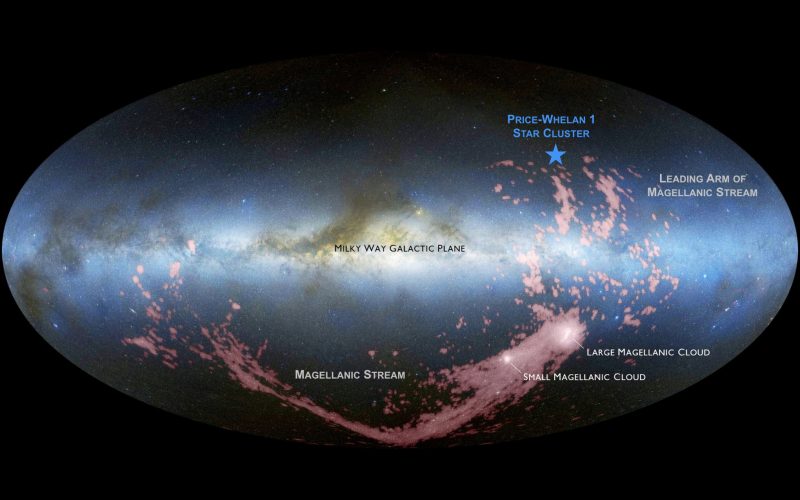
A newly found young star cluster on the outskirts of our Milky Way seems to be made of material from the Magellanic Clouds. It appears the collision between the Clouds and our Milky Way may already be starting.

Dark blue oval with pinkish blobs and yellowish blobs.

View larger. | A newly found cluster of young stars (blue stars) sits on the periphery of our Milky Way. The stars in this cluster probably formed from material originating in neighboring dwarf galaxies, called the Magellanic Clouds. Note also the Magellanic Stream, extending almost halfway around the Milky Way.

Image via D. Nidever/ NASA/ Simons Foundation.

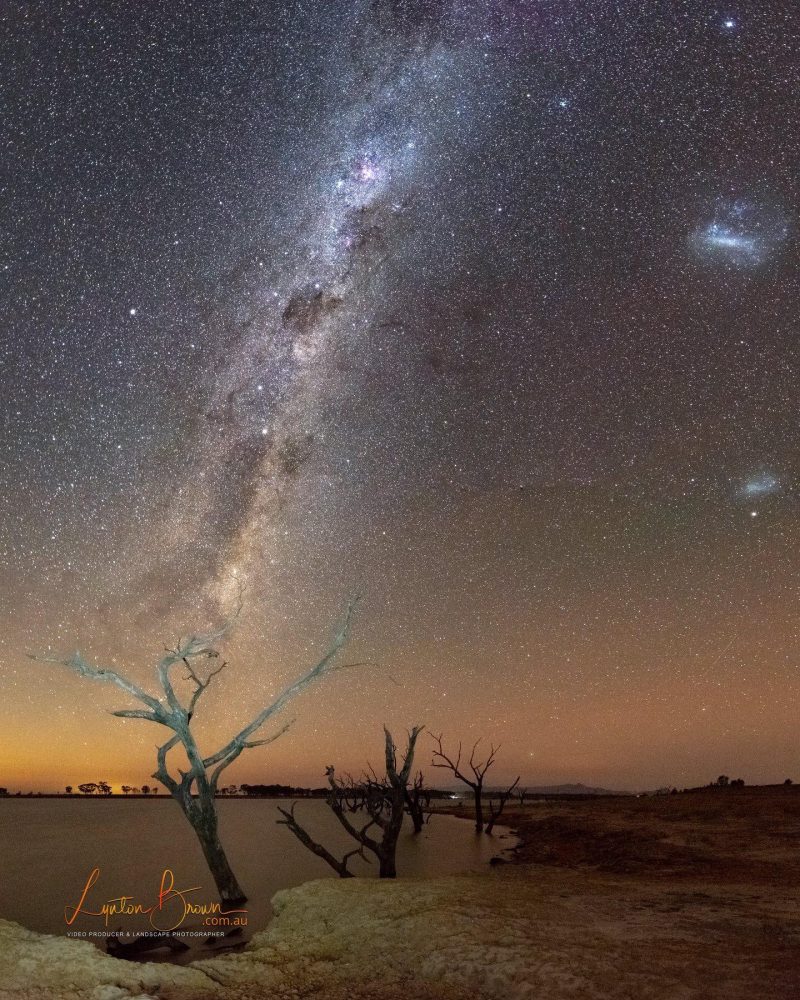
Since the 1960s and ’70s, radio astronomers have been watching a long trail of gas extending from the Magellanic Clouds, the two famous dwarf galaxies visible in Southern Hemisphere skies. This gas trail is called the Magellanic Stream, and it extends across more than 180 degrees of our sky, almost halfway around the Milky Way. The gas in the Stream, and the Magellanic Clouds themselves, will someday collide with our Milky Way, astronomers say. Now – according to a January 8, 2020, presentation by astronomers at the AAS meeting in Honolulu – it appears that signs of this collision are already in evidence. Collisions and mergers between galaxies create new stars. And astronomers have now found a young star cluster on the outskirts of our Milky Way galaxy, near the Magellanic Stream, in a part of space inhabited by our galaxy’s oldest stars. The astronomers said the stars in this young cluster appear to be made of material from the Magellanic Clouds.

According to these astronomers:

The discovery suggests that [the Magellanic Stream] is about half as far from crashing into the Milky Way as previously thought.

In other words, it suggests our Milky Way’s impending collision with the Magellanic Clouds is already beginning: it’s already birthing new stars.

Adrian Price-Whelan at the Flatiron Institute’s Center for Computational Astrophysics in New York City led this research. He said the cluster now bears his name: Price-Whelan 1. Price-Whelan and his colleagues presented their findings on January 8 at the American Astronomical Society meeting in Honolulu. The work is published in two parts in the peer-reviewed Astronomical Journal: here and here.

ee9b3b90-4247-495b-b11b-169814bb518e.gif

A visualization of the position of the newly discovered Price-Whelan 1 star cluster (blue points) relative to our Milky Way galaxy (white points). The star cluster probably formed from material from the Large and Small Magellanic Clouds (purple points).

Image via A. Price-Whelan/ J. Hunt/ Simons Foundation.

These astronomers said in their statement:

Identifying clusters of stars is tricky because our galaxy is chock-full of the radiant orbs. Some stars may appear to be close together in the sky but actually sit at drastically different distances from Earth. Other stars may temporarily neighbor one another but move on in opposite directions.

Determining which stars are actually clustered together requires many precise measurements over time.

In this case, those measurements originated with the amazing Gaia spacecraft, which has already cataloged distances and motions for 1.7 billion Milky Way stars. Price-Whelan searched the Gaia dataset for:

… very blue stars, which are rare in the universe, and identified clumps of stars moving alongside them. After cross-matching with and removing known clusters, one remained.

The newfound cluster is relatively young at 117 million years old [very young in astronomical terms] and is on the far outskirts of the Milky Way.

He commented:

It’s really, really far away. It’s further than any known young stars in the Milky Way, which are typically in the disk. So right away, I was like, ‘Holy smokes, what is this?’

Milky Way and 2 small glowing oblongs, the Magellanic Clouds, over a lake and some bare trees.

EarthSky community member Lynton Brown captured this beautiful image of the Milky Way over Taylor’s Lake near Horsham, Australia, on April 22, 2019. The 2 objects on the right are the Magellanic Clouds. Thank you, Lynton!

The Price-Whelan 1 star cluster’s location near the Magellanic Stream is a clue to these stars’ origin. These astronomers said:

Gas in the Stream doesn’t contain much metal, unlike gases in the outer reaches of the Milky Way. David Nidever, assistant professor of physics at Montana State University in Bozeman, led an analysis of the metal content of the 27 brightest stars in the cluster.

Just like the Magellanic Stream, the stars contain meager levels of metal.

The researchers propose that the cluster formed as gas from the Magellanic Stream passed through the gases surrounding the Milky Way. This pass-through created a drag force that compressed the Magellanic Stream gas. This drag, along with tidal forces from the Milky Way’s gravitational tug, condensed the gas enough to trigger star formation. Over time, the stars zoomed ahead of the surrounding gas and joined the Milky Way.

The stars’ presence presents a unique opportunity, these astronomers said. They explained:

Gauging the distance of gas from Earth is tricky and imprecise, so astronomers weren’t sure how far the Magellanic Stream was from reaching the Milky Way. The distance of stars, on the other hand, is comparatively trivial. Using the current positions and movements of stars in the cluster, the researchers predict that the edge of the Magellanic Stream is 90,000 light-years away from the Milky Way. That’s roughly half the distance previously predicted.

Nidever said:

If the Magellanic Stream is closer, especially the leading arm closest to our galaxy, then it’s likely to be incorporated into the Milky Way sooner than the current model predicts. Eventually, that gas will turn into new stars in the Milky Way’s disk. Right now, our galaxy is using up gas faster than its being replenished. This extra gas coming in will help us replenish that reservoir and make sure that our galaxy continues to thrive and form new stars.

The updated distance to the Magellanic Stream will improve models of where the Magellanic Clouds have been and where they’re going, Price-Whelan said.

He said the improved numbers could even settle a debate over whether the Magellanic Clouds have crossed through the Milky Way before, adding:

Finding an answer to that question will help astronomers better understand the history and properties of our galaxy.

Glittery pattern of silver dots, with some blue dots.

Astronomers have spotted a group of young stars (blue) on the outskirts of the Milky Way. The scientists propose that these stars formed from material from two dwarf galaxies known as the Magellanic Clouds.

Image via A. Price-Whelan/ Simons Foundation.

{ https://earthsky.org/ }

Hoe vind je dit bericht?
Geschreven door peter om 22:50 Stuur door

OTHER PLANETS COULD HAVE EVEN MORE LIFE THAN EARTH DOES, SCIENTISTS SAY

OTHER PLANETS COULD HAVE EVEN MORE LIFE THAN EARTH DOES, SCIENTISTS SAY

'This is a surprising conclusion'

Other worlds could be filled with even more flourishing life than we have on Earth, scientists have said.

The new study could have significant implications for the way we search for alien life. It also suggests that search could be more likely to find life on exoplanets than we had thought.

"This is a surprising conclusion", said lead researcher Dr Stephanie Olson. "It shows us that conditions on some exoplanets with favourable ocean circulation patterns could be better suited to support life that is more abundant or more active than life on Earth."

In recent years, scientists have found huge numbers of exoplanets, or worlds orbiting around stars that are not our own. But they are all very far away – impossible to reach even with the fastest space probes, and difficult even to see in any detail.

Researchers are working on a variety of ways to learn about those worlds, including telescopes that will be able to "sniff" their atmospheres and learn more about what the planets could be made of. But to understand the information that comes back, scientists need to build detailed and complicated models of how planets form and their climates work.

By combining those observations with those models, scientists aim to understand which of those distant planets could be home to alien life.

Now Dr Olson and her team have combined that work to understand the conditions on those exoplanets, which will help inform that search. The work was presented at the Goldschmidt Geochemistry Congress in Barcelona.

Watch more

"NASA's search for life in the Universe is focused on so-called Habitable Zone planets, which are worlds that have the potential for liquid water oceans," she said. "But not all oceans are equally hospitable – and some oceans will be better places to live than others due to their global circulation patterns".

To conduct the study, the team made models of those planets using Nasa software, which allows them to simulate the conditions on those exoplanets. Using that Nasa technology, they were able to create models of the possible climates and oceans that could be on those exoplanets.

They found that many of them seemed like more hospitable and flourishing places for life than even Earth is. They looked at the process in Earth's oceans that allows life to take root down here – and considered whether that same process could be happening elsewhere in the universe

"Our work has been aimed at identifying the exoplanet oceans which have the greatest capacity to host globally abundant and active life," said Dr Olson in a statement.

"Life in Earth's oceans depends on upwelling (upward flow) which returns nutrients from the dark depths of the ocean to the sunlit portions of the ocean where photosynthetic life lives. More upwelling means more nutrient resupply, which means more biological activity.

"These are the conditions we need to look for on exoplanets".

By modelling a variety of different exoplanets, the researchers were able to think about which types would be most likely to develop and then sustain life. And they were surprised to find that Earth is not the best kind – and that there may be other worlds out there that are a far better place for life to begin.

"We have used an ocean circulation model to identify which planets will have the most efficient upwelling and thus offer particularly hospitable oceans," she said. "We found that higher atmospheric density, slower rotation rates, and the presence of continents all yield higher upwelling rates.

"A further implication is that Earth might not be optimally habitable – and life elsewhere may enjoy a planet that is even more hospitable than our own."

The work is important because our technology means that we are unable to see everything: there is almost certainly more life than we will ever be able to see, even with the most advanced telescopes and other equipment. That means scientists will need to optimise their search by looking at the planets where life will find it easiest to find a home.

"We expect oceans to be important in regulating some of the most compelling remotely detectable signs of life on habitable worlds, but our understanding of oceans beyond our solar system is currently very rudimentary," said Chris Reinhard, from the Georgia Institute of Technology, who wasn't involved in the study. "Dr Olson's work represents a significant and exciting step forward in our understanding of exoplanet oceanography."

The new research could now help inform how new telescopes are built, since we now know what kinds of planets will be best to search for. "Now we know what to look for, so we need to start looking," said Dr Olson.

{ https://www.independent.co.uk/ }

Hoe vind je dit bericht?
Geschreven door peter om 22:31 Stuur door

Wetenschappers: Op andere planeten is mogelijk veel meer leven dan op aarde

loop.jpg

Wetenschappers: Op andere planeten is mogelijk veel meer leven dan op aarde

Op andere planeten zou weleens veel meer leven kunnen zijn dan op aarde, denken wetenschappers na een aantal computersimulaties. Hun bevindingen kunnen grote invloed hebben op onze zoektocht naar buitenaards leven.

De kans dat er leven wordt gevonden op exoplaneten, planeten buiten ons zonnestelsel, neemt toe door de nieuwe studie. “Het is een verrassende conclusie,” zegt hoofdonderzoeker dr. Stephanie Olson tegen The Independent. “Op sommige exoplaneten zijn er oceaancirculatiepatronen, die beter toegerust zijn op leven dan de oceanen op aarde. Daardoor zou er zelfs een rijker en actiever leven kunnen zijn dan hier.”

De wetenschappelijke consensus is dat oceanen een cruciale rol spelen bij leven op onze en op andere planeten. De afgelopen jaren is er een groot aantal exoplaneten ontdekt, maar ze zijn allemaal te ver weg om te kunnen bereiken of in detail te kunnen bestuderen.

Voor de studie heeft het onderzoeksteam daarom een aantal modellen ontwikkeld met behulp van software van NASA. Daarmee konden de condities op die exoplaneten worden nagebootst. Zo waren de wetenschappers in staat om mogelijke klimaatmodellen en oceanen te creëren, zoals die op die verre planeten zouden kunnen bestaan.

Ze ontdekten dat veel planeten beter geschikt waren voor leven dan de aarde. Daartoe onderzochten ze hoe leven zich ontwikkelt diep in de oceanen en of dat proces ook ergens anders in het universum plaats zou kunnen vinden. “Ons werk was erop gericht om planeten te identificeren met oceanen die de grootste capaciteit hebben om actief leven te herbergen,” aldus dr. Olson.

Ze kwam erachter dat de aarde niet eens het meest geschikt is en dat er andere werelden zijn in het universum die een veel betere plek vormen om leven te beginnen. “De aarde is niet optimaal. Er kan heel goed een planeet zijn waar leven veel makkelijker kan ontstaan dan hier,” klinkt het.

Bronnen:  

{ https://www.worldunity.me/ }

Hoe vind je dit bericht?
Geschreven door peter om 22:22 Stuur door

2020 Daytime VIDEO! Flying saucer over Leeds, UK

2020 Daytime VIDEO! Flying saucer over Leeds, UK

flying-saucer.png

This solid disc-shaped object was seen and filmed in the sky above Leeds, UK on 2nd February 2020.

Witness report: 

Sat at home, from the corner of my eye I saw the usual birds flying outside and a black disc like shape started hovering and then floating on a straight path. It was high, above the trees. 

It was all black, disc shaped and moved with a tilting motion. Travelling in a straight line tilting until I lost sight of it past the window frame I was looking out of. I was shocked, and couldn’t think of what it could be… hoping it wasn’t just a drone or something but it had such a weird shape and movement. It definitely wasn’t a bird, or a weather balloon or a plastic bag.

{ https://www.latest-ufo-sightings.net/ }

Hoe vind je dit bericht?
Geschreven door peter om 22:10 Stuur door

Experts Drilled Into The Crater That Killed the Dinosaurs And Made An Incredible Discovery - PART I

Experts-Drilled-Into-The-Crater-That-Killed-the-Dinosaurs-hero.jpg

Experts Drilled Into The Crater That Killed the Dinosaurs And Made An Incredible Discovery - PART I

Andrea Marchiano By Andrea Marchiano

01-Experts-Drilled-Into-The-Crater-That-Killed-the-Dinosaurs.jpg

Image: Chris Saulit/Getty Images

Scientists basically knew what happened here – but the full story that’s emerging beggars belief. The Chicxulub crater marks the point of contact made by an asteroid so enormous that it wiped out an entire planet’s worth of dinosaurs. Yet now experts have dug deep into the massive cavity, and they’ve finally realized precisely what occurred when the space rock actually struck the Earth. What’s more, the team’s findings paint a truly terrifying picture.

Image: NASA/Getty Images

Of course, much was already known about the Chicxulub crater. It stretches 93 miles in diameter, for instance, and plunges a stunning 12 miles into the ground. And of all the known impact points on Earth, the crater is the second-largest in the world. Yet even though it appeared about 66 million years ago, its peak ring remains in one piece.

Image: NASA/Johns Hopkins University Applied Physics Laboratory/Carnegie Institution of Washington

This particular detail highlights just how stunning the Chicxulub crater – and its long-term preservation – has already proven to be. It’s the only crater on the planet that has its peak ring still intact, in fact. The next available one for scientists to study sits, rather inconveniently, on the moon.

Image: RONALDO SCHEMIDT/AFP via Getty Images

Still, all of this information has to do with the crater’s dimensions and exterior features. Now, though, scientists have gone beyond the topical details of the Chicxulub crater. Digging into the expanse, which sits more than half a mile beneath Mexico’s Yucután Peninsula, experts in fact uncovered the impact that an up to 50-mile-wide asteroid had on the planet.

Image: ANDRZEJ WOJCICKI/Getty Images

To put the findings in context, though, it’s worth understanding a little about the crater’s background. So the Chicxulub crater derives its name from the nearby Mexican town of the same name. And experts estimate that an asteroid or comet, ranging in size from 6.8 to 50.3 miles in diameter, smashed into the Earth at this very spot.

Image: Eric Lafforgue/Art In All Of Us/Corbis via Getty Images

It’s hard to imagine such a massive piece of space debris hurtling in the direction of our planet. But perhaps even more stunning is the abyss it left behind; the Chicxulub crater has an estimated diameter of 93 miles. For reference, that’s just 1.6 miles shorter than the drive between New York City and Philadelphia.

Image: George R. Caron/Charles Levy

Experts have been able to calculate the strength with which the space rock smashed into the Earth, too. In fact, they estimate that the asteroid or comet had 21 to 921 billion times as much energy as the atomic bomb dropped on Hiroshima in World War II. Even the Soviet Union’s Tsar Bomba – the strongest human-made explosive to ever detonate – couldn’t compare. The Solar System body also released 100 million times the energy of Tsar Bomba upon impact.

Image: Júlio Reis

So with that much power hitting the Earth, the size of the Chicxulub crater makes sense. It’s not just its width that’s extra-large, either; the crater reaches depths of up to 18.6 miles into the planet. These dimensions make the Chicxulub crater the second-largest impact crater on Earth, just behind the one near Vredefort in South Africa.

Image: NASA/Johns Hopkins University Applied Physics Laboratory/Carnegie Institution of Washington

But the Chicxulub crater has one feature that no other known crater on Earth has: it’s a peak ring crater. This means that the impact site has no single central peak. Instead, the crater has a circle-shaped plateau encompassing its center. The rim of the crater encircles this ring, but it sits at a distance from the center.

Image: Matt Aust | star-trails.de/Getty Images

Marine geophysicist Sean P. S. Gulick explained to The New York Times in 2016 just how rare the peak ring feature is. He said, “Chicxulub is the only crater on Earth with an intact peak ring that we can go sample… It’s ground zero of the Cretaceous extinction event.”

Image: NASA/JPL-Caltech

And yet scientists haven’t necessarily rushed to dig into the Chicxulub crater. That was partly due to the fact that the massive hole appeared approximately 66 million years ago. So over time, rock and water filled in the void and eventually more than half a mile of sedimentary rock covered the crater.

GettyImages-157591549.jpg

Image: shotbydave/Getty Images

Also, scientists didn’t discover the Chicxulub crater until relatively recently – especially considering that it has been around for millions of years. It wasn’t until 1978, in fact, that geophysicists Glen Penfield and Antonio Camargo stumbled upon the crater. And they weren’t even looking for the asteroid impact site when they discovered it; the pair were searching for petroleum.

Image: USGS

So Penfield and Camargo took to the skies to complete a magnetic survey that mapped any potential drilling locations beneath the Gulf of Mexico. As he pored over the resulting data, though, Penfield noted something particularly extraordinary: a 40-mile-wide “underwater arc” with impeccable symmetry.

Image: NASA/Getty Images

Such a strange discovery inspired Penfield to dig deeper. He then sought out a gravity map commissioned by his employer, oil company Petróleos Mexicanos, in the 1960s. On it, Penfield noticed another arc – but this one curved over the Yucatán Peninsula itself. And when the geophysicist put that map and his magnetic survey together, he realized that the two arcs made a circle.

Image: MARK GARLICK/SCIENCE PHOTO LIBRARY/Getty Images

Penfield knew almost immediately that he had found something spectacular; the geophysicist hypothesized that he had pinpointed a cataclysmic event in the planet’s geological history. Petróleos Mexicanos then allowed him and Camargo to present their findings at the 1981 Society of Exploration Geophysicists conference. Unlike the asteroid they theorized had hit the Earth, though, their presentation made little impact at the time.

Image: FrankRamspott/Getty Images

So eventually Penfield gave up on his research into the crater. Much of the evidence that he had sought was even destroyed or lost. Nevertheless, Penfield published all of the data he had and returned to work. Yet meanwhile other scientists had begun to theorize something similar – without having seen Penfield’s research.

Image: Chris Clor/Getty Images

Specifically, in 1981 a graduate student at the University of Arizona named Alan R. Hildebrand and his adviser William V. Boynton published their own Earth-impact theory. They just needed to find a crater that could corroborate their hypothesis. The pair had plenty of geological evidence, though, and their work got a bit more traction than Penfield’s.

Image: Jlanghurst

Namely, a professor in Haiti named Florentine Morás uncovered evidence that an ancient volcano had once stood in his country. Hildebrand consequently realized that such a feature could have emerged when a major force of impact crashed nearby. And in 1990 he learned the precise spot of such a collision.

Image: Dementia

In that year, you see, a reporter for the Houston Chronicle named Carlos Byars clued Hildebrand into Penfield’s findings. The journalist also mentioned that the geophysicist had thought he had found an impact crater in the vicinity. So Hildebrand subsequently picked up the phone, and the two experts later started analyzing drill samples from the oil company’s storage unit.

Image: Remylyn Penafiel/EyeEm/Getty Images

What Penfield and Hildebrand found amid the drilling debris were shock-metamorphic materials. Such substances appear after an impact-related event causes deformation and heating. In normal cases, shock-metamorphism occurs along with a volcanic eruption – but, of course, Penfield and Hildebrand had uncovered something much bigger than that.

Image: SCIEPRO/Getty Images

Since then, more research into the Chicxulub crater has transpired, and more theories about its origins have arisen. In September 2007, for instance, authors William F. Bottke, David Vokrouhlicky and David Nesvorny offered a theory to Nature magazine. The trio said that the rock responsible for creating the crater came from a specific cosmic family called the Baptistina asteroids.

Image: SCIEPRO/Getty Images

Yet in spite of facts that seemed to corroborate Vokrouhlicky, Bottke and Nesvorny’s theory, new evidence released in 2011 negated their claim. What came to light? Well, researchers had pinpointed the Baptistina asteroid family’s formation to around 80 million years ago. This would make it nearly impossible for the space rock to reach Earth when the Chicxulub crater formed 66 million years ago. That’s because it takes multiple tens of millions of years for asteroids to collide and resonate.

Image: MARK GARLICK/SCIENCE PHOTO LIBRARY/Getty Images

But the discovery of the Chicxulub crater also lent credibility to a theory first formed by physicist Luis Alvarez and his geologist son, Walter Alvarez. Both men believed that between the Cretaceous and Paleogene periods, a massive impact on Earth had triggered a series of animal and plant extinctions. And among them were all of the non-avian species of dinosaurs.

Image: NASA Universe

Some of the Chicxulub crater’s statistics do apparently fall in line with the Alvarez theory too. For one thing, initial dating of the crater estimated its formation happening about 66 million years ago. So this timing would have the asteroid or comet slamming into Earth just between the Cretaceous and Paleogene periods – just as the father-and-son duo suspected.

Image: Mark Stevenson/UIG/Getty Images

Many people also subscribe to the Alvarez theory about the Chicxulub crater. Namely, that the impact that caused it also triggered a mass extinction of, among other species, land- and sea-dwelling dinosaurs. Yet still so much mystery surrounded the enormous undersea divot. So scientists would have to drill into it to learn more.

Image: RONALDO SCHEMIDT/AFP via Getty Images

And in 2016 it finally came time for such an excursion. Marine geophysicist Gulick and geophysicist Joanna Morgan helmed a crew of over 30, who represented a dozen different countries. The researchers boarded a boat and sailed into the Gulf of Mexico. And there, they transformed their vessel into a drilling station.

Image: RONALDO SCHEMIDT/AFP via Getty Images

The drilling station stood tall on three legs, rising about 40 feet above the Gulf of Mexico’s turquoise waters. The team then drilled incredibly far into the Earth. And after the tool delved 60 feet underwater, it met the rock below and continued to dig a stunning 2,000 feet into the crust.

Image: RONALDO SCHEMIDT/AFP via Getty Images

Of course, over a 66-million-year period, the Chicxulub crater had filled with a sizeable amount of limestone and sediment. But the scientists’ machine worked its way past the new collection of rock to find what they were looking for: the material that made up the planet’s only peak ring crater.

Image: RONALDO SCHEMIDT/AFP via Getty Images

Gulick, Morgan and their team actually discovered that a peculiar type of rock made up the peak ring: granite. Normally, you see, this variety of rock is found far deeper in the Earth’s crust than it appears in the crater. This means that the asteroid had such an incredible impact that it had pushed sediment from miles beneath the surface all the way to the top.

Image: Mint Images/Getty Images

Geophysicist Morgan, who works for Imperial College London, told The New York Times, “These rocks behaved like a fluid for a short period of time, and rocks don’t tend to do that. It’s a very dramatic process when you form a large crater.” Apparently, such a chain reaction gave credence to something called the dynamic collapse model theory.

Image: James St. John

The dynamic collapse model theory hypothesizes that the asteroid’s impact pushed rocks deep into the Earth’s crust before forcing them back up and out of it. Then these rocks collapsed down again and settled to form the crater’s peak rings. And the fact that granite forms the crater’s central plateau apparently goes hand-in-hand with such a theory.

Image: Stocktrek Images/Getty Images

But drilling into the Chicxulub crater revealed more than one truth about this devastating geological event. The rocks also told the story of what had happened once the asteroid had smashed into the Earth. Scientists revealed this evidence in 2019. And the picture they painted of the world post-impact was a terrifying one, to say the least.

Image: ANDRZEJ WOJCICKI/Getty Images

Gulick said he and the rest of the scientists could be so specific with their findings because they had an unprecedented amount of rock to work with. He explained to The New York Times, “We normally get to read rock records that give us centimeters per thousand years. We have 130 meters for a day.”

Image: jcrosemann/Getty Images

The rocks told a story that goes like this. First, an enormous chunk of cosmic rock slammed into the ground, instantly creating a crater 60 miles wide and 20 miles into the Earth. The initial impact created waves in the nearby gulf – quite literally. A tsunami formed, in fact, charging in the opposite direction of the new crater.

Image: Stocktrek Images/Getty Images

The asteroid’s impact also sent huge pieces of rock hurtling into the air, as far as the planet’s upper atmosphere – and likely beyond even that. Gulick theorized that “almost certainly some of the material would have reached the Moon.” Yet the largest bits flew up before crashing back down on the ground, still hot from the initial impact.

Image: Mp

Some smaller pieces of hot rock took longer to fall – and had more time to cool. These geological wonders, called tektites, scattered across what is now the North American continent. Then water started rushing back into the crater after it waved outward. But refilling the geological depression would be tame compared to the next stage.

Image: shannonstent/Getty Images

When the asteroid collided with the Earth, you see, it sent a tsunami speeding off in the opposite direction. And of course, water ebbs and flows. So, soon enough, those powerful waves returned back toward the crater. Multiple massive tsunamis with waves towering hundreds of feet in the air then came back over the gaping geological hole.

Image: Andrew Merry/Getty Images

The rush of back-and-forth tsunamis quickly filled the peak ring with a four-inch coating of sand and gravel. And as the gulf raged, the land close by was also ravaged. The asteroid’s impact had, for instance, sparked wildfires across the area. Scientists know this because they pinpointed pieces of charcoal in the peak ring just above the tsunami sediments.

 {  https://scribol.com/ }

Hoe vind je dit bericht?
Geschreven door peter om 20:43 Stuur door

Experts Drilled Into The Crater That Killed the Dinosaurs And Made An Incredible Discovery - PART II

Experts-Drilled-Into-The-Crater-That-Killed-the-Dinosaurs-hero.jpg

Experts Drilled Into The Crater That Killed the Dinosaurs And Made An Incredible Discovery - PART II

Andrea Marchiano By Andrea Marchiano

Image: MARK GARLICK/SCIENCE PHOTO LIBRARY/Getty Images

These wildfires could have started from the asteroid’s scorching thermal energy upon impact. The aforementioned shower of molten rock could have had something to do with it too. In any case, Gulick told The New York Times, “Probably not everything burned, but certainly there were global wildfires.” So altogether, the tsunamis, falling rock and fires wiped out a stunning number of Cretaceous-era species.

Image: MARK GARLICK/SCIENCE PHOTO LIBRARY/Getty Images

It’s hard to believe that scientists could conjure such haunting images from layers of rock hidden deep beneath the Yucatán Peninsula. Yet for planetary geologist Paul Byrne, the Chicxulub crater’s layers make palpable some long-standing scientific theories. He told The New York Times that it was one thing to develop and simulate such hypotheses, but it was “quite another to see it.” And, considering the size and scope of the crater, this could be just the beginning of the startling secrets uncovered there.

Image: malexeum/Getty Images

But the Chicxulub crater is far from the only crater to have yielded fascinating secrets. Deep in the heart of Siberia, for instance, there’s a giant chasm that’s constantly growing in size. And inside, archaeologists have made some jaw-dropping discoveries. The real cause of this huge hole, however, is rather unsettling.

Image: Alexander Gabyshev via Siberian Times

Deep within a Siberian forest, just outside of a small town called Batagai, lies an ominous sight to behold. And for the past 25 years, it’s been growing – along with the superstitions of the local community. In fact, the land here is so disconcerting that the locals are literally terrified.

Image: Siberian Times

Need proof? Well, the people of the area have taken to calling the geological feature a “gateway to the underworld.” It’s easy to see why: there is a huge gouge in the landscape, after all. Plus, local religions believe in a three-tiered universe: an upper, a middle and a lower world.

Image: Alexander Gabyshev via Siberian Times

Moreover, some people are so apprehensive of the startling abyss that they’re afraid to go near it. And that is before you even consider the loud and fearsome booms that can sometimes be heard emanating from within. But there’s a bigger question here.

Image: Alexander Gabyshev via Siberian Times

The crater that has caused such fear stretches more than a mile through the landscape. At its deepest, it plummets almost 400 feet below the Earth. And there’s more: the crater is constantly growing, spreading around 60 feet a year by current estimates.

Image: NEFU via Siberian Times

But beyond the superstitions and local legends, something even more terrifying is going on at the so-called Batagaika Crater. That’s because this huge hole in the ground could be a warning sign of future geographical change in the region and, indeed, the world in general.

Image: Research Institute of Applied Ecology of the North via Siberian Times

To understand what’s happening in Siberia we need to go back in time around 55 years to when the crater first began to develop. And how this massive scar in an ancient landscape first sprang into life could well come as a shock.

Image: Julian Murton

The major area of study at the crater has been the effects of climate change on permafrost. Fascinatingly, during excavations the mummified bodies of multiple ancient animals have been found in the layers of mud and rock that make up the crater walls.

Image: Research Institute of Applied Ecology of the North via Siberian Times

The group had unknowingly set in motion what scientists call a “megaslump.” Essentially, the fast-thawing permafrost turned into a mush of mud, compromising the stability of the ground above, which quickly slipped into the slurry below.

Image: NEFU via Siberian Times

Surprisingly, these slumps aren’t that rare in Arctic climates. And since the Yakutia Republic – where the crater occurred – is one of the coldest places on Earth, some scientists believe this was just another of those bizarre but predictable happenings. Now it looks like they could have been wrong.

Image: Julian Murton

Flooding in 2008 increased the spread of the crater, which has now become a focal point for scientific researchers. And some of their findings have started to change the way we think about permafrost around the globe0

Image: Julian Murton

The major area of study at the crater has been the effects of climate change on permafrost. Fascinatingly, during excavations the mummified bodies of multiple ancient animals have been found in the layers of mud and rock that make up the crater walls.

Image: Julian Murton

But other findings are not so positive: research suggests that the Batagaika Crater is just the tip of a very worrying, and quickly melting, iceberg. Indeed, if you think the crater is a one-off event, then you’re sorely mistaken, because more sinkholes are springing up around the area.


Image: Julian Murton

Dr. Julian Murton is a professor of geology at the University of Sussex, and speaking to Vice, he revealed some alarming statistics. For instance, the last time a megaslump such as this occurred was 10,000 years ago, and the conditions the world finds itself in now are far more conducive to such events than they were then.

Image: Research Institute of Applied Ecology of the North via Siberian Times

In fact, at the end of the last ice age, when the slumps were more common, carbon dioxide levels were at 280 parts per million. Right now, on the other hand, they sit at the shockingly high rate of 400 parts per million. And that’s resulted in more than one megaslump.

Image: Marmelad

Another researcher, Vasily Bogoyavlensky from the Oil and Gas Research Institute of the Russian Academy of Sciences, revealed to the AFP news agency last year that another crater, this one 0.6 miles in diameter, had emerged in Yakutia. He also said that there are another six confirmed megaslumps, with yet more likely to exist.

Image: NASA Earth Observatory

It’s not just enormous craters, either; a range of smaller sinkholes and collapses have been monitored across the Russian frontier. And many scientists reckon they’re all linked to the region’s increasing temperature, which is a result of climate change.

Image: Becker0804

Studying the various layers in the now unlocked permafrost is key to understanding the potential changes that are likely to happen in the future. Murton told Vice, “If we can understand how the landscape was altered then, it helps us to anticipate what may happen to Siberian permafrost terrain in the next centuries.”

Image: via La Tercera

So while the crater may not be an entrance to the underworld as many of the locals seem to think, it could still be hugely important for the future of the planet. Plus, it performs another function.

Image: Twitter/Vinny Burgoo

The huge gash ripped in the landscape stands as a stark physical representation of the effects that we as human beings are having on our planet. It is, after all, a literal scar in the landscape that’s down to us.

Image: via Geonova

Whether or not the superstitions of the local people are true, the Batagaika Crater still remains a stark warning. It may not be waiting to drag us all to hell, but there’s a real chance that it represents something much, much scarier. Why? Because this threat could be so very much on the horizon.

{ https://scribol.com/ }

Hoe vind je dit bericht?
Geschreven door peter om 20:22 Stuur door

The Future of Nuclear Rockets for Space Travel

The Future of Nuclear Rockets for Space Travel

 by Carlos M. Gonzalez

the-future-of-nuclear-rockets-for-space-travel_hero.jpg?width=920&height=518&ext=.jpg

Visionary view of a Nuclear Thermal Propulsion enabled spacecraft mission outward bound to Mars.

Image: NASA/Marshall Space Flight Center

For Bill Emrich, working at NASA has been a life-long dream come true. “This has been my dream job, and something I thought about since I was a kid,” said Emrich, lead project engineer at the Nuclear Thermal Rocket Element Environment Simulator (NTREES).
 
Not only is Emrich the lead project engineer at NTREES, he also conceived and designed the megawatt-class thermal simulator. And Emrich’s current project is to determine the best material and method of designing nuclear rockets for space travel to Mars and beyond.

The Nuclear Rockets of the 20th Century

Nuclear rockets are not a new idea. Since the beginning of the space program, nuclear rockets were considered as a possible way to send astronauts to the Moon. The nuclear research that’s been done post-World War II in the 1950s officially became the Nuclear Engine for Rocket Vehicle Application (NERVA) project in 1961, under NASA’s supervision. The program ran for almost two decades, designing the certified XE engine that even then satisfied all the requirements for a mission to Mars.

the-future-of-nuclear-rockets-for-space-travel_01.jpg?width=320&height=640&ext=.jpg
The 1960s NERVA engine designs are still used as the basis for modern nuclear rockets.
Photo: NASA/Marshall Space Flight Center

“When President Kennedy first proposed the space program, no one knew exactly what was the best way to accomplish space travel. People were aware of the advantages of nuclear power even back then, and I thought to myself, nuclear rockets is what we need,” Emrich said. “But as the space program went on, multi-stages rocket becomes the more accepted method of space travel, and NASA realized they didn’t need nuclear rockets to reach the moon.”

The NERVA program eventually shut down in 1973 due to political influences and growing costs. The program cost almost $2 billion in total—that would be equal to nearly $173 billion in today’s money.

However, the program is widely considered a success: To this day, any nuclear rocket engine’s design still uses the same concept as the NERVA NRX or Pewee rockets.

The Nuclear Rockets of the 21st Century

Fast forward to now, and there is a new sense of urgency for space travel. The current administration issued a mandate to return to the Moon by 2024 and NASA has partnered with commercial aerospace companies, such as Boeing and Space X, to reach that goal.

But besides going to the Moon, the current administration has asked NASA to explore nuclear power as an alternative means for space travel. A memo issued in August 2019 has tasked NASA to develop safety protocols for operating nuclear reactors in space. The first flight of a nuclear engine could happen as soon as 2024.

Emrich has worked at NASA since 1987 and wrote the book on nuclear rocket propulsion. He and his team at NTREES have been working on designing, optimizing, and testing nuclear rocket configurations for the last ten years at the Marshall Space Flight Center.7

There are two types of engines that can be used for nuclear rockets. The first is having a nuclear reactor generate electricity, which then powers the ion thrusters for electric propulsion.

the-future-of-nuclear-rockets-for-space-travel_02.jpg?width=320&height=212&ext=.jpg
NTREES engineers test different types of uranium-based fuels in hopes of finding the perfect source for deep space travel.
Photo: NASA/Marshall Space Flight Center

The second option is to have a nuclear reactor achieve high temperatures, then flowing cold hydrogen through the top of the rocket. Hot hydrogen exits the bottom of the rocket through a nozzle, acting as thrust just as a chemical engine would.

The advantage of using the second engine type is achieving higher thrust levels than with electric propulsion. Electric propulsion typically operates at thrust levels of a pound of thrust or lower. Nuclear thermal engines, where hydrogen is used, can produce tens of thousands of pounds of thrust and are much more efficient than chemical engines.

“Would you rather go from New York to Dallas in a car, which can get 100 miles per gallon, but your maximum speed is only two miles an hour? Or would you rather get a car that has a fuel efficiency of 40 miles per gallon, but your maximum speed is 65 miles per hour, and you arrive within the same day?” Emrich said. “It comes down to: The higher thrust that can be produced, the faster you will get there.” 

Testing Different Nuclear Fuel Types

At the NTREES facility, engineers test nuclear engines with different uranium-based fuel types under the same conditions that would exist during space travel. The main stresses would be extreme high temperatures and pressures. A NERVA rocket’s highest temperature ever experienced was 2,250 degrees Kelvin or 3,590 degrees Fahrenheit.

The hotter you can make the rocket, the hotter you can make the hydrogen exit the nozzle to achieve higher thrust. The danger is that nuclear fuel has a maximum temperature limit before it melts or comes apart. 

While the nuclear rocket design hasn’t changed much since the 1960s, the fuel materials have improved significantly and are stronger now—even for handling nuclear energy. The nuclear engines are still powered by uranium 235, just as they were back in the NERVA projects day, but are now embedded into different materials.

the-future-of-nuclear-rockets-for-space-travel_03.jpg?width=320&height=239&ext=.jpg
The uranium-based fuels are exposed to the same high temperatures and pressures in the test facility as they would experience during space flight.
Photo: NASA/Marshall Space Flight Center

Carbon-based fuels are graphite-based with embedded uranium. The fuel is shaped into hexagonal prisms with a hole stroke where the hydrogen flows through them. Graphite can withstand the high temperatures but still requires coating on the flow channels. Otherwise, the hydrogen will attack the graphite, causing cracking.
 
Cermat fuels are a combination of ceramic and metallic materials. They are usually comprised of uranium, dioxide, and tungsten. Cermat fuels can better withstand the attacks from the hydrogen but have a lower tolerance against the high temperatures.

The third fuel types are dicarbide or tricarbide fuels. These fuels are alloy-based and made of uranium, zirconium, and niobium. These fuels can handle the high temperatures extremely well and do not get attacked by the hydrogen flowing through the engine. However, they are brittle and tend to crack.
 
At NTREES, these different fuel types are shaped into different geometries to see which ones will perform the best. Even the smallest changes in the shape, or changing the way the graphite is coated, can lead to better rocket performance.

Nuclear Rockets and Travel to Mars

Determining the fuel for nuclear rockets is only the first step toward nuclear space travel. As Emrich points out, the work done at NTREES is only the beginning in a long process toward viable nuclear-powered rockets.

“Once the testing is complete, you have to take the fuel and put it into a nuclear reactor. Then that nuclear reactor has to work together with pumps, valves, hydrogen feed systems, nozzles, and so forth,” Emrich said. “You also have to test the fuel in a nuclear test reactor in the presence of a high radiation field, and ultimately perform an actual engine test powered by the nuclear fuel. So there's a lot that has to go on after the first step of testing the fuel.”

In order to travel to Mars, it will be necessary to perfect the design of nuclear-powered rockets. Those rockets not only have to reach Mars but also, more importantly, come back to Earth.
 
“Elon Musk and others want to take people to Mars and start a colony there. If you want to go to Mars and leave people on Mars, you can do that with chemical rockets,” Emrich said. “It will be a difficult journey but possible. But if you want to bring people back to Earth, you are almost forced to use nuclear-powered rockets. And at NASA, we are more interested in bringing people back home.” 

Carlos M. González is special projects manager.

{ https://www.asme.org/ }

Hoe vind je dit bericht?
Geschreven door peter om 17:37 Stuur door

WE ARE NOT ALONE - Confirmation of alien life ‘IMMINENT and inevitable’, researcher claims

WE ARE NOT ALONE  - Confirmation of alien life ‘IMMINENT and inevitable’, researcher claims

Hoe vind je dit bericht?
Geschreven door peter om 16:58 Stuur door

Congress Is Getting Serious About Sending Humans to Mars in 2033

Congress Is Getting Serious About Sending Humans to Mars in 2033

George Dvorsky

Artists conception of a future Martian base.
Image: NASA/SEArch+/Apis Cor

A newly proposed House authorization bill would push back NASA’s deadline to land humans on the Moon to 2028 instead of 2024, while also calling for a crewed landing on Mars in 2033. Reactions to this proposal have been mixed, with NASA’s chief Jim Bridenstine unhappy about the way the agency is supposed to roll out this recommended plan.

The proposed authorization bill, called the National Aeronautics and Space Administration Authorization Act of 2020, was introduced by the House Committee on Science, Space, andTechnology on January 24, reports Spaceflight Now. The 102-page document recommends that the first crewed Artemis lunar landing take place in 2028 instead of 2024, which is the current, controversial deadline. At the same time, the House Committee is proposing a rather aggressive timeline for Mars exploration, in which American astronauts would arrive to Martian orbit in 2033, followed shortly thereafter by a mission to the surface.

The bipartisan legislation was introduced by Representative Kendra Horn (D-Oklahoma), who chairs the committee’s space and aeronautics subcommittee. A markup session is planned for tomorrow, at which point the document could undergo substantial changes. It’ll likely be months before a vote takes place to enact the proposed legislation, also known as H.R. 5666.

The overarching goal of the recommended changes is to position the Artemis lunar program as a stepping stone for the larger goal of sending people to Mars. America’s “human space exploration goal should be to send humans to the surface of Mars,” according to the proposed bill. At the same time, missions to the Moon will be required to reduce risk and to demonstrate the “capabilities and operations needed to support a human mission to Mars.”

Last year, NASA said a mission to Mars by 2033 was a distinct possibility, but this proposed authorization bill would turn speculation and wishful thinking into a concrete plan.

The specified goal of the pending “Moon to Mars program,” as it’s termed in the proposed bill, will be to “land humans on Mars in a sustainable manner as soon as practicable,” with the “interim goal of sending a crewed mission to the lunar surface by 2028 and a goal of sending a crewed mission to orbit Mars by 2033.”

Among other recommendations, the bill specifies that the Artemis lunar lander be launched as a single component, rather than a modular multi-piece vessel that would be constructed in space. NASA would retain full ownership of the Artemis lunar landing system, which would be a dramatic change in plans, given that the space agency is currently soliciting bids from the private sector.

Boeing Reveals Its Proposed Lander for NASA's 2024 Moon Mission

Boeing has submitted its proposal to NASA for a lunar lander concept that the company claims will…

Read more

Bill H.R. 5666 would renew NASA’s commitment to the Lunar Gateway project but proposes that the outpost be placed not in lunar orbit but in the Earth-Moon Lagrange point—a gravitational sweet spot between Earth and Moon. At this location, the habitable terminal could support missions to the Moon and Mars, according to the bill, which didn’t rule out a lunar orbit as a possibility.

The proposed bill calls for the establishment of a Moon to Mars program office, complete with its own director, and a Mars Enabling Technology Initiative for the “purpose of developing and testing the technologies and capabilities needed for a human mission to Mars.” Items on the prospective to-do list include the development of propulsion engines, Mars landing systems, protection against radiation, a Mars transport vehicle, life support systems, Martian habitats, and spacesuits for explorers, among other technological needs.

Given the aggressive timeline, NASA would need to set up its Moon to Mars office within 60 days of the bill being enacted, develop an overall mission architecture and plan within 120 days, and submit estimated budgets within 240 days, according to the proposed bill.

NASA would also have to provision for two crewed lunar missions each year following the inaugural landing in 2028, as well as create a plan to decommission the International Space Station (ISS) and consider potential replacements, including contributions from the private sector.

The bill also states that NASA must assure crew access to the ISS and upgrade and replace ISS spacesuits, including spares, to “accommodate the diversity of ISS crew,” in an obvious response to a debacle last year in which an all-women spacewalk was canceled because not enough suits were available to the female crew. Other items in the proposed bill included the development of tech for defense, the monitoring of climate change, new telescopes, and even the search for extraterrestrial intelligence.

In a NASA statement issued Monday, January 27, NASA administrator Jim Bridenstine expressed some reservations about the proposal.

“I am concerned that the bill imposes some significant constraints on our approach to lunar exploration,” said Bridenstine. “As you know, NASA has successfully fostered the development of a rapidly expanding commercial economy for access to space. We would like to continue building on this success as we develop the most efficient mission architectures and partnership approaches to accomplish our shared goals.”

In particular, Bridenstine is concerned about the proposed approach to building the lunar lander. A fully government-owned-and-operated lander system would be “ineffective,” he said. In its current form, the proposed bill would hinder NASA’s “ability to develop a flexible architecture that takes advantage of the full array of national capabilities—government and private sector—to accomplish national goals,” he said. Accordingly, the NASA chief is hoping for “some modifications” to the pending legislation.

As SpaceNews reports, some members of the private sector are also miffed by the proposed bill:

In a Jan. 27 letter to the bill’s four co-sponsors, Eric Stallmer, president of the [Commercial Spaceflight Federation], offered even stronger criticism, saying it “explicitly and unfairly excludes the participation of the American commercial spaceflight industry, irrationally barring fair competition from NASA’s deep space exploration initiatives.” Stallmer called on the committee to withdraw the bill and “engage in a fully transparent process” with all stakeholders.

That said, the bill does appear to have its supporters, including The Coalition for Deep Space Exploration (an organization that advocates on behalf of the private space industry) and Aerospace Industries Association (a U.S. trade association), according to SpaceNews.

We’ll be following the House markup session that’s scheduled for tomorrow to see how this bill might be modified and to learn next steps, such as when a vote might happen. Regardless, the U.S. government has big plans for NASA in the coming decades, as the next era of human space exploration appears to be imminent.

{ https://gizmodo.com/ }

Hoe vind je dit bericht?
Geschreven door peter om 15:18 Stuur door

Advanced Technology and Anomalous Architecture of Our Predecessors Around the Globe

Advanced Technology and Anomalous Architecture of Our Predecessors Around the Globe

david-h.jpg

This lecture is a fast-paced and visual presentation taking us around the world look at all sorts of things from Ancient sites and then to the Moon and Mars.

David Hatcher Childress, known as the real-life Indiana Jones to the many fans of his books, is a captivating speaker and the author or coauthor of over 20 books. He has traveled the world several times over, seeking adventure and the answers to the mysteries of mankind’s past.

Born in France in 1957 and raised in the mountains of Colorado and Montana, David’s curiosity about the world was piqued at a young age. He attended the University of Montana where his studies in oriental culture and philosophy led him to a job teaching English in Taiwan. In 1976, David left the United States on what would become a six-year research and adventure odyssey. During this time, he studied first-hand the ancient civilizations of Africa, the Middle East and China, sometimes journeying into dangerous territory along the way (like Uganda during the overthrow of Idi Amin).

David is known for visiting remote islands of the Pacific and Indian Oceans, organizing expeditions to remote areas of Peru and Bolivia, and trekking through remote areas of the Himalayas and other parts of Asia. His interests are mainly historical, archeological or cryptozoological. He is a good swimmer and a certified scuba diver and has a special interest in underwater archeological discoveries.

{ https://beforeitsnews.com/ }

Hoe vind je dit bericht?
Geschreven door peter om 13:58 Stuur door

UFO Shoots Past Plane That Drops Off Wuhan British Citizens In UK, Video, UFO Sighting News.

UFO Shoots Past Plane That Drops Off Wuhan British Citizens In UK, Video, UFO Sighting News.

MUFON%252C%2B%25E7%259B%25AE%25E6%2592%2583%25E3%2580%2581%25E3%2582%25A8%25E3%2582%25A4%25E3%2583%25AA%25E3%2582%25A2%25E3%2583%25B3%252C%2B%2BUFO%252C%2BUFOs%252C%2Bsighting%252C%2Bsightings%252C%2Balien%252C%2Baliens%252C%2BET%252C%2Bvirus%252C%2Bchina%252C%2Bastrobiology%252C%2Bnobel%2Bpeace%2B%2Bprize%252C%2Bwaarneming%252C%2Bvreemdelinge%252C.png
Date of Sighting: Feb 2020
Location of sighting: UK
 
This UFO was noticed by Youtuber UFOvni2012. He spotted a long white rod UFO shooting past the area as British citizens disembarked a plane that just came from Wuhan, China. Its very possible that aliens have a high interest in this virus and how humans deal with the threat of catching it. So of course aliens send small drones to record it close up. These drones move so fast that usually we don't see it with the human eye, but cameras will catch them. Awesome catch, and absolute proof aliens are watching this virus and how we deal with it. But I wonder...are aliens going to step up and help us solve it, or just sit back and observer? 
Scott C. Waring 

UFO%252C%2Bsighting%252C%2Bsightings%252C%2Bnews%252C%2B.png


{ https://www.etdatabase.com/ }

Hoe vind je dit bericht?
Geschreven door peter om 12:22 Stuur door

Proof Of Ancient Alien Buildings On Mars Found, Video, UFO Sighting News.

Proof Of Ancient Alien Buildings On Mars Found, Video, UFO Sighting News.

MUFON%252C%2B%25E7%259B%25AE%25E6%2592%2583%25E3%2580%2581%25E3%2582%25A8%25E3%2582%25A4%25E3%2583%25AA%25E3%2582%25A2%25E3%2583%25B3%252C%2B%2BUFO%252C%2BUFOs%252C%2Bsighting%252C%2Bsightings%252C%2Balien%252C%2Baliens%252C%2BET%252C%2Banomaly%252C%2Banomalies%252C%2Bancient%252C%2Barchaeology%252C%2Bastrobiology%252C%2Bnobel%2Bvreemdelinge%252C.png
Date of discovery: Feb 2020
Location of discovery: Nile Crater, Mars
Source photo: 
This is a great video by Youtuber Jean Ward. He found some incredible structures on Mars that is without a doubt absolute proof of an ancient civilization once living on its surface. The structures perfectly balanced on both sides, with some impossible 90 degree curves that would be found on most structures here on Earth. The structures look mostly intact and could probably be a great place for humans to start up a colony. This is amazing! This is 100% proof of an ancient alien race once living on Mars. 
Scott C. Waring - Taiwan 
MUFON%252C%2B%25E7%259B%25AE%25E6%2592%2583%25E3%2580%2581%25E3%2582%25A8%25E3%2582%25A4%25E3%2583%25AA%25E3%2582%25A2%25E3%2583%25B3%252C%2B%2BUFO%252C%2BUFOs%252C%2Bsighting%252C%2Bsightings%252C%2Balien%252C%2Baliens%252C%2BET%252C%2Banomaly%252C%2Banomalies%252C%2Bpeace%2B%2Bprize%252C%2Bwaarneming%252C%2Bvreemdelinge%252C.png


{ https://www.etdatabase.com/ }

Hoe vind je dit bericht?
Geschreven door peter om 12:14 Stuur door

Strange Swarms OF Creatures Move Through Space Caught By NASA Satellite, UFO Sighting News.

Strange Swarms OF Creatures Move Through Space Caught By NASA Satellite, UFO Sighting News.

MUFON%252Csun%252C%2Bsolar%252C%2B%2BUFO%252C%2BUFOs%252C%2Bsighting%252C%2Bsightings%252C%2Balien%252C%2Baliens%252C%2BET%252C%2Banomaly%252C%2Banomalies%252C%2Bancient%252C%2Barchaeology%252C%2Bastrobiology%252C%2Bnobel%2Bpeace%2B%2Bprize%252C%2Bwaarneming%252C%2Bvreemdelinge%252C.png
Date of sighting: Jan 17-20, 2020
Location of sighting: Earths sun
Source: NASA/SOHO images
 
Look at the image above. You see a blued out center...with a white circle...that white circle is how big the sun is and where it is. These objects are not going too or from the sun...but they should since the gravity of the sun is so strong. What this tells me is that these objects are self propelled. They are moving in all directions, but none seem to be coming to or from the sun. That should be impossible, yet there it is. I believe these objects are living creatures moving in swarms past the NASA SOHO sun satellite lens. These swarms of creatures are not rare, rather we see them every week on the viewer if we search carefully enough. NASA of course would not talk or report such things, for fear the public will find out the truth...that we are not alone in the universe...that the universe is teaming with life that we cannot yet imagine. 
Scott C. Waring - Taiwan
MUFON%252C%2B%25E7%259B%25AE%25E6%2592%2583%25E3%2580%2581%25E3%2582%25A8%25E3%2582%25A4%25E3%2583%25AA%25E3%2582%25A2%25E3%2583%25B3%252C%2B%2BUFO%252C%2BUFOs%252C%2Bsighting%252C%2Bsightings%252C%2Balien%252C%2Baliens%252C%2BET%252C%2Banomaly%252C%2Banomalies%252C%2Bancient%252C%2Bsun%252C%2Bpeace%2B%2Bprize%252C%2Bwaarneming%252C%2Bvreemdelinge%252C.png

{ https://www.etdatabase.com/ }

Hoe vind je dit bericht?
Geschreven door peter om 12:07 Stuur door

City Size UFO Caught Shooting Past Our Moon, Feb 2020, Video, UFO Sighting News.

City Size UFO Caught Shooting Past Our Moon, Feb 2020, Video, UFO Sighting News.

MUFON%252C%2B%25E7%259B%25AE%25E6%2592%2583%25E3%2580%2581%25E3%2582%25A8%25E3%2582%25A4%25E3%2583%25AA%25E3%2582%25A2%25E3%2583%25B3%252C%2B%2BUFO%252C%2BUFOs%252C%2Bsighting%252C%2Bsightings%252C%2Balien%252C%2Baliens%252C%2BET%252C%2Banomaly%252C%2Banomalies%252C%2Bancient%252C%2Barchaeology%252C%2Bastrobiology%252C%2Bwaarneming%252C%2Bvreemdelinge%252C.png

Date of sighting: Feb 2020
Location of sighting: Earths moon

This is an interesting video of an unknown object shooting past our moon. The object seems large and much too fast to be a jet or bird. An object this big should have been noticed on radar in the area. Very odd that UFOs the size of cities can fly past our moon without NASA saying a single word about it. 

Scott C. Waring

{ https://www.etdatabase.com/ }

Hoe vind je dit bericht?
Geschreven door peter om 12:03 Stuur door

Unidentified Submerged Object emerging from the Hudson Bay in Antarctica

Unidentified Submerged Object emerging from the Hudson Bay in Antarctica

Commonly known as Unidentified Submerged Objects (USOs) there have been numerous reports over the last 4 decades of startling appearances of under water objects suddenly emerging from the oceans.

USO-hudson-bay-antarctica%2B%25281%2529.jpg

The infamous and embattled Julian Assange had made prior comments to the announced release of many of his controversial intelligence leaks that there would be UFO related materials.

Such was the case when Wiki Leaks revealed alleged compromised Department of Defense cable communications indicating that US armed forces may be in the midst of a secret war with UFOs.

According to ufodigest, the sources that were revealed, there was an all out alert issued by Air Force Space Command after the emergence of a large flotilla of airborne unidentified objects from the floor of the Southern Seas of the Antarctic. This armada of unknown objects headed toward Guadalajara, Mexico.

USO-hudson-bay-antarctica%2B%25282%2529.jpg

With US warplanes deployed and all radars intensified on the inbound targets, the massive UFO fleet supposedly dimensionally relocated themselves back to submerge in the antarctic oceans once again. The incident occurred 10 June 2004.

USO-hudson-bay-antarctica%2B%25283%2529.jpg

Images taken from Google Earth show a USO, with a diameter of 40 meters and a height of 15 meters, emerging from the ocean (Hudson Bay) in Antarctica and probably belonging to the flotilla of USOs that headed to Mexico in 2004.
{ http://ufosightingshotspot.blogspot.com/ }
Hoe vind je dit bericht?
Geschreven door peter om 11:54 Stuur door

Astronomers Discover Binary Star Bending Space and Time

J0806_binary_star_-_artists_conception-999x540.jpg

Astronomers Discover Binary Star Bending Space and Time

Albert Einstein died in 1955 but his theories live on and continue to be proven correct. The latest piece of Einstein’s Theory of General Relativity pie to be confirmed is his prediction that space and time can be twisted, bent and swirled by the fast rotation of a massive space object. Scientists recently discovered a dead-but-still-spinning binary star system whose gravity is causing a phenomena called frame dragging – dragging the spacetime frame surrounding it around fast enough to twist it. Is this another item to add to Einstein’s list of “This changes everything!” discoveries?

“Twenty years ago, CSIRO’s Parkes radio telescope discovered a unique stellar pair consisting of a white dwarf (about the size of Earth but about 300,000 times heavier) and a radio pulsar (just the size of a city but 400,000 times heavier).”

That unique stellar pair, according to Space.com, would be PSR J1141-6545, a binary star in the constellation Musca (the fly) near the Southern Cross constellation (for those of you playing the astrophysicist game at home). PSR J1141-6545 is a unique binary in that one half of the pair is a pulsar – a fast-orbiting, young neutron that is the corpse of star killed in a supernova, whose gravity is still strong enough to mash protons and electrons to for neutrons. The other half is a white dwarf – another dead star that merely burned out.

White dwarf (NASA)

“We observed a temporal evolution of the orbital inclination of this pulsar that we infer is caused by a combination of a Newtonian quadrupole moment and Lense–Thirring (LT) precession of the orbit resulting from rapid rotation of the WD. LT precession, an effect of relativistic frame dragging, is a prediction of general relativity.”

In a paper published in the journal Science, Vivek Venkatraman Krishnan, an astrophysicist at the Max Planck Institute for Radio Astronomy in Bonn, describes how he and his team watched PSR J1141-6545 for 20 years since its discovery and determined the binary was a pulsar flying around a white dwarf at 620,000 mph (1 million km/h), with a maximum distance between them of the size of our Sun, making the length of the orbit an unfathomable five hours … all while the white dwarf itself spins 30 times an hour.

The Lense–Thirring precession or the Lense–Thirring effect is the relativistic correction to the precession (the slow movement of the axis of a spinning body around another axis due to a torque, such as gravitational influence, acting to change the direction of the first axis) of a gyroscope near a large rotating mass such as the Earth. On an earthly scale, it’s barely discernible. On a binary star scale – it causes the halves of this binary pair to move in a warped space-time way, something Einstein predicted … the reason many suggest it should be called the Einstein–Lense–Thirring effect. In PSR J1141-6545’s the gyroscope is the white dwarf spinning fast enough to cause frame dragging and warp spacetime. The pulsar provides the beam of radio waves monitored by Krishnan that shows the warping. In this case, the warping is a movement of the orbit, which should normally be stable.

Is this a big “This changes everything!” deal? Well, Einstein thought many of his relativity theories would never be able to be seen by humans, so this would be one for him. It’s a big deal for the field of extreme astrophysics (the realm of gravitational waves and black holes) and the owners of billion-dollar radio telescopes and the networks that allow them to work together. And it’s obviously a big deal for Vivek Venkatraman Krishnan and other astrophysicists seeking to understand fast-spinning neutron stars (there are plenty more) and what gives them the spin to warp spacetime.

Is it a big deal for us? We should want to better understand the universe we live in, how it began and grows and how we got there … so yes, it’s a big deal for us.

Thank you once again, Albert!

{ https://mysteriousuniverse.org/ }

Hoe vind je dit bericht?
Geschreven door peter om 23:25 Stuur door

Laser technologie heeft meer geopenbaard over de Maya’s dan wat experten eerst wisten

Laser technologie heeft meer geopenbaard over de Maya’s dan wat experten eerst wisten

Men zegt dat de Maya-beschaving veel geavanceerder is dan onze moderne technologie. Wat kan deze beschaving die 1500 jaar geleden bloeide mogelijk hebben? Lasertechnologie helpt ons het antwoord te vinden.

Een van de beste architecten

1-3.jpg

De Maya-beschaving was een intrigerend geavanceerde beschaving die floreerde in Meso-Amerika, in wat nu bekend staat als het zuiden van Mexico en het noordelijke deel van Midden-Amerika. Het besloeg een groot gebied, waaronder Belize, Guatemala, het schiereiland Yucatán, Honduras en El Salvador.

Duizenden jaren nadat hun beschaving instortte, konden archeologen stenen structuren vinden met veel ingewikkelde ontwerpen. Men geloofde dat deze werden gebruikt als tempels, begraafplaatsen van woningen. Ingewikkeld ontworpen paleizen, piramides en binnenplaatsen werden ook ontdekt. Hoewel archeologen sommige structuren konden vinden, geloven ze dat er nog andere zijn. Als dat waar is, waar zijn ze dan?

Klein maar krachtig

Alle machtige rijken in de geschiedenis, zoals de Romeinen, de Spanjaarden, de Mongolen, enz. Werden krachtig gemaakt door hun territoria uit te breiden. Meestal worden soldaten, ridders en oorlogen gebruikt om hun claim in een gebied op te nemen.

Voor de Maya’s was het verbouwen van hun territorium geen prioriteit. Hoewel ze enkele van de meest indrukwekkende architecturale structuren hadden, geloven archeologen dat de Maya-bevolking relatief klein was.

Historici zijn het erover eens dat de maximale bevolking van de Maya’s slechts twee miljoen was of dat het zo laag kon zijn als een miljoen. Op basis van hun topografie is het onmogelijk om meer dan dit aantal te hebben.

Onder de jungle

Na zoveel jaren hebben archeologen letterlijk door de geschiedenis gekrast op zoek naar de waarheid achter de Maya-beschaving. Tot de moderne tijd hebben ze nauwelijks het oppervlak bekrast. Theorieën van alle vormen worden gegeven met betrekking tot de resterende structuren van de Maya-beschaving.

En omdat de onderzoekers van weleer niet over de technologie beschikten die we in het geavanceerde technologische tijdperk van vandaag hebben, speculeerden ze alleen dat er zoveel meer te ontdekken valt over de Maya-beschaving. Eerder grondonderzoek suggereert ook dat er nog veel meer te vinden is onder de jungle van Yutacan. Het lijkt erop dat de tijd is aangebroken om die mysteries te ontdekken.

Geschiedenis beveiligen

Een van de langetermijndoelen van PACUNAM is het behoud van alle plaatsen die het project vindt te waarborgen. Archeologen hebben verschillende kuilen onthuld die overvallers de afgelopen jaren hebben geproduceerd. Marianne Hernandez, president van PACUNAM, zei dat deze nieuw gevonden sites nieuw voor hen zijn, maar ze zijn niet langer nieuw voor de overvallers.

Het slechtste nieuws is dat de Guatemalteekse jungle elk jaar ten minste 10 procent wordt ontbost. Bedrijven lijken hiervoor vergunningen te krijgen. Om deze reden heeft PACUNAM, samen met zijn hele lidmaatschap, tot doel het bos van Guatemala te beschermen en te beschermen wat er nog over is van de Maya-beschaving.

Verborgen door het bos

Thomas Garrison, een archeoloog van het Ithaca College en een ontdekkingsreiziger voor de National Geographic, was een van de verrast door de bevindingen. Volgens hem was een groep archeologen, waaronder hij, in staat om een Maya-fort binnen te gaan, ver voordat het werd ontdekt via LiDAR-beeldvorming. Hoewel ze, toen ze er voor het eerst in struikelden, niet wisten dat het een fort was vanwege de dichte bosbedekking.

Garrison herinnerde zich dat ze in 2010 niet meer dan 150 voet van het fort stonden en ze het zelfs niet herkenden vanwege het gebladerte en de bomen. Het was echter niet alleen het fort dat LiDAR had ontdekt.

Overleving

H/onderden jaren geleden was de Maya-beschaving een wonder om te aanschouwen. Het Maya-volk van deze tijd had al naam gemaakt als een krachtige macht om rekening mee te houden. Ze deden dit meer dan 1000 jaar, zelfs vóór de bouw van de eerste stad die ze ooit hebben gebouwd.

De voortgang van hun beschaving zou door de kolonisatie tot stilstand komen. Spanjaarden kwamen naar hun verzwakte steden en namen hun rijkdommen en hun land over. En in 1967 werd de laatst bekende Maya-stad ingenomen door de kolonisators die het einde van een grote dynastie betekenden.

Klaar voor oorlog

Archeologen vonden het erg intrigerend dat de architectuur van de Maya-beschaving goed was voorbereid op oorlog. Eén ding dat ze in hun prachtige scans vonden, waren de vele hekken, loopgraven en forten. Dit bewijst dat het Maya-volk gewend was betrokken te zijn bij vele soorten oorlogen. Deze infrastructuren waren goed geschikt om zichzelf te verdedigen in tijden van strijd.

Zelfs Thomas Garrison was zich niet eens bewust van hoe goed voorbereid de Maya’s waren in de strijd. Ze kwamen er pas achter na de scans van de LiDAR-technologie. Ondanks dit nieuws was het niets vergeleken met de ongelooflijke ontdekkingen die ze onlangs hebben gedaan over de Maya-structuren.

Laserradar

Dus wat is er echt bekend over de technologie die wordt gebruikt om deze mysteries te ontdekken? Een hint komt uit de wereld “LiDAR.” Het klinkt als radar, toch? Nou, het is eigenlijk een soort radar. Dit type detector is van het type dat in een vliegtuig is ingebouwd. Wanneer het vliegtuig opstijgt en over zijn bestemming vliegt, vuurt de radar “laserpulsen”.

Volgens archeoloog Thomas Garrison van het Ithaca College is deze laserpuls honderdduizenden keren per seconde uitgestraald. Hij verklaarde ook dat elke keer dat een van de lasers een punt raakt dat weerstand geeft, het stopt. Daarna zendt het een meting terug naar het vliegtuig.

Jungle onderzoek

De nieuw gecreëerde technologie, LiDAR, werd door de onderzoekers genomen en gebruikt in het dichte bosgebied van Noord-Guatemala. De regio Noord-Guatemala is de afgelopen honderden jaren niet veel onderzocht. Het is meer dan 770 vierkante mijlen land bedekt door tropische regenwouden, moerassen en graslanden.

Thomas Garrison beschouwde de LiDAR als een game-wisselaar. Volgens hem heeft de ontwikkeling van LiDAR-technologie een revolutie teweeggebracht in het niveau van hoe onderzoekers Maya-archeologie uitvoeren. Verbazingwekkend, er was een ontdekking die ze hebben gedaan die technisch gezien iets was dat ze jaren geleden vonden.

Hoog en machtig

Een fascinerende ontdekking die de LiDAR-technologie aan het licht bracht, was dat veel Maya’s voornamelijk op hoge gronden leefden. Dit bleek uit de gegevens die de LiDAR heeft verzameld. De Maya’s bouwden verhoogde stenen platforms waar ze hun huizen bouwden.

Volgens Diane Davies, een specialist in de Maya-beschaving, was ze onder de indruk van het feit dat de Maya’s zeer bekwaam en artistiek waren. Ze dachten ook aan manieren om flash overstromingen, aanvallen van dieren in de jungle en aanvallen van vijanden te overleven. Het bewijst ook dat deze mensen ook behoorlijk milieubewust zijn.

Begraven structuren

Met behulp van de LiDAR-technologie konden archeologen minstens 60.000 Maya-structuren ontdekken! Deze ontdekkingen schokten de archeologen vanwege het grote aantal onbedekte, en verwonderen zich tegelijkertijd over hoe ingewikkeld de aard en de complexiteit van deze structuren. Het heeft ongetwijfeld zowel archeologen als historici verbaasd.

De ontdekking door de LiDAR-technologie werpt een nieuw idee op over hoe het Maya-volk zo geavanceerd was dan ooit tevoren gedacht. De bevinding suggereert dat er veel meer steden waren dan eerder werd gedacht. Het betekent ook dat de bevolking Maya’s mogelijk veel groter was dan voorheen werd vermoed.

Veel meer Mayans

Thomas Garrison was in staat om een vrij expliciete schatting te geven van hoeveel groter het aantal mensen is dat hij denkt dat de Maya-bevolking zou kunnen zijn geweest. Hij verklaarde dat de beelden van de LiDAR duidelijk maakten dat deze hele regio een hecht nederzettingssysteem was waarvan de bevolkingsconclusie totaal verkeerd was beoordeeld.

Op basis van hun bevindingen recent, heeft Garrison vertrouwen in het feit dat, anders dan de 1 of 2 miljoen die voorheen werd erkend, de bevolking van de Maya-beschaving waarschijnlijk het dichtst bij ongeveer 20 miljoen zou liggen.

Landbouwgronden

Het is zeer waarschijnlijk dat de belangrijkste reden waarom archeologen hun mening over de enorme bevolking van de Maya’s hebben veranderd, vooral was vanwege de vele structuren die ze hebben ontdekt. Deze specifieke structuren hebben alle tekenen die de onderzoekers doen geloven dat de Maya’s ze waarschijnlijk voor de landbouw hebben gebruikt. Maya’s staan bekend om de landbouw, het verzamelen en jagen op kleine dieren voor voedsel.

Er zijn perfecte suggesties die aangeven dat terrassen en irrigatiesystemen ooit in deze structuren aanwezig waren. Dit suggereert dat de Maya’s een zeer geavanceerde kennis hadden van hoe ze in grote aantallen voor hun mensen konden zorgen.

Tropisch Wonder

Gebaseerd op de verklaringen van Marcello Canuto, een archeoloog van Tulane University die ook deelnam aan het project, waren de huidige ontdekkingen inderdaad een technisch fenomeen en complete wonderen. Wat hem echter het meest verbaasde, was hoe sterk en vastberaden het Maya-volk was om al deze enorme objecten te verplaatsen om hun steden te bouwen.

Marcelo zei dat de Maya-beschaving letterlijk bergen aan het verplaatsen was. Hij voegde eraan toe dat mensen deze westerse verwaandheid hadden dat complexe beschavingen niet kunnen floreren in de tropen en dat beschavingen naar de tropen gaan om te sterven.

Het oerwoud

Canuto’s begrip van deze ontdekkingen is dat de eerste oude beschavingen misschien in de jungle zijn begonnen. Dit komt omdat archeologen de LiDAR-technologie hebben gebruikt om de oude ruïnes van Angkor Wat in Cambodja in kaart te brengen. Wat ze ontdekten, was dat het middeleeuwse Khmer-rijk uit de 13e eeuw, gebouwd door Jayavarman II, een gebied besloeg van 1.000 vierkante kilometer verborgen in de jungle van de Kulen.

Canuto voegde ook toe dat op basis van de LiDAR-gegevens veilig kan worden aangenomen dat uitgestrekte koninkrijken in de oudheid zijn gestegen. Maar deze megasteden werden ongedaan gemaakt door de complexiteit van hun waterwerken en klimaatverandering.

Veel gebruik

Omdat het succesvol was in het in kaart brengen van een deel van de verborgen Maya-ruïnes, zijn veel archeologen zoals Thomas Garrison enthousiast om deze nieuwe tool te gebruiken. Ze vermelden waarschijnlijk tonnen plaatsen die vervolgens in kaart moeten worden gebracht.

Garrison was er snel bij om andere mensen gerust te stellen dat de LiDAR veel gebruikt heeft. Hij zei dat de LiDAR-technologie die in de archeologie wordt gebruikt slechts het topje van de ijsberg is. Hij merkte op dat de gegevens die door de LiDAR-sensoren worden geproduceerd enorm zijn en op veel manieren kunnen worden gebruikt en geïnterpreteerd. Hij geeft toe dat zijn team slechts 8% van de verzamelde gegevens gebruikt om 3D-kaarten te maken. Hij zei dat andere industrieën die betrokken zijn bij de bosbouw ook gebruik kunnen maken van de andere beschikbare informatie.

Emotionele prestatie

Stephen Houston, Amerikaans antropoloog, archeoloog en Mayanistisch geleerde, wijdde jaren van zijn leven begrip aan de Maya-beschaving. Hij staat bekend om zijn onderzoek naar de Pre-Columbiaanse Maya-beschaving van Meso-Amerika. Hij werkt momenteel aan de Brown University als professor voor archeologie en antropologie.

Hij geeft toe dat de LiDAR-beelden hem in tranen brachten toen hij ze voor het eerst zag. Hij is er vast van overtuigd dat de ontdekking van de duizenden gebouwen onder de jungle van Guatemala een van de belangrijkste vooruitgang is geweest in de Maya-archeologie in de afgelopen 150 jaar.

Nog een eeuw te gaan

Vanwege de hoeveelheid gegevens die door de LiDAR-sensoren wordt verzameld, beweren onderzoekers dat het jaren, zelfs een eeuw zou duren om de gegevens volledig te verwerken. Hoewel de gegevens er zijn, is het moeilijk om deze te begrijpen en te interpreteren in bruikbare informatie.

Ze vergelijken het gebruik van de LiDAR-technologie met de archeologie met het gebruik van de Hubble-ruimtetelescoop in de astronomie. Zelfs met zijn uitgebreide gegevenscapaciteit zijn andere technologieën die worden gebruikt om deze gegevens te interpreteren niet beschikbaar. Francisco Estrada-Belli, een archeoloog van de Universiteit van Tulane, zei dat we een eeuw meer nodig hebben om de informatie die we zien echt te begrijpen. Helaas is dit niet het enige probleem waar LiDAR voor staat.

Grotere problemen

Volgens Thomas Garrison is de ontdekking van meer dan 60.000 begraven en verborgen structuren inderdaad aanzienlijk. Het vormt echter een groter probleem. Vanwege de enorme omvang van de ontdekking is het onmogelijk om er tegelijkertijd aan te werken. Onderzoekers moesten deze structuren opgraven en documenteren zonder het regenwoud zorgvuldig te vernietigen.

Een aanzienlijk deel van het ontdekte gebied is in werkelijkheid dicht begroeid met bomen. De Guatemalteekse regering moest beslissen hoe ze dit project voortzetten, of ze de structuren begraven wilden houden of de geschiedenis tot leven wilden brengen. Garrison voegde ook toe dat het lastig is omdat de vragen oneindig zijn.

Eenvoudiger of harder werken

De archeologen hebben misschien een doorbraak bereikt in de ontdekking van de verloren Maya-beschaving, maar de missie was nog lang niet voorbij. Het verzamelen en analyseren van LiDAR-gegevens was eigenlijk nog maar het begin.

De gegevens van de lasertechnologie waren slechts een kaart om hen te helpen de belangrijkste te zoeken gebieden te bepalen. Omdat de LiDar-technologie vrij nieuw is, moest een team van technici onder leiding van Albert Yu-Min Lin het harde deel van de controle van de gegevens doen. Ze liepen door kilometers bos om te bevestigen of de gegevens juist waren. Grondaudit betekent dat zijn team onderweg alle gevaarlijke dieren moest ontwijken om de LiDar-resultaten te verifiëren.

Het stap voor stap proces

De onderstaande afbeelding toont het driestappenproces dat door ingenieurs wordt gebruikt om te weten hoe de Lidar-technologie werkt. Lasersensoren zijn bevestigd aan een vliegtuig, het vliegtuig vliegt ongeveer 2000 voet boven de grond en LiDAR richt lichtpulsen naar de grond vanuit een vliegend vliegtuig. De lichtpulsen worden duizend keer per minuut afgeschoten en sommige stralen reflecteren misschien van bomen, maar sommige stralen bereiken de grond door de openingen van de bomen. Dit komt omdat de lichtstralen alleen op de hoogste punten van het oppervlak reflecteren.

Ten slotte gebruiken onderzoekers de meting van de afgelegde afstand licht om de kap digitaal te verwijderen en topografische modellen te maken. Geweldige dingen, nietwaar?

Baanbrekende technologie

Met de vooruitgang van onze technologie is het niet langer vergezocht om te denken dat opgravingen tot het verleden behoren. Het klassieke graven en zoeken zal over een paar jaar niet meer worden gebruikt. Voorlopig hebben archeologen een nieuwe vriend gevonden in LiDAR. Hiermee kunnen ze door dikke deksels van bladeren kijken en kunnen ze ook sneller meer informatie verzamelen.

Denk even na wat de LiDAR in een paar weken had bereikt. Stel je eens voor wat deze baanbrekende technologie kan doen als alle industrieën er gebruik van maken. De mogelijkheden zijn allemaal spannend en eindeloos.

Lowland Wonders

De Maya-beschaving omvat een gebied dat de noordelijke laaglanden van het schiereiland Yucatan, de Pacifische kust in het zuiden en de hooglanden van Sierra Madre omvat. In vroege ontdekkingen stonden de laaglandsteden Tikal en Calakmul bekend als grote rivalen.

Een van de dingen die de LiDAR-technologie aan het licht bracht, was het verschil in het ontwerp en de bouw van de steden. Sommige steden waren uitgebreider en groter dan de andere. Garrison gelooft dat ze misschien de ‘graanschuur’ van de oude Maya-beschaving hebben ontdekt.

Maya afstammelingen

Hoewel het Maya-rijk vele jaren geleden instortte, bleven sommige van hun nakomelingen in de moderne tijd leven. Ongeveer, er wonen momenteel 20 tot 30 miljoen Maya’s verspreid in Belize, Zuid-Mexico, Honduras, Guatemala en El Salvador.

Men gelooft dat ongeveer 42% van de 14,3 miljoen populaties in Guatemala directe afstammelingen zijn van de oude beschaving. Verschillende Maya-groepen wonen in verschillende gebieden, waaronder de Yucatan Jungle, Lacandon Jungle, Chiapas onder anderen. Sommige groepen zijn met succes geïntegreerd in mestizoculturen en sommige zijn bij hun traditionele cultuur gebleven.

Tegen alle waarschijnlijkheid in

De Maya-beschaving bloeide ondanks een uitdagende topografie. De hooglanden in het zuiden bestonden voornamelijk uit vulkanische bergen en de zuidelijke laaglanden waren bedekt met poreuze kalksteen en regenwouden. Sporadisch zie je savannes en moerassen. In het noorden zijn meestal bossen maar met een droog seizoen. Gevaarlijke dieren in overvloed hun regio met inbegrip van krokodillen, jaguars, giftige slangen en de stierhaai. Stenen uit de hooglanden worden verhandeld met de gewassen van het laagland, voornamelijk maïs.

Ondanks hun barre omgeving hielden de Maya’s vol en konden ze majestueuze structuren bouwen zonder metaal en geen modern transport.

Grote ontdekking

Er zijn veel dingen aan de Maya-cultuur die zowel intrigerend als interessant zijn. Archeologen zijn altijd verbaasd geweest over de structuren van de Maya-beschaving en hoe deze zijn gemaakt. Net als de piramides van Gizeh liet het gebruik van de Maya-piramides veel historici verbijsterd achter.

Met behulp van de nieuwe LiDAR-technologie heeft een team van archeologen iets ontdekt dat de realiteit van de Maya-beschaving zoals we die nu kennen zal veranderen. Hun ontdekking zal de informatie die door de jaren heen is verzameld volledig veranderen.

Geschiedenis wijzigen

Voor de langste tijd waren historici het erover eens dat de Maya-beschaving uit niet meer dan 2 miljoen mensen tegelijk bestond. Ze besloten dat op basis van de resterende structuren en grondonderzoeksgegevens de bevolking niet meer dan dit aantal kon zijn.

Vanwege de revolutionaire technologie LiDAR werd meer informatie gevonden. Toen boomluifels van luchtfoto’s digitaal werden verwijderd, werd ontdekt dat er meer dan 60.000 huizen, verhoogde snelwegen en paleizen met elkaar verbonden waren. De ontdekking van het complexe snelwegsysteem veranderde de manier waarop historici naar oude beschavingen keken.

Iets groters

Om het voor moderne mensen gemakkelijker te maken om te begrijpen hoe groot het Maya-koninkrijk was, gebruikten onderzoekers vergelijkingen met moderne landen. Tijdens de piek van de beschaving tussen 250AD en 900AD suggereren de nieuwe gegevens dat het rijk een gebied besloeg dat tweemaal groter was dan het middeleeuwse Engeland. De bevolking was ook veel dichter.

Het kan ook worden vergeleken met andere oude culturen zoals het oude Griekenland en het oude China. In plaats van de eerder gedachte verspreide stadstaten, is het meer onderling verbonden en verfijnd.

Cultureel behoud

De LiDAR-afbeeldingen tonen geavanceerde structuren zoals verhoogde snelwegen die steengroeven met de stedelijke gebieden verbonden. Het toont ook geavanceerde terrasvormige systemen en irrigaties die de landbouw in die tijd ondersteunden. Het was bekend dat de Maya’s geen wielen of beesten voor arbeid hadden gebruikt.

Met deze ontdekking zijn er ook veel ontwikkelingen gebeurd. De Pacunam, een Guatemalteekse organisatie, werkt aan het behoud van het culturele erfgoed van het land. Het doel is om meer te ontdekken uit de Guatemalteekse grond met behulp van de LiDAR-wetenschappers. Beiden hopen meer paleizen en structuren te ontdekken om het Maya-mysterie te verlichten.

LiDAR-technologie

De uitvinding van de Light Detection and Ranging, beter bekend als LiDAR, was de beste hulp die archeologie nodig had. De LiDAR-technologie is een externe meetmethode die licht van een gepulste laser gebruikt om afstanden of variabele afstanden te meten. De verschillen in laserteruglooptijden kunnen vervolgens worden gebruikt met golflengten om een 3D-beeld in kaart te brengen.

Gebaseerd op het succes van de LiDar-technologie met de Maya-ruïnes, is het mogelijk om alles te ontdekken dat onder de grond is begraven. Wie weet wat de Amazone en het Congobekken onder de bomen verstoppen?

Mysterieus einde

Zonder twijfel was het Maya-rijk vóór 900 na Christus de meest geavanceerde en meest dominante cultuur in Zuid- en Midden-Amerika. De eerste Maya-stad die nu op het schiereiland Yucatan werd ontdekt, was in 1 000 voor Christus. Dus wat gebeurde er met deze majestueuze megastad?

Tegen het einde van de achtste eeuw tot de negende eeuw werden steden in de zuidelijke laaglanden na elkaar verlaten. Geleerden hebben verschillende theorieën doorgestuurd, maar de reden voor het uiteenvallen van deze beschaving is nog onbekend.

Sommige geleerden geloven dat de middelen niet langer in staat waren om de behoeften van de inwoner te ondersteunen. Anderen beweren dat het kwam door constante oorlogvoering. Anderen geloven ook dat een langdurige droogte de oorzaak kan zijn geweest.

Bossen helpen

Naast het helpen van archeologen om verloren beschavingen te ontdekken, heeft LiDAR een ander doel. Deze technologie kan worden gebruikt bij het beoordelen van de omstandigheden in bossen. Afgezien van andere voordelen voor het milieu, zou LiDAR uiteindelijk kunnen helpen bij het voorkomen van bosbranden en de huidige boombedekking laten zien.

Thomas Garrison, een van de LiDAR-wetenschappers, zei dat ze zich vanaf nu richten op het gebruik van LiDAR voor archeologie, maar de voordelen houden daar niet op. Hij zei dat er een miljoen andere manieren zijn om deze technologie te gebruiken. Een daarvan is om de gegevens van LiDAR-afbeeldingen te gebruiken om te begrijpen hoe regenwouden herstellen van branden en wat de CO2-voetafdruk is.

Cultureel erfgoed behouden

Het doel van het LiDAR-project is om samen met de Guatemalteekse organisatie Pacunam alleen al in Guatemala meer dan 5000 vierkante kilometer regenwoud in kaart te brengen. Er wordt aangenomen dat het Maya-rijk dit uitgestrekte stuk land besloeg dat lange tijd onontdekt was gebleven.

Het hele project zal waarschijnlijk drie jaar duren vanwege het intensieve onderzoek dat nodig is. De eerste ontdekking is fascinerende en gemotiveerde wetenschappers om meer te doen. Pacunam streeft naar behoud van het rijke culturele erfgoed en alle ontwikkelingen die zij in deze onderneming zouden kunnen tegenkomen.

Nog steeds een mysterie

Hoewel de ontdekkingen met de LiDAR-technologie enorm zijn, is de Maya-puzzel verre van compleet. Hoe meer ontdekkingen er worden gedaan, hoe meer vragen worden gesteld. Pas nadat alle stukken zijn gevonden en aan elkaar zijn gekoppeld, kunnen wetenschappers concluderen over de reden voor het overlijden van de Maya-beschaving.

Tijd en meer technologieën zoals LiDAR zullen helpen de mysteries van de oude beschavingen bloot te leggen. De natuur heeft het Maya-rijk al teruggevorderd en is nu verloren onder de groei van bossen. Hopelijk helpt de LiDAR over drie jaar meer geheimen die helpen de reden voor de achteruitgang te beantwoorden.

Jungle mapping

Hoewel de ontdekkingen met de LiDAR-technologie enorm zijn, is de Maya-puzzel verre van compleet. Hoe meer ontdekkingen er worden gedaan, hoe meer vragen worden gesteld. Pas nadat alle stukken zijn gevonden en aan elkaar zijn gekoppeld, kunnen wetenschappers concluderen over de reden voor het overlijden van de Maya-beschaving.

Tijd en meer technologieën zoals LiDAR zullen helpen de mysteries van de oude beschavingen bloot te leggen. De natuur heeft het Maya-rijk al teruggevorderd en is nu verloren onder de groei van bossen. Hopelijk helpt de LiDAR over drie jaar meer geheimen die helpen de reden voor de achteruitgang te beantwoorden.

{ https://www.soolide.com/nl }

Hoe vind je dit bericht?
Geschreven door peter om 23:06 Stuur door

Anunnaki Advanced Civilizations That We Are Just Now Beginning to Understand

Anunnaki Advanced Civilizations That We Are Just Now Beginning to Understand

maxresdefault(97).jpg
The Annunaki were major influences on biblical accounts of history. Chris Hardy explores major events from the Old Testament as machinations of an advanced extraterrestrial civilization. What was originally documented as divine intervention, becomes the work of advanced technology that we are just now beginning to understand.
 
The Anunnaki are a group of deities who appear in the mythological traditions of the ancient Sumerians, Akkadians, Assyrians, and Babylonians. Descriptions of how many Anunnaki there were and what role they fulfilled are inconsistent and often contradictory.
 
Sumer is the earliest known civilization in the historical region of southern Mesopotamia, during the Chalcolithic and Early Bronze Ages, and one of the first civilizations in the world, along with Ancient Egypt, Norte Chico and the Indus Valley. Wikipedia
Hoe vind je dit bericht?
Geschreven door peter om 18:56 Stuur door

Commercial Pilot Posts UFO Cube Sighting Online

Commercial Pilot Posts UFO Cube Sighting Online

During a commercial flight over Medellin, Colombia, a pilot of Viva Air noticed a strange object flying towards the plane on which he decided to record it.

cube-like-ufo-pilot-colombia.jpg

The UFO that looks like a cube then passes the aircraft at a safe distance.

What are these objects flying at hypersonic speed and the ability to fly with no obvious wings, tail or exhaust.


https://ufosightingshotspot.blogspot.com

other sightings  of UFOs by pilots - peter2011

{ https://beforeitsnews.com/ }

Hoe vind je dit bericht?
Geschreven door peter om 18:38 Stuur door

Baffling Video of a "UFO" Landing On Another Really Bizarre Stationary Big Cluster of Lights in Sky!

Baffling Video of a "UFO" Landing On Another Really Bizarre Stationary Big Cluster of Lights in Sky!

A video uploaded by Mrmb333 on February 1, 2020 shows besides two strange clusters of light that fly through the sky and come very close together, several rare sky phenomena from around the world.
 
cloaked-pyramid-shaped-ufo%2B%25281%2529.jpg

But the most amazing image captured by a citizen from Tulsa shows a pyramid shaped cloud in the sky.

Lenticular clouds are often comparable in appearance to a flying saucer and even there are pyramid shaped lenticular clouds looking like the one depicted in the image below. But after checking various sources I could not find a cloud similar to the pyramid cloud.
 

cloaked-pyramid-shaped-ufo%2B%25282%2529.jpg
Image left: Pyramid shaped lenticular cloud – Image right: Pyramid cloud/craft Tulsa, Oklahoma.

I can be wrong, but in my opinion the strange looking cloud over Tulsa is not a normal cloud but more likely a cloaked pyramid shaped craft equipped with advanced technology, whether it is military or extraterrestrial.

The strange pyramid cloud comes days after a witness captured a giant metallic disc with portholes in the sky over Tulsa, Oklahoma on January 20, 2020.

https://ufosightingshotspot.blogspot.com

{ https://beforeitsnews.com/ }

Hoe vind je dit bericht?
Geschreven door peter om 18:18 Stuur door

Cloaked Pyramid Craft captured over Tulsa, Oklahoma?

Cloaked Pyramid Craft captured over Tulsa, Oklahoma?

Avideo uploaded by Mrmb333 on February 1, 2020 shows besides two strange clusters of light that fly through the sky and come very close together, several rare sky phenomena from around the world.

cloaked-pyramid-shaped-ufo%2B%25281%2529.jpg

But the most amazing image captured by a citizen from Tulsa shows a pyramid shaped cloud in the sky.

Lenticular clouds are often comparable in appearance to a flying saucer and even there are pyramid shaped lenticular clouds looking like the one depicted in the image below. But after checking various sources I could not find a cloud similar to the pyramid cloud.

cloaked-pyramid-shaped-ufo%2B%25282%2529.jpg
Image left: Pyramid shaped lenticular cloud - Image right: Pyramid cloud/craft Tulsa, Oklahoma.

I can be wrong, but in my opinion the strange looking cloud over Tulsa is not a normal cloud but more likely a cloaked pyramid shaped craft equipped with advanced technology, whether it is military or extraterrestrial.

The strange pyramid cloud comes days after a witness captured a giant metallic disc with portholes in the sky over Tulsa, Oklahoma on January 20, 2020.
  

{ http://ufosightingshotspot.blogspot.com/ }

Hoe vind je dit bericht?
Geschreven door peter om 18:06 Stuur door

Daytime UFO video filmed in Fruita, Colorado

Daytime UFO video filmed in Fruita, Colorado

ufo-orb.png

New footage of a bright unidentified flying object or orbs in the sky above Colorado town. This was filmed on 23rd June 2019 and just this weekend submitted to MUFON website.

Witness report: 

Stationary UFO with multiple other UFOs flying around it. Large white orb shaped object in the south western sky. About 2pm June 23 2019. Object was far away but was stationary for over 1 hour. Once I began filming it I noticed several other orbs flying around it in different directions. At times forming shapes. There was no clouds. I couldn’t zoom in enough to get a clear picture.

{ https://www.latest-ufo-sightings.net/ }

Hoe vind je dit bericht?
Geschreven door peter om 17:16 Stuur door

Richard Dolan Interviews James Fox

Richard Dolan Interviews James Fox

james-fox.png

James Fox is a longtime filmmaker who has created several excellent documentary treatments of the UFO subject. Now, he is about to release his latest treatment of the subject, simply named The Phenomenon. It is due for release later in 2020. Richard Dolan recently was able to view a screener of the documentary, and he interviews James about it.

Richard Dolan is one of the world’s leading researchers and writers on the subject of UFOs and believes that they constitute the greatest mystery of our time. He is the author of two volumes of history, UFOs and the National Security State, both ground-breaking works which together provide the most factually complete and accessible narrative of the UFO subject available anywhere. He also co-authored a speculative book about the future, A.D. After Disclosure, the first-ever analysis not only of how UFO secrecy might end but of the all-important question: what happens next?

{ https://www.latest-ufo-sightings.net/ }

Hoe vind je dit bericht?
Geschreven door peter om 17:12 Stuur door

What is astrophysics?

What is astrophysics?

Observational astronomy and astrophysics work together to further our understanding of the cosmos. Astrophysicists apply the laws of physics and physical theories to interpret the light gathered by observational astronomers.

Black sphere with curved blue lines coming out of it and glowing disk around it.

Artist’s concept of a black hole. Astronomers use telescopes, both on Earth and in space, to gather radiation from space objects. Astrophysicists wield the laws of physics and physical theories to interpret that radiation. Ultimately, from the observations of astronomers, the minds and labor of astrophysicists – and the imaginations of space artists – we have images like this one.

Image via Dana Berry/ NASA/ Wikimedia Commons.

Astrophysics is the science of physical processes in the cosmos. It uses data gathered by astronomers using telescopes on Earth and in space – combined with the laws and theories of physics – in order to interpret the universe around us. If astronomy asks what and where, astrophysics asks how and why. A sister science – planetary science – studies the planets in our solar system and distant solar systems in our Milky Way galaxy. Another sister science – cosmology – studies external galaxies and voids, and the large-scale structure and history of the universe.

For example, an astronomer might spend nights at the telescope gathering data on a star. Putting on his or her astrophysicist hat – and depending on which instruments were used in conjunction with the telescope (photometers or spectrometers, for example) – that scientist would then turn to the laws of physics to understand how that star produces its energy, whether it has a companion (or perhaps planets, or perhaps an encircling disk), and how the star moves through space.

Galactic astrophysicists would then ask how that star fits with what’s known about our Milky Way galaxy.

Cosmologists would then ask how the knowledge of the stars fits with that of the universe as a whole.

And by the way all of these labels – astronomer, astrophysicist, cosmologist, for example – might describe a single person whose job is to study and understand the universe.

Plus this description is just a very, very simplistic view of what astronomers/astrophysicists/cosmologists actually do. They might, for example, bring many other sciences into their studies: chemistry, geology, biology and more. They’ll bring all of this knowledge into focus using a powerful and complex arsenal of theories, instruments and computational power that would have been unthinkable just a few decades ago. All of the tools of astronomy, all its various devices, data, theories and pathways of study, are seeking to answer humanity’s biggest questions. How did our universe get here? What’s its history? Where did we come from? Are there others like us, elsewhere in the cosmos?

A silhouette of a person in front of cosmic-looking clouds.

Ultimately, astrophysics is a tool that helps humanity understand its place in the cosmos.

The history of astrophysics really begins in Europe with the Renaissance, when astronomy threw off the shackles of eons-old myths and became a true science. In Florence, in 1610, Galileo Galilei became one of the first to turn the telescope to the sky, revealing a universe at odds with the restrictive teachings of the Church. By 1633, this dangerous contradiction saw Galileo tried by the Roman Inquisition and confined to house arrest for the rest of his life until his death in 1642.

A medieval-style painting showing a wealthy seated man peering through a telescope; a red-bearded man, presumably Galileo, leans over him.

A painting by Giuseppe Bertini (1858), depicting Galileo (standing) showing the Doge or Duke of Venice (seated) how to use a telescope. Galileo is remembered as one of the first great observational astronomers.

Image via Wikimedia Commons.

In England in 1665, Isaac Newton, having fled Cambridge University to escape the Great Plague, settled back in the town of his birth, the rural community of Woolsthorpe, Lincolnshire. Over the next several years, he developed calculus and revolutionary ideas about light. In 1687, he published his Law of Universal Gravitation, stating that every particle attracts every other particle in the universe with a force that is directly proportional to the product of their masses and inversely proportional to the square of the distance between them. For the first time, scientists could calculate the force of attraction between objects in space. This was a giant step forward in scientists’ ability to understand the heavens.

Long-haired man with emblems of his discoveries such as a prism, a telescope, an apple, and planets with their orbits.

Isaac Newton (1642-1726). He famously said in the year 1675: “If I have seen further it is by standing on the shoulders of Giants.”

Image via teachertech.rice.edu.

It can therefore be argued that Newton was the first astrophysicist, using the mathematical and physical tools he himself developed to ask questions about the nature of physical processes in the cosmos.

But the most important realization to emerge from Newton’s era was simply that the universe is governed by physical processes. Given the right tools, these processes can be understood by humans. No longer did the universe obey the whims of mystical and unfathomable powers: what was out there was just physics.

In the 20th century, Albert Einstein initiated a new revolution in our understanding of gravity with his general theory of relativity.

Now it’s estimated that what we know about the cosmos is doubling every 10 years.

A large part of that knowledge comes from the continued contribution of astrophysicists to our understanding of the laws of nature at work in the universe.

Albert Einstein as an older man.

Einstein in 1947, at the age of 68. His special and general theories of relativity altered the way astrophysicists think about space, matter and time.

  • Bottom line: Observational astronomy and astrophysics work together to further our understanding of the cosmos. Astrophysicists apply the laws of physics and physical theories to interpret the light gathered by observational astronomers.

{ https://earthsky.org/ }

Hoe vind je dit bericht?
Geschreven door peter om 01:24 Stuur door

A burst of gravitational waves hit our planet. Astronomers have no clue where it's from.

A burst of gravitational waves hit our planet. Astronomers have no clue where it's from.

Illustration of gravitational waves.
(Image: © Shutterstock)

A mysterious cosmic event might have ever-so-slightly stretched and squeezed our planet last week. On Jan. 14, astronomers detected a split-second burst of gravitational waves, distortions in space-time … but researchers don't know where this burst came from. 

The gravitational wave signal, picked up by the Laser Interferometer Gravitational-Wave Observatory (LIGO) and the Virgo interferometer, lasted only 14 milliseconds, and astronomers haven't yet been able to pinpoint the burst's cause or determine whether it was just a blip in the detectors.

Gravitational waves can be caused by the collision of massive objects, such as two black holes or two neutron stars. Astronomers detected such gravitational waves from a neutron star collision in 2017 and from one in April of 2019, according to new findings that were presented at the meeting of the American Astronomical Society on Jan. 6.

But gravitational waves from collisions of such massive objects typically last longer and manifest in the data as a series of waves that change in frequency over time as the two orbiting objects move closer to each other, said Andy Howell, a staff scientist at Los Cumbres Observatory Global Telescope Network and an adjunct faculty member in physics at the University of California, Santa Barbara. He was not part of the LIGO research.

The new signal was not a series of waves but a burst, Howell said. One more likely possibility is that this short-lived burst of gravitational waves comes from a more transient event, such as a supernova explosion, the catastrophic ending to a star's life. 

Indeed, some astronomers have hypothesized that this could have been a signal from the Betelgeuse star, which mysteriously dimmed recently and is expected to undergo a supernova explosion. But the Betelgeuse star is still there so it's not that scenario, Howell said. It's also unlikely to be another supernova because they happen in our galaxy only about once every 100 years, he added. 

What's more, the burst still "seems a little too short for what we expect from the collapse of a massive star," he said. "On the other hand, we've never seen a star blowing up in gravitational waves before, so we don't really know what it would look like." In addition, the astronomers didn't detect any neutrinos, tiny subatomic particles that carry no charge, which supernovas are known to release.

Another possibility is that the merging of two intermediate-mass black holes caused the signal, Howell said. Merging neutron stars produce waves that last longer (around 30 seconds) than this new signal, while merging black holes might more closely resemble bursts (that last around a couple of seconds). However, intermediate black hole mergers might also release a series of waves that change in frequency. 

LIGO came across this signal while specifically looking for such bursts. But "that doesn't mean that what it found is an intermediate-mass black hole merger," Howell told Live Science. "We don't know what they found," especially since LIGO hasn't yet released the exact structure of the signal, he added.

It's also possible that this signal was just noise in the data from the detector, Howell said. But this burst of gravitational waves was found by all three LIGO detectors: one in Washington state, one in Louisiana and one in Italy. So the probability of the LIGO detectors finding this signal by chance (meaning it's a false alarm) is once every 25.84 years, which "gives us some indication that this is a pretty good signal," Howell said.

There could be other explanations for this mysterious burst, too. For example, a supernova could have directly collapsed into a black hole without producing neutrinos, though such an occurrence is very speculative, Howell said. Astronomers are now pointing their telescopes to that region to try to pinpoint the source of the waves.

"The universe always surprises us," he added. "There could be totally new astronomical events out there that produce gravitational waves that we haven't really thought about." 

{ https://www.space.com/ }

Hoe vind je dit bericht?
Geschreven door peter om 00:55 Stuur door

In a rare sighting, astronomers observe burst of activity as a massive star forms

In a rare sighting, astronomers observe burst of activity as a massive star forms


In a rare sighting, astronomers observe burst of activity as a massive star forms
This artist’s impression shows the blast from a heatwave detected in a massive, forming star. Credit: Katharina Immer/JIVE

Here on Earth, we pay quite a lot of attention to the sun. It's visible to us, after all, and central to our lives. But it is only one of the billions of stars in our galaxy, the Milky Way. It's also quite small compared to other stars—many are at least eight times more massive.

These massive stars influence the structure, shape and chemical content of a galaxy. And when they have exhausted their hydrogen gas fuel and die, they do so in an explosive event called a supernova. This explosion is sometimes so strong that it triggers the formation of new stars out of materials in the dead star’s surroundings.

But there’s an important gap in our knowledge: astronomers don’t yet fully understand how those original massive stars themselves are initially formed. So far, observations have only yielded some pieces of the puzzle. This is because nearly all the known massive stars in our galaxy are located very far away from our solar system. They also form in close proximity to other massive stars, making it difficult to study the environment where they take shape.

One theory, though, is that a rotating disc of gas and dust funnels materials into the growing star.

Astronomers have recently found that the funnelling of matter into a forming star happens at different rates over time. Sometimes the forming star swallows up a huge amount of matter, resulting in a burst of activities in the massive star. This is called an accretion burst event. It is incredibly rare: only three such events have been observed, out of all the billions of massive stars in the Milky Way.

This is why astronomers are so excited about a recent observation of the phenomenon. I was part of the team that recorded this observation. Now, our team and other astronomers will be able to develop and test theories to explain how high-mass stars gain their mass.

A global collaboration

After the first detection of an accretion burst, in 2016, astronomers from around the world agreed in 2017 to coordinate their efforts to observe more. Reported bursts have to be validated and followed up with more observations, and this takes a joint, global effort – which led to the formation of the Maser Monitoring Organisation (M2O).

A maser is the microwave (radio frequency) equivalent of laser. The word stands for “microwave amplification by stimulated emission of radiation”. Masers are observed using radio telescopes and most of them are observed at centimetre wavelength: they are very compact.

A maser flare can be a sign of an extraordinary event such as the formation of a star. Since 2017 radio telescopes in Japan, Poland, Italy, China, Russia, Australia, New Zealand and South Africa (HartRAO, in the country’s Gauteng province) have been working together to detect a flare stimulated by a burst in the funnelling of materials into a massive star.

In January 2019, astronomers at Ibaraki University in Japan noticed that one such massive protostar, G358-MM1, showed signs of new activity. The masers associated with the object brightened significantly over a short period of time. The theory is that masers brighten when excited by an accretion burst.

Follow-up observations with the Australian Long Baseline Array revealed something astronomers are witnessing for the first time – a blast of heat-wave coming from the source and travelling through the surroundings of the forming big star. Blasts can last for about two weeks to a few months.

Burst of energy

Blasts like this were not observed in the previous two accretion bursts in massive stars. This may imply that it’s a different kind of accretion burst. There may even be a “zoo” of accretion burst types – a whole range of different types which act in different ways that may depend on the mass and evolutionary stage of the young star.

Although the burst activity has died down, the masers are still a lot brighter than they were before the burst. Astronomers are watching with interest to see whether a similar burst will occur again, and at what scale.

This experience shows how valuable it is to have lots of eyes on the sky, from different corners of the globe. Collaboration is astronomy is crucial for new, important discoveries.

{ https://theconversation.com/uk }

Hoe vind je dit bericht?
Geschreven door peter om 00:18 Stuur door

OHIO UNIVERSITY HAS YET TO DENY PROFESSOR’S ‘BUGS ON MARS!’ CLAIM. SO.

OHIO UNIVERSITY HAS YET TO DENY PROFESSOR’S ‘BUGS ON MARS!’ CLAIM. SO.

Afficher l’image source

IMAGES VIA PIXABAY/VICTOR TANGERMANN

SpaceBugs!

On November 20, Ohio University dropped a press release detailing professor emeritus William Romoser’s photo “evidence” that Mars is home to insect life. The claim sparked all sorts of backlash, and the next day, OU deleted the press release because, as university spokesperson Jim Sabin told Futurism, Romoser “no longer wishes to engage with media regarding this research.”

But according to a new Motherboard story, the school still won’t say whether or not it actually believes in the existence of Martian bugs.

Entomologist William Romoser annotated this NASA Mars rover image to suggest it shows an insect-like form. NASA/JPL-Caltech/Annotations by William Romoser

©Provided by CBS Interactive Inc. 

Entomologist William Romoser annotated this NASA Mars rover image to suggest it shows an insect-like form.

NASA/JPL-Caltech/Annotations by William Romoser

Martian? I Hardly Knew Him!

Motherboard received a similar statement from OU regarding the removal of the press release — and that’s about all it could get out of the university.

“The Ohio University spokesperson did not answer specific questions such as whether the university believes there are insects on Mars, if it stands behind the research, and how it decides what press releases to write up,” Motherboard wrote.

OU might think this radio silence is the best way to minimize damage to its reputation and support its staff — but if it wants people to stop asking questions, it might want to admit that maaaaaaybe it shouldn’t have promoted Romoser’s bizarre claims in the first place?

a group of stuffed animals: Entomologist William Romoser suggests this NASA rover image of Mars shows a

© Provided by CBS Interactive Inc. Entomologist William Romoser suggests this NASA rover image of Mars shows a "snake-like predator" with "insect-like prey" in the center.

NASA/JPL-Caltech

{ https://futurism.com/the-byte }

Hoe vind je dit bericht?
Geschreven door peter om 23:09 Stuur door

Is there a 2nd planet orbiting Proxima Centauri?

Is there a 2nd planet orbiting Proxima Centauri?

Proxima Centauri, the closest star to our sun, may have a second planet, according to researchers from the National Institute of Astrophysics. If confirmed, it would be an ideal candidate for direct imaging by new upcoming space telescopes.

Rocky planet orbiting a small yellow sun, with bright stars in background.

Artist’s concept of Proxima Centauri b, an Earth-sized exoplanet orbiting the nearest star to our sun, Proxima Centauri. Now researchers think there is a second, larger planet also orbiting the star.

Image via ESO/ M. Kornmesser/ Wikipedia.

In 2016, astronomers announced the discovery of an exoplanet orbiting the closest star to our solar system, Proxima Centauri. Exciting, since the planet appeared to be close to the same size as Earth and not too far away, cosmically-speaking, at 4.2 light-years. Could there be other planets in this nearby system? On January 15, 2020, another research team published its evidence for a second, larger planet orbiting Proxima Centauri. At this point, this second object is still considered a candidate. It is not confirmed. But researchers do make a compelling case for its existence.

The potential discovery was announced by Mario Damasso of the National Institute of Astrophysics and his colleagues on January 15. The new peer-reviewed paper appeared in Science Advances on the same day.

The planet – dubbed Proxima Centauri c – is a fair bit larger than the first planet, Proxima Centauri b, and is about six times more massive than Earth. This would make it a super-Earth, planets that are significantly larger and more massive than Earth but smaller and less massive than Neptune. It is estimated to orbit its star every 5.2 years. Proxima Centauri b, by comparison, is only about 1.3 times Earth’s mass.

Bright star with four rays caused by lens effect, with fainter background stars.

Proxima Centauri as seen by the Hubble Space Telescope in 2013.

Image via ESA/ Hubble/ Wikipedia.

Even though Proxima Centauri is the closest star, part of the Alpha Centauri three-star system, it has been difficult to detect planets orbiting it. That’s because most exoplanets discovered so far have been glimpsed via the transit method; that is, they’re detected because they lie edge-on to our line-of-sight to their host stars, and astronomers can detect a minute dip in the host star’s light when the planet crosses in front of it. No such dip in brightness has been seen for Proxima Centauri.

Instead, to find this star’s planets, astronomers have had to use a second planet-hunting technique, called the radial velocity method. Radial velocity refers to a slight wobble in the star’s motion as seen from Earth, caused by the gravity of unseen planets tugging on it. This is how Proxima Centauri b was found, and now, seemingly, Proxima Centauri c.

Two European Southern Observatory (ESO) telescope instruments, the High Accuracy Radial velocity Planet Searcher (HARPS) and the Ultraviolet and Visual Echelle Spectrograph (UVES), were used to obtain the data from Proxima Centauri.

Damasso and his team analyzed the star’s light spectrum data, going back 17.5 years, to see if a previously reported light spectrum signal really was from a second planet. If the spectrum oscillates between the red and blue radial velocity, that typically means the star is moving slightly closer to and then farther away from Earth, due to the gravitational pull of a planet or planets. The researchers did find such a signal, occurring over a 1,900-day period. That would mean it is unlikely to be due only to other cyclical shifts in the star’s magnetic field. It would be more consistent with a second planet orbiting the star.

White rings showing distance from the sun on black background with labeled stars including Proxima Centauri and Barnard's Star.

Our sun’s closest neighbors among the stars, including Proxima Centauri.

Image via NASA PhotoJournal.

So, could either of these planets be habitable?

At this point, we just don’t know enough about them to answer that question. Proxima Centauri b is almost the same size as Earth, and is thought to have similar temperatures, but it orbits very close to its star, which is a red dwarf. Red dwarfs are known for being very active, emitting powerful solar flares. The radiation from those flares could strip away the atmosphere of any close-in planets. Proxima Centauri c is farther out, but may be too cold for life as we know it. It also may be more like Neptune, with a deep gaseous atmosphere and no real solid surface, rather than a super-Earth, which is rocky like Earth, but larger. We just don’t know yet.

Another exciting aspect of Proxima Centauri c, however, is that it is far enough from the glare of its star that it should be able to be photographed directly by upcoming space telescopes. So far, only a handful of planets that are much larger than this have been successfully photographed, and even then, they are still just blobs of light.

Man with beard and blue curtains behind him.

Mario Damasso of the National Institute of Astrophysics, whose team found the possible new planet.

Image via Breakthrough/ YouTube.

From the paper:

Proxima c could become a prime target for follow-up and characterization with next-generation direct imaging instrumentation due to the large maximum angular separation of ~1 arc second from the parent star. The candidate planet represents a challenge for the models of super-Earth formation and evolution.

If scientists can learn more about both Proxima Centauri c and b, including direct imaging for at least c (b would be a lot more difficult), then that should give them a better idea of what both Earth-sized and super-Earth exoplanets are actually like, in particular ones that orbit red dwarf stars. That would then help them figure how many could be potentially habitable, and what conditions would make that possible, an exciting endeavor.

{ https://earthsky.org/ }

Hoe vind je dit bericht?
Geschreven door peter om 22:32 Stuur door

Meer van UFO'S of UAP'S, ASTRONOMIE, RUIMTEVAART, ARCHEOLOGIE, OUDHEIDKUNDE, SF-SNUFJES EN ANDERE ESOTERISCHE WETENSCHAPPEN - DE ALLERLAATSTE NIEUWTJES

↑ Terug naar de berichten