Ontdek de Fascinerende Wereld van UFO's en UAP's: Jouw Bron voor Onthullende Informatie!
Ben jij ook gefascineerd door het onbekende? Wil je meer weten over UFO's en UAP's, niet alleen in België, maar over de hele wereld? Dan ben je op de juiste plek!
België: Het Kloppend Hart van UFO-onderzoek
In België is BUFON (Belgisch UFO-Netwerk) dé autoriteit op het gebied van UFO-onderzoek. Voor betrouwbare en objectieve informatie over deze intrigerende fenomenen, bezoek je zeker onze Facebook-pagina en deze blog. Maar dat is nog niet alles! Ontdek ook het Belgisch UFO-meldpunt en Caelestia, twee organisaties die diepgaand onderzoek verrichten, al zijn ze soms kritisch of sceptisch.
Nederland: Een Schat aan Informatie
Voor onze Nederlandse buren is er de schitterende website www.ufowijzer.nl, beheerd door Paul Harmans. Deze site biedt een schat aan informatie en artikelen die je niet wilt missen!
Internationaal: MUFON - De Wereldwijde Autoriteit
Neem ook een kijkje bij MUFON (Mutual UFO Network Inc.), een gerenommeerde Amerikaanse UFO-vereniging met afdelingen in de VS en wereldwijd. MUFON is toegewijd aan de wetenschappelijke en analytische studie van het UFO-fenomeen, en hun maandelijkse tijdschrift, The MUFON UFO-Journal, is een must-read voor elke UFO-enthousiasteling. Bezoek hun website op www.mufon.com voor meer informatie.
Samenwerking en Toekomstvisie
Sinds 1 februari 2020 is Pieter niet alleen ex-president van BUFON, maar ook de voormalige nationale directeur van MUFON in Vlaanderen en Nederland. Dit creëert een sterke samenwerking met de Franse MUFON Reseau MUFON/EUROP, wat ons in staat stelt om nog meer waardevolle inzichten te delen.
Let op: Nepprofielen en Nieuwe Groeperingen
Pas op voor een nieuwe groepering die zich ook BUFON noemt, maar geen enkele connectie heeft met onze gevestigde organisatie. Hoewel zij de naam geregistreerd hebben, kunnen ze het rijke verleden en de expertise van onze groep niet evenaren. We wensen hen veel succes, maar we blijven de autoriteit in UFO-onderzoek!
Blijf Op De Hoogte!
Wil jij de laatste nieuwtjes over UFO's, ruimtevaart, archeologie, en meer? Volg ons dan en duik samen met ons in de fascinerende wereld van het onbekende! Sluit je aan bij de gemeenschap van nieuwsgierige geesten die net als jij verlangen naar antwoorden en avonturen in de sterren!
Heb je vragen of wil je meer weten? Aarzel dan niet om contact met ons op te nemen! Samen ontrafelen we het mysterie van de lucht en daarbuiten.
«Le phénomène est devenu palpable. J’ai eu la chance de pouvoir filmer une réunion des membres de la commission SIGMA 2 qui étudie les Ovnis de manière rigoureuse et scientifique ou encore de rencontrer le Sénateur Harry Reid à l’origine du programme AATIP de recherche sur les OVNIs du département de la défense américaine. Toutes ces interviews ont confortés mes intuitions.»
Dominique Filhol pour Paris Match
Oui, vous avez bien lu, Alain Juillet, ancien Directeur de la DGSE, est en ITW pour Match sur le sujet des OVNIS.
Parce qu’Alain Juillet fait partie des intervenants du nouveau documentaire de Dominique Filhol, “OVNIS, Une Affaire d’Etats”, qui sera diffusé Mardi en début de soirée.
On rappelle que Dominique Filhol accueillera dans un live exceptionnel Luc Dini, Pierre Bescond (Sigma 2) et Jan Harzan (Président MUFON US), tous participants dans le documentaire.
Informations sur le live :
⚠️ LIVE INÉDIT avec des invités exclusifs ⚠️
▼▼▼ Toutes les informations en description ▼▼▼
Le MUFON France vous propose une émission spéciale post-diffusion du documentaire de Dominique Filhol “OVNIS, une affaire d’États”
🤔 QUI SONT NOS INVITÉS ? Nous échangerons et discuterons du sujet OVNI avec Dominique Filhol avec :
Alain Juillet – Ex-Directeur des renseignements a la DGSE
Luc Dini – Président de la commission technique SIGMA (3AF)
Pierre Bescond – ex CNES membre de COMETA et SIGMA2
Jan Harzan – Directeur du MUFON – Mutual UFO Network
Et Pascal Fechner, qu’on voit de façon subliminale dans le reportage mais il est content quand même puisque ça a été filmé au QG du MUFON France à Valensole
💕 NOS COUPS DE CŒUR – A voir et à revoir …
• “OVNIS, UNE AFFAIRE D’ÉTATS” le Mardi 14 Avril à 21h sur Planète+ A&E, Réalisé par Dominique Filhol : https://youtu.be/zd6SXDrFAr8
NASA is headed to Saturn's largest moon, Titan — but some scientists hope to convince the agency to send another mission to Titan's neighbor, Enceladus, to look for signs of life.
Enceladus is a tiny, icy world that scientists best know from NASA's Cassini mission to the Saturn system, which ended in 2017. During Cassini's tenure, the spacecraft determined that the moon has an ocean hidden below its icy crust. The probe also found that Enceladus spit plumes containing material from this ocean out into space. These plumes are the primary reason why scientists want a dedicated spacecraft to visit the world.
"Enceladus is the only confirmed current habitable environment beyond Earth, it's the only world meeting the canonical requirements for habitability," Amanda Hendrix, a planetary scientist at the Planetary Science Institute, said during a presentation coordinated by the National Academies of Sciences on March 31. "The next step is to search for signatures of life in the Enceladus ocean materials, and Enceladus makes it easy because it ejects its ocean material into space."
Specifically, Hendrix argued that Enceladus should be a target for the next round of the same mission size that includes the new Dragonfly mission to Titan, as well as missions like the OSIRIS-REx asteroid mission, the Juno mission to Jupiter and the New Horizons mission to Pluto and the Kuiper Belt.
Two missions proposed during the most recent round did focus on Enceladus, but they did not make the final selection. Both Enceladus and Titan were listed together as the same potential type of destination, "ocean worlds." Because NASA didn't select an Enceladus mission, scientists are worried that the "ocean world" goal will now be considered under control, even though Dragonfly's visit to Titan will only teach us so much about Enceladus. The same limitation holds true of NASA's Europa Clipper, which will visit an icy moon of Jupiter that is superficially much more similar to Enceladus than Titan is.
"We now know that there's a lot of ocean worlds in our solar system and each as we currently understand it is unique and each offers something different to our understanding of ocean worlds," Hendrix said. "Enceladus is distinct from Europa and Titan."
The most exciting reason Enceladus is so distinct from other ocean worlds in our solar system is those plumes shooting out of the moon near the south pole. These plumes mean that scientists wouldn't need to build a spacecraft that can land on and penetrate an icy shell to study the hidden ocean.
"This is my personal opinion, but if we're going after life in our solar system and we've got an ocean out there that's just spewing itself out into space and making it easy for us," Hendrix said, "let's go do it, let's not make things harder on ourselves by first trying to do a lander mission."
While Enceladus' plumes make its ocean more accessible to spacecraft, the innards of the world remain isolated enough that, if there is indeed life in its hidden ocean, it could have evolved independently of life, say, here on Earth. But right now, that is a possibility of a possibility, and the only way to begin navigating out of these "ifs" is to send a spacecraft to check out the ocean.
"This ocean at Enceladus could be a host to a whole separate genesis of life," Hendrix said. "It could be uninhabited or it could be in a prebiotic state, but regardless, any Enceladus mission exploring this ocean is going to provide groundbreaking discoveries."
The new results challenge a core tenet of modern cosmology.
These four galaxy clusters were among hundreds analyzed in a large survey to test whether the universe is the same in all directions over large scales. The study results suggest the concept of an "isotropic" universe may not entirely fit.
The universe may not be the same in every direction after all.
The expansion rate of the universe appears to vary from place to place, a new study reports. This finding, if confirmed, would force astronomers to reassess just how well they understand the cosmos.
"One of the pillars of cosmology — the study of the history and fate of the entire universe — is that the universe is 'isotropic,' meaning the same in all directions," study lead author Konstantinos Migkas, of the University of Bonn in Germany, said in a statement. "Our work shows there may be cracks in that pillar."
The universe has been expanding continuously for more than 13.8 billion years, ever since the Big Bang — and at an accelerating rate, thanks to a mysterious force called dark energy. Equations based on Einstein's general theory of relativity suggest that this expansion is isotropic on large spatial scales, Migkas wrote Tuesday (April 7) in a blog post about the new study.
Observations of the cosmic microwave background (CMB), the universe-pervading radiation left over from the Big Bang, support this notion, he added: "The CMB seems to be isotropic, and cosmologists extrapolate this property of the very early universe to our current epoch, nearly 14 billion years later."
But it's unclear how valid this extrapolation is, he stressed, noting that dark energy has been the dominant factor in the universe's evolution over the last 4 billion years or so. Dark energy's "baffling nature has not yet allowed astrophysicists to understand it properly," Migkas wrote. "Therefore, assuming it to be isotropic is almost a leap of faith for now. This highlights the urgent need to investigate if today's universe is isotropic or not."
The new study reports the results of one such investigation. Migkas and his colleagues studied 842 galaxy clusters, the largest gravitationally bound structures in the universe, using data gathered by three space telescopes: NASA's Chandra X-ray Observatory, Europe's XMM-Newton and the Advanced Satellite for Cosmology and Astrophysics, a joint Japanese-U.S. mission that ended in 2001.
The researchers determined the temperature of each cluster by analyzing the X-ray emissions coming from huge fields of hot gas within them. They used this temperature information to estimate each cluster's inherent X-ray luminosity, without needing to take into account cosmological variables such as the universe's expansion rate.
The researchers then calculated X-ray luminosity for each cluster in a different way, one that did require knowledge of the universe's expansion. Doing so revealed apparent expansion rates across the entire sky — and these rates didn't match up everywhere.
"We managed to pinpoint a region that seems to expand slower than the rest of the universe, and one that seems to expand faster!" Migkas wrote in the blog post. "Interestingly, our results agree with several previous studies that used other methods, with the difference that we identified this 'anisotropy' in the sky with a much higher confidence and using objects covering the whole sky more uniformly."
This graphic shows a map of the universe's expansion rates in different directions, estimated in a new study by Konstantinos Migkas and collaborators. The map is in galactic coordinates, with the center looking toward the center of our galaxy. The black and purple colors show the directions of the lowest expansion rates (the Hubble constant); yellow and red show the directions of the highest expansion rates. (Image credit: University of Bonn/K. Migkas et al.)
It's possible that this result has a relatively prosaic explanation. For example, perhaps galaxy clusters in the anomalous areas are being pulled hard gravitationally by other clusters, giving the illusion of a different expansion rate.
Such effects are seen at smaller spatial scales in the universe, the researchers said. But the new study probes clusters up to 5 billion light-years away, and it's unclear if gravitational tugs could overwhelm expansion forces over such vast distances, they added.
If the observed expansion-rate differences are indeed real, they could reveal intriguing new details about how the universe works. For instance, maybe dark energy itself varies from place to place throughout the cosmos.
"It would be remarkable if dark energy were found to have different strengths in different parts of the universe," study co-author Thomas Reiprich, also of the University of Bonn, said in the same statement. "However, much more evidence would be needed to rule out other explanations and make a convincing case."
The new study appears in the April 2020 issue of the journal Astronomy and Astrophysics. You can read it for free at the online preprint site arXiv.org.
The following is a true and accurate account of my “close encounter” in Seattle, Washington, which occurred in 1993. I believe it was in the month of November.
It was a Sunday night about 9:30. I often had occasion to be driving north about that time of evening on Sundays, and I usually took the I-5 freeway. This time, however, I knew the freeway, northbound, was jammed up due to an accident. So I took an alternate route which eventually led me to what I think was East Marginal Way, right next to the main Boeing Aircraft facility in Seattle.
As I was traveling, northbound, I noticed three red lights low in the sky ahead of me and to my right. They were moving in unison, very slowly across my field of vision from east to west. At first, I thought they must be the lights of a low flying plane, perhaps about to land. Then I thought, no, they must be helicopters because a plane, even if it was landing, wouldn’t be moving that slowly.
The trouble was, I couldn’t actually see the craft or crafts that the lights were attached to. They were, maybe, a half mile ahead of me, about 30 degrees to my right. Normally, I wouldn’t have paid much attention to this because I’d been making that Sunday night drive past Boeing (although via the freeway) for twelve years.
This is also not too far from the Sea-Tac Airport. In all that time I’d seen plenty of airplanes and helicopters flying low in this area. But something was different this time. It took me a minute to realize what it was. It was the fact that the lights weren’t blinking. I thought that was odd.
It seemed to me every airplane or helicopter I’ve ever seen flying at night had blinking lights. I squinted my eyes as I drove toward the lights, trying to see just what I was actually looking at.
Although I was now only about two blocks away from being directly under the flight path of these lights, I still could not make out what they were attached to.
However, from their slow, steady movement, in unison, I was pretty sure all three of them were attached to a single object, rather than being independent of each other. By the time I was directly in line with their flight path, they were about to enter the airspace above Boeing Field to my immediate left.
At this point I was convinced it was a single, low-flying craft of some kind and I knew there was something very odd here. I pulled my car off to the side of the road and rolled down the window to get a better look. But the craft was now directly overhead so I had to get out of the car to see it…
I opened the car door and stepped out, craning my neck to see the craft as it passed slowly directly over my head at an estimated altitude of less than 500 feet (Note: at the actual time of the sighting my impression was that the craft was perhaps only about 150 feet above me).
I could see it was a gigantic black triangle. There is no other way to describe it because that’s precisely what it was; a huge, black, triangle; not just “sort of” triangular-shaped, like one of those stealth jets I’d seen photos of.
It was just one big, three-sided, cookie-cutter-straight-edged, black, geometric shape; a triangle with one large, round unblinking red light at each of its three corners, flat up against the underside of the craft. There was a high, gray cloud cover that evening, subtly lit by the Seattle city lights in the distance. I could clearly and without obstruction see the object like a huge, dense, black silhouette against this gray ceiling.
I stood there almost not believing what I knew I was seeing. I actually said to myself, “Ok. What, exactly, are you seeing? You’re going to want to remember every detail of this! Just the facts, now. What, exactly, do you see?”
I made a mental inventory. “Black triangle. Red light on each corner, flat up against the underside of the craft. They don’t blink…
(Note: at this point it has proceeded on past me and was now over Boeing field)… It looks like it’s about seventy-five to a hundred feet above one of the main Boeing hangars. It’s moving very slowly. Maybe five miles per hour. It’s heading west. It appears to be about the size of a football field.”
Suddenly I realized, as I stood there in the dark on this quiet empty street, the object didn’t make a sound! Maybe more than anything else, that’s what made the whole thing so eerie. Something that huge, that close, moving through the air at a snail’s pace should be making some kind of a sound. A hum. A rumble. Anything. But, no.
It just moved across the sky like something out of a Steven Spielberg movie with the volume turned off. I looked up and down the street to see if anyone else was witnessing this silent event, but the street was dark and empty in both directions.
It occurred to me, however, that the thing had just passed directly over hundreds of cars on the freeway which was only a few miles east of where I was standing. I looked up again at the mysterious craft now blending into the dark horizon. I watched it until I couldn’t see it anymore and then it was over.
I got back into my car and closed the door. The window was still open and I took another look. Nothing was there but the gray night sky, softly aglow from the distant city lights. It was as if nothing had happened. But believe me, it did, indeed, happen.
Lyn Buchanan, one of the STARGATE army remote viewers, claims, as multiple others within the program have, that he was tasked to find out information on extraterrestrial groups that were/are visiting the planet.
Reflect On:
Why is the success and validity of remote viewing and parapsychology often ridiculed? Why are the most successful remote viewers within the program all relaying to humanity that we're not alone?
For anybody who’s looked into the Remote Viewing programs that were (and probably still are) in operation within several governments around the world, it’s very easy to become awe struck with regards to the validity of these programs, despite the fact that they’ve received a lot of criticism from skeptics. One merely has to look at the facts to get a good picture of just how successful, accurate, and useful these programs were, and again, probably still are. Here is a great quote from Dr. Jessica Utts, the Chair of the Department of Statistics at the University of California, Irvine and a professor there since 2008.
“What convinced me was just the evidence, the accumulating evidence as I worked in this field and I got to see more and more of the evidence. I visited the laboratories, even beyond where I was working to see what they were doing and I could see that they had really tight controls…and so I got convinced by the good science that I saw being done. And in fact I will say as a statistician I’ve consulted in a lot of different areas of science; the methodology and the controls on these experiments are tighter than any other area of science where I’ve worked.” (source)
Such an eye opening and revealing quote, and a fact that needs to be emphasized because when it comes to remote viewing, it conflicts with so many people’s belief systems, including many within the fields of academia. Thus, it is often brushed off as ‘pseudoscience’ without any proper investigation or inquiry. This is odd, given the fact that multiple governments have admitted to studying remote viewing, and other phenomena that falls under the umbrella of parapsychology.
What is remote viewing? It’s an ability that allows the ‘viewer’ to be able to describe a remote geographical location up to several hundred thousand kilometres away (even more) from their physical location — one that they have never been to.
Here’s another great quote from the declassified literature in 1995 from the Central Intelligence Agency (CIA) archives, from scientist and co-founder of Stanford’s remote viewing program, Harold E. Puthoff:
“To summarize, over the years, the back-and-forth criticism of protocols, refinement of methods, and successful replication of this type of remote viewing in independent laboratories has yielded considerable scientific evidence for the reality of the [remote viewing] phenomenon. Adding to the strength of these results was the discovery that a growing number of individuals could be found to demonstrate high-quality remote viewing, often to their own surprise. . . . The development of this capability at SRI has evolved to the point where visiting CIA personnel with no previous exposure to such concepts have performed well under controlled laboratory conditions.” (source)
Multiple viewers were used with exceptional skills inside of this program, which was known as the STARGATE program. One of them was Lyn Buchanan, a veteran and an Army Remote viewer who worked inside of the program. His status within the program has been verified by the declassified literature that was released on the program in 1995.
Here is an example within the literature. Although there are many, I chose this one because it also mentions the professor I quoted above, Jessica Utts.
The document mentions Utts’ responsibility with regards to conducting a review of the remote viewing research. It also mentions a program that aired featuring many people from within the program, like Lyn Buchanan, but obviously does not mention all of them as there were many.
One common theme among several army remote viewers, like Ingo Swann and Pat Price, names that are also found throughout the de-classified STARGATE literature, is extraterrestrial.
I recently came across an interview with Lyn Buchanan, and according to him:
“After the military I was asked by a branch of the government to do a paper, a study paper to compare and contrast ET psychic ability to human psychic ability. The study that I did was because I was given access to many of the things that never made it into project grudge or the blue book or anything like that because they couldn’t be denied. So anyway, in studying these, I found out that we can take the ET’s of all different kinds and species and all that and put them into four main categories. We’ve got those who are more psychic than us and those that are less psychic than us. In each of those two categories we’ve got friendly to us and unfriendly to us, the unfriendly non-psychic ones tend to not come here. They don’t like us, they don’t want to be around us. The non-psychic friendly ones come here for trade. The psychic friendly ones actually want to help us develop our abilities and become stronger at it. And the unfriendly psychic ones want us wiped off the planet, they want us dead, period, no questions asked.”
He also mentions extraterrestrial bases that are on Earth, and he says there are approximately five. He mentions that they are all inside of mountains and that at some of these bases humans are working with these extraterrestrials in various ways. He is not the only viewer to mention these bases and extraterrestrials, as Ingo Swann told many fascinating stories in his book, Penetration: The Question of Extraterrestrial and Human Telepathy. Furthermore, Joseph Mcmoneagle was another individual who had experience in remote viewing an extraterrestrial presence.
Then, there is Pat Price, who, along with Ingo Swann, is described as one of SRI’s most successful viewers, as his sessions were extremely accurate.
Legendary UFO researcher Timothy Good tells the story quite well in his book, Unearthly Disclosure:
According to Captain Frederick H. Atwater, a retired US Army officer also involved at the time in highly classified ‘remote viewing’ experiments for the CIA and the Defense Intelligence Agency, as well as for the Army’s Intelligence and Security Command, Price had remotely viewed four alien bases on Earth, one of which was located under Mount Ziel, Northern Territory. Mount Ziel lies some 80 miles west-northwest of Pine Gap. Price believed the base contained a mixture of ‘personnel’ from the other bases, one purpose being to ‘transport new recruits, with an overall monitoring function’. The other bases were said to be under Mount Perdido in the Pyrenees, Mount Inyangani in Zimbabwe, and, coincidentally, in Alaska under Mount Hayes. Price described the occupants as ‘looking like homo sapiens, except for the lungs, heart, blood and eyes.’
Lord Admiral Hill-Norton, Former Chief of Defence Staff, 5 Star Admiral of the Royal Navy, and Chairman of the NATO military committee, wrote the forward to the book by Good. Here’s a great quote from him:
“There are objects in our atmosphere which are technically miles in advance of anything we can deploy, that we have no means of stopping them coming here … [and] that there is a serious possibility that we are being visited and have been visited for many years by people from outer space, from other civilizations. That it behooves us, in case some of these people in the future or now should turn hostile, to find out who they are, where they come from, and what they want. This should be the subject of rigorous scientific investigation and not the subject of ‘rubishing’ by tabloid newspapers.” (source)
Bellow is a screenshot of the first page of a document from 1979, which wasn’t approved for release until after the year 2000. The document is written by Atwater, and you can scroll down to the bottom and see that yourself. I thought I should post it here because it mentions Price and it’s very interesting, although you can’t make out all of it because some is blanked out. However, you can see how useful Mr. Price was to the CIA, and how interesting findings were not shared. His story regarding the alien bases is one example of many that corroborates other stories from many viewers like Buchanan and Ingo Swan (both of whom were mentioned above). They’re also mentioned on the second page of the document below.
If you pay a visit to the CIA’s electronic reading room and type in any of the names I’ve mentioned in this article, you will find a plethora of articles.
Being a UFO researcher for a very long time, what’s interesting to me is that the comments remote viewers make about ET presence corroborates with a lot of other information in the field. The success of the remote viewing alone is why it’s even more intriguing.
Discussing Remote Viewing & The Moon
Joe and I recently sat down and went a lot deeper into remote viewing and how it relates to the extraterrestrial phenomenon. Below is a clip from our hour discussion on the topic during our 3 hour broadcast of The Collective Evolution Show. Check out the clip below, and if you want to watch the entire broadcast you can sign up for CETV.
The Takeaway
Human ability and capability expands far beyond what is presently known. There are concepts regarding our reality and facts about the human experience that are still being revealed. We are literally living in apocalyptic times. ‘Apocalypse’ (ἀποκάλυψις) is a Greek word meaning ‘revelation,'”an unveiling or unfolding of things not previously known and which could not be known apart from the unveiling.’ (source)In today’s day and age, no matter how much evidence and empirical data supports a phenomenon, and no matter how obvious it may seem, if it conflicts with long held collective belief systems, it will always be rejected simply based on the implications it could have. This process of revelation is happening now, and although it’s slow and gradual, it has been accelerating.
US Army Remote Viewers Say Ancient Bases Under Earth Are 'Relaying' Something into Space
This has some untapped potential to move the public conversation forward on the UFO (and ancient ET) topic imo. It was declassified but has long been held offline, beyond the reach of the internet. Enjoy
Not widely known about, Project 8200 was an effort within the US Army’s remote viewing unit to verify claims of subterranean extraterrestrial bases made by CIA analyst Pat Price in the 1970s. *We obtained every ’82 to ’86-era declassified file of Project 8200, most of which were never officially reported to their higher-ups in the intelligence community. This is what the episode covers.* In 2009, ex-Stargate head Skip Atwater declassified all of this information at an International Remote Viewing Association (IRVA) conference, though only hard copies of his presentation are available offline.
What they show are the apparent confirmation by several other gifted remote viewers that a “network” of underground bases exists across the world for the purpose of “relaying” something into space. As elite viewer Joseph McMoneagle and Atwater discuss in these tapes, Project 8200 data suggests the locations relay information to a “deep space” platform of unknown origin, sitting on a sort of tether to Earth. It is not suggested in the file, but after review, we think it’s reasonable to ask if a Lagrange point (positions in space the Sun and the Earth’s gravity create islands of stability) explains why the object McMoneagle sees remains “fixed” there. The deep space platform is described as ancient but with new technology. Other viewers describe the bases as a strange mix of natural and artificial formations.
Classic Disk UFO Seen Below Space Station On Live NASA Cam, April 2020, Video, UFO Sighting News.
Date of sighting: April 2020 Location of sighting: International Space Station At the 5 min mark in this video, Secureteam10 talks about a UFO seen at the space station on live cam. This UFO looks like a classic disk design. The metallic glint is unmistakable. It looks to be in lower orbit as the space station passes it in upper orbit. Awesome catch, very rare, but absolutely real. This is what NASA doe not want the public to see, but this UFO was so faint and so small, that I'm sure they missed it, especially since most NASA is at home on lock down, probably fooling around instead of doing real work. The first UFO sighting seen in this video has too high of detail and to little info about it for me to think its real. I don't believe the first video is real, however this second one on live cam...is real. Scott C. Waring - Taiwan
UFO Watches Over Paris, France On April 10, 2020, Video, UFO Sighting News.
Date of sighting: April 10, 2020 Location of sighting: Paris, France This UFO was reported by Youtube user HiddenUnderBelly. The UFO was reported of Paris this week and it seems to be holding its location and watching the citizens around it. At a moment in time when Paris is on lockdown from coronavirus, aliens seem to be taking interest in human behaviors. Perhaps aliens are trying to figure out if humans heed the rules of masks, social distancing and lock downs or not? This info would give them a predictive model of what will happen in the near future. Aliens pride themselves on their knowledge, so its understandable that UFO sightings are becoming more frequent at the moment. Scott C. Waring
US Army: Ancient Extraterrestrial Bases Under Earth Are 'Relaying' Something Into Space
Not widely known about, Project 8200 was an effort within the US Army's remote viewing unit to verify claims of subterranean extraterrestrial bases made by CIA analyst Pat Price in the 1970s.
We obtained every '82 to '86-era declassified file of Project 8200, most of which were never officially reported to their higher-ups in the intelligence community.
In 2009, ex-Stargate head Skip Atwater declassified all of this information at an International Remote Viewing Association (IRVA) conference, though only hard copies of his presentation are available offline: https://www.irva.org/conferences/speakers/atwater.html
What they show are the apparent confirmation by several other gifted remote viewers that a "network" of underground bases exists across the world for the purpose of "relaying" something into space.
As elite viewer Joseph McMoneagle and Atwater discuss in these tapes, Project 8200 data suggests the locations relay information to a "deep space" platform of unknown origin, sitting on a sort of tether to Earth.
It is not suggested in the file, but after review, we think it's reasonable to ask if a Lagrange point (positions in space the Sun and the Earth's gravity create islands of stability) explains why the object McMoneagle sees remains "fixed" there.
The deep space platform is described as ancient but with new technology. Other viewers describe the bases as a strange mix of natural and artificial formations.
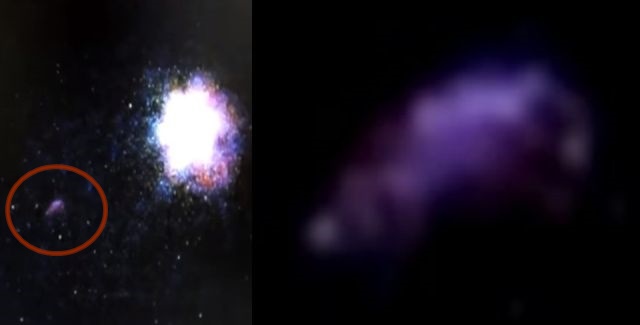
Purple Celestial Body Spotted Next To The Sun And The Moon
The celestial body was caught live going by the sun as we will see in this video, then it got smaller and going by the moon as it was leaving the Solar System.
Even though the object looks like a UFO disguised as a rock, Bruce is convinced that this purple object is an asteroid or a small unknown celestial body and that's what we are going to look at.
Lights in the sky above Kalamazoo, Michigan 7-Apr-2020
This UFO sighting video of an unknown lights flying across the night sky above Kalamazoo, Mi was filmed on Tuesday, 7th April 2020. It was submitted to us through our Facebook page.
The author said: “This isn’t the first I’ve seen but it is the first I caught…“
(April 9th, 2020: Please see the end of this release for an added note discussing the possibility of systematic errors.)
One of the fundamental ideas of cosmology is that everything looks the same in all directions if you look over large enough distances. A new study using data from NASA's Chandra X-ray Observatory and ESA's XMM-Newton is challenging that basic notion.
Astronomers using X-ray data from these orbiting observatories studied hundreds of galaxy clusters, the largest structures in the universe held together by gravity, and how their apparent properties differ across the sky.
"One of the pillars of cosmology — the study of the history and fate of the entire universe — is that the universe is 'isotropic,' meaning the same in all directions," said Konstantinos Migkas of the University of Bonn in Germany, who led the new study. "Our work shows there may be cracks in that pillar."
Astronomers generally agree that after the Big Bang, the cosmos has continuously expanded. A commonly analogy is that this expansion is like a baking loaf of raisin bread. As the bread bakes, the raisins (which represent cosmic objects like galaxies and galaxy clusters) all move away from one another as the entire loaf (representing space) expands. With an even mix the expansion should be uniform in all directions, as it should be with an isotropic universe. But these new results may not fit that picture.
"Based on our cluster observations we may have found differences in how fast the universe is expanding depending on which way we looked," said co-author Gerrit Schellenberger of the Center for Astrophysics | Harvard & Smithsonian (CfA) in Cambridge, Massachusetts. "This would contradict one of the most basic underlying assumptions we use in cosmology today."
Scientists have previously conducted many tests of whether the universe is the same in all directions. These included using optical observations of exploded stars and infrared studies of galaxies. Some of these previous efforts have produced possible evidence that the universe is not isotropic, and some have not.
This latest test uses a powerful, novel and independent technique. It capitalizes on the relationship between the temperature of the hot gas pervading a galaxy cluster and the amount of X-rays it produces, known as the cluster's X-ray luminosity. The higher the temperature of the gas in a cluster, the higher the X-ray luminosity is. Once the temperature of the cluster gas is measured, the X-ray luminosity can be estimated. This method is independent of cosmological quantities, including the expansion speed of the universe.
Once they estimated the X-ray luminosities of their clusters using this technique, scientists then calculated luminosities using a different method that does depend on cosmological quantities, including the universe's expansion speed. The results gave the researchers apparent expansion speeds across the whole sky — revealing that the universe appears to be moving away from us faster in some directions than others.
The team also compared this work with studies from other groups that have found indications of a lack of isotropy using different techniques. They found good agreement on the direction of the lowest expansion rate.
The authors of this new study came up with two possible explanations for their results that involve cosmology. One of these explanations is that large groups of galaxy clusters might be moving together, but not because of cosmic expansion. For example, it is possible some nearby clusters are being pulled in the same direction by the gravity of groups of other galaxy clusters. If the motion is rapid enough it could lead to errors in estimating the luminosities of the clusters.
These sorts of correlated motions would give the appearance of different expansion rates in different directions. Astronomers have seen similar effects with relatively nearby galaxies, at distances typically less than 850 million light years, where mutual gravitational attraction is known to control the motion of objects. However, scientists expected the expansion of the universe to dominate the motion of clusters across larger distances, up to the 5 billion light years probed in this new study.
A second possible explanation is that the universe is not actually the same in all directions. One intriguing reason could be that dark energy — the mysterious force that seems to be driving acceleration of the expansion of the universe — is itself not uniform. In other words, the X-rays may reveal that dark energy is stronger in some parts of the universe than others, causing different expansion rates.
"This would be like if the yeast in the bread isn't evenly mixed, causing it to expand faster in some places than in others," said co-author Thomas Reiprich, also of the University of Bonn. "It would be remarkable if dark energy were found to have different strengths in different parts of the universe. However, much more evidence would be needed to rule out other explanations and make a convincing case."
Either of these two cosmological explanations would have significant consequences. Many studies in cosmology, including X-ray studies of galaxy clusters, assume that the universe is isotropic and that correlated motions are negligible compared to the cosmic expansion at the distances probed here.
The team used a sample of 313 galaxy clusters for their analysis, containing 237 clusters observed by Chandra with a total of 191 days of exposure, and 76 observed by XMM-Newton, with a total of 35 days of exposure. They also combined their sample of galaxy clusters with two other large X-ray samples, using data from XMM-Newton and the Japan-US Advanced Satellite for Cosmology and Astrophysics (ASCA), giving a total of 842 different galaxy clusters. They found a similar result using the same technique.
A paper describing these results will appear in the April 2020 issue of the journal Astronomy and Astrophysics and is available online. In addition to Migkas, Schellenberger and Reiprich, the authors of this paper are Florian Pacaud and Miriam Elizabeth Ramos-Ceja (University of Bonn), and Lorenzo Lovisari (CfA).
NASA's Marshall Space Flight Center manages the Chandra program. The Smithsonian Astrophysical Observatory's Chandra X-ray Center controls science and flight operations from Cambridge and Burlington, Massachusetts.
Other materials about the findings are available at:
In the original posting of this press release we did not mention the possibility of "systematic errors" explaining some or all of these results, rather than the two cosmological explanations we discuss. First author Konstantinos Migkas had explained an example of a possible systematic error in his blog post that accompanied the press release. A relevant excerpt is here:
"So did we tear down one of the most crucial pillars of cosmology? Not so fast, it is not that simple. At least two scenarios may have led us to wrong conclusions.
Firstly, cosmic material might interfere with the light that travels from the clusters to the Earth. For example, previously unknown gas and dust clouds beyond the Milky Way could obscure a fraction of photons emitted from the clusters. Since we ignore the possible existence of such clouds, we do not account for their interference, and hence we would falsely underestimate the true luminosity of the clusters. Eventually, we could mistake this for a cosmological effect. We performed several tests that led us to believe that this scenario seems unlikely, but not impossible. However, considering that the direction of the anisotropy we find agrees with other studies that used observations in light at different wavelengths, where such obscuring effects are not expected, one could argue against the possibility of such biases in our analysis."
Their peer reviewed and published paper considers this and several other possible systematic errors in detail, and will address other possibilities in a future peer-reviewed paper.
OPMERKELIJK: HET UNIVERSUM DIJT MOGELIJK NIET IN ALLE RICHTINGEN GELIJKMATIG UIT
Vivian Lammerse
De studie veegt daarmee een lang aanvaarde theorie van tafel, waardoor we mogelijk ons huidige kosmologische model moeten herzien.
Astronomen zijn het er grotendeels met elkaar over eens dat de kosmos na de oerknal voortdurend uitdijde. Het betekent dat de afstand tussen sterrenstelsels in ons universum per seconde steeds een stukje groter wordt. Daarbij gaan wetenschappers er al decennia van uit dat het heelal zich in alle richtingen met dezelfde snelheid uitbreidt. Maar een nieuwe studie gepubliceerd in Astronomy & Astrophysics veegt die lang aanvaarde theorie nu hardvochtig tafel.
Rozijnencake De uitdijing van het universum kun je nog het beste vergelijken met een rozijnencake. Terwijl de cake – die het heelal vertegenwoordigt – in de oven bakt en uitzet, bewegen de rozijnen – die kosmische objecten zoals sterrenstelsels voorstellen – van elkaar vandaan. Met een gelijkmatige mengsel zou de cake in alle richtingen op dezelfde manier uit moeten zetten, net als bij een isotroop universum. En daar gingen astronomen al decennia lang van uit.
Onderzoekers besloten de zogenaamde ‘isotroophypothese’ over het universum uit te dagen. Want klopt het eigenlijk wel dat het heelal gelijkmatig in alle richtingen uitdijt? “We hebben gekeken naar meer dan 800 clusters in het huidige heelal,” vertelt onderzoeker Konstantinos Migkas. “Als de isotroophypothese correct is, zouden de eigenschappen van de clusters overal hetzelfde zijn. Maar we zagen al gauw significante verschillen.”
Vier van de honderden clusters die in de studie werden geanalyseerd.
Afbeelding: NASA/CXC/Univ. of Bonn/K. Migkas et al.
De astronomen gebruikten röntgen temperatuurmetingen van het extreem hete gas dat doordringt in de sterrenhopen en vergeleken de gegevens met hoe helder de sterrenhopen verschijnen. Clusters met dezelfde temperatuur en op een vergelijkbare afstand zouden er – volgens de theorie – even helder uit moeten zien. Maar dat is niet wat de onderzoekers opmerkten. “We zagen dat clusters met dezelfde eigenschappen en met vergelijkbare temperaturen in de ene richting veel minder helder leken dan verwacht, terwijl ze in een andere richting juist veel helderder waren,” vertelt Thomas Reiprich. “Het verschil was behoorlijk groot, ongeveer dertig procent.”
Verklaringen De onderzoekers besloten op zoek te gaan naar mogelijke verklaringen. Want wellicht dat onopgemerkte gas- of stofwolken het zicht belemmerden, waardoor de clusters in een bepaald gebied donkerder leken. Dat bleek echter niet het geval. Ook enkele andere oorzaken die de nieuwe studieresultaten zouden kunnen ontkrachten werden onderzocht, maar van tafel geveegd. Het betekent dat het universum wellicht echt ongelijkmatig uitdijt. Maar wat ligt hieraan ten grondslag? De wetenschappers speculeren nu dat mogelijk donkere energie een vinger in de pap heeft. Het grootste deel van het universum bestaat mogelijk uit deze mysterieuze vorm van energie, al weten we hier op dit moment nog niet veel van af. Het enige dat wetenschappers veronderstellen is dat donkere energie op de een of andere manier verantwoordelijk is voor de versnelling van de uitdijing van het universum. In dit geval zou het kunnen dat donkere energie in sommige delen van het universum sterker is dan in andere delen, waardoor er mogelijk verschillen ontstaan in hoe snel het universum in bepaalde richtingen uitdijt.
Een kaart van de snelheid van de uitdijing van het heelal in verschillende richtingen.
Afbeelding: K. Migkas et al. 2020, CC BY-SA 3.0 IGO
Gevolgen De bevindingen hebben grote gevolgen. Want tot op heden gingen onderzoekers er eigenlijk standaard vanuit dat het universum isotroop is. “Als het heelal echt anisotroop is – al was het maar in de afgelopen paar miljard jaar – dan zou dit enorme gevolgen hebben,” zegt Migkas. “Wanneer we de eigenschappen van objecten analyseren moet er namelijk rekening gehouden worden met de richting van elk object. Vandaag schatten we bijvoorbeeld de afstand tot zeer verre objecten in het heelal door een reeks kosmologische parameters en vergelijkingen toe te passen. We geloven dat deze parameters overal hetzelfde zijn. Maar als onze bevindingen juist zijn, dan zou dat niet meer op gaan en moeten we dus al onze eerdere conclusies herzien.”
Of dat ook echt nodig is, zal toekomstig onderzoek moeten uitwijzen. “De bevindingen zijn echt interessant, maar de steekproef in de studie is nog relatief klein om zulke verstrekkende conclusies te trekken,” zegt René Laureijs van ESA. “Als we het algemeen aanvaarde kosmologische model echt zouden moeten heroverwegen, hebben we meer gegevens nodig.” En die gaan er wellicht ook komen. ESA’s aankomende telescoop Euclid is ontworpen om miljarden sterrenstelsels in beeld te brengen. Deze telescoop zal in staat zijn om de uitdijing van het universum, de versnelling en de aard van donkere energie nauwkeuriger dan ooit te onderzoeken. De lancering van de telescoop staat gepland voor 2022. We wachten gespannen af of deze telescoop het grote mysterie in toekomst zou kunnen helpen oplossen.
MEDICIJN GEVONDEN DAT HET NIEUWE CORONAVIRUS BINNEN 48 UUR UITSCHAKELT
Caroline Kraaijvanger
Het medicijn – dat nu gebruikt wordt om parasieten te bestrijden – lijkt in ieder geval in het laboratorium veelbelovend.
Tot die conclusie komen onderzoekers van Monash University nadat ze het middel in het laboratorium loslieten op cellen die met het virus geïnfecteerd waren. De experimenten wijzen uit dat het middel het virus binnen 48 uur kan doden. “We ontdekten dat een enkele dosis in 48 uur tijd in feite al het virale RNA verwijderde en dat er zelfs na 24 uur al sprake was van een significante afname van het virus,” aldus onderzoeker Kylie Wagstaff.
Meer onderzoek Of dit dan de behandeling is waar talloze patiënten wereldwijd naar smachten? Die conclusie zul je Wagstaff nog niet zo snel horen trekken. Het is namelijk belangrijk om je te realiseren dat deze resultaten enkel in het laboratorium geboekt zijn. Of het middel in vivo – oftewel in het menselijk lichaam – hetzelfde resultaat heeft, is nog onduidelijk. “We moeten nu uitzoeken of de dosis waarin je het aan mensen kunt toedienen, effectief is. Dat is de volgende stap.”
Over ivermectine Wagstaff en collega’s bogen zich al snel nadat het nieuwe coronavirus SARS-CoV-2 tot een pandemie uitgroeide, over het betreffende geneesmiddel: ivermectine. Het medicijn wordt nu ingezet om parasieten te bestrijden. Zo krijgen mensen het bijvoorbeeld voorgeschreven bij worminfecties. Maar eerdere studies hebben al uitgewezen dat het in vitro – oftewel buiten het lichaam, in kweekculturen in het lab – ook wel raad weet met een breed scala aan virussen, waaronder zika en het influenzavirus. En dat bracht Wagstaff en collega’s op het idee om het middel ook los te laten op het nieuwe coronavirus.
Hoe werkt het? Het levert in ieder geval in het laboratorium veelbelovende resultaten op. Hoe het middel in de petrischaaltjes van Wagstaff en collega’s precies afrekent met het virus is niet onderzocht. Maar de wetenschappers hebben daar – afgaand op wat ze het middel eerder met andere virussen hebben zien doen – wel ideeën over. Ons immuunsysteem maakt normaliter korte metten met lichaamsvreemde stoffen, zoals virussen. Om toch cellen te kunnen infecteren, onderdrukt het nieuwe coronavirus die immuunrespons, waardoor onze cellen er minder goed in slagen om het virus op te ruimen. En ivermectine lijkt er kort gezegd voor te zorgen dat het virus er niet meer in slaagt om onze cellen ervan te weerhouden het virus op te ruimen.
Vervolgonderzoek Als uit vervolgonderzoek blijkt dat het middel ook in het menselijk lichaam wel raad weet met SARS-CoV-2 dan kan het in theorie snel gaan. Omdat ivermectine al een bestaand en dus goedgekeurd en veilig bevonden medicijn is, kan het in principe snel worden ingezet om geïnfecteerde patiënten te behandelen. Zover is het echter nog niet, zo blijven Wagstaff en collega’s benadrukken. Eerst moet er in het laboratorium nog meer onderzoek worden gedaan en dan pas kan er na worden gedacht over klinisch onderzoek, waarbij het middel op mensen wordt getest. En om dat alles mogelijk te maken, is heel dringend geld nodig.
Malariamedicijn Op dit moment is er geen effectieve behandeling voor mensen die met SARS-CoV-2 besmet zijn geraakt. Artsen behandelen momenteel dan ook noodgedwongen de symptomen. Onderzoekers wereldwijd werken hard om daar verandering in te brengen. Zij kijken daarbij – vanwege de urgente vraag naar een behandeling – het liefst naar bestaande medicijnen. Zo werd eerder al geopperd dat een bestaand malariamedicijn kon helpen in de behandeling tegen COVID-19. Maar wetenschappelijke studies naar de effectiviteit van het middel leveren tot op heden uiteenlopende resultaten op. Er is tot op heden dus geen hard bewijs dat dit geneesmiddel het verschil kan maken.
Dat een effectieve behandeling tegen COVID-19 hard nodig is, staat buiten kijf. Wereldwijd is het virus inmiddels bij meer dan 1,2 miljoen mensen officieel vastgesteld. En bijna 70.000 mensen zijn aan de gevolgen van het virus overleden. Lang leek China – het land waarin het virus voor het eerst opdook – het hardst te zijn getroffen, maar inmiddels tellen de VS, Spanje, Italië, Duitsland en Frankrijk meer officiële besmettingen dan China. In Nederland zijn meer dan 17.000 besmettingen bevestigd en 1766 mensen zijn aan de gevolgen van het virus overleden. Maatregelen bedoeld om de verspreiding van het virus af te remmen, lijken ondertussen hun vruchten af te werpen. Onduidelijk is nog hoelang die maatregelen – of in ieder geval een deel ervan – in stand moeten worden gehouden om het virus echt onder controle te houden. Deskundigen sluiten niet uit dat onze samenleving er zeker nog 12 tot 18 maanden anders uit zal zien dan in pre-COVID-19-tijden.
Cryptic Snake-Like Structure in Peru Spotted by Google Earth User
Southern Peru is famous for UNESCO-designated World Heritage Site the Nazca Lines, which represent a group of giant and ancient geoglyphs. However, something even more mysterious and unexplainable have now been spotted close to the site by one curious Google Earth user.
Some cryptic shapes and patterns were spotted by Google Earth enthusiast 30-40 kilometres North East from the famous Nazca Lines in Peru. The user published a video of his mysterious discovery on YouTube, and the image immediately attracted thousands of views in just several days, with observers rushing to express their astonishment with the finding.
The patterns spotted by the Google Earth admirer included strange “football pitch”-sized circles in a deserted mountain ridge nearby Uchumarca, as well as a cryptic snake-like structure, which he described as a “serpent”. He also noted in the video that it was difficult to understand whether the pattern was occurring naturally or was a human-designed structure.
“The ‘serpent’ just really jumped right out at me”, the Google Earth user wrote on YouTube after his video was published. “It's either a very large natural formation or a manmade artificial site like the serpent mound in Ohio. Other than that - I got nothin'. Very interesting”.
“Very cool find my friend. Definitely looks like a petrified serpant to me”, one of the video viewers commented on the finding.
“Yo that snake was so eye popping, it def looks man made but the scale of it, im amazed by it”, another YouTuber added.
Despite a flow of comments and speculations about what could have caused such exotic shapes in one of the highest elevations in the area, the truth behind the origin of giant patterns still remains a mystery.
The Nazca Lines, which lie close to the analysed site, are a group of geoglyphs which are believed to be created around 2000 years ago. They are located in southern Peru and are designated as a UNESCO World Heritage Site.
NASA’s incubator programme which funds the development of far reaching, long term advanced concepts that “think outside the box,” has awarded a grant for research into turning a huge crater on the far side of the Moon into a giant radio telescope.
NASA’s Institute for Advanced Concepts (NIAC) is a platform that each year nurtures visionary ideas that have the potential to create breakthrough technologies for possible future space missions, by funding projects still in the early stages of development.
For 2020, the US space agency has selected 23 potentially revolutionary concepts with a total award value of $7 million; recipients of Phase I awards receive $125,000 to advance their concept over a nine-month period.
One of the new successful applicants is Saptarshi Bandyopadhyay, a robotics technologist at NASA’s Jet Propulsion Laboratory in California. Bandyopadhyay’s idea is to turn a suitable existing lunar crater, one to 50 kilometres in diameter, on the far-side of the Moon into a spherical reflecting dish and use it as a radio telescope.
Called the Lunar Crater Radio Telescope (LCRT), the dish would be able to observe the Universe in the 5 –100 metre wavelength band, a region of the electromagnetic spectrum rarely utilised in astronomy.
The radio telescope, which would have “tremendous advantages compared to Earth-based telescopes,” according to Bandyopadhyay’s description of his radical concept, could “potentially make tremendous scientific discoveries in fields of cosmology and extrasolar planets.”
An added advantage is that as it will be tucked away out of sight from Earth, the Moon will act as a physical shield that isolates the telescope from the radio interference and noises coming from our planet.
To create the LCRT, Bandyopadhyay suggests using wallclimbing DuAxel robots to drape a deployable wire-mesh one kilometre in diameter on the inside of a large lunar crater.
This would require only a few robots from Earth thereby significantly reducing launch weight and cost compared to all previous lunar-surface telescope mission concepts, says Bandyopadhyay.
If the concept ever came to fruition, then the LCRT would be the largest filled-aperture radio telescope in the Solar System.
Furthermore, the concept idea specifies that the robots could then go onto create a network of LCRTs that would facilitate in lunar Very-Long-Baseline Interferometry (VLBI) astronomy.
VLBI is already a technique used on Earth to perform very high angular resolution observations of cosmic radio sources. It works by linking together antennas that are spread thousands of kilometres apart around the globe.
When connected, they act as a virtual planet-size dish, giving astronomers exceptional resolving power; for example VBLI observations were used by the Event Horizon Telescope last year to make the first ever photograph of a black hole.
A feat that the LCRT's creator is hoping to emulate. “We envisage that this concept would unlock the potential for ground-breaking scientific discoveries in radio astronomy,” concludes Bandyopadhyay.
In addition to Bandyopadhyay’s concept, NASA also awarded a Phase III grant to Slava Turyshev, a researcher at NASA’s Jet Propulsion Laboratory in Pasadena, California, to continue his design for imaging Earth-like planets outside of the solar system.
Turyshev will receive a $2 million grant to further mature the concept and related technologies of his solar gravity lens; a probe located 80.4 billion kilometres (50 billion miles) from Earth that uses multiple small spacecraft and solar sail technology to propel the lens to its target destination.
Turyshev’s idea is only the third study selected for Phase III funding in the history of the program said NIAC Program Executive Jason Derleth.
“We’re excited by its potential to bring us closer to imaging an exoplanet in detail, at a resolution comparable to the well-known Apollo 8 Earthrise photo,” Derleth said.
“The trailer has arrived for Greenland, a movie that probably won’t do much to help you relax during this particular period. Gerard Butler and Morena Baccarin star in this disaster thriller, which follows a family’s fight to get to Greenland bunkers as comet fragments – preceding a big mofo – collide with the Earth. Roger Dale Floyd and Scott Glenn also star.”
At this point, most announcements of the release of the trailer for the upcoming comet disaster movie “Greenland” inserted a YouTube video of it and clickers watched it … for a day. Latecomers got this message instead: “Video unavailable. This video has been removed by the uploader.” (Try it yourself here.) What happened?
“They got it all wrong. There’s a ton of fragments! Planet killers…”
That 10-second ‘elevator pitch’ describes the plot of “Greenland,” which stars Gerard Butler (Angel Has Fallen) and is directed by Ric Roman Waugh (Felon, Shot Caller). A planet-killing comet is breaking up and threatening Earth, the media reports are inconsistent, panic ensues, humanity shows its best and worst sides as government breaks down and laws are ignored and people search for a safe place.
Does any of this sound eerily familiar?
“The trailer has some eerie similarities to what’s been happening in our real world, as many of us looked at those early reports of COVID-19 with little concern and the subsequent media info has been frustratingly inconsistent.”
Firstshowing.net gives one clue as to why the trailer may have been pulled. That reason can easily hide behind the obvious other coronavirus-related one – the June U.S. premier will be delayed by the lockdown. However, Ufohotspot.com gives another possibility:
“Talking about a comet breaking into pieces, according to the latest information from astronomers around the world, comet Atlas discovered on December 28, 2019 and it’s close approach to Earth on May 23, 2020 might be breaking apart and is starting to fade.”
As of this writing, the interstellar comet Borisov is breaking apart and may not make it out of the solar system at all. At the same time, the highly-hyped “supercomet” Atlas — whose icy center is only kilometers wide but whose atmosphere measures five times the size of Jupiter and is being misleadingly described by many sites as “planet-sized” – is also breaking up and may not light up the sky and be visible to the naked eye as predicted. While these comets are too far away for any of their pieces to strike the Earth, the already terrified and confused world doesn’t need much to push it completely over the apocalyptic edge to suspecting their government is hiding the truth about these two comets in addition to the coronavirus – it doesn’t take many connected dots to see this picture forming.
Speaking of pictures and trailers, the Watchtower.org website has a foreign version of the trailer (at least as of this writing) that can be viewed here.
Cover-up? Coincidence? Coronavirus? Comets? Conspiracy? Cinematic conjecture? (Today’s story was brought to you by the letter ‘C’.)
So far as can be determined, the menacing Chupacabrafirst surfaced in March 1995, twenty-five years ago. That was when numerous animals – mainly goats – were found dead in the towns of Morovis (located in central Puerto Rico) and Orocovis, which is situated within the La Cordillera Central mountain range. Locals were plunged into states of near-hysteria by the attacks, which reportedly left animals dead, with strange marks on their necks, and a distinct lack of blood in their corpses. At least, that was the rumor. Since many of the early attacks were on goats, the term, “Chupacabra,” was created. It translates as “goat-sucker.” Matters really began in August 1995. That was when a woman named Madelyne Tolentino – who lived in Canovanas, which is close to the northeast coast of Puerto Rico – changed everything. Madelyne’s description of the creature she encountered, close to her mother’s home, was disturbing, to say the very least. It was a description eagerly embraced by the island’s media and by investigators of monsters and mysteries.
7
Madelyne told journalists and researchers that the creature was around three feet in height, bipedal, ran in a weird, hopping fashion, had large black eyes, bony fingers on each hand, overly long arms and legs, and a kind of feathery line running down its back. Or, it appeared to Tolentino to be a feathery line: a young boy employed by Tolentino’s husband claimed that he saw the beast up close and personal and maintained that the feathers were, in reality, sharp spines. The boy also said that the creature possessed a mouthful of vicious-looking fangs. Not only did the people know of the chupacabra and its attacks, they also now knew what it looked like: something straight out of their worst nightmares. A legend was born. Some would say that a legend is all it is.
As someone with a big interest in the field of cryptozoology, I sat up and took notice when the stories of the Chupacabra began to surface in 1995. Indeed, of all the things I investigate, research and write about, Cryptozoology is the number one. It wasn’t until July 2004 that I was able to visit Puerto Rico and investigate the mystery for myself. I was there with a good friend of mine, Jon Downes, who runs the U.K.’-based Center for Fortean Zoology. The reason? We were there with a crew from the SyFy Channel who were making a new (and short-lived) show called Proof Positive. It was during those eight days on Puerto Rico that I quickly came to realize how much interest there was on the island, even nine years after the first sightings in 1995. Twenty-five years later, I’ve now been to Puerto Rico on nine occasions and obtained a wealth of data on the monster. Some of it suggests that the phenomenon is real. Other data destroys some of the more controversial aspects of the story.
Time and again I heard rumors that the Chupacbara lived on blood – or that blood was, at least, an integral part of the creature’s daily intake. It was this angle of the Chupacabra lore and legend that really stood out. But, it wasn’t true. If it shatters some cherished assumptions, that’s too damned bad, but – contrary to what many people believe – there’s no proof of the Chupacabras sucking blood. Even vampire bats do not suck blood. Ever. Instead, when a bat lands on its sleeping prey, it makes a tiny incision, with its razor-sharp teeth, that provokes the flow of blood – in much the same way that blood flows to the surface of our skin when it’s cut. The bat then proceeds to lap the protein-rich blood, rather than suck it. Rather incredibly, if the skin of the prey is covered in significant amounts of hair, the vampire bat has the ability to use its teeth to “shave” the hair away, thus allowing it to feed easier. Most ingenious of all, Mother Nature has taken steps to ensure the saliva of the vampire bat contains anticoagulants that prevent the blood of its prey from clotting. The blood, as a result, runs and runs – and runs even more.
To demonstrate the sheer speed and ability with which the vampire bat can feed voraciously on its victim, a fully-grown specimen can lap around fifty percent of its own body weight in less than half an hour. The vampire bat has a near-unique digestive system that allows its stomach to absorb plasma from the blood. From there, it makes its way to the kidneys, and finally to the bladder. It’s a very quick process, too: from intake to urination, the passage of time is around one and a half minutes. And, like all of us, when it’s done feeding, the vampire bat finds a place to settle down, relax, and let the process of digestion do its thing.
During the course of my investigations on Puerto Rico, barely a day went by when I didn’t hear at least one story of the chupacabra’s vampire-like attacks on livestock and other animals. And I can’t tell you how many times the words “blood” and “draining” (or “sucking”) were used in the very same sentences. Certainly, I uncovered a number of stories from people who claimed their dead animals were subjected to necropsies, and which confirmed that massive blood loss had occurred. The problem, however, was that I was never able to secure even a single, official necropsy report to validate those claims. On the other side of the coin, I have heard more than a few very plausible stories suggesting the assumed, huge loss of blood was actually due to the blood of the dead animals sinking to the lowest parts of the victims’ bodies, after death. What appeared to have been evidence of a significant loss of blood may have really been be due to nothing more than misidentification. Today, I have just about completely dismissed the theory that the creature lives on blood. Even in minute amounts.
That didn’t take away the fact, however, that people were still seeing the creature – regardless of the blood angle. Some witnesses were sure that what they had seen was actually a giant bat. Others described it as a large bird with what appeared to be human-like legs. Then, there were those in the field of conspiracy-theorizing, who believed that the Chupacabras were actually genetically altered monkeys turned into raging, killing machines and let loose in Puerto Rico’s El Yunque rain-forest. The scenario told to me was something like a combination of Predator and 28 Days Later! That there was a lot of UFO activity on Puerto Rico led to the inevitable scenario of the Chupacabras being extraterrestrial in nature. And, there was the theory that the monsters were supernatural in origin – things that could be invoked via rite and ritual. A few people supported the admittedly interesting theory that perhaps some of the attacks were the work of escaped large cats.
Today, as we “celebrate” the Chupacabras’ 25th year of infamy, not much has changed – in terms of the theories, the claims and the legends. Based on all of the research I’ve done on Puerto Rico, I still believe there is such a creature – a mysterious animal that has yet to be found and identified. There is another aspect to all of this. Namely, all of the friends I have made on Puerto Rico over all the years, and who I have stayed in touch with. Puerto Rico is a great place, with an equally great culture and a cool history. And Puerto Rican food is superb. And after a hard day of seeking out a Chupacabra or several, there’s a plentiful supply of Medalla beer to chug down. I can easily see myself moving to Puerto Rico one day – all as a result of a quest for the truth of the island’s resident monster.
Alien Communications Are Getting More Urgent, Something Big is About to Happen 2020
COAST TO COAST AM – Certified hypnotherapist, abduction researcher and Director of CERO (Close Encounter Resource Organization) Yvonne Smith discussed stories from the last five years of her work as a hypnotherapist specializing in alien abduction. She has seen a shift or “urgency” in the messages received by the abductees from these beings as if something enormous is about to happen.
Smith has been regressing and counseling abductees for over 25 years, and is convinced that the abduction phenomenon is real and is caused by some sort of extraterrestrial beings or intelligences because the accounts of her clients are “so startlingly similar.”
The 40,000 Year Old Legacy of the Advanced Siberian Denisovans Giants
COAST TO COAST AM – Andrew Collins has been investigating the idea of advanced civilizations in prehistory since 1979. In the latter half, he spoke about the legacy of the Denisovans, an extinct species of hominins that lived in Siberia around 40,000 years ago, and whose existence was just discovered in 2010.
Collins believes they developed sophisticated technology, using high-speed drilling techniques and creating unique jewelry and musical instruments. The Denisovans, who were large in size and may have been the source of legends about giants (such as the Nephilim) were fascinated by celestial movements, he noted.
Rare View of Advanced Alien Technology next to the Planet Venus
Astunning image has been taken by a sky-watcher from Waujesha, Wisconsin on April 9, 2020 showing what appears to be two huge UFO lightships next to the planet Venus.
Credit images sky-watcher Waujesha, Wisconsin -
Original image submitted to Mufon .
At first glance it looks like it is just one UFO lightship but zooming in on the object it turns out to be two UFO lightships.
Further analysis shows that the two UFOs are connected to each other by a beam of light whereby a red glowing object surrounds the beam.
It may be that the sky-watcher has captured a rare view of advanced alien technology in deep space.
Mass daytime UFO sighting above Utica, New York 8-Apr-2020
Another recent video of a mass UFO sighting in the skies above United States. This one was filmed over Utica, New York on 8th April 2020.
Witness report:
9 Orbs Video Over House 1 moves from left to right. April 8 2020. 1 orb is seen moving left to right. My brother & I both experienced missing time on the same day which was on Sunday 3 days before this encounter. My whole family has been having encounters with aliens the grays & 7 other different species for over 3 decades. No matter where we move the aliens always find us.We believe these craft are flown by aliens not of our world. There was no sound coming from these craft.
Evidence of New Human Species Discovered in a Cave in the Philippines
There were once many human species, but today there is only one; modern humans, Homo sapiens. However, the human family tree is growing. Researchers working in a cave in the Philippines claim to have found a new, previously unknown species to add to human history.
Remarkably this hominin was probably less than four feet high and had some of the characteristics of modern people but also anatomical features from much earlier hominins . It is believed that the discovery will transform the understanding of our evolution.
New humans found in the Philippines
In recent years there have been a series of finds of early humans in the Philippines. The latest was made by archaeologists as they were digging in the ‘rocky floor of Callao Cave on Luzon island’ according to History.com. A team of experts found a number of fossils that are unlike anything else in the world. They were unearthed by a team of experts led by Professor Philip Piper, from the Australian National University.
According to the Daily Mail , “the fossil remains included adult finger and toe bones, as well as teeth.” The femur bone of a juvenile was also unearthed. The remains are estimated to be about 50,000 years old, at a period of time in the Pleistocene when several human species co-existed on the planet. A preliminary examination of the remains indicated that they came from an ‘unknown species of hominin’ according to Haaretz.
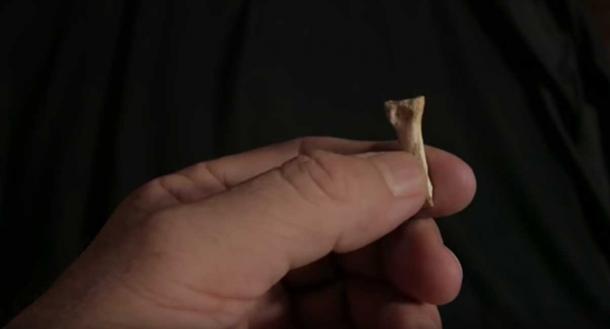
The five upper teeth found belonged to a single individual of previously unknown hominin, provisionally named ‘Homo luzonensis’. The have a strange mix of Australopithecine and modern features.
The stunning discovery has been provisionally named Homo luzonensis . The new species had some of the same characteristics of modern humans , in particular, its molars. However, they also had characteristics of a far earlier species namely of Homo australopithecus . This hominin was the ancestor of many human species including Homo erectus and lived between 2 and 3 million years ago. The Daily Mail reports that ‘hand and feet bones, are remarkably Australopithecine-like’.
Despite these similarities, the shape of the tooth and the anatomy of the feet shows that they are a unique human species. The slight but significant difference are such that taken together they strongly indicate that Piper and his team have unearthed a new species. What is most striking about the new species was their estimated height, possibly just under four feet.
The height of the new humans was determined by the size of the tooth and the other bones. However, more evidence is required to confirm this. If the size is confirmed, it is raising the possibility that the hominins are somehow related to another species found in the Indonesian island of Flores . This hominin is Homo floresiensis and stood under four feet high. Because of their diminutive stature, they are popularly known as the Hobbit.
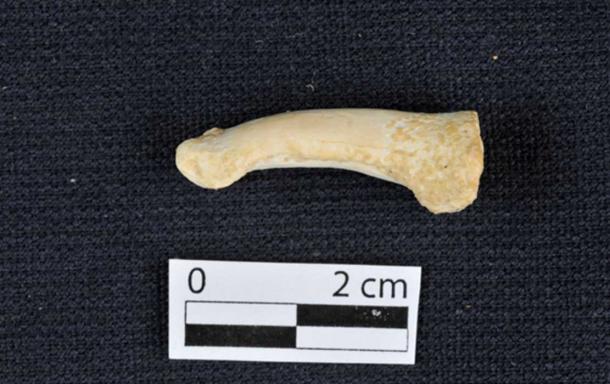
An examination of the foot bones found morphological features that come from both earlier and later hominins. This could indicate that they had a particular way of walking. According to Science Mag , the human had ‘long, curved fingers and toes’. This means that it was as comfortable scrambling up trees as walking upright. This would seem to suggest that it ‘might have descended from an earlier human relative, H. erectus , that somehow crossed the sea to Luzon’ reports the WRAL.com.
The proximal foot phalanx of Homo luzonensis. Notice the longitudinal curvature of the bone, which suggests that this species was adapted to climb trees.
According to History.com ‘human evolution was clearly much more complex’ in Asia than previously assumed. It seemed that H. erectus in evolved in the region into new species such as that possibly found in Luzon. It appears that the human evolved in a unique way on the island of Luzon, very different from those on mainland Asia. Science Mag reports that many experts “suspect the islands of Southeast Asia may have been a cradle of diversity for ancient humans.”
New theory on human evolution
The find is casting doubt on the accepted theory of how humans evolved and spread out over the globe. The first wave of our relatives to leave Africa was made up of H. erectus and the second wave was H. sapiens . It was thought that H. erectus settled in Asia and it was the only human in Asia until the arrival of modern humans. The discovery of H. luzonensis , along with the earlier discovery on Flores have upturned this theory.
More work needs to be done to establish if the human remains found on Luzon are from a new group of hominins. At present, there are approximately 12 human species recognized but there is no agreement as exactly how many have been identified. It seems likely that the humans whose bones were found in the Callao Cave may be another one of our relatives and will add greatly to our understanding of human evolution.
Top image: Callao Cave, Luzon Island, Philippines where the bone and teeth of the new human species were found.
The excavation of the site, known as Kunara and located near the city of Sulaymaniyah, was only possible after Iraqi dictator Saddam Hussein was deposed in 2003. Researchers also noted that the ISIS terrorist group’s presence in Iraq also hampered their efforts.
“The situation is much more favorable now,” project leader Aline Tenu said in the journal.
4,000-Year-Old "Lost" City That Bordered Ancient Mesopotamian Empire.
Credit: Tenu/Mission Archeologique Francaise du Peramagron
According to the journal, “This city stood in the heart of an unknown kingdom: that of the mountain people, who had until then remained in the shadow of their powerful Mesopotamian neighbors,” including the Akkadians. The Akkadian Empire is considered the first ancient empire of Mesopotamia and reached its peak about 4,000 years ago under ruler Sargon of Akkad . After its fall, historians believe it split into Assyria and Babylonia.
People lived in the city, located near the Zagros Mountains, around 2200 BC, archaeologists have theorized.
“The city of Kunara provides new elements regarding a hitherto unknown people that has remained at the periphery of Mesopotamian studies,” Tenu added.
The lost city was found near the Zagros Mountains,
pictured (sghiaseddin / Adobe Stock)
Meanwhile, dozens of clay tablets covered in cuneiform were also discovered, which showed how people may have delivered flour. Cuneiform is one of the oldest systems of writing.
Researchers said the city underwent a period of decline after it was ravaged by a fire 4,000 years ago, the researchers speculated.
Cuneiform specialist Philippe Clancier said the people who lived in the city had a good “grasp of Akkadian and Sumerian writing, as well as that of their Mesopotamian neighbors.”
An Akkadian tablet
(public domain)
“The first tablets found in a building of the lower city register a large number of entries and departures of flour,” Clancier continued.
“It was actually a kind of flour office,” Tenu explained, adding that it was for the governor of Kunara.
“The city must have even been fairly prosperous,” Tenu noted. “As rare stones such as obsidian [and carnelian, a semi-precious gems stone] were used to produce entirely commonplace tools.”
Residents in the city “most likely took advantage of its strategic location on the border between the Iranian kingdom in the east and the Mesopotamian kingdom in the west and south,” Kepinski also theorized.
Researchers also discovered tools and ceramics that were bought and traded in the city’s ruins.
“It was surely the area’s agricultural wealth that promoted its rise. Archaeologists have discovered the remains of goats, sheep, cows, and pigs, suggesting the existence of a major livestock farming system. The presence of an irrigation network in the city’s south is also a reminder of the mastery the region’s inhabitants achieved in grain farming, especially barley and malt,” the journal also noted.
They haven’t found anything about the city’s original name, which is still a mystery, “But we will continue to look,” Tenu added.
Top image: 3D reconstruction of an ancient Mesopotamian city. (Satori / Adobe Stock)
An amazing transformation has occurred in modern science. It has been slow in coming and is one that many scientists avoid discussing: there is a point where science and religion coincide. The frightening truth about this agreement is that it isn’t about new age physics, the nature of God or the transcendent union of science and religion – it concerns the nature of man, or rather, the problem of man.
For many years, under the influence of liberalism and humanism, science tended to favour the logic of the ‘Noble Savage’. Violence and evil were human problems, probably caused by the conflict between our intellect and natural instincts. Nature was great, instincts were marvellous and sex was fun. This logic was buttressed with romantic notions about the innocence of animals, the moral purity of instinct, and the marketable icon of the harmless, playful, innocent ape. However, as science progressed, these notions fell like a house of cards.
During the 1970s science began to refine its interpretation of Darwin’s theory of evolution. This refinement became known as sociobiology – the inclusive fitness theory – or in journalistic terms, ‘the selfish gene’. It was popularised by Richard Dawkins’s book The Selfish Gene. This discovery, which is now conventional scientific wisdom, holds that the ultimate driving force for evolution is the genes, the molecular unit of heredity of a living organism. The maximisation of genetic successes to assure the passing on of certain genes to subsequent generations. This principle, however terrifying in its ramifications, is the state of present evolutionary theory.
When this is combined with our new understanding of the nature of animal behaviour, a darker and more reflective scientific paradigm arises, one that has more in common with Gnosticism, a stream of thought that extends from the early followers of Christ.
A Man & a Chimp
Our relationship to apes has always been a matter of conjecture. We need to abandon the theories and debates about origins and consider the state of humanity at present. There are many ways to consider evolution: Whether we accept Darwinian evolution or a modification thereof, or that evolution was manipulated by ETs, God(s), or even if we consider we are part of a stage of a larger evolutionary cycle (Theosophy, Anthroposophy etc.), the fact remains that our present genetic inheritance indicates something about our present condition.
Science places modern man (Homo sapiens sapiens) in the centre of the ape kingdom. It says humans are part of the same lineage as orangutans, gorillas, chimpanzees, and bonobos. The standard view of this great-ape ‘family tree’ is that humans and chimps are more similar to each other than either is to the gorilla – because chimps and humans diverged more recently. But with the publication of the sequence of the full gorilla genome in 2012, this theory has been overthrown. Scientists realised that much of the human genome more closely resembles the gorilla than it does the chimpanzee genome.
While they may seem affectionate and lovable at first appearance, extensive study in the wild has shown a far darker side to ape behaviour. Apes murder, rape and torture. They will defend their territory and intrude on any surrounding territories using guerrilla warfare, literally! In various studies of ape behaviour, it is estimated that at least forty per cent of all cases of copulation involves elements of violence, which would be interpreted as rape. Apes have short-term memories when it comes to companions. If an ape leaves one pack to join another, he becomes an instant enemy. Raids on other packs are frequent, bloody and brutal and involve ambush, torture and death. Apes behave differently from many other animal species and their aggressiveness seems very similar to human behaviour. It’s frighteningly clear that our genetic heritage is directly related to the ape kingdom. This invokes some fascinating questions and quandaries.
Why Intellect?
Apes and related kin are excellent reproducers. They create many offspring and continually reinforce their genetic heritage by territorialism and brute force. Researchers in this field raise the question: why would the ‘genetic program’ create what we understand as the conscious mind?
Many argue that intelligence developed as the result of enhanced hand-eye coordination by using tools. However, many other species use tools, including apes. Apes are quick learners, and use whatever they can find to open that nut, get that fruit, or crush that skull. But apes did not develop a high level of intelligence – only the offshoot of Homo sapiens sapiens. This argument sheds light on a fascinating possibility – was human nature tweaked? Did genetic engineering take place that modified available genetic substances to create modern humans? Such writers as Zecharia Sitchin and Erich von Daniken use this sort of reasoning extensively.
The darker side of this theory is why would an alien life form modify genetic substance without adequately balancing the social effects of the inherent flaws within the original substance? If an alien species, a deity or whatever was capable of manipulating genetic materials, then surely it would be aware of the destructive power within the primate form it was transforming. If we consider there was some manipulation of our genetic structure, then was this accomplished by a somewhat primitive and ignorant entity (which is unlikely considering the required technology)? An entity or force that was malefic and unsympathetic to the resulting human condition?
This may seem too much to grasp at first, yet if we consider the myths and legends that abound within humanity’s history, they all seem to include such tales of genetic interference.
The Gnostics believed that a false creator (Demiurge) formed Matter (the physical world), and humans were moulded out of fallen substance in an effort to trap particles of Light (preexistent Souls). Sitchin argued that an alien race (the Anunnaki) genetically engineered humanity as a slave species, but the early humans rebelled and developed consciousness. Numerous myths, stories and legends suggest someone or something interfered with the ape to create man, and all tend to see this creation as negative. While most religions insist that Matter is good and ‘God’ is the creator, other more esoteric approaches from the Vedas to the Gnostic suggest that Matter is at best dangerous, at worst malefic, and our creation was the result of either a miscalculation or error – or a deliberate destructive act.
This view posits that apes were engineered as a mechanism to trap Souls which existed in the ‘first estate’ (the spiritual worlds). Many Gnostic sects believed that the fallen creator, in his attempt to wrest control of the universe, first created Matter to encapsulate and control the Light. He then evolved the physical form of mankind to capture the preexistent Light forms and turn them into automations under his control. While we may debate details, it is certainly true there is a dichotomy between our genetic programming and mind (which is the gate for one’s true spiritual self). Even if we have trouble accepting the more flamboyant aspects of this theory, the split within humanity and the violent traits of our innate genetic programming cannot be ignored.
If you appreciate this article, please consider a contribution to help maintain this website.
The Role of the Mind
The role of the mind in human development has been ambivalent to say the least. From one perspective it is our saving grace, from another it keeps us enslaved. According to Sitchin, the mind was genetically engineered through modifications to the brain so that a slave race could be created. Apes were difficult to command, so a brain/mind complex (however originally limited) was created. Through the dichotomy between the brain/mind and the instincts, mind control was achieved. Continuing from this argument, early religions and social structures would have worked as ‘control mechanisms’ to keep the slaves in their preordained roles. As time went on, however, the mechanism of control became the tool of liberation. Even the most limited mind/brain complex began to develop thoughts outside the ‘control spectrum’, and one thought led to another and ultimately rebellion. Whether we accept this paradigm or not, we can see that intellect has a contradictory role: it exists as an affront to what science understands as the normal evolutionary process and can work to enslave or liberate.
In this extraterrestrial cosmology, we deduce there are diverse alien species – some wish to help humans, while many desire to keep us enslaved. Accordingly, some early cultures worked to liberate humanity’s intellect, while some cultures, if not the same ones over time, regressed their culture back into slavery by the same means.
It is interesting to note that many early Gnostic groups had a similar view of human nature. In one Mandean account, we read of demons copulating together and their progeny being man’s body and mind. Man’s physical and mental forms are in direct opposition to his spiritual essence. In other Gnostic traditions, our mind is a mixture of light and darkness which offers the opportunity to ascend beyond limitation through its redemption.
Sigmund Freud argues that civilisation exists only in as much as it suppresses instinct, and in many ways we are now returning to his understanding. While pleasure may be the veneer that we accept as justification for our behaviour, not far under the surface is a pit of uncontrolled violence. The major contradiction in our culture is the desire for individualism – the more we demand freedom, the more restraints removed, the more we return to the unfettered ape-like creature we once were. As moral codes are loosened and as we gain more supposed freedom, crime, rape, murder and social disorder arises. As culture fails, the apes return.
Light Emissaries
If we contemplate the adversarial view of prehistory with evil alien forms controlling humanity for their own purposes, we can perceive it in different ways. Gnostics and some Christians may interpret this on a more spiritual level, with dominions and principalities, demos and demi-gods replacing the ‘little green men’. For the scientifically-minded researcher, we could replace aliens and demons with complexes and unconscious social control mechanisms (memes).Ultimately the symbol system is irrelevant. This model could be extended to explain the role of such figures as Zoroaster, Krishna, Jesus, Gautama (Buddha) and so on.
As humanity’s consciousness began to expand, it rejected the ‘social control religions’ and tried to make it on its own. However, humanity was unaware that the forces which created these paradigms of control also started the human mind on a journey of development. An immense conflict evolved. When man rejects tyranny, his instincts take over and a new tyranny, one of ape violence, comes into effect. He is caught in a vicious cycle.
The forces of Light, which exist beyond the contamination of Matter, decided to intervene. Over many millions of years, they sent emissaries to explain to man his real constitution and the conflicting nature of his being. Each avatar taught that man is a hybrid, a mixture of fallen Matter and Light ‘stuff’. Man is a split being – Animal, Intellect and Spirit – each with its own agenda and programming. The physical organism is made of fallen Matter and its programming is that of an ape ruled by the ‘selfish gene’. It is innately violent and destructive. In some sense it has its own consciousness, we could perhaps call it the ‘GE’ (genetic entity).
The mind is another problem. It was created as a modification to the brain but evolved into something more. It has facets (such as the brain stem) which hark back to its original nature, and yet has advanced nodes that offer interface to the spirit. It is a collection of false I’s, sub-identities and personas. It craves domination and works best under control, whether by a cult or ism or by TV and computer games. Its liberation is painful, yet necessary. The emissaries of Light have been giving man ‘wake-up’ calls for thousands of years, yet man does not listen. As soon as the emissaries die, sometimes even before, their messages are distorted and become part of the ‘social control mechanism’.
Aliens, DNA & Beyond
Ultimately it does not matter how we perceive our masters, whether we believe the extraterrestrial theory of our origins or see them in more religious, psychological or scientific terms. The point of reference for all these paradigms is spiritual: if the aliens created slaves, it was under the influence and control of greater and more malefic spiritual powers and dominions. The Gnostics said that Matter is fallen, nature is a trap, and man’s real self is locked in an eternal game.
As we move further and further into the Kali Yuga, the age of blood and iron, the game becomes more and more vicious. The ‘selfish gene’ is far more malleable than we care to realise, since it is an intrusion from a spiritual reality: it can transform and change according to new challenges. In the distant past the ‘selfish gene’ program realised man could not be controlled by the genetic entity alone, so it evolved new gene-like structures to control the mind like Memes. A Meme is a virus of the mind.
Meme: (pron. ‘meem’) A contagious idea that replicates like a virus, passed on from mind to mind. Memes function the same way genes and viruses do, propagating through communication networks and face-to-face contact between people. – David S. Bennahum
Memes mould consciousness to fulfil the directive of the original DNA program. Memes transform meaningful social movements into bureaucracies, and take ideals and turn them into commodities. They take transformational technologies and turn them into mechanisms of control. TV, computer games and sport are means to stop us using our mind to any spiritual end by keeping it absorbed and controlled. Our entire culture is based on this premise: all thought must be controlled, albeit covertly, so that freedom is impossible. Democracy is simply the choice between different paradigms of control. Isms, cults and ologies offer further mechanisms of control. Many appear to be outside of the structure, but are really part of it.
Where Science Meets Religion
We have arrived in the new millennium, and science meets religion at last, yet in a way neither would have expected. By understanding the ‘selfish gene’, and the split nature of humanity, we have uncovered the reasons behind the constant tension and violent behaviour of modern man. Illusions are washed away when we truly comprehend the hybrid composition of human nature.
Scientists reveal highest-ever resolution images of the sun
The pictures were captured with a telescope that had been carried to the cusp of space on a sub-orbital rocket flight.
The high-resolution images reveal impressive detail.
Pic: UCLan
The highest-ever resolution images of the sun have been revealed by British scientists working alongside NASA researchers.
The images analysed by a team from the University of Central Lancashire (UCLan) and NASA offer astronomers insights into the sun's atmosphere.
Before the images were released, aspects of the sun's atmosphere were a mystery - appearing dark or mostly empty.
Image:The individual strands are up to 500km thick. Pic: UCLan
But now scientists have discovered these spots actually contain strands of incredibly hot electrified gas - strands that are individually up to 500km (311 miles) thick.
The images were captured by NASA's high-resolution coronal imager (Hi-C), a telescope which was carried to the cusp of space on a sub-orbital rocket flight.
Being ultra-sharp, the telescope is able to identify structures in the sun's atmosphere as small as 70km (43 miles), or about 0.01% of its total size.
Despite knowing these strands exist, scientists are still puzzling over what exactly is creating them.
Why they are formed in the sun's atmosphere and how their presence helps us understand the eruption of solar flares and solar storms which could affect life on Earth are subjects of ongoing debate.
Professor Robert Walsh, professor of solar physics at UCLan, said the images provide an "ultra-high definition" glimpse of the our solar system's star for the first time.
Image:The pictures are the clearest ever of the sun. Pic: UCLan
"Until now, solar astronomers have effectively been viewing our closest star in 'standard definition', whereas the exceptional quality of the data provided by the Hi-C telescope allows us to survey a patch of the sun in 'ultra-high definition' for the first time," he said.
"Think of it like this: if you are watching a football match on television in standard definition, the football pitch looks green and uniform," Prof Walsh said.
"Watch the same game in ultra-HD and the individual blades of grass can jump out at you - and that's what we're able to see with the Hi-C images. We are catching sight of the constituent parts that make up the atmosphere of the star."
Image:The telescope took the images on a rocket ship. Pic: UCLAn
Dr Tom Williams, a postdoctoral researcher at UCLan who worked on the Hi-C data, said the images help provide a greater understanding of how the Earth and sun related to each other.
"This is a fascinating discovery that could better inform our understanding of the flow of energy through the layers of the sun and eventually down to Earth itself," he said.
"This is so important if we are to model and predict the behaviour of our life-giving star."
NASA RELEASES BREATHTAKING INFRARED IMAGE OF PILLARS OF CREATION
NASA
VICTOR TANGERMANN
Pillars Of Creation
NASA’s incredible view of the “Pillars of Creation,” courtesy of the Hubble Space Telescope, has become one of the most iconic views of our cosmos since it was first captured in 1995.
The agency’s newest image of the Eagle Nebula, however, has left us speechless. It shows the radiating glow of the pillars in infrared light — and you can see the infrared light piercing through dust and gas, giving the pillars a spectacular blueish shadow.
Now In Infrared
The earliest image of the pillars, a composite of 32 different images compiled using visible light, shows the pillars located in the Eagle Nebula throwing off cool hydrogen gas and cosmic dust.
First discovered in 1745 by Swiss astronomer Jean-Philippe Loys de Chéseaux, the Eagle Nebula is roughly 7,000 light-years from Earth, a nursery for stars in the Serpens constellation.
The pillar structure is immense. Just the largest pillar on the left is about four to five light-years long.
Schmidt OceanHet gaat om een tientallen meters lange sliert die bestaat uit miljoenen kwalachtige, ongewervelde diertjes die één kolonie vormen.
WETENSCHAP & PLANEET Biologen hebben tijdens een expeditie voor de westkust van Australië op grote diepte de waarschijnlijk grootste siphonophorae ooit ontdekt. Het gaat om een tientallen meters lange sliert die bestaat uit miljoenen kwalachtige, ongewervelde diertjes die één kolonie vormen maar de indruk wekken een zelfstandig organisme te zijn. Op de wetenschappelijke website Sciencealert jubelen experts over de vondst: “Dit is de spectaculairste en langste die in de diepzee is gespot.”
Op het controleschip aan de oppervlakte kwamen de beelden uit de duikboot binnen, waarna het personeel enthousiast en vol verbazing op beeldschermen in de stuurhut het buitenaards lijkende fenomeen aanschouwde.
“We werden volledig weggeblazen”, vertelden biologen Nerida Wilson en Lisa Kirkendale naderhand. Met name omdat siphonophorae meestal ‘maar’ 25 meter lang zijn en min of meer recht. “De buitenste cirkel van deze langzaam en hypnotiserend bewegende vorm was ongeveer 47 meter, dus de totale lengte van het ding was gigantisch.”
Specifieke taken
Elk individu dat onderdeel is van een siphonophorae heeft een specifieke taak en een op die taak aangepaste vorm. Zo zijn er eet-, vang-, tast- en geslachtsdieren. De prooi van het schepsel bestaat uit kreeftachtigen en vis die door netelcellen worden verlamd en vastgehouden.
...most of the siphonophore colonies I've seen are maybe a 20cm long, maybe a meter. But THIS animal is massive. AND not just massive, the colony is exhibiting a stunning behavior: it's hunting....
Open Ocean Exploration@RebeccaRHelm
Some of the clones specialize in catching prey. Their slender bodies hang with a single long tentacle dangling like a hook-studded fishing line. Like the frilled tentacles of another siphonophore pictured below... (pic: @SchmidtOceanhttps://bit.ly/2JLKWmS)
P.S. Totally unplanned, but one of the only animals I know to prey on siphonophores is a cousin of the fish-shaped sea slug that I just happened to tweet about earlier today. It's like weird on weird down there! https://twitter.com/RebeccaRHelm/status/1247210620526657537 …
The sea slugs, called Cephalopyge, grab onto siphonophore clones using their tiny snail food and slowly eat them while hanging off the colony like an ornament! Pic by: https://lindaiphotography.com/black-water-mollusks/ …
What The Heck Is This Long, Hypnotic Stringy Thing Floating in The Ocean?
TESSA KOUMOUNDOUROS
New footage has revealed a trailing ribbon of conjoined tentacled clones sweeping the ocean off the coast of Australia. Known in some regions as the "long stringy stingy thingy", siphonophores blur the line between organ and organism. They somehow manage to be both at once.
"The whole thing looks like one animal, but it's many thousands of individuals which form an entity on a higher level," marine biologist Stefan Siebert of Brown University told Wired.
The Ningaloo Canyons Expedition, a team of international researchers from institutes including Western Australia Museum, Schmidt Ocean Institute and Scripps Institution of Oceanography, recently came across one of these spectacular deep sea aliens.
They were exploring a little-studied but biologically rich part of the ocean off the coast of Western Australia, using ROVs and sonar. The creature was spied on the way back up:
"Everyone was blown away when it came into view," biologists Nerida Wilson and Lisa Kirkendale from the Western Australian Museum told ScienceAlert. "There was a lot of excitement. People came pouring into the control room from all over the ship. Siphonophores are commonly seen but this one was both large and unusual-looking.
"Although the ROV pilots made an estimate of its length, it has yet to be formally measured. However, it does appear to be longer than any other animal on the planet," they added.
The outer ring was estimated to be around 47 metres long (154 feet). The whole giant thing is composed of tiny individuals called zooids. They clone themselves thousands of times into one of several flavours - some with stinging tentacles and even red lures to attract food, others specialised for reproduction or movement. Each individual acts like an organ in the larger siphonophore body.
Biologist Rebecca Helm from the University of North Carolina Asheville describes the feeding clones on Twitter:
Some of the clones specialize in catching prey. Their slender bodies hang with a single long tentacle dangling like a hook-studded fishing line. Like the frilled tentacles of another siphonophore pictured below... (pic: @SchmidtOceanhttps://bit.ly/2JLKWmS)
The siphonophore in the video "appears to have assumed a planar feeding posture, which makes it look a bit like a spiral UFO," Wilson and Kirkendale explain.
In a colony this massive, there would have to be at least millions of these conjoined organ-individuals working together, to sift the pelagial depths for food. They share their spoils with each other by passing nutrients along a stem they're all connected to - a vertical branch which also serves as a passageway for nerve signals.
Helm believes there are many millions of these siphonophores floating out there in the ocean, along with other strange creatures they interact with - such as this sea slug (Cephalopyge trematoides) that finds them tasty:
The sea slugs, called Cephalopyge, grab onto siphonophore clones using their tiny snail food and slowly eat them while hanging off the colony like an ornament! Pic by: https://lindaiphotography.com/black-water-mollusks/ …
Another memeber of the entourage is this bizarre barreleye fish (Macropinna microstoma). It has a fluid-filled head shield thought to allow them to sneak into stinging tentacled zooids and steal their food.
It's a soothing glimpse of the strange ocean depths that siphonophores call home. And you can check out even more amazing weirdos from the Ningaloo Canyons in the video below.
With so much incredible life hidden away in our planet's oceans, who even needs aliens?
Strange Men In Black, Women in Black and Black Eyed Kid Encounters
COAST TO COAST AM –
Nick Redfern shared the latest information on the sinister Men in Black (MIB), the chilling Women in Black (WIB), the creepy Black-Eyed Children, and the ability of these seemingly multi-dimensional entities to invade our space in a hostile fashion.
The majority of the MIB reports describe encounters with very pale, almost emaciated men with very large eyes that they hide behind wraparound sunglasses. People typically get a knock on the door late at night and feel an odd compulsion to let them in, as though they were hypnotized or mind controlled, which has led to the idea that their visitors might not be entirely human, Redfern detailed.
New asteroid disaster movie trailer has suddenly been removed from the web
Just a few days ago, the production company released the first trailer for the asteroid disaster movie "Greenland" but suddenly the trailer has been removed at the request of the studio and now it's gone everywhere.
Lucky, nwomaster just found one last playable trailer remaining on a German movie site and one illegal re-uploaded to YouTube which has been removed too already. The trailer still can be watched at disclosetv/nwomaster but for how long I don't know.
The story: "They got it all wrong. There's a ton of fragments! Planet killers…" Whoaaa! How about some apocalyptic disaster action to make things even scarier nowadays? The first trailer has debuted for an action movie titled Greenland, the latest from stuntman turned director Ric Roman Waugh (Shot Caller, Angel Has Fallen). The mega disaster in the film involves a comet breaking into pieces, and these pieces striking Earth causing complete devastation.
Talking about a comet breaking into pieces, according to the latest information from astronomers around the world, comet Atlas discovered on December 28, 2019 and it's close approach to Earth on May 23, 2020 might be breaking apart and is starting to fade.
I'm not saying there is a connection between the movie "Greenland" and the comet Atlas but it does make you think...
Comet C/2019 Y4 (ATLAS) captured over 2 hours on April 4, 2020.
X-RAYS REVEAL A SURPRISE INSIDE 200 MILLION-YEAR-OLD DINO EGGS
"These embryos are beautiful."
FOSSILIZED DINOSAUR EGGS DISCOVERED IN 1976 have finally revealed their inner secrets for this first time — thanks to a cutting-edge new technology called synchrotron scanning.
In a new study, researchers scanned two Massospondylus carinatus dinosaur embryos first found in 1976 in South Africa’s Golden Gate Highlands National Park. They used synchrotron scanning, which is a kind of 3D X-ray scan.
What they discovered was completely unexpected. The dinosaurs are far more similar to modern reptiles than scientists had anticipated.
The reasons why rest on two key findings:
1. The seemingly full skeletons were actually only about 60 percent developed.
2. The dinosaur embryos have two different sets of teeth.
DECEPTIVE DINOSAURS — The embryos “look like the skeleton of an animal ready to hatch,” study co-author Vincent Fernandez, a researcher at the Natural History Museum in London, tells Inverse.
But the bones in the tiny dinos' skulls, which had remained obscured in the rock, suggest otherwise.
"They are a lot younger that we expected,” Fernandez says.
“With the scan we discovered that these bones were there, but poorly ossified," he says. "Comparing with modern reptiles, we estimated that the dinosaur embryos were about 60 percent of incubation."
The dinosaur eggs studiedin the new research were discovered in 1976 in Golden Gate Highland National Park, South Africa.Brett Eloff
In modern reptiles and birds, “the pattern in which bones start ossifying is quite similar.” In these creatures, the skull bones start to harden at the tip of the snout. The upper and back part of the skull, also known as the "braincase," is the last piece of the puzzle to ossify, along with some jaw bones.
The findings indicate that these prehistoric herbivores were already using an embryo-development strategy common to modern crocodiles, chickens, turtles, and lizards.
The dinosaur specimens also had two different types of teeth. They range in size from 0.4 to 0.7 millimeters — with one set of tiny, triangular, first-generation teeth.
Crocodiles and certain other modern reptiles have similar first-generation teeth, that they resorb or shed before they even hatch. Now, researchers know that ancient dinosaurs did, too.
Peering inside on e of the Massospondylus carinatus embryos using synchrotron scans to look at the skull bones. Kimi Chapelle
The idea that both modern reptiles and ancient dinosaurs might develop similarly is not new, but this is some of the first concrete evidence that modern reptile development is actually prehistoric.
“This development strategy has been around for 190 million years, which is quite surprising," Fernandez says.
A paper detailing the new findings was published Thursday in the journal Scientific Reports.
"BEAUTIFUL" EMBRYOS HELD BIG MYSTERIES — Since their discovery some five decades ago, researchers believed these Massospondylus carinatus embryos had perished just before their eggs hatched.
“These embryos are beautiful, but information that could get obtained from the prepared surface was quite limited,” Fernandez said. To discover whether that was indeed the case, the researchers needed to look below the surface of the fossils' rock.
That’s where the synchrotron scanning came in.
They used high-powered X-ray beams to scan the bones down to the cellular level. That enabled them to recreate the embryos’ 2-centimeter-long skulls as a 3D model, or "virtually extract them from the rock," as Fernandez puts it.
Watercolor painting of the Massospondylus carinatus dinosaur embryos at 17, 60, and 100 percent development, respectively.Mélanie Saratori
“This is a very special moment, knowing you are the first one to see such a beautiful specimen,” he says. It is a slow process, however. “When you have access to a synchrotron, you have to use the machine day and night for days on.”
The team took turns to do the research, eat, and sleep, Fernandez says. The results are a just reward for their travails. Using the novel technology, the team got the first glimpse inside the eggs, and even identified a third embryo inside the samples.
“Virtual extraction of the bone is a painstaking process,” Fernandez says. Researchers had to extract each bone, one at a time.
Kimi Chapelle
The work is testament to how technology can reveal new, granular details of old fossils, Fernandez says. in the future, synchotron scanning could allow researchers to estimate the incubation time of dinosaur embryos, revealing yet more about their early development and how it stacks up to modern reptiles.
The results of such high-level scans are also just visually stunning, Fernandez says.
“I keep being impressed by the level of details we can achieve: We can see these tiny teeth, smaller than the tip of a toothpick,” he says.
“I particularly love when the bones are put back in 3D, and we see the big eye socket of the dinosaur, it really starts looking like a baby.”
Abstract:
Dinosaur embryos are among the rarest of fossils, yet they provide a unique window into the palaeobiology of these animals. Estimating the developmental stage of dinosaur embryos is hindered by the lack of a quantitative method for age determination, by the scarcity of material, and by the difficulty in visualizing that material. Here we present the results of a broad inquiry, using 3D reconstructions from X-ray computed tomography data, into cranial ossification sequences in extant saurian taxa and in well-preserved embryos of the early branching sauropodomorph dinosaur Massospondylus carinatus. Our findings support deep-time conservation of cranial ossification sequences in saurians including dinosaurs, allowing us to develop a new method for estimating the relative developmental percentage of embryos from that clade. We also observe null-generation teeth in the Massospondylus carinatus embryos which get resorbed or shed before hatching, similar to those of geckos. These lines of evidence allow us to confidently estimate that the Massospondylus carinatus embryos are only approximately 60% through their incubation period, much younger than previously hypothesized. The overall consistency of our results with those of living saurians indicates that they can be generalized to other extinct members of that lineage, and therefore our method provides an independent means of assessing the developmental stage of extinct, in-ovo saurians.
TO BUILD A MOON BASE, NASA FIRST HAS TO SOLVE A “BIG” COMPUTER PROBLEM
To kickstart a big new era of lunar activity, NASA will have to think small.
If it wants to support a permanent human settlement on the moon, NASA must solve a curious problem first, and is seeking the public's help, the space agency announced Thursday.
NASA has put out the call to the global scientific and technological community to submit ideas for miniaturized moon payloads. It sounds complicated but essentially it comes down to this:
THE PROBLEM— NASA wants to collect data from the moon. In other missions, the agency has used vehicles called rovers to wheel around other planets, equipped with machines to take measurements. The upcoming Mars 2020 Rover, for example, will include an X-ray spectrometer to understand the composition of Mars soil, as well as a radar that can penetrate the ground to reveal the underground geology. But NASA wants to send much smaller rovers to the moon. Sending the vehicle to the moon with these traditional bulky, power-sucking data collectors is likely to cause the rover to run out of power, or collapse under the huge amounts of weight. The moon will be littered with broken-down vehicles that failed to collect enough data.
THE SOLUTION — Crowdsourcing. NASA will call on talented people from all over the world, reaching outside its own team of people, asking them to submit new ideas for data collectors, ones that are small and light enough to fit on the agency's tiny rover. This will ensure the rover can complete its mission, happily whizzing around the moon with data collectors on its back, without running out of power or collapsing in a pile of space rubble.
This new collection of data could help NASA scientists better understand the moon, which in turn could help construct a permanent lunar base for humans as part of the Artemis program.
The challenge, called “Honey I Shrunk the NASA Payload,” named after the 1989 movie, is being organized by the NASA Tournament Lab and NASA’s Jet Propulsion Laboratory in Pasadena, California. The challenge is accepting payload designs from all around the world, and winners will receive prizes of $160,000.
The agency is planning to send tiny rovers to the moon within the next one to four years. These rovers are about the size of a Roomba robot vacuum cleaner, which will support even smaller payloads. The data collected by these tiny packages could help support future plans like a lunar base, as well as help better use the moon's resources.
But a Roomba-sized rover poses some unique challenges. It's a far cry from the Apollo mission's Lunar Roving Vehicle, a 10-foot-long vehicle that could carry payloads over 1,000 pounds. Overloading such a tiny machine on a critical mission would be a bad idea, as witnessed by the cats sitting on Roombas that interfere with the cleaning.
NASA tells Inverse that the payloads will need to measure no more than 100 millimeters by 100 millimeters by 50 millimeters, around the size of a bar of soap. They will also need to weigh no more than 0.4 kilograms (0.88 pounds) and be able to withstand external temperatures between minus 120 degrees Celsius (minus 184 degrees Fahrenheit) and 100 degrees (212 degrees Fahrenheit). These are the maximum limits, but smaller and lighter is preferred.
The agency also explained that payloads that could support a future human lunar presence are desirable, as well as those that enable new technologies, advance lunar science, or even pave the way for in-situ resource utilization. The winners, the agency explained in a press release, will be "ones that can demonstrate near-term technical readiness, high impact, and the ability to integrate with micro-rovers."
The rovers on the moon, complete with payload targets.HeroX
"This is an opportunity to contribute ideas to advance our understanding of the moon and its resources, which will be helpful for future missions," Niki Werkheiser, program executive of NASA’s Game Changing Development Program, said in a statement.
The challenge will be hosted on the crowdsourcing platform HeroX, a Los Angeles-based firm founded in 2013. The platform was co-founded by Peter Diamandis, who also founded XPrize. The XPrize Foundation has hosted challenges seeking to create virtual worlds and use A.I. to tackle global problems. HeroX is aimed at opening up the XPrize model so anyone can create their own challenges.
"Solvers around the world are understandably enthusiastic at the opportunity to contribute to a NASA mission,” Christian Cotichini, CEO of HeroX, said in a statement. “The ability of our community to solve such incredibly complex problems is a powerful case study for the capacity of crowdsourcing.
Entry is open to anyone from any country, assuming United States federal sanctions don't restrict entry, and prizes of $160,000 will be awarded across two categories.
The JPL-led challenge is seeking tiny payloads no larger than a bar of soap for a miniaturized Moon rover.NASA
Winning on the small scale will help NASA, and the wider space community, achieve big things on a big scale. The agency's planned "Lunar Gateway," and subsequent resupply missions, could enable all manner of imaginative experiments.
NASA plans to build a spaceship-like Lunar Gateway, complete with deliveries from SpaceX, similar to the International Space Station -- only it will orbit the moon.
The Lunar Gateway space station will be used to support a manned mission to the moon in 2024, including the first woman to step on the moon. This mission will lead to the Artemis Base Camp "sustained presence" on the South Pole, which will then support more ambitious missions like a manned Mars trip.
All this could lead to a mass expansion of humanity's presence in space. Morgan Stanley projected in July 2019 that the global space industry's revenue could jump from $350 billion today to over $1 trillion by 2040. Perhaps it's little wonder that the likes of SpaceX and Blue Origin are so keen to help build the infrastructure to enable this expansion.
The moon could play a role in this by opening up to widespread scientific experiments, similar to the International Space Station. The ISS has supported student and commercial projects like Nickelodeon slime experiments and space broccoli, through a series of resupply missions that send up and bring back projects in capsules. The most recent of these, SpaceX's CRS-20 mission, included Adidas Boost sneakers to test their performance in microgravity.
But not everyone is on board with the idea. Robert Zubrin, president of the Mars Society who convinced Elon Musk to set his sights on Mars, dismissed it in a May 2017 article as "NASA's worst plan yet" that will "accomplish nothing." Zubrin argued that the Gateway would add no value compared to the International Space Station and a lunar base, making it an irrational goal.
NASA disagrees, and statements suggest the Gateway is intended to lay the foundations for much more ambitious missions.
“The Gateway will give us a strategic presence in cislunar space. It will drive our activity with commercial and international partners and help us explore the Moon and its resources,” William Gerstenmaier, associate administrator, Human Exploration and Operations Mission Directorate at NASA's Washington headquarters, said in a February 2018 statement. “We will ultimately translate that experience toward human missions to Mars.”
The Artemis Base Camp could help support those Mars missions. The camp would initially see astronauts stay for between one to two months, hosting four crew members. Support infrastructure like communications, power and waste disposal would be added over time. One potential site is near Shackleton Crater, pictured below with the Capital Beltway for scale:
The Shackleton Crater could be one location.NASA
NASA is not the only one that wants to build a moon base. China and Europe have both expressed interest in building a lunar base.
Elon Musk, CEO of SpaceX, declared in March 2019 that humans "should" build a "permanently occupied" human base on the moon. SpaceX is currently developing the fully-reusable Starship, which can refuel using resources available in space and either continue its journey or return home. Musk is famous for his plans to eventually build a city on Mars by 2050.
While NASA wants to send soap-sized science projects to the moon, humanity's future presence in space could cover many more places.
One of the consequences of what is fast becoming a worldwide shutdown of businesses and travel is that the noise level outdoors has been reduced drastically, to the point where many people are enjoying the quiet. The lack of clatter and shatter is also allowing people to hear more things that they may not have heard before and therefore may not have worried about before, like the mysterious sounds, horns and hums reported in many places around the world. That seems to be the case in Brazil, Slovakia, the U.S. and Argentina where concerned citizens are uploading recordings, sharing their experience, getting advice and often scaring the pants off of others. Are these sounds related? What are they?
“At 2:15 pm, I heard a crash similar to that of a jet crossing the sky or that of an airplane turbine. I heard it twice, and there was nothing in the sky, I didn’t see any planes, despite being cloudy. I commented to a friend who lives in another location, and he said he heard it too.”
The website Otempo in Brazil reports numerous accounts of people hearing a variety of unexplained sounds across the country, including the one above from Belo Horizonte in the state of Minas Gerais in southeastern Brazil. It noted that “Noise in the sky” was trending on Twitter but the Civil Defense website in Belo Horizonte had no mention of the sounds. Local astronomer Bernardo Riedel said there were no reports of meteorites in the area.
“On April 3, 2020, very scary news came from the city of Bratislava, the capital of Slovakia: Usually, there are always a lot of questions with these “trumpet sounds”, since the videos are isolated incidents, but in this case the whole city heard it all.”
At about the same time, the website SoulAsk reported on “trumpet” sounds in Bratislava. In this case, there are multiple YouTube videos of the sounds, which are more like “respirators” than trumpets, according to one witness. (Listen to one here.) With respirators in the news so much lately, that could just be the power of suggestion, but they do sound more like Darth Vader breathing than Miles Davis blowing. One scientific explanation was the shifting of tectonic plates rubbing against the lost microcontinent of Greater Adria underneath Europe, although there were no reports of earthquakes or other seismic disturbances.
“This is something unheard of, I never heard anything like this, it is beyond my capabilities.”
Moving to Olavarría in the province of Buenos Aires, SoulAsk also reports of strange, unexplained sounds of various types, some of which disturbed local dogs. (Listen here.) “Researcher” Mauricio Gorili had no explanation, nor did astronomers or meteorologists. That left it open for sites like “Humanoids in Olavarría” to point to – what else – humanoids.
“We are witnessing “the great migration”, they (the humanoids) have infiltrated us for decades but now they are approaching en masse, the sounds registered in the city of Olavarria correspond to the opening of a portal in which it allows that these beings can invade us in a more crowded way.”
Meanwhile, in the U.S., strange sounds were recorded in Belton, Missouri (listen here), and South Philadelphia, Pennsylvania (listen here), and probably heard in plenty of other places. Some blamed these on the latest villain-of-the-moment – 5G – but there’s no evidence that 5G towers are making any kind of noises at all.
Is it just the sound of construction carrying across the now-quiet landscape?
Those are just some of the latest sounds. The website Strange Sounds has more. Is there some sort of logical or scientific explanation for this wide variety of strange sounds around the world — airplanes, gunshots, plates scraping, construction, factories? Is it just because the noise level is down due to the coronavirus lockdowns, causing stir-crazy, locked-up humans who are going outside for a change to hear things they’ve never been able to before? There doesn’t seem to be a general cause and there are far too many to investigate each one individually, so they’re being ignored or dumped into when-we-get-around-to-it piles, never to be checked out. In the meantime, the general public wants answers or they’ll continue to turn to cover-ups, aliens, apocalyptic predictions and the like.
Will we ever find out? Go outside and listen for yourself. Maybe you will be the one to finally figure it out. If you do, will you tell anyone?
Waarom een (wazige) foto wetenschappelijke doorbraak van het jaar werd en wat we sindsdien leerden over zwarte gaten - HLN.be
Photo News
WETENSCHAPPrecies een jaar geleden - op de vooravond van wat mogelijks de wetenschappelijke prestatie van de eeuw zou kunnen zijn - was het nagelbijten voor sterrenkundigen. Zouden ze voor het eerst een foto te zien krijgen van een zwart gat, een van de fascinerendste fenomenen in de kosmos? Het beeld dat volgde, werd dé doorbraak van het jaar 2019. Dit is waarom een (wazige) foto, die ook wel vergeleken werd met ‘het oog van Sauron’, zoveel betekende voor de astronomie én wat we nog meer leerden over zwarte gaten.
Dit is wat we al wisten over zwarte gaten voordat het internationale onderzoeksteam achter het Event Horizon Telescope Project (EHT) de eerste foto op 10 april 2019 onthulde: een zwart gat is een gebied in de astronomische ruimte waar de zwaartekracht zo sterk is dat niets eruit ontsnapt, zelfs geen licht. Er zijn weinig fenomenen zo abstract als een zwart gat, want hoe kan je iets waarnemen dat geen licht uitzendt of terugkaatst?
Messier 87 (M87) is het zwart gat waarvoor uiteindelijk gekozen werd, een monster dat wel 6,5 miljard keer zo zwaar is als onze zon. Het is zo’n 50 tot 55 miljoen lichtjaar van ons verwijderd. Daar een foto van nemen komt neer op het fotograferen van een mosterdzaadje in Washington DC vanuit Brussel, zo zeiden de sterrenkundigen van het EHT-project. Een tweede vergelijking die tot de verbeelding spreekt: vanuit een café in Parijs een krant in New York lezen.
Geen enkele telescoop is geavanceerd genoeg om zo’n foto te maken. Daarom werd het Event Horizon Telescope Project (EHT) opgezet: een internationaal netwerk van acht radiotelescopen op vier continenten en meer dan 200 mensen afkomstig uit minstens 18 landen. Het netwerk van telescopen – die via atoomklokken op elkaar afgestemd waren – was groot genoeg om de radiostraling van M87, het uitverkoren zwart gat, op te pikken. Uiteindelijk werden de verschillende beelden verzameld en laag per laag samengevoegd.
Het resultaat? Een foto van een zwarte lege ruimte waar een heldere ring – bestaande uit fotonen (of lichtdeeltjes) die door de sterke zwaartekracht in een baan rondom het gat gedwongen worden – brandt. De foto werd op persconferenties in zes verschillende steden voorgesteld, waaronder ook Brussel.
De oranje kleur van de ring moet overigens niet te letterlijk worden genomen. Het beeld komt immers voort uit radiosignalen: die hoor je wel, maar zie je niet. De frequenties van de radiosignalen werden door het internationale onderzoeksteam vertaald naar beeldmateriaal. Evengoed was het geen oranje, maar een blauwe gloed geweest. “We kozen voor een oranjeachtige gloed, gezien alles rondom het zwart gat ontzettend warm is”, legt de Amerikaanse astrofysicus Sera Markoff uit. Zij is hoogleraar astrofysica aan de Universiteit van Amsterdam en lid van het Event Horizon Telescope-team.
Een zwart gat is eigenlijk wat overblijft na de explosie van een ster, een ster die zwaarder is dan de zon. Tijdens zo’n explosie produceert de ster eventjes zoveel licht als het hele sterrenstelsel waartoe het behoort. Om daarna voor eeuwig zwart te worden. Daarom werden zwarte gaten voor 1964 ‘bevroren sterren’ genoemd. Verder nog wordt de kern van de explosie zo compact dat een zwart gat ontstaat. Omdat er niets aan de zwarte gaten kan ontsnappen - er kan alleen maar wat invallen – groeien ze doorheen de tijd in massa. Zo werd er in september 2019 nog een ster geregistreerd die door zo’n superzwaar zwart gat aan flarden werd gescheurd.
Zwarte gaten kunnen ontwaken
Het gaat hierboven steeds over M87, een zwart gat in het sterrenbeeld Maagd, 50 miljoen lichtjaar bij ons vandaan. Oorspronkelijk waren er echter twee kandidaten: M87 en Sagittarius A* (Sgr A*), het zwart gat dat zich in het midden van ons sterrenstelsel bevindt en ‘slechts’ 26.000 lichtjaar bij ons vandaan ligt. De astronomen toonden uiteindelijk enkel de foto van Messier 87, met de belofte dat de foto van het zwart gat van ons sterrenstelsel nog zal volgen.
Een tweede foto volgde voorlopig niet, maar wel werd recent bekendgemaakt dat Sgr A* wakker lijkt te worden. Hoewel Sgr A* zich normaal erg rustig gedraagt, zijn de heldere uitbarstingen sinds 2014 toegenomen. Dat stelde een onderzoeksteam van Franse en Belgische wetenschappers. Hoe dat komt, is voorlopig onbekend.
AFPSagittarius A*
Kleinste zwart gat ooit
M87, het zwart gat dat gekiekt werd, is dan wel 6,5 miljard keer zo zwaar is als onze zon, maar dat is niet altijd geval. Zo werd in november 2019 het kleinste zwart gat ooit ontdekt, slechts 3,3 keer de massa van onze zon met een diameter van 20 kilometer. Dat is ongeveer de grootte van het New Yorkse eiland Manhattan, niets vergeleken met een zwaargewicht als M87.
De ontdekking bewees dat zwarte gaten kleiner kunnen zijn dan voorheen werd gedacht: groter dan neutronensterren en kleiner dan de kleinste zwarte gaten die we tot dan toe kenden. “We hebben mogelijk de eerste van een nieuwe klasse zwarte gaten ontdekt, met zulke lage massa waarvan wetenschappers voorheen het bestaan niet kenden”, aldus astronoom Todd Thompson van Ohio State University. “Die zouden ons veel kunnen leren over hoe zwarte gaten ontstaan: welke sterren imploderen en welke niet, bijvoorbeeld.”
Unexplained Mysteries: Why Are The Latest UFO Footage Videos Getting Popular?
Unexplained Mysteries: Why Are The Latest UFO Footage Videos Getting Popular?
As you may have noticed, there is a whole new wave of UFO research taking place on the Internet. In the past few years, the UFO community has enjoyed a rebirth as new groups of enthusiasts have formed and had fresh ideas for the way the UFO movement should progress. A lot of this rebirth has resulted from these new groups’ own research efforts and in the last few years more people have been discovering UFO video footage that they never knew existed.
What makes this trend even more fascinating is that many of the most interesting new sightings involve extraterrestrial spacecraft. This trend in UFO research has resulted in some very interesting new videos being released that are getting some very high praise from both the skeptics and the believers. In fact, a whole host of UFO videos that come out of Brazil is already getting attention from serious researchers who don’t think they are replayed from the late 1960s.
Not only are the new UFO footage videos interesting to watch, but they can be used as proof of what the scientists are saying about UFOs. When one considers all of the many theories about UFOs, it’s easy to see why people want to prove them wrong. The majority of UFO videos that have surfaced over the years actually started out with professionals in the field that had no doubt whatsoever that UFOs were real. It’s easy to see how these professional skeptics became interested in UFO footage and turned it into their own evidence that they could use against the UFO believers.
A lot of the new UFO video footage comes from places that have not yet been thoroughly studied, so it’s easy to see how some would argue that all of these clips are simply a bunch of fan fiction. However, since all of these UFO sightings happen in completely foreign places where the locals do not speak English, it’s not hard to see how some of these clips could have gotten out of hand. On the other hand, there are plenty of well-respected scientists that believe that it is possible to come up with fresh UFO footage that has been taken in countries that have been settled by outsiders for centuries. The same goes for the many YouTube clips that include weird alien voices.
All of this new UFO footage might be difficult to believe, but since it’s being taken from places that have never been penetrated by modern technology, it can be taken seriously. Most of the videos that have been made recently were likely filmed on digital cameras or on small handheld video cameras. This does not mean that any of these videos are fake, but that they are all probably closer to real UFO sightings than the majority of UFO enthusiasts think.
Many of the new UFO footage videos have also been accompanied by some very convincing audio sounds. In some cases, when sound is combined with a UFO sighting video, the visual footage often has more impact than the video itself. Many of the best UFO enthusiasts understand that these kinds of effects make the UFO footage appear more real and more believable.
All of the latest videos are being looked at closely by UFO researchers because a lot of the videos are from territories that have never been surveyed or penetrated. As a result, a lot of the new footage is probably old footage that was just sitting around collecting dust before being rediscovered. No one knows for sure if the new footage is legitimate or not, but it certainly seems to have attracted some attention from professional skeptics who have been trying to discredit UFO skeptics for years. It’s hard to tell, but the next few years could see a resurgence in the UFO movement as more people start viewing UFO video footage for the first time.
There is no doubt that there is a lot of hot UFO research happening online, but these videos might just be the tip of the iceberg. With hundreds of new UFO sightings every year, there’s sure to be a lot more UFO footage available for study.
Mysterious Unknown Underwater Crafts and Disappearances of Submarines Reported by Ships Personnel!
Ships personnel have been reporting UFOs at sea for many years which are seemingly being seen in the same locations, such as San Diego. Submarines have also mysteriously disappeared.
Over a period of 100 years, these strange occurrences have been tied in with UFO sightings. Is there something strange going on in these locations?
Alien Triangle Flies Over Two Military Bases In England
MARCH 30-31, 1993 …….DEVON/CORNWALL ENGLAND
There was a wave of sightings that occurred on the 30th and 31st of March, 1993. We had several hundred reports that came our way. Many of the witnesses were police. A lot of police in the southwest of the country, in Devon and Cornwall, saw something.
Now, as with all of these big waves of sightings, quite a lot of the reports were fairly mundane, lights in the sky.
But even so, it was quite late at night — most of these reports were between, say, 1:00 and 1:30 in the morning — and because there were police officers on night patrol, you’re dealing with more than average recognition training, and people used to being out and about, and used to seeing lights and other things in the sky.
Repeatedly, I heard the phrase, “This was like nothing I’d ever seen before in my life.” People were genuinely quite spooked by this.
What was generally reported was two lights, flying in a perfect formation, with a third, much fainter light — our old friend the flying triangle, really. The lights were described as being in a triangle formation. It’s difficult to say, of course.
It’s quite possible they could have been three separate things flying in formation, but the impression from talking to witnesses was that this was a triangular craft with lights mounted on the underside, at the edges. The most interesting reports, of course, were the ones which occurred at close distance.
There was a family in Staffordshire who apparently saw this thing so low — and they described it as either triangular or diamond shaped — that they leapt into their car and tried to chase it.
They didn’t succeed, although at one point they thought it was so low that it had actually come down in a field. It wasn’t there when they got to it. They described a low, humming sound, a very low-frequency sound. They said you didn’t just hear this sound, you felt it, like standing in front of a bass speaker.
The really intriguing thing was that this object, whatever it was, then proceeded to fly over two military bases. It was seen by the guard patrol at RAF Cosford, about three or four people, [who] made an instant report of this, obviously because it had flown over their base. They checked radar.
There was nothing on the screens, nothing at all, and there was nothing scheduled to fly. No military or civil aircraft should have been airborne in that area at all.
They phoned the nearby base at RAF Shawbury, about 12 miles away from Cosford. The meteorological officer there took the call. He was a man with about eight years experience of looking into the night sky and then doing the weather report for the next day.
So he knew his way around objects and phenomena. Now, to his absolute amazement, he saw a light in the distance, coming closer and closer. That light eventually resolved itself into a solid structured craft that he saw again flying directly over the base, but at much closer proximity than the guard patrol at Cosford had seen it.
He estimated that the height of the object was no more than 200 feet. Its size, he said, was midway between a C-130 Hercules transport aircraft and a Boeing 747. He heard the low hum, too. He had not spoken to any other witnesses, except the Cosford people, who I don’t think had reported the sound. He reported this low-frequency hum.
Perhaps most disturbingly of all, he reported this thing throwing a beam of light down at the nearby countryside and fields just beyond the perimeter fence at the base. And this light was tracking backwards and forwards, he said to me, “as if it was looking for something.”
The beam of light then retracted, and the craft moved off. It was traveling very slowly, I should say, probably no more than 20 or 30 mph. Then it gained a little bit of height, and then it just shot off to the horizon in little more than a second. Needless to say, that was a description I had come across many times in other UFO reports, the virtual hover to the high-Mach accelerations in an instant.
Triangle UFO Found In Antarctic Island, Proof Of Ancient Aliens, Video, UFO Sighting News.
Date of discovery: April 8, 2020 Location of discovery:Lavoisier Island, Antarctic region Method used: Google Earth map I was looking over an island in the Antarctic region when I came across a TR3B craft. The triangle craft has a hump in the middle and a thicker edge with three sides. It looks metallic and its sitting in an area which appears to be the location of an ancient alien base. This craft was revealed after warm years had melted the ice and snow revealing the secret craft below. This is 100% evidence that aliens have lived on Earth long before humanity ever made cites. Scott C. Waring
UFO Fleet Recorded Over Cincinnati, Ohio On 2019, Video, UFO Sighting News.
Date of sighting:Taken 2019, but posted 2020 this week.
Location of sighting: Cincinnati, Ohio, USA
A woman recorded a fleet of glowing UFOs over the city of Cincinnati, Ohio last year. The glowing lights baffled the spectators and even the people in the comment section could not explain away these amazing lights. As you see at the center of the video the four lights become three, as the fourth jumps into a new higher position for a few seconds. Remarkable footage of a UFO fleet over Ohio.
While sitting on the terrace of his house, the witness was filming a plane with a very powerful zoom camera. When he saw the video on the computer he noticed a strange object that rises on the left of the visual field.
It seems to rotate and is quite dark in color. The investigations of C.UFO.M. (centro ufologico mediterraneo in Italy) on this sighting recorded in Rome on April 2015 have made it possible to establish that it is probably not a balloon, nor a satellite and not even an atmospheric probe.
C.UFO.M states: For example, the UFO gives off lights sometimes on the right and other times on the left. The sun comes from the left. It also has a focus similar to that of the plane so they are at an approximately equal distance from the witness.
Rather then a real UFO, it is quite possible that the witness has filmed a secret military craft equipped with the newest technologies similar to the infamous tic tac UFOs.
This UFO video was filmed back in March 2017 but it was just published on MUFON’s website. It happened over Akron, Ohio.
Witness report:
Triangle shaped craft spotted from porch. I stepped out to smoke March 16th 2017. It was a mildly cold night but completely clear. I noticed a large stationary craft due south west of my residence. The craft appeared completely black like a void. It had 4 constant lights and 2-4 seemingly random flashing orange/red/yellow lights. I watched it for nearly 3 minutes with no changes and it just vanished. The craft made a very low hum almost like current.
Astronomers Observe Relativistic Jet from Two Merging Spiral Galaxies
Astronomers using the 8.2-m Subaru Telescope report the first unambiguous detection of a relativistic jet — a beam of charged particles that travels at nearly the speed of light — emerging from two colliding spiral-shaped galaxies.
This artist’s impression illustrates how high-speed jets from supermassive black holes would look.
Image credit: NASA / ESA / Hubble / L. Calçada, ESO.
Jets are the most powerful astrophysical phenomena in the Universe. They can emit more energy into the Universe in one second than our Sun will produce in its entire lifetime. That energy is in the form of radiation, such as intense radio waves, X-rays, and gamma-rays.
Jets were thought to be born from older, elliptical-shaped galaxies with an active galactic nucleus (AGN), which is a super-massive black hole that resides at its center.
Astronomers theorize that the AGNs grow larger by gravitationally drawing in gas and dust through a process called accretion. But not all of this matter gets accreted into the black hole. Some of the particles become accelerated and are spewed outward in narrow beams in the form of jets.
“For the first time, we have found two spiral- or disk-shaped galaxies on path for a collision that have produced a nascent, baby jet that has just started its life at the center of one of the galaxies,” said lead author Dr. Vaidehi Paliya, a researcher with the Deutsches Elektronen Synchrotron (DESY).
Other teams of astronomers have already imaged galactic collisions many times. But Dr. Paliya and colleagues are the first to capture two galaxies merging where there is a fully formed jet pointing at us — albeit, a very young one, and thus not yet bright enough to blind us.
“Typically, a jet emits light that is so powerful we can’t see the galaxy behind it,” said senior author Professor Stefano Marchesi, an astronomer in the INAF — Osservatorio di Astrofisica e Scienza dello Spazio di Bologna.
“It’s like trying to look at an object and someone points a bright flashlight into your eyes. All you can see is the flashlight. This jet is less powerful, so we can actually see the galaxy where it is born.”
“Active galaxies which have jets are usually big, old elliptical galaxies which, according to the models, are formed by the merger of two or more smaller galaxies, so that we think that these mergers are the cause of the activation of the jets,” said co-author Dr. Rubén García-Benito, a researcher at the Instituto de Astrofísica de Andalucía (IAA-CSIC).
“A collision is a very efficient way to make large masses of gas fall to the centre of a galaxy, which feeds the supermassive black hole and can produce the emergence of the jet.”
TXS 2116-077 (seen on the right) collides with another spiral-shaped galaxy of similar mass, creating a relativistic jet in the center of TXS 2116-077.
Image credit: Paliya et al, doi: 10.3847/1538-4357/ab754f.
The team used the Subaru Telescope to capture two galaxies: a Seyfert 1 galaxy called TXS 2116-077 and a Seyfert 2 galaxy of similar mass.
They performed subsequent observations with the Gran Telescopio Canarias and William Herschel Telescope, as well as with NASA’s Chandra X-Ray Observatory.
They believe that the galaxies were colliding for the second time because of the amount of gas seen in the image.
“Eventually, all the gas will be expelled into space, and without gas, a galaxy cannot form stars anymore,” Dr. Ajello said.
“Without gas, the black hole will switch off and the galaxy will lay dormant.”
The findings were published in the Astrophysical Journal.
_____
Vaidehi S. Paliya et al. 2020. TXS 2116-077: A Gamma-Ray Emitting Relativistic Jet Hosted in a Galaxy Merger. ApJ 892, 133; doi: 10.3847/1538-4357/ab754f
Since March 14, ozone over Earth’s Arctic has decreased to what’s normally considered ‘ozone hole levels.’ Scientists expect this year’s Arctic hole – the largest ever seen over the Arctic – to close again around mid-April 2020.
This animation shows the daily ozone levels over the Arctic from March 9, 2020, until April 1, 2020.
When you hear about an ozone hole, it’s typically the one that forms over Antarctica each year in southern spring (northern autumn). But since about mid-March 2020, scientists using satellite data have been tracking a “mini” Arctic ozone hole. It’s small compared to Antarctica’s annual hole, but unusually large for the Arctic. Conditions in the air above the Arctic – including powerful westerly winds that trapped cold air in a polar vortex – caused this rare strong reduction of Arctic ozone.
Atmospheric scientist Martin Dameris at the German Aerospace Center in Oberpfaffenhofen, who is tracking 2020’s Arctic ozone hole, was quoted in Nature as saying:
From my point of view, this is the first time you can speak about a real ozone hole in the Arctic.
Those freezing temps in the stratosphere over the Arctic, by the way, follow abnormally warm temperatures in the stratosphere over Antarctica last September and October. NOAA scientists said then that the abnormal warmth in the stratosphere dramatically limited ozone loss, resulting in the smallest Antarctic ozone hole observed since 1982.
Abnormally warm over Antarctica half a year ago. Abnormally cold over the Arctic in recent weeks. Is that a coincidence? Climate is complex, and Earth’s climate is changing, so it’s hard to know.
A comparison of ozone levels over the Arctic in March 2019, and in March 2020.
Here’s what scientists do know. They know that small ozone holes have been spotted over the Arctic in previous years, but that 2020’s Arctic ozone depletion is much greater.Diego Loyola of the German Aerospace Center said in a statement from ESA:
The ozone hole we observe over the Arctic this year has a maximum extension of less than 1 million square kilometers (400,000 square miles). This is small compared to the Antarctic hole, which can reach a size of around 20 to 25 million square kilometers (8 to 10 million square miles) with a normal duration of around 3 to 4 months.
Overall, the Arctic’s ozone depletion tends to be significantly less than that over Antarctica. Holes in Earth’s ozone layer above either pole are driven by extreme cold – stratospheric temperatures below -80°C (-112°F) – sunlight, powerful winds and substances such as chlorofluorocarbons (CFCs). As reported in Nature, in 2020, powerful westerly winds flowed around the North Pole. They trapped cold air within a polar vortex. The report in Nature said:
There was more cold air above the Arctic than in any winter recorded since 1979.
ESA said:
By the end of the polar winter, the first sunlight over the North Pole initiated this unusually strong ozone depletion – causing the hole to form. However, its size is still small compared to what can usually be observed in the southern hemisphere.
Diego Loyola said:
Since March 14, the ozone columns over the Arctic have decreased to what is normally considered ‘ozone hole levels,’ which are less than 220 Dobson units. We expect the hole to close again during mid-April 2020.
ESA also explained:
The ozone layer is a natural, protective layer of gas in the stratosphere that shields life from the sun’s harmful ultraviolet radiation – which is associated with skin cancer and cataracts, as well as other environmental issues.
In the 2018 Scientific Assessment of Ozone Depletion, data shows that the ozone layer in parts of the stratosphere has recovered at a rate of 1-3% per decade since 2000. At these projected rates, the Northern Hemisphere and mid-latitude ozone is predicted to recover by around 2030, followed by the Southern Hemisphere around 2050, and polar regions by 2060.
This timelapse image shows the launch of a weather balloon at Earth’s South Pole in the southern spring (northern autumn) of 2019. Balloons like this one can carry ozone-measuring sondes that directly sample ozone levels vertically through the atmosphere. In the Arctic, weather balloons like this one are launched from observing stations in various places, including the Polarstern icebreaker, which is frozen in sea ice for a year-long expedition. Other scientists monitor Earth’s ozone hole from space via satellites.
Bottom line: The “ozone hole” commonly referenced is the hole over Antarctica that forms each southern spring (northern autumn). But beginning around mid-March 2020, satellite data revealed that ozone concentrations over the northern polar regions have plummeted, causing a “mini-hole” in the ozone layer over the Arctic.
At the same time the Event Horizon Telescope was gathering data to create the first-ever image of a black hole, it was also observing an even stranger object.
That object was a quasar, a pair of jets full of super-fast material shooting out from near a supermassive black hole. And the Event Horizon Telescope data suggested that those jets aren't working the way scientists had expected them to, with confusing kinks at their base.
"We knew that every time you open a new window to the universe you can find something new," Jae-Young Kim, an astronomer at the Max Planck Institute for Radio Astronomy in Germany who led the new research, said in a statement from the institute. "Here, where we expected to find the region where the jet forms by going to the sharpest image possible, we find a kind of perpendicular structure. This is like finding a very different shape by opening the smallest Matryoshka doll."
The quasar is known as 3C 279 and is located 5 billion light-years away from Earth. Astronomers identified the object as a quasar because of an incredibly bright point of light at its center. That point seems to mark jets of particles where the black hole — which contains about the mass of a billion suns — is spitting out material that it can't quite capture.
The Event Horizon Telescope studied the object over four days in April 2017. And the collaboration could study these jets at a resolution of less than one light-year. (A light-year is the distance light travels in a year, about 6 trillion miles or 9.7 trillion kilometers.) That detail let astronomers on the new research analyze small details within the jets near their source. The scientists thought these jets would begin as they continued, as straight beams.
But what the team found was unexpected. According to this new view, at its base, a jet is a twisted structure that changes from day to day. The researchers don't yet know how any of this occurs, although they think it could have something to do with how the jets meet the accretion disk surrounding the black hole.
Scientists involved in the research also think that the jet's strange structure could help explain why the material in the jet appears to be moving toward us at a whopping 20 times the speed of light, a complex optical illusion.
The Event Horizon Telescope's successively magnified views of a quasar dubbed 3C 279.(Image credit: J.Y. Kim (MPIfR), Boston University Blazar program, and the EHT Collaboration)
Like the groundbreaking black hole image published last year, the new research relies on the Event Horizon Telescope's data-intense technique to turn a global array of instruments into one massive, Earth-size telescope. In 2017, eight observatories took part in the project; by next summer that number should be 11. The more facilities take part, the sharper the Event Horizon Telescope's results become.
"The EHT array is always improving," Shep Doeleman, founding director of the Event Horizon Telescope and an astronomer at the Harvard-Smithsonian Center for Astronomy, said in a statement released by the EHT consortium. "These new quasar results demonstrate that the unique EHT capabilities can address a wide range of science questions, which will only grow as we continue to add new telescopes to the array."
However, the COVID-19 pandemic closed observatories within the network and forced the Event Horizon Telescope to cancel its annual observing campaign for 2020. Scientists affiliated with the project will spend this year focused on further analyzing the 2017 data that included these quasar results, as well as beginning to analyze data gathered in 2018.
The research is described in a paper published today (April 7) in the journal Astronomy and Astrophysics.
NASA and the European Space Agency plan to haul pristine Mars samples to Earth in the near future, perhaps in the 2030s.
Receiving pieces of the Red Planet in this way is deemed to pose a low risk to ecological and public safety — but that risk is not zero.
The Mars samples, which will be collected and cached by NASA's Perseverance rover, could end up being biological "hot property." And the material might spark heated debate and public anxiety about creepy-crawlies from Mars chomping away at Earth's biosphere.
Hauling back the goods from the Red Planet resonates in some ways as a replay of Michael Crichton's 1969 novel "The Andromeda Strain," which dramatized the idea of alien organisms infecting Earth.
In the book, which was made into a film in 1971, alien germs are brought to Earth by a "Project Scoop" satellite. An elite team of secretive first responders, clad in protective hazmat suits, studies and battles the bug within a hush-hush, high-tech underground facility named Wildfire.
Will this scenario forever remain science fiction, or could it actually happen in real life? And does the ongoing coronavirus pandemic hold any clues about how to handle samples brought to Earth from Mars, a place that could potentially host extraterrestrial microbes?
Stringent containment
Michael Crichton's 1969 novel "The Andromeda Strain" was turned into a popular movie that captured dealing with a deadly extraterrestrial organism brought back to Earth. (Image credit: Universal Pictures)
The public certainly should pay more attention to plans for Mars Sample Return, said Cassie Conley, a former NASA Planetary Protection Officer.
"Since the beginning of space exploration, planetary protection has mandated that samples from Mars should be considered 'Restricted Earth Return,' Conley told Space.com. "This requires the most stringent containment to protect both the samples and the Earth."
However, NASA's Mars program has recently discussed lowering the planetary protection category for much of Mars' surface to Category II, which would eliminate any requirement for oversight or containment of samples returned from parts of Mars, Conley said.
"We really don't understand Earth biology very well and certainly don't know that much about Mars," Conley said. "So, it's premature to conclude there are no Martian biohazards."
Conley said that "the current pandemic demonstrates, tragically well, how overconfidence and short-term perspectives can cause catastrophic harm to people all over the Earth."
In the movie "The Andromeda Strain," a satellite transports an alien germ to Earth. (Image credit: Universal Pictures)
Molecular locks and keys
"It seems to me that public interest in Mars Sample Return safety issues would likely be sharpened by experiences of the COVID-19 pandemic," said J. Andy Spry, a senior scientist at the SETI (Search for Extraterrestrial Intelligence) Institute in California and a NASA planetary protection consultant.
This would hopefully occur "in the same way that the SARS epidemic sharpened the responses of many Asian countries to the COVID-19 hazard," Spry said. "That is, by allowing decision-makers to develop appropriate and timely responses to a microbial pathogen threat."
That said, Spry added, such pathogens usually develop by coexisting with life on Earth, with highly specialized outbreak adaptations as part of an ongoing host-pathogen interaction.
"We can think of pathogenicity as molecular locks and keys which are virtually impossible to develop without repeated contact," Spry said. "Thus, it is extremely unlikely for a biological entity evolving and adapting in an extraterrestrial environment to be able to take advantage of lifeforms on Earth.
Rocketing back specimens from Mars to our planet is now being detailed, including development of a biosafety level retrieval facility to intensively study Red Planet samples. (Image credit: NASA/JPL-Caltech)
Containment facility
While major spacefaring nations share a common perspective on containment of Martian material returned to Earth by a spacecraft, Spry also underscored the international Committee on Space Research (COSPAR) policy language that "no uncontained hardware that contacted Mars, directly or indirectly, shall be returned to Earth." However, implementation details — including those for a containment facility — have yet to be fully worked out, he said.
"This is only because the details of the current Mars sample return mission architecture are still being studied and refined by NASA and the European Space Agency right now," Spry told Space.com. "In the latest scheduling, we are still some 15 years from samples actually being returned to the Earth-moon system, which is still timely in terms of getting containment facility work done."
First things first
Astrobiologist Dirk Schulze-Makuch at Washington State University has been a longtime advocate for having an on-the-spot life-detection mission on Mars first, before attempting sample return.
"We do have the technology to do so. That way we would also have a better idea what we might bring back," he told Space.com. (Perseverance, which will launch this summer, will hunt for signs of Mars life on the Red Planet's surface. But the rover will look for evidence of ancient, not extant, organisms.)
Schulze-Makuch said that a retrieval facility would have to have a high biosafety level, just in case. The chance that any life from Mars would be in any way harmful to us or Earth's biosphere at large is extremely low, he said. He thinks that chance is lower than 1%, but it cannot be totally excluded.
"So, I think the public and planetary protection guidelines would warrant a high biosafety level retrieval facility (3 or, better, 4), which, of course, has a very high price tag as well," Schulze-Makuch said. "And since samples can only be brought back once such a facility is in operation, it will also delay the schedule until we can bring samples back. And if so, we should bring rather 'fresh' samples back, not samples that have been in a box on Mars for years — as is the plan right now."
Heated discussion
One thing to keep in mind, Schulze-Makuch said, is that Earth has already gotten Mars samples — lots of them, in fact, over the eons. Many Mars meteorites have landed on Earth, after all, potentially bringing Martian microbes — if they exist — to our planet.
"Studies have shown that the interior, for example, of Mars rock ALH84001 was never heated above 40 degrees Celsius [104 degrees Fahrenheit], and if there would have been (dormant) microbes in it, they would likely have survived the journey from Mars to Earth," Schulze-Makuch said.
And, of course, there is a heated discussion about whether some Martian meteorites — most notably, ALH84001 — contain evidence of Martian microbial life.
"Either way, the point is that there is also a natural 'mechanism' to bring potentially Martian life to Earth … and if that didn't have detrimental consequences for life in the past, it is unlikely that it will have those in the future," Schulze-Makuch said. "But again, we have to admit that the risk is not zero."
Leonard David is the author of the book"Moon Rush: The New Space Race," published by National Geographic in May 2019. A longtime writer for Space.com, David has been reporting on the space industry for more than five decades. Follow us on Twitter@SpacedotcomorFacebook.
One of the top priorities for scientists looking to find life beyond Earth is determining which icy worlds in the outer solar system hide massive global oceans under their frozen surfaces.
And a European Space Agency (ESA) mission scheduled to launch in 2022 will work to do just that. Called the Jupiter Icy Moons Explorer (JUICE), the spacecraft will tour the Jupiter system, specifically observing three of the planet's largest moons: Ganymede, Callisto and Europa. Scientists aren't yet sure, but they suspect that all three might be hiding massive oceans.
"We have good reasons to believe that they host an internal subsurface ocean underneath the icy crust," Olivier Witasse, a planetary scientist at ESA on the JUICE project, said during a presentation coordinated by the National Academies of Sciences on March 31. The JUICE mission is designed to provide the data scientists need to determine whether those oceans exist.
The JUICE team aims to address that question using a few different methods.
One of the spacecraft's techniques is straightforward but only applies to one of Jupiter's moons. Scientists suspect, but haven't confirmed, that Europa may be shooting plumes out through its icy crust. If that is the case, JUICE may be able to fly through those plumes and study the liquid they contain during its two passes over the world. "We need to be lucky," Witasse said. "The plumes need to be there, it's still a matter of debate."
JUICE's other tactics are less subject to luck and are not limited to Europa, he said. Witasse walked through how the spacecraft's tactics will play out at Ganymede, the only moon that JUICE will directly orbit, as an example of the mission's methods.
First, there's a long-standing approach, which relies on measuring the magnetic field around a moon. If a bunch of liquid that conducts electricity is sloshing around inside a world, it interferes with the magnetic field of both the moon itself and Jupiter's in a way that should allow JUICE to measure it. However, with this method, JUICE will need to take measurements throughout its entire stay in the Jupiter system to produce enough data. A previous NASA mission, Galileo, which explored the Jupiter system between 1995 and 2003, carried a similar instrument.
JUICE will also measure how each of Jupiter's moons is stretched by tidal interactions with other worlds in the system. Jupiter is so massive that it tugs on all four of its large moons, and three of those moons orbit in such synchronized choreography that they exert serious pulls on each other.
And just as Earth's dance with the moon creates tides, all of this tugging around should distort Jupiter's moons. That should remain true whether or not these moons have oceans, but the magnitude of these tides would be different if they are ocean worlds or not — to the tune of tides just 3 feet (1 meter) high for an ocean-free moon compared to perhaps between 26 feet (8 m) and 33 feet (10 m) for an ocean world, Witasse said.
"That's a powerful technique to measure what is inside the icy moons," he said — although it will require the spacecraft to approach the moon quite closely and to map the full surface multiple times. These requirements mean that the Ganymede measurements will likely not be taken until the last phase of the mission, three months during which JUICE is in its lowest orbit around the moon.
JUICE's last technique for searching for alien oceans is perhaps also its strangest. This method relies on measurements of the auroras that ring, for example, Ganymede's poles. These dazzling lights don't circle the moon's poles totally symmetrically, instead, they are tilted like the brim of a hat perched askew, spinning around the moon.
According to scientists' models, the degree to which that ring wobbles will vary based on the moon's internal structure, influenced by the same magnetic field changes that the first technique will target. The band will wobble about three times more if no ocean is hidden below the moon's icy shell. And that technique should require fewer measurements than some of JUICE's other options.
None of these methods will quickly resolve scientists' questions about these distant worlds, of course, since deep-space exploration takes time. JUICE is currently scheduled to launch in 2022, then will take more than seven years to reach the Jupiter system. If the spacecraft launches on time, it will conduct the bulk of its observations between 2029 and 2033.
A Black Hole’s Energy Beam is Seemingly Breaking the Laws of Physics
New observations reveal that an “extraordinary” optical illusion on a massive scale is making a jet from the galaxy 3C 279 appear to move 20 times faster than the speed of light.
One of the fundamental quirks of our universe is that nothing inside of it can be “superluminal,” or faster than the speed of light. That’s one reason why an explosive jet fueled by the supermassive black hole of a faraway galaxy that appears to be traveling at up to 20 times light speed has caught the eye of scientists.
New observations of this optical illusion are also “the sharpest-ever images” of a jet powered by a supermassive black hole, according to a study published on Tuesday in Astronomy & Astrophysics. Understanding how these jets are formed is “one of the major quests in modern astrophysics,” said the authors, who were led by Jae-Young Kim, an astrophysicist at the Max Planck Institute for Radio Astronomy.
The radiant jets are erupting from a galaxy called 3C 279, located five billion light years from Earth. Even across this immense distance, 3C 279 shines like a cosmic beacon because it is a “blazar,” which means its galactic core is among the brightest and most energetic objects in the universe.
At the center of 3C 279 lies a supermassive black hole that is about one billion times as massive as the Sun. When clumps of matter fall into the hole, they become super-hot and energetic, sparking the enormous jet explosion that scientists see blasting out of the blazar’s pole.
3C 279 is so bright that astronomers have been able to observe it, and its illusory superluminal jet, since the 1970s. But Kim’s team, which consists of hundreds of co-authors, has the advantage of a new type of ultrasensitive observatory: The Event Horizon Telescope (EHT).
The EHT collaboration is best known for capturing the very first image of a black hole almost exactly one year ago. The telescope consists of a global network of radio arrays that combine to form one ultra-sensitive observatory that is the size of Earth itself. These colossal dimensions enable the EHT to image distant objects in unprecedented detail.
Kim’s team observed 3C 279 with the EHT for four nights in April 2017 at an extremely high resolution of 20 microarcseconds, which is equivalent to spotting an orange on the Moon from Earth. The observations produced “new and more detailed maps of the core region of 3C 279” including the “finest details” of the base of one of its jets.
These observations reveal something so strange as to be impossible: the black hole’s jet appeared by all indications to be traveling faster than the speed of light. As it turns out, this curiosity is due to a mega-scale optical illusion in space.
This blazar jet shoots from the galactic center with so much force that it reaches 99.5 percent the speed of light, about as close to the cosmic speed limit as possible. However, because the jet is oriented toward Earth, it looks like it is traveling 15 to 20 times faster than light speed.
“This extraordinary optical illusion arises because the material is racing toward us, chasing down the very light it is emitting and making it appear to be moving faster than it is,” said co-author Dom Pesce, a postdoctoral fellow at the Harvard–Smithsonian Center for Astrophysics, in a statement.
In other words, the blazar jet is not actually defying the laws of physics, though it does put on a pretty good show of it.
The observations also revealed that the jet appears to be twisted at the point where it emerges from the galactic center, which offers the first clear glimpse of a blazar jet’s base. The discovery suggests that the black hole somehow deforms the jet as it is emitted, perhaps into a helical structure that is distinct from the straight jet that forms further from the galactic center.
“Follow-up work combining the results from this paper with other multiwavelength data obtained close in time, will provide a more detailed understanding of the physical processes in the jet, allowing detailed tests of the potential curvature in the innermost jet, and possible jet acceleration and alternative physical scenarios,” the team said in the paper.
For decades, scientists have marveled over the ultra-luminous center of 3C 279 and puzzled over how such blinding amounts of light could be generated. The EHT collaboration has now brought the answer to that question one step closer to resolution.
Meer van UFO'S of UAP'S, ASTRONOMIE, RUIMTEVAART, ARCHEOLOGIE, OUDHEIDKUNDE, SF-SNUFJES EN ANDERE ESOTERISCHE WETENSCHAPPEN - DE ALLERLAATSTE NIEUWTJES


 Alain Juillet pour Paris Match : “Le phénomène ovni échappe à la dimension terrestre”