Ontdek de Fascinerende Wereld van UFO's en UAP's: Jouw Bron voor Onthullende Informatie!
Ben jij ook gefascineerd door het onbekende? Wil je meer weten over UFO's en UAP's, niet alleen in België, maar over de hele wereld? Dan ben je op de juiste plek!
België: Het Kloppend Hart van UFO-onderzoek
In België is BUFON (Belgisch UFO-Netwerk) dé autoriteit op het gebied van UFO-onderzoek. Voor betrouwbare en objectieve informatie over deze intrigerende fenomenen, bezoek je zeker onze Facebook-pagina en deze blog. Maar dat is nog niet alles! Ontdek ook het Belgisch UFO-meldpunt en Caelestia, twee organisaties die diepgaand onderzoek verrichten, al zijn ze soms kritisch of sceptisch.
Nederland: Een Schat aan Informatie
Voor onze Nederlandse buren is er de schitterende website www.ufowijzer.nl, beheerd door Paul Harmans. Deze site biedt een schat aan informatie en artikelen die je niet wilt missen!
Internationaal: MUFON - De Wereldwijde Autoriteit
Neem ook een kijkje bij MUFON (Mutual UFO Network Inc.), een gerenommeerde Amerikaanse UFO-vereniging met afdelingen in de VS en wereldwijd. MUFON is toegewijd aan de wetenschappelijke en analytische studie van het UFO-fenomeen, en hun maandelijkse tijdschrift, The MUFON UFO-Journal, is een must-read voor elke UFO-enthousiasteling. Bezoek hun website op www.mufon.com voor meer informatie.
Samenwerking en Toekomstvisie
Sinds 1 februari 2020 is Pieter niet alleen ex-president van BUFON, maar ook de voormalige nationale directeur van MUFON in Vlaanderen en Nederland. Dit creëert een sterke samenwerking met de Franse MUFON Reseau MUFON/EUROP, wat ons in staat stelt om nog meer waardevolle inzichten te delen.
Let op: Nepprofielen en Nieuwe Groeperingen
Pas op voor een nieuwe groepering die zich ook BUFON noemt, maar geen enkele connectie heeft met onze gevestigde organisatie. Hoewel zij de naam geregistreerd hebben, kunnen ze het rijke verleden en de expertise van onze groep niet evenaren. We wensen hen veel succes, maar we blijven de autoriteit in UFO-onderzoek!
Blijf Op De Hoogte!
Wil jij de laatste nieuwtjes over UFO's, ruimtevaart, archeologie, en meer? Volg ons dan en duik samen met ons in de fascinerende wereld van het onbekende! Sluit je aan bij de gemeenschap van nieuwsgierige geesten die net als jij verlangen naar antwoorden en avonturen in de sterren!
Heb je vragen of wil je meer weten? Aarzel dan niet om contact met ons op te nemen! Samen ontrafelen we het mysterie van de lucht en daarbuiten.
There have been a surprising number of UFO crashes reported over the decades, and these can be pretty spectacular, indeed. Among these some of them take the weirdness up a notch, with Roswell-style scenarios of finding aliens among the wreckage, both alive and dead. There are also numerous reports of alien abductions out there, wherein helpless victims are beamed aboard these otherworldly craft and have a variety of experiences including the infamous examinations as well as sometimes more benevolent ones. This is all strange enough as it is, but what about when it gets even odder? Have you ever wondered if the two have ever come together? Have you ever thought about what if one of these UFOs crashed with an abductee aboard? Well, wonder no more, because there is at least one case where an alleged UFO crashed in the desert complete with aliens and a dazed human woman they had abducted.
It was a calm summer evening in 1971, when California resident Debbie Clayton was relaxing in her home just north of Edwards Air Force Base when she was startled by a deafening roar, followed by a thunderous noise like an explosion that reverberated through the air. Exiting her home, she found neighbors out on the street warily looking about and scanning the sky as a symphony of barking dogs played in the background. Then they saw it, a plume of smoke snaking up into the air from the direction of the base, accompanied by the flickering of what they assumed to be the flames of a fire. Something had happened, an airplane crash perhaps, and Clayton’s curiosity drew her and a few others towards the eerie glow and smoke in the distance. What they would find would be no normal aircraft, and would be an experience they would never forget.
Edwards Air Force Base
Just outside of the base, an area of scrubland was burned, and in the center of this charred earth was what Clayton described as a mushroom shaped craft of some sort, fashioned of what appeared to be a dull gray metal of some type, which had green flashing lights spaced out upon it. She noticed how smooth the texture of it all was, with no markings, noticeable seams, or doors or windows, seemingly made of one uniform piece of metal, although it did seem to be damaged from its plummet to earth. More bizarre than any of this was that she then noticed some smallish, thin gray humanoids strewn about on the ground, and more puzzling then even this was the sight of a woman who stumbled about in the fog of smoke, dressed in what looked like a tight-fitting pink jumpsuit. The mysterious woman looked dazed and confused as she meandered about the crash zone, but before Clayton could call to her or do anything at all the military from the nearby base were already descending upon the site. Helicopters buzzed over, searchlights pierced the gloom, and soldiers told the gathered, gawking witnesses to disperse or face the consequences.
After forcefully chasing off the civilian witnesses the military reportedly quickly covered the craft with a large canvas tarp and some of the personnel could be seen gathering the three still bodies of those strange entities, but after that the area was closed to further scrutiny. Curious as to what had happened, the baffled Clayton checked the newspaper first thing the following morning, but found no mention at all of the huge boom and the subsequent crash near the base. There was in fact no mention of any incident in the area at all. Turning on the TV also showed no news at all on the incident, and so concerned citizens began calling the base directly to demand what had happened. They all got the same, curt response, that it had been a crashed military vehicle that had gone down due to a technical malfunction and that it was a minor accident. Nothing to see here. Move along. There were no answers about what kind of vehicle it had been, and more importantly no clue given as to what those humanoid bodies were or who that woman in the pink suit had been. Amazingly, it all gets even stranger from here.
The whole thing might have remained hidden, covered-up, and forgotten to fade away into the mists of time forever if it weren’t for the intrepid UFO researcher Albert Rosales. He was able to track down the mysterious woman in pink, who was identified as Lorraine Dvorak Cordini. She admitted that she was the one in the wreckage, but that she had little memory of how she had gotten there or what had happened next, other than that she had been told she had been in an accident and dropped off at her home by military personnel, so Rosales convinced her to undergo hypnotic regression to try and salvage any memories that might be lurking in her subconscious. She agreed, and would have a very bizarre story to tell, indeed.
Under hypnosis, Cordini said that her ordeal had started when she was abducted by strange creatures from her home one evening, apparently being somehow phased right through the wall to be brought into a craft of some sort, which then brought her to an enormous “mother ship,” where she was dressed in the pink jumpsuit. The beings she was with were described as “short, thin, rather translucent” humanoids, and she also was able to remember that these creatures had visited her before when she was a child, and that she felt a sort of non-threatening familiarity with them. Although they seemed mostly androgynous, she would explain that they seemed to have either male or female “essences,” and that the one she took to be their leader was decidedly more human in appearance than the others, looking almost like a normal woman. Cordini also said that although they had mouths they spoke to her telepathically. She could not remember much of her time aboard the mother ship, but when says that she was aboard another, smaller transport craft on her way home when her memory would jump to the crash. She would explain:
I was physically on board a mother spacecraft working. When it was time to return to earth three “ETs” (short, thin, rather translucent in appearance like in Close Encounters of the Third Kind), one female essence and two of male essence were the crew. We were either shot down or crashed near Edwards Air Force Base in California. I remember standing in the wreckage, suddenly in conscious memory, confused, disoriented and filled with sorrow as military personnel kicked the bodies of the two dead ETs. I remember hearing in my mind the captain of the mother ship saying how sorry she was that they could not help us for fear of being detected. The female crewman was standing to my left. I had on a pink body suit. I cried as the military cursed my dead comrades. I don’t yet remember what the parts of the ship looked like.
The next thing she would remember was being approached by the military, handcuffed and stuffed into the back of a black, unmarked limousine. After this they brought her to some sort of sterile military facility where there was another alien with them, apparently not one of the ones she had been with and apparently of a different species, with a seemingly different agenda. This one was described as being about 4 feet tall, with wet brown skin and a bulbous, oversized head. She has said of this surreal and terrifying experience:
At first I think they (military) might have thought I was a local witness who would not leave and so they arrested me. They handcuffed me and threw me in the backseat of a black limousine. I was taken to an empty hanger. I remember it was cold and had a hollow sound to the noise. I was placed on a cold metal table. Two military to my left, one military to my head along with an ET whom I call Mr. Pumpkin Head Man. The military were dressed in fatigue uniforms and the ET had on a blue kind of two-piece jogging suit with a thin red and white stripe going around the chest area and then another set of two thin lines going up and down on the jacket. At the intersection right above where the human heart would be was either a brooch or insignia. My first thoughts were “brooch”.
They drugged me. I was so confused and disoriented. I struggled to lift my arms and to get up, but I couldn’t, my speech was slurred. I tried to scream but could not. I felt drunk. I heard in my mind Pumpkin Head thinking how great he was and how important he was to these military men. The military man next to him was thinking “What an asshole.” They treated me with great disrespect. Eventually two of them grabbed me under the arms and yanked, pulled and tugged me off the table. They dragged me to the opening of the hanger. The light hurt my eyes.
She claims that after this her memories become murky again, and the next thing she remembers is being dumped in San Francisco, California, wandering around in a confused state and not sure how she had gotten there. It is unclear why she should be dropped off here, as she says she didn’t know anyone in the city and it is far from her own home in the Los Angeles area. She finally did manage to find her way home, and for years this was just an odd experience that constantly haunted her, but which she could not explain. Large portions of her memory were missing, and it was only when bits and pieces became coming back to poke through the surface and she found herself facing frequent nightmares that she knew something was wrong with her. After seeing a program on alien abductions by chance she reached out to the Mutual UFO Network (MUFON) in 1995 and that was when she was approached by Rosales.
The story has leaked out over the years and Cordini has written her own accounts of the events that unfolded, but it has still managed to remain a relatively obscure case and even for those who know about it have often looked at it with raised eyebrows. It is at once a spectacular and unique, yet ultimately frustrating account for a variety of reasons. It is intriguing because it is probably one of the only accounts of a UFO crash involving an abductee that was onboard at the time, and what’s more was recovered alive. If the story is true than it is truly unique and rare. There is also the interesting suggestion that there are several different species of aliens visiting Earth that are perhaps at odds with each other and with different motivations. However, it is at the same time just a little bit too good of a story, and there is very little to corroborate it. There are no news reports of anything unusual near Edward’s AFB at the time, no physical evidence at all, and scarce few corroborating witnesses, which more or less in the end leaves us with Cordini’s own account of what happened.
So, what are we looking at here? Was this lady really snatched away from her home by aliens, only to be shot down along with her captors and then whisked away by the military? Was this perhaps some sort of military experiment that planted these memories in her head? Did she really indeed have some sort of accident and her mind conjured this up out of trauma? Or is this all just the delusional ramblings of a woman who has a tenuous grip on reality? It is all a pretty wild and outlandish report no matter what the case may be, and one wonder just what in the world was going on here.
Komende woensdag grootste supermaan van het jaar te zien - HLN.be
ShutterstockSupermaan.
WETENSCHAPMet het voorspelde heldere en wolkeloze lenteweer is komende woensdag aan de hemel de grootse supermaan van het jaar te zien. Het fenomeen doet zich die dag om precies 04.35 uur voor. Op dat tijdstip is de afstand tussen de maan en de aarde exact 363.595 kilometer.
De vorige supermaan was, zo blijkt uit de voor België geldende maankalender, op 9 maart te zien maar toen was de afstand iets langer: 363.972 kilometer.
Wil je dé supermaan van de eeuw zien dan moet je volgens de meteorologen van Weerplaza alvast 6 december 2052 in je agenda omcirkelen. Dan staat de volle maan op 356.426 km van de aarde. Het verschil zal je dan zeer waarschijnlijk niet met het blote oog waarnemen, maar je kunt wel zeggen dat je er bij was.
Wat is een supermaan?
Een supermaan is een volle maan die veel groter lijkt dan normaal. Ook is het maanlicht feller dan bij een gebruikelijke volle maan. Dat komt omdat de afstand tussen de maan en de aarde een beetje kleiner is dan normaal.
De afstand tussen de maan en de aarde verandert gedurende het jaar. Dat komt doordat de maan geen cirkelvormige, maar een elliptische baan om de aarde heeft. Om de 29 dagen bereikt de maan een minimale afstand tot de aarde. Als dat moment samenvalt met een volle maan, spreken we van een ‘supermaan’.
In ons land is zo’n maan maar drie à vier keer per jaar te zien.
It was around 9 am on the 14th August 1947 when R L Johannis was stood by the Chiarso creek in Villa Santina, painting as was his profession. It was as he was scanning his surroundings that morning that he would gaze upon something that would completely change his world view. There, in front of him, was a disc-shaped object at least 30 feet across.
What’s more, next to the object on the ground were two small humanoid figures, approximately three feet in height. Still a little in shock, he kept his focus on the scene unfolding in front of him. Each of the small figures had on a dark blue coverall-type suit which had a red belt around the waist, as well as a red collar. What’s more, although they were covered with a round helmet, their heads appeared to be significantly larger than one would expect when compared to their bodies.
He couldn’t see clearly, but the skin under the helmet and on their hands appeared to be a “greenish” color. This is an interesting detail in that while most would imagine these types of aliens to be grey in color (hence they are usually referred to as The Greys) many accounts exist that specifically state the color of the respective creature’s skin was a distinct green.
What’s more, and this sighting was before such descriptions of the Grey alien were in the public psyche as it is today, Johannis would describe their eyes as large, dark, and with no eyelashes or eyebrows. Very similar to descriptions given by many who would experience alleged close encounters over the decades that would follow.
Still very much in the moment, the painter then called out to the strange creatures, raising his arm as he did so.
A Welcoming Gesture Mistaken For Aggression And Hostility?
As soon as he gestured to the apparently alien visitors they appeared to react. And what’s more, it appeared as though they mistook the gesture by the artist as one of aggressiveness. In response, one of the creatures reached to his belt. A moment later, a “thin vapor” emanated from it and “hit” Johannis within seconds.
He immediately began to feel disorientated and confused. The next thing he knew, he was falling to the ground. As he hit the surface with a thump, he noticed the two creatures approaching him. They would stop at the painter’s easel, looking at it quite quizzically.
It is perhaps worth noting the files of the previously mentioned Bowen here, who would highlight how the descriptions of the belt in the incident were very similar to the occupant encounter of Antonio Villas Boas in Brazil a decade later in 1957.
As the artist struggled to his hands and knees, he noticed that the figures were now holding the painting before placing it back on the easel where it had been. They then, panting heavily Johannis recalled, turned around and walked calmly to the waiting, hovering disc-shaped object. It would rise slightly upon them first entering it. Then, after a moment or two, it shot directly into the sky and disappeared within seconds.
By the time the painter had fully come back to his senses, he realized that the easel was now missing. To the best of our knowledge, it wasn’t found.
The witness would ultimately gather himself. He would then return home where he would make notes of the encounter before ultimately forgetting the incident. At least publicly. When he arrived in America, as we will examine later, Johannis would begin to realize the gravity of what he had witnessed.
Further Reasons To Consider The Merging Of Space, Dimensions, And Time?
The witness would later recall that a “tremendous blast of wind” hit him within seconds of the craft vanishing. He would also recall that he believed the craft got smaller as opposed to disappearing into the distance.
This is an intriguing detail to consider. Did the craft actually disappear and it just appeared to get smaller to the witness? He was, after all, in a confused and disorientated state of mind at the time. Or might it really have grown smaller? Perhaps not physically but as it traveled through some kind of portal or wormhole? One artificially created by advanced technology.
While it is pure speculation on ours and other researcher’s parts, there are many theories that suggest UFOs are actually traveling here through these cosmic shortcuts from their world to ours. This, for example, would remove the need to travel at beyond astronomical speeds to traverse the vast reaches of space. NOTE: The above image is CGI.
‘The Secret of Skinwalker Ranch’ revealed: How a 420-acre patch of land in Utah became a ‘paranormal hotspot’
The series will have some never-before-seen footage of the ranch and what’s in it along with experts who will go through the massive 512-acre property in Utah
The series will have some never-before-seen footage of the ranch and what’s in it along with experts who will go through the massive 512-acre property in Utah. But what is it that makes this ranch such a mystery to tackle?
Mysterious Cigar-Shaped UFO is Back, and It’s Glowing in Nebraska Sky
A strange cigar-shaped UFO has been seen again in the US, and this time it was over the city of Omaha, Nebraska. The long, slender mysterious object has frequently been observed in recent months in North America, including Washington, Wyoming, and New York. It has also spotted in other parts of the world, including Latin America and Europe.
However, the cigar UFO in Omaha City raced through the sky instead of floating in the air. Also, its colour was different. The past videos show black cigar UFO, but now it’s blue and glowing.
The latest incident was captured on video by an amateur astronomer, who passed the video to YouTube channel MrMBB333, which is famous for featuring mysterious events. The video then became viral with thousands of views.
Many viewers agree that the unusual thing in the sky is a sign of space alien life. One user believes that it’s not a meteorite. Another one suggests the cigar-shaped UFOs are different kind of extra-terrestrial vehicle or drone; instead of the typical round UFO’s.
One netizen says that aliens decided to check out the situation on Earth in the middle of the coronavirus pandemic.
Others claim they had seen similar objects in the sky in the South Mountain area.
Cigar-shaped or snake UFOs have been spotted quite often in recent months in the US, but they have also been observed in Scotland and Brazil recently, where it had a strange colour.
Beyond the Pyramid Ramp: Unravelling Egypt’s Most Elusive Enigma
The mystery of how the Pyramids of Giza in Egypt were built continues to elude scholars, even in the 21 st century. As famed Egyptologist Flinders Petrie records in his The Pyramids and Temples of Gizeh (1883): “The means employed for raising such masses of stone is not shown to us in any representations.” The brightest minds in the world still wrestle with competing ideas, offering educated guesses based on incomplete evidence.
Every theory begins with the inclined plane, or the pyramid ramp. This idea was first mentioned two millennia ago by the Greek historian Diodorus Siculus, who recounted what the Egyptians told him about the pyramids: "It is said that … the construction was undertaken with the help of ramps of earth, since at that time cranes had not yet been invented." (Library of History 1. 63).
Many Theories for the Pyramid Ramp
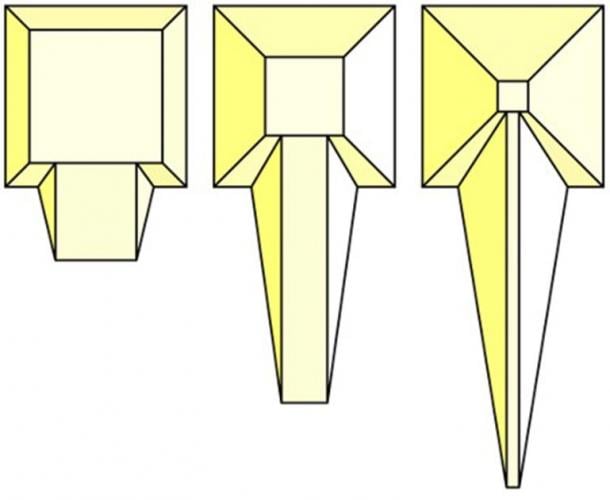
By the end of the 19 th century, Petrie had carefully measured the Pyramids of Giza , particularly the Great Pyramid of Khufu, and determined that the likeliest manner of their construction was using a single, long ramp, with a smaller zig-zag ramp near the summit. Since then, this idea has largely been discredited due to lack of evidence, and other theories have taken its place.
Three types of single, straight pyramid ramps to build that could have been used in the construction of the ancient site.
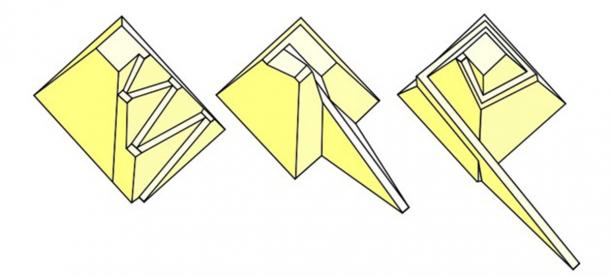
Late German Egyptologist Uvo Hölscher believed the Egyptians employed a short ramp that zig-zagged all the way up the face of the pyramid, while Dieter Arnold, the German archaeologist who wrote the famous Building in Egypt (1991) believes a long ramp was used, but that it cut through the center of and was partially composed of the pyramid itself.
Meanwhile, Giza archaeologists Zahi Hawass and Mark Lehner believe the material evidence most clearly points to a spiral ramp that would have twisted up the exterior of the pyramid, either resting against the structure or on a large earthen mound. They suggest that water or milk would have been used to lubricate wooden sleds strapped with stone blocks, similar to a scene from the Middle Kingdom tomb of Djehuti-hotep (~1900 BC).
Three different pyramid ramp proposals, by Uvo Hölsher (left), Dieter Arnold (center) and Mark Lehner (right).
Numerous recent experiments have confirmed this possibility, including a study in 2014 by Daniel Bonn and other scientists from the FOM Foundation and the University of Amsterdam that demonstrated the right proportion of water on sand could reduce the required people hauling a block by half. There is also a depiction on a New Kingdom stela showing six oxen pulling a block on a sled (~1575 BC), and many actual sleds have been recovered.
What About the Evidence?
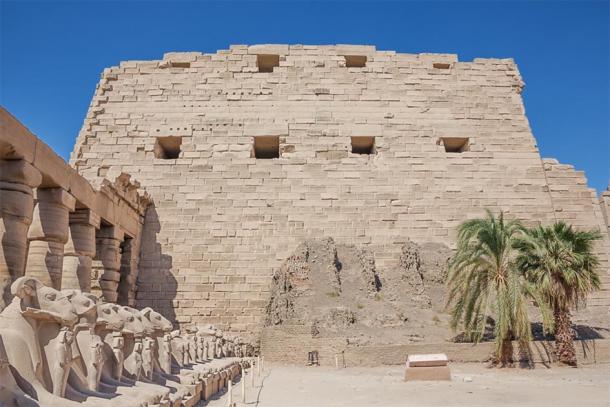
Evidence of earth ramps do exist in Egypt. The best example comes from the Temple of Karnak at Thebes, where it can be found still leaning against the back of the towering First Pylon. Made of mud brick, it was never completely disassembled, and it stands today as testament to the manner in which these large stone structures were built and decorated. Further examples come from the abandoned step pyramid of Sinki at Abydos. Likely built by Huni, Sneferu’s father and Khufu’s grandfather, this pyramid has four construction ramps still in place, composed of two outer mud-brick walls with an interior fill of debris and stone chips.
Remains of an ancient mud-brick ramp at the Temple of Karnak at Thebes (First Pylon, New Kingdom).
Amazingly, the potential construction ramp of the Great Pyramid has already been discovered, and it was similar to these other ramps. In 1995, the Giza Inspectorate “excavated trenches through thick layers of limestone debris south of the southwest corner of Khufu’s pyramid. Remains of fieldstone walls were found running north-northwest that could have been the accretions or retaining walls of the foundation of (such) a supply ramp.” (Lehner, 2017; 440).
According to Hawass, this lower section of the ramp: “consisted of two walls built of stone rubble and mixed with “tafla” (a calcareous clay). The area in between was filled with sand and gypsum forming the bulk of the ramp.” (Hawass, 1998; 58). He calculated the ramp would have reached ~30m (98ft) above the pyramid’s base, or roughly 20% of the pyramid’s original total height of 146.7m (481.3ft). Beyond that he believes the ramp would have spiraled up the exterior of the structure.
Map of the Giza Plateau, showing newly-discovered ancient ramp in red line at southwest corner of Khufu’s pyramid, and quarry and authors’ proposed wooden scaffolding running up to the top (red and brown lines added by author).
In late 2018, the remains of a ramp were found in the ancient alabaster quarry at Hatnub, from the very time of Khufu. It reveals how the Egyptians could have moved tremendously heavy blocks of stone by using physics to aid them. Archaeologists from the French Institute for Oriental Archaeology and the University of Liverpool excavated a ramp with flights of stairs on either side, and with post-holes near the stairs running all the way up the ramp.
It has been suggested by the excavating team that by using ropes tied around wooden posts, ancient workers could have hauled large blocks much easier by using gravity to pull down rather than pulling up. They could also control the blocks better, which are imagined as having rested on wooden sleds attached to the ropes.
Ancient ramp discovered at Hatnub, Eastern Egypt, in 2018, similar in shape but smaller in dimensions than the pyramid ramps that could have been used to build the contemporaneous site at Giza.
The addition of ropes and wooden poles to change the direction of force could have effectively doubled the ramp grade, meaning any ramps on the pyramids would have only needed to have been half their projected size. This could have potentially doubled the grade of Khufu’s ramp, discovered in 1995, up to ~60m (197ft), or 40% of the pyramid’s original height (and most of the volume).
However, problems persist. A ramp that spiraled around the pyramid would be impractical because of the inability to back-sight each corner to remain true, its massive size (rivalling the pyramid itself), and the lack of any archaeological evidence. So if the builders did use a ramp, where was it? An ingenious architect named Jean-Pierre Houdin thought he had the answer.
A Hidden Ramp Inside
Perhaps no other theory in recent years has garnered as much attention as that of the Great Pyramid’s supposed ‘internal ramp’, an idea first proposed by the French architect Jean-Pierre Houdin in 2005. Aided in his exploration by Egyptologist Bob Brier, they flew to Egypt to hunt for evidence of this proposed inside-ramp.
In essence, Houdin proposed that the Egyptians had built an internal ramp just inside the perimeter of the structure that wound its way up as the pyramid rose, composed of corbelled ceilings and corner notches in which the blocks would be rotated on rope cranes. This would seemingly eliminate the need for external ramps, levers, cranes or scaffolding.
Several lines of evidence jumped out at the researchers as proof of their idea. First, Houdin detected faint ‘phantom’ lines within the masonry of the pyramid that ran at ~7°, the exact angle he determined the internal ramp must run at.
Second, there is a mysterious ‘notch’ on the northeastern edge of the pyramid, where Houdin had predicted was an original ‘corner block-turning station’. This ‘notch’ was explored by Brier, who found a small irregular chamber (‘Bob’s Room’) but nothing more.
Third, in 1986 a French team completed a microgravimetric study of the pyramid, and the resultant CG-image of low- and high-density areas revealed an image consistent with an internal ramp.
Attractive Theory But Where is the Evidence?
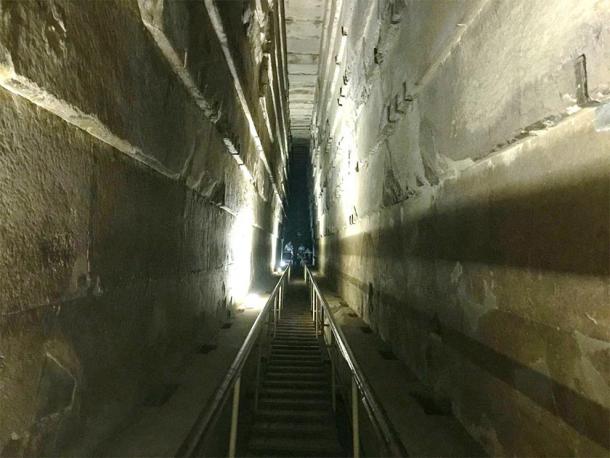
Despite how attractive this theory seemed at first, many noted it was an unlikely scenario. Egyptologist David Jeffreys called it “far-fetched and horribly complicated,” for it proposed the pyramid is vastly more complicated than presently believed. Instead of having four internal chambers and corridors, it would actually have the equivalent of dozens of internal chambers. Instead of having one impressive and corbelled Grand Gallery, it would have the equivalent of over thirty grand galleries winding up through the monument, all corbelled corridors of impressive masonry.
It seems absurd, considering how amazing a feat the Grand Gallery itself was, that there would still be thirty more of them to discover somewhere inside the pyramid, all connected together. And despite much indirect evidence, Brier and Houdin have not found any specific hard data for their ramp. Even their much-lauded microgravimetric scan could be interpreted differently, such as via the model of internal ‘steps’.
The Grand Gallery in the Great Pyramid of Giza. Houdin’s theory would require another 30 of these inside the pyramid.
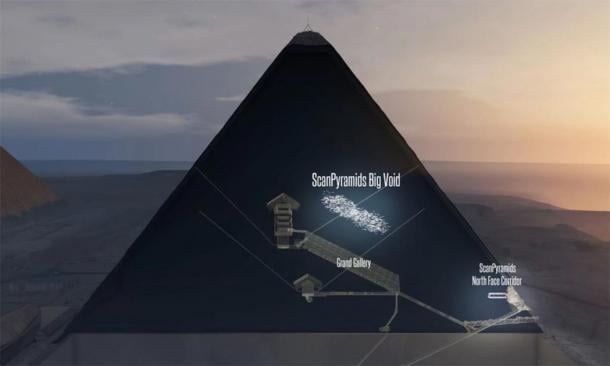
Now, despite the difficulties with the idea, it remained a promising theory in need of independent verification. Fortunately, the ‘Scan Pyramids Mission’ ( scanpyramids.org) would be its ultimate test. Beginning in 2015, this study was based on the idea of using cosmic particles called muons to remotely scan the pyramid for void spaces, an idea first employed by famed physicist Luis Alvarez in the late 1960s on Khafre’s pyramid.
Large collectors were set up in the Great Pyramid and the muons that streamed through the structure were measured in the hopes of identifying any hidden chambers. The idea that a beautiful internal passageway snaking up through the structure would be revealed had millions of excited archaeology buffs on the edge of their seats. Then the results came in.
While a large void was detected above the Grand Gallery, no internal ramp was detected. Nada. This deflationary news was relayed by the theory’s first expert supporter, Bob Brier himself: “these data suggest that the ramp is not there. I think we’ve lost.” So if there was no internal ramp inside the Great Pyramid, then how was it actually built? How were the stones lifted skyward hundreds of feet, beyond the ramp?
New research looking at the density of particles called muons has found an empty space (shown in this illustration) more than 98 feet (30 meters) long right above the Great Pyramid's Grand Gallery, but no internal pyramid ramp was found.
Any theory based on ramps, whether internal or external, runs into problems near the apex of the pyramid. Lehner and Hawass admit that: “the fact that the four sides of the pyramid narrow towards closure at the top means that the builders ran out of room for ramps.” (Lehner 2017; 418), and that: “it is very possible that levering was the only means to raise the blocks of the highest courses, near the apex, once the builders had brought them as high as they could on ramps.” (Lehner, 2017; 417).
Other archaeologists have suggested a combination of ramps and levers, including Martin Isler in On Pyramid Building I & II (1985 & 1987).
The idea the ancient Egyptians used other technologies besides ramps was first put forth by Herodotus in 425 BC. He describes the construction of the Great Pyramid thusly: “This pyramid was made after the manner of steps, which some call ‘rows’ and others ‘bases’: and when they had first made it thus, they raised the remaining stones with machines made of short pieces of timber, raising them first from the ground to the first stage of the steps, and when the stone got up to this it was placed upon another machine standing on the first stage, and so from this it was drawn to the second upon another machine.” (Histories 2. 125).
“Construction of the Great Pyramid According to Herodotus”, lithograph depicting multiple so-called ‘Herodotus Machines’ operating on the Great Pyramid
This description calls to mind a ‘liftjack’ tool, which uses levers and small shims, or wedges, to gradually lift a large block in many small increments. This was first suggested by Petrie in 1883: “for the ordinary blocks, of a few tons each, it would be very feasible to employ the method of resting them on two piles of wooden slabs, and rocking them up alternately to one side and the other by a spar under the block, thus heightening the piles alternately and so raising the stone.”
Several other scholars have noted this theory as well, including Isler, who actually tested this theory during a 1991 Pyramid building project filmed for NOVA. He discovered it was harder and took much longer than he anticipated, but mainly due to his lack of experience and the instability of his wooden support cribbing.
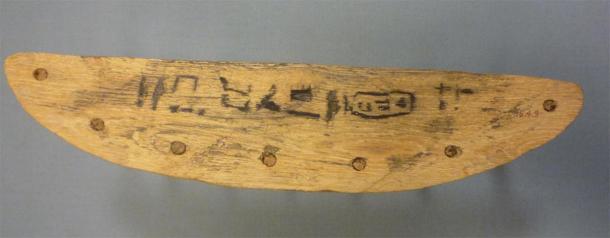
Assisting with this method may have been mysterious rounded wooden objects colloquially called “Petrie rockers”. Found by the famed Egyptologist at Thebes, he proposed these semi-circular wooden devices could have been used to help jack up heavy blocks by allowing them to tilt back and forth easier ( “rocking them up alternately to one side and the other”) , allowing successive planks to be inserted on either side and lifting the block.
Others like Paul Hai imagine the Egyptians actually “rolled” the large blocks by lashing a Petrie rocker to each side of the block, creating a cylinder. Again, there is no evidence for this, and there have never been found any of these wooden rockers near the pyramids.
A model wooden “rocker” device found by Flinders Petrie at Thebes, from the New Kingdom, ~1450 BC.
Alternatively, the Egyptians could have employed a counter-weight levering mechanism, similar to the shaduf, which has been used for millennia to lift water from the Nile. The machines described by Herodotus could have been composed of wooden beams with counterweights, used to see-saw the blocks up course-by-course.
Tomb painting showing an ancient Egyptian gardener using a shaduf (Tomb of the Royal Sculptor Ipuy, Deir el-Medina, 19th Dynasty, 1279-1213 BCE). The shaduf relies on the same principles of counter-weight leverage as the so called “Herodotus Machines” imagined by Goguet and other artists.
Other researchers such as Peter Hodges, Julian Keable, Louis Croon, and Robert Scott Hussey-Pailos have all made improvements on these designs, decreasing Isler’s original lifting time of over an hour down to only minutes. Whether the Egyptians used a rocker-shim-lever or counter-weight-lever method, they would have also needed some degree of wooden scaffolding.
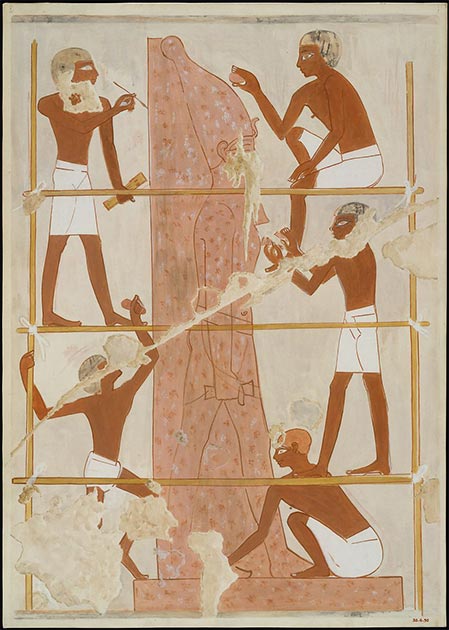
We have no painting or material remains of any of these proposed lifting devices, but we do have evidence the Egyptians were familiar with wooden scaffolding. In a painted scene from the tomb of the Vizier Rekhmire in Thebes (~1450 BC), we can see several workers standing (and even sitting) on a scaffold while they polish and paint a large statue.
Depiction of wooden scaffolding from the Tomb of the Vizier Rekhmire, ~1450 BC.
(Metropolitan Museum of Art / Nina De Garis Davies / Public domain )
An earlier scene from the Fifth Dynasty Saqqara tomb of Khaemhesit shows a vertical wooden ladder with workers perched along it, and surprisingly wheels and an axle at its base! This is the only known Old Kingdom depiction of wheels, and the Egyptians did not use them to move the heavy pyramid blocks: wheels would have sunk into the ground, and there was no material strong enough for the axles.
Many researchers have suggested scaffolding was used to help build the pyramids, as far back as Somers Clarke and R. Engelbach in their classic Ancient Egyptian Construction and Architecture (1930). Hawass, Lehner, and Isler have likewise voiced limited support for the idea, along with James Frederick Edwards in his article Building the Great Pyramid: Probable Construction Methods Employed at Giza (2003). He notes in particular the likely use of scaffolding by the masons to dress the fine-white Tura casing stones, generally believed to have been the final stage of construction. Perhaps the most vocal supporter of the idea of wooden scaffolding is the Welsh structural engineer Peter James, who was called upon to save the Step Pyramid after being damaged in a 1992 earthquake.
As detailed in his 2018 book Saving the Pyramids, James and his team worked deep under the Step Pyramid in Djoser’s burial, using large air bags in conjunction with wooden scaffolding to prop up the sagging ceiling. They carefully drilled narrow holes into the superstructure, inserting steel rods and then cementing them in place, finally securing the 4,700-year-old building - the world’s oldest stone building - from collapse.
Modern wooden scaffolding set up around Djoser’s Step Pyramid at Saqqara
However, it was the abundant wooden scaffolding that was set up around the Step Pyramid to restore its crumbling façade that gave James an idea about its construction. He thought that similar scaffolding could have been used in the past, composed of pieces of timber lashed together: “In recent restoration work on the pyramids, traditional timber lashed together has been used as scaffolding, which demonstrates that it clearly would have been possible to use scaffolding to construct them in the first place.”
“We Have People, We Need Wood”
Most scholars dispute the notion that scaffolding served any primary construction role, relegating it to a minor function, such as dressing the casing stones or laying the very top courses of masonry. It remains an unpopular idea for one simple reason: most Egyptologists believe that the ancient Egyptians, with their dry and relatively treeless environment, had limited access to timber.
However, several scholars have demonstrated that the Egypt of the Old Kingdom, ~2550 BC, would have had more vegetation than today. Researchers have demonstrated that a major climate change accompanied or perhaps caused the end of the Old Kingdom of Egypt around 4200 years ago. For example, Jean-Daniel Stanley and his colleagues, using strontium isotopes and petrologic data, showed in their 2003 study that Nile levels, and consequently tree populations, dropped drastically between 2200-2000 BC.
As D.M. Dixon states in his article Timber in Ancient Egypt (1974), “in antiquity, Egypt possessed, and still does, a number of trees capable of providing timber.” These include the date palm, acacia, tamarisk, persea, willow, sidder, moringa, and sycamore-fig. These trees were used for boat construction, to make furniture, huge temple doors, coffins, bows, arrows, and ramps, as described on the Papyrus Anastasi I: “There is to be constructed a ramp … consisting of 120 compartments filled with reeds and beams.”
Left: acacia tree, similar to what would have been found in Egypt and across the Levant during Khufu’s time, Israel’s Negev Desert. (Mark A. Wilson / Public domain ). Right: avenue of acacia trees leading towards the pyramids in 19th century Cairo
Archaeological evidence of wood inside ancient ramps has been found at Lahoun, Lisht, and Deir el-Bahri. We also know that Egypt imported huge beams of cedar and cilician fir from Lebanon, confirmed by the discovery in 1954 of two deconstructed funeral boats of Khufu buried beside his pyramid.
Al Arzz above Bsharri (Forest of the Cedars of God), Lebanon.
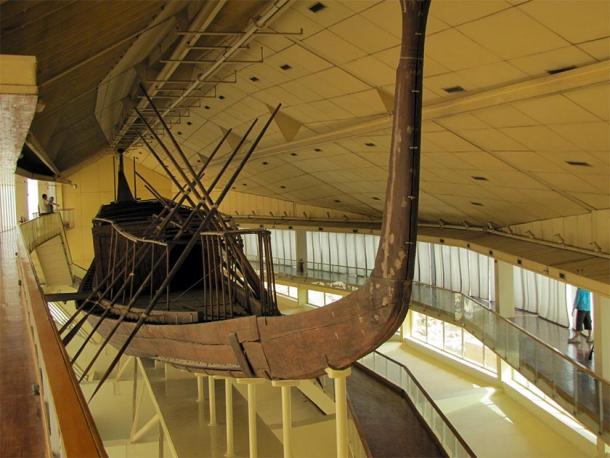
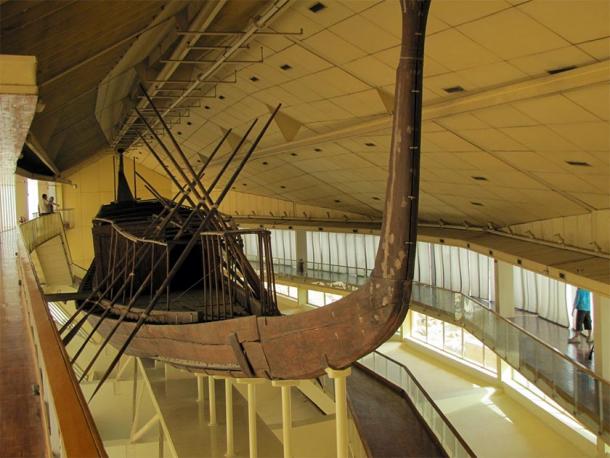
Made of gigantic beams of cedar, they were lashed together with rope and would seal by swelling in the water. We know from the Palermo Stone inscription that Pharaoh Sneferu , father of Khufu, sent an expedition of forty ships to Lebanon to collect prized cedar beams: “Bringing forty ships filled [with] cedar logs … Shipbuilding [of] cedar wood, one ship, 100 cubits [long].” 100 cubits was roughly equivalent to 50 meters (164ft), even longer than Khufu’s boat at 43.6m (143ft).
The magnificent Boat of Khufu, Solar Boat Museum, Giza.
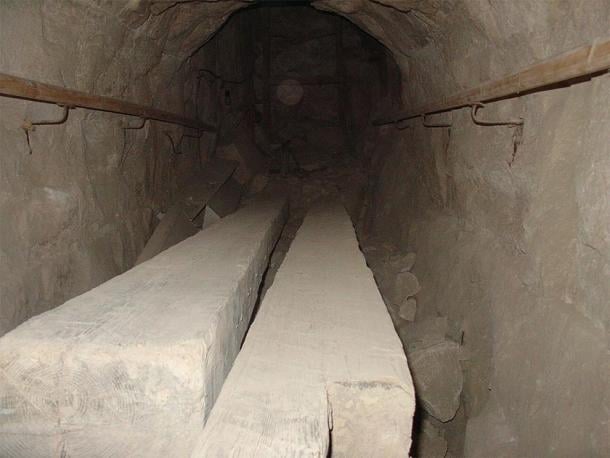
We can still see the massive fifty-foot (15m) cedar beams that Sneferu’s engineers wedged between the walls of the Bent Pyramid’s burial chamber to keep it from collapsing. He could have easily used similar beams to construct wooden scaffolding for the construction of his two pyramids at Dashur (and earlier structure at Meidum).
Ancient wooden beams still inside the Bent Pyramid of Sneferu at Dashur.
An interesting feature of the solar boats is that their beams were held together entirely with hemp rope, which was also preserved beside the boat. Having cedar beams and sturdy rope, the Egyptians could certainly have built a robust scaffolding capable of supporting large stone blocks and multiple workers.
I believe the secret to building the pyramids, beyond the ramps anyways, was actually very simple: a relatively narrow section of wooden scaffolding, lashed together with ropes and anchored securely at the base. This would have rendered unnecessary large external mud brick ramps, internal stone ramps, and the need to dress the stone from the top down. The entire structure could have been completed level-by-level, with the exterior stone dressed before the next layer was begun (or even in the quarry when first removed, when it is softer and easier to carve, as noted by Bob Brier).
I believe work gangs would have used a combination of levers, rockers, and wedges to lift the blocks up through the scaffolding to the active building surface, where other gangs would have taken over. The scaffolding itself would have had dedicated wood-working teams building it as the pyramid rose. Each level of scaffolding would have had separate teams, while the teams operating on the pyramid would have likely been divided again.
Most work gangs would have focused on the inner fill and less precise masonry of the interior, some would have focused on the core blocks and grout, while the most skilled would have been stationed around the exterior to set and finish the precisely-angled and highly polished Tura limestone casing blocks. I therefore imagine an assembly-line type of process, from quarry to pyramid, with teams remaining at their spots and the rocks moving between them.
There is no good reason the Egyptians couldn’t have built a narrow stretch of scaffolding up the south side of the Great Pyramid through which to lever-up all the necessary blocks for its construction. It could then have been removed very quickly and re-used at further pyramid projects or alternatively used for solar boats, coffins, etc. The re-use of wood was common in Egypt, as demonstrated by Pearce Paul Creasman in his article: Ship Timber and the Reuse of Wood in Ancient Egypt (2013).
The pyramids were built with the available technology during the Old Kingdom: ramps, bronze chisels, stone pounders, levers, ropes, poles, plumb bobs, cubit rods, mallets, adzes, wedges, and squares. To these primitive yet capable tools, I believe, we can add wooden scaffolding, the final missing piece to the puzzle of their construction.
It was more than this technology, however, that helped realize these massive building projects. It was the organization and hierarchy of workers, overseers, priests and scribes that helped to bring to fruition these huge state dreams. It was the skilled coordination of this hard-working society, all based on the careful measurements by priests of the seasons, sky and Nile, that ultimately built the pyramids. It was a nation-wide effort, one of the largest in our history, to serve the kings, the gods, and to preserve balance in the land, so that their names and works would last forever.
End Note
Interestingly, Welsh architect and pyramid rescuer Peter James does dispute the idea the Egyptians used poles and ropes to increase their ramp grades at pyramid sites, as suggested by the new ramp discovery at Hatnub. In a personal email communication he discusses several flaws he has identified with this model:
“The question of the size and diameter of the ropes needed to haul the heavy blocks is an issue and also their durability on the edges of square blocks. The method of attaching the ropes to the blocks that would avoid twisting the blocks as they are lifted would also be a problem.
How would you make sure that the two sets of operatives pulling up the blocks would be able to provide the same tension in the ropes to control the lift and not induce twisting and movement of the blocks, particularly as they are on temporary constructed steps? This would be a very dangerous operation.
The same goes for the temporary wooden post that may have been good in a permanent position in a quarry but would be prone to movement under load on unconsolidated substrate and again would cause difficulties controlling the blocks; also the leading edge of the block would dig into the soil and any force used to move it would rotate the block into the soil and prevent further movement.”
Saturn’s auroras may explain the planet’s weirdly hot upper atmosphere
Data from Cassini’s final orbits could solve the gas giant’s ‘energy crisis’
Saturn’s northern aurora (shown glowing in ultraviolet light this composite image from the Hubble Space Telescope) and its southern counterpart could warm the planet’s upper atmosphere.
HUBBLE, NASA, ESA, A. SIMON/GSFC, THE OPAL TEAM, J. DEPASQUALE/STSCI, L. LAMY/OBSERVATOIRE DE PARIS
Saturn’s auroras may heat its atmosphere like an electric toaster.
Measurements from NASA’s Cassini spacecraft’s final orbits show that Saturn’s upper atmosphere is hottest where its auroras shine, a finding that could help solve a long-standing mystery about the outer planets.
Saturn’s upper atmosphere is much hotter than scientists first expected based on the planet’s distance from the sun. In fact, all the gas giant planets — Saturn, Jupiter, Uranus and Neptune — were thought to have chilly upper atmospheres of around 150 kelvins (–123° Celsius). But data from the Voyager spacecraft, which flew past the outer planets in the 1970s and 1980s (SN: 8/7/17), showed surprisingly toasty upper atmospheres of 400 to 600 kelvins (125° to 325° C).
Planetary scientists dub this mismatch an “energy crisis.” Something injects extra energy into the gas giants’ atmospheres, but no one knew what. “Trying to explain why these temperatures are so high has long been a goal in planetary atmospheric physics,” says planetary scientist Ron Vervack of Johns Hopkins University’s Applied Physics Laboratory.
Data from the Cassini spacecraft’s waning weeks might point to an answer, planetary scientist Zarah Brown of the University of Arizona in Tucson and colleagues report April 6 in Nature Astronomy.
After orbiting Saturn for 13 years, Cassini finished its mission with a daredevil series of dips between the planet and its rings before plunging into Saturn’s atmosphere in September 2017 (SN: 9/15/17). During those final orbits, the spacecraft probed the planet’s upper atmosphere by watching stars in the background. Measuring the amount of starlight that the atmosphere blocks told Brown and colleagues how dense the atmosphere is at different points, a clue to its temperatures.
Using 30 of these stellar measurements, 22 of which came from the last six weeks of Cassini’s mission, the team mapped Saturn’s atmospheric temperatures across the whole planet and at different depths. “For the outer planets, this is an unprecedented data set,” says planetary scientist Tommi Koskinen, also of the University of Arizona.
The atmosphere was hottest around 60° N and 60° S latitudes — roughly where Saturn’s glowing auroras show up (SN: 2/16/05). Auroras are brilliant lights that sparkle when charged particles from the sun interact with a planet’s magnetosphere, the region defined by a planet’s magnetic field. Unlike Earth’s visible auroras, Saturn’s auroras glow mainly in ultraviolet light.
The auroras’ light doesn’t emit much heat on its own, but is accompanied by electric currents that can generate heat like the wires in a toaster. This process, called Joule heating, also happens in Earth’s atmosphere.
If Jupiter, Uranus and Neptune’s auroras also coincide with extra heat, then auroras may solve the mystery of hot atmospheres across the solar system. The same process could even take place on exoplanets, Brown says.
Vervack, who has worked with the Voyager dataset but was not involved in the new work, thinks this study marks “a big step in our understanding” of these hot upper atmospheres.
“The real test of whether they’re right will be when you go out to Uranus or Neptune,” whose magnetospheres are more complicated than Saturn’s, he says. “Being able to see how our understanding from Saturn holds up when we get to these more complicated systems is going to be really key to knowing if we’ve licked this problem or not.”
GLORIOUS NASA PHOTO SHOWS “THIN BANDS” RUNNING ACROSS JUPITER
NASA/JPL-CALTECH
VICTOR TANGERMANN
North Of Jupiter
NASA just released a dramatic image that its Juno spacecraft took of Jupiter’s “tumultous northern regions” during a close flyby in February. The image was taken from 15,610 miles (25,120 kilometers) away from the gas giant — a distance about twice the diameter of Earth, making this the planetary equivalent of a close-up shot of the gas giant.
The spectacular image shows “thin bands” that run from top to bottom, representing layers of “haze particles” that drift underneath a cloud cover. We still don’t actually know what exactly they are or how they are formed.
Jupiter is the largest and most massive planet in our solar system. You might not think of it as a place to learn about Earth's atmosphere and weather, but Jupiter, like our home planet, has cyclones (the Jovian equivalent of hurricanes) and anticyclones, along with fast-moving jet streams that circle its globe. Revealed in a sequence of black-and-white images taken by the Cassini spacecraft during its flyby of Jupiter are chevrons, dark V-shaped features that travel within a band of powerful winds near the equator. By tracking chevrons, NASA scientists were not only able to gauge the jet stream's speed, but also witness its subtle, wavelike movement as it zoomed around the planet—something never before seen. Studying this motion can help scientists better understand similar weather patterns on Earth. Learn more about this discovery and see footage of Jupiter's jet streams by watching the videos below.
In 2017, NASA scientists figured out that east-west jet streams on Jupiter tend to reverse course on a predictable schedule.
On Earth, jet streams are shifted by changing temperatures. Warmer temperatures force jet streams to flow eastwards, while cooler temperatures force it westwards. On Jupiter, a similar cycle takes about four Earth years and is mostly caused by gravity waves.
Top 15 Interesting Facts About Ancient Egypt That You May Not Know
One of the greatest civilizations in our history belonged to the ancient Egyptians. It flourished in the fertile valleys of the world’s longest river - the Nile, where a magnificent civilization rose from the surrounding sands and lasted for roughly 3,000 years. Rising above beast and nature, these ingenious people became a unique culture of the world.
The ancient Egyptians brought to life a variety of gods and goddesses, and fashioned a colorful and natural mythology by which they governed their lives. As time went on and their advancements grew, the Egyptians pioneered some of the world’s first technologies - mathematics, papyrus making, writing systems, medicine and pyramid building. They gave us some of the finest achievements of humanity - which remain stunning and marvelous to this very day. And to celebrate this grand ancient civilization, we are going over the top 15 interesting facts about ancient Egypt!
Our List of the Top 15 Interesting Facts About Ancient Egypt
A civilization that flourished for approximately 3000 years had to be rich, well developed, vast and inspiring. And the ancient Egyptians were all this and more. To get better acquainted with this, we have assembled a list of the most amazing aspects of ancient Egypt.
From arts and entertainment, to religion and law, all the way to war and science - we will delve deeper into the most astonishing achievements of one of the world’s most amazing ancient civilization. Of course, it is difficult to put 3 millennia into a single article, but it should be enough to give you an idea that there are a lot of truly interesting facts about ancient Egypt, and that it definitely bears a passionate study.
The Pantheon
One of the most astonishing features of the ancient Egyptian civilization is their pantheon and in particular, the sheer amount of diverse deities and beings - today we know more than 1,500 of them by name.
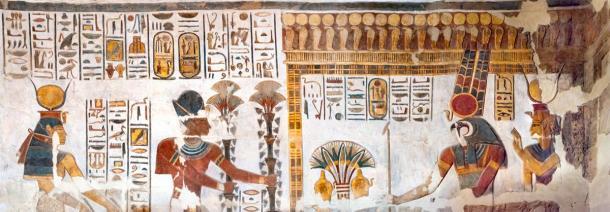
Ancient Egyptian gods (Amun-Ra and goddess Mut can be seen to the right) and pharaohs found in the Khonsu Temple.
The Egyptian deities were closely entwined with the daily lives of the people, and were often the personification of everyday items, occurrences and natural phenomena. Moreover, they were for the most part the personification of animals that dominated the valleys of the Nile. And the minor deities were usually connected to seemingly trivial, everyday things.
The Mummification
Another unique and interesting fact about the ancient Egyptians is this astonishing part of their burial rites, mummification. Almost all of their burial practices and rites were connected to the belief in immortality. In the earliest days, the mummification was natural - bodies were desiccated by the harsh desert environment.
But as time went on, the mummification process became elaborate and to an extent artificial. Preservation of the bodies was often reserved for the wealthiest individuals, and involved organ removal, covering in natron salts and linen wrapping. The process took 70 days in its most advanced state.
The very age of the ancient Egyptian civilization and the timeline in which it spanned is a fact worthy of mention and awe. With its Early Dynastic Period having generally emerged around ~3000 BC, and the dynastic periods on the whole ending with Cleopatra in 30 BC, the age of this civilization came close to 3 millennia. And that in itself is incredible. It shows us the power and the importance of Egypt, and how it managed to persevere, for such a long time, through superiority and advanced technologies.
The Pyramids Everyone knows about the pyramids - the immortal heritage of ancient Egypt. These immense structures of stacked stone served as royal burial chambers, and exuded a great sense of power and royalty. Even today, the pyramids continue to baffle all visitors. They perfectly display the wealth and the sheer power of the ancient Egyptians and their industry, as well as a clear emphasis of their belief in afterlife. Here is another pyramid-related fact: Did you know that it took around 10,000 workers close to 30 years to build a single pyramid?
Some of the earliest medicinal advancements came from ancient Egypt. Surviving hieroglyphic writings detail some of the techniques and methods used in treating wounds and illnesses. Furthermore, some of the earliest medicinal specializations appeared in Egypt, with certain doctors focusing only on certain types of afflictions.
Amputation was common, as was wound stitching and infection prevention. Also, some of the oldest artificial limbs appeared in Egypt, where wooden carvings replaced amputated limbs. Although primitive by modern standards, medicine in Egypt was highly developed for its time and covered a broad area of expertise.
The Mathematics
Even in the Pre-Dynastic period in Egypt, early mathematical calculations appeared - with a fully functional numerical system. Four basic mathematical operations were well known to the Egyptians - addition, multiplication, division and subtraction. Alongside basic knowledge of algebra and geometry, fractions, volume and area calculation.
They also had knowledge of the Pythagorean theorem - in their own way - and their buildings usually displayed the golden ratio. Today, there are several surviving mathematical papyrus scripts, including the famous ‘ Rhind Mathematical Papyrus ’, and the astronomical chart of Senemut’s tomb.
The Egyptians were well known for their writing system - the hieroglyphs. Hieroglyphic writing goes back as far as 3000 BC, and it consisted of several hundred symbols. But did you know that the hieroglyphs were not the only form of writing in ancient Egypt? They were usually only used in a formal way - as inscriptions on tombs and monuments.
But in fact, there was a simpler script, called hieratic, a cursive version, which was used in everyday situations, by scribes, priests and officials. It was much simpler and faster to write than the hieroglyphs. It was dominant until roughly 1000 BC, when the demotic script took over, perhaps an even simpler script.
The fact that the earliest peace treaty in history was made by the Egyptians is also very important and needs to be on our list. This treaty dates to around 1259 BC, and was made between the Egyptians and the Hittites, after almost two centuries of conflict and enmity. At that time, both sides had ample reasons to cease conflicts and sue for peace, since the Egyptians were under threat from the infamous ‘Sea Peoples’, and the Hittites from the encroaching Assyrian Empire. Both versions of the treaty text survive to this day, fully translated. This peace treaty is known as the Eternal Peace.
The Faience
Did you know that the Egyptians developed a unique style of ceramic that was known as faience? This was a sintered quartz ceramic that displayed vitrification, meaning it had a bright luster of several colors, mostly blue and green. This is somewhat similar to glazing, and was used in all forms of ceramic ware, from ornaments to jewelry and to monuments. It was also widely exported throughout the ancient world, and built locally throughout Egypt. It is often described as the first high technology ceramic, and today survives in numerous archaeological finds.
The Shipbuilding
Even by 3000 BC, the ancient Egyptians had mastered fully their shipbuilding techniques. They used these both for sailing up and down the Nile - which was an immense part of their economy, and also for seafaring trade with neighboring nations. In their earliest form these were plank ships, but they developed steadily into unique barges and transport vessels.
Egyptians mastered the use of trennels (wooden pegs for connection) and also the use of pitch for caulking. Mortise and tenon joints were also used, showing their understanding and mastery of woodworking. The most famous fully intact surviving ancient Egyptian ship is the ‘ Khufu Ship ’, found sealed in the Pyramid of Giza. It measures almost 44 meters in length (143 feet).
The magnificent Boat of Khufu, Solar Boat Museum, Giza, Egypt.
There is a reason why the Egyptians managed to dominate the ancient Near East and create a vast realm for such a long time. And this reason was their skilled military. For the most part the soldiers were trained civilians from the general populace, but over time, many mercenaries also filled the ranks. These came from Nubia, Libya, Kush and other places.
The Egyptian military relied on the use of bows and arrows, but also on use of shields, spears, and unique khopesh swords. They were also well known for their use of war chariots, which they adopted from their Hyksos enemies.
The Diet
You might be surprised to know one unique fact about the Egyptian diet - it was simple. Most commonly it consisted of bread and beer, and also great amounts of vegetables - mainly onion and garlic, which the Egyptians believed was highly beneficial to health. Dates, figs, carobs and other fruits were also common.
For the common folk, meat was reserved mostly for festivities, while the upper classes had it more often. Fish and fowl were common foods, especially with the proximity of the Nile. Interestingly, Egyptian beer was the most common, staple part of their diet - consumed daily and often. But don’t be mistaken, it was far from today’s beer. It was rich and nutritious, quite similar to a mash or gruel.
Contrary to popular belief, the ancient Egyptians really knew how to have fun. They enjoyed music greatly, and mastered the use of cymbals, tambourines, drums and bells, while importing other instruments from afar, such as lutes and lyres. They also had their iconic sistrum instrument, which was like no other, and closely resembled a rattle.
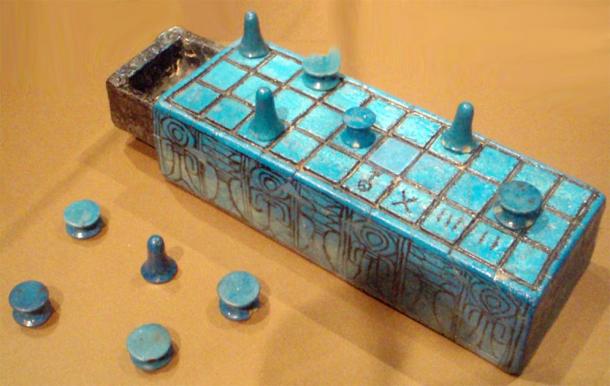
Other than music, the Egyptians enjoyed boardgames. Many different types are known today, such as senet and mehen, which are boardgames where pawns were moved about. Another highly unique boardgame was “Hounds and Jackals,” which spread from Egypt to many far places. Did you know that senet is one of the oldest known board games?
Faience senet board and playing pieces inscribed with the name of Amunhotep III. Reportedly from Thebes, and possibly from his tomb.
Even though the early Egyptian writings were the inscriptions from tombs and monuments, dealing with religious aspects and afterlife, later on they became more complex, and slowly Egyptian literature began to develop. A sort of autobiographical writing became popular, and was incised on tomb walls. Another unique genre of ancient literature was developed, and was known as Sebayt (teachings, instructions), which documented ethical teachings for a true way of living.
One of the finest examples of ancient Egyptian literature is known as the Story of Sinuhe , written around 1800 BC. Its author is unknown, but is widely heralded as the “Egyptian Shakespeare.” The work is written in a form of verse, and can be performed as well. It survived in numerous fragments, which tells us that it was extremely popular in its time.
“Does a lowly man become loved when fate makes him a master? Does a marsh-reed flourish on the mountain-side?”
Ostracon CG 25216, one of the biggest ostracon ever found. Found in 1886 in the tomb of Sennedjem (Deir el-Medina, Tomb Nr. 1), today in the Egyptian Museum Cairo, it is broken into two pieces, one side contains the Story of Sinuhe and the other a private letter.
One important fact about the ancient Egyptians is that they had a well-developed legal system. At its head was usually the ruler - a pharaoh - who brought new laws, ensured order, and delivered justice. In all court cases that dealt with minor disputes and offenses, a special council of elders presided - it was known as kenbet. And when the cases were serious, a great kenbet presided, at whose head was the pharaoh.
A key part of this system was the scribes. They kept all records, assessed taxes and dealt with administration. Around the coming of the New Kingdom, oracles began to play a major role in the legal system. At this time, the gods were asked for justice, where an effigy of a god had to give an answer - yes or no - through various orchestrated means.
And thus ends our short list of 15 interesting facts about ancient Egypt. There is no doubt that this magnificent civilization truly left enormous marks on our world, and that they have remained even to this day. The tales of this era in history can keep us occupied for days on end, and the sheer amount of archaeological wonders will continue to intrigue us for generations to come. Because we are often unaware at just how advanced and marvelous these ancient people truly were - all those millenniums before us.
Top image: Top 15 interesting facts about ancient Egypt. Source: Maurizio / Adobe stock
Every Black Hole Contains Another Universe – Equations Predict
Like part of a cosmic Russian doll, our universe may be perfectly nested inside a black hole that is itself part of a larger universe.
In turn, all the black holes found so far in our universe—from the microscopic to the supermassive—may be ultimate doorways into alternate realities.
According to a mind-bending new theory, a black hole is actually a tunnel between universes—a type of wormhole. The matter the black hole attracts doesn’t collapse into a single point, as has been predicted, but rather gushes out a “white hole” at the other end of the black one, the theory goes.
In a paper published in the journal Physics Letters B, Indiana University physicist Nikodem Poplawski presents new mathematical models of the spiraling motion of matter falling into a black hole. His equations suggest such wormholes are viable alternatives to the “space-time singularities” that Albert Einstein predicted to be at the centers of black holes.
According to Einstein’s equations for general relativity, singularities are created whenever matter in a given region gets too dense, as would happen at the ultra-dense heart of a black hole.
Einstein’s theory suggests singularities take up no space, are infinitely dense, and are infinitely hot—a concept supported by numerous lines of indirect evidence but still so outlandish that many scientists find it hard to accept. If Poplawski is correct, they may no longer have to.
According to the new equations, the matter black holes absorb and seemingly destroy is actually expelled and becomes the building blocks for galaxies, stars, and planets in another reality.
The notion of black holes as wormholes could explain certain mysteries in modern cosmology, Poplawski said.
For example, the big bang theory says the universe started as a singularity. But scientists have no satisfying explanation for how such a singularity might have formed in the first place.
If our universe was birthed by a white hole instead of a singularity, Poplawski said, "it would solve this problem of black hole singularities and also the big bang singularity."
Wormholes might also explain gamma ray bursts, the second most powerful explosions in the universe after the big bang.
Gamma ray bursts occur at the fringes of the known universe. They appear to be associated with supernovae, or star explosions, in faraway galaxies, but their exact sources are a mystery. (Related: "Gamma-Ray Burst Caused Mass Extinction?")
Poplawski proposes that the bursts may be discharges of matter from alternate universes. The matter, he says, might be escaping into our universe through supermassive black holes—wormholes—at the hearts of those galaxies, though it's not clear how that would be possible.
There is at least one way to test Poplawski's theory: Some of our universe's black holes rotate, and if our universe was born inside a similarly revolving black hole, then our universe should have inherited the parent object's rotation.
If future experiments reveal that our universe appears to rotate in a preferred direction, it would be indirect evidence supporting his wormhole theory, Poplawski said.
Wormholes Are "Exotic Matter" Makers?
The wormhole theory may also help explain why certain features of our universe deviate from what theory predicts, according to physicists.
Based on the standard model of physics, after the big bang the curvature of the universe should have increased over time so that now—13.7 billion years later—we should seem to be sitting on the surface of a closed, spherical universe.
But observations show the universe appears flat in all directions.
What's more, data on light from the very early universe show that everything just after the big bang was a fairly uniform temperature.
That would mean that the farthest objects we see on opposite horizons of the universe were once close enough to interact and come to equilibrium, like molecules of gas in a sealed chamber.
Again, observations don't match predictions, because the objects farthest from each other in the known universe are so far apart that the time it would take to travel between them at the speed of light exceeds the age of the universe.
To explain the discrepancies, astronomers devised the concept of inflation.
Inflation states that shortly after the universe was created, it experienced a rapid growth spurt during which space itself expanded at faster-than-light speeds. The expansion stretched the universe from a size smaller than an atom to astronomical proportions in a fraction of a second.
The universe therefore appears flat, because the sphere we're sitting on is extremely large from our viewpoint—just as the sphere of Earth seems flat to someone standing in a field.
Inflation also explains how objects so far away from each other might have once been close enough to interact.
But—assuming inflation is real—astronomers have always been at pains to explain what caused it. That's where the new wormhole theory comes in.
According to Poplawski, some theories of inflation say the event was caused by "exotic matter," a theoretical substance that differs from normal matter, in part because it is repelled rather than attracted by gravity.
Based on his equations, Poplawski thinks such exotic matter might have been created when some of the first massive stars collapsed and became wormholes.
"There may be some relationship between the exotic matter that forms wormholes and the exotic matter that triggered inflation," he said.
The new model isn't the first to propose that other universes exist inside black holes. Damien Easson, a theoretical physicist at Arizona State University, has made the speculation in previous studies.
"What is new here is an actual wormhole solution in general relativity that acts as the passage from the exterior black hole to the new interior universe," said Easson, who was not involved in the new study.
"In our paper, we just speculated that such a solution could exist, but Poplawski has found an actual solution," said Easson, referring to Poplawski's equations.
Nevertheless, the idea is still very speculative, Easson said in an email.
"Is the idea possible? Yes. Is the scenario likely? I have no idea. But it is certainly an interesting possibility."
Future work in quantum gravity—the study of gravity at the subatomic level—could refine the equations and potentially support or disprove Poplawski's theory, Easson said.
A supermassive black hole sits inside the galaxy Centaurus A, as seen in a composite picture.
IMAGE COURTESY NASA/CXC/CFA/R.KRAFT ET AL., MPIFR/ESO/APEX/A.WEISS ET AL. AND ESO/WFI
Wormhole Theory No Breakthrough
Overall, the wormhole theory is interesting, but not a breakthrough in explaining the origins of our universe, said Andreas Albrecht, a physicist at the University of California, Davis, who was also not involved in the new study.
By saying our universe was created by a gush of matter from a parent universe, the theory simply shifts the original creation event into an alternate reality.
In other words, it doesn't explain how the parent universe came to be or why it has the properties it has—properties our universe presumably inherited.
"There're really some pressing problems we're trying to solve, and it's not clear that any of this is offering a way forward with that," he said.
Still, Albrecht doesn't find the idea of universe-bridging wormholes any stranger than the idea of black hole singularities, and he cautions against dismissing the new theory just because it sounds a little out there.
"Everything people ask in this business is pretty weird," he said. "You can't say the less weird [idea] is going to win, because that's not the way it's been, by any means."
Uranus likely got whacked by a body one to three times as massive as the modern Earth.
Uranus is uniquely tipped over among the planets in our solar system. Uranus' moons and rings are also orientated this way, suggesting they formed during a cataclysmic impact which tipped it over early in its history.
The impactor that knocked Uranus on its side long ago isn't quite so mysterious anymore.
Uranus is tipped over more than 90 degrees relative to the plane of the solar system, and so are the gaseous planet's ring system and the orbits of its 27 known moons. Astronomers think this unique configuration is evidence of a violent collision Uranus suffered shortly after it was born, which also apparently supercharged the planet's rotation. (Uranus spins around its axis once every 17 hours, significantly faster than Earth does.)
Details of that collision have remained elusive, however, because simulations have struggled to generate the Uranus system that we see today. For example, the mass of the post-impact debris disk tends to be quite big in these models — much bigger than it "should" be, given the total mass of Uranus' moons today.
Until now, that is. A team of researchers has had success with a novel modeling strategy devised to investigate the formation of moons around frigid planets, a new study reports.
The frigid part is key. Giant impacts in the cold and dark outer solar system have different consequences than smashups much closer to the sun, such as the long-ago collision that resulted in the formation of Earth's moon, the researchers found.
This latter encounter involved the proto-Earth and a Mars-size body called Theia, both of which were primarily rocky (rather than icy). The material blasted into space by the impact therefore solidified rather quickly, allowing the newborn moon to snare quite a bit of it gravitationally.
But the material liberated during the Uranus collision was much more volatile — stuff like water and ammonia — and remained gaseous longer. The growing proto-Uranus gobbled most of this gas up, leaving less of it around to form moons, according to the new study, which was published online last week in the journal Nature Astronomy.
The researchers' model, which takes all of this into account, suggests that the body that slammed into Uranus was icy and big, with a mass between one and three times that of the modern Earth.
"This model is the first to explain the configuration of Uranus' moon system, and it may help explain the configurations of other icy planets in our solar system such as Neptune," study lead author Shigeru Ida, of the Earth-Life Science Institute at the Tokyo Institute of Technology in Japan, said in a statement.
"Beyond this, astronomers have now discovered thousands of planets around other stars, so-called exoplanets, and observations suggest that many of the newly discovered planets known as super-Earths in exoplanetary systems may consist largely of water ice," Ida said. "And this model can also be applied to these planets."
Mike Wall is the author of "Out There" (Grand Central Publishing, 2018; illustrated byKarl Tate), a book about the search for alien life. Follow him on Twitter @michaeldwall. Follow us on Twitter@Spacedotcom orFacebook.
According to a new study, scientists think that an exoplanet candidate may be shaped like an American football. The planet, named KOI 1843.03, orbits its red dwarf star at such a close proximity that the gravitational force is what’s causing its odd football-like shape. The discovery of the exoplanet was made public in 2013.
The red dwarf star KOI 1843 is located approximately 395 light-years away from Earth and is a little less than half the mass of our sun. The exoplanet KOI 1843.03 measures around 60% of Earth’s diameter and has about 44% of its mass. It’s also believed that the planet is more than likely made up of 66% iron (compared to Earth being made up of around 32% iron) because if it contained less iron it would be ripped apart being so close to its star. “KOI 1843.03 is one of the most iron-enhanced exoplanets discovered to date,” stated Leslie Rogers who is an astrophysicist at the University of Chicago as well as the senior author of the new study (which can be read in full here).
(Not KOI 1843.03)
And it has an extremely fast orbit – in fact, it makes its way around its star much closer than any other planet previously studied. Rogers went into further detail by explaining to Space.com, “Whizzing around its star in only 4.245 hours, a ‘year’ for this planet is just over one-sixth of a day on Earth.”
By conducting 3D simulations of the planet’s interior structure in order to find out what type of effects such a close orbit would have on KOI 1843.03, researchers discovered that it may very well be shaped like a football. “KOI 1843.03 is the most aspherical exoplanet discovered to date,” Rogers explained, adding, “Our models show that KOI 1843.03 is significantly elongated along the direction toward its star, having an aspect ratio of up to about 1.8.” For comparison, a wide-screen television has an aspect ratio of 1.7 while a chicken egg has a 1.3 aspect ratio.
(Not KOI 1843.03)
Another fact that the researchers mentioned was that they studied nine exoplanets with orbits that last less than an Earth day and they found that four of them are rich in iron. They also mentioned that the planets could possibly be more spherical-shaped than those with the same orbit that contain less iron. Ellen Price, who is an astrophysicist at the Harvard-Smithsonian Center for Astrophysics in Massachusetts as well as the lead author of the study, explained to Space.com, “We expect that more iron-rich compositions will lead to less distorted planets,” adding, “There is a trade-off between how extreme the shape of the planet is and how extreme its composition is.”
More research needs to be done on tidally distorted exoplanets, such as how they appear when they travel in front of their stars and if scientists will be able to determine if a planet is distorted based solely on how its shadow appears.
UFOs come in all sorts of shapes: flying saucers, cigar-shaped craft, flying triangles, and rocket-like vehicles. And that’s just the start of it. There is also the matter of the sizes of some of these craft. Indeed, there are a number of cases that suggest at least some UFOs are massive in size. And that’s what today’s article is all about. With that said, let’s take a look at some cases that fall into that giant-sized category. As its staff state: “The Civil Aviation Authority (CAA) is responsible for the regulation of aviation safety in the U.K., determining policy for the use of airspace, the economic regulation of Heathrow, Gatwick and Stansted airports, the licensing and financial fitness of airlines and the management of the ATOL financial protection scheme for holidaymakers.” Over the years the CAA has received more than a few UFO reports, which is hardly surprising. Let’s take a look at one such CAA report that is focused on a UFO of huge proportions. The summary of the report reads as follows: “12 Jun 82 Dinkelsbuhi – Large translucent object 500 feet long at 41,000 feet. ATCC [Air Traffic Control Center] requested subject aircraft to investigate this object which was found to have the form of a double rectangle surmounted by a globe (egg shape) crowned by a silver cone. Object observed by all on board.”
Now, let’s take a leap back to the 1950s. On the morning of April 4, 1957 – according to now-declassified British Royal Air Force documents housed at the National Archive, Kew, England – radar operators at Balscalloch, Scotland reported to RAF West Freugh, Wigtownshire that they had detected a number of “unidentified objects on the screens of their radars.” And it quickly became apparent this was no Cold War penetration of British airspace by Soviet spy-planes or bombers. As the mystified radar-operators watched their screens, they were amazed to see a large, stationary object hovering at 50,000 feet that then proceeded to ascend vertically to no less than 70,000 feet. According to the files: “A second radar was switched on and detected the object at the same range and height.” Most significant of all at this stage was the assessment by the radar experts of the incredible proportions of the UFOs: “It was noted by the radar operators that the sizes of the echoes were considerably larger than would be expected from normal aircraft. In fact they considered that the size was nearer that of a ship’s echo.”
Consider this case from 1951, which is described in the files of Fort Monmouth, New Jersey: ““On September 20, Andrew J. Reid G-2 [Army Intelligence] Ft. Monmouth, NJ, provided following report of unconventional aircraft observed by radar at above Army installation. On Sept 10, fifty one], an AN/MPG-1 radar set picked up a fast moving low flying target, exact altitude undetermined at approximately 11:10 a.m., southeast of Ft. Monmouth at a range of about twelve thousand yards. The target appeared to approximately follow the coast line, changing its range only slightly but changing its azimuth rapidly. The radar set was set to full aided azimuth tracking which normally is fast enough to track jet aircraft, but in this case was too slow to be resorted to. Target was lost in the N.E. at a range of about fourteen thousand yards. “This target also presented an unusually strong return for aircraft, being comparable in strength to that usually received from a coastal ship. The operator initially identified target as a ship and then realized that it could not be a ship after he observed its extreme speed.”
In 1952, radar operator William Maguire had an extraordinary, radar-based UFO encounter in 1952. It was while he was stationed at Royal Air Force Sandwich in Kent, England. Of his experience, Maguire said: “The mechanics were being blamed for not calibrating the instruments properly; we were being blamed for not interpreting the readings properly. But the obvious answer staring us in the face, on every single instrument on the base, was the fact that there was sitting up at an unbelievable height, this enormous thing with the equivalent mass of a warship.” Similarly, there are the words of John Oliver, who had his encounter with a huge UFO in 1949. Once again, it was a radar-based encounter. He recalled: “The general consensus regarding its size, among the very experienced radar personnel engaged in the operations, was that the object offered an echo similar to that of a large passenger or freighter surface vessel, something in the region of 15,000 or 20,00 tons.”
Asteroid warning issued by the Bible. Scripture expert addresses claims of space rock
Asteroid Apophis will come exceptionally close to our planet on April 13, 2029, giving astronomers a chance to study it in great detail. Although scientists have ruled-out any odds of impact, some Christians evangelists believe the 1,200ft-wide (370m) space rock is a biblical harbinger of doom
Anew sighting of a huge UFO flying in deep space. While recording with his telescope Viewfinder a sky-watcher caught an object moving from the Southern sky to Northern sky in the western part of Omaha, Nebraska.
He said that he is pretty familiar with most objects in the sky but this one just seems very strange to him.
The cigar shaped UFO that seemly leaves a blue trail behind, flies in deep space right though the Pleiades which is located in the constellation of Taurus. It is among the star clusters nearest Earth and is the cluster most obvious to the naked eye in the night sky.
The first part of the video shows the UFO when it suddenly comes very quickly from left to the right, check it out.
Another mass UFO sighting: Cleveland, Ohio – 4-Apr-2020
This UFO video was submitted to me today through our Facebook page. It was recorded over Cleveland, Ohio on 4th April 2020. Similar footagewas recorded in the sky above Detroit on April 3rd.
Mass UFO sighting during coronavirus quarantine in Detroit, Michigan 3-Apr-2020
Ex-Military Medical Officer Reveals the Truth About Advanced Extraterrestrial Technologies
Does the U.S. government know more than they are saying when it comes to Extraterrestrial Technology? Ex-Military medical officer reveals the startling truth behind some of the incredible technology we now have in our possession.
Ex-Military Medical Officer Reveals The Truth About Advanced Extraterrestrial Technologies
Secret UFO Files! Modern Day Military UFO Footage and the Mystery of Long Island
Incredible military film footage of UFOs are becoming more commonly released to the general public. Strange crafts that defy all rational explanation are being sighted and are still being secretly investigated by the U.S. authorities. Key locations as to where such strange activity is reported include Long Island.
Secret UFO Files… Modern Day Military UFO Footage And The Mystery of Long Island
Presented by Joseph Flammer Filmed by MUFON MAINLINE
Astronomers using the CARMENES spectrograph at Calar Alto Observatory in Spain have discovered a super-Earth exoplanet orbiting an M-dwarf star in the binary system Gliese 338. The newfound planet orbits on the inner edge of the habitable zone and is much more massive than Earth.
An artist’s impression of the super-Earth Gliese 338Bb and its stars.
Image credit: Sci-News.com.
Gliese 338 is a wide binary system located approximately 20.7 light-years away from Earth.
The stellar system is over one billion years old, and consists of two similar M0-type stars: Gliese 338A (also known as GJ338A or HD 79210) and Gliese 338B (GJ 338B or HD 79211).
The stars are between 64 and 69% the mass of the Sun. The projected separation between them is about 109 AU.
A team of astronomers led by Centro de Astrobiología’s Dr. Esther González-Álvarez explored the presence of small planets in tight orbits around Gliese 338A and B using the spectroscopic radial velocity technique.
They analyzed radial velocity data from the CARMENES spectrograph as well as ground-telescope photometry from Las Cumbres and Sierra Nevada observatories.
The planet they discovered orbits the smaller member of the system, Gliese 338B, once every 24.45 days at a distance of 0.14 AU.
Named Gliese 338Bb (GJ 338B or HD 79211b), the alien world has a mass of 10.3 times the mass of the Earth.
“Gliese 338Bb is one of the least massive planets ever discovered in one star of a binary system of relatively small separation,” Dr. González-Álvarez and her colleagues said.
They estimate the planet’s temperature to be between 27 and 117 degrees Celsius (81-243 degrees Fahrenheit).
“Gliese 338Bb lies inside the inner boundary of the habitable zone around its parent star,” the astronomers said.
“The masses, spectral types, brightnesses, and even the rotational periods are very similar for both stars, which are likely coeval and formed from the same molecular cloud, yet they differ in the architecture of their planetary systems.”
E. González-Álvarez et al. 2020. The CARMENES search for exoplanets around M dwarfs. A super-Earth planet orbiting HD 79211 (GJ 338 B). A&A, in press; arXiv: 2003.13052
This newly discovered fossil is a hugely important find, say scientists. It means that one of our earliest ancestors possibly originated in southern Africa. Read more
The Homo erectus cranium labeled DNH 134 and nicknamed “Simon” – from approximately 2 million years ago – from the Drimolen Fossil Hominin site in South Africa’s Cradle of Humankind. Homo erectus is thought to be a direct ancestor of modern humans and the first human ancestor to spread widely across the world.
The human evolutionary path is complicated. It’s almost impossible to say exactly when we modern humans became “us.”
This quandary is best articulated by the famous naturalist Charles Darwin in his book “The Descent of Man“:
In a series of forms graduating insensibly from some apelike creature to man as he now exists, it would be impossible to fix on any definite point where the term ‘man’ ought to be used.
The understanding of modern humans’ own genus, Homo, has taken many turns over the last century. Homo erectus, one of our purported ancestors, was first discovered in Indonesia in 1891 by geologist and anatomist Eugene Dubois. Since then, representatives of both this species, and other Homo, have been found across the world; for instance, in 2015, a new species of Homo, Homo naledi, was discovered in South Africa. Another new Homo species, Homo luzonensis, was found more recently in the Philippines in 2019.
These discoveries, combined, have led scientists to set Homo erectus‘ emergence at about 1.8 million years ago – with the oldest known record coming from Dmanisi, Georgia, and an important slightly later record from the East African Rift valley.
But our new discovery in South Africa’s Cradle of Humankind – located about 31 miles (50 km) northwest of Johannesburg, South Africa, and one of the world’s most important paleoanthropological sites – suggests that Homo erectus actually emerged 200,000 years earlier than we thought. We were part of a team from South Africa, Australia, Italy and the U.S. that discovered a Homo erectus cranium which has since been dated to almost 2 million years ago. The work was published in Science on April 3, 2020.
This is a hugely important find. It reasserts that Homo erectus’ origins are in Africa, not Asia. Our discovery suggests, though, that Homo erectus likely did not evolve in eastern Africa as so often thought but perhaps somewhere else in Africa, or potentially in South Africa itself.
More evidence is needed before firm conclusions can be reached, of course. But the South African find means that the Drimolen fossil site – where we made the discovery – could represent an important shift in the simple narrative that all early species of human ancestry are East African.
A critical discovery
The Drimolen Fossil Hominin site in the Cradle of Humankind, northwest of Johannesburg, has been excavated since its discovery in 1992. The site is best known for its Paranthropus robustus, another ancient hominin species with massive teeth, as well as some early Homo fossils. The most famous specimen from Drimolen is the most complete skull of Paranthropus robustus ever discovered, DNH 7.
It was here that members of our team found the fossil cranium that has been named DNH 134. Its nickname is Simon, named for the site technician whose contribution to the team was immeasurable. Simon Mokobane sadly passed away in 2018, but his expertise, unwavering support and fossil knowledge will forever be remembered.
In 2015, during the Drimolen Field School, a student named Richard Curtis began excavating an intriguing, but highly fragmented specimen. At first, no one was sure what it was from but in-field reconstructions quickly revealed that it was a hominin cranium.
We used a battery of dating methods, including Uranium-lead dating on the flowstones, Uranium-Series Electron Spin Resonance on fossil teeth and Palaeomagnetism on sediments. Each of these complementary techniques helped to establish a very narrow age of 2.04-1.95 million years for the whole Drimolen Main Quarry and the fossils found in it, including DNH 134.
DNH 134 is extremely significant. Its discovery and dating means that the story of Homo erectus and its journey out of Africa is more complicated than previously thought. Also, we know too that South Africa played a seminal role in this key species that ultimately led to us.
Next steps
Work will continue at the Drimolen site. We aim to continue excavating using a new method where our efforts are focused along the breccia (fossilized rock with fossils in it). This has proved fruitful with not only the discovery of DNH 134, but also a male Paranthropus robustus skull (DNH 152; also discussed in the Science article) as well as a number of other hominin remains we are still studying.
The site also has a wide variety of animal fossils from both extinct and living species, all of whom add to the overall story that we aim to build about how our ancient ancestors lived.
We will also continue to encourage young paleoanthropologists from across the African continent to get involved in excavations. The site hosts an annual field school with international partner institutes and offers full scholarships exclusively to students from African countries (South Africans have first preference).
The idea behind this is to ensure that researchers from the continent and country are at the forefront of future discoveries that add to the human story.
NASA CASSINI MISSION'S FINAL MOMENTS REVEAL THE REASON WHY SATURN'S UPPER ATMOSPHERE IS SO HOT
Before it met its doom, the spacecraft gathered data that puts to rest a long-standing mystery about the sixth planet from our Sun.
After two decades in space, on September 15, 2017, NASA's Cassini spacecraft ended its life dramatically by plunging into Saturn’s atmosphere, disintegrating into nothingness.
But before it sacrificed itself, NASA’s mission to the ringed giant conducted 22 close orbits over a period of around five months, threading through the space between Saturn's main body and the planet's rings.
Dubbed Cassini’s Grand Finale, this final tour of Saturn revealed unprecedented detail about the planet's atmosphere, magnetic field, iconic rings, and opaque clouds. And now, almost three years on, this treasure trove of data have resolved yet another mystery about the planet and its curious climate.
In a new study published Monday in the journal Nature Astronomy, a team of scientists used data from Cassini’s Grand Finale to create a map of temperatures of Saturn’s temperatures.
The findings suggest a resolution to the planet’s ENERGY CRISIS. Unlike on Earth, Saturn’s ‘energy crisis’ has nothing to do with a limited supply of natural resources. Instead, the crisis on Saturn refers to the inexplicably hot temperatures in the planet’s upper atmosphere.
In the past, scientists had observed strangely hot temperatures in Saturn's upper atmosphere — twice as hot as they should be. The new data support a long-standing hypothesis that the planet’s aurorae may be responsible for driving these extreme temperatures.
Ultimately, the findings could help scientists in their quest to find signs of habitability in exoplanets.
SATURN'S STRANGE CLIMATE— For years, scientists have tried to understand why Saturn’s upper atmosphere, known as the planet’s thermosphere, is much hotter than it should be.
Earth’s thermosphere is heated by the Sun. But the further you get away from the Sun in the Solar System, the less the intensity of the star’s radiation. That means objects further in the Solar System receive less heat from the star.
Saturn is the sixth planet from the Sun. It is about 10 times further away from the Sun than Earth. Based on this, the temperature of its upper atmosphere should be around 150-200 Kelvin, or between -190 and -100 degrees Fahrenheit. Freezing, in other words.
The ringed giant has posed an energy crisis in the Solar System. NASA/JPL-Caltech/Space Science Institute
Instead, the temperatures of Saturn’s upper atmosphere are between 350-600 Kelvin, according to the study. That's the equivalent of a positively boiling 170 to 620 degrees Fahrenheit.
“When I plotted all the temperatures up from pole to pole, I could see that the temperatures and polar regions were not doing what all the models were predicting,” Zarah Brown, a researcher in planetary atmosphere at the University of Arizona’s Lunar and Planetary Laboratory, and lead author of the new study, tells Inverse.
Instead, the results reveal that Saturn’s upper atmosphere is at its hottest at the planet’s poles, where there are auroras. Similar to Earth’s Northern Lights, auroras take place when the Sun emits charged particles in the form of solar wind, exciting oxygen and nitrogen atoms in Saturn's ionized upper atmosphere.
The auroras generated by the charged solar wind connect Saturn’s thermosphere to its magnetosphere, a protective bubble of magnetic field that surrounds planets. This process results in electric currents that in turn heat the planet's thermosphere up. The extreme heating is a direct result of solar wind interacting with particles being emitted by Saturn’s moons and rings, the study suggests.
“The heat is coming from these processes associated with the aurora,” Brown says.
“The data supports that by just the fact that there’s sort of this ring of elevated temperatures right near the auroral regions, that is suggestive that that’s where the heat is being deposited.”
A view of Saturn, with its orbiting moon Titan, captured by Cassini.NASA/JPL-Caltech/Space Science Institute
Other giant planets in the Solar System like Jupiter and Uranus also experience inexplicable heating in their upper atmosphere, although whether the same auroral process is driving their strange temperatures can't be inferred from these data, Brown says.
But they do suggest new avenues for researchers to explore.
“No other giant planet has been studied in this kind of detail, this is really a great starting point,” Brown says.
CASSINI WONDERS—Cassini launched on October 15, 1997, and entered Saturn’s orbit on June 30, 2004. The intrepid satellite was originally slated for a four year mission, which was later extended twice.
During its 20-year mission, the spacecraft conducted nearly 300 orbits of Saturn, and took more than 453,000 images and sent back 635 gigabytes of data.
In April, 2017, Cassini began its final tour of the giant planet, diving further into the approximately 1,200-mile-wide gap between Saturn and its rings at a distance of about 1,000 to 2,500 miles above the planet’s clouds.
The team behind the mission were unsure if the spacecraft could even survive this close encounter with Saturn, and whether some of the material from the planet’s rings would ultimately destroy Cassini. But the risk paid off.
The reason for its dramatic death drop was to avoid crashing into Saturn’s moons and contaminating them, especially with Enceladus and Titan believed to contain some form of life.
“It was a risky procedure, we didn’t know if it would encounter impact,” Brown says.
“The Grand Finale data set is really unprecedented,” she says. “It was designed to give us this very special ability to have this snapshot of Saturn’s atmosphere.”
But even as the spacecraft plunged to its death, it was still sending data back to Earth.
EXPLORING OTHER WORLDS — The data not only help us better understand Saturn, but may also be useful in the quest to study exoplanets, and potentially find life outside the Solar System.
Most of the exoplanets scientists have found have been giant planets such as super-Earths or mini-Neptunes, and some of them had lost their atmosphere at some point during their existence.
Studying giant planets in our own Solar System may provide scientists with a more detailed model of what these faraway worlds look like than we could otherwise achieve with current technology.
“Understanding the planets in our Solar System is critical to understanding exoplanets in general,” Brown says.
Abstract:Temperatures of the outer planet thermospheres exceed those predicted by solar heating alone by several hundred degrees. Enough energy is deposited at auroral regions to heat the entire thermosphere, but models predict that equatorward distribution is inhibited by strong Coriolis forces and ion drag1,2. A better understanding of auroral energy deposition and circulation are critical to solving this so-called energy crisis. Stellar occultations observed by the Ultraviolet Imaging Spectrograph instrument during the Cassini Grand Finale were designed to map the thermosphere from pole to pole. We analyse these observations, together with earlier observations from 2016 and 2017, to create a two-dimensional map of densities and temperatures in Saturn’s thermosphere as a function of latitude and depth. The observed temperatures at auroral latitudes are cooler and peak at higher altitudes and lower latitudes than predicted by models, leading to a shallower meridional pressure gradient. Under modified geostrophy3, we infer slower westward zonal winds that extend to lower latitudes than predicted, supporting equatorward flow from approximately 70° to 30° latitude in both hemispheres. We also show evidence of atmospheric waves in the data that can contribute to equatorward redistribution of energy through zonal drag.
WATCH AS NASA'S JAMES WEBB TELESCOPE DEPLOYS ITS MASSIVE, HONEYCOMB-SHAPED MIRROR
NASA’s James Webb Telescope is designed to peer back in time across the universe, observing distant galaxies that are over 13 billion light years away.
But to get a glimpse, the telescope needs a pretty massive mirror capable of revealing the cosmos in great detail. And now, you too can see it in all its golden, shimmery glory before it heads into space.
The telescope’s 21 feet-wide, 4-inch-thick mirror was unfurled in a video released by NASA this week.
When fully deployed on the telescope, it appeared like a great, golden, reflective honeycomb.
While beautiful, the video also demonstrates one of the critical, final tests that the James Webb Telescope has to undergo at the Northrop Grumman Space Systems in Redondo Beach, California. Once it passes these tests, it will be packaged up, and shipped to French Guiana for launch onboard an Ariane space rocket.
In the video, the telescope’s primary mirror is deployed to the same position that it will have when floating through space.
REFLECTIVE HEXAGONS — The large mirror is needed to reflect light from objects in space. Doing this essentially amplifies the light, enabling the telescope's instruments to better pick up on what it is seeing. But the James Webb Telescope requires a mirror so large, that it is too large to fit into the Ariane 5 rocket.
A mirror this large has never been launched into space, so the team of engineers behind the telescope had to get creative.
In order to fly the telescope into orbit, the mirror must be tucked away during the ride to space. The James Webb Telescope mirror was built in 18 separate segments on a structure that folds up, each of the segments is around 4.3 feet in diameter.
Engineers at the Northrop Grumman Space Systems performed the final deployment test for the telescope's massive mirror.NASA/Chris Gunn
The reason why the segments are shaped like hexagons is so that they could fit together with no gaps in between, according to NASA.
Once in orbit, the James Webb Telescope can fully spread its wings, deploying the segments to its sides and initiating detailed observations of our cosmos.
“Deploying both wings of the telescope while part of the fully assembled observatory is another significant milestone showing Webb will deploy properly in space,” Lee Feinberg, optical telescope element manager for Webb at NASA’s Goddard Space Flight Center in Greenbelt, Maryland, said in a statement.
“This is a great achievement and an inspiring image for the entire team.”
A HISTORY OF THE JAMES WEBB TELESCOPE
The James Webb Telescope has been in the works for more than a decade, since 1996. It is meant to be a successor to the Hubble Space Telescope, which has been feeding scientists with valuable data and imagery on the cosmos for 30 years.
Once it launches, the James Webb Telescope will be the most powerful telescope ever designed, with an unprecedented ability to observe objects that are far away in the universe and therefore unfold the history of the cosmos.
The James Webb Telescope in its full, shimmery glory.NASA
But it’s been a rather bumpy road to space for this large telescope.
As the novel coronavirus continues to threaten space agencies’ plans to carry on with space business as usual, the future remains uncertain for James Webb.
The final test was carried out by limited personnel at Northrop Grumman before NASA shutdown all testing or integration operations. The agency wants to limit the number of its employees on site to help stop the spread of the coronavirus.
NASA will reassess the situation for both the James Webb Telescope and its other science operations within the next couple of weeks, and make decisions accordingly. We hope that — sooner rather than later — we might see this gigantic honeycomb make its way out into the cosmos.
NASA’s Perseverance Mars Rover @NASAPersevere Some of you spotted the special message I’m carrying to Mars along with the 10.9+ million names you all sent in. “Explore As One” is written in Morse code in the Sun’s rays, which connect our home planet with the one I’ll explore. Together, we persevere. http://go.nasa.gov/33S5SCa
On March 30th, NASA let the world know via tweet that its next Mars Rover, Perseverance, will carry the names of 10.9 million people etched on three silicon chips, essays of the 155 finalists in NASA’s “Name the Rover” contest, and a small plaque with a picture of the Sun, Earth and Mars, and a message – “Explore as One” – written in Morse code. Morse code? Are Martians still in the telegraph age?
This isn’t the first cryptic message NASA has left for extraterrestrials. In 1969, the Apollo 11 astronauts carried a silicon disc the size of a 50-cent piece (ask your grandpa how big that is) containing goodwill messages from leaders of 73 countries (the U.S. and its Cold War allies) and the names of the leaders of Congress, the four committees of the House and Senate responsible for legislation related to NASA, and NASA’s current and past administrators. Buzz Aldrin dropped it on the lunar surface (after being reminded by Neil Armstrong) right before they left the Moon. It’s probably covered in dust by now.
Apollo 11 disk
Equally famous and easier to interpret were the Pioneer Plaques attached to Pioneer 10 and 11, the first Earth ships (that we know of) known to have left the solar system. They contained a picture of a naked human couple (designed by Carl Sagan and drawn by his wife), along with illustrations intended to show where Earth is. To show how times have changed, many newspapers printing photos of the plaque in 1972 had to hide the man’s penis and the woman’s nipples. Would ETs be offended? Everything was written in English so experts were still thinking any being who picks it up has been monitoring our radio and television broadcasts.
Pioneer plaque
Voyagers 1 and 2 went beyond radio and TV to record albums (ask your grandfather). Carl Sagan was again involved in the design and selection. The record contains audio signals for 115 images, a selection of sounds of nature, actual musical selections (from Bach to Chuck Berry), greetings in 55 ancient and modern languages (a definite improvement) and a Morse code depiction of the Latin phrase “per aspera ad astra” – “through harsdship to the stars.” Fortunately for any ETs picking up one of the Voyagers, the gold record has pictorial instructions of how to listen to it and translate the pictures from the audio signals. And yes, there’s drawings of an anatomically correct naked male and naked female.
Voyager Gold Record
The next spaceship to head out of the solar system was the New Horizons. It was originally supposed to complete its mission at Pluto and then receive a digital signal from Earth called the One Earth Message. Similar in concept to the Voyager Gold Records, the One Message would contain digital (not analog) images submitted and selected by people around the world. This crowd-sourced message could even be updated as long as there was contact with New Horizons. Unfortunately, NASA never fully approved the idea and it didn’t happen. Instead, ETs pulling New Horizons into their own cargo bay will find some really lame stuff – two CDs of photos of the mission team and human faces (but no instructions on how to read them), a piece of another space ship that was not involved in the mission (?), two U.S. postage stamps and quarters (so they can mail a message back?), a nylon American flag (but no instructions on how to salute), and the ashes Clyde Tombaugh, the astronomer who discovered Pluto (but no instructions on how to scatter them).
Here’s a quarter — call if you find this spaceship
Does it seem the messages are going downhill?
That brings us back to Perseverance and its Morse code greeting.
When most people think of a “UFO”, any number of things may come to mind. In likelihood, the many will envision a disc-shaped “flying saucer” or something similar; it is an image that has indelibly shaped our attitudes about unidentified flying objects since 1947 when American newspapers first began calling them “flying saucers.”
Not all reports of UFOs involve disc-shaped objects, of course. In fact, far more often, reports of unidentified flying objects involve sightings of things that are far less distinct: often they are merely unusual lights seen at night which, appropriately enough, the late J. Allen Hynek referred to as “nocturnal lights.”
Even if an object seen by the cover of night is unidentifiable at the time of observation, there are a lot of things that can be discerned about what that object or aircraft is not, based on light color and patterns.
The following account was shared with me by an observer named Jen, who observed the object in question shortly after 4 AM while traveling to work.
“I was driving to work and it was about 4:30 in the morning. There’s not usually anyone else on the road at that time except for a handful of other drivers,” Jen said, “so usually I can be a little more laid back.”
The moment she first observed lights in the distance ahead of her, she was aware that something about their appearance seemed unusual.
“[A]bout halfway down the road, going East, I saw a dark, bright blue light,” she recalled. “I thought it was weird but thought I’d just watch it until I got to work and see what happens. Well, the single light, turned into two dark blue bright lights.
Many observers would probably agree that the appearance of such lights would seem unusual, namely because blue is not a color that falls within FAA regulations.
“As it got closer,” Jen continued, “I could tell that they were attached to the same craft but one was in front and the other was slightly behind.
“Then a third dark blue bright light appeared at the tail end of the craft, as well as white blinking lights on what would be the wings. Now, I didn’t see an outline of any shape of the craft which held the lights, but you could tell they were all a part of the same object.”
Despite never seeing the shape of the plane or object to which they were attached, this report is curious since the coloration does not conform to any known aircraft lighting patterns. Add to that, as mentioned before, the fact that it falls outside of legal lighting for aircraft around the world, and it seems highly unlikely that this would have been any kind of conventional aircraft.
“I was sure it had to be some plane,” Jen added, “but it wasn’t flying high enough, (it was half the height of the mountains) and it was flying directly south, not trying to gain any altitude but not coming down like to land.
“I really wouldn’t have given it much thought but it was unlike any plane I’ve ever seen,” she concluded, “and apparently it’s illegal to fly with blue headlights in a plane.”
The white blinking lights oriented near the wingtips that Jen described seeing do match the position of strobe lights that appear on many conventional aircraft. However, according to federal aviation regulations part 25, pertaining to “regulations for transport aircraft,” section 1385 states that:
(b)Forward position lights. Forward position lights must consist of a red and a green light spaced laterally as far apart as practicable and installed forward on the airplane so that, with the airplane in the normal flying position, the red light is on the left side and the green light is on the right side. Each light must be approved.
Based on Jen’s description, in addition to there only being blue lights observable on the aircraft she witnessed, there did not appear to be any green or red position lights visible.
This presents a problem, since according to federal aviation regulations part 121, section 323, “No person may operate an airplane at night under this part unless it is equipped with the following instruments and equipment in addition to those required by §§121.305 through 121.321 and 121.803,” after which the first item listed under item “a” is position lights.
So what was the aircraft Jen observed in the early morning hours during her commute to work? It’s anybody’s guess, but it would seem pretty clear that its lighting pattern doesn’t seem to match any known aircraft and their operations under FAA regulations… and that, by definition, would make it an unidentified flying object, whatever its actual purpose and origins might have been.
For a long time, calling someone a “Neanderthal” was considered an insult to their intelligence. No long. A news study has turned it around and now calling someone a Neanderthal is a compliment … to their libido! Is humanity the by-product of Neanderthals doing more than just walking erect?
“A new study supports this notion, finding that people in Eurasia today have genetic material linked to Neanderthals from the Altai mountains in modern-day Siberia.”
That may not seem like a big deal since scientists have found Neanderthal DNA in the human genome, but that was in Eurasians and the Neanderthals were linked to remains found in the Vindija cave in Croatia. Omer Gokcumen, a University of Buffalo biologist, reveals in a new study published in the journal Genetics that his team of researchers had found Neanderthal DNA in Eurasians that traces back instead to the Altai mountains in what is now Siberia. How did this happen … scientifically speaking, of course?
“The picture in my mind now is we have all these archaic hominin populations in Europe, in Asia, in Siberia, in Africa. For one reason or another, the ancestors of modern humans in Africa start expanding in population, and as they expand their range, they meet with these other hominins and absorb their DNA, if you will.”
“Absorbed their DNA.” That a scientifically nice way of saying they had sex that resulted in babies. However, the phrasing of Gokcumen’s revelation raises an interesting question: were the ancestors of modern humans really horny or were the Neanderthals? Conversely, were the early humans really sexy or were the Neanderthals? Or was prehistoric Eurasia just one big free-love orgy between homo sapiens and Neanderthals … and what about the Denisovans?
“The story is not as neat as it was before. Every single ancient genome that is sequenced seems to create a completely new perspective in our understanding of human evolution, and every new genome that’s sequenced in the future may completely change the story again.”
The research concludes that each interbreeding population was different. The amount of “absorbing of DNA” varied based on geography and time period. Were the early Neanderthals sexier? Did the later ones feel these invading humans were taking advantage of them? More research is obviously necessary and it’s a foregone conclusion that more Neanderthal-human ‘absorbing’ will be found.
Perhaps the answer to all of these questions will boil down to finding out which one paid for dinner.
I found two ancient pyramids on Mars today in a NASA photo. Both pyramids are close to one anther and they both have entrances facing the NASA rover camera. They look ancient but has survived the test of time. Both pyramids are about three meters tall by five meters wide. A smaller species than us humans for sure, but nevertheless...an intelligent species.
I found this strange part of a structure in a Mars sol 3 photo. The photo is on the NASA site Midnightplanets, an official site run by scientists working at NASA.
The object I found has smooth edges and is rounded at its ends, almost like part of a wing from an aircraft that has been perfectly sliced open. The object is too smooth and too perfectly proportioned to be a natural. There is a rock like substance that appears to have flowed out of the inside of the wing and solidified into a solid hard substance.
This is absolute proof that an intelligent civilization once thrived on Mars.
These three cylindrical UFOs were filmed flying near the Moon on 26th March 2020. Filmed from Montreal, France.
Author’s report:
I regularly film the Moon by day, at the time of the first and last crescent. I think that if hidden activity must be visible on the Moon, it is at this moment, when the population does not observe it, because it is day and the first or last crescent makes it more discreet in the sky.
Plymouth, UK – 4. April 2020 Hey, I’m not sure what I saw tonight above Plymouth here in the UK, I was wondering if you had any ideas? This was taken tonight at 8:30pm our time, the object slowed down then began to move up and down, then accelerated hard beforing vanishing into thin air.. The light to the top left is thought to be the iss, the other object was much lower, lower than air craft flight seemingly.. Not moving in a straight line..
United States – 2nd April 2020 Don’t know what this was. From 38 to 45 seconds you can see i lost it and then it came at me. In tomahawk Wisconsin corner of hwy 8 and cty rd L
Evansville, Indiana – 30 March 2020 I seen five star like objects moving in East- Western direction in Evansville, Indiana at around 9 pm tonight. They were moving slowly and in a unison pattern. I video taped it, but it is not visible on my phone. You can kind of make out a few of them.
Victoria, Australia – 30 March 2020 Last night narre warren South was actually two of them too far apart to capture both for a good 45 mins . I noticed it just before midnight .
Boise, Idaho – 3/26/2020 Starting at approximately 9:20pm Mountain Time I witnessed 30-40 lights that were clearly in formation and on the same trajectory pass overhead. When I saw the first object I thought it was the International Space Station but the ISS did not pass over until 10:14pm. Then multiple similar lights kept following the first. Each was spaced out almost perfectly 15-20 seconds behind the preceding one. The path was from SW to NE. There was no sound, and no flashing strobes. The Flight Aware app did not show them as airplanes, and no satellite tracker had that many object listed. They all seemed to be in a line and traveled a similar speed as the ISS. I called several friends and family in town who stepped outside and also saw the procession.
London, UK – 26 March 2020 There are cigar shaped craft flying over north london right now. Both myself and my brother have seen a pulsating light and when we lifted the phone to record it vanished and on the next night we saw it again and I flashed a torch back towards it and it vanished again we also saw five what look like stars crusing around, these are on a daily basis but usually only one maybe two.
Portugal – 25 March 2020
Johnson City NY – 8:30p to 9:30 pm 03/25/20 close up encounter Out my upper eastern bedroom window. I saw a huge close up of a: Hovering Triangle Oblong orange lites & red round lites on 3 points. Not more than 100 ft from window & not more than 50 ft above neighbour’s house. It was at least 75ft W & 5 ft tall. I dont really care if people belive me or not but would appriciate it if you would let me know if you heard from othets of this in Johnson City NY Broome Co. or not? Also changed size and speed at least 3 times during hour sighting.
Nelson county KY – March 21, 2020 Bright round objects in perfect formation headed from west to east bound – watched for about 10 minutes in amazement. These were not planes. Each were about 10 seconds apart. Same intervals each disappearing in the same area. Have never seen anything like this before. Two of us saw the same thing. One UPS plane flew under these objects / lights appearing to almost collide. You could hear the plane but no sound from the white lights. The white lights looked like the size & brightness of a star. Each moving swift across the sky with the same exact distance between them and they just kept coming and then each disappeared one by one as they reached the same area in the sky – all at once they each faded away in the same manner. This was something to see! We were so amazed – we didn’t go to get our digital camera. By the time we thought about it and went in to get the camera – went back out and all activity stopped. We estimate there was atleast 1 every 10 seconds. We watched long enough to see at least 40. My husband saw this first just happened to be outside and looked up – called me to come out of the house and look so I did. I would not have believed otherwise. Wanted to report! This siting is in Nelson County, KY and was 9:20PM – 9:30PM. Curious if anyone else has seen this! Not sure where else to report.
Calgary, Canada – 20 March 2020 Hey. My friend and I and our kids saw something unexplainable flying over Calgary airports control tower on March 20th around 7-8pm
Tagum, Philippines – 17 March 2020 Hi, this is the photo my neice took last night 0400 in Tagum in Philippines. They said it was so bright amd makes eerie noise above the rooves of their houses. All of tjem were surprised to see a strange phenomena and mostly had never experienced such. None of them thought of taking video coz 4am is too early to wake up. But since they were awaken by the noise, they just took photo and went to sleep again.
Qaulicum Beach, BC Canada – March 14 2020 Last night I was witness to a UFO sighting here in Qualicum Beach , BC. It was about 10:30 pm and my daughter and I where on our outside hotter when all of a sudden we saw the most amazing and longest shooting star we have ever seen, after seeing this, we started talking about UFO’s and my many experiences in Mexico before. After a few minutes she went indoors and I remained in the hotter, just lying down looking at the beautiful night sky full of stars… it was then that I saw a huge triangular shape, almost transparent, see- through , and it had small triangles within, it must have been at least 100 meters of the ground and it was slow and steady, I saw it fly above me and then just flew away… I felt mesmerized and amazed, I felt a little bit of fear , but it quickly went away ,and after a few more minutes I came back indoors and told my wife and daughter about the incident. I just wanted to leave some kind of report of my experience last night, thank you for taking the time to read this. I have had many more experiences with UFO’s in Mexico, but this was my first here in Canada after 9 years living here. Now , I know they’re here , for some reason… this is very interesting! location Qualicum Beach BC date March 14th 2020 time Aprox. 10:40 pm duration of the sighting 15 sec. behaviour of the object(s) Flying low & steady colour of the object(s) Transparent shape of the object(s) Triangular any souds heard None weather conditions Clear night 4 C and how you lost sight of the object(s) It flew over head and kept on going on the same direction
United States – 14 March 2020 Saw these 3 fireballs seemingly floating in triangle formation. Caught two in camera then the other two went lights out. Five minutes later an obvious helicopter came circling by that route
London, UK – 11 March 2020 Hi just thought I would share this with you. North London happened tonight. Was there for about 10 mins. Went back about 30 mins later and it was gone.
11th of March 2020 at Newton Abbot Devon England I had an incredible signing today. I was in the back garden sky watching and I had just zoomed in on a clear blue part of the sky with my Nikon P900 camera, when all of a sudden a saucer shaped craft flew directly into view. I was looking through the viewfinder at the time and I was very surprised by what I saw. I really wasn’t expecting to see any UFOs that close up. I was totally amazed. I could see that the surface of the saucer was very dirty looking like it was covered in soot, but what really caught my eye was the fact that I could see some sort of violet coloured energy being discharged from the back of the saucer shaped craft as it moved forwards through the air. I had never seen anything quite like it before. I could hardly believe what I was seeing… I quickly took a photograph of the saucer while moving the camera to follow the saucer as it flew across the sky. I was trying my best to hold the camera steady but it was almost impossible at such high magnification. The saucer then increased it’s speed and unfortunately I lost sight of it. I tried to reacquire the saucer in the viewfinder of the camera but it was no good it was gone. The saucer had been at a very high altitude and I definitely wouldn’t of seen it without my Nikon P900 camera. It was just sheer luck that I was already zoomed in to that part of the sky when the saucer had flown in to view. What on earth could this strange unidentified saucer craft be? The photograph was taken at 10:58 AM on the 11th of March 2020 at Newton Abbot Devon England. All the best John.
Pass-A-Grille, Florida – 27 November 2019 I took this video on my iPhone on Nov 27 at Pass-A-Grille, which is on the south end of St Petersburg Beach in FL. This is the second red object I saw, I watched the first one without taking out my phone, then saw this one and took the video. Sorry it is so poor quality. Each red object appears as it it took off maybe from the Clearwater beach area (you can see for beach for miles at the end where I was), and pretty much followed the beach toward my location, like it were a helicopter flying low…but it was going pretty fast. Then, nearly right in front of me, each too a sharp right turn, traveling out toward the open gulf, rapidly disappearing, no sound. You can see the object seems to be pulsating or rotating and it was red. That’s it. Steve
Panama – 2013 I looked through your site and did not see a UFO like the one I photographed quite by chance in The Republic of Panama 2013. It had to be enlarged of course but it is a UFO.
UFOs Show Up for History Channel's Livestream of Skinwalker Ranch
A night before the History Channel premier of "The Secret of Skinwalker Ranch," viewers were encouraged to go to the network's YouTube page to watch a 12-hour live surveillance of the ranch.
I needed little encouraging.
Although I wasn't able to glue my eyes to the livestream for the full 12 hours (as I'm pretty sure that's not humanely possibly), I watched a lot of the livestream back later, skipping forward and backward through the hours, trying to find something intriguing.
I didn't find any gray aliens, shape-shifting witches, or Bigfoot. But I did find some UFOs.
I also found comments and reports from others who'd watched the livestream, and it seemed that I wasn't alone. Others had seen things, too! Lots of things!
In fact, so many things, that I don't have the time to share it all in this story today. So, here are just a handful of the UFOs caught on camera over Skinwalker Ranch the night of the History Channel livestream (March 30th, 2020)... do you think you can explain these videos? Were you watching the livestream as well? Did you see anything weird? Comment below!
Star-like object slowly descends behind pole:
Start watching at the 6:28:49 mark in the video and see screenshots below:
Bright spherical light with green triangle overtakes camera:
(Possible explanation: a lens flare caused by the camera being adjusted...or a UFO shining its lights, of course.)
Start watching at the 3:07:10 mark in the video and see screenshots below:
Strange sounds can be heard before a single bright flash of light:
(Possible explanation: thunderstorm...or an alien spaceship, naturally.)
Start watching at the 3:44:59 mark in the video and see screenshots below (thanks to Twitter user, e2_Hawkeye, for this one):
If you missed the 12-hour livestream, it's still available for playback. You can also catch the History Channel series "The Secret of Skinwalker Ranch" Tuesday nights at 10/9 central.
Early Mars Had Multiple Water Sources, New Study Shows
An analysis of two Martian meteorites — Northwest Africa (NWA) 7034 and Allan Hills (ALH) 84001 — shows that Mars likely received water from at least two vastly different sources early in its history; the variability implies that Mars, unlike Earth and the Moon, never had a global ocean of magma.
This computer-generated view depicts part of Mars at the boundary between darkness and daylight. At top right is NWA 7034.
Image credit: NASA / JPL-Caltech / University of New Mexico / Sci-News.com.
“These two different sources of water in Mars’ interior might be telling us something about the kinds of objects that were available to coalesce into the inner, rocky planets,” said Dr. Jessica Barnes, a researcher at NASA’s Johnson Space Center and the Lunar and Planetary Laboratory at the University of Arizona.
“Two distinct planetesimals with vastly different water contents could have collided and never fully mixed. This context is also important for understanding the past habitability and astrobiology of Mars.”
Dr. Barnes and colleagues were able to piece together Mars’ water history by looking for clues in two isotopes of hydrogen: light hydrogen and deuterium.
The researchers analyzed samples they knew were originated from the Martian crust: NWA 7034 (also known as the Black Beauty meteorite) and ALH 84001 meteorites.
Black Beauty was especially helpful because it’s a mashup of surface material from many different points in Mars’ history.
“This allowed us to form an idea of what Mars’ crust looked like over several billions of years,” Dr. Barnes said.
The isotopic ratios of the meteorite samples fell about midway between the value for Earth rocks and Mars’ atmosphere.
When the team’s findings were compared with previous studies, including results from NASA’s Curiosity rover, it seems that this was the case for most of Mars’ 4 billion-plus-year history.
“We thought, ok this is interesting, but also kind of weird. How do we explain this dichotomy where the Martian atmosphere is being fractionated, but the crust is basically staying the same over geological time?” Dr. Barnes said.
The scientists also grappled with trying to explain why the crust seemed so different from the Martian mantle, the rock later which lies below.
“If you try and explain this fairly constant isotopic ratio of Mars’ crust, you really can’t use the atmosphere to do that. But we know how crusts are formed. They’re formed from molten material from the interior that solidifies on the surface,” Dr. Barnes said.
“The prevailing hypothesis before we started this work was that the interior of Mars was more Earthlike and unfractionated, and so the variability in hydrogen isotope ratios within Martian samples was due to either terrestrial contamination or atmospheric implantation as it made its way off Mars.”
Illustration showing the present-day hydrogen reservoirs in and on Mars. The mass fractions (pie chart) of Martian water are based on the mass of water in the bulk crust (C), the mantle (M) and the combined inventory (A) of the atmosphere and polar ice deposits (PID). The mantle mass fraction is the combination of depleted shergottites (DS) and enriched shergottites (ES).
Image credit: Barnes et al, doi: 10.1038/s41561-020-0552-y.
The idea that Mars’ interior was Earthlike in composition came from one study of a Martian meteorite thought to have originated from the mantle — the interior between the planet’s core and its surface crust.
“However, Martian meteorites basically plot all over the place, and so trying to figure out what these samples are actually telling us about water in the mantle of Mars has historically been a challenge,” Dr. Barnes said.
“The fact that our data for the crust was so different prompted us to go back through the scientific literature and scrutinize the data.”
The study authors found that two geochemically different types of Martian volcanic rocks — enriched shergottites and depleted shergottites — contain water with different hydrogen isotope ratios.
Enriched shergottites contain more deuterium than the depleted shergottites, which are more Earth-like, they found.
“It turns out that if you mix different proportions of hydrogen from these two kinds of shergottites, you can get the crustal value,” Dr. Barnes said.
“We think that the shergottites are recording the signatures of two different hydrogen — and by extension, water — reservoirs within Mars. The stark difference hints to them that more than one source might have contributed water to Mars and that Mars did not have a global magma ocean.”
The study was published in the journal Nature Geoscience.
_____
J.J. Barnes et al. Multiple early-formed water reservoirs in the interior of Mars. Nat. Geosci, published March 30, 2020; doi: 10.1038/s41561-020-0552-y
Homo erectus Existed 200,000 Years Earlier than Previously Thought
An international team of paleoanthropologists has unearthed a 2-million-year-old skull of Homo erectus, the first of our ancestors to be nearly human-like in their anatomy and aspects of their behavior, in the fossil-rich Drimolen cave system north of Johannesburg, South Africa.
This is an artist’s reconstruction of female Homo erectus from Dmanisi, Georgia. Image credit: Elisabeth Daynes, via tabula.ge.
Homo erectus is one of our direct human ancestors and is best known for migrating out of Africa into the rest of the world.
They walked upright and were a more human-like species than the other hominins found in the Cradle of Humankind.
Homo erectus had shorter arms and longer legs. They could walk and run for longer distances over the African grasslands than the others.
“The Homo erectus skull we found shows its brain was only slightly smaller than other examples of adult Homo erectus,” said Professor Andy Herries, a researcher at La Trobe University and the University of Johannesburg and corresponding author of a paper published in the journal Science.
“It samples a part of human evolutionary history when our ancestors were walking fully upright, making stone tools, starting to emigrate out of Africa, but before they had developed large brains.”
The 2-million-year-old fossil, designated DNH 134, was reconstructed from more than 150 individual fragments recovered from the Drimolen site over a five-year period.
“The newly-discovered fossil demonstrates that Homo erectus, our direct ancestor, clearly evolved in Africa,” added co-author Jesse Martin, a Ph.D. student at La Trobe University.
The DNH 134 Homo erectus cranium from South Africa.
Image credit: Jesse Martin / Reanud Joannes-Boyau / Andy I. R. Herries.
The age of the DNH 134 skullcap shows something else — that at least three hominins lived in southern Africa at the same time.
“Unlike the world today, where we are the only human species, two million years ago our direct ancestor was not alone,” Professor Herries said.
“We can now say Homo erectus shared the landscape with two other types of humans in South Africa, Paranthropus robustus and Australopithecus.”
“This suggests that one of these other human species, Australopithecus sediba, may not have been the direct ancestor of Homo erectus, or us, as previously hypothesized.”
“The new crania offered an unparalleled insight into how three different human species, with quite different adaptations, shared a changing environment together,” said co-author Angeline Leece, a Ph.D. student at La Trobe University.
“The discovery raises some intriguing questions about how these three unique species lived and survived on the landscape,” said co-author Dr. Justin Adams, a researcher at Monash University.
“One of the questions that interests us is what role changing habitats, resources, and the unique biological adaptations of early Homo erectus may have played in the eventual extinction of Australopithecus sediba in South Africa.”
“Similar trends are also seen in other mammal species at this time. For example, there are more than one species of false saber-tooth cat, Dinofelis, at the site — one of which became extinct after two million years.”
“Our data reinforces the fact that South Africa represented a truly unique mixture of evolutionary lineages — a blended community of ancient and modern mammal species that was transitioning as climates and ecosystems changed.”
_____
Andy I.R. Herries et al. 2020. Contemporaneity of Australopithecus, Paranthropus, and early Homo erectus in South Africa. Science 368 (6486): eaaw7293; doi: 10.1126/science.aaw7293
Key point: Some assert human errors, but these pilots say this is what they saw...
By now you’ve probably read the New York Times article detailing a UFO research program run by the Pentagon which received $22 million — a tiny amount by Defense Department standards — from 2007 to at least 2012. The disclosure of the program is the biggest such reveal since Project Blue Book of the 1950s and 1960s and the French government’s 1999 COMETA Report.
If that wasn’t strange enough, the article included declassified footage from a U.S. Navy F/A-18F Super Hornet fighter’s AN/ASQ-228 sensor display as it trailed a still-unidentified flying object over the Pacific near San Diego on Nov. 14, 2004.
In the footage, the Super Hornet pilot, while traveling at 252 knots at nearly 20,000 feet, switched between his display’s infrared and visual modes as the sensor tried to lock onto the blurry, oblong or pill-shaped object. The flying object appeared white in IR mode, and black in TV mode — indicating that whatever it was, the sensor had picked up on the object’s emission, temperature or reflection.
The video comes from the same incident when Cmdr. David Fravor, a veteran Navy pilot assigned to the USS Nimitz carrier fighter squadron VFA-41 Black Aces, was on a training mission off San Diego. “It was a real object, it exists and I saw it,” Fravor told the Washington Post. Telling the paper that he believes it was “not from the Earth.”
During an exercise, commanders ordered Fravor to intercept an object that was appearing at 80,000 feet — above the range of Ticonderoga-class cruiser USS Princeton’s SPY-1 air-search radar — before dropping suddenly to 20,000 feet. “Officials told they had been tracking a couple dozen of these objects for a few weeks,” the paper reported.
The story that followed has circulated in the military aviation world and fighter community for several years, including this write-up by former Navy F-14A Tomcat pilot Paco Chierici at Fighter Sweep. With orders to intercept the object, Fravor in his jet — callsign FASTEAGLE 01 — headed toward with aid from an E-2 Hawkeye early warning and control plane.
The Hawkeye’s sensors, however, couldn’t detect the object and vector him toward it, so Princeton directed FASTEAGLE 01 and Fravor’s wingman, FASETEAGLE 02 to the location, and even asked Fravor whether he was carrying weapons — he wasn’t. He just had two training missiles. Below the jets, Fravor saw whitewater sloshing in the blue ocean.
All four aircrew were eyes out from this point forward. The first unusual indication Dave picked up was the area of whitewater on the surface that Cheeks was looking at over his shoulder as he flew away. He remembers thinking it was about the size of a 737 and maybe the contact they had been vectored on had been an airliner that had just crashed. He maneuvered his F-18 lower to get a better look. As he was descending through about 20K he was startled by the sight of a white object that was moving about just over the frothing water. It was all white, featureless, oblong and making minor lateral movements while staying at a consistent low altitude over the disk of turbulent water.
[…]
In his debrief comments, Dave, his WSO and the two other crews stated the object had initially been hovering like a Harrier. They described it as uniformly white, about 46 feet long (roughly fighter-sized), having a discernible midline horizontal axis (like a fuselage) but having no visible windows, nacelles, wings or propulsion systems.
There was no apparent exhaust or rotor wash, either. The pill-shaped object then “oriented one of its skinny ends towards him,” and rose in a “right 2-circle flow” — fighter speak for when each aircraft have their noses pointed at each other’s tails. The object then accelerated away at “multi-Mach” speed.
The video of the AN/ASQ-228 sensor display occurred later in the day with a different set of fighters. The object at this point appeared stationary before taking off.
This is consistent with a U.S. Navy report obtained by To The Stars Academy of Arts and Science, a UFO research company which published the footage. The Navy pilots, apparently, first believed the object could have been a classified missile test from a submarine. The Navy report cited a source who indicated the object maneuvered in a manner “that seemed to defy the laws of physics” and “‘tumbled’ into nonsensical angles that made any engagement by the F-18 impossible.”
So what was it? A secret U.S. test project? A classified drone or hypersonic weapon? A maneuverable reentry vehicle or something like DARPA’s Falcon Project? Naval Air Systems Command, which tests airborne weapons, has 36,000 square miles of controlled sea and airspace off the Southern Californian coast. And the Falcon Project’s Hypersonic Technology Vehicle 2 has reached Mach 22 — albeit six years after the 2004 object sighting in the Pacific.
Or perhaps it was an elaborate hoax, or a software or sensor error. Maybe an atmospheric disturbance? Or let’s say it was an alien spacecraft powered by technology impossible for our tiny primate brains to understand. I hope it’s the last one, but I’m not counting on it. Your guess is as good as mine.
Eyewitnesses, even fighter pilots, are prone to human error. Pilots also know how aircraft operate, and the belief that there is something unusual in the skies is more common in that community than you might assume. Fravor certainly believes what he saw, and many fighter pilots believe him.
I was on board the USS Princeton (2001-2005) when this all went down. We actually went to GQ (General Quarters) for about 4 hours as all if this was going down. I’ve been telling everyone about this even, but have gotten the usual “yeah right” look when I tell them about it. I saw the video after it happened, but didn’t think that it would somehow make it’s way to the public, considering all of the “security” that surrounded the issue.
Crazy how the world turns, isn’t it?!
Thank you for giving this event life! I no longer look like a tin foil hat wearing idiot!
It's possible that the story of the Men in Black, the mysterious figures that would become the subject of fascination in UFO conspiracy circles and eventually break into mainstream popular culture, can be traced back to one day: June 27, 1947. It's quite possible that it all started with a man, a boy and a dog on a boat.
As the story goes, Harold Dahl was on a conservation mission on the Puget Sound near the eastern shore of Washington’s Maury Island, gathering logs, when he saw six donut-shaped obstacles hovering about a half a mile above his boat. Before long, one of them fell nearly 1,500 feet, followed by raining, metallic debris, some of which hit Dahl’s son, Charles, on his arm, as well as the family dog, who didn’t survive the ordeal. Dahl was able to take some pictures of the aircraft with his camera, which he later showed to his supervisor, Fred Crisman. A skeptical Crisman went back to the scene to look for himself and saw a strange aircraft with his own eyes.
The following morning, Dahl was visited by a man in a black suit. They end up at a local diner, where the man was able to recount in extraordinary detail what Dahl had just experienced. “What I have said is proof to you that I know a great deal more about this experience of yours than you will want to believe,” the man said, according to author Gray Barker’s 1956 book They Knew Too Much About Flying Saucers.
Dahl was told not to speak of the incident. If he did, bad things would happen.
The supposed events of Maury Island have continued to fuel conspiracy theories to this day, even though a U.S. government investigation deemed it a hoax after Dahl and Crimson later admitted as much. In particular, the mention of the man in the black suit would evolve into a key obsession for UFO enthusiasts and spread into American popular culture, thanks to a comic-book series and a blockbuster movie trilogy.
In all of their different incarnations, the Men in Black (MIB) usually have one main purpose: to muzzle witnesses of strange, paranormal phenomena. They almost always wear black suits and hats with dark sunglasses, drive black cars and arrive in groups of two or three. Some describe them as one would an FBI agent, while others recall the MIB as having strange appearances, sometimes with supernatural features like glowing eyes and strange complexions.
So how did we get from Harold Dahl to Will Smith?
"The transformation of the story from a first press report to a folkloric tale to a comic book and now to a film illustrates how the myth is transformed,” wrote Phil Patton in The New York Times around the time the first Men in Black movie was released in 1997. “That process is not unlike the children's game of 'telephone' or what the literary critic Harold Bloom calls 'innovation by misinterpretation.' "
Sticking with the telephone analogy, the first call was made to Kenneth Arnold, a pilot who had his own alleged UFO sighting on June 24, 1947 near Mt. Rainier, Washington. Though it happened three days after the Maury Island incident, it was the first widely reported sighting and it “touched off the saucer sensation,” as was written in a 1949 government report on “Flying Saucers.”
The report states that Dahl and Crimson reached out to a Chicago magazine in an attempt to sell their story, and the magazine editor then contacted Arnold, hoping he could help verify their account. Arnold then “summoned two officers of Army A-2 Intelligence to aid in the investigation of Dahl and Crisman's claim,” according to the report.
In July 1947, two Army A-2 Intelligence officers came to investigate. After leaving in their B-25 the next day, the plane caught fire and crashed, killing both officers and doing nothing to quiet UFO conspiracists.
But the Maury Island story gained little notice in the UFO community until Barker’s 1956 book, in which he wrote of his “file on the Maury Island case” that largely consisted of the writings by Ray Palmer, the Chicago magazine editor referred to in the government’s report. Barker went on to connect the dots between “the man, who wore a black suit” who took Dahl to breakfast and three similarly dressed men who allegedly visited a young UFO enthusiast named Albert K. Bender in 1953.
It was Bender who “almost single-handedly ushered in the plague of the Men in Black—just as Arnold inaugurated the era of the UFO,” Ufologist Nick Redfern wrote in his book The Real Men in Black. But it was Barker’s book that told Bender’s story, thus introducing the concept of the MIB to a much wider audience.
(The telephone-game analogy is still holding.)
Kenneth Arnold, center, looks at a photo of an unidentified flying object they sighted while en route to Seattle, Washington with pilots E.J. Smith and Ralph E. Stevens.
“It still has an important legacy,” said Robert Sheaffer, a UFO researcher. “Before its publication, nobody outside a very narrow group of subscribers to flying-saucer newsletters had ever heard of Bender, or his MIB.”
Barker described Bender’s visitors as: “Three men in black suits with threatening expressions on their faces. Three men who walk in on you and make certain demands. Three men who know that you know what the saucers really are!”
Bender, in his own 1962 book Flying Saucers and the Three Men, described the MIB in much more frightening language.
“They floated about a foot off the floor… They looked like clergymen, but wore hats similar to Homburg style. The faces were not clearly discernible, for the hats partly hid and shaded them… The eyes of all three figures suddenly lit up like flashlight bulbs… They seemed to burn into my very soul as the pains above my eyes became almost unbearable,” wrote Bender.
Barker would go on to write several more books related to the paranormal and UFOs, including 1970’s The Silver Bridge, which helped spread the story of another popular paranormal figure, the creature known as Mothman. But how much of his writing was done in good faith has been called into question by many in the UFO-research community.
“Barker made it clear to me that he did not take the MIB or Mothman very seriously,” says Sheaffer, who corresponded with Barker on occasion. “However, he believed that there was still 'something mysterious' about the whole UFO and paranormal thing.”
Regardless of Barker’s motives, countless MIB encounters have been reported since They Knew Too Much was published nearly 60 years ago, and at least one more movie is on the way.
It's possible that Mercury once held the ingredients for life.
In 1974, NASA's Mariner 10 probe flew by Mercury and observed a cracked, cratered landscape. Now, according to one new theory, Mercury's fractured "chaotic terrain" could've been formed by volatiles — elements and compounds that can easily jump from a gas to a liquid or solid — under the surface.
Volatiles, a chemical category that includes water, are essential for sparking and supporting life as we know it here on Earth. So, their potential presence on Mercury is an intriguing development. The study, led by Alexis P. Rodriguez, a researcher at the Planetary Science Institute in Arizona, took a closer look at Mercury'schaotic terrain and the possibility that volatiles once shaped a planet with surface temperatures hot enough to melt lead, a planet that has forever been thought of as "completely inhospitable."
For decades, scientists have studied Mercury's chaotic terrain — a landscape made up of the planet's cracked and ragged surface, complete with jagged, broken-up rocks, sharp peaks and craters.
Mars has chaotic terrain as well, but the Red Planet features connect much more obviously to outflow channels on the Martian surface. With no such channels on Mercury, researchers instead tied the terrain to a powerful asteroid impact that left the Caloris basin, a massive crater still visible on the planet's surface. Until now, it was thought that Mercury's chaotic terrain was created by earthquakes that ravaged Mercury following the impact.
But in the new study, researchers suggest that this couldn't be possible because the timing just doesn't make sense.
"A key to the discovery was the finding that the development of the chaotic terrains persisted until approximately 1.8 billion years ago, 2 billion years after the Caloris basin formed," co-author Daniel Berman, also of the Planetary Science Institute, said in a statement.
This was the "first, kind of, smoking gun," Rodriguez told Space.com. The researchers were able to date these features using data and images from NASA's MESSENGER (MErcury Surface Space ENvironment GEochemistry and Ranging) spacecraft, which studied Mercury from orbit from 2011 to 2015. The team determined the ages of surface features including the chaotic terrain and the crater formed from the asteroid impact.
Additionally, as Rodriguez explained, the scientists noticed that there were many small features like tiny craters still intact in these terrains. With such a massive asteroid impact, "think about the worst earthquakes you could ever imagine," Rodriguez said. "Instead of bringing down buildings you're bringing down mountains … entire mountain ranges."
The researchers reasoned that, if earthquakes following the impact caused the chaotic terrain, then those smaller features wouldn't have been preserved. These observations informed the team/s findings that this previous notion about the chaotic terrain's formation was flawed.
Missing material
But observations have also shown that some parts of the surface features have dropped, as if something below the surface simply gave way. And, as Rodriguez put it, when earthquakes cause buildings to fall, that matter spreads out over the surface. But in this case, they found that there was a whole bunch of matter that should've been in the chaotic terrain that seemed to be missing.
Keeping the conservation of matter in mind, the team suggests in this study that, instead of an impact and earthquakes causing the planet's surface to crack, volatiles under the surface created these features.
"In this case, we're seeing very clear drops in elevation, very, very abrupt surface losses that indicate that the materials were removed somehow," Rodriguez said.
Illustration of the solar system, showing the paths of the eight major planets as they orbit the Sun, plus the asteroids and comets. The four inner planets are, from inner to outer, Mercury, Venus, Earth and Mars. The four outer planets are, inner to outer, Jupiter, Saturn, Uranus and Neptune.
They concluded that it's much more likely that volatiles underneath Mercury's surface were heated by magma even farther down. Because of this heating, the volatiles became gaseous and sublimated.
"Maybe these materials were volatile and they were transported away, and they could've condensed in other parts of the planet, or maybe they were entirely removed from the planet by solar winds," he added.
The sudden loss of this material is what the scientists think caused the planet's surface to crack and fall apart, creating the chaotic terrain we see today.
So how could volatiles, which are essential to life here on Earth, survive on a planet whose daytime temperatures soar to 800 degrees Fahrenheit (430 degrees Celsius) and drop to minus 290 degrees F (minus 180 C) at night?
While the planet's surface swings wildly between temperature extremes, just below the surface, temperatures are milder, Rodriguez explained.
Rodriguez said that it's "likely that there was some sort of water that formed" in part of Mercury's crust. But the team cannot yet tell exactly what volatiles were present when the planet's surface broke apart.
However, not only are the researchers continuing this work to find an answer to that question, they are also working to understand a much more recent phenomenon.
The future on Mercury
While these events happened billions of years ago, "there is evidence of recent volatile removal within the chaotic terrain … maybe ongoing right now," Rodriguez said.
Mercury planet solar lens flare. Elements of this image furnished by NASA
He explained that, following this study, researchers will be working on "the possibility of selecting a landing site where we could potentially sample these volatile-rich materials using some type of lander."
This work was published March 16 in the journal Scientific Reports
As unlikely as it may sound, Mercury may have once been able to support subsurface microscopic life, according to a new study from the Planetary Science Institute.
Mercury – closest planet to the sun in our solar system – as seen during the first flyby of the MESSENGER spacecraft in 2008.
When it comes to the possibility of life elsewhere in our solar system, Mercury is easily one of the last places you’d think of. Being the closest planet to the sun – with no true atmosphere – it is a broiling, uninhabitable place of desolation. But was it always like that? As unlikely as it seems, a new study announced by researchers at the Planetary Science Institute (PSI) suggests that some regions in Mercury’s subsurface might have once been hospitable enough for prebiotic chemistry or – perhaps – even simple microscopic lifeforms.
The intriguing findings were published in a new peer-reviewed paper in Scientific Reports on March 16, 2020.
The study focuses on Mercury’s chaotic terrain (aka its weird terrain): vast, cratered and “knobby” landscapes first seen by the Mariner 10 flybys in 1974. There are evolving ideas on how it came to be, but – according to the new study – this terrain was created by the removal of massive amounts of volatiles – chemical elements and compounds with low boiling points – in Mercury’s upper crust (and not simply seismic disturbances from the Caloris Basin impact as long thought).
The chaotic terrain studied is antipodal – on the direct opposite side of the planet from – the Caloris Basin. The new analysis is based on much higher-resolution images taken later by the MESSENGER spacecraft. From the paper:
Mercury’s images obtained by the 1974 Mariner 10 flybys show extensive cratered landscapes degraded into vast knob fields, known as chaotic terrain (AKA hilly and lineated terrain). For nearly half a century, it was considered that these terrains formed due to catastrophic quakes and ejecta fallout produced by the antipodal Caloris Basin impact. Here, we present the terrains’ first geologic examination based on higher spatial resolution MESSENGER (MErcury Surface Space ENvironment GEochemistry and Ranging) imagery and laser altimeter topography. Our surface age determinations indicate that their development persisted until ~1.8 Ga, or ~2 Gyrs after the Caloris Basin formed.
Furthermore, we identified multiple chaotic terrains with no antipodal impact basins; hence a new geological explanation is needed. Our examination of the Caloris Basin’s antipodal chaotic terrain reveals multi-kilometer surface elevation losses and widespread landform retention, indicating an origin due to major, gradual collapse of a volatile-rich layer. Crater interior plains, possibly lavas, share the chaotic terrains’ age, suggesting a development associated with a geothermal disturbance above intrusive magma bodies, which best explains their regionality and the enormity of the apparent volume losses involved in their development. Furthermore, evidence of localized, surficial collapse, might reflect a complementary, and perhaps longer lasting, devolatilization history by solar heating.
Map of a chaotic terrain on Mercury (white outline). This region is on the antipode – the opposite point on the sphere of the planet – from the Caloris basin.
Illustrations depicting the formation of chaotic terrains on Mercury. (A) A perspective cross-sectional view of Mercury’s cratered terrains undergoing structurally controlled upper crustal devolatilization and collapse. (B) Chaotic terrain landscape following large-scale volatile losses from the upper crust.
The findings mean that Mercury had a thick volatile-rich – possibly but not necessarily water-rich – crust in this location. Mercury’s surface temperature reaches a scorching 430 degrees Celsius [800 degrees Fahrenheit] during the daytime, and in the absence of an atmosphere, it plummets to -180 degrees Celsius [-290 F] at night. So, its surface environments have rightfully been out of scientific consideration as a possible host of life. However, the paper raises the prospect that some subsurface regions of Mercury have shown capacity for hosting life.
The materials in the chaotic terrains were once part of geologic deposits deep underground, where crustal volatiles would have been protected. Those volatiles could have included water or water ice. PSI coauthor Daniel Berman said:
The deep valleys and enormous mountains that now characterize the chaotic terrains were once part of volatile-rich geologic deposits a few kilometers deep, and do not consist of ancient cratered surfaces that were seismically disturbed due to the formation of Mercury’s Caloris impact basin on the opposite side of the planet, as some scientists had speculated. A key to the discovery was the finding that the development of the chaotic terrains persisted until approximately 1.8 billion years ago, 2 billion years after the Caloris Basin formed.
Another coauthor, Gregory Leonard at the University of Arizona, said:
We identified multi-kilometer surface elevation losses within the chaotic terrains located at the Caloris Basin’s antipode. This finding indicates that enormous volumes of crustal volatiles turned into gas and escaped the planet’s upper crust over a surface area slightly larger than that of California, approximately 500,000 square kilometers [200,000 sq miles].
It has been thought that Mercury’s chaotic terrain was formed by the impact that created the Caloris Basin, but the new research suggests it may have been formed by the removal of crustal volatiles instead.
Image via NASA/ Johns Hopkins University Applied Physics Laboratory/ Carnegie Institution of Washington.
As Rodriguez also noted, the chaotic terrains on Mercury appear to be global, and might be found elsewhere as well, on Mercury-like exoplanets:
Our investigation also shows that there are also numerous extensive chaotic terrains in other regions of the planet, which have latitudinal distributions ranging from equatorial to subpolar. Hence, Mercury’s volatile-rich crust appears to be greater than regional, perhaps global, in extent, and it is most likely made up of compositionally diverse volatile compounds. The apparent compositional diversity suggests that the planet’s upper crust might effectively be comprised of a large number of compositional and thermal conditions, some perhaps habitable, existing in Mercury-like exoplanets.
But just how did the crustal volatiles get released from the subsurface? According to PSI scientist Kevin Webster, it was most likely due to volcanoes:
Vast lava fields formed soon after the development of the chaotic terrains, so volcanic heat could have destabilized and released the apparently vast volumes of crustal volatiles.
As for how Mercury obtained its volatiles in the first place, PSI scientist and coauthor Jeff Kargel added:
We also observe evidence of surficial devolatilization, probably caused by solar heating. If so, we have an opportunity to infer the range of Mercury’s volatile properties and compositions. A possibility is that Mercury’s volatile-rich crust was delivered via impacts from the frigid confines of the outer solar system or the main asteroid belt. Alternatively, volatiles were outgassed from the interior.
The battered surface of Mercury, as seen by the MESSENGER spacecraft. Bright rays radiate outward from Hokusai Crater in this view.
Image via NASA/ Johns Hopkins University Applied Physics Laboratory/ Carnegie Institution of Washington.
The researchers also noted that volatiles could have still been escaping from Mercury’s subsurface even much more recently, perhaps even still going on to this day. As Rodriguez noted:
Evidence of recent, and perhaps on-going, volatile losses from within near-surface geologic materials on Mercury has been previously documented through the investigation of small depressions known as hollows, which kind of resemble melt pits in terrestrial permafrost. However, an unresolved issue remains the age disparity between these hollows and their volatile-bearing geologic units, which are thought to be billions of years old. Our results suggest that some hollows might represent the locations where lavas or sublimation lags covering these ancient geologic materials underwent collapse. This is exciting because their distribution might highlight areas where we can effectively access volatile-rich material, that after billions of years existing in the subsurface, have been finally been exposed to the surface.
If Mercury’s early volatiles did include water or ice – something still unknown – then conceivably the planet could have had habitable niches in its subsurface. According to Kargel:
While not all volatiles make for habitability, water ice can if temperatures are right. Some of Mercury’s other volatiles may have added to the characteristics of a former aqueous niche. Even if habitable conditions existed only briefly, relics of prebiotic chemistry or rudimentary life still might exist in the chaotic terrains.
Alexis Rodriguez at PSI, lead author of the new study.
We also know that water ice still exists on Mercury today, in deep polar craters that are always in permanent shadow, and therefore much colder since there is no atmosphere to distribute heat from the sunlit regions. As PSI scientist Mark Sykes said:
If these results are confirmed, this and other similar areas of collapse on Mercury could be important considerations for future landing sites to investigate the origin of the planet’s volatile-rich crust and, perhaps, even its astrobiological potential.
The idea that Mercury could have supported life, or at least prebiotic chemistry, sounds outlandish at first thought, but – just maybe – this scorching, airless little world wasn’t always as inhospitable as it is now, at least underground.
Bottom line: Habitable conditions may have once existed in Mercury’s subsurface, according to a new study from the Planetary Science Institute.
Cette vidéo n'est pas de moi. Un ami me l'a transmis. Filmé vers Montréal en fin d'après midi avec un Nikon P1000
Il me raconte:
Je film régulièrement la Lune de jour, au moment du premier et dernier croissant. Je pense que si une activité cachée doit être visible sur la Lune, c'est à ce moment la, quand la population ne l'observe pas, parce qu'il fait jour et que le premier ou dernier croissant la rend plus discrète dans le ciel. Et après des centaines de vidéos, le 26 mars...
Here’s a question for all you stargazers out there: what can you see passing through the sky at night that resemble stars or satellites, but all moving in a row?
Many people have been asking this question recently, in light of unusual sightings of things in the night sky seen in a variety of locations across the globe.
One such report was shared with me by a pilot back in November, who gave the following description of an unusual looking string of lights he observed in the sky:
“Earlier this evening, at 35,000 feet and 2300z/7 pm Atlantic Standard time, I and my copilot saw a string of lights, high enough to be single points and not resolvable into objects, all irregularly strung out but in a perfect line and all with constant distances, covering in distance maybe 1/8 to 1/6 the arc of the sky, moving from roughly 335 degrees to 155 degrees on the compass and visible for 20-30 seconds.
“At the time we were near 23N, 74W or roughly due south of San Salvador island,” he recalled.
The time of the sighting was just after sundown, and the pilot (who requested that his name not be used) and his co-pilot observed the moon rising east of them.
“All told there were probably 15-20 points strung out irregularly but in a perfect line, with no ionization trails or burning visible.”
The pilot was perplexed by what they had seen and was unable to recall observing anything similar in the past. He also explained that he was familiar with the sorts of things common to the night sky on any clear night, which ranges from meteors to commercial satellites.
“I’ve seen a lot of meteors up here as most of my flying is at night, and these were not meteors. I checked my satellite tracking app on my phone, but it showed nothing.”
So what were the objects these pilots observed in the sky while flying near San Salvador Island back in November?
Recent reports indicate that similar observations have continued into 2020, particularly by witnesses in the southwest from states like California, to as far south Mexico. General descriptions given liken the objects to a “strange row of lights” seen passing through the night sky, usually just after sundown.
Although the pilot who contacted me in November was unsure of what the objects were that he and his co-pilot observed, he did have one idea about what could account for the lights they saw.
“I assume this is a string of low earth orbit satellites, or space junk,” he wrote to me, “but I honestly have no idea where to start.”
This is an excellent guess, especially on account of the fact SpaceX had just launched a series of satellites into space around the same time of the San Salvador sighting.
According to Gizmodo, “SpaceX launched 60 satellites into orbit back in May and another 60 in November 11 as part of the Starlink satellite constellation, meant to increase satellite internet access.”
Starlink satellites as seen from space shortly after launch in May 2019
(Credit: Starlink / Wikimedia Commons).
The satellites, according to Ryan F. Mandelbaum in his Gizmodo piece, “are also producing bright trains of lights across the sky, stoking UFO fears for those unaware of the satellites and distracting astronomers.”
Although the deployment of these satellites may increase the availability of satellite internet in some locales, not everyone is thrilled about SpaceX’s new project. Many astronomers worry that having a “night train” of satellites drifting through the sky poses the risk of “obscuring our natural view of the cosmos,” as well as causing interference with “important astronomical observations,” George Dvorsky writes.
Will SpaceX’s Starlink satellites prove to be beneficial in the long run, or simply a nuisance to astronomers and night sky “purists”? Although this remains to be seen, what’s for certain is that the Starlink array will become a common sight in the years to come for anyone who spends enough time looking at the night sky.
Russia is in many ways still mysterious land that many in the West consider to be rather murky and misunderstood. Buried within the files of the strange and paranormal there are numerous cases from Russia and the former Soviet Union that for whatever reasons have managed to slip through the cracks and remain forgotten conundrums that few people have ever even heard of, and some of these revolve around UFOs and alien beings in the frigid waters of this mysterious land. Here we will take a look at some remarkably odd accounts of UFOs and strange entities that orbit bodies of water in this secretive realm.
One very intriguing and spectacular account supposedly occurred in 1959 in what was then Soviet-controlled Poland. In February of that year, several witnesses in the area of a place called Gdynia observed a glowing light fall from the sky to go plunging into the frigid waters of the harbor, which was choked up with ice floes at the time. It apparently created quite a commotion at the time, and thinking that perhaps an aircraft had gone down there was a search and rescue effort launched with a team of divers. It was there down through the icy waters in the muck at the bottom that the divers would allegedly uncover a piece of shiny metal that had not rusted and was assumed to be part of whatever it was had come down out of the heavens.
According to the account, this metal piece was turned over to the Polish Navy, who made a preliminary examination of it before sending it off to the Polytechnic University of Gdynia, where it apparently vanished into the mists of time. In the meantime, the Navy closed the whole area down and restricted access, but the weirdness was only just beginning. A few days after the object had come down into the harbor, it was reported that several military personnel came across what was described as a “strange silhouette humanoid” that appeared to be wearing a uniform of some sort and was apparently injured, with burns on its face and crawling along the beach in exhaustion, wet and seeming to have crept out of the water. The soldiers tried to communicate with the strange humanoid, which appeared to be male, but they were not familiar with the language he spoke. As he was obviously seriously injured, it was arranged to bring this being to the hospital, where it would get even stranger still.
Once at the hospital it was immediately clear that this humanoid was weirder than anyone had thought. His uniform was made of some sort of strange metallic material that no one recognized, and no matter what medical staff did they seemed to be unable to remove it. The uniform had no discernible buttons, zippers, or any way to put it on or take it off, and the material it was constructed of apparently could not be cut or torn. In overall appearance he appeared to be almost identical to a human being, although there were anomalies, such as extra digits on his fingers and toes, and other minor differences that marked him as being not human. Doctors tended as well as they could to the burns on the being’s face, but when they removed an armband on the uniform he apparently went into some sort of cardiac arrest and died.
The body was sent in for an autopsy, and they purportedly needed specialized equipment to remove that odd uniform. When the body was examined, the humanoid was purportedly found to have a completely different circulatory system than human beings, as well as different organs. Unbelievably there was another of these creatures found on the same beach in the meantime, and this one apparently fell into a coma-like state and was placed in some sort of frozen stasis, the body whisked away and hidden somewhere. What happened to these two bodies and that piece of what is assumed was their crashed ship? No one seems to know. The case has been picked up by UFOlogists over the years and has been written of at length by UFO researcher Arthur Shuttlewood and others, but there seems to be very little to verify the story, no witnesses that have been interviewed, and it has the feel of being almost urban legend rather than anything else. However, one does wonder just what happened here, if anything.
An even earlier account of a similar type of apparent UFO crash into a body of water comes to us from November of 1928, at remote Lake Vedlozero, near Shuknavolok, in Russia’s Yaroslavl province. One evening an incandescent object spewing flames was seen to crash into the lake, and while this may sound like it surely must have been a meteor there would be a series of very strange sightings that suggested otherwise. Shortly after this object came down, people would begin to report seeing what they called “water goblins” in the lake or wandering along the shore, described as dwarfish beings with hairless rounded heads and long thin arms and legs. In some reports they were described as wearing metallic shiny one-piece suits of some sort. It is possible that these were misidentification of the seals that occasionally appear in the lake, but with very little other information on this case it is hard to say.
These are bizarre cases to be sure, but perhaps not quite as much so as what happened to a Russian submariner and diver named Nikolay M., as he was diving one day in 1997 in the Bay of Finland, in the Saint Petersburg region of Russia. Nikolay allegedly was diving in shallow water when he saw an elongated object on the bottom which was reminiscent of a cucumber. He at first took it to be a part of some sort of wreckage, and tried to get it to the surface by tying some old rope around it, but he was ultimately unable to budge the odd object. Undeterred, he decided to actually haul it out with his car, which was on shore and not that far away. He retrieved a pneumatic drill in order to drill holes in the thing to attack a sling to it, but when he started drilling into the object it began to issue forth streamers of a thick dark liquid like oil, which crept out into the water. In spite of this startling development, he kept pressure on the drill to go deeper, after which it stopped upon hitting something within. At this point the object reportedly split open to regurgitate a bubble containing a humanoid creature with porcelain white skin and a bleeding wound where the drill had apparently hit it.
The creature did not seem pleased, and fixed the diver with a malevolent gaze, after which it lashed out with taloned hands to grab his arm and cut into his flesh. Nikolay then supposedly used the drill to bore into his attacker, after which it let go and he lost consciousness. The next thing he knew, he was being dragged from the water by rescuers. It was found that he had sustained deep cuts on his arm and lost a piece of his hand, but there was no sign of the strange cucumber object or its bizarre, unearthly occupant. What did this man see? Was it some sort of cocoon? If so, for what? Nobody knows.
Of course when talking about weird alien and UFO activity in Russian waters it is only natural that Lake Baikal comes into it at some point. Lake Baikal lies in the Russian region of Siberia, between the Irkutsk Oblast to the northwest and the Buryat Republic to the southeast. At 5,387 feet (1,642 meters) deep and with a surface area of 12,248 square miles (31,722 square kilometers) it is the deepest lake in the world and the seventh largest by surface area. The lake is so large and so deep that it is estimated to hold 20% of the world’s unfrozen fresh water. The area has long been known for its UFO related weirdness as well. There have long been numerous reports of strange lights and alleged alien spacecraft over the lake, but perhaps the most interesting stories come from declassified Soviet era documents compiled on unexplainable incidents by the Russian navy under the command of deputy Navy commander Admiral Nikolay Smirnov. Although the documents are not completely focused on UFOS or even Lake Baikal in particular, the two make regular appearances and the documents mention numerous UFO related incidents and sightings around Lake Baikal nevertheless.
Lake Baikal
One such account describes how in 1958, a Russian TU-154 plane crashed into the lake’s frigid waters after allegedly being pursued by a UFO. Other reports come from various fishermen, who have seen strange lights hovering over the lake, cruising underwater or even spectacularly erupting from below the waves to shoot into the sky above. People have also reported UFOs rapidly descending from the heavens only to gently alight upon the surface of the lake and float like a boat. One of the most bizarre accounts related to aliens and UFOs at Lake Baikal allegedly happened in 1982, when navy divers in the lake reported encountering humanoid creatures that were dressed in silvery suits about 164 feet (50 meters) underwater. The report claims that three of the divers were killed when they tried to pursue the creatures and four divers were seriously injured. The Russian government denies that any of the accounts in their documents stem from otherworldly sources and maintains that everything described must have some natural explanation.
The reports of lights and humanoid creatures in Lake Baikal’s depths have, perhaps not surprisingly, led to theories that aliens could have underwater bases here, and there are other bizarre reports of strangeness in the lake that seem to somewhat support this far out notion. In 1977, a deep water submersible called Paysis was involved in scientific research operating at a depth of 1,200 meters in the dark, frigid water. At one point, the vehicle’s spotlight turned off and it was in complete darkness until a sudden bright beam shone upon it from an outside source. The blinding light reportedly remained fixed on the submersible for several seconds before flickering out and once more leaving the sub in cold blackness. It has never been satisfactorily explained what the source of the light was.
These are just a few of the many reports to come out of the secretive nation of Russia, where a lot of paranormal and UFO related accounts seem to just disappear before anyone has a chance to really look at them. It seems to be largely believed that for as elusive as many seem to think the West is with such reports, the former Soviet Union is perhaps even more so, such reports mostly confined to very murky waters indeed. What are we looking at with these accounts of underwater UFOs and beings that have been coughed up from the depths? Are these simply sensationalized accounts, hoaxes, or something more? It is hard to say, and as long as such accounts find their way to the light of day there will undoubtedly be discussion and speculation.
After 4,400 Years Ancient Comet Atlas Arrives Again, Something to Worry About?
Comet C/2019 Y4 ATLAS, was discovered on Dec. 28, 2019, by the survey Asteroid Terrestrial-impact Last Alert System and it will become one of the brightest objects in the night sky and potentially the 'comet of a generation'.
The comet's tail, which is about 3.3 million km, or more than twice as wide as the sun, is dust and gas while according to Lyudmila Koshman, astronomer at the Moscow Planetarium, the comet's core contains poisonous chemical compound called cyanogen.
ATLAS makes it's close approach to the Earth on May 23, 2020 and according to official statements it poses no danger to Earth as even at its closest point it will be more than 72 million miles away from our planet.
Now this ancient comet visited our solar system approximately 4,400 years ago when the great pyramids were being built in Egypt.
Just a coincidence that the 'Great Biblical Flood' began approximately 4,359 years ago? According to Sir Isaac Newton a comet was the cause of Noah's flood.
We've seen many different reasons why so many different cultures throughout so many different periods of history have looked at comets as harbingers of doom and disaster so the arrival of 'Atlas' in our skies in April and May with this covid-19 outbreak hitting full stride during the same time period is something to think about writes Allnewspipeline in an in-depth article on this issue.
Besides the comet ATLAS there are also potentially hazardous asteroids and comets. According to NASA, five asteroids including 2 city-killer NEOs approaching Earth this weekend and for example Asteroid (1998 OR2). This asteroid has an estimated diameter of 1.1 to 2.5 miles (1.8 to 4.1 kilometers), or about the width of the isle of Manhattan and on it's closest approach on April 29 it will be 3.9 million miles (6.3 million km) from Earth.
While they say that comet ATLAS and or other approaching asteroids or comets pose no threat to earth, with the asteroid impact in Nigeria last week still in mind, with the whole world in lockdown, we may wonder whether there is more going on then that they tell us.
The Hubble Space Telescope is tracking down a suspected black hole that shredded a wayward star that came too close for comfort.
The famed space observatory made the find while hunting down the source of a powerful burst of X-rays caught in 2006 by two other cosmic telescopes: NASA's Chandra X-ray Observatory and the European Space Agency's X-ray Multi-Mirror Mission (XMM-Newton).
At the time, astronomers weren't sure if the X-rays had come from inside or outside of the Milky Way galaxy, but new high-resolution photography by Hubble shows that the X-ray source (known as 3XMM J215022.4−055108) is located in a star cluster at the edge of another galaxy. That's exactly where an intermediate-sized black hole (IMBH) may lurk — at least, according to theory.
This Hubble Space Telescope image shows the location of an intermediate-mass black hole named 3XMM J215022.4−055108 (in the white circle). Hubble's high-resolution imagery revealed that the black hole resides inside a dense star cluster far beyond the Milky Way galaxy, in the outskirts of another galaxy pictured at the center of this image. (Image credit: NASA/ESA/D. Lin (University of New Hampshire))
The team's work further suggests the star cluster may have been the core of a small dwarf galaxy disrupted long ago, when the dwarf galaxy strayed too close to the larger galaxy that currently hosts the star cluster. Gravitational interactions with the larger galaxy may have ripped the dwarf galaxy apart, leaving only a small cluster of stars in its wake. In much the same way, astronomers believe that the gravitational pull of the black hole inside this cluster shredded a star that got too close, thereby producing the X-ray flare detected in 2006.
If the X-rays indeed came from a black hole, astronomers suspect the object is about 50,000 times the mass of our sun. That's a featherweight compared with the supermassive black hole that lies in the center of our Milky Way galaxy, which has a mass four million times greater than that of the sun.
"IMBHs have been particularly difficult to find because they are smaller and less active than supermassive black holes; they do not have readily available sources of fuel, nor as strong a gravitational pull to draw stars and other cosmic material which would produce telltale X-ray glows," NASA officials said in a statement. "Astronomers essentially have to catch an IMBH red-handed in the act of gobbling up a star."
An artist's impression of an intermediate-mass black hole tearing apart a wayward star that passed too close. (Image credit: NASA/ESA/D. Player (STScI))
IMBHs are believed to be a "missing link" in our understanding of how black holes evolve. Astronomers have seen many examples of small black holes that are similar in size to a star, and other examples of much larger black holes that typically reside in the centers of galaxies.
But IMBHs remain difficult to confirm as astronomers struggle to understand how supermassive black holes got so darn big, compared to stellar-sized black holes. Hubble and other observatories have found other IMBH candidates in the past, but this newest observation is considered the strongest evidence yet for this class of black hole, according to NASA.
"Intermediate-mass black holes are very elusive objects, and so it is critical to carefully consider and rule out alternative explanations for each candidate. That is what Hubble has allowed us to do for our candidate," Dacheng Lin, a research assistant professor at the University of New Hampshire and principal investigator of the new study, said in the statement.
One other theory for the X-rays was that a neutron star — the dense remnants of an exploded supernova star — may have been responsible. Based on the X-ray glow of the chewed-up star, however, astronomers calculated that the black hole's mass was 50,000 solar masses, which is far more massive than a neutron star (typically about the size of a small city). The mass was calculated using both the X-ray luminosity — the inherent brightness of the X-rays — and the shape of the spectrum.
Hubble also helped track down another possible IMBH in 2009. The object, called HLX-1, was spotted on the edge of a galaxy known as ESO 243-49 — and also resides in a star cluster that could have been a dwarf galaxy in the ancient past. The X-rays spotted in the case of HLX-1, however, likely came from the accretion disk surrounding the black hole. The accretion disk is considered the point of no return for light or other objects to escape a black hole's gravity.
"The main difference is that our object is tearing a star apart, providing strong evidence that it is a massive black hole, instead of a stellar-mass black hole as people often worry about for previous candidates including HLX-1," Lin said.
A NASA astronaut works outside the International Space Station. NASA received more than 12,000 applications in March 2020 from people wanting to become astronauts.
The results are in and, no surprise, a lot of people want to be a NASA astronaut.
More than 12,000 people have applied to join what NASA is calling the "Artemis Generation," a new class of astronauts to help the agency return humans to the moon and reach outward to Mars. It's the second highest number of applications the agency's astronaut corps has ever received, NASA officials said.
"We've entered a bold new era of space exploration with the Artemis program, and we are thrilled to see so many incredible Americans apply to join us," NASA Administrator Jim Bridenstine said in a statement today (April 1). "The next class of Artemis Generation astronauts will help us explore more of the moon than ever before and lead us to the Red Planet."
When NASA put out the call for a new astronaut class in February, anticipation was already high. After decades flying in low Earth orbit, NASA is again shooting for the moon with its Artemis program, which aims to land the first woman and next man on the moon by 2024. The agency hopes to continue on to Mars in the 2030s.
NASA began taking applications on March 2 and stopped on Tuesday (March 31). The space agency received applications from all 50 states, the District of Columbia and four U.S. territories. The sheer number of applications is second only to the record 18,300 applications NASA received in 2016 for its most recent astronaut class (which graduated in January).
"For this round of applications, NASA increased the education requirement for applicants from a bachelor's degree to a master's degree in a science, technology, math, or engineering field," NASA officials said in the statement. "In addition, the application period was shortened from two months to one."
Now comes the hard part: winnowing down the massive applicant pool to just a handful of candidates with the "Right Stuff" to fly in space.
"We're able to build such a strong astronaut corps at NASA because we have such a strong pool of applicants to choose from," said Anne Roemer, NASA's manager of the Astronaut Selection Board and director of human resources at the Johnson Space Center in Houston. "It's always amazing to see the diversity of education, experience and skills that are represented in our applicants."
NASA is expected to announce its final selections for the new astronaut class in mid-2021. Once selected, the astronaut candidates will spend the next 2.5 years training for spaceflight and will then have to wait to be selected for a space crew. That timeline would likely mean they may not fly until after 2024, NASA's current target for a moon return.
But the new astronauts are sure to train to fly on NASA's new Orion spacecraft and Space Launch System megarocket (the centerpiece for NASA's Artemis missions), as well as for missions to the International Space Station on private spacecraft like SpaceX's Crew Dragon and Boeing's Starliner capsule.
NASA currently has 48 active astronauts and has trained 350 astronauts since the agency began training space travelers in the 1960s.
DE KOMEET ATLAS IS BINNENKORT MOGELIJK MET HET BLOTE OOG TE BEWONDEREN!
Caroline Kraaijvanger
De komeet C/2019 Y4 (ATLAS) kan de komende maanden wel eens voor spektakel gaan zorgen.
De komeet werd eind vorig jaar ontdekt en stevent momenteel af op onze zon. Hoewel je dan mag verwachten dat de helderheid van de komeet toeneemt, gaat het bij C/2019 Y4 wel vrij snel op het moment. De helderheid neemt zelfs zo snel toe, dat het zomaar zou kunnen dat deze eind april met het blote oog te bewonderen is.
Toename in helderheid “Het is wel een beetje verrassend dat de helderheid zo snel toeneemt,” vertelt onderzoeker Karl Battams, verbonden aan het US Naval Research Laboratory, aan Scientias.nl. “Dit is een komeet die al een paar duizend jaar niet meer in het binnenste van ons zonnestelsel is geweest, dus waarschijnlijk bevat deze nog veel bevroren gassen. Nu de komeet dichter bij de zon in de buurt komt – ongebruikelijk dichtbij zelfs voor een komeet – beginnen deze snel te verdampen en dat zorgt ervoor dat de komeet helderder wordt.”
Op dit moment is de komeet al vrij helder. “Je kunt de komeet nog niet met het blote oog zien, maar je kunt hem zeker zien met een verrekijker of kleine telescoop. We denken dat de komeet tegen het einde van april ’s nachts met het blote oog zichtbaar kan zijn.”
Omvang kern Of dat ook daadwerkelijk gaat gebeuren, is afhankelijk van een aantal factoren. “Het hangt af van de omvang van de komeet (we weten niet precies hoe groot deze is), hoeveel bevroren gassen deze nog bezit en hoe goed de komeet om kan gaan met de geringe afstand tot de zon,” vertelt Battams. “Als de komeet een grote kern heeft en veel bevroren gassen, dan is het mogelijk dat deze tegen het eind van mei zelfs zichtbaar is op klaarlichte dag. Als de komeet een kleine kern of een wat zwakkere kern heeft, is het mogelijk dat deze uiteenvalt nog voor perihelium (het punt waarop de komeet het dichtst bij de zon is, red.) is bereikt.” Welk scenario straks bewaarheid wordt, is koffiedik kijken. “We weten het gewoon niet.” Battams vertelt dat hij lang dacht dat het aannemelijker was dat de komeet uiteen zou vallen dan dat deze heel helder zou worden. Maar inmiddels is hij daar niet meer zo zeker van. “Tot op heden houdt de komeet zich vrij goed, dus ik ben wel steeds optimistischer dat de komeet standhoudt, maar ik denk niet dat deze straks bij daglicht met het blote oog te zien zal zijn.”
Bijzonder Als de komeet eind mei wel overdag te zien is, zou dat heel bijzonder zijn. De laatste keer dat een komeet ook overdag te bewonderen was, was in 2007. Komeet McNaught gaf toen een fraaie show weg. “Het is heel zeldzaam dat kometen dat doen en ik denk niet dat C/2019 Y4 het gaat doen. Maar ik hoop dat ik het mis heb.”
Onderzoek Onderzoekers houden de komeet ondertussen goed in de gaten. Want terwijl de komeet de zon nadert, kan deze heel wat geheimen prijsgeven. “Alle kometen hebben een verhaal te vertellen en dat geldt ook voor deze,” aldus Battams. “Ze kunnen ons meer vertellen over de samenstelling van het jonge zonnestelsel, want ze bevatten relatief ongerepte materialen uit de periode dat ons zonnestelsel ontstond. Wanneer ze dichter bij de zon in de buurt komen en dat materiaal sublimeert, kunnen we iets meer over de samenstelling van zo’n komeet te weten komen. En wanneer ze heel dicht bij de zon in de buurt komen, kunnen we ook bestuderen hoe hun stof en gassen de interactie aangaan met de zonnewind en dat vertelt ons weer meer over de zon.”
Maar wetenschappers hebben nog een reden om juist C/2019 Y4 op de voet te volgen. “Deze komeet is met name heel interessant, omdat het een broertje ljkt te zijn van komeet C/1844 Y1: een heel heldere komeet die in 1844 werd gezien. Ooit, duizenden jaren geleden, maakten deze kometen deel uit van hetzelfde object dat later uiteen is gevallen. Dat gebeurde waarschijnlijk nabij de zon.” Of komeet ATLAS dat kunstje nu, in 2020, gaat herhalen, blijft in nevelen gehuld. “Dat moeten we afwachten.”
Bronmateriaal:
Interview met Karl Battams Afbeelding bovenaan dit artikel: Buddy_Nath (via Pixabay)
They’re called trans-Neptunian objects, or TNOs. Astronomers analyzed data from the Dark Energy Survey – which just completed 6 years of observations – to find over 100 new little worlds in the cold outer reaches of our solar system.
Computer-generated concept of the rotation of a trans-Neptunian object, in this case the small world we call Haumea. This little world is egg-shaped because of its fast rotation; its “day” is just under 4 hours long. Meanwhile, its “year” – or orbit around the sun – lasts about 285 Earth-years. Haumea is also known to have a ring and 2 tiny moons.
Objects like Haumea, depicted above, are minor planets, called trans-Neptunian objects, or TNOs. They orbit in the cold outer reaches of our solar system, out beyond Neptune, taking hundreds of years to orbit the sun once. There are estimated to be perhaps 70,000 TNOs, each at least 60 miles (100 km) across. This month, astronomers at the University of Pennsylvania announced that they’ve successfully pinpointed over 100 new TNOs. As with all known planets, moons and minor planets in our solar system, each one of these little worlds is sure to be unique. The new study also outlines a new approach for finding even more of these far-off worlds.
The updated peer-reviewed findings were published in The Astrophysical Journal Supplement Series on March 10, 2020.
The results come from data obtained by the Dark Energy Survey (DES), which just completed six years of observations this past January. DES’s focus, as the name implies, is to study dark energy, but it is also well-suited to finding TNOs and other smaller solar system objects beyond Neptune. DES typically looks at galaxies and supernovas, so the researchers needed to devise a new way to track movements of much smaller and closer objects. Grad student Pedro Bernardinelli, who led the study, said in a statement:
Dedicated TNO surveys have a way of seeing the object move, and it’s easy to track them down. One of the key things we did in this paper was figure out a way to recover those movements.
Locations of the new TNOs discovered in the DES dataset from the first four years. The outline shows DES’s search range and the color of each dot shows how far away the object is in astronomical units (one AU is the sun-Earth distance, 93 million miles or 150 million km). Two of the detections were more than 90 AU, over 8 billion miles (13 billion km) away.
The number of TNOs you can find depends on how much of the sky you look at and what’s the faintest thing you can find.
So how did the researchers find all of these TNOs?
Images from the first four years of DES data contained about 7 billion “dots” that are all of the possible objects able to be detected by the DES software. But many of those would be data errors or larger objects like stars, supernovas or galaxies, which are actually much farther away. Bernardinelli removed any objects that were visible in the same locations on multiple nights, narrowing down the list to about 22 million candidates. He then looked at those objects to see if any of them formed pairs or triplets. That would help the researchers see where those objects might appear on subsequent nights.
That process whittled down the list of candidates much further still, down to about 400 objects. Bernardinelli said:
We have this list of candidates, and then we have to make sure that our candidates are actually real things.
Size comparison of the largest TNOs, including Pluto.
Some of those candidates might still not be actual TNOs, however. So how to figure out which ones are, if any?
The researchers looked for additional images of the objects of interest. According to Bernstein:
Say we found something on six different nights. For TNOs that are there, we actually pointed at them for 25 different nights. That means there’s images where that object should be, but it didn’t make it through the first step of being called a dot.
Another method to ferret out any real TNOs was to stack the images, creating a sharper view. This helped to further sort out real objects from false ones. Bernardinelli said:
The most difficult part was trying to make sure that we were finding what we were supposed to find.
In the end, 316 confirmed TNOs were found in the DES data. Of those, 145 are new objects, not previously discovered. These TNOs range from 30 to 90 times the distance of Earth from the sun. By comparison, Pluto, the best-known TNO (and dwarf planet), is 40 times that distance.
The Blanco Telescope dome at the Cerro Tololo Inter-American Observatory in Chile. The telescope used the Dark Energy Camera (DECam) for the Dark Energy Survey.
Finding over 300 TNOs overall is impressive, especially for a survey that isn’t even intended to look for them as a primary goal. The researchers think that as many as 500 may be found in the DES data once they rerun their analysis on the entire dataset. Also, the same techniques can now be used in additional astronomical surveys, such as by the new Vera C. Rubin Observatory. Bernardinelli said:
Many of the programs we’ve developed can be easily applied to any other large datasets, such as what the Rubin Observatory will produce.
These kinds of datasets could even help scientists finally find the long-sought-after Planet Nine, a hypothetical giant planet about the size of Neptune that may orbit the sun in the extreme outer fringes of the star system, much farther than Pluto. By studying the orbits of additional newly-found TNOs, researchers might finally be able to determine Planet Nine’s location, if it does indeed exist. As Bernstein said:
There are lots of ideas about giant planets that used to be in the solar system and aren’t there anymore, or planets that are far away and massive but too faint for us to have noticed yet. Making the catalog is the fun discovery part. Then when you create this resource, you can compare what you did find to what somebody’s theory said you should find.
Pedro Bernardinelli at University of Pennsylvania, who led the new TNOs study.
Even if Planet Nine isn’t found, however, the datasets of these intriguing little worlds will provide a wealth of new information about how they – and other planets, moons, asteroids and comets – first formed in the early history of our solar system.
Bottom line: Researchers using the Dark Energy Survey have found over 100 new minor planets beyond Neptune. They’re called trans-Neptunian objects, or TNOs.
Image captionArtwork: The presumed black hole revealed itself by tearing apart a star that ventured too close
A team of astronomers has found what it says is the best evidence yet for an elusive class of black hole.
They say the presumed "intermediate-mass" black hole betrayed its existence by tearing apart a wayward star that ventured too close.
These medium-sized objects are a long-sought "missing link" in the evolution of the cosmos.
Researchers used two X-ray observatories, along with the Hubble telescope, to identify the object.
"Intermediate-mass black holes are very elusive objects, and so it is critical to carefully consider and rule out alternative explanations for each candidate, said Dr Dacheng Lin, from the University of New Hampshire in Durham, US, who led the study.
"That is what Hubble has allowed us to do for our candidate."
The nature of the X-ray flare meant that it could be explained by just two scenarios, according to Dr Lin. It was "either a distant (outside our galaxy) intermediate-mass black hole disrupting and swallowing a star or a cooling neutron star in our own galaxy", he told BBC News.
Neutron stars are the crushed remnants of an exploded star.
What is a black hole?
Image copyrightNASA GSFC/JEREMY SCHNITTMANImage captionArtwork: Black holes come in different sizes, but mid-sized ones have proved elusive
A black hole is a region of space from which nothing, not even light, can escape
Despite the name, they are not empty but instead consist of a huge amount of matter packed densely into a small area, giving it an immense gravitational pull
There is a region of space beyond the black hole called the event horizon. This is a "point of no return", beyond which it is impossible to escape the gravitational effects of the black hole
In order to distinguish between the two scenarios, the Hubble Space Telescope was pointed at the X-ray source to resolve its precise location. The telescope provided strong evidence that the X-rays emanated not from an isolated source in the Milky Way, but a distant, dense star cluster on the outskirts of a different galaxy.
This was just the type of place astronomers expected to find a mid-sized black hole. Dr Lin said the Hubble data made this the "most likely" explanation.
So-called supermassive black holes are commonly found at the centres of galaxies; for example, our own Milky Way hosts a massive central black hole called Sagittarius A*.
Image copyrightNASA / ESA / D. LIN (UNH)
Image captionThe black hole (circled) lies on the outskirts of a large galaxy
Image copyrightESAImage caption
Artwork: The X-ray flare was found among thousands of observations taken by the XMM-Newton orbiting observatory
But intermediate-mass black holes have been particularly difficult to find because they are smaller and less active than the massive types. In addition, they don't have as much nearby cosmic material to act as fuel, and lack the strong gravitational pull required to draw stars inwards to produce X-ray flares.
Astronomers effectively had to catch a mid-sized black hole red-handed - in the act of gobbling up a star.
Dr Lin and his colleagues had to comb through thousands of XMM-Newton observations to find one candidate.
Image copyrightNASAImage captionThe Hubble Space Telescope was used for resolve the location of the X-ray source
The X-ray glow from the shredded star allowed astronomers to estimate the black hole's mass at 50,000 times the mass of the Sun.
This isn't the first candidate for a mid-sized black hole. But seeing the object tearing a star apart makes this detection the most persuasive yet, according to Dr Lin's team. A Nasa video has visualised how the black hole might have consumed the star:
Intermediate-mass black holes are key to many questions about black hole evolution. For example, does a super-massive black hole grow from a mid-sized one?
Astronomers also want to understand how mid-sized black holes form and whether they tend to reside in dense star clusters, such as this one.
"Studying the origin and evolution of the intermediate-mass black holes will finally give an answer as to how the supermassive black holes that we find in the centres of massive galaxies came to exist," said team member Dr Natalie Webb, from the University of Toulouse, France.
A FARMER may have become the first person in the world to be killed by a UFO, according to astonishing claims made in a new book.
Brazilian Luis Barroso Fernandes died from a mysterious illness after he claimed he was "zapped" by "small aliens" he said came out of a strange "disc".
Luis just a few days before his deathCredit: Philip Mantle
Brit investigator Philip Mantle now believes Brazilian Luis Barroso Fernandes may be the first person to die following a close encounter with a UFO - and has published the bizarre claims for the first time in a new book.
Luis says he heard a strange buzzing sound and spotted the object in the sky a few kilometers outside the city of Quixadá, according to the book.
He later claimed that the disc landed 30 meters away from him and two small alien beings emerged, one holding some sort of "flashlight". He said the "unknown entity" then zapped him and his donkey in the face, apparently leaving them both paralysed.
Luis was said to be in perfect healthy before the alleged sightingCredit: Philip Mantle
When he woke up he says he was several meters away, he felt dizzy, was trembling, had burn marks on his face, trouble breathing and an intense headache.
A cowboy found the shaken farmer and took him home to his wife who called in top doctors, who apparently could not diagnose his mysterious condition.
He was examined by Dr Antônio Moreira Magalhães, who listened to Fernandes's account and, although he did not believe in flying saucers at the time, did concede that something very serious happened to the farmer.
The doctor recorded all the information in the medical records and prescribed an anti-allergy drug, a tranquilizer and absolute rest for Luis following the alleged incident in 1973.
Luis's hair apparently became grey the day after the alleged sightingCredit: Philip Mantle
But Fernandes continued to feel ill, with severe pain throughout his body, burning eyes and the left side of his body was still red.
According to the book, a few days after the encounter his hair turned grey and he had lapses of memory.
Those around him claimed he was perfectly fit before the alleged incident but then his health rapidly deteriorated, and he began to regress mentally until he was like a child.
His relatives even took him to a psychiatric hospital in Fortaleza, in the São Geraldo neighborhood, where he was examined by 16 doctors - all of whom also failed to make an accurate diagnosis, the book claims.
Dr. Magalhães also began to follow the health of Fernandes and was able to verify his worsening medical condition and mental capacity.
Before his death in April 1993, Fernandes could only mutter the words: "Mom", "give" and "fear."
The claims are being made in new book UFO Contacts in BrazilCredit: Philip Mantle
Two students, military personnel and a local radio broadcaster also reported seeing the UFO over the city on the same date.
Philip Mantle, a former director of investigations for the British UFO Research Association, has published the account in a new book UFO Contacts in Brazil.
He told The Sun: "Many people claim to have come into direct contact with a UFO and some even claim that it has hurt them as a result.
"A bruise here, a small cut there, but Luis Barroso Fernandes may be the first person ever killed after his encounter with a UFO."
The book author Thiago Luiz Ticchetti added: "Contact with a UFO is not common at all but when the UFO in question shoots a beam of light at you, a light that hits you full in the face is extremely rare.
"This is what happened to Luis Barroso Fernandes.
"The illnesses that followed his immediately after this encounter is bizarre to say the least and went undiagnosed by a number of different doctors.
"Did the beam of light that hit him cause these illnesses and eventually his death? We will probably never know but this is one of the most bizarre and rarest such close encounters on record, of that there is no doubt."
When you think of how an alien abduction might play out, what do you imagine? Many of us might immediately conjure up thoughts of a person out in the middle of nowhere, far from home in some remote setting, where the weirdness begins. This might seem to make sense, as why would UFOs do it any other way? Yet, there are many supposed encounters that have happened in decidedly more mundane circumstances, with people being whisked away in familiar environments and even from their own homes, and here is a selection of some such very odd cases of abductions from the last places you might suspect.
Some of the stranger UFO abductions do come from the outdoors, but not necessarily under the kind of circumstances one would expect for such spectacular encounters. One of these supposedly happened one summer evening in 1995, when a group of friends was out having a casual BBQ party right in the suburban yard of a home in Derbyshire, in the East Midlands of England. They had all been talking and having a blast until 10:30 PM rolled around and things took a turn for the decidedly bizarre. The witnesses would later claim that a very large, disc shaped craft had descended from the sky to hover over their party, after which they all suddenly fell violently ill, displaying nausea and uncontrollable vomiting. The strange UFO would then float off into the distance, but something was obviously not right.
It seemed as if there was some missing time involved, as one of the witnesses noticed that the BBQ itself had gone from glowing coals to dead ash, and the food that had sat upon it was burned to a charred crisp. When they realized all of this and looked at their watches, it would turn out that a full 90 minutes had passed, which none of them could recall. In the following days they would all be plagued by strange nightmares and feelings of inexplicable, crippling anxiety, and they then agreed to be hypnotized to try and dredge up any memories of what had happened during that lost 90 minutes. In separate sessions, they would all recall under hypnosis that they had been brought aboard that weird craft and examined in some sort of room that looked reminiscent of an operating theater but with walls that were “round, but divided into squares.” A few of them would even recall having been to other planets, and it leaves one to wonder just what happened during this otherwise normal BBQ.
More well known than this is the 1969 case of a José Antonio da Silva, in Bebedouro, Minas Gerais, Brazil. He was just out for a leisurely day of fishing not far from his home on one calm day when he realized that there was someone moving about behind him and whispering. This was odd enough as it was, but then he says he was suddenly struck by a sudden paralysis, which sent him sprawling to the ground unable to move. He was then approached by several figures speaking an unfamiliar language and dressed in helmets and suits that seemed to be fashioned of aluminum foil, who roughly grabbed him and dragged him aboard a nearby cylindrical metallic craft of some sort. Once aboard, one of the beings slapped a helmet on him and things would quickly graduate from the weird to the utterly bizarre.
The UFO sped away as he was brought to some sort of large, sterile looking room. There before him was allegedly a humanoid being covered with hair and with reddish hair on its head that flowed down to its waist, and it was surrounded by several other, smaller dwarfish beings. They had in their possession all of his fishing equipment and tackle, which they seemed to be intently examining with great interest. As the frightened and startled Da Silva looked around this bizarre room, he claimed that he had seen other people in there, kept upon a shelf of some sort and awake but seemingly paralyzed much as he was. One of the smaller, hairy dwarf-like creatures approached him and made him drink some sort of dark green concoction, after which they spoke with him about human civilization and during this time one of the creatures snatched away his crucifix. After that, Da Silva was apparently taken back to Earth, where he would awaken outside of the town of Vitoria, a full 200 miles from where he had started. When he later got back to the nearby town, he would realize that he had been gone for nearly 5 days. Whatever happened to this man, it wasn’t your typical leisurely day out fishing.
Even weirder than these accounts are those abductions that have supposedly occurred within rather residential or even urban areas. In march of 1988 there was one such account from a witness by the name of Helen Thomas, who was out along with her mother Carol near Birmingham, England when they took a trip down a residential alleyway on their way to work at a nearby mill. As they went through one alleyway as they always did, they became aware of a strange humming sound that reverberated around them, followed by a blinding light from above. Both of the women reportedly felt extremely dizzy and nauseous at this time, and just as they felt they could not bear it anymore the light was simply gone as suddenly as it had appeared.
They soon realized that several hours had passed which they could not account for, and Helen’s jacket was oddly very wet, despite the fact that it had not been raining and everything around them was dry. Over the coming days both of them would experience their skin breaking out in blisters and welts for no apparent reason, and they also had frequent nosebleeds and a strange discharge from their navels. They would eventually tell of what had happened to UFO researcher Tony Todd, who was convinced that they had been abducted and arranged to have them hypnotized. Under hypnosis it would all get stranger still, as they described what had happened to them in that alleyway during their missing time.
They claimed that after the light had enveloped them they had found themselves in a bright, white room, lying atop tables next to each other and with “wet netted cloths” over them. Around them were several odd beings with large heads, very thin, long arms, and “wet, wrinkled skin.” In the corner was another, different being, who looked almost human and had blonde hair, blue eyes, and was dressed in some sort of silver uniform with an insignia upon it. These creatures then pushed glass tubes into their belly buttons, and they both had the instinctive feeling that the beings were “taking eggs” from them. One of the creatures examined Helen’s leather jacket, rubbing it upon its body and seemingly fascinated with the texture of the leather. When the examination was complete the two women were shown a display covered with strange symbols and images of violence and war. They had then been dropped off back into the alleyway from which they had been taken.
It is another weird case among many, and our next one comes from a woman who was allegedly just innocently out hanging out her wash. The woman known only as a “Mrs. G” was purportedly out on her balcony hanging out clothes when a bright light suddenly swept down from the sky to hover right above her. She says the UFO shot down a beam of light that brought her up into a craft of some sort, upon which were strange beings dressed in “tight, shiny metallic suits.” She then felt some sort of strike from behind and woke up again in her own yard, where it became apparent that several hours had passed. She apparently then went about finishing the chore she started with, and it is unclear how this story really ends.
Perhaps even spookier than these accounts we have looked at so far are those in which people have been abducted by otherworldly forces from right out of the comfort of their own homes. A stunning example of this is the apparent abduction of a woman by the name of Betty Andreasson, in the city of South Ashburnham, Massachusetts, in the United States. On the evening of January 25, 1967, Betty was in the kitchen of her home while her seven children, mother, and father were right nearby in the living room. It would have seemed to be just a normal evening if it wasn’t for the weirdness that was about to unfold.
At around 6:30 PM, the lights flickered, followed by a thin beam of reddish light projecting down through the kitchen window, and that was when Betty’s father looked outside to see five strange humanoid creatures approaching the home. These creatures apparently “hopped” towards the home and phased right through the door, after which the entire family was supposedly frozen in time. The creatures were described as being about 5 feet tall, with pear-shaped heads, wide eyes, and small ears and noses, their mouths mere slits. They were dressed in blue one-piece suits of some sort, and each hand had only three fingers. All of them travelled about by levitating, and they seemed to be particularly interested in Betty, who they led outside to a large, metallic craft outside. Betty would later relate how she had been brought aboard this ship and subjected to examinations, as one of the creatures apparently stayed behind to look after her paralyzed family. After they were done, they were all released with lost time. Hypnosis would uncover some of this, and it would be actively investigated by UFO researcher Dr. J. Allen Hynek, who found the family to be perfectly sane and reliable witnesses. Just what happened here? Who knows?
Lastly, we have a case from a witness in the Houston suburb of Pearland, Texas, who says this happened right as he was taking a nap on the sofa in his own home. He says he woke to what he though at first to be vivid hallucinations, as if he had been drugged, but it would soon prove to be far stranger. He says of his harrowing experience:
I looked to my right and saw something in my bathroom. It was small, I thought maybe a squirrel or raccoon had gotten in the house. I closed the door to trap it, but upon a closer inspection, nothing was there. I heard what I thought were voices and strange noises coming from my neighbors’ yard. From my window, it looked like my neighbors were building a very large tall bench swing, there was a red color coming from this area. I thought that the neighbors were maybe playing with lights of some sort and that this may have been the reason for the strange colors in my bedroom. This all happened around midnight. I wanted to find out what was possibly happening next door so I went downstairs.
As I was reaching the stairs I noticed an unrecognizable symbol on the wall that seemed to be made of blue light. When I touched it, it felt warm. This light also cast a blue reflection on the white enamel paint of the bannister. I realized that this could not have been a reflection from next door because of the lack of windows in my staircase. When I got outside, it was quiet. I asked “hello” and didn’t get an immediate response. The air felt staticy and it felt as though if I touched anything that I’d receive a shock. When I peered through the fence I saw ten black spheres; Four on top, three below, then two and one, like an inverted triangle. It rose slightly, then the top left sphere broke away from the others and came towards me. At first I panicked and could not move. As I looked into this sphere, it had an iridescence to it that made me feel calm when I looked at it. I do not remember going back to my room, I just remember being there. I noticed the clock said 1:45am. I also noticed some dried crusty blood around my right nostril. The room still had those two strange colors moving all around the surfaces of the walls and ceiling.
Not understanding what was happening, I jumped into bed and buried my face in the pillows. I woke the next morning with the distinct feeling that this was real and not a dream. There were still bits of dried blood in my nostril and for a few days after, the area just to the side of my nostril still hurt. Deep under the skin like when a pimple is coming up. Then it went away. I know this happened to me, everything inside me says it was real. I have no way of explaining it and I have no real way of filing it away in my mind like you would with a normal experience.
Looking at such cases as we have here, it would seem that UFO abductions are a phenomenon far from just those people wandering about on the fringes of civilization. It seems that this is something that can happen to anyone at any time, which makes it all even creepier and more unsettling than it already is. What are we to make of such reports? Are these truly visitations from creatures from beyond our world and understanding, or is there something more to it all? Whatever one may think, these certainly remain up there with some of the stranger UFO abduction cases there are, and are certainly worthy of further discussion.
In modern accounts of UFO sightings, one variety of unidentified flying objects remains particularly prevalent: the so-called “black triangles,” which denote large, dark-colored and slow-moving three-sided aircraft. Reports of the objects have maintained a remarkable degree of consistency over time, and involve massive objects that fly at low altitude, and are generally observed moving at night.
Reports of sightings of these objects began to become prevalent in the 1980s and even saw some coverage in American periodicals like Popular Mechanics, where sightings of vast “flying wings” were likened to being the next generation of American stealth aircraft.
Despite their appearance over places like California’s Antelope Valley—a locale that has been long associated with sightings of experimental aircraft produced by the Lockheed Corporation—many of the reports were difficult to bite off and chew. Greg Pope’s reporting on sightings of what he dubbed “the big wing” in Popular Mechanics in late 1991 noted that some of the descriptions of these aircraft by California residents “simply strains credulity.”
Sightings continued throughout the 1990s, and not just in America, but elsewhere around the world. A “wave” of such reports occurred over Belgium in the early 90s and similar sightings that have continued over the UK and Canada seemingly rule out the possibility that experimental aircraft of U.S. origin can account for such reports.
Sightings in the U.S. aren’t relegated solely to the southwest, either. A report I received from one individual (who preferred not to be named) occurred when he was a youth growing up in northern Kentucky. The period would have been between 1994 and 1995, and one Saturday evening during an outdoor gathering at his parent’s home, he and around ten others observed, “a completely silent, black triangle fly south to north directly over our heads.”
The witness estimated that the aircraft was flying at an altitude of approximately 100 to 150 feet “and moved silently.” The object appeared to have three lights on the bottom, and subsequent phone calls made by the mother of the witness to the control tower at the nearby Cincinnati/Northern Kentucky International Airport indicated that no unusual objects were observed, nor detected on radar.
Sightings of a similar object occurred over southern Illinois in January 2000, when police began receiving phone calls in the early morning hours about a massive object observed flying at low altitude over St. Clair County. The aircraft was followed by several officers, and dispatch recordings gave real-time descriptions a massive, triangle-shaped object.
“I couldn’t find a single significant difference between the St. Clair object and an advertising blimp in transmit, which is exactly what the FAA told the Riverfront Times,” noted Brian Dunning of the Skeptoid podcast in 2014. It is fair to ask, in light of this explanation, why an advertising blimp would have been operating at approximately 4 AM over southern Illinois, and why no flight logs were ever disclosed to account for the craft in question being a conventional blimp.
Reports of similar objects have continued in recent times, too. In 2020, KLAS reporter George Knapp wrote of a sighting by journalist Cateland White, who described seeing a large, slow-moving triangular object as it passed over her home in 2019.
White gave the following description of the object:
“It was triangular shaped, and there were rectangular reflectors,” White said. “There was no interior light coming out of it at all. And by the time it got out of sight, I bet it was five to eight minutes. It was really slow. And I couldn’t figure out how it was staying in the air.”
Such accounts beg the question of not only whether experimental aircraft may be operating in the skies over America, but also whether they have been deployed for service here and in other countries around the world. Then there is the other possibility, of course, that they are not part of the current inventory of the United States, or that of any other nation.
Whatever their source, the so-called “black triangles” have reached near-mythical status among aviation buffs, and represent some of the most perplexing modern cases involving large unidentified aircraft in our skies.
Nibiru - Dr Sam.. Do Nibiru and Comet Atlas have something in common ?
The comet Atlas looks as if it’s coming in from the direction of Ursa Major, dipping down and will go through Perseus, Taurus and Orion during the months of May and June (sky map link below). And Dr Sam is right, a lot of the links are exaggerating the size of the core of Comet Atlas, when in fact they are measuring the coma of gas, “the envelope” as Dr Sam calls it, which surrounds the core.
commentary by Dr. Sam
Recently, there was much conversation about comet Atlas (C / 2019 Y4), which should appear at the end of this month. Some took advantage of this natural astronomical event to amplify, to intimidate and to provoke terror. And link it to the Carona virus, and its dissemination. And it is a bad omen, and frighteningly will clash with Earth, and that it is the very planet-comet which will end the world … !!!! ….
I don’t know … what is the interest of these people in causing terror among people … ?? !! … Is it not enough for them, the situation of people now of fear and anxiety, and they lack resources beyond by the general paralysis in all aspects of life … until things get worse ?? !!! …. Or maybe the intention of them is only to gain admiration, and fame at the cost of capturing the ideas and thoughts of the people, and spreading panic among them … !!! …
Gentlemen, Here are some facts about this comet with the small core formed of ice how they made of it a giant with their ignorance. The core of this comet is made of carbon ice with two atoms (one molecule) … which gives it the green, which is something common in the formation of comets. The dimensions of these cores extend (for a few miles) … However, when the icy comets approach the sun, they generally interact with the solar wind. In this way, they evaporate and extend and mix these vapours of carbon with the dust to form a very large envelope of gas, depending on the activity of the core and its interaction with the wind coming from the sun.
On this basis, the diameter of the (envelope of the comet) reached about 450,000 miles, or that is, five times the diameter of Jupiter. Please pay attention … I said that the envelope of the comet is not its core … The diameter of the Earth at the equator is about 12750 km. As for the length of its field which flows, with the solar wind it extends for about 6,000,000 km. Notice the difference !!!
This comet needs to have a solid and coherent core at the points of perihelion … and for that to happen, its carbon ice must be firmly maintained in front of the sun. If it passes the sun and withstands the strong solar winds during the period of perihelion … we will witness a spectacular view of it, it will be breathtaking … and with brilliance that passes the (5 mag) barrier, which means a brilliance greater than Venus’, and a tail long and clear … And if the core disappears, the fate of this comet will be the same as comet ISON 2013, which disintegrated and faded, and nothing was left of it. To see this natural astronomical phenomenon, we must look towards the northwest of the terrestrial sky at the end of this month, according to the most recent studies …
I repeat … that this comet has nothing to do with the planet-comet, or with what is happening on the Earth, and it will not represent any danger, because it is distant by tens of millions of kilometers from Earth, and it has only a small core of ice, ..and enough to intimidate and frighten the people, and have pity on the minds of the people. Instead of this, we must educate the people, and introduce them to what is happening, and give to the scientific phenomena their natural size in a manner simple and easy for them to understand. God is the guardian of all things. And the peace and the mercy and blessings of God be with you.
Meer van UFO'S of UAP'S, ASTRONOMIE, RUIMTEVAART, ARCHEOLOGIE, OUDHEIDKUNDE, SF-SNUFJES EN ANDERE ESOTERISCHE WETENSCHAPPEN - DE ALLERLAATSTE NIEUWTJES


 The Time a UFO Crashed With a Human Abductee Aboard