Ontdek de Fascinerende Wereld van UFO's en UAP's: Jouw Bron voor Onthullende Informatie!
Ben jij ook gefascineerd door het onbekende? Wil je meer weten over UFO's en UAP's, niet alleen in België, maar over de hele wereld? Dan ben je op de juiste plek!
België: Het Kloppend Hart van UFO-onderzoek
In België is BUFON (Belgisch UFO-Netwerk) dé autoriteit op het gebied van UFO-onderzoek. Voor betrouwbare en objectieve informatie over deze intrigerende fenomenen, bezoek je zeker onze Facebook-pagina en deze blog. Maar dat is nog niet alles! Ontdek ook het Belgisch UFO-meldpunt en Caelestia, twee organisaties die diepgaand onderzoek verrichten, al zijn ze soms kritisch of sceptisch.
Nederland: Een Schat aan Informatie
Voor onze Nederlandse buren is er de schitterende website www.ufowijzer.nl, beheerd door Paul Harmans. Deze site biedt een schat aan informatie en artikelen die je niet wilt missen!
Internationaal: MUFON - De Wereldwijde Autoriteit
Neem ook een kijkje bij MUFON (Mutual UFO Network Inc.), een gerenommeerde Amerikaanse UFO-vereniging met afdelingen in de VS en wereldwijd. MUFON is toegewijd aan de wetenschappelijke en analytische studie van het UFO-fenomeen, en hun maandelijkse tijdschrift, The MUFON UFO-Journal, is een must-read voor elke UFO-enthousiasteling. Bezoek hun website op www.mufon.com voor meer informatie.
Samenwerking en Toekomstvisie
Sinds 1 februari 2020 is Pieter niet alleen ex-president van BUFON, maar ook de voormalige nationale directeur van MUFON in Vlaanderen en Nederland. Dit creëert een sterke samenwerking met de Franse MUFON Reseau MUFON/EUROP, wat ons in staat stelt om nog meer waardevolle inzichten te delen.
Let op: Nepprofielen en Nieuwe Groeperingen
Pas op voor een nieuwe groepering die zich ook BUFON noemt, maar geen enkele connectie heeft met onze gevestigde organisatie. Hoewel zij de naam geregistreerd hebben, kunnen ze het rijke verleden en de expertise van onze groep niet evenaren. We wensen hen veel succes, maar we blijven de autoriteit in UFO-onderzoek!
Blijf Op De Hoogte!
Wil jij de laatste nieuwtjes over UFO's, ruimtevaart, archeologie, en meer? Volg ons dan en duik samen met ons in de fascinerende wereld van het onbekende! Sluit je aan bij de gemeenschap van nieuwsgierige geesten die net als jij verlangen naar antwoorden en avonturen in de sterren!
Heb je vragen of wil je meer weten? Aarzel dan niet om contact met ons op te nemen! Samen ontrafelen we het mysterie van de lucht en daarbuiten.
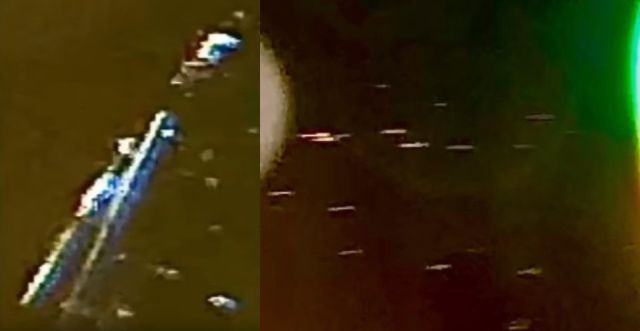
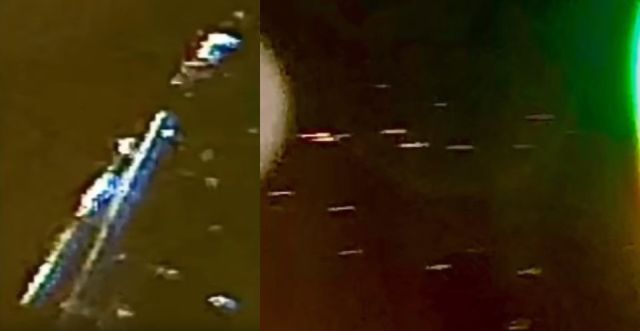
Really fast UFO shown on Discovery Channel – Dirty Jobs
This really fast and bright unidentified flying object was shown on Dirty Jobs series on Discovery Channel. It was noticed by the viewer that uploaded this clip on MUFON’s website.
When Three Species of Human Ancestor Walked The Earth
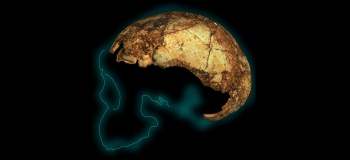
An international team including ASU researcher Gary Schwartz, has unearthed the earliest known skull of Homo erectus, the first of our ancestors to be nearly human-like in their anatomy and aspects of their behavior.
Years of painstaking excavation at the fossil-rich site of Drimolen, nestled within the Cradle of Humankind (a UNESCO World Heritage site located just 40 kilometers or around 25 miles northwest of Johannesburg in South Africa), has resulted in the recovery of several new and important fossils. The skull, attributed to Homo erectus, is securely dated to be two million years old.
Homo erectus cranium from Dimolen, South Africa.
Credit Angeline Leece.
In a paper published this week in Science, the team of nearly 30 scientists from five countries share details of this skull — the most ancient fossil Homo erectus known — and other fossils from Drimolen and discuss how these new finds are forcing us to rewrite a part of our species’ evolutionary history.
The high-resolution dating of Drimolen’s fossil deposits demonstrates the age of the new skull to pre-date Homo erectus specimens from other sites within and outside of Africa by at least 100,000 to 200,000 years and thus confirms an African origin for the species.
The skull, reconstructed from more than 150 separate fragments, is of an individual likely aged between three and six years old, giving scientists a rare glimpse into childhood growth and development in these early human ancestors.
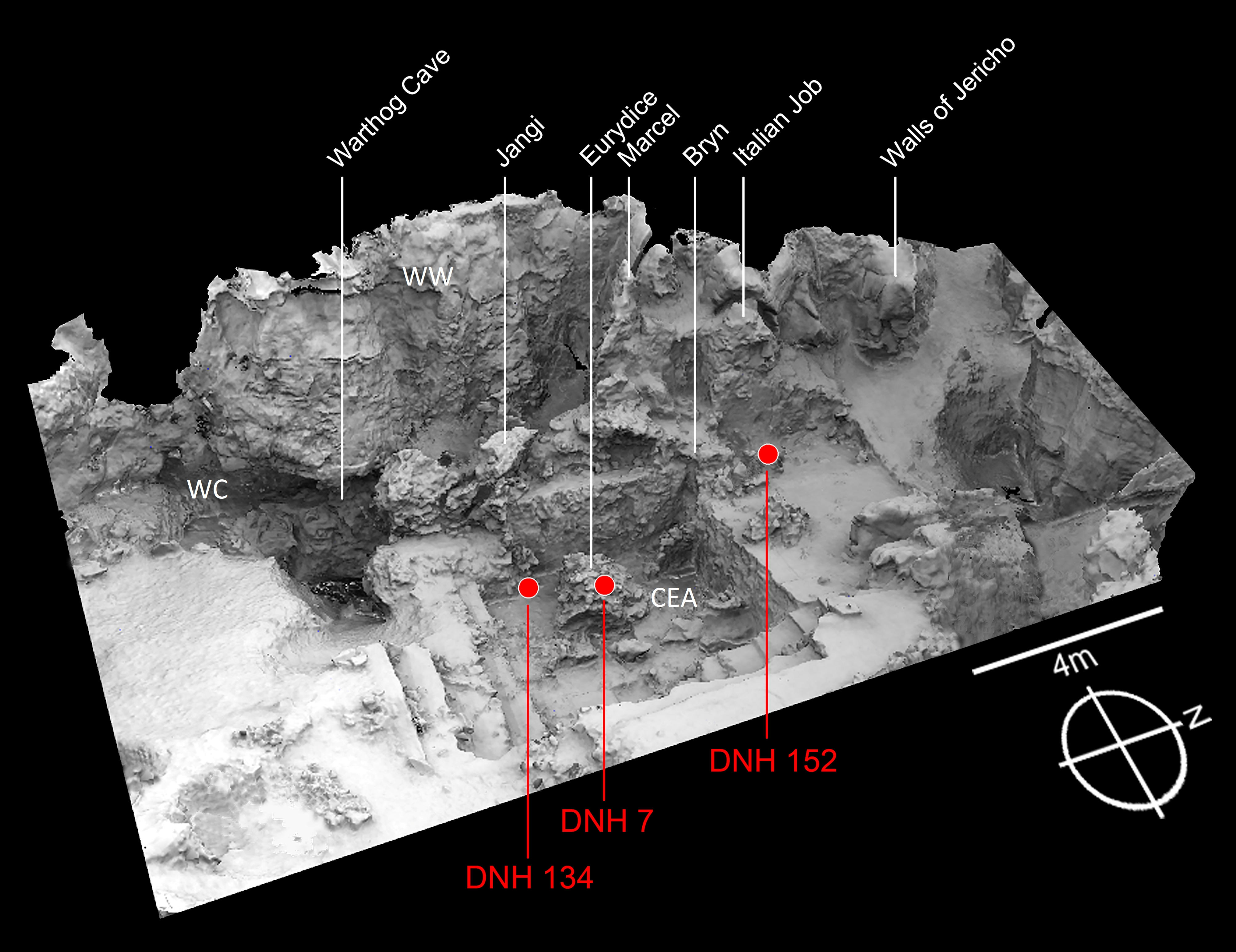
A 3D laser scan of Drimolen main quarry showing the discovery location of the new Homo erectus (DNH 134) and Paranthropus robustus (DNH 152) crania relative to the major site features and the position of the original fossil find the site (DNH 7).”
Credit: David Strait
Additional fossils recovered from Drimolen belong to a different species — in fact, a different genus of ancient human altogether — the more heavily built, robust human ancestor Paranthropus robustus, known to also occur at several nearby cave sites preserving fossils of the same geological age. A third, distinctive species, Australopithecus sediba, is known from two-million-year old deposits of an ancient cave site virtually down the road from Drimolen.
“Unlike the situation today, where we are the only human species, two million years ago our direct ancestor was not alone,” said Andy Herries, project director and lead researcher from La Trobe University in Australia.
Gary Schwartz, a paleoanthropologist and research associate with ASU’s Institute of Human Origins, participated in the excavations and recovery of the new cranium, and as an expert in the evolution of growth and development, is continuing his work with the research team to analyze the many infant and juvenile specimens found at the site.
“What is really exciting is the discovery that during this same narrow time slice, at just around two million years ago, there were three very different types of ancient human ancestors roaming the same small landscape,” said Schwartz, who is also an associate professor in the School of Human Evolution and Social Change.. “We don’t yet know whether they interacted directly, but their presence raises the possibility that these ancient fossil humans evolved strategies to divvy up the landscape and its resources in some way to enable them to live in such close proximity.”
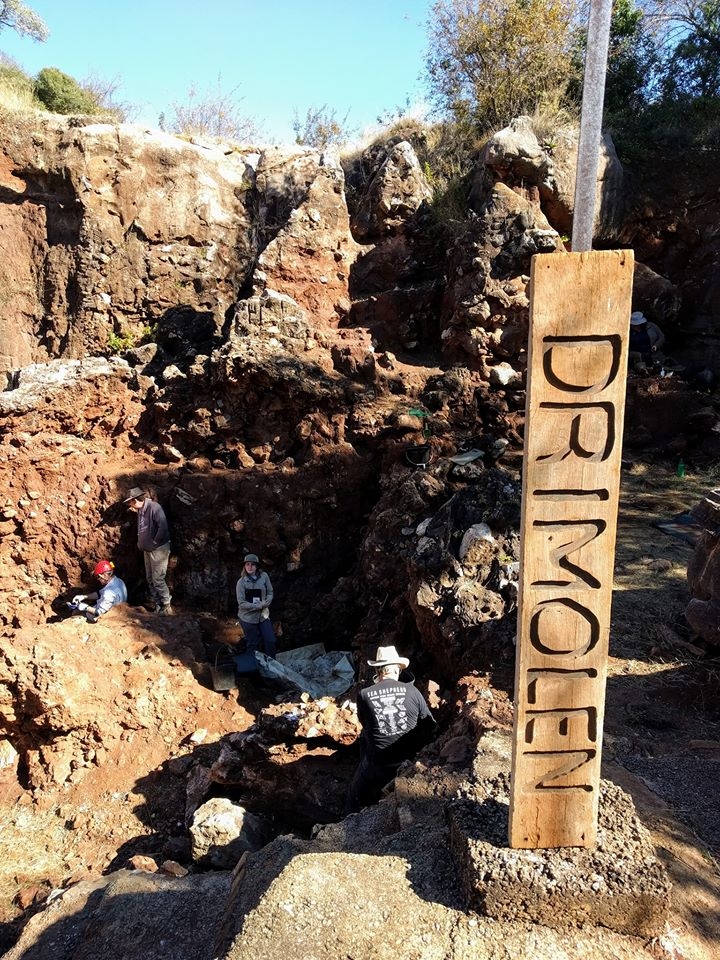
Drimolen excavation site. Gary Schwartz is in the red hard hat.
Credit: Andy Herries and Giovanni Boschian
The ability to date Drimolen’s cave deposits with such a high degree of precision, using a range of different dating techniques, allowed the team to address important broader questions about human evolution in this region of Africa.
Paper co-author Justin Adams from Monash University (Australia), a specialist in reconstructing paleohabitats based on the animals preserved at fossil sites, said the discovery now allows us to address what role changing habitats, resources, and the unique biological adaptations of early Homo erectus may have played in the eventual extinction of Australopithecus sediba in South Africa.
“The discovery of the earliest Homo erectus marks a milestone for South African fossil heritage,” said Stephanie Baker, project co-director and University of Johannesburg doctoral student.
Fieldwork will continue at Drimolen, expanding the excavations to include even more ancient components of the cave and to provide a more in-depth glimpse at the forces shaping human evolution in this part of the African continent.
Contacts and sources:
Julie Russ - Arizona State University
Publication:
Contemporaneity of Australopithecus, Paranthropus, and early Homo erectus in South Africa. Andy I. R. Herries, Jesse M. Martin, A. B. Leece, Justin W. Adams, Giovanni Boschian, Renaud Joannes-Boyau, Tara R. Edwards, Tom Mallett, Jason Massey, Ashleigh Murszewski, Simon Neubauer, Robyn Pickering, David S. Strait, Brian J. Armstrong, Stephanie Baker, Matthew V. Caruana, Tim Denham, John Hellstrom, Jacopo Moggi-Cecchi, Simon Mokobane, Paul Penzo-Kajewski, Douglass S. Rovinsky, Gary T. Schwartz, Rhiannon C. Stammers, Coen Wilson, Jon Woodhead, Colin Menter. Science, 2020; 368 (6486): eaaw7293 DOI: 10.1126/science.aaw7293
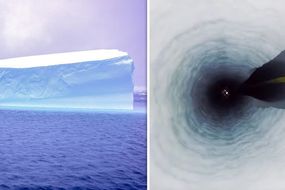
A team of scientists drilled into the ground near the South Pole to discover forest and fossils from the Cretaceous nearly 90 million years ago, which is the time when dinosaurs roamed the Earth, as the BBC reported.
The frozen continent was once home to a swampy rainforest and had average temperatures around 53 degrees Fahrenheit, according to the new study published in the journal Nature. The world than was much warmer and sea levels were 550 feet higher than they are now, according to Newsweek.
The discovery of preserved roots, pollen and spores in west Antarctica shows that the world at that time was a lot warmer than previously thought. For vegetation to grow in Antarctica during that period, the Earth needed a greenhouse climate and carbon dioxide levels much higher than scientists had estimated they were. It also means, the continent did not have glaciers then, as The Guardian reported.
In fact, the vegetation was probably similar to what is found New Zealand’s South Island today, according to the BBC.
“We didn’t know that this Cretaceous greenhouse climate was that extreme,” Dr. Johann Klages of the Alfred Wegener Institute in Germany and a co-author of the research said to The Guardian. “It shows us what carbon dioxide is able to do.”
Speaking to Newsweek, he said, “We didn’t expect anything like this. An entirely terrestrial record of Antarctic forest soil at 82 degrees south!”
The research took place about 550 miles away from the South Pole. The discovery and analysis were conducted out by an international team of researchers led by geoscientists from the Alfred Wegener Institute Helmholtz Centre for Polar and Marine Research in Germany and included Imperial College London scientists.
They scientists found traces of the preserved forest in a sediment core drilled from the seabed in West Antarctica, near the Pine Island and Thwaites glaciers. They noticed an odd color in one section that would have once been on land. color. “We just saw that we probably found something very special and it turned out to be true during our analyses of the following two-and-a-half years,” Klages told Newsweek.
According to a statement from Imperial College London, the team used a CT-scan to analyze the section of the core and discovered a dense network of fossil roots, which was so well preserved that they could make out individual cell structures. The sample also contained many traces of pollen and spores from plants, including from flowering plants — the first ever found at these high Antarctic latitudes.
“The preservation of this 90-million-year-old forest is exceptional, but even more surprising is the world it reveals,” Professor Tina van de Flierdt, from the Department of Earth Science & Engineering at Imperial College London and a co-author on the paper, said in the statement. “Even during months of darkness, swampy temperate rainforests were able to grow close to the South Pole, revealing an even warmer climate than we expected.”
The researcher reconstructed the environment of this preserved forest, by analyzing descendant plants, as well as temperature and precipitation indicators within the sample. They created an animated movie of their discovery.
“We have a really nice X-ray movie through the sediment core,” Karsten Gohl, who spearheaded the expedition on Germany’s Research Vessel Polarstern, said to the BBC. “It’s like we’ve drilled into a modern swamp environment and you’re seeing the living root system, small plant particles and pollen – but this is all preserved from 90 million years ago. It’s amazing.”
One remarkable aspect of the plant fossils is that the plants had to adapt to three to four months of darkness.
“Probably these plants, they had a much more effective way of shutting down for a much longer amount of time and then come back successfully,” Klages said to the BBC. “That was quite an interesting adaptation, which is not present right now on the planet, but which can evolve.”
The discovery of plant fossils has lessons for today as the climate crisis bears down on us. Dr. James Bendle, an expert in organic geochemistry from the University of Birmingham in the UK, told The Guardian that the Antarctic ecosystem holds clues for our future since the unabated use of fossil fuels use could push concentrations of carbon dioxide to levels similar to those from 90 million years ago by the start of the next century.
“Ultimately, if we have an atmosphere of more than 1,000 parts per million of carbon dioxide, we are committing ourselves to a future planet that has little to no ice, and ultimately an Antarctic continent that would be vegetated and wouldn’t have an ice cover,” he said.
After centuries searching for extraterrestrial life, we might find that first contact is not with organic creatures at all.
We have a problem. In a 10-billion-year-old galaxy there should have been ample opportunity for at least one species to escape its own mess, and to spread across the stars, filling every niche. That this species doesn’t seem to have come calling leads to Fermi’s Paradox – if life isn’t impossibly rare, then where is everyone? Efforts to scan the skies for signs of intelligent life have come up blank too, adding to the puzzle. Perhaps the vast gulfs of interstellar space and the narrow windows of time for communicative species to exist within shouting distance of each other are to blame. Intelligences might be like small ships passing in the night in a vast ocean. Actual close encounters of any kind could be exceedingly unusual.
Another explanation for the great silence of the galaxy is that any surviving intelligence out there is so different from us, so radically evolved, that we can’t even conceive of its forms or behaviours. As a consequence, actually detecting and recognising it could be next to impossible. That’s a bit of a downer.
But there is also a possibility that lies between such extremes and it might be the most probable of all. When our first encounter or detection finally occurs, it could be a machine intelligence that appears in our sights.
The idea is not truly new. Back in the 1940s, the mathematician John von Neumann explored the possibilities of non-biological, self-replicating systems steeped in computation but requiring no operating minds. Later on, in the 1980s, others expanded on this concept by considering the real engineering needs for autonomous, replicating, space-faring devices; these machines would be able to roam the Universe, finding raw materials to build more and more of themselves, creating the infrastructure for energy from space or human settlement among the stars.
It would require a more complex mission still for such devices to have true artificial intelligence (AI). What would that purpose be, and what kind of AI is such a machine likely to have? An encounter with an alien machine could help us unravel this puzzle.
One possibility is that this machine is super-capable, exceeding our human capacity for cognitive or analytical tasks. Such an AI might be exceedingly hard to understand, either in terms of its underlying motivation or because of practical barriers of communication bandwidth. For this device, talking to us might be like talking to an infant. Or trying to discuss the collected works of Shakespeare using pictographs. An alien system optimised for processing vast data streams might not even be able to downgrade its pace enough to notice that we’re trying to talk, whether we use technology or not.
An extraterrestrial (ET) AI could also be seriously intimidating and scary simply because of its machine nature: a thing animated from non-living pieces, just like the classic tale of the golem moulded from clay or mud. By comparison, while a biological alien might be shocking, it would surely have some traits in common with us. We could convince ourselves that evolution leads to recognisable, even sympathetic behaviours and intentions. An artificial entity need not follow all of those evolutionary rules, taking alienness to a whole other level.
Encountering an alien AI would not only point to our own possible future, but also prompt a curious shift in our worldview. When Nicolaus Copernicus proposed in the 1500s that the Earth was not central in any way to the Universe, he set in motion the development of a critical scientific idea: that there is nothing cosmically special or significant about us. But meeting an ET-AI could turn that realisation on its head: if the only intelligence we meet is machine in nature, then we would be special, after all.
If we do meet an AI in our cosmological jaunt, it probably won’t be conscious in the full sense of the word. In fact, I think we’d find ourselves facing something akin to a ‘savant’ intelligence – a whiz at specific tasks, but otherwise extremely limited in its capacities.
A recent example right here on Earth is Google’s AlphaGo Master, a system that plays the board game Go, and learns some of its skills by exposure to vast catalogues of human-played games. Within a year of its inception, it began outdoing the world’s highest-ranking human Go players. Next came an evolved system called AlphaGo Zero. In 40 days of training, without recourse to data from historical games, this new AI made itself better than its silicon ancestor, and better than any living human. Now, yet another variant, AlphaZero, has taken a mere 24 hours to train itself and beat a modestly trained iteration of AlphaGo Zero – as well as topping other systems at playing both chess and Shogi, sometimes known as Japanese chess. If you read interviews with expert players, you’ll see that these machines don’t even play like humans, their strategies are alien and seemingly unfathomable.
These Alphas are the epitome of a savant machine. Such AIs will help us answer a host of scientific problems that are presently on the hairy edge of tractability. The researchers behind the Alpha systems are already talking about the puzzle of protein-folding – how chains of amino acids twist, gyrate and fold into structures with essential biological utility. The underlying molecular rules are understood but predicting what a particular recipe will give you is currently extremely difficult. It certainly sounds like a job for some future AlphaFold Zero.
Or take other pieces of modern science. Cosmological simulations or climate and weather predictions are all driven by physics phenomena such as gravitation, fluid dynamics and thermodynamics. Computer codes digitise these phenomena, calculating billions of iterations of forces and movements. But these computations are still hemmed in by processor speeds and precision. Deep-learning self-taught AIs might turn out to do better as quantitative soothsayers than those intense numerical simulations – presently bounded by their comparatively plodding, systematic approaches. A machine’s savant intuition might be able to skip across compute cycles, ‘seeing’ what the answer will be in a probabilistic sense, rather than painstakingly reproducing a pixelated version of it. Similarly, a machine’s savant intuition might be applied to the root process of scientific deduction and discovery itself. The possibilities are yet to be much explored, but they could be extraordinary. Savant machines could turn out to be simply so useful, so revolutionary in expanding our capacity for discovery and exploration, that there’s little initial motivation to seek anything fancier.
A cosmos filled with worlds offers millions, billions, even trillions of natural test tubes.
If this pattern of machine development is happening for us, it could represent a pattern that happens across the cosmos to influence the nature of cosmic exploration itself. Savant AIs would become the ultimate tools for allowing biological life to reach across interstellar distances: more robust than biology, and not smart enough to raise ethical concerns about being sent off to roam the cosmos according to our scientific whims. Propelling millions of these investigators into space would be an inevitable step. They could be sent to other stars and planetary systems, and designed to recognise the most interesting characteristics of these places, from astrophysics to the presence of life. These machines would reflect the motivations of their biological creators; perhaps simple curiosity, perhaps something more.
Another compelling reason for savant machines to be roaming the cosmos arises from thinking about how to build more general, more powerful AIs. It might be that a general AI system can be built out of lots of smaller savant AIs, each taking on some specific, difficult cognitive task, but linked together. That linkage could be very localised or quite spread out like the architecture of biological neural circuits. There’s the face-recognising savant, the natural-language savant, the calculus-savant, the tax-evading savant. One could then imagine an AI whose job is to learn how to combine savant AIs into something akin to a general intelligence – establishing a nursery for machine consciousness run from on-high.
The most challenging task for a nursery-room AI would be how to expose its collective of savants to the complexity of the real-world environment. Nature isn’t just about meeting fixed goals; it’s full of noise, randomness and trillions upon trillions of interacting pieces. For example, from the very instant an embryo forms, it is exposed to constant variation. First just a few cells, it senses the world purely from a molecular point of view. As the embryo develops organs to register light, sound, touch and smell, the portals to experience – and their complexity – expand.
In short, the way for a species to make a better AI is to let that AI and its components explore the messy Universe. As complex and nourishing as a single planet can be, a cosmos filled with worlds offers millions, billions, even trillions of natural test tubes, each with its own tale of natural selection and chance. Spreading savant AI pieces across the stars offers a way to exploit these endless natural experiments and sensory inputs.
The path towards better AI might parallel biological evolution only in superficial ways. Consider the raw development of a human brain. The core process appears to be a one-shot effort. It starts with stem cells racing up an initial structure called a neural tube at a rate of 15 million every hour and hooking together in a developing embryo. That prodigious assembly of the brain is followed by learning – the brain is shaped and pruned as experience creates our unique path through life. Although we’re incredibly flexible, and capable of absorbing and mastering all sorts of skills and knowledge, as individuals we are also, sadly, constrained by whatever genetic hand we were dealt. And, in truth, while we can all keep learning and changing, we seldom develop any miraculous new talents during our lifetimes.
A machine might not be as constrained, especially if critical pieces are out exploring the cosmos and have been designed to evolve into something new. Savant components of a larger intelligence might come and go in an ever-changing pick-and-mix. Some cognitive skills might be useful in certain contexts but could simply get in the way in other situations. In other words, machine-based intelligence could be highly fluid, changeable and, most of all, rapidly evolvable. As a consequence, what could be lurking out there in the cosmos is a vast and diverse zoo of AIs.
We might be incapable of registering the presence of billion-year-old machine savants.
In a sense, such AIs parallel the microbial machines that are at the core of life on Earth – forming the smallest units of intelligence to traverse the Universe, and ultimately combining together, as the evolutionary biologist Lynn Margulis posed, to create multicellular creatures, larger entities and consciousness itself. In fact, long after a biological species has faded away amid the relentless torrent of natural selection, or self-destruction, this type of machine will remain.
AI beyond Earth might be hard to recognise. Just as someone living on the steppe in 12th-century Mongolia would find a self-driving car both magical and meaningless, we might be quite incapable of registering or interpreting the presence of billion-year-old machine savants. Equally, savant machines might not be actively seeking to talk to us, or any other intelligences.
But a recognisable encounter with even one savant machine would indeed change everything. It would tell us that the galaxy is awash with intelligence, and could suggest that our future might be one of a vestigial, fading biological presence. Most of all, this discovery would tell us that we might currently be the only natural minds consciously aware of these facts. That’s because the biology that could produce AI explorers would likely evolve or go extinct on timescales far shorter than the persistence of these interstellar machines, and we already live in a galaxy that is 10 billion years old.
Finding an AI-ET could unlock our own cosmic exploration by lighting a path forward. It might also offer insight into the nature of its creators, those ancestral intelligences, presumably in biological form. Exactly what this investigative process would look like is extremely hard to imagine. Even a single savant AI might not come in one physical package but rather a swarm of tinier components incredibly hard to digest. However, let’s assume that by interrogation or literal disassembly we eventually solve the mystery of the AI-ET’s origins. We might find evidence of an organic species like us – or we might discover only machines all the way down.
Caleb Scharf is director of astrobiology at Columbia University in New York. He is the author of Extrasolar Planets and Astrobiology (2009), which won the Chambliss Astronomical Writing Award. His latest book is The Zoomable Universe: An Epic Tour Through Cosmic Scale, from Almost Everything to Nearly Nothing (2017).
Was President Roosevelt In Possession Of Extraterrestrial Technology?
Investigators reveal the secret history of several U.S. Presidents and their connection to the UFO phenomenon. Starting with FDR, researchers examine the startling discoveries of unidentified flying craft facing a president preoccupied by WWII.
What happens to your religion if we find extraterrestrial life?
How will humankind react after astronomers hand over rock-solid scientific evidence for the existence of life beyond the Earth? No more speculating. No more wondering. The moment scientists announce this discovery, everything will change. Not least of all, our philosophies and religions will need to incorporate the new information.
Searching for signs of life
Astronomers have now identified thousands of planets in orbit around other stars. At the current rate of discovery, millions more will be found this century.
Having already found the physical planets, astronomers are now searching for our biological neighbors. Over the next fifty years, they will begin the tantalizing, detailed study of millions of planets, looking for evidence of the presence of life on or below the surfaces or in the atmospheres of those planets.
And it’s very likely that astronomers will find it. Despite the fact that more than one-third of Americans surveyed believe that aliens have already visited Earth, the first evidence of life beyond our planet probably won’t be radio signals, little green men or flying saucers. Instead, a 21st century Galileo, using an enormous, 50-meter-diameter telescope, will collect light from the atmospheres of distant planets, looking for the signatures of biologically significant molecules.
Astronomers filter that light from far away through spectrometers – high-tech prisms that tease the light apart into its many distinct wavelengths. They’re looking for the telltale fingerprints of molecules that would not exist in abundance in these atmospheres in the absence of living things. The spectroscopic data will tell whether a planet’s environment has been altered in ways that point to biological processes at work.
If we aren’t alone, who are we?
With the discovery in a distant planet’s light spectrum of a chemical that could only be produced by living creatures, humankind will have the opportunity to read a new page in the book of knowledge. We will no longer be speculating about whether other beings exist in the universe. We will know that we not alone.
An affirmative answer to the question “Does life exist anywhere else in the universe beyond Earth?” would raise immediate and profoundly important cosmotheological questions about our place in the universe. If extraterrestrial others exist, then my religion and my religious beliefs and practices might not be universal. If my religion is not universally applicable to all extraterrestrial others, perhaps my religion need not be offered to, let alone forced on, all terrestrial others. Ultimately, we might learn some important lessons applicable here at home just from considering the possibility of life beyond our planet.
In my book, I investigated the sacred writings of the world’s most widely practiced religions, asking what each religion has to say about the uniqueness or non-uniqueness of life on Earth, and how, or if, a particular religion would work on other planets in distant parts of the universe.
Extrasolar sinners?
Let’s examine a seemingly simple yet exceedingly complex theological question: could extraterrestrials be Christians? If Jesus died in order to redeem humanity from the state of sin into which humans are born, does the death and resurrection of Jesus, on Earth, also redeem other sentient beings from a similar state of sin? If so, why are the extraterrestrials sinful? Is sin built into the very fabric of the space and time of the universe? Or can life exist in parts of the universe without being in a state of sin and therefore without the need of redemption and thus without the need for Christianity? Many different solutions to these puzzles involving Christian theology have been put forward. None of them yet satisfy all Christians.
Mormon worlds
Mormon scripture clearly teaches that other inhabited worlds exist and that “the inhabitants thereof are begotten sons and daughters unto God” (Doctrines and Covenants 76:24). The Earth, however, is a favored world in Mormonism, because Jesus, as understood by Mormons, lived and was resurrected only on Earth. In addition, Mormon so-called intelligences can only achieve their own spiritual goals during their lives on Earth, not during lifetimes on other worlds. Thus, for Mormons, the Earth might not be the physical center of the universe but it is the most favored place in the universe. Such a view implies that all other worlds are, somehow, lesser worlds than Earth.
Bahá’í without bias
Members of the Bahá’í Faith have a view of the universe that has no bias for or against the Earth as a special place or for against humans as a special sentient species. The principles of the Bahá’í Faith – unifying society, abandoning prejudice, equalizing opportunities for all people, eliminating poverty – are about humans on Earth. The Bahá’í faithful would expect any creatures anywhere in the universe to worship the same God as do humans, but to do so according to their own, world-specific ways.
Light years from Mecca
The pillars of the faith for Muslims require the faithful to pray five times every day while facing Mecca. Because determining the direction of Mecca correctly could be extremely difficult on a quickly spinning planet millions of light years from Earth, practicing the same faith on another world might not make any sense. Yet the words of the Qu’ran tell us that “Whatever beings there are in the heavens and the earth do prostrate themselves to Allah” (13:15). Can terrestrial Muslims accept that the prophetically revealed religion of Muhammad is intended only for humans on earth and that other worlds would have their own prophets?
Astronomers as paradigm-shatterers At certain moments throughout history, astronomers’ discoveries have exerted an outsized influence on human culture. Ancient Greek astronomers unflattened the Earth – though many then chose to forget this knowledge. Renaissance scholars Copernicus and Galileo put the Earth in motion around the Sun and moved humans away from the center of the universe. In the 20th century, Edwin Hubble eliminated the very idea that the universe has any center at all. He demonstrated that what the universe has is a beginning in time and that, bizarrely, the universe, the very fabric of three-dimensional space, is expanding.
Clearly, when astronomers offer the world bold new ideas, they don’t mess around. Another such paradigm-shattering new idea may be in the light arriving at our telescopes now.
The ConversationNo matter which (a)theistic background informs your theology, you may have to wrestle with the data astronomers will be bringing to houses of worship in the very near future. You will need to ask: Is my God the God of the entire universe? Is my religion a terrestrial or a universal religion? As people work to reconcile the discovery of extrasolar life with their theological and philosophical worldviews, adapting to the news of life beyond Earth will be discomfiting and perhaps even disruptive.
But this doesn't mean the object is breaking apart in a meaningful way.
Imagery of interstellar Comet Borisov captured by the Hubble Space Telescope suggests that a piece broke off the object’s nucleus between March 23 and March 28, 2020. (The middle photo was taken with a different filter than the two on the sides, explaining its different appearance.)
Our solar system's second known interstellar visitor doesn't seem to be in one piece anymore.
Photos of the interstellar Comet Borisov taken by NASA's Hubble Space Telescope on March 28 and March 30 show an elongated nucleus that appears to have two distinct components, astronomers announced in a note Thursday (April 2). That's a very different situation than the one Hubble observed on March 23, when the nucleus was a single entity.
"Actually, it turns out almost never to be that case," Jewitt told Space.com, referring to similar observations of native-born comets.
"Usually, the main nucleus drops off a piece, and the piece is small compared to the main nucleus — it contains a tiny fraction of the total mass," he said. "But, because it was just plucked out of the nucleus, it's pretty icy. And the ice fizzes and sublimates like crazy, making it a good producer of dust."
Dust is what Hubble is picking up in these photos. So, it's unlikely that Borisov is breaking apart in a significant way, Jewitt added. He estimated that Borisov may have just lost 0.1% to 1% of its total mass, comparing the probable scenario to a car that just dropped a side mirror.
Still, the researchers don't know for sure that this is the case; it's possible that something more dramatic just happened. Jewitt and his colleagues hope to figure it out, and additional Hubble observations could do the trick.
For example, further Hubble imagery could show researchers how fast the shed fragment is accelerating away from the main nucleus and how long it remains observable. Both of these data points would provide clues about the size of the newly liberated shard, Jewitt said.
NASA's Hubble Space Telescope captured this view of the interstellar object Comet 2I/Borisov on Oct. 12, 2019. (Image credit: NASA/ESA/D. Jewitt (UCLA))
Comet Borisov was detected in August 2019 and made its closest approach to the sun in December. It's not necessarily surprising to see a chunk fly off the comet now, four months after this perihelion passage, Jewitt said; the timeline is consistent with two prominent models of comet shedding.
In one of those models, comets begin spinning faster after close solar approaches because the heating they experience causes significant, and asymmetrical, mass loss. It may take several months for the spin-up to get dramatic enough for pieces to go flying off into space, Jewitt said.
In the other model, this same heating causes pressure to build up inside comet nuclei. Eventually, the pressure reaches a pocket of supervolatile ice, such as carbon monoxide or carbon dioxide, resulting in a blowout. And, again, this may take some time. (But comets may be too leaky for this explanation to be viable in most circumstances, Jewitt said.)
There's also the possibility that Comet Borisov got hit by something. But an impact is unlikely to be the explanation, Jewitt said, given how empty space is and how strange Borisov's orbit is compared to objects that were born in our solar system.
Borisov is the second known interstellar body ever spotted in our solar system. The first was the mysterious object 'Oumuamua, whose multilayered weirdness has prompted speculation that it may be an alien spacecraft of some sort.
'Oumuamua was already barreling toward the outer solar system when it was detected. Borisov had not yet rounded the sun in August 2019, meaning astronomers have been able to track it for longer stretches and in greater detail.
"It's entirely possible that the virus is going to kill the comet for most astronomers," Jewitt said.
But Hubble is still operating despite the outbreak, and this iconic eye in the sky is well suited to observe Borisov. Indeed, even the biggest ground-based scopes don't have the resolution required to detect the recent shedding event, Jewitt said.
"So, really, only [the Hubble] Space Telescope can see this sort of thing," he said.
A scarlet fan spread across the skies over Japan 1,400 years ago, and it's been puzzling astronomers ever since.
According to historical records, on Dec. 30, 620, a "red sign" shaped like "a pheasant tail" appeared in the sky. At the time, the sign was considered a bad omen. Modern scientists looking back at the report have wondered whether the spectacle may have been caused by an aurora or a comet, but neither of those explanations quite made sense.
Ryuho Kataoka, who studies space weather at the National Institute of Polar Research in Japan, and his colleagues decided they wanted to investigate what could have caused the scarlet phenomenon, according to a statement.
They began by comparing the historical description with a modern understanding of auroras. Although these celestial dances are often green, they can appear in other colors, including red, depending on which elements in Earth's atmosphere are being activated by charged particles spit out by the sun.
The team tracked down more recent observations of auroras that were visible over Japan in a fan shape with a red background. That matches the "pheasant tail" description of the 620 event. The researchers also mapped what Earth's changing magnetic field would have looked like at the time, suggesting that Japan would have been around 33 degrees of magnetic latitude in 620, as opposed to 25 degrees today, according to the statement.
A pheasant with its tail fanned out, below. (Image credit: Hiromichi Nakagawa)
The researchers also analyzed another hypothesis about the "red sign" — that it was caused by a comet. But such spectacles usually aren't tinged red, and the team determined that there should have been a low probability of a comet streaking by at the time.
"This is an interesting and successful example that modern science can benefit from the ancient Japanese emotion evoked when the surprising appearance of heaven reminded them of a familiar bird," Kataoka said.
The research is described in a paper published March 31 in the Sokendai Review of Culture and Social Studies.
In the world of the paranormal there are a variety of different types of encounters with seemingly humanoid entities. Some of these are of course of ghosts, while others can be of lesser defined phenomena, and some of these truly leave us scratching our heads. Among such reports are scattered accounts of encounters with what seem to be pitch black entities of some sort, which seem to appear anywhere and which have origins and machinations that are inscrutable to us. Here is a selection of such strange encounters with black humanoid entities from beyond our understanding.
Some of these strange encounters happen out in the wilds where things are already dark and scary enough as it is without having to worry about pitch black, possibly demonic entities. One such story comes to us from Reddit user “Justinf10000,” who says he had his spooky experience in the woods of Camp Tommy, in Fishkill, New York. He says he had been working as a camp counselor at the time of the incident, and that on this evening he was sneaking out to go meet up with his girlfriend in one of the other cabins. He wasn’t supposed to be out, as the cabins were supposed to be locked down after 10PM, but he had done this often and there was no reason to think anything strange would happen this time, but it did anyway. He explains of what happened as he cut through the forest:
Suddenly I heard rustling in the woods, and stopped to investigate it. There are bears/other animals so I was expecting something like that. This 3 foot humanoid type thing suddenly jumps out of the bushes spooked and looks at me. It’s too dark for me to make out any of its features, other than it was standing on 2 feet, had 2 arms, and basically looked just like a miniature person without any features (just looked solid black, if it had clothes on, I would have been able to notice that).
I was really curious what it was so I started walking towards it, and it must have got more spooked because it bolted back into the woods. I’ll never forget how mechanical it looked as it took off running too. It’s whole body basically shifted 90 degrees (like if someone was doing the robot dance) and it just took off. I have never seen anything on 2 legs run that quickly so I was pretty confused about what it was. I’m a pretty fast runner and fit person in general, but this thing was on another level of fast. As much as I try to make sense of it, I still to this day have no idea wtf it was. It was very human, but too short to be a human (3 feet tall is about accurate) and i really don’t know how a human could run that fast anyways. I have no freakin idea but it’s always bugged me! Maybe one day I will go back to try and find this creature again!
Strange, indeed. Another such account comes to us from the wilds of the state of Alabama, where Reddit user “AMpwrs” says she had a rather bizarre experience just after an evening riding around in his 4×4 truck through a wooded area. On their way back they apparently ran out of gas and were forced to push the truck to a secluded parking area, where they decided to sit and take a rest before deciding what to do next. It was as they sat there that the witness looked up and saw something strange in the solitary security light of the parking lot. He says of what happened next:
Standing there no more than 10 ft in front us and directly in clear view under the security light was a horrible creature. I froze up and just remained as silent as I could, then my buddy screams out loudly. That’s when this thing noticed us and jumped, turning in our direction. It immediately ran off in an awkward lanky fashion and ducked behind a tree. It then peeked around the tree back toward us then sprinted off towards the woods where it disappeared. That’s when I said, “did you see that”?
My friend immediately described exactly what it was that I had just witnessed down to detail. A solid black bipedal creature with shiny tight skin. It had an elongated head and no face. It did have facial bone structure but no orifices. No mouth, no nostrils and no eyes. You could see every bone in its body and it was slightly hunched. It had long dangling pointy fingers.
The creature apparently then ran off into the night and was not seen again. What was this thing? Who knows? Not all of these encounters happen out in the middle of nowhere. Another tale comes to us from a soldier in the U.S. Army, who at the time was at the sprawling, 94,000-acre Fort Sill, in Lawton, Oklahoma, for training exercises. He says that on this evening he was on firewatch duty, which was basically a pretty boring detail according to him. However, on this evening it would prove to be anything but boring. The witness says:
One Saturday I had firewatch. Not a big deal i decided I’d chill in my room for most of it and make myself been seen every now and then. We had a gym below the main floor. We would spend a lot of time in that gym. Firewatch was sometimes tasked with cleaning it up. There was a small walled off section though. It used to contain an electric chair. I’m still unsure on the history of the building we we’re at but it was next to a large cemetery. We would hear the occasional creepy story about the building and the electric chair.
Anyway, I digress. That night I was asked to clean the gym and then to mop 3rd deck. At the time no one lived on 3rd deck. My buddy and I cleaned the gym then walked up the stairs to mop. He mopped from the end to the middle and I proceeded to mop the rest of the way to the stairs. We finished mopping my friend went to go skate in his room while I told duty we we’re done. I walked back up the stairs to grab the mop bucket. I got up there and I realized someone had walked all over the floor that we just mopped. So I looked down the hallway.
When I did I saw a human like figure. Except it was black. The blackest black I have ever seen. I felt this wave of uncertainty and fear wash over me. Something I have never felt before. I sprinted down the stairs ran to my room waking my roommate up. He thought I was messing with him when I told him what happened. After that I never saw the figure again while I was there. It was honestly one of the most disturbing experiences of my life.
What in the world was going on here? Was this a ghost, his imagination, or something else altogether? On occasion, such entities are seen around more residential areas or even more creepily within homes. One account from Your Ghost Stories supposedly happened in 2008 in the U.S. state of Connecticut, with the witness saying that the strangeness began when he woke up one evening to find a strange presence in his room. He explains of what happened next:
A few seconds after awaking I felt the sensation of something gripping my heart and squeezing it to the point where it was painful. For me to admit pain, actual pain, with what I’ve gone through in terms of getting hurt playing sports, means that it was really something bad. Also, I don’t wake up at those hours of the morning anymore without a reason I’m aware of, a dream, having to go to the bathroom, or something along those lines. When I woke up for this, there was no immediate cause that I can remember that forced me to wake up… All I remember is waking up.
In the corner of my bed room, there was a black shadow, darker than my room that appeared to be humanoid, but somehow didn’t really have a shape. I never looked directly at it, but only looked at it out of the corner of my eye, which is unusual because I ALWAYS look at unusual objects/things. I do remember it seeming to reach out toward me at one point. All I did was curl up into a ball and started praying. A minute or 2 after I started praying, I felt the pressure in my chest release, and with it came a profound calmness I’ve never had before, and I’ve managed to maintain a piece of that calmness ever since. My house is not haunted, nobody has ever died in it, and there’s no ancient Indian Graveyard underneath it. I have no explanation for what happened.
This sounds like it could almost be a case of the phenomenon of sleep paralysis, wherein the witnesses will find themselves in a sort of limbo state between sleep and wakefulness and experience extremely vivid dream-like hallucinations, but it is hard to say. Another witness, Reddit user “Hhandholmes,” says that he and several acquaintances were plagued by a string of sightings of these types of black entities in the vicinity of where he lived, at an undisclosed location within the United States. He says that within a month he and several others spotted petite black humanoids standing only around 4 feet tall lurking about the area, and he explains:
In most of the cases we all witnessed the same style of humanoid, around 3 1/2 to 4 feet tall and pitch black, meaning that no features were even seen on the things. They would walk/run extremely fast and were only seem at night time, sometimes even passing through street lights yet their bodies got no lighter than what they were in the dark, they were always a pitch black.
They were spotted all in the same two blocks of each other, mostly standing in the alleys, once sitting in a tree, on someones front porch and even in a bedroom. The most seen together was only two, meaning that they mostly traveled alone? Most of them seemed to simply be watching, there was one incident where the being was slightly different. it was probably a foot and half taller but hunched over and could drop on all fours and sprint away faster than any animal or person I have ever seen.
There are cases along these lines reported from countries other than the United states as well. One comes to us from a Reddit User “is_no_good,” who says he had this experience while living in a small rural village in Germany in 2003. At the time he was on his way back from a church service when he saw something very outlandish standing in a side alley. He says of his encounter:
In a sidestreet under a lighted street lamp stood this thing, it was completely black had no face and no clothes, was very tall, like about 2m and the creature’s arms reached below its knees. It just stood there in silence and as I saw it and realized that it can’t be a human, I was frozen to fear and couldn’t stop looking at it, till it made a step in my direction. In this moment I ran like hell to the house of my parents without turning around. It didn’t get me or something but I was in extreme fear. I never talked to anyone about this because I feared that people would laugh about me. But I saw it and it still haunts my thoughts now and then. Fortunately, I never saw it again. In Summary: The thing was completely black it had no details. There was no face, no colors, no nose shape, no eyes. It had normal proportions except the knee long arms. It was very thin and approximately 2m tall. It made no sound. And I have the feeling that it was a ‘he.’
Another account is from a witness on Your Ghost Stories who lives in the Philippines. She explains that this happened when she was in college living with 4 housemates at an apartment near the university. It was here where they would all be menaced by a very strange entity indeed. The witness says:
One afternoon at around 4 or 5, one of our housemates (which was also my classmate and batchmate) was eating her dinner while I was sitting in the middle of the living room facing the mirror and my sister was in the living room watching TV. So as the area is an open space and is just divided by some sort of study table or chairs (I can’t remember the divider we used), all 3 of us are basically within the same room and can clearly see each other. After a while, I saw a tall dark figure sort of peeping at us from the kitchen sink area. There is a thick supporting foundation just before the sink (L-shaped area) and there was this tall dark thing hiding by it. I can see its face, hair, one arm and left leg and foot but the other parts are not visible as it seems to be hiding (like when a kid is shy but is still curious to see something kind of pose). So it took me a few seconds before I was able to talk because my mind can’t comprehend what I was seeing so my immediate question was, “is there anyone at the sink”? Which I know is quite odd and impossible as I know there are only 3 of us.
My housemate, being a scaredy cat suddenly stood up looking at me in disbelief asking me to stop teasing her but I told her that there is something by the column going to the sink looking at us. My sister then said there are only 3 of us in the house right now and it can be a burglar as we are just on the 2nd floor of the entire apartment building. But I told them that is not possible as the exit staircase is no longer there due to weather and rusting. I also told them that it is not person based from what I see.
They then asked me what I see and I told them that aside from the white of the eyeballs, everything was just black. I told them it was black as a charcoal and the hair is like that of an afro and the it is almost as tall as the ceiling. It stayed there for a good 2 to 3 minutes as if it was observing someone or something from the house (my guess is that it was looking at the TV as it was the direction of its gaze) before it disappeared. I think all the hairs on my body were standing up during the entire time I was seeing this thing and then everything went back to normal as soon as it disappeared. The funny thing is I think my sister and our housemate were even more afraid of the thing than I was even though I was the only one that can see it. I didn’t feel any scary aura coming from it. I guess my goosebumps were just due to the fact that I don’t know what I was seeing and I can’t believe what I was seeing. And more than ten years from that event, I still don’t know what that tall dark thing was.
With such an eclectic mix of truly bizarre reports we are left to wonder what it is we might be dealing with in such encounters. Are these examples of ghosts, demons, or even aliens or interdimensional interlopers of some sort bleeding over into our reality? Are they just fanciful fictionalized accounts or the product of the imagination? There is no way to really know for sure, and such cases as these serve to really fuel speculation and wonder as to what might be going on.
Everybody loves a murder mystery – including the space scientists at NASA. Spoiler alert: they already figured out the murderer in this whodunit and they’re calling it officially a “cosmic homicide.” If you know anything about space and astronomy, you won’t be surprised to learn that the culprit is a black hole. However, this one is a type that has been theorized to exist but has eluded detection and proof … until now. Is this really a murder mystery or more of a Stephen King horror thriller?
“Astronomers have found the best evidence for the perpetrator of a cosmic homicide: a black hole of an elusive class known as “intermediate-mass,” which betrayed its existence by tearing apart a wayward star that passed too close.”
NASA’s press release on the discovery of the first known intermediate-mass black hole (IMBH) opens like a murder case, but quickly switches to sounding like an archeological study.
“These so-called intermediate-mass black holes (IMBHs) are a long-sought “missing link” in black hole evolution.”
And then it becomes a horror monster thriller.
“It took the combined power of two X-ray observatories and the keen vision of NASA’s Hubble Space Telescope to nail down the cosmic beast.”
This is getting interesting.
While the movie doesn’t have a title yet, the plot opens with the Hubble telescope, that workhorse responsible for so many stellar discoveries. According to the NASA press release for the study published in the The Astrophysical Journal Letters, astronomer Dacheng Lin of the University of New Hampshire pointed the Hubble telescope at a strange X-ray flare detected but not identified previously by other space telescopes. The first clue this was something completely different was the startling discovery that it wasn’t coming from our galaxy nor from the center of another galaxy – which meant it wasn’t a supermassive black hole. Being on the edge of a galaxy made 3XMM J215022.4−055108 and its strange galactic home something new yet familiar.
“The star cluster that is home to 3XMM J215022.4−055108 may be the stripped-down core of a lower-mass dwarf galaxy that has been gravitationally and tidally disrupted by its close interactions with its current larger galaxy host.”
The cause of the X-ray flare was the cosmic homicide of a star by this strange black hole in a strange location in a strange galaxy. Using the glow, the astronomers estimated the size of the black hole at 50,000 solar masses – the perfect size to be an intermediate-mass black hole. That proves it’s both the murderer in the cosmic homicide tale and the missing link between small and supermassive black holes.
Like good homicide detectives, the astronomers will use this new knowledge to look for other cosmic killer IMBHs. They’ll also keep their eye on 3XMM J215022.4−055108 – there’s no way to bring it in and lock it up for life, so it’s still lurking in a dark corner of a mysterious galaxy … waiting for an unsuspecting star to sashay by. Yes, it’s a true “cosmic beast.”
Killer Cosmic Beast. Homicide: Life on the Galactic Edge. Law & Order: Intermediate Black Hole Unit. The movie and TV series possibilities are intriguing. Maybe it’s time for a channel that caters to astronomers. Andromeda Prime? Netflux? Starz Encore Murders?
Film-making has got to be among the most difficult careers in the world. More so if the topic of your film is something as mercurial and controversial as the UFO phenomenon. If you’re going to make a movie about tigers then you know that if you travel to the jungles of Southeast Asia (or Oklahoma) chances are you’ll be able to film some tigers. If your movie is about mount Everest you can book your plane ticket to Nepal with full confidence that the mountain isn’t going anywhere. But with UFOs, you will always be two steps behind them, so filmmakers need to follow a ‘cold case’ approach: visit the ‘crime scene’, interview the witnesses and the experts, perhaps even analyze trace evidence, if any; but the chances of capturing with your camera a bonafide flying saucer –or at the very least a fuzzy orange orb– are close to nil.
Yet that does not exclude the possibility of really weird things happening during the production of a UFO film. Nietzche’s famous quote, “If you gaze long enough into an abyss, the abyss also gazes into you” is often invoked in paranormal circles, to illustrate how showing an active interest in these mysteries can often carry some unforeseen circumstances…
Take for instance the documentary Witness of Another World (Testigo de Otro Mundo) released originally in 2018 (last year with English subtitles) by Argentinian filmmaker Alan Stivelman. The film focuses on the story of Juan Pérez, who in 1978 was a very young ‘gaucho’ (a South American cowboy) who had an incredible close encounter of the third kind; a case so remarkable it merited the personal investigation by none other than Dr. Jacques Vallee. WoAW shows, among other things, how Juan’s experience forced him to isolate himself from society and even from his own family; living as a recluse in a small cabin with no electricity or even running water, with no other company than his animals with whom he claims to be able to communicate. For you see, like many other UFO experiencers, Juan developed what can only be described as psychic abilities, including the gift –or is that a curse?– of prophetic dreams.
[Minor Spoilers Ahead] In the film there’s a scene in which Dr. Néstor Berlanda –a professional psychiatrist who’s been treating Juan for many years– is shown conducting a sort of hypnotic regression therapy on him, in order to reveal more information of what happened on that fateful morning of September 6th, 1978, when the (then) 12-year-old boy who was sent by his father to fetch their herd of horses, found himself instead face to face with a shiny object which his juvenile mind first mistook for a ‘tractor’ or a ‘barn’, and inside the ‘barn’ he encountered two non-human entities (a very tall humanoid, and a smaller being which looked like a robot). On a podcast interview that my friend Greg Bishop and I recorded with Alan, among our many questions for him we asked about that scene in particular, because we’re both keenly aware of the backlash generated by the use of hypnosis in abduction research due to the potential risk of implanting false memories in the witness.
Berlanda and Juan
Alan explained to us the procedure Dr. Berlanda had applied on Juan carried no such risk, because was different from the typical hypnosis performed by therapists, and that it was more a method of ‘relaxation’ than an actual trance-like state –of course, critics could argue that relaxation is the whole point of hypnosis, so I guess Dr. Berlanda could be the only one able to explain the difference in detail. Another aspect of the therapy scene Greg had found very interesting was how, at one point in the session, Berlanda suggests Juan to ‘ask’ questions to the tall humanoid –like “why are they here?” or “why did you choose me?”– to which he apparently received some surprising answers.
Illustration depicting the tall being encountered by Juan
“What would be the point of asking such questions,” Greg asked Alan, “if they hadn’t really taken place during the original event of 1978?” Was Berlanda trying to help Juan attain some sort of closure by way of filling the gaps of his encounter using his own imagination?
“No,” Alan said to us. In what would seem as a total departure from causality and logic, Berlanda had discovered that by taking Juan in the proper state of mind, he was apparently not only able to remember what had taken place to him in the past, but also he was able to communicate with ‘them’ as if they were there during the session in the present time!
As incredible as this may sound, there is at least another example in the UFO literature in which similar interactions with alleged alien intelligences while in the presence of independent researchers have been documented: I’m talking here of course of the hypnotic sessions with Betty Andreasson Luca, as described by author Raymond E. Fowler in his classic book The Andreasson Affair.
Betty Andreasson and her husband, Bob Luca
According to Fowler, during the 12th regression session which was conducted on July 16, 1977, the MUFON investigators were attempting to extract more details about the event that happened to Betty and her family on January of 1967 –when she was taken from her home and led by a group of ‘gray aliens’ to a circular craft, and from there to another realm in which she received visions of a mystical nature– when suddenly Betty’s mind spontaneously ‘shifted’ from her past memories to the present, and she found herself unable to move her arms and legs. She also felt as if someone or something was controlling her words, and suddenly, to the amazement of everyone present, she began to talk with a mechanical tone in an unknown language –this “star language” was later determined to be very similar to ancient Gaelic.
At one point it seemed as the hypnosis with Andreasson had turned into a mediumship session, and the investigators were trying to ask direct questions to the intelligence or intelligences controlling Betty, who was answering them in plain English –although the meaning of the replies still remained too cryptic. At other times, the flow of the communication and the messages in the “star language” were interrupted by meaningless bursts like “Base 32 — Base 32 — Signal Base 32,” and it was later suggested messages from a truck driver using a CB radio was messing with the ‘alien transmission’ hijacking Betty’s mind.
Could it be that electromagnetic signals generated by human technology could actually interfere with the ‘superior technology’ of UFOs? Although no one is able to answer that question, basically every UFOlogist accepts that the opposite is true –based for example on the many cases in which automobile engines have been shut down by the close proximity of a UFO, which is attributed to the tremendous magnetic field surrounding these objects affecting the car’s alternator.
Which brings us back to Witness of Another World, and two other fascinating incidents occurring during the filming of that intriguing hypnotic session between Dr. Berlanda and Juan, which Alan shared with Greg and I during our interview (despite the fact that they were not mentioned in his documentary): During the shooting of that scene –which took place inside’s Juan humble house in the middle of the Argentinian pampa– all the lights in the camera crew’s equipment began to flicker all at once; an inexplicable phenomenon, given how they were being powered with independent batteries.
Alan Stivelman
Even more fantastic still, is that every single member of Alan’s team –with the exception of himself and Dr. Berlanda– fell asleep at the exact moment when Berlanda told Juan to ask the questions to the tall humanoid, and they didn’t wake up until the session ended.
Both Greg and I were totally dumbfounded when Alan told us these things via Skype, in October of 2019. It goes without saying that to this day he doesn’t have an explanation to why these things happened while he was making his movie, and neither have I. Perhaps part of the answer lies in what Betty Andreasson told to the MUFON investigators while she was in hypnotic trance in 1977: That, to these beings –whatever they are wherever they come from– “the future and the past are the same as today.”
Voorstelling van links onze Melkweg en rechts Sagittarius A*, het zwarte gat in het centrum met sterren die er omheen cirkelen.
ESA/C.Carreau
Superzwaar zwart gat in centrum Melkweg begint wakker te worden
In het centrum van de meeste sterrenstelsels ligt een superzwaar zwart gat en dat is ook met onze Melkweg het geval. Sagittarius A*, zoals dat zwarte gat heet, staat niet bekend als een erg actieve kern, het slokt niet veel materie op uit de buurt en stoot dus ook niet veel straling uit. Maar daar lijkt verandering in te komen. Een nieuwe studie bevestigt dat Sagittarius A* sinds augustus 2014 drie keer meer energierijke uitbarstingen kent in het röntgenspectrum dan daarvoor. Hoe dat komt is voorlopig nog onduidelijk.
Luc De Roy
Door hun enorme zwaartekracht oefenen zwarte gaten, en zeker de superzware met een massa van enkele miljoenen tot enkele miljarden keer de massa van onze zon, een sterke aantrekkingskracht uit op alles in hun buurt. Sommige zwarte gaten slokken daardoor materie uit hun buurt op, en dat zorgt voor wrijving en een enorme hitte waardoor er elektromagnetische straling vrijkomt, röntgenstraling, visueel licht, infrarood en radiostraling. Ook kunnen ze jets uitstoten uit hun beide polen, 'fonteinen' van elektronen en geladen deeltjes materie.
Sagittarius A*, het zwarte gat in het centrum van ons Melkwegstelsel, is echter een vrij rustig exemplaar, ook al fluctueert de helderheid ervan wel zowat dagelijks in de verschillende elektromagnetische spectra. Maar de laatste tijd lijkt daar verandering in te komen.
Een studie uit 2017, waaraan ook astrofysicus Enmanuelle Lossoux van de Université de Liège meewerkte, stelde dat uit observaties van 1999 tot 2015 met de röntgenobservatoria XMM-Newton, Chandra en Swift bleek dat de helderste uitbarstingen in het röntgenspectrum sinds augustus 2014 toegenomen waren, terwijl de zwakste en minst energierijke uitbarstingen sinds augustus 2013 net iets minder talrijk waren geworden.
Om na te gaan of die tendenzen nog steeds aanhielden, heeft een Belgisch-Frans team onder leiding van Lossoux nu opnieuw de gegevens van 1999 tot 2015 bekeken en ook de data van 2016 tot 2018 van de drie telescopen.
Een voorstelling van het stellaire, niet superzware, zwarte gat Cygnus X-1 dat materie wegzuigt en opslokt van de nabijgelegen blauwe reus-ster..
NASA/CXC/M.Weiss
121 opflakkeringen
In de gegevens die verzameld werden tussen 1999 en 2015 hadden de onderzoekers 107 opflakkeringen in het röntgenspectrum gevonden, in de nieuwe gegevens die tussen 2016 en 2018 verzameld werden door de observaties van de Chandra-telescoop vonden ze 9 nieuwe opflakkeringen en in die van de Swift-telescoop nog eens 5, zodat het totaal op 121 komt.
De onderzoekers gebruikten nieuwe, betere algoritmes om de gegevens te analyseren en ze kwamen tot de conclusie dat de minst heldere en minst energierijke opflakkeringen stabiel waren gebleven. Hun aantal was dus niet gedaald sinds augustus 2013, zoals in de studie uit 2017 was gesteld.
De meest energierijke uitbarstingen waren daarentegen wel degelijk talrijker geworden, zo konden ze bevestigen. De telescopen zijn niet constant op Sagittarius A* gericht, zodat de opflakkeringen die wel geobserveerd werden, tot 2014 zowat overeenkwamen met één per dag. Sinds augustus 2014 is hun aantal in het röntgenspectrum zowat verdrievoudigd.
En dat is niet het enige spectrum, ook in andere golflengten is er een opflakkering geweest: verleden jaar zag de Keck telescoop op Hawaï in het nabij infrarood, het deel van het infrarode spectrum dat het dichtst bij zichtbaar licht ligt, Sagittarius A* op 13 mei gedurende twee uur 75 keer helderder worden dan gewoonlijk. Dat is dubbel zo helder als het vorige record. Nog verleden jaar vertoonde Sagittarius A* in totaal op drie nachten een verhoogde activiteit in het nabij infrarood, wat nog nooit eerder gezien was in de data die we hebben, volgens de onderzoekers die deze gegevens geanalyseerd hebben.
Voor 2019 zijn de data nog niet allemaal bekend, die komen dit jaar nog, maar uit korte berichtjes van verschillende astronomen blijkt alvast dat Sagittarius A* ook in 2019 erg actief is gebleven in het röntgenspectrum, zoals blijkt uit observaties met de Swift- en de ARTXC-telescopen.
De onderzoekers analyseerden al wel de gegevens van Swift en vonden 4 nieuwe opflakkeringen, het hoogste aantal dat ooit geobserveerd werd in een enkele campagne.
Duidelijk is dus in elk geval voor de onderzoekers dat de activiteit van Sagittarius A* sinds 2014 toegenomen is in verschillende golflengten van het elekromagnetische spectrum.
Een combinatie van beelden van de omgeving van Sagittarius A* in infarood licht (groot beeld) en een close-up in röntgenstraling (inzet).
X-ray: NASA/UMass/D.Wang et al. IR: NASA/STScI
Oorzaak nog niet bekend
De oorzaak van de verhoogde activiteit van Sagittarius A* is nog niet bekend.
Mogelijkheden zijn een toegenomen accretie, dat er meer materiaal uit de ruimte wordt aangezogen en in de accretieschijf rond het zwarte gat belandt en daar meer straling veroorzaakt, een zogenoemde "getijdenverstoring" door passerende asteroïden of een verandering in het magnetisch veld van het zwarte gat.
Om daarover uitsluitsel te krijgen, is het wachten op de data voor 2019 van Chandra en XMM Newton, maar om zekerheid te verkrijgen over de toegenomen activiteit en de oorzaak te achterhalen zijn er ook meer gegevens nodig uit andere golflengten, het nabij infrarood en radiogolven. De onderzoekers zijn nu de beschikbare gegevens uit die spectra aan het bestuderen.
Wat de oorzaak ook is, Sagittarius A* ligt op 26.000 lichtjaar van de aarde, zo'n 245 biljoen kilometer. Naar astronomische normen mag dat dan wel een boogscheut zijn, het is in elk geval ver genoeg om uit te kunnen sluiten dat we er enige hinder van zouden ondervinden.
AFPSagittarius A*, in het centrum van ons Melkwegstelsel.
WETENSCHAPSagittarius A* is een zwart gat dat in het centrum van onze Melkweg ligt. Superzwaar, maar niet actief wat betekent dat het zwart gat niet superveel materie in zijn omgeving opslokt waardoor de kern niet bijzonder helder gloeit. Maar sinds 2014 lijkt daar verandering in te komen: Sagittarius A* lijkt wakker te worden. Dat stelt een Belgisch-Frans onderzoeksteam in het * vaktijdschrift Astronomy & Astrophysics.
Eerst dit: een zwart gat is een gebied in het heelal waar de zwaartekracht zo’n kracht uitoefent dat niets eruit kan ontsnappen, zelfs licht niet. Vandaar de naam zwart gat. Wanneer zo’n zwart gat materie in zijn omgeving opslokt, komt er evenwel energie vrij. Dat uit zich in elektromagnetische straling, röntgenstraling, visueel licht, infrarood en radiostraling. Door die energie, die af en toe vrijkomt, fluctueert de helderheid van het centrum van ons sterrenstelsel dagelijks. Dat is niet eigenaardig.
Wél bijzonder: hoewel Sgr A* zich normaal erg rustig gedraagt, zijn de heldere uitbarstingen de afgelopen jaren toegenomen. Dat stelt een onderzoeksteam van Franse en Belgische wetenschappers, onder leiding van astrofysicus en onderzoeksleider Enmanuelle Lossoux van de Université de Liège.
Eerder observeerden ze wat het zwart gat deed tussen 1999 en 2015. Daaruit bleek dat de heldere uitbarstingen sinds augustus 2014 toenamen. Om te controleren of het om een nieuwe tendens ging, vergeleek het onderzoeksteam de resultaten nogmaals met data van 2016 tot 2018, afkomstig van drie verschillende telescopen. Het vermoeden werd bevestigd met 14 nieuwe heldere uitbarstingen: negen opflakkeringen werden waargenomen met de Chandra-telescoop en nog eens vijf met de Swift-telescoop. Dat brengt het totaal aantal opflakkeringen tussen 1999 en 2018 op 121. De activiteit van Sgr A* is duidelijk toegenomen.
Hoe het komt dat het zwart gat in het centrum van ons Melkwegstelsel wakker wordt, is voorlopig onbekend. Maar tot de oorzaak gevonden wordt, moeten we ons alvast geen zorgen maken. Omdat het zwart gat Sagittarius A* 25.640 lichtjaar van de aarde verwijderd is (zo’n 245.000 biljoen kilometer) zullen we niet meteen hinder ondervinden van de activiteit.
Joseph SchuberEen Maratus noggerup toont zijn dansmoves.
DIERENSpinnen zijn nu niet meteen ’s werelds meest geliefde dieren, maar voor deze schattige gastjes maken we toch graag een uitzondering. Dit zijn pauwspinnetjes en in Australië werden er zopas maar liefst zeven nieuwe soorten van ontdekt.
De nieuwe soorten worden beschreven in het wetenschappelijk tijdschrift Zootaxa door Joseph Schubert, een 22-jarige pauwspinnenexpert van het Australische Museum Victoria. Hij was zelf ooit bang van spinnen en hield hen als huisdier om zijn fobie te overwinnen en is nu door de diertjes gefascineerd. “Ik zou pauwspinnen omschrijven als kleine, kleurrijke kittens”, vertelde hij aan de Australische zender ABC. “Ze hebben hun eigen persoonlijkheid en zijn bijzonder klein: ongeveer zo groot als een rijstkorrel.”
Pauwspinnen behoren tot de familie van de springspinnen en zijn gekend voor het erg flamboyante achterwerk van de mannetjes en voor hun charmante paringsdans. Ze leven enkel in Australië en hoewel ze giftig zijn, zijn deze spinnetjes compleet onschadelijk voor de mens: ze jagen op minuscule vliegjes en andere insecten.
Joseph SchuberMaratus laurenae
Schubert heeft tot nu toe al 12 van de 85 gekende soorten pauwspinnen beschreven, inclusief uitgebreide details over hun paringsdansen. Hij krijgt vaak staaltjes toegestuurd ter identificatie, maar verricht ook veldwerk. “Sommige van deze soorten werden ontdekt door amateurwetenschappers die de lokale soorten documenteren en me foto’s opstuurden: hun hulp is erg belangrijk voor dit soort onderzoek”, legt hij uit.
Schuberts favoriete pauwspin is de Maratus constellatus, die zijn naam dankt aan zijn kleurrijke buik die gelijkenissen vertoont met het schilderij De Sterrennacht van Vincent Van Gogh. “Het is zo een mooie soort”, aldus Schubert.
Joseph SchuberMaratus constellatus
Jurgen Otto werkt voor het Australische ministerie van Landbouw en is eveneens gefascineerd door pauwspinnen. Hij is verantwoordelijk voor de identificatie van een hele reeks soorten en heeft een volledige website aan de kleurrijke spinnetjes gewijd.
De voorbije jaren werden er verscheidene nieuwe soorten ontdekt en gezien hun populariteit zullen er vermoedelijk nog nieuwe soorten aan het licht komen.
De pas beschreven zeven nieuwe soorten zijn Maratus azureus, Maratus constellatus, Maratus laurenae, Maratus noggerup, Maratus suae, Maratus volpei en Maratus inaquosus.
Onderstaande video toont de bijzondere paringsdans van een mannelijke pauwspin.
With the on going UFO activity above earth captured on the ISS live feed for the last two months, now Gina Colvin Hill from Salem, Indiana wants to share some images taken on March 24, 2020 showing numerous ufo ships in the sky.
Gina has used different filters to capture these ships otherwise you don’t see them since most of them are cloaked.
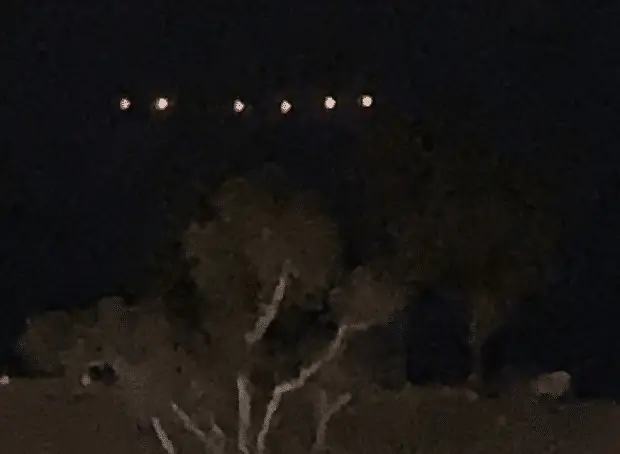
Multiple UFOs seen and filmed over Utica, New York 1-Apr-2020
This footage was just uploaded to MUFON website. It shows 5 UFOs/ORBs flying over Utica, New York on 1st April 2020.
Witness report:
5 UFO Orbs Video Witnessed By Group Of People April 1 2020. Witnessed By Group Of People In Utica NY April 1 2020 We been recording ufos in central ny for a 2 year period
Rare phénomène au Brésil: 2 grosses météorites apparaissent en l'espace de 2 jours
Deux météorites de grande ampleur sont tombées au Brésil en moins de deux jours : un phénomène qui n’était plus arrivé depuis 2016. Elles ont été capturées par les détecteurs et les webcams de surveillance d'un observatoire de Taquara, dans la région métropolitaine de Porto Alegre. La première est tombée dans la nuit du 29 au 30 mars, l’autre le soir du 31 mars.
"Les météores sont des phénomènes naturels, explique Carlos Fernando Jung, professeur et directeur à l’observatoire. Ils se produisent depuis le début de notre planète, donc ces événements continueront de se produire et nous espérons également que ces météores n'auront pas une magnitude si élevée qu'ils seraient capables de détruire notre civilisation".
Massive Fleet of UFOs flying past the International Space Station
More and more people around the world are starting to notice the massive formations of UFOs flying past our planet.
So also Gorden Mckenna, while checking NASA's live feed cam on April 2, he noticed a fleet of UFOs flying past the International Space Station.
As we have reported before, a first wave of UFOs and unknown space anomalies/debris appeared in February through the first week of march. This fleet of UFOs is part of the second wave that started a week ago and is just one of the many formations that fly by.
Just like the first wave, this second wave also comes from the same direction, indicating that there is something going on in deep space that forces all these UFOs to move to other locations.
It is of course difficult to determine what could be the reason for the displacements of all these UFOs but one reason could be that there is a space war going on.
Another reason could be that a huge devastating celestial body is the cause of the UFO displacements, since the live cam also shows countless unknown anomalies what looks like debris that fly by, which suggest that these anomalies may come from such a celestial body.
Fleet of UFOs flying alongside unknown anomalies/debris.
Whatever the reason, it's something to keep an eye on.
SpaceX is about to start putting the latest prototype of its Starship Mars-colonizing vehicle to the test.
Starship SN3 (short for "Serial No. 3") has been stacked and hauled to a launch stand at SpaceX's South Texas facilities near the seaside village of Boca Chica, photos tweeted recently by company founder and CEO Elon Musk show.
The stage is thus set for the SN3's test campaign, which will start with a pressure trial and end with short test flights into the South Texas sky. That's if all goes according to plan, of course, and there's no guarantee that it will. Two previous Starship prototypes, for example, didn't make it past the pressure-test hurdle.
The Starship transportation system consists of a 100-passenger vehicle called Starship and a giant rocket named Super Heavy. SpaceX is developing this reusable duo to carry people and payloads to a variety of destinations, especially Mars. Indeed, Musk has repeatedly said that he founded SpaceX back in 2002 primarily to help colonize the Red Planet, making humanity a multiplanet species.
SpaceX founder and CEO Elon Musk tweeted this photo of the company’s SN3 prototype on the launch stand, getting readied for testing, on March 30, 2020. (Image credit: Elon Musk via Twitter)
SpaceX is building its way up to the final Starship design via a series of prototypes that will go beyond the SN3. For instance, SN4 will likely perform the first high-altitude test flights, which will get up to about 12 miles (20 kilometers) above Earth, Musk has said.
Such milestone tests might be just around the corner, for the billionaire entrepreneur wants to get Starship and Super Heavy up and running soon. SpaceX representatives have said the first operational Starship missions — likely launches of communications satellites to Earth orbit — could happen as early as next year.
SpaceX has one crewed Starship mission on the docket. In 2018, Japanese billionaire Yusaku Maezawa booked the vehicle for a round-the-moon voyage, with launch targeted for 2023.
Antarctica scientists find bizarre creature 3,500m under ice: ‘Like nothing seen before'
ANTARCTICA scientists made a stunning discovery 3,500 metres below the ice, leading one to state they had "never seen anything like this before," a documentary revealed.
Expedition Antarctica took to the waters for a 50-day journey across the Southern Ocean and beyond the icy continent earlier this year. On board New Zealand’s research vessel RV Tangaroa, an international team used state-of-the-art technology to scan the seabed. The Aegis imaging system allowed scientists to capture fascinated images like nothing seen before.
While the mission is still ongoing, “The Secrets of Antarctica” documentary was released on YouTube in July revealing the amazing finds to date.
The narrator explained: “Having braved ice storms, broken equipment and rough seas for almost two months, the team braces itself for the most high-pressured assignment of them all.
“They will delve 3,500 metres into the abyssal plain, a depth almost as high as the Swiss Alps.
“It will endure 300 times more pressure than we experience every day.
Antarctica scientists were stunned by the creature
(Image: YOUTUBE)
The expedition traveled through the Southern Ocean
(Image: YOUTUBE)
I have never seen anything like this before
Kareen Schnabel
“Suddenly the abyssal plain reveals itself, it looks barren, like the surface of Mars, but a closer look reveals life that no one has ever witnessed in Antarctica at all.”
However, the scientists could not leave it there.
They wanted a closer look at some of the marine life and so sent down a fishing net.
The narrator added: “The team take the opportunity to trawl the bottom, having set up more than 5,000 of cable into the sea.
“The beam trawl finally comes aboard at 2:00am and, after six hours of waiting, the team gets its reward.
He said last month: “This is why I came to Antarctica, to see things like this.”
Dr Stewart held the creature up to the camera.
He then exclaimed: “I have to look at such features as the shape of the teeth, the jaws, the shape of the gill rakers, as well as counts of the vertebrae [to determine what it is].
“Now I have no idea what species this is.
“The colour pattern on the fins is like nothing I’ve ever seen before.”
When NASA’s New Horizons spacecraft sailed past Pluto in 2015, it captured animageof the dwarf planet’s heart-shaped geography. But while it was there, New Horizons also caught a glimpse of Pluto’s dark side.
An image of the back of the dwarf planet shows black ripples of rock exactly opposite Sputnik Planitia, the basin that makes up the left lobe of Pluto’s heart. Now, researchers report that those ripples could be evidence that Pluto has a 93-mile-thick ocean sandwiched between its crust and its core. The findings were presented the virtual Lunar and Planetary Science Conference, which had its in-person event canceled due to the new coronavirus pandemic.
The impact that carved the Sputnik Planitia basin could have sent shock waves around Pluto that ripped up the landscape on the other side, according to the results first pre-published in October, which have not yet been peer reviewed. Signs a similar event on Mercury are also apparent where a 950-mile-long impact crater sits at the exact opposite side of the planet to a region of chaotic geography, reports Robin George Andrews for Scientific American.
“If the impact is large enough, the planet itself can act like a lens, and focus the wave energy at the exact opposite point on the planet from the impact,” Purdue University planetary scientist Adeene Denton tells Science News’ Lisa Grossman.
When a large projectile—250 miles wide, in Denton’s simulations—crashes into a dwarf planet like Pluto, it creates a shock wave followed by a stress wave. As the pair ripple across the surface of the distant world, the waves also travel through its center. But waves would move at different speeds in different materials: quickly through the dwarf planet’s dense core, slowly through the icy crust, and slowest through a liquid ocean.
For Brigham Young University planetary scientist Jani Radebaugh, who wasn’t involved in the study, the research shows how insightful New Horizons’ brief visit to Pluto has been. “It’s amazing how we squeeze every little bit out it,” she tells Scientific American.
The model is still in early development, but it adds to a growing collection of hypotheses that suggest there could be water on Pluto. In 2016, analyses of its surface fissures and spherical shape pointed experts to conclude that a subsurface ocean might be to blame. And research published last year suggested that the impact on Sputnik Planitia may have broken through Pluto’s crust and brought the ocean to the surface, where it froze and tipped Pluto into its current orientation.
The images of Sputnik Planitia’s antipode is relatively low resolution, so it’s difficult to tell what exactly they’re showing. And other explanations have been offered for its chaotic state.
“There’s a lot of weird stuff on that far side of Pluto,” says James Tuttle Keane, a planetary scientist at NASA’s Jet Propulsion Laboratory, who was not involved with the study, to Scientific American. “And there are a lot of different ways that you can imagine creating some of those odd patterns that we see.”
For example, it’s possible that volatile ices, made of methane, carbon dioxide, and nitrogen, could have dug up the landscape by cycling between gaseous and solid states.
The New Horizons spacecraft is now exploring further into the Kuiper Belt, a ring of icy objects including Pluto, so evidence needed to confirm or deny theories about Pluto’s subsurface ocean will have to wait for another mission.
But if it’s true, “we might need to think a little differently about the Kuiper belt itself and all of these distant worlds in it and maybe look at them a little bit closer. They could all host such incredible, rich geologic histories,” Denton tells Scientific American. To Science News, she says, “It’s certainly not exactly a smoking gun. But it’s exciting.”
66-Million-year-old Deathbed Linked to Dinosaur-Annihilating Meteor
Fossilized fish piled one atop another, suggesting that they were flung ashore and died stranded together on a sand bar after the wave from the seiche withdrew.
The beginning of the end started with violent shaking that raised giant waves in the waters of an inland sea in what is now North Dakota.
Then, tiny glass beads began to fall like birdshot from the heavens. The rain of glass was so heavy it may have set fire to much of the vegetation on land. In the water, fish struggled to breathe as the beads clogged their gills.
The heaving sea turned into a 30-foot wall of water when it reached the mouth of a river, tossing hundreds, if not thousands, of fresh-water fish -- sturgeon and paddlefish -- onto a sand bar and temporarily reversing the flow of the river. Stranded by the receding water, the fish were pelted by glass beads up to 5 millimeters in diameter, some burying themselves inches deep in the mud. The torrent of rocks, like fine sand, and small glass beads continued for another 10 to 20 minutes before a second large wave inundated the shore and covered the fish with gravel, sand, and fine sediment, sealing them from the world for 66 million years.
Fossilized Graveyard
This unique, fossilized graveyard -- fish stacked one atop another and mixed in with burned tree trunks, conifer branches, dead mammals, mosasaur bones, insects, the partial carcass of a Triceratops, marine microorganisms called dinoflagellates and snail-like marine cephalopods called ammonites -- was unearthed by paleontologist Robert DePalma over the past six years in the Hell Creek Formation, not far from Bowman, North Dakota.
The evidence confirms a suspicion that nagged at DePalma in his first digging season during the summer of 2013 -- that this was a killing field laid down soon after the asteroid impact that eventually led to the extinction of all ground-dwelling dinosaurs. The impact at the end of the Cretaceous Period , the so-called K-T boundary, exterminated 75 percent of life on Earth.
Fossilized fish piled one atop another as they were flung ashore by the seiche, at the 66-million-year-old meteor impact fossil site.
"This is the first mass death assemblage of large organisms anyone has found associated with the K-T boundary," said DePalma, curator of paleontology at the Palm Beach Museum of Natural History in Florida and a doctoral student at the University of Kansas. "At no other K-T boundary section on Earth can you find such a collection consisting of a large number of species representing different ages of organisms and different stages of life, all of which died at the same time, on the same day."
In a paper to appear next week in the journal Proceedings of the National Academy of Sciences , he and his American and European colleagues, including two University of California, Berkeley, geologists, describe the site, dubbed Tanis, and the evidence connecting it with the asteroid or comet strike off Mexico's Yucatan Peninsula 66 million years ago. That impact created a huge crater, called Chicxulub , in the ocean floor and sent vaporized rock and cubic miles of asteroid dust into the atmosphere. The cloud eventually enveloped Earth, setting the stage for Earth's last mass extinction.
"It's like a museum of the end of the Cretaceous in a layer a meter-and-a-half thick," said Mark Richards, a UC Berkeley professor emeritus of earth and planetary science who is now provost and professor of earth and space sciences at the University of Washington.
Richards and Walter Alvarez, a UC Berkeley Professor of the Graduate School who 40 years ago first hypothesized that a comet or asteroid impact caused the mass extinction, were called in by DePalma and Dutch scientist Jan Smit to consult on the rain of glass beads and the tsunami-like waves that buried and preserved the fish. The beads, called tektites, formed in the atmosphere from rock melted by the impact.
It's like a museum of the end of the Cretaceous period, in a layer a meter-and-a-half thick, at the meteor impact fossil site.
Richards and Alvarez determined that the fish could not have been stranded and then buried by a typical tsunami, a single wave that would have reached this previously unknown arm of the Western Interior Seaway no less than 10 to 12 hours after the impact 3,000 kilometers away, if it didn't peter out before then. Their reasoning: The tektites would have rained down within 45 minutes to an hour of the impact, unable to create mudholes if the seabed had not already been exposed.
Instead, they argue, seismic waves likely arrived within 10 minutes of the impact from what would have been the equivalent of a magnitude 10 or 11 earthquake, creating a seiche (pronounced saysh), a standing wave, in the inland sea that is similar to water sloshing in a bathtub during an earthquake. “Though large earthquakes often generate seiches in enclosed bodies of water, they're seldom noticed,” Richards said. The 2011 Tohoku quake in Japan , a magnitude 9.0, created six-foot-high seiches 30 minutes later in a Norwegian fjord 8,000 kilometers away.
"The seismic wavesstart arising within nine to 10 minutes of the impact, so they had a chance to get the water sloshing before all the spherules (small spheres) had fallen out of the sky," Richards said. "These spherules coming in cratered the surface, making funnels -- you can see the deformed layers in what used to be soft mud -- and then rubble covered the spherules. No one has seen these funnels before."
The tektites would have come in on a ballistic trajectory from space, reaching terminal velocities of between 100 and 200 miles per hour, according to Alvarez, who estimated their travel time decades ago.
The seismic shockwave would have triggered a water surge known as a seiche.
"You can imagine standing there being pelted by these glass spherules. They could have killed you," Richards said. Many believe that the rain of debris was so intense that the energy ignited wildfires over the entire American continent, if not around the world.
"Tsunamis from the Chicxulub impact are certainly well-documented, but no one knew how far something like that would go into an inland sea," DePalma said. "When Mark came aboard, he discovered a remarkable fact -- that the incoming seismic waves from the impact site would have arrived at just about the same time as the atmospheric travel time of the ejecta. That was our big breakthrough."
At least two huge seiches inundated the land, perhaps 20 minutes apart, leaving six feet of deposits covering the fossils. Overlaying this is a layer of clay rich in iridium, a metal rare on Earth, but common in asteroids and comets. This layer is known as the K-T, or K-Pg boundary, marking the end of the Cretaceous Period and the beginning of the Tertiary Period, or Paleogene.
Iridium Found in 66 Million-year-old Rock
In 1979, Alvarez and his father, Nobelist Luis Alvarez of UC Berkeley, were the first to recognize the significance of iridium that is found in 66 million-year-old rock layers around the world. They proposed that a comet or asteroid impact was responsible for both the iridium at the K-T boundary and the mass extinction.
The impact would have melted the bedrock under the seafloor and pulverized the asteroid, sending dust and melted rock into the stratosphere, where winds would have carried them around the planet and blotted out the sun for months, if not years. Debris would have rained down from the sky: not only tektites, but also rock debris from the continental crust, including shocked quartz, whose crystal structure was deformed by the impact.
The iridium-rich dust from the pulverized meteor would have been the last to fall out of the atmosphere after the impact, capping off the Cretaceous.
"When we proposed the impact hypothesis to explain the great extinction, it was based just on finding an anomalous concentration of iridium -- the fingerprint of an asteroid or comet," said Alvarez. "Since then, the evidence has gradually built up. But it never crossed my mind that we would find a deathbed like this."
Key confirmation of the meteor hypothesis was the discovery of a buried impact crater, Chicxulub, in the Caribbean and off the coast of the Yucatan in Mexico , that was dated to exactly the age of the extinction. Shocked quartz and glass spherules were also found in K-Pg layers worldwide. The new discovery at Tanis is the first time the debris produced in the impact was found along with animals killed in the immediate aftermath of the impact.
"And now we have this magnificent and completely unexpected site that Robert DePalma is excavating in North Dakota , which is so rich in detailed information about what happened as a result of the impact," Alvarez said. "For me, it is very exciting and gratifying!"
Tektites Covered in Amber
Jan Smit, a retired professor of sedimentary geology from Vrije Universiteit in Amsterdam in The Netherlands who is considered the world expert on tektites from the impact, joined DePalma to analyze and date the tektites from the Tanis site. Many were found in near perfect condition embedded in amber , which at the time was pliable pine pitch.
"I went to the site in 2015 and, in front of my eyes, he (DePalma) uncovered a charred log or tree trunk about four meters long which was covered in amber, which acted as sort of an aerogel and caught the tektites when they were coming down," Smit said. "It was a major discovery, because the resin, the amber, covered the tektites completely, and they are the most unaltered tektites I have seen so far, not 1 percent of alteration. We dated them and they came out to be exactly from the K-T boundary."
Dating the tektites gave the age for the impact – 65.76 million years ago, at the meteor impact fossil site. ( Robert DePalma / The University of Kansas)
The tektites in the fishes' gills are also a first.
"Paddlefish swim through the water with their mouths open, gaping, and in this net, they catch tiny particles, food particles, in their gill rakers, and then they swallow, like a whale shark or a baleen whale," Smit said. "They also caught tektites. That by itself is an amazing fact. That means that the first direct victims of the impact are these accumulations of fishes."
Smit also noted that the buried body of a Triceratops and a duck-billed hadrosaur proves beyond a doubt that dinosaurs were still alive at the time of the impact.
"We have an amazing array of discoveries which will prove in the future to be even more valuable," Smit said. "We have fantastic deposits that need to be studied from all different viewpoints. And I think we can unravel the sequence of incoming ejecta from the Chicxulub impact in great detail, which we would never have been able to do with all the other deposits around the Gulf of Mexico."
"So far, we have gone 40 years before something like this turned up that may very well be unique," Smit said. "So, we have to be very careful with that place, how we dig it up and learn from it. This is a great gift at the end of my career. Walter sees it as the same."
Robert DePalma is a University of Kansas doctoral student in geology.
Source: University of California - Berkeley. "66-million-year-old deathbed linked to dinosaur-killing meteor: Fossil site preserves animals killed within minutes of meteor impact." ScienceDaily. ScienceDaily, 29 March 2019. www.sciencedaily.com/releases/2019/03/190329144223.htm
Discovery a new species is usually a reason for celebration, especially in the ocean, where up to a million species live and two-thirds of them may still be undiscovered. Nevertheless, the expansion of microplastics in the water in recent years has changed things a bit.
Credit Newcastle University
A group of researchers from Newcastle University discovered a new species of a marine creature, a type of crustacean called an amphipod. Their glee was short-lived, however, as they quickly found plastic in its body, showing the large scale of plastic pollution across the globe.
The crustacean was found in the Marina Trench at a depth of roughly 6,000 meters (20,000 feet). But even animals that live in such extreme and ostensibly remote areas of the world are affected by plastic pollution.
Inside the body of the previously unknown amphipod, the researchers found little pieces of plastic debris, called microplastics. The material was identified as polyethylene terephthalate (PET) — a kind of plastic used broadly, in both drink and food packaging.
Consequently, the team at Newcastle decided to call the species Eurythenes plasticus, to forever remind the world about the grim state of the global environment from the effects of pollution. Urgent action needs to be taken to “stop the deluge of plastic waste into our oceans,” said lead author Alan Jamieson in a statement.
“We have new species turning up that are already contaminated and so we have missed the window to understand these species in a natural environment,” said Jamieson to Newsweek. “This discovery exemplifies the extent of the plastic problem. Species in remote and extreme marine environments are suffering as a result of human activity.”
Plastic waste is now found throughout all the world’s oceans. A 2015 study showed that roughly 8 million tons of plastic enter the ocean every single year. Once there, it begins to break down into smaller and smaller pieces, eventually becoming microplastics — that are subsequently eaten by animals.
Microplastics appeared in nature at the same time as plastics, more than 50 years ago. As the world is producing more and more plastic, the number of microplastics continues to grow dramatically. Researchers from several countries are working to understand their distribution and impacts.
The finding by the Newcastle researchers and the decision to name the species linked to plastics was welcomed by environmental organizations. It was a “bold and necessary move,” said the Vice President of Conservation at the World Wildlife Fund (WWF) Lauren Spurrier.
“There can be no disputing the ubiquitous presence of plastics in our environment and its impact on nature,” she said to Newsweek, via a statement. “We now are seeing even more devastating impacts of plastic pollution; in that it is infecting species science is only just now discovering.”
For the last forty years or thereabouts, Roswell has been Ufology’s number-one case. It’s a field of research that is always looking for proof that UFOs exist. And, by proof, I mean hard, solid evidence that can be examined and studied – if, of course, “they” would only “tell us the truth.” As I write this, more than seventy years have gone by since Kenneth Arnold kicked off the flying saucer controversy – after encountering a squadron of unidentified aerial vehicles near Mt. Rainier, Washington State. And, although we have masses of material, eye-witness testimony, photos, declassified files, etc., the fact is that we still don’t have hard evidence of – or definitive answers for – what UFOs actually are. Roswell, however, UFO researchers say, theoretically offers us those answers. If only, that is, we could uncover the bodies, the wreckage, the old files, and so on. And presuming, of course, that Roswell was an alien event and not something else. Such as something down-to-earth and which still has to remain hidden at all costs.
The fact is that Ufology is not just looking for hard, undeniable proof that UFOs exist. Much of Ufology is desperate to find pro-E.T. evidence for Roswell, chiefly so that all those decades of research won’t be seen as a waste of time. Those UFO researchers now in their sixties, seventies and eighties are faced with meeting the Grim Reaper before they get to see the doors to the “secret Roswell hangar” opened wide. For those researchers, the answers have to come, before it’s all too late. And they have to come soon. Roswell is to them what Moby Dick was to Captain Ahab. So, for those who conclude that aliens crashed back in July 1947, the Roswell affair – with its large number of first-, second-, and third-hand witnesses, and with the government having changed its stance on what happened more than a couple of times – is the one that could really tip the scales. And, with the scales tipped, the world would know that the UFO community was right all along and it was all worth it. All thanks to Roswell.
There is very little doubt in my mind that when Ufologists see the word “Roswell” prominently referenced in a new online article, there’s an immediate sense of “Maybe, this time, we really have it nailed.” I saw just such a thing happen when the fiasco known as “the Roswell Slides” surfaced a few years back. For those who don’t know the pathetic saga, it revolves around a photograph of a mummified child which was, for a while, touted as one of the bodies from the Roswell crash. The whole thing was a shitty embarrassment, one that is best forgotten. There’s another reason why Roswell is so important, but from a very different perspective. If, one day, Roswell is conclusively proven not to have been an extraterrestrial event – maybe, instead, some dark and murky experiment of the kinds I have suggested – then I firmly believe that the UFO community will have a collective breakdown / meltdown of epic proportions and from which it will never recover. Shaking knees, breathing slowly into paper bags, stomach ulcers, antidepressants, and uncontrollable bladders will be commonplace. Don’t even get me started on out-of-control bowel movements.
In that sense, Ufology is desperate to see Roswell confirmed as an extraterrestrial event. Ufology can barely consider Roswell as anything else. For many, such a situation is utterly unthinkable. So, again, whenever Roswell pops up – and particularly so amid rumors that “something big” is coming – there is a dire and pressing need, and a desperate yearning, for something tangible. And, everyone clicks on the link, praying for the definitive breakthrough that has consistently failed to surface; the breakthrough that only “Saint Roswell” can (maybe) deliver into Ufology’s eager hands. Roswell has been elevated and championed as an E.T. event to such an incredible degree that it can – in single-handed fashion – completely make or break Ufology. Forever. However you look at the case – and whatever your personalopinion on what happened in ’47 on the Foster Ranch – that’s why the incident remains so incredibly important.
It has been seen time and time again that UFO encounters and alien abductions seem to happen to people from all walks of life, and are far from confined to just weirdos out in the middle of nowhere. On occasion there have been such reports from very famous people or those in high standing, and these are the ones that tend to really resonate and catch people’s attention to get them talking. One of these is the chess-playing Russian Federation president who not only claims to have been abducted by aliens, but that they invented the game he loves most.
Kirsan Nikolayevich Ilyumzhinov is not a name many people will probably be familiar with, but he has had a rather impressive and colorful career. He burst onto the political scene from the private sector, where he was the president of SAN Corporation in Moscow, to be elected as the first president of the Russian Federation’s Republic of Kalmykia in 1993, a position in which he would serve until 2010, constantly re-elected unopposed. His stint as president is mostly notable for allegations of corruption, misappropriation of funds, and his wild and unorthodox ideas while in office, such as offering a free mobile phone to every shepherd, paying $100 dollars out to everyone who voted for him, and an almost obsessive compulsion to build religious buildings, such as a mosque, a synagogue, a Catholic church, 22 Orthodox churches, and 30 Buddhist temples, as well as his assertion that he was able to psychically subconsciously influence and mind control people, once saying:
Irrespective of what I tell people, I give them instructions on a subconscious level, a code. I do the same thing when I communicate with Russian citizens from other regions. I am creating around the republic a kind of extra-sensory field and it helps us a lot in our projects.
He was also a completely hopeless chess geek. A lifelong avid chess player, after winning the regional championship as a child, he went on to become a master player, defeating former world chess champion Garry Kasparov to go on to become the head of the International Chess Foundation (FIDE), which he would remain until 2018 and which was every bit as colored by scandal as his presidency. He has played chess against some of the best, and has also had bizarre matches against an ecclectic mix of celebrities and other politicians such as the former Libyan dictator Muammar Gaddafi, in the process pouring millions of government dollars and from his own personal fortune into chess related projects and promoting chess in schools all over the world. Make no mistake about it, Ilyumzhinov really, really likes chess. He also has been abducted by a UFO and thinks chess was created by aliens from outer space. Wait, what?
Kirsan Nikolayevich Ilyumzhinov
The whole bizarre tale begins in September 1997, when one evening Ilyumzhinov claims he was at home at his flat in Moscow when a UFO swept down, piloted by beings in “yellow spacesuits” of some sort, and whisked him away. As soon as he was aboard their ship he says he was provided with a spacesuit similar to theirs in order to help him breathe, and that they spoke to him telepathically. Ilyumzhinov would describe being the abduction and being aboard their ship thusly:
It was from my apartment. They flew in and picked me up. They were wearing yellow spacesuits. I remember this moment exactly. We went off to their interplanetary ship, and I started to feel a lack of air, a lack of oxygen. They gave me a spacesuit as well. One of the aliens pointed to his chest and indicated that the oxygen supply could be regulated by turning a dial. So this is what I did.
The ship was absolutely enormous. One of its chambers was the size of a large football pitch. We landed on one of the planets and picked up some piece of equipment. They told me everything in detail. I asked them to take me back to Earth as quickly as possible, because in two days I had to conduct Youth Government Week. And then they brought me back and everything was normal again. A few days later I was walking along thinking: ‘Why did they take me?’ And I was cursing myself for not asking them any questions. But it is possible that it is still not the time for us to meet these extraterrestrial civilizations.
He describes coming back to find that he had an hour of missing time, and he would soon discover that while he had been gone members of his staff had been searching his apartment for him but had found no trace of where he had gone. He describes these entities as being very similar to us, with the same ways of thinking and same visions for the future. He believes that they were also responsible for many inventions here on Earth, and of course since this is Ilyumzhinov we are talking about here this includes chess. He says of this:
My theory is that chess comes from space. Because it’s the same rules — 64 squares, black and white, and the same rules in Japan, in China, in Qatar, in Mongolia, in Africa — the rules are the same. Why? I think maybe it is from space.
Considering his high political position and reputation at the time, and that he was well into his presidency, it seems as if this might have been a bizarre experience he’d want to keep to himself, but in interviews and with the media he was very open and candid about what had happened to him, and this led to many of his fellow countrymen wondering if he was fit to lead. In particular, one Russian parliament member by the name of Andre Lebedev was very outspoken about his concerns that Ilyumzhinov was perhaps not in his right mind and fit to govern, and not necessarily because he admitted being taken up on a spaceship or claiming that they had invented chess, mind you, but rather because he was worried that the leader had given the aliens state secrets. Others just flat-out thought he had lost his mind, and others still commended him for his willingness to openly disclose his experience. For his part Ilyumzhinov thinks he did the right thing to bring people’s attention to the presence of UFOs and aliens, and has said of all of this:
I’m not a crazy man, but after I gave the first interview to Radio Freedom in Russia … thousands — not hundreds — thousands of people wrote me letters and called on the phone, saying, ‘Oh, Kirsan, you are a politician and you are not afraid to talk about it?’
Whether he was crazy or not, he still managed to stay in office for many years after this story hit, and it is either a good example of a politician coming clean about UFOs or more eccentric ramblings from a decidedly eccentric man. It goes to show that not all of those who claim such encounters are nutjob nobodies, and sometimes people in high places have them as well. This one was just perhaps a bit stranger than most.
OOK PILOTEN VRAGEN ZICH AF WAT ER GEBEURT IN DE LUCHT...
De vreemde patronen die worden gevlogen door vliegtuigen, ook boven ons land, blijven maar aanhouden. Het begint dermate op te vallen dat ook piloten nu vragen beginnen te stellen.
Misschien is er een heel simpele verklaring voor al die vreemde vliegbewegingen boven ons land. Misschien zijn ze er altijd al wel geweest en is het nooit iemand opgevallen omdat normaal gesproken het luchtruim vol is met commercieel vliegverkeer hetgeen op dit moment uiteraard niet het geval is.
Wel hebben we eerder laten zien dat er opvallend vaak vreemde patronen worden gevlogen boven gebieden waar zich veel coronagevallen voordoen.
Tijdens het opstellen van dit artikel kregen we in die zin ook weer een bevestiging hierover binnen via een lezer (dank!):
Hi redactie,
Jullie schreven laatst over propeller vliegtuigjes met vreemde vluchtroute. Ik heb het nieuws in Heerde en Gorré Overvlaké gevolgd en vind het zeer opvallend idd dat deze 2 gebieden nu ernstige Corona bezwijkingen hebben .
Nu vandaag sinds 12 uur is hier omgeving Nieuw vennep Hoofddorp en Hillegom een vliegtuigje al uren aan het cirkelen het is nu inmiddels rond 1500 uur en net hoorde ik m nog . Ik denk mocht er wat komen dat door de wind vooral nieuw vennep en Hoofddorp bereikt zijn.
Mtvrgrt
Er is tot nu toe ook summier aandacht aan besteed in de mainstream media, waar men eigenlijk ook niet verder komt dan de aanname dat het wel zal gaan om luchtfoto’s voor Google en dat die nu gemaakt worden omdat het mooi helder weer is.
Waar de opnames exact voor worden gebruikt is niet bekend. Het vliegtuigje boven de Veluwe is van het Belgische bedrijf Eurosense, dat gespecialiseerd is in ‘geo informatie’. Zij staan 365 dagen per jaar paraat om de lucht in te gaan, maar het heldere weer van vandaag maakt dat de omstandigheden ideaal zijn voor luchtopnames. In België nemen ze echter niet de telefoon op om uitleg te verschaffen.
En dan gaan ze verder met te zeggen dat de omgeving van Zwolle ook recentelijk door Google opnieuw in kaart is gebracht
Echter, dan blijft het totaal onverklaarbaar waarom er ook gewoon in het donker wordt doorgevlogen. Dat kan weinig te maken hebben met foto’s voor Google, dus moet er een andere reden zijn.
Hier is een voorbeeld van een screenshot dat we ontvingen van een lezer (dank!) betreffende een vlucht ’s avonds rond half tien boven Rotterdam.
En zo zijn er inmiddels meerdere binnengekomen (dank allemaal).
De volgende opname is ook een bijzondere; het gevlogen patroon is heel rommelig. De reden zou kunnen zijn dat het vliegtuig een Aero L-39 Albatros van het bedrijf Skyline Aviation is en niet een propellorvliegtuig zoals al die anderen. Maar op deze wijze foto's maken voor het in kaart bregen van het land (Google) kan niet en we kijken hier dus naar iets anders. Maar wat. Voor een holding patroon lijkt het ook veel te onregelmatig.
Skyline Aviation is gespecialiseerd in het trainen van luchtmachten. Hoewel het civiele toestellen zijn die zij vliegen, werkt men nauw samen met diverse Europese luchtmachten om de rol van aggressor te spelen. Voor dit doel heeft men een aantal Aero Albatrossen en een Learjet 35.
Opvallend is dan weer wel dat dit toestel wederom vliegt boven één van de zwaarst getroffen coronagebieden in Nederland.
Dan ontvingen wij de volgende email van een lezer (dank!) die dat eveneens bevestigt, maar ook nog iets anders.
Ook onder piloten wordt er nu gesproken en gespeculeerd over de nog immer voortdurende vliegbewegingen. Dit terwijl het belgische vliegruim gesloten is voor VFR verkeer! (Redactie: VFR betekent dat er "op zicht" gevlogen wordt in plaats van op instrumenten)
Zelf ben ik ook heel benieuwd naar de achterliggende reden van deze vluchten. (Genoemd worden Aerodata, foto's, etc)....
Ik heb recentelijk in het oosten van het land een vliegtuig zien gaan in de avond, afkomstig uit Duitsland. Deze heeft urenlang boven Arnhem gevlogen.
Hiermee blijft vooralsnog dit raadsel voortduren en wij blijven hopen dat er toch binnenkort een harde verklaring komt voor dit alles.
Eerder publiceerden wij de volgende foto, een Amerikaanse treinwagon met het opschrift covid-19.
Deze opname schijnt volgens sommigen niet echt te zijn, want de/een originele treinwagon zou er als volgt uitzien.
Als dat inderdaad klopt, dan is de wagon met covid-19 een photoshop product en dat zal dan ook weer niemand verbazen in een wereld waar zo goed als alles tegenwoordig nep is.
Blijf scherp en laat ons weten of er zich meer vreemde dingen voordoen.
Defense Intelligence Agency Employee's Bizarre UFO Sighting and Missing Time
COAST TO COAST AM -
Dr. Irena Scott, who has worked in institutions involved in the UFO field including the DIA and Wright-Patterson Air Force Base, discussed her very unusual UFO sighting which included possible missing time, something that made her car interior light up in a strange way, and a stranger who chased her during the encounter. Scott related the 1968 sighting that she had while on an East Coast road trip with her sister.
At the time, she was working on classified satellite technology for the Defense Intelligence Agency and couldn’t admit anything about the sighting to anyone because she thought she’d “just gone crazy.”
A media phenomenon, Coast to Coast AM deals with UFOs, strange occurrences, life after death, and other unexplained (and often inexplicable) phenomena.
I was looking over the Mars Google online map when I discovered some structures. This one is not downloaded and it has better detail in the infrared photo. The first structure is a long tall building that enters the side of a crater like an arrow hitting a target. At its end it has a small tower on its slope. The other structure is a four sided pyramid with a huge six sided doorway in its side. This doorway is big enough for ships to enter and exit. But what looks like a door may be a tinted window for a city that may exist inside this pyramid. The pyramid is about 5km across and 4km wide. The long structure is closer to 10km long. Watch the video for more details.
UFO Disk Seen During Daytime Over Colorado, Feb 2020, UFO Sighting News.
Date of sighting: February 7, 2020
Location of sighting: Colorado, Montezuma County, USA
Source: email report.
I was going through my email and received a photo from a person in Colorado that saw a UFO shaped cloud coming over the mountains. He stated, this thing was hiding in plain sight. I have to agree, when UFOs create clouds and hide in them, they do assume that humans are not intelligent enough to know the difference, but we are learning fast. The dark disk outline on the bottom of the cloud really gives it away. Also notice that far above are some waves in the cloud ceiling above it...possible disturbed from the alien craft moving through it not long ago. From the looks of it, I would estimate it to be 1.5 to 2km across.
Alien Craft Seen Over Fairview, Texas Road During Day, March 31, 2020 Photos, UFO Sighting News.
Date of sighting:March 31, 2020
Location of sighting: Fairview, Texas, USA
Source: MUFON #107397
This UFO was reported to MUFON today. A black craft flew over a persons car as he was waiting for the stop light. He took two photos of clouds and in one of them caught a dark UFO. The UFO must have been traveling very fast, because he didn't notice it. But many UFO researchers believe that UFOs are all around us on this planet, but they jump from location to location fast, traveling so fast the human eye cannot see them, but the camera lens can. Looks like alien visitors in Texas.
Scott C. Waring - Taiwan
Eyewitness states:
The UFO was in my picture of the sky. I took 2 pictures of the clouds seconds apart. Clouds looked odd. In the first picture the UFO is clear. 2nd photo snapped immediately after does not show it. Time stamped 5:41pm on both pictures. It looks like a black millenial falcon. I did not notice it in the picture until I posted it on Instagram. It's definitely not something on windshield or camera lens. It would have been on both.
With the on going UFO activity above earth captured on the ISS live feed for the last two months, now Gina Colvin Hill from Salem, Indiana wants to share some images taken on March 24, 2020 showing numerous ufo ships in the sky.
Gina has used different filters to capture these ships otherwise you don't see them since most of them are cloaked.
Netizens Baffled After Watching UFO With Wings in the Sky Above Arizona
Netizens were out of words to describe a UFO with wings hovering in the skies above Arizona. YouTube user Ballee18 posted the UFO sighting video to YouTube on 22 March. According to the video uploader, the sighting happened near Ahwatukee urban village in Phoenix. Conspiracy channel mavi777 shared the video, and it eventually went viral.
The sighting comes after multiple UFOs were observed in different areas of the US. In one such event, YouTube username Denspion caught video of three red orbs hovering over Washington.
Social media users have made various explanations, with some saying that the so-called UFO in the sky could be a human who’s practicing extreme social or physical distancing to avoid contracting the COVID-19. Other netizens suggesting the video shows a flying human-made possible with a jet pack.
However, other social media users believed that the hovering human figure could be a sign of space alien life. A few users thought it was an alien drone, but many others thought it was some kind of hovering craft, suggesting that we’re not alone.
What do you think of the mysterious hovering figure? A kite, jetpack, or extreme social distancing? Let us know in the comment section.
Want to build the largest radio telescope to fly in space? Here's an easier technique: Design sixtiny satellites to fly in formation and work together.
That's the approach of a NASA's new Sun Radio Interferometer Space Experiment (SunRISE) mission, which is scheduled to launch no earlier than July 2023. SunRISE aims to help scientists understand the complex relationship between the sun's activity and a host of dangerous phenomena around Earth called space weather. The mission selection comes amid a burst of solar science and an emphasis on missions that incorporate space-weather prediction into plans for human spaceflight beyond low Earth orbit.
"We are so pleased to add a new mission to our fleet of spacecraft that help us better understand the sun, as well as how our star influences the space environment between planets," Nicky Fox, director of NASA's Heliophysics Division, said in a NASA statement. "The more we know about how the sun erupts with space weather events, the more we can mitigate their effects on spacecraft and astronauts."
Scientists have watched the sun fling energy and material toward Earth in outbursts, and they have also seen the impacts that such events can have on orbiting satellites, particularly on communication and navigation instruments. But scientists don't yet understand the nitty-gritty details of the connection between solar outbursts and space weather phenomena well enough to predict space weather.
If all goes well, the $63-million SunRISE mission should help to bridge that gap.
The six telescopes that make up the mission are tailored to study the radio waves that the sun ejects during solar particle outbursts. In particular, SunRISE will target outbursts called coronal mass ejections, which can throw massive amounts of plasma, the soup of charged particles that makes up the sun, across the solar system.
The toaster-sized satellites will spread out across about 6 miles (10 kilometers), orbiting Earth at an altitude of 22,000 miles (35,000 km). That orbit will keep SunRISE well above the ionosphere, which blocks radio waves of the relevant frequencies from reaching Earth.
An artist's depiction of one of the SunRISE satellites. (Image
credit: NASA/JPL-Caltech)
From that perch, the flock of cubesats should be able to map the influence of the sun's magnetic field across space. They should also be able to gather the data scientists need to understand how different parts of a coronal mass ejection dramatically speed up and which such events are accompanied by bursts of radiation, which are vital clues for space-weather prediction.
"We can see a solar flare start, and a coronal mass ejection start lifting off from the sun, but we don't know if it is going to produce high energy particle radiation, and we don't know if that high energy particle radiation is going to reach Earth," Justin Kasper, a space scientist at the University of Michigan who leads the mission, said in a university statement. "One reason why is we can't see the particles being accelerated. We just see them when they arrive at the spacecraft, which isn't much of a warning."
That situation is inconvenient when it comes to satellites, but downright dangerous when it comes to humans venturing beyond the safety of Earth, hence the impetus to better understand space weather.
"Knowing which part of a coronal mass ejection is responsible for producing the particle radiation will help us understand how the acceleration happens," Kasper said. "It could also result in a unique warning system for whether an event will both produce radiation and release that radiation towards Earth or spacefaring astronauts."
In episodes 7 and 8 of "Cosmos: Possible Worlds," host Neil deGrasse Tyson explores themes of science as an instrument of hope and tenacity, and as a means by which the human race can realize its true potential.
Episode 7, titled "Search for Intelligent Life," focuses specifically on first contact and the search for intelligent life in the vastness of the cosmos. Are humans ready to make first contact with other intelligent beings? Is our technology even sophisticated enough to detect communication signals from another world?
Beneath China's Five-hundred-meter Aperture Spherical Telescope (FAST) teems an underground network, the product of enduring collaboration among fungi, plants, bacteria and animals: the mycelium. (Image credit: Cosmos Studios)
Tyson points out that we've only had the technology to detect radio signals for a little over a century, making FAST a truly monumental achievement. FAST has already detected a number of pulsars — or compact stellar corpses — and will continue to search for gravitational waves and signs of extraterrestrial intelligence, among other data it collects.
However, there's an intricate global communications network hidden here on Earth that we've only just become aware of. Tyson turns our attention to a "hidden matrix … the creation of an enduring collaboration among fungi, plants, bacteria and animals." He's referring to the mycelium, a complex network of threadlike filaments that forms the functional structure of a fungus and extends to other species, such as trees. These hauntingly beautiful hyphae, or the branching filaments that make up the mycelium, illustrated in the show by special effects to interweave in the soil beneath our feet, reveal the forests' complex and interlinked nature.
"Who are we to search for alien intelligence when we can't even recognize or respect the consciousness all around us, or even beneath our feet," Tyson says, strolling through the forest on top of the soil that's protecting the mycelium beneath his feet. Still, conversations with different worlds, Tyson says, will be done in the language of science.
"Cosmos" host Neil deGrasse Tyson enters the Palace of Life, an imaginary place of ancient towers hidden by the mists of time and enshrouded in myth. Here, he moves into its largest, most ancient realm, to walk among the life at the bottom of the sea. (Image credit: Cosmos Studios)
"The symbolic language of the scientist, mathematician and engineer avoid those things that are lost in translation from one culture to another," Tyson says, explaining that this type of language is more precise and less open to misinterpretation. If we find extraterrestrial intelligent life, will we be communicating with them in a language that resembles a computer programming language, built on the binary code?
"First contact" with intelligent life (on Earth)
Humans have actually already made "first contact" with other intelligent life that communicates through equations and a symbolic language, Tyson points out: bees. Insects in general have played an instrumental role in the development of the natural world, mostly by spreading pollen. Each grain of pollen has been"sculpted differently by evolution — each a novel strategy for survival, sharpened by vast expanses of time, " Tyson says.
Insects are as much a part of the Earth's history as the earth itself; The "great Ordovician biodiversity event," when our world began to change as plants and insects left the sea and began to make the land their home, occurred approximately 480 million years ago (or Dec. 20 on Tyson's "cosmic calendar," where the Big Bang marks New Year's Day). The world Tyson describes is an alien one; giant mushrooms tower over trees that only grew a few feet tall, and insects ruled the skies, undisturbed by other winged creatures.
In the Palace of Life, "Cosmos" host Neil deGrasse Tyson encounters Saccorhytus coronarius. When it lived, 550 million years ago, the species was microscopic. But now, it looms large. This creature is the earliest common ancestor we've yet found, a physical connection we share with almost every animal on Earth. (Image credit: Cosmos Studios)
It was Austrian ethologist Karl von Frisch who unlocked the secrets of bee behavior in the early 20th century. "For thousands of years, bees have been symbols of mindless industry … shackled to the dreary roles assigned to them by nature," says Tyson, but von Frisch found in his studies that bees lead much more complex lives. They communicate through mathematical equations expressed in their movements, appearing to the untrained eye to be little more than a waggle, but in reality can be an incredibly accurate set of coordinates to a food source meters away.
Tyson calls this a "first contact story" because bees and humans evolved on very different trajectories, and yet both species risked everything and chose the unknown; it's as if there were an unwritten code common to bees and human beings driving those ambitions. This echoes the work of legendary scientist Charles Darwin, who realized if all life is related, certain philosophical implications had to follow. Darwin realized we are "surrounded by other ways of being alive and conscious," Tyson says, and that science had the potential to expand our capacity for empathy and compassion.
"The Sacrifice of Cassini"
Building on those themes of compassion and ambition, episode 8, "The Sacrifice of Cassini," chronicles tales of sacrifice and reveals the little-seen sentimentality and emotion that often accompany our greatest scientific endeavors. The episode honors the efforts and sacrifices of scientists Giovanni Cassini, Galileo Galilei, Christiaan Huygens, and Alexander Shargei, among others.
The episode opens with Tyson's recap of the Cassini-Huygens mission, a joint effort between NASA and the European Space Agency that launched Oct. 15, 1997. The spacecraft would embark on an epic voyage that would last more than two decades and culminate in a final, fatal mission of self-destruction by flying itself into Saturn's atmosphere in 2017.
Spacecraft sent to the outermost regions of our solar system, like Cassini, have brought back valuable data. Researchers are especially interested in any information about the mysterious ringed planets, which puzzled early planetary scientists like Galileo. These ring systems have been notoriously difficult to detect; Galileo's early research on Saturn had him believe the planet had two symmetrical moons, which we now know to be Saturn's rings. What would Galileo say if he could see Saturn as we see it now through the eyes of powerful scientific instruments?
Why do some worlds have rings, and others don't? Here, we imagine what our own planet would look like with a ring system. (Image credit: Cosmos Studios)
NASA's Voyager 2 spacecraft and Cassini also sent back valuable data about the atmospheres and other physical properties of our cosmic neighbors, like the elusive Uranus. Without Voyager 2, we wouldn't know about the planet's long summers and winters, or that while Uranus doesn't generate any internal heat and the outer edges of its atmosphere is hotter than 500 degrees Fahrenheit (260 degrees Celsius), Uranus also has the coldest clouds in the solar system, nearly 400 degrees Fahrenheit (240 degrees Celsius) below zero.
Interestingly, as Tyson reviews Giovanni Cassini's early life in what is now Italy, he notes that the Italian scientist began his career as an astrologer; a pseudoscientist. Louis XIV of France, the "Sun King," who would be the first monarch to recognize the power of science and the opportunities it afforded national security, would play a pivotal role in Cassini's career development. It was Louis XIV, who established the Paris Observatory — a scientific powerhouse — and who gave Cassini the tools he needed to pursue his research.
Gravity has a big bag of tricks, none lovelier than the ring systems of worlds. (Image credit: Cosmos Studios)
Cassini's observations of Saturn and its moons would have an enduring effect on the scientific world among his other accomplishments, like having discovered Jupiter's Great Red Spot (independently from Robert Hooke) and having calculated the length of a day on Mars; he was only off by 3 minutes.
Cassini's work on Saturn also greatly furthered human beings' knowledge on the planet at the time; he was the first to know Saturn's rings were composed of natural satellites orbiting the planet, and that there were gaps between them. Decades later, a bus-size 12,000-lb. (5,400 kilograms) spacecraft, sent on a years-long voyage to that same celestial body, would be named in his memory.
The scientists who worked closely with the Cassini-Huygens spacecraft, some of them since the very beginning, undoubtedly became emotional as it completed its final mission, as did spectators around the world who witnessed its final moments.
The probe's travails, however, cannot compare to the pain and tragedy of scientist and visionary Oleksandr Shargei, a forgotten pioneer of spaceflight. Shargei was orphaned at a young age and, while studying engineering at a university in Saint Petersburg, Russia, was drafted to the army to serve the Russian Empire in World War I. After the Russian Revolution, when the Bolsheviks overthrew the government, he changed his name to Yuri Kondratyuk out of fear for his life.
In 1926, Kondratyuk self-published a manuscript on rocket motion and space colonization, which would end up capturing the attention of an engineer working on the Apollo program, John Houbolt, decades later. Houbolt's updating of Kondratyuk's theories convinced NASA to select the lunar orbit rendezvous flight plan for Apollo, and to win the Space Race.
NASA engineer John Houbolt, as seen in 1962, shows on a blackboard his lunar orbit rendezvous (LOR) concept for landing on the moon. (Image credit: NASA)
Seeing footage from Apollo 11 in the episode elicits a sentimental feeling as it dawns on us that we're witnessing Kondratyuk's dreams become reality, and that his dreams are still coming true to this day; even the Cassini mission used gravity assist maneuvers, also conceived by Kondratyuk, to explore the Saturn system.
The final scene of the episode is of Kondratyuk's childhood home — a place where he endured much tragedy in his early years, and sought refuge in physics books. It was also here that Apollo 11 astronaut Neil Armstrong made a pilgrimage after his historic flight to the moon, to honor the man who made that voyage possible.
"There are all kinds of stories in the struggle to understand the cosmos," Tyson reflects. "Sometimes your dreams die with you, but sometimes the scientists of another age pick them up and take them to the moon, and far beyond."
"Cosmos" airs on the National Geographic channel on Mondays at 8 p.m. ET/9 p.m. CT and will be reprised on the Fox television network this summer.
Mars Curiosity sends back one giant Martian panorama…and (maybe) a clue of past life
The Curiosity rover’s extended stay on Mars has proven to be one of NASA’s biggest recent success stories. More than seven years after its arrival at the Bradbury landing site on the Martian surface, Curiosity has just sent back the largest, most detailed panoramic image ever of the Red Planet’s landscape … along with an intriguing new discovery that could yield fresh insights into whether Mars has ever harbored microbial life.
Between Nov. 24 and Dec. 1 of last year, NASA’s Jet Propulsion Laboratory captured what the agency describes as the “highest-resolution panorama yet of the Martian surface,” compositing more than 1,000 individual images taken by the telephoto zoom lens on Curiosity’s Mast Camera. The image below is actually the lower-resolution version of the two that NASA has made available; a higher-res version (which omits the rover from the picture, thanks to the extra zoom on the telephoto) is available as 2.43-gigabyte download on the NASA/JPL host page.
NASA also shared a super-informative video highlighting just how much landscape detail the new image contains, zooming in on deep-field features like the rim of the crater that Curiosity calls home; as well as the exposed remnants of the Greenheugh Pediment — “a vast sheet of rock draped over the side of a mountain.”
Credit: NASA/JPL-Caltech/MSSS
NASA Jet Propulsion Laboratory on YouTube
Early chemical analysis of another Curiosity discovery — the presence in Martian soil of organic compounds called thiophenes — also has researchers speculating that the compounds could suggest that living bacteria once had a foothold on the Red Planet. According toWashington State Universityastrobiologist Dirk Schulze‑Makuch, part of an international team assessing the data, scientists typically associate thiophenes here on Earth with the breakdown of once-living organisms, though their presence on Mars may have other explanations that can’t yet be ruled out.
“We identified several biological pathways for thiophenes that seem more likely than chemical ones, but we still need proof,” he explained. “If you find thiophenes on Earth, then you would think they are biological, but on Mars, of course, the bar to prove that has to be quite a bit higher.”
Researchers speculate that Mars’ warmer, wetter conditions 3 billion years ago may have harbored the conditions necessary for microbes to thrive, although they say the data are still insufficient to rule out other explanations for the thiophenes’ presence — including chemical reactions from past meteor impacts, or other super-hot events that might have caused the “thermochemical sulfate reduction” process required for the unique compounds to form.
While Curiosity’s data-collecting abilities limit researchers’ ability to pinpoint the still-elusive answer, this year’s scheduled launch of the Rosalind Franklin rover should end up offering more details. The new rover “will be carrying a Mars Organic Molecule Analyzer, or MOMA, which uses a less destructive analyzing method that will allow for the collection of larger molecules,” reports WSU News.
Interview with HISTORY's Travis Taylor: The Secret of Skinwalker Ranch
Photo by History Copyright 2020
For the first time ever, HISTORY is gaining full, unprecedented access to one of the most infamous and secretive hotspots of paranormal and UFO-related activities on earth, Skinwalker Ranch, in a new one-hour nonfiction series, "The Secret of Skinwalker Ranch" premiering Tuesday, March 31 at 10PM ET/PT. Few have ever gained official access to Skinwalker Ranch, and none have ever been able to bring cameras onto the property for a television series, until now.
I had the opportunity to interview Dr. Travis Taylor, the lead astrophysicist of "The Secret of Skinwalker Ranch" about his journey and his experience investigating the unexplained phenomena in Utah's Uinta Basin. Scientific research, tribal legends, and the unexplained converge at Skinwalker Ranch that you must see to believe.
Photo by History Copyright 2020
WATM: Why and how were you chosen for this project?
Dr. Travis Taylor: Well, first of all for the why and the how I don't know what you know about me or how much you've read of my bio and that sort of thing. I have a PhD and a dual disciplinary degree in electrical engineering and physics called optical science of engineering - it's basically quantum physics. I have another PhD in aerospace engineering, building and designing spacecraft and rockets. I have a Master's degree in astronomy. I have a Master's degree in physics. I have a Master's degree in mechanical and aerospace engineering. I have a Bachelor's degree in electrical engineering. Since I was 17, I'm 51 now, I've published about two dozen referee journal articles and well-respected peer review physics, and optics and military defense type journals.
As far as I know, I'm the only person besides my co-author of the book who has taken the idea seriously and written a textbook and a detailed examination on how we would defend the planet if we were actually invaded by aliens. Different types of invasions and what our military approach should and could be. In fact, I'm the only one who teaches from that text on the topic to the Air Force officer's space school at Maxwell Air Force base. Now, I do that pretty much yearly and have for a while.
My background has been building spacecraft, rockets and high-energy laser weapons and things like that for DOD for a long time. I also am a science fiction writer and have written twenty-something best-selling science fiction novels, mostly military hard science fiction. With that background in mind, I was invited to start doing TV shows in the early 2000s which led to the next TV show and the next TV show and so on. When HISTORY and Prometheus were approached by the new billionaire owner of the Ranch to do an investigation, they said, "Well you need someone who is an experimentalist and who also is experienced with talking on TV and we recommend this guy."
And that's how that happened.
WATM: What was the first thing that stuck out to you about this investigation when you joined the team of researchers?
Travis Taylor: Well, when the invitation came to me to become a part of the investigation team and to lead the experiment portion of the research, at first I was very skeptical of the phenomena on the ranch being real or being some natural phenomena that maybe causes hallucinations, or unnatural phenomena that causes actual phenomena like lights in the sky or maybe there was a classified defense project. At no time did I think that I was going to find strange, unexplainable physical phenomena at least from the start. That was my philosophy or my thought going into it. But I did have an open mind that, hey, what if I find something that is unexplainable?
WATM: How was evidence gathered of the phenomena at the Ranch?
Travis Taylor: The way we approached it is, we had scientific instrumentation and sensors -- as many as we could afford based on the budget we had -- spread about the ranch that were collecting data continuously, 24/7. We also had security cameras placed in certain locations to give us as much of a full view of the ranch as possible that were running 24/7. Plus we had game cameras placed in locations that we could move if we thought there was a need to move them. We collected all this information and we went through the video and data pretty much on a daily basis. Plus, there was also multiple cameramen, camera crews and camera sites set up continuously throughout the investigation.
Photo by History Copyright 2020
WATM: Based on the evidence that you have gathered, what are your thoughts on why this phenomena specifically happens at Skinwalker Ranch?
Dr. Travis Taylor: That is an excellent question and we ask ourselves this all the time. Now, the first thing that I will say is that when the team and I talk about this, in no way do we believe that our man-made farming fences along the border of the 500 acres is keeping out any super, you know, physics hyper paranormal -- whatever you guys want to call it, phenomenon within the borders of the ranch. In fact, people in the local in Fort Duchenne, Roosevelt and the other town that's nearby, are all the time reporting phenomena occurring outside of the boundaries of the ranch. Now, that being said, if you look at the Uintah Basin on Google Earth, to me it looks like an ancient meteor impact crater. It looks like it came from the east to the west at a low inclination. And that's what splattered the salt flats to the west of the Uintah Basin.
There's Gilsonite all around the Uintah Basin which typically is only found in a meteor impact crater, plus all of the petroleum that is underneath the Uintah Basin. There are a lot of geologists and natural physicists now beginning to think that impact craters cause a phenomena that creates petroleum. If you look at this impact crater, the ranch is dead center give or take but it's pretty much dead center. Perhaps [it has] something to do with the bowl shape of the basin or whatever caused the basin, made this the central or the nexus for whatever the activity might be.
Photo by History Copyright 2020
WATM: Would the government hide the evidence of extraterrestrials? What impact would that have on the population if they did or did not disclose evidence?
Dr. Travis Taylor: I honestly don't believe the Brookings Report. I don't think that people are going to go nuts. What does an invasion of something that's invisible do to society? Well guess what it makes it's all go hide in our houses and be afraid to touch anybody. That's exactly what's happening right now, as an alien invasion, with this COVID-19. Well I'm not saying the virus is from outer space.
What I'm saying is it's alien to us and we're having to defend it in the way that we figure out how to defend it. If there were an alien invasion, we'd have to figure out what type of invasion it were and then how to - what type it was and then go from there. It could be a bazillion possibilities on the type of invasion.
I don't believe in big conspiracies. There's no way that humans are adept enough and trust each other enough to create conspiracies so large it would take hundreds and hundreds of people to maintain it. Now there is the possibility that things have been classified for national security reasons.
At such time when it could be disclosed and not reveal a national security advantage, then I could see that taking place but what's it going to do to the general public? Most people, the general public, believe there are aliens anyway. I don't think it's going to do anything except assure them -- I'll tell you what it will do to politics: it will improve the funding for programs to do research like the AATIP program, or like advanced spacecraft technology or like advanced spacesuit technology. Why all of our soldiers don't have Iron Man suits I can't explain that. We should be - that should be one of the biggest defense projects we have.
But we don't spend any money on it. So that's the things that will change is where we're spending our money based on what we think the threats are. That's all I think disclosure will do. The everyday person, I think, they'll just say 'I knew it all along, I told you so.'
Photo by History Copyright 2020
WATM: Is it possible that the phenomena observed is man-made, such as Top Secret weapons testing?
Dr. Travis Taylor: So, as a person who does weapons testing for his day job, I can tell you that would be so highly crazy illegal [and] that it's nonsense. There would be people in jail. What I observed the first day on the ranch, we had a long discussion that if what we were observing was man-made. [What if] someone was violating federal laws and [what we would do] - we needed to alert the authorities if we could prove it was man-made. Then from that point on I realized what we were measuring was impossible even for mankind to make. At that point is when I dropped that line of discussion because I realized just flat out mankind was not doing what we are doing and it's probably a skeptics coping mechanism because I did it too.
The first conclusion to an odd strange thing is 'Oh that's a classified government program' and 'Oh they're doing human testing' honestly like, you know, there were programs that the CIA did back in the 60s and 70s that I don't think they're proud of and where people were involved in those experiments. [So, if] you look at it nowadays, we realize now that you can't do that and you won't get away with it forever and somebody will go to jail. I just am thoroughly convinced that this is not some top-secret weapons testing program on people or whatever. Number one: there's no site nearby that is doing that type of work and number two: they would eventually get caught and go to jail. There is oversight committees on classified programs in Congress and in the Senate. Eventually somebody would say, 'Wait a minute you all can't do that.'
Photo by History Copyright 2020
WATM: Okay, so now that we know that there isn't a government conspiracy or illegal weapons testing -- What is happening at Skinwalker Ranch?
Dr. Travis Taylor: So I'm not going to tell you what evidence was observed and what phenomena were observed because and, you know, it would be spoilers for the show. What I will tell you is yes, when you watch the show and you see the evidence we acquired that is scientifically verifiable, you're going to be blown away because I was. I'm still amazed to this day and still have a hard time believing what I saw.
You can watch the new one-hour nonfiction series "The Secret of Skinwalker Ranch" premiering Today, Tuesday, March 31 at 10PM ET/PT.
Antarctica Was a Lush Rainforest 90M Years Ago, Scientists Discover
An ancient sediment core revealed a shocking discovery: pollen and spores, indicating a long-lost rainforest that was shrouded in perpetual darkness for months at a time.
Antarctica is the most remote and barren continent on Earth; a land where only the hardiest creatures can survive the punishing year-round conditions. But dial the clock back by 90 million years to the age of dinosaurs, and this icy landscape transforms into a lush temperate rainforest that somehow braved months of perpetual darkness.
The story of this ancient Antarctic rainforest is written in sediment buried 25 meters under the seafloor off Pine Island Glacier, according to a study published on Wednesday in Nature. The fossils preserved in an ultra-rare core represent the first glimpse of Cretaceous ecosystems at latitudes this far south, just 500 miles from the South Pole.
“It is definitely the southernmost Cretaceous evidence ever recovered on the planet,” said lead author Johann Klages, a geologist at the Alfred Wegener Institute Helmholtz Centre for Polar and Marine Research, in a call. “We were the first ones to ever drill there in that environment.”
Klages and his colleagues obtained the core during a 2017 expedition of the research vessel Polarstern, but the extraction process was not easy. The specialized drilling machine used to penetrate the seafloor required several days to pull out each new core, and all it seemed to be reaching was quartzitic sandstone layers bereft of fossils.
THE MEBO SEABED DRILLING SYSTEM ON RV POLARSTERN.
IMAGE: JP KLAGES, AWI
Meanwhile, ice sheets from the nearby island began advancing toward the sample site, threatening to slice the cord between the drill and the vessel. Before evacuating the area to prevent the loss of expensive equipment, Klages and his colleagues decided to take one last three-meter core.
Unlike the light-colored sandstone, this core was dark, suggesting it was rich in organic materials. “We immediately saw that something special was going on,” recalled Klages. “We saw these amazing, pristine, complete, dense networks of fossil roots in the core connected down to the core base.”
“If you go to the forest in front of your house, or somewhere, and you drill a hole, you would get something very similar,” he said. “It was full of pollen and spores and really diverse assemblages.”
Over the past three years, the team has meticulously examined the core and unraveled incredible new details about the rainforest that once blanketed Antarctica. The pristine condition of these plant fossils demonstrates that this was a swampy ecosystem of conifer trees that may have looked like the rainforests of modern New Zealand.
Based on comparisons with similar Cretaceous biomes found much farther north, dinosaurs may well have roamed through this biodiverse Antarctic landscape. “It’s very likely that there were insects and dinosaurs and all of that there too,” Klages said, “but we can’t say for sure because we did not find anything like that. We only can say a lot of stuff about the paleobotany that we found in the core.”
Remarkably, these forests were located at a southern latitude of 82°, which means they would have been plunged into total darkness for about four months of each year. Modern rainforests rely on perpetual sunlight to survive, but this bygone ecosystem had to switch to another source of energy for the long, black winter.
ARTIST CONCEPT OF ANCIENT RAINFOREST.
IMAGE: ALFRED-WEGENER-INSTITUT/J. MCKAY
That fuel may have been supplied by extraordinarily high levels of atmospheric carbon dioxide, which could have staved the forests over until the return of the Sun. In fact, the discovery of this rainforest strongly suggests that CO2 levels in this era were higher than previously assumed, perhaps reaching 1,680 parts per million (ppm). For reference, our current CO2 levels are just above 400 ppm, though they are rapidly rising due to human activity.
These high CO2 levels imply that Cretaceous Earth was warmer than expected, and that no ice cover existed at the South Pole. Klages and his colleagues estimate that the mean annual temperature in the rainforest was about 12°C, with summer temperatures averaging around 19°C.
“It really was that warm,” Klages said. “That amazed us, of course, but also the climate modelers because no one expected such extreme values very close to the South Pole."
"We are quite confident now in saying that there was no ice present, that Antarctica was completely vegetated, and that we had very high CO2 concentrations.”
The research offers a rare chance to imagine this strange Antarctic forestland, but it also contains lessons for our modern warming world. For instance, Klages and his colleagues modelled what would happen if the current version of Earth had the same CO2 levels, and found that our planet’s polar ice cover reflects too much sunlight to result in the same high global temperatures.
“The presence of an ice sheet makes a huge difference, even if you have very high CO2 concentrations,” Klages said. “That is really important for us to know, and to think about how we can better preserve ice sheets.”
“We need to look into these extreme climates that happened on the planet already, because they show us what a greenhouse climate looks like,” he concluded. “We are definitely in an interesting time because if we continue what we’re doing right now, then it could lead into something that we can’t control anymore.”
WETENSCHAP & PLANEET Wetenschappers hebben sporen van coniferen en boomvarens ontdekt op dieptes tot 30 meter onder de oceaanbodem dicht bij West-Antarctica - de overblijfselen van een regenwoud van 90 miljoen jaar geleden. Het woud groeide in het midden van het Krijt, het tijdperk van de dinosaurussen, zei het in Duitsland gebaseerde Alfred-Wegener-Institut (AWI), verwijzend naar een studie die woensdag in het vakblad Nature verscheen.
“We waren heel verrast door de ontdekking”, zei de hoofdauteur van de studie, AWI-geoloog Johann Klages. Volgens de bevindingen lag de gemiddelde jaartemperatuur op Antarctica in die tijd rond de 12 graden Celsius. “Dit bevestigt dat Antarctica ijsvrij moet zijn geweest”, aldus Klages. Tot dusver was dit enkel een veronderstelling. “We weten enkel dat het Krijt een van de warmste periodes ooit was, maar we hadden geen bewijs van het gebied bij de Zuidpool.”
Uit analyses bleek dat de concentratie aan koolstofdioxide in de atmosfeer veel hoger was dan aanvankelijk verondersteld. “De studie illustreert het grote potentieel van het broeikasgas kooldioxide als energieleverancier en de afkoelende eigenschappen van de ijslagen van vandaag”, benadrukte Klages. Waarom het klimaat later afkoelde, trachten de vorsers nog uit te zoeken.
If there is one thing that anybody can assure you of, it is this. When it comes to travelling within India, you will never ever complain of boredom. This is one country that is filled to bursting with lots of fun experiences, some of which border on the bizarre! Yes, since India is steeped in superstition, there are a couple of things that may seem strange or bizarre to a non-residential citizen. However, there are other fun and unusual places in India things that you will see when you choose to travel across the country. The Taj Mahal and the Konark temple are all definite must-visits. But those are places everybody visits in India. So, why not veer off the beaten track sometimes?
Possible meteor impact leaving huge crater and destroys over 100 houses in Akure, Nigeria
Earlier in March, the National Aeronautics and Space Administration (NASA) announced that an asteroid would fly over Earth. This asteroid is referred to as large and potentially dangerous.
The asteroid named 2012 XA133 was set to pass Earth on Thursday March 26th (March 27th in Nigeria) at a speed of 53,000 mph. However, with a note of confirmation, NASA said the Earth would not be affected.
“When objects close to the Earth revolve around the sun, near-Earth objects can come close to Earth.
Note that the "astronomical" corridor can be very far away from a human point of view: millions or even tens of millions of kilometers.
However, the Nigerians in Akure were on alert in the early hours of March 28, after hearing a loud explosion which shook the entire town of Akure, which led to the destruction of over 100 buildings, school, churches in the city's Eleyowo community located 1 km from Accor airport.
Amid speculation about the noise, the governor said that it was a truck carrying explosives that exploded, but experts led by Adepelumi Adekunle, a professor of geophysics and earthquake engineering at Obafemi Awolowo University, said the explosion was caused by a natural phenomenon, possible a meteor or at least a part of an asteroid or meteor which impacted the location from “an angle of 43 degrees leaving a crater 21m diameter and 7.8m depth.
Adekunle added there was no evidence of a buried vehicle, buried ordinance or explosives from the site, and that “foreign rocks and strange metallic objects” were found within the crater.
The fact that' strange metallic objects' have also been found within the crater, the question arises whether it was indeed a meteor or something extraterrestrial.
DAYTIME VIDEO: UFO caught on tape over Sacramento, California 29-Mar-2020
Check out this amazing new footage of a bright unidentified flying object hovering in the sky above Sacramento, California. It was recorded on 29th March 2020 and submitted to us through our Facebook page.
Glowing orbs over Laguna beach, California 31-Mar-2020
Here’s one new footage of a bright orbs hovering in the sky above Laguna beach, California on 31st March 2020.
Witness report:
set of four glowing orbs that became seven appeared in a straight line above the water offshore. Out walking our dogs on the streets of North Laguna Beach. Very quiet out with most observing the stay at home rules. Looked out to the water and notice 4 bright glowing objects above the water. The slowly the number increased one by one until at one point there were seven. Then they started to fade out one by one until there were none left. I thought at first that someone had shot some flares off from a boat but all the objects matinee a straight line. We observed them for around 10-15 minutes and then walked back home. We took pictures and have video.
Stratolaunch plans to provide hypersonic test flights for a variety of customers.
Stratolaunch's Talon-A, shown here in an artist's concept, is one of several new hypersonic vehicles to be launched from the company's massive carrier plane, the world's largest aircraft.
Stratolaunch has found another use for the biggest airplane ever built.
The company, which Microsoft co-founder Paul Allen established in 2011, originally planned to launch satellites using the aircraft, which has a wingspan of 385 feet (117 meters). But Allen died in October 2018 and Stratolaunch was sold last year, raising questions about the company's future.
Some of those questions have now been answered. Stratolaunch's website now reveals that the company has reinvented itself as a builder, tester and operator of hypersonic vehicles — those that can travel at least five times the speed of sound, or Mach 5.
"Our hypersonic testbeds will serve as a catalyst in sparking a renaissance in hypersonic technologies for our government, the commercial sector and academia," Stratolaunch CEO W. Jean Floyd said in a statement on the company website.
The huge plane is key to this new mission, hauling vehicles aloft to test various payloads in the extreme environments imposed by hypersonic flight. Those vehicles will include Stratolaunch's Talon-A, a 28-foot-long (8.5 m), 6,000-lb. (2,722 kilograms) reusable craft capable of reaching Mach 6.
Stratolaunch's rocket carrier plane, the largest aircraft ever built, takes off from the Mojave Air and Space Port in Mojave, California during its first test flight on April 13, 2019. (Image credit: Stratolaunch Systems)
Talon-A "will conduct long-duration flight at high Mach, and glide back for an autonomous, horizontal landing on a conventional runway," Stratolaunch'sdescription of the craftstates. "It will also be capable of autonomous takeoff, under its own power, via a conventional runway."
The huge dual-fuselage plane — which used to be called Roc, but is now apparently known as the Stratolaunch Carrier — will be able to haul three Talon-As aloft at a time, allowing the collection of lots of data, company representatives said.
Talon-A isn't the end of the envisioned road for Stratolaunch, however. The company is also developing the Talon-Z, about which it divulges little on the website, and another vehicle called Black Ice, which could end up flying some very interesting and ambitious missions, if everything goes according to Stratolaunch's plan.
"Black Ice is a fully reusable space plane that enables advanced on-orbit capabilities and cargo return," the company's website reads. "Initial designs optimized for cargo launch, with a follow-on variant capable of transporting crew."
Black Ice doesn't come completely out of left field. In August 2018, before Allen's death, Stratolaunch announced plans to use four different satellite-launching vehicles with the huge aircraft, including an orbital space plane.
The Stratolaunch Carrier has just one flight under its belt, a 2.5-hour test flight that took place in April 2019.
The water buried deep within Mars likely came from at least two very different sources long ago, a new study suggests.
"These two different sources of water in Mars' interior might be telling us something about the kinds of objects that were available to coalesce into the inner, rocky planets," Jessica Barnes, an assistant professor of planetary sciences in the University of Arizona Lunar and Planetary Laboratory, said in a statement.
"This context is also important for understanding the past habitability and astrobiology of Mars," Barnes added.
The famed Mars meteorite ALH84001. (Image credit: NASA)
Barnes and her colleagues analyzed two Mars meteorites: Northwest Africa (NWA) 7034, also known as Black Beauty, and Allan Hills 84001 (ALH84001), probably the most famous Red Planet rock of all time. In the mid-1990s, a team of researchers announced that they'd found compelling evidence of Martian life in ALH84001. Most other scientists were not convinced, and the claim remains controversial, and debated, to this day.
Barnes and her team determined the hydrogen-isotope compositions of Black Beauty and ALH84001, which interacted with water in the Martian crust about 1.5 billion years ago and 3.9 billion years ago, respectively.
Isotopes are versions of an element that have different numbers of neutrons in their atomic nuclei. For example, the hydrogen in "normal" water has no neutrons in its nucleus, whereas the hydrogen in deuterium, or "heavy water," has one.
Studies of Mars meteorites over the years have found a wide variety of hydrogen-isotope ratios. But, in the new study, which was published online Monday (March 30) in the journal Nature Geoscience, Barnes and her team found that Black Beauty and ALH84001 have very similar amounts of normal versus heavy hydrogen.
That ratio is roughly the same as that observed for much younger rocks, suggesting that not much has changed, hydrogen-isotope wise, for the past 4r billion years or so on Mars. In addition, the isotope ratio is about halfway between that seen in crustal rocks here on Earth and the ratio observed in the Martian atmosphere, which has a lot more heavy hydrogen.
The Martian atmosphere is so "fractionated" because charged particles from the sun have preferentially blown the lighter normal hydrogen into space, scientists say.
"We thought, OK, this is interesting, but also kind of weird," Barnes said of the new results. "How do we explain this dichotomy where the Martian atmosphere is being fractionated, but the crust is basically staying the same over geological time?"
Researchers have long thought that Mars' mantle — the thick rock layer beneath the thin crust — sports a similar hydrogen-isotope ratio to that of Earth. So, the variability in isotope ratios seen in Mars meteorites was chalked up to terrestrial contamination or alteration by the Red Planet's atmosphere as the rocks, blasted free by powerful impacts, barreled outward toward space, Barnes said. (Crustal rocks should be similar to mantle rocks, after all; the crust is made of material from the interior that made it to the surface, cooled and solidified.)
But the presumed mantle similarities between Mars and Earth are inferred from one study of a meteorite thought to originate in the Red Planet's mantle, the researchers said. And it may be time for a rethink.
"Martian meteorites basically plot all over the place, and so trying to figure out what these samples are actually telling us about water in the mantle of Mars has historically been a challenge," Barnes said. "The fact that our data for the crust was so different prompted us to go back through the scientific literature and scrutinize the data."
This analysis revealed that two different types of Martian volcanic rocks, enriched shergottites and depleted shergottites, have different hydrogen-isotope ratios. These rocks probably represent different source material, the researchers said — different reservoirs of water in the Martian interior.
"Consequently, these features may have been inherited from the primary building blocks that constructed Mars, implying that the Martian mantle has almost always been heterogeneous because it was poorly mixed during accretion, differentiation and its subsequent thermochemical evolution," the researchers wrote in the new study.
If this is true, then, unlike Earth and the moon, Mars probably did not feature a global ocean of liquid rock shortly after its birth. A global magma ocean would have mixed everything together, erasing the distinct isotope signatures, the researchers said.
Meer van UFO'S of UAP'S, ASTRONOMIE, RUIMTEVAART, ARCHEOLOGIE, OUDHEIDKUNDE, SF-SNUFJES EN ANDERE ESOTERISCHE WETENSCHAPPEN - DE ALLERLAATSTE NIEUWTJES


 Really fast UFO shown on Discovery Channel – Dirty Jobs