Ontdek de Fascinerende Wereld van UFO's en UAP's: Jouw Bron voor Onthullende Informatie!
Ben jij ook gefascineerd door het onbekende? Wil je meer weten over UFO's en UAP's, niet alleen in België, maar over de hele wereld? Dan ben je op de juiste plek!
België: Het Kloppend Hart van UFO-onderzoek
In België is BUFON (Belgisch UFO-Netwerk) dé autoriteit op het gebied van UFO-onderzoek. Voor betrouwbare en objectieve informatie over deze intrigerende fenomenen, bezoek je zeker onze Facebook-pagina en deze blog. Maar dat is nog niet alles! Ontdek ook het Belgisch UFO-meldpunt en Caelestia, twee organisaties die diepgaand onderzoek verrichten, al zijn ze soms kritisch of sceptisch.
Nederland: Een Schat aan Informatie
Voor onze Nederlandse buren is er de schitterende website www.ufowijzer.nl, beheerd door Paul Harmans. Deze site biedt een schat aan informatie en artikelen die je niet wilt missen!
Internationaal: MUFON - De Wereldwijde Autoriteit
Neem ook een kijkje bij MUFON (Mutual UFO Network Inc.), een gerenommeerde Amerikaanse UFO-vereniging met afdelingen in de VS en wereldwijd. MUFON is toegewijd aan de wetenschappelijke en analytische studie van het UFO-fenomeen, en hun maandelijkse tijdschrift, The MUFON UFO-Journal, is een must-read voor elke UFO-enthousiasteling. Bezoek hun website op www.mufon.com voor meer informatie.
Samenwerking en Toekomstvisie
Sinds 1 februari 2020 is Pieter niet alleen ex-president van BUFON, maar ook de voormalige nationale directeur van MUFON in Vlaanderen en Nederland. Dit creëert een sterke samenwerking met de Franse MUFON Reseau MUFON/EUROP, wat ons in staat stelt om nog meer waardevolle inzichten te delen.
Let op: Nepprofielen en Nieuwe Groeperingen
Pas op voor een nieuwe groepering die zich ook BUFON noemt, maar geen enkele connectie heeft met onze gevestigde organisatie. Hoewel zij de naam geregistreerd hebben, kunnen ze het rijke verleden en de expertise van onze groep niet evenaren. We wensen hen veel succes, maar we blijven de autoriteit in UFO-onderzoek!
Blijf Op De Hoogte!
Wil jij de laatste nieuwtjes over UFO's, ruimtevaart, archeologie, en meer? Volg ons dan en duik samen met ons in de fascinerende wereld van het onbekende! Sluit je aan bij de gemeenschap van nieuwsgierige geesten die net als jij verlangen naar antwoorden en avonturen in de sterren!
Heb je vragen of wil je meer weten? Aarzel dan niet om contact met ons op te nemen! Samen ontrafelen we het mysterie van de lucht en daarbuiten.
Berichten van 1 november 2020 tot 30 november 2020
Saudi Arabia’s 7,000-year-old ‘mystery structures’ revealed up close in stunning new images
The mysterious structures which could date back around 7,000 years can only be appreciated from the air. Who built them and what was their purpose?
New Aerial Images Shed Light on Ancient 'Desert Kites' ...
Located in the Harrat Khaybar region in Saudi Arabia are stunning gate structure dubbed as the oldest man-made structures in the landscape.
The incredible structures, only visible from the air, are believed to have been built around 7,000 years ago.
Around 400 of these mysterious stone structures adorn the landscape in the remote Saudi Arabian Desert, and archaeologists have no idea what their purpose was, why they can only be seen from the air, and who created them.
The “gate” shown in this aerial photograph is the fifth largest documented so far. It measures 373 by 80 meters. Image Credit: APAAME, APAAME_20171027_DLK-0465
Some of these structures are more than 500 meters long and were built on top of lava domes, thousands of years ago.
So far, experts were unable to study the structure up close due to restrictions in the country, however, a leading archaeologist from Australia has recently been given special permission to fly over the enigmatic formations, obtaining the clearest yet images of the mysterious formations ever.
Archaeologist Dr. David Kennedy, from the University of Western Australia, has spent more than two decades studying the ‘Works of the Old Men,’ as they were dubbed by the local Bedouin population when asked about the mystery formations in the 1920s.
Another curious image recently photographed showing a triangle-shaped structure pointing towards another one resembling a bulls-eye. Image Credit: APAAME, APAAME_20171029_DLK-700
In an article published in Live Science, he said that the overflight of his helicopter could be the first systematic archaeological aerial reconnaissance ever made in that Arab country.
Curiously in many cases, the structures which include structures that eerily resemble gates, kites, pendants, and keyholes are revealed only when seen from above, just as the famous Nazca Lines in Peru.
Scholars believe that fresh aerial photography combined with fieldwork at the structures could lead to breakthrough discoveries.
Flying in a Saudi Royal Commission helicopter, Dr. Kennedy spent a total of fifteen hours in the sky exploring around 200 sites of interest and snapping a staggering 6,000 images of the mystery formations.
“The number of high-resolution “windows” on Google Earth has increased rapidly, especially since the launch of the Landsat 8 satellite in February 2013. Google Earth will remain a useful tool for prospection. It is simple to “pin” and catalog sites, measure them, sketch them and generate distribution maps for interpretation,” wrote Dr. Kennedy in an article for Live Science.
“The limitations are equally obvious, however. The imagery is two-dimensional, and even the best resolution can be very fuzzy when enlarged. Detail is missing, and some sites are effectively invisible for various reasons. And imagery may be months, or even years, old and thus less valuable for routine monitoring, explained Dr. Kennedy.”
The enigmatic keyhole pendants as seen from the air. Image Credit: APAAME, APAAME_20171027_DLK-0891
The mysterious structures were built across lava domes in a region that is now inhospitable. However, experts say that when the structures were built, thousands of years ago, the area would have been much more hospitable than it is now.
Some of the structures show evidence of lava flow on top of them which indicates that the structures are older than the lava flows.
The next step in solving the mystery behind the so-called Gates is to study the structures on the ground.
The comet is headed for its closest approach to Earth on Saturday, November 14, 2020. It can’t be seen with the eye, but astrophotographers are capturing glorious images. Charts and photos in this post.
Location of Comet C/2020 M3 (Atlas) on the night of Wednesday, November 11, 2020. This chart faces east around 10 p.m. local time, as seen from the U.S. See how the comet is lined up with the famous Belt of Orion? Those 3 medium-bright stars – in a short, straight row – point right to the comet. Be forewarned: this comet isn’t as bright as NEOWISE was last summer. Be sure to look in a dark sky, with binoculars or a small telescope.
A comet discovered this past summer is currently approaching Earth’s vicinity. Comet C/2020 M3 (Atlas) won’t become bright enough to see with the unaided eye, but binoculars can pick it up. We’ve seen some good images via long-exposure photography, even with just zoom lenses. The ATLAS telescope system – two telescopes being developed by University of Hawaii as an asteroid or comet impact early warning system – was the first to spot Comet C/2020 M3 (Atlas) on June 27, 2020. The comet reached its perihelion, or closest approach to the sun, on October 25. Now the comet is heading for its closest approach to Earth, which will be on Saturday, November 14, 2020.
Comet C/2020 M3 (Atlas) will pass at a very safe 33,313,846 million miles (53,613,439 km) distance, or between the orbits of Mars and Earth.
The first tweet below – from Michael Jaegar (@Komet123Jager on Twitter) on November 7 – provides an exquisite view of Comet C/2020 M3 (Atlas), at right. From our earthly perspective, the comet is passing this week not far from the great Orion Nebula (M42), seen in Jaegar’s first image below at lower left. The Running Man Nebula is also visible on top of the Great Orion Nebula on this long exposure image.
Currently at a visual magnitude between 7.8 and 8.0, Comet C/2020 M3 (Atlas) is visible with binoculars from dark skies. Please note that the views of this comet are in no way as good as those offered by Comet C/2020 F3 (NEOWISE), which provided a grand spectacle this past summer.
Still, it’s a thrill to see the comet! And remember that – every time we have the opportunity to see a new comet – you might take into account that each of these events may be a once-in-a-lifetime experience. That is the case with Comet C/2020 M3 (Atlas). After its closest approach on November 14, this comet will not return to Earth’s vicinity until year 2159.
Lucky for us, Comet C/2020 M3 (Atlas) is easy to locate, as it glides through the well-known constellation of Orion the Hunter.
Using a small telescope or good binoculars (steadily held), the celestial visitor will appear as a fuzzy, small, diffuse object. It does not look like a star. When you view it, it will appear motionless. But note the stars around it, wait 15 minutes, and then return to view … and you might detect it has changed its position, barely, with respect to background stars. All objects in space are moving. But we don’t see the stars move; they are “fixed” because they’re so far away. This comet, on the other hand, is relatively nearby and moving at 32,019 miles per hour (51,529 km/h). Its motion can most easily be detected from one night to the next.
We hope the chart below will enable you to find and enjoy Comet C/2020 M3 (Atlas) at its closest!
This chart faces east around 10 p.m. local time on November 14, 2020, the night of the comet’s closest approach to Earth. That night, Comet C/2020 M3 (Atlas) should be even easier to locate than earlier in the week, as it will be very close to where we see the bright star Bellatrix in Orion. The comet should be visible through binoculars or a small telescope, or using long-exposure photography.
Illustration by Eddie Irizarry using Stellarium.
Around its closest approach to Earth on November, comet M3 Atlas should appear to cross a sky distance similar to a full moon diameter in about 6 hours.
Sky enthusiasts can try to capture long-exposure images and review the results. You will be searching for a very small, greenish object. Although it will appear as a tailless and diffuse small sphere, it’s amazing how big a comet’s coma, or extended atmosphere, really gets. The nucleus – or core – of a comet is usually about a mile wide (1 to 2 km), but – as it travels closest to the sun that binds it in orbit – the sun’s heat causes the comet’s gases to puff up, creating a huge sphere of gas around the comet. This is the coma or cometary atmosphere.
Australian Michael Mattiazzo, an experienced comet discoverer and observer, estimates Comet C/2020 M3 (Atlas) has developed a coma about 211,000 miles (340,000 km) in diameter. That’s almost the distance from Earth to the moon, which is about 239,000 miles away!
During closest approach this Saturday, November 14, 2020, Comet C/2020 M3 (Atlas) will be located between the orbits of Mars and Earth, as seen in this illustration.
Another perspective of the trajectory of Comet C/2020 M3 (Atlas), passing between the orbits of Mars and Earth during closest approach on Saturday, November 14, 2020.
Bottom line: Comet C/2020 M3 (Atlas) is headed for its closest approach to Earth on Saturday, November 14, 2020. It can’t be seen with the eye, but telescope users are beginning to capture glorious images. Charts for finding the comet here.
Like many worlds in our solar system, Mars has prominent impact craters. A particularly unusual example is shown in this new image from ESA’s Mars Express: an ancient triplet composed of 3 overlapping craters.
ESA’s Mars Express spacecraft acquired this image of a triple crater on Mars on August 6, 2020. The largest measures about 28 miles (45 km) across, and the smallest about 17 miles (28 km).
The European Space Agency (ESA) released the image above late last month (October 29, 2020), showing a triple crater in an especially old part of Mars’ southern hemisphere. This region on Mars – known as Noachis Terra – was heavily bombarded early in the history of our solar system, about 4 billion years ago, when debris left over from the birth of the planets was flying loose. See the rounded edges on these craters? It’s a sign they are old and time-worn. How would such a crater triplet form? There are different possibilities.
One possible explanation, ESA said – and thought to be the most likely explanation – is that the incoming debris (what we today might call an asteroid or a comet) broke into three pieces before hitting the ground, forming the crater trio upon impact. But, ESA added:
Not all ‘multiple impactors’ leave such clear and neat features in their wake, with many instead showing elongated troughs, non-circular hollows lying closely side-by-side, or only partially overlapping basins.
Another explanation could be coincidence: at different points in time, three separate impactors could have hit Mars’ surface in this location, creating a neat superposition of craters completely by chance.
Interestingly, if the impactor did indeed fragment and break apart, this may imply that the atmosphere of [Mars in its Noachian era, 3.7 to 4.1 billion years ago] was far denser – and harder to penetrate – than it is now.
This points towards an early Mars that was far warmer and wetter than the cold, arid world we see today. Observations from numerous missions are supporting this view and returning evidence that water once flowed across the red planet in large amounts, revealing features such as old river valley networks and large lake basins thought to have formed in the Noachian period.
Like many of the ancient and eroded craters in Mars’ southern highlands, these three craters have flattened rims, shallow floors, and have been filled with sediment in the 4 billion years since their formation. There is also evidence of ice here – the smallest crater has marks that are typically created as ice and debris creep across a surface, similar to how mixed rock-and-ice glaciers or debris-covered ice glaciers move in alpine regions of Earth.
ESA also said that – in the image above – you can see signs of other craters, as indicated by the round patches of sunken surface to the top right and bottom left. In fact, ESA said:
… Despite the cratered nature of Noachis Terra, the environment around this triplet is surprisingly smooth for such ancient terrain. Only a handful of small surrounding craters appear to have clear, sharply defined rims and bowls, indicating that they are relatively young and have not yet begun to erode in earnest. Overall, it seems that older craters in this area have ‘melted down’ into the surface – a phenomenon that is, again, due to ice.
As ice just under the surface of Mars flows and melts over many millions of years, the soil becomes softer. This soft, ice-rich soil subsides more quickly and fills up indentations and depressions more readily, contributing to the smooth appearance of this part of Noachis Terra. This suggests that there must have been a large amount of water present on Mars, at least during the Noachian period, capable of producing a glacier-like flow of abundant ice.
Understanding the history of Mars, and mapping the features covering the planet’s surface in detail, is a key objective of Mars Express.
Triple crater in context in the ancient Martian highlands, specifically in the region of Noachis Terra. The area outlined by the bold white box indicates the area imaged by the Mars Express High Resolution Stereo Camera (HRSC) on August 6, 2020, during orbit 20982.
Bottom line: Late last month, the European Space Agency released an interesting image from Mars Express, showing an aged triple crater. Scientists are studying this image to learn more about Mars’ history.
The "EmDrive" claims to make the impossible possible: a method of pushing spacecraft around without the need for — well, pushing. No propulsion. No exhaust. Just plug it in, fire it up and you can cruise to the destination of your dreams.
But the EmDrive doesn't just violate our fundamental understanding of the universe; the experiments that claim to measure an effect haven't been replicated. When it comes to the EmDrive, keep dreaming.
It goes by various names — the EmDrive, the Q-Drive, the RF Resonant Cavity, the Impossible Drive — but all the incarnations of the device claim to do the same thing: bounce some radiation around inside a closed chamber, and presto-chango you can get propulsion.
This is a big deal, because all forms of rocketry (and indeed, all forms of motion across the entire universe) require conservation of momentum. In order to set yourself in motion, you have to push off of something. Your feet push off of the ground, airplanes push themselves off of the air, and rockets push parts of themselves (e.g., an exhaust gas) out the back end to make them go forward.
But the EmDrive doesn't. It's just a box with microwaves inside it, bouncing around. And supposedly it is able to move itself.
Explanations for how the EmDrive could possibly work go past the boundaries of known physics. Perhaps it's somehow interacting with the quantum vacuum energy of space-time (even though the quantum vacuum energy of space-time doesn't allow anything to push off of it). Perhaps our understanding of momentum is broken (even though there are no other examples in our entire history of experiment). Perhaps it's some brand-new physics, heralded by the EmDrive experiments.
Don't play with momentum
Let's talk about the momentum part. Conservation of momentum is pretty straightforward: in a closed system, you can add up the momenta of all the objects in that system. Then they interact. Then you add up the momenta of all the objects again. The total momentum at the beginning must equal the total momentum at the end: momentum is conserved.
The idea of the conservation of momentum has been with us for centuries (it's even implied by Newton's famous second law), but in the early 1900s it gained a new status. The brilliant mathematician Emmy Noether proved that conservation of momentum (along with other conservation laws, like conservation of energy) are a reflection of the fact that our universe has certain symmetries.
For example, you can choose a suitable location to perform a physics experiment. You can then pick up your physics experiment, transport it to anywhere in the universe and repeat it. As long as you account for environmental differences (say, different air pressures or gravitational fields), your results will be identical.
This is a symmetry of nature: physics doesn't care about where experiments take place. Noether realized that this symmetry of space directly leads to conservation of momentum. You can't have one without the other.
So, if the EmDrive demonstrates a violation of momentum conservation (which it claims to do), then this fundamental symmetry of nature must be broken.
But almost every single physical theory, from Newton's laws to quantum field theory, expresses space symmetry (and momentum conservation) in their base equations. Indeed, most modern theories of physics are simply complicated restatements of momentum conservation. To find a breaking in this symmetry wouldn't just be an extension of known physics — it would completely upend centuries of understanding of how the universe works.
That's certainly not impossible (scientific revolutions have happened before), but it's going to take a lot of convincing to make that happen.
And the experiments so far have not been all that satisfying.
Ever since the introduction of the EmDrive concept in 2001, every few years a group claims to have measured a net force coming from its device. But these researchers are measuring an incredibly tiny effect: a force so small it couldn't even budge a piece of paper. This leads to significant statistical uncertainty and measurement error.
Indeed, of all the published results, none have produced a measurement beyond "barely qualifying for publication," let alone anything significant.
Still, other groups have developed their own EmDrives, attempting to replicate the results, like good scientists should. Those replication attempts either fail to measure anything at all, or found some confounding variable that can easily explain the measured meager results, like the interaction of the cabling in the device with the Earth's magnetic field.
So that's what we have, nearly 20 years after the initial EmDrive proposal: a bunch of experiments that haven't really delivered, and no explanation (besides "let's just go ahead and break all of physics, violating every other experiment of the past 100 years") of how they could work.
Groundbreaking, physics-defying revolution in space travel or a pipe dream? It's pretty clear which side Nature is on.
Boeing's Orbital Flight Test 2 will launch in the first quarter of 2021.
The Boeing Starliner space capsule for the Orbital Flight Test 2 test flight gets its heat shield in this still from a Boeing video released on Oct. 14, 2020.
Boeing's next test flight of its CST-100 Starliner commercial crew capsule for NASA won't launch until early 2021 due to ongoing software checks, a NASA official said Tuesday (Nov. 10).
The uncrewed mission,called Orbital Flight Test 2, was targeted to launch by the end of this year after Boeing's initial test flight failed to reach the International Space Station in December 2019. But the critical test won't lift off until sometime in the first quarter of 2021, according to Steve Stich, NASA's Commercial Crew Program manager at the Kennedy Space Center in Florida.
"The pacing item really is getting the software ready to go," Stitch told reporters in a briefing Tuesday focused on the next NASA astronaut launch by Boeing rival SpaceX. (That upcoming mission, called Crew-1, is set to launch Nov. 14 and will be SpaceX's first operational commercial flight for NASA.)
Boeing's first Starliner mission, Orbital Test Flight 1, launched into space on an Atlas V rocket last year but failed to reach its intended orbit due to software errors and a communications dropout during the flight. Starliner landed just two days later without reaching the station. An independent review team identified 80 corrective actions for Boeing to implement before its next attempt.
Stich said NASA has been working "hand-in-hand" with Boeing on the upcoming mission, but work still remains to refine Starliner's flight control software.
"The earliest we would go fly that flight would be the first quarter of next calendar year," Stich said of Boeing's next Starliner test. "And then, as they continue to make progress on the flight software and the testing of that software, we'll be able to refine, refine that date a little bit."
Boeing and SpaceXboth hold multibillion-dollar contracts with NASA to fly astronauts to and from the International Space Station. Boeing's is worth $4.2 billion while SpaceX's is for $2.6 billion.
SpaceX launched its first crewed mission for NASA, called Demo-2, in May following a successful uncrewed test flight to the station in March 2019. Boeing had hoped to launch its first crewed mission, called Crewed Flight Test 1, by mid-2020, but it's been delayed due to the need for a second uncrewed test flight.
Three NASA astronauts are training to launch on Boeing's first crewed Starliner test flight. The crew includes Mike Fincke, Nicole Mann and Barry "Butch" Wilmore. Wilmore was assigned to the flight in October after Boeing's commander for the mission, former NASA astronaut Chris Ferguson, stepped down for personal reasons.
Email Tariq Malik at tmalik@space.com or follow him @tariqjmalik. Follow us @Spacedotcom, Facebook and Instagram.
On Japan’s northernmost island of Hokkaido, one town has installed a robot “monster wolf” to protect residents from encroaching bears. The scarecrow wolf is equipped with a motion sensor that, when tripped, spurs the metallic beast into a red LED-eyed, howling sequence, according to Japankyo.
The cyber wolf was created as a joint project between Hokkaido-based machinery firm Ohta Seiki, Hokkaido University, and the Tokyo University of Agriculture, Mainichi reports. Bots were first placed on Hokkaido farmland in 2016 to fend off wolves and other predators from livestock. Now there are more than 62 monster wolves across all of Japan. However, Takikawa’s recent installation is the first meant to protect humans.
"We want to let the bears know, 'Human settlements aren't where you live,' and help with the coexistence of bears and people," said Yuji Ota, head of Ohta Seiki in an interview with Mainichi.
This Princess Mononoke-gone-metal ideal of beast, man, and machine living harmoniously has worked in wildlife management before, according to Dave Thau, Global Data and Technology Lead Scientist of Global Science at the World Wildlife Fund. Although a new science, Thau says robots are enhancing global conservation efforts — from swimming the depths picking up trash to gathering insights on the backs of flying beetles.
“Many of these applications are very new and not yet widely deployed, making it exciting times for any conservation minded roboticists,” Thau said in an email to Motherboard. “We’re using technology to monitor biodiversity and environmental health as well as helping reduce illegal exploitation of wildlife and reduce human/wildlife conflict.”
For the town of just more than 36,500 residents, bear sightings were extremely rare, according to Mainichi. There’s typically one sighting every few years, but this year since the end of May, there have been 10 in the town alone. While there is no conclusive reason for the Takikawa uptick, the Japan Times reported a similar surge in the Hokkaido town of Shimamaki.
Takikawa officials have placed the 4-footlong, 3-foot high scarecrow in a neighborhood just outside of the city center. It will remain there until hibernation season begins at the end of November. The robots have proven themselves useful in fending off boars and deer in crop fields, but the trial is still out for how they will fare with bears. While rare, Hokkaido is known for its higuma, or brown bear, which are similar to the American grizzly.
“Hiking in Hokkaido, especially places where bear sightings are prevalent, requires bringing a bear bell and it isn’t for amateur hikers,” said Yumi Anngraini, a former resident of the Hokkaido town Sapporo and an avid hiker, in an Instagram DM to Motherboard. “I think I would feel safer with this robot making sure the surrounding area is safe before I get there.”
In addition to its practical use, Anngraini said she also believes the wolf installation is a fun spectacle and a good way to bring tourists into the area.
Thau also says there are some concerns about pollution when it comes to wildlife management via robotics. The manufacturing and implementation of these sorts of technologies inherently come with environmental side effects.
“At some point sensors will become small and cheap enough that they could be deployed very widely. The risk here is that we pollute the environment while trying to preserve it,” said Thau. “At the same time, humans are impacting most of the planet, so wildlife is seriously impacted by our actions. WWF is working to build a future in which humans live in harmony with nature, and we use technology to do that.”
Still, Thau is confident environmentally-based tech is heading in the right direction and will do more good than harm.
Scientists have discovered a large ancient lake bed that’s situated over a mile underneath ice in the northwestern part of Greenland. This is a huge news as it is the first ever discovery of its kind. While liquid water underneath ice has been previously found in Greenland and Antarctica, this is the first time that a fossilized lake bed with no current liquid water has been found that was formed when there wasn’t any ice in the area.
While the exact date of the lake bed is uncertain, it could be hundreds of thousands or even millions of years old. Fossils and chemical traces that should still remain in the lake bed would be exceptionally important in understanding the climate from ancient times in addition to experts predicting what may happen to the ice in the future.
Iceberg in Greenland.
But without being able to study the lake bed, it’s hard to know those exact details. “If we could get at those sediments, they could tell us when the ice was present or absent,” said Guy Paxman who is a postdoctoral researcher at Columbia University’s Lamont-Doherty Earth Observatory and the lead author of the study.
Researchers were able to find the lake bed by studying data collected from airborne geophysical equipment that was able to get images of what was underneath the thick ice. This mission was part of a project called NASA’s Operation IceBridge which is the biggest ever airborne survey of the polar ice regions. It is able to capture three-dimensional views of the Antarctic and Arctic ice sheets, sea ice, and ice shelves. The flight surveys of Antarctica normally occur in October and November, while Greenland is usually surveyed between March and May. (Pictures can be seen here.)
The largely featureless surface of the Greenland ice sheet, as seen from the window of a P3 aircraft carrying geophysical instruments aimed at detecting geologic features underneath.
(Kirsty Tinto/Lamont-Doherty Earth Observatory)
Using geophysical instruments, scientists have mapped a huge ancient lake basin (outlined here in red) below the Greenland ice, covering about 2,700 square miles). Redder colors signify higher elevations, green ones lower. A stream system incised into the bedrock that once fed the lake is shown in blue.
(Adapted from Paxman et al., EPSL, 2020)
A newly forming lake at the edge of the Greenland ice sheet, exposing sediments released by the ice. Such lake beds are becoming common as the ice recedes.
(Kevin Krajick/Earth Institute)
As for the ancient lake bed underneath Greenland’s ice, the lake would have been approximately 2,740 square miles with a depth of between 50 and 250 meters (164 to 820 feet). The basin’s sediments are about three quarters of a mile in thickness, while there are a minimum of 18 stream beds that were carved into an adjoining bedrock.
Greenland
The lake may have been formed along a dormant fault line or perhaps a glacier carved out the spot and water slowly filled in as it melted. As for what types of sediments may be in the lake bed, it is currently unknown although previous discoveries of pollen along the edge of the ice sheet does indicate that plants (or possibly even forests) were once in that area and remains of those could be found hidden in the sediments.
The researchers wrote in part that the basin “may therefore be an important site for future sub-ice drilling and the recovery of sediment records that may yield valuable insights into the glacial, climatological and environmental history” although they would have to drill over a mile deep.
According to new research, Jupiter’s moon Europa may glow in the dark. The glow would be caused by Jupiter’s high-energy radiation hitting Europa’s ice-filled surface.
This illustration of Jupiter's moon Europa shows how the icy surface may glow on its nightside, the side facing away from the Sun.
Photo: NASA/JPL-Caltech
Scientists at NASA’s Jet Propulsion Laboratory (JPL) in California conducted new research in order to find out how the glow would appear as well as the composition of the moon’s ice-filled surface. NASA has already confirmed salt compounds on Europa and with those combined with the water ice they would all react uniquely to the radiation as they release their own glows. Based on which compounds were reacting to the radiation, they could glow green, blue, or even white.
The research team recreated conditions similar to the surface of Europa and they created a piece of equipment called Ice Chamber for Europa’s High-Energy Electron and Radiation Environment Testing (or ICE-HEART) to see how the organic materials underneath the moon’s ice would react to radiation.
Europa
Murthy Gudipati from JPL and who is the lead author of the study explained their research further, “We were able to predict that this nightside ice glow could provide additional information on Europa’s surface composition. How that composition varies could give us clues about whether Europa harbors conditions suitable for life,” adding, “If Europa weren’t under this radiation, it would look the way our moon looks to us – dark on the shadowed side.” “But because it’s bombarded by the radiation from Jupiter, it glows in the dark.”
JPL’s Bryana Henderson who co-authored the study, weighed in by stating, “But we never imagined that we would see what we ended up seeing.” “When we tried new ice compositions, the glow looked different. And we all just stared at it for a while and then said, ‘This is new, right? This is definitely a different glow?’ So we pointed a spectrometer at it, and each type of ice had a different spectrum.”
The predicted glow will hopefully be seen and recorded when the Europa Clipper spacecraft flies by the moon while studying Jupiter. While it orbits Jupiter, the spacecraft will pass by Europa approximately 45 times with each flyby taking a different route so that almost the entire moon can be scanned and studied.
A closer image of Europa’s surface.
“It’s not often that you’re in a lab and say, ‘We might find this when we get there,’” Gudipati stated. “Usually it’s the other way around – you go there and find something and try to explain it in the lab. But our prediction goes back to a simple observation, and that’s what science is about.”
The spacecraft is scheduled to be launched sometime in the 2020s so we’ll have to wait a little while longer to hopefully see the glow. Until then, an illustration of what Europa’s nightside may look like while glowing can be seen here.
As for their study, it was published in Nature Astronomy where it can be read in full.
Cigar shaped UFO spotted near Asheville, Chimney Rock, NC
Witness: On November 9, 2020, I was driving from Asheville back to Charlotte. We must have been a bit outside of Asheville in the mountains near Chimney rock on the highway.
While driving a highly reflective object in the sky glinted in my eyes several times and I looked up to see a very large capsule/cigar shaped crafter floating just below the cloud line. At first thinking it was a plane (although a large one), we continued to observe it was we drove.
The longer we watched the stranger it seemed. It had no wings distinguishable, nor a tail Rutter. The specular reflection bouncing off the top was extremely bright and sharp, which further accentuated that it had no features (wings, tail, etc).
The specular reflection made it clear that it was the capsule/cigar shape.
My girlfriend was able to observe more, and was completely taken aback at how round and sleek it was. it was hard to tell if it was a disk shape given our angle and distance.
It was rather hard to capture in video with the same clarity which we saw it. Shortly after my girlfriend started taking the video it almost "wipe-faded" to the same color as the dark bottom of the cloud, or moved into the cloud. It was hard to distinguish a sense of movement from the object before that. It seemed to be fixed in the sky, and the only movement was from us winding around on the highway as we drove.
*MUST SEE* UFO accelerates straight up in the sky – Cornwall, UK 21-Aug-2020
This really amazing footage was filmed with a webcam located in Cornwall, UK on 21st August 2020. This bright UFO is flying over the sea and then accelerates straight up in the sky at very high speed.
Don’t forget to follow us on Instagram for the latest UFO videos & photos.
VIDEO: Cigar-shaped UFO over North Carolina 9-Nov-2020
This daytime UFO video of a cigar-shaped object was filmed over Asheville/Chimney Rock, North Carolina on 9th November 2020.
Witness report:
While driving through the mountains near Asheville I witnessed a large, sleek, and highly reflective stationary craft for several minutes. I was driving from Asheville back to Charlotte. We must have been a bit outside of Asheville in the mountains near Chimney rock on the highway. There was several other cars on the road. It was mid-day and extremely bright and beautiful out. While driving a highly reflective object in the sky glinted in my eyes several times and I looked up to see a very large capsule/cigar shaped crafter floating just below the cloud line. At first thinking it was a plane (although a large one), we continued to observe it was we drove. The longer we watched the stranger it seemed. It had no wings distinguishable, nor a tail Rutter. The specular reflection bouncing off the top was extremely bright and sharp, which further accentuated that it had no features (wings, tail, etc). The specular reflection made it clear that it was the capsule/cigar shape. My girlfriend was able to observe more, and was completely taken aback at how round and sleek it was. it was hard to tell if it was a disk shape given our angle and distance. It was rather hard to capture in video with the same clarity which we saw it. Shortly after my girlfriend started taking the video it almost “wipe-faded” to the same color as the dark bottom of the cloud, or moved into the cloud. It was hard to distinguish a sense of movement from the object before that. It seemed to be fixed in the sky, and the only movement was from us winding around on the highway as we drove.
Don’t forget to follow us on Youtube for the latest UFO videos.
Astronomers viewing supernova 1987A, pictured here, thought they saw a signal from a rapidly spinning neutron star too bizarre to comprehend. But the signal turned out to come from a quirk in the electronics of a camera used to aim the telescope.
NASA
To err is human, which is really not a very good excuse.
And to err as a scientist is worse, of course, because depending on science is supposed to be the best way for people to make sure they’re right. But since scientists are human (most of them, anyway), even science is never free from error. In fact, mistakes are fairly common in science, and most scientists tell you they wouldn’t have it any other way. That’s because making mistakes is often the best path to progress. An erroneous experiment may inspire further experiments that not only correct the original error, but also identify new previously unsuspected truths.
Still, sometimes science’s errors can be rather embarrassing. Recently much hype accompanied a scientific report about the possibility of life on Venus. But instant replay review has now raised some serious concerns about that report’s conclusion. Evidence for the gas phosphine, a chemical that supposedly could be created only by life (either microbes or well-trained human chemists), has started to look a little shaky. (See the story by well-trained Science News reporter Lisa Grossman.)
While the final verdict on phosphine remains to be rendered, it’s a good time to recall some of science’s other famous errors. We’re not talking about fraud here, or just bad ideas that were worth floating but flopped instead, or initial false positives due to statistical randomness. Rather, let’s just list the Top 10 erroneous scientific conclusions that got a lot of attention before ultimately getting refuted. (With one exception, there will be no names, for the purpose here is not to shame.)
10. A weird form of life
A report in 2010 claimed that a weird form of life incorporates arsenic in place of phosphorus in biological molecules. This one sounded rather suspicious, but the evidence, at first glance, looked pretty good. Not so good at second glance, though. And arsenic-based life never made it into the textbooks.
9. A weird form of water
In the 1960s, Soviet scientists contended that they had produced a new form of water. Ordinary water flushed through narrow tubes became denser and thicker, boiled at higher than normal temperatures and froze at much lower temperatures than usual. It seemed that the water molecules must have been coagulating in some way to produce “polywater.” By the end of the 1960s chemists around the world had begun vigorously pursuing polywater experiments. Soon those experiments showed that polywater’s properties came about from the presence of impurities in ordinary water.
8. Neutrinos, faster than light
Neutrinos are weird little flyweight subatomic particles that zip through space faster than Usain Bolt on PEDs. But not as fast as scientists claimed in 2011, when they timed how long it took neutrinos to fly from the CERN atom smasher near Geneva to a detector in Italy. Initial reports found that the neutrinos arrived 60 nanoseconds sooner than a beam of light would. Faster-than-light neutrinos grabbed some headlines, evoked disbelief from most physicists and induced Einstein to turn over in his grave. But sanity was restored in 2012, when the research team realized that a loose electrical cable knocked the experiment’s clocks out of sync, explaining the error.
7. Gravitational waves from the early universe
All space is pervaded by microwave radiation, the leftover glow from the Big Bang that kicked the universe into action 13.8 billion years ago. A popular theory explaining details of the early universe — called inflation — predicts the presence of blips in the microwave radiation caused by primordial gravitational waves from the earliest epochs of the universe.
In 2014, scientists reported finding precisely the signal expected, simultaneously verifying the existence of gravitational waves predicted by Einstein’s general theory of relativity and providing strong evidence favoring inflation. Suspiciously, though, the reported signal was much stronger than expected for most versions of inflation theory. Sure enough, the team’s analysis had not properly accounted for dust in space that skewed the data. Primordial gravitational waves remain undiscovered, though their more recent cousins, produced in cataclysmic events like black hole collisions, have been repeatedly detected in recent years.
6. A one-galaxy universe
In the early 20th century, astronomers vigorously disagreed on the distance from Earth of fuzzy cloudlike blobs shaped something like whirlpools (called spiral nebulae). Most astronomers believed the spiral nebulae resided within the Milky Way galaxy, at the time believed to comprise the entire universe. But a few experts insisted that the spirals were much more distant, themselves entire galaxies like the Milky Way, or “island universes.” Supposed evidence against the island universe idea came from measurements of internal motion in the spirals. It would be impossible to detect such motion if the spirals were actually way far away. But by 1924, Edwin Hubble established with certainty that at least sone of the spiral nebulae were in fact island universes, at vast distances from the Milky Way. Those measurements of internal motion were difficult to make — and they just turned out to be wrong.
5. A supernova’s superfast pulsar
Astronomers rejoiced in 1987 when a supernova appeared in the Large Magellanic Cloud, the closest such stellar explosion to Earth in centuries. Subsequent observations sought a signal from a pulsar, a spinning neutron star that should reside in the middle of the debris from some types of supernova explosions. But the possible pulsar remained hidden until January 1989, when a rapidly repeating radio signal indicated the presence of a superspinner left over from the supernova. It emitted radio beeps nearly 2,000 times a second — much faster than anybody expected (or could explain). But after one night of steady pulsing, the pulsar disappeared. Theorists raced to devise clever theories to explain the bizarre pulsar and what happened to it. Then in early 1990, telescope operators rotated a TV camera (used for guiding the telescope) back into service, and the signal showed up again — around a different supernova remnant. So the supposed signal was actually a quirk in the guide camera’s electronics — not a message from space.
4. A planet orbiting a pulsar
In 1991, astronomers reported the best case yet for the existence of a planet around a star other than the sun. In this case, the “star” was a pulsar, a spinning neutron star about 10,000 light-years from Earth. Variations in the timing of the pulsar’s radio pulses suggested the presence of a companion planet, orbiting its parent pulsar every six months. Soon, though, the astronomers realized that they had used an imprecise value for the pulsar’s position in the sky in such a way that the signal anomaly resulted not from a planet, but from the Earth’s motion around the sun.
3. Age of Earth
In the 1700s, French naturalist Georges-Louis Leclerc, Comte de Buffonestimated an Earth age of about 75,000 years, while acknowledging it might be much older. And geologists of the 19th century believe it to be older still — hundreds of millions of years or more — in order to account for the observation of layer after layer of Earth’s buried history. After 1860, Charles Darwin’s new theory of evolution also implied a very old Earth, to provide time for the diversity of species to evolve. But a supposedly definite ruling against such an old Earth came from a physicist who calculated how long it would take an originally molten planet to cool. He applied an age limit of about 100 million years, and later suggested that the actual age might even be much less than that. His calculations were in error, however — not because he was bad at math, but because he didn’t know about radioactivity.
Radioactive decay of elements in the Earth added a lot of heat into the mix, prolonging the cooling time. Eventually estimates of the Earth’s age based on rates of radioactive decay (especially in meteorites that formed around the same time as the Earth) provided the correct current age estimate of 4.5 billion years or so.
2. Age of the universe
When astronomers first discovered that the universe was expanding, at the end of the 1920s, it was natural to ask how long it had been expanding. By measuring the current expansion rate and extrapolating backward, they found that the universe must be less than 2 billion years old. Yet radioactivity measurements had already established the Earth to be much older, and it was very doubtful (as in impossibly ridiculous) that the universe could be younger than the Earth. Those early calculations of the universe’s expansion, however, had been based on distance measurements relying on Cepheid variable stars.
Astronomers calculated the Cepheids’ distances based on how rapidly their brightness fluctuated, which in turn depended on their intrinsic brightness. Comparing intrinsic brightness to apparent brightness provided a Cepheid’s distance, just as you can gauge the distance of a lightbulb if you know its wattage (oh yes, and what kind of lightbulb it is). It turned out, though, that just like lightbulbs, there is more than one kind of Cepheid variable, contaminating the expansion rate calculations. Nowadays converging methods give an age of the universe of 13.8 billion years, making the Earth a relative newcomer to the cosmos.
In one of the biggest and most familiar incorrect scientific beliefs, astronomers long believed that the Earth was the center of the cosmos.BARTOLOMEU VELHO (PUBLIC DOMAIN)
1. Earth in the middle
OK, we’re going to name and blame Aristotle for this one. He wasn’t the first to say that the Earth occupies the center of the universe, but he was the most dogmatic about it, and believed he had established it to be incontrovertibly true — by using logic. He insisted that the Earth must be in the middle because earth (the element) always sought to move toward its “natural place,” the center of the cosmos. Even though Aristotle invented formal logic, he apparently did not notice a certain amount of circularity in his argument. It took a while, but in 1543 Copernicus made a strong case for Aristotle being mistaken. And then in 1610 Galileo’s observation that Venus went through a full set of phases sealed the case for a sun-centered solar system.
Now, it would be nice if there were a lesson in this list of errors that might help scientists do better in the future. But the whole history of science shows that such errors are actually unavoidable. There is a lesson, though, based on what the mistakes on this list have in common: They’re all on a list of errors now known to be errors. Science, unlike certain political philosophies and personality cults, corrects its mistakes. That’s the lesson, and that’s why respecting science is so important to avoiding errors in other realms of life.
The saga of the Flying Saucer began with the pilot Kenneth Arnold, whose 24 June 1947 encounter at the Cascade Mountains, Washington State, kicked off the modern era of UFO sightings. At approximately 3:00 p.m. on the afternoon in question, Arnold was searching for an aircraft that had reportedly crashed on the southwest side of Mt. Rainier. At the time of its occurrence, Arnold’s encounter attracted the keen interest of not just the public and the media, but also that of the all-powerful Federal Bureau of Investigation. The following is a verbatim statement made by Arnold himself and taken from previously Secret FBI records of 1947 that confirm the Bureau’s deep interest in his strange encounter: “I hadn’t flown more than two or three minutes on my course when a bright flash reflected on my airplane. It startled me as I thought I was too close to some other aircraft. I looked every place in the sky and couldn’t find where the reflection had come from until I looked to the left and the north of Mt. Rainier, where I observed a chain of nine peculiar looking aircraft flying from north to south at approximately 9,500 feet elevation and going, seemingly, in a definite direction of about 170 degrees.”
Arnold stressed that the objects were approaching Mt. Rainier very rapidly and he was puzzled by their physical appearance: “I thought it was very peculiar that I couldn’t find their tails but assumed they were some type of jet plane. The more I observed these objects, the more upset I became, as I am accustomed and familiar with most all objects flying whether I am close to the ground or at higher altitudes. The chain of these saucer-like objects [was] at least five miles long. I felt confident after I would land there would be some explanation of what I saw [sic].” No conclusive explanation for Arnold’s sighting ever surfaced, and the mystery regarding what he did or did not see has raged for more than half a century. Even the FBI – that was monitoring UFO activity in the summer of 1947 on a somewhat ad hoc basis – came away impressed by the report: “It is difficult to believe that a man of [Arnold’s] character and apparent integrity would state that he saw objects and write up a report to the extent that he did if he did not see them.”
As UFO sightings reached epidemic proportions across the USA in the summer of 1947, the military swung into action, and various studies and operations were formulated that ultimately unified into an official, investigative operation known as Project Sign. That project would, in 1948, make way for Project Grudge; and, finally, Project Blue Book. The latter continued until 1969. Collectively, the three projects concluded that no UFO sighting investigated officially had ever had a bearing on national security, and there was no evidence to indicate that any UFO sightings represented alien visitations. Of course, numerous claims, counter-claims, arguments and counter-arguments have been put forth by a variety of authors and commentators on whether or not some UFOs are indeed alien spacecraft, and whether or not elements of the US Government, military and intelligence community have systematically hidden evidence in support of that theory from the public and the media alike.
Two weeks after the encounter of Kenneth Arnold, Brigadier General George F. Schulgen, Chief of the Requirements Intelligence Branch of Army Air Corps Intelligence, met with Special Agent S.W. Reynolds of the FBI with a view to determining if the Army Air Force could solicit the assistance of the Bureau on a regular basis in its investigation of the UFO mystery. General Schulgen advised SA Reynolds that, “every effort must be undertaken in order to run down and ascertain whether or not the flying discs are a fact and, if so, to learn all about them.” An examination of the relevant files of the FBI demonstrates that, in the weeks following Arnold’s encounter of 24 June 1947, the foremost thought on General Schulgen’s mind was that the Saucers were…Russian in origin. He went further and confided in Special Agent Reynolds that, “the first reported sightings might have been by individuals of Communist sympathies with the view to causing hysteria and fear of a secret weapon [italics mine].” It was for this reason that the Army Air Force sought the FBI’s assistance.
General Schulgen guaranteed the FBI “all the facilities of [my] office as to results obtained,” and outlined a plan that would involve the FBI in both locating and questioning witnesses to UFO sightings to ascertain whether they were sincere in their statements that they had seen flying saucers, or whether their statements were prompted by “personal desire for publicity or political reasons [italics mine].” Similarly, in 1953, the Robertson Panel – a select group of consultants brought together by the CIA to look at the national security implications of the UFO controversy – recommended that a number of the public UFO investigative groups that existed in the United States at the time, such as the Civilian Flying Saucer Investigators (CFSI) and the Aerial Phenomena Research Organization (APRO), should be “watched” carefully due to “…the apparent irresponsibility and the possible use of such groups for subversive purposes [italics mine].” Indeed, the fear and concern expressed by the military, the CIA, and the FBI that implicated those in the Flying Saucer mystery had “Communist sympathies” or were following a covert, political agenda – the intention of which was “causing hysteria” and subversion – led to intense surveillance of practically anyone and everyone that delved into the subject, and particularly those that criticized the Government’s handling of the situation.
ALL RELATED VIDEOS, seleted and posted by peter2011
In March of 1978, a fisherman was out by a river in in the state of Maranhão, Brazil, when his concentration was broken by screams from the nearby jungle. Alarmed, the fisherman stopped what he was doing and ventured into the thick, murky underbrush towards the desperate cries, until he came to a teenaged boy lying there upon the ground. The boy seemed to be unable to move, and even when asked who he was he could only respond with gurgled cries of pain. Whoever the boy was, he seemed to be in a sort of spaced-out daze, and considering there was blood coming from his mouth the fisherman assumed that he had been attacked by someone. When authorities arrived, the boy was taken to the hospital, and it was found that he had four missing teeth, with other teeth jagged and broken, patches of hair that appeared to have been singed off, some kind of red marks like sunburn around his ears, and by the time doctors looked at him he was in some sort of unresponsive, catatonic state. He was moved to a more modern medical facility, and only after a few days did he begin to come out of his mysterious stupor. When he did, he had quite a bizarre tale to tell, and so would begin one of the weirdest alien abduction accounts Brazil has ever seen.
It started as a normal day for 16-year old Luis Carlos Serra, who in March of 1978 was out in the wilds near his home in village of Penalva, collecting guava fruit for his family. The area was covered in thick jungle, but he had been out here many times before, and for Luis it was all rather mundane, that is until the day began to take a turn for the strange, starting with a loud noise like a siren that boomed out to reverberate among the trees. This was not a normal sound of the jungle, obviously not natural, and at first Luis thought it might be from an aircraft overhead, but when he looked up it would prove to be no normal airplane.
When Luis peered up through the canopy of trees stretching above, he felt nearly blinded by an intensely bright light. What was causing the light he could not see, but it was so brilliant it lit up the jungle floor, and as he stood there, frightened and wondering what could possible produce such a light, he suddenly found that he could not move his body. Luis would claim that something had paralyzed him, and he fell to the ground unable to move or even cry out. As he lay there helpless, the light began to sort of congeal around him, until he was enveloped by it, and that was when he felt his body lift off the forest floor into the air, as it something were pulling him upwards.
The now terrified boy continued his ascent, right up through the branches of the canopy and above the sea of jungle green, and that’s when he finally saw the source of the light. According to Luis, hovering over the jungle was a large round object with a domed top and lined by windows along its side, and it was towards this inscrutable craft that he found himself floating. He would claim that he was pulled towards the mysterious sphere, and right through one of the windows, until he was inside of it. He was then allegedly gently lowered to the floor, from which Luis looked up to see three humanoid beings in metallic suits and visors standing around him speaking in some unknown language. As he tried to comprehend what was going on, the craft began to move, and things would get even stranger still. Although his memory of the even would remain somewhat murky, he says the craft went to a place that was dark and devoid of mountains, sky, stars, and trees; just a vast expanse of some sort of strange tall grass. He was levitated back out of the craft and set down upon a clearing, and he would say of what happened:
I was taken to a strange land with no trees and only with tall grass. I do not know how long it took to get there. I went out the window just as I came in, with nothing supporting my back. I was still paralyzed. It was a strange place I did not know. It seemed like a field, but no birds or sides. The grass was very high, about one meter. I did not see any house or building. I could not see the sky, there were no trees or stars. It was very dark. I was still paralyzed. So those people approached me and put a tube in my nose. It did not hurt. Then they put a transparent ball in my mouth, and a liquid down my throat too fast. I fell asleep and did not know what happened later, I woke up in the bush.
It would not be until three days later that he would be found there by that fisherman, but it would turn out that there had been an intensive search effort to locate the boy carried out by the villagers. The incident would capture the attention of UFO researcher and journalist Bob Pratt, who would go to the region to interview Luis and other locals about what had happened, also finding out that there had been several other sightings of UFOs in the area at the time. Pratt would also interview medical personnel who had examined the boy, including a neurologist and two psychiatrists, and he even spoke with the town’s mayor, none of which had any rational explanation for his condition when found. Rather curiously, according to researcher Albert Rosales, in August of 1978 there was a sighting of three glowing humanoids in silver coveralls and round, translucent helmets in a field near Penalva, although what connection this had to Luis’ case remains unknown.
It is hard to know what to make of this bizarre case. Investigators who have looked into it deem Luis to be a perfectly rational and calm witness who has never deviated from his core story. There is nothing about him that suggests he would simply fabricate such an otherworldly tale, and no reason to suspect he ever gained anything from it. There are also the corroborating reports of other strangeness in the area, so what are we to think of all of this? Is this just tall tales mixed with local superstition and maybe a dose of minor hysteria, or is there something more to it all? For now, the strange case of Luis Carlos Serra remains an intriguing mystery that sees no concrete conclusion in sight, and it is left to the realm of speculation.
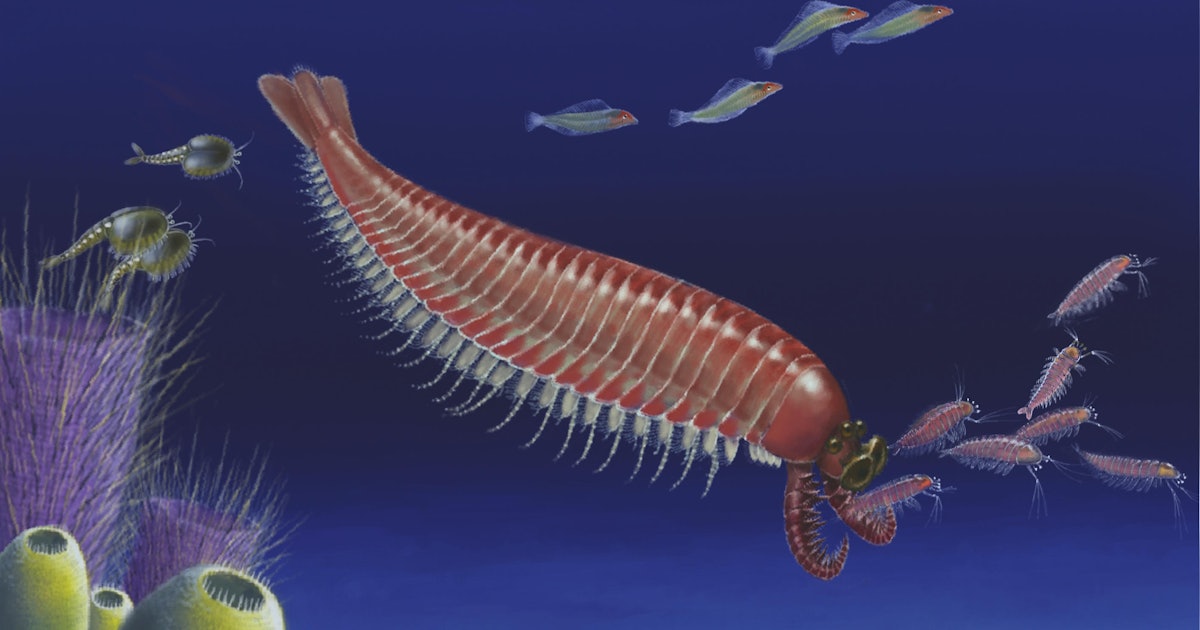
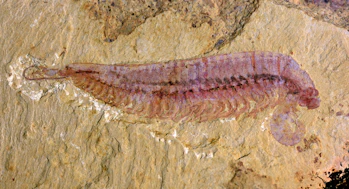
A very bizarre-looking, shrimp-like, five-eyed creature that lived in the ocean more than 500 million years ago may be the “missing link” in the evolution of arthropods. Six very well preserved fossils were unearthed in the Yu’anshan Formation in the southern part of China and the newly discovered creature has been named Kylinxia zhangia.
Arthropods began thriving during the Cambrian period (between 543 million and 490 million years ago) and there are still plenty of them today. They are defined as being invertebrates with an exoskeleton, segmented body, and appendages with joints. Insects (bees, dragonflies, ants), arachnids (scorpions, spiders), myriapods (centipedes, millipedes), and crustaceans (shrimp, crabs, lobsters) are all examples of arthropods.
The Kylinxia zhangia lived in the water more than 500 million years ago.
The Kylinxia zhangia had five compound eyes (two that were twice as large as the rest), a jointed upper portion to its body; big “arms” that curved upwards; and 15 jointed limbs that had spines at the end. It measured approximately 3 inches long. While some of its features coincide with other arthropods from ancient times, it also had very bizarre features that were present in other species.
The remains were so well preserved that several tissues and digestive glands were still present. In a statement, Fangchen Zhao, who is a professor with the Nanjing Institute of Palaeontology and Geology (NIPG) at the Chinese Academy of Sciences in Nanjing, China, as well as a co-author of the study, said, “The Kylinxia fossils exhibit exquisite anatomical structures,” adding, “For example, nervous tissue, eyes and digestive system – these are soft body parts we usually cannot see in conventional fossils.”
There are still missing pieces to the evolutionary history of arthropods which is why the discovery of the Kylinxia zhangia is so important. Since several of its features were known to be present in other species, it is believed that the Kylinxia zhangia is the “missing link” that scientists have been searching for.
The Kylinxia zhangia has been described as shrimp-like.
Researchers compared the features of the Kylinxia zhangia to around 300 features of other arthropods in over 80 taxonomic groups. An ancient ancestor of arthropods called Opabinia also had five eyes, and a three-foot-long Cambrian marine arthropod named Anomalocaris had appendages that looked like those of the Kylinxia zhangia.
Han Zeng, who is a NIPG assistant professor and the lead author of the study, explained this further, “Kylinxia represents a crucial transitional fossil predicted by Darwin’s evolutionary theory.” “It bridges the evolutionary gap from Anomalocaris to true arthropods and forms a key ‘missing link’ in the origin of arthropods, contributing strong fossil evidence for the evolutionary theory of life.” The study was published in the journal Naturewhere it can be read in full.
Images of what the Kylinxia zhangia would have looked like more than 500 million years ago can be seen here.
Holotype of Kylinxia zhangi. (Image credit: D.-Y. Huang & H. Zeng
Reconstruction of Kylinxia zhangi. (Image credit: D.-Y. Huang & H. Zeng)
They Kept This Secret From The American Public... Giants Were In Your Back Yard
Around the turn of the 19th century, there were hundreds of reports from reputable sources of giant skeletons unearthed from ancient burial mounds across America. Researcher and author Jim Vieira has made it his mission to explore the mystery behind these mounds and others where there is documentation of unearthed skeletons, often of gigantic proportions.
He found that the construction, and particularly the stonework, of these mounds, was impressive, considering the level of technology at the time and many had the remains of giants buried beneath them which ranged from 7 to 10 feet tall.
The Fossil Record Cannot Be Wrong... Strange Giants Once Lived On Earth
The Fossil Record Cannot Be Wrong… Strange Giants Once Lived On Earth
There has been an on going secret for many years. Scientific establishments have been rushing away the evidence as quickly as possible. But now, researchers from all around the world are revealling their findings and the secret can not be kept hidden any further. Our world was once inhabited by various giants that had some incredible attributes. What happened to them and where did they go?
I found something in a Mars photo that really is a bit odd. I believe it to be a white/yellow fungus. It appears to have created a donut shape circle in the shade on a rocks edge.
Also I found the same fungus in a doorway of a rocky structure. The doorway is about 6-7 inches tall, but a white substance is coating its edges...almost as if its slowly creating a white fungus door to black the opening. Again...thats very odd, why a doorway and why a fungus white substance growing within it? Look how close the Mars rover is to these two fungus locations...just one or two meters away. You cannot tell me NASA didn't see the fungus. They would have be total idiots not to see such obvious details near the rover. So it looks like...again NASA had no intentions to really announce any true discoveries they made on Mars, but to instead drip feed the public boring scientific facts that the world already knows. NASA employs 17,000 people...and yet, I am just a single person working alone...and I have just proven life exists on the surface of Mars.
A long black UFO shot out of earths sun on the 3rd of November and got caught on the NASA/SOHO sun satellite images. The object is big, at least 10X the size of earth. The sun...is the white circle area at the center. I have seen this UFO before. Many years ago I reported the exact same UFO but it was more clear back then. This is it...again. Its front is wide but its neck is thin and its back area is very wide.
Also, thanks to YouTuber Паша Буданов for both finding this UFO and telling me about it. Click here to visit his channel.
100% Proof That Aliens Are Using The Interior OF Our Sun, making a hollow space for space station and small planets to exist. Hollow Moon Theory, by SCW.
Cigar UFO Over Warsaw, Poland Caught In Three Photos, Oct 6, 2020, UFO Sighting News.
Date of sighting: Oct 6, 2020
Location of sighting: Warsaw, Poland
Source: MUFON
I believe this to be an actual UFO. UFOs have a high interest in areas that are constantly under threat of being invaded or taken over. Russia has been eyeing Poland to do just that.
Aliens and UFOs find such unpredictable events interesting.
Scott C. Waring - Taiwan
Eyewitness states:
I took three pictures in one series. In each picture, the same object showed up but in a different position on the picture. It looked like a cigar-shaped object, with sun reflex on the surface. While taking this series the sky was clear and I didn't see anything strange. I post all three pictures together.
Child Records Hexagon UFO Over Tennessee On Nov 7, 2020, Photos, UFO Sighting News.
Date of sighting:Nov 7, 2020
Location of sighting: Morris Town, Tennessee, USA
Source: MUFON
Now here is an interesting report. A child was taking photos of the stars and saw this hexagon glowing shape in one corner of the photo. The child showed the parent and they were both baffled at what it could be. I too find this mysterious. I have seen many UFOs, ones I recorded and most I did not. But something I am confident about is that the AI controlled UFOs...I mean pilotless, but living AI controls them. Those orbs and UFOs do have a high curiosity about those who believe in them and try to communicate with them. I guess this curiosity and the attempts to communicate draw the AIs attention since so few humans would actually believe or even try. Maybe 1 in a thousand would even attempt to mentally call a UFO to them. But it works, it worked for me and I believe it worked for this child. A fearless child and blind belief in the existence of aliens would defiantly draw the UFOs full attention. Why? Ray Wilbur said it best...
“The potential possibilities of any child are the most intriguing and stimulating in all creation.” – Ray L. Wilbur
Scott C. Waring - Taiwan
Eyewitness states:
My son took this picture in the sky last night, 11/7/2020, and this colorful hexagon was in the top right corner.
The photographer captured two cigar-shaped UFOs over Warsaw, Poland on July 6 and October 6, 2020. Both UFOs have no visible propulsion, wings or other moving parts.
"I caught this cigar sun-reflecting-metal-shaped object caught over Poland on July 6, 2020, While taking this picture I didn't see it. The sky was clear, no clouds."
Then on October 6, the photographer captured another UFO.
"I took three pictures in one series. In each picture, the same object showed up but in a different position on the picture. It looked like a cigar-shaped object, with sun reflex on the surface. While taking this series the sky was clear and I didn't see anything strange."
I’ve been watching a massive UFO for an hour 10 mins now and it’s still there 5 or 6 lights all white. Definitely 3 at top maybe 2 or 3 at bottom. Occasionally it goes blue then red quickly then back to white It’s incredibly high because I watched a normal plane head towards Melbourne that was at least only half the altitude It’s hovering but then flicking left then right or up then down. I’m in Strath Creek and it appears to be over Flowerdale but possibly way further away. It must be massive
over Upland and North Ontario California – Large UFO sighting between 9:15 to 10pm on Tuesday November 4th.
Stationary blinking UFO with red and blue lights. Sighted at about 12000 feet over Upland and North Ontario California.
November 3rd in Riverton Wyoming – November 3rd in Riverton Wyoming.
Hello! My son was outside this evening star gazing with his telescope he seen this! What do you think? His phone was about to go dead so he was only able to get those brief videos.
Christiansburg, VA – November 2020
I was celebrating ritual and documenting the blue moon and caught this on camera. I own the rights to this video. It’s providing its own reflection off of the semi cloudy sky
31 October 2020
I good friend of mine was eating at an outside bar on Saturday when she decided to take a picture of the full moon. When she got home and looked thru the pictures she noticed. What can you make of this?
Roquemaure, south France – 31 October 2020
Adelanto, California – 30 October 2020
This was sent to me today from a buddy in adelanto California
southeast Alabama – 29 October 2020 around 530 600 pm
Hi, I saw a blue circle shape object hoovering then flew off in a speed not know to man. I just wondering if anyone else saw it . It happen at around 4:05 am Sunday morning in Swansea .
In between Horatio and dequeen arkansas – Last .month
Just look at pic I’ve been seeing strange objects/UFOs all my life and no matter where I go lights follow me almost nightly I also have strange scars I can’t explain and one below chest that’s v shaped has scars from stitches but I’ve never had cut or surgery there and this pic I seen light took pic with my phone forgot it was on burst mode but it got 4 pics of light and a smaller light that changes with bigger light and it made no sound and gone in a blink
Carmel NY – 25 October 2020
Strange bright lights in the backyard prior to sighting. Others concur, this appears to be a vessel of some kind. Not the best picture
Trempealeau Wisconsin – Saturday September 26, 2020 around 6:00pm
So I recorded this outside my house….heard a massive boom/rumble before my wife and I saw it….i have been trying to figure out what the hell this could be. At one point you can see something being shot out from it (you can see it at 1.24 minutes in the video) It also seems to break off in two pieces. I can’t figure it out, maybe someone here can identify what it could possibly be. I live in Trempealeau Wisconsin.
I captured this on August 12th 2020 there’s no faa lights no tether and no sound, it’s in our atmosphere and it was not the moon! I think it’s real because I’ve seen this craft/orb in many videos but I personally saw it and I’m amazed what do y’all think?
< It was past midnight maybe 2 am, we are at a medieval play, we are a lot further away from the big group, we are going to sleep. Then a strong light jiste over us, over the threes, so sound, the zoom away in a second in total silence.
Pittsburg, CA – July 8th 2020
I would like to show you a picture on July 8th 2020 at 12:23 a.m. at night we were observing the moon and we thought we saw a small blue like that look like it was moving fast and we could not catch it. My girlfriend wanted to use my brother camera iphone. There is when we seen the picture after we took it a weird blue glowing object. We observed it for about a good 3 minutes and then it disappeared
Artist's illustration of NASA's Transiting Exoplanet Survey Satellite (TESS). Using data from TESS, scientists have discovered an "improbable" exoplanet that should've been engulfed by its star but wasn't.
Dark mattercould be detected on alien worlds orbiting distant suns, a new study suggests.
This elusive form of matter is one of the most frustrating and mysterious aspects of modern astronomy. Thought to account for 80% of all matter in the universe, it is completely invisible, detectable only through its slight gravitational pull on its surroundings.
But in some situations, it can settle into the core of a massive object, releasing energy in the form of heat. Now, a pair of astronomers is advocating a daring new research program: to turn our widening search for life beyond Earth into a hunt for dark matter.
We know very little about dark matter, other than that it exists. In the 1970's, astronomer Vera Rubin noticed something funny about the way that galaxies were rotating. Rubin found that stars were orbiting around their galaxies far too quickly, given how much visible matter there was if you add up the gravitational attraction of everything we can see in a galaxy, then at the observed rotational speeds the galaxies she trained her telescope on should have torn themselves apart billions prior to her observation.
In the decades since Rubin's revelation, more mysteries have piled up. The gas inside galaxy clusters is too hot. Galaxies move around too quickly. The universe has too many large-scale structures, given the age of the universe. The remnant radiation from the early universe is too bumpy to be explained by normal matter alone. Light from distant background galaxies curves too strongly when passing near massive galaxy clusters.
The list goes on, but one answer has risen to the top: In order to explain all these observations, the universe must have some hidden ingredient. It's a form of matter (because it can obviously clump together and has gravity), but it doesn't interact with light or normal matter in any significant way. It's dark matter.
Based on computer simulations of giant clusters of galaxies, whatever the dark matter is, we expect it to be more heavily clumped toward the centers of galaxies and generally thin out the farther you get from those centers. And it's those differences in dark matter density throughout a galaxy that may help astronomers identify this mysterious substance.
If only we had large dark matter detectors scattered through the galaxy.
Planet-sized detectors
According to a pair of researchers in a paper published in October to the preprint journal arXiv, dark matter detectors are indeed scattered through the Milky Way galaxy. And we're already finding thousands of them orbiting distant suns every year. They're exoplanets, or the alien worlds beyond our solar system, that we're spotting with the Kepler Space Telescope and the Transiting Exoplanet Survey Satellite (TESS).
Indeed, the thousands of confirmed exoplanets known so far represent only a tiny percentage of all possible worlds. For the Milky Way alone, estimates of the true number of exoplanets range from the extreme (300 billion) to the ludicrous (1 trillion).
Here's what that has to do with dark matter. Dark matter — as far as we can tell — hardly ever interacts with normal matter, or even with itself. When it does interact, it does so through an interaction involving the weak nuclear force, which is incredibly wimpy. Almost every time there's an encounter, a dark matter particle and a normal matter particle simply slide on by each other without comment … or even a quick glance.
But rarely, occasionally, dark matter and ordinary matter interact, allowing the dark matter particle to pass on some of its energy to the normal matter particle, slowing down the dark matter particle in the process. These interactions are especially common when two things happen: there's a large, dense concentration of normal matter that acts as a gravitational trap for dark matter, and there's lots of dark matter just floating around.
These two criteria could be met for exoplanets near the center of the Milky Way. The dark matter density in those neighborhoods is much higher than it is around the solar system, and large planets (say, Jupiter-size and up) could collect dark matter particles in their cores. They would do this through their gravity: In high-density environments, the normal matter can attract the dark matter to them, pulling it to their centers.
These interactions wouldn't just slow down dark matter, they would also heat up the planet. And sometimes dark matter particles might occasionally interact with themselves, annihilating each other in a brief flash of energy. This energy would be too feeble to see directly, but over the course of billions of years the sustained flashes from countless interactions could contribute an extra source of heat to the planet.
The end result, according to the research: Planets closer to the center of the galaxy might experience a significant amount of heating from dark matter, causing their temperatures to rise by thousands of degrees.
In order to test this, we need to take the temperatures of a lot of exoplanets. Thankfully, this is exactly what missions like the James Webb Space Telescope (JWST), which is set to reach space in October 2021, are explicitly designed to do.
The researchers noted that the JWST has just enough sensitivity (in both recording the temperatures of exoplanets and in searching close enough to their galactic center) that if this effect of dark matter is real, we should be able to see a distinct and noticeable warming of planets the closer they are to the galactic center. If the surveys pan out, it would be the first non-gravitational detection of dark matter ever seen.
And in the process of searching through all those exoplanets, we might just discover life on another world, which would be a nice bonus.
Saturn's moon Titan just keeps getting weirder — and more tantalizing when it comes to scientists' hopes for life beyond Earth.
Titan is perhaps the most Earth-like place in our solar system, except the ingredients are jumbled up: ocean below ground, landforms of water ice instead of rock, rains of organic compounds, an atmosphere even denser than our own. Now, two new research findings add still more intrigue to the strange moon, identifying an unexpected chemical in Titan's atmosphere and evidence of more complicated surface phenomena than scientists had previously realized.
"We think of Titan as a real-life laboratory where we can see similar chemistry to that of ancient Earth when life was taking hold here," Melissa Trainer, an astrobiologist at NASA's Goddard Space Flight Center in Maryland, said in a statement. Trainer wasn't involved in either of the new papers, but she is the deputy principal investigator of NASA's Dragonfly mission that will launch to Titan in 2027 and arrive in 2034.
Scientists' fascination with the chemistry of Titan is what makes the new findings so intriguing. Researchers turned the Atacama Large Millimeter/submillimeter Array (ALMA) in Chile toward the moon and spotted the chemical signature of cyclopropenylidene, an awkward triangular compound made of three carbon atoms and two hydrogen atoms.
"Titan is unique in our solar system," Conor Nixon, a planetary scientist at Goddard, said in the same statement. "It has proved to be a treasure trove of new molecules."
Cyclopropenylidene is only the newest of them. But finding it is surprising, the researchers say, because the little-known chemical is pretty friendly: if other compounds are near it, they tend to react, eliminating the cyclopropenylidene signature.
So while scientists have found the compound in the universe, it's usually out in the vast, cold, near-empty areas between star systems — hardly an environment like that of Titan, although the chemical was only found in the moon's thinner upper atmosphere.
The newly spotted compound is also interesting because it is the second chemical found at Titan in which the carbon atoms lock in on each other to build a ring-like backbone. Other chemicals with that type of structure are crucial for the molecules that make up the information-containing part of DNA.
"The cyclic nature of them opens up this extra branch of chemistry that allows you to build these biologically important molecules," Alexander Thelen, a Goddard astrobiologist who worked on the research, said in the same statement. The researchers later checked archived data gathered by NASA's Cassini mission, which studied the Saturn system from 2004 to 2017, and saw supporting evidence for cyclopropenylidene in those observations.
Finding such a tantalizing compound in the upper atmosphere of Titan is particularly intriguing because scientists believe that sunlight-driven reactions in the area turn the simple compounds of Titan into increasingly complex, heavy molecules that eventually rain down onto the moon's surface.
The research is described in a paper published Oct. 15 in The Astronomical Journal.
A map of Saturn's moon Titan shows nine craters that scientists analyzed in new research. (Image credit: Solomonidou et al. (2020); background map: Le Mouélic et al. (2019))
Changing craters
That surface is the site of the other recent finding about the strange moon, which arose when researchers studied Cassini data about nine major craters on Titan's surface.
First, they realized that these craters came in two different flavors, and that they were geographically separated. Around Titan's equator, the craters were located in dunes and contained exclusively organic material, then are sprinkled with sand. North and south of that region, craters were found on plains and included both water ice and organic material then doused in methane rain, carrying away any sand blown into them.
"The most exciting part of our results is that we found evidence of Titan's dynamic surface hidden in the craters, which has allowed us to infer one of the most complete stories of Titan's surface evolution scenario to date," Anezina Solomonidou, a research fellow at the European Space Agency and the lead author of the new study, said in a NASA statement. "Our analysis offers more evidence that Titan remains a dynamic world in the present day."
Among the sites the researchers studied was one called Selk, where the scientists found a crater covered by organic material, with no sign of methane rain. But Selk Crater has something special going for it — Dragonfly is already scheduled to visit the crater and scout it out, which should give scientists an even better view of what's happening on Titan's surface.
The research is described in a paper published Sept. 1 in the journal Astronomy & Astrophysics.
Email Meghan Bartels at mbartels@space.com or follow her on Twitter @meghanbartels.
NASA SAYS THIS COMPANY’S GIANT 5G SATELLITES COULD CAUSE “CATASTROPHIC COLLISION”
ESA
DAN ROBITZSKI
Crowded Sky
For the first time, NASA is commenting on a private company’s application to launch a mega-constellation of satellites. And its message is clear: It could be disastrous.
AST & Science (AST) wants to launch 240 large satellites that would beam down 4G service and, if all goes to plan, eventually do the same with a 5G network, Ars Technica reports. Because the satellites will be so massive, NASA said in a statement that they would cause thousands of potential collisions every year — though AST says it’s committed to working with NASA to solve the issue.
Horse In The Hospital
Other mega-constellations like Starlink also pose collision risks, but it’s the massive size of these telecom satellites and AST’s inexperience in building anything that large that has NASA particularly concerned, Ars reports.
Given that lack of experience, NASA suggested up to 10 percent of the satellites might fail, creating an “unacceptably high” risk of a “catastrophic collision.”
Evasive Maneuvers
In order to broadcast the 4G and eventually 5G signals, the satellites would come equipped with massive antennas up to 900 square meters in size. Given their planned proximity to other satellites, NASA says that’s a disaster waiting to happen.
“For the completed constellation of 243 satellites, one can expect 1,500 mitigation actions per year and perhaps 15,000 planning activities,” reads NASA’s statement. “This would equate to four maneuvers and 40 active planning activities on any given day.”
David Rothery, Professor of Planetary Geosciences, The Open University
Venus may harbour life some 50km above its surface, we learned a couple of weeks ago. Now a new paper, published in Nature Astronomy, reveals that the best place for life on Mars might be more than a kilometre below its surface, where an entire network of subglacial lakes has been discovered.
Mars was not always so cold and dry as it is now. There are abundant signs that water flowed across its surface in the distant past, but today you’d struggle to find even any crevices that you could call moist.
There is nevertheless plenty of water on Mars today, but it’s virtually all frozen, so not much use for life. Even in places where the noon-time temperature creeps above freezing, surface signs of liquid water are frustratingly rare. This is because the atmospheric pressure on Mars is too slight to confine water in its liquid state, so ice usually turns directly into vapour when heated.
Lakes beneath ice
It is beginning to look as if the most favourable place for liquid water on Mars is beneath its vast south polar ice cap. On Earth, such lakes began to be discovered in Antarctica in the 1970s, where nearly 400 are now known. Most of these have been found by “radio echo sounding” (essentially radar), in which equipment on a survey aircraft emits radio pulses.
Part of the signal reflects back from the ice surface, but some is reflected from further below – especially strongly where there is a boundary between ice and underlying liquid water. Antarctica’s largest subglacial lake is Lake Vostok – which is 240km long, 50km wide and hundreds of metres deep – located 4km below the surface.
Radar satellite image revealing Lake Vostok below the Antarctic ice. The area shown is about 300km across. (Image credit: NASA)
Indications of similar lakes below the southern polar ice cap of Mars were first suggested by radar reflections 1.5km below the ice surface in a region named Ultimi Scopuli. These were detected between May 2012 and December 2015 by MARSIS (Mars Advanced Radar for Subsurface and Ionosphere Sounding), an instrument carried by the European Space Agency’s Mars Express that has been orbiting the planet since 2003.
A 4km wide area in Ultimi Scopuli: strange ice texture gives no clue as to presence of liquid water 1.5km below. (Image credit: NASA/JPL/University of Arizona)
The new study of MARSIS data using signal processing techniques that take account of both the intensity and the sharpness (“acuity”) of the reflections has demonstrated that the previously detected region does indeed mark the top of a liquid body. This is the Ultimi Scopuli subglacial lake, and there seem also to be smaller patches of liquid nearby in the 250km by 300km area covered by the survey. The authors suggest that the liquid bodies consist of hypersaline solutions, in which high concentrations of salts are dissolved in water.
They point out that salts of calcium, magnesium, sodium and potassium are known to be ubiquitous in the martian soil, and that dissolved salts could help to explain how subglacial lakes on Mars can remain liquid despite the low temperature at the base of the ice cap. The weight of the overlying ice would supply the pressure necessary to keep the water in liquid state rather than turning to vapour.
Life in subglacial lakes?
Lake Vostok is touted as a possible habitat for life that has been isolated from the Earth’s surface for millions of years, and as an analogue for proposed environments habitable by microbes (and possibly more complex organisms) in the internal oceans of icy moons such as Jupiter’s Europa and Saturn’s Enceladus.
Mars’s south polar ice cap as seen by the Mars Global Surveyor (MGS) Mars Orbiter Camera (MOC) on April 17, 2000. (Image credit: NASA)
Although hypersaline water would give microbes a place to live below Mars’ south polar cap, without an energy (food) source of some kind they could not survive. Chemical reactions between water and rock might release some energy but probably not enough; it would help if there was an occasional volcanic eruption, or at least hot spring, feeding into lake.
We lack evidence of this on Mars, unlike on Europa and Enceladus. Although the new findings make Mars even more interesting than before, they haven’t advanced its ranking in the list of solar system bodies most likely to host life.
That said, the salty water could act as a preservation chamber – helping us find alien organisms that are now extinct but once came to Mars from other parts of the solar system.
As humanity continues to explore planets beyond the solar system — exoplanets — investigations into conditions on these worlds become increasingly complex. This includes the question of whether these exoplanets can support life.
New research has identified which stars would be most likely to host planets with the necessary conditions for habitability, based upon that star’s stellar activity and crucially the rate at which such activity strips away a planet’s atmosphere.
“We wanted to figure out how planets lose their atmospheres from extreme ultraviolet radiation and estimate their impact on their potential to host life,” Dimitra Atri, a researcher from the Space Science at NYU Abu Dhabi (NYUAD), tells ZME Science. “We focused on a channel of escape called hydrodynamic escape where stellar radiation heats up the planet’s atmosphere and a part of it escapes into space.”
An artist’s conception of HD 209458 b, an exoplanet whose atmosphere is being torn off at more than 35,000 km/hour by the radiation of its close-by parent star. This hot Jupiter was the first alien world discovered via the transit method, and the first planet to have its atmosphere studied. [NASA/European Space Agency/Alfred Vidal-Madjar (Institut d’Astrophysique de Paris, CNRS)]
Atri is the author of a paper published in the journal Monthly Notices of Royal Astronomical Society: Letters, which analyzes flare emissions using data collected by NASA’s Transiting Exoplanet Survey Satellite (TESS) observatory ultimately helping to determine where else in the Universe life is most likely to prosper.
Harbouring Life: A Question of Water Retention
Planet habitability is closely associated with that world’s ability to hold liquid water. That means that factors which can boil away that water or cause it to be lost to space reduce that habitability. The habitable zone of a star’s environment is defined as the range at which a planet can orbit and still possess liquid water. This means not too hot or too cold — criteria that led to the alternative name for such regions, the Goldilocks zone.
Yet, distance and a star’s luminosity are not the only factors which can affect a planet’s ability to hold liquid water. Space weather — including solar flares — is another determining element, one that as of yet is not well understood. “Flares erode planetary atmospheres,” Atri says. “A substantial atmosphere is needed to sustain liquid water on a planet’s surface. Flares reduce those chances and make planets less habitable.”
Betelgeuse a type H 1-2 star similar to those Atri found jettison frequent XUV flares which can strip an exoplanet’s atmosphere reducing conditions for habitability (NASA/SDO)
What Atri, alongside coauthor and graduate student Shane Carberry Mogan, discovered was that whilst luminosity from a star was still the primary driving factor in atmosphere stripping, flares were a more important factor for some stars than others. In particular, they discovered that flares from M0-M4 stars — cool, red stars like Betelgeuse — were more likely to strip an orbiting planet’s atmosphere.
The duo determined that more frequent, lower energy flares in the extreme ultraviolet region (XUV) of the electromagnetic spectrum were more effective at stripping a planet’s atmosphere and thus reducing its habitability than less frequent, higher energy outbursts. XUV radiation strikes a planet’s atmosphere heating it. This causes hydrodynamic escape, pushing out light atoms first, which through collision and other drag effects also pull out heavier molecules.
“We find that for most stars, luminosity-induced escape is the main loss mechanism, with a minor contribution from flares,” Atri explains. “However, flares dominate the loss mechanism of around 20 per cent of M4–M10 stars.
“M0–M4 stars are most likely to completely erode both their proto- and secondary atmospheres, whilst M4–M10 stars are least likely to erode secondary atmospheres.”
The study also highlights the fact that better modelling of the factors that affect an exoplanet’s atmosphere is needed. Determining the systems and planets most likely to harbour life will play an important factor in selecting targets for the upcoming James Webb Space Telescope — set to launch on October 31st 2021 — and the ESO’s Extremely Large Telescope (ELT) currently under construction in the Acatma desert, Chile.
“The next research step would be to expand our data set to analyze stellar flares from a larger variety of stars to see the long-term effects of stellar activity, and to identify more potentially habitable exoplanets,” adds Atri.
The researcher also points out that the continued investigation of how planets lose their atmosphere could also focus on a target closer to home, our nearest neighbour, Mars. “Since it is extremely difficult to observe the escape process in exoplanets, we are planning to study this phenomenon in great detail on Mars with the UAE’s Hope mission,” the researcher says, explaining how observations from Mars missions can be used to better understand atmospheric escape and how this knowledge can be applied to exoplanets.“We will then apply our understanding of atmospheric escape to exoplanets and estimate the impact of extreme UV radiation on planetary habitability.”
An artist’s illustration of UAE’s Tess probe approaching the surface of Mars. Atri believes this investigation could yeild important data about exoplanet habitability. (Mohammed bin Rashid Space Centre)
Further to the question of habitability, the study begins to address the wider question of the dynamics of stars and their planetary systems and the evolution of such arrangements. “Given the close proximity of exoplanets to host stars, it is vital to understand how space weather events tied to those stars can affect the habitability of the exoplanet,” Atri concludes. “Stars and planets are very tightly coupled in a number of ways and an improved understanding of this coupling are absolutely necessary to find habitable planets in our Galaxy and beyond.”
Book of Enoch: manuscript would reveal that angels were aliens
The debate about angels continues; While religions maintain that they were the closest beings to God , there is more and more evidence that could show that they were extraterrestrial beings or the ancient astronauts who visited us in the past.
Many people have wondered in recent years what are angels or why some “fell” to Earth? According to ancient scriptures, the fallen angels defied God .
They committed different sins like lust, in addition to doing everything that was forbidden to them. They maintained relationships with humans , in addition they taught him different knowledge that was destined to be only theirs.
If we analyze these words, we could say that the evolution of human beings depended directly on the interaction of “angels”, an almost identical resemblance to the theories of the ancient astronauts and their intervention in humanity.
What are the fallen angels?
According to the Bible , the fallen angels are those who turned away from God , questioning him. This led to their being banished from heaven and many of them were sent to hell.
Since the translations of ancient texts in 1800, which were discovered in Ethiopia in 1768, the Book of Enoch is the main source to know more about these beings who came to Earth from the skies.
However, just as it has served religion for its theological studies, it has also served academics to strengthen theories related to extraterrestrials .
Several copies were discovered in 1948 among the Dead Sea scrolls. This has led us to think that we may be able to trace accounts that bear a great deal of resemblance to ancient Sumerian stories .
In fact, in the book of Enoch you can read about the origin of the giants , mostly known as the Nephilim and how they represented a hybrid race that was born as a result of the relationship between humans and these “angels”.
The development of humanity since the appearance of the “angels”
In addition to their strange arrival from the heavens, similar to the arrival of the Sumerian “gods” or other cultures and who are responsible for the birth of a hybrid race , such as the Nephilim, the angels, according to the book of Enoch, they are directly responsible for humanity’s beginning its evolution .
It details how it was they who taught humanity to work metal , being able to make swords, knives, shields, armor. They also learned to use “magic medicine” , to cut the roots to heal, astrology , specific knowledge about our Solar System, the passage of the stars and the path of the Sun and the Moon.
An extract from the ancient texts reads as follows:
And Azazel taught men to make swords and knives, and shields, and breastplates, and made known to them the metals of the Earth and the art of working bracelets, and ornaments, and the use of antimony, and the beautification of the eyelids, and all kinds of precious stones, and all coloring tinctures. And there was much wickedness, and they committed fornication, and they were led astray, and were corrupted in all their ways. Semjaza taught incantations and root cuts, Armaros the resolution of incantations, Baraqijal, taught astrology, Kôkabêl the constellations, Ezeqeel the knowledge of the clouds, Araqiel the signs of the Earth, Shamsiel the signs of the sun, and Sariel the course of the moon ”.
Angels Ancient astronauts
More and more people are sure that the ancient stories that refer to angels really speak of aliens. The descriptions, their way of acting.
All the characteristics related to the beings of other worlds fit perfectly with the description, not only of the angels, but of the ancient gods of all ancient religions.
According to Erich von Däniken , there are certain artifacts and constructions that reveal the level of intelligence and technology that these beings possessed, which helped humanity to develop; An example of these are the same pyramids in Egypt or monuments such as Puma Punku in Bolivia.
The academic also maintains that all the ancient art and iconography found in the ruins around the world, show a story almost identical to that read in the Bible, only that in it you can see graphic illustrations of flying artifacts and technologically advanced.
The Bible also mentions great technologically advanced artifacts that, even today, would be impossible to replicate, such as the Ark of the Covenant ; .a The Bible speaks of that almost magical object that protected an entire people that traveled with it.
Von Däniken is sure that this device was an instrument that worked with radioactivity , which was so advanced that it could transform organic matter into a food as valuable as manna.
An artifact that sparked wars and then mysteriously disappeared and that, to this day, still does not give any indication of its location.
Many religions are interpretations of older ones; the oldest accounts that the Bible give an almost literal explanation of how beings, of almost divine appearance, came down from the heavens and helped humanity to develop. Why not believe the story of the angels refers to these same beings? Religion has been in charge of eliminating this thought from its faithful, but not in the critical mind.
A meteorite that lit up the night sky in the US Midwest in 2018 contains ‘pristine’ organic compounds that may offer clues to how life formed on Earth, according to researchers (via the Independent). It was spotted by motorists and others in several states after producing a fireball and loud explosion on January 18, 2018. Thanks to some quick thinking and action, the rocks were quickly in the hands of researchers before they could be contaminated.
Less than two days after it streaked across the sky, meteorite hunter Robert Ward found the first piece resting on the frozen surface of Strawberry Lake near Hamburg, Michigan. He was able to pinpoint the location by using NASA’s weather radar, as the meteorite chunks were similar in size to hail. He quickly got it to the Field Museum in Chicago, where curator Philipp Heck quickly set about studying it.
“This meteorite is special because it fell onto a frozen lake and was recovered quickly. It was very pristine. We could see the minerals weren't much altered and later found that it contained a rich inventory of extraterrestrial organic compounds,” Heck said in a statement. “These kinds of organic compounds were likely delivered to the early Earth by meteorites and might have contributed to the ingredients of life.”
The researchers determined that it was a rare H4 chondrite meteorite, representing only four percent of those found on Earth. The initial analysis determined that it contained over 2,600 separate organic compounds that were still intact despite the intense heat created when it blazed through the atmosphere. They also found that it likely broke off 12 million years ago from its parent asteroid, which formed 4.5 billion years earlier.
A lot of scientists were able to probe the rock using different techniques, “so we have an unusually comprehensive set of data for a single meteorite,” said Heck.
While the meteorite was as clean as one that lands on Earth can be, scientists are especially anxious to get their hands on a truly pristine specimen from the source — space. That’s scheduled to happen in 2023. when the NASA spacecraft Osiris-REx is set to return to Earth after it successfully grabbed and stowed a chunk of regolith from the asteroid Bennu.
My previous article was on the subject of how the Women in Black, the M.I.B., and the Black Eyed Children may have a medical condition not at all too dissimilar to albinism. Today, I’m going to share with you something else very strange about all three of those particular groups. It’s their undeniable ability to control our minds. I’ll start with the BEC. It was in the late 1990s when the phenomenon of theBlack Eyed Children first surfaced. It should be noted, though, that claims of earlier encounters have been made. For those who may not know, the BEC are described as young children – almost always around the ages of about ten to thirteen. They wear black hoodies. Their skin is pale. Their primary goal is to get inside the home of the targeted individual. And they almost always attempt to do so at night. I have 17 reports of BEC cases. They cover the period 2002 to 2019. In all of the reports I received, there was one very creepy angle to the activities of the BEC. It was that aforementioned issue of the BEC trying to get inside the home of the person in their sights.
Of course, most people would not even consider letting a few hoodie-wearing kids in late at night, and when darkness has fallen. The weird thing, however, is that people do let them in. I should stress that in most of the cases the BEC fail to get inside. In some incidents, though, they do manage to get inside. And that’s when things get really weird. The reason: those strange and sinister kids seem to have the ability to mind-control their victims. People recall – often in a hazy, dream-like state – letting them in, but having no understanding of precisely why they let them in. There are enough such incidents to make a good case that these kids are not what they appear to be. One man, who was extremely distressed by his encounter with two BEC in his home in San Antonio, Texas in November 2013, told me that he believed – by inviting them in – he had been forced into a kind of unholy “agreement” with the BEC. He even mused on the possibility that, in his own words, “…My soul was taken.” He had no real understanding of why he came to that conclusion. Only that he had entered into something akin to a Faustian pact that was out of his control.
Now, let’s have a look at one particular way in which a Women in Black took control of her victim back in the 1970s. Our story specifically goes back to October 23, 1971. The press said at the time: “A part-time housekeeper at President Nixon’s Key Biscayne retreat has testified she was put in a hypnotic daze by a stranger who told her to shoplift four dresses. Shirley Cromartie, 32, and a mother of three, pleaded no contest Thursday and was given a suspended sentence after law enforcement officers and a psychiatrist testified they believed she was telling the truth. Mrs. Cromartie holds a security clearance to work in the Florida White House, according to testimony. She said a woman met her in a parking lot and asked the time, then ordered her to take the items and bring them to her.” Like so many Women in Black, this one wore a long black wig and used mind-control abilities to enslave her target. John Keel, of The Mothman Prophecies, took a great deal of interest in this case, saying in his classic book that it all amounted to “not some small demonstration for the benefit of President Nixon.”
As for the Men in Black, there’s the matter of a certain UFO researcher/author: Trevor James Constable. In the early 1960s Constable said of the Albert Bender/M.I.B affair of the 1950s: “It is difficult indeed for me, as an occultist with some firsthand experience of this field of UFOs, to sort out Bender’s journeys back and forth across the threshold line between the physical and the astral. A biometric examination of Al Bender would probably indicate similar things to what it revealed about certain other researchers – total inability to distinguish between events on two planes of reality. Bender’s honesty I do not for a moment doubt. His discrimination I would deem non-existent. It seems almost incredible that the man could relate the full story of the construction of his chamber of horrors in the attic in the way Bender has. This is what convinces me of his honesty. Nothing could be more logical, in an occult way, than that the invisible entities he invited by the preparation of this locale, should indeed manifest to him, and thereafter proceed to obsess him for a protracted period, using hypnotic techniques that brought the man completely under their control [italics mine].”
Women warriors hunted and slaughtered big game in the Andes some 9,000 years ago, a burial site containing projectile points and butchery tools has revealed.
The remains of the 17–19 year old hunter and her artefacts were found in a grave at the high-altitude archaeological site of Wilamaya Patjxa, in what is today Peru.
She was found with tools including stone projectile points for felling large animals, a knife, and implements for gutting an animal and scraping or tanning hides.
It had long been assumed that — among early human hunter-gatherer societies — it was the men who did the former while the women undertook the latter task.
However, the find — along with an analysis of early burial practices more broadly — 'overturns the long-held "man-the-hunter" hypothesis', the US researchers said.
It is possible that nine millennia ago the hunters of Wilamaya Patjxa may have hunted vicuña — animals related to llamas and camels — which still roam the Andes today.
Women warriors hunted and slaughtered big game in the Andes some 9,000 years ago, as depicted, a burial site containing projectile points and butchery tools has revealed
'We believe that these findings are particularly timely in light of contemporary conversations surrounding gendered labour practices and inequality,' said paper author and anthropologist Randy Haas of the the University of California, Davis.
'Labour practices among recent hunter-gatherer societies are highly gendered, which might lead some to believe that sexist inequalities in things like pay or rank are somehow "natural" ', he commented.
'But it's now clear that sexual division of labour was fundamentally different — likely more equitable — in our species' deep hunter-gatherer past.'
Professor Haas and colleagues — with in collaboration with the local Mulla Fasiri community — discovered the warrior woman's burial, complete with its hunting 'toolkit' — during excavations at Wilamaya Patjxa back in 2018.
The researchers noted that the objects that accompanying people to their graves in death tend to also be those that they made use of in life.
The team determined that the hunter's remains were likely those of a woman based on the structure of the bones — a conclusion that was later validated by analysing the proteins found in samples of the individual's teeth.
Analysis of the woman's bones also found isotopic evidence of meat consumption, which the researchers said supports the conclusion that she was a hunter.
The team also found another hunter's burial site — this one occupied by the remains of a man — believed to be around 25–30 years of age.
'Our findings have made me rethink the most basic organizational structure of ancient hunter-gatherer groups,' Professor Haas said.
“Among historic and contemporary hunter-gatherers, it is almost always the case that males are the hunters and females are the gatherers.
'Because of this – and likely because of sexist assumptions about division of labour in western society – archaeological findings of females with hunting tools just didn't fit prevailing worldviews.'
'It took a strong case to help us recognize that the archaeological pattern indicated actual female hunting behaviour.'
The remains of the hunter and her artefacts were found in a grave at the high-altitude archaeological site of Wilamaya Patjxa, in what is today Peru, pictured
It had long been assumed that — among early human hunter-gatherer societies — it was the men who did the former while the women undertook the latter task. Pictured, the tools unearthed from the burial pit, among which are projectile points (Nos. 1–7), unmodified flakes (8–10), retouched flakes (11–13), a possible backed knife (14), thumbnail scrapers (15 & 16), scrapers/choppers (17–19), burnishing stones (17, 20 & 21), and red ochre nodules (22–24)
The teenage female hunter was discovered with a hunting toolkit at the Wilamaya Patjxa in southern Peru.
The unexpected discovery of that one of the hunters' graves belonged to a woman prompted the team to investigate whether this case was a one-off — or whether women warriors were actually more common than was initially thought.
Consulting records of similar late Pleistocene and early Holocene burials that had been excavated across both North and South America, the researchers counted 429 individuals that had been laid to rest across 107 different sites.
Of this people, 27 had been buried alongside big-game hunting tools — with 11 being women and 15 men.
It is possible that nine millennia ago the hunters of Wilamaya Patjxa may have hunted vicuña (pictured) — animals related to llamas and camels — which still roam the Andes today
The find — along with an analysis of early burial practices more broadly — 'overturns the long-held "man-the-hunter" hypothesis', the US researchers said. Pictured, the Wilamaya Patjxa site
This sample, the researchers concluded, is sufficient to 'warrant the conclusion that female participation in early big-game hunting was likely non-trivial.'
Statistical analysis of the record of ancient hunter gathers concluded that between 30–50 per cent of hunters in these populations were women — a result in stark contrast to the same figures for recent hunter gathers, which are typically lower.
Even in agricultural and capitalist societies, hunting is usually a male-dominated activity with low levels of participation from women.
The researcher's review also revealed that the woman buried at Wilamaya Patjxa represents the earliest-known hunter burial in the Americas.
'We believe that these findings are particularly timely in light of contemporary conversations surrounding gendered labour practices and inequality,' said paper author and anthropologist Randy Haas of the the University of California, Davis. Pictured, researchers sift for remains at the Wilamaya Patjxa excavation site in the Andes
According to the researchers, their findings may shine light on the division of labour in early human societies — but such also raises new questions that need answers.
With their initial study complete, the team are now looking to explore how the sexual division of labour — and the consequences of such — varied across the early hunter-gatherer populations of the Americas, and how it changed with time.
The full findings of the study were published in the journal Science Advances.
The remains of the hunter and her artefacts were found in a grave at the high-altitude archaeological site of Wilamaya Patjxa, in what is today Peru
Researchers at the Wilamaya Patjxa archaeological site in Peru found an ancient grave that contained the remains of a female along with several weapons. What’s so interesting was the fact that she was a teenage hunter who died when she was between 17 and 19 years of age.
This discovery proves that women were just as good at hunting large animals as men were in ancient times around 9,000 years ago. It has been long believed that men hunted large animals while women gathered plants and herbs; however, this new discovery proves that females were able to hunt just like males. She was buried with several tools that included stone projectile points, butchery tools, and a knife. (Pictures of the archaeological site as well as the weapons found in the burial can be seen here.)
Randy Haas, who is an anthropologist from the University of California, Davis, and an author of the study, stated how significant this discovery was in regards to gender, “We believe that these findings are particularly timely in light of contemporary conversations surrounding gendered labor practices and inequality.” “Labor practices among recent hunter-gatherer societies are highly gendered, which might lead some to believe that sexist inequalities in things like pay or rank are somehow ‘natural’.” “But it’s now clear that sexual division of labor was fundamentally different — likely more equitable — in our species’ deep hunter-gatherer past.”
After the discovery of the grave, researchers were curious as to how common women hunters actually were in ancient times so they looked through old records of hunter-gatherer burials that date back to the late Pleistocene period (that finished approximately 11,700 years ago) and the early Holocene period (that started around 12,000 to 11,500 years ago). They analyzed the reports of 429 people who were buried in 107 locations around the Americas and they found that 27 of them were buried with big-game hunting weapons. And of those 27 skeletons, 11 were female. What’s even more amazing is that they calculated that between 30% and 50% of hunters during that time were in fact women.
In an interview with Live Science, Kathleen Sterling, who is an associate professor of anthropology at Binghamton University in New York but was not involved with the study, weighed in by stating, “This study should help convince people that women participated in big-game hunts.”
The study was published in the journal Science Advances where it can be read in full.
The CIA On Time Travel And The Holographic Reality - The Gateway Process
The “Analysis and Assessment of Gateway Process” was declassified by the CIA in 2017 This Gateway Process was a meditation lesson that taught humans to harness their own electromagnetic energy waves which come from their body. It also taught them how to control brain waves, and use them to, essentially, detach from time and space.
As the body is turned into a coherent oscillator vibrating in harmony with the surrounding electrostatic medium, the specific exercises included in the Gateway process allow the participant to build up the energy field surrounding their body, presumably by using energy from the earth’s resonant field (the same resonant field that was the basis for much of Nikola Tesla’s work) which the body then entrains because of its ability to resonate with it. This is big.
Aside from the obvious question of what nefarious purpose the CIA was hoping to achieve with this process, it’s hard to miss the deduction of what detaching the from time and space means — fourth dimensional travel with all that it implies (heaven, afterlife, a different dimension). This talks about many ideas such as binaural technologies, the law of attraction.
Hey guys, thanks for stoping by and visiting my site. Last night I found something I just had to share. Two large white objects on a crater floor that just scream out ancient aliens. One object has a square base with a round almost radar like sphere dome on it. The other is more significant because its a pyramid-like space ship that is hover...yes you read that right...hovering over the surface of the moon. Thats easy to see for yourself by looking at the shadow below it and compare it with the shadow of the other building I just described. 100% undeniable proof that aliens exist on Earths moon right now!
Demi Lovato Believes Extraterrestrials Will Save Humanity From Apocalypse If A Percent of World Population Mediate Hard
Demi Lovato is having a great time in her recent Instagram post coming back from a meditation retreat in the California desert, where she was primarily thinking about aliens. Now, after receiving her communication from the aliens zipping around our atmosphere, she wants everyone to join with her meditation so that the government will tell us extraterrestrials are real. Then the extraterrestrials can save us from worldwide destruction.
A few days ago, Lovato wrote on Instagram that she was in Joshua Tree for a few days with alien truther and UFO documentarian Steven Greer. Greer has released various films about his work, including 2017’s Unacknowledged and 2020’s Close Encounters of the Fifth Kind, both of which covered Greer’s alleged encounters with aliens and the related government cover-ups.
Lovato said she has “dug deep into the science of consciousness and experienced not only peace and serenity like I’ve never known, but I also have witnessed the most incredibly profound sightings both in the sky as well as feet away from me.” Now, she encourages fans and followers to meditate. She said that if 1% of the population meditate and make contact, our governments would be forced to acknowledge the truth about alien life among us and change our very negative path towards our planet’s destruction.
Hot, active volcanoes produce almost half of Jupiter’s moon Io’s sulfur atmosphere, according to new observations using the ALMA telescope. The rest comes from cold sulfur deposits that freeze on the surface, then sublimate in sunlight.
Composite image of Io and Jupiter (Jupiter image from the Cassini spacecraft, Io image from the new research). Sulfur dioxide plumes from Io’s volcanoes are seen in yellow.
Image via ALMA (ESO/ NAOJ/ NRAO)/ I. de Pater et al./ NRAO/ AUI NSF/ S. Dagnello/ NASA/ ESA/ UC Berkeley.
Io, one of the four large Galilean moonsof Jupiter, is the most volcanically active body in our solar system, even more so than Earth. It has over 400 active volcanoes and is often described as hellish. Io also has an extremely thin atmosphere, composed mostly of sulfur dioxide (SO2). This little world’s volcanoes regularly spew sulfur dioxide into its atmosphere. Still, scientists weren’t sure whether the atmosphere stems from hot sulfur dioxide coming directly from the volcanoes, or cold sulfur dioxide which accumulates on Io’s surface and freezes before sublimating into the atmosphere. Now they’ve determined it’s both.
Using the ALMA telescope in Chile, researchers at the University of California, Berkeley have announced that up to half of the sulfur dioxide in Io’s atmosphere comes directly from its volcanoes. The results have been published in two new peer-reviewed papers accepted for publication in The Planetary Science Journal, which you can read here and here.
It was not known which process drives the dynamics in Io’s atmosphere. Is it volcanic activity, or gas that sublimates from the icy surface when Io is in sunlight? What we show is that, actually, volcanoes do have a large impact on the atmosphere.
The answer, it turns out, is both.
Some of the sulfur dioxide does indeed freeze out onto the surface, the researchers found. This happens when Io passes through Jupiter’s shadow every 42 hours. When Io was being observed by the researchers on March 20, 2018, they noticed that radio emissions from the sulfur dioxide dropped exponentially. This meant that Io’s lower atmosphere, 6-12 miles (10-20 km) in altitude, collapsed and froze onto the surface.
The temperature during this period fell to -270 degrees Fahrenheit (-168 degrees Celsius), cold enough for sulfur dioxide to freeze. Io’s surface is typically about -230 degrees Fahrenheit (-150 degrees Celsius). Cold, but not quite cold enough for the sulfur dioxide to freeze out.
On September 2 and 11, 2018, the sulfur dioxide emissions rose again within 10 minutes after Io emerged from Jupiter’s shadow back into sunlight. De Pater said:
As soon as Io gets into sunlight, the temperature increases, and you get all this SO2 ice subliming into gas, and you reform the atmosphere in about 10 minutes’ time, faster than what models had predicted.
That explains where some of the frozen sulfur dioxide comes from. But the researchers noticed something else as well. ALMA detected abundant sulfur dioxide over the volcanoes, as well as low levels of the gas globally in Io’s atmosphere. This suggested that the more widespread gas was originating from unseen or “stealth” volcanoes. They emit sulfur dioxide, but not other smoke or particles that can be easily seen.
Right now, the researchers think that extra gas is coming from such stealth volcanoes, although they couldn’t completely rule out the possibility that it could be sulfur dioxide that isn’t completely condensing out onto the surface. As de Pater noted:
The SO2 that we see with ALMA when Io is in eclipse is at a very low level, and we can’t say if that is stealth volcanism or caused by SO2 not completely condensing out.
Io, as seen by the Galileo spacecraft on September 19, 1997.
Earlier observations from the Keck Observatory from last July, however, supported the stealth volcanism scenario. Keck detected abundant sulfur monoxide (SO) over the volcanoes, as well as widespread in the atmosphere. The researchers say that sunlight breaks the sulfur-oxygen bond in the sulfur dioxide that has been ejected hundreds of kilometers above the surface, creating the sulfur monoxide. De Pater said:
But then, when we looked at the SO with Keck, we can only explain the SO emissions, which are widespread on the surface, through this stealth volcanism, because excitation of the SO requires a very high temperature.
By observing Io in its orbit around Jupiter as it moved into and then out of Jupiter’s shadow, the researchers were able to figure out how much of the moon’s sulfur dioxide deposits came from freezing out on the surface and how much came from stealth or other volcanoes.Statia Luszcz-Cook from Columbia University in New York said:
When Io passes into Jupiter’s shadow, and is out of direct sunlight, it is too cold for sulfur dioxide gas, and it condenses onto Io’s surface. During that time, we can only see volcanically-sourced sulfur dioxide. We can, therefore, see exactly how much of the atmosphere is impacted by volcanic activity.
A volcanic eruption on Io, caught by Galileo’s cameras on June 28, 1997.
By using ALMA, scientists were able to “see,” for the first time, plumes of both sulfur dioxide and sulfur monoxide coming up from Io’s volcanoes. Two of those volcanoes, Karei Patera and Daedalus Patera, were erupting in March, and a third volcano was active in September.
The researchers now calculate that 30% to 50% of Io’s atmosphere is produced directly by active volcanoes.
A third gas, potassium chloride (KCI), was also detected by ALMA, and is a common component of lava. According to Luszcz-Cook:
We see KCI in volcanic regions where we do not see SO2 or SO. This is strong evidence that the magma reservoirs are different under different volcanoes.
The scientists are eager to learn more about Io’s magma as well, and are planning to observe the moon at additional radio wavelengths. These can probe several inches beneath the surface and provide clues about what Io’s magma is composed of and its temperature. They also want to know more about the temperature of Io’s lower atmosphere. De Pater said:
To measure the temperature of Io’s atmosphere, we need to obtain a higher resolution in our observations, which requires that we observe the moon for a longer period of time. We can only do this when Io is in sunlight, since it does not spend much time in eclipse. During such an observation, Io will rotate by tens of degrees. We will need to apply software that helps us make unsmeared images. We have done this previously with radio images of Jupiter made with ALMA and the Very Large Array.
How can a small moon like Io, way out in the outer solar system, have active volcanoes? Io is volcanically active due to tidal heating. The same side of Io faces Jupiter, just like the same side of the moon always faces Earth. The gravitational pull of Jupiter, as well as the moons Europa and Ganymede, creates tremendous friction and heating inside Io.
Io was last observed up close by NASA’s Galileo mission in the late 1990s/early 2000s. The current Juno orbiter has seen Io from farther away, but its primary mission is to observe Jupiter itself in detail as it orbits the giant planet. It has taken some cool images from a distance though.
Imke de Pater at the University of California, Berkeley, who lead the new study.
The new results help to solve the mystery of how Io’s atmosphere forms and how its volcanoes play a major part in that. But there are still many more questions to be answered – and new ones to be asked – about the solar system’s most active volcanic hotspot.
Bottom line:Active volcanoes produce almost half of Io’s sulfur atmosphere, according to new observations using ALMA.
Mysterious repeating bursts of radio waves that fire in random patterns might come from neutron stars blasting asteroids with magnetic winds that travel at nearly the speed of light, a new study finds.
Fast radio bursts, or FRBs, are intense pulses of radio waves that can give off more energy in a few thousandths of a second than the sun does in nearly a century. Scientists only discovered FRBs in 2007, and much remains unknown about their origins because of their brief existence.
Since fast radio bursts are rare and bright — the're visible across millions or even billions of light-years — researchers have often assumed they originate from cataclysmic events, such as stellar flares or colliding neutron stars. (Neutron stars are corpses of stars that died in catastrophic explosions known as supernovas; the gravity of these stellar remnants is powerful enough to crush protons and electrons together to form neutrons.)
The mystery of fast radio bursts deepened when scientists discovered the first repeating fast radio burst in 2016. When astronomers see repeating patterns in celestial events, they often think celestial mechanics might play a role — say, a planet completing an orbit around its star, or a fast-spinning neutron star known as a pulsar that blasts radio waves from its magnetic poles, flashing like a lighthouse as seen from the perspective of Earth.
But the radio bursts in the 2016 event, strangely, had random timing.
Asteroids and neutron stars
Now researchers suggest that asteroids orbiting neutron stars might help explain at least some repeating fast radio bursts, even those with random timing. The key to this concept is that strong winds of particles often blow outward not just from live stars like our sun but from dead ones as well, such as pulsars. Since pulsars are highly magnetic, their winds are too, and since pulsars spin rapidly, completing up to hundreds of revolutions per second, their winds can blast out at relativistic speeds — that is, at nearly the speed of light.
An artist's depiction of a pulsar. (Image credit: NASA’s Goddard Space Flight Center)
The scientists calculated that an object orbiting a pulsar — perhaps an asteroid — would carve a wake in the pulsar's wind. An electric current would circulate around this wake, and when the pulsar's wind crosses this wake, the researchers calculated, the resulting magnetic disturbances would generate a very narrow and extremely intense beam of radio waves.
The researchers noted that asteroids 0.6 to 6 miles wide (1 to 10 kilometers) orbiting their pulsars at one astronomical unit (AU) or closer would generate fast radio bursts of the intensities detected to date, especially if the pulsars had powerful magnetic fields. (One AU is the average distance between Earth and the sun, which is about 93 million miles or 150 million kilometers.)
The scientists noted that asteroids zipping through a pulsar's highly magnetic, superfast winds would continuously generate intense radio beams. But astronomers on Earth would only see these beams as bursts, during the rare instances when the neutron stars, asteroids and telescopes on Earth happened to line up.
"The short duration of the radio bursts is caused by the short time during which we observers are in the radio beam," study lead author Fabrice Mottez, an astrophysicist at the French National Center for Scientific Research and the Paris Observatory, told Space.com.
Facing the magnetar winds
The researchers also explored what repeating fast radio bursts might look like when created by asteroids flying through the highly magnetic, highly relativistic winds of magnetars, a rare type of neutron star that are the strongest magnets in the cosmos. They found asteroids around magnetars could generate fast radio bursts about a thousand times more powerful than the strongest one seen to date.
This visualization shows the magnetic lines of a magnetar. (Image credit: Ryuunosuke Takeshige)
If this explanation is correct, the random patterns in repeating fast radio bursts are likely caused by a cluster of asteroids interfering with the neutron star's winds, the scientists noted, rather than a single rock. "In our model, there are a few hundred asteroids, each of them having its own beam," Mottez said. A moon-laden exoplanet around a pulsar or magnetar could also explain the phenomenon, the researchers noted.
Gravitational interactions between asteroids in swarms might lead to irregularities in each of their orbits that would also lead to unevenness in the timing of any bursts that astronomers detected, Mottez said.
In addition, the magnetic fields of pulsar and magnetar winds would fluctuate regularly in time with the rates these neutron stars spin at, which in turn would influence the directions of the radio beams from any orbiting object, potentially making the timing look more random, he added. Another cause of randomness, maybe the most important, would be wind turbulence, he said.
The scientists detailed their findings in a paper accepted on Oct. 7 by the journal Astronomy and Astrophysics, which was also posted to the preprint server arXiv.org.
Follow Charles Q. Choi on Twitter @cqchoi.
Follow us on Twitter @Spacedotcom and on Facebook.
SCIENTISTS THINK THEY'VE FINALLY SOLVED A 99 MILLION-YEAR-OLD FOSSIL MYSTERY
Meet the albie — a highly unusual amphibian with a wild, slingshot tongue.
IN 2016, RESEARCHERS ANNOUNCED a landmark discovery made at a site in Myanmar: They had found 99 million-year-old chameleons, preserved in amber.
Fossils preserved in amber offer a far clearer glimpse at the ancient animal world than fossils embedded in rock or individual bones, but that doesn't mean mistakes cannot be made.
Now, a new paper published Thursday in the journal Science reveals the original study's researchers have a confession to make: These are not chameleons.
In fact, they are something else entirely.
Identifying a fossil animal's species is a complexprocess at best. Especially when you're dealing with 99-million-year-old fossils preserved in amber.
Juan Diego Daza is an assistant professor of biological sciences at Sam Houston State University and was the lead author on the 2016 study. Published in Science Advances, Daza and his colleagues reported the discovery of a dozen amber-bound fossils from Myanmar dating back to mid-Cretaceous period.
Amber is "good for trapping small and elusive animals that you won’t be able to find under other methods of fossilization," Daza tells Inverse. "These animals are so small that their chances of being fossilized with other methods — for example, normal, hard-rock fossils — would be very difficult."
An image of the fossils from the 2016 paper.
Daza et al (2016)
Amber is also great for trapping other objects that can yield important clues to these animals' environments — a single grain of sand may reveal a beach habitat, for example, while a chance fly may suggest the fossilized animal's preferred prey.
But amber is no snow globe. With its dark, variable orange hue and rounded form, amber visually distorts the things it contains, making it difficult to easily identify details about the animals preserved within. This is made even harder when handling juvenile specimens, the bones of which would not have been fully developed when they were trapped.
Cut back to 2016. Daza and his colleagues were fairly confident that one of the fossils they found — which sported a nifty tongue bone — was an ancient chameleon.
It turns out that they were wrong.
FORENSIC FOSSILS
After publishing the 2016, Daza got a call. Another paleontologist, Susan Evans, had some bad (and good) news: Daza's chameleon was in fact a long-extinct species of amphibian — albanerpetontids, also known by the cute moniker "albies."
"The albanerpetontids — they’re very unusual amphibians," Daza says. "In a way, the body shape is similar to a salamander in the sense that they have four legs. And they have a tail — something that other amphibians that are alive today [don’t have]."
"MAYBE, SOME DAY, SOMEONE WILL DISCOVER ONE IN AN ISOLATED JUNGLE IN BORNEO OR SOMEPLACE IN THE WORLD WHERE NOBODY HAS GONE BEFORE."
With their claws and scales, albies are thought to have closely resembled a reptile — like a chameleon. But it turns out albies also shared another thing in common with the modern reptiles — that strange tongue bone.
"Albanerpetontids share with chameleons a unique bone in between the jaws, that’s basically a bone that supports the tongue. And that is very similar in both groups," Daza says.
To complicate matters, at the time, the majority of albie fossils had been found in Europe or North America, not Asia. Daza was left unsure what they had found, until he got an unexpected breakthrough in 2018.
At the end of 2018, Daza received an email from gemologist Adolf Peretti that would change everything. Peretti had 60 vertebrate fossil samples from Myanmar, and Daza suggested Peretti do a CT scan of the entire collection to better identify key details in the fossils.
The results turned out to be a boon for Daza — Peretti found a well-preserved adult albie specimen in his collection.
Comparing the juvenile in their study to Peretti's adult specimen allowed Daza and his colleagues to make key updates to the 2016 study.
They identified these fossils from Myanmar under a new genus and species: Yaksha perettii, named not only for Peretti, but also Hindu spirits, or yakshas, which are associated with nature.
In other words, Daza and his colleagues might have got the species wrong. But what they have instead discovered is perhaps the oldest example of a projectile tongue discovered in nature.
Scans reveal the albie's skull structure in detail.Daza et al, Science (2020)
WAITING GAME
The albie's fast-moving "ballistic" tongue means it was likely a "sit-and-wait predator," according to Daza.
"They remain steady until a prey approaches and when the prey is in the range of their tongue, they will shoot at the tongue quickly. And, usually, the tongue is sticky at the end. And that allows them to engulf the prey and drag it to their mouths," he says.
But why does a chameleon, a reptile, share such a similar feature to an albie, an amphibian? It's all due to convergent evolution, Daza says.
"It’s a process in biology that we call convergence. It’s basically when two or more groups develop similar traits to perform the similar function," he explains.
"It’s the first amphibian of this group with such a good preservation, so it helped us to understand better the anatomy, and helped us do something that’s almost impossible to do with many fossils: to do a bone-by-bone analysis of each one of the bones that formed the skull," Daza adds.
The researchers also formed a better understanding of the creature's development. For example, it seems like albies don't necessarily have a larval stage, like a tadpole does before it becomes an adult frog.
Albies share a similar 'slingshot' tongue to modern chameleons, the study suggests.Daza et al, Science (2020)
"If this is a juvenile, and then this is an adult, we suspect, for example, when they hatch from their eggs, they are already almost formed. The lack the larvae stage that other amphibians might have," says Daza.
Albies had a long reign; the species existed for at least 165 million years and reportedly became extinct only two million years ago, leaving behind no living descendants today.
But is there a small chance that the albie may not actually be extinct, but is actually out there, just waiting to be found? It's actually not that far-fetched an idea.
"We don’t know. Maybe, some day, someone will discover one in an isolated jungle in Borneo or someplace in the world where nobody has gone before," Daza says.
Abstract:
Albanerpetontids are tiny, enigmatic fossil amphibians with a distinctive suite of characteristics, including scales and specialized jaw and neck joints. Here we describe a new genus and species of albanerpetontid, represented by fully articulated and three-dimensional specimens preserved in amber. These specimens preserve skeletal and soft tissues, including an elongated median hyoid element, the tip of which remains embedded in a distal tongue pad. This arrangement is very similar to the long, rapidly projecting tongue of chameleons. Our results thus suggest that albanerpetontids were sit-and-wait ballistic tongue feeders, extending the record of this specialized feeding mode by around 100 million years.
Lying out in rural Adams County, Ohio, in the United States, upon a plateau overlooking Bush Creek, is a curious mound of earth jutting out of the land, winding about in the unmistakable image of a snake for a full 1348 feet and averaging 3.9 to 4.9 feet in height, and it comes complete with an open-mouthed head and coiled tail, earning it its nickname “The Serpent Mound.” It is what is called an “effigy mound,” a type of earthen mound created in the shape of an animal, and it is the largest known such mound in the world, made all the more mysterious in that it curiously lies along the impact crater of some ancient meteor strike. First excavated in the late 1800s, we know no more about it now than we did then, its origins and purpose unclear, and so the Serpent Mound has managed to attract many mysterious stories to it, one of these being all of the giant skeletons that have apparently been found there.
While the exact origins and age of the mound are somewhat shrouded in mystery, the Serpent Mound is generally accepted to have been built by what is now called the Early Woodland Adena culture, which existed in the area from between 500 B.C. to 200 A.D., with the structure most likely dating to about 300 B.C., but the reasons for its existence have been debated. One idea is that it was created for some sort of mortuary purposes, as although the mound itself does not contain any remains, there are numerous smaller burial mounds peppering the area around it. It is thought that the serpent might have been constructed as a sort of protector of the graves or a beacon to guide lost spirits. This makes sense, as serpents and snakes were often depicted by the Native peoples as having magical or supernatural powers, and were seen as revered animals. Another idea is that it was for some sort of cosmological or astrological use, supported by the fact that the head and the tail of the serpent just happen to align very well with the summer solstice sunset and the winter solstice sunrise, as well as to yearly equinoxes. Another idea put forward by researcher Ross Hamilton in his book Star Mounds: Legacy of a Native American Mystery is that the Serpent Mound is merely one part of a larger “terrestrial zodiac,” linking together with other mounds across the country. However, no one is sure, and the mound remains quite a mystery.
The Serpent Mound
Adding to this is that the location on an impact crater has turned up various gravitational and magnetic anomalies in the area, leading to speculation that the construction was intentionally made here for this reason, and there have long been stories of freak weather patterns and anomalous lights in the area. The Serpent Mound has gone on to be known for UFO sightings and other weirdness, but perhaps the strangest thing here are the instances in which the remains of what appear to be actual giants, individuals allegedly measuring between 7 and 9 feet tall. One such report appears in 1872 in Historical Collections of Noble County Ohio, in which there were stumbled across some strange remains, which would be described:
The remains of three skeletons whose size would indicate they measured in life at least eight feet in height. The remarkable feature of these remains was they had double teeth in front, as well as in back of the mouth and in both upper and lower jaws. Upon exposure to the atmosphere the skeletons crumbled back to mother earth.
This is far from the only such report made from the vicinity of the Serpent Mound, and another was given in 1891 by American anthropologist and professor Frederic Ward Putnam, who was doing a study and excavation of one of the outlying burial mounds when he came across a skeleton of a relatively smaller size, standing at only 6 feet, but this would have been towering in ancient times, and it was also remarkable for its bizarre dental structure, which seems to have featured a double row of teeth. Putnam would write:
Several peculiarities of this skeleton are worthy of notice. It was that of a well-developed man…and probably about 25 or 30 years of age, he never had any wisdom teeth, and a search in the maxillary bone of one side showed that there was no wisdom tooth forming in the jaw. With this exception, he had a fine set of teeth, and still embedded in the premaxillary bone is a partly formed left incisor tooth. No corresponding formation can be seen on the opposite side of the suture, and this is probably a super-numerary tooth, although the small size of the lateral incisors is suggestive of their being persistent first teeth. As is often the case in skulls of this race, the crowns of the incisors are distinctly folded.
Putnam would surmise that this had been merely an adolescent, and that it would have achieved far greater size if it had not died. Putnam would allegedly discover several other skeletons in the area measuring 7 feet tall or taller, and with skulls that were “twice the usual thickness.” In 1894 a local farmer by the name of Warren Cowen also happened across some unusual graves, and an article at the time in The New York Times says of this:
Farmer Warren Cowen of Hilsborough, Ohio, while fox hunting recently discovered several ancient graves. They were situated upon a high point of land in Highland County, Ohio, about a mile from the famous Serpent Mound, where Prof. Putnam of Harvard made interesting discoveries. As soon as the weather permitted, Cowen excavated several of these graves. The graves were made of large limestone slabs, two and a half to three feet in length and a foot wide. These were set on edge about a foot apart. Similar slabs covered the graves. A single one somewhat larger was at the head and another at the foot. The top of the grave was two feet below the present surface.
Upon opening one of the graves a skeleton of upwards of six feet was brought to light. There were a number of stone hatchets, beads, and ornaments of peculiar workmanship near the right arm. Several large flint spear and arrow heads among the ribs gave evidence that the warrior had died in battle. In another grave was the skeleton of a man equally large… Several pipes and pendants were near the shoulders. In other graves, Cowen made equally interesting finds. It seems that the region was populated by a fairly intelligent people, and that the serpent mound was an object of worship. Near the graves is a large field in which broken implements, fragments of pottery, and burned stones give evidence of a prehistoric village.
There would apparently be made at least 17 reports listed in Smithsonian ethnology reports of outsized remains of 7 feet and over found in mounds surrounding Serpent Mound, and it has led to speculation that some race of giant individuals may have called this place at home and been closely in league with the Natives of the area. What are we to think of all of this? It is all certainly a mysterious place, but are there mysteries here that are even stranger than most? What are are we to make of the reports of giant-sized people living here, and is there anything to such reports at all? The mystery remains, and the Serpent Mound of Ohio is certainly an inscrutable feature of the landscape here.
There are some strange and supernatural creatures lurking in our midst that I think are interconnected. How and why, I have to admit, I don’t know. But, as I see it, there’s no denying the links. Today, I’ll be addressing the appearances of these paranormal entities. And tomorrow I’ll be focusing on their strange abilities. So, let’s begin. There is one thing that stands out when it comes to such things as the Men in Black,the Women in Black, and the Black Eyed Children. It’s the color of their skin. In many cases it’s deathly white. In fact, in some cases it’s almost as if they have something somewhat similar to albinism. Maybe, they do. And, with that said, let’s have a look at this particular condition. Healthline says: “Albinism is a rare group of genetic disorders that cause the skin, hair, or eyes to have little or no color. Albinism is also associated with vision problems. According to the National Organization for Albinism and Hypopigmentation, about 1 in 18,000 to 20,000 people in the United States have a form of albinism.” The U.K.’s National Health Service state: “Albinism affects the production of melanin, the pigment that colours skin, hair and eyes. It’s a lifelong condition, but it doesn’t get worse over time. People with albinism have a reduced amount of melanin, or no melanin at all. This can affect their colouring and their eyesight. Albinism is caused by faulty genes that a child inherits from their parents.”
Black-eyed peacock
eSight provides the following: “Ocular albinism is an inherited condition that affects a person’s eyes. People with ocular albinism lack melanin, which gives eyes their blue, green, brown, or hazel color. Melanin also acts like sunscreen to protect the eyes from the sun’s harmful UV rays. It can cause vision problems, such as nearsightedness, farsightedness, and astigmatism. Ocular albinism affects the retina, which is the light-sensitive tissue lining the inside of the eye, and the optic nerve that sends signals about what the person sees to the brain. The condition prevents the retina from developing properly, which causes things to look blurry.” eSight also provides this: “Options and support include vision correction, support groups, and low vision aids. Vision correction with glasses can sharpen vision somewhat. Sunglasses, transition lenses, or special filter glasses can relieve hypersensitivity to light, although they may reduce visual acuity when worn indoors.” As for the matter of the Sun and albinism, the Mayo Clinic staff give us this information: “People with albinism have skin that is very sensitive to light and sun exposure. Sunburn is one of the most serious complications associated with albinism because it can increase the risk of developing skin cancer and sun damage-related thickening of the skin.”
Albino wallaby
With that all said, it’s worth noting that those aforementioned strange creatures – the Men in Black, the Women in Black and the Black Eyed Children – appear to exhibit aspects of something not too far removed from albinism. For the most part, all three groups avoid the Sun: nighttime is when they are usually about. Yes, there are some cases in which the BEC, the WIB and the MIB descend on the homes of their targets (or “victims” might be a better word to use) during the day. Interestingly, though, in the daylight-based incidents the W.I.B. almost always wear long wigs (in a “bangs” style) and large, wrap around sunglasses. The MIB sport Fedoras. The sunglasses, too. Sometimes both the men and the women even wear gloves. As for the BEC, they almost always wear hoodies, and with the hood pulled down just about as far as possible. In other words, the clothing and the headgear are almost certainly not forms of fashion. Taking into consideration all of the above – the hats, the hoods, the wigs, the gloves and the glasses – their “fashions” may actually be essential items of vital protection.
Could it be there is an albino-like connection to all of the aforementioned groups? Granted, it’s nothing more than a theory. It is, however, a theory that makes some sense.
They believe that there was once anicy planet that was kicked out of our solar systemand that it had an effect on how some of the planets orbit our sun. When our sun was very young, the planets formed from a swirling disk of gas and dust. It was suggested that the large planets orbited the sun in a different way from their current patterns but gravitational reactions forced them into their current orbits.
Researchers have discovered evidence that there was once another ice giant like Neptune which used to sit between Saturn and Uranus on the edge of the solar system. This would mean there may have been nine planets in the solar system, or 10 if you include Pluto before it was downgraded to a dwarf planet in 2008.
The Sun was once surrounded by a disk of gas, dust and rocks.
Over billions of years, the debris collected to give us the planets we know today.
However, the more massive planets, such as Jupiter, Saturn and Neptune, played gravitational tug of war, giving way to the order of the solar system.
Now, researchers from the Carnegie Institution for Science ran more than 6,000 computer simulations to show what the solar system looked like before the planets took their positions.
Solar system may have KICKED OUT an ice giant planet
(Image: GETTY)
Neptune as seen from an object in the Kuiper belt
(Image: GETTY)
Carnegie postdoctoral fellow Matt Clement said: “We now know that there are thousands of planetary systems in our Milky Way galaxy alone.
“But it turns out that the arrangement of planets in our own Solar System is highly unusual, so we are using models to reverse engineer and replicate its formative processes.
“This is a bit like trying to figure out what happened in a car crash after the fact — how fast were the cars going, in what directions, and so on."
Through their simulations, the team discovered that the final arrangement of Uranus and Neptune, the two planets on the outer edge of the solar system, was determined by the Kuiper belt - a circumstellar disc of planetary debris and comets.
The research also showed that the Kuiper belt helped to "eject an ice giant" which was kicked out when the solar system was still forming.
Not only have the team helped to discover a potential lost world, but the research could be used to search for life on other planets.
Dr Clement continued: “This indicates that while our Solar System is a bit of an oddball, it wasn’t always the case.
“What’s more, now that we’ve established the effectiveness of this model, we can use it to help us look at the formation of the terrestrial planets, including our own, and to perhaps inform our ability to look for similar systems elsewhere that could have the potential to host life.”
Researchers from the United States have conducted simulations in regards to our Solar System having an extra planet at one time as well as the orbital patterns of our current planets.
They believe that there was once an icy planet that was kicked out of our solar system and that it had an effect on how some of the planets orbit our sun. When our sun was very young, the planets formed from a swirling disk of gas and dust. It was suggested that the large planets orbited the sun in a different way from their current patterns but gravitational reactions forced them into their current orbits.
The researchers attempted to figure out how the planets’ orbits changed throughout history so they ran 6,000 different simulations and they found that Jupiter and Saturn started off with “eccentric” oval-shaped orbits around the sun. It is believed that when Jupiter was very young, it orbited the sun three times compared to two orbits completed by Saturn, but based on their orbital patterns today it didn’t make a lot of sense. According to the new research, they think that Jupiter probably completed two orbits around the sun for each one made by Saturn.
Additionally, they found that Uranus and Neptune were affected by the gravitational pull of the Kuiper belt as well as by a lost planet – an icy world that was once located between Saturn and Uranus.
Matt Clement, who is a planetary scientist from the Carnegie Institution for Science in Washington as well as an author of the paper, explained this process further, “We now know that there are thousands of planetary systems in our Milky Way galaxy alone.” “But it turns out that the arrangement of planets in our own Solar System is highly unusual, so we are using models to reverse engineer and replicate its formative processes.” “This is a bit like trying to figure out what happened in a car crash after the fact — how fast were the cars going, in what directions, and so on.”
He went on to say, “This indicates that while our Solar System is a bit of an oddball, it wasn’t always the case,” adding, “What’s more, now that we’ve established the effectiveness of this model, we can use it to help us look at the formation of the terrestrial planets, including our own,” as well as to “inform our ability to look for similar systems elsewhere that could have the potential to host life.”
Their research was published in the journal Icarus and can be read in full here.
I found this on the official NASA Instagram yesterday. A huge glowing object is seen very close to the space station and seems also to be over the hurricane. The object also has a smudge area a little bit above it, which I believe to be the same object, but its still moving. The UFO may have slowed down, but not actually stop at all. So that would explain why the astronaut missed it or why NASA didn't seem to notice it. UFO, reflection, meteor or secret spy spacecraft. You decide, but for me...it looks like a UFO.
Evidence of Alien Spacecraft Firing Huge Beam at The Sun
NASA's satellite EIT 304 captured a massive alien spacecraft firing a beam at the sun. The images show that two craft appear in space next to the sun on which one craft firing a huge beam at the sun.
The remarkable event took place on November 1, 2020 and evidence that these kind of alien spacecraft not only flying extremely close to the sun, but they fire huge beams at the sun too.
Even though the reason is not known, it is said that intelligent aliens might survive by collecting, storing and harnessing the power of the sun.
Huge UFO sitting over Stonehenge on Halloween night 2020!
This bright formation of lights was filmed hovering in Wiltshire near a Stonehenge. This happened on Halloween night, October 31st 2020.
Witness report:
Driving back from Devon yesterday we spotted a massive bright light in the sky on the left of the A303. It was orange and very bright artificial lighting. My partner said it may have been multiple lights but I could have sworn it was one solid beam with a bit of a hue around it to the left and right. We considered drones or spotlights but this didn’t match what it looked like. The light was stationary, below the clouds and unmoving. We filmed for approximately 3 minutes and then it was gone. Just disappeared.
A WEIRD, ANCIENT SHRIMP HAS CHANGED SCIENTISTS' UNDERSTANDING OF EVOLUTION
Just a little evolutionary hiccup along the way.
DURING THE CAMBRIAN PERIOD, the world’s oceans were teeming with strange, swimming, segmented creatures.
Over the course of millions of years, these elongated, millipede-like animals would eventually evolve to become modern arthropods: crustaceans like crabs, arachnids like scorpions, and insects like bees and ants.
But some 500 million years ago, these aquatic Cambrian beasts were rather more experimental when it came to their physical traits and body plans than their more familiar descendants. There was the 3-inch-long Opabinia,with 5 eyes balanced on stalks and an elephant trunk-like mouth, and the predatory Radiodonta species, replete with two spine-laden, curving and segmented appendages designed to capture prey.
But there was another creature swimming around Earth's oceans, showcasing both of these strange features, and so much more. Enter the Kylinxia zhangi.
This newly discovered, shrimp-like species is described in a paper published Wednesday in the journal Nature.
In the paper, the researchers reveal that rather than just one special feature, this small fossil arthropod possesses a melting pot of physical traits, including five eyes on stalks and curved, spiny hooks extending upward from the front of its body like talons. It appears to have been armored, too. The fossil has a fused head shield, an armored, segmented body, and other claw-like appendages down its shell.
The discovery helps scientists understand how Cambrian arthropods may have been related to each other, and how their legacy lives on in crabs and insects today.
Diying Huang is a co-author on the paper and professor at the Nanjing Institute of Geology and Palaeontology, Chinese Academy of Sciences. He tells Inverse that while modern arthropods may seem like a diverse bunch, they have nothing on their ancient ancestors.
“Modern arthropods are abundant and diverse. They are everywhere and familiar [to] people," he says. “The Cambrian arthropods are also complex, not only the diversity, [but] also the morphology, anatomy, and functional morphology.”
A holotype of the strange new fossil, Kylinxia zhangi.D.-Y. Huang & H. Zeng
In a nod to its strange physiology, the researchers dubbed the new shrimp Kylinxia zhangi, named after Kylin, a Chinese mythological chimera. And while its mismatched body is curious, it is also a rare sign of a pivotal moment in ancient animal evolution. Kylinxia may be a “transition” species, able to shed light on the evolutionary relationships between the other animals that lived at the same time.
“[These] groups would [have] lived in the Cambrian sea at the same time or similar time,” Huang says. “They could have [the] same ancestor in an earlier time.”
Researchers use a process called phylogenetic analysis to try and reconstruct, on the basis of its strange physiology, Kylinxia's evolutionary pathway among arthropods. The analytic technique pays attention to details like how many segments a creature has, the shape of its head, or how spiky its appendages are. It assumes that similarities between animals are more likely to be based on evolutionary relationships than chance.
The fact that Kylinxia possess spiny, hunting appendages shaped like those of Radiodonta, combined with the fact these are upturned, like another arthropod, Megacheira, and a Megacheira-like body, leads the researchers to believe that Radiodonta and Megacheira inherited their appendages from a common ancestor, rather than evolving independently in each creature.
In other words, it’s the same creepy appendage, just flipped.
While strange, this patchwork creature sheds new light on how antennas or pincers evolved in modern arthropods.D.-Y. Huang & H. Zeng
Adding Kylinxia to the ancient tree also sheds light on the evolution of modern arthropods. Previous work had suggested that Megacheira, with their spiny appendages, were closely related to Chelicerata, the group that includes modern scorpions and spiders, as well as a group of ancient animals with antennas, which may have evolved into insects, like bees and ants.
The spiny appendages on Megacheira, the mouth pinchers on scorpions and spiders, and antennas on bees are all similarly located on these animals' bodies, leading researchers to believe they may have all evolved from a creature or creatures with similar structure.
But researchers didn’t know what came first. Did the spiny appendages evolve into antennas, which evolved into pinchers? Or were mouthparts first? The discovery of Kylinxia ages the spiny appendages, suggesting they gave rise to both pinchers and antennae along separate lineages, rather than mouthparts arising from antennae, or vice versa.
The undersea world of little Kylinxia, swirling with segmented, many appendage beasts, is very unlike that of the modern oceans. But the diverse morphological and ecological experimentation by early arthropods like it “probably laid the foundation for their later evolutionary successes," the researchers say.
Abstract:
Resolving the early evolution of euarthropods is one of the most challenging problems in metazoan evolution1,2 . Exceptionally preserved fossils from the Cambrian period have contributed important palaeontological data to deciphering this evolutionary process3,4 . Phylogenetic studies have resolved Radiodonta (also known as anomalocaridids) as the closest group to all euarthropods that have frontalmost appendages on the second head segment (Deuteropoda)5–9 . However, the interrelationships among major Cambrian euarthropod groups remain disputed1,2,4,7 , which impedes our understanding of the evolutionary gap between Radiodonta and Deuteropoda. Here we describe Kylinxia zhangi gen. et. sp. nov., a euarthropod from the early Cambrian Chengjiang biota of China. Kylinxia possesses not only deuteropod characteristics such as a fused head shield, a fully arthrodized trunk and jointed endopodites, but also fve eyes (as in Opabinia) as well as radiodont-like raptorial frontalmost appendages. Our phylogenetic reconstruction recovers Kylinxia as a transitional taxon that bridges Radiodonta and Deuteropoda. The most basal deuteropods are retrieved as a paraphyletic lineage that features plesiomorphic raptorial frontalmost appendages and includes Kylinxia, megacheirans, panchelicerates, ‘great-appendage’ bivalved euarthropods and isoxyids. This phylogenetic topology supports the idea that the radiodont and megacheiran frontalmost appendages are homologous, that the chelicerae of Chelicerata originated from megacheiran great appendages and that the sensorial antennae in Mandibulata derived from ancestral raptorial forms. Kylinxia thus provides important insights into the phylogenetic relationships among early euarthropods, the evolutionary transformations and disparity of frontalmost appendages, and the origin of crucial evolutionary innovations in this clade.
Correction:
A previous version of this article misstated the length of Opabinia. We regret the error.
Scientists already had Psyche classified as a metallic asteroid, but new observations with the Hubble telescope reveal its rusty surface and provide scientists with a unique view into what Earth-like planets are like during their formation.
Artist’s concept of 16 Psyche, a massive asteroid located 230 million miles (370 million km) away from Earth. New ultraviolet observations of the asteroid and its surface revealed that it may be made entirely of nickel and iron, making it the perfect candidate to tell the tale of how Earth-like planets are formed. It is thought to be the core of a failed planet formation.
A team of scientists led by Tracy Becker of the Southwest Research Institute in San Antonio, Texas, said on October 26, 2020, that the deepest-ever ultraviolet observations of the asteroid 16 Psyche have revealed a secret: the asteroid may be made entirely of iron and nickel, and its surface may be covered in rust. Psyche was already classified as an M-type asteroid, that is, an asteroid known to contain a significant percentage of metal. It’s one of the most massive objects currently known to be orbiting in the solar system’s asteroid belt between Mars and Jupiter. Generally speaking, metal asteroids are rare, and the study revealed that Psyche may be the most “metal-like” of all known asteroids. Thus Psyche has a story to tell about solid planets like Earth and what happened when they were forming 4 1/2 billion years ago.
At 140 miles (225 km) in diameter, Psyche spans roughly the distance between Philadelphia and Washington, D.C., and provides plenty of surface for scientists to observe and study. New ultraviolet (UV) observations of the massive asteroid have revealed that Psyche’s surface may be mostly made of iron, but scientists believe further study is required to confirm their findings, as lab models provided conflicting outcomes.
Tracy Becker, a planetary scientist at the Southwest Research Institute, is the lead author on the new study.
Becker, a planetary scientist at the Southwest Research Institute, is the lead author on the paper. She told EarthSky:
The way that Psyche reflects UV light is very similar to the way iron and metallic meteorites reflect UV light; the UV spectrum of Psyche is similar to that of iron. But we note that in our computer models, we found we could reproduce the spectrum of Psyche with as little as 10% of iron mixed into other materials. So, we can’t conclude definitively just how much iron is on the surface, but it does look like some metals are there.
Scientists also found another way to detect iron on the surface: by looking for rust. After all, where there is iron, there may be rust, or something similar. To find it, Becker’s team focused their efforts on hunting for spectral evidence of iron oxide, which is typically observed on Earth and other bodies as rust. The scientists needed a way to ferret out iron oxide signatures. While unable to scoop up a sample from 230 million miles (370 million km) away, ultraviolet (UV) observations provided the solution. UV light is made up of short wavelengths that are invisible to the human eye but carry high energy, and are capable of damaging living tissue and causing sunburns and skin cancer. But in astronomy, these short wavelengths of light are beneficial and can help scientists understand chemical composition, density, and temperature. For these researchers, UV light was the key to help unveil iron oxide on the surface of Psyche.
Becker said:
Recent laboratory work shows that you can see the iron oxide signatures in the UV better than at other wavelengths, so we wanted to look for those. The UV is also very sensitive to the uppermost layer of the planetary body, so we would be able to see how much of the asteroid’s surface has been [changed over time].
Becker’s team engaged in patient observation of Psyche, taking UV measurements on both sides of the asteroid to get a complete picture of its surface. The team’s patience paid off when they saw evidence of iron oxide. Becker said in a statement:
We were able to identify, for the first time on any asteroid, what we think are iron oxide ultraviolet absorption bands. This is an indication that oxidation is happening on the asteroid, which could be a result of the solar wind hitting the surface.
The Curiosity rover took this self-portrait while crossing Vera Rubin Ridge on Mars, showing off the reddish dirt that covers the surface of the planet. That red hue is due to the heavy presence of iron oxide, or rust particles, that are blown around the surface by Martian winds. The presence of rust on celestial bodies like Mars and Psyche gives scientists clues to the amount of iron that exists on their surfaces.
Although this is the first time that scientists have observed evidence of iron oxide on an asteroid, it isn’t the first time that rust has been observed in our solar system. Mars – often referred to as the red planet due to its hue – is covered in rust particles, which are blown around on the planet as winds shape its surface. And while the appearance of rust on Psyche doesn’t necessarily mean that the asteroid is corroding, scientists did detect evidence of surface changes.
During observations, Becker’s team noticed that Psyche’s uppermost layers appeared more reflective at deeper UV wavelengths. While Becker said this phenomenon requires further study, she noted that the observed brightening may be the result of further space weathering. She said:
All planetary bodies are exposed to space weathering by the sun, and other processing through small impacts by micrometeorites, that will change their surfaces. Characterizing space weathering is helpful for understanding how long the surface has been exposed to space.
Becker’s team carried out UV emission observations on Psyche using the Space Telescope Imaging Spectrograph (STIS) on the Hubble Space Telescope (HST). Before the study, no other previous UV observations of Psyche had been made, in part due to the difficulty of conducting studies using UV light. Becker said:
We cannot observe any objects in the ultraviolet from ground-based telescopes, since our atmosphere blocks UV light. The only way to observe solar system objects in the UV is with space-based telescopes, which are limited. Psyche hadn’t been observed at these wavelengths – mid- and far-UV – of light before. There had been near-UV observations from the International Ultraviolet Explorer (IUE), but these HST observations go farther in the UV than ever before.
Before the new study, scientists already believed Psyche to be the leftover core of a protoplanet that never finished forming. The new observations, and the discovery of iron oxide signatures, have revealed the asteroid to be truly unique, and even more Earth-like than previously believed. Becker said:
We’ve seen meteorites that are mostly metal, but Psyche could be unique in that it might be an asteroid that is completely made of iron and nickel. Earth has a metal core, a mantle and a crust. It’s possible that as a Psyche protoplanet was forming, it was struck by another object in our solar system and lost its mantle and crust.
NASA’s Psyche mission will launch toward the asteroid of the same name in 2022. Scientists hypothesize that this asteroid is actually the leftovers of a failed planet formation. New ultraviolet studies with Hubble have shown that Psyche is even more unique than that, as it may consist entirely of nickel and iron, and that the iron may be rusting.
The leftovers from this stellar hit-and-run have long sparked interest in Psyche. In 2017, NASA announced a mission to the asteroid, which will be the first such mission to an object not made of rock or ice. Set to launch in 2022, NASA’s orbiter will reach Psyche in 2026, and either confirm or deny scientists’ observations and theories. No matter the outcome, Becker is looking forward to seeing what secrets the mission will reveal. She said:
What makes Psyche and the other asteroids so interesting is that they’re considered to be the building blocks of the solar system. To understand what really makes up a planet and to potentially see the inside of a planet is fascinating. Once we get to Pysche, we’re finally going to understand if that’s the case, even if it doesn’t turn out as we expect. Any time there’s a surprise, it’s always exciting.
Bottom line: New observations of asteroid Psyche with the Hubble Space Telecope have revealed that the asteroid may be made entirely of nickel and iron. Its surface appears to be rusting. The new work provides scientists with a unique view into what Earth-like planets are like during formation.
Meer van UFO'S of UAP'S, ASTRONOMIE, RUIMTEVAART, ARCHEOLOGIE, OUDHEIDKUNDE, SF-SNUFJES EN ANDERE ESOTERISCHE WETENSCHAPPEN - DE ALLERLAATSTE NIEUWTJES


 Saudi Arabia’s 7,000-year-old ‘mystery structures’ revealed up close in stunning new images







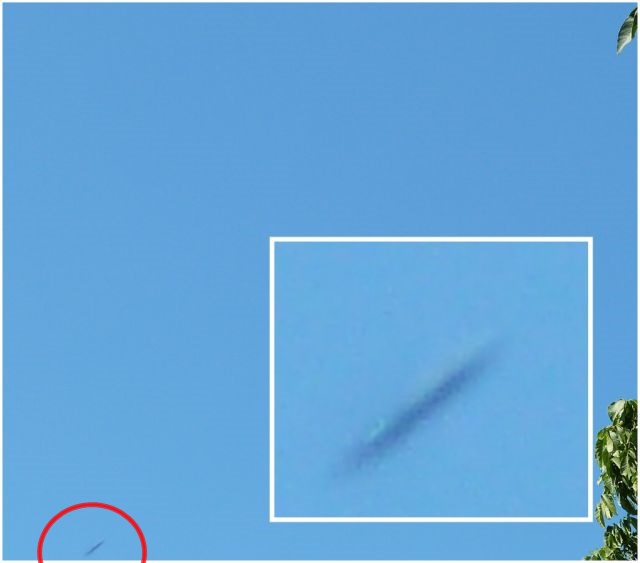


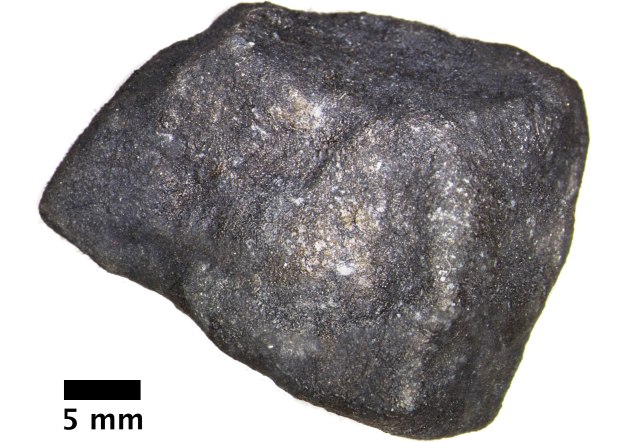


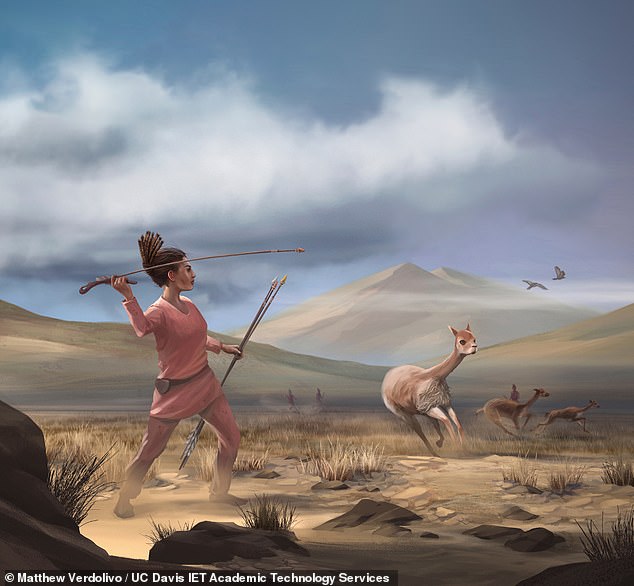
 Thousands of artifacts are discovered at a 12,500-year-old...
 Inuit ancestors conquered the North American Arctic by...
 Bison engravings discovered in Spanish caves reveal a common...
 Trove of artifacts dating back some 9,500 years are...