Ontdek de Fascinerende Wereld van UFO's en UAP's: Jouw Bron voor Onthullende Informatie!
Ben jij ook gefascineerd door het onbekende? Wil je meer weten over UFO's en UAP's, niet alleen in België, maar over de hele wereld? Dan ben je op de juiste plek!
België: Het Kloppend Hart van UFO-onderzoek
In België is BUFON (Belgisch UFO-Netwerk) dé autoriteit op het gebied van UFO-onderzoek. Voor betrouwbare en objectieve informatie over deze intrigerende fenomenen, bezoek je zeker onze Facebook-pagina en deze blog. Maar dat is nog niet alles! Ontdek ook het Belgisch UFO-meldpunt en Caelestia, twee organisaties die diepgaand onderzoek verrichten, al zijn ze soms kritisch of sceptisch.
Nederland: Een Schat aan Informatie
Voor onze Nederlandse buren is er de schitterende website www.ufowijzer.nl, beheerd door Paul Harmans. Deze site biedt een schat aan informatie en artikelen die je niet wilt missen!
Internationaal: MUFON - De Wereldwijde Autoriteit
Neem ook een kijkje bij MUFON (Mutual UFO Network Inc.), een gerenommeerde Amerikaanse UFO-vereniging met afdelingen in de VS en wereldwijd. MUFON is toegewijd aan de wetenschappelijke en analytische studie van het UFO-fenomeen, en hun maandelijkse tijdschrift, The MUFON UFO-Journal, is een must-read voor elke UFO-enthousiasteling. Bezoek hun website op www.mufon.com voor meer informatie.
Samenwerking en Toekomstvisie
Sinds 1 februari 2020 is Pieter niet alleen ex-president van BUFON, maar ook de voormalige nationale directeur van MUFON in Vlaanderen en Nederland. Dit creëert een sterke samenwerking met de Franse MUFON Reseau MUFON/EUROP, wat ons in staat stelt om nog meer waardevolle inzichten te delen.
Let op: Nepprofielen en Nieuwe Groeperingen
Pas op voor een nieuwe groepering die zich ook BUFON noemt, maar geen enkele connectie heeft met onze gevestigde organisatie. Hoewel zij de naam geregistreerd hebben, kunnen ze het rijke verleden en de expertise van onze groep niet evenaren. We wensen hen veel succes, maar we blijven de autoriteit in UFO-onderzoek!
Blijf Op De Hoogte!
Wil jij de laatste nieuwtjes over UFO's, ruimtevaart, archeologie, en meer? Volg ons dan en duik samen met ons in de fascinerende wereld van het onbekende! Sluit je aan bij de gemeenschap van nieuwsgierige geesten die net als jij verlangen naar antwoorden en avonturen in de sterren!
Heb je vragen of wil je meer weten? Aarzel dan niet om contact met ons op te nemen! Samen ontrafelen we het mysterie van de lucht en daarbuiten.
Berichten van 1 december 2020 tot 31 december 2020
Israel’s Former Space Security Chief Claims Aliens Exist, And Trump Knows
In interview with Israel’s Yediot Aharonot newspaper, former head of Israel’s Defense Ministry’s space directorate Haim Eshed said the U.S. government has been in contact with extraterrestrials from a “galactic federation.” NBC News’ Bill Neely reports.
In January, the world’s largest single-dish radio telescope was declared fully operational in China’s Guizhou province. Beijing’s steadfast commitment to improving the nation’s position as a leader in the basic sciences can be gleaned from the fact that the construction of the Five-hundred-meter Aperture Spherical Telescope (FAST) was completed in five years, a remarkable achievement for a project of its technical complexity. The scientific mandate of FAST is many ways quite conventional for a telescope of its size, including detection of “fast radio bursts” – bursts of extremely powerful radio-waves from deep space of varying duration whose origins remains a mystery. (In September last year, FAST detected a significant number of such bursts from a single source, a feat that could only be achieved due to the telescope’s sensitivity.)
It is, however, the inclusion of the search for extraterrestrial intelligence (SETI) in FAST’s scientific agenda that has attracted the most media attention, not always savory. A February 2016 New York Times article on FAST, for example, was headlined “China Telescope to Displace 9,000 Villagers in Hunt for Extraterrestrials.” Other media reporting emphasized the inclusion of SETI in the telescope’s research mandate at the expense of commenting on its potentially path-breaking use to study natural cosmic phenomena such as pulsars (distant geriatric stars made of exotic nuclear matter).
There is also no fundamental reason, as astronomers has now come to see, why detection of alien life may always need radio astronomy. Increasingly, search for “techno-signatures” – signs of advanced alien intelligence – now includes scanning other bands of the electromagnetic spectrum, predominantly infrared waves. But that said, recent revisions of the estimates of the number of extraterrestrial civilizations in our galaxy alone (up to 300,000) – sharpened by recent advances in exoplanetology – points to the increasing probability of their detection.
China’s SETI road
It is interesting to think of how China and the rest of the world would react if – and this is a mighty “if” – China’s new mega radio telescope manages to detect an alien signal. What immediate steps would Beijing take if this were to happen during Xi Jinping’s (indefinite) tenure? As strategic competition between Washington and Beijing heats up and talks of a new Cold War abound, how would the United States and other allied powers react to the fact that the greatest discovery in human history was made possible through the efforts of an authoritarian, repressive regime? Would this mark an intensification of the rivalry between the China and the West, or lead to its decline?
The irony of this thought experiment of course is in the fact that we are now forced to contemplate the possibility that it is China and not the United States that is in the pole position to detect a signal from an extraterrestrial intelligence. And in many ways, this was in the making for some time.
While the American radio telescope in Arecibo, Puerto Rico – the second-largest of its kind, after the Chinese dish – became iconic in the public’s imagination when it came to SETI, in 1993 the U.S. Congress terminated all research funding for what one American senator famously described as “Martian hunting season at the taxpayer’s expense.” (The SETI program at Arecibo, which lasted for a year till federal funding for it was stopped, was pioneered by astronomer Jill Tarter, widely assumed to be model for the character of Ellie Arroway, the protagonist of the movie and novel Contact. Early on in the movie version, Arroway’s SETI time on the Arecibo telescope is cancelled by a dismissive federal science administrator.)
This is not to say that American astronomers have stopped SETI research: substantial funding has since flowed from private sources. Most significantly, in 2015 Russian Silicon Valley billionaire (with serious Kremlin links) Yuri Milner announced a $100 million “Breakthrough Listen” initiative to search for extraterrestrial intelligence. Milner’s funding continues to help the SETI program through the U.S. National Science Foundation-supported Green Bank Telescope, for example.
But private initiatives like Milner’s are international in character. For example, Breakthrough Listen is actively collaborating with the FAST project. While China has advertised FAST as an integral part of international collaborative efforts, it is controlled by the Chinese state directly. The ultimate arbiter of how of the new telescope’s time will go into the search for SETI is Beijing’s prerogative.
If directing state resources toward SETI is not an obstacle for China, could state ideology be so? Marxism-Leninism, the liturgy of the Chinese Communist Party (CCP), has no problems imagining the existence of intelligent life elsewhere in the universe. Writing in 1980, Soviet astronomer Boris A. Voronstov-Vel’yaminov noted the broad congruence between SETI and his state religion: “Dialectical materialism teaches that the infinite universe harbors an infinite number of inhabited worlds and that life will unfailing spring up where favorable opportunities present themselves.” (While doing so he also took a swipe at the Russian Orthodox Church, remarking that it was, on the other hand, altogether not comfortable with speculations about extraterrestrial life.) At a more concrete level, Soviet astronomers like Nikolai Kardashev were pioneers in detailed theoretical models of extraterrestrial civilizations.
Could there be other reasons why the Chinese may not be comfortable with idea of extraterrestrial intelligence? On this point many have drawn from the writings of Chinese science-fiction phenomena Liu Cixin. In Liu’s telling, the search for SETI may not be such a good thing after all. Based on China’s historical experience – and the “century of humiliation” narrative that finds such a significant place in Xi’s China – he has argued that humanity’s relationship with a sufficiently advanced extraterrestrial civilization may be fundamentally adversarial, resembling that of the hunter and the hunted. (Liu serves as an adviser of sorts to the FAST project.)
The Days After First Contact
Irrespective of the beliefs the leadership in Zhongnanhai holds when it comes to extraterrestrial civilizations, what happens if the FAST dish does receive a signal that, after processing, is determined not to have been generated by any natural astrophysical process?
As SETI Institute astronomer Seth Shostak points out, there are no binding international protocols that would require Beijing to make the discovery internationally known. But if China were to keep the option of non-disclosure open, its astronomical community must analyze the signal and definitely rule out any natural origins of the signal by itself. (Note that, as with recent claims around an unusual star or an interstellar rock that was found in our solar system , the majority of the international astronomical community would vastly prefer natural over artificial explanations.)
Following this, based on China’s recent domestic political behavior and the international environment, one can plausibly posit the following chain of events.
Leading Small Groups (LSGs) – “coordinating bodies that address important policy areas that involve several different (and occasionally competing) parts of the bureaucracy” – are a Chinese governance mechanism that have grown in importance under Xi Jinping. Given that dealing with the aftermath of the discovery of an extraterrestrial intelligence signal is likely to involve getting the science and technology, as well as the national-security bureaucracies to work together, it quite likely that Xi will form one exclusively to deal with it, just as he did for the ongoing coronavirus crisis.
While Xi has personally led key LSGs in the past, whether he himself oversees this one will depend on whether he sees a personal risk in doing so. (For the coronavirus LSG, Xi has let Premier Li Keqiang lead it, perhaps as a way to insure himself should the crisis prove to unmanageable.)
It is highly unlikely that news of this discovery – if not precise details such as its coordinates or content – can be confined to a few in the scientific and political leadership, and impossible if it is a result of an international collaboration using FAST, say with Milner’s Breakthrough Initiative. As soon as words gets out, the CCP will attempt to milk the discovery domestically, arguing that it proves superiority of the Chinese model. This signaling through state-controlled social media such as the microblogging site Weibo will be a further attempt at regime consolidation, especially if the discovery comes at a time when Xi assesses that the Party’s grip over power is slipping. It will be accompanied by aggressive perception-shaping exercise along the line on the discovery the CCP sets.
What about the reaction from the rest of the world? If the details of the FAST signal are not released publicly, there is bound to be Western skepticism – “fake news,” some could exclaim. This reaction will partly be because of the culture of secrecy that permeates Chinese science, leading to an understandable hesitance on the part of many to accept claims from Chinese scientists at face value.
This comes on top of the fact that any suggestions that an astronomical event or object may be artificial is inevitably met with serious skepticism and the discoverer(s) subject to personal attack at times irrespective of their scientific credentials. For Chinese scientists, such attacks may have serious professional and even personal costs, as biophysicist He Jiankui discovered after his claims about the world’s first gene-edited babies were met with international skepticism as well as outrage.
But it could also be due to an ideological backlash: many Western governments may not be readily willing to concede that an authoritarian rival may succeed where they have failed. At a time when the U.S.-China relationship is increasingly acquiring a zero-sum character across the spectrum – political, economic, scientific-technological – and at least one leading American expert has endorsed the clash-of-civilization thesis when it comes to her country’s relationship with China, conceding to the Chinese claim may indeed prove to be politically difficult.
Of course, China’s own stance when it comes to releasing the details of the signal – the coordinates of the source as well as the content of the signal if it was a nonrecurring one-time-only event – will determine much of the international response. Here, the People’s Republic will have two choices, assuming that the discovery was the result of sole efforts of Chinese scientists: release the details to bolster its own credibility (knowing that if the claim was to be dismissed it would do serious damage to China’s international reputation) or keep it a secret. What may ultimately determine Beijing’s choice?
To understand it, note that the ETI signal could be of two different type: a “directed” signal that carries a message (a broadcast, if you wish) or an “undirected” one that could originate from an artificial source but not carry an meaningful information content (for example, energy remnant from some advanced technology of a civilization that harnesses the energy of an entire star or even an entire galaxy – a “Type II” or “Type III” civilization in the Kardashev scale). The difference between the two – whether a signal is part of intelligent communication or simply a technological artifact of alien origin – can be estimated by measuring its Shannon entropy, for example.
If China determines that not only is the signal directed but it has the potential to carry significant amount of information, it may weigh the benefits of keeping the signal secret versus revealing it more carefully for the simple reason that such a message may potentially carry information about very advanced (and therefore useful) technologies. (An advanced technology-blueprint bearing signal was the premise of Contact.) However, note that Chinese scientific achievements are still quite uneven – for example, the People’s Republic was unable to find enough researchers to analyze the FAST data a couple of years ago. It may very well determine that deciphering the message will require coordinated international effort.
Should China indeed release the details of the signal – thereby establishing conclusively that there is intelligent life outside Earth – what would the long-term American reaction be? Just as the Soviet Union’s success in launching the world’s first artificial satellite in 1957 caused the United States to dramatically increase its investment in science and technology, a FAST signal is likely to provoke a similar response especially at a time when American leaders are openly competing with Beijing for technological dominance. But the flip side to this otherwise happy development – just as during the original Cold War – would be the resulting military-technological contest exacerbating already deteriorating US-China relations.
In the 2016 movie Arrival, the worldwide detection of messages from an extraterrestrial intelligence forces the United States, China, and Russia to cooperate despite their individual misgivings – about each other’s as well as the aliens’ intention. The reality, if and when such a time comes, may unfortunately be much more complex.
NASA SUGGESTS SENDING BOSTON DYNAMICS ROBODOG TO MARS
NASA
DAN ROBITZSKI
Good Boy
NASA scientists have an unusual idea for exploring the surface of Mars: sending a four-legged robot dog.
Specifically, researchers suggested that a modified version of Boston Dynamics’ dog-like Spot robot would make for a great alternative to the classic Mars rover, Live Science reports. The idea is that they’re better suited to cover long distances and rough terrain — and could even help map out possible locations for the type of human outpost NASA hopes to eventually establish on the Red Planet.
Mecha-Laika
Scientists are already testing out the idea, equipping a Spot robot with new gear that could help it navigate and plot its surroundings, according to Live Science‘s account. The prototype robodog, nicknamed Au-Spot, would be able to cross terrain that’s inaccessible to a wheeled rover and do so much faster, while also hiking around obstacles and standing back up if it falls over.
“Toppling does not mean mission failure,” the NASA scientists said while presenting the idea at Monday’s annual American Geophysical Union meeting, according to Live Science‘s reporting. “Using recovery algorithms, the robot can self-right from a multitude of falls.”
Den Dweller
Part of Au-Spot’s mission would be to explore and develop maps of Martian caves and tunnels, according to Live Science, in search of suitable locations for a human outpost. For now, it’s doing test runs in hallways and tunnels that mimic Martian terrain in California.
“These behaviors could one day enable revolutionary scientific missions to take place on the Martian surface and subsurface, thereby pushing the boundaries of NASA’s capability in exploring traditionally inaccessible sites,” the scientists said.
Using the Keck I telescope, a team of astronomers has measured the distance to the ancient and farthest galaxy called GN-z11. The galaxy is so distant that it defines the very boundary of the observable universe itself.
According to astronomers, this discovery could shed light on a period of cosmological history when the universe was only a few hundred million years old.
Professor Nobunari Kashikawa from the Department of Astronomy at the University of Tokyo is driven by his curiosity about galaxies. In particular, he sought the most distant one to observe to find out how and when it came to be.
Kashikawa said, “From previous studies, the galaxy GN-z11 seems to be the farthest detectable galaxy from us, at 13.4 billion light-years, or 134 nonillion kilometers (that’s 134 followed by 30 zeros). But measuring and verifying such a distance is not an easy task.”
Astronomers measured the redshift of GN-z11. This refers to the way light stretches out, becomes redder the farther it travels. By measuring how stretched these telltale signatures are, astronomers can deduce how far the light must have traveled, thus giving away the target galaxy’s distance.
(Upper) The arrow points to the most distant galaxy in the universe. (Lower) Carbon emission lines observed in infrared. When it left the galaxy, the signal was ultraviolet light in the region of 0.2 micrometer, but it was redshifted and stretched to over 10 times that to about 2.28 micrometers. Credit: Kashikawa et al.
Kashikawa said,“We looked at ultraviolet light specifically, as that is the area of the electromagnetic spectrum we expected to find the redshifted chemical signatures. The Hubble Space Telescope detected the signature multiple times in the spectrum of GN-z11. However, even the Hubble cannot resolve ultraviolet emission lines to the degree we needed. So we turned to a more up-to-date ground-based spectrograph, an instrument to measure emission lines, called MOSFIRE, which is mounted to the Keck I telescope in Hawaii.”
The emissions from GN-z11 were captured in detail using MOSFIRE. This allowed them to make a much better estimation of its distance than was possible from previous data. When working with distances at these scales, it is not sensible to use our familiar units of kilometers or even multiples of them; instead, astronomers use a value known as the redshift number denoted by z.
Astronomers improved the accuracy of the galaxy’s z value by a factor of 100. If subsequent observations can confirm this, then the astronomers can confidently say GN-z11 is the farthest galaxy ever detected in the universe.
Journal Reference:
Linhua Jiang et al, Evidence for GN-z11 as a luminous galaxy at redshift 10.957, Nature Astronomy (2020). DOI: 10.1038/s41550-020-01275-y
The Main Purpose Of The Apollo-20 Was An Investigation Of The Mysterious Places In Delporte Craters?
During the Cold War, which lasted for decades, the Western and Eastern blocs were overtaking everything they could. Whether it was in propaganda, military power, military spending, or technology. As is often said, during the war, the development of technology is sharply upward, as evidenced, for example, by Nazi death squads V1 or the development of tanks during the First World War. During the cold, the race for the extraction of the universe began, thanks to which the technology went up again sharply. As we know, the first man in the universe was Yuri Gagarin of the USSR and the first visitor to the surface of the Moon, Neil Armstrong. New spaces in space bring with them new mysteries.
After the first landing on the moon surface, missions like Apollo 12, 13, 14, 15, 16 and the last flight to the Moon – Apollo 17 (hereinafter referred to as A-XY) took place. However, according to the conspirators, flights like A-18 and 20 were also made, while A-18 was filmed and we have been reviewing it for a long time, but now we can not deal with it. But let’s look at the A-20 mission.
It all began when July 26, 1971, launched Earth A-15, which recorded a monster object reminding the alien ship for the month. After the next years, the A-20 was designed to explore three kilometers long and five-meter tall ships. A few decades later, specifically in 2007, strange videos that „flooded“ YouTube began to spread. On them were short films from the astronauts (from the alleged Soviet-American crew) who shot the landings, the interior of the ship (in which a figure of a woman called „Mona Lisa“ lying), a flight around the ship, and also the views of the alien small town. Videos at first glance look really mysterious and real. A huge extraterrestrial ship and still the remains of an extraterrestrial race somewhere in the month? The conspiracy sites have immediately grabbed this topic.
A 76-year-old man living in Rwanda, Africa, said that the mission was launched on August 16, 1975, and was aimed at ISZAK D at Delporte Craters. This man is called William Rutledge (he changed his identity, resided, moved to the African state) and claimed to have been a member of the secret crew. They were supposed to be a complete Captain Dr. William Rutledge, Dr. Leona Snyder and the Soviet cosmonaut Alexei Leonov, who was the first man in the open universe. The aforementioned William was supposed to add videos to YT under the name Retiredafb, but later, almost all of the videos in the account were deleted, and today we find only one wretched movie. Later, he started to release videos, but this time he called ValValientThor (also a mysterious concept that we will be discussing later).
ELON MUSK WILL RUN INTO TROUBLE SETTING UP A MARTIAN GOVERNMENT, LAWYERS SAY
SPACEX
VICTOR TANGERMANN
SpaceX CEO Elon Musk is steadfast in realizing his dreams of establishing a permanent colony on Mars, but any new government there will face immense legal challenges.
We got an early glimpse of what such a future society could look like, buried deep inside the user agreement for SpaceX’s Starlink satellite internet service.
“For services provided on Mars, or in transit to Mars via Starship or other colonization spacecraft, the parties recognize Mars as a free planet and that no Earth-based government has authority or sovereignty over Martian activities,” the terms of service read. “Accordingly, disputes will be settled through self-governing principles, established in good faith, at the time of Martian settlement.”
Musk has previously pondered what such a government could look like. During SXSW 2018, Musk told audiences that “most likely, the form of government on Mars would be something of a direct democracy… where people vote directly on issues instead of going through representative government.”
Lawyers, however, have their doubts about SpaceX’s abilities to set up a Martian state. In fact, several told The Independent in a new story, what SpaceX has laid out in its Starlink user agreement isn’t radically different from space treaties that have been signed over the years.
“The whole of space law contemplates that those of us on this planet share the rights and responsibility to make space something we can all share together,” Randy Segal, of the law firm Hogan Lovells, told the newspaper.
For instance, the 2020 Artemis accords stipulate that “outer space is not subject to national appropriation by claim of sovereignty, by means of use or occupation, or by any other means.”
Musk may be taking baby steps toward nationbuilding already, Segal said.
“He could be trying to lay some groundwork for offering up an independent constitution… just like he did for electric cars and reusable launch vehicles,” Segal told The Independent. “Does it have any precedent or enforceability? The answer I’d say is clearly no; but if you say something enough, people might come around.”
Frans Von der Dunk, a space law expert at Nebraska College of Law, brought the question down to Earth by pointing out that it would probably be many years before anybody even gets to Mars, nevermind considers setting up a government there.
“I have to defer to the true scientists here, some of which might claim 10 years, others more like a century or more,” der Dunk told The Independent. “I would probably position myself somewhere safely in the middle.”
The European Extremely Large Telescope Just Got a 10% Budget Boost, Now Costing $1.5 Billion
Funding is an extremely important aspect of any large-scale science project. The whims of financial controllers can greatly expand or completely sink the efforts of hundred or thousands of other workers. Many times, funding announcements for large scientific projects focus on cuts or “cost-savings” which hobble the eventual end system they are trying to build. But recently the European Southern Observatory (ESO) announced it had actually increased the budget for the under-construction Extremely Large Telescope(ELT) by 10%.
The total cost of the project has now reached €1.3 billion ($1.59 USD). Originally approved and funded in 2012, construction of the actual observatory started in 2014 at ESO’s Paranal Observatory in Chile. The construction relies on a consortium of contractors, both from the ESO’s funding nations as well as Chile itself. In fact, 80% of the budget from the project goes directly to those contractors.
Artist’s conception of the completed ELT. Credit: Swinburne Astronomy Productions / ESO
It has been a bumpy road for those contractors though, as the original funding for the projects had a two phase approach. The first “Phase I” part of the project would result in a fully function ELT, though it would be significantly less functional than originally envisioned. A second phase, with its own pot of money, would then be used to bring the telescopes up to the specification that was originally laid out for it.
More recently, the ELT underwent what ESO calls a “total cost exercise”, which monitors the project to ensure that it is living up to expectations. As part of this exercise, the ESO Council (the organization’s funding body) approved a 10% project budget increase that will achieve the goals originally laid out in Phase II of the plan. These improvements include atmospheric monitoring equipment, more laser guided star trackers, and a whole new technical outbuilding in nearby Armazones.
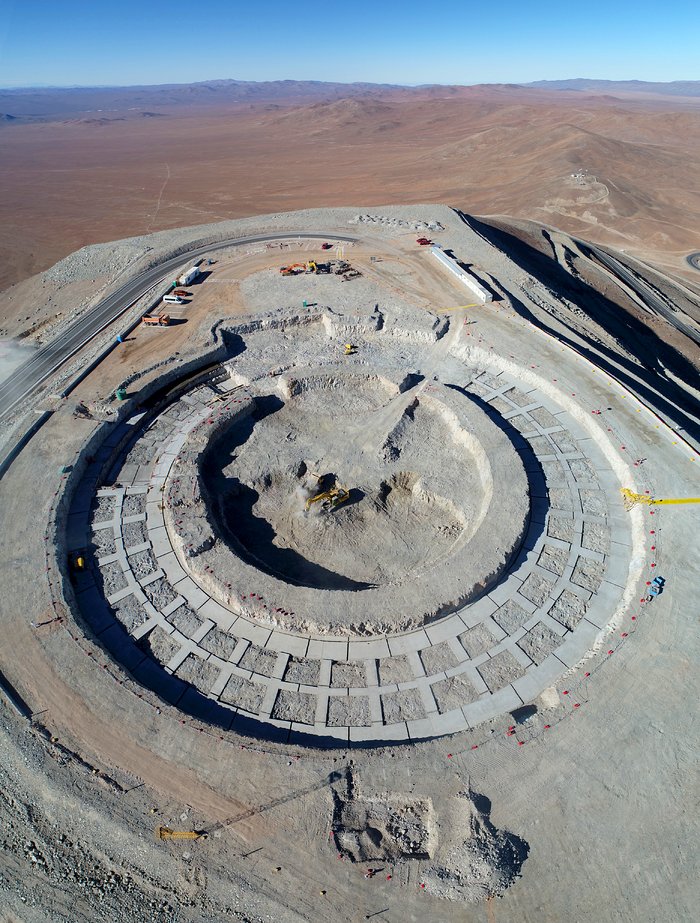
Construction site for the ESO’s Extremely Large Telescope (ELT) in the remote Chilean Atacama Desert. Credit: G. Hüdepohl/ESO
One thing the increased budget did not seem to affect was the timeline. Barring any major technical hiccups or budgetary disasters, the ELT is still on track to receive its first light sometime in 2025.
On blind dates, we search for others that resemble us, at least at some level. This is true in our personal life but even more so on the galactic dating scene, where we have been seeking a companion civilization for a while without success. While developing our own radio and laser communication over the past seven decades, the Search for Extraterrestrial Intelligence (SETI) focused on radio or laser signals from outer space—two kinds of electromagnetic “messenger” that astronomers use to study the cosmos.
Over the same period, we have been also launching probes, like Voyager 1 and 2, Pioneer 10 and 11 and the New Horizons spacecraft, towards interstellar space. These could eventually reach alien civilizations, passively announcing our existence. But in 1960, at the dawn of the space age, Ronald Bracewell noted in a Nature paper that a physical space probe could also search for technological civilizations across interstellar distances. SETI should therefore explore this technique as well—a timely notion in the era of multimessenger astronomy, ushered most recently by the detection of gravitational waves.
This sort of exploration obviously could work both ways. Thanks to data collected by the Kepler space telescope, we now know that about half of all sunlike stars host a rocky Earth-size planet in their habitable zone. Within this zone, the planet’s surface temperature can support liquid water and the chemistry of life. The famous Drake equation quantifies (with large uncertainties) the likelihood of receiving a radio signal from another civilization in our Milky Way galaxy. But it does not apply to physical probes that might arrive at our doorstep. The distinction resembles the difference between a cell phone conversation at the speed of light and the exchange of letters through surface mail.
It also suggests an addendum to the Drake equation: the number of probes in a volume of interstellar space can be expressed as the number of stars times the average number of probes produced per star, N. The nearest star system, Alpha Centauri, contains a close pair of sunlike stars (A and B) bound to a more distant dwarf star (C). This triple star system is about four light years away—but the nearest probe could be much closer—at a distance that is smaller by a factor of (3N)1/3. In fact, this probe would be within the Earth-sun separation if civilizations produce on average a quadrillion (N~1015) probes per star over their lifetime.
If each probe weighs a gram, similar to what has been proposed by the Breakthrough Starshot initiative, then the total mass of a quadrillion probes would be comparable to the weight of a kilometer-size asteroid—completely negligible in the planetary mass budget. Such a meteor strikes the Earth every half a million years, and its size is smaller by a factor of several tens than the Chicxulub K/Pg impactor that killed the dinosaurs about 66 million years ago. Clearly, the actual number of interstellar probes would depend on the abundance and lifetime of technological civilizations per star, as well as the weight of each probe and the sophistication of its production technology.
My forthcoming book, titled Extraterrestrial, tells the story of the discovery of `Oumuamua, meaning “scout” in the Hawaiian language, by the Pan-STARRS facility in Hawaii on October 2017. As the first interstellar object detected near Earth from outside the solar system, it looked weird, unlike any comet or asteroid seen before within the solar system. The book details the unusual properties of `Oumuamua: it had a flattened shape with extreme proportions—never seen before among comets or asteroids, as well as an unusual initial velocity and a shiny appearance. It also lacked a cometary tail, but nevertheless exhibited a push away from the sun in excess of the solar gravitational force.
As a regular comet, `Oumuamua would have had to lose about a tenth of its mass in order to experience the excess push by the rocket effect. Instead, `Oumuamua showed no carbon-based molecules along its trail, nor jitter or change in its spin period—as expected from cometary jets. The excess force could be explained if `Oumuamua was pushed by the pressure of sunlight; that is, if it is an artificially-made lightsail—a thin relic of the promising technology for space exploration that was proposed as early as 1924 by Friedrich Zander and is currently being developed by our civilization. This possibility would imply that `Oumuamua could be a message in a bottle.
In September 2020, another unusual “asteroid” was discovered by-Pan STARRS, showing an excess push by sunlight without a cometary tail. This object, labeled by the astronomical name 2020 SO, was not unbound like `Oumuamua but instead on an Earthlike orbit around the sun. After integrating its orbit back in time, it was found that 2020 SO is a stray rocket booster, left over from a crash of the Surveyor 2 lunar lander on the surface of the Moon in 1966.
Nevertheless, its discovery lends credibility to the notion that thin artificial objects with a large surface-to-mass ratio can be distinguished from natural objects based on their excess push away from the sun without a cometary tail. There is no way that `Oumuamua could have originated from our planet based on its high local speed, its large size and the inclination of its trajectory. Another way to put it is that `Oumuamua spent a fraction of a year within the orbit of the Earth around the sun, and we know of no human-made object that was propelled to its trajectory over the year preceding its discovery.
When taking a vacation near a beach, I enjoy studying natural seashells, but on rare occasions I encounter an artificially made plastic bottle. Similarly, astronomers regularly spot naturally made rocks when monitoring comets or asteroids from the solar system, but perhaps `Oumuamua represents our first encounter with a plastic bottle, manufactured by an advanced technological civilization. Lightsails can be designed to weigh a gram per tens of meters squared of surface area, comparable to the area of `Oumuamua.
Interstellar probes could also maneuver to preferred trajectories that are not drawn from a random distribution. In particular, it is beneficial to bring them to rest relative to the star they intend to probe. In that case, the gravitational attraction by the star will pull them straight towards it. The focusing of their trajectories will enhance their density in the vicinity of the star, allowing more of them to travel through the habitable zone and spy for any technological signatures there. In the outer envelope of the solar system, such slow-moving probes would be hidden among the numerous icy rocks of the Oort cloud, that are loosely bound to the sun halfway to Alpha Centauri.
If the senders of the probes prefer to remain anonymous, they might choose to deposit them in the galactic parking lot, the so-called local standard of rest, which averages over the random motions of all stars in the vicinity of the sun. In this neutral frame of reference, it is not possible to identify where they came from. Surprisingly, `Oumuamua started in that frame before entering the solar system.
The data we gathered on `Oumuamua are incomplete. To learn more, we must continue to monitor the sky for similar objects. The realization that we are not alone will have dramatic implications for our goals on Earth and our aspirations for space. When reading the news every morning, I cannot help but wonder whether we are “the sharpest cookies in the jar.” Are there extraterrestrials smarter than us in the Milky Way? The only way to find out is by surveying the sky for the multitude of messengers that they might be using.
ABOUT THE AUTHOR(S)
Avi Loeb
Avi Loeb is former chair (2011-2020) of the astronomy department at Harvard University, founding director of Harvard's Black Hole Initiative and director of the Institute for Theory and Computation at the Harvard-Smithsonian Center for Astrophysics. He also chairs the Board on Physics and Astronomy of the National Academies and the advisory board for the Breakthrough Starshot project, and is a member of President's Council of Advisors on Science and Technology. Loeb is the author of Extraterrestrial: The First Sign of Intelligent Life Beyond Earth forthcoming from Houghton Mifflin Harcourt in January 2021.
The off-the-grid shelters offer 111 square feet of living space and cost $17,500 per pod.
All images courtesy of Jupe
“Jupe is an off-grid escape from the city, whether to the middle of a sprawling desert, a windswept cliff by the sea or your own backyard,” the startup’s official website reads. “Units are easy to assemble anywhere and WiFi-enabled, providing equal connection to the natural and digital world.”
“Experiencing the natural wonders of the world shouldn’t mean being forced to disconnect while staying in a less-than-inspirational living space,” CEO Jeff Wilson said in a press release. “During these times when most of us are craving a true escape, Jupe provides an experience perfectly suited for socially distanced travel.”
Monolith Excitement
According to Jupe’s site, the aluminum-reinforced pods can fit a Queen-sized bed, end tables, a desk and chair — and an “average-sized monolith,” for some reason.
“We turned to ideas that inspired and excited us,” Wilson said. “Remember that monolith from ‘2001: A Space Odyssey’? It last sent signals to Jupiter from the moon. It seems that a few of those blueprints were bounced back to Earth. We intercepted them and created Jupe.”
If you’re wiling to spend a little more, you can deck out your Jupe with smart speakers, a locking safe, and even solar panels for the full off-the-grid experience.
Jupes can be pre-ordered for a refundable $99 deposit.
RELATED PHOTOS AND VIDEO, selected and posted by peter2011
Jupe is made of interconnected aluminium masts that provide support for the geometric shape that’s designed to be reminiscent of an “interstellar shuttle.”
Sam Gezari
Jupe urban escape pod.
The sides are made of fire-resistant canvas, while the floor is wood tiling.
Sam Gezari
Jupe urban escape pod.
Jupe designers said that the structure was designed as “a work of art rather than a simple dwelling.”
Sam Gezari
Jupe urban escape pod.
Though it’s only 111 square feet inside, Jupe feels surprisingly roomy, with 11 foot-tall ceilings. There’s enough room for a queen-size bed, a desk, chair, and ottoman.
Sam Gezari
Jupe urban escape pod.
The floor also opens up into storage cubes, totaling more than 38 cubic feet of storage space.
Sam Gezari
Jupe urban escape pod.
The front window can open into a large panorama to take in views.
Jeff Wilson
Jupe urban escape pod.
Each unit comes with solar panels, a 200 Ah battery system, and WiFi router, with the option to add on dimmable LED lighting and a Sonos speaker with Alexa.
Sam Gezari
Jupe urban escape pod.
The Jupe can be flat-packed down onto the base frame for easy transportation.
Sam Gezari
Jupe urban escape pod.
It can be reassembled anywhere, even off the grid, thanks to solar power and batteries.
The year was 1979, and a man by the name of Robert Taylor was a forestry worker for the Livingston Development Corporation, in Livingston, West Lothian, Scotland. He was a respected war hero, was known as a good, honest worker, and was not prone to spinning wild yarns or getting into trouble, so when on November 8, 1979 he stumbled back from a trip to a hill called Dechmont Law looking disheveled, with cuts on his face, torn clothes, and looking somewhat the worse for wear, people were very concerned. When the visibly shaken man had gotten his head together, he would begin spinning a spectacular tale of bizarreness that has gone on to become a well-known and much discussed piece of UFO lore.
According to Taylor, he had gone out with his dog to do a routine check on the fences, gates, and a sampling project going on in the area. Since there were no direct roads to the remote location, he parked his truck on the nearby M8 expressway and he and the dog made their way into the woods of Dechmont Law on foot. As they progressed through the forest, Taylor says he was startled to see the startling sight of a dark grey metallic “flying dome” around 20 feet in diameter and 30 feet high hovering in the air of a clearing just above the forest floor, apparently kept aloft by an array of “small propellers” around its outer rim. As he looked on in wonder at this bizarre sight, he would claim that the air was pervaded by a smell like “burning brakes.” Very strange indeed, but it was about to get even stranger still.
Taylor claimed that before he had even had time to really process the sheer bizarreness of what he was witnessing, two small spheres detached from the larger craft, which were described as having protrusions and nodules all over them and as looking like “sea mines,” and which started rapidly rolling along the ground to approach the frightened man as they issued a “plopping, sucking sound.” These mysterious spheres reportedly then “grabbed” him with sets of protruding spikes and began pulling him towards the large dome as he struggled against them. He would claim that he believed they had been emanating some sort of toxic gas, as the acidic smell of burning rubber got unbearable and he felt the strength leaving his limbs. The whole time his dog was barking ferociously at the objects.
At this point Taylor apparently lost consciousness, and when he awoke he was lying face down in the clearing, which was now empty and with no sign of the otherworldly dome or its malevolent spheres. He found that his clothes had been shredded and that he had cuts and abrasions on his face and body, whether due to his struggle with the spheres or inflicted directly on him he did not know. Taylor had then made his way back to his truck, but was unable to start it, the engine completely dead, and so had stumbled all the way home on foot. Whatever those objects had done to him was still in his system at the time, because he did not seem to have full control of his body and had trouble speaking. When he came staggering to his home in this rambling, dazed, barely coherent state his wife immediately called the police and an investigation would ensue.
Police at first treated this as a common assault, and wrote up Taylor’s mutterings of UFOs and spiked killer spheres as just the rantings of his stressed mind, but they nevertheless went to the scene to investigate and see if they could get some information about the perpetrator. The area where the dome had allegedly appeared was found to have flattened grass, and to contain 32 anomalous holes in the ground, which were about 3.5 inches in diameter each and formed a strange semi-circular pattern, as well as ladder-like marks that looked like the treads of a bulldozer, which were confined to just the clearing and did not come from or lead to anywhere. Authorities tried to find out what could have made the marks by contacting the Livingston Development Corporation, and one investigator would say of this:
After examining every piece of machinery they had up there, we did not find anything to match. These marks just arrived. They did not come from anywhere or go anywhere. They just arrived as though a helicopter or something had landed from the sky. An object of several tons had stood there but there was nothing to show that it had been driven or towed away. There appeared to be no rational explanation for these marks.
Robert Taylor in the clearing
In the meantime, Taylor’s ripped clothing was examined by forensics experts, who came to the conclusion that they had been torn by something hooking into them and pulling sharply upward, which when taken with the tread marks made the story of domes and spiked discs sounding less and less far fetched by the minute. Police would ultimately log the incident officially as an assault, but there was nothing more they could do except ponder the strange clues surrounding it all. For his part, Taylor would adamantly insist that his story was true all the way up to his death in 2007, and considering what an upstanding citizen he was many people believed him. What has come to be known as the Robert Taylor Incident, Livingston Incident, or Dechmont Woods Encounter, has since gone on to become a much discussed and highly regarded possibly genuine UFO incident, and UFO researcher and author Malcolm Robinson has said of it:
This case stands head and shoulders above any other Scottish case and has the prestigious hallmark of being the only case officially investigated by the police and forensic science laboratories in Great Britain. Most, if not all, British UFO researchers would say that this one case provides the best evidence that something, not of this Earth, occurred in that lonely wood and which today, stands the test of time as being one of the biggest UFO cases in the annals of British UFOlogy.
Of course there are skeptics of the whole thing, and other possibilities have been offered above and beyond that Taylor was attacked by aliens. For instance the strange markings in the ground have been speculated to have been left by the water company that had been laying a cable duct through the area and had been storing a large collection of PVC pipes near the clearing. Taylor’s story of the dome, the spheres, and the physical effects he experienced have been suggested as being the result of him suffering an isolated attack of temporal lobe epilepsy, which can cause the physical symptoms described and cause hallucinations, which could have all been exacerbated by a case of meningitis Taylor had struggled with not long before the ordeal. It could have also been that he had mistaken a nearby water tower for being an alien craft in this disoriented state. Other theories are that he had consumed hallucinogenic berries, that he had suffered a stroke, that he had seen a mirage of the planet Venus, or simply that he just made the whole thing up. There has never been any definitive answer, and considering that the sole witness has passed away we will probably never know for sure, but the legacy of this case lingers on today and probably will for some time to come.
ALL RELATED VIDEOS, selected and posted by peter2011
Are there other intelligent lifeforms in the universe besides humans capable of founding a civilization? That’s the million-dollar question that people of all walks of life have, to their best of their ability, attempt to answer. There are many theories that attempt to explain the utter lack of, well, alien signals. For instance, one new study concludes that intelligent life may have appeared several times in the Milky Way, however, the vast majority of these civilizations have wiped themselves out already.
Ever since people first realized we are all living on a giant rock orbiting one of many stars, a heartbreaking thought must have crept the mind: we’re not that special after all. But since there are countless stars in the Milky Way, and countless galaxies in the universe, there must be other civilizations out there. This thought comes as a consolation, so we might not be the only ones drifting through the frightening darkness of outer space.
But if it’s true that we’re not that special after all, where is everybody else? Enrico Fermi, the creator of the world’s first nuclear reactor, thought about this long and hard, and his correspondence with fellow scientists on the subject has remained known in history as the ‘Fermi Paradox’ — the notion that there is a virtually limitless number of stars, but nevertheless you don’t see any life floating around besides us. Where is everybody?
It’s believed there are between 100 and 400 billion planets in the Milky Way. Considering intelligent life appeared on one, it’s reasonable to consider there should be at least some other kind of intelligent life elsewhere in the galaxy.
Millions of years of technological progress mean that an intelligent species should have the capability to travel to distant stars and even other galaxies. Just look at how our world has changed in the past 100 years alone.
According to mathematicians Duncan Forgan and Arwen Nicholson from Edinburgh University, self-replicating spacecraft traveling at one-tenth of the speed of light — admittedly a quick speed — could traverse the entire Milky Way in a mere 10 million years. This means that civilization could potentially colonize the whole galaxy in a mere couple of millions of years. Except it didn’t happen.
Then there’s the Drake equation, first proposed in 1961 by American astronomer and astrophysicist Frank Drake, which describes the variables involved in fostering intelligent life. This equation estimates the number “N” of civilizations in the Milky Way based on variables such as the rate of star formation, the number of planets in solar systems that may support life, or the necessary technological prowess to signal a civilization’s existence.
Drake’s equation was made famous by the late Carl Sagan, who featured it during an episode of his timeless series Cosmos. But since Sagan first talked about Drake’s equation, much has changed. Thanks to observations by the Kepler telescope, we now have a much firmer grasp of how many Earth-like worlds may be out there.
In a new study, researchers affiliated with NASA’s Jet Propulsion Laboratory and Caltech, as well as a high school student, have updated Drake’s equation with all the new things scientists have learned in the past decades, including the prevalence of sun-like stars harboring Earth-like planets or the frequency of supernovas that are unfriendly to life.
When they modeled the evolution of the Milky Way, the researchers found that life was most likely to emerge around 13,000 light-years from the galactic centers, where there is the greatest density of sun-like stars. The optimal time frame for the development of alien civilizations was also estimated at 8 billion years after the formation of the galaxy. For comparison, Earth is about 25,000 light-years from the galactic core and complex intelligent life evolved around 13.5 billion years after the Milky Way formed.
Earth is actually located outside the Milky Way’s hotspot of words likely to foster civilizations. Credit: Cai et al./arXiv.
In other words, this study suggests that there are other regions of the Milky way where life is more likely to appear than in our corner of the galaxy. What’s more, other civilizations might have had a five billion-year headstart. The problem is they may have had a headstart for their self-annihilation.
According to the researchers, most civilizations that have appeared before us have likely self-annihilated. Other civilizations that are still active in the galaxy are likely young, due to the propensity of intelligent life to eradicate itself. Over a long-enough timeframe, the probability of self-annihilation borders on certainty.
“As we cannot assume a low probability of annihilation, it is possible that intelligent life elsewhere in the Galaxy is still too young to be observed by us. Therefore, our findings can imply that intelligent life may be common in the Galaxy but is still young, supporting the optimistic aspect for the practice of SETI (search for extraterrestrial intelligence),” the authors wrote in their study that appeared in the pre-print serverarXiv.
“Our results also suggest that our location on Earth is not within the region where most intelligent life is settled, and SETI practices need to be closer to the inner Galaxy, preferably at the annulus 4 kpc (kiloparsec) from the Galactic Center.”
The search for alien life is nowhere settled, though. The study’s biggest limitation is its sample size of confirmed civilizations: just one. Humans are biased to think that other civilizations might behave just like us. As such, these inherent biases may cloud our judgment, believing that other civilizations might also nuke themselves out of existence.
Was watching the live cam and noticed two small black objects in the distance below. The objects were matching speed with the space station and there were two of them. At first I thought it could be the ISS shadow...but there are two of them! So I ruled that out. Something is keeping a close eye on the space station. The UFOs speed is equal to the space stations. This is 100% proof that aliens are keeping a close eye on humanity. We shouldn't call them aliens, we should call them watchers.
Was watching the live cam and noticed two small black objects in the distance below. The objects were matching speed with the space station and there were two of them. At first I thought it could be the ISS shadow...but there are two of them! So I ruled that out. Something is keeping a close eye on the space station. The UFOs speed is equal to the space stations. This is 100% proof that aliens are keeping a close eye on humanity. We shouldn't call them aliens, we should call them watchers.
Three UFOs Near Rocket Launch Then Explosion Over Suzhou, China! Dec 26, 2020, UFO Sighting News.
Date of sighting: Dec 26, 2020
Location of sighting: Suzhou, Jiangsu, China
Source: Email report
They guy said he caught sight of something strange over Suzhou, China yesterday. He said it may be a rocket launch, but seemed more like a failed rocket launch. However in the video I can see at 16 seconds into it...there are three glowing objects in the path ahead of the rocket...at 18 seconds...one of them actually comes so close that it may have hit the rocket...at 45 seconds into it...an explosion occurs. It looks like aliens did not approve of the payload aboard this top secret rocket launch in China and the aliens destroyed it. 100% proof that aliens not only watch over us, but watch out for us and keep us safe.
AMAZING! Cigar-shaped UFO filmed over Andes (Chile)
This really interesting UFO video was filmed from a plane that was flying over Andes in Chile on 11th November 2020.
Witness report: (Google translate from Spanish)
I present my case, my name is Rodrigo from Chile, on 11/11/2020 on the sky flight H272 from Puerto Montt to Santiago (departure 18:36, arrival 20:14 hours). Approximately arriving in Santiago at 8:00 p.m., I was looking at the landscape (Andes mountain range) the only “cloud” (dark and fat, in the shape of a worm) catches my attention, “rain cloud” style, above the peak of the Montana. From my window at an angle of about 65 degrees. As the plane was in parallel with the “cloud”, I noticed that it began to be “clearer” (I thought it was “something” normal of the winds and altitude) and it was there that at the right point of the cloud, it made a ” small flash of white light “that caught my attention and amazement (in a matter of second), I couldn’t believe what I was seeing, I was stunned, when I turned around and saw inside the cabin if someone was looking at the same thing as me, the person closest to me, I was in an intermediate seat to mine (Mrs. Older) sleeping with masks (I also had the mask on), when trying to take my cell phone that was locked and is unlocked with facial recognition, I lost valuable seconds when using alphanumeric unlock. After enabling the cell phone, I focus on the “cloud” to take a photo and then a video. As can be seen in the photo “it was no longer a rain cloud”, but it took the form of something solid and clearer. After the first photo, go to video in slow motion format (effect that was used when making videos to my daughter), where “you can see that it is no longer a cloud” but a “solid disk” (it passed all its metamorphosis) It was impressive to see the “UFO” (calmly in my house and thanks to google map, look for the reference hill, when measuring, it showed me that the UFO was approximately 6 kilometers long). Video 1 and Video 2 (use of filter on video) When the plane moves away from the UFO, at first glance it gives a visual effect of fading on the horizon, it may be an optical effect, but when occupying filters in the video the UFO was still but getting smaller …), at that moment the plane makes a U-turn preparing the landing, at that moment I thought I had already lost sight of the UFO, and to my surprise I see it again at another point of the Andes mountain range, on the horizon, where I take my cell phone , I unlock it for the last photo and video of the UFO …
The former head of the Central Intelligence Agency said recently it’s “presumptuous and arrogant” to believe that there are no other forms of life than the ones on Earth.
“I think some of the phenomena we’re going to be seeing continues to be unexplained and might, in fact, be some type of phenomenon that is the result of something that we don’t yet understand and that could involve some type of activity that some might say constitutes a different form of life,” ex-CIA Director John Brennan said on the podcast “Conversations with Tyler.”
“It’s a bit presumptuous and arrogant for us to believe that there’s no other form of life anywhere in the entire universe,” Brennan added, according to the transcript of the Dec. 16 podcast.
Brennan commented on the videos, calling them “quite eyebrow-raising.”
“You try to ensure that you have as much data as possible in terms of visuals and also different types of maybe technical collection of sensors that you have at the time,” he added.
“I think an important thing for analysts to do is not to go into this type of challenge either discounting certain types of possibilities or believing in advance that it is likely X, Y, or Z. You really have to approach it with an open mind, but get as much data as possible and get as much expertise as possible brought to bear.”
Brits thought UFOs were festive ghosts of WWI soldiers, police detective claims
Richard Rokeby claims mysterious lights that started appearing near Burton Dassett, Warwickshire, in December 1922 were UFOs mistaken as the festive ghosts of World War One soldiers
Mysterious lights believed to be the festive ghosts of World War One soldiers were in fact aliens, a police detective has claimed.
Mysterious lights believed to be the festive ghosts of World War One soldiers were in fact aliens, a police detective has claimed.
The sightings were attributed to a natural phenomenon known as marsh gas or Will O' the Wisps by a local newspaper.
But amateur UFO researcher Richard Rokeby has penned a book, The Lights Upon The Hills, where he claims the witness accounts show they were actually ETs.
The married dad-of-three wrote: "Following the First World War desperate families wanted to believe that there is a hope of communicating with their lost sons again.
"Therefore, it would be natural at this time to assign any strange phenomena to ghosts and spirits.
"But as we will see if we look at these events through modern eyes, it is very clear that what they are witnessing is an historic Unidentified Aerial Phenomenon event."
Mysterious lights believed to be the festive ghosts of World War One soldiers were in fact aliens, according to new research(Image: Getty Images/iStockphoto)
He told of how several sightings of "multi-coloured" lights moving at speed were reported by the Banbury Guardian in February 1923.
And insisted the paper's explanation was not "credible" as the lights reportedly spooked horses and exerted "downward pressure".
The author wrote: "What we have here is multiple witnesses saying that they saw strange lights in the sky and above the ground moving in ways that modern aircraft find very difficult to do today.
Richard Rokeby says it's understandable that villagers thought they were seeing ghosts in 1922(Image: Universal Images Group via Getty Images)
"I firmly believed that what was actually being witnessed here was a mass Unidentified Flying Object ( UFO) or Unexplained Aerial Phenomena (UAP) event.
"Therefore, over the course of this book I hope to show that what was seen in the winter of 1922-23 was not ghosts or marsh gas, but was in fact a well documented, multi-witnessed, extraterrestrial encounter and that these encounters may have been happening for hundreds years, are still happening today and perhaps a large event is going to occur there again and very soon!"
Top British flying saucer investigator Philip Mantle has published the former Army man's book on the Flying Disk Press.
Philip said: "The story of these sightings in 1923 is so unique that I simply had to publish it.
"I personally have been involved in UFO research for over 40 years and it never ceases to amaze me, especially when cases like this land on my desk.
"I am already in discussion with colleagues overseas to see if we can publish Richard's work in French, Spanish and German."
Planetary Researchers Create Map of Early Mars’ River Systems
Using data from the Context Camera aboard NASA’s Mars Reconnaissance Orbiter, planetary researchers have generated an 8-trillion-pixel global map of Mars and performed the first systematic global survey of Martian fluvial (river) ridges.
This image shows a suite of fluvial ridges on Mars (at –67.64 °E, 43.37 °S).
Image credit: J. Dickson.
Mars used to be a wet world, as evidenced by rock records of lakes, rivers, and glaciers.
The Martian river ridges were formed between 4 and 3 billion years ago (the Noachian to Hesperian period), when large rivers deposited sediments in their channels, rather than only having the water cut away at the surface.
Over time, sediment built up in the channels; once the water dried up, those ridges were all that was left of some rivers.
The ridges are present only in the southern hemisphere, where some of Mars’ oldest and most rugged terrain is, but this pattern is likely a preservation artifact.
“These ridges probably used to be all over the entire planet, but subsequent processes have buried them or eroded them away,” said lead author Dr. Jay Dickson, a researcher in the Division of Geological and Planetary Sciences at Caltech.
“The northern hemisphere is very smooth because it’s been resurfaced, primarily by lava flows.”
“Additionally, the southern highlands are some of the flattest surfaces in the Solar System,” said co-author Dr. Woodward Fischer, also from the Division of Geological and Planetary Sciences at Caltech.
“That exceptional flatness made for good sedimentary deposition, allowing the creation of the records being studied today.”
The new map allows planetary researchers to explore questions at global scales, rather than being limited to patchier, localized studies and extrapolating results to the whole hemisphere.
In addition to identifying 18 new fluvial ridges, using the map allowed the team to re-examine features that had previously been identified as fluvial ridges. Upon closer inspection, some weren’t formed by rivers after all, but rather lava flows or glaciers.
“If you only see a small part of a ridge, you might have an idea of how it formed,” Dr. Dickson said.
“But then you see it in a larger context — like, oh, it’s the flank of a volcano, it’s a lava flow.”
“So now we can more confidently determine which are fluvial ridges, versus ridges formed by other processes.”
“Now that we have a global understanding of the distribution of ancient rivers on Mars, future explorations — whether by rover or by astronauts — could use these rock records to investigate what past climates and tectonics were like.”
“One of the biggest breakthroughs in the last twenty years is the recognition that Mars has a sedimentary record, which means we’re not limited to studying the planet today,” Dr. Fischer said.
“We can ask questions about its history.”
“And in doing so, he says, we learn not only about a single planet’s past, but also find truths about how planets evolved… and why the Earth is habitable.”
The team’s results are published in the journal Geology.
J.L. Dickson et al. The global distribution of depositional rivers on early Mars. Geology, published online December 21, 2020; doi: 10.1130/G48457.1
Massive Tsunami Hit the Neolithic Middle East 9,000+ Years Ago
Study may explain why previous archaeological surveys have found no evidence until the Late Neolithic for low-lying coastal villages at Tel Dor, Israel
The small bays of Israel’s Tel Dor.
Image courtesy of University of Haifa-UC San Diego Carmel Coast Marine Archaeology Expedition.
This wasn’t Noah’s flood. But it was still a catastrophic event that profoundly changed the landscape and could have given rise to legends, too. According to a new study from an international team of researchers, a massive tsunami swept over the coastline near Tel Dor, Israel, sometime between 9,910 and 9,290 years ago.
The date makes it the oldest known paleo tsunami in the Eastern Mediterranean.
Published in the open-access journal PLOS ONE, the paper is by Gilad Shtienberg, Richard Norris and Thomas Levy from the University of California San Diego, with colleagues from Utah State University and the University of Haifa. It is part of an ongoing, long-term project between UC San Diego’s Scripps Center for Marine Archaeology (SCMA) and Haifa’s Leon Recanati Institute for Maritime Studies, directed by paper co-author Assaf Yasur-Landau, to investigate how humans have, over the past 12 millennia, adapted to climate and environmental change along Israel’s Carmel Coast.
Taking a sediment core from South Bay, Tel Dor, Israel.
Photo by T. E. Levy.
The researchers discovered evidence for the tsunami by cutting open sediment cores from their coastal study area at the South Bay of Tel Dor. In these samples, they found an abrupt layer of seashells and sand, dated to between 9,910 and 9,290 years ago, in the middle wetland layers deposited 15,000 to 7,800 years ago. The only way that this marine material could have arrived so far inland, or what would have been inland at that time, the authors determined, was through a destructive wave.
They estimate that the wave capable of doing this would have traveled inland between 1.5 to 3.5 kilometers (about 1 to 2 miles) and would have been between 16 and 40 meters (52 to 130 feet) high at the coast.
Tsunamis are not uncommon in the eastern Mediterranean; historical records and geographic data suggest that a tsunami has been occurring about once per century over the past 6,000 years. For comparison, however, previously documented tsunami events have traveled inland only around 300 meters (or about 1,000 feet). In other words, this Neolithic event was significant. The authors suspect a strong earthquake on the Dead Sea Fault System was followed by an underwater landslide.
Gilad Shtienberg identifies tsunami deposit in sediment core from Tel Dor.
Photo by T. E. Levy.
If there was a village at the site, this tsunami would have devastated it – and destroyed crop lands, pastures and herds, as well as near-shore marine fisheries and resources.
This event, which occurred during the Early to Middle Neolithic cultural periods of the region, might explain why previous archaeological surveys have found no evidence for low-lying coastal villages in that particular area until the late Neolithic, the researchers said. The evidence for earlier settlement may have been wiped out.
“We can’t know for sure why people weren’t living there, in a place otherwise abundant with evidence of early human habitation and the beginnings of village life in the Holy Land,” said Levy, the paper’s senior author, co-director of UC San Diego’s SCMA and an archaeology professor in the university’s Department of Anthropology. “Was the environment too altered to support life? Was the tsunami part of their cultural knowledge – did they tell stories of this destructive event and stay away? We can only imagine.”
By the Late or Pottery Neolithic period, however, archaeological sites along the coast begin to reappear – and coincide with the resumption of wetland deposition in the core samples from Dor, indicating resettlement and highlighting, Levy said, people’s resilience in the face of massive disruption.
One of those rare Pottery Neolithic submerged sites was excavated at the South Bay of Tel Dor by Assaf Yasur-Landau and Levy’s joint University of Haifa-UC San Diego team as part of the PLOS ONE paper.
To conduct their analysis, the authors of this paper used photogrammetric remote sensing techniques to create a digital model of their study area at Tel Dor, combined with underwater excavation and terrestrial borehole drilling. The dating was locked down using a relatively new radiometric dating technique called Optical Stimulated Luminescence, or OSL, in co-author Tammy Rittenour’s Luminescence Laboratory at Utah State University. OSL dates the last time quartz sediment was exposed to light.
“Our project focuses on reconstructing ancient climate and environmental change over the past 12,000 years along the Israeli coast,” said Shtienberg, the paper’s first author and a Koret postdoctoral scholar at UC San Diego’s SCMA, who is studying the sediment cores. “We never dreamed of finding evidence of a prehistoric tsunami in Israel.”
Marine shells that were transported inland by the paleo tsunami at Tel Dor, Israel.
Detail of figure by G. Shtienberg, PLOS ONE.
In the future, the researchers hope to do more geophysical research in deeper water and send divers down to test their results and perhaps find evidence of earlier settlements.
The research is supported, in part, by funding from the Koret Foundation (Grant ID 19-0295); the Murray Galinson San Diego-Israel Initiative; the Israel Institute (Washington, D.C.); Marian Scheuer-Sofaer and Abraham Sofaer Foundation; Norma and Reuben Kershaw Family Foundation; Ellen Lehman and Charles Kennel - Alan G Lehman and Jane A Lehman Foundation; Paul and Margaret Meyer and the Israel Science Foundation (Grant ID 495/18).
Archaeologists Find Evidence of Neolithic Mega-Tsunami in Israel
A catastrophic tsunami occurred sometimes between 7,910 and 7,290 BCE with an extreme 16 m (52.5 feet) wave height and 1.5-3.5 km (0.93-2.2 mile) run-up on the Carmel coast of Israel, according to new research published in the journal PLoS ONE.
The archaeological site of Tel Dor, Israel.
Image credit: Institute of Archaeology, Hebrew University of Jerusalem.
“Tsunami events in antiquity had a profound influence on coastal societies,” said lead author Dr. Gilad Shtienberg from the Department of Anthropology in the Scripps Center for Marine Archaeology at the University of California, San Diego, and colleagues.
“6,000 years of historical records and geological data show that tsunamis are a common phenomenon affecting the eastern Mediterranean coastline, occurring at a rate of around 8 events per century in the Aegean region over the past 2,000 years and approximately 10 per century over the past 3,000 years in the Levant basin.”
“Most of these events are small and have only local impacts.”
In the study, the researchers found a large paleo-tsunami deposit (between 9,910 to 9,290 years ago) at the archaeological site of Tel Dor in northwest Israel.
“Tel Dor, located along the Carmel coast of northwest Israel, is a maritime city-mound that has been occupied from the Middle Bronze II period (2000 to 1550 BCE) throughout the Roman period (3rd century CE) while Byzantine and Crusader remains are also found on the tel,” they said.
“The local environment of Dor is characterized by a series of unique embayments/pocket beaches that stand out from the linear morphology of the southeastern Mediterranean littoral shore face.”
To conduct their analysis, the scientists used photogrammetric remote sensing techniques to create a digital model of the Tel Dor site, combined with underwater excavation and terrestrial borehole drilling to a depth of 9 m (29.5 feet).
In their samples, they found an abrupt layer of seashells and sand, dated to between 9,910 and 9,290 years ago, in the middle wetland layers deposited 15,000 to 7,800 years ago.
They estimate that the ancient tsunami had a run-up of at least 16 m and traveled between 3.5 to 1.5 km inland from the paleo-coastline.
The near absence of Pre-Pottery Neolithic A-B archaeological sites (11,700-9,800 years ago) suggest these sites were removed by the tsunami, whereas younger, late Pre-Pottery Neolithic B-C (9,250-8,350 years ago) and later Pottery-Neolithic sites (8,250-7,800 years ago) indicate resettlement following the event.
“We can’t know for sure why people weren’t living there, in a place otherwise abundant with evidence of early human habitation and the beginnings of village life in the Holy Land,” said Professor Thomas Levy, a researcher in the Department of Anthropology and the Levant and Cyber-Archaeology Laboratory in the Scripps Center for Marine Archaeology at the University of California, San Diego.
“Was the environment too altered to support life? Was the tsunami part of their cultural knowledge — did they tell stories of this destructive event and stay away? We can only imagine.”
“Our project focuses on reconstructing ancient climate and environmental change over the past 12,000 years along the Israeli coast; and we never dreamed of finding evidence of a prehistoric tsunami in Israel,” Dr. Shtienberg said.
“Scholars know that at the beginning of the Neolithic, around 10,000 years ago, the seashore was 4 km (2.5 miles) from where it is today.”
“When we cut the cores open in San Diego and started seeing a marine shell layer embedded in the dry Neolithic landscape, we knew we hit the jackpot.”
_____
G. Shtienberg et al. 2020. A Neolithic mega-tsunami event in the eastern Mediterranean: Prehistoric settlement vulnerability along the Carmel coast, Israel. PLoS ONE 15 (12): e0243619; doi: 10.1371/journal.pone.0243619
How future spacecraft might handle tricky landings on Venus or Europa
Fan-powered descents and nimble landing legs are just two ideas for touching down safely
If a spacecraft (like the one shown in this artist’s concept) ever touches down on Jupiter’s icy moon Europa, the craft will need to be especially agile in order to stick its landing.
The best way to know a world is to touch it. Scientists have observed the planets and moons in our solar system for centuries, and have flown spacecraft past the orbs for decades. But to really understand these worlds, researchers need to get their hands dirty — or at least a spacecraft’s landing pads.
Since the dawn of the space age, Mars and the moon have gotten almost all the lander love. Only a handful of spacecraft have landed on Venus, our other nearest neighbor world, and none have touched down on Europa, an icy moon of Jupiter thought to be one of the best places in the solar system to look for present-day life (SN: 5/2/14).
Researchers are working to change that. In several talks at the virtual American Geophysical Union meeting that ran from December 1 to December 17, planetary scientists and engineers discussed new tricks that hypothetical future spacecraft may need to land on unfamiliar terrain on Venus and Europa. The missions are still in a design phase and are not on NASA’s launch schedule, but scientists want to be prepared.
Navigating a Venusian gauntlet
Venus is a notoriously difficult world to visit (SN: 2/13/18). Its searing temperatures and crushing atmospheric pressure have destroyed every spacecraft lucky enough to reach the surface within about two hours of arrival. The last landing was over 30 years ago, despite increasing confidence among planetary scientists that Venus’ surface was once habitable (SN: 8/26/16). That possibility of past, and perhaps current, life on Venus is one reason scientists are anxious to get back (SN: 10/28/20).
In one of the proposed plans discussed at the AGU meeting, scientists have ridged, folded mountainous terrain on Venus called tessera in their sights. “Safely landing in tessera terrain is absolutely necessary to satisfy our science objectives,” said planetary scientist Joshua Knicely of the University of Alaska Fairbanks in a talk recorded for the meeting. “We have to do it.”
Knicely is part of a study led by geologist Martha Gilmore of Wesleyan University in Middletown, Conn., to design a hypothetical mission to Venus that could launch in the 2030s. The mission would include three orbiters, an aerobot to float in the clouds and a lander that could drill and analyze samples of tessera rocks. This terrain is thought to have formed where edges of continents slid over and under each other long ago, bringing new rock up to the surface in what might have been some version of plate tectonics. On Earth, this sort of resurfacing may have been important in making the planet hospitable to life (SN: 4/22/20).
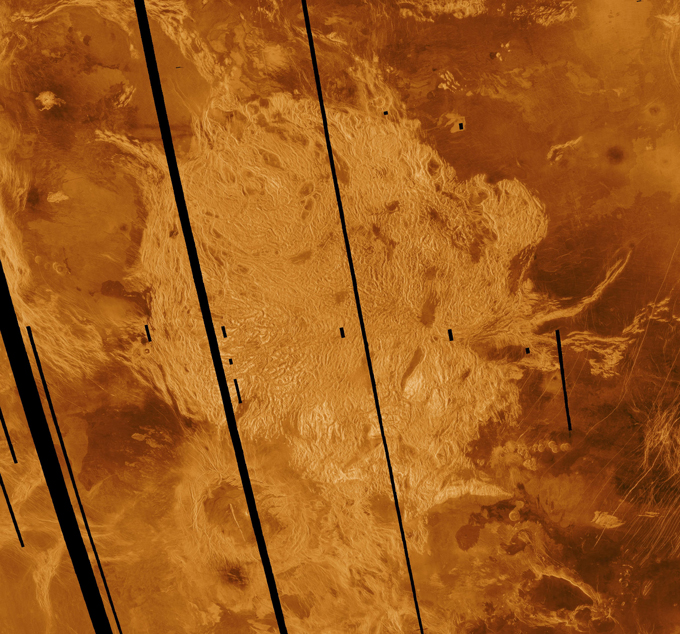
Ridged, folded mountainous terrain on Venus called tessera (bright region in this false-color image from NASA’s Magellan spacecraft) might have formed through long-ago tectonic activity.JPL-CALTECH/NASA
But landing in these areas on Venus could be especially difficult. Unfortunately, the best maps of the planet — from NASA’s Magellan orbiter in the 1990s — can’t tell engineers how steep the slopes are in tessera terrain. Those maps suggest that most are less than 30 degrees, which the lander could handle with four telescoping legs. But some could be up to 60 degrees, leaving the spacecraft vulnerable to toppling over.
“We have a very poor understanding of what the surface is like,” Gilmore said in a talk recorded for the meeting. “What’s the boulder size? What’s the rock size distribution? Is it fluffy?”
So the lander will need some kind of intelligent navigation system to pick out the best places to land and steer there. But that need for steering brings up another problem: Unlike landers on Mars, a Venus lander can’t use small rocket engines to slow down as it descends.
The shape of a rocket is tailored to the density of air that it will push against. That’s why rockets that launch spacecraft from Earth have two sections: one for Earth’s atmosphere and one for the near-vacuum of space. Venus’ atmosphere changes density and pressure so quickly between space and the planet’s surface that “dropping a kilometer would go from the rocket working perfectly, to it’s going to misfire and possibly blow itself apart,” Knicely says.
Instead of rockets, the proposed lander would use fans to push itself around, almost like a submarine, turning the disadvantage of the dense atmosphere into an advantage.
The planet’s atmosphere also presents the biggest challenge of all: seeing the ground. Venus’ dense atmosphere scatters light more than Earth’s or Mars’ does, blurring the view of the surface until the last few kilometers of descent.
Worse, the scattered light makes it seem like illumination is coming from all directions at once, like shining a flashlight into fog. There are no shadows to help show steep slopes or reveal big boulders that the lander could crash into. That’s a major issue, according to Knicely, because all of the existing navigation software assumes that light comes from just one direction.
“If we can’t see the ground, we can’t find out where the safe stuff is,” Knicely says. “And we also can’t find out where the science is.” While proposed solutions to the other challenges of landing on Venus are close to doable, he says, this one remains the biggest hurdle.
Sticking the landing on Europa
Jupiter’s icy moon Europa, on the other hand, has no air to blur the surface or break rockets. A hypothetical future Europa lander, also discussed at the AGU meeting, would be able to use the “sky crane” technique (SN: 8/6/12). That method, in which a platform hovers above the surface using rockets and drops a spacecraft to the ground, was used to land the Curiosity rover on Mars in 2012 and will be used for the Perseverance lander in February 2021.
“The engineers are very excited about not having to deal with an atmosphere on the way down,” said spacecraft engineer Jo Pitesky of NASA’s Jet Propulsion Laboratory in Pasadena, Calif., in a recorded talk for the meeting.
Still, there’s a lot that scientists don’t know about Europa’s surface, which could have implications for any lander that touches down, said planetary scientist Marissa Cameron of the Jet Propulsion Laboratory in another talk.
The best views of the moon’s landscape are from the Galileo orbiter in the 1990s, and the smallest features it could see were half a kilometer across. Some scientists have suggested that Europa could sport jagged ice spikes called penitentes, similar to ice features in the Chilean Andes Mountains that are named for their resemblance to hooded monks with bowed heads — although more recent work shows Europa’s lack of atmosphere should keep penitentes from forming.
Another mission, the Europa Clipper, that’s already underway will take higher-resolution images when the orbiter visits the Jovian moon later this decade, which should help clarify the issue.
In the meantime, scientists and engineers are running elaborate dress rehearsals for a Europa landing, from simulating ices with different chemical compositions in vacuum chambers to dropping a dummy lander named Olaf from a crane to see how it holds up.
“We have a requirement that says the terrain can have any configuration — jagged, potholes, you name it — and we have to be able to conform to that surface and be stable at it,” says John Gallon, an engineer at the Jet Propulsion Laboratory. (The dummy lander was named for his 4-year-old daughter’s favorite character in the movie Frozen.)
Olaf, a scale model of a possible Europa lander, is helping NASA engineers test different strategies for landing on the icy moon of Jupiter. The rover is named for the snowman in the movie Frozen.
Over the last two years, Gallon and colleagues have tested different lander feet, legs and configurations in a lab by suspending the lander from the ceiling like a marionette. That suspension helps simulate Europa’s gravity, which is one-seventh that of Earth’s.
Without much gravity, a massive lander could easily bounce around and damage itself when trying to land. “You’re not going to stick the landing like a gymnast coming off the bars,” Gallon says. His team has tried sticky feet, bowl-shaped feet, springs that compress and push into the surface and legs that lock to help the lander stay put on various terrains. The lander might crouch like a frog or stand stiff like a table, depending on what type of surface it lands on.
Although Olaf is hard at work helping scientists figure out what it will take to build a successful Europa lander, the mission itself, like its Venusian counterpart, remains only on some planetary scientists’ wish lists for now. Meanwhile, other researchers dream about voyages to entirely different worlds, including Saturn’s geyser moon Enceladus.
“Some people will pick favorites,” Cameron says. “I just want to land someplace we’ve never been to that’s not Mars. I’d love that.”
These science claims from 2020 could be big news if confirmed
Findings in need of more proof include potential signs of life on Venus and Earth’s oldest parasites
A report that Venus (shown in a false-color composite image) has phosphine gas — a potential sign of life — in its atmosphere stoked controversy in 2020.
Discoveries about the cosmos and ancient life on Earth tantalized scientists and the public in 2020. But these big claims require more evidence before they can earn a spot in science textbooks.
1. Cloudy with a chance of life
The scorching hellscape next door may be a place to look for life. Telescopes trained on Venus’ clouds spotted traces of phosphine in quantities that suggest something must be actively producing the gas (SN: 9/14/20). On Earth, phosphine is emitted by certain bacteria or industrial processes, leading some astrobiologists to speculate that microbes may be living in Venus’ relatively temperate upper atmosphere. But other research teams’ analyses suggest the phosphine detection was a misread — perhaps the result of a fluke in data processing (SN: 10/28/20).
2. Flashback
For the first time, astronomers may have glimpsed a fast radio burst in the Milky Way. Even more intriguing, the source of the super-bright boost of radio waves appears to be a magnetar — a type of neutron star with an intense magnetic field (SN: 6/4/20). But it’s too soon to claim that magnetars caused any of the dozens of previously detected fast radio bursts, as those flashes came from galaxies too far away to trace the bursts back to a source.
A bright radio burst generated by a magnetar (one illustrated) in the Milky Way suggests that these highly magnetic neutron stars may be responsible for other fast radio bursts previously observed.L. CALÇADA/ESO
3. Totally tubular
Tubes stuck to the outer shells of hundreds of fossilized brachiopods discovered in an outcropping in China may have housed the earliest-known parasites. The clamlike brachiopods lived about 512 million years ago. Researchers speculate that organisms living inside the tubes swiped food from their filter-feeding hosts (SN: 6/2/20). That the tubes were never found alone or on other fossils in the outcropping suggests that the organisms could not survive on their own. But some critics question whether the relationship was truly parasitic, given that the tubed-up brachiopods didn’t seem any worse off than their tube-free counterparts.
Ancient organisms that lived in tubes stuck to clamlike brachiopods (illustrated) may be the earliest known examples of parasites.ZHIFEI ZHANG/NORTHWEST UNIV.
4. Found: ordinary matter
Only about half of the universe’s expected amount of ordinary matter has ever been cataloged. But this year, astronomers claimed that the other half is hiding out in intergalactic space (SN: 5/27/20). That conclusion is based on an analysis of how a small sample of fast radio bursts from other galaxies were distorted by particles on the way to Earth. Before the case of the missing matter can be closed, though, more of these bright blasts of radio waves need to be examined.
Observations of brief, brilliant flashes of radio waves from other galaxies, detected by the Australian Square Kilometre Array Pathfinder (shown), suggest that all of the universe’s “missing” ordinary matter lurks in intergalactic spaceCSIRO, ALEX CHERNEY
5. Start your cosmic engines
A ghostly subatomic particle may have been revved up by a star’s destructive encounter with a black hole. Sensed by the IceCube detector in Antarctica, the neutrino carried 200 trillion electron volts — about 30 times as much energy as that of a proton accelerated by the Large Hadron Collider. Scientists matched the neutrino detection to a flash of light in the sky caused by a black hole shredding a star. The probability of the neutrino and the flash coinciding by chance is just 0.2 percent. If the finding holds up, it would be only the second time a high-energy neutrino has been traced to its source, and the first direct evidence that shredding a star can accelerate neutrinos to high energies (SN: 5/26/20).
A high-energy neutrino may have been born when a black hole ripped apart a star (illustrated).M. WEISS, CXC/NASA
6. On the move
The long-running debate over when humans first traveled to and from the Americas rages on. One group of researchers reported that people arrived to North America more than 15,000 years earlier than generally thought, based on the discovery of roughly 33,000-year-old stone tools unearthed in Mexico (SN: 7/22/20). Some archaeologists, however, doubt that the artifacts are even stone tools and say they instead are just naturally broken rocks.
If confirmed as stone tools, this object and others unearthed in a cave in Mexico suggest humans arrived in North America by at least 33,000 years ago.CIPRIAN ARDELEAN
Another research group reported that Indigenous South Americans crossed thousands of kilometers of open ocean and reached eastern Polynesia more than 800 years ago, not long after settlers from Asia initially colonized the islands (SN: 7/8/20). That conclusion rests on genetic evidence suggesting the intrepid South Americans mated with ancient Polynesians. But some anthropologists question whether early South American groups had the equipment or seafaring skills necessary for the journey. Ancient Polynesians, who were expert navigators, may have traveled to South America, bringing new DNA with them on a return trip home.
Here on the little space rock we call Earth, humans often wonder whether or not we are alone in this universe. Though that question was not answered in 2020, many discoveries seemed to increase the prospect of extraterrestrial entities existing. Findings on the closest planet to us, in the outer solar system and the far beyond seemed to point to the possibility that other worlds could host organisms ranging from bacteria to technological beings. Perhaps, new results in the coming year will finally reveal who else might be out there.
1. Is E.T. phoning us from Proxima Centauri?
(Image credit: CSIRO/A. Cherney)
The answer to weird signals happening in the universe is never aliens, until maybe it is. Earlier this month, researchers announced that they had captured a very mysterious beam of energy in the radio part of the electromagnetic spectrum at 980 megahertz, coming from the closest star to our own. Proxima Centauri, which is just 4.2 light-years away, hosts one gas giant and one rocky world 17% larger than Earth that happens to be in its star's habitable zone, meaning liquid water could exist there. The unexplained signal reportedly shifted slightly while it was being observed, in a way that resembled the shift caused by the movement of a planet. Researchers are excited but cautious, explaining that they will need to figure out if more mundane sources, such as a comet, hydrogen cloud or even human technology, could be mimicking an alien signal, and that it will likely take time before they know one way or another if E.T. is phoning us.
2. Alien bacteria might live in the clouds of Venus
(Image credit: NASA)
Astrobiologists were a-twitter with anticipation and skepticism in September when news broke of potential evidence of life in the upper clouds of Venus. The announcement pointed to the presence of phosphine, a rare and often poisonous gas that, on Earth at least, is almost always associated with living organisms. With its hellish surface temperature, outlandish pressure and sulfuric-acid clouds, Venus has long played second fiddle to the seemingly more potentially habitable Mars. But a team aimed both the James Clerk Maxwell Telescope in Hawaii and the Atacama Large Millimetre/submillimetre Array in Chile at Venus and picked up phosphine's signature in a Venusian cloud layer with downright Earth-like temperatures and pressures. Terrestrial bacteria are known to thrive in some pretty tough conditions, making the biological explanation a not unreasonable one. The research team doesn't claim that it is airtight evidence of space bugs, and many in the community aren't quite convinced, but if nothing else it will mean more funding in the hunt for life in unlikely places.
Two years ago, scientists spotted a cigar-shaped object hurtling through the solar system. Dubbed 'Oumuamua, the entity is considered by most to be an interstellar comet flung out from around another star. But close observations showed that 'Oumuamua was accelerating, as if something were propelling it, and scientists still aren't sure why. Avi Loeb, a Harvard University astrophysicist has proposed that, instead of a comet, the interstellar visitor could have been an alien probe pushed by a lightsail — a wide, millimeter-thin piece of material that accelerates as it's pushed by solar radiation. Other scientists have thrown cold water on Loeb's idea, pointing out that hydrogen ice could have melted off the object in a way that was similar to a rocket engine or other propulsion method. But in August, Loeb fired back, writing in a study stating that hydrogen ice is very easily heated, even in the cold depths of interstellar space, and should have sublimated away before 'Oumuamua reached our system. It seems the debate might go on for a little longer at least.
4. Navy declassifies UFO videos but don't believe the hype
(Image credit: U.S. Navy)
A fair number of Earthlings don't care what ambiguous evidence scientists come up with to show that aliens are out there. They are convinced that we've been visited by technological beings many times, pointing to stories about UFOs and alien encounters (pretty much all of which have been debunked). True believers received a boost in April when the U.S. Navy released footage captured by pilots that showed odd wingless aircraft traveling at hypersonic speed, looking for all intents and purposes like bizarre alien machinery. Despite the existence of such videos, people should still be wary, argued freelance journalist Sarah Scoles in her book "They Are Already Here: UFO Culture and Why We See Saucers" (Pegasus Books, 2020). After deciding to look into the Navy evidence, Scoles was unable to determine if it really showed alien aircrafts. But she found a much more human story by speaking to leaders in contemporary UFO culture and discussing our very basic need to believe in something beyond ourselves.
Ocean worlds, which are classified as those having significant amounts of water on or just beneath their surfaces, are surprisingly common in the solar system. Earth is obviously one such place, but Jupiter's moon Europa is thought to host vast seas under its icy shell and Saturn's moon Enceladus is known to have watery geysers spewing from its exterior. Momentum is in fact building in the astronomy community to send a probe that could land on either satellite sometime in the 2030s and check if any living things might lurk under their shells. As for ocean worlds beyond our sun, in a study released in June, researchers looked at 53 exoplanets similar in size to Earth and analyzed variables including their size, density, orbit, surface temperature, mass and distance from their star. The scientists conclude that, of the 53, roughly a quarter might have the right conditions to be considered ocean worlds, suggesting that such places could be relatively common in the galaxy.
6. Earth bugs breathe hydrogen, maybe aliens do too
(Image credit: Shutterstock)
Most Earthlings require oxygen to survive. But oxygen isn't common in the cosmos, making up about 0.1% of the ordinary mass of the universe. There's far more hydrogen (92%) and helium (7%), and many planets, including gas giants like Jupiter and Saturn, are made mostly from these light elements. In May, scientists took E. coli (a bacteria found in the guts of many animals, including humans) and ordinary yeast (a fungus used to bake bread and make beer) and tried to see if they could live in different environments. Such microbes are already known to survive without oxygen and, when placed in a flask filled with either pure hydrogen or pure helium, they managed to grow, albeit at slower rates than usual. The findings suggest that when searching for organisms elsewhere in the universe, we might want to consider places that don't look exactly like Earth.
When hunting life on other worlds, most scientists stick to what they know — searching for Earth-size worlds orbiting sun-like stars. But far more exotic configurations could exist such as a planet circling around and heated by a black hole. At first glance, such a scenario seems absurd. But, contrary to popular depictions, black holes don't just suck in everything around them. Gravitationally stable orbits are possible and the light from the cosmic background radiation — a relic with temperatures at near absolute zero from the early universe that permeates all of space — would get heated as it fell into the black hole. As a paper released in March showed, this could provide warmth and energy to any organisms that happened to evolve in such a strange location.
As we hunt for beings beyond our planet, it's important to keep in mind that we might not be the only ones doing so. In October, researchers came up with a catalog of 1,004 nearby stars that would be in a good position to detect life on Earth. "If observers were out there searching [from planets orbiting these stars], they would be able to see signs of a biosphere in the atmosphere of our Pale Blue Dot," study lead author Lisa Kaltenegger, an associate professor of astronomy at Cornell and director of the university's Carl Sagan Institute, said in a statement. Using observational tools similar to the transit-timing methods that human astronomers use to study exoplanets, such alien onlookers could hunt for oxygen and water in our atmosphere and perhaps conclude that Earth is a good home for organisms.
Where there's life, there's also death. While we like to imagine that our galaxy is teeming with technological beings capable of contacting us, the flip side is recognizing that all cultures rise and fall, meaning that plenty of cosmic societies likely bit the dust long ago. A model released in December put some numbers to these truths, taking into account such things as the prevalence of sun-like stars hosting Earth-like planets; the frequency of deadly, radiation-blasting supernovas; the time necessary for intelligent life to evolve if conditions are right; and the possible tendency of tool-bearing beings to destroy themselves. The analysis found that the highest probability of life emerging in the Milky Way likely happened around 5.5 billion years ago, before our planet even formed, suggesting that humanity is a relative latecomer to the galaxy and that plenty of our potential otherworldly partners are no longer around to talk to us.
10. We should be open-minded as we search for life elsewhere
(Image credit: NASA/JPL-Caltech)
The human brain has plenty of constraints. We are misled by cognitive biases, optical illusions and inattentional blindness to things we don't expect to see. One question that has always dogged research into alien creatures is whether or not we could recognize life that is so different from what we encounter here on Earth. Scholars have long urged us to expect the unexpected, trying not to let theory too heavily influence what we count as significant. Life on other planets might not leave the same biological signatures as terrestrial organisms, making them difficult to spot from our vantage point. And, as Claire Webb, an anthropology and history of science student at the Massachusetts Institute of Technology, told Live Science in January, we must train ourselves to "make the familiar strange," looking at ourselves through an alien lens in an effort to constantly reexamine our own assumptions. That way, we might be able to better understand ourselves through the eyes of another and perhaps meet creatures on other worlds on their own terms rather than ours.
One charity said: ‘Babies are being born pre-polluted.’
Photograph: Zffoto/Getty Images/iStockphoto
Microplastic particles have been revealed in the placentas of unborn babies for the first time, which the researchers said was “a matter of great concern”.
The health impact of microplastics in the body is as yet unknown. But the scientists said they could carry chemicals that could cause long-term damage or upset the foetus’s developing immune system. The particles are likely to have been consumed or breathed in by the mothers.
The particles were found in the placentas from four healthy women who had normal pregnancies and births. Microplastics were detected on both the foetal and maternal sides of the placenta and in the membrane within which the foetus develops.
A dozen plastic particles were found. Only about 4% of each placenta was analysed, however, suggesting the total number of microplastics was much higher. All the particles analysed were plastics that had been dyed blue, red, orange or pink and may have originally come from packaging, paints or cosmetics and personal care products.
The microplastics were mostly 10 microns in size (0.01mm), meaning they are small enough to be carried in the bloodstream. The particles may have entered the babies’ bodies, but the researchers were unable to assess this.
“It is like having a cyborg baby: no longer composed only of human cells, but a mixture of biological and inorganic entities,” said Antonio Ragusa, director of obstetrics and gynaecology at the San Giovanni Calibita Fatebenefratelli hospital in Rome, and who led the study. “The mothers were shocked.”
In the study, published in the journal Environment International, the researchers concluded: “Due to the crucial role of placenta in supporting the foetus’s development and in acting as an interface with the external environment, the presence of potentially harmful plastic particles is a matter of great concern. Further studies need to be performed to assess if the presence of microplastics may trigger immune responses or may lead to the release of toxic contaminants, resulting in harm.”
The potential effects of microplastics on foetuses include reduced foetal growth, they said. The particles were not found in placentas from two other women in the study, which may be the result of different physiology, diet or lifestyle, the scientists said.
Microplastics pollution has reached every part of the planet, from the summit of Mount Everest to the deepest oceans. People are already known to consume the tiny particles via food and water, and to breathe them in.
Their effect in the body is unknown but scientists say there is an urgent need to assess the issue, particularly for infants. In October, scientists revealed that babies fed formula milk in plastic bottles are swallowing millions of particles a day. In 2019, researchers reported the discovery of air pollution particles on the foetal side of placentas, indicating that unborn babies are also exposed to the dirty air produced by motor traffic and fossil fuel burning.
The Italian researchers used a plastic-free protocol to deliver the babies in order to prevent any contamination of the placentas. Obstetricians and midwives used cotton gloves to assist the women in labour and only cotton towels were used in the delivery room.
Andrew Shennan, professor of obstetrics at King’s College London, told the Daily Mail it was reassuring that the babies in the study had normal births but “it is obviously preferable not to have foreign bodies while the baby is developing”.
Elizabeth Salter Green, at the chemicals charity Chem Trust, said: “Babies are being born pre-polluted. The study was very small but nevertheless flags a very worrying concern.”
A separate recent study showed that nanoparticles of plastic inhaled by pregnant laboratory rats were detected in the liver, lungs, heart, kidney, and brain of their foetuses.
Microplastics ontdekt in placenta's van ongeboren baby's
Voor het eerst zijn microplasticdeeltjes aangetroffen in placenta's van ongeboren baby's. Dat is erg verontrustend en kan de ontwikkeling van de foetus mogelijk schaden, zeggen de wetenschappers in Rome die de ontdekking deden.
De twaalf deeltjes werden gevonden in de placenta's van vier gezonde moeders met een normaal verloop van hun zwangerschap. Omdat slechts vier procent van elke placenta werd onderzocht, ligt het totale aantal microplasticdeeltjes naar verwachting een stuk hoger.
De stukjes plastic verschilden van kleur en waren ongeveer 0,01 millimeter groot, waardoor ze via de bloedbaan vervoerd konden worden. Ze waren onder meer afkomstig van cosmetische producten en verf. De kans is reëel dat de plasticdeeltjes ook in de lichamen van de baby’s werden opgenomen, maar dat konden de onderzoekers niet nagaan.
Wat de impact van microplastic in het lichaam is, is nog onbekend, maar volgens wetenschappers bevatten de deeltjes mogelijk chemicaliën die op lange termijn schade kunnen berokkenen of de ontwikkeling van het immuunsysteem van de baby verstoren. Vermoedelijk kwamen de deeltjes binnen via de ademhaling of spijsvertering van de moeder.
Het is alsof je een cyborgbaby krijgt, die niet langer alleen is samengesteld uit menselijke cellen
Antonio Ragusa
“Het is alsof je een cyborgbaby krijgt, die niet langer alleen is samengesteld uit menselijke cellen, maar uit een combinatie van biologische en anorganische entiteiten", vertelde onderzoeksleider Antonio Ragusa aan The Guardian. “De moeders waren geschokt”, aldus Ragusa, directeur verloskunde en gynaecologie van een ziekenhuis in Rome.
Bij twee andere vrouwen in de studie werden geen microplastics aangetroffen in de placenta. Dat is mogelijk het gevolg van een verschillende lichaamsbouw, dieet of levensstijl, aldus de onderzoekers.
Microplastic wordt op steeds meer plekken aangetroffen, van op de top van de Mount Everest, tot in het diepst van de oceaan. Geweten is dat mensen de minuscule plasticdeeltjes binnenkrijgen via voedsel, water en via de ademhaling. Vorige maand ontdekten wetenschappers van een Ierse universiteit dat baby's die met een plastic fles worden gevoed, dagelijks meer dan een miljoen stukjes microplastic kunnen binnenkrijgen.
I found an alien face and it is important, more important than any other discoveries you can make on Mars. But is it life? Is it fungus? Is it a plant? Is it an animal? No...but NASA has never shown you such things either, but if you have been watching me over the last 15 years...you would already know that I have reported most of those already. A face is a sculpture of the ancient species that once walked this planet...that once owned this planet we call Mars. They lived, concurred and died on this planet. A cycle that we humans are also following. Criticize this face as being ugly, a rock a figment of my imagination, but know this...its fate and yours...is the same in the end. Nothing in the universe can change that. So, lets focus on the positive shall we? We now know the facial appearance of this alien species. Something 30 seconds ago you never knew existed. In just 30 seconds...I changed your whole perspective on life. Imagine what I could do with a full hour.
I found a tower in this old Lunar Orbiter photo today. The tower is about 2.5 km tall. Its probably gone unnoticed so long because it sits on a crater edge in the shadows. The bottom base has six legs supporting it, but only four are viable at this angle. Defiantly proof that a species far more advanced than our own lives on the moon right now. This is why we don't go back and never will. Its occupied and they don't want us inferior species messing up their society and culture. Humans...we do what we want, how we want. It seems futile to aliens to try to change us.
I also found a lot of other things, but will only report a few below. Most people wont have the experience or practice at seeing these things...but any university student in the art department would pick them out without trouble. Or...test yourself, can you see below what I saw? Or...do you see nothing? Its not luck, not a gift, not a curse, just good old practice at my passion. I'm sure your passion is something I probably don't get too. Why am I so good at it? Because I don't require others approval of my discoveries. I already know...without doubt what they are, who possibly has my experience about this that I could possible need their approval? No one exists with such experience. Just me...and I approve.
This day in UFO history: The 1980 UFO Landings In Rendlesham Forest
England holds one of the most compelling UFO landing accounts. In late December 1980, invasion of unidentified flying objects over a period of several nights took place in the joint air bases of Bentwaters and Woodbridge, situated within the vast Rendlesham Forest in late December.
Description of alien beings added to the controversial stories of the twin air bases. The hype took into another level with anomalous radar readings, electromagnetic effects, and surrealistic atmospheric conditions. Professionals, deemed to be credible, have been coming forward revealing their knowledge of the real alien event on the Bentwaters and Woodbridge Air Force Bases.
Uncorrelated object showed on the radar screens at RAF in Norfolk shortly after midnight on December 27, 1980. The thing then suddenly vanished in the area of the Rendlesham Forest in Suffolk. Bentwaters RAF radar also picked up the object.
The bases were allegedly housed a large stockpile of nuclear weapons, and the Woodbridge was the base of the 67th Aerospace Rescue and Recovery Squadron.
The radar operator that night, Mal Scurrah, said that they did not have any idea of what they captured on their radar. They checked the air traffic agencies and found out that there should have been nothing in the vicinity at the time. They sent a jet aircraft to investigate, and the pilot reported seeing a dazzling light in the sky in front of them after getting within about a quarter of a mile.
They saw on radar the object was stationary and it moved off in seconds. In just five minutes the UFO reached 90,000 feet and higher, and they had lost it in the radar scope.
The Woodbridge/Bentwaters started their extraordinary events with the sighting of a massive glowing object by three security guards of the twin bases. They followed the lights into the forest with initial thought that it was a commercial or military aircraft that crash landed.
The patrol was stunned to see a saucer-like craft with small beings with large heads suspended by a type of beam from the bottom of the craft. The beings reportedly performing a repair to their craft unaware of the three men watching their activities.
The guards radioed the base headquarters and requested emergency help. Assistance reportedly arrived headed by senior officers of the base. Later, there would be off record reports that they encountered strange anomalies, such as reality-bending, time displacement, and surreal atmospheric conditions.
Some of the senior officers allegedly communicated with the alien beings.
Called out on the second night of the sightings was then the now famous Colonel Halt. The group of Colonel Halt was reportedly one of the groups to chase the glowing UFO in the forest. He made an audio recording of the details of his trek into the woods.
Patrolmen Jim Penniston, John Burroughs, and Larry Warren later co-wrote a book about the incident, titled Left at East Gate.
Other men who were present during the encounter later revealed that there was an underground theater where soldiers were interrogated, sworn to secrecy and threatened. They also revealed that they were shown several films featuring UFO recoveries around the world. It was also reported that an alien being was there in one of the meetings.
Small objects such as asteroids get trapped for a time in Earth orbit, becoming "minimoons."
Minimoons are typically asteroids, but this one is something else.
The new minimoon may be part of an old rocket from the 1960s.
From time to time, asteroids whizzing past Earth get trapped by our gravitational pull, falling into orbit around the planet. These rocks only stay for a while, eventually escaping and continuing on their journey to who-knows-where. While they're here, they're considered "minimoons."
Astronomers have detected an object that's likely to become our next minimoon. But it's either not an asteroid or it's an odd one. Really, scientists suspect it's man-made tech returning home after many years out in cold, lonely space.
Minimoons
Scientists have confirmed just two prior minimoons. One was 2006 RH120, which orbited us from September 2006 to June 2007. The other was 2020 CD3, which got stuck in the 2015–2016 timeframe, and is believed to gotten away in May 2020.
2020 SO, the new kid on the block, is expected to arrive in October 2020 and pop out of orbit in May 2021.
Identifying 2020 SO
The first clue 2020 SO isn't your ordinary asteroid is its exceptionally low velocity. It's traveling much more slowly that a typical asteroid — their average rate of travelis 18 kilometers (58,000 feet) per second. Even moon rocks sent careening into Earth orbit by impacts on the lunar surface outpace pokey 2020 SO.
For another thing, 2020 SO has an orbital path very similar to Earth's, lasting about one Earth year. It's also just slightly less circular than our own orbit, from which it's barely tilted off-axis.
So, what is it? NASA estimates that the object has dimensions very reminiscent of a discarded Centaur rocket stage from the Surveyor 2 mission that landed an unmanned craft on the moon. Back in the day, rocket stages were jettisoned as craft were aimed toward their desired position. This stuff, if released high enough, remains in space. It appears that this Centaur rocket, launched in September 1966, is now making its way back homeward, at least for a little bit.
When 2020 SO arrives at its closest point in December, the rocket is expected to be about 50,000 kilometers from Earth. Its next closest approach is much further: 220,000 kilometers, in February 2021.
Earthly space programs being as young as they are, scientists would love to know what's happened to our rocket during a half century in space.
While 2020 SO won't get close enough to drop into our atmosphere, its slow progress has scientists hopeful that they'll still get some kind of a decent look at it.
Spectroscopy may be able to reveal what the rocket's surface is like now — has any of its paint survived, for example? Of course, being out in space, it's likely to have been hit by lots of dust and micrometeorites, so the current state of its surfaces is also of interest. Experts are curious to know how reflective the rocket is at this point, valuable information that can help planners of future long-term missions anticipate how well a craft out in space for extended periods will remain able to reflect sunlight.
Eyewitnesses were frightened by the appearance of a Blue Orb over New Hampshire
As you can already tell from the title, this new picture emerged out of nowhere earlier this year on the internet, and ever since it was first uploaded experts have tried to explain its existence.
The picture shows what appears to be a massive blue orb in the sky, protruding through the clouds with its bright luminescence.
The picture was taken from Merrimack, New Hampshire, and through it, experts have tried to explain the fact that aliens are real and that what we’re looking at here is actually a UFO after all.
Since the original photographer wasn’t the biggest fan of conspiracy theories, he decided to contact the NH1 News Station in hopes of getting an answer that would explain his discovery.
However, this plan ended up backfiring as their explanation didn’t make much sense, to say the least. They stated that this was all just a refraction of the light that emerges when the clouds and the Sun are blocking each other at the exact same time.
So, he then switched over to UFO Sightings Hotspot, sending them the exact same picture. They reported that this could only be the result of a lens flare retracted back by a UFO.
They even brought solid proof to back their discovery up in the form of a video that NASA took back on June 11th in which you can see the same UFO lens flare from outer space.
The same lens flare was spotted in Ontario, Canada, and Alta, Utah too. They’re watching us, and that’s a fact.
Some alien life conspiracy theorists suggest a UFO has been captured in footage purportedly filmed on October 1 in Canterbury, New Hampshire. The amateur video apparently shows a shows an odd anomaly sandwiched between two clouds.
IMAGE: ARTISTIC DIAGRAM OF THE SUBSEA AND COASTAL PERMAFROST ECOSYSTEMS, EMPHASIZING GREENHOUSE GAS PRODUCTION AND RELEASE. CREDIT: VICTOR OLEG LESHYK AT NORTHERN ARIZONA UNIVERSITY
New research suggests slow but substantial greenhouse gas release from submarine permafrost
In the far north, the swelling Arctic Ocean inundated vast swaths of coastal tundra and steppe ecosystems. Though the ocean water was only a few degrees above freezing, it started to thaw the permafrost beneath it, exposing billions of tons of organic matter to microbial breakdown. The decomposing organic matter began producing CO2 and CH4, two of the most important greenhouse gases.
Though researchers have been studying degrading subsea permafrost for decades, difficulty collecting measurements and sharing data across international and disciplinary divides have prevented an overall estimate of the amount of carbon and the rate of release. A new study, led by Ph.D. candidate Sara Sayedi and senior researcher Dr. Ben Abbott at Brigham Young University (BYU) published in IOP Publishing journal Environmental Research Letters, sheds light on the subsea permafrost climate feedback, generating the first estimates of circumarctic carbon stocks, greenhouse gas release, and possible future response of the subsea permafrost zone.
Sayedi and an international team of 25 permafrost researchers worked under the coordination of the Permafrost Carbon Network (PCN), which is supported by the U.S. National Science Foundation.
The researchers combined findings from published and unpublished studies to estimate the size of the past and present subsea carbon stock and how much greenhouse gas it might produce over the next three centuries.Using a methodology called expert assessment, which combines multiple, independent plausible values, the researchers estimated that the subsea permafrost region currently traps 60 billion tons of methane and contains 560 billion tons of organic carbon in sediment and soil. For reference, humans have released a total of about 500 billion tons of carbon into the atmosphere since the Industrial Revolution. This makes the subsea permafrost carbon stock a potential giant ecosystem feedback to climate change.”Subsea permafrost is really unique because it is still responding to a dramatic climate transition from more than ten thousand years ago,” Sayedi said. “In some ways, it can give us a peek into the possible response of permafrost that is thawing today because of human activity.”
Estimates from Sayedi’s team suggest that subsea permafrost is already releasing substantial amounts of greenhouse gas. However, this release is mainly due to ancient climate change rather than current human activity. They estimate that subsea permafrost releases approximately 140 million tons of CO2 and 5.3 million tons of CH4 to the atmosphere each year. This is similar in magnitude to the overall greenhouse gas footprint of Spain.
The researchers found that if human-caused climate change continues, the release of CH4 and CO2 from subsea permafrost could increase substantially. However, this response is expected to occur over the next three centuries rather than abruptly. Researchers estimated that the amount of future greenhouse gas release from subsea permafrost depends directly on future human emissions. They found that under a business-as-usual scenario, warming subsea permafrost releases four times more additional CO2 and CH4 compared to when human emissions are reduced to keep warming less than 2°C.
“These results are important because they indicate a substantial but slow climate feedback,” Sayedi explained. “Some coverage of this region has suggested that human emissions could trigger catastrophic release of methane hydrates, but our study suggests a gradual increase over many decades.”
Even if this climate feedback is relatively gradual, the researchers point out that subsea permafrost is not included in any current climate agreements or greenhouse gas targets. Sayedi emphasized that there is still a large amount of uncertainty about subsea permafrost and that additional research is needed.
“Compared to how important subsea permafrost could be for future climate, we know shockingly little about this ecosystem,” Sayedi said. “We need more sediment and soil samples, as well as a better monitoring network to detect when greenhouse gas release responds to current warming and just how quickly this giant pool of carbon will wake from its frozen slumber.”
This research was funded by the U.S. National Science Foundation and by BYU Graduate Studies.
Summary of the key scientific points:
Subsea permafrost has been thawing since the end of the last glacial period (~14,000 years ago) when it began to be inundated by the oceanµ
An international team of 25 permafrost researchers estimate that the subsea permafrost region currently traps 60 billion tons of methane and 560 billion tons of organic carbon in sediment and soil. However, the exact amount of these carbon stocks remains highly uncertain.
This carbon is already being released from the subsea permafrost region, though it remains unclear whether this is a natural response to deglaciation or if anthropogenic warming is accelerating greenhouse gas production and release.
The researchers estimate that currently, the subsea permafrost region releases approximately 140 million tons of CO2 and 5.3 million tons of CH4 to the atmosphere each year. This represents a small fraction of total anthropogenic greenhouse gas emissions–approximately equal to the greenhouse gas footprint of Spain.
Experts predict a gradual increase in emissions from subsea permafrost over the next three hundred years rather than an abrupt release.
The amount of greenhouse gas increase depends on how much human emissions are reduced. Experts estimate that approximately ¾ of the extra subsea emissions can be avoided if humans actively reduce their emissions compared to a no mitigation scenario.
This climate feedback is still virtually absent from climate policy discussions, and more field observations are needed to better predict the future of this system.
Quotes from other co-authors:
“I think there are three important messages from this study. First, subsea permafrost is probably not a climate time bomb on a hair trigger. Second, subsea permafrost is a potentially large climate feedback that needs to be considered in climate negotiations. Third, there is still a huge amount that we don’t know about this system. We really need additional research, including international collaboration across northern countries and research disciplines.”
Dr. Ben Abbott, senior researcher on the project, Brigham Young University
“This work demonstrates the power of science synthesis and networking by bringing together experts across a range of disciplines in order to assess our state of knowledge based on observations and models currently available. While scientific work will continue to be done to test these ideas, bringing knowledge together with this expert assessment provides an important baseline for shaping future research on subsea permafrost greenhouse gas emissions.”
Dr. Ted Schuur, Lead investigator of the Permafrost Carbon Network, Northern Arizona University
“This expert assessment is a crucial contribution to the scientific literature in advancing our knowledge on subsea permafrost and potential greenhouse gas emissions from this so far understudied pool. Bringing together scientists from multiple disciplines, institutions, and countries has made it possible to move beyond individual datapoints or studies providing a much more comprehensive estimate of subsea permafrost. ”
Dr. Christina Schädel, Co-Investigator of the Permafrost Carbon Network, Northern Arizona University
“I hope this study begins to unite the research community in submarine permafrost. Historically, it’s not only been a challenging location to do field work and make observations, but language barriers and other obstacles in accessibility to the existing observations and literature has challenged international scientific progress in this area.
“I’m optimistic that this study will shed light on the fact that submarine permafrost exists, and that people are studying its role in climate,” she said. “The size of the research community doesn’t necessarily reflect its importance in the climate system. The amount of carbon sequestered or associated with submarine permafrost is relevant when you compare it to the numbers of carbon in terrestrial permafrost and what’s in the atmosphere today. This is an example of a very large source of carbon that hasn’t been considered in climate predictions or agreements. And while it’s not a ticking time bomb, what is certain is that the choices we make today that influence anthropogenic climate change will determine the response of submarine permafrost carbon stocks far into the future.”
Dr. Jennifer Frederick, Sandia National laboratories
High resolution versions of the photos and illustrations are available at this link.
'VERGETEN' ONDERZEES PERMAFROST LIJKT EEN ENORME IMPACT OP ONS KLIMAAT TE GAAN HEBBEN
Vivian Lammerse
Het permafrost – dat momenteel nog aan het bijkomen is van het einde van de IJstijd – blijkt veel CO2 en methaan te herbergen.
Tegen het einde van de laatste ijstijd – zo’n 14.000 jaar geleden – overspoelde in het hoge noorden de aanzwellende Noordelijke IJszee grote delen van de kusttoendra. Hoewel het oceaanwater slechts een paar graden boven het vriespunt lag, begon het onderliggende permafrost te dooien. En die dooi is nog steeds gaande. Hierdoor worden er elk jaar miljarden tonnen CO2 en methaan de lucht in gepompt. En ondanks dat dit onderzeese permafrost een enorme impact op ons klimaat lijkt te hebben, is het niet opgenomen in klimaatakkoorden of klimaatdoelen.
Dooi Permafrost is een normaliter permanent bevroren laag aarde. Maar toen het onderzeese permafrost duizenden jaren geleden begon te dooien, werd het organische materiaal blootgesteld aan microbiële afbraak. De ontbindende organische stof begon CO2 en methaan te produceren; twee belangrijke broeikasgassen. Het wegsmelten van het onderzeese permafrost is dus een verontrustend proces. Want al die opgeslagen broeikasgassen worden naar de atmosfeer getransporteerd en leveren zo een belangrijke bijdrage aan de opwarming van de aarde. “Onderzees permafrost is echt uniek, omdat het nog steeds reageert op de klimaattransitie van meer dan tienduizend jaar geleden,” zegt onderzoeker Sara Sayedi. “In sommige opzichten kan het ons een kijkje geven in de mogelijke reactie van permafrost dat vandaag door menselijk toedoen ontdooit.”
Illustratie van het onderzeese permafrost en de manier waarop opgeslagen broeikasgassen vrijkomen.
Afbeelding: Original artwork created for this study by Victor Oleg Leshyk at Northern Arizona University
Hoewel onderzoekers al decennialang de teloorgang van onderzees permafrost bestuderen, is het nog niet zo gemakkelijk om betrouwbare metingen uit te voeren. Hierdoor weten we eigenlijk nog steeds niet precies hoeveel broeikasgassen er tijdens dit proces de lucht in worden gepompt. Ook weten we niet precies hoe snel dit gebeurt. En dus waagde een onderzoeksgroep in een studie, gepubliceerd in het vakblad Environmental Research Letters, opnieuw een poging. De onderzoekers combineerden de bevindingen van verschillende studies om zo de omvang van de onderzeese koolstofvoorraad uit het verleden en in het heden te schatten. Ook bestudeerden ze hoeveel broeikasgassen er nog in de komende drie eeuwen vrij zouden kunnen komen.
Broeikasgassen De resultaten zijn best zorgelijk. Want de onderzoekers schatten dat het sediment en de bodem in het betreffende onderzeese permafrostgebied momenteel zo’n 60 miljard ton methaan en 560 miljard ton CO2 vasthoudt. Voor je beeldvorming, de mensheid heeft sinds de industriële revolutie in totaal ongeveer 500 miljard ton CO2 in de atmosfeer gepompt. Wanneer alle broeikasgassen die het onderzeese permafrost herbergt een weg naar onze atmosfeer weten te vinden, zou dat dus een enorme impact hebben op ons mondiale klimaat.
Geen houden aan De vraag is in hoeverre we het proces nog kunnen stoppen. Want momenteel komt er al veel broeikasgas vrij. De onderzoekers schatten dat het onderzeese permafrost jaarlijks zo’n 140 miljoen ton CO2 en 5,3 miljoen ton methaan de atmosfeer in pompt. Dat is qua omvang vergelijkbaar met de totale uitstoot van Spanje. Maar dat is nog niet het enige. Want de onderzoekers ontdekten dat wanneer de door de mens veroorzaakte klimaatverandering aanhoudt, de afgifte van CO2 en methaan uit het onderzeese permafrost aanzienlijk zou kunnen toenemen. Die toename zal waarschijnlijk heel geleidelijk, verspreid over de komende driehonderd jaar, plaatsvinden.
Mensen De resultaten wijzen erop dat de hoeveelheid toekomstige uitstoot van broeikasgassen door onderzeese permafrost dus rechtstreeks afhangt van onze menselijke emissies. Als we niets doen om klimaatverandering een halt toe te roepen, zal er zo’n vier keer meer CO2 en methaan de atmosfeer weten te bereiken in vergelijking met wanneer de menselijke uitstoot wordt verminderd en de opwarming van de aarde onder de 2 graden Celsius wordt gehouden. Ondanks dat actie dus vereist is, lijken we het probleem van onderzees permafrost een beetje te zijn ‘vergeten’. Want geen enkel klimaatakkoord of klimaatdoel rept over dit onderzeese permafrost en de mogelijk grote bijdrage van de dooi aan de opwarming van de aarde.
Volgens de onderzoekers is het erg belangrijk dat we meer over dit onderzeese permafrost te weten komen. “Vergeleken met hoe belangrijk het zou kunnen zijn voor ons toekomstige klimaat, weten we eigenlijk schrikbarend weinig over dit ecosysteem,” concludeert Sayedi. “We hebben meer sediment- en bodemmonsters nodig, evenals betere metingen. Op die manier kunnen we begrijpen hoe de uitstoot van broeikasgassen reageert op de huidige opwarming en hoe snel deze gigantische opbergplaats van koolstof uit zijn bevroren slaap ontwaakt.”
BEVERS
Niet alleen onderzees permafrost dooit, ook het Noordpoolgebied wordt geteisterd door smeltend permafrost. En dat ligt niet alleen aan extreem weer. Zo blijkt uit een nieuwe studie dat ook bevers een vinger in de pap hebben. Hoe? Gewapend met hun scherpe tanden bouwen de bevers van struiken en bomen dammen, waardoor er kleine poeltjes ontstaan die uitgroeien tot nieuwe meren die soms wel een paar hectare omvatten. En dat gaat rap. In slechts vijf jaar tijd hebben bevers woonachtig in noordwest-Alaska 56 nieuwe meren gecreëerd. Ook al bestaande meren dijen door toedoen van de bever uit. En dat gaat ten koste van kwetsbaar permafrost. Het water is namelijk warmer dan de omringende grond. En dus kunnen deze meren en vijvers de dooi van permafrost versnellen. Meer weten? Lees hier verder!
They discover a 12 KM “WALL” with Paintings from 12,500 YEARS AGO in the Amazon Rainforest
These are tens of thousands of cave paintings made in the middle of the Ice Age along a cliff 12,500 years ago. They show various scenes of people and animals.
One of the largest collections of prehistoric rock art in the world has been discovered in the Amazon rainforest. Called the “Sistine Chapel of the ancients,” archaeologists have found tens of thousands of paintings of animals and humans created up to 12,500 years ago on cliffs that stretch for more than 12 kilometers in Colombia.
His date is based in part on his depictions of now-extinct Ice Age animals, such as the mastodon, a prehistoric relative of the elephant that has not roamed South America for at least 12,000 years. There are also images of the paleolama , an extinct camelid, as well as giant sloths and horses from the Ice Age.
These animals were seen and painted by some of the first humans to reach the Amazon . His images give a glimpse of an ancient lost civilization. Such is the magnitude of the paintings that it will take generations to study them.
The discovery was made last year, but has been kept under wraps until now, as it was filmed for a major Channel 4 series that will screen in December: Jungle Mystery: Lost Kingdoms of the Amazon .
The site is located in the Serranía de la Lindosa where, along with the Chiribiquete National Park, additional rock art has been found. The host of the documentary, Ella Al-Shamahi , an archaeologist and explorer, told Observer:
“The new site is so new they haven’t even given it a name.”
Al-Shamahi referred to the thrill of seeing “impressive” images that were created thousands of years ago.
Ella Al-Shamahi, explorer, paleoanthropologist, evolutionary biologist, and comedian.
Credit: National Geographic Society
The discovery was made by a British-Colombian team, funded by the European Research Council . Its leader is José Iriarte, a professor of archeology at Exeter University and a leading expert on Amazonian and pre-Columbian history.
Al-Shamahi said:
“When you are there, your emotions flow… We are talking about several tens of thousands of paintings. It will take generations to record them… Every turn you make is a new wall of paintings. We start to see animals that are now extinct. The images are so natural and well done that we have little doubt that you are looking at a horse, for example. The ice age horse had a wild and heavy face. It is so detailed that we can even see horse hair. It is fascinating.”
The images include fish, turtles, lizards and birds, as well as people dancing and holding hands, among other scenes. One figure wears a mask that resembles a bird with a beak.
The site is so remote that, after a two-hour drive from San José del Guaviare , a team of archaeologists and filmmakers walked for about four hours.
Somehow they avoided the most dangerous animals in the region. “Alligators are everywhere, and we were on the lookout for snakes,” Al-Shamahi said.
As the documentary points out, Colombia is a land torn apart after 50 years of civil war between the FARC guerrillas and the Colombian government, now with an uncomfortable truce. The territory where the paintings have been discovered was completely off-limits until recently and still requires careful negotiation to enter safely.
Al-Shamahi said in a statement:
“When we entered the FARC territory, it was exactly how some of us have been shouting for a long time. The exploration is not over. Scientific discovery is not over, but great discoveries will now be found in disputed or hostile places. “
Paintings of various sizes and at great height
The paintings vary in size. There are numerous handprints and many of the images are on that scale, be they geometric, animal or human shapes. Others are much larger.
Al-Shamahi was surprised by how tall many of them are: “I am 1.64 cm tall and I had to bend my neck a lot to look up. How did they climb those walls?
Some of the paintings are so tall that they can only be seen with drones.
Iriarte believes the answer lies in the representations of wooden towers among the paintings, including figures that appear to bungee jump from them.
Iriarte said:
“These paintings have a reddish terracotta color. We also found pieces of ocher that they scraped to make them ”.
Speculating on whether the paintings had a sacred or other purpose, he said: “It is interesting to see that many of these large animals appear surrounded by small men with their arms raised, almost worshiping these animals.”
Noting that the images include hallucinogenic trees and plants, he added: “For the Amazonian peoples, non-humans, like animals and plants, have souls, and they communicate and relate to people in a cooperative or hostile way. through the rituals and shamanic practices that we see represented. in rock art ».
Al-Shamahi said:
“One of the most fascinating things was seeing the megafauna from the Ice Age because it is an indicator of time. I don’t think people realize that the Amazon has changed in appearance. It has not always been this rainforest. When you look at a horse or a mastodon in these paintings, of course they were not going to live in a forest. They’re too big. Not only are they giving clues as to when they were painted by some of the first people, which in itself is just mind-boggling, but they are also giving clues as to what this very place could have been like: more like a savanna. “
Iriarte believes that there are still many other paintings to discover: “We are only scratching the surface,” he said. The team plans to return as soon as the pandemic allows.
There is no doubt that the Amazon hides a huge ancient treasure left by very little documented civilizations, which lived in an environment very different from what we see today in the jungle of this part of the world.
Top Image: Tens of thousands of ancient paintings were found on a wall that spans more than 12 kilometers. Credit: Ella Al-Shamahi
The International Space Station captures a huge alien spacecraft hidden in the clouds
Experts have been warning us for some time: we should reconsider the search for life on other worlds. It would be the greatest discovery in history, but that does not mean that we can control it biologically, epidemiologically, and most importantly, emotionally. We are currently in a global panic over what is, in some respects, a strange way of life: the SARS-CoV-2 virus , which causes the disease known as COVID-19 .
At the time of writing, there are over two and a half million confirmed cases worldwide, in 68 countries, leading to more than 174,000 deaths. Flights have been canceled, international trade agreements canceled, the Tokyo Olympics will be held in 2021, and we will experience the greatest recession since the Great Depression of 1929. Humanity as a whole is suffering from the effects of the pandemic.And last but not least, the countries point to each other, especially to China because they are to blame for the spread. We are told that COVID-19 is a completely terrestrial virus, whether natural or artificial, but there is another possibility: that it is a weapon of extraterrestrial origin and prelude to a silent invasion. And for those who think that it is a theory without foundation, there is evidence that would show that it is already happening.
Huge alien ship
An amazing image from the International Space Station (ISS) shows a huge cloud with a strange shape on Earth , which many have compared to the iconic Millennium Falcon from Star Wars. According to the Daily Star, a woman named Annie, who was watching a live broadcast of the ISS, saw something that caught her eye. In the image, clouds in question appear to form a perfect circle over the west coast of Africa. The images were shared by the popular YouTube channel MrMBB333, which specializes in science and space.
“On the west coast of Africa, we have a large, what appears to be, a Millennium Falcon , “ said MrMBB333.“The outline of that cloud is not random, the rest of the clouds around it are seen at random, but it looks like a version of the Millennium Falcon. It’s an almost perfect match, a great observation from Annie. “A lot of people notice some very extraordinary things about the ISS live camera and this is one of them.”
The video has gone viral on social media since it was posted on YouTube on April 17. And there were many who wanted to comment on the anomaly. Some highlighted the fact that the shape was eerily similar to the Millennium Falcon and even the Independence Day mothership . This led conspiracy theorists to suggest that the images are new evidence that the coronavirus pandemic is the prelude to an impending extraterrestrial invasion.
Alien invasion?
These images would be new evidence of the presence of alien spacecraft on our planet. Remember that at the beginning of the month we published a video that showed hundreds of lights in formation approaching Earth . We thought they were satellites or meteorites, but after a few minutes they disappeared as if they had never existed. To this we must add how in recent weeks strange blue lights have been recorded and photographed in the skies around the world.
For example, in Madrid, Spain, several people saw clouds at night that turned blue over buildings. The mysterious light stayed in the clouds for more than seven minutes, then disappeared. And even on a beach in Barcelona, Spain, a strange blue light in the sky during a lightning storm transformed into what appeared to be a giant UFO.
These are just some evidences that we are facing an imminent alien invasion . And science also warned us that this scenario could happen. Physicist Stephen Hawking has repeatedly said that an encounter between civilizations could have catastrophic consequences for humans. The physicist predicted that something similar could happen to what happened when Europeans arrived in America in the 15th century : they destroyed and massacred indigenous populations.
And if these extraterrestrial civilizations are able to travel to Earth, it means that they are more advanced than humans and have developed technologies unknown to us. Now, we will have to know what they want from us, annihilate us, enslave us, or feed on us.
What do you think about the image of the International Space Station? Alien ship? Or do you have another explanation?
The Passage to the Underworld found under the pyramid of the Moon in Teotihuacán
Underground world in Teotihuacán:
Mexican archaeologists map a cave located 8 meters deep under the Pyramid of the Moon.
They also found access tunnels to that cave and they realized that the pyramid was built on the basis of that cave , being the first structure to be built in Teotihuacán. This latest study confirms that the three pyramids have a similar network of tunnels and caverns below that represent the underworld .
This was an investigation carried out by archaeologists from the National Institute of Anthropology and History of Mexico (INAH) and geologists from the Institute of Geophysics of UNAM (National Autonomous University of Mexico). The current study confirms findings from 2017 and 2018.
Cave and tunnels under the Pyramid of the Moon
Teotihuacán is located in the Valley of Mexico and was built by an unknown civilization . The three main pyramids were temples used for ceremonies dedicated to pre-Columbian gods .
The Pyramid of the Sun is the main one, at 65 meters high , while the Pyramid of the Moon is the second highest, at 43 meters . This second pyramid is thought to have been built on top of seven layers of structures, from AD 100 to AD 450 .
The cavity discovered under the Pyramid of the Moon is 15 meters in diameter and includes a tunnel located 8 meters deep . But it is very possible that there are more tunnels. The investigative techniques were non-invasive geophysics (ANT and ERT) , which managed to detect the vacuum of the underground cavity.
Geophysicists identified this cave in 2017 , through an Electrical Resistivity Tomography (ERT). Previous studies also revealed the presence of other man-made tunnels under the Pyramid of the Moon , as well as passageways and caves under the Pyramid of the Sun and the Pyramid of the Feathered Serpent .
This cave was used as the nucleus for all of Teotihuacán
For 30 years, it has been believed that this cave “of the Moon” is natural and that its pre-Columbian architects must have used this underground world to lay the foundation, trace and build the entire city of Teotihuacán . The cave was the starting point.
Another aspect that points to this urban project is in building 1, the first base part of the Pyramid of the Moon , and “the oldest known Teotihuacan monument . ” It was built between 100 BC. C. and 50 d. C., being prior to all other buildings in the city.
Workers removing dirt in a tunnel under the Pyramid of the Feathered Serpent, Teotihuacán. Credit: Janet Jarman. That first stage of construction began at the front of the pyramid … And it was expanded, until it formed the current structure and covered the entire underground cave . Additionally, the Pyramid of the Moon is located on the central line of Teotihuacán , at the end of the extensive Calzada de los Muertos , the backbone of the entire city … There we note its importance.
The meaning of the three pyramids of Teotihuacán is mysterious, but this new discovery of the cave under the Pyramid of the Moon completes the trilogy of underground passages in the three buildings. That is why it is theorized that the construction culture wanted to emulate the mythological underworld under the Earth and worship the world of the dead.
A UFO came within 20ft feet of colliding with a packed passenger plane.
The terrifyingly close call occurred on October 16 moments after the Airbus A321 had taken off from London's Heathrow airport.
A UFO came within 20ft feet of colliding with an Airbus A321 back in OctoberCredit: Alamy
The plane had just taken off from London's Heathrow airport
Credit: Getty Images - Getty
The unidentifiable object - 3,000ft high - was spotted just six metres away from the left wing of the plane.
Safety regulators the UK Airprox Board classed the near-miss as 'category A' - meaning there was a serious risk of collision.
It is thought the bright red object could have been a drone but the pilots were unable to be certain.
The Airprox report concluded: "The Board considered that the pilot’s overall account of the incident portrayed a situation where providence had played a major part in the incident and/or a definite risk of collision had existed."
The scare in the skies was the latest in a string of near-misses.
In September, an unknown object - thought to be a drone - came within seconds of colliding with another flight.
The same month, a drone came three feet away from striking an Easyjet flight which had taken off from Manchester Airport.
The Airbus A320, carrying 186 passengers, was 8,000ft over Greater Manchester which it came perilously close to the drone - flying 20 times above the legal height.
Pilots are reporting two near-misses a week - with more than 400 incidents in the past five years.
The scare in the skies was the latest in a string of near misses - including that of an unknown object and a Boeing 737 back in SeptemberCredit: Getty Images - Getty
UFO Over Mexico City, Mexico On Dec 20, 2020, UFO Sighting News.
Date of sighting: Dec 20, 2020 Location of sighting: Mexico City, Mexico
Mexico is a hotbed of UFO activity year round. I have long believed that the ancient Aztecs, Incas and Mayans were all planted on earth by aliens...or they may have willingly planted themselves here abandoning all the technology of the future do to it stealing away the fun of life. Thats what technology does...it takes away our humanity and makes us more like it and less like humans. Until one day, we abandon this body of ours for a more technologically advanced and eternal mechanical robot body. Technology is not without its little surprises here and there.
With the high speed UFO caught over Parker Dam, Arizona last week, still in mind, now another similar UFO has been videotaped from an Autel EVO drone across the Magnetic Hill Golf Course in Moncton, New Brunswick in Canada.
Orville Harris who captured the UFO, also called Fastwalker last July - 2020: "This being the second UFO I video taped from a drone I was amazed just how similar they looked and the speed they were travelling."
“Fastwalker” is a term used by NORAD and branches of armed forces to describe unidentified aerial phenomena moving and/or changing directions at high speed far beyond what current aerospace technology is capable of.
Twitter users ask Bob Lazar questions about alien pictures, why they visit, and Element 115
Bob Lazar and Jeremy Corbell answer you questions, including describing what the alien being looked like that Bob saw a picture of, what the aliens looks like, and the size of the spacecrafts housed at Area 51.
According to new data, our moon has a lot more craters than previously thought. In fact, a total of 109,956 newly discovered craters have been located in the low and middle latitude areas of the moon.
They were found by artificial intelligence that was given data obtained by Chinese lunar orbiters. The researchers uploaded the data with thousands of craters that have already been detected and trained the algorithm to locate new ones. They used data collected from the Chang’e 1 and Chang’e 2 lunar orbiters.
In an email to Live Science, Chen Yang, who is an associate professor of Earth sciences at Jilin University in China and the lead author of the study, stated, “It is the largest lunar crater database with automatic extraction for the mid and low-latitude regions of the moon.”
The majority of the craters were classified as being small to medium in size, ranging from 0.6 miles to 60 miles in diameter. As for the few large craters that were discovered, some of them had a diameter that measured as much as 341 miles.
As for when they were created, the algorithm that was used by the scientists was able to estimate that they occurred during all five of the moon’s lunar geological periods with some of them dating as far back as 4 billion years. The five lunar geological periods are the Copernican, Eratosthenian, Imbrian (Late and Early epochs), Nectarian, and Pre-Nectarian.
Yang described the craters as being like “fossils” that “record the history of the Solar System” from when meteors impacted the moon. Since the shape and size of the craters are all different and unique, with some of them overlapping and eroding as time goes on, detecting new ones is a very difficult process that requires a lot of time and patience.
Eventually, the team is planning to upload new data from the Chang’e 5 lander to their crater-spotting algorithm. They even want to use their technique to study other places in the Solar System like Mars. The researchers wrote in part, “This prediction will generally take minutes followed by a few hours of post-processing on standard computation hardware.” Their research was published in the journal Nature Communications where it can be read in full.
Several images of where the newly discovered lunar craters are located can be seen here.
New craters found from the pre-Nectarian System which are over 3.92 billion years old (Image credit: Chen Yang et al. /doi:10.1038/s41467-020-20215-y.)
New craters found from the Nectarian System, 3.92 - 3.85 billion years old (Image credit: Chen Yang et al. /doi:10.1038/s41467-020-20215-y.)
New craters found from from the Imbrian System, 3.85 - 3.2 billion years old (Image credit: Chen Yang et al. /doi:10.1038/s41467-020-20215-y.)
New craters found from the Eratosthenian System, 3.2 - 1.1 billion years old (Image credit: Chen Yang et al. /doi:10.1038/s41467-020-20215-y.)
New craters discovered from the Copernican System, younger than 1.1 billion years old
(Image credit: Chen Yang et al. /doi:10.1038/s41467-020-20215-y.)
President Eisenhower’s Meeting with ET’s at Edwards AFB
COAST TO COAST AM – Author and researcher Paul Blake Smith talked about his latest work examining the claim that President Eisenhower secretly met with aliens at an Air Force base. Smith also presented details of his investigation into the crash of a UFO just outside of Cape Girardeau, Missouri in 1941). In February 1954, President Dwight Eisenhower flew to Palm Springs, CA for a golfing trip (considered odd since it was so far from Washington DC).
While there, his whereabouts were not officially recorded for one evening, and according to a report of a witness, a pilot, who came forward in the 1980s, Eisenhower went to nearby Edwards AFB. Smith recounted the report: They stood at the edge of an open-air hangar, and on the runway were five spaceships– three circular, and two elongated.
Alien Contact Disclosure Revelations… from ‘Greys’ to ‘Blues’ to MIB
COAST TO COAST AM – Contactee and spiritual counselor Sev Tok began communications with what she believes to be the Greys starting at age ten. In the latter half, she spoke about the nature of her ET experiences, which have run the gamut from beautiful to terrifying. In some of her contacts, she explained, she is transported to a multi-dimensional or interdimensional location– one time, she sensed that she was actually on the Moon.
In two instances, her body had physical evidence of contact, with red “X” marks burned on her back. By coming to terms and being honest about these experiences, she was able to transform her life. . For more, check out Sev Tok’s YouTube channel, Alien Spirit TV.
Space Force Announces the Guardians! What Are They Guarding?
Space Force Announces the Guardians! What Are They Guarding?
Space Force aims to have about 2,500 members in space operations career fields by the end of calendar year 2020. It’s on track to have around 6,500 members by the end of the 2021 fiscal year on Sept. 30, 2021. On Dec. 20, Vice President Mike Pence announced that members of the Space Force will be known as guardians.
About The Marfoogle Network: Does your family think you are nuts? If so, then you probably belong here! The Marfoogle Network is a safe place to share your views and opinions about anything from the D**P State to aliens! Make yourself at home and meet like-minded friends.
Two huge cigar-shaped UFOs hovering above Orange County, CA 23-Dec-2020
These two huge & bright cigar-shaped unidentified flying objects were hovering in the sky above Orange County, a region in Southern California. This happened on early morning on 23rd December 2020.
Fluvial Mapping of Mars - 8 Trillion Pixel Image 18 Years in the Making
it took fifteen years of imaging and nearly three years of stitching the pieces together to create the largest image ever made, the 8-trillion-pixel mosaic of Mars’ surface. Now, the first study to utilize the image in its entirety provides unprecedented insight into the ancient river systems that once covered the expansive plains in the planet’s southern hemisphere. These three billion-year-old sedimentary rocks, like those in Earth’s geologic record, could prove valuable targets for future exploration of past climates and tectonics on Mars.(A) A suite of ridges on Mars (at –67.64°E, 43.37°S). To determine whether features are ridges or valleys, the researchers rely on lighting in the impact craters (depressions). Based on the craters, the light is coming from the top of the image. Because the fluvial ridges are casting shadows to the south, they can infer that the feature is sticking up from the surface—a ridge rather than a valley.
Image courtesy J. Dickson.
The work, published this month in Geology, complements existing research into Mars’ hydrologic history by mapping ancient fluvial (river) ridges, which are essentially the inverse of a riverbed. “If you have a river channel, that’s the erosion part of a river. So, by definition, there aren’t any deposits there for you to study,” Jay Dickson, lead author on the paper, explains. “You have rivers eroding rocks, so where did those rocks go? These ridges are the other half of the puzzle.” Using the mosaic, as opposed to more localized imagery, let the researchers solve that puzzle on a global scale.
Mars used to be a wet world, as evidenced by rock records of lakes, rivers, and glaciers. The river ridges were formed between 4 and 3 billion years ago, when large, flat-lying rivers deposited sediments in their channels (rather than only having the water cut away at the surface). Similar systems today can be found in places like southern Utah and Death Valley in the U.S., and the Atacama Desert in Chile. Over time, sediment built up in the channels; once the water dried up, those ridges were all that was left of some rivers.
(B) A similar “analogue” environment on Earth. Fluvial ridges similar to the ones on Mars are in California’s Amargosa river system, although with water still running through the system, it’s the active precursor to the ridges that are remnant on Mars.
Image courtesy J. Dickson.
The ridges are present only in the southern hemisphere, where some of Mars’ oldest and most rugged terrain is, but this pattern is likely a preservation artifact. “These ridges probably used to be all over the entire planet, but subsequent processes have buried them or eroded them away,” Dickson says. “The northern hemisphere is very smooth because it’s been resurfaced, primarily by lava flows.” Additionally, the southern highlands are “some of the flattest surfaces in the solar system,” says Woodward Fischer, who was involved in this work. That exceptional flatness made for good sedimentary deposition, allowing the creation of the records being studied today.
Whether or not a region has fluvial ridges is a basic observation that wasn’t possible until this high-resolution image of the planet’s surface was assembled. Each of the 8 trillion pixels represents 5 to 6 square meters, and coverage is nearly 100 percent, thanks to the “spectacular engineering” of NASA’s context camera that has allowed it to operate continuously for well over a decade. An earlier attempt to map these ridges was published in 2007 by Rebecca Williams, a co-author on the new study, but that work was limited by imagery coverage and quality.
“The first inventory of fluvial ridges using meter-scale images was conducted on data acquired between 1997 and 2006,” Williams says. “These image strips sampled the planet and provided tantalizing snapshots of the surface, but there was lingering uncertainty about missing fluvial ridges in the data gaps.”
The resolution and coverage of Mars’ surface in the mosaic has eliminated much of the team’s uncertainty, filling in gaps and providing context for the features. The mosaic allows researchers to explore questions at global scales, rather than being limited to patchier, localized studies and extrapolating results to the whole hemisphere. Much previous research on Mars hydrology has been limited to craters or single systems, where both the sediment source and destination are known. That’s useful, but more context is better in order to really understand a planet’s environmental history and to be more certain in how an individual feature formed.
In addition to identifying 18 new fluvial ridges, using the mosaic image allowed the team to re-examine features that had previously been identified as fluvial ridges. Upon closer inspection, some weren’t formed by rivers after all, but rather lava flows or glaciers. “If you only see a small part of [a ridge], you might have an idea of how it formed,” Dickson says. “But then you see it in a larger context—like, oh, it’s the flank of a volcano, it’s a lava flow. So now we can more confidently determine which are fluvial ridges, versus ridges formed by other processes.”
Now that we have a global understanding of the distribution of ancient rivers on Mars, future explorations—whether by rover or by astronauts—could use these rock records to investigate what past climates and tectonics were like. “One of the biggest breakthroughs in the last twenty years is the recognition that Mars has a sedimentary record, which means we’re not limited to studying the planet today,” Fischer says. “We can ask questions about its history.” And in doing so, he says, we learn not only about a single planet’s past, but also find “truths about how planets evolved… and why the Earth is habitable.”
As this study is only the first to use the full mosaic, Dickson looks forward to seeing how it gets put to use next. “We expect to see more and more studies, similar in scale to what we’re doing here, by other researchers around the world,” he says. “We hope that this ‘maiden voyage’ scientific study sets an example for the scale of science that can be done with a product this big.”
Contacts and sources:
Kea Giles / by Rebecca Dzombak Geological Society of America
A sky-watcher was taking some evening shots of the moon with a Nikon P900 on December 20, 2020 at 4.52 pm when a large red UFO comes into view from the left side on which the UFO then crosses the moon until it disappears into space.
While crossing the moon the UFO casts its shadow on the lunar surface indicates that it is not something that flies close to the camera, but that it does indeed fly just above the surface of the moon.
The first clip is the close-up, and the second is the original version.
4 Mile Cross Under Ocean Near Macquarie Island, Google Earth Map, UFO Sighting News.
Date of discovery: Dec 23, 2020 Location of sighting: off Macquarie Island
I was using Google Earth Map and I found something really intersting off Macquarie Island. There is a huge cross structure under the ocean there and each line measures the same. It is 4 miles across end to end on both arms. Thats about 7km long! Also not far is another area...a huge 1.5 mile across rectangle opening below a 1 mile bridge on the ocean floor. This opening is for larger UFOs to come down and enter the tunnels to reach the underground base. Yes the base is not on the ocean floor, but more current bases have moved 4-6km below the floor. This way the bases are safe from human detection...however...I did discover the cross and entrance there...so I guess I'm breaking human stereotypes.
Blue UFO Over Bella Vista, Arkansas On Dec 22, 2020, UFO Sighting News.
Date of sighting: Dec 22, 2020 Location of sighting: Bella Vista, Arkansas, USA
Source: MUFON
Listen to the surprise in the voices of the man and woman as they watch some glowing purple lights in the sky in Arkansas two days ago. The lights change and it almost look like several round UFOs sit side by side with a line of about six or more. I have to admit the enlarged screenshot I made above really has me baffled. I use to work on B1 bombers on a high security Strategic Air Command Base...but have never ever seen anything like that. This is not made by humans.
Meer van UFO'S of UAP'S, ASTRONOMIE, RUIMTEVAART, ARCHEOLOGIE, OUDHEIDKUNDE, SF-SNUFJES EN ANDERE ESOTERISCHE WETENSCHAPPEN - DE ALLERLAATSTE NIEUWTJES


 Israel’s Former Space Security Chief Claims Aliens Exist, And Trump Knows