Ontdek de Fascinerende Wereld van UFO's en UAP's: Jouw Bron voor Onthullende Informatie!
Ben jij ook gefascineerd door het onbekende? Wil je meer weten over UFO's en UAP's, niet alleen in België, maar over de hele wereld? Dan ben je op de juiste plek!
België: Het Kloppend Hart van UFO-onderzoek
In België is BUFON (Belgisch UFO-Netwerk) dé autoriteit op het gebied van UFO-onderzoek. Voor betrouwbare en objectieve informatie over deze intrigerende fenomenen, bezoek je zeker onze Facebook-pagina en deze blog. Maar dat is nog niet alles! Ontdek ook het Belgisch UFO-meldpunt en Caelestia, twee organisaties die diepgaand onderzoek verrichten, al zijn ze soms kritisch of sceptisch.
Nederland: Een Schat aan Informatie
Voor onze Nederlandse buren is er de schitterende website www.ufowijzer.nl, beheerd door Paul Harmans. Deze site biedt een schat aan informatie en artikelen die je niet wilt missen!
Internationaal: MUFON - De Wereldwijde Autoriteit
Neem ook een kijkje bij MUFON (Mutual UFO Network Inc.), een gerenommeerde Amerikaanse UFO-vereniging met afdelingen in de VS en wereldwijd. MUFON is toegewijd aan de wetenschappelijke en analytische studie van het UFO-fenomeen, en hun maandelijkse tijdschrift, The MUFON UFO-Journal, is een must-read voor elke UFO-enthousiasteling. Bezoek hun website op www.mufon.com voor meer informatie.
Samenwerking en Toekomstvisie
Sinds 1 februari 2020 is Pieter niet alleen ex-president van BUFON, maar ook de voormalige nationale directeur van MUFON in Vlaanderen en Nederland. Dit creëert een sterke samenwerking met de Franse MUFON Reseau MUFON/EUROP, wat ons in staat stelt om nog meer waardevolle inzichten te delen.
Let op: Nepprofielen en Nieuwe Groeperingen
Pas op voor een nieuwe groepering die zich ook BUFON noemt, maar geen enkele connectie heeft met onze gevestigde organisatie. Hoewel zij de naam geregistreerd hebben, kunnen ze het rijke verleden en de expertise van onze groep niet evenaren. We wensen hen veel succes, maar we blijven de autoriteit in UFO-onderzoek!
Blijf Op De Hoogte!
Wil jij de laatste nieuwtjes over UFO's, ruimtevaart, archeologie, en meer? Volg ons dan en duik samen met ons in de fascinerende wereld van het onbekende! Sluit je aan bij de gemeenschap van nieuwsgierige geesten die net als jij verlangen naar antwoorden en avonturen in de sterren!
Heb je vragen of wil je meer weten? Aarzel dan niet om contact met ons op te nemen! Samen ontrafelen we het mysterie van de lucht en daarbuiten.
1,900 pages of ‘UFO files’ are declassified in Spain
The Ministry of Defense of Spain has declassified a total of 80 reports of 1,900 pages of ‘UFO files’. The first case took place in 1962 in San Javier, Murcia, and the last occurred in 1995 in Morón, Seville.
RELATED VIDEOS ABOUT DECLASSIFIED UFO-FILES, selected and posted by peter2011
There has been a recent increase in media attention to reports of witnesses to UFO sightings who went on to later report a variety of other paranormal activities in their lives. These events run the gamut from reports of alien beings to orbs of light or even ghosts. Perhaps more disturbingly, the events were not restricted to the locations where the UFO sightings took place. Sometimes the phenomena would follow them to their homes or even their workplaces, impacting their families, friends or even coworkers. These types of events have been described as encounters with paranormal "hitchhikers."
The most recent and popularly cites instances emerged from the latest books and documentary series describing the events at Skinwalker Ranch, in Utah. Researchers who have visited the ranch and observed anomalous craft in the skies and other phenomena have reported returning home and dealing with even stranger experiences. These range from the merely curious, such as odd failures of automobiles or electronic devices to one person whose family saw werewolves in their backyard.
It's not just researchers and scientists who are impacted. British musician and television host Robbie Wiliams visited the ranch as part of a television production. He later confessed that he is now frightened that he might be "taken over" by a hitchhiking alien or some other type of entity. These reports appear too numerous to write off as simple paranoia or delusions.
But similar stories are not limited to the modern era and one enigmatic ranch in the American West. They've been reported from many parts of the world dating back to times long before the world heard of Skinwalker Ranch. Ace Frehley, the original lead guitarist for the band Kiss, confessed during an interview that he had seen multiple unidentified flying objects, including at least one that was "tube-shaped" and another that landed in the yard behind his house, leaving scorch marks in the grass. The weirdness didn't stop there, however. He later began seeing ghosts, going so far as to say that one of them had "punched him in the face."
In 2000, a man named Stan Romanek from Denver, Colorado observed an inexplicable craft in the skies and even managed to catch it on film. It wouldn't be the last time and he went to so see a variety of craft or orbs flying overhead. But the intensity of his experiences increased when he began reporting seeing figures of various sorts around his property, culminating with three "beings" literally knocking on his door one night. Romanek believes he was abducted and continued to have other interactions with these entities for years to come.
Yet another group of examples can be found in reports emanating from Lassen Volcanic National Park in northern California. Tourists visiting the remote park have frequently described UFOs entering and exiting the volcanic craters found there. One such witness was Sol Vasquez, who visited the park in 2015. After multiple sightings of anomalous craft were reported in the area, Vasquez and a friend went jogging along one of the trails in the park. At one point, Vasquez described hearing an eerie noise that his friend said he could not hear. Shortly thereafter, he saw a "reptilian humanoid" humanoid stepped onto the trail in front of him. Once again, his hiking partner could not see anything unusual, but he chased Vasquez back down the trail as his friend fled in terror from the being.
I've been paying particular attention to these types of reports recently because of events that have struck closer to home. Following three sightings of unidentifiable craft in our neighborhood in upstate New York in 2021, some less frightening but still unsettling events visited our family. Both of us began occasionally encountering something around our house that looked for all the world like a cat, except it was composed entirely of what we could only describe as a solid, featureless shadow. I began calling it a "shadow cat" while my better half calls it the "ghost cat." To be clear, it's never done anything aggressive or frightening and we've experienced no damage or harm from it. But it's certainly peculiar.
So is there some sort of relationship between what witnesses may describe as a "nuts and bolts" unidentified flying object and the more ethereal phenomena that many witnesses report in the aftermath of a UFO sighting? As with most questions that pop up in this field of study, the data doesn't appear to support the drawing of any firm conclusions. But as many observers, including scientists and government officials have already begun to speculate, the universe may turn out to be far stranger and more mysterious than we had previously imagined.
4-Billion-Year-Old Fossils Found -- This May Change Everything
(Note: photo above is not the fossil in this article)
Scientists of all disciplines generally accept that the Earth is about 4.5 billion years old. Paleontologists are dependent upon fossils to determine when the first life appeared on Earth, so fossilized microorganisms found in Australian Apex chert rocks that date back 3.465 billion years are generally considered to be the first confirmed life forms. That may change significantly as experts analyze a rock found in Quebec, Canada, with tiny fossilized filaments and other evidence suggesting they were made by bacteria that lived between 3.75 and 4.28 billion years ago. If this is confirmed, it pushes the birth of life on Earth back 300 million years to very near the birth of the planet itself. Does this qualify as a “This changes everything!” moment?
You never know which rock will change everything.
“This means life could have begun as little as 300 million years after Earth formed. In geological terms, this is quick – about one spin of the Sun around the galaxy.”
Dr Dominic Papineau, an associate professor in geochemistry and astrobiology at University College London and lead author of a report on the discovery published in the journal Science Advances, sounds pretty excited about the fossil in a press release. Of course, that could be because he found it – he collected it, along with others, from a former seabed in Quebec’s Nuvvuagittuq Supracrustal Belt (NSB) in 2008. The canhces of finding ancient fossils are excellent here – the NSB was once near a system of hydrothermal vents heated by magma. Besides panspermia and biblical creationism, hydrothhemal vests are thought to be places where heat and chemicals could react to form life that might live on metals and elements on the sea floor.
“One thing that I think is amazing is the sheer size of the tectonic branching structure, which is several millimetres, if not more than a centimetre in size.”
While he found the rock in 2008, this is the first time Papineau was able to use modern techniques to study what is inside them. His team sliced it with a diamond-encrusted saw, creating sections as thin as 100 microns -- about the thickness of paper but double the thickness of previous cuts. This allowed a computer to create a 3D model showing larger structures inside the rock. Papineau told The Guardian he could see tiny filaments, knobs and tubes of an iron oxide called haematite that today are made by bacteria living around hydrothermal vents that survive on iron-based chemical reactions. However, this structure resembling a stem with branches filled with distorted spheres appeared to be more than a single life form.
“I think what we are seeing is a microbial community – that they were working in concert and as the filaments grew from groups of these cells, they got intermingled and made a bigger, thicker haematite filament.”
Taken together with the mineralized chemical byproducts in the rock, Papineau and his colleagues are convinced these are microbial life forms that existed 4.25 billion years ago -- just 300 million years after Earth was formed. And yes, this is a game-changing discovery.
“Pushing the clock back is very important, because it tells us that it takes a very short time for life to emerge on a planetary surface. Very quickly after [Earth formed] there was microbial life taking place, eating iron and sulphur in these hydrothermal vents.”
All it took was one ...
While it adds to Earth’s history, what Papineau is more excited about is that this means the search for alien life forms can be extended to extremely young exoplanets. Of course, this assumes the age and origin of his fossils is confirmed by other scientists, and some think it could just be a chemical metamorphism caused by the magma heat released from the hydrothermal vents.
So, this discovery of a potentially 4.25-billion-year-old fossil may not have changed everything yet, but it’s already affecting a lot of exciting things.
Detail of the microfossils that scientists believe are evidence of life existing 300m years after Earth’s formation.
Strange Military Encounters with Enormous UFO Motherships at Sea with Physical Effects
Brent Swancer
Among the many, many UFO reports floating around out there, some of the more amazing are those that have been witnessed by trained military personnel. Even weirder still is when such unidentified objects are of incredible dimensions and seem to have physical effects on the witnesses. Out over the vast expanses of oceans of our world there have been numerous encounters with something very large and very strange, and which have served to cause physical effects on the ones who have seen them.
In the November 1981 issue of the Flying Saucer Review there is a curious case that was sent in a letter directly to the magazine by a witness who claims that she had had a very odd and terrifying experience out over the ocean with a massive, cigar-shaped unidentified object. The unnamed witness claims that at the time she had been working for NATO as an English language secretary based in Paris, and was aboard an Air Canada DC-8 aircraft on a military sanctioned mission with a party of fifty NATO personnel who were en route From Paris to Canada for the NATO Ministerial Meetings in Ottawa. At the time, the plane was deep over the Atlantic Ocean and the witness was in a window seat looking out enjoying the view of sky when something very strange and very large caught her attention. She describes it this way:
I was just reaching down to take a book from my hold-all, and was astonished to glimpse below the ‘plane something dark and absolutely tremendous that stood out in vivid contrast to the brightness all around. I could not believe my eyes. I pressed close to the window in unbelief and there, almost beneath the DC-8, was a gigantic dark grey ‘torpedo’. It seemed menacing and frightening, and I had the impression that it was stationary. It was utterly unlike anything that I had ever seen in my whole life. It looked as though made of steel. No portholes or windows were visible. No wings or projections. Nothing but the long perfect torpedo form, with its bullet-shaped head, and the rear end which was cut off sharply and squarely. The monster – and I emphasize that it was this terrifying size that impressed me – was well below us. I thought maybe 2,000 meters or so below us, but of course I had no way of being able to gauge this or to estimate the size of the thing. I looked down again quickly at the monster, and saw that a swathe of tiny clouds was beginning to pass over it, though it remained visible through them for a few seconds before being lost to my sight.
The sighting greatly disturbed the witness, but when she looked around the other passengers on the mostly empty flight were either asleep or lost in their books or thoughts, so it did not seem as if anyone else had seen that behemoth in the sky. At the time, she decided not to mention it, afraid that no one would believe her and that she would be ridiculed. The witness at the time had no real knowledge of the UFO phenomenon, and was rather confused and frustrated, but years later she would read several books on the subject that convinced her that she was not crazy. She would also begin to link what she had seen with a more frightening aspect of her experience that had happened after she had seen the object. She says of this:
After my glimpse of the monster ‘torpedo,’ I sat there brooding on it for half an hour or so, as I recall, when suddenly the DC- 8 started to shudder and pitch up and down violently, nosing steeply upwards, then steeply downwards, and this went on for a long, long time. I might explain that I had often encountered turbulence and ‘air-pockets’ when travelling by airplane, but it had never been anything remotely like this. This was as though we were in a gigantic lift that was shooting up and down madly. And, as though that was not enough, there now came a succession of reports like cannon-fire or thunder, filling the cabin.
Meanwhile the plane continued to shudder and ‘buck’ violently, and each time it came down I had the sensation that it was going to break in half. Throughout all this, everybody in the passenger’s cabin sat there petrified, absolutely silent, white-faced. After a while of this, I felt such panic that I rushed up front in search of a stewardess, and shouting “What’s going on? I’m scared!” I lifted a curtain in front of what seemed to be a sleeping-berth, and found a stewardess lying on the bed there, her hands covering her eyes as though she were weeping. She gave no response to my shouts, and all around there was total silence still, apart from the sound of the engines, overlaid by the repeated ‘claps of thunder’ and the continued bucking up and down of the plane.
I went back to my seat, and suddenly found myself bathed in perspiration. Every pore in my body seemed to be hard at work. And yet I noticed that the light dress I was wearing was still completely dry. A second time, I ran forward to the stewardesses’ quarters but there was nobody there. I hammered on the door leading to the cockpit, and shouted again, asking what was happening, as I was scared to death. The other stewardess came out and looked at me as though I were an idiot, and for a while said nothing. Then, calmly, she announced ‘Ladies and Gentlemen, do not be alarmed: the cabin is being depressurized.’ Shortly afterwards, the Captain was heard to make the same announcement.
Although at the time she had not put the two events together, upon learning more about UFOs she said that she was fairly convinced that they were intimately connected. Additionally, she expresses suspicion that the crew may have even been trying to cover something up about the incident. She explains:
I should like very much to know whether all that I have just described, about the violent behavior of the aircraft and the loud reports, is explicable as being due to the process of ‘depressurization’ and, if so, what are the circumstances that are likely to have made it necessary for such alarming and drastic steps to be taken? Is this sort of thing usual and normal – as the calm behaviour of the second-mentioned stewardess seemed to indicate? And why, in that case, had the other stewardess – as it seemed – been weeping? Was this simply because she, like all the rest of us, found the turbulence just a bit too alarming? ‘Or is it possible that she was still suffering from shock after seeing the gigantic ‘torpedo’? It certainly would be interesting to know the answers to these questions.
As for the plane’s crew, there was only the one stewardess who seemed upset. What is certain is that the pilots up in the nacelle certainly would have had abundant time in which to see the ‘cigar,’ as it cut slightly diagonally across their route from their port side and well below them. No explanation or comment whatsoever about the ‘cigar’ was given by the Captain or any other crew member, and no statement was made by the authorities when we landed in Canada. We were flying under NATO auspices and in that sense we were under military control. In such circumstances it would not be surprising if the cockpit crew and the stewardesses were less forthcoming about a UFO than perhaps they might have been, were it an ordinary passenger flight.
What was going on here? Another case involving a similarly enormous craft that had physical effects on a military vessel allegedly occurred on July 2, 1971, rather fittingly in the Bermuda Triangle, southeast of Florida. On this day, the U.S. Navy aircraft carrier, USS John F. Kennedy CVA-67 was returning to Norfolk, Virginia after completing a two-week operational readiness exercise in the Caribbean, where they were to take some leave time before heading off for duty in the Mediterranean for six months. This main witness in this account, who reported it to the National UFO Reporting Center, was at the time assigned to the communications center monitoring teletypes printing the Fleet Broadcasts. On this evening at around 8:30 p.m., his equipment suddenly began going haywire, after which he soon learned that all communications on the ship were malfunctioning. Soon after this, there was someone shouting that something was hovering over the ship, and when he went up with some other personnel they saw something their training had never prepared them for. The witness would say:
As we looked up, we saw a large, glowing sphere. Well, it seemed large, however, there was no point of reference. That is to say if the sphere were low; say 100 feet above the ship, then it would have been about two to three hundred feet in diameter. If it said 500 feet about the ship then it would have been larger. At arm’s length it was the size of a beach ball. It made no sound that I could hear. The light coming from it wasn’t too bright, about half of what the sun would be. It pulsated from yellow to orange slowly. We didn’t get to look at for more than about 20 seconds because General Quarters (Battle stations) was sounding and the Communication Officer was in the passageway telling us to get back into the Comm Center. We returned and stayed there (that was out battle station). We didn’t have much to do because all the communication was still out.
After about 20 minutes, the teletypes started printing correctly again. We stayed at General Quarters for about another hour, then secured. I didn’t see or hear of any messages going out about the incident. Over the next few hours, I talked to a good friend that was in CIC (combat information center) who was a radar operator. He told me that all the radar screens were just glowing during the time of the incident. I also talked to a guy I knew that worked on the Navigational Bridge. He told me that none of the compasses were working and that the medics had to sedate a boatswain’s mate that was a lookout on the signal bridge. I figured this was the one yelling it was God. It was ironic that of the 5,000 men on a carrier, that only a handful actually saw this phenomenon. This was due to the fact that flight Ops had just be completed a short time before this all started and all the flight deck personnel were below resting. It should be noted that there are very few places where you can go to be out in the open air aboard a carrier.
He would soon after learn that not only the communications equipment, but many other pieces of equipment onboard, including even aircraft had ceased to function when the mysterious object had been looming there. Even more ominously, it would also seem that there were “men in trench coats” soon aboard interviewing witnesses on what they had seen and that there was an air of secrecy about the whole thing. The witness would explain of all of this:
From what I could learn, virtually all electronic components stopped functioning during the 20 minutes or so that whatever it hovered over the ship. The two Ready CAPs (Combat Air Patrol), which were two F-4 Phantoms that are always ready to be launched, would not start. I heard from the scuttlebutt (slang – rumor mill) that three or four “men in trenchcoats” had landed, and were interviewing the personnel that had seen this phenomenon. I was never interviewed, maybe because no one knew that I had seen it. A few days later, as we were approaching Norfolk, the Commanding and Executive Officers came on the closed-circuit TV system that we had. They did this regularly to address the crew and pass on information. During this particular session, the Captain told us how well we did on the ORE and about our upcoming deployment to the Mediterranean. At the very end of his spiel, he said “I would like to remind the crew, that certain events that take place aboard a Naval Combatant Ship, are classified and are not to be discussed with anyone without a need to know”. This was all the official word I ever received or heard of the incident.
An account that involves an even more gargantuan craft purportedly occurred on October 24, 1989, with a report made by a sailor aboard the Naval submarine USS Memphis (SSN-698), operating out of Cape Canaveral, Florida. At the time they were on Special Assignments protecting the Space Program, on patrol about 150 miles of the Florida coast when the submarine began experiencing a deluge of technical problems. Numerous electronics systems were going haywire, communications were totally shut down, tanks were blowing out of control, navigation ability was lost, and even the controls in the reactor were on the fritz. It was a very dangerous situation, and so they surfaced and went to diesel engines. The witness says of what happened next:
It was raining and the entire sky was red like a red neon sign. I saw a large inverted V-shaped UFO off the port side. The executive officer told me to stand fast and he would speak to the captain. In a minute, the captain appeared on the tower and asked me for a distance to the craft. The laser range finder determined the closest point was 200 meters, and the farthest point was 1,000 meters off the port. The UFO was not perpendicular to our ship but at about a 45′ angle.
This huge vessel was over a half-mile across. The UFO made a half-circle around our ship then passed across the stern causing our electronics systems to go crazy. We had permanent damage in communications and the sonar room. As the craft flew over the stern, I could see the rain stop under its red glow. The water seemed to rise almost afoot as the UFO passed over silently. When the UFO finished its swing across the stern it paused – the sky got brighter red and it simply moved off at tremendous speed inside 15 seconds. When the UFO left, our boat returned to normal with the exception of the radio and sonar. We did a quick system check and the captain ordered us to return to reactor power and get underway.
He then explains that after they reached port they were pulled aside by their superiors and put into what he calls “protective custody.” The atmosphere was apparently very intense, and they proceeded to be told the “official story” and that they should not talk about what they had seen.The witness would say of this:
We reached port in about 7 hours where I was taken into “protective custody.” Two enlisted men and I agreed we had witnessed a real UFO. I was the one who shot it with a laser range finder, so I was the only one that had its exact sizes. I shot that vessel as it hovered and I got solid readings, not spotty like I would on debris. We were in holding for about three hours when an officer from the Air Force arrived and gave us a line of bull about an exploding weather satellite. The Navy then transferred virtually everyone on the crew to new assignments. This included the captain, the executive officer and the entire crew. They were split up which almost never happens unless one of them gets a promotion or a new command, neither of which happened.
It seems to be a pattern that such incidents are swept under the carpet, only adding to the eerie vibe of such cases. What was going on in any of these cases? Are there these massive craft roaming about over the oceans of our world? What are they trying to say with these physicsl effects they have put forth? It is hard to say, and these remain a very curious corner of the UFO phenomenon indeed.
Among the many types of UFO encounters on record, some of the most compelling and believable are those that have happened out near military airbases. Here we often have very reliable and trained witnesses who have very little reason to lie, and who generally seem to come away from such events fully stumped as to what has gone on, with no immediate rational explanation. Such reports are mostly known from the United States and Europe, but they go on in various far-flung places, and one region with its share of spooky air base UFO encounters is the island nation of Japan.
Sitting out at a place called Chitose, on Japan’s northern island of Hokkaido, is Chitose Air Base, a Japan Air Self-Defense Force base and an integral base for monitoring Japan’s maritime borders with Russia. Back in 1947, the United States Armed Forces had taken over the base in the wake of World War II, and it was primarily under the control of the United States Army Air Forces, and later the United States Air Force Fifth Air Force. From July 1, 1947 to September 16, 1947, it was also the center of a very strange flap of UFO phenomena that has never been explained.
On July 1, 1947, a strange radar target was picked up 16 miles north of the base on a course of 180 degrees, moving at 500 m.p.h at an altitude of approximately 9,000 feet. The target sharply reversed course to 360 degrees and was tracked out to a range of 28 miles, before abruptly changing course again to 240 degrees, then reversing and returning to its original position before fading out of range. During the duration of the incident, the object seemed to not only defy known physics and technology at the time, but also break into two smaller objects, before merging back together again. A portion of the official report reads:
In the case of the pick-up on 1 July 1947 it was indicated as being more than one object. The size was comparable to that of the response received from four P-51 type aircraft. When this target initially reversed course at point A’ it broke up into two responses and then again merged into one large response on its outbound course.
There could be found no origin for the mystery object and no known aircraft were supposed to be operating in the area at the time. Two more radar contacts of this nature were picked up on August 29 and September 16 of that year, with the September incident showing something moving at supersonic speeds and showing maneuverability far beyond what was known at the time. The official report would conclude on this:
The speed indicated in the last report seems unreasonable for piloted aircraft since it was well into the supersonic range. The target, if an aircraft, would require an extremely large fuel supply for this speed. If rocket propelled, it is hard to visualize its operation for a long enough period of time to enable it to return to its base. The cable report of this last sighting indicated that further details, including weather, would follow. Upon receipt of this information a better evaluation may be possible. Present information does not permit a definite evaluation that all objects reported were either aircraft or airborne missiles but does support the conclusion that they were not natural phenomena. Great stress was given by the reporting agency to the high degree of proficiency of the radar operators and controllers in each case. An operator of even moderate proficiency would have no trouble in differentiating between a target and weather phenomena. Frontal activity as seen on a radar screen would show depth while the reflection from a meteor exists for such a short period of time that it would probably not be distinguishable from static interference. Therefore, it appears that the incidents are not due to natural phenomena.
What was going on here? In 1952 there was a strange incident at Haneda U.S. Air Force Base, near Tokyo, where on August 5 of that year two Air Force control tower operators at the base noticed a brilliant light in the sky. This object approached the base and clearly hovered near the control tower, and it was noticed that behind the light, there was a dark circular shape four times the light’s diameter. This unidentified object apparently flitted around and did a variety of aerial maneuvers, all while being tracked both visually and by ground radar. The base was alarmed, and an F-94 interceptor was scrambled with pilot 1st Lieutenant W.R. Holder, who was unable to successfully lock onto the mysterious object as he chased it. A report on the incident would read:
The UFO was given chase by the F-94, tracked on ground radar also, and went into a series of circular maneuvers, repeated several times. At one point, the UFO suddenly raced away at a clocked speed of 300 knots (about 345 mph), dividing into three separate radar targets at spaced intervals. Contact with the UFO either by radar or visually from Haneda AFB, was maintained for over 30 minutes. During this period, scattered witnesses saw the UFO exactly where radar showed it to be. The UFO maneuvers were so clearly under intelligent control that Major Dewey Fournet, the representative of Project Blue Book at the Pentagon, elected it one of the example that would prove that UFOs are spaceships from some other planet.
The whole thing would be brushed under the carpet, the official explanation being that it had been “a light that looked like a star and false radar echoes caused by a temperature inversion layer.” The UFO study called the Condon Report, of the University of Colorado would come to the same conclusion, but some ufologists disagree, with researcher Patrick Gross stating:
This is one of the cases that the Colorado Project has considered “explained” – a star and an anomalous radar propagation. Not so. On the contrary, as a careful study of the records shows, it is a very interesting case of anomalous flying objects in the sky who fly under intelligent control and cannot be of human origin. The Colorado Project, a skeptical UFO study effort conducted for the USAF that did not want to deal with the UFO problem anymore, minimized the details of the sighting. Every little detail of the case is important. Actually, it is by forgetting and minimizing case details that this case has been turned into an “explained” case by the Colorado Project which lead to the Condon Report. Professor James McDonald, a world famous specialist of meteorology and atmospheric physics, who disagreed with the handling of UFO cases by the Condon Report, re-evaluated and re-investigated the case and demonstrated how erroneous the Condon Report conclusion on this case – and on many other cases – was. I deeply encourage the seriously interested person into reading all the documents listed above.
Who knows what was going on there. Moving ahead to 1963, we have a case from Naha Air Base, in Okinawa, Japan, with a report filed from a base personnel to NICAP. The witness, named Marty, says that he was skywatching with a partner called Frank at around 11:40 p.m. on June 26 of that year when they saw something up there in the sky that they could not explain. The witness would say of it:
It looked like nothing we had ever seen before. I positioned my binoculars for a better look. We did not use the term “UFO” at that point, but we knew the craft we saw did not match anything in the Air Force’s aircraft inventory. We saw a large, slow-moving disk traveling in a steady northerly direction–right smack over our base. We did not see the usual flashing navigation lights or red and green wing-tip lights. All pilots who fly at night must have their aircraft’s navigation lights turned on. It was not just an unusual cloud formation, flares or a weather balloon. In the Air Force, working as communications specialists at control towers and around busy flight lines, Frank and I became knowledgeable about most types of aircraft in the military inventory. It traveled at an estimated speed of one hundred knots. The craft held a steady altitude of three or four thousand feet. It had a diameter of about seventy-five feet. We saw no antennae, dome, windows or markings. It was silent and produced no engine noise. Having a disk shape, it looked as flat as a quarter. The craft’s outer surface appeared smooth, constructed of a dull, yet reflective metallic material. Its outer edges appeared razor thin.
At first they were afraid it was preparing to engage them, they decided to get out of there, but luckily it was moving away from them and they relaxed somewhat. They then climbed the building’s fire ladder to watch the strange object, which they did until it faded out of sight. They then were in confusion about what to do about what they had just seen, and when they called it in they were told that there had been no radar contacts to corroborate it. Marty began watching the skies hoping to see the object again, and after several weeks of searching in vain he was successful. He says of this:
For weeks, I spent my free time watching the night sky and hoping for another sighting. I even bought a Nikon 8mm camera. I carried it with me wherever I went—just in case. My hopes of seeing it again began to fade after several weeks. However, just as I started to think the earlier sighting was just a onetime fly-by, I saw it again. Returning to my barracks from a second shift tour at the Communications Center, I decided to relax for a while. I sat in a chair on the second floor outside landing. Propping my feet up onto a railing, I began reminiscing about the first sighting. Since I was alone, the thought scared the hell out of me. Just before 1:00 a.m. I was about to call it a night when it reappeared. A craft similar to the type Frank and I saw one month earlier. In an instant, my mind switched from a relaxed state to one of “fight or flight.” My body froze and my adrenaline level skyrocketed. My hair hackled. My heart raced. I could not move my legs. My camera—I left it in my room. In my mind, I calculated the best course of action. There I was, sitting alone in the dark outside my barracks with no one else around, except–what? Common sense soon prevailed. No light beams were shooting down at me from the craft. It became clear that it took no notice of me and was moving northward away from my position. Thank God. After a few seconds, my brain regained control of my body and I was able to move my legs. I stood and took the next logical step, I ran like hell.
Once again, no radar contacts were reported. The witness was requested to fill out an Unidentified Aircraft Report and he declined, wary of being seen as crazy. That seems to have been the end of it, and we will probably never know just what really went on out there. Indeed, all of these cases remain unsolved and mostly forgotten, but they are certainly bizarre examples of these sorts of reports going on all over the world.
Scientists widely suspect that the moon was formed through the dramatic collision between Earth and a Mars-sized planet billions of years ago.
But, little is known about what the young moon may have looked like.
A new model of the early lunar atmosphere now reveals the vastly different conditions that may have existed across the surface, as part of the atmosphere vaporized, and supersonic winds gave rise to magma ocean waves.
Scroll down for video
Scientists widely suspect that the moon was formed through the dramatic collision between Earth and a Mars-sized planet billions of years ago (illustrated above). But, little is known about what the young moon may have looked like
THE IMPACT THEORY
Many researchers believe the moon formed after Earth was hit by a planet the size of Mars billions of years ago.
This is called the giant impact hypothesis.
The hypothesis claims the moon is debris left over following an indirect collision between our planet and an astronomical body approximately 4.5 billion years ago.
The colliding body is sometimes called Theia, after the mythical Greek Titan who was the mother of Selene, the goddess of the Moon.
According to the researchers at NASA’s Goddard Space Flight Center, the new work represents the first quantitative model of the moon’s atmosphere during this period of its life.
In their model, the moon is covered by a thick magma ocean.
And, after it was born, the researchers say the moon’s surface was pummeled by radiation from the early Sun, as well as the post-impact Earth.
During this time, Earth ‘radiated like a mid-type M dwarf star,’ the researchers explain in the study, published to arXiv.
At the same time, the moon’s global magma ocean had also begun to cool.
From one side of the moon to the other, the model reveals how different the conditions may have been.
The young moon likely got its atmosphere as a result of vaporized volatile atoms, such as sodium.
But, this atmosphere was likely very different on the opposite sides of the moon.
On the side nearest to Earth, much of the atmosphere likely vaporized due to the radiating planet.
And, the temperature differences would have created powerful winds that whipped up waves in the thick magma ocean.
‘This atmosphere persisted through lid formation and was additionally characterized by supersonic winds that transported significant quantities of moderate volatiles and likely generated magma ocean waves,’ the authors wrote.
‘The existence of this atmosphere may have influenced the distribution of some moderate volatiles and created temperature asymmetries which influenced ocean flow and cooling.
According to the researchers at NASA’s Goddard Space Flight Center, the new work represents the first quantitative model of the moon’s atmosphere during this period of its life
‘Such asymmetries may characterize young, tidally locked rocky bodies with global magma oceans and subject to intense irradiation.’
As the moon cooled, the model suggests rocks pushed up to the surface until they eventually formed a crust.
Over time, vaporizing caused by the ocean came to a halt, and the atmosphere disappeared.
And eventually, the ocean solidified.
The researchers say these processes would have left behind certain traces, including higher concentrations of sodium in the rocks found in the boundary between the two sides of the moon.
Not only could these rocks add new clues on the moon’s formation, and help to confirm the models, but it could also shed light on the atmospheres of distant worlds.
‘it appears likely that such an atmosphere may have transported and lost sodium and other moderate volatiles at significant enough rates to potentially produce heterogenities and depletion in the abundance of such elements,’ the authors explain.
‘Evidence of such heterogeneities and depletion may help to constrain details regarding the formation process of the Moon.
‘Such an atmosphere may also be a cousin to atmospheres expected on some of the most close-in and heated rocky exoplanets.’
One Giant Impact Made the Two Halves of the Moon so Different
The South Pole-Aitken Basin on the Moon formed from a gigantic impact about 4.3 billion years ago. But that impact may have changed everything about the Moon, and explain why the lunar farside looks so different from the nearside, the side we see from Earth.
“We know that big impacts like the one that formed SPA [South Pole-Aitken] would create a lot of heat,” said Matt Jones, a Ph.D. candidate at Brown University and lead author of a new study published in Science Advances. “The question is how that heat affects the Moon’s interior dynamics. What we show is that under any plausible conditions at the time that SPA formed, it ends up concentrating these heat-producing elements on the nearside. We expect that this contributed to the mantle melting that produced the lava flows we see on the surface.”
The side of the Moon that always faces towards Earth looks far different from the one that is hidden from us on the far side. The nearside is dominated by the lunar mare — the vast, dark-colored remnants of ancient lava flows on the mantle. The far side, on the other hand, is scarred with craters, with virtually no large-scale mare features. Why the two sides are so different has been one of the Moon’s most enduring mysteries.
South Pole-Aitken basin. Credit: NASA/JPL
In this new research, Jones and colleagues’ research helps confirm earlier studies that show how important the impact that formed the giant South Pole–Aitken basin was to the Moon’s formation history.
The South Pole-Aitken (SPA) basin is the largest and oldest recognized impact basin on the Moon. It’s diameter is roughly 2,500 km or 1,550 miles. The moon’s circumference is just under 11,000 km, meaning the basin stretches across nearly a quarter of the Moon.
Jones says this massive impact would have created a massive plume of heat that propagated through the lunar interior. The researchers argue that this plume would have carried certain materials — a suite of rare-Earth and heat-producing elements — to the Moon’s nearside. That concentration of elements would have contributed to the volcanism that created the nearside volcanic plains.
Distribution of thorium on the lunar surface from the Lunar Prospector mission. Thorium is highly correlated with other radioactive elements (heat producing), with most of it being present on the Earth-facing side (near side). The relationship between this region and many observed features of lunar history is a key question in lunar sciences. This image is from previous research by Laneuville, M. et al (2013) Journal of Geophysical Research: Planets.
The near side contains a region called the Procellarum KREEP Terrane (PKT). That region contains a large amount of specific elements. KREEP stands for K (the atomic symbol for potassium), REE (rare-earth elements) and P (the atomic symbol for phosphorus). The KREEP terrane also contains the elements thorium and uranium, which decay radioactively and produce heat.
This heat would have allowed that part of the Moon to remain volcanic long after the rest of the Moon had cooled.
For the study, the researchers conducted computer simulations of how heat generated by a giant impact would alter patterns of convection in the Moon’s interior, and how that might redistribute KREEP material in the lunar mantle. KREEP is thought to represent the last part of the mantle to solidify after the Moon’s formation, and so would be part of the Moon’s mantle, the outermost layer.
Unlike previous models of the lunar interior, of mantle, Jones’ and his team saw in their model that any uniform distribution of the lunar crust would have been disrupted by the heat plume from the SPA impact.
LROC NAC oblique view of Aitken crater, including the central peak, and northern walls. The scene is about 30 km wide. Credit: NASA/GSFC/Arizona State University
Also, the KREEP material would have “ridden the wave of heat emanating from the SPA impact zone like a surfer.” As the heat plume spread beneath the Moon’s crust, the team said, that material was eventually delivered to the nearside. The team’s simulations showed that the South Pole-Aitken impact provided the best location and subsequent pattern of creating KREEP concentrations on the nearside, consistent with the known PKT anomaly.
“How the PKT formed is arguably the most significant open question in lunar science,” Jones said. “And the South Pole–Aitken impact is one of the most significant events in lunar history. This work brings those two things together, and I think our results are really exciting.”
The study was a collaboration between Jones and his advisor Alexander Evans, an assistant professor at Brown, along with researchers from Purdue University, the Lunar and Planetary Science Laboratory in Arizona, Stanford University and NASA’s Jet Propulsion Laboratory.
When I was looking through a NASA Mars photo index, I found something thats a bit odd. I found something that closely resembles the ancient brass computer called the Antikythera Mechanism. The Antikythera mechanism is an ancient Greek hand-powered orrery, said to be the oldest example of an analogue computer used to predict astronomical positions and eclipses decades in advance. This discovery on Mars has many similarities to it. If the people on Mars had such mechanisms, its proof that they were highly up in their evolution at the time that the Mars surface was destroyed. NASA suggested that the surface of Mars once had oceans and atmosphere, but was swept away by an enormous explosion from our sun. But this computer is 100% proof of intelligent species on Mars.
UFO Disguised As Meteor Passes Over France, April 12, 2022, Video, UFO Sighting News.
Date of sighting:April 12, 2022 Location of sighting: France
Watch this amazing video of a UFO disguised as a meteor. However the object is clearly an alien ship. Notice the contained marquee shape it has. The shape doesn't have pieces falling off behind it, but only has a long trail. Aliens pride themselves on being smarter than anyone around them, and they especially want to appear smarter than an inferior species like us humans. But his is an old trick, one that I have come to expect. They want to outwit us, they want to outsmart us at every corner. It's up to us, to analyze the videos more deeply and completely to find any inaccuracies in them. This video...reveals to us an alien craft.
Alien Entities On Cam At Popocatépetl Volcano, 2015-2016, UFO Sighting News.
Date 1: Oct 3, 2015
Date 2: June 19, 2016
Location of sighting: Volcano Popocatepetl, Mexico
I know these two videos are old, but I have never put them together in a video before so that people can compare and contrast them. Here we can see both entities in both videos are the same. The second video is the most interesting to me, due to the fact it was seconds after a major eruption at the volcano in the background, compounded by the fact its just 7 minutes after midnight...the legendary witching hour...which might be based on sightings of these alien entities, which could easily be mistaken for spirits, ghosts, demons, angels. These are alien entities who have the power to leave their bodies behind and travel in pure energy form. They are rare, and usually avoid human contact, but they have a high curiosity of anything new to them, just as we do, so...if you encounter some, they may stick around a bit to watch you too. 100% proof of energy entities existing at Popocateptl volcano.
UFO Shoots Out Of Volcano At Near Light Speed! April 11, 2022, Video, UFO Sighting News.
Date of sighting: April 11, 2022
Location of sighting:Popocatepetl, Mexico
Source: Live cam
Watch this amazing catch as a UFO shoots out of the mouth of the volcano at speeds faster than that of missile. This object was recorded shooting out and as it moves, curling like a screw. Its speed makes it look like the legendary rods we have heard about for so many decades. Since the mouth of the volcano is over 600 meters across, its makes this object at least ten meters wide. The object is not really long, but its speed makes it appear to be long. Its so fast, even video only captures the long curly trail it makes. But, its not that long. It's really only about the size of a ten meter tictac shaped UFO. 100% proof that alien exist 6km below this volcano in an underground base.
Similar unknown objects captured over South Africa and California
On April 15, 2022 the Muizenberg live camera, Cape Town, South Africa captured an unknown object fly across the screen at 6.42 am.
Remarkable, two weeks earlier a Ring camera at Southwest Bakersfield, California captured a similar object moving strangely through the sky.
It is not known whether these objects were meteorites, space junk or UFOs, but it remains strange that similar events have taken place in two different parts of the world.
A series of mysterious cattle mutilations on a farm in Argentina have given rise to concerns that a chupacabra could be behind the unsettling slayings. According to a local media report, the curious case centers around farmer Hugo Valenzuela's property near the city of Esquina. In three separate incidents over the last two months, he has found cows that were killed in a peculiar fashion wherein their tongues, udders, and reproductive organs were removed with an eerie level of precision.
"There is no trace of bleeding," Valenzuela marveled, "not even traces that indicate that the animal could have crawled or rammed." Longtime students of high strangeness will undoubtedly recognize these aspects of the case as classic signs of a mysterious cattle mutilation. To that end, the farmer also noted that no other animals will go near the remains of the downed cows and that there were no witnesses to the chilling killings, despite a neighbor that is located only around 1,300 feet from where the attacks have taken place.
"When it happens once, and even twice, you take it as something curious or anecdotal," the farmer mused. However, that initial bewilderment has given way to anger as he is now hoping for answers after losing a third cow in two months and suffering a significant financial blow as a result. Valenzuela is considering installing cameras to catch the culprit or, should another attack occur and it is not caught on film, enlisting a veterinarian to examine the downed animal.
While seasoned cattle mutilation researchers might suggest some kind of government conspiracy behind the phenomenon, the farmer and other residents of the area pointed the finger at a decidedly different suspect: the infamous chupacabra. Their reasoning is that a human would not attack a cow in the manner in which Valenzuela's cattle were killed with only some select organs removed. The notorious blood-sucking cryptid was also blamed for a similar series of slayings in neighboring Chile last year.
Across Assam in India, sometimes in plain sight and sometimes hidden in the wilderness, archaeologists have found more sites to add to a long-standing mystery. In four previously unknown locations, 65 giant sandstone vessels bulge from the ground.
Some of these ancient objects are tall and cylindrical, others bulbous, yet others shaped like two cones stacked together. Some are partially or almost fully buried. Who made them, and what purpose they served, is unknown. Whatever their use, however, it seems more widespread than we knew.
The discovery brings the total number of known megalithic jar sites in Assam to 11. Similar sites have also been found in Laos and Indonesia. Together, they date between the second millennium BCE and 13th century CE. Human remains found in and around the Laos jars suggest those ones may have been used for mortuary practices.
Megalithic jar sites in Assam were first formally described in 1929 by British civil servants Philip Mills and John Henry Hutton, who reported six sites. The seventh site wasn't discovered until a 2016-2017 expedition, part of work to relocate and catalog the sites described by Mills and Hutton.
Led by archaeologist Tilok Thakuria of North Eastern Hill University in India, work recommenced in 2020, and that's when the previously unknown sites started to emerge.
Jars at Thaimodholing.
(Thakuria et al., Asian Archaeology, 2022)
"At the start the team just went in to survey three large sites that hadn't been formally surveyed. From there grids were set up to explore the surrounding densely forested regions," says archaeologist Nicholae Skopal of the Australian National University in Australia.
"This is when we first started finding new jar sites."
The four new sites were the village of Herakilo, at which 10 jars were found, six at the outskirts, and the remaining four relocated to the village; a ridgeline at Thaimodholing, where 12 badly damaged jars were found; a spur at Thaimodholing, where eight jars were found, some relocated a short distance from the original spot, possibly due to the construction of a road; and Lower Chaikam, where 35 jars were found in a field surrounded by dense forest.
When added to the seven previously known sites, a total of 797 jars have been identified, in various states of preservation, over an area of 300 square kilometers (115 square miles). These jars seem to have been deliberately positioned on ridges, spurs and hills, with views of lowlands.
Furthermore, archaeologists haven't found any sources of the sandstone from which the jars are carved in the vicinity of any of the sites.
"We still don't know who made the giant jars or where they lived. It's all a bit of a mystery," Skopal says.
Jars at Lower Chaikam.
(Thakuria et al., Asian Archaeology, 2022)
However, there are traces of clues to suggest that, like the Laos jars, the Assam jars may have been used for mortuary practices.
Mills and Hutton reported that one of the jars contained cremated bone fragments. British anthropologist Ursula Graham Bower lived with the Zemi Naga people in the 1930s; according to her reports, the Zemi believed that the jars were made by the lost Siemi people, for funerary purposes.
"There are stories from the Naga people, the current ethnic groups in north-east India, of finding the Assam jars filled with cremated remains, beads, and other material artifacts," Skopal notes.
It's likely there are many more jar sites out there in the heavily forested uplands of Assam, since the team only searched a limited area. This, the researchers said, is very important for protecting the heritage of Assam, as human habitation expands. Additional surveys are warranted with urgency across Assam, Meghalaya, and Manipur, the researchers note.
"It seems as though there aren't any living ethnic groups in India associated with the jars, which means there is an importance to maintain the cultural heritage," Skopal says.
"The longer we take to find them, the greater chance that they will be destroyed, as more crops are planted in these areas and the forests are cut down."
Finding more sites could also help archaeologists piece together not just what the jars were for, but the heritage of the mysterious people who made them.
The Great Pyramid of Giza is the largest of the three great pyramids of the Giza pyramid complex. There is more mystery and allure surrounding the three main Giza Pyramids, and the Great Pyramid of Giza specifically, to the degree that there are more fundamental unanswered questions remaining than those we have answered.
The Great Pyramid of Giza. Credit: Nina Aldin Thune CC BY 2.5.
Regardless of what textbooks, mainstream or alternative history books alike may tell you, the fact remains that nobody knows how the Great Pyramid of Giza was built. Not conclusively.
We do not even know for certain who built it, when it was built, nor for what purpose. The Ancient Greeks believed that the pharaoh of Ancient Egypt used hundreds of thousands of slaves to build the monument. Modern Egyptologists have beliefs ranging from agreement with the Greeks, to the ideas that a smaller specialized task force of skilled artisans was sufficient.
The idea that the structure was built (or at least planned) by a Lost Civilization around the End of the Last Ice Age c.10,500 BCE is especially convincing based on the evidence. Others claim that the Great Pyramid was built by ET’s or that it was manifested directly with thought by Higher Dimensional Beings.
I have no answers to offer you.
Let us first understand and explore the incredible facts of the Great Pyramid of Giza, before we delve into such speculations.
Unparalleled Precision of the Great Pyramid of Giza
The first thing to understand about the Great Pyramid is what it used to look like.
I have a feeling that from the image above, one might get the wrong impression of this structure. It looks roughly hewn, which is not remotely the case. It is nothing short than one of the most technically precise structures ever built, even while it was literally one of the first monumental structures built by human hands, and probably is the largest structure still, by mass.
The Great Pyramid used to be cased in gleaming white limestone. It would have been a glowing white beacon visible across the desert, reflecting light for all to see, that stood in this manner for at least 3800 years (by conventional dating). Rumor has it that it was topped with a golden capstone called the Pyramidion.
It wasn’t until 1303 CE that an earthquake fractured some of the casing stones, reaving a chink in this great monuments armour, so to speak, which allowed a sultan of the Mamluk dynasty to cart them away around 1356 CE to help build the city of Cairo.
The Great Pyramid With It’s Original White Limestone Casing. What the Great Pyramid of Giza would have looked like with its casing in tact, before it was mined in the Middle Ages to build Cairo, with its golden capstone. Credit:Openculture (Used without permission for educational purposes.)
Sir Flinders Petrie, a pioneering figure among Egyptologists, in the 19th century was the first scholar to take precise measurements of the dimensions of the Great Pyramid of Giza.
Around 1880-82 he estimated the dimensions of the Great Pyramid in units of the Egyptian Royal Cubit (the unit of measure used in Dynastic Egypt) at 280 royal cubits tall, with each of the four sides at the base of the pyramid measuring 440 royal cubits in length.
Each cubit was almost twice as long as a modern meter, giving the Great Pyramid estimated dimensions of 146.6 meters tall with side lengths of about 230.3 meters.
The Great Pyramid of Giza originally stood some 481.0 feet tall (146.6 m). Though with the removal of the original white limestone casing in 1356 CE by a local sultan, and its presumed capstone at some point in antiquity, it’s height was diminished about 30 feet to 449.5 ft (137 m).
The sides of the Great Pyramid of Giza are each about 230 meters in length, enclosing a surface area some 52,900 meters squared. Each of the four sides differ slightly in length, but by an incredibly small margin, which is difficult to measure precisely as measuring the actual length of the base without the original outer casing is difficult.
What is certain is that all four sides have a length at the base within mere centimetres from one another, differing by a magnitude on the order of mere ten thousandths of a percent of the total base length. Furthermore, the base of the structure is almost perfectly level, any point of the base differing from horizontal by only . [5]
It is estimated to weigh about 6 million tonnes (12,000,000,000 lbs).
Conventional theory is that it was built over a 10 to 20 year period for a pharaoh. Though this time frame is hotly contested under grounds of sheer mathematical impossibility with the technology available.
To complete the monument in 20 years they would have to place 1 block every 4.57 minutes working night and day with no variance in pace. Leaving out the fact that they couldn’t have worked this fast, nor worked through the night at all, this theory is, frankly, absurd. At least the time time frame.
The Great Pyramid of Giza consists of around 2.3 million blocks of limestone and granite, enclosing an estimated volume of 2,300,000 cubic meters, some stones weighing as much as 80 tonnes (160,000 lbs).
Each block was placed with nearly incomprehensible precision, especially when considering the sheer volume of blocks that had to be placed. All errors in alignment would have been magnified at each successive layer. Yet the space between the internal blocks is little more than a razor blade in width, and the white limestone outer casing (at least those that remains) appear to have possessed an even tighter fit. So the incredible alignment of higher levels speaks to a level of technical precision at the base we need lasers to achieve today, if we can achieve it at all on this scale.
The monument is further aligned with remarkable accuracy to the 4 cardinal directions with an error of around 1/15th of a single degree.
Equivalent to an accuracy of 4 arc minutes. However the Great Pyramid is not aligned with magnetic north, but with true north, which has staggering implications for the level of knowledge, scientific and technical understanding of the builders.
There is a slight discrepancy between the north pointed towards with a compass and the actual direction of the north pole from a given position on the globe because of the curvature of the Earth itself.
From a given latitude if you were to point directly at the North Pole you would technically be pointing into the ground, rather than along the surface, because of the curvature of the Earth. The direction that you point in towards the North Pole will be in the same vertical plane with the North Star, Polaris, at least in this age. This vertical plane, depending on latitude, will differ from magnetic north as determined by a compass.
The builders of the Great Pyramid of Giza appear to have known the difference, even though they are supposed to not even had the compass back then. Even to align it with the North Star was no mean feat. They might have used the star Thuban in those times (assuming c.2500 BCE) which was the North Star then.
Interior Chambers
There are three known chambers within the Great Pyramid.
There is a subterranean chamber which is believed to be unfinished because of its rough appearance. Followed by the so-called Queen’s Chamber which is in the center of the pyramid above the Subterranean Chamber, and the so-called King’s Chamber above the Queen’s Chamber.
There is an entrance to the Great Pyramid of Giza on the north side, which was found only after dynamite was used to blast a whole into the pyramid. Upon entering the pyramid you travel a downward-sloping passage which ultimately goes to the subterranean chamber.
Though an upward sloping passage intersects with the entryway passage called the Ascending Passage. This takes you to another intersection where one passage breaks off horizontally taking you to the Queen’s Chamber. While the ascending passage continues upwards in what is called the Grand Gallery to the so-called King’s Chamber.
Encoded Information
One of the most startling aspects of the Great Pyramid of Giza is that the builders intentionally encoded mathematical and scientific knowledge into it’s dimensions. This is a fact contested by some Egyptologists, on the grounds that it is their belief this knowledge was well beyond the level of advancement of the Ancient Egyptians at the generally accepted date of construction. They believe that these mathematical symmetries were accidental, which is a statistically irrational.
One of the encoded mathematical quantities can be found as the ratio between the Great Pyramids perimeter and height.
It doesn’t matter if we take the perimeter-to-height ratio using Egyptian royal cubits (1760/280) or in modern meters (921.2/146.6). Regardless of what unit we measure the distances in, this ratio gives us an incredibly close approximation to .
The perimeter-height ratio in royal cubits is closer to if we use the common fractional approximation for as (22/7) whereas the precise estimates for the perimeter and height in meters give us accurate to the nearest thousandth.
This tells us that the Ancient Egyptians at the dawn of Egyptian History knew the number , which in itself is incredible. Other encoded numbers include relationships that refer to the Golden Mean and even possibly the Dimensions of the Earth.
Map of the Giza Pyramid Complex. The Great Pyramid of Giza (Pyramid of Khufu) with the Pyramid of Khafre and the Pyramid of Menkaure mimicking the stars of Orion’s belt in their position. Credit: MesserWoland CC BY-SA 3.0
The Builders of the Great Pyramid
The story told by Egyptologists is that the Great Pyramid of Giza was built as a tomb for the second pharaoh of the illustrious Fourth Dynasty (Dynasty IV) of the Old Kingdom of Ancient Egypt: Pharaoh Khufu.
Khufu is believed by many to have been the son of Snefuru, the first pharaoh of Dynasty IV. His father had three vastly smaller pyramids built in his honor, which are nothing compared to the Great Pyramid of Giza. The pyramids of Snefuru are the Red Pyramid, Bent Pyramid, and Meidum Pyramid all built at Dahshur. These are believed to represent nearly all attempts at pyramid building before the engineering marvel that is the Great Pyramid of Giza.
The Pyramids of the Giza Plateau. From left to right the Pyramid of Menkaure, the Pyramid of Khafre and the Great Pyramid of Khufu. The three smaller foreground pyramids are subsidiary structures associated with Menkaure’s pyramid.
Khufu was also the father of Pharaoh Khafre, to whom the second largest of the Giza Pyramids is attributed, and the grandfather of Menkaure, to whom the smallest of the three Giza Pyramids is attributed. In the image to the right, the three small pyramids in the foreground are known arbitrarily as the Queen’s Pyramids. The Great Pyramid of Giza is the most distant of the large three (furthest right), with the middle Pyramid of Khafre in the center, and the smallest Pyramid of Menkaure in the furthest to the left.
The only reason that these structures are associated with Khufu, Khafre, and Menkaure is because this was a legendary association perpetuated by the ancient Greeks. It is from this association that we approximate a date of 2560 BCE for the Great Pyramid. However, the singular piece of evidence is a suspect piece of graffiti in one of the Relieving Chambers above the King’s Chamber.
It is suspect not only because grammatical mistakes in the graffiti itself, but in the fact that it was literally the last place explored. After finding not a shred of hieroglyphic script in any other part of the pyramids interior or exterior, literally the last place they looked, a place never supposed to have been entered at all because it was structural, they had to use dynamite to blast their way through some of the most massive stone blocks in the entire pyramid, they happened to find a misspelled inscription bearing Khufu’s name. Suspicious.
Various theories about the method of construction of the Great Pyramid have been proposed. Though not a single one of them are conclusive, as none of them work. The ramp theory (that they built a ramp to transport blocks up the pyramid to the level they were working on) is the most accepted, yet it holds no water because the ramp would have been larger than the pyramid itself.
Not a single one makes logical, realistic sense. We do not know conclusively how, why, or by whom this structure was built. Thus we do not technically know when either.
A Technological Marvel
There are so many unknowns about the Great Pyramid of Giza. At this time I have nothing constructive or conclusive to add to this state of affairs. All that we can take away from the Great Pyramid is a sense of awe and wonder, at the sheer technological skill required to build it.
Do not underestimate this piece of architecture, as it cannot be ignored. The sheer size of it. The incredible precision necessary for it to fit together so snugly after placing more than 2 million blocks of stones each of which weighing a couple thousand pounds minimum.
Remember also the mathematical relationships which give rise to advanced mathematical quantities, advanced at least for 4500 years ago, just after the earliest cultures are believed to have invented writing.
Try and get a sense of the mystery, rather than reducing this structure to certainties, of which there are few. How did they do this? When by conventional chronology this was one of the first 10 large scale structures every built by human hands?
How did they reach a level of technological precision superior to every architectural monument ever created by Egyptians in almost 3000 years afterwards?
Further Reading
Secrets of the Great Pyramid | Peter Tompkins | Harper Collins | 1978
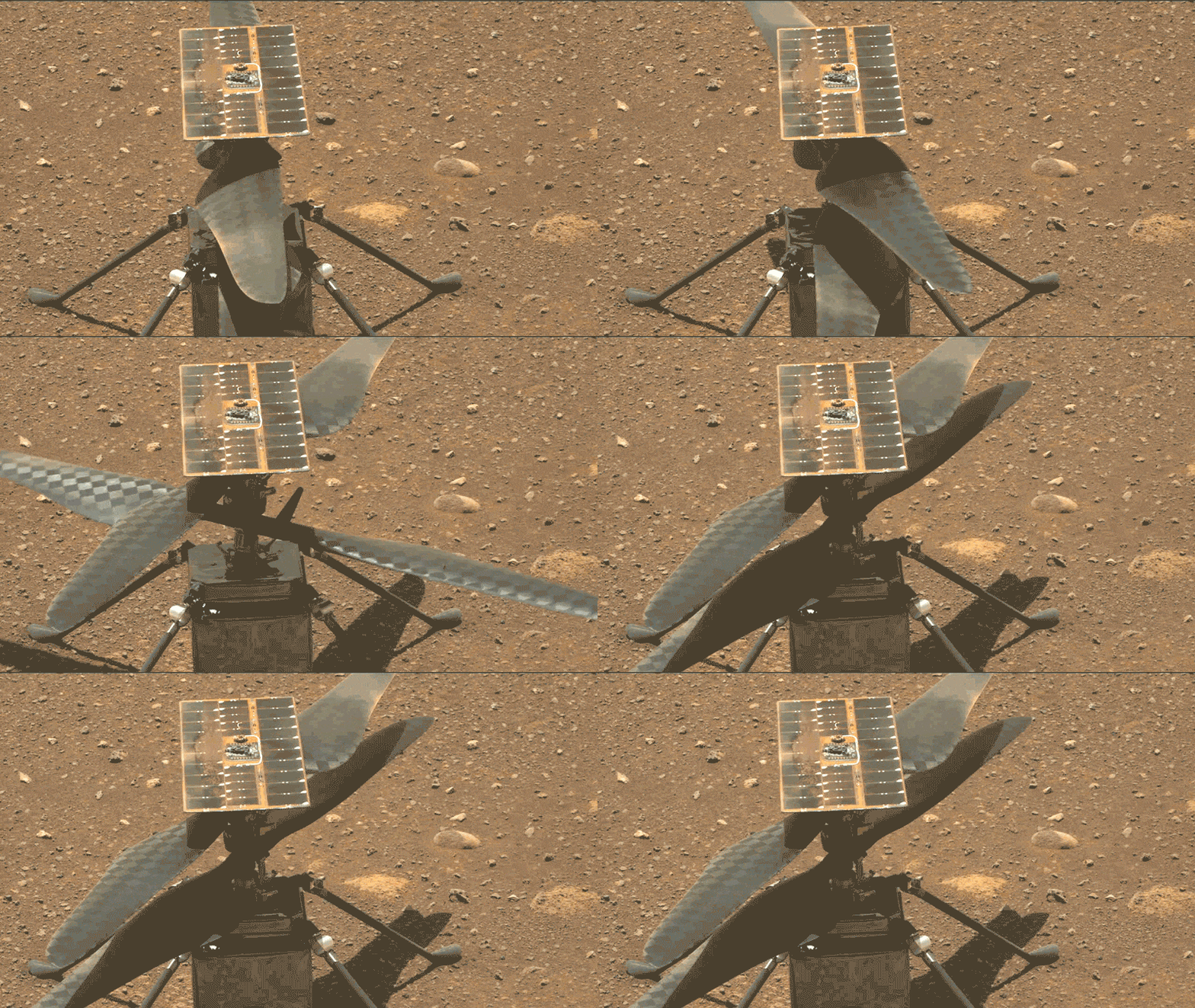
Mastcam-Z Captures Ingenuity's Blades Spinning: The Ingenuity Mars Helicopter’s carbon fiber blades can be seen in this video taken by the Mastcam-Z instrument aboard NASA’s Perseverance Mars rover on April 8, 2021, the 48th Martian day, or sol, of the mission. They are performing a wiggle test before the actual spin-up to ensure they were working properly.
With its recent 21st flight complete, the Red Planet rotorcraft is on its way to setting more records during its second year of operations.
NASA has extended flight operations of the Ingenuity Mars Helicopter through September. In the months ahead, history’s first aircraft to operate from the surface of another world will support the Perseverance rover’s upcoming science campaign exploring the ancient river delta of Jezero Crater. Along the way, it will continue testing its own capabilities to support the design of future Mars air vehicles.
The announcement comes on the heels of the rotorcraft’s 21st successful flight, the first of at least three needed for the helicopter to cross the northwest portion of a region known as “Séítah” and reach its next staging area.
“Less than a year ago we didn’t even know if powered, controlled flight of an aircraft at Mars was possible,” said Thomas Zurbuchen, the associate administrator of NASA’s Science Mission Directorate. “Now, we are looking forward to Ingenuity’s involvement in Perseverance’s second science campaign. Such a transformation of mindset in such a short period is simply amazing, and one of the most historic in the annals of air and space exploration.”
Mars Report - NASA's Explorers on Mars: NASA’s hard at work on the Red Planet. Watch the latest Mars Report for more on Ingenuity, along with the agency’s Perseverance and Curiosity rovers. Credits: NASA/JPL-Caltech. Download video ›
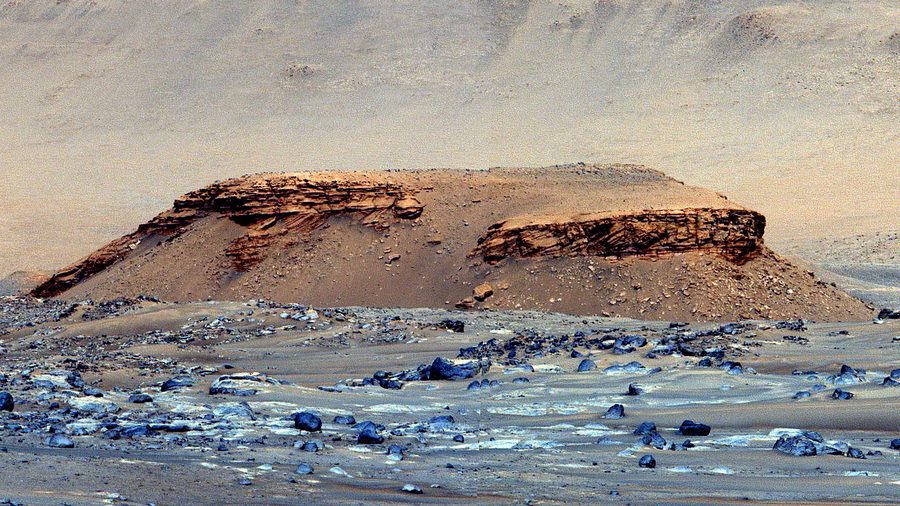
Ingenuity’s new area of operations is entirely different from the modest, relatively flat terrain it has been flying over since its first flight last April. Several miles wide and formed by an ancient river, the fan-shaped delta rises more than 130 feet (40 meters) above the crater floor. Filled with jagged cliffs, angled surfaces, projecting boulders, and sand-filled pockets that could stop a rover in its tracks (or upend a helicopter upon landing), the delta promises to hold numerous geologic revelations – perhaps even the proof necessary to determine that microscopic life once existed on Mars billions of years ago.
Upon reaching the delta, Ingenuity’s first orders will be to help determine which of two dry river channels Perseverance should take when it’s time to climb to the top of the delta. Along with routing assistance, data provided by the helicopter will help the Perseverance team assess potential science targets. Ingenuity may even be called upon to image geologic features too far afield (or outside of the rover’s traversable zone), or perhaps scout landing zones and caching sites for the Mars Sample Return program.
Ingenuity Flight 20: NASA’s Ingenuity Mars Helicopter acquired this image in the northwest portion of a region known as “Séítah” using its high-resolution color camera during its 20th flight on Feb. 25, 2022. Credits: NASA/JPL-Caltech. Download image ›
“The Jezero river delta campaign will be the biggest challenge the Ingenuity team faces since first flight at Mars,” said Teddy Tzanetos, Ingenuity team lead at NASA’s Jet Propulsion Laboratory in Southern California. “To enhance our chances of success, we have increased the size of our team and are making upgrades to our flight software geared toward improving operational flexibility and flight safety.”
Higher Flights
Several of these upgrades have led to reduced navigation errors during flight, which increases both flight and landing safety. A recent software change already on the rotorcraft frees Ingenuity from its previously programmed maximum altitude of 50 feet (15 meters). The altitude gains could result in incremental increases in both air speed and range. A second upgrade allows Ingenuity to change airspeed as it flies. Another enables it to better understand and adjust to changes in terrain texture during flight. Future software upgrades may include adding terrain elevation maps into the navigation filter and a landing-hazard-avoidance capability.
Before aerial reconnaissance of the delta can begin, Ingenuity has to complete its journey to the area. Scheduled for no earlier than March 19, Ingenuity’s next flight will be a complex journey, about 1,150 feet (350 meters) in length, that includes a sharp bend in its course to avoid a large hill. After that, the team will determine whether two or three more flights will be required to complete the crossing of northwest Séítah.
Ingenuity Flights to the Delta: This annotated image depicts the multiple flights – and two different routes – NASA’s Ingenuity Mars Helicopter could take on its trip to Jezero Crater’s delta. Credits: NASA/JPL-Caltech/University of Arizona/USGS. Download image ›
The first experimental flight on another world took place on April 19, 2021, and lasted 39.1 seconds. After another four flights, six more minutes in the air, and traveling a total distance of 1,637 feet (499 meters), NASA transitioned Ingenuity into an operations demonstration phase, testing its ability to provide an aerial dimension to the Perseverance mission. With the completion of Flight 21, the rotorcraft has logged over 38 minutes aloft and traveled 2.9 miles (4.64 kilometers). As Ingenuity pushes farther into uncharted territory, these numbers will inevitably go up, and previous flight records will more than likely fall.
“This upcoming flight will be my 22nd entry in our logbook,” said Ingenuity chief pilot Håvard Grip of JPL. “I remember thinking when this all started, we’d be lucky to have three entries and immensely fortunate to get five. Now, at the rate we’re going, I’m going to need a second book.”
More About Ingenuity
The Ingenuity Mars Helicopter was built by JPL, which also manages this technology demonstration project for NASA Headquarters. It is supported by NASA’s Science Mission Directorate. NASA’s Ames Research Center in California’s Silicon Valley and NASA’s Langley Research Center in Hampton, Virginia, provided significant flight performance analysis and technical assistance during Ingenuity’s development. AeroVironment Inc., Qualcomm, and SolAero also provided design assistance and major vehicle components. Lockheed Space designed and manufactured the Mars Helicopter Delivery System.
At NASA Headquarters, Dave Lavery is the program executive for the Ingenuity Mars Helicopter.
More About Perseverance
A key objective for Perseverance’s mission on Mars is astrobiology, including the search for signs of ancient microbial life. The rover will characterize the planet’s geology and past climate, pave the way for human exploration of the Red Planet, and be the first mission to collect and cache Martian rock and regolith (broken rock and dust).
Subsequent NASA missions, in cooperation with ESA (European Space Agency), would send spacecraft to Mars to collect these sealed samples from the surface and return them to Earth for in-depth analysis.
The Mars 2020 Perseverance mission is part of NASA’s Moon to Mars exploration approach, which includes Artemis missions to the Moon that will help prepare for human exploration of the Red Planet.
JPL, which is managed for NASA by Caltech in Pasadena, California, built and manages operations of the Perseverance rover.
What Sounds Captured by NASA's Perseverance Rover Reveal About Mars
NASA’s Perseverance Rover Captures Puff, Whir, Zap Sounds from Mars: Listen closely to new sounds from Mars recorded by NASA’s Perseverance Mars rover, including puffs and pings from a rover tool, light Martian wind, the whirring of the agency's Ingenuity Mars Helicopter, and laser zaps. Credits: NASA/JPL-Caltech/ASU/MSSS/LANL/CNES/IRAP
A new study based on recordings made by the rover finds that the speed of sound is slower on the Red Planet than on Earth and that, mostly, a deep silence prevails.
Listen closely to sounds from Mars, recorded by NASA’s Perseverance: the rover’s mechanical whine and click in a light Martian wind; the whir of rotors on Ingenuity, the Mars helicopter; the crackling strike of a rock-zapping laser.
An international team of scientists has done just that, performing the first analysis of acoustics on the Red Planet. Their new study reveals how fast sound travels through the extremely thin, mostly carbon dioxide atmosphere, how Mars might sound to human ears, and how scientists can use audio recordings to probe subtle air-pressure changes on another world – and to gauge the health of the rover.
“It’s a new sense of investigation we’ve never used before on Mars,” said Sylvestre Maurice, an astrophysicist at the University of Toulouse in France and lead author of the study. “I expect many discoveries to come, using the atmosphere as a source of sound and the medium of propagation.”
Most of the sounds in the study, published April 1 in the journal Nature, were recorded using the microphone on Perseverance’s SuperCam, mounted on the head of the rover’s mast. The study also refers to sounds recorded by another microphone mounted on the chassis of the rover. This second microphone recently recorded the puffs and pings of the rover’s Gaseous Dust Removal Tool, or gDRT, which blows shavings off rocks that the rover has scraped in order to examine.
The result of the recordings: a new understanding of strange characteristics of the Martian atmosphere, where the speed of sound is slower than on Earth – and varies with pitch (or frequency). On Earth, sounds typically travel at 767 mph (343 meters per second). But on Mars, low-pitched sounds travel at about 537 mph (240 meters per second), while higher-pitched sounds move at 559 mph (250 meters per second).
The variable sound speeds on the Red Planet are an effect of the thin, cold, carbon dioxide atmosphere. Prior to the mission, scientists expected Mars’ atmosphere would influence sound speed, but the phenomenon had never been observed until these recordings were made. Another effect of this thin atmosphere: Sounds carry only a short distance, and higher-pitched tones carry hardly at all. On Earth, sound might drop off after about 213 feet (65 meters); on Mars, it falters at just 26 feet (8 meters), with high-pitched sounds being lost completely at that distance.
The recordings from SuperCam’s microphone also reveal previously unobserved pressure variations produced by turbulence in the Martian atmosphere as its energy changes at tiny scales. Martian wind gusts at very short timescales also were measured for the first time.
One of the most striking features of the sound recordings, Maurice said, is the silence that seems to prevail on Mars. “At some point, we thought the microphone was broken, it was so quiet,” he added.
That, too, is a consequence of Mars having such a thin atmosphere.
“Mars is very quiet because of low atmospheric pressure,” said Baptiste Chide of Los Alamos National Laboratory in New Mexico, also a coauthor of the study. “But the pressure changes with the seasons on Mars.”
That means, in the Martian autumn months to come, Mars might get noisier – and provide even more insights into its otherworldly air and weather.
“We are entering a high-pressure season,” Chide said. “Maybe the acoustic environment on Mars will be less quiet than it was when we landed.”
Illustration - Perseverance's Microphones: This illustration of NASA’s Perseverance Mars rover indicates the location of its two microphones. Credit: NASA/JPL-Caltech. Download image ›
Sounds of the Mission
The acoustic team also studied what the SuperCam microphone picked up from the spinning double rotors of Ingenuity, the Mars helicopter that is the rover’s traveling companion and aerial scout. Spinning at 2,500 revolutions per minute, the rotors produce “a distinctive, low-pitched sound at 84 hertz,” Maurice said, referring to the standard acoustic measure of vibrations per second and the rotation rate for both rotors.
On the other hand, when SuperCam’s laser, which vaporizes bits of rock from a distance to study their composition, strikes a target, it makes sparks that create a high-pitched noise above 2 kilohertz.
Studying sounds recorded by the rover’s microphones not only reveals details of the Martian atmosphere, but also helps scientists and engineers assess the health and operation of the rover’s many systems, just as one might notice a troubling noise when driving a car.
Meanwhile, the key instrument in the study, SuperCam’s microphone, continues to exceed expectations.
“The microphone is now used several times a day and performs extremely well; its overall performance is better than what we had modeled and even tested in a Mars-like environment on Earth,” says David Mimoun, professor at Institut Supérieur de l’Aéronautique et de l’Espace (ISAE-SUPAERO) and lead of the team that developed the microphone experiment. “We could even record the humming of the Mars helicopter at long distance.”
More About the Mission
A key objective for Perseverance’s mission on Mars is astrobiology, including the search for signs of ancient microbial life. The rover will characterize the planet’s geology and past climate, pave the way for human exploration of the Red Planet, and be the first mission to collect and cache Martian rock and regolith (broken rock and dust).
Subsequent NASA missions, in cooperation with ESA (European Space Agency), would send spacecraft to Mars to collect these sealed samples from the surface and return them to Earth for in-depth analysis.
The Mars 2020 Perseverance mission is part of NASA’s Moon to Mars exploration approach, which includes Artemis missions to the Moon that will help prepare for human exploration of the Red Planet.
Jet Propulsion Laboratory, which is managed for NASA by Caltech in Pasadena, California, built and manages operations of the Perseverance rover.
COLD HARD FACTS? - Satellite spots MASSIVE object hidden under the frozen wastes of Antarctica
Scientists baffled by bizarre observations of gigantic 'anomaly' buried beneath polar icecap
jasper hamill
SCIENTISTS believe a massive object which could change our understanding of history is hidden beneath the Antarctic ice.
The huge and mysterious "anomaly" is thought to be lurking beneath the frozen wastes of an area called Wilkes Land.
A view of Antarctica, the frozen landmass at the south pole of our planet
The icy wastelands of Antarctica are infamously barren and inhospitable, making research very difficult
It stretches for a distance of 151 miles across and has a maximum depth of about 848 metres.
Some researchers believe it is the remains of a truly massive asteroid which was more than twice the size of the Chicxulub space rock which wiped out the dinosaurs.
If this explanation is true, it could mean this killer asteroid caused the Permian–Triassic extinction event which killed 96 percent of Earth's sea creatures and up to 70 percent of the vertebrate organisms living on land.
However, the wilder minds of the internet have come up with their own theories, with some conspiracy theorists claiming it could be a massive UFO base or a portal to a mysterious underworld called the Hollow Earth.
This "Wilkes Land gravity anomaly" was first uncovered in 2006, when NASA satellites spotted gravitational changes which indicated the presence of a huge object sitting in the middle of a 300 mile wide impact crater.
The area known as Wilkes Land is circled in red
This representation of satellite data shows the bizarre anomaly beneath Wilkes Land
Now the internet has lit up with discussion of the mysterious observations after the UFO hunting crew Secure Team 10 posted a YouTube video about the anomaly.
"To this day, scientists have no idea or way to discover exactly what is buried deep under this thick ice shelf," the video narrator said.
"This continent has been shrouded in a mystery of its own for years now."
Secure Team 10 suggested the Nazis built secret bases in Antarctica during World War II, which were designed to be used by flying saucers.
The UFO hunters added: "There is some evidence of this coming to light in recent years, which images purporting to show various entrances built into the side of mountains, with a saucer shape and at a very high altitude.
"This begs the question: how would you enter these entrances without something that could fly and was the same shape as hole itself?"
Secure Team also suggested the US Navy led a mission to investigate the mysterious continent.
This expedition was called Operation High Jump, which conspiracy theorists believe was an attempt to find the entrance to a secret world hidden underneath Earth.
However, the scientist who first spotted the anomaly believes it is actually evidence of a massive impact crater.
"This Wilkes Land impact is much bigger than the impact that killed the dinosaurs, and probably would have caused catastrophic damage at the time," said Ralph von Frese, who was a professor of geological sciences at Ohio State University when he discovered the "killer crater" on 2006.
"All the environmental changes that would have resulted from the impact would have created a highly caustic environment that was really hard to endure. So it makes sense that a lot of life went extinct at that time."
A new report has been released by the Pentagon outlining investigations into the health impact on humans who have had encounters with UFOs.
The 1,574-page report titled ‘Anomalous Acute And Subacute Field Effects on Human and Biological Tissues’ was obtained by The Sun from the US Defense Intelligence Agency (DIA) as part of a Freedom of Information request.
‘Sufficient incidents/accidents have been accurately reported, and medical data acquired, as to support a hypothesis that some advanced systems are already deployed, and opaque to full US understandings,’ reads the report from the now-defunct Advanced Aviation Threat Identification Program (AATIP).
AATIP was a secret investigatory effort funded by the United States Government to study unidentified flying objects (UFOs) or -as they prefer to call them – unexplained aerial phenomena (UAP).
The program ran from 2007 to 2012 and came to light in 2017 when the New York Times obtained military footage that showed unidentified aircraft moving in highly unusual ways.
The Sun claims the report included 42 cases from medical files and 300 cases in which people claim to have been injured following ‘anomalous’ encounters.
Some of these injuries appeared to be the result of electromagnetic radiation or inflicted by ‘energy related propulsion systems’.
The existence of the report was revealed by whistleblower and former head of the program, Luis Elizondo.
Among the various claims in the document, the most bizarre ones included alleged injuries to ‘human observers by anomalous advanced aerospace systems’, an ‘apparent abduction’ and even an ‘unaccounted-for pregnancy’.
While the report seems to be official, it also contains reports of ‘poltergeists, crop circles, spontaneous human combustion, alien abductions and other paranormal events’, which make it seem less reliable.
According to The Sun, the report also has mentions of ‘ghosts, yetis, spirits, elves and other mythical/legendary entities’, giving more reason to be sceptical about its contents.
The 9-page report reviewed 120 incidents recorded by US military and government did not confirm anything about UFO other than they might be airborne clutter, natural atmospheric phenomena or aerial crafts from adversaries like China or Russia.
The public report marked the first time the American government fully admitted there are things in the sky it can’t explain.
In 2020, US lawmakers added a provision to the Intelligence Authorization Act, which forced the government to compile a report on what it knows about UFOs by, at the latest, 25 June.
While the contents of the latest report don’t seem to provide any credible proof of the existence of aliens or UFOs, the fact that the US government is invested in studying these instances of ‘unidentified aerial phenomena’ is significant.
Before his death, Hawking said: ‘If you look at history, contact between humans and less intelligent organisms have often been disastrous from their point of view, and encounters between civilisations with advanced versus primitive technologies have gone badly for the less advanced.’
His warning, issued in 2015, was in response to the $100 million Breakthrough Listen project – which also involved looking for alien life in space.
But the Beacon in the Galaxy contains much more than just the location of Earth for any aliens wanting to pay us a visit.
It will also include a map of our planet, information on the chemical makeup of humans and images of a naked man and a naked women.
That’s right, we could be sending unsolicited nudes out into the vastness of intergalactic space.
The message will include images of a naked man and woman (Credits J. H. Jiang et al., 2022)
‘The proposed message includes basic mathematical and physical concepts to establish a universal means of communication followed by information on the biochemical composition of life on Earth, the Solar System’s time-stamped position in the Milky Way relative to known globular clusters, as well as digitized depictions of the Solar System, and Earth’s surface,’ wrote Jonathan Jiang, a scientist at Nasa’s Jet Propulsion Laboratory, in a study explaining the idea.
Jiang and his colleagues have published the study on the preprint site arXiv while it is waiting to be peer-reviewed.
‘The message concludes with digitized images of the human form, along with an invitation for any receiving intelligences to respond.’
The message also includes a map showing Earth’s position in the solar system (Credits J. H. Jiang et al., 2022)
According to the team, the message will be sent as a beamed radio wave from radio telescopes in China and California after they’ve been modified to send it.
The team is fixing to send the message to a point 13,000 light years from the galactic centre of the Milky Way. An area, the scientists say, which ‘has been proposed as the most likely for life to have developed’.
As for whether or not they should contact aliens, the scientists give their reasoning that any aliens that have gotten far enough along in evolution would know the importance of peace.
Or, as they put it: ‘The arguments against the continuation of communication have been explored and stated on the record: would the ETI [extra-terrestrial intelligence] be peaceful and even if they are, would human nature mean that war with ETI is inevitable, possibly causing the extinction of another sentient race?’
‘However, logic suggests a species which has reached sufficient complexity to achieve communication through the cosmos would also very likely have attained high levels of cooperation amongst themselves and thus will know the importance of peace and collaboration.’
Radio telescopes in China and California could be used to beam the signals to aliens (Credits: Getty)
Jiang and the other scientists say that a public discussion is ultimately required so that we can reach a “maximally-informed consensus” on whether or not we should be sending party invites out to any aliens that happen to be listening.
Nuclear reactor parts converted to radioactive carbon-14 diamonds produce energy.
To keep them safe, the carbon-14 diamonds are encased in a second protective diamond layer.
The company predicts batteries for personal devices could last about nine years.
We have an insatiable need for energy. When we need to operate something that cannot be simply plugged in, power is going to have to come from a battery, and the battle for a better battery is being fought in labs all over the world. Hold that thought for a moment.
Nuclear waste — it’s the radioactive detritus from nuclear power plants that no one wants stored near their homes or even transported through their towns. The nasty stuff is toxic, dangerous, it takes thousands of years to fully degrade, and we keep making more of it.
Now a company from California, NDB, believes it can solve both of these problems. They say they’ve developed a self-powered battery made from nuclear waste that can last 28,000 years, perfect for your future electric vehicle or iPhone 1.6 x 10⁴. Producing its own charge—rather than storing energy created elsewhere—the battery is made from two types of nano-diamonds, rendering it essentially crash-proof if used in cars or other moving objects. The company also says its battery is safe, emitting less radiation than the human body.
NDB has already completed a proof of concept and plans to build its first commercial prototype once its labs have resumed operations post-COVID.
NDB’s battery as it might look as a circuit-board component
The nuclear waste from which NDB plans to make it batteries are reactor parts that have become radioactive due to exposure to nuclear-plant fuel rods. While not considered high-grade nuclear waste—that would be spent fuel—it’s still very toxic, and there’s a lot of it in a nuclear generator. According to the International Atomic Energy Agency, the “core of a typical graphite moderated reactor may contain 2000 tonnes of graphite.” (A tonne is one metric ton, or about 2,205 lbs.)
The graphite contains the carbon-14 radioisotope, the same radioisotope used by archaeologists for carbon dating. It has a half-life of 5,730 years, eventually transmuting into nitrogen 14, an anti-neutrino, and a beta decay electron, whose charge piqued NDB’s interest as a potential means of producing electricity.
NDB purifies the graphite and then turns it into tiny diamonds. Building on existing technology, the company says they’ve designed their little carbon-14 diamonds to produce a significant amount of power. The diamonds also act as a semiconductor for collecting energy, and as a heat sink that disperses it. They’re still radioactive, though, so NDB encases the tiny nuclear power plants within other inexpensive, non-radioactive carbon-12 diamonds. These glittery lab-made shells serve as, well, diamond-hard protection at the same time as they contain the carbon-14 diamonds’ radiation.
NDA plans to build batteries in a range of standard—AA, AAA, 18650, and 2170—and custom sizes containing several stacked diamond layers together with a small circuit board and a supercapacitor for collecting, storing, and discharging energy. The end result is a battery, the company says, that will last a very long time.
NDB predicts that if a battery is used in a low-power context, say, as a satellite sensor, it could last 28,000 years. As a vehicle battery, they anticipate a useful life of 90 years, much longer than any single vehicle will last—the company anticipates that one battery could conceivably provide power for one set of wheels after another. For consumer electronics such as phones and tablets, the company expects about nine years of use for a battery.
“Think of it in an iPhone,” NDB’s Neel Naicker tells New Atlas. “With the same size battery, it would charge your battery from zero to full, five times an hour. Imagine that. Imagine a world where you wouldn’t have to charge your battery at all for the day. Now imagine for the week, for the month… How about for decades? That’s what we’re able to do with this technology.”
NDB anticipates having a low-power commercial version on the market in a couple of years, followed by a high-powered version in about five. If all goes as planned, NDB’s technology could constitute a major step forward, providing low-cost, long-term energy to the world’s electronics and vehicles. The company says, “We can start at the nanoscale and go up to power satellites, locomotives.”
The company also expects their batteries to be competitively priced compared to current batteries, including lithium ion, and maybe even cheaper once they’re being produced at scale—owners of nuclear waste may even pay the company to take their toxic problem off their hands.
MIT News reports that the first scientific analysis of images taken by NASA’s Perseverance rover has now confirmed that Mars’ Jezero crater — which today is a dry, wind-eroded depression — was once a quiet lake, fed steadily by a small river some 3.7 billion years ago.
The images also reveal evidence that the crater endured flash floods. This flooding was energetic enough to sweep up large boulders from tens of miles upstream and deposit them into the lakebed, where the massive rocks lie today.
The new analysis, published today in the journal Science, is based on images of the outcropping rocks inside the crater on its western side. Satellites had previously shown that this outcrop, seen from above, resembled river deltas on Earth, where layers of sediment are deposited in the shape of a fan as the river feeds into a lake.
Perseverance’s new images, taken from inside the crater, confirm that this outcrop was indeed a river delta. Based on the sedimentary layers in the outcrop, it appears that the river delta fed into a lake that was calm for much of its existence, until a dramatic shift in climate triggered episodic flooding at or toward the end of the lake’s history.
“If you look at these images, you’re basically staring at this epic desert landscape. It’s the most forlorn place you could ever visit,” says Benjamin Weiss, professor of planetary sciences in MIT’s Department of Earth, Atmospheric and Planetary Sciences and a member of the analysis team. “There’s not a drop of water anywhere, and yet, here we have evidence of a very different past. Something very profound happened in the planet’s history.”
As the rover explores the crater, scientists hope to uncover more clues to its climatic evolution. Now that they have confirmed the crater was once a lake environment, they believe its sediments could hold traces of ancient aqueous life. In its mission going forward, Perseverance will look for locations to collect and preserve sediments. These samples will eventually be returned to Earth, where scientists can probe them for Martian biosignatures.
“We now have the opportunity to look for fossils,” says team member Tanja Bosak, professor of geobiology at MIT. “It will take some time to get to the rocks that we really hope to sample for signs of life. So, it’s a marathon, with a lot of potential.”
Tilted beds
On Feb. 18, 2021, the Perseverance rover landed on the floor of Jezero crater, a little more than a mile away from its western fan-shaped outcrop. In the first three months, the vehicle remained stationary as NASA engineers performed remote checks of the rover’s many instruments.
During this time, two of Perseverance’s cameras, Mastcam-Z and the SuperCam Remote Micro-Imager (RMI), captured images of their surroundings, including long-distance photos of the outcrop’s edge and a formation known as Kodiak butte, a smaller outcop that planetary geologists surmise may have once been connected to the main fan-shaped outcrop but has since partially eroded.
Once the rover downlinked images to Earth, NASA’s Perseverance science team processed and combined the images, and were able to observe distinct beds of sediment along Kodiak butte in surprisingly high resolution. The researchers measured each layer’s thickness, slope, and lateral extent, finding that the sediment must have been deposited by flowing water into a lake, rather than by wind, sheet-like floods, or other geologic processes.
The rover also captured similar tilted sediment beds along the main outcrop. These images, together with those of Kodiak, confirm that the fan-shaped formation was indeed an ancient delta and that this delta fed into an ancient Martian lake.
“Without driving anywhere, the rover was able to solve one of the big unknowns, which was that this crater was once a lake,” Weiss says. “Until we actually landed there and confirmed it was a lake, it was always a question.”
Boulder flow
When the researchers took a closer look at images of the main outcrop, they noticed large boulders and cobbles embedded in the youngest, topmost layers of the delta. Some boulders measured as wide as 1 meter across, and were estimated to weigh up to several tons. These massive rocks, the team concluded, must have come from outside the crater, and was likely part of bedrock located on the crater rim or else 40 or more miles upstream.
Judging from their current location and dimensions, the team says the boulders were carried downstream and into the lakebed by a flash-flood that flowed up to 9 meters per second and moved up to 3,000 cubic meters of water per second.
“You need energetic flood conditions to carry rocks that big and heavy,” Weiss says. “It’s a special thing that may be indicative of a fundamental change in the local hydrology or perhaps the regional climate on Mars.”
Because the huge rocks lie in the upper layers of the delta, they represent the most recently deposited material. The boulders sit atop layers of older, much finer sediment. This stratification, the researchers say, indicates that for much of its existence, the ancient lake was filled by a gently flowing river. Fine sediments — and possibly organic material — drifted down the river, and settled into a gradual, sloping delta.
However, the crater later experienced sudden flash floods that deposited large boulders onto the delta. Once the lake dried up, and over billions of years wind eroded the landscape, leaving the crater we see today.
The cause of this climate turnaround is unknown, although Weiss says the delta’s boulders may hold some answers.
“The most surprising thing that’s come out of these images is the potential opportunity to catch the time when this crater transitioned from an Earth-like habitable environment, to this desolate landscape wasteland we see now,” he says. “These boulder beds may be records of this transition, and we haven’t seen this in other places on Mars.”
History’s most twisted round of “which of these things do not belong” is playing out on the floor of the Black Sea this week because Russia may have lost nuclear weapons when its warship sank there.
“Russian warship Moskva may have been carrying two nuclear warheads when it was sunk by a Ukrainian missile strike yesterday. Intel and news reports conflicting,” lawyer Tristan Snell said on Twitter yesterday. “This is a huge story to watch.”
Given the high number of nukes and the country’s violence it’s not out of the question to think Russia might be trying to blow something up. Their actions in Mariupol show they have little regard for innocent civilian lives, and if they capture the city Russia’s army will have more access to a central location that provides strategic and logistical benefits.
It’s hard to say for sure, but it’s possible Russia had big plans for the nukes. Now they’re sleeping with the fishes.
A parachute and landing equipment lying in the Martian desert.
Credit: NASA
NASA's Perseverance rover is on a mission to sleuth out past evidence of life on Mars. Along the way, it found evidence of Earthlings.
This week, the space agency posted an image of two objects the rover passed while traversing the Martian desert: a discarded parachute and a metal capsule. Both played vital roles in helping the car-sized exploration rover land safely on Mars.
"Definitely wouldn’t be where I am without them!" NASA tweeted from the Perseverance rover's Twitter account.
You can spot the objects in the middle of the image. On left is the collapsed orange and white parachute; on right is a conspicuous part of the shell that housed the rover as it plunged through Mars' atmosphere in February 2021.
Landing the 2,260-pound, $2.7 billion rover on Mars was an impressive feat, dubbed the "seven minutes of terror." The plummeting spacecraft, traveling at some 1,000 mph, deployed a supersonic parachute to slow down. It ditched its heavy heat shield. Before choosing a safe landing spot (free of boulders, pits, or dangerous rocks), it abandoned the parachute; then a rocket-powered apparatus fired up and hovered in the air while carefully lowering the rover down to the ground. Everything must work swimmingly — and it did.
The rover is now on its way to a dried-up delta in Mars' Jezero Crater, a place planetary scientists believe once hosted a lake.
"This delta is one of the best locations on Mars for the rover to look for signs of past microscopic life," NASA said.
Chinese taikonauten na recordverblijf van zes maanden in ruimte weer op Aarde
Drie Chinese taikonauten zijn na een recordverblijf in de ruimte weer op Aarde geland. De capsule met taikonaute Wang Yaping en haar twee mannelijke collega's Zhai Zhigang en Ye Guangfu kwam vanochtend (plaatselijke tijd) aan in de Gobiwoestijn in het noordwesten van China. De landing werd live uitgezonden op de Chinese staatstelevisie.
De taikonauten, zoals Chinese ruimtevaarders worden genoemd, brachten een half jaar door aan boord van de basismodule van het ruimtestation Tiangong dat Peking bouwt. De bemanning van de Shenzhou-13 was daarmee langer in de ruimte dan alle andere Chinese ruimtereizigers voor hen.
Tijdens hun verblijf in de ruimte hebben de taikonauten twee ruimtewandelingen gemaakt, een hele reeks experimenten uitgevoerd en de verdere uitbreiding van het ruimtestation voorbereid. In totaal duurde de terugvlucht vanaf het ruimtestation, dat ongeveer 400 kilometer boven de Aarde zweeft, iets meer dan negen uur.
China heeft grote ambities in de ruimte. Zo zette het al een rover neer op Mars en in 2033 wil het ook een bemande landing op de ‘rode planeet’ uitvoeren. In 2019 zette China als eerste land ooit een ruimtevaartuig op de ‘achterkant’ van de maan.
In this series we are exploring the weird and wonderful world of astronomy jargon! You’ll be far from home in today’s topic: trans-Neptunian objects!
The trans-Neptunian objects (often abbreviated at TNOs) are any worlds, small or otherwise, that orbit the Sun farther than Neptune’s average distance, which is around 30 AU. There are almost 3,000 known TNOs, and astronomers suspect there are countless more.
By far the most famous of all the TNOs is Pluto. Even though Pluto spends 20 years of every orbit closer to the Sun than Neptune, it spends the vast majority of its time farther away. At that distance, the light of the Sun is so dim that Pluto exists in permanent twilight, and temperatures are cold enough for the world to support giant mountains made of pure water ice.
For decades since its discovery by Clyde Tombaugh in 1930, astronomers believed that Pluto was the only object beyond the orbit of Neptune, but the 1992 discovery of Albion changed that. We now understand that the solar system past Neptune is a rich and diverse – if very cold – place.
Even though Pluto is the largest of the TNOs by radius, it is not the most massive. That honor goes to Eris. That world has a highly eccentric orbit. At its closest approach to the Sun, it’s about 38 times farther way than the Earth. At its most distant, it’s nearly 100 times farther away. Some other TNOs have orbits three times bigger.
Astronomers know of almost all TNOs as mere points of light, since they are so small and so far away from the Sun. Based on spectroscopy from reflected sunlight, most TNOs appear to be mixtures of rock and ice. Many, like Pluto, have a dull red color, a product of ultraviolet light striking organic molecules on their surfaces.
Two categories divide the trans-Neptunian objects. The Kuiper belt is a narrow band stretching from 40-50 AU. This Kuiper belt is similar to the asteroid belt, but on a much larger scale. Beyond that lies the scattered disk. The TNOs that live there tend to have highly eccentric orbits, which astronomers believe is caused by constant tiny gravitational nudges from the giant planets.
In this series we are exploring the weird and wonderful world of astronomy jargon! You’ll have to carefully navigate around today’s topic: the Van Allen Belts!
The Van Allen belts are regions containing highly energetic subatomic particles trapped by the magnetic field of a planet or moon. They get their name from the space scientist James Van Allen, who discovered them.
If a planet or moon has a strong enough magnetic field, it has the potential of forming Van Allen belts. The belts contain charged particles, like electrons and protons, that constantly swim throughout the solar system. Most of these particles come from the solar wind, which is the steady rain of high-energy electrons emitted by the Sun. Other particles come from well outside the solar system, like distant supernovae or star-forming regions.
When these particles encounter a planet, they begin to interact with its magnetic field. Some of the particles barrel on through, while others just bounce right off. But if the particles have just the right energy, they become trapped. They follow the magnetic field lines around and around the planet, constantly circling it.
Around the Earth, the Van Allen belts split into two distinct regions. The inner radiation belt extends from 1,000 km in altitude to 12,000 km. It contains mostly electrons and some protons. While the energies of these particles are relatively low, their density is much higher in this region.
The outer belt extends from 12,000 km all the way up to 60,000 km. The particles here have much more energy than the ones in the inner belt, but they are much more diffuse. The outer belt is also much looser, and tends to fluctuate depending on solar weather and changes in the Earth’s magnetic field.
Jupiter has by far the strongest magnetic field in the solar system, and its system of Van Allen belts is millions of times more intense than the Earth’s. This poses a significant hazard to any spacecraft visiting the Jovian system.
A Legend That Turns Out To Be Real? Hibernating Alien Discovered Inside Secret Chamber In The Great Pyramid
A strange story about the Great Pyramid of Giza appeared in the March 2000 issue of the Egyptian magazine Rose El-Yussuf.
According to the article, in 1988, French Egyptologist Louis Caparat, discovered this mummy in 1988 in a secret room of the Great Pyramid and, “was found in a crystalline transparent case. At first the alien appeared to be hibernating,” or in a state of suspended animation. It’s believed to be a “humanoid,” which is a mix between an extraterrestrial race and human DNA.
A papyrus found near the body tells of this being’s encounter with the Pharaoh Khufu. Apparently, it said that this convinced the Pharaoh to build the Great Pyramid as a tomb for this being after he had announced the future arrival of other beings of his species (Source: the Egyptian magazine “Rose El-Yussuf” relayed by “The World Of The Unknown” in Issue 283 April 2000).
It was also determined from the papyrus that the people whom lived in Egypt during the Neolithic period was already very mixed, mostly consisting of people from the Mediterranean and Negroid that were dolichocephalic (Greek word meaning to have an elongated head).
The last update on this was that “Caparat sent a message to a colleague in Spain, Francisco de Braga, a biologist, inviting him to come to Egypt” to take blood, cell, tissue and DNA samples from the dead alien.” But when Dr. de Braga arrived in Cairo, he was detained by the Egyptian Ministry of State Security and put on a plane back to Madrid. According to Rose El-Yussuf, the dead alien was taken to a laboratory at an undisclosed location by Egyptian military intelligence.
Editor’s Note: Please take this story with a grain of salt. Mysterious dead bodies have been turning up in the Great Pyramid since Abdullah Al-Mamun first broke into the Great Pyramid in 813 A.D. Abdullah, who was the son of the famous caliph, Haroun Al-Raschid, hired a crew of Egyptians who laboriously bored a hole right through the Pyramid’s wall.
According to author Peter Tompkins:
“Some Arabian authors have reported that Al-Mamun found in the sarcophagus a stone statue in the shape of a man. They say that within the statue lay a body wearing a breastplate of gold set with precious stones, an invaluable sword on his chest, and a carbuncle ruby on his head the size of an egg, which shone as with the light of day.”
– Secrets of the Great Pyramid by Peter Tompkins
On the other hand, there have been a lot of strange goings-on at the Great Pyramid since 1996, including secret UNESCO teams visiting, unmarked military vehicles and black helicopters seen at Giza, and the recent round of heavy construction.. It’s anyone’s guess what is really going on out there.
Another mummified alien (5’ 3”) was also found buried in an ancient pyramid, but this time by the archaeologist, Dr. Viktor Lubek. This one was found near Lahun, when exploring a small pyramid south of the Dynasty doceaba of Senusret II, which contains the queen of the pharaoh. This of course was not revealed immediately to the public either, and dates back to about 1880 B.C. According to a source at the Egyptian Antiquities Department, “The mummy of what appears to be an alien, dates back (to about 1880 B.C.) and it seems it would be a humanoid.” Apparently this statement, along with details and photographs of the find, were made under the condition of remaining anonymous. Inscriptions on the tomb of the mummy showed that this being was a counselor to the pharaoh and was named Osirunet, meaning “star” or “sent from heaven.” The body was said to be buried with great respect and care, and was accompanied by a number of strange artifacts made of a synthetic material that is not found in any other Egyptian tomb. Also the source claimed, “It’s unclear what sex it was, but we do know it had unusual reptilian-type skin, no external ears and overly large, almond-shaped eyes.”
The anonymous person that provide this find’s details claimed that the discovery has caused great controversy among Egyptian officials, who want to keep it hidden until a “plausible explanation” for the strange mummy can be made. The Egyptian government has consulted a number of respected archaeologists, but to date none can explain the finding in ordinary terms. According to the source, “The Egyptians refuse to believe that their heritage came from outer space.” The last update on this was that the mummy was to be flown to a university in Florida where specialists will examine it more closely.
It turns out that the CIA has banned archaeologists to excavate in certain areas. Some journalists had already noticed that the CIA was very interested in making their own excavations before the ban was put in place. So far there are three “hidden” openings around the Sphinx that lead to underground tunnels that are prohibited. One opening is located in-between the two front paws, another on the south side, and one on the north side.
According to the British journalist Graham Hancock, the CIA has discovered not one, but 9 chambers under the Sphinx, some of which containing metal objects. These hidden underground chambers were actually recorded in the Emerald Tablets that were supposed to be written by Thoth/Hermes. The Emerald Tablets were said to be each molded out of a single piece of emerald (green) crystal, with its true origin (possible Atlantis) lost in legends that go back over 10,000 years. Its first known translation was made into Greek by Alexandrian scholars and was actually put on display in Egypt in 330 B.C. However, around 400 A.D. it was reportedly buried somewhere on the Giza plateau to protect it from religious zealots who were burning libraries around the world at that time.
If the intelligence agencies want to get their hands on a device or documents, it means they think that the civilization of ancient Egypt was, in some areas, much more advanced than ours. Two of the most well-known descriptions of aliens mating with humans, thereby creating humanoids, comes from Robert Temple’s “The Sirius Mystery” (which tells the story of the African Dogon Tribe) and Genesis in the Bible.
“The son of God saw the daughters of men were beautiful, and they took them wives which they chose among them. (…) There were giants in the earth in those days, and also later, because the son of God came in unto the daughters of men, and they bare children: these are powerful men who, from ancient times, were men of renown “
(Genesis 6: 2-4)
Greek mythology refers to these giants as Nephilim, or fallen angels who have taught men: math, writing, music, witchcraft/alchemy, astrology, etc. These lessons were also listed in the Kabbalah, which caused many crusades to chase these secrets in Jerusalem.
Same UFO Seen 3X Over Medellin, Colombia April 9, 2022, Video, UFO Sighting News.
Date of sighting: April 9, 2022 Location of sighting:Medellin, Colombia
This diamond shaped craft was seen over the city of Medellin this week. It's a large city of 2.6 million people. You would think this is absolutely amazing as it is, however I have proof that this same UFO was recorded two other times in the last two years! Yes, it's true.
April 9, 2022 recorded passing over the city of Medellin.
Oct 6, 2020 recorded from a mountain top over Medellin.
Jan 29, 2020 recorded by a commercial pilot over Medellin.
This is 100% proof that this UFO is sticking around and highly interested in the city of Medellin, Colombia. That means it either doing some research on human subjects abducting and possibly impregnating them to create alien/hybrids, or there is an alien base under the mountains of Medellin. Either way, we have not seen the end of this UFO!
A glowing object was seen skirting the top of the mountains on a live cam yesterday. The object seemed to follow the ridge, rising and lowering till off screen. This live cam was for a beach along the city of Muiznberg in South Africa.
South Africa is a hotspot for UFOs which I have reported on in the past, especially hot is the area along Cape of Good Hope. I looked at the cam and saw the mountain area. This is not a plane or helicopter, not a bird or balloon, not a meteor. This is a UFO.
A legend among the Hopis states that there was once a great temple city of wisdom built by the Star People, the Kachinas. Many of the Hopi clans visited this city during their respective migrations throughout the Americas and later shared stories of it when all the clans reunited at their final destination on the Hopi Mesas. This mysterious city, known as Palatkwapi, the “Red House,” was where the Star People taught important rituals and secrets of the universe that are still enacted and honored by the clans.
Over the last one hundred years there has been much speculation regarding the location of Palatkwapi. An abundance of ethnographers have located Palatkwapi in the Sedona-Verde Valley region, but there have also been other academics who have placed it much further south. Most everyone agrees, however, that the City of the Star People was someplace south of the Hopi Mesas. One Hopi legend of the Patki or Water Clan recounted by ethnographer Alexander M. Stephen in Hopi Journey states: “...no one knows just where the Red Land is, but it is someplace in the far southwest [of Hopiland].” Distance is, of course, relative, especially when you are traveling by foot.
The striking red stone of Cathedral Rock, Sedona, Arizona.
Some researchers claim that Palatkwapi was Palenque in the Yucatan Peninsula of Mexico, which is not to the southwest of Hopiland. Outside of having once possessed buildings painted red, this jungle city seems to contradict many of the known facts regarding the “Red House.” For example, one of the definitive Hopi legends regarding Palatkwapi maintains that the city was surrounded by “high walls,” and that the city’s name “seems to be derived from a high bluff of red stone.” There are no high bluffs of red stone in Palenque, nor was its temple compound completely destroyed by an ancient deluge. If there was a major deluge in the city’s past it is recorded in the “ Maya Flood Myth ,” which is, however, an astronomical event depicted on its temple walls. Moreover, Palatkwapi’s destruction began with the burning of the pine forest surrounding it and Palenque is in the middle of a sweltering tropical jungle consisting of cedar, mahogany, and sapodilla trees. And if Palatkwapi is linked to the Mayan city of Palenque simply because of the similarity between their names, let it be known that Palenque is not the city’s original name.
Its original Mayan name was Lakamha, meaning “Big Water.” Palenque is a Spanish name given it by the Conquistadors meaning “Fortified Place.” By contrast, Sedona and the Verde Valley possess almost all the characteristics that are ascribed to Palatkwapi, and this is why the most renowned Hopi historian and ethnographer, Jesse Walter Fewkes, conclusively identified it as the location of the ancient holy city. Fewkes was so convinced of his identification that he was prompted to name one of the most heavily petroglyph-adorned Hopi ruins in the Sedona area Palatki, which is a shortened version of Palatkwapi.
One difficulty in assigning a definite location for Palatkwapi are the many recorded land routes to it. This is the result of the various Hopi clans having arrived at the Red House via divergent pathways during their migrations. However, the routes taken by most of the clans when they left Palatkwapi and traveled north to the Hopi Mesas are very consistent and in many cases identical. It is this common route that has allowed ethnographers to definitively locate ancient Palatkwapi as the Sedona-Verde Valley area. In fact, this route still exists today and is known as the Palatkwapi Trail.
After closely studying the routes taken by 30 different clans after leaving Palatkwapi and traveling to the Hopi Mesas, Jesse Fewkes and other ethnographers synthesized a “universal route.” This universal route is fully delineated in The Fourth World of the Hopis by Harold Courlander. An abridged version of it, complete with northern Arizona place names, is presented below:
The clans that went north from Palatkwapi [Sedona-Verde Valley] stopped at one place and another, building winter villages, and then moving on. It is said that they settled at a place called Kunchalpi for some years. There they rested and grew their blue corn. Old people died and children were born, and thus in time there were many for whom Palatkwapi was only a word in the mouths of the grandfathers. But one night there was a bright shooting star in the northeastern sky, and it was taken as a sign that the migration should be resumed. So the people abandoned Kunchalpi and travelled again, drifting a little to the east, until they came to a site they named Hohokyam. There they settled again, planting their fields and resting from the journey. After many years they departed from Hohokyam and moved to another place, Neuvakwiotaka, which is now known as Chavez Pass, and there they remained for a long time. And later on, after many harvests at Neuvakwiotaka, they went on until they came to the little Colorado River near where the present town of Winslow stands. There they made a settlement that they called Homolovi, Small Mound, consisting of two villages, a larger one and a smaller one. The people of the Water and Sand Clans occupied the smaller village. Sharing the larger village were the Tobacco and Rabbit clans, the Sun Clan, and various others, including the Eagle, Hawk, Turkey, and Moon clans. After a time they were joined by the Badger Clan and a group called the Reed Clan….
After many moons the various clans at Homolovi were attacked by the Apaches, who also decided to move into the area and attacked the people in their fields and took away their crops. In order to protect themselves the clans then invoked the Twin Sons, Palöngawhoya and Pöqánghoya, who then met the Apaches on the battlefield. At first the Apaches laughed at the sight of the two boys, saying “Are there no men left in Homolovi?” Then the warrior brothers slung their heavy stones and killed some of the enemy, whereupon the laughing stopped. The Apaches shot some arrows, but Palöngawhoya and Pöqánghoya moved quickly this way and that and escaped the arrows. After that the Apaches rushed forward, and now each of the brothers took out a lightning arrow and shot it. The Arrows struck with a great flash and a thunderous noise. Many of the enemy lay dead or dying on the ground. Again the Apaches attacked, and again the warrior gods loosed their lightning arrows, and the ground was now covered with corpses. Those Apaches who were still alive fled from the field…
When it became time to resume their migration from Homolovi to the promised land, some of the clans decided to split off and travel north to the San Francisco Peaks and then to Wupatki, finally completing their journey at Oraibi in the Hopi Mesas. Meanwhile, the majority of the clans remained together, journeying first to Little Ruin Mound near Walpi, then to Awatovi, and finally to Oraibi.
Kachina procession.
Building Palatkwapi
….it was the Kachinas that built Palatkwapi.
As previously mentioned, although the destruction of Palatkwapi appears to coincide with the end of the Third World the period of its initial construction is nearly impossible to pin down.
If, for example, one subscribes to the time periods known as the Hopi Worlds (A “World” is a cycle of time. Historically, there have been Four Worlds) or the Dream Time of the Australian Aborigines, then Palatkwapi could have been constructed as recently as 10,000 years ago or as anciently as a million or more years ago. This is because the “Worlds” and “Dream Time” are very inexact time periods.
Drawings of Kachina dolls, from an 1894 anthropology book.
And then there is the question of how the city could have been constructed in the distant past. If the building of the ancient megalithic circles and temples occurred during the time the Hopis refer to as the First or Second Worlds - when humans had their crown chakra wide open and remained in continual communication with the Creator - their designs could have been spontaneously implanted by the Creator into the minds of their builders. The creative “Gods” could have also received some supernatural abilities to build the temples from the same source. While constructing the temples in Sedona these “Gods” would have also been assisted by the natural earth energies of the area. The amplifying vortexual power combined with the iron and crystal-infused particles would have first magnified the thought forms of the “Gods” and then magnetically united the Sedona sand into the solid formations delineated by the builders’ mental blueprints.
Kachina Dancers.
The extent records of Palatkwapi imply that its original builders were the Kachinas. They also reveal that the city’s initial construction preceded the Fourth World.
Some Fourth World construction (or reconstruction) is, however, said to have been overseen by the Kachinas and carried out by the Hopis and/or the members of other tribes residing at Palatkwapi. States Waters:
Under the supervision of the Kachinas, Palatkwapi was built in three sections. Completely surrounded by a high wall, the first section was reserved for ceremonial purposes; the second section, adjoining it, contained storage rooms for food; and the third section comprised the living quarters for the people of all clans. Underneath all three sections ran a river.
“The ceremonial section was the most important. There were no kivas then, as there are today, divided to accommodate initiates and ceremonial participants. Instead, there were two buildings, one for the initiates and one for ceremonial purposes. The ceremonial building was four stories high, terraced like the pueblos we see today. The main door opened to the east, and there were two smaller doors facing north and south.”
The Kachina.
On the first or ground floor the Kachina people taught the initiates the history and meaning of the three previous worlds and the purpose of the Fourth World to which man had emerged. On the second floor they taught the structure and functions of the human body and that the highest function of the mind was to understand how the great spirit worked within man. The spirits or Kachina people taught this so that the people would not become evil again and this Fourth World be destroyed like the first three.
In the third story initiates were taught the workings of nature and the uses of all kinds of plant life. Although the people were still relatively pure and there was little sickness, some evils would come, bringing resultant illnesses; and for each on there was a plant remedy for the people to remember.
The fourth story was smaller than the three below, making the ceremonial building resemble a pyramid. To this top level were admitted initiates of great conscience who had acquired a deep knowledge of the laws of nature. Here they were taught the workings of the planetary system, how the stars affected the climate, the crops, and man himself. Here too they learned about the “open door” on the top of their heads, how to keep it open, and so converse with their Creator.
(Note: The “open door” or Kopavi, that the Kachinas taught the Hopis about is known in the Hindu occult system as the Sahasrara or Crown Chakra that is situated at the top of the head.)
Kachina dancers, Shongopavi pueblo, Arizona, sometime before 1900.
Year of Darkness: The Climate Cataclysm of 536 You’ve Never Heard Of
During 536 the world was beset by a long winter. Dubbed “the year of darkness” in the New Scientist, temperatures plummeted and the sun was dimmed by a vast fog which blocked its rays from hitting the earth during 24 hours a day over the course of 18 months. This climate cataclysm affected Europe, the Middle East and even parts of Asia over the course of the following decade. In fact, “this climatic downturn may well have profoundly altered the course of history.” But what caused this global climate cataclysm?
References in Historic Texts to a Global Climatic Cataclysm
Back in 2018, Science reported that the medieval historian Michael McCormick had stated that 536 “was the beginning of one of the worst periods to be alive, if not the worst year.” In his historical work Historiae Ecclesiasticae , translating as “Church Histories”, the 6th century historian and church leader John of Ephesus wrote that “ the sun became dark and its darkness lasted for 18 months.”
Between the years 535 and 536, a series of major climatic events took place that could easily be described as a global cataclysm with catastrophic consequences. “Each day, it [the sun] shone for about four hours, and still this light was only a feeble shadow. Everyone declared that the sun would never recover its full light again,” detailed Ephesus.
In fact, according to Brandon Specktor in LiveScience, “the fall of the Roman Empire may have been a partial result of the decade of famine and plague that began in A.D. 536.” The fall in temperatures was in fact the beginning of the coldest decade to have been experienced during the last 2,000 years.
These low temperatures, falling as low as 1.5 C in summer time for example, led to crop failures and famine recorded across the world. Just a few years later, in 541 AD, Justinian’s Plague killed as many as 100 million people throughout the Mediterranean, a dire time to be alive indeed.
Destruction from The Course of Empire, by Thomas Cole.
John of Ephesus is not the only writer to mention this climate cataclysm. Procopius, who lived between 500 and 565 AD and was a late antiquities Byzantine scholar and historian, also refers to the strange behavior of the sun during 536 AD.
Believing it to be a bad sign foretelling coming events, Procopius stated “and it came about during this year that a most dread portent took place. For the sun gave forth its light without brightness, like the moon, during this whole year, and it seemed exceedingly like the sun in eclipse, for the beams it shed were not clear.”
Another reference to the climate cataclysm of 536 comes from the 6th century writer Zacharias of Mytilene, who authored a chronicle that contains a section referring to the “Dark Sun” between 535 and 536 AD.
The sun began to be darkened by day and the moon by night, while the ocean was tumultuous with spray from the 24th of March in this year till the 24th of June in the following year... And, as the winter was a severe one, so much so that from the large and unwonted quantity of snow the birds perished... there was distress... among men... from the evil things.”
Zacharias of Mytilene (Chronicle, 9.19, 10.1)
These three extracts are just a representative sample of numerous accounts from all over the world, written during the era in question. In all cases, the sun was described as getting dimmer and losing its light. Many also described it as having a bluish color.
The effects were also observed with the moon. It simply wasn’t as bright anymore. The reduction of the light resulted in the reduction of heat on the planet. A lack of rain and a very long winter resulted in crop failures and for birds and other wildlife to perish, as Zacharias of Mytilene writes. Famine and plagues struck many areas and there were a huge number of deaths.
In China and Japan, the event was also recorded in great detail. With scarce water, there were massive droughts and death followed. Hundreds of thousands of square miles became infertile. The Beishi chronicles, the official history of the Northern Dynasties, mentions that in the province of Xi’an 80% of the population died and the survivors ate corpses to survive. The year was 536.
The catastrophic event also struck Korea, the Americas, Europe, Africa, and Australia. While written records do not exist for all countries, archaeological and geological data revealed evidence of the climatic changes. Studies done on the trunks of trees, for example, showed that 536 AD had been the coldest in 1,500 years.
The important question in all of this is why did it happen? While there are no definite answers for the climate cataclysm of 536, one theory put forward for the worst year in history is that there was a large asteroid or comet impact which landed in the sea (if it had hit land there would be evidence of a crater).
Geologist Dallas Abbott is one proponent of this view and bases his view on evidence that he found studying ice cores from Greenland . However, this wouldn’t explain the dim light of the sun, and no tsunamis have been recorded for this period, which would have occurred if an asteroid landed in the ocean.
Another theory that has been put forward is a gigantic volcanic eruption , as the dust thrown up into the atmosphere could have caused the dimming of the light. One candidate is Krakatoa, located between the islands of Java and Sumatra in Indonesia. Indeed, the Pustaka Raja Purwa (meaning “Book of the Ancient Kings”) written in 1869, describes an ancient volcano.
There was a furious shaking of the earth, total darkness, thunder and lighting… Then came forth a furious gale together with torrential rain and a deadly storm darkened the entire world… When the waters subsided it could be seen that the island of Java had been split into two, this creating the island of Sumatra.
Although this manuscript refers to the year 416 AD and not 535 AD, the fact that it was written in the 19th century could account for inaccuracies in the time reference.
On the left: The ice core drilling site at Colle Gnifetti in Switzerland. On the right: A section of the ice core used to decipher evidence about the climate cataclysm of 536.
Searching for Answers: Understanding the Climate Cataclysm of 536
Whether or not a definitive answer will ever be found is unknown, but that hasn’t stopped scientists from trying to find one. One thing that is quite peculiar about this global climate cataclysm is that it is a virtually unknown event.
Why is it that this climatic event is not taught in schools? Why isn’t there a plethora of research examining it? Perhaps it is because it reminds us of our fragility as human beings and the fact that no matter how powerful and “advanced” mankind becomes, we are still at the mercy of nature.
While historians have known about this climate cataclysm for a long time, they have remained puzzled as to its causes. In 2018, the analysis of a 72-meter-long (253 foot) core of ice from a glacier in the Swiss Alps , which serves as a logbook of naturally occurring and human created events, has concluded that an immense volcanic eruption in Iceland spread ash throughout the Northern Hemisphere in 536. There were two more eruptions in 540 and 547. Their results were published in the journal Antiquity.
But, why does a volcanic eruption affect global temperatures? “When a volcano erupts, it spews sulfur, bismuth, and other substances high into the atmosphere, where they form an aerosol veil that reflects the sun's light back into space, cooling the planet,” explains Ann Gibbons in Science.
According to the Antiquity study, by 640 the ice core shows traces of lead, which they concluded is evidence of a so-called “silver-smelting boom.” Live Science explains that this silver boom is a sure sign of “an economy rebounding in the darkness of starving, disease-stricken Europe, and the emergence of a new merchant class ready to trade in precious metals.” Humanity began to recover from the dire effects of climatic conditions of 536.
Top image: 536 was a year of climate cataclysm. Winter landscape by Caspar David Friedrich.
Mass Evacuation Of Alien Spaceships From Earth Recorded By Cameras Of The International Space Station
The frames you see resemble a fragment of a science fiction film showing the evacuation from a doomed planet, but this is not a film, this is a video from a camera installed on board the International Space Station.
Yesterday, May 18, 2020, this camera recorded the mass evacuation of thousands of UFOs, which simultaneously launched from the surface of our planet and flew into outer space.
Look at these shots and remember, all this happened in reality and was filmed by the camera from the ISS. What is this if not a mass evacuation from planet Earth?
Thousands of ships simultaneously start from our planet at the moment when the ISS was on the edge between the dark and light sides of the Earth.
They take off at a tremendous speed, these are not our antediluvian liquid fuel rockets, these are very different and very advanced technologies that only representatives of extraterrestrial civilization can possess.
Extraterrestrial, but long present on our planet, since ancient times. Undoubtedly, this civilization or civilizations from other planets have their own underground and underwater bases on Earth, but what prompted them to be massively evacuated from Earth?
This, logically, can happen only if our planet is doomed and it is very dangerous for representatives of other civilizations to be on it …
Whether great natural disasters are coming or will our planet cease to exist at all, unfortunately, we don’t know, but nobody would leave it so demonstratively and massively for no reason …
However, all the events of recent months have indirectly indicated that something extraordinary is happening on our planet. Preparations are underway for something truly catastrophic for all of humanity.
Astronomers are baffled by the rapid heating of the South Pole of the planet Neptune recently detected by ground-based telescopes in Chile and Hawaii. The heating corroborates a recent prediction by Thor Han Eredyon of the Galactic Federation of Worlds that Neptune would soon experience remarkable changes due to the activation of space arks resulting from the arrival of the Intergalactic Federation, aka extraterrestrial Seeders or Guardians.
[D]ata showed that, despite the onset of southern summer, most of the planet had gradually cooled over the last two decades. The globally averaged temperature of Neptune dropped by 8 °C between 2003 and 2018.
The astronomers were then surprised to discover a dramatic warming of Neptune’s south pole during the last two years of their observations, when temperatures rapidly rose 11°C between 2018 and 2020. Although Neptune’s warm polar vortex has been known for many years, such rapid polar warming has never been previously observed on the planet.
The telescopes used to monitor Neptune’s weather included the European Southern Observatory’s Very Large Telescope and the Gemini South Telescope that are both located in Chile; and the Keck, Subaru, Spitzer, and Gemini North telescopes that are all located on Hawaii’s Big Island.
Neptune’s thermal-infrared brightness observed over time.
Importantly, the astronomers could not explain both the cooling and rapid heating of Neptune:
Because Neptune’s temperature variations were so unexpected, the astronomers do not know yet what could have caused them. They could be due to changes in Neptune’s stratospheric chemistry, or random weather patterns, or even the solar cycle.
There is, however, another explanation that the team of astronomers did not consider for the rapid heating. The activation of Space Arks that had previously laid dormant in Neptune’s icy interior until the arrival of fleets of ships belonging to the Intergalactic Confederation.
On March 28, Elena Danaan received the following message from Thor Han about changes in our solar system caused by the arrival of the Seeders/Guardians that can be traced back to the interstellar object, Oumuamua in October 2017:
The ships are coming, the Guardians are on the outer orbit of Terra, four ships for the moment. They are watching, in time dilation. Suspended in time like the old Oumuamua. It was one of their ships. It has activated. The ones in the ice belt have activated too. And all the others, one by one, on all the planets. Neptune is next. You will see, you will hear about Neptune soon. But don’t forget to tell them: They are lucky and privileged to see this.
Thor Han’s message clearly links the sudden heating of Neptune’s South Pole to one or more activating space arks that began with the October 2017 arrival of Oumuamua and accelerated with the arrival of the Seeder’s space fleets in October 2021.
Thor Han’s prediction is quite remarkable given that it preceded the results of the astronomer’s observations published two weeks later in The Planetary Science Journal.
In addition, Thor Han’s reference to space arks activating in the “ice belt” refers to the recent heatwave increase in East Antarctica. Temperatures increased by as much as 70 degrees over a wide area centered around the Vostok region, which I discussed in a previous article.
The results of the long-term atmospheric study of Neptune clearly validate the information received by Elena Danaan from Thor Han Eredyon about activating space arks in our solar system. The results of the Neptune scientific study give great confidence that we are about to witness astounding results as the space arks continue to activate as the extraterrestrial “Seeder” fleets spread out throughout our solar system and arrive around the Earth.
A video version of this article is on YouTube & Rumble
[Update April 15, 2022 – Elena Danaan first publicly revealed Thor Han’s prediction about Neptune being affected by activating space arks in a March 29 YouTube announcement. Here’s the link and timestamp.She followed up with a YouTube video on April 12 discussing three articles covering the heat increase on Neptune.]
To learn more about Thor Han Eredyon, the Galactic Federation, and other extraterrestrial organizations currently operating in our solar system, I highly recommend Elena Danaan’s book, We Will Never Let You Down (2021).
To find out about the history of the Extraterrestrial Seeders and how their recent arrival has activated long dormant Space Arks hidden on Earth and our solar system, I recommend my April 9, 2022, webinar, which is now available on Vimeo.
Alien space rock hit Earth in 2014, confirms US space command
USSC confirmed that a meteor that had hit Earth in 2014 came from another solar system and is, therefore, declared as the interstellar object.
Representational Image
(Credits: NewsAtlas)
New Delhi: The US Space Command (USSC) last week confirmed that a meteor that had hit Earth in 2014 came from another solar system and is, therefore, declared as the interstellar object.
The USSC in a Twitter post revealed its findings along with a memo confirming the work of Harvard astronomers Amir Siraj and Abraham Loeb. The memo confirms that a space rock from another star system did strike Earth in 2014.
The US space department stated that the velocity and trajectory of the 1.5 feet long meteor suggested the space rock was extrasolar in origins. Earlier, NASA had stated that the meteor lit up skies near Manus Island, Papua New Guinea on 8 January 2014 whilst travelling at more than 1,00,000 miles per hour.
“I had the pleasure of signing a memo with @ussfspoc ’s Chief Scientist, Dr. Mozer, to confirm that a previously-detected interstellar object was indeed an interstellar object, a confirmation that assisted the broader astronomical community," said Lt Gen John Shaw, the deputy commander of the USSC.
The research paper written by Dr Siraj and Dr Loeb reported the meteor as originating from interstellar space with “99.999 per cent confidence". The researchers also calculated that the Earth is struck by an extrasolar meteor around once a decade and, hence, more than 450 million such meteors striking our planet over its lifespan so far.
“Potentially, interstellar meteors could deliver life from another planetary system and mediate panspermia,” their paper read as per Independent.
Additionally, Dr Loeb in the paper also argued that the Oumuamua could have been a form of Alien technology, rather than an extrasolar asteroid, but, for now, this is a minority position among the astronomy community.
As far as we can tell, there's no limit to how far it goes on; only a limit to how far we can see. Could the Universe truly be infinite?
This geometrical structure of a torus is an example of a spatially flat surface, with neither positive nor negative curvature across it, that nevertheless is finite in extent. If your space is torus-like in nature, you could eventually return to your starting point if you traveled in a straight line forever.
The limits to which we can observe the Universe are set by three things: the rate of expansion, the time since the Big Bang, and the speed of light.
But beyond our visibility limit, there ought to be more Universe out there, and no one knows how far it goes on for.
Is it finite or is it infinite? Although we don't know for certain, many have their suspicions, and scientists are working to find out as much as possible.
13.8 billion years ago, what we know as our Universe began with the hot Big Bang. The Universe was filled with matter, antimatter, radiation, and existed in an ultra-hot, ultra-dense, but expanding-and-cooling state. By today, the volume containing our observable Universe has expanded to be 46 billion light years in radius, with the light that’s first arriving at our eyes today corresponding to the limit of what we can measure.
Although that’s a huge distance, it’s not infinitely large; it’s merely the limits of what we can observe. What lies beyond that? What about the unobservable Universe? Is there any way to use what we know and measure about the Universe we inhabit to answer the question of whether it’s finite or infinite; about whether what we know of as “the Universe” goes on forever, or whether there’s some limit to what’s out there? Let’s look at the full suite of what we know today, right up to the limits of what our measurements tell us, and see what we can learn from it.
Every time we look out at the night sky, we’re seeing a specific field-of-view, which means we’re probing a certain amount of area on the sky. Objects that are nearby, at intermediate distances, and even at very great distances can all appear in the same image, and just how faint and far back we see is limited only by the quality of our observations.
As we look to greater distances, we also wind up looking back in time. The nearest galaxy, some 2.5 million light years away, appears to us as it was 2.5 million years ago, because the light requires that much time to journey to our eyes from when it was emitted. More distant galaxies appear as they were tens of millions, hundreds of millions or even billions of years ago. As we look ever farther away in space, the light we see from the Universe comes from its progressively younger days. Therefore, as we look back in terms of distance, we can also measure how the Universe evolved over its history.
The Universe is cold and clumpy today, but it’s also expanding and gravitating. When we look to greater and greater distances, we find that the Universe was less cold, less clumpy, and more uniform. With less time having passed for gravitation to form large, complicated structures, the Universe had less massive clumps of matter early on. Similarly, the early, distant Universe was also hotter. The expanding Universe causes all the light that travels through the Universe to stretch in wavelength. As the wavelength stretches, it loses energy, and becomes cooler. This means the Universe was hotter in the distant past, a fact we’ve confirmed through observations of distant features in the Universe.
The observational evidence that probes the temperature of the cosmic microwave background at different epochs in the Universe, including at present (red star), in the relatively nearby Universe (blue points), and in the distant Universe (red points) all shows that the Universe was hotter in the past, and has cooled as it’s expanded exactly as predicted.
(Credit: P. Noterdaeme et al., Astronomy & Astrophysics, 2011)
We can measure the temperature of the Universe as it is today, 13.8 billion years after the Big Bang, by looking at the leftover radiation from that hot, dense, early state. Today, this shows up in the microwave portion of the spectrum and is known as the Cosmic Microwave Background. Coming in with a blackbody spectrum and a temperature of 2.725 K, it’s easy to confirm that these observations match, with an incredible precision, the predictions that arise from the Big Bang model of our Universe.
Moreover, we know how this radiation evolves in energy as the Universe expands. A photon’s energy is directly proportional to the inverse of its wavelength. When the Universe was half its size, the photons from the Big Bang had double the energy, while when the Universe was 10% of its current size, those photons had ten times the energy. If we’re willing to go back to when the Universe was just 0.092% its present size, we’ll find a Universe that’s 1089 times hotter than it is today: around 3000 K. At these temperatures, the Universe is hot enough to ionize all the atoms in it. Instead of solid, liquid, or gas, all the matter in the entire Universe was in the form of an ionized plasma.
A Universe where electrons and protons are free and collide with photons transitions to a neutral one that’s transparent to photons as the Universe expands and cools. Shown here is the ionized plasma (L) before the CMB is emitted, followed by the transition to a neutral Universe (R) that’s transparent to photons. If there is an electric charge imbalance, signatures would lead to anisotropies in the cosmic microwave background radiation.
(Credit: Amanda Yoho for Starts With A Bang)
One of the remarkable properties about the Universe, at this early stage, was how almost perfectly uniform it was. Yes, some regions within it are more or less dense than average, but the amounts that the densest (corresponding to the coldest observed temperatures) or least dense (i.e., hottest) regions depart from the average is tiny: about 1-part-in-30,000. That’s enough to grow into the stars, galaxies, galaxy clusters, and cosmic voids we see today. Seeing the Universe as it was back then, as well as how it is today, allows us to understand how it grew from that early state into the one we inhabit today.
The way we arrive at the size of the visible Universe today is through understanding three things in tandem:
how quickly the Universe is expanding today, something we can measure via a number of methods,
how hot the Universe is today, which we know from looking at the radiation of the Cosmic Microwave Background,
and what the Universe is made out of, including matter, radiation, neutrinos, antimatter, dark matter, dark energy, and more.
By taking the Universe we have today, we can extrapolate back to the earliest stages of the hot Big Bang, and arrive at a figure for both the age and the size of the Universe together.
The size of the Universe (y-axis) versus the age of the Universe (x-axis) on logarithmic scales. Some size and time milestones are marked, as appropriate. One can continue to extrapolate this forwards and backwards in time, but only so long as the components of energy that exist today didn’t have transitional points.
(Credit: E. Siegel)
From the full suite of observations available, including the cosmic microwave background but also including supernova data, large-scale structure surveys, and baryon acoustic oscillations, among others, we get our Universe. 13.8 billion years after the Big Bang, it’s now 46.1 billion light years in radius. That’s the limit of what’s observable. Any farther than that, and even something moving at the speed of light since the moment of the hot Big Bang will not have had sufficient time to reach us. As time goes on, the age and the size of the Universe will increase, but there will always be a limit to what we can observe.
So what can we say about the part of the Universe that’s beyond the limits of our observations? We can only make inferences based on the laws of physics as we know them, and the things we can measure within our observable Universe. If space were positively curved, like we lived on the surface of a 4D sphere, distant light rays would converge. If space were negatively curved, like the surface of a 4D saddle, distant light rays would diverge. Instead, distant light rays move in their original direction, with the fluctuations we have indicating perfect flatness.
The magnitudes of the hot and cold spots, as well as their scales, indicate the curvature and expansion history of the Universe. To the best of our capabilities, we measure it to be perfectly flat, but there’s a degeneracy between the sizes of the fluctuations we see and changes in the expansion history compared with what types of energy were present in the early Universe.
Our best measurements indicate that the Universe is spatially flat on the largest scales: it’s neither positively nor negatively curved, to a precision of 0.25%, or about 1-part-in-400. Because we live in three dimensions, 400 times the radius means (400)3 times the volume, or more than 64 million times as much space. If we assume that our current laws of physics are correct, we can set limits on how large, at least, the Universe must be before it curves back on itself.
But, big as that is, it still isn’t infinite. A lower bound of the Universe being at least 18 trillion light-years in all directions is tremendous, but it’s still finite. Assuming that the Universe contains no topological weirdness, like curving back on itself while still being spatially flat (like having a geometry akin to a hypertorus), observations of the cosmic microwave background and the large-scale structure tell us that the unobservable part of the Universe must be at least 37 trillion light-years in diameter.
Exponential expansion, which takes place during inflation, is so powerful because it is relentless. With every ~10^-35 seconds (or so) that passes, the volume of any particular region of space doubles in each direction, causing any particles or radiation to dilute and causing any curvature to quickly become indistinguishable from flat.
(Credit: E. Siegel (L); Ned Wright’s Cosmology Tutorial (R))
However, there are good theoretical reasons to believe that our entire Universe, whether finite or infinite, is even larger than that. The hot Big Bang might mark the beginning of the observable Universe as we know it, but it doesn’t mark the birth of space and time itself. Before the Big Bang, the Universe underwent a period of cosmic inflation. Instead of being filled with matter and radiation, and instead of being hot, the Universe was:
filled with energy inherent to space itself,
expanding at a constant, exponential rate,
and creating new space so quickly that the smallest physical length scale, the Planck length, would be stretched to the size of the presently observable Universe every 10-32 seconds.
It’s true that in our region of the Universe, inflation came to an end. But there are three questions we don’t know the answer to that have a tremendous influence on how big the Universe truly is, and whether it’s infinite or not.
The size of our visible Universe (yellow), along with the amount we can reach (magenta). The limit of the visible Universe is 46.1 billion light-years, as that’s the limit of how far away an object that emitted light that would just be reaching us today would be after expanding away from us for 13.8 billion years. However, beyond about 18 billion light-years, we can never access a galaxy even if we traveled towards it at the speed of light. Beyond the limits of the observable Universe lies more Universe, up until the limits imposed by wherever inflation didn’t end at the same time it did where our hot Big Bang occurred. That limit, if it exists, has not been discovered.
(Credit: Andrew Z. Colvin and Frederic Michel, Wikimedia Commons; Annotations: E. Siegel)
1.) How big was the region of the Universe, post-inflation, that created our hot Big Bang?
Looking at our Universe today, at how uniform the Big Bang’s leftover glow is, at how flat the Universe is, at the fluctuations stretched across the Universe on all scales, etc., there’s quite a bit we can learn. We can learn the upper limit to the energy scale at which inflation occurred; we can learn how much the Universe must have inflated; we can learn a lower limit for how long inflation must have gone on.
But the pocket of the inflating Universe that gave rise to us could be much, much bigger than that lower limit! It could be hundreds, or millions, or googols of times larger than what we can observe… or even truly infinite. But without being able to observe more of the Universe than we can presently access, we don’t have enough information to decide.
Wherever inflation occurs (blue cubes), it gives rise to exponentially more regions of space with each step forward in time. Even if there are many cubes where inflation ends (red Xs), there are far more regions where inflation will continue on into the future. The fact that this never comes to an end is what makes inflation ‘eternal’ once it begins, and where our modern notion of a multiverse comes from.
2.) Is the idea of “eternal inflation,” where the Universe inflates eternally into the future in at least some regions, correct?
If you consider that inflation must be a quantum field, then at any given point during that phase of exponential expansion, there’s a probability that inflation will end, resulting in a Big Bang, and a probability that inflation will continue, creating more and more space. These are calculations we know how to do (given certain assumptions), and they lead to an inevitable conclusion: if you want enough inflation to occur to produce the Universe we see, then inflation will always create more space that continues to inflate compared to the regions that end and produce Big Bangs.
While our observable Universe may have come about from inflation ending in our region of space some 13.8 billion years ago, there are regions where inflation continues — creating more and more space and giving rise to more Big Bangs — continuing to the present day. This idea is known as eternal inflation, and is generally accepted by the theoretical physics community. How big, then, is the entire unobservable Universe by now?7
From a pre-existing state, inflation predicts that a series of universes will be spawned as inflation continues, with each one being completely disconnected from every other one, separated by more inflating space.
3.) And, finally, how long did inflation go on prior to its end and the resultant hot Big Bang?
We can only see the observable Universe created by inflation’s end and our hot Big Bang. We know that inflation must have occurred for at least some ~10-32 seconds or so, but it likely went on for longer. But how much longer? For seconds? Years? Billions of years? Or even an arbitrary, infinite amount of time? Has the Universe always been inflating? Did inflation have a beginning? Did it arise from a previous state that was around eternally? Or, perhaps, did all of space and time emerge from nothingness a finite amount of time ago? These are all possibilities, and yet the answer is untestable and elusive at present.
From our best observations, we know that the Universe is an awful lot bigger than the part we can observe. Beyond what we can see, we strongly suspect that there’s plenty more Universe out there just like ours, with the same laws of physics, the same types of physical, cosmic structures, and the same chances at complex life. But as inconceivably large as that entire Universe — or Multiverse, if you prefer — may be, it might not be infinite. In fact, unless inflation went on for a truly infinite amount of time, or the Universe was born infinitely large, the Universe ought to be finite in extent.
We can imagine a very large number of possible outcomes that could have resulted from the conditions our Universe was born with, and a very large number of possible outcomes that could have occurred over our cosmic history as particles interact and time passes. If there were enough possible Universes out there, it would also be possible that the same set of outcomes happened in multiple places, leading to the scenario of “infinite parallel Universes.” Unfortunately, we only have the one Universe we inhabit to observe.
The biggest problem of all, though? It’s that we don’t have enough information to definitively answer the question. We only know how to access the information available inside our observable Universe: those 46 billion light years in all directions. The answer to the biggest of all questions, of whether the Universe is finite or infinite, might be encoded in the Universe itself, but we can’t access enough of it to know. Until we either figure it out, or come up with a clever scheme to expand what we know physics is capable of, all we’ll have are the possibilities.
PLANETARY SCIENTIST’S VIDEO SHOWS HOW SLOW LIGHT SPEED REALLY IS
EVEN AT THE UNIVERSE'S THEORETICAL SPEED LIMIT, A TRIP TO MARS SEEMS TEDIOUS.
TAG HARTMAN-SIMKINS FOR FUTURISM
Slow Motion
To us Earth-dwelling humans, the speed of light is so fast that it appears instantaneous.
But zoom out a bit and it becomes clear how even at the speed of light — the theoretical speed limit of the universe, which our spacecraft can’t even begin to approach — a journey through the cosmos becomes a snail-paced slog.
That crawl is what James O’Donoghue, a planetary scientist at the Japan Aerospace Exploration Agency (JAXA) shows in a cool new animation.
Take Two
O’Donoghue has shared similar visualizations in the past.
In January 2019, when he was working for NASA, he released a trio of speed of light animations that show how much slower light travels on a cosmic scale.
Mars Sprint
In the new animation, O’Donoghue started by showing how quickly light blinks past the Earth: a pulse of light emanating from the planet travels off-screen in under a second.
But then he zooms out to show how that same light takes a brief moment to reach the Moon. Zooming out even farther, he then subjects us to about three mind-numbing minutes of waiting for those same pulses of light to reach Mars. Thankfully, he doesn’t take us any farther.
The sun's activity has been increasing far faster than scientists forecasted.
Mercury transiting the sun on Nov. 11, 2019.
(Image credit: NASA/SDO/HMI/AIA)
A gigantic plasma wave that launched from the sun smashed into Mercury Tuesday (April 12), likely triggering a geomagnetic storm and scouring material from the planet's surface.
The powerful eruption, known as a coronal mass ejection (CME), was seen emanating from the sun's far side on the evening of April 11 and took less than a day to strike the closest planet to our star, where it may have created a temporary atmosphere and even added material to Mercury's comet-like tail, according to spaceweather.com.
The plasma wave came from a sunspot — areas on the outside of the sun where powerful magnetic fields, created by the flow of electric charges, get knotted up before suddenly snapping. The energy from this snapping process is released in the form of radiation bursts called solar flares or as waves of plasma (CMEs).
On planets that have strong magnetic fields, like Earth, CMEs are absorbed and trigger powerful geomagnetic storms. During these storms, Earth's magnetic field gets compressed slightly by the waves of highly energetic particles, which trickle down magnetic-field lines near the poles and agitate molecules in the atmosphere, releasing energy in the form of light to create colorful auroras in the night sky. The movements of these electrically charged particles can induce magnetic fields powerful enough to send satellites tumbling to Earth, Live Science previously reported, and scientists have warned that these geomagnetic storms could even cripple the internet.
Unlike Earth, however, Mercury doesn't have a very strong magnetic field. This fact, coupled with its close proximity to our star's plasma ejections, means it has long been stripped of any permanent atmosphere. The atoms that remain on Mercury are constantly being lost to space, forming a comet-like tail of ejected material behind the planet.
But the solar wind — the constant stream of charged particles, nuclei of elements such as helium, carbon, nitrogen, neon and magnesium from the sun — and tidal waves of particles from CMEs constantly replenish Mercury's tiny quantities of atoms, giving it a fluctuating, thin layer of atmosphere.
Previously, scientists were unsure if Mercury's magnetic field was strong enough to induce geomagnetic storms. However, research published in two papers in the journals Nature Communications and Science China Technological Sciences in February has proved that the magnetic field is, indeed, strong enough. The first paper showed that Mercury has a ring current, a doughnut-shaped stream of charged particles flowing around a field line between the planet's poles, and the second paper pointed to this ring current being capable of triggering geomagnetic storms.
"The processes are quite similar to here on Earth," Hui Zhang, a co-author of both studies and a space physics professor at the University of Alaska Fairbanks Geophysical Institute, said in a statement. "The main differences are the size of the planet and Mercury has a weak magnetic field and virtually no atmosphere."
The sun's activity has been increasing far faster than past official forecasts predicted, according to the National Oceanic and Atmospheric Administration's Space Weather Prediction Center. The sun moves between highs and lows of activity across a rough 11-year cycle, but because the mechanism that drives this solar cycle isn't well understood, it's challenging for scientists to predict its exact length and strength.
Enough rare earth minerals have been found off Japan to last centuries
Rare earths are important materials for green technology, as well as medicine and manufacturing
Where would we be without all of our rare-earth magnets?
Rare earth elements are a set of 17 metals that are integral to our modern lifestyle and efforts to produce ever-greener technologies. The “rare” designation is a bit of a misnomer: It’s not that they’re not plentiful, but rather that they’re found in small concentrations, and are especially difficult to successfully extract since they blend in with and resemble other minerals in the ground. China currently produces over 90% of the world’s supply of rare metals, with seven other countries mining the rest. So though they’re not precisely “rare,” they are scarce. In 2010, the U.S. Department of energy issued a report that warned of a critical shortage of five of the elements. Now, however, Japan has found a massive deposit of rare earths sufficient to supply the world’s needs for hundreds of years.
The rare earth metals can be mostly found in the second row from the bottom in the Table of Elements. According to the Rare Earth Technology Alliance, due to the “unique magnetic, luminescent, and electrochemical properties, these elements help make many technologies perform with reduced weight, reduced emissions, and energy consumption; or give them greater efficiency, performance, miniaturization, speed, durability, and thermal stability.”
In order of atomic number, the rare earths are:
Scandium or Sc (21) — This is used in TVs and energy-saving lamps.
Yttrium or Y (39) — Yttrium is important in the medical world, used in cancer drugs, rheumatoid arthritis medications, and surgical supplies. It’s also used in superconductors and lasers.
Lanthanum or La (57) — Lanthanum finds use in camera/telescope lenses, special optical glasses, and infrared absorbing glass.
Cerium or Ce (58) — Cerium is found in catalytic converters, and is used for precision glass-polishing. It’s also found in alloys, magnets, electrodes, and carbon-arc lighting.
Praseodymium or Pr (59) — This is used in magnets and high-strength metals.
Neodymium or Nd (60) — Many of the magnets around you have neodymium in them: speakers and headphones, microphones, computer storage, and magnets in your car. It’s also found in high-powered industrial and military lasers. The mineral is especially important for green tech. Each Prius motor, for example, requires 2.2 lbs of neodymium, and its battery another 22-33 lbs. Wind turbine magnets require 43.2 kilograms of neodymium per megawatt of power.
Promethium or Pm (61) — This is used in pacemakers, watches, and research.
Samarium or Sm (62) — This mineral is used in magnets in addition to intravenous cancer radiation treatments and nuclear reactor control rods.
Europium or Eu (63) — Europium is used in color displays and compact fluorescent light bulbs.
Gadolinium or Gd (64) — It’s important for nuclear reactor shielding, cancer radiation treatments, as well as x-ray and bone-density diagnostic equipment.
Terbium or Tb (65) — Terbium has similar uses to Europium, though it’s also soft and thus possesses unique shaping capabilities .
Dysprosium or Dy (66) — This is added to other rare-earth magnets to help them work at high temperatures. It’s used for computer storage, in nuclear reactors, and in energy-efficient vehicles.
Holmium or Ho (67) — Holmium is used in nuclear control rods, microwaves, and magnetic flux concentrators.
Erbium or Er (68) — This is used in fiber-optic communication networks and lasers.
Thulium or Tm (69) — Thulium is another laser rare earth.
Ytterbium or Yb (70) — This mineral is used in cancer treatments, in stainless steel, and in seismic detection devices.
Lutetium or Lu (71) — Lutetium can target certain cancers, and is used in petroleum refining and positron emission tomography.
Minimatori Torishima Island
(Chief Master Sergeant Don Sutherland, U.S. Air Force)
Japan located the rare earths about 1,850 kilometers off the shore of Minamitori Island. Engineers located the minerals in 10-meter-deep cores taken from sea floor sediment. Mapping the cores revealed and area of approximately 2,500 square kilometers containing rare earths.
Japan’s engineers estimate there’s 16 million tons of rare earths down there. That’s five times the amount of the rare earth elements ever mined since 1900. According to Business Insider, there’s “enough yttrium to meet the global demand for 780 years, dysprosium for 730 years, europium for 620 years, and terbium for 420 years.”
The bad news, of course, is that Japan has to figure out how to extract the minerals from 6-12 feet under the seabed four miles beneath the ocean surface — that’s the next step for the country’s engineers. The good news is that the location sits squarely within Japan’s Exclusive Economic Zone, so their rights to the lucrative discovery will be undisputed.
A first-of-its-kind 'missing link' object detected in the early Universe may solve the mystery of the oldest supermassive black holes in existence, scientists say.
The discovery of GNz7q, a black hole dating back to just 750 million years after the Big Bang, aligns with theoretical predictions of what an 'ancestor' to supermassive black holes might look like – and while it's something we've never seen before, there could be many more like it.
"It's unlikely that discovering GNz7q … was just 'dumb luck'," says astronomer Gabriel Brammer from the University of Copenhagen in Denmark.
"The prevalence of such sources may in fact be significantly higher than previously thought."
(NASA et al., full caption and credit below)
Above: GNz7q, the red dot in the center of the inset, in the Hubble GOODS-North field. (NASA, ESA, Garth Illingworth [UC Santa Cruz], Pascal Oesch [UC Santa Cruz, Yale], Rychard Bouwens [LEI], I. Labbe [LEI], Cosmic Dawn Center/Niels Bohr Institute/University of Copenhagen, Denmark)
The period GNz7q dates from is known as the Cosmic Dawn – the epoch spanning from around 50 million years after the Big Bang to around 1 billion years, when the earliest celestial objects were forming, including baby stars and fledgling galaxies.
At some point in these nascent phases of Universe evolution, supermassive black holes also turned up. But when and how remain open questions in astrophysics.
Last year, scientists announced the discovery of J0313–1806, the most distant quasar on record at over 13 billion light-years from Earth, signifying the oldest supermassive black hole ever found.
But where does something like J0313–1806 come from? Or rather, what kind of objects were the evolutionary precursors to supermassive black holes in the early stretches of the Universe?
Theoretically speaking, scientists have some ideas.
"Simulations indicate an evolutionary sequence of dust-reddened quasars emerging from heavily dust-obscured starbursts that then transition to unobscured luminous quasars by expelling gas and dust," researchers explain in a new study, led by first author and astronomer Seiji Fujimoto, also from the University of Copenhagen.
"Although the last phase has been identified out to a redshift of 7.6 [referring to J0313–1806], a transitioning quasar has not been found."
Until now, that is. Fujimoto, Brammer, and colleagues identified GNz7q in an analysis of archival observation data captured by the Hubble Space Telescope. The object looks to be the elusive ancestor scientists have been trying to track down.
Surprisingly, this 'missing link' black hole was found in a comprehensively studied region of the night sky – as part of the Great Observatories Origins Deep Survey (GOODS) – but only now has a spectral analysis identified what GNz7q's luminosity likely represents.
"Our analysis suggests that GNz7q is the first example of a rapidly growing black hole in the dusty core of a starburst galaxy at an epoch close to the earliest supermassive black hole known in the Universe," Fujimoto says.
"The object's properties across the electromagnetic spectrum are in excellent agreement with predictions from theoretical simulations."
According to the researchers, the host galaxy of GNz7q is incredibly active, forming around 1,600 solar masses of stars per year – or at least it was around 13 billion years ago, when this ancient light was emitted.
The signature of GNz7q's light emission fits the transitional black hole profile due to its brightness in ultraviolet wavelengths (representing emission from the outer part of the black hole's accretion disk) coinciding with an absence of X-ray emission (which would be generated at the core of the disk, but shrouded by the ongoing dusty conditions of the early starburst galaxy from which GNz7q evolved).
As the researchers explain, those characteristics are a perfect match for a black hole destined for supermassive things.
"Its properties are in excellent agreement with the transition phase of the evolutionary paradigm of supermassive black holes," the team explains in their paper. "A low-luminosity, dust-obscured quasar emerging in a vigorously star-bursting host."
In other words, this is what we predicted a supermassive black hole precursor would look like about 13 billion years ago, once its light finally reached us, having traveled some 13 billion light-years to make the trip.
Due to the phenomenon of the Universe expanding, GNz7q – in whatever ultimate, supermassive form it now takes – would be about twice as far away from us today, at a distance of around 25 billion light-years.
Earliest Maya Calendar Fragment Found in Guatemala
A new study published in the journal Science Advances has announced the discovery of the earliest known use of the Maya calendar. This discovery of the glyph “7 Deer” on mural fragments from deep inside a pyramid at the San Bartolo archaeological site in the jungles of northern Guatemala indicates that the calendar was in use even as far back as between 300 and 200 BC. Until now the earliest evidence of its use found elsewhere in Guatemalawas dated to the first century BC, according to a Reuters report.
The mural fragment containing “7 Deer”, at top.
(Karl Taube / Proyecto Regional Arqueológico San Bartolo – Xultun)
Maya Calendar Glyph Amongst 7,000-Piece “Jigsaw”
The San Bartolo archaeological site shot into news in 2001 for the discovery of a new semi-hidden Maya city, reports the newspaper El Pais . The San Bartolo complex contained a pyramid that consisted of a series of temples, each larger than the last, built one atop the other till the structure eventually reached a height of about 100 feet (30 m).
The pyramid found in San Bartolo was named Las Pinturas (meaning “the paintings”) after the still intact murals depicting scenes from Maya mythology found in the topmost chamber. It is from the center of the pyramid that the team encountered over 7,000 mural fragments from an earlier era. In fact, radiocarbon dating has concluded that these fragments date back to between 300 and 200 BC.
Mural fragment depicting Maya calendar glyph and illustration showing the visible “7 Deer” day sign.
(Heather Hurst & David Stuart / Proyecto Regional Arqueológico San Bartolo – Xultun)
Some of the fragments are as small as a fingernail and others measure up to 8-by-16 inches (20-by-40 cm). They have been dubbed by anthropology professor and study co-author Heather Hurst of Skidmore College in New York state as a “a giant jigsaw puzzle.”
After 10 years of trying to fit together the pieces of the 7,000-piece jigsaw, the researchers have now discovered that two of the fragments add up to the “7 Deer” glyph of the Maya 260-day Tzolk’in divinatory calendar , according to the website Gizmodo.
University of Texas professor of Mesoamerican art and writing David Stuart, who is lead author of the research, described the fragments as “two small pieces of white plaster that would fit in your hand, that were once attached to a stone wall,” according to Reuters. “The two pieces fit together and have black painted calligraphy, opening with the date ‘7 Deer.’ The rest is hard to read,” he went on to say.
The deliberate knocking down of older structures and building newer ones atop them was once a pretty widely prevalent Maya construction practice. “When a new structure is made, they bury the old one. It doesn't just break and is thrown away, it's something sacred, as if they were burying the family,” Boris Beltrán, co-director of the San Bartolo-Xultun Regional Archaeological Project is quoted as saying by El Pais .
“When painting an image, the Mayans believed that the act of painting brought the figure to life,” explained his colleague Heather Hurst. “So when the end of its use came, they had to remove it with respect.”
7 Deer: Project members publish a mural fragment that bears earliest datable evidence of the 260-day Maya calendar in Science Advances today!
— Proyecto Regional Arqueológico San Bartolo-Xultun (@SbxProject) April 13, 2022
Understanding the Sacred Maya Calendar
The 260-day Tzolk’in calendar is one of many inter-related ways that the advanced Mesoamerican Maya civilization structured time. There was also a 365-day solar year, a larger system called the “Long Count” and a lunar year. The 260-day Tzolk’in calendar is a sacred calendar that is still followed by some indigenous communities today, according to Science Alert .
There are no months in this calendar and days are named from 1 to 20 in a set order and are represented by glyphs. They repeat 13 times a year in a cyclical fashion. Some of the other days are named 8 Stars, 9 Jade/Water, 10 Dogs and 11 Monkeys. “This calendar system has lasted for at least 2,200 years, maintained by the Maya during times of incredible change, stress and tragedy,” Stuart said, reports Reuters.
The Mayan writing system consisted of 800 glyphs and the earliest evidence of its use so far also comes from San Bartolo. The glyphic notations found on 11 of the 7,000 mural fragments suggest that well-developed writing and artistic systems were already in place among the Maya by this time and the calendar had been in use for several years.
“The scribal tradition represented in these 11 fragments is diverse, expressive, their technology for paint preparation and calligraphic fluidity is impressive – this was a well-established tradition of writing and art,” Reuters quotes Hurst as saying. She also said that other sites should provide more examples, perhaps even earlier examples.
The Maya were an astonishingly advanced people who built temples, observatories, palaces and pyramids and had sophisticated farming without using metal tools or the wheel. San Bartolo dates to the Maya Preclassic period from 400 BC to AD 250. The Preclassic period was followed by the Classic period when Mayan culture flourished and cities like Tikal in Guatemala, Palenque in Mexico and Copan in Honduras were created.
Before the San Bartolo “7 Deer” discovery, the calendar system of 260 days was believed to have originated elsewhere, in Oaxaca. But the new evidence is just as old and throws open the question of place of origin. Experts hope that the San Bartolo site will open a window to further understanding of the development of ancient Maya astronomical and writing traditions and it will therefore continue to be researched for many years to come.
Top image:Left; Maya Calendar representation ( Niciak/ Adobe Stock), Right; Mural fragment depicting Maya calendar glyph and illustration showing the visible “7 Deer” day sign. Source: Heather Hurst & David Stuart / Proyecto Regional Arqueológico San Bartolo – Xultun
In today’s video Dolores Cannon talks about the beginning of life on earth. The seeding of our planet earth. This video is based on two books written by Dolores Cannon, Keepers of the Garden and the Custodians. In keepers of the garden a young man who is very depressed and on the verge of suicide turns to Dolores Cannon for past-life regression.
The long series of sessions with Dolores reveal a vastly different story of our planet earth and the beginning of the human race.
Thank you Coast to Coast AM with George Noory for sharing this enlightening interview with Dolores Cannon speaking about ‘the seeding of Earth’ and many other topics.
There is so much misinformation out there on the topic of ETs and our origin. Dolores Cannon has done a wonderful job in accumulating this information and presenting it in a way that is easy to understand.
This object was sighted on April 9, 2022 over Medellín the capital of Colombia’s mountainous Antioquia province. This is one great footage of this saucer shaped craft and witnessed by several people but what makes this footage stand out is the fact that we get a glimpse of this UFO landing which is seldom seen yet captured on film...
Thanks to John Vargas Fotografia for allow me the use of his footage and to view the original:
NOTE PETER2011: With these videos below I want to show that these diamond-shaped UFOs have been captured in Columbia for years. Is it the same images that keep coming back or is it a specific type of UFO that is previously observed in Columbia?Judge yourself!
Hey I found an Earth size planet using World Wide Telescope program that is free to use. Are you surprised? You shouldn't be since its Earth size...its really hard to hide. Anyways, we all know that the Drake Equation comes to the conclusion that there are 100,000,000 planets with civilizations in the Milky way galaxy alone...let's not even try to estimate the whole universe. Well, here I found a perfectly symmetrical spaceship on a scale like no other. This ship is not round, which would waste the interior space if not hollowed out. Instead its flat and they can utilize many levels of inner and outer areas. Not everyone wants a sphere UFO. Is your car the same as your neighbor? The same as your friend? No! Because you want to be different, you pride yourself on being unique...and so do these alien species.
Two White Triangles Over Luton UK On April 2, 2022, Video, UFO Sighting News.
Date of sighting: April 2, 2022
Location of sighting: Luton, UK
An eyewitness in Luton, UK caught sight of two triangular white objects in the sky. The white craft were traveling together, following the same path. There is only a few seconds of video, but it really tells us a lot already. The shape is more triangle than anything else. The object is bright white. It has a haze around it and travels slowly. It was seen in the daytime which is much more helpful in giving us information about it compared to night sightings which give us very little. The eyewitness says its not a plane or balloon. He is correct. The objects look very high up and may be the famous Dudley Dorito we have all heard about over the years. But with two triangles...and seen during the day...it makes me wonder if this is some new colaboration between the USAF and UK military to create a fleet of TR3B triangle space craft?
Scott C. Waring - Taiwan
Eyewitness states:
UFO? I don't know what it is, but its not a balloon or a plane.
Revealing Footage Of UFOs Watching A Suspected Weapons Test
Ufologist Dave Rosenfeld shares the video footage and photographs that he took of what appears to be advanced weapons testing, which he believes was reverse-engineered from alien technology.
Officials at the Pentagon have been forced to release an explosive report about the physical effects experienced by people claiming to have had UFO encounters under freedom of information laws.
The new documents lift the lid on a top-secret intelligence program which was run by the United States Defence Force and employed more than 50 agents.
See the full interview with Jeremy Corbell in the video above
Watch Sunrise on Channel 7 and stream it for free on 7plus >>
The report says UFO sightings left alleged witness with burns, nausea and nerve damage.
“The secret UFO study was called the Advanced Aerospace Weapon System Applications Program,” Jeremy Corbell, an Investigative filmmaker who specialises in UFOs, told Sunrise.
A secret UFO study has revealed health impacts on witnesses.Credit: Sunrise
“They generated over 200 reports, but 38 of these reports were technical documents and one of those documents really stands out.
“That document talks about the biological effects of human beings who come into close proximity with the UFO, and there’s a lot of negative health effects that have now been revealed by the secret government UFO program - the biggest program of all time.
“This includes radiation burns, cellular degradation, as well as cognitive damage to people.”
Officials at the Pentagon have been forced to release an explosive new report about the physical effects experienced by people claiming to have had UFO encounters under freedom of information laws. File image. Credit: Ray Massey/Getty Images
“If people don’t know that UFOs are real yet, then they haven’t been paying attention,” Corbell said.
“Our (US) government, including your (Australian) government has admitted that there are machines in our skies that outpaced outmanoeuvre and outperform anything of our advanced weaponry.
“It is something that the defence intelligence agency, our government, your government, they’re all studying because it’s perplexing who made these machines: what are they doing? What is the intent? Who’s operating them?
“UFOs are as real as the nose on your face.”
‘Just an aircraft’?
Corbell also dismissed the notion that UFOs could be foreign aircraft or missiles from another country.
“UFOs have been engaging humanity since the beginning of recorded human history - this isn’t a new phenomenon,” he said.
“Our government is studying them and they’ve actually looked into that, they’ve said it’s not ours, it’s not Russian, it’s not Chinese, It’s not Australian, it’s no technological nation that we know.
“These machines are so far advanced to anything that we can even conceive of.”
The Pentagon has confirmed the authenticity of leaked ‘UFO’ videos.Credit: Supplied
‘Rare occurrence’
However, Corbell said be believed the ill effects identified on alleged witnesses were not intentional.
“I don’t think it’s a matter of concern ... it’s a rare occurrence,” he said.
“Typically this does not look like an overt hostility, this seems to be an interaction with whatever the propulsion system is - the method that these things move and fly.
“So there’s some interaction with human biology that seems to occur when you come into close proximity.
“It’s nothing to fear but it’s definitely something that needs to be studied from a global and national security point of view.”
Watch the 7NEWS Spotlight documentary The UFO Phenomenon below
Meer van UFO'S of UAP'S, ASTRONOMIE, RUIMTEVAART, ARCHEOLOGIE, OUDHEIDKUNDE, SF-SNUFJES EN ANDERE ESOTERISCHE WETENSCHAPPEN - DE ALLERLAATSTE NIEUWTJES


 1,900 pages of ‘UFO files’ are declassified in Spain












 Frozen pizza did more for changing people's lives than the...
 Can YOU tell if these faces are rich or poor? Study finds...
 Snapchat gets supercharged: App update lets users add links,...
 The silent lakes of Earth's 'toxic twin': Astronomers say...





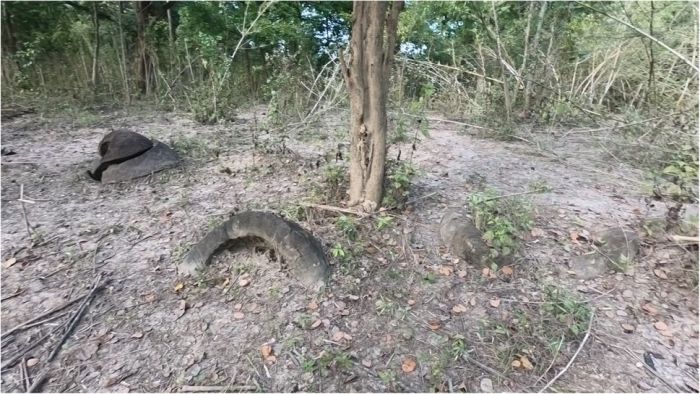
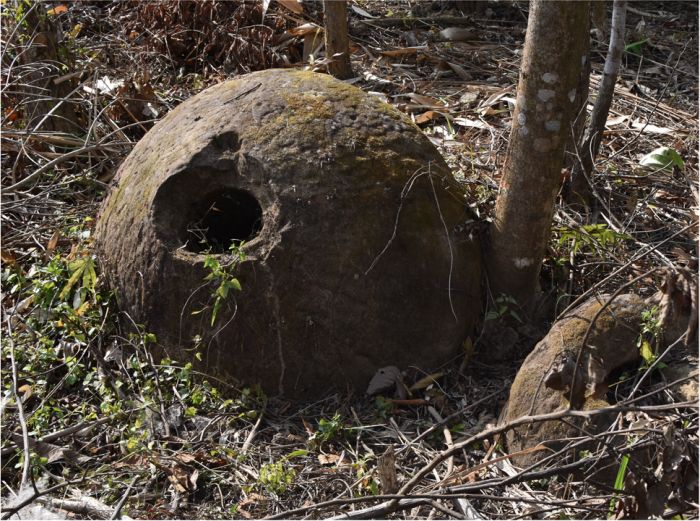


 . [5]
 .

 if we use the common fractional approximation for
 as (22/7) whereas the precise estimates for the perimeter and height in meters give us