Naar de inhoud

UFO'S of UAP'S, ASTRONOMIE, RUIMTEVAART, ARCHEOLOGIE, OUDHEIDKUNDE, SF-SNUFJES EN ANDERE ESOTERISCHE WETENSCHAPPEN - DE ALLERLAATSTE NIEUWTJES

UFO's of UAP'S in België en de rest van de wereld
akke.beakke.be
Ontdek de Fascinerende Wereld van UFO's en UAP's: Jouw Bron voor Onthullende Informatie! Ben jij ook gefascineerd door het onbekende? Wil je meer weten over UFO's en UAP's, niet alleen in België, maar over de hele wereld? Dan ben je op de juiste plek! België: Het Kloppend Hart van UFO-onderzoek In België is BUFON (Belgisch UFO-Netwerk) dé autoriteit op het gebied van UFO-onderzoek. Voor betrouwbare en objectieve informatie over deze intrigerende fenomenen, bezoek je zeker onze Facebook-pagina en deze blog. Maar dat is nog niet alles! Ontdek ook het Belgisch UFO-meldpunt en Caelestia, twee organisaties die diepgaand onderzoek verrichten, al zijn ze soms kritisch of sceptisch. Nederland: Een Schat aan Informatie Voor onze Nederlandse buren is er de schitterende website www.ufowijzer.nl, beheerd door Paul Harmans. Deze site biedt een schat aan informatie en artikelen die je niet wilt missen! Internationaal: MUFON - De Wereldwijde Autoriteit Neem ook een kijkje bij MUFON (Mutual UFO Network Inc.), een gerenommeerde Amerikaanse UFO-vereniging met afdelingen in de VS en wereldwijd. MUFON is toegewijd aan de wetenschappelijke en analytische studie van het UFO-fenomeen, en hun maandelijkse tijdschrift, The MUFON UFO-Journal, is een must-read voor elke UFO-enthousiasteling. Bezoek hun website op www.mufon.com voor meer informatie. Samenwerking en Toekomstvisie Sinds 1 februari 2020 is Pieter niet alleen ex-president van BUFON, maar ook de voormalige nationale directeur van MUFON in Vlaanderen en Nederland. Dit creëert een sterke samenwerking met de Franse MUFON Reseau MUFON/EUROP, wat ons in staat stelt om nog meer waardevolle inzichten te delen. Let op: Nepprofielen en Nieuwe Groeperingen Pas op voor een nieuwe groepering die zich ook BUFON noemt, maar geen enkele connectie heeft met onze gevestigde organisatie. Hoewel zij de naam geregistreerd hebben, kunnen ze het rijke verleden en de expertise van onze groep niet evenaren. We wensen hen veel succes, maar we blijven de autoriteit in UFO-onderzoek! Blijf Op De Hoogte! Wil jij de laatste nieuwtjes over UFO's, ruimtevaart, archeologie, en meer? Volg ons dan en duik samen met ons in de fascinerende wereld van het onbekende! Sluit je aan bij de gemeenschap van nieuwsgierige geesten die net als jij verlangen naar antwoorden en avonturen in de sterren! Heb je vragen of wil je meer weten? Aarzel dan niet om contact met ons op te nemen! Samen ontrafelen we het mysterie van de lucht en daarbuiten.

Berichten van 1 april 2022 tot 30 april 2022

Shock result in particle experiment could spark physics revolution

Shock result in particle experiment could spark physics revolution

By Pallab Ghosh - Science correspondent

Fermilab Collider Detector

IMAGE SOURCE,FERMILAB
Image caption,
The Fermilab Collider Detector obtained a result that could transform the current theory of physics

Scientists just outside Chicago have found that the mass of a sub-atomic particle is not what it should be.

The measurement is the first conclusive experimental result that is at odds with one of the most important and successful theories of modern physics.

The team has found that the particle, known as a W boson, is more massive than the theories predicted.

The result has been described as "shocking" by Prof David Toback, who is the project co-spokesperson.

The discovery could lead to the development of a new, more complete theory of how the Universe works.

"If the results are verified by other experiments, the world is going to look different." he told BBC News. "There has to be a paradigm shift. The hope is that maybe this result is going to be the one that breaks the dam.

"The famous astronomer Carl Sagan said 'extraordinary claims require extraordinary evidence'. We believe we have that."

The scientists at the Fermilab Collider Detector (CDF) in Illinois have found only a tiny difference in the mass of the W Boson compared with what the theory says it should be - just 0.1%. But if confirmed by other experiments, the implications are enormous. The so-called Standard Model of particle physics has predicted the behaviour and properties of sub-atomic particles with no discrepancies whatsoever for fifty years. Until now.

CDF's other co-spokesperson, Prof Giorgio Chiarelli, from INFN Sezione di Pisa, told BBC News that the research team could scarcely believe their eyes when they saw the results.

"No-one was expecting this. We thought maybe we got something wrong." But the researchers have painstakingly gone through their results and tried to look for errors. They found none.

The result, published in the journal Science, could be related to hints from other experiments at Fermilab and the Large Hadron Collider at the Swiss-French border. These, as yet unconfirmed results, also suggest deviations from the Standard Model, possibly as a result of an as yet undiscovered fifth force of nature at play.

Scientists say they have found "strong evidence" for the existence of a new force of nature

Physicists have known for some time that the theory needs to be updated. It can't explain the presence of invisible material in space, called Dark Matter, nor the continued accelerating expansion of the Universe by a force called Dark Energy. Nor can it explain gravity.

Dr Mitesh Patel of Imperial College, who works at the LHC, believes that if the Fermilab result is confirmed, it could be the first of many new results that could herald the biggest shift in our understanding of the Universe since Einstein's theories of relativity more than a hundred years ago.

"The hope is that these cracks will turn into chasms and eventually we will see some spectacular signature that not only confirms that the Standard Model has broken down as a description of nature, but also give us a new direction to help us understand what we are seeing and what the new physics theory looks like.

"If this holds, there have to be new particles and new forces to explain how to make these data consistent".

Fermilab

IMAGE SOURCE,FERMILAB
Image caption,
Based on a 2,700-hectare site near Chicago, Fermilab is America's premier particle physics lab

But the excitement in the physics community is tempered with a loud note of caution. Although the Fermilab result is the most accurate measurement of the mass of the W boson to date, it is at odds with two of the next most accurate measurements from two separate experiments which are in line with the Standard Model.

"This will ruffle some feathers", says Prof Ben Allanach, a theoretical physicist at Cambridge University.

"We need to know what is going on with the measurement. The fact that we have two other experiments that agree with each other and the Standard Model and strongly disagree with this experiment is worrying to me".

LHCb in 2018
IMAGE SOURCE,CERN

All eyes are now on the Large Hadron Collider which is due to restart its experiments after a three-year upgrade. The hope is that these will provide the results which will lay the foundations for a new more complete theory of physics.

"Most scientists will be a little bit cautious," says Dr Patel.

"We've been here before and been disappointed, but we are all secretly hoping that this is really it, and that in our lifetime we might see the kind of transformation that we have read about in history books."

Follow Pallab on Twitter

Related Internet Links

The BBC is not responsible for the content of external sites.

{ https://www.bbc.com/ }

Hoe vind je dit bericht?
Geschreven door peter om 01:38 Stuur door

Mystery of ‘Oumuamua’s creation explained by study

Mystery of ‘Oumuamua’s creation explained by study

New research proposes possible origins of the interstellar object 'Oumuamua.

Mystery of 'Oumuamua's creation explained by study

Credit: YU Jingchuan from Beijing Planetarium

An artist's impression of 'Oumuamua formation.

KEY TAKEAWAYS
  • A new paper suggests a star's tidal forces could have created 'Oumuamua. 
  • The interstellar object 'Oumuamua was first spotted in 2017. 
  • The object is known for its elongated shape and unusual trajectory.

Paul Ratner

Scientists may have discovered the origins of ‘Oumuamua, the first interstellar object that was spotted visiting our Solar System.The reddish, dry, and strangely-elongated ‘Oumuamua, known to move in unexpected ways, has been a subject of much speculation. Some have, of course, brought up the idea it might an extraterrestrial spacecraft, possibly a probe. Now, scientists propose that tidal forces, gravitational interactions similar to those on Earth, are responsible for its existence and unusual behavior.

The cigar-shaped ‘Oumuamua is 400 meters (1,300 feet) in length and was first discovered on October 19, 2017 by the Hawaii-based Panoramic Survey Telescope and Rapid Response System 1 (Pan-STARRS1). Scientists and armchair astronomers the world over have since wondered about where it came from, especially in light of factors like its acceleration away from the Sun in a trajectory that is not explainable simply by the effects of gravity.

22933866.jpg?w=335

Simulation showing the interstellar object ‘Oumuamua as a collection of fragments in an elongated shape.

Credit: ZHANG Yun/background by ESO/M. Kornmesser

The new study, which was carried out by by Zhang Yun from National Astronomical Observatories of Chinese Academy of Sciences (NAOC) and Douglas N. C. Lin from University of California, Santa Cruz, says the object of mystery is natural. Clues pointing to that include the space body’s colors and the lack of any radio emissions coming from it.

While scientists expect an interstellar visitor to be icy, like a comet, Oumuamua is dry and has a rocky body like an asteroid, leading the researchers to conclude that there are more such rocky objects flying in between solar systems than they previously considered.

How did such an object come into existence? Zhang and Lin believe it’s a piece ripped off of another space body by a larger object. They conducted computer simulations, focusing on the example of the tidal disruption imposed by Jupiter on the comet Shoemaker-Levy 9 in 1992 to show that when a star is involved in such a fly-by, an outcome is possible that could create the elongated fragment like ‘Oumuamua’s.

22933871.jpg?w=335

The effects of a tidal disruption by a star on a space object.

Credit: NAOC/Y. Zhang

The researchers showed that after a space body is pulled apart by the star’s tidal forces, its fragments would melt and stretch into a cigar-shaped arrangement. The resulting parts would cool off as the object moves away from the star, hardening into a crust. It is subsequently propelled farther into space.

The scientists also have an explanation for the acceleration of an object like this, proposing that the Sun’s heating up of water ice under its surface can result in a release of gas that would act as a propellant.

"The tidal fragmentation scenario not only provides a way to form one single ‘Oumuamua, but also accounts for the vast population of rocky interstellar objects,” said Zhang. He thinks that all types of space objects, like long-period comets, debris disks, and possibly even planets, can be turned into ‘Oumuamua-size bodies upon getting close to a star.

“‘Oumuamua is just the tip of the iceberg,” said Lin, adding “We anticipate many more interstellar visitors with similar traits will be discovered by future observation with the forthcoming Vera C. Rubin Observatory.”

You can read the study in Nature Astronomy.

  • WAS OUMUAMUA AN ALIEN SPACESHIP? NO. HERE’S WHAT IT IS.

{ https://bigthink.com/ }

Hoe vind je dit bericht?
Geschreven door peter om 23:46 Stuur door

How To Tell The World You’ve Found An Extraterrestrial Civilisation

How To Tell The World You’ve Found An Extraterrestrial Civilisation

How To Tell The World You’ve Found An Extraterrestrial Civilisation

Duncan Forgan, University of St Andrews Research Fellow

You’d think that after innumerable hypothetical scenarios of humans establishing contact with alien civilizations, we’d be ready to actually find one. Finding sentient life beyond Earth, on the other hand, is definitely going to be one of the most seismic events in our species’ history.

So, if you’ve just discovered an alien civilization, how do you break the news to the rest of the world? This is a monumental task, and I’ve been involved in the development of some guidelines for scientists working on extraterrestrial life searches. The findings will be published in the Acta Astronautica journal.

Some think that it is just a matter of time until we encounter intelligent life, given the millions of dollars presently being poured in efforts like the Search for Extraterrestrial Intelligence (SETI).

moon123.jpg

Personally, I’m not convinced, but skepticism alone isn’t enough to call off a search. Regardless of our initial preconceptions, the scientific method encourages us to examine our theories via observation and experiment.

I don’t think it’ll be a message from an extraterrestrial civilization or a landing party if we ever locate traces of sentient life.

It’ll more likely be something more mundane, like traces of manmade pollution in an exoplanet’s atmosphere. It might potentially take the shape of massive buildings constructed into the ground to collect energy and offer dwellings

We should be able to spot such megastructures in planetary transit data, such as that acquired by the Kepler Space Telescope, as I demonstrated in a paper a few years ago.

True, Kepler did see strange objects like Tabby’s Star, KIC 8426582, that had characteristics that were predicted to come from artificial structures. But, like most scientists, I’m still skeptical – a swarm of comets around Tabby’s Star, causing extraordinary brightness variations, is the most logical explanation.

What’s particularly promising about this is that it demonstrates that SETI can be done “on the cheap,” using publicly available astronomical data to look for aliens. This appears to be a lot more appropriate method for a pessimist like me.

The explosion of the online activity surrounding Tabby’s star – blogs, tweets, news reports, and a Kickstarter drive to encourage the public to sponsor more observations – exemplifies how different the world has become since SETI began roughly 60 years ago.

moon3112.jpg

A world that is hyper-connected

What should the discoverers do if proof of alien life ever arrived to us from the stars? Astrobiologists have been debating this for decades.

A group of SETI scientists even drafted a set of post-detection guidelines in 1989 to help scientists navigate the processes following discovery.

These procedures involve confirming the discovery with your colleagues and contacting “relevant national authorities” (I’m not sure what this means), then the scientific community, and finally the general public via a press release.

This set of standards, however, was developed before the internet. We used to get our news from the newspaper or the television. Even 24-hour news was still in its infancy at the time.

Nowadays, the news world is a fragmented realm of items shared by our friends and family and presented on our devices and in our feeds via a number of social media channels. Data travels at a breakneck speed and is readily amplified and distorted.

That’s why my colleague Alexander Scholz and I decided to revisit the topic, wondering how SETI’s post-detection methods might evolve to fit our hyper-connected world.

We immediately recognized that scientists require instruction even before they begin an experiment, let alone after they have made a discovery. It is now standard practice for new scientific initiatives to create a blog to document their progress, and SETI will be no exception.

A precise description of what a particular project will accomplish, as well as the criteria for a successful detection, a false positive, and no detection, should be included in the blog. This would make it easier for journalists and the general public to understand the findings correctly.

alien23499.jpg

Individuals engaged must be trustworthy communicators of their work, thus establishing a strong digital presence early on is critical. We also advise them to update their security settings to protect themselves from malicious persons broadcasting their personal information, which is, unfortunately, a genuine threat these days.

If a team is fortunate enough to make even a speculative, unconfirmed discovery, they must be certain that they have nothing to conceal. Leaks are unavoidable and occur at an alarming rate. Nobody wants a narrative about “aliens discovered” that turns out to be bogus. The easiest approach to accomplish this is to disseminate data as soon as possible.

If it’s evident that the discovery is unverified, and natural or man-made causes can’t be ruled out, conspiracy theorists have no place to complain about the scientists’ complicity with the men in black (an accusation flung at me more than once). It also allows other scientists to review the study and confirm the discovery.

Of course, we’ve all seen some of the comments on YouTube or other media sites — numpties abound, and there appears to be no stopping decent scientific debate from devolving into incomprehensible diatribes and disgusting hate speech. As a result, the most crucial piece of advice for scientists is to participate in the dialogue.

If a widely reported discovery proves to be erroneous, the team should issue an urgent public statement stating that no aliens have been located and explaining why. If they have to, they should write a paper retracting it.

However, whoever discovers intelligent life should expect it to consume the rest of their lives — there won’t be much time for anything else. Instead, their new mission will be to assist mankind in accepting its new status as one of many sentient civilizations in the cosmos.

RELATED VIDEOS, selected and posted by peter2011

{ https://en.news131daily.com/ }

Hoe vind je dit bericht?
Geschreven door peter om 23:06 Stuur door

Monsterkomeet C/2014 UN271 is de grootste ooit gezien (én hij komt onze kant uit)

NASA
© NASA

Monsterkomeet C/2014 UN271 is de grootste ooit gezien (én hij komt onze kant uit)

Nadat astronomen een jaar geleden komeet C/2014 UN271 ontdekten, hebben ze nu ook achterhaald hoe groot deze komeet is. Met behulp van de Hubble-ruimtetelescoop blijkt de kern wel 130 kilometer groot te zijn. Daarmee kroont de komeet zich tot grootste ooit gezien én hij komt onze kant uit, maar dat is niets om ons zorgen over te maken. 

{ https://www.hln.be/ }

Hoe vind je dit bericht?
Geschreven door peter om 22:01 Stuur door

Oudste verwijzing naar de beroemde Mayakalender teruggevonden in Guatemala

Het gaat om een eeuwenoude hiëroglief met de symbolen voor ‘Dag 7 Hert’, één van de 260 dagen op de Tzolkin, een befaamde Mayakalender. Het gaat om een eeuwenoude hiëroglief met de symbolen voor ‘Dag 7 Hert’, één van de 260 dagen op de Tzolkin, een befaamde Mayakalender.  © via REUTERS

Oudste verwijzing naar de beroemde Mayakalender teruggevonden in Guatemala

Onderzoekers hebben tijdens opgravingen in de oude piramide Las Pinturas in San Bartolo, een kleine Mayastad in Guatemala, een kalenderfragment ontdekt dat mogelijk dateert uit het Mayatijdperk. Het gaat om een eeuwenoud hiëroglief met de symbolen voor ‘Dag 7 Hert’, één van de 260 dagen op de Tzolkin, een befaamde Mayakalender.

{ https://www.hln.be/ }

Hoe vind je dit bericht?
Geschreven door peter om 21:18 Stuur door

Brrr. Webb’s MIRI has Reached 6.4 Kelvin, Just a few Degrees Above Absolute Zero

Brrr. Webb’s MIRI has Reached 6.4 Kelvin, Just a few Degrees Above Absolute Zero

The latest update on the James Webb Space Telescope literally sent a shiver down my spine! The telescope’s Mid-Infrared Instrument (MIRI) has now reached its operating temperature of a chilly 7 kelvins (7 deg above absolute 0, or -266 degrees C,-447 degrees F).

MIRI has now been turned on and is undergoing initial checkouts.

This frigid temp is colder than JWST’s other three instruments need to be, since MIRI detects longer infrared wavelengths than the rest of the instruments. But still, all the instruments need to reach extremely low temperatures — less than 40 K (-223 degrees Celsius, -369.4 degrees Fahrenheit) — since this is an infrared telescope. Infrared light comes at wavelengths slightly longer than those that human eyes can see.

Overview of the MIRI instrument. The instrument is attached to the JWST Integrated Science Instrument Module (ISIM) by the CFRP hexapod (triangular structure at left).  Credit: University of Arizona.

Getting to the temperatures required for MIRI is not possible by passive means alone, so Webb carries an innovative cryocooler, dedicated to the task of cooling MIRI’s detectors so that it can see farther into the infrared than the other instruments.

Infrared light is basically thermal radiation, and the telescope itself has a certain temperature and continually radiates heat that would interfere with the measurements taken by the instrument’s sensors. Cooling down the entire telescope – including the four instruments’ detectors and the surrounding hardware — suppresses those infrared emissions. This allows the distant objects to be detected, without any interference from the other nearby sources.

Last week, the team passed a particularly challenging milestone called the “pinch point,” when the instrument goes from 15 kelvins (minus 433 F, or minus 258 C) to 6.4 kelvins (minus 448 F, or minus 267 C).

“The MIRI cooler team has poured a lot of hard work into developing the procedure for the pinch point,” said Analyn Schneider, project manager for MIRI at NASA’s Jet Propulsion Laboratory in Southern California. “The team was both excited and nervous going into the critical activity. In the end it was a textbook execution of the procedure, and the cooler performance is even better than expected.”

NASA says that another reason Webb’s detectors need to be cold is to suppress something called dark current, or electric current created by the vibration of atoms in the detectors themselves. Dark current mimics a true signal in the detectors, giving the false impression that they have been hit by light from an external source. Those false signals can drown out the real signals astronomers want to find. Since temperature is a measurement of how fast the atoms in the detector are vibrating, reducing the temperature means less vibration, which in turn means less dark current.

The MIRI instrument, in silver, integrated into the JWST Integrated Science Instrument Module (ISIM).. Credit: NASA Goddard Spaceflight Center .

MIRI’s longer infrared detectors are more sensitive to dark current, so it needs to be colder than the other instruments to fully remove that effect. For every degree the instrument temperature goes up, the dark current goes up by a factor of about 10.

Scientists and engineers are now doing a series of checks to make sure the detectors are operating as expected. They are also sending commands to determine if it can execute tasks correctly.

“We spent years practicing for that moment, running through the commands and the checks that we did on MIRI,” said Mike Ressler, project scientist for MIRI at JPL. “It was kind of like a movie script: Everything we were supposed to do was written down and rehearsed. When the test data rolled in, I was ecstatic to see it looked exactly as expected and that we have a healthy instrument.”

Now, MIRI will take test images of stars and other known objects that can be used for calibration and to check the instrument’s operations and functionality. The team will conduct these preparations alongside calibration of the other three instruments, delivering Webb’s first science images this summer.

Source: NASA

The post Brrr. Webb’s MIRI has Reached 6.4 Kelvin, Just a few Degrees Above Absolute Zero appeared first on Universe Today.


Source: 

{ https://beforeitsnews.com/ }

Hoe vind je dit bericht?
Geschreven door peter om 18:44 Stuur door

Even Mercury has Geomagnetic Storms

Even Mercury has Geomagnetic Storms

Can other planets have geomagnetic storms, even if their magnetosphere is weak and they don’t have an ionosphere like Earth? This question has now been answered, according to research done by a team of scientists in the United States, Canada, and China.

The research team found evidence that Mercury has a ring current, part of a magnetosphere, consisting of charged particles flowing laterally in a doughnut shape around the planet but that excludes the poles. This evidence came from data obtained from the Messenger space probe while it was dropping towards the planet at the end of its mission on April 14, 2015.

A magnetosphere is a system of magnetic fields that form a bubble around a planet that is created by the spinning, electrically charged inner core of a planet. For our planet, this bubble reaches 6 to 10 times the radius of the Earth with the side opposite the Sun extending out like a comet’s tail to 60 times the radius of Earth. It extends out like that because of the force of the solar wind interacting with it.

This magnetosphere helps protect the planet from particle radiation coming from the Sun and elsewhere, and also from the solar wind which is a steady stream of charged particles emanating from the Sun. Our Sun often produces coronal mass ejections (CME), bursts of the Sun’s plasma which is a superheated gas of charged particles. The planets in our solar system, excluding Venus and Mars, have magnetospheres as well.

Earth’s magnetosphere isn’t a sphere at all. The solar wind deforms it into an asymmetrical shape. Image Credit: NASA

When a CME hits the magnetosphere it triggers a magnetic storm. According to professor Hui Zhang of the University of Alaska Fairbanks Geophysical Institute, “a magnetic storm is a major disturbance of the magnetic field in a planet’s magnetosphere.” Here on Earth, that storm causes the auroras borealis and australis, the Northern Lights and Southern Lights.

As the research team discovered from the data they collected, Mercury has magnetic storms as well. They found that Mercury’s ring current had been compressed from the CME of April 14, 2015, increasing the current’s energy. As stated in the source article, Hui Zhang says “the sudden intensification of a ring current causes the main phase of a magnetic storm.”

However, since Mercury has a very thin atmosphere no auroras are produced. Instead, the particles end up hitting the surface of the planet. Hui Zhang states that “only emissions at the X-ray and Gamma-Ray range from the surface of Mercury have been reported so far and we do not know whether there are emissions at other wavelength ranges (e.g., visible wavelengths).”

This finding may indicate that other planets, including exoplanets, with magnetospheres may also have magnetic storms. One of the research papers written about this, which was co-authored by Zhang, concludes: “The results obtained from Messenger provide a further fascinating insight into Mercury’s place in the evolution of the solar system following the discovery of its intrinsic planetary magnetic field.”

More:

Header credit: MESSENGER image of Mercury from its third flyby (NASA/Johns Hopkins University Applied Physics Laboratory/Carnegie Institution of Washington)

The post Even Mercury has Geomagnetic Storms appeared first on Universe Today.

Source: 

{ https://beforeitsnews.com/ }

Hoe vind je dit bericht?
Geschreven door peter om 18:30 Stuur door

Hubble Confirms Comet C/2014 UN271 is an Absolute Unit, Astronomically Speaking

Hubble Confirms Comet C/2014 UN271 is an Absolute Unit, Astronomically Speaking

It’s official. Comet C/2014 UN271 (Bernardinelli-Bernstein) has the largest nucleus ever seen in a comet. The gargantuan comet was discovered in the fall of 2021, and in January 2022, astronomers turned the Hubble Space Telescope to ascertain more details and determine the exact size.

NASA said a team of scientists has now estimated the diameter is approximately 129 km (80 miles) across, making it larger than the state of Rhode Island. The nucleus is about 50 times larger than other known comets. Its mass is estimated to be a staggering 500 trillion tons, a hundred thousand times greater than the mass of a typical comet found much closer to the Sun.

“This is an amazing object, given how active it is when it’s still so far from the Sun,” said Man-To Hui of the Macau University of Science and Technology, Taipa, Macau, lead author on a new paper on the comet. “We guessed the comet might be pretty big, but we needed the best data to confirm this.” So, his team used Hubble to take five photos of the comet on January 8, 2022.

The comet was discovered Pedro Bernardinelli and Gary Bernstein, from the University of Pennsylvania. They were scouring through data from the 570-megapixel Dark Energy Camera (DECam) on the Víctor M. Blanco 4-meter Telescope in Chile. They found data of this object that was originally collected from 2014–2018, which did not show a typical comet tail, and the object was therefore thought to be a dwarf planet.

But within a day of the announcement of its discovery via the Minor Planet Center, astronomers using the Las Cumbres Observatory network took new images which revealed that it has grown a coma in the past 3 years, and that it was rapidly moving rapidly through the Oort Cloud. The object was then officially classified as a comet.

Then astronomers then began studying this comet in earnest, taking data from all sorts of previous and recent observational sources, intensively studied by ground and space-based telescopes.

C/2014 UN271 (Bernardinelli-Bernstein) is moving in the direction towards the Sun from the outer Solar System at about 35,400 kilometers per hour (22,000 mph) But, astronomers say, don’t worry.  It will never get closer than 1.6 billion km (1 billion miles) away from the Sun, slightly farther than the distance of the planet Saturn. And that won’t be until the year 2031. And still, only large telescopes will be able to see it – it likely won’t be visible to the naked eye.

This sequence shows how the nucleus of Comet C/2014 UN271 (Bernardinelli-Bernstein) was isolated from a vast shell of dust and gas surrounding the solid icy nucleus. On the left is a photo of the comet taken by the NASA Hubble Space Telescope’s Wide Field Camera 3 on January 8, 2022. A model of the coma (middle panel) was obtained by means of fitting the surface brightness profile assembled from the observed image on the left. This allowed for the coma to be subtracted, unveiling the point-like glow from the nucleus. Credits: NASA, ESA, Man-To Hui (Macau University of Science and Technology), David Jewitt (UCLA); Image processing: Alyssa Pagan (STScI)

As with any comet, the challenge comes in trying to measure the solid nucleus while it is enveloped in a huge dusty coma. While the comet is currently too far away for its nucleus to be visually resolved by Hubble, the data did show a bright spike of light at the nucleus’ location. Hui and his team next made a computer model of the surrounding coma and adjusted it to fit the Hubble images. Then, the glow of the coma was subtracted to leave behind the starlike nucleus.

The work of Hui and his team to constrain the diameter and reflectivity of the coma showed the actual measurements are quite close to the early estimates a size of 100-200 km, and low reflectivity. Astronomers described the nucleus as “blacker than coal.”

Previously, the largest comet ever measured was C/2002 VQ94, with a nucleus estimated to be 60 miles across. It was discovered in 2002 by the Lincoln Near-Earth Asteroid Research (LINEAR) project.

But there are probably more comets like this, with origins from the edge of the Solar System.

“This comet is literally the tip of the iceberg for many thousands of comets that are too faint to see in the more distant parts of the solar system,” said David Jewitt, a professor of planetary science and astronomy at the University of California, Los Angeles (UCLA), and co-author of the new study in The Astrophysical Journal Letters. “We’ve always suspected this comet had to be big because it is so bright at such a large distance. Now we confirm it is.”

Lead image caption:

This diagram compares the size of the icy, solid nucleus of comet C/2014 UN271 (Bernardinelli-Bernstein) to several other comets. The majority of comet nuclei observed are smaller than Halley’s comet. They are typically a mile across or less. Comet C/2014 UN271 is currently the record-holder for big comets. And, it may be just the tip of the iceberg. There could be many more monsters out there for astronomers to identify as sky surveys improve in sensitivity. Though astronomers know this comet must be big to be detected so far out to a distance of over 2 billion miles from Earth, only the Hubble Space Telescope has the sharpness and sensitivity to make a definitive estimate of nucleus size.

Credits: Illustration: NASA, ESA, Zena Levy (STScI)

Further reading: NASA press release, paper in Astrophysical Journal, previous article on Universe Today on the comet’s discovery

The post Hubble Confirms Comet C/2014 UN271 is an Absolute Unit, Astronomically Speaking appeared first on Universe Today.

Source: 

{ https://beforeitsnews.com/ }

Hoe vind je dit bericht?
Geschreven door peter om 18:20 Stuur door

NASA's X-59 Aircraft Seen Along Arizona Road, April 2022, Video, UFO Sighting News.

NASA's X-59 Aircraft Seen Along Arizona Road, April 2022, Video, UFO Sighting News.

%E0%A4%89%E0%A4%AB%E0%A5%8C%20,%20%E0%A6%87%E0%A6%89%E0%A6%8F%E0%A6%AB%E0%A6%93,%20%C4%91i%CC%83a%20bay,%20MUFON,%20%E7%9B%AE%E6%92%83%E3%80%81%E3%82%A8%E3%82%A4%E3%83%AA%E3%82%A2%E3%83%B3,%20%20UFO,%20UFOs,%20%D0%9D%D0%9B%D0%9E%20,%20NLO,%20sighting,%20sightings,%20alien,%20aliens,%20ET,%20vreemdelinge,%20.png
UFO,%20UAP,%20NASA,%20top%20secret.png

Date of sighting: April 9, 2022
Location of sighting: Arizona, USA
 
Now this is interesting. The Arizona Department of Transportation tweeted this photo of an unknown object on a flatbed trailer pulled by a semi truck parked along the road along I-10 on Citrus Road. The object does look to be UFO shaped, like a triangle craft. However the tail does give it away. They figured out that its NASA's X-59 aircraft that is experimental and is capable of breaking the sound barrier without a sonic boom. Sure UFOs can also do the same thing, and I believe that this NASA design was inspired by alien craft. The US go has many crashed UFOs in their possession and often try to integrate the alien tech from the UFOs into todays modern craft to evolve them one step into the future. So...this might not be an alien craft, but it sure as hell was inspired by them and contains alien tech within. 
Scott C. Waring - Taiwan 
 
RELATED VIDEOS, selected and posted by peter2011

{ https://www.ufosightingsdaily.com/ }

Hoe vind je dit bericht?
Geschreven door peter om 17:49 Stuur door

NASA's X-59 Aircraft Seen Along Arizona Road, April 2022, Video, UFO Sighting News.

NASA's X-59 Aircraft Seen Along Arizona Road, April 2022, Video, UFO Sighting News.

%E0%A4%89%E0%A4%AB%E0%A5%8C%20,%20%E0%A6%87%E0%A6%89%E0%A6%8F%E0%A6%AB%E0%A6%93,%20%C4%91i%CC%83a%20bay,%20MUFON,%20%E7%9B%AE%E6%92%83%E3%80%81%E3%82%A8%E3%82%A4%E3%83%AA%E3%82%A2%E3%83%B3,%20%20UFO,%20UFOs,%20%D0%9D%D0%9B%D0%9E%20,%20NLO,%20sighting,%20sightings,%20alien,%20aliens,%20ET,%20vreemdelinge,%20.png
UFO,%20UAP,%20NASA,%20top%20secret.png

Date of sighting: April 9, 2022
Location of sighting: Arizona, USA
 
Now this is interesting. The Arizona Department of Transportation tweeted this photo of an unknown object on a flatbed trailer pulled by a semi truck parked along the road along I-10 on Citrus Road. The object does look to be UFO shaped, like a triangle craft. However the tail does give it away. They figured out that its NASA's X-59 aircraft that is experimental and is capable of breaking the sound barrier without a sonic boom. Sure UFOs can also do the same thing, and I believe that this NASA design was inspired by alien craft. The US go has many crashed UFOs in their possession and often try to integrate the alien tech from the UFOs into todays modern craft to evolve them one step into the future. So...this might not be an alien craft, but it sure as hell was inspired by them and contains alien tech within. 
Scott C. Waring - Taiwan 
 
RELATED VIDEOS, selected and posted by peter2011

{ https://www.ufosightingsdaily.com/ }

Hoe vind je dit bericht?
Geschreven door peter om 17:49 Stuur door

UFO Causes Dust Storm, San Simon, Arizona April 11, 2022, UFO Sighting News.

UFO Causes Dust Storm, San Simon, Arizona April 11, 2022, UFO Sighting News.

2343434%20copy%203.png
%E0%A4%89%E0%A4%AB%E0%A5%8C%20,%20%E0%A6%87%E0%A6%89%E0%A6%8F%E0%A6%AB%E0%A6%93,%20%C4%91i%CC%83a%20bay,%20MUFON,%20%E7%9B%AE%E6%92%83%E3%80%81%E3%82%A8%E3%82%A4%E3%83%AA%E3%82%A2%E3%83%B3,%20%20UFO,%20UFOs,%20%D0%9D%D0%9B%D0%9E%20,%20NLO,%20sighting,%20sightings,%20alien,%20aliens,%20ET,%20anomaly,%20anomalies,%20ancient,%20astrobiology,%203%20.jpeg
Date of sighting: April 11, 2022
Location of sighting: San Simon, Arizona, USA
Source:  
Check this out. An eyewitness was looking at the Arizona cams and reported a dust storm in the area of San Simon. Right above the dust storm is a long UFO which is causing the dust and wind to kick up in order to help hide itself from the drivers along the freeway. Alien are in constant fear of getting seen, so they take every measure to hide from us. Here is just such an occurrence. 
 
UFOs are often seen around natural disasters like the Fukashima, Japan Tsunami and earthquake, tornadoes in central US and even in the Ukraine war near explosions. Its clear that UFOs can deliberately cause these disasters to occur in order to hide the spacecraft from human eyes or to use humans as test lab animals for their experiments. 
Scott C. Waring - Taiwan 
 
UFO,%20UAP,%20MUFON,%20news,%20aliens,%20.jpeg

{ https://www.ufosightingsdaily.com/ }

Hoe vind je dit bericht?
Geschreven door peter om 17:34 Stuur door

UFO Travels In To Clouds Over Texas Attempting to Hide From Plane

UFO Travels In To Clouds Over Texas Attempting to Hide From Plane

ufo-texas.png

This interesting UFO sighting was just posted by UFO hunter SAUFOTX on Youtube. It was filmed over San Antonio, Texas recently.

RELATED VIDEOS, selected and posted by peter2011

{ https://www.latest-ufo-sightings.net/ }

Hoe vind je dit bericht?
Geschreven door peter om 17:22 Stuur door

An interstellar object exploded over Earth in 2014, declassified government data reveal

An interstellar object exploded over Earth in 2014, declassified government data reveal

Hoe vind je dit bericht?
Geschreven door peter om 01:44 Stuur door

Bizarre cloud formation over Alaska's Lazy Mountain prompts police investigation as witnesses fear it was a plane crash, a UFO or top secret Russian weapon

Bizarre cloud formation over Alaska's Lazy Mountain prompts police investigation as witnesses fear it was a plane crash, a UFO or top secret Russian weapon

  • A strange, worm-like cloud was pictured over Alaska's Lazy Mountain, sparked conspiracy theories ranging from a UFO crash to weapons tests 
  • On Thursday at around 7 am, photos of the incident show a massive cloud plume, with social media left scratching their heads over what it could be 
  • Some explanations given for it include a meteor, a crashed UFO, an eruption, or even a Russian weapon connected to the conflict in Ukraine 
  • The cloud garnered so much attention that Alaska State Troopers and the Alaska Rescue Coordination Center began investigating for a possible plane crash 
  • However, officials eventually offered a far more tame explanation for the bizarre cloud, claiming it was a contrail from a commercial jet 

Photos of a strange, worm-like cloud taken over Alaska's Lazy Mountain prompted an investigation by Alaska State Troopers amid fears it could be a plane crash, a UFO or top secret Russian weapon.

Pictures posted to Facebook of the incident show a massive cloud plume on Thursday.

The photos sparked debate online as people questioned whether it could be a meteor, a crashed UFO or satellite, an eruption, and even a Russian weapon connected to the conflict in Ukraine.  

The cloud garnered so much attention that Alaska State Troopers and the Alaska Rescue Coordination Center began investigating for a possible plane crash. 

'There have been no reports of overdue aircraft or ELT activations indicating an aircraft crash,' Alaska State Troopers reported in a release.  

A rescue team on a helicopter flew a mission around the Lazy Mountain area this morning and located nothing suspicious and there were no signs of crashed aircraft.' 

A strange, worm-like cloud, pictured, was photographed over Alaska's Lazy Mountain, triggering talks of conspiracy theories ranging from the likes of a UFO crash and weapons tests

A strange, worm-like cloud, pictured, was photographed over Alaska's Lazy Mountain, triggering talks of conspiracy theories ranging from the likes of a UFO crash and weapons tests

The unidentified cloud and Alaska's Lazy Mountains in the foreground

The unidentified cloud and Alaska's Lazy Mountains in the foreground

Online, theories ran wild.

'We saw this on the way to school this morning as well. Very eerie!' Christy Hronkin Swift wrote on the Palmer Alaska Buzz Facebook page. 

'Looks like a meteor. I wonder where it landed,' Cassi Joi posted. 

'Could it be a satellite? It’s so strange,' Shannon Del Vecchio Watson said. 

'No wings,' Susie Kuke Martin noted. 

Some explanations given for it include a meteor, a crashed UFO, an eruption, or even a Russian weapon connected to the conflict in Ukraine

Some explanations given for it include a meteor, a crashed UFO, an eruption, or even a Russian weapon connected to the conflict in Ukraine

On Thursday at around 7 am, photos of the incident show a massive cloud plume were posted to social media

On Thursday at around 7 am, photos of the incident show a massive cloud plume were posted to social media

Officials eventually offered a far more tame explanation for the bizarre cloud, claiming it was a contrail from a commercial jet

Officials eventually offered a far more tame explanation for the bizarre cloud, claiming it was a contrail from a commercial jet

However, officials eventually offered a far more tame explanation for the bizarre cloud, claiming it was a contrail from a commercial jet. 

'Further investigation revealed that a large commercial jet was flying in that area around the time that the photos and video were taken,' officials said. 

'The aircraft was contacted and reported normal flight operations on its way to JFK airport in New York.' 

'Troopers believe that the photos and videos showed a contrail from the commercial jet combined with the rising sun which together caused the unique atmospheric sight.' 

US intelligence officials have evidence that UFO sightings can lead to adverse health effects including radiation burns, according to a study released this week. Above, a photo of a UFO taken by navy pilots in 2020

US intelligence officials have evidence that UFO sightings can lead to adverse health effects including radiation burns, according to a study released this week. Above, a photo of a UFO taken by navy pilots in 2020

In May, a video was released that appeared to show a UFO buzz a US stealth ship near San Diego before diving under the water back in July 2019

In May, a video was released that appeared to show a UFO buzz a US stealth ship near San Diego before diving under the water back in July 2019

The photos emerged a day after news energed hundreds of military officers reporting injuries, including brain damage and burns, after encounters with UFOs, a top brain expert and former CIA officer revealed. 

Detroit Professor Christopher Green was commissioned around 2010 by a secret $22 million defense program monitoring UFOs, to write a paper on injuries from close encounters with 'anomalous' craft.

In an exclusive interview with DailyMail.com the forensic neuroimaging expert, who has worked with the CIA since the 1960s, said he dealt with 'hundreds of patients' including special forces officers and other military personnel hurt after interacting with unidentified craft, some of whom later died.

Some of the injuries resembled the mysterious 'Havana Syndrome', which intelligence agencies believe could be a series of clandestine attacks on US diplomats by a foreign power using targeted microwaves.

RELATED VIDEOS, selected and posted by peter2011

Hoe vind je dit bericht?
Geschreven door peter om 01:32 Stuur door

Maybe the Aliens Really Are Here

Maybe the Aliens Really Are Here

But if so, it’s probably in the form of robotic probes—something both UFO enthusiasts and SETI scientists should be able to agree on

By John Gertz

Maybe the Aliens Really Are Here

Credit: David Wall Getty Images

SETI, as a modern astronomical endeavor, dating to 1959 (first paper) and 1960 (first observation). Modern UFO sightings date to the late 1940s. Though superficially similar, the two fields in practice have had virtually nothing to do with one another. SETI usually requires a graduate degree in astronomy, and its scientists tend to disdain UFOers for requiring nothing more than a camera that takes blurry photos and a butterfly net in case a little green man appears.

However, the two camps may be moving closer together.

In the classic SETI paradigm, stars are observed for artificial signals. But this communication strategy has severe drawbacks from ET’s point of view. In order for it to succeed, ET would have to target each of potentially millions of promising nearby stars (including ours) continuously, and do so over potentially billions of years. Additionally, it would need to maintain a dedicated receiver for each target star to be certain not to miss a return message if and when it arrives. The cost of this strategy to ET in time, energy and materials would be immeasurable. Further, by announcing its presence to so many stars, it invites disaster should any civilization prove aggressive. Added to this is the problem of communicating with a target civilization of which it would know nothing. Perhaps the transmitting civilization communicates in color oscillations like a cuttlefish, while the recipient only understands bee-like waggles.

Building on the work of others, I have hypothesized that aliens would be better served by sending robotic probes. Relatively simple flyby probes might intermittently surveil nascent solar systems, for example, at 200-million-year intervals. Star systems with biogenic planets might be surveilled more often. Highly capable probes might be placed permanently in the vicinity of planets that have achieved multicellularity as indicated by their oxygen-rich atmospheres or other biosignatures.

Once a permanently placed probe had detected artificial electromagnetic leakage, indicating that one multicellular species had become technologically intelligent, it would attempt to decode the species. Using Sesame Street, Khan Academy and YouTube, and even granted its enormous onboard AI capabilities, it would still take time for it to decode Homo sapiens’ languages, science, math and culture. After many decades of work by E.O. Wilson and others, we now know a little something about ant communication but are still far from a complete decoding. How very much more difficult would it be for ET to decode humans? Even if it has been watching episodes of I Love Lucy that have been leaking out into space since that show was first broadcast, it may still not understand them.

The local probe might need to send data back to its home base for deeper analysis and/or instructions on how to proceed. If the probe began transmitting data to its home in 1950 after its detection of early television signals, and if that home base were located at the modest distance of 150 light-years, then the earliest year in which the probe might receive instructions to make contact with Earth would be 2250.

However, when we do finally hear from a local probe, after it has decoded us, its transmissions may be in a terrestrial language. The ensuing dialogue will take place in near real time, as opposed to the painfully slow dialogue between ourselves and an alien civilization transmitting from a star at hundreds or thousands of light years distance. An alien probe need not reveal the location of its home base, obviating any danger to the progenitor civilization. A fully autonomous probe would be able to communicate with us even if its progenitor civilization is long extinct.

Provided that a probe does belong to an existing civilization or network of civilizations, there remains the problem of how it might communicate with them. To do so directly would require an enormous transmitter.  The better solution would be to string communication nodes at close proximity to one another, perhaps one in orbit around every star, and perhaps located at a sufficient distance from the star to enable the use of it as a gravity lens, per Einstein’s theory of general relativity. For the sun, that focal point begins at 550 Earth-sun distances (AU) at which point the node would achieve signal gain of approximately a billion.  

Large numbers of ET civilization might contribute to this nodal system, and the store of information would only grow with time regardless of whether the contributing civilizations persist or have gone extinct. We might contribute Aristotle, Shakespeare, Beethoven and Monet to this Encyclopedia Galactica. However, we will not be in a position to barter our culture; having surveilled our TV and internet for at least 70 years, ET has probably already uploaded all it wants. Nonetheless, ET may wish to recruit us into the galactic club so that we might manufacture probes and nodes, and otherwise take responsibility for the maintenance of the interstellar communication system within our immediate stellar neighborhood. That would be our bargaining chip.

SETI stellar observations presume a very faint signal that would require Earth’s most powerful telescopes to detect. However, highly sensitive telescopes have very small fields of view. Detecting a local robotic probe requires the opposite strategy. Because of a probe’s close proximity to Earth, its signal would be much brighter than an interstellar beacon, even under the conservative assumption that its transmission will be on the order of only a few watts. Consequently, SETI’s best strategy would be to sacrifice great sensitivity in favor of a wide a field of view or, better yet, all-sky-all-the-time observing. Such systems are being built now or planned.

Purported sightings by military pilots of objects that defy all known aerodynamics in their sudden and steep accelerations may be delusions, hoaxes or optical illusions. Nevertheless, many SETI scientists now agree with UFOers that the first alien detection plausibly could occur within our own solar system. Both UFOers and SETI scientists should also agree that if some UFO sightings are genuine sightings of aliens, then they must be of robotic probes rather than vessels crewed by biological beings. If nothing else, such beings would be crushed by the g-forces of their purported, very large, accelerations.

The evidence is still lacking that would fully unify UFOers and SETI scientists—and yet the space between these two groups may not be so far vast after all.

  • This is an opinion and analysis article; the views expressed by the author or authors are not necessarily those of Scientific American.

RECENT PAPERS BY THE AUTHOR

  1. J. Gertz, Nodes: A Proposed Solution to Fermi's Paradox, JBIS, 2017, 70, 454-457.
  2. J. Gertz, ET Probes, Nodes, and Landbases: A Proposed Galactic Communications Architecture and Implied Search Strategies, JBIS, 2018, 71, 375-381.
  3. J. Gertz, ‘Oumuamua and SETI Scout Probes, JBIS, 72, pp. 182-186.
  4. J. Gertz, There’s No Place Like Home (in Our Own Solar System): Searching for ET Near White Dwarfs, JBIS, 72, pp. 386-395.
  5. J. Gertz, Strategies for the Detection of ET Probes Within Our Own Solar System, JBIS, 73, pp. 427-437.

{ https://www.scientificamerican.com/ }

Hoe vind je dit bericht?
Geschreven door peter om 00:48 Stuur door

CYBERTRUCK PROTOTYPE MOCKED FOR LOOKING EXTREMELY JANKY

CYBERTRUCK PROTOTYPE MOCKED FOR LOOKING EXTREMELY JANKY

Cybertruck Prototype Mocked for Looking Extremely Janky
CYBER OWNERS

Afterthought

All eyes were on Tesla late last week.

After hyping up the company’s brand new factory in Texas, Musk took some time on stage to show off the latest prototype of his company’s brutalist Cybertruck.

But after years of delays, Tesla still doesn’t have an awful lot to show off — and the prototype displayed last week leaves a lot to be desired.

Unfinished

Sure, from a distance, it looked like a Cybertruck. But attendees of the “Cyber Rodeo” event got a much closer look as well.

And up close, the prototype looked downright bad, almost like an afterthought, as seen in footage uploaded to YouTube by Cyber Owners.

We’re not talking just panel gaps here, as has been customary for the brand in the past. The prototype looks unfinished, as if Tesla was caught off guard by the gigantic party it was hosting.

The doors aren’t even the same color as the rest of the vehicle.

“Everything is bowed, bent at strange angles, leaving room for massive panel gaps,” Jalopnik‘s keen-eyed Steve DaSilva wrote. “Hopefully they don’t leak.”

Where’s My Truck?

None of that is exactly reassuring, considering that the Cybertruck has already been delayed a number of times.

At the event, Musk revealed that the vehicle is now slated to go into production next year, a middling consolation prize for those who preordered their trucks well over two years ago.

The company’s latest showing doesn’t instill any more confidence — we still have yet to see a production ready version of Musk’s passion project, despite the CEO’s many promises.

READ MORE: 

More on Cybertruck: 

RELATED VIDEOS, selected and posted by peter2011

{ https://futurism.com/the-byte }

Hoe vind je dit bericht?
Geschreven door peter om 23:41 Stuur door

The red color of Mars is only inches deep

The red color of Mars is only inches deep

The surface and atmosphere is colored by ferric oxides. Beneath a very thin layer, mere millimeters deep in places, it's not red anymore.
The red color of Mars is only inches deep
This sand dune, known as Dingo Gap, was crossed by Mars Curiosity in 2014. This image has been slightly 'white balanced' as opposed to being shown in true color, which enables the differences in the compositions and intrinsic colors of the features and rocks on the surface to be seen more clearly.
(Credit: NASA/JPL-Caltech/MSSS)
KEY TAKEAWAYS
  • Mars has a red surface and a red atmosphere, allowing its true color to be seen from space. 
  • Various forms of ferric oxides are responsible for this color, but  even rover tracks show the red color doesn't last for long. 
  • Beneath an extremely thin layer, as thin as millimeters and no deeper than meters anywhere, it isn't red any longer.

When we look out at our planet Earth from space, we see a myriad of diverse colors. The sky itself is blue, as the atmosphere preferentially scatters shorter-wavelength blue light in all directions, giving our atmosphere it’s characteristic color. The oceans themselves are blue, as water molecules are better at absorbing longer-wavelength red light than they are blue light. Meanwhile, the continents appear brown or green, dependent on the vegetation (or lack thereof) growing there, while the icecaps and clouds always appear white.

But on Mars, one color dominates: red. The ground is red: red everywhere. The lowlands are red; the highlands are red; the dried-up riverbeds are red; the sand dunes are red; it’s all red. The atmosphere itself is also red in every location we can measure it. The lone exception appears to be the icecaps and clouds, which are white, albeit with a reddish hue as observed from Earth. Yet quite surprisingly, the “redness” of Mars is incredibly shallow; if you dug just the tiniest bit beneath the surface, the redness vanishes. Here’s the scientific story behind just what makes the red planet so red.
mars

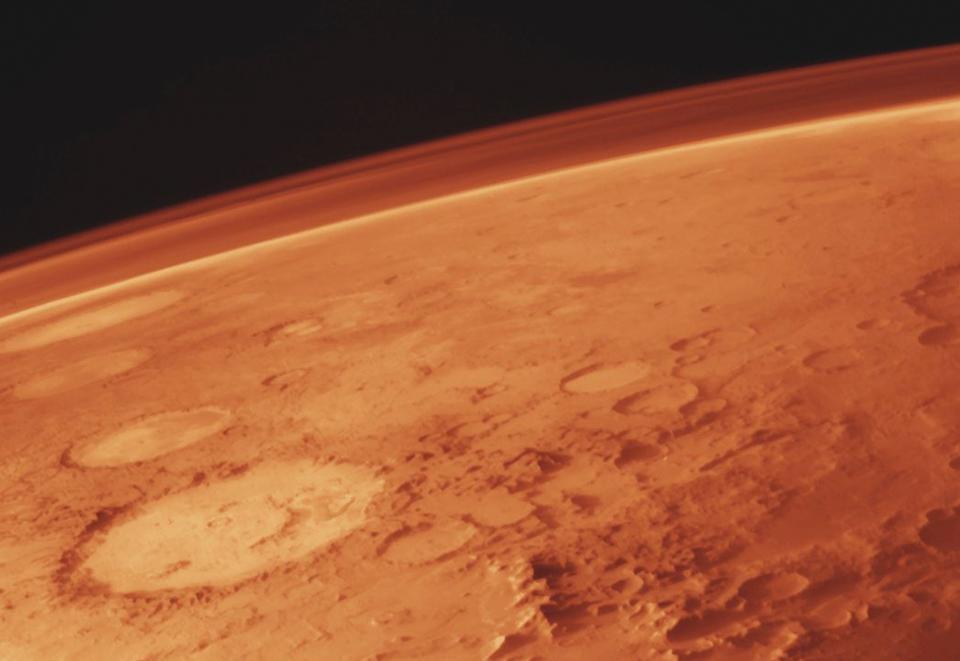
Mars, along with its thin atmosphere, as photographed from the Viking orbiter in the 1970s. The bright red atmosphere is due to the presence of Martian dust in the atmosphere, and the composition of Mars rocks was first discovered by the Viking landers.
(Credit: NASA/Viking 1)

From space, there’s no denying the red appearance of Mars. For all of recorded history in a wide variety of languages, the redness of Mars has been its most prominent feature. Mangala, the Sanskrit word for Mars, is red. Har decher, its ancient name in Egyptian, literally means “red one.” And as we’ve progressed into the space age, photos that distinguish the surface from the atmosphere clearly show that the air above Mars itself has an intrinsically red color.

In Earth’s atmosphere, Rayleigh scattering dominates, casting blue light in all directions while the red light travels relatively undisturbed. However, the atmosphere of Mars is only 0.7% as thick as Earth’s, rendering Rayleigh scattering from the gas molecules in Mars’s atmosphere a negligible effect. Instead, dust particles in the Martian atmosphere dominate in (likely) two ways:

  • greater absorption at short optical wavelengths (400-600 nm) than at longer (600+ nm) wavelengths,
  • and that larger dust particles (~3 microns and larger) scatter longer-wavelength light more efficiently than atmospheric gas particles scatter shorter-wavelength light from Rayleigh scattering.
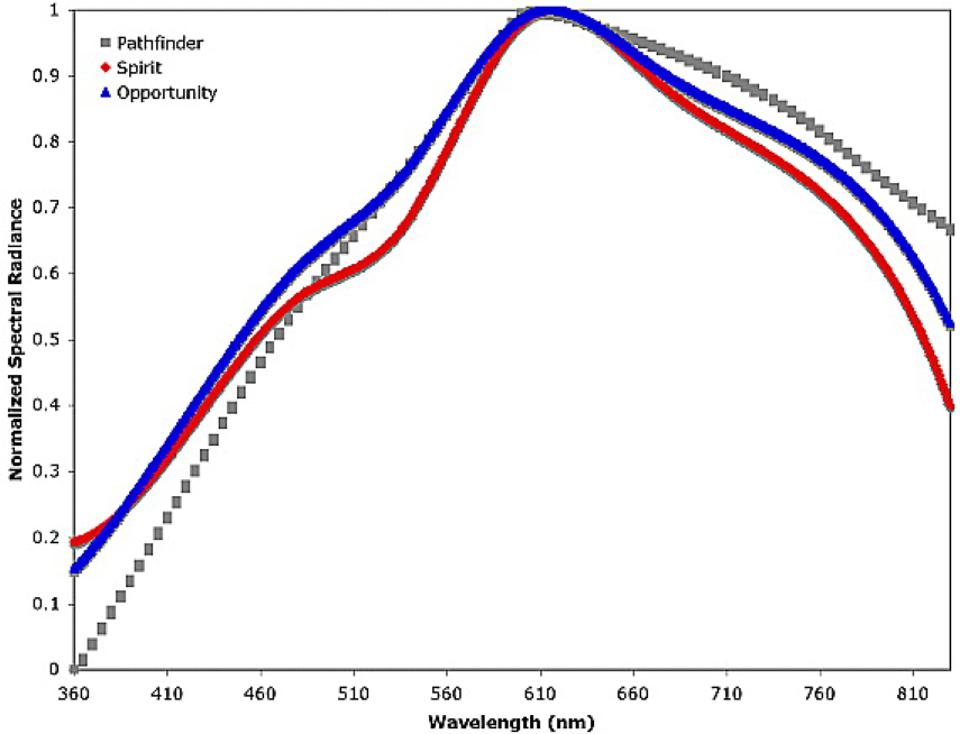
Compared to the irradiance received at Earth’s surface, the light received on Mars’s surface is severely suppressed in shorter (bluer) wavelengths. This is consistent with small hematite dust particles suspended in the Martian atmosphere, with the opacity increasing with increased dust density.
(Credit: J.F. Bell III, D. Savransky, & M.J. Wolff, JGR PLANETS, 2006)

If you look at the suspended atmospheric dust in detail on Mars, and ask, “what is it like,” the answer is incredibly informative. Just from looking at its spectral properties — or “how it affects the light” — we can see that the dust is very similar to the regions on Mars that:

  • are high in reflectivity,
  • represent bright soil deposits,
  • and are rich in iron: i.e., containing large amounts of ferric oxides.

When we look at the dust in detail, particularly with the OMEGA instrument on ESA’s Mars Express mission, we find that the most common type of dust comes from nanocrystalline red hematite, which has the chemical formula α-Fe2O3. The particles that make up this hematite are small: between about 3 and 45 microns in diameter. That’s the right size and composition so that the rapid Martian winds, which typically blow at speeds close to ~100 km/hr, continuously sweep large amounts of dust up into the atmosphere, where it remains fairly well-mixed, even when there are no dust storms.
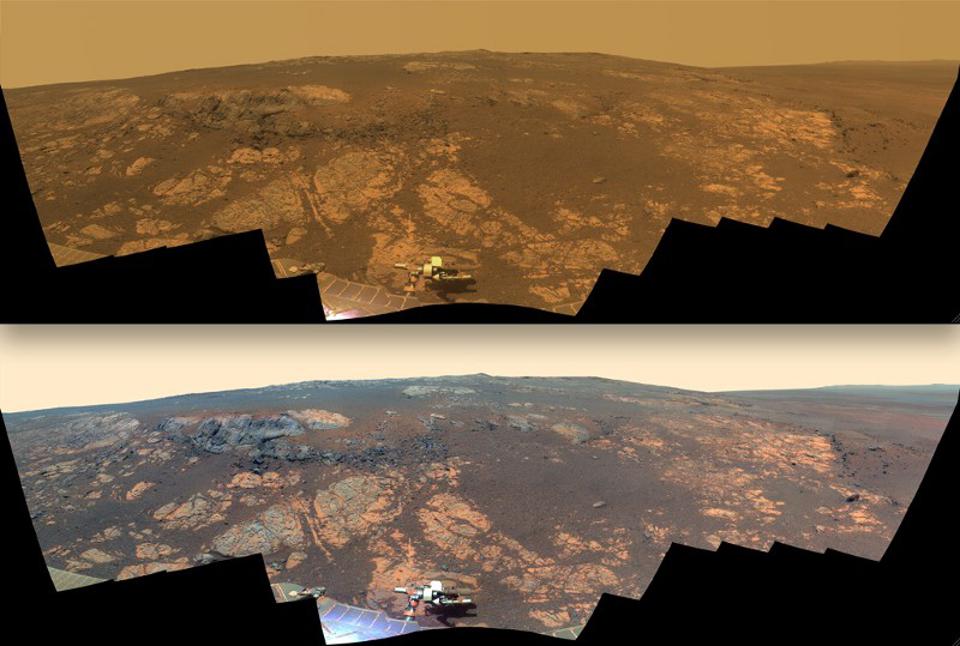
The same panoramic composite image, taken by Opportunity, shown with two different color assignments. Top image is in “true color,†as human eyes would see Mars, while the bottom is in false-color enhanced for color contrast.
(Credit: NASA/JPL-Caltech/Cornell/Arizona State U.)

When we look at the Martian surface itself, however, the story gets far more interesting. Ever since we began examining the Martian surface in detail — first from orbiting missions and, later, landers and rovers — we noticed that surface features would change over time. In particular, we’d notice that there were darker areas and brighter areas, and that the dark areas would evolve in a particular pattern:

  • they’d begin dark,
  • they would get covered in dust that wesuspect was from the brighter areas,
  • and then they would go back to being dark once again.

For a long time, we didn’t know why, until we started noticing that the dark areas that change all had a few things in common, particularly when compared to the dark areas that didn’t change. In particular, the dark areas that changed over time had relatively lower elevations and smaller slopes, and were surrounded by brighter areas. By contrast, the higher-elevation, steeper-sloped, and very large dark areas didn’t change in this way over time.

On Mars, bare-rock structures hold onto heat far better than sand-like structures do, meaning they will appear brighter at night, when viewed in the infrared. A variety of rock types and colors can be seen, as dust clings to some surfaces much better than others. From up close, it’s very clear that Mars is not a uniform planet.
(Credit: NASA/JPL-Caltech/MSSS, Mars Curiosity Rover)

It was a duo of scientists — one of whom was Carl Sagan — who puzzled out the solution: Mars is covered with a layer of this thin, sandy dust that’s driven by winds all across the Martian surface. This sand gets blown from area to area, but it’s easiest for that dust to:

  • travel short distances,
  • travel either from higher to lower elevations or to comparable elevations, rather than up to much higher elevations,
  • and to get blown off of areas with steeper slopes, as opposed to areas with shallower slopes.

In other words, the red dust that dominates the color palette of Mars is only skin deep. That’s not even a poetic turn of phrase in this case: most of Mars is covered by a layer of dust that’s only a few millimeters thick! Even in the region where the dust is thickest — the large plateau known as the Tharsis region, consisting of three very large volcanoes just offset from Olympus Mons (which appears to the plateau’s northwest) — it’s estimated to be a meager 2 meters (~7 feet) thick.
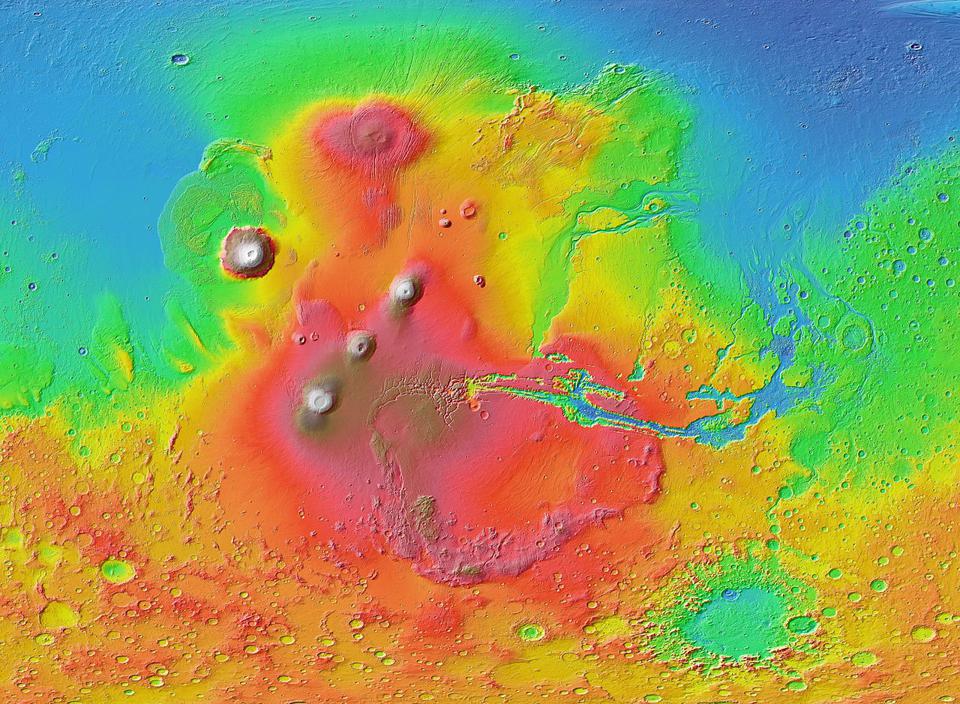
Mars Orbiter Laser Altimeter (MOLA) colorized topographic map of the western hemisphere of Mars, showing the Tharsis and Valles Marineris regions. The impact basin Argyre is at lower right, with the lowland Chryse Planitia to the right (east) of the Tharsis region.
(Credit: NASA/JPL-Caltech/Arizona State U.)

You might look at these facts, then, and wonder the following: do we have a topographic map of Mars and a map of the ferric oxides on Mars, and do these maps correlate with one another in any way?

It’s a smart thought, and one that we’ll take a look at in just a second, but “ferric oxide” doesn’t necessarily mean “red Mars dust” the way you might think. First off, ferric oxides are present everywhere on the planet:

  • within the crust,
  • found in lava outflows,
  • and in the Martian dust that’s been oxidized by reactions with the atmosphere.

Given that the atmosphere, even today, contains significant quantities of both carbon dioxide and water, there’s a readily available source of oxygen to oxidize any iron-rich material that makes it to the surface: where it contacts the atmosphere.

As a result, when we look at a ferric oxide map of Mars — again, made by the fabulous OMEGA instrument aboard ESA’s Mars Express — we find that yes, the ferric oxides are everywhere, but the abundances are highest across the northern and mid-latitudes, and lowest across the southern latitudes.
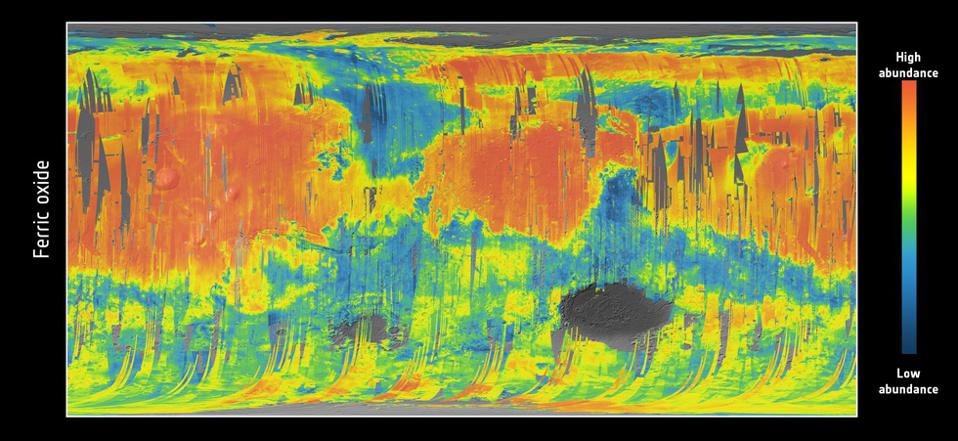
This map, by the OMEGA instrument on ESA’s Mars Express, plots the distribution of ferric oxides, a mineral phase of iron, across the surface of Mars. Ferric oxides (an oxide of iron) are present everywhere on the planet: within the bulk crust, lava outflows and the dust oxidised by chemical reactions with the martian atmosphere. Bluer colors represent lower abundances of ferric oxide; redder colors are higher.
(Credit: ESA/CNES/CNRS/IAS/Universite Paris-Sud, Orsay; Background: NASA MOLA)

On the other hand, the topography of Mars shows that the elevation of the red planet varies in an interesting way across its surface, and in a way that’s only partially correlated with the abundance of ferric oxides. The southern hemisphere, predominantly, is at a much higher elevation than the lowlands in the north. The greatest elevations occur in the ferric oxide-rich Tharsis region, but in the lowlands to the east of it, the abundances of ferric oxides plummets.

What you have to realize is that the red hematite form of ferric oxide, which is possibly the culprit for the “redness” of Mars, isn’t the only form of ferric oxide. There is also magnetite: Fe3O4, which is black in color instead of red. Although the global topography of Mars appears to play a role in the abundances of ferric oxide, it clearly isn’t the only factor at play, and might not even be the primary factor in determining Mars’s color.
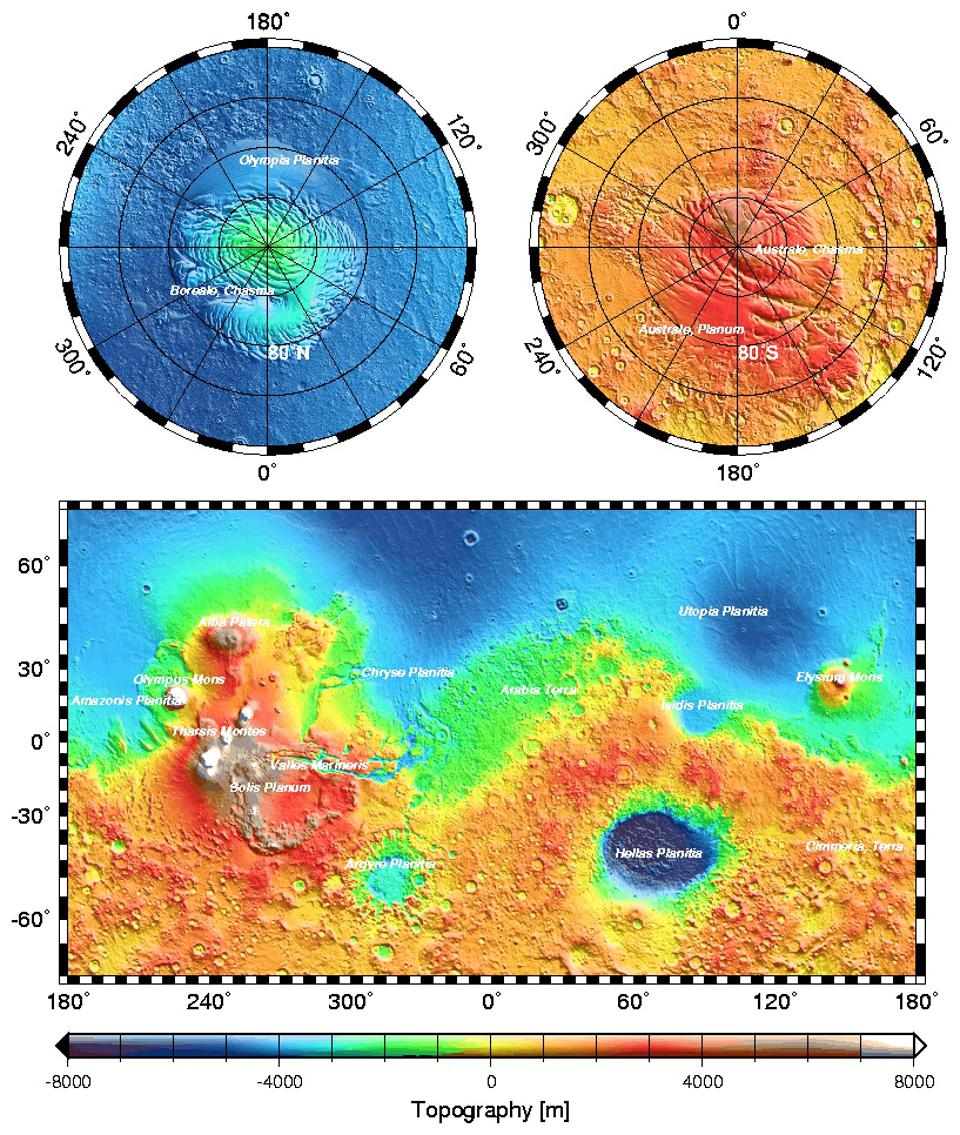
The Mars Orbiter Laser Altimeter (MOLA) instrument, part of Mars Global Surveyor, collected over 200 million laser altimeter measurements in constructing this topographic map of Mars. The Tharsis region, at center-left, is the highest elevation region on the planet, while the lowlands appear in blue. Note the much lower elevation of the northern hemisphere compared to the southern.
(Credit: Mars Global Surveyor MOLA Team)

What we think is occurring — and this has been a consistent picture for many years — is that there is a bright, globally distributed, globally homogeneous set of dust that gets swept up into the atmosphere and remains there. That dust is basically suspended in the thin Martian atmosphere, and although events like dust storms can increase the concentration, it never drops to a negligibly low value. Mars’s atmosphere is always rich with this dust; that dust provides the atmosphere’s color; but the color features of Mars’s surface aren’t uniform at all.

The “settling of atmospheric dust” is only one factor in determining the surface color of various regions of Mars. This is something we’ve learned very well from our landers and rovers: Mars isn’t a uniform red color at all. In fact, the surface itself is more of an orangey shade of butterscotch overall, and that various rocky objects and deposits on the surface appear to have a variety of colors: brown, golden, tan, and even greenish or yellow, depending on what minerals make up those deposits.
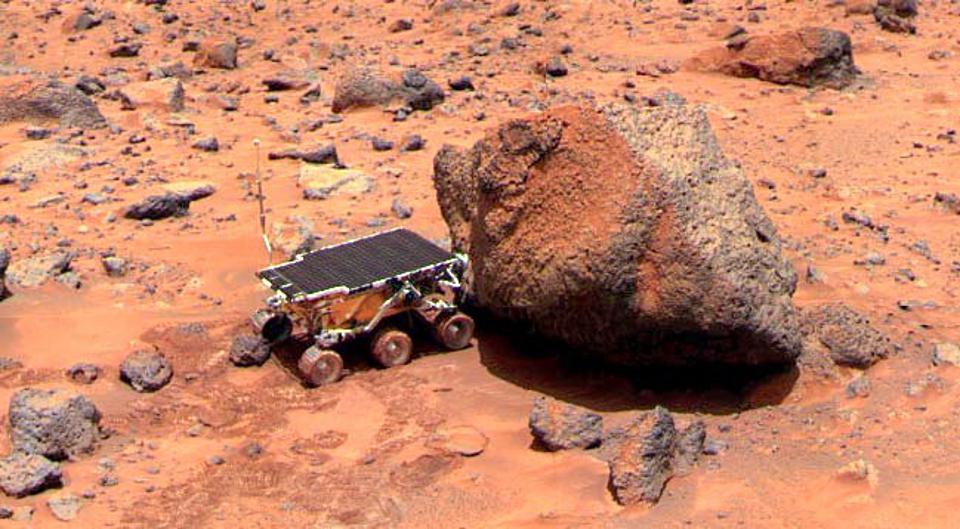
This image, taken by Mars Pathfinder of its Sojourner rover, shows a variety of colors. The rover’s wheels are reddish due to the Martian hematite; the disturbed soil is much darker underneath. Rocks of a variety of intrinsic colors can be seen, but also the role that the sunlight’s angle plays can be clearly seen as well.
(Credit: NASA/Mars Pathfinder)

One question that’s still under investigation is the exact mechanism by which these red hematite particles form. Although there are many ideas that involve molecular oxygen, it’s only found in tiny, trace amounts from the photodissociation of water. Reactions involving water or high temperatures are possible, but those are thermodynamically disfavored.

My two favorite possibilities are reactions involving hydrogen peroxide (H2O2), which occurs naturally on Mars in low abundances, but is a very strong oxidant. The fact that we see large amounts of α-Fe2O3 but no hydrated ferric iron minerals could be an indication of this pathway.

Alternatively, we might get hematite simply from a purely physical process: erosion. If you mix together magnetite powder, quartz sand, and quartz dust together and tumble it in a flask, some of the magnetite converts to hematite. In particular, a “black” mixture (dominated by magnetite) will appear red, as the quartz gets fractured, exposing oxygen atoms, which attach to the broken magnetite bonds, forming hematite. Perhaps the notion of “water is responsible for ferric oxides” is a literal red herring after all.
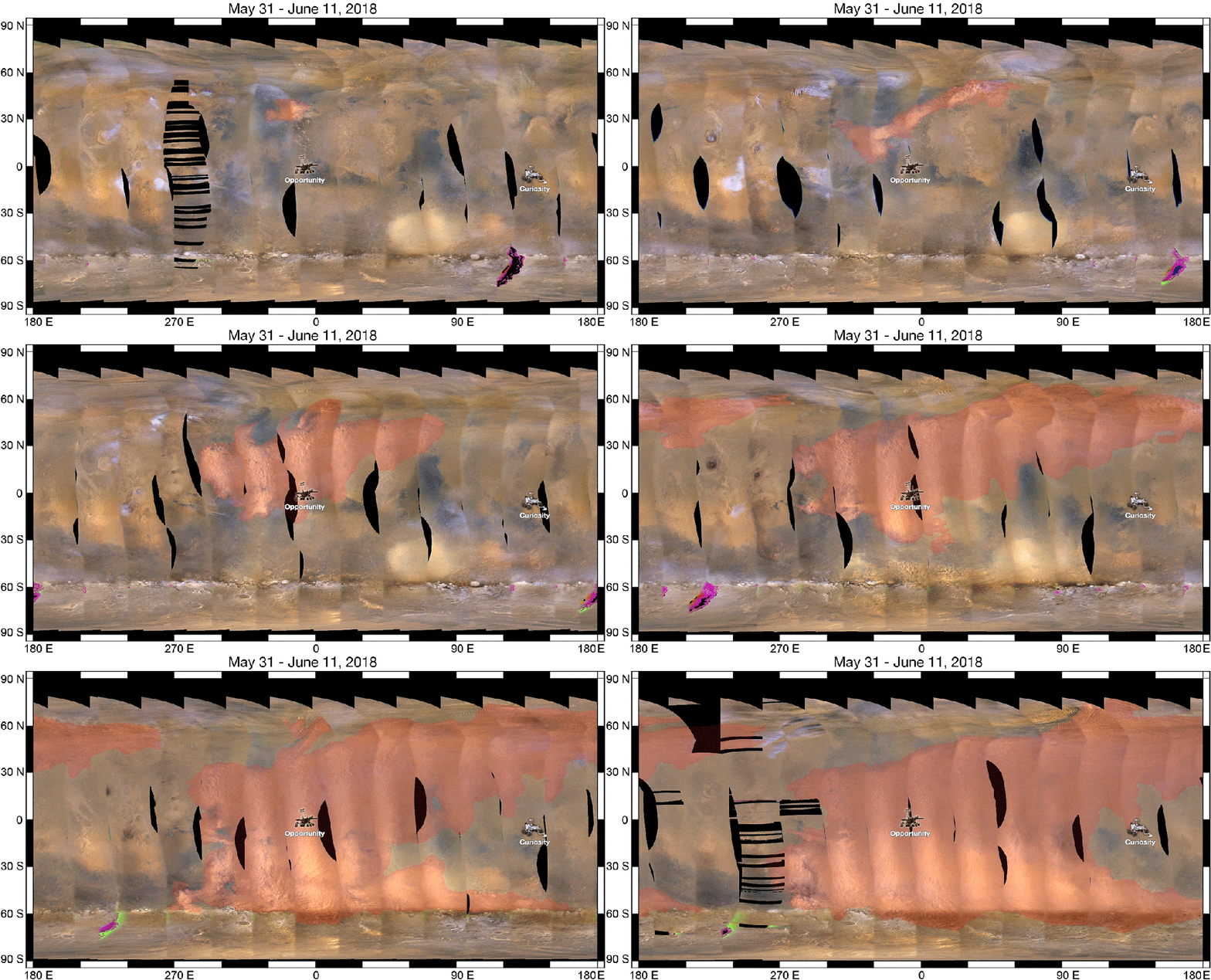
The start of the 2018 dust storm that led to the demise of NASA’s Opportunity rover. Even from this coarse map, it’s clear that the dust is red in color, and severely reddens the atmosphere as greater proportions of dust become suspended in the Martian atmosphere.
(Credit: NASA/JPL-Caltech/MSSS)

So, all in all, Mars is red because of hematite, which is a red form of ferric oxide. Although ferric oxides are found in many places, only the hematite is largely responsible for the red color, and the small dust particles that are suspended in the atmosphere and that coat the top few millimeters-to-meters of Mars’s surface are wholly responsible for the red color we see.

If we could somehow calm the atmosphere for long periods of time and let the Martian dust settle out, you might expect that Rayleigh scattering would dominate like it does on Earth, turning the skies blue. This is only partly correct, though; because the Martian atmosphere is so thin and tenuous, the sky would appear very dark: almost completely black, with a slight bluish tint to it. If you could successfully block out the brightness coming from the planet’s surface, you would likely be able to see some stars and up to six planets — Mercury, Venus, Earth, Jupiter, Saturn, and sometimes Uranus — even during the daytime.

Mars might be the red planet, but only a tiny, minuscule amount of it is actually red. Fortunately for us, that red part is the outermost layer of its surface, pervasive in the Martian atmosphere, and that accounts for the color we actually perceive.

  • (This article is re-run from earlier in 2021 as part of a “best of 2021” series that will run from Christmas Eve until the New Year. Happy holidays, everyone.)

Hoe vind je dit bericht?
Geschreven door peter om 23:27 Stuur door

NASA aiming for big 2023 thanks to generous budget request

NASA aiming for big 2023 thanks to generous budget request

Hoe vind je dit bericht?
Geschreven door peter om 22:59 Stuur door

SCIENTISTS DISCOVER DOZENS OF ANCIENT VIRUSES, FROZEN IN ICE

SCIENTISTS DISCOVER DOZENS OF ANCIENT VIRUSES, FROZEN IN ICE

Ancient Infection

During a research expedition that sounds indistinguishable from the first act of a horror movie, a team of intrepid scientists have discovered dozens of ancient, never-before-seen viruses within a sample of Tibetan ice.

The Ohio State University researchers behind the work are curious about how viruses have changed in response to shifting climates, according to a university press release. Of the 33 viruses they found in the ice, 28 are brand new to science, according to research published in the journal Microbiome on Tuesday — and probing their genetic codes could help explain the secrets of how life can survive extreme conditions both elsewhere on Earth and potentially even in places like Mars.

Let’s just hope that none of them infect anybody.

Veggie Viruses

Fortunately, the new viruses appear to have made their homes in ancient plants and soil-dwelling organisms rather than humans or animals before they froze abut 15,000 years ago. And the survivors seem to have fared so well all this time because they thrive in the harsh colds, not in spite of them.

“We know very little about viruses and microbes in these extreme environments, and what is actually there,” senior study author and Ohio State earth scientist Lonnie Thompson said in the release. “The documentation and understanding of that is extremely important: How do bacteria and viruses respond to climate change? What happens when we go from an ice age to a warm period like we’re in now?”

To that end, the researchers hope that the ancient viruses will help them piece together a sort of fossil record for the area — by peering at the viruses that lived farther back in time, they hope they’ll be able to paint a better picture of what the environment was like than ever before.

READ MORE: 

More on ancient viruses: 

ALL RELATED VIDEOS, selected and postd by peter2011

{ https://futurism.com/the-byte }

Hoe vind je dit bericht?
Geschreven door peter om 22:09 Stuur door

4 billion-year-old relic from early solar system heading our way

4 billion-year-old relic from early solar system heading our way

hubble-confirms-larges_resize_4_compress80.jpg

An enormous comet—approximately 80 miles across, more than twice the width of Rhode Island—is heading our way at 22,000 miles per hour from the edge of the solar system. Fortunately, it will never get closer than 1 billion miles from the sun, which is slightly farther from Earth than Saturn; that will be in 2031.

Comets, among the oldest objects in the solar system, are icy bodies that were unceremoniously tossed out of the solar system in a gravitational pinball game among the massive outer planets, said David Jewitt. The UCLA professor of planetary science and astronomy co-authored a new study of the comet in the Astrophysical Journal Letters. The evicted comets took up residence in the Oort cloud, a vast reservoir of far-flung comets encircling the solar system out to many billions of miles into deep space, he said.
A typical comet's spectacular multimillion-mile-long tail, which makes it look like a skyrocket, belies the fact that the source at the heart of the fireworks is a solid nucleus of ice mixed with dust—essentially a dirty snowball. This huge one, called Comet C/2014 UN271 and discovered by astronomers Pedro Bernardinelli and Gary Bernstein, could be as large as 85 miles across.
"This comet is literally the tip of the iceberg for many thousands of comets that are too faint to see in the more distant parts of the solar system," Jewitt said. "We've always suspected this comet had to be big because it is so bright at such a large distance. Now we confirm it is."
This comet has the largest nucleus ever seen in a comet by astronomers. Jewitt and his colleagues determined the size of its nucleus using NASA's Hubble Space Telescope. Its nucleus is about 50 times larger than those of most known comets. Its mass is estimated to be 500 trillion tons, a hundred thousand times greater than the mass of a typical comet found much closer to the sun.
"This is an amazing object, given how active it is when it's still so far from the sun," said lead author Man-To Hui, who earned his doctorate from UCLA in 2019 and is now with the Macau University of Science and Technology in Taipa, Macau. "We guessed the comet might be pretty big, but we needed the best data to confirm this."
So the researchers used Hubble to take five photos of the comet on Jan. 8, 2022, and incorporated radio observations of the comet into their analysis.
The comet is now less than 2 billion miles from the sun and in a few million years will loop back to its nesting ground in the Oort cloud, Jewitt said.
Comet C/2014 UN271 was first serendipitously observed in 2010, when it was 3 billion miles from the sun. Since then, it has been intensively studied by ground and space-based telescopes.
The challenge in measuring this comet was how to determine the solid nucleus from the huge dusty coma—the cloud of dust and gas—enveloping it. The comet is currently too far away for its nucleus to be visually resolved by Hubble. Instead, the Hubble data show a bright spike of light at the nucleus' location. Hui and his colleagues next made a computer model of the surrounding coma and adjusted it to fit the Hubble images. Then, they subtracted the glow of the coma, leaving behind the nucleus.
Hui and his team compared the brightness of the nucleus to earlier radio observations from the Atacama Large Millimeter/submillimeter Array, or ALMA, in Chile. The new Hubble measurements are close to the earlier size estimates from ALMA, but convincingly suggest a darker nucleus surface than previously thought.
"It's big and it's blacker than coal," Jewitt said.
The comet has been falling toward the sun for well over 1 million years. The Oort cloud is thought to be the nesting ground for trillions of comets. Jewitt thinks the Oort cloud extends from a few hundred times the distance between the sun and the Earth to at least a quarter of the way out to the distance of the nearest stars to our sun, in the Alpha Centauri system.
The Oort cloud's comets were tossed out of the solar system billions of years ago by the gravitation of the massive outer planets, according to Jewitt. The far-flung comets travel back toward the sun and planets only if their orbits are disturbed by the gravitational tug of a passing star, the professor said.
First hypothesized in 1950 by Dutch astronomer Jan Oort, the Oort cloud still remains a theory because the comets that make it up are too faint and distant to be directly observed. This means the solar system's largest structure is all but invisible, Jewitt said.

Reference: 

  • Man-To Hui et al, Hubble Space Telescope Detection of the Nucleus of Comet C/2014 UN271 (Bernardinelli–Bernstein), The Astrophysical Journal Letters (2022). DOI: 10.3847/2041-8213/ac626a

ALL RELATED VIDEOS, selected and posted by peter2011

{ https://www.scientiststudy.com/ }

Hoe vind je dit bericht?
Geschreven door peter om 21:38 Stuur door

WE GAAN DEZE HERFST EVENTUELE ALIENS OP TRAPPIST-1 LASTIGVALLEN MET RUSSISCHE MUZIEK (EN ONZE KLIMAATPROBLEMEN)

Bronmateriaal:

{ https://www.scientias.nl/ }

Hoe vind je dit bericht?
Geschreven door peter om 21:16 Stuur door

The James Webb Space Telescope Is Going to Stare Straight Into Jupiter

The James Webb Space Telescope Is Going to Stare Straight Into Jupiter

There's a lot we know about Jupiter. But even more we don't.

Image by NASA

After launching late last year, NASA’s revolutionary James Webb Space Telescope is finally getting ready to fixate its numerous golden mirrors on distant targets.

Intriguingly, though, one of its 13 early targets isn’t so distant at all — at least in the grand scheme of things. It’ll be looking at Jupiter, the iconic gas giant in our own star system. Of course, we already know quite a bit about the planet already— so why investigate it using the JWST if it can have a closer look at far more distant objects?

“We’ve been there with several spacecraft and have observed the planet with Hubble and many ground-based telescopes at wavelengths across the electromagnetic spectrum (from the UV to meters wavelengths),” Berkeley astronomer Imke de Pater, leader of the Jupiter observation team, told Digital Trends, “so we’ve learned a tremendous amount about Jupiter itself, its atmosphere, interior, and about its moons and rings.”

“But every time you learn more there are things you don’t yet understand — so you always need more data,” she added.

For instance, we still don’t know how an awful lot about the gas giant’s atmosphere, with massive storms roiling on its surface. The planet’s Great Red Spot, in particular, has fascinated astronomers since its discovery in 1830. It’s a storm so massive, in fact, that you could easily fit the Earth in the area it takes up.

“We’ll be looking for signatures of any chemical compounds that are unique to the [Great Red Spot]… which could be responsible for the red chromophores,” Leigh Fletcher, senior research fellow in planetary science at the University of Leicester in the UK, said in a 2018 NASA statement about the project, referring to particles responsible for the storm’s unusually red color.

“If we don’t see any unexpected chemistry or aerosol signatures… then the mystery of that red color may remain unresolved,” Fletcher added.

The JSWT will also take a closer look at Jupiter’s moons Io and Ganymede, the latter being the only known moon that has its own magnetosphere.

The space telescope is the ideal candidate for the job.

“The biggest advantage is at the mid-infrared wavelengths,” de Pater told Digital Trends. “We can observe at some of these wavelengths from the ground, but the Earth’s atmosphere is so turbulent that what we get on the ground, we can’t calibrate the observations very well.”

Right now, the JSWT is still busy aligning its mirrors — but soon, it’ll finally be prime time.

“In the first year of science operations, we expect Webb to write entirely new chapters in the history of our origins — the formation of stars and planets,” Klaus Pontoppidan, the Space Telescope Science Institute project scientist for Webb, said in a recent NASA blog post.

Before gazing at Jupiter, the observatory’s Mid-Infrared Instrument (MIRI) will have to be cooled to about 7 Kelvin, or about -447 Fahrenheit, to adjust to its frosty surroundings in deep space.

But once it’s ready, astronomers are already excited about what it will be able to see.

“The imager promises to reveal astronomical targets ranging from nearby nebulae to distant interacting galaxies with a clarity and sensitivity far beyond what we’ve seen before,” Alistair Glasse, Webb-MIRI Instrument Scientist at the Astronomy Technology Center in the UK, said in a recent post.

And considering it’s proximity, Jupiter should be child’s play for the JWST.

Updated to correct an error in the temperature the James Webb’s MIRI instrument will eventually be cooled to.

READ MORE: 

More on JWST: 

RELATED VIDEOS, selected and posted by peter2011

{ https://futurism.com/ }

Hoe vind je dit bericht?
Geschreven door peter om 20:45 Stuur door

Jupiter’s Twin: NASA’s Kepler Space Telescope Delivers New Planetary Discovery From the Grave

Jupiter’s Twin: NASA’s Kepler Space Telescope Delivers New Planetary Discovery From the Grave

Artist’s conception of the Kepler Space Telescope observing planets transiting a distant star. On October 30, 2018, NASA announced that Kepler ran out of fuel and would be retired within its current and safe orbit, away from Earth. Kepler leaves a legacy of more than 2,600 exoplanet discoveries.

Credit: NASA Ames/W Stenzel

A new study by an international team of astrophysicists, led by the Jodrell Bank Centre for Astrophysics has presented the amazing new discovery of a near-identical twin of Jupiter orbiting a star at a colossal distance of 17,000 light years from Earth.

The exoplanet, K2-2016-BLG-0005Lb, is almost identical to Jupiter in terms of its mass and its distance from its sun was discovered using data obtained in 2016 by NASA’s Kepler space telescope. The exoplanetary system is twice as distant as any seen previously by Kepler, which found over 2,700 confirmed planets before ceasing operations in 2018.

The system was found using gravitational microlensing, a prediction of Einstein’s Theory of Relativity, and is the first planet to be discovered from space in this way. The study has been submitted to the journal Monthly Notices of the Royal Astronomical Society.

Jupiter Twin Found by Kepler

The view of the region close to the Galactic Centre centered where the planet was found. The two images show the region as seen by Kepler (left) and by the Canada-France-Hawaii Telescope (CFHT) from the ground. The planet is not visible but its gravity affected the light observed from a faint star at the center of the image (circled). Kepler’s very pixelated view of the sky required specialized techniques to recover the planet signal.

Credit: University of Manchester

PhD student, David Specht from The University of Manchester is the lead author on the new research. To find an exoplanet using the microlensing effect the team searched through Kepler data collected between April and July 2016 when it regularly monitored millions of stars close to the center of the Galaxy. The aim was to look for evidence of an exoplanet and its host star temporarily bending and magnifying the light from a background star as it passes by the line of sight.

“To see the effect at all requires almost perfect alignment between the foreground planetary system and a background star,” said Dr. Eamonn Kerins, Principal Investigator for the Science and Technology Facilities Council (STFC) grant that funded the work. Dr. Kerins adds: “The chance that a background star is affected this way by a planet is tens to hundreds of millions to one against.  But there are hundreds of millions of stars towards the center of our Galaxy. So Kepler just sat and watched them for three months.”

“To see the effect at all requires almost perfect alignment between the foreground planetary system and a background star. The chance that a background star is affected this way by a planet is tens to hundreds of millions to one against. But there are hundreds of millions of stars towards the center of our Galaxy. So Kepler just sat and watched them for three months.”

— Dr. Eamonn Kerins

Following the development of specialized analysis methods, candidate signals were finally uncovered last year using a new search algorithm presented in a study led by Dr. Iain McDonald, at the time an STFC-funded postdoctoral researcher, working with Dr Kerins. Among five new candidate microlensing signals uncovered in that analysis, one showed clear indications of an anomaly consistent with the presence of an orbiting exoplanet.

An animation of the gravitational lensing signal from Jupiter twin K2-2016-BLG-0005Lb. The local star field around the system is shown using real color imaging obtained with the ground-based Canada-France-Hawaii Telescope by the K2C9-CFHT Multi-Color Microlensing Survey team. The star indicated by the pink lines is animated to show the magnification signal observed by Kepler from space. The trace of this signal with time is shown in the lower right panel. On the left is the derived model for the lensing signal, involving multiple images of the star caused by the gravitational field of the planetary system. The system itself is not directly visible.

Credit: University of Manchester

Five international ground-based surveys also looked at the same area of sky at the same time as Kepler.  At a distance of around 135 million km from Earth, Kepler saw the anomaly slightly earlier, and for longer, than the teams observing from Earth. The new study exhaustively models the combined datasets showing, conclusively, that the signal is caused by a distant exoplanet.

“The difference in vantage point between Kepler and observers here on Earth allowed us to triangulate where along our sight line the planetary system is located”, says Dr. Kerins. 

“Kepler was also able to observe uninterrupted by weather or daylight, allowing us to determine precisely the mass of the exoplanet and its orbital distance from its host star. It is basically Jupiter’s identical twin in terms of its mass and its position from its Sun, which is about 60% of the mass of our own Sun.”

Later this decade NASA will launch the Nancy Grace Roman Space telescope. Roman will find potentially thousands of distant planets using the microlensing method.  The European Space Agency’s Euclid mission, due to launch next year, could also undertake a microlensing exoplanet search as an additional science activity.

Dr. Kerins is Deputy Lead for the ESA Euclid Exoplanet Science Working Group. “Kepler was never designed to find planets using microlensing so, in many ways, it’s amazing that it has done so. Roman and Euclid, on the other hand, will be optimized for this kind of work. They will be able to complete the planet census started by Kepler,” he said.

“We’ll learn how typical the architecture of our own solar system is. The data will also allow us to test our ideas of how planets form. This is the start of a new exciting chapter in our search for other worlds.”

Reference:

  • “Kepler K2 Campaign 9: II. First space-based discovery of an exoplanet using microlensing” by D. Specht, R. Poleski, M.T. Penny, E. Kerins, I. McDonald, Chung-Uk Lee, A. Udalski, I.A. Bond, Y. Shvartzvald, Weicheng Zang, R.A. Street, D.W. Hogg, B.S. Gaudi, T. Barclay, G. Barentsen, S.B. Howell, F. Mullally, C.B. Henderson, S.T. Bryson, D.A. Caldwell, M.R. Haas, J.E. Van Cleve, K. Larson, K. McCalmont, C. Peterson, D. Putnam, S. Ross, M. Packard, L. Reedy, Michael D. Albrow, Sun-Ju Chung, Youn Kil Jung, Andrew Gould, Cheongho Han, Kyu-Ha Hwang, Yoon-Hyun Ryu, In-Gu Shin, Hongjing Yang, Jennifer C. Yee, Sang-Mok Cha, Dong-Jin Kim, Seung-Lee Kim, Dong-Joo Lee, Yongseok Lee, Byeong-Gon Park, Richard W. Pogge, M.K. Szymański, I. Soszyński, K. Ulaczyk, P. Pietrukowicz, Sz. Kozlowski, J. Skowron, P. Mróz, Shude Mao, Pascal Fouqué, Wei Zhu, F. Abe, R. Barry, D.P. Bennett, A. Bhattacharya, A. Fukui, H. Fujii, Y. Hirao, Y. Itow, R. Kirikawa, I. Kondo, N. Koshimoto, Y. Matsubara, S. Matsumoto, S. Miyazaki, Y. Muraki, G. Olmschenk, C. Ranc, A. Okamura, N.J. Rattenbury, Y. Satoh, T. Sumi, D. Suzuki, S.I. Silva, T. Toda, P.J. Tristram, A. Vandorou, H. Yama, C. Beichman, G. Bryden and S. Calchi Novati, Submitted, Monthly Notices of the Royal Astronomical Society.
    arXiv:2203.16959
Hoe vind je dit bericht?
Geschreven door peter om 20:29 Stuur door

Is the universe controlled by gigantic structures?

Is the universe controlled by gigantic structures?

The idea that celestial objects exist within utterly immense cosmic structures is becoming inescapable.
Is the universe controlled by gigantic structures?
Image source: Mike Rosecope/procy/Shutterstock/Big Think
KEY TAKEAWAYS
  • New findings in astronomy are making some astronomers doubt our basic model of the universe. 
  • Alignments of celestial objects suggest that they may be embedded in large-scale structures. 
  • Galaxies too far apart to be influencing each other are moving through space together.

Solidity is a function of magnification. We know that anything we experience as solid is actually a structure of atoms packed closely enough that to our eyes they appear to be a single solid thing. If we were small enough, we’d see the spaces between them; if we were even smaller, those spaces might seem vast. Likewise, in 1989 Margaret Geller and John Huchra, analyzing redraft survey data, discovered the immense “Great Wall,” a “sheet” formed from galaxies many light years apart. That first large-scale structure is 500 million light-years long, 200 million light years wide, and with a thickness of 15 million light years.

Other gigantic large-scale structures been discovered since — sheets, filaments, and knots, with bubble-like voids intersperse among them. They appear to be connected by clouds and filaments of hydrogen gas and dark matter. Though the bodies that comprise the structures are not gravitationally bound to each other — the distances between them are too great — evidence is piling up that they are linked by something.

Recent observations indicate that galaxies far, far apart are somehow synchronously moving. Something appears to be binding large-scale structures, many light years apart, together after all. Is the currently accepted view of the universe as various clumps of material simply expanding outward from the Big Bang and gravitationally pulling on each other wrong?

The large-scale structures revealed in one segment of sky

Image source: National Center for Supercomputer Applications by Andrey Kravtsov (The University of Chicago) and Anatoly Klypin (New Mexico State University). Visualizations by Andrey Kravtsov.

LARGE-SCALE STRUCTURES

The existence and mechanics of large-scale structures are a tantalizing puzzle with obviously major implications for our understanding of the universe. As Noam Libeskind, of the Leibniz-Institut for Astrophysics (AIP) in Germany tells VICE, “That’s actually the reason why everybody is always studying these large-scale structures. It’s a way of probing and constraining the laws of gravity and the nature of matter, dark matter, dark energy, and the universe.”

The identification and study of large-scale structures is a product of analyzing and modeling simulations of redshift survey for specific regions of the sky that visually reveal these immense structures.

22089409.jpg?w=335

Image source: orin/Shutterstock/Big Think

BILLIONS OF LIGHT YEARS APART

Several pieces of research are causing interest in these large-scale structures to heat up. The most mind-blowingly distant synchronized motion was reported in 2014, when the rotation axes of 19 super-massive black holes at the centers of quasars — out of 100 quasars studied — were found to be in alignment, billions of light years apart. According to the study’s lead author, astronomer Damien Hutsemékers of the University of Liège in Belgium, “Galaxy spin axes are known to align with large-scale structures such as cosmic filaments but this occurs on smaller scales. However, there is currently no explanation why the axes of quasars are aligned with the axis of the large group in which they are embedded.”

The first word of the research paper’s title, “Spooky Alignment of Quasars Across Billions of Light-years,” invokes cosmic-scale quantum entanglement as a possible explanation.

22088648.jpg?w=335

Image source: sripfoto/Shutterstock/Big Think

GALAXIES OF A FEATHER

Astronomer Joon Hyeop Lee of the Korea Astronomy and Space Institute is the lead author of “Mysterious Coherence in Several-megaparsec Scales between Galaxy Rotation and Neighbor Motion,” published in October of this year in Astrophysical Journal. Comparing data from two catalogs of redshift survey data — the Calar Alto Legacy Integral Field Area (CALIFA) and NASA-Sloan Atlas (NSA) catalogs — the researchers’ analysis of 445 galaxies revealed, surprisingly, that galaxies six meparsecs, or 20 million light years, apart were moving in the same way. Those observed, for example, a galaxy moving toward the Earth was mirrored by other distant galaxies moving in the same direction.

“This discovery is quite new and unexpected,” according to Lee, “I have never seen any previous report of observations or any prediction from numerical simulations, exactly related to this phenomenon.”

Since the galaxies are too distant for their gravitational fields to be influencing each other, Lee poses another explanation: That the linked galaxies are both embedded within the same, large-scale structure.

FLATNESS

Another puzzle suggesting the influence of large-scale structures has become clear over recent years. It’s been observed that galaxies surrounding our own Milky Way are weirdly arranged in a single, flat plane. Big-Bang thinking would suggest that they should be circling us at all different sorts of angles. Obviously, for adherents of that way of viewing the galaxy — known as the ΛCDM model — this at the very least a troubling anomaly.

The hope that it was an anomaly weakened with the discovery of the same thing occurring around the Andromeda galaxy, and then again around Centaurus A in 2015. By the time “A whirling plane of satellite galaxies around Centaurus A challenges cold dark matter cosmology” was published in 2018, the phenomenon was starting to seem quite common, and possibly universal. The idea that the satellite galaxies might part of a large-scale structure had become even worthier of serious consideration.

JUST THE BEGINNING

As more astronomers embrace the notion of large-scale structures and related research accelerates, we can only hope that these perplexingly oddball movements and associations are eventually made clear. Certainly, imagining a vast arrangement of utterly gigantic structures in which galaxies are embedded paints a very different picture of the universe, and one that makes one wonder if these structures are themselves embedded in something even larger. In this mid-boggling case, we are indeed small enough to see only the space between objects — in this case galaxies. We’ve been no more aware of them than whatever it is that may be living between our own atoms.

RELATED VIDEOS, selected and posted by peter2011

Hoe vind je dit bericht?
Geschreven door peter om 20:15 Stuur door

After 404 Days on Mars, Perseverance Has Finally Spotted Its Parachute

After 404 Days on Mars, Perseverance Has Finally Spotted Its Parachute

(NASA/JPL-Caltech/ASU/Kevin M. Gill)

After 404 Days on Mars, Perseverance Has Finally Spotted Its Parachute

NANCY ATKINSON, UNIVERSE TODAY

More than 13 months after the Perseverance rover landed on Mars (on 18 February 2021), the rover's cameras have finally spotted some of the parts of the Mars 2020 landing system that got the rover safely to the ground.

The parachute and backshell were imaged by Perseverance's MastCam-Z, seen off in the distance, just south of the rover's current location. The image was taken on Sol 404, or 6 April 2022 on Earth. 

Normally, the rover might have taken a brief side-trip early on in the mission to take images of the remains of the landing system. But Perseverance had to drive around some hazardous terrain to get to a large area of Jezero Crater that the science team wanted to study, called South Séítah.

That was near the area where the parachute landed, and the rover finally got there. The parachute was jettisoned during the landing sequence so the Skycrane could lower the rover down to the surface on its wheels.  

You may recall the parachute included a secret message hidden within the folds and colors of the material.

You can see the traverse map below, and below that is an image taken by the HiRISE camera on the Mars Reconnaissance Orbiter showing the location of the parachute and backshell, along with the rover and other items from the landing. This image was taken a day after Perseverance landed.

MarsTerrainMapWithWhiteLineTrackingPercy

Screenshot of Perseverance's location map on Sol 405.

(NASA)

mars hirise landing stuff

First HiRISE image of Perseverance on Mars.

(NASA/JPL/University of Arizona)

This HiRISE image of the Perseverance Rover on the surface of Mars also shows the many parts of the descent system. Each inset shows an area about 650 feet (200 meters) across.

The rover itself sits at the center of a blast pattern created by the hovering Skycrane (labeled as "descent stage") that lowered it there. The Skycrane flew off to crash as at a safe distance creating a V-shaped debris pattern.

And now, Perseverance is backtracking to reach the next target location for the mission's second science campaign, an area that looks like a large river delta. The choice to study South Séítah first was a choice the team made knowing they would have to backtrack later to reach the delta.

Perseverance is now in a drive campaign to reach the delta, going faster than any previous rover, although it is only going under a tenth of a mile per hour. Perseverance is using an auto-nav feature to 'make tracks,' and is making comparatively rapid progress by devoting several hours per day to driving on very smooth terrain.

Perseverance has now broken previous rovers' records for the distance traveled in one day by driving 319.8 meters on Sol 351.

Curiosity made a number of drives over 100 meters, but none over 200 meters. That was due in part to rockier terrain. Opportunity, which landed way back in 2004, had some very smooth patches of terrain, allowing it to travel up to 228 meters in one day using solar power just a year after its landing.

This great video by Dr Steve Ruff from Arizona State University explains the landing system and why Perseverance was able to find the various parts now.

{ https://www.sciencealert.com/ }

Hoe vind je dit bericht?
Geschreven door peter om 18:41 Stuur door

UFO emits circular beam of light caught over Tokyo, Japan

UFO emits circular beam of light caught over Tokyo, Japan

Witness states: On April 1, 2022 I noticed a black UFO moving at high speed above Asakusa Kaminarimon, Tokyo, Japan. 
ufo%20tokyo%20japan.jpg

If you look carefully then you see that the UFO emitted a circular beam of light, something like an energy field, around the craft, before it disappeared in a split second.


{  http://ufosightingshotspot.blogspot.com/ }

Hoe vind je dit bericht?
Geschreven door peter om 15:57 Stuur door

HOGERE DIMENSIE MAAKT BEREISBAAR WORMGAT EEN OPTIE

Bronmateriaal:

{ https://www.scientias.nl/ }

Hoe vind je dit bericht?
Geschreven door peter om 00:20 Stuur door

NEPTUNUS DOET GEK: WETENSCHAPPERS ZIEN DE TEMPERATUUR OP DE IJSREUS ONVERWACHT DALEN

{ https://www.scientias.nl/ }

Hoe vind je dit bericht?
Geschreven door peter om 23:52 Stuur door

A 'Dead' Sunspot Just Exploded, Launching a Plasma Ball Toward Earth

A 'Dead' Sunspot Just Exploded, Launching a Plasma Ball Toward Earth

The Sun on 11 April 2022.

(SDAC/SDO/AIA)

A 'Dead' Sunspot Just Exploded, Launching a Plasma Ball Toward Earth

STEPHANIE PAPPAS, LIVE SCIENCE

The "corpse" of a sunspot exploded Monday (April 11), triggering a mass ejection of solar material that is headed in Earth's direction.

The explosion comes courtesy of a dead sunspot called AR2987, according to SpaceWeather.com. The sunspot explosion released loads of energy in the form of radiation, which also led to a coronal mass ejection (CME) – explosive balls of solar material – both of which could spur more intense northern lights in Earth's upper atmosphere. The material in that CME is likely to impact Earth on April 14, according to SpaceWeather.

Sunspots are dark regions on the surface of the Sun. They are caused by intense magnetic flux from the Sun's interior, according to the Space Weather Prediction Center. These spots are temporary and can last anywhere from hours to months.

The idea of a "dead" sunspot is more poetic than scientific, said Philip Judge, a solar physicist at the High Altitude Observatory at the National Center for Atmospheric Research (NCAR), but the convection of the Sun breaks these spots apart, leaving in their wake magnetically-disturbed bits of quiet solar surface.  

"Occasionally," Judge wrote Live Science in an email, "sunspots can 'restart,' with more magnetism appearing later (days, weeks) at the same region, as if a weakness was made in the convection zone, or as if there is an unstable region under the surface that is particularly good at generating magnetic fields beneath." 

Related: 

Whatever the future of AR2987, the sunspot let out a C-class solar flare at 5:21 Universal Time Monday (April 11). Such flares happen when the plasma and magnetic fields above the sunspot give way under stress; they accelerate outward, Judge said, because they would run into dense material if they went downward toward the Sun's interior.

C-class flares are fairly common and rarely cause any impacts on Earth directly. Sometimes, as with today's eruption, solar flares can trigger coronal mass ejections, which are huge eruptions of plasma and magnetic fields from the Sun that travel outward into space at millions of miles per hour. C-class solar flares rarely trigger CMEs, according to SpaceWeatherLive, and when they do, the CMEs are usually slow and weak.

When CMEs hit the magnetic field surrounding Earth, the charged particles within the ejection can travel down the magnetic field lines that emanate from the North and South Poles and interact with the gases in the atmosphere, releasing energy in the forms of photons and creating the shifting, dazzling curtains known as the aurora – the northern and southern lights.

During quiet times on the Sun's surface, a stream of particles known as the solar wind is enough to trigger the aurora in the polar regions. During a large CME, the greater disturbance to the planet's magnetic field means that the aurora may appear over a much broader range.

A so-called cannibal CME raced toward Earth at the end of March, triggering auroras in Canada, the northern US, and New Zealand, Space.com reported. 

The CME released Monday might yield a minor (G1) geomagnetic storm on April 14, meaning that there could be minor impacts on satellite operations and weak fluctuations in the power grid, according to SpaceWeather. The aurora may become visible at lower latitudes than usual, as far south as northern Michigan and Maine.

All of this activity is fairly par for the course for the Sun, according to the Solar Influences Data Analysis Center, part of the Royal Observatory of Belgium. It's a time of increased activity for our nearest star, which goes through periods of quiet and activity known as solar cycles.

The Sun is currently in Solar Cycle 25, the 25th since formal observations began in 1755. The number of sunspots during this cycle is on the upswing and is expected to peak in 2025, which means more opportunities for solar storms – and auroras.

Strong geomagnetic storms were also observed on Sunday (April 10). But according to the Solar Influences Data Analysis Center, there have been no other Earth-directed CMEs observed in the past 24 hours other than the one spit out by AR2987's remnants. 

Related content:

This article was originally published by Live Science. Read the original article here.

{  https://www.sciencealert.com/ }

Hoe vind je dit bericht?
Geschreven door peter om 23:37 Stuur door

SpaceX to launch NASA’s SWOT water topography satellite on reused Falcon 9

SpaceX to launch NASA’s SWOT water topography satellite on reused Falcon 9

NASA has modified a contract with SpaceX to allow the company to launch the international Surface Water and Ocean Topography (SWOT) mission on a flight-proven Falcon 9 booster.

NASA announced its original decision more than half a decade ago. The agency awarded SpaceX an unusually expensive $112 million contract in November 2016 to launch SWOT on a Falcon 9 rocket in April 2021. SWOT is expected to weigh less than two tons (~4400 lb) and is headed to a fairly ordinary low Earth orbit (LEO), meaning that the launch won’t be particularly challenging or performance-intensive for SpaceX or Falcon 9. Most importantly, the company will almost certainly be able to recover the mission’s Falcon 9 booster and may be able to perform a return-to-launch-site landing for even greater efficiency.

SWOT’s launch should be almost identical to Sentinel 6A, a similarly light spacecraft that SpaceX successfully delivered to a similar orbit from the same launch pad in November 2020. In fact, both SWOT and Sentinel 6A are essentially flying altimeters designed to use radar altimeters to measure the surface height of Earth’s oceans and other bodies of water. Both also carry microwave-based instruments to determine the amount of water vapor present in Earth’s atmosphere. While Sentinel 6A was largely built by France’s CNES space agency, SWOT is more of a joint effort, with NASA’s Jet Propulsion laboratory providing the main altimeter instrument and completing a significant amount of preliminary integration work.

Sentinel 6A’s Falcon 9 launch and landing. 

(SpaceX)

Nonetheless, SWOT’s parts were sent to CNES facilities in France for final integration. Currently scheduled to launch no earlier than November 2022 after a roughly 1.5-year delay, SWOT will need to be delivered from France to California at least a month or two prior to complete final launch preparations. It remains to be seen if the mission will avoid additional delays in the interim. Prior to most of the mission’s recent delays, NASA’s Office of the Inspector General (OIG) estimated [PDF] that SWOT would cost its partners around $1.15 billion over the spacecraft’s lifetime. Sentinel 6A’s total cost is also expected to be around $1.1 billion.

Once launched, SWOT will operate in a circular ~890-kilometer (~550 mi) orbit with an inclination of around 78 degrees, allowing the spacecraft to singlehandedly observe 86% of Earth’s surface. Sentinel 6A operates in a slightly higher 1336-kilometer (830 mi) orbit at a 66-degree inclination,

The post SpaceX to launch NASA’s SWOT water topography satellite on reused Falcon 9 appeared first on TESLARATI.

Source: 

{ https://beforeitsnews.com/ }

Hoe vind je dit bericht?
Geschreven door peter om 23:17 Stuur door

Bible Secret Codes: The Watchers of the Garden of Eden & the Shiny Ones of the Babylon - Documentary Coast to Coast AM

Bible Secret Codes: The Watchers of the Garden of Eden & the Shiny Ones of the Babylon - Documentary Coast to Coast AM

OIP%20(2)(134).jpg

COAST TO COAST AM 2022. The Watchers of the Garden of Eden & The Shiny Ones of the Babylon, Courtesy of Reality Films Distribution: Ancient History Documentary – Sacred divine messages are hidden within the Holy Bible that we are only now beginning to decipher. The truth about the human race are explored with new insight into the Bible Secret Codes.

RELATED VIDEOS, selected and posted by peter2011

{ https://beforeitsnews.com/ }

Hoe vind je dit bericht?
Geschreven door peter om 23:03 Stuur door

I've Discovered An New Alien Species That Lives In Space! And Its Tiny, Space Station Video, UFO Sighting News.

I've Discovered An New Alien Species That Lives In Space! And Its Tiny, Space Station Video, UFO Sighting News.

ovni,%20omni,%20plane,%20arizona,%20MUFON,%20%E7%9B%AE%E6%92%83%E3%80%81%E3%82%A8%E3%82%A4%E3%83%AA%E3%82%A2%E3%83%B3,%20%20UFO,%20UFOs,%20sighting,%20sightings,%20alien,%20aliens,%20ET,%20waarneming,%20vreemdelinge,%20%20.png
Date of sighting: April 12, 2022
Location of sighting: Space Station live cam
 
I want to introduce you to an alien species. Now I have watch the space station cam for about 15 years, reporting some of the more interesting sightings, but letting go of the less interesting ones. During this whole time, once every few weeks something strange would happen when the space station entered the dark side of earth...small creatures would begin swarming around in front of the camera. It was clear to me that these objects were alive, and my old partner (RIP) Streetcap1 agreed with me on it. But we never really talked about it, except with each other.  It seemed impossible to prove, but I think it's time we try. NASA would of course dismiss it as glitches, since they are in denial mode. 
 
Things about this species. 
  • Colors are usually solid, but sometimes one makes a different color trail behind it. 
  • Colors are usually red, blue, green, or white. 
  • They very in shape, size, but are about .5cm long.
  • They swarm, meaning they are in groups, like gnats in a park. 
  • Their speed is incredibly fast, so fast, most humans would ignore them. 
  • They seem to be either chasing food, or mating. 
Russian astronauts already reported finding giant plankton living and thriving on the space stations solar panels...which NASA said may have come from the ocean. Of course they did not, they came from space! Thats how they got to Earth in the first place. These creatures, are similar to plankton, but much smaller at .5cm being the biggest. And they glow so that they can find each other, similar to deep sea fish, shrimp, and jellyfish that glow to both hunt and find each other. 
 
I will call these organisms Firegnats, which are similar to fireflies on earth, which also create their own glow. In the video below, I slowed the speed by 10X so that they are easier to see, however, being so small, its best to make it full screen. 
Scott C. Waring - Taiwan 
 

Screen%20Shot%202022-04-12%20at%209.02.12%20PM.png

Screen%20Shot%202022-04-12%20at%209.01.05%20PM.png

Screen%20Shot%202022-04-12%20at%209.00.33%20PM%20copy%202.png

Screen%20Shot%202022-04-12%20at%208.48.59%20PM.png

Screen%20Shot%202022-04-12%20at%208.46.53%20PM.png

Screen%20Shot%202022-04-12%20at%208.44.31%20PM.png

Screen%20Shot%202022-04-12%20at%208.43.11%20PM.png

Screen%20Shot%202022-04-12%20at%208.24.01%20PM.png

Screen%20Shot%202022-04-12%20at%208.22.51%20PM.png

Screen%20Shot%202022-04-12%20at%208.22.30%20PM.png

Screen%20Shot%202022-04-12%20at%208.22.09%20PM.png

Screen%20Shot%202022-04-12%20at%208.20.52%20PM.png

Screen%20Shot%202022-04-12%20at%208.12.05%20PM.png

Screen%20Shot%202022-04-12%20at%208.11.24%20PM.png

Screen%20Shot%202022-04-12%20at%208.08.26%20PM.png

Screen%20Shot%202022-04-12%20at%208.05.25%20PM.png
Screen%20Shot%202022-04-12%20at%209.01.42%20PM.png
RELATED VIDEOS, selected and posted by peter2011

{ https://www.ufosightingsdaily.com/ }

Hoe vind je dit bericht?
Geschreven door peter om 22:32 Stuur door

SpaceX launched 3 Tourists, UFO Watching! April 8, 2022, UFO Sighting News.

SpaceX launched 3 Tourists, UFO Watching! April 8, 2022, UFO Sighting News.

2343434%20copy%203.png

Date of sighting: April 8, 2022

Location of sighting: Kennedy Space Center, Florida, USA
 
There were three paying costumers heading to the space station. Each paid about 55 million US dollars...which was the preview price, but Axiom refused to disclose the actual price, 55 was the advertised price in a few months ago. 
 
I noticed that when the camera changed to a camera further away, a UFO was visible in the video. The UFO showed up for only 3 seconds, but its enough to see its big. The Falcon Heavy rocket is 104 meters tall by 17 meters wide. This UFO is just a little less than the width of the rocket. Which makes the UFO at least 15 meters. Thats huge, its way too big to be a camera drone, which are usually 1 meter or less. Also no drone has a cloaking device, since this UFO was visible less than 3 seconds! Sounds like 100% proof of aliens watching the SpaceX Falcon Heavy launch to me! 
Scott C. Waring - Taiwan 
 

{ https://www.ufosightingsdaily.com/ }

Hoe vind je dit bericht?
Geschreven door peter om 21:08 Stuur door

LATEST UFO SIGHTINGS AND VIDEOS

Same UFO That Was REC In Hong Kong Was Also Witnessed In Nottingham UK.

A luminous UFO sighted in Hong Kong and quite possibly the same or at the very least maybe the same type of UFO or object that was recorded in Nottingham UK a month prior.

Video Source YouTube Channel Morris Chan

Video Source YouTube Channel Coral | Libra Queen

{ https://www.youtube.com/ }

Hoe vind je dit bericht?
Geschreven door peter om 18:40 Stuur door

Woman Who Was Attacked By Aliens In Her Sleep

Woman Who Was Attacked By Aliens In Her Sleep

woman-Who-Was-Attacked-By-Aliens-In-Her-Sleep-1024x576.jpg

UFO witness Geri Julian from the Jicarilla Apache Reservation recounts her terrifying experiences of being attacked by two alien beings as she slept.

RELATED VIDEOS, selected and posted by peter2011

{ https://www.latest-ufo-sightings.net/ }

Hoe vind je dit bericht?
Geschreven door peter om 18:07 Stuur door

Neptune is even COLDER than we thought: Planet's stratosphere unexpectedly dropped by 14°F between 2003 and 2018, NASA reveals

Neptune is even COLDER than we thought: Planet's stratosphere unexpectedly dropped by 14°F between 2003 and 2018, NASA reveals

  • Seasons on Neptune change slowly, lasting over 40 Earth-years each
  • Researchers analysed thermal infrared images of Neptune over almost 20 years 
  • Neptune's stratosphere unexpectedly dropped by 14°F between 2003 and 2018
  • But from 2018 to 2020, the stratosphere at the south pole warmed by 20°F
  • Researchers are currently unsure what is causing these temperature changes

In its position 2.8 billion miles away from the Sun, it's no surprise that Neptune is one of the coldest planets in the Solar System, with average temperatures of -373°F (-207°C). 

Now, a new study has revealed that the ice giant may be even colder than we originally thought.

Researchers from NASA analysed thermal infrared images of Neptune from multiple observatories over almost 20 years.

Their analysis revealed that average temperatures in Neptune's stratosphere unexpectedly dropped by roughly 14°F (8°C) between 2003 and 2018.

Dr Michael Roman, Postdoctoral Research Associate at the University of Leicester and lead author on the study, said: 'This change was unexpected. Since we have been observing Neptune during its early southern summer, we would expect temperatures to be slowly growing warmer, not colder.'

Researchers from NASA analysed thermal infrared images of Neptune from multiple observatories over almost 20 years. Their analysis revealed that average temperatures in Neptune's stratosphere unexpectedly dropped by roughly 14°F (8°C) between 2003 and 2018

Researchers from NASA analysed thermal infrared images of Neptune from multiple observatories over almost 20 years. Their analysis revealed that average temperatures in Neptune's stratosphere unexpectedly dropped by roughly 14°F (8°C) between 2003 and 2018

Neptune: The most distant planet in our solar system 

Dark, cold, and whipped by supersonic winds, ice giant Neptune is the eighth and most distant planet in our solar system. 

More than 30 times as far from the Sun as Earth, Neptune is the only planet in our solar system not visible to the naked eye and the first predicted by mathematics before its discovery. In 2011 Neptune completed its first 165-year orbit since its discovery in 1846.

NASA's Voyager 2 is the only spacecraft to have visited Neptune up close. It flew past in 1989 on its way out of the solar system.

Source: NASA

In the study, the researchers studied thermal infrared images from a range of observatories, including the European Southern Observatory's Very Large Telescope and Gemini South telescope in Chile, the Subaru Telescope, Keck Telescope, and the Gemini North telescope, all in Hawaii, and NASA's Spitzer Space Telescope.

The images revealed that between 2003 and 2018, temperatures in Neptune's stratosphere – the second layer of the atmosphere as you move upward – dropped by 14°F (8°C).

Like Earth, Neptune experiences seasons.

However, while Earth takes 365 days to complete an orbit around the sun, Neptune takes over 165 years.

This means that seasons on the icy giant change much more slowly, lasting over 40 Earth-years each.

Dr Glenn Orton, Senior Research Scientist at NASA's Jet Propulsion Laboratory, and co-author of the study, said: 'Our data cover less than half of a Neptune season, so no one was expecting to see large and rapid changes.'

While the thermal data revealed that temperatures across the stratosphere had dropped from 2003 to 2018, surprisingly, the opposite was true for Neptune's south pole from 2018 to 2020.

In the study, the researchers studied thermal infrared images from a range of observatories, including the European Southern Observatory's Very Large Telescope and Gemini South telescope in Chile, the Subaru Telescope, Keck Telescope, and the Gemini North telescope, all in Hawaii, and NASA's Spitzer Space Telescope

In the study, the researchers studied thermal infrared images from a range of observatories, including the European Southern Observatory's Very Large Telescope and Gemini South telescope in Chile, the Subaru Telescope, Keck Telescope, and the Gemini North telescope, all in Hawaii, and NASA's Spitzer Space Telescope

The images revealed that between 2003 and 2018, temperatures in Neptune's stratosphere – the second layer of the atmosphere as you upward – dropped by 14°F (8°C)

There, the stratosphere actually warmed by roughly 20°F (11°C) – something that has never been observed before.

The researchers are currently unsure what is causing these temperature changes.

'Temperature variations may be related to seasonal changes in Neptune's atmospheric chemistry, which can alter how effectively the atmosphere cools,' Dr Roman explained.

'But random variability in weather patterns or even a response to the 11-year solar activity cycle may also have an effect.'

Like Earth, Neptune experiences seasons. However, while Earth takes 365 days to complete an orbit around the sun, Neptune takes over 165 years. This means that seasons on the icy giant change much more slowly, lasting over 40 Earth-years each

Like Earth, Neptune experiences seasons. However, while Earth takes 365 days to complete an orbit around the sun, Neptune takes over 165 years. This means that seasons on the icy giant change much more slowly, lasting over 40 Earth-years each

The Sun follows an 11-year cycle, during which its activity and sunspots vary. Previous research has suggest that Neptune's visible brightness fluctuates based on this cycle, and the new study reveals a possible link between the planet's temperatures too

The Sun follows an 11-year cycle, during which its activity and sunspots vary. Previous research has suggest that Neptune's visible brightness fluctuates based on this cycle, and the new study reveals a possible link between the planet's temperatures too

The Sun follows an 11-year cycle, during which its activity and sunspots vary.

Previous research has suggested that Neptune's visible brightness fluctuates based on this cycle, and the new study reveals a possible link with the planet's temperatures too.

The team now hopes to use the James Webb Space Telescope to further observe the temperature and cloud patterns on Neptune.

Professor Leigh Fletcher, co-author of the study, added: 'The exquisite sensitivity of the space telescope's mid-infrared instrument, MIRI, will provide unprecedented new maps of the chemistry and temperatures in Neptune's atmosphere, helping to better identify the nature of these recent changes.' 

Hoe vind je dit bericht?
Geschreven door peter om 00:12 Stuur door

Bijna-doodervaringen zijn geen hallucinaties, blijkt uit de eerste studie ooit van zijn soort

Bijna-doodervaring Bijna-doodervaring  © getty images

Bijna-doodervaringen zijn geen hallucinaties, blijkt uit de eerste studie ooit van zijn soort

Een fel wit licht, doffe stemmen en omgevingsgeluiden, je eigen lichaam zien liggen terwijl je er naast staat,... In films en series wordt een ‘bijna-doodervaring’ heel vaak op dezelfde manier voorgesteld. Bijna iedereen die het zelf heeft meegemaakt, beschrijft het ook op deze manier. Maar wetenschappelijk is zo’n ervaring nog niet officieel gedefinieerd. Daarom hebben wetenschappers uit verschillende disciplines er nu voor het eerst een onderzoek naar gevoerd. 

{ https://www.hln.be/ }

Hoe vind je dit bericht?
Geschreven door peter om 23:33 Stuur door

Geologists Have Closely Analyzed Two Bizarre 'Blobs' Detected Deep Inside Earth

Earthmantleblobs_600.gif

Rotating 3D view of Earth's blobs.

(Cottaar & Lekic/Geophysical Journal International, 2016)

Geologists Have Closely Analyzed Two Bizarre 'Blobs' Detected Deep Inside Earth

Earth's interior is not a uniform stack of layers. Deep in its thick middle layer lie two colossal blobs of thermo-chemical material.

To this day, scientists still don't know where both of these colossal structures came from or why they have such different heights, but a new set of geodynamic models has landed on a possible answer to the latter mystery.

These hidden reservoirs are located on opposite sides of the world, and judging from the deep propagation of seismic waves, the blob under the African continent is more than twice as high as the one under the Pacific ocean.

After running hundreds of simulations, the authors of the new study think the blob under the African continent is less dense and less stable than its Pacific counterpart, and that's why it's so much taller.

"Our calculations found that the initial volume of the blobs does not affect their height," explains geologist Qian Yuan from Arizona State University.

"The height of the blobs is mostly controlled by how dense they are and the viscosity of the surrounding mantle."

image corrected 1

3D view of the blob in Earth's mantle beneath Africa.

(Mingming Li/ASU)

One of the principal layers inside Earth is the hot and slightly goopy mess known as the mantle, a layer of silicate rock that sits between our planet's core and its crust. While the mantle is mostly solid, it behaves sort of like tar on longer timescales.

Over time, columns of hot magma rock gradually rise through the mantle and are thought to contribute to volcanic activity on the planet's surface.

Understanding what's going on in the mantle is thus an important endeavor in geology.

The Pacific and African blobs were first discovered in the 1980s. In scientific terms, these 'superplumes' are known as large low-shear-velocity provinces (LLSVPs).

Compared to the Pacific LLSVP, the current study found the African LLSVP stretches about 1,000 kilometers higher (621 miles), which supports previous estimates.

This vast height difference suggests both of these blobs have different compositions. How this impacts the surrounding mantle, however, is unclear. 

Perhaps the less stable nature of the African pile, for instance, can explain why there is such intense volcanism in some regions of the continent. It could also impact the movement of tectonic plates, which float on the mantle.

Other seismic models have found the African LLSVP stretches up to 1,500 kilometers above the outer core, whereas the Pacific LLSVP reaches 800 kilometers high at max.

In lab experiments that seek to replicate Earth's interior, both the African and Pacific piles appear to oscillate up and down through the mantle.

The authors of the current study say this supports their interpretation that the African LLSVP is probably unstable, and the same could go for the Pacific LLSVP, although their models didn't show this.

The different compositions of the Pacific and African LLSVPs could also be explained by their origins. Scientists still don't know where these blobs came from, but there are two main theories.

One is that the piles are made from subducted tectonic plates, which slip into the mantle, are super-heated and gradually fall downwards, contributing to the blob.

Another theory is that the blobs are remnants of the ancient collision between Earth and the protoplanet Thea, which gave us our Moon.

The theories are not mutually exclusive, either. For instance, perhaps Thea contributed more to one blob; this could be part of the reason why they look so different today.

"Our combination of the analysis of seismic results and the geodynamic modeling provides new insights on the nature of the Earth's largest structures in the deep interior and their interaction with the surrounding mantle," says Yuan.

"This work has far-reaching implications for scientists trying to understand the present-day status and the evolution of the deep mantle structure, and the nature of mantle convection."

{ https://www.sciencealert.com/ }

Hoe vind je dit bericht?
Geschreven door peter om 23:07 Stuur door

Built by an Unknown Culture, This Is The Oldest Sun Observatory in The Americas

OblongTrenchesInSandViewedFromAbove_600.jpg

The Fortified Temple at Chankillo.

(Janine Costa/AFP via Getty Images)

Built by an Unknown Culture, This Is The Oldest Sun Observatory in The Americas

Long before the Incas rose to power in Peru and began to celebrate their sun god, a little known civilization was building the earliest known astronomical observatory in the Americas.

While not quite as old as sites like Stonehenge, these ancient ruins, known as Chankillo, are considered a "masterpiece of human creative genius", holding unique features not seen anywhere else in the world. 

Based in the coastal desert of Peru, the archaeological site famously contains a row of 13 stone towers, which together trace the horizon of a hill, north to south, like a toothy bottom grin.

1920px ThirteenTowersOfChanquilloFromFortress

The Thirteen Towers of Chankillo.

(David Edgar/Wikipedia/CC BY-SA 3.0)

Apart from this remarkable structure, known as the Thirteen Towers, the ruins of the observatory also include a triple-walled hilltop complex called the Fortified Temple and two building complexes called the Observatory and the Administrative Center. 

Completed over 2,300 years ago and abandoned in the first century of the common era, the site has remained a mystery to travelers for centuries.

Only when official excavations began at the turn of the 21st century, did archaeologists realize what they were looking at.

A row of ruined towers seen from above

Aerial view of the towers.

(Janine Costa/AFP via Getty Images)

Against a barren desert landscape and in broad daylight, the hilltop stone structures, which span roughly 300 meters (980 feet), don't look like much. But it's another story at dawn and dusk.

As the Sun rises in the east, an orb of light emerges somewhere along the ridge of towers. As the year proceeds, so too does the position of the sunrise, almost as though the light is flossing the toothy horizon.

On the summer solstice, for example, the sunrise emerges to the right of the rightmost tower. Whereas on the winter solstice, the sunrise emerges to the left of the leftmost tower.

The Towers of Chankillo were so carefully placed, that when an onlooker stands at a specific observation point below the ridge, they can predict the time of year within two or three days based just on sunrise or sunset. The observation point looking west towards the ridge – this is the Observatory structure – uses the sunset. At what's thought to be the east observation point, all that's left is the incomplete stone outline of a room, but it's in a symmetrical location and would have used the sunrise.

The September equinox, for example, is defined when the Sun sets between the sixth and the seventh tower, as captured in the image below.

Screen Shot 2022 03 28 at 2.46.41 pm

The September equinox sunset.

(World Monuments Fund/Youtube Screenshot)

The ancient civilization that designed the solar observatory is barely known, but it would have been one of the oldest cultures in the Americas. In fact, this culture predates the Inca culture, which also excelled at astronomy, by more than 1,000 years.

Because the Chankillo ruins attributed to this civilization are based in the coastal desert between Peru's Casma River and the Sechin river, the original builders are now known as the Casma-Sechin culture.

Similar to the Incas, this civilization would probably have considered the Sun a deity of some sort. The staircases leading up to each tower strongly suggest the site was once used for rituals.

According to archaeological excavations, the observatory was probably built sometime between 500 and 200 BCE. Then, for some reason, the site was abandoned, and the towers fell into disrepair. In their heyday, archaeologists say the structures would have been plastered yellow, ochre or white and painted with graffiti or fingerprints.

Even when stripped of decoration and falling apart, however, the remains of these stone towers still faithfully record the days of the year. Conservation efforts are now under way to uphold the accuracy of the ancient calendar.

In 2021, the Chankillo Archaeoastronomical Complex officially joined the UNESCO World Heritage List for its outstanding craftsmanship and its insight into the worldview of ancient societies.

"Unlike architectural alignments upon a single astronomical target found at many ancient sites around the world, the line of towers spans the entire annual solar rising and setting arcs as viewed, respectively, from two distinct observation points, one of which is still clearly visible above ground," reads the UNESCO description. 

"The solar observatory at Chankillo is thus a testimony of the culmination of a long historical evolution of astronomical practices in the Casma Valley."

You can read even more details about this observatory at the Portal to the Heritage of Astronomy.

{ https://www.sciencealert.com/latest }

Hoe vind je dit bericht?
Geschreven door peter om 22:48 Stuur door

De verre kant van de maan heeft beduidend meer kraters, wetenschappers beweren te weten waarom

Illustratiebeeld Illustratiebeeld © Getty Images

De verre kant van de maan heeft beduidend meer kraters, wetenschappers beweren te weten waarom

We kunnen altijd maar één kant van de maan zien, waar ter wereld we ons ook bevinden. De andere kant is altijd van onze planeet afgekeerd en deze kant heeft veel meer kraters dan de kant die we kunnen zien. Wetenschappers beweren nu in een nieuw onderzoek, gepubliceerd in Science Advances, dat dat iets te maken heeft met de lavastromen. 

{ https://www.hln.be/ }

Hoe vind je dit bericht?
Geschreven door peter om 22:40 Stuur door

Steve Quayle: The Alien Deception

Steve Quayle: The Alien Deception

unnameddddddd.jpg

Steve Quayle is a researcher and author of over a dozen books dealing with advanced ancient technology and civilizations. His documentary film production company Gensix Productions films the “True Legends The Series” all over the world in search of the Lost Cities and the giants of history who were the builders of the great megalithic structures of the ancient world.

Steve is a former talk radio show host who has been warning against genetic armageddon and the end of the human race for decades. He claims transhumanism and the hybrid age is the most dangerous advancement in the technological war against humanity in history.

RELATED VIDEOS, selected and posted by peter2011

{ https://beforeitsnews.com/ }

Hoe vind je dit bericht?
Geschreven door peter om 22:06 Stuur door

Space Force is Releasing Decades of Tracking Data on a Thousand Bright Meteor Fireballs

Space Force is Releasing Decades of Tracking Data on a Thousand Bright Meteor Fireballs

When a meteoroid enters the Earth’s atmosphere at a very high speed it heats up. This heating up produces a streak of light and is termed a meteor. When a meteor is bright enough, about the brightness of Venus or brighter, it becomes a fireball. Sometimes these fireballs explode in the atmosphere, becoming bolides. These bolides are bright enough to be seen even during the day.

Studying bolides as they pass through the atmosphere can help model larger asteroids, something of interest to the Planetary Defense Coordination Office (PDCO) which is run by NASA. These asteroids can be deadly if they are large enough, and learning how to predict their behavior is essential to protecting our planet from a devastating impact with long-term implications for the survival of many species on Earth.

Information on these bolides is collected by U.S. government sensors run by the U.S Space Force and is shared with the NASA Jet Propulsion Laboratory’s Center for Near Earth Object Studies (CNEOS). NASA has been tasked with detecting and categorizing near-Earth Objects (NEOs) that may be detrimental to our planet in an effort to find ways to divert or otherwise remove the threat they pose. The information they have for nearly one thousand bolide events goes back to 1988.

This recent release of data gave CNEOS more detailed information, namely details on the light-curve of bolides as they enter the Earth’s atmosphere. The light-curve describes the varying brightness of a bolide as it passes through the atmosphere.

Using this new information will help researchers in their efforts to determine an object’s strength and composition as well as the approximate total radiated energy and the direction from which it came. All of this information can be used to better understand deadly impactors, helping us predict where they will end up if they are on a course that intersects Earth.

When an asteroid struck the Yucatan region about 66 million years ago, it triggered the extinction of the dinosaurs. Credit: NASA/Don Davis

When an asteroid struck the Yucatan region about 66 million years ago, it triggered the extinction of the dinosaurs. Credit: NASA/Don Davis

A big enough asteroid impact could be an extinction-level event which occurs when a large amount of biological organisms are wiped out in a short time. This includes animals, plants, fungi, and single-cell organisms. There have been 5 major mass extinctions on our planet in the past 440 million years, the last of which was caused by an asteroid impact that made dust and debris hang in the atmosphere long enough to bring about major climate change which affected Earth’s ecosystem.

The chance of a life-ending asteroid hitting Earth is well below 1% every year. Some scientists say we are overdue for an impact, but this may not take into account the fact that our solar system continues to quiet down from its early stages of development. Stars move farther away from each other as space expands making interstellar objects that may hit us less likely as time moves on.

Should that stop us from trying to find NEOs though? Consider the asteroid 2019 OK that was spotted only one day before passing between the Earth and the moon. That asteroid came within 65,000 km of our planet. It was the size of a football field and would have laid waste to an area about 50 miles across. The continued efforts of CNEOS to locate and categorize NEOs will help reduce the threat of these potential hazards, should we find any.

As of now, NASA has found about 40% of NEOs that are larger than 140 meters (459 feet) in size. They have been directed to find 90% so there are still many left to find. Even when they find all of these there will be the potential for another one to sneak up on us. With all of the information that is being gathered hopefully we will have come up with a plan by then to divert or remove the threat in some way.

More:

The post Space Force is Releasing Decades of Tracking Data on a Thousand Bright Meteor Fireballs appeared first on Universe Today.

RELATED VIDEOS, selected and posted by peter2011


Source: 

{ https://beforeitsnews.com/ } 

Hoe vind je dit bericht?
Geschreven door peter om 20:39 Stuur door

Orb Over Buildings In Hong Kong, China 4-7-2022, Video, UFO Sighting News.

Orb Over Buildings In Hong Kong, China 4-7-2022, Video, UFO Sighting News.

%E0%A4%89%E0%A4%AB%E0%A5%8C%20,%20%E0%A6%87%E0%A6%89%E0%A6%8F%E0%A6%AB%E0%A6%93,%20%C4%91i%CC%83a%20bay,%20MUFON,%20%E7%9B%AE%E6%92%83%E3%80%81%E3%82%A8%E3%82%A4%E3%83%AA%E3%82%A2%E3%83%B3,%20%20UFO,%20UFOs,%20NLO,%20sighting,%20sightings,%20alien,%20aliens,%20ET,%20anomaly,%20anomalies,%20ancient,%20astrobiology,%20vreemdelinge,%20%203%20copy%202.png
UAP,%20MUFON,%20news.png

Date of sighting: April 7, 2022
Location of sighting: Hong Kong, China
 
Hey look at this raw footage that an eyewitenss took over the city of Hong Kong, China this week. Morris Chan of Youtube uploaded a video of a glowing orb that was seen high in the sky over the city. The UFO soon decended and moved across the tops of the buildings, dissapearing behind it. This is fantastic raw video of an actual UFO glowing powerfully over the city. The UFO is very similar to the UFO that was seen in Jerusalem about ten years ago in front of tens of thousands of tourists over the holy temple...Dome of Rock. This UFO is about one meter across and has no wings, no propellers, no sound...nothing that could possibly identify it as man made. This is 100% alien made technology. 
Scott C. Waring - Taiwan 

{ https://www.ufosightingsdaily.com/ }

Hoe vind je dit bericht?
Geschreven door peter om 18:42 Stuur door

Life After Death? Study Reveals Near-Death Experiences Are Not Hallucinations!

Life After Death? Study Reveals Near-Death Experiences Are Not Hallucinations!

Anew study exploring what people experience when they’re close to death has come to one important conclusion — “near-death experiences” are a real thing, even if we can’t explain them. Kinda like Madona's latest Instagram duckface selfie. 
near%20death%20experience%20(2).jpg

Countless people have claimed that their life “flashed before their eyes” or that they actually left their body and traveled somewhere else while close to death. 
Critics have called these experiences hallucinations or illusions, but researchers from NYU Grossman School of Medicine say something else is actually happening. 
A team of researchers from several medical disciplines — including neurosciences, critical care, psychiatry, psychology, social sciences, and humanities — have come up with a number of conclusions after reviewing unexplained –lucid – episodes which involve a heightened state of consciousness. 
So really trying to find out what exactly a near-death experience is... 
near%20death%20experience.jpg
The main finding is that these events don’t have much in common with the experiences someone has if they’re hallucinating or using a psychedelic drug. Instead, people who have a near-death experience typically report five different events taking place: 
  • A Separation from their body with a heightened, vast sense of consciousness and recognition that they’re dying 
  • Or They “travel” to a different location 
  • Some have said They have a meaningful and purposeful review of their life, involving a critical analysis of all their past actions — basically, their life flashes before their eyes
  • Some say they feel they are Going to a place that feels like “home” 
  • And the feeling of Returning back to life
Researchers note that the near-death experience usually triggers a positive and long-term psychological transformation in the person. The team notes that people who had negative and distressing experiences while near-death did not experience these kinds of events. 
The team found – It turns out that scientists can actually see physical changes taking place in the brain when someone is close to death. 
Researchers found the presence of gamma activity and electrical spikes when people are technically dying. This is typically a sign of a heightened state of consciousness when scientists measure it using an electroencephalography (EEG). 
The findings further back up the claims from people who say they “left their body” while dying. 
Study authors note that advances in medicine over the last century have brought back countless people from death's door. 
Lead author Sam Parnia said – QUOTE – “The advent of cardiopulmonary resuscitation (CPR) showed us that death is not an absolute state, rather, it’s a process that could potentially be reversed in some people even after it has started.” 
afterlife%20reincarnation%20aliens.jpg
Parina continued... “What has enabled the scientific study of death is that brain cells do not become irreversibly damaged within minutes of oxygen deprivation when the heart stops. Instead, they ‘die’ over hours of time. This is allowing scientists to objectively study the physiological and mental events that occur in relation to death.” 
Study authors conclude that neither physiological nor cognitive processes completely end at the moment of death. While prior reports haven’t been able to prove what people are saying about their near-death experiences, the new report finds it’s also impossible to disprove what they’re saying.
  

{ http://ufosightingshotspot.blogspot.com/ }

Hoe vind je dit bericht?
Geschreven door peter om 18:22 Stuur door

UFO Bombshell: Pentagon forced to release secret study into UAP

UFO Bombshell: Pentagon forced to release secret study into UAP

pentagon-ufo-1024x576.jpg

Breaking UFO news from the Pentagon.. where officials have been forced to release an explosive report about UFOs under freedom of information laws. The new documents lift the lid on a secretive intelligence program, which was run by the United States Defence Force and employed more than 50 agents. The ‘UFO hunters’ researched health impacts on humans who reported paranormal experiences… and the findings are spooky.

{ https://www.latest-ufo-sightings.net/ }

Hoe vind je dit bericht?
Geschreven door peter om 17:43 Stuur door

Two ‘Tic Tac UFOs’ Caught on Video Near SpaceX Launch Site in Florida, Claims Blogger

| Two 'Tic Tac UFOs' Caught on Video Near SpaceX Launch Site in Florida, Claims Blogger

Two ‘Tic Tac UFOs’ Caught on Video Near SpaceX Launch Site in Florida, Claims Blogger

“”A new spacefaring species… that’s the time they can meet and greet us without any need for permission from governments or presidents,…””

by Andrei Dargalin
via Sputniknews
Image by Peter Lomas – Pixabay

The blogger argued that this supposed UFO sighting was the result of aliens’ interest in data “about the newest rocket technology”.

Scott C. Waring, a prolific blogger with a penchant for seeking out information related to suspected signs of extraterrestrial activity, has announced the discovery of yet another UFO sighting that was apparently filmed in Florida in the vicinity of Playalinda Beach.

The video in question shows what Waring describes as “two tic-tac UFOs shooting behind the SpaceX Falcon rocket” prior to the launch on 9 March.

As the blogger explained, the original video was tweeted by his friend, while Waring himself produced a “close up video of it” and “slowed it down 8X” so that viewers could see the flying “object” which is “long, cylinder shaped, and metallic”.

“There is also another object above it that matches its speed,” he wrote in his blog. “Very strange, especially so close to a rocket launch site.”

The blogger also went on to speculate that this supposed UFO sighting was the result of aliens’ interest in data “about the newest rocket technology”, as such information can “help aliens predict the exact year that humans will begin migrating off Earth onto other planets and moons to live”.

“A new spacefaring species… that’s the time they can meet and greet us without any need for permission from governments or presidents,” he added.

RELATED VIDEOS, selected and posted by peter2011

{ https://bendedreality.com/ }

Hoe vind je dit bericht?
Geschreven door peter om 23:52 Stuur door

WILL THE FOSSILS WE FIND ON MARS BE FAKES?

Afbeelding van visuele zoekopdracht

WILL THE FOSSILS WE FIND ON MARS BE FAKES?

No, no, this is NOT a broadcast from Moonbat Central! False fossils are objects that look like fossils but aren’t

As we sift more and more of the surface of Mars, we’d love to find fossils. But then we may run into a problem that dogs paleontologists on Earth. From the University of Edinburgh:

Rocks on Mars may contain numerous types of non-biological deposits that look similar to the kinds of fossils likely to be found if the planet ever supported life, a study says.

Telling these false fossils apart from what could be evidence of ancient life on the surface of Mars — which was temporarily habitable four billion years ago — is key to the success of current and future missions, researchers say.

UNIVERSITY OF EDINBURGH, “LIFE ON MARS SEARCH COULD BE MISLED BY FALSE FOSSILS, STUDY SAYS” AT SCIENCEDAILY (NOVEMBER 16, 2021) THE PAPER REQUIRES A SUBSCRIPTION.

Mars 2020 Perseverance Rover is exploring surface of Mars. Perseverance rover Mission Mars exploration of red planet. Space exploration, science concept. .Elements of this image furnished by NASA. Perseverance Rover exploring the surface of Mars.

A group of astrobiologists from the Universities of Edinburgh and Oxford have identified dozens of processes that “can produce structures that mimic those of microscopic, simple lifeforms that may once have existed on Mars.”

Dr Sean McMahon, Chancellor’s Fellow in Astrobiology at the University of Edinburgh’s School of Physic and Astronomy, said: “At some stage a Mars rover will almost certainly find something that looks a lot like a fossil, so being able to confidently distinguish these from structures and substances made by chemical reactions is vital. For every type of fossil out there, there is at least one non-biological process that creates very similar things, so there is a real need to improve our understanding of how these form.”

UNIVERSITY OF EDINBURGH, “LIFE ON MARS SEARCH COULD BE MISLED BY FALSE FOSSILS, STUDY SAYS” AT SCIENCEDAILY (NOVEMBER 16, 2021) THE PAPER IS OPEN ACCESS.

The paper goes into considerable detail; for example, for Mars:

The difficulty of correctly determining the biogenicity of life-like geological substances and structures has continued to plague palaeontology, and the new field of astrobiology, often despite laudable efforts to practice the ‘care, patience, and critical attitude’ recommended by Cloud. For example, McKay et al. (1996) reported multiple lines of evidence in the martian meteorite ALH84001 that were suggestive of past life on Mars, making news bulletins around the world. These included carbonate globules and magnetite crystals resembling bacteriogenic precipitates, polyaromatic hydrocarbon compounds and worm-like microstructures interpreted as morphological fossils. The origins of these features are still unclear today, but abiotic explanations have been offered for all of them, and the overall case for life in ALH84001 no longer seems compelling (Martel et al. 2012). This example warns us that it is not enough to have ‘multiple lines of evidence’ for biogenicity (an oft-repeated mantra) if each line of evidence is ambiguous.

FALSE BIOSIGNATURES ON MARS: ANTICIPATING AMBIGUITY, SEAN MCMAHON AND JULIE COSMIDIS, JOURNAL OF THE GEOLOGICAL SOCIETY, 17 NOVEMBER 2021, HTTPS://DOI.ORG/10.1144/JGS2021-050

and for Earth:

Other ongoing debates concern the oldest fossil and geochemical evidence of life on Earth. Schopf (1993) presented fossil ‘cyanobacteria’ from the 3.5-Gyr-old Apex Chert of Western Australia, which were later reinterpreted as abiotic carbon organized around spherulitic quartz growth and/or worm-like delaminated clay booklets (Brasier et al. 2002, 2005; Wacey et al. 2016a). Recent work highlights the possibility that organic matter in such cherts might be biogenic even if it has been abiotically redistributed (Duda et al. 2018), while Schopf et al. (2018) have claimed that morphology-specific carbon isotope values confirm the biogenicity of the Apex microstructures and reveal them to include methane-cycling archaea; this controversy continues (e.g. Alleon and Summons 2019). Nutman et al. (2016) described triangular features exposed on 3.7-Gyr-old metasedimentary rocks from the Isua supracrustal belt in Greenland and interpreted them as fossil stromatolites; these have been reinterpreted by some researchers as abiotic deformation features on the basis of 3D imaging and geochemical analysis (Allwood et al. 2018; Zawaski et al. 2020), although Nutman and co-workers stand by their original view (Nutman et al. 2021). Dodd et al. (2017) described hematite tubules in a c. 4-Gyr-old hydrothermal chert from the Nuvvuagittuq Greenstone Belt in Canada as the mineralized sheaths of ancient Fe-oxidizing bacteria; these have been queried as possible chemical gardens (McMahon 2019), but furtheranalyses are needed.

FALSE BIOSIGNATURES ON MARS: ANTICIPATING AMBIGUITY, SEAN MCMAHON AND JULIE COSMIDIS, JOURNAL OF THE GEOLOGICAL SOCIETY, 17 NOVEMBER 2021, HTTPS://DOI.ORG/10.1144/JGS2021-050

The trouble is, simple life forms leave only evidence, not messages so it can sometimes be hard to be sure.

On Earth, we can also be fooled about human tools or footprints. For example, from New Scientist we learn that sometimes, stones smashed by horses or monkeys can be mistaken for fragments of ancient tools.

Or it can go the other way: Just recently, it was discovered that footprints thought to be made by a bear were more probably made by humans 3.7 million years ago:

As bears walk, they take very wide steps, wobbling back and forth,” says senior author Jeremy DeSilva, an associate professor of anthropology at Dartmouth. “They are unable to walk with a gait similar to that of the Site A footprints, as their hip musculature and knee shape does not permit that kind of motion and balance.” Bear heels taper and their toes and feet are fan-like, while early human feet are squared off and have a prominent big toe, according to the researchers. Curiously, though, the Site A footprints record a hominin crossing one leg over the other as it walked — a gait called “cross-stepping.”

“Although humans don’t typically cross-step, this motion can occur when one is trying to reestablish their balance,” says McNutt. “The Site A footprints may have been the result of a hominin walking across an area that was an unlevel surface.”

DARTMOUTH COLLEGE, “FOOTPRINTS FROM SITE A AT LAETOLI, TANZANIA, ARE FROM EARLY HUMANS, NOT BEARS” AT SCIENCEDAILY (DECEMBER 1, 2021) THE PAPER IS OPEN ACCESS.

Other researchers urge caution about the footprints — which reinforces the difficulty of certainty.

It won’t be surprising if we hear heated controversies about whether new finds on Mars are really fossils. But it’s a step in the right direction if astrobiologists have something concrete to argue about.


{ https://mindmatters.ai/ }

Hoe vind je dit bericht?
Geschreven door peter om 23:11 Stuur door

If We Find Fossils On Mars, They Could Be Fake, Scientists Warn

If We Find Fossils On Mars, They Could Be Fake, Scientists Warn

Some archaeological deposits only look like bacterial cells and carbon-based molecules.

Hoe vind je dit bericht?
Geschreven door peter om 22:56 Stuur door

Fish Fossil On Mars Near Curiosity Rover, Proof of Ocean! UFO Sighting News.

Fish Fossil On Mars Near Curiosity Rover, Proof of Ocean! UFO Sighting News.

iwatch%252C%2Bnews%252C%2Bsport%252C%2B%2BUFO%252C%2BUFOs%252C%2Bmovie%252C%2Bsighting%252C%2Bwar%252C%2B%252C%2Bsightings%252C%2Bhow%2Bto%252C%2Bfish%252C%2Bmars%252C%2Blady%2Bgaga%252C%2Bmusic%252C%2Bcamera%252C%2Bcase%252C%2Barmor%252C%2BGQ%252C%2Bmens%252C%2Bwomens%252C%2Bapps%252C%2Bmickey%2Bmouse%252C%2BUFO%252C%2BUFOs%252C%2Bsighting%252C%2Bsightings%252C%2BNASA%252C%2BMH370%252C%2BTwitter%252C%2Bmarathon%252C%2Bcloud%252C%2Brunning%2B2.png
iwatch%252C%2Bnews%252C%2Bsport%252C%2B%2BUFO%252C%2BUFOs%252C%2Bmovie%252C%2Bsighting%252C%2Bwar%252C%2B%252C%2Bsightings%252C%2Bhow%2Bto%252C%2Bfashion%252C%2Blady%2Bgaga%252C%2Bmusic%252C%2Bcamera%252C%2Bcase%252C%2Barmor%252C%2BGQ%252C%2Bmens%252C%2Bwomens%252C%2Bapps%252C%2Bmickey%2Bmouse%252C%2BUFO%252C%2BUFOs%252C%2Bsighting%252C%2Bsightings%252C%2BNASA%252C%2BMH370%252C%2BTwitter%252C%2Bmarathon%252C%2Bcloud%252C%2Brunning%2B1.png
Location of discovery: Mars, SOL 1290
Source photo: 
Camera: Navcam, Right B, taken March 23, 2016, Received March 24, 2016.
Taken: 15:26:01 UTC
Last year NASA announced that there were oceans on Mars and that it did look a lot like Earth in many ways. I guess this petrified fish is proof of that. Look closely and you will see the tail fin and the fin ridge that starts at the lower back fin and moves all the way to the fishes stomach. I colored the fish to make it easier on the eyes. The fish is also about half a meter long. About the size of a bass or small salmon. This also explains the three different boats we have found last year. This is 100% proof of ancient oceans on Mars.
 
I do feel NASA went overboard with their 2 billion dollar fishing equipment to catch this one, but its defiantly worth mounting on the wall. I hope they brought the tartar sauce. Lets see how NASA gets off the hook with this one, shall we?
 
Scott C. Waring
fishing%252C%2Bnews%252C%2Bsport%252C%2B%2BUFO%252C%2BUFOs%252C%2Bmovie%252C%2Bsighting%252C%2Bwar%252C%2B%252C%2Bsightings%252C%2Bhow%2Bto%252C%2Bfashion%252C%2Blady%2Bgaga%252C%2Bmusic%252C%2Bfish%252C%2Bmars%252C%2Bocean%252C%2BGQ%252C%2Bmens%252C%2Bwomens%252C%2Bapps%252C%2Bmickey%2Bmouse%252C%2BUFO%252C%2BUFOs%252C%2Bsighting%252C%2Bsightings%252C%2BNASA%252C%2BMH370%252C%2BTwitter%252C%2Bmarathon%252C%2Bcloud%252C%2Brunning%2B3.png
iwatch%252C%2Bnews%252C%2Bsport%252C%2B%2BUFO%252C%2BUFOs%252C%2Bmovie%252C%2Bsighting%252C%2Bwar%252C%2B%252C%2Bsightings%252C%2Bhow%2Bto%252C%2Bfashion%252C%2Blady%2Bgaga%252C%2Bmusic%252C%2Bcamera%252C%2Bcase%252C%2Barmor%252C%2BGQ%252C%2Bmens%252C%2Bwomens%252C%2Bapps%252C%2Bmickey%2Bmouse%252C%2BUFO%252C%2BUFOs%252C%2Bsighting%252C%2Bsightings%252C%2BNASA%252C%2BMH370%252C%2Btrout%252C%2Bfish%252C%2Bgame%252C%2Bmarathon%252C%2Bcloud%252C%2Brunning%2B.png

salmon%252C%2Bnews%252C%2Bsport%252C%2B%2BUFO%252C%2BUFOs%252C%2Btrout%252C%2Bsighting%252C%2Bwar%252C%2B%252C%2Bsightings%252C%2Bhow%2Bto%252C%2Bfashion%252C%2Blady%2Bgaga%252C%2Bmusic%252C%2Bcamera%252C%2Bcase%252C%2Barmor%252C%2BGQ%252C%2Bmens%252C%2Bwomens%252C%2Bapps%252C%2Bmickey%2Bmouse%252C%2BUFO%252C%2BUFOs%252C%2Bsighting%252C%2Bsightings%252C%2BNASA%252C%2BMH370%252C%2BTwitter%252C%2Bmarathon%252C%2Bcloud%252C%2Brunning%2B.png

{ https://www.ufosightingsdaily.com/ }

Hoe vind je dit bericht?
Geschreven door peter om 22:36 Stuur door

Meer van UFO'S of UAP'S, ASTRONOMIE, RUIMTEVAART, ARCHEOLOGIE, OUDHEIDKUNDE, SF-SNUFJES EN ANDERE ESOTERISCHE WETENSCHAPPEN - DE ALLERLAATSTE NIEUWTJES

↑ Terug naar de berichten