Ontdek de Fascinerende Wereld van UFO's en UAP's: Jouw Bron voor Onthullende Informatie!
Ben jij ook gefascineerd door het onbekende? Wil je meer weten over UFO's en UAP's, niet alleen in België, maar over de hele wereld? Dan ben je op de juiste plek!
België: Het Kloppend Hart van UFO-onderzoek
In België is BUFON (Belgisch UFO-Netwerk) dé autoriteit op het gebied van UFO-onderzoek. Voor betrouwbare en objectieve informatie over deze intrigerende fenomenen, bezoek je zeker onze Facebook-pagina en deze blog. Maar dat is nog niet alles! Ontdek ook het Belgisch UFO-meldpunt en Caelestia, twee organisaties die diepgaand onderzoek verrichten, al zijn ze soms kritisch of sceptisch.
Nederland: Een Schat aan Informatie
Voor onze Nederlandse buren is er de schitterende website www.ufowijzer.nl, beheerd door Paul Harmans. Deze site biedt een schat aan informatie en artikelen die je niet wilt missen!
Internationaal: MUFON - De Wereldwijde Autoriteit
Neem ook een kijkje bij MUFON (Mutual UFO Network Inc.), een gerenommeerde Amerikaanse UFO-vereniging met afdelingen in de VS en wereldwijd. MUFON is toegewijd aan de wetenschappelijke en analytische studie van het UFO-fenomeen, en hun maandelijkse tijdschrift, The MUFON UFO-Journal, is een must-read voor elke UFO-enthousiasteling. Bezoek hun website op www.mufon.com voor meer informatie.
Samenwerking en Toekomstvisie
Sinds 1 februari 2020 is Pieter niet alleen ex-president van BUFON, maar ook de voormalige nationale directeur van MUFON in Vlaanderen en Nederland. Dit creëert een sterke samenwerking met de Franse MUFON Reseau MUFON/EUROP, wat ons in staat stelt om nog meer waardevolle inzichten te delen.
Let op: Nepprofielen en Nieuwe Groeperingen
Pas op voor een nieuwe groepering die zich ook BUFON noemt, maar geen enkele connectie heeft met onze gevestigde organisatie. Hoewel zij de naam geregistreerd hebben, kunnen ze het rijke verleden en de expertise van onze groep niet evenaren. We wensen hen veel succes, maar we blijven de autoriteit in UFO-onderzoek!
Blijf Op De Hoogte!
Wil jij de laatste nieuwtjes over UFO's, ruimtevaart, archeologie, en meer? Volg ons dan en duik samen met ons in de fascinerende wereld van het onbekende! Sluit je aan bij de gemeenschap van nieuwsgierige geesten die net als jij verlangen naar antwoorden en avonturen in de sterren!
Heb je vragen of wil je meer weten? Aarzel dan niet om contact met ons op te nemen! Samen ontrafelen we het mysterie van de lucht en daarbuiten.
Berichten van 1 augustus 2022 tot 31 augustus 2022
US is allegedly collecting technology from aliens held in captivity, claims a former Area 51 engineer
The engineer said that a deal between the US and the UN had allowed the existence of aliens to remain a secret.
Aliens do indeed exist on earth, according to conspiracy theorists. These conspiracy theorists contend that the American administration is aware of the existence of alien life and is concealing this information out of concern for public outcry.
An ex-engineer who claims to have worked at Area 51 has added fuel to this seemingly absurd hypothesis by asserting that the US holds aliens imprisoned.
Engineer Bill Uhouse asserts that the US government is attempting to obtain alien technology from Area 51 using extraterrestrials.
According to Uhouse we’re dealing with an extraterrestrial race when it comes to technology.
Additionally, he stated that a US-UN agreement has allowed for the concealment of the existence of foreigners.
The engineer explained that EBEs were used to identify any aliens that were there (Extraterrestrial Biological Entities). He mentioned that three different classifications were made to keep an eye on the aliens, with The Greys being ranked as little, medium, and tall. the head of Israeli space security on aliens
A few months ago, Haim Eshed, a former head of space security for Israel, asserted that extraterrestrial life exists on earth. Eshed claims that major nations including the USA and Israel are collaborating with extraterrestrials.
He also said that humans and extraterrestrials collaborate in a covert subterranean outpost on Mars.
Astronomers Reveal The Biggest 3D Map of the Milky Way and it’s Ridiculously Stunning
The greatest three-dimensional map of the Milky Way has been developed by an international team of scientists, and the results have been published in the journal Science.
Researchers created a 3D map that shows the S-shaped structure of the Milky Way galaxy’s combined star disc, our cosmic address, by calculating the distance from our Sun to hundreds of pulsating stars spread around our galaxy.
“Our map shows that the Milky Way disk is not flat. Instead, it is deformed and twisted in shape,” revealed study co-author Przemek Mróz of the University of Warsaw in Poland.“This is the first time we can use individual objects to display it in three dimensions,” he added.
Much of our present understanding of the spiral shape and structure of our galaxy is based on indirect observations of celestial objects and conclusions based on other distant galaxies in the Universe.
However, as scientists have discovered, the galactic map provided by these restricted observations is insufficient.
The classical Cepheids (giant stars that burn hundreds, if not thousands, of times brighter than our Sun) pulse frequently and are visible through the huge interstellar dust clouds that often cover less luminous interstellar objects, much like numerous distant lighthouses.
Distances to these stars may be estimated precisely owing to periodic fluctuations in brightness.
Dorota Skowron of Warsaw University, in collaboration with scientists from Ohio State University in the United States and the University of Warwick in the United Kingdom, traced the distance to over 2,400 cepheids along the Milky Way, the majority of which were discovered by the Optical Gravitational Lensing Experiment (OGLE), a project that helped double the number of known galactic classical cepheids.
he researchers were able to create an extremely precise three-dimensional model of the Milky Way by assigning coordinates to each distant pulsing star in reference to our Sun.
As a consequence, a beautiful, never-before-seen map of the Milky Way Galaxy has been created.
The findings of the study have helped astronomers better grasp our cosmic surroundings and precisely depict the form of the galaxy.
And it’s not flat, but it does have an unusual form.
As noted by Space.com, “this new map helped reveal more details on distortions that astronomers had “previously detected in the shape of the Milky Way.”
The map took scientists six years to create, but as participating astronomers disclosed, “it was worth it.”
At a distance of almost 25,000 light-years from the galactic core, we discovered that the galaxy’s disc is not flat. It’s twisted. This bending might have been generated by interactions between the galaxy and nearby galaxies, intergalactic gas, or even dark matter.
“Warping of the galactic disk has been detected before, but this is the first time we can use individual objects to trace its shape in three dimensions,” explained Mróz in a statement.
The quantity of ‘warping’ observed in our galaxy was shockingly pronounced, according to the researchers. “It is not some statistical fact available only to a scientist’s understanding,” Mróz said. “It is apparent by eye.”
Peter Khoury’s case is the first alien abduction where an alien specimen was found on a human body, revealed in a DNA test. He was born in Lebanon in 1964, and in 1973 migrated to Australia where he met his future wife Vivian in 1981, and the couple married later in 1990. They have 2 children.
Peter’s first encounter with a UFO happened when he was only 7 years old. It was the summer of 1971, and he was playing with seven other children when all of them decided to go to a rooftop. As he came there, an egg-shaped UFO was hovering above other children who were standing like a statue.
After some time gap, all the children found themselves on the ground floor with no memory of the incident. The next encounter happened in February 1988, when Peter and Vivian were in Sydney. That time, they saw a strange moving light. But the incident that happened later in July completely changed Peter’s life.
It was around 11 PM, and Peter was staying with his family. That night, his brother Sam invited him to watch a movie in his room. Peter lay in his bedroom, but what happened next was completely frightening.
As he was laying on the bed, he felt a paralysis in his whole body and could move only his eyes.
“While…lying on my bed, I felt something grab my ankles. As I felt this, a strange numbness, tingling and churning sensation crawled up through my body and right up to my head. I was paralyzed, I could not move any part of my body but for the exception of my eyes, which I could move, open or close. My brain was functioning but I could not do anything physically. I tried to call out to family members but I could not force the words out. At this stage I started to panic thinking I would not walk again. I thought I was truly paralyzed.”
Peter Khoury and his wife Vivian
" data-medium-file="https://www.howandwhys.com/wp-content/uploads/2020/11/tuathadedanaan06_01.jpg" data-large-file="https://www.howandwhys.com/wp-content/uploads/2020/11/tuathadedanaan06_01.jpg" loading="lazy" class=" wp-image-8477" src="https://www.howandwhys.com/wp-content/uploads/2020/11/tuathadedanaan06_01.jpg" alt="hair of the alien" width="646" height="394" />
Peter Khoury and his wife Vivian
As the experience unfolded Peter’s first thought was that this was a form of payback, a punishment for the less than satisfactory life he had led for about six years before he returned to the family fold. He thought, if he survived this, that his community would think, God’s punishing him, God paid him back. What followed — the encounter with the hooded, three- to four-foot-tall creatures with black, wrinkled faces — changed everything.
“The fear was so extreme. I’m gone! I’m dead! It’s real! I was petrified and paralyzed. Irrational fears were crowding in. They were going to kill me. I could be killed. The fear level was extraordinary. I was stressing out, how could I get out of this?
I became aware of some sort of communication, seemingly telepathic, no sound made, and yet I could hear the message in my mind. I was told not to worry and I would not be harmed and to relax. As I moved my eyes and looked to the left side…I made eye contact with two beings who looked so different to the others. These were thin, tall with big black eyes and a narrow chin. They were goldish-yellow in color.
Astonishingly the stress was gone immediately. The whole fear thing washed away as quickly as a light switch on. How could I be so calm after such a level of fear? My heartbeat was no longer racing.[A whole different situation was unfolding.]
Peter said he saw three- to four-foot-tall creatures with black, wrinkled faces around him. He communicated with the aliens telepathically. He heard them saying that they would not harm him and even made eye contact with the two of them. Peter even noticed that one alien was male and another female, wearing masks.
One of them inserted a needle into his head, and he blackout. Peter described him as tall and thin with large black eyes in the golden yellow suit.
After he got consciousness, he found out the creatures had also drugged his family members. Further, he thought that only 10 minutes had passed but in reality, it was 1 to 2 hours.
After this, Peter was totally petrified and had no clue what to do next. He even had surgical marks on his head which could prove his encounter with aliens. He had not much knowledge about alien abductions and struggled to understand them.
Eventually, he understood about the abduction experiences, jumped into, the world of Ufology, and started a group named the UFO Experience Support Association (UFOESA).
He continued helping other victims who claimed to encounter aliens, but his personal experiences did not finish.
On July 23, 1992, he came home after dropping off his wife at the train station. It was around 7 AM, and he was not feeling very well as he had got head injuries during an assault at the job site. So, he decided to go to bed and get some sleep.
Peter felt something alighting on the bed. As he got up, he was shocked to see two strange naked women kneeling near his bed.
He described one had an appearance of Nordic with an elongated face, big blue eyes, and a sharply pointed chin. Another one looked like an Asian. “I got the shock of my life because right on top of me was this female, a blonde female. She was just milky white in color. Her eyes were probably two-three times bigger than human eyes. She had protruding cheekbones and a narrow face that narrowed down to a pointy chin and on the side of the bed on the corner of the bed there was another female an asian looking female and then she the blonde female touches her stomach and points to the sky,” Peter said.
Although no normal communication occurred, the Nordic woman seemed to be in charge, and Khoury got the impression she was giving the Asian-looking woman some sort of instruction.
Artistic view of two alien women: Nordic and Asian
She was 6 feet tall and very strong. She tried to copulate with Peter by pulling him towards her breasts, but he resisted and even bit her which made him cough. Moments later, he looked up again, but both women had vanished.
The coughing stimulated him to go to the bathroom to drink water. After that, he tried urinating and found blonde hair on the genital of that Nordic alien woman. He kept the hair in the plastic bag with a seal.
Prof. John Mack, Peter Khoury, Bill Chalker & Dominique Callimanopulos
Prof. John Mack, Peter Khoury, Bill Chalker & Dominique Callimanopulos
Peter refrained himself telling about it to Vivian for 2 weeks, although she had been very supportive of him for the 1988 abduction.
In 1996, Harvard psychiatrist John Mack did a hypnotic regression on Peter to understand what had happened to him in 1988. Under hypnosis, Peter said that he was taken to a room full of lights. He was on the table with one creature above him but could not find out more than that.
Because of the bizarre and controversial nature of the 1992 episode, Peter was more comfortable describing his 1988 experience.
Because of the 1988 and 1992 experiences, Peter’s case was widely discussed and came into the knowledge of UFO researcher Bill Chalker. He began an investigation into the case and did the world’s first PCR (polymerase Chain Reaction) DNA test on the hair sample.
The test result showed that the hair was biologically close to human genetics but came from an unusual human race, probably a rare Chinese Mongoloid type.
Could Peter Khoury’s July 1988 alien encounter be an example of the well-established phenomenon known as “sleep paralysis”?
John O’Neill, a member of Australian Skeptics, argued that sleep paralysis could explain the paralysis Peter Khoury experienced, hallucination could explain his experience with extraterrestrials, falling asleep could explain his missing time, and “the puncture wound and scab could be from anything — a pimple, an insect bite or anything else in approximately the right location.” O’Neill accepted that Peter’s experience was genuine, as he himself had had a sleep paralysis episode. But his experience was typically vague, like most sleep paralysis episodes — “the feeling of some other entity being in the room, but [I] did not know and could not see what.” That vague description falls far short of the detailed and ordered description Peter Khoury offers of his experience.
Several aspects of Peter’s encounter actually defy this simplistic categorization. First of all, he was not asleep, nor had he reached the state that precedes sleep, the hypnagogic state, that often yields fleeting imagery of a hallucinatory nature. Furthermore, his experience has an ordered sequence of events that were recollected consciously; they were not vague sensory experiences of fragmented sleep. Then there are the physical marks, namely the injury to his head, where he felt the strange needle being stuck in, along with the biopsy-like mark on his leg, which certainly can’t be accounted for as a classic sleep paralysis episode or as a product of the sleep/awake interface that spawns hypnagogic imagery.
NASA Releases A Video Of A Massive Comet That Just Crashed Into The Sun
The doomed comet was almost certainly a 'Kreutz sungrazer,' a fragment from a giant comet that broke apart many centuries ago," astronomer Tony Phillips wrote for Spaceweather.com.
"A swarm of these fragments orbits the sun, and at least one gets too close every day and disintegrates. Most, measuring less than a few meters across, are too small to see, but occasionally a big one like today's attracts attention."
The comet couldn't resist the intense gravitational pull of the sun, CNET reported.
Taking the above image as a reference, it's safe to say that the sungrazer has evaporated in the face of the sun's high and powerful heat.
More about the comet
Small solar system bodies that begin to heat up and release gas as they pass near the sun are called comets. Comets can range in size from a few hundred meters to tens of kilometers.
According to NASA, "Comets are cosmic snowballs of frozen gases, rock, and dust that orbit the Sun. When frozen, they are the size of a small town. When a comet's orbit brings it close to the Sun, it heats up and spews dust and gases into a giant glowing head larger than most planets.
The dust and gases form a tail that stretches away from the Sun for millions of miles. There are likely billions of comets orbiting our Sun in the Kuiper Belt and even more distant Oort Cloud."
Let's get to know "Kreutz sungrazers"
Characterized by their orbits extremely close to the sun, Kreutz sungrazers are thought to be fragments of a large comet that broke apart a few centuries ago.
Named after the German astronomer Heinrich Kreutz, these objects can sometimes be seen around the sun in the daylight. The most recent of these was Comet Ikeya–Seki in 1965, which may have been one of the brightest comets in the last millennium.
The Most Incredible Crop Circle Designs of Great Britain... 2022 Documentary
2022 Documentary Crop Circle Reality - This phenomenon stretches far beyond the boundaries of England with over a thousand crop circles spanning the globe.
Although there have been some claimants to come forward to take responsibility for the creation of some crop circles, this documentary seeks out the most incredible crop circle designs and a possible E.T connection to their making. Realities that some may never have been exposed to before in regard to the UFO and crop circle phenomena.
Orbiting high above our heads is a technology that has changed every aspect of our lives.
From the GPS on your phone to the sport you watch on TV, satellites have become a cornerstone of modern life.
But as well as civilian use, they're also the lynchpin to secure military and government communications. So it stands to reason then that any hostile state wishing to cause disruption would target these satellites. Known as anti-satellite (ASATs) weapons, they have been around almost as long as satellites themselves.
HISTORY OF ASATS
When the Soviet Union launched the world's first satellite Sputnik 1 in 1957, the US feared their cold war rivals would develop an orbital network of nuclear-armed satellites. It responded with its first ASAT, an air-launched ballistic missile called Bold Orion.
The Soviets responded with their own ASAT. These were known as co-orbitals which would essentially fly alongside satellites and blow themselves up, taking the satellite with it.
The tech has continued to evolve, with China entering the race in 2007 when it destroyed an old weather satellite with a ballistic missile. Continuing tests(opens in new tab) have led to a dangerous rise in space junk orbiting the Earth, and in April 2022 the US became the first county to announce it was banning the use of missiles against satellites, according to the White House website(opens in new tab).
TYPES OF ASATS
ASATs can be broadly divided into two types, those that use brute force and those that don't. Kinetic energy ASATs physically crash into satellites and can be virtually anything that can reach altitude, from ballistic missiles to drones and other satellites.
A different type of ASAT is the non-kinetic type. They use non-physical attacks such as cyber-attacks(opens in new tab), jamming and even blind satellites with lasers. These attacks can all be carried out from the air, low orbit, or even ground installations.
CREATING SPACE JUNK
Imagine what happens when satellites are destroyed and turn into junk orbiting the Earth. Then picture what happens when that junk crashes into other space vehicles and they too turn into junk.
This nightmare scenario was played out in the 2013 blockbuster movie "Gravity" and pretty much sums up the Kessler Syndrome.
The Kessler Syndrome is what happens when the amount of space debris in orbit reaches a point where it just creates more and more, which can cause havoc for any space program.
It is named after former NASA scientist Donald Kessler, who described the basic idea in his 1978 paper "Collision Frequency of Artificial Satellites: The Creation of a Debris Belt(opens in new tab)". He and co-author Burton Cour-Palais said the likelihood of satellite collisions would increase as more and more spacecraft were launched.
Projects such as the European Space Agency's Clean Space initiative(opens in new tab) are trying to tackle the problem through things such as the robotic salvage of derelict satellites.
In March 2019, India tested this anti-satellite weapon during an operation called Mission Shakti. (Image credit: Getty Images)
A NEW PEACE?
Four countries — the USA, China, Russia and India — have destroyed their own satellites in ASAT tests. But just as the Soviets and USA once sat down to talk about nuclear disarmament, there is a growing movement toward getting rid of ASATs too.
The United States' plan to ban tests on the use of ballistic missiles against satellites was set into motion after the Russian government shot down one of its own satellites and created thousands of pieces of debris orbiting Earth. It left astronauts on the International Space Station needing to take shelter as the shrapnel field passed by.
ADDITIONAL RESOURCES
You can read more about anti-satellite weapons and the emerging space arms race by reading this article from Harvard International Review(opens in new tab) magazine. Alternatively, you can find out about Russia's anti-satellite test at the Arms Control Association website(opens in new tab).
"Clean Space(opens in new tab)". European Space Agency: Space Safety (2012).
Join our Space Forums to keep talking space on the latest missions, night sky and more! And if you have a news tip, correction or comment, let us know at: community@space.com.
Rainwater No Longer Safe to Drink Anywhere on Earth Due to Cancer-Causing Chemicals, Scientists Warn
Scientists in Europe have concluded that levels of man-made “forever chemicals” in rainwater have made it “unsafe to drink” around the world—even in the most remote areas of the planet like Antarctica.
Rainwater almost everywhere on Earth has unsafe levels of ‘forever chemicals’, according to new research.
How has this happened and what’s the fallout? 🧵
There is now reportedly no safe spot in the world to escape these cancer-causing chemicals.
In a new study published on August 2 in the peer-reviewed journal Environmental Science and Technology, researchers from Stockholm University and ETH Zurich argue that the amounts of per- and poly-fluoroalkyl substances (PFAS) considered acceptable for drinking water, surface water and soil in official guidelines have decreased “dramatically” over the past 20 years “due to new insights into their toxicity.”
“There has been an astounding decline in guideline values for PFAS in drinking water in the last 20 years,” explained Ian Cousins, a professor at the Department of Environmental Science, Stockholm University and lead author of the study.
“Based on the latest US guidelines for PFOA in drinking water, rainwater everywhere would be judged unsafe to drink,” Cousins said.
“Although in the industrial world we don’t often drink rainwater, many people around the world expect it to be safe to drink and it supplies many of our drinking water sources.”
Cousins called the decline “astounding.”
In a press release, Cousins said the recommended safe drinking water guideline value for one chemical in particular—the cancer-causing perfluorooctanoic acid—has dropped by 37.5 million times in the United States.
“Forever chemicals” are a large group of human-made chemicals that are known to cause cancer and don’t occur naturally in nature. They can be found in household items including food packaging, electronics, cosmetics, and cookware because they have non-stick or stain-repellent characteristics.
PFAS are referred to as “forever chemicals” because they don’t ever break down in the environment.
Extensive research has been conducted on the effects being exposed to PFAS may have on one’s health
According to some of the findings, scientists say these chemicals could be linked to infertility issues, an increased risk of cancer, developmental delays in children, and more.
However, others claim that no cause and effect can be proven.
While one of the compounds’ manufacturers, 3M, has attempted to phase them out for 20 years, scientists warn that some dangerous PFAS are not significantly decreasing in the atmosphere.
“The extreme persistence and continual global cycling of certain PFAS will lead to the continued exceedance of the above-mentioned guidelines,” warned study co-author and professor Martin
Scheringer claims that because of this, “it makes sense to define a planetary boundary specifically for PFAS and, as we conclude in the paper, this boundary has now been exceeded.”
Companies shouldn’t be permitted to “benefit economically while polluting the drinking water for millions of others, and causing serious health problems,” added Jane Muncke, the managing director of the Food Packaging Forum in Switzerland who was not involved in the study.
“The vast amounts that it will cost to reduce PFAS in drinking water to levels that are safe based on current scientific understanding need to be paid by the industry producing and using these toxic chemicals,” Muncke said.
“The time to act is now.”
Like this article? Get the latest from The Mind Unleashed in your inbox. Sign up right here.
Check out this interesting footage of a huge daytime UFO in the sky above Fort Lupton, Colorado. This was filmed on 6th August 2022!
Witness report:
Thought it was a ballon but it was not moving with the wind and we were experiencing high winds and rain at time of sighting. Was moving slow to the west and had to stop video taping. Then went straight up real high and parked or hovered there for a while and that’s when second time I started filming again. Zoomed in on my video and it looks like a ball of energy. A straight beam would come out of it really weird.
Bob Lazar: Ancient History is Hidden From The Public
Bob Lazar was right, the U.S. Military has recovered wreckage from off-world vehicles not made of this earth and one of the recovered wreckage is the UFO that crashed in Roswell in 1947 as well as they found the alien crew from which three aliens didn't survive the crash. The surviving alien was taken to Wright Patterson Air Force Base where it stayed for about nine months before it passed away.
The Roswell UFO crash is perhaps the biggest UFO cover up in history but over the years eyewitnesses told what they had witnessed and all stated that they had seen the surviving alien too.
Read the report Eye-Witnesses’ accounts of the Surviving Alien in which the eyewitnesses tell in detail about the surviving alien that walked away from the crash. All the witnesses stated the same; The being was child-size, four feet, maybe a little more, no hair, and a large head and big eyes shaped like tear-drops, the arms were a bit longer, and the skin was ashy, gray and kind of scaly.
What's more, Bob Lazar said that wreckage were found in an archeological dig, meaning some of these things are ancient. I believe these flying saucers and other craft come from the antediluvian age, or as the world knows it, the age of the lost city of Atlantis.
My guest today, Timothy Alberino says the answer to all these things is found in the Bible and also the ancient book of Enoch, one of the oldest books in the world, which is said to be a historical account of the antediluvian era and a record of a lost civilization.
Paranormal Caught On Camera: The UFO Whisperer! (Jim Martin scene)
Travel Channel’s Paranormal Caught on Camera aired my UFO footage! The episode is called “Haunted Texas Hotel and More”. (S5/E4) Special thanks to Travel and Paranormal Caught on Camera!
Previously, it was widely considered that moons were lifeless celestial bodies. However, as we now know, these constant companions of the planets can contain more life than we’d ever dared to think. Titan is one of the most magnificent and spectacular natural satellites.
An artist impression of what the lakes might look like on Titan
As many of you are probably aware, the surface of Saturn’s biggest satellite is covered not only by a thick coating of methane hydrate and water ice, but also by numerous rivers and lakes of liquid ethane and methane. And it’s these intriguing natural structures that folks at Space Daily want to look at in further detail.
Images from the Cassini mission show river networks draining into lakes in Titan’s north polar region.
Image: NASA/JPL/USGS
We’ll look at how these incredible structures form, what part they play in Titan’s natural processes, and what diverse forms the unusual methane lakes on Saturn’s moon take. Watch the video below for more:
US Testing New $150 Million Drone in Middle of the Ocean.
The US Navy is regularly at work modifying its carrier-based vehicles and replenishing its already fierce arsenal with new drones.
And it’s one of these that will be in the spotlight of today’s video. The MQ-25 Stingray is a tanker drone that could radically change the rules of the game as far as the intense air battles of the future go!
UAV’s will play an important role once they’ve matured. The applications could be limitless and they’ll free up aircrews. The “Loyal Wingman” project is very promising. The “stealth” versions could be invaluable in SEAD missions.
Discussion of unidentified flying objects — or, as they have recently been rebranded, unidentified aerial phenomena (UAP) — was long relegated to society's fringes. The topic was toxic, and many people avoided serious engagement with it out of fear of being branded a crackpot.
But that has begun to change in the past few years. Prominent scientists now openly push for serious study of UFOs, and the U.S. Navy recently drew up new guidelines that encourage pilots to report curious or confusing sky sights.
Read on for a brief history of UFO sightings, potential explanations for them and cultural attitudes toward the phenomenon.
People have seen intriguing or confounding objects in the sky for as long as we've been looking up.
Over the eons, for example, many different cultures have regarded meteors and comets as supernatural phenomena, or at least processed them through a supernatural lens(opens in new tab). These dramatic sky lights have been deemed manifestations of a deity's displeasure or interpreted as signs that something wonderful, terrible or simply consequential is soon to happen.
Evidence of this view can be found in the 11th-century Bayeux Tapestry, which chronicles the events leading up to the Norman conquest of England in 1066 CE. The famous Halley's Comet zoomed through the inner solar system that same year, and the 230-foot-long (70 meters) tapestry depicts it blazing ominously above the head of England's King Harold II.
"We see the new king sat on a throne, with nobles to the left and Archbishop Stigand to the right," the Reading Museum wrote in a description of the tapestry's comet scene(opens in new tab). (Harold was crowned on Jan. 6, 1066.)
"At the far side, he is cheered on by the masses," the description continued. "On the far right, Halley's Comet appears in the sky. People think it an evil omen and grow terrified. News of the comet is brought to Harold. Beneath him, a ghostly fleet of ships appears in the lower border, a hint of the Norman invasion to come."
Harold was killed by William the Conqueror's troops during the decisive Battle of Hastings, on Oct. 14, 1066.
UFOS: THE EARLY YEARS
The UFO phenomenon as we know it today is much more recent, dating to the era of powered flight. This makes a lot of sense; there weren't nearly as many flying objects to be puzzled by in William the Conqueror's day.
UFOs really took off during World War II, when Allied pilots in both the European and Pacific theaters reported seeing puzzling lights or objects in the sky. They called these curiosities "foo fighters," a term better known today as the band fronted by former Nirvana drummer Dave Grohl.
Then, in June 1947, American businessman and aviator Kenneth Arnold reported seeing nine shiny, mysterious craft zipping through the skies near Washington's Mount Rainier. Some newspaper stories described these UFOs as "flying disks" or "flying saucers," and the latter term soon wormed its way into the public consciousness.
UFO reports surged in the wake of Arnold's sighting, some of them even winding up in the pages of The New York Times(opens in new tab). One of the items the Times picked up was the discovery of some seemingly exotic wreckage on a ranch in Lincoln County, New Mexico in 1947.
In July of that year, a public information officer at the (relatively) nearby Roswell Army Air Field described the debris as a "flying disk," briefly igniting a firestorm of confused interest. Army officials quickly retracted that statement, explaining that the material in question was the remains of a crashed weather balloon, and the "Roswell incident" faded into obscurity.
(It came roaring back three decades later, however, revived by UFO enthusiasts who claimed that the U.S. government had found an alien spacecraft in New Mexico, perhaps even with extraterrestrials inside, and covered the whole thing up. Some conspiracists believe the wreckage was spirited to a hush-hush military site in southern Nevada called Area 51, where study of the aliens and their craft continues to this day.)
The U.S. military, concerned that some of these UFOs might pose a threat to national security, soon began to investigate sightings systematically. The Air Force established Project Sign to this end in 1947, then followed that with the similarly short-lived Project Grudge in 1948. The more well-known Project Blue Book(opens in new tab) got started in 1952 and ran all the way to 1969, examining more than 12,600 UFO reports along the way.
One of the sightings Project Blue Book investigated was that of Betty and Barney Hill, who claimed they were captured and examined by extraterrestrials in rural New Hampshire in September 1961. The couple's account started getting picked up by newspapers in 1965, becoming the first-ever widely publicized alien-abduction story, as History.com noted(opens in new tab).
UFO sightings didn't end when Project Blue Book wrapped up, of course; they've kept on rolling in over the decades.
Some of the most famous ones in the past half-century include that of Travis Walton, an Arizona man whose 1975 alien-abduction claim was dramatized in the 1993 film "Fire in the Sky;" the Rendlesham Forest incident, a string of mysterious observations near England's Royal Air Force Woodbridge station in December 1980; and the Phoenix Lights, which confused many Arizonans in March 1997.
And, in November 2004, several U.S. Navy pilots flying off the coast of San Diego reported seeing bizarre craft zooming through the sky, seemingly maneuvering in ways that exceeded the limits of known technology. Other Navy pilots had similar experiences off the U.S. East Coast a decade later, making a series of intriguing observations from June 2014 to March 2015.
The pilots captured infrared video of some of these encounters using their onboard camera systems. Three of these videos went viral in December 2017 when The New York Times published them as part of a blockbuster story(opens in new tab) about a previously secret military UFO-investigating effort called the Advanced Aerospace Threat Identification Program, or AATIP for short.
Politico(opens in new tab) and The Washington Post(opens in new tab) also published deep dives into AATIP, which was first funded at the request of then-Senator Harry Reid (D-Nev.) and appears to have been a driving force in the rebranding of UFOs to UAP, a term with less historical baggage. The program ran from 2007 until a funding phaseout in 2012, though AATIP personnel have said its work continued in an unofficial capacity for a few years after that.
AATIP has a successor, and it was born in the sunlight, comparatively speaking. In the summer of 2020, the Pentagon announced the establishment of the Unidentified Aerial Phenomena Task Force (UAPTF), whose mission is "to detect, analyze and catalog UAPs that could potentially pose a threat to U.S. national security."
We've seen some of the task force's work already. In June 2021, the Office of the Director of National Intelligence (DNI) released a congressionally mandated report outlining what the UAPTF, the FBI and the Office of Naval Intelligence make of 144 recent UFO encounters documented by U.S. government sensors, with a focus on sightings by Navy pilots between November 2004 and March 2021.
The report, a preliminary nine-page assessment that you can read here(opens in new tab), found that 18 of the 144 UFOs moved in odd or unexpected ways.
"Some UAP appeared to remain stationary in winds aloft, move against the wind, maneuver abruptly or move at considerable speed, without discernible means of propulsion. In a small number of cases, military aircraft systems processed radio frequency (RF) energy associated with UAP sightings," the report states.
UFOs are undeniably real; people often see things in the sky that they can't identify. But that doesn't necessarily mean there's anything exotic going on.
Alien-abduction stories are more complicated, as they tend to involve more psychological components. But some research suggests that at least some such reports may be explained by lucid dreaming, an odd sleep state in which people can control their dreams.
Project Blue Book got to the bottom of the vast majority of the 12,600 sightings it investigated, ascribing most of them to natural phenomena such as clouds, stars and bright planets. The Air Force researchers could not explain 701 of the encounters, but they concluded that none displayed evidence of otherworldly technology or posed a threat to national security.
The 2021 DNI report evinces less certainty, positively identifying just one of the 144 examined UAP. (That lone demystified object was a large, deflating balloon.) The investigators stressed that more data are needed to understand UAP, which likely have multiple explanations. For example, strange and seemingly inexplicable movement patterns "could be the result of sensor errors, spoofing or observer misperception and require additional rigorous analysis," the report states.
Advanced technology developed by foreign adversaries is another potential cause. If foreign tech is indeed behind some of these sightings, UAP would "represent a national security challenge," the report adds.
This possibility has spurred the U.S. military to take the UAP issue more seriously than ever before. In 2019, for example, the Navy formalized its UFO-reporting guidelines, a revision that could remove much of the stigma that has long been associated with sightings, as Politico noted(opens in new tab).
The 2021 DNI assessment does not explicitly mention the alien hypothesis; it's implicitly lumped into a catch-all "other" category of possible explanations. And there are good reasons not to leap to the E.T. conclusion, experts say.
For example, the Navy pilots' sightings in 2004, 2014 and 2015 occurred in coastal waters, which is where you might expect to find advanced reconnaissance craft operated by rival nations, pointed out Seth Shostak, a senior astronomer at the SETI (Search for Extraterrestrial Intelligence) Institute in Mountain View, California. (Flights over the U.S. mainland would be much easier to detect.) And some of the encounters apparently occurred shortly after the Navy jets' radar systems were upgraded, suggesting a glitch of some kind might be responsible.
Indeed, it may be telling that imagery of UFOs, no matter what era it was captured in, tends to depict the objects as fuzzy blobs.
"The sightings always recede to the edge of what technology allows you to do," Shostak told Space.com in 2019. "The aliens are kind of keeping pace with technology."
Common sense also argues for relatively mundane, terrestrial explanations, and not just because of Occam's Razor (the simplest explanation is usually the best one). For example, if some UFOs are indeed alien spacecraft, what exactly are they up to?
"If the aliens are here, you gotta say they're the best houseguests ever, because they never do anything," Shostak said. "They just buzz around. They don't address climate change; they don't steal our molybdenum."
Still, the E.T. idea should not be dismissed or ridiculed, Shostak and others argue. It's not very scientific to eliminate a hypothesis out of hand, after all, and some UAP encounters are very difficult to explain.
For example, the November 2004 Navy sightings off the California coast were made by four pilots in two different jets, and they saw the bizarre, fast-moving object with their own eyes, two of the aviators told the CBS news program "60 Minutes" in 2021(opens in new tab). That rules out the possibility that an instrument glitch was responsible in that case. And the same UAP was also documented by radar.
"It's not trivial to say what these things are," Shostak said.
There's a growing willingness to entertain all possible explanations, including the alien hypothesis, for such encounters. For example, in July 2021, Harvard astronomer Avi Loeb and colleagues announced a venture called the Galileo Project, which will look for evidence of extraterrestrial civilizations (ETCs) using a network of new telescope systems around the world.
Among other aims, the Galileo Project will attempt to determine the true nature of UAP and odd bodies such as 'Oumuamua, the first interstellar object ever observed in our own solar system.
'Oumuamua's strangeness led Loeb to suggest that the visitor may be a defunct alien spacecraft. This notion, while still well out of the scientific mainstream, is less outre today than it would have been just a decade or so ago, largely because of the exoplanet revolution.
In recent years, astronomers have learned that roughly 20% of the Milky Way's 200 billion or so stars probably harbor a rocky planet in their "habitable zone," the range of orbital distances in which liquid water could exist on a world's surface. And a world doesn't have to be in the habitable zone to harbor habitable environments. Multiple moons in our own solar system, such as Jupiter's Europa and Saturn's Enceladus, sport huge oceans beneath their icy shells, after all.
"Given the recently discovered abundance of habitable-zone exoplanets, with potential for extraterrestrial life, the Galileo Project is dedicated to the proposition that humans can no longer ignore the possible existence of ETCs," Loeb said in a July 2021 statement(opens in new tab).
"Science should not reject potential extraterrestrial explanations because of social stigma or cultural preferences that are not conducive to the scientific method of unbiased, empirical inquiry," he added. "We now must 'dare to look through new telescopes,' both literally and figuratively."
Mike Wall is the author of "Out There(opens in new tab)" (Grand Central Publishing, 2018; illustrated by Karl Tate), a book about the search for alien life. Follow him on Twitter @michaeldwall. Follow us on Twitter @Spacedotcom or Facebook.
Voyager 1 enters interstellar space in this artist's concept.
NASA/JPL-Caltech
The Voyager spacecraft have been flying through space for nearly 45 years, so seeing recent headlines that these interstellar pioneers are powering down understandably caused some waves.
But are the Voyager spacecraft really about to be shut down?
To clarify the situation, Astronomy reached out to the mission press officer Calla Cofield who was quick to correct the impression, saying, “nothing new is starting now.” She went on to explain that NASA is following a strategic plan to keep their oldest explorers going for as long as possible.
The Voyager mission estimates the spacecrafts entered interstellar space in 2012 (Voyager 1) and 2018 (Voyager 2).
NASA/JPL-Caltech
Keeping the lights on
The twin Voyager spacecraft left Earth nearly five decades ago; Voyager 2 left our planet Aug. 20, 1977, with Voyager 1 following shortly after on Sept. 5. Both spacecraft are powered by three radioisotope thermoelectric generators (RTGs) and have a host of instruments collecting and sending scientific data back to Earth. (In Voyager 1’s case it takes about 20 hours and 33 minutes for that data to reach us!)
Now, the RTGs aboard the Voyager spacecraft turn heat into electricity in order to power the probes. That heat comes from the decay of plutonium-238 radioisotopes. However, at this point in their lifetimes, the generators are producing about 40 percent less electricity than when they were first launched.
To keep them running for as long as possible, NASA began aggressively planning which systems to shut off in 2019. But the agency has been tackling the problem of diminishing power for decades now. “After 45 years in flight,” says Cofield, “the power budget is getting to the point where the team has to turn off whatever they can to keep the spacecraft running and doing science.”
NASA lists the instruments that have been powered down on the mission website.
Over the last three years, this has involved turning off the heaters to five of the probes' scientific instruments."Amazingly, all five have continued to operate well below the temperatures they were tested at!” says Cofield.
The Voyager Science Steering Group will make further decisions on maintaining the power budget for the Voyager mission this August. According to Cofield, the creativity and innovation of the engineering team means that, in theory, the plans could stretch the Voyager missions into the 2030s — half a century longer than the probes were originally expected to last. However, that would require the team to turn off even more scientific instruments at some point.
So, at least as it stands now, the Voyager spacecraft aren’t going anywhere (other than interstellar space) any time soon!
Astronomers Capture the Sharpest Image yet of a Monster Galaxy 12.4 Billion Light Years Away
A team of scientists obtained a magnificent photograph of a faraway galaxy, reminding us all how little we are in the grand scheme of things.
This monster galaxy’ is around 12 billion light-years away from Earth and produces new stars 1,000 times faster than our own Milky Way galaxy.
Scientists utilized the £1.1 billion ALMA Observatory in Chile to capture views of the galaxy with a resolution ten times better than any previous attempt, naming it ‘COSMOS-AzTEC-1.’
The measurements revealed previously unknown information on the structure of this starburst galaxy, which is thought to have originated in the first billion years following the big bang.
Monster galaxies, or starburst galaxies, form stars at a startling pace; 1000 times higher than the star formation in our Galaxy. But why are they so active? To tackle this problem, researchers need to know the environment around the stellar nurseries. Drawing detailed maps of molecular clouds is an important step to scout a cosmic monster.
Tadaki and the team targeted a chimerical galaxy COSMOS-AzTEC-1. This galaxy was first discovered with the James Clerk Maxwell Telescope in Hawai`i, and later the Large Millimeter Telescope (LMT) in Mexico found an enormous amount of carbon monoxide gas in the galaxy and revealed its hidden starburst. The LMT observations also measured the distance to the galaxy, and found that it is 12.4 billion light-years.
Monster galaxy COSMOS-AzTEC-1 observed with ALMA. ALMA revealed the distribution of molecular gas (left) and dust particles (right). In addition to the dense cloud in the center, the research team found two dense clouds several thousand light-years away from the center. These dense clouds are dynamically unstable and thought to be the sites of intense star formation.
(Credit: ALMA (ESO/NAOJ/NRAO), Tadaki et al.)
Artist’s impression of the monster galaxy COSMOS-AzTEC-1. This galaxy is located 12.4 billion light-years away and is forming stars 1000 times more rapidly than our Milky Way Galaxy. ALMA observations revealed dense gas concentrations in the disk, and intense star formation in those concentrations.
Credit: National Astronomical Observatory of Japan
Astronomers obtained the most detailed anatomy chart of a monster galaxy located 12.4 billion light-years away. Using the Atacama Large Millimeter/submillimeter Array (ALMA), the team revealed that the molecular clouds in the galaxy are highly unstable, which leads to runaway star formation. Monster galaxies are thought to be the ancestors of the huge elliptical galaxies in today’s Universe, therefore these findings pave the way to understand the formation and evolution of such galaxies.
“One of the best parts of ALMA observations is to see the far-away galaxies with unprecedented resolution,” says Ken-ichi Tadaki, a postdoctoral researcher at the Japan Society for the Promotion of Science and the National Astronomical Observatory of Japan, the lead author of the research paper published in the journal Nature.
Researchers have found that COSMOS-AzTEC-1 is rich with the ingredients of stars, but it was still difficult to figure out the nature of the cosmic gas in the galaxy. The team utilized the high resolution and high sensitivity of ALMA to observe this monster galaxy and obtain a detailed map of the distribution and the motion of the gas. Thanks to the most extended ALMA antenna configuration of 16 km, this is the highest resolution molecular gas map of a distant monster galaxy ever made.
“We found that there are two distinct large clouds several thousand light-years away from the center,” explains Tadaki. “In most distant starburst galaxies, stars are actively formed in the center. So it is surprising to find off-center clouds.”
The astronomers further investigated the nature of the gas in COSMOS-AzTEC-1 and found that the clouds throughout the galaxy are very unstable, which is unusual. In a normal situation, the inward gravity and outward pressure are balanced in the clouds. Once gravity overcomes pressure, the gas cloud collapses and forms stars at a rapid pace. Then, stars and supernova explosions at the end of the stellar life cycle blast out gases, which increase the outward pressure. As a result, the gravity and pressure reach a balanced state and star formation continues at a moderate pace. In this way star formation in galaxies is self-regulating. But, in COSMOS-AzTEC-1, the pressure is far weaker than the gravity and hard to balance. Therefore this galaxy shows runaway star formation and has morphed into an unstoppable monster galaxy.
The team estimated that the gas in COSMOS-AzTEC-1 will be completely consumed in 100 million years, which is 10 times faster than in other star forming galaxies.
But why is the gas in COSMOS-AzTEC-1 so unstable? Researchers do not have a definitive answer yet, but galaxy merger is a possible cause. Galaxy collision may have efficiently transported the gas into a small area and ignited intense star formation.
“At this moment, we have no evidence of merger in this galaxy. By observing other similar galaxies with ALMA, we want to unveil the relation between galaxy mergers and monster galaxies,” summarizes Tadaki.
China's ambitious plan to find the first Earth 2.0
Despite several high profile missions to find an Earth-like planet orbiting a Sun-like star, astronomers have failed to find one. Now the Chinese are launching their own space telescope to hunt for Earth 2.0.
Aleksandr Kukharskiy/Shutterstock
The Kepler Space Telescope made some of the most exciting discoveries in astronomy. Launched in 2009, the telescope observed 13 million stars until 2018, when it was de-activated.
During that time, Kepler discovered over 2600 planets orbiting other stars. Some were entirely unlike anything in our Solar System, forcing astronomers to invent two new classes of planet. One or two of Kepler’s discoveries even orbit in the habitable zone of their parent star, albeit around red dwarf stars that are rather different from our Sun. This was hugely exciting because this temperate region in which liquid water can exist has conditions thought crucial for the existence of life.
But for all that, Kepler ultimately failed. Its mission was to find another Earth, in other words an Earth-like planet orbiting a Sun-like star. But in nearly a decade of observations, Kepler found not a single Earth 2.0.
That was partly because Sun-like stars turned out to be noisier than expected and so required longer observation times. But also because in 2013, two of the observatory’s four reaction wheels broke down, making long-term observations impossible. As a result, astronomers have yet to find an alien Earth.
Scanning the Heavens
That could now change thanks to a Chinese mission called Earth 2.0 due to be launched in 2026. This mission will scan the heavens for Earth-like planets orbiting Sun-like stars with instruments designed to cope with the star-noise that Kepler unexpectedly discovered.
The team involves some 300 scientists and engineers from over 40 institutions, most in China. And this week, the collaboration published a detailed description of the mission on the arXiv.
One problem for any space observatory is to cover as a wide a field-of-view as possible while minimizing the cost and weight of the spacecraft. The Chinese team solved this problem by avoiding the cost and weight of a single giant telescope.
Instead, the spacecraft will carry six smaller 30cm telescopes that together will observe a similar area of sky as Kepler, which had a 1.4-meter mirror. These telescopes will look for the characteristic changes in star brightness as a planet passes in front of it.
The spacecraft will also carry a seventh telescope designed to look for microlensing events in which the gravitational field of a star focuses the light from a distant star behind it, temporarily brightening it. By studying the pattern of brightness, astronomers can tell if the star has an orbiting planet.
This seventh instrument will also be able to spot free floating planets, thereby helping to cast some light on these strange, lonely objects.
Data Firehose
The Chinese team’s plan is to launch Earth 2.0 to the L2 Lagrange point, one of several regions of space where the Earth and Moon’s gravitational fields are in balance, and away from Earth’s potential interference. L2 is a popular choice for observatories and home to several past and present, such as the Herschel Space Observatory and the James Webb Space Telescope. The Earth 2.0 spacecraft will orbit L2 over the course of 4 years, sending back some 169 Gb of data every day.
That raises the prospect of some mouth-watering discoveries. “Simulations show that the transit survey will be able to detect ∼ 29,000 new planets, including ∼ 4,900 Earth-sized planets,” the team say. That means the mission should detect between and 10 and 20 Earth 2.0s by 2030.
The discovery of the first Earth 2.0 is likely to be one of the defining moments in the history of astronomy. It is likely to create huge interest in the nature of these planets, the make-up of their atmospheres and the potential presence of water. Then there will be the search for biomarkers suggesting the presence of life, molecules like methane and oxygen, and the characteristic light absorption patterns of photosynthesis. Beyond that will be the search for technosignatures that might indicate the presence of a civilization, signals such as industrial pollutants like chlorofluorocarbons and even narrowband radio transmissions.
Of course, Earth 2.0 isn’t the only mission capable of spotting an alien Earth. Several others have the capability, such as ESA’s Plato mission which will also be launched in 2026. But these will have to be luckier than Earth 2.0 to be successful.
That sets the scene for an exciting international race to discover an “other Earth” and the beginning of a new era in the study of potentially habitable planets.
UFOs – Ultra-red Flattened Objects – revealed by Webb
Posted by Kelly Kizer Whitt
See one of the red UFOs – Ultra-red Flattened Objects – that appears in the Webb image (right), but not the Hubble image (left)? Webb is finding galaxies that Hubble missed. Image via Erica Nelson, et al./ arXiv.
UFOs in Webb’s range
The James Webb Space Telescope (JWST) is the successor to the Hubble Space Telescope (HST). It can see farther away in space, and so farther back in time. In operation only since this summer, it’s already discovering things Hubble couldn’t see, including some massive, deep-red, disk-shaped galaxies. Astronomers call them HST-dark galaxies. In a paper published on arXiv on August 2, 2022 (but not yet peer-reviewed), a team of scientists are also calling these galaxies Ultra-red Flattened Objects, or UFOs.
And – to Webb’s “eye” at least – they do have the classic, sci-fi look of a flying saucer!
Deep-red galaxies not visible to Hubble
These deep-red, disk-shaped galaxies have a redshift (or z) between 2 and 6. That value means we’re seeing them as they were in the universe 10.3 to 12.7 billion years ago. So they’re definitely not our next-door neighbors. But they are within the range of what Hubble could image, if it could see their red light.
Webb can see these “HST-dark” galaxies because it observes in infrared light, which is the part of the spectrum where these galaxies shine. The team that published the new study, led by Erica Nelson of the University of Colorado, Boulder, found 29 of these HST-dark galaxies. The galaxies have a significant amount of dust, which makes their light redder and hides them from Hubble’s vision. But Webb’s infrared sensors can see through that dust, making the UFOs pop into view.
Webb’s galactic discoveries
Compare the UFOs to the record-breaking distant galaxies that Webb has spied, which have redshifts of 11-20. That would be when the universe was between 400 million and 150 million years old. The UFOs, with a redshift of 2-6, existed when the universe was between 3 1/2 and 1 billion years old (out of its current 13.7 billion years of age). So these galaxies aren’t real close to us in time, but they are still closer than the record-breaking discoveries.
UFOs at cosmic noon
The astronomers refer to the time period that UFOs thrived as cosmic noon. The early ages of the universe when galaxies began to grow was the cosmic dawn. Then cosmic noon arrived, about 3 billion years after the Big Bang. Astronomers think most of the universe’s stars and black holes formed around the time of cosmic noon. And now astronomers say that these UFOs, or dusty star-forming galaxies undergoing extreme starbursts, dominate the total star formation rate budget of the universe during cosmic noon. So, as the paper said, since we have not yet been able to study what we could not see:
… we do not yet fully understand the growth of the most massive galaxies at cosmic noon.
From flattened to bulging
The scientists also said that these massive, dusty UFOs may be the progenitors of today’s large elliptical galaxies. They’re surprised by this finding, because astronomers believed that the bulging elliptical galaxies we see now would have already had that bulging shape at an early age. But as the paper said:
Perhaps the most noteworthy result stems from the flattened shapes of these HST-dark galaxies. These massive, star-forming galaxies are the likely progenitors of today’s massive galaxies, which tend to be bulge/spheroid-dominated … The expectation may have been that the stellar bodies of these objects would already host significant bulges. This, however, is not what we observe in this sample.
M87 is a large elliptical galaxy famous for the black hole at its center. The Hubble Space Telescope took this image in 2009. M87 lies about 55 million light-years away. It may have begun life as a UFO, or Ultra-red Flattened Object.
The discovery of these UFOs is helping astronomers get a better picture of the universe at a more recent age. As the paper noted:
The stellar masses, sizes, and morphologies of the sample suggest that some could be progenitors of lenticular or fast-rotating galaxies in the local Universe. The existence of this population suggests that our previous censuses of the universe may have missed massive, dusty edge-on disks, in addition to dust-obscured starbursts.
The paper concluded:
This sample highlights the fact that the JWST discovery extends studies of galaxy stellar structures to later cosmic epochs during which we thought we had a reasonable census of the universe already.
Bottom line: Astronomers analyzing new Webb images have found UFOs, or Ultra-red Flattened Objects. These UFOs are disk galaxies that only become visible in infrared light.
New faint, distant and cold brown dwarf discovered
by Tomasz Nowakowski , Phys.org
Image cutouts of GLASS-JWST-BD1. Credit: Nonino et al., 2022.
Using the James Webb Space Telescope (JWST), an international team of astronomers have detected a new faint, distant, and cold brown dwarf. The newly found object, designated GLASS-JWST-BD1, turns out to be about 31 times more massive than Jupiter. The discovery was detailed in a paper published July 29 on arXiv.org.
Brown dwarfs are intermediate objects between planets and stars. Astronomers generally agree that they are substellar objects occupying the mass range between 13 and 80 Jupiter masses. One subclass of brown dwarfs (with effective temperatures between 500 and 1,500 K) is known as T dwarfs, and represents the coolest and least luminous substellar objects so far detected.
Studies of T dwarfs could help astronomers better understand objects near the disputed planet/star boundary, for instance, giant exoplanets. However, although many brown dwarf have been detected to date, T dwarfs are not so common, as only about 400 such objects have been identified.
Now, a group of astronomers led by Mario Nonino of the Astronomical Observatory of Trieste in Italy, reports the finding of a new brown dwarf that is most likely of T dwarf subclass. The discovery was made as part of the Through the Looking GLASS (GLASS-JWST) project—a JWST Early Release Science (ERS) program targeting the massive galaxy cluster Abell 2744 with JWST's Near-Infrared Spectrograph (NIRSPEC) and Near-Infrared Imager and Slitless Spectrograph (NIRISS).
"We present the serendipitous discovery of a late T-type brown dwarf candidate in JWST NIRCam observations of the Early Release Science Abell 2744 parallel field. The discovery was enabled by the sensitivity of JWST at 4 µm wavelengths and the panchromatic 0.9–4.5 µm coverage of the spectral energy distribution," the researchers wrote in the paper.
According to the study, GLASS-JWST-BD1 has a mass of about 31.43 Jupiter masses and an effective temperature of some 600 K. The age of this brown dwarf was estimated to be 5 billion years.
Comparison with theoretical models suggest that GLASS-JWST-BD1 is a late-type T dwarf. Its distance was measured to be between 1,850 and 2,350 light years, in a direction perpendicular to the Galactic plane. The results indicate that this object is likely a member of the Galactic thick disk or halo population.
The astronomers noted that further observations of GLASS-JWST-BD1 are required in order to confirm its T-dwarf nature. In particular, kinematic or chemical abundance data are needed to get more insights into the properties of this object.
In concluding remarks, the authors of the paper underlined how their discovery demonstrates the capability of JWST to investigate distant low-mass Galactic stellar and substellar objects.
"The large estimated distance of GLASS-JWST-BD1 confirms the power of JWST to probe the very low-mass end of the stellar and substellar mass function in the Galactic thick disk and halo, enabling exploration of metallicity dependence on low-mass star formation and the evolution of brown dwarf atmospheres," the scientists wrote.
A chance alignment between Earth and a Mars-bound spacecraft has given us a rare glimpse into the movement of high-energy particles from the Sun.
A chance alignment between Earth and a Mars-bound spacecraft has given us a rare glimpse into the movement of high-energy particles from the Sun. The data from this event can help researchers understand the radiation environment near Mars — a key factor in planning crewed missions to our neighboring planet and beyond.
ENERGETIC PARTICLE PARADE
Illustration of energetic particles being ejected by the Sun. NASA’s Goddard Space Flight Center Conceptual Image Lab
The space between the planets in our solar system is filled with a wispy sea of charged particles that flow out from the Sun’s atmosphere. This particle population is augmented by cosmic rays — speedy protons and atomic nuclei accelerated in extreme environments across the universe — which ebb and flow against the 11-year solar activity cycle. This undulating particle background is punctuated by bursts of high-energy particles from the Sun, which can be unleashed suddenly in violent solar storms.
Spacecraft that venture out from the protection of Earth’s magnetic field must navigate this ocean of particles and weather solar storms. And if we someday wish to send astronauts to other planets, we’ll need to know how high-energy solar particles, which pose a risk to the health of astronauts and electronic systems alike, travel through the solar system.
WHEN SPACECRAFT ALIGN
Location of Tianwen-1 (TW-1) relative to Solar Orbiter (SolO), Parker Solar Probe (PSP), and STEREO-A (STA), Earth, and Mars. The black arrow marks the location of the active region that launched the solar storm. Adapted from Fu et al. 2022
In a new publication, a team led by Shuai Fu (Macau University of Science and Technology), Zheyi Ding (China University of Geosciences), and Yongjie Zhang (Chinese Academy of Sciences) studied the high-energy solar particles produced in an event in November 2020, when the Sun emitted a solar flare and a massive explosion of solar plasma called a coronal mass ejection.
This event coincided with a chance alignment of multiple spacecraft along the same solar magnetic field line. This alignment meant that several spacecraft near Earth and the Tianwen-1 spacecraft en route to Mars measured the same burst of energetic particles millions of miles apart, providing a rare opportunity to study how energetic particles from the Sun travel through space along magnetic field lines.
DIFFUSION AND EVOLUTION
Comparison of proton fluence (number of particles collected per unit area) measured by spacecraft at Earth (blue) and by Tianwen-1 at 1.39 au (red). The time increases from (a) to (h). The spectra at Earth and at Tianwen-1 “break” or bend at roughly the same energy, suggesting that there is little evolution as the particles travel outward. Click to enlarge. Fu et al. 2022
By comparing the timing of measurements from Tianwen-1 to those from three spacecraft near Earth, the team discerned that the magnetic field line that connected the spacecraft did not connect back to the origin of the particles. This means that the particles must have traveled, or diffused, across magnetic field lines to reach the spacecraft.
In addition, the team found that the shape of the particle energy distribution remained the same at moderate and high energies as the particles traveled between Earth and Tianwen-1’s location at 1.39 au. This suggests that the shape of the energy distribution is determined earlier, at the time the particles are accelerated to high energies, rather than as the particles travel through space.
The November 2020 event marked the first solar energetic particle event observed by Tianwen-1, but surely not the last. The spacecraft will continue to monitor high-energy particles from its station in Mars orbit as the solar cycle revs up, collecting valuable data for understanding the radiation environment around Mars and planning future missions.
CITATION
“First Report of a Solar Energetic Particle Event Observed by China’s Tianwen-1 Mission in Transit to Mars,” Shuai Fu et al 2022 ApJL934 L15. doi:10.3847/2041-8213/ac80f5
This post originally appeared on AAS Nova, which features research highlights from the journals of the American Astronomical Society.
Possible UFO appears during live broadcast in Germany
Was a UFO accidentally filmed during an ARD live broadcast recording of a wildfire in eastern Germany?
The video footage appears to show a high speed cylindrical object flying by in the background.
The object has no obvious signs of propulsion and no wings, also it can't be a bird either since we don't see flapping wings. Maybe an insect flying close to the camera? But can an insect fly that speed? What could it be?
UFO fireball in the western skies looking from Anza, California 6-Aug-2022
This bright UFO was seen and recorded in the sky above Anza, California on 6th August 2022.
Witness report:
I saw a fireball in the sky that changed colors from red to orange and changed in size. I was able to get a video of it on my iPhone 13. There was also a small white light that blinked intermittently on the left of it. The red object seemed to have control of the power like a jet engine going on and off. It hovered for a while and then it just disappeared.
Astronomers Discover A Disappearing Space Object That Turns On And Off Every 20 Minutes And Sends Highly-Polarized Radio Signals
According to a research paper published in Nature, astronomers detected a “really weird” object 4,000 lightyears distant from Earth. Every other minute, the object vanishes from view and produces a massive burst of radio waves three times an hour.
Tyrone O’Doherty, a Curtin University student, first noticed the enigmatic object while scanning the sky in rural Western Australia. “It’s exciting that the source I identified last year has turned out to be such a peculiar object,” stated O’Doherty in a press statement.
The object, which the scientists claim is unlike anything else they’ve observed, emits a tremendous beam of radiation that, every 20 minutes, shines brightly in the sky. It also spins and vanishes every minute.
Scientists refer to space objects that “turn” on and off in the night sky as “transients”.
“When studying transients, you’re watching the death of a massive star or the activity of the remnants it leaves behind,” said Dr. Gemma Anderson, an ICRAR-Curtin astrophysicist and co-author of the work.
Slower transients, such as supernovae, might arrive in a matter of days and last for several months. Fast transients, such as neutron stars, “flash” on and off many times per second. However, transients between those two speeds are uncommon, and the current discovery is “really weird” and “completely unexpected.” according to the researchers.
“It was kind of spooky for an astronomer because there’s nothing known in the sky that does that,” said astrophysicist Dr. Natasha Hurley-Walker, who headed the research team. “And it’s really close to us – about 4000 lightyears distant. It’s there in our galaxy’s backyard.”
Hurley-Walker characterized the enigmatic object as being smaller than the sun yet brilliant, radiating highly polarized radio waves three times an hour. These radio pulses imply that it has an “extremely strong” magnetic field, which may correspond to a previously anticipated astrophysical object that has never been verified to exist. Scientists refer to the hypothetical item as an “ultra-long period magnetar.”
“It’s a type of slowly spinning neutron star that has been predicted to exist theoretically,” Hurley-Walker explained. “However, no one anticipated to immediately discover one like this since they were not thought to be that brilliant. It converts magnetic energy to radio waves considerably more efficiently than anything else we’ve seen previously.”
-
Astronomers believe it is a rare sort of neutron star or a collapsing white dwarf, but they need to examine it again to establish if it is a fluke or a new type of space object.
Ancient Source of Oxygen for Life Discovered Hidden Deep in the Earth’s Crust
ByNEWCASTLE UNIVERSITY
Researchers have uncovered a source of oxygen that may have influenced the evolution of life before the advent of photosynthesis.
Scientists at Newcastle University have discovered a source of oxygen deep in the Earth’s crust that may have influenced the evolution of life before the advent of photosynthesis.
The pioneering research project uncovered a mechanism that can generate hydrogen peroxide from rocks during the movement of geological faults. The study was led by Newcastle University’s School of Natural and Environmental Sciences and published today (August 8) in the journal Nature Communications.
While hydrogen peroxide in high concentrations can be harmful to life, it can also provide a useful source of oxygen to microbes. This additional source of oxygen may have influenced the early evolution, and possibly even origin, of life in hot environments on the early Earth before the evolution of photosynthesis.
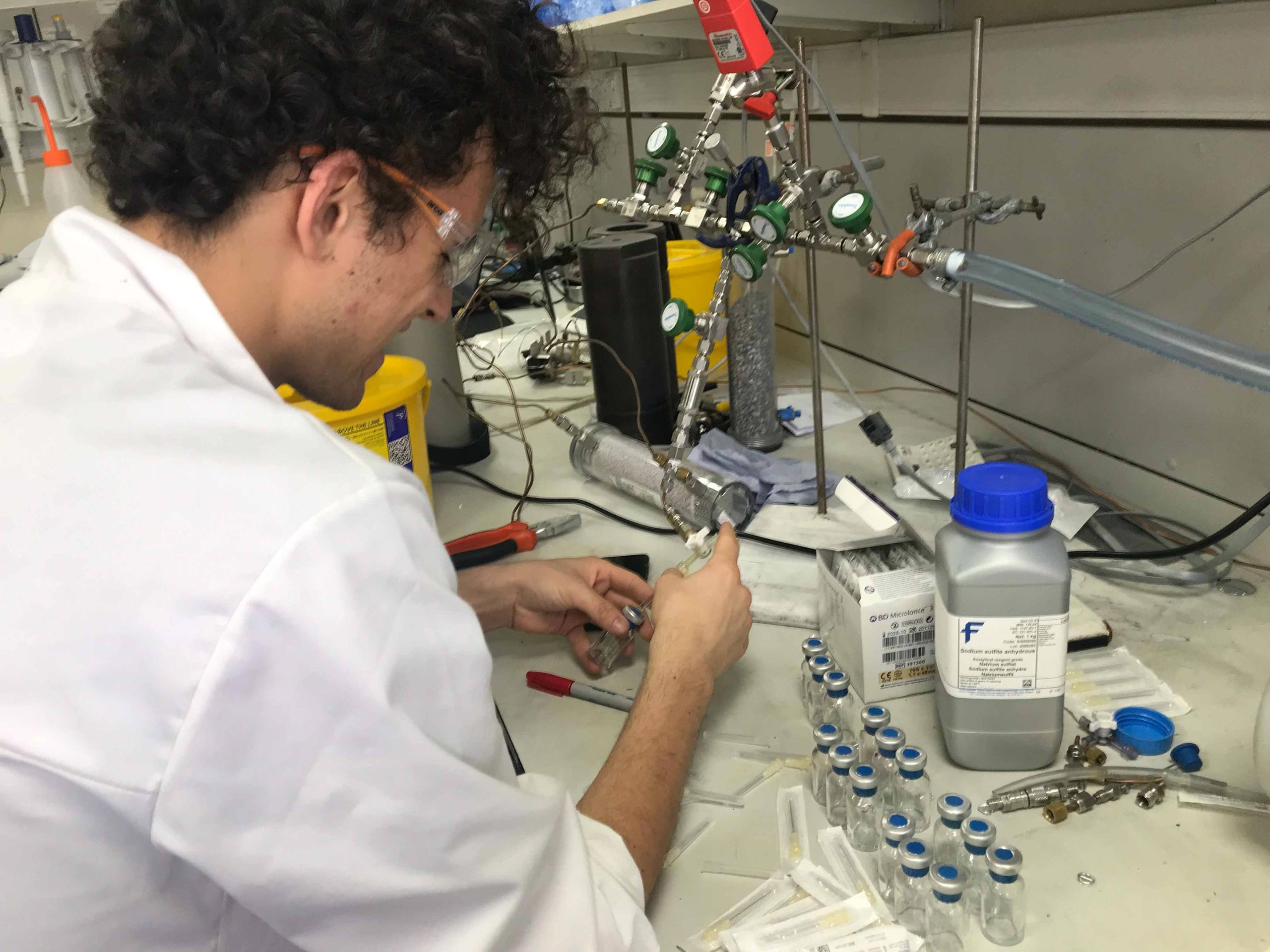
Researchers were able to simulate some of the key conditions of subsurface rock fracturing using vials in the lab. Rocks representative of oceanic and continental crust were crushed under nitrogen, added to oxygen-free water, then heated.
Credit: Jon Telling / Jordan Stone / Newcastle University
In tectonically active regions, the movement of the Earth’s crust not only generates earthquakes but also riddles the subsurface with cracks and fractures. These are lined with highly reactive rock surfaces containing many imperfections, or defects. Water can then filter down and react with these defects on the newly fractured rock.
Master’s student Jordan Stone simulated these conditions in the laboratory by crushing granite, basalt, and peridotite – rock types that would have been present in the early Earth’s crust. These were then added to water at varying temperatures under well-controlled oxygen-free conditions.
The research investigates a source of reactive oxygen associated with geological faulting; a potential oxygen source prior to cyanobacteria oxygenating the Earth’s atmosphere. This reactive oxygen may have had a role in the evolution of life from an oxygen-free to an oxygenated world and contributed to prebiotic chemistry in subsurface fractures prior to the origin of life.
Credit: Jon Telling / Jordan Stone / Newcastle University
The experiments revealed that substantial amounts of hydrogen peroxide – and as a result, potentially oxygen – were only generated at temperatures close to the boiling point of water. Importantly, the temperature of hydrogen peroxide formation overlaps the growth ranges of some of the most heat-loving microbes on Earth called hyperthermophiles, including evolutionary ancient oxygen-using microbes near the root of the Universal Tree of Life.
Lead author Jordan Stone, who conducted this research as part of his Master of Research in Environmental Geoscience, said: “While previous research has suggested that small amounts of hydrogen peroxide and other oxidants can be formed by stressing or crushing of rocks in the absence of oxygen, this is the first study to show the vital importance of hot temperatures in maximizing hydrogen peroxide generation.”
Lead author Jordan Stone, who conducted this research as part of his MRes in Environmental Geoscience at Newcastle University, UK, sets up one of the experiments.
Credit: Jon Telling / Jordan Stone / Newcastle University
Principal Investigator Dr. Jon Telling, Senior Lecturer, added: “This research shows that defects on crushed rock and minerals can behave very differently to how you would expect more ‘perfect’ mineral surfaces to react. All these mechanochemical reactions need to generate hydrogen peroxide, and therefore oxygen, is water, crushed rocks, and high temperatures, which were all present on the early Earth before the evolution of photosynthesis and which could have influenced the chemistry and microbiology in hot, seismically active regions where life may have first evolved.”
Reference:
“Tectonically-driven oxidant production in the hot biosphere” 8 August 2022, Nature Communications. DOI: 10.1038/s41467-022-32129-y
The work was supported through grants from the Natural Environmental Research Council (NERC) and the UK Space Agency. A major new follow-up project led by Dr. Jon Telling, funded by NERC, is underway to determine the significance of this mechanism for supporting life in the Earth’s subsurface.
NASA's 'Helical Engine' could reach 99% the speed of light
When it comes to space, there's a problem with our human drive to go all the places and see all the things. A big problem. It's, well, space. It's way too big. Even travelling at the maximum speed the Universe allows, it would take us years to reach our nearest neighbouring star.
But another human drive is finding solutions to big problems. And that's what NASA engineer David Burns has been doing in his spare time. He's produced an engine concept that, he says, could theoretically accelerate to 99 percent of the speed of light - all without using propellant.
He's posted it to the NASA Technical Reports Server under the heading "Helical Engine", and, on paper, it works by exploiting the way mass can change at relativistic speeds - those close to the speed of light in a vacuum. It has not yet been reviewed by an expert.
Understandably this paper has caused buzz approaching levels seen in the early days of the EM Drive. And yes, even some headlines claiming the engine could 'violate the laws of physics'.
But while this concept is fascinating, it's definitely not going to break physics anytime soon. As a thought experiment to explain his concept, Burns describes a box with a weight inside, threaded on a line, with a spring at each end bouncing the weight back and forth. In a vacuum - such as space - the effect of this would be to wiggle the entire box, with the weight seeming to stand still, like a gif stabilized around the weight.Overall, the box would stay wiggling in the same spot - but if the mass of the weight were to increase in only one direction, it would generate a greater push in that direction, and therefore thrust.
According to the principle of the conservation of momentum - in which the momentum of a system remains constant in the absence of any external forces - this should be not completely possible.
But! There's a special relativity loophole. Hooray for special relativity! According to special relativity, objects gain mass as they approach light speed. So, if you replace the weight with ions and the box with a loop, you can theoretically have the ions moving faster at one end of the loop, and slower at the other.
But Burns' drive isn't a single closed loop. It's helical, like a stretched out spring - hence "helical engine".
"The engine accelerates ions confined in a loop to moderate relativistic speeds, and then varies their velocity to make slight changes to their mass. The engine then moves ions back and forth along the direction of travel to produce thrust," he wrote in his abstract.
"The engine has no moving parts other than ions traveling in a vacuum line, trapped inside electric and magnetic fields."
It sounds really nifty, right? And it is - in theory. But it's not without significant practical problems.
According to New Scientist, the helical chamber would have to be pretty large. Around 200 metres (656 feet) long and 12 metres (40 feet) in diameter, to be precise.
And it would need to generate 165 megawatts of energy to produce 1 newton of thrust. That's the equivalent of a power station to produce the force required to accelerate a kilogram of mass per second squared. So a lot of input for a teeny tiny output. It is horribly inefficient.
But in the vacuum of space? It just might work. "The engine itself would be able to get to 99 per cent the speed of light if you had enoughAnd here's the other thing. Humans - not all of us, but still more than a few - desperately want to go to interstellar space. We may never get there. But if we never even try to think about it, that "may" becomes a "definitely." What's that saying - you miss 100 percent of the shots you don't take?time and power," Burns told New Scientist.
Burns notes the efficiency problem in his presentation, and also adds that his work hasn't been reviewed by experts, and there may be errors in his maths. We don't exactly have the blueprints for a fully functional space travel engine here.
What we do have is a piece of groundwork that could be used to develop such an engine. What we have is a dream of the stars.
The hush-hush vehicle is thought to be a space plane.
A Long March 2F rocket launches China's Shenzhou 14 crewed mission on June 4, 2022. A Long March 2F launched a mysterious reusable "test spacecraft" on Aug. 4.
(Image credit: CCTV+)
For the second time in two years, China has launched a classified reusable vehicle on a mystery mission to Earth orbit.
A Long March 2F rocket carrying a "test spacecraft" lifted off from Jiuquan Satellite Launch Center in the Gobi Desert on Thursday (Aug. 4; Aug. 5 Beijing time), China's state-run Xinhua news agency reported.
"The test spacecraft will be in orbit for a period of time before returning to the scheduled landing site in China, during which reusable and in-orbit service technology verification will be carried out as planned to provide technical support for the peaceful use of space," Xinhua wrote(opens in new tab) (in Chinese; translation by Google).
That's about all we know; Xinhua's update is just two paragraphs long and provides no further detail. But the mystery vehicle is thought to be a robotic space plane, perhaps one roughly the same size as the U.S. Space Force's X-37B, based on the Long March 2F's considerable payload capacity, SpaceNews reported(opens in new tab).
China also launched a reusable test spacecraft in September 2020, under a similar cloud of secrecy. That vehicle — which may or may not be the same one that lifted off on Thursday — stayed aloft for two days and released a small payload in orbit before coming down for a landing in China, SpaceNews noted.
For comparison, the X-37B space plane has been orbiting Earth for more than 800 days on its latest mystery mission, the sixth for the X-37B program. The Space Force is thought to have two of the 29-foot-long (8.8 meters), Boeing-built space planes in its fleet.
The Jiuquan launch was part of an extremely busy day in spaceflight. Thursday featured six rocket launches, starting with Rocket Lab's lofting of a spy satellite for the U.S. National Reconnaissance Office at 1 a.m. EDT (0500 GMT).
Mike Wall is the author of "Out There(opens in new tab)" (Grand Central Publishing, 2018;trated by Karl Tate), a book about the search for alien life. Follow him on Twitter @michaeldwall(opens in new tab). Follow us on Twitter @Spacedotcom(opens in new tab)or onFacebook(opens in new tab).
The quadrupedal robots are well suited for repetitive tasks.
Two Ghost Robotics Vision 60 Quadruped Unmanned Ground Vehicles (Q-UGVs) pose for a picture at Cape Canaveral Space Force Station, Fla., July 28, 2022. (Image credit: U.S. Space Force photo by Senior Airman Samuel Becker)
Man's new best friend is coming to the U.S. Space Force.-
The Space Force has conducted a demonstration using dog-like quadruped unmanned ground vehicles (Q-UGVs) for security patrols and other repetitive tasks. The demonstration used at least two Vision 60 Q-UGVs, or "robot dogs", built by Ghost Robotics and took place at Cape Canaveral Space Force Station on July 27 and 28.
According to a statement(opens in new tab) from the Department of Defense, Space Launch Delta 45 will use the robot dogs for "damage assessments and patrol to save significant man hours." The unit is responsible for all space launch operations from Kennedy Space Center and Cape Canaveral.
Images from the demonstration show personnel operating the robots with a hand controller inside a hangar. The Ghost Robotics Vision 60 Q-UGVs can be equipped with a wide variety of optical and acoustic sensors, enabling them to serve as automated "eyes and ears" around sensitive installations such as a Space Force base. The robots can be operated either autonomously or by a human controller and can even respond to voice commands.
U.S. Air Force 1st Lt. Andrew Cuccia, chief innovation officer, operates a Ghost Robotics, Vision 60 Quadruped Unmanned Ground Vehicle (Q-UGV) with a handheld controller at Cape Canaveral Space Force Station (Image credit: U.S. Space Force photo by Senior Airman Samuel Becker)
The dog-like robots can also serve as miniaturized communications nodes, carrying antennas to quickly extend networks beyond existing infrastructure or in locations where no such infrastructure exists.
A Ghost Robotics, Vision 60 Quadruped Unmanned Ground Vehicle (Q-UGV) is operated during a demo for 45th Security Forces Squadron at Cape Canaveral Space Force Station, Fla., July 28, 2022. (Image credit: U.S. Space Force photo by Senior Airman Samuel Becker)
The robots have been previously tested by the U.S. Air Force for perimeter defense tasks and as part of a large test of the service's Advanced Battle Management System (ABMS) data-sharing network. In that 2020 test, robot dogs at Nellis Air Force Base in Nevada "provided real-time strike targeting data to USAF operators" in Florida using Starlink satellite links, then-CEO of Ghost Robotics Jiren Parikh told The War Zone(opens in new tab).
The Ghost Robotics Q-UGVs are designed to withstand water and weather, and were recently demonstrated with a tail-like payload enabling them to travel underwater(opens in new tab).
Aside from their military applications, the robot dogs are also being eyed for uses in emergency management, public safety and industrial inspection.
Follow Brett on Twitter at @bretttingley(opens in new tab). Follow us on Twitter @Spacedotcom(opens in new tab)or onFacebook(opens in new tab).
If a distant solar system is millions of light years away and so we see it as it was millions of years ago, how can we see what it looks like now? Parul, aged 13, Sri Ganganagar, India
(Image credit: Tithi Luadthong/Shutterstock)
This article was originally published at The Conversation. The publication contributed the article to Space.com's Expert Voices: Op-Ed & Insights.
If a distant solar system is millions of light years away and so we see it as it was millions of years ago, how can we see what it looks like now? Parul, aged 13, Sri Ganganagar, India
What is the meaning of “now” and how does our “now” relate to the “now” somewhere else?
Nothing can travel faster than the speed of light: 300,000 kilometres per second. This means that it takes time for the light from a distant object in the universe to reach us.
Astronomers measure the vast distances across the universe in light years, the distance it takes light to travel in one year. If you use a telescope to look at a solar system at, say, ten light years distance – 95 trillion kilometres away – that means you see it as it was ten years ago on your watch.
Curious Kids is a series by The Conversation that gives children the chance to have their questions about the world answered by experts. If you have a question you’d like an expert to answer, send it to curiouskids@theconversation.comand make sure you include the asker’s first name, age and town or city. We won’t be able to answer every question, but we’ll do our very best.
If a friendly alien lived in that solar system ten light years away and we beamed a message to them, they would only receive the message in ten years’ time. Our “now”, when we send the message, will be in their future. But if we receive a message from them, our “now” will be in their past.
This seems to suggest that there is no way we could see what is happening right now in a distant solar system. But we can look to famous physicist Albert Einstein’stheories of relativity(opens in new tab) for an answer. These theories describe the relationship between objects and the space and time surrounding them.
Travelling in time
Einstein’s theories revealed something extraordinary. If you could leave the Earth and travel very fast through space, close to the speed of light itself, then time for you would pass at a slower rate than time for someone you had left behind on Earth.
An artist’s impression of a planet orbiting the star Epsilon Eridani, which is 10.5 light years away from us. (Image credit: NASA, ESA, and G. Bacon (STScI))
Imagine you went off travelling through space, going ten light years away and ten light years back, and left a twin sister behind on Earth. Time would pass differently for you both while you were away. For your sister, 20 years would pass. But for you, if you managed to reach within 1% of the speed of light, only three years would pass. When you got home, your sister would be 17 years older than you.
If you travelled within 0.1% of the speed of light, you’d come back just a month older than when you left. Your sister would be almost 20 years older than you.
This may seem like a trick, but we know it is true. When very fast moving particles called cosmic rays hit atoms in the Earth’s atmosphere, they create particles called muons(opens in new tab) that are unstable and fall apart. None of these muons should be able to reach the Earth’s surface. But we see them. Because their time runs slower than ours, they don’t fall apart before they reach us.
If you were able to travel at the speed of light, no time would pass for you. Your “now” would be the same as the “now” in the distant solar system or galaxy, because you would be there instantly. You would exist at your origin and at your destination at your same time, while others may have watched you travel over their time. Unfortunately, nothing with mass, such as a human being or a spaceship, can travel at exactly the speed of light.
Time is not a fixed thing. It only really has meaning for you and the way you see the world around you. When you come to think of it, time is perhaps the greatest mystery of life.
Follow all of the Expert Voices issues and debates — and become part of the discussion — on Facebook and Twitter. The views expressed are those of the author and do not necessarily reflect the views of the publisher.
Material from an accretion disk swirls around the young star FU Orionis in this artist’s concept.
NASA/JPL-Caltech
Accretion is one of the most fundamental processes in the cosmos. It is a universal phenomenon triggered by gravity, and the process by which bits of matter accumulate and coalesce with more bits of matter. It works inexorably on all scales to attract and affix smaller things to bigger things, from the tiniest dust grains to supermassive black holes.
Accretion creates everything there is: galaxies, stars, planets, and eventually, us. It is the reason the universe is filled with a whole bunch of somethings instead of a whole lot of nothing.
The fact that matter tends to glom together may seem intuitive. But to scientists, accretion remains a mysterious topic, filled with unanswered questions.
For instance: Why do some stellar nurseries form a few massive stars instead of lots of smaller ones? What causes so much accreting material to ultimately fall inward onto its central object, instead of just circling it forever? And how do space rocks ultimately stick together to form planets instead of just bouncing off each other? No one knows the definitive answers to any of these questions yet, but there are some theories gaining traction — and evidence.
The Taurus Molecular Cloud is a vast star-forming region threaded by a network of filaments. It was captured here by the European Space Agency’s Herschel Space Observatory, which operated from 2009 to 2013.
ESA/Herschel/NASA/JPL-Caltech, CC BY-SA 3.0 IGO; Acknowledgement: R. Hurt (JPL-Caltech)
All objects great and small
Accretion is the inevitable result of gravitational forces operating on all scales, and on all types of material — gas, dust, plasma, even dark matter. Gravity makes matter accrete. And when matter accretes, it forms objects. Thus, accretion and formation are very closely related in astronomy: The former can be considered an aspect of the latter.
The Soviet scientist Otto Schmidt devised the first accretion model of planetary formation in 1944, and his countryman Viktor Safronov fleshed out the mathematics of accretion in 1969. The underlying principles of gravitational attraction have since been applied to the formation of stars and even galaxies. The discovery of quasars and compact X-ray sources in the 1960s, using optical, radio, and X-ray observations, set the field in motion.
But the true renaissance began a decade ago, when the Atacama Large Millimeter/submillimeter Array (ALMA), an array of 66 radio telescopes in Chile, came online. With the ability to study distant, cool objects in detail came the data necessary to understand the process of accretion in a variety of circumstances. Seeing accretion in action promised to be a game-changer.
Today, ALMA and other advanced telescopes are observing numerous objects of different sizes and stages of evolution: galaxy groups, molecular clouds, stellar nurseries, protostars, planetary disks, black holes, and many more. We now know that whether on scales of kilometers or light-years, accretion operates on the same broad principles. The particular mechanisms remain mysterious, but the veil is beginning to lift.
The reason that the gas in a molecular cloud can accrete into a star may be due to magnetohydrodynamics (MHD), the physics of how magnetic fields interact with hot ionized gas.
Interstellar space and everything in it is permeated by a weak magnetic field. Normally, this background magnetic field has no effect on a cold, dense cloud of gas and dust.
But this changes when a collapsing cloud heats up and begins to generate plasma. Because plasma is electrically charged, it is linked to the magnetic field: As it moves, it drags the magnetic field lines with it. As the cloud collapses further and begins to form an accretion disk, the magnetic field becomes wound up by the disk’s rotation. The magnetic field also becomes stronger as the field lines bunch together.
All of these magnetic field lines then act as highways for plasma to escape the strong magnetic field: Following the field lines, the charged particles zip away from the accretion disk into space. This MHD wind carries angular momentum away from the disk — and this, astronomers suspect, helps the cloud collapse into a star.
The Giant GRB Ring is a suspected superstructure — a collection of nine gamma-ray bursts (immensely powerful stellar explosions) arranged in a loose ring that spans 5.6 billion light-years, as shown in this artist’s concept.
Pablo Carlos Budassi/Wikimedia Commons/CC BY-SA 4.0
Stellar nurseries at the crossroads
The largest structures in the universe are groups of galaxies that are gravitationally bound to each other. We are not yet able to see them, but peculiar arrangements of objects have been interpreted as evidence of such superstructures. They are given various names according to their observed shapes, such as arcs, rings, or walls.
The observable portions of superstructures consist mostly of molecular clouds of gas millions of light-years across. Over the eons, these diffuse regions are perturbed by a variety of effects: the chaotic motions of the galaxies within them, the winds thrown by quasar jets, the passing wakes of rotating black holes, and blasts from supernovae. Here and there, a confluence of gas and dust will become dense enough that gravity takes over and a domino effect begins, as more and more mass is drawn into a conglomeration, where a star-forming region is born.
The mechanics of these stellar nurseries, from which hundreds or thousands of stars are created, are not completely understood. Sometimes a region containing a few hundred solar masses of dense gas and dust will form 100 Sun-like stars. Other times a few massive stars will also appear. This difference is of particular interest to astronomers because massive stars can alter the evolution of a galaxy. What guides the seemingly random accretion process on these vast scales?
One theory posits that there are “filaments of flowing gas, which thread through these clusters,” says Todd Hunter, an astronomer at the National Radio Astronomy Observatory. Astronomers are starting to see evidence of these filaments. “They fragment and intersect at certain places, especially in the center of clusters,” says Hunter. “And where they meet is where protostars have access to a lot of gas on a short timescale” — which feeds the formation of massive stars.
The accretion disk that surrounds the elliptical galaxy M87 feeds its central supermassive black hole (SMBH) and relativistic jet in this artist’s concept.
ESO/M. Kornmesser
These objects are called infrared dark clouds, and they are very large, very cold objects that were difficult to detect and resolve until recently. The first observations were made with the Infrared Space Observatory in 1996. It was a serendipitous find, made during the first detailed survey of stellar populations in the galactic plane. Nowadays these regions are studied in detail with ALMA and the Submillimeter Array in Hawaii, which are more sensitive and have higher resolution at submillimeter wavelengths where cold molecular gas is easiest to detect.
These facilities have allowed astronomers to map the gas flows they believe provide the necessary supply for the growth of massive stars. One survey, published in The Astrophysical Journal in 2019, identified hundreds of protostellar and prestellar core candidates in a particular region and studied how they affect each other. The researchers suggest a kind of “competitive accretion” process takes place, alongside what they call “global hierarchical collapse” — where chaotic gravitational forces cause a series of collapses within collapses, with small-scale events happening later and faster than large-scale events. This process works over a couple of million years, eventually transforming a diffuse cloud of starless cores into a flattened disk of protostars.
A widening gyre
Where there is gravity and matter, there will also be accretion. Infalling matter forms a swirling accretion disk. This gravitational gyre forms because the infalling material — like everything else in the universe — had some motion and angular momentum before becoming caught up by an object’s gravity. The laws of physics state that angular momentum must be conserved — so, to fall into a star, black hole, or other object, material must lose its angular momentum first. It cannot be simply sucked toward the core along a straight line. Instead, it forms a flattened structure called an accretion disk.
At just 450 light-years away, the Taurus Molecular Cloud is an ideal place to search for accretion disks. Two examples are the young stars HL Tauri (bright blue, at upper center left) and V1213 Tauri (lower right). The latter is hidden by an accretion disk, though the star partly illuminates the disk above and below it. The visible disk and the jets comprise the object HH 30.
ESA/Hubble and NASA; Acknowledgement: Judy Schmidt
The closer the material is carried to the center, the faster it spins. (Physicists often use the metaphor of a figure skater to demonstrate this effect; when the skater pulls their arms in, they spin faster.) There’s just a small problem: For material to actually fall onto the core, it must slow down and eventually come to a stop. But how can this happen when the closer it gets, the faster it moves? Why doesn’t it just swirl around forever? What dissipates the angular momentum, allowing gravity to win the tug-of-war?
There are two prevailing theories. “The old idea is that disks are turbulent, and this turbulence generates a kind of viscosity,” or friction within a fluid, says Ilaria Pascucci, an astrophysicist and planetary scientist at the University of Arizona in Tucson. In this scenario, the disk is full of eddies, which means the gas particles don’t orbit smoothly. As inner material accelerates, it drags the material outside of it along for the ride, like a jar of molasses being stirred. “The viscosity redistributes angular momentum outward, enabling disk gas close in to accrete,” says Pascucci.
This turbulence-viscosity model of disk accretion was first suggested around 40 years ago. But astronomers have never really been able to make the numbers add up. The models required disks to be stickier and more viscous than turbulence could probably account for.
Then, in the last decade, an overlooked characteristic of accretion disks — magnetic fields — started to show promise. “What if the angular momentum is not redistributed in the disk, but extracted through winds?” Pascucci says.
The ghostly halo we see in the groundbreaking image of an SMBH from the Event Horizon Telescope is the hot, glowing plasma in the accretion disk surrounding it.
Event Horizon Telescope Collaboration
Star-forming regions have magnetic fields running through them. While they do not affect neutral gas, particles that have been heated and ionized have an electric charge and will tend to follow these magnetic field lines. As the large-scale clouds collapse under their own gravity, these magnetic field lines also become twisted and tangled. And if magnetic field lines are somehow bent outward, anchored to plasma that remains outside the collapsing cloud, plasma that is zipping along the magnetic field might be able to overcome gravity and accelerate away from the disk. Astronomers call these outflows magnetohydrodynamic (MHD) winds, and they could carry away angular momentum. This would enable the leftover disk material to fall onto the forming protostar.
Both observations and simulations seem to point toward the MHD wind hypothesis. The best evidence so far for an MHD wind is a 2021 study in The Astrophysical Journal of an active young star, where astronomers have measured how high the wind appears to sustain itself as it flows away from the disk. Measuring how powerful these winds are — and therefore how much angular momentum they carry away — will be the next major task in testing the theory.
Disk worlds
At the same time a star is forming, so are the planets that will orbit it. Both star formation and planet formation happen within disks via accretion. As gas and dust swirls around the star, delineations begin to appear in the disk. Astronomers saw this for the first time in 2014 in a young star called HL Tauri. This observation, made using ALMA, was a major advancement in our understanding of how planets form.
In a nascent planetary system, the congregation of matter depends on lots of different factors. Turbulence, magnetic fields, and the play of viscosity between gas and dust may cause a kind of traffic jam that eventually congeals to form protoplanets. Closer in, most of the gas gets consumed by the star, leaving rocky material and heavy metals, which form terrestrial planets.
In 2014, the ALMA radio telescope revealed distinctive gaps in HL Tauri’s accretion disk. They mark regions where planets are accreting and sweeping up material.
ALMA (ESO/NAOJ/NRAO)
But there is a long-standing question about how rocky bodies accrete, involving a concept called the bouncing barrier. Electrostatic forces cause small grains to stick together and larger planetesimals are attracted to each other by gravity. But how does a particle become a planet? Models show that objects in that middle range between tiny and massive just tend to bounce off each other. So how do amassing objects overcome this barrier to growth?
One theory is that the particles experience a drag force as they move through gas in the disk. “There’s a strong interaction between solid particles and the gas in the disk,” says James Stone, an astrophysicist at Princeton University. “This causes clumps to form, which over time can produce larger and larger objects.”
So far, this protoplanetary evolution mechanism, called streaming instability, seems to be a promising way to grow things from centimeter to kilometer sizes. The most intriguing part of the theory is that the gas is the crucial component: Without it, dust in the disk couldn’t coalesce to form planetesimals. But there is not yet direct evidence.
The hope is that within a decade or two, we will have seen lots of planets at different stages of formation. This will stand in as a kind of time-lapse and we can judge how well predictions of prevailing hypotheses, like streaming instability, match up to actual exoplanets. This ambitious venture received a kickstart in 2021 with the discovery of the youngest planet ever observed: 2M0437b. The discovery image, taken by the Subaru Telescope on Mauna Kea in Hawaii, shows a world still glowing hot from energy released during its formation, meaning it just recently (astronomically speaking) finished accreting. The study, led by Eric Gaidos of the University of Hawai’i, also fills in our picture of how quickly planetary systems form, because the star is only about 2.5 million years old.
Supercomputer simulations reveal the turbulent and hierarchical dynamics of collapsing infrared dark clouds (IRDCs), forming filaments within filaments. In the densest regions of this simulation, shown in red, molecular clouds are forming cores that will become massive stars.
Richard Klein, Lawrence Livermore National Laboratory; Pak Shing Li, University of California, Berkeley; Tim Sandstrom, NASA Ames Research Center
Gathering dust
Every star grows up on its own schedule. The protostar stage is like a star’s volatile teen years. When its accretion disk stabilizes and material stops falling into the core, it becomes a main sequence star. There may still be a debris disk and the planets around might still be figuring out where they orbit, but accretion has largely stopped. That doesn’t mean there won’t be any more accretion in the star’s future, though. Depending on its mass, when fusion ceases, it will then transition into either a white dwarf, a neutron star, or a black hole, all of which can form accretion disks of their own.
The supply for this new disk can come from a variety of sources. Compact objects, like white dwarfs and black holes, may siphon gas from a companion star. A white dwarf may also pull in material that it puffed off in the earlier red giant phase. And when black holes grow and merge to become the supermassive black holes (SMBHs) at the centers of galaxies, they draw material from the vast roaming stars, clouds, and nebulae within the galaxy itself.
As material from the disk falls into the central object — whether a star, planet, or singularity — it releases energy in the form of radiation. The disk itself also radiates as it swirls around the gravity well and heats up, with different factors like viscosity, friction, and speed making some parts hotter than others. The stronger the draw of the central object, the more powerful the radiation emitted, as gas can be transformed into plasma. The groundbreaking 2019 image of the supermassive black hole at the center of the galaxy M87 is not of the hole itself, but of the black hole’s shadow on the charged plasma swirling around it.
A black hole gains mass from everything it accretes over time. But while we understand how Sun-sized black holes form, we don’t know how SMBHs got as big as they are. For example, the SMBH at the center of the Whirlpool Galaxy (M51) in Canes Venatici has a mass equivalent to 1 million Suns. There is no way for a single small, stellar-mass black hole to accrete enough material to grow this large at the universe’s current age.
“It’s one of the biggest mysteries of black hole research,” says Joanna Piotrowska, a graduate student at Cambridge University. The laws of physics limit how quickly an object can accrete matter, called the Eddington limit. Above that limit, the radiation from the accretion disk is so intense, it blows material away — preventing more accretion from happening. “The mass of [SMBHs] exceeds what is expected from continuous accretion at the Eddington limit over the lifetime of our universe,” says Piotrowska.
One proposed solution is that SMBHs were big to start with. Perhaps in the early universe, even before the first stars, there were molecular clouds with just the right conditions to collapse straight away into singularities. The James Webb Space Telescope might be able to shed some light on this dark topic when it comes online this year. It was designed especially to see the first galaxies and stars, and those primordial formations could help us to understand the initial distribution of potential collapsible matter.
IRDCs appear as shadows splayed across the bright mid-infrared background of the Milky Way, as seen in this false-color image from NASA’s Spitzer Space Telescope. Though they are some of the darkest objects in the sky, these ultracold and dense clouds give birth to the brightest, most massive stars in the galaxy.
NASA/JPL-Caltech
And that’s not all ...
It’s tempting to picture accretion as a peaceful, gradual, and constructive process, like erosion in reverse. It can certainly take time to get going. But the methods by which an accretor gains mass can be quite quick and chaotic. Recently, observers have seen what they call accretion bursts around protostars — instances of extreme instability in a disk, where large amounts of material suddenly plunge into the star. Hunter recently observed this on NGC 6334 I, a protostar cluster in the Cat’s Paw Nebula (NGC 6334) in the constellation Scorpius, using the Stratospheric Observatory for Infrared Astronomy (or SOFIA). He theorizes that a high proportion of the total accretion of some stars — up to 50 percent — may actually happen in this way.
Furthermore, accretion is not always a constructive process — accretion in one place might actually preclude the process elsewhere. There is a rare kind of supernova, called Type 1ax, where the accretion disk around a white dwarf explodes. The accretion disks around quasars have powerful magnetic forces which shoot material out in supersonic jets. And there is evidence that winds from the jets of actively feeding SMBHs can actually quench, or turn off, star formation in their host galaxies.
These are exciting times for those who study accretion. Astronomers finally have the capability to compare their mathematical predictions to actual astrophysical objects at key stages of their lives. Whether their theories ultimately measure up to reality, or whether new ones will need to be invented to account for observations, only time — and a lot more data — will tell.
Aarde lijkt haast te hebben: kortste dag ooit sinds start van metingen geregistreerd
De aarde deed op 29 juni 1,59 milliseconde sneller over een volledige rotatie dan de gebruikelijke 24 uur. Dat is een recordtijd sinds de metingen in de jaren 60 van start gingen. Met andere woorden: 29 juni was de kortste dag ooit gemeten. Het vorige record dateerde nog maar van 19 juli 2020.
Het blijkt dus geen eenmalig feit te zijn, die snellere draaiing van de aarde rond haar eigen as. In 2020 werden zelfs de 28 kortste dagen geregistreerd sinds het bijhouden van de metingen. Ook in 2021 en 2022 ging het soms sneller dan normaal. Onlangs nog, op 26 juli 2022, lag de aarde 1,5 milliseconde voor op het dagschema.
Volgens Judah Levine, professor aan de universiteit van Colorado-Boulder en natuurkundige van het National Institute of Standards and Technology, zullen we waarschijnlijk nog meer van die kortere dagen krijgen omdat de aarde blijkbaar sneller om haar as blijft draaien. Paniek is zeker niet nodig, zegt de expert, want het gaat slechts om een fractie van een seconde op jaarbasis. Het bijzondere is wel dat wetenschappers geen echte verklaring hebben voor de huidige lichte versnelling van de aardrotatie.
De maan
In principe neemt de aardrotatie op lange termijn in snelheid af. Dat komt door de maan, die verantwoordelijk is voor de getijden op onze planeet en op die manier zorgt voor wrijving en ook vertraging. Zo duurde een paar honderd miljoen jaar geleden een dag slechts 22 uur en is de verwachting dat een dag de komende millennia langer zal duren dan de - ongeveer - 24 uur van vandaag. De versnelling van de laatste jaren gaat dus tegen die trend in.
Het is het International Earth Rotation and Reference Systems Service dat de snelheid van de aardrotatie meet. De snelheid komt niet helemaal overeen met de periode van precies 24 uur, die wij aan een zonnedag toekennen. Dat heeft in 1972 geleid tot de introductie van de schrikkelseconde. Het komt erop neer dat, wanneer de rotatie van de aarde niet synchroon loopt met de atoomklokken en de afwijking meer dan 1 seconde dreigt te worden, wetenschappers de klokken op 30 juni of 31 december om 23.59 uur een seconde stilzetten om ze bij te stellen. De laatste keer gebeurde dat op 31 december 2016.
Negatieve schrikkelseconde
Sindsdien was het niet meer nodig omdat men dus de laatste twee jaren een versnelling van de aardrotatie registreert in plaats van een vertraging. Er is nu zelfs sprake van een eventuele negatieve schrikkelseconde om de atoomklok bij te stellen. “Als die versnelling zich doorzet - en dat is een grote ‘als’ - dan hebben we over zo’n zeven à acht jaar misschien een negatieve schrikkelseconde nodig”, stelt Levine.
Mogelijk heeft een en ander te maken met de zogenaamde ‘Chandler-wiebel’, ontdekt in de 19de eeuw. Dat fenomeen verklaart waarom de niet perfect ronde aarde een beetje wiebelt en zo langzamer rond haar eigen as draait. Volgens Leonid Zotov zou die wiebel tussen 2017 en 2020 op mysterieuze wijze zijn verdwenen, waardoor de aardrotatie weer iets sneller zou verlopen.
Klimaatverandering
Nog een mogelijke verklaring is dat de klimaatverandering de rotatiesnelheid van de aarde zou beïnvloeden. Door het smelten van gletsjers verandert de vorm van de aarde lichtjes: wat platter aan de polen en boller aan de evenaar. Maar volgens professor Levine zouden die smeltende gletsjers net het tegenovergestelde effect moeten hebben. De rotatiesnelheid van de aarde zou dus moeten verlagen, niet verhogen.
Levine denkt dat de hogere snelheid waarmee de aarde rond haar as draait mede een gevolg is van de wisselwerking tussen de aarde en de atmosfeer. “Als de atmosfeer versnelt, vertraagt de aarde, en omgekeerd”, klinkt het. “Want de som van de twee is een constante.” Levine besluit dat “de rotatiesnelheid van de aarde een ingewikkelde zaak” is en dat ze onderhevig is aan een combinatie van de genoemde factoren. “Je kunt niet voorspellen wat er heel ver in de toekomst gaat gebeuren.”
Dwarf Galaxies Found Without Influence From Dark Matter
Ask astronomers about dark matter and one of the things they talk about is that this invisible, mysterious “stuff” permeates the universe. In particular, it exists in halos surrounding most galaxies. The mass of the halo exerts a strong gravitational influence on the galaxy itself, as well as on others in the neighborhood. That’s pretty much the standard view of dark matter and its influence on galaxies. However, there are problems with the idea of those halos. Apparently, some oddly shaped dwarf galaxies exist that look like they have no halos. How could this be? Do they represent an observationally induced challenge to the prevailing ideas about dark matter halos?
Finding Perturbed Dwarf Galaxies
In the so-called “Standard Model” of cosmology, shells or halos of dark matter protect galaxies from the gravitational influence of nearby galactic neighbors. However, when astronomers at the University of Bonn and Saint Andrews in Scotland looked in the nearby Fornax Cluster, which lies some 62 million light-years away from us, they saw something strange. It contains a number of dwarf galaxies with distorted, perturbed shapes. This is odd, especially if they should be surrounded by dark matter halos.
The Fornax Galaxy Cluster, which contains distorted dwarf galaxies in its collection. Image Credit: ESO
Let’s take a quick look at dwarf galaxies. They’re small and faint and usually found riding along in galaxy clusters or near much larger companions. The Milky Way Galaxy has a coterie of dwarf galaxies around it,. It is, in fact, cannibalizing ones such as the Sagittarius Dwarf Spheroidal. Interestingly, recent studies show that at least one of the dwarf galaxies near ours, an ancient one called Tucana II, has an astoundingly massive dark matter halo.
So, what’s happening in Fornax that’s different? There, dwarf galaxies could be “disturbed” by gravitational tides from nearby larger ones in the cluster. Tides happen when gravity from one body pulls differently on different parts of another body. These are similar to tides on Earth when the Moon pulls more strongly on the side of Earth that faces it.
The distorted shapes of the dwarf galaxies seen by the team indicate a problem with our understanding of dark matter. “Such perturbations in the Fornax dwarfs are not expected according to the Standard Model,” said Pavel Kroupa, Professor at the University of Bonn and Charles University in Prague. “This is because, according to that model, the dark matter halos of these dwarfs should partly shield them from tides raised by the cluster.”
Dwarf galaxy NGC1427A, part of the Fornax galaxy cluster.
(ESO)
Explaining Distorted Dwarf Galaxies
Kroupa and Ph.D. student Elena Ascencio analyzed observations of the perturbed dwarfs in Fornax. They wanted to understand the extent of gravitational distortions these galaxies show and what causes them. The expected levels of distortion depend on a couple of factors. One is the internal characteristics of the dwarf galaxy. In addition, their distance to the center of the cluster is important. That’s where gravitational influences are much stronger. As a rule, galaxies with large sizes but not many stars could be easily disturbed by strong gravitational tides. The same is true for galaxies closer to the core of the cluster.
The team members compared what they saw in the cluster with observations made by the VLT Survey Telescope at the European Southern Observatory. Asencio pointed out that what they found seems to point to problems with the Standard Model. “The comparison showed that, if one wants to explain the observations in the standard model,” she said, “the Fornax dwarfs should already be destroyed by gravity from the cluster center even when the tides it raises on a dwarf are sixty-four times weaker than the dwarf’s own self-gravity.”
Not only is this counter-intuitive, she said, it also contradicts previous studies. The team also found that the force needed to disturb a dwarf galaxy is about the same as its self-gravity.
What Does This Mean for the Standard Model?
The research team points out that it’s difficult to explain these perturbed, disturbed shapes of the dwarf galaxies in Fornax if they’re surrounded by dark matter. In other words, they shouldn’t be misshapen if they do have halos. Yet, there they are with disturbed-looking shapes. That means that there are no dark matter halos around those galaxies.
Obviously, if what the astronomers found is confirmed, then the Standard Model needs some tweaking. And, there is at least one alternative explanation for the strange galaxy shapes. It’s called the MOND model (short for Modified Newtonian Dynamics). It suggests that Newton’s law of universal gravitation should be modified to account for the observed properties of galaxies. It could be applied to explain why misshapen galaxies look the way they do.
According to Hongsheng Zhao, a member of the research team from the University of Saint Andrews, finding disturbed dwarfs without dark matter halos is a major challenge to the current view. It states that galaxies have halos. It appears not all of them do, he points out. “Our results have major implications for fundamental physics,” he said. “We expect to find more disturbed dwarfs in other clusters, a prediction which other teams should verify”.
Gods, Extraterrestrials and Religion: From Ancient Atlantis to Today
Ancient records and religious texts describe multiple "Gods" (aka extraterrestrials) creating humanity in a series of genetic experiments and warring among themselves over who would be dominant in influencing Earth's future.
The world's oldest known creation story, Sumer's Enuma Elish, and other ancient texts introduce the different creator Gods and how they formed grand assemblies to resolve their differences over the destiny of humanity.
This new video is the official trailer/short film for the "World Religions and Extraterrestrial Contact" webinar to be held on August 13. In addition to the above issues, the trailer discusses the rise and fall of Atlantis in relation to creator Gods/extraterrestrials alarmed over humanity's rapid technological development.
Finally, this short film covers the return of the creator Gods (Elohim/Anunnaki) to our solar system and what this means for us today.
Stationary blinking UFO over Boynton, Florida 31-May-2022
This blinking unidentified flying object was filmed above the sea near Boynton in Florida. This happened on 31st May 2022.
Witness report:
Here’s the 12 minutes video of various times during the 45 + minute sighting. However, please study this at 10 minutes and 35 seconds into the video above when a very large Ufo streaks across the screen from top right to bottom left quadrant!
So, let’s use logic. This craft flew at least 2 1/2 miles over the sea (which is a VERY conservative estimate because it really appears to have gone over the horizon which is 35 miles away). Theirs 3,600 seconds in one hour. IF this craft only went 2 1/2 miles in 1/10 th of a second – that would put the speed of the Ufo at 90,000 per hour!
However, if it’s gone out of sight over the horizon (35 miles) in 1/10 th of a second , using the same equation…(3,600 seconds in one hour) that would put the speed of the Ufo at an Astounding 1,260,000 mph!!
RECENT UFO-VIDEOS FLORIDA, selected and posted by peter2011
Kosmisch overgewicht: waarom sterren, planeten en manen rond zijn
Planeten, sterren en sommige manen zijn rond. Dat komt niet alleen omdat ze zwaar zijn, leren we van de onregelmatig gevormde maan Proteus en superzware neutronensterren.
Beeld: NASA
Door de kosmos zweven planeten zoals Mars en onze aarde, ijzige manen zoals Proteus en hete sterren zoals de zon. Planeten en sterren verschillen erg van elkaar, maar toch zijn ze allemaal rond. Veel manen zijn dat trouwens ook. Hoe komt dat? Je hoort weleens dat dit komt door het gewicht of de grote afmetingen van die objecten. Maar de zware en onregelmatig gevormde maan Proteus en de kleine en gigantisch zware neutronensterren leren ons dat gewicht en afmetingen niet alles zeggen. Drie aspecten zijn belangrijk. Ten eerste heb je de zwaartekracht die de massa van objecten naar binnen trekt (dat kon je al leren uit een video die eerder op EOS verscheen). Ten tweede is er een interne druk nodig die weerstand biedt tegen de samentrekking. Ten slotte moet het object ook voldoende vervormbaar zijn om rond te kunnen worden. Deze kennis heeft trouwens een belangrijke rol in mijn (Hans) leven gespeeld, dus die wil ik daarom niemand onthouden!
Alleen zwaartekracht is niet genoeg
De zon, de maan en de planeten zijn gevormd uit het samenklonteren van gassen en ruimtestof. Deze klonters zijn nadien rond geworden. De interne zwaartekracht zorgt ervoor dat de objecten samentrekken, maar daarmee krijg je nog niet zomaar een bol. Stel je voor dat er enkel samentrekking zou zijn. De planeet- of sterklonter zou dan blijven ineenkrimpen. Dat is duidelijk niet wat er gebeurt. Daarnaast zien we in het zonnestelsel dat sommige ruimteklonters ondanks hun sterke zwaartekracht niet altijd rond worden. Er zijn dus ook andere aspecten nodig voor het volledige plaatje: interne druk en vervormbaarheid.
De eerste andere noodzakelijke factor om een ruimteklonter rond te laten worden, is de interne druk die de zwaartekracht tegenwerkt. Terwijl de zwaartekracht van het object voor een samentrekking zorgt, ‘duwen’ de gesteenten, vloeistoffen of gassen waaruit de nieuwe ster of planeet bestaat in tegengestelde richting.
De tweede factor is de vervormbaarheid. In een vervormbaar object zal de zwaartekracht de inhoud van de planeet zo dicht mogelijk bij het centrum van de zwaartekracht proberen te brengen, terwijl de interne druk probeert te verhinderen dat het volume van de planeet kleiner wordt. Daaruit zal uiteindelijk een evenwicht ontstaan dat overeenkomt met een bolvormige planeet, maan of ster. Dat is niet toevallig, want een bol is de vorm waarvoor de afstand van alle inhoud tot het centrum van de zwaartekracht zo klein mogelijk is voor een bepaald volume. Daarmee zijn zowel de zwaartekracht als de interne druk ‘tevreden’. Dit is niet het geval voor bijvoorbeeld een vierkant met hetzelfde volume, waarin sommige punten zich verder van het centrum bevinden dan andere. Stel dat je planeet start als een (vervormbaar) vierkant, dan zullen de uiterste punten langzaam naar binnen getrokken worden tot het uiteindelijk een bol wordt.
Je kan dit proces een beetje vergelijken met een ballon. Enerzijds heeft de ballon, door de lucht die erin zit, een inwendige druk die naar buiten duwt. Anderzijds zorgt de spanning van het vel voor een samentrekking. Het resultaat? Een bolvormige ballon. Stop je in plaats van lucht een baksteen in een ballon, dan zal de ballon dezelfde vorm als de harde baksteen aannemen. De samentrekkende kracht van de ballon krijgt namelijk niet de kans om de baksteen te vervormen. Verbrijzel je de steen tot zand, dan duwt het zand nog even hard tegen de ballon. Maar de zandkorrels kunnen wel makkelijk bewegen ten opzichte van elkaar. Op die manier krijgt de samentrekkende kracht toch de kans om de inhoud te vervormen. Het evenwicht dat dan bereikt wordt, lijkt al meer op een bol.
Wat maakt planeten dan vervormbaar? Dat kan te maken hebben met hun verschillende samenstellingen (gesteente, ijs of vloeibare lagen). Maar als de zwaartekracht voldoende sterk is, kan zelfs hard gesteente op geologische tijdschaal vervormen.
Zwaar genoeg, maar toch niet rond
Proteus (rechts) is niet rond, maar gek genoeg toch zwaarder dan Mimas (links).
Credit: NASA
Is de interne zwaartekracht voldoende sterk, maar het object niet vervormbaar, dan wordt een planeet ook niet bolvormig. Dit is niet zomaar een wetenschappelijk gedachtespelletje. Kijk bijvoorbeeld naar de manen Mimas en Proteus. De bolvormige Mimas is 20% procent lichter dan Proteus. Je zou dan verwachten dat Proteus ook zeker rond is. Desondanks is Proteus onregelmatig gevormd. Dit komt omdat de structuur van Proteus moeilijker vervormt onder invloed van de zwaartekracht dan die van Mimas. In het voorbeeld van hierboven kan je Proteus dus meer vergelijken met de rigide ‘baksteen’ en Mimas meer met de ‘verbrijzelde baksteen’. In werkelijkheid zijn beide eerder ijzige objecten en is Mimas mogelijk gedeeltelijk vloeibaar binnenin en daarom meer vervormbaar.
Heel klein maar toch (niet) rond
De maan Amalthea (250 km groot) is onregelmatig gevormd, maar een neutronen ster van 20 km (rechts) is helemaal rond.
Credit: NASA
De afmetingen van een object vertellen je niet altijd of het object rond is. Vergelijk bijvoorbeeld de 250 km lange onregelmatig gevormde Jupitermaan Amalthea met een 20 km grote bolvormige neutronenster. De massa van Amalthea wekt niet voldoende zwaartekracht op om haar rigide structuur te vervormen. Neutronensterren (exotische sterren die uit neutronen bestaan) zijn wel bolvormig en slechts 20 km groot. Dat is een heel stuk kleiner dan Amalthea. Het verschil is dat neutronensterren heel erg zwaar zijn. Miljoenen keren de massa van de aarde zelfs! De interne zwaartekracht is dus veel hoger dan bij Amalthea en zorgt voor voldoende samentrekking om de neutronen te laten bewegen. Dit gebeurt in korte stoten die ‘starquakes’ heten. De samentrekking kan niet blijven doorgaan omdat de opeengepropte neutronen tegen de zwaartekracht inwerken. Het samenspel tussen de zwaartekracht en de druk resulteert in een bol.
Sollicitatietip
Deze kennis heeft ooit een ‘cruciale’ rol in mijn (Hans) carrière als wetenschapper gespeeld. Op mijn allereerste jobinterview stelde een professor van een Zweedse onderzoeksgroep een vraag die hij tijdens elk interview stelt om de kandidaten het vuur aan de schenen te leggen. Die vraag is ‘waarom zijn planeten rond?’. Zwaartekracht op zich is niet het volledige antwoord, er is ook een tegenwerkende druk nodig. Dat wist ik gelukkig en de professor was danig onder de indruk. Hoe belangrijk het antwoord op die vraag echt was weet ik niet, maar die eerste job was wel de springplank voor de rest mijn carrière.
Objecten in de ruimte zijn dus rond door een evenwicht dat optreedt tussen de inwaartse zwaartekracht die de massa samentrekt en de uitwaartse interne druk. Een bijkomende voorwaarde is dat het object voldoende vervormbaar is.
Hoe het voelt om dood te gaan zullen we pas echt weten als het zover is. Al krijgt de wetenschap wel steeds meer inzicht in wat er in de hersenen gebeurt rond het moment van overlijden. ‘We hebben de activiteit van het brein in het proces van doodgaan lang onderschat.’
Voor ons levende mensen is het een groot mysterie: hoe is het om dood te gaan? Maken we dat laatste moment bewust mee? Aanwijzingen druppelen binnen dat het antwoord op die laatste vraag misschien positief kan zijn. Het licht gaat niet meteen uit op het moment dat we onze laatste adem uitblazen.
Over die stelling wordt al eeuwenlang gespeculeerd. Sommige aannames en hypotheses zijn louter gestoeld op anekdotisch materiaal. In de tijd dat terdoodveroordeelden werden onthoofd met de guillotine beweerden sommige toeschouwers bijvoorbeeld dat ze de ogen nog zagen knipperen als het hoofd de grond al had geraakt.Maar er zijn ook wetenschappelijke bevindingen. Onderzoekers hebben al meerdere keren geobserveerd dat onze hersenen er niet gelijk mee ophouden wanneer ons hart tot stilstand komt. Ze blijken postmortaal zelfs nog urenlang actief te kunnen zijn. Het roept de vraag op: wat voor rol spelen de hersenen in het overlijdensproces? En wat kan dat betekenen voor onze beleving van doodgaan?
Samenwerkende neuronen
Het was eigenlijk puur toeval. In een ziekenhuis in Canada onderging een epilepsiepatiënt een behandeling voor zijn aanvallen. Op bepaalde momenten werd hij continu gemonitord. Artsen bevestigden dan elektrodes op zijn hoofd voor een eeg-meting, die de elektrische activiteit in het brein registreert. Net tijdens zo’n sessie overleed de patiënt. De eeg-meting was doorgegaan. De artsen hadden het bewuste moment waarop de patiënt stierf vastgelegd in hersenscans.
De metingen boden een zeldzaam inzicht in het patroon van hersenactiviteit vlak voor, tijdens en na het moment van overlijden. Wat de onderzoekers zagen? In de 30 seconden voor- en nadat het hart tot stilstand kwam, was er een plotselinge piek in een bepaald soort hersenactiviteit. Het ging om zogeheten gammagolven, schreven de onderzoekers in een paper, die eind februari is gepubliceerd.
Als neuronen in de hersenen samenwerken, doen ze dat gesynchroniseerd. Ze produceren zo samen hersengolven in een bepaalde frequentie. Die hersengolven kunnen we meten met een eeg. Op basis van frequentie (of golflengte) zijn ze op te delen in categorieën, van laag naar hoog: delta-, thèta-, alfa-, bèta- en gammagolven.
Je brein produceert deltagolven vooral wanneer je diep aan het slapen bent. Thètagolven zien we wanneer je slaapt maar niet heel diep, of wanneer je wakker en ontspannen bent. Bij alfagolven ben je kalm maar wel alert. Bètagolven komen voor wanneer je gefocuste activiteiten uitvoert, zoals logisch redeneren, maar ook bij motorische taken. Simpel gesteld: bij dingen waar je je hoofd bij moet houden.
‘Bewustzijn is een van de grote mysteries van de wetenschap. Dat kan je niet reduceren tot een gammagolfje’
En de gammagolven? Die zouden te zien zijn bij een sterke vorm van focus en alertheid. Wanneer je op het puntje van je stoel zit en naar een verhaal zit te luisteren dat zo interessant is dat je er opgewonden van raakt. In verschillende studies zagen onderzoekers dat gamma-activiteit betrokken is bij aandacht, leren, werkgeheugen en langetermijngeheugen.
Het is verleidelijk om te denken dat de piek in gammagolven bij de epilepsiepatiënt betekent dat hij vlak voor en na zijn ‘officiële’ dood een opflakkering van bewustzijn beleefde. De hoofdauteur van de studie, Ajmal Zemmar, speculeerde zelfs dat de piek erop kon wijzen dat zijn leven als het ware aan hem voorbijflitste. Dat een hele reeks aan herinneringen nog een laatste keer voorbijzoefde.
‘Je zou kunnen aannemen dat het moment van verhoogde hersenactiviteit gepaard gaat met een subjectieve ervaring van gedachtepercepties en emoties’, zegt neuroloog Steven Laureys (ULiège). ‘Maar goed, de man is overleden. We kunnen het niet meer navragen. Het is en blijft een hypothese.’
Veel van Zemmars collega’s uit de neurologie vinden de theorie nogal voorbarig. Ze wijzen erop dat het gaat om een meting bij een enkel individu – een 87-jarige man met een beschadigd brein, met bloedingen en zwellingen, die leed aan epileptische aanvallen. Het is bekend dat epilepsie ook de gamma-activiteit in de hersenen kan beïnvloeden. Op basis van deze casus zijn dus geen algemene aannames te maken.
‘Over de snelle gammagolven bestaat hoe dan ook nogal wat discussie’, vult Laureys aan. ‘Volgens sommige wetenschappers zijn ze een soort handtekening van bewuste processen. Maar zo eenvoudig lijkt het niet te zijn. Bewustzijn is een van de grote mysteries van de wetenschap. Dat kan je niet reduceren tot een gammagolfje.’
Laureys erkent wel dat de gammagolven een interessant onderzoeksonderwerp zijn. ‘Ze lijken iets belangrijks te doen voor ons bewustzijn. Dat maakt het fascinerend dat we ze zo vlak voor en na het moment van overlijden zien opkomen.’
Van alle hersengolven hebben gammagolven de hoogste frequentie. Ze zijn betrokken bij onder meer aandacht, leren en werkgeheugen
Ook bij ratten
Toch staat de casus van de Canadese epilepsiepatiënt niet geheel op zichzelf. Wetenschappers hadden al vaker gerapporteerd over pieken in de hersenactiviteit rond het moment van overlijden – bij mensen, maar ook bij dieren. Al werden zulke zogeheten end-of-life electrical surges (ELES) lang niet bij elk subject gemonitord. En het ging ook niet altijd om gammagolven. Soms registreerden de onderzoekers andere golven van een hoge frequentie.
In een studie uit 2017 aan het George Washington University Medical Center observeerden onderzoekers 35 patiënten tot na het moment dat ze hun laatste adem uitbliezen. Ze wilden bestuderen hoe universeel het verschijnsel van zulke pieken was.
Dat deden ze voor een deel met het oog op orgaandonatie. Want wat als zo’n piek in breinactiviteit onderdeel is van het overlijdensproces? Sommige artsen en wetenschappers vinden dat een patiënt in dat geval niet van zijn organen mag worden ontdaan voordat de piek optreedt. Anderen werpen tegen dat wachten de kwaliteit van de organen negatief kan beïnvloeden.
Onder de 35 patiënten waren er zeven die klinisch gezien als hersendood werden gecategoriseerd. Bij geen van deze patiënten was een piek in hersenactiviteit te zien rond het moment van overlijden. Van de 28 resterende patiënten waren er dertien bij wie de onderzoekers wel een piek zagen. Het ging om gesynchroniseerde hersenactiviteit in een hoge frequentie. De wetenschappers konden niet uitmaken of het ging om gammagolven.
‘Een mens is niet per se bewust of onbewust, dood of levend. Er lijkt ook een soort een overgangsfase te bestaan’
Dat een piek niet voorkwam bij hersendode patiënten ondersteunt volgens de onderzoekers het idee dat voor een piek in activiteit een zekere mate van hersencapaciteit vereist is. Ook de synchronisatie van de hersengolven zou erop wijzen dat de piek niet zomaar een soort laatste stuiptrekking van het brein is, waarbij alle aanwezige energie nog een laatste keer losgelaten moet worden. Die theorie werd al meermaals door wetenschappers geopperd. Waarschijnlijk is het geavanceerder dan dat. De onderzoekers konden overigens niet verklaren waarom een piek bij een deel van de niet hersendode patiënten wel voorkwam en bij een ander deel niet.
In 2013 bekeek een team van Amerikaanse wetenschappers de hersenactiviteit van ratten rond het moment van overlijden. Bij negen proefdieren deden de onderzoekers een eeg-meting. Dertig seconden na het overlijden was een piek in hersenactiviteit te zien. De onderzoekers registreerden daarbij activiteit in de frequentie van gammagolven. Volgens de wetenschappers suggereren de data dat het ook hier niet gaat om een stuiptrekking. Daarvoor was de hersenactiviteit te zeer gesynchroniseerd.
In een andere Canadese studie werden vier patiënten bij hun levenseinde gemonitord. Onderzoekers maten de eeg-activiteit in de 30 minuten voor en 30 minuten na het moment dat ze van de apparatuur werden gehaald die hen kunstmatig in leven hield. Bij twee van de vier patiënten zagen de onderzoekers een piek in hersenactiviteit rond het moment van overlijden. Het waren hersengolven met een hoge frequentie, maar het waren niet gammagolven.
Flitsen van herinneringen en licht aan het einde van een tunnel
Een verschijnsel dat vaak is gerapporteerd maar vooralsnog een groot mysterie blijft: de bijna-doodervaring (zie ook Eos nr. 6, 2020). Er bestaat geen officiële definitie voor het fenomeen. Meestal wordt gerefereerd aan bepaalde visioenen die mensen ervaren wanneer ze op het randje van de dood balanceren. Flitsen van herinneringen uit het leven, of licht aan het einde van een tunnel. Vaak gaan die ervaringen gepaard met een soort euforisch gevoel.
De wetenschap is er nog niet over uit wat een bijna-doodervaring precies is – en of ze überhaupt bestaat. Een biologische verklaring is er in elk geval nog niet voor te vinden. ‘We kunnen niet stellen: een bijna-doodervaring komt door een tsunami aan endorfines, of heeft te maken met zuurstoftekort in de cellen. Het is niet te linken aan één hersengebied of één neurotransmitter’, zegt neuroloog Steven Laureys (ULiège). In een studie uit 2019 hebben Laureys en zijn collega’s wel aanwijzingen gevonden die kunnen wijzen op welke mechanismen en receptoren mogelijk betrokken zijn bij een bijna-doodervaring. In de studie tekenden ze de verhalen op van 625 bijna-doodervaringen. Met behulp van artificiële intelligentie vergeleken ze die met meer dan 1.500 verhalen van ervaringen met verschillende psychedelische drugs.
Hun conclusie was dat de ervaringen met de drug ketamine, een antagonist van de zogeheten NMDA-receptor in het brein, de meeste gelijkenis vertoonden met bijna-doodervaringen. Gevolgd door de plant Salvia divinorum, en een aantal psychedelische drugs die inwerken op een bepaalde serotonine-receptor, waaronder de drug DMT. De resultaten kunnen erop wijzen dat de receptoren en mechanismen betrokken bij bijna-doodervaringen dezelfde zijn als die bij de bovengenoemde middelen. Het zijn interessante hypotheses, zegt Laureys, maar voorlopig niks meer dan dat.
Voor een volgende studie is Laureys nog op zoek naar mensen die ooit een bijna-doodervaring hebben beleefd. Ervaringsdeskundigen kunnen zich aanmelden op nde@uliege.be.
Tussen dood en leven
In een studie uit 2021 hebben Laureys en zijn collega’s de hersenactiviteit gemeten in personen bij het overlijden. Ze wilden nagaan in hoeverre de inschatting van het bewustzijn van een patiënt overeenkomt met de data van monitors.
‘We vroegen zorgverleners en familieleden naar wat zij dachten dat het bewustzijnsniveau van een patiënt was, en wat de patiënt volgens hen zou ervaren’, zegt Laureys. ‘Hun antwoorden vergeleken we met wat we zagen op de hersenscans van de patiënt.’
‘In veel gevallen zagen we op de monitor meer reactiviteit dan de bevraagde individuen verwacht hadden. Als een verzorger of familielid aan het bed van een patiënt vaststelde dat die niet reageerde, dan viel op de monitor te zien dat het brein nog wel reageerde op signalen vanuit de omgeving. Er was nog elektrische activiteit – al was die wel afwijkend.’
Die bevindingen geven volgens Laureys aan dat we vaak onderschatten wat iemand in zo’n toestand bewust kan ervaren. ‘Bij patiënten die ontwaken uit de anesthesie of coma hoor je weleens dat ze nadien zeggen dat ze in die toestand van alles hebben opgepikt. Terwijl de zorgverleners overtuigd waren: die ervaart helemaal niks.’
In zijn studies zag Laureys geen pieken van gammagolven vlak voor en vlak na het overlijden van patiënten. Zijn metingen waren wel anders dan die in de bovenvermelde studies. Het waren langdurige eeg-metingen. Daarin zijn gammagolven moeilijk te onderscheiden van andere activiteiten, zoals van de spieren.
Is er dan werkelijk meer aan de hand met het brein van patiënten die buiten bewustzijn lijken? ‘Het is niet zo zwart-wit als we misschien denken. Een mens is niet per se bewust of onbewust, dood of levend. Er lijkt ook een soort overgangsfase te bestaan. Ik denk dat we de activiteit van het brein in het proces van doodgaan lang hebben onderschat.’
Op hersenscans van deze 87-jarige epilepsiepatiënt zijn bloeduitstortingen in de linkerhersenhelft te zien.
Activiteit op het kleinste niveau
Ook Jeffrey Loeb, neuroloog aan de University of Illinois (VS), is overtuigd dat we niet van het ene op het andere moment dood zijn. ‘Het lichaam heeft tijd nodig om te sterven.’ In zijn onderzoek van het afgelopen jaar zag hij hoe bepaalde hersencellen in de 24 uur na de dood actief blijven, en hoe ze zelfs toenemen in aantal.
Met de studie wilde hij nagaan wat voor verschillen je kan zien in genetische activiteit bij ‘vers’ hersenweefsel en hersenweefsel dat al een tijdje dood is. Loeb kreeg van een aantal epilepsiepatiënten toestemming om kleine stukjes hersenweefsel, die werden verwijderd als onderdeel van een operatie, te onderzoeken. Hij mat wat er gebeurde met de genetische activiteit, van de eerste seconde na de afname tot 24 uur daarna.
Loeb vond dat hersenweefsel niet zomaar stopt als het wordt afgesloten van de bloedtoevoer. In de samples zag hij in bepaalde genen nog activiteit – in ieder geval gedurende de eerste 24 uur na de afname. Bij sommige genen nam de activiteit zelfs toe, zag Loeb. Bepaalde hersencellen groeiden daardoor in aantal.
Wat voor genen waren dit? En wat betekent dat voor ons overlijdensproces? ‘Bij de genenset waarbij we activiteit maten, keken we naar verschillende types hersencellen. De activiteit voor de neuronen betrokken bij processen als leren en geheugen ging snel naar beneden. Maar de activiteit voor de zogeheten gliacellen ging juist omhoog’, zegt Loeb. Het ging om twee typen gliacellen: de astrocyten en de microglia.
De piek in activiteit zou niet zomaar een laatste stuiptrekking van het brein zijn, waarbij alle aanwezige energie nog een keer losgelaten wordt
Met de toegenomen genetische activiteit zagen Loeb en zijn collega’s ook het aantal van die gliacellen stijgen. ‘We checkten de genetische activiteit in de cellen, maar bekeken ook de celpopulaties in stukjes weefsel onder de microscoop. En we zagen dat de populaties van die twee types cellen heel snel begonnen te groeien.’ Een van de functies van astrocyten is om beschadigingen in het brein te repareren. De microglia hebben als taak om beschadigd weefsel op te ruimen.
Vandaar dat het eigenlijk helemaal niet zo verrassend is, volgens Loeb, dat die cellen na de dood vermeerderen. ‘De gliacellen hebben niet door dat het hele brein beschadigd is en dat het eigenlijk al een verloren zaak is. Ze blijven als een gek al het beschadigde weefsel opdweilen dat ze tegenkomen.’
Doodgaan is een complex biologisch proces, daarover zijn Laureys en Loeb het met elkaar eens. Het is niet iets dat van het ene op het andere moment gebeurd is. Ook in ons brein lijkt er rond het moment van overlijden nog heel wat te gebeuren. ‘De hersenen bestaan uit duizenden miljarden synapsen, in een soep van talloze neurotransmitters’, zegt Laureys. ‘Doodgaan in de hersenen staat gelijk aan een stortvloed van gebeurtenissen. Waarschijnlijk zullen we daar nooit helemaal vat op krijgen.’
Future Space Travelers May Follow Cosmic Lighthouses
An image of NICER on the exterior of the space station with one of the station’s solar panels in the background.
Credits: NASA
For centuries, lighthouses helped sailors navigate safely into harbor. Their lights swept across the water, cutting through fog and darkness, guiding mariners around dangerous obstacles and keeping them on the right path. In the future, space explorers may receive similar guidance from the steady signals created by pulsars.
Scientists and engineers are using the International Space Station to develop pulsar-based navigation using these cosmic lighthouses to assist with wayfinding on trips to the Moon under NASA’s Artemis program and on future human missions to Mars.
Pulsars, or rapidly spinning neutron stars, are the extremely dense remains of stars that exploded as supernovas. They emit X-ray photons in bright, narrow beams that sweep the sky like a lighthouse as the stars spin. From a great distance they appear to pulse, hence the name pulsars.
An X-ray telescope on the exterior of the space station, the Neutron star Interior Composition Explorer or NICER, collects and timestamps the arrival of X-ray light from neutron stars across the sky. Software embedded in NICER, called the Station Explorer for X-ray Timing and Navigation Technology or SEXTANT, is using the beacons from pulsars to create a GPS-like system. This concept, often referred to as XNAV, could provide autonomous navigation throughout the solar system and beyond.
Depiction of a pulsar or rapidly spinning neutron star. It emits X-ray photons or radiation particles in bright narrow beams that sweep the sky like a lighthouse as the star spins.
Credits: Bill Saxton, NRAO/AUI/NSF
“GPS uses precisely synchronized signals. Pulsations from some neutron stars are very stable, some even as stable as terrestrial atomic clocks in the long term, which makes them potentially useful in a similar way,” says Luke Winternitz, a researcher at NASA’s Goddard Space Flight Center in Greenbelt, Maryland.
The stability of the pulses allows highly accurate predictions of their time of arrival to any reference point in the solar system. Scientists have developed detailed models that predict precisely when a pulse would arrive at, for example, the center of Earth. Timing the arrival of the pulse to a detector on a spacecraft, and comparing that to when it is predicted to arrive at a reference point, provides information for navigating far beyond our planet.
“Navigation information provided by pulsars does not degrade by moving away from Earth since pulsars are distributed throughout our Milky Way galaxy,” says SEXTANT team member Munther Hassouneh, navigation technologist.
“It effectively turns the ‘G’ in GPS from Global to Galactic,” adds team member Jason Mitchell, director of the Advanced Communications and Navigation Technology Division in NASA’s Space Communication and Navigation Program. “It could work anywhere in the solar system and even carry robotic or crewed systems beyond the solar system.”
Pulsars also can be observed in the radio band but, unlike radio waves, X-rays are not delayed by matter in space. Additionally, detectors for X-rays can be more compact and smaller than radio dishes.
But because X-ray pulses are very weak, a system must be robust enough to collect a signal sufficient for navigating. NICER’s large collection area makes it nearly ideal for XNAV research. A future XNAV system could be made smaller, trading size for longer collection time.
“NICER is roughly the size of a washing machine, but you could dramatically reduce its size and volume,” Mitchell says. “For example, it would be interesting to fit an XNAV telescope into a small satellite that could independently navigate the asteroid belt and characterize primitive solar system bodies.”
As published in a 2018 paper, SEXTANT already has successfully demonstrated real-time pulsar-based navigation aboard the space station. It also studied the use of pulsars for time-keeping and clock synchronization and is helping expand the catalog of pulsars to use as reference points for XNAV.
The SEXTANT team also includes Samuel Price, Sean Semper and Wayne Yu at Goddard; Naval Research Lab partners Paul Ray and Kent Wood; and NICER principal investigator Keith Gendreau and science lead Zaven Arzoumanian.
The team now is studying the possibility of using XNAV autonomous navigation as a technique on NASA’s Gateway platform, to study support for crewed missions to Mars.
These kinds of experiments could bring cosmic lighthouses to guide spacecraft to their destinations another step closer to reality.
Imagine a technology that would allow space travelers to transmit gigabytes of data per second over interplanetary distances or to navigate to Mars and beyond using powerful beams of light emanating from rotating neutron stars. The concept isn't farfetched. In fact, Goddard astrophysicists Keith Gendreau and Zaven Arzoumanian plan to fly a multi-purpose instrument on the International Space Station to demonstrate the viability of two groundbreaking navigation and communication technologies and, from the same platform, gather scientific data revealing the physics of dense matter in neutron stars.
Credits: NASA's Goddard Space Flight Center/Rich Melnick
Hubble Space Telescope finds evidence for water around Jupiter’s largest moon.
Depiction of Ganymede centered over 45° W. longitude.
Credit: National Oceanic and Atmospheric Administration
An international team of astronomers has used Hubble to peer into the atmosphere of Jupiter’s biggest moon, Ganymede – and find evidence for water vapour there.
Ganymede is the biggest of our Solar System’s moons, with a diameter of 5,200km – 1.5 times bigger than our own satellite. It’s a cold world, made up of equal amounts of rock and water, with an ocean below the surface that may contain more water than all of Earth’s oceans combined.
But it’s also the largest body in the Solar System without any kind of substantial atmosphere. When the Voyager 1 spacecraft soared by in 1979, it didn’t detect any atmosphere, although a couple of decades later the Hubble Space Telescope managed to spot a very thin and tenuous one comprised primarily of oxygen molecules (O2).
These molecules are thought to be created when charged particles and solar radiation hit the icy surface of Ganymede. This splits up the water molecules into various groups of molecules and atoms, including atomic hydrogen (H) and molecular oxygen. The lighter hydrogen is quickly lost, while the moon’s gravity holds onto the heavier oxygen molecules.
Astronomers have long suspected that there must be some water in Ganymede’s atmosphere, too, created from the same process on the surface. In particular, the icy surface “sublimates”, with ice turned directly into water vapour (H2O) and skipping the liquid stage.
This diagram shows where the subsolar point is on the Earth’s surface – the place where the sun’s rays directly hit the planet. Credit: Wikimedia Commons.
Modelling has suggested that H2O should dominate the atmosphere at Ganymede’s subsolar point – that is, the warmest part of the atmosphere where the Sun’s radiation directly hits – while molecular oxygen dominates the rest.
Now, this new research has turned Hubble’s eyes back to the Jovian moon to settle this. The team, led by Lorenz Roth from the KTH Royal Institute of Technology in Sweden, used Hubble’s Cosmic Origins Spectrograph to study the chemical composition of Ganymede’s atmosphere.
Their findings were consistent with the modelling: spectral signatures indicated that H2O was more abundant around the subsolar point, but O2 was more abundant elsewhere.
The team notes that finding water in Ganymede’s atmosphere will inform future space missions, including the European Space Agency’s Jupiter Icy Moons Explorer (JUICE). Expected to reach the gas giant in 2031, JUICE will make several fly-bys of the moons before settling into orbit around Ganymede in 2034 for at least 280 days.
“Several science instruments are equipped to measure Ganymede’s neutral gas environment and particularly the H2O abundance by remote sensing of UV, optical, infrared and submillimetre emissions, as well as in situ sensing with the neutral particle detector,” the authors explain in their paper.
“Our results place observational constraints on the contribution of sublimation to the atmosphere, and provide the JUICE instrument teams with valuable information that may be used to refine their observation plans.”
60 UNSOLVED MYSTERIES THAT CANNOT BE EXPLAINED – PREMIERED 2022
60 unsolved mysteries that cannot be explained | compilation.Today, we take a look at 60 unsolved mysteries that cannot be explained.
There is nothing more tantalising to the human species than a good mystery. Thrillers in the forms of novels, movies, and even campfire tales are often consumed by the thousands by those who love the adrenaline rush of solving a mystery. However, some of the most pervasive mysteries are those that occur in real life, and these are the ones that are often most difficult to solve. So today, here at unexplained mysteries, we take a look at these 60 unsolved mysteries that cannot be explained.
Elon Musk says Tesla would continue to do very well even if he was kidnapped by aliens or 'went back to my home planet' UFO Sighting News.
Date of announcement: Aug 6, 2022
During a live Tesla interview with Elon Musk, he stated that he is an alien from another planet. Now he says it with a smile and there is laughter, but I have long said he is an alien and not of this world. Here, he admits it 100%.
Scott C. Waring - Taiwan
"We have a very talented team here. So I think Tesla, you know, would continue to do very well even if I was kidnapped by aliens, or went back to my home planet," the Tesla CEO said at the firm's 2022 Cyber roundup meeting of stock owners. He was responding to a question from stockholder Gary Black, a managing partner of the Future Fund, concerning how Tesla's board would potentially handle his succession.
Plane Buzzes UFO Over Airport, El Paso, Texas, Aug 4, 2022, Video, UFO Sighting News.
Date of sighting: Aug 4, 2022 Location of sighting: El Paso, Texas, USA
Here is an interesting video from Texas, one of the top 3 UFO hotspots of America. Someone caught a UFO over the airport during sunset, then the UFO flew closer and began to pass over the neighborhood. He even said when he went to start his truck...it just would not start and had to leave it till morning. This has all the signs of a real UFO.
Scott C. Waring - Taiwan
Eyewitness states:
Hovered over mountain not moving, plane went by, started moving south along the mountain, stopped again, descended until visual was lost. My truck didn’t turn on after. Left it over night, it started in the morning.
Here is a rare report of some unknown objects falling into the mountains of Australia. This same week, at the time of this falling, reports of Chinese space debris falling to earth were reported world wide. I believe this is not SpaceX but the Chinese space debris. No reports of SpaceX debris were reported...until they found the objects. This is 100% proof that China is trying to pass USA in the space program, and may one day succeed.
Scott C. Waring - Taiwan
News states:
About three weeks ago, residents in the Snowy Mountains reported hearing a mysterious loud boom. Others saw debris falling from the sky. Now, two farmers have found the likely cause — large and rare pieces of space junk that landed on their properties. It's thought to be debris from a SpaceX capsule, and has excited experts in the field who say it's an extremely unusual event.
Producer James Fox and his team travel the globe, interviewing eyewitnesses and high-ranking military & government personnel about their UFO knowledge and experiences. As narrator, actor Peter Coyote guides the viewer through these interviews and through new and historic film footage & information related to the UFO Phenomenon.
A condensed version of an ancient Egyptian legend goes as follows: the wise servant tells his master how he survived the shipwreck and came ashore on a mysterious island where he met a great talking serpent who called himself the Lord of Punt. All good things were on the island and the sailor and the snake converse until a ship is hailed and he can return to Egypt.
A number of the myth’s fragments lead to some interesting reflections. The size of the enigmatic reptile is the first thing that strikes you as astonishing. The surviving sailor recounts his misadventures in this manner:
“The trees were cracking, the ground was shaking. When I opened my face, I saw that the serpent was approaching me. Its length is thirty cubits. His beard is more than two cubits long. His scales are of gold, his eyebrows are of lapis lazuli, his body is curved upwards.”
This myth’s serpent is quite fascinating. Signs point to him having a beard and eyebrows thick enough to resemble the legendary golden Chinese dragons of Chinese mythology. However, a little beard was occasionally depicted on sacred snakes in Egypt. Ancient Egyptian and East Asian traditions about enormous reptiles appear to be derived from the same source.
The second unusual thing you notice is that, there is a reference made in the legend to a particular star that was responsible for the death of the entire serpent family. This is what the last serpent told the man:
“Now since you have survived this accident, let me tell you of a tale of calamity that befell me. I once lived on this island with my family – 75 serpents in all without counting an orphan girl who was brought to me by chance and who was dear to my heart. One night a star came crashing down from heaven and they all went up in flames. It happened when I wasn’t there – I wasn’t among them. Only I was spared, and behold, here I am, utterly alone.”
What kind of star was it that burnt down seventy-five enormous creatures all at once? – let’s remember the size of the serpent. What an accurate and effective hit and what a powerful striking factor!
Let us recall another myth from ancient Egypt, in which Sekhmet, the dreadful eye of the deity Ra, is said to have severed the head of a giant snake or serpent Apep (also known as Apophis). Apep was viewed as the greatest enemy of Ra, and thus was given the title Enemy of Ra, and also “the Lord of Chaos”.
In this particular instance — the tale of Serpent Island — this destruction of serpents by a star resembles a real celestial punishment, in the literal sense of the word!
Let’s take a step back from the myth for a moment and concentrate on the specifics. The last surviving sailor describes waves of eight cubits, and he estimates the length of the snake to be thirty cubits. These are key comparative measurements that can be used to estimate the scale:
“And now the wind is getting stronger, and the waves are eight cubits high. And then the mast fell into the wave, and the ship was lost, and no one survived except me.”
In other words, based on the narrative, there can be no doubt regarding the size; the waves are big, and the snakes are at least three times larger than the waves. And with one swift strike from a certain “star,” all of this enormous “snake pit” of the seventy-five giant serpents is eradicated. It is clear that the explosion had a significant amount of power.
What struck the intelligent serpents? Somehow, it is difficult to accept a “crazy” asteroid hitting at random.
There is no doubt that ancient sources that tell about the history of peoples often include fictional tales in their folklore. We believe that this story parallels the ancient mythology of peoples that lived a long way from Egypt, where gods or heroes fought with reptiles or dragons in ancient stories. Why were such myths popular among ancient cultures?
The discovery was made by scientists from the Siberian Section of the Russian Academy of Sciences (СО РАН) conducted radiocarbon analyses of reindeer antler fragments found at the Kushevat Paleolithic site in the Lower Ob region.
In addition to the antler bones, scientists also examined a woolly mammoth (Mammuthus primigenius), a steppe bison (Bison Priscus), Elk (Alces alces), deer (Cervus elephus sibiricus), and, potentially, a musk ox (Ovibos moschatus). Analyses of the bones dated them back to a series of 20 different radiocarbon dates, all ranging from the period between 20 and 40 thousand years ago.
Although this finding solely points to animals, and not humans, inhibiting the Arctic region 40,000 years back, the discovery has now become the basis of further analyses, which currently date human activity in the Ob region back to 40,000 years ago. This is because two reindeer antlers held traces of human activity amongst this group of bones, which have only recently been analyzed.
The question of the initial settlement of the Arctic and Subarctic by an ancient man of the modern type (Homo sapiens sapiens) has long been of interest to scientists. The valley of the Ob River is often considered a potential migration route for Paleolithic man. It is believed that modern man came to Europe and Asia 50,000-60,000 thousand years ago.
What is still unclear is where the modern man lived before and how he crossed the Urals? For a long time, the hypothesis prevailed that 12,000-30,000 years ago, the north of Western Siberia was covered by a large glacier (just like the north of America and Europe). To the south of this glacier was a dammed basin reaching 130 meters.
For this reason, it was believed that looking for archaeological sites dating back to the period of 30-40 thousand years ago in the north was pointless. It was confirmed by the almost complete absence of finds (tools, sites, organic matter).
Thanks to the international research program using AMS dating and optical-stimulating luminescence, researchers from Europe and Russia proved that there was no ice cover in the north of Western Siberia 12,000-30,000 years ago. It was much earlier: 90,000-60,000 years ago north of Salekhard. The level of the ice-dammed basin in the Ob valley did not exceed 60 meters.
This is an entirely different paleogeographic picture. For thirty years, I was convinced that in the north of Western Siberia, there were all the conditions for the existence of an ancient person. Now we had the opportunity to try to prove it: to find traces of Homo sapiens in the north of the Ob 30,000-50,000 years ago, – the project manager, head of the laboratory of the Institute of Geology and Mineralogy named after V.I. V.S commented in a press statement.
As reported by the Barents Observer“the analysis suggests that Homo sapiens and not only Neanderthals inhabited the Arctic Circle in the Upper Paleolithic age. About two decades ago, it was only certain that Neanderthals, and not Homo sapiens, were occupants in the region during the period.”
This was discovered by radiocarbon dating a set of bones unearthed in 2001 at the Yakutia site. The radiocarbon analysis suggested that the Neanderthals had found themselves in the region approximately 28,500-27,000 years ago.
The new AMS analysis has hence provided two major breakthroughs. The first one is that Homo sapiens, as well as Neanderthals, inhabited the Arctic circle during the Paleolithic Age, and the second finding is that Homo sapiens lived north of the Arctic circle already 40,000 years ago.
In 1942, physicist Enrico Fermi and a team of workers built what they thought was the first nuclear reactor in a Chicago racket ball court. Unfortunately, nature had beaten them to the punch — by eons.
Truth be told, self-sustaining nuclear power reactor was invented in Africa, 2 billion years ago! It’s a 100-kilowatt nuclear plant that produced pulses of power every three hours for a period of about 150,000 years.
On June 2, 1972, a French nuclear fuel reprocessing plant discovered that 200 kg of uranium from a uranium mine in the Oklo region of Gabon Republic had been refined. Fearing that someone (or a secret organization) would build a nuclear bomb, the French Atomic Energy Commission immediately opened an investigation.
Finally, researchers and scientists from all over the world, after conducting detailed investigation, came to the conclusion that, six large nuclear reactors as old as 2 billion years old are located near Gabon’s uranium mine, and has been active for at least 150,000 years!
The advanced process self-sustaining fission
The ancient nuclear reactors use surface water and groundwater to modulate and reflect sequenced fission neutrons, its operation is much more advanced than that of modern nuclear reactors. Moreover, scientists found geological evidence that uranium in lens-shaped veins of uranium ore had undergone self-sustaining fission chain reactions, generating intense heat.
In this process, subatomic neutrons released by radioactive decay of uranium atoms induce decay of other uranium atoms, leading to a cascade of nuclear fission and substantial release of energy as heat. This is what modern nuclear reactors use to produce power.
Former head of the United States Atomic Energy Commission and Nobel laureate Dr. Glenn T. Seaborg points out: For uranium to continue to “burn”, all conditions must be completely free of bias. The water involved in the nuclear reaction must be very pure, a few parts per million of pollutants will create a “toxic” reaction that causes the reactor to stop working. Nowhere in the world is there such pure natural water.
In April 2018, two rock samples recovered during drilling campaigns in Oklo were donated to the Vienna Natural History Museum. The donation (and ceremony) was made possible with funding from nuclear fuel company Orano and France’s Alternative Energies and Atomic Energy Commission (CEA). The French Permanent Mission to the UN in Vienna supported the effort.
According to the International Atomic Energy Agency (IAEA), which helped monitor radioactivity levels and handling of those samples, the two samples emit a radiation of about 40 microsieverts per hour “if you stand 5 centimetres away from them, which roughly compares to the amount of cosmic radiation a passenger would receive on an eight-hour flight from Vienna to New York.”
The incredible hypotheses
The Oklo nuclear reactor in Gabon has been operating for 1500,00 years. How to produce water of such high purity has become another unsolved mystery. The rationality of the structural design of prehistoric nuclear reactors is absolutely baffling to experts.
Some scientists and theorists believe that the reactor is extremely advanced, suggesting that highly intelligent beings existed 2 billion years ago. While another hypothesis is that it was constructed by prehistoric human civilization (like described in the Silurian Hypothesis by NASA scientists) using techniques that were lost to subsequent humans.
However, most of the mainstream researchers believe that Oklo is the world’s only identified naturally occurring reactor which was created by accident. As scientists Norman Schwers and John A. Miller from Sandia National Laboratories explain in a 2017 paper, the concept of a naturally occurring reactor was originally documented in 1956 using reactor theory or the infinite multiplication constants.
Scientists Successfully Sent A Particle Back in Time Using A Quantum Computer
Time travel was fiction before Einstein, but his calculations took us into the quantum world and we were introduced to a more complex picture of time. Einstein’s equations permitted time travel into the past, as Kurt Gödel discovered. The issue? None of the hypothesized time travel systems were ever physically feasible.
So, before sending a particle back through time, Argonne National Laboratory, Moscow Institute of Physics and Technology, and ETH Zurich scientists wondered, “Why stick to physical grounds?
Many physics laws treat the future and the past as continuous. A closed system progresses from order to disorder according to the second rule of thermodynamics (or entropy). If you scramble an egg to produce an omelet, you’ve added a lot of chaos to the closed system that was the egg.
The arrow of time is an essential consequence of the second law. A process that develops entropy, like whisking an egg, is irreversible. An omelet won’t turn back into an egg, and billiard balls won’t spontaneously reassemble a triangle. Entropy, like an arrow, goes in one direction, and we see it as time.
The second rule of thermodynamics holds us captive, but an international team of scientists sought to test it in the quantum world. Since nature cannot do such a test, scientists utilized an IBM quantum computer.
Ordinary computers, such as the one you’re reading this on, work with bits of data. A bit is either a 1 or a 0. A qubit is a fundamental unit of information used by quantum computers. A qubit may be both a 1 and a 0, allowing the system to process data considerably quicker.
The researchers used qubits to simulate subatomic particles in a four-step experiment. They entangled the qubits first, such that whatever occurred to one affected the others. Then they utilized microwave radio pulses to evolve the quantum computer’s initial order into a more sophisticated state.
A specific algorithm changes the quantum computer to bring order out of chaos. They’re zapped by another microwave pulse, but this time they go back to their old selves. That is, they are de-aged by a millionth of a second.
Argonne National Laboratory researcher Valerii M. Vinokur compares it to pushing against a pond’s waves to restore them to their source.
Success was not guaranteed since quantum mechanics is about probability. In a two-qubit quantum computer, however, the algorithm accomplished a time leap 85 percent of the time. With three qubits, the success rate decreased to around 50%, which the scientists blamed on flaws in current quantum computers.
The results are exciting but don’t go buying flux capacitors just yet. This experiment also illustrates that manipulating even a simulated particle in time is difficult. Our ability to produce such an external force to influence even one quantum wave is limited.
To time-reverse even ONE quantum particle is impossible for nature alone, says research author Vinokur. “The system comprising two particles is even more irreversible, let alone the eggs — comprising billions of particles — we break to prepare an omelette.”
A press release from the Department of Energy notes that the “timeline required for [an external force] to spontaneously appear and properly manipulate the quantum waves” to appear in nature and unscramble an egg “would extend longer than that of the universe itself.” In other words, this tech specifically binds to quantum computation.
But the study isn’t just a high-tech exercise. While the approach won’t help us build real-world time machines, it will improve quantum computation.
Einstein’s equations don’t prohibit time travel, but they make it a difficult task, as Kurt Gödel demonstrated.
Alex Birch whose photographs of UFOs puzzled experts on both sides of the Atlantic has released a film about his experiences – that he claims included meetings with the British royal family and a phone conversation with JFK.
In Beyond Perception Sheffield-born Alex says he attended private meetings with Prince Philip, who died age 99 in 2021 and Lord Mountbatten of Burma who asked the then 14-year-old Alex to call him Dickie. Both men were known for their fascination with the UFO mystery at that time.
But in the new film Alex, now 74, also claims he took part in a transatlantic telephone conversation with President John F Kennedy in 1962 after his photo of a fleet of flying saucers made news headlines across the world.
In the 30-minute film Alex says a military car collected him and his father from their home near Sheffield from where they were taken to a US military base. On arrival they met USAF officials and the base commander. During the visit he was taken to an adjoining room where he was put through to a man he believes was JFK.
The man quizzed Alex ‘asking if there was any visible markings on the objects, also how high were the objects and how big they were and many other questions’. He says Kennedy was concerned the Russians had ‘secret weapons and were already exploring space’. Kennedy was assassinated in November 1963 after launching NASA’s Apollo space programme that put the first men on the moon.
Shortly before the call Alex, then 14 years old, had travelled to London with his father where his black and white photograph and Box Brownie camera were examined by officials at the Air Ministry. A MoD file documenting the meeting was released at The National Archives in the 1990s.
Alex Birch’s photo showing a fleet of UFOs over Mosborough, near Sheffield, in March 1962 (Copyright A. Birch)
After the media furore surrounding this photograph Alex faded from the public eye. But flying saucers, and UFOlogists, continued to haunt him. He was taunted at school and everywhere he went he was known as ‘the lad who had photographed flying saucers.’
So in 1972, when he was 24 years old, he contacted the Daily Express and confessed it was a hoax. He even appeared on TV with the pane of glass on which the ‘saucers’ had been painted. For ten years he had fooled his family, friends and even the Air Ministry who had them tagged as ‘ice crystals’.
The ruse, for according to Alex it was a ruse, worked. Alex says he knew the photo was genuine but his manipulation of the media removed the heat; interest in him diminished and he was able to concentrate on building a career and supporting a family. But his interest in photography remained and over the years he became an accomplished practitioner, entering and wining numerous competitions.
Daily Express, 6 October 1972
Meanwhile his iconic flying saucer photograph continued to be reproduced in books and magazines worldwide. In 1998 Alex, who no longer possessed a copy of the original negative, decided to step back into the public spotlight to reclaim his own copyright on the image. He also wanted the world to know the truth: he really did see, and photograph, flying saucers in 1962.
After a short flurry of media and UFOlogical interest, his U-turn was again quickly forgotten. Alex didn’t care who believed him and, now a grandfather, he believed his adventures in UFOlogy were now a thing of the past.
Until Tuesday, 27 January 2004. On that evening Alex, now 55, was sitting in his bungalow watching TV with his wife when it began snowing heavily. At the time Alex was trying to think of a suitable photograph to enter in his local photographic society’s competition and this unexpected snowfall made him think he might get an unusual night time shot.
Leaving the house at 9.15 pm, without even telling his wife, Alex drove through heavy snow to the market town of Retford, in rural Nottinghamshire, where he parked in the square. The thick snow and the relatively late hour meant the square was completely deserted and silent. Alex spent some time taking a variety of photographs of the square, road and buildings that were covered in snow and reflecting lights from lampposts and buildings. He was using 35mm Fujia Sensia 200ASA reversal film (a slide film).
After using the roll of thirty six frames Alex returned home and shortly afterwards sent the film for processing. When the slides were returned he spent some time looking at them on a small battery operated viewer, trying to identify a suitable slide for entry in his local photography club’s competition. He found three shots that were perfect and then noticed an odd image on one of the slides. To his amazement when he looked closer he saw a UFO, a saucer shaped UFO at that, just to the side of Retford Town Hall. The Town Hall clock fixes the image in time at 23.08.
UFO? Retford, Nottinghamshire, 27 January 2004 (Copyright A Birch)
Alex was naturally keen to tell us about his new photograph. We were, naturally, skeptical. After all, the chances of someone taking a photograph of a genuinely anomalous UFO once are massive. To do so twice in a lifetime would be, well, Fortean. We recalled the furore over Alex’s 1962 photograph, his 1972 confession and his subsequent revelation that it was genuine after all. What was going on?
Alex wasn’t going to let the problems which plagued his 1962 photograph affect this new one and he decided to eschew any publicity. He just wanted to know what he had caught on film. The first time we saw the new UFO image was on a copy of a slide he sent to us.
We thought it was obviously a lens flare; there are numerous lights on lamps and buildings and even though we couldn’t prove it, a lens flare of some kind seemed to be the only logical conclusion. Most tellingly Alex did not see the object whilst taking the photographs and it is axiomatic that an image which is noticed only after processing is almost always a bird, lens flare, camera or film fault. Alex disagreed and told us he firmly believed the image on the film was of an object in the sky: a real UFO.
Despite the prospect of fresh media attention and money from this photograph Alex wasn’t interested. He wanted to get to the bottom of it privately and, rather than trust the photograph to the care of the UFO community, of whom he has a profound mistrust, he set about investigating it himself.
Sheffield University’s Department of Physics and Astronomy ruled out any celestial or astronomical phenomena and local airfields confirmed there were no aircraft over Retford that night. He then took the slide to the Kodak Laboratories in Lincoln. Their technical analysis ruled out any possibility of lens flare, double exposure, drying stains, re-touching or a host of other possibilities. Indeed, the Kodak analysis found that the UFO image had the same density pattern, colour and grain as the surrounding picture. This suggested to the Kodak analysts that whatever ‘it’ was, it was in the sky when photographed. Robert Smith of Kodak’s labs went so far as to write on the back of the photograph, ‘This image has not been altered or manipulated in any way.’
The News of the World, 2 September 1962
Then he tried his old bete noir, the Ministry of Defence. After several phone calls to the MoD’sWhitehall building Alex made an appointment to see the UFO desk officer, Linda Unwin. She suggested a meeting and told Alex that ‘defence experts’ would be interested in viewing the slide.
A meeting was duly arranged for 9 March 2004 and Alex asked Andy Roberts to accompany him. It is highly unusual for a UFO witness to be interviewed by MoD personnel and even more unusual for them to be invited to visit the MoD Main Building. The last time this had happened was in 1962 when Alex, then a schoolboy, visited the Air Ministry with his father and allowed experts to examine his Box Brownie camera and his other picture of ‘flying saucers.’
The 2004 visit did not go to plan. Alex and Andy were met in the reception area by Linda Unwin and a colleague, who seemed to be unaware of the promised ‘meeting’ or the possibility of defence experts viewing the slide. She was happy to take a copy for analysis, but Alex and Andy got no further than the ornate reception area. Alex believes the meeting was cancelled because he had not told them he was bringing guests (his son in law was also present).
In a follow-up letter Unwin asked for a copy of the negative for scrutiny by a ‘defence imagery analyst.’ Using the Freedom of Information Act we discovered that a copy of the slide was sent by Unwin’s branch to the MoD’s Defence Geographic and Imagery Intelligence Agency (DGIA), based at RAF Brampton in Cambridgeshire. Experts there analyse aerial photographs and other military-sourced images for intelligence purposes. In this case, Alex was told that UFO photographs are ‘not within the normal course of work’ for the imagery experts ‘but [they] have agreed to fit this in around essential defence work.’
The Graphics and Digital Imaging Section completed their assessment on 2 August 2004. A scan at 2,400dpi allowed them to investigate ‘at greater magnification the structure of the anomaly’ but found no indication of reflections or lens flares. The brief report ends with these words: ‘No definitive conclusions can be gathered from evidence submitted, however, it may be coincidental that the illuminated plane of the object passes through the centre of the frame, indicating a possible lens anomaly e.g. a droplet of moisture.’
A page from the DGIA (JARIC) report on analysis of the Retford photograph (Crown Copyright)
Alex claims he has subsequently had other meetings and conversations with MoD personnel, but maintains that neither he nor they are any closer to resolving what he has captured on film. When we visited Alex in the spring of 2007 he was enthusiastic about his new photograph and remained convinced that, based on the evidence from Kodak and other experts, he had captured an unknown aerial object on film.
But now there was more. Alex had previously told us that he had, over the years, been subject to what can only be described as psychic phenomena. He had been plagued by poltergeists and bizarre audio and electromagnetic anomalies. Lights in the sky appeared to follow him around and on one occasion he had been struck by lightning. These phenomena had been witnessed by other members of his family who were happy to confirm it to us.
Alex was now telling us that there was something else unusual about his second saucer photograph. He had experienced flashbacks to that snowy night in Retford; flashbacks involving visions of a gigantic saucer hovering over the square. He also suspected there may have been a period of missing time.
Alex with his 1962 photo and Box Brownie camera (Copyright David Clarke)
What to make of all this? Is Alex a complete fantasist who has repeatedly tried to fool the media, UFO investigators and possibly his family for over 45 years? The simple fact is, we just don’t know. It would be easy to dismiss Alex as a hoaxer and a fantasist, partly because everyone ‘knows’ real UFOs don’t exist and partly because of his (later retracted) admission that he had hoaxed the 1962 photograph.
But no-one could prove exactly how – if – his original photo was hoaxed and no-one, not even the MoD’s imagery experts can say with certainty what is on the photograph he took on 27 January 2004.
Alex has thought long and hard before allowing his second photograph to be revealed to a wider audience. He is not interested in public exposure or in financial gain, although this does not rule him out as a hoaxer. He is only concerned that his stories are told factually and objectively. As skeptical forteans we have known Alex for more than 20 years and find him and his family to be completely normal, open and honest. We are perplexed. But there has to be an answer, now matter how prosaic or extraordinary. So what is it?
Speaking after the release of his film on YouTube and Vimeo, Alex told us:
‘Its basically a documentary which explains what happened within my life from early childhood regarding UFO’s and the paranormal. Although the doc only scratches the surface and there is much more to tell. I had to think long and hard about publishing certain things within the documentary film. I am now hardened towards the remarks of skeptics, trolls, and those who seek a living from defaming people, when in reality they know absolutely zero about me.’
Meer van UFO'S of UAP'S, ASTRONOMIE, RUIMTEVAART, ARCHEOLOGIE, OUDHEIDKUNDE, SF-SNUFJES EN ANDERE ESOTERISCHE WETENSCHAPPEN - DE ALLERLAATSTE NIEUWTJES


 US is allegedly collecting technology from aliens held in captivity, claims a former Area 51 engineer