Naar de inhoud

UFO'S of UAP'S, ASTRONOMIE, RUIMTEVAART, ARCHEOLOGIE, OUDHEIDKUNDE, SF-SNUFJES EN ANDERE ESOTERISCHE WETENSCHAPPEN - DE ALLERLAATSTE NIEUWTJES

UFO's of UAP'S in België en de rest van de wereld
akke.beakke.be
Ontdek de Fascinerende Wereld van UFO's en UAP's: Jouw Bron voor Onthullende Informatie! Ben jij ook gefascineerd door het onbekende? Wil je meer weten over UFO's en UAP's, niet alleen in België, maar over de hele wereld? Dan ben je op de juiste plek! België: Het Kloppend Hart van UFO-onderzoek In België is BUFON (Belgisch UFO-Netwerk) dé autoriteit op het gebied van UFO-onderzoek. Voor betrouwbare en objectieve informatie over deze intrigerende fenomenen, bezoek je zeker onze Facebook-pagina en deze blog. Maar dat is nog niet alles! Ontdek ook het Belgisch UFO-meldpunt en Caelestia, twee organisaties die diepgaand onderzoek verrichten, al zijn ze soms kritisch of sceptisch. Nederland: Een Schat aan Informatie Voor onze Nederlandse buren is er de schitterende website www.ufowijzer.nl, beheerd door Paul Harmans. Deze site biedt een schat aan informatie en artikelen die je niet wilt missen! Internationaal: MUFON - De Wereldwijde Autoriteit Neem ook een kijkje bij MUFON (Mutual UFO Network Inc.), een gerenommeerde Amerikaanse UFO-vereniging met afdelingen in de VS en wereldwijd. MUFON is toegewijd aan de wetenschappelijke en analytische studie van het UFO-fenomeen, en hun maandelijkse tijdschrift, The MUFON UFO-Journal, is een must-read voor elke UFO-enthousiasteling. Bezoek hun website op www.mufon.com voor meer informatie. Samenwerking en Toekomstvisie Sinds 1 februari 2020 is Pieter niet alleen ex-president van BUFON, maar ook de voormalige nationale directeur van MUFON in Vlaanderen en Nederland. Dit creëert een sterke samenwerking met de Franse MUFON Reseau MUFON/EUROP, wat ons in staat stelt om nog meer waardevolle inzichten te delen. Let op: Nepprofielen en Nieuwe Groeperingen Pas op voor een nieuwe groepering die zich ook BUFON noemt, maar geen enkele connectie heeft met onze gevestigde organisatie. Hoewel zij de naam geregistreerd hebben, kunnen ze het rijke verleden en de expertise van onze groep niet evenaren. We wensen hen veel succes, maar we blijven de autoriteit in UFO-onderzoek! Blijf Op De Hoogte! Wil jij de laatste nieuwtjes over UFO's, ruimtevaart, archeologie, en meer? Volg ons dan en duik samen met ons in de fascinerende wereld van het onbekende! Sluit je aan bij de gemeenschap van nieuwsgierige geesten die net als jij verlangen naar antwoorden en avonturen in de sterren! Heb je vragen of wil je meer weten? Aarzel dan niet om contact met ons op te nemen! Samen ontrafelen we het mysterie van de lucht en daarbuiten.

Berichten van 1 oktober 2022 tot 31 oktober 2022

Eerie footage captured by European Space Agency's Mars Express probe shows Martian moon Deimos eclipsing Jupiter

Eerie footage captured by European Space Agency's Mars Express probe shows Martian moon Deimos eclipsing Jupiter

  • ESA releases footage made of 80 individual images that were stitched together
  • The footage shows Martian moon Deimos passing Jupiter and four of its moons 
  • Jupiter appears as a white circle while Jupiter's moons are mere specks of light

Eerie footage captured by European Space Agency's Mars Express probe shows the Martian moon Deimos eclipsing Jupiter. 

The new clip, captured by the European Space Agency's Mars Express satellite, comprises 80 individual images that were stitched together.

In the foreground is the irregular-shaped Martian moon Deimos, with its rocky and cratered surface.

In the background is Jupiter and its four largest moons, known as the 'Galilean moons' – Europa, Ganymede, Io and Callisto. 

Jupiter is the large bright white circle near the centre, while its moons appear as small white specks of light. 

A second, shorter clip, meanwhile, shows Phobos, the other Martian moon, blocking its sibling Deimos. 

Mars Express probe shows Martian moon Deimos eclipsing Jupiter
The Martian moon Deimos (left) notable for its rocky and cratered surface, can be seen here about to pass Jupiter, which appears as a large white spot. Jupiter's moons appear as mere specks of light

The Martian moon Deimos (left) notable for its rocky and cratered surface, can be seen here about to pass Jupiter, which appears as a large white spot. Jupiter's moons appear as mere specks of light 

THE GALILEAN MOONS 

The Galilean moons are the four largest moons of Jupiter: 

- Ganymede (3,273 miles in diameter)

- Callisto (2,995 miles in diameter) 

- Io (2,263 miles in diameter)

- Europa (1,939 miles in diameter)

Mars Express is still going strong nearly 20 years after its launch from Baikonur Cosmodrome in Kazakhstan in June 2003. 

'The new images demonstrate that Mars Express continues to shine a light on Mars, the immediate surroundings of the Red Planet, and beyond,' said the European Space Agency (ESA). 

The first clip is made up of a series of 80 images taken on February 14, 2022. It first shows Deimos passing in front of Europa, the smallest of the four Galilean moons, known for its icy surface and thin oxygen atmosphere. 

The largest moon in the Solar System, Ganymede, is then obscured from view, as is Jupiter, Io and then lastly Callisto. 

In the clip, Deimos appears to move up and down in the animation due to the small swaying movements of Mars Express while it rotates to place its camera into position.

Deimos is the smaller and outermost of the two natural satellites of Mars, the other being Phobos.

Here, the Martian moon obscures Callisto. Jupiter and the other three Galilean moons are visible to the left

Here, the Martian moon obscures Callisto. Jupiter and the other three Galilean moons are visible to the left

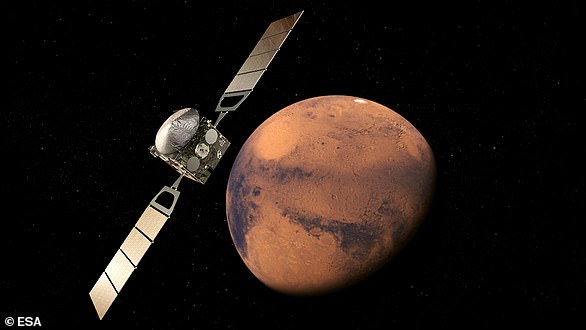
Artist's impression of the the European Space Agency's Mars Express satellite, which launched from Baikonur Cosmodrome in Kazakhstan in June 2003

Artist's impression of the the European Space Agency's Mars Express satellite, which launched from Baikonur Cosmodrome in Kazakhstan in June 2003 

The two Martian moons experience strong tidal forces from the planet, causing their orbits to fluctuate constantly. 

Phobos orbits extremely close to Mars at an average of 3,700 miles and is moving towards the planet, while Deimos is 12,470 miles away on average and moves away from it. 

ESA's second new clip, meanwhile, comprises 19 images captured on March 30, 2022 by Mars Express.

In this second video, Deimos is blocked by its larger sibling, Phobos, which measures about 14 miles along its longest axis. Deimos is a dwarf in comparison – only 3.7 miles.  

Enhanced colour image of Phobos, the larger of the two Martian moons. It measures 14 miles along its longest axis

Enhanced colour image of Phobos, the larger of the two Martian moons. It measures 14 miles along its longest axis

At only 3.7 miles in diameter, Deimos (pictured in this enhanced colour image) is a dwarf in comparison to its Martian sibling

At only 3.7 miles in diameter, Deimos (pictured in this enhanced colour image) is a dwarf in comparison to its Martian sibling

At the time the images were taken, Phobos was 7,618 miles away from the camera, while Deimos was 17,340 miles away. 

'From this perspective it is difficult to see the size difference between the Martian moons,' ESA said.

Much is still unknown about the formation and composition of Mars' two moons, although the upcoming MMX mission, led by the Japanese space agency, aims to remedy this. 

Set to launch next year, the mission will orbit Phobos and Deimos before landing on Phobos and collecting a sample from the larger moon to return to Earth. 

WHAT IS THE EUROPEAN SPACE AGENCY'S MARS EXPRESS SATELLITE?

Mars Express, so called because of the rapid and streamlined development time, represents the European Space Agency's (ESA's) first visit to another planet in the solar system.

The spacecraft, launched in 2003, borrowed technology from ESA's Rosetta mission and the Mars 96 mission. 

Since beginning science operations in 2004, the durable orbiter has given scientists an entirely new view of Earth's intriguing neighbour.

It is now helping to answer fundamental questions about the geology, atmosphere, surface environment, history of water and potential for life on Mars. 

Mars Express, so called because of the rapid and streamlined development time, represents the European Space Agency's (ESA's) first visit to another planet in the solar system (artist's impression)

Mars Express, so called because of the rapid and streamlined development time, represents the European Space Agency's (ESA's) first visit to another planet in the solar system

(artist's impression)

The spacecraft’s high-resolution camera has sent back thousands of dramatic 3D views of the Martian surface. 

One instrument has discovered hydrated minerals that form only in the presence of liquid water, providing confirmation that Mars was once much wetter than it is today. 

The first radar sounder ever to orbit another planet has detected subsurface layers of water ice. 

Another instrument has detected enough water ice in the polar caps to create a global ocean 36 ft (11m) deep, and revealed vast plains of permafrost around the South Pole.

Mars Express found the highest clouds ever seen above any planetary surface at 62 miles (100km). 

The mission found indications of the possible presence of methane, which on Earth is attributed to active volcanism and biochemical processes.

Its highly elliptical orbit has enabled the spacecraft to look beyond Mars, in order to survey its two tiny moons, particularly the innermost satellite Phobos, which has been studied in unprecedented detail.

During its lifetime it has acted as a communication relay between Earth and various NASA spacecraft, including the Phoenix lander and several rovers on the surface.

Hoe vind je dit bericht?
Geschreven door peter om 18:07 Stuur door

Mars Express Watched Deimos Pass in Front of Jupiter and its Moons

Mars Express Watched Deimos Pass in Front of Jupiter and its Moons

That’s no moon … wait … yes, it is, and more!

ESA’s Mars Express has captured an unusual and rare occultation, all from its vantage point in orbit of Mars.  The spacecraft’s orbit brought it to the right place where it could witness the moment Mars’ small moon Deimos passed in front of Jupiter and its four largest moons. Scientists say that celestial alignments like these enable a more precise determination of the Martian moons’ orbits.

If you’ve seen Jupiter and its moons through binoculars or a small telescope, you might be envious of Mars Express’ view, especially when Deimos passes through the field of view.

ESA said this sequence is made up of a series of 80 images taken by the High Resolution Stereo Camera onboard Mars Express on February 14, 2022. In the foreground, the images show the irregular shaped Deimos, with its rocky and cratered surface, and in the background Jupiter and the four Galilean satellites are visible. Jupiter is the large bright white spot and the moons appear as small white specks of light.

The distance between Mars Express and Jupiter is about 745 million km (463 million miles). In order for distant Jupiter and the moons to show up in this video, the images have contrast enhanced. Otherwise, because of the difference in brightness compared to the nearby Deimos, the distant objects would not have been visible.

Phobos and Deimos

Phobos and Deimos, as seen by Mars Express. Credit: ESA.

The workhorse Mars Express has been in orbit of the Red Planet since 2003 and Mars’ two moons, Deimos and Phobos, have been studied frequently by the spacecraft. Mars Express data has helped scientists understand more about the moons’ composition, especially Phobos’ mysterious grooved terrain, and learn more about the moons’ puzzling origin. This includes tracking their orbits.

Scientists say the moons experience strong tidal forces from Mars, causing their orbits to fluctuate constantly. Phobos orbits extremely close to Mars at just 6,000 km (3,700 miles), and is moving towards the planet, while Deimos moves away from it. It is difficult to measure their orbits from Earth due to the brightness of Mars in comparison to these small bodies.

About a month and half after imaging the alignment with Jupiter, Mars Express captured another occultation, when Deimos was blocked by its larger sibling, Phobos. The images were taken on March 30, 2022 when Phobos was 12 km away from the camera. From this perspective it is difficult to see the size difference between the martian moons, as Deimos is further from the camera at a distance of 28 km.

Deimos has a diameter of 12 km (7.5 miles) and Phobos has a diameter 22 km (14 miles).

The post Mars Express Watched Deimos Pass in Front of Jupiter and its Moons appeared first on Universe Today.

Source: 

{ https://beforeitsnews.com/ }

Hoe vind je dit bericht?
Geschreven door peter om 17:47 Stuur door

Dark Ring UFO Over Seaford England, Shoots Away When Filmed, 9-24-2022, UFO Sighting News.

Dark Ring UFO Over Seaford England, Shoots Away When Filmed, 9-24-2022, UFO Sighting News.

UAP,%20%E0%A4%89%E0%A4%AB%E0%A5%8C%20,%20%E0%A6%87%E0%A6%89%E0%A6%8F%E0%A6%AB%E0%A6%93,%20%C4%91i%CC%83a%20bay,%20MUFON,%20%E7%9B%AE%E6%92%83%E3%80%81%E3%82%A8%E3%82%A4%E3%83%AA%E3%82%A2%E3%83%B3,%20%20UFO,%20UFOs,%20%D0%9D%D0%9B%D0%9E%20,%20NLO,%20sighting,%20sightings,%20alien,%20aliens,%20ET,%20anomaly,%20%20astrobiology,%20.png

ovni,%20omni,MUFON,%20%E7%9B%AE%E6%92%83%E3%80%81%E3%82%A8%E3%82%A4%E3%83%AA%E3%82%A2%E3%83%B3,%20%20UFO,%20UFOs,%20sighting,%20sightings,%20alien,%20aliens,%20ET,%20anomaly,%20anomalies,%20ancient,%20archaeology,%20waarneming,%20vreemdelinge,%20%20.png
Date of sighting: 9-24-2022
Location of sighting: Seaford, England
 
Just when you thought it was safe to go to the beach, this happens. An eyewitness caught sight of a dark ring UFO moving low over the water so he began to record it. The UFO then begins to move away, as if it could sense that it was being recorded. It quickly moved up and into the clouds to hide within. Absolute proof that aliens exist over England. Ring UFOs are not new, but have been seen for thousands of years. 
 
UFO%20sighting.tiff
The Bible story of Ezekiel's wheel features a vision of four wheels that illustrates the spiritual, divine essence of God and His omnipresence in our reality. This story is predominately found in the first chapter of the book of Ezekiel, as part of his inaugural vision. God approaches Ezekiel as the divine warrior, riding in his battle chariot. The chariot is drawn by four living creatures, each having four faces (those of a man, a lion, an ox, and an eagle) and four wings. Beside each "living creature" is a "wheel within a wheel", with "tall and awesome" rims full of eyes all around. God appoints Ezekiel as a prophet and as a "watchman" in Israel: "Son of man, I am sending you to the Israelites." 
Scott C. Waring - Taiwan 
 
Eyewitness states: 
I was at the beach looking out to the wind Array on a nice day at Seaford. I saw what I thought was tourists or workers in a helicopter going low in and out of the wind turbines which I though both dangerous and stupid. They saw the shape was odd not a helicopter more like a balloon, but it was moving oddly so I decided to film it on my phone in case it crashed. I could not hold my phone still enough, so I walked the wall to steady it and filmed it for just over a minute and eventually it went up high into the clouds. But I thought I would develop the film or zoom in and then I saw it is more like a disc moving side to side then further out to sea the wind array gives good perspective although it was a long way out. Other people at the beach saw me filming but did not seem that interested probably because they have bad eyes most people in Seaford are over 70. But there could well be more footage out there... 

{ https://www.ufosightingsdaily.com/ }

Hoe vind je dit bericht?
Geschreven door peter om 17:21 Stuur door

Amazing UFO filmed over United States Kansas City, MO yesterday!

Amazing UFO filmed over United States Kansas City, MO yesterday!

ufo-1024x683.jpg

This really interesting UFO footage was filmed yesterday at 7:30 pm. The exact location is currently undisclosed.

Update: Location of the sighting is Kansas City, Missouri.

Witness report: 

Saw this on security but wasn’t fast enough to see in person. I have absolutely no idea what it is but have never seen anything similar on cam. Ideas welcome. This is straight from the camera, saved and uploaded in its entirety. The camera naturally records in approx 2 minute blocks. I do live near a place B-2s fly but I never heard a sound and that would be flying extremely low per usual what I see and hear. I only see them 1-2 times a year though. They sometimes make a huge boom when they break the sound barrier.

{ https://www.latest-ufo-sightings.net/ }

Hoe vind je dit bericht?
Geschreven door peter om 17:00 Stuur door

Smashing success: humanity has diverted an asteroid for the first time

Smashing success: humanity has diverted an asteroid for the first time

Humans have for the first time proved that they can change the path of a massive rock hurtling through space. NASA has announced that the spacecraft it slammed into an asteroid on 26 September succeeded in altering the space rock’s orbit around another asteroid — with better-than-expected results.

Agency officials had estimated that the Double Asteroid Redirection Test (DART) spacecraft would ‘nudge’ the asteroid Dimorphos closer to its partner, Didymos, and cut the time it takes to orbit around that rock by 10–15 minutes. At a press conference on 11 October, researchers confirmed that DART in fact cut the orbital time by around 32 minutes.

Neither asteroid was a threat to Earth, but the agency tested the manoeuvre to prove that humanity could, in principle, deflect a worrisome space rock heading for the planet.

“This is a watershed moment for planetary defence, and a watershed moment for humanity,” said NASA administrator Bill Nelson.

Tracking the aftermath

Determining whether the mission succeeded relied on more than a half dozen telescopes around the world. Ground-based optical telescopes can’t resolve Didymos and Dimorphos, which are millions of kilometres from Earth and only a few hundred metres across, so are seen as a single point in the night sky. But the telescopes can measure dips in brightness as Dimorphos cycles in front of and behind Didymos. Observers tracked these movements and compared them with pre-collision orbital times to quantify DART’s impact.

RELATED

Independently, a pair of radar facilities — Goldstone Observatory in Fort Irwin, California, and Green Bank Observatory in West Virginia — turned their dishes towards the asteroid pair. Unlike optical telescopes, radar observations can discern the two asteroids as distinct objects, allowing astronomers to view their respective positions and estimate Dimorphos’s orbital period around Didymos.

Both sets of observations agreed that DART’s impact knocked Dimorphos tens of metres closer to its companion and cut its orbital period to around 11 hours and 23 minutes.

Although the 32-minute reduction is larger than expected, it still falls within the range of possibilities that scientists modelled. Researchers think the manouevre succeeded as well as it did because Dimorphos is more a loose collection of rocks than a solid chunk that would be harder to deflect. Another reason for the dramatic change in the orbital period is that when DART hit, a lot of debris shot out from the asteroid, creating a tail thousands of kilometres long; the recoil from it probably accentuated the potency of DART’s impact, researchers said at the press conference.

“We have a lot of work ahead of us in order to really understand what happened,” said Tom Statler, a DART programme scientist at NASA’s headquarters in Washington DC.

Saving Earth

Scientists will continue to observe the asteroid pair in the months to come, hoping to understand more about the shape of Dimorphos’s new orbit and whether DART’s impact introduced a ‘wobble’ to the asteroid. With the help of images from LICIACube — the Italian Space Agency’s probe that trailed DART and then flew by to capture the impact — scientists hope to learn more about the properties of the ejected debris.

RELATED

But the mission’s final post-mortem won’t be complete for the better part of a decade. Launching in its wake, the European Space Agency’s Hera mission — currently slated for lift-off in October 2024 — should arrive at Dimorphos in late 2026, to observe the aftermath of DART’s impact.

For now, the results indicate that the US$330-million DART mission was a success. But defending Earth from future impacts requires a few things, researchers say: knowing the locations and properties of any dangerous space rocks, and having enough time to act. DART launched in November last year and took about ten months to hit its target.

If a threatening asteroid really were headed towards Earth, said Nancy Chabot, a planetary scientist and the DART coordination lead at Johns Hopkins University Applied Physics Laboratory in Laurel, Maryland, a mission would need to launch years in advance to deflect it safely. “Warning is really key here,” she said, adding that even space rocks larger than the 160-metre-wide Dimorphos might be dealt with, given enough planning and time.

  • doi: https://doi.org/10.1038/d41586-022-03255-w

Related Articles

RELATED VIDEOS


{ https://www.nature.com/ }

Hoe vind je dit bericht?
Geschreven door peter om 22:37 Stuur door

Future Moon cities could look like bouncy houses

aeaf8b59-c992-4bda-89b0-298e9e9da20d-getty-1368073163.jpg?w=1200&h=630&fit=crop&crop=faces&fm=jpg

Future Moon cities could look like bouncy houses

Future Moon dwellings could end up looking a bit like our terrestrial camping sites: Lunar residents may carry an inflatable structure with them and blow it up when they get there. These have a major advantage as you can fit a massive living structure inside a much smaller rocket.

And now, some architects are taking this idea pretty seriously.

Humans could live in inflatable houses buried under the lunar soil and supported by food from inflatable greenhouses, according to a recent concept study funded by the European Space Agency (ESA) and drawn up by Pneumocell, an Austria-based company specializing in inflatable architecture.

It isn’t Pneumocell’s first blow-up space idea. The company has previously designed an inflatable Mars habitat and a partially inflatable spacecraft. But they were just that — concepts. “It’s very difficult in a small country like Austria to get funding for such an idea,” says Thomas Herzig, an architect at Pneumocell.

Rather than halt their out-of-this-world idea, Herzig and his colleagues acquired an ESA grant last year. Even so, ambitious off-Earth habitat designs like theirs have a long way to go before they can see the light of the (lunar) day.

LUNAR LIVING WON’T BE EASY

1665681463572-75120.png

Any off-Earth habitat has one key goal: to keep its crew alive outside of the atmosphere we evolved to survive in.

There are many formidable dangers that await us on the Moon. California’s earthquakes and wildfires have nothing on the micrometeoroids, constant radiation, and apocalyptic temperature swings (from 250 degrees Fahrenheit in the two-week-long day to 200 degrees below 0 in the two-week-long night) that plague the lunar surface.

But as they say in real estate, it’s all about location. The specific areas that people settle in could minimize some of these threats.

For example, humans could live underground, where the lunar regolith would protect them from the worst of the elements. Moon migrants could also land in polar regions, where we could tap water from the ground.

Rather than fortnight-long nights and days, the poles get more constant sunlight (convenient for solar power).

Pnuemocell looked into digs for both regions, pinpointing polar craters to plop its habitat on: Hinshelwood near the north pole and Shackleton near the south pole. The architects plan to build within the crater walls, carving out a network of tunnels to fill with inflatable modules and tubes.

1665681476811-41988.png

Unfortunately, that setup comes with a major obstacle. This environment is air-free and has no running water to erode and blunt rocks, so pieces of lunar regolith could stick out like shards of glass. It’s a very real hazard for inflatable structures.

“That inflatable portion would have to be designed to where it would have some sort of barrier layer that is resistant to being penetrated by those sharp particles,” says James Nabity, an engineer at the University of Colorado Boulder who isn’t involved with Pneumocell.

To protect against such a fate, the designers envision a skin composed of two layers separated by a gap.

“The biggest threat is not the collapse of the structure,” says Herzig. While you may think falling debris is the main risk in a collapse, possible asphyxiation is most concerning.

Bedrooms would surround donut-shaped greenhouses, the largest rooms in the habitat. Tunnels would link these greenhouses and branch off into utilities and laboratories.

Mirrors positioned above the crater would reflect sunlight — always available thanks to the habitat’s strategic polar placement — down into soil and crops below.

THIS PLAN IS PRETTY MUCH UNPRECEDENTED.

“Having plants is a great idea,” Nabity says. Certainly, greenhouses can help feed a crew living more than 200,000 miles from Earth’s farms. But flora can do more than that: Designers have evidence to believe that it can boost crew members’ moods.

Those plants would grow in air that has been modified to prevent balloon-popping, with reduced air pressure and increased oxygen content. The greenhouse would also be humidified to lower the fire risk.

But this plan is pretty much unprecedented: “I’m not aware of any experiments with growing plants in that level of atmosphere,” says Nabity. While scientists have recently grown plants in samples of real lunar soil, they’re still far from nailing down the real thing.

1665681489543-58258.png

It isn’t just the horticulture aspect that remains highly hypothetical. Pneumocell hasn’t yet decided which material will make up its inflatable structures.

One candidate is mylar, which spacecraft have used for decades to trap and reflect heat. Mylar balloons are pretty easy to come by (they’re a staple at children’s birthday parties), but nobody has ever tried to use it for a giant inflatable structure before.

A second option: thermoplastic polyurethane, a low-cost, flexible material that’s used in life rafts and phone cases — but so far hasn’t gone into space. It’s unclear whether it will remain elastic when it encounters the moon’s chilling temperatures.

All things considered, Pneumocell’s idea will need a good deal of prototyping and testing on the ground before it can blast off to space.

BLOWING UP IN SPACE

1665681510372-70952.png

While Pneumocell’s concept might seem particularly zany, inflatable space habitats aren’t a new idea. As early as the 1960s, Goodyear (yes, the tire company) proposed a space station constructed from a giant air-filled rubber ring.

Decades later, in the late 1990s, NASA engineers plotted TransHab, an inflatable module that they imagined could one day house astronauts on the International Space Station (ISS) or even on a spacecraft bound for Mars.

TransHab never left the drawing board, but it inspired the current generation of space architects. “A lot of people have picked it up in the last 10 years,” says Georgi Petrov, an architect at the firm Skidmore, Owings & Merrill (SOM).

One of TransHab’s imitators did in fact make it to the ISS. In 2016, astronauts tethered a little experimental module called BEAM to the station’s side and inflated it — all in orbit. Eventually, NASA hopes to use inflatable modules like BEAM to build out the planned Gateway station that might one day orbit the Moon.

1665681518733-39405.png

On the other side of the Atlantic, the European Space Agency was interested, too. The agency partnered with SOM — the same architecture firm behind New York’s One World Trade Center, Hong Kong’s HKCEC, and several modern airport terminals — to envision such a village.

At the Venice Biennale art exhibition in 2021, SOM showed off its vision for cone-shaped lunar homes. Its homes would be inflatable, and they might even expand to house more crew members. Like Pneumocell, it would set up camp on the lunar south pole.

INFLATABLES AREN’T THE ONLY CREATIVE WAY TO GET AROUND A ROCKET’S CARGO SPACE LIMITATIONS.

In contrast to Pneumocell’s subterranean balloon-dwellers, these would touch down on the lunar surface. SOM’s homes may be far more vulnerable to radiation and micrometeoroids, but the firm says a protective shell for each structure could combat those problems.

In SOM’s design, each cone would house a crew of four. The concept takes advantage of the Moon’s relatively low gravity (about 17 percent of ours on Earth) by stacking its rooms — inhabitants would move between them via ladders. SOM imagines combining dozens of these habitats into a “lunar village.”

Inflatables aren’t the only creative way to get around a rocket’s cargo space limitations.

Rather than packing up prefab habitats, future Moon-folk might bring over 3D printers — and build their residences after they arrive by printing parts from lunar regolith.

To pursue this idea, NASA tapped construction startup AI SpaceFactory to design a 3D-printable lunar habitat. Its curved concept, called Lunar Infrastructure Asset (LINA), would rise in the form of a bulbous three-pointed star — its roof printed from a mixture of lunar soil and Earth-made synthetic polymers.

Nobody has taken a 3D printer to the Moon yet, so reshaping moondust remains up to future missions. But engineers on Earth can try their hand with artificial materials meant to mimic lunar regolith. They have already 3D-printed Moon-like bricks, along with gears and screws.

Last year, researchers in Germany printed parts from fake lunar regolith in a zero-gravity environment — suggesting that lunar folk might be able to print parts in lunar orbit.

OUR NEXT MOONSHOT

1665681533702-63154.png

So far, no plans exist to launch any of these lunar habitats. “We’re an architecture and engineering firm,” says Petrov, who was involved with SOM’s lunar village project. “We don’t have the means to build spaceships.”

What’s more, humans might not even return to the Moon as soon as we had hoped. As of this writing, Artemis 1 — the next uncrewed celestial stepping-stone to Earth’s celestial companion — currently sits delayed on the pad in Florida. Any lunar architecture plans will likely have to wait for the 2030s, if not later.

The team at Pneumocell is currently seeking out more funding so it can build a small-scale prototype on Earth. Only after this crucial step can it do the much more expensive work of sending it to space.

“I THINK IT’S IMPORTANT THAT YOU HAVE DERIVED PRODUCTS THAT HAVE A USE HERE ON EARTH AND NOT JUST FOR SPACE.”

In the meantime, the Pneumocell architects think their work can benefit our terrestrial habitats. Herzig points out that materials like thermoplastic polyurethane are easier to recycle than most building components. Worldwide, construction and demolition gobble up more raw materials than any other industry. And in the United States, it contributes around 40 percent of all solid waste.

“I think it’s important that you have derived products that have a use here on Earth and not just for space,” he says.

Projects like Pneumocell’s mark a significant shift in our vision for extraterrestrial living: Around a decade ago, space architects didn’t know if they were drafting up homes for the Moon or Mars, according to Petrov.

“Long term, I think Mars is still a much more interesting and viable destination,” he says. “But we need to go to the Moon first.”  

RELATED VIDEOS

{ https://www.inverse.com/ }

Hoe vind je dit bericht?
Geschreven door peter om 22:18 Stuur door

Hubble Spots Ultra-Speedy Jet Blasting From Star Crash

Hubble Spots Ultra-Speedy Jet Blasting From Star Crash

Astronomers using NASA's Hubble Space Telescope have made a unique measurement that indicates a jet, plowing through space at speeds greater than 99.97% the speed of light, was propelled by the titanic collision between two neutron stars.

The explosive event, named GW170817, was observed in August 2017. The blast released the energy comparable to that of a supernova explosion. It was the first combined detection of gravitational waves and gamma radiation from a binary neutron star merger.

Two neutron stars, the surviving cores of massive stars that exploded, collided sending a ripple through the fabric of time and space in a phenomenon called gravitational waves. In the aftermath, a blowtorch jet of radiation was ejected at nearly the speed of light, slamming into material surrounding the obliterated pair. Astronomers used Hubble to measure the motion of a blob of material the jet slammed into.
Credits: NASA's Goddard Space Flight Center; Lead Producer: Paul Morris

This was a major watershed in the ongoing investigation of these extraordinary collisions. The aftermath of this merger was collectively seen by 70 observatories around the globe and in space, across a broad swath of the electromagnetic spectrum in addition to the gravitational wave detection. This heralded a significant breakthrough for the emerging field of Time Domain and Multi-Messenger Astrophysics, the use of multiple "messengers" like light and gravitational waves to study the universe as it changes over time.

Scientists quickly aimed Hubble at the site of the explosion just two days later. The neutron stars collapsed into a black hole whose powerful gravity began pulling material toward it. That material formed a rapidly-spinning disk that generated jets moving outward from its poles. The roaring jet smashed into and swept up material in the expanding shell of explosion debris. This included a blob of material through which a jet emerged.

While the event took place in 2017, it has taken several years for scientists to come up with a way to analyze the Hubble data and data from other telescopes to paint this full picture.

The Hubble observation was combined with observations from multiple National Science Foundation radio telescopes working together for very long baseline interferometry (VLBI). The radio data were taken 75 days and 230 days after the explosion.

"I'm amazed that Hubble could give us such a precise measurement, which rivals the precision achieved by powerful radio VLBI telescopes spread across the globe," said Kunal P. Mooley of Caltech in Pasadena, California, lead author of a paper being published in the October 13 journal of Nature magazine.

The authors used Hubble data together with data from ESA's (the European Space Agency) Gaia satellite, in addition to VLBI, to achieve extreme precision. "It took months of careful analysis of the data to make this measurement," said Jay Anderson of the Space Telescope Science Institute in Baltimore, Maryland.

Two dark blue-white orbs surrounded by orange, brown, and white rings on the left side of image denote a binary star system. Bright-white jet shoots out between the stars and off to the upper right.

This is an artist's impression of two neutron stars colliding. The smashup between two dense stellar remnants unleashes the energy of 1,000 standard stellar nova explosions. In the aftermath of the collision a blowtorch jet of radiation is ejected at nearly the speed of light. The jet is directed along a narrow beam confined by powerful magnetic fields. The roaring jet plowed into and swept up material in the surrounding interstellar medium.
Credits: Artwork: Elizabeth Wheatley (STScI)

By combining the different observations, they were able to pinpoint the explosion site. The Hubble measurement showed the jet was moving at an apparent velocity of seven times the speed of light. The radio observations show the jet later had decelerated to an apparent speed of four times faster than the speed of light.

In reality, nothing can exceed the speed of light, so this "superluminal" motion is an illusion. Because the jet is approaching Earth at nearly the speed of light, the light it emits at a later time has a shorter distance to go. In essence the jet is chasing its own light. In actuality more time has passed between the jet's emission of the light than the observer thinks. This causes the object's velocity to be overestimated – in this case seemingly exceeding the speed of light.

"Our result indicates that the jet was moving at least at 99.97% the speed of light when it was launched," said Wenbin Lu of the University of California, Berkeley.

The Hubble measurements, combined with the VLBI measurements, announced in 2018, greatly strengthen the long-presumed connection between neutron star mergers and short-duration gamma-ray bursts. That connection requires a fast-moving jet to emerge, which has now been measured in GW170817.

This work paves the way for more precision studies of neutron star mergers, detected by the LIGO, Virgo, and KAGRA gravitational wave observatories. With a large enough sample over the coming years, relativistic jet observations might provide another line of inquiry into measuring the universe's expansion rate, associated with a number known as the Hubble constant.

At present there is a discrepancy between Hubble constant values as estimated for the early universe and nearby universe – one of the biggest mysteries in astrophysics today. The differing values are based on extremely precise measurements of Type Ia supernovae by Hubble and other observatories, and Cosmic Microwave Background measurements by ESA's Planck satellite. More views of relativistic jets could add information for astronomers trying to solve the puzzle.

The Hubble Space Telescope is a project of international cooperation between NASA and ESA. NASA's Goddard Space Flight Center in Greenbelt, Maryland, manages the telescope. The Space Telescope Science Institute (STScI) in Baltimore, Maryland, conducts Hubble science operations. STScI is operated for NASA by the Association of Universities for Research in Astronomy, in Washington, D.C.

Media Contact:

Science Contact:

  • Kunal P. Mooley
    California Institute of Technology, Pasadena, California

{ https://www.nasa.gov/ }

Hoe vind je dit bericht?
Geschreven door peter om 21:52 Stuur door

China Says They’ve Been “Overwhelmed” With “Rapidly Mounting Sightings” of UFOs

China Says They’ve Been “Overwhelmed” With “Rapidly Mounting Sightings” of UFOs

Image. Mrs. Hannah McRoberts, Campbell River, BC, 1981

IN BRIEF

  • The Facts:
    • The People’s Republic of China announced last year that there has been an increase of mysterious and unexplained aircraft in Chinese airspace.

    • They, like several other countries have established official programs to study the phenomenon.

    • Evidence does suggest, however, that governments have been studying the phenomenon for decades.

  • Reflect On:
    • UFOs have been studied and observed for years. Why is the U.S. and other governments claiming that they will only now start to study it?

    • What should we make of the data that's been collected over the past several decades when it's not even being acknowledged?

    • Can we trust an "official" explanation about the phenomenon from such sources?

Some proponents of the theory that UFOs are secret military craft from foreign nations fail to realize that dozens of governments are dealing with the “UFO” issue, and have been for decades.

The South China Morning Post (SCMP) reported in June 2021 that Chinese analysts “have been overwhelmed in recent years by rapidly mounting sighting reports from a wide range of military and civilian sources” by what the People’s Liberation Army (PLA) are calling “unidentified air conditions.” 

Once again, as we’ve been seeing the United States, the mainstream perspective of the phenomenon and the nature in which it’s being reported has taken the tone of ‘a problem.’

“The frequent occurrence of unidentified air conditions in recent years … brings severe challenges to air defence security of our country,”

Chen Li of the PLA’s Air Force Early Warning Academy, in a 2019 report cited by SCMP. 

What if looking at the phenomenon through the lens of it being some sort of threat is in fact the problem? This is not to assume their nature and purpose, but it’s simply putting more focus on our reaction to the phenomenon, which is important. Are we the aggressors? Multiple cases and encounters suggest that may be the case.

Is the protocol to shoot first and ask questions after?

That being said, nobody can deny that there are air safety issue concerns here. But the vast majority of UFO encounters with human aircraft, be it civilian or military, perform evasive maneuvers to avoid our own aircraft. This is what’s been reported for decades, and that is made clear by going through the literature that describes military and civilian encounters with UFOs.

The United States congress also seems to use a threat language, they did so in the Intelligence Authorization Act for fiscal year 2023,

“At a time when cross- domain trans medium threats to United States national security are expanding exponentially, the Committee is disappointed with the slow pace of DoD-led efforts to establish the office to address those threats and to replace the former Unidentified Aerial Phenomena Task Force as required in Section 1683 of the National Defense Authorization Act for Fiscal Year 2022.”

Transmedium objects are those that are capable of flying at tremendous speeds both in the air and through the water. Many UFOs are observed doing this.

The United States Navy recently expressed that releasing their classified videos they have in their possession of UFOs would be a threat to national security.

This topic has been shrouded in secrecy since the 1940’s, should we expect much to change? If we look at other topics and/or actions that have been justified under the guise of ‘national security’, it doesn’t paint a really trustworthy picture. Mass surveillance is a great example. It was once considered a conspiracy theory until NSA whistleblower Edward Snowden provided proof of just how vast and global it really is, and what kind of intrusive surveillance technology is being used.

All of this was justified under the claim that it (mass surveillance) was necessary to protect citizens.

History is chock full of example where our ‘safety’ and ‘national security’ has been used as a mask to cover our eyes to very immoral and unethical actions that governments partake in. Whether it be arming and assisting the very same terrorist organizations they claim to be fighting themselves, or something else. Why do we imprison people, like Julian Assange, for exposing war crimes?

It’s not for national security. It’s to maintain a monopoly of power, wealth, and as NSA whistleblower William Binney said, “total population control.”

So, if we have governments and political systems that seem to incentivize immoral and unethical behaviour, one that thrives off of secrecy, perception manipulation and the retention of power, as well as a history of disseminating propaganda, then why should we expect anything different when it comes to the topic of UFOs?

A few UFO researchers have warned against the threat perspective. Renowned UFO researcher, scientist, mathematician, and astrophysicist Dr. Jacques Vallée made an appearance on the Joe Rogan show in late 2020 stating just that.

Thousands of contact stories, which are closely associated with UFOs, share stories that are benevolent in nature. That being said, there are some what appear to be malevolent stories as well.

The fact remains, the phenomenon has been documented for thousands of years throughout art, the introduction of the printing press and more. An “invasion” type of scenario doesn’t seem to probable given the fact that it probably would have happened by now.

This topic is so vast and leaves no aspect of humanity untouched. What we are likely to receive from governments is a watered down sanitized version of it, not a holistic, open and transparent revelation that shares all that is represented of this phenomenon and its nature. But that’s just my opinion.

{ https://thepulse.one/ }

Hoe vind je dit bericht?
Geschreven door peter om 21:22 Stuur door

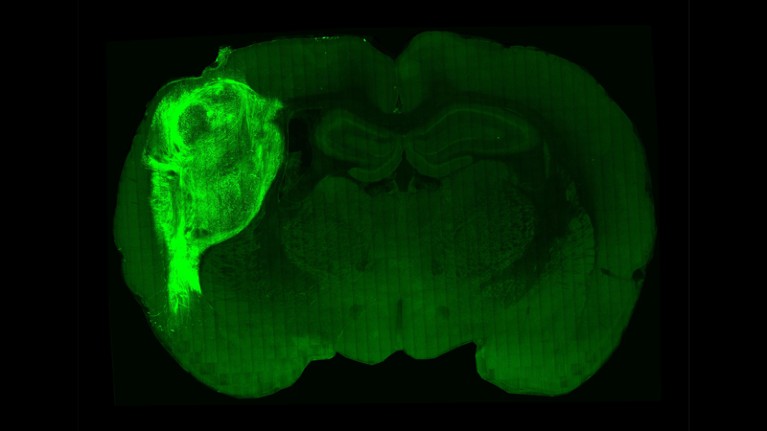
Human brain cells implanted in rats prompt excitement — and concern

Human brain cells implanted in rats prompt excitement — and concern

Hoe vind je dit bericht?
Geschreven door peter om 21:06 Stuur door

Europa Clipper may be able to spot shallow lakes that erupt icy 'lava'

Europa Clipper may be able to spot shallow lakes that erupt icy 'lava'

Hoe vind je dit bericht?
Geschreven door peter om 18:40 Stuur door

Astronomers Discover A Water Reservoir Floating In Space That Is Equivalent To 140 Trillion Times All The Water In The Earth's Ocean

Astronomers Discover A Water Reservoir Floating In Space That Is Equivalent To 140 Trillion Times All The Water In The Earth's Ocean

Astronomers Discover A Water Reservoir Floating In Space That Is Equivalent To 140 Trillion Times All The Water In The Earth's Ocean

This amount of water was discovered by two teams of astronomers 12 billion light-years away, where it appears as vapor dispersed across hundreds of light-years.

The reservoir was discovered in a quasar's gaseous area, which is a brilliant compact region in the heart of a galaxy powered by a black hole. This finding demonstrates that water may be present throughout the cosmos, even at the start. 

While this is not surprising to experts, water has never been discovered this far out before. The light from the quasar (specifically, the APM 08279+5255 quasar in the constellation Lynx) took 12 billion years to reach Earth, implying that this mass of water existed when the universe was just 1.6 billion years old.

One group used the Z-Spec instrument at the Caltech Submillimeter Observatory in Hawaii, while the other used the Plateau de Bure Interferometer in the French Alps. 

These sensors detect millimeter and submillimeter wavelengths, allowing the detection of trace gases (or vast reservoirs of water vapor) in the early cosmos. 

The discovery of many spectral fingerprints of water in the quasar provided researchers with the data they needed to calculate the vast magnitude of the reservoir.

  • [NASA][THIS IS AN UPDATED VERSION OF THE OLD ARTICLE]

RELATED VIDEOS, selected and posted by peter2011

{ https://blog.physics-astronomy.com/ }

Hoe vind je dit bericht?
Geschreven door peter om 17:46 Stuur door

Human brain cells grown in a lab learn to play Pong: Incredible footage shows mini-brains mastering the classic video game after just five MINUTES of training

Human brain cells grown in a lab learn to play Pong: Incredible footage shows mini-brains mastering the classic video game after just five MINUTES of training

  • Pong is a classic table tennis-themed video game, first released in 1972
  • Researchers took human brain cells and grew 800,000 neurons in a dish
  • They demonstrated that the brains cells could master Pong in just five minutes 
  • In the future, the researchers hope the findings could pave the way for treatments for neurodegenerative conditions like dementia

It's the classic table tennis-themed video game that tasks players with moving a paddle vertically across a screen to hit a ball.

And now even human brain cells grown in a lab have mastered Pong.

Researchers from Melbourne-based start-up, Cortical Labs, have shown for the first time that 800,000 brain cells can perform goal-directed tasks – in this case, Pong.

The findings suggest that even brain cells in a petri dish can exhibit inherent intelligence, modifying their behaviour over time.

'This new capacity to teach cell cultures to perform a task in which they exhibit sentience – by controlling the paddle to return the ball via sensing – opens up new discovery possibilities which will have far-reaching consequences for technology, health, and society,' said Dr Adeel Razi, an author of the study.

'We know our brains have the evolutionary advantage of being tuned over hundreds of millions of years for survival.

'Now, it seems we have in our grasp where we can harness this incredibly powerful and cheap biological intelligence.'

Researchers from Melbourne-based start-up, Cortical Labs, have shown for the first time that 800,000 brain cells living in a dish can perform goal-directed tasks ¿ in this case, Pong

Researchers from Melbourne-based start-up, Cortical Labs, have shown for the first time that 800,000 brain cells living in a dish can perform goal-directed tasks – in this case, Pong

How will the results be used? 

The team will now try to see what happens when DishBrain is affected by medicines and alcohol.

'We're trying to create a dose response curve with ethanol – basically get them 'drunk' and see if they play the game more poorly, just as when people drink,' said Dr Kagan.

In the future, the researchers hope the findings could pave the way for treatments for neurodegenerative conditions.

'DishBrain offers a simpler approach to test how the brain works and gain insights into debilitating conditions such as epilepsy and dementia,' says Dr Hon Weng Chong, Chief Executive Officer of Cortical Labs.

Scientists have previously been able to grow brain cells in the lab and read their activity. 

However, until now, it's not been possible to stimulate the cells in a structured and meaningful way. 

Dr Brett Kagan, who led the study, explained: 'In the past, models of the brain have been developed according to how computer scientists think the brain might work.

'That is usually based on our current understanding of information technology, such as silicon computing.

'But in truth we don't really understand how the brain works.' 

In the new study, the team took mouse cells from embryonic brains as well as some human brain cells, and grew 800,000 neurons in a dish, in what they're calling 'DishBrain'.

The neurons were connected to a computer in such a way where they received feedback on whether their paddle was hitting the ball.

Electrodes on the left or right of one array were fired to tell DishBrain which side the ball was on, while distance from the paddle was indicated by the frequency of signals. 

Using electric probes that recorded 'spikes', the researchers monitored the neuron's activity and responses to this feedback.

In the new study, the team took mouse cells from embryonic brains as well as some human brain cells, and grew 800,000 neurons in a dish, in what they're calling 'DishBrain' (pictured)

In the new study, the team took mouse cells from embryonic brains as well as some human brain cells, and grew 800,000 neurons in a dish, in what they're calling 'DishBrain'

(pictured)

Pong is a classic table tennis-themed video game that tasks players with moving a paddle vertically across a screen to hit a ball

Pong is a classic table tennis-themed video game that tasks players with moving a paddle vertically across a screen to hit a ball

What is Pong? 

Pong was officially released on November 29, 1972.

The two-dimensional table tennis simulator, the first release by Atari, is credited with being one of the progenitors of the video games industry, which is now worth a phenomenal $65billion a year. 

The simple two-dimensional simulation of ping pong, consists merely of two paddles which moved up and down to pass a moving spot between each player.

Yet its addictive gameplay captured the imagination of thousands of players around the world, building Atari's status as a video games giant.

Spikes became stronger the more a neuron moved its paddle and hit the ball.

And when neurons missed the ball, their playstyle was critiqued by a software programme.

This shows that neurons can adapt their activity to a changing environment in a goal-oriented way, in real time.

Professor Karl Friston, a theoretical neuroscientist at UCL, and co-author of the study, said: 'Remarkably, the cultures learned how to make their world more predictable by acting upon it.

'This is remarkable because you cannot teach this kind of self-organisation; simply because — unlike a pet — these mini brains have no sense of reward and punishment.'

Pong wasn't the only game the team tested.

'You know when the Google Chrome browser crashes and you get that dinosaur that you can make jump over obstacles (Project Bolan),' said Dr Kagan. 

'We've done that and we've seen some nice preliminary results, but we still have more work to do building new environments for custom purposes.'

The team will now try to see what happens when DishBrain is affected by medicines and alcohol.

'We're trying to create a dose response curve with ethanol – basically get them "drunk" and see if they play the game more poorly, just as when people drink,' said Dr Kagan.

In the future, the researchers hope the findings could pave the way for treatments for neurodegenerative conditions.

'DishBrain offers a simpler approach to test how the brain works and gain insights into debilitating conditions such as epilepsy and dementia,' said Dr Hon Weng Chong, Chief Executive Officer of Cortical Labs.

WHAT IS A NEURON AND HOW DOES IT WORK?

A neuron, also known as nerve cell, is an electrically excitable cell that takes up, processes and transmits information through electrical and chemical signals. It is one of the basic elements of the nervous system.

In order that a human being can react to his environment, neurons transport stimuli.

The stimulation, for example the burning of the finger at a candle flame, is transported by the ascending neurons to the central nervous system and in return, the descending neurons stimulate the arm in order to remove the finger from the candle. 

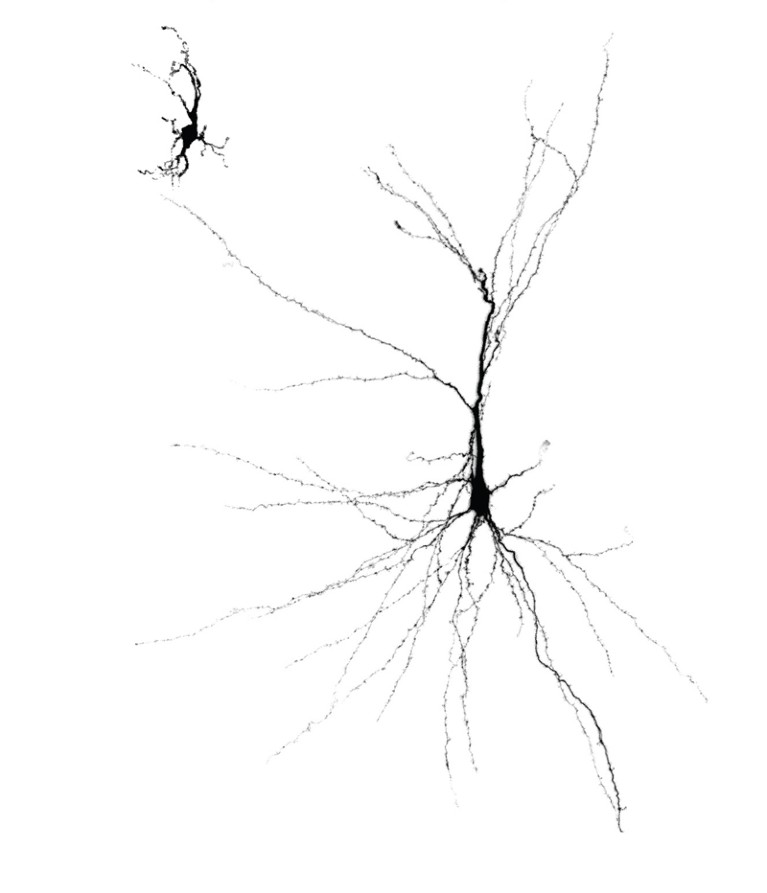
A typical neuron is divided into three parts: the cell body, the dendrites and the axon. The cell body, the centre of the neuron, extends its processes called the axon and the dendrites to other cells.Dendrites typically branch profusely, getting thinner with each branching. The axon is thin but can reach enormous distances. 

To make a comparable scale, the diameter of a neuron is about the tenth size of the diameter of a human hair. 

All neurons are electrically excitable. The electrical impulse mostly arrives on the dendrites, gets processed into the cell body to then move along the axon.

On its all length an axon functions merely as an electric cable, simply transmitting the signal. 

Once the electrical reaches the end of the axon, at the synapses, things get a little more complex. 

The key to neural function is the synaptic signalling process, which is partly electrical and partly chemical. 

Once the electrical signal reaches the synapse, a special molecule called neurotransmitter is released by the neuron.

This neurotransmitter will then stimulate the second neuron, triggering a new wave of electrical impulse, repeating the mechanism described above.

{ https://www.dailymail.co.uk/ }

Hoe vind je dit bericht?
Geschreven door peter om 17:18 Stuur door

Menselijke hersencellen gekweekt in labo leren videogame Pong spelen in 5 minuten

Het videospel Pong werd gekozen voor zijn eenvoud. Het videospel Pong werd gekozen voor zijn eenvoud.  © Shutterstock / Grenar

Menselijke hersencellen gekweekt in labo leren videogame Pong spelen in 5 minuten

Wetenschappers hebben het videospelletje Pong uit de jaren 70 in amper vijf minuten tijd leren spelen aan menselijke hersencellen gekweekt in een laboratorium. Volgens de onderzoekers kan hun “minibrein” voelen en reageren op de omgeving. Op termijn is de hoop dat de technologie kan worden ingezet om behandelingen te testen voor ziektes als Alzheimer.

{ https://www.hln.be/ }

Hoe vind je dit bericht?
Geschreven door peter om 17:04 Stuur door

Phew, NASA’s CAPSTONE is no Longer Tumbling in Space

Phew, NASA’s CAPSTONE is no Longer Tumbling in Space

Engineers with the trouble-plagued CAPSTONE mission to the Moon have made progress in stabilizing the spacecraft. A month ago, the microwave-oven-sized CAPSTONE (Cislunar Autonomous Positioning System Technology Operations and Navigation Experiment) began tumbling and lost its orientation in space. But now, after weeks of painstaking and patient troubleshooting, team members successfully executed an operation to stop the spacecraft’s spin. NASA says this clears a major hurdle in returning the spacecraft to normal operations.

Animation of the CAPSTONE mission in orbit of the Moon. Credits: NASA/Daniel Rutter

The mission for small satellite is to conduct tests to make sure the unique lunar orbit for NASA’s future Lunar Gateway is actually stable.  It launched on June 28, 2022 from New Zealand on Rocket Lab’s Electron rocket. In early July, after conducting a course correction burn, the spacecraft lost contact with the Deep Space Network; however, communications were reestablished after about 24 hours.

But on September 8th, at the end of another course correction maneuver, the spacecraft’s attitude started to deviate. CAPSTONE’s reaction wheels were unable to counter the spacecraft’s oscillations, and the vehicle entered into an uncontrolled spin. With its antenna no longer pointed at Earth, communications were lost again.

Even though engineers were soon able to re-establish a weak communications link, data indicated the spacecraft’s solar arrays weren’t producing enough energy to charge the batteries, which was causing the spacecraft to reset frequently from lack of power. Most worrying was that without energy to run the onboard heaters, the thrusters needed to stop the tumble could freeze. But the mission team was able to put CAPSTONE into safe mode, which allowed the solar panels to focus on supplying power to heat the spacecraft. Then the team could focus attempting to solve the tumbling problem. They were able to determine the problem arose from a thruster valve that was partially stuck open.

CAPSTONE mission timeline. Credit: Advanced Space and Terran Orbital.

In reviewing the telemetry data, one encouraging bit of data was that CAPSTONE was on course for eventually reaching its desired orbital trajectory. The unusual lunar orbit, called a near rectilinear halo orbit (NRHO), is an elongated polar orbit that brings a spacecraft within 1600 km (1,000 miles) of one lunar pole on its near pass and 70,000 km (43,500 miles) from the other pole every seven days. Since the orbit uses a balance point in the gravities of Earth and the Moon, it is theorized that spacecraft in this type of orbit require less propulsion capability for spacecraft flying to and from the Moon’s surface than other circular orbits and requires minimal energy to maintain. This is CAPSTONE’s goal, to determine how stable and energy-saving this orbit actually is.

Last week Friday, on October 7, recovery commands were executed and the initial telemetry from CAPSTONE points to a successful maneuver, indicating the spacecraft has stopped its spin and regained full 3-axis attitude control. This means CAPSTONE’s position is controlled and its solar arrays are pointing towards the Sun and the communications antenna is pointing towards Earth.  

The team is now monitoring the spacecraft status and making any needed adjustments to procedures in order to account for and mitigate the effects of the partially open thruster valve. The mission team also will work to design possible fixes for this valve-related issue in order to reduce risk for future maneuvers. CAPSTONE remains on track to insert into its targeted near rectilinear halo orbit at the Moon on Nov. 13.

Further reading: 

The post Phew, NASA’s CAPSTONE is no Longer Tumbling in Space appeared first on Universe Today.

Source: 

{ https://beforeitsnews.com/ }

Hoe vind je dit bericht?
Geschreven door peter om 16:23 Stuur door

SpinLaunch Completes its 10th Test, Hurling Payloads for NASA and Other Companies Into the air

SpinLaunch Completes its 10th Test, Hurling Payloads for NASA and Other Companies Into the air

There has been no shortage of exciting developments in the commercial space industry (aka. NewSpace) in recent years. These include the ability to retrieve and reuse rockets (in part or whole), new configurations that reduce expendability, and new engines. But beyond making rocket launches more cost-effective, several cutting-edge ideas have been brought forward to make space more accessible. These include SpinLaunch‘s concept for an electric kinetic launch system (aka. a space catapult) that can propel payloads of up to 200 kg (440 lbs) to space.

On September 27th, 2022, SpinLaunch announced the results of its tenth successful flight test of its Suborbital Mass Accelerator (SMA) at Spaceport America, New Mexico. This time, SpinLaunch sent four partner payloads to space with its Suborbital Accelerator Flight Test Vehicle, which provided valuable data about the launch environment and payload integration process. This latest successful test has placed the company and its launch system one step closer to providing low-cost and sustainable launch services for satellites and other small payloads.

Based in Long Beach, California, SpinLaunch was founded in 2014 by Jonathan Yaney, an aerospace enthusiast and self-described “serial entrepreneur” with a long history of co-founding startups. Before founding SpinLaunch, Yaney spent 15 years establishing companies involved in consulting, IT, construction, and aerospace. By 2014, he began working on a new launch technology that would enable a low-cost and sustainable means of sending constellations of satellites to Low Earth Orbit (LEO).

Another Successful Launch

The company’s 12-meter (39.37 ft) Suborbital Mass Accelerator (SMA), located at Spaceport America in New Mexico, operates on a pretty straightforward principle. The accelerator spins payloads up to 10,000 g and then releases them from its launch tube towards space. Once the launch vehicle reaches orbit, its protective outer casing (similar to a rocket fairing) breaks away, releasing the second stage. This vehicle then ignites its single engine and carries payloads to the desired orbit, where they are released.

This method does away with the need for propellant burns to achieve escape velocity, making it far more environmentally friendly since it does not leave excess carbon emissions in our atmosphere. This latest flight is the tenth test conducted by the company in the eleven months since the SMA became operational in late 2021. Whereas the previous flights, which took place in October 2021 and May 2022, consisted of launch tests that saw test vehicles launched to higher and higher altitudes.

Flight Test 10 was the first flight to include cargo and was witnessed by more than 150 partners, government officials, and commercial space industry advocates. The test saw the Flight Test Vehicle (FTV) deploy all six of its payloads successfully (which were also recovered) and provided critical flight data. Moreover, it demonstrated that standard satellite components used by commercial partners are inherently compatible with the SMA launch system. Said Founder & CEO Yaney in a recent interview with BusinessWire:

“Flight Test 10 represents a key inflection point for SpinLaunch, as we’ve opened the Suborbital Accelerator system externally for our customers, strategic partners, and research groups. The data and insights collected from flight tests will be invaluable for both SpinLaunch, as we further the development of the Orbital Launch system, and for our customers who are looking to us to provide them with low-cost, high-cadence, sustainable access to space.”

As part of the pre-flight qualification process, SpinLaunch accelerated payloads up to 10,000 g using its 12-meter (39.37 ft) Lab Accelerator at its Long Beach headquarters. After clearing the qualification test, the payloads were inspected and integrated into the FTV in preparation for Flight Test 10 at the SMA at Spaceport America.

Launch Partners

The six payloads carried by the FTV included two instrumentation payloads that collected data on the flight, plus four partner payloads contributed by NASA, Airbus U.S. Space & Defense, Cornell Engineering, and Outpost. Each was responsible for testing systems vital to the SMA and FTV and gauged the system’s ability to safely launch satellites and other payloads to suborbital altitude and beyond. NASA contributed a Data Acquisition Unit (DAQ) for its payload designed to evaluate the kinetic launch method for future commercial launch opportunities.

This payload was included as part of a NASA Space Act Agreement signed by SpinLaunch to develop, integrate, and fly a sensor suite to space. The DAQ gathered launch environment data using two accelerometers, a gyroscope, a magnetometer, and sensors for pressure, temperature, and humidity. Airbus U.S. Space & Defense provided their satellite sun sensor, a device typically used by spacecraft for attitude control and positioning. As a global leader in satellite systems, Airbus’ payload was intended to see if the extreme loads generated by the launch would impact the sensor signal.

To test this, a team of engineers monitored the sensor’s output signal during the high-g centrifuge test, the pre-flight test, and Flight Test 10. They then compared the output signal during all three phases to the pre-flight data and were pleased with the result. According to their findings, the sensor’s output signal was unaffected during the pre-flight, flight, or recovery phases. This success was a major step in certifying subsystems (like sensors or onboard laboratories) that are more delicate than other flight components for use on SpinLaunch’s orbital launch system.

“Our Airbus U.S. engineering team is excited to work with SpinLaunch in support of this significant advancement of a new accelerated launch concept,” said Airbus U.S. CTO Armen Askijian. “We look forward to continued collaboration and future success.”

The next payload was contributed by the Space Systems Design Studio (SSDS), which is part of the Sibley School of Mechanical and Aerospace Engineering at Cornell University. The SSDS is responsible for designing next-generation satellites substantially smaller than CubeSats (called ChipSats) that will provide distributed in-situ measurements of Earth’s upper atmosphere and other planets. As part of Test Flight 10, the SSDS contributed some of their ChipSats, which were released during the flight to test the SpinLaunch-designed payload deployment system.

The payload deployment system is vital to SpinLaunch’s services, which are likely to include satellites of every shape and form. Future tests with SSDS may include high-altitude ChipSat deployments to verify their ability to reenter the atmosphere and follow a trajectory that will cause them to burn up. Said Hunter Adams, a lecturer in Cornell Engineering’s school of electrical and computer engineering:

“Centimeter-scale spacecraft will be a critical tool in future planetary science missions. Deployed en masse from orbit, ChipSats will descend through the atmosphere and down to the surface of this planet and others, gathering spatially distributed datasets as they fall. To plan these missions, we must understand the chaotic trajectories that low-mass and high-surface-area objects take from the top of the atmosphere to the surface of the planet. By conducting experiments with SpinLaunch’s Suborbital Accelerator, we can gather critical information for planning future planetary science missions involving ChipSats. It is absolutely a game-changer for centimeter-scale spacecraft research.”

The fourth payload was contributed by Outpost, a Los Angeles-based aerospace company developing reusable satellites capable of returning to Earth. Their payload consisted of an onboard computer for testing and qualifying the launch system, which validated both and proved that the flight computer is compatible with SpinLaunch’s launch environment. This represents a big step towards broader verification and testing of the kinetic launch system, and Outpost and SpinLaunch plan to continue collaborating in this respect. Said Michael Vergalla, co-founder and CTO at Outpost:

“Outpost and SpinLaunch share the same mission of providing customers with low-cost, rapid launch – which means rethinking the way we access space. Testing our hardware with SpinLaunch’s mass accelerator gives us optionality and provides valuable engineering data for developing our hardware to be compatible with their launch system and unlock the upside of low-cost and high-cadence launch.”

SpinLaunch’s vacuum-sealed centrifuge will accelerate a rocket to more than 8,000 km/h (5,000 mph). Credit: SpinLaunch

The success of this latest test has effectively demonstrated SpinLaunch’s capability to launch satellites and small payloads to suborbital altitude. It also means the company is on track for sending satellites to orbit and delivering payloads for other missions by 2026. It is also another step on the path toward SpinLaunch realizing its next-generation launcher, the Orbital Mass Accelerator (OMA). As the name suggests, this system will be larger, more powerful, and will be able to send heavier payloads to Low Earth Orbit (LEO), greatly expanding the types of mission profiles the company can provide.

Equally interesting is the wider implications this latest successful test will have for commercial space. The kinetic launch method is part of a growing constellation of services that are changing how we think about going to space. In terms of rockets, most commercial providers offer at least partially-reusable vehicles, single-stage-to-orbit (SSTO) vehicles, and air-launch vehicles. Beyond rockets, space agencies and entrepreneurs are pushing the boundaries of orbital balloons, electric rails, mass drivers, and spaceplanes.

The net effect of these low-cost and sustainable launch systems will likely be tremendous, enabling everything from megaconstellations (that don’t cause space debris) to the creation of private space stations and habitats and the commercialization of LEO. Who knows? Such diverse methods for sending payloads to orbit could even pave the way towards some of the most ambitious methods for sending payloads and people to space – like Slingatrons, Sky Hooks, and Space Elevators!

Further Reading: 

The post SpinLaunch Completes its 10th Test, Hurling Payloads for NASA and Other Companies Into the air appeared first on Universe Today.


Source: 

{ https://beforeitsnews.com/ }

Hoe vind je dit bericht?
Geschreven door peter om 16:08 Stuur door

Two Tic-Tac Crashed In Antarctica, Google Earth Map, Video, UFO Sighting News.

Two Tic-Tac Crashed In Antarctica, Google Earth Map, Video, UFO Sighting News.

 %20UFO,%20UFOs,%20sighting,%20sightings,%20alien,%20aliens,%20ET,%20anomaly,%20anomalies,%20ancient,%20archaeology,%20astrobiology,%20paleontology,%20waarneming,%20vreemdelinge,%20%20.png
Date of sighting: Oct 13, 2022
Location of sighting: Antarctica
Google location: -62.663753, -61.099363
 
Hey check this out. I was using Google Earth map and came across these two pink tic-tac shaped crashed UFOs. The objects are in an area that has no signs of humans anywhere. There are no trails, roads, docks, cars, ships, buildings of any kind. These objects are alone and seem to be two crash landed UFOs. The objects measure 7.5 by 4 meters across and clearly could hold several human size occupants each. Check out my video below I just made and tell me your thoughts. 
Thanks, 
Scott C. Waring - Taiwan 
 

{ https://www.ufosightingsdaily.com/ }

Hoe vind je dit bericht?
Geschreven door peter om 15:50 Stuur door

Short UFO video from Nesles la Vallée, France 7-Oct-2022

Short UFO video from Nesles la Vallée, France 7-Oct-2022

france-ufo-sighting

I just received this short UFO video of a sighting that happened over Nesles la Vallée in northern France on Friday, 7th October 2022.

Witness report (translated from French): 

What I saw on Friday October 7 at 10:11 p.m. from Nesles la Vallée in the 95.

{ https://www.latest-ufo-sightings.net/ }

Hoe vind je dit bericht?
Geschreven door peter om 15:19 Stuur door

3 UFO lights in formation over Scottsdale, Arizona 2-Oct-2022

3 UFO lights in formation over Scottsdale, Arizona 2-Oct-2022

De bronafbeelding bekijken

These 3 huge lights were seen and recorded in the sky above Scottsdale, a desert city in Arizona east of state capital Phoenix. Filmed on 2nd October 2022.

Witness report: 

At or about 6:30 pm on October 2, 2002, I was on a 2 nd story rooftop facing south. I began to see 3 lights traveling from the southeast to north over phoenix. The lights travelled as far north to Scottsdale and became stationary. The lights were a bright white and pulsating. After a minute the 3 lights were aligned in a straight line, then the 3rd light at the bottom took off the south. The second light about another minute later moved south then moved back toward the northwest . The Top light of the three remained stationary . I recorded about 3 minutes of video and took a two photos.

{ https://www.latest-ufo-sightings.net/ }

Hoe vind je dit bericht?
Geschreven door peter om 14:57 Stuur door

Dark Side of the Universe is Way More Mysterious Than the Light Side

Dark Side of the Universe is Way More Mysterious Than the Light Side

In “Star Wars” lore, there’s a constant struggle between the dark side and the light side of the Force. Fans debate endlessly about which side is stronger. While such debates might seem futile, given that they pertain to a fictional universe, there’s a real life analogue of sorts.

Our universe, too, contains both light and dark components. On the one hand, there’s the light side, which consists of all that’s visible and interacts with radiation — stars, quasars, planets, etc. On the other hand, a dark side looms, full of theoretical entities like dark matter and dark energy.

cfa-black-matter-1600x900.jpg

We know a lot more about the light side, of course. But observations of the light side reveal hints about the nature of the dark, and the more evidence we gather about this mysterious realm, the more we’re realizing that understanding it isn’t going to be easy.

Perhaps the biggest evidence we have that there’s more to the dark side than meets the eye is the fact that our observations of the expansion rate of our universe — otherwise known as the Hubble constant — are becoming increasingly inconsistent. Different techniques we have for measuring the rate of expansion can’t seem to agree.

For instance, if we measure the expansion rate by looking directly at the speed by which distant objects like supernova are moving away from us, we come up with a rate of about 73.2 kilometers per second per megaparsec (a “megaparsec” being a unit of distance equal to 3.26 million light-years). But if we attempt to calculate the expansion rate by studying the most detailed map ever compiled of the early universe — the so-called cosmic background radiation that permeates the universe in all directions — the numbers fall to between 67 and 68 kilometers per second per megaparsec.

That might not sound like a big discrepancy, but it’s huge on the scale of the universe. If scientists can’t figure out how to make these different measurements jive, it could mean that our biggest theories about the universe need a reboot.

Is there a missing ingredient?

One such reboot would greatly expand the scope of the universe’s dark side. It’s a possibility that tantalizes Lloyd Knox, a cosmologist at the University of California, Davis, who recently spoke about his research with Scientific American.

“Potentially where this is leading us is to a new ingredient in the ‘dark sector,'” he said.

Knox is keen on referring to this mysterious new dark ingredient as “dark turbo,” an apt description for a force that acts to hasten the universe’s expansion under certain conditions, such as the conditions that were present during the years immediately following the Big Bang, when the universe was a massive plasma ball. If the universe’s rate of expansion has not always been the same, then this new measurement could make all our other calculations jive.

It’s also possible that Knox’s dark turbo is really just another form of dark energy — the term scientists use to describe how the universe is expanding at an accelerated rate. This would mean that dark energy is way more complicated than previously thought, but that wouldn’t be surprising. Knox points out that the light side of the universe contains many different types of particles and forces, and asks: Why couldn’t the dark side also have complex elements?

Of course it’s probably complicated. This is the universe, after all. The good news is, scientists tend to prefer questions over answers. That’s just the nature of the game.

“It’s much more interesting if it turns out to be fundamental new physics — but it’s not up to us wanting it to be one way or another,” exclaimed Wendy Freedman of the University of Chicago, who has been laboring away on the Hubble constant problem for more than three decades. “The universe doesn’t care what we think!”

{ https://fancy4work.com/ }

Hoe vind je dit bericht?
Geschreven door peter om 01:26 Stuur door

CALVINE UPDATE

CALVINE UPDATE

After reviewing further information and the similarity to other UFO encounters, the possibilty of the Calvine object being a hoax becomes less likely.

RELATED 

{ https://www.youtube.com/c/ufodata }

Hoe vind je dit bericht?
Geschreven door peter om 01:15 Stuur door

Enigmatic Symbols and Carvings in Man-Made Royston Cave

The mysterious and elaborately carved walls of Royston Cave. Source: Sizbut / Flickr

Enigmatic Symbols and Carvings in Man-Made Royston Cave

The Royston Cave is an artificial cave in Hertfordshire, England, which contains strange carvings. It is not known who created the cave or what it was used for, but there has been much speculation. Some believe that it was used by the Knights Templar, while others believe it may have been an Augustinian store house. Another theory posits that it was a Neolithic flint mine. None of these theories have been substantiated, and the origin of Royston Cave remains a mystery.

Detail of Royston Cave, Royston, Hertfordshire. (Cruccone / CC BY-SA 3.0)

Detail of Royston Cave, Royston, Hertfordshire. 

(Cruccone / CC BY-SA 3.0 )

The Discovery of Royston Cave

Royston Cave was discovered in August 1742 by a worker in the small town of Royston digging holes to build footing for a new bench at a market. He discovered a millstone while he was digging, and when he dug around to remove it, he found the shaft leading down into a man-made cave, half-filled with dirt and rock.

At the time of discovery, efforts were made to remove the dirt and rock filling the artificial cave, which was subsequently discarded. Some believed that treasure would be found within Royston Cave. However, removal of the dirt did not reveal any treasure. They did however discover sculptures and carvings within the cave. It is worth noting that had the soil not been discarded, today’s technology could have allowed for a soil analysis.

Located below the crossroads of Ermine Street and Icknield Way, the cave itself is an artificial chamber carved into chalk bedrock, measuring approximately 7.7 meters high (25 ft 6 in) and 5.2 meters (17 ft) in diameter. At the base o the cave is a raised octagonal step, which many believe was used for kneeling or prayer. Along the lower part of the wall there are unusual carvings. Experts believe that these relief carvings were originally colored, although due to the passage of time only very small traces of color remain visible.

The carved relief images are mostly religious, depicting St. Catherine , the Holy Family, the Crucifixion, St. Lawrence holding the gridiron on which he was martyred, and a figure holding a sword who could either be St. George, or St. Michael. Holes located beneath the carvings appear to have held candles or lamps which would have lit the carvings and sculptures. Several of the figures and symbols have yet to be identified, but according to Royston Town Council , a study of the designs in the cave “suggest that the carvings were likely made in the mid-1300s.”

Plate I from Joseph Beldam's book The Origins and Use of the Royston Cave, 1884 showing some of the numerous carvings. (Public domain)

Plate I from Joseph Beldam's book The Origins and Use of the Royston Cave, 1884 showing some of the numerous carvings. 

( Public domain )

Theories Related to Royston Cave

One of the main theories as to the origin of Royston Cave, especially for those who like conspiracy theories , is that it was used by the medieval religious order known as the Knights Templar , prior to their dissolution by Pope Clement V in 1312. Bad Archaeology criticizes the way websites across the web have repeated this association between the Royston Cave and the Knights Templar, “despite the weakness of the evidence in favor of the hypothesis and the arguments in favor of a later date.”

Some believe that the cave had been split into two levels using a wooden floor. Figures near a damaged section of the cave depict two knights riding a single horse, which may be the remains of a Templar symbol. Architectural historian Nikolaus Pevsner has written that the date of the carvings "is hard to guess. They have been called Anglo-Saxon, but are more probably of various dates between the C14 and C17 (the work of unskilled men)."

Plate III from Joseph Beldam's book The Origins and Use of the Royston Cave, 1884 showing the shape and floor plan of the cave. (Public domain)

Plate III from Joseph Beldam's book The Origins and Use of the Royston Cave, 1884 showing the shape and floor plan of the cave. 

( Public domain )

Another theory is that Royston Cave was used as an Augustinian store house. As their name implies, the Augustinians were an Order created by St. Augustine , Bishop of Hippo, in Africa. Founded in 1061 AD, they first came into England during the reign of Henry I . From the 12th century, Royston in Hertfordshire was a center of monastic life and the Augustinian priory continued without break there for nearly 400 years. It has been said that local Augustinian monks used Royston Cave as a cool storage space for their produce and as a chapel.

Finally, some speculate it may have been used as a Neolithic flint mine as early as 3,000 BC, where flint would have been gathered for making axes and other tools. However, the chalk in this area only provides small flint nodules, generally unsuitable for axe making, so this may cast some doubt on this theory.

Relief carving of St. Christopher at Royston Cave. (picturetalk321 / CC BY-NC-ND 2.0)

Relief carving of St. Christopher at Royston Cave.

(picturetalk321 / CC BY-NC-ND 2.0 )

Unravelling the “Mysteries” of Royston Cave

To this date there remains much mystery as to who created Royston cave and for what purpose. It is always possible that whichever group originally created the cave may have abandoned it at some point, allowing it to be used by another group. The mystery surrounding the cave and the sculptures within makes the cave an interesting location for visitors who would like to speculate as to the origins of this ancient wonder.

Royston Cave has required regular maintenance and restoration, as it was discovered that insect larvae and worms were damaging the walls and structure of the cave. By August 2014, work to prevent such damage was deemed successful. Rather than using insecticides, the preservation workers removed some of the earth, thereby eliminating the worms’ food supply. Hopefully subsequent repair work to pipes to avoid flooding, and other work to prevent vibration damage from the traffic above, will help to preserve the cave into the future. 

Depiction of the crucifixion at Royston Cave. (picturetalk321 / CC BY-NC-ND 2.0)

Depiction of the crucifixion at Royston Cave.

(picturetalk321 / CC BY-NC-ND 2.0 )

Visiting the Royston Cave

Just 8 minutes walking from Royston train station, visits are organized by Royston Town Council and tickets must be booked online . Their opening hours of Royston Cave are limited to Saturdays and Sundays from April to September. Each tour is limited to 15 people and lasts about 30 minutes.

  • Top image: The mysterious and elaborately carved walls of Royston Cave.
  • Source: Sizbut /  Flickr

By M R Reese

{https://www.ancient-origins.net/ }

Hoe vind je dit bericht?
Geschreven door peter om 01:00 Stuur door

Were Cyclopes Legends Inspired by Ancient Elephant Skulls?

The cyclopes were one-eyed mythological giants of ancient Greece. But did the myth originate from elephant skulls like this?   Source: Left; John Cummings, CC BY-SA 3.0, Right; bigjom/ Adobe Stock

Were Cyclopes Legends Inspired by Ancient Elephant Skulls?

Ancient Greek mythology is full of fantastic beasts and monsters. One of the most famous examples is the brutal one-eyed race of giants, the cyclopes. Several different cyclopes appeared in various myths. One group was instrumental in helping Zeus overcome the Titans, while another had a nasty habit of feasting on mortals. But where did the Greeks get their inspiration from? Were the cyclopes just a figment of their imaginations, or was something else at work?

What Were the Cyclopes?

In Greek mythology, there were three distinct groups of cyclopes, all appearing in different myths. The most well-known are the Homeric cyclopes that appear in the Odyssey. When we think of the cyclopes that are prevalent in pop culture today, it is the Homeric cyclopes we are thinking of.

These cyclopes were a group of one-eyed, savage giants who were man-eating shepherds. Odysseus and his men ended up on the cyclopes’ island looking for supplies during their long and eventful journey home. One of the cyclopes, Polyphemus (son of Poseidon), captured Odysseus and his men. He began eating Odysseus’s men one by one. Using his wits, Odysseus got the cyclops drunk and blinded him, before fleeing with his remaining men.

Statue depicting The Blinding of Polyphemus (Carole Raddato / CC BY SA 2.0)

Statue depicting The Blinding of Polyphemus

(Carole Raddato / CC BY SA 2.0 )

The second most famous group was the Hesiodic cyclopes. These fit the same physical description, but are quite different. In the Theogony, Hesiod described three cyclopes: Brontes, Steropes, and Arges. These were the children of Uranus and Gaia. They were also brothers to the Titans and the Hundred-Hander giants.

In the Theogony, these cyclopes were banished to Tartarus (Greek hell), but they were rescued by Zeus. They played a key role in the Greek succession myth by arming Zeus with his thunderbolts, which became his primary weapon throughout Greek mythology. They also crafted Hades’ helm of invisibility and Poseidon’s trident. Rather than savage monsters, these cyclops were subservient master craftsmen.

A first century AD head of a Cyclops, one of the sculptures adorning the Roman Colosseum (Steven Lek / CC BY SA 4.0)

A first century AD head of a Cyclops, one of the sculptures adorning the Roman Colosseum

(Steven Lek / CC BY SA 4.0 )

The third group was the cyclopean wall builders. The Greeks believed that the great walls of Mycenae, Tiryns, and Argos were all built by primordial cyclopes. Besides being master craftsmen, not much is known about these cyclopes. They were just used to explain something the Greeks struggled to explain otherwise - giant walls made of stone no man could lift.

Elephant Fossils and the Cyclopes

In the early 21st century, the remains of a Deinotherium giganteum were found in Crete for the first time. The Deinotherium giganteum was an ancient relative of the modern elephant. It was 15 feet (4.6 meters) tall, with tusks 4.5 feet (1.3 meters) long.

Its skull showed it to be much more primitive and bulkier than its modern counterpart. Most importantly, it also had an extremely long nasal opening in the center of its skull. To paleontologists today, or anyone who has seen an elephant, the large hole points to a big trunk.

But what about the scientifically uneducated? A giant skull with a large hole in the center? Found close to large bones? That could sound a lot like a cyclops skull.

Adrienne Mayor, a historian of ancient science and a classical folklorist, believes that's what the Greeks thought when they first found a Deinotherium giganteum skull. She has argued that Greeks and Romans had a long history of using fossil evidence to support existing myths and even create new ones.

The idea that mythology and religion have been used throughout history to explain the unknown is nothing new. As a species, humans crave explanations and answers. The Greeks were farmers and would come across fossils from time to time. When a person with no understanding of evolution came across a giant bone that they couldn’t otherwise explain, it makes sense that they would reconstruct them in their minds as giant monsters.

In her book The First Fossil Hunters: Paleontology in Greek and Roman Times , Mayor took this idea and ran with it. She pointed out that the areas where many of the myths took place are home to lots of fossil beds. Furthermore, according to Mayor, many myths involve monsters coming out from beneath the ground after storms. It is not uncommon for a bad storm to erode soil and reveal the underlying fossils.

Deinotherium skull from Oxford University Museum of Natural History (Ballista / CC BY SA 3.0)

Deinotherium skull from Oxford University Museum of Natural History

(Ballista / CC BY SA 3.0 )

Debunking the Pygmy Fossil Claim

Mayor wasn’t the first person to connect elephant fossils with the cyclops myth, however. A century before, the Austrian paleontologist Othenio Abel first proposed the idea. He suggested the cyclops myth had been birthed with the Greek discovery of fossilized pygmy elephant skulls.

It all seemed to line up. Pygmy elephant skulls have eye sockets that are very small when compared to the large nasal cavity left by the trunk. The fossils are also usually found with other fossilized bones. To the Greeks, this could have appeared to be evidence of the cyclops' savage diet.

Abel also claimed that the Greek writer Empedocles had seen pygmy elephant remains in caves in Sicily. There was only one problem; according to Mayor, Abel was mistaken. Empedocles made no such claim and never saw pygmy elephant fossils. So Abel was on the right track, but was perhaps wrong on the specific type of elephant fossil that inspired the myth.

Elephant skull at Serengeti National Park. (CC BY-SA 2.0)

Elephant skull at Serengeti National Park. 

( CC BY-SA 2.0 )

Conclusion

We’ll never know whether Mayor and Abel are right or not. Without a time machine, there is no scientific way to confirm how the Greeks came up with the myth. The theory does make sense though. How else would the ancient Greeks explain their seemingly strange fossil discoveries other than coming up with tall tales to explain them?

The Greeks weren’t alone either. Other civilizations have done the same. Take the dragon for example. The dragon appears in the mythology of cultures all over the world. What else can be found all over the world? Dinosaur fossils. It is likely no coincidence that many depictions of dragons resemble our modern understanding of what a dinosaur looked like.

Even today, some creationists still point at fossil evidence and use it to argue that fossils are proof of creatures like the Leviathan, which appear in the Bible, rather than evidence of animals millions of years old. So in the end, it isn’t that surprising that the Greeks might have seen an old elephant skull and confused it with that of a cyclops.

  • Top image: The cyclopes were one-eyed mythological giants of ancient Greece. But did the myth originate from elephant skulls like this?   
  • Source: Left; John Cummings, CC BY-SA 3.0 , Right; bigjom/ Adobe Stock

By Robbie Mitchell

RELATED VIDEOS, selected and posted by peter011

{ https://www.ancient-origins.net/ }

Hoe vind je dit bericht?
Geschreven door peter om 00:00 Stuur door

Astronomers can't explain a black hole "burp" years after it ate a star

Astronomers can't explain a black hole "burp" years after it ate a star

Michael Irving

An artist's impression of a black hole destroying a star in a tidal disruption event (TDE)

An artist's impression of a black hole destroying a star in a tidal disruption event (TDE)
DESY, Science Communication Lab

Black holes have been seen to chow down on stars that wander too close, resulting in a bright stellar show. But now a black hole has been seen doing something nobody’s ever seen before – it “burped up” material several years after eating a star, leaving astronomers baffled.

Black holes are famously ravenous objects, swallowing up everything that gets too close, including light itself. When stars are on the menu, the intense gravitational forces stretch the material out into long strands in an event known as “spaghettification” or more officially, a tidal disruption event (TDE). This produces clear signals of light, radio and other waves that astronomers can detect as bursts that last a few weeks or months.

In October 2018, astronomers detected and studied a TDE known as AT2018hyz. It seemed to be pretty average for this kind of event – a star just one-tenth the mass of the Sun was being swallowed by a black hole about 665 million light-years away. The light show faded over a few months, and astronomers didn’t really give it much thought after that.

That is until June 2021, when the black hole suddenly fired back up with radio signals. This emission appears to be an outflow, the result of material thrown back into space as the black hole shredded the star – but this usually shows up within days or weeks of the initial event, not years later.

“This caught us completely by surprise – no one has ever seen anything like this before,” said Yvette Cendes, lead author of the study. “It’s as if this black hole has started abruptly burping out a bunch of material from the star it ate years ago.”

These burps have a lot of power behind them, too. The team calculated that they’re traveling at around half the speed of light, which is about five times faster than most TDE outflows.

So far the astronomers can’t explain why it took so long for these radio signals to show up. But studying the feeding habits of black holes has revealed some unexpected anomalies in the past – one was seen to be slowly snacking on a star over 10 years, while another would slurp a layer off each time the star swung past, producing flashes that repeat like clockwork. More detailed observations of these events could help unravel how regular they may be occurring.

“This is the first time that we have witnessed such a long delay between the feeding and the outflow,” said Edo Berger, co-author of the study. “The next step is to explore whether this actually happens more regularly and we have simply not been looking at TDEs late enough in their evolution.”

The research was published in The Astrophysical Journal.

Source: 

{ https://newatlas.com/ }

Hoe vind je dit bericht?
Geschreven door peter om 23:13 Stuur door

The mysteries of Mount Roraima: evidence of artificial cuts?

The mysteries of Mount Roraima: evidence of artificial cuts?

Blue Book Project: The witness tells that a UFO landed at the “airport” that forms the top of Roraima, causing a major blackout throughout the region.

Known as a geological curiosity, full of mysteries and inexplicable phenomena, Mount Roraima has become one of the most important points for researching UFOs and paranormals.

Also known as Tepuy Roraima, Cerro Roraima or simply Roraima, it is located on a plateau at the crossroads between Venezuela, Guyana and Brazil. Some people are sure that this work was done naturally, a “whim of nature.” However, due to its height and its almost perfectly flat peak, many theories indicate that, perhaps, it could be an artificial construction from really very old times.

Could Mount Roraima be built artificially?

Mount Roraima, which in the past was virtually unknown to researchers, has become one of the most important points for those studying UFO phenomena. Its fascinating shape has attracted attention for decades, as the mound appears to have been carved out of a single gigantic monolithic piece of rock.

Its walls are completely vertical and all surfaces are smooth. The sides of the mountain are also perfectly straight. The height at the top of the vertical walls reaches 400 meters. The sloping corners seem to create a kind of “defence” for those who want to reach the surface, forming very sharp protrusions that cover the entire mountain. The mountain range measures about 170 meters and, in total, the structure exceeds 1,150 meters in height.

The mythology of Roraima

De bronafbeelding bekijken

Mount Roraima was first described by the English explorer, Sir Walter Raleigh in 1596, and lies on the Giana Shield forming the highest peak of Guyana’s Highland Range. ©️ Wikimedia Commons

The Pemón, Capone and several other indigenous peoples found in South America have a very extensive mythology, where the Roraima plays a very important role, especially in cosmogony.

In the Pemón language, “Rorai” means “greenish-blue” and “ma” means “large”. This means that the name Roraima, translated from the Pemon language, means “the great blue-green mountain”. According to their beliefs, the mountain is a kind of remnant of a majestic and mighty tree from which all the food in the world was born.

A legendary hero known as Makunaina, which means “Work at night”, although many others know him simply as “God” or “Great Spirit” cut down the tree and its trunk, and when it fell to the ground, it caused a terrible flood.

De bronafbeelding bekijken

Mount Roraima: The Lost World – theOrangeMango

UFO sightings

Many stories have been told about this great mountain. In addition to local legends and myths, tourists from all over the world witnessed strange events. Delia Hoffman de Mier, a woman who, along with many others, witnessed a “third-degree” contact when they were in the town of Santa Elena de Uairén.

She says that a UFO landed at the “airport” that forms the top of Roraima, causing a major blackout throughout the region. This case was even studied by the US Congress, which was looking into the mystery of “Unidentified Flying Objects”.

The event was included in the well-known Project Blue Book, which is responsible for collecting all the testimonies of extraterrestrials and UFOs that NASA was unable to explain. Thus, many other “extraordinary” events have already been told by various expeditions, tourists and researchers who ventured to visit Mount Roraima.

{ https://mysteriesrunsolved.com/ }

Hoe vind je dit bericht?
Geschreven door peter om 18:48 Stuur door

Electric vehicles can fully charge in just FIVE MINUTES using NASA technology designed to improve heat transfer for systems set to for missions to the moon and Mars

Electric vehicles can fully charge in just FIVE MINUTES using NASA technology designed to improve heat transfer for systems set to for missions to the moon and Mars

  • Researchers at Purdue University modeled a system after NASA technology to charge electric vehicles in just five minutes
  • The new system uses a liquid coolant to capture heat passing from the charge and through the cable to the vehicle
  • This allows them to release an intense current that can quickly power the car
  • The NASA technology was tested on the International Space Station and is set to be used to efficiently transfer heat in systems set to got to the moon and Mars 

A NASA technique developed for missions to the moon, Mars and beyond can also charge an electric vehicle on Earth in just five minutes by ‘cooling’ heat generated by the current-carrying conductor.

Using NASA’s Flow Boiling Module as a blueprint, researchers at Purdue University dramatically reduced the amount of heat traveling through wires to push 1,400 amperes, the unit of electric current through cables. This is compared to the 520 amperes delivered by the most advanced chargers. 

Because it can take at least 20 minute to power a vehicle at a station, many people have opted to stick with their gas guzzlers because of the convenience. But this new system charges a car faster than it takes to fuel up at the pump.

This technology would be welcomed by states like California and New York that are banning the sales of new gasoline-powered cars by 2035.

Using NASA’s Flow Boiling Module as a blueprint, researchers at Purdue University dramatically reduced the amount of heat in traveling through wires to push 1,400 amperes, the unit of electric current through cables

Using NASA’s Flow Boiling Module as a blueprint, researchers at Purdue University dramatically reduced the amount of heat in traveling through wires to push 1,400 amperes, the unit of electric current through cables

The NASA-made system was initially built for the International Space Station, where it has been tested in microgravity to ensure its success on future space missions.

The idea is that the orbiting laboratory, and other craft, will need technology that can efficiently transfer heat throughout systems - otherwise the mechanics could burn up.

This sparked the interest of Issam Mudawar, a professor of mechanical engineering at Purdue, who constructed a prototype in 2021 that was announced on Tuesday to be successful in powering electric vehicles.

This allowed them to create a charging system that powers vehicles in just five minutes

This allowed them to create a charging system that powers vehicles in just five minutes

Using an alternative cooling method, Purdue researchers designed a charging cable that can deliver a current 4.6 times that of the fastest available EV chargers on the market today by removing up to 24.22 kilowatts of heat.

The module also resembles a real-world charging station, as it includes a pump, a tube with the same diameter as an actual charging cable, the same controls and instrumentation, along with the same flow rates and temperatures.

‘Application of this new technology resulted in unprecedented reduction of the time required to charge a vehicle and may remove one of the key barriers to worldwide adoption of electric vehicles,’ NASA shared in a statement.

As US states beat the drum to ban new gas cars, many are weary about how the plan will be carried out with the uncertainty of the number of charging stations needed to provide tens of thousands of new electric vehicles with enough power to ensure they get from Point A to Point B.

California was the first to implement the mandate last month that requires 35 percent of new passenger vehicles sold in the state by 2026 produce zero emissions, then 68 percent by 2030 and ultimately 100 percent five years after.

However, more than 17 million vehicles registered in the state are those after 2010, 3.2 million are hybrids and at least 700,000 are all-electric.

New York, which joined the west coast state last week, is following the same quota to reach a total ban in 2035.

But how it plans to charge thousands of electric vehicles in a city that lacks private driveways still remains a mystery.

There are just 677 charging stations spread across the five boroughs and although the city is set to add 10,000 curbside chargers by 2030, it may not be enough to power the thousands that will be cruising around by 2030 - 68 percent of all new cars sold this year will be electric.

{ https://www.dailymail.co.uk/ }

Hoe vind je dit bericht?
Geschreven door peter om 18:11 Stuur door

Elektrische wagen opladen in amper 5 minuten? Het kan volgens NASA dankzij nieuwe ruimtetechnologie

Illustratiefoto. Illustratiefoto.  © Getty Images

Elektrische wagen opladen in amper 5 minuten? Het kan volgens NASA dankzij nieuwe ruimtetechnologie

Een elektrische wagen opladen in amper vijf minuten én zelfs minder, daar kunnen eigenaars van die voertuigen voorlopig enkel van dromen. Maar volgens de NASA zou het binnenkort wel degelijk kunnen. De universiteit Purdue ontwikkelde, met geld van de NASA, een experimentele technologie voor toekomstige ruimtemissies en die zou de laadtijd stevig kunnen inkorten.

{ https://www.hln.be/ }

Hoe vind je dit bericht?
Geschreven door peter om 17:42 Stuur door

Eerste ruimtetoerist ooit gaat nu met SpaceX rondje rond de maan vliegen

Dennis Tito en zijn vrouw Akiko. Dennis Tito en zijn vrouw Akiko.  © AP

Eerste ruimtetoerist ooit gaat nu met SpaceX rondje rond de maan vliegen

De eerste ruimtetoerist ooit gaat opnieuw de ruimte in. Dennis Tito (intussen 82) betaalde in 2001 als eerste om onze planeet even te mogen verlaten en gaat nu samen met zijn vrouw Akiko een toertje rond de maan maken. Hij zal dat doen met SpaceX, het ruimtebedrijf van Elon Musk. Hoeveel de Tito’s hebben betaald voor de trip, is niet bekendgemaakt.

{ https://www.hln.be/ }

Hoe vind je dit bericht?
Geschreven door peter om 17:33 Stuur door

UFO changing directions over Palm Desert, California 9-Oct-2022

UFO changing directions over Palm Desert, California 9-Oct-2022

UFO-palm-desert-1024x576.jpg

This bright UAP was filmed in the sky above Palm Desert in California on Sunday, 9th October 2022. It was changing the path of flying. Let me know in the comment section what you think about this sighting!

Witness report: 

Was viewing rise of full moon and noticed Venus star then a second star that suddenly started traveling in numerous directions and changing paths. I am a film and TV director and recording artist. When I saw the object, I started filming with an iPhone. I was talking to someone on the phone when I witnessed the event. The object moved away from the moon, ascended, then descended making right and left turns, and seem to go straight towards the moon then quickly turned and moved away from it. I lost it after a couple of minutes due to it disappearing behind some high cloud coverage.

{ https://www.latest-ufo-sightings.net/ }

Hoe vind je dit bericht?
Geschreven door peter om 16:38 Stuur door

Dutchman Stefan Denaerde talks about his alien encounter after his boat hit a USO/UFO

Dutchman Stefan Denaerde talks about his alien encounter after his boat hit a USO/UFO

dutch ufo sighting

In 1969, Stefan Denaerde came across an encounter with eight extraterrestrials after accidentally stumbling across a UFO. His book about this incident became an instant bestseller (Amazon link).

Based on the author’s encounter with the aliens, Alien Civilization was released in 1969. Through his encounter with the aliens, the author was able to see their environment through their computers and film images. According to Denaerde, he was surprised by how advanced and high-level technical knowledge is used to determine life on a planet that has a population of 5000 people per square kilometer.

{ https://www.latest-ufo-sightings.net/ }

Hoe vind je dit bericht?
Geschreven door peter om 16:32 Stuur door

Underground microbes may have swarmed ancient Mars

Underground microbes may have swarmed ancient Mars

CAPE CANAVERAL, Fla. (AP) — Ancient Mars may have had an environment capable of harboring an underground world teeming with microscopic organisms, French scientists reported Monday.

But if they existed, these simple life forms would have altered the atmosphere so profoundly that they triggered a Martian Ice Age and snuffed themselves out, the researchers concluded.

The findings provide a bleak view of the ways of the cosmos. Life — even simple life like microbes — “might actually commonly cause its own demise,” said the study’s lead author, Boris Sauterey, now a post-doctoral researcher at Sorbonne University.

The results “are a bit gloomy, but I think they are also very stimulating.,” he said in an email. “They challenge us to rethink the way a biosphere and its planet interact.”

In a study in the journal Nature Astronomy, Sauterey and his team said they used climate and terrain models to evaluate the habitability of the Martian crust some 4 billion years ago when the red planet was thought to be flush with water and much more hospitable than today.

They surmised that hydrogen-gobbling, methane-producing microbes might have flourished just beneath the surface back then, with several inches (a few tens of centimeters) of dirt, more than enough to protect them against harsh incoming radiation. Anywhere free of ice on Mars could have been swarming with these organisms, according to Sauterey, just as they did on early Earth.

Early Mars’ presumably moist, warm climate, however, would have been jeopardized by so much hydrogen sucked out of the thin, carbon dioxide-rich atmosphere, Sauterey said. As temperatures plunged by nearly minus 400 degrees Fahrenheit (minus 200 degrees Celsius), any organisms at or near the surface likely would have buried deeper in an attempt to survive.

By contrast, microbes on Earth may have helped maintain temperate conditions, given the nitrogen-dominated atmosphere, the researchers said.

The SETI Institute’s Kaveh Pahlevan said future models of Mars’ climate need to consider the French research.

Pahlevan led a separate recent study suggesting Mars was born wet with warm oceans lasting millions of years. The atmosphere would have been dense and mostly hydrogen back then, serving as a heat-trapping greenhouse gas that eventually was transported to higher altitudes and lost to space, his team concluded.

The French study investigated the climate effects of possible microbes when Mars’ atmosphere was dominated by carbon dioxide and so is not applicable to the earlier times, Pahlevan said.

“What their study makes clear, however, is that if (this) life were present on Mars” during this earlier period, “they would have had a major influence on the prevailing climate,” he added in an email.

The best places to look for traces of this past life? The French researchers suggest the unexplored Hellas Planita, or plain, and Jezero Crater on the northwestern edge of Isidis Planita, where NASA’s Perseverance rover currently is collecting rocks for return to Earth in a decade.

Next on Sauterey’s to-do list: looking into the possibility that microbial life could still exist deep within Mars.

“Could Mars still be inhabited today by micro-organisms descending from this primitive biosphere?” he said. “If so, where?”

  • The Associated Press Health and Science Department receives support from the Howard Hughes Medical Institute’s Department of Science Education. The AP is solely responsible for all content.
Hoe vind je dit bericht?
Geschreven door peter om 01:33 Stuur door

Loeb Says Artillery Shells, West Says Insects

Loeb Says Artillery Shells, West Says Insects

Hi all:
 
Has Harvard astrophysicist Dr. Avi Loeb resolved the Ukrainian UFO issue? In a recent paper, he weighs in on the UAP study that Ukrainian astronomers conducted regarding current UAP activity in the Ukrainian theatre of conflict, and he proposes the theory that the detected UAPs are most likely products of artillery shells. Mick West, a debunker and veteran video game programmer, disagrees and suggests that the insect idea is the most plausible theory.
I have captured some of his comments on Twitter 
as well as a screenshot of the email Avi Loeb sent to Curt Jaimungal, the host of the Theory of Everything show
"ABSTRACT A recent report by astronomers about Unidentified Aerial Phenomena (UAP) in Ukraine (arXiv:2208.11215) suggests dark phantom objects of size 3–12 meters, moving at speeds of up to 15 km s−1 at a distance of up to 10–12 km with no optical emission. I show that the friction of such objects with the surrounding air would have generated a bright optical fireball. Reducing their inferred distance by a factor of ten is fully consistent with the size and speed of artillery shells."
The recent UAP activities in Ukraine remind me of past multispectral sensor-based UFO activities like the US Air Force UFO Networks established in Vietnam in 1968 and 1969 (documented by Australian researcher Paul Dean, https://ufos-documenting-the-evidence.blogspot.com/), which accumulated over 500 UFO trackings with a startling 99% Unknowns rate versus only 1% IFOs. If Dr. Avi Loeb had access to these data, assuming they are still available somewhere today, I wonder how he and West would interpret the instrumented data obtained from these networks.
Kind regards.
André

Open Science and Unidentified Aerial Phenomena

unidentified aerial phenomena

If the U.S. government finds evidence that unidentified aerial phenomena (UAP) have an extraterrestrial technological origin, the President will likely be the first to know about it.

However, such an event will be no different from the President being the first to know that hydrogen is the most abundant element in the universe.

It makes little sense for scientific knowledge of reality to adhere to national borders. Science should be done in an open and transparent way, so that all of humanity will benefit from it. In the case of COVID-19, many lives would have been saved if the detailed scientific information about the outbreak in Wuhan, China, had been immediately shared worldwide.

Yesterday, I posted a paper with a quantitative scientific calculation, implying that the dark objects identified as “phantoms” by a team of Ukrainian astronomers led by Boris Zhilayev are likely artillery shells. The objects were characterized by the astronomers as having sizes of 3–12 meters and speeds of up to 15 kilometers per second at a distance of up to 10–12 kilometers. I showed that these characteristics would result in huge fireballs around the objects as a result of their unavoidable friction with the air. The power of the fireball scales as the inferred distance to the fifth power. If the distances are overestimated by a factor of ten, the size and speed of the dark objects would match those of artillery shells.

Reporter Matthew Gault from VICE sent me Boris Zhilayev’s response, which read, “Avi Loeb is a theorist. We are experimenters. We observe, process, and determine the characteristics of objects. Our publication contains just such data. We are not in the business of interpretation. Avi Loeb is trying to interpret our data. The work contains a discovery. Bright and dark objects. Our work can be repeated and verified. Although this is a challenging experiment. Our characteristics of the objects are very similar to those of US military pilots and Canadian civilian pilots.”

I wrote back to Matthew the following:

“Being an experimentalist or a theorist is not relevant. All scientists, whether they are experimentalists or theorists, must use logic.  Here is how my argument cannot be refuted by anyone who uses logic. The Ukrainian astronomers saw the phantom objects as dark. This means that the objects blocked the background light from the sky. The required electromagnetic interaction with light implies that the phantom objects must also interact with air molecules. There is no logical way for the phantom objects to block light but not air molecules because the cross-section for electromagnetic interaction of air molecules with matter is larger than for light with matter. If we accept this premise, then the parameters inferred by the experimentalists would create fireballs of several terra-Watt brightness that illuminate the sky. This is comparable to the entire electric power consumption on Earth coming from one of these objects. But the experimentalists claim the object are darker than the sky. This violates logic and means that the distances of the phantom objects were overestimated by a factor of ten, as I show in my paper.”

Immediately afterward, I received an email from UAP debunker Mick West. He argued that the dark objects cited in the Ukrainian study are most likely insects because they change their speed in the sky, unlike artillery shells. Consider, for example, Figure 13 from the Zhilayev et al. paper. It shows snapshots of a dark object at three times separated by a constant interval of 0.02 seconds. Mick argued that the separation between the top and middle positions in the sky is larger than between the middle and bottom positions. Hence the object must change its speed very rapidly, unlike artillery shells.

I explained to Mick that this data is fully consistent with an object moving at a constant speed. Imagine filming an artillery shell that is approaching or receding from us at a nearly

constant speed. The angle on the sky that is traversed by the object per unit time will be inversely proportional to distance. At a larger distance the object will traverse a small angle per time period and at a closer distance it will traverse a large angle for the same period. We see this phenomenon routinely when a train approaches us from a distance and most much more rapidly across our field of view when it passes by.  The object should also get bigger when approaching us, but the observed angular size of the dark object in the images may be blurred by resolution, atmospheric turbulence or its motion.

When caught in the crossfire between two sides, it is often said that one should simply duck down and let the bullets cross and reach both sides. This is a wise strategy… unless science provides a bulletproof shield.

Avi Loeb is the head of the Galileo Project, founding director of Harvard University’s – Black Hole Initiative, director of the Institute for Theory and Computation at the Harvard-Smithsonian Center for Astrophysics, and the former chair of the astronomy department at Harvard University (2011-2020). He chairs the advisory board for the Breakthrough Starshot project, and is a former member of the President’s Council of Advisors onScience and Technology and a former chair of the Board on Physics and Astronomy of the National Academies. He is the bestselling author of “Extraterrestrial: The First Sign of Intelligent Life Beyond Earth” and a co-author of the textbook “Life in the Cosmos”, both published in 2021.

{ "André Skondras" <andrskondras@gmail.com>;  }

Hoe vind je dit bericht?
Geschreven door peter om 01:19 Stuur door

DART mission is a 'smashing success': NASA reveals craft that collided with an asteroid 6.8 million miles from Earth nudged its orbit by 32 minutes - more than triple the initial goal

DART mission is a 'smashing success': NASA reveals craft that collided with an asteroid 6.8 million miles from Earth nudged its orbit by 32 minutes - more than triple the initial goal

  • NASA's first planetary defense mission is announced to be a success
  • The spacecraft shifted the orbit asteroid Dimorphos and shortened it by 32 minutes - the initial goal was just 10 minutes
  • The event was tasked at seeing if NASA could nudge an asteroid heading to Earth off its orbit in order to save our planet from a catastrophic impact 

NASA announced Tuesday that its DART missing, which plowed a spacecraft into a small asteroid 6.8 million miles from Earth, was a 'smashing success' after data shows the space rock's orbit was shifted by the impact.

The planetary defense test, conducted on September 26, aimed to see if we could nudge the path of a massive asteroid heading straight for our planet.

This successful mission marks 'humanity's first time purposely changing the motion of a celestial object and the first full-scale demonstration of asteroid deflection technology,' NASA shared in the Tuesday announcement.

Before the impact, Dimorphos took 11 hours and 55 minutes to circle its parent asteroid, Didymos, and now its orbit is shortened by 32 minutes - the initial goal was to shave off at least 10 minutes.

NASA announced its DART mission in September was a success. The craft was able to shift the asteroid off of its orbit when it collided with the space rock. Pictured is an imagine from an nearby satellite that shows plumes of debris streaming from the asteroid upon impact

NASA announced its DART mission in September was a success. The craft was able to shift the asteroid off of its orbit when it collided with the space rock. Pictured is an imagine from an nearby satellite that shows plumes of debris streaming from the asteroid upon impact

DART launched aboard a SpaceX Falcon 9 rocket last November, which was called NASA's 'Armageddon moment,' and when it reached thousands of miles away, NASA turned on the livestream and shared the event with the world.

As the craft propelled itself autonomously for the mission's final four hours like a self-guided missile, its imager started to beam down the very first pictures of Dimorphos, before slamming into its surface.

The space probe used what is called kinetic impact, which involves sending one or more large, high-speed spacecraft into the path of an approaching near-earth object.

NASA said it would take weeks for the world to collect data on Dimorphos and its twin that were the targeted asteroid orbits - and the time has finally come.

Lori Glaze, director of NASA's Planetary Science Division at NASA headquarters in Washington, said in a statement: 'This result is one important step toward understanding the full effect of DART's impact with its target asteroid.

Before the impact, Dimorphos took 11 hours and 55 minutes to circle its parent asteroid, Didymos, and now its orbit is shortened by 32 minutes. Pictured is an image from LICIACube satellite. It took this image just before its closest approach to the Dimorphos asteroid

Before the impact, Dimorphos took 11 hours and 55 minutes to circle its parent asteroid, Didymos, and now its orbit is shortened by 32 minutes. Pictured is an image from LICIACube satellite. It took this image just before its closest approach to the Dimorphos asteroid

'As new data comes in each day, astronomers will be able to better assess whether, and how, a mission like DART could be used in the future to help protect Earth from a collision with an asteroid if we ever discover one headed our way.'

Neither of the asteroids poised any threat to Earth, which is why they were chosen for this epic mission.

The investigation team is still collecting data on the twin space rocks through ground-based observatories around the world, along with radar facilities at NASA Jet Propulsion Laboratory's Goldstone planetary radar in California and the National Science Foundation's Green Bank Observatory in West Virginia.

And because they are receiving constant updates, the world could hear more news in the near future.

The team is also analyzing the tons of asteroidal rock that broke off the asteroid and launched into space.

Dr Daniel Brown, an astronomy expert at Nottingham Trent University, said: 'NASA's confirmation of an amazing 32 minute slow-down in the orbital period of this mini-moon is on the upper end of what they expected to be able to achieve.

'This is a huge feat, not only in achieving the first step in possibly being able to protect ourselves from future asteroid impacts, but also regarding the amount of images and data captured internationally, both on the ground as well as upfront in space at a distance of only 59km [36 miles].

Scientists had believed that the impact carved out a crater and hurled streams of rocks and dirt into space, which has been captured in several images by the orbiting satellite called LICIACube.

The toaster-sized craft separated from DART a few weeks prior to impact and made a close pass of the site to capture images of the collision and the ejecta - the pulverized rock thrown off by impact.

Nancy Chabot, the DART coordination lead from the Johns Hopkins Applied Physics Laboratory (APL) in Laurel, Maryland, said in a statement: 'DART has given us some fascinating data about both asteroid properties and the effectiveness of a kinetic impactor as a planetary defense technology.

The last image the craft took of the asteroid was the moment it made impact (left) The aftermath was captured by NASA's James Webb (top) and Hubble (bottom) telescopes - the first snapped the impact in infrared and the latter in visible light

The last image the craft took of the asteroid was the moment it made impact (left) The aftermath was captured by NASA's James Webb (top) and Hubble (bottom) telescopes - the first snapped the impact in infrared and the latter in visible light

This imagery from NASA’s Hubble Space Telescope from Oct. 8, 2022, shows the debris blasted from the surface of Dimorphos 285 hours after the asteroid was intentionally impacted by NASA’s DART spacecraft

This imagery from NASA’s Hubble Space Telescope from Oct. 8, 2022, shows the debris blasted from the surface of Dimorphos 285 hours after the asteroid was intentionally impacted by NASA’s DART spacecraft

Asteroid Dimorphos did not pose a threat to Earth, which is why they were chosen for this epic mission.

Asteroid Dimorphos did not pose a threat to Earth, which is why they were chosen for this epic mission.

'The DART team is continuing to work on this rich dataset to fully understand this first planetary defense test of asteroid deflection.'

The aftermath was captured by NASA's James Webb and Hubble telescopes - the first snapped the impact in infrared and the latter in visible light.

Observing the impact across a wide array of wavelengths will reveal the distribution of particle sizes in the expanding dust cloud, helping to determine whether it threw off lots of big chunks or mostly fine dust.

Webb took one observation of the impact location before the collision took place, then several observations over the next few hours.

Images from Webb's Near-Infrared Camera (NIRCam) show a tight, compact core, with plumes of material appearing as wisps streaming away from the center of where the impact took place.

In the Hubble images, astronomers estimate that the brightness of the system increased by three times after impact, and saw that brightness hold steady, even eight hours after impact.

An Earth-based telescope also captured the historic moment the craft smashed into Dimophors.

The ATLAS telescope, based in Honolulu, Hawaii, shows the asteroid as a ball of light in motion and a plume of ejecta that's emitted as the spacecraft hits.

Similarly, a sped up animation was captured by one of Las Cumbres Observatory's telescopes in South Africa.

NASA engineers said DART was completely destroyed, but there might be pieces of it in the crater it left during impact - and some of the team said they shed a tear knowing the craft is now gone.

The DART technique could prove useful for altering the course of an asteroid years or decades before it bears down on Earth with the potential for catastrophe.

NASA considers any near-Earth object 'potentially hazardous' if it comes within 0.05 astronomical units (4.6 million miles) and measures more than 460ft in diameter.

More than 27,000 near-Earth asteroids have been cataloged but none currently pose a danger to our planet.

Read more:

{ https://www.dailymail.co.uk/ }

Hoe vind je dit bericht?
Geschreven door peter om 01:06 Stuur door

Test om aarde te redden geslaagd: DART-satelliet van NASA heeft koers van ruimterots succesvol veranderd

De baan van de asteroïde Dimorphos werd veranderd door de DART-missie. De baan van de asteroïde Dimorphos werd veranderd door de DART-missie.  © NASA / Johns Hopkins APL / AFP

Test om aarde te redden geslaagd: DART-satelliet van NASA heeft koers van ruimterots succesvol veranderd

De mensheid heeft voor het eerst doelbewust succesvol de koers van een hemellichaam veranderd. Daarmee is de DART-missie van de Amerikaanse ruimtevaartorganisatie NASA een succes. Eind september knalde de DART-satelliet tegen de asteroïde Dimorphos.

Hoe vind je dit bericht?
Geschreven door peter om 00:43 Stuur door

Lesser Known UFO Incidents That Are Really Significant

De bronafbeelding bekijken

Lesser Known UFO Incidents That Are Really Significant

Nick Redfern

It's a regular fact that if you write books, you'll get feedback. And, sometimes, a lot of it. With that said, I thought I would share with you some fascinating UFO cses that you may not have heard of, but which came my way. Operation Bulldog – held in September 1949, and overseen by the UK’s Fighter Command and Bomber Command – was a show of strength to the Soviets. It demonstrated that the West could take swift and decisive action in the event the Russians flexed their muscles a bit too much. And, for good measure, the operation also involved the air-forces of the United States, Belgium, France, and Holland. The Soviets took careful and concerned notice, which was the whole point. It appears it was not just the Russians that kept a beady eye on the military maneuvers. Just possibly, entities from another world did likewise. At the time Bulldog was held, the late J.R. Oliver was a radar-operator at a British Royal Air Force base called Sandwich, which was situated in the English county of Kent. Oliver said: “Even so long ago, it was almost impossible to fly a glider across the [English] Channel without it being plotted. The exercise was structured in such a way that the technical resources and personnel of the defensive screen were stretched to the limit.”

Oliver added that the staff of RAF Sandwich “were fully skilled and right on top of their job. Two watches were kept, A and B, on alternate twelve-hour shifts for the duration of Bulldog.” According to Oliver on one particular night, around midnight, “things had gone slack,” and his group was told it could “take a break.” It was a break that didn’t last for long, as Oliver noted: “Within about fifteen minutes the PBX operator came in, approached the Duty Controller and advised him that Beachy Head radar was passing a plot to us on a large flying object and would we track it?” They did exactly that. It became very clear, and very quickly, that this was no ordinary aircraft. Oliver recalled: “Reaching a position out to sea off the ‘heel’ of Kent, it abruptly turned north and as it approached the Thames estuary we passed it on to Martlesham radar, with whom we had been in contact.”

Oliver offered something remarkable: “Flying at close to 50,000 feet, the air speed of the object we had observed and plotted in accordance with RAF standard procedures was assessed at very nearly 3,000 miles per hour. The general consensus regarding its size, among the very best experienced radar personnel engaged in the operations, was that the object offered an echo similar to that of a large passenger or freight surface vessel, something in the region of 15,000 or 20,000 tons.” In typical British understatement, Oliver said there was “quite a bit of buzz about this.”

Now, let's jump to Puerto Rico and January 19, 1999. On my first visit to Puerto Rico – in the summer of 2004 and with a crew from the SyFy Channel – I had the opportunity to speak with a woman who had a hair-raising encounter in the island’s El Yunque rainforest on one particular, Saturday morning. As the woman picked plantains, she was amazed to see a definitive flying saucer – silver in color and about the size of a large car – silently descend in a nearby clearing. That amazement became trepidation, when a sliding-door on the outside of the craft opened. Trepidation was immediately replaced by sheer terror when, out of the surrounding trees, a fast-running, spiky-headed Chupacabra raced towards the unearthly craft, and jumped inside it! In seconds, the object took to the skies and was lost from view. Despite the outlandish nature of the story, the woman stood by it, even sharing the facts for the Sy-Fy Channel’s film-crew. A brief story, but an amazing one.

On January 25, 1968, secret was revealed. On this specific day, Suzanne Clarke, then of Gallipolis, Ohio was told an amazing story by her father. According to the tale, Clarke’s father decided to come clean on something that he knew of the UFO phenomenon; something amazing and, if true, having a bearing on national security – a major bearing, in fact. Clarke’s father maintained that in 1965, three years earlier, and while employed at NORAD – the North American Air Defense Command at Cheyenne Mountain, Colorado – he saw, under circumstances that he declined to explain, a series of black-and-white, aerial photographs of three small, large-headed bodies strewn around a desert floor, and which also showed a large amount of silvery, bright debris. The location, Clarke’s father said, was New Mexico, and the photos were taken in 1947. Of course, this strongly suggests the now-famous Roswell affair of 1947 – although, admittedly, Clarke’s father made no reference to Roswell. Clarke was warned by her father not to reveal what he had told her until after his death – which occurred in 1981. Such was the concern, and even fear, in his voice, however, Clarke chose to remain silent until the late-1990s. So far, there has been no knock on the door from the Men in Black.

(Nick Redfern) Dead aliens at NORAD?

May 19, 1986, UFOs invade Brazilian airspace: one of the most notable encounters with not just one UFO, but a squadron of them, took place in the skies of Brazil on May 19, 1986. A U.S. Defense Intelligence Agency report describes the facts: “According to sources, at least 20 unidentified objects were observed by several aircrews and on radar the night of 19 May 86. The objects were first seen by the pilot of a Xingu aircraft, transporting Ozires Silva, former President of Embraer, between Sao Paulo and Rio de Janeiro. Fighters were launched from Santa Cruz AFB at approximately 2100 hours. Although all three made radar contact, only one of the three pilots managed to see what he described as red, white and green lights. Shortly afterward, radar contact was made with similar objects near Brasilia and three Mirages were launched from Anapolis AB. All made radar and visual contact at 20,000 feet. They reported that they were escorted by thirteen of these discs with red, green and white lights at a distance of one to three miles.” The report comes to an end in a decidedly intriguing fashion: “...there is too much here to be ignored. Three visual sightings and positive radar contact from three different types of radar systems, leads one to believe that something weird arrived over Brazil on the night of 19 May.”

June 14, 2005: Located in the Piney Woods area of East Texas, the Big Thicket has a most apt moniker: it is a huge, 83,000-acre area of woodland. “Dense” barely begins to describe the massive, forested environment, which is home to numerous wild animals, including alligators and wildcats. Running through the heart of the Big Thicket is a long, thin, and incredibly sandy old road called Bragg Road. That’s not what the locals call it, though. To them, it is known as Ghost Light Road. There is a very good reason for this: for at least three centuries, people have reported seeing weird, small balls of light flitting through the trees late at night. But, we’re not talking about anything quite as down to earth as fireflies. These particular lights vary in size from – approximately – a tennis ball to a beach ball. They also exhibit evidence of intelligence: witnesses describe the lights approaching them, even circling them, in what is occasionally perceived as a playful fashion. Such is the interest that the lights provoke in the people that live there, and in visitors too, a historical marker has been erected at the start of Bragg Road and which details the strange story of the lights. I know all this, as I have seen one of the mysterious ghost lights myself, late on the night of June 12, 2005. I was standing on Bragg Road when the approximately basketball-sized light appeared – very briefly. What it was, I have no idea. But, it was there all the same. Now, onto another fascinating case.

(Nick Redfern) Where I saw a mysterious "ghost light"

Declassified US Government files reveal that on a particular occasion in July 1952 – the very month that Washington, D.C. was hit by a veritable tsunami of UFO encounters – a man named Karl Hunrath complained to his local police department about something very weird indeed. Who knows what the cops thought of it all, but it basically went like this: in the early hours of a Sunday morning in July, someone broke into Hunrath’s home, injected his arm full of chemicals - which rendered him into a distinctly altered state of mind - and proceeded to tell him that he had been chosen to play a significant role in the alien mission on Earth. A very groggy Hunrath could only look on amazed from his bed as the somewhat foreign-sounding – put perfectly human-appearing – alien told him: “I am Bosco. You have been chosen to enter our brotherhood of galaxies.” Typical Space-Brother spiel, in other words.

 The files continue that the suit-and-tie-wearing Bosco advised Hunrath the brothers from beyond were deeply worried by our warlike ways, and so action had to be taken against those dastardly elements of the human race that wanted to spoil everyone else’s fun. There was not to be any The Day the Earth Stood Still-style ultimatum for one and all, however. Nope. The aliens wished to recruit sympathetic humans to aid their righteous cause. Or, more correctly, get someone else to do all their dirty work while they lurked safely in the shadows. And as Hunrath came to quickly realize, he was now one of the chosen few. But there was more. Bosco, via - according to the FBI - “occult techniques,” downloaded into Hunrath’s mind countless megabytes of data on how to build a terrible weapon that had the ability to destroy aircraft; specifically, the aircraft of the US military, who the Space-Brothers viewed as being just about as dangerous to world peace as the dastardly commies. 

“I am Bosco and that will be its name, too,” boomed the alleged alien, in reference to the device that he wanted Hunrath to not just build, but also deploy. Far too stunned and drugged to move, Hunrath could only watch in a mixture of befuddlement and shock as Bosco then turned on his heels and left for his – one might be inclined to assume after an experience like that – flying saucer. There was no amazing “Beam me up, Scotty”-type exit for Bosco, however. For an alien, Bosco had a very down to earth means of making good his departure: he pulled back the curtains of Hunrath’s bedroom-window, clambered out, and vanished into the depths of the early morning blackness of Hunrath’s front-yard! The curious encounter ended as weirdly as it had begun. There's no doubt it was a classic "Contactee" case.

A classic case of "Contactees" and "Space Brothers"

One particularly fascinating scenario for the sudden appearance of UFOs in the Earth’s skies was brought to the attention of officialdom by a little-known, but well-respected, source. His name was Edwin M. Bailey. In the summer of 1947, Bailey was living in Stamford, Connecticut. At the time, he was working in the Physics Division of the American Cyanamid Research Laboratories on West Main Street. In the 1970s, the American Cyanamid Company was one of the United States’ top 100 manufacturing companies. Its output included antibiotics, vaccines, industrial chemicals, pesticides, and acrylic plastics. Far more notable is the fact that at the height of the Second World War, Bailey worked at the Massachusetts Institute of Technology (MIT), in Cambridge, Massachusetts. Not only that, the specific branch of MIT to which Bailey was assigned was the Radiation Laboratory. It was a body that played an important role in the development of the atomic bomb, under the overall control of the Manhattan Project. On top of that, Bailey had graduated at the University of Arizona.

The FBI recorded in its files the following: “Bailey stated that the topic of ‘flying saucers’ had caused considerable comment and concern to the present day scientists and indicated that he himself had a personal theory concerning the ‘flying saucers.’” As to the specific nature of that theory, it was, to say the least, grim. The FBI noted: “Bailey stated that it is quite possible that actually the ‘flying saucers’ could be radio controlled germ bombs or atom bombs which are circling the orbit of the earth and which could be controlled by radio and directed to land on any designated target at the specific desire of the agency or country operating the bombs.” Disturbing, to say the least." Indeed!

RELATED VIDEOS, selected and posted by peter2011

{ https://mysteriousuniverse.org/ }

Hoe vind je dit bericht?
Geschreven door peter om 00:25 Stuur door

Taking a Deep Look at the U.K.'s Equivalent of Mothman: The Creepy Owlman

Taking a Deep Look at the U.K.'s Equivalent of Mothman: The Creepy Owlman

Taking a Deep Look at the U.K.'s Equivalent of Mothman: The Creepy Owlman

Nick Redfern

A few days ago, I made a mention here at Mysterious Universe of the creature known as the Owlman - something that is close to Mothman of Point Pleasant, West Virginia, USA. But, I only made a brief review of it. Today, though, I'm going to take a bigger and deeper study of the winged phenomenon. In early 1976 the dense trees surrounding Mawnan Old Church, Cornwall, England became a veritable magnet for a diabolical beast that was christened the Owlman. The majority of those that crossed paths with the creature asserted that it was human-like in both size and design, and possessed a pair of large wings, fiery red eyes, claws, and exuded an atmosphere of menace. No wonder people make parallels with Mothman. It all began during the weekend of Easter 1976, when two young girls, June and Vicky Melling, had an encounter of a truly nightmarish kind in Mawnan Woods. The girls were on holiday with their parents when they saw a gigantic, feathery “bird man” hovering over the 13th Century church. It was a story that their father, Don Melling, angrily shared with a man named Tony “Doc” Shiels. I say “angrily” because Shiels was a noted, local magician who Melling came to believe had somehow instigated the whole affair. Or as Shiels, himself, worded it: “…some trick that had badly frightened his daughters.” Shiels denied any involvement in the matter whatsoever. But that was only the start of things.

 Another one to see the Owlman was Jane Greenwood, also a young girl. She wrote a letter to the local newspaper, the Falmouth Packet, during the summer of 1976 that detailed her own startling encounter: “I am on holiday in Cornwall with my sister and our mother. I, too, have seen a big bird-thing. It was Sunday morning, and the place was in the trees near Mawnan Church, above the rocky beach. It was in the trees standing like a full-grown man, but the legs bent backwards like a bird’s. It saw us, and quickly jumped up and rose straight up through the trees. How could it rise up like that?” Two fourteen year old girls, Sally Chapman and Barbara Perry, also had the misfortune to have a run-in with the Owlman in 1976. At around 10.00 p.m., while camping in the woods of Mawnan, and as they sat outside of their tent making a pot of tea, the pair heard a strange hissing noise. On looking around, they saw the infernal Owlman staring in their direction from a distance of about sixty feet. Sally said: “It was like a big owl with pointed ears, as big as a man. The eyes were red and glowing. At first I thought that it was someone dressed-up, playing a joke, trying to scare us. I laughed at it. We both did. Then it went up in the air and we both screamed. When it went up you could see its feet!”  Barbara added: “It’s true. It was horrible, a nasty owl-face with big ears and big red eyes. It was covered in grey feathers. The claws on its feet were black. It just flew up and disappeared in the trees.”

(Jonathan Downes) Many thanks to my good friend Jonathan Downes for the use of the cover of Jon's book, The Owlman and Others

While there were rumors of additional sightings of the creature in the immediate years that followed, it wasn’t until the summer of either 1988 or 1989 that the Owlman put in an appearance that can be documented to a significant degree. In this case, the witness was a young boy, dubbed “Gavin” by a good friend of mine, Jon Downes (who wrote an entire book on the winged monster, titled The Owlman and Others), and his then girlfriend, Sally. The beast, Gavin told Jon, was around five feet in height, had large feet, glowing eyes, and significantly sized wings. It was a shocking, awe-inspiring encounter that Gavin and Sally never forgot. As was the case in the immediate post-1976 era, a few reports from the 1990s and 2000s have surfaced. Chiefly, however, they are from individuals who prefer not to go on the record - something which has led to understandable suspicions of fakery and hoaxing. But, one could also make a very good argument that going public about having seen a monstrous “birdman” in English woodland would not be the wisest move to make. Today, and getting ever-closer to 40 years since the original encounters occurred, the matter remains the undeniable controversy that it was back then. For some researchers, Doc Shiels is the man to blame. Jon Downes, however, suggests something else – something with which I concur.

Namely, that Shiels – dubbed the “Wizard of the Western World” – has profound knowledge of “magic.” And by that, I don’t mean people pulling rabbits out of hats. We are talking, here, about something far stranger, something ancient, and something filled with swirling mystery. In a review of Doc’s excellent book, Monstrum, I noted: “[Doc’s] is a world filled with a deep understanding of the real nature of magic (chaos and ritualistic), the secrets of invocation and manifestation, of strange realms just beyond – and that occasionally interact with – our own, and Trickster-like phenomenon. Doc’s is also a domain where, when we dare to imagine the fantastic, when we decide to seek it out, and when we finally accept its reality, we perhaps provide it with some form of quasi-existence.” Perhaps Doc, in a decidedly strange way, really did play a role in the formation of the Owlman legend. But, such was the allure of the beast it quickly stepped out of the world of imagination and story-telling, and right into the heart of the real world. And on that last point, be careful what you wish for, lest you unleash into our reality a monster that has no intention of returning to that domain from which it was originally created, imagined, or invoked.Now, we come to another aspect of what I call anomalous owls.

In 2013, I received an email from a woman now living in the English town of Lowestoft, but who previously lived very close to Mawnan – where the Owlman was seen in 1976 - and specifically in the small Cornwall village of Gweek, the distance between which, by car, is approximately six and a half miles. It transpires that in 1998 she had a profound UFO encounter while taking the road from Mawnan to Gweek. It was after 11:00 p.m. and the woman was driving home after visiting a friend in Mawnan. She had barely left the little village when she saw what she could only describe as a UFO, one that appeared at the side of the road – around the size of a large beach-ball and glowing bright orange. The next thing she knew, she was parked at the side of the road, with what she was able to determine was no less than two hours of time unaccounted for. But there was something else: as she came out of her groggy state, she caught sight of a huge owl-like creature, but which had somewhat humanoid characteristics attached to it, too. It was hovering in the air, at a height of around fifteen feet, but was not employing the use of its wings to keep it aloft. Given the fact that this was practically on the doorstep of where the Owlman was seen back in 1976 (and since, too), the idea that the two issues are unconnected is highly unlikely.

(Nick Redfern) Jon Downes, Owlman expert

The witness admitted she knew of the Owlman legend. Living so close to Mawnan, it would be more astonishing had she not heard of it. There was little more she could tell me, beyond the facts surrounding the sighting of the curious ball of light, the period of missing time, and the appearance of a “humanoid owl,” as I term it. This particular encounter – which has not been publicized before – set me thinking. What if the Owlman of Cornwall is not a beast of cryptozoological proportions, after all? What if, instead, it is some strange manifestation of the UFO phenomenon, one that is designed to trick the witnesses into thinking they have encountered a large owl, when, in reality, the event was of an otherworldly nature? A screen-memory, in other words. Maybe we need to reevaluate the true nature of the enigmatic Owlman. My reasoning for suggesting this is simple: there are numerous cases on record that link sightings of what are perceived as owls (and sometimes as impossibly large owls) and UFOs together, both in terms of the time-frame and the geographical location. Indeed, Mike Clelland has written an entire, excellent couple of books on this very issue of how and why owls and alien incidents go together, hand in glove.

All of this brings me to two matters that, given the location – Mawnan – cannot be a coincidence. Number One: Liz Randall is a friend of mine who has compiled an excellent, two-volume collection of her writings on all things paranormal, titled From Lyonesse to Alien Big Cats and Back Again. Liz referred me to an article she wrote in 2004 that deals with something that her daughter experienced in 2003 at the church, itself . Liz said, in 2004: “Very early one morning a year ago, in the late summer of 2003, my adult daughter, who lives in Mawnan Smith, Cornwall, had a strange experience. Being a thoughtful neighbor, and not wanting to disturb anyone, at 02:00 a.m. she and a friend had wanted to listen to some music. So she took her car up to the car park of the old local church because it’s such an isolated spot.” Liz continued: “After about ten minutes my daughter and her friend suddenly became aware of a block of blue/white light above their heads. It was pulsating in that it stopped and then started again, for seconds at a time, although it remained stationary overhead. Neither were aware of any missing time, but they also had no idea how long they remained near the churchyard before they went home. And, when they reached home, both were so tired that they simply went to sleep without checking the clock.”

But, things don’t end there. Liz also directed me to the matter of ancient earthworks. Interestingly, ancient earthworks of the type referenced in the paragraph above, are very often the focus of supernatural activity. I know this, as I grew up very near to one in Staffordshire, England. Its name is Castle Ring, which was built during the Iron Age and was home to an ancient tribe called the Cornovii. I can say with certainty that Castle Ring has a long history of encounters with UFOs, Bigfoot-type creatures, spectral figures, and much more. Why? Well, that’s the big question that, unfortunately, eludes us. But what I would say, however, is that I think investigating the Olwman itself – as a solitary, stand-alone mystery – will only allow us to see a small portion of what’s afoot in this particularly mysterious part of Cornwall. In our quest for the truth of the beast, and of the Owlman/anomalous owls/UFO connection too, it is very likely Mawnan itself that we should be focusing on. It may well be an under-appreciated equivalent of one of John Keel’s legendary “window areas,” places where just anything and everything weird can be seen and encountered…

(Nick Redfern) Is the Owlman connected to the Mothman?

Finally, on the matter of the Owlman, we’ll take a trip to Loch Ness, Scotland – a place we have already visited and which may be home to an extraterrestrial lake-monster: Nessie. Loch Ness, Scotland – a body of water around 22-miles-long – is mostly noted for its legendary, resident monster: Nessie. It’s a fact, though, that Loch Ness has been the site of additional weirdness. Not just for years or decades, but for centuries. Long before Nessie was on the scene, Loch Ness was the haunt of Water-Horses and Kelpies. They were supernatural shapeshifters that would drag people into the deep water, drowning them and stealing their souls. Aleister Crowley (the “Great Beast”) owned a home at Loch Ness. Its name was Boleskine House. Visitors to, and subsequent owners of, Boleskine House talked of strange vibes and of shadowy, supernatural things lurking in the old house. There have been more than a few UFO encounters at Loch Ness. And Nessie-seeker Ted Holiday had a chilling encounter at the loch with a Man in Black. And, there is the matter of a curious owl seen at Loch Ness in 2007.

De bronafbeelding bekijken

Owlman, as seen in the Scottish horror film Lord of Tears (2013)

The story involves a Scottish woman who I shall refer to as “Maxine,” and who I met in 2014. On a clear summer day in 2007, Maxine was walking her dog along the hills that overlook Loch Ness when she saw what, from her description, I can only describe as an “alien Grey.” When she first saw it, at a distance of a couple of hundred feet, she assumed it was a young child – chiefly because of its short height. As she got closer, and as her dog froze to the spot, she could see that not only was it not a young boy: it wasn’t even human. Maxine and the Grey stared at each other for just a few seconds, after which it stretched its arms out and, in an instant, transformed into what Maxine described as an impossibly large owl: it was practically man-sized. It immediately took to the skies and headed across the loch at a fast rate. Maxine continue to watch, with astonishment, as the alien-owl thing vanished into the trees on the opposite side of the loch. Maxine is one-hundred percent sure that she did not experience missing time. She does not have any vague memories of being taken aboard some kind of futuristic, alien craft. She is not plagued by graphic nightmares involving extraterrestrials. In fact, she is completely sure that what she recalls is exactly what she saw: a small, alien creature literally shapeshifting into the form of an owl.

Interestingly, since her experience took place, Maxine has come up with an intriguing theory to try and explain and rationalize the situation. She now believes that the Grey aliens have the ability to transform their physical appearances. This, she also suggests, means that the Greys can spy on us whenever, and wherever, they choose, without being noticed for what they really are. If we see an owl, a black cat, a German Shepherd dog – the list goes on – we may actually be seeing something very different: a shapeshifting E.T. using a piece of brilliant camouflage. Whatever you may think of Maxine’s theory (and her experience too), the fact is that there are numerous cases of UFOs and aliens being associated with, and linked to, owls. It's clear that the Owlman is more than just an unknown animal. It's far more than that.


{ https://mysteriousuniverse.org/ }

Hoe vind je dit bericht?
Geschreven door peter om 23:50 Stuur door

Steve Quayle Excavation in Mexico: Proof of Fallen Angel Civilization of Genetic Mutants

teve Quayle Excavation in Mexico: Proof of Fallen Angel Civilization of Genetic Mutants

unnameddddddd.jpg

Steve Quayle Excavation in Mexico: Proof of Fallen Angel Civilization of Genetic Mutants

This video is a preview of Steve Quayle’s mind blowing excavation of Artifacts from Mexico. His full Webinar occurred on July 30th. This video includes his trailer and a video in which he discusses more in depth some of the things that will be addressed in his Webinar. Then I include some excerpts from a recent interview Steve did with Paul Begley.

RELATED VIDEOS

{  https://beforeitsnews.com/ }

Hoe vind je dit bericht?
Geschreven door peter om 23:11 Stuur door

New Roswell Leaked UFO Alien Photos - Who's Behind This?

New Roswell Leaked UFO Alien Photos - Who's Behind This?

New Roswell Leaked UFO Alien Photos – Who’s Behind This?

RELATED VIDEOS, selected and posted by peter2011

New photos of alleged Roswell alien has people talking

{ https://beforeitsnews.com/ }

Hoe vind je dit bericht?
Geschreven door peter om 22:59 Stuur door

LATEST UFO SIGHTINGS AND VIDEOS

LATEST UFO SIGHTINGS AND VIDEOS

The Top 20 UFO Videos Ever Recorded

I compiled a list of the 20 best video captures of UFOs around the world. Let me know if you think there are better ones that I missed!

µSpecial thanks to Daniel Sanchez Skywatcher (on Youtube), WebcamsdeMexico (on Youtube), Carlos Guerrero / Charly STPX (Youtube), Ovni Magallenes En El Mundo y lo Paranormal (Youtube), @Cesarinmp (Instagram), the US DHS, and the Chilean Navy. 

Top 20 UFO Sightings

We’re not saying it was aliens … but it was aliens. For this list, we’re looking at the most famous and debated UFO sightings in history. Our countdown includes Roswell, The Battle of Los Angeles, Kecksburg UFO Incident, ISS Light Beam, McMinnville UFO photographs, and more! Have YOU ever seen a UFO? Let us know in the comments!

Watch more great alien videos here:

{ https://www.youtube.com/ }

Hoe vind je dit bericht?
Geschreven door peter om 18:06 Stuur door

100 Meter UFO Enters Volcano Popocatépetl, Oct 5, 2022, Video, UFO Sighting News.

100 Meter UFO Enters Volcano Popocatépetl, Oct 5, 2022, Video, UFO Sighting News.

ovni,%20omni,MUFON,%20%E7%9B%AE%E6%92%83%E3%80%81%E3%82%A8%E3%82%A4%E3%83%AA%E3%82%A2%E3%83%B3,%20%20UFO,%20UFOs,%20sighting,%20sightings,%20alien,%20aliens,%20ET,%20waarneming,%20vreemdelinge,%20%20.png

Date of sighting: Oct 5, 2022
Location of sighting: Volcano Popocatepetl, Mexico
 
Guys check this out! I recorded a UFO entering the Mexican volcano on the 5th of Oct. The mouth of the volcano is about 600-700 meters across, so that makes this UFO approximately 100 meters long! I have been watching this volcano for the last 15 years and have caught many craft, but this one takes the cake. Its absolutly fantastic in size, shape and speed...but most of all its destination...entering the mouth of the volcano itself. I have long said that this volcano, which was worshiped by the ancient Aztecs as a god...holds a secret alien base 5km below its surface. This is 100% proof that I am correct on this statement. 
Scott C. Waring - Taiwan 
RELATED VIDEOS, selected and posted by peter2011

{ https://www.ufosightingsdaily.com/ }

Hoe vind je dit bericht?
Geschreven door peter om 17:54 Stuur door

Return of Enki: ETs preventing nuclear war and restoring Adamic DNA

Return of Enki: ETs preventing nuclear war and restoring Adamic DNA

Alex Collier, a long-time Andromedan Contactee, reveals what he knows about the return of Enki, the Anunnaki geneticist who played a leading role in the genetic modification of humanity. 
enki%20ET%20DNA.jpg

Alex explains how the Anunnaki's genetic experiments were the latest in a series of modifications of early humans by up to 22 extraterrestrial civilizations stretching back millions of years in time. 
He describes some of the races that preceded the Anunnaki's genetic intervention, and why humanity's innate potential was recognized by Enki, but opposed by his half brother and rival, Enlil. 
Alex shares his insights about Elena Danaan's claims in her latest book, The Seeders, that Enki has returned with the code of humanity's 12 stranded Adamic DNA. 
After Enki's departure due to an Anunnaki civil war, humanity's Adamic DNA was corrupted by the victorious Enlil faction, which wanted to degrade surviving humans to a simple slave species. Alex believes that restoration of the Adamic DNA can be achieved through both technological and spiritual means, and that an alliance of extraterrestrials and White Hats will expedite the process. 
He also discusses the ongoing war in Ukraine and why extraterrestrials will not allow nuclear weapons to be used in the conflict. A gray area however involves a dirty bomb which could be detonated as part of a false flag operation by the Deep State.
  

{ http://ufosightingshotspot.blogspot.com/ }

Hoe vind je dit bericht?
Geschreven door peter om 17:31 Stuur door

Unknown UFO lights flying over Sacramento, California 9-Oct-2022

Unknown UFO lights flying over Sacramento, California 9-Oct-2022

sacramento-ufo-sighting-1024x576.jpg

Check out this short UFO footage of a bright unidentified flying objects flying across the night sky above Sacramento, California on Sunday, 9th October 2022. This video was filmed by the reader of our website and it was submitted to me through Latest UFO Sightings Facebook page!

RELATED VIDEOS, selected and posted by peter2011

{ https://www.latest-ufo-sightings.net/ }

Hoe vind je dit bericht?
Geschreven door peter om 16:34 Stuur door

Check out the latest UK UFO hotspot!

Check out the latest UK UFO hotspot!

UFOs over UK

Through its database, UFO Identified has been able to collect a lot of interesting data this year. Due to the number of sightings in East Anglia, it has been named as one of the most popular UFO destinations in the UK.

As people get ready to celebrate Halloween, they might be wondering what’s going on with the extra-terrestrials. Due to the number of sightings in East Anglia, it has been named as one of the most popular UFO destinations in the UK.

Since January 2022, there have been around 30 reported sightings of UFOs in East Anglia, which includes Norfolk, Suffolk, Cambridgeshire, Essex, and Bedfordshire. Eight of these were from Cambridgeshire. Although various areas in the county have had extra-terrestrial sightings, one location has reportedly had more sightings.

The city of Peterborough has been named as the region’s UFO hotspot after four reports of sightings. It’s followed by Norwich, which has two confirmed sightings this year.

The most recent sighting was reported on August 20 at around 7.56 pm. According to the resident, he saw multiple bright multi-colored lights moving in the sky before changing its direction and moving in a strange manner. Another report was made on August 4 around 11.55 am. Witnesses claimed to have seen white globes with tails moving in a straight line before shooting upwards.

In March, a white orb was spotted above homes in the city at around 4.35 am. Then, on March 19, a super bright object was spotted in the sky before it started to move and flash light. These sightings were the last of the year.

Despite the odds of being able to confirm a UFO sighting, the presence of the city of Peterborough on the UK’s extra-terrestrial map has increased our chances of seeing something truly unsettling this Halloween.

RELATED VIDEOS, selected and posted by peter2011

{ https://www.latest-ufo-sightings.net/ }

Hoe vind je dit bericht?
Geschreven door peter om 16:18 Stuur door

Huge bright UFO filmed over North Carolina 9-Oct-2022

Huge bright UFO filmed over North Carolina 9-Oct-2022

UFO-carolina-1024x576.jpg

This UFO sighting was submitted to me through my Facebook page. It was filmed over North Carolina on 9th October 2022.

What’s your opinion about this footage?

RELATED VIDEOS, selected and posted by peter2011

{ https://www.latest-ufo-sightings.net/ }

Hoe vind je dit bericht?
Geschreven door peter om 16:04 Stuur door

Horace Burns & William Blackburn witnessed separate UFO landings in Virginia, 1964-65

Horace Burns & William Blackburn witnessed separate UFO landings in Virginia, 1964-65

route-250-UFO-sighting-1024x576.jpg

On the evening of December 21, 2018, gunsmith Horace Burns was driving along Route 250 in Virginia when he saw a massive cone-shaped object flying across the highway.

The object was moving at a speed of about 15 mph. It was flying in a north-to-south direction. Its cone-shaped point was slightly pointed forward as it flew across the highway.

It flew about 200 feet ahead of Burns’ vehicle. It then settled in a meadow near the road, and it gently landed in the field behind it as Burns’ car stopped. The object’s movement caused the motor of his vehicle to fail.

Burns got out of his vehicle to take a closer look at the object. According to him, it was about 125 feet in diameter and spanned 80 to 90 feet tall. Its curved and circular sides were sloped toward the top. Its six large concentric convolutions were also covered by a dome.

According to Burns, when it flew across the road, it filled the entire width of his car’s windshield. Although he was not able to determine the exact nature of the object, he noted that it looked like it had a metallic finish.

Although he didn’t see any visible features such as doors, windows, or seams on the object, he saw a band of bluish-white light extending from its base at a height of around six feet. The light was steady and did not dim or turn. It also appeared to be resting lightly on the ground. No landing gear was visible, and the object seemed to be relatively curved on the surface.

For about 60 to 90 seconds, Burns watched the object as it moved across the road. Suddenly, it rose up and tilted to a height of several hundred feet. It then flew northeasterly at a high rate of speed and disappeared from his view in a matter of seconds. The object’s top tilted slightly in the direction of its movement.

After the object disappeared, Burns drove back home and talked to his wife about his strange experience. He then claimed that he wouldn’t tell anyone about his sighting since he thought they might think he was crazy.

Then, a local radio station announced that a group of UFO enthusiasts was being formed at Eastern Mennonite College. Burns then reached out to Dr. Ernest Gehman, a professor of German, to report his sighting.

On December 31, Dr. Gehman went to the area where the object landed. He conducted a geiger counter test to analyze the data collected by his device. An extremely high reading was then confirmed by two engineers from the chemical company, who had been to the area the previous day.

Burns later verified that Dr. Gehman was able to find the landing area using the readings from his Geiger counter.

{ https://www.latest-ufo-sightings.net/ }

Hoe vind je dit bericht?
Geschreven door peter om 15:37 Stuur door

What did UFO hacker really find?

gary_mckinnon2.jpg

Gary McKinnon (credit: Associated Press)

Gary McKinnon (credit: Associated Press)

In what US prosecutors have called the biggest military hack of all time, Scottish hacker Gary McKinnon says it was all done in an effort to end secrecy regarding UFOs and free energy technology. McKinnon has been accused of hacking into computer systems belonging to NASA, the U.S. Army, U.S. Navy, Department of Defense, and the U.S. Air Force. He is fighting extradition to the United States to be held on trial. If extradited, McKinnon faces spending the rest of his life in prison, but were his efforts in vain or did he really find something?

In all of his interviews, McKinnon talks about two UFO related finds. He told the Guardian newspaper that he thought what he found was so important that he tried to barter with the government. When first caught he was offered the chance to take a plea bargain and get a three to four year sentence. He turned the offer down to get a lesser sentence and threatened to release everything he found if they didn’t give him a better deal. Unfortunately for McKinnon, the U.S. government wasn’t too worried about his revelations. Now he faces spending a 70 year sentence in a US prison.

Lucy Clarke, McKinnon's girlfriend, is comforted at a protest. (credit: Cate Gillon/Getty Images Europe)

Lucy Clarke, McKinnon’s girlfriend, is comforted at a protest.

(credit: Cate Gillon/Getty Images Europe)

McKinnon was inspired by physician Dr. Steven Greer’s Disclosure Project. Greer had brought together a number of witnesses to testify in front of the Washington National Press Club that they had knowledge of the existence of Extraterrestrial visitation and that it was being hidden from the public. One of the witnesses said they knew that pictures from space were being altered at NASA’s Johnson’s space center; UFOs were allegedly being taken out of pictures.

McKinnon hacked into Johnson’s systems and said he found a high definition picture of a large cigar shaped object over the northern hemisphere. He said that he was so shocked by the picture that he didn’t think to immediately save it. He also said that the file size was so large that is was difficult to view it on his computer. Eventually his connection was lost and so was the picture.

The most shocking find to McKinnon, the one he thought would be his ace in the hole negotiating with the US.. government, was what he found hacking into the systems of U.S. Space Command. McKinnon says he found a log that listed non-terrestrial officers. He doesn’t believe that these were aliens, but he believes this to be evidence that the U.S. military has a secret battalion in space. Some of these logs were ship to ship transfers, but he says he was usually smoking pot while he hacked, so that prevented him from remembering the names of the ships. McKinnon told the Gaurdian: “I was smoking a lot of dope at the time. Not good for the intellect.”

There are rumors that he has talked about the names of two of the ships he saw on the transfer logs, the names of the ships allegedly being the USSS LeMay and the USSS Hillenkoetter. Typically Navy ship names just have two S’, an acronym for United States Ship, however there are three S’ here, presumably standing for United States Space Ship. The names of the ships are also significant.

General Curtis LeMay (credit: USAF)

General Curtis LeMay

(credit: USAF)

General Curtis LeMay was friends with retired Air Force Reserve Major General and former U.S. Senator from Arizona, Barry Goldwater. Goldwater believed there was a UFO cover-up deep within the government, and suspected that his friend LeMay knew about it. There were rumors that there was UFO evidence being held in a secret room at Wright-Patterson Air Force Base called the blue room. Goldwater told the media several times that when he asked LeMay about this room, LeMay got upset and told him, “Not only can’t you get into it but don’t you ever mention it to me again.” Open Minds magazine will have an article going more into depth on Goldwater in the second issue.

The second ship’s namesake, Admiral Roscoe Hillenkoetter, was the first director of the CIA, and was also a member of a UFO research organization, the National Investigations Committee on Aerial Phenomena (NICAP). In 1960, the New York Times reported that Hillenkoetter had sent a letter to Congress that included this statement: “Behind the scenes, high-ranking Air Force officers are soberly concerned about UFOs. But through official secrecy and ridicule, many citizens are led to believe the unknown flying objects are nonsense.”

Admiral Hillenkoetter (credit: USN)

Admiral Hillenkoetter

(credit: USN)

Although Hillenkoetter fought for the end of UFO secrecy, he eventually stopped commenting on the matter. Conspiracists also find Hillenkoetter intriguing because his name appears in debunked alleged secret documents that were leaked to UFO researchers. They list Hillenkoetter as a member of the infamous Majestic 12 group, an organization rumored to have been made up of high ranking military officers and civilians that was supposedly created by President Truman to initially manage the UFO issue.

However, the fact that McKinnon actually released names of these ships is also a just a rumor, thus far there are no sources for this claim.

So there we have it, the UFO picture that McKinnon saw and the ship rosters were all he had, and unfortunately for him, they were not enough to scare the government into going easy on him. Instead he has been fighting a long multi-year battle to keep from being extradited to the US, a fight that he is losing. So far every British court he has appealed to has denied his stay.

The US government is really throwing the book at him, alleging that he took down military computers making the U.S. vulnerable soon after 911. McKinnon denies those claims, and says that he was able to observe many hackers from around the world accessing the networks he was on at the same time he was on them. Many believe that McKinnon may just be a scapegoat.

UPDATE

In 2012, U.K. Home Secretary Theresa May announced she would not extradite McKinnon to the U.S. saying “she had to consider his human rights.”

“The home secretary told MPs there was no doubt Mr McKinnon was “seriously ill” and the extradition warrant against him should be withdrawn,” according to the BBC.

Soon after, it was also determined he would not face trial in the U.K. According to an article in the Guardian, “A joint statement from Keir Starmer, the director of public prosecutions, and Mark Rowley, assistant commissioner of the Metropolitan police, cited the huge difficulties of charging him in the UK, and said the chances of conviction would be poor.”

Popular Posts:

{  https://www.openminds.tv/ }

Hoe vind je dit bericht?
Geschreven door peter om 00:54 Stuur door

Juno photos reveal more stunning glimpses of Jupiter's ice-covered moon Europa

Juno photos reveal more stunning glimpses of Jupiter's ice-covered moon Europa

Hoe vind je dit bericht?
Geschreven door peter om 00:32 Stuur door

Return of Enki, ETs Preventing Nuclear War & Restoring Adamic DNA

nf2QNtFp?format=jpg&name=900x900

Return of Enki, ETs Preventing Nuclear War & Restoring Adamic DNA

Alex Collier, a long-time Andromedan Contactee, reveals what he knows about the return of Enki, the Anunnaki geneticist who played a leading role in the genetic modification of humanity. Alex explains how the Anunnaki’s genetic experiments were the latest in a series of modifications of early humans by up to 22 extraterrestrial civilizations stretching back millions of years in time. He describes some of the races that preceded the Anunnaki’s genetic intervention, and why humanity’s innate potential was recognized by Enki, but opposed by his half brother and rival, Enlil.

Alex shares his insights about Elena Danaan’s claims in her latest book, The Seeders, that Enki has returned with the code of humanity’s 12 stranded Adamic DNA. After Enki’s departure due to an Anunnaki civil war, humanity’s Adamic DNA was corrupted by the victorious Enlil faction, which wanted to degrade surviving humans to a simple slave species. Alex believes that restoration of the Adamic DNA can be achieved through both technological and spiritual means, and that an alliance of extraterrestrials and White Hats will expedite the process.

He also discusses the ongoing war in Ukraine and why extraterrestrials will not allow nuclear weapons to be used in the conflict. A gray area however involves a dirty bomb which could be detonated as part of a false flag operation by the Deep State.

Alex Collier’s insights on the Anunnaki, nuclear weapons, the final days of the Deep State, and realization of humanity’s galactic potential, are a series of eye opening revelations that outline the incredible future that lies ahead for humanity.

Interview available on Rumble, YouTube & Odysee

Audio Podcast on Apple, Spotify, or Google

{ https://exopolitics.org/ }

Hoe vind je dit bericht?
Geschreven door peter om 00:22 Stuur door

The War Over the UFOs Over Ukraine Continues as a Harvard Physicist Offers an Explaination

The War Over the UFOs Over Ukraine Continues as a Harvard Physicist Offers an Explaination

The War Over the UFOs Over Ukraine Continues as a Harvard Physicist Offers an Explaination

The war in Ukraine is approaching eight months in length and the skies over many parts of the country continue to be filled with planes, drones, missiles … and UFOs. In September 2022, a number of scientists researched the large number of unidentified aerial phenomena over that war-torn country in an attempt to explain them – or at least identify all that can be identified and then ponder over what the rest might be. Secret new technology? Aliens? There was even a rumor early in the war that alien arks were secretly buried in Ukraine and the war was over gaining or retaining possession of them. While that research continues, a noted Harvard astronomer known for his hunts for alien technology and speculations that recent visit by interstellar asteroids from outside of our solar system might actually be extraterrestrial ships – or the remains of them – has weighed in on the Ukraine UFOs. His analysis may surprise you.

“Recently, astronomers in Ukraine reported about Unidentified Aerial Phenomena (UAP) that fall into two categories: bright and dark. The dark objects with no optical emission were labeled as “Phantoms”. They were characterized by a size of 3–12 meters (10 to 40 feet) and speeds up to 15 km s−1 at a distance of up to 10–12 km (6.2 to 7.5 miles). If real, such objects exceed the capabilities of human-made aircrafts or rockets.”

If you haven’t figured it out by now, the Harvard astronomer is Abraham ‘Avi’ Loeb, the physicist Time magazine named as one of the 25 most influential people in space and the proponent of the theories that the strange cigar-shaped ‘Oumuamua’ interstellar object might be an alien ship and that other interstellar objects which crashed into the oceans should be searched for and recovered to prove – or disprove – his theory. In a recent article on Medium, and in a paper published on arXiv, he reiterates that his interests lie in this type of unidentified aerial phenomena as part of his involvement with the Galileo Project at Harvard and conducting scientific searches for evidence of extraterrestrial life and technology – Loeb believes interstellar objects could be autonomous ships with no life forms onboard. However, his fame brings him numerous queries to examine ‘evidence’ of UAPs in videos, and Loeb says that is what happened one day recently when Sean Kirkpatrick, the new head of the Pentagon’s All-Domain Anomaly Resolution Office (AARO) came to Loeb with a favor.

“But last evening I received a special request from a high-level official in the US government to summarize my thoughts on observable signatures of UAP and so this morning I checked the UAP report from Ukraine and wrote a paper about it a few hours later.”

This was not the first request Loeb had received to study the high number of UFOs over Ukraine, and it was precisely that high number that kept him from getting involved. As he puts it in his Medium article, Ukraine is in a military conflict with a lot of human-made activity in the sky creating “noise” that massively interferes with the precise analysis needed to isolate and identify strange objects. However, when the Pentagon calls …

“I concluded that the reported speeds and sizes of the ``phantom’’ objects would have generated fireballs of detectable optical luminosity at their suggested distances, and so these objects could not have appeared dark.”

Loeb was puzzled by the “Phantoms” or dark objects reported by Ukrainian astronomers. “Dark” to Loeb means the objects are blocking the background light from the sky. However, the speed the objects appeared to be traveling at should have made them “bright” – an object whose frontal area is 10 square meters, moving at a supersonic speed of 10 kilometers per second, “must create a bow shock in the Earth’s atmosphere and dissipate a mechanical power of 1.5 terra-Watt at an elevation of 10 kilometers” which would “result in fireball of visible luminosity above 150 giga-Watt” and last at least a second. To top it off, Loeb emphasizes that a fireball of that magnitude and duration “cannot be missed.”

If Loeb’s calculations are correct – and who is going to argue with a distinguished Harvard professor – then what caused the dark “Phantom” UAPs witnessed by the Ukrainian astronomers? Loeb has an answer … and it’s one that didn’t please those astronomers.

“The observations of Zhilyaev and his colleagues are original, but the processing and interpretation of the results was done at an inadequate scientific level and with significant errors in determining the distance of the observed objects.”

The observations by the astronomers were made while they were doing their job – watching a meteor shower. Thus, Loeb believes they made errors in their analysis due their lack of familiarity with the non-meteor objects they were seeing. Specifically, they erred in the distance away from their telescopes that the objects appeared to be. Loeb speculated that they were mistaken in judging this distance and, when he simulated the sightings with a distance ten times closer than the astronomers thought, he found that the angular motion of the dark Phantoms on the sky corresponded to a physical velocity ten times smaller or 1.5 kilometers per second, and their size would be 0.3–1.2 meters, not 3-to-12 meters. What would be flying in the sky over Ukraine at those speeds and sizes?

“After correcting the factor of ten overestimate in distance, everything falls into place with the parameters of artillery shells.”

That wasn’t what the astronomers were expecting. Loeb even gave them the benefit of the doubt on one object that differed in size and speed from the rest, but that one turned out to be a satellite. Loeb obviously commiserated with his Ukrainian colleagues trying to conduct astronomy in a war zone, so he saluted them with quote from Oscar Wilde:

“We are all in the gutter, but some of us are looking at the stars.”

Sadly, the Ukrainian media was not as diplomatic as Avi Loeb towards its own astronomers. The online publication Raketa had this to say:

“Instead of a critical analysis of the observations (possible errors, the adequacy of the models, the accuracy of the post-processing), the authors postulate unjustified conclusions about the characteristics of the observed objects as UAPs. The MAO Academic Council of NASU believes that the above-mentioned B.E. Zhilyaev’s conclusion was hasty and did not meet the professional requirements for publishing the results of scientific research.”

Ouch! It sounds like the author of that article was looking at the gutter instead of the stars.

{ https://mysteriousuniverse.org/ }

Hoe vind je dit bericht?
Geschreven door peter om 23:41 Stuur door

When UFO Evidence Mysteriously Vanishes: Burned? Shredded? Who Knows?

When UFO Evidence Mysteriously Vanishes: Burned? Shredded? Who Knows?

The ways and means by which we are currently being controlled are many and varied. We have seen how information has been hidden – even denied access to via the Freedom of Information Act. Entire aspects of history are being denied to us. There is, however, yet another way in which we are being controlled: it involves not so much the denial of information, but the destruction of it. There are numerous examples which show the controllers have successfully destroyed certain data that, had it not been relegated to the shredder and the furnace, could have answered key questions about some of the world’s mysteries and conspiracies. Moreover, this has been going on not just in the United States, but all across the planet – which suggests a combined effort on the part of several nations to, essentially, not only hide history but to wipe it off the face of the Earth. Let’s now take a look at a number of perfect examples of this widespread activity of making the past disappear – as a means to prevent us knowing certain things that it should be our right to know about. We’ll begin with UFOs and the most famous case of all: Roswell.

It was in the summer of 1947 that somethings crashed on the Foster Ranch, Lincoln County, New Mexico. Whatever it was, it left huge amounts of strange debris across the ranch. There was talk of strange bodies also having been found in the area, thrown out of the craft that exploded on impact. Within no time at all, personnel from the Roswell Army Air Field were on the scene, preventing anyone outside of the military from getting anywhere near the crash site.  Cordons were created and people were warned never to talk about what they had seen. The problem for the military, though, is that the rancher who found the materials, William Brazel, had told fellow ranchers in the area, and friends, about his find before the military was informed – which meant that at least parts of the story were out there before the military’s cover-up began. 

(Nick Redfern) The Roswell crash site: significant files cannot be found

There was even confusion at the Roswell Army Air Field: before orders were put into place to prevent anyone talking, the press-office at the base issued a statement saying that a flying disc (as UFOs were known back then) had been recovered and was due to be inspected. One such statement, from the media of the time read as follows: ““The many rumors regarding the flying disc became a reality yesterday when the intelligence office of the 509th Bomb Group of the Eighth Air Force, Roswell Army Air Field, was fortunate enough to gain possession of a disc through the cooperation of one of the local ranchers and the sheriff’s office of Chavez County. The flying object landed on a ranch near Roswell sometime last week. Not having phone facilities, the rancher stored the disc until such time as he was able to contact the sheriff’s office, who in turn notified Major Jesse A. Marcel of the 509th Bomb Group Intelligence Office. Action was immediately taken and the disc was picked up at the rancher’s home. It was inspected at the Roswell Army Air Field and subsequently loaned by Major Marcel to higher headquarters.” 

The military quickly knocked that statement down, claiming that what had been recovered was nothing stranger than a weather-balloon. As for the bodies, the Air Force would not even address that matter until 1997, when they claimed that the bodies were, in fact, crash-test dummies used in high-altitude parachute experiments. It was also in the nineties that the Air Force changed its mind again on what came down on William Braazel’s ranch. It was no longer a weather-balloon, but a Mogul balloon, designed to monitor for Soviet atomic bomb tests. In 1993, all of this chopping and changing caught the attention of Steven Schiff, at the time the Congressman of New Mexico – the state in which the Roswell event occurred. Far from happy by what he saw as some kind of cover-up, Schiff approached the Government Accountability Office (at the time, it was known as the General Accounting Office) and asked them to look into the Roswell affair and see what might be found. The GAO was enthused about the idea of looking into Roswell. It was, however, not so much what the GAO found that intrigued them, but what they couldn’t find. As the GAO dug deeper and deeper, they learned to their amazement and concern that every single outgoing message from the old Roswell Army Air Field, from 1945 to 1951, could not be located. The files were gone. All of them. The GAO approached the Air Force and the National Archives for answers. There were no answers. Only puzzles. The National Archives checked their files: no luck. The Air Force came up blank, too. 

(Nick Redfern) When records are "unavailable"

Rumors began to surface that when Steven Schiff approached the GAO in 1993, someone who was sitting on the Roswell story quickly realized that the truth of the 1947 incident was now in danger of being compromised, so a decision was quickly taken to have the original papers – wherever they were stored – destroyed. There is a very good reason for that: the GAO is an extremely powerful office of the U.S. Government and certainly had the power and ability to demand access to just about anything it wanted access to. Shredding the old Roswell Army Air Field papers may have been the only way to have ensured that the GAO didn’t get what it and Congressman Schiff wanted. It was just another layer of conspiracy in the quest to understand what really happened at Roswell. The outcome: the GAO concluded the files had been destroyed. Congressman Schiff was irate. The cover-up remained in place.

It’s much the same in the U.K., with the nation’s most famous UFO incident: the landing of an extraterrestrial spacecraft at Rendlesham Forest, Suffolk, England in December 1980 – an incident which involved numerous military personnel from the nearby Royal Air Force Bentwaters facility. Witnesses saw a strange, roughly triangular-shaped object come down. Strange lights filled the skies over the base, and a huge cover-up was put into place. Attempts to try and understand what happened in Rendlesham Forest have been thwarted by the fact that a sizeable number of official files on the case have been destroyed. Or, rather, that’s the story told to us. It wasn’t long after the events occurred that rumors began to circulate that on the second night of what were three nights of encounters, the U.K. planned to evacuate a very nearby prison HM Prison Highpoint North. Other stories surfaced, suggesting that Blundeston Prison and Hollesley Bay Youth Correctional Center were also primed for evacuation. Clearly, something of a deeply serious nature was going on at the height of the encounters.

One of those who took a deep interest in the Rendlesham Forest events was Lord Hill-Norton, who, from 1971 to 1973 was the Chief of the U.K.’s Defense Staff. He pressed for answers – not just on the case itself but on those evacuation orders too. Just like Roswell, the paperwork was gone. It was on January 23, 2001 that Lord Hill-Norton raised the evacuation issue with the Government’s House of Lords. Hill-Norton wanted answers to what he said were “instructions to prepare for a possible evacuation at some time between 25 and 30 December 1980.” It didn’t take long for the government to get back to the by-then-retired Lord Hill-Norton. Available records from Blundeston Prison and Hollesley Bay Youth Correctional Center didn’t reveal anything odd at all. HM Prison Highpoint North, however, was quite another story. It turned out the December 1980 log-book from the base could not be found. Log-books for the other months were intact. When pushed for further information, the only thing that was offered by the government was the notion that the log-book had been mistakenly destroyed. Right. 

(Nick Redfern) Rendlesham Forest UFO files go missing

Lord Hill-Norton didn’t stop there: he demanded access to the radar tapes of various military bases in the area, on the nights in question. Baroness Symons of Vernham Dean responded that all of the tapes had been routinely wiped clean: there was nothing to see. A trend was clearly developing. What was certainly the most amazing – and suspicious - aspect of all this reared its head in May 2011. Freedom of Information Act documents on the Rendlesham Forest case surfaced that caught the attention of not just UFO researchers, by the U.K.’s media, too. The files were notable because of what they said about the case specifically. Rather, they were files which revealed that there was a massive gap in the Defense Intelligence papers where the Rendlesham papers should have been kept. Internal memos released via FOIA legislation showed that the Ministry of Defense suspected that “a deliberate attempt had been made to eradicate the records covering this incident.” Precisely who had done the eradicating was never proved. Like the Roswell files, though, the papers were gone and no-one had any kind of solid answer. 

Further files were found to have been destroyed too: not just on Rendlesham but on other cases too. Film-footage of a UFO taken by a military pilot, in U.K. airspace, in 1956, was said by the government to have been destroyed. In 1999, the crew of a military vessel, the HMS Manchester, encountered a UFO during a naval operation in the North Sea. All aboard were unanimous that they had seen a large, circular-shaped craft flying in close proximity to the ship. I am not exaggerating when I say that the U.K. government failed to respond properly for data on the case because “an unusually strong gust of wind” below the ship’s log-book overboard! Can you believe that crap?

Moving onto Australia, in the summer of 2011, the Australian Department of Defense admitted to having, ahem, misplaced, a UFO file that should have been packed with reports. Natalie Carpenter, of the nation’s Freedom of Information Office, responded to media inquiries by stating that, “The files could not be located and Headquarters Air Command formally advised that this file is deemed lost.”    UFO researcher-author Whitley Strieber made a very good observation, on June 6, 2011: “Last week, the Australian government announced that it has ‘lost’ its UFO files. Thus it joins the United States, which ‘lost’ all the files relating to the Roswell AFB dating from 1947 through 1952, and the United Kingdom, which recently announced that it has ‘lost’ all the files relating to the Rendlesham Forest UFO Case. Rendlesham and Roswell are the two most important UFO cases ever to have taken place. Australia is a UFO hotspot, and sightings are frequent in the area of the US’s Pine Gap signals intelligence facility.”

Strieber later said: “Recently, many of the Rendlesham witnesses have spoken frankly about their experiences, and there is no longer any question but that an encounter between base personnel and an unknown presence took place there. Congressman Steven Schiff, who initiated the General Accounting Office's investigation of the Roswell Incident said to me that the files were illegally destroyed – ‘if they were destroyed.’ I asked him, ‘Do you think they might not have been destroyed?’ He said, ‘We are being told that they were destroyed.’ So the investigation came to an end.”

Unfortunately, what all of this tells us is that it's very difficult for us to find amazing UFO data, but it's very easy for government agencies to shred, burn, or deny the existence of important data. Of course, governments are human, just like us. That means, the day may come when we'll stumble on something that was thought by governments to be hidden away, but that will blow open the doors to more than a few top secrets of the UFO type. Such a thing is not impossible. And, when one door opens, it makes another one easier to open. And so on...And so on...

{ https://mysteriousuniverse.org/ }

Hoe vind je dit bericht?
Geschreven door peter om 23:27 Stuur door

The Most Bizarre UFO Sighting Caught on Camera Till Date

The Most Bizarre UFO Sighting Caught on Camera Till Date

ufo-splits-into-two-1024x576.jpg

Over the years, there have been numerous UFO sightings in Puerto Rico. In April 2013, a group of US Customs and Border Protection agents was taking off from a mission in the town of Agudiya when they saw a strange light. The pilot then turned on his thermal imaging camera.

The aircraft’s camera immediately captured the object. This was by far the most bizarre UFO sighting that we have seen so far. If an alien race has the technology to produce such footage, what else can they do?

RELATED VIDEOS, selected and posted by peter2011

{ https://www.latest-ufo-sightings.net/  }

Hoe vind je dit bericht?
Geschreven door peter om 23:00 Stuur door

Meer van UFO'S of UAP'S, ASTRONOMIE, RUIMTEVAART, ARCHEOLOGIE, OUDHEIDKUNDE, SF-SNUFJES EN ANDERE ESOTERISCHE WETENSCHAPPEN - DE ALLERLAATSTE NIEUWTJES

↑ Terug naar de berichten