Ontdek de Fascinerende Wereld van UFO's en UAP's: Jouw Bron voor Onthullende Informatie!
Ben jij ook gefascineerd door het onbekende? Wil je meer weten over UFO's en UAP's, niet alleen in België, maar over de hele wereld? Dan ben je op de juiste plek!
België: Het Kloppend Hart van UFO-onderzoek
In België is BUFON (Belgisch UFO-Netwerk) dé autoriteit op het gebied van UFO-onderzoek. Voor betrouwbare en objectieve informatie over deze intrigerende fenomenen, bezoek je zeker onze Facebook-pagina en deze blog. Maar dat is nog niet alles! Ontdek ook het Belgisch UFO-meldpunt en Caelestia, twee organisaties die diepgaand onderzoek verrichten, al zijn ze soms kritisch of sceptisch.
Nederland: Een Schat aan Informatie
Voor onze Nederlandse buren is er de schitterende website www.ufowijzer.nl, beheerd door Paul Harmans. Deze site biedt een schat aan informatie en artikelen die je niet wilt missen!
Internationaal: MUFON - De Wereldwijde Autoriteit
Neem ook een kijkje bij MUFON (Mutual UFO Network Inc.), een gerenommeerde Amerikaanse UFO-vereniging met afdelingen in de VS en wereldwijd. MUFON is toegewijd aan de wetenschappelijke en analytische studie van het UFO-fenomeen, en hun maandelijkse tijdschrift, The MUFON UFO-Journal, is een must-read voor elke UFO-enthousiasteling. Bezoek hun website op www.mufon.com voor meer informatie.
Samenwerking en Toekomstvisie
Sinds 1 februari 2020 is Pieter niet alleen ex-president van BUFON, maar ook de voormalige nationale directeur van MUFON in Vlaanderen en Nederland. Dit creëert een sterke samenwerking met de Franse MUFON Reseau MUFON/EUROP, wat ons in staat stelt om nog meer waardevolle inzichten te delen.
Let op: Nepprofielen en Nieuwe Groeperingen
Pas op voor een nieuwe groepering die zich ook BUFON noemt, maar geen enkele connectie heeft met onze gevestigde organisatie. Hoewel zij de naam geregistreerd hebben, kunnen ze het rijke verleden en de expertise van onze groep niet evenaren. We wensen hen veel succes, maar we blijven de autoriteit in UFO-onderzoek!
Blijf Op De Hoogte!
Wil jij de laatste nieuwtjes over UFO's, ruimtevaart, archeologie, en meer? Volg ons dan en duik samen met ons in de fascinerende wereld van het onbekende! Sluit je aan bij de gemeenschap van nieuwsgierige geesten die net als jij verlangen naar antwoorden en avonturen in de sterren!
Heb je vragen of wil je meer weten? Aarzel dan niet om contact met ons op te nemen! Samen ontrafelen we het mysterie van de lucht en daarbuiten.
During the summer of 1954, the United States Air Force was on high alert. A pair of mysterious objects had been located in orbit between 400 and 600 miles from Earth, and now officials were in a state of confusion as to what they might represent. Could they be non-terrestrial objects of natural origin, or could they be something else entirely?
A more concerning possibility also lurked in the minds of officials at the time: what if the objects were manmade, and possibly of Soviet origin?
Dr. Lincoln La Paz, then the head of the Extra-Terrestrial Bodies Institute at the University of New Mexico, had been in constant communication with the Air Force about their unusual new problem. For weeks, he shot back and forth between the Palomar Observatory in California and the missile test center at White Sands, New Mexico, until it was finally determined by the astronomer that the objects were indeed natural: they were only meteors.
The story received tremendous attention after it first appeared in Aviation Week, and just days later, a source close to the Army Office of Ordnance Research assured the New York Times that no satellites deemed to be of artificial origin had been detected yet, adding about La Paz’s meteors that “there was absolutely no connection between the reported satellites and flying saucer reports.
The search for objects in Earth’s orbit had been virgin territory in 1954, and the events in the fall of that year were only a foreshadowing of the kind of public fear yet to come. Once the Soviets actually did launch Sputnik 1 from the Baikonur Cosmodrome in the early days of October 1957, concerns about a technological gap among Western nations escalated into a full-blown crisis.
The world would never be the same. In the aftermath of the “Sputnik crisis,” the United States accelerated its space-bound efforts, eventually placing its own satellites into orbit, followed by successful manned space missions and, eventually, humans landing on the Moon in July 1969. Today, on any clear night one can look at the night sky and see tiny points of light moving silently along in their positions in orbit, representing objects that range from satellites and the International Space Station, to tiny reflective bits of debris from past space missions that have accumulated in Earth’s orbit steadily over time.
In addition to the satellites we have placed into orbit around our own planet, humans have also sent several spacecraft to further locales, some of which we have positioned around nearby planets like Mars. It seems logical to assume that if there were any intelligent extraterrestrials out there, they might do the same.
This brings to mind an interesting question for modern astronomers: what if aliens have surveilled our planet, either in the past, or even in the present day? If so, how might we detect evidence of their technologies?
(Credit: NASA)
With the amount of debris that clutters the space around our planet today, it would prove difficult to locate any prospective alien probes that may be watching us. Based on current European Space Agency data, there are 5,800 functioning satellites in orbit, with nearly 31,590 debris objects that have been logged and continuously tracked by Space Surveillance Networks.
However, not all objects in orbit around our planet are being tracked. According to current statistical models, smaller space objects between 1 mm and 10 cm could number greater than 131 million.
In short, the orbital area around our planet has become a very cluttered place since the dawn of the Space Age, making it increasingly difficult to search for any possible outliers that might represent evidence of non-terrestrial technological artifacts that might be observing our planet.
That’s why one group of researchers, led by Beatriz Villarroel of the Nordic Institute of Theoretical Physics and Stockholm University, has undertaken a citizen science effort to search for evidence of such non-terrestrial artifacts in what some might consider an unusual place: data that has already been publicly available for decades.
Prior to the launch of manmade satellites like Sputnik 1 in the late 1950s, Earth’s skies were free of the clutter that hinders modern searches for prospective non-terrestrial objects. According to Villarroel and her team, one way to overcome this problem is by scanning earlier photographic plate projects such as the First Palomar Sky Survey (POSS-1), which is the focus of the Vanishing & Appearing Sources during a Century of Observations (VASCO) project.
“We expect the project to yield many interesting findings over time,” reads a statement on the website of the VASCO Network, “maybe even some anomalous objects and events — could aliens be responsible for any of those?”
“We show that even the small pieces of reflective debris in orbit around the Earth can be identified through searches for multiple transients in old photographic plate material exposed before the launch of the first human satellite in 1957,” the researchers state in the paper’s abstract. According to Villarroel and her coauthors, images depicting what they identify as “simultaneous transients” may hold the key to detecting evidence of non-terrestrial artifacts that may have been lurking in Earth’s orbit since the days prior to Sputnik.
Beatriz Villarroel of the Nordic Institute of Theoretical Physics and Stockholm University
(Image Credit: Karl Nordlund/Stockholm University)
“About 80% of the very fast bright flashes (glints) in our sky are the result of artificial objects with highly reflective, flat surfaces,” Villarroel recently told The Debrief. These objects, many of them relatively small according to Villarroel, may be found in geosynchronous orbit around the Earth.
“A fast glint like this will look like a star in an image,” Villarroel says, “and sometimes one can see several glints from the same object in an image (or from different ones). Space debris and satellites in geosynchronous orbits can leave multiple glints in an image.
“Multiple glints in sky images is, therefore, a typical signature of artificial objects,” Villarroel says. By looking at some of the earliest photographic plates collected by 20th-century astronomers, the VASCO team thinks they could easily discern the presence of any reflective objects in geosynchronous orbits (GEO) since they would appear as short lines in these photographs, the length of which can be used as an indicator of their speed and position in orbit (satellites at higher GEO altitudes produce fast, transient glints that result from the light they reflect from the Sun).
Of particular interest to Villarroel and her colleagues are the appearances of multiple glints, which may indicate a single object tumbling through space producing a series of flashes as its surfaces reflect sunlight, or possibly even the presence of several objects.
“We propose to look for multiple glints in image data before Sputnik I,” Villarroel told The Debrief. “If such signatures are found in a time when there were no high-altitude satellites, that could imply the presence of Non-Terrestrial Artifacts (NTAs) in orbits around the Earth.”
Although surveying photographic data from pre-satellite times offers obvious benefits to the search for non-terrestrial artifacts, there are challenges for modern researchers using this approach, since multiple glints in older sky survey imagery could be accounted for by a number of other things. These could include defects in the images that produce the appearance of star-like objects which, in fact, may simply be photographic artifacts.
“If one finds multiple glints in an image, we cannot know for sure that the observation is real as some defects might possibly look star-like,” Villarroel says. “And it is difficult to access the original photographic plates to examine the ‘stars’ under a microscope.”
One simple way that Villarroel and her colleagues have proposed to help narrow down any likely anomalies is to search or instances where they appear in a single line.
“The main proposal of the paper is, therefore, to look for an even clearer signature, which is to search for these multiple glints-events that on top of everything, also are aligned along a line,” Villarroel told The Debrief. Unlike plate defects, which could most often be expected to appear randomly across the image, Villarroel says that genuine glints of light detected by cameras, possibly produced by debris or satellites of unknown origin, would produce consistent glints of light along a line in an image.
Villarroel says there are several sources of imagery that astronomers can use for such surveys, many of which are freely available. However, an added benefit of conducting multiple surveys could be that the presence of any anomalies detected in one photographic plate collection, if thereafter found in a separate set of images, could help confirm the presence of a genuine anomaly.
“Many observatories have their photographic plate collections,” Villarroel says. “Finding similar examples of ‘multiple transients’ in other image data sets could help to confirm the effect. Also, we have predicted some shapes and glinting patterns in our recent preprint that one can use to search for the predicted objects in modern datasets.”
Along with her efforts with the Vasco Network, Villarroel is a research team member of The Galileo Project, a scientific effort led by astronomer Avi Loeb aimed at detecting extraterrestrial technological signatures produced by Extraterrestrial Technological Civilizations (ETCs).
“The Galileo project is excellently suited for these searches,” Villarroel told The Debrief.
With decades of imagery now in hand, modern advances in computer imaging and artificial intelligence could prove to be instrumental in helping astronomers make a breakthrough in the search for extraterrestrial intelligence. Considering some of the early observations by Lincoln La Paz and other astronomers at the dawn of the Space Age, it would indeed be ironic if it were ever proven that evidence of extraterrestrial technologies had been lurking much closer to home than most would have ever expected.
When asked about some of the intriguing observations that preceded the earliest launch of artificial satellites in 1957, Villarroel says cases from decades ago might indeed be worthy of renewed attention from modern astronomers, especially if the current efforts to analyze photographic plate collections ever turns up anything odd.
“These historical examples would be very interesting for us to look at through the VASCO glasses,” Villarroel says.
Micah Hanks is Editor-in-Chief and Co-Founder of The Debrief. Follow his work at micahhanks.com and on Twitter: @MicahHanks.
The UFO community has never been more active than it is now. The phenomenon has always been around us but due to the lack of transparency, it never became so open to discussion. Since the last decade, the number of UFO sightings has increased. And now, we are shooting these objects in the air, leaving the whole world to watch them.
Even after thousands of UFO cases including photos and videos, we have no clue who is behind it. China, Russia, the United States have their experts to investigate the UAPs but surprisingly, they do not blame each other. Perhaps, it is non-human technology and no one has any idea from where it came as filmmaker Jeremy Corbell claims.
It is really shocking and weird that nobody paid attention to former AATIP head Luis Elizondo’s statement about “UFO Occupancy and biological samples.” With Curt Jaimungal on his Theories of Everything (TOE) podcast in 2021, Elizondo carefully hinted that “potentially” the U.S. government has acquired otherworldly biological samples. He also suggested that the government has images of UAPs that appear to show beings inside them.
Elizondo spent 20 years as a military intelligence officer in the Pentagon and during his career, he ran the most secretive UFO program Advanced Aerospace Threat Identification Program (AATIP). In 2017, after the expose of this secret program, Elizondo whistleblew many things he had learned about UFOs and possible non-human intelligence.
“Have there potentially been biological samples recovered?” Curt asked. ELizondo replied: “Yes. I’m not going to expound on that… and be careful when I say that. I’m being purposely very open and vague at the same time, right? What does that mean? Well, it means what it means.”
Besides, when asked if there are photos that show occupants inside “craft,” Elizondo said: “There are some very compelling photos out there that seem to show something inside, some sort of occupancy, And I’ll leave it at that, because it gets really murky, much beyond that.
And there’s a lot that can be speculated. And so I try to avoid speculation as much as possible. But yes, I’ve spoken to enough people with firsthand knowledge that not only report the crafts that we know exists, but potentially some sort of intelligence inside these vehicles.”
Why isn’t this topic being discussed by everyone on the planet? Is it feasible that the majority of people are disregarding this news, even if they are aware of it? At what point does the truth and its mind-boggling consequences become too conspicuous to overlook?
UFO Occupancy Case
Keeping Elizondo’s words in mind, there is a UFO crash incident outside of Edwards Air Force Base involving a contactee survivor with at least one other witness. It happened to a young woman named Lorraine Dvorak Cordini in 1971. This case is mentioned in different books with minor changes.
According to the eyewitnesses, one summer evening in 1971, the calm Californian night was suddenly broken by a sharp unearthly roar, which ended with an equally frightening rumble. When people ran out of their houses, a large cloud and signs of flames were visible near Edwards Air Force Base in California. Several people stated that they had allegedly seen “three gray humanoids,” as well as a human woman in a strange, tight-fitting pink suit, among the ruins of some wrecked vehicle.
However, before anyone knew what had happened, a lot of military trucks and other vehicles arrived and quickly isolated the area. In addition, they removed the debris and any signs of the incident and took the humanoids and the woman with them. Some residents assumed they were taken to Edwards Military Base.
A witness named Debbie Clayton reported that she had heard a loud crashing noise. There was a cloud of dust outside her home. Ufologist Albert Rosales tracked down that mysterious woman in a pink bodysuit, and she agreed to undergo a hypnotherapy session to remember the events of that night.
Here Lorraine is in a local 1996 newspaper article: “Group prepares for first contact as UFO’s gain more credibility”. In light of current events, these were prophetic words.
Lorraine claimed that she had been abducted from her home, dressed in pink clothes, and taken to a large ship in Earth orbit for an inspection.
She was then put in a smaller ship – the one that crashed – and sent back to Earth with several strange creatures. She woke up already in the military hangar. Even stranger, at least according to the hypnosis sessions, while being there, she saw not only military personnel but also strange creatures with large heads, different from those that took her out of her room.
Needless to say, this whole story seems very strange and raises doubts about its veracity. Clayton was baffled when she found no newspaper written about the story and there was no news about it on TV as well.
It was the first case of the only human survivor found at a Crash Retrieval. Researcher Richard Geldreich Jr. has written details on this case and found the identity of the witness and contactee. Lorraine or Lori was working on her autobiography in 2009 but it never came out, perhaps she passed away before bringing it to the world.
Elizondo is certain about UFO occupancy and recovered alien biological samples. He even gave his candid take on the 1947 Roswell crash in New Mexico and more in an interview with the Roswell Daily Record.
He said he had conversations with so-called “graybeards” at the Pentagon who had been involved with UAPs since Project Blue Book. It was from these individuals that Elizondo learned what probably occurred at Roswell in 1947.
Elizondo said: ”These individuals were convinced that the events in New Mexico were not fiction. In fact that it was a, very much a real event and that some very exotic material was recovered… And then there was a subsequent effort to try to be very dismissive about what occurred in New Mexico.”
On UAP Phenomenon, Elizondo noted: “This is something we’ve been dealing with for a long time. Imagine the first person to get on a boat and sail over the horizon. There’s stories of sea monsters and Krakens that will devour you and destroy your boat. Yet, we did it anyways. We did sail, and we explored the world. It turns out, 500 years later, there really are sea monsters. We call them the Great Squid of the Pacific, and great white sharks and whales.
Now they’re just part of nature and have a scientific name, but those sea monsters still exist. They’re there, we just learned to understand them. Maybe this is the same thing. Maybe this is just another expedition over the horizon where we’re going to realize what we thought were monsters are really just neighbors.”
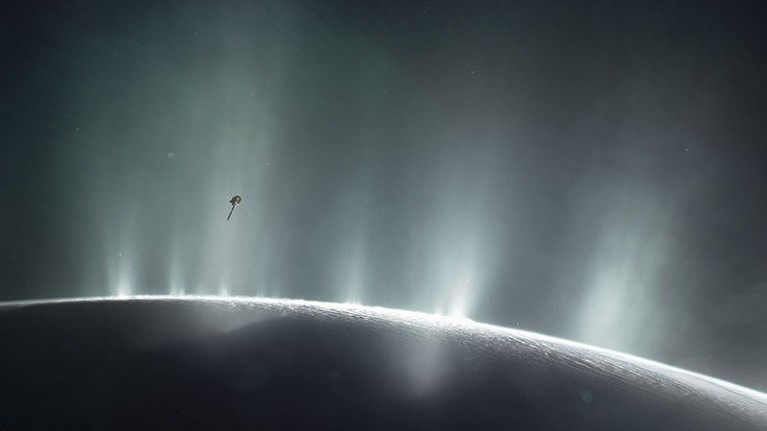
The Cassini spacecraft swoops through plumes issuing from Saturn’s moon Enceladus (artist’s impression).
Credit: NASA/JPL-Caltech
The James Webb Space Telescope (JWST) has spotted Saturn’s moon Enceladus spraying out a huge plume of water vapour, far bigger than any previously seen there. This enormous cloud might contain the chemical ingredients of life, escaping from beneath the moon’s icy surface.
In 2005, a NASA spacecraft called Cassini discovered icy particles squirting from Enceladus’s subsurface ocean through cracks in the moon’s surface. But JWST shows that material is spraying much farther than previously thought — many times deeper into space than the size of Enceladus itself.
“It’s immense,” said Sara Faggi, a planetary astronomer at NASA’s Goddard Space Flight Center in Greenbelt, Maryland, on 17 May at a conference at the Space Telescope Science Institute in Baltimore, Maryland. She declined to provide further details, citing a scientific paper that will be published soon.
Rare ocean world
Enceladus excites astrobiologists because it is one of the few ‘ocean worlds’ in the Solar System, making it one of the best places to look for extraterrestrial life. The salty ocean that lies beneath Enceladus’s outer covering of ice is a possible haven for living organisms, which could be sustained by chemical energy at hydrothermal vents on the ocean floor.
The material that squirts out of Enceladus, primarily through fractures known as tiger stripes around the moon’s south pole, is a direct link to that potential extraterrestrial ecosystem. The plumes seen by Cassini contained silica particles that were probably carried up from the sea floor by churning fluids1. Cassini flew many times through Enceladus’s plumes, measuring ice grains and life-friendly chemicals such as methane, carbon dioxide and ammonia.
But it took JWST, a telescope located 1.5 million kilometres from Earth, to discover something that Cassini could not see from its ringside seat. Whereas Cassini could spot ice grains that do not travel far from the surface, JWST has a wider perspective and sensitive instruments that can capture faint gas signals around Enceladus.
Enceladus at a glance
On 9 November 2022, JWST peeked briefly at Enceladus. Just 4.5 minutes’ worth of data revealed the enormous, very cold plume of water vapour. The forthcoming paper will quantify how much water is spraying out and its temperature, Faggi said. But the plume is likely to be of low density, more like a diffuse, cold cloud than a damp spray. That’s not great news for anyone looking to grab samples from the plume and hoping to find life, as the signs of life may be too sparse to detect2. Ice grains seen by Cassini much closer to Enceladus are more likely to have high concentrations of organic particles, says Shannon MacKenzie, a planetary scientist at the Johns Hopkins University Applied Physics Laboratory in Laurel, Maryland.
JWST also analysed the spectrum of sunlight reflecting off Enceladus and found evidence of many chemicals, including water and possibly other compounds that could hint at geological or biological activity in the moon’s ocean. “We have many more surprises,” Faggi said.
Researchers are already planning how to follow up on the discovery. Last week, JWST organizers released a list of the observations to be taken in the telescope’s second round of operations — and it includes another project to study Enceladus. That work will look at Enceladus for six times longer than the first JWST study, and will aim to find chemical compounds associated with habitability, such as organic compounds and hydrogen peroxide. “The new observation will give us our best shot yet at searching for habitability indicators on the surface,” says project lead Christopher Glein, a geochemist at the Southwest Research Institute in San Antonio, Texas.
Moon-scouting snake robot
JWST’s findings provide more grist for a possible NASA mission to Enceladus to search for signs of life there. Proposals under consideration include an ‘orbilander’ mission that would orbit the moon for a year and a half before landing at its south pole. Another proposal calls for the development of an autonomous snake robot that could slither beneath Enceladus’s ice to explore the ocean.
Other icy moons in the Solar System are also getting attention from JWST. At the conference, Geronimo Villanueva, a planetary scientist at Goddard, reported that the telescope had detected carbon dioxide on Jupiter’s moon Europa. That excites scientists because carbon and oxygen are key building blocks for life on Earth. NASA is launching a mission to Europa next year that will explore that ocean world in more detail. “This is definitely a new era in the exploration of the Solar System,” Villanueva said.
doi: https://doi.org/10.1038/d41586-023-01666-x
References
Schoenfeld, A. M. et al.Comm. Earth Environ.4, 28 (2023).
Throughout recorded history, humans have looked up at the night sky and witnessed the major astronomical events known as a “supernova.” The name, still used by astronomers, referred to the belief that these bursts of light in the “firmament” signaled the birth of a “new star.” With the birth of telescopes and modern astronomy, we have since learned that supernovae are what occur at the end of a star’s lifecycle. At this point, when a star has exhausted its hydrogen and helium fuel, it experiences gravitational collapse at its center.
This leads to a tremendous explosion that can be seen billions of light-years distant, releasing tremendous amounts of energy and blowing the star’s outer layers off. Thanks to an international team of astronomers led by the University of Southhampton, the most powerful cosmic explosion has been confirmed! The stellar explosion, AT2021lwx, took place about 8 billion light-years away in the constellation Vulpecula and was over ten times brighter than any supernova ever observed and 100 times brighter than all the stars in the Milky Way combined!
Artist view of a supernova explosion. Credit: NASA
AT2021lwx was first detected in 2020 by the Zwicky Transient Facility (ZTF) in California. It was subsequently detected by the Asteroid Terrestrial-impact Last Alert System (ATLAS) in Hawaii and is still being observed by a global network of telescopes. This makes AT2021lwx a record-setting supernova since most others have only been visible to astronomers for a few months. In addition to outshining other supernovae on record by a factor of 10, it is also three times as bright as any tidal disruption event – when a star is consumed by a supermassive black hole (SMBH).
The record for the brightest explosion is currently held by GRB221009A, an unusually bright and long-lasting gamma-ray burst observed last year that took place 2.4 billion light-years from Earth in the constellation Sagitta. While GRB221009A was brighter than AT2021lwx, it lasted for just a fraction of the time (10 hours), meaning the overall energy released by the latter is far greater. While the supernova has been observed for three years, the scale of the explosion was not known until now. Said lead researcher Dr. Philip Wiseman, a Research Fellow at the University of Southampton:
“We came upon this by chance, as it was flagged by our search algorithm when we were searching for a type of supernova. Most supernovae and tidal disruption events only last for a couple of months before fading away. For something to be bright for two plus years was immediately very unusual.”
As part of their investigation, the team consulted data collected by the ZTF and ATLAS observatories and the Wide-field Infrared Survey Explorer (WISE). Further observations were made with the Neil Gehrels Swift space telescope, the ESO’s New Technology Telescope (NTT) in Chile, and the Gran Telescopio Canarias (GTC) in Spain. This provided data in the optical, X-ray, ultraviolet (UV), and near- and mid-infrared (NIR and MIR) wavelengths. Tomás E. Müller Bravo, an ICE-CSIC and IEEC postdoctoral researcher, was the Principal Investigator of the GTC proposal. As she indicated:
“Given the uniqueness of this event, we observed it at different wavelengths with the aim of understanding its nature. In particular, our successful proposal to Gran Telescopio Canarias (GTC) allowed us to observe the presence and absence of different spectral lines, and compare these to those from other known transients to better understand the physical processes behind this bright source.”
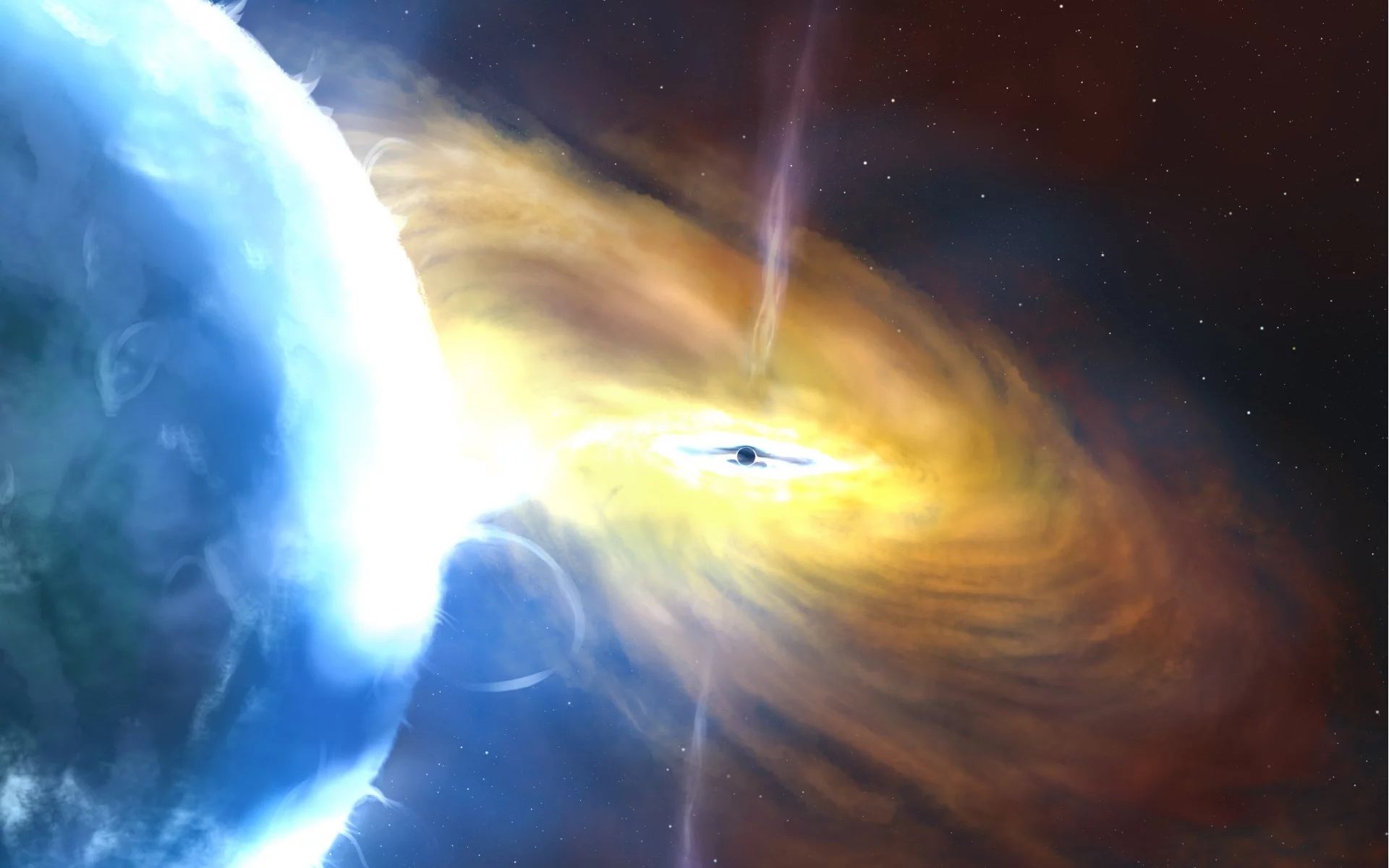
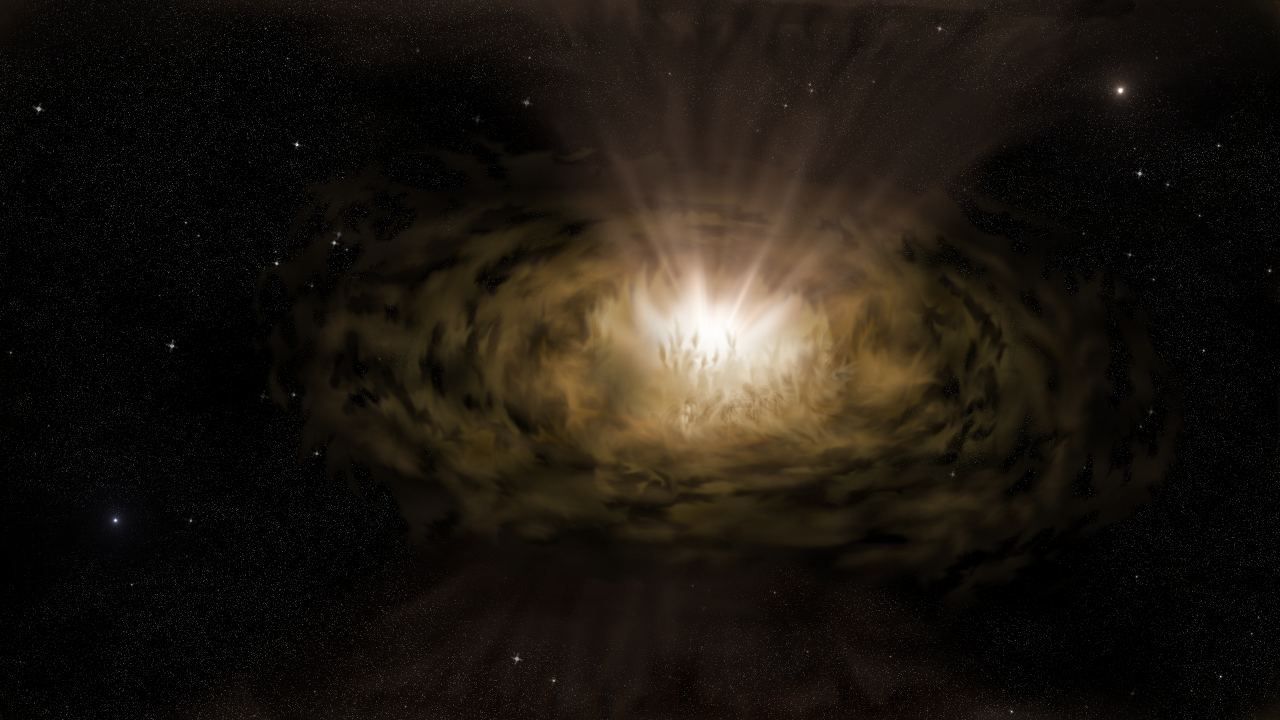
This artist’s impression depicts a rapidly spinning supermassive black hole surrounded by an accretion disc.
Credit: ESO, ESA/Hubble, M. Kornmesser
“It is really shocking when you find a transient, check its brightness, and you realize it is an order of magnitude brighter than any other supernova,” added co-author Lluís Galbany, a researcher from the ICE-CSIC and member of the IEEC. “When our collaborators told us the existence of this transient, we rapidly prepared a fast-turnaround proposal to observe the transient with the Gran Telescopio Canarias (GTC).”
There are several theories about what caused it, but the team believes the most likely explanation is that an SMBH violently disrupted an extremely large cloud of gas or dust. As a portion of the cloud was consumed, it sent shockwaves through the rest of the remnants and the accretion disk surrounding the black hole. This theory is based on the fact that the only things as bright as AT2021lwx are the active nuclei of galaxies (quasars), where the SMBH has a constant flow of gas falling onto them at high velocity. It is rare for such events to be witnessed, and nothing on this scale has ever been seen before.
“With a quasar, we see the brightness flickering up and down over time,” explained Professor Mark Sullivan, another co-author from the University of Southampton. “But looking back over a decade, there was no detection of AT2021lwx, then suddenly it appears with the brightness of the brightest things in the universe, which is unprecedented.”
As a next step, the team will collect more data on the explosion and run updated computer simulations to test their theory about what caused it. It is hoped that additional multi-wavelength data will reveal details about the object’s surface and temperature and provide insight into what internal processes are at work. Said co-author Claudia Gutiérrez, a postdoctoral researcher at the ICE-CSIC:
“When you find a transient with properties different from those you are used to monitoring, your first reaction is to try to explain what events can produce them and how. Consequently, multiple alternatives appear, but only very few can describe your observations. This is what happened with this event.”
Artist’s conception of SN2016aps, a candidate pulsational pair-instability supernova that was the most massive supernova ever identified (at the time).
Credit: M. Weiss
The team also hopes to take advantage of next-generation facilities that will be coming online in the next few years, like the Vera C. Rubin Observatory. Once operational, the observatory will conduct the Legacy Survey of Space and Time (LSST), a ten-year campaign covering the entire southern sky and providing the deepest views of the Universe ever observed. Among the many things that the LSST will reveal, astronomers hope that more extremely-rare events like AT2021lwx will be detected. Given how energetic they are, these massive supernovae could be a process that helps shape galaxies over time.
A Few Interstellar Objects Have Probably Been Captured
When Oumuamua travelled through our Solar System back in 2017, people around the world paid attention. It was the first Interstellar Object (ISO) astronomers had ever identified. Then in August 2019, Comet 2I Borisov travelled through our Solar System, becoming the second ISO to cruise through for a visit. Together, the visiting ISOs generated a wave of inquiry and speculation.
There’s bound to be more ISOs than just those two, and a new study says our Solar System has probably captured some of these interstellar visitors, though they don’t stay for long.
Although ISOs are rare, the Solar System is old, and many have likely visited. Astronomers think that some of these objects can be captured in Solar orbits. This study takes a closer look at ISO capture and tests the idea that some ISOs could be captured in near-Earth orbits rather than Solar orbits. The researchers behind the work say that there could be a steady population of ISOs in near-Earth orbit.
“Interstellar objects present a unique mechanism to investigate the formation and evolution of planetary systems including our own.”
From “Close Encounters of the Interstellar Kind: Exploring the Presence of Interstellar Objects in Near Earth Orbit.”
Finding tiny objects in space is extremely difficult. The only images we get of other solar systems are either of their stars or weak images of the odd exoplanet. Sometimes astronomers detect debris disks and other features, but fine detail eludes them. So it’s nice that other solar systems send the odd involuntary emissary our way. Studying these ISOs is one way to gain insight into other solar systems and how they form and evolve.
The authors of this paper say that ISOs provide a unique opportunity to “… investigate the formation and evolution of planetary systems, including our own.” They also point out that whether any are in our Solar System now is a major point of interest for astronomers. “Although rare,” they write, “ISOs can be captured into bound orbits by different planets in the solar system.”
Recent research showed us that the upcoming Vera Rubin Observatory could find up to five ISOs per year and that the Oort Cloud, if it exists, might contain more ISOs than native Solar System objects. Other research suggests that cosmic rays might erode most ISOs to nothing. Other papers have shown that many ISOs would be pulled into Jupiter and destroyed.
But none of them specifically examined captured ISOs in near-Earth orbits.
The study is based on numerical simulations, where each particle in the simulations represents a potential ISO on a different trajectory originating outside the Solar System. The simulations are based in large part on scattering effects, where an incoming particle is interfered with in different ways by the Earth, the Moon, the Sun, and Jupiter, in varying combined ways.
This figure from the study illustrates some of the particle simulations in the research. In their first scenario, the simulated system only consists of the Sun and the Earth-Moon system. Its purpose was to isolate the effect of giant planets. Image Credit: Mukherjee et al. 2023.
The research involves cross-sections of space and velocity that result in ISOs being captured in near-Earth orbits. The researchers call them capture cross-sections, and after a large suite of N-body scattering simulations, they identified trends.
Their results show that massive Jupiter plays a dominant role. The Earth-Moon and Jupiter capture cross-section “… dominate the capture of interstellar objects into near-Earth orbits by a factor of 104 compared to that of Earth-Moon.”
This figure from the research compares Jupiter’s efficacy at capturing ISOs into near-Earth orbits compared to the Earth-Moon efficacy. The math is fairly complex, but basically, the x-axis shows excess hyperbolic velocity, and as that rises, capture efficiency decreases. Image Credit: Mukherjee et al. 2023.
When the authors compared their results with the actual distribution of known small bodies in our Solar System, something notable popped up. If an ISO were captured, it would likely end up with a greater than 10 AU. They point out that this is where the Centaurs exist. The Centaurs are small Solar System bodies with unstable orbits due to interactions with the giant planets. Could ISOs be hiding among the centaurs?
“ISOs hiding amongst the Centaurs have been examined by Siraj & Loeb (2019), but no known Centaurs are considered to have an interstellar origin,” they write. “However, our study suggests a closer examination may be merited.”
This figure from the research shows the distribution of orbital parameters for known small Solar System bodies vs captured ISOs. The left panel shows Astronomical Units, the middle panel shows orbital eccentricity and the right panel shows inclination. Image Credit: Mukherjee et al. 2023.
Captured ISOs are not likely to have very stable orbits. The team’s data shows how ISOs could be captured into near-Earth orbits, but looking for them in these initial orbits might prove fruitless. That would be too easy, wouldn’t it? Nature seldom gives up its secrets so readily.
“We caution the reader that this is not a full representation of present-day captured ISOs by Earth and Jupiter (should they exist). ISOs captured in the past will evolve their orbital parameters over time due to interactions with other planets in the Solar System,” they explain.
The team performed some long-term orbital calculations for a subset of captured ISOs out to 10 million years to test their survival. They plotted the survival of objects in their near-Earth orbits. Some ISOs might escape their initial capture orbit into another captured orbit, but those ISOs fall outside this effort.
This figure from the study shows the survival fraction of captured interstellar NEOs as a function of the lifetime in bound NEO orbits. It shows that only 0.1-1% of the captured objects survive in NEO orbits by 10 Myr, which is significantly shorter than the lifetime of known NEOs. Image Credit: Mukherjee et al. 2023.
Once a captured ISO leaves its near-Earth orbit, it either leaves the Solar System or takes up a new orbit with a larger perihelion and semi-major axis. But objects captured by Earth have an average survival rate two or three times those captured by Jupiter.
If there are captured ISOs in near-Earth orbit, they don’t last long. ISOs captured by Jupiter into near-Earth orbits have a half-life of about 50,000 years. Ones captured by the Earth-Moon have a half-life of about 130,000 years. Another way of looking at this is that the population of Jupiter-captured ISOs dwindles to 10% of the original fraction in only 800,000 years. For Earth-Moon captured ISOs, it’s 2.1 million years.
But many of these objects will be exceedingly small, nothing like Oumaumua or Comet Borisov. The population is dominated by ISOs about 1 meter in diameter. There is no way that an object like Borisov or Oumuamua could ever be captured unless we did it artificially.
A Hubble image of Comet 2IBorisov from October 2019. Its size was difficult to determine because it never came closer than about 300 million km. Early estimates suggest it was anywhere between 1.4 to 16 km in diameter but later estimates shrunk that down to 0.5 km. Image Credit: By NASA, ESA, and D. Jewitt (UCLA) – https://imgsrc.hubblesite.org/hvi/uploads/image_file/image_attachment/31897/STSCI-H-p1953a-f-1106×1106.png, Public Domain, https://commons.wikimedia.org/w/index.php?curid=83146132
If we’re ever going to find one of these captured ISOs, it’ll be up to facilities like the Vera Rubin Observatory and its Legacy Survey of Space and Time. It’s a planned ten-year survey of the southern sky that should begin sometime after its first light in August 2024. It’ll repeatedly image the sky and will find small objects that are moving through the Solar System. Some estimates say it will find a few Oumuamua-sized objects per year.
According to the authors, there could be a more substantial population of captured ISOs hiding among other NEOs. This demonstrates the need to study them in greater detail. The best way to study them is to go out and meet one of the larger ones.
Astronomers speculate that Comet Hyakutake, which passed through the inner Solar System in 1996, is a captured ISO. Image Credit: By Franz Haar – Own work, CC BY-SA 3.0, https://commons.wikimedia.org/w/index.php?curid=19044623
The ESA’s Comet Interceptor mission could do it. Relying on the advance notice of an approaching ISO that the Vera Rubin Observatory will provide, a robotic spacecraft could sit in wait at the Sun-Earth LaGrange 2 Point until a suitable ISO is identified. Then the Interceptor could be sent to intercept it, observe it, and collect a sample from its tail.
The ESA is partnering with JAXA, the Japanese Space Agency, and they plan to launch the Comet Interceptor in 2029.
“By detecting and studying captured interstellar objects,” the authors state, “we can learn about the properties and origins of such objects, and the formation and evolution of exoplanetary systems and even our solar system.”
Roswell Revisited: The Unseen Footage and Untold Stories! Journey through Time with Top Ufologist Neil Nixon
Embark on a distinctive voyage into history to scrutinize one of the most enduring enigmas, the Roswell UFO crash. Listen to the astonishing accounts of individuals who were directly involved in the event and delve deep into the surviving evidence and footage. Accompanied by renowned British Ufologist, Neil Nixon, this immersive exploration recounts the events in a unique light, sharing his insights drawn from decades of meticulous research and investigation. Experience Roswell in a fresh perspective, scrutinized meticulously and contextualized in its era.
VIDEO:
Alien Encounters Roswell – UAP, UFO, Government Space program
Unidentified Flying Objects have long been a source of fascination and speculation. From compelling testimonies of credible individuals to the skeptics who deem them as mere figments of imagination, the enigma of UFOs continues to captivate the human mind.
Airline pilots, often among the most experienced observers of the skies, have reported various sightings throughout history. However, due to fear of ridicule or career repercussions, many have chosen to keep these experiences private. An illustrative case was that of Captain Killian who, after publicizing his sighting, was ridiculed and ultimately silenced by his airline. This chilling episode made others in his profession wary of discussing their sightings publicly, demonstrating the stigma that often surrounds such incidents.
However, not everyone who has reported seeing a UFO or pursued an interest in ufology, the study of UFOs, has felt ridiculed or ostracized. On the contrary, some have found that their interest in this unusual field has made them more interesting to others, opening the door for engaging and thought-provoking discussions.
There exists a wide spectrum of beliefs and perspectives regarding UFOs, from vehement denial to ardent belief. One researcher, in an attempt to classify these viewpoints, suggested five categories: the prejudiced, the party-liner, the open-minded skeptic, the believer, and the contactee, a person who asserts to have communicated with the occupants of UFOs.
The prejudiced and the party-liner are generally opposed to the reality of the UFO phenomenon. The open-minded skeptic starts from the assumption that UFO reports are real and may contain valuable information, but they remain undecided about the phenomenon’s nature. Believers assert the existence of UFOs, often supporting the idea of extraterrestrial control, while contactees take a step further, claiming direct interaction with UFOs or their occupants.
As for the scientific community, many researchers assert that UFO sightings could be explained by natural phenomena or human-made objects, while others argue that some cases cannot be easily explained, leaving room for the possibility of extraterrestrial intelligence.
The question of whether we have been visited by aliens remains a source of contention. Some researchers maintain a healthy skepticism, citing a lack of irrefutable proof. They propose that if we have been visited by aliens, the interaction might not be in ways we understand, much like animals in a zoo might be unaware of human preservation efforts.
On the other hand, believers maintain that the existence of UFOs is the result of intelligent beings from other planets visiting Earth. They argue that humans, given enough time and resources, could also travel to other planets with our current knowledge base.
The debate surrounding UFOs often evokes historical precedents of once-ridiculed ideas that are now accepted truths, such as Darwin’s theory of evolution or the existence of black holes. As we continue to explore our universe and improve our technologies, the question of whether we are alone in the universe or part of a broader cosmic community remains tantalizingly unresolved.
Regardless of one’s stance on the matter, it is crucial to maintain an open mind and consider the possibility of both extraterrestrial life and unexplained natural phenomena. As we keep exploring the cosmos and enhancing our understanding of it, the truth, whatever it may be, may eventually come to light. Until then, the enigma of UFOs continues to stir our imagination, fuel our curiosity, and remind us of the grandeur of the universe we inhabit.
Documentary filmmaker Jeremy Corbell has stunned UFO enthusiasts with his piece of evidence on the phenomenon and information he received while studying UFOs. He is the one who shared the video footage showing the UFO as a transmedium vehicle. Additionally, he says that UFOs and aliens are just a small part of a larger reality along with other interesting and eye-opening statements in an extensive interview with Theories of Everything with Curt Jaimungal.
Jeremy Kenyon Lockyer Corbell is an American contemporary artist and investigative filmmaker based in Los Angeles, California. He did extensive research on nanotechnology, aerospace exploration, and exotic propulsion systems, as well as an in-depth examination into the life and discoveries of the enigmatic “Godfather of Conspiracy” John Lear.
Corbell has documented the surgical removal of alleged off-world alien implants, and has filmed NASA’s analysis of anomalous materials alleged to be physical evidence of extraterrestrial nano-technology from UFO landing sites. He has obtained deathbed confessions from former CIA and government intelligence officials who claim to expose the truth about UFOs and the worldwide coverup of the ultimate truth.
Jeremy Corbell with former Pentagon UFO official Luis Elizondo.
Corbell released the film “Bob Lazar: Area 51 & Flying Saucers” on Netflix, adding credibility to Lazar’s case. Moreover, his 2-hour interview with Curt Jaimungal discussed dozens of topics that added great information to the UAP/UFO phenomena. In 2021, he leaked a film of the US Navy photographed & filmed “spherical” shaped UFOs & advanced transmedium vehicles. In the footage shared by filmmaker and UFO enthusiast Jeremy Corbell, a flying object can be seen disappearing into the water off California.
In this interview, he covers a variety of controversial subjects including the release of the Tic-Tac videos by the government, possible government disinformation campaigns, and the claims of Bob Lazar that he once worked on backward engineering an alien craft.
UFOs and Aliens Just Small Part of ‘Larger Reality’
Corbell asserted in the interview that aliens and UFOs are a small part of a much larger reality of this mysterious and mind-boggling phenomenon.
He said:
“UFOs appear to be part of a larger phenomenon meaning UFOs are kind of an auxiliary implication of a much larger reality. So this idea that what we’re seeing are machines from other planets. I’m unconvinced what we may be seeing is an alternate reality. You know maybe it is something closer to dimensional travel.
There seems to be another version of reality that is occurring and that somehow once they pop through into our reality. And this is not just from a cursory look at the ufo phenomenon, this is from talking with thousands of close encounter eyewitnesses who tell me that this is something bigger than just flying machines.
To give you an example at Skinwalker Ranch. The report is that a piece of the sky opened up like a tear and out of this came “Beings” came “Craft.” So, UFOs is a symptom, it’s part of this alternate reality, The phenomenon as I call it. But it’s not just about UFOs represent this phenomenon.
I know this to be true that Skinwalker ranch is the best example of this because you have UFO phenomena. But you also have cattle mutilation which is often associated with lights in the sky. So, cattle mutilation is something a concrete example.
Cattle mutilation, Is this a UFO phenomenon or a government experiment, or is this a private corporation that’s going around mutilating these cows and draining their blood in the dead of the night? Nobody has ever been caught during these cattle mutilations.
They are the same across the board. They’re drained of blood. The farmers and people that are cattle ranchers see UFOs oftentimes during these mutilations so I can’t separate them.”
American billionaire Robert Bigelow shared his personal experiences and losses that prompted his interest in life after death, as well as UFOs. He talked about possible links between consciousness research and UFOs. He also talked about the risks of trying to establish communications with the unknown.
“That’s been mainly what I’ve been doing except for the skinwalker ranch thing for 20 years as the space world has been huge in my life to pursue the legitimate parochial kind of you know using fire engines rockets to get you there. We didn’t expect anything like this to happen and so there this is different. This is the holy grail and is different than the second holy grail. If the second one is ‘Beings’ (E.T.), then the first one: Is there any part of your consciousness that survives your bodily death? That’s a big deal. That’s a huge story. That’s gigantic.”
Dr. Travis Taylor’s Statement On Skinwalker Ranch
Dr. Taylor joined businessman Brandon Fugals’s team at Fugals’s infamous Skinwalker ranch three years ago and firmly believed he would be able to resolve the ranch’s assorted mysteries in short order. But the longer he stayed, the stranger things became. In his interview with investigative journalist George Knapp, he said: “You know, I had never seen a UFO until I got out there. Now, I have seen more UFOs now than you can count.” (Source)
In the surprisingly candid and wide-ranging interview, Dr. Taylor shared his opinions about the role of science in the pursuit of the unknown, his personal experiences with strange phenomena on Skinwalker Ranch, the physical effects of close encounter cases, and the mysterious “hitchhiker effect” that multiple UFO/paranormal eyewitnesses have reported.
In his opinion, this unexplained phenomenon can be different for people in regards to their brain activity. Hypothetically speaking, he said that the phenomenon can be connected with different planes in the universe. He added that he could go along with the idea of a portal but was not sure. He believes it is bizarre but there is some truth to it.
Throughout human history, the call of the unknown has driven explorers to embark on daring voyages into uncharted waters. These intrepid explorers have braved treacherous seas, and unknown dangers, driven by the thrill of discovery and the promise of new knowledge and riches. From the earliest days of seafaring civilizations the human desire to explore and push the boundaries of what is possible has led to some of the greatest achievements in history. Here are 8 of the greatest voyages of all time and how they shaped history.
1. Pytheas - Discovered Thule (Kind Of)
We start our list with one of the great ancient Greek explorers, Pytheas. Born in around 350 BC, Pytheas spent much of the 4th century BC on voyages exploring the coasts of Europe. His most famous voyage was when he set sail from the Greek colony of Massalia (modern-day Marseille in France) and sailed to the north, reaching regions the Greeks had never laid eyes upon before.
His most famous achievement is perhaps discovering the land of Thule in the Northern Atlantic. This is a bit of a strange one because, for all intents and purposes, Thule doesn’t exist and never has. Pytheas believed he had discovered a hitherto unknown frozen island far North of Britain, the only problem being, there was no island there.
Today many historians believe Pytheas was either lying or got lost. It is likely that “Thule” was actually modern-day Norway or Iceland. Pytheas described Thule as a land of perpetual ice and snow where the sun barely rose. It’s more likely Pytheas would have described anywhere near England as perpetually damp and grey!
Pytheas didn’t just discover imaginary islands. He extensively voyaged around the coasts of Britain, Iceland, and northern Germany, documenting the customs and lifestyles of the people he met along his way.
His greatest accomplishments were perhaps on the scientific side of his voyages. He was fascinated by tidal systems which he studied and described them in great detail. He is also credited as being one of the first navigators to identify the phenomenon of the midnight sun, where the sun remains visible for 24 hours a day in the far north during the summer months.
2. Leif Erikson - Beat Columbus to it
Christopher Columbus was the first European to set foot on North American soil. Right? Wrong. Over the years it has become increasingly likely that a Norse explorer by the name of Leif Erikson beat Columbus to it, and likely many others did too.
Leif Erikson was a Norse explorer active during the 10th century. According to the Norse sagas , Leif’s greatest achievement was when he sailed from Greenland to a region called Vinland, believed to be somewhere in modern-day Newfoundland, Canada today.
L'Anse aux Meadows is the only site widely accepted as evidence of pre-Columbian trans-oceanic contact. It is notable for its possible connection with the attempted colony of Vinland established by Leif Erikson around the same period or, more broadly, with Norse exploration of the Americas.
Our knowledge of Norse history is famously spotty, but it’s believed Leif’s voyage set sail around the year 1000 AD. It is likely he got the idea for his journey after another famous Norse explorer, Bjama Herjolfson, had been blown off course while sailing to Iceland and stumbled across the unknown region.
Leif set sail with around 30 of his best men and upon reaching Vinland, established a Viking settlement in an area called L’Anse aux Meadows. They weren’t there for very long (carbon dating estimates from 990-1050 AD) but it was a major achievement in Norse exploration and colonization. Evidence of Norse buildings including a longhouse and a smithy has been found and it is believed they traded and interacted with the locals, whom they dubbed “Skraelings.”
Leif Erikson is a celebrated figure in Norse culture and mythology but only in recent years has he started to get the recognition he deserves as the first European to land in North America. Today L’Anse aux meadows is a UNESCO World Heritage Site and a popular tourist attraction.
3. Columbus - Set Out for Asia, Found America
It might seem a little unkind to follow up Leif with Columbus, but Columbus’s voyage was still an important one. Born in Genoa, Italy, in 1451, Columbus is perhaps the most famous explorer of all time. In particular, he’s famed for his attempt at finding a new route to the lucrative spice trade in Asia.
Going against what was accepted knowledge at the time, Columbus believed that by sailing west across the Atlantic, he could reach Asia more quickly than by sailing around the southern tip of Africa like everyone else.
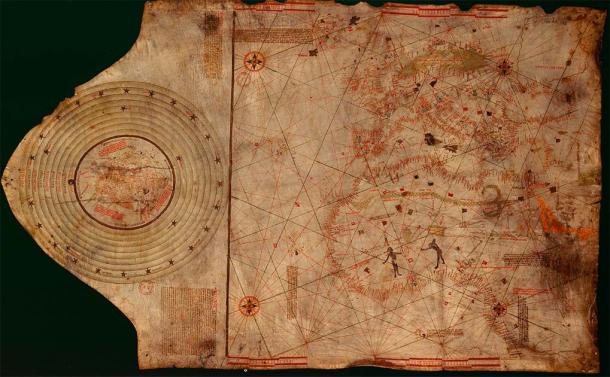
"Columbus map", drawn c. 1490 in the Lisbon mapmaking workshop of Bartholomew and Christopher Columbus.
Getting sponsors for his voyage was no easy task. Most people believed the earth was flat and thought Columbus’s ship would sail right off the edge of the earth. Those who were coming around to the idea of earth being a globe just thought he’d get lost. Still, in 1492 Columbus set sail from the port of Palos in Spain and headed west. He took three ships with him, the Nina, the Pinta, and the Santa Maria.
After a few weeks at sea, Columbus and his crew spotted land, which they believed to be Asia. Instead, they reached an island in the Bahamas, which Columbus named San Salvador. Over the next few months, Columbus and his men explored the coasts of Cuba and Hispaniola, establishing the settlement La Navidad.
Over the years Columbus made a total of four voyages to the New World. Once hailed as a hero, today his legacy is a complicated one. On the one hand, he’s credited as being responsible for opening up the Americas to European exploration and colonization.
But on the other hand, what one person calls colonization, another calls exploitation. His treatment of the indigenous peoples he found has been widely criticized. Columbus and his men brought disease and violence to the New World and the European colonizers happily enslaved and exploited many of the locals.
4. Zheng He - Ancient China’s Greatest Explorer
It isn’t just Europe that has given us some of history’s greatest voyages. The Chinese explorer Zheng He was born in China in 1371. A high-profile admiral in the imperial navy of the Ming dynasty, Zheng He was tasked with an important mission, to lead a series of voyages to establish diplomatic and trade relations with other countries.
His first voyage took place in 1405 and was of a grand scale. Zheng He commanded over 300 ships, including colossal treasure ships measuring up to 400 feet long (121.92m). The voyages had one goal, to promote Chinese power and prestige and it was Zheng He’s mission to deliver gifts and treasures to the leaders of the countries he visited.
Under the Yongle Emperor (third Emperor of the Ming dynasty ) and Xuande Emperor (fifth Ming Emperor) Zheng He carried out 7 voyages. He visited a wide range of countries and regions, including Southeast Asia, India, and East Africa. Along the way, he established important Chinese trading posts and diplomatic missions in these areas. On his return trips, he brought home exotic animals such as giraffes and zebras to entertain the Chinese court.
All of this wasn’t cheap. While his voyages were remarkable achievements in both maritime exploration and diplomacy, after his death in 1433 the Chinese government turned inward and brought an end to China’s age of exploration.
Columbus wasn’t the only European whose voyages were focused on the spice trade. Ferdinand Magellan , born in Portugal in 1480, was a soldier and sailor who was commissioned by the Spanish government to lead an expedition to find a western route to the spice islands of Indonesia.
He set sail from Spain in 1519 with a fleet of five ships and a crew of over 200 men. He crossed the Atlantic and traveled south along the coast of South America. In doing so he discovered a passage that led through the southern tip of the continent, the Strait of Magellan. His voyage then continued as he crossed the Pacific Ocean, encountering several new islands along the way, including Guam and the Philippines.
Magellan’s voyage was a long one. So long in fact, that by the time his crew returned to Spain in 1522, they had circumnavigated the globe. The first people in history to do so. Despite being remembered as the first man to circumnavigate the globe, Magellan didn’t finish his voyage.
His trip had faced numerous challenges along the way from storms to mutinies and skirmishes with ingenious people. One of these skirmishes proved fatal and Magellan fell in the Philippines, killed by a bamboo spear, on 27th April 1521 after trying to convert the locals to Christianity.
6. Hanno the Navigator - Ancient Voyage in Africa
Hanno the Navigator, or Hanno the Carthaginian as he was also known, was an explorer from the ancient city-state of Carthage located in modern-day Tunisia. In the 5th century AD, he set out on a voyage along the west coast of Africa looking to establish new trade routes that would expand his people’s influence.
Hanno voyaged far and wide. His ships took him along the Atlantic coast of Africa through present-day countries like Morocco, Western Sahara, Senegal, and Gambia. Along the way Hanno stopped to take in the sites, encountering many new lands and peoples, including the people of the Verde Islands. He even discovered a tribe of ape-like, highly aggressive people. He killed three of them, skinned them, and took their pelts back to Carthage. Their name? The Gorillai.
The term gorilla comes from Carthaginian explorer Hanno the Navigator, who was exploring the African coast. He described coming across a tribe of “gorillae”, monstrous and violent humans. It is likely he actually encountered chimps or baboons.
Hanno recorded his voyages in a text called the Periplus of Hanno which details the lands and peoples he came across. While some historians today doubt its accuracy it is still seen as an important document in the history of exploration and geography. Hanno’s voyage helped establish Carthage’s influence along Africa’s west coast and paved the way for further exploration and trade in the region.
7. Sir Francis Drake - Survived Circumnavigating the Globe
Magellan may have been the first man to circumnavigate the globe but Sir Francis Drake, the second man to do so, did it in style. Sir Francis Drake was a 16th-century English explorer, privateer, and naval commander whose voyages have become the stuff of legend.
Drake’s first voyage was in 1567 when he sailed to the Caribbean as part of a slave trading expedition. Over the next ten years, he made several voyages to the Americas. During these trips, he was a state-sanctioned privateer. He raided Spanish ships and settlements accumulating great wealth and fame in the process.
A map of Drake's voyage [showing Europe, western Africa, northern South America, and eastern North America]; the four other engravings consist of bird's-eye battle plan views of the cities of Santiago, Santo Domingo, Cartagena, and St. Augustine, Florida.
In 1577 he used this wealth to set out on a three-year voyage around the world, copying Magellan’s feat. Along the way, he explored the west coast of South America, claimed land for England in what is now California, and traded with the people of the Moluccas in modern-day Indonesia.
Perhaps his greatest achievement came in 1588 when he played a key role in the defeat of the Spanish Armada which had been sent to invade England. Drake's years of experience and skill as a naval commander helped to turn the tide of the battle and secure a massive victory for England.
History often focuses on those explorers who made the most famous discoveries or whose accomplishments had the most visible impact on history. But often these men’s successes and achievements wouldn’t have been possible if it weren’t for the work of the lesser-known explorers who came before them.
Erik the Red was a Norse explorer and adventurer whose voyages paved the way for later Norse expeditions to North America during the 10th century AD. According to legend, Erik was exiled from Iceland after committing murder and so he set out to find new lands to live in.
He and his crew sailed westward across the north Atlantic and eventually arrived in a remote, uninhabited land that they named Greenland. Conditions were harsh and the environment was challenging, but Erik and his followers managed to set up several settlements, thriving there for several centuries.
These settlements enabled later explorers, like Leif, to head even further northwards, eventually discovering North America. Today Erik is remembered as a bold and daring explorer who played a crucial role in shaping the history of the North Atlantic region.
Erik the Red is remembered in medieval and Icelandic sagas as having founded the first continuous settlement in Greenland.
The voyages of exploration throughout human history have shaped the world we live in today. From the ancient mariners like Pytheas and Hanno who connected different civilizations and sparked cultural exchange, to the early voyages of discovery that led to the discovery of new continents, each journey has contributed to our understanding of the world and our place within it.
Today we often take travelling great distances for granted, or worse, see it as a chore. We must remember these early voyages required incredible feats of courage, resourcefulness, and adaptability from the explorers who undertook them. They not only expanded our knowledge of the world, but also enriched our cultures and transformed our societies. The legacies of these voyages continue to inspire and captivate us, driving us to seek out new frontiers and push beyond our boundaries.
Top image: Ancient voyages set off to discover new realities.
Mysteries and Monsters: Episode 182 Philip Mantle UFO Landings UK
It's a warm welcome back to UFO researcher, author and publisher Philip Mantle on this weeks show as we uncover some of the UK's lesser known UFO encounters from history.
Philip's new book has tens of fascinating cases that many people may not be aware of and we discuss some of my favourites from the book including a personal favourite case from 1961 when two teenagers see a strange whose occupant isn't very friendly.
We meet a Dame who has no time for the MOD's excuses, a family who have two encounters within a week, visit the former UFO hotspot of Warminster and much, much more.
There are so many brilliant accounts in the book, with witness statements, newspaper cuttings, photos and sketches, it's a must have for anyone who loves UFO's and Ufology
Tesla’s humanoid robot prototype (known as Tesla Bot or Optimus) seems to walk relatively smoothly and can recognize and pick up objects with relative ease, according to a new video presented by Elon Musk at the Tesla shareholder event on May 16.
The faceless bots give off an uncanny valley vibe as they traverse the Tesla office in an intimidating pack — suggesting a major improvement from last year’s lackluster demonstration at Tesla’s AI Day event. At the time, employees merely held the bot on a stand and programmed it to wave to the audience. And when Musk announced the bot in 2021, all he had to show was a guy dancing in a suit.
At the recent Tesla shareholder event, Elon Musk showed off improvements to the Tesla bot.
Now, the new video promotes Tesla Bot features like “motor torque control,” “environment discovery and memorization” — hinting that the robots can use cameras and sensors to map their surroundings — and skilled manipulation of objects. Tesla also indicated that the robot’s AI system can pick up new tricks from human demonstrations: One clip shows an employee decked out in a futuristic suit and headpiece placing items in boxes while a 3D model replicates their movements.
Tesla seems to be training the bot prototypes with human demonstrations.
TESLA/YOUTUBE
Ultimately, Tesla hopes its humanoid Bot can accomplish “increasingly complex tasks,” hinting at a potential ability to sort objects into boxes — likely a helpful skill in a factory production line.
Last year, Musk toldTheWall Street Journal that the Tesla Bot could solve the human labor crisis. He has also claimed that these robots could eclipse the company’s vehicle business. Last year, he estimated that each could cost “probably less than $20,000.”
Tesla hasn’t offered a clear timeline for production, and the company had previously stated that things could kick off this year. But it seems like engineers are still working out the prototype’s kinks, and it could be years before the humanoids begin tinkering on Teslas in the factories of the future.
The Boeing X-37B, pictured here, is thought to have inspired China’s mysterious spaceplane.
Credit: Boeing/Sipa/Shutterstock
China has landed a mysterious spacecraft that spent nine months in Earth’s orbit, making the nation one of just a handful of entities that have successfully operated a reusable spacecraft. Although China has not revealed details about the spacecraft’s design and operation, aerospace engineers have pieced together information from fragments, painting a picture of a craft with potential for research as well as military uses.
“The complete success of this experiment marks a significant breakthrough in our country’s research on reusable spacecraft technology,” Chinese state media agency Xinhua reported, suggesting that Chinese researchers have developed technology, such as heat shields and landing equipment, specifically for reusable craft.
China, the US companies Boeing and SpaceX and NASA are the only players to have launched and recovered orbiting reusable craft. Although the upfront costs are high, the costs of running reusable craft are a fraction of those for single-use craft, making reusable spacecraft attractive if a mission requires several flights. The nine-month mission is probably a second test of the reusable spacecraft. In September 2020, China returned a reusable experimental spacecraft that had spent two days in orbit.
Imitating Boeing?
The spacecraft is likely to be similar to a US spaceplane, the Boeing X-37B, according to Kevin Pollpeter, a senior research scientist at the Center for Naval Analyses, a US government-funded research and analysis organization in Arlington, Virginia. The purpose of X-37B is unknown, but he says the Chinese government was concerned about the craft’s military capacities when it was revealed in 2010.
Jonathan McDowell, an astrophysicist at Center for Astrophysics Harvard & Smithsonian in Boston, Massachusetts, agrees that China’s experimental spacecraft could be a nod to Boeing’s X-37B spaceplane. McDowell says satellite sensing shows the spacecraft gliding and performing a runway landing at the Lop Nur military base in China’s northwest Xinjiang region, suggesting that it is a plane. Some other reusable spacecraft, such as SpaceX’s Dragon capsule, are modules attached to launch rockets that rely on parachutes to land.
Like the X-37B, the Chinese vehicle seems to be fairly small. The Chinese media reported that the spacecraft was launched last August from the Jiuquan Satellite Launch Center in northwestern China on a Long March 2F rocket, which China used to launch its Shenzhou crewed space missions. Given that the maximum payload capacity of the launch vehicle is 8.4 tonnes, the spaceplane probably weighs between 5 and 8 tonnes, says McDowell — much smaller than NASA’s retired space shuttles that performed crewed missions, including Columbia and Challenger.
Although the current model is too small to carry crew members, McDowell says he would not be surprised if the country introduces a larger spaceplane for crewed missions in the future.
Satellite capture?
China might be testing a variety of technologies that could further its space ambitions, says McDowell. Changing orbital trajectories or unfolding solar panels are just two examples of the kinds of mid-orbit manoeuvre that would be useful to perfect.
Releasing and capturing satellites while in orbit might also have been tested. According to a report by the Center for Strategic and International Studies, a think tank in Washington DC, the spaceplane released an object that was detected last October. The object seemed to disappear from orbit in January before reappearing in March, according to McDowell, who tracks the spacecraft using US Space Force data. One possible explanation, he says, is that the spaceplane captured the object and carried it as cargo before releasing it again. That would suggest the spaceplane has cargo capacity, meaning it could be used to carry instruments and satellites. The manoeuvre, which he says could have been achieved with a robotic arm, might have been practice for satellite maintenance and repair.
“[The Chinese] have been working a lot with robot arms in other contexts, like the Chinese space station and other satellite servicing experiments,” McDowell says. For example, last year China removed a defunct satellite from orbit using another satellite.
The Xinhua story about the spacecraft’s landing highlighted “the peaceful use of space”. McDowell notes that, with plenty of spy satellites already in space, China doesn’t necessarily need a spaceplane for that purpose. But China’s space programme is run largely by the military, and consequently, its space missions tend to be secretive, says Pollpeter. “I think the inclination is to release less information rather than more information, because even if they are using it for something like satellite servicing and repair, it doesn’t mean that it couldn’t be used for more offensive or more military activities.”
In the depths of the English Channel lies a lost city that has been submerged for over 8,000 years. It is known as Doggerland. One maritime archaeologist , Garry Momber, has spent two decades exploring these waters to uncover its secrets. The English Channel is notoriously difficult to navigate, with cold water and powerful tides creating treacherous conditions for divers.
However, Momber's meticulous preparations have paid off, revealing that Doggerland is a treasure trove of ancient wood that has survived underwater for millennia. These preserved hunter-gatherer landscapes offer a rare glimpse into life from another age, and composite structures like these are of international significance. The discovery of what is believed to be the oldest boat building site in the world adds to the intrigue of this remarkable find.
As the dominant feature of our night sky and sporting a surface reflection that reminds us of our own faces, humans have long believed or at least hoped that the Moon is inhabited by other beings who might visit us or welcome us to their home. The same is true of Mars, the reddest dot in the night sky. As space travel finally began in the late 1950s, we have been frustrated in our search for signs of current life on the lunar surface or the Martian landscape, and excuses have been made that it lives deep underground, on the opposite side (of the Moon), in the shade of craters or other areas that hide not only their physical presence but all evidence of their existence. Now, scientists from Japan and China have noticed something unusual about their lunar and Martian space equipment, and true believers in life on the Moon and Mars think this could be the holy grail of evidence they’ve been looking for. Whatever is causing these anomalies, it is a mystery that is baffling space scientists and the interested public.
It was here a minute ago.
“The HAKUTO-R Mission 1 Lunar Lander was scheduled to touchdown on the surface of the Moon at approximately 1:40 a.m. JST. As of 8:00 a.m. JST, April 26, 2023, the communication between the lander and the Mission Control Center was lost, although it was expected even after the touchdown, and it has been determined that Success 9 of the Mission Milestones is not achievable.” (statement from ispace)
On December 11, 2022, the Hakuto-R Mission 1 from the private Japanese space company ispace was successfully launched onboard a SpaceX Falcon 9 rocket. After traveling 870,000 miles – farther than any privately-funded spacecraft, it attempted to land on April 25, 2023, in the Lacus Somniorum plain. Communication with Hakuto-R Mission 1 was lost permanently during the final descent to the lunar surface and the spacecraft was believed to have been destroyed in a hard crash on the lunar surface. Or was it?
“Some researchers express conspiracy theories that the cause may be not only natural conditions, but also human actions. They believe that the disappearance of space equipment could be due to deliberate actions by other countries. Others believe that there were representatives of extraterrestrial civilizations on our satellite, who allegedly did not like the neighborhood with terrestrial technology.”
The website ufo.com.br expresses the sentiments of two groups outside of the scientific community. While an accident is certainly plausible, many in the military as well as conspiracy theorists point to the secret missions of space programs in the U.S., Russia, China and now some smaller countries as evidence that sabotage of flights and the possible stealing of crash remains is indeed a possibility. The other sentiment is the possibility that an alien presence on the Moon is protecting its own secret existence by sabotage and retrieval – possibly for analysis, possibly for protection. The Hakuto-R Mission 1 is not the only one that suffered a mysterious disappearance recently.
"We have not had any communication from the rover since it entered hibernation. We are monitoring it every day and believe it has not woken up because the sunlight has not yet reached the minimum level for power generation."
Fox News reported that Zhang Rongqiao, the chief designer of China’s Mars exploration program, is concerned about its non-functioning Zhurong rover, part of its Tianwen-1 mission which was launched on July 23, 2020, landed on Mars on May 14, 2021, and has been operating ever since. A NASA probe was able to locate the dead rover and NASA’s experience with its own Martian rovers and landers suggests Zhurong is covered with Martian dust and its solar panels are unable to get enough rays to recharge its batteries and return to operation. However, it is puzzling that the Chinese rover stopped functioning after 358 days, while NASA's Perseverance and Curiosity rovers are still roaming the Martian surface for more than two years and over ten years respectively. Is the Zhurong rover dead due to dust … or could it be something else? Does Mars have a presence that doesn’t want to be detected? Or a saboteur?
Those who support the sabotage conspiracy theories look at the experiences of two minor players in space travel – India and Israel – for more validation. On September 7, 2019, the Indian Space Research Organization (ISRO) lost all communications with its Vikram lunar lander in the final phase of its descent to the lunar surface. It took until late November of 2019 for ISRO to finally admit the spacecraft was lost when it likely crashed on the lunar surface. The space agency’s long reluctance to admit it had lost the lander and had no idea why it failed are fodder for conspiracy theories involving sabotage and aliens. Those theories are supported by another mysterious lunar crash in 2019 – Israel’s Beresheet lunar lander built by the space nonprofit SpaceIL.
“We have a failure of the spacecraft. We unfortunately have not managed to land successfully.”
Israel Aerospace Industries general manager Opher Doron told CNBC that Beresheet – the Hebrew word for “genesis” – never made it to its own beginning on the lunar surface as it also crashed on final descent on April 11, 2019. While Israeli space and government officials put up a positive front, calling the mission a success even though the lander crashed, the officials again had little knowledge as to what caused the failure.
“In turn, representatives of China and Japan said they would conduct additional research to find out the reasons for the disappearance of space equipment. They say they will work to prevent similar incidents in the future and protect their space missions from potential threats.”
Is landing on the Moon so difficult - or is it something else?
Is it really that hard to successfully land a spacecraft on the surface of the Moon? Or is there something else happening that is disrupting equipment as it gets close … something that causes functioning equipment to suddenly stop all functions? Four space agencies have experienced these problems and one (and possibly more – the agencies are obviously reluctant to release news of these failures) has admitted its equipment has disappeared. It is easy to blame accidents for some of these incidents, but the knowledge base is growing and the successes should be as well. Keep an eye on NASA’s upcoming mission to send humans back to the Moon and SpaceX’s mission to send humans in an observational swing around it. Watch for unexplained or questionable delays.
Dmitry Rogozin, former head of Russia’s ROSCOSMOS space program, said recently in his strange statement that he doesn’t believe the U.S. really put humans on the Moon because they haven’t been able to do it again in over 50 years. Is it really budgets and other priorities … or is there something or someone preventing it? We may soon find out.
Laser Pointer Strike Triggers Sudden Movement from UFO over Big Bear Lake, California
An intriguing new report of UFO sightings in May 2023 has sparked curiosity and awe among enthusiasts and skeptics alike. The incident took place over the serene setting of Big Bear Lake, California. The captivating video footage showcasing these mysterious occurrences has added another layer of enigma to the ongoing discourse on extraterrestrial life and unidentified flying objects
The witness, a local resident, shared an electrifying account of the sightings. “There are always planes flying over my backyard, and one can easily identify them,” the resident said. “However, what I saw and captured on camera over the course of a few nights were two stationary lights. Their appearance was unlike any conventional aircraft I’ve seen.”
In the video, one can distinguish a moving light to the left—identifiable as an airplane—yet the stationary lights remain a mystery. As the resident zoomed in, the lights seemed to fluctuate in color at an extraordinary pace, transitioning between hues of red and white.
These sudden transformations in color and the sharp maneuver of the airborne objects, especially following a laser pointer strike, are characteristics atypical of any conventional flying object, increasing the intrigue surrounding this sighting.
Sumer, in Mesopotamia, was called ‘the land of civilized kings’. It reached its peak around 6,500 years ago when it had the distinction of being a very advanced civilization with a sophisticated written language, magnificent architecture for the time, complex mathematics, and amazing astronomy. Hundreds of gods comprised its religious system. Sumerians believed that although humans and the gods once shared the earth together, they didn't share a co-equal existence. Humans, they believed, were designed for the express purpose of serving the gods. Their chief god, Anu, commissioned his son, Enki (Ea), and his daughter Ninki (Enki's half-sister) to create humans by sacrificing a god, mixing his body and blood with clay, and forming the first human being made in the likeness of the gods.
According to Sumerian mythology, human-like gods called Anunna had initially come to mine resources that were needed on their home planet. Now, with the creation of a human labor force, their duties were changed. They ruled over what was, for all practical purposes, a human slave race. Their base of operations was Mesopotamia, the land between the Tigris and Euphrates river. In the Epic of Gilgamesh, the world's first epic poem, it was called Eden.
At first, according to the texts, humans were unable to reproduce on their own. This proved inconvenient. So, Enki and Ninki found a way to modify the new species. The result was a man called Adapa, a fully functional and independent human being. Enki had given Adapa great wisdom and the ability to understand the concept of eternal life. But Adapa's curse was that he could never attain that which he was able to conceive.
Detail of The Adda Seal. Goddess Inanna, god Utu, god Enki and chief minister Usimu. (Public Domain)
Were it not for the Amarna texts, discovered all the way over in Egypt in the archives of the Egyptian king Amenophis, we might never know about Adapa. But in 1912 his story was verified and confirmed by a unique discovery in the Library of Ashurbanipal. Five partial fragments, since translated, were revealed that told part of the story, called Adapa and the South Wind.
According to the story, Adapa had risen to the position of priest or sage. One day, while fishing in the Persian Gulf, the sea became rough and his boat capsized. Adapa became angry and: "broke the wings of the south wind." He prevented it from blowing for seven days and nights. This, of course, caught the attention of the god Anu, who wanted to punish Adapa for the sin of hubris. But Enki came to Adapa's aid. He instructed him to journey to the abode of the goddess Tammuz, who, along with Gishzida, stood guard at the gates of heaven. While there, he was told not to eat or drink anything because heavenly food would kill him.
Adapa put on traditional sackcloth and ashes, the garb of mourning, and appeared before Tammuz and Gishzida, claiming he was in mourning because the two gods had disappeared from his land. Ever hospitable, they offered Adapa food and drink. Forewarned, he refused. Only later did he come to understand that he had made a mistake. When he was brought before Anu, Anu asked why he hadn't eaten the food that had been placed before him. He said it was because Enki had told him not to eat: "the bread and water of life."
At this, Anu laughed: "What ill has Adapa brought on mankind?" If Adapa had partaken of the food, he would have obtained immortality. As it is, humankind, the creation of Enki, would henceforth suffer disease and death.
The Flood by Vasily Petrovich Vereshchagin (1869) (Public Domain)
The Deluge
Compare this story to the biblical account. In Genesis, God forbid the first man from eating of the Tree of Immortality. In the Sumerian version, it was Enki. This is about to become an important distinction.
Adapa was sent back down to earth. Now the plot thickens. Enki's brother, Enlil, hadn't been told about Enki's work. He had wanted only an obedient slave race, and now Enki was tinkering with things like wisdom and eternal life. Enlil and Enki fought, and the battle continues to this day.
Enlil advised the gods that he was going to destroy the newly created human race with a great flood. Afterwards, he reasoned, they could start over from scratch. But Enki overheard the plans and contacted a righteous man named Utnapishtim.
The Deluge, frontispiece to Gustave Doré's illustrated edition of the Bible. Based on the story of Noah's Ark, this engraving shows humans and a tiger doomed by the flood futilely attempting to save their children and cubs.(1866) (Public Domain)
Ancient Sources Predating the Bible
It's important to remember that the Sumerian authors didn't believe they were the earliest human civilization. They claimed to have received all this from an earlier civilization that had, by their time, become extinct. Who comprised this civilization, and where they came from, is a mystery.
Added to the dilemma is the fact that when we read a text such as the Bible, we are reading the edited work of scholars who lived centuries ago. They made choices, compiling one work and condensing another, so it seems as if we are reading a seamless book written by one author. No one ever did that with ancient Sumerian texts. We read a little of this and a little of that, from here and there, and the story doesn't seem as uniform as the familiar Hebrew text. On top of that, some of the old texts are written in Sumerian hieroglyphs, some in Babylonian cuneiform, and others in ancient Egyptian. A modern editor has a lot to choose from, and can snip a little from one text or another, confidant that most of us, who don't read any of the ancient languages, will be none the wiser. But a comparison of Sumerian and Biblical texts, even in translation, is revealing.
One of the most important Sumerian texts is called Enki and the World Order. In this myth, Enki decided that the world needed to be managed by the gods or it would descend into chaos. He appointed various overseers to supervise such activities as managing the use of water and crops, building cities, herding domestic animals, overseeing the heavens, and managing the activities of women.
Both the Genesis Eden Story and the Sumerian texts address similar issues and help us understand what was going on in the minds of the old ones at the time of the birth of our civilization. They can be read as metaphors for historical precedents such as the agricultural revolution and city building. They are an attempt to explain why things are the way they are in the world. They point back to an earlier civilization, now lost to history. They reveal that our ancestors thought long and hard about philosophy and psychology. They point to what was even back then considered a lost golden age—paradise. They try to plumb the depths of human behavior and ask questions about the nature of good and evil.
In that sense, things haven't changed a great deal in the last 5,000 years. But there is another way to read these two stories. From a religious perspective, they are very different.
Is Eden Paradise?
Anton Parks is a French scholar who has devoted years to the Sumerian texts, even going so far as to translate them himself. He points out that the Bible portrays our ancient ancestors being very happy in Paradise. In the Sumerian texts, they are living in a concentration camp. In his translation God doesn't plant a garden for humankind in which he: "walks in the cool of the evening," as in Genesis. His version says the gods: "came in strength from beyond time. They were carried, one day, by the rebellion of the universe." His gods, the Anunna, were very real entities from beyond, who represented a patriarchal and a matriarchal regime. Enlil, the so-called ‘evil’ god who wanted to enslave the human race, was quite different from Enki, who befriended them.
A woman-serpent bends around the Tree of Knowledge as Adam and Eve reach into the branches. Line engraving by T. de Bry after J. van Winghe. (Wellcome Images / CC BY-SA 4.0)
The feminine presence, represented by Ninki, is often portrayed as a reptilian figure. Could she have been the inspiration for the serpent in the Eden of Genesis? If that is the case, then the serpent wasn't evil at all. She was trying to free humankind by offering them the gift of the knowledge of good and evil. She then wanted them to eat of the Tree of Life and: "be like gods." It was a good thing she was doing, not a bad one.
But Enlil won the day. Although he failed to keep them from eating the fruit of the Tree of Knowledge, he cast humans out of the garden before they ate from the Tree of Life. And since history is both interpreted and written by the winners, Enlil's story was later told in Genesis, not Enki's. That explains why the Genesis account emphasizes the fact that sword-wielding cherubim, or ‘Shining Ones’, were placed at the entrance to Eden in order to ensure that humans never attain the godhead, or eternal life. It has been said that the smartest thing the devil ever did was to convince humans that he didn't exist. This reading of the Sumerian myth goes one step further. It says that the smartest thing the devil ever did was to convince humans that he was God.
Jehovah the Evil God Enlil
According to Anton Parks, YHVH of the Bible, translated ‘The Lord’, is not the Creator. The creator is Enlil, the enslaver of humankind, henceforth known as the Demiurge. He is head of the Patriarchal system that wants to suppress freedom, especially the freedom of women. He doesn't want equality. He wants subservient slaves. He doesn't want creative, right-brained, intuitive thinkers. He wants left-brained, obedient servants who are forced to toil every day.
This reading of the story says that humans were upright-walking animals who were modified through DNA manipulation to fill the role of worker bees. The word Adam in Sumerian, according to Parks, means ‘animal’. Eden consists of the words E, meaning ‘home’ and den, which means ‘life’. Satan, in Sumerian, means ‘The Administrator’
Ancient Sumerian cylinder seal impression showing the god Dumuzid being tortured in the Underworld by galla demons (Public Domain)
Enki managed to grant wisdom to humans when he, through Ninki, the ‘serpent’ of Eden, gave them the ability to discern between good and evil. That caught Enlil by surprise. The best he could do was to drive them out of Eden and forbid their return. To put it bluntly, according to this reading of the story, the God whom monotheists have been worshipping for the last 5,000 years is not Jehovah, the creator God. He is Enlil, the patriarchal Demiurge—Satan himself. This explains the God of the Old Testament who sent the flood to destroy humankind, who commanded the Israelites to kill innocent Canaanite women and children, who was the justification for the Crusades and the Inquisition, who seems so incredibly bloodthirsty. It explains why the author of John in the New Testament could declare that: "we know we are of God and the whole world is in the hands of the evil one" (1 John 5:19). He recognized that humans have been fighting the good fight, trying to get back to Eden.
According to this interpretation, we are caught in a divine battle of competing spiritual forces. We still need to: "earn our daily bread by the sweat of our brow." It's just that we have turned our curse into a search for meaning. We want to get back to Paradise.
Gustave Doré, illustration to Paradise Lost"... he [Satan] held on /His midnight search, where soonest he might finde /The Serpent: him fast sleeping soon he found ..."(Public Domain)
Sophia, Wisdom the Word of God is Feminine
There are indications that the Gnostic texts, discovered in Nag Hammadi, Egypt, in 1945, sympathized with this version of the story. The Gnostics were an early Christian sect that was declared heretical by the Roman establishment. The church burned their scriptures and made sure none of them, except for perhaps, the Gospel of John, made it into the New Testament. But with the discovery of books that had been hidden away and kept from destruction, we now know that to the Gnostics, wisdom, or Sophia, represented a feminine energy that refused to be kept buried. She was the Logos, or Word of God.
The Gnostics believed there was a bigger game being played out, by forces outside of planet Earth. The universe is bigger than we realize, they declared. As a matter of fact, the universe is simply one cell in the immense body (Multiverse) that is God. Here on earth the battle between good and evil, between the feminine and the masculine, between Enki and Enlil, is raging. But good will eventually triumph.
This religious system of belief says we have an ‘angel’ on one shoulder and a ‘devil’ on the other. Their names are Enki and Enlil. The earth may be the domain of the Demiurge, but that domain itself is called ‘Mother Earth’, the world of Sophia, the goddess of wisdom, the divine spark that Enlil, the devil, strives to put out. The Demiurge may dominate our day to day reality, but Eden still awaits if we can only persevere. And we are not alone in the battle.
This is a completely different reading than the biblical account many of us grew up with, and whether we read it allegorically or historically, it causes us to pause and think about what we have been taught in our impressionistic youth—to contemplate the idea that we are involved in something a lot bigger than we thought.
Galactic Black Hole Winds Blow Up to a Third the Speed of Light. The Impact on Their Galaxies is Impressive.
They are known as ultra-fast outflows (UFOs), powerful space winds emitted by the supermassive black holes (SMBHs) at the center of active galactic nuclei (AGNs) – aka. “quasars.” These winds (with a fun name!) move close to the speed of light (relativistic speeds) and regulate the behavior of SMBHs during their active phase. These gas emissions are believed to fuel the process of star formation in galaxies but are not yet well understood. Astronomers are interested in learning more about them to improve our understanding of what governs galactic evolution.
This is the purpose of the SUper massive Black hole Winds in the x-rAYS (SUBWAYS) project, an international research effort dedicated to studying quasars using the ESA’s XMM-Newton space telescope. The first results of this project were shared by a group of scholars led by the University of Bologna and the National Institute for Astrophysics (INAF) in Italy. In the paper that describes their findings, the team presented X-ray spectroscopic data to characterize the properties of UFOs in 22 luminous galaxies.
Artist’s impression of the path of the star S2 as it passes very close to the supermassive black hole at the center of the Milky Way. Credit: ESO/M. Kornmesser
The paper, titled “Supermassive Black Hole Winds in X-rays: SUBWAYS,” recently appeared in the journal Astronomy & Astrophysics. As they described, the SUBWAYS team used the X-ray Multi-Mirror Mission (XMM) to analyze active galactic nuclei (AGN) for a period of more than 1.6 million seconds (eighteen days). These regions surrounding SMBHs emit tremendous amounts of radiation across the electromagnetic spectrum (when the black holes are active) to the point that they temporarily outshine all of the stars in the galaxy’s disk combined.
The extreme temperatures generated near SMBHs – up to tens of millions of degrees – also causes the material surrounding them to become highly ionized and emit radiation. The powerful winds arise when dust and gas in the SMBHs accretion disk are ejected outwards, transferring some of the material and energy into interstellar space. Research has shown that this mechanism has important implications for regulating the process of star formation,
To get a better look at UFOs, the team analyzed high-energy spectra emitted in the X-ray band by elements like iron. Their analysis included 17 AGNs located 1.5 to 5 billion light years away, to which they added data from 5 AGNs collected by previous observations. Their results showed that in about 30% of the AGNs analyzed, there are space winds traveling at speeds of 10% to 30% of the speed of light (0.1 to 0.3 c). Marcella Brusa, a professor at the University of Bologna and INAF associate, is the coordinator of the SUBWAYS project. As she explained in a UniBo Magazine press release:
“These results allow us to establish with greater certainty that a significant proportion of active galactic nuclei hosts ultra-fast winds called UFOs, ultra-fast outflows. And we were able to confirm that the intensity of these gas flows is sufficient to significantly change the ecosystem of their galaxies.”
Artist’s impression of a quasar that existed during the early Universe.
Credit: NASA/ESA/STScI
Between an SMBH and the galaxy surrounding it, there is a reciprocal relationship where the two influence each other’s formation and evolution. While the mechanisms driving this relationship are not yet well understood, the ultra-fast wings emitted by AGNs are thought to play a vital role. Gabriele Matzeu, a researcher at the University of Bologna, INAF associate, and first author of the paper, summarized:
“These observations have allowed us to obtain new independent evidence of the existence of highly ionized matter that is ejected from the innermost regions of active galactic nuclei at speeds close to that of light. These outcomes have allowed us to learn more about these ultrafast winds and to better understandtheir role in shaping the evolution process of galaxies.”
UFOs or UAP have been recorded in every part of the globe, in all kinds of regions, including space. Richard interviews filmmaker Darcy Weir about his new documentary treatment of space-based UFOs, titled "Secret Space UFOs: Fastwalkers."
“Fastwalker” is a term used by NORAD and branches of armed forces to describe unidentified aerial phenomena moving and/or changing directions at high speed far beyond what current aerospace technology is capable of.
Darcy talks about the various theories that have been put forth to explain these sightings. He also provides some riveting accounts from astronauts who have seen UFOs in space with their own eyes. These stories provide unique insight into this phenomenon and all its implications. This interview also features fascinating images from the film.
These objects are not only observed in space, these fastwalkers also fly at an enormous speed through our sky. Check out our label: Fastwalker
The second video below shows such a space-based UAP or fastwalker (at 1:48) sequence.
Logan Paul, a name known to millions, has long been a controversial figure in the digital age. He’s a social media superstar, vlogger, and podcast host, who gained fame through the now-defunct video platform, Vine, before transitioning to YouTube and other forms of entertainment. Known for his brash style and headline-grabbing antics, Paul is a significant figure in the world of digital content creation. But he’s not just about humor and outrageous behavior; recently, he has found himself in the midst of a cosmic controversy — a supposed UFO footage.
Paul first made his name in the early 2010s with a series of viral videos, leveraging his popularity into a successful YouTube channel that now boasts millions of subscribers. After weathering several controversies, including a particularly notable incident involving a video from Japan’s Aokigahara forest, he has managed to maintain his relevance in the ever-changing digital landscape. He’s even transitioned into traditional media and sports, participating in high-profile boxing matches and making an appearance in the WWE.
In May 2023, Paul made headlines again, this time for a very different reason. During an episode of his podcast, ‘Impaulsive’, he claimed to be in possession of a potentially ground-breaking UFO footage that could prove the existence of extraterrestrial life.
The footage in question reportedly originated from Chuck Clark, a UFO enthusiast. It was allegedly captured in the Nevada desert around 1995 and has been considered by some to be the “most compelling” UFO sighting ever. The video purportedly shows a UFO hovering fluidly in the air, a movement Paul claims might not have been possible with the video effects technology available in the mid-90s.
Paul’s acquisition of this footage is where the story takes an intriguing turn. According to the accounts, Paul offered Clark $100,000 for the video, but Clark refused to sell it. Instead of walking away empty-handed, Paul secretly recorded the footage during a private viewing using a hidden camera.
Paul’s possession of the footage has stirred debates, with some questioning the morality and legality of his actions. However, Paul defended his actions, arguing that the footage, given its potential significance, should not be hidden away from the world. He believes that it’s a disservice to keep such potential proof of extraterrestrial life hidden.
As of now, Paul has yet to release the footage publicly. He mentioned that he’s waiting for the “right moment,” adding that he wants to consult with Bob Lazar, a self-proclaimed physicist known for his claims about reverse-engineering alien technology, to validate the footage’s authenticity.
While we wait for the release, the question remains: Does the footage indeed provide proof of extraterrestrial life, or is it another chapter in the lore of UFO sightings and hoaxes? Whatever the outcome, this episode adds a new layer to the continually evolving narrative of Logan Paul – from social media provocateur to a figure at the center of a potential extraterrestrial revelation.
Around 20 years ago, scientists were able to use the rotation of the moon to determine it had a fluid outer core, but the relatively small size of the inner core made it harder to investigate.
Now, new research has revealed the heart of the moon as never seen before, demonstrating that it has a solid core that is composed of iron like Earth. The findings uncover details of the internal structure of the moon that were previously hidden and could explain why iron-rich materials are present in the lunar crust.
The investigation of the moon's deep interior was conducted by scientists from the CNRS, Université Côte d'Azur, the Côte d'Azur Observatory, Sorbonne Université, and the Paris Observatory-PSL and follows in the footsteps of the Apollo 11 mission, which half a century ago paved the way for geological surveys of the moon.
The formation and evolution of Earth's natural satellite is still something of a puzzle to scientists, and debates still surround the nature of its deeper layers — debates that this study could settle.
Using data from several space missions and from a process called laser ranging which precisely measures the distance between Earth's surface and that of the moon, the team behind this research found that the moon's outer core exists over a solid inner core. This inner core appears to be composed of metal with a density resembling that of iron and is around 310 miles (500 kilometers) wide, making it around 15% the size of the moon.
In addition to this discovery, the researchers also found evidence that supports the idea that material in a layer between the moon's core and its crust called the mantle moved around as the moon has evolved since its formation.
The process, which is called lunar mantle overturn, could explain why iron-rich elements are found at the surface of the moon, as the mantle material would be carried upwards as volcanic rock left in the lunar crust. The materials in this rock that were too dense would then sink back through the lighter crust material to the core-mantle boundary.
The findings may eventually help solve another mystery surrounding the evolution of the moon, namely what caused the moon's magnetic field, once 100 times stronger than that of Earth's today, to almost completely dissipate.
"Our results question the evolution of the moon's magnetic field thanks to its demonstration of the existence of the inner core and support a global mantle overturn scenario that brings substantial insights on the timeline of the lunar bombardment in the first billion years of the solar system," the team writes in a paper published on May 3 in the journal Nature.(opens in new tab)
Join our Space Forums to keep talking space on the latest missions, night sky and more! And if you have a news tip, correction or comment, let us know at: community@space.com.
To Live on Mars, Human Architecture Has to Combine Science and Sci-Fi
Human habitats on other planets could be as striking as it could be weird.
BY TATYANA WOODALL
Our homes are the places that define us; those warm private spaces that we depend on for work, respite, and haven from the harsh realities of the wider world. On Earth, the buildings and dwellings humans spend the majority of their lives in serve as reflections of our society’s culture, beliefs, and values. So if the shelters we make for ourselves truly mirror and influence our everyday lives, how might that sentiment be translated to living in space?
The kinds of structures future explorers might live in on other planets may be more critical to space exploration than sci-fi depictions of cities and homes in a galaxy far, far away suggest. As NASA’s desire for long-term human space colonization comes to fruition with planned crewed missions to Mars, establishing safe and well-made human settlements for life off-Earth is one of the agency’s most urgent tasks.
Putting down roots on Mars is an extremely ambitious goal to accomplish this century — but the reason why isn’t to do with rockets, necessarily. Rather, it is because any human settlement on the Red Planet will have to fight tooth and nail to experience even a modicum of ecological success.
One of the most accurate parts of the 2015 movie The Martianis that when Matt Damon ends up stranded on Mars, everything about the planet is trying to kill him and his habitat holding up is his only hope of survival. Human dwellings on Earth have evolved to thrive by taking advantage of the surrounding environment, but astronauts on Mars have no such advantages.
In The Martian, Mark Watney’s habitat’s design is what ultimately helps him survive.
20TH CENTURY FOX/MOVIESTORE/SHUTTERSTOCK
Instead, like Mark Watney, they will have to deal with various ill-fated conditions for life, including a complete lack of natural resources, harsh weather including dust storms and freezing temperatures, low gravity, and high levels of dangerous deep-space radiation.
Yet some sci-fi classics like Star Wars also offer alternative, less bleak visions of humanity’s future off-Earth. Can any of these fantasies become reality? It might be more possible than you think.
COSMIC UTOPIA
The Bernal Sphere is one of the many potential space habitats imagined by NASA artists in the height of the Space Age.
NASA AMES RESEARCH CENTER
If the history of humanity has taught us anything, it is that we are motivated by the idea of founding our own Eden — whether on a new continent or merely a new town. A similar philosophy drives one of the most popular science-fiction tropes ever: Humans going out to create a thriving utopia in space. Scientists and sci-fi authors alike have devoted years of their lives to imagining what innovative space settlements could look like, from spacecraft that resemble the doughnut-like Torus designs pioneered by German-American aerospace engineer Werner Von Braun — which could soon be the working model for future space hotels — to the more well-known interstellar Bernal Sphere, first proposed in 1929 by Irish physicist John Desmond Bernal.
Like Von Braun’s concept, many early space habitat designs started as idealized versions of space stations or lunar bases. One of the most serious efforts was the 1959 U.S. Army study Project Horizon. The army’s plan involved building a military facility that would be buried under lunar regolith in a bid to protect humans from radiation, freezing temperatures, and micrometeoroid and space debris impacts. The idea was eventually nixed when NASA’s Apollo missions in the ’60s and ’70s revealed how tough lunar soil is and how difficult it would be to burrow into it.
In 1989, Gary Kitmacher, former architectural manager for man-systems on the International Space Station, took a shot at an alternative: He designed an inflatable habitat that could accommodate the needs of about a dozen astronauts living on the surface of the Moon. The sleek, dome-like structure included a bevy of different mission-related and personal rooms, such as a fully equipped science lab, exercise rooms, hydroponic gardens, and private crew quarters.
Of course, neither project came to be, but these and several other fledgling space habitat projects have gone on to inspire similar present-day concepts that have evolved in scale, creativity, and feasibility. In fact, one particular Mars habitat concept started out as an alternative module for the ISS.
A computer-simulated cutaway view of the TransHab concept.
In the late 1990s, American architect Constance Adams worked with NASA to design TransHab, a large-scale inflatable spacecraft that would have increased the crew’s living space. While there are many advantages to using lightweight inflatable habitats, Adams once noted that before her creation, the biggest challenges facing space inflatable tech were strength, safety, and their need for a firm structure to maintain the form. With a soft inflatable shell, hard inner structural core, and three roomy levels, TransHab was the first hybrid structure that could be used for a pre-deployable Mars habitat. Although NASA did create a prototype, the project never received the funding it needed to get off the ground.
Space agencies need off-world homes to be pleasant for astronauts to live in. There are at least five aspects that every successful human habitat for long-term space exploration must have, Manoranjan Majji, an associate professor at Texas A&M University who studies aerospace robotics, tells Inverse:
A protective radiation-proof shell
Artificial gravity
Sustainable food and water
Robotic systems, including the ability to manufacture bots
The ability to grow
“Protection against extreme environments is very important,” Majji says. “Almost every part of engineering needs to contribute to that.” If you manage to overcome the cosmic ray problem, then astronauts will need artificial gravity and sustainable food and water to survive. Ultimately, Majji says, a combination of robotic systems and tools like 3D-printing will make these architectural obstacles easier for future explorers to overcome.
This is the inside of an experimental habitat, known as the CHAPEA, on Earth meant to simulate what it would be like to live on Mars.
NASA
Future settlements will also need to be capable of growth and even generate some commercial value while manufacturing and demonstrating these future technologies. This will be as true for building astronaut labs and quarters as it is for creating scenic regions and hotels for space tourists.
Combined, these needs show why having a diversity of space habitat design concepts is so vital, Majji says. “If we have flexibility in terms of the architectural elements,” he explains, “we will have a lot more freedom in terms of what we can efficiently realize.”
But what kinds of freedoms will the space habitats of the future offer us?
FLASHING FORWARD
Mycoarchitecture could solve a huge issue with interplanetary colonization. This image shows mycelia growing in simulated Martian soil.
Ferrying resources from Earth to other planets takes a massive amount of time and energy, but these costs could be mitigated by using materials grown in space to build the next generation of multi-planetary structures. One concept, called myco-architecture is being tested at NASA’s Ames Research Center in California. The project imagines astronauts living in structures made out of fungi. Mycelia can create precise, complex threads and is easily scaled up. The organisms can also be coaxed into making leather-like materials as well as large-scale, durable habitats. Scientists could one day create other forms of biomaterial, medicine, and even food needed to sustain astronauts for the duration of their missions using similar bioengineering techniques.
In fact, most habitat designs, including one that would rely on the power of fungi, seem to favor a circular resource economy, one where nearly everything is recycled and used to power other systems or needs. Hopefully, such advances could offer explorers a greater variety of produce and materials than what fictional astronaut Mark Watney had to in The Martian.
And as humanity moves ever-closer to becoming a space-faring species, other nations are ramping up efforts in space architecture design. In 2017, the United Arab Emirates announced that it would aim to colonize Mars within the next 100 years, putting a rush on Dubai’s Mars Science City, a project whose goal is to create the first stable human settlement among the stars. Using a combination of 3D printing and sand, the concept imagines a sea of interconnected domes that will stretch across more than 176,000 square meters of Emirati desert — a project that could span the length of about 30 football fields. The city hopes to be fully operational by 2024.
NASA is one of many space agencies actively planning to house astronauts on other worlds, including the Moon and Mars.
“Most architectural models that I’ve seen use Martian rock materials to build modular spaces that blend in with the natural landscape,” Paul Weiner, a Denver-based contemporary artist whose hobbies include conceptualizing Martian aesthetics, tells Inverse. He agrees with the theory that local Martian materials (like sand) might be combined with 3D printed ones to create durable habitats and says even interior design might “similarly be optimized for robotic printing.” NASA, too, is also deeply invested in using 3D-printing technologies as a promising method to create sustainable deep space habitats, as it has held multiple competitions to energize and educate the public on the topic.
Still, keeping humans happy and healthy during a long-duration space mission is more challenging than it sounds. On a yearslong trip heading toward an environment far removed from everything humans are familiar with, every aspect of their refuge has to be carefully cultivated. Senior designer Chris Lawson, whose United Kingdom-based architectural firm CK Architectural has envisioned several kinds of futuristic habitats, tells Inverse that when designing these places, he often thinks about how to create spaces that combat isolation and feelings of reclusiveness. One way he likes to do this is find ways to create green areas, or places that remind people of nature.
“We all get lonely, and you try and imagine how loneliness feels that far away, that unconnected in a hostile environment,” Lawson says. “It’s going to be a long, long time until you’ve got cities [on] Mars.”
Although current astronauts have only been sent on relatively short trips to space, the ISS has served as an important test bed in investigating what kinds of structures might allow astronauts to accomplish their missions in comfort. Some of these tricks include ensuring that the interiors of these spaces do as much from the inside as these structures do from the outside. Aboard the ISS, NASA for example, uses LED lighting to keep crew members from feeling depressed and to regulate their circadian rhythms, which promotes good sleeping habits. We’re still decades away from having to prepare travel accommodations on Mars, but at least for some, helping to bring to life concepts people have previously only dreamed of is as exciting as it is alien.
“There’s a moment of emotion when presenting something that’s not been thought [of] or conceived by a client,” Lawson says. “When we’re able to show things that they’re not able to imagine, that spark joy and emotion, it’s something beyond words.”
Russian scientists found 'tiny spheres like cosmic sperm' at UFO crash sites
The Soviet Union officially dismissed all UFO reports as 'western propaganda' – but a group of Russian scientists working in secret made some hair-raising discoveries
George Knapp says he was handed a few of the mysterious orange spheres found at a UFO landing site
(Image: WireImage)
Russian scientists found tiny "spheres" like "cosmic sperm" at supposed UFO crash sites, a journalist has claimed.
George Knapp revealed that he had taken advantage of the confusion following the collapse of the Soviet Union to gain access to secret Russian military research into UFOs.
In some cases he even managed to obtain copies of classified documents relating to the phenomenon.
George said that while officially, the Soviet government dismissed reports of alien visitations as “western propaganda,” behind the scenes there was a desperate attempt to gather as much information as possible about the unexplained phenomenon.
George claimed scientists analysed two UFO crash sites in Russia (stock image)
“We know that from Stalin on they wanted to duplicate the technology to figure out how UFOs worked,” George told Jeremy Corbell on the Weaponised podcast..
“We knew they weren't ours they knew they weren't Russian, they were from somewhere else… this is advanced technology and if they could figure it out and duplicate it they could beat us in terms of stealth.”
Dr Felix Ziegel, a Cosmology specialist at the Moscow Aviation Institute, became the co-founder of the first officially approved Soviet UFO research group in the 1960s.
Dr Felix Ziegel holding a drawing of a UFO by alleged witnesses in 1977
Most intriguing, however, was Simakov’s discovery of tiny, glass-like balls recovered from soil inside the “crop circle”-like landing sites.
“They may be the result of transmutation when oxygen was converted to sodium under the influence of the UFO,” Dr Simakov reportedly said.
Or, he added, “they may be containers to carry life from one planet to another”.
George explained: “The impressions they made of the soil were pretty dramatic and it doesn't look like anything that we fly, and he shared that with us he gave us all that information and then he had found these little orbs.
“These little tiny perfect spheres… they were opaque.
"They were sort of reddish orangish colour and he called them ‘cosmic sperm’ – he thought they were some kind of a biological mechanism, some kind of seeds, and he gave me half of the world's known supply of cosmic sperm and I brought them back”.
Stalin officially dismissed UFOs as a western hoax – but behind the scenes ordered every report to be investigated(Image: Corbis via Getty Images)
Mysterious difficulties are still preventing the release of information related to the government’s hoarding and suppressing data about the first known interstellar object to land on Earth, nearly a year after U.S. Space Command confirmed that scientists had correctly identified it. Whereas, scientists provide an explanation for the trajectory of the most controversial “Oumuamua.”
Scientists Jennifer Bergner and Darryl Seligman submitted a paper, concluding that Oumuamua contained water and molecular hydrogen, which froze into ice due to the extreme cold of deep space. When the interstellar object entered the inner solar system and warmed up, the ice converted to its crystalline state, causing the H2 to be forced out and provide the propulsive push that explained the acceleration. The scientists ruled out nitrogen and carbon monoxide as possible explanations for the outgassing and acceleration because their levels were too low.
Dr. Avi Loeb said: “Oumuamua was not a Hydrogen-Water iceberg.” He submitted a new paper in collaboration with Thiem Hoang, challenging the surface temperature calculation of Oumuamua made by Bergner and Darryl in their recent paper published in Nature. He and Hoang argue that the calculation ignored the cooling effect of evaporating hydrogen, leading to an overestimation of the surface temperature by a factor of 9. The decrease in surface temperature limits the thermal annealing of water ice, further challenging the original model’s credibility.
Additionally, Dr. Loeb argues that Oumuamua’s lack of a visible coma, absence of carbon-based molecules or dust, and its unusual elongated shape, are all inconsistent with it being a generic comet. Dr. Loeb has previously proposed the possibility that Oumuamua is artificial in origin, which has sparked debates among experts.
In 2019, Amar Siraj and Dr. Loeb discovered an interstellar meteor near Papua New Guinea in 2014 and attempted to confirm their discovery. Relevant data had been collected by Department of Defense sensors, which were used to track nuclear explosions and was classified. In 2022, after delays, Space Command confirmed the researchers were correct about the meteor’s origin. This raised questions about why the government had suppressed information about the discovery for years.
According to this report, Motherboard filed a request under the Freedom of Information Act with different federal agencies seeking insight into why the government was not sharing data about alien bodies transiting our solar system. One request was filed with the Department of Energy in April 2022, and sought emails from two scientists at Los Alamos National Laboratory, who mentioned the terms asteroid, meteor, or debris. Motherboard requested expedited processing due to the public’s interest in the topic.
The Department of Energy informed Motherboard that the request had been forwarded to the National Nuclear Security Administration, and a government information specialist later informed Motherboard that they had not demonstrated a compelling need for expedited processing. The request’s estimated completion date was moved several times, and Motherboard was ultimately told there is no estimated completion date due to “a few difficulties that the NNSA’s Los Alamos Field Office and/or Lab will have to work out.”
There is no definite answer to why mainstream scientists are trying to diminish Dr. Loeb’s discovery of Oumuamua and his bold acceptance of extraterrestrials. However, in his recent blog post, he mentioned that he was visited by two government representatives from Washington DC, who assumed he was on the right path. Perhaps, he is right about some UFOs might be extraterrestrial. (Source)
“‘Am I wasting my time?’ I asked the two visitors who came all the way from Washington DC to my home a couple of days ago. ‘Not at all,’ they assured me,” writes Dr. Loeb. He further added: “There is, of course, a lingering possibility that I am naïve and UAP are smoke and mirrors. In that case, we will find out soon enough. This is why I asked my guests from DC whether I may be wasting my time. I have no access to classified data and the publicly available data is not convincing. But the known facts are intriguing enough to get me going. Just as the nature of dark matter inspired me to write many scientific papers as a theoretical astrophysicist.”
Dr. Loeb has written extensively about dark matter and other cosmic phenomena. However, he is now leading the Galileo Project, which aims to investigate unident ified aerial phenomena (UAP) and determine if any have an extraterrestrial technological origin. The author notes that the scientific community has not been open to exploring UAP in the same way they have been with dark matter, and that this is a problem.
He argues that new scientific knowledge is gained through high-quality data, and the path to this knowledge should not be hindered by academic intolerance or low-quality data. He also notes that UAP research is often hindered by unsubstantiated claims and low-quality data, and that the focus should be on collecting new high-quality data to determine the nature of UAP.
A recent poll conducted by Professor Brian Keating from the University of California, San Diego, shows that 51.1% of respondents believe that the first Oumuamua was of extraterrestrial technological origin, despite inconclusive scientific evidence.
According to Dr. Loeb, “three of the known four interstellar objects (ISOs) appear anomalous, namely the meteors IM1 and IM2 in their high material strength and Oumuamua in its non-gravitational acceleration without a visible cometary tail, is intriguing for those who maintain their childhood curiosity or beginner’s mind (Shoshin) of Zen Buddhism. This evidence is not intriguing for everyone. Some science journalists celebrated a Nature paper last week and chose to ignore a follow-up paper which demonstrated that the Nature paper violated energy conservation, in order ‘not to confuse their readers.'”
On March 7, 2023, Avi Loeb presented a paper co-authored with Dr. Sean Kirkpatrick, Director, All-domain Anomaly Resolution Office (AARO) of the Pentagon, stating that some UAPs could be small probes from an alien mothership. The paper describes physical constraints on UAPs using known forms of matter and radiation and states that the lack of radio signatures could indicate inaccurate distance measurements.
Dr. Loeb suggests that an artificial interstellar object could release many small probes during its close passage to Earth, which could reach Earth or other Solar system planets for exploration, and would be undetectable for existing survey telescopes but could be detected by deep space radars and space fences. The changes in arrival time and distance of the closest approach to Earth would manifest due to a small ejection speed far away, leading to a large deviation from the trajectory of the parent craft near the Sun.
In conclusion, the idea that Oumuamua and some UAPs could be of alien origin is a topic that continues to intrigue and spark debate among scientists and the general public. While some believe that the inconclusive scientific evidence does not support this claim, others like Dr. Loeb and Dr. Sean Kirkpatrick have presented research and theories that suggest the possibility of alien probes. As technology advances, it will be interesting to see if we can detect more evidence that could provide answers to this ongoing mystery.
Defence officials are investigating footage that shows ‘a fleet of UFOs being chased’
(Image: GETTY)
Defence officials are investigating radar footage showing a fleet of UFOs being chased by fighter jets.
In 2008, up to 300 people witnessed the two F-16 jets chasing up to 12 of the unidentified objects.
The implausible claim became plausible to those who saw it when the US Air Force denied it had jets in the air, only to later concede its aircraft was in the sky.
Despite what they called an internal communications error, military chiefs refused to acknowledge the mile-wide line of purported UFOs near the remote town of Stephenville, Texas.
In 2008, up to 300 Stephenville residents witnessed two F-16 jets chasing ‘a dozen UFOs’
(Image: GETTY)
Now, 15 years later, footage from the incident is being probed by the All-domain Anomaly Resolution Office on behalf of the the US Defense Department.
National Geographic’s new series UFOs: Investigating The Unknown confirmed the existence of the radar footage and also had an eyewitness describe the close encounter.
Lee Roy Gaten, a police officer, said he looked out of his car and saw 10 to 12 fluorescent orbs.
He said: “They were moving really quickly and then they stopped and then all of a sudden they shot off."
A witness said lights on the object flickered then went solid, shaping into a massive arch
(Image: GETTY)
Private airline pilot Steve Allen, who was camping out with pals nearby, also told the series he "noticed some lights coming at us at a very high rate of speed".
He added: “We saw craft coming from the east going west. They had extremely large lights like a magnesium flare. It almost burnt your eyes to look at it.
“It was moving extremely fast - faster than any normal aircraft.
“As we watched it we saw there were two F-16 jets in hot pursuit after it chasing it.
“It was unbelievable. It left us all in shock. It was out of this world.”
The US Air Force denied it had jets in the air, only to later concede its aircraft was in the sky
(Image: GETTY)
Speaking to NPR at the time, Claudette Odom said she, her husband and two friends were clearing brush near her home in Stephenville at around 6pm.
While standing on top of a hill with good visibility, Odom said she saw an object approach out of the west.
"I've never seen anything that fast. Maybe a rock or a missile or something," she told the broadcaster.
She then claimed the group watched the aircraft approach Stephenville and then silently hover outside the outskirts of town.
Odom added lights on the aircraft flickered then went solid, shaping into a massive arch, before forming a single bright vertical line that split into two.
She added: “They were extremely, extremely bright. Like an arc on a welder, they were that sharp.”
After the military’s denial and subsequent concession about the fighter jets, she said: “I don't know what they're trying to cover up.
We saw what we saw. I knew they were fighter jets.”
Comet 238P/Read is a strange rock. Its location just past Mars in the main asteroid belt is an unusual spot for a comet in our Solar System. And it’s missing frozen carbon dioxide, frequently found on comets. Comet Read’s most compelling quirk, however, is that it definitely has water.
In a new study published Monday in the journal Nature, astronomers directed the $10 billion James Webb Space Telescope (JWST or Webb) to study Comet 238P/Read using its Near-Infrared Spectrograph (NIRSpec). This instrument is one-fourth the science arsenal of the telescope, and is designed to help scientists take apart information contained within the light of an object to learn more about what it’s made of. The composition of this cometary oddity, and others like it, may reveal one of the Universe’s biggest secrets.
The Near-Infrared Camera (NIRCam) on the NASA/ESA/CSA James Webb Space Telescope took this image of Comet Read on September 8, 2022.
If a pin is dropped at random from high above Earth’s surface, it will fall onto water 7 times out of 10. Water is abundant and essential to the planet, and life thrives thanks to its presence. But look around at the other members of the Solar System, or at the light spectra of exoplanets, and many come up dry. It’s still a mystery how Earth got its water.
Comets might have been the key. And by mapping out where comets are present throughout the Solar System, astronomers know where its frozen material has been present, too. And in addition to learning our own history, this framework could elucidate what happens to faraway planets around other stars.
Most of the known population of comets originates from the Kuiper Belt or Oort Cloud, located far beyond Neptune’s orbit. But Comet 238P/Read is one of at least three oddballs found just beyond Mars, in the main asteroid belt. The study authors write that main-belt comets are “currently unrepresented in observations of classical comets and the meteoritic record,” which makes them important for understanding the early Solar System, and how Earth got water.
In this illustration of Comet Read, the icy object is sublimating. That’s when water, in the form of ice, vaporizes and forms a halo.
In addition to its cache of water, Comet 238P/Read’s lack of frozen carbon dioxide is also interesting. It could hint that it was part of a formation or evolutionary track that is different to that of classical comets. And it’s not a comet that recently lost its way. Astronomers think Comet Read and others like it have been in the main asteroid belt for a while. “It is unlikely to be a recent asteroid belt interloper from the outer Solar System,” according to the study.
“Main-belt comets themselves are a fairly new classification,” JWST mission officials write in a statement explaining the research. “Frozen material that vaporizes as they approach the Sun is what gives comets their distinctive coma and streaming tail, differentiating them from asteroids. Scientists have long speculated that water ice could be preserved in the warmer asteroid belt, inside the orbit of Jupiter, but definitive proof was elusive — until Webb.”
When NIRSpec pulled information about the light reflecting off Comet Read’s vapor, astronomers found evidence of frozen water there. “In the past, we’ve seen objects in the main belt with all the characteristics of comets, but only with this precise spectral data from Webb can we say yes, it’s definitely water ice that is creating that effect,” study lead author Michael Kelley says in the JWST statement.
This summer, the telescope will celebrate its first year of science. Perhaps next year will continue our exploration into how Earth got its breathtaking colors of cerulean and azure.
UFO Spotted Moments Before Popcatepetl Volcano Eruption. May 15, 2023
This object was spotted on the live cam just second before the massive eruption that took place on May 15, 2023 at 5:12am. In the footage we see this UFO in a downward flight patten as if it's heading straight for the volcano's crater but the object could have flown by the side of it. Either way the object seem very close to the eruption.
RELATED VIDEO
No Theory Can Explain Terrifying Cosmic Explosion Called Scary Barbie
Stratolaunch's massive Roc carrier plane completes hypersonic vehicle separation test
Stratolaunch's Roc carrier plane took to the skies with a Talon-A hypersonic separation test vehicle (Talon-O or TA-1) on May 13, 2023. Talon-O successfully separated from Roc and flew into the Pacific Ocean, as planned.
Credit: Space.com | footage courtesy: Stratolaunch / Christian Turner | edited by Steve Spaleta (https://twitter.com/stevespaleta)
Amazing stellar nursery views created from '1 million images'
ESO’s Visible and Infrared Survey Telescope for Astronomy (VISTA) has delivered amazing imagery of nearby stellar nurseries. The views were created by "piecing together more than one million images," according to the European Souther Observatory.
Star forming regions Orion, Ophiuchus, Chamaeleon, Corona Australis and Lupus constellations are featured.
Credit:ESO
Is This Proof Of Underwater UFO Bases In Alaska? | The Alaska Triangle
With only 5% of the Earth’s waters explored, the possibility of a secret underwater alien base has been speculated for decades. A US Naval Communications Officer recalls the 1969 UFO incident that changed his life forever.
Ancient Aliens: CIA Analyst Discovers UFO Base In Alaska (S19)
Was this CIA member killed because he wasn't supposed to see something at the base of Mt. Hayes in Alaska? See more in this scene from Season 19, Episode 8, "The Mysteries of Alaska."
Watch your favorite episodes of Ancient Aliens on The HISTORY Channel website at http://history.com/schedule.
Triangular Shaped UFO Filmed By Night Vision Camera Over L'Alfàs del Pi, Spain. May 8, 2023
This was sighted on May 8, 2023 from L'Alfàs del Pi in Spain, near Mount Puig Campana. The camera that was used was an NVG10. The witness believes the area around the mountain to be a UFO hotspot for sighting and activities with this footage as proof.When the witness was asked why you didn't film the object for longer, he replied "Because i couldn't follow it any further from that position (I had the tripod tilted on 1 leg just to keep following it and would have to turn the whole tripod and find it again (in the dark and disoriented as to where it was at that moment). I lost it there and then but I was excited enough with what I captured."
RELATED
Metallic Sphere Shaped UFO Shown To Congress By Dr. Sean Kirkpatrick. April 19, 2023
Today (April 19, 2023) The director of the All-domain Anomaly Resolution Office, Sean M. Kirkpatrick, was testifying before the Senate Armed Services Subcommittee on Emerging Threats and Capabilities on the AARO's mission and budget, with some senators expressing concerns over whether the Pentagon's effort is getting adequately funded. At the meeting he produced this incredible footage of this UFO "Orb" From Mission report: 7750816, which took place on July 12, 2022.
Just Discovered: The James Webb Space Telescope Has Just Found a 200 Million-Year-Old Structure!
The future of modern space exploration has a name: The James Webb Telescope! On December 25, 2021, the most powerful space telescope of all time will set out into the gigantic expanses of space and revolutionize our knowledge of the universe in the coming years.
This is an ambitious goal, but one that the 10-billion-dollar telescope is already meeting with flying colors: The Webb images give us a detailed insight into those areas of the cosmos that were still the great unknown in the past. But what things has the James Webb Space Telescope already been able to detect?
What exciting aspects will it address in the near future? And what's the deal with the spectacular structure Webb recently added to the star charts? Are you ready to join us on a journey to the greatest mysteries of the universe? Then get something to munch on, sit back, and be sure to watch our video all the way to the end!
Sound Waves and Audio Recorders Could Be The Real Keys to Discovering Alien Life Forms
Paul Seaburn
The Perseverance rover on Mars is searching for chemical and biological signs of life on the Red Planet by digging into the soil to both analyze it and store it in canisters for pick-up by a future mission to be further studied back on Earth. It is also searching for visible signs of life by launching the Ingenuity helicopter, which has flown at least 50 times at high and low altitudes looking for tracks, fossils, river beds, unusual rocks and any other signs of Martian life. The Perseverance Rover is also listening for signs of life – it has two microphones which have captured the sound of Martian winds, the crunching of the rover’s own wheels and other noises. It is that last method which interested Timothy G. Leighton, a professor of ultrasonics and underwater acoustics at the University of Southampton in the U.K.. Leighton is studying future sounds – he’s developed a software program which simulates how the human voice will sound on other planets and moons … a good thing to know if an astronaut needs to call for help. Leighton is now convinced that his program will also help us listen for alien life forms and thinks it is a more efficient way to find them.
Sound waves may be our first sign of extraterrestrial life.
“For decades, we have sent cameras to other planets in our solar system and learned a great deal from them. However, we never really heard what another planet sounded like until the very recent Mars Perseverance mission.”
It turns out the movie “Alien” was wrong – in space, someone CAN hear you scream … but they may not necessarily hear the same sound one would hear on Earth. Leighton wondered exactly what the differences might be, especially after hearing the sounds recorded by the Perseverance Rover on Mars. While we know what a tire moving on dirt and rocks should sound like, we know less about what noises a Martian wind blowing across the ground might make. And we know nothing about how a human voice would sound.
In the press release announcing Leighton’s demonstration of his software program at the recent 184th Meeting of the Acoustical Society of America, a reference is made to the very first sound recording from another planetary body. That event happened in 2005 when the Huygens atmospheric entry robotic space probe landed successfully on Saturn's moon Titan – making it the first to land on a moon other than our own and the farthest landing from Earth a spacecraft has ever made. The sounder instrument was activated near the end of the lander’s descent and measured the speed of sound in order to determine the distance to the surface, rate of descent and the surface roughness. Those ‘speed of sound’ measurements also gave an indication of the composition of Titan’s atmosphere.
The next big sound advance in space came from the Mars InSight Lander which touched down on November 26, 2018. Just a few days later, on December 7, 2018, InSight recorded the sounds of Martian winds with the Seismic Experiment for Interior Structure (SEIS) instrument – the vibrations of the wind were within human hearing range at about the level of the sounds emitted by a subwoofer, and were sent back to Earth for analysis. These also provided data for Leighton’s software program. The acoustic recordings the Huygens lander’s descent, the Mars InSight wind recordings and Perseverance Rover’s audio pick-ups of wind and the movements of the rover itself were then combined with data from other active and passive acoustic sensors which operated over a wide spectrum of sounds from very low frequency infrasounds below the human hearing threshold to ultrasounds above human hearing.
The end results of Leighton’s other world sound experiments are twofold. First, they will help develop precise sound equipment for various planets and moons. The recording from InSight and Perseverance show that the thin, carbon dioxide-rich Martian atmosphere absorbs more sound than Earth’s, so distant noises appear fainter. Thicker atmospheres will have a different impact on sound speed and absorption. Now, lander engineers can use that data to design and calibrate microphones and speakers for each planet and moon’s special conditions so they – and future astronauts – can discern exactly what they are hearing no matter the location or conditions.
“The idea of sending a probe on a seven-year trip through space, then drilling or melting to the seabed, poses mind-boggling challenges in terms of finance and technology. The ocean on Europa is 100 times deeper than Earth’s Arctic Ocean, and the ice cap is roughly 1,000 times thicker.”
The second benefit of the sound simulation software will help in the search for extraterrestrial life on planets and moons more hostile than Mars. Jupiter’s moon Europa is a target for future missions but its thick layer of surface ice will be difficult to physically penetrate the ice to reach Europa’s ocean and the life forms that might be swimming in it with the limited instruments which can be packaged into a small lander.
“However, instead of sending a physical probe, we could let sound waves travel to the seabed and back and do our exploring for us.”
It’s not like yelling “Is anybody home?” and hoping to pick up a response or an echo (shades of Captain Kirk and the Enterprise landing parties?), but designing sound instrument for the conditions on Europa – and other planets and moons – is obviously a much better idea with a greater chance of success. Finally, Leighton’s software could make for more realistic Star Trek movies and other science fiction films, which can now show how voices and vehicles might really sound on other planets. In fact, entertainment is the first area where Leighton’s software will be used. Demonstrations, which will include both simulations plus actual sounds recorded on Titan and Mars by both NASA and China’s Zhurong mission, are being scheduled to be played at planetariums and museums around the world.
Will this be the first alien sound we hear?
In space, new instruments CAN hear you scream, and now we have the software to figure out if you need help, are screaming for joy, or are yelling out the lyrics of a song with your new extraterrestrial friend.
Extraordinary UFO Sighting in L’Alfàs del Pi, Spain: A New Hotspot for Extraterrestrial Activity?
When the sun sets and the skies darken, the night opens up a realm of possibilities that stoke our curiosity and fascination. One such fascination that has transcended generations is the enigma of UFO sightings. The most recent spectacle to stir up the buzz took place on May 8, 2023, in L’Alfàs del Pi, a serene town located near Mount Puig Campana in Alicante, Spain.
Mount Puig Campana, known for its breathtaking natural beauty, might have something more to its credit than just its stunning landscapes. The witness, equipped with an NVG10 night vision camera, firmly asserts that this area is a UFO hotspot, with his recent sighting serving as compelling evidence.
As the footage begins to roll, a captivating spectacle unfolds. A triangular-shaped UFO, or possibly three distinct orbs akin to the infamous Foo Fighters of World War II, can be seen elegantly maneuvering in the night sky. The witness, while trying to keep pace with the object’s movement, was unable to film it for a prolonged period due to the difficult position of the camera on a tilted tripod.
What makes this footage intriguing is the object’s sporadic movement and its occasional concealment of the stars, suggesting it could be a solid entity. However, at other times, the formation seems to split into separate objects, adding a layer of mystery to the sighting. The witness is confident that the object(s) are neither birds nor balloons, ruling out mundane explanations.
This captivating spectacle has raised eyebrows and piqued interest among the UFO enthusiasts and skeptics alike. As the footage makes its rounds on the internet, the question remains: Could L’Alfàs del Pi be a new hotspot for UFO sightings and activities?
As we continue to gaze at the stars and question what lies beyond, the search for evidence of extraterrestrial life persists. As for this sighting, whether it’s a case of advanced technology, an atmospheric phenomenon, or indeed something from beyond our world, the answer is still up in the air. So, until the next sighting, keep your eyes on the skies and your minds open to the unexplained.
Sheer Fluke: 7 of the Most Amazing Accidental Discoveries in Archaeology!
Uncovering the mysteries of our past has always been a fascinating pursuit for humans. From exploring hidden caves and discovering ancient artifacts to deciphering cryptic scripts and unlocking the secrets of lost civilizations, the quest to understand our history continues to captivate and inspire us. While many people spend their entire lives searching for the next big discovery, some just stumble upon them. Some of the most important archaeological discoveries in history were made by normal people through sheer luck. These are the stories behind history’s most amazing accidental archaeological discoveries.
1. Terracotta Army: Found by Farmers
Few archaeological discoveries have been as amazing, or as surprising, as that of the Terracotta army . The Terracotta Army is a massive collection of life-size terracotta sculptures that depict the armies of Qin Shi Huang , China’s first Emperor and a man obsessed with gaining immortality.
The army was created over 2000 years ago during the Qin dynasty (221-206 BC). It was buried with Qin when his quest for immortality failed (and perhaps even killed him) and he died. The army was built to protect him in the afterlife.
*It lay buried and forgotten until 1974 when it was discovered by a group of Chinese farmers. Yang Zhifa, his brothers, and a neighbor, Wang Puzhi, were digging a well near the city of Xi’an in China’s Shaanxi province when they stumbled upon a pit containing strange terracotta fragments. They quickly realized they’d found something special.
Terracotta Warriors and Horses, is a collection of sculptures depicting the armies of Qin Shi Huang, the first Emperor of China. Xi'an, China.
People had been reporting pieces of terracotta figures in the region for centuries and so archaeologists were brought in to investigate. They discovered an enormous underground complex that contained thousands of life-sized terracotta warriors, horses, and even chariots. It’s believed the complex spans around 22,000 square meters with many areas still being left undiscovered.
The discovery of the Terracotta Army has been hailed as one of the most important archaeological finds of the 20th century. The figures are not only historically significant, but they also provide a unique insight into the art and culture of the Qin Dynasty. Today, the Terracotta Army is a UNESCO World Heritage site and a major tourist attraction in China.
2. Rosetta Stone: Was Nearly Used to Patch a Wall
It really is complete dumb luck that the Rosetta Stone was ever rediscovered. The stone is a large, black granite slab measuring around 3 feet tall and two feet wide. Upon it is inscribed a decree issued at Memphis in 196 BC on behalf of King Ptolemy V .
What makes the stone so special is that the decree was written in three scripts: Egyptian hieroglyphs, Demotic script, and Ancient Greek. This meant the stone could be used to decipher ancient Egyptian hieroglyphs which had been stumping historians for centuries.
The Rosetta Stone Trilingual decree: Egyptian Hieroglyphic (14 lines), Demotic (32 lines) and Greek (53 lines).
The stone was discovered on 15 July 1799 by Lieutenant Pierra-Francois Bouchard of the French army. He was overseeing the repair of an old fort near the town of Rosetta (now Rashid) in the Nile Delta when he noticed one of the stones his soldiers were going to use to patch a wall was covered in strange inscriptions.
Bouchard recognized its potential historical significance and reported the stone to his commander, General Jacques-Francois Menou. From there it was sent to Napoleon’s scientific institute in Cairo, the Institut d'Égypte where it was quickly revealed just how big a find the stone was.
After the French were defeated by the British in 1801, the Rosetta Stone became British property and was taken to the British Museum in London, where it remains on display to this day. Its discovery was a major breakthrough in the study of ancient Egyptian history and language and provided valuable insights into the culture and politics of the time.
3. The Dead Sea Scrolls: Unearthed by a Bored Shepherd
Another amazing find, the Dead Sea Scrolls are a collection of Jewish texts that were discovered in the mid-20th century near the Dead Sea, in the West Bank area of Israel. The discovery was made by a young Bedouin shepherd called Muhammad edh-Dhib and his cousin, Jum’a Muhammed, who were tending to their goats in the area.
According to the young men’s accounts, Muhammed noticed the caves and the curious edh-Dhib decided to go in and have a look. Inside he noticed some old-looking jars. He broke one of them open and found several scrolls (which turned out to be the Isaiah Scroll, Habakkuk Commentary, and Community Rule).
He took the scrolls back to his camp where they were put on display while everyone decided what to do with them. They eventually decided to sell them, but the first dealer they approached was unimpressed. He informed the Bedouins the scrolls were worthless; most likely having been stolen from a Synagogue.
They eventually found a dealer willing to buy them and the scrolls fell into the hands of John C. Trever of the American Schools of Oriental Research. He realized how significant they really were and had them transported to Beirut in Lebanon for safekeeping.
Over the next few years, a total of 11 caves in the area were discovered to contain more than 900 texts, including fragments of every book of the Old Testament except for the book of Esther. The scrolls were written in Hebrew, Aramaic, and Greek, and date back to the period between 250 BC and 68 AD.
The Dead Sea Scrolls are considered to be one of the most significant archaeological finds of the 20th century, as they shed new light on the development of Judaism and the early Christian Church . They contain copies of many biblical texts, as well as non-biblical works, such as prayers, hymns, and commentaries. Today, many of the Dead Sea Scrolls are on display at the Israel Museum in Jerusalem.
Then Sea scrolls are a collection of psalms and hymns, comprising parts of forty-one biblical psalms.
4. Lascaux Cave Paintings: Sniffed Out By A Boy and His Dog
The Lascaux Cave Paintings are a collection of prehistoric art that was rediscovered on 12 September 1940 by four teenage boys, Marcel Ravidat, Jacques Marsal, Georges Agnal, and Simon Coencas in southwestern France.
The cave was initially discovered when Marcel was walking his dog in the area and his dog started sniffing at a hole that had been left by an uprooted tree. Intrigued, Marcel returned later that day with his friends to investigate.
Believing they had found a legendary secret passage to a nearby manor the boys entered through a 15-meter-deep (50-ft) shaft. Instead of a hidden passage, they found a cave whose walls were covered with strange depictions of animals such as horses, bulls, deer, and bears as well as human figures, odd symbols, and geometric shapes.
Amazed, the boys ran and reported the discovery to their schoolteacher, who notified the authorities, and the cave was soon made open to the public. The Lascaux Cave quickly became a popular tourist attraction and was visited by thousands of people every year.
This proved to be a problem. The influx of visitors caused considerable damage to the cave’s fragile environment and in 1963 the French government was forced to close the cave to the public. A replica cave, known as Lascaux II, was built nearby, and opened to visitors in 1983.
5. The Stone Spheres of Costa Rica: Discovered Through Deforestation
The problem with accidental discoveries is people don’t always realize, or really care, what they’ve found. The Stone Spheres of Costa Rica is a collection of over 300 spherical stones that were discovered in the Diquis Delta region of Costa Rica in the 1930s. The stones all vary with some just being a few centimeters in diameter while others are over two meters in size and can weigh up to 15 tons.
Several stone spheres of the Diquís exhibited at Museo Nacional de Costa Rica. For comparison purpose, the image on the wall shows the diameter of the biggest recorded stone sphere, 2.66 metres (8.7 ft)
Stone spheres of the Diquís in Museo Nacional de Costa Rica. The image on the wall shows the diameter of the biggest recorded stone sphere, 2.66 m (8.7 ft)
The stones were discovered in the 1930s when the United Fruit Company was clearing the jungle for banana plantations. Not exactly known for respecting the local environment, when the workers came across these strange stones, they simply used bulldozers and other heavy equipment to knock them out of their way, damaging them.
Even worse, inspired by old stories of hidden gold, workmen drilled holes into the spheres and blew them open with sticks of dynamite. Several spheres had been completely destroyed by the time news of the discovery had reached local authorities.
The first scientific investigation into the stones was carried out by Doris Stone (ironically), the daughter of a high-level United Fruit executive. The publication of her initial findings in American Antiquity led to other experts visiting the area to carry out their own excavations.
It’s believed the stones may have been created by the extinct Diquis culture (a pre-Columbian indigenous people of Costa Rica who thrived there from 700-1530 AD). Their purpose is unknown, but it’s thought the spheres may have been placed in lines along the approach to the homes of local chiefs although this has never been confirmed.
The stones were declared a UNESCO World Heritage site in 2014 and have become a major tourist attraction in Costa Rica . Many of the stones have been moved from their original locations over the years, and some have been damaged or destroyed, but efforts are underway to preserve the remaining stones and their cultural significance.
6. The Cave of Altamira: Too Good to Be True
Sometimes an accidental discovery is so amazing that experts refuse to believe it is real. This is what happened in the case of the Cave of Altamira , a prehistoric cave located in northern Spain that is famous for its stunning collection of Paleolithic cave paintings . The cave was discovered in 1868 but it wasn’t until the early 20th century that historians began taking it seriously.
The cave was first discovered by a local hunter called Modesto Cubillas. This initial discovery led to an amateur archaeologist, Marcelino Sanz de Sautuola, visiting the cave the following year. It was his 8-year-old daughter who actually led him to discover the paintings.
Bison from Magdalenian occupation of Altamira Cave. c. 16500 – 14000 years ago.
He published his findings, and the cave was excavated by two archaeologists from the University of Madrid. In an 1880 publication, they stated the paintings were Paleolithic in origin.
The piece was widely ridiculed. The art in the caves was deemed to be of too high a quality to be so old and their exceptional conservation raised suspicions. Sautuola was accused of forging the paintings and paying a local artist to paint them.
It wasn't until the early 20th century, when French archaeologist Henri Breuil visited the cave and confirmed the authenticity of the paintings, that they were finally recognized as one of the greatest examples of prehistoric art in the world. Some of Marcelino Sanz de Sautuola’s initial critics backed down and admitted their mistake, but it was too little too late. Sautola had died 14 years earlier.
While most accidental discoveries must be pretty exciting, some of them are a little scary. Ötzi the Iceman is a mummified human corpse that was discovered in the Ötztal Alps on the border between Austria and Italy in 1991. The mummy is believed to be around 5,300 years old, making it one of the oldest and best-preserved human corpses ever found.
Reconstruction of the Iceman. Prehistory Museum of Quinson, Alpes-de-Haute-Provence, France.
He was discovered by a couple of German hikers, Helmut and Erika Simon who found him sticking out of a melting glacier. It was initially thought the mummy was the body of a mountaineer who had died on the mountain, but Otzi was soon determined to be a prehistoric human from the Copper Age (around 6000 BC).
Ötzi's remains have been extensively studied by scientists, who have been able to learn a great deal about his life and times. It is believed that he was a man in his mid-40s who was about 1.6 meters (just over 5 ft) tall and weighed around 50 kilograms (110.2 lb). He had brown eyes, a beard, and long hair.
From his clothing and equipment, it has been deduced that Otzi was most likely a skilled hunter and craftsman who was remarkably well-equipped for survival in the harsh alpine environment. He was found with a variety of tools and weapons, including a copper ax, a quiver of arrows, and a wooden bow. Ötzi also had several tattoos on his body, which may have had symbolic or medicinal significance.
Ötzi's body and artifacts now sit in the South Tyrol Museum of Archaeology in Bolzano, Italy, where they are on display for all to see. The discovery of Ötzi has provided valuable insights into the life of prehistoric humans and has shed new light on the ancient history of Europe.
Conclusion
These amazing discoveries are proof that we never know what we’re going to stumble across next. It’s amazing to think that if it were not for pure chance, many of these incredible discoveries would never have been made.
These discoveries have helped us to better appreciate the achievements and experiences of our ancestors, while also providing insights into the evolution of our species. They have demonstrated the incredible diversity and ingenuity of human cultures across time and geography and have inspired generations of explorers and scholars to continue uncovering the secrets of our past.
So, whether you’re walking your dog, working in a field, or going for a nice long hike, keep your eyes peeled. You never know what you’ll find or how you might accidentally change history as we know it.
Top image: Montage of 7 most amazing discoveries in history images.
Watch the Evolution from Ape to Man in this Remarkable Animation (Video)
The journey of evolution has been a long one, spanning over millions of years, and our ancestors have survived some of the toughest conditions imaginable to get where we are today. Starting from the primitive fruit-eating creatures that lived in African trees called Proconsuls, we have evolved through many stages, including Ardipithecus and gracile australopiths, before ultimately evolving into the first humans, Homo habilis . With a growing brain size and new hunting tools, our ancestors thrived and evolved into Homo ergaster, which were the first humans to conquer new territories beyond Africa.
Finally, Homo heidelbergensis emerged as the first prehistoric humans whose brain size was comparable to modern humans, and this marked the dawn of a new era in human evolution . Through hardships and challenges, our ancestors' journey towards reason and intelligence has been nothing short of remarkable, and their legacy continues to shape the way we live today.
In the 1970s, Mario Woods, a U.S. Air Force sergeant stationed at Ellsworth Air Force Base in South Dakota, had a terrifying encounter with a UFO. This particular incident unfolded something that would forever change Woods’ perspective. Along with his captain/team leader Michael Johnson, Woods witnessed a large luminous object floating above the ground, emitting a dazzling light.
This incident, known as the Ellsworth UFO Case, was featured in the second season of “Unidentified: Inside America’s UFO Investigation.” Woods is considered a witness and experiencer of the events related to the Ellsworth UFO Case. The encounter described by Mario Woods is just one of the many reports studied by Lue Elizondo, a former Pentagon official who investigated UFO encounters.
Mario Woods had served in the US Air Force until 1983 before joining the United States Department of Energy (USDOE) and working in nuclear industry production facilities. He began his career as a security inspector at General Electric Neutron Device in Florida, responsible for ensuring the safety of nuclear materials. Later, he was assigned as a personal guard to a scientist at Los Alamos National Laboratory in New Mexico, where advanced nuclear research took place. Woods also worked at the Y-12 National Security Complex in Tennessee and the K-25 Gaseous Diffusion Facility, known for uranium enrichment during the Manhattan Project. He held a Q Clearance as a lieutenant and security inspector. In 1986, he left USDOE due to downsizing.
Pentagon whistleblower retired USAF Staff Sergeant Mario Woods. Image credit: History
Sergeant Mario Woods was a member of the Security Response Team stationed at Ellsworth Air Force Base in South Dakota from 1975 to 1983. In 1977, at around 10:45 p.m., Woods and his team received a serious alarm from the launch control officers, indicating a breach of the exterior alarm at a missile silo code-named “November 5.”
Acting swiftly, Woods informed his team leader, Michael Johnson, about the situation. Shortly after, they were ordered to investigate the area surrounding a missile silo. As they drove onto Highway 79, they immediately sensed that something was amiss. The night sky was bathed in an eerie glow, signaling the presence of an unusual phenomenon.
The entire atmosphere around them became brilliantly illuminated, resembling the rising sun. Rounding a bend, they came face to face with an enormous object hovering just above the ground, about 5 to 10 feet high.
According to Woods, the object’s size was astonishing, at least as large as a building. Its perfectly circular shape suggested a gaseous composition, as fluttering materials adorned its surface. The object appeared to emit a gaseous exterior, with colors swirling around it. Rather than a conventional craft, it was a completely round sphere without discernible edges.
As they observed the UFO, Woods and Johnson experienced an overwhelming change in the atmosphere inside their truck. The air became thick and difficult to breathe. Woods noticed that Johnson was frightened and unresponsive while staring ahead. Woods suspected that Johnson’s behavior was related to the UFO they were witnessing.
Leaning forward, he grabbed a flashlight and directed its beam toward the interior of the vehicle, hoping to disrupt the strange phenomenon.
Strangely enough, Woods experienced an immediate reduction in the thick gas concentration surrounding them. His breathing became easier as the intense tension dissipated, but the sudden transition back to normality overwhelmed him, causing him to slump into his seat. Soon after, Woods lost consciousness.
When Woods regained consciousness, he heard a radio transmission directed at their call sign, November 1, from Wing Security Control (WSC). Woods was confused and realized that their truck had mysteriously relocated from November 5 to Newell Lake, a distance of about 5 to 7.5 miles, with no memeory of how they got there. There were no tire tracks or signs of their journey, just their vehicle in the middle of the mud.
Woods and Johnson had seemingly lost several hours, a period of time they could not account for. Seeking assistance, Woods contacted WSC and provided details about their surroundings. In some time, a backup alert team arrived, and they were instructed to wait. Woods attempted to communicate with Johnson, but his attempts were met with silence. He eventually had to rely on another individual to help move him to the passenger seat.
Relieved of their weapons, Woods and Johnson were escorted by the backup alert team back to the main base. They were taken to the wing commander’s office, where Woods was questioned about the incident. He described the massive size of the object and admitted that he had no knowledge of how they had been transported to their new location. The wing commander then sent Woods to the base hospital for a medical examination.
The doctor at the hospital examined Woods thoroughly, including his eyes, ears, nose, and skin. To his surprise, the doctor collected a skin sample, explaining that Woods had burns on his face and hand. The skin sample was placed in a vial and stored on a silver tray.
Two weeks later, Woods was visited by Michael Johnson. They discussed their experiences, and Johnson expressed fear over what had transpired. However, that meeting was the last time Woods saw Johnson, and he has been unable to locate him since.
Woods’ encounter with the UFO left him with physical and psychological scars. He suffered burns on his face and hand, and the skin sample taken from him was never shared with him or explained. The incident also prompted Woods to undergo hypnosis in an attempt to recover memories from the four-hour gap in his recollection. Although he remembers the event like a dream, he remains haunted by the experience, which continues to impact his life to this day.
Encounter With Tall Beings
During his Earthfiles Podcast with Linda Moulton Howe, Woods describes a chilling encounter with “Tall Beings” that gazed at him during his abduction experience. As he and Michael Johnson sat in a truck, they noticed a black sphere with vents bobbing in front of the windshield. Woods recalls feeling a sense of something communicating with him, repeatedly urging him not to fear. He then experienced tunnel vision and saw small beings approaching the vehicle, followed by a taller and more menacing figure behind them.
The smaller beings, about 4.0 to 4.5 feet tall, wore gray uniforms, while the taller being had a darker gray uniform. The taller being’s appearance was different from the smaller ones, with a rugged and threatening face, higher cheekbones, and a thinner, protruding jawline. Their arms were not directly at their sides but rather held in front of them, with three fingers and a thumb on their hands.
Contrary to popular depictions of reptilian beings, the taller entity did not have scales and had a light blue-gray skin tone, leaning towards teal color. Despite being inside the truck with closed windows, Woods perceived a communication that felt like thoughts inside his eardrums, reassuring him not to fear. He focused mainly on the eyes of the tall being and noticed the distinctive differences in facial features between the tall one and the smaller ones.
As the encounter progressed, Woods experienced a moment of passing out or losing consciousness, during which he had a profound introspective experience. It felt as if he underwent a rapid life review, with memories and thoughts flooding his mind. He mentioned contemplating his entire existence, including the loss of loved ones. This intense experience deeply affected him and left him questioning everything.
When asked about the purpose or significance of this life review, Woods admits he does not have a clear answer. He acknowledges that it was a surreal and overwhelming experience, suggesting that perhaps he was in the wrong place at the wrong time or vice versa. The encounter did not end there; Woods recollects being taken out of the truck and finding himself in a dark, cold, and unfamiliar environment, feeling isolated and filled with dread.
Overall, Woods’ description portrays a vivid and unsettling encounter with extraterrestrial beings, leaving him with lasting memories and a profound sense of the unknown. The experience raises questions about the motives and intentions of those beings, as well as the impact such encounters can have on people.
Woods Testifies to Pentagon’s UFO Program AARO
Woods testified to the Pentagon’s UAP / UFO Program, AARO, of his UFO experience while he was deployed at the 44th Missile Security Squadron in 1977. During his testimony to the Pentagon’s UAP/UFO Program, Mario Woods discussed his UFO experience under oath. He mentioned that the process was similar to having a conversation and that he was instructed about the security measures and what he could or could not disclose. He was given the opportunity to discuss the entire incident and provide any relevant information.
Woods stated that the questioning was not significantly different from his conversation with the interviewer. He answered specific questions and provided names associated with the incident. He expressed his willingness to help in any way possible and cooperate with their requests.
Woods also mentioned that he found it amusing when Sean Kirkpatrick said during a briefing that there was no correlation between UFOs and nuclear weapons. He challenged Kirkpatrick to sit down and discuss the matter, asserting that if he believed there was no connection, he was mistaken. Woods emphasized that he stood by his own experiences and that UFO encounters had happened to people, including himself.
When asked about the duration of the AARO interview, Woods stated that it lasted for four hours and 19 minutes. He clarified that Dr. Kirkpatrick was not the interviewer, but he could not disclose the identity of the interviewer due to the legal agreement.
Regarding the questions asked during the interview, Woods mentioned that he could not directly repeat them due to the non-disclosure agreement. However, he noted that the questions were not significantly different from what had been discussed previously, and they did not change the nature of the incident. Woods emphasized that the incident remained the same, regardless of who was asking the questions, and it would not alter the truth of what happened.
What Cassini’s “Grand Finale” Taught Us About Saturn’s Interior
Six years ago the Cassini spacecraft, which had spent nearly two decades in orbit around Saturn, finished its mission with a grand finale, plunging itself into the depths of Saturn’s atmosphere. Those last few orbits and the final plunge revealed a wealth of information about Saturn’s interior. A team of astronomers have collected all of the available data and are now painting a portrait of the interior of the solar system’s second largest planet.
One of the key questions astronomers have asked of the nature of Saturn is the characteristics of its deep interior and potential core. With remote observations we can only access the visible surface of the planet, which only accounts for the uppermost reaches of its atmosphere. However, we have several techniques available to probe the planet’s deep interior. First we have the rings themselves. All the trillions of particles that make up the rings respond to the gravity of Saturn. Different compositions of the interior and different mixtures of that material will subtly alter the orbital motions of the ring particles. By carefully studying how the rings orbit the planet, we can develop models of Saturn’s interior.
Most importantly we have Cassini itself. As it looped around the world in its last few orbits it gathered an enormous amount of data about the gravitational environment it experienced. And finally during its fatal plunge we got our first direct measurements of the upper reaches of Saturn’s atmosphere.
Recently astronomers have put all together all that data to give us a hazy but compelling portrait of the planet’s interior. All the available evidence indicates that the planet’s atmosphere undergoes differential rotation down to a depth of 10,000 km, which is roughly 1/6 of the entire planet’s radius. This means that the atmosphere near the equator of Saturn moves faster than the atmosphere near the pole, matching what we see on the surface. Deep within Saturn, however, the differential rotation gives way to a unified rotation rate of 10 hours and 33 minutes – that is the true “day” length on that planet.
It appears that Saturn does have a core, composed of a central concentration of heavy elements. This core weighs somewhere between 12 and 20 times the mass of the Earth. However, this core is not compact like the Earth itself, but instead slowly diffuses and mixes with the hydrogen and helium atmosphere that envelops it. That gives a rough boundary of the core of somewhere around half the radius of Saturn.
Astronomers still do not fully understand how Saturn generates all of its heat. One possible mechanism is that helium condenses out of the upper atmosphere and sinks to lower depths, serving as a way to transfer energy from the core to the upper atmosphere, but this is not yet proven.
The astronomers behind the study call for future missions to Saturn, especially ones designed to pierce the upper atmosphere and sink as deep into the planet as possible so that we can get a clearer picture.
Retired Air Force Captain Alleges UFO Attack on Montana Nuclear Base, Accuses US of 50-Year Cover-Up 🛸
In the vast expanse of the universe, we humans have often pondered our place, questioning whether we’re truly alone. This curiosity, combined with numerous reported sightings, has long fueled the belief in extraterrestrial beings and UFOs. One such event, a half-century-old UFO sighting in Montana, has recently been spotlighted by a retired Air Force Captain who alleges a cover-up by the US government. However, official sources maintain there is “no credible evidence” of extraterrestrial activity.
In 1967, Robert Salas, a former US Air Force captain, was stationed at Malmstrom Air Force Base in Montana. In a recent expose on National Geographic’s “UFOs: Investigating The Unknown,” Salas revealed a startling encounter with an unidentified flying object. On March 24, he reported “strange lights” hovering over the facility—an event that, according to him, was swiftly shrouded in secrecy by the government.
Salas described the lights as eight reddish-orange orbs, surrounding an oval-shaped craft. In his account, he claimed that this craft somehow disabled all the nuclear missiles stored in the subterranean bunkers of the base. The guards on duty were petrified, making desperate attempts to escape. The incident left the military establishment in disarray, with key components of US nuclear deterrence rendered non-operational.
This shocking revelation raises critical questions about the credibility of the US government and its handling of UFO sightings. Salas maintains that despite the severity of the incident, no official inquiry was launched. Furthermore, personnel involved were reportedly coerced into signing confidentiality agreements, thus ensuring the event remained a well-guarded secret.
In an intriguing twist, the US Air Force closed down its UFO investigative division just three years after the incident, citing that no reported sightings posed a credible threat. This move further fueled speculations and allegations of a cover-up. Salas vehemently contests this official stance, calling it an “undeniable falsehood.”
Despite these startling claims, the Pentagon continues to assert the non-existence of extraterrestrial phenomena. Sean M. Kirkpatrick, the head of the Pentagon’s All-Domain Anomaly Resolution Office (AARO), recently testified before the United States Senate Committee on Armed Services, reiterating the lack of any “credible evidence” supporting the existence of UFOs or any objects that defy physics.
This statement stands in stark contrast to the account of the retired Air Force captain, adding another layer of complexity to the ongoing debate about UFOs and extraterrestrial life. While believers and skeptics continue to lock horns, the truth remains as elusive as ever.
This episode serves as a potent reminder of the mysteries of the universe and our relentless quest for answers. As long as the cosmos continue to bewitch us with its unexplored vastness, the search for extraterrestrial life will endure, and so will the intrigue surrounding UFO sightings.
Inside the Alaska Triangle: Exploring UFO Sightings and the Unsolved Mysteries of Mount Hayes
Alaska, the largest and one of the most sparsely populated U.S. states, is known for its diverse terrain of open spaces, forests, and mountains, and it has been the center of numerous unidentified flying object (UFO) sightings for many years. One intriguing area, known as the Alaska Triangle, has become infamous for a variety of mysterious phenomena.
The Alaska Triangle: Alaska’s Bermuda Triangle
The Alaska Triangle is a vast region delineated by the points of Anchorage, Juno, and Barrow. This area, running along the border of the Canadian territories and the state of Alaska, has been likened to the infamous Bermuda Triangle due to the high number of inexplicable occurrences reported within its boundaries. From UFO sightings to strange lights in the sky, the phenomena reported are as diverse as they are puzzling.
Mount Hayes: A UFO Hotspot
Standing tall amidst this region of anomalous activity is Mount Hayes, one of Alaska’s tallest peaks. Historically, this mountain has attracted significant attention due to the frequency of UFO sightings reported in its vicinity. Witnesses have described seeing flying saucers, strange lights, and unusual objects in the sky around Mount Hayes. Intriguingly, access to this remote mountain is limited to air travel, ruling out the possibility of terrestrial misidentifications.
Uncovering Project Stargate
For years, these reports remained in the realm of speculation and eyewitness accounts. That was until 1995 when declassified documents revealed Mount Hayes’ prominence in a top-secret government project known as Stargate. The project, initiated by the CIA, used a technique known as remote viewing, a form of psychic projection that enables the viewer to see into different places on the Earth’s surface.
Remote viewing was primarily employed during the Cold War as a method of gathering intelligence on Soviet activities. Among the many participants in Project Stargate, one individual stood out – Pat Price.
Pat Price: The Visionary Behind Mount Hayes’ Mysteries
Pat Price, one of the most renowned remote viewers, was the first to report the existence of an alien base under Mount Hayes. Price described seeing structures under the mountain, including tubes, tunnels, and sophisticated equipment. Further, he reported seeing strange humanoid creatures working alongside what he believed were military personnel. His accounts added a new layer of intrigue to the mysteries of Mount Hayes.
Tragically, Price reported fears that his remote viewing sessions had put him in grave danger. Following a suspicious encounter in Las Vegas, he fell ill and died shortly after. His death, shrouded in mystery, raises questions about the lengths to which information on these phenomena is controlled and concealed.
A Legacy of Unsolved Mysteries
The mysteries of Mount Hayes and the Alaska Triangle continue to captivate those interested in UFO phenomena and government secrecy. The legacy of Pat Price lives on in the questions he left behind about the existence of extraterrestrial life and the possible cooperation between alien entities and human military personnel. As we continue to explore these enigmas, we are reminded that sometimes the most significant mysteries can be found not only in the far reaches of the universe but also in the remote corners of our own world.
VIDEO:
Ancient Aliens: CIA Analyst Discovers UFO Base In Alaska
Images From NASA’s Perseverance May Show Record of Wild Martian River
Scientists think that these bands of rocks may have been formed by a very fast, deep river – the first of its kind evidence has been found for on Mars. NASA’s Perseverance Mars rover captured this scene at a location nicknamed “Skrinkle Haven” using its Mastcam-Z camera between Feb. 28 and March 9, 2023.
Credits: NASA/JPL-Caltech/ASU/MSSS
Evidence left in rocks is leading scientists to rethink what watery environments looked like on ancient Mars.
New images taken by NASA’s Perseverance rover may show signs of what was once a rollicking river on Mars, one that was deeper and faster-moving than scientists have ever seen evidence for in the past. The river was part of a network of waterways that flowed into Jezero Crater, the area the rover has been exploring since landing more than two years ago.
Understanding these watery environments could help scientists in their efforts to seek out signs of ancient microbial life that may have been preserved in Martian rock.
Perseverance is exploring the top of a fan-shaped pile of sedimentary rock that stands 820 feet (250 meters) tall and features curving layers suggestive of flowing water. One question scientists want to answer is whether that water flowed in relatively shallow streams – closer to what NASA’s Curiosity rover has found evidence of in Gale Crater – or a more powerful river system.
Stitched together from hundreds of images captured by Perseverance’s Mastcam-Z instrument, two new mosaics suggest the latter, revealing important clues: coarse sediment grains and cobbles.
“Those indicate a high-energy river that’s truckin’ and carrying a lot of debris. The more powerful the flow of water, the more easily it’s able to move larger pieces of material,” said Libby Ives, a postdoctoral researcher at NASA’s Jet Propulsion Laboratory in Southern California, which operates the Perseverance rover. With a background in studying Earth-based rivers, Ives has spent the last six months analyzing images of the Red Planet’s surface. “It’s been a delight to look at rocks on another planet and see processes that are so familiar,” Ives said.
Following the Curves
Years ago, scientists noticed a series of curving bands of layered rock within Jezero Crater that they dubbed “the curvilinear unit.” They could see these layers from space but are finally able to see them up close, thanks to Perseverance.
One location within the curvilinear unit, nicknamed “Skrinkle Haven,” is captured in one of the new Mastcam-Z mosaics. Scientists are sure the curved layers here were formed by powerfully flowing water, but Mastcam-Z’s detailed shots have left them debating what kind: a river such as the Mississippi, which winds snakelike across the landscape, or a braided river like Nebraska’s Platte, which forms small islands of sediment called sandbars.
NASA’s Perseverance Mars rover captured this mosaic of a hill nicknamed “Pinestand.” Scientists think the tall sedimentary layers stacked on top of one another here could have been formed by a deep, fast-moving river.
Credits: NASA/JPL-Caltech/ASU/MSSS
When viewed from the ground, the curved layers appear arranged in rows that ripple out across the landscape. They could be the remnants of a river’s banks that shifted over time – or the remnants of sandbars that formed in the river. The layers were likely much taller in the past. Scientists suspect that after these piles of sediment turned to rock, they were sandblasted by wind over the eons and carved down to their present size.
“The wind has acted like a scalpel that has cut the tops off these deposits,” said Michael Lamb of Caltech, a river specialist and Perseverance science team collaborator. “We do see deposits like this on Earth, but they’re never as well exposed as they are here on Mars. Earth is covered in vegetation that hides these layers.”
A second mosaic captured by Perseverance shows a separate location that is part of the curvilinear unit and about a quarter mile (450 meters) from Skrinkle Haven. “Pinestand” is an isolated hill bearing sedimentary layers that curve skyward, some as high as 66 feet (20 meters). Scientists think these tall layers may also have been formed by a powerful river, although they’re exploring other explanations, as well.
“These layers are anomalously tall for rivers on Earth,” Ives said. “But at the same time, the most common way to create these kinds of landforms would be a river.”
The team is continuing to study Mastcam-Z’s images for additional clues. They’re also peering below the surface, using the ground-penetrating radar instrument on Perseverance called RIMFAX (short for Radar Imager for Mars’ Subsurface Experiment). What they learn from both instruments will contribute to an ever-expanding body of knowledge about Mars’ ancient, watery past.
“What’s exciting here is we’ve entered a new phase of Jezero’s history. And it’s the first time we’re seeing environments like this on Mars,” said Perseverance’s deputy project scientist, Katie Stack Morgan of JPL. “We’re thinking about rivers on a different scale than we have before.”
More About the Mission
A key objective for Perseverance’s mission on Mars is astrobiology, including the search for signs of ancient microbial life. The rover will characterize the planet’s geology and past climate, pave the way for human exploration of the Red Planet, and be the first mission to collect and cache Martian rock and regolith (broken rock and dust).
Subsequent NASA missions, in cooperation with ESA (European Space Agency), would send spacecraft to Mars to collect these sealed samples from the surface and return them to Earth for in-depth analysis.
The Mars 2020 Perseverance mission is part of NASA’s Moon to Mars exploration approach, which includes Artemis missions to the Moon that will help prepare for human exploration of the Red Planet.
JPL, which is managed for NASA by Caltech in Pasadena, California, built and manages operations of the Perseverance rover.
There has been a rise in the number of reported UFO sightings across many places in the United States since 2020. Moreover, officials have expressed concerns regarding the repeated occurrence of UFO sightings over military bases. Is there any possibility that these UFOs are controlling military actions?
Not so long ago, former US Air Force Captain Robert Salas claimed that UFOs are real and interfere in the military’s nuclear program. Additionally, former head of AATIP Luis Elizondo revealed that the U.S. Military created environments to attract UFOs to study them. He noted that there was much data that showed UFOs are interested in nuclear activities and the latest weaponry systems.
The UFO activity over US army bases has been observed since 1948, with the majority of incidents occurring at Malmstrom, Minot, F.E. Warren, Ellsworth, Vandenberg, and Walker AFBs between 1963 and 1996. Other sources stationed at Wurtsmith and Loring AFBs, where B-52 nuclear bombers were based during the Cold War era, also reported incidents.
In 1967, Captain Salas was stationed at Malmstrom Air Force Base in Montana, when he received reports of a red glowing object hovering outside the front gate of the base. A security guard reported that the object had a saucer shape and was constantly hovering near the front gate.
At the same time, the missile system suffered a complete failure, with ten intercontinental ballistic missiles (ICBMs) going offline due to a “No-Go” (inoperable) condition, which caused several alarms to go off. After investigating the incident, a team of engineers from Boeing could not find any significant failures, engineering data, or findings that would explain how the missiles had been knocked off alert.
The cause of the failure remains unknown, but it was suggested that it could have been due to an electromagnetic pulse (EMP) sent from an unknown source. Despite the severity of the situation, Salas believed that the UFO did not have hostile intentions because it could have caused permanent damage to the weapons system if it wanted to.
The incident was reported by a UFO researcher Robert L. Hastings, who collected information from various army personnel, including Staff Sgt. Louis D. Kenneweg, Airman 1st Class David Hughes, Staff Sgt. Joseph M. Chassey, and Lt. Col. Robert Peisher (USAF Ret.) in his 30 years of investigation.
A similar attraction of UFOs toward nuclear bases was noticed in Canada as well. A report from Winnipeg reveals that over 200 years, there have been 2,000 UFO sightings reported in the Canadian province of Manitoba.
In the mid-1970s, there were numerous UFO sightings all along the US-Canadian border, with Manitoba being one of the places where a large number of sightings occurred. These sightings included a high number of cattle mutilations and were often seen over restricted areas where nuclear activities were conducted.
Chris A. Rutkowski, a Canadian UFO researcher, has studied UFO sightings in Canada for over 25 years and concluded that Manitoba has a long history of close encounters with aliens. His UFO research, which contains 30,000 reports, has been donated to the University of Manitoba.
In 2017, author Grant Cameron published a book entitled “Charlie Red Star: True Reports of One of North America’s Biggest UFO Sightings,” in which he described in detail the largest UFO sightings in history witnessed by Manitobans. The province was stunned by the object known as “Charlie’s Red Star,” which was seen almost every night in 1975.
Cameron claims that Manitoba UFO sightings have connections to nuclear weapons because 35 years later, he found out that the government secretly installed nuclear missiles and other weapons in restricted areas just south of the border. He believes that the sightings stopped after the missiles had been removed in November. The author thinks that the nuclear technology that humans possess could be created after extraterrestrial contact. (click here to read the full article)
Strange Occurrences Near Nuclear Bases
The Reddit user “BumblebeeExpensive” claimed to have worked at a now-closed nuclear weapons storage depot in Nevada for six years and shared various strange occurrences. “When people say UFOs are attracted to nukes, they are telling the truth. But so much more goes on,” the user writes. (Source)
The user claimed to have seen a ball of light triggering a sensor on the fence line, causing security to respond and witnessed three mutilated donkeys that were dropped off out of nowhere with various organs removed. The user also claimed to have witnessed a figure on the roof of a structure. He writes it was “30 meters from me and 14 other personnel. I took a spotlight and shined it up there and as soon as the light hit the figure it disappeared – we all saw it happen.”
“I heard a man laughing maniacally once, nothing there. Sweep with night vision and thermals revealed nothing, three other witnesses. We wrote it off as the ‘laughing Colonel,’ an urban legend passed down by the security personnel for ages.”
The user and his partner also heard a soft cooing sound coming from a hot pad loaded with 500 lbs bombs, seemingly luring them past the pad and into the pitch-black desert, but they did not pursue. Dur ing a training exercise, their machine gun overwatch team spotted two figures on thermals in the desert behind them, but their sweep revealed nothing.
The user claimed to have experienced the weirdest event when they were responding to a truck approaching on the side of a nearby mountain. They visually confirmed the truck on NVGs, but suddenly the headlights disappeared, and they believed the occupants had turned them off and were then approaching on foot. They called for K9 and moved to a blocking position where they waited for ten minutes, but their radios died, and they were out of contact for twice as long as they thought.
“We are there for about ten minutes when one by one patrol members overwatching us from high points on the inside call in lights appearing at our 12, 3, and 9 o’clock- in effect flanking us (with fence line about 300 meters behind us). We see and hear nothing, not even on NVGs or thermals, dog never reacts. Suddenly panicked patrol calls in that the lights are ‘rushing’ us. We are already locked and loaded, I tell my partner to put a grenade in the tube. Nothing happens, dog never indicates. Our radios die and after ten minutes we hike back to fence line only to discover we were out of contact for twice as long as I thought we were. Very paraphrased event cuz on phone, but our radios only started working when we were back at fence line.”
The user claimed that those events, combined with the belief that UFOs are attracted to nukes. He says: “There’s more but these were the highlights or events I’m allowed to speak about. The world is not as normal as you believe it is.”
Many other users found the same story in the video published on “The Infographics Show” YouTube channel in 2020 and began doubting BumblebeeExpensive if he copied the story. But the user later clarified that was his story and added that he is the lead writer of the show. He also claimed to be the writer of the “100-day survival series” on the channel.
“There’s things I can’t talk about as I signed a 30-year non-disclosure contract with pretty stiff penalties- but I’ll say this: I know people think that there’s these big conspiracies with the government hiding knowledge of this or knowledge of that. Truth is, yes there are big secrets. But overwhelmingly, the government isn’t actively hiding knowledge of this or that- it’s literally just ignoring it because it can’t do anything about it or it doesn’t pose a threat. It does spend some time and effort investigating it- you can see that there’s a greatly increased effort to investigate UAPs now. But the truth is that a long time ago a choice was made about certain things: do they affect national security, or could we stop it if it did? If the answer is no, we’ve got bigger or more immediate concerns like the Soviet Union starting a nuclear war,” explains Reddit user BumblebeeExpensive. (Source)
Mr. Elizondo suggested that those interested in more information about this subject read “UFOs and Nukes” by Robert Hastings. The book describes the reality of UFO incursions at American nuclear weapons facilities.
In “UFOs and Nukes,” there are documented incidents of UFO interference at the US nuclear weapons facilities. The book describes incidents where unidentified objects were seen hovering near nuclear facilities, causing malfunctions in nuclear missiles and communication systems.
Some of those incidents date back to as early as January 1945, months before the atomic bombings in Japan. Those events suggest that humans’ most dangerous weapons have been under scrutiny by unidentified observers with advanced technology. The author argues that the UFO-nukes connection is significant and may be the reason for the appearance of mysterious aerial crafts in the skies over the past 70 years. Mr. Elizondo recommends this book to those interested in learning more about this subject.
A solar-powered balloon mission detected a repeating infrasound noise in the stratosphere. Scientists don't know what is making it.
A view of Earth from a high-altitude balloon.
(Image credit: Matt Champlin/Getty Images)
Scientists have detected sounds high in Earth's atmosphere that can't be identified.
A solar-powered balloon mission launched by researchers from Sandia National Laboratories carried a microphone to a region of Earth's atmosphere found around 31 miles (50 km) above the planet called the stratosphere. This region is relatively calm and free of storms, turbulence and commercial air traffic, meaning microphones in this layer of the atmosphere can eavesdrop on the sounds of our planet, both natural and human-made.
However, the microphone in this particular study also heard strange sounds that repeat a few times per hour. Their source has yet to be identified. The sounds were recorded in the infrasound range, meaning they were at frequencies of 20 hertz (Hz) and lower, well below the range of the human ear. "There are mysterious infrasound signals that occur a few times per hour on some flights, but the source of these is completely unknown," Daniel Bowman of Sandia National Laboratories said in a statement.(opens in new tab).
To gather acoustic data from the stratosphere, Bowman and the team used devices initially designed to monitor volcanoes called microbarometers that are capable of detecting detect low-frequency sounds.
Along with the expected natural and man-made sounds, the microbarometers detected the mysterious repeating infrasound signals.
The sensors were carried aloft by balloons that Bowman and fellow researchers built. Featuring diameters between 20 and 23 feet (6 and 7 meters), the balloons were built from common and inexpensive materials. Powered by sunlight, these deceptively simple devices were able to climb to altitudes of around 70,000 feet (13.3 miles) over Earth.
"Our balloons are basically giant plastic bags with some charcoal dust on the inside to make them dark," Bowman said. "We build them using painter's plastic from the hardware store, shipping tape, and charcoal powder from pyrotechnic supply stores. When the sun shines on the dark balloons, the air inside heats up and becomes buoyant."
Bowman explained that this passive solar power is enough to propel the balloons from the surface of the planet to the stratosphere. After launch, the balloons were tracked using GPS, something that the team had to do because balloons can often fly for hundreds of miles and may land in difficult-to-navigate regions of the planet.
And, as recent events have shown, scientific balloons can be mistaken for other objects, sometimes causing unintentional alarm.
Researchers with Sandia National Laboratories inflating a solar hot air balloon with an infrasound microbarometer payload. (Image credit: Darielle Dexheimer, Sandia National Laboratories)
In addition to helping further investigate these mysterious stratospheric sounds, solar-powered balloons like these could be used to investigate mysteries much further from Earth.
Such vehicles are currently being tested to discover if they could be partnered with a Venus orbiter to observe seismic and volcanic activity through its thick atmosphere. Robotic balloons could drift through the upper atmosphere of "Earth's evil twin," high above its hellishly hot and high-pressure surface investigating its thick atmosphere and clouds of sulfuric acid.
The team's research containing the detection of these unidentified infrasound sources will be presented by Bowman on Thursday (May 11) at the 184th Meeting of the Acoustical Society of America(opens in new tab) being held in Chicago.
Join our Space Forums to keep talking space on the latest missions, night sky and more! And if you have a news tip, correction or comment, let us know at: community@space.com.
There are numerous US insiders hinting that there is a presence of higher intelligence on Earth, and they support the idea of humans not being at the top of the food chain and not being the dominant species on the planet. There is a suggestion that something significant may happen soon, including potential contact or interaction with one or two species out of a larger group. It is implied that the government might be aware of an upcoming event in 2027 and emphasizes the need for preparation.
On Julian Dorey’s podcast, Mr. Fox notes that the passing of recent UAP legislation by Senators Gillibrand and Rubio may provide whistleblowers with the opportunity to bring forward more information on this topic. Fox is hopeful that the increased transparency will force the government’s hand and lead to the release of more information on the phenomenon. Fox met with the insiders who had already testified to the UAP task force and is providing information to the public, even if the government is unwilling to do so. He notes that there is a lot of photographic evidence behind the wall of classified information.
Furthermore, in a podcast with Viva Frei, James Fox, known for “Moment of Contact,” revealed the testimony of a former U.S. Air Force UFO whistleblower with an NDA to the US Congress regarding unidentified aerial phenomena (UAPs). The former USAF personnel, who remains anonymous, was involved in a program related to Area 51 activities for two to three years. During this time, he had access to discussions about extraordinary technologies and materials at various locations.
Mr. Fox reveals that in October 2022, this former USAF personnel was interviewed by the UAP task force to testify before the Senate and the House. His intention was to provide Congress with more clarity on the UAP program, which has been difficult to gain insight into. After his testimony, he was asked to speak to the newly formed All-domain Anomaly Resolution Office (AARO) earlier this year.
The former USAF acknowledges that certain technologies they discovered will likely remain classified due to national security concerns. However, he believes it is time for the public to know that we are not alone, referring to the existence of extraterrestrial intelligence. He expresses his commitment to helping disseminate information while also acknowledging that it may be overwhelming for many people to comprehend.
Mr. Fox attests to the credibility of the former USAF personnel, having been introduced to him by other intelligence personnel and witnessed photographs of him with senators during his testimony. He vouches for the individual’s authenticity and states that the former USAF member also appeared on camera for him.
Below is the statement of former USAF personnel read by Mr. Fox on the podcast with Viva Frei:
Hello, James. Just wanted to give you a quick shot of the involvement I’ve had with UAPs. I was introduced to a program while I was in the Air Force that involved Area 51 activities and did that for two to three years. My job involved going to a lot of different locations and hearing discussions from a lot of people that are working on very extraordinary technologies and materials.
Jumping forward to October of last year, I had already been interviewed by the UAP task force to testify in 2022 with the Senate and the House who were passing the new NDAA legislation at the time. I provided them with the context of my job and what I had experienced in an effort to give Congress more clarity on the program, which has been particularly difficult to get insight into.
After my testimony, I was again asked to speak to the new AARO organization. So earlier this year, I interviewed at the AARO office to help them in their study of UAP. It’s been an extraordinary road for me, to say the least, and I’m doing what I can to help get this out. I will be straightforward that the technologies we have discovered will probably have to stay under classified programs due to national security, but I believe it’s time for us all to know that we’re not alone.
This has been my whole purpose for becoming involved. There’s a lot going on behind the scenes, and it’s way too much for a lot of folks to take in right now. I’ll do my best to guide any discussions between the powers that are behind all of this, and hopefully, my friends who are still in the program will hear this and consider separating the technologies from the contact. I wish you all well, and I hope I’ll have an opportunity to open up the discussion of what this is all about very soon.
Are we alone on this Planet? This idea has been widely supported by various US insiders. For example, former U.S. Army Counterintelligence Special Agent Luis Elizondo, who explained his reasoning behind claiming that UFO mysteries made him “somber.” His speculative ideas are straight out of middle 20th-century science fiction, particularly the so-called “zoo hypothesis” that appeared in a number of stories at that time, imagining that Earth was essentially a zoo run by space aliens. (Click here to read the full article)
He said:
“What if it turns out that there’s another species that is even higher on that ladder than we are? Do we need the social institutions that we have today, do we need government and religious organizations that we have today, if it turns out that there is something else or someone else that is technologically more advanced and, perhaps from an evolutionary perspective, more advanced? Have we been wasting our time all this time? Or are we doing exactly as we are supposed to be doing?
[What] if it turns out that mankind is in fact just another animal in the zoo? If we saw ourselves as the zookeeper before, maybe we’re just another exhibit inside the zoo? What would that mean to us?
So, when I say ‘somber’ or ‘sobering’, I mean there’s going to come a point in this conversation when we’re going to have to do a lot of reconciling with ourselves, whatever that means, from whatever philosophical background you have. This is going to impact every single one of us. And I think that’s important. Do we find ourselves in a situation that history may have to be rewritten? So that’s what I meant.”
Next, we have CIA retired John Ramirez who recently claimed that government is aware of an impending event in 2027 that will reveal something quite significant so people are being prepared. He has been stating that there is a presence on Earth (which he refers demonic), who is just projecting their own belief systems to make us disbelieve in what we believe. Wills asked Ramirez what would happen if there was mass Landing. And whether we would just simply prepare for a conflict or initiate something.
On Podcast UFO with Martin Wills, Ramirez said:
“In many ways, I think the word got out within the government that they’re showing up in 2027, and we better be prepared. If not, there’s going to be a lot of explaining to do. So, I think that dialogue has happened within certain areas inside the government, that we need to prepare.
That’s why in 2017, that set a clock of 10 years, and why Lou Elizondo earlier in this year said, ‘Just find a hobby for five years, and it’ll all be out in five years,’ and he said that this year, so that was 2027. I’ve heard 2027 in an official capacity, and I can’t reveal, so I would say that people in the government are aware of something happening, and there’s limited time, a few more years to prepare the people. That’s what’s wrapping up this acceleration from the previous seven decades of not even acknowledging it to now acknowledging it at a faster and faster pace.”
Moreover, another retired CIA officer named Jim Semivan suggests that the truth about UFOs is terrifying & interdimensional beings are within us. According to him, “There is a force out there that can control our environment, that can put thoughts into our heads.” In fact, Mr. Semivan previously stated that UFOs sighted by the Navy are from another world. He made shocking assertions regarding unidentified flying objects in an interview with James Iandoli, saying that the occurrence can be startling, especially to children.
“When we started TTSA, we had discussions about this all the time. Are we sure we want to disclose this information? I mean, you know, are we going to scare eight-year-olds? I had some friends who were like, ‘Oh, my daughter wants to know all about UFOs. Can we talk to you about that?’ And I said no. I’m not going to talk to you about that. What am I going to tell her or him, these 10-, 11-year-olds? Could such a reality kill them psychologically for the rest of their lives?”
“Yes, that there is a force out there that can control our environment and put thoughts into our heads. That they can lie to you, deceive you, and that you are not in control of your life. Tell this to a 12-year-old,” while succinct, Semivan suggests that the “rabbit hole goes much deeper” when it comes to the UFO phenomenon.
Moreover, in his podcast appearance on “Calling All Beings,” he fiercely said that non-human intelligence is living with humans on Earth. “There’s an entity out there! There’s some kind of non-human intelligence that’s living with us on this F**KING planet,” Semivan said.
NASA’s Webb Takes Closest Look Yet at Mysterious Planet
This artist’s concept depicts the planet GJ 1214 b, a “mini-Neptune” with what is likely a steamy, hazy atmosphere. A new study based on observations by NASA’s Webb telescope provides insight into this type of planet, the most common in the galaxy.
Credits: NASA/JPL-Caltech/R. Hurt (IPAC)
A science team gains new insight into the atmosphere of a “mini-Neptune,” a class of planet common in the galaxy but about which little is known.
NASA’s James Webb Space Telescope has observed a distant planet outside our solar system – and unlike anything in it – to reveal what is likely a highly reflective world with a steamy atmosphere. It’s the closest look yet at the mysterious world, a “mini-Neptune” that was largely impenetrable to previous observations.
And while the planet, called GJ 1214 b, is too hot to harbor liquid-water oceans, water in vaporized form still could be a major part of its atmosphere.
“The planet is totally blanketed by some sort of haze or cloud layer,” said Eliza Kempton, a researcher at the University of Maryland and lead author of a new paper, published in Nature, on the planet. “The atmosphere just remained totally hidden from us until this observation.” She noted that, if indeed water-rich, the planet could have been a “water world,” with large amounts of watery and icy material at the time of its formation.
To penetrate such a thick barrier, the research team took a chance on a novel approach: In addition to making the standard observation – capturing the host star’s light that has filtered through the planet’s atmosphere – they tracked GJ 1214 b through nearly its entire orbit around the star.
The observation demonstrates the power of Webb’s Mid-Infrared Instrument (MIRI), which views wavelengths of light outside the part of the electromagnetic spectrum that human eyes can see. Using MIRI, the research team was able to create a kind of “heat map” of the planet as it orbited the star. The heat map revealed – just before the planet’s orbit carried it behind the star, and as it emerged on the other side – both its day and night sides, unveiling details of the atmosphere’s composition.
“The ability to get a full orbit was really critical to understand how the planet distributes heat from the day side to the night side,” Kempton said. “There’s a lot of contrast between day and night. The night side is colder than the day side.” In fact, the temperatures shifted from 535 to 326 degrees Fahrenheit (from 279 to 165 degrees Celsius).
Such a big shift is only possible in an atmosphere made up of heavier molecules, such as water or methane, which appear similar when observed by MIRI. That means the atmosphere of GJ 1214 b is not composed mainly of lighter hydrogen molecules, Kempton said, which is a potentially important clue to the planet’s history and formation – and perhaps its watery start.
“This is not a primordial atmosphere,” she said. “It does not reflect the composition of the host star it formed around. Instead, it either lost a lot of hydrogen, if it started with a hydrogen-rich atmosphere, or it was formed from heavier elements to begin with – more icy, water-rich material.”
Cooler Than Expected
And while the planet is hot by human standards, it is much cooler than expected, Kempton noted. That’s because its unusually shiny atmosphere, which came as a surprise to the researchers, reflects a large fraction of the light from its parent star rather than absorbing it and growing hotter.
The new observations could open the door to deeper knowledge of a planet type shrouded in uncertainty. Mini-Neptunes – or sub-Neptunes as they’re called in the paper – are the most common type of planet in the galaxy, but mysterious to us because they don’t occur in our solar system. Measurements so far show they are broadly similar to, say, a downsized version of our own Neptune. Beyond that, little is known.
“For the last almost decade, the only thing we really knew about this planet was that the atmosphere was cloudy or hazy,” said Rob Zellem, an exoplanet researcher who works with co-author and fellow exoplanet researcher Tiffany Kataria at NASA’s Jet Propulsion Laboratory in Southern California. “This paper has really cool implications for additional detailed climate interpretations – to look at the detailed physics happening inside this planet’s atmosphere.”
The new work suggests the planet might have formed farther from its star, a type known as a red dwarf, then spiraled gradually inward to its present, close orbit. The planet’s year – one orbit around the star – takes only 1.6 Earth days.
“The simplest explanation, if you find a very water-rich planet, is that it formed farther away from the host star,” Kempton said.
Further observations will be needed to pin down more details about GJ 1214 b as well as the formation histories of other planets in the mini-Neptune class. While a watery atmosphere seems likely for this planet, a significant methane component also is possible. And drawing broader conclusions about how mini-Neptunes form will require more of them to be observed in depth.
“By observing a whole population of objects like this, hopefully we can build up a consistent story,” Kempton said.
More About the Mission
The James Webb Space Telescope is the world’s premier space science observatory. Webb will solve mysteries in our solar system, look beyond to distant worlds around other stars, and probe the mysterious structures and origins of our universe and our place in it. Webb is an international program led by NASA with its partners, ESA (European Space Agency), and CSA (Canadian Space Agency).
MIRI was developed through a 50-50 partnership between NASA and ESA. NASA’s Jet Propulsion Laboratory led the U.S. efforts for MIRI, and a multinational consortium of European astronomical institutes contributes for ESA. George Rieke with the University of Arizona is the MIRI science team lead. Gillian Wright is the MIRI European principal investigator. Alistair Glasse with UK ATC is the MIRI instrument scientist, and Michael Ressler is the U.S. project scientist at JPL. Laszlo Tamas with UK ATC manages the European Consortium. The MIRI cryocooler development was led and managed by JPL, in collaboration with Northrop Grumman in Redondo Beach, California, and NASA’s Goddard Space Flight Center in Greenbelt, Maryland. Caltech manages JPL for NASA.
For more information about the Webb mission, visit:
An enormous balloon spotted circling the Southern Hemisphere is actually SuperBIT, a NASA telescope that is capturing Hubble-quality data from the upper reaches of the atmosphere.
The spy balloon-like telescope was spotted above Chile on May 6. (Image credit: Erwin Enrique Sandoval)
Over the last few weeks, an enormous balloon has been spotted circling Earth's Southern Hemisphere in the upper reaches of the atmosphere, sparking fears that it may be a spy balloon like the UFOs that were shot down above North America in February.
But the massive floating bubble is actually NASA's latest telescope, the Super Pressure Balloon Imaging Telescope (SuperBIT). And rather than spying on unsuspecting people below, the telescope is peering into the cosmos above in search of dark matter.
The giant balloon, which is wider than a football field, was launched on April 16 from Wānaka, New Zealand and has since completed more than two full revolutions around the Southern Hemisphere — the longest continuous flight for a balloon-borne telescope, according to a NASA statement(opens in new tab).
On May 6, photographer Erwin Enrique Sandoval captured a crisp image of SuperBIT around 25 miles (40 kilometers) above Coyhaique in southern Chile. "We could see it high in the afternoon sky," Sandoval told Spaceweather.com(opens in new tab). "It was very large."
A map showing SuperBIT's trajectory around the Southern Hemisphere. (Image credit: NASA)
SuperBIT's primary goal is to search for evidence of dark matter by taking detailed images of galaxies in order to spot signs of gravitational lensing — the phenomenon where light from a distant galaxy gets magnified as it travels through gravitationally warped space-time around a closer galaxy — that could provide clues about the invisible yet abundant matter's true identity.
A new study, released April 20 in the journal Nature Astronomy(opens in new tab), revealed that light from oddly-warped "Einstein rings" could shed light on dark matter's true identity.
At its lofty altitude, SuperBIT sits above 99.2% of Earth's atmosphere, which means there is little to no air to obscure its view of the stars, according to the SuperBIT website(opens in new tab). At this height, the telescope can also capture images by day or night.
Astronomers believe the data collected by SuperBIT is comparable in quality to the Hubble Space Telescope, according to Spaceweather.com. And the balloon-borne telescope has already captured several stunning shots(opens in new tab) of distant galaxies.
But astronomy is not the only possible use for giant balloons like this. In June 2020, space tourism company Space Perspective released its plans to eventually take civilians to the edge of space using similar balloons.
Keen-eyed observers and astronomy enthusiasts could have plenty more chances to catch a glimpse of the balloon. "Hopefully, we'll complete many more revolutions about the hemisphere over the next several weeks," Debbie Fairbrother(opens in new tab), chief of NASA's Scientific Balloon Program Office, said in the statement. (A single revolution could take anywhere between one and three weeks depending on wind patterns.)
Accidental Truth - UFO Revelations 2023 - Documentary
Those obligated to keep the facts hidden are no longer able to do so. The unmistakable truth that a different intellect is interacting with humans emerges. You will see information from real government insiders that has never been made public in this award-winning documentary.
The UFO event over Chicago’s O’Hare Airport in 2006 is one of the most intriguing UFO sightings in recent history. Despite being unremarkable as far as UFO sightings go, the reaction of the airline and the Federal Aviation Administration (FAA) was anything but ordinary, suggesting some type of cover-up between the implicated authorities.
On November 7, 2006, United Airlines Flight 446 was preparing to depart from O’Hare International to North Carolina when a dozen of airline employees, including mechanics and pilots, spotted a gray and metallic saucer-like object hovering above Gate C17 of the United terminal. The object remained there for several minutes before flying off into the clouds at an unnatural speed. This event was captured in official FAA audio recordings, with a United controller and a colleague discussing the sighting.
The disc was estimated to be at least 22 feet in diameter and hovered around 1,500 feet off the ground, below a heavy cloud cover at 1,900 feet. One grounded pilot announced his sightings over the radio, alerting a taxi mechanic and several other pilots to the presence of the object. At least two grounded pilots were able to lean out of their cockpit windows and see the object in great detail.
The story of the O’Hare UFO incident went almost completely unnoticed until the Chicago Tribune published an article on December 31, 2006, nearly two months after the incident. The story became the highest-hitting article in the website’s history, and other news outlets picked up the story as well.
Jon Hilkevitch, a transportation reporter with the Chicago Tribune, started interviewing the witnesses. Initially, both the FAA and United Airlines denied any knowledge of the event but were forced to admit that this was a lie when an audio tape was leaked to the press that captured a United Airlines radio conversation on the date of the event.
The FAA supervisor identified as “Sue” was asking several controllers at O’Hare if they had seen a flying disc over gate C-17. They initially laughed off the question, but she called back 15 minutes later to confirm that several pilots had seen the disc and that one had captured a photograph of it. Unfortunately, this alleged photograph has never surfaced.
The tape also recorded the control tower operators warning outgoing planes of the UFO and advising them to be cautious. Even in the wake of the tape, United Airlines and the FAA continued to brush off the incident. The airline prohibited any employees from discussing the incident with the media.
However, after the Chicago Tribune article compelled them to address the situation, a spokesperson from the FAA claimed that the alleged disc was nothing but the reflection of airport lights off the low cloud cover. However, this explanation was unconvincing, as the sighting occurred in daylight, before any of the airport’s lights were turned on.
Despite the assertions of several credible witnesses, the airline and the FAA declined to investigate the matter further and wrote it off as a rare weather phenomenon known as a fallstreak or “hole-punch cloud.” However, Mark Rodeghier, the director for the Center for UFO Studies Scientific Director, did not accept this explanation and stated:
“It’s an unknown object over O’Hare, and it’s seen by official personnel and does United or the FAA take it seriously? Of course not, they have zero interest because UFOs can’t exist. But how can you not worry about something hovering over an airport after 9/11? It doesn’t make sense.”
This explanation did not stand up to reason too, as journalist Leslie Kean soon discovered. Hole-punched clouds form, when ice crystals from higher clouds fall down through a lower cloud shelf, punch a hole in it, and evaporate in the warm air below, only forming in below-freezing temperatures. The air at the altitude of the sighting on the day in question was 53 degrees Fahrenheit, which was above freezing.
Despite the FAA’s lack of interest in the O’Hare UFO incident, an independent investigation group called NARC conducted their own research. The team of former NASA scientists, pilots, meteorologists, and aerospace engineers, among others, prepared a 154-page report that confirmed the presence of a physical object over O’Hare. The report stated that the object’s maneuvers could not be explained by conventional means and advised the FAA to launch their own investigation. However, to this day, the FAA has not acted upon this recommendation. (Source )
Joe Abegg, Captain at United, says “The employees that I talked to about the sighting accepted it as real.”
“There have been documented cases where safety appears to have been implicated, and more and more we are coming to the point of view that we are dealing with an intelligent phenomenon. We must be proactive before an aircraft goes down,” said Richard Haines, a former chief of the Space Human Factors Office at NASA’s Ames Research Center.
The reaction of the airline and the FAA in the aftermath of the incident suggests some type of cover-up between the implicated authorities. The airline prohibited its employees from sharing the details of the incident, and the FAA provided unconvincing explanations for the UFO sighting, such as the reflection of airport lights off low cloud cover or a misidentified weather phenomenon. These explanations were quickly debunked by journalists and independent investigators.
Jon Hilkevitch emphasized how unusual it is for the FAA to ignore such a significant UFO sighting. The FAA has launched investigations for far less extraordinary incidents, such as spilled coffee pots and airport aisles. This lack of interest in the O’Hare UFO incident raises questions about the extent of government involvement in hiding the truth about UFOs from the public.
“The craft appeared to be hovering right below the ceiling of the cloud cover (about 700 or 800 feet). The cloud ceiling that day was 1900 feet. The top of the craft was clearly outlined as a very dark gray material, but the bottom and the edges of the craft were hazy like when you see the mirage-like surface of the road on a hot day.
The other interesting observation was that after the craft accelerated straight up (observed by other witnesses), there was a hole punched in the clouds. The hole in the clouds was about the same size as the unidentified craft. It looked like a cookie cutter hole stamped out of dough ‘very similar in size’ to the craft. The hole stayed for a little while and then dissipated into the overcast clouds. The sighting lasted about 20 minutes from the time of the first radio call to the time when the mechanic and witness parked the Boeing 777 that he was taxiing across the airport.”
Reddit user Buddy_Felcher describes what he saw during the 2006 O’Hare Airport UFO sighting:
“I was working at American Airlines as a ramp service clerk at O’Hare when that thing came. I saw it, and only one other coworker saw it as well. And nobody believed me even after other airline workers said they saw it too. Until I heard other people saw it everyone had me convinced I was crazy…
Have you ever seen the movie flight of the navigator? That’s what it sort of looked like but also kind of like it was a chrome bubble of air or like the way invisible people in movies look when it’s raining on them. I only saw the latter part of it being there, the guy I worked with said it was solid grey at first and then changed to what I saw.” (Source)
The orbiter's camera have observed details in peaks, valleys and other striking lunar features.
(Image credit: KARI)
South Korea's first lunar orbiter is quietly taking breathtaking images of our celestial neighbor.
The Korea Pathfinder Lunar Orbiter (KPLO), also known as Danuri, arrived in low lunar orbit in mid-December and has already returned a series of impressive images.
The Korea Aerospace Research Institute (KARI) has since provided updates on its webpages which contain photos of striking lunar geological features.
A KARI release(opens in new tab) published in April includes a view of Tsiolkovskiy crater on the far side, which was named for the scientist Konstantin Tsiolkovsky who formulated the rocket equation. The image focuses on the crater's towering, prominent central peak, which rises over 10,500 feet (3200 meters) above the crater floor.
Another image details the likewise eye-catching Vallis Schrödinger, a long valley cutting across the lunar surface.
The moon's Vallis Schrödinger. (Image credit: KARI)
Another image provides a view of Wichmann crater, named for Moritz Ludwig George Wichmann, a 19th-century German astronomer.
The moon's Wichmann crater. (Image credit: KARI)
The images were taken by Danuri's Lunar Terrain Imager (LUTI), one of several payloads on the orbiter. It also carries NASA's ShadowCam, which has been optimized to be sensitive to light reflected off lunar features to allow it to peer into otherwise shadowed craters.
Danuri's primary mission is for one year, during which it will take numerous images and measurements of the lunar surface. The data could aid future robotic landing missions on the moon, according to NASA, a partner in the KPLO mission.
The United States and South Korea are strengthening their ties when it comes to space. In a visit to NASA's Goddard Space Flight Center in May, Republic of Korea (ROK) President Yoon Suk Yeol and U.S. Vice President Kamala Harris vowed further cooperation in space including efforts to monitor climate change using satellites.
Join our Space Forums to keep talking space on the latest missions, night sky and more! And if you have a news tip, correction or comment, let us know at: community@space.com.
A team of theoretical physicists have discovered a strange structure in space-time that to an outside observer would look exactly like a black hole, but upon closer inspection would be anything but: they would be defects in the very fabric of the universe.
Einstein’s general theory of relativity predicts the existence of black holes, formed when giant stars collapse. But that same theory predicts that their centers are singularities, which are points of infinite density. Since we know that infinite densities cannot actually happen in the universe, we take this as a sign that Einstein’s theory is incomplete. But after nearly a century of searching for extensions, we have not yet confirmed a better theory of gravity.
But we do have candidates, including string theory. In string theory all the particles of the universe are actually microscopic vibrating loops of string. In order to support the wide variety of particles and forces that we observe in the universe, these strings can’t just vibrate in our three spatial dimensions. Instead, there have to be extra spatial dimensions that are curled up on themselves into manifolds so small that they escape everyday notice and experimentation.
That exotic structure in spacetime gave a team of researchers the tools they needed to identify a new class of object, something that they call a topological soliton. In their analysis they found that these topological solitons are stable defects in space-time itself. They require no matter or other forces to exist – they are as natural to the fabric of space-time as cracks in ice.
The researchers studied these solitons by examining the behavior of light that would pass near them. Because they are objects of extreme space-time, they bend space and time around them, which affects the path of light. To a distant observer, these solitons would appear exactly as we predict black holes to appear. They would have shadows, rings of light, the works. Images derived from the Event Horizon Telescope and detected gravitational wave signatures would all behave the same.
It’s only once you got close would you realize that you are not looking at a black hole. One of the key features of a black hole is its event horizon, an imaginary surface that if you were to cross it you would find yourself unable to escape. Topological solitons, since they are not singularities, do not feature event horizons. So you could in principle go up to a soliton and hold it in your hand, assuming you survived the encounter.
These topological solitons are incredibly hypothetical object, based on our understanding of string theory, which is not yet been proven to be a viable update to our understanding of physics. However, these exotic objects serve as important test studies. If the researchers can discover an important observational difference between topological solitons and traditional black holes, this might pave the way to finding a way to test string theory itself.
Far-Ahead Technology: Extraterrestrial? Ours? A Combination of Both at Area 51?
Nick Redfern
Even if Bob Lazar did see a veritable squadron of circular-shaped UFO-like craft at Area 51’s S-4 facility, it doesn’t necessary follow that they had to be extraterrestrial. It’s a startling fact that the U.S. Government was secretly researching the feasibility of developing such craft in the early 1960s. Taking into consideration that that was almost thirty years before Lazar was even on the scene, an argument can be made that three decades was plenty of time to develop radical, advanced aircraft that looked just like what most people would expect a UFO to look like. It would also have been plenty of time to make sure that such a craft could fool someone into thinking they were seeing an alien spaceship. Maybe that’s what happened: Lazar was exposed to highly advanced, terrestrial craft, rather than extra-terrestrial ones – and, again, as we have seen in other chapters, to try and convince the Russians that we have alien technology, when that may not have been the case.
The proof that extraordinary, circular-shaped aircraft were well on the drawing-board in the early 1960s can be found in a 1962 document titled Environment Control Systems Selected for Manned Space Vehicles. It was a document written by staff with North American Aviation, Inc. for the Air Force Systems Command at Wright-Patterson Air Force Base, Dayton Ohio. Notably, a copy of this report was provided to Nellis Air Force Base employees in 1963, demonstrating a link between such documentation and strange craft and the Nevada Test and Training Range. Certain portions of the document are well worth taking note of, as they make it graphically clear what was going on back in the early years of the 1960s. The document states:
(Nick Redfern) When secret aircraft are reeled out
“The overall weapon system concept results in a requirement for three basic orbiting components. First, there is a requirement for a manned bombardment vehicle which houses the basic control function in space. Secondly, a weapon cluster is required. This is an unmanned weapon carrier which combines and integrates several weapons into a common orbiting package to facilitate handling and servicing. The third requirement is the weapon itself. The disc-shaped configuration was chosen for its greater usable volume for weapon storage and crew accommodations and for other advantages [italics mine]. It has a basic diameter of 40 feet and a gross launch weight of about 45,000 pounds. The vehicle functions as a manned orbital bombing system with an internal armament load of four winged reentry weapons and also acts as an orbital control and maintenance center for additional unmanned weapon clusters.”
The document continues: “The operational mission design is 6 weeks duration at a nominal orbital altitude of 300 nautical miles, with a crew of four men. Primarily because of its excellent surface area-volume-weight relationship, the lenticular shape has been chosen as its satellite-reentry configuration for the manned bomber. The basic disc shape is inherently unstable assuming a representative center of gravity location. However, control surfaces, flaps, and speed brakes suitably located and configurations tailoring can make the lenticular shape stable and, with other desirable characteristics, a very satisfactory manned reentry and landing configuration will evolve [italics mine].”
The author of the paper expands further: “The disc-shaped configuration with control surfaces on the aft portion of the vehicle eliminates the problem of high heating due to low shock interactions between conventional fuselage nose and wing leading-edge surfaces. This problem is common to winged body lifting vehicles. The manned bomber requires two separate power systems; one for the boost and reentry phases and another for the normal 6-week orbital operation. Unfortunately, it is not feasible to provide one system which can supply the energy for both requirements. Energy for the orbital operation can most feasibly be supplied from nuclear or solar sources. The nuclear reactor cannot be activated until the vehicle is in orbit, and on reentry, would probably be left in space to avoid the possible hazards associated with a hot reactor should a crash occur on landing.”
Consider very carefully all of the above: in the early years of the 1960s, the U.S. Air Force was planning to have built for them squadrons of advanced aircraft that looked just like the classic image of a flying saucer. Not only that, those same craft were to be nuclear-powered, could orbit the Earth for up to one and a half months and to a height of three hundred miles and – given that the document was highly-classified – the public and the media would never know anything about it. On this latter point, it’s worth noting that all of the copies of the document remained hidden behind closed doors until the early 2000s, when the provisions of the Freedom of Information Act opened the doors. And, we should not forget the significance of just how desirable the disc-shaped aircraft was. For all intents and purposes, the U.S. military was on the verge of having its very own, battle-ready flying saucer squadron. They may even have been built and deployed.
Remember, this was the early 1960s. If the technology was up and running then, this raises an obvious question: how many advances had been made by the time Bob Lazar came along in 1988? Maybe many. Perhaps, Lazar was deliberately shown some of them out at Area 51 – as a part of a strange mind-game for reasons that – to a degree – still elude us. There are other examples of high-tech machines that are far ahead of us. For example, Black Helicopters. Tales of what have infamously become known as “black helicopters” abound in the field of conspiracy-theorizing. Two of the biggest questions surrounding the phenomenon are: (a) who has the technology and power to fly such craft; and (b) from where do they operate? There are good reasons to believe that the phenomenon had its origins at none other than Area 51. It should be noted that accounts of black-, and even silent-, helicopters abound. Not only that, their origins can be traced back to a program that began in the early 1970s at Area 51. In 1995, the U.S. magazine, Aviation Week and Space Technology, published an article which, in part, stated that, “…the U.S. military has been working for years on at least two helicopter projects.
(Nick Redfern) Hi-tech helicopters
The more recent is [the] development of a light, very quiet helicopter with a mast-mounted sight.” The magazine continued: “The program’s existence was underscored on Apr. 9, 1991, during an interview with a former Lockheed official. When asked if he had heard of something called a ‘quiet helicopter,’ the official responded, ‘Absolutely, a very quiet helicopter. But I can’t talk [about it]; that’s getting into very sensitive areas.” That sensitivity was almost certainly driven by the fact that the program had its origins in the heart of Area 51. One of those who had uncovered certain, classified data on this particular Nevada-based program was a conspiracy-theorist named Jim Keith. He wrote two books on Black Helicopters and came away believing there was technology far in advance of what we have.
In the early 1990s, rumors began to circulate among the aviation world that a highly secret, futuristic aircraft was being flown out of Area 51 – and under distinctly covert circumstances. The reportedly large, black-colored, triangular-shaped aircraft which could fly at incredible speeds, could outmaneuver just about anything else on the planet. It was rumored to be known as the Aurora. Officially, at least, and according to the U.S. Government, the Aurora does not exist and has never existed. But, that was once said about Area 51, too. So, with that in mind, we need to tread cautiously when it comes to official proclamations of the controversial type. The story began – publicly, at least – in March 1990. That was when the well-respected magazine Aviation Week & Space Technology covered the story. They revealed that the term “Aurora” had appeared in the 1985 U.S. budget – and had possibly appeared by mistake, which makes sense if the program was so highly sensitive that its existence had to be denied at all costs. And talking of costs, it was rumored that around $455 million had been provided to those working out at Area 51 on secret, futuristic aircraft. AW&ST suspected that Aurora was a codename for multiple kinds of aircraft that were both radical in design and technology. Other investigators, though, concluded that Aurora referred to just one type of aircraft. AW&ST learned that by 1987 the budget had soared to in excess of two billion dollars.
Bill Sweetman is one of the leading figures in the field of aviation and someone who took a deep interest in the Aurora saga. His books include F-22 Raptor, Inside the Stealth Bomber, and Soviet Air Power. And, then there is his 1993 book, Aurora: The Pentagon's Secret Hypersonic Spyplane. Of the Aurora, Sweetman says: “Does Aurora exist? Years of pursuit have led me to believe that, yes, Aurora is most likely in active development, spurred on by recent advances that have allowed technology to catch up with the ambition that launched the program a generation ago.” This was all very interesting for those who follow the world of exotic aircraft, such as Bill Sweetman and the staff of Aviation Week and Space Technology – and it still is of interest to them. But, where was the evidence for the existence of Aurora? Was there any evidence? Yes, there was. And it came from a highly credible man with an impeccable background. His name is Chris Gibson. It was in the summer of 1989 that Chris Gibson had what can accurately be termed the encounter of a lifetime. An engineer with an Honors degree in geology and someone who’s worked focused on oil-exploration, Gibson was also attached to the U.K.’s Royal Observer Corps. The work of the ROC – which closed down in December 1995, after seventy years of work to help protect the United Kingdom from attack – required its volunteers to keep a careful watch on the skies above and what was flying in those same skies, too.
(Nick Redfern) How long has this secret technology been around?
As luck – or fate - would have it, and at the time when the Aurora program may very well have been compromised, Gibson was working on an oil rig in the North Sea. The name of the rig was the Galveston Key. It was August 1989, specifically, when one of Gibson’s colleagues, a friend named Graeme Winton, who went to university with Gibson, excitedly told Gibson to come with him to the deck. There was something Winton needed to show him. A startled and amazed Gibson caught sight of something incredible in the skies above. A pair of General Dynamics’ F1-11 aircraft were shepherding a very strange-looking, completely black aircraft. And, a Boeing KC-135 Stratotanker seemed to be fueling it. It was in the form of a triangle. For a moment or two, Gibson pondered on the possibility that what he and Winton were seeing was the F-117 stealth fighter. But, the design was clearly wrong. And the aircraft was significantly larger than the stealth fighter. Gibson knew this, as the four aircraft were not flying high; in fact, they were fairly low. Gibson was completely and utterly stumped by the strange appearance of the plane. It was something he had never seen before.
Gibson said: “We discussed what to do about it but decided that if it were reported through official channels, it would be at best rubbished, at worst lead to trouble. Having signed the [British Government’s] Official Secrets Act I didn’t want to jeopardize my position in the recognition team [of the Royal Observer Corps], so I kept my mouth shut.” What about Gary McKinnon, a citizen of the U.K..? He is someone who got himself into a great deal of trouble when, in 2001. He chosed to hack NASA. Not a good idea, at all. One of the first things that McKinnon found on NASA’s systems was a list of military personnel. Well, perhaps, that’s not so strange, as the military and NASA do work together, and particularly so in relation to spy-satellite technology and operations. But, it was the title of the file that caught McKinnon’s attention. It was titled “Non-Terrestrial Officers.” McKinnon almost immediately came to the not at all improbable theory that this was a reference to what we might call an elite, secret team of military personnel who worked off the planet. Maybe even on the Moon. Possibly, even on Mars. McKinnon was stunned by the discovery. All of this demonstrates that certain agencies have technology that is way beyond almost all of ours.
Russian scientists risked everything to investigate UFO cases and incidents
During the darkest days of the Cold War, leaders in the USSR publicly described the UFO mystery as a capitalist plot, unworthy of scientific study. But behind the scenes, communist dictators held a much different view.
They authorized secret scientific studies of UFOs. For decades, individual scientists and academic groups throughout the USSR surreptitiously investigated UFO cases and incidents, at the risk of imprisonment - or worse. Most of their work wasn’t made public until the fall of the USSR in the early 90’s.
But even after the fall of the USSR in the early 1990s, the cover-up of UFO incidents continues, similar to the UFO cover-up in the U.S.
A real event that happened in 1995 and has been covered up since. The video has suddenly disappeared and the witnesses have probably been manipulated to remain silent on this event. Only three images have surfaced and show the landing of a huge extraterrestrial spacecraft that took place right in the suburb of Ostankino, which is located in the suburbs of Moscow. In the above 3 photo sequences, which should be part of a video, you can see 2 people, presumably of the Russian military, who closely observe the landing of the alien aircraft.
Journalist George Knapp traveled to Russia twice in the 90’s and spoke with scientists who had never before appeared on camera to discuss their work. In this episode, he and Jeremy Corbell review the courageous work done by Russian scientists during dangerous times.
Unprecedented UFO Sighting Over Deerfield Beach: A Cosmic Ballet at Dawn
As the sun began to crest over the eastern horizon, Deerfield Beach, Florida, became the stage for an extraordinary event that has left locals and online viewers astonished. On May 4th, 2023, at the crisp early hour of 6:13 a.m., a UFO sighting of remarkable clarity was captured on a Youtube live cam.
The video shows a fast-moving object streaking across the tranquil Florida sky, before it abruptly halts mid-air. In an astonishing display of aerial acrobatics, the UFO then catapults in the opposite direction, reaching velocities that defy our current understanding of physics. The event was over as quickly as it began, leaving only a trace of mystery and an excited online community in its wake.
This Deerfield Beach UFO sighting has sparked fervent discussion and speculation among both skeptics and believers. The object’s speed and maneuverability, combined with the crispness of the video, have left viewers in awe. Was it a drone? A secret military project? Or perhaps evidence of extraterrestrial life?
A new animation shows how these cosmic monsters compare to other cosmic objects, and to each other.
A new animation from NASA illustrates the tremendous scale of supermassive black holes, which are believed to dwell at the heart of most, if not all, large galaxies.
These cosmic titans have masses anywhere between 100,000 and tens of billions of times that of the sun. But astrophysicists aren't quite sure how supermassive black holes attain their incredible heft.
"Direct measurements, many made with the help of the Hubble Space Telescope, confirm the presence of more than 100 supermassive black holes," Jeremy Schnittman, a theorist at NASA's Goddard Space Flight Center in Greenbelt, Maryland, said in a statement(opens in new tab). "How do they get so big? When galaxies collide, their central black holes eventually may merge together, too."
The new NASA video travels through 10 supermassive black holes of increasing mass, including the one at the heart of our galaxy, Sagittarius A* (Sgr A*), and the first black hole ever imaged by humanity, the black hole at the core of the galaxy Messier 87 (M87). The sizes of the supermassive black holes in the animation are scaled up based on the width of their "shadows."
All black holes have a spherical outer boundary called an event horizon, which is the point at which not even light can escape the black hole's tremendous gravitational pull. The diameter of the event horizon is determined by the mass of the black hole; more mass means a wider black hole. The shadow of the black hole is about twice the size of its event horizon, NASA officials said.
The animation begins at our sun, which is the most massive object in the solar system, accounting for 99% of its mass. Our view then pulls back to gradually reveal increasingly wider structures in the solar system, such as the orbits of planets like Mercury, Earth and Jupiter and the distance to features like the main asteroid belt and the Oort Cloud, a vast comet repository far from the sun. The animation compares these widths to supermassive black hole shadows of increasing size.
The first supermassive black hole featured is that of the dwarf galaxy J1601+3113, with a mass about 100,000 times that of the sun. This black hole's shadow is comparable to the width of the sun.
The animation also highlights Sgr A*, which has a mass 4.3 million times that of the sun and a shadow with a diameter around half the distance between Mercury and the sun. Pulling out further, the animation passes the two massive black holes located in the galaxy NGC 7727.
About 1,600 light-years separates these two black holes, which have masses 6 million and 150 million times that of the sun, respectively. The distance between the two behemoths is declining all the time, however, and astronomers estimate that, within 250 million years or so, the two black holes will merge, forming an even more massive daughter black hole.
Collisions like this could be the key to understanding how supermassive black holes grow. Such mergers cause ripples in space-time called gravitational waves, which detectors here on Earth such as the LIGO system have measured. And NASA is working toward a space-based gravitational wave detector called the Laser Interferometer Space Antenna (LISA), which could detect even more of these space-time ripples, helping us better understand these violent events.
From these two collision-bound black holes, the animation moves on to larger-scale objects that would no longer fit within our solar system, such as the supermassive black hole at the heart of M87. This object, known as M87*, has a mass of about 5.4 billion suns, researchers recently determined.
M87,* which was directly seen by the Event Horizon Telescope (EHT) in an image released to the public in 2019, has a shadow so wide it would take light two and a half days to traverse it, NASA officials said.
The video culminates at Tonantzintla 618 (Ton 618), which has a mass around 60 billion times that of the sun — the highest discovered to date. To put that into perspective: Ton 618 is around 15,000 times more massive than Sgr A* and is about six times more massive than every star in the Large Magellanic Cloud combined. (The LMC is a dwarf satellite galaxy of our own Milky Way.)
Ton 618 is located around 10 billion light-years from Earth and is so wide that it would take a beam of light several weeks to cross its shadow. The new animation lingers on the giant black hole for a few seconds before fading to black, giving viewers a chance to reckon with its mind-bending immensity.
Follow us on Twitter @Spacedotcom(opens in new tab)or onFacebook(opens in new tab).
A mysterious object that punched through the hole of a New Jersey home has been confirmed as a meteorite.
The object, which weights around 4lbs and measured four to six inches long, was discovered by the Kop family from Hopewell Township, New Jersey, earlier this week.
There were no injuries and minimal damage to the home itself. Suzy Kop, whose family owns the home, said she believed someone had thrown a rock into a bedroom upstairs.
The College of New Jersey, in nearby Ewing, tested it and confirmed it to be a space rock.
A meteorite punched a hole in the roof of the central New Jersey home, smashing into a hardwood floor and bouncing around a bedroom
The meteorite blasted through the ceiling of an upstairs bedroom. Fortunately nobody was in the room at the time
Suzy Kop, pictured, whose family owns the home, said they initially thought someone had thrown a rock into an upstairs bedroom Monday, but soon realized that wasn't the case
'It is most likely type LL-6, which means that it is lower in iron than most chondrite meteorites, and has been highly metamorphosed by intense heat even before entering the Earth's atmosphere,' the school said.
The family was initially shocked by the rock that crashed from space.
'We are thinking it's a meteorite, came through here, hit the floor here because that's completely damaged, it ricocheted up to this part of the ceiling and then finally rested on the floor there,' Kop told KYW.
'I did touch the thing because it thought it was a random rock, I don't know, and it was warm.'
Kop said hazmat officials responded to their home in case she and her family had been exposed to radioactive material, but those checks were all negative.
Kop said that she is thankful that no one was at the house when it happened.
Chief astronomer at the Franklin Institute, Derrick Pitts, said the rock could be four to five billion years old.
'It's been running around in space all that time, and now it's come to earth and it fell right into their laps, but for it to actually strike a house and people be able to pick up, that's really unusual. It has happened very few times in history,' he said.
Homeowner Suzy Kop surveys the outside of her home through which the rock penetrated
The object measured about 4 by 6 inches and weighs about 4lbs. Nobody was hurt
Some of the plaster can be seen hanging from the ceiling after a meteorite punched through
NASA said anyone who thinks they have found a meteorite must contact the Smithsonian.
'Although meteorites tend to hit Earth's atmosphere at high speeds, they slow as they travel through the atmosphere, breaking into small fragments before hitting the ground,' NASA said.
'Meteorites cool rapidly and generally are not a risk to the public.'
Meteoroids are bits of asteroids that have broken off. Once they enter Earth's atmosphere they become meteors. An asteroid the size of Mt Everest is what led to the extinction of the dinosaurs.
Astrophysicist Neil Degrasse Tyson recently appeared on CBS This Morning to discuss how officials are preparing to combat asteroids.
Kop said she is thankful that no one was at the house when it happened
The family who owns the home discovered the black, potato-sized rock in a corner - still warm. It left a dent in the hardwood flooring
The meteorite landed very close to the bed after landing at the New Jersey home
The discovery caught the attention of neighbors who stopped by the Kop's home for a look
'We've always known we don't want to get hit,' Tyson said. 'We've been hit - and let's talk to the dinosaurs about what happens when you get hit.
'We remember the dinosaurs because they have big teeth and they are ferocious - but a few people think about that 70 percent of all the world's species - of life - went extinct in that very same episode.'
Tyson continued: 'Little ones can come, and maybe we won't go extinct, but it can take out our grid, and we might have to jump-start civilization.'
The Astrophysicist called the operation to stop asteroids as 'the most expensive mission' and said it wasn't as simple as simply 'blowing it up.'
If you find a meteorite in the UK, it's yours to keep. In the US, however, if you find a meteorite on your land, you own it, but the US government has stated that no matter who finds a meteorite on public lands, it belongs to the Smithsonian Institute.
Chief astronomer at the Franklin Institute, Derrick Pitts, said the rock could be four to five billion years old
On November 30, 1954, Ann Hodges, then 34, was having a nap on the sofa in her Alabama home when she awoke with a jolt. She became the only human known to have suffered an injury after being struck by a meteorite. It caused a large bruise on her left side
Ann Hodges is seen standing where the meteorite crashed through her roof in 1954. The approximately 8.5-pound, 4.5-billion-year-old interplanetary traveler shot like a bullet through her Sylacauga home's roof
The Air Force formally returned the ten-pound meteorite to her. Major General Joe W. Kelly (right) handed it over to Love in the office of Rep. Kenneth A Roberts (D-Ala.) (leaning on cane)
Explained: The difference between an asteroid, meteorite and other space rocks
An asteroidis a large chunk of rock left over from collisions or the early solar system. Most are located between Mars and Jupiter in the Main Belt.
A cometis a rock covered in ice, methane and other compounds. Their orbits take them much further out of the solar system.
A meteoris what astronomers call a flash of light in the atmosphere when debris burns up.
This debris itself is known as a meteoroid. Most are so small they are vapourised in the atmosphere.
If any of this meteoroid makes it to Earth, it is called a meteorite.
Meteors, meteoroids and meteorites normally originate from asteroids and comets.
For example, if Earth passes through the tail of a comet, much of the debris burns up in the atmosphere, forming a meteor shower.
A metallic-looking rock that smashed through the roof of a residential home in New Jersey’s Hopewell Township earlier this week is indeed a meteorite — a rare one about 4.6 billion years old, scientists confirmed on Thursday (May 11).
"It was obvious right away from looking at it that it was a meteorite in a class called stony chondrite," Nathan Magee, chair of the physics department at The College of New Jersey (TCNJ), whose office was contacted by the Hopewell Township police soon after the rock was found on Monday (May 8), told Space.com.
Chondrites are primitive rocks that make up 85% of meteorites found on Earth. Most chondrites found to date have been discovered in Antarctica; only rarely does one crash in populated areas.
Researchers at The College of New Jersey have confirmed that this rock, which struck a house in Hopewell Township, New Jersey on May 8, 2023, is a 4.6-billion-year-old meteorite. (Image credit: The College of New Jersey)
The New Jersey rock, which is about 6 inches long by 4 inches wide (15 by 10 centimeters), is a notable exception. It slammed into the Hopewell Township house, dented the floorboard, punched two holes in the ceiling and was still warm when it was discovered by Suzy Kop in her father's bedroom around noon on Monday.
"I'm looking up on the ceiling and there's these two holes, and I'm like, 'What in the world has happened here?'" Kop told 6 ABC's Trish Hartman(opens in new tab).
Once emergency responders cleared Kop, her family and their home of any harmful radioactive residues, Kop handed over the space rock to the nearby college for further inspection.
At TCNJ, Magee's team consulted Jerry Delaney, a retired meteorite expert who had worked on the meteorite collection at the American Museum of Natural History in New York. The team confirmed the space rock to be about 4.56 billion years old, which means it has been around since the beginning of our solar system and represents the leftover fragments from its creation.
The 2.2-pound (0.9 kilograms) meteorite, which will likely be named Titusville, NJ — the postal address closest to its landing site — is "in excellent condition, and one of a very small number of similar witnessed chondrite falls known to science," Magee said in a statement on Thursday.
The top layer of the meteorite has a blackened crust a few millimeters thick from partially burning up in Earth's atmosphere. Using a hand lens designed to look at rocks closely, his team found that the meteroite's minerals are blue and gray in color, with a small amount of other metals mixed in, Magee told Space.com.
The team studied the rock's texture and composition by placing it inside a large chamber of a scanning electron microscope. Based on initial estimates, the meteorite is a chondrite of class LL-6, which has less iron than other members of its family and is at least 30 to 40% denser than the most common rocks on Earth, like slate or granite.
"So it was clear it was not an Earth rock," Magee told Space.com.
Even before the space rock had breached Earth's atmosphere, it was exposed to a lot of heat in outer space that had heavily altered its structure and composition, so much so that it is difficult to easily distinguish individual grains or chondrules that make up the meteorite, scientists shared in Thursday's update(opens in new tab).
Follow Sharmila Kuthunur on Twitter @skuthunur(opens in new tab). Follow us on Twitter @Spacedotcom(opens in new tab) and on Facebook(opens in new tab).
Meer van UFO'S of UAP'S, ASTRONOMIE, RUIMTEVAART, ARCHEOLOGIE, OUDHEIDKUNDE, SF-SNUFJES EN ANDERE ESOTERISCHE WETENSCHAPPEN - DE ALLERLAATSTE NIEUWTJES


 EVIDENCE OF NON-TERRESTRIAL OBJECTS SURVEILLING EARTH COULD BE REVEALED IN NEW RESEARCH EFFORT