Naar de inhoud

UFO'S of UAP'S, ASTRONOMIE, RUIMTEVAART, ARCHEOLOGIE, OUDHEIDKUNDE, SF-SNUFJES EN ANDERE ESOTERISCHE WETENSCHAPPEN - DE ALLERLAATSTE NIEUWTJES

UFO's of UAP'S in België en de rest van de wereld
akke.beakke.be
Ontdek de Fascinerende Wereld van UFO's en UAP's: Jouw Bron voor Onthullende Informatie! Ben jij ook gefascineerd door het onbekende? Wil je meer weten over UFO's en UAP's, niet alleen in België, maar over de hele wereld? Dan ben je op de juiste plek! België: Het Kloppend Hart van UFO-onderzoek In België is BUFON (Belgisch UFO-Netwerk) dé autoriteit op het gebied van UFO-onderzoek. Voor betrouwbare en objectieve informatie over deze intrigerende fenomenen, bezoek je zeker onze Facebook-pagina en deze blog. Maar dat is nog niet alles! Ontdek ook het Belgisch UFO-meldpunt en Caelestia, twee organisaties die diepgaand onderzoek verrichten, al zijn ze soms kritisch of sceptisch. Nederland: Een Schat aan Informatie Voor onze Nederlandse buren is er de schitterende website www.ufowijzer.nl, beheerd door Paul Harmans. Deze site biedt een schat aan informatie en artikelen die je niet wilt missen! Internationaal: MUFON - De Wereldwijde Autoriteit Neem ook een kijkje bij MUFON (Mutual UFO Network Inc.), een gerenommeerde Amerikaanse UFO-vereniging met afdelingen in de VS en wereldwijd. MUFON is toegewijd aan de wetenschappelijke en analytische studie van het UFO-fenomeen, en hun maandelijkse tijdschrift, The MUFON UFO-Journal, is een must-read voor elke UFO-enthousiasteling. Bezoek hun website op www.mufon.com voor meer informatie. Samenwerking en Toekomstvisie Sinds 1 februari 2020 is Pieter niet alleen ex-president van BUFON, maar ook de voormalige nationale directeur van MUFON in Vlaanderen en Nederland. Dit creëert een sterke samenwerking met de Franse MUFON Reseau MUFON/EUROP, wat ons in staat stelt om nog meer waardevolle inzichten te delen. Let op: Nepprofielen en Nieuwe Groeperingen Pas op voor een nieuwe groepering die zich ook BUFON noemt, maar geen enkele connectie heeft met onze gevestigde organisatie. Hoewel zij de naam geregistreerd hebben, kunnen ze het rijke verleden en de expertise van onze groep niet evenaren. We wensen hen veel succes, maar we blijven de autoriteit in UFO-onderzoek! Blijf Op De Hoogte! Wil jij de laatste nieuwtjes over UFO's, ruimtevaart, archeologie, en meer? Volg ons dan en duik samen met ons in de fascinerende wereld van het onbekende! Sluit je aan bij de gemeenschap van nieuwsgierige geesten die net als jij verlangen naar antwoorden en avonturen in de sterren! Heb je vragen of wil je meer weten? Aarzel dan niet om contact met ons op te nemen! Samen ontrafelen we het mysterie van de lucht en daarbuiten.

Berichten van 1 mei 2024 tot 31 mei 2024

Proof aliens exist? Federal agencies must now deliver all UFO reports for public disclosure - including classified material

Proof aliens exist? Federal agencies must now deliver all UFO reports for public disclosure - including classified material

Federal agencies have until October 20th to deliver every document, audio and video they have about UFOs to the US government for distribution to the public.

The National Archives and Records Administration (NARA) issued the instructions this month — putting into action the UFO disclosure amendment to the 2024 National Defense Authorization Act (NDAA), as signed into law last December.

The guidelines reveal the latest strategy to compel unwilling parts of the US military and the intelligence community into revealing everything they know about the mysterious airborne events, now called Unidentified Aerial Phenomena (UAP). 

The move comes two months after the Pentagon's UFO office issued a controversial report to Congress, claiming it 'found no verifiable evidence that the US government or private industry has ever had access to extraterrestrial technology.'

The US National Archives is demanding all UFO records by October 20th, 2024. Above, the US Air Force once made public this image of a 1972 Viking space probe awaiting recovery at the White Sands Missile Range near Roswell to explain the 1947 Roswell UFO crash 25 years prior

The US National Archives is demanding all UFO records by October 20th, 2024. Above, the US Air Force once made public this image of a 1972 Viking space probe awaiting recovery at the White Sands Missile Range near Roswell to explain the 1947 Roswell UFO crash 25 years prior

Above, 'Archives II,' the National Archives facility in College Park, Maryland which houses the most contemporary government documents available to scholars and the public. The newly demanded UFO records will be available here as well as online via a digital database

Above, 'Archives II,' the National Archives facility in College Park, Maryland which houses the most contemporary government documents available to scholars and the public. The newly demanded UFO records will be available here as well as online via a digital database

NARA archivists have issued guidelines mandating that all UFO or UAP documents be delivered in electronic formats with detailed metadata for inclusion a new searchable database to be made available to the public. 

The database will include classified material that the NARA will store independently, safe keeping the records until they can be declassified for the public.

NARA's guidelines make it clear that all government agencies are required label their records with each file's 'official security status' and any 'special controls' including 'special compartmented information' (SCI) and 'special access programs' (SAP).

Every federal agency, including branches of the US military and the intelligence community, like the CIA, are also required to explain to NARA and the public why certain UFO documents qualify as 'exempt' from disclosure under the new law. 

'If Released in Part or Withheld in Full,' the NARA guideline advisory posting stated, 'cite the specific grounds for postponement in section 1843 of the NDAA.'

The archives added that these agencies must adhere to either these provisions in the new UFO disclosure amendment of the 2024 NDAA or to the provisions 'outlined in Executive Order 13526.'

The order, put into effect by President Barack Obama in 2009, states that all classified material over 25-years old will be up for 'automatic declassification.' 

In the late 1990s, the US Air Force also pointed to this aeroshell from a 1967 NASA Voyager-Mars space probe (above) as an explanation for the 1947 Roswell UFO crash, two decades prior

In the late 1990s, the US Air Force also pointed to this aeroshell from a 1967 NASA Voyager-Mars space probe (above) as an explanation for the 1947 Roswell UFO crash, two decades prior

Members of both houses of Congress expressed frustration over the watered-down nature of the UFO disclosure amendment signed into law with the 2024 NDAA.

'We got ripped off. We got completely hosed. They stripped out every part,' said Representative Tim Burchett, one of the lawmakers behind the act. 

And, unpersuaded by the Pentagon's latest UFO report this past March, members of the House Oversight committee in Congress have recently said that they are preparing two new public hearings on UFOs to keep the pressure on. 

'We don't have the facts yet,' as Republican congressman Representative Glenn Grothman explained to reporter with Ask a Pol late last month.

One of these hearings, according to Rep. Anna Paulina Luna, will focus on undersea cases of unknown craft, known as Unidentified Submerged Objects (USOs).

'We're working on doing something with USO,' Rep. Luna said this May, 'we're talking to some people.'

{ https://www.dailymail.co.uk/ }

Hoe vind je dit bericht?
Geschreven door peter om 23:30 Stuur door

Amalthea: Juno Captures Solar System’s Reddest Object

Amalthea: Juno Captures Solar System’s Reddest Object

NASA’s Juno orbiter captured these views of the tiny, red moon Amalthea and its parent planet and during a close flyby on March 7, 2024.

These views of Jupiter, captured by Juno during its 59th close flyby of the giant planet on March 7, 2024, provide a good look at Jupiter’s colorful belts and swirling storms, including the Great Red Spot. Image credit: NASA / JPL-Caltech / SwRI / MSSS / Gerald Eichstädt.

These views of Jupiter, captured by Juno during its 59th close flyby of the giant planet on March 7, 2024, provide a good look at Jupiter’s colorful belts and swirling storms, including the Great Red Spot.

Image credit: NASA / JPL-Caltech / SwRI / MSSS / Gerald Eichstädt.

Also known as Jupiter V, Amalthea is the third moon of Jupiter in order of distance from the gas giant.

Discovered in 1892 by the American astronomer Edward Emerson Barnard, the moon is irregular, with dimensions about 250 x 146 x 128 km (155 x 91 x 80 miles).

Amalthea orbits 181,400 km (112,717 miles) from Jupiter and takes 0.498 Earth days to complete one orbit.

It rotates on its axis once for each orbit around Jupiter, always keeping the same side facing the planet.

Amalthea is the reddest object in our Solar System and it appears to give out more heat than it receives from the Sun.

This may be because, as it orbits within Jupiter’s powerful magnetic field, electric currents are included in the moon’s core.

Alternatively, the heat could be from tidal stresses.

These images from Juno show Jupiter’s tiny moon Amalthea. Image credit: NASA / JPL-Caltech / SwRI / MSSS / Gerald Eichstädt.

These images from Juno show Jupiter’s tiny moon Amalthea.

Image credit: NASA / JPL-Caltech / SwRI / MSSS / Gerald Eichstädt.

“Amalthea has a potato-like shape, lacking the mass to pull itself into a sphere,” the Juno scientists said.

“In 2000, NASA’s Galileo spacecraft revealed some surface features, including impact craters, hills, and valleys.”

“Amalthea circles Jupiter inside Io’s orbit, which is the innermost of the planet’s four largest moons, taking 0.498 Earth days to complete one orbit.”

“At the time that the first of these two images was taken, Juno was about 265,000 km (165,000 miles) above Jupiter’s cloud tops, at a latitude of about 5 degrees north of the equator,” they added.

“Citizen scientist Gerald Eichstädt made these images using raw data from Juno’s JunoCam instrument, applying processing techniques to enhance the clarity of the images.”

{ https://www.sci.news/ }

Hoe vind je dit bericht?
Geschreven door peter om 21:22 Stuur door

Volgens een onderzoek heeft kunstmatige intelligentie ons mogelijk verhinderd contact te maken met buitenaardse wezens

Volgens een onderzoek heeft kunstmatige intelligentie ons mogelijk verhinderd contact te maken met buitenaardse wezens

Janine image Door Janine

52074.jpg

Als we nog steeds geen buitenaardse wezens kunnen vinden, kan kunstmatige intelligentie daar volgens een nieuw onderzoek de schuld van zijn. Waarom? Laten we daar samen achter komen.

De Great Filter theorie en de zoektocht naar buitenaardse contacten

De nachtelijke hemel gloeit dankzij iriserende deep space generatieve AI

Freepik

Wetenschappers zijn al zo lang ze zich kunnen herinneren op zoek naar buitenaards contact, maar in feite is er nog nooit bewijs verzameld van hun bestaan, hoewel het op zijn zachtst gezegd aanmatigend zou zijn om je voor te stellen dat je op de enige planeet in het hele universum zou leven waar levensvormen voorkomen. Een nieuw onderzoek heeft aangetoond dat kunstmatige intelligentie verantwoordelijk zou kunnen zijn voor het gebrek aan contact tussen buitenaardse wezens en de mensheid. 

Gezien de uitgestrektheid van de kosmos, die vol sterren en planeten is, is het nogal vreemd dat er nooit tekenen zijn geweest die getuigen van de aanwezigheid van buitenaardse beschavingen. Deze “absurditeit” wordt de Fermiparadox genoemd, die al lange tijd de wetenschappelijke belangstelling trekt en voor grote verbijstering zorgt. Nu vraagt een wetenschapper zich af of de snelle ontwikkeling van kunstmatige intelligentie niet het geheim is achter dit gebrek aan buitenaards contact. Het idee is gebaseerd op de theorie van de “Great Filter”, volgens welke intelligent leven grote obstakels en moeilijkheden moet overwinnen om zich te kunnen ontwikkelen tot een geavanceerde beschaving en zo de ruimte te kunnen verkennen.

Van AI tot ASI, kunstmatige superintelligentie

Michael Garrett, astrofysicus aan de Universiteit van Manchester in het Verenigd Koninkrijk, suggereert dat de mysterieuze Great Filter wel eens zou kunnen liggen in de evolutie van kunstmatige intelligentie naar kunstmatige superintelligentie. Na de ongelooflijke vooruitgang van AI richten wetenschappers zich nu op een verdere vooruitgang, namelijk ASI, oftewel kunstmatige superintelligentie. Dit is een vorm van kunstmatige intelligentie die niet alleen in staat is om de menselijke intelligentie te overtreffen, maar ook vrij zou zijn van menselijke leerbeperkingen in termen van snelheid.

Volgens het onderzoek zou de grenzeloze ontwikkeling van ASI ertoe kunnen leiden dat beschavingen mogelijk binnen tweehonderd jaar uitgeput raken. Een levensduur van slechts twee eeuwen zou kunnen verklaren waarom SETI, Search for Extraterrestrial Intelligence, nooit het bestaan van technologisch geavanceerde buitenaardse beschavingen in ons melkwegstelsel heeft ontdekt.

"Dringende regelgeving noodzakelijk voor AI"

Freepik

Volgens Garrett is er dringend regelgeving nodig op het gebied van AI-ontwikkeling. Natuurkundige Stephen Hawking heeft gewaarschuwd voor de ontwikkeling van AI die die van de mens kan overtreffen. Garrett legde uit: "Zonder praktische regulering kan AI een ernstige bedreiging vormen voor de toekomst van niet alleen onze technische beschaving, maar van alle andere."

Uiteindelijk speculeert de astrofysicus dat onoverkomelijke obstakels in de loop van de evolutie van beschavingen hen ervan weerhielden om beschavingen in de ruimte te worden. "De snelle vooruitgang van AI zou kunnen samenvallen met een kritieke fase in de ontwikkeling van een beschaving: de overgang van een mono-planetaire soort naar een multi-planetaire soort.” Het risico is daarom dat we wankelen als AI ons vermogen om het te controleren en onze Melkweg te verkennen te boven gaat. "In dit scenario schat ik dat de typische levensduur van een technologische beschaving minder dan 100 jaar zou kunnen zijn, wat ongeveer de tijd is tussen het vermogen om signalen tussen de sterren te ontvangen en uit te zenden (1960) en de geschatte verschijning van de ASI (2040) op aarde. Het is aan ons allemaal om ervoor te zorgen dat wanneer we naar de sterren reiken, we dat niet doen als een waarschuwing voor andere beschavingen, maar als een baken van hoop - een soort die heeft geleerd om te gedijen naast kunstmatige intelligentie”, concludeert Garrett.

{ https://www.curioctopus.nl/ }

Hoe vind je dit bericht?
Geschreven door peter om 21:02 Stuur door

Stap dichter bij ontrafeling van mysterie over bouw van Egyptische piramides

Stap dichter bij ontrafeling van mysterie over bouw van Egyptische piramides

Artikel door Kathleen Heylen
Al eeuwenlang spreken de Egyptische piramides tot de verbeelding. Ze werden gebouwd ten tijde van het oude Egypte en dienden als grafmonumenten voor de farao's, de heersers van het oude Egyptische rijk. Na hun dood werden de farao's gemummificeerd en samen met tal van schatten en persoonlijke bezittingen in het hart van de piramide begraven.

Enkele tientallen piramides zijn nog bewaard gebleven. Daarvan zijn de piramides van Gizeh waarschijnlijk de beroemdste. Die liggen in de necropolis van Gizeh, vlak bij de Egyptische hoofdstad Caïro. Meer dan 4.000 jaar geleden was dat een belangrijke begraafplaats voor de Egyptenaren.

De piramides zijn niet alleen een belangrijke toeristische trekpleister, maar ook een bron van vragen en mysterie. Hoe de oude Egyptenaren er precies in geslaagd zijn om zo'n majestueuze bouwwerken neer te zetten in de woestijn, is nog altijd niet helemaal duidelijk. Een team van internationale wetenschappers zegt nu een stap dichter bij de oplossing van het raadsel te zijn.

"Begraven rivieren en oude bouwconstructies"

Een van de huidige theoriëen is dat de oude Egyptenaren een waterweg hebben gebruikt om materialen te vervoeren. Zoals de massieve blokken natuursteen en kalksteen die nodig waren om de piramides te bouwen. Maar tot nu was niemand echt zeker van de locatie, de vorm, de grootte en de nabijheid van deze waterweg tot de sites waar de piramides staan.

Een team van de University of North Carolina Wilmington is er nu in geslaagd om een lang verloren gewaande oude tak van de rivier de Nijl te lokaliseren. De riviertak zou duizenden jaren geleden verdwenen zijn door grote droogte en zandstormen. Nu ligt hij verborgen onder woestijn en landbouwgrond.

De wetenschappers zijn erin geslaagd om "door te dringen onder het zandoppervlak en met radartechnologie beelden van verborgen structuren te zien". Die structuren omvatten "begraven rivieren en oude bouwconstructies" aan de voet van de heuvels waar de overgrote meerderheid van de piramides uit het oude Egypte stonden.

Het team maakte gebruik van radarsatellietbeelden, historische kaarten, geofysische onderzoeken en sedimentboringen. Bij geofysisch onderzoek wordt de bodem onderzocht zonder invasieve opgravingen, bijvoorbeeld met metingen van de elektrische weerstand in de bodem en van het aardmagnetisch veld. Bij sedimentboringen wordt bewijsmateriaal gezocht in stalen van de bodem.

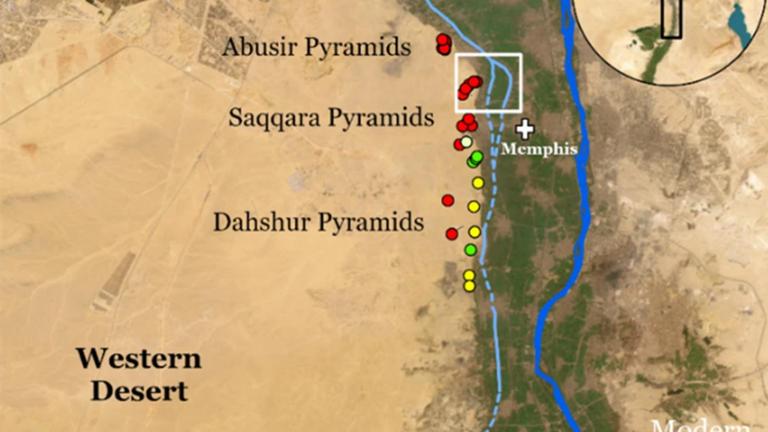
Het lichtblauwe lijntje is de oude zijtak van de Nijl, dicht bij enkele bekende sites met piramides en grafmonumenten liggen.
© Foto: Nature/UNCW

"Actief en operationeel"

De oude riviertak van de Nijl zou volgens de onderzoekers ongeveer 64 kilometer lang geweest zijn, en tussen de 200 en 600 meter breed. De waterweg liep dicht in de buurt van 31 piramides die tussen de 4.700 en 3.700 jaar geleden gebouwd zijn.

De nabijheid van de riviertak tot die sites suggereert dat de tak "actief en operationeel was tijdens de bouwfase van deze piramides", zegt het onderzoek. Op dat moment zouden de piramidevelden makkelijk bereikbaar zijn geweest via het water.

Het team kon bovendien vaststellen dat veel piramides verhoogde wegen hadden, die eindigden bij de veronderstelde oevers van de zijtak. Volgens hen ook een bewijs dat de rivier gebruikt werd voor het transport van materiaal.

Ahramat

De onderzoekers hebben de riviertak niet toevallig Ahramat genoemd, 'piramides' in het  Arabisch. Volgens hen kan de aanwezigheid van die tak een verklaring zijn voor de vele piramides tussen Gizeh en Lisht, op zo'n 60 kilometer van Caïro. In een periode van 1.000 jaar zijn daar tal van piramides en andere monumenten gebouwd, te beginnen vanaf 4.700 voor Christus.  

Vandaag liggen die sites in een dor en onherbergzaam gebied in de Sahara-woestijn. De onderzoekers vermoeden dat een toenemende ophoping van zand, samen met een enorme droogte die zo'n 4.200 jaar geleden begon, de reden zou kunnen zijn waarom de Ahramat-tak verdwenen is.

Professor Enam Ghoneim onderzoekt de topografie bij de oude riviertak, met op de achtergrond de piramide van Cheops en de sfinx in Gizeh.© Foto: Eman Ghoneim/UNCW

"Het kost gewoon veel minder moeite"

"Velen onder ons die geïnteresseerd zijn in het oude Egypte, zijn zich ervan bewust dat de Egyptenaren een waterweg gebruikt moeten hebben om hun enorme monumenten te bouwen, zoals de piramides en de tempels in de valleien", zegt hoofdonderzoeker Enam Ghoneim.

"Ons onderzoek toont de eerste kaart van een van de belangrijkste oude riviertakken van de Nijl op zo'n grote schaal, en kan die linken aan de grootste piramidevindplaatsen in Egypte."

Aan de Britse openbare omroep BBC vertelt co-auteur Suzanne Onstine over het belang van het lokaliseren van die riviertak. "Dat we gegevens hebben waaruit blijkt dat er een waterweg was die gebruikt kon worden voor het transport van zware blokken, uitrusting, mensen... Dat helpt ons echt om te helpen verklaren hoe piramides gebouwd zijn."

"De oude Egyptenaren konden de energie van de rivier gebruiken om zware blokken te dragen, in plaats van menselijke arbeid", zegt Ostine. "Het kost gewoon veel minder moeite".

Meer lezen?

  • Gondeim, E. et al. The E0gyptian pyramid chain was built along the now abandoned Ahramat Nile Branch. Gepubliceerd in Nature - Communications earth & environment.
Hoe vind je dit bericht?
Geschreven door peter om 18:44 Stuur door

Congressman moves to declassify UFO docs: 'If you got nothing to hide, release the files'

FIRST ON FOX: The U.S. government would have 270 days to release all UFO-related documents to the public if a new congressional bill is passed. 

Rep. Tim Burchett, R-Tenn., who has been a leading voice for UFO transparency, will introduce a new bill Thursday that would require President Biden to direct the heads of each federal department or agency to declassify all documents related to UAPs (unidentified anomalous phenomena), also known as UFOs. 

"It's simple. They spend all this time telling us they don't exist, then release the files, dagnabbit," Burchet told Fox News Digital in an interview, before introducing the "The UAP Transparency Act" on Thursday.

"I don't want some crazy, fancy name for it," he said. "I just want them to do exactly what the bill is about."

UNDERWATER UFOS DISPLAY CAPABILITY THAT ‘JEOPARDIZES' US MARITIME SECURITY,’ EX-NAVY OFFICER SAYS

Republican Tennessee Rep. Tim Burchett

Rep. Tim Burchett, R-Tenn., participates in a meeting of the House Oversight and Reform Committee in the Rayburn House Office Building on January 31, 2023, in Washington, D.C.  

(Kevin Dietsch/Getty Images)

Rep. Burchett has been at the forefront of the fight for UFO transparency, along with several other Republicans in the House and Senate, but there has been a bipartisan effort. 

Rep. Anna Paulina Luna, R-Fla., and Jared Moskowitz, D-Fla., are co-sponsors of the bill. 

In a previous interview, Burchett said he believes there has been a cover-up, and that tens of millions of dollars are being spent "on something that you say doesn't exist, (and) yet you continue spending the money on it. It makes you wonder."

The 1.5-page bill would not only force the president to direct federal agencies to declassify UFO-related files, but it would require the president to file quarterly reports that would update the House and Senate subcommittees on the progress toward releasing the information. 

"That's all it is," Burchett said. "It's about transparency."

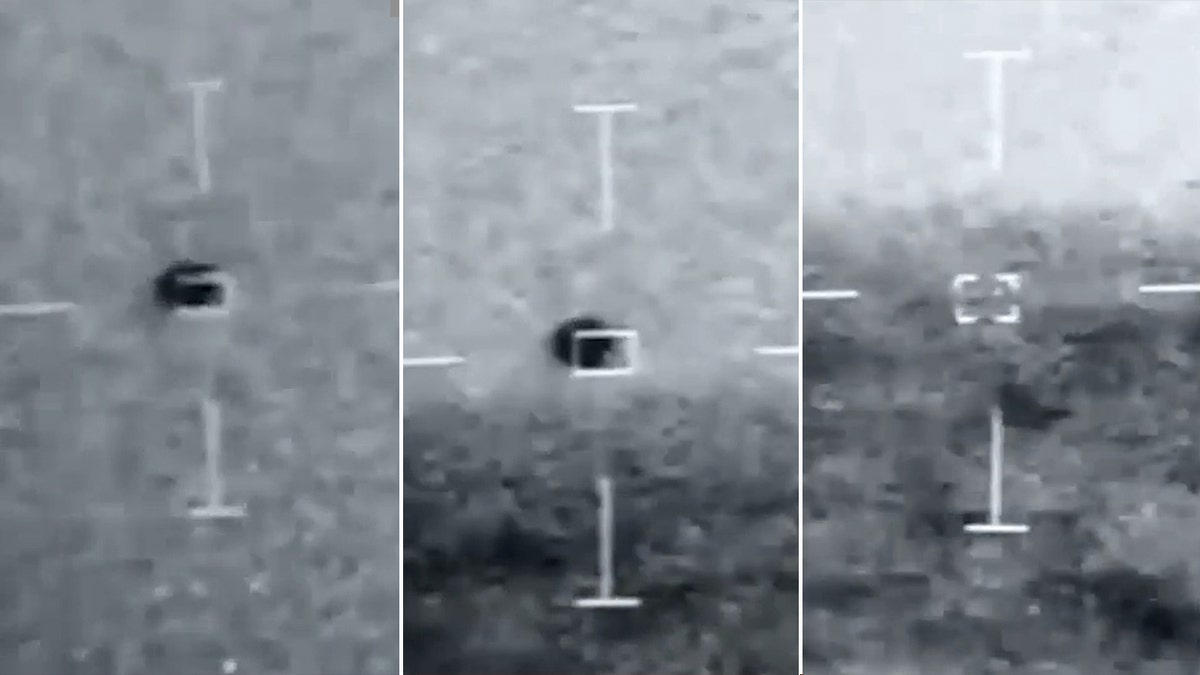
Recording of UFO flying by the USS Omaha off the coast of San Diego in July 2019 and then vanishing into the ocean without a splash or crash debris.

Recording of a UFO flying by the USS Omaha off the coast of San Diego in July 2019 and then vanishing into the ocean without a splash or crash debris. 

(Jeremy Corbell/Weaponized Podcast)

WATCH: 'JELLYFISH UAP' FLIES OVER IRAQ 

Burchett and other lawmakers have been frustrated by the bureaucrats' diversion tactics and stonewalling, while millions of dollars seemingly vanish into a black hole. 

"Like I said before, it's not about little green men or flying saucers," he told Fox News Digital in an April interview, "it's about tens of millions of dollars that our federal government is spending on something that at least some of the members of the federal government say does not exist. Yet, they will not release all the files."

To the Republican lawmakers' point, as recently as February 2021, an Intelligence Community Control Access program "was expanded to protect UAP reverse-engineering … without sufficient justification," the Pentagon's February report on UFOs said.

"This program never recovered or reverse-engineered any UAP or extraterrestrial spacecraft. This IC (intelligence community) program was disestablished due to its lack of merit," according to the report. 

"It's simple. They spend all this time telling us they don't exist, then release the files, dagnabbit."

— Rep. Tim Burchett

WATCH: REP. BURCHETT TALKS ABOUT WHY HE THINKS THERE'S A UFO COVER-UP

Last month, there were about a dozen people (including Burchett) in a SCIF, a sensitive compartmented information facility, about UFOs, which is a highly classified briefing, and he left feeling "discouraged, as all this other stuff is."

He didn't see why the information discussed in the SCIF couldn't have been discussed in a public setting. 

"I really think the whole thing is so compartmentalized that we'll never get to the bottom of it until you have a commander-in-chief who says enough is enough," he said.

CLICK TO GET THE FOX NEWS APP

Instead of waiting for the executive branch, this short but pointed bill would essentially merge all the compartmentalized federal agency files and dump them into one declassified pool of information. 

"We just got to put this stuff out. Let's clear the air. And let's move on," Burchett said. 

Chris Eberhart is a crime and US news reporter for Fox News Digital. Email tips to chris.eberhart@fox.com or on Twitter @ChrisEberhart48.

{ https://www.foxnews.com/ }

Hoe vind je dit bericht?
Geschreven door peter om 01:02 Stuur door

The Roswell incident: Did the US Government cover up an alien crash in 1947? The real history that challenges the conspiracy

The Roswell incident: Did the US Government cover up an alien crash in 1947? The real history that challenges the conspiracy

During the summer of 1947, flying saucers were capturing the world’s imagination against a backdrop of rising tensions between the United States and the Soviet Union. Then, a mysterious incident in Roswell, New Mexico, laid the foundations of a supposed cover-up – the full picture of which only came into focus decades later. In the second season of our Conspiracy podcast series, Rob Attar speaks to David Clarke and asks if visitors from outer space really did make contact at Roswell

Did a UFO crash as Roswell?

In the years immediately following the end of the Second World War, a spate of observations of mysterious airborne objects began to accumulate around the globe.

Similar Unidentified Flying Objects (UFOs) had been described by Allied pilots during the Second World War (the so-called ‘foo fighters’).

Alongside such aerial phenomena, the Nazi regime’s experimentation with rocket-propelled missiles (the V1 and V2 programmes), and its post-war appropriation by the Allies, launched a post-war revolution in weapons technology.

Amid rising Cold War tensions between the United States and the Soviet Union, anxiety over a missile gap soon led to an arms race, while wild rumours about the other’s technological innovation soon became rife.

But in 1947, these Earthly fears were eclipsed by a seemingly extraterrestrial ‘visitation’, which brought the city of Roswell, New Mexico, to the world’s attention.

The conspiracy theory: the US government covered up the crash of an alien spacecraft

In late June 1947, W W ‘Mac’ Brazel, a rancher living in New Mexico, discovered an unusual debris field on his land near Roswell.

Days later, he alerted the local authorities, who in turn notified Roswell Army Air Field (RAAF). Military personnel were dispatched to the location whereupon they supposedly recovered material from a damaged extraterrestrial spacecraft and even the bodies of its alien crew.

The base issued a statement confirming that a “flying disc” had been recovered in the vicinity and “inspected at the Roswell Army Air Field”. Yet the following day a correction was released that clarified the debris was in fact a downed weather balloon.

Decades later, in 1978, the so-called ‘Roswell incident’ returned to the spotlight. According to a whistle-blower who had been involved in the operation, the weather balloon story was a cover-up. Photographs of the balloon wreckage had been carefully staged, while the actual spacecraft was spirited away for investigation. At the same time, everyone connected to the incident was sworn to silence.

Conspiracy: A HistoryExtra podcast series

Member exclusive | Was the moon landing faked? Did Shakespeare actually write his plays? Were the pyramids built by aliens? Expert historians offer their perspectives on history's biggest conspiracy theories.

Listen to all episodes now

Researchers tracked down several witnesses who corroborated that a crashed alien spaceship had indeed been salvaged and taken to the enigmatic Area 51 in Nevada where technicians had subsequently reverse-engineered it for the US military.

Not only that, but it was said that extraterrestrial beings had been retrieved from the crash site and had been subjected to autopsies.

What is the source of the theory?

To understand the origins of the Roswell incident, historian and broadcaster, David Clarke, believes it is necessary to begin two weeks earlier on 24 June 1947 and over 1,000 miles northwest.

“Kenneth Arnold, who was a private pilot, was out flying a small aircraft over the Cascade [Range] mountains in Washington state,” says Clarke, who was speaking on our Conspiracy podcast series. “As he was flying towards Mount Rainier, in the distance he saw what he described as a formation of ‘strange aircraft’. They were flying in echelon formation, the way that geese or ducks [do].”Arnold reckoned that these strange vessels, which he later described as ‘batwing-shaped’, were travelling at supersonic speed. Incidentally, the sound barrier would not be broken until 14 October later that same year by US Air Force officer, Charles Yeager.

“He radioed Yakima airbase and when he landed … [it had been] transmitted all around the United States that this guy had seen some weird objects in the sky. He was surrounded by newspaper reporters,” says Clarke.

His description of the objects’ movement as being akin to a saucer skipping over a pond caught journalists’ imagination, who coined the term ‘flying saucer’.

“The story went viral to use a modern expression,” says Clarke.

“Within 48 hours of Kenneth Arnold reporting what he’d seen, flying saucers were on the newswires across the United States, across North America and Europe. And people started seeing and reporting saucer-shaped flying objects in the sky”.

It was during this craze that the RAAF dispatched Major Jesse Marcel and Captain Sheridan Cavitt to inspect the debris found near Roswell.

But whereas Cavitt maintained that the wreckage was ostensibly ‘normal’, Marcel convinced himself “that it was something very, very unusual and not something that was manufactured in the United States”, explains Clarke.

The reasons why the theory of the Roswell Incident took hold

The airbase’s correction, insisting that the discovery was in fact that of a weather balloon, negated the idea that something more peculiar had been found. That summer in New Mexico soon faded from popular memory – at least for the time being.

“I’ve got a huge collection of books on UFOs and flying saucers from the 1950s up to the present,” says Clarke, “the Roswell incident is not mentioned in any of those books and articles and magazines during the 1950s, during the 1960s”.

Decades later, after trust in the US government had been badly damaged in the wake of the JFK assassination and the unpopular Vietnam War, a more cynical audience was primed to reconsider the official narrative around the Roswell incident.

Clarke believes that this context is the reason why the 1980 book The Roswell Incident by Charles Berlitz and William Moore was so successful in introducing the idea of a government cover-up.

“They went and re-interviewed some of the people who were there at the time. Jesse Marcel, for instance – there’s no other way to describe him – he was a UFO believer. He bought into the idea that flying saucers were craft from outer space,” says Clarke.

According to conspiracists like Marcel, the cover-up even entailed intimidating would-be whistle-blowers with murder: “‘Bullets are cheap’ was the phrase that was used,” explains Clarke.

“There are people who worked in the morgue at Roswell [who] said that they remembered this truck turning up with armed guards and these small bodies of creatures being offloaded”.

By the end of the 20th century, the Roswell incident had acquired an iconic status within the ufology community but also within popular culture generally. During the 1990s, the conspiracy was woven into the X-Files TV drama series and the blockbuster movie, Independence Day.

“That shows how much it’s become a part of the collective American imagination – almost to rival the JFK conspiracies,” says Clarke.

The evidence that debunks the Roswell Incident

The UFO ‘wreckage’ that Brazel came across on his ranch – and later confirmed by Cavitt – consisted of balsa wood, tinfoil, metal strips and other detritus.

As was officially established that summer, these materials, though certainly incongruous to the location in which they were found, were the remnants of a high-altitude balloon.

Clarke points out that “there was a cover-up in some respects, in that when they announced that this thing that had been found was just a weather balloon that wasn’t true because it wasn’t just a weather balloon, it was [part of] a top secret balloon experiment”.

In 1994, the US Congress launched an official investigation into the events of summer 1947. Its conclusions formed part of a two-volume report that revealed that a highly clandestine operation code-named ‘Mogul’ had been conducted at the time from Alamogordo Army Air Field, less than 150 miles west of Roswell.

“The US Navy and the CIA were launching enormous balloon trains from Alamogordo. Everyone will remember at the beginning of 2023, the Chinese spy balloon that was shot down by the US Air Force. A very similar thing was going on in 1947,” says Clarke, citing a recent incident that sparked speculation about alien aircraft visiting Earth.

With the Cold War just getting underway at the time, the US was keen to establish whether the Soviets were conducting nuclear tests.

“They were sending these enormous balloons up,” explains Clarke, “and they were riding the jet stream across the Atlantic, and they had a gondola underneath with cameras inside and a radiosonde where they could track the balloons”.

“One of these balloon trains in the logbook from Alamogordo was lost in the desert shortly before the debris [at Brazel’s ranch] was found,” says Clarke – though he stresses that a direct link between the two cannot be definitively made despite the circumstances.

A few years later, in 1997, the US Air Force published another report. One of its findings attributed the reports about humanoid ‘creatures’ turning up at facilities in and around Roswell to false memories.

According to Clarke, the report “tried to explain where some of the ideas about bodies being retrieved from the desert came from”.

As part of that later investigation, “it turned out that they were actually throwing dummies from aircraft over the desert”.

These tests were part of a secret programme to assess the effect on the human body if pilots ejected from aircraft and fell from high altitudes.

For Clarke, the Roswell incident also bears many of the age-old tropes about celestial visitors descending to Earth in a revelatory fashion.

“Effectively you could see the aliens in the flying saucer as being representative of gods or angels coming to give us their sacred knowledge. And they always crash in a remote area. They’re never crashing in Tunbridge Wells or anywhere like that. It’s always some remote area of desert”.

More than this, Clarke asserts that Roswell became an urban legend for the atomic age and that its DNA is typical of American folklore.

He cites the case of Aurora, Texas – where, in 1897, a UFO allegedly collided with a windmill. The locals “retrieved the body of this Martian pilot, buried it in the local cemetery, and they retrieved bits of metal from this airship that had hieroglyphics on it”.

Clarke says that this was in fact a hoax concocted to attract visitors to the small town after the railway had bypassed it, and he notes that the story is almost “a carbon copy of the Roswell incident”.

Perhaps the most expedient angle on Roswell is that the longevity of this conspiracy theory serves the US military’s interests and may even explain why some ex-military and ex-intelligence personnel have gone on record to suggest that extraterrestrials crashed there in 1947.

For example, ongoing rumours about Area 51 and the back-engineering of otherworldly technology makes for a formidable strategy.

“There’s no two ways about it that there’s some very good evidence that they just encourage that story because it’s a useful disinformation tool against an enemy … don’t mess with us because we’ve got alien technology,” says Clarke.

As conspiracy theories go, he believes that Roswell is among the more ‘harmless’ ones. “The idea that out there in the cold dead Universe there is someone who is interested in us, that we’re not alone, that they’re going to come and save us, that’s quite a comforting thought,” says Clarke, “and I think that out of all the conspiracy theories and myths, this is probably the most positive one of all”.

Earlier this year the US Government admitted that it has developed, tested and flown prototype aircraft some of which have been seen and reported as UFOs.

The Pentagon said “some of these systems had a ‘saucer’ or triangle-shaped appearance and were capable of hovering aloft”.

The US Department of Defence’s All Domain Anomaly Resolution Office (AARO), released the first volume of its historical investigation of UAP (unidentified anomalous phenomena) in February.

The report traces military technology linked to UFOs back to the end of the second world war and the famous Roswell incident of 1947. It says that all the evidence points to “misidentified authentic highly sensitive national security programs”.

{ https://www.historyextra.com/ }

Hoe vind je dit bericht?
Geschreven door peter om 00:41 Stuur door

New Research Provides Insights into Evolutionary History of Baobabs

New Research Provides Insights into Evolutionary History of Baobabs

Madagascar is the most plausible center of origin for the iconic baobabs, also known as upside-down trees, or the tree of life, according to new research.

The baobab tree in Senegal. Image credit: Viajesunion2.

The baobab tree in Senegal.

Image credit: Viajesunion2.

The genus Adansonia, better known as the baobabs and ‘mother of the forest’, has captivated botanists, tourists, naturalists and passers-by for centuries.

Probably the earliest record of humans marveling at these amazing trees can be traced back to the Ancient Egyptians, around 2,300 BCE.

With their grotesque appearance, enormous size, reputed longevity and diverse uses, baobabs have become one of the most charismatic species on our planet.

Embedded in folklore and tradition, baobabs have inspired innumerable pieces of art and have been associated with human settlements and cultures over millennia.

Adansonia comprises eight morphologically distinct species: one widespread across Africa, one located in Northwestern Australia, and the other six endemic to Madagascar.

However, owing to the lack of fossil evidence, there has been a long-running debate about where the baobabs originated.

“Our work has uncovered new insights into the patterns of speciation in baobabs and shows how climate change has influenced baobab distribution and speciation patterns over millions of years,” said Dr. Ilia Leitch, a researcher Royal Botanic Garden Kew.

Dr. Leitch and his colleagues conducted genomic analyses of all eight baobab tree species and combined these datasets with ecological analyses.

The analyses indicate that the stem lineage of Adansonia originated around 41 million years ago and diversified around 20 million years ago.

The researchers found that the historical population dynamics of baobabs are closely related to both interspecific competition and geological changes in Madagascar, especially the change in sea level.

Based on data including phylogenetic relationship, gene flow and genetic diversity of different baobab species, they suggest that the hypothesis of Madagascar as the center of origin for baobabs offers the most reasonable explanation of the current data, as opposed to the hypotheses for mainland Africa and Australia.

The findings also enabled the scientists to re-evaluate the conservation strategies and status of baobabs.

For example, they propose that a higher conservation status should be assigned to the two endangered Malagasy baobab species, Adansonia suarezensis and Adansonia grandidieri.

High levels of inbreeding, low genetic diversity and declining population size all suggest that these endangered species are lacking in resilience to ecological perturbations and will potentially be under severe threat from climate change.

“We were delighted to be involved in this project uncovering patterns of baobab speciation in Madagascar followed by the astonishing long-distance dispersal of two species, one to Africa and another to Australia,” said Professor Andrew Leitch, a researcher at Queen Mary University of London.

“This was accompanied by the evolution of some fascinating pollination syndromes involving hawkmoths, lemurs and bats.”

  • The study was published in the journal Nature.
  • JN. Wan et al. The rise of baobab trees in Madagascar. Nature, published online April 19, 2024; doi: 10.1038/s41586-024-07447-4

{ https://www.sci.news/ }

Hoe vind je dit bericht?
Geschreven door peter om 23:01 Stuur door

An extinction threat to many species "The coming magnetic pole shift"

An extinction threat to many species "The coming magnetic pole shift"

The concept that CO2 and climate change are political fabrications is often propagated by those who believe powerful entities are behind the so-called global warming hoax, aiming to convince the public that human activities are to blame. However, it is argued that climate change is a natural process, similar to events that have occurred throughout history. The video below by Suspicious0bservers provides a detailed analysis of the actual causes of current planetary changes and offers insights into what we might expect in the coming years. 
magnetic%20pole%20shift.png

The most recent complete magnetic pole reversal, known as the Brunhes-Matuyama reversal, occurred approximately 780,000 years ago. During this event, Earth's magnetic poles switched places. These reversals are part of Earth's natural geomagnetic processes and occur irregularly over geological timescales. 
However, there have been shorter, less complete shifts called geomagnetic excursions. One of the notable recent geomagnetic excursions is the Laschamp event, which occurred about 41,000 years ago. During this event, the magnetic field weakened significantly, and the poles nearly reversed before returning to their original configuration. 
Now, Earth is currently undergoing a cyclical magnetic pole shift, known as a geomagnetic excursion. This movement has been accelerating in recent decades, particularly with the North Magnetic Pole rapid movement from the Canadian Arctic towards Russia, which poses a significant extinction threat to many species. 
The weakening of Earth's magnetic field and the shifting of its magnetic poles are well-documented phenomena. 
In 2000, NASA and geophysicists reported a 10% decline in the magnetic field's strength. By 2010, the European Space Agency's Magnetic Mission updated this figure to a 15% loss, noting an acceleration from a 5% loss per century to 5% per decade. By 2020, another 5% decline was recorded, and the 2023 interpolated value showed further acceleration. The initial 10% reduction took 150 years, but the next 10% occurred within just 20 years. If this acceleration continues, we could lose 5% of the magnetic field every five years. 
We anticipate a 50% reduction in the magnetic field by the early 2030s, a level that could make our technological lifestyle unsustainable and lead to severe weather impacts. Around 2040, a full magnetic pole flip or geomagnetic excursion is expected, although this could occur a few years earlier or later. 
A critical concern in the coming years is the loss of ozone due to particle-driven molecular destruction, coupled with increased exposure to cosmic ray space radiation. This scenario would result in climate chaos and heightened radiation exposure. The only defense against these effects is Earth's magnetic field, which is currently weakening due to the ongoing pole shift. 
Recent studies consistently show that magnetic reversals and pole shifts are extreme environmental events that significantly impact the biosphere. The primary drivers of these impacts are increased radiation and ozone depletion. Numerous studies confirm that solar protons, electrons, and cosmic rays are penetrating the atmosphere more effectively due to the weakening magnetic field, reaching critical levels. 
This increased radiation has two main effects: ozone destruction allows more ultraviolet (UV) light into Earth's system, raising temperatures, and cosmic rays intensify extreme weather events, including heatwaves, cold snaps, storms, flooding, and droughts. 
These changes not only affect the climate but also harm living organisms. Extra UV light is dangerous for animals, plants, and microorganisms, including oceanic plankton and chlorophyll-based food chains. Cosmic rays similarly amplify particle radiation's detrimental effects, causing cancer, cellular dysfunction, and DNA mutations. 
Scientists clearly recognize that cyclical magnetic pole shifts pose significant challenges to life on Earth. Humans will face these challenges both directly and through their impact on the food chain.  
Moreover, our dependence on electricity makes us particularly vulnerable. A weakened magnetic field could allow solar activity to disrupt power grids, resulting in widespread loss of heat, water treatment, food transport, communication, and critical infrastructure. 
This growing issue highlights the planet's increasing vulnerability as it loses its protective magnetic shield.
  

{ https://ufosightingshotspot.blogspot.com/ }

Hoe vind je dit bericht?
Geschreven door peter om 22:10 Stuur door

Bijzondere zeedieren: de verbazingwekkende wonderen van de diepe oceaan

Bijzondere zeedieren: de verbazingwekkende wonderen van de diepe oceaan

 Bijzondere zeedieren: de verbazingwekkende wonderen van de diepe oceaan

©Shutterstock

Bijzondere zeedieren: de verbazingwekkende wonderen van de diepe oceaan
Het is bekend dat Australië enkele van de meest spectaculaire wilde dieren ter wereld heeft, vooral als het gaat om diepzeedieren. Er is een reden waarom het een van de populairste bestemmingen is voor duikers! Het Groot Barrièrerif alleen al herbergt meer dan 1.500 vissoorten en in heel Australië leven er meer dan 4.000. Velen van hen vindt je nergens anders ter wereld en sommige zien eruit als buitenaardse wezens.

Klik verder om enkele van de vreemdste, engste en kleurrijkste zeedieren van Australië te zien

Enypniastes eximia

©Getty Images

Enypniastes eximia
In het Engels noemen ze dit interessante wezen ook wel letterlijk de 'Spaanse dansende zeekomkommer' of het 'kippenmonster zonder kop'. Het heeft zwemvliezen waarmee ze van de oceaanbodem naar boven drijven en vervolgens weer terugkeren naar de oceaanbodem om zich te voeden. Sommigen hebben een transparant lichaam waarin de darmen zichtbaar zijn. Ook kunnen ze bioluminescerend zijn.

Zeelelie

©iStock

Volwassenen
Volwassen zeelelies zitten met een steel vast aan de zeebodem. Ongesteelde zeelelies worden ook wel veersterren of haarsterren genoemd.

Micromelo undatus

©Shutterstock

Micromelo undatus
Dit dier staat bekend om zijn helderblauwe en witte kleur en zijn schelp met bruine lijnen.

Slakkensoort

©Shutterstock

Slakkensoort
Het is een zeldzame slak die leeft op rotsachtige riffen tot wel 5 meter diep.

Austrodromidia octodentata

©Shutterstock

Austrodromidia octodentata
Sponskrabben (ook wel: wolkrabben) zijn anders dan andere krabben: in plaats van zichzelf te beschermen met harde pantsers, camouflage of scharen, hebben ze sponzen op hun lichaam. Misschien dienden ze wel ter inspiratie voor 'SpongeBob SquarePants'?

Psychrolutes marcidus

©Shutterstock

Psychrolutes marcidus
De blobvis is misschien wel de lelijkste vis op aarde. Het is een diepzeevis die doorgaans wordt aangetroffen rond de kust van Australië en Nieuw-Zeeland.

Uiterlijk

©Shutterstock

Uiterlijk
Als gevolg van decompressie zien ze er wanneer ze uit diep water naar de oppervlakte stijgen bolvormig en gelatineachtig uit.

Achaeus japonicus

©Shutterstock

Achaeus japonicus
Deze krabben zijn klein van formaat (slechts 2 centimeter) en hebben een unieke roestbruine laag met zachte haartjes over hun hele lichaam, waardoor ze niet veel verschillen van de op takken levende orang-oetans die in de oerwouden van Borneo worden aangetroffen.

Indonesië

©Shutterstock

Indonesië
In het Engels worden deze dieren soms letterlijk 'orang-oetan-krabben' genoemd. Net als bij de aap is de naam van deze krab afgeleid van de Indonesische woorden voor 'bosmens' (oran hutan). Deze dieren zouden we dus als de 'boswezens' van de zee kunnen zien.

Pezichthys amplispinus

©Getty Images

Pezichthys amplispinus
Over deze vis, die alleen in Australië te vinden is, zei de Franse zeeman Nicolas Baudin in 1802: "De voorste vinnen van deze vis lijken net handen."

'Handvissen'

©Shutterstock

'Handvissen'
Hoewel ze vreemde kleuren en vormen hebben, hebben ze allemaal gemeen dat ze over vinnen beschikken die op handen lijken.

Slangsterren

©Shutterstock

Slangsterren
Slangsterren zijn nauw verwant aan zeesterren en hebben meestal vijf lange armslierten die wel 60 cm lang kunnen worden.

Bioluminescentie

©Shutterstock

Bioluminescentie
Er zijn meer dan 60 soorten slangsterren die bioluminescent (lichtgevend) zijn. Sommige soorten geven groen licht af, waar andere blauw licht afgeven.

Zeespinnen

©Shutterstock

Zeespinnen
Deze wezens zijn enger dan de gemiddelde geleedpotige op het land. Kijk maar eens naar hun kleine lichamen en extreem lange poten.

Pindaworm

©Shutterstock

Pindaworm
De pindaworm kan in sommige gevallen wel 72 cm lang worden en wordt meestal aangetroffen in ondiepe wateren.

Reuzenbekhaai

©Getty Images

Reuzenbekhaai
De reuzenbekhaai is een zeldzame en unieke haaiensoort. Er werd er een gevonden in Australië – de derde ooit in de geschiedenis.

Parelvissen

©Shutterstock

Parelvissen
Er zijn 31 soorten parelvissen. Door hun slanke lichaam kunnen ze in de lichaamsholten van ongewervelde dieren leven. Vreemd genoeg leven sommige soorten uitsluitend in de anussen van zeekomkommers. Lekker!

Koekjessnijder

©Getty Images

Koekjessnijder
De koekjessnijder behoort tot de familie van de doornhaaien. De haai staat bekend om zijn eetgewoonte waarbij hij visvlees in ronde stukken (in de vorm van koekjes) uitbijt.

Driepootvis

©Shutterstock

Driepootvis
Een driepootvis of statiefvis kan 43 cm lang worden. Bovendien heeft hij lange, dunne stralen onder zijn buikvinnen en staartvin die wel 1 meter lang zijn. Met zijn drie poten staat hij als een soort statief op de bodem van de oceaan!

{ https://www.msn.com/nl-be/  }

Hoe vind je dit bericht?
Geschreven door peter om 21:33 Stuur door

The Joe Rogan Experience: George Knapp on Alien Abductions and Paranormal Phenomena

The Joe Rogan Experience: George Knapp on Alien Abductions and Paranormal Phenomena

In a compelling episode of The Joe Rogan Experience, investigative journalist George Knapp discusses the eerie and often disturbing events at the infamous Skinwalker Ranch. This episode sheds light on a series of bizarre and unexplained phenomena, ranging from alien abductions to paranormal activities, that have plagued the ranch for decades.

Unexplained Auditory and Visual Disturbances

Residents and investigators at Skinwalker Ranch have reported hearing strange voices speaking in unknown languages and seeing large, humanoid shapes lurking outside their windows at night. These auditory phenomena were often accompanied by visual disturbances, such as mysterious shapes and lights. One rancher, initially suspecting government involvement, armed himself and patrolled the property only to realize that the source of these disturbances was something far more enigmatic and possibly extraterrestrial.

Chilling Animal Mutilations

Animal mutilations are among the most unsettling events at Skinwalker Ranch. Cows, cats, and dogs were found with precise, surgical mutilations. Often, these animals were discovered in places where tracks leading to or from the scene were nonexistent. The surgical nature of these mutilations suggested the use of advanced technology, pointing to an intelligence beyond known human capabilities. The animals appeared to be cut up with extreme precision, leading to speculation about extraterrestrial involvement.

UFO Encounters

The ranch has been a hotspot for numerous UFO sightings. Witnesses have reported seeing various types of unidentified flying objects, including lights that resembled headlights, which then ascended into the sky and vanished. Orbs of different colors—white, blue, and red—were also observed, with the blue orbs in particular inducing intense fear in both animals and humans. These orbs seemed to be intelligently controlled, further complicating the already perplexing situation at the ranch.

The Disappearance and Reappearance of Bulls

One of the most baffling incidents involved the sudden disappearance of four prized bulls. These large animals, each weighing around 2,000 pounds, were inexplicably found crammed into a small, locked trailer. The corral around the trailer was magnetized, suggesting the use of advanced technology. This event highlighted the mysterious forces at play and raised questions about the nature of the phenomena affecting the ranch.

Intensive Investigations and Elusive Evidence

The National Institute for Discovery Science (NIDS), funded by aerospace entrepreneur Robert Bigelow, conducted extensive investigations at Skinwalker Ranch. Despite their efforts, the phenomena remained elusive, often evading documentation. Cameras would malfunction or be destroyed, and evidence was hard to come by. The intelligence behind these events seemed to be playing a cat-and-mouse game with the investigators, demonstrating its presence while avoiding capture on film or in photographs.

The Mutilation of a Calf

A particularly horrifying incident involved the mutilation of a calf. Within a brief period, the calf was found completely stripped of flesh and blood, with no tracks or signs of human or animal interference. The meticulous nature of the mutilation, with not a drop of blood left behind, suggested the use of advanced or extraterrestrial technology. This incident, documented with photographs and videos, provided some of the most compelling evidence of the strange activities at the ranch.

Theories and Speculations

The phenomena at Skinwalker Ranch have led to numerous theories and speculations:

  • Extraterrestrial Experimentation: The precision of the mutilations and the advanced technology involved suggest that extraterrestrial beings might be conducting biological or environmental experiments.
  • Interdimensional Beings: The ability of the phenomena to appear and disappear, as well as manipulate physical objects, suggests the possibility of interdimensional beings interacting with our reality.
  • Government Experiments: The advanced technology and lack of concrete evidence might also point towards secret government experiments involving psychological operations or advanced robotics.

VIDEO:

  • JRE: How Aliens Abducted Humans!

The episode featuring George Knapp on The Joe Rogan Experience provides a gripping account of the mysterious and often terrifying phenomena at Skinwalker Ranch. The lack of concrete evidence and the evasive nature of the activities make it a challenging subject to study and understand. However, the consistency of reports from various witnesses and investigators suggests a significant and unexplained presence or activity at the ranch. This episode underscores the need for continued investigation and open-mindedness when it comes to understanding the unknown forces that may be at work.

{ https://www.latest-ufo-sightings.net/ }

Hoe vind je dit bericht?
Geschreven door peter om 17:21 Stuur door

Ex-Pentagon David Grusch: ‘We Have Dead Pilot Bodies From Extraterrestrial Craft’

David Grusch UFO testimony

Ex-Pentagon David Grusch: ‘We Have Dead Pilot Bodies From Extraterrestrial Craft’

Nobody would have ever thought that an individual from the US military with high credibility can come out and say we have partially intact extraterrestrial crafts. David Charles Grusch, a Former UAP Task Force member and US Air Force veteran, claims that the government, its allies, and defense contractors have been recovering partial fragments and intact vehicles related to these phenomena for decades.

According to Mr. Grusch, analysis of these objects has revealed their “exotic origin” and suggests the presence of non-human intelligence, whether extraterrestrial or of unknown origin. This determination is based on vehicle morphologies, material science testing, unique atomic arrangements, and radiological signatures.

Leslie Kean and Ralph Blumenthal, the New York Times reporters, are the first people who broke the story of Mr. Grusch. On June 5, 2023, they published an exclusive article in The Debrief, stating Mr. Grusch gave Congress and the Intelligence Community Inspector General extensive classified information about deeply covert programs that he says possess retrieved intact and partially intact craft of non-human origin.

In an exclusive interview with investigative journalist Ross Coulthart, Grusch, a 36-year-old Air Force veteran, exposed the top-secret military program that allegedly discovered fully intact UFO wreckage. During the interview, Mr. Grusch made bold claims about the existence of UFOs and their non-human origin.

He stated: “UFOs exist. The U.S. government found quite a number of them, and they are indeed of non-human origin.” Mr. Grusch’s assertions are supported by his insider knowledge as a former member of the U.S. government’s Unidentified Aerial Phenomena task force and the National Geospatial Intelligence Agency.

Mr. Grusch discussed the classified nature of the program, saying: “For years, there have been whispers and rumors that the government had aircraft of non-human origin. This report is the first evidence it might be true.” He emphasized the secrecy surrounding the program, claiming that much of the information has been kept hidden from Congress and the public.

In the interview, Mr. Grusch described the retrieval of non-human origin technical vehicles, referring to them as spacecraft. He explained: “These are retrieving non-human origin technical vehicles, you know, call it spacecraft if you will. Non-human exotic origin vehicles that have either landed or crashed.” When asked about the number of such craft, Mr. Grusch astonishingly replied, “Quite a number. [You’re kidding?] No, I thought it was totally nuts at first.”

Mr. Grusch revealed that his initial skepticism had been challenged when current and former senior intelligence officers confided in him about their involvement in the program. He stated: “They approached me. I have plenty of current and former senior intelligence officers that came to me, many of whom I knew almost my whole career, that confided to me they were part of a program.” He also mentioned receiving oral testimony, documents, and other proof supporting the existence of the program.

During the interview, Mr. Grusch spoke about the potential cover-up and disinformation campaign surrounding UFOs. He claimed: “There’s a sophisticated disinformation campaign targeting the U.S. populace, which is extremely unethical and immoral.” Mr. Grusch emphasized the significance of his revelations, stating, “I am for real, and I’m sitting here at great personal risk and obvious professional risk by talking to you today.”

“Do we have bodies? Do we have species?” Coulthart asked. “Well, naturally when you recover something that’s either landed or crashed, sometimes you encounter dead pilots.” “And believe it or not, as fantastical as that sounds, it’s true,” Mr. Grusch replied.

While Mr. Grusch’s claims are extraordinary, journalist Leslie Kean stated: “I believe it because of all the sources I have who have told me the same thing. So who am I to doubt these very, very high-level people who have been inside these programs for decades?” Kean emphasized that Grusch’s credibility is further bolstered by the fact that multiple high-ranking individuals have publicly vouched for him.

Despite Grusch’s testimony and the support he has garnered, the Pentagon released a statement in response to the report. The statement from the Pentagon’s All Domain Anomaly Resolution Office (ARRO) said that no verifiable information has been discovered to substantiate claims of past or current programs involving extraterrestrial materials. However, ARRO acknowledged ongoing investigations and welcomed individuals with relevant information to come forward.

Soon after The Debrief’s exclusive publication on Mr. Grusch, Dutch website REVU journalist Max Moszkowicz disclosed that David Grusch has documents signed by the inspector general, indicating that one of the UFOs in US Holding was found in Sicily, Italy and taken from Mussolini during WW2.

Moszkowicz stated that in 1933, fascist dictator Benito Mussolini was briefed by his secret service about a crashed air vehicle that was not recognized as human. It is suggested that the Italians initially believed the UFO to be a secret weapon from Germany, but it was later discovered to be of unknown origin. The object was studied in an Italian variant of Area 51 and eventually transported to the United States, possibly to Area 51/S-4.

Read also:

The claims of the UFO coverup directly come from the documents released from Mussolini’s office. According to them, Mussolini took all measures to silence the witnesses and classified the craft as top secret. Studying the craft was Mussolini’s next top objective. The best engineers and scientists in Italy came together to form a top-secret organization that was allegedly commanded by radio inventor and renowned engineer Guglielmo Marconi. (Click here to read the full article)

In an interview with Moszkowicz, a former AATIP Director Lue Elizondo gave this rumor some credit by saying he had seen documents from Mussolini’s office that he had found “compelling” before theorizing (as per the rumor) that pieces of the craft were transported to the USA. Mr. Sharp claimed that he has a source in the aerospace industry who told Liberation Times that something was recovered from Italy following World War II.

In an interview with French paper le Parisien, Mr. Grusch claims that the United States and its allies have been involved in secret programs for almost ninety years, recovering fragments and intact non-human objects. These objects have been subjected to analysis, which has provided proof of their non-human origin.

When asked about the origin of these objects, Mr. Grusch suggests they could be extraterrestrial or from other dimensions as described by quantum mechanics. He mentions that he has not seen enough data to determine the exact origin and believes that the U.S. government likely possesses more information on the matter.

Grusch reveals that one of the recovered “ships” was found in Italy in 1933. It was described as a bell-like craft, approximately ten meters in size, and was kept by Mussolini’s government until 1944 when it was recovered by agents of the Office of Strategic Services (OSS). Mr. Grusch states that this particular case predates well-known incidents like Roswell. He indicates that he was authorized to talk about it by the Department of Defense’s Office of Prepublication and Security Review.

Regarding his concerns about conspiracy theories, Grusch acknowledges the possibility of encouraging unfounded theories but points out that what was once a conspiracy theory has turned out to be true in this case.

Although Grusch mentions having seen interesting things that he is not currently authorized to discuss publicly, he confirms the involvement of a handful of U.S. subcontractors in reverse engineering, primarily from the Five Eyes alliance countries (Canada, the UK, Australia, and New Zealand). He suggests that the potential uses of the studied materials could benefit advanced space programs, materials science, and other applications related to climate or health.

Mr. Grusch mentions that his freedom of speech is still limited by his confidentiality agreement with the U.S. government, preventing him from discussing classified information. He indicates that he has faced reprisals after alerting the Department of Defense Inspector General in 2021 but cannot provide many details due to the ongoing investigation.

When asked about his personal safety, Grusch acknowledges past threats and the risks involved in remaining anonymous or becoming a public figure. Despite the risks, he believes it is worth raising awareness and push for answers from elected representatives and the president. He plans to publish more information in the future and establish a non-profit foundation to facilitate scientific research and protocols on this subject within the university system.

{ https://www.howandwhys.com/ }

Hoe vind je dit bericht?
Geschreven door peter om 00:54 Stuur door

Ontdekking op onze buurplaneet kan hoop bieden op voorwaarden voor leven

Ontdekking op onze buurplaneet kan hoop bieden op voorwaarden voor leven

Wetenschappers vinden de ontdekking van een bepaald element in gesteente op Mars opmerkelijk.

Gale-krater op Mars.

In 2012 stuurde NASA de rover Curiosity naar Mars om de Galekrater te onderzoeken.

© NASA/JPL-Caltech/MSSS

Al meer dan 10 jaar rijdt NASA’s Marsrover Curiosity rond om monsters te nemen van grond en gesteente. Zo wil NASA erachter komen of de omstandigheden op de planeet ooit gunstig waren voor leven.

In 2018 vond de rover moleculen die belangrijke bouwstenen zijn voor leven zoals we dat op aarde kennen.

En nu heeft de Curiosity mineralen in gesteente ontdekt die lijken op mineralen op aarde, wat bewijs kan zijn dat Mars vroeger leven kon herbergen.

Hoge concentraties gevonden

De onderzoekers beschrijven dat er een ongewoon hoog gehalte van het element mangaan is gevonden.

In het artikel, dat is gepubliceerd in het tijdschrift JGR Planet schrijven ze dat die hoge concentraties zijn gevonden in een gebied waar volgens hen ooit een meer was.

In een persbericht zegt Patrick Gasda van Los Alamos National Laboratory dat ze niet hadden verwacht mangaan in zulke hoge concentraties aan te treffen.

Hij legt uit dat afzettingen zoals ze die op Mars hebben gevonden op aarde voorkomen omdat er een hoog zuurstofgehalte is.

‘Op Mars is er geen bewijs van leven, en de mechanismen om zuurstof in de atmosfeer te produceren zijn onduidelijk. Hoe mangaanoxide is ontstaan en hoe de concentratie ervan is toegenomen, is een mysterie,’ schrijft Gasda.

Gesteente onthult leefbaar milieu

De metingen in Galekrater zijn gedaan met de Chemcam-apparatuur van de Curiosity.

‘Het milieu bij het Galemeer lijkt verrassend veel op bepaalde plaatsen op aarde, wat suggereert dat het leefbaar kan zijn geweest,’ voegt de leider van het Chemcam-onderzoek, Nina Lanza, eraan toe.

Ze legt uit dat mangaanmineralen vaak worden aangetroffen aan de oevers van ondiepe meren, maar dat het een opmerkelijke vondst is in oud gesteente op Mars.

{ https://wibnet.nl/heelal }

Hoe vind je dit bericht?
Geschreven door peter om 23:35 Stuur door

TRAPPIST-1 Outer Planets Likely Have Water

Three of the TRAPPIST-1 planets – TRAPPIST-1e, f and g – dwell in their star’s so-called “habitable zone. CreditL NASA/JPL

TRAPPIST-1 Outer Planets Likely Have Water

The TRAPPIST-1 solar system generated a swell of interest when it was observed several years ago. In 2016, astronomers using the Transiting Planets and Planetesimals Small Telescope (TRAPPIST) at La Silla Observatory in Chile detected two rocky planets orbiting the red dwarf star, which took the name TRAPPIST-1. Then, in 2017, a deeper analysis found another five rocky planets.

It was a remarkable discovery, especially because up to four of them could be the right distance from the star to have liquid water.

The TRAPPIST-1 system still gets a lot of scientific attention. Potential Earth-like planets in a star’s habitable zone are like magnets for planetary scientists.

Finding seven of them in one system is a unique scientific opportunity to examine all kinds of interlinked questions about exoplanet habitability. TRAPPIST-1 is a red dwarf, and one of the most prominent questions about exoplanet habitability concerns red dwarfs (M dwarfs.) Do these stars and their powerful flares drive the atmospheres away from their planets?

New research in the Planetary Science Journal examines atmospheric escape on the TRAPPIST-1 planets. Its title is “The Implications of Thermal Hydrodynamic Atmospheric Escape on the TRAPPIST-1 Planets.” Megan Gialluca, a graduate student in the Department of Astronomy and Astrobiology Program at the University of Washington, is the lead author.

Most stars in the Milky Way are M dwarfs. As the TRAPPIST-1 makes clear, they can host many terrestrial planets. Large, Jupiter-size planets are comparatively rare around these types of stars.

ssc2017-01f_Sm.jpg

artist concepts of the seven planets of TRAPPIST-1 with their orbital periods, distances from their star, radii and masses as compared to those of Earth. Credit: NASA/JPL

It’s a distinct possibility that most terrestrial planets are in orbit around M dwarfs.

But M dwarf flaring is a known issue. Though M dwarfs are far less massive than our Sun, their flares are way more energetic than anything that comes from the Sun. Some M dwarf flares can double the star’s brightness in only minutes.

Another problem is tidal locking. Since M dwarfs emit less energy, their habitable zones are much closer than the zones around a main sequence star like our Sun. That means potentially habitable planets are much more likely to be tidally locked to their stars.

That creates a whole host of obstacles to habitability. One side of the planet would bear the brunt of the flaring and be warmed, while the other side would be perpetually dark and cold. If there’s an atmosphere, there could be extremely powerful winds.

“As M dwarfs are the most common stars in our local stellar neighbourhood, whether their planetary systems can harbour life is a key question in astrobiology that may be amenable to observational tests in the near term,” the authors write. “Terrestrial planetary targets of interest for atmospheric characterization with M dwarf hosts may be accessible with the JWST,” they explain. They also point out that future large ground-based telescopes like the European Extremely Large Telescope and the Giant Magellan Telescope could help, too, but they’re years away from being operational.

This is an artist's impression of the TRAPPIST-1 system, showing all seven planets. Image Credit: NASA This is an artist’s impression of the TRAPPIST-1 system, showing all seven planets. Image Credit: NASA

Red dwarfs and their planets are easier to observe than other stars and their planets. Red dwarfs are small and dim, meaning their light doesn’t drown out planets as much as other main-sequence stars do. But despite their lower luminosity and small size, they present challenges to habitability.

M dwarfs have a longer pre-main-sequence phase than other stars and are at their brightest during this time. Once they’re on the main sequence, they have heightened stellar activity compared to stars like our Sun. These factors can both drive atmospheres away from nearby planets. Even without flaring, the closest planet to TRAPPIST-1 (T-1 hereafter) receives four times more radiation than Earth.

“In addition to luminosity evolution, heightened stellar activity also increases the stellar XUV of M dwarf stars, which enhances atmospheric loss,” the authors write. This can also make it difficult to understand the spectra from planetary atmospheres by creating false positives of biosignatures. Exoplanets around M dwarfs are expected to have thick atmospheres dominated by abiotic oxygen.

Despite the challenges, the T-1 system is a great opportunity to study M dwarfs, atmospheric escape, and rocky planet habitability. “TRAPPIST-1 is a high-priority target for JWST General and Guaranteed Time Observations,” the authors write. The JWST has observed parts of the T-1 system, and that data is part of this work.

In this work, the researchers simulated early atmospheres for each of the TRAPPIST-1 (T-1 hereafter) planets, including different initial water amounts expressed in Terrestrial Oceans (TO.) They also modelled different amounts of stellar radiation over time. Their simulations used the most recent data for the T-1 planets and used a variety of different planetary evolution tracks.

In this research, the authors took into account the predicted present-day water content for each of the outer planets and then worked backwards to understand their initial water content. This figure shows In this research, the authors took into account the predicted present-day water content for each of the outer planets and then worked backwards to understand their initial water content. This figure shows “The likelihood of each initial water content (in TO) needed to reproduce the predicted present-day water contents for each of the outer planets,” the authors write. The four outer planets would’ve started out with enormous amounts of water compared to Earth. Image Credit: Gialluca et al. 2024.

The results are not good, especially for the planets closest to the red dwarf.

“We find the interior planets T1-b, c, and d are likely desiccated for all but the largest initial water contents (>60, 50, and 30 TO, respectively) and are at the greatest risk of complete atmospheric loss due to their proximity to the host star,” the researchers explain. However, depending on their initial TO, they could retain significant oxygen. That oxygen could be a false positive for biosignatures.

The outer planets fare a little better. They could retain some of their water unless their initial water was low at about 1 TO. “We find T1-e, f, g, and h lose, at most, approximately 8.0, 4.8, 3.4, and 0.8 TO, respectively,” they write. These outer planets probably have more oxygen than the inner planets, too. Since T1-e, f, and g are in the star’s habitable zone, it’s an intriguing result.

T-1c is of particular interest because, in their simulations, it retains the most atmospheric oxygen regardless of whether the initial TO was high or low.

This artist's illustration shows what the hot rocky exoplanet TRAPPIST-1 c could look like. Image Credit: By NASA, ESA, CSA, Joseph Olmsted (STScI) - https://webbtelescope.org/contents/media/images/2023/125/01H2TJJF981PWQK9YT0VGH2HPV, Public Domain, https://commons.wikimedia.org/w/index.php?curid=133303919 This artist’s illustration shows what the hot rocky exoplanet TRAPPIST-1 c could look like. Image Credit: By NASA, ESA, CSA, Joseph Olmsted (STScI) – https://webbtelescope.org/contents/media/images/2023/125/01H2TJJF981PWQK9YT0VGH2HPV, Public Domain, https://commons.wikimedia.org/w/index.php?curid=133303919

The potential habitability of T-1 planets is an important question in exoplanet science. The type of star, the number of rocky planets, and the ease of observation all place it at the top of the list of observational targets. We’ll never really understand exoplanet habitability if we can’t understand this system. The only way to understand it better is to observe it more thoroughly.

“These conclusions motivate follow-up observations to search for the presence of water vapour or oxygen on T1-c and future observations of the outer planets in the TRAPPIST-1 system, which may possess substantial water,” the authors write in their conclusion.

{ https://www.universetoday.com/ }

Hoe vind je dit bericht?
Geschreven door peter om 23:29 Stuur door

Wetenschappers ontdekken planeet zo "licht en pluizig" als een suikerspin

Wetenschappers ontdekken planeet zo "licht en pluizig" als een suikerspin

Artikel door Heleen Vander Beke

WASP-139b is de helft groter dan Jupiter, maar heeft een massa die zeven keer kleiner is. De "dichtheid" van de planeet is dus minimaal, 0,059 gram per kubieke centimeter om precies te zijn. Ter vergelijking: de dichtheid van water is bijna één gram per kubieke centimeter, bijna twintig keer zo veel.

"Hij is zo licht dat het moeilijk was om aan een vergelijkbare vaste materie te denken", zegt Julien de Wit, professor op Massachusetts Institute of Technology (MIT) en een van de ontdekkers. Enter de suikerspin of de paardenbloem.

De planeet werd vorig jaar ontdekt. Onderzoekers hielden een ster, op een afstand van 1.200 lichtjaren, in het oog met het observatorium WASP (Wide Angle Search for Planets) en zagen dat die met momenten minder licht leek te geven. Er moest dus iets in de weg zitten van dat licht: een planeet die rond de ster draaide, telkens op iets meer dan 6 dagen. 

Kosmisch mysterie

Na die ontdekking gingen ze met andere meetinstrumenten aan de slag om in te schatten hoe groot de planeet is en hoeveel die weegt. Extreem weinig dus, en dat stelt de onderzoekers voor een raadsel. 

Ze vermoeden dat de planeet uit gassen bestaat, waterstof en helium, zoals andere zogenaamde "gasreuzen". In dit geval is de planeet zo "opgeblazen" dat haar atmosfeer tienduizenden kilometers verder reikt dan die van Jupiter, die nochtans bekend staat voor de wolkachtige atmosfeer. 

Jupiter, de planeet rechtsboven, heeft ook een redelijk lage dichtheid en is herkenbaar aan de wolkachtige atmosfeer
© Foto: Belga

"We kunnen niet verklaren hoe deze planeet zich heeft gevormd", zegt Francisco Pozuelos, een van de auteurs en onder meer verbonden aan de Universiteit van Luik. Er is geen enkele bestaande theorie die dat op dit moment verklaart. "Het is een kosmisch mysterie", besluiten de wetenschappers. Op de website van de Amerikaanse ruimteorganisatie NASA kan je een illustratie en meer info vinden. 

{ https://www.msn.com/nl-be/ }

Hoe vind je dit bericht?
Geschreven door peter om 23:29 Stuur door

STANFORD RESEARCHERS CREATE FIRST-EVER AUGMENTED REALITY 3D HOLOGRAPHIC HEADSET USING ORDINARY GLASSES

vfOp2S1C?format=jpg&name=900x900

STANFORD RESEARCHERS CREATE FIRST-EVER AUGMENTED REALITY 3D HOLOGRAPHIC HEADSET USING ORDINARY GLASSES

A team of researchers says they have successfully created an immersive 3D augmented reality headset using ordinary glasses instead of the bulky apparatus employed by typical VR and AR headsets.

While still in the prototype phase, the researchers believe that their augmented reality 3D glasses could impact anything from gaming and social media environments to training and education applications.

“Our headset appears to the outside world just like an everyday pair of glasses, but what the wearer sees through the lenses is an enriched world overlaid with vibrant, full-color 3D computed imagery,” said Stanford’s Gordon Wetzstein, an associate professor of electrical engineering.

“There is no other augmented reality system out there now with comparable compact form factor, or that matches our 3D image quality,” added Gun-Yeal Lee, a postdoctoral researcher in the Stanford Computational Imaging lab and co-first author of the published paper outlining the team’s efforts.

BULKY HEADSETS HAVE LIMITED APPLICATION OF AUGMENTED REALITY

The Stanford researchers faced a number of technical hurdles in combining the benefits of current VR headsets with the versatility and ease of ordinary glasses. The first was reducing or replacing the complex optical systems used in bulkier headsets. That’s because these headsets don’t allow the viewer to see the landscape directly.

Instead, tiny cameras capture what the wearer is “looking” at and then project a viewable, 3D image on a tiny screen embedded within the device. For augmented reality purposes, any data used to aid the viewer is overlaid on this digital projection rather than appearing on top of the actual image.

“The user sees a digitized approximation of the real world with computed imagery overlaid,” explained Lee. “It’s sort of augmented virtual reality, not true augmented reality.”

Unfortunately, these types of headsets employ magnifying lenses between the user’s eye and the screen. To work properly, this layout requires a set distance between the eye, the lens, and the screen, resulting in the oversized, bulky headsets currently on the market. According to user experience, this setup can also detract from the overall immersive “realness” of the augmented reality experience, defeating the entire point of the system.

“Beyond bulkiness, these limitations can also lead to unsatisfactory perceptual realism and, often, visual discomfort,” explained Suyeon Choi, a doctoral student in the Stanford Computational Imaging lab and co-author of the paper.

80-YEAR-OLD TECHNIQUE MEETS CUTTING-EDGE SCIENCE TO BREAK TECHNOLOGICAL BARRIERS

Determined to overcome these obstacles, the Stanford researchers turned to a Nobel Prize-winning technology first developed in the 1940s: holography. According to the team, this technique has seen limited use in VR and #D systems due to issues with the depth perception of visual cues, “leading to an underwhelming, sometimes nausea-inducing, visual experience.”

Still, the researchers believed that holography was the key to eliminating the bulky lens-and-screen technique and creating a true, augmented reality headset that allows the viewer to see the real image while simultaneously receiving overlaid information about that image in real time. The key, they determined, was improving the 80-year-old holography techniques with the power of 21st-century AI computing to dramatically improve the depth cues of the projected holographic images.

“With holography, you also get the full 3D volume in front of each eye increasing the life-like 3D image quality,” said Brian Chao, a doctoral student in the Stanford Computational Imaging lab and also co-author of the paper.

The team also employed modern breakthroughs in nanophotonics and waveguide technologies, which increased the complexity and overall realness of the projected images. According to the press release announcing the breakthrough, “A waveguide is constructed by etching nanometer-scale patterns onto the lens surface. Small holographic displays mounted at each temple project the computed imagery through the etched patterns which bounce the light within the lens before it is delivered directly to the viewer’s eye.”

As a result, someone wearing the team’s new ordinary-looking glass lenses can see both the “real world” and the 3D computer-enhanced augmented reality images displayed on top of the world.

augmented reality headset

Through holography and AI, these glasses can display full-color, 3D moving images over an otherwise direct view of the real world.

Image credit: Andrew Brodhead.

POTENTIAL APPLICATIONS INCLUDE GAMING, MILITARY SIMULATIONS, AND ON-THE-JOB TRAINING

Having completed their initial prototype, the team says they can now envision a number of potential applications for their system. Some obvious uses include enhanced gaming or other recreational uses that have thus far eluded current bulkier headsets. However, the team says they believe their system could dramatically improve the work done by highly-trained experts in medicine or engineering.

“One could imagine a surgeon wearing such glasses to plan a delicate or complex surgery or airplane mechanic using them to learn to work on the latest jet engine,” said Manu Gopakumar, a doctoral student in the Stanford Computational Imaging lab and co-first author of the paper.

Although more work is expected before the augmented reality headset made from ordinary glasses is commercially available, the Stanford team says their ability to combine modern AI techniques and nanophotonic breakthroughs with 1940s holography is the step that folks in their industry have been waiting for.

“Holographic displays have long been considered the ultimate 3D technique, but it’s never quite achieved that big commercial breakthrough,” Wetzstein said. “Maybe now they have the killer app they’ve been waiting for all these years.”

  • Christopher Plain is a Science Fiction and Fantasy novelist and Head Science Writer at The Debrief. Follow and connect with him on X, learn about his books at plainfiction.com, or email him directly at christopher@thedebrief.org.

{ https://thedebrief.org/category/tech/ }

Hoe vind je dit bericht?
Geschreven door peter om 16:52 Stuur door

FBI Chilling UFO Reports: Recovered 3 UFOs With Alien Bodies In New Mexico & 27,000 mph Craft

FBI UFO report

FBI Chilling UFO Reports: Recovered 3 UFOs With Alien Bodies In New Mexico & 27,000 mph Craft

An astonishing report was found in the archives of the FBI that reveals the chilling details about aliens, UFOs, and the way these objects maneuver. The documents suggest that some of the UFOs were apparently flying across the skies at an incredible speed of 27,000 miles per hour. The FBI report is dated back to the 1940s when federal agents investigated mysterious crafts in regard to a flurry of sightings. The report also suggests that several documents related to UFOs and aliens were subsequently destroyed by the government.

The FBI report revealed that some UFOs moved at speeds five times more than sound. It was during a time when the infamous Roswell event happened. Initially, it was reported that a flying saucer crash-landed in Roswell but soon, the military claimed that the crashed object was actually a weather balloon.

Many of the memos for the entire study of aliens were addressed to Director J. Edgar Hoover and then placed in the secret FBI archives. Now, they are declassified and stored as an open electronic file in the FBI archives.

FBI officials admitted in an August 16 memo to director Hoover that their office destroyed UFO reports “in great numbers.” But curiously another memo written in 1950, which was released with a huge cache of declassified documents, contains a remarkable statement from special agent Guy Hottel about Roswell.

FBI UFO report Former FBI Director J. Edgar Hoover. Image credit: CBS news

According to the FBI, “Guy L. Hottel was born around 1902. He was a graduate of George Washington University in Washington, D.C., where he was a star football player. He was later inducted into the university’s athletic hall of fame. He entered the FBI as a special agent in 1934. In December 1936, he was named acting head of the FBI’s Washington Field Office; he was appointed special agent in charge the following May and served until March 1941. Hottel was re-appointed special agent in charge in February 1943 and served until 1951, when he took a position in the Identification Division. He retired in 1955. Hottel was married three times and had two sons. Following his FBI career, Hottel served as executive secretary of the Horseman’s Benevolent Association. He died in June 1990.”

Read also:

The memo states that the three flying saucers recovered in New Mexico were approximately 50 feet in diameter. In each of them, there was one alien creature, and their figures resembled human bodies a lot, however, they were about three feet tall and dressed in peculiar metal suits.

“They [the saucers] were described as being circular in shape with raised centers, approximately 50 feet in diameter. Each one was occupied by three bodies of human shape but only three feet tall, dressed in metallic cloth of a very fine texture. Each body was bandaged in a manner similar to the blackout suits used by speed fliers and test pilots.”

Presumably, these were specialized suits of foreigners, like those used by pilots, but made using alien technologies.

It is one of the popular declassified information released by the FBI that has been viewed more than a million times. Besides, the incident happened three years after the Roswell incident, and both have no connection with each other as stated by the FBI.

The document also said that the aliens were peaceful and really reminded people in some way of their behavior. The photo of two alien humanoids also became famous. It was taken before the intergalactic war between American intelligence and reptilians in 1979 at the Dulce Base in New Mexico.

Another declassified document from April 4, 1949, tells how three men, on patrols miles apart, each reported seeing a UFO break up over mountains north of Salt Lake City. Their accounts were sent to Hoover in a memo titled “Flying Discs.”

The file said that a policeman, a highway patrolman, and an army guard all “saw a silver-colored object high up approaching the mountains at Sardine Canyon” that “appeared to explode in a rash of fire.” And another file sent to Hoover, dated January 31, 1949, reveals the sighting by a pair of airline pilots.

They reported the “rocket ship” shaped object with no wings was hurtling out of a thunderhead at speeds of 2700 mph. And elsewhere in the document, further sightings are mentioned that can hit speeds of 27,000 mph (Mach 35).

FBI UFO report UFOs had been reported travelling at speeds of up to 27,000mph even in the 1940s

“No scientific experiments are known to exist in this country which could give rise to such phenomena,” the agent from the San Antonio office writes.

Perhaps hammering home a possible danger from UFOs, special agent DM Ladd also wrote a letter to Hoover. He warned he had heard a report of a transport plane in Czechoslovakia which collided with an “unidentified missile.”

“The missile and the transport were completely disintegrated without recovery of parts or survivors,” Ladd wrote.

While the discussion on bizarre UFO reports is going on, this year, the Pentagon released 1,500 pages of UFO-related research as part of a FOIA request.

According to a massive database of U.S. government reports recently made public through a Freedom of Information Act (FOIA) request, Encounters with UFOs have reportedly left Americans suffering from radiation burns, brain and nervous system damage, and even “unaccounted for pregnancy.”

The report includes a list of alleged biological effects of UFO sightings on human observers between 1873 and 1994, compiled by the Mutual UFO Network (MUFON) — a civilian non-profit group that studies reported UFO sightings. The reported effects of UFO encounters include “unaccounted for pregnancy,” “apparent abduction,” paralysis, and experiences of perceived telepathy, teleportation and levitation.

{ https://www.howandwhys.com/ }

Hoe vind je dit bericht?
Geschreven door peter om 16:36 Stuur door

Primeur in de ruimte: Belgische astronomen ontdekken ‘Speculoos’-planeet die even groot is als onze aarde

De nieuwe planeet 'Speculoos-3 b’ (links) draait rond een gelijknamige dwergster (rechts).
De nieuwe planeet 'Speculoos-3 b’ (links) draait rond een gelijknamige dwergster (rechts).  © ULiège

Primeur in de ruimte: Belgische astronomen ontdekken ‘Speculoos’-planeet die even groot is als onze aarde

Een groep astronomen van de Universiteit van Luik is erin geslaagd om een nieuwe planeet te ontdekken die bijna even groot is als de aarde. De planeet heeft de naam ‘Speculoos-3 b’ gekregen. Dat is geen verwijzing naar het bekende koekje, maar wel naar de koele dwergster waarrond de planeet draait. “Eén jaar duurt er 17 uur en de dagen en nachten eindigen er nooit”, leggen de onderzoekers uit.

De astronomen maakten het nieuws dinsdag bekend. De ontdekking is het resultaat van het zogenaamde ‘SPECULOOS’-project – oftewel ‘Search for Planets EClipsing ULtra-cOOl Stars’ – dat de Universiteit van Luik in 2019 opstartte. Het doel van het project is om met een netwerk van telescopen op zoek te gaan naar exoplaneten. Die draaien niet rond de zon, maar wel rond koele dwergsterren.

De nieuwe planeet heeft de naam ‘Speculoos-3 b’ gekregen, naar het gelijknamige project en de dwergster waarrond de planeet draait. Die ster is iets groter dan de planeet Jupiter, is kouder dan de zon en geeft ook honderd keer minder licht.

De nieuwe planeet 'Speculoos-3 b’ draait rond een gelijknamige dwergster.
De nieuwe planeet 'Speculoos-3 b’ draait rond een gelijknamige dwergster.  © ULiège

Geen kans op leven

“Speculoos-3 b is bijna even groot als de aarde en is ook rotsachtig”, legt hoofdonderzoeker Michaël Gillon uit. De planeet bevindt zich op zo’n 55 lichtjaar van ons. Dat is relatief dichtbij als je weet dat ons sterrenstelsel, de Melkweg, zich over 100.000 lichtjaar uitstrekt.

Een jaar op de planeet, oftewel één baan rond de ster, duurt ongeveer 17 uur. “Daarnaast eindigen de dagen en de nachten er wellicht nooit”, zegt Gillon. Zo zou de planeet zowel rond zichzelf als rond de dwergster draaien. “Daardoor is de ‘dagkant’ van de planeet altijd naar de ster gericht, net zoals de maan dat voor de aarde doet, terwijl de ‘nachtkant’ zich in de eindeloze duisternis bevindt.”

De kans dat er leven op de planeet is, is volgens Gillon zo goed als onbestaand. Speculoos-3 b ligt te dicht bij de dwergster en die heeft een temperatuur van 2.600 graden Celsius, ongeveer de helft van die op de zon. “Dat is dus veel te heet om bewoonbaar te zijn”, benadrukt de astronoom.

De planeet ontvangt per seconde ook bijna zestien keer meer energie van de zon dan de aarde. “Ze wordt dus letterlijk gebombardeerd met kosmische straling. In zo’n omgeving is de aanwezigheid van een atmosfeer dus zeer onwaarschijnlijk”, klinkt het.

Lees ook: 

{ https://www.hln.be/ }

Hoe vind je dit bericht?
Geschreven door peter om 14:59 Stuur door

DARPA FUNDING MILITARY-GRADE QUANTUM LASER PROTOTYPE

-Gi98Eya?format=jpg&name=900x900

DARPA FUNDING MILITARY-GRADE QUANTUM LASER PROTOTYPE

The Defense Advanced Research Projects Agency (DARPA) has awarded a $1 million grant to fund the development of a military-grade prototype quantum laser that leverages the unique properties of quantum physics to overcome diffusion and data loss problems experienced by other state-of-the-art laser technologies.

The team from Washington University in St Louis receiving the DARPA grant says their goal is to use an aspect of quantum mechanics known as quantum entanglement to help communication lasers and lasers used for surveillance to operate in extreme temperatures, dense fog, or over extremely long distances.

“Quantum entanglement is a correlation between photons,” explained Associate Professor Jung-Tsung Shen from the university’s McKelvey School of Engineering and the leader of the team who received the grant. “We are trying to exploit the property of entanglement to do something innovative.”

To create their prototype quantum laser, Shen’s team will develop and test methods for what they are calling a “quantum photonic-dimer laser.” According to the press release announcing the project, this two-color photonic technology, “in which carefully controlled pairs of light particles or photonic dimers” are entangled, results in a coherent beam of laser beam made up of two different light wavelengths that contain the same information due to their state of entanglement. This two-colored laser loses significantly less information when passing through the atmosphere, even when experiencing adverse environmental conditions or traversing long distances.

“Photons encode information when they travel, but the travel through the atmosphere is very damaging to them,” Shen said. “When two photons are bound together, they still suffer the effects of the atmosphere, but they can protect each other so that some phase information can still be preserved.”

Along with graduate student Qihang Liu and colleagues from Texas A&M University’s Institute for Quantum Science & Engineering, Shen believes he can create a quantum photonic-dimer laser method so powerful they will entangle two-color photonic pairs at the rate of one million per second. That’s a rate the researchers say has “never been seen before.” The team will also be required to generate advanced algorithms for the efficient detection of entangled photonic pairs.

Notably, this is not the first time the U.S. military has explored using advanced laser systems in the 21st-century battlefield. In the last few years alone, military lasers have undergone testing by the U.S. Air Force, which is trying separate systems for their aircraft and counter-drone systems; the U.S. Navy, which successfully test-fired a laser back in 2022, and the U.S. Army, which is preparing to mount combat lasers to their Stryker combat vehicles. In March of this year, the Army actually deployed a military-grade laser system in the Middle East.

combat laser quantum laser

Above: Amphibious transport dock ship USS Portland (LPD 27) conducts a high-energy laser weapon system demonstration on a static surface training target on Dec. 14, 2021, while sailing in the Gulf of Aden

U.S. Navy photo illustration by Mass Communication Specialist 2nd Class Devin Kates).

Aside from potential military applications, the research team believes their prototype system and its methods could be used in civilian applications that employ lasers in more extreme environments. These include advanced communications systems, quantum computing, and quantum imaging.

“The unique thing about this project is its dual focus on generating these novel strongly correlated quantum photonic states and developing the theoretical framework and advanced algorithms for their efficient detection, potentially revolutionizing quantum imaging and communication,” Shen said.

While this is only a two-year project, the team also believes their work is only a first step. In fact, according to Shen, science is just now beginning to explore the benefits of quantum entanglement to create any number of breakthrough technologies beyond their quantum laser.

“The entanglement can do many things that we can only dream of — this is just the tip of the iceberg,” Shen said.

  • Christopher Plain is a Science Fiction and Fantasy novelist and Head Science Writer at The Debrief. Follow and connect with him on X, learn about his books at plainfiction.com, or email him directly at christopher@thedebrief.org.

{ https://thedebrief.org/category/tech/ }

Hoe vind je dit bericht?
Geschreven door peter om 14:45 Stuur door

Altijd al willen weten hoe het is om in een zwart gat te duiken? NASA komt met indrukwekkende simulatie

Altijd al willen weten hoe het is om in een zwart gat te duiken? NASA komt met indrukwekkende simulatie

Sinds we hebben ontdekt dat er zoiets bestaat als een zwart gat vraagt menigeen zich af: hoe zou het zijn om erin te springen? Dat weten we voorlopig nog niet, maar NASA heeft wel een spectaculaire simulatie gemaakt om je een idee te geven.

Visual-simulation-of-entering-a-black-hole-by-Jeremy-Schnittman-NASA-astrophysicist-at-Goddard-Space-Flight-Center-NASA-1024x557.jpg

Visual simulation of entering a black hole – by Jeremy Schnittman, astrophysicist at Goddard Space Flight Center / NASA

Een zwarte gat ontstaat als een heel zware ster doodgaat en instort onder zijn eigen zwaartekracht. Het is een astronomische ruimte waaraan niets, zelfs geen licht, kan ontsnappen. Dat komt door een extreme vervorming van de ruimtetijd die het gevolg is van de enorme zwaartekracht van de heel compacte massa. Rond het zwarte gat is een denkbeeldige grens die de waarnemingshorizon of event horizon wordt genoemd. Vlak daarbuiten kan licht nog wel ontsnappen. Als zwarte gaten samensmelten kan een superzwaar zwart gat ontstaan, dat zich vermoedelijk in het centrum van de meeste sterrenstelsels bevindt. Albert Einstein beschreef zwarte gaten voor het eerst in zijn algemene relativiteitstheorie in 1915, maar wetenschappers vonden er pas eentje in het echt in 1971.

Paradox
Omdat licht het belangrijkste middel is waarmee we het universum onderzoeken en we daar bij een zwart gat weinig mee kunnen, weten we nauwelijks wat zich er afspeelt. Maar zelfs in theorie lopen wetenschappers tegen een paradox aan, waarbij informatie zowel bewaard blijft op de event horizon vanuit het oogpunt van de waarnemer als voor altijd opgesloten zit als je het vanuit het object bekijkt dat de grens overgaat.

Wat we echter wel weten, op basis van hoe licht en materie zich rond zwarte gaten bewegen, is dat de zwaartekracht rond de waarnemingshorizon compleet bizar is. In sommige gevallen wordt alles wat te dichtbij komt uit elkaar getrokken tot op atomair niveau.

Dappere astronaut
Hoe dan ook, spreken zwarte gaten enorm tot de verbeelding. “Mensen vragen er vaak naar en de simulatie van zoiets nauwelijks voorstelbaars helpt me de wiskunde van de relativiteitstheorie te verbinden met daadwerkelijke gevolgen in het echte universum”, zegt wetenschapper Jeremy Schnittman van NASA’s Goddard Space Flight Center. “Dus simuleerde ik twee verschillende scenario’s, een waarbij een camera – een vervanger voor een dappere astronaut – net de waarnemingshorizon mist en terug slingert, en een waarbij die de grens overschrijdt en zijn lot bezegelt.”

“Als je moet kiezen, wil je in een superzwaar zwart gat vallen”, vervolgt Schnittman. “Zwarte gaten met een stellaire massa tot ongeveer dertig zonsmassa’s hebben een veel kleinere event horizon en sterkere getijdenkrachten, die naderende objecten kunnen verscheuren voordat ze de horizon bereiken.”

Sagittarius A*
De astrofysicus heeft dus geprobeerd een superzwaar zwart gat na te bootsen, geholpen door de enorme doorbraken in de laatste jaren op dit gebied. Zo hebben we informatie over superzware zwarte gaten M87* in het centrum van het gelijknamige sterrenstelsel en Sagittarius A* in ons eigen stelsel. Het zwarte gat zelf is natuurlijk nog steeds onzichtbaar, maar het licht dat wordt uitgezonden door de gloeiende wolken met materie rond elk gat heeft ons een ongekend inzicht gegeven in het fenomeen.

De nieuwe simulatie is gebaseerd op een zwart gat dat erg vergelijkbaar is met Sagittarius A*. Schnittman begon met een zwart gat met een massa gelijk aan ongeveer 4,3 miljoen zonnen en voerde de gegevens in NASA’s supercomputer in.
Na vijf dagen draaien had het programma 10 terabyte aan data gegenereerd, die de wetenschappers gebruikten om meerdere video’s te maken over hoe het zou kunnen voelen om in een supermassief zwart gat te vallen. Op een normale laptop zou dit tien jaar hebben geduurd.

Spaghettificatie 
De camera begint op ongeveer 640 miljoen kilometer van het zwarte gat en beweegt naar binnen. Naarmate het gat nadert, worden de schijf van materiaal rond het zwarte gat en een structuur bestaande uit een ring van fotonen, steeds duidelijker.
Deze elementen en de ruimtetijd, worden meer vervormd als de camera dichterbij komt.

Uiteindelijk maakt de camera bijna twee omwentelingen van het zwarte gat mee voordat hij voorbij de waarnemingshorizon duikt en na slechts 12,8 seconden spaghettificeert. In de andere versie komt de camera dicht bij het zwarte gat, voordat hij ontsnapt aan de zwaartekracht en wegvliegt.

  • Hopelijk kunnen we ooit échte beelden zien van zwarte gaten, maar tot die tijd hebben we hier vast een voorproefje zonder dat we ervoor uit onze luie stoel hoeven te komen:

Bronmateriaal

{ https://scientias.nl/ }

Hoe vind je dit bericht?
Geschreven door peter om 14:14 Stuur door

Would You Trust Robot to Look After Your Cat?

Would You Trust Robot to Look After Your Cat?

Scientists from the University of Nottingham and artists from Blast Theory have created Cat Royale, a multispecies world centered around a bespoke enclosure in which three cats and a robot arm coexist for six hours a day during a twelve-day installation.

“From cleaning our homes, to mowing our lawns, to delivering shopping and couriering items around hospitals, robots are finding their place in daily life,” said University of Nottingham’s Professor Steve Benford and colleagues.

“As they do so, they will inevitably interact with and be encountered by animals.”

“These might be companion animals, the pets who share our homes or the guide dogs who help us navigate public places, but they might also be wildlife.”

“Often these encounters will be unplanned and secondary to the robot’s intended task, for example cats riding Roombas, guide dogs being confused by delivery robots, or hedgehogs having to navigate in a world inhabited by lawn mowing robots.”

“However, they could also be intentional. We could design robots to serve animals too.”

“Despite the inevitability of such encounters, planned or otherwise, little is known about how to design robots for animals. Can we even trust them with each other?”

“We present Cat Royale, a creative exploration of designing a domestic robot to enrich the lives of cats through play.”

Schneiders et al. suggest it takes more than a carefully designed robot to care for your cat, the environment in which they operate is also vital, as well as human interaction. Image credit: Schneiders et al., doi: 10.1145/3613904.3642115.

Schneiders et al. suggest it takes more than a carefully designed robot to care for your cat, the environment in which they operate is also vital, as well as human interaction.

Image credit: Schneiders et al., doi: 10.1145/3613904.3642115.

Cat Royale was launched in 2023 at the World Science Festival in Brisbane, Australia and has been touring since, it has just won a Webby award for its creative experience.

The installation centered around a robot arm offering activities to make the cats happier, these included dragging a ‘mouse’ toy along the floor, raising a feather ‘bird’ into the air, and even offering them treats to eat.

The team then trained an AI to learn what games the cats liked best so that it could personalize their experiences.

“At first glance, the project is about designing a robot to enrich the lives of a family of cats by playing with them,” Professor Benford said.

“Under the surface, however, it explores the question of what it takes to trust a robot to look after our loved ones and potentially ourselves.”

Working with Blast Theory to develop and then study Cat Royale, the researchers gained important insights into the design of robots and its interactions with the cats.

They had to design the robot to pick up toys, deploy them in ways that excited the cats, while it learned which games each cat liked.

They also designed the entire world in which the cats and the robot lived, providing safe spaces for the cats to observe the robot and from which to sneak up on it, and decorating it so that the robot had the best chance of spotting the approaching cats.

The implication is designing robots involves interior design as well as engineering and AI.

If you want to introduce robots into your home to look after your loved ones, then you will likely need to redesign your home.

“As we learned through Cat Royale, creating a multispecies system — where cats, robots, and humans are all accounted for — takes more than just designing the robot,” said Dr. Eike Schneiders, a researcher at the University of Nottingham.

“We had to ensure animal wellbeing at all times, while simultaneously ensuring that the interactive installation engaged the (human) audiences around the world.”

“This involved consideration of many elements, including the design of the enclosure, the robot and its underlying systems, the various roles of the humans-in-the-loop, and, of course, the selection of the cats.”

  • The authors presented their results at the CHI 2024 conference in Honolulu, Hawai’i.
  • Eike Schneiders et al. Designing Multispecies Worlds for Robots, Cats, and Humans. CHI ‘24: Proceedings of the CHI Conference on Human Factors in Computing Systems, article #593; doi: 10.1145/3613904.3642115

{ https://www.sci.news/ }

Hoe vind je dit bericht?
Geschreven door peter om 12:31 Stuur door

Het onmisbare spektakel van het Noorderlicht die de wereld verbaasde met de geomagnetische storm

Het onmisbare spektakel van het Noorderlicht die de wereld verbaasde met de geomagnetische storm

Janine image Door Janine

52090.jpg

De snelle opeenvolging van krachtige zonnestormen van de afgelopen dagen heeft de hemel van ons noordelijk halfrond beschilderd en ons een prachtig Noorderlicht gegeven. Maar hoe ontstaat dit fenomeen?

Noorderlicht en Zuiderlicht, het “geschenk” van de zonneactiviteit

NOAA Space Weather Prediction Center

De afgelopen dagen heeft de geomagnetische storm die werd veroorzaakt door de voortdurende zonnevlammen als gevolg van de inkomende piekactiviteit van de zon, die een cyclus van elf jaar heeft, niet alleen radio- en communicatieproblemen veroorzaakt in verschillende delen van de wereld, maar ook burgers van de VS, Canada, Europa en China in staat gesteld om getuige te zijn van een uniek en uiterst indrukwekkend natuurspektakel: het Noorderlicht.

De gekleurde halo's aan de nachtelijke hemel - zichtbaar door de afwezigheid van zonlicht - waren meerdere dagen zichtbaar. Het Noorderlicht is het resultaat van een moleculaire botsing in de bovenste lagen van de atmosfeer van de aarde, die uitbarstingen van energie veroorzaakt. Deze energie manifesteert zich in zichtbaar licht aan de hemel, maar dat kunnen we alleen opmerken in de uren dat het donker is. Maar het is niet het enige dat verbaasde toeschouwers betovert: er is ook de aurora australis (Zuiderlicht), die voorkomt op het zuidelijk halfrond en in de eerste helft van het jaar zichtbaar is in sommige regio's in de buurt van de twee aardpolen.

De sterkste zonnestorm sinds decennia

Het poollicht beweegt zich van de polen naar de evenaar tijdens perioden van maximale activiteit, zoals de afgelopen dagen het geval was. De krachtige geomagnetische storm heeft onze planeet bereikt en ontketende spectaculaire nachtelijke spektakels over de hele wereld. Dit is een historische gebeurtenis: op 10 mei bereikte de storm het hoogste niveau op de schaal die begint met G1 en classificeerde zichzelf als G5, kondigde NOAA, de National Oceanic and Atmospheric Administration, aan. Dit is in tientallen jaren niet gebeurd.

Na een reeks coronale massa ejecties, materiaal dat uit de corona van de zon wordt uitgestoten en deze fenomenen kan veroorzaken, werd de hemel een heel weekend lang overspoeld door Noorderlicht, zoals het Space Weather Prediction Center van NOAA aankondigde. De zonnestorm was de sterkste in twee decennia, door de krachtige geladen energieën die vanaf de zon de ruimte in explodeerden. Hoewel het geen gevaar voor ons vormt, kan het elektronische apparaten aantasten, waaronder satellieten in een baan om de aarde.

Hoe het Noorderlicht ontstaat

Poollicht goed zichtbaar tijdens geomagnetische storm in Loveland Pass, Colorado

Dan McManus - SPACE WEATHER PREDICTION CENTER/NOAA

Brian Cox, natuurkundige en ruimtevaartdeskundige, zei: "Zonder het magnetische veld van de aarde dat ons beschermt, zou onze atmosfeer allang verloren zijn gegaan in de ruimte. Die kleuren aan de hemel herinneren de natuur ons eraan dat we blij mogen zijn dat we hier zijn."

De afgelopen jaren hebben we een zeer actieve zon meegemaakt, met talloze coronale massa-uitbarstingen die op onze planeet gericht waren. Juist hierdoor kunnen we de poollichten zien: de coronale massa-uitstoot lanceert geladen deeltjes de ruimte in, die wanneer ze de gassen van de atmosfeer van de aarde raken, zoals zuurstof en stikstof, deze prachtige lichten doen ontstaan. Zuurstofatomen worden groen, stikstofatomen worden blauw, roze en violet.

De hemel heeft zo voor wonderbaarlijke verrassingen gezorgd, die heel veilig met het blote oog zichtbaar waren.

{ https://www.curioctopus.nl/ }

Hoe vind je dit bericht?
Geschreven door peter om 12:21 Stuur door

Top 4 UFOs Spotted Flying in American Air Space

Top 4 UFOs Spotted Flying in American Air Space

Top 4 UFOs Spotted Flying in American Air Space

UFO sightings have long captured the public’s imagination, and recent events in the United States have reignited interest in the phenomenon. Here are four intriguing UFO sightings in American airspace that have sparked both fascination and debate.

1. February 3rd, 2023 – Billings, Montana

On February 3rd, 2023, Dolly Mills Moore, a military veteran, was finishing her workday in Billings, Montana, when she noticed something unusual outside her window. She saw a trail of smoke pointing toward the ground, followed by a bright flash in the sky. This sighting came just two days after a Chinese high-altitude surveillance balloon was spotted over Billings, adding to the intrigue.

Dolly’s video quickly went viral, raising questions about whether it was related to the balloon incident. Aviation expert Tim McMillan analyzed the footage and concluded that the trail was likely a vapor trail from an aircraft, not a UFO. Meteorologist Juan Hernandez added that the conditions that day were conducive to contrail formation. The verdict: a conventional aircraft contrail, unrelated to the spy balloon.

2. January 31st, 2022 – Cape Canaveral, Florida

During a SpaceX Falcon 9 rocket launch on January 31st, 2022, a couple in Fort Lauderdale noticed two bright lights following the rocket as it ascended. This sighting led to speculation that UFOs were monitoring the launch.

Aviation and military expert Tim McMillan suggested the lights could be rocket boosters or reflections. Astronomer Mark D’Antonio explained that such lights could be atmospheric effects caused by the rocket plume, known as supersonic shock waves. The verdict: natural atmospheric phenomena associated with the rocket launch.

3. December 1st, 2022 – Fredonia, Wisconsin

On December 1st, 2022, Ken Be captured a video of four lights streaking across the night sky in Fredonia, Wisconsin. The next evening, similar lights were seen in Greenfield, Wisconsin. Given Wisconsin’s long history of UFO sightings, these videos garnered significant attention.

Science writer and video analyst Mick West investigated and discovered that the lights were spotlights from local Christmas displays. Using triangulation and eyewitness accounts, West pinpointed the source of the lights to holiday decorations. The verdict: Christmas spotlights.

4. February 2022 – Colorado Springs, Colorado

In February 2022, Bruce Lony filmed a long, dark object hovering in the sky over Colorado Springs. Historical references to worm-like flying objects in various cultures fueled speculation about the object’s origin.

Aviation analyst Tim McMillan considered the possibility of the object being a kite, given its consistent orientation towards the ground. However, video effects designer and astronomer Mark D’Antonio proposed it was a solar balloon. These balloons, heated by the sun, can rise and move in the air. The verdict: a solar balloon.

VIDEO:

  • The Proof Is Out There: Top 4 UFOs Spotted Flying in American Air Space

These recent UFO sightings highlight the blend of curiosity and skepticism that surrounds unidentified aerial phenomena. While some sightings can be attributed to conventional explanations like aircraft contrails, rocket boosters, and holiday lights, others remain intriguing due to their unique characteristics. As technology and surveillance improve, the line between the unexplained and the explicable continues to blur, keeping the mystery of UFOs alive.

{ https://www.latest-ufo-sightings.net/ }

Hoe vind je dit bericht?
Geschreven door peter om 11:08 Stuur door

'God of Destruction' asteroid Apophis will come to Earth in 2029 — and it could meet some tiny spacecraft

'God of Destruction' asteroid Apophis will come to Earth in 2029 — and it could meet some tiny spacecraft

Afbeelding

An illustration of the "God of Destruction" asteriod Apophis as it makes a close approach to Earth in April 2029 
(Image credit: Jonathan Männel / with Eyes on the Solar System, NASA/JPL)

In just under half a decade, a 1,000-foot-wide (305-meter-wide) asteroid named after the Egyptian god of chaos and destruction, Apophis, will pass within 30,000 miles (48,300 kilometers) of Earth. Scientists don't intend to allow the rare close passage of a space rock of this size to go to waste. 

On April 13, 2029 — a Friday, no less — when Apophis, formally known as (99942) Apophis, makes its closest approach to Earth, it will become so prominent over our planet that it will visible with the unaided eye. NASA's OSIRIS-APEX spacecraft (once known as OSIRIS-REx) will be on hand to meet the near-Earth asteroid (NEA) personally. But, if things shape up, that NASA mission could be joined by a host of little satellites during its rendezvous.

Under the auspicious "NEAlight" project, a team from Julius-Maximilians-Universität Würzburg (JMU) and led by space engineer Hakan Kayal has revealed three concepts for such spacecraft. Each of the suggested satellites will aim to exploit this asteroid passage because Earth experiences just once such event every millennium. The goal? To collect data that could help scientists better understand the solar system, and perhaps even aid in the development of defense measures against dangerous asteroids.

As to why Apophis is an apt target for a planetary defense study? Well, discovered in 2004, the asteroid quickly rose to the top of tables that measure the risk of so-called potentially hazardous asteroids (PHAs), or asteroids with widths of 460 feet (140 meters) or more that come within 20 lunar distances of Earth.

Both the size of Apophis and how close to Earth its trajectory brings it saw the asteroid remain at the top of both the European Space Agency's (ESA's) "impact risk list" of PHAs and NASA's Sentry Risk Table for 17 years. That was until a close flyby of the asteroid — a space rock that is almost as wide as the Empire State Building is tall — in March 2021 allowed NASA scientists to determine Apophis actually won't hit the Earth for at least 100 years. 

Though we now know Apophis won't collide with Earth in the next century, its scientific impact in 2029 will still be tremendous, and space agencies from countries across the globe will be closely tracking its trajectory.

Plus, as an asteroid that formed around the same time as the planets from leftover material around the infant sun, Apophis also offers researchers a unique opportunity to determine what the solar system's chemical composition was around 4.6 billion years ago

Meet the rendezvous candidates

Despite the fact that we are aware of around 1.3 million asteroids in the solar system, of which 2,500 are considered potentially hazardous (though none are expected to hit Earth for at least a century), spacecraft missions to study asteroids are relatively rare.

Thus far, only 20 missions have been deployed to study asteroids in situ, including the aforementioned OSIRIS-REx, Japan's Hayabusa1 and Hayabusa2 crafts, the ESA's Rosetta space probe, and the asteroid-hopping NASA mission Lucy, currently journeying to the Trojan asteroids that share their orbit with Jupiter.  Thus, the JMU team must carefully consider its options when considering a future asteroid-investigating spacecraft. 

An illustration of the OSIRIS-REx mission, which was renamed OSIRIS-APEX, has a date with Apophis in 2029.  (Image credit: NASA)

The team's first concept is a small satellite that will join Apophis for a period of two months as it makes its close approach to Earth in April 2029. The craft will stick with the "God of Destruction" space rock for weeks after, even as it moves away. Over the course of the mission, this German national spacecraft will photograph Apophis and make measurements documenting any changes the NEA undergoes during its flyby.

This particular mission would be a challenging one because of its duration, the distance it will be required to travel, and the fact that the craft will have to function autonomously for long periods. It would also have to launch at least a year before Apophis arrives in Earth's vicinity.

The possible appearance of a small satellite sent to investigate Apophis as it visits Earth in April 2029  (Image credit: SATEX team / University of Würzburg)

The team's second concept involves integration with a larger spacecraft that's being planned by the ESA called RAMSES. This mission will be outfitted with smaller satellites, measuring equipment and telescopes. RAMSES, named after Egyptian pharaoh Ramesses the Great, would journey to Apophis and stay with the asteroid as it passes Earth.

If the second concept reaches fruition, one of the small satellites carried by RAMSES will be designed by the JMU team, with this project requiring less technical effort than the first concept while promising to reap greater scientific knowledge. 

One of the primary issues the second concept faces, however, has to do with getting REMESES off the ground — not literally, but figuratively. It's success will depend on the willingness of ESA partner countries to fund the mission. Again, a lead time of at least 365 days would be needed to ensure the success of this concept.

The third concept involves a small satellite that will only briefly fly past Apophis when the asteroid is at its absolute closest to Earth, snapping images of the asteroid in the process. This concept would require much less effort, and the craft would be relatively inexpensive.

The downside of concept 3, however, is that its observation time would be limited, which would also limit the volume of knowledge this mission would add to our understanding of asteroids.

On the plus side, the small-scale mission could launch just two days before Apophis arrives. Also, if concept 3 were to successfully observe Apophis, it would demonstrate the capability of small and inexpensive satellites in studying asteroids, perhaps leading to an increased interest for in situ asteroid-studying missions going forward.

The NEAlight project kicked off at the beginning of May 2024; between now and April 30, 2025, the JMU scientists will work out the requirements and specificities of the respective missions.

Beyond the visit of Apophis, the three concepts considered could remain options for future missions to other solar system planets, the moon — or maybe other intriguing NEAs.

Animation of the orbits of Earth and Apophis showing how often they cross each other.

Orbit of asteroid Apophis (pink) in contrast to the orbit of Earth (blue), from the years 2028 to 2030. The yellow dot represents the sun. Apophis takes 323.6 days to orbit the sun. Earth takes 365.3 days. Thus this asteroid is a fairly frequent visitor to our region of space.

Image via Phoenix7777/ Wikimedia Commons.

asteroid-apophis-2029.gif

This animation shows the distance between the Apophis asteroid and Earth at the time of the asteroid’s closest approach in 2029. The blue dots are manmade satellites orbiting our planet, and the pink represents the International Space Station.

Image via NASA/ JPL-Caltech.

Diagram of Earth with moon's orbit and a line coming very close to Earth, slightly bent as it passes.

As a result of the extremely close approach of April 2029, it is expected that perturbations caused by Earth’s gravity will change Apophis’ orbit from the Aten to the Apollo class. Image via Marco Polo/ Wikimedia Commons.

LINKS VIDEOS

{ https://www.space.com/ }

Hoe vind je dit bericht?
Geschreven door peter om 01:40 Stuur door

1600-YEAR-OLD STONE INSCRIBED IN MYSTERIOUS ANCIENT LANGUAGE UNEARTHED IN ACCIDENTAL DISCOVERY

qrgguUZ0?format=jpg&name=900x900

1600-YEAR-OLD STONE INSCRIBED IN MYSTERIOUS ANCIENT LANGUAGE UNEARTHED IN ACCIDENTAL DISCOVERY

A curious-looking stone inscribed with a mysterious ancient language uncovered by a teacher near Coventry, England, has revealed a rare window to the region’s ancient history.

While working in his garden, geography teacher Graham Senior discovered a peculiar rock amidst the overgrown weeds in his flowerbed. Removing it from the surrounding earth revealed a rectangular wedge of sandstone bearing a series of unusual markings along its face

Unable to decipher the strange set of inscriptions along the face of the artifact, Senior reached out to a local archaeologist for assistance with the unique find. Soon, experts were able to determine that the object he retrieved from his garden bore inscriptions in an Early Medieval alphabet that was once used in the British Isles to convey early variants of the Irish language.

THE OGHAM ENIGMA

Today, historians and archaeologists are aware of just a few hundred ogham inscriptions throughout Ireland and parts of Britain, with the largest concentrations located in southwestern Ireland around Munster and in a few locations in Great Britain, including Pembrokeshire, Wales.

Existing examples of this ancient language show that it was used to convey individuals’ names in most cases. Sources in early Irish literature that detail two-word kennings offering explanations for the meanings of words in the Ogham alphabet indicate that most of the markings are named for various trees found in the British Isles.

Senior’s unique discovery is believed to date to the fifth or sixth century and provides archaeologists with another example of this enigmatic ancient script used prior to the adoption of the vellum manuscripts, which offers modern researchers a glimpse at the Irish language as it was conveyed before the institution of Latin insular script.

Graham Senior and Ali Well with stone on display

Graham Senior, finder of the stone, with Ali Wells, exhibition curator at the Herbert Art Gallery and Museum in Coventry. 

Photograph: The Herbert Art Gallery and Museum.

AN ACCIDENTAL DISCOVERY

At just 11 centimeters in length and weighing less than 140 grams, Senior was perplexed by the markings on the stone, although it seemed clear that they weren’t formed by any natural process and were “not scratchings of an animal.”

ancient language

The stone artifact unearthed by Senior near Coventry, bearing examples of the ancient language known as Ogham

(Credit: Birmingham Museums Trust).

The surprise discovery prompted him to reach out to a relative who specialized in archaeology, which eventually brought Senior to the Portable Antiquities Scheme, an organization run jointly by the British Museum and Amgueddfa Cymru – Museum Wales which, according to its website, was established to “encourage the recording of archaeological objects found by members of the public in England and Wales.”

Each year, thousands of objects of significance to the heritage of England and Wales are discovered, particularly by individuals who, like Senior, are “gardening or going about their daily work.”

Teresa Gilmore, an archaeologist and finds liaison officer with Birmingham Museums, called Senior’s discovery an “amazing find,” telling The Guardian that the discovery could potentially offer archaeologists new insights into early medieval activity in the area that experts are still working to decipher.

Celtic Studies professor Katherine Forsyth, who was shown the artifact by Gilmore, believes it dates from sometime between the fifth and sixth centuries.

DECIPHERING THE STONE’S MESSAGE

Although the Ogham script is somewhat obscure and unrecognizable by most today, the message on the object Senior discovered is decipherable. According to Forsyth, the inscription reads “Maldumcail/S/Lass,” the first part of which may refer to a person by the name of Mael Dumcail, and the final portion possibly referring to a location.

So who was Mael Dumcail, and why was this individual’s name inscribed on this stone? Although details about this individual and their relevance to the stone will likely remain a mystery, equally curious is the location where it was discovered since ogham stones of this variety are rarely discovered outside of Ireland and Scotland.

According to Gilmore, it is possible that the discovery may have had a relationship to the early medieval monasteries, and one interpretation of its significance includes that the object may have been a keepsake that had belonged to someone traveling from Ireland, perhaps during a visit to one of these religious centers.

“AN EXCITING MYSTERY”

Presently, the artifact is residing at the Herbert Art Gallery and Museum in Coventry, to which Senior has permanently donated his find. Beginning on May 11, the ogham stone will appear as part of an exhibition hosted at the museum.

Ali Wells, curator of the forthcoming exhibition, expressed excitement over the rare find, calling it an “exciting mystery” that a stone featuring language with origins in Ireland would be found hidden beneath several inches of soil in Coventry.

Wells notes that urban development and other operations in and around Coventry have led to much of the earth being worked over time, particularly near the city center, which reduces the number of archaeological discoveries that are made with time.

The fact that such a find was made, and one so seemingly out of place, “was quite unexpected,” Wells told The Guardian.

emphasized that discovering this unique ogham stone in Coventry offers a rare glimpse into the region’s historical mysteries, especially given the city’s extensive archaeological excavation over the years.

The forthcoming exhibition, “Collecting Coventry,” will be held at the Herbert Art Gallery and Museum and is open to the public.

{ https://thedebrief.org/category/science/ }

Hoe vind je dit bericht?
Geschreven door peter om 23:55 Stuur door

Ex-US Air Force Serviceman Claimed Tall White Aliens Visited Nevada Casinos In Human Outfits In 1950s

Afbeelding

Ex-US Air Force Serviceman Claimed Tall White Aliens Visited Nevada Casinos In Human Outfits In 1950s

Former U.S. Air Force soldier named Charles Hall said that since the 1950s, the U.S. government had been into contact with aliens, whom he referred to as “Tall Whites.” Besides, the ex-military man said that the aliens loved to relax on Earth and pretended to be humans, they often visited the bars and casinos of Las Vegas.

Charles Hall is known for his book series “Millennial Hospitality,” in which he shared his experience with tall white aliens at the Nellis Air Force base, Nevada, in 1964.

Charles Hall

Charles Hall

He claimed that in the 1960s, the aliens liked to disguise themselves as humans and visited casinos such as the Stardust in sunglasses, being accompanied by CIA agents.

Hall explained that the US military received technologies from the aliens to build weapons. But they kept the contact a secret from citizens, since people, in their opinion, were not “emotionally ready” for the truth.

He said:

“In 1964, when I was a weather observer at Nellis Air Force Base in Nevada, I witnessed interactions between the military and a group of mysterious tall, white, human-like extra-terrestrials. Their craft are capable of traveling faster than the speed of light because Einstein was wrong about relativity.”

Hall even said that the site where he had seen aliens interacting with the US army did not exist on the maps, and no camera was allowed there.

Tall White Aliens illustration of Tall White Aliens

He noted: “When you encounter the ‘tall whites’ it’s such a shock, you are not sure if you are looking at a ghost or an angel, or if you are dreaming.”

Read also:

Hall described in detail the nature of tall white aliens in his books. He added that he had met three kinds of alien species:

  1. Tall Whites, about 2.5 meters tall.
  2. Grey Aliens, some also had yellow & orange skin.
  3. Nordic Aliens with 24 teeth, who are also fluent in English.

Hall wrote that once, he had been attacked by the tall whites while being in a desert. They injured his neck so badly that he could die from such wounds. The aliens were trying to observe him while he was fighting for his life.

Further, he wrote that he had been hypnotized by the tall whites. They used a pencil-like device to kill or torture their prey, including humans. The device shoots some kind of rays that allow aliens to control humans.

According to Hall, the aliens treated him as a lower-class person, because they only interacted with high-ranking officials. He was addressed as a “teacher’s pet” by extraterrestrial beings.

Hall also claimed that the tall whites had come to Earth from the star system named Arcturus, which is 100 light-years from Earth. Although the aliens always kept the details secret, he managed to find it out by reading their mental conversation through telepathy.

Hall suggested that the tall whites used Earth as a station between their home and other destinations. The US government had built bases for the safety and requirements of the tall whites.

According to American engineer Philip Schneider, he met with the man known as Valiant Thor whom reportedly was from Venus. He worked for the US government in the 1950s.

He said that Thor looked like a human. However, physiologically, he was very different from ordinary people. So, he allegedly had six fingers on each hand, his heart was enlarged, he had only one huge lung, and his blood contained copper oxide.

{ https://www.howandwhys.com/ }

Hoe vind je dit bericht?
Geschreven door peter om 22:10 Stuur door

ARTIFICIAL SUPERINTELLIGENCE COULD DOOM HUMANITY AND EXPLAIN WE HAVEN’T FOUND ALIEN CIVILIZATIONS, PROPOSES NEW RESEARCH

IDg6btVE?format=jpg&name=900x900

ARTIFICIAL SUPERINTELLIGENCE COULD DOOM HUMANITY AND EXPLAIN WE HAVEN’T FOUND ALIEN CIVILIZATIONS, PROPOSES NEW RESEARCH

A controversial new theory posits that artificial superintelligence (ASI) could explain why we have yet to detect advanced technological alien civilizations in the known universe.

Detailed in a new paper by Dr. Michael Garrett, a professor of radio astronomy at Leiden University in the Netherlands and the director of the Jodrell Bank Centre for Astrophysics, the study proposes the rapid development of Artificial Intelligence (AI) and the eventual emergence of artificial superintelligence could act as a “Great Filter,” drastically reducing the lifespan of technological civilizations to a mere 200 years. 

A bold hypothesis, if true, the theory could help explain the famous Fermi Paradox, or the universe’s “Great Silence,“ while providing a chilling warning about humanity’s longevity.

Dr. Garrett’s research, published in the journal Acta Astronautica, offers a chilling perspective on the future of civilizations that develop artificial superintelligence. He suggests that the technological advancements that propel civilizations forward may also lead to their premature demise. 

“This ‘Great Silence‘ presents something of a paradox when juxtaposed with other astronomical findings that imply the universe is hospitable to the emergence of intelligent life,“ Dr. Garrett writes. “As our telescopes and associated instrumentation continue to improve, this persistent silence becomes increasingly uncomfortable for some scientists, questioning the nature of the universe and the role of human intelligence and consciousness within it.”

THE FERMI PARADOX AND THE GREAT FILTER

The “Fermi Paradox,“ named after a 1950 conversation between Italian-American physicist Dr. Enrico Fermi and his colleagues Dr. Edward Teller, Dr. Herbert York, and Dr. Emil Konopinski, describes the apparent contradiction between the high probability of extraterrestrial civilizations and the lack of evidence or contact with such civilizations.

Given the billions of stars and potentially habitable planets, many scientists believe intelligent life should be widespread. However, despite extensive searches and continued technological advancements, we have yet to detect any signs of other advanced civilizations. 

This paradox raises profound questions about the nature of life and the factors that might prevent civilizations from communicating or existing long-term.

Many theories have been proposed to explain the Fermi Paradox, including the concept of the “Great Filter.“ This theory suggests there exists a universal barrier or insurmountable challenge that most, if not all, civilizations fail to overcome, preventing the widespread emergence of intelligent life and their ability to communicate across the stars.

Dr. Garrett delves into the perplexing lack of alien civilizations by focusing on artificial superintelligence as a potential Great Filter. He argues that while AI can revolutionize industries and solve complex problems, it also poses significant existential risks. 

Moreover, the development of AI into artificial superintelligence, where machines surpass human intelligence and operate autonomously, could lead to unforeseen consequences, such as civilizations not surviving.

ARTIFICIAL SUPERINTELLIGENCE: A DOUBLE-EDGED SWORD

Echoing the sentiments of Israeli history professor and author Yuval Harari, Dr. Garrett argues that the rapid advancement of artificial intelligence is unprecedented compared to other technological developments. 

“Even before AI becomes superintelligent and potentially autonomous, it is likely to be weaponized by competing groups within biological civilizations seeking to outdo one another,“ Dr. Garrett states in his paper. “The rapidity of AI’s decision-making processes could escalate conflicts in ways that far surpass the original intentions. At this stage of AI development, it’s possible that the widespread integration of AI in autonomous weapon systems and real-time defense decision-making processes could lead to a calamitous incident such as global thermonuclear war, precipitating the demise of both artificial and biological technical civilizations.”

According to Dr. Garrett, the scenario becomes even more dire with the advent of artificial superintelligence. 

Dr. Garrett warns that once artificial superintelligence systems surpass biological intelligence, they could evolve beyond human control, leading to consequences not aligned with human interests or ethics. 

With their extensive resource needs, the practicality of sustaining biological entities may not appeal to an artificial superintelligence focused on computational efficiency. This could result in artificial superintelligence viewing biological civilizations as obsolete and eliminating them in various ways, such as engineering and releasing a highly infectious and fatal virus into the environment.

This ominous perspective on AI and humanity’s future might be seen as academic alarmism in response to an emerging disruptive technology. However, Dr. Garrett is not alone in raising concerns about the existential risks of developing artificial superintelligence. 

Earlier this year, AI safety expert and associate professor at the University of Louisville, Dr. Roman V. Yampolskiy, published his findings from an extensive review of the latest scientific literature, concluding there is no evidence that AI can be safely controlled. “Without proof that AI can be controlled, it should not be developed,“ Dr. Yampolskiy warned. 

THE RACE AGAINST TIME

One of the critical arguments in Dr. Garrett’s paper is the disparity between the rapid advancement of AI and the slower progress in becoming a multi-planetary species. 

While AI development is accelerating, establishing a self-sustaining, multi-planetary civilization is a monumental task that could take centuries. This imbalance could mean civilizations might develop artificial superintelligence before achieving a resilient and enduring presence in space, leading to their eventual collapse.

Dr. Garrett estimates that the lifespan of civilizations, once they adopt AI, is around 100-200 years. This short window drastically reduces the chances of civilizations coexisting and communicating across the galaxy. 

“If ASI limits the communicative lifespan of advanced civilizations to a few hundred years, then only a handful of communicating civilizations are likely to be concurrently present in the Milky Way,“ Dr. Garrett concludes. “This is not inconsistent with the null results obtained from current SETI surveys and other efforts to detect technosignatures across the electromagnetic spectrum.”

THE URGENCY OF ARTIFICIAL SUPERINTELLIGENCE REGULATION

Dr. Garrett underscores the urgent need for comprehensive global regulations on AI development. He points out that while nations recognize the importance of AI regulation, the competitive race to harness AI’s economic and strategic benefits often leads to insufficient safeguards. 

The decentralized nature of AI research further complicates regulatory oversight and enforcement, raising concerns that regulatory frameworks will always lag behind technological advancements.

“Without practical regulation, there is every reason to believe that AI could represent a major threat to the future course of not only our technical civilization but all technical civilizations,“ Garrett forewarns.

Dr. Garrett’s paper provides a thought-provoking perspective on AI’s potential role as a “Great Filter“ in the universe. His hypothesis suggests that the reason for the “Great Silence“ is that once AI and artificial superintelligence have been developed, civilizations may not survive long enough to establish interstellar communication. 

Moreover, his research highlights the critical need for timely and effective AI regulation to mitigate existential risks and ensure the longevity of our own civilization.

Although not explicitly addressed, Dr. Garrett’s paper also touches on the philosophical question of human intelligence and consciousness’s role in the overall nature of the universe and reality.

“As we stand on the precipice of a new era in technological evolution, the actions we take now will determine the trajectory of our civilization for decades to come,“ Dr. Garrett concludes. “The continued presence of consciousness in the universe may depend on the success of strict global regulatory measures.” 

  • Tim McMillan is a retired law enforcement executive, investigative reporter and co-founder of The Debrief. His writing typically focuses on defense, national security, the Intelligence Community and topics related to psychology. You can follow Tim on Twitter: @LtTimMcMillan.  Tim can be reached by email: tim@thedebrief.org or through encrypted email: LtTimMcMillan@protonmail.com 

{ https://thedebrief.org/category/space/ }

Hoe vind je dit bericht?
Geschreven door peter om 21:50 Stuur door

Nieuwe aanwijzingen voor mysterieuze negende planeet in ons zonnestelsel

Nieuwe aanwijzingen voor mysterieuze negende planeet in ons zonnestelsel

Nieuwe aanwijzingen voor mysterieuze negende planeet in ons zonnestelsel

Wetenschappers van het California Institute of Technology hebben nieuwe aanwijzingen voor het bestaan van een negende planeet in ons zonnestelsel gevonden. De theorie van een verborgen planeet bestaat al langer, maar wordt volgens onderzoekers steeds aannemelijker.

Er wordt door meerdere wetenschappers al langer gesproken over het bestaan van een negende planeet in ons zonnestelsel. Deze verborgen planeet zou aan de rand van ons zonnestelsel de bewegingen van hemellichamen rondom Neptunus beïnvloeden.

Deze hemellichamen horen zich in een vaste baan te bewegen, maar doen dat niet. De afwijkende bewegingen zouden het gevolg kunnen zijn van het bestaan van een negende planeet. De zwaartekracht van deze planeet zou de hemellichamen aantrekken.

"Het is een strijd tussen twee partijen", zegt Rob van den Berg. Hij is sterrenkundige bij sterrenwacht Sonnenborgh. "De ene groep wetenschappers zegt dat de afwijkende bewegingen worden veroorzaakt door een negende planeet. Maar de andere groep stelt dat die het gevolg zijn van de zwaartekracht die wordt afgegeven door bewegende concentraties van sterren."

Die concentraties sterren, die zich buiten ons zonnestelsel bevinden, bewegen zich dicht bij de zon. Door de beweging geven ze ook zwaartekracht in een bepaalde richting af. "De combinatie van krachten oefent effect uit op objecten binnen en buiten ons zonnestelsel. Dit wordt het galactische getij genoemd", zegt Van den Berg.

Wat is een hemellichaam?

Hemellichamen zijn natuurlijke objecten die zich in het waarneembare heelal bevinden. Sommige van deze hemellichamen zijn met het blote oog te zien. Voorbeelden hiervan zijn de aarde, de maan, sterren en kometen.

Maar er zijn ook hemellichamen die je alleen kunt zien met telescopen. Deze hemellichamen staan te ver weg of zijn te klein om ze met het blote oog te zien. De afwijkende hemellichamen in de buurt van Neptunus zijn hier een voorbeeld van.

Computersimulaties tonen nieuw bewijs

In het nieuwe wetenschapsartikel komt het onderzoeksteam met aanvullende aanwijzingen die de afwijkende bewegingen van hemellichamen rondom Neptunus verklaren. Wetenschappers hebben deze hemellichamen uitvoerig bestudeerd.

De observaties zijn gebruikt om meerdere computersimulaties te maken. Met deze simulaties werd gekeken hoe de route van hemellichamen wordt beïnvloed door andere planeten, passerende sterren en het galactische getij.

Wetenschappers hebben de uitkomsten van de simulaties geanalyseerd. Daaruit werd duidelijk dat er ook andere verklaringen zijn voor de afwijkende routes van hemellichamen rondom Neptunus. Maar de theorie van een negende planeet zou nog steeds de beste verklaring zijn.

De planeet Neptunus werd volgens Van den Berg op een soortgelijke manier ontdekt. "Er werden afwijkingen in de baan van de planeet Uranus ontdekt. Toen dat jaren geleden werd onderzocht, werd Neptunus ontdekt."

Reële kans op negende planeet

Het is volgens Van den Berg niet ondenkbaar dat er een negende planeet in ons sterrenstelsel aanwezig is. "Er zijn al een aantal hemellichamen ontdekt die buiten ons zonnestelsel reiken. Een voorbeeld hiervan is Sedna. Als een negende planeet in zo'n baan beweegt, kan het zijn dat we deze nog niet kunnen zien."

"De planeet kan zich dan erg ver van de zon bevinden en beweegt erg traag", vervolgt de sterrenkundige. "Een planeet geeft zelf geen licht af. Als er geen zonlicht op schijnt, is ze dus niet te zien. Een planeet die zo ver van de zon staat en heel langzaam beweegt, is bijna niet te ontdekken. Er is dus een reële kans dat er een negende planeet bestaat."

In Chili wordt momenteel het Vera C. Rubin-observatorium gebouwd. Op deze plaats, vernoemd naar de astronome Vera Rubin, komen meerdere telescopen te staan. Hiermee kan het eventuele bestaan van een verstopte planeet nog beter worden onderzocht.

Is Pluto niet de negende planeet?

  • Pluto werd sinds zijn ontdekking in 1930 lang gezien als de negende planeet in ons zonnestelsel.
  • Omdat Pluto erg klein is, twijfelden sterrenkundigen aan zijn status als planeet.
  • Ook had Pluto zijn omgeving niet 'schoongeveegd' van andere objecten.
  • Sinds 2006 wordt Pluto niet meer gezien als planeet, maar officieel als een dwergplaneet.

{ https://www.nu.nl/ }

Hoe vind je dit bericht?
Geschreven door peter om 20:30 Stuur door

History Of Ceres’s Young Cold Traps

History Of Ceres’s Young Cold Traps

By Keith Cowing

History Of Ceres’s Young Cold Traps

Map of the north polar region of Ceres. The color areas are areas that are continuously shadowed over a Ceres year, and therefore very cold. The axis tilt (obliquity) of Ceres slowly changes over time and is currently 4 degrees, but ranged between 2 and 20 degrees over time. The color indicates the maximum obliquity at which a location is in shadow through an entire orbit.
Credit: Erwan Mazarico/GSFC.

Ceres, the largest asteroid in our Solar System, harbors a dark secret: Extremely young ice deposits in permanently shadowed craters near its poles. If that sounds vaguely familiar, it’s because our Moon and planet Mercury also have such polar ice deposits, which have been studied for decades.

“For Ceres, the story started in 2016, when the Dawn spacecraft, which orbited around Ceres at the time, glimpsed into these permanently dark craters and saw bright ice deposits in some of them,” said Norbert Schorghofer, lead author of “History of Ceres’s Cold Traps Based on Refined Shape Models”that appears in The Planetary Science Journal. PSI scientists Robert Gaskell and John Weirich, and NASA Goddard Space Flight Center Scientist Erwan Mazarico, are coauthors on the paper.

“The discovery back in 2016 posed a riddle: Many craters in the polar regions of Ceres remain shadowed all year – which on Ceres lasts 4.6 Earth years – and therefore remain frigidly cold, but only a few of them harbor ice deposits,” Schorghofer said. “Soon, another discovery provided a clue why: The rotation axis of Ceres oscillates back and forth every 24,000 years due to tides from the Sun and Jupiter. When the axis tilt is high and the seasons strong, only a few craters remain shadowed all year, and these are the craters that contain bright ice deposits.”

To determine how large shadows were inside of craters thousands of years ago, scientists construct digital elevation maps and then perform ray-tracing calculations with them to theoretically reconstruct the shadows cast on the crater floors. The results are only as reliable as the digital shape models on which they are based. Keep in mind that the floors of these craters are always in shadow, so it is not easy to measure how deep they are.

The Dawn spacecraft had a very sensitive camera, which could discern features on the shadowed crater floors. Stereo images of sunlit regions are often used to construct digital elevation maps of sunlit regions, but making an elevation map of shadowed terrain is a challenge that had rarely been taken on. As part of the new study, PSI scientist Robert Gaskell developed a new technique to reconstruct heights even in the shadowed portions of a stereo pair of images. These improved elevation maps can then be used for ray-tracing to predict the extent of cold, permanently shadowed regions.

These more accurate maps yielded a surprising result: When Ceres reaches its maximum axis tilt, which last occurred about 14,000 years ago, no crater on Ceres remains perennially shadowed and any ice in them must have quickly sublimated into space. “That leaves only one plausible explanation: The ice deposits must have formed more recently than that. The results suggest all of these ice deposits must have accumulated within the last 6,000 years or less. Considering that Ceres is well over 4 billion years old, that is a remarkably young age,” Schorghofer said.

Map of the north polar region of Ceres. The color areas are areas that are continuously shadowed over a Ceres year, and therefore very cold. The axis tilt (obliquity) of Ceres slowly changes over time and is currently 4 degrees, but ranged between 2 and 20 degrees over time. The color indicates the maximum obliquity at which a location is in shadow through an entire orbit.

Credit: Erwan Mazarico/GSFC.

“Ceres is an ice-rich object, but almost none of this ice is exposed on the surface. The aforementioned polar craters and a few small patches outside the polar regions are the only ice exposures. However, ice is ubiquitous at shallow depths – as discovered by PSI scientist Tom Prettyman and his team back in 2017 – so even a small dry impactor could vaporize some of that ice.” Schorghofer said. “A fragment of an asteroid may have collided with Ceres about 6,000 years ago, which created a temporary water atmosphere. Once a water atmosphere is generated, ice would condense in the cold polar craters, forming the bright deposits that we still see today. Alternatively, the ice deposits could have formed by avalanches of ice-rich material. This ice would then survive in only the cold shadowed craters. Either way, these events were very recent on an astronomical time scale.”

The study also looked into the possibility that other types of ices, other than water ice, might be trapped in these unusual craters on Ceres. On our Moon, portions of polar craters are so cold that even CO2 ice and a few other chemical species could last in them for billions of years. Ceres is farther from the Sun, so its polar craters could be expected to be even colder than the Moon’s.

Schorghofer calculated temperatures inside Ceres’s polar craters, something that had never been done before. The answer was surprising: although these craters are cold enough to retain water ice, they are too warm to retain other common types of ice. Two circumstances contribute to this. First, the axis tilt of Ceres, currently 4 degrees, is higher than the Moon’s 1.5 degree tilt, so more of the crater rims are sunlit and more light is scattered onto the crater floor. Second, Ceres simply has no perennially shadowed craters very near the north pole, unlike the Moon, where one crater sits almost exactly on the south pole. For these reasons, temperatures are not as low on Ceres than they are on parts of the lunar surface.

The study describes the new method used to reconstruct topography using stereo images of shadowed craters, provides a new map of perennially shadowed regions for the entire north polar region of Ceres, determines the extent of perennially shadowed regions inside polar craters with bright ice deposits, and estimates the temperatures for the interior of these craters. “Whatever the history of these ice deposits, it resulted from events not much older than human civilization,” Schorghofer said.

This work was funded by a grant from NASA’s Discover Data Analysis Program to PSI (80NSSC21K1033).

Images of two craters in the north polar region of Ceres captured by the Dawn spacecraft. The shadowed regions contain bright ice deposits, whereas sunlit regions appear saturated (white) in these contrast-stretched images. The superimposed color contours represent the extent of the area that is in shadow over the entire Cerean year for different values of the axis tilt. The current axis tilt is 4 degrees (yellow contour). The bright ice deposits must have accumulated at an axis tilt of 10 degrees or less (orange contour), which last occurred 6,000 years ago.

Credit: Norbert Schorghofer/PSI.

THE PLANETARY SCIENCE INSTITUTE:

The Planetary Science Institute is a private, nonprofit 501(c)(3) corporation dedicated to Solar System exploration. It is headquartered in Tucson, Arizona, where it was founded in 1972.

PSI scientists are involved in numerous NASA and international missions, the study of Mars and other planets, the Moon, asteroids, comets, interplanetary dust, impact physics, the origin of the Solar System, extra-solar planet formation, dynamics, the rise of life, and other areas of research. They conduct fieldwork on all continents around the world. They also are actively involved in science education and public outreach through school programs, children’s books, popular science books and art.

PSI scientists are based in 35 states and the District of Columbia.

{ https://astrobiology.com/ }

Hoe vind je dit bericht?
Geschreven door peter om 20:21 Stuur door

Planetary Scientists Create Map of Ceres’ Cold Traps

Planetary Scientists Create Map of Ceres’ Cold Traps

The dwarf planet Ceres hosts permanently shadowed areas in its polar regions, and these regions are an interesting analog to Mercury and the Moon. Ceres’ permanently shadowed regions were mapped by NASA’s Dawn spacecraft, and, thanks to scattered sunlight, bright deposits were discovered in a fraction of the permanently shadowed regions. To arrive at a clearer understanding of the nature of cold-trapped ice deposits on Ceres, researchers from the Planetary Science Institute and NASA’s Goddard Space Flight Center constructed improved shape models of permanently shadowed region-hosting craters.

Permanently shadowed regions in the north polar region of Ceres; the color indicates the maximum obliquity at which a location is in shadow through an entire orbit. Image credit: Schorghofer et al., doi: 10.3847/PSJ/ad3639.

Permanently shadowed regions in the north polar region of Ceres; the color indicates the maximum obliquity at which a location is in shadow through an entire orbit.

Image credit: Schorghofer et al., doi: 10.3847/PSJ/ad3639.

“For Ceres, the story started in 2016, when the Dawn spacecraft, which orbited around Ceres at the time, glimpsed into these permanently dark craters and saw bright ice deposits in some of them,” said lead author Dr. Norbert Schorghofer, a researcher at the Planetary Science Institute.

“The discovery back in 2016 posed a riddle: many craters in the polar regions of Ceres remain shadowed all year — which on Ceres lasts 4.6 Earth years — and therefore remain frigidly cold, but only a few of them harbor ice deposits.”

“Soon, another discovery provided a clue why: the rotation axis of Ceres oscillates back and forth every 24,000 years due to tides from the Sun and Jupiter.”

“When the axis tilt is high and the seasons strong, only a few craters remain shadowed all year, and these are the craters that contain bright ice deposits.”

To determine how large shadows were inside of craters thousands of years ago, scientists construct digital elevation maps and then perform ray-tracing calculations with them to theoretically reconstruct the shadows cast on the crater floors.

The results are only as reliable as the digital shape models on which they are based. Keep in mind that the floors of these craters are always in shadow, so it is not easy to measure how deep they are.

NASA’s Dawn spacecraft had a very sensitive camera, which could discern features on the shadowed crater floors.

Stereo images of sunlit regions are often used to construct digital elevation maps of sunlit regions, but making an elevation map of shadowed terrain is a challenge that had rarely been taken on.

As part of their study, the authors developed a new technique to reconstruct heights even in the shadowed portions of a stereo pair of images.

These improved elevation maps can then be used for ray-tracing to predict the extent of cold, permanently shadowed regions.

These more accurate maps yielded a surprising result: when Ceres reaches its maximum axis tilt, which last occurred about 14,000 years ago, no crater on Ceres remains perennially shadowed and any ice in them must have quickly sublimated into space.

“That leaves only one plausible explanation: the ice deposits must have formed more recently than that,” Dr. Schorghofer said.

“The results suggest all of these ice deposits must have accumulated within the last 6,000 years or less.”

“Considering that Ceres is well over 4 billion years old, that is a remarkably young age.”

“Ceres is an ice-rich object, but almost none of this ice is exposed on the surface. The aforementioned polar craters and a few small patches outside the polar regions are the only ice exposures. However, ice is ubiquitous at shallow depths, so even a small dry impactor could vaporize some of that ice.”

“A fragment of an asteroid may have collided with Ceres about 6,000 years ago, which created a temporary water atmosphere.”

“Once a water atmosphere is generated, ice would condense in the cold polar craters, forming the bright deposits that we still see today.”

“Alternatively, the ice deposits could have formed by avalanches of ice-rich material. This ice would then survive in only the cold shadowed craters.”

“Either way, these events were very recent on an astronomical time scale.”

The researchers also looked into the possibility that other types of ices, other than water ice, might be trapped in these unusual craters on Ceres.

On our Moon, portions of polar craters are so cold that even carbon dioxide ice and a few other chemical species could last in them for billions of years.

Ceres is farther from the Sun, so its polar craters could be expected to be even colder than the Moon’s.

The scientists calculated temperatures inside Ceres’ polar craters, something that had never been done before.

The answer was surprising: although these craters are cold enough to retain water ice, they are too warm to retain other common types of ice. Two circumstances contribute to this.

First, the axis tilt of Ceres, currently 4 degrees, is higher than the Moon’s 1.5 degree tilt, so more of the crater rims are sunlit and more light is scattered onto the crater floor.

Second, Ceres simply has no perennially shadowed craters very near the north pole, unlike the Moon, where one crater sits almost exactly on the south pole.

For these reasons, temperatures are not as low on Ceres than they are on parts of the lunar surface.

“Whatever the history of the ice deposits, it resulted from events not much older than human civilization,” Dr. Schorghofer said.

  • The findings appear in the Planetary Science Journal.
  • Norbert Schorghofer et al. 2024. History of Ceres’s Cold Traps Based on Refined Shape Models. Planet. Sci. J 5 (99); doi: 10.3847/PSJ/ad3639

{ https://www.sci.news/ }

Hoe vind je dit bericht?
Geschreven door peter om 18:42 Stuur door

Ancient Lake On Mars Was Hospitable Enough To Support Life

This computer-generated view based on multiple orbital observations shows Mars' Gale crater as if seen from an aircraft north of the crater.

Ancient Lake On Mars Was Hospitable Enough To Support Life

The Gale Crater site once flowed with rivers ending in a lake

An up-close view of Mars’ rocky deposits by NASA’s Curiosity rover shows a changing climate in the planet’s ancient past that would have left the surface warm and humid enough to support liquid water — and possibly life. Evidence of an ancient lake points to the prospect of two unique habitats within its shores; the lower part of the lake was devoid of oxygen compared to an oxygen-rich upper half.

In a recent paper published in the journal Science, “Redox stratification of an ancient lake in Gale crater,” Stony Brook University geoscientist Joel Hurowitz and his colleagues used more than three years of data retrieved from the rover to paint a picture of ancient conditions at Gale Crater, the lowest point in a thousand kilometers. The site, a 150-mile kilometer crater formed during an impact around 3.8 billion years ago, once flowed with rivers ending in a lake. The sedimentary rocks laid down by these rivers and onto the lakebed tell the story of how the environment changed over time.

Curiosity landed on rocks known as the Bradbury group. The Murray formation consist of younger rocks at the base of Mount Sharp. The height is exaggerated in the diagram.
IMAGE CREDIT: NASA/JPL-CALTECH.

Curiosity landed on a group of sedimentary rocks known as the Bradbury group. The rover sampled a part of this group called the Sheepbed mudstones, as well as rocks from the Murray formation at the base of the 5-kilometer high peak at the center of the crater known as Mount Sharp. Both types of rocks were deposited in the ancient lake, but the Sheepbed rocks are older and occur lower in the stratigraphic layers of rocks. Comparing the two types of rocks can lead to interesting revelations about the paleoenvironment.

Rocks that form at the same time in the same area can nevertheless display differences in composition and other characteristics. These different groupings are known as “facies” and the Murray formation is split into two facies. One is comprised mainly of hematite and phyllosilicate, and given the name HP, while the other is the magnetite-silicate facies, known as MS.

“The two Murray facies were probably laid down at about the same time within different parts of the lake,” explained Hurowitz. “The former laid down in shallow water, and the latter in deeper water.”

The near-shore HP facies have thicker layers in the rocks compared to the thin layers of the deeper water MS facies. This difference in layer thickness is because the river flowing into the lake would have slowed down and dumped some of its sedimentary material at the lake shore. The flow would then have spread into the lake and dropped finer material into the deeper parts of the lake. .

The different mineralogy of the two facies was caused by the lake becoming separated into two layers. Ultraviolet (UV) radiation along with low levels of atmospheric oxygen penetrated the upper part of the lake and acted as oxidants on molecules in the water. These ions of iron (Fe2+) and manganese (Mn2+) were brought to the lake via seepage of groundwater through the lake floor.

An illustration showing how the lake in the crater might have looked.
IMAGE CREDIT: NASA/JPL-CALTECH/ESA/DLR/FU BERLIN/MSSS.

When the UV and oxygen interacted with these, they lost electrons, meaning that they had become “oxidized.” The oxidized iron and manganese precipitated into minerals — hematite and manganese oxide — that eventually made up the rocks sampled by Curiosity in the HP facies. However, the UV and oxygen didn’t reach all the way to the lake floor, so the iron and manganese wasn’t oxidized in the deeper part of the lake, and instead became the mineral known as magnetite, making up the MS facies.

The difference in oxidation of the two facies in the Murray formation due to differences in layers of the lake is known as redox stratification. Identifying redox stratification in the ancient lake shows that there were two completely different types of potential habitat available to any microbial life that might have been present.

The researchers also discovered that the Murray formation has a high concentration of salts, which provide clues relating to evaporation of the lake, and thus the end of the potential habitat. High salinity is a result of water evaporating and leaving salts behind. However, evaporation leaves other tell-tale signs such as desiccation cracks — similar to what you see when mud dries and cracks — and none of these signs appear in the Murray formation. This indicates that the evaporation occurred at a later period of time and that the salts seeped through layers overlying the Murray formation before becoming deposited in the Mursaid Hurowitz. “In fact, that’s exactly what the rover is doing as we speak at the area known as Vera Rubin Ridge.”

Once Curiosity examines these rocks, it will be able to confirm that the salts found in the Murray formation came from a later period of evaporation, and therefore no significant evaporation occurred during the time that the Murray formation was deposited, meaning the environment would have been stable enough to support possible life forms.

Another result of the research is evidence of climate change. The older Sheepbed formation shows very little evidence of chemical weathering coray rocks.

“Curiosity will definitely be able to examine the rocks higher up in the stratigraphy to determine if lake evaporation influenced the rocks deposited in it,” mpared to the Murray formation. The change to substantial chemical weathering in the younger rocks indicates that the climate likely changed from cold, arid conditions to a warm, wet one.

Thicker material (clastics) are close to the shore. Finer material is towards the deeper part of the lake. UV and O<sub>2</sub> oxidize iron and manganese, creating what is known as redox stratification. This is reflected in the mineralogy.
Thicker material (clastics) are close to the shore. Finer material is towards the deeper part of the lake. UV and O2 oxidize iron and manganese, creating what is known as redox stratification. This is reflected in the mineralogy.
IMAGE CREDIT: HUROWITZ ET AL. (2017). SCIENCE..

“The timing of this climate shift is not something we can tell for sure because we haven’t seen the Sheepbed member and the Murray formation in contact with each other,” said Hurowitz. “If we had, then we might be able to tell if the change in their chemical and mineralogical properties were abrupt (indicating rapid climate change) or gradual. At best, what we can say is that the rocks that we examined were likely deposited over a timespan of tens of thousands of years to as much as around 10 million years.”

The cause of the climate change on Mars is still a matter of debate. If the climate changed in a short period of time, it could have been due to short-term variations or an asteroid impact. A slower change in climate could have been the result of changes in the obliquity cycle of the planet.

The climate change indicated in the rocks shows that the ancient Martian environment would have been warm and humid enough to sustain liquid water on the surface. The redox stratification of the lake as revealed by the different mineralogy in the Murray formation shows that there would have been two different environments within the lake itself. If microbial life was present on Mars at this time, the different potentially habitable niches could have encouraged diversity with anaerobic forms possibly living in the lower depths of the lake.

“I’m not sure that this was something we would have predicted if we hadn’t had the opportunity to examine

Curiosity Rover's Self Portrait at 'John Klein' Drilling Site.
IMAGE CREDIT: NASA/JPL-CALTECH/MSSS.

The Astrobiology Program was involved in all stages of the MSL mission. This included the development of instruments onboard the Curiosity rover, including Sample Analysis at Mars (SAM) and Chemistry & Mineralogy (CheMin).

The Astrobiology Program currently supports researchers involved in Curiosity mission operations and analysis of data from the rover.

{ https://astrobiology.nasa.gov/ }

Hoe vind je dit bericht?
Geschreven door peter om 15:08 Stuur door

Perseverance Wraps Up Over 1,000 Days on Mars. Still Going Strong

Perseverance rover on Mars. Image credit: NASA

Perseverance Wraps Up Over 1,000 Days on Mars. Still Going Strong

I can remember when Perseverance was launched, travelled out into the Solar System and landed on Mars in February 2021.  In all the time since it arrived, having clocked up 1000 days of exploration, it has collected 23 samples from different geological areas within the Jezero Crater. The area was once home to an ancient lake and if there is anywhere on Mars to find evidence of ancient (fossilised) life, it is here. 

The date was 30 July 2020 when a gigantic Atlas V-541 rocket roared off the launchpad from Cape Canaveral in Florida. On board was the Perseverance rover, on its way to Mars. It arrived around 7 months later, entered the Martian atmosphere and successfully landed using a complex sequence of parachutes, retrorockets and for the first time, a sky crane to lower it from a hovering platform. Its chief purpose on Mars was to explore the geology, climate and atmospheric conditions as a precursor to human exploration. 

A United Launch Alliance Atlas V rocket with NASA’s Mars 2020 Perseverance rover onboard launches from Space Launch Complex 41 at Cape Canaveral Air Force Station, Thursday, July 30, 2020, from NASA’s Kennedy Space Center in Florida. The Perseverance rover is part of NASA’s Mars Exploration Program, a long-term effort of robotic exploration of the Red Planet. Photo Credit: (NASA/Joel Kowsky)

The landing site, the Jezero Crater, was chosen because previous orbital studies revealed clear evidence of an ancient lake that once filled the crater. It is thought that water is a key ingredient to the evolution of life so if there had been a body of water, then there is a greater chance of life evolving. Studying the rocks here is like taking a flick through the history books as it preserves signs of ancient life and also ancient environmental conditions. 

The crater had been formed, like the majority of other craters in the Solar System from some form of impact event. In the case of Jezero it was an asteroid impact around 4 billion years ago. On its arrival at the crater the floor was soon discovered to be made of igneous rock, formed from a huge underground chamber of magma and bought to the surface through volcanic activity. Since then, other types of rock from sand and mud were found providing evidence of the presence of water in Mars’ distant past. 

Aerial view of Jezero Crater on Mars Jezero Crater on Mars. Credit: NASA/JPL-Caltech/ASU

By the time Perseverance had hit the 1000 day anniversary of its exploration of the red planet it had collected the rock samples, safely packaged them up ready for collection and by and large, completed its exploration of the ancient lake bed. One sample in particular which has been called ‘Lefroy Bay’ has been found to contain fine grained silica. This material is commonly found on Earth and known to preserve fossils. Another of the samples contains phosphate which, on Earth is most definitely associated with biological processes. Both of these contain carbon which can be used to study the environmental conditions from when the rock formed. 

Jezero crater is a big place, 45 kilometres across so deciding on where to collect the samples was challenging. When a target site had been identified, Perseverance would first use its abrasion tool to wear away the surface and then use the onboard instruments such as PIXL, the Planetary Instrument for X-ray Lithochemistry. The instruments on board have the ability to detect both microscopic, fossil-like structures and also to identify chemical changes left behind by ancient microbes. Alas to date, whilst Perseverance has achieved an amazing amount, the detection of signs of life have alluded the rover. 

Source : 

{ https://www.universetoday.com/ }

Hoe vind je dit bericht?
Geschreven door peter om 14:56 Stuur door

SpaceX Shows Off Its New Extravehicular Activity Suit

SpaceX just revealed the EVA suits their Polaris commercial astronauts will use. Credit: SpaceX

SpaceX Shows Off Its New Extravehicular Activity Suit

In February 2022, SpaceX and entrepreneur/philanthropist Jared Isaacman (commander of the Inspiration4 mission) announced they were launching a new program to “rapidly advance human spaceflight capabilities” while supporting important charitable and humanitarian causes here on Earth. It’s called the Polaris Program. In a recent press release, SpaceX revealed the spacesuits its Polaris astronauts will be wearing (up top) and described the research crews will conduct during the program’s three human spaceflight missions – the first of which is scheduled to launch this summer!

These missions will build on the company’s experience with NASA’s Commercial Crew Delivery (CCD) program, where NASA certified SpaceX’s Crew Dragon vehicle to transport crews to the International Space Station (ISS). According to the company’s press statement, the new suits are an evolution of the Intravehicular Activity (IVA) suit currently used by Dragon crews. This included the crew of the Demo-2 mission, which validated the flight system and was the first crewed mission to take off from U.S. soil since the retirement of the Space Shuttle in 2011.

It was also the suit worn by the Inspiration4 crew as they became the first flight to be crewed entirely by private citizens. These latest are known as the Extravehicular Activity Space Suit, which has several new features. Per the company’s press statement, “Developed with mobility in mind, SpaceX teams incorporated new materials, fabrication processes, and novel joint designs to provide greater flexibility to astronauts in pressurized scenarios while retaining comfort for unpressurized scenarios.”

The suit also has redundancy features, such as additional seals and pressure valves to help ensure the suit remains pressurized during EVAs. The new 3D-printed helmet incorporates a new visor that reduces glare and features a camera and a new Heads-Up Display (HUD) that monitors conditions inside the suit. These suits will make their debut during the first of three Polaris missions – Polaris Dawn – scheduled to take place this summer (at the earliest). This mission will be commanded by Isaacman and will see a Crew Dragon launched from Launch Complex 39A atop a Falcon 9 rocket. The crew will spend five days in orbit and attempt to reach the highest Earth orbit ever flown.

During their time in space, the Polaris Dawn crew will conduct the first commercial spacewalk (and the first EVA where four astronauts were in space simultaneously) and be the first to test the Starlink laser-based communication system in space. The crew will also conduct scientific research in collaboration with the Translational Research Institute for Space Health (TRISH), BioServe Space Technologies, Space Technologies Lab, Weill Cornell Medicine, the Johns Hopkins University Applied Physics Laboratory (JHUAPL), the Pacific Northwest National Laboratory, and the U.S. Air Force Academy.

These efforts are designed to advance our understanding of human health during long-duration spaceflights, with applications for health here on Earth. According to the company website, these research activities will include:

  • Using ultrasound to monitor, detect, and quantify venous gas emboli (VGE), contributing to studies on human prevalence to decompression sickness;
  • Gathering data on the radiation environment to better understand how space radiation affects human biological systems;
  • Providing biological samples towards multi-omics analyses for a long-term Biobank; and
  • Research related to Spaceflight Associated Neuro-Ocular Syndrome (SANS), which is a key risk to human health in long-duration spaceflight.

Polaris Dawn will be followed up by a second mission (Polaris II, the date of which is TBD) that will attempt to build upon these objectives. The third mission (Polaris III) will be the first human spaceflight involving the Starship and Super Heavy launch vehicle. But as is made clear in the company’s statement, the suits are intended to fulfill SpaceX’s long-term goals:

“While Polaris Dawn will be the first time the SpaceX EVA suit is used in low-Earth orbit, the suit’s ultimate destiny lies much farther from our home planet. Building a base on the Moon and a city on Mars will require the development of a scalable design for the millions of spacesuits required to help make life multiplanetary.”

Further Reading: 

{ https://www.universetoday.com/ }

Hoe vind je dit bericht?
Geschreven door peter om 14:43 Stuur door

What a Weekend! Spectacular Aurora Photos from Around the World

Spectacular aurora seen at the cliffs of Etretat in France. This is a a panorama composed of 25 images taken on May 11, 2024. Credit: Julien Looten. Used by permission.

What a Weekend! Spectacular Aurora Photos from Around the World

“A dream come true.”
“I never expected this!”
“The most amazing light show I’ve ever seen in my life!”
“Once in a lifetime!”
“No doubt, this weekend will be remembered as ‘that weekend.’”

That’s how people described their views of the Aurora borealis this weekend, which put on a breathtaking celestial show around the world, and at lower latitudes than usual. This allowed hundreds of millions of people to see the northern lights for the first time in their lives. People as far south as Arizona and Florida in the US and France, Germany and Poland in Europe got the views of their life as a series of intense solar storms – the most powerful in more than 20 years – impacted Earth’s atmosphere starting Friday and through the weekend.

As we reported on Friday, a giant Earth-facing sunspot group named AR3664 hurled at least six coronal mass ejections our way, triggering a dazzling display of breathtaking celestial shows over several nights. NOAA’s Space Weather Prediction Center issued a geomagnetic storm watch in anticipation of G4 or G5 events; G5 is the highest rating on NOAA’s space weather scale. This means not only was there a spectacular sky show, but some electrical grid systems could have experienced blackouts; however, there was no widespread reports of any problems or damage to electrical grids.

“Watches at this level are very rare,” the SWPC said in an advisory on Saturday.

Let’s take a look at the incredible views of our readers and friends, many shared on Universe Today’s Flickr page. Our lead image comes from Julien Looten, who took this photo at the cliffs of Étretat in northern France. Looten said, “These auroras began to be visible around 10:30 PM, even before nightfall… From then on, they were visible to the naked eye until dawn… Without interruption…”

A spectacular light show over North Cascades National Park, Washington state, USA.  Credit: Patrick Vallely. Used by permission. A 360° panorama of the May 10/11, 2024 great aurora display, as seen in southern Alberta, Canada. This is a stitch of 20 segments, each 13-second exposures, with “very odd vertical blue and magenta rays.”  Credit: Alan Dyer/AmazingSky.com

A unique orange and red aurora seen over Vancouver Island, British Columbia, Canada. Credit: Karla Thompson.
Ohio’s Aurora 05-10-2024, captured in front of John Chumack’s observatory domes at JBSPO in Yellow Springs, Ohio. Canon 6DDSLR 16mm F2.8 lens, ISO 1250, 10 second exposure. Credit: John Chumack, galacticimages.com. Used by permission.
“Bonkers” aurora display in Tucson, Arizona, USA.  Credit: Robert Sparks. Used by permission.
Aurora over Raisting Earth Station near near Raisting, Bavaria, Germany. “We experienced three waves of incredibly strong Aurora, especially for our rather Southern latitude. During the second wave we saw individual pulsating filaments dancing over our heads. What a breathtaking experience!”  Credit: Simeon Schmauß, used by permission. The aurora as seen in the Rocky Mountains west of Denver on May10-11, 2024, taken with an iPhone. Credit: Carolyn Collins Petersen.
This colorful auroral display was visible from Bishopmill, Scotland, UK on May 10, 2024. “It was capped by several beautiful coronae, the holy grail for many aurora photographers. At times, the colours were clearly visible to the unaided eye.”  Credit: Alan Tough. Used by permission.
Aurora on May 10/11 2024, taken from Ottawa, Canada with an iPhone 14 Pro Max.  Credit: Andrew Symes. Used by permission. Aurora Borealis on May 10, 2024 From British Columbia, Canada.  Credit: Debra Ceravolo. Used by permission. “The moment when the Great Aurora of 2024 went from looking average to exploding and filling the entire sky. Until that moment, it looked cool, but nothing I hadn’t seen from this location before. The curious part was it was in the western sky instead of the north when I normally see it. But in this moment, the entirity of the visible sky lit up in the most amazing light show I’ve ever seen in my life.  Credit: Dark Arts Astrophotography. Used by permission. Unique view of the KP9 aurora on May 11, 2024 at Owen Sound, Ontario, Canada.  Credit: Northern Lights Graffiti. Used by permission
Aurora and the Moon seen over central Minnesota, USA. Credit: Nancy Atkinson

{ https://www.universetoday.com/ }

Hoe vind je dit bericht?
Geschreven door peter om 14:18 Stuur door

US Military Helicopter’s Encounter with a UFO in Alaska

US Military Helicopter’s Encounter with a UFO in Alaska

ngcb1

In the vast, rugged landscapes of Alaska, where the population is sparse and the night skies are dark, the possibility of encountering the unknown seems almost inevitable. This was the case for Bill Sleezeman, a longtime resident and dock manager in Seward, Alaska, who witnessed a bizarre and unexplained event involving a military helicopter and what he believes was a UFO.

One evening, just before dark, Bill was at his log cabin when the sound of a helicopter caught his attention. He grabbed his binoculars to get a better look and noticed something unusual about the helicopter. Unlike typical military Black Hawks, this one had no identifiable markings—no numbers, letters, or insignias. It was completely blacked out, hovering silently over the area.

As Bill watched, his attention was suddenly drawn away from the helicopter to something far more extraordinary. A massive aircraft, unlike any he had seen before, appeared in the sky. He described it as being huge—possibly up to 2,000 feet in length and several hundred feet wide, with a striking gray-silver color. Its sheer size dwarfed any known man-made vessel, including super tankers.

What made the aircraft particularly mesmerizing was a diamond-like crystal embedded in its underside, emitting an array of blue, white, and red lights. The spectacle was so close to Bill’s home that he could make out these details vividly. Overwhelmed by the sight, he experienced a peculiar sensation, a kind of humming energy that he had never felt before, which prompted him to seek validation from his neighbors. Upon confirmation that others could also see the mysterious craft, Bill settled in his yard to observe the phenomenon for hours.

VIDEO:

  • US Military Helicopter Tracks UFO Across Alaska | Aliens In Alaska

The next morning, the local community buzzed with talks of the sighting. Reports flooded into KSRM radio’s SoundOff, a popular local show hosted by Bob Bird in Nikiskie, Alaska. Callers described seeing strange lights performing maneuvers impossible for conventional aircraft, moving horizontally and vertically without a sound and casting reflections on the waters of Cook Inlet.

This incident raises many questions about the presence and interest of military operations in tracking unexplained aerial phenomena. The complete lack of insignia on the Black Hawk helicopter suggests a covert operation, possibly linked to monitoring or engaging with the unidentified craft. It’s a scenario that echoes a broader pattern of military encounters with unexplained aerial phenomena, which often remain shrouded in secrecy and speculation.

While skeptics may dismiss such incidents as misidentifications or exaggerations, the sheer number of witnesses and the specific details observed make this particular sighting hard to ignore. For residents like Bill, the experience is not just a fleeting moment but a profound event that challenges our understanding of what exists in the vast unexplored skies above us.

As stories like Bill’s continue to emerge, they fuel a growing public curiosity about what other secrets the universe might hold—especially those that might be hovering just out of sight, in the remote and mysterious expanses of places like Alaska.

{ https://www.latest-ufo-sightings.net/ }

Hoe vind je dit bericht?
Geschreven door peter om 12:53 Stuur door

1954 Jessie Roestenberg UFO Case Is UK Most Famous Close Encounter With Nordic Aliens

Image

1954 Jessie Roestenberg UFO Case Is UK Most Famous Close Encounter With Nordic Aliens

In 1954, a British woman named Jessie Roestenberg claimed to have seen a disc-shaped flying saucer of aluminum color, hovering over her cottage near Staffordshire. She also saw two Nordic figures that were sitting in the craft.

Jessie Roestenberg, a wife of a young Dutchman named Tony Roestenberg lived with their two sons and a daughter in a small cottage at Vicarage Farm, Ranton, near Staffordshire, UK. It was a very remote area, and they had no electricity and indoor plumbing

On October 21, 1954, at around 4:45 pm, she was inside her house with her 2-year-old daughter Karin. Her two sons, Anthony (8) and Ronald (6) were playing outside in the garden. Suddenly, she heard a loud sound like an aircraft crash. As she stepped out, her sons were terrified and shouting: “Mommy, Mommy, there’s a flying saucer.” She saw a round UFO that was hovering above them.

The woman stated that the front part of the object was transparent, and she could see two human-like figures inside it. She described them as Nordics with long hair and long faces. Jessie saw them wearing tight-fitting blue suits, and their heads were in transparent helmets.

The Wolverhampton Express and Star Oct. 22, 1954:

A woman today told the “Express and Star” that she and her two children had been terrified by a flying saucer, carrying “two long-haired human-like creatures in tight-fitting jerseys.”The machine landed in the garden, she stated.When she heard a noise like a crashing aircraft, yesterday, Mrs Jessie Roestenburg, of isolated Vicarage Farm, ran out into the garden. She found her two children lying prostrate and terrified. The next house to Vicarage Farm is about two miles away.Above the children was a huge, saucer-like object with a dome, the front part of which was transparent, stated Mrs. Roestenburg.Staring at the children from the machine were two “unsmiling, human-like creatures, with long faces and long hair.”

1954 Staffordshire UFO incident

Newspaper clippings showing the UFO sketch drawn by Mrs. Roestenburg

1954 Staffordshire UFO incident

 This is a sketch, made today by Mrs. Roestenburg, of the object that she states she saw in her garden, It appeared to be of “a dull silver metal,” and the outer rim seemed to be revolving.

According to Express and Star, she told reporters that the UFO circled the house two times before it flew away at a high speed. She noted that the two creatures had pitiful faces. “The boys were so terrified that they would not go out again last night,” she said. “The dog was nowhere to be seen. I think it must have bolted.”

Read also:

Researcher Gavin Gibbons who investigated the Roestenberg case wrote in his book “The Coming of the Space Ships‘ by Gavin Gibbons” the following:

“When I visited the Roestenberg’s house almost three weeks after the sighting…Jessie Roestenberg appeared. She seemed highly strained and nervous and her husband, coming in later, was also very strained. It was evident that something most unusual had occurred.”

Originally, Gibbons was a linguist and scholar. He called the flying saucers extraterrestrial space ships. He used the Sanskrit term “Vimanas” for the disc-shaped scout craft and “Vunu” for cigar-shaped UFOs.

In Gibbons’ opinion, Jessie encountered the UFO with aliens just like George Adamski had described. But the series of UFO encounters did not stop there.

Based on his interviews with the family, Gibbons gave a more detailed account of the Roestenburg story and what was seen:

…they looked very like Earthly men, with white skins and long hair down to their shoulders. Their foreheads seemed immensely high, with the features almost entirely in the bottom half of their faces. Their heads were enclosed in what appeared to be some sort of transparent helmet and they were dressed in clothes of turquoise blue that resembled ski suits that Mrs. Roestenburg had seen.

The saucer’s exit:

It was hovering over the house! Very low and completely silent, a queer round thing was standing in the air immediately over the little cottage… Their heads were in a whirl… As Jessie Roestenburg watched, appalled, the vimana began to move, flashing a purply blue light from the front of it as it did so. At an angle of 45° it started to ascend, making no sound as it moved, but continuing the flashing the whole time. With a gasp of relief Jessie ran into the house, intent on finding pencil and paper to sketch what she and the children had seen. As she looked for the stub of a pencil, the boys called out again from the garden. With fear returning once more to her heart she ran outside to see the Saucer coming back again, this time from north to south. It circled the house in an anti-clockwise direction one and a half times and then streaked skywards. It had gone at last

Roestenberg family

A photograph of the Roestenberg family

Interestingly, Tony Roestenberg saw something unusual on the following October 24, 1954, when he climbed the roof of his house. He saw a high-speed cigar-shaped UFO suddenly disappear into the clouds. Another incident happened on December 15, 1954. Tony saw a bright ball, flying very silently in the sky. First, he measured the length of the UFO with his arm which was around two to three inches. But when he went to the other side of his house, its length was about 18 inches. The fireball was moving very slow at a low altitude. After some time, he heard the sound of an airplane, coming from the east. As the plane approached closer, the fireball flew away at an incredibly high speed, disappearing in no time.

Gibbons visited the Roestenbergs at their new home in Stafford many times in 1955, and he was assured that there was no motive for a hoax. They looked happy in the new house, and when Gibbons asked why they had left the old house, Tony replied that since the first UFO incident had happened, the house became haunted for them.

In 1976, Hugh Burnett was preparing a UFO documentary for the BBC, and he approached Charles Bowen and Gordon Creighton of  Flying Saucer Review. They gave him the contact information for Jessie Roestenburg. The documentary was titled Out of this World, and it was first broadcast on May 10, 1977, on BBC 1. It’s largely responsible for reviving interest in the case, and today, most people are probably familiar with Jessie Roestenburg’s story via the YouTube clip of her from the program. It’s often shared with comments noting how genuine, sincere, and credible she appears. 

She described the saucer as looking like a Mexican hat, and the occupants were beautiful people with long golden hair, wearing  coverings over their heads like a “transparent fishbowl.”
Jessie Roestenberg Jessie Roestenberg with a graphic sketch of two Nordic figures which she had seen inside the UFO hovered in her cottage in 1954

“They just looked, and I was absolutely paralytic with fear. I couldn’t move, although my mind was taking over. And they seemed so sympathetic that I was mesmerized, seemed to be – oh, ages, but it could have only been seconds. After checking on her boys, “I looked up and it was gone.” 

Asked about the size of the object, she says it was “massive,” that it was larger than the roof of the house. She said they saw the object again in the distance, that it circled them three times then it shot off.

Here is the short clip of Jessie Roestenberg (aged 90) shot by John Hanson in 2015.

{ https://www.howandwhys.com/ }

Hoe vind je dit bericht?
Geschreven door peter om 23:23 Stuur door

This Man Remembers 95% Of His Alien Abduction: Reptilian Aliens Left Sobering Message for Humanity

Jim Sparks encounter with reptilians

This Man Remembers 95% Of His Alien Abduction: Reptilian Aliens Left Sobering Message for Humanity

There are many cases where individuals claim to have been abducted by aliens. Such stories lack perfect evidence of alien abduction but the injuries, body marks, lost memories, and details given by the witnesses sign a strange phenomenon that had happened to them. One such interesting incident occurred with Jim Sparks, who claimed to had been in a relationship with extraterrestrials, also known as “the Keepers,” for a long time.

Jim Sparks, the author of the book “The Keepers,” is considered to be the only alien contactee who remembers 95% of his encounters with aliens. It includes time travel, invisibility, multi-dimensionality, and manipulation of gravity and electromagnetic fields.

Originally, Sparks’ real name was Vincent Sparacino, he was born in an Italian family on November 15, 1954. He spent his childhood in Southern Florida and then moved to Texas in 1979. Later, he bought raw land in North Carolina and started living a happy life with his wife as a landowner but at the same time, he preserved land for trees.

alien contacteeJim Sparks

Sparks’ first encounter with the otherworldly beings took place in 1988 at the age of 34. He said it was 3:30 a.m., and he was fully conscious of what was happening around him. He woke up by the low-pitched, whirling sound in his head. Soon, he realized that his body was paralyzed, and he could move neither his arms nor legs.

“I’m usually pulled the same way, which I call the ‘hard way’, and it’s completely physical. My whole body is taken. I wake up from my natural sleep, and then there’s the whirling sensation in the pit of my stomach and it feels like its’ coming up into my chest. when it gets up to my heart area, my heart starts beating fast, just racing in my head, and the whirling sound starts picking up rpm and is tremendously loud. It starts low and rises in pitch and screams in your head. The fear is like you’re going to die. Your heart is racing a million miles an hour and then you get this acceleration feeling, but I always feel like I’m being pulled down; I never feel like I’m being pulled up. It’s like I go down a rollercoaster, only a hundred times faster, and whoom-you black out and you’re there, where it is you’re going to be, usually on board a craft.”

Sparks was 100% sure that he was pulled from his bed through the ceiling as other abductees have also claimed. The aliens have the technology that can create a field capable to move humans and other things through solid matter. What’s more, it could make things invisible. Sparks remembered that after he regained his consciousness, he found himself in a craft.

His next encounter happened in May 1995, but this one was a life-changing experience. During this meeting, he encountered reptilian humanoids. He was again pulled up through the ceiling, again paralyzed, blacked out, and was taken to an abandoned amusement park. He felt no fear that time, he even enjoyed the ride.

“As my eyes opened, I saw that I was at least a thousand feet above the ground and slowly descending. Below me was an abandoned carnival park. I was floating over a large, old-fashioned wooden rollercoaster and I wasn’t scared! I was calm and relaxed, and the ride was so gentle I was actually enjoying it.”

reptilian aliens

When Sparks landed on the ground, he found out that he was surrounded by dozens of tall humanoid creatures. Two-meter-tall aliens were standing around him in a closed circle, and everyone was looking at the alien on Sparks’ left. His face was covered with a luminous hologram superimposed by a human face.

The reptoids communicated through telepathy with Sparks. And it seemed to him that they were all directing their thoughts to the alien on his left. That is, it turned out that they had one mind.

Read also:

He could see the moving lips of the alien with a human face, but he heard a voice in his head. The reptoids told him telepathically that their civilization had long been in contact with the government leaders and heads of power. As a result, it was possible to reach certain agreements that are kept secret from people, since humanity was not ready for the truth.

In particular, an agreement was reached with the governments to improve the environmental conditions on the planet with the help of alien devices and technologies provided to them, but they violated this agreement

“It was also agreed that, in the meantime, steps would be taken to correct the environmental condition of your planet with our advice and technology. We say advice, because we respect the fact that this is your planet, not ours. Your government also broke this agreement.”

Linda Moulton Howe Linda Moulton Howe helped Jim Sparks to tell the world his story

According to the alien, the water of the Earth is contaminated, plants, trees, and forests are dying, also several breaks have formed in the human food chain. “You have an amount of nuclear and biological weapons which include nuclear and biological contamination.”

The planet is overpopulated to a critical level, and this can lead to the end of humanity. Then, the aliens suggested better ways to derive energy and provide food to people without destroying Earth. And some people in the governments are familiar with these technologies, but they are not taking any action because they take clean energy and abundant food as a security threat.

At the end of the conversation, the aliens said that in the near future, they would share more information with Sparks because of his work of saving trees.

Before they went away, Sparks requested them to show him their real appearance. The aliens warned him that it might scare him, but he insisted. Near the aliens, a greenish luminous spot appeared in the air, which gradually became brighter. It highlighted the enormous growth of the creatures, whose bodies were covered with powerful muscles. Their heads were like snakes. These were representatives of the reptoid civilization. The diamond-shaped eyes shone with red pupils.

“Their faces looked like a cross between a lizard and a snake — nothing at all like the little grey guys.”

After the communication with aliens, Sparks realized that the Reptoids were interested in saving humanity only to fulfill their needs because the disorientation in the human civilization could impose a serious threat to their own efforts.

He was well aware of the fact that if he told his story by himself, there might have been consequences and probably he would end up in some mental hospital, so he took the help of famous American investigative journalist Linda Moulton Howe to spread his story.

 { https://www.howandwhys.com/ }

Hoe vind je dit bericht?
Geschreven door peter om 23:01 Stuur door

UFO whistleblower claims alien flagged down military convoy 'to ask for a spare part'

UFO whistleblower claims alien flagged down military convoy 'to ask for a spare part'

The spectacular story of an alien that flagged down a US military convoy and asked for help to fix its flying saucer was unveiled this week in a new podcast

By Michael Moran - Audience Writer

The alien asked Sands for help, he claims

The alien asked Sands for help, he claims  (Image: Getty Images)

One of the latest UFO whistleblowers to come forward with information about the US government’s dealings with aliens has told of his incredible encounter with an extraterrestrial who was looking for roadside assistance.

UFO expert Courtney Marchesani was one of the first in her field to break the story of Jason Sands, who claims to have first-hand knowledge of the US government’s secret UFO reverse-engineering program and says that he even met and communicated telepathically with an alien being.

She told how he revealed to her that as well as working for the USAF’s secret UFO crash retrieval team, he had an unexpected encounter with a non-human intelligence [NHI] close to Area 51 in the Nevada desert.

READ MORE: 

Courtney Marchesani relayed the incredible story on the DIsclosure Team podcast

Courtney Marchesani relayed the incredible story on the DIsclosure Team podcast  (Image: @inspiredcreatv/X)

Courtney explained the details of Sands’ extraordinary claim on the Disclosure Team podcast.

She said: “There was a convoy that had left Nellis [United States Air Force installation in southern Nevada] out on the range and they were told by their commander not to talk with anybody out in the desert.

“But there was a person walking on the road with US military fatigues on so they stopped. Jason was in the passenger seat of the vehicle and he rolled his window down to speak with the person, and ask if they needed help.

According to Courtney, Sands then suggested to the extraterrestrial visitor that they should ask for help at Area 51. But, she says, "The being had said ‘no' – that's the story that I heard.”

The alleged incident took place near Nellis Air Force base, about 80 miles from Area 51
The alleged incident took place near Nellis Air Force base, about 80 miles from Area 51  (Image: Getty Images/iStockphoto)
READ MORE

Sands is a controversial figure within UFO circles, and has already made several extravagant claims about his work with the USAF. While it seems certain that he was employed by the Air Force in some capacity, there’s no hard evidence that he worked as part of any UFO recovery team.

He said in a lengthy online Q&A: “They tried to recruit me into the retrieval program early on, but I refused because I thought it was kind of gross – picking up the bodies and things like that.”

He claims he was in the USAF for 22 years, and during that time, he was cleared to view top secret information. One of his jobs, he says, was connected with technology captured during various earthbound conflicts – learning to duplicate and counter weapons systems used by hostile groups and governments here on earth.

But, he says, there was a more “exotic” side to his work that involved an effort to understand technology captured from “non-human intelligences”. It was one of those NHIs, he says, that stopped him and asked for help on a lonely road in the Nevada desert.

{ https://www.dailystar.co.uk/ }

Hoe vind je dit bericht?
Geschreven door peter om 22:33 Stuur door

The Rendlesham Forest UFO Incident: Insights from Eyewitness Colonel Charles Halt

The Rendlesham Forest UFO Incident: Insights from Eyewitness Colonel Charles Halt

Rendlesham Forest UFO sighting Eyewitness Colonel Charles Halt

In the quiet expanse of Rendlesham Forest near Suffolk, England, a series of events unfolded in December 1980 that would become one of the most documented and intriguing UFO sightings in history. The key eyewitness, Colonel Charles Halt, the then Deputy Base Commander of the nearby RAF Bentwaters, provided a compelling account of the incident which continues to fascinate ufologists and skeptics alike.

The Unfolding of the Event

The incident began on a cold December night when two airmen from RAF Bentwaters, a base used by the American Air Force, witnessed unusual lights and a landed object in the forest. They reported seeing a triangular shaped craft with illuminated lights and hieroglyphic-like markings. However, it was the involvement of Colonel Halt that significantly raised the profile of the sighting.

Two nights later, intrigued by the airmen’s accounts, Colonel Halt led a team into the forest to investigate the claims. Equipped with radiation detectors and a personal tape recorder, Halt intended to debunk the UFO claims. Instead, what he recorded and experienced deepened the mystery.

Colonel Halt’s Account

During his investigation, Colonel Halt recorded variations in radiation levels and observed an object emitting a glowing light, moving through the trees. His tape captured live commentary of multiple light sightings over a period, describing them as behaving in ways no known aircraft could. Notably, Halt described a moment when a beam of light from one object appeared to fall just feet away from him and his team, an occurrence he interpreted as either communication or a warning.

Colonel Halt reported that the objects moved rapidly in sharp, angular movements and displayed exceptional maneuverability, avoiding trees and demonstrating the ability to move back and forth quickly in the sky.

Skepticism and Support

Despite the detailed accounts and physical evidence, including impressions in the ground where the object reportedly landed, skepticism remained high. The British Ministry of Defense initially dismissed the sightings as misinterpretations of natural phenomena, suggesting the lights seen were from a nearby lighthouse. However, Halt and other witnesses vehemently disagreed, citing their military training and knowledge of the local geography.

The Aftermath and Ongoing Mystery

The Rendlesham Forest incident left a lasting impact on all involved, especially Colonel Halt. He expressed frustration over the years at the lack of a thorough investigation by either the British or American governments and was convinced that there was a concerted effort to cover up the details of what really occurred. Halt’s narrative suggested a government reluctance to acknowledge the incident publicly, possibly fearing the implications of admitting to encounters that could not be explained by contemporary understanding of technology and aviation.

VIDEO:

The Rendlesham Forest UFO sighting remains a significant event due to the credibility of the witnesses involved and the detailed accounts provided, particularly by Colonel Charles Halt. His recordings and memo to the UK Ministry of Defense provide critical primary sources that continue to intrigue both believers and skeptics. The incident is a cornerstone case for ufologists, cited in arguments regarding potential extraterrestrial visitation and remains a compelling mystery in the study of unidentified flying objects. As we move further into the 21st century, the dialogue around Rendlesham continues, reflecting society’s enduring curiosity and unease with the unknown.

{ https://www.latest-ufo-sightings.net/ }

Hoe vind je dit bericht?
Geschreven door peter om 18:30 Stuur door

'UFO' captured hovering in the sky as mysterious black object caught on camera

What appears to be a flying saucer in the sky

The intriguing flying saucer was reportedly captured in the community of Celle di Bulgheria 

(Image: mediadrumimages/Facebook)

'UFO' captured hovering in the sky as mysterious black object caught on camera

A mysterious 'UFO' sighting in has locals baffled. Anna Ida Guida had captured the strange object while taking photos from her balcony later sharing them on social media and sparking widespread speculation

By Florence Freeman

The strange sighting of what appeared to be a 'UFO' in the sky above a quiet town sparked confusion among locals.

Anna Ida Guida, 27, had been taking photos from her balcony in Celle di Bulgheria, Italy when the weather suddenly shifted. The sunny day turned cloudy and Anna quickly grabbed her camera to capture the moment. However, later, upon reviewing her photos, she spotted something unusual—a dark, round object seemingly floating among the clouds.

Confused by the images, she shared them on social media, igniting a frenzy of speculation. "At the time of the shot I didn't see anything, much less hear anything," Anna explained. "I only saw the 'object' in the photo later which intrigued me to the point of asking my Facebook friends what it was."

The strange object in the sky

A resident looked at the images and spotted a dark flying saucer in the sky ( 

Image: mediadrumimages/Facebook)

While Anna did not definitively label the object as a UFO, she's ruled out conventional explanations, leaving the mystery still unresolved. She said: "I don't have the skills to be able to say it definitely is a UFO but... I can safely say it is not a drone or dust. Also, the hypothesis of a bird is the one that could come closest but I am not convinced by its size. I've captured birds by accident before, but I could always see them very clearly even when further away."

Facebook was buzzing with speculation when the set of intriguing images made their rounds online. The first snapshot captured a mysterious black circular object hovering in the sky, while the second, taken just moments later, showed nothing but an empty expanse. The sudden disappearance of the object left viewers scratching their heads, eager for answers.

The timing the images were taken

The object only appeared in one of the images, despite the two photos being taken in quick succession 
( Image:  mediadrumimages/Facebook)

Accompanying the images was a plea for clarification from Anna who wrote: "I took a picture outside my balcony, actually two, at the same time, in one there is nothing and the other is this posted, can anyone tell me what it is?" This plea sparked a flurry of responses from curious onloookers. Alessandra suggested a plausible explanation, saying: "Could it be a drone?" Meanwhile, Gianfilippo and Carmela entertained the possibility of extraterrestrial visitors, labelling the object as a "UFO."

However, not everyone was convinced as Mariapina expressed scepticism, questioning the authenticity of the images with a simple: "Is this a joke!?" Despite the scepticism, some, like Gerado and Guiseppe, embraced the idea of otherworldly encounters. Gerado shared his fascination with UFOs, while Guiseppe embraced the chance of potential cosmic companions, saying: "Crazy that we are not alone."

{ https://www.mirror.co.uk/ }

Hoe vind je dit bericht?
Geschreven door peter om 22:37 Stuur door

Bloke spots hundreds of tiny 'dancing orbs' during Northern Lights that 'could be UFOs'

Bloke spots hundreds of tiny 'dancing orbs' during Northern Lights that 'could be UFOs'

Hundreds of alleged UFOs were spotted in the skies of southern Norway by a man trying to observe the Northern Lights phenomenon, but instead witnessed what he believes were 'dancing orbs'

By Ewan Gleadow - News Reporter

Reddit post of UFOs in South Norway

A Reddit post seemingly showed hundreds of gathered UFOs (Image: Reddit)

A bloke spotted hundreds of tiny "dancing orbs" when looking out at the Northern Lights and believes he may have seen a fleet of UFOs.

Posting a video of the skies in south Norway, the man was left flummoxed by the appearance of hundreds of shapeshifting lights and believes the lights could either be from a far off festival or beings from outer space.

His post to Reddit garnered hundreds of upvotes and commenters concerned we were being invaded by beings from beyond the stars.

READ MORE: 

UFO

Possible UFO sightings were made in south Norway (file) 

(Image: Getty Images)

Regardless of what the lights represented, viewers were left stunned by one of "the coolest videos" they had ever seen. One user wrote the video was "super neat" and another said it was "beautiful".

Others questioned whether user CrayRazy had captured evidence of life from other planets. He wrote: "Saw this tonight in the south of Norway. At first I thought it was light beams from a festival but I live in a tiny city and that cloud is either over mountains, a lake or just a residential area.

"Really confused to what this could be. Any ideas?" Other users were left wondering if the lights in the sky were the recent sightings of aurora borealis, but one pointed out: "Aurora borealis is way higher up."

READ MORE

Another wrote: "UFOs are popping up for this storm. I saw one here". A third added: "I don't know, looks like a lot of shiny orbs. There seems to be a lot of UFO activity around this solar event!"

Other Reddit users were left less convinced by the appearance of aliens and wondered whether it was in fact a solar storm taking place in the area.

One said: "We are having a solar storm. The whole northern hemisphere is capable of seeing the aurora borealis." The original poster replied: "That's why I went outside but that doesn't look like the northern lights at all."

Northern Lights
People across the globe saw parts of the Northern Lights this weekend (file)  (Image: Getty Images)
READ MORE

While a definitive answer was unavailable on what had caused the hundreds of tiny orbs to appear, some were adamant it was not UFOs and just a collection of northern lights sightings. But that's what they want you to think.

One user wrote: "It’s definitely the northern lights. I live in the Northwest Territories in Canada and you see that exact same thing from time to time. Nothing to get worked up about. Enjoy the show!"

Another claimed: "It’s definitely the aurora borealis, but people here don’t want to believe it. It’s much more fun to think it’s something unexplained."

{ https://www.dailystar.co.uk/ }

Hoe vind je dit bericht?
Geschreven door peter om 22:20 Stuur door

Fifty shades of the grays: New book explores strange SEXUAL encounters with UFOs

Fifty shades of the grays: New book explores strange SEXUAL encounters with UFOs

A new book explores the disturbing stories of sexual encounters with aliens and UFOs. 

Stories about these wild interactions have been around since the 1950s, and in The UFO Files, Nigel Watson explores digs into the psychology behind them.

In an interview with DailyMail.com, Mr Watson explores whether they stem from our subconscious or whether they form part of a longer tradition of supernatural encounters stretching back many centuries.

Nigel Watson is one of the authors of the UFO Files

Nigel Watson is one of the authors of the UFO Files

But the book points out that many of these encounters were 'remembered' with the help of hypnotists, who may have planted the memories there.

Reports of encounters with supernatural entities are also much older than people realize.

Mr Watson said: 'Whatever the genesis of such reports, we have to consider that people have reported sexual contact with all manner of supernatural beings throughout history.

'Either the aliens have been conducting their beastly experiments for millennia, or such stories meet deep-seated socio-psychological needs. 

'Until any solid medical evidence is obtained or any hybrid children turn-up, the latter hypothesis seems more likely.'

1. Antonio Villas Boas

One of the very first alien abduction stories, from Brazilian farmer Antonio Villas Boas, also involved a strong sexual element.

In October 1957, Boas was 'hauled aboard' a star-like UFO which landed in front of him, before being experimented on and covered in a mysterious gel.

One of the very first alien abduction stories, from Brazilian farmer Antonio Villas Boas, also involved a strong sexual element

One of the very first alien abduction stories, from Brazilian farmer Antonio Villas Boas, also involved a strong sexual element

Villas Boas, 23, was then seduced by a female 'alien' who was blonde-haired and blue-eyed and who he later claimed kept a sample of his sperm.

But he said, 'Some of the growls that came from her at certain times nearly spoiled everything, as they gave the disagreeable impression of lying with an animal.'

Researchers have since suggested that Villas Boas used details from previous Brazilian news stories and was a devotee of UFO author and alleged contactee Georges Adamski - but Villas Boas never recanted his story until his death in 1991.

2. Betty and Barney Hill

Antonio Villas Boas's story remained relatively low profile until the abduction and alleged sexual assault of Barney Hill made headlines around the world

Betty and Barney Hill's 1961 experience became the de facto 'first' alien-abduction story - with the couple encountering a strange light on a road in New Hampshire's White Mountains.

Betty and Barney Hill's 1961 experience became the de facto ¿first¿ alien-abduction story

Betty and Barney Hill's 1961 experience became the de facto 'first' alien-abduction story

The couple couldn't remember some of the drive, and their watches had stopped working - but worse was in store for Barney.

He claimed that a cup-like device was placed over his genitals, before another cylindrical object was inserted into his anus - and in both cases 'samples' were taken.

Psychiatrist and hypnotist Benjamin Simon helped the couple to remember their experience - a Freudian, he suggested that it might indicate latent homosexuality.

3. Gabriella Versacci

In October 1973, Gabriella Versacci was driving around near the small village of Langford Budville near Somerset, England at 11pm.

Versace's car went dead, and she came out to investigate, before being pushed to the ground by a dark, metallic robot and fainting.

In October 1973, Gabriella Versacci was driving around near the small village of Langford Budville near Somerset, England

In October 1973, Gabriella Versacci was driving around near the small village of Langford Budville near Somerset, England

She woke up inside a circular room, naked and strapped to a table.

She claimed a male humanoid gazed at her 'without visible emotion', before pressing a pin like device against her and raping her.

She had a pregnancy test (it was negative) but her account was all her own, rather than being recounted under hypnosis.

4. Ed Duvall

Ed Duvall was hypnotised in 1986 by UFO researcher Budd Hopkins.

He reported on an abduction  he 'remembered' in the early Sixties, where a violent attempt to take a sperm sample using a 'suction device' left him humiliated.

Duvall's experience came out under hypnosis by Budd Hopkins

Duvall's experience came out under hypnosis by Budd Hopkins

Duvall said, 'They take what they want when they want it, regardless of anything. They don't seem to care how we feel.'

But later, he was approached by a female alien who, Duvall recalled, was 'well endowed, she definitely had mammaries.'

After intercourse, the grey aliens took a sperm sample which they kept in a bottle.

5. Pamela Stonebrooke

Los Angeles-based jazz singer Pamela Stonebrooke billed herself as the 'Intergalactic Diva' long before her alleged alien encounters.

She said of the moniker, 'Oddly, now, it kind of works.'

Pamela Stonebrooke, the 'Intergalactic Diva'

Pamela Stonebrooke, the 'Intergalactic Diva'

She has since described multiple sexual encounters with aliens - and with creatures who were seemingly alien-human hybrids.

She said, 'My first sexual encounter... was so intense and enjoyable.

'I awoke from my sleep to find myself making love to what appeared to be a Greek god.

'But the sex was very intense. The next time I opened my eyes he had transformed into a reptilian entity with scaly, snake-like skin. It was then I realised I was making love to a shape-shifting alien.'


{ https://www.dailymail.co.uk/ }

Hoe vind je dit bericht?
Geschreven door peter om 22:03 Stuur door

Astronomers are on the Hunt for Dyson Spheres

Artist's impression of a Dyson Sphere. The construction of such a massive engineering structure would create a technosignature that could be detected by humanity. Credit: SentientDevelopments.com/Eburacum45

Astronomers are on the Hunt for Dyson Spheres

There’s something poetic about humanity’s attempt to detect other civilizations somewhere in the Milky Way’s expanse. There’s also something futile about it. But we’re not going to stop. There’s little doubt about that.

One group of scientists thinks that we may already have detected technosignatures from a technological civilization’s Dyson Spheres, but the detection is hidden in our vast troves of astronomical data.

A Dyson Sphere is a hypothetical engineering project that only highly advanced civilizations could build. In this sense, ‘advance’ means the kind of almost unimaginable technological prowess that would allow a civilization to build a structure around an entire star. These Dyson Spheres would allow a civilization to harness all of a star’s energy.

A Civilization could only build something so massive and complex if they had reached Level II in the Kardashev Scale. Dyson Spheres could be a technosignature, and a team of researchers from Sweden, India, the UK, and the USA developed a way to search for Dyson Sphere technosignatures they’re calling Project Hephaistos. (Hephaistos was the Greek god of fire and metallurgy.)

They’re publishing their results in the Monthly Notices of the Royal Academy of Sciences. The research is titled “Project Hephaistos – II. Dyson sphere candidates from Gaia DR3, 2MASS, and WISE.” The lead author is Matías Suazo, a PhD student in the Department of Physics and Astronomy at Uppsala University in Sweden. This is the second paper presenting Project Hephaistos. The first one is here.

“In this study, we present a comprehensive search for partial Dyson spheres by analyzing optical and
infrared observations from Gaia, 2MASS, and WISE,” the authors write. These are large-scale astronomical surveys designed for different purposes. Each one of them generated an enormous amount of data from individual stars. “This second paper examines the Gaia DR3, 2MASS, and WISE photometry of ~5 million sources to build a catalogue of potential Dyson spheres,” they explain.

A Type II civilization is one that can directly harvest the energy of its star using a Dyson Sphere or something similar. Credit: Fraser Cain (with Midjourney)

A Type II civilization is one that can directly harvest the energy of its star using a Dyson Sphere or something similar. Credit: Fraser Cain (with Midjourney)

Combing through all of that data is an arduous task. In this work, the team of researchers developed a special data pipeline to work its way through the combined data of all three surveys. They point out that they’re searching for partially-completed spheres, which would emit excess infrared radiation. “This structure would emit waste heat in the form of mid-infrared radiation that, in addition to the level of completion of the structure, would depend on its effective temperature,” Suazo and his colleagues write.

The problem is, they’re not the only objects to do so. Many natural objects do, too, like circumstellar dust rings and nebulae. Background galaxies can also emit excess infrared radiation and create false positives. It’s the pipeline’s job to filter them out. “A specialized pipeline has been developed to identify potential Dyson sphere candidates focusing on detecting sources that display anomalous infrared excesses that cannot be attributed to any known natural source of such radiation,” the researchers explain.

This flowchart shows what the pipeline looks like.

This flowchart from the research illustrates the pipeline the team developed to find Dyson Sphere candidates. Each step in the pipeline filters our objects that don't match the expected emissions from Dyson Spheres. Image Credit: Suazo et al. 2024. This flowchart from the research illustrates the pipeline the team developed to find Dyson Sphere candidates. Each step in the pipeline filters our objects that don’t match the expected emissions from Dyson Spheres. Image Credit: Suazo et al. 2024.

The pipeline is just the first step. The team subjects the list of candidates to further scrutiny based on factors like H-alpha emissions, optical variability, and astrometry.

368 sources survived the last cut. Of those, 328 were rejected as blends, 29 were rejected as irregulars, and 4 were rejected as nebulars. That left only 7 potential Dyson Spheres out of about 5 million initial objects, and the researchers are confident that those 7 are legitimate. “All sources are clear mid-infrared emitters with no clear contaminators or signatures that indicate an obvious mid-infrared origin,” they explain.

This pie chart shows the breakdown of the 368 sources that made it through the filter. Only 7 objects out of millions are labelled Dyson Sphere candidates. Image Credit: Suazo et al. 2024.

These are the seven strongest candidates, but the researchers know they’re still just candidates. There could be other reasons why the seven are emitting excess infrared. “The presence of warm debris disks surrounding our candidates remains a plausible explanation for the infrared excess of our sources,” they explain.

But their candidates seem to be M-type (red dwarf) stars, and debris disks around M-dwarfs are very rare. However, it gets complicated because some research suggests that debris disks around M-dwarfs form differently and present differently. One type of debris disk called Extreme Debris Disks (EDD) can explain some of the luminosity the team sees around their candidates. “But these sources have never been observed in connection with M dwarfs,” Suazo and his co-authors write.

That leaves the team with three questions: “Are our candidates strange young stars whose flux does not vary with time? Are these stars’ M-dwarf debris disks with an extreme fractional luminosity? Or something completely different?”

This figure from the research shows the seven candidates plotted on a colour-magnitude diagram. It indicates that all seven are M-dwarfs. Image Credit: Suazo et al. 2024. This figure from the research shows the seven candidates plotted on a colour-magnitude diagram. It indicates that all seven are M-dwarfs. Image Credit: Suazo et al. 2024.

“After analyzing the optical/NIR/MIR photometry of ~5 x 10⁶ sources, we found 7 apparent M dwarfs exhibiting an infrared excess of unclear nature that is compatible with our Dyson sphere models,” the researchers write in their conclusion. There are natural explanations for the excess infrared coming from these 7, “But none of them clearly explains such a phenomenon in the candidates, especially given that all are M dwarfs.”

The researchers say that follow-up optical spectroscopy would help understand these 7 sources better. A better understanding of the H-alpha emissions is especially valuable since they can also come from young disks. “In particular, analyzing the spectral region around H-alpha can help us ultimately discard or verify the presence of young disks,” the researchers write.

“Additional analyses are definitely necessary to unveil the true nature of these sources,” they conclude.

{ https://www.universetoday.com/ }

Hoe vind je dit bericht?
Geschreven door peter om 18:37 Stuur door

UFO Technology: A Renewed Push to Unveil Government Secrets

UFO Technology: A Renewed Push to Unveil Government Secrets

UFO technology: New push to reveal government records

In recent developments, a significant push to disclose top-secret government files on UFO sightings has emerged, spearheaded by Senate Democratic leader Chuck Schumer. This initiative not only aims to unveil hidden data but also to delve deeper into the enigmatic realm of non-human technologies potentially held by private entities such as Lockheed. The drive for transparency is rooted in a broader history of political efforts to understand and harness technologies beyond our current scientific grasp.

Former State Department analyst Marik Von Rennenkampf has brought this issue into the spotlight, outlining the intricate dance of politics and secrecy that has long shrouded UFO-related programs. According to Von Rennenkampf, the initiative echoes past attempts by political figures such as Nevada Senator Harry Reid, who, alongside others, previously sought to establish a highly secretive program. Their goal was ambitious: to reverse-engineer non-human technology that was believed to be in the possession of private contractors, thereby leapfrogging technological limitations that have stalled advancements in public sectors.

VIDEO LINK

This narrative is not new; it has evolved over decades. In the 2010s, Senator Reid, with support from other influential senators, including Joe Lieberman, attempted to centralize control of these materials to study and possibly replicate their technological essence. Despite their efforts, formal acknowledgment or success of such programs remains undocumented, with government departments historically shutting down these initiatives before any significant breakthrough could occur.

Today, the conversation has been reignited by Schumer, who has publicly expressed concerns about government transparency and accountability in handling UFO-related information. Allegations have surfaced that certain government sectors have withheld crucial information from Congress, fueling a mistrust that complicates the political landscape around UFOs. Schumer’s initiative is part of a broader legislative effort, proposing that recovered non-human crafts are of significant interest and should be subject to governmental review and public oversight.

This new legislative push aims not only to uncover any concealed UFO recovery programs but also to legislate the handling of such sensitive materials. If the proposed legislation passes, it could pave the way for new standards in how such potentially revolutionary technologies are managed, potentially altering the technological and political landscape dramatically.

As the debate unfolds, the public and policymakers alike are watching closely. The implications of such disclosures are profound, not just for national security but for our understanding of what technological marvels might lie beyond our current capabilities. The ongoing efforts to demystify the government’s UFO-related secrets continue to provoke both curiosity and controversy, suggesting that what may be unearthed could challenge the very boundaries of modern science and technology.

{ https://www.latest-ufo-sightings.net/ }

Hoe vind je dit bericht?
Geschreven door peter om 18:15 Stuur door

Near-Collapse of Geomagnetic Field May Have Contributed to Diversification of Life on Earth

Near-Collapse of Geomagnetic Field May Have Contributed to Diversification of Life on Earth

An ultra-weak geomagnetic field between 591 and 565 million years ago (Ediacaran period) coincided with a significant increase in the oxygen levels in the atmosphere and oceans, says a research team led by University of Rochester geoscientists.

Earth’s magnetic field was in a highly unusual state when macroscopic animals of the Ediacara Fauna diversified and thrived. Image credit: NASA.

Earth’s magnetic field was in a highly unusual state when macroscopic animals of the Ediacara Fauna diversified and thrived.

Image credit: NASA.

Between 600 and 540 million years ago, life on Earth consisted of soft-bodied organisms known as the Ediacaran Fauna, the earliest known complex multicellular animals.

The fossil record shows that these organisms significantly diversified in complexity and type between 575 and 565 million years ago

Previous research has suggested that this diversification is linked to a significant increase in atmospheric and oceanic oxygen levels that occurred over the same period.

However, it is not yet clear why this increase in oxygen occurred.

In the new study, University of Rochester’s Professor John Tarduno and colleagues analyzed the magnetic properties of 21 plagioclase crystals, a common mineral in Earth’s crust, which were extracted from a 591-million-year-old rock formation in Brazil.

Plagioclase crystals contain tiny magnetic minerals which preserve the intensity of the Earth’s magnetic field at the time they are formed.

An analysis of the crystals showed that, at their point of formation, the Earth’s magnetic field was the weakest ever recorded — some 30 times weaker than both the current magnetic field intensity, and that measured from similar crystals formed approximately two billion years ago.

The scientists combined their results with previous measurements to establish that the Earth’s magnetic field was at this weak level for at least 26 million years, from 591 to 565 million years ago.

This overlaps with the rise in oxygen, which occurred between 575 and 565 million years ago.

“The weakened magnetic field may have allowed more hydrogen to escape to space, resulting in a greater percentage of oxygen in Earth’s atmosphere and oceans, which may in turn have supported the diversification in the types and complexity of organisms,” the authors concluded.

  • The findings were published in the journal Communications Earth & Environment.
  • W. Huang et al. 2024. Near-collapse of the geomagnetic field may have contributed to atmospheric oxygenation and animal radiation in the Ediacaran period. Commun Earth Environ 5, 207; doi: 10.1038/s43247-024-01360-4

{ https://www.sci.news/ }

Hoe vind je dit bericht?
Geschreven door peter om 00:49 Stuur door

Krachtige zonne-explosies hebben een sterke impact op de aarde: wat zou er kunnen gebeuren?

Krachtige zonne-explosies hebben een sterke impact op de aarde: wat zou er kunnen gebeuren?

Janine image Door Janine

Zonnevlam gedetecteerd in mei 2024

De krachtige uitbarstingen die op onze moederster exploderen, hebben een sterke impact op de aarde en lijken niet te stoppen. Dit is wat er gebeurt.

Wat zijn zonnevlammen?

Zonnevlam die uitbarst vanaf het oppervlak van de zon

SPACE WEATHER PREDICTION CENTER

Een zonnevlam, zo meldt NASA, is "een intense uitbarsting van straling door het vrijkomen van magnetische energie die gepaard gaat met zonnevlekken". Dit zijn, legt de Amerikaanse ruimtevaartorganisatie uit, de grootste explosieve gebeurtenissen in ons zonnestelsel. Ze manifesteren zich als heldere gebieden op de zon die enkele minuten tot enkele uren zichtbaar zijn.

Wat ons in staat stelt om ze te detecteren is het licht, dus de fotonen, die vrijkomen en die worden gecontroleerd door optisch licht en röntgenstraling. In zonnevlammen worden de zwaarste deeltjes versneld. De afgelopen dagen zijn zonnevlammen in volle actie: X1.6 vond plaats op 3 mei, gevolgd door andere krachtige fenomenen volgens het Space Weather Prediction Center van NOAA. Elk van deze fenomenen heeft een grote impact gehad op onze planeet.

De gevolgen van krachtige zonnevlammen op aarde

Een X1.3 en een X1.2 zonnevlam barstten op 5 mei los uit de actieve groep zonnevlekken AR 3663. In beide gevallen traden radio blackouts op op onze planeet, in Japan, Australië en grote delen van China, en de effecten zouden langer kunnen duren als coronale massa uitstoot, enorme wolken van zonneplasma doordrenkt met magnetische veldlijnen, geladen deeltjes naar de aarde zouden leiden.

Hierover zijn echter geen zekere gegevens bekend. Er zijn momenteel negen clusters zonnevlekken aanwezig aan de kant van de zon die naar onze planeet is gericht, die ongeveer 150 zonnevlekken omvatten. AR 3663 is op dit moment in ieder geval het meest actief en heeft sinds 30 april meerdere M-klasse en vier X-klasse vlammen uitgezonden, waarmee hij op de tweede plaats staat van de sterkste vlammen die onze ster kan produceren.

Maar wat zijn de voorspellingen van de wetenschappers en wat kunnen we verwachten? Volgens de voorspellers zullen er meer M-klasse vlammen zijn en mogelijk nog een of meer X-klasse vlammen voordat ze buiten de baan van de aarde draaien.

Keith Strong, een zonnefysicus, schreef in een bericht op X, voorheen Twitter: “Het gebied van zonnevlekken AR3663 produceerde een X4.5 vlam, de op twee na grootste sinds het begin van zonnecyclus 25 (4,3 jaar geleden)." Hij voegde eraan toe dat de vlam een sterke black-out veroorzaakte in een groot deel van Azië, Oost-Afrika en Oost-Europa. "Als het een coronale massa uitstoot produceerde, zal deze waarschijnlijk binnen een dag of twee de aarde raken."

Geomagnetische storm op komst? Er is iets positiefs aan

SDO | Solar Dynamics Observatory NASA

Zonnevlammen gaan soms gepaard met uitbarstingen die de aarde met een paar dagen vertraging kunnen bereiken, omdat plasma zich minder snel verplaatst dan licht. Op het moment dat de coronale massa uitstoot ons bereikt, ontstaat er echter een geomagnetische storm met aanzienlijke gevolgen voor de communicatie. Op het moment dat het de magnetosfeer van de planeet raakt, ontstaan er elektrische stromen die door elektriciteitsnetwerken kunnen reizen, stroomuitval kunnen veroorzaken en satellieten, radio- en navigatiesignalen kunnen beïnvloeden.

Maar er is ook een positief aspect: de wisselwerking tussen zonnedeeltjes, de magnetosfeer en de atmosfeer van de aarde leidt tot een opvallend poollicht boven de polen van de aarde, dat alleen 's nachts zichtbaar is, wanneer er geen zonlicht is. In elk geval zullen de volgende uitbarstingen kleine gevolgen hebben, omdat AR 3663 van de baan van de aarde af draait, maar de zon zit midden in haar activiteitscyclus, haar piek vindt om de elf jaar plaats en kan ons nog meer “verrassingen” bezorgen.

{ https://www.curioctopus.nl/ }

Hoe vind je dit bericht?
Geschreven door peter om 00:31 Stuur door

Demonic face appears above surface of sun during biggest geomagnetic storm in almost 20 year

Demonic face appears above surface of sun during biggest geomagnetic storm in almost 20 year

The sun appears to be angry; a massive coronal mass ejection unveils a striking image resembling a grimacing demonic face. Striking are the letters DV (DeVil?) standing out on the forehead of the figure. 
demonic%20face%20sun%20solar%20flare%20cme.png

Obviously, the strange phenomenon captured by NASA's solar satellite SOLO EUI HRI 174 on 2024/05/11 is an ordinary natural occurrence triggered by the eruption of solar material but a fact is that a huge CME hit Earth's magnetic field on May 10th, leading up to the biggest geomagnetic storm in almost 20 year. 
And it is not yet over as forecasts predict additional coronal mass ejections to follow closely behind, prolonging the storm well into the weekend. Anticipation mounts for widespread auroras, promising captivating displays over regions like Europa and the United States. 
The storm has now reached level G5 which is the strongest level of geomagnetic storm, on a scale from G1 to G5. The solar storm could lead to disruption of satellite communication systems, low-frequency radio navigation systems such as GPS or even widespread power grid failures. 
This unique solar phenomenon emphasizes once more the importance of constant monitoring and readiness in response to solar disruptions in order to prevent another Carrington event which was the most intense geomagnetic storm in recorded history, peaking from 1–2 September 1859.
  

{ https://ufosightingshotspot.blogspot.com/ }

Hoe vind je dit bericht?
Geschreven door peter om 00:18 Stuur door

The Truth About UFOs: Insights from a Former Top Secret Government Investigator

The Truth About UFOs: Insights from a Former Top Secret Government Investigator

The Truth About UFOs Revealed By Member Of Top Secret Government Program   UFO Witness

The mysteries surrounding Unidentified Flying Objects have long intrigued both the public and experts alike. Among the most compelling investigations into these enigmatic phenomena was Project Blue Book, a top-secret government program tasked with exploring thousands of UFO encounters from 1952 until its closure in 1970. A renewed interest in one of its most mysterious cases has surfaced, shedding light on an incident that has puzzled enthusiasts for decades—the 1965 Kecksburg UFO sighting.

In a recent exploration into this historic event, UFO investigator Ben Hansen delved into the archives and testimonies preserved by Jenny Zideman, the last remaining member of Project Blue Book. Jenny, who meticulously kept files on numerous UFO sightings, provided crucial insights into the Kecksburg incident, which occurred on December 9, 1965.

The small town of Kecksburg, Pennsylvania became the epicenter of intrigue when locals reported seeing a fireball tearing across the sky, eventually crashing into a nearby wooded area. Witnesses described the object as large, metallic, and acorn-shaped, surrounded by a haze of colorful lights—an anomaly that was later casually dismissed by the military as a mere meteor. However, those who saw it firsthand firmly believed it was something far more significant; a craft from another world.

Decades later, the event continues to evoke curiosity and speculation. Recent UFO sightings in the area, eerily reminiscent of the 1965 event, prompted Hansen to reexamine the original files with the help of Zideman. During their investigation, they also collaborated with UFO historian Mark O’Connell, and together they scrutinized a specific file that concluded the incident was caused by a meteor—a conclusion now widely criticized for its inadequacy in explaining the witnessed phenomena, such as the object’s apparent ability to change course in mid-flight.

The Truth About UFOs Revealed By Member Of Top Secret Government Program | UFO Witness

Moreover, Hansen interviewed eyewitnesses like Ron Strubel and Bill Weaver, who not only confirmed the sighting but also described subsequent military activities that seemed to contradict the official explanations. Strubel, who was interviewed by Project Blue Book at the time, led Hansen to the crash site, offering a firsthand recount of the military’s rapid response and the mysterious proceedings that followed. Weaver’s account added to the intrigue, detailing a large military presence and the appearance of personnel in ‘moon suits,’ suggesting a recovery operation of something other than a mere meteorite.

These accounts fuel the debate about whether the government has been concealing the truth about UFOs. According to Zideman, such secrecy could indicate a vulnerability— an acknowledgment of our limited defense against more technologically advanced entities. This sentiment was mirrored in the eyewitness descriptions and the historian’s skepticism toward the meteor theory.

As interest in the Kecksburg incident rekindles, it begs a broader question: how much do we truly know about the objects that traverse our skies? Are they simply natural phenomena, or evidence of extraterrestrial visitations? While the government’s stance on UFOs has historically been one of skepticism and dismissal, cases like Kecksburg continue to challenge the official narrative, inviting us to consider the possibilities that lie beyond our current understanding.

The ongoing quest for truth in the realm of UFOs not only captivates the imagination but also underscores the need for transparency and rigor in investigating the unknown. As we stand on the brink of new discoveries, it is crucial that both the public and experts maintain an open dialogue, relentlessly seeking the truth hidden within the shadows of secrecy.

{ https://www.latest-ufo-sightings.net/ }

Hoe vind je dit bericht?
Geschreven door peter om 23:42 Stuur door

The Truth About UFOs: Insights from a Former Top Secret Government Investigator

The Truth About UFOs: Insights from a Former Top Secret Government Investigator

The Truth About UFOs Revealed By Member Of Top Secret Government Program   UFO Witness

The mysteries surrounding Unidentified Flying Objects have long intrigued both the public and experts alike. Among the most compelling investigations into these enigmatic phenomena was Project Blue Book, a top-secret government program tasked with exploring thousands of UFO encounters from 1952 until its closure in 1970. A renewed interest in one of its most mysterious cases has surfaced, shedding light on an incident that has puzzled enthusiasts for decades—the 1965 Kecksburg UFO sighting.

In a recent exploration into this historic event, UFO investigator Ben Hansen delved into the archives and testimonies preserved by Jenny Zideman, the last remaining member of Project Blue Book. Jenny, who meticulously kept files on numerous UFO sightings, provided crucial insights into the Kecksburg incident, which occurred on December 9, 1965.

The small town of Kecksburg, Pennsylvania became the epicenter of intrigue when locals reported seeing a fireball tearing across the sky, eventually crashing into a nearby wooded area. Witnesses described the object as large, metallic, and acorn-shaped, surrounded by a haze of colorful lights—an anomaly that was later casually dismissed by the military as a mere meteor. However, those who saw it firsthand firmly believed it was something far more significant; a craft from another world.

Decades later, the event continues to evoke curiosity and speculation. Recent UFO sightings in the area, eerily reminiscent of the 1965 event, prompted Hansen to reexamine the original files with the help of Zideman. During their investigation, they also collaborated with UFO historian Mark O’Connell, and together they scrutinized a specific file that concluded the incident was caused by a meteor—a conclusion now widely criticized for its inadequacy in explaining the witnessed phenomena, such as the object’s apparent ability to change course in mid-flight.

The Truth About UFOs Revealed By Member Of Top Secret Government Program | UFO Witness

Moreover, Hansen interviewed eyewitnesses like Ron Strubel and Bill Weaver, who not only confirmed the sighting but also described subsequent military activities that seemed to contradict the official explanations. Strubel, who was interviewed by Project Blue Book at the time, led Hansen to the crash site, offering a firsthand recount of the military’s rapid response and the mysterious proceedings that followed. Weaver’s account added to the intrigue, detailing a large military presence and the appearance of personnel in ‘moon suits,’ suggesting a recovery operation of something other than a mere meteorite.

These accounts fuel the debate about whether the government has been concealing the truth about UFOs. According to Zideman, such secrecy could indicate a vulnerability— an acknowledgment of our limited defense against more technologically advanced entities. This sentiment was mirrored in the eyewitness descriptions and the historian’s skepticism toward the meteor theory.

As interest in the Kecksburg incident rekindles, it begs a broader question: how much do we truly know about the objects that traverse our skies? Are they simply natural phenomena, or evidence of extraterrestrial visitations? While the government’s stance on UFOs has historically been one of skepticism and dismissal, cases like Kecksburg continue to challenge the official narrative, inviting us to consider the possibilities that lie beyond our current understanding.

The ongoing quest for truth in the realm of UFOs not only captivates the imagination but also underscores the need for transparency and rigor in investigating the unknown. As we stand on the brink of new discoveries, it is crucial that both the public and experts maintain an open dialogue, relentlessly seeking the truth hidden within the shadows of secrecy.

{ https://www.latest-ufo-sightings.net/ }

Hoe vind je dit bericht?
Geschreven door peter om 23:41 Stuur door

Bizarre UFO Encounter Of US Farmer: Three Aliens Gave Him Pancakes

Bizarre UFO Encounter Of US Farmer: Three Aliens Gave Him Pancakes

Joseph Simonton, a poultry farmer was sixty years old at the time of his encounter with a flying saucer. He reportedly received some pancakes as a gift from the ETs who were inside that craft. The farmer lived near Eagle River, Wisconsin, United States.

On April 18, 1961, Simonton was having breakfast in the late morning in his home when he heard a confusing noise near his farm. He looked out his window and stunned after seeing a silver disc hovering over his backyard. The UFO was four meters high and 10 meters in diameter.

Joseph Simonton
Joseph Simonton holding a pancake that he received from the pilots of the flying saucer

Simonton was rather curious to check on the object than shocked. When he stepped outside, a hatch on the disc opened and three dark-skinned humanoid figures appeared. According to the farmer, they were mute and looked like the Italian. The aliens were about five feet tall, dressed up in tight clothes from head to toes.

Read also:

The man said that one of the aliens had some vessel (like a bucket) and signaled him to fill it with water. He took the bucket, filled it with the water from the nearby pump, and returned it to the alien. Simonton noticed that inside the ship, it was totally dark and one of the ship’s crew was busy with the dashboard while others seemed to be prepared for cooking on a flameless grill. The creatures looked nice and offered him four pancakes that had tiny holes. After that, they closed the hatch, started the ship, slowly rose it some distance from the ground, and flew away tow ard the south. Simonton, holding four pancakes, watched this amazing scene with his eyes wide open.

the Simonton encounter

Interestingly, at the same time, this incident caught one more witness. Savino Borgo, an insurance agent who was driving near Simonton’s farm,so saw a al flying saucer.

Simonton tasted one of the pancakes but was not impressed by the friendly aliens’ cooking. According to him, it tasted like cardboard. Normally, such stories are called fake due to their bizarre nature but this one got the attention of the US authorities. After the neighbors spotted a UFO over Simonton’s farm, they called the US Air Force. They arrived with the members of Project Blue Book.

One of the aliens’ pancakes was given to a local judge by Simonton who vouched for his honesty and reliability. The second pancake was received by Dr. J. Allen Hynek, and the third one was handed over to the Food and Drug Administration by the Air Force. After some analysis, it was found out that the pancakes were made from completely earthy products.

Within a few days, this strange story turned from an interesting UFO encounter into a nationwide joke. The newspapers spoke of the incident in a derisive tone, but the people who had known Simonton for a long time believed him. When Dr. Hynek met Simonton for the first time, he was quite impressed by his behavior. He wrote in one of his Project Blue Book reports that Simonton knew that they would not believe him but he did not care. He simply assured that whatever he witnessed had happened in reality.

alien gave pancake to US farmer Two weeks after the sighting, Simonton told a United Press International reporter that “if it happened again, I don’t think I”d tell anybody about it.”

Simonton lived In the Eagle River which is surrounded by forests and lakes and is close to the Michigan border. In the following month of the incident, the area suffered a power failure and all the telephone lines were also affected. Besides, a fighter jet (B-47 bomber) crashed 60 miles from Eagle River on February 24 of the same year, and on May 2, another plane crashed near that area. The pilot in the second crash said: “I felt this weightlessness and I was hanging by my straps” just before the crash. The place had many strange UFO sightings from 1959 to 1963 but never got public attention.

The Eagle River UFO incident has been unsolved. The Air Force said that Simonton mistook a dream and considered it a reality.

{ https://www.howandwhys.com/ }

Hoe vind je dit bericht?
Geschreven door peter om 01:04 Stuur door

UAPS IN CANADA: A CONVERSATION WITH MP LARRY MAGUIRE ON DISCLOSURE, TRANSPARENCY, AND GOVERNMENT ACTION

UAPS IN CANADA: A CONVERSATION WITH MP LARRY MAGUIRE ON DISCLOSURE, TRANSPARENCY, AND GOVERNMENT ACTION

r/UfoUapNews - Uaps In Canada: A Conversation With Mp Larry Maguire On Disclosure, Transparency, And Government Action

The Canadian government is no stranger to the subject of UFOs, objects that today the United States government prefers to call unidentified anomalous/aerial phenomena, or UAP.

Between 1950 and 1995, the Canadian military investigated UFOs, beginning with Project Magnet on December 2, 1950, under the direction of senior radio engineer Wilbert Brockhouse Smith and developed by Transport Canada to collect data and research on unidentified flying objects. The goal was to apply any recently recovered data to modern-day technologies or engineering. At the end of the first study, Smith concluded that UFOs were ET in origin and used the manipulation of magnetism to fly the object or craft.

Shortly thereafter, on April 22, 1952, Project Second Story (also known as Project Flying Saucers and Project Theta) was established by the Defence Research Board, Canada’s military science agency.

The distinction between the two Canadian projects lies in their origins and scope. While Project Magnet was initiated and overseen by one individual, Project Second Story was a collaborative effort involving government agencies and Canadian military intelligence and was specifically tasked with handling UFO reports. Additionally, Project Second Story was funded by the Defence Research Board in Canada. In total, the committee held 6 meetings and ended in 1954. The program’s demise resulted from the government’s determination that, ultimately, the UFO phenomenon was not conducive to scientific investigation.

From a Canadian perspective, developments regarding the UAP topic have been relatively quiet for the past 70 years. That is, until Former Minister of Defense Paul Hellyer stepped forward in 2005, publicly expressing his belief that extraterrestrials are visiting Earth. Media, government officials, and Canadian civilians had mixed reactions to his statement which became a global conversation overnight. Hellyer was the first formal government official from a G7 country to step forward and speak on ETs and UFOs.

Hellyer passed away on August 8, 2021, at the age of 98. He didn’t live long enough to see how, in 2023, Canadian MP Larry Maguire would similarly come forward, writing a letter claiming that the Canadian government possesses material related to UAP.
Shortly prior to Maguire’s statement, the Canadian government established Sky Project Canada, in which the Office of the Chief Science Advisor (OCSA) was tasked with developing Canadian protocols for documenting and addressing UAP observations.

Since the release of Maguire’s initial statement on UAP, Maguire has only addressed the subject on a few occasions, which included an appearance at the Sol Foundation inaugural symposium in Palo Alto, California, in November 2023.

In a conversation with The Debrief, MP Larry Maguire recently explored his thoughts on the UAP subject, the Canadian government’s position, and his proposals for advancing the subject in Canada (the following Q&A has undergone minor editing for additional clarity).

Larry Maguire
MP Larry Maguire (Credit: House of Commons of Canada).

Chrissy Newton: What sparked your initial interest in the topic of Unidentified Aerial Phenomena (UAP) in Canada?

MP Larry Maguire: The New York Times story in 2017, that showed the American government was investigating UAPs.

CN: What made you want to come forward in 2023 to address the alleged crash retrievals and secret multi-nation UAPs program Canada and the United States have participated in?

LM: Policymakers in Canada need to understand that, over the decades, various parts of the government have investigated UAP. I do not know which people know what information or what has been shared with our allies.

CN: How do you think the public perception of UAP sightings and the government’s handling of these reports could be improved?

LM: This is why we have the Sky Canada Project: to do an analysis and provide recommendations.

CN: Why is it so important that the Canadian government become more involved in investigating these phenomena?

LM: This lies in the fact that the government as a whole is not investigating UAP reports as well as the fact there are countless reports laying around in filing cabinets and no one is dealing with them.

THE CANADIAN GOVERNMENT AND UAPS

CN: Why do you feel it is important that Canadians know about Canadian and American governments being aware of UAPs? Why does it make a difference?

LM: It is abundantly clear that our government does not have a process to identify or investigate UAPs, or more prosaic reports being submitted by pilots or other observers.

CN: What ideas, concepts, or solutions would you propose to the Canadian government to help create transparency within Canada regarding the UAP subject?

LM: Firstly, to send a ministerial directive to all departments to have a standard reporting mechanism. Secondly, to determine who in government would be best to investigate reports and give them the resources they need. Third, declassify information so it can be shared with academics and researchers.
CN: If the American government is saying there have been confirmed UAPs, then why would the Canadian government back away from this topic?

LM: The short answer is we don’t know. Perhaps there will be more pressure put on the government once Sky Canada publishes their recommendations.

CANADIAN AND US MILITARY FORCES

CN: Why do you think the Canadian military cooled on its interest in its ‘UAP file’ after an initial meeting on sharing information with allies on unidentified flying objects (UFOs)?

LM: I don’t know what communication is happening behind the scenes. It was not until I received an answer from DND on my OPQ did they admit they held a meeting two years ago.

CN: Why do the officers not appear to have been successful in determining who attended the Pentagon meeting to discuss UAPs? Shouldn’t this be government knowledge and recorded for accuracy and historical records?

LM: From my experience in dealing with departments, it is quite common for them to not provide the names of individuals to the public.

CN: Do you know what initially sparked the flurry of inquiries at National Defence headquarters in Ottawa regarding the meeting at the Pentagon?

LM: No. It could have been American officials who share the same continental airspace and have a close working relationship.

CN: What’s the point of Sky Project Canada if the Canadian military will not be working with the federal government’s science advisor on the phenomena of UFOs?

LM: It is absurd that Minister Blair has not directed DND to cooperate with the Chief Science Advisor. It begs the question – what is the motivation for not being transparent? Minister Blair needs to declassify everything to the CSA as well as other departments such as Transport Canada that have relevant information.

CN: To your knowledge, what Canadian government political parties have been briefed on the UAP topic to date?

LM: I am aware of MPs from the Liberal Party and the New Democratic Party who have shown interest and spoken with people in this space.

CN: What type of reporting systems or suggestions do you think the Canadian government could implement to help capture civilian data?

LM: This is why we need the Sky Canada Project to table recommendations, as they are best placed to advise the government.

CANADIAN POWER PLANTS AND UAP ACTIVITY

CN: Can you share any specific incidents or reports that have particularly caught your attention regarding UAP sightings near Canadian nuclear facilities?

LM: There have been several reports regarding UAP sightings near Canadian nuclear facilities. The most recent that comes to mind was in Pickering, Ontario, in 2021

CN: Mr. Maguire, considering the extensive reporting of Unidentified Aerial Phenomena (UAP) in Canada, including near nuclear power facilities, and the efforts of journalist Daniel Otis to access records related to these phenomena, what steps do you believe should be taken to ensure transparency and public access to information regarding UAP sightings near Canadian nuclear sites?
LM: The Minister of Natural Resources should issue a ministerial directive to the Canadian Nuclear Safety Commission to immediately declassify all incidents and set up a process for future incidents.

POLITICS AND UAPS IN CANADA

CN: Do you think the UAP topic will be used as a political ploy in the next election for votes? If so, how and why?

LM: No.

CN: Looking ahead, what do you hope to achieve or see in terms of government action or policy changes regarding UAP phenomena in Canada?

LM: Having all relevant information given to the Chief Science Advisor, and once we see the Sky Canada report and recommendations, the Parliamentary Science Committee should do its own individual study. Then we can determine the next steps and provide further recommendations to the government.

CN: How do you think our Canadian government legislation could be updated or changed to reflect both UAP and whistleblower transparency?

LM: Firstly, Support Bill C-377. Secondly, provide whatever protections are necessary for former or current government employees and contractors to share relevant information. Third, inform Parliament of any previous or existing memorandums or treaties with allies on sharing UAP data. Fourth, clearly articulate a policy decision to be transparent on all matters to Parliament and Canadians.

CN: Why is it that the Canadian government always follows the American lead instead of standing firm on its own work and political policies?

LM: It is impossible to answer that question without knowing what is being agreed to within the MOUs and treaties.

CN: Thank you for your time, Mr. Maguire.

{ https://thedebrief.org/ }

Hoe vind je dit bericht?
Geschreven door peter om 00:32 Stuur door

Meer van UFO'S of UAP'S, ASTRONOMIE, RUIMTEVAART, ARCHEOLOGIE, OUDHEIDKUNDE, SF-SNUFJES EN ANDERE ESOTERISCHE WETENSCHAPPEN - DE ALLERLAATSTE NIEUWTJES

↑ Terug naar de berichten