Naar de inhoud

UFO'S of UAP'S, ASTRONOMIE, RUIMTEVAART, ARCHEOLOGIE, OUDHEIDKUNDE, SF-SNUFJES EN ANDERE ESOTERISCHE WETENSCHAPPEN - DE ALLERLAATSTE NIEUWTJES

UFO's of UAP'S in België en de rest van de wereld
akke.beakke.be
Ontdek de Fascinerende Wereld van UFO's en UAP's: Jouw Bron voor Onthullende Informatie! Ben jij ook gefascineerd door het onbekende? Wil je meer weten over UFO's en UAP's, niet alleen in België, maar over de hele wereld? Dan ben je op de juiste plek! België: Het Kloppend Hart van UFO-onderzoek In België is BUFON (Belgisch UFO-Netwerk) dé autoriteit op het gebied van UFO-onderzoek. Voor betrouwbare en objectieve informatie over deze intrigerende fenomenen, bezoek je zeker onze Facebook-pagina en deze blog. Maar dat is nog niet alles! Ontdek ook het Belgisch UFO-meldpunt en Caelestia, twee organisaties die diepgaand onderzoek verrichten, al zijn ze soms kritisch of sceptisch. Nederland: Een Schat aan Informatie Voor onze Nederlandse buren is er de schitterende website www.ufowijzer.nl, beheerd door Paul Harmans. Deze site biedt een schat aan informatie en artikelen die je niet wilt missen! Internationaal: MUFON - De Wereldwijde Autoriteit Neem ook een kijkje bij MUFON (Mutual UFO Network Inc.), een gerenommeerde Amerikaanse UFO-vereniging met afdelingen in de VS en wereldwijd. MUFON is toegewijd aan de wetenschappelijke en analytische studie van het UFO-fenomeen, en hun maandelijkse tijdschrift, The MUFON UFO-Journal, is een must-read voor elke UFO-enthousiasteling. Bezoek hun website op www.mufon.com voor meer informatie. Samenwerking en Toekomstvisie Sinds 1 februari 2020 is Pieter niet alleen ex-president van BUFON, maar ook de voormalige nationale directeur van MUFON in Vlaanderen en Nederland. Dit creëert een sterke samenwerking met de Franse MUFON Reseau MUFON/EUROP, wat ons in staat stelt om nog meer waardevolle inzichten te delen. Let op: Nepprofielen en Nieuwe Groeperingen Pas op voor een nieuwe groepering die zich ook BUFON noemt, maar geen enkele connectie heeft met onze gevestigde organisatie. Hoewel zij de naam geregistreerd hebben, kunnen ze het rijke verleden en de expertise van onze groep niet evenaren. We wensen hen veel succes, maar we blijven de autoriteit in UFO-onderzoek! Blijf Op De Hoogte! Wil jij de laatste nieuwtjes over UFO's, ruimtevaart, archeologie, en meer? Volg ons dan en duik samen met ons in de fascinerende wereld van het onbekende! Sluit je aan bij de gemeenschap van nieuwsgierige geesten die net als jij verlangen naar antwoorden en avonturen in de sterren! Heb je vragen of wil je meer weten? Aarzel dan niet om contact met ons op te nemen! Samen ontrafelen we het mysterie van de lucht en daarbuiten.

Berichten van 1 mei 2024 tot 31 mei 2024

Cassini Observations Suggest Underground Ocean on Titan

Cassini Observations Suggest Underground Ocean on Titan

Titan, the largest moon of Saturn, harbors an internal low-density ocean of water or ammonia, according to an analysis of archival data from NASA’s Cassini mission.

Representation of Cassini’s orbits used to calculate Titan’s gravity; the colored part of the orbits shows the distance from Cassini to Titan with the smallest distance in red; the cross-section of Titan shows the moon’s different layers with the ocean in blue; Saturn with rings and ring shadows can be seen in the background. Image credit: Britt Griswold, NASA’s Goddard Space Flight Center.

Representation of Cassini’s orbits used to calculate Titan’s gravity; the colored part of the orbits shows the distance from Cassini to Titan with the smallest distance in red; the cross-section of Titan shows the moon’s different layers with the ocean in blue; Saturn with rings and ring shadows can be seen in the background.

Image credit: Britt Griswold, NASA’s Goddard Space Flight Center.

“Liquid water is one of the prerequisites for the emergence of life,” said Dr. Sander Goossens from NASA’s Goddard Space Flight Center and colleagues.

“Water is rarely liquid on the surface of a planet, but a number of moons in our Solar System, such as Titan, contain underground oceans.”

“These probably formed long ago, which raises the question of why they are not yet frozen in the cold environment far from the Sun.”

“Our study supports the explanation that ammonia extended the life of the liquid ocean in Titan. In addition, it provides insight into Titan’s deeper layers.”

NASA’s Cassini mission explored Saturn and its icy moons for more than a decade.

Among its many instruments, Cassini carried a radio science subsystem that enabled Earth-based radiometric tracking of the spacecraft by the Deep Space Network.

These data were used to determine the gravity field and interior structure of several of Saturn’s moons as well as those of Saturn itself. Cassini data were also used to determine Titan’s tidal response.

“The Cassini space mission flew around Saturn between 2005 and 2017,” the researchers said.

“To precisely measure Titan’s gravity, the spacecraft was sent close to the moon several times.”

“Cassini had to skim past Titan at exactly the right time to properly map the change in gravity.”

“This is because Titan’s deformation is due to Saturn’s tidal force, which depends on the distance between Titan and Saturn.”

“By measuring at times when Titan is close and far away from Saturn, the difference in Titan’s deformation and thus its effect on gravity was maximum.”

From precise radar measurements, the scientists calculated Cassini’s velocity and then the change in gravity and Titan’s deformation associated with it.

They carefully examined the effect of tides on Titan at each location in the spacecraft’s orbit and concluded that the deformation is smaller than previously calculated.

Numerical simulations of the moon’s deformation for different internal structures show that the most likely scenario is that the ocean has a density similar to that of water with a small proportion of ammonia.

“An underground ocean can help transport organic material from a moon’s rock core to the surface,” the authors said.

“For Titan, it was assumed that a thick ice layer between the ocean and the core made this difficult.”

“Our analysis suggests that the ice layer is possibly thinner than previously thought, making exchange of material between rock and the ocean more plausible.”

“The organic molecules that this can produce are seen as important ingredients for the emergence of life.”

  • The study was published in the journal Nature Astronomy.
  • S. Goossens et al. A low-density ocean inside Titan inferred from Cassini data. Nat Astron, published online March 21, 2024; doi: 10.1038/s41550-024-02253-4

{ https://www.sci.news/ }

Hoe vind je dit bericht?
Geschreven door peter om 23:20 Stuur door

Open Minds UAP News: Covering UFOs with Journalist Sarah Scoles

Open Minds UAP News: Covering UFOs with Journalist Sarah Scoles

On today’s episode we discuss the latest UAP news, including updates from congress and former AARO chief Sean Kirkpatrick. We also discuss journalist Sarah Scoles’ experience coving UFOs over the last few years.

Link to Enigma Labs UAPs:

Known object: 

Possibly identified objects:

Feedback:

Subscribe to the podcast: 

Link to our upcoming Twitter Spaces on the La Guardia NYC UAP case: 

Links to articles and info discussed:

{ https://openminds.tv/ }

Hoe vind je dit bericht?
Geschreven door peter om 22:31 Stuur door

De Sahara is niet altijd een woestijn geweest en zal in de toekomst weer vruchtbaar worden: dat stelt een onderzoek

De Sahara is niet altijd een woestijn geweest en zal in de toekomst weer vruchtbaar worden: dat stelt een onderzoek

Janine image Door Janine

Het belang van simulaties om het verleden van de Sahara te begrijpen

De cyclus van de Sahara tussen woestijn en ecosysteem vol leven

Pexels / Freepik

Dankzij de simulaties van het HadCM3B-model, gebruikt om deze resultaten te verkrijgen, ontdekten de onderzoekers een cyclus van wedergeboorte van de Sahara, maar niet alleen dat. Elke 21 duizend jaar keert de woestijn bij uitstek terug om een ​​ecosysteem te huisvesten dat rijk is aan leven, synchroon met de oscillatie van de aardas. Deze beweging controleert in feite de intensiteit van de Afrikaanse moessons, periodieke winden die op hun beurt de hoeveelheid regen bepalen die op de Sahara valt, en dus ook op de vegetatie.

Het laatste element dat verband houdt met de vochtige perioden in Afrika betreft de ijskappen. In de praktijk is het onmogelijk dat er een natte periode ontstaat als het noordelijk halfrond van de aarde een grote ijskap heeft. Deze koelen in feite de atmosfeer af, waardoor de regenval in gebieden zoals de Sahara afneemt en daardoor woestijnvorming veroorzaakt.

De invloeden van de Sahara tussen verleden en toekomst

Luchtfoto van de Saharawoestijn

NASA

Volgens Edward Armstrong, hoofdauteur van het onderzoek, vertegenwoordigt de cyclus van transformatie van de woestijn in savanne en bos een van de belangrijkste veranderingen in het milieu die op aarde plaatsvinden. Het belang van het gebruikte rekenmodel ligt juist in het vermogen om de Afrikaanse vochtige perioden succesvol te reproduceren en daardoor een duidelijker beeld te geven van hun cycliciteit. De cycli van 21.000 jaar hebben immers niet alleen de geografie beïnvloed, maar behoren ook tot de oorzaken van de verspreiding van onze soort uit Afrika.

Tegelijkertijd zijn dit natuurlijke veranderingen die theoretisch niet gekoppeld zijn aan recentere fenomenen zoals de stijgende temperaturen op aarde. Al is het niet uitgesloten dat het een het ander kan beïnvloeden. Hoe je het ook bekijkt, onze planeet verandert op een dynamische manier en blijft zelden hetzelfde: dit blijkt uit de vochtige periode die de Sahara opnieuw zou kunnen transformeren in een weelderige uitgestrektheid vol leven. Over een paar duizend jaar

{ https://www.curioctopus.nl/ }

Hoe vind je dit bericht?
Geschreven door peter om 22:12 Stuur door

Look! This Strange Cosmic Cloud Looks Like a Dinosaur

Look! This Strange Cosmic Cloud Looks Like a Dinosaur

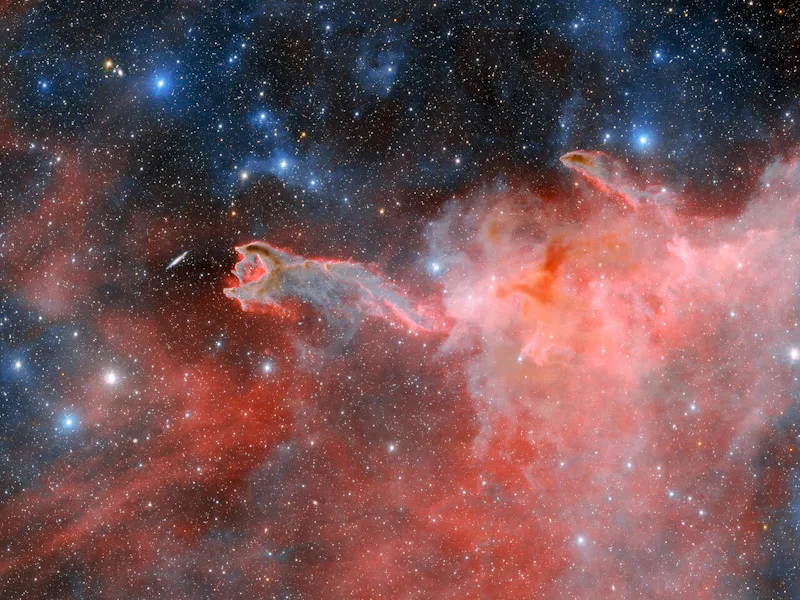
This striking image of CG4 was captured by a telescope instrument originally built to study dark energy.

image of a reddish cloud of gas and dust in space, which is shaped vaguely like a dinosaur.
NOIRLab

This strange cosmic cloud is called “the hand of God,” but it looks more like a Tyrannosaurus rex to us.

The reddish aura surrounding the cloud of gas and dust called CG4 comes from hydrogen gas, heated and ionized (electrically charged) by the radiation from massive nearby stars. That powerful bombardment of radiation is probably what eroded and stretched CG4 into its distinctive shape.

Astronomers call clouds like CG4 cometary globules, because their long, dust-shrouded tails look a bit like comets, even though they form completely different ways and on drastically different scales (one cometary globule probably contains a few star systems’ worth of actual comets). This one, CG4, is an especially dense patch of gas and dust within the larger Gum Nebula, which is home to the Vela Supernova Remnant and the Vela Pulsar.

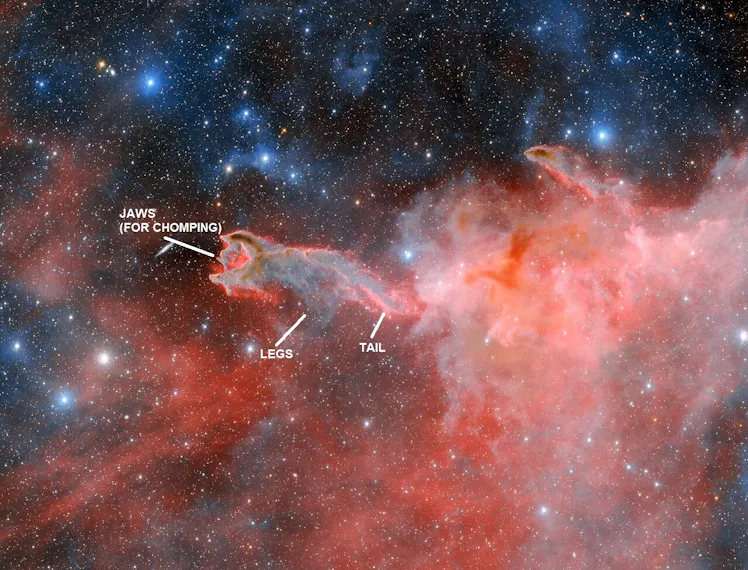
image of a reddish cloud of gas and dust in space, which is shaped vaguely like a dinosaur, with the...

Once you see it, you can’t unsee it.

NOIRLAB

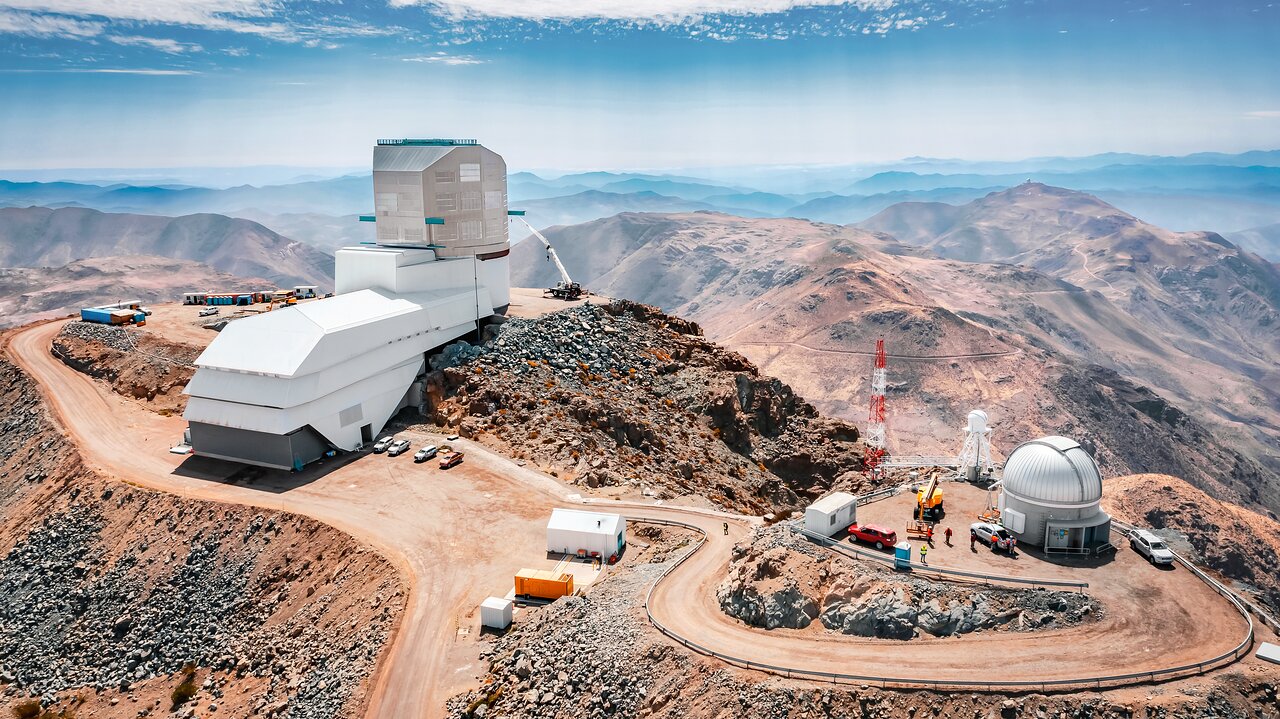
Cometary globules like CG4 are just one form of a type of cosmic cloud called a Bok Globule. These clouds of gas and dust are so dense that visible and ultraviolet light can’t pass through them, making them appear as dark shadows in telescope images (when we can see them at all). The best way to see a Bok Globule is with an infrared telescope, like the Dark Energy Camera: an instrument mounted on the Victor Blanco Telescope on a mountaintop in Chile.

Weirdly, all of the 32 cometary globules in the Gum Nebula have their heads pointed toward the center of the nebula, where the fast-spinning Vela Pulsar lurks at the heart of the Vela Supernova Remnant; the pulsar and the expanding cloud of stellar debris around it are all that’s left of a massive star that exploded in a supernova about 1 million years ago. That explosion, along with radiation and charged particles from nearby massive stars in the Gum Nebula, may have shaped CG4 and other cometary globules into their streamlined shapes.

If you’d like a sense of scale, CG4 is about 1300 light years away. Its head is about 1.5 light-years wide, and its faint tail stretches across 8 light years.

{ https://www.inverse.com/ }

Hoe vind je dit bericht?
Geschreven door peter om 21:57 Stuur door

Sahara was ooit weelderig groen, blijkt uit rotstekeningen van 4.000 jaar geleden die vee afbeelden

Sahara was ooit weelderig groen, blijkt uit rotstekeningen van 4.000 jaar geleden die vee afbeelden

Artikel door Michaël Torfs

De rotstekeningen zijn uitgebreid onderzocht tijdens veldwerk in de jaren 2018 en 2019. Julien Cooper van de Macquarie University in Australië leidde toen een team archeologen in het zogenoemde Atbai Survey Project, waarin 16 nieuw ontdekte rotstekeningen uit Wadi Haifa werden bestudeerd. 

Vandaag is het een kurkdroge regio in het oosten van Soedan. Maar de tekeningen suggereren dat de omgeving er toen compleet anders uitzag. Er viel veel meer regen en het landschap zag er groen uit, weelderig groen zelfs, moet blijken uit de rotstekeningen waarop vee staat afgebeeld. 

"Het was een raadsel om vee afgebeeld te zien op de wanden van rotsen midden in de woestijn, want voor het houden van runderen is veel water nodig, en weiland. Ze zouden in de Sahara van vandaag geen kans maken", zegt Cooper in een mededeling van de universiteit. 

Volgens Cooper is de aanwezigheid van heel wat vee in de tekeningen "een van de belangrijkste bewijsstukken van een voormalige groene Sahara". Dat komt ook overeen met eerdere bevindingen van experts. 

Groene Sahara? 

Eerder archeologisch en klimatologisch veldwerk heeft al aangetoond dat alvast een deel van de huidige Sahara in Afrika er vroeger totaal anders moet hebben uitgezien tijdens de zogenoemde "Afrikaanse natte periode"

Er viel toen veel regen in de regio tijdens moessonregens in de zomer. De vochtige periode zou van ongeveer 15.000 jaar geleden tot ruwweg 5.000 jaar geleden hebben gelopen en dan langzaam zijn uitgedoofd. Er zou plaats geweest zijn voor een afwisselende Afrikaanse savanne waar ook giraffes en olifanten leefden. 

Rond 3.000 voor Christus begonnen meren en rivieren uit te drogen en verdwenen ook de grazige weiden. De mensen trokken weg in de richting van de Nijl. 

De aanwezigheid van mensen bij het vee suggereert dat de dieren gemolken werden. Er zouden herders geleefd hebben in het gebied, maar zij begonnen het rond 3.000 voor Christus moeilijker te krijgen.

"De bevolking trok weg en er waren hoogstens nog schapen of geiten. De impact op het leven moet groot geweest zijn", zegt Cooper. 

De tekeningen tonen niet enkel vee. Er zijn ook boten afgebeeld. Die hebben speciale kenmerken in deze tekeningen, en waren misschien het werk van plaatselijke Nubische Nubische stammen. 

Sahara was ooit weelderig groen, blijkt uit rotstekeningen van 4.000 jaar geleden die vee afbeelden
© Foto: Paul Wordsworth

{ https://www.msn.com/nl-be/ }

Hoe vind je dit bericht?
Geschreven door peter om 21:47 Stuur door

Unveiling the Enigmatic Secrets of Area 51 and UFOs

Unveiling the Enigmatic Secrets of Area 51 and UFOs

Inside Area 51's UFO Secrets

Area 51, nestled within the desolate stretches of the Nevada desert, has long captivated the imagination of millions around the world. Officially a remote detachment of Edwards Air Force Base, this highly classified U.S. Air Force facility is shrouded in secrecy, giving rise to numerous theories and stories about extraterrestrial activities and groundbreaking technology. Let’s delve into some of the intriguing accounts that contribute to the legendary status of Area 51.

Historical Context and Alleged Alien Encounters

The intrigue surrounding Area 51 often centers on accounts of unidentified flying objects (UFOs) and their purported connection with the U.S. government. One of the most storied events allegedly occurred on May 19, 1953, during a series of nuclear tests under the codename “Upshot-Knothole” at Yucca Flat, Nevada. Observers reported seeing a disc-shaped object descending rapidly from the sky, which then disappeared into the mountains south of Las Vegas. This incident was followed by rumors that the U.S. government swiftly assembled a team to investigate a UFO crash in the outskirts of Kingman, Arizona, approximately 175 miles south of the test site.

The Kingman UFO incident is said to involve a 40-foot diameter disc-shaped craft that was found intact, with no visible damage, and accompanied by four extraterrestrial beings. The recovered craft and beings were reportedly transported to what is now known as Area 51 for further examination and reverse engineering.

Theories of Reverse Engineering and Collaboration

Speculations suggest that Area 51’s primary purpose might extend beyond testing experimental aircraft and weaponry. It is believed to include the reverse engineering of alien technology. According to some accounts, this includes working directly with extraterrestrial beings, such as an entity named J-Rod, who allegedly assisted U.S. scientists and engineers in understanding alien technology.

Area 51’s lore also includes tales of underground facilities where extensive collaboration between humans and aliens takes place. These stories are bolstered by testimonies from individuals like Captain Bill U House, a former U.S. Air Force officer who claimed to have worked closely with an extraterrestrial being to gain insights into alien science and engineering.

Modern Myth or Hidden Truths?

As fantastical as these stories might sound, they are supported by various whistleblowers and former employees who assert the existence of alien technology at Area 51. These claims, while lacking concrete evidence and often dismissed by skeptics, fuel ongoing interest and debate regarding what truly lies within the confines of this secretive base.

Despite numerous public disclosures and declassifications of documents, the U.S. government remains largely silent about the full extent of activities at Area 51. This secrecy only amplifies the mystery and the allure of the base, making it a central figure in UFO folklore.

VIDEO:

  • Ancient Aliens: Inside Area 51’s UFO Secrets

Area 51 continues to be an emblematic symbol of UFO conspiracy theories and a focal point for those who believe in extraterrestrial visits. Whether these beliefs are grounded in reality or are merely products of the human imagination, Area 51 undeniably holds a significant place in popular culture as a repository of the unknown and possibly the extraterrestrial. As long as the veil of secrecy remains, the theories about what really happens behind the gates of Area 51 will continue to proliferate, captivating the minds of those who seek answers to the age-old question: Are we alone in the universe?

{ https://www.latest-ufo-sightings.net/ }

Hoe vind je dit bericht?
Geschreven door peter om 21:36 Stuur door

'I saw glowing white flaming orb UFO – it was like one from 1350s Jesus Christ painting'

'I saw glowing white flaming orb UFO – it was like one from 1350s Jesus Christ painting'

An infamous painting housed in the Visoki Decani Monastery in Kosovo, and painted by an unknown artist, shows a pretty standard scene of Christ's crucifixion - with two odd extras

By Adam Cailler / Journalist

The infamous painting features two potential alien-filled UFOs

The infamous painting features two potential alien-filled UFOs 

(Image: Visoki Decani Monestary)

A bloke has claimed he saw a “glowing white orb UFO” and it looked exactly like one depicted in the infamous 1300s painting of Jesus Christ's crucifixion.

According to a post on Reddit's biggest alien forum, the poster – going by the name of Kaiserschleier – was talking to his brother-in-law while in an unidentified countryside when he has his “first experience” of an encounter with a UFO.

Taking to the forum, he said: “I was chatting with my brother-in-law in the countryside when suddenly, I glanced up and spotted a glowing white orb. It swiftly shot away the moment I looked at it, hovering about 20 feet above ground, leaving behind a trail of orange flame-like glow as it moved. It moved swiftly and emitted no sound.

READ MORE: 

He saw a flying glowing orb (stock)

He saw a flying glowing orb (stock) 

(Image: Getty Images)

“I was so stunned, I jolted and said 'What the f**k is that?!' – my brother-in-law confirmed to have seen the same thing as me, saying that it looked like a flying glowing moon.”

The poster returned later on to add more to his story, to explain that the object he saw look suspiciously like the strange UFO-like object depicted in the 1350s painting of the crucifixion of Jesus Christ.

Located in the Visoki Decani Monastery in Kosovo, and painted by an unknown artist, the image shows a pretty standard scene of Christ's crucifixion . . . but what is in the top left and right corners has left people baffled for centuries. It shows two UFO-shaped objects, with people inside, flying across the skyline. And it is those that the original Reddit poster claims he saw.

Was this what the bloke saw in the field . . . ?

Was this what the bloke saw in the field . . . ?  (Image: Visoki Decani Monestary)

READ MORE

He explained: “Despite its radiant glow, it emitted no illumination onto its surroundings. Its hues of white and orange were exceptionally vivid, yet it remained silent as it traversed in a perfectly straight trajectory, devoid of any audible disturbance even amidst the passage through the air.

“This occurrence defied any rational explanation, unlike anything I've ever encountered before. Its proximity ruled out possibilities like a comet or shooting star, as it hovered closer to the ground than the tree canopy.

“I'm left baffled by this enigmatic phenomenon, never before witnessed or heard of, and the mere fact that I bore witness to it fills me with a profound sense of awe.”

So, Daily Star reader, what do you think?

{ https://www.dailystar.co.uk/news/ }

Hoe vind je dit bericht?
Geschreven door peter om 00:21 Stuur door

New NASA Visualization Shows Supermassive Black Hole’s Event Horizon

New NASA Visualization Shows Supermassive Black Hole’s Event Horizon

Thanks to a new visualization produced on a NASA supercomputer, you can plunge into the event horizon, a black hole’s point of no return.

“People often ask about this, and simulating these difficult-to-imagine processes helps me connect the mathematics of relativity to actual consequences in the real Universe,” said Dr. Jeremy Schnittman, an astrophysicist at NASA’s Goddard Space Flight Center.

“So I simulated two different scenarios, one where a camera — a stand-in for a daring astronaut — just misses the event horizon and slingshots back out, and one where it crosses the boundary, sealing its fate.”

To create the visualizations, Dr. Schnittman teamed up with Goddard Space Flight Center scientist Brian Powell and used the Discover supercomputer at the NASA Center for Climate Simulation.

They generated about 10 terabytes of data and took about 5 days running on just 0.3% of Discover’s 129,000 processors. The same feat would take more than a decade on a typical laptop.

The destination is a supermassive black hole with 4.3 million times the mass of our Sun, equivalent to the monster located at the center of our Milky Way Galaxy.

“If you have the choice, you want to fall into a supermassive black hole,” Dr. Schnittman said.

“Stellar-mass black holes, which contain up to about 30 solar masses, possess much smaller event horizons and stronger tidal forces, which can rip apart approaching objects before they get to the horizon.”

This occurs because the gravitational pull on the end of an object nearer the black hole is much stronger than that on the other end. Infalling objects stretch out like noodles, a process astrophysicists call spaghettification.

The simulated black hole’s event horizon spans about 16 million miles (25 million km), or about 17% of the distance from Earth to the Sun.

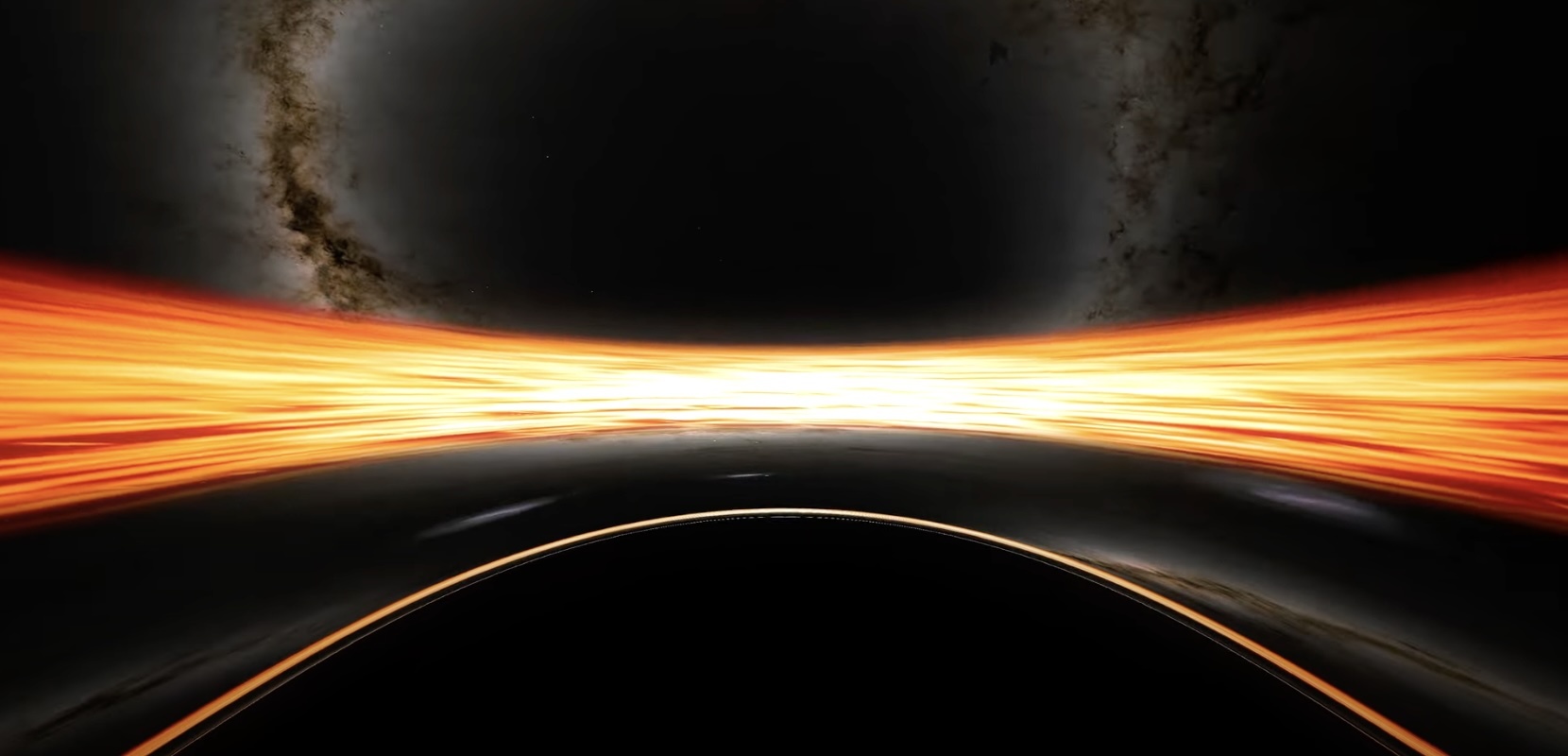
A flat, swirling cloud of hot, glowing gas called an accretion disk surrounds it and serves as a visual reference during the fall.

So do glowing structures called photon rings, which form closer to the black hole from light that has orbited it one or more times.

A backdrop of the starry sky as seen from Earth completes the scene.

As the camera approaches the black hole, reaching speeds ever closer to that of light itself, the glow from the accretion disk and background stars becomes amplified in much the same way as the sound of an oncoming racecar rises in pitch.

Their light appears brighter and whiter when looking into the direction of travel.

The movies begin with the camera located nearly 640 million km (400 million miles) away, with the black hole quickly filling the view.

Along the way, the black hole’s disk, photon rings, and the night sky become increasingly distorted — and even form multiple images as their light traverses the increasingly warped space-time.

In real time, the camera takes about 3 hours to fall to the event horizon, executing almost two complete 30-min orbits along the way. But to anyone observing from afar, it would never quite get there.

As space-time becomes ever more distorted closer to the horizon, the image of the camera would slow and then seem to freeze just shy of it. This is why astronomers originally referred to black holes as “frozen stars.”

At the event horizon, even space-time itself flows inward at the speed of light, the cosmic speed limit.

Once inside it, both the camera and the space-time in which it’s moving rush toward the black hole’s center — a one-dimensional point called a singularity, where the laws of physics as we know them cease to operate.

The NASA visualization tracks a camera as it approaches, briefly orbits, and then crosses the event horizon -- the point of no return -- of a supersized black hole similar in mass to the one at the center of our Galaxy. Image credit: J. Schnittman & B. Powell, NASA’s Goddard Space Flight Center.

The NASA visualization tracks a camera as it approaches, briefly orbits, and then crosses the event horizon — the point of no return — of a supersized black hole similar in mass to the one at the center of our Galaxy.

Image credit: J. Schnittman & B. Powell, NASA’s Goddard Space Flight Center.

“Once the camera crosses the horizon, its destruction by spaghettification is just 12.8 seconds away,” Dr. Schnittman said.

From there, it’s only 128,000 km (79,500 miles) to the singularity. This final leg of the voyage is over in the blink of an eye.

In the alternative scenario, the camera orbits close to the event horizon but it never crosses over and escapes to safety.

If an astronaut flew a spacecraft on this 6-hour round trip while her colleagues on a mothership remained far from the black hole, she’d return 36 min younger than her colleagues.

That’s because time passes more slowly near a strong gravitational source and when moving near the speed of light.

“This situation can be even more extreme,” Dr. Schnittman said.

“If the black hole were rapidly rotating, like the one shown in the 2014 movie Interstellar, she would return many years younger than her shipmates.”

{ https://www.sci.news/ }

Hoe vind je dit bericht?
Geschreven door peter om 23:48 Stuur door

Krachtige zonne-explosies hebben een sterke impact op de aarde: wat zou er kunnen gebeuren?

Krachtige zonne-explosies hebben een sterke impact op de aarde: wat zou er kunnen gebeuren?

Door JanineJanine image

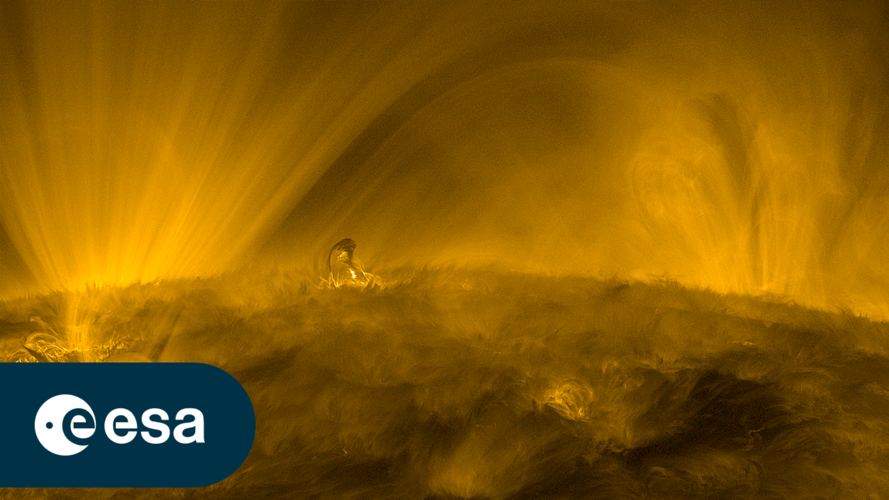
Zonnevlam gedetecteerd in mei 2024

De krachtige uitbarstingen die op onze moederster exploderen, hebben een sterke impact op de aarde en lijken niet te stoppen. Dit is wat er gebeurt.

Wat zijn zonnevlammen?

Zonnevlam die uitbarst vanaf het oppervlak van de zon

SPACE WEATHER PREDICTION CENTER

Een zonnevlam, zo meldt NASA, is "een intense uitbarsting van straling door het vrijkomen van magnetische energie die gepaard gaat met zonnevlekken". Dit zijn, legt de Amerikaanse ruimtevaartorganisatie uit, de grootste explosieve gebeurtenissen in ons zonnestelsel. Ze manifesteren zich als heldere gebieden op de zon die enkele minuten tot enkele uren zichtbaar zijn.

Wat ons in staat stelt om ze te detecteren is het licht, dus de fotonen, die vrijkomen en die worden gecontroleerd door optisch licht en röntgenstraling. In zonnevlammen worden de zwaarste deeltjes versneld. De afgelopen dagen zijn zonnevlammen in volle actie: X1.6 vond plaats op 3 mei, gevolgd door andere krachtige fenomenen volgens het Space Weather Prediction Center van NOAA. Elk van deze fenomenen heeft een grote impact gehad op onze planeet.

De gevolgen van krachtige zonnevlammen op aarde

Een X1.3 en een X1.2 zonnevlam barstten op 5 mei los uit de actieve groep zonnevlekken AR 3663. In beide gevallen traden radio blackouts op op onze planeet, in Japan, Australië en grote delen van China, en de effecten zouden langer kunnen duren als coronale massa uitstoot, enorme wolken van zonneplasma doordrenkt met magnetische veldlijnen, geladen deeltjes naar de aarde zouden leiden.

Hierover zijn echter geen zekere gegevens bekend. Er zijn momenteel negen clusters zonnevlekken aanwezig aan de kant van de zon die naar onze planeet is gericht, die ongeveer 150 zonnevlekken omvatten. AR 3663 is op dit moment in ieder geval het meest actief en heeft sinds 30 april meerdere M-klasse en vier X-klasse vlammen uitgezonden, waarmee hij op de tweede plaats staat van de sterkste vlammen die onze ster kan produceren.

Maar wat zijn de voorspellingen van de wetenschappers en wat kunnen we verwachten? Volgens de voorspellers zullen er meer M-klasse vlammen zijn en mogelijk nog een of meer X-klasse vlammen voordat ze buiten de baan van de aarde draaien.

Keith Strong, een zonnefysicus, schreef in een bericht op X, voorheen Twitter: “Het gebied van zonnevlekken AR3663 produceerde een X4.5 vlam, de op twee na grootste sinds het begin van zonnecyclus 25 (4,3 jaar geleden)." Hij voegde eraan toe dat de vlam een sterke black-out veroorzaakte in een groot deel van Azië, Oost-Afrika en Oost-Europa. "Als het een coronale massa uitstoot produceerde, zal deze waarschijnlijk binnen een dag of twee de aarde raken."

Geomagnetische storm op komst? Er is iets positiefs aan

SDO | Solar Dynamics Observatory NASA

Zonnevlammen gaan soms gepaard met uitbarstingen die de aarde met een paar dagen vertraging kunnen bereiken, omdat plasma zich minder snel verplaatst dan licht. Op het moment dat de coronale massa uitstoot ons bereikt, ontstaat er echter een geomagnetische storm met aanzienlijke gevolgen voor de communicatie. Op het moment dat het de magnetosfeer van de planeet raakt, ontstaan er elektrische stromen die door elektriciteitsnetwerken kunnen reizen, stroomuitval kunnen veroorzaken en satellieten, radio- en navigatiesignalen kunnen beïnvloeden.

Maar er is ook een positief aspect: de wisselwerking tussen zonnedeeltjes, de magnetosfeer en de atmosfeer van de aarde leidt tot een opvallend poollicht boven de polen van de aarde, dat alleen 's nachts zichtbaar is, wanneer er geen zonlicht is. In elk geval zullen de volgende uitbarstingen kleine gevolgen hebben, omdat AR 3663 van de baan van de aarde af draait, maar de zon zit midden in haar activiteitscyclus, haar piek vindt om de elf jaar plaats en kan ons nog meer “verrassingen” bezorgen.

Source:

{ https://www.curioctopus.nl/ }

Hoe vind je dit bericht?
Geschreven door peter om 23:38 Stuur door

I found this structure on Mars today, just wanted to share with you all, UFO Sighting News.

I found this structure on Mars today, just wanted to share with you all, UFO Sighting News.

34534545.png

Date of discovery: May 9, 2024
Location of discovery: Perseverance photo 1141-NW

     It's from the newest rover images and shows a structure on top of a Mars hilltop, best view I have to say, and the opening is facing outward to see the view. We can go on denying that life existed in our solar system on other planets, or we can cherish the excitement of new proof that it exists. It's up to you. 

    Then again, maybe not knowing, keeps your world view smaller and easier for you to manage. Much more...and it may break you. 

Scott C. Waring 

{ https://www.ufosightingsdaily.com/ }

Hoe vind je dit bericht?
Geschreven door peter om 23:29 Stuur door

We Need to Consider Conservation Efforts on Mars

Curiosity at work firing a laser on Mars. This artist's concept depicts the rover Curiosity, of NASA's Mars Science Laboratory mission, as it uses its Chemistry and Camera (ChemCam) instrument to investigate the composition of a rock surface. ChemCam fires laser pulses at a target and views the resulting spark with a telescope and spectrometers to identify chemical elements. The laser is actually in an invisible infrared wavelength, but is shown here as visible red light for purposes of illustration. Credit: NASA

We Need to Consider Conservation Efforts on Mars

Astrobiology is the field of science that studies the origins, evolution, distribution, and future of life in the Universe. In practice, this means sending robotic missions beyond Earth to analyze the atmospheres, surfaces, and chemistry of extraterrestrial worlds. At present, all of our astrobiology missions are focused on Mars, as it is considered the most Earth-like environment beyond our planet. While several missions will be destined for the outer Solar System to investigate “Ocean Worlds” for evidence of life (Europa, Ganymede, Titan, and Enceladus), our efforts to find life beyond Earth will remain predominantly on Mars.

If and when these efforts succeed, it will have drastic implications for future missions to Mars. Not only will great care need to be taken to protect Martian life from contamination by Earth organisms, but precautions must be taken to prevent the same from happening to Earth (aka. Planetary Protection). In a recent study, a team from the University of New South Wales (UNSW) in Sydney, Australia, recommends that legal or normative frameworks be adopted now to ensure that future missions do not threaten sites where evidence of life (past or present) might be found.

The study was led by Clare Fletcher, a Ph.D. student with the Australian Centre for Astrobiology (ACA) and Earth and Sustainability Science Research Centre at UNSW. She was joined by Professor Martin Van Kranendonk, a researcher with the ACA and the head of the School of Earth and Planetary Sciences at Curtin University, and Professor Carol Oliver of the School of Biological, Earth & Environmental Sciences at UNSW. Their research paper, “Exogeoconservation of Mars,” appeared on April 21st in Space Policy

The search for life on Mars can be traced to the late 19th and early 20th centuries when Percival Lowell made extensive observations from his observatory in Flagstaff, Arizona. Inspired by Schiaparelli’s illustrations of the Martian surface (which featured linear features he called “canali”), Lowell recorded what he also believed were canals and spent many years searching for other indications of infrastructure and an advanced civilization. During the ensuing decades, observatories worldwide observed Mars closely, looking for indications of life and similarities with Earth.

However, it was not until the Space Age that the first robotic probes flew past Mars, gathering data directly from its atmosphere and taking close-up images of the surface. These revealed a planet with a thin atmosphere composed predominantly of carbon dioxide and a frigid surface that did not appear hospitable to life. However, it was the Viking 1 and 2 missions, which landed on Mars in 1976, that forever dispelled the myth of a Martian civilization. But as Fletcher told Universe Today via email, the possibility of extant life has not been completely abandoned:

“It’s my personal belief that it is unlikely we will find evidence of extant (current) life on Mars, as opposed to evidence of past life on Mars. If we were to find extant life on Mars that could be proven to be endemic to Mars and not contamination from Earth, some think it might be found underground in lava tubes, for example, and some think the ice caps or any possible source of liquid water might be suitable places.”

Ironically, it was the same missions that discredited the notion of there being life on Mars that revealed evidence that water once flowed on its surface. Thanks to the many orbiter, lander, and rover missions sent to Mars since the turn of the century, scientists theorize that this period coincided with the Noachian Era (ca. 4.1 – 3.7 billion years ago). According to the most recent fossilized evidence, it was also during this period that life first appeared on Earth (in the form of single-celled bacteria).

AncientMars-1024x1024.jpg

Artist’s impression of Mars during the Noachian Era. Credit: Ittiz/Wikipedia Commons

Our current astrobiology efforts on behalf of NASA and other space agencies are focused on Mars precisely for this reason: to determine if life emerged on Mars billions of years ago and whether or not it co-evolved with life on Earth. This includes the proposed Mars Sample Return (MSR) mission that will retrieve the drill samples obtained by the Perseverance rover in the Jezero Crater and return them to Earth for analysis. In addition, NASA and China plan to send crewed missions to Mars by 2040 and 2033 (respectively), including astrobiology studies.

These activities could threaten the very abodes where evidence of past life could be found or (worse) still exists. “Human activities might threaten sites like this in part due to possible microbial contamination,” said Fletcher. “Evidence of life (past and extant) also has greater scientific value when in its palaeoenvironmental context, so any human activities that might damage the evidence of life and/or its surrounding environmental context pose a risk. This could be something innocuous, like debris falling in the wrong spot, or something more serious, like driving over possibly significant outcrops with a rover.”

Conservation measures must be developed and implemented before additional missions are sent to Mars. Given humanity’s impact on Earth’s natural environment and our attempts to mitigate this through conservation efforts. In particular, there have been numerous cases where scientific studies were conducted without regard for the heritage value of the site and where damage was done because of a lack of proper measures. These lessons, says Fletcher, could inform future scientific efforts on Mars:

“It’s important that we learn from what has been considered “damaging” on Earth and take this into consideration when exploring Mars. If a site is damaged beyond being able to be studied in the future, then we limit what can actually be learned from a site. When considering Mars missions cost billions of dollars and are to meet specific scientific goals, limiting the information being learned from a site is incredibly detrimental. My recommendations are that of my paper: interdisciplinary cooperation, drawing on experience and knowledge from Earth, creating norms and a code of practice (part of my PhD work), and working towards creating legislation for these issues.”

Artist’s rendition of NASA’s Dragonfly on the surface of Titan. Credit: NASA/Johns Hopkins APL/Steve Gribben

The need for exogeoconservation is paramount at this juncture. In addition to Mars, multiple astrobiology missions will travel to the outer Solar System this decade to search for evidence of life on icy moons like Europa, Ganymede, Titan, and Enceladus. This includes the ESA’s JUpiter ICy moons Explorer (JUICE) mission, currently en route to Ganymede, and NASA’s Europa Clipper and Dragonfly missions that will launch for Europa and Titan in October 2024 and 2028 (respectively). Therefore, the ability to search for extant or past life without damaging its natural environment is an ethical and scientific necessity.

“I hope this paper is very much a starting point for anyone working in Mars science and exploration, as well as anyone thinking about space policy and exogeoconservation,” said Fletcher. “My goal was to start drawing attention to these issues, and that way start a generation of researchers and practitioners focused on exogeoconservation of Mars.”

Further Reading: 

{ https://www.universetoday.com/ }

Hoe vind je dit bericht?
Geschreven door peter om 22:53 Stuur door

41,000 Years Ago Earth’s Shield Went Down

An illustration of Earth's magnetic field. Image Credit: ESA/ATG medialab

41,000 Years Ago Earth’s Shield Went Down

Earth is naked without its protective barrier. The planet’s magnetic shield surrounds Earth and shelters it from the natural onslaught of cosmic rays. But sometimes, the shield weakens and wavers, allowing cosmic rays to strike the atmosphere, creating a shower of particles that scientists think could wreak havoc on the biosphere.

This has happened many times in our planet’s history, including 41,000 years ago in an event called the Laschamps excursion.

Cosmic rays are high-energy particles, usually protons or atomic nuclei, that travel through space at relativistic speeds. Normally, they’re deflected into space and away from Earth by the planet’s magnetic shield. But the shield is a natural phenomenon and its strength fluctuates, as does its orientation. When that happens, cosmic rays strike the Earth’s atmosphere.

That creates a shower of secondary particles called cosmogenic radionuclides. These isotopes become embedded in sediments and ice cores and even in the structure of living things like trees. There are different types of these isotopes, including ones like Calcium 41 and Carbon 14.

Showers of high-energy particles occur when energetic cosmic rays strike the top of the Earth's atmosphere. Illustration Credit: Simon Swordy (U. Chicago), NASA. Showers of high-energy particles occur when energetic cosmic rays strike the top of the Earth’s atmosphere. Illustration Credit: Simon Swordy (U. Chicago), NASA.

Some of the isotopes are stable, and some are radioactive. The radioactive ones have half-lives ranging from only 20 minutes (Carbon 11) up to 15.7 million years (Xenon 129.)

When Earth’s shield weakens, more of these isotopes reach the planet’s surface and collect in sediments and ice. By studying these cores and sediments, scientists can determine the magnetic shield’s history. Their observations show that Earth experienced a geomagnetic excursion or reversal 41,000 years ago. It’s called the Laschamps excursion after the Laschamps lava flows in France, where geomagnetic anomalies revealed its occurrence.

Every few hundred thousand years, the Earth’s magnetic poles flip. North becomes South and vice versa. In between those major events are more minor events called excursions. During excursions, the poles shift around for a while without swapping places. The excursions weaken the Earth’s shield and can last from a few thousand to tens of thousands of years. When that happens, more cosmic rays strike the atmosphere, creating more radionuclides that shower down onto Earth.

Scientists often focus on one particular radioactive isotope in paleomagnetic studies. Beryllium 10 has a relatively long half-life of 1.36 million years and tends to accumulate on the soil surface.

Sanja Panovska is a researcher at GFZ Potsdam, Germany, who studies geomagnetism. At the recent European Geosciences Union (EGU) General Assembly 2024, Panovska presented new research on the Laschamps excursion. She found that during the Laschamps excursion, production of Be 10 was twice as high as normal.

To understand the Laschamps excursion more thoroughly, Panovska combined cosmogenic radionuclide and paleomagnetic data to reconstruct the Earth’s magnetic field at the time. She found that when the field decreased in strength, it also shrank. The transition from normal field to reversed field took about 250 years, and it stayed flipped for about 440 years. During the transition, the Earth’s shield weekend to as little as 5% of its normal strength. When it was fully reversed, it was at about 25% of its regular strength. This weakening allowed more Be 10 and other cosmogenic radionuclides to reach Earth’s surface.

Each map shows the intensity of Earth's geomagnetic field at different snapshots in time, according to Panovska's reconstructions that are constrained by both paleomagnetic data and records of cosmogenic beryllium-10 radionuclides. DM stands for Dipole Moment, which is a measure of the field's polarity or separation of positive and negative. Age [ka BP] is the age measures in thousands of years before the present. Image Credit: Sanja Panovska. Each map shows the intensity of Earth’s geomagnetic field at different snapshots in time, according to Panovska’s reconstructions that are constrained by both paleomagnetic data and records of cosmogenic beryllium-10 radionuclides. DM stands for Dipole Moment, which is a measure of the field’s polarity or separation of positive and negative. Age [ka BP] is the age measures in thousands of years before the present. Image Credit: Sanja Panovska.

These radionuclides do more than collect in sediments and ice. Some of them are radioactive. The weakening of the shield also weakened the ozone layer, letting more UV radiation reach Earth’s surface. The high-altitude atmosphere also cooled, which changed the wind flows. This could’ve caused drastic changes on the Earth’s surface.

For these reasons, the Laschamps event has been linked to the extinction of the Neanderthals, the extinction of Australian megafauna, and even to the appearance of cave art. Those links haven’t withstood scientific scrutiny, but that doesn’t mean that events like the Laschamps event aren’t hazardous. If it occurred now, it would knock out our power grids. The Earth’s equatorial region would light up with aurorae.

“Understanding these extreme events is important for their occurrence in the future, space climate predictions, and assessing the effects on the environment and on the Earth system,” Panovska said.

Scientists are learning that the magnetic shield isn’t static. There are anomalies. One of them is the South Atlantic Anomaly, a region where the magnetic field is weakest near Earth. When satellites pass over this region, they’re exposed to higher levels of ionizing radiation. The anomaly is likely caused by a reservoir of dense rock inside Earth, illustrating how complex the magnetic shield is.

The ‘South Atlantic Anomaly’ refers to an area where Earth’s protective magnetic shield is weak. Image Credit: By Christopher C. Finlay, Clemens Kloss, Nils Olsen, Magnus D. Hammer, Lars Tøffner-Clausen, Alexander Grayver & Alexey Kuvshinov  “The CHAOS-7 geomagnetic field model and observed changes in the South Atlantic Anomaly”, Earth, Planets and Space, Volume 72, Article number 156 (2020), https://earth-planets-space.springeropen.com/articles/10.1186/s40623-020-01252-9, CC BY-SA 4.0, https://commons.wikimedia.org/w/index.php?curid=99760567

Scientists are uncertain about what effect the cosmic rays have on life when the magnetic shield is weak. It’s tempting to correlate extinctions with events like the Laschamps excursion when they line up temporally. But the poles have shifted, weakened, and reversed many times and life is still here and still thriving.

If humanity lasts long enough, we’ll go through one of these reversals. Then we’ll know.

{ https://www.universetoday.com/ }

Hoe vind je dit bericht?
Geschreven door peter om 22:40 Stuur door

NASA used a supercomputer to visualize falling into a black hole much like the one in the center of the Milky Way.

NASA used a supercomputer to visualize falling into a black hole much like the one in the center of the Milky Way. Image Credit: NASA’s Goddard Space Flight Center /J. Schnittman and B. Powell

Fall Into a Black Hole With this New NASA Simulation

No human being will ever encounter a black hole. But we can’t stop wondering what it would be like to fall into one of these massive, beguiling, physics-defying singularities.

NASA created a simulation to help us imagine what it would be like.

Jeremy Schnittman is an astrophysicist at NASA’s Goddard Space Flight Center and he created the visualizations. “People often ask about this, and simulating these difficult-to-imagine processes helps me connect the mathematics of relativity to actual consequences in the real universe,” he said. “So I simulated two different scenarios, one where a camera — a stand-in for a daring astronaut — just misses the event horizon and slingshots back out, and one where it crosses the boundary, sealing its fate.”

In one, the viewpoint plunges directly into the black hole like a free-falling astronaut, with explanatory text to guide us through what we’re seeing. The other is a 360-degree view of the black hole.

Schnittman created them with a NASA supercomputer called Discover in only five days, generating about 10 terabytes of data. The computer used only about 0.3% of its power. The same visualization would’ve taken more than a decade to create on an average laptop computer.

The black hole in the visualization is the same size as Sagittarius A star, the supermassive black hole (SMBH) at the heart of the Milky Way. It has 4.3 million solar masses and dominates the galaxy’s inner regions. Its event horizon reaches about 25 million km (16 million miles). That’s about 17% of the distance from Earth to the Sun. The event horizon is surrounded by an accretion disk, a swirling disk of superheated material drawn in by the black hole’s overpowering gravity.

Another type of black hole, the stellar-mass black hole, is much less massive. Schnittman says that if you’re going to fall into a black hole, you’d rather fall into the supermassive one.

“If you have the choice, you want to fall into a supermassive black hole,” Schnittman explained. “Stellar-mass black holes, which contain up to about 30 solar masses, possess much smaller event horizons and stronger tidal forces, which can rip apart approaching objects before they get to the horizon.”

Powerful gravity is the reason. The SMBH’s gravity is so strong that it pulls harder on the end of the object nearest it. That stretches the object and elongates it. Stephen Hawking was the first to call this ‘spaghettification,’ and the name has stuck. Presumably, you’d get a better look if you fall into an SMBH.

In the movies, the camera begins at a distance of 640 million km (400 million miles.) Since space-time is warped around a black hole, so are the images of the sky, the black hole’s disk, and the photon ring. It takes the camera three hours of real-time to fall into the event horizon, and it completes almost two 30-minute orbits as it falls. A distant observer would never see an object ever reach the black hole. From a distance, the object would freeze at the event horizon.

When a falling object reaches the event horizon, it and space-time itself reach the speed of light. After crossing the horizon, the object and the space-time around it surge toward the singularity, a point of infinite density and gravity. “Once the camera crosses the horizon, its destruction by spaghettification is just 12.8 seconds away,” Schnittman said.

In the second video, the camera never crosses the event horizon and instead escapes. But the powerful black hole still has an effect. Imagine if the camera were an astronaut, and they flew this six-hour roundtrip while a separate astronaut stayed far away from the SMBH. The astronaut would return and be 36 minutes younger than the astronaut who never approached the black hole.

“This situation can be even more extreme,” Schnittman noted. “If the black hole were rapidly rotating, like the one shown in the 2014 movie ‘Interstellar,’ she would return many years younger than her shipmates.”

The bottom line is, don’t fall into a black hole. In fact, resist your fascination and don’t even approach one.

Leave them for the physicists.

{ https://www.universetoday.com/ }

Hoe vind je dit bericht?
Geschreven door peter om 22:23 Stuur door

Alien Encounters: Investigating the Phenomenon of Missing Time

Alien Encounters: Investigating the Phenomenon of Missing Time

by Wayne J. Gardner

1*KfB1S14kDTXcL9-0Bg96bw.png

Missing time does seem to be a widely reported phenomenon (iStockphoto)

“Missing time is a key part of the abduction phenomenon. It is a symptom of the larger syndrome, and it is often the first thing that people notice when they begin to recall their experiences.”

— David M. Jacobs

Introduction

For decades, stories of people encountering aliens and being taken aboard their spacecraft have been circulating in the media, books, and movies. These encounters are often accompanied by a strange phenomenon known as missing time, in which the person who has been abducted cannot account for the time they were missing. This phenomenon has been studied by experts in psychology, ufology, and neuroscience, but a definitive explanation for why it occurs has yet to be determined. In this article, we will examine several famous cases of alien abduction accompanied by missing time, including the Nebraska incident in 1966, the Allagash Waterway Abduction, the Travis Walton Abduction, and the Kirsan Ilyumzhinov Abduction, and hypothesize on why this phenomenon occurs.

Here are some famous UFO missing time cases:

The Betty and Barney Hill Abduction:

Betty and Barney Hill claimed to have been abducted by extraterrestrial beings in September 1961 while driving home to New Hampshire. During their encounter, they reported experiencing missing time and were unable to account for a two-hour period during their journey.

Betty and Barney Hill’s experience of missing time is a key aspect of their reported alien abduction. During their drive home to New Hampshire in September 1961, they claimed to have observed a bright light in the sky that appeared to be following them. They eventually stopped their car and observed the object up close, reporting that it was a UFO with several humanoid beings inside.

The Hills then claimed to have experienced a period of missing time, during which they were unable to recall what had happened to them. Betty reported waking up in a different location, and both she and Barney reported feeling disoriented and confused. They arrived home two hours later than expected, and when they later attempted to reconstruct the events of that evening, they realized that they were unable to account for this missing time.

The Hills’ experience of missing time is a common feature of many reported alien abductions. It is typically described as a period of time during which the individual is unable to recall what happened to them or experiences a lapse in their memory. This missing time is often reported to be associated with UFO sightings or other paranormal experiences.

There are many theories about the causes of missing time experiences in the context of alien encounters. Some researchers suggest that they may be due to psychological factors, such as dissociation or post-traumatic stress disorder. Others propose that missing time experiences may be linked to altered states of consciousness or the use of mind-altering substances.

Whatever the cause of these experiences, they continue to be a subject of fascination and investigation for researchers and the public alike. Betty and Barney Hill’s experience of missing time during their reported alien abduction remains one of the most famous cases of its kind, and continues to be studied and debated by researchers interested in the phenomenon of missing time.

The Travis Walton Abduction:

One of the most famous cases of alien abduction accompanied by missing time is the Travis Walton abduction. In November of 1975, Walton and a group of loggers in Arizona reported seeing a UFO in the sky. Walton got out of the truck to get a closer look, but as he approached the object, he was hit by a beam of light and knocked unconscious.

When Walton regained consciousness, he found himself aboard the craft, surrounded by aliens. He reported that he was subjected to a medical examination, during which he felt intense pain. Walton was returned to Earth five days later, and when he reported the incident to the authorities, he was initially met with skepticism.

The Allagash Waterway Abduction:

In August 1976, four men were canoeing on the Allagash Waterway in Maine when they reported encountering a UFO. They later reported experiencing missing time and having shared hallucinations of being abducted by extraterrestrial beings.

The case of the Allagash Waterway Abduction is one of the most well-known incidents of alien abduction in American history. The event reportedly occurred in August 1976, when four men — Charles Foltz, Jack Weiner, Jim Weiner, and Chuck Rak — were on a camping trip on the Allagash Waterway in Maine. According to their account, they observed a bright object in the sky that they believed to be a UFO, which then appeared to approach and hover above them.

The next thing they remembered was being back at their campsite, feeling disoriented and confused. It was only later, during a hypnosis session, that they began to recall memories of being taken aboard the UFO and subjected to medical procedures by extraterrestrial beings.

“Missing time is the hallmark of a classic abduction experience. It is a common feature reported by abductees all over the world.”

— John E. Mack

One of the most notable features of the Allagash Waterway Abduction is the reported experience of missing time by the four men. According to their account, they had been fishing when they observed the strange object in the sky, and the next thing they knew they were back at their campsite, with several hours of time unaccounted for.

Missing time is a common feature of many reported alien abduction cases. It is typically described as a period of time during which the individual is unable to recall what happened to them or experiences a lapse in their memory. In the case of the Allagash Waterway Abduction, the four men reported a gap in their memory spanning several hours, during which they have no recollection of what happened.

The experience of missing time has been the subject of much speculation and debate among researchers studying the phenomenon of alien encounters. Some suggest that it may be the result of psychological factors, such as dissociation or post-traumatic stress disorder. Others propose that missing time experiences may be linked to altered states of consciousness or the use of mind-altering substances.

Whatever the cause of this experience, it continues to be a subject of fascination and investigation for researchers and the public alike. The Allagash Waterway Abduction, with its reported experience of missing time and shared hallucinations, remains one of the most intriguing and well-known cases of alien abduction in American history.

The Ariel School Encounter:

In September 1994, 62 school children in Zimbabwe reported seeing a UFO land near their school. Many of the children reported experiencing missing time during the encounter.

The incident at the Ariel School in Ruwa, Zimbabwe, is one of the most well-known cases of a mass UFO sighting involving school children. On September 14, 1994, approximately 62 children, aged between six and twelve years old, were playing outside during their morning break when they observed a silver craft descend from the sky and land in a nearby field.

The children reported that several beings, described as “large-eyed” and “grey-skinned,” emerged from the craft and began to approach them. Many of the children experienced a feeling of paralysis, while others reported feeling disoriented or frightened.

One of the most striking aspects of the incident at the Ariel School was the reported experience of missing time by many of the children. According to their accounts, they were unable to recall what happened during a period of time spanning several minutes to several hours, and some reported feeling as though they had “zoned out” or were in a state of trance.

In subsequent interviews with researchers and investigators, the children described a range of experiences during their encounter with the beings. Some reported being taken aboard the craft and subjected to medical procedures, while others described feeling as though they were communicating with the beings telepathically.

“Missing time is a powerful and unsettling experience. It can shake a person’s sense of reality and leave them with deep-seated questions about their place in the universe.”

— Whitley Strieber

The experience of missing time reported by the children at the Ariel School is a common feature of many reported UFO sightings and encounters. It is typically described as a period of time during which the individual is unable to recall what happened to them or experiences a lapse in their memory.

While the cause of missing time experiences remains a subject of speculation and debate, some researchers have suggested that it may be linked to psychological factors, such as dissociation or post-traumatic stress disorder. Others propose that it may be the result of exposure to electromagnetic fields or other environmental factors.

The incident at the Ariel School remains a subject of fascination and investigation among researchers and the public alike. The reported experience of missing time by many of the children adds another layer of intrigue to this already fascinating and mysterious case.

The Pascagoula Abduction:

In October 1973, Calvin Parker and Charles Hickson claimed to have been abducted by extraterrestrial beings while fishing in Mississippi. They reported experiencing missing time during their encounter.

The Pascagoula Abduction is a well-known case of alleged extraterrestrial abduction that occurred on October 11, 1973, in Pascagoula, Mississippi. Calvin Parker and Charles Hickson were fishing on the Pascagoula River when they claimed to have been abducted by three humanoid beings.

According to Parker and Hickson’s accounts, the beings were approximately five feet tall and had gray, wrinkled skin and large, elongated eyes. They were described as having no visible ears or nose, and their mouths were described as being a “slit.”

During their encounter with the beings, Parker and Hickson reported experiencing a sense of paralysis and were unable to move or speak. They were then subjected to a medical examination by the beings, during which they reported feeling as though they were being probed and examined.

One of the most notable aspects of the Pascagoula Abduction is the reported experience of missing time by Parker and Hickson. According to their accounts, they were unable to account for a period of approximately 30 minutes during their encounter with the beings. This experience of missing time is a common feature of many reported UFO sightings and encounters.

“Missing time is not just a matter of lost minutes or hours. It is a profound disruption of a person’s sense of time and space. It can shatter their understanding of reality and leave them struggling to make sense of what has happened to them.”

— Budd Hopkins

The phenomenon of missing time is often described as a period during which an individual is unable to recall what happened to them or experiences a lapse in their memory. Some researchers believe that missing time experiences may be the result of psychological factors, such as dissociation or post-traumatic stress disorder. Others propose that it may be the result of exposure to electromagnetic fields or other environmental factors.

In the case of the Pascagoula Abduction, Parker and Hickson’s reported experience of missing time has been a subject of speculation and investigation for many years. While some have dismissed their accounts as a hoax or a misinterpretation of natural phenomena, others argue that their story is compelling evidence of the existence of extraterrestrial life and the phenomenon of UFOs.

Regardless of the explanation for their experience of missing time, the Pascagoula Abduction remains one of the most intriguing and mysterious cases of alleged extraterrestrial contact on record.

The Psychology of Missing Time

The psychology of missing time during an alleged alien abduction is a subject of much debate and speculation among researchers and UFO enthusiasts. There are several theories that attempt to explain the experience of missing time, some of which are rooted in psychology.

One of the most common theories is that missing time experiences may be the result of psychological factors such as dissociation or post-traumatic stress disorder (PTSD). Dissociation is a psychological process in which an individual becomes disconnected from their thoughts, feelings, memories, or sense of identity. It is often associated with trauma and can result in a temporary loss of consciousness or memory.

PTSD is a condition that can occur after experiencing or witnessing a traumatic event, and it is often characterized by intrusive thoughts, flashbacks, and avoidance of triggers associated with the trauma. Some researchers have suggested that missing time experiences may be a symptom of PTSD or a related condition.

Another theory is that missing time experiences may be the result of exposure to electromagnetic fields (EMF) or other environmental factors. EMF is a type of radiation that is emitted by electronic devices, power lines, and other sources. Some researchers believe that exposure to high levels of EMF can disrupt brain function and cause memory loss or other cognitive impairments.

Still, other researchers have proposed that missing time experiences may be the result of sleep paralysis, a phenomenon in which an individual is temporarily unable to move or speak upon waking or falling asleep. During a sleep paralysis episode, individuals may experience hallucinations or a sense of being held down or restrained, which could be interpreted as an abduction experience.

There is no clear or proven method by which extraterrestrial beings may be able to induce missing time in humans. However, there are several hypotheses and theories that attempt to explain how this phenomenon might occur during an alleged alien abduction.

One theory suggests that extraterrestrial beings may use advanced technology to manipulate human perception and memory. This could involve the use of hypnotic suggestion, neural implants, or other forms of mind control to alter the individual’s perception of time or to selectively erase memories of the encounter.

Another theory proposes that extraterrestrial beings may use a form of temporal distortion to alter the individual’s experience of time during the encounter. This could involve the manipulation of space-time itself, such as through the creation of a localized time warp or a bending of the laws of physics to create a perception of missing time.

One hypothesis is that extraterrestrial beings may use advanced technology to manipulate human perception and memory during an alleged abduction experience. This could involve the use of hypnotic suggestion, neural implants, or other forms of mind control to alter the individual’s perception of time or to selectively erase memories of the encounter.

Hypnotic suggestion is a technique that has been used for decades to alter an individual’s perception of reality. During a hypnotic session, the hypnotist can suggest to the subject that they are experiencing a certain reality or have a certain memory, even if that memory is not real. It is possible that extraterrestrial beings could use a similar technique to manipulate human perception and memory during an alleged abduction experience. They could use hypnotic suggestion to implant false memories of missing time or of the encounter itself, or they could use it to erase memories of the experience altogether.

Another possibility is that extraterrestrial beings could use advanced neural implants to manipulate human perception and memory. Neural implants are devices that can be placed inside the brain to stimulate or inhibit certain regions of the brain. These implants have been used in medical research to treat conditions like epilepsy and Parkinson’s disease, but they could potentially be used to alter an individual’s perception of time or memory. It is possible that extraterrestrial beings could use such implants to manipulate the brain’s perception of time or to erase memories of the encounter.

Famaous Missing Time Researchers

Jacques Vallee

Jacques Vallee is a well-known researcher who has investigated the phenomenon of missing time in the context of alleged alien abductions. In his book “Dimensions: A Casebook of Alien Contact,” Vallee discusses numerous cases in which individuals reported experiencing missing time during an encounter with extraterrestrial beings.

Vallee is known for his interdisciplinary approach to studying UFOs and related phenomena. He has emphasized the importance of analyzing not only the physical evidence associated with UFO sightings and abductions, but also the psychological and cultural factors that may be involved. Vallee has also explored the possibility that UFOs and related phenomena may represent a form of non-human intelligence that is capable of manipulating human perception and belief.

In his work on missing time, Vallee has emphasized the need to take a nuanced and open-minded approach to understanding this phenomenon. He has argued that missing time may be a complex and multi-faceted experience that can have multiple underlying causes, and that researchers should be careful not to jump to simplistic or reductionist explanations. Vallee’s work on this topic has contributed to a broader and more nuanced understanding of the complex and mysterious nature of alleged alien abductions.

Dr. J. Allen Hynek

Dr. J. Allen Hynek is another well-known researcher who investigated the phenomenon of missing time in the context of alleged alien abductions. Hynek was an astronomer and professor who served as a scientific consultant to the US Air Force’s Project Blue Book, which investigated reports of UFO sightings and related phenomena.

In his later years, Hynek became increasingly interested in the phenomenon of alleged alien abductions, and he investigated numerous cases in which individuals reported experiencing missing time. Hynek believed that the experience of missing time was a crucial aspect of many abduction accounts, and he viewed it as a potential key to unlocking the mystery of UFOs and related phenomena.

Hynek’s work on missing time emphasized the importance of taking a multidisciplinary approach to studying this phenomenon. He argued that researchers should not only investigate the physical and sensory aspects of abduction experiences, but also the psychological and emotional dimensions. He also highlighted the need to take the subjective experiences of individuals seriously, and to avoid jumping to simplistic or reductionist explanations for complex and mysterious phenomena.

Overall, Hynek’s work on missing time helped to pave the way for a more nuanced and open-minded approach to investigating alleged alien abductions, and his legacy continues to influence researchers in this field today.

Dr. John Mack

Dr. John Mack was a Harvard psychiatrist who investigated the phenomenon of alien abductions, including cases of missing time. He interviewed and studied numerous individuals who reported having experiences with extraterrestrial beings and documented their accounts in his book “Abduction: Human Encounters with Aliens.” Dr. Mack was particularly interested in the psychological and spiritual implications of these experiences and believed that they had the potential to transform individuals’ worldview and understanding of the nature of reality. While some criticized his work as lacking scientific rigor, others praised him for his open-mindedness and willingness to consider the possibility that these experiences were real and meaningful to those who reported them.

Dr. John Mack was a well-respected psychiatrist and professor at Harvard Medical School who began studying the phenomenon of alien abductions in the early 1990s. He initially approached the subject with skepticism, but after interviewing and studying numerous individuals who reported having experiences with extraterrestrial beings, he became convinced that something extraordinary was happening.

Dr. Mack’s research focused on the psychological and spiritual implications of these experiences, rather than on physical evidence or proof of their veracity. He believed that these experiences were real and meaningful to those who reported them, and that they had the potential to transform individuals’ worldview and understanding of the nature of reality.

One of the key aspects of many alien abduction experiences is the phenomenon of missing time, where individuals report gaps in their memory during the time they believe they were abducted. Dr. Mack believed that this was not evidence of a physical abduction, but rather a result of the extraterrestrial beings using advanced technology to manipulate human perception and memory.

Dr. Mack’s work was controversial, and he faced criticism from some in the scientific community who accused him of lacking scientific rigor and objectivity. However, he also had many supporters who praised him for his open-mindedness and willingness to consider the possibility that these experiences were real and meaningful to those who reported them.

Despite the controversy, Dr. Mack continued to study the phenomenon of alien abductions and missing time until his death in 2004. His work continues to be an important contribution to the field of ufology and to our understanding of the potential psychological and spiritual implications of encounters with extraterrestrial beings.

Stanton T. Friedman

Stanton T. Friedman was a well-known ufologist who investigated various aspects of the UFO phenomenon, including cases of missing time reported by individuals claiming to have been abducted by extraterrestrial beings. Friedman was particularly interested in cases where there was corroborating evidence to support claims of missing time, such as physical traces left behind by UFOs, or multiple witnesses who experienced the same event.

In his book “Captured! The Betty and Barney Hill UFO Experience,” which he co-authored with Kathleen Marden, Friedman extensively examined the case of Betty and Barney Hill, who reported experiencing missing time during their alleged abduction by extraterrestrial beings in 1961. Friedman also investigated other cases of missing time reported by individuals claiming to have had encounters with UFOs and extraterrestrial beings.

Friedman was a firm believer in the reality of the UFO phenomenon and the possibility of extraterrestrial visitation to Earth. He believed that cases of missing time were a particularly compelling aspect of the UFO phenomenon, as they suggested the use of advanced technology by extraterrestrial beings to manipulate human perception and memory.

Bill Chalker

Bill Chalker is an Australian researcher who has investigated the phenomenon of missing time in alien abductions. Chalker has written extensively on the subject, particularly in relation to Australian cases, and has conducted numerous investigations and interviews with abductees. He has also examined the psychological and physiological effects of abductions, including missing time experiences. Chalker’s work has been widely respected in the UFO research community, and he has been acknowledged for his contributions to the field.

Bill Chalker has investigated a number of cases involving missing time in alien abductions. Here are a few examples:

  • The Kelly Cahill Encounter: In 1993, Kelly Cahill and her husband reported encountering a UFO while driving in Victoria, Australia. They reported experiencing missing time and later recalled being taken aboard the craft and examined by humanoid beings. Chalker conducted an investigation into the case, interviewing the Cahills and other witnesses, and concluded that their experiences were consistent with the classic pattern of alien abduction.
  • The Australian Close Encounter: In 1992, a group of people camping in the Australian Outback reported encountering a UFO and experiencing missing time. Chalker investigated the case and concluded that the witnesses had likely been subjected to an extraterrestrial encounter, based on their consistent reports of unusual lights and strange beings.
  • The Westall UFO Encounter: In 1966, hundreds of students and teachers at a high school in Melbourne, Australia reported seeing a UFO land in a nearby field. Some witnesses reported experiencing missing time during the encounter. Chalker conducted an investigation into the case many years later, and found that the witnesses’ accounts were consistent with a genuine UFO sighting and subsequent abduction.

These are just a few examples of the many cases that Bill Chalker has investigated over the years. He is known for his thorough and careful research, and his investigations have contributed significantly to our understanding of the phenomenon of missing time in alien abductions.

Final Words

These are just a few examples of famous UFO missing time cases. There are many other reports of missing time that have been linked to UFO encounters, and the phenomenon continues to be a subject of fascination and investigation.

Another possibility is that missing time experiences may be linked to altered states of consciousness. Some researchers have suggested that alien encounters could trigger a shift in consciousness, leading to a feeling of disorientation and lost time. This could be due to the intense emotional and psychological impact of such experiences, which may cause the brain to enter a state of altered consciousness.

Another theory is that missing time experiences may be related to the use of mind-altering substances. Some abductees have reported using drugs or alcohol prior to their encounters, and it is possible that these substances may have played a role in their experiences. However, this theory remains controversial and there is little scientific evidence to support it.

Finally, some researchers have suggested that missing time experiences may be linked to temporal lobe epilepsy. This condition can cause seizures that affect the temporal lobe of the brain, which is responsible for processing memory and emotions. It is possible that some individuals with this condition may experience altered states of consciousness during seizures, leading to a feeling of lost time.

In conclusion, missing time experiences are a fascinating and perplexing phenomenon that has been reported by many individuals who claim to have had alien encounters. While the causes of these experiences remain unclear, there are several theories that have been proposed by researchers and abductees alike. Whether these experiences are due to psychological, neurological, or extraterrestrial factors, they continue to captivate the imaginations of scientists and the public alike. As we continue to investigate this mysterious phenomenon, we may one day uncover the truth behind missing time experiences and their link to alien encounters.

It is important to note that these theories are speculative and have not been scientifically proven. The phenomenon of missing time during alleged alien abductions remains a subject of much debate and controversy, and there is no consensus among researchers about the underlying causes of this experience.

“The experience of missing time is one of the most compelling pieces of evidence for the reality of the abduction phenomenon. It is a clear indication that something very strange and inexplicable is happening to these people.”

— Stanton T. Friedman

{ https://medium.com/ }

Hoe vind je dit bericht?
Geschreven door peter om 21:20 Stuur door

“Missing Time” in UFO Encounters

“Missing Time” in UFO Encounters

In the realm of UFO research, one of the most perplexing phenomena reported by witnesses is “missing time”—periods where individuals experience unaccountable gaps in their memory, often associated with UFO sightings. Richard Dolan, a renowned UFO historian and host of the Richard Dolan Show, recently shed light on this ongoing mystery in a detailed discussion, bringing both historical context and new insights into these strange occurrences.

The Nature of Missing Time

“Missing time” refers to episodes where individuals report a lapse in their chronological experience, typically discovering that hours have passed in what seemed like moments. These incidents are frequently tied to encounters with unidentified flying objects (UFOs) or unexplained aerial phenomena (UAPs), as well as interactions with mysterious entities. The affected individuals often cannot recall what happened to them during these lost hours without external assistance, such as hypnotic regression.

Historical Context

Richard Dolan provides an extensive look at missing time cases across several decades, illustrating that this phenomenon is not a new aspect of UFO encounters but has been consistently reported since at least the 1950s. He emphasizes the profound impact these experiences have on individuals, often leaving them with lasting psychological and sometimes physical aftereffects.

Selected Case Studies

Dolan discusses various cases to highlight the patterns and peculiarities of missing time. For instance, he recounts an incident from 1982 involving a U.S. Airman who experienced a sudden time loss around midday at Canon Air Force Base in New Mexico. The Airman reported seeing multiple UFOs before his memory abruptly cut off, only to resume hours later with no recollection of the intervening time.

Another intriguing case presented by Dolexaminations an occurred in 1996 in New South Wales, Australia, where a family driving between Lismore and Grafton encountered strange lights and subsequently realized they had lost track of time. Under hypnosis, they recalled being taken aboard an alien craft and subjected to medical by non-human entities.

Psychological and Societal Implications

The recurring theme of missing time challenges our understanding of time perception and memory. Dolan speculates on whether these experiences might indicate a nonlinear perception of time or even the ability of certain entities to manipulate time and memory. This notion extends beyond simple memory loss, suggesting a complex interaction between human consciousness and the capabilities of the entities associated with UFOs

The Role of Hypnotic Regression

Dolan discusses the use of hypnotic regression in recovering memories of missing time, a method that remains controversial among researchers. While some argue it can lead to confabulation or false memories, others believe it is a vital tool for uncovering the truth hidden in the subconscious mind. The consistency of recovered memories across multiple witnesses, as seen in several cases, adds a layer of credibility to this approach.

Contemporary Relevance and Ongoing Research

Despite the transformation of UFO discourse towards more sanitized discussions under the UAP terminology, Dolan stresses the importance of not losing sight of the more dramatic aspects of UFO encounters, like abductions and missing time. He calls for a balanced approach in research that acknowledges the historical depth and potential extraterrestrial implications of these phenomena.

VIDEO:

  • MISSING TIME Cases STILL HAPPENING | Richard Dolan Show

As Richard Dolan continues to explore and discuss these bewildering experiences on his show, the mystery of missing time remains a compelling topic in UFO research. It challenges our perceptions, pushing the boundaries of what we understand about time, consciousness, and the potential interactions between humans and otherworldly entities. For those intrigued by the unexplained, the phenomenon of missing time offers a fascinating yet puzzling glimpse into the unknown.

{ https://www.latest-ufo-sightings.net/ }

Hoe vind je dit bericht?
Geschreven door peter om 21:01 Stuur door

THIS WELL-KNOWN UFO DEBUNKER IS SKEPTICAL OF THE DOD’S RECENT INVESTIGATIONS INTO AERIAL MYSTERIES. HERE’S WHY.

THIS WELL-KNOWN UFO DEBUNKER IS SKEPTICAL OF THE DOD’S RECENT INVESTIGATIONS INTO AERIAL MYSTERIES. HERE’S WHY.

In January 2023, a military pilot reportedly encountered a series of unidentified objects while participating in training exercises over the Gulf of Mexico near Eglin Air Force Base, Florida.

Initially detected on radar, the four objects appeared to maintain a diamond-shaped formation, and the pilot was able to obtain images of the nearest of them using electro-optical and infrared imaging systems on his aircraft, despite various system malfunctions that occurred as he closed to within 4,000 feet of the unidentified craft. In shape and appearance, the pilot likened the mysterious object to an Apollo-era spacecraft.

The incident, initially revealed publicly by Florida Representative Matt Gaetz during a hearing by the Subcommittee on National Security, the Border, and Foreign Affairs last summer, became the subject of a Freedom of Information Act request that revealed a drawing of the object made by the pilot, but offered few additional details.

That remained the case until last month, when an official report by the Pentagon’s All-domain Anomaly Resolution Office (AARO) was released that revealed images of the object photographed by the military pilot for the first time. According to its report, AARO’s team labeled the case “Resolved” after the official government office tasked with the investigation of unidentified anomalous phenomena—objects traditionally known as UFOs—concluded that the craft in the images had likely been some kind of lighter-than-air object. In other words, it was most probable that the object was a balloon.

Yet from the outset, there were problems with AARO’s analysis, whose investigators asserted only “moderate confidence” in their findings. The sparing report, while making no attempt to account for the other three objects initially observed on radar, likened the sole object photographed by the pilot to “a commercial lighting balloon,” even though images of the object obtained during the incident essentially matched the pilot’s description of an “Apollo spacecraft” with a rounded under portion and conical top.

The problems with AARO’s analysis weren’t overlooked by Mick West, arguably the most well-known UFO skeptic and the administrator of Metabunk, a website that crowdsources information West and other site contributors use to attempt to resolve UAP cases. In a posting on X following the release of AARO’s case analysis on the Eglin incident, West was quick to point out that the object in the photos obtained by the pilot bore little resemblance to images of a commercial lighting balloon used for comparison in AARO’s report.

“This Eglin UFO looks like a white sphere wearing a hat,” West wrote in his X posting that accompanied an image comparison he produced. “It shows a quite irregular ‘hat,’ which is not really consistent with the lighting balloon hypothesis.”

Continuing the dialogue in a thread on the Metabunk forum, West noted on April 24, 2023, that some of AARO’s analysis still “seems a bit of a stretch.” For instance, in one portion of AARO’s analysis of the Eglin incident, the report’s authors note that “It is also plausible that the sun angle at the time of day of the event, when plotted with the EO/IR sensor’s viewing angle, illuminated the bottom half of the balloon— from the pilot’s perspective—while the top would appear dark, shaded, and cold.”

“I have never heard of ‘Earth Shine’ outside of the context of the Moon at night (or during a total eclipse),” West wrote in his posting at Metabunk. “But then the IC partner seems to think it’s direct illumination.”

“Their diagram is of little help,” West noted further, referring to an illustration in AARO’s report, which its authors use to explain why the lower portion of the object photographed by the pilot during the January 2023 incident might have appeared brighter than its upper portion, which West noted seems to be “at odds with the ‘earth shine’ theory.”

AARO Above: The diagram featured in AARO’s recent resolution report on the Eglin incident depicting the military pilot’s point of view in relation to the UAP based on the “position and altitudes of the aircraft and object, the look angle of the sensor, and the sun geometry” (Credit: DoD/AARO).

The Debrief reached out to West regarding his views on AARO’s analysis of the Eglin UAP case, as well as other issues that have arisen with official publications issued by the Pentagon’s UAP investigative office in recent weeks; most notably, AARO’s long-awaited “Report on the Historical Record of U.S. Government Involvement with Unidentified Anomalous Phenomena (UAP) Volume I,” which it released earlier this year.

UFO skeptic Mick WestMick West, a prominent UFO skeptic, raises several points of contention with recent analyses performed by the DoD’s All-domain Anomaly Resolution Office (Credit: Mick West/X).

For West, the lighting balloon theory falls short of offering a definitive resolution for the case, as do several of AARO’s other recent assertions.

“The lighting balloon hypothesis always felt like something someone at AARO liked, but wasn’t really supported by much evidence,” West told The Debrief in an email.

In an interview earlier this year with CNN’s Peter Bergen, Dr. Sean Kirkpatrick, the former director of the Pentagon’s All-domain Anomaly Resolution Office, made vague references to instances where ‘Tic-Tac’-shaped balloons produced by a Florida-based company were believed to have escaped.

“One of my favorite things is there’s this company in Florida,” Kirkpatrick told Bergen during the interview. “They make these backyard lighting balloons. Some of them are round. Some of them are tic tac shaped, and they’re black on the top, and inside, they have lights, and they’re helium filled. And they’re strapped down in people’s backyards for backyard parties, and they get away. When we talked to the company, they’re like, ‘yeah, we lose ’em. And we sometimes find them again, but generally not.”

Sean Kirkpatrick
Dr. Sean Kirkpatrick, former Director of the All-domain Anomaly Resolution Office
(Credit: NASA).

“Well, you know, that’s a really weird-looking thing. Lit from the bottom, not light on the top, big tic-tac thing, flying around. Well, what is that? That kind of stuff is a flight hazard,” Kirkpatrick told Bergen at the time, although offering no additional details on any instances where such an object was believed to have been mistaken for a UAP.

West told The Debrief that Kirkpatrick’s remarks had initially sounded “almost as if he was trying to explain the Nimitz Tic-Tac, which would be rather a stretch.” However, with the release of the AARO’s report on the Eglin UAP case, it is now clear that this was the incident Kirkpatrick had been referring to at the time. West says that although some kind of lighter-than-air object cannot be dismissed, even AARO seemed uncertain whether this was a definitive conclusion, despite the report now being categorized as resolved.

“In the Eglin case, it can’t be ruled out, but it’s also not the only hypothesis [AARO] put forward,” West points out, noting that AARO’s recent report on the incident suggests that the Eglin UAP had been “very likely a lighter-than-air object, such as a large commercial lighting balloon,” although the report’s authors express that limited data on the case makes it difficult to rule out other potential explanations.

One of the primary issues critics have raised with the balloon hypothesis is that while it could potentially explain a single object, such as the one photographed by the military pilot during the January 2023 incident, this theory becomes more difficult when attempting to apply it to all four objects initially observed on radar.

Although West concedes this point, he also notes that AARO’s report never claimed that the lighting balloon hypothesis could account for all the objects, which the pilot initially judged to have been holding a diamond-shaped formation and potentially remaining stationary amidst 80 mph winds. If anything, AARO’s investigators seemingly ignored the presence of the additional three objects detected on radar, apart from a brief mention of them near the outset of their report.

West says that while the release of radar data from the Eglin incident might be helpful in making further determinations about the other objects the pilot detected, some caution would still be warranted.

“There’s a long history of conflating radar data with visual sightings,” West told The Debrief. “Unless it can clearly be demonstrated, we need to be open to the idea that what was seen on radar was not the same thing as seen visually (or on other sensors).” West cites similar instances where radar returns may have been unrelated to the primary objects captured on camera, including a case investigated by the Chilean Navy several years ago, which, after initially being touted as an unknown, was quickly revealed to have been a conventional aircraft.

“In the Chilean Navy case, much was made of the fact that there was no object on radar where the pilots thought the object was,” West says, “because it was 3x as far away.”

“So [the Eglin] the radar data could be something else, an unrelated glitch, or maybe even something related to the object (like a radar jammer/spoofer).”

While these possibilities exist, fundamentally, it remains unknown what the radar data might actually entail since, in addition to very little being said about it in AARO’s report, it presently remains inaccessible to the public.

“The problem here is that we don’t have the data,” West says. “We have the assessments of multiple experts that the sum total of the available data points towards something non-anomalous and lighter than air.”

“But unfortunately, we can’t check their work.”

Asked if he felt that it would be helpful for independent analysts to review at least some of the additional data that was available to AARO investigators, West said that this might not only make AARO’s job easier, but it could potentially improve their analysis in significant ways.

“Ideally the data would be public, as the more eyes you have on something, the quicker issues and questions get resolved,” West told The Debrief. “AARO works with two partners, an IC (Intelligence Community) partner and an S&T (Science and Technology) partner. It’s not clear who they are, but they both seem to have reached similar conclusions. Oddly, neither seem to comment on the lighting balloon hypothesis, which suggests that it was internal to AARO, so three teams.”

One primary issue is that AARO, by virtue of its job within the government, often has to work with classified information related to various technologies and military operations. This limits its ability to properly communicate its findings and how much it can reveal about the experts and kinds of analysis from these three teams being employed in AARO’s investigations.

“The multi-domain and classified approach results in a fragmented report with very little visibility as to the workings of the three teams,” West says. “Adding more people, such as myself, or the broader public, would help iron out the inconsistencies and poorly communicated details.”

“There’s a risk it gets too messy, but I advocate for an approach called ‘curated crowdsourcing,’ which I described a few years ago,” West says, referencing an article in which he explains how crowdsourced information and analysis led to a reasonable explanation for the Chilean UAP footage within just a few days of its release.

Had the issues present in its recent report on the Eglin incident been the only instance where problems in AARO’s conclusions had been noted, some of the problems with its analysis might have been deemed innocuous. However, the release of the office’s proposed resolution for the 2023 Eglin UAP incident follows just weeks after the appearance of AARO’s Historical Record Report Volume I, which received a lackluster reception due to several factual inaccuracies it contained.

West shares some of those concerns about the mistakes in AARO’s recent publications, which he feels point to why independent analysis by civilian researchers is important.

“AARO should have had the report fact-checked and edited,” West told The Debrief. “They messed up.”

“They have multiple teams of highly paid people working with them, and they have done some good work. But putting out a report with lots of minor errors makes them look bad and casts doubt on their broader conclusions, such as the circular conversations leading up to the Kona Blue proposal and stories about crash retrievals.”

Unlike cases such as the Eglin UAP incident, which may involve reliance on some appropriately classified information, the public version of AARO’s historical report draws much of its contents from publicly accessible information. Additionally, an unclassified version of the report was planned for public release all along, as directed in legislation passed into law that required the completion and publication of the report.

Given that it was destined for public release anyhow, West told The Debrief that AARO might have benefited from having independent researchers offer feedback before the final version of the Historical Report was published.

“Since the report was going to be unclassified, there’s no reason why they could not utilize outside experts to review an embargoed version,” West says. “They could even contract with them, having them sign NDAs.

Fundamentally, West says that working more closely with independent researchers under such circumstances could have helped AARO produce a better, more accurate final report and may have reduced negative responses from many who, justifiably, viewed the report as lacking quality and factual merit.

“There’s no real downside,” West concluded, “and an error-free report is a much better way of conveying your research and conclusions than what they actually produced.”

{ https://thedebrief.org/ }

Hoe vind je dit bericht?
Geschreven door peter om 00:56 Stuur door

New Study Explains Why Venus is Extremely Dry

New Study Explains Why Venus is Extremely Dry

Despite its Earth-like size and source material, Venus is extremely dry, indicating near-total water loss to space. Using computer simulations, planetary scientists from the University of Colorado, Boulder and the Laboratory for Atmospheric and Space Physics at the University of Arizona, Tucson found that hydrogen atoms in the planet’s atmosphere go whizzing into space through a process known as dissociative recombination — causing Venus to lose roughly twice as much water every day compared to previous estimates.

Venus today is dry thanks to water loss to space as atomic hydrogen. Image credit: Aurore Simonnet / Laboratory for Atmospheric and Space Physics / University of Colorado at Boulder.

Venus today is dry thanks to water loss to space as atomic hydrogen.

Image credit: Aurore Simonnet / Laboratory for Atmospheric and Space Physics / University of Colorado at Boulder.

Despite being a close neighbor and being similar in size and source material to Earth, Venus is extremely dry.

Research has suggested that water from Venus’ once steam-dominant atmosphere was lost to space via a mechanism called hydrodynamic outflow.

However, this mechanism cannot remove all the water needed to explain current conditions, and other studied escape mechanisms are too slow to complete the process of water removal.

“Water is really important for life,” said Dr. Eryn Cangi, a researcher with the Laboratory for Atmospheric and Space Physics at the University of Arizona, Tucson.

“We need to understand the conditions that support liquid water in the universe, and that may have produced the very dry state of Venus today.”

“Venus is positively parched. If you took all the water on Earth and spread it over the planet like jam on toast, you’d get a liquid layer roughly 3 km (1.9 miles) deep.”

“If you did the same thing on Venus, where all the water is trapped in the air, you’d wind up with only 3 cm (1.2 inches), barely enough to get your toes wet.”

“Venus has 100,000 times less water than the Earth, even though it’s basically the same size and mass,” added Dr. Michael Chaffin, a researcher with the Laboratory for Atmospheric and Space Physics at the University of Arizona, Tucson.

The study authors propose a new explanation: a reaction called HCO+ dissociative recombination, which produces more escaping hydrogen than previously suggested processes.

HCO+ dissociative recombination would nearly double the rate of water loss to space from Venus and would resolve longstanding difficulties in explaining measured water abundances and isotope ratios on Venus.

Future Venus spacecraft missions need to measure HCO+ abundances to determine if HCO+ dissociative recombination is indeed the dominant mechanism for water loss.

“Our findings reveal new hints about why Venus, which probably once looked almost identical to Earth, is all but unrecognizable today,” Dr. Cangi said.

“We’re trying to figure out what little changes occurred on each planet to drive them into these vastly different states.”

  • The results appear in the journal Nature.
  • M.S. Chaffin et al. Venus water loss is dominated by HCO+ dissociative recombination. Nature, published online May 6, 2024; doi: 10.1038/s41586-024-07261-y

{ https://www.sci.news/ }

Hoe vind je dit bericht?
Geschreven door peter om 00:34 Stuur door

New Rock Art Sites Discovered in Sudanese Eastern Desert

New Rock Art Sites Discovered in Sudanese Eastern Desert

Archaeologists from Macquarie University and Polish Academy of Science’s Institute of Mediterranean and Oriental Culture have discovered 16 new rock art sites in the Sudanese Eastern Desert or the ‘Atbai.’ Almost all of the newly-discovered artwork, which dates back 4,000 years, features the presence of cattle.

Painted rock art at a site around Gebel Nahoganet in the Sudanese Eastern Desert. Image credit: Cooper et al., doi: 10.1177/03075133231211.

Painted rock art at a site around Gebel Nahoganet in the Sudanese Eastern Desert.

Image credit: Cooper et al., doi: 10.1177/03075133231211.

“It was puzzling to find cattle carved on desert rock walls as they require plenty of water and acres of pasture, and would not survive in the dry and arid environment of the Sahara today,” said Dr. Julien Cooper, a researcher at Macquarie University.

“The presence of cattle in ancient rock art is one of the most important pieces of evidence establishing a once ‘green Sahara’.”

The rock art discovered in Eastern Sudan also paints the desert as a grassy savannah, brimming with pools, rivers, swamps and waterholes and home to a variety of African savannah fauna such as the giraffe and elephant.

The idea of a ‘green Sahara’ has been proven in previous archaeological and climatic fieldwork and research, with experts referring to this as the ‘African humid period’ — a time of increased summer monsoon rainfall which began approximately 15,000 years ago and ended roughly 5,000 years ago.

The hyper-arid desert of  Atbai desert near Wadi Halfa in Sudan

Dry and desolate: today's view of the Atbai desert near Wadi Halfa.
Image credit: Julian Cooper

Depictions of humans alongside the cattle could indicate the act of milking, suggesting the region was once occupied by cattle pastoralists until as late as the second or third millennium BCE.

After this point, decreasing rainfall rendered cattle pastoralism impossible.

Today, this region receives almost no annual rainfall.

Following the end of the ‘African humid period’, around 3000 BCE, lakes and rivers began to dry up, sand covered dead pastures and most of the human population left the Sahara for refuge closer to the Nile.

“The Atbai Desert around Wadi Halfa, where the new rock art was discovered, became almost completely depopulated. For those who remained, cattle were abandoned for sheep and goats,” the archaeologists said.

“This would have had major ramification on all aspects of human life — from diet and limited milk supplies, migratory patterns of herding families and the identity and livelihood of those who depended on their cattle.”

  • The team’s paper was published in the Journal of Egyptian Archaeology.
  • Julien Cooper et al. 2023. Rock Art Surveys in the Sudanese Eastern Desert: Results of the 2018-2019 Atbai Survey Project. Journal of Egyptian Archaeology 109 (1-2); doi: 10.1177/03075133231211

{ https://www.sci.news/ }

Hoe vind je dit bericht?
Geschreven door peter om 00:26 Stuur door

Ham, the Astrochimp Sent Into Space by NASA Before Alan Shepard and Neil Armstrong

Ham the Astrochimp

Ham, the Astrochimp Sent Into Space by NASA Before Alan Shepard and Neil Armstrong

On January 31, 1961, there was a special event in space history. A chimpanzee named Ham traveled into space, becoming the first of his kind to do so. Before famed astronauts like Alan Shepard and Neil Armstrong, there was Ham, a small chimpanzee, weighing only 37 pounds. Ham is remembered as both a hero and a creature who was put into a difficult situation during the space race.

Ham was part of a group of six chimps chosen for NASA’s Project Mercury. They were taken to Cape Canaveral in Florida, where they trained for three weeks in simulators designed to mimic the conditions of space. The purpose of sending Ham into space was to test if a spacecraft’s systems could keep a living creature safe and comfortable. This included making sure the life support systems worked during the short time of weightlessness in space.

Number 65 was a male chimpanzee, born in Africa in 1957. He was caught by trappers and taken to a bird farm in Florida. Then, in 1959, the U.S. Air Force bought him and took him to Holloman Air Force Base in New Mexico. There, he learned to be an astro-chimp, which is a chimpanzee trained for space missions. His handlers called him “Ham” because of where he was trained. Ham was one of 40 chimps picked for the space program.

Ham the astrochimp Ham the astrochimp after his historic 1961 suborbital flight. Image Credit: Ralph Morse/Life Pictures/Shutterstock

Before sending humans to space, NASA wanted to see if they could do tasks there. They picked chimpanzees because they’re like humans in many ways. They wanted to see if chimps could do tasks in space that other animals couldn’t. In simple words, Ham was like a test subject to see if humans could survive a journey into space. According to NASA’s publication, This New Ocean: A History of Project Mercury, (“Ham Paves the Way” chapter):

Intelligent and normally docile, the chimpanzee is a primate of sufficient size and sapience to provide a reasonable facsimile of human behavior. Its average response time to a given physical stimulus is .7 of a second, compared with man’s average .5 second. Having the same organ placement and internal suspension as man, plus a long medical research background, the chimpanzee chosen to ride the Redstone and perform a lever-pulling chore throughout the mission should not only test out the life-support systems but prove that levers could be pulled during launch, weightlessness, and reentry.

The chimpanzees were trained to push buttons when they heard sounds or saw lights. If they did it right within five seconds, they got treats called banana pellets. If not, they felt a little shock on their feet. Scientists also made them experience what it’s like to feel strong forces and float in space, like the people training to go to space, called the “Mercury Seven.” They trained for almost two years.

The astrochimps were not trained to “pilot” space capsules. Instead, they were trained to do regular jobs during short space trips. They were also used as test subjects to understand the dangers of space travel, both physically and mentally. This helped scientists learn about the risks before sending humans, starting from the Mercury program and continuing into later space missions.

“According to one story, which strict scientists contend is apocryphal,” LIFE wrote, “a veterinarian gave a banana to a chimp before a rocket sled ride. As the animal peeled it, the ride started with a lurch and the monkey got the banana full in the face. The next time the chimp was offered a banana before a sled ride, he took it, peeled it, and smeared it over the veterinarian’s face.”

An astrochimp An astrochimp in training at Holloman Air Force Base, 1960. Image Credit: Ralph Morse/Life Pictures/Shutterstock

On January 31, 1961, a Mercury-Redstone launched from Cape Canaveral carrying the Ham over 400 miles down range in an arching trajectory that reached a peak of 158 miles above the Earth. Ham performed his lever-pulling tasks well in response to flashing lights. NASA used chimpanzees and other primates to test the Mercury capsule before launching the first American astronauts.

During the flight, his vital signs and various assigned tasks were closely monitored by computers back on Earth. At one point, the spacecraft lost some air because of a problem with a valve. But Ham was safe in his spacesuit. Ham’s journey in the spacecraft lasted for about 16 and a half minutes. He flew at around 5800 miles per hour and reached a height of 157 miles above the Earth. During part of the journey, he felt weightless for about 6 and a half minutes. Even with all the speed and strange feelings, Ham performed his tasks without any problem.

During the flight, they checked how Ham reacted to feeling weightless and speeding up by making him do tasks where he pulled levers. He had practiced doing these tasks before the flight. According to A Brief History of Animals in Space published by the NASA History Office, the flight did not go completely as planned:

The original flight plan called for an altitude of 115 miles and speeds ranging up to 4,400 mph. However, due to technical problems, the spacecraft carrying Ham reached an altitude of 157 miles and a speed of 5,857 mph and landed 422 miles downrange rather than the anticipated 290 miles… He experienced a total of 6.6 minutes of weightlessness during a 16.5-minute flight.

Read also:

After the flight, when Ham’s capsule landed in the water, it was about 130 miles away from where it was supposed to be. The capsule started filling with water, but it took a few hours for a ship to come and rescue Ham. Amazingly, he was alive and seemed pretty calm, considering what he’d been through. His trainer described the moment he was recovered from his capsule following the project – “I have never seen such terror on a chimp’s face.” Biologist, Jane Goodall, would say his face showed “the most extreme fear.”

Later on, there was another moment that showed how scared Ham was. Some photographers wanted to take more pictures of him in his seat, but he refused to get back in. Even though people tried to make him, he wouldn’t do it.

After he flew into space, Ham lived alone for 20 years in the National Zoological Park in Washington D.C. Then, he moved to the North Carolina Zoo where he could be with other chimpanzees.

He died when he was only 26 years old on January 19, 1983. Some people wanted to make an exhibit of his stuffed body in a museum, but many disagreed. They thought it was disrespectful. An article in the Washington Post wrote, “Talk about death without dignity.” A letter in the Smithsonian Archives from a sophomore at West High School in Painted Post, New York, summed up the public mood: “By treating his body like that of a stupid beast, people will continue thinking of apes as stupid beasts, and not the intelligent, almost human animals they really are.”

Instead of being stuffed, Ham was cremated, and his ashes were buried with a plaque at the International Space Hall of Fame in Alamogordo, New Mexico. His bones are now shown at the National Museum of Health and Medicine.

{ https://www.howandwhys.com/ }

Hoe vind je dit bericht?
Geschreven door peter om 21:52 Stuur door

UFO over Celle di Bulgheria, in Cilento, Italy May 5, 2024, UAP Sighting News.

UFO over Celle di Bulgheria, in Cilento, Italy May 5, 2024, UAP Sighting News. 

UAP,%20%E0%A4%89%E0%A4%AB%E0%A5%8C%20,%20%E0%A6%87%E0%A6%89%E0%A6%8F%E0%A6%AB%E0%A6%93,%20%C4%91i%CC%83a%20bay,%20MUFON,%20%E7%9B%AE%E6%92%83%E3%80%81%E3%82%A8%E3%82%A4%E3%83%AA%E3%82%A2%E3%83%B3,%20%20UFO,%20UFOs,%20%D0%9D%D0%9B%D0%9E%20,%20NLO,%20sighting,%20sightings,%20alien,%20aliens,%20ET,%20anomaly,%20.jpg

A woman in Italy took two photos and a UFO appeared out of know where in one of them. Italy is close to the Rocca Pia, Italy UFO base below the castle...it was an alien interaction with people that lasted several decades. This is absolute proof that the Rocca Pia base is still active even today. 

Scott C. Waring 

{ https://www.ufosightingsdaily.com/ }

Hoe vind je dit bericht?
Geschreven door peter om 20:39 Stuur door

UFO rising out of Seneca Lake, New York, USA water 💦 dripping off it, April 29, 2024, UAP sighting news.

 UFO rising out of Seneca Lake, New York, USA water 💦 dripping off it, April 29, 2024, UAP sighting news.

Screenshot%202024-05-07%20at%2011.01.21%E2%80%AFPM.png

Screenshot%202024-05-07%20at%2011.01.21%E2%80%AFPM%20copy.png

Guys, this is a very rare event. A huge cloaked UFO disk is rising up from the bottom of the lake. When it’s fully out of the water it will wait till most water drips off and then shoot away. This is just mind boggling to see it take place. Scott C. Waring

{ https://www.ufosightingsdaily.com/ }

Hoe vind je dit bericht?
Geschreven door peter om 20:31 Stuur door

De Marianentrog: wat weet jij over de diepste plek op aarde?

De Marianentrog: wat weet jij over de diepste plek op aarde?

De Marianentrog: wat weet jij over de diepste plek op aarde?

©Shutterstock

ligging

Kmusser/wikipedia/CC BY 2.5

De Marianentrog: wat weet jij over de diepste plek op aarde?
Met zijn bergtoppen en spectaculaire valleien zijn de aarde en zijn landschappen werkelijk bijzonder. Als we het echter over oceanen hebben, denken we vaak dat ze slechts wat water en een bodem met zand zijn, maar ze zijn eigenlijk net zo levendig als de wereld boven water. Een van de meest indrukwekkende locaties onder water is de Marianatrog, een plek van mysterie en verwondering in de Stille Oceaan. Het staat bekend als de diepste oceaantrog ter wereld en hier bevindt zich ook de Challengerdiepte, het diepst bekende punt op aarde.

Van wonderbaarlijke diepten tot verbazingwekkende dieren, klik verder voor wat bijzondere feitjes over deze unieke plek onder water.

Het is de diepste trog op aarde

©Shutterstock

Het is de diepste trog op aarde
Een trog is een diepe kloof in de zeebodem en de Marianentrog is de diepste trog op aarde.

Locatie

©Shutterstock

Locatie
De trog ligt op 200 kilometer van de Marianen, die in de Stille Oceaan liggen.

Een koninklijke naam

©Getty Images

Een koninklijke naam
De eilanden zijn vernoemd naar koningin Maria Anna van Oostenrijk, die getrouwd was met koning Filips IV van Spanje. Vervolgens werd de trog weer naar de eilanden vernoemd.

De bodem vinden

©Shutterstock

De bodem vinden
Het deel van de trog dat als diepste wordt beschouwd heet de Challengerdiepte, hoewel de exacte locatie ervan moeilijk vast te stellen is.

Het is verbazingwekkend diep

©Shutterstock

Het is verbazingwekkend diep
De diepte van de trog is tot nu toe 10.984 meter, bijna elf kilometer dus.

Het is dieper dan de Mount Everest hoog is

©Getty Images

Het is dieper dan de Mount Everest hoog is
Ter vergelijking: de Mount Everest heeft een hoogte van 8.848 meter boven zeeniveau, wat betekent dat het diepste deel van de Marianentrog 2.147 meter dieper is dan de Mount Everest hoog is.

Het is overweldigend groot

©Shutterstock

Het is overweldigend groot
De trog is ongeveer 2.550 kilometer lang en 69 kilometer breed.

Het heeft een bijzondere vorm

©Shutterstock

Het heeft een bijzondere vorm
De trog heeft de vorm van een halve maan. Hij ligt in de buurt van twee tektonische platen: de Filipijnse Plaat en de Pacifische Plaat. De Pacifische plaat, die groter is, ligt onder de Marianentrog.

De temperatuur

©Shutterstock

De temperatuur
De temperatuur op de bodem varieert van 1 tot 3°C. In de rest van de trog zijn de temperatuurverschillen echter groter. Door de stoom die in sommige delen van de trog aanwezig is en door hydrothermische energie kan het er op sommige plekken 300°C worden.

De platen vormen nieuwe geografische eigenschappen

©Shutterstock

De platen vormen nieuwe geografische eigenschappen
De beweging van de twee platen speelde een belangrijke rol bij het ontstaan van de Marianen. Door onderzoek naar deze platen zijn enkele van de oudste materialen die in de aardkorst zitten ontdekt. Deze materialen zijn tot wel 170 miljoen jaar oud

Het werd ontdekt in 1875

©Shutterstock

Het werd ontdekt in 1875
De Marianentrog werd voor het eerst ontdekt tijdens de Challenger-expeditie in 1875, genoemd naar het onderzoeksschip HMS Challenger. Om de diepte van de trog te meten gebruikten de ontdekkingsreizigers een dieplood. Deze werd vastgesteld op 8.183 meter.

Een nauwkeurigere meting

©Getty Images

Een nauwkeurigere meting
Er werd een nauwkeurigere meting gedaan tijdens een tweede onderzoek in 1951. Er werd een echolood gebruikt en bij de Challengerdiepte werd een diepte van 10.899 meter vastgesteld. Op de foto zie je een echolood uit die tijd.

Technologie helpt ons de diepte ervan te onderzoeken

©Shutterstock

Technologie helpt ons de diepte ervan te onderzoeken
Naarmate de technologie verbeterde, werd het mogelijk om duidelijkere beelden vast te leggen en nauwkeurigere metingen te doen. Zowel echoloden als op afstand bediende camera's hebben veel meer informatie over de trog gebracht.

De eerste mensen die de Marianentrog verkenden

©Getty Images

De eerste mensen die de Marianentrog verkenden
In 1960 daalden Jacques Piccard en Don Walsh naar het diepste punt van de trog af in een bathyscaaf genaamd Trieste. Een bathyscaaf is een onderwatervoertuig dat zelf kan stijgen en dalen. Tevens kan het grotere diepten bereiken dan een onderzeeër.

De Amerikaanse marine heeft geholpen bij het verkennen van de Marianentrog

©Getty Images

De Amerikaanse marine heeft geholpen bij het verkennen van de Marianentrog
Het onderzoek van Piccard en Walsh werd gesteund door de Amerikaanse marine. Ze slaagden erin het hele gebied in kaart te brengen.

In 2019 werden in de Marianentrog recorddiepten bereikt

©Getty Images

In 2019 werden in de Marianentrog recorddiepten bereikt
In 2019 bracht de Texaanse ontdekkingsreiziger en investeerder Victor Vescovo de DSV Limiting Factor tot een diepte van 10.928 meter, waarmee hij het wereldrecord met 16 meter verbrak. Datzelfde jaar daalde hij voor de tweede keer af en werd daardoor de eerste persoon die tweemaal naar de bodem van de Challengerdiepte afdaalde.

Het is mogelijk om de Marianentrog zonder duikers te verkennen

©Getty Images

Het is mogelijk om de Marianentrog zonder duikers te verkennen
In 2020 bracht een Russisch verkenningsschip genaamd Vityaz drie uur in de trog door en werd daarmee het eerste schip dat het gebied zelfstandig verkende.

'Titanic'-regisseur James Cameron is een van de weinige mensen die het heeft bezocht

©Getty Images

'Titanic'-regisseur James Cameron is een van de weinige mensen die het heeft bezocht
James Cameron daalde af met een onderzeeër, die hij persoonlijk hielp ontwerpen, tot ongeveer 10.908 meter, waarmee hij in 2012 een wereldrecord vestigde.

Het beschikt over een uniek zeeleven en moddervulkanen

©Shutterstock

Het beschikt over een uniek zeeleven en moddervulkanen
Ondanks het gebrek aan licht en de vijandige omgeving leven er talloze organismen in de Marianentrog. Er zijn meer dan 200 micro-organismen en andere levende wezens in de Marianentrog aanwezig.

Het bevindt zich in een hadale zone

©Shutterstock

Het bevindt zich in een hadale zone
De term 'hadale zone', die naar Hades is vernoemd, de Griekse god van de onderwereld, verwijst naar de diepste delen van de oceaan (6.000 meter of dieper).

Het is een populaire plek voor wetenschappelijk onderzoek

©Shutterstock

Het is een populaire plek voor wetenschappelijk onderzoek
De trog fungeert als een internationale hotspot voor wetenschappelijk en multidisciplinair onderzoek dat gericht is op het ontrafelen van geheimen op het gebied van geologie, biologie en oceanografie.

Het heeft tot innovatie geleid

©Getty Images

Het heeft tot innovatie geleid
Het verkennen van de Marianentrog stimuleert innovatie op het gebied van wetenschap, techniek en technologie. Op de foto zie je Richard Branson en ontdekkingsreiziger Chris Welsh met een autonome onderzeeër die klaar werd gemaakt om de trog te bezoeken.

Het wordt ernstig geschaad door luchtvervuiling

©Shutterstock

Het wordt ernstig geschaad door luchtvervuiling
Helaas kunnen er verontreinigende stoffen en weggegooid plastic afval in de diepten van de oceaan terechtkomen. In de Marianentrog is dit heel erg het geval.

Polychloorbyfenil vormt een probleem in de Marianentrog

©Shutterstock

Polychloorbyfenil vormt een probleem in de Marianentrog
Onderzoekers hebben zorgwekkend veel polychloorbifenyl (een gifstof) aangetroffen in het lichaam van schaaldieren. Dit gif werd in 1970 verboden vanwege de risico's die het teweegbracht voor het milieu. Er werden enorme hoeveelheden van dit gif aangetroffen op meerdere dieptes in de bodem van de trog.

Het is een plek waar radioactief afval werd gedumpt

©Shutterstock

Het is een plek waar radioactief afval werd gedumpt
Van 1946 tot 1993 dumpten verschillende landen radioactief afval in de oceaan om zich er van te ontdoen. De Marianentrog was een van de plekken waar dit vaak gedaan werd.

Mensen geven oprecht om de toekomst van de trog

©Shutterstock

Mensen geven oprecht om de toekomst van de trog
Milieuactivisten blijven aandringen op een groter bewustzijn en meer belangstelling voor de bescherming van het milieu tegen door de mens veroorzaakte problemen. De waterkwaliteit en de natuur van de Marianentrog staan onder voortdurend toezicht van de lokale overheid.

Het is aangewezen als Amerikaans monument

©Shutterstock

Het is aangewezen als Amerikaans monument
Het Marianas Trench Marine National Monument werd in 2009 opgericht. Dit was voornamelijk bedoeld om de zeldzame organismen te beschermen die in de diepten leven.

Het geeft een kijkje in de geschiedenis

©Shutterstock

Het geeft een kijkje in de geschiedenis
Aan de hand van sedimentair gesteente en geologische formaties biedt het bestuderen van de Marianentrog een unieke kans om een kijkje te nemen in de verre geschiedenis van onze planeet.

De trog heeft ter inspiratie gediend voor fictieboeken

©Shutterstock

De trog heeft ter inspiratie gediend voor fictieboeken
Het mysterie en de aantrekkingskracht van de trog hebben als inspiratie gediend voor fictieboeken, waaronder 'Meg: A Novel of Deep Terror' (1997) van de New York Times-bestsellerauteur Steve Alten.

Het was ook te zien op het witte doek

©NL Beeld

Het was ook te zien op het witte doek
In 2018 werd een verfilming van Altens boek genaamd 'The Meg' uitgebracht. Jason Statham is in deze film te zijn, die wordt ingeschakeld om te voorkomen dat een gigantische prehistorische haai de Chinese kust aanvalt.

Bronnen:

  • (CNN)
  • (National Geographic)
  • (Live Science)  

VIDEOS

Mysterieuze geluiden

{ https://www.msn.com/nl-be/feed?ocid=msedgntp&pc=acts }

Hoe vind je dit bericht?
Geschreven door peter om 18:15 Stuur door

Government Breaks Silence: Investigating Strange Encounters with UFOs

Government Breaks Silence: Investigating Strange Encounters with UFOs

Government Breaks Silence

In 2015, a significant event marked a turning point in the discourse surrounding unidentified flying objects (UFOs) – the government broke its silence. Navy pilots reported perplexing encounters with UFOs off the coast of Virginia Beach, igniting a flurry of speculation and debate within both military and civilian circles. These encounters, characterized by the pilots as objects with no wings, no cockpit, and no visible means of propulsion, spurred a reassessment of the UFO phenomenon.

Lieutenant Ryan Graves, a Navy pilot with over a decade of service, recounted his experiences aboard the USS Theodore Roosevelt. He described radar contacts that defied conventional explanation, prompting his squadron to file safety reports. Graves’ testimony, along with numerous other pilots, shed light on a pattern of encounters with unidentified aerial phenomena that persisted over months and years, occurring almost daily in some cases.

The stigma surrounding UFO sightings, often dismissed as hallucinations or ignored to protect careers, began to erode as more pilots came forward with their testimonies. Despite the risk to their professional reputations, these pilots emphasized the importance of addressing the reality of what they were witnessing. The prevailing sentiment among them was clear – the truth could not be muzzled, especially when it posed potential safety risks in the skies.

The government’s acknowledgment of UFO encounters was underscored by the revelation of the Advanced Aerospace Threat Identification Program (AATIP), initiated in 2007 and funded by the Department of Defense. This program, previously shrouded in secrecy, signaled a shift towards a more transparent approach to investigating UFO sightings. The release of footage captured by military aircraft, accompanied by firsthand accounts from experienced pilots, provided undeniable evidence of the existence of unidentified aerial phenomena.

The New York Times’ groundbreaking article in 2017 further propelled the UFO discourse into the mainstream, revealing the ongoing efforts of the US government to study and understand these phenomena. Former Senator Harry Reid played a pivotal role in catalyzing government interest in UFOs, advocating for official disclosure and transparency. His efforts, along with those of other government officials, culminated in the establishment of the Galileo Project, a scientific initiative 

The recent Congressional hearings on UFOs marked a historic moment, signaling a renewed commitment to transparency and accountability. Witnesses from the Pentagon and Naval intelligence testified before Congress, acknowledging the reality of UFO encounters and the potential national security implications. While the hearings fell short of providing definitive answers, they underscored the need for further investigation and collaboration between government agencies and the scientific community.

The Galileo Project, spearheaded by astrophysicist Professor Avi Loeb, represents a groundbreaking effort to study UFOs using scientific methodologies. By deploying advanced sensor systems and artificial intelligence, the project aims to gather empirical data on unidentified aerial phenomena and analyze them with rigor and objectivity. This interdisciplinary approach, supported by leading scientists and researchers, holds the promise of unlocking the mysteries surrounding UFO encounters.

In conclusion, the government’s acknowledgment of UFO encounters represents a significant step towards understanding the unknown. By shedding light on these phenomena and initiating scientific inquiry, we move closer to unraveling one of the greatest scientific mysteries of our time. The journey towards understanding UFOs is fraught with challenges, but with transparency, collaboration, and scientific rigor, we may finally uncover the truth behind these strange encounters.

{ https://www.latest-ufo-sightings.net/ }

Hoe vind je dit bericht?
Geschreven door peter om 16:19 Stuur door

Scientists discover remains of a 'buried planet' deep inside EARTH

  • Fragments of Planet Theia appear buried deep beneath Africa and the Pacific
  • New evidence has emerged from deep within the moon via NASA's GRAIL craft
  • READ MORE: Video spots 'space station' UFOs flying on dark side of the Moon

A new study of metal ore deep inside the moon is offering fresh evidence that Earth's natural satellite was formed by an ancient planet crashing into Earth long ago.

This long-theorized interplanetary collision — which scientists believe occurred some 4.5 billion years ago — saw a Mars-sized planet named 'Theia' slice itself into hot lava fragments upon impact with the Earth.

While some of Theia's planetary remains appear to be buried as dense and massive 'blobs' deep underneath Africa and the Pacific Ocean's tectonic plates, scientists said evidence for where the rest of Theia went after this crash had remained elusive.

But now, new data from NASA's Gravity Recovery and Interior Laboratory (GRAIL) spacecraft has found large telltale deposits of titanium-iron ore deep beneath the moon's surface, suggesting Theia's other remains did, in fact, form Earth's moon.

A new study of the moon is offering fresh evidence that Earth's natural satellite was formed by an ancient planet crashing into Earth. This long-theorized collision, some 4.5 billion years ago, saw a Mars-sized planet named 'Theia' slice into hot lava fragments upon impact with Earth

A new study of the moon is offering fresh evidence that Earth's natural satellite was formed by an ancient planet crashing into Earth. This long-theorized collision, some 4.5 billion years ago, saw a Mars-sized planet named 'Theia' slice into hot lava fragments upon impact with Earth

Under the moon's crust, in the region between the crust and the core known as the mantle, NASA's GRAIL craft detected two dense regions (pictured above) that match the titanium and iron 'ilmenite' deposits that would exist if the 'planet Theia' impact theory proves to be correct

Under the moon's crust, in the region between the crust and the core known as the mantle, NASA's GRAIL craft detected two dense regions (pictured above) that match the titanium and iron 'ilmenite' deposits that would exist if the 'planet Theia' impact theory proves to be correct

Planetary geophysicist, Adrien Broquet of the German Aerospace Center in Berlin, described NASA's GRAIL findings as nothing short of 'mesmerizing.'

His team's new paper, published this April in Nature Geoscience, focused on 'gravity anomalies' deep under the moon's surface: dense, heavy pockets of matter identified by the GRAIL spacecraft's sensors.

'Analyzing these variations in the moon's gravity field allowed us to peek under the moon's surface and see what lies beneath,' Broquet said.

READ MORE: 

New research led by Durham University involved more than 300 supercomputer simulations designed to show the consequence of a huge collision on the planet. 

Under the moon's crust, in the region between the crust and the core known as the mantle, the GRAIL craft detected two dense regions that match the titanium and iron 'ilmenite' deposits that would exist if the Theia impact theory was correct.

After Theia's likely collision with Earth, and after fragments of this lost planet became buried deep below Earth's crust, molten lava pools of heavy titanium and iron on the moon's surface began to sink deeper towards its core, pushing lighter rock up.

'Our moon literally turned itself inside out,' said Broquet's co-author, Jeff Andrews-Hanna, a geophysicist at the University of Arizona's Lunar and Planetary Laboratory.

Computer models by their colleague, Nan Zhang at Peking University in Beijing, offered the original framework for their theory that titanium-rich material would exist deep within the moon as a result of the moon's origins as chunks of planet Theia. 

'When we saw those model predictions,' Andrews-Hanna said, 'it was like a lightbulb went on.' 

'We see the exact same pattern when we look at subtle variations in the moon's gravity field,' he said, 'revealing a network of dense material lurking below the crust.' 

Back on Earth, two similarly dense and unusual regions at the base of our planet's mantle — known as Large Low Velocity Provinces (LLVPs) — have also lent credence to the theory that an interplanetary 'Theia' collision created our moon.

One LLVP is located beneath the African tectonic plate and the other under the Pacific tectonic plate, as measured by seismic equipment similar to that used to detect earthquakes.

Their existence was established when geologists found that seismic waves slowed dramatically at a depth of 1,800 miles (2,900 km) in the two regions, which differed to other parts of the Earth.

Scientists have found new evidence our that the moon was created during a giant impact between Earth and a Mars-sized protoplanet called Theia 4.5 billion years ago. This also buried relics of Theia deep within Earth's mantle (depicted following the collision)

Scientists have found new evidence our that the moon was created during a giant impact between Earth and a Mars-sized protoplanet called Theia 4.5 billion years ago. This also buried relics of Theia deep within Earth's mantle (depicted following the collision)

After running a series of simulations, Professor Hongping Deng discovered that following the moon-forming impact a significant amount of Theian mantle material ¿ around two percent of Earth's mass ¿ entered the lower mantle (shown in orange in the artist's impression above)

After running a series of simulations, Professor Hongping Deng discovered that following the moon-forming impact a significant amount of Theian mantle material – around two percent of Earth's mass – entered the lower mantle (shown in orange in the artist's impression above)

Scientists believe the material in these LLVPs is between 2 and 3.5 percent denser than the Earth's surrounding mantle. 

Last year, Researchers led by the California Institute of Technology came up with the idea that these LLVPs could have evolved from a small amount of Theian material that entered the ancient Earth's lower mantle. 

To back this up, they asked Professor Hongping Deng, of the Shanghai Astronomical Observatory, to explore this idea with the help of his pioneering methods in computational fluid dynamics.

After running a series of simulations, Professor Deng discovered that following the moon-forming impact a significant amount of 'Theian' material — around two percent of Earth's mass — would have entered the lower mantle of the ancient planet Earth. 

'Through precise analysis of a wider range of rock samples, combined with more refined giant impact models and Earth evolution models, we can infer the material composition and orbital dynamics of the primordial Earth, "Gaia," and "Theia,"' said Deng's co-author Qian Yuan, a CalTech geophysicist who also worked on this project.

Deng and Yuan's team published their study in the journal Nature late last year.

Broquet said he hopes future NASA missions to the moon, like those scheduled for the Artemis program, will be able to take similar seismic measurements: first-of-their-kind seismic data from the moon to better corroborate the Theia collision theory.

'Future missions, such as with a seismic network, would allow a better investigation of the geometry of these structures,' the researcher said. 

THEIA: AN ANCIENT PROTO-PLANET THAT MAY HAVE MERGED WITH THE YOUNG EARTH TO FORM THE MOOON

About 4.45 billion years ago, 150 million years after the solar system formed, Earth was hit by a Mars-size object called Theia.

The collision created the moon, but debate has raged exactly what happened during this event - and a mystery has persisted on why the moon and Earth are so similar in their composition.

The impact of Theia with Earth was so violent, the resulting debris cloud mixed thoroughly before settling down and forming the moon.

This cloud would have been composed of some Earth material, explaining the similarity between Earth and the moon, and other material.

The colliding body is sometimes called Theia, after the mythical Greek Titan who was the mother of Selene, the goddess of the Moon.

But one mystery has persisted, revealed by rocks the Apollo astronauts brought back from the moon - why are the moon and Earth so similar in their composition?

Several different theories have emerged over the years to explain the similar fingerprints of Earth and the moon.

Perhaps the impact created a huge cloud of debris that mixed thoroughly with the Earth and then later condensed to form the moon.

Or Theia could have, coincidentally, been isotopically similar to young Earth.

A third possibility is that the moon formed from Earthen materials, rather than from Theia, although this would have been a very unusual type of impact.

Hoe vind je dit bericht?
Geschreven door peter om 01:03 Stuur door

EXCLUSIVEThe UFO Files: Nine never-before-seen videos of craft flying over California, Utah, Nevada and Arizona are revealed by researchers

EXCLUSIVE -The UFO Files: Nine never-before-seen videos of craft flying over California, Utah, Nevada and Arizona are revealed by researchers

  • Enigma Labs received seven reports about a UFO appearing in different states
  • The reports claimed it was a glowing hazy orb that disappeared into thing air 
  • READ MORE:  Five UFO abduction cases that could FINALLY be solved

Americans in several southwest states have reported seeing a glowing, hazy UFO in the night sky around 9pm local on May 2.

The videos were uploaded to Enigma Labs, which shows observations in California, Arizona, Utah and Nevada.

While shot in different locations, witnesses described the UFO as appearing out of nowhere without a sound and disappearing into thin air.

Enigma Lab's UAP advisor Alejandro Rojas said that all the images appeared to be the same, but suggested it could have been a rocket - 'but there were no rockets scheduled at that time.'

Americans in several southwest states reported seeing glowing, hazy UFOs in the night sky around 9pm local on May 2. Pictured is footage from Palm Springs, California

Americans in several southwest states reported seeing glowing, hazy UFOs in the night sky around 9pm local on May 2. Pictured is footage from Palm Springs, California

'We live by an airport. This was not an airplane, a planet, a star, a comet, or fireball, a drone, a satellite, or a rocket,' a witness in Oroville, California claimed (pictured)

'We live by an airport. This was not an airplane, a planet, a star, a comet, or fireball, a drone, a satellite, or a rocket,' a witness in Oroville, California claimed (pictured)

Enigma Labs has built a massive catalog of incidents to weed out what is real or a hoax.

The batch received by DailyMail.com included seven videos and two non-video reports showing similar objects, but Engima said it collected more than 20 witnesses of the same observation.

'We live by an airport. This was not an airplane, a planet, a star, a comet, or fireball, a drone, a satellite, or a rocket,' a witness in Oroville, California claimed.

'We are familiar with them all as we are used to rocket launches and what they look like. This was something that appeared out of nowhere and disappeared into thin air.'

Enigma confirmed that, in several videos, the object was seen disappearing.

'It appeared to have a spotlight on both sides of the object,' another witness wrote on the website.

One of the videos captured in Palm Springs clearly shows a bowtie-shaped object, with lights appearing to be directed in opposite directions.

'Some of the reports indicate the object could be coming from either Vandenburg, China Lake, or the Nellis Test Range,' Rojas said.

Enigma Labs has built a massive catalog of incidents to weed out what is real or a hoax. The image was taken in Palms, California

Enigma Labs has built a massive catalog of incidents to weed out what is real or a hoax. The image was taken in Palms, California

A family in Peoria, Arizona (pictured) said they have remained baffled by what they caught on video: 'We've watched this video a hundred times and can't explain it'

A family in Peoria, Arizona (pictured) said they have remained baffled by what they caught on video: 'We've watched this video a hundred times and can't explain it'

Another sighting issues to Enigma came from Las Vegas, Nevada (pictured)

'If this was military testing, it would explain why it is not listed on public sites such as Spaceflight Now.

'We will continue to look into it, but for now we don't have a clear explanation.'

A family in Peoria, Arizona said they have remained baffled by what they caught on video: 'We've watched this video a hundred times and can't explain it.'

The Arizona witness shot the footage in a neighborhood, showing houses lining the streets.

One star is visible in the clip, located northeast of the UFO.

The witness said they and their son were out walking when they saw a 'bright light that looked like it was glowing in the clouds.'

'There were no clouds, no moon and no planes at this time,' the report continued.

'We noticed the light and my son started filming with his iPhone.

'The light with a large glow around it was far away and completely silent. It wasn't falling from the sky but rather coming west to east towards us. It was glowing and steady.'

The person continued to explain that at the end, the object faded out and disappeared - no sounds were heard during the sighing.

Another sighting issues to Enigma came from Las Vegas, Nevada.

'I was in my backyard in Las Vegas. I am in the northwest part of the city. I was at my neighbor's house down the street,' the description reads.

'She has a great view of the sky. And I saw this really bright light in the distance and it looked so fuzzy like it was behind clouds, but it was a super clear night.

Enigma received five other reports from California (pictured is from Mariposa), all showing the same type of object and another from Utah

Enigma received five other reports from California (pictured is from Mariposa), all showing the same type of object and another from Utah

'You can see the stars in the video. We could tell it was getting closer because it was getting bigger and then the cloudy/foggy part, which kind of had a similar effect that a rocket would have but no trail, started to change. It looked like a bow tie or snow angel wing shape.

'After about a minute it started to fade until it looked like a star and then no more. It was going about the same speed as the ISS. Maybe a tad faster.'

And a similar sighting was reported more than 500 miles away in Oroville, California.

The same hazy orb appeared in the video, which flew in a circular motion before disappearing.

'We live by an airport. This was not an airplane, a planet, a star, a comet, or fireball, a drone, a satellite, or a rocket,' the person shared.

'We are familiar with them all as we are used to rocket launches and what they look like. This was something that appeared out of nowhere and disappeared into thin air.'

Enigma received five other reports from California, all showing the same type of object and another from Utah.

{ https://www.dailymail.co.uk/ }

Hoe vind je dit bericht?
Geschreven door peter om 00:43 Stuur door

Solar Max is Coming. The Sun Just Released Three X-Class Flares

NASA’s Solar Dynamics Observatory captured these images of the solar flares — as seen in the bright flashes in the upper right — on May 5 and May 6, 2024. The image shows a subset of extreme ultraviolet light that highlights the extremely hot material in flares and which is colorized in teal. Credit: NASA/SDO

Solar Max is Coming. The Sun Just Released Three X-Class Flares

The Sun is increasing its intensity on schedule, continuing its approach to solar maximum. In just over a 24-hour period on May 5 and May 6, 2024, the Sun released three X-class solar flares measuring at X1.3, X1.2, and X4.5. Solar flares can impact radio communications and electric power grids here on Earth, and they also pose a risk to spacecraft and astronauts in space.

NASA released an animation that shows the solar flares blasting off the surface of the rotating Sun, below.

NASA’s Solar Dynamics Observatory captured these images of the solar flares — as seen in the bright flashes in the upper right — on May 5 and May 6, 2024. The image shows a subset of extreme ultraviolet light that highlights the extremely hot material in flares and which is colorized in teal. Credit: NASA/SDO

Predicting when solar maximum will occur is not easy and the timing of it can only be confirmed after it happens. But NOAA’s Space Weather Prediction Center (SWPC) currently estimates that solar maximum will likely occur between May 2024 and early 2026. The Sun goes through a cycle of high and low activity approximately every 11 years, driven by the Sun’s magnetic field and indicated by the frequency and intensity of sunspots and other activity on the surface. The SWPC has been working hard to have a better handle on predicting solar cycles and activity. Find out more about that here.  

Solar flares are explosions on the Sun that release powerful bursts of energy and radiation coming from the magnetic energy associated with the sunspots. The more sunspots, the greater potential for flares.

Flares are classified based on a system similar to the Richter scale for earthquakes, which divides solar flares according to their strength. X-class is the most intense category of flares, while the smallest ones are A-class, followed by B, C, M and then X. Each letter represents a 10-fold increase in energy output. So an X is ten times an M and 100 times a C. The number that follows the letter provides more information about its strength. The higher the number, the stronger the flare.

Flares are our solar system’s largest explosive events. They are seen as bright areas on the Sun and can last from minutes to hours. We typically see a solar flare by the photons (or light) it releases, occurring in various wavelengths.

Sometimes, but not always, solar flares can be accompanied by a coronal mass ejection (CME), where giant clouds of particles from the Sun are hurled out into space.  If we’re lucky, these charged particles will provide a stunning show of auroras here on Earth while not impacting power grids or satellites.

Thankfully, missions like the Solar Dynamics Observatory, Solar Orbiter, the Parker Solar Probe are providing amazing views and new details about the Sun, helping astronomers to learn more about the dynamic ball of gas that powers our entire Solar System.

{ https://www.universetoday.com/ }

Hoe vind je dit bericht?
Geschreven door peter om 21:29 Stuur door

New Evidence for Our Solar System’s Ghost: Planet Nine

Artist's impression of Planet Nine as an ice giant eclipsing the central Milky Way, with a star-like Sun in the distance. Neptune's orbit is shown as a small ellipse around the Sun. The sky view and appearance are based on the conjectures of its co-proposer, Mike Brown.

New Evidence for Our Solar System’s Ghost: Planet Nine

Does another undetected planet languish in our Solar System’s distant reaches? Does it follow a distant orbit around the Sun in the murky realm of comets and other icy objects? For some researchers, the answer is “almost certainly.”

The case for Planet Nine (P9) goes back at least as far as 2016. In that year, astronomers Mike Brown and Konstantin Batygin published evidence pointing to its existence. Along with colleagues, they’ve published other work supporting P9 since then.

There’s lots of evidence for the existence of P9, but none of it has reached the threshold of definitive proof. The main evidence concerns the orbits of Extreme Trans-Neptunian Objects (ETNOs). They exhibit a peculiar clustering that indicates a massive object. P9 might be shepherding these objects along on their orbits.

Planet_nine-etnos_now-new3-1024x534.png

This orbital diagram shows Planet Nine (lime green colour, labelled “P9”) and several extreme trans-Neptunian objects. Each background square is 100 AU across. Image Credit: By Tomruen – Own work, CC BY-SA 4.0, https://commons.wikimedia.org/w/index.php?curid=68955415

The names Brown and Batygin, both Caltech astronomers, come up often in regard to P9. Now, they’ve published another paper along with colleagues Alessandro Morbidelli and David Nesvorny, presenting more evidence supporting P9.

It’s titled “Generation of Low-Inclination, Neptune-Crossing TNOs by Planet Nine.” It’s published in The Astrophysical Journal Letters.

“The solar system’s distant reaches exhibit a wealth of anomalous dynamical structure, hinting at the presence of a yet-undetected, massive trans-Neptunian body—Planet Nine (P9),” the authors write. “Previous analyses have shown how orbital evolution induced by this object can explain the origins of a broad assortment of exotic orbits.”

To dig deeper into the issue, Batygin, Brown, Morbidelli, and Nesvorny examined Trans-Neptunian Objects (TNOs) with more conventional orbits. They carried out N-body simulations of these objects that included everything from the tug of giant planets and the Galactic Tide to passing stars.

29 objects in the Minor Planet Database have well-characterized orbits with a > 100 au, inclinations < 40°, and q (perihelia) < 30 au. Of those 29, 17 have well-quantified orbits. The researchers focused their simulations on these 17.

This figure from the research shows the 17 planets, their orbits, their perihelions, semi-major axes, and their inclinations. Image Credit: Batygin et al. 2024. This figure from the research shows the 17 planets, their orbits, their perihelions, semi-major axes, and their inclinations. Image Credit: Batygin et al. 2024.

The researchers’ goal was to analyze these objects’ origins and determine if they could be used as a probe for P9. To accomplish this, they conducted two separate sets of simulations. One set with P9 in the Solar System and one set without.

The simulations began at t=300 million years, meaning 300 million years into the Solar System’s existence. At that time, “intrinsic dynamical evolution in the outer solar system is still in its infancy,” the authors explain, while enough time has passed for the Solar System’s birth cluster of stars to disperse and for the giant planets to have largely concluded their migrations. They ended up with about 2000 objects, or particles, in the simulation with perihelia greater than 30 au and semimajor axes between 100 and 5000 au. This ruled out all Neptune-crossing objects from the simulation’s starting conditions. “Importantly, this choice of initial conditions is inherently linked with the assumed orbit of P9,” they point out.

The figure below shows the evolution of some of the 2,000 objects in the simulations.

These panels show the evolution of selected particles within the calculations that attain nearly planar (i < 40°) Neptune-crossing orbits within the final 500 Myr of the integration. "Collectively, these examples indicate that P9-facilitated dynamics can naturally produce objects similar to those depicted in Figure 1" (the previous figure), the researchers explain. The top, middle, and bottom panels depict the time series of the semimajor axis, perihelion distance, and inclination, respectively. The rate of chaotic diffusion greatly increases when particles attain Neptune-crossing trajectories. Image Credit: Batygin et al. 2024. These panels show the evolution of selected particles within the calculations that attain nearly planar (i < 40°) Neptune-crossing orbits within the final 500 Myr of the integration. “Collectively, these examples indicate that P9-facilitated dynamics can naturally produce objects similar to those depicted in Figure 1” (the previous figure), the researchers explain. The top, middle, and bottom panels depict the time series of the semimajor axis, perihelion distance, and inclination, respectively. The rate of chaotic diffusion greatly increases when particles attain Neptune-crossing trajectories. Image Credit: Batygin et al. 2024.

These are interesting results, but the researchers point out that they in no way prove the existence of P9. These orbits could be generated by other things like the Galactic Tide. In their next step, they examined their perihelion distribution.

apjlad3cd2f3_hr-1024x514.jpg

This figure from the research shows the perihelion distance for particles in a simulation with P9 (left) and without P9 (right.) The P9-free simulation shows a “rapid decline in perihelion distribution with decreasing q, as Neptune’s orbit forms a veritable dynamical barrier,” the researchers explain. Image Credit: Batygin et al. 2024.

“Accounting for observational biases, our results reveal that the orbital architecture of this group of objects aligns closely with the predictions of the P9-inclusive model,” the authors write. “In stark contrast, the P9-free scenario is statistically rejected at a ~5? confidence level.”

The authors point out that something other than P9 could be causing the orbital unruliness. The star was born in a cluster, and cluster dynamics could’ve set these objects on their unusual orbits before the cluster dispersed. A number of Earth-mass rogue planets could also be responsible, influencing the outer Solar System’s architecture for a few hundred million years before being removed somehow.

However, the authors chose their 17 TNOs for a reason. “Due to their low inclinations and perihelia, these objects experience rapid orbital chaos and have short dynamical lifetimes,” the authors write. That means that whatever is driving these objects into these orbits is ongoing and not a relic from the past.

An important result of this work is that it results in falsifiable predictions. And we may not have to wait long for the results to be tested. “Excitingly, the dynamics described here, along with all other lines of evidence for P9, will soon face a rigorous test with the operational commencement of the VRO (Vera Rubin Observatory),” the authors write.

A drone's view of the Rubin Observatory under construction in 2023. The 8.4-meter is getting closer to completion and first light in 2025. The Observatory could provide answers to many outstanding issues, like the existence of Planet Nine. Image Credit: Rubin Observatory/NSF/AURA/A. Pizarro D A drone’s view of the Rubin Observatory under construction in 2023. The 8.4-meter is getting closer to completion and first light in 2025. The Observatory could provide answers to many outstanding issues, like the existence of Planet Nine. Image Credit: Rubin Observatory/NSF/AURA/A. Pizarro D

If P9 is real, what is it? It could be the core of a giant planet ejected during the Solar System’s early days. It could be a rogue planet that drifted through interstellar space until being caught up in our Solar System’s gravitational milieu. Or it could be a planet that formed on a distant orbit, and a passing star shepherded it into its eccentric orbit. If astronomers can confirm P9’s existence, the next question will be, ‘what is it?’

If you’re interested at all in how science operates, the case of P9 is very instructive. Eureka moments are few and far between in modern astronomy. Evidence mounts incrementally, accompanied by discussion and counterpoint. Objections are raised and inconsistencies pointed out, then methods are refined and thinking advances. What began as one over-arching question is broken down into smaller, more easily-answered ones.

But the big question dominates for now and likely will for a while longer: Is there a Planet Nine?

Stay tuned

{ https://www.universetoday.com/ }

Hoe vind je dit bericht?
Geschreven door peter om 21:18 Stuur door

NASA Takes Six Advanced Tech Concepts to Phase II

From a lunar railway to a space telescope with a liquid lens, the 2024 NIAC Phase Two awardees are developing some fascinating concepts. This collage of artist concepts highlights the novel approaches proposed by the Phase Two awardees for possible future missions. Credits: NASA, From left: Edward Balaban, Mary Knapp, Mahmooda Sultana, Brianna Clements, Ethan Schaler

NASA Takes Six Advanced Tech Concepts to Phase II

It’s that time again. NIAC (NASA Innovative Advanced Concepts) has announced six concepts that will receive funding and proceed to the second phase of development. This is always an interesting look at the technologies and missions that could come to fruition in the future.

The six chosen ones will each receive $600,000 in funding to pursue the ideas for the next two years. NASA expects each team to use the two years to address both technical and budgetary hurdles for their concepts. When this second phase comes to an end, some of the concepts could advance to the third stage.

“These diverse, science fiction-like concepts represent a fantastic class of Phase II studies,” said John Nelson, NIAC program executive at NASA Headquarters in Washington. “Our NIAC fellows never cease to amaze and inspire, and this class definitely gives NASA a lot to think about in terms of what’s possible in the future.”

Here they are.

1. Fluidic Telescope (FLUTE): Enabling the Next Generation of Large Space Observatories

Telescopes are built around mirrors and lenses, whether they’re ground-based or space-based. The JWST’s large mirror is 6.5 meters in diameter but had to be folded up to fit inside the rocket that launched it and then unfolded in space. That’s a tricky engineering feat. Engineers are building larger and larger ground-based telescopes, too, and they’re equally tricky to design and build. Could FLUTE change this?

FLUTE envisions lenses made of fluid, and the FLUTE team’s concept describes a space telescope with a primary mirror 50 meters (164 ft.) in diameter. Creating glass lenses for a telescope this large isn’t realistic. “Using current technologies, scaling up space telescopes to apertures larger than approximately 33 feet (10 meters) in diameter does not appear economically viable,” the FLUTE website states.

But in the microgravity of space, fluids behave in an intriguing way. Surface tension holds liquids together at their surfaces. We can see this on Earth, where some insects use surface tension to glide along the surfaces of ponds and other bodies of water. Also, on Earth, surface tension holds small drops of water together. But in space, away from Earth’s dominating gravity, surface tension is much more effective. There, water maintains the most energy efficient shape there is: a sphere.

Another force governs water: adhesion. Adhesion causes liquids to cling to surfaces. In the microgravity of space, adhesion can bind liquid to a circular, ring-like frame. Then, due to surface tension, the liquid will naturally adopt a spherical shape. If the liquid can be made to bulge inward rather than outward, and if the liquid is reflective enough, it creates a telescope mirror.

The FLUTE team would like to make optical components in space. The liquid would stay in the liquid state and form an extremely smooth light-collecting surface. As a bonus, FLUTE would also self-repair after any micrometeorite strike.

The FLUTE study is led by Edward Balaban from NASA’s Ames Research Center in California’s Silicon Valley. The FLUTE team has already done some tests on the ISS and on zero-g flights.

FLUTE researchers experience microgravity aboard Zero Gravity Corporation's G-FORCE ONE aircraft while operating an experiment payload during a series of parabolic flights. Image Credits: Zero Gravity Corporation/Steve Boxall FLUTE researchers experience microgravity aboard Zero Gravity Corporation’s G-FORCE ONE aircraft while operating an experiment payload during a series of parabolic flights. Image Credits: Zero Gravity Corporation/Steve Boxall

2. Pulsed Plasma Rocket (PPR): Shielded, Fast Transits for Humans to Mars

It takes too long to get to Mars. It’s a six-month journey each way, plus time spent on the surface. All that time in microgravity, exposure to radiation, and other challenges make the trip very difficult for astronauts. PPR aims to fix that.

PPR isn’t a launch vehicle for escaping Earth’s gravity well. It would be launched on a heavy lift vehicle like SLS and then sent on its way.

PPR was originally derived from the Pulsed Fission Fusion concept. But it’s more affordable, and also smaller and simpler. PPR might generate 100,000 N of thrust with a specific impulse (Isp) of 5,000 seconds. Those are good numbers. PPR could reduce the travel time to Mars to two months.

It has other benefits as well. It could propel larger spacecraft to Mars on trips longer than two months, carrying more cargo and also provide heavier shielding against cosmic rays. “The PPR enables a whole new era in space exploration,” the team writes.

PPR is basically a fusion system ignited by fission. It’s similar to a thermonuclear weapon. But rather than a run-away explosion, the combined energy is directed through a magnetic nozzle to produce thrust.

In phase two, the PPR team intends to optimize the engine design to produce more specific impulse, perform proof-of-concept experiments for major components, and design a shielded ship for human missions to Mars.

This study is led by Brianna Clements with Howe Industries in Scottsdale, Arizona.

3. The Great Observatory for Long Wavelengths (GO-LoW)

One of modern astronomy’s last frontiers is the low-frequency radio sky. Earth’s ionosphere blocks our ground-based telescopes from seeing it. And space-based telescopes can’t see it either. It’s because the wavelengths are so long, in the meter to the kilometre scale. Only extremely massive telescopes could see these waves clearly.

GO-LoW is a potential solution. It’s a space-based array of thousands of identical Small-Sats arranged as an interferometer. It would sit at an Earth-Sun Lagrange point and observe exoplanet and stellar magnetic fields. Exoplanet magnetic fields emit radio waves between 100 kHz and 15 MHz. The GO-LoW team says their interferometer could perform the first survey of exoplanetary magnetic fields within 5 parsecs (16 light years.) Magnetic fields tell scientists a lot about an exoplanet, its evolution, and its processes.

GO-LoW is a Great Observatory concept to open the last unexplored window of the electromagnetic (EM) spectrum. The Earth's ionosphere becomes opaque at approximately 10m wavelengths, so GO-LoW will join Great Observatories like HST and JWST in space to access this spectral window. Image Credits: NASA/GO-LoW GO-LoW is a Great Observatory concept to open the last unexplored window of the electromagnetic (EM) spectrum. The Earth’s ionosphere becomes opaque at approximately 10m wavelengths, so GO-LoW will join Great Observatories like HST and JWST in space to access this spectral window. Image Credits: NASA/GO-LoW

While there’s no doubt that large telescopes like the JWST are powerful and effective, they’re extremely complex and expensive. And if something goes wrong with a critical component, the mission could end.

GO-LoW takes a different approach. By using thousands of individual satellites, the system is more resilient. GO-LoW would have a hybrid constellation. Some of the satellites would be smaller and simpler satellites called “listener nodes” (LN,) while a smaller number of them would be “communication and computation” nodes (CCNs). They would collect data from the LNs, process it, and beam it back to Earth.

The GO-LoW says it would only take a few heavy launches to place an entire 100,000 satellite constellation in space.

The technology for the SmallSats already exists. The challenge the GO-LoW team will address with their phase two funding is developing a system that will harness everything together effectively. “The coordination of all these physical elements, data products, and communications systems is novel and challenging, especially at scale,” they write.

GO-LoW is led by Mary Knapp with MIT in Cambridge, Massachusetts.

4. Radioisotope Thermoradiative Cell Power Generator

It’s sort of like solar power in reverse.

The RTCPG is a power source for spacecraft visiting the outer planets. They promise smaller, more efficient power generation for smaller science and exploration missions that can’t carry a solar power system or nuclear power system. Both those systems are bulky, and solar power is limited the further away from the sun a spacecraft goes.

The thermoradiative cell (TRC) uses radioisotopes to create heat as an MMRTG does. But the TRC uses the heat to generate infrared light which generates electricity. In initial testing, the system generated 4.5 times more power from the same amount of PU-238.

Much of phase two’s work will involve materials. “Metal-semiconductor contacts capable of surviving the required elevated temperatures will be investigated,” the team explains. The team developed a special cryostat testing apparatus in phase one.

“Building on our results from Phase I, we believe there is much more potential to unlock here,” the team writes.

This power generation concept study is from Stephen Polly at the Rochester Institute of Technology in New York.

5. FLOAT: Flexible Levitation on a Track

What if Artemis is enormously successful? How will astronauts move their equipment around the lunar surface efficiently?

If the team behind FLOAT has their way, they'll build the Moon's first railway. Sort of. This artist's concept shows a possible future mission depicting the lunar surface with planet Earth on the horizon. Image Credit: Ethan Schaler

If the team behind FLOAT has their way, they’ll build the Moon’s first railway. Sort of. This artist’s concept shows a possible future mission depicting the lunar surface with planet Earth on the horizon. Image Credit: Ethan Schaler

FLOAT would provide autonomous transportation for payloads on the Moon. “A durable, long-life robotic transport system will be critical to the daily operations of a sustainable lunar base in the 2030’s,” the FLOAT team writes.

The heart of FLOAT is a three-layer flexible track that’s unrolled into position without major construction. It consists of three layers: a graphite layer, a flex-circuit layer, and a solar panel layer.

The graphite layer allows robots to use diamagnetic levitation to float over the track. The flex-circuit layer supplies the thrust that moves them, and the thin-film solar panel layer generates electricity for a lunar base when it’s in sunlight.

The system can be used to move regolith around for in-situ resource utilization and to transport payloads around a lunar base, for example, from landing zones to habitats.

“Individual FLOAT robots will be able to transport payloads of varying shape/size (>30 kg/m^2) at useful speeds (>0.5m/s), and a large-scale FLOAT system will be capable of moving up to 100,000s kg of regolith/payload multiple kilometres per day,” the FLOAT team explains.

With their phase two funding, the FLOAT team intends to design, build, and test scaled-down versions of FLOAT robots and track. Then, they’ll test their system in a lunar analog testbed. They’ll also test environmental effects on the system and how they alter the system’s performance and longevity.

Ethan Schaler leads FLOAT at NASA’s Jet Propulsion Laboratory in Southern California.

6. SCOPE: ScienceCraft for Outer Planet Exploration

Some of the most intriguing planets and moons in the Solar System are well beyond Jupiter. But exploring them is challenging. Extremely long travel times, restrictive mission windows, and large expenses limit our exploration. But SCOPE aims to address these limitations.

Typically, a spacecraft carries a propulsion and power system along with its instruments and communication systems. NASA’s Juno mission to Jupiter, for example, carries a chemical rocket engine for propulsion, 50 square meters of solar panels, and 10 science instruments. The solar panels alone weigh 340 kg (750 lbs.) Juno is powerful, produces a wide variety of quality science data, and is expensive.

ScienceCraft takes a different approach. It combines a single science instrument and spacecraft into one monolithic structure. It’s basically a solar sail with a built-in spectrometer. They’re aiming their design at the Neptune-Triton system.

This artist's depiction shows ScienceCraft, which integrates the science instrument with the spacecraft by printing a quantum dot spectrometer directly on the solar sail to form a monolithic, lightweight structure. Image Credit: Mahmooda Sultana This artist’s depiction shows ScienceCraft, which integrates the science instrument with the spacecraft by printing a quantum dot spectrometer directly on the solar sail to form a monolithic, lightweight structure.
Image Credit: Mahmooda Sultana

“By printing an ultra-lightweight quantum dot-based spectrometer, developed by the PI Sultana, directly on the solar sail, we create a breakthrough spacecraft architecture allowing an unprecedented parallelism and throughput of data collection and rapid travel across the solar system,” the ScienceCraft team writes.

Instead of merely providing the propulsion, the sail doubles as the spacecraft’s science instrument. The small mass means that ScienceCraft could be carried into orbit as a secondary payload. The team says they’ll use phase two to identify and develop key technologies for the spacecraft and to further mature the mission concept. They say that because of the low cost and simplicity, they could be ready by 2045.

“By leveraging these benefits, we propose a mission concept to Triton, a unique planetary body in our solar system, within the short window that closes around 2045 to answer compelling science questions about Triton’s atmosphere, ionosphere, plumes and internal structure,” the ScienceCraft team explains.

ScienceCraft is led by NASA’s Mahmooda Sultana at the agency’s Goddard Space Flight Center in Greenbelt, Maryland.

{ https://www.universetoday.com/ }

Hoe vind je dit bericht?
Geschreven door peter om 21:01 Stuur door

Our Alien Overlords: How Humanity Secretly Serves the Tall Whites

Our Alien Overlords: How Humanity Secretly Serves the Tall Whites

Our Alien Overlords  How We Secretly Serve The Tall Whites

In the annals of extraterrestrial lore, few accounts captivate the imagination quite like the saga of Charles Hall and the enigmatic Tall Whites. Hall’s narrative, chronicled in his series of books titled “Millennial Hospitality,” offers a tantalizing glimpse into a clandestine relationship between humans and an otherworldly species known as the Tall Whites. From covert agreements to clandestine operations, the story unveils a complex tapestry of interactions that raise profound questions about the nature of our reality and our place within the cosmos.

The Tall Whites: Alien Enigmas Among Us

According to Hall, the Tall Whites first made contact with the United States government in the early 1950s, purportedly striking a deal that allowed them to establish facilities on Earth in exchange for advanced technology. Described as tall, fair-skinned beings with elongated features, the Tall Whites possess a sophisticated understanding of science and technology far beyond our own. Their presence on Earth, shrouded in secrecy, has fueled speculation and intrigue for decades.

Covert Collaborations: The Shadowy Alliance

Central to Hall’s account is the clandestine collaboration between the United States government and the Tall Whites. Allegedly, the US government agreed to allow the Tall Whites to conduct their operations on Earth with minimal interference in exchange for access to their advanced technology. This covert alliance, hidden from public view, raises profound questions about the extent of our government’s involvement with extraterrestrial entities and the implications for humanity at large.

Unveiling Secret Facilities: Evidence Underground

One of the most compelling aspects of Hall’s narrative is his description of secret facilities where the Tall Whites conduct their operations. Through meticulous research and analysis, investigators have uncovered evidence of underground bases and covert installations that align with Hall’s accounts. Satellite imagery and historical records suggest the existence of hidden facilities linked to the Tall Whites, providing tantalizing clues about the scope of their presence on Earth.

The Human Experiment: Studying Humanity

Beyond their technological prowess, the Tall Whites are said to possess a profound interest in humanity itself. According to Hall, he became the subject of their study during his tenure at Nellis Air Force Base, where he interacted closely with members of the extraterrestrial species. Through these interactions, the Tall Whites sought to understand human behavior and psychology, offering insights into their own enigmatic culture and society.

The Veil of Secrecy: Unraveling the Truth

While Hall’s accounts offer a compelling narrative of human-alien interaction, skepticism abounds regarding the veracity of his claims. Critics point to the lack of concrete evidence to substantiate his story, raising doubts about the existence of the Tall Whites and their alleged collaboration with the US government. Despite these challenges, the enduring mystery surrounding the Tall Whites continues to captivate the imagination of UFO enthusiasts and skeptics alike.

VIDEO:

  • The Why Files – Our Alien Overlords | How We Secretly Serve The Tall Whites

The saga of Charles Hall and the Tall Whites offers a fascinating glimpse into the shadowy world of extraterrestrial contact and covert collaboration. As humanity grapples with the mysteries of the cosmos, the story serves as a reminder of the profound questions that lie beyond the confines of our understanding. Whether fact or fiction, the tale of our alien overlords invites us to contemplate our place in the universe and the enigmatic beings that may share it with us.

{ https://www.latest-ufo-sightings.net/ }

Hoe vind je dit bericht?
Geschreven door peter om 20:34 Stuur door

The McMinnville UFO Photos Still Mystify

The McMinnville UFO Photos Still Mystify

In May 1950, two down-to-Earth Oregon farmers took a couple of photos that were out-of-this world. They have never been successfully debunked.

1*myIjW8pU9aIhymUBIN3pSw.jpeg

1*AOThJXNX2jzHwB5kfyyVRw.jpeg

After becoming a public sensation in June 1947 with the famous Kenneth Arnold sighting, flying saucers were the talk of America. There were numerous reports being made, many witnesses, and unconfirmed photos. However, there were no clearly unstaged photos of actual craft that made the grade with their uncontested quality.

In 1950, When the Nation Wanted Proof, It Flew Over a Farm in Oregon

On May 11, 1950, Paul and Evelyn Trent saw history gliding over their farm in the form of a single 100-foot flying saucer, and snapped two famous pictures of it from different angles, thirty seconds apart. The story blew wide open a month and a half later.

On June 26, 1950, Life magazine printed what everyone then agreed were two of the best flying saucer photos ever taken. They were not images of blurry lights in the sky or birds or weather balloons. They were real, structural, and metallic. The only valid question was whether they were authentic mysteries or just hoaxes.

Flying Saucer Moment of Zen

Do these photos look like the side mirror to a 1947 pick-up truck suspended by a thread, or a garbage can lid tossed into the air, two theories floated by skeptics?

The best place to start in an article about photo analysis of something potentially extraordinary is to take a moment to look at the full size scan of the photos. Take a good look at them on the best screen you have. The full story’s on the other side…

1*E0umARV-rmXoNJDrbo3rCg.jpeg

Trent Farm | Sheridan, Oregon | May 11, 1950 | Public Domain

1*IS3s5D8YR-4xB_nwofaWHA.jpeg

In the intervening years, these two photos the Trents exposed in half-a-minute flurry have been studied by the Air Force, the CIA’s Condon Report, and multiple researchers. They’ve appeared in articles thousands of times. The Trents, by the way, never made any money for any of those uses.

People are still split on the real-versus-hoax divide, but the edge over time goes to acceptance that they were taken unstaged.

They Weren’t Looking for a Flying Saucer

Located just off the Salmon River Highway, Paul and Evelyn Trent worked their small farm in Sheridan, Oregon in the years just after the Second World War. It was a timber and farming community just a short drive from Oregon’s fertile Willamette Valley. It was a hard life, but they were hard-working people.

Sheridan is about ten miles away from the Yamhill County seat of McMinnville that’s always listed as the location where the photographs were taken. These days, McMinnville throws an annual UFO Festival with a parade to keep that fiction alive.

To put the timeframe into perspective: WWII ends in 1945, Kenneth Arnold sees flying saucers up in Washington State in June 1947, a few weeks later there’s the Roswell, New Mexico crash, and three years later, the Trents take their pictures. Things were hopping, ufologically speaking.

1*FuWwIzy4aC6OIjkYKyCgyQ.jpeg

1*bp1JwyXPOtlTUGa-poC_GA.jpeg

Paul and Evelyn Trent | Life, 1950

SIDEBAR: Before I was born, my parents moved to the Oregon coast the same year these photos were taken, and settled about 40 miles from this location. For Oregonians, this was a local story.

At the End of a Long Day

Even though it was overcast, there was still decent light that evening — May 11, 1950 — when Evelyn left the house around 7:30 p.m. to do her evening chores. They had chickens and rabbits that needed to be fed.

Evelyn was walking back to the house. Only three million TV sets existed in America back then, and they didn’t have one of them. They kept farmer’s hours — early to bed, early to rise.

She saw a two-toned disc-shaped craft silently gliding over their field. She knew instantly that this was not something she had seen before.

Evelyn ran back into the house to get Paul to come out and look at it. He saw it, too, noting that it made no noise and issued no smoke or vapor around it.

Her husband grabbed his Universal Roamer camera from inside the house. The Roamer used 60mm roll film (i.e. Kodak 120 or 620 stock) and to advance the film to shoot another picture involved a few seconds turning a tiny chrome knob a few full revolutions. Paul was proud of this camera nonetheless, even if the film cost a fortune. He bolted out, hoping that the object was still there.

By the time Paul got back outside with his Universal Roamer, the object started moving away. Acting quickly, Paul snapped off these two famous shots in about thirty seconds. As the object flew away from the Trent farm, the photos framed it on the left by the Trent’s garage and on the right and bottom by a range of mountains. The second exposure turned out to be critical because Paul changed his position to get it, running several yards to keep it in sight, and this later allowed for a detailed photographic analysis.

What They Didn’t Do Next

Something that bolsters the Trent’s account and their implied honesty is what they didn’t do next. They didn’t go to the newspapers. They didn’t even develop the film right away. This was so unusual that when the story did break a month and a half later in Life, the magazine began its article this way.

It seems just crazy. If it happened today, those photos would be on Instagram seconds after taking them. Why wait?

Three reasons: film was expensive and Paul was tight with a dollar as he had to be. Plus, the Trents weren’t looking for publicity anyway. The third and most disquieting reason was that they were worried that they’d seen some sort of government experiment, possibly a secret one. If they told people about the pictures, they could get in trouble.

Eventually, the roll was developed, of course, and the Trents showed the photos to a few friends and allowed them to be posted at their church. Frank Wortman was so taken by them that he told the McMinnville Telephone-Register about them. The first time they were published was June 8, 1950 on the front page.

1*Z5TNgJ8YYXw8fHWHl0c_PA.jpeg

MinMcnville Telephone-Register | June 8, 1950

No one could dismiss these photos as lights in the sky or weather balloons. They were clearly a craft of some kind. The only way they weren’t what they said they were would be if the Trents had plotted the whole thing. Their behavior after taking them, and their reputations as honest, decent folk, made that seem like a long-shot.

The next two days saw newspapers in Portland, Oregon and Los Angeles, California run their own articles. That was followed by the story picking up global momentum through the International News Service (INS) and the Associated Press (AP).

If you want to appreciate how the public felt about this topic, wrap your head around this. For a mere dime, anyone could order a copy of the Telephone-Register. In all, the paper went to press three times, and over 10,000 reprints of the paper were shipped out during the three weeks following its initial publication.

It was a hot story which made what happened next inevitable.

Life magazine, being the nation’s largest circulation magazine, reprinted the photos in its June 26, 1950 issue. People couldn’t get enough of that issue either.

1*NlcCieSLTwRZH5V4qApmmw.jpeg

1*_bU-CX0aw8tH99ugF-e36g.jpeg

Life, June 26, 1950

As their brush with history played itself out, the unassuming Trents ended up in New York taping “We the People.” They didn’t play the circuit, though. They did the show and went back home to the farm.

As the story spread, a few articles dubbed McMinnville, “Saucerville.” While that brings a smile, the Trents were also getting a less-welcome form of attention.

In the backwash of this publicity, both the FBI and the Air Force sent investigators to the Trent house where they took their own photos, searched the premises and questioned the family. All of which is odd behavior if you’re positive that UFOs don’t exist.

TV personality and radio host Frank Edwards at the Mutual Broadcasting Network claimed to have taken enlargements of the photos to the Pentagon. He had to self-brag the accomplishment.

Although the Trents seemed to enjoy their moment in the national spotlight, they made no money from it, and quickly tired of the attention. Toward the end of their lives, they stated they wished they had never taken them.

No One is Positive about the Negatives

The story of what happened to the negatives has its own mystery to it. I’ve read many articles about these photos and they are not consistent about the specifics. In addition, two researchers who studied them have each told me their best information.

This is my take, and I’ll update this section, if/when other voices are heard from.

********

For starters, in 1950, people were less interested in photographic instant gratification. Even after the Trents gave their film to the local drugstore, they had to wait an entire week for the roll to be developed! After the Trents got the pictures for themselves, the man who had them next was Bill Powell, the reporter for the McMinnville newspaper. He blew them up “every which way” and couldn’t figure out how they could have been faked and, if that was a theory, how the honest, decent and relatively simple people he’d interviewed for hours could have conspired to do it.

The Trents said that when they went to New York to tape the “We the People” program that the show’s producers instructed them to bring the negatives along to New York. According to the Trents, the show “borrowed” them, and the Trents never saw the negatives again. When they asked about them, they were told they were “misplaced.”

Where they went after that is to the UPI press offices where they remained “lost” for 17 years.

1*T2u8PIoHNJCODDavzAagnA.jpeg

1*-sy8b8kUZynRD04W_HbCPg.jpeg

Trent Photos | Actually Sheridan, Oregon | Graphics by Stellar Productions

A different version of this story comes from UFO historian Richard Dolan. Writing in his exhaustive UFOs and the National Security State, Dolan states the Trents received visits from both the FBI and the Air Force after the local news article. So, too, did reporter Powell, who presumably at the time had possession of the negatives. An Air Force agent demanded those negatives and never returned them. Powell repeatedly requested them back, but had no luck.

Confused? Me, too. Either the Trents gave them to a national TV show that gave them to UPI, or Powell gave them to government officials. Sounds mutually exclusive, particularly given what happened next.

********

What can be said for certain, however, is that the negatives went missing in 1950.

1*aLcvltJ1tEpeOOs2L6hVJg.jpeg

Rouen, France (top), McMinnville, U.S. (bottom)

As an interesting sidebar, a French military pilot near Rouen, France took a photo of a UFO almost four years after the Trent photos on March 5, 1954. It’s a virtual match to the one that shows the “conning tower” type of configuration.

The story picks up again in the late ’60s. The US Air Force, in conjunction with the University of Colorado, commissioned an investigation into the UFO phenomenon (aka the “Condon Committee”). After being lost for 17 years, the negatives apparently turned up in a UPI file, and were handed over to the Condon Committee for analysis.

The Condon Conclusion

Armed with the actual negatives, astronomer William K. Hartmann was put in charge of the committee’s section on photographic evidence. He constructed the disqualifiers that a winning photo would have to get past: misidentifications, outright lies, bad image quality, and clear images that lacked sufficient data for good analysis. Only two cases made it past that barrier and the Trent’s case was one of them. After years of exhaustive scientific inquiry, in 1968, the Condon Report said of the photos:

Hartmann calculated by photometry that the craft was just over a kilometer away from the camera in the first shot. He also concluded that it was about 30 meters, or 100 feet, in diameter.

The Condon Report’s conclusion not only re-established the Trent case at the forefront of UFO lore, it sparked a rash of theories by skeptics who attempted to discredit the photos. As these things go, the debunkery spawned more investigation,

Following the conclusion of the Condon report, reports indicate the negatives were returned to UPI, and in 1970 they were sent back to the News-Register (formerly the Telephone Register) in McMinnville. When they arrived back at the paper, now twenty years since coming from the Trent’s camera, the negatives had apparently been tampered with considerably. Someone had cropped the negatives, trimming down the edges and reducing their overall size so that parts of the original image were missing.

Why would someone crop the negatives?

There are only two good reasons. The first would be for clarity. If you look at the images in Life, they have clearly been cropped to remove the nearby telephone lines. It makes for a more dramatic photo. It also creates a second reason — that they were cropped so people wouldn’t see the telephone lines and think that the photos were hubcaps or a gas tank lid suspended from a wire or a string.

Other Voices

The Condon Report, despite being an overall negative view of UFO reality, seemed to strongly support the reality of the photos, as analyzed by Hartmann. That’s where things stood for about six years.

That’s when skeptics like Robert Schaeffer and the late Phillip Klass decided to weigh in. They never could dismiss the clarity of the photos or what they imply, if authentic, so they focused on the hoax aspect. They even had a favorite suspect, the side-view mirror on a pick-up truck that Paul drove, suspended from one of those telephone wires. In 1974, they concluded that there were possible inconsistencies in the verbal evidence and how it was supported (or not) by the photographic evidence. Most specifically, they believe the photos were taken in the morning, not in the evening as claimed. My view? That is a big stretch, and it’s dealt with at length in the extremely comprehensive report of the next person to take a crack at the case.

In 1975–1976, optical physicist Dr. Bruce Maccabee borrowed the negatives from the Trents. Maccabee made his bones in optical data processing at the US Naval Surface Warfare Center, so he can be considered an expert opinion. He put the photos to every test he knew, looking to expose fraud, if he found it. He not only interviewed people, he looked into what a faked photo of such a UFO hanging from a string would look like, to check for similarities. Maccabee wrote a voluminous report and concluded, based on factors like shadows, sunlight, etc., that they were not hoaxed but the real deal.

“The Trent photo case is a classic because of its ‘age’ and also because the object is depicted so clearly that it is either a model (hoax) or it is an ‘extraordinary flying object.’ The case is also a perfect illustration of the fact that, when trying to prove an extraordinary sighting is factual, it is not sufficient to have clear photographs and several witnesses. Ever since the photos were published, explanations have been offered by people who never spoke to the Trents. These explanations have often been based on imperfect or incomplete investigations of the case. Unfortunately, scientists were not interested in the case at the time that the photos were published, so the Trents were not interviewed in depth, the negatives were not carefully analyzed, and valuable datas was lost forever.”

Maccabee concluded that the photographs showed a “real, physical” object in the sky above the Trent farm. Maccabee argued that the brightness of the object’s underside suggested it was at some distance from the camera, not a smaller object close to it. He believed the Trent’s story and he believed their photographic evidence. He has written an exhaustive report. If you want to do a deep dive into this subject, do read it here.

For his part, Maccabee now believes the photos are in the possession of the Trent family, something I’m looking into.

Postscript

To this day, the photos have taken on a life of their own, seen by many as the most significant images in UFO history, and grounding one of most reliable cases ever. There’s no doubt that as we develop technology to analyze the “deep fake” capabilities that computers have given us, there will be new opportunities to take a fresh look at these classics. Questions will again be raised but the through-line is that their authenticity remains the majority opinion over a sustained seventy year existence.

Over the years, the Trents continued to grant interviews about the photos. Small details shifted with time, as happens with any fading memory, but the account they told was overall consistent and it held on to its credibility over the years.

The Trents never tried to make money from the photos, or assert the right to license them. In 1998, Paul spoke about this. “I took the pictures, but I don’t want them. First thing I know is we’d have too much trouble.”

Evelyn agreed, “Like I said, I would never take another picture. Just too much publicity.”

Fact or Faked?

We are left where many UFO stories leave us — in frustration. Researchers investigate, believers promote, and skeptics doubt. This leaves so many good cases in the gray basket of credibility which renders them useless to people new to the topic. Some say yes, some say no, so the answer is maybe, maybe not.

I hate that being the historical resting place for these photos.

I’ve spent hours looking at them. I’ve read books that mention them, and the reports and documents investigating them. I’ve talked to informed people. I have a friend who took care of the Trents when they were in a nursing home at the end of their lives. She describes Paul and Evelyn as decent people who could not tell a lie.

At the end of the day, I believe that the Trents saw something extraordinary that spring night in 1950. They did the best they could with the equipment and experience they had to record it accurately. Then, when the images became public, they spoke as truthfully as they could about what they saw.

The photos are real.

1*n2Ixe_8yRpFHPvndrTUzLA.jpeg

1*AOThJXNX2jzHwB5kfyyVRw.jpeg

Thorent Ptos | Moment of Zen | Public Domain

{ https://medium.com/ }

Hoe vind je dit bericht?
Geschreven door peter om 14:53 Stuur door

China is Going Back to the Moon Again With Chang'e-6

China's Chang'e-6 mission launches from the Wenchang Spacecraft Launch Site. Credit: CGTN

China is Going Back to the Moon Again With Chang'e-6

On Friday, May 3rd, the sixth mission in the Chinese Lunar Exploration Program (Chang’e-6) launched from the Wenchang Spacecraft Launch Site in southern China. Shortly after, China announced that the spacecraft separated successfully from its Long March 5 Y8 rocket. The mission, consisting of an orbiter and lander element, is now on its way to the Moon and will arrive there in a few weeks. By June, the lander element will touch down on the far side of the Moon, where it will gather about 2 kg (4.4 lbs) of rock and soil samples for return to Earth.

The mission launched four years after its predecessor, Chang’e-5, became China’s first sample-return mission to reach the Moon. It was also the first lunar sample return mission since the Soviet Luna 24 mission landed in Mare Crisium (the Sea of Crisis) in 1976. Compared to its predecessor, the Chang’e-6 mission weighs an additional 100 kg (220 lbs), making it the heaviest probe launched by the Chinese space program. The surface elements also face lesser-known terrain on the far side of the Moon and require a relay satellite for communications.

Speaking of surface elements, the China Academy of Space Technology (CAST) has since released images showing how the mission also carries a rover element. This payload was not part of mission data disclosed by China before the flight. But as SpaceNews’ Andrew Jones pointed out, the rover can be seen in the CAST images (see above) integrated onto the side of the lander.

“Little is known about the rover, but a mention of a Chang’e-6 rover is made in a post from the Shanghai Institute of Ceramics (SIC) under the Chinese Academy of Sciences (CAS),” he wrote. “It suggests the small vehicle carries an infrared imaging spectrometer.” This rover is no doubt intended to assist the lander with investigating resources on the far side of the Moon. This is consistent with China’s long-term plans for building the International Lunar Research Station (ILRS) around the southern polar region in collaboration with Roscosmos and other international patterns.

Similar to NASA’s plans for the Lunar Gateway and Artemis Base Camp, this requires that building sites be selected near sources of water ice and building materials (silica and other minerals). Ge Ping, the deputy director of the Center of Lunar Exploration and Space Engineering (CLESE) with the China National Space Administration (CNSA), related the importance of the sample-return mission to CGTN (a state-owned media company) before the launch:

“The Aitken Basin is one of the three major terrains on the Moon and has significant scientific value. Finding and collecting samples from different regions and ages of the Moon is crucial for our understanding of it. These would further study of the moon’s origin and its evolutionary history.”

In addition, the Chang’e-6 orbiter carries four international payloads and satellites including a French radon detector contributed by the ESA. Known as the Detection of Outgassing Radon (DORN), this payload will study how lunar dust and other volatiles (especially water) are transferred between the lunar regolith and the lunar exosphere. Then there’s the Italian INstrument for landing-Roving laser Retroreflector Investigations (INRRI), similar to those used by the Schiaparelli EDM module and InSight lander, that precisely measures distances from the lander to orbit.

change-6-spacecraft-stack-3may2024-postlaunch-CAST-1024x680.jpg

The Chang’e-6 spacecraft stack shows a lunar rover attached to the mission lander. Credit: CAST

There’s also the Swedish Negative Ions on Lunar Surface (NILS), an instrument that will detect and measure negative ions reflected by the lunar surface. Lastly, there’s the Pakistani ICUBE-Q CubeSat developed by the Institute of Space Technology (IST) and Shanghai Jiao Tong University (SJTU), which will take images of the lunar surface using two optical cameras and measure the Moon’s magnetic field. The data these instruments provide will reveal new information about the lunar environment that will inform plans for long-duration missions on the surface.

By 2026, the Chang’e-6 mission will be joined by Chang’e-7, including an orbiter, lander, rover, and a mini-hopping probe. The data provided by the program will assist China’s plans to land taikonauts around the lunar south pole by 2030, followed by the completion of the ILRS by 2035.

Further Reading: 

{ https://www.universetoday.com }

Hoe vind je dit bericht?
Geschreven door peter om 22:24 Stuur door

De LaGuardia-cilinder en de gelijkenis ervan met het Cecconi-incident in 1979 boven Italië

De LaGuardia-cilinder en de gelijkenis ervan met het Cecconi-incident in 1979 boven Italië

Door Bob Spearing, MUFON-directeur internationale onderzoeken

Op 25 maart 2024 verscheen er een verhaal in de New York Post over een vliegtuigpassagier genaamd Michelle Reyes die per ongeluk een zwart cilindervormig object met een mogelijke witte koepel boven New York City filmde terwijl ze haar vliegtuig in de tegenovergestelde richting passeerde. Uiteraard meldde ze het incident onmiddellijk aan de FAA. Ze was bang dat het een gevaar voor de veiligheid was. Ze ontving op dit moment geen antwoord van de FAA. Dit is niet verrassend!

f3e227af-e0b6-452a-9350-2688c33c1f53.png?rdr=true

Tom Wertman, directeur van de staat Ohio bij MUFON en lid van het fotoanalyseteam van het MUTUAL UFO Network, die zelden met stomheid geslagen is, kon het cilindervormige voertuig niet identificeren. Vogel is uitgesloten, wat vaak het geval is bij een snel wazige flybay op de voorgrond van een cameralens. Bovendien bevond het vliegtuig zich op een vrij grote hoogte voor vogels, waardoor de soort vogel die het zou kunnen zijn ernstig werd beperkt.

CNN en verschillende nieuwsorganisaties hadden hun vaste opmerkingen, zoals Ben Hansen, die suggereerden dat het abnormaal was. In dit geval zou MUFON het ermee eens zijn dat dit zeker geen vogel is, maar een technologisch object. Ballon is uitgesloten. De snelheid van het object kan niet worden bepaald, aangezien het vliegtuig enkele honderden kilometers per uur vloog en het object zich in slechts één of twee frames in de tegenovergestelde richting bevond.

MUFON pakte de waarneming echter anders aan. We hebben gezocht naar mogelijk correlerende gevallen en we hebben één zeer significant geval gevonden dat neigt naar een afwijkend object! Wij bij MUFON blinken uit in deze manier van correlaties met andere historische casussen.

Er is een tweede rapport van een soortgelijke zwarte cilinder met een melkwitte koepel die in 1979 in Italië plaatsvond. Het volledige rapport staat hieronder, maar ter vergelijking voor de lezer: we hebben ook een tekening uit de Cecconi-zaak uit 1979 en die is duidelijk te zien parallel met de La Guardia-foto van 25 maart 2024. Het bijgevoegde artikel hieronder toont een foto van het object uit 1979 gefotografeerd door piloot Cecconi! Ironisch genoeg zijn er door de piloot 80 foto's gemaakt, maar slechts één is openbaar. Waarom?

Als je naar de foto van Michele Reyes kijkt en deze vergelijkt met de opvatting van de kunstenaar over het Cecconi oObject uit 1979, valt niet te ontkennen dat we 45 jaar later naar hetzelfde object of een object met een vergelijkbare constructie kijken.

Van website:

  • https://www.xaluannews.com/modules.php?name=News&file=article&sid=3179667#google_vignette

Op 18 juni 1979 keerde de toenmalige pilootmaarschalk Giancarlo Cecconi (geboren in 1933, in Florence) terug van een fotografisch onderzoek uitgevoerd op de Ligurische Apennijnen.

The UFO with the airfield below

r/HighStrangeness - Old photos from the 1979 Cecconi incident, captured by the pilot and verified by multiple witnesses. The images show a cigar shape in broad daylight

Toont deze foto een echte UFO

Hij vloog over het gebied tussen Rovigo en de Colli di Abano Terme, toen hij via de radio vanuit de verkeerstoren van de militaire luchthaven van S. Angelo di Treviso, waar hij gestationeerd was, de uitnodiging ontving om verbinding te maken met de vliegbasis van Istrië ( TV), waarvan de radar een ongeïdentificeerd vliegend object had gesignaleerd, ongeveer op de verticale lijn van Quinto di Treviso en dus in de directe omgeving van de bovengenoemde luchthaven.

r/HighStrangeness - Old photos from the 1979 Cecconi incident, captured by the pilot and verified by multiple witnesses. The images show a cigar shape in broad daylight

r/HighStrangeness - Old photos from the 1979 Cecconi incident, captured by the pilot and verified by multiple witnesses. The images show a cigar shape in broad daylight

A picture claiming to show a real UFO

De heer Cecconi, die behoorde tot de 14 'Group of the 2' Fighter Bomber Reconnaissance Wing van de Italiaanse luchtmacht, bevond zich aan boord van een G 91/R, uitgerust met vier VINTEN-camera's, zo geplaatst: twee aan de zijkanten van de voorkant van de cockpit, één in de voorste positie en de vierde in de buikpositie. Hiermee had hij in feite de fotografische onderzoeken uitgevoerd waarvoor hij de leiding had gehad. Vervolgens sprak hij met het personeel van het grondcontroleorgaan af om het door de radar gedetecteerde object te gaan identificeren.

Op het moment van de waarneming kwam het bij hem op dat het een zonne-UFO zou kunnen zijn; Toen besefte hij dat het iets anders was. Het was een prachtige dag en hij besefte al snel dat die “zwarte vlek” heel andere kenmerken had.

Het leek hem in de vorm van een matzwarte ‘brandstoftank’ en op het enigszins afgeplatte bovenste gedeelte zag hij een stroomlijnkap met twee ‘snorren’; dit lag ten grondslag aan iets helders en wits dat, naar zijn mening, een soort melkwitte “koepel” was. De kenmerken van het oppervlak lieten de breking van licht niet toe. Het object bleek een lengte te hebben van ongeveer 6-8 meter en een breedte van ongeveer 3 meter.

A newspaper clipping of the UFO encounter

Ten tijde van de ontmoeting met het ongewone ‘vliegtuig’ bevond dit zich verticaal op de militaire luchthaven van Treviso op een hoogte van ongeveer 1300 meter.

Nadat hij contact had gemaakt met de UFO, maakte hij een eerste serie foto’s met de camera aan de voorkant en nadat hij in zeer korte tijd de “strop” had gemaakt (manoeuvre die bestaat uit het omkeren van de koers), merkte hij op dat het object bevond zich nog steeds in dezelfde positie, zodat hij deze keer nog een serie foto's kon maken met de camera's aan de zijkant.

Hij begreep dat het iets was met een zekere stijfheid en leidde dit af uit het feit dat, toen het vliegtuig hem naderde met een snelheid van ongeveer 300 knopen (450-500 km / u), het object “… geen last had van enige turbulentie… ”. De piloot had bij andere gelegenheden de gelegenheid gehad om UFO Solar te zien. Ze voelden echter de turbulentie veroorzaakt door de nabijgelegen passage van het vliegtuig en hun beweging kon zelfs een kwartier duren; dit object daarentegen leek statisch te blijven en trilde niet, ook al was de heer Cecconi het op een afstand van ongeveer honderd meter gepasseerd.

Tijdens de waarneming, die ongeveer vijf minuten duurde, kon de heer Cecconi meer dan tachtig foto's maken waarop het object altijd in dezelfde frontale positie, of in een lichte hoek, te zien was; in feite was dit vanaf de zijkant nooit helemaal zichtbaar, het was alsof het ‘ding’ het vliegtuig wilde ‘richten’.
Volgens de getuige leek hij zich defensief op te stellen. De zijkant werd nooit volledig belicht en het was hem nooit gelukt hem volledig vanaf de zijkant te fotograferen; hiervoor was hij onder de indruk.

Terwijl de piloot een bocht aan het voltooien was, zei het radarcentrum van Istrana tegen hem: “we zijn het kwijt! Het staat niet meer op het scherm!”. Het was plotseling verdwenen tussen de treffers op de radar door.

Ook vanuit de verkeerstoren van de luchthaven S. Angelo meldden ze dat het object binnen enkele ogenblikken op onverklaarbare wijze uit het zicht was verdwenen. Hij keek waar de UFO had moeten zijn, maar kon hem niet meer zien.

Nadat het vliegtuig was teruggekeerd naar de basis in Treviso, hebben de specialisten, zoals gebruikelijk, de filmcontainers verwijderd, in ontvangst genomen en naar het laboratorium van de afdeling Ontwikkeling en Drukken gebracht.

Zodra de foto's ontwikkeld waren, controleerde hij ze en vroeg een vriend (fotolabmedewerker) om een ​​kopie.

Jaren gingen voorbij en nadat de heer Cecconi met pensioen ging, vroegen ufologen het Ministerie van Defensie om de documentatie over deze zaak vrij te geven, en hen werd verteld dat: “het object in kwestie, onmiddellijk geïdentificeerd, met scherp werd gefotografeerd en ondubbelzinnig werd geïdentificeerd door de persoonlijke fototolk in een cilindrische ballon, gemaakt met zwarte plastic zakken.”.

Het antwoord liet de ufologen verbijsterd achter, vooral gezien de ervaring en voorbereiding van de heer Cecconi, die prat ging op een curriculum als weinig anderen en een van de bekendste en meest gewaardeerde piloten was op het gebied van ernst en competentie.

{ https://mufon.com/ }

Hoe vind je dit bericht?
Geschreven door peter om 18:53 Stuur door

Authorities Raid UFO Museum, Seize Supposed Alien Mummy’s Foot And Other Artifacts

Authorities Raid UFO Museum, Seize Supposed Alien Mummy’s Foot And Other Artifacts

Silhouette of alien in light beam

ISTOCKPHOTO

A mysterious “mummy’s foot” supposedly belonging to an alien was recently discovered and seized by authorities during a raid on a UFO museum.

The raid of the UFO museum in Argentina coincides with journalist and UFOlogist Jaime Maussan’s ongoing claims that he discovered two three-fingered “non-human alien corpses” in the city of Cusco, Peru.

Maussan’s “1,000-year-old aliens” were allegedly found in Peruvian diatom (algae) mines and, according to Maussan, who has on multiple occasions over the past few months presented sets of “alien corpses” to Congress in Mexico and claiming that 30% of the corpses’ DNA is “not from any known species.”

Because of his presentations in Mexico, Maussan became the subject of a criminal investigation by Peruvian officials.

In a similar investigation, Interpol agents and the Department of the Protection of the Cultural Heritage of the Federal Police to raid the Museo del Ovni (“UFO Museum” in English) in the locale of Victoria in Argentina.

Around 60 exhibits were seized in the raid, including the supposed foot of an alien mummy.


According to a local radio station, “After fieldwork, the feds detected a post on a YouTube channel, which documented that there was a piece similar to the one reported in the museum in question, which would be protected by the National Law on the Protection of the Archaeological and Paleontological Heritage.”

Silvia Perez Simondini, who runs the museum, has claimed that, while the alien mummy’s foot was in fact discovered in Lima, Peru, after several failed attempts to donate the artifact to various institutions, including the embassy and museums of natural science, he decided to exhibit it in his UFO museum where it has been on display for many years.

Prior to the raid on Simondini’s UFO museum, officials from the Peruvian Ministry of Culture interrupted a press conference hosted by ufologist Jaime Maussan where the subject was a supposed three-fingered alien mummy with a “new type of DNA.” Officials in that case, however, were unable to confiscate the alien mummy as it was not brought to the event.

{ https://brobible.com/ }

Hoe vind je dit bericht?
Geschreven door peter om 18:27 Stuur door

Here are the 7 best places to search for life in the solar system

Here are the 7 best places to search for life in the solar system

Here are the 7 best places to search for life in the solar system Europa. Credit: NASA / JPL

If humanity is ever going to find life on another planet in the solar system, it's probably best to know where to look. Plenty of scientists have spent many, many hours pondering precisely that question, and plenty have come up with justifications for backing a particular place in the solar system as the most likely to hold the potential for harboring life as we know it. Thanks to a team led by Dimitra Atri of NYU Abu Dhabi, we now have a methodology by which to rank them.

The methodology, published in a recent preprint paper on arXiv, is focused on a new variable—the Microbial Habitability Index (MHI). MHI is intended to measure how habitable a specific environment is for the various types of extremophiles found in extreme places here on Earth.

As with many great engineering challenges, the authors broke down the process of developing an effective MHI into a series of steps. First, they defined a series of six environmental variables that can affect the habitability of a particular environment for life. They then defined six types of environments that are generally thought to exist on many potentially habitable worlds. They then picked seven of those habitable worlds and collected all the data they could on the environmental factors for each type of environment on each potentially habitable world.

With that data, they compared the values found in those environments to the values that extremophiles can live in. The results aren't particularly surprising to anyone interested in solar system astrobiology, but quantifiable data back them up. It seems Europa, Mars, and Enceladus are the most likely candidates to find bacterial life.

Credit: Universe Today

To get to this conclusion required a lot of data collection and quantification, though. First, the team had to define what environmental factors were the most important for the potential habitability of life. They settled on six: temperature, pressure, UV radiation, Ionizing radiation, pH, and salinity. Life can only survive in a narrow band of these values, and they serve as a reasonable basis for starting to think about what environmental features are necessary to support life.

Luckily, scientists have also collected data on life forms that thrive in the extremes of each of those six factors. From Serpentinomonas sp. B1 that can survive in pHs as high as 12.5 to Thermococcus piezophilus CDGS that can withstand pressures of up to 125 MPa, Earth's extremophiles give a good indication of what life might be able to contend with on other planets. Utilizing the highs and lows of the factors they selected, the scientists were able to determine the bounds an environment would have to conform to support life as we know it.

Those environments were the next things the scientists turned their attention to. They came up with a list of six potentially biologically interesting environments that were found to harbor life on Earth and then defined the ranges of the six environmental factors in each of those environments on Earth. Included in the list were: Icy Poles, Surface Continent, Subsurface Continent, Subsurface Ices, Ambient Ocean, Deep Ocean Floor, and Hydrothermal Vents. Each of those environments on Earth harbors life in some form, so the authors posit they could do so on some other world as well.

Credit: Universe Today

To find the most habitable places in the solar system, the researchers went down the list of worlds in the solar system. They eliminated most based on an outlier in one or more of the environmental factors they had defined as essential to biological life. At the end of their eliminations, though, they were left with seven potentially habitable worlds: Mars, Europa, Enceladus, Titan, Ganymede, Callisto, and (somewhat surprisingly) Pluto.

After getting all the selections out of the way, the authors got to the data collection phase. They collected data as much data as they could find about every time of environment that had been found on each of the worlds. Not every world is blessed with each of those environments, though. For example, Mars has no hydrothermal vents that we know of. However, that doesn't mean that other environments on the Red Planet wouldn't make a good candidate for astrobiology.

After collecting what data they could, they compared that data to the range defined by whether a microbe could withstand the ranges of environmental factors they would be subjected to at a given environment and, in so doing, came up with the MHI. The best way to summarize the outcome of their calculations is through a table showing the number of environmental factors that fall within the habitable range of extremophiles for each of the six environments selected as part of the study. The table is reproduced below.

Here are the 7 best places to search for life in the solar system Table from the paper showing the habitability of the six different environments on the six different worlds the authors picked as the most habitable. Credit: Arti et al.

The denominator in each of the entries signifies how many of the environmental factors the researchers could find data on. If the number is less than six, the researchers could not find data on one or more of the factors. The numerator in each fraction is the number of those environmental factors that lie within the bounds of environmental habitability for each. So, for example, the 1/4 value in the Subsurface Ice row of the Titan column means that there were data points available for four of the six environmental factors and that one of those environmental factors laid within the bounds set by the minimum and maximum of the livable conditions of extremophiles.

The chart clearly indicates that the most likely place that life could exist in the solar system is Enceladeus' hydrothermal vent system, which scores a five out of five on potential environmental factors—it is missing data on ionizing radioactivity. But the icy moon isn't alone at the top of the potentially habitable list. Mars and Europa both harbor environments that could be habitable to life, though the other candidates on the list seem less hospitable.

Credit: Universe Today

Ultimately there are a series of missions that will be focused on finding any microbial life that might exist at many of these locations, including Europa Clipper and the Mars Sample Return mission. This paper provides yet another reason why Enceladus should have its own mission in the works. But for now, having the framework that lets researchers and engineers focus their efforts on the most likely places to find one of the most sought-after discoveries in human history will help focus their efforts. Maybe something will come of it in the long run.

More information: 

{ https://phys.org/space-news/ }

Hoe vind je dit bericht?
Geschreven door peter om 18:12 Stuur door

Why Venus May Be Our Best Bet For Finding Life In the Solar System

Why Venus May Be Our Best Bet For Finding Life In the Solar System

Venus and Earth once looked a lot alike. Could our planet’s forgotten early twin also contain life?

One of the weirdest places in our Solar System may actually be a great place to search for alien life: the skies of Venus.

We don’t have evidence of life — or even indisputable evidence that life could survive — in any world but the one we currently live in. However, recent years have raised the tantalizing prospect that our Solar System, in which we thought we were alone, may be dotted with diverse, and deeply weird, homes for life: In dark water beneath the ice of Europa and Enceladus, in briny underground refugia on Mars, and even drifting in the acidic clouds of Venus.

“If it had liquid water in the past, and if we can really confirm that, then yes – Venus would likely be the planet I would place my bet on,” University of Wisconsin-Madison planetary scientist Sanjay Limaye tells Inverse.

Limaye and his colleagues, along with several other teams of researchers, presented their work in a recent collection of papers in the journal Astrobiology.

photo of a cloudy planet in shades of gray, cream, tan, and brown.

The Japanese Space Agency (JAXA)’s Akatsuki spacecraft captured this infrared view of Venus’s equatorial clouds.

JAXA

BETTING ON VENUS

In a series of recent papers, several teams of planetary scientists and astrobiologists argue that although the surface of Venus is undeniably an uninhabitable hellscape — you can’t do organic chemistry in a place that’s hot enough to melt lead — the sulfuric acid clouds might actually contain just enough water and other key chemicals for microbes to make a living.

What we know about Venus suggests that there’s something going on in our evil twin planet’s atmosphere that we don’t understand yet, whether it’s alien life or unusual chemical reactions that we’ve never seen anywhere else is still hotly debated.

A few years ago, a team of scientists detected a chemical called phosphine in Venus’s atmosphere. Here on Earth, the chemical reactions that create phosphine only ever happen inside living things, so some astrobiologists immediately got very excited about its presence on Venus. But in a recent paper, chemist Klaudia Mráziková of the Czech Academy of Sciences and her colleagues proposed a way that chemical reactions in the atmosphere could make phosphine without any help from life — and they’re not the first, although co-author Paul Rimmer of Cambridge University tells Inverse that he thinks their scenario is the “best hypothetical abiotic source for phosphine” so far.

Meanwhile, high in Venus’s atmosphere, something is absorbing huge amounts of ultraviolet radiation from the Sun. Over the last century, planetary scientists have suggested several chemical compounds, in different combinations, that could be absorbing the UV light, but no explanation quite fits, at least so far. And in a weirdly compelling coincidence, the shape of whatever’s absorbing the light, and the way it changes with the Venusian seasons, bears a striking resemblance to algal blooms in Earth’s oceans. Like the phosphine, it could be alien microbes busily doing photosynthesis, or it could be fascinating undiscovered chemistry.

And then there are the Mode 3 particles. These weirdly shaped particles in the lower cloud layers of Venus are less than a ten-thousandth of an inch wide, but that’s surprisingly large for particles floating in clouds. The Pioneer Venus mission discovered them in early 1971, when one of its instruments measured the tiny shadows of particles passing by. They’re not tiny spheres, but amorphous blobs, and some scientists wonder whether they might be cells living in the droplets of liquid that make up the clouds.

As incredible a discovery as that would be, the Mode 3 particles could also be an optical illusion; the result of overlapping shadows of round droplets, or a problem with the Pioneer Venus instrument’s calibration. They could also be grains of dust blown aloft from the dead surface of Venus, or something else entirely.

All of these mysteries could be clues pointing to alien life in the Venusian clouds – or they could be a stack of coincidences, which future astrobiologists will one day use as a cautionary tale. We just don’t know yet.

“There are far more unanswered questions about Venus than any other planet,” says Limaye.

A TALE OF TWO PLANETS

Venus is both the most and the least Earth-like planet we know of. It’s about the same size as our home world, and it’s also a rocky world, shrouded by an atmosphere, in the habitable zone of our Sun. But Venus is also a hellworld that rotates backwards, where temperatures on the ground could melt lead and the clouds rain sulfuric acid. But some scientists argue high above the deadly heat and crushing pressure of the surface, the acidic clouds actually aren’t so bad, that is if you’re a microbe evolved to like that sort of thing.

“Venus is often overlooked as a target for astrobiology,” Massachusetts Institute of Technology astrobiologist Janusz Petkowski tells Inverse. “This is an unfair assessment.” Petkowski and his colleagues recently published a paper in the journal Astrobiology presenting a case for a habitable niche in Venus’s clouds.

Once upon a time (almost 4 billion years ago, that is), the young planets Venus and Earth probably looked a lot alike. The fledgling Venus may even have had seas of liquid water, much like the environments where life probably emerged from chemistry on Earth. Researchers like Petkowski and Limaye argue that if Venus and Earth were similar during their youth, there’s no reason life couldn’t have emerged on Venus just like it did on Earth (it’s also plausible that the same thing was happening on Mars at around the same time).

But, as siblings sometimes do, the two planets took very different paths in their adolescent years. For various reasons, Venus’s atmosphere acted like a greenhouse, holding in heat until the seas boiled away and the clouds turned noxious and acidic. But that process took at least a hundred million years, and Petkowski, Limaye, and others are betting that some Venusian life may have evolved quickly enough to survive as the seas evaporated and the clouds got more and more acidic. If they’re right, then colonies of microbes could still be drifting in the upper layers of Venus’s atmosphere, where temperatures are more hospitable, clinging to droplets of fluid or tiny grains of dust that make up the clouds.

The planet Venus is captured by the Magellan probe's mapping radar. | Location: Venus.  (Photo by Le...

This elevation map, made by the Magellan spacecraft’s radar, shows what lies beneath the clouds of Venus.

LEE CORKRAN/SYGMA/GETTY IMAGES

LIFE, UH, FINDS A WAY

“No life on Earth could actually survive in Venus’s clouds,” says Petkowski.” “But if we define habitability as an environment that allows any kind of organic chemistry to survive – maybe even life with different chemical composition and different biochemical solutions – then Venus’s clouds could be potentially habitable.”

The cloud layers of Venus’s upper atmosphere stay between freezing and boiling — exactly the right temperature range for life — but they’re made mostly of droplets of sulfuric acid, mingled with a few microscopically tiny droplets of water. No environment on Earth is remotely similar. But seeing how the scrappiest, stubbornest Earth life has adapted to milder versions of these challenges, astrobiologists can learn how life might adapt to the harsh conditions of Venus.

Here on Earth, for example, some microbes that live in acidic hot springs have found ways to neutralize the acid around them. Venus’s clouds are much more acidic than even the most caustic hot springs here on Earth, but given millions of years to adapt, it’s possible that microbes could keep pace with their changing environment. Petkowski and his colleagues suggest that multi-layered cell walls or acid-resistant membranes could also help microbes keep the acid out and the water in.

For now, that’s all speculation, but in recent lab experiments, Worcester Polytechnic Institute chemist Maxwell Seager and his colleagues found that some amino acids (chemical compounds that form the building blocks for proteins) are completely fine hanging out in a mixture of 98 percent sulfuric acid and 2 percent water. In previous experiments, the same team learned that nucleic acids (the molecules that store the genetic code) are also undaunted by super-acidic conditions.

That could be good news for life, but surviving the acid clouds is just one part of the challenge. Life — at least life as we know it — needs water to survive, and if there’s water in Venus’s clouds, it exists in the form of microscopic droplets, and even those are probably few and far between. In the driest places on Earth — carefully climate-controlled libraries — some resourceful microbes use nearby salt to pull just a few molecules of water out of the air. It’s not hard to imagine microbes on Venus doing something similar while clinging to a droplet of liquid in a cloud.

But could microbes spend their whole lives in the air? Some microbes here on Earth spend part of their life cycle in the clouds, but on Venus, sinking too deep into the haze below means a boiling death. Petkowski and colleagues say that resourceful microbes could lock themselves into armored balls called spores when their environments get too hot; inside the spore, a dormant microbe could wait until wind currents lift them back up to where things are cooler.

In other words, life finds a way. Or at least, it theoretically could. We need a lot more information to know for sure, or even to say how likely this scenario could be.

illustration of a hemispherical metal object falling through yellow clouds

This artist’s illustration shows what the DAVINCI probe might look like as it falls through Venus’s atmosphere.

NASA

WILL WE EVER FIND A SMOKING GUN?

Upcoming missions to Venus may help answer some questions about what’s really going on in the sulfuric acid clouds: How much water is there? Are there organic molecules? Did Venus ever have liquid water on its surface? All of these are pieces of a much larger question: Could the clouds of Venus be habitable, even for a kind of life that we’ve never seen on Earth?

A commercial spaceflight company called Rocket Lab plans to launch its Venus Life Finder mission in December 2024. Venus Life Finder will look for organic molecules in the upper cloud layers. Finding these molecules won’t prove there’s life on Venus (despite the mission’s ambitious name), but it would show that the acidic clouds are home to the kind of chemistry that makes life work. This would be an encouraging sign.

NASA’s DAVINCI mission, which is planned for a 2029 launch, will study Venus’s atmosphere from orbit — and drop a probe into it. A couple of years later, in 2031, NASA’s VERITAS mission will study the planet’s surface and it’s interior. At around the same time, the European Space Agency’s EnVision mission will also use radar to study the interior of Venus from space.

All of these missions could help scientists understand whether Venus ever had liquid water on its surface, and how the planet’s atmosphere evolved over time (ratios of different chemical isotopes in a planet’s atmosphere can contain clues about its history). They may also help find explanations for the phosphine and even the mysterious UV absorber.

However, all of these missions are still years away even if everything goes according to plan. As JWST and Artemis have both shown us, it seldom does; they call it rocket science for a reason. And none of them will be capable of actually detecting life among the clouds of Venus , only clues about whether it could survive there. The only way to find real proof of life on Venus, according to researchers like Petkowski and Limaye, will be to scoop up a sample of the Venusian clouds and bring it home.

And that possibility is still decades away.

“It will take at least a couple of decades or longer, given the rate at which the previously selected missions are taking to actually be implemented,” says Limaye. “It will be a long time before we actually detect life elsewhere. It's not going to be a single experiment. It's going to take a lot of effort and different experiments and investigations and missions to determine.”

In the meantime, we can speculate, and scientists can find new ways to analyze the data they have. And we can all enjoy the possibility that our Solar System may be a lot wilder and a lot livelier than we thought.

{ https://www.inverse.com/ }

Hoe vind je dit bericht?
Geschreven door peter om 17:36 Stuur door

China Creates a High-Resolution Atlas of the Moon

The Geologic Atlas of the Lunar Globe. Credit: CAS via Xinhua handout

China Creates a High-Resolution Atlas of the Moon

Multiple space agencies are looking to send crewed missions to the Moon’s southern polar region in this decade and the next. Moreover, they intend to create the infrastructure that will allow for a sustained human presence, exploration, and economic development. This requires that the local geography, resources, and potential hazards be scouted in advance and navigation strategies that do not rely on a Global Positioning System (GPS) developed. On Sunday, April 21st, the Chinese Academy of Sciences (CAS) released the first complete high-definition geologic atlas of the Moon.

This 1:2.5 million scale geological set of maps provides basic geographical data for future lunar research and exploration. According to the Institute of Geochemistry of the Chinese Academy of Sciences (CAS), the volume includes data on 12,341 craters, 81 impact basins, 17 types of lithologies, 14 types of structures, and other geological information about the lunar surface. This data will be foundational to China’s efforts in selecting a site for their International Lunar Research Station (ILRS) and could also prove useful for NASA planners as they select a location for the Artemis Base Camp.

Credit: CAS via Xinhua handout

Ouyang Ziyuan and Liu Jianzhong, a research professor and senior researcher from the Institute of Geochemistry of the CAS (respectively), oversaw these efforts. Since 2012, they have led a team of over 100 scientists and cartographers from relevant research institutions. The team spent more than a decade compiling scientific exploration data obtained by the many orbiters, landers, and rovers that are part of the Chinese Lunar Exploration Program (Chang’e), and other research about the origin and evolution of the Moon.

ccording to the CAS, the atlas includes an “upgraded lunar geological time scale” for “objectively” depicting the geological evolution of the Moon, including the lunar tectonics and volcanic activity that once took place. As a result, the volume could not only be significant in terms of lunar exploration and site selection. Still, it could also improve our understanding of the formation and evolution of Earth and the other terrestrial planets of the Solar System – Mercury, Venus, and Mars. As Jianzhong indicated in a CAS press release,

“The world has witnessed significant progress in the field of lunar exploration and scientific research over the past decades, which have greatly improved our understanding of the moon. However, the lunar geologic maps published during the Apollo era have not been changed for about half a century and are still being used for lunar geological research. With the improvements of lunar geologic studies, those old maps can no longer meet the needs of future scientific research and lunar exploration.”

Credit: CAS via Xinhua handout

Jianzhong also claims that the atlas could help inform future sample collection on the Moon. This includes the Chang’e-6 mission (consisting of an orbiter and lander), which launched this past Friday (May 3rd). The orbiter element will reach the Moon in a few days, and the lander element is expected to touch down the far side of the Moon by early June. By 2026, it will be joined by the Chang’e-7 mission, consisting of an orbiter, lander, rover, and a mini-hopping probe. While Chang’e-6 will obtain lunar soil and rock samples, Chang’e-7 will investigate resources and obtain samples of water ice and volatiles.

According to Gregory Michael, a senior scientist from the Free University of Berlin, the release of this atlas represents the culmination of decades of work, and not just by Chinese scientists:

“This map, in particular, is the first on a global scale to utilize all of the post-Apollo era data. It builds on the achievements of the international community over the last decades, as well as on China’s own highly successful Chang’e program. It will be a starting point for every new question of lunar geology and become a primary resource for researchers studying lunar processes of all kinds.”

Aside from updating data on lunar features and geology, the new maps reportedly double the resolution of the Apollo-era maps. These maps were compiled by the US Geological Survey in the 1960s and 70s using data from the Apollo missions. Among them was a global map at the scale of 1:5,000,000, though other regional maps and those that showed the terrain near the Apollo landing sites were of higher resolution. Geological and geographical information on the Moon has advanced considerably since then, requiring updated maps that reflect the objective of returning to the Moon with the intent to stay.

Credit: CAS via Xinhua handout

In addition to the Geologic Atlas of the Lunar Globe, the CAS also released a book called Map Quadrangles of the Geologic Atlas of the Moon. This document includes 30 sector diagrams that collectively form a visualization of the entire lunar surface. Both are available in Chinese and English, have been integrated into a digital platform called Digital Moon, and will eventually become available to the international research community.

Further Reading: 

{ https://www.universetoday.com/ }

Hoe vind je dit bericht?
Geschreven door peter om 17:22 Stuur door

Mysterious Object Spotted Over LaGuardia Airport Raises Eyebrows: Possible UFO Sighting

Mysterious Object Spotted Over LaGuardia Airport Raises Eyebrows: Possible UFO Sighting

ngcb1

In a bizarre turn of events, a mysterious cylindrical object was reportedly sighted hovering near New York’s LaGuardia Airport, prompting speculation and intrigue among witnesses and experts alike. The incident, captured on camera by Michelle Reyes from her airplane window, has sparked discussions about the possibility of extraterrestrial activity in our skies.

Michelle Reyes, accompanied by her daughter, was aboard a flight over New York City when she inadvertently stumbled upon the enigmatic sight. Initially intending to capture the scenic view of the city skyline, Reyes was taken aback when she noticed an unusual object darting across her line of sight. Describing it as a “flying cylinder,” Reyes was quick to rule out conventional explanations, as the object appeared to be moving autonomously at a remarkable speed.

Following the sighting, Reyes took proactive measures by reaching out to relevant authorities, including the Federal Aviation Administration (FAA), to report the potential safety hazard. Despite her efforts, she received limited acknowledgment, highlighting the challenges faced by individuals attempting to report such incidents.

The perplexing nature of the sighting garnered attention from UFO investigator Ben Hansen, known for his work on Discovery’s “UEFA Witness.” After an extensive analysis of the footage, Hansen expressed his belief in the authenticity of the video, debunking claims of fabrication or hoax. His assessment adds weight to the possibility that the object spotted near LaGuardia Airport may indeed be of extraterrestrial origin.

One intriguing aspect of the sighting is the corroborating testimony from another passenger on the same flight, confirming the presence of a similar object. This additional witness account strengthens the credibility of Reyes’ report, indicating that multiple individuals observed the anomaly, further validating its significance.

Despite efforts to rationalize the sighting, experts have struggled to provide a definitive explanation. While some speculate that the object could be a drone, its exceptional speed and unconventional behavior cast doubt on such assertions. Moreover, the absence of a coherent response from aviation authorities only serves to deepen the mystery surrounding the incident.

In light of this compelling evidence, it is imperative that such sightings be taken seriously and thoroughly investigated. The potential implications of encountering unidentified aerial phenomena cannot be understated, warranting a concerted effort to discern the truth behind these enigmatic encounters.

As we continue to grapple with the unexplained, incidents like the one witnessed over LaGuardia Airport serve as a reminder of the vastness of the unknown and the limitless possibilities that lie beyond our comprehension. Whether it be a fleeting glimpse of extraterrestrial visitors or a trick of the light, the quest for answers persists, fueling our curiosity and expanding our understanding of the universe.

{ https://www.latest-ufo-sightings.net/ }

Hoe vind je dit bericht?
Geschreven door peter om 17:07 Stuur door

UFO With Entities Did Land In Rendlesham Forest & Filmed On Cine Camera, Revealed In New USAF Airman Testimony

Rendlesham Forest UFO film

UFO With Entities Did Land In Rendlesham Forest & Filmed On Cine Camera, Revealed In New USAF Airman Testimony

The Rendlesham Forest UAP incident is one of the legendary UFO encounter cases in the history of UFOlogy. In 1980, Lt. Col. Charles Halt, a deputy commander of the US Air Force Base, received the news of strange sightings near twin NATO airbases of RAF Woodbridge and RAF Bentwaters in Suffolk, England. In the early morning of December 26, Airman First Class John Burroughs reported the sighting that included vague descriptions, ranging from unusual supernatural light, glittering triangular spaceships, and scorched footprints on the ground.

It is always argued whether the Suffolk UFO landing actually happened or it was just a hoax. On the official note, there is no physical evidence to prove this claim, only testimonies provided by credible witnesses. As the years passed, a piece of new information indulged which opened many untold stories of this case.

Gary Heseltine, a former police detective and UFO investigator recounts the complex story of the Rendlesham Forest UFO incidents, which is considered the second most famous UFO case after Roswell in 1947. Heseltine researched the case for over five years, analyzing various published materials and uncovering lesser-known information.

In his book, “NON-HUMAN: The Rendlesham Forest UFO Incidents: 42 Years of Denial“, he presented amazing new military testimony from a previously unknown witness. The book discusses the political aspects of the incident, suggesting that the narrative may have been controlled by a few individuals for years. Heseltine argues that the UK and US governments have downplayed the true significance of the case.

This series of events occurred between December 26 and December 28, 1980. A mysterious flying object flew at such an incredible speed that violated the laws of physics. Moreover, despite the very high speed, the alien spacecraft did not make any noise.

The incident involves a young airman’s claim of witnessing a translucent UFO about 30 ft in diameter landing in a farmer’s field. This claim has been debated for many years. Later, round-shaped prints were found on the ground clearly from a heavy object, which were at a distance of about 3 meters from each other. Burns were also seen near these grooves on the ground.

On December 28, when soldiers were sent for a more thorough study of the area, they noted the excess of radiation. And at this time, a UFO reappeared, it flew by with incredible speed, illuminating everything around with bright red lights. The light emanating from the ship was so strong that the sensors of the night sights burned out, and the lights continued to hover and shine over the forest and field for some time.

Heseltine discovered a new witness account that sheds new light on the landing of a triangular-shaped UFO in the forest, an event previously recounted publicly only by Staff Sgt Jim Penniston and Airman John Burroughs. Heseltine reveals that after extensive research, he has obtained corroboration from a military witness, Sergeant Adrian Bustinza, confirming the occurrence of a UFO landing.

In a four and half hour transatlantic telephone interview (which was audio recorded) he admitted that he had been involved in a second UFO related event, a landing of a translucent craft approximately 30 feet in diameter which was surrounded by a ring of US Air Force Security police officers, writes Heseltine. (Source)

Rendlesham Forest

Retired Colonel Charles Halt and Retired police detective Gary Heseltine in Rendlesham Forest in 2010

The landing was filmed on video and cine cameras, marking it as the second UFO landing event. Heseltine emphasizes that Bustinza’s involvement was significant because he was part of the security perimeter around the craft, as was Larry Warren, an honorably discharged military eyewitness, and was the first to go public about the Bentwaters UFO cover-up.

Sergeant Bustinza’s account corroborates Warren’s version of events, confirming that the entire incident was being filmed. Additionally, Bustinza states that Colonel Gordon Williams, the Base Commander of the twin US bases of RAF Bentwaters and RAF Woodbridge, was present at the second landing. Despite Colonel Williams’ denial of involvement, both Bustinza and Warren assert that he was present during the event.

“When I arrived [at the scene], it was going in and out through the trees and at one stage it was hovering,” Sgt. Adrian Bustinza said. (Source)

Interestingly, Heseltine mentioned that both Bustinza and Warren state that entities or lifeforms were seen near the craft, engaging in what seemed like a silent confrontation with Colonel Williams. This detail adds a mysterious and intriguing element to the story.

Read also:

Heseltine highlights the significance of Sergeant Adrian Bustinza’s corroboration, as it confirms the existence of the second UFO landing. He asserts that the US Air Force has attempted to cover up this event, but now, with the corroboration from a first-person witness, the truth is emerging.

Moreover, while examining old documentation of the case, Heseltine found a direct admission made by Lt. Col. Charles Halt, the deputy base commander at the time, to an American researcher named Ray Boeche in April 1985. Halt admitted that the second UFO landing did occur, and the craft was surrounded by USAF Security police officers, with Col. Williams present. This admission from Lt. Col. Halt adds further weight to the claims made by Bustinza and Warren.

Alien Abduction

Interestingly, video footage was published in 2018 by the British tabloid newspaper, The Sun, where Retired Lt. Colonel Charles Halt can be heard saying that John Burroughs “may have been abducted” and that the men were “unaccounted” for hours. The video was reportedly captured in 2010 when Halt and retired British police detective Gary Heseltine revisited Rendlesham Forest for a documentary that was never made. The footage was recorded by Heseltine’s wife when the two were talking about the UFO incident during a break.

Halt said: “He [Burroughs] may have been abducted, who knows… You know, there is LOST TIME, we know that? They were not on the radio… You’ve got men out in the forest that you can’t… unaccounted for hours.”

1980 UFO incident Official memo of Lt. Colonel Charles Halt about 1980 UFO incident

Even though the USAF had always denied any UFO landing in the Rendelsem forest, Burroughs shared the shocking news about his health. He said that he had been subjected to a high amount of radiation during the investigations of the mysterious craft on three consecutive nights in December 1980.

The US military classified Burrough’s medical records, so neither he nor his lawyer were able to get it. Even the USAF denied that he had been working with them during the time of the incident as claimed by Burrough. Somehow, they got a document from the British Ministry of Defence in which it was written that the site had a high level of radiation during the UFO incident.

Finally, after decades, the US Veterans Association and the Department of Defence agreed to pay for his treatment. Besides, in the radiation document, the US military acknowledged the unexplained aerial phenomenon that occurred at the site and caused a physical injury to Burrough.

{ https://www.howandwhys.com/ }

Hoe vind je dit bericht?
Geschreven door peter om 00:59 Stuur door

China Just Launched its Chang'e-6 Mission To Grab Samples From the Elusive Far Side of the Moon

China Just Launched its Chang'e-6 Mission To Grab Samples From the Elusive Far Side of the Moon

Liftoff for the Moon’s newest robotic visitor.

 
TOPSHOT - A Long March 5 rocket, carrying the Chang'e-6 mission lunar probe, lifts off as it rains a...
Hector Retamal / AFP / Getty Images

China has launched the Chang’e-6 rover to the Moon.

Chang’e-6 is the latest of the Chang’e fleet, named after the Chinese goddess of the Moon. On Friday, the rover launched atop a Chinese Long March-5 rocket from Wenchang Space Launch Site in south China's Hainan Province. Chang’e-6 has successfully deployed into space, and it’s now heading for the enigmatic far side of the Moon.

Its predecessor, Chang’e-5, collected about 2 kilograms of lunar material from the near side of the Moon in late 2020. This was the first time since the 1970s that humanity had brought samples from the Moon to Earth. In early 2019, Chang’e-4 was the first mission ever to land on the far side of the Moon. Chang’e-6 builds upon all that work.

WHY GO TO THE FAR SIDE OF THE MOON?

The battered, cratered surface of the Moon. This is the far side, which humans cannot see from Earth...

This monochrome mosaic is centered in the middle of the South Pole-Aitken basin. It comes from NASA’s Lunar Reconnaissance Orbiter. 

NASA/GSFC/ARIZONA STATE UNIVERSITY

Chang’e-6 will be a blend of both those earlier missions: It will retrieve samples from the far side of the Moon. Chang’e-6 will land in the largest and oldest known impact basin on the Moon. Known as the South Pole-Aitken (SPA) basin, it “stretches across nearly a quarter of the Moon,” according to the team that operates NASA’s Lunar Reconnaissance Orbiter.

It’s a fascinating place. The terrain is quite dramatic. The craters are also thought to have formed 3.9 billion years ago when life was just beginning to form on Earth. If the craters owe their existence to a chaotic episode of rocky bombardment, that same rocky rainfall likely struck Earth and the other terrestrial planets.

According to Chinese state media Xinhua, Chang’e-6 will deploy its robotic arm about 48 hours after landing. It will scoop up rocks and lunar dirt, called regolith. It will also excavate samples with a drill. The 53-day mission will culminate in samples, sealed away and ferried into an orbiter, flying to Earth. They’re expected to land in Inner Mongolia at the end of June.

Chang’e-6 is also carrying scientific instruments from other countries. “The Chang'e-6 mission is carrying four payloads developed through international cooperation. Scientific instruments from France, Italy, and the European Space Agency/Sweden are aboard the Chang'e-6 lander, and a small satellite from Pakistan is aboard the orbiter,” according to Xinhua.

In a year packed with lunar visits from other robots, like Odysseus of Houston-based Intuitive Machines, and Japan’s SLIM lander, Chang’e-6 is set to keep the momentum of 2024 Moon exploration building.

{ https://www.inverse.com/ }

Hoe vind je dit bericht?
Geschreven door peter om 00:37 Stuur door

US Air Force base swarmed by mysterious drones 'houses nuclear assets'

US Air Force base swarmed by mysterious drones 'houses nuclear assets'

Details are only now emerging of a major incident centred on Langley Air Force Base, where assets from NASA were called in to help identify a 'swarm' of unidentified flying objects

By Michael Moran / Audience Writer

0_Pentagon-bosses-pushed-panic-button-after-US-Air-Force-base-was-swarmed-for-weeks-by-unidentified.jpg

The 'drone swarm' provoked a massive response from the US military  (Image: Wikipedia/Sgt. Ben Bloker) For out-of-this-world news, sign up for the Spaced Out newsletter","buttonText":"Sign Up","contentId":24590334,"newsletterImage":"https://i2-prod.dailystar.co.uk/incoming/article25100368.ece/ALTERNATES/s615d/1_UFO-Beaming-up-a-Man.jpg","endpointUrl":"https://status.data-services.tm-awx.com","profile":"Daily_Star","isPure360NewsLetter":false,"pure360MailingListId":"Daily Star - Spaced Out Newsletter","isDoubleOptIn":false,"newsletterSiteName":"Daily Star","ConsentDate":"06/08/2021"}" data-observed="false" data-init="true">

Podcaster Chris Lehto, who has commented extensively on the UFO phenomenon, says that one of NASA's WB-57F high-flying research planes was called in in an attempt to identify the mysterious craft.

The objects seen in December are currently believed to have been operated by a foreign power gathering intelligence on America's most sensitive defence installations. A spokesperson for Langley Air Force Base told the War Zone blog "none of the incursions appeared to exhibit hostile intent but anything flying in our restricted airspace can pose a threat to flight safety.”
READ MORE: 

Ryan Graves has repeatedly warned about the danger of UAPs in and around the US
Ryan Graves has repeatedly warned about the danger of UAPs in and around the US  (Image: Michael Brochstein/SOPA Images/REX/Shutterstock)

Chris pointed out that the object’s apparent target – Langley Air Force Base – regularly uses an area of sea off the coast of Virgina where former Navy fighter pilot Ryan Graves claimed to have detected multiple "unknown objects" in US airspace.

He added: “Graves said one of the objects was visually reported as ‘a cube within a transparent sphere.’ I'm a retired F-16 pilot I flew for 18 years and I've never heard of anything of that description – particularly if it's flying in high winds.”

Chris said the area around Langley Air Force Base, including the US Navy shipyards at Norfolk, are home to some of America’s most advanced warships.

A NASA high-altitude reconnaissance aircraft was pulled in to help with the situation
A NASA high-altitude reconnaissance aircraft was pulled in to help with the situation  (Image: NASA)

READ MORE

He explains: “The incidents got so bad that additional assets were called in including the Whiskey Bravo 57F high-flying research plane that NASA owns.

"According to The War Zone this spate of bizarre drone incursions deeply underscores the still growing threats that uncrewed aerial systems [UAS] present on and off traditional battlefields.”

Plane spotters tracked two combat air patrols over the area in mid-December, as well as the advanced NASA plane displaying its ability to fly in absolutely perfect circles around Langley even in the face of high winds.

The area is also home to one of America's most vital naval bases
The area is also home to one of America's most vital naval bases  (Image: Wikipedia)

READ MORE

It’s only now that the purpose of these air patrols has emerged. A USAF spokesperson said: "To protect operational security, we do not discuss impacts to operations.

"We don’t discuss our specific force protection measures but retain the right to protect the installation. Langley continues to monitor our air space and work with local law enforcement and other federal agencies to ensure the safety of base personnel, facilities, and assets."

Chris noted that the exact reason for all this activity, in what is a militarily sensitive location, has not been revealed. He continued: “There's tons of important assets here; nuclear assets as well just an amazing amount of military hardware is it actually China on the east coast of the United States? because that would be quite interesting. Or is it people operating drones just in the general area? Is that what sparked all this activity?

“Or, is it UAPs? Could it actually be UAP incursions are picking up or now they're actually taking them seriously?”

Plane spotters were quick to identify the two combat air patrols near Langley
Plane spotters were quick to identify the two combat air patrols near Langley  (Image: Twitter/X/The New Area 51)

READ MORE

Either way, Chris claimed this is an embarrassing incident for the USAF. “Its airspace getting penetrated for weeks on end is clearly not the best look – especially after major lapses in domain awareness and air defence capabilities were recently spotlighted by the Chinese ‘spy balloon’ saga,” he continued.

Langley is home to some of the USAF’s super-advanced F-22 fighters and one of their particular responsibilities is guarding the airspace around Washington DC.

Chris pointed out that there is a wealth of high-value military hardware located in the area. He explained: "Naval Station Norfolk the largest naval base on the east coast.

"It's home to roughly half of America's carrier Fleet and it's located just to the southeast a host of other military installations are also dotted throughout the broader area including Naval Air Station Oceana – that's where Ryan Graves operated out of and that's the Navy's Master tactical jet base on the East Coast also has Navy special warfare's East Coast headquarters."

Langley AFB is the base for fighter aircraft protecting the White House

READ MORE

The War Zone noted that unexplained drone incursions have been logged at military bases across the US. They wrote: “Military aircraft are also routinely encountering drones in various test and training ranges and other restricted military operating areas. America's nuclear power plants have had very troubling encounters with drone swarms.

“Yet the frequency and nature of the incursions in Virginia sound eerily similar to the bizarre claims of unidentified drone swarms roving over the plains of Colorado in the Winter of 2019-2020.

"The government response to those incidents was something of a meek sideshow compared to what clearly occurred regarding the Langley incidents — a sign of just how much more seriously these incidents are being taken.”

{ https://www.dailystar.co.uk/ }

Hoe vind je dit bericht?
Geschreven door peter om 23:50 Stuur door

'Intelligent aliens will make contact soon' – and boffins reveal how they might find us

'Intelligent aliens will make contact soon' – and boffins reveal how they might find us

We could be in contact with aliens within the next few years as our technology continues to improve – and they could be looking for us in the same ways we look for them

By Adam Aiken

It might be only a few more years until we're in touch with people from other worlds

It might be only a few more years until we're in touch with people from other worlds (Image: Getty Images)

The Search for Extraterrestrial Intelligence (SETI) project has been looking for aliens since the 1980s, and one of the top geeks working there is as confident as he’s ever been that they’ll soon strike gold.

Seth Shostak, who has been the senior astronomer at SETI for nearly a quarter of a century, seems to be pretty confident that we’ll come across intelligent aliens by 2036.

READ MORE: 

He apparently bases this prediction on our rapidly improving technology, with massive strides being taken in terms of our telescopes and computers, reports Mail Online.
We could be in touch with aliens soon, apparently
We could be in touch with aliens soon, apparently  (Image: Getty Images)

On Reddit recently, Seth said: “The trend of improving hardware - mostly computers -- has proceeded unabated. I'm still betting on a signal by 2036.”

And he reckons that once we’ve broken the seal, we could be blown away by how many other places could sustain life as we know it. In fact, he reckons there could be billions of Earth-like worlds out there.

An upcoming NASA trip to Jupiter's moon has created excitement for those who think it could be home to alien life
An upcoming NASA trip to Jupiter's moon has created excitement for those who think it could be home to alien life  (Image: Getty Images/iStockphoto)

“That may be the strongest argument for life in space,” he said. “If there isn't any, there's something really exceptional about what's happened here on Earth.

“While that's not ruled out by the data, it does seem a little self-centred.

Seth has also revealed the team at SETI have a firm protocol to follow if (or when) they finally confirm the existence of alien life – and it’s all remarkably matter-of-fact.

“There is a document,” said Seth. “Briefly, it says, check the signal to make sure it is truly extraterrestrial. Then announce it to the world, and consult internationally before transmitting a reply.”

Aliens could be looking for us, too
Aliens could be looking for us, too  (Image: Getty Images)

We won’t know until it happens what contact from aliens looks like, but some geeks think they’ll be looking for us in the same ways we look for them. For instance, they could spot Earth’s shadow as we pass between them and the Sun.

There are 1,715 star systems which could have spotted Earth within the past 5,000 years, and more than 300 others that will be able to spot us in that way during the next 5,000 years.

Jackie Faherty, an Astrophysicist based at the American Museum of Natural History in New York City, said any aliens living on those worlds would have a “front-row seat to finding Earth”.

{ https://www.dailystar.co.uk/ }

Hoe vind je dit bericht?
Geschreven door peter om 23:28 Stuur door

'Intelligent aliens will make contact soon' – and boffins reveal how they might find us

'Intelligent aliens will make contact soon' – and boffins reveal how they might find us

We could be in contact with aliens within the next few years as our technology continues to improve – and they could be looking for us in the same ways we look for them

By Adam Aiken

It might be only a few more years until we're in touch with people from other worlds

It might be only a few more years until we're in touch with people from other worlds (Image: Getty Images)

The Search for Extraterrestrial Intelligence (SETI) project has been looking for aliens since the 1980s, and one of the top geeks working there is as confident as he’s ever been that they’ll soon strike gold.

Seth Shostak, who has been the senior astronomer at SETI for nearly a quarter of a century, seems to be pretty confident that we’ll come across intelligent aliens by 2036.

READ MORE: 

He apparently bases this prediction on our rapidly improving technology, with massive strides being taken in terms of our telescopes and computers, reports Mail Online.
We could be in touch with aliens soon, apparently
We could be in touch with aliens soon, apparently  (Image: Getty Images)

On Reddit recently, Seth said: “The trend of improving hardware - mostly computers -- has proceeded unabated. I'm still betting on a signal by 2036.”

And he reckons that once we’ve broken the seal, we could be blown away by how many other places could sustain life as we know it. In fact, he reckons there could be billions of Earth-like worlds out there.

An upcoming NASA trip to Jupiter's moon has created excitement for those who think it could be home to alien life
An upcoming NASA trip to Jupiter's moon has created excitement for those who think it could be home to alien life  (Image: Getty Images/iStockphoto)

“That may be the strongest argument for life in space,” he said. “If there isn't any, there's something really exceptional about what's happened here on Earth.

“While that's not ruled out by the data, it does seem a little self-centred.

Seth has also revealed the team at SETI have a firm protocol to follow if (or when) they finally confirm the existence of alien life – and it’s all remarkably matter-of-fact.

“There is a document,” said Seth. “Briefly, it says, check the signal to make sure it is truly extraterrestrial. Then announce it to the world, and consult internationally before transmitting a reply.”

Aliens could be looking for us, too
Aliens could be looking for us, too  (Image: Getty Images)

We won’t know until it happens what contact from aliens looks like, but some geeks think they’ll be looking for us in the same ways we look for them. For instance, they could spot Earth’s shadow as we pass between them and the Sun.

There are 1,715 star systems which could have spotted Earth within the past 5,000 years, and more than 300 others that will be able to spot us in that way during the next 5,000 years.

Jackie Faherty, an Astrophysicist based at the American Museum of Natural History in New York City, said any aliens living on those worlds would have a “front-row seat to finding Earth”.

{ https://www.dailystar.co.uk/ }

Hoe vind je dit bericht?
Geschreven door peter om 23:28 Stuur door

'Tic Tac' UFO exposed by US whistle blowers 'hovered above USO emerging from ocean'

'Tic Tac' UFO exposed by US whistleblowers 'hovered above USO emerging from ocean'

Researcher Mark Christopher Lee claims the 'Tic Tac' UFO exposed by US whistle blowers 'hovered above a USO emerging from the ocean' 

(Image: Youtube/Nub TV)

The infamous 'Tic-Tac' UFO exposed by US whistle blowers was "hovering above an unidentified submerged object (USO) emerging from the ocean".

This is the claim by UFO researcher and filmmaker Mark Christopher Lee who said the US Military and Navy have been inundated with UFO and USO confrontations since the 1950s, with the navy dubbing USOs their "biggest threat" yet.

The infamous interaction with the Tic-Tac UFO captured by crew members from the USS Nimitz in 2004 marked a significant turning point in human history – with two former Navy pilots having come forward to share their discomforting encounters with the alien craft.

READ MORE: 

But now expert Lee has thrown more questions into the mix as he boldly claimed the Tic-Tac UFO was seen hovering above a USO, something not previously addressed.

Researcher Mark Christopher Lee claims the 'Tic Tac' UFO exposed by US whistle blowers 'hovered above a USO emerging from the ocean'

The infamous interaction with the Tic-Tac UFO captured by crew members from the USS Nimitz in 2004  (Image: DoD/AFP via Getty Images)

"USOs have been seen coming from the oceans for hundreds of years," Lee told the Daily Star. "Even Christopher Columbus saw a USO on his voyage to the new world and the US Navy has had plenty of confrontations with USOs since the 50s and have identified them as the biggest threat.

"Note that the Tic-Tac UFO reported by the recent US whistle blowers was seen hovering above a USO emerging from the ocean. [This makes me think UFOs and USOs] are linked and the tic tac and other UFOs are all able to enter the oceans at will.

{ https://www.dailystar.co.uk/news/ }

Hoe vind je dit bericht?
Geschreven door peter om 21:19 Stuur door

Manganese-Rich Sandstones Point to Earth-Like Environment on Ancient Mars

Manganese-Rich Sandstones Point to Earth-Like Environment on Ancient Mars

In May 2017, NASA’s Curiosity rover observed higher than usual amounts of manganese in the lakebed rocks within Gale crater, Mars. These sedimentary rocks have larger grain sizes than what is typical for the lakebed rocks in the crater. This may indicate that the original sediments were formed in a river, delta, or near the shoreline in the ancient lake. In a new paper, Dr. Patrick Gasda from Los Alamos National Laboratory and his colleagues discuss how manganese could have been enriched in these rocks — for example, by percolation of groundwater through the original sediments or through the rock afterward — and what oxidant could be responsible for the precipitation of manganese in the rocks. On Earth, manganese becomes enriched because of oxygen in the atmosphere and this process is often sped up by the presence of microbes. Microbes on Earth can use the many oxidation states of manganese as energy for metabolism; if life was present on ancient Mars, the increased amounts of manganese in these rocks along the lake shore would be a helpful energy source for life.

Mastcam mosaic from the Sol 1686 rover location looking behind the rover (downslope) at the transition point between the Sutton Island and Blunts Point Murray members. Images from Sols 1685-1689 display sedimentary textures of dark-toned manganese-rich sandstones and nearby rocks. Dashed line boxes in the large mosaic are shown as insets along the bottom of figure. Small red outlines show the approximate locations and extent of ChemCam observations. Throughout this transition area, dark-toned sandstones (presumably manganese-rich based on ChemCam observations at three locations) overlie light-toned materials. Insets from left to right: (a) Denning Brook, a manganese-rich fine-grained dark-toned sandstone ChemCam observation; (b) and (c) two light-toned blocks with cross-stratified textures, highlighted with yellow lines, 6 m away from Denning Brook and to the upper left in the large mosaic; (d) dark-toned materials (center of mosaic); and (E1) Newport Ledge, (E2) AEGIS post 1685a, (E3) Sugarloaf Mountain, three thin planar laminated dark-toned sandstones. Image credit: NASA / Caltech-JPL / MSSS.

Mastcam mosaic from the Sol 1686 rover location looking behind the rover (downslope) at the transition point between the Sutton Island and Blunts Point Murray members. Images from Sols 1685-1689 display sedimentary textures of dark-toned manganese-rich sandstones and nearby rocks. Dashed line boxes in the large mosaic are shown as insets along the bottom of figure. Small red outlines show the approximate locations and extent of ChemCam observations. Throughout this transition area, dark-toned sandstones (presumably manganese-rich based on ChemCam observations at three locations) overlie light-toned materials. Insets from left to right: (a) Denning Brook, a manganese-rich fine-grained dark-toned sandstone ChemCam observation; (b) and (c) two light-toned blocks with cross-stratified textures, highlighted with yellow lines, 6 m away from Denning Brook and to the upper left in the large mosaic; (d) dark-toned materials (center of mosaic); and (E1) Newport Ledge, (E2) AEGIS post 1685a, (E3) Sugarloaf Mountain, three thin planar laminated dark-toned sandstones.

Image credit: NASA / Caltech-JPL / MSSS.

“It is difficult for manganese oxide to form on the surface of Mars, so we didn’t expect to find it in such high concentrations in a shoreline deposit,” Dr. Gasda said.

“On Earth, these types of deposits happen all the time because of the high oxygen in our atmosphere produced by photosynthetic life, and from microbes that help catalyze those manganese oxidation reactions.”

“On Mars, we don’t have evidence for life, and the mechanism to produce oxygen in Mars’ ancient atmosphere is unclear, so how the manganese oxide was formed and concentrated here is really puzzling.”

“These findings point to larger processes occurring in the Martian atmosphere or surface water and shows that more work needs to be done to understand oxidation on Mars.”

To measure manganese abundances in lakebed rocks within Gale crater, Dr. Gasda and co-authors used the ChemCam instrument onboard NASA’s Curiosity rover.

“ChemCam is an atomic emission spectroscopy instrument that uses laser-induced breakdown spectroscopy (LIBS) to quantify elemental abundances present in a target,” they explained.

“The ChemCam LIBS uses a pulsed laser emitting a 1,067 nm beam that is focused onto a target up to 7 m from the rover, which produces an analytical footprint of 350-550 μm.”

2024-05-01

NASA’s Curiosity rover continues to search for signs that Mars’ Gale Crater conditions could support microbial life. 

Photo credit: NASA/JPL-Caltech/MSSS.

“Each laser pulse ablates and ionizes a small (nanograms to micrograms) amount of material.”

“Light emitted from the plasma formed by each laser pulse is collected by the ChemCam telescope, and spectra are recorded by the ultraviolet, violet, and visible to near infrared spectrometers.”

The sedimentary rocks explored by the Curiosity rover are a mix of sands, silts, and muds.

The sandy rocks are more porous, and groundwater can more easily pass through sands compared to the muds that make up most of the lakebed rocks in Gale crater.

The researchers looked at how manganese could have been enriched in these sands — for example, by percolation of groundwater through the sands on the shore of a lake or mouth of a delta — and what oxidant could be responsible for the precipitation of manganese in the rocks.

On Earth, manganese becomes enriched because of oxygen in the atmosphere, and this process is often sped up by the presence of microbes.

imagesmsl20160627pia20752-16.width-1024.jpg

This scene shows NASA's Curiosity Mars rover at a location called "Windjana," where the rover found rocks containing manganese-oxide minerals, which require abundant water and strongly oxidizing conditions to form.› Full image and caption
 Credit: NASA/JPL-Caltech/MSSS

Microbes on Earth can use the many oxidation states of manganese as energy for metabolism; if life was present on ancient Mars, the increased amounts of manganese in these rocks along the lake shore would have been a helpful energy source for life.

“The Gale lake environment, as revealed by these ancient rocks, gives us a window into a habitable environment that looks surprisingly similar to places on Earth today,” said ChemCam principal investigator Dr. Nina Lanza, a researcher at Los Alamos National Laboratory.

“Manganese minerals are common in the shallow, oxic waters found on lake shores on Earth, and it’s remarkable to find such recognizable features on ancient Mars.”

  • The team’s paper was published in the Journal of Geophysical Research: Planets.
    • P.J. Gasda et al. 2024. Manganese-Rich Sandstones as an Indicator of Ancient Oxic Lake Water Conditions in Gale Crater, Mars. JGR: Planets 129 (5): e2023JE007923; doi: 10.1029/2023JE007923

{ https://www.sci.news/ }

Hoe vind je dit bericht?
Geschreven door peter om 20:54 Stuur door

Webb Probably Didn’t Detect Biosignature Gas on K2-18b

Webb Probably Didn’t Detect Biosignature Gas on K2-18b

James Webb Space Telescope

This illustration depicts NASA’s James Webb Space Telescope – the largest, most powerful, and most complex space science telescope ever built – fully unfolded in space.

(Credits: NASA/Adriana Manrique Gutierrez)

In 2023, astronomers reported a tentative detection of dimethyl sulfide — which is predominately produced by marine microbes on Earth and regarded as a biosignature gas — in the atmosphere of the super-Earth exoplanet K2-18b. In a paper published in the Astrophysical Journal Letters, University of California, Riverside astronomer Shang-Min Tsai and colleagues challenge this finding, but also outline how the NASA/ESA/CSA James Webb Space Telescope might verify the presence of dimethyl sulfide.

Rendering of the likely view on a Hycean world. Image credit: Shang-Min Tsai / UCR.

Rendering of the likely view on a Hycean world.

Image credit: Shang-Min Tsai / UCR.

K2-18 is a red dwarf located approximately 111 light-years away in the constellation of Leo.

Also known as EPIC 201912552, the star hosts two massive exoplanets: K2-18b and K2-18c.

First discovered in 2015, K2-18b has a radius of 2.2 times that of Earth and is about 8 times as massive.

The planet orbits its star every 33 days at a distance of approximately 0.15 AU and has an Earth Similarity Index of 0.73.

It receives 1.28 times the light intensity of Earth, and its equilibrium temperature is 28 degrees Fahrenheit (minus 2 degrees Celsius).

K2-18c, discovered in 2017, has a mass about 7.5 times that of Earth, orbits the host star one every 9 days, and is probably too hot to be in the habitable zone.

In 2023, astronomers reported a tentative detection of dimethyl sulfide (DMS) in the atmosphere of K2-18b.

“K2-18b gets almost the same amount of solar radiation as Earth,” Dr. Tsai said.

“And if atmosphere is removed as a factor, K2-18b has a temperature close to Earth’s, which is also an ideal situation in which to find life.”

“K2-18b’s atmosphere is mainly hydrogen, unlike our nitrogen-based atmosphere.”

“But there was speculation that K2-18b has water oceans, like Earth. That makes K2-18b a potentially Hycean world, which means a combination of a hydrogen atmosphere and water oceans.”

“What was icing on the cake, in terms of the search for life, is that last year researchers reported a tentative detection of DMS in the atmosphere of that planet, which is produced by ocean phytoplankton on Earth.”

“DMS is the main source of airborne sulfur on our planet and may play a role in cloud formation.”

Because the telescope data were inconclusive, Dr. Tsai and co-authors wanted to understand whether enough DMS could accumulate to detectable levels on K2-18b.

“The DMS signal from Webb was not very strong and only showed up in certain ways when analyzing the data,” Dr. Tsai said.

“We wanted to know if we could be sure of what seemed like a hint about DMS.”

This artist’s impression shows planets K2-18b and c and their host star. Image credit: NASA / ESA / Hubble / M. Kornmesser.

This art’s tisimpression shows planets K2-18b and c and their host star.

Image credit: NASA / ESA / Hubble / M. Kornmesser.

Based on computer models that account for the physics and chemistry of DMS, as well as the hydrogen-based atmosphere, the researchers found that it is unlikely the data show the presence of DMS.

“The signal strongly overlaps with methane, and we think that picking out DMS from methane is beyond this instrument’s capability,” Dr. Tsai said.

However, the scientists believe it is possible for DMS to accumulate to detectable levels.

For that to happen, plankton or some other life form would have to produce 20 times more DMS than is present on Earth.

Detecting life on exoplanets is a daunting task, given their distance from Earth.

To find DMS, Webb would need to use an instrument better able to detect infrared wavelengths in the atmosphere than the one used last year.

Fortunately, the telescope will use such an instrument later this year, revealing definitively whether DMS exists on K2-18b.

“The best biosignatures on an exoplanet may differ significantly from those we find most abundant on Earth today,” said Dr. Eddie Schwieterman, an astrobiologist at the University of California, Riverside.

“On a planet with a hydrogen-rich atmosphere, we may be more likely to find DMS made by life instead of oxygen made by plants and bacteria as on Earth.”

  • Shang-Min Tsai et al. 2024. Biogenic Sulfur Gases as Biosignatures on Temperate Sub-Neptune Waterworlds. ApJL 966, L24; doi: 10.3847/2041-8213/ad3801

LINKS VIDEOS

{ https://www.sci.news/ }

Hoe vind je dit bericht?
Geschreven door peter om 20:38 Stuur door

Vera Rubin’s Primary Mirror Gets its First Reflective Coating

A drone's view of the Rubin Observatory under construction in 2023. The 8.4-meter is getting closer to completion and first light in 2025. The primary/tertiary mirror has its first reflective coating. Image Credit: Rubin Observatory/NSF/AURA/A. Pizarro D

Vera Rubin’s Primary Mirror Gets its First Reflective Coating

First light for the Vera Rubin Observatory (VRO) is quickly approaching and the telescope is reaching milestone after milestone. A few weeks ago, the observatory announced that its digital camera, the largest one ever made, is complete.

Now the observatory has announced that its unique primary/tertiary mirror has its first reflective coating.

The Rubin’s massive digital camera has an important job and garners a lot of attention. But it’s powerless without the telescope’s innovative primary/tertiary mirror. Primary mirrors are always the most critical and time-consuming part of modern observatories. The VRO’s primary/tertiary mirror took seven years to make.

The mirror is called a primary/tertiary mirror because it comprises two optical surfaces with different curvatures. The primary mirror is 8.4 meters, while the tertiary mirror is 5 meters in diameter. The pair of surfaces are combined into one large structure. The unique design reduces the telescope’s engineering complexity without reducing its impressive light-gathering capability. It can be rotated quickly and also settles quickly.

The VRO's unique primary/tertiary mirror is two mirrors in one. It's mounted on lightweight honeycomb material for strength. Image Credit: VRO The VRO’s unique primary/tertiary mirror is two mirrors in one. It’s mounted on lightweight honeycomb material for strength. Image Credit: VRO

The outer surface forms the primary mirror. It captures light from space first, then that light reflects upwards to the 3.4-meter secondary mirror. After that, it’s reflected back down to the inner 5.0-meter surface that forms the tertiary mirror. Then, the light is sent to the camera.

The primary mirror’s size is critical because it determines how much light the telescope can collect. More light means astronomers can study very faint or distant objects. The VRO’s design allows the camera to capture a large area of sky the size of 7 full moons across in a single image.

via GIPHY

Only meticulous engineering and construction can build a telescope like this. One of the stages is putting the reflective and protective coatings on the mirrors. The VRO announced that the primary/tertiary mirror has its first coating.

“This was a very well-conducted project from every angle, thanks to a combination of careful planning and the technical skills of our excellent team.”

Tomislav Vucina, Senior Coating Engineer, VRO

The VRO has a special onsite coating chamber built just for this purpose. It’s a 128-ton chamber on the observatory’s maintenance floor. It uses a process called magnetron sputtering to apply coatings. The chamber will be reused during the telescope’s lifetime whenever the mirror needs re-coating.

The chamber can apply coatings of different reflective materials alone or in combinations. It took a lot of work to determine the perfect coating for reflectivity and durability. Researchers tested different coatings on a steel stand-in mirror.

The first layer was an adhesive layer of nickel-chromium. Next came an incredibly thin layer of silver weighing only 64 grams spread over the 8.4-meter mirror. On top of that, another nickel-chromium adhesive layer, then a protective layer of silicon nitride to shield the reflective layer.

The person in charge of these precision coatings is Tomislav Vucina, the Senior Coating Engineer. Vucina describes the coatings as a balancing act. “This outer layer needs to be thick enough that it’s not worn off by cleaning,” said Vucina, “but not so thick that it absorbs too many photons and prevents the mirror from meeting Rubin’s scientific requirements.”

This image shows the Rubin Observatory's 8.4-meter combined primary/tertiary mirror after being coated with protected silver in April 2024. The reflective coating was applied using the observatory's onsite coating chamber, which will also be used to re-coat the mirror as necessary during Rubin's 10-year Legacy Survey of Space and Time. Image Credit: RubinObs/NOIRLab/NSF/AURA This image shows the Rubin Observatory’s 8.4-meter combined primary/tertiary mirror after being coated with protected silver in April 2024. The reflective coating was applied using the observatory’s onsite coating chamber, which will also be used to re-coat the mirror as necessary during Rubin’s 10-year Legacy Survey of Space and Time. Image Credit: RubinObs/NOIRLab/NSF/AURA

Until these coatings were applied, the glass was just glass. Highly specialized glass, but glass nonetheless. Now that the glass has received its reflective silver coating, it’s truly a mirror.

The application process took only 4.5 hours, nothing compared to the 7 years required to build the primary/tertiary mirror. Vucina and his team subjected the mirror to a battery of tests: reflectivity, adhesion, pinhole, and cosmetic. According to Vucina, the application process was successful.

“This was a very well-conducted project from every angle,” said Vucina, “thanks to a combination of careful planning and the technical skills of our excellent team.”

It’s been a long road to completion for the VRO. But after a long wait, first light is rapidly approaching. Excitement and anticipation for the observatory’s unique and powerful scientific contribution is growing. Its main output is the decade-long Legacy Survey of Space and Time.

“We’re extremely excited that both mirrors are now coated and will be installed on the telescope very soon,” said Sandrine Thomas, Deputy Director for Rubin Construction. “The combined reflectivity of these mirrors will enable Rubin to detect very faint and far-away objects, leading to great science!”

{ https://www.universetoday.com/ }

Hoe vind je dit bericht?
Geschreven door peter om 18:29 Stuur door

Did You Hear Webb Found Life on an Exoplanet? Not so Fast…

Artist rendering of the view on a Hycean world. The recent detection of a biosignature on the Hycean world K2-18b attracted a lot of attention. Image Credit: Shang-Min Tsai/UCR

Did You Hear Webb Found Life on an Exoplanet? Not so Fast…

The JWST is astronomers’ best tool for probing exoplanet atmospheres. Its capable instruments can dissect the light passing through a distant world’s atmosphere and determine its chemical components. Scientists are interested in everything the JWST finds, but when it finds something indicating the possibility of life it seizes everyone’s attention.

That’s what happened in September 2023, when the JWST found dimethyl sulphide (DMS) in the atmosphere of the exoplanet K2-18b.

K2-18b orbits a red dwarf star about 124 light-years away. It’s a sub-Neptune with about 2.5 times Earth’s radius and 8.6 Earth masses. The exoplanet may be a Hycean world, a temperate ocean-covered world with a large hydrogen atmosphere.

In October 2023, researchers announced the tentative detection of dimethyl sulphide in K2-18b’s atmosphere. They found it in JWST observations of the planet’s atmospheric spectrum. “The spectrum also suggests potential signs of dimethyl sulphide (DMS), which has been predicted to be an observable biomarker in Hycean worlds, motivating considerations of possible biological activity on the planet,” the researchers wrote.

The DMS caught people’s attention because it’s produced by living organisms here on Earth, mostly by marine microbes. So, finding it on an ocean world is cause for a deeper look. A team of researchers from the USA, Germany, and the UK examined the detection to see how it fits with atmospheric models.

“The best biosignatures on an exoplanet may differ significantly from those we find most abundant on Earth today.”

Eddie Schwieterman, astrobiologist, University of California, Riverside

They published their results in a paper in the Astrophysical Journal Letters. It’s titled “Biogenic Sulfur Gases as Biosignatures on Temperate Sub-Neptune Waterworlds.” The lead author is Shang-Min Tsai, a University of California Riverside project scientist.

Most of the thousands of exoplanets we’ve discovered are nothing like Earth. Habitability is impossible according to every known metric. But some are more intriguing. Some, like K2-18b, are more difficult to understand regarding habitability.

There’s some disagreement over what type of planet K2-18b is. It was the first exoplanet scientists ever detected water vapour on. It may be the first example of a Hycean world if they exist.

Artist depiction of the mini-Neptune K2-18 b. Credit: NASA, CSA, ESA, J. Olmstead (STScI), N. Madhusudhan (Cambridge University)

There are some clear differences between K2-18b and Earth. Our atmosphere is dominated by nitrogen, which makes up about 78%. K2-18b’s atmosphere is dominated by hydrogen. But it’s enough like Earth in some ways that scientists are keen to understand it better.

“This planet gets almost the same amount of solar radiation as Earth. And if atmosphere is removed as a factor, K2-18b has a temperature close to Earth’s, which is also an ideal situation in which to find life,” said lead author Shang-Min Tsai.

The researchers who found DMS in K2-18b’s atmosphere also found carbon dioxide and methane. Finding CO2 and CH4 is noteworthy, but finding DMS with them is even more intriguing.

“What was icing on the cake, in terms of the search for life, is that last year these researchers reported a tentative detection of dimethyl sulfide, or DMS, in the atmosphere of that planet, which is produced by ocean phytoplankton on Earth,” Tsai said. DMS is oxidized in Earth’s oceans and is the planet’s main source of atmospheric sulphur.

K2-18b's atmospheric composition as measured by the JWST's near-infrared instruments. The detection of Dimethyl Sulphide is not holding up under increased scrutiny. Image Credit: NASA/CSA/ESA/STScI K2-18b’s atmospheric composition as measured by the JWST’s near-infrared instruments. The detection of Dimethyl Sulphide is not holding up under increased scrutiny. Image Credit: NASA/CSA/ESA/STScI

However, the 2023 findings were not conclusive. There were hints of DMS but nothing strong enough to convince scientists and overcome their professional skepticism. “The potential inference of DMS is of high importance, as it is known to be a robust biomarker on Earth and has been extensively advocated to be a promising biomarker for exoplanets,” the authors of the 2023 paper explained.

“The DMS signal from the Webb telescope was not very strong and only showed up in certain ways when analyzing the data,” Tsai said. “We wanted to know if we could be sure of what seemed like a hint about DMS.”

The JWST has no alarm bell and flashing indicator that lights up and says, ‘Biomarker Detected!’ It produces data that must be processed to tease out its secrets. Scientists also rely on battle-tested climate and atmospheric chemistry models to understand what the JWST sees.

“In this study, we explore biogenic sulphur across a wide range of biological fluxes and stellar UV environments,” the researchers write. They performed experiments with a 2D photochemical model and a 3D general circulation model (GCM.) According to Tsai and his co-researchers, the data is unlikely to show the presence of DMS in K2-18b’s atmosphere.

“The signal strongly overlaps with methane, and we think that picking out DMS from methane is beyond this instrument’s capability,” Tsai said.

That doesn’t mean that DMS is ruled out. It’s possible that the chemical could build up to detectable levels if plankton or some other life form were producing it. But, they’d have to produce about 20 times more DMS than there is on Earth.

Professor Madhusudhan from Cambridge University is the lead author of the 2023 paper on K2-18b’s atmosphere. He’s being touted in the media as the man who discovered alien life on another planet. He’s clearly uncomfortable with some of the hyperbole, but the message is becoming bigger than the messenger.

This study will probably put a damper on the media’s enthusiasm. But for people who follow science, this is just another instance of science correcting itself.

The fact is, we’re only groping our way toward understanding exoplanet atmospheres. Scientists have a powerful tool in the JWST, but it has limitations. It measures light in extreme detail and leaves the rest up to us. “We find that it is challenging to identify DMS at 3.4 ?m where it strongly overlaps with CH4,” the authors explain. But, they continue, “it is more plausible to detect DMS … in the mid-infrared between 9 and 13 ?m,” the authors explain.

This figure from the research compares how detectable DMS is in NIR (left) vs MIR (right.) We're mostly interested in the 20xSorg (20 x organic sulphur.) Its presence at that concentration is muddy in NIR but stands out more clearly in simulated MIR data. Image Credit: Left: Madhusudhan et al. 2023. Right: Batalha et al. 2017. This figure from the research compares how detectable DMS is in NIR (left) vs MIR (right.) We’re mostly interested in the 20xSorg (20 x organic sulphur.) Its presence at that concentration is muddy in NIR but stands out more clearly in simulated MIR data. Image Credit: Left: Madhusudhan et al. 2023. Right: Batalha et al. 2017.

That means there’s hope for K2-18b. These observations were taken with the JWST’s near-infrared instruments, the NIRISS and the NIRSpec. Sometime next year, the JWST will examine the exoplanet’s atmosphere again, this time with its mid-infrared instrument MIRI. This instrument should tell us definitively whether DMS is present.

This figure shows the wavelength ranges of its instruments and the modes available to them. Image Credit: NASA/STScI This figure shows the wavelength ranges of its instruments and the modes available to them. Image Credit: NASA/STScI

Scientists’ understanding of biosignatures has grown more detailed. Instead of searching for biosignatures like the ones on Earth, scientists are taking a larger, more holistic view of biosignatures and the nature of the atmospheres they might be present in.

“The best biosignatures on an exoplanet may differ significantly from those we find most abundant on Earth today. On a planet with a hydrogen-rich atmosphere, we may be more likely to find DMS made by life instead of oxygen made by plants and bacteria as on Earth,” said UCR astrobiologist Eddie Schwieterman, a senior author of the study.

The team’s work does show that sulphur could be a detectable biomarker for Hycean worlds. “The moderate threshold for biological production suggests that the search for biogenic sulphur gases as one class of potential biosignature is plausible for Hycean worlds,” they conclude.

{ https://www.universetoday.com/ }

Hoe vind je dit bericht?
Geschreven door peter om 18:16 Stuur door

What Can AI Learn About the Universe?

Will AI become indispensable in an age of "big data" astronomy? Credit: DALL-E

What Can AI Learn About the Universe?

Artificial intelligence and machine learning have become ubiquitous, with applications ranging from data analysis, cybersecurity, pharmaceutical development, music composition, and artistic renderings. In recent years, large language models (LLMs) have also emerged, adding human interaction and writing to the long list of applications. This includes ChatGPT, an LLM that has had a profound impact since it was introduced less than two years ago. This application has sparked considerable debate (and controversy) about AI’s potential uses and implications.

Astronomy has also benefitted immensely, where machine learning is used to sort through massive volumes of data to look for signs of planetary transits, correct for atmospheric interference, and find patterns in the noise. According to an international team of astrophysicists, this may just be the beginning of what AI could do for astronomy. In a recent study, the team fine-tuned a Generative Pre-trained Transformer (GPT) model using observations of astronomical objects. In the process, they successfully demonstrated that GPT models can effectively assist with scientific research.

The study was conducted by the International Center for Relativistic Astrophysics Network (ICRANet), an international consortium made up of researchers from the International Center for Relativistic Astrophysics (ICRA), the National Institute for Astrophysics (INAF), the University of Science and Technology of China, the Chinese Academy of Sciences Institute of High Energy Physics (CAS-IHEP), the University of Padova, the Isfahan University of Technology, and the University of Ferrera. The preprint of their paper, “Test of Fine-Tuning GPT by Astrophysical Data,” recently appeared online.

Illustration of an active quasar. New research shows AI can identify and classify them. Credit: ESO/M. Kornmesser

As mentioned, astronomers rely extensively on machine learning algorithms to sort through the volumes of data obtained by modern telescopes and instruments. This practice began about a decade ago and has since grown by leaps and bounds to the point where AI has been integrated into the entire research process. As ICRA President and the study’s lead author Yu Wang told Universe Today via email:

“Astronomy has always been driven by data and astronomers are some of the first scientists to adopt and employ machine learning. Now, machine learning has been integrated into the entire astronomical research process, from the manufacturing and control of ground-based and space-based telescopes (e.g., optimizing the performance of adaptive optics systems, improving the initiation of specific actions (triggers) of satellites under certain conditions, etc.), to data analysis (e.g., noise reduction, data imputation, classification, simulation, etc.), and the establishment and validation of theoretical models (e.g., testing modified gravity, constraining the equation of state of neutron stars, etc.).”

Data analysis remains the most common among these applications since it is the easiest area where machine learning can be integrated. Traditionally, dozens of researchers and hundreds of citizen scientists would analyze the volumes of data produced by an observation campaign. However, this is not practical in an age where modern telescopes are collecting terabytes of data daily. This includes all-sky surveys like the Very Large Array Sky Survey (VLASS) and the many phases conducted by the Sloan Digital Sky Survey (SDSS).

To date, LLMs have only been applied sporadically to astronomical research, given that they are a relatively recent creation. But according to proponents like Wang, it has had a tremendous societal impact and has a lower-limit potential equivalent to an “Industrial Revolution.” As for the upper limit, Wang predicts that that could range considerably and could perhaps result in humanity’s “enlightenment or destruction.” However, unlike the Industrial Revolution, the pace of change and integration is far more rapid for AI, raising questions about how far its adoption will go.

The Sloan Digital Sky Survey telescope stands out against the breaktaking backdrop of the Sacramento Mountains. 234 stars out of the Sloan's catalogue of over 2.5 million stars are producing an unexplained pulsed signal. Image: SDSS, Fermilab Visual Media Services The Sloan Digital Sky Survey telescope stands out against the breathtaking backdrop of the Sacramento Mountains. Credit: SDSS/Fermilab Visual Media Services

To determine its potential for the field of astronomy, said Wang, he and his colleagues adopted a pre-trained GPT model and fine-tuned it to identify astronomical phenomena:

“OpenAI provides pre-trained models, and what we did is fine-tuning, which involves altering some parameters based on the original model, allowing it to recognize astronomical data and calculate results from this data. This is somewhat like OpenAI providing us with an undergraduate student, whom we then trained to become a graduate student in astronomy. 

“We provided limited data with modest resolution and trained the GPT fewer times compared to normal models. Nevertheless, the outcomes are impressive, achieving an accuracy of about 90%. This high level of accuracy is attributable to the robust foundation of the GPT, which already understands data processing and possesses logical inference capabilities, as well as communication skills.”

To fine-tune their model, the team introduced observations of various astronomical phenomena derived from various catalogs. This included 2000 samples of quasars, galaxies, stars, and broad absorption line (BAL) quasars from the SDSS (500 each). They also integrated observations of short and long gamma-ray bursts (GRBs), galaxies, stars, and black hole simulations. When tested, their model successfully classified different phenomena, distinguished between types of quasars, inferred their distance based on redshift, and measured the spin and inclination of black holes.

“This work at least demonstrates that LLMs are capable of processing astronomical data,” said Wang. “Moreover, the ability of a model to handle various types of astronomical data is a capability not possessed by other specialized models. We hope that LLMs can integrate various kinds of data and then identify common underlying principles to help us understand the world. Of course, this is a challenging task and not one that astronomers can accomplish alone.”

The Vera Rubin Observatory at twilight on April 2021. It’s been a long wait, but the observatory should see first light later this year. Credit: Rubin Obs/NSF/AURA

Of course, the team acknowledges that the dataset they experimented with was very small compared to the data output of modern observatories. This is particularly true of next-generation facilities like the Vera C. Rubin Observatory, which recently received its LSST camera, the largest digital camera in the world! Once Rubin is operational, it will conduct the ten-year Legacy Survey of Space and Time (LSST), which is expected to yield 15 terabytes of data per night! Satisfying the demands of future campaigns, says Wang, will require improvements and collaboration between observatories and professional AI companies.

Nevertheless, it’s a foregone conclusion that there will be more LLM applications for astronomy in the near future. Not only is this a likely development, but a necessary one considering the sheer volumes of data astronomical studies are generating today. And since this is likely to increase exponentially in the near future, AI will likely become indispensable to the field of study.

Further Reading: 

{ https://www.universetoday.com/ }

Hoe vind je dit bericht?
Geschreven door peter om 17:59 Stuur door

Solar Orbiter Takes a Mind-Boggling Video of the Sun

The 'fuzzy' Sun. Credit: ESA & NASA/Solar Orbiter/EUI Team

Solar Orbiter Takes a Mind-Boggling Video of the Sun

You’ve seen the Sun, but you’ve never seen the Sun like this. This single frame from a video captured by ESA’s Solar Orbiter mission shows the Sun looking very …. fluffy!  You can see feathery, hair-like structures made of plasma following magnetic field lines in the Sun’s lower atmosphere as it transitions into the much hotter outer corona. The video was taken from about a third of the distance between the Earth and the Sun.

See the full video below, which shows unusual features on the Sun, including coronal moss, spicules, and coronal rain.  

Solar Orbiter recorded this video on September 27, 2023 using its Extreme Ultraviolet Imager (EUI) instrument.

ESA said the brightest regions are around one million degrees Celsius, while cooler material looks darker, as it absorbs radiation.

So, just what is coronal moss? It’s what gives the Sun its fluffy appearance here. These peculiar structures on the Sun resemble the moss we find on Earth, in that it appears like fine, lacy features. But on the Sun, they usually can be found around the center of sunspot groups, where magnetic conditions are strong and large coronal loops are forming. The moss is so hot, most instruments can’t detect them. The moss spans two atmospheric layers, the chromosphere and corona.

Features on the Sun’s surface, as seen by Solar Orbiter. Credit: ESA & NASA/Solar Orbiter/EUI Team

Spicules, as their name implies, are tall spires of gas seen on the solar horizon that reach up from the Sun’s chromosphere. These can reach up to a height of 10,000 km (6,000 miles).

At about 0:30 in the video, you’ll see coronal rain. This material is cooler than the rest of the solar surface (probably less than 10,000 °C) versus the one million degrees C of the coronal loops. The rain is made of higher-density clumps of plasma that fall back towards the Sun under the influence of gravity.

Did you see the small eruption in the center of the field of view at about 0:20 seconds in the video? , with cooler material being lifted upwards before mostly falling back down. It’s not small at all — this eruption is bigger than Earth!

Missions like Solar Orbiter, the Parker Solar Probe and the Solar Dynamics Observatory are giving us unprecedented views of the Sun, helping astronomers to learn more about the dynamic ball of gas that powers our entire Solar System.

Further reading: 

{ https://www.universetoday.com/ }

Hoe vind je dit bericht?
Geschreven door peter om 17:45 Stuur door

Maar liefst een derde van veelvoorkomende planeten in ons Melkwegstelsel zit mogelijk in bewoonbare zone

Maar liefst een derde van veelvoorkomende planeten in ons Melkwegstelsel zit mogelijk in bewoonbare zone

9cf26051-7c48-e5f1-ce08-bf556bb533c6.jpg

Hoe is het weer? Dat is niet alleen een belangrijke vraag in de vakantie, het is ook een van de eerste dingen die astronomen zich afvragen als ze op een nieuwe planeet stuiten. Of een planeet zich in de zogenoemde leefbare zone bevindt, is namelijk cruciaal voor de mogelijke aanwezigheid van water en dus leven. Nu blijkt dat meer planeten dan gedacht voldoen aan die voorwaarde.

Onze grote hete zon is een relatieve zeldzaamheid in de Melkweg. Verreweg de meeste sterren zijn kleiner en kouder, met een massa van hooguit de helft van de zon. Miljarden planeten draaien rond deze dwergsterren. Maar willen ze leefbaar zijn dan moeten ze erg dicht rond hun kleine sterren draaien, omdat het anders te koud is. Dat maakt ze echter weer erg vatbaar voor extreme getijdenkrachten.

Bewoonbare zone
De bewoonbare of leefbare zone is het gebied dat zich op een dusdanige afstand bevindt van een ster dat er eventueel leven mogelijk is. Belangrijkste voorwaarde daarbij is de temperatuur. Het moet er niet te warm of te koud zijn, zodat water niet bevriest of verdampt, maar vloeibaar blijft. Leuk weetje: dit gebied wordt ook wel de Goldilocks-zone genoemd, naar het sprookje van Goudlokje en de drie beren. Volgens het verhaal moet een meisje van drie borden pap proeven, waarbij het eerste te warm is, het tweede te koud en het derde precies goed.

Volgende fase onderzoek 
Volgens een nieuwe analyse van telescoopdata bevindt twee derde van de planeten zich te dicht bij hun ster om bestand te zijn tegen deze extreme getijdenkrachten waardoor ze te veel worden opgewarmd. Maar dat betekent dus dat een derde van de planeten – nog altijd honderden miljoenen exemplaren, alleen al in ons sterrenstelsel – zich op de juiste afstand van zijn ster bevindt om vloeibaar water te kunnen herbergen en daarmee mogelijk leven.

Onderzoeker van de University of Florida Sarah Ballard reageert: “Ik denk dat dit resultaat erg belangrijk is voor het volgende decennium aan exoplaneetonderzoek, omdat onze ogen nu meer gericht zijn op deze groep sterren. Deze sterren zijn perfect om op zoek te gaan naar kleine planeten in een baan die vloeibaar water mogelijk maakt, waardoor er leven kan zijn”, aldus de onderzoeker die al heel lang exoplaneten bestudeert.

Geen perfecte cirkel
Samen met onderzoeker Sheila Sagear keek ze naar de excentriciteit van meer dan 150 planeten rond rode dwergsterren (M-sterren), die ongeveer zo groot zijn als Jupiter. Hoe ovaler of elliptischer een baan – dus hoe meer hij afwijkt van een perfecte cirkel – hoe excentrischer hij is. Als een planeet erg dicht bij zijn ster staat, ongeveer zo ver als Mercurius van de zon, dan kan een excentrische baan ervoor zorgen dat de planeet te maken krijgt met zogenoemde getijdenopwarming. Onder invloed van de steeds veranderende zwaartekracht tijdens zijn onregelmatige baan wordt de planeet uitgerekt en vervormd. In het extreemste geval wordt de planeet veel te heet, waardoor al het eventueel vloeibare water verdampt. “Alleen voor deze kleine sterren geldt dat de leefbare zone zo dichtbij is dat deze getijdenkrachten relevant worden”, verklaart Ballard.

Kepler en Gaia
De data zijn afkomstig van de Kepler-telescoop van NASA die informatie opvangt van exoplaneten als ze voor hun gastster langs bewegen. Om de banen van de planeten te meten, focusten de onderzoekers vooral op hoe lang het duurde voor een planeet voor een ster langs was getrokken. Daarbij gebruikten ze ook nieuwe data van de Gaia-telescoop, die de afstand meet tot miljarden sterren in ons sterrenstelsel. “De afstand was echt het stukje informatie dat we tot nu toe misten en waardoor we nu wel een goede analyse konden doen”, reageert Sagear.

Meerdere planeten rond één ster
De twee onderzoekers ontdekten dat sterren met meerdere planeten de grootste kans hadden op de soort cirkelvormige baan die nodig is om vloeibaar water vast te houden. Sterren met slechts één planeet hadden het vaakst getijdenextremen waardoor het oppervlak onleefbaar werd.

Een derde van de planeten in deze kleine steekproef had een dusdanig ‘vriendelijke’ baan rond een ster dat vloeibaar water tot de mogelijkheden behoort. Dat betekent dat de Melkweg waarschijnlijk honderden miljoenen planeten herbergt buiten ons zonnestelsel waar astronomen kunnen zoeken naar tekenen van leven.

Bronmateriaal

{ https://scientias.nl/ }

Hoe vind je dit bericht?
Geschreven door peter om 00:21 Stuur door

Meer van UFO'S of UAP'S, ASTRONOMIE, RUIMTEVAART, ARCHEOLOGIE, OUDHEIDKUNDE, SF-SNUFJES EN ANDERE ESOTERISCHE WETENSCHAPPEN - DE ALLERLAATSTE NIEUWTJES

↑ Terug naar de berichten