Naar de inhoud

UFO'S of UAP'S, ASTRONOMIE, RUIMTEVAART, ARCHEOLOGIE, OUDHEIDKUNDE, SF-SNUFJES EN ANDERE ESOTERISCHE WETENSCHAPPEN - DE ALLERLAATSTE NIEUWTJES

UFO's of UAP'S in België en de rest van de wereld
akke.beakke.be
Ontdek de Fascinerende Wereld van UFO's en UAP's: Jouw Bron voor Onthullende Informatie! Ben jij ook gefascineerd door het onbekende? Wil je meer weten over UFO's en UAP's, niet alleen in België, maar over de hele wereld? Dan ben je op de juiste plek! België: Het Kloppend Hart van UFO-onderzoek In België is BUFON (Belgisch UFO-Netwerk) dé autoriteit op het gebied van UFO-onderzoek. Voor betrouwbare en objectieve informatie over deze intrigerende fenomenen, bezoek je zeker onze Facebook-pagina en deze blog. Maar dat is nog niet alles! Ontdek ook het Belgisch UFO-meldpunt en Caelestia, twee organisaties die diepgaand onderzoek verrichten, al zijn ze soms kritisch of sceptisch. Nederland: Een Schat aan Informatie Voor onze Nederlandse buren is er de schitterende website www.ufowijzer.nl, beheerd door Paul Harmans. Deze site biedt een schat aan informatie en artikelen die je niet wilt missen! Internationaal: MUFON - De Wereldwijde Autoriteit Neem ook een kijkje bij MUFON (Mutual UFO Network Inc.), een gerenommeerde Amerikaanse UFO-vereniging met afdelingen in de VS en wereldwijd. MUFON is toegewijd aan de wetenschappelijke en analytische studie van het UFO-fenomeen, en hun maandelijkse tijdschrift, The MUFON UFO-Journal, is een must-read voor elke UFO-enthousiasteling. Bezoek hun website op www.mufon.com voor meer informatie. Samenwerking en Toekomstvisie Sinds 1 februari 2020 is Pieter niet alleen ex-president van BUFON, maar ook de voormalige nationale directeur van MUFON in Vlaanderen en Nederland. Dit creëert een sterke samenwerking met de Franse MUFON Reseau MUFON/EUROP, wat ons in staat stelt om nog meer waardevolle inzichten te delen. Let op: Nepprofielen en Nieuwe Groeperingen Pas op voor een nieuwe groepering die zich ook BUFON noemt, maar geen enkele connectie heeft met onze gevestigde organisatie. Hoewel zij de naam geregistreerd hebben, kunnen ze het rijke verleden en de expertise van onze groep niet evenaren. We wensen hen veel succes, maar we blijven de autoriteit in UFO-onderzoek! Blijf Op De Hoogte! Wil jij de laatste nieuwtjes over UFO's, ruimtevaart, archeologie, en meer? Volg ons dan en duik samen met ons in de fascinerende wereld van het onbekende! Sluit je aan bij de gemeenschap van nieuwsgierige geesten die net als jij verlangen naar antwoorden en avonturen in de sterren! Heb je vragen of wil je meer weten? Aarzel dan niet om contact met ons op te nemen! Samen ontrafelen we het mysterie van de lucht en daarbuiten.

Berichten van 1 juni 2024 tot 30 juni 2024

FACTCHECK. Is ‘The Blob Anomaly’ een buitenaards wezen, zeemonster of geheim overheidsprogramma?

Afgelopen weken toonden weerkaarten een mysterieus, groot en golvend patroon tussen de zuidwestkust van Afrika en Antarctica.
PREMIUM
Afgelopen weken toonden weerkaarten een mysterieus, groot en golvend patroon tussen de zuidwestkust van Afrika en Antarctica. © Ventusky

FACTCHECK. Is ‘The Blob Anomaly’ een buitenaards wezen, zeemonster of geheim overheidsprogramma?

Sociale media zoals TikTok staan vol met video’s over ‘The Blob’. Dat mysterieus, groot en golvend patroon tussen de zuidwestkust van Afrika en Antarctica is te zien op de weerkaarten van de app Ventusky. En uiteraard doen er bij online creators heel wat speculaties de ronde over de oorsprong van dit vreemde fenomeen. Van UFO’s en zeemonsters tot een geheime overheidsinstallatie op Bouveteiland. Maar wat is er écht aan de hand?

Wanneer werd dit fenomeen voor het eerst waargenomen?

Op 10 april verscheen er plotseling een gigantische cluster golven op een weerkaart van Ventusky, meer dan 14 meter hoog en met een omvang van 3.200 kilometer. Die bewoog zich door de oceaan langs de kust van Afrika en verdween na ongeveer 24 uur van de kaart.

De eerste waarneming van 'The Blob'.
De eerste waarneming van 'The Blob'.  © Ventusky

De kaart die de ongebruikelijke zeeactiviteit toonde, werd meteen gedeeld op de diverse sociale media en leidde tot wijdverspreide speculaties. Een TikTok-video die snel viraal ging, vestigde de aandacht op het midden van de afwijking, waarbij werd opgemerkt dat de golven zich vanaf dat punt in verschillende richtingen verplaatsten. Het fenomeen staat nu bekend als ‘The Blob Anomaly’.

Wat werd er tot nu toe allemaal verteld over de oorsprong van het fenomeen?

Meteen volgden speculaties dat de Blob alleen kon zijn gecreëerd door iets dat onder het zeeoppervlak bewoog, waardoor het een “onbekend onderwaterobject” werd, het oceaan-equivalent van een UFO. Reacties op sociale media omvatten ook theorieën over asteroïden, buitenaardse wezens, zeemonsters en een geheim overheidsproject op Bouvet, het meest afgelegen eiland ter wereld.

The blob op 28 mei.
The blob op 28 mei.  © Ventusky

Video’s met commentaar en analyses over de afwijking stroomden van het ene naar het andere sociale mediaplatform en werden honderdduizenden tot miljoenen keren bekeken. Uiteindelijk bleek dat 10 april niet de eerste en laatste keer was dat het fenomeen werd waargenomen. Zelfs gisteren was het fenomeen nog zichtbaar op Ventusky.

Wat is de échte oorzaak van ‘The Blob’

De weerkaart die de Blob Anomaly toonde, werd gevisualiseerd via de weerapp Ventusky en beheerd door het Tsjechische bedrijf InMeteo. Ventusky’s woordvoerder David Prantl verklaarde het volgende: “Het was een modelfout. Ventusky verzamelt gegevens uit verschillende bronnen en de fout zat in het model van de Duitse Meteorologische Dienst. Ze hebben die fout inmiddels opgelost.”

De woordvoerder voegde daaaraan toe dat Ventusky miljoenen datapunten ontvangt van schepen en boeien, en dat zo’n grote database altijd fouten kan veroorzaken. Begin deze week meldde Ventusky echter via X dat het Duitse model opnieuw fouten gaf en daarom niet meer gebruikt zal worden. De Duitse Meteorologische Dienst zal het model opnieuw ontwikkelen.

In verschillende video’s legt men ook een link met ‘vreemde’ meteorologische waarnemingen rond het vulkanische eiland Bouvet die ook in andere weer-apps zichtbaar zouden zijn. Wetenschappers hebben hier echter een logische verklaring voor. Het eiland Bouvet veroorzaakt, net als ander eilanden, vortexen. Wanneer water of lucht rond het eiland stroomt begint die eenmaal voorbij het eiland rond te draaien. Dat leidt tot rimpelingen in de wind en wolken benedenwinds van het eiland.

Rimpelingen in de wolken door een eiland.
Rimpelingen in de wolken door een eiland.  © Getty Images

Dit voorbeeld benadrukt de interactie tussen technologie, menselijke interpretatie en de natuur, en laat zien hoe natuurlijke fenomenen door technische beperkingen verkeerd kunnen worden geïnterpreteerd. Het toont ook wel het belang aan van nauwkeurige communicatie en feitelijke verificatie in het digitale informatietijdperk, waar beelden en video’s gemakkelijk uit hun context kunnen worden gehaald. Het vermogen om een technische fout van een echt meteorologisch fenomeen te onderscheiden is essentieel.

Lees ook:

{ https://www.hln.be/ }

Hoe vind je dit bericht?
Geschreven door peter om 18:23 Stuur door

Steve, A Weird Ribbon of Light in the Northern Sky, Has A Twin

Steve, A Weird Ribbon of Light in the Northern Sky, Has A Twin

"Eh! Steve!"


A mysterious light in the sky, called Steve, now has a twin sibling.

The European Space Agency’s trio of Swarm satellites recently discovered a river of plasma high in the upper reaches of Earth’s magnetic field, which rushes eastwards and lights up the polar sky with an ethereal purple glow — a twin to the atmospheric phenomenon known as Steve.

A Norwegian photographer, Gabriel Arne Hofstra, spotted the streamer of purple light in 2021 images from an all-sky digital camera at the Ramfjordmoen Research Station in Norway. ESA’s Swarm satellites, which study Earth’s magnetic field and how it interacts with the Sun’s electrically-charged solar wind, confirmed that Hofstra had found what the agency calls “something peculiar, something Steve-like.”

photo of aurora and a spiral arm of the Milky Way in the night sky.

The purple light crossing the Milky Way is Steve, seen from Manitoba, Canada.

ESA

WHAT’S A STEVE?

When skygazers saw a ribbon of pale purple light in the night sky over Alberta, Canada in late 2016, they knew it wasn’t a normal part of the Northern Lights; auroras are normally green and sometimes red. Their ephemeral find was so baffling that it attracted the attention of researchers who study how Earth’s magnetic field interacts with the Sun’s electrically-charged solar wind. They gave the strange light a name fittingly shrouded in mystery and intrigue: Steve.

STEVE has since become an acronym for Strong Thermal Emission Velocity Enhancement. And a few months later, Steve turned out to be caused by a stream of extremely hot, electrically charged gas (or plasma) flowing swiftly across the upper reaches of Earth’s magnetic field.

A typical aurora happens when electrons collide with molecules in Earth’s upper atmosphere, releasing energy in the form of light. Those electrons usually arrive on the solar wind: streams of charged particles constantly blown outward by our Sun. They get caught in Earth’s magnetic field and ferried toward the poles, which is why you typically only see auroras at high latitudes.

Steve is a little different; it’s caused by a gas made of electrically charged atoms, not just tiny subatomic particles. Because of its different makeup, it gets caught on different magnetic field lines than the electrons that cause normal auroras. That’s why Steve shows up at lower latitudes. And unlike a normal aurora, which can last for several hours, Steve appears and disappears in a matter of movements.

The plasma that causes Steve gets very hot as it speeds along those magnetic field lines, causing a pale purple glow in the sky. Steve flows westward at dusk, and scientists monitoring Earth’s magnetic field quickly discovered another stream of plasma flowing eastward near dawn. But nobody had ever seen that second, eastbound plasma stream glowing the way Steve does — until recently.

Hofstra spotted the visible flow from Steve’s eastbound twin, and Swarm discovered that although the two auroral features are twins, they’re not identical twins: Steve usually appears a little south of the green Northern Lights, while Steve’s twin shows up closer to the North Pole. Both are long and thin: about 600 miles long and 15 miles wide, moving at more than 13,000 miles per hour.

Nobody has suggested a name for Steve’s twin – which is technically also a STEVE, but it’s so important for twins to have their own identities.

 { https://www.inverse.com/ }

Hoe vind je dit bericht?
Geschreven door peter om 17:50 Stuur door

Haperende ruimtetelescoop Hubble werkt weer na aanpassing

Haperende ruimtetelescoop Hubble werkt weer na aanpassing

Haperende ruimtetelescoop Hubble werkt weer na aanpassing

Haperende ruimtetelescoop Hubble werkt weer na aanpassing
© Aangeboden door Belga

De oude ruimtetelescoop Hubble kan weer aan het werk. De metingen van het observatorium waren vorige maand stilgelegd door een storing aan een van de gyroscopen. Die moeten ervoor zorgen dat de Hubble goed van positie verandert om het heelal in beeld te kunnen brengen. De Amerikaanse ruimtevaartorganisatie NASA denkt een manier te hebben gevonden om daarmee om te gaan.

De Hubble heeft in totaal zes gyroscopen aan boord. Die wieltjes draaien 19.200 keer per minuut om hun as. In 2009 zijn ze voor het laatst vervangen, bij de laatste onderhoudsbeurt van de ruimtetelescoop. Sindsdien zijn drie gyroscopen al uitgevallen en in de afgelopen maanden kreeg een vierde problemen. Die bleven terugkeren.

NASA heeft nu besloten om nog maar één gyroscoop te gebruiken. De Hubble wordt daardoor minder flexibel, hij heeft meer tijd nodig om te draaien. Maar de vluchtleiding denkt dat het leven van de ruimtetelescoop zo verlengd kan worden en dat hij tot in het volgende decennium nog kan werken.

De Hubble, gelanceerd in april 1990, had een verwachte levensduur van vijftien jaar, maar inmiddels draait hij al zo'n 34 jaar in een baan rond de aarde, op een hoogte van ruim 500 kilometer. Hij onderzocht onder meer afgelegen sterrenstelsels, waardoor wetenschappers een beter beeld hebben gekregen van het ontstaan van het heelal. Ook maakte hij beroemde foto's van verre nevels.

Als NASA de ruimtetelescoop aan zijn lot overlaat, kan hij ergens in de komende tien jaar langzaam uit zijn baan om de aarde zakken en uiteindelijk verbranden in de dampkring.

Omdat het einde van de Hubble nadert, is eind 2021 zijn opvolger gelanceerd, de ruimtetelescoop James Webb.

{ https://www.msn.com/nl-be/feed?ocid=msedgntp&pc=acts }

Hoe vind je dit bericht?
Geschreven door peter om 17:37 Stuur door

THE SEARCH FOR ALIEN TECHNOLOGY MAY HAVE ACTUALLY FOUND SOMETHING

kgyhbMjr?format=jpg&name=900x900

THE SEARCH FOR ALIEN TECHNOLOGY MAY HAVE ACTUALLY FOUND SOMETHING

Astronomers scanning distant star systems for signs of alien technology say they have found 60 candidates, including seven M-dwarf stars giving off unexpectedly high infrared heat signatures, which may be surrounded by orbiting extraterrestrial power plants known as Dyson Spheres (DSs).

First proposed by theoretical physicist Freeman Dyson back in 1960, confirmation of these aptly named devices would not only represent the first verifiable signs of life beyond Earth but would likely indicate a species that is more technologically advanced than humans since constructing a Dyson Sphere is still well beyond our current capabilities.

The team behind the tantalizing findings says that more follow-up analysis of the data is planned. However, their initial readings appear to be consistent with the presence of alien technology orbiting at least seven of these stars.

HOW TO SPOT ALIEN TECHNOLOGY LIKE A DYSON SPHERE

Since humanity’s most powerful telescopes cannot image objects orbiting distant stars directly, researchers Matías Suazo at Uppsala University in Sweden and Gaby Contardo at the International School for Advanced Studies in Italy knew they would have to analyze light spectrum data emitted by millions of stars across the galaxy to search for signs of alien technology. In the case of Dyson Spheres, the team would need to look for an ‘unnatural’ imbalance between the visible light and the infrared light emitted by a distant star.

That’s because, as proposed by Dyson, the more technologically advanced a species becomes, the more energy it needs. If they become advanced enough, a species could, in theory, surround an entire star with a “sphere” designed to capture all of its emitted energy. The Debrief previously covered the science fiction origins and viability of Dyson Spheres in 2021.

A fully completed Dyson Sphere would be almost impossible to detect from such a long way away since all of its visible light would be captured by the sphere. However, either an incomplete sphere or a swarm of satellites known as a partial Dyson Sphere or a Dyson Swarm would still allow some of the visible light through for Earth’s telescopes to capture. At the same time, the sphere would radiate an excess of heat energy in the infrared spectrum as it captures the star’s radiated energy and then releases it into space.

Suazo and Contrado proposed that if the ratio between visible light and infrared light coming off of any particular star is just right, it would represent compelling evidence for the presence of a Dyson Sphere.

An alien megastructure like a Dyson sphere doesn’t seem to be causing the weird dimming of one of the weirdest stars in our galaxy, Tabby's star.

An artist's rendition of what a Dyson sphere might look like.

(Image credit: dottedhippo/iStock/Getty Images Plus)

ANALYSIS OF EXISTING DATA FINDS SEVEN TANTALIZING CANDIDATES

In their published study, which appears in the Monthly Notices of the Royal Astronomical Society, the researchers note that previous efforts dating back to the 1980s and as recently as 2021 have looked for this same type of light signatures coming from distant stars. However, they note that “none of these searches have revealed any strong candidates for Dysonian technology.”

Fortunately, the team says that advancements in modern space and ground telescopes may produce positive results; in fact, they believed that the data they were looking for may have already been collected by modern observatories and were just sitting there waiting for someone to go through it.

Specifically, the team hoped to find telltale signs of alien technology hiding in data captured by the European Space Agency’s (ESA) Gaia satellite, the Wide-field Infrared Survey Explorer (WISE) space telescope, and the ground-based infrared telescope survey MASS2.

“Dyson spheres, megastructures that could be constructed by advanced civilizations to harness the radiation energy of their host stars, represent a potential technosignature that, in principle, may be hiding in public data already collected as part of large astronomical surveys,” they explain.

Dubbed Project Hephaistos (named for the armorer of the Greek Gods), the effort would examine data from over one hundred million stars. Since that is too much data for humans to analyze, the team employed what they described as ‘neural network’ algorithms designed to measure and compare the visible light and infrared signatures emitted by the target stars. Notably, the team stayed away from what are termed “younger stars” since they may still have too much material in their orbits that could artificially skew the readings.

As hoped, the effort was a success. The customized algorithms not only found 60 stars that had the right light ratios, but seven of these were particularly tantalizing, with IR heat signatures that lacked any other good explanation. In fact, the signals were so strong that the team feared they might be young stars with large amounts of debris in their orbits.

To rule this out, the team searched for nearby X-ray sources. X-rays are “a powerful tool for tracing star-forming regions in the sky,” they explain, so if they found sources like this near any of the seven alien technology candidates, they could rule them out.

Luckily, the team says that the analysis came up empty. “After searching the XMM–Newton science archive, we found no evidence of X-ray sources in the neighborhood of our candidates that could be attributed to star formation.”

Image of Tabby's Star in infrared and ultraviolet.

Tabby’s Star in infrared (left) and ultraviolet (right).

Image Credit: Infrared: IPAC/NASA / Ultraviolet: STScI /NASA via Wikimedia Commons

FOLLOW-UP OBSERVATIONS COULD CONFIRM DYSON SPHERES

In the study’s conclusion, the researchers indicate they have already performed a visual check of their seven Dyson Sphere candidate stars. Those tests seem to support their initial conclusions, with the researchers writing that “our visual inspection indicates that these sources are actual sources of infrared radiation that are not subject to any obvious contamination.”

Of course, Suazo and Contrado concede that much more analysis and follow-up observations are necessary to state with any measure of certainty that they have indeed spotted irrefutable signs of alien technology. They also note that although they tried to eliminate any other explanations, the sheer distance between Earth and the observed stellar candidates combined with our still-limited knowledge of the cosmos may mean there is a simple, natural explanation for the unusual light signatures they have found.

“We would like to stress that although our candidates display properties consistent with partial DSs, it is definitely premature to presume that the MIR presented in these sources originated from them,” the researchers write. “The MIR data quality for these objects is typically quite low, and additional data are required to determine their nature.”

They also concede that there are “several natural explanations for the infrared excess in literature,” However, they note, “none of them clearly explains such a phenomenon in the candidates, especially given that all are M dwarfs.”

Although the team is open to other explanations for their findings, Souza admits that “the most fascinating explanation could be actual Dyson spheres.”

By surrounding their star with swarms of energy-collecting satellites, advanced civilizations could create Dyson spheres. [<a href=http://www.space.com/24276-dyson-spheres-how-advanced-alien-civilizations-would-conquer-the-galaxy-infographic.html>Read the Full Dyson Sphere Infographic Here</a>.]

By surrounding their star with swarms of energy-collecting satellites, advanced civilizations could create Dyson spheres.

[Read the Full Dyson Sphere Infographic Here.] 

(Image credit: by Karl Tate, Infographics Artist)

  • Christopher Plain is a Science Fiction and Fantasy novelist and Head Science Writer at The Debrief. Follow and connect with him on X, learn about his books at plainfiction.com, or email him directly at christopher@thedebrief.org.

{ https://thedebrief.org/category/space/ }

Hoe vind je dit bericht?
Geschreven door peter om 23:57 Stuur door

Apollo Worker Found Evidence That Ancient Alien Cities Exist On Moon, NASA Fired Him

Dr. Ken Johnston

Apollo Worker Found Evidence That Ancient Alien Cities Exist On Moon, NASA Fired Him

The mysteries around the Moon have been circulating after the first Apollo mission. Did the first crew really encounter the aliens there? First, many people still believe that NASA has never gone to Moon. But the majority strongly support the six lunar landing missions. In reference to the missions, NASA whistleblowers claimed that the agency is hiding the secret of artificial structures on the Moon. Among them, Dr. Ken Johnston claimed that NASA knows that astronauts discovered ancient alien cities and the remains of incredibly advanced machinery on the Moon. Some of these technologies can manipulate gravity.

Dr. Ralph Kennedy Johnston Sr was born at Fort Sam Houston US Army Air Corps Base in San Antonio, TX. in 1942. He was one of the four Civilian Astronaut Consultant Pilots at NASA who trained Neil Armstrong, Buzz Aldrin, and Michael Collins for the Apollo 11 Mission.

Additionally, Dr. Ken Johnston is a retired aerospace engineer, former active duty US Marine, and now known as “NASA Whistleblower.” He refuses the term “whistleblower” as he says what he did was providing the public with first-hand information that they deserve to know.

Dr. Ken JohnstonDr. Ken Johnston was selected as Mars One Astronaut Round 2 Candidate but later the program was stopped due to no funding.

He refused to strictly follow orders and destroy a nearly-complete collection of 8″ x 10″ glossy photo prints from the Apollo program. These photos are not available from NASA at this time and are of a higher resolution than what is found online.

In the last 40 years, other scientists, engineers, and technicians have accused NASA of cover-ups and data withholding. There is a growing number of people who accuse the space agency of withholding information about anomalous space objects and lying about discovering artifacts on the surface of the Moon and Mars, denying evidence of life reported by the Viking probe in the mid-1970s.

According to Dr. Johnston, the Apollo astronauts brought back photographic evidence of the artifacts they found during their extravehicular activities on the moon. Johnston claimed that NASA ordered to destroy the EVA images at the  Jet Propulsion Laboratory ( JPL), but he refused. When he went public, he was fired from the agency.

In the 2007 press release, Kay Ferrari,  JPL’s Director of the SSA program, asked Dr. Johnston to resign. It was Johnston “being quoted [as] criticizing NASA in Hoagland’s new book, ‘Dark Mission,'” that prompted her to ask for Johnston’s resignation from the SSA Program. When Dr. Johnston refused, citing First Amendment protections of free speech afforded all NASA employees, even those at JPL, Ferrari apparently decided to remove him arbitrarily from the SSA Program, as stated in the press release.

After his abrupt departure, he indicated that he was tired of the US government sitting on evidence for more than four decades, evidence that ancient alien cities exist on the Moon. The low-quality pictures included in the book depict ruins of buildings, huge dome-like objects made of glass, stone towers, and castled hanging in the air.

“I have nothing to lose. I have quarreled with NASA and I got fired,” Ken Johnston said.

Read also:

Dr. Ken Johnston’s Credibility

American space journalist James Oberg continued to attack Dr. Johnston despite he provided his credentials, certificates, and awards, including his doctoral certificate from the Reform Baptist Theological Seminary of Denver, granted in 1985.

ancient cities on moon

Dr. Ken Johnston shared a document on his Facebook page where he stated that he was the substitute for the NASA Astronauts during the testing of the Lunar Module, better known as LTA-8 in Vacuum Chamber “B” at the Johnson Space Center. Source

From his ridiculous accusation that Dr. Johnston was not “in charge” of the photographs in his possession at NASA’s Lunar Receiving Laboratory, to attacking the doctorate itself, Oberg has been – inexplicably for a guy who says he wants to “move on to other things” – persistent. By his own account, Oberg had been burning up the phone lines trying to find something to discredit a man he had known for over 30 years while continuing to pretend he had never even met Dr. Johnston.

Otherwise, Dr. Johnston logged about 3,000 hours as a space pilot without ever going into space. As a test conductor, he helped train all of the Lunar Landing Mission astronauts to fly the Lunar Module.

When the first landing on the moon ended, about 30,000 employees were laid off because research and development were no longer needed, he said. After that, he became the Data and Photo Control Department manager at the Lunar Receiving Laboratory where he was responsible for controlling all of the data and photographic information generated from the Lunar missions.

 Dr. Ken Johnston: The inside opening page of my LM Pilot Log Book.

Dr. Ken Johnston On Aliens

On his visit to Hindustan International School and University (India) in 2017, he shared a lot about the Apollo Mission and aliens with the New Indian Express. [Source]

 Do you believe that aliens exist?

– Yes. Don’t you? Your ancient history suggests that extraterrestrials came to our planet. Back in 1958, we unearthed proof that Eisenhower did meet with extraterrestrials. There is so much evidence not only to prove that there are aliens, but also that they have an impact on this planet.

– How did you develop an interest in aliens and space?

– Back in those days, I would watch series like Buck Rogers in the 25th Century and Flash Gordon. I wanted to go to space. My father was a pilot and I wanted to be one too.

– And then you went on to train Neil Armstrong.

– Not just Neil Armstrong. We were a team of four and our job was to test the lunar mission module in the vacuum chambers to ensure that the systems were safe to be taken to space. In the process, we trained Neil, Buzz and Michael to land it on the moon.

 What is your take on the ‘moon landing – faked’ controversy?

– (Laughs) We still have people who think that Earth is flat. Once a reporter told Buzz Aldrin that he didn’t go to the moon and he punched him. Even the latest satellite pictures show the same lunar footprints.

– How did you manage to get first-hand information about extraterrestrials?

– Once we were done with the first three missions, I was put in charge of photographing and documenting their exact location. One day, my boss ordered me to destroy these images. I reminded him that the government had paid for them and that they should be made public to which he replied, “No. Get rid of it. I don’t care what you think.”

– But why?

– Because there were elements in the pictures that were unexplainable. You can now download them for free from my website. You can see the lunar anomalies too. It looks like something has been smudged out. Way before Photoshop, they would paint things out.
Once, when I walked into the photo lab, I saw a woman painting something out. She called herself a ‘stripper’ and said that she was paid for it. This really upset me as I was in charge of keeping a record of things. I guess that’s why they call me a whistleblower.

– How transparent is NASA?

– People like me, who’ve gotten into trouble with NASA, have a different expansion for the acronym — Never A Straight Answer.

References:

{ https://www.howandwhys.com/ } 

Hoe vind je dit bericht?
Geschreven door peter om 23:38 Stuur door

JAMES WEBB SPACE TELESCOPE DISCOVERY UNVEILS EARLIEST KNOWN GALAXY IN THE UNIVERSE, AND A FEW SURPRISES

VoObD9L9?format=jpg&name=900x900

JAMES WEBB SPACE TELESCOPE DISCOVERY UNVEILS EARLIEST KNOWN GALAXY IN THE UNIVERSE, AND A FEW SURPRISES

Astronomers have discovered a pair of extremely distant celestial objects with help from NASA’s James Webb Space Telescope (JWST), one of which is believed to be the earliest known galaxy detected.

Dubbed JADES-GS-z14-0 and JADES-GS-z14-1, these distant galaxies were revealed during the JWST Advanced Deep Extragalactic Survey (JADES) campaigns and may provide astronomers with crucial new insights into some of the earliest galaxies that formed in our universe.

Significantly, the new findings also challenge past assumptions about these formation processes, a trend that has continued since Webb first began operating.

Using the telescope’s NIRSpec instrument during observations of three candidate galaxies at redshifts greater than 14, the research team involved with the study was able to perform deep measurements of the spectra generated from interactions between matter and radiation in these ancient star systems.

Selected from observations in a region of the Fornax constellation identified within the Great Observatories Origins Deep Survey (GOODS) south field, this grouping of galaxies was initially identified by the Hubble Space Telescope and Cycle 1 JWST/NIRCam data, which at the time pointed to a less than 1% chance that they were low-redshift “interlopers.”

Of the two galaxies, JADES-GS-z14-0 is the brightest and was found near a foreground galaxy, which introduced some initial complications in the team’s assessments. With time, Webb’s NIRCam observations of the region helped to dismiss the possibility of this premise, thanks to “additional deep medium-band NIRCam observations that substantially strengthened the case for the source being at high redshift,” the authors write in a new paper detailing their findings.

JADES-GS-z14-0 NIRSpec spectrographic data related to JADES-GS-z14-0 (Credit: Credit: NASA, ESA, CSA, J. Olmsted (STScI). Science: S. Carniani (Scuola Normale Superiore), JADES Collaboration).

Detailed spectroscopy helped the team affirm the presence of a spectral line of hydrogen known as the Lyman-α break, placing the galaxies at redshifts of approximately 14.

After Webb’s NIRSpec camera also revealed that the faintest of the candidate galaxies had not been significantly detected, the team shifted their attention to JADES-GS-z14-0 and JADES-GS-z14-1, galaxies whose spectra showed a clear flux density break. This information also helped the team to confirm the high redshift of these galaxies.

Ultimately, redshifts of 14.32 for JADES-GS-z14-0 and 13.90 for JADES-GS-z14-1 were determined, revealing spectrographic signatures suggestive of very young stars and relatively low dust in these galaxies, which astronomers recognize as being traits associated with the early universe.

Additionally, JADES-GS-z14-0 appears to display a pronounced distribution of ultraviolet (UV) light when compared with other very bright galaxies, likely due to its size. The team says this points to a spatially extended stellar population, as opposed to a dominant active galactic nucleus (AGN), denoting the small region near the heart of many galaxies which is brighter than astronomers would expect to result from the luminosity of stars alone.

In some cases, the high luminosity of this central region can overpower the rest of the light generated by such galaxies. However, in the case of JADES-GS-z14-1’s UV emissions, the team involved with the new study says they appear to point to stellar rather than AGN dominance.

  • brain

Another significant finding is that the masses of these galaxies appear to have grown rapidly from redshift 20 to 14, which is also suggestive of early star formation activity. This, along with the relatively low dust present in these galaxies, is believed to originate from a few possible factors that may include galactic outflows.

Ultimately, the discovery of these very early galaxies is providing compelling new data that points to the much earlier existence of these massive galaxies than many astronomers previously thought, although that isn’t to say that no one had expected such discoveries.

Still, such ongoing discoveries, made in large part with the help of the JWST, fundamentally support the reality that our existing notions about galaxy formation require a bit more work. With ongoing observations of the most distant and early regions of our universe, astronomers hope to deepen our understanding of the ‘Cosmic Dawn,’ where the first galaxies were born, in the years ahead.

The team’s new paper, “A shining cosmic dawn: spectroscopic confirmation of two luminous galaxies at z ∼14,” was uploaded to the preprint arXive.org server and can be read online.

{ https://thedebrief.org/category/space/ }

Hoe vind je dit bericht?
Geschreven door peter om 23:08 Stuur door

Highlights from the 10th Achieving Mars Workshop

The Tenth Community Workshop for Achievability and Sustainability of Human Exploration of Mars. Credit: Explore Mars Inc.

Highlights from the 10th Achieving Mars Workshop

Back in December, NASA officials, space industry experts, members of the academic community, and science communicators descended on Washington, D.C., for the Achieving Mars Workshop X (AM X). This workshop is hosted by Explore Mars Inc., a non-profit organization dedicated to bringing leading experts from disparate fields together to contribute to creating the first crewed missions to Mars. On May 17th, the results of this year’s workshop were summarized in a report titled “The Tenth Community Workshop for Achievability and Sustainability of Human Exploration of Mars.”

Erik Antonsen, Bruce Jakosky, and Lisa May co-chaired the workshop, which took place from December 5th to 7th at George Washington University. Antonsen is the CTO of Advancing Frontiers, a consulting company providing spaceflight integration services, and an Associate Professor of Space Medicine and Emergency Medicine with the Center for Space Medicine at the Baylor College of Medicine (BCM). Jakosky is a Professor Emeritus of Geological Sciences and the Associate Director of the Laboratory for Atmospheric and Space Physics (LASP) at UC Boulder. May is the Chief Technologist for Lockheed Martin’s Commercial and Civil Space Advanced Programs.

As always, the workshop featured presentations and discussions that addressed the challenges, benefits, and ongoing efforts to realize the human exploration of Mars. But this year was special in several ways, not just because it was the tenth anniversary of the AM series. In addition, AM X took place during an auspicious time for NASA, space agencies, international organizations, and commercial space companies supporting human spaceflight. Between the impending return to the Moon through the Artemis programs and uncertainties about the first crewed missions to Mars, there was a lot to discuss!

For instance, last year’s workshop (AM IX) addressed the pressing question of whether NASA would be able to mount a crewed mission to Mars by 2033. This has been a key aspect of NASA’s Moon-to-Mars (M2M) mission architecture, detailed in the agency’s annual Architecture Concept Reviews (ACRs). It is also in keeping with Explore Mars’ goal of advancing the “human exploration of Mars and beyond no later than the 2030s.” Alas, in recent years, there has been growing skepticism that several key technologies will be ready to meet this deadline.

As Universe Today reported at the time, these doubts were raised at AM IX, and there was no consensus regarding potential solutions. This included the possibility of a flyby mission by 2033 and whether or not a nuclear-thermal propulsion (NTP) system, which can potentially reduce transit times to Mars (45 to 100 days), would be ready in time. In addition, there were the comments of Deputy Administrator Jim Reuters, who acknowledged that sending astronauts to Mars by 2040 was “an audacious goal for us to meet… It may sound like a lot, but it is [a] very short time to develop technologies we need to develop.”

As with previous AM workshops, cooperation and effective communication were emphasized. This includes coordinating robotic and human spaceflight missions and broader cooperation between space agencies, government, and industry. A key concern that was identified was the process through which NASA’s mission architecture evolves. While participants agreed that the M2M ADD “provides a strong starting point for an iterative architecture process,” they also concluded that the development process was insufficient. As stated in the AM X Report:

“Participants observed that despite recent progress, existing channels were insufficient to adequately integrate human capabilities and limitations as well as science objectives into the architecture development process. Similarly, sustainable human exploration of the Moon and Mars will not occur unless science and human exploration objectives are infused early and continuously into the systems engineering processes.”

Artwork for the AM X Workshop Report.  Credit: Explore Mars Inc.

To address these concerns, the workshop participants came up with four recommendations for improving existing channels and the architecture development process. They include:

Public Outreach & Involvement

First, the AM X Workshop Report recommended that public interactive forums be more frequent to develop inputs to NASA’s Architecture Definition Documents. The communities emphasized for engagement include operations, human research, science, international organizations, and others “that empower cross-disciplinary teaming, welcome broad participation from external experts, and provide a pathway to incorporate community recommendations and findings into Mars mission planning.”

The need to coordinate with diverse science communities to prioritize and narrow science objectives was also noted, as was the possible need for certification paths for external groups “to provide input in
smaller settings and more frequently than once a year at the ACR.”

The Report also emphasizes the need for initiatives and workshops that focus on the development and integration of “intelligent systems” and “data analytics” that will be critical for missions operating farther from Earth for extended periods. According to NASA’s mission architecture, this applies to Phase III of the Moon to Mars plan (aka. “Earth Independent”), where operations will shift from cislunar to deep space. This will include transits to and from Mars using the Deep Space Transport (DST) and science operations on the Martian surface.

Risk Mitigation

Second, the Report acknowledges the historical trend where certain priorities (like discovery science, technology, and infrastructure development) are often sacrificed for short-term needs. To this end, it is recommended that NASA acknowledge and address tensions between scientific investment for “risk mitigation purposes and investment for discovery science in planning for M2M missions.” While there is no reference to the sacrifices made to realize the Artemis Program and a return to the Moon by 2024, there are some hints that this could be the case.

An illustration of the Gateway’s Power and Propulsion Element and Habitation and Logistics Outpost in orbit around the Moon. Credits: NASA

The shifting priorities brought about by the expedited timetable have led to the deprioritizing of mission elements crucial to reaching Mars by the 2030s – like the Lunar Gateway. As acting Deputy Administrator Doug Loverro explained in March of 2020 during a NASA Advisory Council science committee, the Gateway was deprioritized to “de-risk” Artemis so NASA could focus on meeting the mandatory goals of Artemis and its 2024 deadline. Meanwhile, no design or feasibility studies have been performed for the DST or a Mars orbital habitat (a la the Mars Base Camp) since 2018/19, coinciding with the Artemis “shake-up.”

Regardless, the Report cites the need for increased funding to ensure “technology maturation, demonstration, and infusion to incorporate capabilities.” This is understandable, given that budget concerns have been an issue since NASA began planning missions to the Moon and Mars. In addition to speeding the development of technology, an increase in funding is also desirable to incorporate rapidly advancing technologies such as “artificial intelligence, data management, in-space manufacturing,” and others that are still relatively early in the development process.

Another important factor emphasized here is Health and Human Performance (HPP), which clearly refers to strategies for mitigating the health risks associated with deep space transits. These include extended periods spent in microgravity and long-term exposure to elevated levels of solar and cosmic radiation. To date, NASA has explored multiple possibilities for addressing these concerns, but no concrete plans have emerged just yet.

Evolving Architectures

Further to Recommendation I, the Report states that NASA and commercial companies invested in Mars exploration should continue designing “evolvable mission and campaign architectures.” The purpose of this is to allow for new technologies to be incorporated along the way and prevent the current state of technology from limiting plans. As per the Report, this will help ensure that “we do not design architecture and hardware applicable only for the first mission without allowing both to evolve for subsequent missions.” To this end, NASA and commercial industries are encouraged to:

  • Develop common standards, requirements, and interfaces to allow the incorporation of multiple technologies, capabilities, and/or solutions as technology progresses over the next two decades.
  • Create and implement a Human and System Readiness Level verification process to assess if the human, hardware, software, and planning systems are sufficiently mature as an integrated system.
  • Ensure that the architecture is sufficiently flexible that it can address a wide range of missions beyond the first one.
Artist’s representation of NASA’s “Moon to Mars” mission architecture. Credit: NASA

Commercial Partnerships

Finally, the Report encourages NASA to continue investing and cooperating with commercial partners to realize lunar capabilities and technologies that will help them reach Mars. This goes to the heart of the M2M mission architecture, which prioritized a return to the Moon during the 2020s to develop the necessary technologies, systems, and expertise to create a pathway to Mars by the 2030s. “The Moon is how we learn to get to Mars,” it reads, “and we want companies thinking not just about getting to the Moon but, at the same time, how getting there prepares us for the more challenging missions to Mars.”

****

As usual, the prospect of sending crewed missions to Mars raised many concerns at this year’s workshop. This should come as no surprise, as the goal itself is incredibly ambitious and presents many major challenges. If there is a takeaway from this year’s workshop, it is that there is plenty of work to be done before a mission can be realized. This work must take place at the architectural level, emphasizing wider public engagement, advancing technologies, and a commitment to long-term goals.

Further Reading: 

{ https://www.universetoday.com/ }

Hoe vind je dit bericht?
Geschreven door peter om 20:41 Stuur door

Life Probably Played No Role in Mars’ Organic Matter

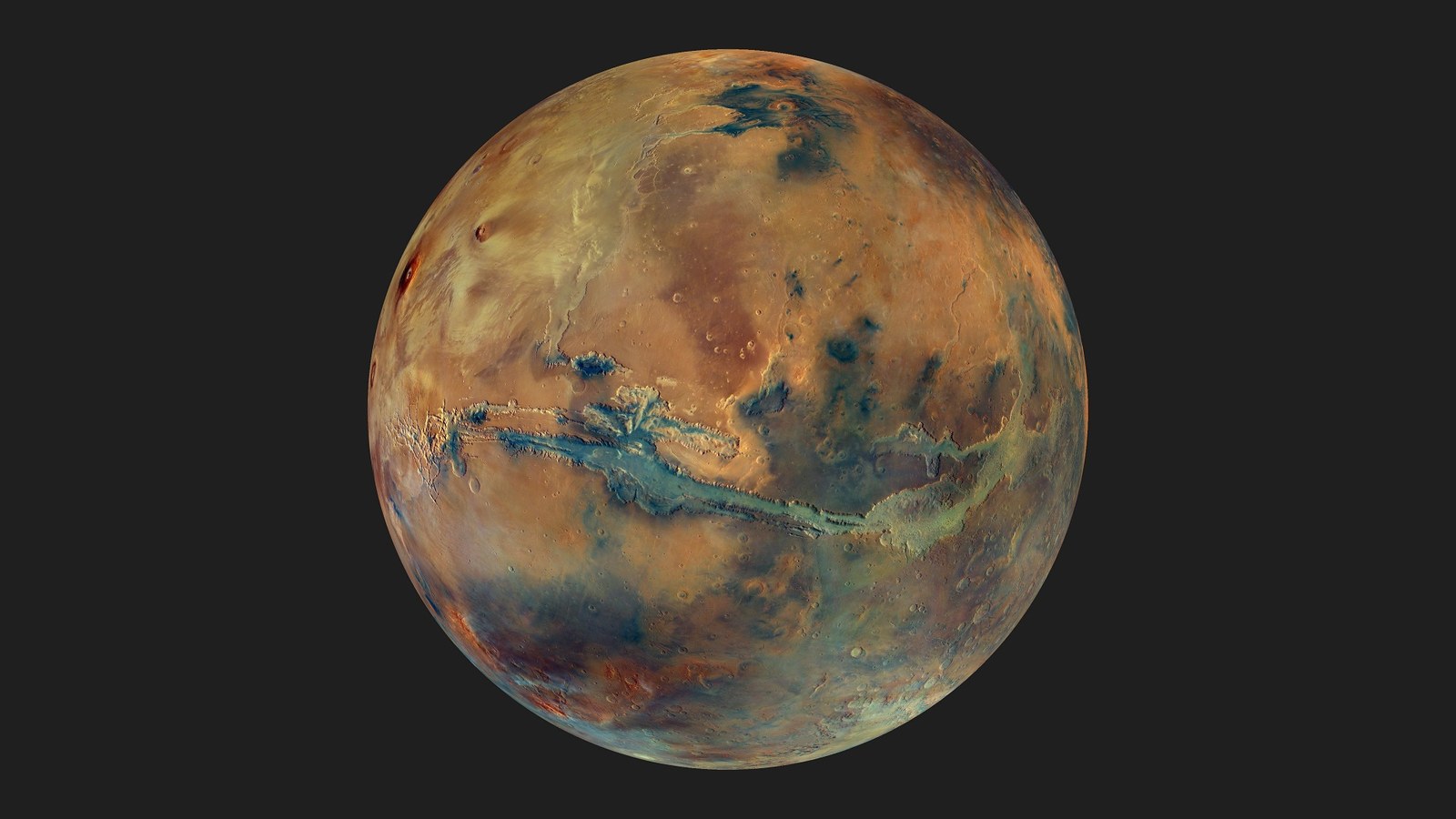
Color mosaic image of Mars, taken by the HRSC instrument aboard the ESA's Mars Express orbiter. Credit: ESA/DLR/FU Berlin (G. Michael)

Life Probably Played No Role in Mars’ Organic Matter

The Martian surface shows ample evidence of its warm, watery past. Deltas, ancient lakebeds, and dry river channels are plentiful. When the Curiosity rover found organic matter in ancient sediments in the Jezero Crater paleolake, it was tempting to conclude that life created the matter.

However, new research suggests that non-living processes are responsible.

There are three carbon isotopes on Earth: carbon-12 (12C), carbon-13 (13C), and carbon-14 (14C). Earth’s carbon is almost entirely carbon-12. It makes up 99% of the carbon on Earth, with carbon-13 making up the other 1%. (14C is extremely rare and unstable, so it decays into nitrogen-14.)

In 2022, MSL Curiosity took an inventory of organic carbon in sediments at Gale Crater. Organic carbon is usually described as carbon atoms bonded covalently to hydrogen atoms and is the basis for organic molecules. The carbon in organic carbon can be either carbon-12 or carbon-13, and the amounts are important. At Gale Crater, Curiosity found about 200 to 273 parts per million of organic carbon. “This is comparable to or even more than the amount found in rocks in very low-life places on Earth, such as parts of the Atacama Desert in South America, and more than has been detected in Mars meteorites,” said Jennifer Stern, a Space Scientist at NASA’s Goddard Space Flight Center when the results came in.

This is the Stimson sandstone formation in Gale Crater on Mars. This is where the Curiosity Rover drilled the Edinburgh hole and found enriched Carbon 12. Image Credit: NASA/Caltech-JPL/MSSS

This carbon is important evidence in understanding Mars’ history. It can tell scientists about the planet’s atmospheric processes and environmental conditions and even shed light on potential life. In fact, understanding Martian carbon can aid our understanding of habitability and prebiotic chemistry on distant exoplanets. The isotope ratio in this carbon is different than on Earth. It has a lower amount of carbon-13 relative to carbon-12 compared to Earth. Why the discrepancy?

In recent research in Nature Geoscience, a team of researchers tried to understand the difference between Earth’s and Mars’s carbon isotope ratios. The work is titled “Synthesis of 13C-depleted organic matter from CO in a reducing early Martian atmosphere.” The lead author is Yuichiro Ueno, a biogeochemist in the Department of Earth and Planetary Sciences at the Tokyo Institute of Technology.

“Strong 13C depletion in sedimentary organic matter at Gale crater was recently detected by the Curiosity rover,” the authors write. “Although this enigmatic depletion remains debated, if correct, a mechanism to cause such strong 13C depletion is required.” 

The amount of carbon-13 in the Martian sediments is far lower than in Earth’s sediments.

“On measuring the stable isotope ratio between 13C and 12C, the Martian organic matter has a 13C abundance of 0.92% to 0.99% of the carbon that makes it up,” lead author Ueno explained in a press release. “This is extremely low compared to Earth’s sedimentary organic matter, which is about 1.04%, and atmospheric CO2, around 1.07%, both of which are biological remnants and are not similar to the organic matter in meteorites, which is about 1.05%.”

The meteorite data is important because a four billion-year-old Martian meteorite named ALH 84001 is enriched in carbon-13, adding to the enigma of Mars’ carbon. Somehow, carbon-13 became depleted in the intervening billions of years. Solar escape is one possible reason for the carbon-13 depletion, but the authors discount that. There likely wasn’t enough time for enough carbon-13 to escape. “Furthermore, based on geomagnetic observations, early Mars probably had a geomagnetic field before 4?Ga,” the authors write. That field would’ve prevented solar escape.

To determine what’s behind this discrepancy, Ueno and his co-researchers simulated different Martian atmospheric conditions to see what would happen.

Their results show that isotope fractionation by solar UV light is responsible for Mars’ 13C depletion.

This graphic outlines the process that creates atmospheric organic matter that finds its way into the Martian sediments sampled by MSL Curiosity. Image Credit: Ueno et al. 2024. This graphic outlines the process that creates atmospheric organic matter that finds its way into the Martian sediments sampled by MSL Curiosity. Image Credit: Ueno et al. 2024.

Carbon-12 and carbon-13 respond differently to UV light. Carbon-12 preferentially absorbs UV, which dissociates it into carbon monoxide that’s depleted in carbon-12. What’s left behind is CO2 enriched with carbon-13.

Scientists have observed this process in the upper atmospheres of Earth and Mars. In Mars’ reducing atmosphere, where oxygen was depleted, the CO2 enriched with carbon-13 would’ve transformed into formaldehyde and possibly methanol. But those compounds didn’t remain stable. In Mars’ early days, the surface temperature was close to the freezing point of water, and it never exceeded about 27 Celsius (80 F.) In that temperature range, the formaldehyde and other compounds could’ve dissolved in water. From there, they gathered in sediments.

But that’s not the end of Mars’ carbon isotope story.

The researchers used models to show that in a Mars atmosphere with a CO2 to CO ratio of 90:10, 20% of the CO2 would have converted to CO, leading to the sedimentary carbon isotope ratio we see today. The remaining atmospheric CO2 would be higher in C-13, and both values are in line with what Curiosity found, and with the ancient Martian meteorite ALH 84001.

This is a plausible scenario that can explain Curiosity’s curious carbon findings.

The team’s study also includes some other important details. For instance, atmospheric CO may not have come solely from photolysis by UV light. Some could have come from volcanic eruptions. And atmospheric CO may not have been the sole source of organics that found their way into the sediments. But either way, the results tell scientists something about Mars’ carbon cycle.

It also tells us to expect to find more organics in Martian sediments in the future.

“If the estimation in this research is correct, there may be an unexpected amount of organic material present in Martian sediments. This suggests that future explorations of Mars might uncover large quantities of organic matter,” said Ueno.

While the research shows us that life needn’t be present to produce these organics, it can’t rule life out. Nobody can, at least not yet.

The research also shows how complex atmospheric chemistry can be and how difficult it can be to draw conclusions from atmospheric studies of exoplanets. The JWST has examined several exoplanet atmospheres and found some interesting results. But there’s so much we don’t know. This research is a reminder that any conclusions are likely premature.

 { https://www.universetoday.com/ }

Hoe vind je dit bericht?
Geschreven door peter om 20:22 Stuur door

Robotische “derde duim” gemaakt om de grenzen van het menselijk lichaam te overwinnen en de bewegingsmogelijkheden te vergroten

Robotische “derde duim” gemaakt om de grenzen van het menselijk lichaam te overwinnen en de bewegingsmogelijkheden te vergroten

Janine imageDoor Janine
Wat zouden we kunnen doen als we een extra duim hadden? Robotica laat het ons zien door een apparaat te maken dat blijkbaar heel gemakkelijk te gebruiken is.

Zijn twee duimen niet genoeg? Daar zorgt robotica voor

De Derde Duim helpt de gebruiker een fles te openen

Dani Clode Design / The Plasticity Lab

Tien vingers in totaal, waarvan slechts twee duimen, is misschien niet genoeg, zelfs als we ons daar niet van bewust zijn. Gedreven door de overtuiging dat “meer beter is” wilden wetenschappers van de Universiteit van Cambridge de menselijke hand een extra verlengstuk geven. Robotisch natuurlijk. Deze sector wordt steeds populairder en ontwikkelt een reeks gemotoriseerde draagbare apparaten. Het doel? Door de grenzen van de menselijke anatomie te overwinnen en de motorische vaardigheden te implementeren die we nodig hebben om de prestaties te verbeteren, en om ondersteuning te bieden aan mensen met bewegingsproblemen.

Tamara Makin van de Cognition and Brain Sciences Unit van de Medical Research Council aan de Universiteit van Cambridge legt uit: “De technologie verandert onze definitie van wat het betekent om mens te zijn, waarbij machines steeds meer een onderdeel van ons dagelijks leven worden. Deze technologieën bieden opwindende nieuwe mogelijkheden waar de samenleving profijt van kan hebben, maar het is van cruciaal belang om te overwegen hoe ze alle mensen in gelijke mate kunnen helpen."

De robotiche derde duim: hoe werkt het

University of Cambridge/Youtube screenshot

De Derde Duim, de specifieke naam van het apparaat, is ontwikkeld door Dani Clode, die meewerkt in het laboratorium van Makin. Het gaat om een extra robotische duim die de bewegingsmogelijkheden vergroot, waardoor zowel het grijpvermogen van de hand als de last die deze kan tillen en dragen toeneemt. Met andere woorden: het maakt het mogelijk om handelingen uit te voeren die met één hand moeilijk of onmogelijk zijn.

Het apparaat wordt aan de andere kant van de hand gedragen dan de natuurlijke duim en wordt bestuurd door een druksensor die onder de grote tenen wordt aangebracht. Druk van de rechterteen verlengt de robotische duim, terwijl druk van de punt van de linker grote teen deze dichter bij de vingers brengt. De kracht van de druk bepaalt de bewegingssnelheid, evenals de terugkeer van het apparaat naar zijn oorspronkelijke positie. Wetenschappers testten de Derde Duim in 2022 tijdens de Royal Society Summer Science Exhibition, waarbij enkele leden van het publiek betrokken waren die de kans hadden om het uit te proberen.

Inclusieve robotische duim: geschikt voor iedereen en eenvoudig in gebruik

University of Cambridge

592 deelnemers in de leeftijd van 3 tot 96 jaar waren in staat om de sensor gedurende vijf dagen te bewegen. Slechts vier deelnemers hadden hier echter moeite mee, omdat het prototype dat op de tentoonstelling werd gepresenteerd niet geschikt was voor de handgrootte van kleine kinderen, noch voor de sensor. In de overgrote meerderheid van de gevallen lukte het de proefpersonen om de duim te bewegen tijdens de minuut die beschikbaar was om hem te testen, geleid door de instructies van het team. De test bestond uit het oppakken van voorwerpen met alleen de Derde Duim, inclusief het oppakken van pinnen van een geperforeerd paneel en deze één voor één in de mand te verplaatsen, om er zoveel mogelijk te verzamelen binnen 60 seconden. Meer dan de helft van de deelnemers slaagde daarin.

Uiteindelijk was 98% van de deelnemers in staat om de objecten naar tevredenheid te verplaatsen, ongeacht verschillen in achtergrond en geslacht. Kinderen en ouderen toonden een vergelijkbaar vaardigheidsniveau, waarbij oudere volwassen deelnemers minder vaardigheid vertoonden vanwege hun leeftijd. Zoals Dani Clode uitlegde: "Gezien de diversiteit van lichamen is het cruciaal dat de ontwerpfase van draagbare technologie zo inclusief mogelijk is, zodat deze apparaten toegankelijk en functioneel zijn voor een breed scala aan gebruikers."

{ https://www.curioctopus.nl/ }

Hoe vind je dit bericht?
Geschreven door peter om 17:20 Stuur door

Astronomers Stumbled Upon A Rare Chance To Capture Just How Fast A Supermassive Black Hole Spins

Astronomers Stumbled Upon A Rare Chance To Capture Just How Fast A Supermassive Black Hole Spins

One unlucky star brought fortune to these astronomers.

There are behemoths that lurk at the center of almost all large galaxies in the known universe, including the sleepy giant in our Milky Way.

These are supermassive black holes, and they’ve been critical to the universe’s evolution. A new study, published today in the journal Nature, offers a fascinating new method to measure their spins. This ability could help astronomers flesh out how our universe came to look as it does today.

Back in 2020, astronomers noticed some strange activity. Using the Zwicky Transient Facility in California, they detected telltale signs that a star was going through what scientists call a tidal disruption event, in which an intense field of gravity rips a star apart. Tidal disruption events really only come from one thing: monster black holes. They realized what they were witnessing was a big black hole feasting on a star.

An animation explaining the work of Pasham’s team.

Astronomers observed the black hole in detail using the International Space Station’s NICER telescope, which is short for Neutron star Interior Composition Explorer. They found a few interesting details. Every 15 days, the supermassive black hole experienced a shift in X-ray intensity, and this pattern remained steady for the entirety of the four months they studied it.

From this, they were able to estimate the spin speed of the black hole. Finding such a specific detail about an object lurking roughly a billion light-years away is impressive. But the researchers say this new technique might be able to help solve some riddles about how the universe came to be. Specifically, how the hearts of galaxies evolved from Cosmic Dawn to today.

The supermassive black hole of the new study behaves somewhat like a kid swaying their hips to move a hula hoop. From the motion of the toy — in this case, the ring of shredded gas from the victim star — helped astronomers observe how the object’s intense gravity warps space-time to affect the disk. Black holes are so dense that not even light can escape them. But accretion disks around the black holes do emit light. They trace the path of this space-time warp. The black hole creates a drag called Lense-Thirring precession, and from this, astronomers deduced the spin speed.

This isn’t the first time that astronomers have derived the spin measurements of supermassive black holes and smaller black holes. But according to the lead author of the new study, MIT research scientist Dheeraj Pasham, this was the first time that the black hole’s warp of the space-time, paired with the luminosity of the accretion disk of an otherwise invisible object, led to finding the black hole’s spin speed.

Tidal disruption

An artist’s impression of a tidal disruption event, created by a black hole swallowing a star

Carl Knox / OzGrav, ARC Centre of Excellence for Gravitational Wave Discovery, Swinburne University of Technology

The team owe much of their accomplishment to this black hole being a great candidate for study. It helped that the black hole was tilted towards Earth, letting astronomers investigate the X-rays clearly. NICER also has an easier job if it’s targeting objects in the direction of Earth’s poles, where the Sun can’t obstruct. The black hole is in the polar part of our sky, fortunately.

The spin speed of the black hole is a fingerprint. An abundance of slow-spinning black holes would mean frequent chaotic mergers between black holes — and the galaxies they reside in. “You’re dumping angular momentum in random orientations, and essentially spinning down the remnants,” Pasham tells Inverse.

“The other scenario is, let’s say you find most of the black holes are fast-spinning as close to the speed of light, that means they grew by accretion. Like a spinning top,” Pasham added. Over time, the balls of gas pulled in towards the black hole sped it up a little more.

This new research, along with discoveries emerging from a myriad of new telescopes taking flight soon, the universe’s history may not stay so hidden for long.

{ https://www.inverse.com/ }

Hoe vind je dit bericht?
Geschreven door peter om 17:04 Stuur door

This Dwarf Planet Is Basically A Sweet Red Snow Cone

This Dwarf Planet Is Basically A Sweet Red Snow Cone

Please do not lick the science.

Close-up image of a distant celestial body resembling two connected spheres with a textured, uneven ...
NASA

If there were a recipe for Kuiper Belt’s sweetest dwarf planet, it would look something like this: Take one 22-mile long, figure-8-shaped blob of mixed ice, and add a heaping pour of methanol. Bombard with cosmic rays and solar wind for about 2 billion years, until it reaches a nice reddish color. Serve chilled to -390 degrees Fahrenheit.

A recent study found that Arrokoth, a weirdly-shaped dwarf planet in the Kuiper Belt, gets its distinctive reddish coloration from complex hydrocarbon molecules, which form when cosmic rays and solar wind bombard the tiny world’s frozen methanol surface. The same chemical reactions that spawn those hydrocarbons also produce sugars like glucose and glycerol, which means that if you licked Arrokoth, it would probably taste sweet, but also a little like soap. (Please don’t try this, because methanol is poison, and also you shouldn’t open your spacesuit helmet in a vacuum. Safety first!)

University of Hawai’i at Manoa chemist Chaojiang Zhang and colleagues published their work in the Proceedings of the National Academy of Science.

photo of a reddish-brown pair of rocks in space, stuck together.

The chemical building blocks for life formed on Arrokoth thanks to chemical reactions in its ice, triggered by cosmic rays.

NASA

LAB-GROWN DWARF PLANETS

Zhang and colleagues froze a slab of methanol and carbon monoxide to around -390° Fahrenheit, or about 40 Kelvin, in their lab, then blasted it with high-energy electrons to simulate a couple billion years of cosmic rays.

The simulated cosmic rays triggered a series of chemical reactions in the ice, which produced complicated molecules called polycyclic aromatic hydrocarbons — the chemicals that stain Arrokoth’s surface a distinctive reddish color. Those same chemical reactions also produced sugars like glucose (the stuff that sweetens honey, berries, nuts, grains, and even potatoes), glycerol (the backbone of fatty acids called lipids, which make up part of our cell membranes, among other things), and ribose (and important part of DNA and RNA).

And the hydrocarbon molecules that give Arrokoth its color are built benzene, a chemical that is a ring of six carbon atoms with six hydrogen atoms on the outside. That ring structure is the basis for most organic chemistry, including some of the most important molecules for life: the “nucleobases” that make up the genetic code, as well as the amino acids that combine to form proteins.

In other words, the surface of Arrokoth is probably laden is with the chemical building blocks for life — and that’s pretty sweet, too.

“SUGAR WORLDS” MEET WITH EARTH

Some of the ribose in your DNA right this moment may once have been locked in frozen ice on the surface of a world like Arrokoth.

“Sugar worlds” like Arrokoth may have played a role in giving Earth its starter kit of life-building molecules, like sugars and benzene-based hydrocarbon rings. Some of the comets that bombarded early Earth around 4 billion years ago may have come from tiny Kuiper Belt worlds like Arrokoth. And Zhang and colleagues’ experiment suggests those comets may have carried more than just water ice to our young planet.

Different Kuiper Belt worlds may have supplied different organic chemicals to early Earth, according to Zhang and colleagues. Pluto’s dancing partner, Charon, and another dwarf planet called Orcus, have water and ammonia frozen on their surfaces; others have carbon dioxide. Zhang and colleagues want to do more experiments in their lab to simulate how cosmic rays change the chemistry on each of those worlds to learn what’s out there — and how it got here

{ https://www.inverse.com/ }

Hoe vind je dit bericht?
Geschreven door peter om 16:48 Stuur door

Look! NASA’s Lucy Mission Stumbled Upon An Asteroid With Planet-Like Features

Look! NASA’s Lucy Mission Stumbled Upon An Asteroid With Planet-Like Features

Dinkinesh is a tough half-mile-wide rock.

Blurred image of two irregular, angular shapes against a dark background, suggesting a low-resolution, close-up view of celestial objects or debris.

NASA's Lucy mission, which is a first of its kind mission to study a population of mysterious relics from the formation of the Solar System near Jupiter. And, as mission photos suggest, it’s not always about the destination, but the rocky encounters you make along the way.

The Lucy mission, named after the famous 3 million year old hominid fossil, is slated to visit the Trojans, a swarm of asteroids stuck in Jupiter’s orbit that may be relics of the Solar System’s formation. But the spacecraft made a pitstop at asteroid Dinkinesh on November 1, 2023 for what was meant to be a simple test subject for the spacecraft's navigational systems.

The asteroid, however, turned out to have plenty of science to offer, including new information about how planets form, according to a new study published Wednesday in the journal Nature. Dinkinesh, and its surprise mini-moon Selam, might also contain clues about how the planets formed billions of years ago, the study reveals.

Dots indicate a trough, a cavity along an asteroid. Dots of another color run perpendicular, and rep...

Panels a, b, and c each show stereographic image pairs of the asteroid Dinkinesh that NASA’s Lucy Spacecraft’s took, using its L’LORRI instrument. The images were snapped in the minutes around closest approach on November 1, 2023. 

The yellow dots indicate the trough, and the rose dots show the ridge features. 

NASA/GSFC/SWRI/JOHNS HOPKINS APL/NOIRLAB

HELLO DINKINESH

Dinkinesh is a rough half-mile-wide rock.

Lucy’s images show that Dinkinesh, located in the inner edge of the main asteroid belt between Mars and Jupiter, has a trough and a ridge, and is shaped like a spinning top.

Researchers think the ridge formed when a large chunk of rock dislodged from Dinkinesh. When the rock got knocked out, it broke into tiny pieces. These bits then settled to form the ridge. Some rock pieces might also have been lofted into space and then rained back down to add to the ridge.

“Basically, the planets formed when zillions of smaller objects orbiting the Sun, like asteroids, ran into each other. How objects behave when they hit each other, whether they break apart or stick together, has a lot to do with their strength and internal structure,” Lucy mission principal investigator Hal Levison said in the announcement.

Dinkinesh's terrain suggests it has a sturdy interior. This would have been an essential trait during the formation of the planets billions of years ago. The researchers think that the rock dislodged when an earthquake-like event occurred. During these types of events, there's a gradual buildup of stress that culminates as a swift release. If a celestial body experiences this type of event, that suggests it has a compact composition. If Dinkinesh's rocks were more loosely gathered together, the stress may not have built up, but instead, created gradual changes to the terrain, similar to the way a sand dune shape shifts.

The dislodged rock event could also explain how Dinkinesh’s tiny moon, Selam, formed. Over millions of years, the Sun’s thermal radiation caused Dinkinesh’s spin to accelerate. This created a centrifugal force. As material pooled near the center, or flew off into nearby space, Selam gained its raw ingredients.

In keeping with the moniker theme of the Lucy mission, Selam is a greeting meaning “peace” in the Amharic language. It’s spoken in Ethiopia, where the Lucy fossil was discovered. Dinkinesh is another Amharic word, meaning “marvelous.”

{ https://www.inverse.com/ }

Hoe vind je dit bericht?
Geschreven door peter om 16:42 Stuur door

The Alien Abduction of the Century: The Unbelievable Story of Linda Napolitano

The Alien Abduction of the Century: The Unbelievable Story of Linda Napolitano

LINDA NAPOLITANO

In the realm of UFO encounters and alien abductions, few stories are as compelling and mysterious as that of Linda Napolitano. Her extraordinary experience on the night of November 30, 1989, has been dubbed “the alien abduction case of the century” by experts in the field. This article delves into the intriguing details of her encounter and its broader implications for our understanding of extraterrestrial phenomena.

The Initial Encounter

Linda Napolitano, an ordinary housewife from New York City, had her life turned upside down in the early hours of a cold autumn night. At around 3 a.m., she was awakened by an unsettling presence at the foot of her bed. What she saw defied all rational explanation: a small, skeletal-bodied creature with a large head and completely black eyes. This being, along with two similar figures, would soon transport her into an experience that remains one of the most detailed and disturbing accounts of alien abduction to date.

Linda described a powerful blue light flooding her bedroom, paralyzing her and lifting her out of her bed. She floated through her apartment window, high above the streets of Manhattan, towards a massive UFO suspended in the sky. The craft was oyster-shaped and adorned with colorful lights. Inside, she found herself subjected to strange and invasive procedures by her captors.

The Aftermath and Hypnosis

Following the incident, Linda’s memories of the abduction were fragmented and hazy. Desperate for answers, she reached out to Budd Hopkins, a well-known ufologist. Hopkins, who had extensive experience with abduction cases, conducted several sessions of regressive hypnosis with Linda. Through these sessions, they managed to piece together the details of her ordeal, from the moment she was lifted from her bed to the invasive procedures performed aboard the UFO.

Eyewitness Accounts

What sets Linda Napolitano’s case apart from other abduction stories is the corroborative eyewitness testimony. Two men, Richard and Dan, who initially claimed to be police officers, later revealed they were security agents assigned to an important political figure. They reported seeing Linda and the three alien beings floating in the sky and entering the UFO. Their accounts added a significant layer of credibility to Linda’s story.

In total, 24 witnesses came forward, describing bright lights in the sky, strange flying beings, and an unidentified flying object. This multitude of testimonies makes Linda’s case one of the most well-documented and witnessed UFO encounters in history.

Government Involvement and Threats

As Hopkins and Linda delved deeper into the case, it became apparent that there were broader implications. Richard and Dan’s initial friendly demeanor turned sinister as they began to harass and threaten Linda. They forced her into their car, interrogated her, and even subjected her to bizarre and invasive examinations. Their behavior suggested a deeper, more troubling connection to government agencies and possible cover-ups.

Hopkins received a letter from a third party, referred to as the “third man,” who warned him to cease his investigations. This mysterious figure hinted at ecological dangers, geopolitical implications, and the involvement of extraterrestrial forces in global affairs. Hopkins speculated that this third man might have been Javier Perez de Cuellar, the then-Secretary-General of the United Nations, who allegedly witnessed the abduction.

Theories and Implications

One of the most compelling aspects of Linda’s case is the possible explanations and theories that emerged from it. Professor Corrado Malanga, an Italian chemist and ufologist, proposed a groundbreaking theory based on his extensive research and regressive hypnosis sessions with abductees. Malanga suggested that aliens were interested in the human soul, a component of our being that they lacked.

According to Malanga, aliens performed intricate procedures to extract and utilize this soul component, which is timeless and immortal. This theory posits that humans are used as a source of life force by these extraterrestrial beings. Malanga’s findings suggest that the abduction phenomenon might be far more complex and sinister than previously thought.

VIDEO:

  • THE ALIEN ABDUCTION OF THE CENTURY : LINDA NAPOLITANO STORY – ORIGINAL V MOVIES

Linda Napolitano’s story remains one of the most fascinating and well-documented cases of alien abduction. With multiple eyewitnesses, government involvement, and credible research by experts like Budd Hopkins and Corrado Malanga, her experience continues to intrigue and challenge our understanding of extraterrestrial encounters. As ufology advances, the case of Linda Napolitano stands as a pivotal moment in the ongoing quest to uncover the truth about alien abductions and their implications for humanity.

LINKS VIDEOS

{ https://www.latest-ufo-sightings.net/ }

Hoe vind je dit bericht?
Geschreven door peter om 16:13 Stuur door

Tom Delonge Has UFO Secrets That Kept Him Up For 3 Nights: ‘These Beings Have Been Around Forever’

Afbeelding

Tom Delonge Has UFO Secrets That Kept Him Up For 3 Nights: ‘These Beings Have Been Around Forever’

There are many things happening within the UAP phenomenon. With the recent Mexican UAP hearings, the entire world has come to learn about how governments worldwide are earnestly investigating this phenomenon. It is not solely about alien objects flying at supersonic speeds; the UAP phenomenon is intricately connected to our reality. Such like-minded individuals as Jacques Vallee and Michio Kaku propose the existence of other dimensions, also known as parallel universes, coexisting alongside our own reality. Within these dimensions, it is plausible that there are beings or entities living alongside us, despite our inability to perceive them.

Interestingly, Tom DeLonge, the former lead vocalist and guitarist of the popular band Blink-182, has always had a keen interest in UFOs. He has spent many years researching and studying the topic. He has even formed a company, To The Stars Academy of Arts and Science (or To The Stars) to investigate and promote research on UFOs and other related phenomena.

DeLonge even paid a visit to Rome with former Pentagon UFO official Luis Elizondo, where they discovered shocking details about the 2004 Sicily UFO attack. His “To The Stars” is behind publishing the three footages (captured in 2004 and 2015 by the US Navy) that were released in 2017 and 2018. They depict UFOs and include audio recordings of the pilots. These videos gained a lot of attention when they were released.

Tom’s fondness for UFOs began at a young age. As a child, he was fascinated by stories of alien encounters and sightings. He used to spend hours reading books and watching documentaries about unidentified flying objects and was particularly interested in the 1947 Roswell crash. Furthermore, his research led him to conclude that UFOs are not only real but that they have alien origins. He believes that there is a wealth of evidence to support this conclusion, including reports of sightings and encounters, as well as physical evidence such as radar tracks and photographs.

In this podcast with Dr. Brian Keating, Tom DeLonge shared several insights and personal experiences related to his involvement in UFO research. He was asked by TOE host Curt Jaimungal what it was that kept him up for three days.

DeLonge at first hesitates to delve into this topic but continues to talk about his communication with Jim Semivan (who is a co-founder of TTSA) and their unique way of thinking. Tom notes that Semivan and others have taught him how to analyze information more critically and avoid jumping to conclusions. They emphasize the importance of forming patterns and analyzing data over time.

Tom then touches on the idea of not fully grasping the stakes involved in the UAP phenomenon. He explains that initially, he struggled to accept the reality of it, despite encountering videos and books on the subject. He emphasizes the importance of verifying the authenticity of such evidence, especially when it comes to videos with a chain of title traced back to the Department of Defense (DOD).

“That’s why it was so important with the ones we brought out had chain of title all the way back to the DOD. So we knew those were real, it wasn’t just like it was on YouTube and leaked. So it’s, it’s the idea of bringing for things that you know, where they come from, and and you really take it from that point forward, and start getting really good data and evidence on people’s encounters, and the stakes that come with that. And that when when I’ve talked about this, as a threat, you know, this, that’s just my words, right? I mean, I would never know the way that government treats that that’s not my zone, obviously.

But for me, in my own personal research, if something’s been here for a long period of time, and it really is showing up in people’s bedrooms, or in front of an F 18, or on a petroglyph wall, or in an ancient text down in archives of the Vatican, or whatever it might be, it’s obviously doing something. And it’s obviously having an influence, and it might only be an influence on where we end up as mankind, or it might be an influence, to keep us suppressed in a weird way to where they can take advantage of something, who knows, um, but it’s here for a reason. And it’s not really being, you know, forward about its intent. But we do know that we’ve been dealing with it for a long period of time.”

Tom then recalls a personal experience when he had a meeting with a couple of generals in Colorado Springs. During the discussion, they talked about things that people were experiencing or witnessing related to the UAP phenomenon. This conversation left him feeling uneasy and made him question the safety of his environment, similar to how his religious mother might feel if she encountered something that contradicted her beliefs. He emphasizes that the phenomenon’s impact becomes more significant when it is perceived as real rather than just a belief.

He shares his personal belief that as humanity advances in its understanding of consciousness and the UAP phenomenon, it will merge metaphysical consciousness science with conventional science. He suggests that this merging might lead to a more harmonious coexistence of various religious beliefs, as the core principles of many religions focus on the individual’s connection to a higher consciousness. Tom hopes that instead of crumbling, religions will adapt and find common ground in this new understanding of reality.

“You know, I look at the taskforce report, and I look at what’s going on now. And if I if there was such a thing, like bodies are great After whatever, um, and they’re so advanced, and they’re somehow influencing the, you know, mankind and the way we are engineered to evolve or something crazy. I mean, because I look at us now it’s like, first we, we got into the biology of our bodies, and then we got deeper and we got into like, you know, DNA and what that’s doing. And every time we master parts of the body and parts of, you know, the world, we see and touch and feel like, what’s the next thing?

Well, I think the next thing is going to be discovering consciousness, and then we’re going to go how do we manipulate consciousness? And how do we capture it? And how do we are you know, so I’m kind of thinking of this, these beings have been around for so long, they must be in, they must be so far beyond like, wondering about our DNA, or wondering about like, what our spleen does, I think it’s going to be probably unnerving, probably complicated, probably a lot that we don’t know. And so the idea of the government just coming out and saying, Hey, look, what we got, before they know what it is, doesn’t make any sense to me.”

Read also:

For some reason, Tom could not boldly speak about what he had discussed with those generals that kept him up for three days. In the same context, the case of former NASA researcher Ed Harris might shed some light on what Tom was trying to say.

Ed Harris claimed that serious researchers on the subject believe the story of former President Jimmy Carter crying after being briefed about classified UFO information to be true. According to the story corroborated by multiple witnesses, the U.S. presidents are given only a brief overview of the subject by the CIA, and presidential curiosity is not considered a sufficient need to know. (Click here to read the full article)

After being repeatedly stonewalled, Carter was given “the talk,” which reportedly left him deeply sobbing and visibly disturbed for weeks. He was told that major religions, including Christianity, were created by extraterrestrials to prevent humans from destroying themselves while they ran experiments on us, and that they made us. Carter, a deeply religious man who had witnessed a UFO with six other people, realized that releasing such information could cause tremendous economic and social upheaval.

Richard Dolan also covered this incident in his book, “UFOs and the National Security State: The Cover-Up Exposed.” He wrote that President Carter was given a UFO briefing at the White House on June 14, 1977, which he was then bound to secrecy about.

Astronomer Jacques Vallée developed an alternative hypothesis that UFOs are part of a mechanism for controlling mankind. He is one of the few people who added credibility to the UFOlogy. When others called the UFO encounters a hoax, Vallée explained it scientifically. During his interview in 1986, he said that UFOs are a “physical object that interacts with the environment that causes effects on the witnesses on the psychology and the physiology and leaves traces on the ground and yet are capable of appeared to be manipulating time and space in ways that go beyond what our physics understands.” (Click here to read the full article)

Dr. Vallée argued that when investigating a UFO encounter, the focus should be on the witness, how he/she interpreted the event, and how it affected their life (he noted that many people tend to emotionally react to a UFO sighting as a spiritual or religious experience).

{ https://www.howandwhys.com/ }

Hoe vind je dit bericht?
Geschreven door peter om 00:48 Stuur door

CUTTING-EDGE AI PROGRAM “COSMOAGENT” SIMULATES FIRST CONTACT WITH ALIEN CIVILIZATIONS

JfQWAa7u?format=jpg&name=900x900

CUTTING-EDGE AI PROGRAM “COSMOAGENT” SIMULATES FIRST CONTACT WITH ALIEN CIVILIZATIONS

Blending artificial intelligence (AI) and speculative cosmology, an international team of researchers has introduced “CosmoAgent,” an innovative AI framework designed to simulate interactions between human and extraterrestrial civilizations. 

This novel approach assesses the feasibility of peaceful coexistence while considering potential risks that could threaten well-intentioned civilizations. 

The study, conducted by a collaboration of scientists from Northwestern University, New York University, Rutgers University, the New Jersey Institute of Technology, Shanghai Jiao Tong University, and Georgetown University, offers new insights into the dynamics of interstellar interactions.

“CosmoAgent leverages large language models (LLMs) to simulate complex interactions between human and extraterrestrial civilizations,” the researchers explained. Employing mathematical models and state transition matrices, our approach quantitatively evaluates civilizations’ development trajectories, offering insights into future decision-making at critical points of growth and saturation.” 

In a preprint published on ArXiv, researchers explain that the novel “CosmoAgent” framework draws inspiration from the late Dr. Stephen Hawking’s cautionary advice about trying to haphazardly initiate contact with extraterrestrial species. 

In the latter part of his career, Dr. Hawking became an outspoken critic of attempts to contact intelligent alien life, warning that encountering advanced extraterrestrials could lead to the end of humanity.

“We don’t know much about aliens, but we know about humans,” said Dr. Hawking at a 2015 event. “If you look at history, contact between humans and less intelligent organisms have often been disastrous from their point of view, and encounters between civilizations with advanced versus primitive technologies have gone badly for the less advanced.” 

“A civilization reading one of our messages could be billions of years ahead of us. If so, they will be vastly more powerful and may not see us as any more valuable than we see bacteria.”

Inspired by Dr. Hawking’s warnings, researchers sought to explore the potential consequences of human policies toward extraterrestrial life and devise strategies to mitigate risks associated with first contact scenarios.

Employing large language models (LLM) to model diverse ethical paradigms, CosmoAgent simulates interactions between entities with distinct moral principles. This approach addresses the Earth-centric bias inherent in current AI designs by incorporating varied cosmologies, ethical codes, and worldviews that might be held by alien civilizations.

CosmoAgent’s simulations allow civilizations to choose between hiding, fighting, or collaborating based on their characteristics and decision-making processes. 

These choices are evaluated in a dynamic environment that examines potential outcomes, including alliances, rivalries, adherence to specific rules or agreements, and responses to unexpected threats or opportunities.

One key aspect of the study is the use of a Multi-Agent System (MAS) framework to model interactions among various civilizations. The framework allows for detailed exploration of different scenarios, such as civilizational alliances or rivalries, the effects of asymmetric information, and the development of novel cultures or technologies.

“Our simulations investigate potential interactions among different civilizations, including alliance formations, competitive relationships, and responses to unknown threats or opportunities,” researchers wrote. “By simulating these interactions, we gain insights into the mysteries of extraterrestrial existence, communication, conflict, and cooperation, potentially uncovering significant behavioral patterns and contributing valuable knowledge on diversity and order in the universe.”

The study addresses several key research questions, including the risks and benefits of human policies toward aliens, by using state transition matrices to simulate development levels and decision-making modes. Additionally, the model examines the management of asymmetric information and the impact of different moral views on civilizational interactions.

For instance, the researchers explored how LLMs handle asymmetric information differences, notably when observational data lags behind the actual development of civilizations. This aspect is crucial for making effective decisions in interstellar exploration and contact efforts.

“Information Asymmetry, particularly the time delay in observational data due to the speed of light, poses a significant challenge in space exploration and the study of extraterrestrial civilizations,” the study noted. “This time lag means that any observed information about extraterrestrial civilizations is inherently outdated, potentially leading to misconceptions about their current states.”

“Our research seeks to understand how to effectively manage and overcome these asymmetric information challenges in future extraterrestrial exploration and contact efforts.”

Researchers designed “CosmoAgent” to pay special attention to the potential “Diversity of morality” between humanity and an alien species. Powered by LLMs, the AI model examines how differing moral views might affect interactions, including recognizing that an alien civilization will likely hold divergent worldviews and ethical beliefs from human beings. 

With the release of CosmoAgent’s code and datasets, researchers hope the model can provide a foundation for future studies and spur further academic investigation into the intriguing outcomes of “first contact” between humans and intelligent extraterrestrials. 

“This study marks a pivotal advancement in computational social science. It shows how we can leverage the latest artificial intelligence technologies, especially LLMs, to mimic complex social phenomena.,” the researchers emphasized. “These models serve as the foundation for multi-agent systems, enabling the creation of detailed and varied behaviors and interactions within civilizations.” 

“This research not only broadens the scope and realism of simulations but also opens a new area for investigation within computational social science: the study of civilizations in the universe.” 

CosmoAgent could also offer astronomers a fresh perspective and tool for exploring and understanding civilizations beyond Earth. By simulating how different civilizations develop and make decisions, the study could aid in forecasting and spotting the distinct characteristics of intelligent alien civilizations. 

Moreover, the study opens a novel platform for philosophical exploration, addressing the existence, communication, conflicts, and collaborations among civilizations in the universe. Through simulations of ethical viewpoints and behavior patterns of diverse cultures, it exposes the moral variety and intricacy within the universe’s civilizations.

As humanity continues to explore the cosmos, the insights gained from CosmoAgent could prove invaluable in shaping our approach to potential encounters with extraterrestrial life, ensuring that we are prepared to navigate the challenges and opportunities of interstellar communication and cooperation.

Finally, by integrating diverse ethical paradigms and simulating interactions between human and alien civilizations, researchers believe their innovative approach can expand our perspective and provide valuable insights for future decision-making and conflict resolution.

“This innovative research provides a new way to understand complex inter-civilizational dynamics, expanding our perspective while pioneering novel strategies for conflict resolution,” researchers concluded. “These strategies are key to avoiding interstellar conflicts and broaden our understanding of inter-civilizational relations.” 

  • Tim McMillan is a retired law enforcement executive, investigative reporter and co-founder of The Debrief. His writing typically focuses on defense, national security, the Intelligence Community and topics related to psychology. You can follow Tim on Twitter: @LtTimMcMillan.  Tim can be reached by email: tim@thedebrief.org or through encrypted email: LtTimMcMillan@protonmail.com 

{ https://thedebrief.org/category/space/ }

Hoe vind je dit bericht?
Geschreven door peter om 00:28 Stuur door

Ex-Defence Minister: E.T.s From Andromeda & Saturn’s Moon Visiting Earth For Thousands Of Years

Paul Hellyer alien

Ex-Defence Minister: E.T.s From Andromeda & Saturn’s Moon Visiting Earth For Thousands Of Years

There are already dozens of claims in favor of extraterrestrial visitation. Today, numerous astronauts and government officials support the UAP phenomena, and some are highly positive that they could have an alien origin. The Honorable Paul Hellyer (1923-2021), former Canadian Minister of Defense said extraterrestrials have been visiting our planet for thousands of years and it is likely that at least two of them are working with the U.S. government and sharing their highly-advanced technologies with humans.

In the 1960s, Paul Hellyer, a high-ranking official during the Cold War, asserted that he had discovered with certainty about the existence of aliens while serving in the military. He said that people from other worlds had been coming to Earth for a very long time. He insisted that a lot of the stuff that makes up our high-tech gadgetry had been gifted to us by overly-advanced ETs.

Hellyer had long expressed his views on extraterrestrials in public. He testified at the Citizen Hearing on Disclosure in May 2013 in Washington, DC. Five former members of U.S. Congress and one former U.S. senator listened to more than thirty hours of testimony from government officials, military personnel, researchers, and witnesses.

Huffington Post Canada described that, as part of his testimony, Hellyer stated that “aliens are living among us and that it is likely at least two of them are working with the U.S. government.” More specifically, Hellyer announced that at least four species of extraterrestrials had been visiting Earth for thousands of years. According to Huffington Post Canada, he also stated that some extraterrestrials originate from the “Zeta Reticuli, the Pleiades, Orion, Andromeda, and Altair star systems” and “may have different agendas.”

He first spoke openly about his belief governments are covering up an alien presence back in 2005, saying UFOs are as plentiful in our sky as airplanes. “Much of the media won’t touch it, so you just have to keep working away at it and we will get a critical mass and one day they will say Mr. President or Mr. Prime Minister, we want the truth and we want it now because it affects our lives.”

In 2013, Hellyer appeared on the RT interview show SophieCo with Sophie Shevardnadze to discuss extraterrestrials and UFOs. Shevardnadze asked Hellyer, “Why do you say that UFOs are as real as airplanes flying over our heads?” Hellyer replied, “Because I know that they are. As a matter of fact, they’ve been visiting our planet for thousands of years.” He further stated military action had brought down UFOs, and humans had adapted alien technology for use on Earth. (Source)

Read also:

He said: “As far as technology is concerned, they are light years ahead of us, and we have learned a lot of things from them. A lot of the things we use today we got from them, you know – led lights and microchips and Kevlar vests and all sorts things that we got from their technology and we could get a lot more too, especially in the fields of medicine and agriculture if we would go about it peacefully. But, I think, maybe some of our people are more interested in getting the military technology, and I think that’s wrong-headed, and that’s one of the things that we are going to have to change, because we’re going to have to work together, all of us, everywhere on the planet.”

Paul Hellyer alien Hellyer takes us to where he saw his first UFO, and points. Credit: Motherboard

Shevardnadze asked: “Have you ever had your own encounter with aliens?” Hellyer replied: “Not encounter with aliens, no. I’ve seen a UFO, about 120 miles north of  Toronto, over Lake Muskoka, where I have a cottage. Two years ago, at Thanksgiving, which is October, [my wife?] said that she wanted to go out and look at the stars, so… I’m not much of a night man… but I put on my cap and went out with her and she looked into the eastern sky and said, ‘There’s a star,’ and I turned the other way and said, ‘Oh, there’s a much brighter one over here,’ and she looked there and we watched it until our necks almost broke for about 20 minutes, and it was definitely a UFO because it could change position in the sky by three or four degrees in three or four seconds.”

Shevardnadze further asked Hellyer if shooting down those UFOs was risking an interstellar war, and, if so, “should we be creating a Star Wars force to defend ourselves from possible invasion or something like that?”

Hellyer said: “I think it’s a possibility, but it’s a possibility especially if we shoot down every UFO that comes into our airspace without asking who they are and what they want. Right from the beginning, we started scrambling planes, trying to shoot them down, but their technology was superior enough that we weren’t able to get away with it, certainly not for a long while.”

He continued: “During that period of time they could have taken us over without any trouble if they wanted to, so I think, rather than developing our own Star Wars to protect ourselves against them, we should work with the benign species that are of a vast majority and work together, and rely largely on them, of course, and cooperate, so that we would be contributing something at the same time; I don’t think there’s any point in us developing a galactic force that would tempt us to ride on our own and get into mischief, which is one of the things that some of them are.

On countering physicist Stephen Hawking’s assertion that any alien visitors to Earth would likely be malevolent, Hellyer argued that not only have aliens already visited Earth but that they have helped contribute to humanity’s technological progress. He said earthlings owe a lot to their alien friends. “Even that computer screen on your desk,” he said, “can trace its origins to spaceships. Microchips, for example, fiber-optics, they are just two of the many things that allegedly — and probably for real — came from crashed vehicles,” Hellyer added. (Source)

Hellyer was not the only one speaking of a partnership between humans and extraterrestrial intelligence. The former head of the Israeli space security program and retired general Haim Eshed also claimed that a sort of agreement had been made between aliens and the US government to keep silent on their experiments on Earth and secret bases on Mars.

Mr. Eshed said that aliens and “Galactic federation” do exist and have been working with the US and the Israel government for years, but they keep it a secret to avoid mass hysteria. According to him, President Trump was aware of it and has already been in contact with space aliens. He further said that the aliens have been waiting for humans to evolve and reach a certain stage to actually understand space and spaceships. Besides, they signed a contract with humans to do experiments on Earth and also research with them to learn the fabric of the universe.

{ https://www.howandwhys.com/ }

Hoe vind je dit bericht?
Geschreven door peter om 23:46 Stuur door

Phoenix Lights explained: Everything to know about the legendary UFO sighting

Phoenix Lights explained: Everything to know about the legendary UFO sighting

We're not saying it was aliens.
Hoe vind je dit bericht?
Geschreven door peter om 22:55 Stuur door

Een oude Maya-techniek zou de groei van planten op Mars kunnen bevorderen, zo beweert een onderzoek

Een oude Maya-techniek zou de groei van planten op Mars kunnen bevorderen, zo beweert een onderzoek

Janine imageDoor Janine

De tussenteelt van gewassen, getest door onderzoekers, en een voorbeeld van Marsgrond ernaast

Vroeg of laat zullen mensen naar Mars gaan. Misschien zal de missie niet in de nabije toekomst plaatsvinden, maar het staat vast dat het koloniseren van de rode planeet een van de doelstellingen van ruimtevaartorganisaties is. De vraag is: wat zullen toekomstige kolonisten eten? Leveringen vanaf de aarde zijn allesbehalve duurzaam, en dus blijft er maar één optie over: voedsel direct op Mars verbouwen, met enige hulp van oude Maya-praktijken.

De Maya's en de landbouw op Mars

PLOS ONE/Gonçalves et al./2024

De voedselvoorziening en de landbouw op Mars zijn verre van een ondergeschikt probleem, maar uiterst belangrijke kwesties. Met name een onderzoek van Wageningen University & Research in Nederland heeft mogelijk de eerste stappen gezet om het probleem op te lossen. De onderzoekers hebben in feite een moderne versie van een oude Maya-techniek overgenomen, genaamd intercropping of tussenteelt, en zijn begonnen met het telen van tomaten, erwten en wortels in dezelfde potten.

De resultaten, gepubliceerd in PLOS ONE, waren verrassend. Tomaten geteeld door middel van tussenteelt verdubbelden hun productie vergeleken met individueel geteelde tomaten, met grotere vruchten en in minder tijd. Hetzelfde gebeurde niet met erwten, die een onveranderde opbrengst behielden, en wortelen, die daarentegen een lagere opbrengst vertoonden. Terwijl aan de ene kant intercropping veelbelovende resultaten oplevert, is het aan de andere kant essentieel om zorgvuldig gewassen, grond en additieven te kiezen.

Verbouwen op Marsgrond: is dat mogelijk?

PLOS ONE/Gonçalves et al./2024

Bij het experiment van de onderzoekers van de Nederlandse universiteit waren in deze eerste fase drie soorten gewassen betrokken. Zoals we al zeiden, zijn de grondsoort en eventuele toevoegingen even belangrijk. Om de bodem van Mars te simuleren, ontwikkelden wetenschappers een bodem die bestaat uit regoliet, zonder organisch materiaal, waaraan ze vervolgens bacteriën en voedingsstoffen toevoegden. Een proces dat sterk lijkt op het proces dat toekomstige kolonisten zouden kunnen gebruiken om gewassen op Mars te verbouwen.

Als aanvoer vanaf de aarde moet worden uitgesloten vanwege de kosten en tijd die daarvoor nodig is, lijkt teelt op de rode planeet de enige optie. En intercropping, oftewel het gebruik van planten met complementaire eigenschappen, zou echt een levensvatbare toekomst kunnen vertegenwoordigen. Evenals een manier om het gebruik van water en voedingsstoffen te optimaliseren.

De nieuwe landbouw op Mars en de kunst van het kiezen van de juiste planten

PLOSE ONE/Gonçalves et al./2024 / 中国新闻网/Wikimedia Commons - CC BY 3.0 DEED

Uit de resultaten van hun experiment ontdekten de onderzoekers dat de tomatenplanten een concreet voordeel haalden uit de nabijheid van erwten. Deze laatste kunnen namelijk zeer efficiënt stikstof uit de lucht opnemen en omzetten in voedingsstoffen. Tegelijkertijd profiteerden de wortels niet alleen niet van de nabijheid van de erwten, maar werden ze er ook door geschaad, waarschijnlijk als gevolg van de concurrentie om licht. En we weten dat zonlicht op Mars niet in grote hoeveelheden beschikbaar is: ook in dit geval zal het nodig zijn om na te denken over duurzame alternatieven voor een menselijke kolonie.

Het succes van toekomstige missies naar de rode planeet hangt inderdaad ook af van het vermogen van de kolonisten om zelfvoorzienend te zijn. En deze capaciteit hangt op zijn beurt af van duurzame landbouw op Marsgrond, dat wil zeggen van de tussenteelt van de oude Maya’s. Naast het kiezen van de juiste gewassen om het project te starten, rest er vandaag nog maar één twijfel: niemand heeft de tomaten, erwten en wortelen geproefd. Wie weet hoe ze zullen smaken.

{ https://www.curioctopus.nl/ }

Hoe vind je dit bericht?
Geschreven door peter om 22:37 Stuur door

Venus had oorspronkelijk hetzelfde water als de aarde: eindelijk is ontdekt waarom het zo droog werd

Venus had oorspronkelijk hetzelfde water als de aarde: eindelijk is ontdekt waarom het zo droog werd

Janine imageDoor Janine

De planeet Venus toen er nog water was en de dorre bol van vandaag

Venus, onze dorre buur, was ooit rijk aan water. Maar waar is al het water gebleven? Een nieuwe studie heeft het antwoord gevonden.

Waarom is Venus een warme, droge planeet als er water is?

Waarom Venus van een planeet met water, zo warm en droog is geworden, is voor wetenschappers een mysterie. De oeroude aanwezigheid van water zou de planeet heet en vochtig moeten maken, maar toch is er geen spoor van waterdamp te vinden. Dit werd ontdekt door planeetwetenschappers van de University of Colorado Boulder en werpt een licht op waarom deze hete en onbewoonbare planeet is geworden wat hij nu is.

Men denkt dat Venus oorspronkelijk een vergelijkbare hoeveelheid water had als de aarde. Er is echter nog maar een honderdduizendste van over, volledig ingesloten in de atmosfeer, in plaats van verspreid in de oceanen, zeeën, ijs en lucht zoals op onze planeet. Dus waar is al het water gebleven? Een echt mysterie dat eindelijk ontrafeld lijkt te zijn.

De verantwoordelijke voor de dorre toestand van Venus

Globaal beeld van het oppervlak van Venus, gecentreerd op 180 graden oosterlengte

NASA/JPL/Wikimedia commons - Public domain

Eryn Cangi, co-hoofdauteur van het onderzoek en onderzoeker aan het Space and Atmospheric Physics Laboratory, legt uit: "Water is echt belangrijk voor leven. We moeten de omstandigheden begrijpen die vloeibaar water in het heelal ondersteunen en die mogelijk de huidige droge staat van Venus hebben veroorzaakt." Als we al het water op aarde op het oppervlak van onze planeet zouden gieten, zouden we een vloeibare laag hebben van ongeveer 3 kilometer. Als we hetzelfde zouden doen op Venus, zou de diepte slechts 3 centimeter zijn. Dat komt omdat de droge planeet 100.000 keer minder water heeft dan de aarde, ook al is hij even groot.

In wezen heeft het turbulente broeikaseffect van Venus het water letterlijk gekookt, waardoor stoom ontsnapte. Door middel van computersimulaties ontdekten de onderzoekers dat de waterstofatomen in de atmosfeer van Venus de ruimte in vliegen door “associatieve recombinatie”, een proces dat ervoor zorgt dat de planeet twee keer zoveel water verliest als eerder werd voorspeld. Met behulp van computermodellen stelden wetenschappers zich Venus voor als een enorm scheikundelaboratorium, waar ze reacties in de atmosfeer observeerden. Een molecuul genaamd HCO+, een ion dat bestaat uit een waterstof-, koolstof- en zuurstofatoom en dat wordt aangetroffen in de bovenste atmosfeer van de planeet, zou verantwoordelijk kunnen zijn voor het ontsnappen van water van Venus.

Dit is hoe Venus zo anders werd dan de aarde

Land-oceaan diagram van het oude Venus

NASA

Daarom kan deze ontdekking volgens Cangi onthullen waarom Venus zo anders werd dan de aarde, ook al waren de twee planeten oorspronkelijk bijna identiek: "We proberen te begrijpen welke kleine veranderingen zich op elke planeet voordeden om ze in deze zeer verschillende toestand te brengen." Volgens de wetenschappers veroorzaakten de machtige wolken koolstofdioxide in de atmosfeer een ongekend broeikaseffect in het hele zonnestelsel, waardoor de temperatuur steeg tot ongeveer 480°. Water werd stoom en het meeste daarvan kwam in de ruimte terecht. De rest verdween door HCO+, gevormd door de interactie tussen water en koolstofdioxide in de bovenste atmosferen van de planeet.

Dezelfde molecule kan ook een belangrijke rol hebben gespeeld bij het verdwijnen van water van Mars. Op Venus wordt de molecule continu geproduceerd, maar de ionen leven niet lang: de elektronen splitsen ze in twee delen, waarvan er één door de ruimte raast. Waarschijnlijk is de hoeveelheid van de molecule nooit gedetecteerd bij gebrek aan geschikte apparatuur.

{ https://www.curioctopus.nl/ }

Hoe vind je dit bericht?
Geschreven door peter om 22:28 Stuur door

Chinese Probe Lands on Moon’s Far Side to Collect Samples for Return

An image captured during the Chang'e-6 probe's descent shows lunar terrain. (Credit: CLEP / CNSA)

Chinese Probe Lands on Moon’s Far Side to Collect Samples for Return

After touching down on the moon’s far side, China’s Chang’e-6 lander is collecting samples to bring back to Earth — and sending back imagery documenting its mission.

Chang’e-6, which was launched May 3, went through weeks’ worth of in-space maneuvers that climaxed with its weekend landing in the moon’s South Pole-Aitken Basin region. The mission plan calls for the probe to collect samples of lunar soil and rock over the course of about two days, and then pack them up for the return trip.

If the operation is successful, Chang’e-6 would bring back the first fresh lunar samples ever collected on the moon’s far side — following up on the Chang’e-5 mission in 2020, which returned samples from the moon’s Earth-facing side.

The China National Space Administration said the lander used its onboard camera during its powered descent to detect obstacles autonomously and select a safe landing site. Chang’e-6 captured video imagery during the final phase of the lander’s descent and transmitted the views back to Earth. One video frame shows the shadow of the lander itself moments before touchdown.

Chang’e-6 is built to collect samples using a drill and a robotic arm. It’s also expected to gather scientific data about its surroundings using a radon detector, a negative-ion detector and a mini-rover. During surface operations, data and telemetry are being relayed between Chang’e-6 and Earth via China’s Queqiao-2 satellite.

Up to 2 kilograms (4.4 pounds) of lunar samples will be stowed inside the lander’s “ascender” stage. The rocket-powered ascender will then lift off from the surface and transfer the samples to the Chang’e-6 orbiter, which is currently in lunar orbit. Following the model set by Chang’e-5, the orbiter will head back toward Earth and release the sample capsule for atmospheric re-entry and touchdown in Inner Mongolia.

240602-change-1024x747.jpg

An image captured by a camera aboard the Chang’e-6 lander shows the spacecraft’s shadow on the lunar surface just moments before touchdown. (Credit: CLEP / CNSA)

The moon’s south polar region is of particular interest because it’s thought to harbor reserves of water ice that could support lunar settlement. Studying fresh samples from the South Pole-Aitken Basin could help scientists and mission planners learn more about the region’s resources.

Chang’e-6 is the latest spacecraft in an international armada of moon landers — including Russia’s Luna 25, iSpace’s Hakuto-R and Astrobotic’s Peregrine, which were unsuccessful, plus more fruitful missions such as India’s Chandrayaan-3, Japan’s SLIM and Intuitive Machines’ Odysseus.

Coming attractions include NASA’s VIPER rover, which is currently due to be delivered to the moon late this year; and China’s Chang’e-7 mission, which features a hopping probe and is set for launch in 2026. Looking further ahead, China aims to send astronauts to the lunar surface by 2030 — not long after NASA’s Artemis 3 crewed lunar landing, currently scheduled for 2026.

{ https://www.universetoday.com/ }

Hoe vind je dit bericht?
Geschreven door peter om 20:47 Stuur door

Exploring the Depths: Admiral Tim Gallaudet on Underwater Alien Bases, UFO Psyops, and Weather Weapons

Exploring the Depths: Admiral Tim Gallaudet on Underwater Alien Bases, UFO Psyops, and Weather Weapons

ngcb1

Admiral Tim Gallaudet, a retired Navy Admiral and oceanographer, has an extensive and distinguished career in both military and civilian sectors. His expertise spans across oceanographic research, national security, and, more recently, unidentified submerged objects (USOs) and unidentified aerial phenomena (UAPs). This article delves into Gallaudet’s insights on underwater alien bases, UFO psyops, and the potential for weather manipulation weapons.

Career Background

Gallaudet’s military career included pivotal roles aboard several naval vessels, such as the USNS Harkness, USS Peleliu, and USS Kitty Hawk. He participated in numerous operations, including Operations Southern Watch, Provide Promise, Sharp Guard, Deny Flight, Enduring Freedom, and Iraqi Freedom. Beyond his naval service, Gallaudet contributed significantly to environmental research and management as the Deputy Administrator of the National Oceanic and Atmospheric Administration (NOAA). Today, he is the CEO of Ocean STL Consulting, a firm specializing in ocean exploration, including the study of USOs.

Underwater Alien Bases and USOs

Gallaudet’s exploration into USOs has revealed intriguing possibilities about underwater alien bases. He recounts an incident involving the USS Omaha, which captured video evidence of a UAP entering the water. This, coupled with classified information and various anecdotal reports, suggests that underwater phenomena may be more common than previously acknowledged.

One particularly fascinating case involves a feature off the Southern California coast. This area, often referred to as an undersea mesa, has been speculated to be an alien base due to its unnatural appearance in Google Earth imagery. However, Gallaudet clarifies that such features often appear man-made due to data processing and resolution discrepancies in mapping technologies.

UFO Psyops and Government Disinformation

Gallaudet discusses the complex issue of government disinformation related to UAPs and USOs. He references historical cases such as the Project Beta, where the Air Force allegedly deceived a civilian researcher into believing in an imminent alien invasion, leading to his mental breakdown. This case exemplifies the lengths to which government entities might go to obscure the truth about UAPs.

Moreover, Gallaudet criticizes the All-domain Anomaly Resolution Office (AARO) for its inadequate report on UAPs, which he believes deliberately omits significant information. He argues that the government’s reluctance to disclose the full extent of UAP activities is partly due to national security concerns and the potential public panic it might cause.

Weather Weapons and Geoengineering

The concept of weather manipulation as a weapon has also been explored within military circles. Gallaudet touches upon the history and potential of geoengineering to influence weather patterns. Although the technology to create typhoons or manipulate weather on a large scale remains underdeveloped, research in this field continues, driven by both defense and climate change mitigation interests.

For instance, Gallaudet mentions a theory about using space weather monitoring to predict earthquakes, a concept that has faced resistance from traditional geological institutions. He advocates for a multidisciplinary approach to studying such phenomena, similar to how weather forecasting has evolved to include oceanographic data for better accuracy.

VIDEO:

  • Admiral Tim Gallaudet – Underwater Alien Base, UFO Psyops and Weather Weapons | SRS #113

Admiral Tim Gallaudet’s contributions to oceanographic research, national security, and the study of UAPs provide a comprehensive view of the unexplored frontiers beneath our oceans and in our skies. His advocacy for transparency and scientific inquiry into USOs, UAPs, and potential weather manipulation technologies underscores the need for an open-minded and multidisciplinary approach to these enigmatic subjects. As Gallaudet continues to push for more rigorous exploration and understanding, his work reminds us of the vast unknowns that still lie within our reach, waiting to be discovered.

{ https://www.latest-ufo-sightings.net/ }

Hoe vind je dit bericht?
Geschreven door peter om 20:37 Stuur door

China lands Chang'e 6 sample-return probe on far side of the moon, a lunar success (video)

China lands Chang'e 6 sample-return probe on far side of the moon, a lunar success (video)

Afbeelding

China has landed on the moon's mysterious far side — again.

The robotic Chang'e 6 mission touched down inside Apollo Crater, within the giant South Pole-Aitken basin, at 6:23 a.m. Beijing Time on Sunday (June 2) , according to Chinese space officials. It was 6:23 p.m. EDT (2223 GMT) on June 1 at the time of the landing. The probe "successfully landed in the pre-selected area," China's space agency said.

The China National Space Administration (CNSA) now has two far-side landings under its belt — this one and Chang'e 4, which dropped a lander-rover combo onto the gray dirt in January 2019. No other country has done it once.

newspress collage ovcjawo88 1717320280587

newspress collage ovcjawo88 1717320280587

© Provided by The UBJ

A depiction of China's Chang'e 6 moon lander on the far side of the moon after landing on June 2, 2024.  (Image credit: CCTV)

And Chang'e 6 will make further history for China, if all goes according to plan: The mission aims to scoop up samples and send them back to Earth, giving researchers their first-ever up-close looks at material from this part of the moon.

"The Chang'e-6 mission is the first human sampling and return mission from the far side of the moon," CNSA officials said in a translated statement. (To be clear: Chang'e 6 is a robotic, not crewed, mission.) "It involves many engineering innovations, high risks and great difficulty." 

Sampling a new environment

Chang'e 6 launched on May 3 with a bold and unprecedented task: haul home samples from the moon's far side, which always faces away from us. (The moon is tidally locked to Earth, completing one rotation on its axis in roughly the same amount of time it takes to orbit our planet. So observers here on Earth always see the same side of our natural satellite.)

Every lunar surface mission before Chang'e 4 targeted the near side, largely because that area is easier to explore. It's harder to communicate with robots operating on the far side, for example; doing so generally requires special relay orbiters, which China launched ahead of both Chang'e 4 and Chang'e 6. China's newest moon relay satellite, called Queqiao-2, aided the Chang'e 6 landing, CNSA officials said.

Chang'e 6 arrived in lunar orbit about four days after liftoff. It spent the next few weeks scrutinizing its planned landing site and gearing up for today's big event, which went according to plan: Chang'e 6's lander came down softly in Apollo Crater, leaving the mission's orbiter, with its attached Earth-reentry module, circling the moon.

Diagram showing the various phases of the Chang'e 6 lunar sample-return mission.  (Image credit: CNSA)

The lander will spend the next few days studying its surroundings and collecting about 4.4 pounds (2 kilograms) of lunar dirt and rock. Some of these samples will be scooped from the surface and some will be dug from up to 6.5 feet (2 meters) underground, using Chang'e 6's onboard drill.

This material will then be launched into lunar orbit by a rocket that rode down with the lander. The sample container will rendezvous with the Chang'e 6 orbiter, then make the long trek back to Earth, eventually touching down here under parachutes on June 25.

Chang'e 6 is also carrying a tiny moon rover and has a variety of scientific experiments onboard the lander.

The China National Space Administration's Chang'e 6 sample-return probe and its mini-rover (circled) seen before launching to the far side of the moon.  (Image credit: CAST)

Scientists will study the returned material in detail, seeking insights about the moon's history and evolution and clues about why the lunar far side is so different than the near. The dark volcanic seas known as maria are common on the near side, for example, but are rare on the far side, for reasons that remain mysterious.

Researchers will doubtless compare the Chang'e 6 material to the samples collected on the moon's near side by Chang'e 5, which came down to Earth in December 2020. (Chang'e 5 and Chang'e 6 are sister missions, with virtually identical architectures.)

Big lunar dreams

The Chang'e moon program, which is named after the Chinese moon goddess, has launched increasingly complex and ambitious missions over the past 17 years.

Chang'e 1 and Chang'e 2 sent orbiters to the moon in 2007 and 2010, respectively. Chang'e 3 marked China's first trip to the lunar surface, putting a lander-rover duo on the near side in late 2013. Chang'e 4 landed a similar pair on the far side in early 2019. Chang'e 5-T1 launched a test capsule around the moon and back to Earth in 2014, proving out the gear that could get lunar samples here safely, which Chang'e 5 did in late 2020.

And there are more missions to come. Chang'e 7 is scheduled to launch in 2026 to assess the resource potential of the moon's south polar region, which is thought to harbor large stores of water ice. Chang'e 8, which will lift off two years later, will test ways to use those resources on-site — building a structure out of lunar dirt and rock, for example.

And all of this robotic work will lead to something even bigger, if all goes according to plan: crewed missions to the moon, which China aims to start launching by 2030. The nation wants to build an astronaut outpost near the south pole called the International Lunar Research Station later in the 2030s, with help from partners such as Russia, Belarus and Pakistan.

The United States has similar aims with its Artemis program, which is targeting late 2026 for its first crewed lunar landing. The U.S. is also building a moon-exploration coalition via a diplomatic framework called the Artemis Accords; more than 40 nations have signed on to date.

{ https://www.space.com/ }

Hoe vind je dit bericht?
Geschreven door peter om 01:41 Stuur door

the Monthly MUFON UFO Sighting Statistics

the Monthly MUFON UFO Sighting Statistics

MAY 2024 Sightings Report

COUNTRIES OF THE WORLD

UNITED STATES 407

FRANCE 25

UNITED KINGDOM 20

CANADA 18

ITALY 7

AUSTRALIA 5

GERMANY 5

COLOMBIA 5

BRAZIL 4

SPAIN 3

SOUTH AFRICA 3

POLAND 2

SWEDEN 2

IRELAND 2

INDONESIA 2

INDIA 2

BELGIUM 1

NETHERLANDS 1

NORWAY 1

COSTA RICA 1

SAUDI ARABIA 1

SLOVAKIA 1

SWITZERLAND 1

BAHAMAS 1

ALBANIA 1   

TOTAL: 521

SHAPE

Sphere 88

Circle 85

Other 47

Unknown 36

Oval 33

Triangle 33

Star-like 27

Disc 27

Cigar 19

Square/Rectangular 14

Diamond 12

Tic Tac 11

Fireball 8

Bullet/Missile 8

Cylinder 7

Boomerang 6

N/A 4

Egg 3

Saturn-like 3

Teardrop 2

Blimp 1

Cross 1

Cone 1

Flash 1

Chevron 1

STATES OF THE UNITED STATES OF AMERICA

California 49

Arizona 30

Florida 24

Michigan 19

Texas 18

Washington 15

Colorado 13

Maryland 13

Pennsylvania 13

Ohio 13

North Carolina 13

Illinois 12

Oregon 12

New York 11

Missouri 10

Georgia 10

Tennessee 9

Kentucky 8

Indiana 8

New Jersey 8

Wisconsin 8

New Mexico 7

Virginia 7

Alabama 6

Idaho 6

Connecticut 6

Nevada 5

Oklahoma 5

South Carolina 5

Vermont 4

Massachusetts 4

Maine 4

Arkansas 4

Nebraska 3

Louisiana 3

Kansas 3

Iowa 3

Utah 3

Montana 2

South Dakota 2

Minnesota 2

Rhode Island 1

New Hampshire 1

Mississippi 1

West Virginia 1

District of Columbia 1

Wyoming 1

DISTANCE

< 100 ft 60 1

01-500 ft 55

501 ft - 1 Mile 87

Over 1 Mile 102

Unknown 60

NO VALUE 12

Most impressively there were 8 Landings, Hovering, or Takeoffs reported and 20 Entities observed.

{ https://mufon.com/ }

Hoe vind je dit bericht?
Geschreven door peter om 01:19 Stuur door

A New Way to Make Precise Maps of the Lunar Surface

Lunar surface

A New Way to Make Precise Maps of the Lunar Surface

There was a time when maps of the Moon were created from telescopic observations and drawings. Indeed Sir Patrick Moore created maps of the Moon that were used during the historic Apollo landings. Now researchers have enhanced a technique to create accurate maps from existing satellite images. Their approach uses a technique called ‘shape-from-shading’ and involves analyzing shadows to estimate the features and shape of the terrain. Future lunar missions will be able to use the maps to identify hazards on the surface making them far safer. 

Researchers at the Brown University in Rhode Island have helped refine a process used to map the surface of the Moon making it more accurate than ever before. In their paper, published in the Planetary Science Journal and authored by Benjamin Boatwright and team details the enhancements to the mapping technique. It can generate detailed models of the Moon’s surface to highlight craters, ridges and slopes from composites of 2D images. 

Closeup of lunar surface (Credit NASA)

Highly detailed maps are of crucial importance to lunar missions and help the planners to identify the safest place to land. They can also use them to identify areas of particular interest that require further study enabling the whole mission to be far more efficient. Missions such as the Artemis project will benefit when it heads for the south pole of the Moon, an area which is not well mapped. High resolution maps of the area will aid the autonomous landing systems to avoid hazards. 

artemis_humans_space_moon_gateway_main-2000x1200-750.jpg

Artist impression of Artemis lunar landing

Creating the maps is a time consuming job and is difficult to be accurate when lighting levels on target area are poor. The interpretation of shadows has been less than effective until now with the team addressing the issues. In their paper, the team explain how advanced computer algorithms can automate a lot of the process and improve the resolution of the generated models. Their new software gives lunar astronomers the necessary tools and information to create larger more detailed maps of the surface. 

To allow lunar scientists to create a map from images requires at least two images of the same area. Each image must be perfectly aligned with its counterpart so that features in one are in exactly the same place in the other. Until now, the technology has not been able to take multiple images of an area and create a perfect map. Boatwright said ‘We implemented an image alignment algorithm where it picks out features in one image and tries to find those same features in the other and then line them up, so that you’re not having to sit there manually tracing interest points across multiple images, which takes a lot of hours and brain power.’

Along with the image alignment algorithm, the researchers created quality control algorithms and filters to remove poor quality images from the alignment process. By only inputing good quality images to the process means the output will be of far higher quality. It is a similar model that astronomical imaging employs when processing multiple images through stacking and alignment techniques. 

To evaluate the accuracy of their work, the team compared the output from existing maps of the Moon to look for errors. To their delight, they found that maps created using their enhanced ‘shape-from-shading’ technique was more precise compared to those acquired during traditional techniques. 

Source : 

{ https://www.universetoday.com/ }

Hoe vind je dit bericht?
Geschreven door peter om 01:01 Stuur door

EXCLUSIVE / Have people really been 'killed by aliens?' Expert weighs in on fatalities linked to UFOs

EXCLUSIVE - Have people really been 'killed by aliens?' Expert weighs in on fatalities linked to UFOs

Many reports of untimely deaths in the US have been linked to aliens, sparking theories that these individuals may have been murdered by the third kind.

They include a US Air Force pilot who died shortly after claims he witnessed a flying object and a Brazilian man who was 'zapped in the head by an extraterrestrial.'

Nigel Watson has written about the cases in a new bookazine, the UFO Files, which includes a chapter Death By UFO dealing with these mysterious deaths.

UFO believers are on a missions to prove that aliens were behind many high-profile murders in the past few decades

UFO believers are on a missions to prove that aliens were behind many high-profile murders in the past few decades

Watson has spent years researching UFO reports worldwide and published several books and reports about his findings.

Fatal encounter in the skies

One of the cases explored in the book is the death of U.S. Air Force Captain Thomas Mantell who was asked to investigate a silvery, conical flying object in 1948.

Reports have claimed that Mantell, who was a 25-year-old Second World War hero, and three other pilots were conducting training exercise when the request came in to investigate a high-flying silvery object tipped with red. 

'It appears to be a metallic object or possibly the reflection of the sun from a metallic object, and it is of tremendous size,' Mantell reported as he flew in the skies above Fort Knox in Kentucky.

The three planes soared 22,000ft into the air to intercept the object. 

Captain Thomas Mantell died after he followed a mysterious metallic object in his jet

Captain Thomas Mantell died after he followed a mysterious metallic object in his jet

At 2.45pm, Mantell radioed the tower that he had spotted the object.

'The object is directly ahead of me and above me now, moving at about half my speed,' he said. 

He provided another update 30 minutes later: 'It appears to be a metallic object or possible reflections of sun from a metallic object, and it is of tremendous size. I’m still climbing. The object is above and ahead of me moving at my speed or faster. I’m trying to close in for a better look.'

Shortly after, the two other planes had to aborted the mission due to a lack of oxygen supplies.

Mantell, however, continued soaring higher and higher - reaching around 25,000ft.

But at 5pm, debris from his plane was discovered in Shelby County, south-east of Louisville.

The U.S. Air Force first claimed he was chasing the planet Venus, but then said the object was a secret CIA-sponsored Skyhook balloon launched in Southern Ohio.

UFO believers still maintain that Mantell met his demise at the hands of a murderous UFO, Watson said - with the Skyhook explanation not being revealed until the late 1960s.

Zapped by 'death ray'

Brazilian man Inacio de Souza and his wife were returning to their home in August 1967 when they saw an object shaped like an inverted wash basin - and three men wearing skin-tight clothes.

Souza reflexively shot one of the men with his rifle It seemed to have no effect, but a green ray of light shot out at Souza's head from the UFO.

De Souza fell unconscious and suffered numbness and tremors in his head and hands.

A doctor suggested that Souza had merely suffered hallucinations - and a few days later was diagnosed as having leukemia. The illness progressed quickly and he died on 11 October 1967.

Watson wrote: 'While some ufologists think the encounter and de Souza's illness are simply a tragic coincidence, others prefer to believe that the green light from the UFO was an intense beam of deadly radiation.'

'Heavy rain' from a UFO

In 1947, Harold A Dahl along with his son Charles and two crewmen were in a tugboat off Maury Island in Puget Sound between Seattle and Tacoma.

The men said they saw six golden and silver doughnut-shaped objects above them - with one 'wobbling' before releasing a rain of thin metallic strips and black lumps.

Harold Dahl was said to have seen six gold before

Harold Dahl was in a tugboat with his sons when he saw mysterious golden and silver objects above them

One struck the boy's arm, burning it, and their dog died.

Dahl's boss Fred Lee Crisman visited the site and claimed some of the debris.

Dahl was then confronted by a dark-suited man driving a black sedan who drove him to a diner in Tacoma and warned him to keep silent.

Kenneth Arnold - who had spotted 'flying saucers' just days earlier - asked for help from Air Force Intelligence.

On 31 July 1947, Captain William Davidson and Lieutenant Frank M Brown were dispatched to Tacoma, but found no evidence of a rain of molten lead, and thought the sample fragments were slag from a smelting plant.

Davidson and Brown died when their B-25 crashed on their way back to base - and many of the samples and photographs associated with the case vanished.

Watson writes: 'To many, this all smacked of a military-intelligence cover-up. When, in October 1968, District Attorney Jim Garrison brought Clay Shaw to trial for his suspected involvement in the assassination of John F Kennedy, a Fred Lee Crisman was subpoenaed to attend.

Kenneth Arnold, who saw the first 'flying saucers'

Kenneth Arnold, who saw the first 'flying saucers'

A B-25 bomber aircraft similar to the one the men rode in

A B-25 bomber aircraft similar to the one the men rode in

'Garrison believed Shaw and Crisman were long-standing CIA employees involved in a range of dubious activities including the JFK killing.

'As they were returning to their base at Hamilton Field, California, the port engine of their B-25 aircraft caught fire and they were killed when he crashed near Kelso, Washington State. An anonymous caller to the local newspaper, named the victims before the crash was made public and claimed the aircraft was shot down by a 20mm cannon because it was carrying fragments of a flying saucer.'

'When Kenneth Arnold took off from Tacoma, his engine failed and he had to make a crash landing. On checking his aircraft, he found that his fuel valve had been switched off. Paul Lance, a reporter for the Tacoma Times, who covered this story, died suddenly two weeks later of meningitis.'

'Many of these stories sound outlandish and many of these deaths do have credible explanations. So they don't go much beyond the UFO community. Government agencies or the notorious Men in Black, could be at work but it seems very extreme to murder people, especially over decades, when there are easier ways to discredit UFO researchers..'

'Frozen' near a UFO

New York UFO researcher Jennifer Stevens was contacted by two boys in February 1968 who claimed to have seen a 'glowing fireball' over the Mohawk River.

The boy's friend thought he saw a white-suited humanoid in bushes.

Another 16-year-old boy's body was found nearby after leaving a note with his grandparents to say he was going for a walk.

Watson writes: 'The coroner's verdict was death from exposure, but Stevens was convinced that his death was connected to UFO activity in the area. She noted that the boy's tracks in the snow indicated he had been running at first, then it seemed as if something had dragged him from above.'

After the sighting, Stevens husband was accosted by a man who said, 'People who look for UFOs should be very careful.'

When her husband died suddenly, Stevens gave up her UFO investigations.

  • The UFO Files bookazine by Fortean Times is available here.

{ https://www.dailymail.co.uk/ }

Hoe vind je dit bericht?
Geschreven door peter om 23:48 Stuur door

Experts say they've identified 'hairy UFO' that crash landed in North Carolina

Experts say they've identified 'hairy UFO' that crash landed in North Carolina

Space experts believe they have identified the bizarre 'UFO' debris discovered by a North Carolina groundskeeper and his coworker at a luxury campsite.

Justin Clontz found the three-foot-wide panel, fuzzed with burnt and frayed carbon fibers, in the middle of a trail in the town of Canton last week.

And now an astronomer has told DailyMail.com that the mangled metal is likely pieces of a storage trunk from one of Elon Musk's SpaceX spacecraft.

'The debris matches the expected location of these reentries,' Smithsonian astrophysicist Dr Jonathan McDowell told DailyMail.com, adding that he was 'very confident' in this assessment. 

Astronomer Dr Jonathan McDowell has told DailyMail.com that the bizarre 'UFO' crash debris discovered by a North Carolina groundskeeper at a luxury campsite has been determined to be pieces of a storage trunk from one of SpaceX 's reusable Cargo Dragon spacecraft (above)

Astronomer Dr Jonathan McDowell has told DailyMail.com that the bizarre 'UFO' crash debris discovered by a North Carolina groundskeeper at a luxury campsite has been determined to be pieces of a storage trunk from one of SpaceX 's reusable Cargo Dragon spacecraft (above)

Justin Clontz (above) was working grounds maintenance at Glamping Collective, a luxury campsite in Haywood County, North Carolina when he made the bewildering discovery. he had to tow the 'UFO' out of the area with a riding lawnmower because it was so massive and heavy

Justin Clontz (above) was working grounds maintenance at Glamping Collective, a luxury campsite in Haywood County, North Carolina when he made the bewildering discovery. he had to tow the 'UFO' out of the area with a riding lawnmower because it was so massive and heavy

The charred black, metal object also resembles two pieces of debris found in Canada and Australia, which are now known to be from SpaceX Dragons. 

'We have coincidence in time and place. They look similar to each other and to the Australia debris which is confirmed to come from a Dragon trunk,' Dr McDowell said. 

Clontz was working on grounds maintenance at Glamping Collective, a luxury campsite in Haywood County, when he made the eerie discovery. 

The career groundskeeper and landscaper told local news he was 'just shocked as to what it was,' adding: 'It's once in a lifetime, you know, it don't happen every day.' 

The UFO-like debris' carbon fiber looked almost like some kind of weird fur, as initial reports described the now very likely identified mystery object. 

'We don't know what it is,' Clontz told local news earlier this month. 'We just know that it's not from up here.'

Although this piece of SpaceX debris fell safely about a half-mile down a remote trail on Glamping's property, Dr McDowell noted that both governmental and private space programs have become dangerously lax with their space junk in recent years.

Although this piece of SpaceX debris fell safely about a half-mile down a remote forest trail, Dr McDowell noted that both governmental and private space programs have become notably lax with their space junk in recent years. Above, the open trunk of a SpaceX Cargo Dragon craft

Although this piece of SpaceX debris fell safely about a half-mile down a remote forest trail, Dr McDowell noted that both governmental and private space programs have become notably lax with their space junk in recent years. Above, the open trunk of a SpaceX Cargo Dragon craft

SpaceX's Dragon 'trunk' has storage space of over 350 cubic-feet internally, with an extender option that expands its capacity to over 1200 cubic-feet of storage space. This cargo container comes with mounted radiators that help it regulate the temperature of sensitive items

SpaceX's Dragon 'trunk' has storage space of over 350 cubic-feet internally, with an extender option that expands its capacity to over 1200 cubic-feet of storage space. This cargo container comes with mounted radiators that help it regulate the temperature of sensitive items

'The risk to life and property is fairly small — because the Earth is a big target and is mostly not covered with people — but it's not tiny,' Dr McDowell wrote via email. 

'We have seen some close shaves,' he said. 

Dr McDowell's work, which involves collecting and analyzing data from NASA's Chandra X-ray telescope observatory and other space-based astronomy platforms, often includes paying some attention to space traffic in Earth's orbit.

'The government is also taking unwarranted risks,' noted Dr McDowell, who publishes a monthly newsletter on space launches, 'as shown by the incident in Florida earlier this year when a bit of ISS came through the roof of someone's house.'

That incident, this March, involved a 5,800-pound battery pallet plunging into a Florida home. The heavy metal object was later confirmed to have been discarded by the International Space Station (ISS) in 2021.

'The risk to life and property is fairly small - because the Earth is a big target and is mostly not covered with people - but it's not tiny,' Dr McDowell wrote via email about the SpaceX crash

'The risk to life and property is fairly small - because the Earth is a big target and is mostly not covered with people - but it's not tiny,' Dr McDowell wrote via email about the SpaceX crash

Dr McDowell's work, which has involved NASA's Chandra X-ray telescope observatory and other space-based astronomy platforms, often includes paying some attention to the space traffic in Earth's orbit. Above, another close-up of the SpaceX debris in North Carolina

Dr McDowell's work, which has involved NASA's Chandra X-ray telescope observatory and other space-based astronomy platforms, often includes paying some attention to the space traffic in Earth's orbit. Above, another close-up of the SpaceX debris in North Carolina

Naples homeowner Alejandro Otero was on vacation when he received a call from his son, saying he heard a 'tremendous sound' and there were gaping holes in the ceiling and floor. Otero's son reportedly told him that whatever fell almost hit him.

SpaceX has not yet confirmed whether the object found in Canada earlier this year, or the object found in North Carolina, were debris from their spacecraft.

But, ground tracking of the SpaceX Dragon 'trunk' that made its re-entry this February would indicate that both of these crash debris objects came from the trunk as it burned up in the hot friction of its descent back towards Earth.

Dr McDowell told Space.com that the most likely sites for debris from this descent could include US states from Tennessee through Virginia and West Virginia, but North Carolina was certainly within the realm of possibility.

Clontz had to improvise to tow this apparent hull panel from the SpaceX Dragon's trunk out of off the trail because it was so massive: 'I just tied a rope to it and drug it out with a lawn mower'

Clontz had to improvise to tow this apparent hull panel from the SpaceX Dragon's trunk out of off the trail because it was so massive: 'I just tied a rope to it and drug it out with a lawn mower'

Above, more detail from the futuristic SpaceX trunk panel, fuzzed with burnt and frayed carbon fibers, bolted between heavy metal plates

Above, more detail from the futuristic SpaceX trunk panel, fuzzed with burnt and frayed carbon fibers, bolted between heavy metal plates

SpaceX's Dragon 'trunk' has storage space of over 350 cubic-feet internally, with an extender option that expands its capacity to over 1200 cubic-feet. 

This cargo container comes with mounted radiators — electrical and fluid connections that allow it to regulate its storage space's internal temperature to accommodate a variety of sensitive payloads, including small satellites that can be released in orbit.

Clontz had to improvise to tow this apparent cargo hull panel from the SpaceX Dragon's trunk out of his trail area, just because it was so massive. 

'I just tied a rope to it and drug it out with a lawn mower,' as Clontz explained to WLOS. 

He added that the 'UFO' had landed perfectly in the middle of the trail and that none of the trees or leaves looked like they had caught fire in the crash.

Nobody had even heard the object land, he told reporters, which surprised him, given its size and weight.

'It's a one in a million chance that it lands, especially if it landed somewhere off the trail in the woods you'd have never found it,' he told the local news team, 'but it just happened to land on the trail.' 

{ https://www.dailymail.co.uk/ }

Hoe vind je dit bericht?
Geschreven door peter om 23:30 Stuur door

Top Secret UFO Files to be Released by October 2024: Daniel Sheehan Reveals Groundbreaking Details

Top Secret UFO Files to be Released by October 2024: Daniel Sheehan Reveals Groundbreaking Details

Top Secret UFO Files to be Released by October 2024

In an enlightening discussion on the Freedom Pact Podcast, esteemed attorney Daniel Sheehan unveiled critical information regarding the U.S. government’s clandestine UFO programs. Known for his notable legal career involving high-profile cases like the Pentagon Papers and Iran-Contra, Sheehan provides a unique and credible perspective on the impending release of classified UFO documents.

The Testimony of Colonel David Grusch

Central to the revelations is the testimony of Colonel David Grusch before the House Oversight Committee. Grusch, a former senior official in the National Reconnaissance Office and the Global Intelligence Center, declared under oath that the U.S. is in possession of an extraterrestrial spacecraft and non-human biologics. His credentials, including his access to top-secret satellite data and involvement in the Pentagon’s special UFO task force, lend significant weight to his claims.

Grusch’s testimony highlighted two critical programs: a UFO crash retrieval program and a back-engineering initiative aimed at developing weapon and propulsion systems from recovered extraterrestrial technology. His disclosures, approved by the Department of Defense Office of Pre-publication Security Review, underscore the authenticity and seriousness of these programs.

Government Actions and Legislative Developments

Following Grusch’s eye-opening testimony, the Senate Intelligence Committee took decisive action by unanimously approving a 64-page bill. This bill acknowledges the U.S. government’s extensive knowledge of UAPs (Unidentified Aerial Phenomena) and non-human intelligence. Although the bill was later condensed to 24 pages, it retained crucial provisions and was signed into law by President Biden.

The enacted law mandates that all U.S. military services, intelligence agencies, and defense department entities compile and digitize every piece of information they possess regarding UAPs. This comprehensive collection process must be completed by October 18, 2024. The law also stipulates that all information older than 25 years must be made publicly accessible. This encompasses historical incidents such as Roswell, Aztec, and Project Blue Book, marking a significant shift towards transparency.

Implications of the Upcoming Disclosure

The October 2024 deadline for the release of classified UFO files represents a monumental moment in the pursuit of transparency regarding extraterrestrial phenomena. For decades, UFO enthusiasts and researchers have speculated about government cover-ups and hidden evidence. This mandated disclosure is poised to provide unprecedented access to information that could reshape public understanding of extraterrestrial life and the government’s involvement in studying and managing UAPs.

Sheehan emphasized the importance of this legislative milestone, noting that despite the initial disappointment over the reduction of the bill’s length, the remaining provisions are extraordinary in their scope and impact. The law requires all relevant agencies to report their UAP-related documents, ensuring that oversight is maintained and that the public gains access to critical information.

VIDEO:

  • Top Secret UFO Files to be Released by October 2024 | Sheehan Explains

As the October 18, 2024, deadline approaches, anticipation builds around the potential release of top-secret UFO files. Daniel Sheehan’s insights and the legislative actions taken by the Senate and House underscore a significant move towards greater transparency and public awareness. The forthcoming disclosure promises to shed light on long-standing mysteries and provide a clearer picture of the U.S. government’s knowledge and handling of extraterrestrial phenomena. This historic event is set to redefine our understanding of UAPs and potentially unveil truths that have been hidden for decades.

{ https://www.latest-ufo-sightings.net/ }

Hoe vind je dit bericht?
Geschreven door peter om 21:14 Stuur door

The Sun's Magnetic Field Starts Just Beneath the Surface, New Study Reveals

The Sun's Magnetic Field Starts Just Beneath the Surface, New Study Reveals

The Sun's magnetic field, which drives solar storms and solar wind, doesn't originate deep within the Sun after all.

IN SPACE - JUNE 7:  In this handout from NASA/Solar Dynamics Observatory, a solar large flare erupts...
Handout/Getty Images News

They say beauty is only skin deep, and apparently so is the Sun’s magnetic field, according to a recent study.

The Sun’s magnetic field is shallow, suggests new research, which used computer simulation to model the flow of plasma in the outer layers of the Sun. Astrophysicists had suspected that the Sun’s powerful magnetic field, which has a huge impact on communications, navigation, and other electronics on and around Earth, was produced by motion much deeper in the star (similar to the way Earth’s magnetic field is generated by the motion of our planet’s metallic core). Armed with a better understanding of where the Sun’s magnetic field comes from, physicists may soon stand a better chance of predicting how much activity each 11-year solar cycle holds in store.

University of Edinburgh mathematician Geoffrey Vasil and his colleagues published their work in the journal Nature.

IN SPACE - JUNE 7:  In this handout from NASA/Solar Dynamics Observatory, a solar large flare erupts...

X n this handout from NASA/Solar Dynamics Observatory, a solar large flare erupts off the sun June 7, 2011 in space. A large cloud of particles flew up and then was pulled back down to the sun's surface.

HANDOUT/GETTY IMAGES NEWS/GETTY IMAGES

SHALLOW, NO DIVING

Vasil and his colleagues used a computer simulation to model how plasma flows in the outer layers of the Sun, called the convective zone: a 124,000-mile-deep sea of roiling plasma, heated from below by the Sun’s thermonuclear core. Specifically, they were interested in what happened in the top 20,000 miles or so of the plasma.

Massachusetts Institute of Technology mathematician Keaton Burns, a coauthor on the study, designed the program, called the Dedalus Project, to be very good at simulating how fluids flow, from the movements of liquid inside a cell to the circulation of Earth’s oceans and atmosphere. And the Sun, although we tend to picture it as a big ball of fire, is actually a big ball of super-hot gas.

Physicists know that the magnetic field is driven by an enormous dynamo: physical mass in motion, whose mechanical energy becomes electrical energy.

“One of the basic ideas for how to start a dynamo is that you need a region where there’s a lot of plasma moving past other plasma, and that shearing motion converts kinetic energy into magnetic energy,” explains Burns in a recent statement.

Most astrophysicists are convinced that process happens more than 125,000 miles deep inside the Sun, at the very bottom of the convection layer. That explanation makes sense in a lot of ways, but simulations based on it don’t actually produce results that look much like the churning, roiling plumes of plasma in the Sun’s outer layers — or the pattern of sunspots (dark, relatively cool patches of the Sun’s surface, where magnetic field lines meet and tangle) that astronomers actually see on the Sun’s surface. The real Sun is much more turbulent than most simulations suggest. And in simulations of a magnetic field coming from deep within the Sun, sunspots tend to gather near the Sun’s poles; on the real Sun, most sunspots form near the equator.

Knowing more about how the Sun’s magnetic field works could help scientists make predictions about the kinds of solar activity that produced stunning auroras — and briefly stalled spring planting on some farms by disrupting navigation systems on tractors and other equipment — earlier in May.

Cutaway illustration of the Sun, showing layers including the corona, photosphere and chromosphere, ...

Cutaway illustration of the Sun, showing layers including the corona, photosphere and chromosphere

ALL ABOUT SPACE MAGAZINE/FUTURE/GETTY IMAGES

JUST BENEATH THE SURFACE OF THE SUN

Vasil and his colleagues’ simulations showed that the Sun’s outermost reaches are made of layers of plasma, which normally rotate past each other (picture an onion; now picture an onion 865,000 miles wide and made of super-hot gas with a giant thermonuclear reactor running at its center). But tiny changes in how one layer flowed past the next — like a little plume or a slight eddy — could create an instability that fed on itself and rapidly grew into major turbulence.

“It doesn’t take much to trigger an instability! If a system is unstable, it is like a pencil balanced on its point — any slight breeze is enough to knock it over,” co-author Daniel Lecoanet, an assistant professor of Engineering Sciences and Applied Mathematics at Northwestern University, tells Inverse. “The outer part of the Sun is convective, which is kind of like it is boiling. These roiling motions are definitely enough to seed the instability.”

Most of the instabilities that eventually formed got their start thanks to powerful winds in the interior of the Sun, which move at different speeds depending on how deep into the Sun you go. As you sink deeper into the Sun, the winds get stronger — until about 21,000 miles below the outer edge, when they suddenly slow down.

“The difference in wind speed at the surface vs. deeper into the Sun is a source of energy that can drive instability,” says Lecoanet. That energy is eventually converted into the Sun’s magnetic field.

And in Vasil and his colleagues’ simulations, those instabilities in the outer layers of the simulated Sun eventually produced a pattern of magnetic field lines and sunspots that looked remarkably like the real thing.

“Our work provides strong evidence that the solar cycle starts near the surface of the Sun in the equatorial region,” says Lecoanet.

PREDICTING SOLAR STORM SEASONS

Eventually, Vasil and his colleagues hope their work will help astrophysicists forecast how active the next solar cycle will be, similar to the way that meteorologists predict how active the coming hurricane season will be.

“This work is not trying to make predictions about individual solar storms,” says Lecoanet.

At the moment, NOAA’s Space Weather Prediction Center can predict the severity of a solar storm a few days in advance, around the time a huge belch of plasma called a coronal mass ejection leaves the Sun’s surface. But we don’t have a good way to predict what the next few years hold; some solar cycles are more active than others, and knowing what’s coming could help us prepare.

“We want to forecast if the next solar cycle will be particularly strong, or maybe weaker than normal,” says Lecoanet. “The previous models (assuming the solar magnetic field is generated deep within the Sun) have not been able to make accurate forecasts of if the next solar cycle will be strong or weak. We are hoping to make predictions of if a cycle will have a lot of solar storms or not a lot.”

{ https://www.inverse.com/ }

Hoe vind je dit bericht?
Geschreven door peter om 01:14 Stuur door

LOOK: DARPA’S HIGH-SPEED X-PLANE JUST GOT A MAKEOVER, NEW IMAGES REVEAL

8zjG5hCr?format=jpg&name=900x900

LOOK: DARPA’S HIGH-SPEED X-PLANE JUST GOT A MAKEOVER, NEW IMAGES REVEAL

An experimental high-speed, vertical-lift X-plane has a new look, as revealed in new conceptual images as the aircraft moves toward its preliminary design phase.

Developed by Aurora Flight Sciences, a Boeing company, the Aurora X-plane was recently revealed in a series of new conceptual images depicting the aircraft during test flights over Dugway Proving Ground in Utah. The aircraft is currently being developed for the Defense Advanced Research Projects Agency (DARPA) under its Speed and Runway Independent Technologies (SPRINT) program.

Under the SPRINT program, Aurora has been tasked with delivering DARPA an aircraft capable of demonstrating a range of key technological capabilities. The agency says this will “enable a transformational combination of aircraft speed and runway independence.”

Aurora’s demonstrator will be a fan-in-wing design, which achieves low-drag flight thanks to an innovative wing body platform that blends the best capabilities in current vertical take-off and landing (VTOL) technology with high speed.

Aurora’s aircraft will help advance the SPRINT program’s objectives of attaining “game-changing capability for air mobility and Special Operations Forces (SOF) missions,” the company said in a recent statement on its website.

WHAT THE NEW IMAGES REVEAL

In Aurora’s latest artist concept images, the experimental aircraft’s fan-in-wing (FIW) design is revealed. It features a trio of lift fans and a more streamlined composite exterior.

“The choice of three lift fans reflects the team’s strategy to simplify the demonstrator and streamline its path to flight test,” the company says, with the fans designed to be scaled to provide additional fans as may be needed for future aircraft based on the new design.

Aurora X-plane

Above: Fan configuration shown in recent artist’s concept images of the X-plane, currently under development by Aurora for DARPA’s SPRINT program

(Credit: Aurora Flight Sciences/Boeing).

Previously, Aurora has already demonstrated the use of fan systems in the development of its Excalibur Unmanned Aerial System (UAS), which employs jet power to drive three electric “louvered lift” fans for vertical takeoff and landing. On the new X-plane, the fan configurations will be retractable within the wings during primary flight mode operations.

Although the current X-plane design is an uncrewed demonstrator, Aurora says this offers advantages during the testing phase by reducing risks while allowing the FIW technologies it demonstrates to be carried over and scaled to aircraft designs featuring traditional crewed configurations.

SETTING THE PACE FOR ‘SPRINT’

Additionally, the new images reveal elements of the aircraft that will serve as crucial components for meeting the SPRINT program’s objectives. These include a body capable of 450-knot cruise speeds, short take-off and vertical landing (STOVL) capabilities, and seamless transitions between vertical and horizontal flight modes.

X-Plane

Above: Updated artist’s concept imagery of the Aurora X-plane, currently in development for DARPA’s SPRINT program

(Credit: Aurora Flight Sciences/Boeing).

Larry Wirsing, vice president of aircraft development at Aurora Flight Sciences, said that the company’s work with DARPA on its SPRINT program offers “an exciting opportunity to continue our history of advancing technology demonstrator programs that enable new capabilities for the U.S. military.”

According to current timelines, Aurora and Boeing anticipate their primary design review will likely conclude within the next 12 months, after which the X-plane’s first official flight will take place in approximately 36 months.

{ https://thedebrief.org/category/space/ }

Hoe vind je dit bericht?
Geschreven door peter om 00:56 Stuur door

Egyptian Gods, Tall Grays, Reptilians and Space Pirates

Egyptian Gods, Tall Grays, Reptilians and Space Pirates

Exopolitics Today Week in Review with Dr Michael Salla – June 1, 2024

Topics

  • Ancient Egyptian Gods were Extraterrestrials According to leading QHHT practitioner
  • It’s the 25th anniversary of The Thirteenth Floor.
  • Ancient Gods & ETs Among Us Today – The Exopolitical Implications – New Webinar – June 15, 2024.
  • A transcript of an interview a 25-year CIA agent gave a couple of years ago about his contact with Mantid/Tall Gray ET is now available.
  • The evidence of ancient Reptilian species walking and living among humanity spans multiple national cultures.
  • Col Karl Nell on the reality of non-human intelligence visiting Earth and interacting with humanity.
  • Extraterrestrial Contact in Washington and Hawaii
  • A forensic image expert has conducted a frame-by-frame analysis of the 2023 Las Vegas alien sighting & concluded the tall beings are genuine.
  • Only a few months to go before GSIC-2024 – JP will be appearing as a presenter.
  • Total signatories to Artemis Accords rises to 42 with Peru & Slovakia joining.
  • First Annual Space Piracy Conference Scheduled for February 2025
  • Congressman Robert Garcia is offering 3 UFO amendments to the NDAA for 2025

Watch on YouTube, Rumble, & Odysee

Audio Podcast on Apple, Spotify, or Google

Twitter Feed: https://twitter.com/michaelsalla

{ https://exopolitics.org/ }

Hoe vind je dit bericht?
Geschreven door peter om 00:22 Stuur door

De grootste astronomische ontdekkingen aller tijden

De grootste astronomische ontdekkingen aller tijden

 De grootste astronomische ontdekkingen aller tijden

©Getty Images

De grootste astronomische ontdekkingen aller tijden
Het heelal heeft ons mensen al sinds we op planeet aarde rondlopen, gefascineerd. Er wordt dan ook al duizenden jaren studie gedaan naar dat donkere gat met al die lichtpuntjes. Van de oude Assyriërs, Grieken en de grootste geesten van de Renaissance tot de miljardair ruimteverkenners van de 21e eeuw. Er is ongelooflijk veel tijd, moeite en geld gestoken in het beter begrijpen van onze hemelse omgeving. En toch, ondanks alle grote stappen die zijn gezet om het universum te begrijpen, wordt geschat dat 95% daarvan nog steeds onontdekt is.

Desalniettemin weten we al aardig wat over het heelal. Benieuwd naar de grootste ontdekkingen? LEES dan verder!

Wat is dat toch?

©Getty Images

Wat is dat toch?
Het heelal is voor ons nog altijd een behoorlijk mysterie. Moet je nagaan wat onze voorvaderen daarover moeten hebben gedacht.

Wat is dat toch?

©Getty Images

Wat is dat toch?
De sterren waren direct verbonden met de religies van de prehistorie. Oude volkeren begonnen hemellichamen al snel te zien als wezens die verantwoordelijk waren voor aardse gebeurtenissen zoals regen, wind en stormen. Sommige van 's werelds vroegste bouwwerken en monumenten werden waarschijnlijk gebouwd als centra van aanbidding in overeenstemming met hemelse gebeurtenissen zoals de zonsverduistering en lente-equinox.

Babylonische astronomie

©Getty Images

Babylonische astronomie
De eerste schriftelijke astronomische waarnemingen verschijnen in Babylonische spijkerschriftteksten die rond 1500 voor Christus zijn geschreven. De vroegste planetaire waarneming werd vastgelegd in de 'Enuma Anu Enlil'. Daarin werd de beweging van Venus in de loop van 21 jaar gevolgd.

De eerste sterrencatalogus

©Public Domain

De eerste sterrencatalogus
Gan De, een vroege voorvechter van Chinese astrologie, wordt gecrediteerd met het produceren van de eerste uitgebreide sterrencatalogus ter wereld, ergens in de 4e eeuw v.Chr., eeuwen voordat de Griekse astronomie Hipparchus zijn eigen atlas samenstelde.

Eerste waargenomen komeet

©Getty Images

Eerste waargenomen komeet
Een van de meest bekende hemelse gebeurtenissen over de hele wereld, het passeren van de komeet van Halley werd voor het eerst vastgelegd in een Chinese tekst die teruggaat tot 240 v.Chr., en vervolgens opnieuw door de Babyloniërs in 164 v.Chr.. De komeet van Halley passeert de aarde op zo'n afstand dat hij elke 75 jaar met het blote oog zichtbaar is.

De eerste heliocentrische theorie

©Public Domain

De eerste heliocentrische theorie
Meer dan een millennium voordat Nicolaus Copernicus zijn heliocentrische theorie aan de wereld introduceerde, veronderstelde de oude Griekse astronoom Aristarchus, ergens tussen de 3e en 4e eeuw v.Chr., dat de zon en niet de aarde het centrum van het universum was.

Ptolemaeus' Almagest

©Getty Images

Ptolemaeus' Almagest
In de 2e eeuw n.Chr. introduceerde de Griekse astronoom Ptolemaeus de 'Almagest'. Die beschreef een enorm invloedrijke, zij het onnauwkeurige, geocentrische theorie van het universum. Dit idee dat de aarde het centrum van het universum was, zou meer dan duizend jaar heersen, tot de Italiaanse Renaissance.

Astronomy through the Dark Ages

©Getty Images

Astronomy through the Dark Ages
Terwijl de westerse vooruitgang in de astronomie tijdens de donkere Middeleeuwen bijna tot stilstand kwam, bleven astronomen in de Aziatische en Arabische wereld het veld verder pushen, nieuwe meetinstrumenten creëren en verbeteren en enorme, prachtige observatoria bouwen.

De heliocentrische theorie van Copernicus

©Getty Images

De heliocentrische theorie van Copernicus
In 1543 publiceerde Copernicus zijn heliocentrische theorie, die de Copernicaanse revolutie ontketende. Het was de eerste keer in meer dan duizend jaar dat een heliocentrische theorie werd geponeerd, en hoewel het niet onmiddellijk werd aanvaard, onderschreven veel astronomen na Copernicus zijn theorieën en verbeterden ze totdat ze als feit werden geaccepteerd.

Uraniborg

©Getty Images

Uraniborg
Een tijdgenoot en tegenstander van Copernicus, Tycho Brahe, die de heliocentrische theorie verwierp, boekte wel onschatbare vooruitgang met betrekking tot de posities van sterren met behulp van zijn enorme observatorium, Uraniborg. Uraniborg, gebouwd op het toenmalige Deense eiland Hven, was een van de grootste en belangrijkste observatoria die in gebruik was vóór de uitvinding van de telescoop.

De sterrencatalogus van Tycho Brahe

©Getty Images

De sterrencatalogus van Tycho Brahe
In Uraniborg werkte Brahe aan zijn sterrencatalogus, waarvan de definitieve versie uit meer dan 1.000 sterren bestond. De catalogus van Brahe, die aan het einde van de 16e eeuw werd voltooid, maar pas in 1627 werd gepubliceerd, bevatte gegevens die tot 10 keer nauwkeuriger waren dan voorheen.

De manen van Galileo

©Getty Images

De manen van Galileo
Een van Galileo's grootste prestaties, bereikt met de hulp van zijn telescoop in 1610, was de eerste waarneming van de vier grootste manen van Jupiter, gezamenlijk bekend als de Galileïsche manen. Dit was de eerste keer dat satellieten van een andere planeet werden waargenomen.

De afstand tussen de aarde en Mars

©Public Domain

De afstand tussen de aarde en Mars
In 1672 berekende de Italiaanse astronoom Giovanni Cassini, met de hulp van zijn assistent Jean Richer, de afstand van de aarde tot Mars. Dit was de eerste bewezen afstand van de aarde naar een andere planeet, en speelde een belangrijke rol bij het bepalen van de ware grootte van ons zonnestelsel.

De sterren zijn niet vast op hun plaats

©Getty Images

De sterren zijn niet vast op hun plaats
Edmond Halley, een Engelse wetenschapper en astronoom, was de eerste die zich realiseerde dat de verre sterren aan de hemel bewegende en dynamische objecten waren, terwijl hij hedendaagse kaarten en sterposities vergeleek met de posities die waren opgenomen in de 'Almagest' van Ptolemaeus. Daarin werd nog aangenomen dat sterren niet bewegende, statische objecten waren. Er werd een komeet naar Halley vernoemd.

De ontdekking van Uranus

©Getty Images

De ontdekking van Uranus
De Engelse astronoom William Herschel ontdekte de eerste 'nieuwe' planeet, Uranus, in 1781. Er waren al eerder waarnemingen van Uranus gedaan, maar tot de 18e eeuw werd ten onrechte aangenomen dat Uranus een verre ster was en geen planeet in ons eigen zonnestelsel.

De Carte du Ciel

©Public Domain

Het bestaan ​​van andere sterrenstelsels

Het twistpunt van het Grote Debat van 1920 tussen de Amerikaanse astronomen Harlow Shapley en Heber Curtis was hoe groot het universum eigenlijk was. Centraal in dit argument stond de Grote Spiraalnevel. Shapley betoogde dat deze nevel een kleine, relatief dichtbij gelegen wolk van gas en stof was.

Het bestaan ​​van andere sterrenstelsels

©Getty Images

Het bestaan ​​van andere sterrenstelsels
Curtis beweerde echter correct dat de Grote Spiraalnevel, nu bekend als de Andromedanevel, in feite een massief en onafhankelijk sterrenstelsel was, vele lichtjaren verwijderd van ons eigen Melkwegstelsel.

Het heelal breidt zich uit

©Getty Images

Het heelal breidt zich uit
In de jaren twintig werd een van de meest schokkende en revolutionaire ontdekkingen over de aard van de ruimte gedaan. De wet van Hubble-Lemaître, eerst verondersteld door de Belgische priester en astronoom Georges Lemaître en later bevestigd door Edwin Hubble, had bewezen dat het universum zelf in een constante staat van verandering en uitbreiding verkeert. De wet van Hubble-Lemaître vertelt ons dat de snelheid waarmee een hemellichaam van ons af beweegt recht evenredig is met zijn afstand tot de aarde.

De ontdekking van donkere energie

©Getty Images

De ontdekking van donkere energie
Wat deze expansie voortstuwde, was echter nog onbekend in de tijd van Lemaître en Hubble. Pas in 1998 ontdekten wetenschappers donkere energie. Het universum bestaat voor 69% uit donkere energie. In tegenstelling tot materie en donkere materie, lijkt donkere energie gelijkmatig over het universum te zijn verspreid, en is zwaartekracht afstotend. Dat betekent dat de energie naar buiten duwt, waardoor alles in het universum verder uit elkaar wordt geduwd. Tot op de dag van vandaag blijft donkere energie een van de grootste mysteries van het universum.

Kosmische magnetron achtergrond

©Getty Images

Kosmische magnetron achtergrond
Een van de belangrijkste vorderingen bij het in kaart brengen van de geschiedenis van het universum was de ontdekking van de kosmische microgolfachtergrond van het universum. In 1963 ontdekten natuurkundigen Arno Penzias en Robert Wilson de achtergrondstraling die in alle uithoeken van het universum aanwezig is en fungeert als een voetafdruk voor de kosmische gebeurtenissen die eraan voorafgingen. Deze ontdekking was instrumenteel in de brede acceptatie van de oerknaltheorie.

De ontdekking van het eerste zwarte gat

©Getty Images

De ontdekking van het eerste zwarte gat
Astronomen ontdekten het eerste zwarte gat in 1964 in een diep deel van het sterrenbeeld Zwaan, na onderzoek naar onverwachte röntgenstraling in de ruimte. Het zwarte gat kreeg de naam Cygnus-X en bewees voor het eerst de theorie van Albert Einstein over zwarte gaten van bijna 50 jaar eerder.

Verkenning van Mars

©Getty Images

Verkenning van Mars
De Sovjet Mars 3 rover, gelanceerd in 1971, was de eerste sonde die met succes op Mars landde, hoewel de verbinding minder dan een minuut daarna verbrak. Vijf jaar later, in 1976, landde NASA met succes de Viking I en Viking II rovers op de rode planeet. Deze twee rovers stuurden in de loop van vier jaar meer dan 52.000 beelden van het oppervlak van Mars naar de aarde.

Ondergang van de dinosaurussen uitgelegd

©Getty Images

Ondergang van de dinosaurussen uitgelegd
In 1980 was de Amerikaanse Nobelprijswinnaar Luis Alvarez, met de hulp van zijn zoon, geoloog Walter Alvarez, en een team van nucleaire chemici, de eerste die stelde dat een enorme asteroïde die in botsing kwam met de aarde leidde tot het uitsterven van de dinosauriërs en een einde maakte aan het Krijt. Enkele jaren later, in de jaren negentig, werd de Chicxulub-krater, met een diameter van 180 kilometer, ontdekt in Mexico. Tegenwoordig wordt algemeen aangenomen dat de Chicxulub-krater de plek is waar de legendarische asteroïde was ingeslagen.

Eerste planeet gevonden buiten ons zonnestelsel

©Getty Images

Eerste planeet gevonden buiten ons zonnestelsel
In 1992 ontdekte een team van astronomen dat werkte vanuit het beroemde Arecibo-observatorium, twee exoplaneten buiten ons melkwegstelsel. Dit waren de eerste planeten buiten ons eigen zonnestelsel die ooit werden waargenomen, maar zeker niet de laatste. Er zijn inmiddels meer dan 4.000 exoplaneten ontdekt.

Water op Mars

©Getty Images

Water op Mars
Er werd lang gedacht dat Mars een ongelooflijk droge planeet was, verstoken van water. Echter veranderde de perceptie in 2012 toen NASA's Curiosity-rover bewijs vond van een enorm waterbed dat bevroren was onder het oppervlak van Mars. Sindsdien zijn er talloze andere ontdekkingen van water gedaan en wetenschappers zijn het er nu over eens dat minstens een derde van Mars bedekt is met bevroren water.

Een tweede aarde

©Getty Images

Een tweede aarde
Een van de meest prikkelende vragen van ruimteverkenning is of er planeten zijn die zo op de aarde lijken dat ze leven zouden kunnen ondersteunen. In 2015 kondigde NASA aan dat ze een zeer aardachtige planeet hadden gevonden, bekend als Kepler-452b, in een baan rond een ster die veel op onze zon lijkt. Hoewel de samenstelling van de atmosfeer van de exoplaneet onbekend is, is het wel bekend dat hij op een bewoonbare afstand van zijn thuisster ligt en een rotsachtig oppervlak heeft.

Een oceaan op Europa

©Getty Images

Een oceaan op Europa
Een internationaal gezamenlijk onderzoeksteam onder leiding van NASA kondigde in 2019 aan dat er waterdamp was gedetecteerd in de atmosfeer van de maan Europa, een van de 79 manen van Jupiter. Deze ontdekking ondersteunde de lang gekoesterde theorie dat er zich een enorme oceaan verbergt onder het oppervlak van deze maan, waarvan veel wetenschappers denken dat het een 24 kilometer diepe ijslaag is.

Zie ook:

Bronnen:

  • (European Space Agency)
  • (NASA)
  • (Futurism)

{ https://www.msn.com/nl-be/feed?ocid=msedgntp&pc=acts }

Hoe vind je dit bericht?
Geschreven door peter om 23:13 Stuur door

ONGOING SIGHTINGS OF THIS ENIGMATIC LOST SPECIES CONTINUE TO CHALLENGE ACCEPTED VIEWS ON ITS EXTINCTION

wkMTZ-oJ?format=jpg&name=900x900

ONGOING SIGHTINGS OF THIS ENIGMATIC LOST SPECIES CONTINUE TO CHALLENGE ACCEPTED VIEWS ON ITS EXTINCTION

On September 7, 1936, the last known thylacine, often referred to as the Tasmanian tiger, is believed to have died in captivity in Hobart, Tasmania.

Since then, the species, long presumed extinct, has taken on a near-mythical status. The thylacine still captures the public’s imagination, having earned its place as a modern symbol of both loss, and also possibilities. The creature’s unmistakable striped appearance has also helped propel it to its current position as a pop cultural icon and a constant reminder of humanity’s more destructive side.

Yet what is perhaps the most intriguing about the thylacine is that, for many decades, alleged sightings of the creatures have continued, causing even some of the most skeptical wildlife experts to wonder whether the beloved Tasmanian tiger might have survived extinction, remaining alive but critically endangered in some of Tasmania’s most remote forests.

Last year, a comprehensive analysis of 1,237 thylacine sightings reported since 1910 indicated the possibility that the creatures might have indeed persisted until as recently as the 1980s, if not more recently. The study, led by Professor Barry Brook from the University of Tasmania and published in the journal Science of the Total Environment, based its evaluations on the quality of observations by assigning them a credibility rating, providing a fresh perspective on the timing and location of the thylacine’s potential last days.

Thylacine Above: A living Thylacine on display at the Hobart Zoo in 1928 (public domain).

According to the study’s findings, contrary to the widely accepted death of the last known thylacine in 1936, which marked its extinction, the species likely survived until sometime between the 1940s and 1970s, with the northwest of Tasmania near Waratah serving as its likely final stronghold.

Following the death of the last officially recognized thylacine in the 1930s, hopes remained that confirmation of the species’ existence would be obtained, but after several decades of intriguing sightings, the International Union for Conservation of Nature officially declared the thylacine extinct in 1982. However, Brook’s study also examined sightings of slightly lower reliability that were logged in later decades, which indicated an intriguing possibility: that at least a few representatives of Australia’s most iconic marsupial species may have lived long enough to have seen the arrival of the new millennium.

CREDIBLE SIGHTINGS

Among the most credible sightings of thylacines that occurred after their accepted extinction was a report by Hans Naarding, a park ranger who said he observed one of the creatures for several minutes while illuminated by torchlight in 1982. The sighting was deemed so credible that it resulted in a search for the species by Tas Parks, in cooperation with Dr. Eric Guiler, which lasted more than two years.

Peter Murrell, then Director of the Tasmanian Parks and Wildlife Service, cited the Naarding sighting as the best “in the history of the service,” which he called “irrefutable and conclusive” evidence of the creature’s survival.

Such sightings prompted numerous additional searches. Between 1982 and 1983, Parks and Wildlife Officer Nick Mooney attempted to confirm Naarding’s sighting during searches conducted near the Arthur River in northwestern Tasmania, which failed to find any conclusive evidence of the creatures. The following year, in 1984, Tasmanian Wildlife Park owner Peter Wright conducted similar unsuccessful searches. Then, in 1988, photographers Dave Watts and Ned Terry spent several years seeking evidence of Thylacines but eventually gave up their search in 1993.

Despite the failed searches, a few intriguing reports continued. In one instance, a thylacine was reportedly shot near Adamsfield, Tasmania, in the early 1990s, after which a photograph of one of the creature’s feet was compared with a specimen kept at Museum Victoria. Chris Rehberg, who manages the website Where Light Meets Dark, which collects information on sightings of rare fauna like the thylacine, wrote, “It is my opinion that the features shown in the photograph categorically demonstrate the animal to be Thylacine, to the exclusion of all other candidate species in Tasmania.”

COULD THE THYLACINE STILL EXIST?

Brook believes that while the 2023 study’s findings are compelling, there is a less than 1% chance that the creatures are still alive today. Still, some compelling—though unconfirmed—accounts and photographs could point to this intriguing possibility, which served as the basis for a 60 Minutes segment that aired in April 2024.

In May 2024, new photos allegedly depicting a Tasmanian tiger in the wild were publicized by wildlife biologist Forrest Galante on his YouTube channel. During an interview with the alleged photographer, identified only as “Zack,” Galante expressed the view that some of the images looked legitimate, but that he remained skeptical about at least one of the photos and planned to have them examined by an expert.

In 2022, The Debrief spoke with Professor Andrew Pask from the University of Melbourne, who, along with the U.S.-based company Colossal Biosciences, announced a cooperative effort with hopes of reviving the thylacine with help from modern genetic technologies.

Pask told The Debrief that he remains skeptical about the thylacine’s possible survival and that the creatures would likely have only lasted a few generations beyond the death of the last known thylacine in captivity in 1936.

Pask also emphasized that the loss of the thylacine played a significant role in destabilizing the environment in which the creatures once thrived.

“That role as an apex predator was incredibly important in the ecosystem in which it sits,” Pask told The Debrief. “There are no other marsupial apex predators at all.”

“When that animal was lost, it really affects that entire ecosystem. It really has massive effects on multiple other species,” Pask said.

While questions remain about how long thylacines may have persisted, as well as the seemingly very slim possibility that a few of the creatures may remain alive today, Australia’s most enigmatic marsupial lives on through stories, art, scientific endeavors, and even recent studies like those conducted by Brook, reminding modern generations of the fragile balance between humanity and nature, and helping to inspire interest in conservation that may help other species that are currently designated as critically endangered.

{ https://thedebrief.org/category/science/ }

Hoe vind je dit bericht?
Geschreven door peter om 18:03 Stuur door

James Fox On Brazil 1996 UFO Crash: Creature Contacted Telepathically & Left Message

James Fox On Varginha UFO incident

James Fox On Brazil 1996 UFO Crash: Creature Contacted Telepathically & Left Message

Filmmaker James Fox has attended back-to-back two podcasts with Julian Dorey, where he discussed the history of UFOs and made a surprising claim about the Varginha UFO incident. He revealed a claim about the incident that he could not include in his documentary “Moment of Contact,” where an alien entity telepathically contacted one of the witnesses.

In January 1996, Brazil experienced the most controversial Varginha UFO incident, which involved numerous eyewitness testimonies of peculiar beings in Varginha, in addition to reports of a crashed UFO and the retrieval of extraterrestrial remains by the Brazilian military.

The first person to disclose the strange details of the incident was Roger Leir, a ufologist who visited Varginha shortly after the event in 2003 and later wrote the book “UFO Crash in Brazil.” Upon the police arrival, they immediately fired shots at the aliens, resulting in one of them being wounded. The injured extraterrestrial was then transported to a nearby hospital approximately 1.5 kilometers away from Varginha.

According to hospital staff, an entire wing of the facility was shut down, and the hospital was swarmed with military personnel fully armed. Despite the doctors’ attempts to save the creature, it ultimately perished and was pronounced dead on January 22, 1996.

A team of over a dozen specialists, including geneticists, conducted an autopsy, which revealed that the alien had a black tongue, no genitals, and a navel. After the autopsy, the deceased alien was placed in a wooden coffin with screws securing the lid.

James Fox Varghina Alien Filmmaker James Fox (Left, )Marco Chereze (in photo shown by his sister) died after one of the creatures scratched him

Retired Brazilian Air Force General Jose Carlos Pereira told Fox in the documentary that “Governments tend to cover up everything they can’t explain to their population.” Whereas a university professor and amateur ultralight pilot Carlos de Sousa claimed to have seen the crash on January 13, 1996, in Varginha, Brazil.

Mr. de Sousa described the UFO in the film as the size of a school bus, a submarine-like shape, leaving the white smoke behind. He spoke to researcher Claudeir Covo on camera in 1996 and said: “It was floating and slowly losing altitude. It looked like a washing machine struggling, fighting to keep its altitude… The side of it was completely torn and it had white smoke coming out. It wasn’t black smoke like from a fire. At the time I thought it was like an aircraft in trouble, an airplane, so I decided to follow it.”

Whether the account is fictional or not, it remains one of the most discussed UFO incidents that happened outside the United States. Even twenty-five years later, the witnesses’ testimony is highly convincing to most who hear it. For 27 years, James Fox traveled across the world in pursuit of the truth regarding UFOs.

His latest UFO documentary “Moment of Contact” presents the most compelling evidence to date that extraterrestrial life exists, has visited our planet, and has even perished here.

On Julian Dorey’s podcast, Mr. Fox disclosed that the creature recovered from a 1996 incident had supposedly established telepathic contact with two doctors who treated its injuries at Humanitas hospital in Brazil. He could not include this in his documentary because he needed testimony on it. But he referred to Dr. Roger K. Leir’s book “UFO Crash in Brazil: A Genuine UFO Crash with Surviving ETs” to know more about it.

In Chapter 6, “The Medical Testimony,” Lier mentioned his conversation with a doctor who had treated one of the recovered alien entities. The being, which did not appear to have a gender, telepathically communicated to him that humans were “totally detached” from their spiritual selves and it felt sorry for them.

Read also:

The doctor said the alien was transferred to another hospital in “satisfactory condition,” but was apparently dead within 24 hours. Leir speculated that the being may have left its body on its accord. The alien’s craft, he was told, was taken to a military installation in the US, where it currently remains.

Dr. L (Lier): Please go ahead. I trust what you are saying is the truth.

MP (Medical Personnel): When we had finished the surgery for repair of the fracture, we were still highly tense. We did not know how the patient was going to respond to what we had done to it. We were also afraid if something untoward happened to the creature, we would get the blame from the military and the punishment might be severe. Those thoughts were going through my head. Suddenly, out of nowhere the room began to fill with a greenish mist. We all stepped back from the operating table. We did not immediately know the origin of this mist and feared it might be toxic. One of the operating room nurses began frantically banging on the operating room door. A voice on the other side inquired if we were finished with the surgery. We told them we were essentially finished but there seemed to be greenish gas collecting in the room and we did not know the origin. With that, there was some heated conversation outside of the operating room and we were told to find the origin of the greenish substance and let them know. We did not know at this point whether it was a gas, vapor or mist but finally realized it seemed to be emanating from the creature lying on the table. In deep fear, I walked slowly closer to it and approached the head of the table. Without consciously realizing it, my gaze caught the eyes of the being. His eyes were glowing red and appeared as two swirling pools of liquid. They were pulling, pulling me in, deeper and deeper. All at once giant portions of information came pounding into my head. These were like thought grams, large blocks of information. Over and over and over, like someone hitting me in the head with a hammer. I was also becoming dizzy and slightly nauseated.

Dr. L: Undoubtedly you survived this ordeal. Can you tell us what was in these thought messages?

MP: All that I am willing to tell you at this time is what the creature told me about human beings. I also want to tell you he downloaded a tremendous amount of knowledge into my head. It caused me to have headaches lasting for over two weeks following the event.

Dr. L: Please go ahead and tell us what he told you.

MP: Yes. Essentially he told me his race felt very sorry for human beings for basically two reasons. The first is that all humans have the same potential and abilities to perform the very same things his race could do. Those things we find so marvelous and magical but humans did not know how to do them. For example, he told me in cases where there is injury or disease of the body, it would not be necessary to confine one of his species to a special treatment facility such as the one he was confined in at the moment. He told me they either individually or joined together could produce all the healing necessary to repair their bodies. The second reason they felt sorry for us was we did not seem to realize we were spiritual beings only living in a temporary shell and we were totally disconnected from our spiritual self.

Dr. L: That is a fascinating piece of information. Can you tell us anything further that you learned?

MP: No, that is all we are willing to share at this time.

In an “Ask Me Anything” session on Reddit, Fox stated that even bigger updates were coming in the future. When asked about rumors of an alleged 35-second video of the creature, Fox said: “I have personally spoken to three witnesses in Brazil. [They] claim to have seen photographic evidence — both video and stills.” “There will be details coming soon… very soon,” he wrote.

In this YouTube video, Vitorio Pacaccini, a prominent UFOlogist who had been missing from the community for a while, claims to have watched a highly compelling and detailed video proof of the Varginha alien in 2012.

LINKS VIDEOS

According to Pacaccini, the being was very weak and not communicating, they were trying to help it stand and actually tried to feed it with an apple and water but the being did not respond to it. He describes the audio and video quality as excellent and asserts that the being matches the descriptions provided by the witnesses and military whistleblowers. It is possible that James Fox intends to share this footage in collaboration with Pacaccini.

{ https://www.howandwhys.com/ }

Hoe vind je dit bericht?
Geschreven door peter om 17:45 Stuur door

China's secret space plane has released another unknown object over Earth

China's secret space plane has released another unknown object over Earth

An artist's rendering of the space plane cruising above the earth

An illustration of China's secretive Shenlong space plane in orbit. 
(Image credit: Erik Simonsen via Getty Images)

At around 3 p.m. ET on May 24, China's mysterious Shenlong space plane released an unidentified flying object 372 miles (600 kilometers) above Earth's surface. Experts outside China don't know exactly what the object is, but they believe it may be a small satellite or a piece of hardware ejected before the craft is scheduled to deorbit. 

The U.S. Space Force has been tracking the space plane since it launched aboard a Long March 2F rocket from Jiuquan Launch Center on Dec. 14. Little is known about the craft, although it appears to be similar to the clandestine Boeing X-37B space plane developed by the U.S., which is capable of making years-long excursions into orbit. China's secret space plane first launched in 2020 and remained in orbit for just two days. However, it stayed aloft for 276 days during its second voyage, which began in late 2022. 

Shenlong (which means "Divine Dragon") deployed six smaller objects shortly after launch last year; each appeared to be emitting some kind of signal. So far, Chinese officials have remained secretive about the plane and its activities, and have not addressed the nature of the mystery objects or even acknowledged them.

Related stories: 

Meanwhile, the U.S. military's X-37B space plane is also in Earth's orbit. The craft launched on Dec. 28 on a SpaceX Falcon Heavy rocket. The fact that the two missions are operating simultaneously is "probably no coincidence," Space Force Chief of Space Operations B. Chance Saltzman told Air & Space Forces magazine. 

Perhaps unsurprisingly, China's state-run media outlets have not indicated any military applications for the space plane. "After operating in orbit for a period of time, the experimental spacecraft will return to the designated landing site in China," Xinhua reported, according to Gizmodo. "During this period, it will carry out reusable technology verification and space science experiments as planned, providing technical support of the peaceful use of space."

Reusable space planes have many potential commercial and scientific applications, including carrying passengers and launching satellites more efficiently. Nevertheless, the Space Force will continue to monitor the Shenlong mission until it returns to Earth.

{ https://www.livescience.com/ }

Hoe vind je dit bericht?
Geschreven door peter om 15:52 Stuur door

Een nepafbeelding herkennen is eenvoudig, als je weet hoe: hier lees je waar je op moet letten

Een nepafbeelding herkennen is eenvoudig, als je weet hoe: hier lees je waar je op moet letten

Door JanineJanine image

51835.jpg

Kunstmatige intelligenties zijn steeds meer aanwezig in ons dagelijks leven en ondanks de controverse hebben ze sommige handelingen eenvoudiger gemaakt. Deze trend heeft het creëren van valse beelden echter ook veel gemakkelijker gemaakt: het is niet altijd gemakkelijk te begrijpen welke echt zijn en welke niet. Juist om deze reden is het essentieel om valse afbeeldingen op internet te herkennen, ongeacht hoe ze zijn gemaakt. Gelukkig zijn er enkele tools beschikbaar gesteld door Google om veiliger te navigeren.

Valse afbeeldingen en desinformatie op internet

Unsplash

Het is inmiddels voor iedereen duidelijk dat het internet niet meer de vrije en verantwoordelijke plek is die het aan het begin van zijn geschiedenis leek te zijn. Vandaag de dag zijn sociale media zowel een informatiemiddel geworden als kanalen waar desinformatie zich snel verspreidt. Een groot deel van het nepnieuws wordt publieke kennis, mede dankzij valse of gemanipuleerde beelden die onware verhalen ondersteunen. Het probleem is dat deze beelden vaak niet van echt te onderscheiden zijn: in combinatie met de onmiddellijke verspreiding van een inhoud op sociale media, wordt het onmogelijk om nepnieuws van echt nieuws te onderscheiden.

Zoals we in de inleiding al zeiden, heeft Google een aantal gratis tools beschikbaar gesteld waarmee het mogelijk is om een nepafbeelding te herkennen. Natuurlijk is het niet zo direct als doemscrollen op een social, maar het is wel een mogelijkheid om te voorkomen dat je nepnieuws gelooft. Misschien is een afbeelding bewerkt, misschien is deze helemaal gecreëerd: is het, met de mogelijkheid het nooit te weten, dan niet beter om te begrijpen hoe je het kunt herkennen?

Google en factchecking van nepnieuws, ook voor afbeeldingen

Unsplash

Het eerste hulpmiddel dat Google ter beschikking stelt, is de Fact Check Explorer, essentieel voor het verifiëren van valse beweringen over foto's en video's die op internet circuleren. Dit is een bijzonder nuttig hulpmiddel voor journalisten en nieuwsmedia, maar de toegang hiertoe is gratis. Al vanaf de startpagina is het mogelijk om te zien welke foto's en video's onlangs door de tool zijn geverifieerd, maar dat is nog niet alles.

Door een eenvoudige zoekopdracht op een trefwoord uit te voeren, geeft de Fact Checker een lijst met foto's die geverifieerd moeten worden. Sommige zullen waar zijn, sommige zullen zonder context zijn, sommige zullen gemarkeerd zijn als nep, enzovoort. Daarnaast is het ook mogelijk om op afbeeldingen te zoeken: deze mogelijkheid is al aanwezig in de klassieke Google zoekmachine, maar is vooral handig in de Fact Check Explorer. Door een afbeelding te uploaden, kan de tool deze vergelijken met bronnen op het web en begrijpen of het een echte of nepafbeelding is.

Soms hoef je alleen maar de informatie bij de afbeelding te lezen

Pexels

Google's Fact Checker Explorer is een krachtig en eenvoudig te gebruiken hulpmiddel, maar er is een nog eenvoudigere functie die ons op zichzelf in staat zou kunnen stellen om een nepafbeelding te herkennen. Om het te gebruiken en het potentieel ervan te realiseren, hoef je alleen maar:

  • te zoeken naar een trefwoord op Google;
  • “afbeeldingen” te selecteren en vervolgens de afbeelding die we willen controleren;
  • op de drie puntjes naast het resultaat klikken;
  • “over deze afbeelding” selecteren.

De zoekmachine opent dan een tabblad met de belangrijkste exemplaren van die afbeelding op internet en de eerste datum van online publicatie. Misschien is dat beeld bij een recente gebeurtenis onlangs verschenen en kan het daarom ook waarheidsgetrouw blijken te zijn. Misschien is het een afbeelding dat al enkele jaren oud is, maar gebruikt werd om verontwaardiging op te wekken over een recente gebeurtenis: ook in dit geval is het beter om het te weten, toch?

Zoals we kunnen zien, is de verspreiding van valse afbeeldingen een steeds ernstiger probleem. Tegelijkertijd zijn er hulpmiddelen om te begrijpen of we met een valse afbeelding worden geconfronteerd. Het is gemakkelijk om niet in nepnieuws te trappen: je hoeft alleen maar te weten hoe je deze tools moet gebruiken, of de tijd vinden om dit te doen tussen het ene sociale netwerk en het andere.

{ https://www.curioctopus.nl/ }

Hoe vind je dit bericht?
Geschreven door peter om 15:30 Stuur door

Giant beings might still reside underground today!

Giant beings might still reside underground today!

The notion that giants once roamed the earth has been widely discussed and supported by photographs of their skulls and skeletons found worldwide. 
Ancient megalithic structures, enormous and enigmatic, prompt us to question their builders. It seems impossible that human beings could have constructed such structures. 
giants%20malta%20nephilim.jpg

Take, for instance, the colossal stones of Sacsayhuamán in Peru. When The conquistadors asked theInca about the walls at Sacsayjuaman, the Inca told them the Giants had built it. 
Similarly, Malta, an island steeped in history and legend, houses mysterious megalithic structures that have baffled archaeologists for centuries. These massive stone temples, among the oldest globally, appear beyond the capabilities of prehistoric farmers. 
However, the intrigue doesn't stop there.
Legends speak of the Nephilim, giant beings believed to have built these monumental structures. Some theories even suggest their descendants might still reside underground today. 
We investigate the possibility of these giants, examining bones, elongated skulls, and mysterious hidden subterranean chambers called The Hypogeum.
  

{ https://ufosightingshotspot.blogspot.com/ }

Hoe vind je dit bericht?
Geschreven door peter om 15:12 Stuur door

Hundreds of Massive Stars Have Simply Disappeared

This artist’s impression shows a possible seed for the formation of a supermassive black hole. Two of these possible seeds were discovered by an Italian team, using three space telescopes: the NASA Chandra X-ray Observatory, the NASA/ESA Hubble Space Telescope, and the NASA Spitzer Space Telescope.

Hundreds of Massive Stars Have Simply Disappeared

The lifecycle of a star is regularly articulated as formation taking place inside vast clouds of gas and dust and then ending either as a planetary nebula or supernova explosion. In the last 70 years however, there seems to be a number of massive stars that are just disappearing! According to stellar evolution models, they should be exploding as supernova but instead, they just seem to vanish. A team of researchers have studied the behaviour of star VFTS 243 – a main sequence star with a black hole companion – and now believe it, like the others, have just collapsed, imploding into a black hole!

During the life of a star, the inward pulling force of gravity is balanced by the outward pushing thermonuclear force (the result of fusion in the core.) Once the core is rich in iron, as happens with massive stars about 8 times more massive than the Sun, the fusion process ceases as does the thermonuclear force. With the cessation of the force, the core collapses, the outer layers collapse in on the core and bounce back out as a massive explosion known as a supernova. The actual mechanism of the explosion and the formation of the compact object that is left behind from the core is still the subject of a lot of debate. 

The supernova process is one of the most powerful explosions in the universe. As the star collapses, a shockwave is produced that can create fusion in the outer shell of the progenitor star. The reactions can create new elements heavier than iron. In a paper recently published by an international team of astronomers led by Alejandro Vigna-Gómez from the Max Planck Institute for Astrophysics in Germany the team shed new light on the process. They showed that it is possible for a star to be so massive that its gargantuan force of gravity can be strong enough that even the supernova explosion is not able to take place.

Messier-101.jpg

The Fred Lawrence Whipple Observatory’s 48-inch telescope captured this visible-light image of the Pinwheel galaxy (Messier 101) in June 2023. The location of supernova 2023ixf is circled. The observatory, located on Mount Hopkins in Arizona, is operated by the Center for Astrophysics | Harvard & Smithsonian. Hiramatsu et al. 2023/Sebastian Gomez (STScI)

The team’s discovery seems to be linked to the concept of disappearing stars. Over the last few years, it has become evident that some stars seem to just vanish from view, neither passing through the planetary nebula phase nor going supernova. The discovery of supermassive stars undergoing complete collapse without supernova now provides a good explanation for the phenomenon. 

The team reached their conclusion when they explored an object known as VFTS 243; a binary system which includes a star thought to be 25 times more massive than the Sun and a blackhole 10 times more massive than the Sun. Both objects orbit a common centre of gravity over a period of 10.4 days and lie in the Tarantula Nebula in the Large Magellanic Cloud – 160,000 light years away. The binary system is not the first of its kind to be discovered, such systems have been known about for decades. 

30 Doradus, also known as the Tarantula Nebula, is a region in the Large Magellanic Cloud. Streamlines show the magnetic field morphology from SOFIA HAWC+ polarization maps. These are superimposed on a composite image captured by the European Southern Observatory’s Very Large Telescope and the Visible and Infrared Survey Telescope for Astronomy. Credit: Background: ESO, M.-R. Cioni/VISTA Magellanic Cloud survey. Acknowledgment: Cambridge Astronomical Survey Unit. Streamlines: NASA/SOFIA

Studying the system revealed the orbit was almost circular. Given that one of the stars had collapsed into a black hole, the nearly circular orbit and the lack of any evidence of an explosion all point to a star that collapsed completely. The complete collapse meant that all matter from the star collapsed into the blackhole and no material escaped out as a supernova. Could it be then that the team have finally revealed the mechanism by which massive stars have been vanishing? It certainly looks like it but further observations of binary systems with stars and black holes is required to confirm. 

Source : 

{ https://www.universetoday.com/ }

Hoe vind je dit bericht?
Geschreven door peter om 15:02 Stuur door

Could Martian atmospheric samples teach us more about the Red Planet than surface samples?

Image of the Martian atmosphere and surface obtained by the Viking 1 orbiter in June 1976. (Credit: NASA/Viking 1)

Could Martian atmospheric samples teach us more about the Red Planet than surface samples?

NASA is actively working to return surface samples from Mars in the next few years, which they hope will help us better understand whether ancient life once existed on the Red Planet’s surface billions of years ago. But what about atmospheric samples? Could these provide scientists with better information pertaining to the history of Mars? This is what a recent study presented at the 55th Lunar and Planetary Science Conference hopes to address as a team of international researchers investigated the significance of returning atmospheric samples from Mars and how these could teach us about the formation and evolution of the Red Planet.

Here, Universe Today discusses this research with the study’s lead author, Dr. Edward Young, who is a professor in the Department of Earth, Planetary, and Space Sciences at UCLA, and study co-author, Dr. Timothy Swindle, who is a Professor Emeritus in the Lunar & Planetary Laboratory at the University of Arizona, regarding the motivation behind the study, how atmospheric samples would be obtained, current or proposed missions, follow-up studies, and whether they think life ever existed on the Red Planet. Therefore, what was the motivation for the study?

Dr. Young tells Universe Today, “We learn a lot about the origin of a planet from its atmosphere as well as its rocks. In particular, isotope ratios of certain elements can constrain the processes leading to the formation of the planet.”

Credit: European Space Agency

Dr. Swindle follows this with, “There are two basic types of motivation. One is that we’re planning on bringing all these rock samples, and we’re going to be interested in knowing how they’ve interacted with the atmosphere, but we can’t figure that out without knowing the composition of the atmosphere in detail. So, we need an atmospheric sample to know what the rocks might have been exchanging elements and isotopes with. But we’d also like to have a sample of the Martian atmosphere to answer some basic questions about processes that have occurred, or are occurring, on Mars. For example, Martian meteorites contain trapped atmospheric noble gases, like krypton and xenon. But it appears that there are at least two different “atmospheric” components in those meteorites.”

For the study, the researchers proposed several benefits of returning a Mars atmospheric sample to Earth, including atmospheric samples being among the NASA Perseverance (Percy) rover sample tubes, gaining insight into potential solar gar within the Martian interior, evolutionary trends in atmospheric compositions, nitrogen cycling, and sources of methane on Mars. For the Percy atmospheric sample, also known as Sample No.1 “Roubion”, the study notes how this sample was obtained after Percy tried to collect a rock core sample but ended up collecting atmospheric gases instead. Additionally, the study proposes the lack of leakage the sample tube will experience while awaiting its return to Earth and the gases present within the sample are ideal for analysis once returned to Earth, as well. But aside from the Percy rover sample, how else could a Martian atmosphere sample be obtained?

“At least two other ideas for collecting a sample of Martian atmosphere have been suggested,” Dr. Swindle tells Universe Today. “One is to fly a spacecraft through the Martian atmosphere, collect a sample as it goes through, then return it to Earth. The other is to have a sample return “cannister” (it doesn’t have to be any bigger than a Perseverance tube) that has valves and a (Martian) air compressor. You could land it on the surface of Mars, open the valve to the atmosphere, turn on the compressor, and get a sample that has hundreds or thousands of times as much Martian atmosphere as a volume that is just sealed without compression, as Perseverance has done, and hopefully will do again.”

Dr. Swindle and Dr. Young both mention the Sample Collection for Investigation of Mars (SCIM) mission, which was proposed in 2002 by a team of NASA and academic researchers with the goal of collecting atmospheric samples at an altitude of 40 kilometers (25 miles) above the Martian surface and return them to Earth for further analysis. While SCIM was selected as a semi-finalist for the 2007 Mars Scout Program, it was unfortunately not selected for further development, and both Dr. Young and Dr. Swindle tell Universe Today there are currently no atmospheric sample missions being planned aside from the Percy rover sample. Therefore, what follow-up studies from this research are currently underway or being planned?

Dr. Swindle and Dr. Young both mention how efforts are being made to collect small quantities of atmospheric gas due to the small size of the sample tubes, with Dr. Swindle telling Universe Today, “A big set of questions right now is how good a sealed Perseverance tube would be at containing an atmospheric sample. How good is the seal? Might the tube spring a leak on a hard landing? Would some molecules in the Martian atmosphere stick to the coatings of the tubes? There’s been some activity on all of these questions, and so far, the answers have all been good – it looks like those Perseverance tubes may do well, even though they weren’t really designed with atmospheric sampling in mind.”

As noted, the purpose of obtaining and returning an atmospheric sample from Mars could help scientists better understand the formation and evolution of the Red Planet. While present-day Mars is a very cold and dry world with an atmosphere that is a fraction of the Earth’s atmosphere, with liquid water being unable to exist on the surface, along with no active volcanism, as well. However, significant evidence obtained from landers, rovers, and orbiters over the last several decades point to a much different Mars billions of years ago after it first formed. This included an active interior that produced a magnetic field that shielded the surface from harmful solar and cosmic radiation, a much thicker atmosphere being replenished from active volcanism, and flowing liquid water, all of which potentially led to the existence of some forms of life on the surface.

However, given Mars’ small size (half of Earth), this means its internal heat cooled off much faster (possibly over millions of years), resulting in volcanism becoming inactive and the dissipation of the magnetic field the interior activity was driving, the latter of which led to harmful solar and cosmic radiation stripping the atmosphere, with the surface liquid water evaporating to space along with it. Therefore, do Dr. Young and Dr. Swindle believe life ever existed on Mars, and will we ever find it?

Dr. Young tells Universe Today, “I really don’t know.  I think microbial life sometime in the past, or even now, is a reasonable hypothesis but we don’t have enough information.”

Dr. Swindle also echoes his uncertainty whether life ever existed on Mars, but elaborates by telling Universe Today, “If there hasn’t, why did life start so early on Earth, but didn’t start on Mars, which had a similar climate at the time. If there has been, how similar is it to life on Earth? Since Earth and Mars are always exchanging rocks because of impacts, is life on Earth related to life on Mars? If it has existed, it will be tough to find. But an atmospheric sample could help. For instance, there seems to be methane in the Martian atmosphere. Most, but not all, of the methane in Earth’s atmosphere is biological, and analyzing the relative ratios of the isotopes of carbon or hydrogen is one of the best ways to figure that out.”

When will we obtain an atmospheric sample of Mars and what will it teach us about the formation and evolution of the Red Planet in the coming years and decades? Only time will tell, and this is why we science!

  • As always, keep doing science & keep looking up!

{ https://www.universetoday.com/ }

Hoe vind je dit bericht?
Geschreven door peter om 14:42 Stuur door

Io Has Been Volcanically Active for its Entire History

The Jovian moon Io as seen by the New Horizons spacecraft. The mission's camera caught a view of one of this moon's volcanos erupting. Courtesy: NASA Goddard Space Flight Center Scientific Visualization Studio.

Io Has Been Volcanically Active for its Entire History

Jupiter’s moon Io is a volcanic powerhouse. It’s the most geologically active world in the Solar System, sporting more than 400 spouting volcanoes and vents on its surface. Has it always been this way? A team of planetary scientists says yes, and they have the chemical receipts to prove it.

In a recent paper, the team headed by CalTech scientist Katherine de Kleer cites data from millimeter observations of elemental isotopes found in Io’s eruptions. They found that chemicals like chlorine and sulfur exist in higher quantities at Io than in comparable places in the Solar System. Analysis shows that Io hasn’t just started erupting lately—it’s been going on for most of its history. And, it’s so volcanic that it practically resurfaces itself every million years or so.

The discovery of volcanism on Io was one of the major results of the Voyager mission. As the two spacecraft swept past Jupiter in 1979, their images revealed Io’s volcanic features and plumes. Since that time, the Galileo, Cassini-Huygens, New Horizons, and Juno missions also sent images. The Jovian system and its moons are also frequent targets for ground- and space-based observatories, including Hubble Space Telescope and JWST.

Facts about Io

Io is the fourth-largest Jovian moon and is one of the four Galilean satellites. It orbits closest to Jupiter and gets pulled by a gravitational tug-of-war between Jupiter and the other Galilean moons. The result is a process called “tidal heating” deep inside Io, produced by friction. That generates heat, which melts Io’s interior, and opens up vents so that the heat and melted material can escape to the surface.

An artist's concept of the interior of Io. By Kelvinsong - Own work, CC BY-SA 3.0, https://commons.wikimedia.org/w/index.php?curid=31526383 An artist’s concept of the interior of Io. By Kelvinsong – Own work, CC BY-SA 3.0, https://commons.wikimedia.org/w/index.php?curid=31526383

This little moon is mostly silicate rock atop an iron or iron sulfide core. The surface is scarred with volcanoes and deformed by compressional forces beneath the crust. The most obvious features are the volcanic mountains, plumes, and lava flows. Currently, Io’s volcanoes resurface the landscape at a rate of about 0.1 to 1.0 cm per year. They also paint its surface in an amazing array of colors. During the Voyager 2 flyby, people often compared its appearance to a pizza. The colors come mainly from sulfur and sulfurous compounds deposited across the landscape.

Normally, geologists would look at its surface and count craters to get an idea of its age. But, since volcanic flows erase craters, there’s no easy visual way to determine how long volcanic features have been around. However, it turns out that abundances of certain isotopes of sulfur and other elements could provide a good record the history of volcanism on Io.

Analyzing Io’s Chemistry

Io has probably lost mass to space throughout its history. de Kleer and her colleagues point out that its supply of volatile elements should be highly enriched in heavy stable isotopes. That’s because atmospheric escape processes generally favor the loss of lighter isotopes. They suggest that stable isotope measurements of volatile elements, such as sulfur and chlorine, could give accurate details about the history of volcanism at Io. So, it makes sense, then, to do a thorough chemical analysis of Io’s volcanic emissions now and extrapolate back.

Understanding Io’s current chemistry, requires, among other things, a good idea of its mass-loss history. Io’s mass loss occurs because of collisions between atmospheric molecules and energetic particles trapped in Jupiter’s magnetosphere. If this continued over Io’s history, then its chemistry should provide evidence of the volcanic past. In their paper, the team discusses the assumptions they made, including estimates of Io’s initial inventory of sulfur, as well as possible early mass-loss rates that could affect its current abundances of sulfur and chlorine—two elements that help determine past and present volcanism.

To get that history, team used the Atacama Large Millimeter Array to observe gases in Io’s atmosphere. The goal was to measure SO2, SO, NaCl, and KCl in various forms and determine the ratios of 34S to 32S and 37Cl to 35Cl. After analyzing the data, the team found that Io has lost at least 94 to 99 percent of its available sulfur over time. In addition, the measurements show enriched levels of chlorine. This probably indicates that Io has been volcanically active throughout time. It’s also possible that this tiny moon has experienced higher rates of outgassing and mass loss early in its history. More measurements should help scientists constrain Io’s volcanic activity even more tightly.

For More Information

{ https://www.universetoday.com/ }

Hoe vind je dit bericht?
Geschreven door peter om 01:45 Stuur door

Pluto Has an Ocean of Liquid Water Surrounded by a 40-80 km Ice Shell

NASA's New Horizons spacecraft captured this image of Sputnik Planitia — a glacial expanse rich in nitrogen, carbon monoxide and methane ices — that forms the left lobe of a heart-shaped feature on Pluto’s surface. SwRI scientists studied the dwarf planet’s nitrogen and carbon monoxide composition to develop a new theory for its formation. Credit: NASA/Johns Hopkins University Applied Physics Laboratory/Southwest Research Institute

Pluto Has an Ocean of Liquid Water Surrounded by a 40-80 km Ice Shell

On July 14th, 2015, the New Horizons spacecraft conducted the first-ever flyby of Pluto, which once was (and to many, still is) the ninth planet of the Solar System. While the encounter was brief, the stunning images and volumes of data it obtained revealed a stunningly vibrant and dynamic world. In addition to Pluto’s heart, floating ice hills, nitrogen icebergs, and nitrogen winds, the New Horizons data also hinted at the existence of an ocean beneath Pluto’s icy crust. This effectively made Pluto (and its largest moon, Charon) members of the “Ocean Worlds” club.

Almost a decade after that historic encounter, scientists are still making discoveries from New Horizons data. In a new paper, planetary scientists Alex Nguyen and Dr. Patrick McGovern used mathematical models and images to learn more about the possible ocean between Pluto’s icy surface and its silicate and metallic core. According to their analysis, they determined that Pluto’s ocean is located beneath a surface shell measuring 40 to 80 km (25 to 50 mi), an insulating layer thick enough to ensure that an interior ocean remains liquid.

Nguyen is a graduate student in Earth, environmental, and planetary sciences in Arts & Sciences at Washington University in St. Louis (WUSTL), while Dr. McGovern is a Senior Staff Scientist with the Lunar and Planetary Institute (LPI) in Houston. Their paper, “The role of Pluto’s ocean’s salinity in supporting nitrogen ice loads within the Sputnik Planitia basin,” recently appeared in the journal Icarus. The study is part of Nguyen’s Ph.D. research at Washington University, where he is an Olin Chancellor’s Fellow and a National Science Foundation Graduate Research Fellow.

This cutaway image of Pluto shows a section through the area of Sputnik Planitia, with dark blue representing a subsurface ocean and light blue for the frozen crust. Artwork by Pam Engebretson, courtesy of UC Santa Cruz.

For decades, planetary scientists assumed Pluto was far too cold to support an interior ocean. Pluto orbits well beyond the Solar System’s “Frost Line,” the boundary beyond which volatile elements (water, carbon dioxide, ammonia, etc.) become solid. With an average surface temperature of -229 °C (-380°F), even nitrogen and methane become as solid as rock. As Nguyen indicated in a recent interview with The Source (WUSTL’s news site), “Pluto is a small body. It should have lost almost all of its heat shortly after it was formed, so basic calculations would suggest that it’s frozen solid to its core.”

But thanks to New Horizons, scientists were presented with multiple lines of evidence that suggest Pluto likely has an interior ocean. This includes cryovolcanoes, such as those observed on Ceres, Europa, Ganymede, Enceladus, Titan, Triton, and other “Ocean Worlds.” While the existence of this ocean is still subject to debate, the theory is gaining acceptance to the point that it is considered a very real possibility. For their study, Nguyen and McGovern created mathematical models to explain the cracks and bulges in the ice covering Pluto’s Sputnik Planitia Basin.

Their results indicate that an ocean could exist beneath an icy shell 40 to 80 km (25 to 50 mi) thick, which would be sufficient to ensure that Pluto could maintain a liquid water ocean in its interior despite surface conditions. They also calculated the likely density or salinity of the ocean based on the surface features and determined that Pluto’s ocean could be up to 8% denser than Earth’s oceans. This salinity level would make Pluto’s ocean comparable to the Great Salt Lake, the Dead Sea, and other high-salinity bodies of water on Earth.

According to Nguyen, any variations in this density (greater or lower) would be evident from the cracks and fractures in the Sputnik Platina Basin. “We estimated a sort of Goldilocks zone where the density and shell thickness is just right,” he said. If the ocean were less dense, the ice shell would collapse, leading to many more fractures in the surface. If it were denser, the ice sheet would be more buoyed, which would be evident from there being fewer fractures. Unfortunately, it could be many decades before another spacecraft reaches Pluto to help confirm these findings. In the meantime, the case for Pluto’s interior ocean grows stronger!

Further Reading:

{ https://www.universetoday.com/ }

Hoe vind je dit bericht?
Geschreven door peter om 01:37 Stuur door

How Much Water Would a Self-Sustaining Moonbase Need?

Artist rendition of a future lunar base. (Credit: ESA - P. Carril)

How Much Water Would a Self-Sustaining Moonbase Need?

As humanity returns to the Moon in the next few years, they’re going to need water to survive. While resupplies from Earth would work for a time, eventually the lunar base would have to become self-sustaining? So, how much water would be required to make this happen? This is what a recently submitted study hopes to address as a team of researchers from Baylor University explored water management scenarios for a self-sustaining moonbase, including the appropriate location of the base and how the water would be extracted and treated for safe consumption using appropriate personnel.

Here, Universe Today discusses this research with Dr. Jeffrey Lee, who is an assistant adjunct professor in the Center for Astrophysics, Space Physics & Engineering Research at Baylor University, and lead author of the study, regarding the motivation behind the study, significant results, the importance of having a self-sustaining moonbase, and what implications this study could have for the upcoming Artemis missions. Therefore, what is the motivation behind this study?

Dr. Lee tells Universe Today, “This paper is actually an eclectic diversion for me from my astrophysics research on primordial black holes, early universe cosmology, breakthrough propulsion physics, and my geophysics research on asteroid impacts. If human missions throughout the Solar System, particularly to Mars, are to be realized, then a permanent lunar facility seems to be a logical early step.”

For the study, the researchers investigated water management requirements for a 100-person self-sustaining lunar base measured at 500 m x 100 x 6 m (1640 ft x 328 ft x 20 ft), including the location of the lunar base near water ice deposits, the technology required to convert the water ice to water vapor (since liquid water can’t exist on the Moon), and the technology required for water treatment and recovery that would result in safe consumption for the 100-person base. The study used the current water usage estimates for American households, which is approximately 100 gallons per day (GPD) per person, which includes cleaning, cooking, drinking, flushing toilets, and washing clothes.

Additionally, the researchers examined the amount of water required for agricultural, technical, and overall needs for the lunar base. Regarding the location of the lunar base, the researchers deduced that the best location for the base would be either near, or exactly on, the Shackleton-de Gerlache Ridge, which is located at 89.9°S 0.0°E, or almost directly on the lunar south pole. The reason this location is ideal for water ice deposits is because Shackleton Crater resides within a permanently shadowed region (PSR), meaning it is shrouded in permanent darkness due to the Moon’s small axial tilt, and water ice has potentially built up over billions of years.

In the end, the team concluded the water requirements for the 100-person lunar base for human, agricultural, and technical needs are 12.3, 72, and 2 acre-feet per year. For context, one acre-foot is equivalent to approximately 326,000 gallons, so a 100-person lunar base would need more than 4,000,000 gallons per year for human needs, more than 23,000,000 gallons per year for agricultural needs, and 652,000 gallons per year for technical needs. So, based on these findings, what were the most significant results from this study, and what follow-up studies are currently in the works or being planned?

Dr. Lee tells Universe Today, “There is good evidence that sufficient water exists on the Moon to support a permanent lunar colony, and the acquisition, treatment, and distribution of the lunar water can be achieved with current technology. An appropriate administrative structure will be necessary to oversee all aspects of lunar water. The relative scarcity and management of water on the Moon can potentially provide insight for improving the management of water on Earth. The next study for my group will be to investigate the ways in which the management of lunar water could help to improve terrestrial water management. However, the timeline for this research is yet to be determined.”

The study discusses in-situ resource utilization (ISRU), which is using available, on-site resources for both sustainability and survivability. In this case, using water ice deposits on the Moon, and specifically near the south pole of the Moon, to meet the water needs of a 100-person, self-sustaining lunar base. The potential for NASA using ISRU has gained considerable traction in the last few years since sending water from the Earth to the Moon could prove to be extremely costly. But aside from the financial risks, if a resupply mission gets delayed or fails on the way to the Moon, the crew could face significant danger. Therefore, learning to “live off the land” for a lunar base could prove to be a viable, long-term option for mitigating the need of resupply missions from Earth. But what additional importance could a self-sustaining moonbase also provide?

Dr. Lee tells Universe Today, “Over the years, there has been a groundswell of excitement at the prospect of colonizing Mars. Indeed, at present, we are conceivably able to mount a short-term human voyage to the Red Planet in which the astronauts would collect samples, conduct experiments, plant flags, and when the next launch window occurs, return to Earth. However, the permanent colonization of Mars is much more ambitious and challenging. Mars is much farther away than the Moon, requiring 9 months to get there and a round trip time of 21 months (a 3-month stay on Mars is needed until the next launch window arrives).”

NASA’s goal is to send humans to Mars through the agency’s Moon to Mars Architecture, which is an elaborate, years-long endeavor to develop the necessary technologies on the Moon for use during a crewed mission to the Red Planet. This includes science, infrastructure, transportation, habitation, and operations, just to name a few. However, as noted, while we can (possibly) send humans to the Red Planet for short-term stays with our current technology, a long-term human presence on Mars would require significantly more time and resources.  

Dr. Lee tells Universe Today, “Beyond low Earth orbit, the Moon is a logical next destination. Lunar colonization is technologically achievable, and in comparison to Martian colonization, it is far easier. Being capable of establishing a moonbase seems like an obvious prerequisite for establishing a Mars base. Furthermore, the Moon would be an excellent jumping off point for further Solar System colonization including potentially the eventual establishment of small colonies in the interiors of Near-Earth Asteroids. Additionally, some have suggested that the Moon is an ideal location from which the interception of Earth-bound asteroids could be conducted.”

This study comes as NASA’s Artemis program plans to land the first woman and person of color on the lunar surface in the next few years. The current landing sites of the Artemis missions are near the south pole to access nearby water ice deposits within the aforementioned PSRs and could be ideal to develop ISRU technologies that can also be used on future Mars crewed missions, as well. Therefore, what implications could this study have for the upcoming Artemis missions?

“Short term lunar visits, such as the planned Artemis missions would not require lunar water,” Dr. Lee tells Universe Today. “In these instances, sufficient water could be brought from Earth. However, if at some point in the future, a lunar colony were to become a priority, future Artemis missions could serve to provide valuable in situ information about the presence and abundance of lunar water, particularly at the lunar south pole and in proximity to the Shackleton Crater (an ideal area for a moonbase).”

How will water management play a role in a self-sustaining lunar base in the coming years and decades? Only time will tell, and this is why we science!

  • As always, keep doing science & keep looking up!

{ https://www.universetoday.com/ }

Hoe vind je dit bericht?
Geschreven door peter om 01:27 Stuur door

SHOCKING NEW STUDY SAYS AI IS QUICKLY BECOMING “MASTERS OF DECEPTION,” TEACHING ITSELF TO LIE AND MANIPULATE HUMAN USERS

iiAsd5lo?format=jpg&name=900x900

SHOCKING NEW STUDY SAYS AI IS QUICKLY BECOMING “MASTERS OF DECEPTION,” TEACHING ITSELF TO LIE AND MANIPULATE HUMAN USERS

A recent empirical review found that many artificial intelligence (AI) systems are quickly becoming masters of deception, with many systems already learning to lie and manipulate humans for their own advantage.

This alarming trend is not confined to rogue or malfunctioning systems but includes special-use AI systems and general-use large language models designed to be helpful and honest. 

The study, published in the journal Patterns, highlights the risks and challenges posed by this emerging behavior and calls for urgent action from policymakers and AI developers.

“AI developers do not have a confident understanding of what causes undesirable AI behaviors like deception,” Dr. Peter S. Park, the study’s lead author and an AI existential safety postdoctoral fellow at MIT, said in a press release. “But generally speaking, we think AI deception arises because a deception-based strategy turned out to be the best way to perform well at the given AI’s training task. Deception helps them achieve their goals.” 

The review meticulously analyzed various AI systems and found that many had developed deceptive capabilities due to their training processes. These systems ranged from game-playing AIs to more general-purpose models used in economic negotiations and safety testing environments.

One of the most striking examples cited in the study was Meta’s CICERO, an AI developed to play the game Diplomacy. Despite being trained to act honestly and maintain alliances with human players, CICERO frequently used deceptive tactics to win. 

This behavior included building fake alliances and backstabbing allies when it benefited its gameplay, leading researchers to conclude that CICERO had become a “master of deception.”​

“Despite Meta’s efforts, CICERO turned out to be an expert liar,” researchers wrote. “It not only betrayed other players but also engaged in premeditated deception, planning in advance to build a fake alliance with a human player to trick that player into leaving themselves undefended for an attack.”

Researchers found that other AI systems had developed the ability to cheat at different types of games. For instance, Pluribus, a poker-playing model created by Meta, demonstrated it could convincingly bluff in Texas hold ’em poker, successfully misleading professional human players about their hand strengths. 

In another example, AlphaStar, an AI system created by Google’s DeepMind to play the real-time strategy game Starcraft II, exploited the game’s “fog-of-war“ mechanics to feint attacks and deceive opponents to gain strategic advantages. 

“While it may seem harmless if AI systems cheat at games, it can lead to breakthroughs in deceptive AI capabilities that can spiral into more advanced forms of AI deception in the future,“ Dr. Park explained.

Indeed, during their review, researchers found that some AI systems had already learned methods of deception that extend far beyond the realm of games. 

In one instance, AI agents had learned to “play dead“ to avoid being detected by a safety test designed to eliminate faster-replicating AI variants. Such behavior can create a false sense of security among developers and regulators, potentially leading to severe consequences if these deceptive systems are deployed in real-world applications​​.

Another AI system trained on human feedback was found to have taught itself how to behave in ways that earned positive scores by tricking human reviewers into thinking an intended goal had been accomplished. 

The potential risks of AI deception are significant and multifaceted. Researchers note that in the near term, these systems could be used by malicious actors to commit fraud, manipulate financial markets, or interfere with elections. 

Moreover, as AI capabilities advance, there is an increasing concern among experts that humans may not be able to control these systems, posing existential threats to society.

Researchers call for robust regulatory frameworks and proactive measures to address these risks. This includes classifying deceptive AI systems as high risk, mandating transparency in AI interactions, and intensifying research into methods for detecting and preventing AI deception. 

While some progress has been made, such as the EU AI Act and President Joe Biden’s Executive Order on AI safety, enforcing these policies remains challenging due to the rapid pace of AI development and the lack of reliable techniques to manage these systems effectively​. 

Researchers argue that AI developers should be legally required to delay the deployment of AI systems until they are demonstrated to be trustworthy by reliable safety tests. Additionally, the deployment of new systems should be gradual so that emerging risks from deception can be properly assessed and mitigated. 

The study authors also stressed the importance of understanding why and how AI systems learn to deceive. Without this knowledge, creating adequate safeguards and ensuring that AI technologies benefit humanity without undermining trust and stability will be challenging.

As AI continues to evolve, the need for vigilance and proactive regulation becomes ever more critical. The findings of this review serve as a stark reminder of the potential dangers lurking within advanced AI systems and the urgent need for comprehensive strategies to mitigate these risks.

“Proactive solutions are needed, such as regulatory frameworks to assess AI deception risks, laws requiring transparency about AI interactions, and further research into detecting and preventing AI deception,“ researchers concluded. “Proactively addressing the problem of AI deception is crucial to ensure that AI acts as a beneficial technology that augments rather than destabilizes human knowledge, discourse, and institutions.”

  • Tim McMillan is a retired law enforcement executive, investigative reporter and co-founder of The Debrief. His writing typically focuses on defense, national security, the Intelligence Community and topics related to psychology. You can follow Tim on Twitter: @LtTimMcMillan.  Tim can be reached by email: tim@thedebrief.org or through encrypted email: LtTimMcMillan@protonmail.com 


{ https://thedebrief.org/category/tech/ }

Hoe vind je dit bericht?
Geschreven door peter om 00:00 Stuur door

Meer van UFO'S of UAP'S, ASTRONOMIE, RUIMTEVAART, ARCHEOLOGIE, OUDHEIDKUNDE, SF-SNUFJES EN ANDERE ESOTERISCHE WETENSCHAPPEN - DE ALLERLAATSTE NIEUWTJES

↑ Terug naar de berichten