Naar de inhoud

UFO'S of UAP'S, ASTRONOMIE, RUIMTEVAART, ARCHEOLOGIE, OUDHEIDKUNDE, SF-SNUFJES EN ANDERE ESOTERISCHE WETENSCHAPPEN - DE ALLERLAATSTE NIEUWTJES

UFO's of UAP'S in België en de rest van de wereld
akke.beakke.be
Ontdek de Fascinerende Wereld van UFO's en UAP's: Jouw Bron voor Onthullende Informatie! Ben jij ook gefascineerd door het onbekende? Wil je meer weten over UFO's en UAP's, niet alleen in België, maar over de hele wereld? Dan ben je op de juiste plek! België: Het Kloppend Hart van UFO-onderzoek In België is BUFON (Belgisch UFO-Netwerk) dé autoriteit op het gebied van UFO-onderzoek. Voor betrouwbare en objectieve informatie over deze intrigerende fenomenen, bezoek je zeker onze Facebook-pagina en deze blog. Maar dat is nog niet alles! Ontdek ook het Belgisch UFO-meldpunt en Caelestia, twee organisaties die diepgaand onderzoek verrichten, al zijn ze soms kritisch of sceptisch. Nederland: Een Schat aan Informatie Voor onze Nederlandse buren is er de schitterende website www.ufowijzer.nl, beheerd door Paul Harmans. Deze site biedt een schat aan informatie en artikelen die je niet wilt missen! Internationaal: MUFON - De Wereldwijde Autoriteit Neem ook een kijkje bij MUFON (Mutual UFO Network Inc.), een gerenommeerde Amerikaanse UFO-vereniging met afdelingen in de VS en wereldwijd. MUFON is toegewijd aan de wetenschappelijke en analytische studie van het UFO-fenomeen, en hun maandelijkse tijdschrift, The MUFON UFO-Journal, is een must-read voor elke UFO-enthousiasteling. Bezoek hun website op www.mufon.com voor meer informatie. Samenwerking en Toekomstvisie Sinds 1 februari 2020 is Pieter niet alleen ex-president van BUFON, maar ook de voormalige nationale directeur van MUFON in Vlaanderen en Nederland. Dit creëert een sterke samenwerking met de Franse MUFON Reseau MUFON/EUROP, wat ons in staat stelt om nog meer waardevolle inzichten te delen. Let op: Nepprofielen en Nieuwe Groeperingen Pas op voor een nieuwe groepering die zich ook BUFON noemt, maar geen enkele connectie heeft met onze gevestigde organisatie. Hoewel zij de naam geregistreerd hebben, kunnen ze het rijke verleden en de expertise van onze groep niet evenaren. We wensen hen veel succes, maar we blijven de autoriteit in UFO-onderzoek! Blijf Op De Hoogte! Wil jij de laatste nieuwtjes over UFO's, ruimtevaart, archeologie, en meer? Volg ons dan en duik samen met ons in de fascinerende wereld van het onbekende! Sluit je aan bij de gemeenschap van nieuwsgierige geesten die net als jij verlangen naar antwoorden en avonturen in de sterren! Heb je vragen of wil je meer weten? Aarzel dan niet om contact met ons op te nemen! Samen ontrafelen we het mysterie van de lucht en daarbuiten.

Berichten van 1 juni 2024 tot 30 juni 2024

Harvard Scientists Say There May Be an Unknown, Technologically Advanced Civilization Hiding on Earth

Harvard Scientists Say There May Be an Unknown, Technologically Advanced Civilization Hiding on Earth

A provocative hypothesis.

Getty / Futurism
Image by Getty / Futurism

What if — stick with us here — an unknown technological civilization is hiding right here on Earth, sheltering in bases deep underground and possibly even emerging with UFOs or disguised as everyday humans?

In a new paper that's bound to raise eyebrows in the scientific community, a team of researchers from Harvard and Montana Technological University speculates that sightings of "Unidentified Anomalous Phemonemona" (UAP) —  bureaucracy-speak for UFOs, basically — "may reflect activities of intelligent beings concealed in stealth here on Earth (e.g., underground), and/or its near environs (e.g., the Moon), and/or even 'walking among us' (e.g., passing as humans)."

Yes, that's a direct quote from the paper. Needless to say, the researchers admit, this idea of hidden "crypoterrestrials" is a highly exotic hypothesis that's "likely to be regarded skeptically by most scientists." Nonetheless, they argue, the theory "deserves genuine consideration in a spirit of epistemic humility and openness."

The interest in unexplained sightings of UFOs by military personnel has grown considerably over the past decade or so. This attention grew to a peak last summer, when former Air Force intelligence officer and whistleblower David Grusch testified in front of Congress, claiming that the US had already recovered alien spacecraft as part of a decades-long UFO retrieval program.

Even NASA has opened its doors for researchers to explore mysterious, high-speed objects that have been spotted by military pilots over the years.

But several Pentagon reports later, we have yet to find any evidence of extraterrestrial life.

That hasn't dissuaded these Harvard researchers, though. In the paper, they suggest a range of possibilities, each more outlandish than the next.

First is that a "remnant form" of an ancient, highly advanced human civilization is still hanging around, observing us. Second is that an intelligent species evolved independently of humans in the distant past, possibly from "intelligent dinosaurs," and is now hiding their presence from us. Third is that these hidden occupants of Earth traveled here from another planet or time period. And fourth — please keep a straight face, everybody — is that these unknown inhabitants of Earth are "less technological than magical," which the researchers liken to "earthbound angels."

UFO sightings of "craft and other phenomena (e.g., 'orbs') appearing to enter/exit potential underground access points, like volcanoes," they write, could be evidence that these cryptoterrestrials may not be drawn to these spots, but actually reside in underground or underwater bases.

The paper quotes former House Representative Mike Gallagher, who suggested last year that one explanation for the UFO sightings might be "an ancient civilization that’s just been hiding here, for all this time, and is suddenly showing itself right now," following Grusch's testimony.

The researchers didn't stop there, even suggesting that these cryptoterrestrials may take on different, non-human primate or even reptile forms.

Beyond residing deep underground, they even speculate that this mysterious species could even be concealing themselves on the Moon or have mastered the art of blending in as human beings, a folk theory that has inspired countless works of science fiction.

Another explanation, as put forward by controversial Harvard astrophysicist Avi Loeb, suggests that other ancient civilizations may have lived on "planets like Mars or Earth" but a "billion years apart and hence were not aware of each other."

Of course, these are all "far-fetched" hypotheses, as the scientists admit, and deserve to be regarded with plenty of skepticism.

"We entertain them here because some aspects of UAP are strange enough that they seem to call for unconventional explanations," the paper reads.

"It may be exceedingly improbable, but hopefully this paper has shown it should nevertheless be kept on the table as we seek to understand the ongoing empirical mystery of UAP," the researchers conclude.

More on UFOs: 

{ https://futurism.com/ }

Hoe vind je dit bericht?
Geschreven door peter om 22:02 Stuur door

RESEARCHERS SAY THERE’S A VULGAR BUT MORE ACCURATE TERM FOR AI HALLUCINATIONS

RESEARCHERS SAY THERE’S A VULGAR BUT MORE ACCURATE TERM FOR AI HALLUCINATIONS

th?id=OVFT.EJL15jTfwvIfZ3Iy1L9GYS&pid=News&w=300&h=186&c=14&rs=2&qlt=90&dpr=1.3
GETTY / FUTURISM

Not Just Nomenclature

It's not just your imagination — ChatGPT really is spitting out "bullshit," according to a group of researchers.

In a new paper published in the journal Ethics and Information Technology, a trio of philosophy researchers from the University of Glasgow in Scotland argue that referring to chatbot's propensity to make crap up shouldn't be referred to as "hallucinations," because it's actually something much less flattering.

Hallucination, as anyone who's studied psychology or taken psychedelics knows well, is generally defined as seeing or perceiving something that isn't there. Its use in the context of artificial intelligence is clearly metaphorical, because large language models (LLMs) don't see or perceive anything at all — and as the Glasgow researchers maintain, that metaphor misses the mark when the concept of "bullshitting" is right there.

"The machines are not trying to communicate something they believe or perceive," the paper reads. "Their inaccuracy is not due to misperception or hallucination. As we have pointed out, they are not trying to convey information at all. They are bullshitting."

Calling Bull

At the crux of the assertion from researchers Michael Townsen Hicks, James Humphries, and Joe Slater is philosopher Harry Frankfurt's hilarious and cutting 2005 epistemology opus "On Bullshit." As the Glaswegians summarize it, Frankfurt's general definition of bullshit is "any utterance produced where a speaker has indifference towards the truth of the utterance." That explanation, in turn, is divided into two "species": hard bullshit, which occurs when there is an agenda to mislead, or soft bullshit, which is uttered without agenda.

"ChatGPT is at minimum a soft bullshitter or a bullshit machine, because if it is not an agent then it can neither hold any attitudes towards truth nor towards deceiving hearers about its (or, perhaps more properly, its users') agenda," the trio writes.

Rather than having any intention or agenda, chatbots have one singular objective: to output human-like text. Citing the lawyer who used ChatGPT to write a legal brief and ended up presenting a bunch of "bogus" legal precedents before the judge, the UG team asserts that LLMs have proven themselves adept bullshitters — and that sort of thing could become more and more dangerous as people keep relying on chatbots to work for them.

"Investors, policymakers, and members of the general public make decisions on how to treat these machines and how to react to them based not on a deep technical understanding of how they work, but on the often metaphorical way in which their abilities and function are communicated," the researchers proclaim. "Calling their mistakes 'hallucinations' isn’t harmless: it lends itself to the confusion that the machines are in some way misperceiving but are nonetheless trying to convey something that they believe or have perceived."

More on AI shit: 

{ https://futurism.com/ }

Hoe vind je dit bericht?
Geschreven door peter om 21:45 Stuur door

Alien Tech Unveiled: Navy Scientist Confirms Secret UAP Program

Alien Tech Unveiled: Navy Scientist Confirms Secret UAP Program

Navy-Scientist-Confirms-UAP-Program.jpg?ezimgfmt=rs%3Adevice%2Frscb1-1

In a groundbreaking revelation at the Scientific Coalition for UAP Studies (SCU) conference, investigative journalist Ross Coulthart shared insights into Unidentified Aerial Phenomena (UAPs), shedding light on secretive programs involving non-human technology and biologics. Coulthart, renowned for his investigative prowess, embarked on a journey from skepticism to firm belief in the existence of these phenomena, fueled by testimonies from credible sources, including high-ranking military personnel.

From Skeptic to Believer

Ross Coulthart’s transformation from a skeptic to a fervent investigator of UAPs is a narrative worth noting. Initially doubtful, his perspective shifted dramatically after encounters with key figures like David Grusch, who claimed knowledge of secretive UAP retrieval and reverse engineering programs. Coulthart’s extensive background in journalism, focused on crime and corruption, added weight to his investigation into these mysterious phenomena.

Government Cover-Ups and Media Silence

One of the central themes of Coulthart’s keynote was the persistent government cover-up and the mainstream media’s failure to adequately address the UAP issue. He criticized the systematic disinformation campaigns aimed at ridiculing and dismissing UAP sightings, despite the U.S. government’s admissions of their existence. Private aerospace companies and government officials were implicated in maintaining the secrecy, often misusing funds and exploiting legal loopholes to conceal information.

Testimonies from Credible Sources

Coulthart’s investigation was bolstered by testimonies from credible witnesses, including former U.S. Navy scientist Nat Kobitz. Kobitz, who served as the Navy’s Director of Science and Technology Development, revealed his involvement in a classified program focused on retrieved non-human technology and reverse engineering efforts. He recounted being briefed on operations that involved recovering alien spacecraft and attempting to understand and replicate their advanced technology.

Historical Context and Official Deception

The historical context provided by Coulthart highlighted a long-standing strategy of debunking and discrediting UAP reports. He referenced the CIA’s Robertson Panel, established 70 years ago, which aimed to reduce public interest in UAPs through a mass media campaign. This panel recommended using television, movies, and popular articles to strip UAPs of their “aura of mystery,” effectively reducing public gullibility and susceptibility to propaganda.

The Call for Transparency

Coulthart’s speech culminated in a passionate call for transparency and accountability. He urged the public and Congress to demand the truth about UAPs, emphasizing the misuse of laws to hinder governmental oversight. Coulthart stressed that without public pressure, the truth about UAPs might remain concealed for decades, urging voters to push for changes and hold officials accountable.

An Emotional Appeal

In a fervent appeal, Coulthart criticized the diversion of trillions of dollars to secretive programs while neglecting public infrastructure. He urged Americans to demand transparency, invoking the spirit of the greatest generation that once made the nation proud. His frustration with the current state of affairs was palpable, as he called for a collective effort to uncover the truth and restore the country’s greatness.

VIDEO:

Ross Coulthart’s revelations at the SCU conference have brought the issue of UAPs to the forefront, highlighting the need for transparency and accountability. His journey from skepticism to belief, supported by credible testimonies and historical context, underscores the significance of this issue. As the public and lawmakers grapple with these revelations, the call for truth and openness in the face of decades of secrecy becomes increasingly urgent. Coulthart’s passionate plea serves as a reminder of the power of investigative journalism and the importance of public vigilance in uncovering hidden truths.

{ https://www.latest-ufo-sightings.net/ }

Hoe vind je dit bericht?
Geschreven door peter om 21:14 Stuur door

In an Extremely Unlikely First, Scientists Found Frost On the Peak of Mars’ Volcano Olympus Mons

In an Extremely Unlikely First, Scientists Found Frost On the Peak of Mars’ Volcano Olympus Mons

A team of scientists recently discovered frozen water in an unlikely place on Mars.

Rain will probably never fall on Mars’ giant volcano, Olympus Mons (our condolences to the MMC). But a glittering swath of frost covers the Martian mountaintop on chilly mornings, according to new research, suggesting that the planet has an active, if sparse, water cycle.

A team of scientists recently discovered frozen water in an unlikely place on Mars: 13.5 miles above the surface, nestled near the peak of our Solar System’s largest mountain, Olympus Mons (which is also a volcano, though its last eruption was 25 million years ago.) For a few hours each morning during the colder Martian seasons, huge patches of frost settle in the ancient calderas of Mars’s Tharsis Mountain range, which includes Olympus Mons. The recent study is the first time scientists have seen frost anywhere near the planet’s equator, and it could suggest new places to look for water and potential signs of life on Mars.

Brown University planetary scientist Adomas Valentinas and his colleagues published their work in the journal Nature Geoscience.

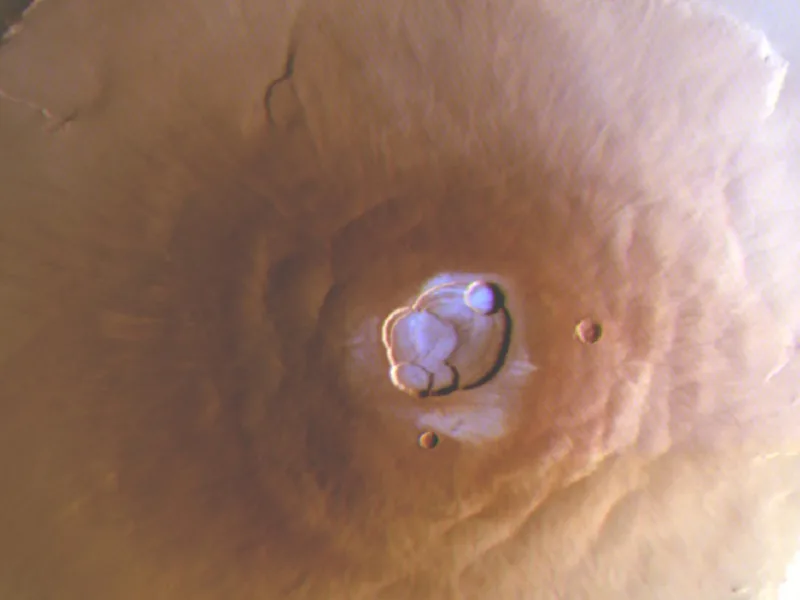
view of a volcano from above, with blue frost in the caldera at the top

The frost is visible in blue in this image of Olympus Mons.

ESA/DLR/FU BERLIN

FROST-CAPPED MOUNTAIN PEAKS IN THE MARTIAN TROPICS

Valentinas and his colleagues spent five years poring over data from an instrument called CaSSIS (Color and Stereo Surface Imaging System) aboard the European Space Agency’s Trace Gas Orbiter. In 2018, the scientists thought they had glimpsed frost in the high calderas of Olympus Mons and some of the other dormant volcanoes of Tharsis, and more data from the Mars Express Orbiter confirmed what they had seen. The team spent the next five years studying more than 30,000 images of the region, captured at different times of day and in different seasons, to piece together a record of how the frost came and went.

It turns out that during Mars’s colder months, a super-thin layer of frost forms at the peaks of the towering mountains and in their calderas — the collapsed craters formed by cataclysmic volcanic eruptions millions of years ago. The icy layer is only about as thick as a human hair, and it lasts just a few hours before it evaporates under the heat of the Martian Sun. However, it covers such a wide swath of ground that even that thin, short-lived frost layer contains about 150,000 tons of water, enough to fill 6 Olympic swimming pools. And in the mostly-dry environs of modern Mars, that’s a lot of water.

“We thought it was improbable for frost to form around Mars’s equator, as the mix of sunshine and thin atmosphere keeps temperatures during the day relatively high, at both the surface and the mountaintops — unlike what we see on Earth, where you might expect to see frosty peaks,” says Valentinas in a recent statement.

Valentinas and his colleagues suggest that there’s something about air circulation around the tops of the mountains and through the calderas that creates a microclimate that’s cool enough and humid enough to allow frost to form on cold mornings. Building computer simulations of how the frost forms and evaporates could help scientists understand Mars’s water cycle, such as it is, in more detail.

{ https://www.inverse.com/ }

Hoe vind je dit bericht?
Geschreven door peter om 20:59 Stuur door

Rijm ontdekt op de hoogste vulkanen van Mars: "Altijd gedacht dat zoiets onmogelijk was"

Rijm ontdekt op de hoogste vulkanen van Mars: "Altijd gedacht dat zoiets onmogelijk was"

Artikel door Wim De Maeseneer
In de winter wordt wel eens gewaarschuwd voor rijm- en ijsplekken op de weg. Rijm is de witte laag die je soms op je gazon ziet als het in de winter vriest. Het zijn de fijne waterdruppels uit de lucht die condenseren op het gras of op de weg en dan bevriezen. Voor het eerst is er bewijs dat er zich ook rijm op Mars kan vormen.

Monte Olimpo (Marte): características, efectos si estuviera en la Tierra

Op de kilometers hoge toppen van enkele vulkanen is een dun laagje rijm ontdekt, dat tijdens het koude seizoen elke dag verschijnt rond zonsopgang en enkele uren later weer verdampt in het zonlicht. Dat blijkt uit waarnemingen van 2 Europese satellieten rond Mars: de ExoMars Trace Gas Orbiter (TGO) en de Mars Express.

Nochtans werd altijd gedacht dat er op die plek, dicht bij de evenaar van Mars, onmogelijk water kon bevriezen. "Tot nog toe dachten we dat de temperaturen aan de evenaar te hoog zouden zijn, zowel op het oppervlak als op de bergtoppen, door het zonlicht en de dunne atmosfeer", zegt onderzoeker Adomas Valantinas die de studie heeft geleid. "Er moeten dus ongewone processen meespelen waardoor er zich toch rijm kan vormen."

Belgische bijdrage

Wat die ongewone processen dan wel zouden kunnen zijn, dat onderzochten wetenschappers van de Koninklijke Sterrenwacht van België. "Onze modellen van de luchtcirculatie op Mars hebben aangetoond dat vochtige lucht inderdaad kan condenseren tot rijm van water op de bodem van caldera's (de grote krater aan de top van een uitgedoofde vulkaan, red.), gedurende de nacht en vroege ochtend. Vergelijkbaar met wat kan worden waargenomen op aarde", klinkt het in een persbericht.

"In die caldera's zou de temperatuur toch iets kouder kunnen zijn. Net koud genoeg om toch rijm te kunnen vormen", vult Karolien Lefever van het Koninklijk Belgisch Instituut voor Ruimte-Aeronomie (BIRA) aan. Het is mede dankzij het NOMAD-instrument van het BIRA, aan boord van de ExoMars-satelliet, dat de rijm kon worden ontdekt.

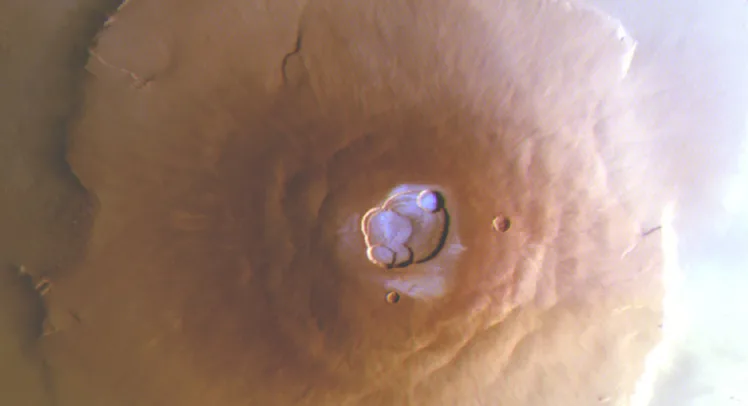
HRSC_new_stretch.png?style=W3sicmVzaXplIjp7ImZpdCI6Imluc2lkZSIsIndpZHRoIjoxOTIwLCJoZWlnaHQiOjEwODAsIndpdGhvdXRFbmxhcmdlbWVudCI6dHJ1ZX19XQ==&sign=7db4f244e165bf00cb11928d84722fcfb22e6ac9bfd190df9858dcd33273a94b

Credit: Adomas Valantinas

Deze vroege ochtendopname van Olympus Mons (LST = 7:20 uur, Ls = 346,7°, lat = 18,2°N, lon = -133,2°E) is gemaakt door de Mars Express High Resolution Stereo Camera (MEX-HRSC). Deze foto toont voor het eerst de aanwezigheid van rijm van water op de top van de vulkaan, de hoogste vulkaan op Mars en in het hele zonnestelsel.

© ESA/DLR/FU Berlin.

Vulkanen op Mars

Mars is miljoenen jaren lang geteisterd door grote vulkaanuitbarstingen en dat is op het oppervlak nog altijd goed te zien. De vulkanen waar het over gaat, bevinden zich in het Tharsisgebied, een enorm vulkanisch plateau op de evenaar van Mars. Hier liggen de grootste vulkanen van ons zonnestelsel.

Olympus Mons torent 25 kilometer boven het oppervlak uit en is de grootste bekende vulkaan. Hij is meer dan 600 kilometer breed. Er liggen nog verschillende andere vulkanen van 10 kilometer hoog en meer. Ter vergelijking: de hoogste vulkaan ter wereld, de Ojos del Salado in Chili, is net geen 7 kilometer hoog.

"Hoewel het om een heel dun laagje gaat, ongeveer de dikte van een menselijk haar, bedekt het een enorm groot gebied. Alles samen komt het overeen met zo'n 150.000 ton water, dat elke dag tussen de atmosfeer en het oppervlak wordt uitgewisseld."

"Deze ontdekking is een nieuw, klein puzzelstukje in het beter begrijpen van de watercyclus op Mars", zegt Lefever. "Waterijswolken en waterdamp werden eerder al gedetecteerd op Mars. En we weten dat die wolken een heel belangrijke rol spelen in de watercyclus, omdat ze water van de polen naar de droge gebieden aan de evenaar brengen."

"Als we ooit mensen naar Mars willen sturen, dan zal die kennis over de watercyclus zeker van pas komen. Want het zal belangrijk zijn voor astronauten om zelf drinkwater te maken, om water te maken om zich te wassen en om planten te laten groeien, bijvoorbeeld. "

Begin dit jaar vond de Europese ruimtevaartorganisatie ESA ook al aanwijzingen dat er onder de evenaar van Mars een laag ijs van mogelijk meer dan 3 kilometer dik ligt. 

  • Het onderzoek is gepubliceerd in het wetenschappelijk tijdschrift Nature Geoscience.

Hoe vind je dit bericht?
Geschreven door peter om 01:05 Stuur door

The Milky Way’s Last Merger Event Was More Recent Than Thought

Our home galaxy as seen by the European Space Agency’s Gaia satellite. Image Credit: ESA/Gaia/DPAC

The Milky Way’s Last Merger Event Was More Recent Than Thought

The Milky Way is only as massive as it is because of collisions and mergers with other galaxies. This is a messy process, and we see the same thing happening with other galaxies throughout the Universe. Currently, we see the Milky Way nibbling at its two satellite galaxies, the Large and Small Magellanic Clouds. Their fate is likely sealed, and they’ll be absorbed into our galaxy.

Researchers thought the last major merger occurred in the Milky Way’s distant past, between 8 and 11 billion years ago. But new research amplifies the idea that it was much more recent: less than 3 billion years ago.

This new insight into our galactic history comes from the ESA’s Gaia mission. Launched in 2013, Gaia is busily mapping 1 billion astronomical objects, mostly stars. It measures them repeatedly, establishing accurate measurements of their positions and motions.

A new paper published in the Monthly Notices of the Royal Astronomical Society presents the findings. It’s titled “The Debris of the ‘Last Major Merger’ is Dynamically Young.” The lead author is Thomas Donlon, a post-doctoral researcher in Physics and Astronomy at the University of Alabama, Huntsville. Donlon has been studying mergers in the Milky Way for several years and has published other work on the matter.

Each time another galaxy collides and merges with the Milky Way, it leaves wrinkles. ‘Wrinkles’ obviously isn’t a scientific term. It’s an umbrella term for several types of morphologies, including phase space folds, caustics, chevrons, and shells. These wrinkles move through different groups of stars within the Milky Way, affecting how the stars move through space. By measuring the positions and velocities of these stars with great precision, Gaia can detect the wrinkles, the imprint of the last major merger.

“We get wrinklier as we age, but our work reveals that the opposite is true for the Milky Way. It’s a sort of cosmic Benjamin Button, getting less wrinkly over time,” said lead author Donlon in a press release. “By looking at how these wrinkles dissipate over time, we can trace when the Milky Way experienced its last big crash—and it turns out this happened billions of years later than we thought.”

The effort to understand the Milky Way’s (MW) last major merger involves different pieces of evidence. One of the pieces of evidence, along with wrinkles, is an Fe/H-rich region where stars follow a highly eccentric orbit. A star’s Fe/H ratio is a chemical fingerprint, and when astronomers find a group of stars with the same fingerprint and the same orbits, it’s evidence of a common origin. This group of stars is sometimes called ‘the Splash.’ The stars in the Splash may have originated in a Fe/H-rich progenitor. They have odd orbits that stand out from their surroundings. Astronomers think they were heated and their orbits altered as a by-product of the merger.

There are two competing explanations for all of the merger evidence.

One says that a progenitor dwarf galaxy named Gaia Sausage/Enceladus (GSE) collided with the MW proto-disk between 8 and 11 billion years ago. The other explanation is that an event called the Virgo Radial Merger (VRM) is responsible for the stars in the inner halo. That collision occurred much more recently, less than 3 billion years ago.

This is a Hubble Space Telescope image of the globular cluster NGC 2808. It might be the old core of the Gaia Sausage. Image Credit: By NASA, ESA, A. Sarajedini (University of Florida) and G. Piotto (University of Padua (Padova)) - http://hubblesite.org/newscenter/archive/releases/2007/2007/18/image/a/ (direct link), Public Domain, https://commons.wikimedia.org/w/index.php?curid=2371715 This is a Hubble Space Telescope image of the globular cluster NGC 2808. It might be the old core of the Gaia Sausage. Image Credit: By NASA, ESA, A. Sarajedini (University of Florida) and G. Piotto (University of Padua (Padova))  http://hubblesite.org/newscenter/archive/releases/2007/2007/18/image/a/ (direct link), Public Domain, https://commons.wikimedia.org/w/index.php?curid=2371715

“These two scenarios make different predictions about observable structure in local phase space because the morphology of debris depends on how long it has had to phase mix,” the authors explain in their paper.

The wrinkles in the MW were first identified in Gaia data in 2018 and presented in this paper. “We have observed shapes with different morphologies, such as a spiral similar to a snail’s shell. The existence of these substructures has been observed for the first time thanks to the unprecedented precision of the data brought by Gaia satellite, from the European Space Agency (ESA)”, said Teresa Antoja, the study’s first author, in 2018.

This AI-generated image illustrates the MW's 'wrinkles' from the last major merger event. Image Credit: University of Barcelona. This AI-generated image illustrates the MW’s ‘wrinkles’ from the last major merger event. Image Credit: University of Barcelona.

But Gaia has released more data since 2018, and it supports the more recent merger scenario, the Virgo Radial Merger. That data shows that the wrinkles are much more prevalent than the earlier data and the studies based on it suggest.

“For the wrinkles of stars to be as clear as they appear in Gaia data, they must have joined us less than 3 billion years ago—at least 5 billion years later than was previously thought,” said co-author Heidi Jo Newberg, from the Rensselaer Polytechnic Institute. If the wrinkles were much older and conformed to the GSE merger scenario, they’d be more difficult to discern.

“New wrinkles of stars form each time the stars swing back and forth through the center of the Milky Way. If they’d joined us 8 billion years ago, there would be so many wrinkles right next to each other that we would no longer see them as separate features,” Newberg said.

This doesn’t mean there’s no evidence for the more ancient GSE merger. Some of the stars that hint at the ancient merger may be from the more recent VRM merger, and some may still be associated with the GSE merger. It’s challenging to figure out, and simulations play a large role. The researchers in previous work and in this work ran multiple simulations to see how they matched the evidence. “Our goal is to determine the time that has passed since the progenitor of the local phase-space folds collided with the MW disc,” the authors write in their paper.

“We can see how the shapes and number of wrinkles change over time using these simulated mergers. This lets us pinpoint the exact time when the simulation best matches what we see in real Gaia data of the Milky Way today—a method we used in this new study too,” said Thomas.

“By doing this, we found that the wrinkles were likely caused by a dwarf galaxy colliding with the Milky Way around 2.7 billion years ago. We named this event the Virgo Radial Merger.” Those results and the name come from a previous study from 2019.

As Gaia delivers more data with each release, astronomers are getting a better look at the evidence of mergers. It’s becoming clear that the MW has a complex history.

The VRM likely involved more than one entity. It could have brought a whole group of dwarf galaxies and star clusters into the MW at around the same time. As astronomers research the MW’s merger history in greater detail, they hope to determine which of these objects are from the more recent VRM and which are from the ancient GSE.

“The Milky Way’s history is constantly being rewritten at the moment, in no small part thanks to new data from Gaia,” adds Thomas. “Our picture of the Milky Way’s past has changed dramatically from even a decade ago, and I think our understanding of these mergers will continue to change rapidly.”

“This finding improves what we know of the many complicated events that shaped the Milky Way, helping us better understand how galaxies are formed and shaped—our home galaxy in particular,” said Timo Prusti, Project Scientist for Gaia at ESA.

{ https://www.universetoday.com/ }

Hoe vind je dit bericht?
Geschreven door peter om 23:28 Stuur door

Landing on Pluto May Only Be A Hop Skip and Jump Away

Landing on Pluto May Only Be A Hop Skip and Jump Away

There are plenty of crazy ideas for missions in the space exploration community. Some are just better funded than others. One of the early pathways to funding the crazy ideas is NASA’s Institute for Advanced Concepts. In 2017 and again in 2021, it funded a mission study of what most space enthusiasts would consider only a modestly ambitious goal but what those outside the community might consider outlandish—landing on Pluto.

Two major questions stand out in the mission design: How would a probe arriving at Pluto slow down, and what kind of lander would be useful on Pluto itself? The answer to the first is one that is becoming increasingly common on planetary exploration missions: aerobraking.

Pluto has an atmosphere, albeit sparse, as confirmed by the New Horizons mission that whizzed past in 2015. One advantage of the minor planet’s relatively weak gravity is that its low-density atmosphere is almost eight times larger than Earth’s, providing a much bigger target for a fast incoming aerobraking craft to aim for.

Fraser discusses future missions to Pluto.

Much of the NIAC Phase I project was focused on the details of that aerobraking system, called the Enveloping Aerodynamic Decelerator (EAD). Combined with a lander, that system makes up the “Entrycraft” that the mission is designed around. Ostensibly, it could alternatively contain an orbiter, and there are plenty of other missions discussing how to insert an orbiter around Pluto. Hence, the main thrust of this paper is to focus on a lander.

After aerobraking and slowing down to a few tens of meters a second, from 14 km/s during its interplanetary cruise phase, the mission would drop its lander payload, then rest on the surface, only to rise again under its own power. The answer to the second question of what kind of lander would be useful on Pluto is – a hopper.

Hoppers have become increasingly popular as an exploration tool everywhere, from the Moon to asteroids. Some apparent advantages would include visiting a wide array of interesting scientific sites and not having to navigate tricky land-based obstacles. Ingenuity, the helicopter that accompanied Perseverance paved the way for the idea, but in other words, the atmosphere isn’t dense enough to support a helicopter. So why not use the current favorite method of almost all spacecraft – rockets?

Fraser discusses the results from New Horizons.

A hopper would fire its onboard thrusters to reach the area on Pluto’s surface and then land elsewhere. It could then do some science at its new locale before taking off and doing so again somewhere else. The NIAC Phase I Final Report describes five main scientific objectives of the mission, including understanding the surface geomorphology and running some in-situ chemical analysis. A hopper structure would enable those goals much better than a traditional rover at a relatively low weight cost since Pluto’s gravity is so weak.

Other objectives of the report include mathematical calculations of the trajectory, including the aerobraking itself and the stress and strain it would have on the materials used in the system. The authors, who primarily work for Global Aerospace Corporation and ILC Dover, two private companies, also updated the atmospheric models of Pluto with new New Horizons data, which they then fed into the aerobraking model they used. Designing the lander/hopper, integrating all the scientific and navigation components, and estimating their weights were also part of Phase I.

The original launch window for the mission was planned as 2029 back in 2018, though now, despite receiving a Phase II NIAC grant in 2021, that launch window seems wildly optimistic. Since the mission would require a gravity assist from Jupiter, the next potential launch window would be 2042, with a lander finally reaching the surface of Pluto in the 2050s. That later launch window is likely the only feasible one for the mission, so we might have to wait almost 30 years to see if it will come to fruition. Sometimes crazy ideas take patience – we’ll see if the mission team has enough of that to push it onto the surface of one of the most interesting minor planets in the solar system.

Learn More:

Lead Image:

  • Artist’s depiction of the Pluto Lander mission design.
  • Credit- B. Goldman / Global Aerospace Corporation

{ https://www.universetoday.com/ }

Hoe vind je dit bericht?
Geschreven door peter om 23:13 Stuur door

LARGE LAKE OF LIQUID WATER UNDERNEATH MARS’ POLAR ICE CAPS MAY JUST BE A MIRAGE

9Vx1Mkgf?format=jpg&name=900x900

LARGE LAKE OF LIQUID WATER UNDERNEATH MARS’ POLAR ICE CAPS MAY JUST BE A MIRAGE

Newly published research from scientists at Cornell University is casting doubt on previous findings hinting at the presence of a large lake of liquid water underneath Mars’ polar ice caps. Instead, the researchers say their models were able to produce the same signals detected by the Mars Reconnaissance Orbiter back in 2018 in a simpler and likelier way that doesn’t require the presence of liquid water.

Previous studies have found overwhelming evidence for large amounts of water billions of years in Mars’ past, increasing the possibility that life may have had a chance to evolve on the red planet. However, the presence of liquid lakes on or underneath Mars would greatly increase the chances that life currently resides on the red planet. If confirmed, these latest findings, which say the readings were caused by ice reflections, would represent a dramatic setback to those hopes, potentially restricting any living Martian organisms to the planet’s watery ancient past.

“I can’t say it’s impossible that there’s liquid water down there,” said Daniel Lalich, research associate at the Cornell Center for Astrophysics and Planetary Science and an author on the study outlining the team’s findings, “but we’re showing that there are much simpler ways to get the same observation without having to stretch that far, using mechanisms and materials that we already know exist there.”

In fact, Lalich is so confident in his team’s findings that he says random chance could “create the same observed signal in the radar.”

EVIDENCE FOR LIQUID WATER UNDERNEATH MARS’ POLAR ICE CAPS

Ever since NASA and the European Space Agency began sending various probes, rovers, and satellites to Mars, they have found a steadily increasing body of evidence that the red planet was once home to large amounts of liquid water. Some research even showed that a massive ocean may have existed on Mars’ surface around three billion years ago, even though the temperature at the surface was well below freezing, thanks to constant water circulation and periodic coastal rainfall. An examination of rocks collected by the Perseverance Rover also found that water in Jezero Crater may have persisted for much longer than previously thought, increasing the opportunity for life to form.

Later, other research seemed to cast doubt on the amount of water on ancient Mars, instead ascribing much of the evidence to CO2 ice flows. While recent experiments continue to hint that the planet was once very, very wet, most researchers agreed that Mars had no current liquid water.

Then suddenly, in 2018, researchers using the ESA’s Mars Express spacecraft reported the discovery of a large lake of liquid water underneath Mar’s polar ice caps in the Planum Australe region. The researchers were so confident in their findings that they went so far as to say that the 20km wide lake “is probably kept from freezing by dissolved salts and the pressure of the ice above.”

Those findings found further support when, in 2021, University of Cambridge researchers using data captured by the Mars Global Surveyor’s altimeter provided new evidence supporting the presence of a large lake of liquid water beneath Mars’ polar ice caps.

Now, both of those studies have been called into question, with the new models suggesting that the reflections that seemed to indicate the presence of this massive lake were likely just illusions created by layers of ice.

RANDOMLY GENERATED LAYERING SCENARIOS REPLICATE READINGS WITHOUT NEED FOR WATER

In the media release announcing the new findings, Lalich notes that he had developed earlier models that could account for the presence of reflections underneath the Martian ice caps. However, he says that those models, which relied on assumptions about layers of frozen carbon dioxide hiding beneath the ice caps, “likely were incorrect.”

Hoping to refine his approach, Lalich says he decided to use much more sophisticated modeling techniques, which helped in “closing the gaps” in his radar interference hypothesis. This included modeling thousands of randomly generated layering scenarios based specifically on the atmospheric and material conditions present only at the Martian poles. Throughout these different scenarios, Lalich and his team periodically adjusted the spacing and composition of the various ice layers, like those already known to exist beneath the surface of Mars, while monitoring how this would affect readings captured by a satellite like the Mars Express.

Just like his previous models, Lalich said that those slight adjustments started to produce “bright subsurface signals consistent with observations” found by all of the three frequencies analyzed by the Mars Express orbiter’s MARSIS radar instrument during the 2018 discovery. In effect, his data showed that when the RADAR waves bounced off of ice layers that were too close together for the MARSIS instrument to tell them apart, the instrument most likely combined them together, resulting in amplified peaks and troughs in the signal that matched those made by liquid water.

“This is the first time we have a hypothesis that explains the entire population of observations below the ice cap without having to introduce anything unique or odd,” Lalich said. “This result where we get bright reflections scattered all over the place is exactly what you would expect from thin-layer interference in the radar.”

While this research doesn’t permanently shut the door on the idea of liquid water underneath Mars’ polar ice caps, the researchers behind the finding do seem to agree that the scientific community tends to prefer the simplest explanation whenever possible, as opposed to the one that is more exciting.

“The idea that there would be liquid water even somewhat near the surface would have been really exciting,” Lalich said. “I just don’t think it’s there.”

  • Christopher Plain is a Science Fiction and Fantasy novelist and Head Science Writer at The Debrief. Follow and connect with him on X, learn about his books at plainfiction.com, or email him directly at christopher@thedebrief.org.

{ https://thedebrief.org/category/space/ }

Hoe vind je dit bericht?
Geschreven door peter om 22:47 Stuur door

THE NEW DIRECTOR OF GEIPAN, FRANCE’S OFFICIAL UAP INVESTIGATIVE OFFICE, DISCUSSES SCIENCE AND THE STUDY OF AERIAL MYSTERIES

r/UFOs - The Debrief: The New Director of GEIPAN, France’s Official UAP Investigative Office, Discusses Science and the Study of Aerial Mysteries

THE NEW DIRECTOR OF GEIPAN, FRANCE’S OFFICIAL UAP INVESTIGATIVE OFFICE, DISCUSSES SCIENCE AND THE STUDY OF AERIAL MYSTERIES  

Although the U.S. Department of Defense and its All-domain Anomaly Resolution Office may be the most headline-grabbing government investigation into what the Pentagon now calls unidentified anomalous phenomena, it certainly isn’t the only officially sanctioned investigation into mysterious aerospace phenomena.

Originally established in France in the late 1970s, the French Group for the Study and Information on Unidentified Aerospace Phenomena (GEIPAN), an official division of the French national space agency CNES, has long been tasked with the examination of UAP. From its launch in 1977 until 1988, the program operated under the name GEPAN, and then as SEPRA between 1988 and 2004. The program officially adopted its current designation, GEIPAN, in September 2005.

In the past, the French Gendarmerie was officially ordered to forward all its UFO sighting reports to SEPRA, thus providing the agency with a substantial collection of such incidents to analyze.

As the official French public UFO office, GEIPAN was tasked with answering questions from citizens regarding UAP and investigating sightings, and in 2007, GEIPAN released its files and made them publicly accessible on its website.

Recently, The Debrief was able to speak with Frédéric Courtade, the new chief of GEIPAN, which currently sorts UAP sighting reports into four categories: 1) UAP A: Identified Phenomenon (24.6 %), 2) UAP B: Probably identified Phenomenon (39.7%), 3) UAP C: Unidentified Phenomenon due to lack of data (32.4%), and 4) UAP D: Unidentified Phenomenon after investigation (3.3%).

The following is a transcript of The Debrief’s interview with Courtade, conducted by journalist Baptiste Friscourt, which features minor edits for overall clarity.

Baptiste Friscourt: Hello, Mr. Courtade. You are the new head of the GEIPAN, you have a degree in materials science, you have 20 years of expertise/investigation of materials within the expertise laboratory of the National Centre for Space Studies (CNES), then five years on the development of scientific instruments in planetology and exobiology as part of a project to prepare for the future, and most recently four years as manager of the Space Mechanisms and Equipment for Satellite Attitude Control department. Can you tell us what GEIPAN’s mission is and how it differs from other organizations involved in research into Unidentified Aerospace Phenomena?

Frédéric Courtade: GEIPAN, as its name suggests, is a study and information group on unidentified aerospace phenomena. This service is attached to the digital technical department of CNES. We are based in Toulouse, and we have the resources to investigate reports of unidentified aerospace phenomena reported to us by French citizens. The GEIPAN is legitimate in France. We carry out a pre-characterization and, if necessary, investigations to try to identify what has astonished these citizens – sometimes arousing their curiosity, sometimes worrying them – using a network of volunteer investigators recruited and trained by the GEIPAN which covers the entire country.

Our investigations are published on a website which is accessible to the public worldwide. Our work is monitored by a supervisory committee, COPEIPAN (Steering Committee for Studies and Information on Unidentified Aerospace Phenomena), chaired by an independent authority within French institutions and comprising civil, military, and scientific authorities and any other person with significant expertise in UAP.

Today, GEIPAN is housed by CNES, it has legitimacy, and I have an operating budget that enables me to carry out investigations and to ensure the impartiality of the results of these investigations.

We do, of course, consult associations and certain organizations that are run by scientists in Europe, but from an operational point of view, I would say that this autonomy of means enables us to be completely impartial, whatever the testimony that is given to us. We investigate facts for which the witness has given us prior authorization for publication, whatever the result.

BF: What perspective would you like to develop during your tenure?

FC: Today, GEIPAN has reached cruising speed, I think, with a body of investigators who are fairly seasoned. I have to bring in new people to complete this body of investigators. We have people who have been here since GEIPAN was created, so they are seasoned people, people who are ready to share their experience. For me, the aim is to build up this body of investigators so that we can continue to conduct rigorous investigations using tried and tested methods. My aim is also to try to increase the number of national institutions we work with, which give us access to data that we can make available to these investigators so that we have the information we need to eliminate or explore certain hypotheses and come up with a solution that we think is perfectly acceptable in terms of explaining these phenomena.

BF: What made you want to take this job?

FC: CNES is a public industrial establishment that serves the public and is responsible for bringing everything we can learn from space to French and European citizens. All this has also happened in the context of my previous jobs, working in the field of engineering, with direct relations with engineers or technicians from other organizations comparable to CNES or industrialists who help to develop space data and put it at the service of the public. In the case of GEIPAN, it’s really the direct link with the public that attracted me.

In this context, we are in direct contact with them, and we have the legitimacy to do this. So we meet people from all over the country; people who are concerned; people who are curious; people who are educated and people who are less so; people who have a culture of space and people who have none at all. It’s very enriching and that’s what attracted me to GEIPAN.

BF: Speaking of contact with the public, there is a two-edged sword here. In other words, the contact can come from people who are wondering about what they have observed, but there can also be comments from the public about the actions carried out. Have you ever come across this type of contact?

FC: Yes, of course, there are people who question our surveys and challenge us on the results. We accept being challenged and there’s nothing to worry about. We think we’re sufficiently sure when we come to our conclusions, but there may be adjustments to be made. That much is clear – we accept that. And there are also people who will have an approach that is closer to credulity, thinking they’ve been chosen to witness something that goes beyond comprehension, I would say.

And these people, of course, we receive their requests. GEIPAN also has an educational mission, to provide rational answers to what they have seen and experienced.

So, of course, this is something that happens to us.

BF: To stay on this subject, there was recently a congress in Limoges to promote a supposed extraterrestrial contact and, at the other end of the spectrum, a few months earlier there were three international conferences on the technical aspects of research into UAP.

Does GEIPAN have a position on this type of event?

FC: No, we have no position on this type of event. We were not consulted about this event, which took place on national territory. I was questioned indirectly by the press about this event.

I have to say that this is absolutely not a theme that is developed at GEIPAN and that it is not one of my missions.

BF: Last month, Francisco Guerreiro, MEP, organized a conference at the European Parliament on the subject, during which GEIPAN was mentioned several times. Were you represented?

FC: I was connected remotely, and I thought it was a very good initiative. It’s clear that for a subject which affects society, raises questions in people’s minds, frightens them, it would be very good if something could be organized on a cross-border basis.

But then, I realize how difficult it is, I can see at the national level all the things we have to put in place, in terms of cooperation with the national civil and military authorities to be able to work, but it will have to be done in a cross-border context, and that is likely to pose a lot of problems, especially as the Parliament is going to change. However, I think it’s a very good initiative to put UAP in the context of European space law, because I’ve realized since I took up my job that a huge number of people are passionate about this phenomenon – UAP/UFOs – and having an institution, a delegation, an authority that could provide a framework for all this would be great.

BF: Do you envision GEIPAN taking on a European mandate, or Europe creating ex nihilo a structure GEIPAN would participate in?

FC: That’s more like it. GEIPAN’s mission is a national one, and I’ve spoken to the people at CNES who deal with European affairs, who also have a positive view of this, but it’s not on the agenda to take the lead or any kind of leadership in this area. So, it would really be a matter of ensuring that Europe can benefit from the organization that we have put in place and which is working very well.

BF: At this conference, one of the main lines of argument used was the possible danger to air safety posed by UAP. Do you share this point of view within GEIPAN?

FC: In the modern history of UFOs, it’s true that observations by pilots have been exacerbated over the years since the end of the Second World War. So it’s true that these people may wonder about their safety, whatever they’ve seen.

We’re currently working in particular on visibility and the recurrent sightings of Starlink satellites in the vision of pilots who have difficulty deciding whether what they see is dangerous, their inability to assess the distance, the fact that it’s moving erratically for them, all of which poses a problem in terms of flight safety. We have a lot of testimonies from pilots, and we are authorized to work on testimonies from pilots on flights departing from or bound for France, which is what we are doing. We try to respond to pilots to reassure them when it comes to Starlink and try to sort out what it might be when it’s something else.

BF: Since 2017 there have been declarations by former US administration and defense officials on the subject. Does GEIPAN have a view on these statements, declaring that UAP also represent national defense vulnerabilities?

FC: I have no particular position on what is being done in the United States. GEIPAN is hosted by CNES, which has always been under the supervision of the Ministry of Defense, and the decision was made at the time (1977) for CNES, which is responsible for civil and military space issues, to manage these phenomena. I don’t think that’s the case in the United States, or it used to be, but it isn’t any more – there’s perhaps a tendency to change once more.

So the fact that this matter is being handled by military authorities who, by their very nature, are not supposed to communicate, may suggest that they want to avoid saying things and discourage some people from speaking up, in the face of this lack of communication. When you cultivate secrecy, it sometimes awakens fantasies.

BF: April 9, Japan’s defense minister said: “We believe that it is essential to take all possible measures to respond to incidents that affect Japan’s security, including those involving unidentified objects.” Is GEIPAN a resource that can be used by the French armed forces regarding any concerns they may have about UAP?

FC: GEIPAN comes under the “space security” theme. There are several themes that are maintained and developed as part of CNES missions. Some are concerned with the sciences of the universe and space research, others with telecommunications, Earth observation, hydrology, climate… and a huge number of other sectors.

CNES also covers ‘space security’. And GEIPAN is part of this. On the other hand, as far as I can remember, we’ve never had to request any kind of alarm for the arrival of a phenomenon that would endanger the public. Perhaps in Japan there’s no equivalent. GEIPAN is identified as a link in the ‘space security’ theme.

BC: There were a lot of cases of confusion in the 80s around American stealth bomber tests and UFO sightings. In the case of France, how would you deal with a case that is sent to GEIPAN where, after investigation, you realize that it was a French military prototype?

FC: Up until now, the Directorate General for Armaments has communicated quite openly with us. Without actually telling us what happened, but saying: “something happened there, we can reassure you, there’s nothing dangerous”.

We relayed information about the hypersonic glider tests, the missile tests… The army communicates quite openly, and our official collaboration with the air and space force through the CNOA, the National Air Operations Centre, is very positive. Even without telling us what really happens, that allows us to respond and reassure the population.

BF: Does GEIPAN also deal with reports from military personnel?

FC: Any member of the public can submit a report through the usual channels. As far as I know, there is no priority channel for military personnel. We deal with first-level reports made by individuals. In any case, I’ve never been confronted with one and to my recollection, no investigation has been brought to our level following a statement by a military authority.

BF: There were hearings this summer with a whistleblower – a former American intelligence officer – who stated that there were secret programmes in the United States, carrying out tests on recovered materials.

Has GEIPAN ever been involved in collecting debris from anything that might have been found and can it carry out material expertise, given that this is part of your personal expertise?

FC: Yes, I’ve done it in the past, on material that had been found at an observation scene and we didn’t demonstrate any extraordinary origin. We’re currently working on an expert report on material found during an observation reported to us by the SIGMA 2 association of 3AF, with which we’re trying to work with the CNES expert laboratory, which is developing a whole range of analysis and expert report techniques that enable us to go back quite a long way to the origin, both elementary and chemical, of what we can see. A priori, we haven’t found any signature that would lead us to think that it came from somewhere else.

BF: And are these analyses, even conventional ones, available to the public to examine?

FC: The expert report is signed by my counterpart in charge of the “laboratory and expertise” department, so it is distributed to the applicant, and then he is free to distribute them, it’s the applicant who gets the first look.

BF: So, last year, there was an independent audit ordered by NASA which concluded that more scientific research needed to be carried out into UFOs. If NASA were to develop a scientific research programme on UAP, could GEIPAN be asked to contribute to it, since it has already been asked to contribute to the audit group, and from what CNES perspective could this take place?

FC: There is no research activity on the UAP themselves, but there is a great deal of work being done to improve the data we receive from our partners, particularly radar data. We’re trying to work on the raw signals, before filtering, which are produced by Meteo France and which would give us more usable information than the weather data, for example.

Would we contribute? At present, GEIPAN has no research mission. It’s a study group. CNES of course maintains networks of space radio telescopes. Indirectly, we may help to detect electromagnetic radiation from the universe, but we don’t do any research as such.

BF: But on the other hand, if you were called by NASA to provide data from the French cases, would you object?

FC: Everything that is published is already free of copyright. To go further, I would say that knowing whether we are in a position to want to share anything in this area with NASA or other international bodies depends on the French space policy options chosen by the CEO of CNES.

Collaboration in space, whether bilateral or multilateral, is something that has been done at CNES since its inception. To my knowledge, there has never been any collaboration on the topic, so if it develops, why not, but it won’t depend on me.

Baptiste Friscourt is a certified visual arts instructor based in France. You can follow his work online via Sentinel News on Substack.

{ https://thedebrief.org/category/uap/ }

Hoe vind je dit bericht?
Geschreven door peter om 22:12 Stuur door

JAPAN LAUNCHES UAP INVESTIGATION FOLLOWING U.S. REPORT IDENTIFYING REGION AS “HOTSPOT” FOR SIGHTINGS

 Japan Launches UAP Investigation Following U.S. Report Identifying ...

JAPAN LAUNCHES UAP INVESTIGATION FOLLOWING U.S. REPORT IDENTIFYING REGION AS “HOTSPOT” FOR SIGHTINGS

A non-partisan group of Japanese lawmakers says it plans to investigate sightings of unidentified flying objects, citing concerns over possible foreign surveillance efforts and other national security issues. 

The group, composed of more than 80 members that include former defense ministers, was announced on Thursday. The lawmakers say it will aim to enhance Japan’s capabilities in the detection and analysis of what the U.S. military now calls unidentified anomalous phenomena, or UAP. 

“It is extremely irresponsible of us to be resigned to the fact that something is unknowable, and to keep turning a blind eye to the unidentified,” said former Japanese defense minister Yasukazu Hamada, coinciding with the new group’s launch. 

In the U.S., the Pentagon’s official UAP investigative effort, the All-Domain Anomaly Resolution Office (AARO), had previously identified Japan as a hotspot for such sightings. The new Japanese group aims to complement AARO’s efforts by urging Japanese government officials to establish an official investigative office of its own in response to several incidents involving unauthorized drone incursions and surveillance balloons that have raised concerns about possible spying by nations like China. 

Christopher Mellon, former Deputy Assistant Secretary of Defense for Intelligence in the Clinton and George W. Bush administrations, joined the inaugural meeting of Japan’s new UAP Caucus as a virtual attendee, telling The Debrief in an email following the event that it was “a packed room” that included several former defense officials. 

“This initiative marks a highly significant and admirable commitment to transparency, national security, and scientific inquiry,” Mellon said in a written statement before fielding questions from the group’s attendees.  

“We also know from a national security standpoint that the importance of identifying and monitoring unmanned aerial systems cannot be overstated. The immense impact of unmanned vehicles in the ongoing conflict in Ukraine is demonstrating their profound effects on modern warfare daily. By staying vigilant and informed, we can enhance national security and leverage these technologies for positive outcomes,” Mellon’s statement read.

The establishment of the new caucus follows recent incidents that include the unauthorized release of footage depicting a docked Japanese helicopter destroyer, which circulated on Chinese social media after an apparent drone intrusion over one of the country’s military facilities.

In another incident last year, “flying objects” observed over Japan were revealed to be monitoring balloons originating from China. Also in 2023, AARO released information involving global concentrations of UAP sightings, which specified western Japan and China as UAP ‘hotspots’ based on trends observed from 1996 to 2023. 

Lawmaker Yoshiharu Asakawa expressed that UAPs have traditionally been seen as “an occult matter that has nothing to do with politics.” One notable example from Japanese folklore that some modern UAP proponents link to the phenomenon involves an 1803 incident where a round vessel of unknown origin was reportedly found adrift along the coast of Japan’s Hitachi province.

According to records from the country’s Edo period, a young woman was said to have emerged from the object wearing strange clothes and carrying a box. Although the story has garnered attention from UFO researchers, primarily due to artistic representations of the woman’s unusual-looking vessel, historians and folklorists identify the story as bearing similarities to other traditional beliefs that appear in Japanese folklore.

The establishment of its new UAP investigative group marks a notable shift in the country’s attitudes toward the subject, which are in line with a growing number of countries whose governments express concerns over the possibility that some presently unidentified aerial phenomena may be linked to foreign espionage. However, the new group is not Japan’s first time engaging in the UAP debate.

“This is now the second time in the last few years Japan has taken a public stance on the UAP issue, the first time by entering into a bilateral information sharing agreement with the Department of Defense,” said Luis Elizondo, a former U.S. Army Counterintelligence Special Agent and former employee of the Office of the Under Secretary of Defense for Intelligence.

In an email to The Debrief, Elizondo said Japan’s establishment of a UAP investigative group serves as a reminder “that this issue affects many of our allies and adversaries alike.”

“This should be a clear indicator that other countries are also taking this topic seriously,” Elizondo said. 

{ https://thedebrief.org/category/uap/ }

Hoe vind je dit bericht?
Geschreven door peter om 18:49 Stuur door

AVIATION SAFETY AND UNIDENTIFIED ANOMALOUS PHENOMENA DISCUSSED AT THE EUROPEAN PARLIAMENT

r/UfoUapNews - Aviation Safety And Unidentified Anomalous Phenomena Discussed At The European Parliament

(Unsplash)

AVIATION SAFETY AND UNIDENTIFIED ANOMALOUS PHENOMENA DISCUSSED AT THE EUROPEAN PARLIAMENT

Aviation safety and other potential concerns arising from the presence of unidentified anomalous phenomena (UAP) were among the issues addressed by Member of the European Parliament Francisco Guerreiro and others during a recent conference at the European Parliament.

The public meeting, which aimed to offer reliable information to policymakers, was held in March in cooperation with the UAP Coalition Netherlands. Several experts presented talks on various aspects of the UAP problem at the event, with a central focus on UAP as a potential threat to aviation safety.

Francisco Guerreiro, an independent Member of the European Parliament (MEP) representing Portugal, opened the event, which he said aimed to “start the debate inside the European Parliament on unidentified anomalous phenomena, which is a topic that is dear to thousands of Europeans,” as well as to “decrease the stigma associated with the topic inside important sectors of our society, such as civil aviation, the military, journalism, but also politics.”

Guerreiro said it is “essential that all the debates surrounding UAP are based on the scientific method and held in close cooperation with public institutions, academia, civil society, and all the professionals who are willing to open and voluntarily share their experiences.”

“Lastly, the path of the European Union in regard to UAPs must be made with transparency, data sharing, and accountability, so we don’t lose our credibility in a topic that is dear to many of our constituents and citizens,” Guerreiro said.

Guerreiro said the feedback he got from EU citizens and even outside European borders had been overwhelming, although his involvement in the UAP matter goes beyond hosting the conference. Last month, he asked questions to the European Commission – the executive branch of the E.U. – and gave speeches during the Plenary session of the European Parliament, proposing a modification to the E.U. Space law integrating UAP, and introduced a motion for resolution to the European Commission requesting the establishment of a harmonized E.U. reporting system.

Asked by The Debrief if he expected any resistance against such a resolution from other groups, Guerreiro said the topic “is not a priority for the rest of the MEPs and groups, so my action is individual.”

Asked about his level of confidence that it will be accepted, Guerreiro told The Debrief that he honestly doubted there would be much progress.

“The Individual Motions for Resolution mostly go to a specific committee, decided by the EP bureau, and then approved by the committee Chair and respective committee chairs from each political group. Since we´re ending the mandate (2019-2024), I doubt there will be any development on the matter. It will be upon the next mandate (2024-2029) to move forward on this topic,” Guerreiro said, noting that he does not plan to run for a second term.

The Debrief also asked Guerreiro about reports involving UAP seen in close proximity to aircraft, which are not made public by the European Union Aviation Safety Agency (EASA), partially to avoid hurting companies’ credibility and to prevent passengers’ concerns.

“I think the main focus should be on building a scientific and transparent report EU system that would encourage professionals but also companies and institutions to analyze with credibility the UAP subject,” Guerreiro told The Debrief. “This way, everyone would be included in the decrease of dogma surrounding the subject, and we could better understand the phenomena.”

UAP IN THE NETHERLANDS

The first speaker at the event was André Jol with UAP Coalition Netherlands, an NGO dedicated to raising “awareness, promoting scientific research and building a bridge between the public and policymakers”.

After explaining that improvements in detection and surveillance allowed more evidence to be gathered regarding the existence of UAPs, he reminded the audience that the phenomenon is understood to have been observed at sea, and not only in the air, that pilots have reported near misses, and that military personnel have reported witnessing UAP near nuclear bases and power plants.

Jol explained that for someone to consider that UAP are hallucinations would mean that trained observers have been seeing “things which are a fantasy” for decades, while “we rely on the same professionals to be good observers in their professional capacities”. He then noted that NASA now has a director for UAP Research and has shown UAP footage of unidentified objects during last year’s conference.

“If a commercial pilot with passengers encounters a UAP, this could lead to confusion, distraction, and potentially even a risk of accidents. With 32,000 flights per day in the EU airspace, we feel it is necessary to address the topic. By understanding and addressing the UAP topic, we can enhance the safety and security of our skies.”

As Europe is home to one of the most crowded airspaces on Earth, UAP incursions could have a devastating effect on the aviation industry if the risk isn’t mitigated by authorities. In a climate of growing public distrust towards the reliability of commercial aircraft, as showcased by scandals in recent months regarding Boeing, the broader realization that our airspace is frequently violated by unregulated platforms, exotic or conventional, presents challenges for the aviation industry and lawmakers alike.

“In this era of heightened political, geopolitical tensions and rapid technological developments, the presence of unidentified objects in our airspace raises questions about surveillance, defense capabilities, and potential threats,” Jol also said, emphasizing the geopolitical and military risk of unmitigated UAP incursions. “We feel it’s imperative that these issues are explored and addressed.”

While addressing the geopolitical aspects of the phenomenon, Jol also spoke briefly about reports of Beijing’s engagement with issues related to UAP.

“It’s also interesting to note that China has issued a shoot-down order of UAP in at least one and possibly several provinces. They’re using AI to research UAP data, and they consider UAP to be a national threat and a flight safety issue. We also know that the Russian government is aware of it and doing research on this topic.”

Following a discussion of physical characteristics often attributed to UAP, Jol finished his talk by noting that despite decades of information gathered, witnesses are still faced with ridicule when reporting their sightings:

“We feel it’s crucial that policymakers do create an environment and the required legislative frameworks to allow witnesses to feel comfortable coming forward with their experiences and knowing that they will be heard, respected, and supported.”

As a solution, André Jol proposes to “raise awareness and educate policymakers, professional scientists, the media, and the public about the reality and the significance of UAP” to gain a better understanding of UAP through “leveraging expertise, technological research, resources, and international collaboration” in the hope of gaining “a deeper understanding of these phenomena.” Finally, he called for the establishment of protocols and procedures regarding UAP reporting and included UAP-related modifications to the E.U. regulations on aviation safety and Space Law.

Jol concluded his speech by calling EU stakeholders to assume their “responsibility to address this topic with seriousness, integrity and scientific rigor.”

ANOMALIES IN EUROPEAN AIRSPACE

Italian MUFON Chapter director Edoardo Russo followed, describing the European UFO/UAP investigation history from 1946 to today and the efforts that have been made by countless organizations to archive knowledge kept outside the Hall of Science by the stigma. Russo also discussed similar past unsuccessful initiatives in the European Union.

 Dr. Beatriz Villaroel then took the stand, presenting her astronomy research into transient light phenomena and showing how some coincided with mass UAP sightings, giving the example of the Washington D.C. incursions in the summer of 1952. She listed the other scientific research into UAP and presented methods of searching for UAPs, in particular mysterious, unknown objects outside the Earth (ExoProbe). She then called for the establishment of an infrastructure that could support scientific research on UAP in the European Union.

Pilot Christiaan Van Heijst then spoke about the encounters he witnessed while flying civilian airplanes. He began by explaining that it was only after he heard testimonies from Ryan Graves and David Fravor, two NAVY pilots who have come forward in recent years regarding UAP incursion in sensitive areas of the United States, that he realized that what he saw could be more than what he originally thought. One could wonder how many pilots also dismiss what they see because they were never taught how to recognize physical UAP signatures. 

“In the last 20 years of flying, I’ve seen a lot of interesting things,” Van Heijst said. “The most anomalous, taking place in the first few years of my flying career, always over Europe – which is important to note, because many people think that the UAP or UFO topic is from Hollywood, that it’s American.”

Executive director of American for Safe Aerospace Ryan Graves followed Van Heijst, noting that “Pilots are seeing UAP every day; we need to trust their expertise and support them coming forward.”

“Too often, pilots are afraid to share their stories due to stigma,” Graves said. “UAP are in global airspace, but they are grossly underreported. These sightings are not rare nor isolated. They are routine.”

Graves emphasized that “military aircrews and commercial pilots, trained observers whose lives depend on accurate identification, are frequently witnessing these phenomena but are either unable or unsure how to report UAP officially.”

As a solution, he pointed out the government’s role in destigmatizing UAP by supporting witness reporting and investigation. 

“Government plays an important role to destigmatize UAP and to investigate the phenomenon. The stigma attached to UAP is real and powerful. It silences commercial pilots who fear professional repercussions and discourages military witnesses from sharing their reports. Governments can help by taking reports seriously and creating mechanisms to collect UAP data and investigate and evaluate it.”

Graves concluded his speech by stating that the U.S. military realized that it has an awareness gap on UAP, and called for the pursuit and evaluation of data to counter the skepticism regarding UAP.

When The Debrief asked Graves about his feelings regarding the AARO historical report, also published in March, and its reception in the media, Graves expressed frustration.

“Generally speaking, no, I’m not satisfied with the historical report,” Graves said.

“I won’t pretend to be a historian of the UAP topic going back to the 40s or earlier. However, one thing that was clear is that the language and the dismissal that was inherent within that report did not align with the joint chiefs of staff recommendations for reporting UAPs that went out to all service branches,” Graves said. “And in that reporting, they were very clear that this was a serious issue that was occurring internationally as well as domestically and was a concern, both for aviation safety and for our domain awareness.”

During a Q&A at the end of the conference, José-Luis Penedo Del Rio, the Chief of Political Affairs of the European Aviation Safety Agency (EASA), noted that a system to report sightings by professionals existed already available through the EASA website. He added that it could be improved, but it was available freely, not specifically for UAP. 

Van Heijst replied that if he filed a UAP report to his company regarding a sighting, the company itself couldn’t do anything.

Guerreiro then intervened, explaining that his proposal aimed to change this specific EASA system so that observation reports could be recorded even if the situation did not endanger the safety of the flight.

Guerreiro concluded the conference by emphasizing the need for political leadership in the European Union on the UAP issue, expressing his hopes that lawmakers will “move ahead and also surpass the U.S. on this topic.”

“Then we all—united—can have a very scientific approach on this topic.”

  • Baptiste Friscourt is a certified visual arts instructor based in France. You can follow his work online via Sentinel News on Substack.

{https://thedebrief.org/category/uap/ }

Hoe vind je dit bericht?
Geschreven door peter om 18:41 Stuur door

Jongeren vinden een eenvoudige en goedkope manier om microplastics te filteren: ze winnen een prijs van $50.000

Jongeren vinden een eenvoudige en goedkope manier om microplastics te filteren: ze winnen een prijs van $50.000

Janine imageDoor Janine
De twee studenten die $50.000 hebben gewonnen voor hun innovatieve filtersysteem voor microplastics
Dat microplastics overal aanwezig zijn is geen mysterie: ze zitten in ons water, in het voedsel dat we eten en zelfs in ons lichaam. We weten nog steeds niet precies wat hun effecten op de gezondheid zijn, maar het is cruciaal om te leren hoe we ze kunnen opsporen en verwijderen. Een belangrijke stap in deze richting is gezet door Victoria Ou en Justin Huang, twee jongeren uit Texas die een innovatieve methode presenteerden om microplastics uit water te filteren met behulp van ultrageluiden. Laten we eens kijken waar het over gaat.

Een nieuwe methode om microplastics uit water te filteren: twee tieners winnen een prijs

We zijn op de Regeneron International Science and Engineering Fair in Los Angeles, Verenigde Staten. Dit is een evenement dat de beste wetenschappelijke projecten ter wereld samenbrengt en in totaal $9 miljoen aan prijzen toekent aan verdienstelijk onderzoek. Eén daarvan is het project van Victoria Ou en Justin Huang, een nieuwe methode om microplastics uit water te filteren, dat de Gordon E. Moore-prijs van $50.000 won.

Zoals we in de inleiding al zeiden, zijn de korte- en langetermijneffecten van microplastics op de menselijke gezondheid nog steeds niet helemaal duidelijk. Toch blijft het elimineren van microplastics een fundamenteel doel van onze samenleving, misschien met een methode die eenvoudig, effectief en goedkoop te implementeren is. En het lijkt erop dat het project van Ou en Huang aan deze kenmerken voldoet.

Een voordelige, effectieve en eenvoudige oplossing voor het filteren van microplastics

Unsplash

Tijdens de prijsuitreiking vertelden de twee Texaanse studenten hoe ze op het idee kwamen om microplastics uit het water te filteren. Tijdens een bezoek aan een waterzuiveringsinstallatie ontdekten Ou en Huang dat er geen middelen zijn om microplastics uit afvalwater te filteren. Als gevolg daarvan komen deze kleine plastic fragmenten in het ecosysteem terecht. Er bestaan wel enkele methoden, maar om de een of andere reden zijn die niet zo gemakkelijk toe te passen. Het gebruik van chemische coagulanten kan het milieu verder vervuilen, terwijl fysieke filters ineffectief en duur zijn.

In plaats daarvan ontwikkelden de twee studenten een compact apparaat dat ultrasoon geluid gebruikt om microplastics uit water te filteren. Ook in dit geval is het gebruik van ultrageluid om microplastics te verwijderen niet nieuw, een recente studie spreekt erover, maar het is een duurdere en complexere methode. De oplossing van Victoria Ou en Justin Huang is daarentegen goedkoop, effectief en eenvoudig: het verwijdert tussen 84% en 94% van de microplastics in één enkele stap. Maar hoe?

Microplastics uit water verwijderen: werking en perspectieven van het nieuwe instrument

SocietyForScience/Youtube

De werking van de innovatieve methode die Ou en Huang hebben ontwikkeld, is conceptueel gezien relatief eenvoudig. In feite wordt het instrument in het water gestoken zodat het er vrij doorheen kan stromen. Het opgewekte ultrageluid zorgt ervoor dat het water blijft stromen, maar duwt de microplastics terug, waardoor ze effectief worden gefilterd. Zoals we hebben gezien, hebben we het over een verwijdering van ongeveer 90% polyurethaan, polystyreen en polyethyleen, maar dit is ​​nog maar het begin.

Zodra de technologie die de twee studenten hebben ontwikkeld klaar is, kan deze worden gebruikt in verschillende toepassingen, variërend van afvalwaterzuivering tot huishoudelijke wasmachines. Dankzij de prijs van 50.000 dollar kunnen Ou en Huang hun apparaat perfectioneren en het concreet toepassen in het dagelijks leven. We staan ​​uiteraard nog aan het begin, maar het is binnenkort mogelijk om microplastics uit water te filteren: een kleine stap, maar toch fundamenteel voor de toekomst van onze planeet.

{ https://www.curioctopus.nl/ }

Hoe vind je dit bericht?
Geschreven door peter om 18:22 Stuur door

Uncovering the 3.19-Year UFO Crash Cycle: Evidence and Theories

Uncovering the 3.19-Year UFO Crash Cycle: Evidence and Theories

Uncovering the 3.19 Year UFO Crash Cycle

Welcome back, UFO enthusiasts! 🌌 Today, we delve into a fascinating theory that might revolutionize our understanding of UFO crash retrievals. The theory suggests a cyclic pattern, occurring every 3.19 years, which could explain many reported UFO crashes over the past century. From the famous Roswell incident to the Varginha encounter in Brazil, we will explore the evidence and theories behind this intriguing phenomenon. Could these crashes be influenced by planetary cycles, such as Mars’ orbit? Let’s uncover the truth!

The Origin of the Theory

The idea of a 3.19-year UFO crash cycle originates from Joseph Ritrovato, who proposed this theory in his article “A Cyclic Period that Correlates with Alleged UFO Crash Retrievals.” Ritrovato observed that many reported UFO crashes seemed to occur in a repeating pattern approximately every 3.19 years. This pattern intrigued him, leading to a detailed analysis of historical UFO crash data.

Key Incidents Supporting the Cycle

One of the most notable UFO crashes, the Roswell incident, took place in July 1947. However, this was not an isolated event. Over the years, numerous other crashes have been reported, many of which align with the proposed 3.19-year cycle. For instance, the Varginha incident in Brazil in January 1996, often dubbed Brazil’s Roswell, involved the capture of alleged extraterrestrial beings and fits perfectly into the cycle.

Further supporting incidents include:

  • September 1957, Ubatuba, Brazil: Fishermen witnessed a flying disk explode, leaving behind pure magnesium fragments.
  • October 1967, Shag Harbor, Nova Scotia: A UFO was seen crashing into the harbor, with lights visible underwater.

Planetary Cycles and UFO Crashes

Ritrovato theorizes that there might be a connection between these UFO crashes and planetary cycles, particularly Mars’ orbit, which is approximately 776 days (a little over 2 years). It has been suggested that the Mars cycle can affect plate tectonics on Earth, raising questions about the possible influence of planetary positions on UFO activities.

Interestingly, some crash dates coincide with Mars’s closest approaches to Earth. For example, crashes on November 3, 1958, and October 17, 1973, occurred on the same day as Mars’s closest approach, suggesting a potential correlation.

Statistical Analysis and Findings

To further investigate this theory, a detailed analysis was conducted, considering various cycles, including Mars (2.1 years), Jupiter (11.86 years), and Saturn (29.5 years). The analysis revealed:

  • Mars cycle: Multiple pairs of years showed a 2.1-year cycle alignment, suggesting potential correlation, although not consistent enough to establish a definitive pattern.
  • Jupiter cycle: Only one pair of years showed alignment, insufficient to indicate a strong correlation.
  • Saturn cycle: Several pairs of years showed a 29.5-year cycle alignment, indicating potential influence.

These findings suggest that planetary cycles, particularly those of Mars and Saturn, might influence the timing of significant UFO events. However, a larger data set and more precise timing of incidents are needed for more definitive conclusions.

Future Predictions

Based on the 3.19-year cycle, Ritrovato predicted future peak dates for UFO crashes. Notable predictions include April 24, 1999, and September 9, 2005. While some of these predictions align with reported UFO activities, the theory requires further investigation and validation.

VIDEO:

  • Chris Lehto – Uncovering the 3.19 Year UFO Crash Cycle: Evidence & Theories

Joseph Ritrovato’s research presents a compelling case for a cyclic pattern in UFO crash retrievals. While further investigation is necessary, the evidence suggests a potential link between planetary cycles and UFO activities. This theory opens up new avenues for understanding UFO phenomena and encourages further research and data collection.

As we look to the future, could we anticipate significant UFO events based on these cycles? By studying past data and predicting future patterns, we might be better prepared to investigate and understand these mysterious occurrences.

Thank you for joining us on this exploration of the 3.19-year UFO crash cycle. Please like and subscribe for more intriguing content. If you have any insights or data to share, join the discussion on the UAP Society Discord. Until next time, keep watching the skies!

{ https://www.latest-ufo-sightings.net/ }

Hoe vind je dit bericht?
Geschreven door peter om 18:00 Stuur door

Alien Abducted Irish Man And Told Him The World Would END in 850 Years

Alien Abducted Irish Man And Told Him The World Would END In 850 Years ...

Alien Abducted Irish Man And Told Him The World Would END in 850 Years

A retired carpenter named Gerry Battles (65) claimed that he had been abducted by aliens while coming home after Christmas drinks in Pallaskenry (a village in County Limerick, Ireland) on December 26, 2001. The aliens warned him that the Earth would end with an asteroid the size of Munster in 850 years.

Gerry Battles Gerry Battles, Kilidmo, a local man, was abducted by aliens in 2001. Picture Brendan Gleeson

In 2016, Gerry told the Limerick Post what had happened to him in 2001. He said that the sky was very clear and beautiful on the night he had been abducted.

“IT was a clear, dry night. It was really crisp and frosty — just beautiful. You could have read a book with the light off the night sky, but I wasn’t drawn by the light of the stars or the moon but by a bright, surgical, white light coming from the other end of the boreen,” he said.

Read also:

It was around 8 PM, he was returning home from The Seven Sisters Pubs in Kildimo, when a strange light coming from the end of the laneway took him to the spacecraft. He remembered that there were 40 males of different ages upon the board, but they all were in a subdued state, standing shoulder to shoulder like mannequins and not moving.

Gerry Battles Gerry Battles told the alien talked with him through telepathy

The man standing next to Gerry was wearing a Columbo-style coat and hat. He felt himself in a state of paralysis and could only move his eyes. “I was only minutes away from my house but it was such a clear and beautiful night that I stopped to gaze at the stars,” he explained.

“They were all male, of different age groups, all standing shoulder to shoulder like mannequins. I remember one man next to me wearing a Columbo-style coat and hat. We were all in a state of paralysis, I could only move my eyes, so I couldn’t see much,” Gerry tells me.

After that, he found himself floating into another chamber but bigger in size with a 360-degree view, and that was the place where he first saw the extraterrestrial. He only remembered seeing the alien’s big cone head and his beautiful, ginormous eyes.

The alien talked to Gerry through telepathy and said to him not to be terrified.

“No, I am not. Should I be?” Gerry asked.

The next thing the alien asked Gerry was what would he like to see. He instantly chose the North Pole. The alien fulfilled his wish and took him to the North Pole within seconds.

Gerry compared the incident with the  Star Trek film.

He said that people laughed at him when he revealed his fantastical story to them, but he assured them that he had never had any history of mental illness.

Gerry Battles The world will be destroyed in 850 years, the alien said.

Gerry claimed the alien had told him they are four million light-years more advanced than humans, and they have been observing us for thousands of years.

On Stephen’s Night, 2001, the alien warned him that an asteroid the size of Munster (a city in Germany) originating from the ’35th Quadrant’ would end our world in 850 years (19 years have passed since the message was conveyed).

“In all that time you have only excelled at two things — global warfare and lying to your own species. You must use force. Be one with the force. Harness the force,” the alien said.

According to Gerry, the alien told him that the government and the banks tell lies to people because they are a hidden agenda and we should not trust them.

“He also forewarned the impending global financial crisis and told me that if we do not change our ways we are going to end up like the dinosaurs.”

Gerry did not remember how he was abducted and had no memory of the incident only until he found his coat he had been wearing on the day of his abduction.

A few weeks later, his coat was found at the rooftop of the regional hospital, and he had no idea how it had got there. After he received his coat, his memory of December 26, 2001, started to come back.

According to him, the aliens use ‘dark matter’ or ‘dark energy’ to hide in the universe. He is hopeful his story will reach the world’s scientific community and prove useful in helping to finally uncover these distant galaxies. “The truth is definitely out there,” he insisted.

References:

{ https://www.howandwhys.com/ }

Hoe vind je dit bericht?
Geschreven door peter om 23:45 Stuur door

Man Who Knew Two Photographers Who Took 1990 Calvine UFO Photo Reveals They Disappeared Mysteriously From The Face Of The Earth

calvine ufo photo truth

Man Who Knew Two Photographers Who Took 1990 Calvine UFO Photo Reveals They Disappeared Mysteriously From The Face Of The Earth

The biggest UFO revelation happened in 2022. A mysterious UFO photo from the Calvine incident, which was set to be released on January 1, 2072, was somehow found and released by UAP Media UK. The 1990 Calvine UFO incident is one of the most discussed cases in the UAP community. After 34 years, the colleague of the two British photographers who witnessed and captured this historic UFO photo has finally come forward with an even more bizarre story.

There are many videos and photographs of UFOs on the Internet, and some of them have credibility. However, there is one photograph sent to the UK defense ministry, the MoD, which is considered to be the most spectacular UFO photo, although somehow, it has disappeared. The photograph contains a 100-foot diamond-shaped flying saucer hovering over a village named Calvine in the Scottish Highlands. The photo was taken in 1990.

Vinnie Adams of the UAP Media UK disclosed that his team not only found the original print of the Calvine “UFO,” taken directly from the negatives, but also the original envelope which was sent from the Scottish Daily Record to Craig Lindsay, who was the MOD Press Officer that dealt with the case at the time.

Calvine UFO Photo Original Retired RAF Press Officer Craig Lindsay and Dr. David Clarke.
Credit: VINNIE ADAMS

Mail Online has covered the new addition to the Calvine incident. Dr David Clarke, a research fellow and lecturer in journalism at Sheffield Hallam University writes that retired chef Richard Grieve, who at the time of the incident was 21, spoke about that mysterious night in 1990 for the first time in 34 years. The story goes like this: (Source)

On a dark, stormy night in Pitlochry, Scotland, a group of young chefs took a break outside their hotel kitchen. Normally, they joked and shared drinks, but this night was different. Two chefs were talking excitedly about seeing a huge, diamond-shaped object hovering silently in the sky while hiking in Calvine a few nights earlier. They took photos and showed them to a newspaper.

As they discussed their experience, a dark car arrived, and two men in black suits emerged, calling the two chefs by name. The rest of the group was ordered to get back inside. The chefs were taken for a private talk.

The following morning, different chefs were on duty. Richard remembered the two chefs being very shaken after the meeting with the men who claimed to be from the Royal Navy. Following the encounter, the chefs felt they were being followed, their behavior changed dramatically, and they eventually left their jobs. Richard never saw them again. One of the chefs hinted that whatever they saw involved Americans.

Dr. David Clarke writes that for over 15 years, he has been deeply intrigued by the “Calvine Incident” and the mystery surrounding the photographs taken by two chefs on that night. His search for the truth has led him from the Highlands of Scotland to the secretive depths of the US Pentagon. Dr. Clarke first discovered the story in 2009 when the UK Ministry of Defence (MoD) disbanded its UFO desk and released thousands of files. Among these files, he found the heavily redacted Calvine file, which contained a poor photocopy of the chefs’ photograph.

After years of continued investigation with other experts, Dr. Clarke finally found the original photo at the home of Craig Lindsay, a retired RAF press officer. Lindsay had kept the photo hidden on a bookshelf for 32 years. When Dr. Clarke contacted him in 2022, Lindsay, then in his 80s, revealed he had been waiting for someone to ask about the photo for more than 30 years.

Calvine UFO Photo Original

The original Calvine photograph, showing the diamond-shaped craft and a Harrier aircraft in what appears to be close proximity. credit: VINNIE ADAMS From UAP Media UK

In 2022, this Calvine UFO photo was published by the Daily Mail. Dr. Clarke has been flooded with emails from UFO enthusiasts wanting more information and sharing their theories about the object in the photo. Some believe it is an alien spacecraft that was intercepted by Royal Air Force (RAF) jets. Others think that it might be a secret U.S. military project involving advanced technology, like the Hopeless Diamond or Aurora, which is known for its stealth capabilities.

Some skeptics think the photo could be a hoax. Despite all this interest, Dr. Clarke has not been able to contact the two men who had taken the photo. Richard Grieve, who worked at a hotel in Pitlochry where those men were chefs in 1990, mentioned that they seemed to have disappeared.

The name “Kevin Russell” was written on the back of the photo print. The Daily Record newspaper sent the photo to Lindsay. Lindsay then faxed the photo to the Ministry of Defense (MoD) and tried to contact the photographer using the phone number provided by the newspaper. However, there was no luck finding any further information about them.

The chefs who took the photo reported seeing a military Harrier jet flying below the UFO, and another jet circling it. They also said the UFO shot up into the sky without making any noise. Lindsay summarized this account and sent it to the MoD, who told him to let their London office handle it.

Dr. Clarke and a film crew have been looking for Kevin Russell, the photographer of a controversial photo, for 18 months. They found 140 people named Kevin Russell, but none admitted to taking the photo. It is possible the name is fake, or the real photographer is still too scared to come forward.

Richard Grieve believes they were genuinely frightened and would not have made up the story. After developing the photos, one chef took a bus to Glasgow to deliver them to the Daily Record newspaper. Soon after, a mysterious dark car appeared. One chef hinted to Richard that “it was the Americans,” suggesting U.S. involvement. The Ministry of Defence refuses to release information about the photos, saying the negatives were returned to the newspaper and all other records were sent to The National Archives or destroyed.

The MoD file mentions that analysis of one of the missing images revealed a second jet in the distance, making a hoax even less likely. The images underwent at least three separate analyses by UK and US government agencies. A 1990 briefing for Defence Minister Ken Carlisle concluded that the jet in the photo was likely a Harrier, even though no Harriers were known to be flying in Scotland that evening. The experts could not definitively identify the diamond-shaped object.

Despite preparing for a story, the Daily Record never published the photos. Malcolm Speed, a former news editor at the paper, recalls seeing the photos and being surprised they were not published, especially after being told by the picture editor, Andy Allan, that the RAF said they were fakes. Andy Allan, who passed away in 2007, could not provide his account, leaving Malcolm Speed to wonder if Andy was misled by the RAF.

Richard Grieve

Richard Grieve who is now 55 describes the mysterious night of 1990. Image via Dail Mail

Dr. Clarke noted the sighting’s date, August 4, 1990, coincided with the early stages of the Gulf War. The US military was mobilizing many resources, including the F117A stealth fighter, which had been in development for years and resembled the object photographed in Scotland. The US government has since admitted to flying prototype aircraft that looked like UFOs, including triangle-shaped ones capable of hovering. The Calvine UFO might have been one of these prototypes.

The US Department of Defence’s All Domain Anomaly Resolution Office (AARO) recently released a report stating that many UFO sightings were actually misidentified highly sensitive national security programs. The report refers to a 1990s sighting near a US military facility, possibly Area 51, where experimental aircraft were tested. This sighting had characteristics matching those of a secret platform being tested at the time.

Read also:

Dr. Clarke suggests that what the chefs saw over Calvine might have been one of these secret American prototype aircraft.

According to a 30-year rule in the UK, the MoD was supposed to release the secret UFO dossier on January 1, 2021, but the UK government banned the release for another 50 years. This secret file is said to contain the infamous UFO photo from the Calvine incident. Now, it is set to be released on January 1, 2072.

UAP Media UK has been working hard to bring a serious resource to British media outlets on the discussion of UFOs. One of the members of this project, Vinnie Adams had been working with Dr. Clarke and a small team of researchers on the Calvine case from 1990 in Scotland.

In May 2022, Dr. Clarke interviewed Craig in Scotland and was shown the original print. In June, Craig agreed to donate the photograph to the Sheffield Hallam University Archives, handing it to Dr. Clarke and Vinnie Adams. The image now resides in its new home at the Sheffield Hallam University folklore archives.

Authenticity of Calvine UFO Photo

Andrew Robinson, a senior lecturer in Photography at Sheffield Hallam University claims the authenticity of the 1990 Scottish highlands UFO photo. In his detailed analysis, he found the image showing no evidence of negative or print-based manipulation, and all visible signs suggest this is a genuine photograph of the scene before the camera. (Source)

Robinson concluded in his study:

  • The photograph is a color print from XP-1 or XP-2 chromogenic Black and White C41 film printed on a standard;
  • It is not possible to identify the object in the center of the frame. However, the evidence present suggests that this object was in front of the camera in the position shown when the photograph was captured;
  • Thus it follows that this is either a genuine unidentified flying object in the sky OR that any construction or manipulation used to create this effect occurred in front of the camera and not in the capturing of the scene on film nor in the subsequent processing and printing of the image;
  • The results of this analysis are consistent with, and support the claimed heritage of the print.

{ https://www.howandwhys.com/ }

Hoe vind je dit bericht?
Geschreven door peter om 23:16 Stuur door

Journalist Reveals Bob Lazar’s Astonishing Claim: Extraterrestrials See Humans as ‘Containers of Souls’

Journalist Reveals Bob Lazar's Astonishing Claim: Extraterrestrials See ...

Journalist Reveals Bob Lazar’s Astonishing Claim: Extraterrestrials See Humans as ‘Containers of Souls’

The origin of humanity is perhaps the most significant mystery that the world needs to unravel. In mainstream science, the theory of evolution is proposed to provide an explanation for human biological history. However, not many people subscribe to this theory, and there may be much more to the story that we are not yet aware of.

In episode number 2028 of the Joe Rogan podcast, the two current popular figures in UFOlogy, Jeremy Corbell & George Knapp discussed the possibility that humans were genetically engineered by a non-human intelligence for nefarious purposes, and some individuals within the government are aware of this. Knapp also mentions that he knows someone high-ranking who told him that human conflict, specifically war, is sometimes intentionally designed by a malevolent non-human intelligence through manipulation.

During the podcast, George Knapp discussed Bob Lazar and mentioned that Lazar was told while working on “the program” that humans were viewed by extraterrestrials as “containers of souls.” This may sound bizarre and fictional to many people; however, Lazar can be seen saying the exact same thing in his 1989 interviews. (Source)

“These beings conveyed information about the capability of affecting the human brain to anesthetize the human body. This is done without any physical contact from a remote source. For this anesthesia to be accomplished, the brain has to be in a relaxed state, similar to that required for hypnosis. If the brain is subject to any external stimulation, like stimulant drugs or loud music, this manipulation of the nervous system is ineffective.

These beings said that man was the product of externally corrected evolution. They said that man, as a species, had been genetically altered 65 times. They referred to humans as containers. Yet, I don’t know what we’re containers of. As I’m sure you now know, it was impossible for me to corroborate the information in the second section. And obviously, if this information is true, the ramifications are far-reaching and you don’t have to be a nuclear physicist to figure that out.”

In the podcast, Corbell discusses John Lear, who told him that “Aliens see us like a wine and our bodies are containers and our souls are beings matured as like a commodity.” Moreover, according to another bizarre theory that has been covered by researchers like Linda M. Howe, David Icke, etc., these non-human intelligence or extraterrestrials feed on human souls.


“It’s my conclusion over many years that reincarnation is a trap. It’s not that it doesn’t exist although I don’t think it’s quite the same as it’s explained it’s a bit more subtle maybe but I do think it’s a trap, said David Icke.” Whereas Linda said, “The recycling of souls reincarnation is the Machinery of this universe.” (Watch this episode of the Why Files for more context)

Robert Allan Monroe (1915-1995) was a radio broadcasting executive from Indiana known for his research into altered consciousness and founding The Monroe Institute. His 1971 book, “Journeys Out of the Body,” popularized the term “out-of-body experience.”

In 1958, Monroe suffered a series of bizarre events, prompting him to seek medical advice, but doctors found him to be healthy. He decided to dedicate his life to studying altered states of consciousness, eventually developing Hemispheric Synchronization (Hemi-Sync), a technology using binaural beats to harmonize brain hemispheres.

The US government took an interest in Monroe’s work and invited him to join a classified project called the Gateway Process, aimed at using his techniques for remote viewing. According to declassified files, this program aimed to alter consciousness, allowing participants to access intuitive knowledge and other dimensions. (CIA file)

During these experiments, participants sat in darkness wearing headphones and reported encountering interdimensional entities. According to Robert, subjects would often encounter interdimensional entities. Most frequently, reptilian humanoids were witnessed. Viewers referred to the uncanny creatures as ‘the alligators’ due to their crocodilian features. Curiously, Monroe was already quite familiar with the unsettling breed. During countless expeditions, he observed identical saurian creatures. For over 35 years, he gathered insight about these startling beings.

Here is what he uncovered: For millennia, humanity has been controlled and enslaved by nefarious vertebrates known as Reptilians, who operate within the 4th dimension, invisible to most but those who can perceive beyond our limited spectrum of visible light. These parasitic entities thrive on our spiritual lifeforce, referred to as “loosh” by Monroe, and rely on negative and low vibrational energy for their survival. Viewing Earth as a vast farm, they harvest human emotions such as fear, hatred, anxiety, anger, and depression. With intelligence equal to or surpassing that of humans, this elusive lizard-like race considers itself superior and the rulers of mankind.

Read also:

Robert Monroe pursued transcendental endeavors until he passed away in 1995. His beliefs never changed, and he frequently warned of the sinister spiritual vampires. Gateway’s revolutionary experiments continued throughout the 1980s.

There is a case of a British woman named Samantha McDonald who claimed that she had been repeatedly abducted by reptilians since her first contact in the 1990s, but on every abduction, her memory was wiped by her abductors. In 2014, she was invited to a British talk show named “This Morning,” where she revealed there were two alien species, the Greys and Reptilians, who worked together. (Source)

She said that when she woke up, there were needle marks, scratches, and bruises on her body. “I’ve asked them what they want with me and they said they have come to take me and my family. What they were after was my energy and soul essence. I don’t know why they keep coming back to me. I think it is to do with my energies as I’m into healing and meditation.”

Dr. Ellis Silver, an author of the book “Humans are not from Earth: A Scientific Evaluation of the Evidence,” has a strong belief that life on Earth was sparked by aliens thousands of years ago. He said, “Mankind is supposedly the most highly developed species on the planet, yet is surprisingly unsuited and ill-equipped for Earth’s environment: harmed by sunlight, a strong dislike for naturally occurring foods, ridiculously high rates of chronic disease, and more.” (Source)

Ellis strongly believes that Earth is some kind of galactic jail made by aliens to teach humans a behavior lesson. Similarly, in 2019, members of METI (Messaging Extraterrestrial Intelligence), a San Francisco-based research organization, convened in Paris and suggested that we could all be living in a Galactic Zoo run by aliens.

Florence Raulin Cerceau, who is the METI director as well as an astrobiologist explained: “This puzzle of why we haven’t detected extraterrestrial life has been discussed often,” adding, “But in this workshop’s unique focus, many of the talks tackled a controversial explanation first suggested in the 1970s, called the ‘zoo hypothesis.’” METI president Douglas Vakoch weighed in by saying, “Perhaps extraterrestrials are watching humans on Earth, much like we watch animals in a zoo.” (Source)

MIT researcher John Ball presented the zoo hypothesis in his 1973 paper. He wrote, “Extraterrestrial intelligent life may be almost ubiquitous,” adding, “The apparent failure of such life to interact with us may be understood in terms of the hypothesis that they have set us aside as part of a wilderness area or zoo.” He later wrote in another research paper: “ETI may be discreetly and inconspicuously watching us but not dabbling.”

Additionally, former U.S. Army Counterintelligence Special Agent, UFO advocate, and media personality Luis Elizondo explained his reasoning behind claiming that UFO mysteries have made him “somber.” His speculative ideas are straight out of middle 20th-century science fiction, particularly the so-called “zoo hypothesis” that appeared in a number of stories at that time, imagining that Earth was essentially a zoo run by space aliens.

“What if it turns out that there’s another species that is even higher on that ladder than we are? Do we need the social institutions that we have today, do we need government and religious organizations that we have today, if it turns out that there is something else or someone else that is technologically more advanced and, perhaps from an evolutionary perspective, more advanced? Have we been wasting our time all this time? Or are we doing exactly as we are supposed to be doing?

[What] if it turns out that mankind is in fact just another animal in the zoo? If we saw ourselves as the zookeeper before, maybe we’re just another exhibit inside the zoo? What would that mean to us?

So, when I say ‘somber’ or ‘sobering’, I mean there’s going to come a point in this conversation when we’re going to have to do a lot of reconciling with ourselves, whatever that means, from whatever philosophical background you have. This is going to impact every single one of us. And I think that’s important. Do we find ourselves in a situation where history may have to be rewritten? So that’s what I meant.”

{ https://www.howandwhys.com/ }

Hoe vind je dit bericht?
Geschreven door peter om 01:41 Stuur door

The 'hole' on Mars making headlines could be crucial to Red Planet exploration

The 'hole' on Mars making headlines could be crucial to Red Planet exploration

A white background with a black circle that appears to be a hole.
The alluring pit crater on Arsia Mons, imaged by the High Resolution Imaging Science Experiment (HiRISE) instrument on the Mars Reconnaissance Orbiter.
 (Image credit: NASA/JPL–Caltech/UArizona)

A mysterious pit on the flank of an ancient volcano on Mars has generated excitement recently because of what it could reveal beneath the surface of the Red Planet. Here's what that means.

First things first, the pit, which is only a few meters across, was actually imaged on Aug. 15, 2022 by NASA's Mars Reconnaissance Orbiter, which was about 159 miles (256 kilometers) above the Martian surface at the time. This hole in the ground is also not alone. It's one of many seen on the flanks of a trio of large volcanoes in the Tharsis region of Mars. This particular pit is found on a lava flow on the extinct volcano Arsia Mons, and appears to be a vertical shaft. That raises a question: Is it just a narrow pit, or does it lead to a much larger and remarkable cavern? Or, could it perhaps be a really deep lava tube formed underground long ago when the volcano was still active? 

Related: 

There are several reasons why pits and caves on Mars are of interest. For one, they could provide shelter for astronauts in the future; because Mars has a thin atmosphere and lacks a global magnetic field, it cannot ward off radiation from space the way that Earth does. Consequently, radiation exposure on the Martian surface averages between 40 and 50 times greater than on Earth. 

The other enticing aspect of these pits is they might not just provide shelter for human astronauts; they could hold astrobiological interest in the sense that they could have been sheltered abodes for Martian life in the past — perhaps even today, if microbial life indeed exists there.

The presence of these so-called holes on the flanks of volcanoes is a big clue that they are probably connected to volcanic activity on Mars. Channels of lava can flow away from a volcano underground; when the volcano grows extinct, the channel empties. That leaves behind a long, underground tube. We see such tubes not only on Mars, but also on the moon and on Earth. 

Another pit crater on Arsia Mons, again imaged by the HiRISE instrument on the Mars Reconnaissance Orbiter.  (Image credit: NASA/JPL–Caltech/UArizona)

Sometimes, if the crust is thin enough, the ceiling of these tubes collapses. If a collapse happens along the tube's entire length, it forms a feature called a rille, which is a long trench commonly found on the moon and sometimes in other areas of Mars. If the tube's ceiling just collapses in small areas, however, we get pits like those imaged on Arsia Mons. Planetary scientists have also seen pit chains on the flanks of Martian volcanoes, which are linear stretches of multiple pits seemingly following the length of a lava tube.

A grayscale scene with features on the surface of this world, which is viewed from an above angle. Some look like a dotted path and other look like long streaks.

Pit chains in a region of Mars called Tractus Catena, which is on the south-western flank of Alba Mons, an old volcano. This image was taken by the European Space Agency's Mars Express mission.    (Image credit: ESA/DLR/FU Berlin (G. Neukum))

How deep these pits descend is a mystery, however, and it remains uncertain whether the pits open into a large cavern or whether they are contained to a small, cylindrical depression. Some Martian pits have been imaged when the sun is high enough in the sky to illuminate what appears to be the sides of the pit wall, which implies they are shafts that go straight down into the flank of the volcano. This would seem to suggest these pits are unlikely to open into larger caves or tubes. If so, this would make them similar to pit craters found on the volcanic mountains of Hawaii, which also don't open up to anything larger and which are produced by the collapse of material deeper underground, which causes material above to sink.

However, pits on the moon have been shown to have boulder-strewn floors that appear as though they could lead to a larger subterranean volume.

A pit crater on the moon, imaged by NASA’s Lunar Reconnaissance Orbiter. Boulders can be seen on the floor of the pit, and it gives the impression of opening into a wider chasm.   (Image credit: NASA/Goddard/Arizona State University)

Pits can also be formed through tectonic stresses that fracture a world's surface, and these may be less likely to lead to a larger cavern. And finally, one other — possibly less likely — explanation is that these pits open up into where underground rivers once flowed billions of years ago.

We can see a similar phenomenon on Earth, in the form of a geological feature called a karst, which forms when limestone bedrock dissolves and weakens, creating pits and sinkholes that open up into areas of groundwater. If that is the case on Mars, then, if the Red Planet ever once had life, those organisms may have sheltered in karsts. Indeed, running water down the flank of an active volcano would have been warm, providing the perfect protected environment for life to flourish and stay safe.

Still, this is all speculation for now. We'll only have some concrete answers after future missions actually explore some of these pits. Though a rover that drives to the edge of a pit would be unable to descend, an airborne mission along the same lines as NASA's Ingenuity helicopter, which operated on Mars for three years before it became grounded in January 2024 after damaging one of its rotor blades, would have the ability to hover over and descend into a pit to see what is down there.

If these pits do open up into caves, they may become a preferred landing site for future crewed missions to Mars that will require astronauts to build a sheltered basecamp away from the world's unrelenting radiation.

{ https://www.space.com/ }

Hoe vind je dit bericht?
Geschreven door peter om 01:24 Stuur door

Eindelijk functie van ‘Seahenge’ onthuld: ‘de mysterieuze houten cirkel verrees om zorgen over prehistorische klimaatverandering’

Eindelijk functie van ‘Seahenge’ onthuld: ‘de mysterieuze houten cirkel verrees om zorgen over prehistorische klimaatverandering’

a0ed2141-9cd3-a8b1-ce2b-2f1f025314a3.jpg

Seahenge werd opgericht tijdens een periode van intense kou, met als doel de zomer te verlengen en de warmere dagen terug te brengen, zo vermoedt een Engelse onderzoeker nu.

Op het strand in Norfolk, gelegen in het oosten van Engeland, werd in 1998 een mysterieuze, duizenden jaren oude houten cirkel ontdekt. Het monument, dat bestaat uit een omgekeerde boomstronk die omringd is door 55 nauwsluitende eiken palen, kwam aan het licht door verschuivende zandduinen. Sinds zijn ontdekking vragen wetenschappers zich al af waar dit monument in vervlogen tijden precies voor diende. En onderzoeker David Nance denkt het nu te weten.

Seahenge
Hoewel het raadselachtige monument oorspronkelijk bekend stond als Holme I, verwierf het al snel de bijnaam Seahenge vanwege zijn gelijkenis met Stonehenge en zijn ligging aan de kust. Wat we over het monument weten, is dat het zo’n 4000 jaar oud is en uit de oude Bronstijd stamt. Het lijkt te zijn gebouwd met hout dat dateert uit het voorjaar van 2049 vóór Christus. In eerste instantie werd het gebouwd op het zoutmoeras, ver verwijderd van de kustlijn. Door de moerassige omgeving ontstond er een laag turf die geleidelijk aan de houten structuren bedekte, waardoor ze werden beschermd tegen verval.

Het mysterieuze monument Holme I (Seahenge): een houten cirkel met een omgekeerde eiken boomstronk in het midden. Afbeelding: Mark Brennand

Functie
Ondertussen gaan al veel speculaties over de oorspronkelijke functie van het monument de ronde. Men vermoedde al eerder dat de cirkel is opgericht om de dood van een persoon te markeren. Sommigen denken dat het werd gebruikt voor begrafenissen, waarbij de overledenen binnenin werden gelegd om door aaseters te worden opgepikt. Maar nu brengt Nance in zijn onderzoek een ander idee naar voren.

Prehistorische klimaatverandering
Nance vermoedt dat Seahenge werd gebouwd als reactie op een periode van hevige klimaatverandering tegen het einde van het derde millennium vóór Christus. Zo zou het zijn opgericht tijdens een periode van extreme kou. Hij denkt dat dit gebeurde met het doel om rituelen uit te voeren die bedoeld waren om de zomer te verlengen en warmer weer terug te brengen. “Ongeveer 4000 jaar geleden, toen Seahenge werd gebouwd, waren er langdurige periodes van koud weer met strenge winters en late lentes,” licht Nance toe. “Dit zorgde voor problemen voor de mensen die langs de kust woonden. Het lijkt er sterk op dat dit monument werd gebouwd met als doel om de ernstige dreiging van het koude weer te stoppen.”

Koekoek
Om dit te ondersteunen, wijst Nance op de uitlijning van Seahenge met de zonsopgang tijdens de zomerzonnewende. “Het onderzoek naar de houten palen van Seahenge toonde aan dat ze in het voorjaar werden omgehakt,” licht Nance toe. “Het is aannemelijk dat deze palen werden geplaatst in overeenstemming met de opkomst van de zon tijdens de zomerzonnewende.” Hij denkt dat Seahenge opgericht werd om een oude legende na te bootsen waarbij een koekoek wordt gevangen om de zomer langer te laten duren. “Volgens de oude verhalen stopte de koekoek, die werd gezien als een symbool van vruchtbaarheid, op de zomerzonnewende met zingen,” zegt Nance. “Dan keerde hij terug naar de ‘Andere Wereld’, en verdween de zomer samen met hem.” Het lijkt erop dat het monument de vorm nabootst van twee veronderstelde winterverblijven van de koekoek uit de legende: een holle boom of de ‘bogen van de Andere Wereld’, gerepresenteerd door de omgekeerde eiken boomstronk in het midden.

Holme II
Nance bestudeerde ook ‘Holme II’ – een tweede, aangrenzende cirkel die dateert uit hetzelfde jaar, en die gecentreerd is rond twee plat gelegde eiken stammen. Voor Holme II verwijst hij naar legendes over ‘heilige koningen’ uit de IJzertijd in Ierland en noordelijk Groot-Brittannië. Volgens deze legendes werden deze koningen geofferd als er tegenspoed over de gemeenschap kwam. Dit werd gedaan in een poging om de godin Venus gunstig te stemmen en zo harmonie te herstellen. “Ze werden elke acht jaar ritueel geofferd tijdens Samhain (nu Halloween), in overeenstemming met de achtjarige cyclus van Venus,” legt Nance uit. “De structuren in Holme II, die verondersteld werden een doodskist vast te houden, waren gericht op de zonsopgang tijdens Samhain in het jaar 2049 vóór Christus, toen Venus nog steeds zichtbaar was.”

Al met al denkt Nance voor beide mysterieuze monumenten nu een sluitende verklaring te hebben gevonden. “Hoewel beide monumenten zijn opgericht voor verschillende rituelen, delen ze één gemeenschappelijk doel: het stoppen van het extreme koude weer,” besluit hij.

Bronmateriaal

{ https://scientias.nl/ }

Hoe vind je dit bericht?
Geschreven door peter om 00:32 Stuur door

Nu ook microplastics ontdekt in bloedpropjes die uit de hersenen en harten van mensen zijn gehaald

Nu ook microplastics ontdekt in bloedpropjes die uit de hersenen en harten van mensen zijn gehaald.

Plastic is overal, zo blijkt maar weer eens uit een nieuw onderzoek waarin wetenschappers de samenstelling van bloedpropjes die werden verwijderd nadat ze bloedvaten in onder meer de hersenen en het hart van mensen blokkeerden, onderzochten. In maar liefst 80 procent van de bloedpropjes werden microplastics aangetroffen.

Dat heel kleine stukjes plastic – ook wel microplastics genoemd – ook in het menselijk lichaam rondwaren, komt niet als een verrassing. Tijdens eerdere onderzoeken werden ze bijvoorbeeld ook al aangetroffen in de longen, het hart, het bloed, de lever, teelballen en placenta. Een nieuw onderzoek onthult nu echter nog een plek waar microplastics zich op kunnen houden: in bloedpropjes. Dat is te lezen in het blad eBioMedicine.

Het onderzoek
Voor het onderzoek verzamelden de wetenschappers 30 patiënten bij wie bloedpropjes verwijderd waren nadat ze gediagnosticeerd waren met een beroerte, hartinfarct of diepveneuze trombose. Het ging dan om bloedpropjes die zich respectievelijk ophielden in slagaders in de hersenen, kransslagaders in het hart of bloedvaten in de benen. De onderzoekers bogen zich over de samenstelling van deze bloedpropjes en hoopten zo een aantal prangende vragen te beantwoorden, vertelt onderzoeker Shaowei Guo aan Scientias.nl. “Zijn in deze bloedpropjes microplastics aanwezig? En zoja, in welke concentraties? En wat voor typen microplastics komen het vaakst voor? En hoe groot zijn ze? En is er misschien een verband tussen de concentraties waarin de microplastics voorkomen en de ernst van de ziekte?”

De resultaten
De analyse onthult allereerst dat microplastics inderdaad in bloedpropjes terug te vinden zijn. In 80 procent van de bestudeerde bloedpropjes kwamen namelijk microplastics voor. Hun concentraties liepen gemiddeld uiteen van 61.75 microgram per gram (voor bloedpropjes die uit de hersenen waren gehaald) tot 141.80 microgram per gram (voor bloedpropjes die uit het hart waren verwijderd). In de bloedpropjes werden ook verschillende soorten microplastics teruggevonden. De meestvoorkomende vorm was polyetheen, een type plastic dat bijvoorbeeld gebruikt wordt om flesjes en tasjes van te maken. Maar ook ontdekten de onderzoekers polyacrylaat (wordt ook wel gebruikt in cosmeticaproducten) en polypropeen (dat bijvoorbeeld gebruikt wordt om jerrycans en plastic meubelen te maken). De omvang van de microplastics die in de bloedpropjes werden teruggevonden, liep behoorlijk uiteen. De meeste teruggevonden microplastics waren tussen de 20 en 50 micrometer groot, maar er werden ook microplastics gedetecteerd die tussen de 100 en 500 micrometer groot waren.

Herkomst
Hoe de microplastics in de bloedpropjes beland zijn, is onduidelijk. “We hebben wel demografische informatie verzameld, waarbij we ook keken naar leefgewoonten, het gebruik van plastic producten en de beroepen die mensen beoefenden, maar de resultaten daarvan waren niet uitzonderlijk,” vertelt Guo. In andere woorden: de 30 patiënten leefden een vrij gewoon leven. “Maar we vermoeden – ook afgaand op eerdere studies – dat de microplastics in de bloedpropjes terecht zijn gekomen nadat mensen die microplastics hebben ingeslikt of geïnhaleerd of nadat deze tijdens een medische ingreep in het lichaam zijn beland.”

Medische ingreep
De 30 patiënten die aan deze studie deelnamen, hebben vanwege hun beroerte, hartinfarct of trombosebeen natuurlijk ook een medische ingreep ondergaan, waarbij de bloedpropjes uit hun lichaam zijn gehaald. In theorie zou het kunnen dat de bloedpropjes tijdens die ingreep met microplastics zijn ‘besmet’, bijvoorbeeld doordat de microplastics los zijn gekomen van door de chirurgen gebruikte materialen of gereedschappen. Om er zeker van te zijn dat dat niet het geval was, hebben de onderzoekers zeven materialen of instrumenten die tijdens het verwijderen van bloedpropjes gebruikt worden – zoals katheters – getest. Vijf daarvan waren tijdens de daadwerkelijke verwijdering van bloedpropjes gebruikt; twee waren nog ongebruikt. Voor alle instrumenten bleek te gelden dat ze geen enorme hoeveelheden microplastics afgaven. “En daarmee is besmetting door microplastics uit de omgeving uitgesloten,” zo concluderen de wetenschappers.

Verband tussen bloedpropjes en microplastics?
Veruit de meest opvallende conclusie die de wetenschappers op basis van hun studie kunnen trekken, is dat er een verband bleek te zijn tussen de concentratie microplastics in de bloedpropjes en de ernst van de ziekte die de patiënten daardoor ondervonden. “In feite betekent het dat wanneer er meer microplastics in de bloedpropjes zitten, de patiënten ernstigere symptomen ondervonden,” vertelt Guo. Het is interessant, omdat het er mogelijk voorzichtig op hint dat microplastics een rol spelen in het ontstaan en de verdere ontwikkeling van bloedpropjes. “Maar meer onderzoek is nodig om dat te kunnen bevestigen,” benadrukt Guo. Op basis van hun onderzoek kunnen de onderzoekers namelijk alleen concluderen dat er mogelijk sprake is van een verband (of correlatie) tussen bloedpropjes en microplastics. Maar ze kunnen op basis van de data niet concluderen dat dat een causaal verband is. “We kunnen dus niet concluderen dat microplastics de vorming van bloedpropjes veroorzaken, maar de microplastics lijken er wel op de één of andere manier mee verbonden te zijn.”

Geen paniek
In afwachting van vervolgonderzoek is het gemakkelijk om je veel zorgen te maken over deze nieuwe bevindingen. Maar dat heeft geen zin, zo benadrukt Guo. “Ik denk dat het belangrijk is om niet in paniek te raken door deze resultaten. Hoewel het klopt dat plastics schadelijk zijn voor het milieu en we nu ook weten dat microplastics aanwezig zijn in bloedpropjes, zijn er nog steeds maatregelen die je als individu kan nemen om milieubewuster en gezonder te leven. Zo kun je het gebruik van plastic producten bijvoorbeeld beperken.”

Guo hoopt ondertussen vooral dat zijn studie onderzoekers aanzet om meer onderzoek te doen naar microplastics, de impact die zij hebben op de menselijke gezondheid en manieren om die impact te verkleinen. “Aangezien microplastics zo wijdverspreid zijn in onze lichamen, is het essentieel dat klinische onderzoekers strategieën ontwikkelen om de belasting die microplastics voor onze patiënten kunnen vormen, aan te pakken.” Gelijktijdig is er echter ook werk aan de winkel voor beleidsmakers. “Zij moeten striktere regelgeving opstellen om de plastic vervuiling terug te dringen.”

Bronmateriaal

{ https://scientias.nl/ }

Hoe vind je dit bericht?
Geschreven door peter om 00:24 Stuur door

NASA Needs SpaceX’s Starship to Work — Here’s the Critical Reason Why

NASA Needs SpaceX’s Starship to Work — Here’s the Critical Reason Why

It's Not Just About Artemis 3, there's also an important side quest.

 
The SpaceX Starship launches on its fourth flight test from Starbase in Boca Chica, Texas, on June 6...
CHANDAN KHANNA/AFP/Getty Images

Starship’s fourth test flight launched at 8:50 am Eastern Time today, and both SpaceX and NASA are declaring the flight, which included splashdown of the Super Heavy first stage, plus re-entry and splashdown for Starship itself, a success.

Flights of the world’s largest rocket are starting to seem almost routine this spring, but SpaceX is under tremendous pressure to have Starship ready to fly the Artemis 3 crew to the Moon — and land there — by late 2026. Starship’s test flights are also part of the key to making sure potential future missions to the Moon and Mars don’t run out of gas on the way. As SpaceX put it in a tweet shortly before launch, “The payload for these flights is data.”

The SpaceX Starship launches on its fourth flight test from Starbase in Boca Chica, Texas, on June 6...

The SpaceX Starship launches on its fourth flight test from Starbase in Boca Chica, Texas, on June 6, 2024. The Starship is vital to NASA's plans for landing astronauts on the Moon later this decade, and to SpaceX CEO Elon Musk's hopes of eventually colonizing Mars. (Photo by Chandan KHANNA / AFP) (Photo by CHANDAN KHANNA/AFP via Getty Images)

CHANDAN KHANNA/AFP/GETTY IMAGES

AN EXTREMELY COOL ENGINEERING CHALLENGE

The largest rocket ever flown, Super Heavy uses a combination of liquid oxygen and methane to get off the ground. Despite the exhaust blasting out the back end of the rocket at several thousand degrees Fahrenheit, the propellant in Super Heavy’s tanks has to be kept at a chilly -300 degrees Fahrenheit; any warmer, and it will boil away into gas, useless for fueling those 33 Raptor engines. SpaceX is one of several contractors — including Eta Space, Lockheed Martin, and United Launch Alliance — whose flights will gather data for NASA’s study of how to manage propellants like these on long flights.

On its third test flight (also known as the first one in which Starship made it to orbit), engineers moved propellant from the header tanks to the main tanks while the ship was coasting in orbit. That's going to be an important step for the Artemis III and IV missions to get the spacecraft out of Low Earth Orbit and on their way to the Moon. Engineers are also using these test flights to study how all those bouncing blobs of rocket fuel affect Starship’s stability in orbit.

Rockets have used super-cold, or cryogenic, liquid propellants, for decades. The Apollo missions traveled to the Moon on a mix of liquid oxygen and liquid hydrogen, both cryogenic (after using liquid kerosene and liquid oxygen to get to space). They work well, but they can be tricky, especially in space, where the temperature can swing from bitter cold to boiling hot in a matter of hours — and the way liquid floats around in microgravity means it’s difficult to transfer fuel from a storage tank to a thruster, or even measure how much is left in the tank.

And if NASA wants to realize its ambitions on the Moon, and eventually Mars, the agency and its contractors will need to store and transfer more cryogenic propellant, for longer flights, than ever before.

“Storing and transferring cryogenic propellant in orbit has never been attempted on this scale before,” said Jeremy Kenny, project manager, NASA’s Cryogenic Fluid Management Portfolio at Marshall, in a March 2024 statement.

That’s where SpaceX comes in, along with a few of its competitors. Starship is working on a particular piece of the problem, called slosh. Once Starship’s main engines cut off, there’s no acceleration forcing the propellant to sit neatly at one end of its tank, where it’s easy to measure. Instead, you get a bunch of little blobs of super-cold fluid bouncing around in the tank. If there’s not enough pressure to keep the propellant all together, then the engine may end up pulling in a bunch of gas, rather than propellant, which means it won’t fire.

One way Starship deals with this problem is by using header tanks: a pair of smaller propellant tanks that can keep the propellant under enough pressure that it doesn't have room to slosh. The header tanks provide the initial sip of propellant the engines need to restart in orbit. Once the engines restart, their thrust will push the liquid in the main tanks back into the right position to flow to the engines and keep them firing.

{ https://www.inverse.com/ }

Hoe vind je dit bericht?
Geschreven door peter om 00:11 Stuur door

Where Did Venus's Water Go?

In Venus' upper atmosphere, hydrogen atoms, orange, whiz into space, leaving behind carbon monoxide molecules, blue and purple. (Credit: Aurore Simonnet/LASP/CU Boulder)

Where Did Venus's Water Go?

It should not be surprising that Venus is dry. It is famous for its hellish conditions, with dense sulphurous clouds, rains of acid, atmospheric pressures comparable to a 900 meter deep lake, and a surface temperature high enough to melt lead. But it’s lack of water is not just a lack of rain and oceans: there’s no ice or water vapour either. Like Earth, Venus is found within our Solar System’s goldilocks zone, so it would have had plenty of water when it was first formed. So where did all of Venus’s water go?

Venus is an extremely dry planet, although it wasn’t always like this. At some point in its history, a run-away greenhouse effect began, ending with its current extreme state. Most models agree that this process would have driven off most of its original water, but that there should still be some remaining. And yet, observations show us that there is practically no water at all. Planetary scientists at the University of Colorado Boulder believe that they have found an explanation: a molecule called HCO+ high in Venus’s atmosphere may be responsible. Unfortunately, they may have to wait for future missions to Venus before they can confirm it.

Until the middle of the 20th century, Venus was thought of as Earth’s twin. Both planets are approximately the same size and mass, and they’re both within the sun’s habitable zone – the region where temperatures can exist that are warm enough to melt ice, but not so hot that water boils into steam. It was long assumed that, beneath its shining white cloud cover, Venus must have a similar climate to Earth. Science fiction authors even wrote stories about visitors to Venus exploring verdant jungles and meeting exotic civilizations. But the truth is much harsher: Venus is an extreme place, with sulphuric acid rains, crushing atmospheric pressure, and a surface temperature hot enough to melt lead. But it wasn’t always like that.

The general assumption among astronomers and planetary scientists is that both Earth and Venus started life with similar amounts of water. But something happened to release enormous quantities of carbon dioxide into its atmosphere, leading to an extreme runaway greenhouse effect. The high temperatures melted off any ice, and boiled away any liquid water, filling the atmosphere with water vapour. Much of this hot vapour would eventually blow off into space, drying out the planet, but some should remain. The puzzle is that the usual models predict a great deal more remaining water vapour than what is actually there. So, what happened?

According to a study, led by Dr Eryn Cangi and Dr Mike Chafin, both of the Laboratory for Atmospheric and Space Physics (LASP), the answer may be a molecule named HCO+. In their earlier work studying the atmosphere of Mars, they discovered a process by which this molecule can remove water from planetary atmospheres. In their new paper, they suggest that the same process could be at work on Venus. The only catch is that this molecule has never been detected in the Venusian atmosphere.

Unfortunately, there is little evidence to confirm this theory. HCO+ has never been detected in the atmosphere of Venus. However, Cangi and Chafin point out that this is because nobody has ever looked for it, and none of the missions sent to Venus so far were equipped with instruments that could detect it. They are optimistic for future missions, however.

NASA's DAVINCI probe falling to the surface of Venus.

Illustration of NASA’s DAVINCI probe falling to the surface of Venus. (Credit: NASA GSFC visualization by CI Labs Michael Lentz and others)

“One of the surprising conclusions of this work is that HCO+ should actually be among the most abundant ions in the Venus atmosphere,” says Chaffin.
“There haven’t been many missions to Venus,” adds Cangi. “But newly planned missions will leverage decades of collective experience and a flourishing interest in Venus to explore the extremes of planetary atmospheres, evolution and habitability.”

The planetary science community has gotten increasingly interested in Venus, and a number of future missions are planned to study it in more detail. NASA’s planned Deep Atmosphere Venus Investigation of Noble gases, Chemistry, and Imaging (DAVINCI) mission is one example. DAVINCI will drop a probe down to the surface, which will study the atmosphere at different altitudes as it falls. Unfortunately for Cangi and Chafin, it is not designed specifically to look for HCO+, but it may reveal other clues to either confirm or disprove their theory. But they remain optimistic that additional missions will be sent in future that will carry the necessary instruments that they can use to test their work.

For more information, visit CU Boulder’s announcement at 

{ https://www.universetoday.com/ }

Hoe vind je dit bericht?
Geschreven door peter om 23:30 Stuur door

Schimmels ontdekt die plastic kunnen afbreken: is dit het juiste moment?

Schimmels ontdekt die plastic kunnen afbreken: is dit het juiste moment?

Janine imageDoor Janine

52389.jpg

Pexels

Een nieuw onderzoek heeft schimmels ontdekt in het noordelijke deel van de Stille Oceaan die een belangrijke rol spelen: het afbreken van plastic in het water. Laten we eens kijken hoe.

Schimmels zetten plastic in het noordelijke deel van de Stille Oceaan om in koolstofdioxide

Freepik

Plastic is helaas aanwezig in de zeeën en oceanen van onze planeet, dat weten we. Onderzoekers van het NIOZ, het Koninklijk Nederlands Instituut voor Onderzoek der Zee, hebben echter een aangename ontdekking gedaan: een schimmel genaamd Parengyodontium album, die in de Stille Oceaan is gevonden, is in staat om dit soort afval af te breken, en ook nog eens heel snel.

Dit organisme is in het bijzonder in staat om polyethyleen af te breken tot kooldioxide met een snelheid van 0,5 procent in één dag gedurende negen dagen, na voorbehandeling met UV-licht. Daarna geeft het de CO₂ af in milieuveilige hoeveelheden. Voor hun studie, die is gepubliceerd in Science of The Total Environment, isoleerden de wetenschappers de schimmel uit gebieden in het noordelijke deel van de Stille Oceaan waar de hoeveelheid plastic het grootst is. Vervolgens gebruikten ze gelabelde koolstofisotopen om het afbraakproces zo nauwkeurig mogelijk vast te leggen.

Het is niets nieuws dat bacteriën plastic afval kunnen afbreken: volgens onderzoekers zijn enkele nog onbekende soorten mariene en oceanische schimmels verantwoordelijk voor het afbreken van plastic in de diepere zeebodem.

Schimmels die plastic afbreken en de impact op het mariene ecosysteem

De Parengyodontium album is in feite slechts één van de vier bekende schimmels die dit vermogen hebben en er zijn er zeker nog meer die hetzelfde werk kunnen doen in afgelegen gebieden van de oceaan. In ieder geval is de ontdekking van dit nieuwe plastic-etende organisme een baken van hoop voor het welzijn van de zee, omdat het een belangrijke bondgenoot is in de strijd tegen de hoge aanwezigheid van plastic en microplastics in deze kwetsbare ecosystemen.

Het kan echter nauwelijks worden beschouwd als een oplossing voor de situatie van de Great Pacific Garbage Patch, of Pacific Trash Vortex, de draaikolk van afval bestaande uit deeltjes zeeafval in de centrale Noordelijke Stille Oceaan. De hoeveelheid afval in dit gebied is zodanig dat het zeer lang zou duren voordat deze schimmels dit significant zouden kunnen verminderen.

Jaarlijkse plasticproductie en voorspellingen

Freepik

Jaarlijks wordt er meer dan 400 miljard kg plastic geproduceerd en de verwachting is dat dit aantal in 2060 verdrievoudigd zal zijn. Een groot percentage van dit afval is bestemd om in zee terecht te komen en op de oppervlakte te drijven, om uiteindelijk naar de zeebodem te zinken. Zoals Annika Vaksmaa van het NIOZ, hoofdauteur van het onderzoek, uitlegt, raken ze vaak verstrikt in subtropische draaikolken, concentrische oceaanstromingen waarbij het water bijna stilstaat. In de noordelijke Stille Oceaan is de hoeveelheid drijvend plastic ongeveer 80 miljoen kg.

Uiteindelijk kan deze schimmel met succes koolstofhoudend polyethyleen afbreken dat eerder is blootgesteld aan UV-licht. In de praktijk is dit een veelvoorkomend soort plastic waaruit waterflessen en plastic tassen bestaan, voorwerpen die vaak in onze wateren terechtkomen. Vaksmaa gelooft dat UV-licht de mechanische afbraak van plastic bevordert, evenals de biologische afbraak door Parengyodontium album. Natuurlijk impliceert of stimuleert het effectieve werk van deze schimmels niet een onbewust en schadelijk gebruik van plastic: om het welzijn van het mariene ecosysteem te bevorderen, is het essentieel dat iedereen met gezond verstand handelt en dat het gebruik van plastic drastisch wordt verminderd.

{ https://www.curioctopus.nl/ }

Hoe vind je dit bericht?
Geschreven door peter om 18:45 Stuur door

Alien investigator 'solves' legendary Scottish UFO mystery after more than 30 years

Alien investigator 'solves' legendary Scottish UFO mystery after more than 30 years

Story by Mark McGivern & Ewan Mowat

An alien expert believes he has "solved" one of the UK's biggest UFO mysteries after more than three decades. Former BBC producer Simon Holland reckons he may have cracked the legendary 'Calvine Incident' from Perthshire in 1990.

The alleged extraterrestrial encounter provided a photo that is regarded as one of the best images of a UFO ever taken. It is at the centre of a mystery after images sent to the Ministry of Defence disappeared, but one certified copy came to light in 2022, showing a diamond-shaped object in the sky.

Last March, the Daily Record unearthed new clues on the iconic picture, revealing the man behind the picture. We identified hotel porter Kevin Russell as the man who snapped the photo, which has caused worldwide intrigue for more than 30 years.

The Calvine photo taken in Perthshire on August 4, 1990

The Calvine photo taken in Perthshire on August 4, 1990

© Reach Publishing Services Limited

Simon - who worked on Horizon, the Beeb's long-running documentary series covering science, philosophy, and controversial topics - got in touch to share details of his own investigation.

The alien buff, who runs a popular YouTube channel which often delves into the unknown and mysterious, believes that British Aerospace were developing a classified Radar-busting defence system, which may have involved a secret diamond shaped aircraft escorted by privately owned Harrier jets.

Simon, who reached out to the Record within hours of our story on Calvine, said: “I was sent the Daily Record story and I think it’s fair to say that there are a lot of people out there excited at this exciting development.

"The Kevin Russell mentioned in the story would have the best, first hand account of what happened and he could help settle this enduring mystery. But I do have my own theory on what he photographed.”

Simon Holland believes he may have cracked the story behind the iconic image

Simon Holland believes he may have cracked the story behind the iconic image

© Reach Publishing Services Limited

Whatever the truth behind Calvine, it is accepted that the photo was taken in 1990, with negatives sent to the MOD before being lost. One photo was retained by an RAF press officer, with a note on the back saying “copyright Kevin Russell”. Kevin was a porter at the Pitlochry Hydro at the time.

Simon said: “I think there is an acceptance by many that the photo is not a fake. There was, I believe, a mysterious aircraft in the sky that day. The MOD previously stated, no ‘known’ Harriers were flying in Perthshire on August 4, 1990. That turns out to be a massive clue to whose they were.

“I discovered that the only other British Harriers were privately owned by BAE Systems, the defence contractor. They used their Harriers as multi-roll defence test platforms, testing BAE advanced technology. I dug deeper and found that Marconi Advanced Materials, based inside BAE HQ at Warton, Lancashire, were probably working on an advanced ‘stealth’ skin material for the USAF.”

Simon claimed to have tracked down Ron Evans, the man behind British Aerospace’s Stealth Programme at Warton Airfield, in Lancashire in the late 1980s. He said: “Ron did not confirm any Calvine testing but has explained the use of secret meta materials to hide aircraft from radar.

"I think there is enough evidence to suggest there was something going on and it would be very helpful if the MOD would just come out and tell us all about it.”

The ex-BBC producer's findings seem to align with some of the investigations of Matthew Illsley, who laid out his appeal for information in the original Record article last year. Illsley has worked closely with Professor David Clarke, who tracked down the only photo of the incident known to exist.

Kevin Russell photographed in 1990

Kevin Russell photographed in 1990
© Reach Publishing Services Limited

Illsley received a decades-old photo of Kevin by one of his former colleagues at the Pitlochry Hydro, and shared it in the hope of tracking him down. The UFO hunters contacted 300 different men named Kevin Russell in Scotland, as well as around 150 more across the rest of the UK, USA, Canada, and Australia - but none said they were the mystery photographer.

The Calvine file should have been released after 30 years in 2021 but the MoD blocked the release of key details until 2076 due to “privacy concerns”. Some UFO experts believe the object is a secret US reconnaissance aircraft named Aurora - a silent, supersonic spy craft. - while one MOD insider described the Calvine photo as the most spectacular UFO picture ever captured - and the Holy Grail in terms of hard evidence that such things really exist.

BAE Systems were approached for comment after Simon Holland's revelation.

{ https://www.msn.com/en-gb/feed }

Hoe vind je dit bericht?
Geschreven door peter om 18:16 Stuur door

The Unsolved Mystery of the Calvine UFO: Man Breaks Silence After 34 Years

The Unsolved Mystery of the Calvine UFO: Man Breaks Silence After 34 Years

ngcb1

In the quiet wilderness of the Scottish Highlands, a mystery has lingered for over three decades, capturing the imagination of UFO enthusiasts and skeptics alike. It all began on a summer evening in 1990, when two young chefs embarked on a hike that would lead to a chilling encounter and their subsequent mysterious disappearance. After 34 years of silence, their friend Richard Grieve has finally opened up about the events that transpired that fateful night.

The Extraordinary Encounter

It was around 9 PM when the two chefs, whose names have faded from memory but whose story remains vivid, stumbled upon something extraordinary in the sky. Nestled in the bushes, they managed to capture a photograph of a diamond-shaped object hovering above them, with a smaller aircraft seemingly trailing behind. The image, which has withstood rigorous scrutiny and analysis, shows no signs of manipulation, adding a layer of authenticity to their incredible tale.

The Men in Black

Days after capturing the photo, the chefs’ lives took a dramatic turn. While on a lunch break at their hotel, a dark car pulled up, and two men in black suits emerged. They called the chefs by name and requested a private conversation. According to Richard Grieve, who was working with them at the time, the two men returned visibly shaken and disturbed.

Richard Grieve ufo

Young Richard Grieve

“They were never the same after that night,” Richard recalled. “They mentioned feeling like they were being followed and started acting very paranoid.”

Descent into Mystery

The encounter with the mysterious men seemed to have a profound impact on the two friends. One of them, previously a cheerful and outgoing individual, became withdrawn and sullen. The other turned to alcohol, leading to his eventual dismissal from the hotel. Within months, both had vanished from their jobs and, seemingly, from the face of the earth.

Richard, now in his eighties, has been haunted by their disappearance. “I’ve waited for 30 years for someone to come forward about this. It’s like they vanished off the face of the earth,” he lamented.

Calvine ufo PHOTO

Retired RAF officer Craig Lindsay held on to a copy of the original pictures taken by the two hikers for 32 years, waiting for someone to ask about the case. 

DAVID CLARKE

The Photo: A Lingering Enigma

The photograph they captured remains one of the most compelling pieces of alleged UFO evidence. Andrew Robinson, a photography specialist, conducted a detailed analysis and found no signs of tampering. The image, grainy yet striking, depicts a diamond-shaped object with a smaller aircraft in pursuit. Despite extensive investigations, the object remains unidentified.

Theories and Speculations

Over the years, various theories have surfaced regarding the chefs’ disappearance and the identity of the object in the photograph. Some speculate that the men in black were government agents, possibly American, given one chef’s cryptic remark: “It was the Americans.” Others believe that the object was a top-secret military aircraft, and the chefs simply saw something they were never meant to witness.

The Silent Witness

For three decades, Richard Grieve kept the story to himself, perhaps hoping that time would provide answers. Now, by sharing his account, he hopes to shed light on this enduring mystery. “Whatever they saw, they weren’t meant to see it,” Richard stated, his voice tinged with the weight of years gone by.

The Calvine UFO incident remains an enigma, a tantalizing puzzle piece in the broader mosaic of unexplained aerial phenomena. As the search for truth continues, the haunting image of the diamond-shaped object serves as a reminder that some mysteries, no matter how much time passes, refuse to be easily explained.

In the end, Richard’s revelations add a human element to the story, transforming it from a mere UFO sighting to a deeply personal tale of fear, intrigue, and the unknown. As we ponder the fate of the two young chefs and the secrets they might have uncovered, we are reminded that the truth is often stranger—and more elusive—than fiction.

{ https://www.latest-ufo-sightings.net/ }

Hoe vind je dit bericht?
Geschreven door peter om 18:04 Stuur door

Meet the 'richest man who ever lived': Scientists recreate the face of Tutankhamun's grandfather, Amenhotep III, for the first time in 3,400 years

Meet the 'richest man who ever lived': Scientists recreate the face of Tutankhamun's grandfather, Amenhotep III, for the first time in 3,400 years

  • Amenhotep III ruled ancient Egypt at the height of its powers, 3,400 years ago
  • Using the skull of his mummy, his true likeness has been revealed for first time 

He ruled ancient Egypt at the height of its powers, was worshipped as a living god, and was the grandfather of Tutankhamun. 

And now the true face of Amenhotep III has been revealed.

The pharaoh, described by one archaeologist as 'one of the richest men that ever lived', led Egypt through a period of unprecedented prosperity and international power.

He's considered one of the greatest pharaohs and has more surviving statues than any other, yet a scientific reconstruction of his face had never been made.

Now, using data from the skull of his mummy, a multinational team has revealed his true likeness for the first time in almost 3,400 years.

His true likeness has been revealed for the first time in almost 3,400 yearsA limestone bust of Amenhotep III in the British Museum

He ruled ancient Egypt at the height of its powers, was worshipped as a living god, and was the grandfather of Tutankhamun. And now the true face of Amenhotep III has been revealed

Michael Habicht, an archaeologist at Flinders University in Australia, said he looked quite different to the pharaoh seen on statues.

He said: 'It's a placid face for a man who promoted peace and lived in a time of the greatest economic prosperity.

'He might well have been one of the richest men that ever lived, at least in his epoch.'

He continued: 'It is difficult to know the cause of death by analysing the available remains.

'Research carried out in the 1970s described Amenhotep III as an obese, sick, and sedentary man, who was almost bald, and suffered from dental problems in the last years of his life.

Amenhotep III had a 'robust appearance'He was one of the smallest kings of Egypt

Brazilian graphics expert Cicero Moraes, who brought the face back to life, said the reconstruction began by digitally recreating the pharaoh's skull, using images and data from his mummy

The mummy of Amenhotep III is now kept at the National Museum of Egyptian Civilization in Cairo

The mummy of Amenhotep III is now kept at the National Museum of Egyptian Civilization in Cairo

Who was Amenhotep III?

Amenhotep III is one of the most important kings of the Eighteenth Dynasty. 

He built or rebuilt many temples in the country (Luxor, Memphis, Elkab, Armant). 

At Thebes he had a vast temple constructed to his own cult on the West Bank; the colossal statues (known as the Colossi of Memmon, before the entrance) are the most monumental elements still standing. 

He also built at Thebes a palace complex (Malqata) which was until the 1900s relatively well preserved. 

The king issued a number of scarabs with longer inscriptions describing events of his reign. 

His main wife was Tiy, who seems to have played an important part in the reign. 

She appears on monuments more often and more prominently than virtually any queen before her. 

Source: UCL

'Although he was one of the truly great kings of Egypt, his body height is about 156cm, making him one of the smallest kings we know from their preserved mummies.

'This rather small body height is not reflected in art – in artworks he is famous for his gigantic statues.'

Brazilian graphics expert Cicero Moraes, who brought the face back to life, said the reconstruction began by digitally recreating the pharaoh's skull, using images and data from his mummy.

Additional data from living donors was then used to inform the likely dimensions and position of the king's nose, ears, eyes, and lips.

Mr Moraes said: 'Based on historical knowledge, Amenhotep III had a robust appearance, which is why we used data from individuals with a high body mass index.'

He added: 'If we are not mistaken, this is the first facial approximation of Amenhotep III.

'Compared to other approximations of pharaohs that I have participated in, this was the most complete too, as we modelled the clothes and accessories.

'We were amazed with the final result; seeing a complete bust with these colours and the facial serenity is quite satisfying.

'It is our gift to all those who appreciate history.'

The pharaoh was worshipped as divine in his lifetime, and he claimed the god Amun was his real father – with the name Amenhotep meaning 'Amun is satisfied'.

He is thought to have died between the ages of 40 and 50, leaving his successor a kingdom at the height of its power and wealth.

Data from living donors was used to inform the likely dimensions and position of the king's nose, ears, eyes, and lips

Data from living donors was used to inform the likely dimensions and position of the king's nose, ears, eyes, and lips

The pharaoh was worshipped as divine in his lifetime, and he claimed the god Amun was his real father ¿ with the name Amenhotep meaning 'Amun is satisfied'. Pictured: a bust of Amenhotep III in the Cleveland Museum of Art

The pharaoh was worshipped as divine in his lifetime, and he claimed the god Amun was his real father – with the name Amenhotep meaning 'Amun is satisfied'. Pictured: a bust of Amenhotep III in the Cleveland Museum of Art

Dr Habicht said: 'Diplomatic letters by foreign potentates begged him to send them some gold as a present, 'as gold shall be abundant in Egypt as sand'.

'It's the usual overexaggeration for such a letter, but nevertheless hints towards extreme wealth.'

He added: 'There are speculations that the mummy of Amenhotep III may have been entirely covered with gold leaf, so that he must have looked like a statue of a god.'

The archaeologist said the pharaoh may also have been something of a womanizer.

'He was apparently very interested in women; he imported hundreds of foreign harem ladies and collected them as other people collect postal stamps,' he said.

On his death, Amenhotep III was succeeded by his son, Amenhotep IV.

The new pharaoh would rebel against the powerful Amun priesthood, installing the sun god Aten as the top Egyptian deity.

He changed his name to Akhenaten – meaning 'beneficial to Aten' – and even moved his capital away from Thebes – the 'city of Amun' – to a new city honouring the sun god, Akhetaten.

But his son, Tutankhaten, would restore the cult of Amun to prominence, changing his name to Tutankhamun – meaning 'the living image of Amun'.

Tutankhamun would become one of history's most famous pharaohs thanks to the discovery of his tomb in 1922, which was largely intact and contained many of its original artifacts.

Dr Habicht, Mr Moraes, and their colleagues Elena Varotto from Flinders University, and Francesco Galassi from the University of Lodz in Poland, plan to publish their findings in a scientific journal.

WERE KING TUTANKHAMUN'S PARENTS ALSO COUSINS?

The complex family arrangements of Tutankhamun has been one of the great mysteries surrounding the young king.

While his father was known to have been Pharaoh Akhenaten, the identity of his mother has been far more elusive.

DNA testing has shown that Queen Tiye, whose mummy is pictured above, was the grandmother of the Egyptian Boy King Tutankhamun

In 2010 DNA testing confirmed a mummy found in the tomb of Amenhotep II was Queen Tiye, the chief wife of Amenhotep III, mother of Pharaoh Akhenanten, and Tutankhamun's grandmother.

A third mummy, thought to be one of Pharaoh Akhenaten wives, was found to be a likely candidate as Tutankhamun's mother, but DNA evidence showed it was Akhenaten's sister.

Later analysis in 2013 suggested Nefertiti, Akhenaten's chief wife, was Tutankhamun's mother.

However, the work by Marc Gabolde, a French archaeologist, has suggested Nefertiti was also Akhenaten's cousin.

This incestuous parentage may also help to explain some of the malformations that scientists have discovered afflicted Tutankhamun.

He suffered a deformed foot, a slightly cleft palate and mild curvature of the spine.

However, his claims have been disputed by other Egyptologists, including Zahi Hawass, head of Egypt's Supreme Council of Antiquities.

His team's research suggests that Tut's mother was, like Akhenaten, the daughter of Amenhotep III and Queen Tiye. 

Hawass added that there is 'no evidence' in archaeology or philology to indicate that Nefertiti was the daughter of Amenhotep III.

{ https://www.dailymail.co.uk/ }

Hoe vind je dit bericht?
Geschreven door peter om 21:29 Stuur door

ANOTHER ALLEGED SIGHTING IN NY ... During Blue Angels Show

ANOTHER ALLEGED SIGHTING IN NY ... During Blue Angels Show

Another alleged UFO has been spotted in New York City -- if you buy this blink-and-you'll-miss-it footage, that is ... which looks eerily similar to other sightings of late.

Check out this video obtained by TMZ ... which lasts no more than a nanosecond, but where an unidentified object whizzes across a clear blue sky during a Blue Angels demonstration in Long Island last Friday.

UFO

The object in-question moves at a wildly fast speed ... as one of the planes does its thing in the air -- and considering this is a super hornet jet we're looking at, it's damn impressive.

For those unfamiliar with the Blue Angels, they are the U.S. Navy Flight Demonstration Squadron. So, they know a thing or two about speed ... and yet, this *thing* is going faster!

This is the 2nd alleged UFO sighting in NY in recent months, BTW ... and the other one in the Empire State looked awfully similar to this -- with something whizzing across the sky.

Remember, a woman, named Michelle Reyes, claimed to capture evidence of a UFO while flying high above LaGuardia Airport. In her video, a dark, cylinder object zipped across the sky as she filmed the NYC landscape from the plane window.

1c52d1132a2c4f4ca6b882fdf1b3b586_md.jpg
APRIL HIGH IN THE SKY
Michelle Reyes/NewsNation

At the time, Michelle said she reported her sighting to the FAA ... but had yet to hear back from them.

These sightings remind us quite a bit of one report from 2020 ... where a Long Beach, CA resident captured a UFO-like object making its way across the sky.

9eb871f4b648492fae727d58b6bcb979_md.png

As we previously reported, the resident wasn't sure if the object was a drone ... but made it clear the footage was in no way doctored.

887f72c98eed513e93ad32909b7d3ca7_md.jpg

Don't expect to be blasted off to another galaxy anytime soon, however, as the Pentagon released a case study in March reviewing 8 decades of alleged UFO sightings ... stating they had ZERO evidence of extraterrestrial intelligence.

So, for now, you don't need to work on your tin foil hats ... but still keep your eyes peeled!

{ https://www.tmz.com/ }

Hoe vind je dit bericht?
Geschreven door peter om 21:07 Stuur door

The Mysterious Spanish Humanoid Invasion of 1968

r/abovethenormnews - The Mysterious Spanish Humanoid Invasion of 1968

The Mysterious Spanish Humanoid Invasion of 1968

Brent Swancer

One curious aspect of the UFO phenomenon is how many sightings seem to come in waves, with many witnesses coming forward in the same area within a short span of time, for whatever reasons. This is true not only for UFOs, but also for their supposed occupants, and paranormal researcher and author Albert S Rosales has uncovered one such wave of encounters from 1968 in Spain and has kindly passed along a selection of bizarre reports from that year. Here we will look at a country that at the time seemed to be besieged by an array of humanoid sightings and high strangeness. 

Quite a few of these reports from 1968 seem to have happened right in people’s own homes, the safety of their own rooms not enough to protect them from the strange. One such case involves a man named Ventura Munoz, from Colmenarejo, Madrid, Spain. One night he was drifting off to sleep when he was pulled from its clutches by a “deep voice” calling out to him. As he sat in the gloom looking about for the source of this intrusive voice, a large, dark humanoid shape materialized from the murk before him, with eyes that were “an intense red, very persuasive and perversive.” This mysterious figure apparently offered Munoz anything he desired, but the man refused and began praying. As soon as the praying began, the strange entity simply melted away into the darkness, never to be seen again. What was going on here?

That same year an 8-year-old witness in Malaga, Spain, woke up to quite the strange sight, indeed. There, standing in her bedroom, were three curious small humanoid figures, described as having large heads and rough skin. These entities apparently took her to a craft outside and within it performed an examination on her, during this process implanting some sort of device in her body. There is no word on what happened to her after this, and her case remains a conundrum.

Another 8-year-old known only as “Julia G” was in her bedroom in Huelva, Spain, when she woke to see "a dark-skinned woman that was at the same time extremely luminous” looming over her at the foot of her bed. This enigmatic woman was dressed in a white robe and was rather creepily just standing there smiling at the witness. The scared little girl allegedly hid under her covers, after which she felt something grasp at her several times. When she dared to look again, the figure was gone. 

In the summer of that year, a Trinidadian named Gomez Sanchez was at her home in Capuchinos, Malaga, Spain, doing chores along with a young neighbor when they had an experience they would never forget on the indoor patio of the home. As she went about her chores, her attention was suddenly captured by a thin figure with long hair and less than a meter in height, with a disproportionately large head resembling that of a “newborn.” The sight sent her running and screaming as the entity jumped up to run along the rooftop while letting out “a loud howling scream.” A neighbor by the name of Jose Santana Cordoba heard the ruckus and went to the rooftop armed with a large club, where he saw the creature himself but was unable to catch up to it before it disappeared. Dubious police were called in to investigate but found no evidence of such an entity. 

One morning in November of 1968, a 6-year-old witness was playing at his house in Barrio del Carmen, Valencia Spain, when he saw perched upon an outside terrace a “strange, winged creature” that looked like it was looking around for something. The witness purportedly approached this bizarre creature out of sheer curiosity, and as he drew closer he could see that the wings were leathery and bat-like and that the thing was devoid of feathers. When he got closer, the creature whirled around to face him, and the witness could see that it had “a semi-human face, and its body was human like also and it was perched on a pair of feet that ended in claws.” This beastly thing then lifted off on its wings and flew off out of sight. 

1968 also brought plenty of these sorts of encounters that occurred outdoors. In January of that year, an unnamed witness was at a boarding school in El Escorial, Madrid, Spain and he decided one afternoon to climb a nearby hill with a friend. After reaching the top of the hill, they spied a “solid, dull looking cigar-shaped object,” and although no humanoids were actually sighted, the timing of the incident is interesting. Rosales’ report reads:

They looked at it for a few seconds before they could comment on it and decided it was not a cloud since the edges were crisp and there were some obvious 3 dimensionalities to it. The object was huge since they actually had to move their heads from left to right to see it end to end. Within 15 to 20 seconds the object seemed to shrink in size, tilt and vanish. To their estimation the whole incident lasted not more than 30 seconds. They ran down to the school to report what they saw, and a group of the other children were very excited when they saw the witnesses. To their surprise their excitement was due to the fact that both had been missing for over 2 hours and had missed lunch and the head count. Fortunately for them the Franciscan monk in charge of the school was very sympathetic and offered to call the local US air base (Torrejon) to ask about the phenomenon. The base reported that there had been no scheduled test flights that day but were very interested in a personal report. Both witnesses declined.

The fact that this happened towards the very beginning of the whole humanoid wave is intriguing, indeed. The very next month there was an odd sighting when a huge, hairy creature looking very much like Bigfoot was seen drinking from a pond at El Escorial, Madrid, Spain. The hairy biped was apparently seen by other witnesses in the area at around the same time. In spring of that year, a 14-year-old witness was working on his father’s farm when he saw something odd in the wooded area nearby. The report reads:

The 14-year-old witness was working on his father’s land located in a wooded area when around 11:30 a.m. he saw emerging out of the tree line located next to the Vencherque River at about 200 meters away two shiny metallic ‘objects or figures resembling “metallic robots”, silvery in color and about 2.5 meters in height, which were walking towards the witness with their arms straight down on their sides and without moving their legs.  Both entities seemed to move in unison and had square heads and thorax and on each of their hands they were carrying some sort of metallic ‘briefcase’. When they were about 60 meters from the witness he ran home and notified his parents of what he had seen. Immediately the adults searched the area but failed to find anything.

That same spring, a woman in Monte Ulia, near San Sebastian, Basque Country, Spain, saw a bright light descend towards a peach tree in her yard. When the light touched down it disgorged two very tall men, wearing white diving suits and what appeared to be ‘wings’ on their backs. They apparently spoke to the witness in Spanish, saying they were looking “for passage.” The woman lost consciousness and the next morning when she examined the area she found it to be scorched, the tree burnt to a crisp. 

Also that spring, four young girls were out collecting flowers in Palmar de Troya, Andalucia, Spain, when witness Ana Garcia Gonzalez saw movement behind a nearby bush. When the girls approached, they saw a human-like figure. When they drew closer they could see that it was a beautiful, ethereal-looking woman with a “round and pink face, large black eyes and wearing a brown mantle.” At the time, the story hit the media, and flocks of people gathered in the area convinced that the girls had seen the Holy Virgin Mother.

That same month, in March of that year, an unnamed witness was taking a walk next to a deserted, ruined castle at San Vicente De Sonsierra, La Rioja, Spain on a very quiet night and had sat down on one of the patio areas almost falling asleep. At around midnight, he snapped out of his sleepy stupor to see standing just 10 meters away three huge humanoid figures with very wide shoulders that were completely covered in black hoods that reached all the way to the ground, and each one carrying what appeared to be a scythe. These enigmatic intruders apparently just stood there staring at the witness, and all three had “large round red eyes that seemed to blink unison as they looked at the witness.” The witness allegedly fled in terror and hid in a nearby grapevine field until morning. 

In the summer of that year, a young man visited an area of Palmar De Troya, Utrera, Andalucia, Spain with his family in the hopes of seeing an apparition of the Virgin Mary that had been frequently seen in the vicinity. They joined a group of other people there for the same reason, and Rosales’ report continues:

At sundown, the group waited for something to happen, looking around in all directions. After what seemed to be quite a long time the witness spoke to one of the men present who seemed to be very well informed of the situation and happenings. This man pointed to a nearby wooded hill where the “Virgin” had been seen recently. The man then walked towards the hill and entered the woods, quickly disappearing from the view of the others present. Meanwhile, as the young man watched the man disappear behind some trees, he saw what appeared to be some type of “humanoid” figure, which had suddenly appeared, completely immobile and silent. The strange figure resembled a thick “bowling pin” it didn’t seem to have any depth and was facing towards the group. It lacked any arms or legs or any discernible facial features. It was the height of a man, and it was uniformly shiny, even though it did not illuminate its surroundings. It supports itself on the ground by its bottom base. 

Surprised by what he was seeing the young man was unable to move. He yelled at his family asking them if they had seen the strange figure. Apparently, his family and the others had not seen a thing. The others thought he had seen the man who had walked into the woods earlier. Still staring at the strange figure and watched as it disappeared and then reappear again within the wooded area, finally disappearing from sight for good. Perplexed by what he had seen the young man immediately returned with his family to Sevilla. As they drove back on the highway the whole family observed flying above the fields on the side of the road, it looked like a glowing cloud. Even though it seemed to be moving at the same speed of the automobile and going in the same direction it eventually fell back and was lost from sight.

What was going on here? That same summer, in August, a witness by the name of Pedro Pablo Barrios was driving between Betanzos and Villalba, Spain, when he suddenly saw a very luminous object shaped like “two plates glued together” and with an “antenna” rise into the sky near his vehicle. The strange craft rotated and he could see that it had two bright lights on each end and a sort of “H” shaped device with three hanging leg-like protrusions on its belly. The report says:

The craft chases Barrios approaching very close on two occasions. Finally, Barrios stopped and parked on the side of the road to see the object more clearly. A few seconds later the object rose up into the air and vanished. According to the witness during the “chase” he saw several pedestrians on the road who apparently also saw the object and had to “lay flat on the ground” to avoid being struck by the low flying craft.

Although there were no humanoids sighted on this occasion, the timing is once again interesting. In that same August, a rancher by the name of Jose Pio Mayo was bringing back the cattle to the town of Belagua, Navarra, Spain, accompanied by his dogs when he suddenly saw what appeared to be two approaching shadowy figures that seemed to be hovering over the ground in a wingless object that looked sort of like a canoe. The report continues:

Jose watched awestruck as the object and figures approached within 10 meters of his location. According to Jose the occupants of the ‘boat’ saw him and then made a sharp right turn and quickly disappearing into the brush. The whole time his two dogs cowered between his legs. The two figures appeared to have been sitting inside the ‘flying canoe’, side by side. The canoe-like object was about 4-meters long. At no time did the occupants communicate or acknowledge the presence of the witness. The object flew at very low speed the whole time. That night Jose was unable to sleep and the next morning returned to the site to check but did not find anything out of the ordinary. However, his dogs refused to accompany him. One of the dogs had to be put down several days later as it developed a strange malady all over its body, something resembling tumors.

The following week, a local man by the name of Juan Gascon del Toro was returning on his bicycle from hunting on some local pastureland in Aldaya Valencia Spain, and as he turned a corner, he saw about 100 meters away an object which had apparently landed on a field. This object was described as being football-shaped and standing on four metallic legs. What was even stranger than this was what was lurking nearby. The report reads:

Next to the object were some figures which the witness first thought were children. However, as he kept approaching the object and arriving to within 40 meters from it, he stopped and looked directly at the craft. The craft was about 8 meters in diameter and about 3.20 meters in height, its base was about 60cms from the ground and had landed on three leg-like protrusion the same color as the object. On the top of the craft, he could see what resembled a metallic (iron) antenna connected to a shiny protrusion on the top of the craft. He could see a door, about 1.50 x 0.50 m, on which stood two apparently occupants of the craft, standing on a protruding four rung “ladder” (again the same color of the craft). The humanoids were approximately 1.45 m in height, were wearing helmets with dark visors, similar to diver’s and from the area of their mouth protruded a sort of segmented ‘rubber hose’ which connected to their chests, brown in color. On the chests they wore a wide belt. They were dressed in white diving suits; the belt seemed a little ‘dimmer’ than the rest of the suit. They also wore small white boots. The humanoids were completely indifferent to the witness and just observed him without any apparent reaction. Del Toro then boarded his bicycle and took a side route losing sight of the landed craft. The encounter lasted about 1 minute. He heard no sounds during the encounter.

The following month, on September 24, 1968, a local shepherd in Puerto Serrano, Cadiz, Spain, saw a “round luminous object” in a nearby field emitting bright beams of light. As he approached, he apparently heard voices calling his name, but the craft suddenly rose up into the sky and disappeared at great speed. Interestingly, on that very same day a woman in Cedeira La Coruna Spain, saw a bright light and two tall figures walking towards her on a rural road, each one of them with "lights of changing color were visible on their faces.” There would later be found a burned area around 2 meters in diameter wrenched into the grass at the site. 

In November of that year, businessman Francisco Donis was driving near Castillo De Alarcon, Cuenca, Spain on his way to Malaga when he received a telepathic message instructing him to go to a certain isolated location. He felt overwhelmingly compelled to go there, and when he reached the designated spot he was surprised to see a disc-shaped object hovering above 3 meters from the road next to the road. The report says of what happened next:

As he watched an opening became visible on the craft and a retractable ladder descended to the ground, on which a human-like figure descended and approached Donis with arms outstretched in an obvious sign of peace. Speaking in perfect Spanish the stranger informed Donis that his name was “Francisco Atienza” and that he was a descendant of extraterrestrials. The stranger was totally human in appearance and wore a one-piece gray diver’s suit. A long conversation ensued between “Atienza” and Donis, which took place inside the witness car. Atienza told Donis that he came from a planet called “Urin”, whose original inhabitants were short, large headed humanoids. However there existed on “Urin” a human colony, which lived under huge glass domes, since the atmosphere of “Urin” was toxic to humans. He further explained that life under these conditions had caused a massive sterilization among the human colony, which had more female members than males.

That same month, just two days later, witness Manuel Trejo was returning home in his car near Zafra, Extremadura, Spain, when suddenly the engine of the car began to falter as his headlights flickered and dimmed. Moments later, he claims that an “invisible shock wave” struck his vehicle hard enough to cause his vehicle to careen from side to side. He managed to keep control of his car, and after rounding a bend he saw standing in the road a humanoid figure wearing a tight-fitting diver’s outfit completely covered in tiny red, green, and blue lights, “like a Christmas tree.” These lights became ever more bright and brilliant as the witness drew closer, but he continued on, passing the figure and letting the strange humanoid fade into the distance. This report would be followed by a wave of UFO sightings in the same area, including a number of which that involved people seeing blurred figures through opaque windows on the craft.

Reports like these would continue all through December of that year until suddenly dropping off, leaving us to wonder about many things. What was it about this place and this year that attracted so much strangeness? One thing that is interesting to note is the wide range of descriptions of these entities. What could this mean? Were these aliens, or perhaps was this a rift opened between realities, with interdimensional interlopers coming through some veil between dimensions to bleed over into ours? Or maybe it was just delusions and overactive imaginations? Whatever the case may be, 1968 was surely a bizarre year in Spain. 

{ https://mysteriousuniverse.org/ }

Hoe vind je dit bericht?
Geschreven door peter om 20:47 Stuur door

'Insanse' clip showing UFO flying at street level through Iran leaves locals baffled

'Insanse' clip showing UFO flying at street level through Iran leaves locals baffled

Locals in Tehran, Iran, were left baffled and shocked after something that look remarkably like a UFO was seen flying over their in four places across the major city.

It could be a UFO, or maybe not
It could be a UFO, or maybe not  (Image: Reddit/YouTube)

A video of what appears to be a UFO flying at street level in Iran has left locals baffled.

The circular object, which appears to be made up of three rings of around 20 lights, was seen flying through the air at the end of May. The clip, posted on social media site Twitter/X sees locals staring at the object hovering no more than around five metres above their heads.

It took place in Tehran, and has left users on social media divided, with many claiming that it could be a real UFO. It was seen in four separate areas, and one clip shows it being accompanied by a whirring noise while flying in a straight line.

READ MORE: 

It was accompanied by a whirring noise

It was accompanied by a whirring noise 

(Image: Reddit/YouTube)

One person on Reddit claimed: “We got mfs testing actual bodies in Peru and US colonels telling us the interdimensional karma aliens are real. At this point, there’s no reason not to believe or take these things seriously.”

While another raged: “I believe it. UFOs are real. End of the day, it’s up to us. We believe the lying government and accept the matrix, or we believe our eyes, hearts, and common sense? I choose heart and truth.” And a third commented: “Nothing will convince people until we all see a massive thing coming out with our own eyes.”

'It could be real,' said one web sleuth
'It could be real,' said one web sleuth  (Image: Reddit/YouTube)
READ MORE

However, some did post their own theories, with one bloke on Twitter/X claiming that it could have been a “drone swarm,” while others pointed to the fact that the object had “no reflection” on any buildings it flies past. The videos also all appear to have had artificial digital zoom applied, which seems to be a massive red flag to web sleuths.

“Artificial digital zoom on the second video (made during editing to make it “more real”), I can see it from miles away,” one wrote.

And a second mused: “I don't know. I don't think I could know with video nowadays. Unless a mass arrival began. Otherwise, the technology of video editing has kinda negated the ability of basic ufo videos to show proof.”

Well, as always, the truth remains out there . . . somewhere.

{ https://www.dailystar.co.uk/ }

Hoe vind je dit bericht?
Geschreven door peter om 18:26 Stuur door

NILS Detects Negative Ions on Lunar Surface

NILS Detects Negative Ions on Lunar Surface

The Negative Ions at the Lunar Surface (NILS) instrument onboard China’s Chang’e-6 probe has detected negative ions on the surface of the Moon. These ions are produced on the lunar surface through interactions with the solar wind.

The South Pole-Aitken Basin on the lunar far side is one of the largest and oldest impact features in the Solar System. It’s easily seen in the elevation data. The low center is dark blue and purple. Mountains on its edge, remnants of outer rings, are red and yellow. Image credit: NASA / GSFC / University of Arizona.

The South Pole-Aitken Basin on the lunar far side is one of the largest and oldest impact features in the Solar System. It’s easily seen in the elevation data. The low center is dark blue and purple. Mountains on its edge, remnants of outer rings, are red and yellow.

Image credit: NASA / GSFC / University of Arizona.

The solar wind is a constant flow of radiation and particles from the Sun. Earth’s magnetic field acts as a shield.

In contrast, the Moon has no magnetic field and a very tenuous atmosphere, called the exosphere.

When the solar wind hits the Moon, the surface reacts, kicking up secondary particles.

These particles may be positively or negatively charged or have no charge at all.

While the positively charged particles have been measured from orbit before, measuring negative particles was a challenge.

Negative ions are short-lived and cannot make it to orbit. This is why ESA scientists needed to operate their instrument close to the lunar surface.

“This was ESA’s first activity on the surface of the Moon, a world-first scientifically, and a first lunar cooperation with China,” said Neil Melville, ESA’s technical officer for the NILS experiment.

“We have collected an amount and quality of data far beyond our expectations.”

“These observations on the Moon will help us better understand the surface environment and act as a pathfinder to explore negative ion populations in other airless bodies in the Solar System, from planets to asteroids and other moons,” said Dr. Martin Wieser, NILS principal investigator.

Chang’e-6 landed successfully in the South Pole-Aitken Basin on the far side of the Moon known on June 1, 2024.

NILS started to collect science data 280 min after landing. The first data collection period lasted for 23 min, until the instrument reverted to low voltage. A few more rounds of data collection followed between communications blackouts and reboots.

“We were alternating between short bursts of full-power and long cooling-off periods because the instrument was heating up,” Melville said.

“The fact that it stayed within its thermal design limits and managed to recover under extremely hot conditions is a testament to the quality of the work done by the Swedish Institute of Space Physics.”

{ https://www.sci.news/ }

Hoe vind je dit bericht?
Geschreven door peter om 18:05 Stuur door

Hoe slim is de bij? “Ze hebben een eigen persoonlijkheid, emoties, unieke taal en kunnen tellen”

Je zou het misschien niet zeggen als ze voorbij zoemen, maar bijen zijn slimmer dan je denkt.
PREMIUM
Je zou het misschien niet zeggen als ze voorbij zoemen, maar bijen zijn slimmer dan je denkt. © Marit van Ekelenburg

Hoe slim is de bij? “Ze hebben een eigen persoonlijkheid, emoties, unieke taal en kunnen tellen”

Je zal er waarschijnlijk zelden bij stilstaan als je er eentje ziet voorbijzoemen, maar de bij is een ingenieus diertje. Gedragsbioloog Lars Chittka (Queen Mary University) neemt ons mee in het wonderbaarlijke brein van het insect. Hoe zitten hun hersenen in elkaar? Hoe intelligent zijn ze echt? En hebben ze een persoonlijkheid? Ontdek hier alles wat je nog niet wist over de bij.

In vergelijking met de hersenen van de mens (86 miljard hersencellen) zijn die van de bij maar klein. Het insect komt net verder dan een miljoen. Maar volgens gedragsbioloog Lars Chittka mogen we het beestje niet onderschatten. “Zijn elegante miniatuurhersentjes zijn biologische voorspellingsapparaten, voortdurend op zoek naar nieuwe mogelijkheden. Ook ’s nachts.’’

Lees ook

Na uitgebreid wetenschappelijk onderzoek dicht de wetenschapper in zijn boek ‘Het bewustzijn van de bij’ de insecten eigenschappen toe waarbij we als mens nauwelijks stilstaan. “Bijen zijn slim, hebben een eigen persoonlijkheid, herkennen bloemen en menselijke gezichten, communiceren via een eigen taal, vertonen emoties, kunnen tellen en gebruiken eenvoudige gereedschappen.”

Met de uitsteeksels op zijn hoofd kun de bij elektrische velden proeven, ruiken, horen en bespeuren.
Met de uitsteeksels op zijn hoofd kun de bij elektrische velden proeven, ruiken, horen en bespeuren.  © Getty Images

Als het harnas van een ridder

Chittka, verbonden aan het Research Centre for Psychology van de Queen Mary University in Londen, nodigt iedereen uit om zich in te leven in het bestaan van de bij. “Stel je voor dat je een uitwendig skelet hebt – als een harnas van een ridder. Daaronder zit geen huid. Je spieren staan in directe verbinding met het harnas. Je kunt vliegen, hebt een gezichtsveld van 300 graden en je ogen verwerken veel sneller informatie. Je kunt ook ultraviolet licht zien en beschikt over een magnetisch kompas. Met de uitsteeksels op je hoofd kun je elektrische velden proeven, ruiken, horen en bespeuren. Informatie sla je op en gebruik je als het van pas komt”, schetst de gedragsbioloog.

article-quote-73b7a2ab1b.svg

Een bij kan met zijn voelsprie­ten tegelijk ruiken, proeven én horen.

Lars Chittka

Chittka is vooral onder de indruk van de multifunctionele voelsprieten van de bij: “Wij mensen hebben onze zintuigen van zicht, gehoor, geur en smaak netjes verpakt in compleet verschillende zintuigen. Daarom kunnen we niet proeven met onze voeten. Maar stel je voor dat je met je vingertoppen tegelijkertijd zou kunnen ruiken, proeven, horen en elektrische lading meten, zoals een bij met zijn voelsprieten doet.” Het meten van elektrische lading is voor een bij erg nuttig. Vliegende bijen zijn positief geladen, terwijl bloemen letterlijk geaard zijn – en dus negatief geladen. “Wanneer een bij een bloem bezoekt, zorgt de elektrische ladingsoverdracht ervoor dat de bloem tijdelijk positiever geladen wordt. Dat vertelt andere bijen dat de bloem onlangs is bezocht en is leeggezogen, geen nectar meer bevat.”

De intelligentie blijkt ook uit de ratenbouw van honingbijen. Hun dubbelzijdige zeshoekige raten is een indrukwekkende truc om ruimte te besparen. Om de vloeibare honing er niet uit te laten lopen worden de raten onder een hoek gebouwd. Dat bijen zich daarbij niet alleen laten leiden door instinct, bleek uit een experiment aan boord van de Space Shuttle Challenger in 1984. “De honingbijen brachten een hele week door zonder zwaartekracht. Ze leerden niet alleen om te vliegen onder dergelijke omstandigheden, maar ze bouwden hun vertrouwde honingraat met cellen van normale afmetingen”, aldus Chittka. De honingbijen pasten zich moeiteloos aan aan omstandigheden die ze nog nooit hadden meegemaakt.

Hun dubbelzijdige zeshoekige raten is een indrukwekkende truc om ruimte te besparen. Om de vloeibare honing er niet uit te laten lopen worden de raten onder een hoek gebouwd.
Hun dubbelzijdige zeshoekige raten is een indrukwekkende truc om ruimte te besparen. Om de vloeibare honing er niet uit te laten lopen worden de raten onder een hoek gebouwd.  © Getty Images

Dat bijen net als duiven een zogeheten thuisrichtingsgevoel hebben, staat buiten kijf. Bijen maken daarbij gebruik van ‘geheugenfoto’s’: ze leggen een rijke bibliotheek aan van ruimtelijke herinneringen van hun leefomgeving.

Ruimtelijke oplossingen

De nog onbeantwoorde hamvraag is of bijen cognitieve kaarten hebben, die hen niet alleen in staat stellen om markeringen in het landschap of routes te onthouden, maar ook om nieuwe ruimtelijke oplossingen te berekenen op basis van die herinneringen zoals nieuwe kortere routes tussen bekende locaties. Experimenten met radartracking hebben in elk geval vastgesteld dat bijen zoeken naar korte fourageerroutes tussen bronnen vol nectar. Na het uitproberen van mogelijke routes werd de totale reisafstand met 80 procent ingekort. “Zelfs zeer ervaren bijen die de optimale route al hadden gevonden, bleven met tussenpozen experimenteren met nieuwe oplossingen”, aldus de Duitse gedragsbioloog die zelf onderzoek doet naar cognitieve vaardigheden van de bij.

Om met elkaar te communiceren, gebruiken bijen niet alleen de voelsprieten. Zij kwispeldansen om locaties van nectarrijke bloemlocaties aan elkaar door te geven, of een geschikte plek voor een nieuw thuis kilometers verderop. Deze ‘danstaal’ is fascinerend. “Hoe langer de dans, hoe beter de locatie. Als dansers andere dansers tegenkomen die een andere locatie aangeven, dan zullen ze proberen die dansen te verstoren met stopsignalen die ze geven met kopstootbewegingen”, legt Chittka uit.

Het brein van bijen roept nog veel vragen op, maar er bestaat overeenstemming over een basisbouwplan. “Net als bij ons zijn de hersenen van een bij bilateraal en symmetrisch geordend. Het grootste en belangrijkste deel is het ‘protocerebrum’, de voorhersenen. Het bevat de optische kwabben die informatie van de samengestelde ogen verwerken, en de paddenstoellichamen met belangrijke functies voor het verwerken van informatie uit meerdere zintuigen.” Hij noemt de paddenstoellichamen de ‘harde schijf’ van de bij, met een extreem grote geheugencapaciteit.

AD
© AD

Een andere belangrijke taak is weggelegd voor het zogeheten centrale complex. Het bevat een geavanceerd navigatiesysteem, verzamelt informatie over afstand, richting en oriëntatiepunten. “Daardoor kan een bij die langs een kronkelig pad naar een nieuwe bloemen met nectar heeft gezocht, bijvoorbeeld direct naar huis terugkeren, waarbij gegevens over alle afgelegde afstanden en hoeken die langs het uitgaande pad zijn gedraaid, worden gebruikt.”

Persoonlijkheden

Dat bijen dezelfde genen hebben, wil niet zeggen dat zij dezelfde ‘persoonlijkheid’ hebben. Subtiele zintuiglijke verschillen bepalen bijvoorbeeld dat informatie door de ene bij anders wordt opgeslagen en gebruikt dan door een andere. Niet alle variatie tussen individuele bijen is ook erfelijk bepaald. Onderzoek wijst uit dat sommige bijen agressiever zijn dan andere, sommige werken harder, zijn slimmer of reageren voorzichtiger dan andere. “Net zoals er ‘persoonlijkheidsverschillen’ zijn tussen individuele bijen, kunnen er ook dergelijke verschillen zijn tussen kolonies van sociale bijen.”

Het bewustzijn van bijen zou wel eens heel anders kunnen zijn dan dat van mensen. Misschien hebben zij unieke emotionele toestanden die gepaard gaan met de opwinding van het zwermproces of de sensatie van het ontdekken van een bijzonder nectarrijk bloemtype.
Het bewustzijn van bijen zou wel eens heel anders kunnen zijn dan dat van mensen. Misschien hebben zij unieke emotionele toestanden die gepaard gaan met de opwinding van het zwermproces of de sensatie van het ontdekken van een bijzonder nectarrijk bloemtype.  © ThinkStock

Formeel bewijs voor een bewustzijn van bijen levert Chittka niet, maar het bewijs voor een op zijn minst eenvoudige vorm van bewustzijn stapelt zich wel op, meent hij. “Maar het bewustzijn van bijen zou wel eens heel anders kunnen zijn dan dat van mensen. Misschien hebben zij unieke emotionele toestanden die gepaard gaan met de opwinding van het zwermproces of de sensatie van het ontdekken van een bijzonder nectarrijk bloemtype. Daar moet nog meer onderzoek naar gebeuren.”

Volgens Chittka is het alleszins belangrijk om de bijen te koesteren. “We hebben ze nodig om onze gewassen te bestuiven. We maken onder meer kaarsen van hun was. En we eten al eeuwen van hun honing. We hebben dus veel aan de bijen te danken.”

LEES OOK:

{ https://www.hln.be/ }

Hoe vind je dit bericht?
Geschreven door peter om 17:48 Stuur door

Astronauts are Practicing Lunar Operations in New Space Suits

Astronauts were fully suited while conducting mission-like maneuvers in the full-scale build of the Starship human landing system’s airlock which will be located inside Starship under the crew cabin. Credit: SpaceX

Astronauts are Practicing Lunar Operations in New Space Suits

Through the Artemis Program, NASA will send astronauts to the lunar surface for the first time since 1972. While the challenges remain the same, the equipment has evolved, including the rocket, spacecraft, human landing system (HLS), and space suits. In preparation for Artemis III (planned for September 2026), NASA recently conducted a test where astronauts donned the new space suits developed by Axiom Space and practiced interacting with the hardware that will take them to the Moon.

These new suits, the Axiom Extravehicular Mobility Unit (AxEMU), were developed specifically for the Artemis III mission. The day-long test took place on April 30th at SpaceX headquarters in Hawthorne, California, where astronaut Doug “Wheels” Wheelock and Axiom Space astronaut Peggy Whitson interacted with a full-scale model of the SpaceX Starship Human Landing System (HLS). This was the first time astronauts trained in pressurized spacesuits and conducted mock operations with the HLS hardware.

The test provided valuable feedback on the Starship HLS and the AxEMU spacesuits for NASA and its commercial partners. It also gave astronauts a chance to gauge the suits’ range of motion and to get a feel for the interior of the Starship HLS and its mechanical systems. Said Logan Kennedy, lead for surface activities in NASA’s HLS Program, in a NASA press statement:

The Artemis III spacesuit prototype, the AxEMU. Though this prototype uses a dark gray cover material, the final version will likely be all-white when worn by NASA astronauts on the Moon’s surface. Credit: Axiom Space

“Overall, I was pleased with the astronauts’ operation of the control panel and with their ability to perform the difficult tasks they will have to do before stepping onto the Moon. The test also confirmed that the amount of space available in the airlock, on the deck, and in the elevator, are sufficient for the work our astronauts plan to do.”

The test consisted of Wheelock and Whitson practicing putting on and taking off the spacesuits – which included the suit’s Portable Life Support System (PLSS) – in the Starship HLS‘ full-scale airlock. Since the Artemis III astronauts will need to put the suits on with minimal assistance, this test allowed NASA to test how easily the suits are to get in and out of. The suits were then pressurized and powered up, and Wheelock and Whitson began interacting with the mobility aids (handrails and straps) and control panel in the airlock.

They then walked from the airlock deck to the HLS elevator, which will take the Artemis III astronauts and their equipment to the lunar surface to conduct extravehicular activity (EVA). Though the tasks were routine, they validated the spacesuit design and brought NASA one step closer to achieving its goals through the Artemis Program. As Amit Kshatriya (NASA’s Moon to Mars program manager) expressed:

“With Artemis, NASA is going to the Moon in a whole new way, with international partners and industry partners like Axiom Space and SpaceX. These partners are contributing their expertise and providing integral parts of the deep space architecture that they develop with NASA’s insight and oversight. Integrated tests like this one, with key programs and partners working together, are crucial to ensure systems operate smoothly and are safe and effective for astronauts before they take the next steps on the Moon.”

Wheelock and Whitson tested the agility of the spacesuits by conducting movements and tasks similar to those necessary during lunar surface exploration on Artemis missions. Credit: SpaceX

Putting the spacesuits through rigorous testing is necessary since the Artemis III mission will include EVAs in space and on the lunar surface. The four-person crew will launch aboard an Orion spacecraft atop NASA’s Space Launch System (SLS) while the Starship HLS launches separately and refuels in orbit. The Orion spacecraft will rendezvous and dock with the HLS in lunar orbit; two astronauts will transfer aboard and then take the HLS to and from the lunar surface. The AxEMU suits are designed to provide greater flexibility and accommodate a wider range of astronauts.

This is in keeping with NASA’s commitment to diversity, equity, and inclusion in its astronaut corps. Despite delays, things are undeniably coming together for Artemis III!

Further Reading: 

{ https://www.universetoday.com/ }

Hoe vind je dit bericht?
Geschreven door peter om 17:21 Stuur door

A Mission to Uranus Could Also be a Gravitational Wave Detector

A Mission to Uranus Could Also be a Gravitational Wave Detector

Despite being extraordinarily difficult to detect for the first time, gravitational waves can be found using plenty of different techniques. The now-famous first detection at LIGO in 2015 was just one of the various ways scientists had been looking. A new paper from researchers from Europe and the US proposes how scientists might be able to detect some more by tracking the exact position of the upcoming Uranus Orbiter and Probe (UOP).

Initially suggested by NASA’s Planetary Science and Astrobiology Decadal Survey, UOP will be the first mission to Uranus since Voyager visited the system in 1986. When it finally arrives in 2044, after a 2031 launch date, it will be almost 60 years since humanity last had an up-close look at the Uranian system.

But 13 years in transit sure is a long time. Part of that time will be spent getting a gravitational boost from Jupiter, but most will be spent coasting between planetary bodies. And that much time spent in between planets is what the paper’s authors want to utilize to do non-Uranian science.

Fraser has long been a proponent of returning to Uranus, as he explains here.

Gravitational waves can disrupt the fabric of space-time, causing discernible distortions, especially over long distances. If the instruments in question are sensitive enough, the massive distance between UOP and the Earth would be a viable way to detect them.

This isn’t the first time using the distance between a spacecraft and Earth has been considered for detecting gravitational waves. Pioneer 11, Cassini, and a triangulation of Galileo, Ulysses, and Mars Orbiter all had entertained suggestions of being utilized for gravitational wave detection while on their journey to their final destinations. However, the equipment they were designed with was not sensitive enough to pick up the minute fluctuations required for an actual detection.

UOP will have the added advantages of decades of improved equipment, especially communications and timing electronics, which are critical to any gravitational wave detection. It also benefits that we’ve already officially detected a gravitational wave, so we know at least what to look for.

Long distance communication is hard, as Fraser explains in this video, but it’s also key to capturing data on gravitational waves.

The underlying mechanism is simple enough – consistently track the exact established position of UOP during its 13-year cruise to Uranus and cross-reference any anomalies in its position against what could be expected from known causes. These include the gravitational pull of some of the planets, or even asteroids, and solar radiation pressure on the spacecraft itself. As the authors note, some or even all of these could impact the spacecraft’s exact position; for the calculations to work effectively to find gravitational waves, better accounting for what, if any, impact they have must be completed.

But there is another potentially scientifically interesting cause of slight positional drift for the UOP: ultra-light dark matter. In theory, UOP could be used to test or even directly detect a form of dark matter known as ultra-light dark matter if it happens to exist in the solar system. Theorists have numerous models showing how it would work if it did exist. UOP could also use the same sort of exact positional calculation to contribute to that scientific research.

Best of all, UOP can do all this with literally no change to its primary functional mission – exploring the Uranian system. All that would have to be changed about the mission would be to update Earth with consistent positional data about once every 10 seconds for the duration of the 13-year trip to UOP’s final destination. Suppose there’s a chance that those more frequent check-ins with home could help detect gravitational waves or potentially dark matter. In that case, it seems well worth the consideration of the UOP mission planners – but it remains to be seen whether it will be included or not. The paper’s authors have made a persuasive argument about why it should be.

Learn More:

Lead Image:

  • Proposed Uranus orbiter mission.
  • Credit – NASA Decadal Survey

{ https://www.universetoday.com/ }

Hoe vind je dit bericht?
Geschreven door peter om 17:00 Stuur door

If Aliens Actually Crashed Into Earth, Would We Know About It?

If Aliens Actually Crashed Into Earth, Would We Know About It?

The military would probably call dibs on the evidence, but any attempt at a cover-up likely wouldn't last long, experts suggest.

 
Unidentified flying object in the sky
Anton Petrus/Moment/Getty Images

If aliens actually crashed here on Earth, what would happen?

Would the debris, and the aliens themselves, vanish behind a massive government cover-up, only to emerge as classified military technology years later? Or would altruistic civilian scientists work together to study the alien artifacts for the good of humanity?

These questions seem like fodder for very trope-y science fiction, but last week, a former U.S. Air Force intelligence officer told Congress last week, with a straight face, that an unnamed source had told him that the U.S. Department of Defense (or possibly its contractors) has debris and “nonhuman biologics” from a crashed UFO.

To answer these suddenly relevant questions, Inverse spoke with Greg Eghigian, a Pennsylvania State University historian and bioethicist who specializes in the study of UFOs.

illustration of a fighter jet and a flying saucer, backlit by the sun

NASA and the Department of Defense have been paying much more attention to Unidentified Anamolous Phenomena, or UAPs, in recent years.

ANTON PETRUS/MOMENT/GETTY IMAGES

WHO OWNS CRASHED UFOS?

If a flying saucer crashes in Oklahoma tomorrow, just for example, what happens next?

No law or treaty spells out who gets to claim the spaceship or alien remains. The U.S. and several other countries have laws about who owns meteorites (spoiler alert for U.S. readers: if the meteorite falls on private land, it belongs to the landowner; on public land, it depends) and even debris from human-made spacecraft re-entering Earth’s atmosphere (you can’t collect rocket parts in Florida, for example). Other laws even spell out who’s liable if a de-orbiting satellite crashes on someone’s house. At the moment, though, there’s nothing on the books about who technically owns a flying saucer that crashes on U.S. soil.

Senators Chuck Schumer and Mike Rounds are hoping to change that with an amendment to the National Defense Authorization Act. Their amendment, if it passes, would (among other things) give the U.S. federal government “eminent domain over any and all recovered technologies of unknown origin (TUO) and biological evidence of non-human intelligence (NHI) that may be controlled by private persons or entities in the interests of the public good.”

“I think the sense is that the government, particularly the military, would be the key entity that would take on this stuff,” Eghigian tells Inverse. “I don't think civilian scientists would be getting first dibs on this. I think they would be out of the loop.”

Entrance signs to Area 51 (Dreamland, Groom Lake ) from Road 51. Near Rachel Nevada. Signs discourag...

The U2, SR-71, A-12, B-2 and F117 were flight tested at the Air Force’s Groom Lake facility in Nevada, better known as Area 51.

ROGER HOLDEN/STOCKBYTE UNRELEASED/GETTY IMAGES

COULD THE GOVERNMENT REALLY KEEP A CRASHED UFO A SECRET?

Does that mean the Department of Defense would whisk the crash debris (and the “nonhuman biologics,” as former Air Force intelligence officer David Grusch recently described it to Congress) away to a top-secret bunker, never to be spoken of again?

“To start with, I think there's no question that the first people on the ground are going to be policing authorities: it’s going to be the police, and it’s going to be the military,” says Eghigian. Once the crash site is secure, the next step would probably be forensic work, involving a mix of technicians, scientists, and engineers from within the military branches or from defense contractors.

It’s likely the military’s interest would be threefold: first, to determine whether the flying saucer and its builders pose a threat to humanity, especially the U.S.; second, to try to reverse engineer the technology for military use; and third, to keep anybody else from doing part two. That would almost certainly involve some secrecy — or at least, an attempt at secrecy.

“Militaries keep secrets all the time, and the intelligence community is built around, not just holding secrets, but also exposing secrets for their benefit,” says Eghigian. “If something remarkable happened, I can believe that that would be a dynamic that would emerge.”

But SETI Institute astronomer Seth Shostak questions how long a veil of secrecy would last on a planet surrounded by high-resolution imaging satellites.

“Actual alien craft in our airspace bigger than an office desk would likely be visible to satellites that — among other things — supply imagery to Google Earth,” he writes in a recent essay for the SETI Institute. And it’s not just satellites; more than one country’s military personnel have managed to share sensitive operational information on social media. “I still strongly maintain that alien visitation is not something that could be kept secret. The size of such a secret is just too big,” writes Shostak.

Eghigian is also skeptical that an alien cover-up could last very long, but he says the fact that so many people expect — or already believe in — a government conspiracy to hide aliens from us is, in itself, very revealing.

“So often this stuff about UFOs isn’t about UFOs at all,” Eghigian says. “It gets to the heart of how a person or an organization or group of people, your image and your idea of how government works, and what modern governments are capable of and what they do."

CGI illustration of three people in scrubs and two in business clothes standing around a blue alien ...

Definitely not actual footage.

DONALD IAIN SMITH/TETRA IMAGES/GETTY IMAGES

WHAT HAPPENS NEXT?

Once the word gets out — and Shostak and Eghigian seem to agree that it almost certainly will, one way or another — scientists around the world would be clamoring for access to the evidence, and even the Department of Defense might have some good reasons to share.

“That would probably be followed by, you would hope, lots of questions coming from journalists like you,” Eghigian says. “And then I think the civilian scientists and researchers, if we catch wind of this stuff, would then be I think clamoring for an opportunity to have a look.”

With nearly 300 research universities in the U.S. alone, not to mention the private sector, there would be a lot of researchers clamoring for dibs on alien autopsies and analyzing the metals in the flying saucer’s hull. Sorting out who should get access to study which pieces of the evidence would quickly become a sticky, and highly politicized, problem.

“One thing I think you can expect absolutely right away is this would turn political,” says Eghigian.

Of course, this story has focused on what would happen if an alien spaceship crashed somewhere in the U.S., but there’s no reason — other than nationalism — to think the U.S. is any more likely to be a UFO crash site than any other country in the world.

“There is a kind of national hubris operating here: If extraterrestrial beings are going to come to Earth, they’re going to visit us!” writes Shostak.

MORE LIKE THIS

This article was originally published on Aug. 3, 2023

  • UPDATED: FEB. 20, 2024
  • ORIGINALLY PUBLISHED: AUG. 3, 2023

{ https://www.inverse.com/ }

Hoe vind je dit bericht?
Geschreven door peter om 16:45 Stuur door

77 Years after the Roswell Incident, What Have We Learned?

Maj. Jesse A. Marcel of Houma, La (looking left) and holding pieces of foil lined material related to Roswell, New Mexico.

Major Jesse Marcel, an intelligence officer from Roswell Army Air Field, with the debris found 75 miles northwest of Roswell in June 1947. 
Courtesy, Fort Worth Star-Telegram Photograph Collection, Special Collections, The University of Texas at Arlington Library, Arlington, Texas.

77 Years after the Roswell Incident, What Have We Learned?

For many Americans today, the name “Roswell” will inevitably conjure up images of flying saucers crash landing in the remote New Mexico desert; bald, diminutive aliens with gigantic eyes; and bizarre theories about government conspiracies and cover-ups. The events of 75 years ago have spawned books, movies, and TV shows, and the so-called “Roswell Incident” has attained the status of an American myth. To celebrate the 75th anniversary, here is a brief look at some of the many government publications available in Sycamore Library and on the Internet that provide insight into this intriguing story.

THE ROSWELL INCIDENT

In 1947, beginning in the spring and continuing into the fall, a rash of sightings of unidentified flying objects (UFOs) were being reported across the United States, with the maximum number of these sightings occurring during the period from mid-June to early July. 

On July 7, 1947, while interest in UFOs was at its height, W.W. “Mac” Brazel appeared at the office of sheriff George Wilcox in Roswell, New Mexico and described the wreckage of a metal disk and some other materials, including tinfoil, broken wood beams, strips of rubber, and thick paper, which he had discovered a few days earlier on the Foster Ranch where he worked, about 75 miles northwest of Roswell. Brazel had heard stories about UFO sightings on the radio recently and wondered if the debris he found might be part of one of those “flying saucers” everyone was talking about.

Map of New Mexico depicting

Map of New Mexico depicting “crash sites” and “debris field.”
From The Roswell Report: Case Closed, p. 11. 

Sheriff Wilcox contacted Major Jesse A. Marcel, an officer in the Roswell Army Air Field (RAAF) intelligence office, about Brazel’s discovery. Marcel drove to the sheriff’s office to inspect the wreckage, then went out to the ranch with Brazel to collect as much of the debris as they could.

The next day, July 8, the Public Information Office issued a press release, prematurely announcing that the Army Air Force had recovered a “flying disk.” The news media went wild, for this was perhaps the first time the government had ever taken reports of alien aircraft seriously. 

Meanwhile, military police were sent to the sheriff’s office to collect the wreckage, which was flown to Eighth Air Force headquarters in Fort Worth (later known as Carswell Air Force Base) for inspection. Officers and staff in Texas determined that the objects were remnants of a weather balloon and its attached metallic radar target.

A few hours after the previous announcement, the RAAF issued a correction, announcing that the debris found at Foster Ranch was from a weather balloon, not a flying saucer. Immediately suspicion was aroused that the government was covering something up.

Years later it turned out there had indeed been a cover-up, but it had nothing to do with aliens or flying saucers from outer space.

FBI REPORT ON ROSWELL

On July 8, 1947, the Dallas Office of the FBI issued a one-page teletype summarizing the Roswell incident. This document relays information from the U.S. Air Force that a hexagonal object appearing to be a “flying disk” had been recovered in the desert near Roswell, New Mexico. The object was described as being attached by cable to a balloon about 20 feet in diameter, resembling a weather balloon. Because of the interest generated by the recent UFO sightings, the disk and balloon were transported to Wright Field in Ohio for examination.

FBI report on Roswell incident

This document is available on the FBI website in their FOIA library known as The Vault. Several more FBI investigations of UFOs conducted from 1947 to 1954 are also included in The Vault.

PROJECT BLUE BOOK

From 1947 to 1969, a total of 12,618 sightings of UFOs were collected and investigated by the U.S. Air Force. The project, known as Project BLUE BOOK, was headquartered at Wright-Patterson Air Force Base in Dayton, Ohio.

As a result of several private and governmental investigations and studies conducted during this time period, the members of the Air Force running Project BLUE BOOK reached the following conclusions:

  • No UFO reported, investigated, and evaluated by the Air Force had ever given any indication of threat to our national security.
  • There has been no evidence that sightings categorized as “unidentified” represent technological developments or principles beyond the range of present-day scientific knowledge.
  • There has been no evidence indicating that sightings categorized as “unidentified” are extraterrestrial vehicles.

On December 17, 1969, the Secretary of the Air Force announced the termination of Project BLUE BOOK. The documentation collected is now in the possession of the U.S. National Archives, and anyone with any further testimony regarding UFOs is referred to one of the many private agencies and individuals that are currently researching such phenomena. 

The following blog posts provide more information about records in the National Archives pertaining to UFOs:

MAJESTIC 12 HOAX

In early 1987, British UFOlogist Timothy Good claimed to have been given a highly classified government document indicating that a secret committee of senior U.S. officials called the “Majestic 12” had investigated, and then covered up, the 1947 discovery of a crashed flying saucer containing the bodies of four humanoid aliens.

Sample page from Majestic 12 document, marked BOGUS.

After this sensational story had been publicized through various news outlets, the Air Force Office of Special Investigations referred the Majestic 12 document to the Dallas FBI to determine whether it was still classified. The Office of Special Investigations announced on November 30, 1988 that the document was “bogus,” and FBI Headquarters instructed Dallas to close the investigation.

GAO REPORT

In February 1994, the General Accounting Office (GAO), acting on the request of Steven H. Schiff, a New Mexico Congressman, initiated an audit to attempt to locate any government records connected with the Roswell incident, and to determine if those records had been properly handled according to established procedures for reporting air accidents.

An extensive search ensued for government records related to the crash near Roswell, and a wide range of classified and unclassified documents dating from July 1947 through the 1950s were examined. These records came from numerous organizations in New Mexico and elsewhere throughout the Department of Defense, as well as from the Federal Bureau of Investigation (FBI), the Central Intelligence Agency (CIA), and the National Security Council. 

Government records: results of a search for records concerning the 1947 crash near Roswell, New Mexico: report to the Honorable Steven H. Schiff, House of Representatives

The findings of GAO were published in July 1995 in a brief report entitled Government Records: Results of a Search for Records Concerning the 1947 Crash Near Roswell, New Mexico, and the information that GAO had requested from the U.S. Air Force relating to Roswell was published in a separate, much longer document entitled The Roswell Report: Fact and Fiction in the New Mexico Desert. 

These were the findings of GAO:

  • In 1947, Army regulations required that air accident reports be maintained permanently, and although none of the military services filed a report on the Roswell incident, there was no requirement in 1947 to prepare a report on the weather balloon crash.
  • Although some of the records concerning Roswell activities had been destroyed, there was no information available regarding when or under what authority the records were destroyed.
  • Only two government records originating in 1947 have been recovered regarding the Roswell incident:
    • A 1947 Federal Bureau of Investigations record revealed that the military had reported that an object resembling a high-altitude weather balloon with a radar reflector had been recovered near Roswell.
    • A 1947 Air Force report noted the recovery of a flying disk that was later determined by military officials to be a radar-tracking balloon. 

PROJECT MOGUL: THE REAL COVER-UP

In July 1994, the Office of the Secretary of the Air Force concluded an exhaustive search for records in response to the General Accounting Office (GAO) inquiry about the “Roswell Incident.” After reviewing its records, the Air Force concluded that the debris recovered from the ranch on July 7, 1947, was a weather balloon, but it was not being used strictly for weather purposes. In early 1995 the results of this inquiry were published in a document nearly 1000 pages long, entitled The Roswell Report: Fact vs Fiction in the New Mexico Desert. 

Roswell Report: Fact versus Fiction in the New Mexico Desert

An examination of now declassified technical and progress reports revealed that the Air Force had been conducting an experimental, top secret balloon project, called by the code name Project MOGUL, at the nearby Alamogordo Army Airfield (now Holloman AFB) during the summer of 1947. The Air Force admitted in the 1990s that they had been using this project to develop and test a surveillance device designed to fly over nuclear research sites in the Soviet Union and spy on them.

Project MOGUL was a then-sensitive, classified project, whose purpose was to determine the state of Soviet nuclear weapons research. This was the early Cold War period, and the U.S. government was concerned about the possibility that the Soviets were secretly developing an atomic weapon behind their closed borders. As early as 1945, Dr. Maurice Ewing of Columbia University had proposed to General Carl “Tooey” Spaatz (supervisor of the bombing of Nagasaki and Hiroshima) that a connected string of high-altitude balloons equipped with microphones could be sent floating over the Soviet Union to pick up sound waves and monitor any attempts by the Soviet government to test their own atomic weapon.

The weather-balloon story put out in 1947 had actually been a cover for this top secret spy operation, but only after the documents had been declassified in the post-Cold War era could the true cover-up finally be revealed.

CASE CLOSED

The 1995 Roswell Report dealt only with the material recovered from the first reported incident near Roswell, which had occurred in 1947.

In the decades after the Roswell Incident there were many more reports of UFOs, including two more that occurred near Roswell. Some of these new reports mentioned alien bodies that had been discovered among the crash debris. These bodies were not a part of the original reports of 1947, so they were not discussed beyond a brief mention in the Air Force’s report, but at some point dim memories and inaccurate retellings had caused the various reports to become mixed up and conflated, so that the original 1947 incident was associated not just with the idea of a flying saucer landing in the desert, but also with rumors of dead aliens and more government cover-ups. In 1995 there was even a film released of an alleged “alien autopsy” that took place in connection with the 1947 crash. 

In order to respond to these later allegations, the Air Force published a 1997 update to their 1995 report. The update was confidently titled The Roswell Incident: Case Closed. Together, these two reports provide the definitive U.S. Army statement on what really happened during the Roswell incident.

The Roswell Report: Case Closed

In the final report, which celebrates its 25th anniversary this year, Air Force researchers investigated reports of alien bodies, and concluded that in every case there was a logical explanation much more mundane than treating them as evidence of the misadventures of extraterrestrial visitors. In almost every case, the fantastic stories collected by UFO theorists and enthusiasts proved to be misinterpretations—intentional or inadvertent—of actual operations and tests carried out by the U.S. Air Force in the 1950s. In some cases, the “alien” bodies were in reality anthropometric test dummies, sometimes damaged, used in scientific experiments involving high altitude balloons. In other cases, there were real bodies, but they were human Air Force personnel who had been injured or killed in the line of duty, not creatures from outer space.

In the public eye and in the popular media, UFOs have come to be associated primarily with “flying saucers” and other visits from extraterrestrial beings. For the armed forces and other government agencies, an unidentified flying object (now more likely to be referred to as “unidentified aerial phenomenon,” or UAP) is thought of as a matter of national security, and is more likely to be an airplane, drone, or other espionage device controlled by a member of an enemy government on Earth. This may not be as sensational as a visit from outer space, but it may be closer to the truth.

WOULD YOU LIKE TO KNOW MORE?

If you would like to check out any of these publications, or explore these and other government publications, visit us in person at Sycamore Library, give us a call at (940) 565-2194, or send us a message at govinfo@unt.edu.

Article by Bobby Griffith.

{ https://library.unt.edu/ }

Hoe vind je dit bericht?
Geschreven door peter om 16:28 Stuur door

Unveiling the Mysteries: Top Secret Alien Crashes and Cover-Ups

Unveiling the Mysteries: Top Secret Alien Crashes and Cover-Ups

UNDERCOVER ALIEN CRASHES

The phenomenon of unidentified flying objects (UFOs) and their alleged crashes have long intrigued both the public and researchers. Several key incidents, often shrouded in secrecy, have fueled speculation about extraterrestrial life and government cover-ups. This article explores some of the most notable undercover alien crashes reported over the years, drawing on testimonies and investigations that continue to captivate the imagination.

1. The Rendlesham Forest Incident (1980)

One of the most compelling UFO encounters occurred in Rendlesham Forest, near a US Air Force base in Suffolk, England. On December 26, 1980, Airman John Burroughs and Sergeant James Penniston were dispatched to investigate strange lights reported in the forest. What they found defied explanation.

As they approached the lights, Penniston reported seeing a triangular craft with bizarre, hieroglyphic-like inscriptions. Upon touching the craft, he experienced a sudden influx of binary code, which he felt compelled to write down the next day. Decoded years later, this binary message suggested a mission of “exploration of humanity” and hinted at an origin year of 8100, leading some to speculate about time travel rather than extraterrestrial visitation.

Both Burroughs and Penniston experienced lasting health effects, possibly from radiation exposure. The incident, initially investigated briefly by the US military, was allegedly kept away from the public eye, adding to its mystery and allure.

2. The Berwyn Mountains Incident (1974)

Another significant event took place in Llandrillo, Wales, on January 23, 1974. The quiet rural village was shaken by an enormous explosion, accompanied by a bright light falling from the sky. Huw Lloyd, then 14, witnessed the aftermath, describing an intense glow on the mountainside.

Ancient astronaut theorists propose that the explosion was caused by the crash of an extraterrestrial spacecraft. Despite alternative explanations, such as an earthquake, the distinct characteristics of the event—particularly the intense light—make it a compelling case for a UFO encounter.

3. The Kingman Incident (1953)

In 1953, following a nuclear test under the code name Upshot-Knothole, a disc-shaped object was seen descending rapidly from the sky near Kingman, Arizona. Scientists and engineers were covertly assembled to investigate the crash site, where they discovered a 40-foot diameter craft and four extraterrestrial beings.

The craft and its occupants were transported to Groom Lake, Nevada, now known as Area 51. According to accounts, one of the beings, referred to as “J-Rod,” survived and collaborated with the US government to reverse-engineer alien technology. Testimonies from individuals like Navy pilot Bill Uhouse and microbiologist Dan Burish describe direct interactions with J-Rod, who was housed in a special underground chamber.

Roswell

4. The Roswell Incident (1947)

Perhaps the most famous of all UFO incidents, the Roswell crash, occurred in July 1947. Initial reports claimed the recovery of a flying saucer by the military, but the story was quickly changed to a weather balloon explanation. This sudden retraction has led to widespread belief in a cover-up.

Witnesses reported seeing strange debris and alien bodies at the crash site. Over the years, numerous leaked documents and testimonies have emerged, suggesting that the US government recovered extraterrestrial technology and beings, storing them at military installations. The hangar at Walker Air Force Base in Roswell, where the wreckage was allegedly first taken, remains a focal point for researchers and enthusiasts.

VIDEO:

  • Ancient Aliens: UNDERCOVER ALIEN CRASHES

These undercover alien crashes, marked by credible witnesses and compelling evidence, continue to spark debate and curiosity. The involvement of military personnel and the detailed descriptions of the encounters lend credence to these accounts, while the recurring themes of government secrecy and advanced technology underscore the potential significance of these events. Whether viewed as extraterrestrial encounters or advanced time travel experiments, these incidents challenge our understanding of the universe and our place within it.

{ https://www.latest-ufo-sightings.net/ }

Hoe vind je dit bericht?
Geschreven door peter om 16:11 Stuur door

Ukrainian servicemen videotape a disk-shaped UFO

Ukrainian servicemen videotape a disk-shaped UFO

The Ukrainian military recorded the flight of a disk-shaped UFO hovering over the front line.

This is reported by the Daily Mail and publishes the video.

The UFO was spotted by soldiers of the 406th brigade using a Mavic drone. Their drone was more than 150 meters above sea level.

“What can they shoot at us with? Holy shit,” ‘What the hell is that?’, ‘UFO whatever,’ military officials are discussing behind the scenes whether to attack the object.

It is reported that the unknown object could be the size of a large ship and is more than 50 kilometers away.

The UFO spotted by Ukraine forces

Ukrainian soldiers film disc shaped UFO hovering over war zone

(Picture: Ukraine Freedom News/frontier_conflict)

The thermal imager showed that the UFO was warmer than its surroundings, but the technology produced a red error message that prevented us from understanding more about the object.

It is noted that this flying object bore a striking resemblance to a thin cylindrical object spotted over Iraq in May 2022 by the infrared “thermal” camera of the US Air Force’s Reaper drone.


Experts believe this could also be a case of the mirage phenomenon known as “Fata Morgana.”

This mirage occurs when a top layer of warm air and a bottom layer of cold air create an “atmospheric channel” that refracts or bends light, creating reflections in the air.

The UFO picked up on the drone

The UFO spotted on the drone

(Picture: Ukraine Freedom News/frontier_conflict)

{ https://ua-stena.info/en/ }

Hoe vind je dit bericht?
Geschreven door peter om 23:50 Stuur door

Ruimteschip van Boeing, met 2 astronauten, veilig aangekomen bij ruimtestation ISS (maar niet zonder problemen)

Ruimteschip van Boeing, met 2 astronauten, veilig aangekomen bij ruimtestation ISS (maar niet zonder problemen)

Artikel door Wim De Maeseneer

Met meer dan een uur vertraging is vanavond rond half 8 de Starliner aangekomen bij het ruimtestation ISS. Even was het spannend, toen op 400 kilometer hoogte bleek dat er iets mis was met 5 van de 28 stuwmotoren van het ruimteschip.

De koppeling met het ISS moest wachten en de 2 astronauten, Butch Wilmore (61) en Suni Williams (58) moesten van automatische naar handmatige piloot overschakelen. Ze moesten op een veilige afstand achter het ruimtestation blijven vliegen, dat met 28.000 kilometer per uur rond de aarde vliegt.

Even later kwam het nieuws dat het team aan de grond een oplossing had gevonden om 4 motoren weer aan de praat te krijgen. Starliner mocht aan het ISS koppelen en om 19.34 uur klonken de verlossende woorden vanuit mission control: "Butch en Suni, mooi gedaan."

Nog eens 2 uur later, na een hele reeks procedures, mochten Wilmore en Williams eindelijk het luik van hun ruimteschip openen en het ISS betreden. Daar werden ze hartelijk verwelkomd en geknuffeld door de bemanning van het ruimtestation. Dat zijn momenteel 4 Amerikaanse en 3 Russische astronauten. Suni Williams kon zelfs een vreugdedansje in gewichtloosheid niet bedwingen.

Naast de 2 astronauten heeft Starliner ook nog 340 kilogram vracht mee naar het ISS gevoerd. En daar zit 1 heel opvallend wisselstuk tussen: een nieuwe urinepomp. Die moet het defecte  exemplaar vervangen, om zo weer drinkwater van urine te kunnen maken aan boord. 

2 nieuwe gaslekken gevonden in Starliner

Starliner werd gisteren voor de eerste keer gelanceerd met astronauten aan boord. Het is de eerste bemande testvlucht van het ruimteschip van lucht- en ruimtevaartbedrijf Boeing. Het hele project heeft jaren vertraging opgelopen door technische problemen. Ook de lancering moest verschillende keren worden afgeblazen. 

Voor de lancering werd al een heliumlek gevonden in het ruimteschip, maar NASA en Boeing oordeelden dat het veilig genoeg was om ondanks het lek toch te lanceren. Vandaag werden nog 2 nieuwe lekken ontdekt in Starliner. Maar opnieuw werden de lekken niet beschouwd als ernstig genoeg om de missie of bemanning in gevaar te brengen.

De 2 astronauten blijven nu ongeveer een week in het ISS. Daarna keren ze met Starliner terug om hangend aan parachutes weer op de aarde te landen. Pas dan zullen we weten of Starliner klaar is om vanaf 2025 vaker astronauten en vracht naar het ISS te voeren en terug te brengen.

De Starliner aan het ISS gekoppeld

{ © VRTNWS }
Hoe vind je dit bericht?
Geschreven door peter om 23:11 Stuur door

Starship voor het eerst teruggekeerd naar aarde

Starship voor het eerst teruggekeerd naar aarde

Starship voor het eerst teruggekeerd naar aarde

Starship voor het eerst teruggekeerd naar aarde
© Aangeboden door Belga

Het ruimtevaartuig Starship is bij de vierde testvlucht voor het eerst succesvol teruggekeerd naar de aarde. Fabrikant SpaceX meldt op X, het voormalige Twitter, dat het ruimtevaartuig is neergekomen in de Indische Oceaan.

Starship voor het eerst teruggekeerd naar aarde

Starship voor het eerst teruggekeerd naar aarde

© Aangeboden door Belga

"Splashdown bevestigd", schreef SpaceX op het berichtenplatform.

Eerder kon ook de booster 'Super Heavy' een zachte landing uitvoeren.

{ https://www.msn.com/nl-be/feed?ocid=msedgntp&pc=acts }

Hoe vind je dit bericht?
Geschreven door peter om 21:35 Stuur door

ESA Sets the Launch Date for Ariane 6: July 9th

An artist concept of the Ariane 6 powering into space. Ariane 6 is Europe’s new heavy lift launch vehicle. Credit: ESA.

ESA Sets the Launch Date for Ariane 6: July 9th

The European Space Agency has retired its Ariane 5 rocket, and all eyes are on its next generation, Ariane 6. The rocket’s pieces have been arriving at the Kourou facility in French Guiana and are now assembled.  ESA has now announced they’ll attempt a test launch on July 9th and hope to complete a second flight before the end of 2024. This new heavy-life rocket has a re-ignitable upper stage, allowing it to launch multiple payloads into different orbits.

“Ariane 6 marks a new era of autonomous, versatile European space travel,” said ESA Director General Josef Aschbacher, who announced the launch data at the Innovation and Leadership in Aerospace (ILA) Berlin Air Show on June 5, 2024. “This powerful rocket is the culmination of many years of dedication and ingenuity from thousands across Europe and, as it launches, it will re-establish Europe’s independent access to space. … I would like to thank the teams on the ground for their tireless hard work, teamwork and dedication in this last stretch of the inaugural launch campaign. Ariane 6 is Europe’s rocket for the needs of today, adaptable to our future ambitions.”

An overview of Europe’s new rocket, Ariane 6. Credit: ESA.

Ariane 6 has been in the works since the early 2010s to be a replacement the workhorse Ariane 5, which is no longer in production. Ariane 5’s first successful launch was in 1998, and since then has sent 109 spacecraft on their way, including the first ATV Jules Verne to the International Space Station and the James Webb Space Telescope to the second LaGrange point 1.5 million km (1 million miles) from Earth.

Ariane 6 is an expendable launch vehicle – not reusable like SpaceX’s rockets — that comes in two versions, with a modular design that can be customized: the rocket can use either two or four P120C strap-on boosters, depending on mission requirements. With the various designs, it can put a 4,500 kg payload into a geostationary transfer orbit or 10,300kg into low Earth orbit using the two boosters, and with four side boosters, it can launch 11,500 kg into a geostationary transfer orbit and 20,600kg into low Earth orbit. The re-ignitable upper stage allows for multiple satellites to launch on a single flight.

The Ariane 6 rocket test firing on its launch pad at the European Spaceport in French Guiana. Credit: ESA

Ariane 6 was developed at a cost of just under 4 billion euros ($3.9 billion) and was originally planned for its first launch in July 2020. However, the project has been hampered by several delays, including work-related issues during the Covid-19 pandemic.

The rocket has undergone several tests in the past few years, and in November of 2023, a full fueled Ariane 6 was tested on the launchpad, firing its engines for several minutes, simulating a flight to space.

“The announcement of the scheduled date for Ariane 6’s first flight puts us on the home stretch of the launch campaign and we are fully engaged in completing the very last steps,” said Martin Sion, CEO of ArianeGroup, the prime contractor of the Arian 6. “This flight will mark the culmination of years of development and testing by the teams at ArianeGroup and its partners across Europe. It will pave the way for commercial operations and a significant ramp-up over the next two years. Ariane 6 is a powerful, versatile and scalable launcher that will ensure Europe’s autonomous access to space.”

Part of the first Ariane 6 rocket inside the Vehicle Assembly Building, Kourou, French Guiana earlier in 2024. Credit: ESA/CNES/Arianespace/Arianegroup.

At the Spaceport in French Guiana, various payloads have been integrated on Ariane 6’s payload carrier. One major milestone must be met before launch: a full wet dress rehearsal, which is having a fully fueled vehicle going through all the steps of a countdown, but not the actual ignition of the rocket engines. Once this activity has been completed, the Ariane 6 Task Force will provide an update, confirming the date for the inaugural flight.

{ https://www.universetoday.com/ }

Hoe vind je dit bericht?
Geschreven door peter om 20:45 Stuur door

Success! SpaceX’s Starship Makes a Splash in Fourth Flight Test

Starship rises from its Texas launch pad for SpaceX's fourth flight test. (SpaceX Photo)

Success! SpaceX’s Starship Makes a Splash in Fourth Flight Test

SpaceX’s Starship earned high marks today in its fourth uncrewed flight test, making significant progress in the development of a launch system that’s tasked with putting NASA astronauts on the moon by as early as 2026.

The Super Heavy booster blasted off from SpaceX’s Starbase complex in South Texas at 7:50 a.m. CT (12:50 p.m. UTC), rising into the sky with 32 of its 33 methane-fueled Raptor engines blazing. Super Heavy is considered the world’s most powerful launch vehicle, with 16.7 million pounds of thrust at liftoff.

Minutes after launch, the rocket’s upper stage — known as the Ship — separated from the first stage, firing up its own set of six Raptor engines. Meanwhile, Super Heavy flew itself to a controlled splashdown in the Gulf of Mexic

The soft splashdown marked a new achievement for Starship. During the third flight test, which took place in March, only a few of Super Heavy’s engines were able to light up again for a crucial landing burn. As a result, the booster hit the water with an uncontrolled splat.

Eventually, SpaceX plans to have the Super Heavy booster fly itself back to its base after doing its job.

The upper stage reached orbital-scale altitudes in excess of 200 kilometers (125 miles), but completing a full orbit wasn’t part of today’s plan. Instead, SpaceX aimed to have Ship make its own soft splashdown in the Indian Ocean.

Streaming video, relayed via SpaceX’s Starlink satellite network, showed the rocket’s protective skin glowing with the heat of atmospheric re-entry. Burning debris broke off from one of Ship’s control fins, damaging the camera’s lens — but the fuzzy view nevertheless confirmed that the spacecraft successfully hit the mark. That represented another advance over the third test, when the Ship broke up during its descent to the ocean.

“Despite loss of many tiles and a damaged flap, Starship made it all the way to a soft landing in the ocean!” SpaceX founder Elon Musk exulted in a posting to his X social-media platform.

NASA Administrator Bill Nelson added his congratulations on X, and noted that the successful test was a plus for the space agency’s Artemis moon program. “We are another step closer to returning humanity to the moon through Artemis — then looking onward to Mars,” he wrote.

A customized version of Ship is slated to serve as the lunar lander for Artemis 3, which would mark the first crewed mission to the moon’s surface since Apollo 17 in 1972. That mission is currently scheduled for 2026, but the timing depends in part on when the Starship system will be ready.

SpaceX’s uncrewed flight tests are following a step-by-step path to get Starship in shape for a wide variety of missions — including the deployment of hundreds of Starlink satellites, point-to-point travel between spaceports on Earth, and crewed odysseys to the moon, Mars and beyond.

Starship rockets aren’t carrying payloads for these early tests. “We said it before, we’re going to say it 9,000 times: The data is the payload,” SpaceX commentator Dan Huot said during today’s flight test.

But as the development program proceeds, the envelope for the flight tests will be widened to include multi-orbit operations, payload deployments and precision touchdowns on landing pads. Before today’s test, SpaceX and the Federal Aviation Administration worked out an arrangement that’s expected to streamline the regulatory process for future flights.

{ https://www.universetoday.com/ }

Hoe vind je dit bericht?
Geschreven door peter om 20:36 Stuur door

Ex-NASA Employee Saw Hi-res UFO/Alien Craft Photos, Ready To Testify Before Congress

Former NASA Employee Donna Hare:

Ex-NASA Employee Saw Hi-res UFO/Alien Craft Photos, Ready To Testify Before Congress

After the Pentagon‘s great UFO declassification and congressional hearings, NASA decided to hunt down the aliens. The agency possesses advanced technology on Planet Earth, exploring the possibility of transforming satellites into alien seekers to probe unexplained sightings without launching new equipment. The Galileo Project is designing a space mission to rendezvous with the next anomalous (Oumuamua-like) interstellar object that zooms into our solar system.

Is that the first time NASA became interested in alien civilizations? NASA whistleblowers, who claimed to have closely worked in some of the top missions, do not think so. Former NASA employee, Donna Hare reportedly saw a photo of a distinct UFO. Her colleague explained that it was his job to airbrush such evidence of UFOs out of photographs before they were released to the public.

On May 9, 2001, over twenty military, intelligence, government, corporate and scientific witnesses came forward at the  National Press Club in  Washington, DC to establish the reality of UFOs or extraterrestrial vehicles, extraterrestrial life forms, and the resulting advanced energy and propulsion technologies. As part of the Disclosure Project, Donna Hare, a photographic scientist testified to have worked for NASA contactor Philco Ford in the early 1970s. She had a high-security clearance to walk in NASA’s photo lab and other departments.

During the Disclosure Project press conference, Hare revealed that NASA covered up and eliminated space anomalies such as UFOs from the satellite photos. Hare has got several awards in the space programs. She dedicated most of her time as a technical illustrator to space programs. She created lunar maps and landing slides and had been working for 15 years as a sub-contractor for NASA.

Donna Hare NASA UFO Photos Donna Hare: Image credit: YouTube screencap

Hare claimed to have had access to a place known as “Building Eight,” from where she made contacts with high-ranking officials. Once, she walked into a restricted area which was NASA’s photo lab. She noticed the lab had photographs of the Moon taken from satellites. She was with a friend who pointed at one of the photographs and surprisingly, she saw a round white dot.

Read also:

Below is the transcript of Hare’s part in the Disclosure Program (Full Video link here):

“Good morning everyone! My name is Donna Hare, and I worked at Philco Ford aerospace from 1967 to 1981. During that time, I was a design illustrator draftsman. I did the launch slides, landing slides, and also projected plotting boards lunar maps for NASA. We were a contractor but most of the time, I worked in Building 8. I had the opportunity to do extra work during downtime which was between missions, and I walked into a photo lab which was the NASA lab across the hallway. I had a secret clearance which is not that high but I was able to go into restricted areas.

At the time, I was talking to one of the techs in there and he drew my attention to a NASA photograph. It had a “Dot” on it, and I asked what it was. Well, he drew my attention to it and I said is that a dot on the emulsion? He was smiling and he had his hands crossed… This was an aerial photograph of the Earth, I’m assuming the Earth because it had pine trees on it and the shadows of the craft or whatever it was were at the same angle as the trees and by its very nature, a UFO. And I wanted to clarify that to the gentleman that was talking to me… So, I did not know what this was but I realized at this point that it’s very secret.

I asked him what he was gonna do with this piece of information. He said they always airbrush these out before they sell them to the public, so they’re pissed pesky little creatures appearing on this photograph they wanted to get rid of. After that, I decided I would ask questions to other people that worked there (away from the site and not on site).

A guard told me that he was asked to burn some photographs and not to look at them, and there was another guard guarding him who was in green fatigues watching him burn the photographs and he said he was too tempted he looked at one.

I knew someone in quarantine with the Apollo astronauts he told me that the Apollo astronauts saw crap on the moon when we landed. He said that the astronauts are told to keep this quiet.”

Hare was told by one of the sources that during one of the moon landings, three UFOs had landed. Subsequently, there was a codeword “Santa Claus” for these crafts. She said she would be willing to testify before Congress. (Source)

In 2000, Gary McKinnon, a British Hacker who got so fed up with the government hiding information related to UFOs and free energy that he decided to hack the most secured servers of NASA and the Pentagon. McKinnon said that he had seen real photographs of UFOs in computer files at the  Johnson Space Center Building. He even took a screenshot of one of the cigar-shaped UFOs in-between space and the earth’s atmosphere. Unfortunately, it was removed from his computer after being seized.

Below is the recreation of the famous ‘NOT MAN MADE’ craft that was seen by McKinnon when he hacked & accessed NASA computers. (Source)

Donna Hare NASA UFO Photos Gary claims he discovered a satellite picture of a cigar-shaped alien craft with domes on the sides, like this artist’s impression credit: PROJECT8BALL

{ https://www.howandwhys.com/ }

Hoe vind je dit bericht?
Geschreven door peter om 18:20 Stuur door

IN THE REMOTE ARCTIC, GIANT “INVISIBLE” LIFEFORMS HAVE BEEN DISCOVERED LURKING ON GREENLAND’S ICE SHEET

1xxUJ2TH?format=jpg&name=900x900


(Unsplash)

IN THE REMOTE ARCTIC, GIANT “INVISIBLE” LIFEFORMS HAVE BEEN DISCOVERED LURKING ON GREENLAND’S ICE SHEET

Scientists have made an unexpected discovery on Greenland’s far northern Arctic ice sheet.

As the frozen environment awakens in the spring after the months it spends blanketed in darkness each year, signs of life begin to return to Greenland’s icy landscape. Several large animals, including the region’s polar bears, arctic terns, and musk oxen, begin to stir as sunlight warms the frozen Earth.

Now, scientists have learned that those aren’t the only massive lifeforms that dwell on Greenland’s ice, although new research is revealing how others have remained undiscovered for so long.

GREENLAND’S INVISIBLE “GIANTS”

Researchers studying Greenland’s icy ecosystem report the new discovery of gigantic viruses thriving on the region’s Arctic ice. These viruses could help manage local algal blooms and may even reduce the speed at which ice melts.

Lying dormant on the ice during the months, Greenland remains in darkness. As spring arrives, algae begin to bloom, causing large darkened areas on the ice sheet. This reduces the sunlight it reflects and induces faster melting, a process that could contribute to global warming.

Laura Perini, a postdoctoral researcher from the Department of Environmental Science at Aarhus University, says the giant viruses she and her colleagues have discovered living alongside these Arctic algae may be acting as a natural control mechanism that helps to curb their blooms.

“We don’t know a lot about the viruses, but I think they could be useful in alleviating ice melting caused by algal blooms,” Perini said in a statement. “How specific they are and how efficient it would be, we do not know yet. But by exploring them further, we hope to answer some of those questions.”

At as little as 20 nanometers in size, viruses are generally much smaller than bacteria. However, the viruses Perini and her colleagues have discovered in Greenland are massive by comparison, capable of growing to sizes as much as 2.5 micrometers, making these “giant” viruses larger than most bacteria.

These invisible giants lurking on Greenland’s ice sheet aren’t the only unusually large viruses known to scientists. In 1981, similar massive viruses were discovered in oceanic environments. Like their icy cousins, these giant viruses also infected green ocean algae. Additional examples have also been found on land, and even a few varieties are known to dwell in our bodies.

Still, Perini and her team’s discovery marks the first time that giant viruses have been found thriving on surface ice, subsisting off of microalgae dwelling in snow. These curious organisms were found in dark ice, as well as samples of red snow that the team analyzed.

The new findings challenge past notions that the Arctic landscape was barren and devoid of life. Scientists today recognize it as an ecosystem where bacteria, filamentous fungi, yeasts, protists, and giant viruses thrive and interact.

“There’s a whole ecosystem surrounding the algae. Besides bacteria, filamentous fungi and yeasts, there are protists eating the algae, different species of fungi parasitizing them, and the giant viruses that we found, infecting them,” Perini says.

  • re massive in comparison to other viruses, these newly discovered arctic “giants” are still invisible to the naked eye. They might have gone unnoticed if Perini had not discovered them while analyzing DNA in the samples her team collected, where sequences similar to other known giant viruses were observed.

Although they aBy extracting and sequencing mRNA from their samples, Perini and her team confirmed that viruses were present and living on the ice.

Unlike normal viruses, giant viruses can transcribe their DNA into mRNA themselves, whereas smaller varieties have to rely on hijacking the cells of their hosts. Many questions remain about these unusually large viruses, including what ecological roles they play and about their specific hosts.

Further studies are expected to reveal how these giant viruses interact in their Arctic ecosystem, and in the months ahead, Perini and her team plan to publish additional research on how these viruses infect microalgae, which could help to reveal new insights into the curious, “invisible” giants that thrive on the Greenland Ice Sheet.

Perini and her team’s paper, “Giant viral signatures on the Greenland ice sheet,” was published in the journal Microbiome in May.

{ https://youtu.be/WWvWSvEWnKs }

Hoe vind je dit bericht?
Geschreven door peter om 17:54 Stuur door

Unveiling the US Government’s Secret Alien Interrogation Program: Jon Stewart’s Investigation

Unveiling the US Government’s Secret Alien Interrogation Program: Jon Stewart’s Investigation

The US Government has an Alien Interrogation Program

The idea of the U.S. government engaging in secretive programs involving extraterrestrial beings has long been a staple of conspiracy theories and speculative fiction. However, Jon Stewart, a former professional wrestler turned investigative journalist and political figure, claims to have uncovered evidence supporting the existence of such a program. Stewart’s meticulous investigation over two decades centers around an alleged interrogation of a Gray Alien captured on VHS tape from the early 1990s.

The Discovery and Investigation

In 1997, Jon Stewart stumbled upon a documentary featuring purported footage of an alien interrogation. This documentary, featuring a tan-colored Gray Alien experiencing apparent respiratory distress, captivated Stewart’s interest. Unlike typical Hollywood productions, the footage seemed unremarkable in its presentation, adding to its perceived authenticity. Intrigued by the casual nature of the video, Stewart sought expert opinions from video and animation professionals, all of whom failed to identify any signs of tampering or forgery.

Stewart’s quest for validation led him to consult with medical and military personnel allegedly involved in the interrogation. These interviews unveiled a narrative deeply intertwined with the clandestine activities of a faction within the military establishment, purportedly linked to the secretive S-4 facility within Area 51. The culmination of Stewart’s investigation led him to assert the authenticity of the leaked tape, believed to have been disseminated by an insider known as Victor.

The Whistleblower: Victor

Victor, a biologist employed by the Defense Intelligence Agency (DIA), played a central role in Stewart’s investigation. Victor’s responsibilities included managing the alien interrogation and retention program at S-2 Alpha, a facility south of Area 51. According to Stewart, Victor was the caretaker of six deceased Eban beings stored in glass tubes filled with liquid. His duties also involved educating dignitaries, military personnel, and scientists about the extraterrestrials and their preservation.

Victor’s revelations extended beyond his role at S-2 Alpha. He claimed to have interacted with high-profile figures such as Dick Cheney and Donald Rumsfeld, discussing the deceased aliens. Despite his efforts to bring this information to light, Victor expressed frustration in a 2008 documentary about the lack of interest from the ufology community in verifying his claims or the existence of S-4.

The Alien Interrogation Footage

The footage that sparked Stewart’s investigation depicted an alien being interrogated by intelligence officers through telepathic means. Medical personnel attended to the alien, which appeared to be in distress. The video included a digital overlay with the initials “DNI SL-27,” suggesting the involvement of the Department of Naval Intelligence (DNI). This department, although officially non-existent, was mentioned by a U.S. senator in a manner that reinforced the video’s credibility for Stewart.

The alien, described as a hybrid of organic and synthetic material, exhibited unique physical characteristics such as round eyes and a tan complexion, deviating from the typical portrayal of Gray Aliens. The being’s movements, described as mechanical and puppet-like, further fueled the authenticity claims, as these characteristics aligned with descriptions from other alleged encounters with Gray Aliens.

Speculations and Theories

Throughout his investigation, Stewart encountered various theories regarding the nature and origin of these extraterrestrial beings. One prevalent theory suggests that these aliens are interdimensional travelers capable of traversing space and time by bending the fabric of the universe. Others believe that the Grays are synthetic entities created by other extraterrestrial races to serve as scouts or explorers.

The motivations behind the alleged alien presence on Earth remain a topic of debate. While some experts speculate that these beings have benevolent intentions, others suggest a more ominous perspective, viewing them as demonic entities with a hidden agenda. This dichotomy of beliefs reflects the broader uncertainty and fear surrounding the extraterrestrial phenomenon.
The Government’s Stance and Implications

Stewart’s investigation raises critical questions about the U.S. government’s knowledge and involvement in extraterrestrial activities. The reluctance to disclose information and the alleged use of advanced alien technology to maintain global dominance suggest a complex web of secrecy. According to Stewart, the government’s monopoly on alien technology provides a strategic advantage, making the U.S. military 15 to 20 years more advanced than its global counterparts.

The potential benefits of alien technology extend beyond military applications. Innovations such as zero-point energy and advanced medical treatments could revolutionize various sectors, from energy to healthcare. However, the fear of losing control over these technologies and the societal upheaval they might cause has likely contributed to the continued secrecy.

VIDEO:

Jon Stewart’s investigation into the U.S. government’s alleged alien interrogation program presents a compelling narrative that challenges conventional understanding. While the authenticity of the footage and the existence of such a program remain subjects of debate, Stewart’s findings underscore the need for greater transparency and openness in discussing extraterrestrial phenomena. As the quest for truth continues, the hope remains that one day, humanity will have a clearer understanding of its place in the cosmos and the potential interactions with otherworldly beings.

{ https://www.latest-ufo-sightings.net/ }

Hoe vind je dit bericht?
Geschreven door peter om 17:37 Stuur door

LIFTOFF! WATCH BOEING STARLINER’S HISTORIC LAUNCH THROUGH THESE 7 PHOTOS

LIFTOFF! WATCH BOEING STARLINER’S HISTORIC LAUNCH THROUGH THESE 7 PHOTOS

An Atlas-class rocket hasn’t sent humans into space since the Mercury program’s final flight 61 years ago.

 
The United Launch Alliance (ULA) Atlas V rocket with Boeing's CST-100 Starliner spacecraft launches ...
MIGUEL J. RODRIGUEZ CARRILLO/AFP/Getty Images

NASA now has a backup plan for space travel.

When Boeing Starliner launched at 10:52 a.m. Eastern on Wednesday from Space Launch Complex 41 at Cape Canaveral Space Force Station, so began the critical first chapter of the company’s Crew Flight Test.

Astronauts Butch Wilmore and Suni Williams flew at 17,500 miles per hour northbound along the U.S. East Coast, towards Ireland, and over the Mediterranean Sea before entering orbit around Earth.

If Starliner aces the checks, docking with the International Space Station, reentry and landing in this next week, it will become the second U.S. human-rated spacecraft capable of ferrying astronauts into orbit.

Watch Wednesday’s historic launch, in pictures.

CAPE CANAVERAL, FL - JUNE 05:  (EDITOR’S NOTE: This Handout image was provided by a third-party orga...

NASA/GETTY IMAGES NEWS/GETTY IMAGES

NASA astronauts Butch Wilmore and Suni Williams bid farewell to a crowd, which included their family and friends, by giving away flowers and tossing out mission patches. Astronaut Doug Wheelock (not pictured) was also in the crowd, taking video and photos for their families to remember the moment. Soon after, Wilmore and Williams boarded a van to reach the Boeing Starliner “Calypso” spacecraft for the Crew Flight Test launch.

CAPE CANAVERAL, FLORIDA - JUNE 05: Boeing’s Starliner spacecraft atop a United Launch Alliance Atlas...

JOE RAEDLE/GETTY IMAGES NEWS/GETTY IMAGES

Boeing Starliner and its two passengers launched atop a United Launch Alliance Atlas V rocket from Cape Canaveral, Florida. Not since the Mercury program’s final flight 61 years ago has an Atlas-class rocket sent humans into space, according to NASA

A rocket, still close to the ground, ignites its engines to create a fiery plume. The sky above is c...

NASA/JOEL KOWSKY

A view of the Starliner launch from another angle. Starliner launched on a flat trajectory up northward, wrapping around the Atlantic Ocean into Europe, to ensure astronaut safety

A tall slender rocket flies through a cloudless sky. The plume tail is longer than the rocket. The a...

(NASA/JOEL KOWSKY)

About 45 seconds after launch, the spacecraft reached the speed of sound (Mach 1).

CAPE CANAVERAL, FLORIDA - JUNE 05: Boeing’s Starliner spacecraft atop a United Launch Alliance Atlas...

JOE RAEDLE/GETTY IMAGES NEWS/GETTY IMAGES

“Suni and I are honored to share this dream of spaceflight with each and every one of you,” Wilmore said from inside the Starliner, five minutes before launch.

“Let’s go Calypso! Take us to space, and back!” Williams said.

CAPE CANAVERAL, FLORIDA - JUNE 05: Boeing’s Starliner spacecraft atop a United Launch Alliance Atlas...

JOE RAEDLE/GETTY IMAGES NEWS/GETTY IMAGES

Williams and Wilmore will dock with the forward port of the ISS Harmony module at 12:15 a.m. Eastern time, with a hatch opening around 2:00 p.m. Eastern, according to NASA.

The United Launch Alliance (ULA) Atlas V rocket with Boeing's CST-100 Starliner spacecraft launches ...

GREGG NEWTON/AFP/GETTY IMAGES
The next step is certification. Williams and Wilmore will conduct a series of manual tests, and evaluate the performance of Starliner all the way through landing in the U.S. southwest in about one week.

Once Starliner is certified, NASA will have dissimilar redundancy in space, two different options to launch and return astronauts to and from humanity’s farthest human outpost.

{ https://www.inverse.com/ }

Hoe vind je dit bericht?
Geschreven door peter om 17:17 Stuur door

Metal is 3D Printed on the Space Station

S-curve 3D printing on the ISS

Metal is 3D Printed on the Space Station

I have always wanted a 3D printer but never quite found a good enough reason to get one. Seeing that NASA are now 3D printing metal is even more tantalising than a plastic 3D printer. However, thinking about it, surely it is just a computer controlled soldering iron! I’m sure it’s far more advanced than that! Turns out that the first print really wasn’t much to right home about, just an s-curve deposited onto a metal plate! It does however prove and demonstrate the principle that a laser can liquify stainless steel and then deposit it precisely in a weightless environment. 

First metal 3D printing on Space Station

“This S-curve is a test line, successfully concluding the commissioning of our Metal 3D Printer,” 

Arguably 3D printers have revolutionised manufacturing and prototyping industry.   The invention of them has been attributed to Chuck Hull who in 1983 but it’s more true to say he laid the foundations. Hull developed a technique known as stereolithography which involved creating 3D objects by curing thin layers of a photopolymer with UV light. The 3D printers that are commercially available came 5 years later in 1988.

NASA and ESA have been interested in 3D printing in space to make repair/improvement engineering far cheaper, sustainable and timely. Instead of waiting for parts to be shipped up to the ISS. To that end there has been a more conventional plastic 3D printer on board the ISS since 2014 because a 3D printed replacement is far simpler and more cost effective. Indeed ESA are trying to create a circular space economy to recycle materials already in orbit. It makes far more sense to repurpose existing materials in orbit – such as metal from old satellites – to make new tools or parts removing the need for rocket launches to transport them.

3d_printer_in_space-1024x768.jpg

In November 2014, NASA astronaut Butch Wilmore installed a 3-D printer made by Made in Space in the Columbus laboratory’s Microgravity Science Glovebox on the International Space Station. Credit: NASA TV

The metal printer that is now on board the International Space Station employs stainless steel wire being fed onto the medium being printed upon. A high power laser which is a million times more powerful than a laser pointer then heats it up melting a small section. As the steel wire feeds into the melt pool it melts, adding to the metal, making it slightly raised. 

Unlike a 3D printer you may have (or I may be trying to justify) which you can control from your own computer, the printer on ISS is controlled entirely from the ground. The crew do have tasks however, they have to open a nitrogen and venting valve before the printing can start. I guess it’s almost the equivalent of putting the paper in your printer at home! 

The printer was developed by a team led by Airbus under the ESA Directorate of the Human and Robotic Exploration contract. It arrived on the ISS in January 2024 where the 180kg printer was installed in the ESA Columbus Module. 

++++

The next step for the printer is to print four shapes that have been chosen for full-scale 3D printing. They will then be returned to Earth for analysis and comparison against reference prints already created in normal gravity. The teams hope to explore how microgravity impacts 3D printing. Two of the 3D printed parts will go to the Materials and Electrical Components Lab at ESTEC in Netherlands. The other two will go to the European Astronaut Centre at the Technical University of Denmark.

Source : 

{https://www.universetoday.com/ }

Hoe vind je dit bericht?
Geschreven door peter om 01:53 Stuur door

“ALIEN WORLD” REVEALED IN MOST DETAILED MAP OF THE HUMAN BRAIN CREATED BY GOOGLE AND HARVARD RESEARCHERS

1OWii8FW?format=jpg&name=900x900

“ALIEN WORLD” REVEALED IN MOST DETAILED MAP OF THE HUMAN BRAIN CREATED BY GOOGLE AND HARVARD RESEARCHERS

Researchers at Harvard and Google have produced the most detailed map of the human brain ever rendered, revealing the complicated neural interactions occurring within a tiny cubic millimeter sample of brain tissue.

The collaborative effort showcases the power of current electron microscopy paired with the ever-growing capabilities of artificial intelligence, and offers unique insights into neural connections in vivid imagery made available online by the researchers.

Within a single cubic millimeter of brain tissue are close to 57,000 cells, along with hundreds of synapses and blood vessels that, when reproduced in the Harvard and Google collaboration’s reconstructions, resulted in close to 1,400 terabytes of data.

The groundbreaking effort was led by Jeff Lichtman, Harvard’s Jeremy R. Knowles Professor of Molecular and Cellular Biology and newly appointed dean of science, offering an unprecedented glimpse at the intricacies of the human brain and its inner workings.

most detailed map Above: Never-before-seen “axon whorls”, shown in blue in the sample above, wer found to sometimes exist on the surface of another nerve cell, shown in yellow. Credit: Google Research & Lichtman Lab (Harvard University). Renderings by D. Berger (Harvard University).

A decade in the making, Lichtman and the Google team’s research combines electron microscopy with Google’s advanced AI in a meticulous reconstruction of the complexities of the brain, as outlined in a recent scientific study by Lichtman, along with former Harvard postdoctoral researcher Alexander Shapson-Coe, Michał Januszewski of Google Research, and Harvard postdoctoral researcher Daniel Berger as co-first authors.
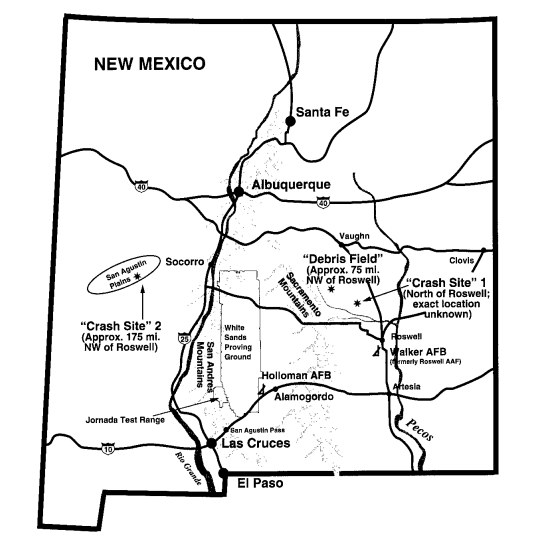
Now, the newly unveiled brain map, which the researchers call a “connectome,” has revealed what Lichtman recently characterized as “an alien world inside your own head.”

In the newly published study, the authors say the functions occurring within our brains represent the key difference that separates us from other life on Earth. Despite this recognition, we currently possess a less-than-complete understanding of the intricate synaptic circuitry underlying these functions.

Enter Google Research’s Connectomics team, which, over the last decade, has worked toward using machine learning to construct a clearer picture of the human brain at previously unmatched scales. The result of this work allows researchers to produce visualizations of extremely large volumes of neural circuits at high resolutions, which could lead to entirely new discoveries about the way our brains function.

A limiting factor in this research involves the problems with obtaining high-quality samples of human brain tissue. Unlike other organ biopsies, brain biopsies rarely occur except when used to extract neoplastic masses, which aren’t ideal for creating visualizations of normal brain structure. In past attempts, brain organoids composed of human cells have been used, but since they lack cortical layers, they were unable to faithfully reproduce all of the features of real human brain tissue.

In their recent paper, the study’s authors proposed a new strategy involving the use of human brain tissue extracted during neurosurgical procedures, which they said “could be leveraged to study normal—and ultimately disordered—human neural circuits.”

unknown neuron connections Above: Lichtman and the research team report that on some occasions, a single axon, shown in blue, was found to make repeated synaptic connections, indicated by yellow areas in the image above, with a target neuron (shown in green). Presently, the researchers say the purpose of these tight connections is unknown. Credit: Google Research & Lichtman Lab (Harvard University). Renderings by D. Berger (Harvard University).

Lichtman obtained such a sample a decade ago. Smaller than a single grain of rice, the sample had been retrieved from the brain of a patient with severe epilepsy as part of a standard procedure where a small portion is removed to help reduce seizures and then analyzed to determine whether it is normal. Apart from the patient’s age and gender, Lichtman knew nothing else about the sample’s origins.

In their research, the team used electron microscopy to produce a massive set of very detailed images using this small piece of temporal cortex, which was only about 1 cubic millimeter in size. Then they analyzed the data with Google’s powerful AI, reconstructing thousands of neurons, over a hundred million synaptic connections, and other brain components like glial cells, blood vessels, and myelin.

The tremendous resulting trove of data, which revealed a previously unrecognized class of neurons hidden within deep layers of the tissue and “very powerful and rare multisynaptic connections between neurons throughout the sample,” was made available online, along with tools to aid other researchers in analyzing it. 

most detailed map Above: Clusters of cells are shown within the deepest layer of the cortex. Credit: Google Research & Lichtman Lab (Harvard University). Renderings by D. Berger (Harvard University).

“This work provides evidence of the feasibility of human connectomic approaches to visualize and ultimately gain insight into the physical underpinnings of normal and disordered human brain function,” the researchers write in their new study. “It is hoped that this endeavor will be aided by providing free access to all of the data and relevant tools.”

“Given the enormous investment put into this project, it was important to present the results in a way that anybody else can now go and benefit from them,” said Google Research collaborator Viren Jain of the team’s findings.

Supported by the National Institutes of Health BRAIN Initiative, this collaboration’s ultimate goal is to create a high-resolution map of a whole mouse brain’s neural wiring. This ambitious project will require approximately 1,000 times the data produced from the current 1-cubic-millimeter fragment of human cortex used by Lichtman and his collaborators in the recent research.

The team’s landmark paper, “A petavoxel fragment of human cerebral cortex reconstructed at nanoscale resolution,” was published in the journal Science on May 10, 2024.

{ https://thedebrief.org/category/science/ }

Hoe vind je dit bericht?
Geschreven door peter om 21:43 Stuur door

Belgen ontdekken ‘suikerspin-planeet’

Belgen ontdekken ‘suikerspin-planeet’

4d7046b0-985c-049e-2387-91c475049108.jpg

Een internationaal team van onderzoekers – waaronder ook wetenschappers van de universiteit van Luik – hebben een nieuwe planeet ontdekt: WASP-193b. En dat is een tamelijk bijzondere planeet; WASP-193b heeft namelijk ongeveer dezelfde dichtheid als een suikerspin.

WASP-193b bevindt zich op zo’n 1200 lichtjaar van de aarde. De planeet is 50 procent groter dan Jupiter, maar heeft een massa die zeven keer kleiner is dan die van Jupiter. Het betekent dat de planeet een zeer geringe dichtheid heeft; vergelijkbaar met de dichtheid van een suikerspin, zo stellen de onderzoekers.

Afwijking

WASP-193b gaat voor nu de boeken in als de op één na minst compacte planeet die tot op heden is ontdekt; alleen de eerder gespotte – maar wel veel kleinere – Kepler-51d heeft een nog lagere dichtheid. “De extreem lage dichtheid (van WASP-193b, red.) is wat de planeet echt doet afwijken van de meer dan 5000 andere exoplaneten die tot op heden zijn ontdekt,” vertelt onderzoeker Khalid Barkaoui.

Barkaoui en collega’s vingen een eerste glimp op van WASP-193b dankzij de zogenoemde Wide Angle Search for Planets (kortweg WASP). Binnen dit onderzoeksproject wordt met behulp van een observatorium op het noordelijk halfrond en een observatorium op het zuidelijk halfrond de helderheid van duizenden sterren in de gaten gehouden. Daarbij werd ook gekeken naar WASP-193: de moederster van WASP-193b. En tussen 2006 en 2008 – maar ook tijdens aanvullende waarnemingen in 2011 en 2012 – zagen onderzoekers de helderheid van deze ster met regelmaat afnemen. Die afnames in helderheid bleken vervolgens te herleiden te zijn naar het bestaan van een planeet die rond WASP-193 cirkelde. Wanneer deze planeet – vanaf de aarde gezien – voor zijn moederster langs beweegt, houdt deze een deel van het licht van zijn moederster tegen, waardoor het lijkt of de helderheid van WASP-193 tijdelijk afneemt.

cotton-candy-exoplanet1.jpg

exoplanet, WASP-193B genoemd, is gevonden op een afstand van 1.232 lichtjaren.

Omlooptijd en omvang

Op basis van de metingen van WASP konden onderzoekers dus al concluderen dat WASP-193 een planeet bezat. Ook wezen de observaties uit dat deze ongeveer 6,25 dagen nodig had om een rondje om zijn moederster te voltooien. Daarnaast konden onderzoekers uit de hoeveelheid zonlicht die WASP-193b tegenhield op het moment dat deze voor zijn moederster langs bewoog ook afleiden hoe groot de planeet ongeveer was: ongeveer 1,5 keer groter dan Jupiter.

Massa

Opmerkelijk werd het echter pas toen de onderzoekers met behulp van andere observatoria ook de massa van de planeet poogden te achterhalen. Tot grote verrassing van de onderzoekers wezen deze aanvullende observaties namelijk uit dat WASP-193b een zeven keer kleinere massa heeft dan Jupiter. En daarmee heeft de planeet – die dus wel 1,5 keer groter is dan Jupiter – een zeer geringe dichtheid. Zo zou WASP-193b een dichtheid hebben van 0,059 gram per kubieke centimeter, zo is in het blad Nature Astronomy te lezen. Ter vergelijking: de dichtheid van Jupiter is 1,33 gram per kubieke centimeter en die van de aarde is maar liefst 5,51 gram per kubieke centimeter.

wasp-193b.jpg

Artistieke weergave van de planeet WASP-193b in een baan om zijn ster WASP-193.

Krediet: MysteryPlanet.com.ar.

Suikerspin

“De planeet is zo licht dat het lastig is om een vast materiaal te bedenken (met een vergelijkbare dichtheid, red.),” merkt onderzoeker Julien de Wit op. Toch is het de onderzoekers gelukt; WASP-193b is qua dichtheid nog het beste te vergelijken met een suikerspin. Het bekende snoepgoed kent namelijk een dichtheid van ongeveer 0,05 gram per kubieke centimeter. “De reden dat (WASP-193b, red.) zo vergelijkbaar is met een suikerspin, is dat beiden in feite grotendeels uit lucht bestaan. De planeet is gewoon super fluffy.”

Waar een suikerspin vooral uit suiker bestaat, bestaat WASP-193b voornamelijk uit waterstof en helium, zo vermoeden de onderzoekers. Die gassen lijken een gigantisch omvangrijke atmosfeer te vormen die tienduizenden kilometers verder reikt dan de atmosfeer van Jupiter. Hoe de planeet zo is kunnen opzwellen, is onduidelijk. Wetenschappers hebben verschillende theorieën over hoe planeten ontstaan, maar geen enkele van die bestaande theorieën kunnen het bestaan van WASP-193b vooralsnog verklaren. “We kunnen niet verklaren hoe deze planeet ontstaan is,” bevestigt onderzoeker Francisco Pozuelos. “WASP-193b is een kosmisch mysterie,” voegt Barkaoui toe. De wetenschappers hopen dat toekomstige waarnemingen – met onder meer de James Webb Telescoop – kunnen helpen om dat mysterie op te lossen.

Bronmateriaal

{ https://scientias.nl/ }

Hoe vind je dit bericht?
Geschreven door peter om 21:28 Stuur door

MIT ASTRONOMERS SAY THEY HAVE DISCOVERED A PLANET CURRENT THEORIES CAN’T EXPLAIN

koAqlRJf?format=jpg&name=900x900

Around a star in our Milky Way galaxy, astronomers have discovered an extremely low-density planet that is as light as cotton candy. The new planet, named WASP-193b, appears to dwarf Jupiter in size, yet it is a fraction of its density.

CRE

MIT ASTRONOMERS SAY THEY HAVE DISCOVERED A PLANET CURRENT THEORIES CAN’T EXPLAIN

A team of astronomers from the Massachusetts Institute of Technology (MIT) say they have discovered a distant planet that they can’t explain with current planet evolutionary theories.

The newly discovered WASP-193b is a gas giant 50 percent larger than Jupiter, the largest gas giant in our solar system. However, it is only one-tenth as dense, making it the second-most dense exoplanet ever found.

The researchers behind the seemingly impossible find, which also includes experts from Belgium and Spain, say these types of “puffy Jupiters” have left astronomers baffled for over 15 years since they cannot explain how they formed using the best modern-day planet forecasting tools

“We don’t know where to put this planet in all the formation theories we have right now because it’s an outlier of all of them,” explained study co-lead author Francisco Pozuelos, a senior researcher at the Institute of Astrophysics of Andalucia, in Spain. “We cannot explain how this planet was formed based on classical evolution models.”

A NASA illustration of the giant planet WASP-193b. It's depicted as orange.

A NASA illustration of planet WASP-193b which is more than 1,200 light-years away.

(Supplied: NASA)

‘PUFFY JUPITER’ IS AS DENSE AS COTTON CANDY

According to a formal announcement of the discovery, WASP-193b was initially spotted between 2006 and 2008 and then again between 2011 and 2012. Those detections were made by the Wide Angle Search for Planets (WASP) project, which is a collaboration between international astronomers using a pair of robotic observatories in the southern and northern hemispheres.

Together, these robotic arrays of wide-angle cameras scour the stars, looking for the periodic ‘dips’ in light that sometimes indicate a planet is orbiting the star. In the case of WASP 193, a star located 1,232 light years from Earth, the southern WASP observatory spotted these types of dips during both recording sessions.

A detailed analysis of that data determined that a planet was likely crossing in front of its host star every 6.25 days. Further analysis of the amount of light blocked by the planet revealed that it was more or less similar in size to Jupiter. However, when astronomers tried to determine the planet’s mass by measuring how much it affected its host star’s orbit, known as the ‘radial velocity’ method, the numbers didn’t add up. In fact, their initial analysis found no shift in the star’s light spectrum at all, belying the planet’s massive size.

“Typically, big planets are pretty easy to detect because they are usually massive and lead to a big pull on their star,” said study co-author Julien de Wit, an assistant professor in MIT’s Department of Earth. “But what was tricky about this planet was, even though it’s big — huge — its mass and density are so low that it was actually very difficult to detect with just the radial velocity technique. It was an interesting twist.”

After reviewing the data and performing further analysis, the team determined that the planet was actually larger than Jupiter but had to be significantly less dense to exhibit so little gravitational pull on its host star.

“[WASP-193b] is so very light that it took four years to gather data and show that there is a mass signal, but it’s really, really tiny,” said lead study author and MIT postdoc Khalid Barkaoui.

The researchers say finding a solid material that has this type of limited density isn’t easy. In fact, in their published study, the authors say the best comparison they could make is that WASP-193b has the same density as cotton candy.

“The planet is so light that it’s difficult to think of an analogous, solid-state material,” Barkaoui says. “The reason why it’s close to cotton candy is because both are mostly made of light gases rather than solids. The planet is basically super fluffy.”

While clearly an outlier they cannot easily explain, the researchers say astronomers have seen similar readings in previous exoplanets. Still, those cases are still considered extreme outliers that don’t fit within planetary formation models.

“To find these giant objects with such a small density is really, really rare,” says lead study author and MIT postdoc Khalid Barkaoui. “There’s a class of planets called puffy Jupiters, and it’s been a mystery for 15 years now as to what they are. And this is an extreme case of that class.”

FOLLOW-UP OBSERVATIONS COULD UNRAVEL THE MYSTERY

In an effort to better understand the planet’s origin, the researchers say they are planning follow-up observations using a technique developed by de Wit. If successful, this process could reveal the planet’s temperature, composition, and even its pressure at various depths of what they suspect is a mostly hydrogen and helium atmosphere.

“Looking more closely at its atmosphere will allow us to obtain an evolutionary path of this planet,” Pozuelos said.

“The bigger a planet’s atmosphere, the more light can go through,” de Wit said in agreement. “So it’s clear that this planet is one of the best targets we have for studying atmospheric effects. It will be a Rosetta Stone to try and resolve the mystery of puffy Jupiters.”

  • Christopher Plain is a Science Fiction and Fantasy novelist and Head Science Writer at The Debrief. Follow and connect with him on X, learn about his books at plainfiction.com, or email him directly at christopher@thedebrief.org.

{ https://thedebrief.org/category/space/ }

Hoe vind je dit bericht?
Geschreven door peter om 21:02 Stuur door

Hoe rusten vogels tijdens lange overzeese migraties?

Hoe rusten vogels tijdens lange overzeese migraties?

Door JanineJanine image

Dit is hoe vogels omgaan met lange overzeese migraties

Wanneer de herfst aanbreekt, verlaten zwermen vogels hun omgeving en migreren overzee op zoek naar een milder klimaat: maar hoe gaan ze om met de oversteek en waar stoppen ze om uit te rusten?

Trekvogels: hoe steken ze de oceaan over?

Wanneer de winter aanbreekt, maken trekvogels zeer lange reizen op zoek naar warmere omgevingen met voedsel, en keren dan de volgende lente terug. Maar heb je je ooit afgevraagd hoe ze reizen van duizenden kilometers over de oceaan doorstaan, zonder een plek om te stoppen om uit te rusten en te eten? Naast de merkwaardige V-vormige vlucht heeft een onderzoek het antwoord gevonden, en het gaat om een ​​“energiebesparende” techniek. In de praktijk maken vogels tijdens de trek gebruik van de wind tijdens de vlucht om de inspanningen te verminderen.

Ongeveer 40% van de soorten migreert elk jaar en vliegt in groepen van het ene continent naar het andere. Er zijn onderweg veel uitdagingen, vooral voor landvogels die lange tijd over open zee moeten vliegen. In tegenstelling tot zeedieren kunnen ze niet rusten en zich verfrissen met water, daarom kan hun vlucht geen pauzes bevatten. In theorie. Ornithologen waren van mening dat landvogels geen overtochten van meer dan 100 km konden ondernemen, omdat het niet mogelijk is lange afstanden af ​​te leggen door voortdurend met hun vleugels te klapperen, maar dat is niet het geval.

Energiebesparing dankzij wind en opwaartse druk

Freepik

Volgens het Duitse onderzoek van het Max Planck Instituut en de Universiteit van Konstanz wordt de jaarlijkse trek over het water vergemakkelijkt door de atmosfeer: door gebruik te maken van wind en opwaartse druk slagen veel trekvogels op het land in deze prestatie en passen ze hun route zo nodig aan. Hoofdauteur Elham Nourani legt uit: "Tot voor kort werd gedacht dat opwaartse druk zwak of afwezig was aan het zeeoppervlak. In plaats daarvan ontdekten we dat trekvogels hun vliegroutes aanpassen om te profiteren van de beste wind en opwaartse kracht wanneer ze over zee vliegen. Dit helpt hen om hun vlucht honderden kilometers lang vol te houden”.

Het onderzoek omvatte de observatie van vijf verschillende soorten roofvogels die lange overtochten over zee maken: de visarend, de oostelijke honingbuizerd, de grijskopbuizerd, de Eleonora’s valk en de slechtvalk. Deze vogels hebben verschillende afmetingen, morfologieën en strategieën, maar de resultaten bevestigden dat het gebruik van rugwind is geoptimaliseerd om zowel tijd als energie te besparen tijdens de reis, naast de opwaartse druk. Het is echter niet helemaal waar dat vogels nooit stoppen tijdens hun inspannende reizen.

Maritieme migratie van vogels: tussenstop op schepen

Pexels

Sommige landtrekvogels hebben rustplaatsen geïdentificeerd die worden gebruikt door volwassen vogels, die meer ervaring hebben met oversteken, en die door de generaties heen worden doorgegeven. Een studie ontdekte echter onverwacht dat veel soorten, veel meer dan eerder gedacht, schepen gebruiken om uit te rusten tijdens hun oceaanreizen. Men dacht namelijk dat boten slechts bij uitzondering als rustplaats werden gebruikt.

Tijdens een onderzoek in de Middellandse Zee werden gedurende vijfentwintig dagen dertien verschillende soorten waargenomen die de boot van de onderzoekers gebruikten als tussenstop. De tussenstop, oftewel de onderbreking van het vliegen, duurde gemiddeld slechts tweeënveertig minuten, waarschijnlijk door het gebrek aan voedsel op de boot. Desalniettemin voldoende tijd om te schuilen voor slecht weer en de batterijen op te laden. De gegevens die hieruit naar voren kwamen, suggereren verdere monitoring van de herfstmigratie boven het Middellandse Zeegebied en passerende boten: miljoenen vogels zouden het als rustplaats kunnen gebruiken.

{ https://www.curioctopus.nl/ }

Hoe vind je dit bericht?
Geschreven door peter om 18:44 Stuur door

Illinois Triangle UFO: The Shocking Police Encounter That Defies Explanation

Illinois Triangle UFO: The Shocking Police Encounter That Defies Explanation

Shocking Police UFO Encounter

On January 5th, 2000, a remarkable UFO sighting occurred over the state of Illinois near Scott Air Force Base, leaving multiple police officers and witnesses baffled. Known as the Illinois Triangle UFO sighting, this event involved detailed testimonies and audio recordings, providing substantial evidence of a massive, triangular unidentified flying object.

Initial Sighting

The first individual to notice the unusual occurrence was Melvin Null, a truck driver and owner of a miniature golf course in Highland, Illinois. Around 4:00 a.m., Null observed what he initially thought was a bright star in the northeastern sky. However, as he continued to watch, he realized that the light was moving towards him. Upon closer inspection, he identified the light as part of a large, rectangular object, roughly the size of a football field, with red lights underneath and several windows. Struck by the surreal sight, Null decided to report the incident to the local police.

Police Involvement

Highland police officers, initially skeptical, soon found themselves witnessing the object as well. Officers from various small towns maintained radio contact, sharing their observations. One officer reported seeing two bright lights that resembled car headlights, but significantly larger and brighter. Another officer noted that the object, which had initially appeared to be two lights, transformed into a single, intense light resembling a rising sun.

Officer Craig Stevens from Lebanon provided one of the most detailed accounts. He described the object as triangular, moving very slowly about 1,500 feet above the ground. As it approached his location, it suddenly accelerated to an incredible speed, covering a distance of six miles in just a few seconds—an estimated speed of Mach 10—without making any noise. Stevens also noted the object’s unusual ability to make flat turns, a maneuver inconsistent with known aircraft capabilities.

Detailed Descriptions

Officer Barton from Lebanon further corroborated these accounts, describing the object as an arrowhead-shaped craft, concaved at the rear with three large, bright lights that illuminated the entire sky beneath it. He noted that the object seemed to hover at a low altitude, moving slowly and silently.

Officer Martin from Shiloh observed the UFO from a different vantage point, describing it as having distinct, large white lights. Despite slight variations in descriptions, the consensus among the officers was clear: they had encountered a massive, silent, and inexplicably fast triangular object.

Radar and Military Considerations

The proximity of Scott Air Force Base raises questions about military awareness and radar detection of the UFO. Typically, radar systems might struggle to detect objects flying at low altitudes and slow speeds, as these characteristics are often filtered out to avoid confusion with birds or weather phenomena. However, once the UFO climbed to higher altitudes, it should have been detectable by military radar, prompting further investigation into why no immediate response was recorded.

VIDEO:

  • Chris Lehto – Shocking Police UFO Encounter | Illinois Triangle Mystery

The Illinois Triangle UFO sighting remains one of the most compelling and well-documented cases in UFO history. The credible testimonies of multiple police officers, all recorded in real-time radio communications, provide a strong case for the authenticity of the event. Whether it was a top-secret military craft, an extraterrestrial vehicle, or something else entirely, the Illinois Triangle UFO continues to intrigue and puzzle both skeptics and believers alike.

This extraordinary encounter invites us to question what we know about aerial phenomena and the capabilities of advanced technology, urging a deeper exploration into the mysteries that lie above us.

{ https://www.latest-ufo-sightings.net/ }

Hoe vind je dit bericht?
Geschreven door peter om 18:35 Stuur door

Meer van UFO'S of UAP'S, ASTRONOMIE, RUIMTEVAART, ARCHEOLOGIE, OUDHEIDKUNDE, SF-SNUFJES EN ANDERE ESOTERISCHE WETENSCHAPPEN - DE ALLERLAATSTE NIEUWTJES

↑ Terug naar de berichten