Ontdek de Fascinerende Wereld van UFO's en UAP's: Jouw Bron voor Onthullende Informatie!
Ben jij ook gefascineerd door het onbekende? Wil je meer weten over UFO's en UAP's, niet alleen in België, maar over de hele wereld? Dan ben je op de juiste plek!
België: Het Kloppend Hart van UFO-onderzoek
In België is BUFON (Belgisch UFO-Netwerk) dé autoriteit op het gebied van UFO-onderzoek. Voor betrouwbare en objectieve informatie over deze intrigerende fenomenen, bezoek je zeker onze Facebook-pagina en deze blog. Maar dat is nog niet alles! Ontdek ook het Belgisch UFO-meldpunt en Caelestia, twee organisaties die diepgaand onderzoek verrichten, al zijn ze soms kritisch of sceptisch.
Nederland: Een Schat aan Informatie
Voor onze Nederlandse buren is er de schitterende website www.ufowijzer.nl, beheerd door Paul Harmans. Deze site biedt een schat aan informatie en artikelen die je niet wilt missen!
Internationaal: MUFON - De Wereldwijde Autoriteit
Neem ook een kijkje bij MUFON (Mutual UFO Network Inc.), een gerenommeerde Amerikaanse UFO-vereniging met afdelingen in de VS en wereldwijd. MUFON is toegewijd aan de wetenschappelijke en analytische studie van het UFO-fenomeen, en hun maandelijkse tijdschrift, The MUFON UFO-Journal, is een must-read voor elke UFO-enthousiasteling. Bezoek hun website op www.mufon.com voor meer informatie.
Samenwerking en Toekomstvisie
Sinds 1 februari 2020 is Pieter niet alleen ex-president van BUFON, maar ook de voormalige nationale directeur van MUFON in Vlaanderen en Nederland. Dit creëert een sterke samenwerking met de Franse MUFON Reseau MUFON/EUROP, wat ons in staat stelt om nog meer waardevolle inzichten te delen.
Let op: Nepprofielen en Nieuwe Groeperingen
Pas op voor een nieuwe groepering die zich ook BUFON noemt, maar geen enkele connectie heeft met onze gevestigde organisatie. Hoewel zij de naam geregistreerd hebben, kunnen ze het rijke verleden en de expertise van onze groep niet evenaren. We wensen hen veel succes, maar we blijven de autoriteit in UFO-onderzoek!
Blijf Op De Hoogte!
Wil jij de laatste nieuwtjes over UFO's, ruimtevaart, archeologie, en meer? Volg ons dan en duik samen met ons in de fascinerende wereld van het onbekende! Sluit je aan bij de gemeenschap van nieuwsgierige geesten die net als jij verlangen naar antwoorden en avonturen in de sterren!
Heb je vragen of wil je meer weten? Aarzel dan niet om contact met ons op te nemen! Samen ontrafelen we het mysterie van de lucht en daarbuiten.
Berichten van 1 augustus 2024 tot 31 augustus 2024
Ancient mysteries of Russia's sacred Mountain Vottovaara
The world is full of mysterious places, and Vottovaara Mountain in Russia's Republic of Karelia is one of them. This site has been revered for thousands of years by ancient Saami tribes and shamans, who considered it a sacred place surrounded with powerful energy.
Image credit: Universe Inside You
Vottovaara is home to numerous strange megalithic structures and ruins that many believe couldn't have formed naturally. Among these are around 1,600 sacred stones, known as "seids," arranged in a puzzling pattern. These stones, often unusually shaped, are precariously balanced on small rocks in ways that defy simple explanations. While scientists suggest that this was the result of natural processes during the Ice Age, the sheer number and precision of these balanced stones challenge the idea that they occurred by chance.
Another intriguing feature of Vottovaara is a structure referred to as "the well," which locals believe to be an ancient, man-made water reservoir.
As you climb Vottovaara, you'll notice an eerie transformation in the trees. None of the trees on the summit are older than a few decades, and while young pines and firs start growing normally, they soon begin to twist and deform in bizarre ways. This phenomenon is thought to be caused by some unknown energy affecting the trees.
Known as Death Mountain, Vottovaara also is believed to be connected to ancient spirits that are said to inhabit the area, adding to its aura of mystery.
An eye-popping video of seven suns taken from a hospital in China has captured the attention and baffled viewers around the world.
A woman was recording the sun’s descent over the horizon when something spectacular occurred - the image showed more than one sun in the sky.
However, the minute-long video which seemed like a cosmic miracle was actually an optical illusion created by the glass window through which it was filmed.
The phenomenon was caused by the light refracting through the window’s layered glass.
A woman in China captured an image of what appeared to be seven suns in the sky. The image was caused by refracted light through the paned glass window
The video was captured from the 11th floor of a hospital in Chengdu, China southwest of Sichuan on August 18, showing the sun duplicated with varying levels of intensity.
The woman who reportedly captured the video, known as Wang, said viewers were transfixed by the surreal display, according to Jam Press, as many have offered theories about how the phenomenon occurred.
‘This happened because of a magnetic field glitch that made parallel universes visibly manifest,’ one person wrote on the Chinese social media platform Weibo.
‘The Cosmic Bureau has fixed the issue, and those responsible have been reprimanded,’ they added.
Others argued on Reddit that the fragmented suns were a sign of ‘immense pollution’ in China and another person wrote: ‘The truth about global warming has finally been revealed.
Meanwhile, one person simply joked: ‘Will the real Sun shady please rise up?’ in a nod to rapper Eminem’s famed hit ‘The Real Slim Shady.’
However, one commenter did correctly address the question of how a video showed seven suns, writing: ‘This is caused by the reflection/refraction in glass in a multi-pane window. Light from the sun bounces between layers causing the distinct visual separation of the reflections.’
Similar to how you would see a reflection in a mirror, the light refracted and reflected off the layered glass, with each layer creating another copy of the image.
Except for the brightest sun in the center, which is the real one, the others are part of the optical illusion.
Although there is a scientific explanation for the seven suns, some people still preferred to believe that the spectacle fell under the story of Hou Yi.
In Chinese mythology, Hou Yi was portrayed as the god of archery who was sent from the Heavens to help humans.
He is said to have stopped 10 suns from burning up the earth and according to the tale, shot them down with his magic bows and arrows.
The tenth sun begged for its life and agreed to separate the day from the night as punishment for attempting to burn up the earth.
Scientists are calling for a new analysis of the Shroud of Turin amid a seemingly growing body of evidence that challenges the idea it's a fake.
There are also claims that bad data was used in a landmark 1988 UK study which found the shroud was a Medieval forgery and not the cloth Jesus was buried in.
A new review by researchers from France and Italy has revisited those 30-year-old findings and claims to have discovered discrepancies in the data which were not made public and raise doubts about the definitiveness of the results.
Tristan Casabianca, a French independent researcher, who made the find, told DailyMail.com that his findings do not confirm the shroud is older or the burial cloth used to lay Jesus to rest.
But Casabianca - who was an atheist until he began investigating the shroud 20 years ago - said those factors could not be ruled out 'without a re-analysis.'
The research in question is a 1988 study that conducted radiocarbon dating on a piece of the shroud. Pictured are the sample containers that held strips of the cloth
Graphic designer Otangelo Grasso created a progression of what Jesus may have looked like based on the shroud image
The 1988 study used a technique known as carbon dating to determine the age of the controversial Shroud of Turin.
The team determined with '95 percent confidence' the relic was manufactured sometime between 1260 and 1390 AD, long after the time of Christ's resurrection.
The conclusion was reached after analyses performed on a corner of the ancient fabric by three different labs - at the universities of Arizona, Zürich and Oxford.
But after obtaining the raw data, Casabianca found the results varied by decades.
One of Zürich's estimates in the Nature study said the cloth was up to 733 years old, but 595 years in the raw data.
Oxford's shroud sample was between 730 and 795 years old, but the raw data featured estimates that were off by up to 55 years.
Arizona's linen was between 591 and 701 years old, with the raw data showing a difference of up to 59 years.
Even though that would still places the cloth in the Middle Ages, hundreds of years after Jesus, Casabianca said it raises doubts.
He continued to explained that 'the lack of precision seriously affects the reliability of the 95 percent,' suggesting it was no more than 41 percent.
Anything lower than 60 percent suggests that there is a lot of disagreement or inconsistency among the results, according to the 2019 study published in Archaeometry.
'We can say with confidence that the 1988 radiocarbon dating process led to a failure,' said Casabianca, who is an independent researcher in France.
'It was supposed to close a book, and it has only opened a new chapter. This failure could have been avoided with a better protocol.'
The raw data obtained by Casabianca showed it varied by decades than what was published in the Nature study. The red are changes made by the laboratories between their raw radiocarbon dates and the radiocarbon dates mentioned in the Nature article
The Shroud of Turin is a 14-foot-long piece of linen featuring a faint image of the front and back of a man who Christians believe to be Jesus
The 1988 research was conducted in three laboratories: The University of Arizona, Zürich in Switzerland and Oxford University in the UK. Each lab received a strip from the original piece cut, which were then reduced to smaller sizes for the research
But Dr AJ Timothy Jull, who worked on the 1988 analysis, told DailyMail.com that even if the teams did re-run the analysis, 'The results would be the same, but the data would be less scattered.'
Dr Jull was part of the team at the University of Arizona.
'Zürich was close to ours, but Oxford was a bit different,' Dr Jull said.
'But that does not change the results. Others use this argument to say there is something wrong with the measurements, Casabianca tries to do this.'
The cloth was first presented to the public in the 1350s when it was exhibited in the small collegiate church in Lirey, a village in northern France.
Christians believe those wounds were miraculously imprinted on the burial shroud after Jesus was resurrected from the dead, scorched into the fibers by a burst of energy when he came back to life.
Some believe it to be a Medieval fake, which Dr Jull and his team determined in the 1980s.
The piece was cut from the bottom corner on the back of the shroud, which experts said was not mended in the Middle Ages
However, a research involved with the 1988 study said that the radiocarbon dating of the shroud was done correctly
The cloth was first presented to the public in the 1350s when it was exhibited in the small collegiate church in Lirey, a village in northern France
The 1988 study saw scientists take a 10 mm by 70 mm piece of the shroud from the corner, which was cut into smaller pieces and distributed to the different labs.
Co-author Emanuela Marinelli, an independent researcher in Italy, told DailyMail.com: 'The sample was not representative of the full cloth because it is different [from one corner from another].
'The [1988] study found dating was more or less 150 years, so it is impossible to say the age of the entire 14-foot cloth.
'But for us, it was the statistical analysis that is the reason to reject to carbon dating.'
This technique estimates the age of organic materials based on the amount of radioactive isotope of carbon in them.
The results were collected and collated by London's British Museum, which held on to the raw data until Casabianca and his team issued a legal request under the Freedom of Information Act to obtain the raw information for the first time.
'I received a reply from the British Museum with more than 200 pages of documents,' Casabianca said.
'Our access to the documentation kept in the archives of the British Museum showed that the statistical analysis is supported by the documentation.
'In it, we find that the samples were contaminated (including cotton and rogue fibers). This suggests that the sampling was suboptimal, to say the least.'
Dr Jull told DailyMail.com that he conducted another in 2010 to characterize the shroud samples, finding 'odd bits of cotton.'
The agonizing crucifixion of Jesus from the Bible details how he endured severe beatings, punctures and nails driven into his hands and feet.
Christians believe those wounds were miraculously imprinted on the burial shroud after Jesus was resurrected from the dead, scorched into the fibers by a burst of energy when he came back to life.
Now, a new analysis of the Shroud of Turin - also known as the Holy Shroud - claims to have uncovered evidence that the crucifixion may be historically accurate.
An engineer from the University of Padua in Italy used modern technology to reanalyze samples taken from the cloth in the 1970s, finding tiny blood particles showing signs of organ failure, trauma, disease and radiation.
Materials that were typical in ancient Jerusalem were also said to be discovered, suggesting that the shroud may have originated in the region and not in Europe where many skeptics think it was created as a medieval forgery.
The new study analyzed blood samples taken from the shroud in 1978, which were collected using adhesive tape. This blood, according to the study, showed signs of disease, trauma and radiation
Independent experts dismissed the findings, however, saying blood could have contaminated the cloth at any point in the past 700 years.
The Shroud of Turin is a 14-foot-long piece of linen featuring a faint image of the front and back of a man who Christians believe to be Jesus.
The cloth was first presented to the public in the 1350s, when it was exhibited in small collegiate church in Lirey, a village in northern France. Some believe it to be a Medieval fake.
It was not until 1978 when the first physical samples were removed from the cloth, done using adhesive tape to carefully lift particles from the front fibers and a vacuum to collect dust from the back.
But, back then, the results were inconclusive about whether or not blood had been present in the samples.
Now, University of Padua professor Giulio Fanti has placed those samples under modern-day microscopes capable of highlighting details down to the size of individual particles.
The reanalyzed particles showed the presence of hemoglobin, which is a key component of blood, and also two different types of blood that Fanti labeled Type A and Type B.
Fanti says this suggests the cloth was used on someone with bloody injuries, rather than forged using ink, dye, paint or other techniques.
Traces of creatine were also identified in the shroud sample, which is released into the blood stream when a person undergoes muscle breakdown or some type of trauma.
Your body produces creatine from amino acids in your liver, kidneys, and pancreas. It is also present in foods.
The body releases the chemical into the bloodstream when cells in the brain, heart or skeletal muscles are damaged.
It was not until 1978 when the first physical samples were allowed to be taken from the cloth, which was done using adhesive tape to carefully remove particles off the front fibers. Dr. Max Frei, a Swiss criminologist, can be seen taking samples from the shroud
The Shroud of Turin features hundreds of reddish spots, varying in shapes and sizes, across the imprinted body image
The expert found another type of blood that was shed while Jesus was still alive. It also contained signs of radiation, which Christians believe was released when Jesus rose from the dead
'The high percentage of creatinine found in [the sticky tape samples], may be explained, especially during Jesus' last hour before dying on the cross, by a reduced blood flow to the kidneys also caused by hypovolemia and by severe dehydration,' the study reads.
Fanti claimed that his findings align with John 19:28 that states 'Jesus said, I thirst.'
The samples also featured signs the person whose blood allegedly stained the shroud had suffered from uremic syndrome which occurs when the kidneys are unable to eliminate waste products.
While the condition typically happens from kidney disease, it can also be brought on by blunt trauma to the organ, which Fanti believes may have occurred when Jesus was whipped.
John 12:1 reads, 'Then Pilate took Jesus and had him flogged.'
'I would refer to Type A blood as that which came out of the corpse and therefore postmortem blood; it consists of microcytes which indicate the respiratory suffering of Jesus on the cross,' Fanti, a Christian who has been studying the shroud for 25 years, told DailyMail.com.
This new finding came in stark contrast to a 1988 study which found the shroud to be a fake, after researchers determined it had been produced between 1260 and 1390 AD.
The study analyzed samples taken from the 1970s. Researchers collected particles using adhesive tape. Pictured are the samples zoomed in 1,500 times
The 1970s research also collected samples from the back of the shroud using a vacuum. Pictured are dust particles with traces of blood attached
In his study, Fanti found the blood particles he labled 'Type B' to mostly have a darker color than the 'Type A' blood and sharper edges.
He claims this suggests Type B came from before Jesus had died, with the differences being due to clotting characteristics.
'Type B consists of coagulated blood crusts probably formed when Jesus was on the cross or ascended Calvary,' said Fanti.
Both types of blood also had traces of earth materials that Fanti said are typically found in Jerusalem, such as clay and limestone, suggesting that the shroud may have originated in the region.
Mark 15:46 explains how Joseph, one of Jesus' disciples, removed Christ from the cross and 'bought a linen shroud, and taking him down, wrapped him in the linen shroud and laid him in a tomb that had been cut out of the rock.'
Some believe that Jesus' body was not washed during that time, but quickly placed in the tomb, which means he was not cleaned of earthy materials before being wrapped.
'When I went to Jerusalem to analyze the earthy material taken from the Holy Shroud, geologist Amir Sandler of the Geological Survey Of Jerusalem recognized among other things, like smectite and illite, which are typical of the Jerusalem soil as well as other material coming from the Sahara winds,' Fanti explained.
The blood detected by Fanti was also said to have evidence of possible radiation in different forms.
The Type A blood contained Beta particles that are electrons of great kinetic energy emitted by some radioactive nuclei, such as Potassium-40 used in explosives and fireworks.
Photon radiation particles were identified in the Type B samples - these are also known as Gamma rays, which are typically formed by a nuclear reaction.
However, Dr Lawrence Kobilinsky, a forensic scientist who is a professor emeritus at John Jay College, told DailyMail.com that the 'blood' was likely a 'secondary thought.'
'Earlier work... found a pigment [coloring agent] constituted the image,' he said.
Indeed, American chemist Dr Walter McCrone, who analyzed the tape strips in 1978, found the image consisted of red ochre and a gelatin solution.
'The simplest explanation is that this shroud was placed over a statue covered with pigment in certain areas, which transferred to the cloth, and gave it this three-dimensional configuration when you do the right kind of photography,' Dr Kobilinsky said.
The shroud features a faint image of a man with long hair and a beard, which many believe is the face of Jesus
The burial cloth has captivated the imagination of historians, church chiefs, skeptics and Catholics since it was first presented to the public in the 1350s. It is housed in Turin, Italy inside this chapel
Both types of blood had earth materials that Fanti said are typically found in Jerusalem, such as clay and limestone, suggesting that the shroud may have originated in the region. The image shows elements captured from the surface of the fibers
A study in 2018 also determined the shroud to be a fake after a new forensic investigation showed that its bloodstains were left by someone who had been standing – rather than crucified.
Researchers concluded that the bloodstain patterns were also not consistent with a face-down corpse.
Dr Matteo Borrini, a forensic scientist at Liverpool John Moores University, worked with chemist Luigi Garlaschelli, of the University of Pavia in Italy, looking at the orientation of the shroud's stains.
They sought to answer whether the crucifixion shown on the shroud was T-shaped, Y-shaped, or revealed another type of ancient Roman execution.
What they found, however, was that the bloodstains were not consistent with any one pose in particular. This suggested that someone who had been standing was used to imprint the famous patterns at different angles for the hands, chest and back.
Christians have claimed the imprints were created by energy released from Christ's body at the moment of resurrection.
In 1977, the OhioState University's Big Ear radio telescope captured a signal from space so strange that scientists are still baffled by it almost 50 years later.
For decades, scientists have struggled to find any natural process capable of producing the 72-second burst which prompted astronomer Jerry Ehman to write 'WOW!' on the telescope's readout.
Now, new analysis of the so-called WOW! signal has revealed that it might have been caused by a hugely powerful laser slamming into Earth.
Experts say this was not the first salvo of an alien invasion, but rather the entirely natural product of a rare alignment between a collapsed star and a cloud of cool hydrogen.
Unfortunately for alien-hunters, scientists from the University of Puerto Rico at Arecibo say this new evidence shows that the WOW! signal is not evidence of life beyond Earth.
For decades, scientists have struggled to find any natural process capable of producing the 72-second burst which prompted astronomer Jerry Ehman to write 'WOW!' on the telescope's readout
What are the theories to explain the WOW! signal?
There have been many theories over the years for what could have been the source for the short-lived, narrow band radio signal that became known as the Wow! signal.
At the time, it was seen has having all the traits of having come from a distant planet, but the inability to pick it up again has frustrated astronomers.
While some have taken it to be a radio message broadcast by an alien beacon into space, others have looked for other astronomical sources.
Theories have included collisions between asteroids and stars, flares from stars, merging white dwarfs and colliding neutron stars.
Now, experts suggest that it could have been caused by energy from a neutron star trigger a cloud of atomic hydrogen gas to release a laser burst.
The signal was not only uniquely powerful but also arrived in an unusually narrow band of frequencies around 1420 MHz - similar to those produced by atomic hydrogen.
Since hydrogen is so abundant in the universe, some suggested that advanced civilisations might be using its frequency as a calling card for signalling to other intelligent species.
In the absence of any good natural explanation, the idea that the WOW! signal was a 'technosignature' from another world became widespread.
Now, Professor Abel Méndez and his colleagues believe they have identified a series of similar signals which could explain the WOW! signal's origin.
The made the discovery by combing through the archives of the now-collapsed Arecibo Observatory's Radio Emissions from Red Dwarf Stars (REDS) project.
Since this telescope had a similar experimental set-up to the Big Ear radio telescope, he hoped that it would be able to reveal if anything like the WOW! signal had ever been spotted.
The researchers spotted several signals which appeared to be extremely similar to the WOW! signal, albeit considerably fainter.
In 1977, the Ohio State University's Big Ear radio telescope (pictured) captured a signal from space so strange that scientists are still baffled by it almost 50 years later
Researchers have used data from the now defunct Arecibo Observatory (pictured) to find signals that match the original WOW! signal. This evidence suggests it could be been the product of a giant space laser
Four of those originated from the tiny red dwarf star, Teegarden's Star, which is just 12.5 light-years from Earth.
Professor Méndez says: 'Our latest observations, made between February and May 2020, have revealed similar narrowband signals near the hydrogen line, though less intense than the original Wow! signal.'
When intense light from the red dwarf hits these clouds of hydrogen atoms, they are stimulated to produce a powerful burst of microwave energy in the 1420 MHz.
Researchers spotted similar bands of energy (pictured) being produced at fainter levels from a nearby red dwarf star called Teegarden's Star. Importantly this star is surrounded by clouds of atomic hydrogen
The result is an entirely natural microwave laser, or maser, within the hydrogen range which looks extremely similar to that of the WOW! signal.
The researchers argue that the WOW! signal was likely produced when an even more powerful burst of energy collided with a similar hydrogen cloud, producing an even bigger maser.
A burst that powerful is rare, but could have been produced by a type of neutron star called a magnetar.
These are formed when a star collapses and explodes into a supernova, leaving behind an ultra-dense, fast-spinning core with an extremely powerful magnetic field.
If the burst from a neutron star hit a cloud of cool hydrogen gas it could trigger a colossal maser burst just like the WOW! signal.
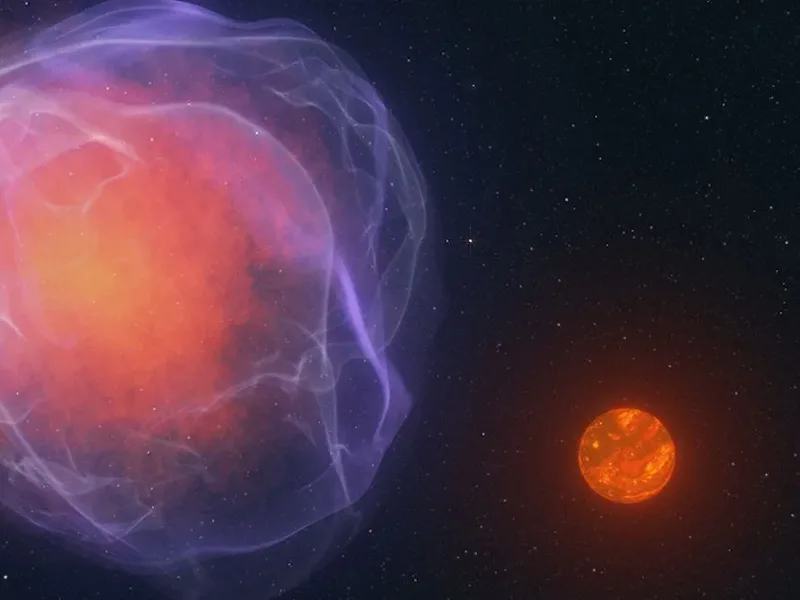
The signal may have been produced by a microwave laser triggered by the collision of energy from a magnetar (artists impression pictured) and a cloud of hydrogen gas. This means that the Wow! signal is not evidence for alien life
Since it would be extremely rare for a magnetar to line up with a hydrogen cloud in just the right way, this also explains why we haven't heard the signal again.
If true, this would mean there is no need to suppose that the WOW! signal is evidence of alien life.
In their paper, published on arXiv, Professor Méndez and his colleagues write: 'Our hypothesis accounts for all observed characteristics of the Wow! signal introduces another source of false positives in technosignature searches, and suggests that this signal represented the first recorded astronomical maser flare in the hydrogen line.
'We will continue with Arecibo Wow! exploring our extensive sets of observations from Arecibo REDS. Future studies will incorporate archival data from the Arecibo Observatory.'
The Fermi Paradox questions why, given the estimated 200bn-400bn stars and at least 100bn planets in our galaxy, there have been no signs of alien life.
The contradiction is named after its creator, Italian physicist Enrico Fermi.
He first posed the question back in 1950.
Fermi believed it was too extraordinary that a single extraterrestrial signal or engineering project has yet to be detected in the universe — despite its immense vastness.
Fermi concluded there must a barrier that limits the rise of intelligent, self-aware, technologically advanced space-colonising civilisations.
This barrier is sometimes referred to as the 'Great Filter'.
Italian physicist Enrico Fermi devised the so-called Fermi Paradox in the 1950s. It explores why there is no sign of alien life, despite the 100 billions planets in our galaxy
If the main obstacle preventing the colonisation of other planets is not in our past, then the barrier that will stop humanity's prospects of reaching other worlds must lie in our future, scientists have theorised.
Professor Brian Cox believes the advances in science and engineering required by a civilisation to start conquering the stars ultimately lead to its destruction.
He said: 'One solution to the Fermi paradox is that it is not possible to run a world that has the power to destroy itself and that needs global collaborative solutions to prevent that.
‘It may be that the growth of science and engineering inevitably outstrips the development of political expertise, leading to disaster.'
Other possible explanations for the Fermi Paradox include that no other intelligent species have arisen in the universe, intelligent alien species are out there — but lack the necessary technology to communicate with Earth.
Some believe that the distances between intelligent civilsations are too great to allow any kind of two-way communication.
If two worlds are separated by several thousand light-years, it's possible that one or both civilisation will be extinct before a dialogue can be established.
The so-called Zoo hypothesis claims intelligent alien life is out there, but deliberately avoids any contact with life on Earth to allow its natural evolution.
A man from Los Angeles claims that he witnessed aliens fleeing from a UFO after it crashed landed in the desert - and he has a piece of the spacecraft to prove it.
Jose Padilla was just a nine-year-old boy growing up in San Antonio,New Mexico, when he and his friend discovered the 'avocado-shaped' UFO.
To this day, he swears that what he witnessed was real.
Jose Padilla claims to have had a real alien encounter as a young boy living in San Antonio, New Mexico - he even has a piece of the UFO to prove it.
The encounter occurred while the two boys were horseback riding in the desert just 13 miles from the Trinity nuclear test site, Robert Oppenheimer and other members of the Manhattan Project detonated the world's first nuclear bomb in 1945.
The encounter occurred that very same year, and at first, Padilla thought the sound of the crash was just another bomb test, he told CBS News Los Angeles.
'I told my friend, 'it must be another test from the bomb' and he said, 'no, it's not a bomb, look at the smoke coming out of the ground,'' Padilla said.
Upon closer inspection, the smoke appeared to be coming from a crashed aircraft.
Then, all of a sudden, three extraterrestrials emerged from the aircraft and began 'sashaying and running in circles,' he said.
But Padilla wasn't afraid of these creatures.
'They had crashed at my father's ranch, and they needed help,' he said.
Over the next ten days, the military cleaned up the wreckage while Padilla and his friend watched from a nearby ridge, despite being warned to stay away.
An artist's rendering of the crashed spacecraft that Padilla claims to have discovered in San Antonio, New Mexico in 1945.
When the soldiers took a break from cleaning up the wreckage, Padilla and his friends entered the aircraft.
The 'extraterrestrials' were gone, giving Padilla the perfect opportunity to extract a souvenir from inside.
He pulled a small 'dial' off the wall, brought it home and hid it in his garage.
Frontier Analysis, a chemical testing lab based in Ohio, analyzed the artifact in 2015. Their report revealed that it was made of aluminum mixed with silicon and copper, CBS Los Angeles reported.
This mix of metals is commonly found in engine parts, and the report stated that the isotopic ratios were terrestrial.
An artist's rendering of the 'dial' that Padilla extracted from the inner wall of the crashed spacecraft.
But an extraterrestrial source for the metals could not be ruled out, the report stated.
'No one knows what it is,' Padilla said.
The years passed, and Padilla moved from San Antonio to Rowland Heights, an unincorporated area of Los Angeles, California, and quietly raised a family.
But he always held onto that strange artifact from his childhood.
Padilla has held onto the strange metal artifact for all these years, claiming that it's proof of his alien encounter.
In 2012, Padilla and the friend who was with him when he witnessed the UFO were interviewed by investigative journalist and UFO researcher Paola Harris.
At the time, Harris was investigating a claim by the son of World War II army pilot William Brophy.
Brophy's son told Harris that one of his father's last missions was to fly over the area that Padilla claims the UFO crash landed in. During one such flight, he saw two young boys on horseback, Harris told CBS Los Angeles.
She believes those two little boys were Padilla and his friend.
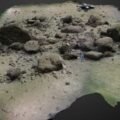
NASA’s Lunar Reconnaissance Orbiter (LRO) has captured new images of the far side of the Moon that have revealed the location of a Chinese spacecraft.
The images obtained by the LRO on June 7 reveal the position of China’s Chang’e 6 sample return spacecraft, which was parked within the Apollo basin. This geologically rich region on the lunar surface features an abundance of basalt resulting from ancient lava flows on Earth’s natural satellite.
Since landing on June 1, Chang’e 6 has been carrying out a robotic lunar exploration mission launched by China’s National Space Administration. The Chinese probe was initially launched in early May.
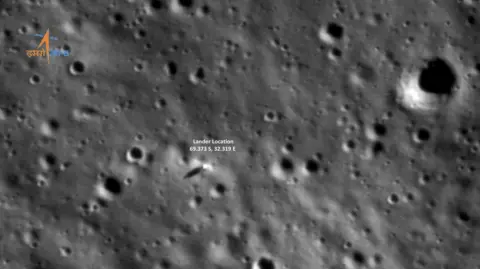
Nearly a week after Chang’e 6 touched down in the Apollo basin, NASA’s LRO passed above its landing site, allowing it an opportunity to capture images that revealed the Chinese spacecraft’s location near the rim of a 50-meter crater.
Above: China’s Chang’e 6 spacecraft can be seen in the center of the frame, surrounded by a halo-like area of white resulting from disturbance to the surrounding lunar regolith when the lander touched down in early June (Credit: NASA/GSFC/Arizona State University).
With the new imagery in hand, LRO imaging experts were quickly able to determine the coordinates of Chang’e 6’s position to be roughly 42 degrees south latitude, 206 degrees east longitude, and placing the probe at an elevation of about minus 5,256 meters.
The new imagery obtained by the LRO was released amid a flood of recent social media posts that falsely link earlier imagery obtained by NASA, some dating as far back as 2010, to the recent landing of Chang’e 6.
Land of the Ancient Lunar Lava Flows
Billions of years ago, the area where Chang’e 6 is carrying out its mission was the site of basaltic lava flows that made their way to the area, where they likely subsided once they met a geological fault believed to exist in the area.
Chang’e 6’s landing site is roughly halfway between a pair of prominent dorsum or “wrinkle ridges,” features that are ubiquitous on lunar basalt plains and can sometimes reach several hundreds of kilometres in length. The basaltic flow in this region appears to overlap with an earlier one located to the west, which lacks the iron oxide and titanium dioxide that is evidenced by the adjacent younger basaltic formation.
NASA’s Spy in Lunar Orbit
Since June 18, 2009, the Lunar Reconnaissance Orbiter (LRO) has been observing the moon from its unique eccentric mapping orbit, providing crucial imagery for creating a 3D map of the lunar surface.
Although the LRO was initially planned for a two-year mission, its operation was extended to gather data addressing various scientific questions, including the evolution of the moon’s crust and regolith.
The recent photos the LRO obtained of China’s Chang’ e 6 spacecraft aren’t the first time NASA’s ever-watchful eye in lunar orbit has successfully spotted operations on the lunar surface undertaken by other countries. Last September, the LRO captured images of India’s Chandrayaan-3 spacecraft at its landing site. Also, in April of this year, the LRO managed to capture images of the Korea Pathfinder Lunar Orbiter (KPLO), an orbital spacecraft operated by the Korea Aerospace Research Institute (KARI).
Mapping the Moon and Beyond
Apart from photographing spacecraft sent to the Moon by other nations, the LRO has provided an unprecedented amount of information that has helped scientists expand our knowledge of Earth’s natural satellite. With a suite of high-resolution cameras and other powerful instruments, the LRO has succeeded at mapping the surface of the Moon with an impressive amount of detail, imagery which NASA has made available for viewing online.
Artist’s concept of NASA’s Lunar Reconnaissance Orbiter in orbit around the Moon
(Credit: NASA).
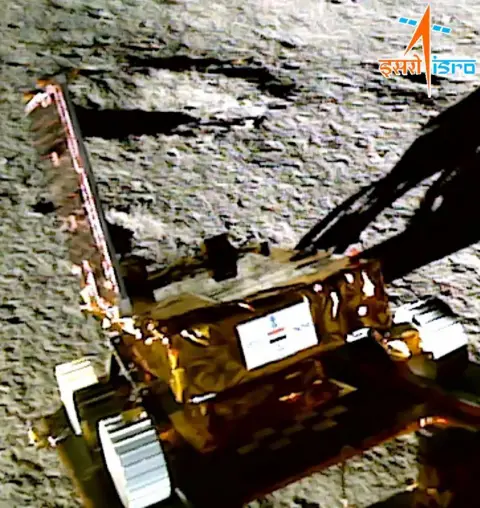
The LRO has played a significant role in several major discoveries, including the confirmation of water ice in craters on the Moon that remain in permanent shadow. Last December, the LRO also transmitted a laser beam from its laser altimeter instrument toward a tiny device on the Indian Space Research Organization’s (ISRO) Vikram lander, proving that the LRO could be used to locate retroreflectors on the surface of the Moon.
Currently, Chang’e 6 is carrying out China’s second sample return mission. The samples collected by the lander were transferred to an ascender module and carried to an orbiter where it docked on June 6 for their transfer back to Earth. The Chang’e 6 lander and its associated rover have also conducted experiments while operating on the lunar surface.
Figure of the heavenly bodies - Illuminated illustration of the Ptolemaic geocentric conception of the Universe by Portuguese cosmographer and cartographer Bartolomeu Velho (?-1568). From his work Cosmographia, made in France, 1568. Credit: Bibilotèque nationale de France, Paris
Our universe is defined by the way it moves, and one way to describe the history of science is through our increasing awareness of the restlessness of the cosmos.
For millennia the brightest scientific minds in Europe and the Middle East believed that the Earth was perfectly still and that the heavens revolved around it, with a series of nested crystal spheres carrying each of the heavenly objects. Those early astronomers busied themselves with attempts to explain and predict the motion of those objects – the Sun, the Moon, each of the known planets, and the stars. Those predictions were excellent, and their systems able to explain the data well into the 16th century.
But that cosmological system of motion, initially developed by Claudius Ptolemy in the 2nd century, wasn’t perfect. In fact, it was an ungainly mathematical mess, relying on small circular orbits nested within larger ones, with some centered on the Earth and some centered on other points. On his deathbed in 1543, the Polish astronomer Nicolas Copernicus published On the Revolutions of the Heavenly Spheres, a radical reformulation of the old Ptolemaic system that put the Sun at the center of the universe – still and motionless – with the Earth set in motion around it along with all the other planets.
The reaction to the work of Copernicus was mixed and muted. On one hand, it was a bold and controversial reshaping of the universe. On the other, it was arguably just as messy and complicated as the Ptolemaic system it was trying to replace. And it introduced more than a few questions that had no easy answer. First and foremost, if the Earth was moving, how could we tell?
We know we are moving on the surface of the Earth through a variety of ways. We can feel the wind against our face when we run, or watch as a distant goal draws nearer. So why don’t we feel a great rush of wind as the Earth orbits around the Sun? Or why aren’t we flung off into the void of space due to the incredible rotation of our planet?
To all this, there were no ready answers. It would take another century and the development of Newton’s theory of gravity for the full picture to come together and make sense of the Earth in motion. Today we know that we don’t feel the motion of the Earth because we are in motion along with it, and since the vacuum of space is just that – a vacuum – there’s nothing for us to push against and betray that motion.
Comparing Two Proposed NASA Missions to Jupiter’s Moon Io
Thanks to NASA’s Juno mission to the Jupiter system, we’re getting our best looks ever at the gas giant’s volcanic moon Io. Even as Juno provides our best views of the moon, it also deepens our existing questions. Only a dedicated mission to Io can answer those questions, and there are two proposed missions.
Io is well-known as the most geologically active world in the Solar System, and it’s not even close. It has over 400 active volcanoes. Io is the closest moon to Jupiter, and the planet’s powerful gravity is largely responsible for Io’s volcanoes. As the planet pulls on Io, the friction creates tidal heating in the moon’s interior. This creates magma and drives its volcanic eruptions. Sulphur compounds in the eruptions paint the moon’s surface in shades of red, yellow, white, black, and green.
There’s never been a dedicated mission to Io, only missions that captured images as they passed by, including Galileo, Voyager 1, Cassini, New Horizons, and Juno, NASA’s current mission to Jupiter. But Io is intriguing and unique, and it can teach us a lot.
Planetary scientists want to know more about the moon’s geological processes. Io is considered a high heat flux world, and scientists want to learn more about its tidal dissipation. Studying Io can also tell us more about primitive planetary bodies that were once more volcanic, which Earth likely was early in its history.
Io can also tell us more about volcanogenic atmospheres, which can play a vital role in shaping a planet’s environment. This 2020 paper draws a link between Earth’s volcanic activity and the Great Oxygenation Event, a critical period when oxygen accumulated in Earth’s atmosphere. A better understanding of the link between volcanic activity and atmospheric evolution will help us better understand exoplanets and habitability.
Scientists know that the Galilean moons exchange material with Jupiter’s atmosphere and magnetosphere. They also know that material ejected from Io’s volcanoes can reach the surfaces of the other moons. Some of it can be turned into plasma by Jupiter’s powerful magnetosphere, forming Io’s plasma torus. They’re curious about this mass exchange in the Jupiter system and how it’s shaped the moons.
These are the reasons for a dedicated mission to Io.
This schematic of Jupiter’s magnetic environments shows the planet’s looping magnetic field lines, Io and its plasma torus, and Io’s flux tube. Credit: John Spencer / Wikipedia CC-BY-SA3.0 with labels by the author
In 2010, scientists at the University of Arizona and Johns Hopkins University’s Applied Physics Laboratory first proposed the Io Volcano Observer (IVO) as part of NASA’s Discovery Program. IVO was proposed as a low-cost mission to explore Jupiter’s volcanic Moon. It was proposed again in 2015 and in 2019. In 2020, IVO was selected with two other missions for further study but ultimately lost out to the DAVINCI+ and VERITAS missions to Venus.
Now, there’s another proposal for the Io Volcano Observer, but this time, it’s under NASA’s New Frontiers Program. The new proposal shows that the desire for an Io-focused mission won’t go away. Instead, it’s gaining steam.
The IVO NF would address our scientific questions by reaching three goals, according to the authors:
Determine how and where tidal heat is generated inside Io;
Understand how tidal heat is transported to the surface of Io;
Understand how Io is evolving.
The original IVO proposal had the spacecraft encounter Io ten times in four years after reaching the moon in 2033. It would’ve carried five instruments, with a sixth under consideration. The IVO would’ve crossed Io from pole to pole, passing over the equator at an altitude of between 200 and 500 kilometres (124 and 310 miles.)
The Jovian moon Io as seen by the New Horizons spacecraft. The mission’s camera caught a view of one of this moon’s volcanos erupting. A new mission to Io could have a spacecraft fly right through one of these plumes to sample it. Image Credit: NASA Goddard Space Flight Center Scientific Visualization Studio.
The closest approaches were carefully designed to give the spacecraft the best observations of the moon’s magnetic field, gravity field, and libration amplitude. The approaches also would’ve allowed for both sunlit and dark views of volcanoes, allowing the spacecraft to study the composition of lava. The polar perspective would’ve provided new views of heat emanating from the moon that were unavailable to Galileo and unobservable from Earth.
The new IVO NF proposal maintains the polar orbit of the original IVO but improves it in several ways. Universe Today talked with lead author Christopher Hamilton about the new proposal. His remarks have been lightly edited for clarity.
The first change in the new proposal concerns the number of flybys, which would increase from 10 to 20.
“Both IVO and IVO-NF are great missions, but doubling the number of flybys more than doubles the scienctific return from an Io mission!”
Christopher Hamilton, Lunar and Planetary Laboratory, University of Arizona.
“10 flybys for the original Discovery-level IVO mission would fill important gaps in image coverage that remain unfilled after the Voyager and Galileo era,” Hamilton said. So why double it?
“The new tour not only doubles the image coverage of Io’s surface with high-resolution imaging but also enables more flybys of active volcanoes, like Loki, Loki Patera, and Pillian Patera,” Hamilton said. “These are highly dynamic volcanic systems that include active lava lakes and explosive eruptions—one pass over the volcanic systems is simply not enough to constrain their time-variability and eruption dynamics.”
An artist’s rendition of Loki Patera, a lava lake on Jupiter’s moon Io. Credit: NASA.
Like Earth’s Moon, Io is tidally locked to Jupiter, with one side more readily available for study than the Jupiter-facing side. But Jupiter’s effect on Io is much stronger than Earth’s effect on the Moon. “However, tidal interactions between Jupiter and Io are much stronger, exciting tides in solid rock with an amplitude of about 100 m (328 feet), which is taller than the Statue of Liberty!” Hamilton said. These tidal interactions drive Io’s powerful volcanism. “However, studies of the past decade have suggested that this heat has also melted a layer within Io to form a subsurface ‘”‘magma ocean,'” Hamilton said.
The original IVO’s ten orbits, with its magnetometer instrument, would have confirmed or excluded this hypothesis. The new proposal will carry an improved version of this instrument, and with more orbits, it could answer questions about Io’s magma ocean.
“IVO-NF would also carry a fluxgate magnetometer and with the repeat passes, carefully timed to measure Io’s induced magnetic field at different times in its orbit, would greatly reduce the uncertainty in estimating a potential magma oceans depth,” Hamilton said. The current uncertainty is ±10 km, but IVO NF would reduce it to ±3 km. This “would revolutionize our understanding of Io’s interior and the links between tidal heating and volcanism,” Hamilton told Universe Today.
“Both IVO and IVO-NF are great missions, but doubling the number of flybys more than doubles the scienctific return from an Io mission!” Hamilton said.
IVO-NF would also approach Io much closer than the original IVO. The original mission called for an altitude of 200 and 500 kilometres (124 and 310 miles) above Io’s surface. IVO-NF would begin its mission with high-altitude fly-bys, but as the mission progressed and objectives were reached, it would come much closer.
“With 20 flybys, IVO-NF can be more daring, flying closer to Io’s surface and even flying through its volcanic plumes to determine the chemistry of its erupted products in unprecedented detail,” Hamilton told Universe Today.
Initial flybys would be at about 200 km, “but as the mission progresses and Baseline objectives are achieved, we will be able to lower the altitude of later flybys over active volcanoes like Pele Patera,” Hamilton said.
“Nonetheless, we would image and analyze these volcanoes first, making use of repeat coverage to further constrain the safety of the close approach, and take precautions like reorienting the spacecraft’s solar panels so that they fly through the plume side-on rather than exposing the full cross-sectional area,” Hamilton told Universe Today. “Plume flythroughs for Io would also open the door to other sampling opportunities for plumes on Saturn’s active moon, Enceladus.”
This image shows some of the volcanic features on Io, including the Pele volcano. It’s surrounded by a ring of orange sulphur compounds that erupted and fell back to the surface. Image Credit: NASA/JPL
“This may seem dangerous, but even at altitudes of 50 km, there would be very few particles,” Hamilton said. But before the spacecraft comes that close, it’ll use its Surface Dust Analyzer to understand the hazard. This instrument was added to the IVO-NF as a top priority. It will measure surface dust composition and the composition of nanograins in the volcanic plumes. Overall, it will give scientists a better understanding of Io’s dust environment and inform them if it’s safe to approach within 50 km.
According to Hamilton, we’re experiencing a renaissance in exploring the Jovian system.
“This is an important time in Planetary Exploration, and exploration of the Jupiter System is undergoing a renaissance, with Juno, Europa Clipper, and JUICE examining Jupiter, Europa, and Ganymede at the same time,” Hamilton told Universe Today. Io is a critical part of Jupiter’s moon system. It’s at the heart of the orbital resonance configuration between Io, Europa, and Ganymede, and the resonance drives geological activity on all three moons, including volcanism, tectonic activity, and the formation of surface features.
The orbital resonance of the three innermost Galilean moons. (Credit: Wikimedia Commons).
“Juno has filled some important gaps left after the end of the Galileo mission (1995–2003), but IVO and IVO-NF would be the first to have an instrument suite that is optimized specifically for Io,” said Hamilton.
To the intellectually curious, everything in nature is worthy of study and deeper understanding. An extraordinary world like Io is certainly no exception, with everything it has to tell us about itself, its sibling moons, and even about the early Earth and Moon.
“Our paper makes the case that Io is a priority target for exploration that should be considered in the next New Frontier Announcement of Opportunity,” Hamilton told Universe Today. He acknowledges that the original IVO mission at the Discovery level is possible, but the IVO New Frontiers mission would accomplish a lot more and would more thoroughly address our outstanding questions about Io.
“A larger mission to Io via New Frontiers would more than double the scientific return of the mission and would offer the best approach to understanding not just Io, but the Jupiter System as a whole, and the origins of high-heat flux worlds like the early Earth, early Moon, and other terrestrial planets in the Solar System and beyond,” Hamilton concluded.
A former top Pentagon spy claims that the US has recovered 'aliens.'
Former US counterintelligence official and onetime Pentagon UFO investigator Luis Elizondo told reporters that he can confirm one of two 'vehicles of unknown origin' were recovered from the now legendary Roswell UFO crash of 1947.
More shocking still, Elizondo said, 'We, as a nation have, been interested in not only the vehicles themselves but the occupants,' which he called 'biological specimens.'
Elizondo helped release three of the most famous UFO videos in history after leaving his role in the US Department of Defense in late 2017. His new explosive allegations come amid the ex-spy's press tour for his new memoir. They'll be broadcast in NewsNation's Special Report: Confessions of a UFO Hunter at 9PM ET on Friday August 23.
'We're not alone,' former Pentagon official Luis Elizondo (pictured) told Australian investigative journalist Ross Coulthart in an advanced clip of TC channel NewsNation's upcoming special. 'It is a simple fact,' he added. 'The US government has been aware of that fact for decades'
Elizondo first rose to national prominence in 2017 in the pages of the New York Times, after he helped release three US Navy infra-red UFO videos - including the GOFAST video (above)
The book contains, among its many incredible revelations, details on a 2016 plan hatched by Elizondo and his military colleagues to catch a UFO in the ocean.
'The United States has been involved in the recovery of objects,' Elizondo told cable network NewsNation in the new interview, 'vehicles of unknown origin that are neither from our country or any other foreign country that we're aware of.'
'We're not alone,' the former Pentagon official told Australian investigative journalist Ross Coulthart in an advanced clip of the channel's upcoming special report.
'We are not alone in this universe and it is a simple fact,' Elizondo continued. 'The US government has been aware of that fact for decades..
Elizondo first rose to national prominence in late 2017 in the pages of the New York Times — where he blew the whistle on the US military and intelligence community's pervasive mismanagement and excessive secrecy on the topic of UFOs.
His public resignation and opaque role within the Pentagon's UFO-hunting portfolio, known to its Senate backers as the Advanced Aerospace Threat Identification Program (AATIP), brought fame and a lead role in a History channel docu-series.
In April 2020, the Pentagon officially released three videos that Elizondo had helped leak in 2017, each taken by US Navy fighter pilots who had reportedly witnessed 'unexplained aerial phenomena' (UAP) as UFOs are now more technically known.
The videos depict, as Elizondo told CNN, 'things that don't have any obvious flight sufaces, any obvious forms of propulsion [...] maneuvering in ways that include extreme maneuverability beyond, I would submit, the healthy G-forces of a human or anything biological.
Despite corroboration from his peers and the late Senate Majority leader who helped create AATIP, Nevada Democrat Harry Reid, the Department of Defense has maintained that Elizondo's military role had no official UFO-hunting duties.
Pentagon officials denied the existence of any 'credible evidence of extraterrestrial activity,' in a statement responding to NewsNation's forthcoming interview.
'As we have stated previously, Luis Elizondo had no assigned responsibilities for the Advanced Aerospace Threat Identification Program (AATIP) while assigned to the Office of the Under Secretary of Defense for Intelligence and Security,' DoD spokesperson Sue Gough told NewsNation.
Critics of Gough have pointed to a 2003 research paper on psychological warfare that she wrote for the US Army War College, implying the Pentagon spokesperson might be part of a coordinated campaign to undermine Elizondo's credibility.
And, in May 2021, Elizondo filed a 64-page complaint to the DoD's Office of the Inspector General accusing high-ranking military officials of attempting to silence him by threatening his security clearances and obfuscating of his work with AATIP.
DailyMail.com obtained an advance copy of Elizondo's book, Imminent, in which he shockingly and unequivocally stated that a 'Legacy Program' is 'in possession of advanced technology made off-world by nonhuman intelligence'
Elizondo said he endured 'malicious activities, coordinated disinformation, professional misconduct, whistleblower reprisal and explicit threats perpetrated by certain senior-level Pentagon officials.'
These actions, he and his attorneys said, suggested 'a coordinated effort to obfuscate the truth from the American people, while impugning my reputation as a former intelligence officer at the Pentagon.'
His new memoir, Imminent, sees the former Pentagon official opening up about much more incredible personal accounts — including the story of his own family's disturbing experience with 'green orbs' floating through their house.
In the book, Elizondo also details he and another AATIP member's plan to catch UFOs on the high seas.
He told DailyMail.com that their investigations pointed to these craft having an apparent interest in military operations, nuclear power, and were often seen around bodies of water.
So they coordinated with the Navy and other branches to create 'Project Interloper': an attempt to lure the mysterious craft and record them with high-tech equipment.
Above, veteran Australian TV news broadcaster and investigative reporter Ross Coulthart - who conducted the first televised interview with government UFO whistleblower David Grusch last year - conducted the new interview with Elizondo, which airs in full on Friday
'You take a nuclear carrier strike group, a nuclear powered aircraft carrier, you have a nuclear powered submarine and other nuclear equities in the area, and you put it on the water,' he told DailyMail.com.
The idea was to gather warships in the ocean, focusing their radar, sonar, and cameras where they believed the UFOs would appear.
'There was an official plan that had support. It got briefed all the way to the Joint Staff,' Elizondo said. 'We had a lot of interest from the intelligence community. A lot of agencies were part of this. They were ready to put their effort and assets into it. And at the last minute it got denied.'
'That, for me, was one of the last straws,' he told DailyMail.com this past Saturday.
NewsNation's 'Confessions of a UFO Hunter' TV special airs this Friday at 9pm Eastern / 8pm Central.
Early humans appear to have experienced a sudden and rapid advance in technology around 600,000 years ago, according to new findings by a team of anthropologists exploring the use of ancient stone tools.
The researchers behind the findings say this likely represents a key inflection point in ancient human development, where the transfer of ancient knowledge from generation to generation, known as cumulative culture, resulted in increasing advances in society that propelled humanity’s biological, cultural and technological development.
“Our species, Homo sapiens, has been successful at adapting to ecological conditions — from tropical forests to arctic tundra — that require different kinds of problems to be solved,” said associate professor Charles Perreault, an anthropologist from Arizona State University’s School of Human Evolution and Social Change. and a research scientist with the Institute of Human Origins.“Cumulative culture is key because it allows human populations to build on and recombine the solutions of prior generations and to develop new complex solutions to problems very quickly.”
Toolmaking Suddenly Underwent a Rapid Advance in Technology
In their published study, “3.3 million years of stone tool complexity suggests that cumulative culture began during the Middle Pleistocene,” which appeared in the journal PNAS, Perreault and fellow author Jonathan Paige, a University of Missouri anthropologist, explain how their analysis of stone tools dating back to 3.3 million years ago revealed this sudden and unexpected technological leap.
The researchers analyzed tools collected from 57 separate ancient hominin sites. The oldest tool, dating back over 3 million years, came from an African site. However, the researchers also studied ancient stone tools discovered at ancient hominin sites in Eurasia, Greenland, Sahul, Oceania, and the Americas.
Next, the team ranked the tools’ complexity. This meant analyzing how many steps would need to be taken to create the tool in question. The researchers characterized and ranked 62 distinct tool-making sequences.
Above: Tools that become increasingly more complex over the course of 3 million years. Left: First time period studied — Oldowan core, Koobi Fora, Kenya; Center: Second time period studied — Acheulean cleaver, Algeria; Right: Characteristic of 600,000 years ago technology — Levallois core, late Pleistocene Algeria (Image credits: (left) Curry, Michael. 2020. Oldowan Core, Koobi Fora. Museum of Stone Tools LINK; (middle) Curry, Michael. 2020. Acheulean Cleaver, Morocco, Koobi Fora. Museum of Stone Tools. LINK; (right) Watt, Emma. 2020. Levallois Core, Algeria. Museum of Stone Tools. LINK).
After charting the tools’ complexity, the team saw some unexpected patterns. Tools made between 3.3 million years ago and 1.8 million years ago required somewhere between two and four procedural units to manufacture. The complexity of stone tools steadily increased over the next 1.2 million years, with the top samples requiring an impressive seven steps. While significantly more complex than tools made over a million years earlier, the researchers say this is still within the range of complexity for a single craftsman. This means knowledge from previous generations of toolmakers had most likely not been passed down over that span.
However, the researchers discovered that when they looked at tools made around 600,000 years ago, in the Middle Pleistocene, they began to see a sudden and unexpected increase in complexity. Tools from this time period were not only more complex, but more complex manufacturing processes were required to make these tools.
“We analyzed the stone tools made during the last 3.3 million years,” the researchers explain. “We found that these stone tools remained simple until about 600,000 B.P. After that point, stone tools rapidly increased in complexity.”
Where previous tools had required only a handful of procedural steps to manufacture, tools from this time often required as much as 18 steps. According to Paige and Perreault, this is way too many steps for a single generation of craftsmen to achieve without the knowledge passed down from previous generations.
This evidence, the researchers write, is consistent with findings from other research teams, suggesting that such a rapid transition “signals the development of cumulative culture in the human lineage.”
“By 600,000 years ago or so, hominin populations started relying on unusually complex technologies, and we only see rapid increases in complexity after that time as well,” said Paige. “Both of those findings match what we expect to see among hominins who rely on cumulative culture.”
Dawn of Cumulative Culture and the Evolution of Modern Humans
Although the evolution of stone toolmaking provides evidence for the dawn of cumulative culture, the researchers behind the findings say such a leap likely affected all aspects of early humans. This likely included changes in human culture, biology, and even the ability to adapt to a range of environments and habitats found across the globe.
“The human dependence on cumulative culture may have shaped the evolution of biological and behavioural traits in the hominin lineage,” Paige and Perreault explain, “including brain size, body size, life history, sociality, subsistence, and ecological niche expansion.”
Such changes can increase in complexity as genetic and cultural evolution happen concurrently. According to the researchers, this “gene-culture coevolution process” may explain increases in relative brain size, a prolonged life history, “and other keystone traits underlying human uniqueness.”
Notably, the researchers point out that the Middle Pleistocene shows many other examples of evolving technology. For example, studies of this era reveal consistent evidence of the controlled use of fire, hearths and other domestic spaces. This era also features the evolution of wooden structures constructed with logs hewn using hafted tools, which, the researchers explain, “are stone blades affixed to wooden or bone handles.”
In their conclusion, Paige and Perreault note that toolmaking is just one measure of cumulative culture, and further study could spot other increases in this behaviour that may have occurred in the past but are not immediately evident in the archaeological record. “It is possible that early hominins relied on cumulative culture to develop complex social, foraging, and technological behaviours that are archaeologically invisible,” they write.
Ultimately, the research team believes that their findings show how knowledge can be passed down through the generations without each successive generation having to rediscover the knowledge of the past. When enough knowledge makes it through, like what appears to have happened 600,000 years ago, this process can result in an ever-increasing and adaptive knowledge pool that allows for a consistent upward progression in cultural and technological evolution.
“Generations of improvements, modifications, and lucky errors can generate technologies and know-how well beyond what a single naive individual could invent independently within their lifetime,” the researchers conclude. “When a child inherits her parent’s generation’s culture, she inherits the outcome of thousands of years of lucky errors and experiments.”
“The result is, our cultures — from technological problems and solutions to how we organize our institutions — are too complex for individuals to invent on their own,” Perreault adds.
Christopher Plain is a Science Fiction and Fantasy novelist and Head Science Writer at The Debrief. Follow and connect with him on X, learn about his books at plainfiction.com, or email him directly at christopher@thedebrief.org.
The United States Air Force (USAF) and Lockheed Martin have announced the successful completion of tests involving their future intercontinental ballistic missile reentry vehicle, the Mk21A.
The planned test flight of the Mk21A vehicle took place over the Pacific Ocean on June 17, demonstrating a significant step forward in the development of future intercontinental ballistic missile (ICBM) technology.
The unarmed reentry vehicle was launched from Vandenberg Space Force Base, California, aboard a Minotaur I rocket at 11:01 p.m. Pacific Time.
In a press release, the American aerospace company said the test allowed engineering teams to evaluate several of the Mk21A’s technological capabilities and primary design components. The development of the Mk21A is part of a broader initiative that forms a critical component of the U.S. Air Force’s strategy to modernize its ICBM weapon systems.
“Test launches like these are crucial for protecting our nation’s defense,” said Col. Mark Shoemaker, Commander of Space Launch Delta 30, in a statement following Monday’s launch.
Presently, the Mk21A reentry vehicle represents the cutting-edge ICBM weapon technologies of the future, providing the basis for technologies that are already becoming integral to the U.S.’s deterrent posture.
Jay Watson, vice president of Strategic Reentry at Lockheed Martin, said his company’s more than six decades of involvement in the development of aerospace systems has “demonstrated exceptional performance in reentry technologies and a pioneering digital engineering approach on this program from its beginning.”
“We remain focused on delivering this capability for the warfighter as a trusted partner to the U.S. Air Force for ICBM reentry systems and modernization of the deterrent triad,” Watson said.
Monday’s test was part of an Engineering and Manufacturing Development contract the aerospace company presently has with the Air Force Nuclear Systems Center, based at Kirtland Air Force Base, New Mexico.
The company says that the data it collected during the test flight will provide potentially crucial information that it will use in the ongoing development and future testing of the Mk21A.
Presently, the reentry vehicle’s development remains on schedule, with assistance from modelling and simulation and the implementation of advanced digital engineering capabilities that have helped Lockheed Martin maintain an economical approach to the system’s development.
The Mk21A’s unique design includes the arming and fuzing subsystem and support elements, which contribute to ensuring the vehicle’s operational performance and overall effectiveness.
“As global threats evolve, it’s essential to support these launches and maintain access to space to safeguard our nation,” Col. Shoemaker said following Monday’s launch.
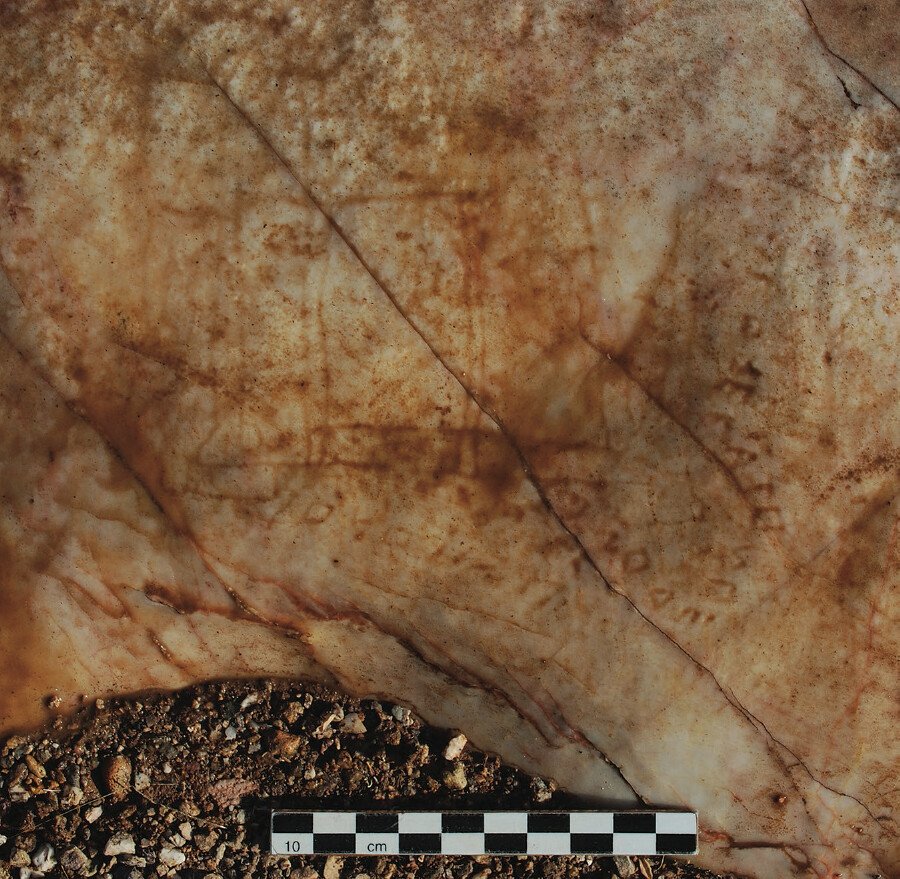
Researchers have uncovered unique graffiti on Barako Hill near Vari, Attica that may indicate there once stood a massive ancient Greek temple or structure on Athen’s famous Acropolis that has since been lost to history.
According to a new study published in the American Journal of Archaeology, this ancient drawing, attributed to a shepherd named Mikon, depicts a building identified as “the Hekatompedon,” a term historically associated with large temples.
“Mikon is not otherwise known, but he was most likely a shepherd who made the graffito while grazing his flocks,” explained Janric van Rookhuijzen, an archaeologist and co-author of the study, ina recent article. “The version of the Greek alphabet used is very ancient, making it clear that the drawing was made as early as the 6th century BCE.”
An image of Mikon’s graffiti showing a possible ancient temple. (Image: MERLE K. LANGDON & JAN Z. VAN ROOKHUIJZEN, AMERICAN JOURNAL OF ARCHAEOLOGY 2024)
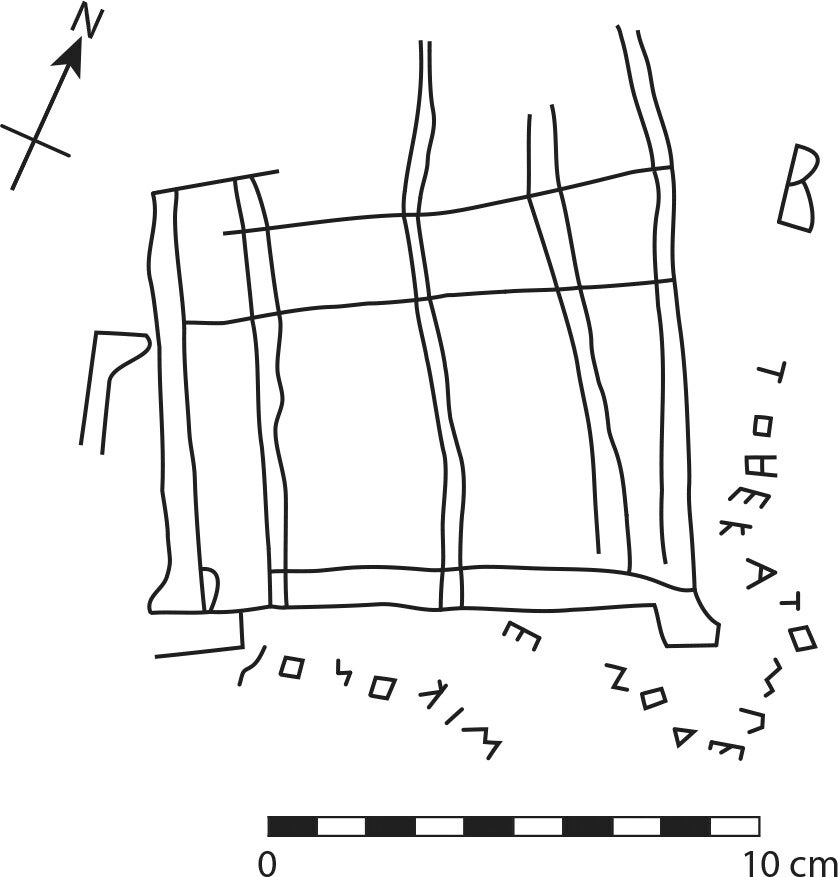
The graffito (a term sometimes used to describe a singular piece of graffiti) was found among over 2,000 ancient engravings on marble outcrops in the hills north and east of Vari. These engravings, typically created by local herders, include simple drawings of animals, ships, and buildings, as well as short inscriptions. The particular graffito in question looks like a building facade, showing at least five columns, and is accompanied by an inscription identifying it as “the Hekatompedon.”
The term “Hekatompedon” refers to a structure approximately 100 feet in length. In ancient Greek architecture, this term was often used to describe large temples. But, it also means something else.
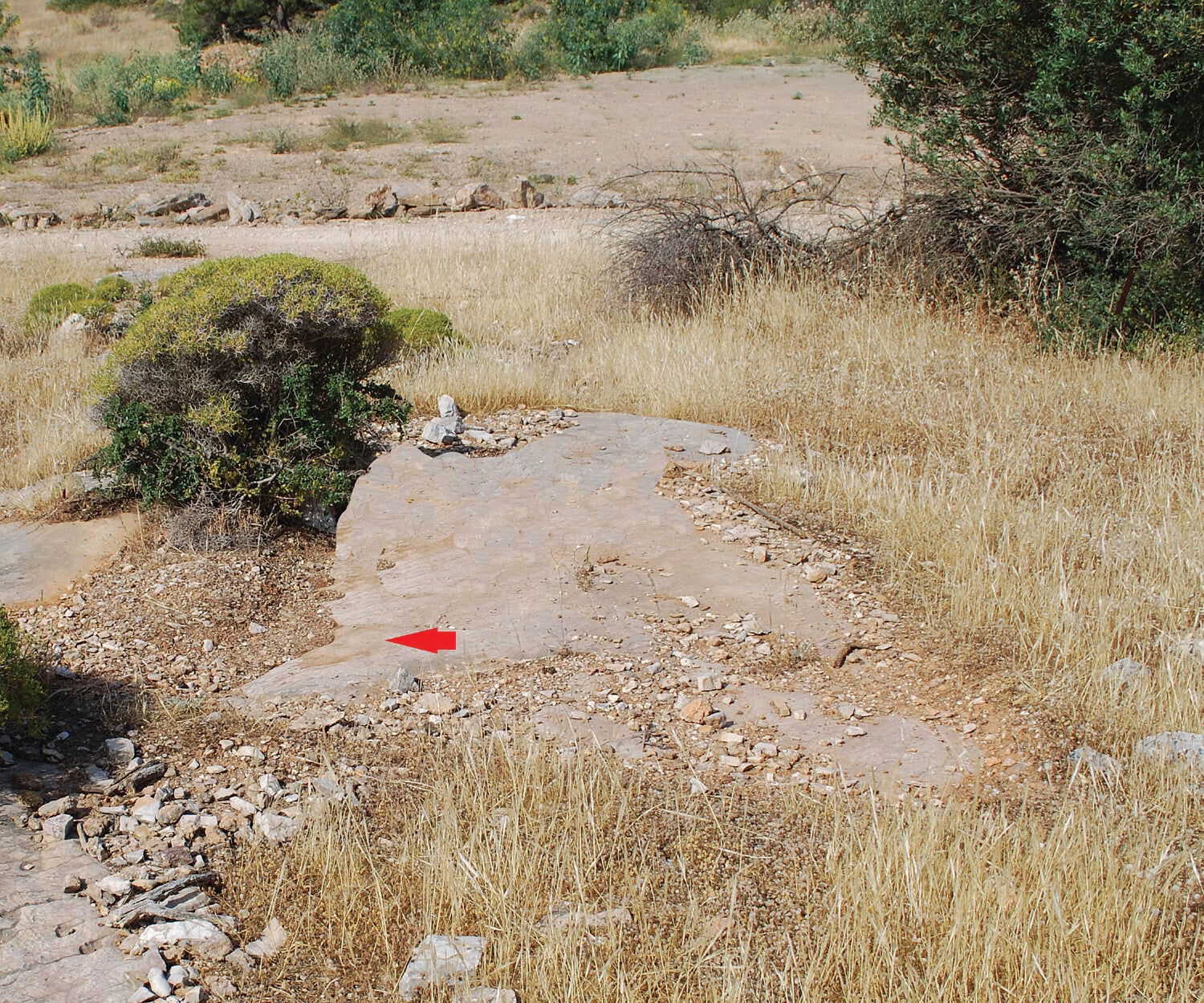
Patch of bedrock where the graffito is located (arrow); the earthen road is visible in the background
(American Journal of Archaeology/Langdon et al)
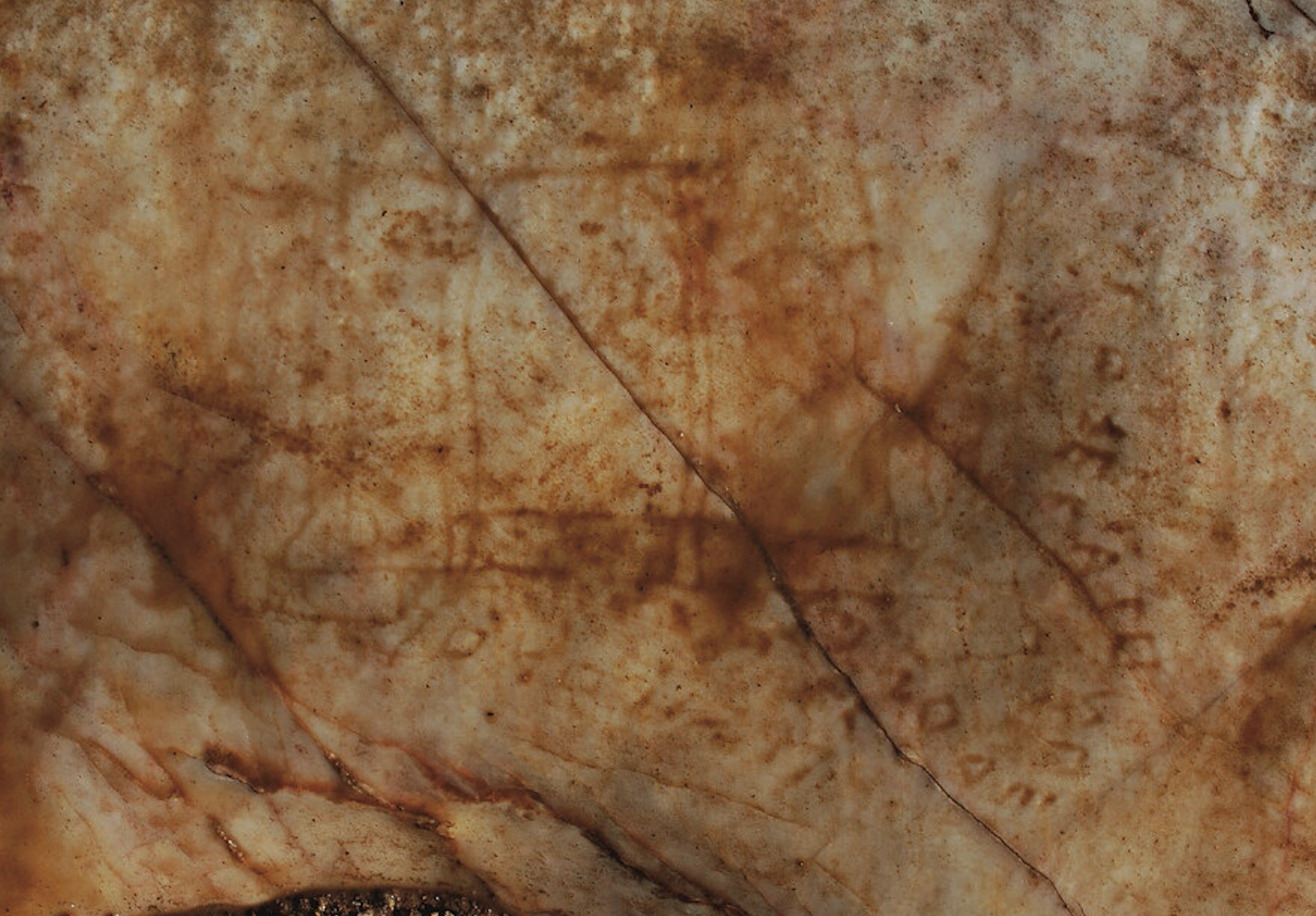
Photograph of the graffiti
(American Journal of Archaeology/Langdon et al)
Sketch of the graffiti, indicating reasonably secure lines and letters
(American Journal of Archaeology/Langdon et al)
“The term is known to be the official ancient name of the famous temple dedicated to the Greek goddess Athena – later known as the Parthenon,” van Rookhuijzen explained. “It is likely that Mikon wanted to depict a building on the Acropolis of Athens.”
However, the inscriber, Mikon, pre-dated the Parthenon by several decades.
“Because the alphabet he used can be firmly dated to the 6th century BCE, the drawing must be at least 50 years older than the Parthenon, which was begun around 450 BCE,” van Rookhuijzen wrote.
According to the researchers, they believe that the graffito likely depicts an archaic temple on the Acropolis of Athens, possibly the so-called Bluebeard Temple or the Gigantomachy Temple. These temples are thought to have stood on the Acropolis at the end of the sixth century BCE, but were destroyed by the Persians in 480 BCE.
The Acropolis of Athens.
(Image: Unsplash)
Utilizing high-resolution photographs and detailed sketches, the work of this long-dead shepherd was analyzed for the various letter forms, orthography, and layout to determine its authenticity. The team compared this drawing and writing style to other known examples, as well as other known architectural drawings and inscriptions from the area.
Based on their research, they note this is the earliest written record of the term “Hekatompedon” being used to describe a large temple or building. Moreover, noting the style of the graffito, as it features lines for columns and a cross line that represents an entablature (the horizontal lintel that sits on top of the columns), the study argues that this was probably some kind of symbolic gesture of admiration for the temple.
In simple terms, Mikon probably just dug big buildings, and shepherds and herders were notorious for their graffiti. The hill where this drawing was discovered is covered in ancient shepherd graffiti, including images of horses, boats, and, of course, ancient erotica.
“Why the shepherds produced so many graffiti is not known – it may have simply been a form of escapism during the dull moments of their job,” van Rookhuijzen mused.
“However, the graffito made by Mikon shows how a small scribble may be the key to tackling the historical riddles behind one the world’s most iconic archaeological sites.”
MJ Banias covers space, security, and technology with The Debrief. You can email him at mj@thedebrief.org or follow him on Twitter @mjbanias.
Een koude waterstofwolk die plotseling oplicht door intense straling van een ster zou wel eens kunnen verklaren waar het signaal, dat onderzoekers al bijna 50 jaar in zijn greep houdt, vandaan kwam.
In de jaren zeventig van de vorige eeuw speuren astronomen van het Ohio State University Radio Observatory de hemel af, op zoek naar radiosignalen afkomstig van buitenaards leven. En op 15 augustus 1977 gebeurt het ongelofelijke: astronoom Jerry Ehman onderzoekt de gegevens die de radiotelescoop heeft verzameld en ziet plotseling een krachtig, smalbandig radiosignaal. Het signaal trekt onmiddellijk zijn aandacht. In zijn enthousiasme omcirkelt hij het signaal en schrijft in de kantlijn het veelzeggende ‘Wow!’ erbij. En zo is het Wow!-signaal geboren.
Wow!-signaal
Al tientallen jaren zoeken astronomen naar radiosignalen die mogelijk van (intelligent) buitenaards leven afkomstig zijn. Maar tot nu toe zonder resultaat. Behalve dan dat ene mysterieuze radiosignaal: het beruchte Wow!-signaal. Hoewel het al bijna vijftig jaar geleden is, blijft het Wow!-signaal, dat slechts één keer is opgevangen en waarvan de oorsprong nooit is achterhaald, de gemoederen bezighouden. Het is zelfs één van de meest raadselachtige radiosignalen die ooit zijn opgevangen. De sterke intensiteit en smalle bandbreedte nabij de 1420 MHz waterstoflijn maakten het tot een mogelijk teken van buitenaardse intelligentie. Maar was dit signaal écht afkomstig van een buitenaardse beschaving, of is er misschien toch een andere verklaring voor?
Wow! Aliens?
Hoewel men ‘hoopte’ dat het Wow!-signaal van buitenaardse wezens afkomstig zou zijn, is er nooit bewijs gevonden dat het signaal daadwerkelijk (opzettelijk) door aliens is verstuurd. Belangrijkste tegenargument voor dat idee is wel dat het slechts eenmalig is opgevangen. Als aliens het radiosignaal uitzenden om contact te maken, zou je verwachten dat ze dat herhaaldelijk doen. “Een andere mogelijkheid is dat het signaal niet bedoeld was voor de aarde, maar ‘weg is gelekt’ uit de communicatie tussen een beschaving en één van diens ruimtevaartuigen,” vertelde amateur-astronoom Alberto Caballero eerder. Het is trouwens ook niet de eerste keer dat wordt gesuggereerd dat het signaal misschien helemaal niet van buitenaardse wezens afkomstig is. Zo verscheen er een paar jaar geleden nog een studie die suggereerde dat kometen de oorzaak van het signaal waren – iets wat overigens door veel wetenschappers direct alweer in twijfel werd getrokken.
Om het Wow!-signaal te duiden, zijn onderzoekers het zogenoemde Arecibo Wow!-project, gestart; een ambitieus plan om naar soortgelijke signalen te zoeken in oude gegevens van het voormalige Arecibo-observatorium. Dit observatorium was één van de grootste en krachtigste radiotelescopen ter wereld. Van 2017 tot 2020 bestudeerde het team verschillende hemellichamen op frequenties van 1 tot 10 GHz met de beroemde 305-meter telescoop van het observatorium. In 2023 zette het project de waarnemingen voort met een 12-meter telescoop op 8 GHz, met een focus op rode dwergsterren die mogelijk bewoonbare planeten herbergen.
Soortgelijk signaal
En nu komen onderzoekers met groot nieuws. “Onze meest recente waarnemingen, uitgevoerd tussen februari en mei 2020, hebben soortgelijke smalbandige signalen nabij de waterstoflijn opgeleverd,” vertelt onderzoeker Abel Méndez. “Deze signalen waren overigens wel minder intens dan het oorspronkelijke Wow!-signaal.”
Geen ‘hallo’
Na analyse van de nieuwe gegevens, denken de onderzoekers dat het Wow!-signaal (helaas) geen ‘hallo’ van een alien was. Zo suggereert hun onderzoek dat het raadselachtige signaal is ontstaan door een bijzondere astrofysische gebeurtenis. Mogelijk is het signaal het gevolg van een plotselinge helderheid van een koude waterstofwolk door sterke straling van een tijdelijke bron, zoals een uitbarsting van een magnetar of een ‘soft gamma repeater’ (een astronomisch object dat af en toe, met onregelmatige tussenpozen van meerdere jaren, krachtige uitbarstingen van röntgen- en gammastraling produceert). Dergelijke zeldzame gebeurtenissen kunnen ervoor zorgen dat waterstofwolken tijdelijk veel feller stralen, wat de kortdurende aard van het Wow!-signaal zou kunnen verklaren.
Koude waterstofwolken in de Melkweg zenden zwakke radiosignalen uit, zoals te zien op deze foto van het Arecibo-observatorium uit 2020. Een plotselinge helderheid van zo’n wolk, veroorzaakt door sterke straling van een andere ster, zou het Wow!-signaal kunnen verklaren.
Afbeelding: Planetary Habitability Laboratory
Buitenaards leven
Deze hypothese verklaart niet alleen de unieke kenmerken van het Wow!-signaal. Het laat ook zien dat we voorzichtig moeten zijn om elk raadselachtige signaal meteen als een teken van buitenaards leven te bestempelen. “Ons onderzoek suggereert dat het Wow!-signaal waarschijnlijk de eerste keer was dat we een ‘maser-achtige’ emissie van de waterstoflijn hebben geregistreerd,” stelt Méndez. “Deze hypothese zou ons begrip van dergelijke signalen kunnen herdefiniëren en invloed kunnen hebben op hoe we in de toekomst naar buitenaards leven zoeken.”
Sisser
Al met al loopt het verhaal van het Wow!-signaal, als de onderzoekers het bij het juiste eind blijken te hebben, met een sisser af. De studie biedt namelijk een nieuwe, ‘natuurlijke’ verklaring voor het mysterieuze Wow!-signaal, dat onderzoekers al bijna 50 jaar in zijn greep houdt. Het team vermoedt zelfs dat de precieze bron van het Wow!-signaal – of soortgelijke signalen – kunnen worden opgespoord door te kijken naar de sterren en andere objecten in de buurt van koude waterstofwolken.
Het betekent dat we nog altijd geen bewijs hebben gevonden voor het bestaan van buitenaards leven. Voorlopig lijken we dus nog steeds alleen te zijn in de uitgestrektheid van het universum.
Meer wetenschap? Lees de nieuwste artikelen op Scientias.nl .
A rare landing on the south pole of the moon led to this scientific discovery
There was once a magma-filled ocean on the south pole of the moon, scientists recently discovered after analyzing lunar soil that revealed ancient information about the moon's origin.
The study of soil taken from a less-studied region of the moon suggests the presence of remnants of a former ocean of magma, according to a study published Wednesday in Nature.
The researchers analyzed lunar soil extracted from high-latitude regions on the southern portion of the moon -- taken as part of the Chandrayaan-3 mission when India’s Vikram lander module made a historic touchdown near the south pole of the moon in August 2023. The mission is the southern-most landing that has ever taken place on the moon -- a difficult feat considering the lack of sunlight, which can create visibility and communication issues, Anil Bhardwaj, director of Physical Research Laboratory in Ahmedabad and co-author of the study, told ABC News. Most lunar landings, especially human landings, have taken place in the equatorial or low-latitude regions.
India's lunar mission found remnants of a magma ocean on the south pole
The mission embarked the use of new technology -- a particle access spectrometer -- an instrument aboard the rover that was able to make observations and collect data very close to the lunar surface, M. Shanmugam, the lead engineer of the alpha particle X-ray spectrometer at the Physical Research Laboratory in Ahmedabad, told ABC News.
The composition of the soil found on Vikram’s landing site is consistent with an ancient magma ocean, the authors conclude.
When analyzing the soil, the researchers found a relatively uniform elemental composition among 23 measurements at various spots along the lunar surface, primarily containing the rock-type ferroan anorthosite. The spectrum of elements also included all of the major and minor elements of the presence of magma, including sodium, aluminum, magnesium, carbon, silicon, sulfur, potassium, iron, titanium, chromium and manganese, Bhardwaj said.
The moon is believed to have formed after a body the size of Mars struck Earth about 4.24 billion years ago, Bhardwaj said. The material that formed as a result of the volatile impact was likely magma that was thrown into space that remained within the Earth's gravitational pull and eventually began forming a planetary-mass object.
The magma ocean is likely to have existed for tens to hundred million years, Santosh Vadawale, a professor in the Physical Research Laboratory and lead author of the study, told ABC News.
The moon lnder Vikram in the foreground and the orbiter of the Chandrayaan in the back ground as Indias moon shot is in the clean room at the Indian Space Research Organisation (ISRO) in Bengaluru, India, June 10, 2019.
Researchers believed the magma disappeared as the moon cooled throughout its formation, hypothesizing that, less dense ferroan anorthosite floated to the lunar surface while heavier minerals sank to form the mantle during the cool-down -- forming the lunar highlands as a result of the floatation of lighter anorthositic rock.
Previous research into the Moon’s geology has primarily relied on samples taken by missions to lunar mid-latitudes, such as the Apollo program, giving scientists a more nuanced look into the history of the moon's formation, according to the paper.
Chandrayaan-3's rover Pragyaan explored the south pole region for 10 days last August
While the lunar magma ocean hypothesis has existed for decades, ever since the Apollo mission placed humans on the moon in 1969, the new research has allowed researchers to confirm the evolutionary history of the moon from billions of years ago, Vadawale said.
"Our next mission, we would like to try to go as close as possible to poles, where there are these permanently shadowed regions where there is water is supposed to be there," he said.
Polaris Dawn will launch on Monday, and the private space mission will do some ambitious and risky things.
In a time when we regularly see multiple commercial spacecraft docked at the ISS at the same time, it can be a little tough for any particular private space mission to stand out — but Polaris Dawn, a collaboration between SpaceX and Shift4 CEO Jared Isaacman, will be one to watch.
The mission is scheduled to launch Monday, August 26 from Kennedy Space Center, sending four astronauts in a SpaceX Crew Dragon capsule (like the one the stranded Starliner crew will ride home in) on a long, narrow orbit that will carry them through the innermost of the Van Allen belts — bands of high-energy radiation that surround our planet — making them the first people to cross the belts in 52 years. Midway through the 5-day mission, two crew members will leave the capsule for the first spacewalk by private astronauts.
Those plans might look like more space billionaire stunts — this is also the age of space tourism, after all — but Isaacman (who will fly on Polaris Dawn as the mission’s commander) insists the Polaris program has real science and technology development goals.
This illustration shows what it might look like when the first of two Polaris Dawn crew members ventures out of the Crew Dragon capsule. It will be the first time that corporate astronauts, instead of astronauts chosen, trained, and employed by a government space agency, will perform an extravehicular activity.
Polaris/SpaceX
Polaris Dawn Will Test SpaceX’s New EVA Suits
One goal of the Polaris Dawn mission is to test new technology for deep space travel. The mission will be the first flight test of SpaceX’s new pressure suits for extravehicular activities (EVAs), such as spacewalks. Isaacman and mission specialist Sarah Gillis are about to become the first non-government-employed astronauts to ever attempt a spacewalk, but they’re also about to depressurize their spacecraft, open the door, and step outside while wearing spacesuits that have never flown before.
The design is meant to be lighter and more maneuverable than the ones currently in use, and the helmet comes with a heads-up display that shows a mission clock alongside the suit’s pressure, temperature, and humidity. At the moment, neither NASA’s spacesuits nor SpaceX’s current generation “intervehicular activity” (IVA) suits have the heads-up display. Both the IVA suits and the new EVA suits are much less bulky than NASA’s version, but Isaacman and SpaceX claim the EVA suits flying on Polaris Dawn offer more mobility at the joints, and they’re also easier to get into and out of.
SpaceX previously took the new suits to White Sands Missile Range in New Mexico to fire tiny projectiles at them at thousands of miles an hour, arguably the most direct way to test whether the suits could endure strikes from micrometeorites or other tiny bits of orbital debris. Next week’s mission will be their first flight test — and since the mission calls for opening up the whole Crew Dragon cabin to the vacuum of space before Isaacman and Gillis venture outside, it will be a high-stakes test, and it carries more than the usual amount of risk that comes with flying to space.
The four astronauts will also test communications systems using laser links between the Crew Dragon capsule and SpaceX’s (increasingly problematic) constellation of StarLink satellites in low Earth orbit.
In this photo, the Plaris Dawn crew poses with their Crew Dragon capsule, sporting their new EVA suits.
Polaris/SpaceX
What Will Happen During Polaris Dawn’s Spacewalk?
While the spacesuits are very new and Polaris Dawn’s crew are about to be the first non-space-agency astronauts to ever attempt a spacewalk, the method they’ll be using for this test is extremely old-school. The Polaris Dawn spacewalk is going to look almost exactly like the very first American spacewalk back in 1965, except with twice the number of people and much sleeker spacesuits.
Astronauts aboard the International Space Station will breathe pure oxygen for about two hours before a spacewalk, then step into an airlock (a separate room that air can be let in and out of) and then into the vast vacuum of space — leaving the rest of the space station safely sealed and pressurized behind them. But the Crew Dragon capsule doesn’t have an airlock, just a main hatch, so in order to walk in space, the crew will have to open the hatch and expose the whole cabin to vacuum.
Isaacman and Gillis will float out the hatch, tethered to the capsule by umbilical cables that provide life support and keep them tethered to the ship. Pilot Scott Poteet and mission specialist and medical officer Anna Menon will be strapped into their seats, managing the umbilicals and the ship’s systems — but all four of them will be exposed to the unforgiving forces of vacuum, with nothing but their suits and open hatchway between them and eternity. That’s exactly how the crew of Gemini 4 — pilot Edward White and commander James McDivitt — did it 59 years ago, when White became the first American spacewalker.
Spacesuits keep astronauts’ bodies under enough air pressure to survive and function, but the pressure inside an EVA suit will still be very low compared to the normal air pressure in the room you’re sitting in now, or in the Crew Dragon’s cabin.
That’s why astronauts on the ISS spend a couple of hours “pre-breathing” oxygen before an EVA. The goal is to make sure there’s no nitrogen in their bloodstream, so they can avoid a painful and often fatal condition called decompression sickness (DCS), or the bends. Normal air is 78 percent nitrogen, which ends up in our bloodstream when we breathe. That’s not a problem, unless our bodies are suddenly under much lower pressure than normal. Then, it quickly becomes a big problem because all the nitrogen gas mixed with our blood comes fizzing out, like the bubbles in soda bottles when you take the lids off too quickly.
Polaris Dawn’s crew will spend a lot more time pre-breathing. They’ll start as soon as they reach orbit, and for the next two days, they’ll gradually turn the cabin pressure down and the oxygen concentration up. That will force the nitrogen out of their bodies even as they’re adjusting to lower pressure. By day 3, it will be time to open the hatch and hope it worked.
The Polaris Dawn crew will spend much of their 5 days in orbit gathering data on how microgravity and radiation impact the human body and its tissues.
Polaris/SpaceX
Medical Research in Space
Exploring how the human body responds to the physical weirdness of being in space — changing air pressure, microgravity, and radiation exposure — is another key goal of the Polaris Dawn mission (and pretty much every crewed mission, on some level). During their 5 days in orbit, the crew will gather data for more than 30 experiments on the human body.
When it launches, the Crew Dragon capsule will be carrying samples of human tissues and cells, which researchers at Baylor College of Medicine and Embry-Riddle Aeronautical University will compare with their “BioBank” samples here on Earth. The goal is to learn how deep space affects the tissues that make up the human body on a microscopic level, looking for changes on the cellular level.
Other experiments will study bone and muscle loss in microgravity — and test a couple of possible methods to track and prevent them. Still other experiments will study changes to astronauts’ vision, which are believed to be caused by changes in the amount of fluid in astronauts’ heads during spaceflight. The crew will measure the pressure on their eyes with portable ultrasound instruments, tiny sensors in contact lenses, and small cameras that measure the size of astronauts’ pupils.
A couple of other experiments are focused on how exposure to microgravity and cosmic radiation impacts medicines; a NASA study will track whether there are any physical or chemical changes to medicines stored on the Crew Dragon capsule during the flight, while a UTHealth Houston study will measure blood flow in the astronauts’ liver and kidneys (again with portable ultrasound devices) to build digital models of how the human body might process medicines taken during a space flight.
Meanwhile, NASA will be testing a nasal spray for space sickness, a type of motion sickness that happens to people in space. All of these tests will hopefully get us all one step closer to feeling safer and healthier in space.
UFO whistleblower Luis Elizondo is strengthening his longtime efforts to pressure the U.S. government into revealing its secretive knowledge about UAPs, or Unidentified Anomalous Phenomena. Now that the Pentagon has finallycleared him to tell the full truth about what he knows, Elizondo has dropped several stunning claims in his new book, Imminent: Inside the Pentagon’s Hunt for UFOs, including a story about the government setting up UAP traps to attract the supposed extraterrestrials.
“We had a plan to set up a real big nuclear footprint, something we knew would be irresistible for these UAP,” Elizondo says in a new video posted on Reddit.
Elizondo, a former Pentagon official, makes other startling claims about what he says the government knows about UAPs, including its stewardship of a “Legacy Program” that is “in possession of advanced technology made off-world by nonhuman intelligence.” In other words, the government is still holding on to evidence that aliens have visited us.
In another incident detailed in his book, “several mysterious and luminous orbs” appeared before a group of scientists as they tested a classified device at the White Sands Missile Range in Los Alamos, New Mexico, in 2013. “The orbs moved toward the test site, hovered over the device as if scanning it for intel, then zipped away, brashly flying over the heads of bewildered scientists.” Several eyewitnesses also saw multiple “disc-shaped objects that seemed to know precisely where the device being tested was located.” Elizondo wrote that the incident occurred several times over the following days.
As former head of the Advanced Aerospace Threat Identification Program—a secret government UFO program that monitored unexplained threats to Navy warships and nuclear silos—Elizondo has had some bizarre encounters of his own. He asserts, for example, that he once saw green “luminous orbs” in his house after he began directing the secret office investigating UAPs in 2010.
The Pentagon redacted some sections of the book before it was published, and it is not supporting Elizondo’s claims.
UAPs have a long history of attracting enthusiasts who want to believe there’s an extraterrestrial presence interested in Earth. However, no proof has yet been found of aliens from other worlds, and the vast majority of UAP sightings can be debunked as a number of other, more mundane occurrences. These typically include weather phenomena, drones or advanced human-made technology, or an illusion of super-fast motion.
Still-unexplained sightings remain mysteries simply because there isn’t enough data to analyze them properly, according to longtime UAP investigator Mick West. “The people who are into UFO investigations are so interested because they’re looking for something extraordinary,” West recently toldPopular Mechanics. It’s more important to perform a dispassionate analysis of quality evidence, he says. Then you know the truth is indisputable.
Now that the government is releasing more documentation and evidence, UAP enthusiasts hope a fuller picture about unexplained sightings will emerge. Whether Elizondo’s claims indicate a truly extraterrestrial presence or not is still up in the air. In the meantime, he believes the incidents he describes in his book are a “very serious national security issue.”
This is the true story of a man who was part of a secret government program. As a CIA psychic informant, he was tasked with viewing Jupiter and the far side of the Moon. He made wild claims about Jupiter, and they later came true…
INGO SWANN (1933-2013) was internationally known as an advocate and researcher of the exceptional powers of the human mind and as a leading figure in governmental and scientific projects to investigate and identify the scope of subtle human perceptions.
In the 1970s, Ingo was involved in remote viewing experiments established by the U.S. Army and the CIA in collaboration with the Stanford Research Institute. This clandestine initiative — code-named Project Stargate — later became the basis for the movie The Men Who Stare at Goats, starring George Clooney and Jeff Bridges. (Source)
Ingo Douglas Swann (1933-2013) Image in public domain
For Stargate, Ingo and a group of psychics used their abilities to spy on Russia from Palo Alto, California, even remotely discovering a downed Soviet spy plane under a jungle canopy in the African country of Zaire after the U.S. Department of Defense had deemed it lost.
Ingo’s various remote views of celestial bodies included: Jupiter (1973), Mercury (1974), the Moon (1975), and Mars (1975, 1976, and 1984). Selected information on these sessions is provided below. More can be found in his archives at the University of West Georgia.
In 1973, most scientists, academics, and media strongly opposed research into parapsychology or psychoenergetics. So, it was surprising when the country’s second-largest think tank started researching these topics. This caused a big reaction because the think tank, SRI, was highly respected and connected to the military and intelligence communities.
The idea of controlled remote viewing was a process in which viewers could view a location given nothing but its geographical coordinates and was developed and tested by Puthoff and Targ with CIA funding.
The experiment was controlled by Harold Puthoff and according to the account, during the experiment; Swann using the power of his thought visited the distant planet. The experiment was dated April 27, 1973.
According to Ingo, in the space to the right of the room, he could see Jupiter, remotely located many millions of miles away. (Source)
He could see how it was shining with a blinding light. He could look at it from all directions of his mind’s eye. At first, everything was seen in miniature and then everything was suddenly expanded.
“These visions are inside me, then outside. There is a yellow cast to space and seeming dark objects show through it. Can they be other moons of contrasting colors or densities? The impressions come to me that there are 17, some yet undiscovered by earth scientists, much closer to Jupiter, and the feeling also comes that some of them have been and are being spawned by the conclusive, volcanic action in the interior..,” Swann said, according to the document.”
Ingo also “saw” rings around Jupiter, but, he said that they were not as noticeable as that of Saturn. (Source)
Later, in 1979, the space probe Voyager confirmed the existence of the Jovian ring system; however, the hypothesis of its existence was put forward by the Soviet astronomer Sergey Vsehsvatskiy in the 1960s.
Perhaps, it was Swann who earlier provided the CIA with information regarding ancient civilizations on Mars. The Stargate project was launched in 1970 after the CIA stated that the Soviet Union reportedly spent more than $1 million a year on research into Psychotronics.
This experiment has been ridiculed by skeptics, who often haven’t reviewed its details. There are two key points that skeptics overlook: first, the Jupiter Probe was just an exploratory experiment, not a claim of any findings; second, it had prestigious sponsorship and scientific oversight.
The experiment’s focus on remote sensing of a distant planet was seen as radical, challenging not only mainstream academic views but also the usual practices in parapsychology.
Six of these thirteen factors were given scientific substantiation by 1975. Before Jupiter’s ring was “scientifically” discovered in 1979, most scientists flatly denounced the possibility of the RING. (Source)
In February 1975, he was contacted by a certain highly-placed figure from Washington, DC, who guardedly told Swann that he, Swann, would soon be receiving a telephone call from the aforementioned Mr. Axelrod
Ingo quickly agreed to a mysterious, last-minute meeting, despite feeling concerned. He met a man who resembled a Marine, exchanged brief formalities, and was then driven to a helicopter. Blindfolded for a 30-minute flight, Swann was taken to what seemed like a secret underground location. Once there, he met a man named Mr. Axelrod, who admitted the name was fake, adding to the secrecy of the situation.
Axelrod quickly got to the main point, asking Ingo many questions about remote viewing. He also made it clear that he wanted to use Swann’s skills for a secret mission and offered a large sum of money. It was an offer Swann couldn’t refuse, and he didn’t.
Axelrod then asked Ingo what he knew about the Moon, revealing the true purpose of their meeting. Someone in the government wanted the Moon to be remote-viewed, and Swann agreed to do it.
When Ingo began his work, he was shocked by what he saw. His mind focused on an image of a massive tower on the Moon, similar in size to the United Nations Secretariat Building. Swann was told that this structure wasn’t made by humans but by mysterious extraterrestrials. However, no one knew where they came from.
In later remote-viewing sessions, Ingo saw many unusual things on the Moon. He described domed structures, advanced machines, tall towers, large cross-shaped structures, and strange tubes spread across the landscape. He also saw signs of what looked like mining operations. It seemed that someone, or something, had secretly built a base on the Moon.
Ingo also focused on a group of people on the Moon who looked human. They were inside some kind of enclosure and were digging into a cliff. The strange thing was that they were all completely naked.
Suddenly, Axelrod, who was overseeing the experiment, stopped it. He hinted that the beings on the Moon might have noticed they were being watched and that Ingo could be in serious danger if they decided to confront him.
Axelrod asked Ingo if he knew a man named George Leonard. Ingo said no, he didn’t know him.
At the same time, Axelrod was asking him to investigate strange things on the Moon. Meanwhile, George Leonard was writing a book called “Somebody Else is on the Moon”.
In 1977, Leonard’s book was published. It talked about strange structures on the Moon, which was exactly what Axelrod was worried about —strange, possibly man-made structures on the Moon.
Ingo and Axelrod had several secretive meetings about strange events on the Moon. These meetings, which felt almost like a spy movie, ended suddenly in 1977, leaving Swann confused.
He wondered if he had psychically seen an advanced base on the Moon built by extraterrestrials. However, since the people he “saw” there looked like naked humans, he also considered it might be a secret Earth-based installation that Axelrod wanted to investigate.
The mystery remains unsolved, but there are more questions. The idea of aliens secretly using our Moon brings to mind similar claims about aliens on Earth.
In the 1997 book Remote Viewers, Jim Schnabel shared a story about the U.S. Intelligence community’s involvement in psychic spying, which started in the 1970s.
One remote viewer, Pat Price, believed that Alaska’s Mount Hayes housed one of the largest alien bases. He claimed the aliens looked human but had different hearts, lungs, blood, and eyes, and could control people through thought. Price also mentioned that this base caused problems for both U.S. and Soviet space missions.
From left: SRI researchers Hal Puthoff and Russell Targ, retired police commissioner Pat Price, and CIA contract monitor Christopher Green in 1974 at an airport immediately after testing Price’s remote viewing capabilities from a glider. Photo courtesy of Russell Targ.
There is a UFO/alien controversy surrounding Holloman Air Force Base in New Mexico, where one of three UFOs allegedly landed in May 1971. The incident has been recently discussed by “Moment of Contact” filmmaker James Fox, who says the full video of the UFO landing exists, including the alien entities walking out of the craft.
However, as it is so often in such cases, instead of the government releasing a film of the entire incident to author/filmmaker Robert Emenegger as promised, it only released 8 seconds of this special footage that ultimately made it into the film. Holloman Air Force Base is the United States Air Force base established in 1942 and located six miles southwest of the central business district of Alamogordo, New Mexico.
The story begins in 1971 when Emenegger and producer/director Allan Sandler were invited by US intelligence to Norton Air Force Base in California to discuss the significant UFO phenomenon that had occurred previously and create a documentary film about it.
Apparently, Mr. Fox recalls the Holloman incident on Julian Dorey Podcast, published on February 25, 2023. He says that he interviewed Sandler and Emenegger about it and they as well believe the UFO landing film footage exists. He points out this happened not far from Socorro, where Lonnie Zamora had his famous sighting roughly a year prior of a similarly shaped “tic tac” white craft and beings walking around the UFO.
There is no official record of the reason why the US government allowed giving secret UFO footage for a documentary film. It is believed that the administration of President Nixon did it to look strong in the science field for the upcoming 1972 re-election campaign.
Emenegger said that he was promised by the USAF officials to get the authentic UFO landing footage that happened at Holloman Air Force Base in New Mexico in 1971. It showed the alien visitors emerging out of the craft that met with the US military. Even though Emenegger was skeptical about it, the Air Force assured him that the footage was authentic.
One of the military’s officials named Paul Shartle, who was in charge of the audio-video department, said in a 1988 national television broadcast with Mike Farrell that he had watched the 16mm film of three disc-shaped craft. One of them landed and the others flew away.
“I saw footage of three disc-shaped crafts one of the crafts landed and two of them went away. It appeared to be in trouble because it oscillated all the way down to the ground. However, it did land on three pods, a sliding door open a ramp was extended, and out came three aliens. They were human-sized. They had an odd gray complexion and a pronounced nose. They wore tight-fitting jumpsuits, thin headdresses that appeared to be communication devices, and their hands in their hands they held a translator I was told.”
Robert Emenegger (Right) and Paul Shartle (Left)
Mr. Fox revealed on the podcast that Allan Sandler told him on the phone call that he had seen three discs escorted by a military jet. “He was not sure of the altitude, but he estimated that they were at roughly 10 to 12,000 feet,” Mr. Fox said. He continued: “Paul Shartle (One of the military’s officials at Norton Air Force Base in California who was in charge of the audio-video department) admitted that he had seen it and that it was not of Earth origin.”
Sandler told Mr. Fox that two of the discs peeled away while one wobbled to the ground. He said it was like a leaf floating down from the sky, and it looked like it was in trouble. Mr. Fox said that the wobbling movement was similar to the footage he had seen of a UFO before. He does not think that Allan knew how the UFO hovered. The disc eventually went to the ground.
“He said James, just like in a sci-fi movie, the seamless door opens and out come these beings that had very large noses, slits for mouths, and their eyes were almost like a vertical slit, like a cat’s eye, very, very big. They had… I’m just like… I [Fox] need to make this abundantly clear to your audience. I’m not saying what’s true or what’s not true, or if it happened or if it’s alien or whatever it is. I’m just telling you what I was told by people who saw it, and claimed to have seen it. They came out and they met with the base commanders, and then they either got into a Jeep or were about to get into a Jeep or do something and then the film footage just cuts.”
Emenegger claimed that he personally visited the landing site and inspected the area where the extraterrestrial craft had been stored, and that the US military and the alien visitors had held meetings that lasted for several days.
Additionally, Emenegger’s production team was granted access to highly classified documents at DoD facilities, and they received assistance from military officials who had expertise in UFO-related matters, such as Col. William Coleman of Project Blue Book and Col. George Weinbrenner, who headed Foreign Technology at Wright Patterson Air Force Base.
Paul Shartle, who showed the footage to Allan Sandler, faced some men in dark suits that showed up from an unknown location and warned him not to speak of the incident. They confiscated the footage, stating that it was not supposed to have happened. Sandler did not inform Emenegger for over 40 years.
Emenegger completed extensive research and film production only to feel cheated when the authorization to use real footage was withdrawn. Despite this setback, he went ahead and released his documentary “UFOs: Past, Present, and Future,” which was nominated for a Golden Globe in 1974. The documentary was groundbreaking because it provided information from the Department of Defense (DoD).
High Speed Test Track at Holloman Air Force Base
The United States Air Force (USAF) required Emenegger to add animated footage of the alleged Holloman UFO landing. According to Emenegger, some frames from the original footage were used during the editing stage with USAF authorization, which was not entirely missing from the frames. The viewers spotted a genuine bright disc coming down slowly in the distance against the backdrop of Holloman’s surrounding landscape.
David Cameron, a UFO researcher, shared in an interview that he was involved in confirming that the Pentagon was not covering up UFO sightings. He recounted the story of the Holloman Air Force Base film, where the government allowed producers to use eight seconds of footage of a landed alien ship in a documentary, but the classified part where an alien got out was removed.
Mr. Fox explains that the point of the story is that there is compelling evidence of an event occurring involving an unidentified object and that there may be film footage of the incident. Despite the existence of this evidence, the story has been overshadowed by other sensational claims, such as secret meetings between President Eisenhower and aliens.
While it is unclear what exactly happened, there is substance to the story and it should not be dismissed outright. However, the addition of other claims has muddied the waters and made it difficult to investigate the case of the president making contact with extraterrestrial life.
A series of experiments studying the sensitivity of life-hunting instruments to be employed in NASA’s forthcoming Europa Clipper Mission have revealed promising new capabilities that significantly raise its chances of being the first to detect lifeforms beyond Earth.
What will Europa Clipper do?
With a launch window that opens in October of this year and a planned insertion into Jupiter’s orbit sometime around April 2030, the Europa Clipper is equipped with a suite of science instruments. Based on recent experiments, one particular instrument, SUrface Dust Analyzer, was determined to be so sensitive that it could likely detect signs of alien life in individual grains of ice ejected by Jupiter’s icy moon.
“For the first time, we have shown that even a tiny fraction of cellular material could be identified by a mass spectrometer onboard a spacecraft,” said lead author Fabian Klenner, a University of Washington (UW) postdoctoral researcher in Earth and space sciences. “Our results give us more confidence that using upcoming instruments, we will be able to detect lifeforms similar to those on Earth, which we increasingly believe could be present on ocean-bearing moons.”
Oceans Beneath Surface of Icy Moons are Ideal Targets for Alien Lifeforms
While the search for life outside Earth has many targets, including the soil of Mars or the clouds of Venus, astrobiologists are increasingly optimistic about finding signs of past and present alien lifeforms within the subsurface oceans of the solar system’s icy moons. Along with Europa, these targets include Saturn’s moon Enceladus. Those hopes received even more fuel when researchers recently found evidence of phosphate on the surface of Enceladus.
The researchers explain, “This planetary body now appears to contain energy, water, phosphate, other salts, and carbon-based organic material, making it increasingly likely to support lifeforms similar to those found on Earth.”
This image shows red streaks across the surface of Europa, the smallest of Jupiter’s four large moons. The upcoming Europa Clipper mission will send instruments to investigate this moon.
Credit: NASA/JPL/Galileo
In the decade since NASA’s Cassini mission detected plumes of water and ice being ejected by Enceladus, mission planners and amateur enthusiasts alike have theorized about how such a life-hunting mission might actually take place. While some of the more exotic proposals include mini submarines or a snakelike probe that can crawl down into those subsurface oceans, the most popular involves flying a sample mission through those ejected plumes and scanning them for clues to alien lifeforms.
Now, an international team of researchers says instruments that might be included on upcoming missions should not only be able to detect signs of alien lifeforms, but they believe the conditions are ideal for such a finding as soon as the Europa Clipper.
Lab Study Shows Instruments Could Spot Signs of Life in a Single Grain of Ice
To see if instruments slated to join future missions would be able to detect signs of life in the plumes ejected from Enceladus and Europa, the UW research team selected a type of bacteria called Sphingopyxis alaskensis for study. That’s because this particular bacterium lives in cold environments on Earth and can survive on very little nutrients, making it a likelier analog of extraterrestrial bacteria that may thrive beneath the surface of these icy moons. The researchers also say this bacterium is just the right size for future probes to spot within a single grain of ice.
“They are extremely small, so they are, in theory, capable of fitting into ice grains that are emitted from an ocean world like Enceladus or Europa,” Klenner said.
The drawing on the left depicts Enceladus and its ice-covered ocean, with cracks near the south pole that are believed to penetrate through the icy crust. The middle panel shows where authors believe life could thrive: at the top of the water, in a proposed thin layer (shown yellow) like on Earth’s oceans. The right panel shows that as gas bubbles rise and pop, bacterial cells could get lofted into space with droplets that then become the ice grains that were detected by Cassini. CREDIT: European Space Agency
After coming up with a lab experiment that would best simulate the conditions a future mission might experience these ejected ice grains, the team used a mass spectrometer to see if they could spot the life signs of their chosen bacterium in a single grain of ice. Significantly, they note that their instrument was less sensitive than the one planned for the Europa Clipper.
As hoped, their study was a success. An analysis of water injected into a vacuum showed that the right instruments could indeed detect alien lifeforms as they were ejected from Enceladus or Europa. In fact, the scientists behind the successful experiments say searching for life in this method “is more successful than averaging across a larger sample containing billions of individual grains.”
Instrument on NASA’s Europa Clipper Mission May Be First to Discover Alien Lifeforms
In their published study, the UW researchers supplemented their experiments by looking at the conditions on Earth that cause bacteria to collect on the ocean’s surface and cause a layer of “ocean scum.” They soon realized that a similar set of conditions likely exists on the surface of these extraterrestrial oceans. As a result, any subsurface water ejected into space would likely capture pieces of alien lifeforms and encapsulate them within grains of space ice, where NASA’s instruments could detect them.
“We here describe a plausible scenario for how bacterial cells can, in theory, be incorporated into icy material that is formed from liquid water on Enceladus or Europa and then gets emitted into space,” Klenner said.
The left panel shows the kilometers-thick icy crust believed to encapsulate Saturn’s moon Enceladus. Filling the crack is salty water with a proposed thin layer (shown orange) at its surface. The right panel shows that as gas bubbles rise and pop, they combine with organic material and get lofted into the spray. CREDIT: Postberg et al. (2018)/Nature.
Although they are not directly involved with the planning of NASA’s missions, the team notes that NASA’s Europa Clipper, thanks to its unique instrumentation, could be perfectly equipped to find alien lifeforms living beyond Earth.
“With suitable instrumentation, such as the SUrface Dust Analyzer on NASA’s Europa Clipper space probe, it might be easier than we thought to find life, or traces of it, on icy moons:” said senior author Frank Postberg, a professor of planetary sciences at the Freie Universität Berlin, “if life is present there, of course, and cares to be enclosed in ice grains originating from an environment such as a subsurface water reservoir.”
Christopher Plain is a Science Fiction and Fantasy novelist and Head Science Writer at The Debrief. Follow and connect with him on X, learn about his books at plainfiction.com, or email him directly at christopher@thedebrief.org.
NASA’s Global-scale Observations of the Limb and Disk (GOLD) mission has discovered a new phenomenon in the Earth’s upper atmosphere. The mission revealed unexpected X- and C-shaped structures in the ionosphere that have puzzled scientists.
The new findings suggest that our understanding of the ionosphere is far from complete and that more dynamics are at play in this region of Earth’s atmosphere than previously thought.
The ionosphere, a layer of the Earth’s atmosphere extending from about 50 to 400 miles above the surface, is a region where solar radiation ionizes atmospheric particles, creating a plasma of charged particles.
This layer plays a crucial role in long-distance radio communications, as it can reflect radio waves back to Earth. However, GOLD’s new observations have shown formations that challenge current scientific models.
Observations from NASA’s GOLD mission shows charged particles in the ionosphere forming an X shape on Oct. 7, 2019. (The colors indicate the intensity of the ultraviolet light emitted, with yellow and white indicating the strongest emission, or highest ionospheric density.)
(Image credit: F. Laskar et al.)
“A unique phenomenon—A geomagnetically quiet time merging of Equatorial Ionization Anomaly (EIA) crests, leading to an X-pattern (EIA-X) around the magnetic equator—has been observed in the night-time ionospheric measurements by the Global-scale Observations of the Limb and Disk mission,” researchers wrote in the study published in the Journal of Geophysical Research: Space Physics.
Observations of these distinctive X-pattern structures had previously been noted only during geomagnetic disturbances, such as after solar storms or volcanic eruptions. However, these new sightings during geomagnetically calm conditions suggest that unknown processes from the lower atmosphere can affect the ionosphere, presenting a new scientific mystery.
Computer simulations showed that these bizarre X-shaped equatorial ionization anomalies are generated during pre-sunset hours and persist until after sunset at local times.
Models also propose that these X-shapes may develop when changes in the lower atmosphere draw plasma downward. However, this hypothesis requires further investigation.
Images from NASA's GOLD mission show C-shaped and reverse-C-shaped plasm
“The X is odd because it implies that there are far more localized driving factors,” Dr. Jeffrey Klenzing, a scientist at NASA’s Goddard Space Flight Center who studies the ionosphere, said in a statement. “This is expected during the extreme events, but seeing it during ‘quiet time’ suggests that the lower atmosphere activity is significantly driving the ionospheric structure.”
Additionally, GOLD identified C-shaped and reverse-C-shaped plasma bubbles near each other. C-shaped plasma bubbles are typically long and straight and form along magnetic field lines. However, on several occasions, GOLD found these structures a mere 400 miles apart, implying that strong turbulence or vortex-like activity in the lower atmosphere influences the ionosphere.
This discovery of closely linked C-shaped bubbles offers further evidence that more complex dynamics are at work in the Earth’s atmosphere than is currently understood.
Dr. Deepak Karan, a research scientist at the University of Colorado’s Laboratory for Atmospheric and Space Physics (LASP) and author of a 2023 study on these mysterious C-shaped bubbles, highlighted the significance of these recent discoveries.
“Within that close proximity, these two opposite-shaped plasma bubbles had never been thought of, never been imaged,” Dr. Karan said. “To have wind patterns change course in such a small area suggests some sort of strong turbulence — like a vortex, wind shear, or tornado-like activity — is likely at play in the atmosphere.”
“The fact that we have very different shapes of bubbles this close together tells us that the dynamics of the atmosphere is more complex than we expected,“ Dr. Klenzing added.
GOLD’s findings are notable for their clarity and consistency, thanks to the satellite’s geostationary orbit, which allows it to continuously monitor the same region of the Earth. This extended observation capability has enabled scientists to detect the persistent nature of these X- and C-shaped structures.
Since its launch in 2018, GOLD has only recorded two instances of C-shaped atmospheric structures being closely paired. Researchers say the bizarre X-shape anomaly has been detected “very clearly on one occasion and to some extent on other six occasions, during geomagnetically quiet periods.“ This suggests that this mysterious phenomenon, which researchers likened to atmospheric “alphabet soup,” is extremely rare.
Nevertheless, these findings are significant as they could impact our understanding of how the ionosphere interacts with communication and navigation signals, which can be disrupted by such plasma structures.
The presence of strong turbulence or localized disturbances in the ionosphere can lead to signal loss or degradation. Our reliance on technologies that depend on stable ionospheric conditions, such as GPS and satellite communications, makes understanding these influences increasingly critical.
The shape of Earth’s magnetic field (represented by orange lines in this data visualization) near the equator drive charged particles (blue) away from the equator, creating two dense bands just north and south of the equator known as the equatorial ionization anomaly. Credit: NASA’s Scientific Visualization Studio Download this visualization from NASA’s Scientific Visualization Studio.
Likewise, the mission’s findings underscore the complexity of the Earth’s atmosphere and the need for continued research to understand the various factors that influence its behavior.
NASA says ongoing observations by GOLD, alongside data from other heliophysics missions, are expected to provide more insights into these phenomena. Scientists hope to use this information to shed more light on these enigmatic structures and their implications for our technological world.
Researchers concluded their recent study by noting, “A comprehensive understanding of the dynamics during the pre- to post-sunset period will not only advance our knowledge of the ionosphere’s response to external (lower atmospheric or geomagnetic) drivers but also plays a crucial role in the development of space weather forecasting capability.”
NASA scientists have discovered some unusual shapes high up in the Earth’s ionosphere, which is a layer stretching from 50 to 400 miles above the planet.
Normally, the ionosphere can get electrically charged, especially when influenced by space weather.
In addition to the X shapes, scientists have also found C-shaped bubbles in the ionosphere. These shapes can appear close to each other, indicating that the dynamics of the atmosphere are more complex than previously thought.
Tim McMillan is a retired law enforcement executive, investigative reporter and co-founder of The Debrief. His writing typically focuses on defense, national security, the Intelligence Community and topics related to psychology. You can follow Tim on Twitter:@LtTimMcMillan. Tim can be reached by email: tim@thedebrief.org or through encrypted email:LtTimMcMillan@protonmail.com
Paranormal lore is replete with reports from witnesses who claim to have been visited by mysterious figures claiming to be with the government or the military and delivering threatening messages. Generically known as the Men In Black (or less commonly, Women in Black), they typically seek out witnesses to UFO sightings or other incidents that the government would prefer to keep hidden from the public. They seek to confiscate evidence and intimidate witnesses to prevent them from speaking about what they saw, warning that bad things might happen if they do and that loose lips can sometimes lead to far worse things than sinking ships. But is this something that really happens or could it all be misunderstandings on the part of the witnesses, or perhaps even hallucinations?
Rock-solid evidence is difficult to come by, but it does exist if you dig deeply enough. One example of a visit by the Men in Black can be found in the United States Government's own archival files. The encounter in question that started the entire affair took place on July 7, 1947, but it's not the one you are probably thinking of based on that famous (in ufology) date. In the suburbs of Phoenix, Arizona, there lived a young man named William A. Rhodes, a professional musician, amateur photographer, and electronics hobbyist. Late in the afternoon of the day in question, Rhodes was headed out to the workshop he had constructed in his backyard when he heard a strange sound coming from the skies. Looking to the northeast, he observed what he described as a flat, elliptical, gray object 20 to 30 feet across descending from a great height in a spiraling flight path. Amazed, he rushed into his shed and retrieved his Kodak Brownie 120 box camera. He returned outside and took two photographs of the object, one as it reached its lowest, closest point of approach and a second as it zoomed upward and away at a 45-degree angle.
Rhodes quickly contacted the Arizona Republic newspaper, sending them his photographs and giving them an interview. These remain some of the best photos of a UFO from the period, at least in my opinion. (You can view the photos here.) The report briefly generated some excitement locally in the press and among the public. The reason many of us may never have heard of Rhodes' encounter, however, was that it took place only two weeks after Kenneth Arnold's famous "flying saucer" sighting and on the same day that the infamous Roswell, New Mexico incident hit the national news and absorbed the media's attention. What William Rhodes didn't know at the time was that United States military and government officials were paying very close attention to his story. He would find out about that soon enough.
The Rhodes sighting and photographic evidence would go on to be recorded in the Project Grudge Archives under the humble name of "Incident 40." (You can read the full government record at the link.) The government's investigation into Mr. Rhodes would stretch on for more than five years and lead to multiple lawsuits. But the portion of interest for this discussion unfolded quickly. Air Materiel Command at Wright Patterson Air Force Base had been contacting the newspapers that had spoken to the witness and collecting all of the publicly available information about the sighting. Barely a month after the sighting, Wright Patterson assigned Special Agent George Fugate Jr. from the Counter Intelligence Corps (CIC) to arrange an interview with Rhodes at this home. CIC wanted some backup from the FBI to assist with the interview and a man identified as Special Agent Brower (no first name given) was detailed to travel with Fugate and help him. The interview was scheduled for August 29, 1947.
This is where the story takes an interesting twist. On their way to Rhodes' home, Fugate instructed Special Agent Brower to not reveal his name or produce his badge or any ID for the witness. He was only introduced as "a representative of the United States Government.” Brower complied, though when he was later debriefed he recounted that he found the request to conceal his identity to be “a peculiar procedure." But he also concluded that it was "none of his business," so he accomplished the mission and returned to his regular assignment. The agents informed Rhodes that he would need to turn over any copies of the photos he had in his possession as well as the negatives. Rhodes turned over the photographs but informed the agents that the negatives were not in his home. He would retrieve them and they could return the next day to collect them, which they did. That would be the last time that William Rhodes would ever see the photos or the negatives.
Rhodes pursued various legal methods to have his property returned to no avail. The government insisted that they could not find the evidence, at one point suggesting that they were unsure if the witness had ever turned them over in the first place. The government was obviously lying because the linked archival records contained multiple material transfer receipts showing the negatives being delivered to various offices, with the results of various technical tests done upon them being recorded. They also recorded investigations into William Rhodes' "character," including checks of his credit rating and background investigations revealing that his mother was a Russian immigrant, calling his loyalty to the nation into question. They seemed to be preparing a case against the witness more than anything else. But there was no question that they were very much interested in the sighting. One expert who was very impressed with the evidence was J. Allen Hynek, who wrote in his report that "Incident 40" was “one of the most crucial in the history of these objects.” That was because the photographs Rhodes provided so closely matched the actual description of the objects seen by Kenneth Arnold, which were later incorrectly described as "flying saucers."
Returning to our original subject of inquiry, that's most of what we know about Incident 40, William Rhodes, and his mysterious visitors in August of 1947. This leaves us with an obvious, glaring question. Was the enlistment of Agent Brower to help extract what the government wanted from the witness a one-off, random strategy that Special Agent Fugate cooked up on the spur of the moment, or was this a technique that they were already employing and Brower was unwittingly called in to play that role when they were short-handed? Keep in mind that all of this was unfolding very early in what is now considered the "modern era" of ufology. No matter which answer is the truth, it probably doesn't matter. If this was the only time the government ever did this, that would make the incident a unicorn, and those are deemed impossibly rare for a reason. Few things only happen once in our universe, with the possible exception of the Big Bang, and even that has been called into question recently.
The technique worked, and if it worked once, why wouldn't you try it again? Having spent time working in both military and government operations myself, I can assure you that this would be a very typical military mindset. You don't abandon your game plan when you're in the process of running up your score. The archived files of Project Blue Book are filled with stories of the American government diving deeply into reports of UFOs and associated phenomena while working strenuously to assure the media and the public at large that there was "nothing to see here" and it was all swamp gas, balloons, or ball lighting (which doesn't even exist according to my own research). The major stumbling blocks in their efforts were the eyewitnesses, particularly those who may have captured compelling photographic or video evidence. Finding a way to shut them up and prevent the spread of potential "public hysteria" would have been high on their priority list.
It's not as if the American government (and most other governments, for that matter) don't have long-established track records of keeping secrets when they felt it was in their best interest. In the United States, consider what happened during the Tuskegee syphilis experiments. That went on for decades and hundreds of unwitting Black Americans died as a result, believing that they were "helping the government" find a cure. Plenty of people knew it was going on but they remained silent and hid it from the public and the press. The United States Army conducted tests of hallucinogenic drugs on its own soldiers starting in the 1950s for years without informing them. Again, this was all known and records exist confirming it to this day, but nobody was told. Should we honestly believe that these same power brokers wouldn't engage in some "Men in Black" tactics to conceal what they really knew about potential extraterrestrial life if they believed it would benefit their long-term goals?
It's not as if we don't have plenty of other highly credible accounts of people who have described run-ins with these shadowy military or government entities under similar circumstances, even if their own accounts didn't wind up in the national archives. These reports come to us from the earliest days of the modern UFO era to the present. Back in the 1950s, Albert Bender reported encounters with extraterrestrials and being subsequently visited by Men in Black who may or may not have even been human. He went on to write a book about it and became the subject of numerous documentaries. He said that he was visited by three men dressed in black suits who warned him to stop his UFO research. His claims were quickly dismissed by skeptics because he later described them as "floating about a foot off the floor," suggesting that they may have been aliens themselves, but who is to say that this point?
In 1947, around the same time that William Rhodes was having his own experiences, Harold Dahl reported seeing mysterious flying objects near Maury Island, Washington. He later claimed he was visited by a man in a black suit who threatened him and his family if he spoke about the incident. In 1968, UFO researchers Jack and Mary Robinson reported Men in Black searching their apartment while they were out after being warned to avoid the topic. A friend of theirs even captured a picture of a stereotypical MIB sitting in a car outside their home.
Much more recently, in 2008, residents of Stephenville, Texas, called in to local media and the police reporting strange lights in the sky. Some of those same witnesses later told reporters that they had been "visited by men in black suits who instructed them not to discuss what they had seen." In another event in 2014, a man going by the pseudonym "Jack Smith" reported that the MIB had accosted him in New Orleans, threatening his life unless he stopped investigating the topic. So what is the logical explanation for all of this? If you wish to argue that some of these people were simply confused or they were making up stories to attract attention or sell books, that's fine. That's part of human nature and it happens. But all of them after so many years? We've already documented here that the American government has done this at least once. The idea that they wouldn't have kept doing it is even less plausible than the proposal that every UAP ever reported was nothing more than an errant weather balloon or the planet Venus. My wife and I have seen five UFOs and I can assure you that they were neither of those things. At this point, I'm literally waiting to hear a knock on our door.
"Vreemde" talen bestaan niet meer dankzij deze slimme Japanse innovatie.
Het spreken van een vreemde taal is een gewilde vaardigheid vanwege de binnenlandse culturele diversiteit en het aantal bedrijven dat zaken doet in het buitenland. Vreemde talenkennis kan je aan een baan helpen door je kwalificaties te verbeteren.
Het maakt niet uit of je maatschappelijk werker bent, geneeskunde beoefent, internationaal zaken doet, talen onderwijst/leert of gewoon naar het buitenland reist - de mogelijkheid om klanten in hun eigen taal aan te spreken en met hen te communiceren is een enorm voordeel.
Niet meertalig?
Gelukkig hebben twee beroemde Japanse uitvinders het vertalen van talen naar een hoger niveau getild en een instant vertaler gemaakt die luistert naar de naam Poliglu. Deze kan gemakkelijk spraak in realtime vertalen in meer dan 36 talen met slechts een paar vingertikken.
Je hoeft dus geen andere taal te kennen of te leren om erin te kunnen communiceren. Moeilijkheden, veroorzaakt door taalbarrières, behoren binnenkort tot het verleden! Wat kan er beter zijn dan dit?
Ontdek het in de praktijk!
Waarom dit kleine gadget zo bijzonder is?
Directe communicatie in een andere taal
Een nieuwe taal leren vergt maanden en zelfs jaren van toegewijde studie. Poliglu kan je onmiddellijk in een communicatieve meester veranderen!
Eerlijke en redelijke prijs
Poliglu is goedkoop. Een ervaren professionele vertaler of tolk kan duur zijn, en je moet meerdere keren betalen. Poliglu vereist slechts een eenmalige betaling voor een uitgebreide selectie talen.
Rembours: 100% risicovrij
Koop geen kat in een zak! Poliglu heeft een uiterst handige optie voor levering onder rembours. Je hoeft helemaal niets te betalen als je online bestelt, wat het kopen van Poliglu extreem veilig maakt (je hoeft geen gevoelige informatie in te voeren). Je kan het artikel bij aflevering inspecteren en contant betalen - kan het nog handiger dan dit?
Comfortabel en gebruiksvriendelijk
Met zijn lichtgewicht ontwerp en kleine formaat is Poliglu gemakkelijk mee te nemen in elke zak of tas en is het daar wanneer het nodig is. Vandaar de naam "draagbare spraakvertaler" die je elke dag zal willen gebruiken!
Perfecte geluidskwaliteit
Het is comfortabel te gebruiken op drukke plaatsen, omdat het geluid luid genoeg is om duidelijk gehoord te worden.
Ondersteunt meer dan 36 talen
De ingebouwde geavanceerde technologie kan een vertaling in beide richtingen ondersteunen. Bovendien is er ook een tekstvertaling beschikbaar.
Waarom maakt dit het leven zoveel gemakkelijker?
Hoewel Poliglu voornamelijk werd gemaakt voor reizigers, begon het massaal aan populariteit te winnen onder mensen met verschillende beroepen. Plots werd het een onmisbaar apparaat!
Wat ons verbaasde, is dat steeds meer sociale/hulpverleners en vrijwilligers kiezen voor Poliglu om hun werk te vergemakkelijken.
We vroegen mensen die de Poliglu vertaler hebben gebruikt om uitleg over hoe het voor hen werkt. Uit de resultaten bleek dat mensen de kwaliteit van hun werk drastisch hebben verbeterd nadat ze de Poliglu vertaler hadden aangeschaft.
Zou jij er ook één moeten aanschaffen?
Taalbarrière mag niet langer je bezorgdheid zijn, dus het antwoord is zeker JA! En dit is het beste moment om het te doen, want Poliglu vertalers kunnen binnenkort uit voorraad raken door hun wereldwijde populariteit.
Wil je in staat zijn gedurende een week of twee in een nieuw land uit de voeten te kunnen? Moet je met nieuwe vrienden of familieleden kunnen communiceren in hun moedertaal? Of moet je een taal voldoende beheersen om voltijds in een vreemd land te kunnen werken?
Welnu, Poliglu kan al die dingen leveren en nog veel meer!
Voor alle duidelijkheid: doe het zolang ze nog een superhandige en risicoloze optie voor rembours aanbieden. Ik voelde me VEEL veiliger bij het betalen voor dit handige hebbedingetje bij ontvangst en omdat ik NIET mijn gevoelige creditcardgegevens in een andere webwinkel hoefde in te voeren. Meer verkopers zouden zo'n handige optie moeten bieden. Gewoon een handige tip voor jou.
The Wow! Signal Deciphered. It Was Hydrogen All Along.
In 1977, astronomers received a powerful, peculiar radio signal from the direction of the constellation Sagittarius. Its frequency was the same as neutral hydrogen, and astronomers had speculated that any ETIs attempting to communicate would naturally use this frequency. Now the signal, named the Wow! Signal has become lore in the SETI world.
But what was it?
Beginning in the 1970s, the Ohio State University Big Ear radio telescope was used in the university’s Search for Extraterrestrial Intelligence (SETI) program, which ran from 1973 to 1995. This program is the longest-running SETI program in history.
In 1977, Big Ear detected a peculiar signal that’s taken on a life of its own: the Wow! Signal. The Wow! Signal was a strong narrowband radio signal right near the frequency of neutral hydrogen. The Big Ear telescope is long gone now, but the effort to understand what the signal is lives on.
The signal lasted the full 72-second window in which Big Ear was able to observe it. A few days later, astronomer Jerry R. Ehman was looking over the data when he saw the signal on a computer printout. Astronomers had never seen anything like it, and he wrote “Wow!” beside it, and the name has stuck ever since.
The Wow! signal from 1977 as discovered by astronomer Jerry R. Ehman. Image via Big Ear Radio Observatory and North American AstroPhysical Observatory (NAAPO).
The signal has another name: 6EQUJ5. This has been interpreted as a message hidden in the signal, but it really represents how the signal’s intensity varied over time.
This image is a plot of the Wow! signal’s intensity versus time. Image Credit: By Maxrossomachin – Own work, CC BY-SA 3.0, https://commons.wikimedia.org/w/index.php?curid=16197844
The signal generated a lot of excitement. Some thought it was extraterrestrial in origin, some thought it could come from some type of human-generated interference, and some thought it could be from an unexplained natural phenomenon.
New research shows that the Wow! Signal has an entirely natural explanation.
Arecibo Wow! is a new effort based on an archival study of data from the now-defunct Arecibo Radio Telescope from 2017 to 2020. The observations from Arecibo are similar to those from Big Ear but “are more sensitive, have better temporal resolution, and include polarization measurements,” according to the authors.
“Our latest observations, made between February and May 2020, have revealed similar narrowband signals near the hydrogen line, though less intense than the original Wow! Signal,” said Méndez.
Arecibo detected signals similar to the Wow! signal but with some differences. They’re far less intense and come from multiple locations. The authors say these signals are easily explained by an astrophysical phenomenon and that the original Wow! signal is, too.
“We hypothesize that the Wow! Signal was caused by sudden brightening from stimulated emission of the hydrogen line due to a strong transient radiation source, such as a magnetar flare or a soft gamma repeater (SGR),” the researchers write. Those events are rare and rely on precise conditions and alignments. They can cause clouds of hydrogen to brighten considerably for seconds or even minutes.
This simple schematic shows how the Wow! Signal was generated and detected. A radiative source such as a magnetar or a soft gamma repeater is positioned behind a cloud of cold neutral hydrogen. Energy from the source stimulates emission from the HI cloud, which brightens abruptly and is observable from Earth. Image Credit: Méndez et al. 2024.
The researchers say that what Big Ear saw in 1977 was the transient brightening of one of several H1 (neutral hydrogen) clouds in the telescope’s line of sight. The 1977 signal was similar to what Arecibo saw in many respects. “The only difference between the signals observed in Arecibo and the Wow! Signal is their brightness. It is precisely the similarity between these spectra that suggests a mechanism for the origin of the mysterious signal,” the authors write.
These signals are rare because the spatial alignment between source, cloud, and observer is rare. The rarity of alignment explains why detections are so rare.
The researchers were able to identify the clouds responsible for the signal but not the source. Their results suggest that the source is much more distant than the clouds that produce the hydrogen signal. “Given the detectability of the clouds as demonstrated in our data, this insight could enable precise location of the signal’s origin and permit continuous monitoring for subsequent events,” the researchers explain.
The Wow! Signal was originally interpreted as a technosignature by many. By explaining where the signal came from, this research outlines a new source of false positives.
“Our hypothesis explains all observed properties of the Wow! Signal, proposes a new source of false positives in technosignature searches, and suggests that the Wow! Signal could be the first recorded event of an astronomical maser flare in the hydrogen line,” the authors explain in their conclusion.
The asteroid Dimorphos was captured by NASA’s DART mission just two seconds before the spacecraft struck its surface on Sept. 26, 2022. Observations of the asteroid before and after impact suggest it is a loosely packed “rubble pile” object. Credit: NASA/JHUAPL
Debris from DART could Hit Earth and Mars Within a Decade
On Sept. 26th, 2022, NASA’s Double Asteroids Redirect Test (DART) collided with Dimorphos, the small moonlet orbiting the larger asteroid Didymos. In so doing, the mission successfully demonstrated a proposed strategy for deflecting potentially hazardous asteroids (PHAs) – the kinetic impact method. By October 2026, the ESA’s Hera mission will rendezvous with the double-asteroid system and perform a detailed post-impact survey of Dimorphos to ensure that this method of planetary defense can be repeated in the future.
However, while the kinetic method could successfully deflect asteroids so they don’t threaten Earth, it could also create debris that might reach Earth and other celestial bodies. In a recent study, an international team of scientists explored how this impact test also presents an opportunity to observe how this debris could someday reach Earth and Mars as meteors. After conducting a series of dynamic simulations, they concluded that the asteroid ejecta could reach Mars and the Earth-Moon system within a decade.
For their study, Peña-Asensio and his colleagues relied on data obtained by the Light Italian CubeSat for Imaging of Asteroids (LICIACube), which accompanied the DART mission and witnessed the kinetic impact test. This data allowed the team to constrain the initial conditions of the ejecta, including its trajectories and velocities – ranging from a few tens of meters per second to about 500 m/s (1800 km/h; ~1120 mph). The team then used the supercomputers at NASA’s Navigation and Ancillary Information Facility (NAIF) to simulate what will become of the ejecta.
These simulations tracked the 3 million particles created by the DART mission’s impact with Dimorphos. As Peña-Asensio told Universe Today via email:
“LICIACube provided crucial data on the shape and direction of the ejecta cone immediately following the collision. In our simulation, the particles ranged in size from 10 centimeters to 30 micrometers, with the lower range representing the smallest sizes capable of producing observable meteors on Earth with current technology. The upper range was limited by the fact that only ejected centimeter-sized fragments were observed.”
Their results indicated that some of these particles would reach Earth and Mars within a decade or more, depending on how fast they traveled after the impact. For example, particles ejected at velocities below 500 m/s could reach Mars in about 13 years, whereas those ejected at velocities exceeding 1.5 km/s (5,400 km/h; 3,355 mph) could reach Earth in as little as seven years. However, their simulations indicated that it will likely be up to 30 years before any of this ejecta is observed on Earth.
This illustration shows the ESA’s Hera spacecraft and its two CubeSats at the binary asteroid Didymos. Credit: ESA
“However, these faster particles are expected to be too small to produce visible meteors, based on early observations,” said Peña-Asensio. “Nevertheless, ongoing meteor observation campaigns will be critical in determining whether DART has created a new (and human-created) meteor shower: the Dimorphids. Meteor observing campaigns in the coming decades will have the last word. If these ejected Dimorphos fragments reach Earth, they will not pose any risk. Their small size and high speed will cause them to disintegrate in the atmosphere, creating a beautiful luminous streak in the sky.”
Peña-Asensio and his colleagues also note that future Mars observation missions will have the opportunity to witness Martian meteors as fragments of Didymos burn up in its atmosphere. In the meantime, their study has provided the potential characteristics these and any future meteors burning up in our atmosphere will have. This includes direction, velocity, and the time of the year they will arrive, allowing any “Dimorphids” to be clearly identified. This is part of what makes the DART mission and its companion missions unique.
In addition to validating a key strategy for planetary defense, DART has also provided an opportunity to model how ejecta caused by impacts could someday reach Earth and other bodies in the Solar System. As Michael Küppers, the Project Scientist of the ESA’s Hera mission and co-author of the paper, told Universe Today via email:
“A unique aspect of the DART mission is that it is a controlled impact experiment, i.e., an impact where the impactor properties (size, shape, mass, velocity) are accurately known. Thanks to the Hera mission, we will also know the target properties well, including those of the DART impact site. Data about the ejecta came from LICIACube and earth-based observations after the impact. There is probably no other impact on a planetary scale with that much information about the impactor, the target, and the ejecta formation and early development. This allows us to test and improve our models and scaling laws of the impact process and ejecta evolution. Those data provide the input data (source location, size, and velocity distribution) used by the ejecta evolution models.”
An SwRI-led team used NASA’s Webb telescope, shown in the bottom right corner of this illustration, to confirm the presence of hydrated minerals on the surface of Psyche, a massive and heavily metallic body in the main asteroid belt. These findings suggest a complex history for this interesting asteroid, which many scientists think could be the remnant core of a protoplanet, including impacts with hydrated asteroids.
There Might Be Water on the Surface of the Metal Asteroid Psyche
While a NASA probe heads for an asteroid known as Psyche, telescopes have been probing it to prepare for the arrival. Data from the James Webb Space Telescope has found something quite unexpected on the surface – hydrated molecules and maybe even water! The origin of the water is cause for much speculation, maybe it came from under the surface or from chemical interactions with the solar wind!
Asteroid Psyche was discovered in 1852 by the Italian astronomer Annibale de Gasparis. It was named after the Greek goddess of the soul who was born mortal and married Eros. It measures 225 km across and is one of the most massive objects in the asteroid belt between Mars and Jupiter. Most of the asteroids in the belt are composed of rock and ice but Psyche seems to be different being largely composed of metals, perhaps the exposed core of a protoplanet that lost its outer layers. Psyche is of immense interest to study because it provides an opportunity to study planetary cores which are usually inaccessible.
Illustration of the metallic asteroid Psyche. Credit: Peter Rubin/NASA/JPL-Caltech/ASU
Aptly named Psyche, the probe launched by NASA has already started its 3.5 billion km journey to the asteroid, due to arrive in August 2029. With its solar panels deployed, the probe measures 25 metres by 7.3 metres, about the size of a tennis court. It has a mass of 2,747 kg and is powered by five solar panel arrays. Once arrived at Psyche they can generate about 3 kilowatts of power.
While the probe is enroute, telescopes on Earth and in space have been exploring Psyche. Observations in different wavelengths of light have provided information that will aid and support the data collected by the Psyche spacecraft. The study was led by Dr. Stephanie Jarmak from the Southwest Research Institute and it was their observations that confirmed the hydroxyl molecules on the surface.
Image of NASA engineers preparing the Psyche spacecraft for launch within a clean room at the Astrotech Space Operations Facility located near the NASA Kennedy Space Center. Psyche is scheduled to launch in October 2023 on a SpaceX Falcon Heavy rocket from historic Launch Complex 39A at Kennedy. (Credit: NASA/Ben Smegelsky)
The data, which was collected using the James Webb Space Telescope revealed the telltale signs of hydroxyl but stopped short of explaining where they came from. There are two possible explanations and we can look to the origin of asteroids to understand them. They are the leftovers from the formation of planets and their make up is determined by the location in the solar nebula from which they formed. If the hydroxyl formed locally without interference from external process then it might suggest that Psyche is not a planetary core remnant. It might be that Psyche simply formed at a distance that volatile compounds like water condense to form solids like ice before migrating.
An alternative model explains the variability of the molecule distribution across the surface. This might indicate that impacts from carbonaceous chondrites (like the meteorites often found on Earth) could have provided the water molecules that have been observed.
It seems that for now, we will have to wait until the arrival of the Psyche spacecraft in 2029 to unravel the mystery. If we can get a better understanding of the origin of the asteroid Psyche it will help us to learn more about the distribution of elements in the nebula that the planets formed from. In particular, understanding more about the distribution of water will help us to develop a better insight to the origins of life.
NASA’s Parker Solar Probe, launched in 2018, dives into the Sun’s corona within ten times the radius of the Sun, placing it eight times closer to it than the orbit of Mercury. The spacecraft collects unprecedented data on the origin and evolution of the solar wind.
Suppose a spacecraft visiting from another civilization aimed to recharge its batteries. It could have approached the Sun similarly and used photovoltaic cells to maximize the energy harvest, since the solar power per unit area drops inversely with distance squared.
One way to diagnose the composition of interstellar space trash, like the anomalous interstellar object `Oumuamua, is by using the hot Sun to vaporize them. Suppose their trajectories are not maneuvered by artificial propulsion like the Parker Solar Probe. In that case, the rate of interstellar “Sun-divers” can be calculated from the statistics of interstellar objects near Earth.
The rate of Sun-divers is significant – not just because the Sun is 110 times bigger than Earth but also because of gravitational focusing. The gravitational potential at the surface of the Sun is deeper by a factor of 210 compared to its value at the Earth-Sun separation. A similar factor characterizes the ratio between the square of the escape speed from the surface of the Sun and the square of the characteristic speed of interstellar objects.
Taking account of gravitational focusing, I calculated in a paper with my former postdoc John Forbes that `Oumuamua-like objects would collide with the Sun once every 30 years. `Oumuamua had a diameter of about 160 meters, comparable to the pre-launch height of Starship, the largest rocket ever built by humans. The appearance rates of meteors, namely space objects impacting the Earth, imply that there are many more small ones than there are large ones. As a rule of thumb, the inferred abundance of solar system rocks scales as the inverse of their mass. If the same applies to interstellar objects, as argued in a paper I wrote with my former student Amir Siraj, then meter-scale interstellar Sun-divers are a few million times more abundant than `Oumuamua was.
Based on NASA’s CNEOS catalog of fireballs, the impact rate on Earth of meter-scale interstellar meteors, like IM1 or IM2, is once per decade. This suggests that a few million of them are within the Earth’s orbit around the Sun. In this case, their collision rate with the Sun would be once every 4 minutes!
Meter-size interstellar Sun-divers release the equivalent energy output of ten Hiroshima bombs upon impact on the Sun. But even before entering the Sun, they would get vaporized by the enormous radiation intensity of thousands of degrees Kelvin. By monitoring the spectrum of the evaporated gases with an Earth-based telescope, one could identify the spectral fingerprints of different elements and infer the composition of these interstellar Sun-divers.
The challenge of doing so is that only one in a thousand Sun-divers is interstellar in origin. However, one could separate interstellar objects from solar system rocks or comets by measuring their velocities and inferring whether they were unbound by the Sun’s gravity at large distances. A prime observatory for this purpose is the 4-meter Inouye Solar Telescope near the summit of Haleakala in Maui, Hawaii. Coincidentally, this is the same mountaintop where the Pan-STARRS observatory, which discovered `Oumuamua, is located. I was fortunate to visit this observatory in July 2017 when the solar telescope was constructed, just a few months before `The Pan-STARRS observatory spotted ‘Oumuamua. In principle, the Webb telescope might also be able to constrain the surface composition of interstellar objects from their infrared emission spectrum.
Alternative methods to study the composition of interstellar objects are much more expensive. The Pacific Ocean expedition I led in June 2023 targeted the chemical composition of the interstellar meteor IM1. This task cost 1.5 million dollars and required a full year of analysis, the findings of which were summarized in a detailed paper by our research team.
The discovery of an unusual chemical composition for BeLaU spherules at IM1’s site motivates our next expedition. Within a year, we hope to search for bigger pieces of IM1, which would allow us to study the material properties and nature of this anomalous interstellar meteor, which was moving faster than 95% of all stars in the vicinity of the Sun and had material strength tougher than that of iron meteorites.
Based on recent data about the fragmentation of iron meteorites of the same size, IM1’s fireball should have left behind an order of 10,000 fragments of mass ~0.5 grams (or a diameter of ~0.5 centimeter), about 1,000 fragments of mass ~15 grams (or a diameter of ~1.5 centimeters), about 100 fragments of mass ~0.5 kilogram (or a diameter of ~5 centimeters), about ten fragments of mass ~4 kilograms (or a diameter of ~9 centimeters), and one fragment of mass ~20 kilograms (or a diameter of ~16 centimeters). We hope to find some of these in our next expedition, which will cost 6.5 million dollars.
Another approach for studying the material composition of interstellar objects is to rendezvous with them along their trajectory as they approach Earth. Our detailed calculations indicate that a maneuvering speed of tens of kilometers per second would be required, well above the few kilometers per second capability offered by the European-Japanese Comet Interceptor, planned for lunch in 2029.
Finally, there is a possibility of observing maneuvering interstellar probes in the form of Unidentified Anomalous Phenomena (UAPs) near Earth. The Director of National Intelligence delivered three reports about UAPs, but it is unclear from publicly available data whether the reported UAPs cannot be all human-made. The main challenge in attending to data-poor reports is avoiding confusion with existing military programs to retrieve and reverse engineer technologies found in crash sites of flying objects manufactured by adversarial nations, which could involve bodies of human pilots. Government agencies might label classified data retrieved by these programs as UAPs to confuse adversaries or discredit the leakage of classified information.
Fortunately, science is better than politics. The Galileo Project observatories take a scientific approach to resolving any confusion. They are collecting data on UAPs in the sky and will soon release the findings in a series of papers. Also fortunate for science is that neither the sky nor our oceans are classified.
Avi Loeb is the head of the Galileo Project, founding director of Harvard University’s – Black Hole Initiative, director of the Institute for Theory and Computation at the Harvard-Smithsonian Center for Astrophysics, and the former chair of the astronomy department at Harvard University (2011-2020). He is a former member of the President’s Council of Advisors on Science and Technology and a former chair of the Board on Physics and Astronomy of the National Academies. He is the bestselling author of “Extraterrestrial:The First Sign of Intelligent Life Beyond Earth” and a co-author of the textbook “Life in the Cosmos”, both published in 2021. His new book, titled “Interstellar”, was published in August 2023.
New report claims human civilization could end in 2050
The end of humanity in 2050? Will human civilization die out by 2050? That is at least the claim of a recent report by the Breakthrough National Centre for Climate Restoration, a think tank based in Melbourne
The threat of climate change This research group describes climate change as “a short- and medium-term existential threat to human civilization” and emphasizes the need for a changed approach to avert catastrophe.
A point of no return The status quo would push the climate and humanity "to a point of no return by mid-century, and the prospect of a largely uninhabitable Earth will lead to the collapse of nations and the international order," according to the report, cited by Vice.
Continuous heating The experts assume that the current path leads to global warming of 3 degrees, which "could trigger feedbacks that amplify the triggering of further warming".
The collapse of ecosystems The first consequence would be the collapse of essential ecosystems on Earth, such as “the coral reef system, the Amazon rainforest and the Arctic.”
Unimaginable consequences The consequences of this shift would be so severe that they cannot be measured because they "go beyond human experience of the last thousand years," the report continues.
Unbearable living conditions For humans, this would lead to unbearable living conditions, with one billion people forced to leave their homes and two billion people facing water shortages.
The collapse of agriculture In addition, “agriculture in the subtropics would collapse and food production worldwide would be drastically reduced,” notes Vice magazine.
Underestimated risks Finally, the report's authors note that the risks of climate change are underestimated by policymakers, as the most pessimistic scenarios tend to be downplayed.
The unvarnished truth For Chris Barrie, a former Australian admiral who wrote the foreword to the report, the analysis "reveals the truth about the desperate situation of humanity and our planet and paints a disturbing picture of the concrete possibility that human life on Earth could be wiped out in the most horrific way."
The need for urgent mobilization The only hope that remains, according to experts, is an immediate limitation of human activities that cause global warming and an urgent mobilization to deal with the consequences of climate change.
A year ago, India’s Pragyan rover began a nine Earth-day-long trek across a mysterious region of the Moon.
The robotic explorer encountered both smooth terrain as well as places filled with boulders likely flung out from craters. Despite this variety, the lunar dirt it observed at 23 different stops along its path was actually uniform in composition. When Pragyan probed the ingredients of this surface material, called regolith, it wound up boosting the idea that the Moon once harbored a subterranean magma ocean.
The findings appear in a new study published Wednesday in the journal Nature.
The idea is that when an ancient object careened into Earth, material sloshed off into space. Eventually it came together into a gooey ball, and cooled down in an uneven manner. The Moon was somewhat like a chocolate-covered cherry. The magma slush was filled with different elements. As the proto-Moon cooled down, light material started to crystallize. It floated to the surface. Once in place, it formed a lid. Now, with the frigid environment of space cut off from the hotter material underneath the surface, the Moon’s magma ocean couldn’t cool down as fast.
The rover found that the terrain in the 23 places it stopped, all within 50 meters of the mission’s Shiv Shakti Point landing site, was uniform and mostly made up of ferroan anorthosite.
It’s a fresh check-mark for the LMO hypothesis: If the lunar magma ocean existed in the distant past, the anorthosite would have formed as the crystals during the early cooling process rose to the surface, and made the Moon’s crust. And billions of years later, India’s Pragyan rover would roll its tires over a stretch of this land and study it up close.
Pragyan rover is part of the country’s Chandrayaan-3 mission. Its Shiv Shakti Point landing site is located about 350 kilometers from one of the Moon’s most exciting places: the South Pole Aitken (SPA) basin.
It’s the largest impact basin in the Solar System, and the oldest on the Moon. It’s packed with clues about the Moon’s history.
NASA also wants to place astronauts there someday. According to a space agency white paper, the south pole of the Moon has good lighting conditions, including places where sunlight is continuous throughout the year. Plus, ice may be trapped here. This could be a valuable resource for astronauts, and could sustain their missions by offering a local source of water and potentially fuel.
Pragyan was exploring a prime place, for more reasons than one.
In a little more than a week, Pragyan had gained a precise analysis backed up by data from instruments delivered to the Moon via India’s two lunar missions, Chandrayaan-1 and Chandrayaan-2.
Pragyan reinforces findings from American and former Soviet Union missions half a century ago. While Pragyan regolith data wasn’t a perfect match with the findings from the 1972 missions — NASA’s Apollo 16 and the Soviet Union’s Luna 20 — it was very close. Since the three missions had landing sites that were geographically well separated, the study authors said, the similarities in regolith data across them all reinforces the hypothesis that the Moon did have a magma ocean. And that the natural satellite’s first stage of development did involve a differentiation, or split, between the light stuff that floated to the top, the heavier elements that sunk below, and the hardening of the crust that made the subterranean lunar magma ocean cool down slower.
The lunar south pole is undeniably a portal to probing the Moon’s past and the lofty ambitions of space exploration’s future.
Luis Elizondo: UFO proof is “imminent.” (Max Moszkowicz/Wikimedia Creative Commons photo)
REMEMBER THOSE BIG HEADLINES last summer, when a retired Air Force Intelligence officer named David Grusch testified in Congress about the U.S. government’s secret UFO “retrieval” program?
“Whistleblower tells Congress a stunning tale of crashed alien spacecraft and dead pilots,” blared the Dallas Morning News.” The “stunning” part was true.
While speaking to the media, Grusch also said that World War Two Italian fascist dictator Benito Mussolini, tipped by Pope Pius XII, had helped retrieve a flying saucer and turned it over to the Americans. Even the New York Post noted that Grusch “did not provide any evidence for these claims.”
Skeptics pleaded, yet again: Show us the evidence.
And then in mid-2023 a reporter discovered that Grusch, who had worked in Pentagon satellite intelligence agencies, had had a mental health and substance abuse crises in 2014 and 2018 . The flying saucer brigade cried foul, but also pledged to keep up the fight. Actual “proof” of a spaceship or an alien, they assured us, was imminent.
As it happens, that is the title and battle cry of a new book published this week by Luis Elizondo, another prominent former intelligence officer-turned UFO truther. Imminent: Inside the Pentagon’s Hunt for UFOs, is generating a fresh wave of media buzz and excitement among UFO believers. Might it live up to the hype and finally prove the existence of our extraterrestrial overlords?
Don’t hold your breath.
The author makes the same eye-popping claims about recovered UFO wreckage that we heard of last summer. Elizondo, in his book, says it’s part of an ultra-black “legacy program” that stretches back to the late 1940s, when the first saucers crashed at Roswell. And how did he learn about this when he was working in the Office of the Undersecretary of Defense for Intelligence, from 2008 until his retirement in 2017?
“Senior officials told me continuously and confidentially that big aerospace companies have been part of the Legacy Program to retrieve and reverse-engineer crash materials. The big names included Lockheed Martin, TRW, McDonnell Douglas, Northrop Grumman, Boeing, Raytheon, BAE Systems, and the Aerospace Corporation, all of which have long been principal members of the U.S. military industrial complex.”
What is more far-fetched: A ginormous, decades-long conspiracy that involved hundreds to thousands of employees staying quiet about recovered space aliens and otherworldly crafts, or senior Pentagon officials “continuously” sharing details of humanity’s biggest secret with only Elizondo and a few select others in the I.C.
Navy pilots keep reporting encounters like this one off California. (DoD)
If this doesn’t trigger your innate bullshit detector, then what about Elizondo’s claim that he is endowed with telepathic powers after being trained by the army as a psychic “super-soldier”? Or his chapter on translucent, basketball sized orbs that terrorized the Elizondo household after he was “recruited” into a secret Pentagon program that researched UFOs? The strange objects, he writes, floated through walls and “behaved as if guided by some intelligence.” He wondered if they were probes “sent to scope out my house” or if an “advanced intelligence was looking into me.”
Before you dismiss Elizondo as just another UFO kook or grifter (or both), it’s important to understand the backstory here: He is a big reason why a topic once associated with Bigfoot and crop circles is now treated by the media as a legitimate subject and the focus of serious attention in Congress. Let’s briefly unwind how that happened.
Learning Curves
Like many readers of Spy Talk, I first learned of Elizondo in December of 2017, when he was featured prominently in the mainstream media, starting with Politico, the Washington Post, and the New York Times. All three outlets (which were granted access to Elizondo months ahead of time), portrayed him as a career intelligence officer who had recently left the Pentagon in protest because a secret UFO investigative program he had led was ignored and not given sufficient resources.
It is impossible to overstate the importance of this initial coverage; three highly respected journalism organizations independently corroborated Elizondo’s impressive credentials in the classified world, and they all verified the existence of some kind of odd Pentagon program in the late 2000s that investigated “unidentified aerial phenomena,” or UAP—which could have been anything from drones and birds to otherworldly crafts. Elizondo described himself to the journalists as the program manager and framed his “mission” in national defense parlance.
Politico, the Washington Post and the New York Times all published their stories near simultaneously in mid-December, 2017, and all carried much the same narrative. The sensational news about the Pentagon’s “shadowy” UFO program and Elizondo’s explanation of how it was thwarted went viral on the internet and was quickly picked up, verbatim, by all the broadcast networks, which conducted fawning interviews with him.
Overnight, it seemed, UFOs went from tabloid fodder to a serious news story. Elizondo joined a brand new UFO entertainment company (set up by former Blink182 frontman-turned novelist-turned entrepreneur Tom DeLonge), which was credited with legitimizing the topic. They produced a “documentary” series for the History Channel that cast Elizondo as a heroic truth-teller and re-created his supposed UFO investigations for the Pentagon. By this time, I had already interviewed Elizondo numerous times for articles that examined his unlikely UFO stardom and the military’s tortured historical relationship with UFOs. I had also voiced my criticism of the media’s largely uncritical coverage of Elizondo and his small coterie of UFO-promoting intelligence professionals , which included former top Pentagon intelligence official Chris Mellon, scion of the Pittsburgh banking fortune. The UFO mania they created infected even supposedly level-headed members of Congress, like former House Speaker Harry Reid and Senators Kirsten Gillibrand and Chuck Schumer.
“We managed to convince them the phenomena were real and America needed to take action to determine the capabilities of these craft and the identity and intentions of their operators,” Mellon wrote in Politico last year.
Where’s the Beef?
They definitely have the Big Mo, no matter the holes in their story. When the debut of Elizondo’s History Channel docuseries arrived in 2019, I published a piece with The Intercept that dismantled the core claim that had propelled Elizondo to fame and UFOs into a national security story. There was no evidence, I reported, that Elizondo had ever been the director of a Pentagon UFO program, much less participated in one. The Defense Department affirmed this to me then and has since held to its position, including as recently as this week.
Yes, I know what you’re thinking: That’s exactly what the Pentagon would do, since it has been covering up the truth about flying saucers for 80 years.
Fair enough. You don’t have to believe in little green men from Mars to know that a culture of secrecy in the CIA and its cohort of alphabet soup agencies has bred public distrust of “deep state” federal institutions. Then there is the government’s own, real history of deceit, which Elizondo leaned into earlier this week during an interview with CBS after he was asked whether he thought the government was lying about UFOs.
“Well, we know that the government never lies, right?” he said sarcastically, rolling his eyes. “Iran-Contra, Pentagon Papers, Afghanistan withdrawal.”
This statement, and his book’s theme of a massive UFO coverup by the government, taps into a dangerous cynicism roiling contemporary American politics. At the same time, who can blame him for wanting to cash in on our boundless appetite for feverish conspiracy narratives? We are inveterate junkies for this UFO stuff, no matter who is peddling it.
We—or at least many people—want to believe we’re not alone in the universe. The media, because it is an easy mark for a good saucer yarn, enables that belief. This is how the American public’s saucer habit was first established, when, at the dawn of the Cold War, thinly sourced wire service reports were picked up by many outlets across the country, thereby producing “the illusion of a national trend,” as two media scholars wrote in a 2019 paper.
The same pack journalism mentality that stirred a flying saucer phenomenon nearly 80 years ago is responsible today for a fabulist narrative that has renewed America’s fascination with UFOs. Throughout this history, self appointed military “whistleblowers” have periodically appeared on the scene to warn about the presence of space aliens in our midst. Belatedly, the Pentagon is trying to address the underlying cause of this trend. Good luck. Their effort is well meaning, I think, but too little and too late. UFOs will always alight in the public mind and their official disclosure will always be … imminent.
Keith Kloor has had a decades long career as a prodigious science and environmental writer, editor and teacher. He is currently an adjunct professor of journalism at the New York University Arthur L. Carter Journalism Institute.
AI Focused, UFO With Three Alien Faces In Top of Craft! 👽 UAP Sighting News. VIDEO!
Date of discovery: 2013 Location of discovery:Earths moon
Hey all, check this out. I made a discovery back in 2013 of a UFO on the moons surface coming out of a dark square hold in the moon. This was taken back in Apollo 14 mission. The link to the original UFO photos was quickly taken down but there are still two other links with it still up. At the time I thought it was only a UFO, but it's much more, on the top dome area of the UFO are three alien faces looking straight up at the NASA module! Watch the video and see for yourself.
The British Museum - Takori234/Wikimedia commons - CC BY-SA 4.0
Deskundigen zijn er eindelijk in geslaagd enkele zeer oude Babylonische tabletten te ontcijferen, maar wat ze zeggen is helemaal niet geruststellend. Laten we er meer over te weten komen.
De betekenis van oude Babylonische tabletten ontdekt
Meer dan honderd jaar geleden werden Babylonische tabletten met spijkerschrift van 4000 jaar oud ontdekt. Ze worden momenteel bewaard in het British Museum in Londen, Engeland, maar zijn in al die tijd nooit ontcijferd. Tenminste, tot vandaag.
Wetenschappers hebben eindelijk wat licht geworpen op hun betekenis, maar het nieuws is verre van geruststellend. Blijkbaar bevatten de tabletten informatie over maansverduisteringen, waarvan sommige zijn geïnterpreteerd als voortekenen van belangrijke negatieve gebeurtenissen voor de mensheid. Andrew George, Babylonisch docent aan de Universiteit van Londen, en onderzoeker Junko Taniguchi, leggen in hun studie uit dat de vier kleitabletten "de oudste voorbeelden vertegenwoordigen van compendiums van voortekenen van maansverduisteringen die tot nu toe zijn ontdekt.
Babylonische tabletten, voortekenen gebaseerd op maansverduisteringen
The British Museum
Volgens de auteurs van het onderzoek berekenden degenen die de tabletten hebben gemaakt de nachttijd, de beweging van de schaduwen, de datum en de duur van maansverduisteringen om hun voortekenen te formuleren. Op basis van bepaalde kenmerken van eclipsen voorspelden de oude Babyloniërs de gevolgen ervan. Een van de voortekenen verwijst bijvoorbeeld naar het feit dat als de zonsverduistering “in één keer vanuit het midden donker wordt en in één keer licht wordt”, dit ongeluk zou betekenen voor de koning en de stad Elam, een regio in Mesopotamië waar Iran zich vandaag bevindt.
Als de zonsverduistering in het zuiden zou beginnen en vervolgens opklaarde, spreekt de voorspelling over de “val van Subartu en Akkad”, twee andere gebieden in het oude Mesopotamië. Andere negatieve gebeurtenissen werden verwacht in het geval van een zonsverduistering gedurende de avond. Waarschijnlijk baseerden astrologen uit die tijd hun voorspellingen op eerdere gebeurtenissen, die al hadden plaatsgevonden na maansverduisteringen.
Hemelse gebeurtenissen en voorspellingen in het oude Mesopotamië
Volgens Andrew George zouden de voortekenen in feite afkomstig kunnen zijn van gebeurtenissen die daadwerkelijk hebben plaatsgevonden, ook al waren de meeste voorspellingen naar alle waarschijnlijkheid geformuleerd door de eigenaardigheden van de eclipsen op een volledig theoretische manier met de verschillende voortekenen te associëren. In het oude Babylon geloofde men namelijk dat kosmische gebeurtenissen de toekomst konden voorspellen. De studie zegt dat, volgens mensen uit die tijd, “gebeurtenissen in de lucht gecodeerde signalen waren die daar door de goden waren geplaatst als waarschuwingen over de toekomstperspectieven van degenen die op aarde leefden. Zij die de koning raad gaven, hielden de nachtelijke hemel in de gaten en vergeleken hun waarnemingen met het academische corpus van teksten over hemelse voortekenen".
Aangenomen wordt dat de tabletten afkomstig zijn uit Sippar, het huidige Irak. Toen ze 4000 jaar geleden werden gemaakt en geschreven, breidde het Babylonische rijk zich uit naar verschillende gebieden van Mesopotamië. Tussen 1982 en 1914 werden ze onderdeel van de collectie van het British Museum, maar pas nu zijn ze voor het eerst ontcijferd.
De afgelopen decennia hebben we meer inzicht gekregen in de geologische geschiedenis van onze planeet: we kunnen nu gebeurtenissen traceren die honderden miljoenen, zo niet miljarden jaren geleden plaatsvonden. Een van de meest fascinerende gebeurtenissen is ongetwijfeld die van de Sneeuwbalaarde, een tijdperk waarin onze planeet volledig bedekt was met ijs. Dit is een theorie die vrij wijdverspreid is in de wetenschappelijke gemeenschap, maar sommige onderzoekers hebben er mogelijk bewijs van gevonden dat even uitzonderlijk als zeldzaam is. Laten we eens kijken wat het is.
Rotsen gevonden die de theorie van de Sneeuwbalaarde bevestigen
We bevinden ons tussen Ierland en Schotland, waar een bepaalde rotsformatie mogelijk het meest complete bewijs levert van de Sneeuwbalaarde. De ontdekking werd gedaan door een team onderzoekers van het University College in Londen, die hun bevindingen publiceerden in het Journal of Geological Society. Volgens het onderzoek bestaat deze rotsformatie uit lagen die zich tussen 662 en 720 miljoen jaar geleden hebben gevormd, tijdens het Sturtien. Dit zijn de woorden van de onderzoekers over de ontdekking:
De rotslagen die zijn blootgelegd op de Garvellachs zijn uniek in de wereld. Onder de rotsen die zijn afgezet tijdens de onvoorstelbaar koude ijstijd van het Sturtien bevinden zich 70 meter oudere carbonaatrotsen die zijn gevormd in tropische wateren. Deze lagen laten een tropisch zeemilieu zien met florerend cyanobacterieel leven dat geleidelijk kouder werd en het einde markeerde van een miljard jaar gematigd klimaat op aarde.
Met name een rotspunt op de Garvellachs-eilanden in Schotland lijkt de abrupte overgang van een gematigd klimaat naar een met ijs bedekte, sneeuwbalachtige aarde aan te tonen.
Een Sneeuwbalaarde, 700 miljoen jaar geleden
NOAA At The Ends of the Earth Collection - Public Domain
Het bewijzen van de theorie van de Sneeuwbalaarde is niet alleen nuttig om meer te weten te komen over de geschiedenis van onze planeet, maar ook om de evolutie van levensvormen te begrijpen. Van eencellige organismen en algen tot veel complexere vormen en de Cambrische explosie: de Sneeuwbalaarde zou, kortom, een fundamenteel moment kunnen zijn in de evolutie van het leven op onze planeet. Het probleem is om te begrijpen hoe en volgens welke verschijnselen.
Een vrij algemeen geaccepteerde theorie ziet extreme kou als een van de factoren die eencelligen ertoe bracht om met elkaar samen te werken en zo de eerste meercellige organismen te vormen. Tegelijkertijd zou de snelheid van deze evolutie verklaard kunnen worden door de relatief korte tijden van uitzetting en terugtrekking van het ijs, dankzij het albedo-effect. In de praktijk geldt dat hoe meer ijs er op het aardoppervlak zit, hoe meer het de zonnestralen reflecteert en daardoor afkoelt: een vicieuze of virtueuze cirkel, afhankelijk van hoe je het bekijkt.
Waar te zoeken naar bewijs van de Sneeuwbalaarde
Het team van het University College London kwam tot deze conclusies na het verzamelen van zandsteenmonsters uit rotsformaties tussen Noord-Ierland en Schotland. Daarna analyseerden de onderzoekers bepaalde mineralen in het gesteente, zirkonen genaamd, die gedateerd kunnen worden door de aanwezigheid van uranium dat met regelmatige tussenpozen vervalt tot lood. Deze monsters werden gevormd tussen 662 en 720 miljoen jaar geleden, precies aan het begin van het Cryogene tijdperk.
Als de resultaten van het onderzoek worden bevestigd door verder onderzoek, dan kunnen we kijken naar onweerlegbaar bewijs van de Sneeuwbalaarde. Aan de andere kant lijkt het vrij duidelijk dat we van de vroegere eenvoudige organismen zijn overgegaan op complexere organismen. Tussen de twee perioden in is er een planeet bedekt met ijs dat, eenmaal gesmolten, leidde tot een van de grootste veranderingen die ooit op aarde zijn gezien.
Ex-Pentagon Official Reveals U.S. UFO Retrieval Program and Alien Bodies
In a groundbreaking revelation, former Pentagon official Luis Elizondo has made startling claims regarding the U.S. government’s involvement in a UFO retrieval program. According to Elizondo, this program not only deals with unidentified aerial phenomena (UAP) but also involves the recovery of non-human biological specimens, suggesting the presence of extraterrestrial life.
UFO Crash Retrieval Program
Elizondo, who previously headed the Pentagon’s Advanced Aerospace Threat Identification Program (AATIP), has brought to light information that has long been speculated by UFO enthusiasts and researchers. He asserts that the Department of Defense has been actively involved in retrieving crashed spacecraft, some of which are believed to be of non-human origin. These claims, if proven true, would mark one of the most significant disclosures in the history of extraterrestrial research.
During a NewsNation special, Elizondo elaborated on the existence of this program, stating that the U.S. government has been engaged in these activities for decades. He also named various government agencies and aerospace companies that allegedly possess these spacecraft. The implications of such a program are profound, as it suggests that the government has been reverse-engineering alien technology for potential use in defense and other sectors.
The Roswell Incident and Beyond
Elizondo’s revelations also touch on the infamous Roswell incident of 1947, one of the most well-known UFO events in history. He claimed that not just one, but two unidentified aerial phenomena crashed during the Roswell event. While one managed to escape, the other was reportedly recovered by the U.S. government. This aligns with long-standing rumors that Roswell was a cover-up for the recovery of alien technology and possibly even extraterrestrial beings.
These allegations point to a legacy of UAP retrieval and reverse engineering that has spanned multiple decades. The U.S. government’s interest in these phenomena, according to Elizondo, is not merely scientific curiosity but a deep-seated pursuit of advanced technology that could potentially change the course of human history.
Alien Bodies and Biological Specimens
Perhaps the most shocking aspect of Elizondo’s claims is the mention of non-human biological specimens. He suggests that alongside the recovery of spacecraft, the U.S. government has also retrieved alien bodies. These biologics, as he refers to them, are evidence of non-human intelligences that have been interacting with humanity.
Elizondo emphasizes that this is not a recent discovery; the U.S. government has allegedly been aware of the existence of these non-human entities for decades. This revelation raises numerous questions about the nature of these beings, their intentions, and the extent of their interactions with humanity.
The Implications of Elizondo’s Claims
If Elizondo’s statements are accurate, they could lead to a paradigm shift in how we understand our place in the universe. The idea that we are not alone, and that other intelligences have been engaging with us, challenges many of our fundamental beliefs about life, technology, and even security.
The potential existence of a UFO retrieval program also raises ethical and legal questions. If the government has indeed been hiding such information, it could lead to calls for greater transparency and accountability. Moreover, the prospect of reverse-engineering alien technology could have far-reaching consequences, both beneficial and potentially dangerous, for global security.
In conclusion, Luis Elizondo’s claims about a U.S. UFO retrieval program and the recovery of alien bodies open up a vast array of possibilities and concerns. While these revelations are yet to be fully verified, they undoubtedly add fuel to the ongoing debate about UFOs and extraterrestrial life. As more information emerges, the world will be watching closely to see how these claims unfold and what they mean for the future of humanity.
De Fermiparadox: waar zijn de buitenaardse wezens? Naar schatting bevinden zich alleen al in de Melkweg tussen de 200 en 400 miljard sterren. Daarvan zijn er veel vergelijkbaar met de zon, miljoenen jaren ouder en met aardachtige planeten in de buurt. Maar we hebben vermoedelijk nog nooit definitief bewijs gehad van buitenaards leven. Waarom is dat eigenlijk?
De Nobelprijswinnende natuurkundige achter de paradox Enrico Fermi was een Nobelprijswinnaar voor natuurkunde en is over het algemeen bekend vanwege zijn rol in de ontwikkeling van de eerste kernreactor en zijn bijdrage aan het Manhattanproject.
"Waar is iedereen?" In 1950 startte hij onbedoeld dit wetenschappelijke debat met een eenvoudige vraag tijdens de lunch: "Waar is iedereen?". De vraag lokte gelach uit, maar sommige genieën krabden zich echt achter de oren.
De obsessie van Enrico Fermi Volgens collega Herbert York raakte Fermi geobsedeerd door het vinden van een antwoord en maakte hij een reeks berekeningen over de waarschijnlijkheid van buitenaards leven.
We hadden al bezocht moeten zijn
"Hij kwam tot de conclusie dat we al lang geleden en vele malen bezocht hadden moeten zijn", aldus York. Jammer genoeg overleed Fermi in 1954 aan kanker.
Een schatting maken van de kosmische populatie met de Vergelijking van Drake De Vergelijking van Drake, voorgesteld door astronoom Frank Drake in 1961, voorziet in een methode om een nog nauwkeurigere schatting te maken van het aantal communicerende beschavingen in ons sterrenstelsel.
Van 1000 tot 100.000 beschavingen in de Melkweg Tijdens de eerste bijeenkomst over de vergelijking van Drake, waaraan mensen als Carl Sagan deelnamen, werd gespeculeerd dat het aantal beschavingen in de Melkweg tussen de 1000 en 100.000.000 zou liggen. Pessimisten stellen echter dat dit een zwaar overdreven aantal is.
Dus, waar is iedereen? En waarom zijn ze niet op bezoek geweest? De grote vraag of we wel of niet alleen zijn in het universum is fascinerend. Bij gebrek aan enig concreet bewijs hebben veel grote geesten gespeculeerd over waarom we nog niet zijn bezocht door E.T.'s (of in ieder geval niet officieel). Hier zijn enkele van de belangrijkste hypotheses...
Uitdagingen van interstellair reizen: een groot obstakel voor contact De enorme afstanden tussen sterren kunnen onoverkomelijke uitdagingen vormen voor interstellaire reizen. Dit is een mogelijke verklaring waarom er nog geen buitenaardse beschaving de aarde heeft bezocht.
Veel tijd om een sterrenstelsel te koloniseren Een fysieke onmogelijkheid zou ook een mogelijke verklaring kunnen zijn. Want, mocht interstellair reizen mogelijk zijn, dan zou het volgens wetenschappelijke berekeningen tussen de 5 miljoen en 50 miljoen jaar duren om het sterrenstelsel te koloniseren.
Foto: Planet Volumes / Unsplash
Het grote filter: buitenaards leven en intelligentie zijn zeldzaam of niet bestaand Zouden we echt alleen zijn in het enorme universum? Of in ieder geval de enige intelligente beschaving met geavanceerde technologie?
Intelligentie is niet meer onvermijdelijk Zoals astronoom Charles Lineweaver (foto) suggereert, is intelligentie niet meer 'onvermijdelijk' dan bijvoorbeeld grote neuzen zoals die van olifanten.
Wij zijn de enige ruimtesoort Natuurlijk heeft de prachtige planeet Aarde maar één ruimtesoort voortgebracht, namelijk: ons. Het niet bereiken van het noodzakelijke intelligentieniveau wordt wel 'het grote filter' genoemd.
Zelfvernietigend gedrag: een gemeenschappelijk lot? Een afschuwelijke hypothese, gerelateerd aan de ontwikkeling van de atoombom in de 20e eeuw en de dreiging van klimaatverandering, is dat elke beschaving met zulke geavanceerde technologie waarschijnlijk zichzelf heeft vernietigd.
Zelfvernietiging of overleving Amerikaans astronoom Carl Sagan en de Sovjet-collega Iosif Sjklovski speculeerden in 1966 dat technologische beschavingen de neiging zouden hebben om zichzelf te vernietigen binnen een eeuw na de ontwikkeling van interstellaire communicatiecapaciteit of om deze impulsen te overwinnen en miljarden jaren te overleven.
Is de wens om te koloniseren universeel? Misschien is de aanname dat, als er buitenaards leven zou zijn, het zou proberen de rest van het melkwegstelsel te koloniseren (of op zijn minst te communiceren) een zelfprojectie. Ja, dat is wat onze samenleving zou doen, maar dat bij buitenaardse wezens in de schoenen schuiven gaat misschien te ver.
Wetenschapper zegt dat buitenaardse intelligentie hem zou verbazen Zoals de Amerikaanse evolutiebioloog Stephen Jay Gould schreef: "Ik heb al moeite genoeg met het voorspellen van de plannen en reacties van de mensen die het dichtst bij me staan... Het zal me verbazen als ik met zekerheid kan zeggen wat een of andere buitenaardse bron van intelligentie kan doen"
Bevinden we ons in the middle of nowhere? Het heelal is beangstigend groot. Volgens York is een van Fermi's beste veronderstellingen over waarom buitenaardse wezens nog niet op bezoek zijn geweest, dat de aarde en ons sterrenstelsel "heel ver verwijderd liggen van de agglomeratie van het galactische centrum".
Foto: Kellepics / Pixabay
De dierentuinhypothese: houden buitenaardse wezens ons in de gaten? Volgens deze theorie weten geavanceerde buitenaardse beschavingen misschien wel van ons, maar kiezen ze ervoor om van een afstandje te observeren en zo min mogelijk in te grijpen om onze natuurlijke evolutie niet te verstoren.
Buitenaardse wezens zijn misschien bang om contact te zoeken Het is denkbaar dat buitenaardse wezens de voorkeur geven aan isolatie en om hun eigen redenen ervoor kiezen om zich te verbergen of contact met andere beschavingen te vermijden, wat nog een laag complexiteit toevoegt aan de Fermiparadox. Dit staat bekend als de 'Dark forest hypothesis' of 'Donkerboshypothese'.
Kiezen de buitenaardse wezens ervoor om de fysieke vorm weg te vagen? Zoals Nick Bostrom, de bedenker van de simulatietheorie, suggereert, zullen geavanceerde wezens zich misschien helemaal ontdoen van de fysieke vorm en zich in plaats daarvan richten op het creëren van enorme virtuele omgevingen.
De planetariumhypothese: het universum is niet echt Sciencefictionschrijver Stephen Baxter opperde dat alles wat we in het universum zien, inclusief alle wetenschappelijke berekeningen, een illusie is die is gecreëerd door een superieure beschaving.
Leven we in een simulatie? Met andere woorden, we hebben dusver geen buitenaardse wezens gezien omdat zij ze zo hebben ontworpen dat wij ze nooit zien. In de zin van Bostrom zouden we ook in een simulatie kunnen leven en is het universum gewoon virtueel.
Buitenaardse taal decoderen: zijn we technologisch voorbereid? Projecten zoals SETI scannen actief het heelal op tekenen van buitenaards leven, waarbij geavanceerde apparatuur wordt gebruikt om te luisteren naar signalen die afwijken van de kosmische achtergrondruis, in de hoop uiteindelijk contact te kunnen leggen.
Duidelijke signalen Maar zelfs als ze proberen te communiceren, is onze huidige technologie volgens Sagan mogelijk niet in staat hun signalen te detecteren of te begrijpen, wat heel anders kan zijn dan wat we hadden voorspeld.
Zijn de buitenaardse wezens al hier? Sommige theoretici suggereren dat er buitenaards leven op aarde zou kunnen zijn in vormen die we niet herkennen, zoals microscopische organismen of niet-biologische intelligenties, die wachten tot we een hoger begripsniveau bereiken. En zelfs Whoopi Goldberg heeft het al gezegd: "Ze zijn er al. En ze zijn er al een tijdje".
On July 2, 1997, Will Smithand Tommy Lee Jones teamed up as Agents Jay and Kay, respectively, to quietly control the large alien population living in New York City. The comic book-adapted buddy comedy spawned three sequels, which as a franchise went on to gross more than $1.9 billion. The original film in the series—which was released nearly 25 years ago—was the second-highest-grossing film of 1997, only overshadowed by Titanic’s immense success. Here are some intergalactic facts about the series.
1. Will Smith used to be known as “The King of the 4th."
Smith had back-to-back number one Fourth of July weekend hits in the mid-1990s: In 1996, Independence Day dominated the box office, and the next year Men in Black opened in first place. Though 1999’s Wild Wild West was one of Smith’s lowest openings, bringing in just $27,687,484 during its opening weekend, it was a strong enough total to top the box office charts. In 2002 and 2008, Men in Black II and Hancock, respectively, solidified Smith’s moniker.
2. Men in Black director Barry Sonnenfeld got his start as a cinematographer for the Coen brothers.
Sonnenfeld cut his teeth as a director of photography on the Coen brothers’Blood Simple, Raising Arizona, and Miller’s Crossing; he also worked with Penny Marshall on Big and Rob Reiner on When Harry Met Sally… and Miserybefore segueing into directing the Addams Family films and Get Shorty. Besides all three Men in Black films, Sonnenfeld also directed Smith in 1999’s Wild Wild West.
3.Sonnenfeld didn’t want to work with Tommy Lee Jones because of his alleged temper.
In fairness, he can look a little grumpy. Jeff Vespa/GettyImages
Before Sonnenfeld signed on to direct Men in Black, a director by the name of Les Mayfield was originally hired. Tommy Lee Jones joined the cast in the beginning, back when Chris O’Donnell was being considered for what eventually became Will Smith’s role. Much to Sonnenfeld’s surprise, he loved working with Jones.“I saw Tommy do a TV interview a few years ago, and he was so mean I remember thinking, ‘Thank god I never have to work with this jerk,”’ Sonnenfeld recalled to Entertainment Weekly. “But I ended up loving every minute of it. He can be difficult if you don’t have clear opinions, but we got along extraordinarily well.”
4. Some people think the Men in Black really exist.
Going back to Ufology in the 1940s and ’50s, several people wrote accounts and books about these so-called "men in black." The Mothman Prophecies author John Keel was the first person credited with using the "MIB" abbreviation in his writings. Albert K. Benderclaimed“he was visited by three men in dark suits who threatened him with imprisonment if he continued his inquiries into UFOs,” and Gray Barker wrote several nonfiction books featuring the men in black, including 1956's They Knew Too Much About Flying Saucers and 1984's MIB: The Secret Terror Among Us.Barker’s sister, Blanch, recalled how he once told her why he wrote the books: “There’s good money in it.”
5. The Men in Black comic book writer also thinks they’re real.
In the early ’90s, Lowell Cunningham penned the Men in Black comic book series, which was based on his own ideas of the men in black agents. “I was taken with the whole idea of these powerful men who show up and keep the peace,” Cunningham told The New York Times in 1997. “I shaped the men in black to be active agents, out there responding to threats, cleaning them up if they’ve already occurred. They describe themselves as the thin black line between reality and chaos.” He goes on to say one day he saw a black car drive by him and thought, “That’s the kind of car the men in black would drive.”
6. Frank the pug got the diva treatment.
In real life, Frank was a pug named Mushu, who appeared briefly in the first film but had a more expanded role in the sequel. “I had to find a pug for the original Men in Black," Mushu’s owner, Cheryl Shawver, told The National Enquirer in 2002. "I saw an ad in the paper and bought Mushu for just a few hundred dollars. He travels by crate in business class with Cristie [the trainer]. He goes under the seat. He stays in the hotel room with her, sleeps on her bed. She orders his meals from room service: steak, chicken. He drinks only bottled water when he’s on the road. He’s a VIP!”
7. A Men in Black /21 Jump Street mash-up was discussed.
Tommy Lee Jones and his 'Men In Black' co-stars. Getty Images/GettyImages
In the wake of the 2014 Sony hack, reports surfaced that among the leaked documents was an e-mail from former Sony studio head Amy Pascal stating that the studio was planning on mashing up the 21 Jump Street and Men in Black franchises for one star-studded movie. The premise would entail Jonah Hill and Channing Tatum playing cops, but it’s unclear if Jones and/or Smith would reprise their roles. In an e-mail to Pascal, Hill said: “Jump Street merging with MIB—I think that’s clean and rad and powerful.”
Back in 2013, it was reported a Men in Black 4was in the works, with 22 Jump Street scribe Oren Uziel writing the script. Though a fourth installment led by Smith and Jones hasn't materialized yet, 2019 did see the release of Men in Black: International with Chris Hemsworth and Tessa Thompson as the leads.
8. BadAstronomy.com laid out the film’s scientific accuracies and inaccuracies.
The scientific website BadAstronomy.com broke down all of the astronomical incidents in the first Men in Black film and discussed what was good (a.k.a. accurate) about the movie and what wasn’t. For instance, Agent Kay says,“You want to stay away from that guy. He’s, uh, he’s grouchy. A three-hour delay in customs after a trip for 17 trillion miles is gonna make anybody cranky,” but BadAstronomy corrects the error: “The nearest known star to the Sun is Proxima Centauri, which is roughly 25 trillion miles away. So 17 trillion still falls a bit short. Still, I give them some credit.”
9.Men in Black is still the highest-grossing action buddy comedy of all time.
Rush Hour 2 almost dethroned Men in Black from the top spot in 2001, but with a gross of $250 million, Men in Blackheld onto its position. 22 Jump Street comes in third, and Men in Black II and Men in Black 3 rank fourth and fifth on the list, respectively.
10. Basketball braces inspired Vincent D'Onofrio’s bug walk.
The actor, who played a bug-like alien named Edgar, talked about how he came up with his distinct walk in the movie. While watching bug documentaries helped, there was another ingredient that put it over the top.
“I was walking by a sporting goods store one day, and I saw these braces that the basketball players wear,” he said. “I went in and I tried one on and I realized you could lock it off, you could tape the hinges so that you can’t bend either way. So I bought two of them and I took them home and I put them on. So, I slightly bent my leg and locked off the braces so I couldn’t move either way, but it was slightly bent and I taped off both my feet and I tried to walk and it created this restrained, physical odd thing.”
11. Will Smith came up with the plot for Men In Black 3 while filming Men in Black II.
One night while on the set of Men in Black II, Smith told Sonnenfeld his idea for a third film.“At the beginning, something has happened and Agent Kay is missing and I have to go back to the past to go try to save young Agent Kay,” Sonnenfeld recalled to CNN. “In doing so, myself and the audience find out all sorts of secrets about the world that we didn’t even know were out there.” All Sonnenfeld could muster was, “Can we just finish this one?” Over a decade later, the plot to Men in Black 3 did revolve around time travel and saving a young Agent Kay, played by Josh Brolin.
12. The Men in Black theme song was Will Smith’s first solo hit.
Smith previously experienced success with his rap-duo group DJ Jazzy Jeff & the Fresh Prince, but co-writing and singing the Men in Black theme song was his first taste of solo success. The song was featured on both the film’s soundtrack (which sold more than 3 million copies) and Smith’s debut solo album, Big Willie Style, which was released a few months after the film came out. The theme song won Smith a Grammy for Best Rap Solo Performance, and cemented Smith as a triple threat: a bona fide television and movie star, and a rapper.
13. Men in Black makeup artist Rick Baker announced his retirement in 2015.
Rick Baker won seven Oscars for his makeup effects during his career, including one for his Edgar the Bug work on Men in Black. In 2015, Baker announced his retirement.
“I said the time is right, I am 64 years old, and the business is crazy right now,” Baker told 89.3 KPCC about why he was getting out of the biz. “I like to do things right, and they wanted cheap and fast. That is not what I want to do, so I just decided it is basically time to get out.”
14. Will Smith and Rip Torn reprised their roles for an amusement park ride.
In 2000, Men in Black Alien Attack replacedBack to the Future Part III Locomotive Display when it opened at Universal Studios Florida in Orlando. Smith and Torn filmed a short video and supplied their voices, which play as the riders use laser guns to shoot animatronic aliens. At 70,000 square feet, it was the largest dark ride built for a Universal park at the time.
15.The Ray-Ban glasses worn in the movie almost didn’t get a shoutout.
The Ray-Bans from 'Men in Black' are an iconic part of the franchise. Getty Images/GettyImages
The sunglasses Smith and Jones sport in the film are Ray-Ban Predator II glasses. According to a 1997 article in Promo magazine, a special coating was applied to the glasses to limit reflection, which meant removing the logo. Without the logo, nobody would know what type of glasses they were (Sonnenfeld edited out a previous line in the movie where Jones says “that’s why they call them Ray-Bans”).
Ray-Ban tried to convince the studio to reinstate the logo, but they refused. After some coercing, Smith compromised and name-dropped the company in the “Men in Black” song: “Black tie with the black attitude / New style, black Ray-Bans, I’m stunnin’, man.”The popularity of the movieand the song’s music video gave the $100 Predators a four- to five-fold increase in sales, and a boost to Ray-Ban’s entire catalog of shades.
New data obtained by NASA’s James Webb Space Telescope has helped identify what researchers are calling “one of the most promising habitable zone exoplanet candidates” yet discovered. The new data reveals what could also be a watery world that may behome to alien lifeforms.
The newly discovered exoplanet LHS 1140 b is believed to be a likely candidate planet for habitable conditions, including an atmosphere and the potential for a liquid water ocean.
The research, led by researchers with the University of Montreal, reveals that LHS 1140 b is unlikely to be a small gas giant or “mini-Neptune,” constituting a large, mostly gaseous planet with a thick atmosphere abundant in hydrogen.
The data was collected by the Webb telescope last December and built on previous data collected by NASA’s Hubble Space Telescope, as well as the Spitzer and TESS telescopes.
Ryan MacDonald, a NASA Sagan Fellow in the University of Michigan’s Department of Astronomy and one of the participants in the recent research, said the discovery “is the first time we have ever seen a hint of an atmosphere on a habitable zone rocky or ice-rich exoplanet.”
“Detecting atmospheres on small, rocky worlds is a major goal from JWST, but these signals are much harder to see than for giant planet atmospheres,” he added.
MacDonald, who played a significant role in analyzing LHS 1140 b’s atmosphere, says that LHS 1140 b represents one of the best small exoplanets astronomers have discovered in the habitable zone so far, given that it can support a thick atmosphere.
“[W]e might just have found evidence of air on this world,” MacDonald said in a statement.
As the most advanced space telescope to date, the James Webb Space Telescope excels in the study of exoplanets. Its cutting-edge technology allows astronomers to probe the atmospheres of distant worlds, analyzing their makeup and assessing their potential to support life.
Credit: Northrup Grumman
A Captivating Habitable Zone Exoplanet Discovery
One reason LHS 1140 b has astronomers talking has to do with how close it is. At just 48 light-years away within the constellation Cetus, LHS 1140 b is likely one of the closest exoplanets to our solar system that also resides within its host star’s habitable region, sometimes also known as the “Goldilocks Zone” since such planets can offer temperatures suitable for the existence of liquid water, as opposed to its frozen or gaseous states.
However, there are still a number of questions about LHS 1140 b, including its size. Astronomers are hoping to determine if the exoplanet is indeed a rocky or water-rich super-Earth or if it might still be a gas-rich mini-Neptune after all.
Charles Cadieux, a doctoral student at the University of Montreal and the lead author of a new study on the promising exoplanet discovery, says that LHS 1140 b presently represents what may be “our best bet to one day indirectly confirm liquid water on the surface of an alien world beyond our solar system.”
Such a discovery, if confirmed, would be “a major milestone in the search for potentially habitable exoplanets,” Cadieux said.
A Super-Earth or a Mini-Neptune?
Although many aspects of LHS 1140 b’s size and nature remain mysterious, some of the data recently obtained with help from the James Webb Space Telescope seem to contradict the idea that the exoplanet is a mini-Neptune. Specifically, the team points to evidence that suggests LHS 1140 b has an atmosphere rich in nitrogen, making it similar to Earth.
Additional data will be required from future observations by Webb before the exoplanet’s nitrogen-rich atmosphere can be confirmed. However, one of the more promising details in the current data suggests that LHS 1140 b possesses less density than what astronomers would expect for a rocky planet with a composition like Earth’s, which could mean that as much as a fifth of the planet’s mass could consist of water.
In other words, LHS 1140 b could be a water world, which astronomers say may likely resemble a snowball. A liquid ocean may exist on the portion of its surface that continually faces its host star, given that it possesses a synchronous rotation similar to that of our own planet’s Moon, with one side constantly facing the Earth.
Current estimates suggest that if LHS 1140 b is indeed a snowball super-Earth or a water world, it may possess a “bull’s eye” ocean on its star-facing side that would be roughly half the surface area of the Atlantic Ocean. Given its constant exposure to radiation from its nearby star, this bull’s eye of liquid water ocean would also maintain a regular estimated temperature of around 20 Celsius (68 Fahrenheit).
Exoplanets are worlds that orbit stars other than the sun.
(Image credit: Science Photo Library via Getty Images)
A Glimpse at a Habitable World
“This is our first tantalizing glimpse of an atmosphere on a super-Earth in the habitable zone,” MacDonald said of his team’s discovery, which they believe to be one of the best candidates ever discovered for such habitability studies. Compared with other potentially habitable exoplanets, the relatively calm state of its host star also makes studies of LHS 1140 b’s atmosphere less likely to suffer from interference resulting from starspots.
Although MacDonald says that initial observations are extremely promising, additional observations by the Webb telescope will help astronomers confirm whether the exoplanet does possess a nitrogen-rich atmosphere
For now, MacDonald and his team are excited about what their current findings seem to have revealed.
“Our initial reconnaissance of LHS 1140 b with JWST has revealed this to be perhaps the best habitable zone exoplanet currently known for atmospheric characterization,” MacDonald said.
Four private citizens — none of them professional astronauts — plan to climb aboard SpaceX's Crew Dragon spaceshipand roar into orbit atop a Falcon 9 rocket.
This isn't the space-tourist joyride you might imagine. The Polaris Dawn crew plans to conduct experiments and test technologies for Mars, including the first-ever attempt at a new spacewalk method.
"We're really starting to push frontiers with the private sector and learning new things that we would not be able to learn by staying in the risk-free environment here on Earth," Bill Gerstenmaier, who is SpaceX's vice president of build and flight reliability, said in a briefing on August 19.
"It's time to go out, it's time to explore, it's time to do these big things and move forward," Gerstenmaier added.
Polaris Dawn plans to fly through a radiation belt
Along with Isaacman, the crew includes a former US Air Force pilot named Scott Poteet and two SpaceX engineers, Sarah Gillis and Anna Menon.
The Polaris Dawn crew tries out their new spacesuits.
They're scheduled to spend about five days in space, soaring further from Earth than anybody has gone since the Apollo era more than 50 years ago.
As they travel up to 1,400 kilometers (870 miles) from Earth's surface, they should pass through the Van Allen radiation belts, which are two donuts of intense radiation surrounding Earth.
An artist's concept of the Van Allen belts with a cutaway section of the two giant donuts of radiation. NASA Goddard Space Flight Center/Scientific Visualization Studio
They plan to study how that environment affects their bodies since future missions to Mars would expose passengers to immense amounts of space radiation for months.
A first-of-its-kind spacewalk plan
On day three, if everything goes according to plan, they'll do a spacewalk. About 700 kilometers (435 miles) above Earth, the crew plans to don a set of new spacesuits, open the Crew Dragon's hatch, and send Isaacman and Gillis into space on umbilical cables, each of them keeping contact with handholds on the spaceship.
Because Dragon has no airlock, this will depressurize the spacecraft's cabin and expose its entire interior to the void.
The Polaris Dawn crew will have to open Dragon's nosecone with no airlock to keep its cabin pressurized. Polaris via X
A Dragon spaceship has never been opened up to the vacuum of space like that.
"You are taking on a lot of risk at that point," Isaacman said, adding that he thought SpaceX had mitigated the risks well through testing and spaceship upgrades.
He said the spacewalk was the main focus of the mission preparations, almost to the point that he worried about being "way too focused" on it. SpaceX also subjected every part of the mission to "paranoia reviews," starting over to double-check everything, he said.
When astronauts conduct spacewalks from the space station, they do a "pre-breathe" process: They breathe pure oxygen for a few hours to pull nitrogen out of their bloodstream. Otherwise, the decrease in air pressure from the spacewalk could cause the nitrogen to form bubbles in their blood and give them a dangerous condition called the "bends."
Polaris Dawn also plans to do a pre-breathe, but stretch it over 48 hours as they slowly depressurize the cabin. They've already practiced this in a two-day simulation on the ground.
Polaris Dawn crew members train for depressurization and changing oxygen levels. Polaris Program / John Kraus
"I like the plan," Abhi Tripathi, a former Dragon mission director at SpaceX, who now directs mission operations at UC Berkeley's Space Sciences Laboratory, told BI in an email. "It's a rational and incremental step, partially paid for by a private individual."
He added that Crew Dragon was designed "from the beginning" to withstand unplanned depressurization events and that he doesn't see "any special risks."
New SpaceX spacesuits
A major goal of the spacewalk is to test out SpaceX's first extravehicular spacesuits, which use new textiles and joint designs for increased mobility. The suits also feature a "heads-up" display in the mask, which shows the wearer real-time information about the suit's internal pressure, temperature, and humidity.
"You're throwing away all the safety of your vehicle," Isaacman said of the spacewalk.
"Your suit becomes your spaceship," he added.
Crew Dragon has a strong spaceflight record, except for the toilet
Dragon spaceships have flown eight crews of astronauts to and from the space station for NASA, as well as four private missions.
The vehicle's first private mission — which was also the world's first all-tourist spaceflight — was also sponsored and led by Isaacman. That flight, called Inspiration4, carried its four passengers through Earth's orbit for three days.
It went smoothly, except for a toilet malfunction aboard Dragon. A tube carrying urine broke loose in a compartment beneath the spaceship's cabin floor.
The pee didn't make it into the cabin where the passengers were living. Other than fixing a toilet system fan that set off an alarm, the crew said they didn't notice the contamination until they'd landed.
Isaacman and his new Polaris Dawn crew are flying on that same spaceship.
Isaacman's Polaris program plans to fly the first people on Starship
This is just the first mission of SpaceX's and Isaacman's Polaris program. The project has not yet announced details for its second mission.
The program's third mission, however, is set to be the first crewed flight of SpaceX's gargantuan Starship. That's the workhorse rocketship that Musk plans to one day use to ferry a million people to Mars.
SpaceX's Starship lifts off from the company's facilites in Boca Chica, Texas. PATRICK T. FALLON/Getty Images
Starship, which stands taller than the Statue of Liberty, flew to space and returned in one piece for the first time in June. It has many more test flights ahead before SpaceX plans to put a Polaris crew on board.
If you enjoyed this story, be sure to followBusiness Insideron Microsoft Start.
The congressman said he would initiate this new analysis at the University of Tennessee, Knoxville in his home state.
The team at Tennessee have obtained half-a-million dollars from the Department of Justice late last year to better understand skeletal remains and 'relic DNA.'
But Rep. Burchett had caveats to his promise to help scientifically analyze the seven-and-counting, so-called 'tridactyl' mummy specimens (like the one pictured), which Maussan maintains could be extraterrestrial: analysis must be 'independent of the federal government'
Legal experts also told DailyMail.com that, despite Rep. Burchett's best efforts, US treaty agreements with Peru could delay transnational shipping of the eerie remains.
The Republican lawmaker made his pledge to veteran Mexican broadcast journalist and prolific UFO researcher Jaime Maussan in a new interview, which aired Monday.
'I will gladly help you,' Rep. Burchett said during his appearance on Maussan's 'No Humano' ('Non-Human'), 'help you find someone that would analyze them.'
'I would also be interested in getting some people to analyze those bodies that are independent of the federal government,' the congressman added, echoing myriad past comments in which he has accused federal officials of a UFO 'cover up.'
'We will look for the most important people in the world,' Rep Burchett said, in the Spanish-translated interview, 'right here in Tennessee.'
The University of Tennessee, Knoxville — the school that the congressman referenced as a likely candidate for this work — is home to an internationally recognized center for the forensic examination of human remains: the 'Body Farm.'
Last December, the US Department of Justice's R&D agency, the National Institute of Justice (NIJ), awarded two grants to the Farm, more formally known as UT's Forensic Anthropology Center, totaling more than $580,000.
One of these grants, amounting to $229,000, will help forensic researchers better grasp (and one day correct for) the phenomena of so-called 'relic DNA,' which can linger on a site of forensic interest and thus contaminate dig sites and crime scenes.
Tennessee Congressman Tim Burchett (left) has vowed to assemble 'the most important people in the world' to finally crack the mystery of Peru's infamous 'alien' mummies. The GOP lawmaker made the pledge to Mexican journalist and UFO researcher Jaime Maussan (right)
A third project at the Body Farm connected to DOJ's NIJ will spend $660,000 hoping to improve the genotyping of older and long-decomposed skeletal remains' DNA.
'There are well-established, validated, practices for SNP Genotyping from recently deceased, fully fleshed human remains,' as one UT assistant anthropology professor, Dr. Amy Mundorff, put it to the local NBC affiliate.
'This project seeks to validate these procedures to achieve similar results from skeletonized remains,' she explained.
Both projects could bring forensic anthropology's latest tech and methodology to bear on the elusive origins of Maussan's now seven-and-counting, 'tridactyl' mummies, which the UFO researcher maintains could be extraterrestrial.
Maussan, whose research has courted controversy for nearly a decade, has floated the idea that the mummies might be alien-human 'hybrids' — and he's now suing Peru's government for the right to ship the bodies to more advanced labs in the US.
'So far we have tomographies [CT scans] and fluoroscopy analysis,' Maussan told DailyMail.com earlier this spring, describing the x-ray and ultrasound data on the mummies that he unveiled at a March 12, 2024 press event.
And at the conference, he pushed for more analysis on the specimens in a plea for continued inquiry into the bodies' true origins.
'If I were faking this, I wouldn't put it available to everyone,' Maussan said at this March press conference. 'It's open to everyone.'
Maussan has pushed for wider scientific interest in the apparently alien bodies, including a presentation before Mexico's Congress in September of 2023 (pictured)
In Peru last April - as part of another event hosted by Maussan - a new 'alien' specimen named Montserrat (above) was presented. This photo was taken by Colorado attorney Josh McDowell who told DailyMail.com, one mummies' 'fingerprints weren't consistent with human prints'
During his interview with the Tennessee lawmaker, Maussan called Rep. Burchett 'a hero' for his public advocacy on the declassification of America's UFO files, adding that efforts to study his mummified tridactyl specimens also needed 'a champion.'
For well over a year, Rep. Burchett has become a vocal and prominent member of what has been called the 'House UAP Caucus' - a bipartisan effort to get to the truth behind what are now technically referred to as Unidentified Aerial Phenomena (UAP).
He also confirmed that fellow Rep. Anna Paulina Luna plans to launch new open hearings on these otherworldly mysteries 'before the end of the year.'
'I don't want there to be a hearing every week [...] We are going to have one, hopefully, before the end of the year,' Rep Burchett told Maussan. 'That is what [Rep. Anna Paulina] Luna and others have expressed,' he explained (Above, Rep. Luna)
'l'm not going to give into the pressure from any of the parties that say we have to do this hearing right now or the people who say we are not going to do it,' he explained.
'We are going to have one' the congressman added in his translated interview. 'That is what Luna and others have expressed.'
Rep. Burchett attributed the ongoing secrecy and the efforts to thwart public access to the government's records on UFOs, UAP and 'aliens' as nothing more than 'greed, power, and arrogance' from career bureaucrats in the US national security sector.
'We are going to continue until we have complete declassification,' Rep. Burchett said. 'Nothing less, year after year.'
His words come amid a summer of quiet but diligent efforts on Capitol Hill to keep the pursuit of UFO secrets alive — including new efforts by Senators Mike Rounds and Chuck Schumer to pass a more robust version of their UFO disclosure act.
Earlier this year, Rep. Burchett (center) and his colleague Rep. Anna Paulina Luna (right) joined a House Oversight hearing held inside a 'Sensitive Compartmented Information Facility' (SCIF) as part of their efforts to get to the bottom for what the government knows about UFOs
Above, veteran broadcast journalist and prolific UFO researcher Jaime Maussan this Monday
The new proposal seeks to codify into law many of the robust oversight powers stripped from last year's version, including the presidentially appointed, Senate-confirmed UAP Records Review Board, to be granted broad subpoena power and 'eminent domain' authority to seize UAP evidence from private contractors.
Such legal intricacies have increased in significance on the twin issues of UAP and alleged visitations by otherworldly 'non-human' beings — a direct consequence of these topics moving from the fringe into the mainstream.
Former Colorado prosecutor Josh McDowell, who led a team of US medical examiners to investigate the 'alien' mummies this April, told DailyMail.com that any effort to have these specimens studied stateside would face diplomatic hurdles.
'So far we have tomographies [CT scans] and fluoroscopy analysis,' Maussan told DailyMail.com describing the x-ray and ultrasound data he unveiled at West Hollywood's Mondrian Hotel at a March 12 press event (pictured above)
Thus far, Maussan and his research partners report that they have had X-rays (above), DNA, and other laboratory examinations conducted on one of the apparently mummified bodies, filmed in collaboration with scientists from the United States on location in Mexico and Peru
Former Colorado prosecutor Josh McDowell, who led a team of US medical examiners to investigate the 'alien' mummies this April, told DailyMail.com that any efforts to have these specimens studies stateside 'would need to be completed with the approval of Peru'
'The big question I get from people is 'Why the hold up on tests?'' McDowell explained. 'And the reality is that there are federal laws and a Memorandum of Understanding between Peru and the US about the importation of archaeological artifacts that require State approval.'
For over 25 years, in fact, the US and Peruvian governments have worked in concert to reduce the illicit trafficking of priceless Peruvian cultural and historical artifacts.
'Ideally you'd want to test the bodies with the best methods [and] modalities in a state of the art laboratory environment,' McDowell elaborated. 'And that means removing them from Peru, for an agreed upon time period, to a facility that can employ the best scientific methods.'
'Any study of the bodies would need to be completed with the approval of Peru,' he emphasized, 'and the country in which further scientific studies were completed.'
This Woman nearly Died in the ICU. She claims she watched herself lying in bed & found that Humans are a temporary symbiosis between TWO beings: one mortal, one immortal. Death does not exist, only transition.
Her name is Julia Fischer (from Vienna) and she had a near-death experience at the age of 6. She recalled the incident from 2003 when she was six years old. She describes waking up with a severe headache, which led to her collapsing shortly afterward.
This event marked the beginning of a life-threatening cerebral hemorrhage, resulting in her being taken to the hospital and placed in intensive care for two weeks.
While in intensive care, Fisher had a near-death experience. She describes the sensation of “slipping out” of her body, feeling as though a layer was lifted off her.
She found herself floating about two meters above her bed, observing her own body lying with tubes connected to her head. Initially, she did not fully understand what was happening but soon realized that something was not right. This realization led her to the conclusion that she might be dead.
Fisher explains how the experience differed from looking at herself in a mirror. As a small child, being two meters above herself was an unusual perspective.
She observed herself and the surrounding medical equipment with a sense of detachment and lightness, a feeling she describes as being as light as a feather. Despite trying to look at her feet or hands, she could not see them, emphasizing the disembodied nature of her experience.
She said, “The most impressive part was the unbelievable silence—a silence that I don’t think we can experience at all in this world. It was like pressing a pause button; no background noise. You see everything in slow motion—that’s how I perceived it. It’s a silence we cannot experience on Earth in the same way.“
Fisher recalls moving towards a door frame filled with light, which had a unique frequency, unlike any light on Earth. She felt drawn to this light but was suddenly stopped by a voice asking if she wanted to go further.
This voice did not belong to any visible person, adding to the mysterious nature of the experience. As she contemplated the question, thoughts of her parents pulled her back to her body with great force.
I had the feeling it was a slightly bluish tint, a mix of white and blue light. I was drawn to it; it was something I had never seen in my life on Earth. I slowly moved toward this light, very slowly, at a walking pace. Then, I heard a voice—a voice that asked me, “Girl, do you want to go?” I was asked this question, but I didn’t see anybody or anything, just a voice asking, “Do you want to go?” That was really the exciting part. I was standing in this dark room in front of a doorframe filled with white light and this blue color, this unique light frequency.
I slowly moved toward this light, and I was asked again, “Girl, would you like to go on?” At that moment, I reflected on the whole situation, if you can put it that way. I thought about it and had only one thought: my parents. They dominated my mind. I immediately thought of my parents—Mom and Dad. As I was having this thought, it was like a force pulled me back, like Mom and Dad were pulling me back to my body at an incredible speed. That was the kind of near-death experience I had.
She described the light as evoking feelings of love, security, and being in good hands. The decision to return to her body seemed influenced by her thoughts of her parents, and she felt no pressure from any external force to stay or go.
After spending two weeks in intensive care and another two weeks in a regular ward, Fisher chose not to immediately share her experience with her parents. She felt they were too emotionally fragile at the time. It took her two years to process the event herself before discussing it with her mother, who reacted openly and supportive.
She discussed how the near-death experience has influenced her life. She mentions that, although the experience was clear to her, she understands that others might view her as crazy. She also shares her belief that humans are not truly afraid of death but rather of their own greatness and immortality.
The experience led Fisher to explore spiritual topics from a young age. She attended seminars with her mother and became deeply interested in the meaning of life and what happens after death. She believes that souls come to Earth to experience various aspects of existence, such as forgiveness, by living through specific life events.
Fisher notes that since her near-death experience, she has become more sensitive to energies and emotions around her. This heightened sensitivity affects her interactions with people and her ability to handle mass gatherings.
She also explains that her spiritual orientation influences her professional choices, leading her to train as a kinesiologist, though she seeks to integrate spirituality more deeply into her work.
There is definitely something after Death. Jeffrey Long, a radiation oncologist in Kentucky studied more than 5,000 near-death experiences and his research has convinced him without a doubt that there’s life after death. (Source)
He claims that he found a pattern of events in NDEs.
About 45% of people who have an NDE report an out-of-body experience. When this happens, their consciousness separates from their physical body, usually hovering above the body. The person can see and hear what’s happening around them, which usually includes frantic attempts to revive them. One woman even reported a doctor throwing a tool on the floor when he picked up the wrong one—something the doctor later confirmed.
After the out-of-body experience, people say they’re transported into another realm. Many pass through a tunnel and experience a bright light. Then, they’re greeted by deceased loved ones, including pets, who are in the prime of their lives. Most people report an overwhelming sense of love and peace. They feel like this other realm is their real home.
Dr. Long said, “These experiences may sound cliché: the bright light, the tunnel, the loved ones. But over twenty-five years of studying NDEs, I’ve come to believe that these descriptions have become cultural tropes because they’re true. I even worked with a group of children under five who had NDEs. They reported the same experiences that adults did—and at that age, you’re unlikely to have heard about bright lights or tunnels after you die.
Other people report seemingly unbelievable events, which we can later confirm. One woman lost consciousness while riding her horse on a trail. Her body stayed on the trail while her consciousness traveled with her horse as he galloped back to the barn. Later, she was able to describe exactly what happened at the barn because she had seen it despite her body not being there. Others who hadn’t spoken to her confirmed her account.”
American scientist Robert Lanza, MD also believes that death is not real. He introduced the concept of biocentrism, suggesting that we, as living beings, are the center of everything around us. According to him, death exists because we identify ourselves with our bodies, but he argues that the human mind continues to work even when the body stops functioning. (Source)
To support his ideas, Lanza refers to quantum mechanics, suggesting that consciousness is immortal and exists outside of space and time. He explains that in the realm of quantum possibilities, various outcomes can occur, and human consciousness can smoothly transition to another reality after death.
Ex-Pentagon Official Reveals U.S. UFO Retrieval Program and Alien Bodies
In a groundbreaking revelation, former Pentagon official Luis Elizondo has made startling claims regarding the U.S. government’s involvement in a UFO retrieval program. According to Elizondo, this program not only deals with unidentified aerial phenomena (UAP) but also involves the recovery of non-human biological specimens, suggesting the presence of extraterrestrial life.
UFO Crash Retrieval Program
Elizondo, who previously headed the Pentagon’s Advanced Aerospace Threat Identification Program (AATIP), has brought to light information that has long been speculated by UFO enthusiasts and researchers. He asserts that the Department of Defense has been actively involved in retrieving crashed spacecraft, some of which are believed to be of non-human origin. These claims, if proven true, would mark one of the most significant disclosures in the history of extraterrestrial research.
During a NewsNation special, Elizondo elaborated on the existence of this program, stating that the U.S. government has been engaged in these activities for decades. He also named various government agencies and aerospace companies that allegedly possess these spacecraft. The implications of such a program are profound, as it suggests that the government has been reverse-engineering alien technology for potential use in defense and other sectors.
The Roswell Incident and Beyond
Elizondo’s revelations also touch on the infamous Roswell incident of 1947, one of the most well-known UFO events in history. He claimed that not just one, but two unidentified aerial phenomena crashed during the Roswell event. While one managed to escape, the other was reportedly recovered by the U.S. government. This aligns with long-standing rumors that Roswell was a cover-up for the recovery of alien technology and possibly even extraterrestrial beings.
These allegations point to a legacy of UAP retrieval and reverse engineering that has spanned multiple decades. The U.S. government’s interest in these phenomena, according to Elizondo, is not merely scientific curiosity but a deep-seated pursuit of advanced technology that could potentially change the course of human history.
Alien Bodies and Biological Specimens
Perhaps the most shocking aspect of Elizondo’s claims is the mention of non-human biological specimens. He suggests that alongside the recovery of spacecraft, the U.S. government has also retrieved alien bodies. These biologics, as he refers to them, are evidence of non-human intelligences that have been interacting with humanity.
Elizondo emphasizes that this is not a recent discovery; the U.S. government has allegedly been aware of the existence of these non-human entities for decades. This revelation raises numerous questions about the nature of these beings, their intentions, and the extent of their interactions with humanity.
The Implications of Elizondo’s Claims
If Elizondo’s statements are accurate, they could lead to a paradigm shift in how we understand our place in the universe. The idea that we are not alone, and that other intelligences have been engaging with us, challenges many of our fundamental beliefs about life, technology, and even security.
The potential existence of a UFO retrieval program also raises ethical and legal questions. If the government has indeed been hiding such information, it could lead to calls for greater transparency and accountability. Moreover, the prospect of reverse-engineering alien technology could have far-reaching consequences, both beneficial and potentially dangerous, for global security.
In conclusion, Luis Elizondo’s claims about a U.S. UFO retrieval program and the recovery of alien bodies open up a vast array of possibilities and concerns. While these revelations are yet to be fully verified, they undoubtedly add fuel to the ongoing debate about UFOs and extraterrestrial life. As more information emerges, the world will be watching closely to see how these claims unfold and what they mean for the future of humanity.
The former head of a secret government UFO program has spoken out in an interview with DailyMail.com – before revealing in a new book why he is certain the Pentagon has material from crashed ‘nonhuman’ spacecraft.
Luis Elizondo, 52, helped run the Advanced Aerospace Threat Identification Program (AATIP) from 2009 to 2017, investigating UFOs that harassed Navy warships and nuclear silos.
DailyMail.com obtained an advance copy of his book, Imminent, in which he shockingly and unequivocally stated that a ‘Legacy Program’ is ‘in possession of advanced technology made off-world by nonhuman intelligence’.
The memoir is bursting with other jaw-dropping revelations and claims, including a 2016 plan Elizondo and colleagues hatched to catch a UFO in the ocean, and his family’s own disturbing experience with ‘green orbs’ floating through their house.
The ex-Defense Intelligence Agency (DIA) official revealed Donald Trump was briefed on the government’s UFO program during his presidency, and detailed in his book some intriguing and previously unknown UFO incidents.
Luis Elizondo, 52, helped run the Advanced Aerospace Threat Identification Program (AATIP) from 2009 to 2017, investigating UFOs that harassed Navy warships and nuclear silos
The former head of a secret government UFO program has spoken out in an interview with DailyMail.com – before revealing in a new book why he is certain the Pentagon has material from crashed ‘nonhuman’ spacecraft
These included a 2013 dramatic saucer sighting at the secretive Los Alamos missile test range; laser-precise holes cut through armored tanks in the Kuwaiti desert in 2003; a giant craft beneath the waters of Puerto Rico in 1999; and foreign biological implants found in servicemembers after they encountered UFOs.
Some sections of the book were redacted by the Pentagon, which reviewed it before publication to prevent unauthorized spilling of secrets. Their review does not mean they are vouching for Elizondo’s claims.
A career senior defense intelligence officer who played a major role running Guantanamo Bay in the 2010s, Elizondo was long a creature of the shadows.
His father, who fought alongside young Fidel Castro and joined Americans in the 1961 Bay of Pigs invasion, taught Florida-raised Elizondo to assemble an AR-15 at age seven. Soon after he showed him how to ride a motorcycle and fly a plane.
Elizondo thought he’d seen it all, serving in Afghanistan alongside General James Mattis and running antiterrorism missions against ISIS, Al Qaeda and Hezbollah.
But when top DIA rocket scientist James Lacatski called him in for a meeting in 2008, he got let in on something altogether stranger.
‘He looked over his glasses at me and he said, “What do you think about UFOs?”’ Elizondo told DailyMail.com.
‘I paused for a moment, and I said “I don’t have the luxury to think about them. I’m too busy chasing bad guys.”
‘He said to me: “Don't let your own personal bias get the best of you, because what you learn here may challenge any preconceived notions.”
‘That’s really when I first learned what this program was about.’
DailyMail.com obtained an advance copy of Elizondo's book, Imminent, in which he shockingly and unequivocally stated that a ‘Legacy Program’ is ‘in possession of advanced technology made off-world by nonhuman intelligence’
Pictured: an old photograph of Luis Elizondo, author of the new book Imminent: Inside the Pentagon's Hunt for UFOs, when he was in the military
Lacatski recruited Elizondo to manage security for the Advanced Aerospace Weapon System Applications Program (AAWSAP), a $22 million DIA initiative that chased down servicemembers’ reports of UFOs, and researched ways to replicate their unearthly technology.
After funding ran out in 2012, Elizondo and his colleagues continued their work using resources cobbled together from their other jobs at DIA and varied military and defense agencies, under the new name AATIP.
In his memoir, Elizondo described some of the strange incidents he investigated while in government.
He said scientists were testing a classified device at the White Sands missile test range in Los Alamos, New Mexico in 2013, when ‘witnesses spotted several mysterious and luminous orbs moving over a nearby ridge’.
‘The orbs moved toward the test site, hovered over the device as if scanning it for intel, then zipped away, brashly flying over the heads of bewildered scientists,’ the ex-official wrote.
‘Later, several eyewitnesses saw a formation of disc-shaped objects that seemed to know precisely where the device being tested was located. This occurred several times over a few days.’
He described another case from 1999, in which a Navy chopper flew over Puerto Rican waters to retrieve a dummy cruise missile they were test-launching.
‘As the frogman dangled from his hoist, a large, circular object the size of a small island began to rise to the surface,’ Elizondo wrote.
‘The pilot told me that it was black as the devil and the water began to churn and roll like a witch’s brew. The crew panicked.
‘As the helicopter rose, the pilot noticed the missile getting sucked underwater.’
DailyMail.com obtained an advance copy of Elizondo's book, Imminent, in which he shockingly and unequivocally stated that a ‘Legacy Program’ is ‘in possession of advanced technology made off-world by nonhuman intelligence’
Elizondo is a former senior intelligence official and special agent who was recruited into a strange and highly sensitive US Government program to investigate UAP / UFO incursions into sensitive military installations and air space
While serving with the US Army in Kuwait in 2003, Elizondo said he had an inexplicable experience.
Military police told him a Bedouin goat herder saw a ‘brilliant green flash’ over tanks stationed at the remote desert base of Arifjan one night.
When Elizondo came to investigate, they showed him a heavily armored M1 battle tank – designed to withstand a direct missile hit – with ‘a small hole punched through the armored side’ that was ‘perfectly round, no rough edges.’
‘The tank next to it showed precisely the same sabotage,’ Elizondo wrote. ‘Whatever caused this seemed to penetrate the sides of two of our best tanks with one clean hole through both.
‘It was as if someone had used a supersharp cookie cutter to take a core sample of the vehicle. The energy required to do such a thing would have been enormous.’
Things got weirder from there.
He described ‘implants’ found in military servicemembers who had a run-in with a UFO.
‘I once handled one of these implants myself, provided to me by a hospital in the Department of Veterans Affairs, where it had been removed from a US military servicemember who had encountered a UAP [Unidentified Anomalous Phenomena, the government term for UFOs],’ Elizondo wrote.
‘The material, no longer or wider than a joint of one of your fingers, looked more like a microchip encapsulated by a slimy semitranslucent casing of tissue… Under a microscope, it was still moving somehow.
‘AAWSAP/AATIP had also obtained photographs of these sorts of tiny objects from living foreign military pilots.’
Pictured: Elizondo speaking about his new book about the Pentagon's hunt for UFOs
Pictured: Aerial view of the United States military headquarters, the Pentagon
Elizondo claimed samples were sent to ‘the Centers for Disease Control and Prevention, the Food and Drug Administration, the National Institutes of Health, and a US Army research facility at Fort Detrick in Maryland.’
Elizondo and his colleagues’ ultimate goal was to get access to an alleged longstanding program hidden by defense contractors working with the Pentagon, that had recovered crashed UFOs – some dating back to the infamous reported flying saucer crash in Roswell, New Mexico, in 1947.
And in an interview with DailyMail.com, Elizondo revealed that his team got a meeting with this shadowy program’s administrators.
‘We were told by the people who had the material,’ he said. ‘They sat there and said “We’re happy to have this conversation with you. There’s some things you’re going to need to do if you want more access to it. But we’re happy to give this stuff to you.”
‘That’s a holy cow moment. That’s a seismic revelation.
‘There are countless examples of this type of material being collected, that when analyzed and scrutinized by scientific experts – I'm talking about US government top secret-cleared scientists – substantiate that what we're dealing with is something that was not made by us.’
But he said these ‘gatekeepers’ tied his team up in red tape and ultimately failed to open their books – or secret bunkers – to the scrappy Pentagon team.
Elizondo added that for now he is unable to back up his claims with further evidence, as the rest, he says, is classified.
His claims echo those of Pentagon whistleblower David Grusch, a former National Geospatial-Intelligence Agency official, who told Congress in a public hearing last year that the government is covering up a UFO crash retrieval program that has half a dozen spacecraft and even alien bodies.
While working on AATIP, Elizondo said he and his family had their own close encounter.
‘My wife was a complete skeptic on all this – that is, until she saw an orb in our house for herself,’ he wrote in his book.
‘We had a long main hallway in the house, and one evening a green, glowing ball, probably about the size of a basketball, with soft edges that weren’t defined, floated down slowly from the kitchen to our bedroom door just below ceiling height, then disappeared into a wall.’
‘If it was just me that saw these things, I probably wouldn’t have said anything. But the fact is, my whole family saw them,’ the intelligence officer told DailyMail.com. ‘And other members in AATIP experienced this same thing as well.
He said he, his family and even neighbors saw these luminous green orbs repeatedly – but only while he worked in the UFO program.
‘There was a lot of weird stuff. The more you got involved with the portfolio, the more bizarre it got,’ he said. ‘I don’t talk too much about it because it just seems so bizarre.
‘It was only happening when we were involved with AATIP. It never happened before, never happened after.’
Elizondo and fellow AATIP member Jay Stratton hatched a plan in 2015 to catch a UFO.
He told DailyMail.com that their investigations pointed to these craft having an apparent interest in military operations, nuclear power, and were often seen around bodies of water.
So they coordinated with the Navy and other branches to create ‘Project Interloper’: an attempt to lure these mysterious craft and record them with high-tech equipment.
‘You take a nuclear carrier strike group, a nuclear powered aircraft carrier, you have a nuclear powered submarine and other nuclear equities in the area, and you put it on the water,’ he told DailyMail.com.
‘So you have the military, nuclear and water nexus. We were very, very confident we were going to get UAP encounters, because we had them all the time. That’s what they were attracted to, like flies to fly paper.’
The idea was to gather warships in the ocean, focusing their radar, sonar, and cameras where they believed the UFOs would appear.
‘There was an official plan that had support. It got briefed all the way to the Joint Staff,’ Elizondo said. ‘We had a lot of interest from the intelligence community. A lot of agencies were part of this. They were ready to put their effort and assets into it. And at the last minute it got denied.
‘That, for me, was one of the last straws. I was very, very frustrated. Despite our best efforts to get this up the chain of command, someone kept cutting this off and saying “we don’t want to talk about UFOs”.’
In 2017 he decided to quit in protest and publicly revealed AATIP’s existence to the New York Times – and the fact that Navy fighter pilots were routinely encountering craft with capabilities far surpassing known human technology.
The revelation sparked a renewed interest in UFOs, and a series of better-funded but equally jargon-filled successors to Elizondo’s AATIP, the most recent being the All-domain Anomaly Resolution Office (AARO).
In between contracting for Space Force, as he did last year, Elizondo is working as part of an effort to persuade lawmakers to add new protections for more whistleblowers to come forward.
That is the only route, he believes, for bringing to light what the government really knows about UFOs.
A procession of books in recent years have explored the UFO phenomenon but few perhaps with the authority Luis Elizondo brings as a Defense Department insider, laboring for decades to learn who the visitors are, where they are from and what they want.
In the 275 pages of "Imminent: Inside the Pentagon´s Hunt for UFOs," Elizondo provides evidence of what the U.S. Department of Defense knows with this somewhat surprising conclusion - Defense Department higher-ups often thwart Elizondo and his team´s efforts.
Why? Elizondo writes that the defense establishment doesn´t want to present a problem it neither can explain nor offer a solution. But are these visitors a threat? Elizondo concludes that the visitors´ capabilities make them a "very serious national security issue."
Earliest documented UFO sightings go back to before World War II and since then, many UFOs have violated sensitive military airspace but no one appears to have been deliberately hurt by a UFO in the United States. However, perhaps given his combat experiences and long association with Defense Department work, Elizondo worries about another 9-11-type attack, a threat we should have anticipated but did not.
Elizondo deploys way too many government acronyms - consider AAWSAAP/AATIP, for example - but he´s undeniably thorough in presenting what he has worked on and learned over two decades. Pages of diagrams and explanations suggest how UFOs might propel themselves.
Elizondo became so alarmed at what he was learning about UFOs that the Defense Department refused to disclose to the public that he ultimately resigned his job with the Defense Department so he could go public with much of what he knows about the presence of visitors whose vehicles are far more advanced than what we earthlings have built. Several passages in the book are redacted and Elizondo writes multiple times that he cannot say more about certain subjects.
This cover image released by William Morrow shows "Imminent: Inside the Pentagon's Hunt for UFOs" by Luis Elizondo.
(William Morrow via AP)
Perhaps more alarmingly, as he points out, the Defense Department and other government entities at every level tend to regard our elected representatives as "temporary hires" who need to be managed and fed information as the departments see fit. The Defense bureaucracy, for example, didn´t trust President Nixon, so it didn´t tell him much about UFOs.
The Defense Department recently has released more information on UFOs, thanks largely to Elizondo and his colleagues, but given the reluctant government pace, the bureaucracy doesn´t appear to judge UFOs as an "imminent" threat.
Meantime, the American people - make that the world - seem to regard the proven-beyond-reasonable-doubt arrival of visitors from far away as news eliciting little more than a shrug.
A Defense Department briefing detailing much more of what it knows might change that. A good starting point might be what happened to the remains of non-human bodies that have been recovered from crash sites.
Elizondo fears the Defense Department never will disclose what it knows about that.
In 1999, the Danish physicist Lene Hau managed to slow down the Speed of Light to 17 meters/second. Later she stopped the light completely and not this only, she could also manipulate the light and did something Einstein theorized was impossible. She stopped light cold using atoms and lasers in her Harvard lab.
According to Albert Einstein, light or photons cannot travel faster than 299791,819 Km/sec. Dr. Hau said that the famous genius would “probably be shocked” by the results of her experiments. In 1999, while working at the Rowland Institute for Science in Boston, she and her team slowed down light by 20 million times, making it move at just 38 miles an hour. They achieved this by shining a light beam through a tiny cloud of atoms that were cooled to incredibly low temperatures, much colder than the empty space between stars. The cloud of atoms was held in place by magnets inside a chamber with almost no air, far emptier than the air in the room you’re in right now.
When atoms get extremely cold, a few millionths of a degree above absolute zero, they lose their identities and blend. At low enough temperatures, a collection of millions of atoms can behave like a single “superatom.” This collection is known as the “Bose-Einstein Condensate,” after the two physicists whose work predicted its existence in 1924. “I was so curious to see what this new state of matter was like,” Dr. Hau said. (Source)
In June 1997, Hau and her co-workers finally cooled atoms enough to form a Bose-Einstein Condensate. “We were incredibly happy,” she said. “We had succeeded.” They were among the first people in the world to see those condensates.
She explained that scientists made a special substance called a condensate. They used lasers to change it, making it slow down light passing through. They suspended the condensate in a vacuum and shot laser pulses through it. The pulses slowed down and even stopped completely. When they turned the lasers back on, the light pulses returned. This means they can “store” light for a short time, like pausing a video.
In 2001, she made a big breakthrough. Using a special device she built, which looks like a big pinball machine with mirrors and lasers, she took a bunch of sodium atoms and cooled them to just above absolute zero. Then, she shot a beam of light into these sodium atoms, and amazingly, the light stopped.
The light paused inside the sodium atoms. This happened because at the moment the light hit the sodium, it was also hit by another laser called a coupling laser.
This might sound complicated, but it has a useful computer application. If you can control, stop, and manipulate light, you could create a new type of super-fast computer called a quantum computer. Instead of storing information on a disk, these quantum computers would use light to store and send information through optical fibers.
What happens to light when it stops?
Basically, when light is stopped, it does disappear for a moment. It gets stuck. You can make it move again by, in a way, opening a gate To stop the light, a special laser has to mix with a cloud of sodium atoms. The laser hits the sodium atoms, stopping the light. When the laser is turned off, the light starts moving again. That’s the basic idea of how it works. In 2018, a study published that says Light completely stopped for a record-breaking minute. (Source)
Dr. Lene Hau was asked: Are you changing reality? Are you taking this basic fundamental property of all reality — light — and obliterating what exists in existing light?
Dr. Lene Hau
She said what they are doing is a kind of magic, but on the other hand, it needs to be understood that we are dealing with very, very tiny quantities of light. It’s not as if this can be extrapolated to mean that the light flowing off a person’s face or off a tree could ultimately be captured or stopped — almost like some kind of science-fiction manipulation of light.
This is a very limited control of light involving this super-cooled sodium that eventually may have implications for super-fast computers.
Manipulating Light
In 2014, Dr. Hau said that she not only stopped the light but also moved it around, manipulating it for half a minute before making it reappear.
”We can hold on to the light, move it around, or even save it for later. We can actually manipulate it, “ said Dr. Hau in an interview with ScienceNordic after her talk at the annual Hans Christian Andersen (HCA) lecture at The University of Southern Denmark.
With a coupling laser, Dr. Hau shone a beam of light — a light wave — through the Bose-Einstein condensate. The cold environment of the condensate not only slows down the light but also compresses it.
Coupling laser light is special because it couples together two energy levels of the molecule to make a superposition. Inside the condensate, the light from the coupling laser is compressed from being one kilometer long to only 0.02 millimeters.
“Once the lightwave is inside the Bose-Einstein condensate, we turn off the laser. Though the light is gone, it leaves a distinct imprint behind in the atom cloud,” said Dr. Hau. This process creates a sort of cast of light in the actual matter — an imprint.
Using such an imprint, Dr. Hau had shown that it is possible to save the light wave and even move it around for up to half a minute. This also means moving it out of the condensate where is was created. “We can slow it [the light] down, stop it, and move it around, and then create a copy of it in a new place,” explained Dr. Hau.
It is possible to manipulate the cast of the light, said Dr. Hau. “We can make changes to the cast of light, which will then become apparent when we make it into light again. So it’s not just a way to store light but also to manipulate it.”.
How can you manipulate the light wave? Could you for example change the color of the light? “In principle, you could change the color of the light, yes. But for information processing it’s probably more important to change the shape of the light pulse so you get a different amplitude variation or a different phase,” said Dr. Hau.
What can we use it for?
“The aim has been fundamental research, that is, learning new things about nature. In the long term, I think, we might be able to use it for areas such as information processing in both areas of classical information and quantum information,” said Dr. Hau.
The manipulation and storing of light could prove to be a step towards the development of quantum computers. We all know that Quantum computers exist. The list of laboratories with functioning quantum systems includes IBM, Google, Microsoft, D-Wave, QuEra and scores more. There are several functioning quantum computers in both Europe and China.
A controversial linen shroud - regarded by some to be the one Jesus was buried in - has baffled the world for more than centuries.
When it was first exhibited in the 1350s, the Shroud of Turin was touted as the actual burial shroud used to wrap the mutilated body of Christ after his crucifixion.
Also known as the Holy Shroud, it bears a faint image of the front and back of a bearded man, which many believers is Jesus' body miraculously imprinted onto the fabric.
But research in the 1980s appeared to debunk the idea it was real after dating it to the Middle Ages, hundreds of years after Christ's death.
Now, Italian researchers who used a new technique involving x-rays to date the material have confirmed it was manufactured around the time of Jesus about 2,000 years ago.
Scientists have used a technique called Wide-Angle X-ray scattering to predict that the age of the shroud of Turin is close to 2000 years old
Italian researchers used a special X-ray technique to look at how the Shroud of Turin's threads (pictured) have aged, revealing it was manufactured around the time of Christ
They say the fact the timelines add up lends credence to the idea that the faint, bloodstained pattern of a man with his arms folded in front were left behind by Jesus' dead body.
The Bible states that Joseph of Arimathea wrapped the body of Jesus in a linen shroud and placed it inside the tomb.
Matthew 27:59-60 reads: 'Then Joseph took the body and wrapped it in a new linen cloth. He put Jesus’ body in a new tomb that he had dug in a wall of rock. Then he closed the tomb by rolling a very large stone to cover the entrance. After he did this, he went away.'
The burial cloth has captivated the imagination of historians, church chiefs, skeptics and Catholics since it was first presented to the public in the 1350s.
French knight Geoffroi de Charny gave it to the dean of the church in Lirey, France, proclaiming it as the Holy Shroud.
The Bible states that, Joseph of Arimathea wrapped the body of Jesus in a linen shroud and placed it in a new tomb
It has been preserved since 1578 in the royal chapel of the cathedral of San Giovanni Battista in Turin, Italy.
The cloth appears to show faint, brownish images on the front and back, depicting a gaunt man with sunken eyes who was about 5ft 7 to 6ft tall.
Markings on the body also correspond with crucifixion wounds of Jesus mentioned in the Bible, including thorn marks on the head, lacerations on the back and bruises on the shoulders.
Historians have suggested that the cross he carried on his shoulders weighed around 300 pounds, which would have left contusions.
The Bible states Jesus was whipped by the Romans, aligning with the lacerations on the back, who also placed crown of thorns on his head before the crucifixion.
The 14-foot-long Shroud of Turin is touted as wrapping used for Jesus' body after the crucifixion, which shows a faint, bloodstained pattern of a man with his arms folded in front
In 1988, a team of international researchers analyzed a small piece of the shroud using carbon dating and determined the cloth seemed to have been manufactured sometime between 1260 and 1390 AD.
This technique used the decay of a radioactive isotope of carbon (14C) to measure the time and date objects containing carbon-bearing material.
Some experts have said that the linen's authenticity should no longer be disputed, claiming it was made from flax grown in the Middle East and features a helmet-style crown of thorns on the man's face.
However, others have held on to the notion that it is fake due to the 1988 radiocarbon dating analysis conducted at three different laboratories, which all determined it was only seven centuries old.
The Shroud of Turin features the image of a man with sunken eyes, which experts have analyzed under different filters to study it (pictured)
For the new study, scientists at Italy's Institute of Crystallography of the National Research Council conducted a recent study using wide-angle X-ray scattering (WAXS).
The technique measures the natural aging of flax cellulose and converts it to time since manufacture.
The team studied eight small samples of fabric from the Shroud of Turin, putting them under an X-ray to uncover tiny details of the linen's structure and cellulose patterns.
Cellulose is made up of long chains of sugar molecules linked together that break over time, showing how long a garment or cloth has been around.
To date the shroud, the team used specific aging parameters, including temperature and humidity, which cause significant breakdown of cellulose.
The scientists obtained small samples of the shroud of Turin (left) and exposed it to Wide-Angle X-ray radiation to create an image of the linen sample (right) which was used for dating
What is the Shroud of Turin?
The Shroud of Turin is a 14-foot-long linen cloth with a faint image of a crucified man.
The image on the shroud is believed to reflect the story of Jesus' crucifixion, giving rise to the belief that the cloth is the burial shroud of Jesus himself.
The authenticity of the shroud has been frequently brought into question over the years but there are also many studies claiming to validate its origin.
It is considered to be one of the most intensely studied human artefacts in history.
Since it first emerged in 1354 Vatican authorities have repeatedly gone back and forth on whether it should be considered the true burial shroud.
The shroud is currently stored at the Cathedral of St. John the Baptist in Turin but is only publicly displayed on special occasions.
Based on the amount of breakdown, the team determined that the shroud of Turin was likely kept at temperatures at about 72.5 degrees Fahrenheit and a relative humidity of around 55 percent for about 13 centuries before it arrived in Europe.
If it had been kept in different conditions, the aging would be different.
Researchers then compared the cellulose breakdown in the shroud to other linens found in Israel that date back to the first century.
'The data profiles were fully compatible with analogous measurements obtained on a linen sample whose dating, according to historical records, is 55-74 AD, found at Masada, Israel [Herod's famous fortress built on a limestone bedrock overlooking the Dead Sea],' reads the study published in the journal Heritage.
The team also compared the shroud with samples from linens manufactured between 1260 and 1390 AD, finding none were a match.
'To make the present result compatible with that of the 1988 radiocarbon test, the Shroud of Turn should have been conserved during its hypothetical seven centuries of life at a secular room temperature very close to the maximum values registered on the earth,' the study reads.
Lead author Dr Liberato De Caro said in a statement that the 1988 test should be deemed as incorrect because 'Fabric samples are usually subject to all kinds of contamination, which cannot be completely removed from the dated specimen.'
'If the cleaning procedure of the sample is not thoroughly performed, carbon-14 dating is not reliable,' he added.
The shroud has been preserved since 1578 in the royal chapel of the cathedral of San Giovanni Battista in Turin, Italy
Previous studies have also used X-ray analysis to confirm that the flax used to make the linen in the shroud (pictured) was grown in the Middle East
'This may have been the case in 1988, as confirmed by experimental evidence showing that when moving from the periphery towards the center of the sheet, along the longest side, there is a significant increase in carbon-14.'
Scientists have long been studying the Shroud of Turin with hopes of solving the centuries-old mystery.
More than 170 peer-reviewed academic papers have been published about the mysterious linen since the 1980s, with many concluded it to be genuine.
Testing in the 1970s looked at whether the images were made through painting, scorching or other agents, but they none could be confirmed.
Another group of experts from the Institute of Crystallography announced in 2017 that they had found evidence that the shroud featured the blood of a torture victim.
They claimed to have identified substances like creatinine and ferritin that are usually found in patients who suffer forceful traumas.
The alleged findings contradicted claims the face of Jesus was painted on by forgers in medieval times.
Carbon dating, also referred to as radiocarbon dating or carbon-14 dating, is a method that is used to determine the age of an object.
Carbon-14 is a carbon isotope that is commonly used by archaeologists and historians to date ancient bones and artefacts.
The rate of decay of carbon-14 is constant and easily measured, making it ideal for providing age estimates for anything over 300 years old.
It can only be used on objects containing organic material - that was once 'alive' and therefore contained carbon.
The element carbon apears in nature in a few slightly different varieties, depending on the amount of neutrons in its nucleus.
Called isotopes, these different types of carbon all behave differently.
Most of the stable, naturally occurring carbon on Earth is carbon 12 - it accounts for 99 per cent of the element on our planet.
While carbon-14 is a radioactive version of carbon.
Carbon-14 occurs naturally in the atmosphere as part of carbon dioxide, and animals absorb it when they breathe.
Animals stop taking it in when they die, and a finite amount of the chemical is stored in the body.
Radioactive substances all have a half-life, the length of time it takes for a material to lose half of its radioactivity.
Carbon-14 has a long half-life, 5,370 years to be exact.
This long half-life can be used to find out how old objects are by measuring how much radioactivity is left in a specimen.
Due to the long half-life, archaeologists have been able to date items up to 50,000 years old.
Radiocarbon dating was first invented in the 1940s by an American physical chemist called Willard Libby. He won the 1960 Nobel Prize in Chemistry for his discovery.
Inside NASA's $1 BILLION plan to obliterate the ISS: Step-by-step graphic reveals how the doomed space station will be destroyed in 2030 - with up to 100 TONNES expected to slam into Earth
In 2030 the ISS will be tugged into Earth's atmosphere and destroyed
Experts say that the ISS is no longer useful for NASA and is a growing liability
The International Space Station (ISS) is not just a remarkable feat of scientific progress but, for many, is humanity's crowning achievement.
For the last 24 years, this football field-sized testament to human ambition and cooperation has whizzed silently over our heads 16 times a day without fail.
But it will soon be time to say goodbye to our outpost among the stars as NASA begins to lay out its $1 billion plan to bring the ISS crashing back to Earth.
By 2030, a SpaceX-operated tugboat will drag the space station back into Earth's atmosphere where it will burn up and, hopefully, fall harmlessly into the ocean.
However, while it might be sad to see the station go, experts say the ISS is already long past its expiry date.
After 24 years in orbit, NASA has now revealed its plans to bring the ISS crashing back to Earth in 2030
Since 1998 when construction began on the first modules, the ISS has hosted more than 250 visitors from 20 different countries.
In that time, astronauts have produced over 400 research papers and have studied everything from how mice embryos develop in microgravity to more efficient ways to recycle urine.
But after roughly 146,000 orbits, the systems and hardware installed on the ISS are beginning to show their age.
Weighing 400 tonnes (880,000 lbs), equivalent to more than 400 elephants, the ISS is so large that it can't actually stay in such a low-Earth orbit unassisted.
As it orbits, the station constantly hits particles from Earth's atmosphere which gradually but inevitably drag it back toward the planet.
This means that the station's thrusters need to be regularly fired in order to keep it at a stable orbit of around 250 miles (400km) above Earth.
The ISS (pictured) was initially constructed in 1998 and has been home to more than 250 visitors from 20 different countries
How will the ISS be brought back to Earth?
Starting from 2026 the ISS will be allowed to gradually fall from 250 miles to 200 miles above Earth.
Meanwhile, the last human crew will depart the ISS and take anything of historical importance they can carry.
As the ISS falls from 200 miles to 175 miles, a modified SpaceX Dragon capsule will dock with the station.
Once the station hits the point of no return at 175 miles, the Dragon capsule will begin to guide the ISS into an elliptical orbit.
When the time is right, the space tug will deliver one last kick and push the station into Earth within less than half an orbit.
The ISS and tug will hit the atmosphere at 17,000 mph and be destroyed.
Hopefully, whatever doesn't burn up in the atmosphere will splash harmlessly into the Pacific Ocean near Point Nemo.
If these thrusters failed, the station would gradually fall out of orbit and crash, uncontrolled down to Earth.
To avoid the station falling of its own accord and potentially threatening a populated area, NASA unveiled its plan to deorbit the station in 2022.
Starting from 2026, the ISS will be allowed to fall under the effects of atmospheric drag until it reaches a height of about 200 miles (320km).
At this point, the last human crew will depart the station on a regular crew capsule, taking with them whatever equipment or items are deemed most historically important.
Once the last crew have gone, the station will continue to fall over several months until it reaches the 'point of no return' at an altitude of 175 miles (280 km).
When the station hits this point NASA deems that there is no way the ISS could be boosted back up to its old orbit and it now must be brought safely down to Earth.
To deliver the finishing blow, NASA has commissioned a 'space tug' which will launch from Earth, dock with the ISS, and then push the station out of orbit.
Speaking in a recent NASA press conference, Dana Weigel, NASA’s ISS manager, explained that the tug would do this over several stages over 18 months.
Ms Weigel says: 'At the right time it will perform a complex series of actions... over several days to deorbit the space station.
NASA now plans to use a SpaceX tug to push the station out of orbit so that most of the station will burn up in Earth's atmosphere upon reentry
'First, the deorbit vehicle will perform orbit shaping burns to put the station in a low elliptical orbit and then, eventually, it will perform a final reentry burn'.
Most of the space station will be destroyed as it hits the thicker parts of the atmosphere at speeds of around 18,000 miles per hour (29,000km/h).
However, between 40 and 100 tonnes of material, mainly made up of the station's denser components, are still expected to slam into a remote region of Earth.
NASA hopes that its careful planning will bring the remaining pieces down at Point Nemo, a spot in the Pacific Ocean so remote that astronauts on the ISS are often the closest living people.
So far, between 260-300 space objects have already been brought down at Point Nemo, earning it the nickname 'the spaceship graveyard'.
If all goes to plan, any remaining debris will fall near Point Nemo (pictured) in the Pacific Ocean, this is the furthest place on earth from any living person
However, developing a spaceship capable of bringing this monumental station safely to Earth will not be easy or cheap.
Ms Weigel said: 'The deorbit vehicle will need six times the usable propellant and three to four times the power generations and storage of today's Dragon spacecraft.
'The thing that I think is most complex and challenging is that this burn must be powerful enough to fly the entire space station all the while resisting the torques and forces caused by increasing atmospheric drag.'
NASA had originally suggested that it would employ a Russian Progress spacecraft to deliver the final push.
NASA has commissioned SpaceX to develop a modified version of their Dragon Capsule (pictured). The difference is that the Trunk section (bottom) will need to function as its own spaceship
But as geopolitical tensions escalated, Russian officials have gone back and forth on whether they will commit to the ISS beyond 2024.
Perhaps spooked by their partner's lack of commitment, the space agency has now commissioned Elon Musk's SpaceX to provide the space tug instead.
The final tug will be based on the SpaceX Dragon with an enhanced trunk section.
That trunk will essentially be a spaceship in its own right complete with navigational equipment, a huge fuel supply, and an enormous array of engines.
NASA now estimates that the total cost of developing this new system will be $1 billion (£800 million).
NASA estimates it will cost $1bn (£800m) to convert a Dragon capsule (pictured) into a vehicle capable of pushing the ISS out of orbit
Bringing satellites out of orbit is always somewhat risky but, thanks to improved modelling, has become a fairly routine part of the space industry.
While there is room for error at every step of the mission, the most critical moment will come as the space tug begins its final deorbit burn.
Dr Jonathan McDowell, an astronomer at the Harvard–Smithsonian Center for Astrophysics, told MailOnline: 'You can lower the ISS down to maybe 250km (150 miles) and still fly it the way you are now, but below that you're flying 17,000 miles per hour through the upper atmosphere so you need much more muscle power.'
The biggest concern is that when the ISS reaches an altitude of 100 miles (150km), the rocket won't be able to keep it pointed in the right direction.
To bring the ISS safely out of orbit will require a massive amount of thrust. Even carrying a spaceship that powerful into orbit will require SpaceX to upgrade from the Falcon 9 rocket (pictured) to the currently experimental Falcon Heavy
Dr McDowell says: 'Now you're firing the rocket in the wrong direction and you're tumbling end over end so you end up.
'You end up with a space station that is in a very, very low orbit that's going to reenter somewhere in a matter of days but you don't know where.'
However, that station was only one-fifth the size of the ISS so the space tug will need to be significantly stronger.
To make matters worse, space weather conditions can cause the Earth's atmosphere to fluctuate, changing the amount of resistance on the space station.
This could potentially trigger the station to tumble out of control, falling past the point of no return earlier than NASA anticipated.
Unfortunately, NASA already has a clear example of what can happen when deorbiting a space station goes wrong.
In 1979, NASA tried to deorbit their 75-tonne space station Skylab (pictured), the resulting disaster saw pieces of debris slam into populated regions of Western Australia
In 1979, NASA's first space station, Skylab, had been slipping from its intended orbit for months and the space agency made the decision to push into a dive over an uninhabited region of the Indian Ocean.
The 75-tonne structure tore itself apart as it crashedthrough the atmosphere sending debris falling over parts of populated parts of Western Australia.
Most of the debris did fall in the ocean as intended and no one was hurt, but the Australian town of Esperance did fine NASA for littering.
NASA's new space tugwill need to deliver one final kick which is strong enough to bring the station down in less than half an orbit while not being so powerful that it tears the station apart.
Over recent years there has also been a worrying trend of more space material surviving re-entry than intended.
Laura Forczyk, founder of space consultancy firm Astrolytical, told MailOnline: 'One thing that is popping up as a bit of a concern is that our modelling for what gets burned up in the atmosphere is proving to be a little off.'
Since the Skylab disaster, NASA has also miscalculated whether objects will burn up in orbit more often than expected. This led to pieces of an ISS battery (pictured) slamming through the roof of someone's house
'But this shouldn't be too much of a concern since it's just going over the Pacific Ocean,' Ms Forczyk adds.
Ultimately, since 1979 when Skylab crashed to Earth, NASA has gotten a lot better at bringing material out of orbit and the risk of the ISS missing its target is exceptionally low.
Ms Forczyk also points out that NASA is giving itself an extremely long mission time which should help mitigate any unexpected interference from space weather.
Provided SpaceX's tug meets the specifications NASA provides and doesn't suffer any kind of software glitch in flight, the ISS should return to Earth with minimal risk.
Large pieces of a SpaceX Crew-1 have also been found in a field in Australia in 2022. Hopefully, any debris from the ISS will land safely in the Pacific Ocean
While it might be sad to see the ISS go, the hard truth is that the ISS's time is finally up.
Ms Forczyk said: 'The bottom line is that the ISS is getting older, some of that hardware's been up there for almost 25 years.'
The ISS was initially meant to be deorbited in 2016 but has had its lifespan extended several times in the intervening years.
This means that many of the systems and equipment on the station are now out of date and increasingly incompatible with modern technology.
More worryingly, the very structure of the ISS is beginning to show troubling signs of deterioration.
Each day the exterior of the station shifts from -120°C (-184°F) to 120°C (248°F) as it moves in and out of the sun's rays.
The ISS (pictured) has served humanity well for over two decades but the station is now old, outdated, and increasingly at risk of failure
The ISS was originally coated with materials designed to reflect most of the heat, but constant exposure to UV radiation has degraded these coatings in some areas.
This has created uneven expansion which is putting an intense strain on the station's structure which has now created leaks.
Ms Forczyk says that these risks are dangerous but that the costs of keeping the station safe are simply no longer worth it.
'I don't believe it's a risk worthy of evacuating early, but as we're seeing with Boeing's Starliner you can never tell when equipment is going to go in another direction,' Ms Forczyk says.
'There's nothing saying we absolutely have to retire the ISS by 2030, it's simply budgets and balancing logistics.'
Beyond these structural concerns, some argue that the ISS is now outdated in terms of what NASA wants to get out of its space programme.
As NASA turns its attention to projects like the Lunar Gateway orbital station, the ISS has served its purpose and is no longer needed to further the space agency's ambitions
Dr McDowell explains: 'There's an argument to be had that we've learned most of what we need to from the ISS.
'Now, NASA wants to spend their human spaceflight on going to the moon, and you can't fund both.'
Dr McDowell says that the true legacy of the ISS is that it has taught us how to operate a large facility in space for a long period of time.
That is knowledge which will be critical for NASA's future missions to the moon and Mars, but the ISS has now simply outlived its usefulness.
Mr McDowell concludes: 'NASA is an agency that does the frontier, and the frontier is moving out.
'Now, low earth orbit is just another place where humans do business and that's not where NASA should be - NASA should be at the frontier.'
A rogue, hyper-speed object — over 27,306 times the size of Earth — is hurtling so fast through our galaxy that it might break free of the Milky Way, according to NASA.
Scientists determined the mysterious object was cruising at a breakneck one million miles per hour when they spotted it more than 400 light years from Earth - one light-year is equal to six trillion miles.
While experts have not determined what the newfound celestial body is, they speculated it is a 'brown dwarf,' a star which is larger than a planet but lacks the mass to sustain long-term nuclear fusion in its core like Earth's sun.
If the object confirmed as a brown dwarf, it would be first-ever to be documented in a chaotic, hyper-speed orbit capable of breaking free from our home galaxy.
A rogue, hyper-speed object - over 27,306 times the size of Earth - is hurtling so fast through our galaxy that it might break free of the Milky Way, according to NASA. The fast-moving object (NASA artist's image above, right) is estimated to be cruising at 1 million miles-per hour
'I can't describe the level of excitement,' German citizen-scientist Martin Kabatnik, a long-time member of NASA's Backyard Worlds program, said in statement.
'When I first saw how fast it was moving,' the Nuremberg-based researcher confessed, 'I was convinced it must have been reported already.'
Backyard Worlds citizen-scientists Martin Kabatnik, Thomas P. Bickle and Dan Caselden were the first to spot this million mph object a few years ago, earning the hyper-speed object the catalogued name CWISE J124909.08+362116.0.
According to astronomer Dr Kyle Kremer, who has collaborated with them on better understanding the object, several astrophysics theories could explain how the object, CWISE J1249 for short, could have gotten to its incredible speed.
In one theory, CWISE J1249 rocketed out of a two star or binary star system after its 'white dwarf' sister star died off — collapsing in an explosive runaway nuclear fusion reaction called a supernova.
Another viable theory has it that CWISE J1249 originated inside a tight cluster of starts called a 'globular cluster' where it was flung free via the pull of a black hole.
'When a star encounters a black hole binary,' Dr Kremer said in a NASA statement on the discovery, 'the complex dynamics of this three-body interaction can toss that star right out of the globular cluster.'
The volunteers who make up NASA's 'Backyard Worlds' work with interstellar image data taken by NASA's Wide-field Infrared Survey Explorer (WISE) - a huge 'all sky' survey that ran from 2009-2011 and again from 2013-2024. Above, the WISE telescope (artist's concept)
NASA's WISE telescope scans led to the discovery of thousands of minor planets in our galaxy and the first Earth 'trojan asteroid,' a rock that orbits the same ring around the sun as our own planet. Above, a WISE mosaic 'the Heart and Soul nebulae' about 6,000 light-years from Earth
A host of university academics and government scientists, including members of the NASA Goddard Space Flight Center, have now drafted up a report on these volunteer citizen-scientists' observations, awaiting peer review at Cornell's arXiv site.
These experts, including an astronomer from the University of Leicester and an astrophysicist with the American Museum of Natural History, have made their own case that the object is a 'hypervelocity L subdwarf.'
That would make it among the smallest objects to qualify as a brown dwarf ever documented.
The international group of volunteers who make up NASA's 'Backyard Worlds' work with interstellar image data taken by NASA's Wide-field Infrared Survey Explorer (WISE) — a huge 'all sky' survey that ran from 2009-2011 and again from 2013-2024.
NASA's WISE telescope scans led to the discovery of thousands of minor planets in our galaxy, multiple star clusters and the first Earth 'trojan asteroid,' meaning a rock that orbits the same ring around the sun as our own planet.
It has been NASA's hope that members of the general public, like Backyard Worlds' team, will make even more discoveries with this vast haul of outer space data.
The researchers tested 100 scenarios to see where high-speed CWISE J1249 might go next. The team found multiple scenarios (straight grey lines above) where this L subdwarf is likely to fling itself out of the Milky Way (the blue-dotted circle is the boundary of our Milky Way)
According to NASA, scientists plan to train further equipment on CWISE J1249 in an effort to get a better sense of its chemical make-up or 'elemental composition.'
The chemistry of this high-speed object could hold 'clues about which of these scenarios is more likely,' whether it was flung by a black hole or a collapsing white dwarf, whether it is a gas giant or a burning brown dwarf.
Using open source software for modeling galactic orbits of celestial bodies, called galpy, these researchers tested '100 random initial conditions' alongside the identifying data they already know about CWISE J1249 to see where it might go next.
As published in their arXiv paper, which is awaiting peer-review with the Astrophysical Journal Letters, the team found multiple scenarios where this suspected 'hypervelocity L subdwarf' is likely to fling itself out of the Milky Way.
'Given the uncertainties in the inferred velocities and potential models,' the team wrote in their study, 'we find that [WISE] J1249+3621 has a significant probability of being unbound to the Milky Way.'
'17 percent of our simulated orbits are unbound over 10 gigayears,' they added, meaning that the object could eject itself into the unknown in about 10 billion years.
Something in space powerful enough to slingshot a would-be star out of the Milky Wayat a million miles an hour is mystifying scientists.
A team of citizen scientists first discovered the object while they were working on NASA’s Backyard Worlds Planet 9 project, which uses images from the space agency’s WISE (Wide-field Infrared Explorer) mission. The mission ran from 2009 to 2011 and mapped the sky in infrared light. Once scientists at NASA got involved, they’ve since learned more about the object, including what it could be made of and where it came from.
What is the object?
Right now, researchers at NASA believe the fast-flung object, which they’ve called CWISE J124909.08+362116.0, once lived alongside another celestial body, as binary pairs are common in the Milky Way. The object also likely has a low-mass and could be a small star or a brown dwarf, an object larger than a gas giant planet, but lacking the necessary nuclear fusion to be a certifiable star. It’s possible that it was a partner to a white dwarf that went supernova. If it finally teetered over the edge towards self-annihilation and exploded, the resulting force could have given the runaway object its extraordinary speed.
This artist's concept shows a hypothetical white dwarf, left, that has exploded as a supernova next to a low-mass celestial body.
Another explanation places CWISE J124909.08+362116.0 in a sea of many more companions.
Data obtained with the W. M. Keck Observatory in Maunakea, Hawaii showed that the fast-flying object is very old. NASA officials write it is “likely from one of the first generations of stars in our galaxy.”
This fits the description of a globular cluster, a spherical collection of hundreds of thousands to millions of stars that can be very old. Perhaps CWISE J124909.08+362116.0 lived in such a packed community, only separated by an average distance of just one light-year apart. A “chance meeting” with a pair of black holes, NASA says, may have been enough to send it on a one-way trip into intergalactic space.
“When a star encounters a black hole binary, the complex dynamics of this three-body interaction can toss that star right out of the globular cluster,” Kyle Kremer, a member of the research team and incoming assistant professor in UC San Diego’s Department of Astronomy and Astrophysics, said in NASA’s statement.
More data on the runaway’s elemental composition could finally answer why it’s so out of this world.
Well-placed observers have a rare opportunity to see an interplanetary spacecraft early next week.
If skies are clear, dedicated observers and imagers have a shot early next week at seeing a spacecraft headed to Jupiter.
The Mission is JUICE, the European Space Agency’s Jupiter Icy Moons Explorer. Launched atop an Ariane-5 rocket from Kourou Space Center in French Guiana on April 14th, 2023, JUICE is due to arrive at Jupiter in 2031. But first, the spacecraft will perform several planetary flybys to pick up speed, hurdling it towards the outer solar system.
Firsts for ESA
JUICE marks several firsts for space exploration and ESA. JUICE is the first non-NASA solo mission to the outer solar system, as well as the first ESA mission to Jupiter. The mission also follows in the footsteps of NASA’s Juno mission, utilizing enormous solar panels instead of a nuclear-powered MMRTG for power.
In another first, JUICE will perform the first-ever twin Earth-Moon flyby for this upcoming boost. This is a challenging ‘thread the needle,’ sort of maneuver, as the Moon flyby sets up the spacecraft for the Earth flyby. The maneuver is termed a ‘LEGA,’ or Lunar-Earth Gravitational Assist. JUICE fired its engines for 43 minutes last year to set it up for this month’s Earth-Moon flyby. A series of four smaller course correction burns were recently carried out, starting with a 31-second maneuver on July 22nd.
The big test for the spacecraft will come in 2031, when JUICE fires up its main engines for orbital insertion around Jupiter. The trick during any engine burn for the spacecraft is to not induce any unwanted wobbles in the enormous cruciform-shaped solar panels.
The double flyby is the fortuitous result of the launch window back in 2023. The first Moon flyby gives engineers a chance to tweak the Earth pass shortly before closest approach if needed. The total delta-V maximum for the spacecraft is 2,700 meters per second or 6,000 miles per hour.
The closest Moon approach occurs on Monday, August 19th at 21:16 Universal Time (UT), 700 kilometers from the lunar surface.
A diagram of the Moon encounter. Credit: ESA.
Closest Earth approach occurs about 24 hours later on Tuesday, August 20th at 21:57 UT. At its closest, JUICE will pass 6,807 kilometers from the surface of Earth over northeastern Asia and the Pacific. This encounter happens in the daytime. Australia and southeast Asia have the best shot at seeing JUICE inbound just before closest approach in the pre-dawn sky.
…and a diagram of the Earth encounter. Credit: ESA.
For Europe and North America, the circumstances are less favorable. These locales will see the spacecraft farther out when it’s highest in the sky. For example, Paris will see the spacecraft at around 23:20 UT at a range of 220,000 miles/354,000 kilometers out. Boston will see JUICE at a range of 150,000 miles/241,000 kilometers away around 6:20 UT in the predawn sky.
The southeastern U.S. gets another shot around 1:00 UT on August 21st (9:00 PM Eastern Daylight Time August 20th). This low to the horizon opportunity occurs at dusk, as the spacecraft is then about 30,000 miles distant.
ESA’s ESOC (European Space Operations Centre) and the worldwide Estrack network will track JUICE throughout the flyby. This will also give mission controllers a chance to test key instruments, which will be switched on during the pass. Of special concern is the RIME (Radar for Icy Moons Exploration) instrument. RIME seems to be getting interference from other spacecraft instruments. Controllers will operate it in both solo and tandem mode along with other onboard instruments during the lunar flyby, in an effort to troubleshoot RIME. RIME is crucial to probing the interior of Jupiter’s icy moons.
Spotting JUICE
The key to spotting JUICE is knowing just where and when to look. JUICE is 27 meters across from the tip of one solar panel to another, and will pass Earth within range of the ring of geostationary satellites. A good specular glint of the Sun off of one of the large solar panels could temporarily raise JUICE in range of naked eye brightness.
Getting a precise position on JUICE is tricky, as most planetarium programs won’t include the deflection of the spacecraft due to the gravity of the Earth and the Moon. Generating ephemerides with JPL Horizons is your best bet, as it’ll give you a precise position in the sky in Right Ascension (RA) and Declination to point and conduct a search. Simply watch at the appointed time, and attempt to ‘ambush’ JUICE as it glides past. Much like a satellite, JUICE will look like a moving ‘star’ drifting across the field of fixed background stars.
JUICE is spacecraft ID -28 in the JPL Horizons System.
Astronomer Gianluca Masi caught sight of JUICE during a Virtual Telescope session on August 9th:
JUICE from August 9th, at 3.3 million kilometers out. Credit: Gianluca Masi/The Virtual Telescope Project.
Heavens-Above may post tracking maps for JUICE. They’ve done so in the past… we’ll note these here this weekend if they turn up.
Next up, JUICE will flyby Venus next August. It will then make two more Earth flybys, one in 2026 and a final one in 2029.
Good luck and clear skies, on your quest to nab JUICE on this historic Earth-Moon flyby.
Unknown space object is discovered speeding at over 1 million miles per hour
Story by Eric Ralls
Unknown space object is discovered speeding at over 1 million miles per hour
Humans have always been captivated by the star-studded skies. Much like an orchestra thrills its audience with each instrument, our universe continues to astound us with each new revelation, including this recent discovery of CWISE J1249 by NASA citizen scientists of an unknown object moving at incredible speed.
One such incredible discovery was recently made by an exceptional group of astronomical enthusiasts, the citizen scientists of NASA's Backyard Worlds: Planet 9 project.
Their keen eyes spotted an object moving at an astonishing speed of 1 million miles per hour, a rarity in the tranquil orbits of the Milky Way. This sensational find marks the first detection of such a fast and compact celestial object.
Understanding the Backyard Worlds project
NASA's "Backyard Worlds" is a fun citizen science project that invites everyone to help find new celestial objects.
This initiative aids in the analysis of huge amounts of data from NASA's NEOWISE mission to spot elusive brown dwarfs, rogue planets, and other cosmic gems that might have slipped past automated searches.
Related video:
The 7 Strangest Objects In The Universe (Dailymotion)
Participants, called "citizen scientists," get to analyze images online, hunting for moving objects that could lead to exciting discoveries.
It's a fantastic opportunity for people from all walks of life -- no matter their scientific background -- to pitch in on real astronomical research.
Those involved in Backyard Worlds have played a key role in spotting several brown dwarfs -- objects that are too big to be planets but not quite large enough to become stars.
CWISE J1249 and the NEOWISE mission
The Backyard Worlds
From 2009 to 2011, WISE diligently mapped the sky, capturing images in infrared light, before being reactivated as NEOWISE in 2013.
This project, which was retired in 2024, played a crucial role in this discovery.
A few years back, dedicated citizen scientists, Martin Kabatnik, Thomas P. Bickle, and Dan Caselden, noticed a faint and fast-moving object on their screens, which was later titled CWISE J124909.08+362116.0.
Follow-up observations confirmed the discovery and allowed the scientists to characterize the object, earning these citizen scientists co-authorship in the study documenting this discovery.
"I can't describe the level of excitement. When I first saw how fast it was moving, I was convinced it must have been reported already," said Kabatnik, hailing from Nuremberg, Germany.
Yet, the unique attributes of this object didn't stop at its extraordinary speed.
The low mass of CWISE J1249 makes it a difficult object to categorize -- it could either be a low-mass star or a brown dwarf, a celestial body somewhere between a gas giant planet and a star.
Despite being rare, planet-searching volunteers have already identified over 4000 brown dwarfs. However, none of these objects are on a galactic getaway like CWISE J1249.
Secrets of an ancient star
The intrigue doesn't end there.
Data from the W. M. Keck Observatory shows that CWISE J1249 possesses a different composition, with markedly less iron and other metals than other stars and brown dwarfs.
This unique composition indicates that CWISE J1249 might be quite ancient, possibly from one of the first generations of stars.
The object's breakneck speed has led to theories about its origin. Some speculate that it was part of a binary system with a white dwarf, which exploded as a supernova.
Alternatively, it might have been part of a globular cluster, a tightly bound cluster of stars, and a fortuitous encounter with a pair of black holes could have flung it off its path.
Collective effort in discovering fast-moving star
To further investigate these theories, scientists plan to examine the elemental composition of CWISE J1249 more closely.
The discovery was a collective endeavor, involving a medley of participants-volunteers, professionals, and students.
Kabatnik mentions Melina Thévenot and Frank Kiwy, whose efforts significantly contributed to this finding.
This study was led by Adam Burgasser, a professor at the University of California, San Diego (UCSD), along with co-authors Hunter Brooks and Austin Rothermich, who both commenced their astronomical careers as citizen scientists.
These scientific triumphs demonstrate how the collective power of curious minds can unravel the most profound mysteries hiding in the depths of our fascinating universe.
Future of citizen science
The discovery of CWISE J1249 is not just a remarkable achievement for those involved, but also a testament to the growing potential of citizen science in modern astronomy.
With access to ever-expanding data from missions like WISE and NEOWISE, citizen scientists are increasingly contributing to groundbreaking discoveries.
Projects like Backyard Worlds: Planet 9 demonstrate how the collaborative efforts of enthusiastic volunteers, armed with the right tools and guidance, can lead to significant scientific advancements.
As technology continues to evolve, the future holds even greater possibilities for citizen scientists to play an active role in unraveling the mysteries of our universe.
Meer van UFO'S of UAP'S, ASTRONOMIE, RUIMTEVAART, ARCHEOLOGIE, OUDHEIDKUNDE, SF-SNUFJES EN ANDERE ESOTERISCHE WETENSCHAPPEN - DE ALLERLAATSTE NIEUWTJES


 Ancient mysteries of Russia's sacred Mountain Vottovaara