Ontdek de Fascinerende Wereld van UFO's en UAP's: Jouw Bron voor Onthullende Informatie!
Ben jij ook gefascineerd door het onbekende? Wil je meer weten over UFO's en UAP's, niet alleen in België, maar over de hele wereld? Dan ben je op de juiste plek!
België: Het Kloppend Hart van UFO-onderzoek
In België is BUFON (Belgisch UFO-Netwerk) dé autoriteit op het gebied van UFO-onderzoek. Voor betrouwbare en objectieve informatie over deze intrigerende fenomenen, bezoek je zeker onze Facebook-pagina en deze blog. Maar dat is nog niet alles! Ontdek ook het Belgisch UFO-meldpunt en Caelestia, twee organisaties die diepgaand onderzoek verrichten, al zijn ze soms kritisch of sceptisch.
Nederland: Een Schat aan Informatie
Voor onze Nederlandse buren is er de schitterende website www.ufowijzer.nl, beheerd door Paul Harmans. Deze site biedt een schat aan informatie en artikelen die je niet wilt missen!
Internationaal: MUFON - De Wereldwijde Autoriteit
Neem ook een kijkje bij MUFON (Mutual UFO Network Inc.), een gerenommeerde Amerikaanse UFO-vereniging met afdelingen in de VS en wereldwijd. MUFON is toegewijd aan de wetenschappelijke en analytische studie van het UFO-fenomeen, en hun maandelijkse tijdschrift, The MUFON UFO-Journal, is een must-read voor elke UFO-enthousiasteling. Bezoek hun website op www.mufon.com voor meer informatie.
Samenwerking en Toekomstvisie
Sinds 1 februari 2020 is Pieter niet alleen ex-president van BUFON, maar ook de voormalige nationale directeur van MUFON in Vlaanderen en Nederland. Dit creëert een sterke samenwerking met de Franse MUFON Reseau MUFON/EUROP, wat ons in staat stelt om nog meer waardevolle inzichten te delen.
Let op: Nepprofielen en Nieuwe Groeperingen
Pas op voor een nieuwe groepering die zich ook BUFON noemt, maar geen enkele connectie heeft met onze gevestigde organisatie. Hoewel zij de naam geregistreerd hebben, kunnen ze het rijke verleden en de expertise van onze groep niet evenaren. We wensen hen veel succes, maar we blijven de autoriteit in UFO-onderzoek!
Blijf Op De Hoogte!
Wil jij de laatste nieuwtjes over UFO's, ruimtevaart, archeologie, en meer? Volg ons dan en duik samen met ons in de fascinerende wereld van het onbekende! Sluit je aan bij de gemeenschap van nieuwsgierige geesten die net als jij verlangen naar antwoorden en avonturen in de sterren!
Heb je vragen of wil je meer weten? Aarzel dan niet om contact met ons op te nemen! Samen ontrafelen we het mysterie van de lucht en daarbuiten.
Berichten van 1 augustus 2025 tot 31 augustus 2025
“Never Get Into a War With the Greys”: Whitley Strieber’s Cautionary Encounter
Whitley Strieber, well-known for his decades of writings and testimony on alleged alien contact, has shared many strange and often unsettling experiences. In a conversation featured in DEBRIEFED Episode 36, Strieber recounted a brief but remarkable meeting with a mysterious figure he identified as a “Nordic.”
This encounter was notable not only because the being appeared distinctly non-human, but also for a warning he gave — a statement that continues to echo in UFO discussions:
“Never get into a war with the Greys, because they’ll never let you win, and they will never let you stop fighting.”
Who Are the “Greys”?
In UFO lore, the Greys are among the most frequently reported alien types. Typically described as small, humanoid beings with large heads and dark eyes, they are often linked to abduction accounts and alleged medical or technological experiments. Some reports describe “tall Greys” or “tall whites” as mature versions of the smaller beings.
Strieber says his own experiences involve different forms of Greys, along with human-looking individuals and other entities — but the warning from the Nordic suggested a far more complex and possibly dangerous relationship between humans and these beings.
The Nordic Encounter
Strieber recalls meeting the Nordic under circumstances involving individuals connected to the U.S. Department of Defense. The man appeared around 6’7” tall, with blond hair and green eyes, looking more human than many Nordic descriptions in UFO literature. He introduced himself by saying, “I am not of you.”
Afterward, a defense contact explained to Strieber that this being was what they called a “Nordic.” When asked where such beings might originate, the reply was telling: “In that direction, we believe” — referring to the Pleiades star cluster.
Why the Warning Matters
The Nordic’s message about never engaging in war with the Greys suggests that such a conflict would be unwinnable and perpetual. This implies either an overwhelming technological superiority or a style of warfare so persistent and unconventional that humans could not hope to end it on their own terms.
Strieber noted that when he hears of modern military encounters with unidentified aerial phenomena (UAP), he remembers this warning and wonders if today’s decision-makers are unaware of the potential consequences.
Broader Implications
The conversation also touched on the possibility of government or shadow-government programs working alongside extraterrestrials — whether Nordics, Greys, or other types. Strieber referenced discussions with the U.S. Senate Select Intelligence Committee in the past, and the idea of “black budget” projects funding secret facilities unknown even to official Pentagon records.
If such covert collaborations exist, they may already involve managing relationships — peaceful or otherwise — with non-human intelligences.
Whether one interprets Strieber’s account as literal truth, allegory, or speculative fiction, the cautionary phrase “Never get into a war with the Greys” is a stark reminder of how little humanity might understand about potential alien civilizations. If contact ever becomes public and undeniable, history could show that the greatest danger was not in making first contact — but in how we chose to respond afterward.
A mysterious black cube has joined the chilling list of objects spotted hovering over the US during last year's drone invasion.
Newly released government reports have revealed five incidents near Wright-Patterson Air Force Base in Ohio that have never been disclosed since the swarms of UFOs were seen along the East Coast in late 2024.
Along with several sightings of unidentified drones around the secretive Air Force base in December 2024, federal officials now say a 'black cube'-shaped craft was spotted by a nearby airplane less than 80 miles from Wright-Patterson.
Witnesses of the strange object sent their claims to the Federal Aviation Administration (FAA) on December 19, describing how the cube was flying within 500 feet of the plane, which was soaring 16,000 feet above the ground.
This would make it incredibly unlikely to be a commercial drone, since those types of devices fly only a few hundred feet above the ground.
The FAA recorded this event in their 'SKYWATCH dataset,' which tracks drone sightings near airports or in restricted airspace.
However, when the FAA originally published this sighting in their publicly visible reports, they didn't include any mention of the object being a black cube.
Thanks to a recent Freedom of Information Act (FOIA) request, it was revealed that this sighting and the other drone incidents near Wright-Patterson led to a major security response, including temporarily closing off military airspace.
Newly released documents from the FAA reveal that military personnel in Ohio spotted a 'black cube' flying near Wright-Patterson Air Force Base in December 2024 (Artist rendering)
Wright-Patterson Air Force Base in Ohio has been linked to UFO activity since the 1940s and 5 new incidents have just been revealed
The new documents were released roughly nine months after the first drone swarms were spotted over the East Coast in November 2024.
After promising answers about the origin of these large, slow-moving objects once he took office, Trump said on January 28 the mysterious swarms were 'not the enemy' and had been authorized to conduct 'research.'
However, the new documents revealed that federal officials still don't believe what's being told to the public.
The recently released reports showed that both air traffic controllers and the FAA were contacted by officials at Wright-Patterson, but both agencies told the Air Force there were 'no authorized aircraft operating in WPAFB airspace' in December 2024.
Just days before the black cube was spotted near Wright-Patterson, four other incidents involving unknown aircraft were reported.
On December 17, three reports were made, revealing how military personnel spotted multiple objects on the base's radar just after 12:40am ET.
Base personnel, who assumed the objects were more drones, never saw the intruders with their own eyes but alerted local police to search.
The statements come months after the first drones appeared in November, soaring above military bases and Trump's golf course in Bedminster, sparking fears of foreign threats watching American citizens
Multiple drones swarmed over Wright-Patterson Air Force Base (pictured) between December 13 and December 19, 2024
Less than 20 minutes later, the situation exploded, with radar screens at Wright-Patterson detecting between seven and 17 UFOs moving within 40 miles of the base's airfield.
This time, Wright-Patterson security guards were able to visually confirm that the objects were drones swarming around the base. The Air Force tracked the unmanned drones, but no other action was taken.
More than 12 hours later, an aircraft heading in for a landing at Wright-Patterson spotted a silver object just five miles from the base.
Records released from SKYWATCH noted that the crew believed this craft was a drone and recorded it flying at about 3,200 feet above the ground, much lower than the cube.
Just three days earlier, air traffic controllers had spotted what they believed was another drone over several sensitive locations at Wright-Patterson on December 14, forcing the base's commander to close the facility until the intruder flew off.
Newly released video by the military revealed unknown drones swarming over Wright-Patterson in December 2024
The cube spotted by a airplane less than 500 feet away was reportedly flying at around 16,000 feet, far higher than a normal commercial drone (Stock Image)
The FOIA request by The Black Vault, a website dedicated to sharing declassified government documents, has thrown Wright-Patterson back into the spotlight, as UFO conspiracy theorists have been focused on this facility for decades.
In July 2025, the US military was compelled to release never-before-seen video of two additional incidents over Wright-Patterson on December 13 and December 16, 2024.
Guards at the base recorded several craft flying slowly around the facility, including a group of 'four quad-copter drones with red and green lights in a tight diamond formation.'
After guards shone their car spotlight on them, they reported that the swarm 'gained altitude and flew away at a rapid speed.'
In another chilling incident, another officer spotted an unknown aircraft descending towards the base, getting within 500 feet of landing before it suddenly ascended and vanished into thin air.
UFO researchers and government whistleblowers have said on multiple occasions that the Ohio Air Force base has a direct tie to the 1947 UFO crash in Roswell, New Mexico.
During a congressional hearing in May, Dr Eric Davis, a physicist who has been a consultant for the Pentagon's UFO program since 2007, revealed that debris from the Roswell incident was allegedly flown to Wright-Patterson after the crash.
The base was also the headquarters for Project Blue Book, the Air Force's official UFO investigation program from 1947 to 1969.
It investigated 12,618 sightings, with 701 remaining 'unidentified,' according to declassified records in the National Archives.
An eyewitness to the supposed crash-landing of a UFO in a small Pennsylvania town nearly 60 years ago now claims investigators have made new, startling discoveries about the incident.
On December 9, 1965, people in seven US states and Canada reported seeing a giant fiery object lighting up the night sky.
Ronnie Strubel, 82, lived in Greensburg, Pennsylvania, at the time and described it as a 'fireball with a red rooster tail behind it'.
Then, he said, it came down in a wooded area in the unincorporated town of Kecksburg, which lies in Westmoreland County.
'It only took like 15 or 20 minutes for us to get out to the site, and the military was already there,' he said.
But in the decades since, this strange event likely seen by thousands of people has largely been erased from the collective memory.
That is, until the History Channel aired a documentary on the subject earlier this month, where a mix of experts used modern technology to uncover what may have happened all those years ago in Kecksburg.
Many locals who claim to have seen the UFO pass over Kecksburg, Pennsylvania, say it looked like an acorn (Pictured: A model of the UFO is seen displayed in town)
Pictured: The History Channel team, alongside first-hand UFO witnesses Bill Weaver (second from right) and Ronnie Strubel (right), stand in the woods near the supposed crash site
Kecksburg is a small, unincorporated town in Westmoreland County. The nearest big city is Pittsburgh
The 42-minute long episode, titled 'Pennsylvania's Roswell', was part of reality TV series Beyond Skinwalker Ranch, a show that focuses on sites around the country where there has been supposed paranormal activity.
Strubel and another local, Bill Weaver, were featured in the episode. During a shot near the crash site, Strubel told the same story, but Weaver added some more context about the government response.
'The police and the military, they were all over the place. And there were guys out there in dark suits. They were the ones that seemed to be in charge,' Weaver said.
'While we were standing there watching what was going on, the state police and the military came up to us and they told us, "If you don't move, we're going to confiscate your car." And I figured I better move,' he added.
Hosts Andy Bustamante, an ex-CIA officer, and Paul Beban, an award-winning journalist, unpacked much of the lore surrounding the UFO sighting and crash.
This included the persisting claim from longtime residents that the object they saw was shaped like an acorn.
An acorn-like model of the alleged UFO has been sitting outside the Kecksburg Volunteer Fire Station since the 1990, when it was created as a prop for the NBC show 'Unsolved Mysteries.'
They also discussed many of the explanations that were thrown out by the federal government in the days, months and years after the incident.
Pictured: The very first Greensburg Tribune-Review article on the Kecksburg UFO incident, dated December 10, 1965
Pictured: The History Channel team did a LiDAR (Light Detection and Ranging) scan of the ground near where the UFO was thought to have crashed. Technologist Pete Kelsey claimed that this blue area was abnormally flat compared to the rest of the surrounding topography
The team then returned to that exact spot with handheld spectrum analyzers to measure the radio waves. The reading on the left was taken from the flat area discovered by the LiDAR, while the reading on the right was taken just 20 feet away
Very early reports quoted astronomers claiming it was merely a meteor, but this didn't hold much credibility because of the unprecedented military presence documented by witnesses and local media.
NASA still maintains that it was likely a meteor, but also acknowledges speculation that it could have been Soviet satellite.
Beban said the strangest thing about the case was that it got plenty of media attention at the time before it 'faded from view' under 'a cloak of secrecy'.
Bustamante and Beban turned to the expertise of technologist Pete Kelsey in hopes that he would be able to uncover the exact site of the UFO crash.
Kelsey used LiDAR (Light Detection and Ranging) imaging from a drone and slam scanner to get a topographic map of the ground, which would reveal possible impact points.
Later, the team gathered to look at the results of the scan and found what Kelsey called a patch of 'man-made earth work'.
'It's level against this otherwise very steep slope. Straight lines, right angles. Those kinds of things do not occur in nature,' he said.
They then returned to that exact spot with handheld spectrum analyzers to measure the radio waves.
Strubel revealed the findings at this past weekend's 20th annual Kecksburg UFO Festival, an event he founded with permission from the fire department in 2005
Pictured: An alien themed parade at the 2013 Kecksburg UFO Festival
The alleged crash site had a vastly different radio signature than a spot just 20 feet away, which had a flat frequency.
'This doesn't make any sense. How is there a radio signal in one place that doesn't exist just a few feet away? That's not how radio energy works,' Bustamante said.
'We're getting even more evidence that suggests that there really was something strange that happened on this spot, in this ravine, in Kecksburg,' he added. 'We might have actually found the real crash site.'
Strubel revealed these findings at this past weekend's 20th annual Kecksburg UFO Festival, an event he founded with permission from the fire department in 2005.
Strubel himself is a 50-year veteran of the Kecksburg Volunteer Fire Department, once serving as chief.
The three-day festival routinely attracts thousands of visitors from all over the United States and the world as a whole, he told Daily Mail.
'We've had people from Japan, from Germany, from England with this little town event that we have,' he said.
The first two days of the festival were not solely dedicated to the extraterrestrial, with attendees enjoying a cornhole competition, a parade, fireworks and even a hotdog eating contest.
A visitor enjoying a previous Kecksburg UFO Festival in 2012
'Years ago, we used to have a street fair, and that went to the wayside. And this was our idea for some kind of event to draw a little bit of money into the community. So we started the UFO Fest,' Strubel said.
It remains unclear what truly happened in Kecksburg six decades ago, but the mythos surrounding the UFO crash is clearly buoying the area to this day.
Speaking to CNN, Loeb revealed that the object's unusual brightness suggests it is 'not a common thing.'
'The brightness of the object implies a diameter of 12 miles, and there is not enough rocky material in interstellar space to deliver such a giant object per decade,' he said.
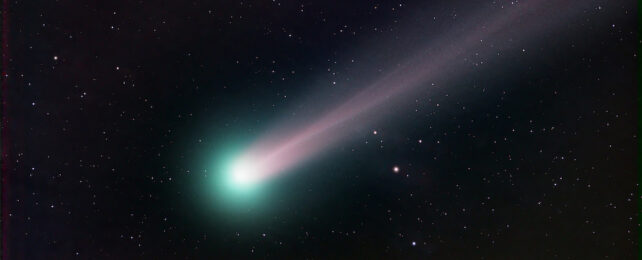
'Usually, for comets, you see a tail trailing behind the object,' said Loeb. 'Here, the glow is actually in front of it. We've never seen such a thing. A comet doesn't glow in front.'
'It may come to save us or destroy us,' the professor said. 'We'd better be ready for both options and check whether all interstellar objects are rocks.'
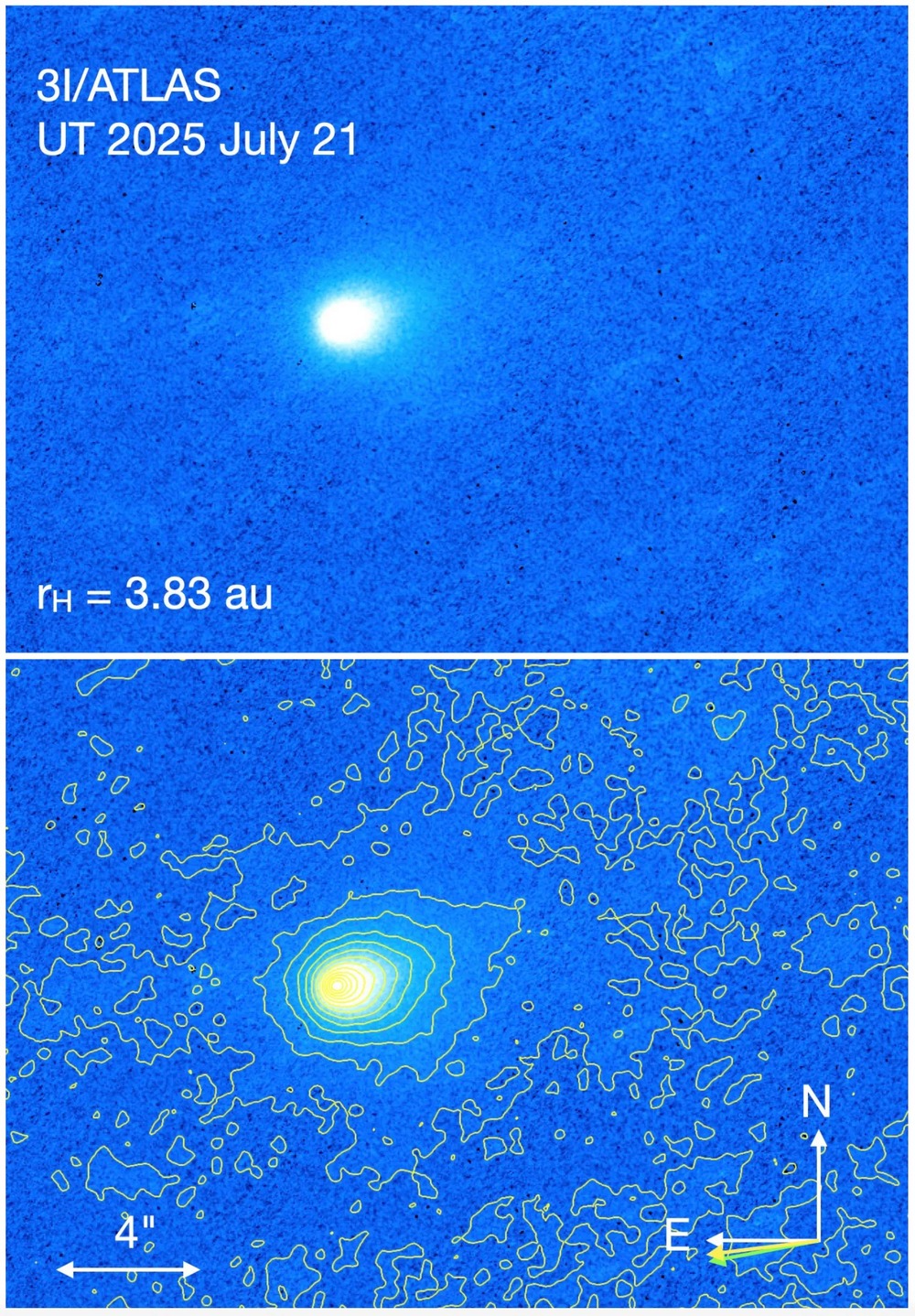
The Hubble Space Telescope image of 3I/ATLAS shows a faint glow spreading out in front of the object as it moves toward the sun
The interstellar object is believed to be a comet, but Harvard astrophysicist Avi Loeb contends it could be an alien craft
Chris Lintott, an astronomer at the University of Oxford, told Live Science that Loeb's theory is 'nonsense on stilts,' calling it 'an insult to the exciting work going on to understand this object.'
However, Loeb said his analysis remains rooted in observational data.
He told CNN that another clue that the object is not natural is its 'very finely tuned' trajectory.
'It lies in the plane of the orbits of the planets around the sun to within five degrees,' Loeb explained.
According to him, the odds of that alignment happening by chance are one in 500. Even more striking, he says, is how closely the object passes Jupiter, Mars, and Venus, a pattern with odds of 1 in 20,000 if the arrival time were randomized.
By 'maneuver,' Loeb refers to his theory that the object might use its solar flyby in October as a stealthy approach window, if it is, in fact, an alien probe.
Among his more provocative theories, Loeb wrote on his blog that 3I/ATLAS could be an alien mothership releasing small probes to intercept Earth.
Telescopes have been tracking the course of 3I/ATLAS as it travels through our solar system in 2025 and 2026
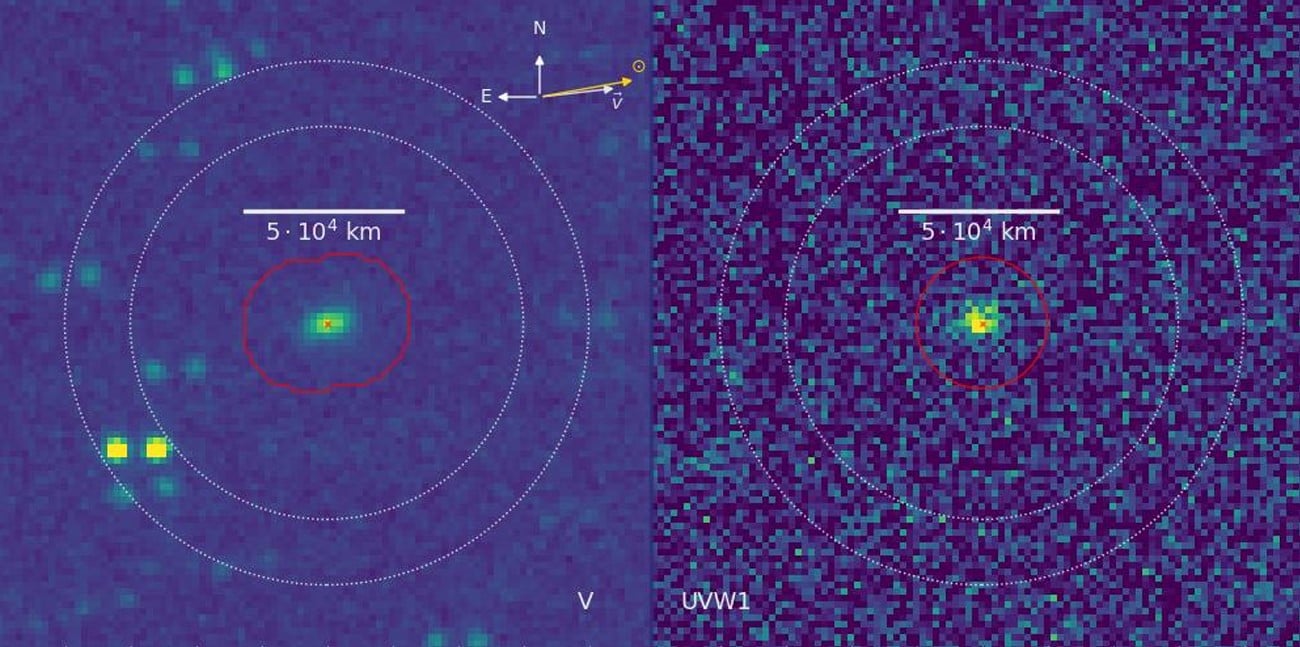
Images of 3I/ATLAS taken on July 4 and July 29, 2025, show no sign of a comet tail. The arrows in the images indicate the directions of the sun, north, east and the way the object is moving through space
'The more likely scenario from an engineering perspective involves a mothership that releases mini-probes which perform a reverse Oberth maneuver to slow down at perihelion and intercept Earth,' Loeb wrote.
This type of maneuver uses the sun's gravitational pull at the object's closest approach to adjust the trajectory efficiently, allowing it to reach Earth without large amounts of fuel.
'So, we just need to watch it. I'm not saying it's an alien technology, I'm just saying it doesn't look like a very common thing,' Loeb told CNN.
'Why should we assume that we are the only ones in our cosmic neighborhood? We should just check by looking at the data.'
While NASA reported observing a tail, Loeb and his team recently determined that no such thing exists.
'There were claims of a tail,' he said, 'but since 3I/ATLAS is accelerating and its current size is not much larger than the angular resolution of Earth-based telescopes, it is not easy to avoid fictitious elongation of the image as a result of the object's motion.'
He also questioned the object's unusual lack of gas emissions and its precise, retrograde trajectory, which aligns suspiciously well with the inner solar system.
Loeb has developed what he calls the 'Loeb Scale', a ranking system to evaluate the likelihood that an object is artificial, and gave 3I/ATLAS a six out of ten.
That suggests it is more likely than not to be engineered, though he emphasized that this score may change as more data becomes available.
By STACY LIBERATORE, U.S. SCIENCE & TECHNOLOGY EDITOR
An ancient underwater city beneath Turkey's Lake Van could potentially reveal secrets that challenge the origins of Noah's Ark.
The sprawling ruins lie 85 feet below the surface near the town of Gevaş, just 150 miles from Mount Ararat, the mountain traditionally believed to be the final resting place of the biblical boat.
Geological evidence suggests that the ruins were submerged 12,000 to 14,500 years ago, when a Mount Nemrut eruption blocked the Mirat River, and caused massive flooding during the Younger Dryas, a period of extreme climate upheaval.
While mainstream scholars dismiss the theory, many independent researchers believe this disaster wiped out an advanced civilization, one so ancient that it may have inspired the earliest versions of the Great Flood story.
'As far as I'm aware, any civilizations in the last 6,000 years did not have the technological means to create the type of stonework we're seeing here,' said independent researcher Matt LaCroix, who spoke about the discovery on the Matt Beall Limitless podcast.
LaCroix and an international dive team are preparing to explore the site in September using advanced imaging tools to map the ruins, which he believes could help rewrite humanity's timeline.
The underwater complex spans more than half a mile, featuring a stone fortress flanked by circular temples with precisely carved masonry.
There is also a capstone engraved with a six-spoked 'Flower of Life' symbol, an ancient motif also found at sacred sites in Peru and Bolivia.
The underwater city features a giant fortress and circular temples. The megastructures are located 85 85 feet below the surface of Lake Van
Divers found stunning circular temples on the lakebed
Discovered in 1997 by Turkish underwater filmmaker Tossen Salin while studying Lake Van's unusual micro-invertebrates, the ruins have remained largely unknown to the public.
While archaeologists confirm the structures exist, many attribute them to the Urartian period around 3,000 years ago, or even to the medieval era. But they have admitted that the site has yet to be fully studied or definitively dated.
LaCroix, however, said in a July episode of the podcast that geological data told a different story.
He explained how soil sampling and analysis of Mount Nemrut show clear evidence of a massive eruption around 12,000 years ago.
As a result, Lake Van's water level rose dramatically, over 100 feet, according to some estimates.
Because stone cannot be carbon-dated, researchers hope to find organic material, such as sediment layers or artifacts, which could confirm the age of the ruins.
But collecting such evidence underwater poses major challenges.
The site’s sophisticated stonework, with tightly interlocking blocks, angular joints, and no visible binding agents, appears to rival the engineering seen in megalithic sites like Sacsayhuamán in Peru.
An independent researcher believes that this city could rewrite the biblical story of Moses, making it thousands of years older than was is believed. The lake sits just 150 miles from Mount Ararat (pictured), believed to be the site of Noah's Ark
Because stone cannot be carbon-dated, researchers hope to find organic material, such as sediment layers or artifacts, which could confirm the age of the ruins
Discovered in 1997 by Turkish underwater filmmaker Tossen Salin while studying Lake Van's unusual micro-invertebrates, the ruins have remained largely unknown to the public
'You can see that the temple has been significantly damaged, said LaCroix.
'All the stones on the top have broken off except those at the edges. The site resembles Peruvian masonry, with precisely angled stones forming triangular joints, and only the front appears flat. It's beautiful and would have been perfectly carved.'
He believes the shared architectural features, symbolic motifs, and astronomical alignments across sites in Turkey, South America and Asia suggest the existence of a long-lost global civilization.
Scholars have long acknowledged that the biblical flood story likely evolved from earlier Mesopotamian texts.
Ancient cuneiform tablets from Sumerian, Akkadian, and Babylonian cultures, such as the Epic of Gilgamesh, the Atrahasis, and the Eridu Genesis, describe a massive flood sent to destroy early civilization, and a chosen man who builds a vessel to save life on Earth.
In these tales, the survivor is called Ziusudra or Utnapishtim, names predating Noah by thousands of years.
Excavation logs from Shuruppak, Iraq, believed to be the home of this early flood survivor, show a distinct flood layer above ancient Sumerian ruins.
These records, uncovered at the Penn Museum, provide physical evidence of a catastrophic event similar to those described in the ancient texts.
The ruins were discovered in 1997 by Turkish underwater filmmaker Tossen Salin while studying Lake Van's unusual micro-invertebrates
Even the Babylonian Map of the World, the oldest known map, marks the Ararat region near Lake Van as a place of ancient significance, possibly linked to tales of a lone survivor who emerged after a global deluge.
LaCroix argues that the biblical version is not being dismissed but rather reframed in its historical and cultural context.
He told Beall to picture a thriving civilization along Lake Van, building temples and structures on stable, elevated ground they believed would last forever.
The lake’s water level was stable for millennia, until the eruption of Mount Nemrut changed everything.
'It’s not that Lake Van would have had to have been 85 feet lower,' said LaCroix.
'It would have had to have been more like 100 feet lower or more, because these ruins are at 85 feet deep. So, what could account for a lake rising over 100 feet?'
By STACY LIBERATORE, U.S. SCIENCE & TECHNOLOGY EDITOR
A recent CapitolHill hearing has reignited debate over Unidentified Aerial Phenomena (UAPs) and the possibility of extraterrestrial life.
In a May UAP briefing, physicist Dr Eric Davis, known for his work on top-secret Pentagon projects, stunned listeners by referencing alleged alien species, 'Grays, Nordics, Insectoids, and Reptilians,' as potential operators of unidentified craft.
Missouri Representative Eric Burlison, a member of the House Oversight Committee and UAP caucus, prompted the discussion, revealing on The Endless Void with Kristin Fisher that he had heard these same four classifications in private briefings.
'I've heard those four classifications discussed in meetings in this office by others,' Burlison said.
'But what I wasn't expecting was for him to say it. I wasn't expecting Eric Davis, you know, respected scientists, to say that.'
Burlison, a self-described skeptic, admitted uncertainty about Davis's sources, noting the physicist's comments may stem from firsthand knowledge or secondhand reports.
A respected scientists told Congress that there are four alien species piloting craft in our skies, including Nordics that have human-like features
Dr Eric Davis (left) described these entities as humanoid, approximately human-sized, and possibly linked to classified reverse-engineering programs. Missouri Representative Eric Burlison prompted the question about the different alien species
The concept of Grays as a popular alien archetype took hold in the mid-1960s, largely due to the famous Betty and Barney Hill abduction case.
The couple described being taken by small humanoids with smooth gray skin, large black almond-shaped eyes, and lacking typical human features like noses or ears.
Nordics are described as tall, slender beings resembling Scandinavian humans, with blonde hair, blue eyes, and fair skin.
Often linked to the Pleiades star cluster, these entities are said to possess advanced technology and peaceful intentions, featuring prominently in 1950s contactee and UFO lore.
Insectoids, meanwhile, have been part of alien mythology since at least the early 1900s, with roots tracing back to Georges Méliès' 1902 film 'A Trip to the Moon.'
These beings exhibit insect-like traits such as multiple limbs, exoskeletons, mandibles, and sometimes antennae.
The reptilian theory, claiming shape-shifting reptilian aliens secretly control Earth, surged in popularity through conspiracy theorist David Icke in the late 20th century.
Interestingly, similar half-human, half-serpent figures appear in ancient South and Southeast Asian myths, such as the Nāga.
Another is Grays, described as small humanoids with smooth gray skin, large black almond-shaped eyes, and lacking typical human features like noses or ears
Betty (left) and Barney Hill (right) were the first Americans who claimed they were abducted by Grays in September 1961
While Davis named each of these in May, Burlison leaned toward a more earthly explanation, suggesting UAPs are likely advanced human-made technologies, perhaps experimental projects by private contractors.
'With all of the advancements that we've made, the fact that we discovered the Higgs Boson particle, all of the discoveries in quantum physics, and that nobody has figured out a way to create some form of advanced propulsion,' he remarked.
However, Burlison expressed frustration at the thought of such technology existing, recalling how he sat delayed on a tarmac for three hours due to weather, joking, 'If we have advanced propulsion, I'm going to be really angry.'
Critics have dismissed the hearings as veering into the absurd, with references to 'reptilians' and 'insectoids' sounding more like science fiction than serious inquiry.
Insectoids, meanwhile, have been part of alien mythology since at least the early 1900s, with roots tracing back to Georges Méliès' 1902 film 'A Trip to the Moon.' These beings exhibit insect-like traits such as multiple limbs, exoskeletons, mandibles, and sometimes antennae
Davis named each of these under oath in May as the beings invading Earth's skies. Pictured is a shot from the 'Go Fast' video that was released in
'Some will think we're nuts,' Burlison acknowledged, aware of the skepticism his comments invite.
Yet he defended the investigation, emphasizing that taxpayer money funds Pentagon, intelligence, and energy department programs studying UAPs.
'I owe it to the American people to get to the bottom of this,' he said.
Burlison believes the public could handle the truth if aliens were confirmed.
'Most would just read the headline and move on,' he predicted, noting humanity's tendency to normalize even the most extraordinary revelations.
However, he insisted that any such discoveries should not be hidden.
'The government belongs to the people, not the other way around,' Burlison stressed. 'Keeping such monumental secrets would betray the trust of the public.'
While remaining cautious about extraterrestrial claims, Burlison plans to press Dr Davis for clarification on whether his startling remarks come from direct knowledge or secondary reports.
The reptilian theory, claiming shape-shifting reptilian aliens secretly control Earth, surged in popularity through conspiracy theorist David Icke in the late 20th century
Burlison believes the public could handle the truth if aliens were confirmed.
'Some will read the headline and go about their day,' he predicted, citing human behavior's tendency to normalize even earth-shattering news.
However, he stressed that any such revelation should not be kept secret.
'I believe that this government belongs to the people. It's not that the people don't belong to the government,' he said, arguing that withholding paradigm-shifting discoveries would betray public trust.
The lack of concrete evidence, coupled with Davis's ambiguous sources, keeps the debate speculative. Burlison plans to follow up with Davis to clarify whether his claims stem from direct observation or research assignments analyzing reported phenomena.
Atlantis: Een Vergelijkende Studie tussen Wetenschap en Mystiek over het Bestaan en de Verwoesting
Inleiding
De legende van Atlantis heeft door de eeuwen heen velen gefascineerd. Het is een verhaal dat balanceert tussen historische werkelijkheid en mythische verbeelding. Terwijl sommigen geloven dat Atlantis ooit echt heeft bestaan, beschouwen anderen het als een mythe of een allegorie. In deze studie wordt een uitgebreide vergelijking gemaakt tussen de wetenschappelijke benadering en de mystieke interpretaties omtrent het bestaan en de ondergang van Atlantis. Hierbij wordt ingegaan op de oorsprong van de legende, de bewijsvoering, wetenschappelijke theorieën, mystieke overtuigingen en de onderliggende wereldbeelden die deze perspectieven bepalen.
Oorsprong van de Legende
De eerste vermelding van Atlantis komt uit de Griekse filosoof Plato, rond 360 v.Chr.. In zijn dialogen "Timaeus" en "Critias" beschrijft hij Atlantis als een machtige en geavanceerde beschaving die zich ongeveer 9.000 jaar vóór zijn tijd zou hebben gevestigd, op een continent dat zich voor de Straat van Gibraltar uitstrekte. Volgens Plato zou Atlantis door haar arrogantie en immoraliteit door de goden zijn gestraft en onder water zijn verdwenen in een enkele dag en nacht van catastrofale aardbevingen en overstromingen.
Na Plato werd Atlantis al snel een symbool voor een verloren paradijs, een superriet die zowel de menselijke ambitie als de val symboliseert. Door de eeuwen heen zijn vele andere bronnen, zoals de werken van latere schrijvers en ontdekkingsreizigers, toegevoegd aan de mythologie rond Atlantis.
Wetenschappelijke benadering: De zoektocht naar bewijs
De wetenschappelijke wereld benadert de legende van Atlantis vooral als een mythe of een allegorie. Er is geen concreet archeologisch bewijs dat Atlantis ooit heeft bestaan als een grote beschaving, laat staan dat het zich op de door Plato genoemde locatie bevond. Onderzoekers en archeologen hebben verschillende theorieën ontwikkeld over de mogelijke realiteit van Atlantis.
Een van de meest gangbare theorieën is dat Plato de legende heeft gebaseerd op herinneringen aan een oude, mogelijk ondergang van een geavanceerde beschaving, zoals die op Kreta tijdens de Minoïsche periode (ca. 1450 v.Chr.). De Minoïsche beschaving was zeer ontwikkeld, met indrukwekkende paleizen zoals dat van Knossos, uitgebreide handel en kunst. Na een verwoestende aardbeving en tsunami werd deze beschaving mogelijk in de vergetelheid geraakt, en de verhalen werden mythologische verhalen.
Daarnaast worden er speculaties gedaan over onderwaterlocaties zoals de Canarische Eilanden, de Azoren, of de gebieden rond de Middellandse Zee en de Zwarte Zee. Sommige onderzoekers wijzen op onderwaterstructuren en anomalieën die mogelijk resten van oude menselijke bewoning kunnen zijn. Toch ontbreekt het aan sluitend bewijs dat wijst op een grote, geavanceerde beschaving zoals door Plato beschreven.
Moderne technologieën zoals onderwaterarcheologie, sonar en satellietbeelden worden ingezet om mogelijke locaties te onderzoeken, maar tot nu toe zijn geen overtuigende bewijzen gevonden die Atlantis bevestigen als een historische plek.
Wetenschappelijke verklaringen voor de mythe
De meeste wetenschappers geloven dat Atlantis een fictieve constructie is, bedoeld als een moreel en politiek verhaal dat door Plato werd gebruikt om bepaalde ideeën over deugd en immoraliteit te illustreren. Plato was een filosoof die vaak allegorieën en metaforen gebruikte om abstracte ideeën te verduidelijken.
Bovendien wordt gesuggereerd dat de verhalen over Atlantis mogelijk geïnspireerd zijn door herinneringen aan aardbevingen en natuurlijke rampen die in de regio’s rond de Middellandse Zee en de Zwarte Zee plaatsvonden. Deze rampen zouden de herinnering aan een ondergang hebben geïnspireerd die vervolgens werd versterkt en uitgewerkt in mythologische verhalen.
Een andere verklaring is dat Atlantis dient als een archetype van een verloren gewaande utopische beschaving, vergelijkbaar met het Paradijs of andere mythische plaatsen die de menselijke verbeelding blijven prikkelen. In deze context vertegenwoordigt Atlantis een universeel verlangen naar een ideale samenleving die ooit bestond en verloren is gegaan.
Mystieke en esoterische interpretaties
In tegenstelling tot de wetenschappelijke benadering, nemen mystici, esoterici en spirituele denkers Atlantis vaak serieus als een werkelijk vermeende historische locatie met een diepere symbolische betekenis. Zij beschouwen Atlantis niet enkel als een mythe, maar als een realiteit die ooit heeft bestaan en mogelijk nog altijd in spirituele of energetische vormen voortleeft. Volgens deze denkers vertegenwoordigt Atlantis een hoogontwikkelde beschaving die haar kennis, technologie en spirituele inzichten verloren heeft door catastrofale gebeurtenissen. Deze interpretaties worden vaak ondersteund door oude teksten, alchemistische geschriften en occulte tradities, die suggereren dat Atlantis een plek was waar wetenschap en spiritualiteit hand in hand gingen.
Verschillende mystieke stromingen verbinden Atlantis met universele energievelden en kosmische kennis. Zo stellen sommige esoterische tradities dat de bewoners van Atlantis beschikten over geavanceerde technologische en spirituele vaardigheden, waaronder helende energieën en contact met hogere dimensies. Volgens deze zienswijze zijn de ondergang en het verdwijnen van Atlantis niet enkel een fysiek gebeuren, maar ook een spirituele gebeurtenis die de menselijke evolutie beïnvloedt. Sommige theorieën suggereren dat de kennis en energieën van Atlantis nog altijd in de wereld aanwezig zijn, verborgen onder lagen van tijd en ruimte, wachtend op heropleving.
Wetenschappelijke en archeologische benaderingen
In tegenstelling tot de mystieke interpretaties proberen archeologen en historici de legende van Atlantis te benaderen vanuit een empirisch perspectief. Tot op heden is er geen sluitend archeologisch bewijs gevonden dat het bestaan van een geavanceerde beschaving zoals Atlantis bevestigt. De bekendste verwijzing naar Atlantis komt uit de werken van de Griekse filosoof Plato, die in zijn dialogen "Timaeus" en "Critias" Atlantis beschrijft als een machtige en technologisch ontwikkeld rijk dat ongeveer 9.000 jaar voor zijn tijd onderging door een catastrofale gebeurtenis. Hoewel Plato zelf waarschijnlijk een allegorie bedoelde, hebben latere onderzoekers geprobeerd deze verhalen te interpreteren als historische realiteit.
Wetenschappelijke studies richten zich op mogelijke geografische locaties die met de legende overeenkomen, zoals de ondergang van de Minoïsche beschaving op Kreta of de ondergang van de Thera-uitbarsting. Sommige theorieën suggereren dat de mythe is gebaseerd op herinneringen aan deze gebeurtenissen, maar er is geen bewijs dat wijst op een grote, wereldwijde beschaving zoals beschreven door Plato. Bovendien ontbreken archeologische vondsten die de aanwezigheid van een dergelijk rijk bevestigen. De meeste wetenschappers beschouwen Atlantis dan ook als een mythisch of symbolisch construct dat dient als een metafoor voor een verloren gewaande utopie.
Vergelijking tussen wetenschap en mystiek
De tegenstelling tussen wetenschappelijke en mystieke interpretaties van Atlantis weerspiegelt bredere discussies over de aard van kennis en waarheid. Wetenschap baseert zich op empirisch bewijs, herhaalbare experimenten en kritische analyse. Hierdoor blijft de wetenschappelijke consensus dat Atlantis een mythisch of symbolisch verhaal is, zonder bewijs dat het ooit als een fysieke beschaving heeft bestaan.
Aan de andere kant bieden mystieke en esoterische perspectieven een meer symbolische en spirituele benadering. Zij zien Atlantis als een archetype van menselijke idealen, verloren kennis of een hogere beschaving die in een andere dimensie of tijdlijn voortleeft. Deze interpretaties spreken vooral mensen aan die geloven in de mogelijkheid van spirituele evolutie en het bestaan van verborgen kennis buiten de grenzen van de empirische wetenschap.
BESLUIT
De studie "Atlantis: Comparing Science and Mysticism Regarding Its Existence and Destruction" biedt een uitgebreide analyse van de verschillende perspectieven op het bestaan en de ondergang van de mythische beschaving Atlantis. Door een gedegen literatuuronderzoek en vergelijkende analyse tussen wetenschappelijke en mystieke bronnen, wordt duidelijk dat de opvattingen over Atlantis sterk uiteenlopen, afhankelijk van de benadering.
Aan de ene kant stelt de wetenschap dat Atlantis waarschijnlijk een mythisch of symbolisch concept is, voortkomend uit oude verhalen zoals die van Plato. Wetenschappers wijzen op het gebrek aan archeologische bewijzen en de inconsistente geografische beschrijvingen, waardoor de meeste onderzoekers concluderen dat Atlantis eerder een allegorie was dan een fysieke plaats. Daarnaast benadrukken zij dat de verhalen over de ondergang van Atlantis mogelijk geïnspireerd zijn door natuurlijke rampen zoals vulkanische uitbarstingen en aardbevingen, die in de regio plaatsvonden.
Aan de andere kant wordt in mystieke kringen Atlantis vaak beschouwd als een echte, geavanceerde beschaving die ooit op aarde heeft bestaan en verbonden was met hogere kennis en spirituele kracht. Deze opvattingen worden ondersteund door oude teksten, kristal- en energie-therapieën, en spirituele ervaringen die de aanwezigheid van een verloren wereld suggereren. Voor deze groep is Atlantis niet alleen een historische plek, maar ook een symbool van menselijke evolutie en bewustzijn.
De studie benadrukt dat beide perspectieven waardevol zijn, maar dat ze gebaseerd zijn op verschillende methodologieën en wereldbeelden. Wetenschap richt zich op bewijs en empirische gegevens, terwijl mystiek meer vertrouwt op intuïtie en spirituele ervaringen. Het is belangrijk om deze benaderingen te erkennen als complementair in de zoektocht naar de waarheid over Atlantis.
In conclusie toont de studie aan dat de mythe van Atlantis een krachtig symbool blijft voor zowel menselijke verbeelding als zoektocht naar kennis. Hoewel er geen sluitend bewijs is voor het bestaan of de ondergang van de beschaving, biedt het onderwerp een rijke voedingsbodem voor zowel wetenschappelijke als spirituele verkenningen. Het verbinden van deze perspectieven kan leiden tot een dieper begrip van onze geschiedenis, cultuur en spirituele evolutie.
Referenties:
Plato, Timaeus en Critias
Freke, R. & Gandy, P. (2000). The Jesus Mysteries.
Edgar Cayce-archieven
Van der Waerden, B. L. (1975). Ancient Science and Its Cultural Significance.
LiDAR Study Shows Maya Population May Have Topped 16 Million
New research led by Tulane University archaeologists reveals that the ancient Maya civilization was far more populous than previously thought — supporting as many as 16 million people across parts of modern-day Guatemala, southern Mexico and western Belize.
The research, published this month in the Journal of Archaeological Science: Reports, reveals one of the most comprehensive regional-scale analysis to date of Maya settlement patterns using lidar (light detection and ranging) technology.
The findings significantly revise population estimates and models of ancient Maya settlement in the Central Maya Lowlands, revealing a far more complex, integrated and populous civilization than previously understood.
"We now have hard evidence that Maya society was highly structured across both cities and rural areas and far more advanced in resource and social organization than previously understood."
"The ancient Maya never fail to amaze me," said lead author Francisco Estrada-Belli, a research professor in Tulane’s Middle American Research Institute and manager of its GIS (Geographic Information System) lab.
"We expected a modest increase in population estimates from our 2018 lidar analysis, but seeing a 45% jump was truly surprising. This new data confirms just how densely populated and socially organized the Maya Lowlands were at their peak.”
Using advanced analytical methods and reprocessed lidar data, researchers estimate that between 9.5 million and 16 million people inhabited the region during the Late Classic period (600–900 AD), across a 95,000-square-kilometer area encompassing the rainforest lowlands.
These new estimates confirm that the Classic Maya Lowlands were not only densely inhabited but also highly structured, with consistent patterns of urban and rural organization across an immense region, Estrada-Belli said.
“We’re confident these lidar-based findings give us the clearest picture yet of ancient Maya settlement patterns," Estrada-Belli said. "We now have hard evidence that Maya societywas highly structured across both cities and rural areas and far more advanced in resource and social organization than previously understood."
The team combined data from multiple publicly available and private lidar surveys, including reanalyzed environmental lidar collected by NASA’s Goddard Space Flight Center, with newer archaeological mapping efforts in southern Campeche and Quintana Roo, Mexico.
Researchers identified a single, consistent model of urban and rural organization, with residential and agricultural features clustered around elite-controlled plaza groups. Extensive agricultural infrastructure, especially in the densely populated north, points to elite management of food production and distribution across both cities and rural areas.
Nearly all structures were located within three miles (5 km) of a large or medium-sized plaza group, indicating widespread access to civic-ceremonial centers and challenging past assumptions about isolated rural settlements.
This study shifts understanding of the Classic Maya from fragmented city-states and scattered hamlets to a deeply interconnected civilization, supported by a carefully structured system of governance, agriculture and commerce.
The findings also highlight the power of airborne lidar as a tool for archaeological discovery in dense tropical environments, where traditional field surveys are often hindered by dense vegetation and inaccessibility.
"We are very grateful to the Hitz Foundation for funding the MARI-GIS lab and making this research possible,” said Marcello Canuto, a study co-author and director of the Middle American Research Institute.
By integrating data across both urban and rural contexts, the research provides new insight into how Maya society functioned at the regional scale and raises new questions about the vulnerabilities of such a large, interconnected population to environmental stress and political collapse.
"We’re thrilled to have developed a blueprint for using lidar data from multiple sources, including freely available ones,” Canuto said. “This approach can help archaeologists around the world make new discoveries without waiting for new lidar flights. It’s a big step forward for the field."
Top image: Well-preserved ancient Maya murals are seen inside a temple in Bonampak, Mexico, offering a unique glimpse into the lives and rituals of the Classic Maya period.
Estrada-Belli, F., Canuto, M. A., Šprajc, I., & Fernandez-Diaz, J. C. (2025). New regional-scale Classic Maya population density estimates and settlement distribution models through airborne lidar scanning. Journal of Archaeological Science, Reports, 66(105288), 105288. doi:10.1016/j.jasrep.2025.105288
While the American President aims to shut down NASA greenhouse gas monitoring missions, European scientists are figuring out how to use ground-based astronomical telescopes to fill the gap. Image Credit: ESA
Our powerful, modern, ground-based telescopes have to deal with a lot of noise in the starlight they observe. The noise comes from Earth's atmosphere, which forces telescopes to use solutions like adaptive optics to filter it out. Researchers at the University of Warwick in the UK, in partnership with Spanish institutions, are developing a method to use that noise to measure greenhouse gases (GHGs) in Earth's atmosphere.
Earth's atmospheric carbon won't just disappear if we stop measuring it. More and more carbon is accumulating in the atmosphere and the effects of that carbon are felt in our warming world. There are many different ways to measure that carbon and determine how it affects different parts of the world, and how it affects agriculture, drought, receding ice, and forest fires. Since we have so many telescopes operating around the world, maybe they can contribute to these measurements.
When observing distant objects, astronomers often use spectroscopy to determine the chemical contents of exoplanet atmospheres, stars, and other objects like gas clouds. All molecules have spectroscopic fingerprints that reveal their presence. Telluric contamination is the effect that Earth's atmospheric molecules have on the starlight observed by telescopes. It introduces telluric lines into observations that make the signal from distant objects noisy. They can mask or mimic the spectroscopic lines from the target object.
A PhD student in the Astronomy and Astrophysics group at Warwick University, Marcelo Aron Fetzner Keniger, has developed a way to use these contaminating telluric lines to measure GHGs. It's called Astroclimes, and it can measure molecules like methane, carbon dioxide, and water vapour in our planet's atmosphere.
“Monitoring the abundance of GHGs is necessary to quantify their impact on global warming and climate change," Keniger said in a press release. "Using telluric lines to measure the abundance of GHGs in the Earth’s atmosphere has been extensively employed using solar spectra, for example by the COllaborative Carbon Column Observing Network (COCCON). However, since they rely on solar spectra, these measurements can only be carried out during the day, so Astroclimes can hopefully fill the gap with nighttime measurements.”
This is a plot from the Astroclimes algorithm showing Telluric lines.
Image Credit: Marcelo Aron Fetzner Keniger/University of Warwick
The University of Warwick collaborated with Calar Alto Astronomical Observatory (CAHA) in Almería, Spain, the University of Almería and the Spanish State Meteorological Agency (AEMET on an observing campaign in July to test Astroclimes. The goal was to show how combining night-time observations of stars with Astroclimes with day-time observations of the Sun can help scientists study Earth's carbon cycle and the role that GHGs play.
"Astroclimes can measure the abundance of greenhouse gases on Earth by generating a model telluric transmission spectra and fitting it to the spectra of telluric standard stars in the near-infrared taken by ground-based telescopes," Keniger said in a presentation to the Royal Meteorological Society.
CAHA hosts several telescopes, including a 3.5 meter telescope with the CARMENES (Calar Alto high-Resolution search for M-dwarfs with Exoearths with Near-infrared and optical Échelle Spectrographs). CARMENES was used with the Astroclimes algorithm during nighttime observations, while a temporary, portable FTIR spectrometer (EM27/SUN) from the COCCON-Spain network was used during the day. The COCCON instrument can measure GHG concentrations and calibrate the readings from CARMENES.
“If we can successfully calibrate Astroclimes with the help of COCCON measurements, it could provide a new network for measuring GHG abundances, complementing current networks with nighttime measurements," Keniger said.
It's not a simple task, though. Telluric lines not only change due to different GHGs; changing temperature, humidity, and pressure can also alter them.
This image shows the EM27/SUN instrument of the COCCON-Spain network observing the Sun, almost in the direction of the CAHA 3.5 m telescope.
Image Credit: Calar Alto Observatory (CAHA)
EM27/SUN is at about 2,100 meters in altitude, and its measurements were combined with an instrument at sea level at the University of Almería (UAL). Joaquín Alonso Montesinos is a Professor at UAL and is the representative of the UAL in the COCCON-Spain project. Montesinos said, “We are grateful to AEMET for counting on us for such an important project, which we believe will be a benchmark in the energy transition.”
The COCCON-Spain project is intended to be an integrated GHG observation system for the country. There is a gap in the observation of GHGs in Spain, and COCCON aims to fill that gap. Initially, it will consist of 12 stations that measure background GHG concentrations as well as concentrations near major urban/industrial greenhouse gas emission zones.
“The COCCON-Spain national network aims to address the latent lack of atmospheric GHG observations in Spain through the implementation of a network of stations for measurement on a national scale. One of the main objectives of the COCCON-Spain network is to improve current knowledge of GHG sources and sinks, thus contributing to the development of mitigation and adaptation strategies for climate change,” said Omaira García-Rodríguez (AEMET-CIAI), coordinator of the network.
COCCON and Astroclimes dovetail nicely with the Calar Alto observatory. Observatories are typically placed in environments that are isolated and not connected to power grids. In Calar Alto's case, it burns diesel to generate electricity and heat water, generating more than 100 tons of CO2 annually. The observatory is turning itself into a low-carbon energy island with the addition of solar panels and a biomass boiler to replace diesel fuel.
Aerial view of the Calar Alto Observatory from the north at the telescope domes. From left to right: the 2.2-m telescope, the Spanish 1.5-m telescope (in the foreground), the 1.2-m telescope, the Schmidt-reflector and the dome of the 3.5-m telescope with a height of 43 m. In the background the coast of Almería is seen.
Credit: MPIA
"Due to the peculiar characteristics of the environments surrounding professional astronomical observatories, the costs in fuel and electricity are high" said Jesús Aceituno, director of the observatory and principal investigator of the project. "By implementing the Calar Alto energy island, we pretend to be a world reference for other professional observatories as a management model that helps the environment, with an estimated reduction of a hundred and sixty tons of carbon dioxide per year and the resulting optimization of the associated costs".
“Calar Alto, with its photovoltaic plant and biomass boiler, aims at reaching energy sustainability. These greenhouse gas detections made with CARMENES demonstrate that an astronomical observatory can also serve to monitor our planet's climate,” said Aceituno.
Images of 3I/ATLAS captured by Swift. Credit - Z. Xing et al.
3I/ATLAS, our third discovered interstellar visitor, has been in the news a lot lately for a whole host of reasons, and rightly so given the amount of unique scientific data different groups and telescopes have been collecting off of it. A new pre-release paper from researchers at the Auburn University Department of Physics recounts yet another interesting aspect of the new visitor - its water content.
Almost all comets have some amount of water in them, as water is one of the most common substances in the universe, despite its absence on many of the worlds of our solar system. Typically, comets have a “coma” of water particles trailing behind them as they approach the Sun. Doing so heats up the particles, sublimating them into water vapor, which then streams behind the comet, giving it its iconic “tail”.
But 3I/ATLAS is acting differently from other comets, to say the least. It was around 6 AU at its discovery, but has been making its way closer to the Sun on its one-way journey, which will eventually peak at around 1.3 AU in October. The Auburn astronomers observed it at the end of July, about a month after it was first discovered, and when it was 3.5 AU away from the Sun.
Fraser discusses the newest interstellar object - 3I/ATLAS
They did so using the Ultraviolet / Optical Telescope (UVOT) on the Neil Gehrels-Swift Observatory, which is in orbit above Earth and therefore easier to detect faint photometric lines from things like water. Typically, astronomers wouldn’t expect to find OH (hydroxyl) emissions, which they use as a proxy for water, as far out as 3.5 AU, since the water ice sublimation process isn’t very effective at that distance.
To their surprise, not only did they see a strong OH signal, they also didn’t see any signal of the cyanogen radical (CN), which is almost always one of the first signals found on a comet. That is due to its low sublimation point (around -13 C) and emission band in at a wavelength that easily passes through our atmosphere. However, its lack of detection in this round of observations could mean that the composition of 3I/ATLAS is dramatically different from other comets in our solar system.
Another useful statistic to come out of the water observations is an estimate of the “active surface area” of the comet - essentially an estimate of how much of the comet’s area is actively producing water. The authors calculated approximately 19 km2 of active surface on 3I/ATLAS. Given that the upper limit of the diameter of the comet is 2.8 km, that means that around 20% of the surface area of the comet is actively producing water vapor. That is 4 times higher than the typical 3-5% of solar system’s cometary population, and might be explained by the fact that this is likely the first time 3I/ATLAS is actually visiting a star itself, so it has more water to expel.
Fraser discusses the possibility of catching up to an interstellar object.
That amount of water is key to the next observational step suggested by the authors. They developed two hypotheses, which can each be confirmed as the comet reaches perihelion. If the water production peaks near perihelion, and only trace amounts of “high-metallicity” volatiles like carbon monoxide and cyanogen, that would indicate that 3I/ATLAS is from a “low-metallicity” system (i.e. one where there is only a large amount of hydrogen, and not many other elements). On the other hand, if the water production rate drops off significantly after perihelion, and is replaced by a significantly increased volatile production rate, this would indicate that it actually came from a high-metallicity system, and it would have more in common with the last interstellar visitor - 2I/Borisov.
Given the attention from both scientists and the wider public this comet has drawn, it will undoubtedly be observed as closely as possible over the coming months while it is still visible. With even more new hypotheses to test, 3I/ATLAS will help broaden our understanding of its origins as it begins to melt more. The world will be watching as it does.
The galaxy found to be hosting FRB 2020304B. The top left image shows the field of view surrounding the observation region, with the NIRcam footprint shown on the right. The square shows the NIRSpec IFS observation footprint, and the most likely position of FRB 2020304B shown as a green cross surrounded by the localisation uncertainty (white circle). The middle images show, from left to right, the author’s NIRCam observations, Oxygen III data from NIRSpec, Hydrogen alpha data from NIRSpec, and a white light image from NIRSpec. The bottom panel shows the spectrum (black line) and its uncertainties (shaded region) of the host galaxy (Credit : South African Radio Astronomy Observatory)
Fast radio bursts (FRBs) last around a millisecond and in doing so encode otherwise unattainable information on the plasma which permeates our Universe, providing insights into magnetic fields and gas distributions. In a paper authored by Manisha Caleb from the University of Sydney, the team report upon the discovery of FRB 20240304B which lies at a redshift of 2.148 +/- 0.001 corresponding to just 3 billion years after the Big Bang.
The burst, designated FRB 20240304B, was first detected on March 4, 2024, by South Africa's MeerKAT radio telescope array. What makes this discovery extraordinary is its incredible distance, at a whopping redshift of z = 2.148±0.001, or about 3 billion years after the Big Bang. This means we're observing light that traveled for over 11 billion years to reach Earth.
Artist illustration of the MeerKAT Radio Telescope
Finding the source of the signal required detective work across multiple observatories. The authors attempt to locate FRB 20240304B's host galaxy using ground based observatories and archival data but this came up short. However, follow ups with JWST's NIRCam and NIRSpec instruments succeeded in revealing the FRB's host galaxy and obtaining a spectroscopic redshift.
NIRCam being installed in 2014
(Credit : Chris Gunn)
The burst of radio waves travelled through space and as it does it disperses at a rate of approximately 2,330 pc cm⁻³, immediately suggesting an extremely distant origin. This measurement more accurately describes how much the radio signal was stretched and delayed by free electrons in space, acting like a fingerprint that reveals the vast distances the signal traveled.
This discovery doubles the redshift reach of localised FRBs and probes ionised baryons across ~80% of the history off the universe. Previous FRB detections had only reached back about halfway through cosmic time, but FRB 20240304B pushes our observational boundary to when the Universe was still in its youth. The host galaxy itself tells an interesting story. FRB 2024030 was detected with the MeerKAT radio telescope in South Africa and localised the signal to a low-mass, clumpy, star forming galaxy using the James Webb Space Telescope. This young, actively star-forming galaxy provides crucial clues about the origins of these mysterious bursts.
Since its host galaxy is relatively young, not very massive, and still forming stars, the presence of a FRB suggests an origin which can occur over relatively short timescales, such as young magnetars. This supports theories that FRBs originate from highly magnetised neutron stars called magnetars, rather than from processes requiring billions of years to develop.
Host galaxies of fast radio bursts
(Credit : NASA/Hubble Space Telescope)
The discovery also reveals complex magnetic field structures spanning gigaparsec scales. Its sightline, with the Virgo Cluster and a foreground group, reveals magnetic field complexity over many gigaparsec scales. As the radio waves traveled to Earth, they passed through various structures, each leaving its signature on the signal.
Perhaps most remarkably, the observations establish FRB activity during the peak of star formation and demonstrate that FRBs can probe galaxy formation during the most active era in cosmological history. The epoch when FRB 20240304B originated corresponds to when the Universe was forming stars at its most furious rate, a period astronomers call "cosmic noon."
As next generation telescopes come online, discoveries like FRB 20240304B point toward an exciting future where these fleeting signals become messengers from the universe's distant past, helping us understand how the universe evolved from its early, chaotic youth into the structured cosmos we see today.
Using the MeerKAT radio telescope, an international team of astronomers has discovered a new fast radio burst, designated FRB 20240304B. It became the most distant such event found to date.
A fast radio burst in an artist’s impression. Source: ESO/M. Kornmesser
Fast radio bursts (FRBs) are intense bursts of radio waves that last only a few milliseconds and release energy equivalent to that emitted by the Sun over several days. To date, the physical nature of this mysterious phenomenon remains unknown, but astronomers are considering various explanations, ranging from radiation from young magnetars in supernova remnants to cosmic strings.
The vast majority of FRBs are located in the local Universe and have redshifts below 0.5, while their distribution at higher redshifts is still poorly understood. This is why astronomers are particularly interested in searching for distant FRBs, as they can provide important clues about the formation of galaxies when the Universe was several billion years old.
A group of astronomers from the University of Sydney in Australia reported the discovery of such a distant burst. It was designated FRB 20240304B. Its redshift is approximately 2.148, which corresponds to only 3 billion years after the Big Bang.
FRB 20240304B was identified on March 4, 2024, by the Transient User Supplied Equipment (TUSE) instrument installed on the MeerKAT radio telescope. Subsequently, the James Webb Observatory managed to determine the position of its source. It is located in a small, lumpy, star-forming galaxy. Its stellar mass is about 10 million solar masses, its star formation rate is 0.2 solar masses per year, and its metallicity is 10–20% of the Sun’s metallicity.
Overall, the results confirm that FRB 20240304B is the most distant FRB detected to date. So far, this is the first radio burst from the cosmic noon epoch — a period in the history of the Universe (about 10–11 billion years ago) when star formation was at its peak.
Scientists have proposed using the Vera Rubin Observatory or the Subaru telescope to search for additional targets for the Lucy mission. If successful, the mission will gain a completely new object for study and will be able to more accurately determine the differences between the two groups of Trojan asteroids.
Lucy spacecraft in an artist’s impression. Source: NASA’s Goddard Space Flight Center/Conceptual Image Lab/Adriana Gutierrez
The Lucy spacecraft was launched in 2021. Its main mission is to study Jupiter’s Trojan asteroids. This is the name given to two populations of objects located at the Lagrange points L4 and L5 of the Jupiter-Sun system. Point L4 is located in the plane of the gas giant’s orbit 60° “ahead” of it in the direction of orbital motion, while point L5 is located 60° “behind” it.
The cloud at point L4 is the main objective of the Lucy mission: four of the five planned visits to the Trojan asteroids are set to take place between 2027 and 2028. After that, Lucy will return to Earth and use its gravity to head to the point L5. The mission plan includes a visit to the double asteroid Patroclus located there in 2033.
Illustration of Jupiter’s Trojan asteroids. There is a tradition of naming asteroids around the L4 point after Greek heroes, and those around the L5 point after defenders of Troy. Hector and Patroclus were “out of place” because this tradition developed later. Source: wikipedia.org
The asteroids that Lucy is scheduled to visit are only a small fraction of the total number of objects located in these regions. A team of American researchers, including scientists from NASA, wondered whether it would be possible to increase the mission’s value and find additional targets for Lucy. In an article published on the arXiv preprint website, they claim that this is entirely feasible. At the end of 2026, Jupiter’s Trojan asteroids will be in opposition to Earth. According to scientists’ estimates, in just one night of observation, powerful telescopes such as Subaru or Vera Rubin will be able to find several potential candidates for Lucy’s visit at the L5 point, with a diameter of about 700 meters. If they conduct observations over several nights, they will be able to find smaller asteroids with diameters of around 500 meters.
Next, the scientists assessed the possibility of performing a maneuver that would direct the spacecraft toward a new target. According to their estimates, this is entirely feasible, and Lucy should have sufficient fuel reserves.
To implement this plan, the mission team will need to secure observation time on a sufficiently large telescope at the end of 2026. If this does not happen, it is unlikely that an additional asteroid will be found for Lucy to visit. Due to the heavy workload of large observatories, it is currently unclear whether this plan will be feasible.
At the dawn of the Solar System, collisions involving planets and giant asteroids were a common occurrence. It is believed that such an impact led to the formation of the Moon. It is also sometimes used to explain the dichotomy of the two hemispheres of Mars. But what about Venus?
Venus. Source: NASA
Venus differs significantly from Earth and Mars in both its lack of moons and its slow retrograde rotation around its axis. Scientists have long suspected that these features could be explained by the effects of a giant impact. Researchers from the University of Zurich decided to test this assumption. They used advanced computer simulations called smoothed particle hydrodynamics to model what would have happened if Venus had been hit by massive objects early in its formation. These simulations allow us to track the behavior of materials during extreme collisions, making them ideal for studying planetary impacts.
The team simulated Venus as it probably was after its initial formation: a differentiated planet with an iron core comprising 30% of its mass and a mantle of forsterite comprising the remaining 70%. They then simulated collisions with objects ranging in mass from 0.01 to 0.1 times the mass of Earth.
The simulations examined various collision scenarios: speeds ranging from 10 to 15 km/s, different impact geometries (from head-on to oblique), different initial thermal profiles, and different rotation speeds of Venus. By conducting these digital experiments, researchers were able to analyze how such events could affect Venus’ rotation periods after the collision and the formation of the debris disk.
The results of the study show that a wide range of collision scenarios are compatible with Venus’ current rotation speed and direction. These include head-on collisions with non-rotating Venus and oblique collisions with rotating Venus by bodies the size of Mars.
However, the most important thing they discovered was that collisions corresponding to Venus’ current rotation speed usually result in the formation of very small debris disks that remain within the synchronous orbit. This means that their material then falls back onto the planet, preventing the formation of permanent moons. As a result, scientists came to the final conclusion that a giant collision could be compatible with both Venus’ unusual rotation and the absence of moons.
The Artemis II mission crew has begun several days of training on the Orion spacecraft. Next year, they will travel to the Moon aboard it.
The Artemis II mission crew is preparing to begin training in the Orion spacecraft that will take them to the Moon. Source: NASA/Rad Sinyak
The Artemis II mission is scheduled to fly in April 2026. As part of this mission, launched using an SLS rocket, the Orion spacecraft will fly around the Moon on a free return trajectory and then return to Earth. Its crew consists of four people: NASA astronauts Reid Wiseman, Victor Glover, and Christina Koch, as well as Canadian Space Agency astronaut Jeremy Hansen.
As part of preparations for the upcoming flight, on July 31, crew members put on their spacesuits and boarded Orion to practice and test some of the conditions they may encounter during the mission.
Once in Orion, accomplished several actions that will be performed on launch day, including checking communications and the airtightness of the spacesuits. For the first time, astronauts were connected to the spacecraft and its communication and life support systems.
During the tests, several possible scenarios that could arise during flight were simulated. In some of them, the crew had to deal with potential problems such as leaks and failure of the air regeneration system fan, which is necessary for supplying oxygen and removing carbon dioxide from the cabin.
The tests have given astronauts the opportunity to train on the actual equipment they will use during the mission, enabling them and their support teams to familiarize themselves with it in configurations very close to those they will encounter in flight. This also allowed for verification of the compatibility of equipment and systems with flight dispatch procedures, enabling them to make final adjustments prior to launch.
The crew also practiced performing actions they would likely perform during the flight. In particular, the astronauts practiced removing and stowing the foot pans from the pilot and commander seats, which will give them more space in the cabin after launch. They also gained access to storage lockers and familiarized themselves with cameras, related cables and mounts, environmental control and life support equipment.
Video! UFOs Seen Leaving Earth, Bad Sign Of Things To Come! Witnessed By 2 Pilots, Over Minas Gerais, Brazil Aug 5, 2025, UAP UFO Sighting News
Date of sighting: Aug 5, 2025
Location of sighting: Guapé, Minas Gerais, Brazil
Source: NUFORC
Of all the nightmare scenarios that might happen in the future, this is a sign of the end of times. When fleets of UFOs are seen exiting the earths atmosphere all together...abandoning Earth, then you know there is a huge safety concern on the horizon. It's the same as when long ago, sailors on wooden ships see rats jumping overboard, the rats knew that the ships was going to sink. Of course, aliens don't see time like we do. They have infinite life spans if they avoid accidents, so these could be the first groups to leave, meaning the big event they fear is still weeks or months away.
Scott C. Waring - UFO Sightings Daily
Eyewitness states:
Multiple white orbs moving erratically above horizon, seen from FL360, NW of Guapé, Brazil. I was cruising at FL360 over the rural area of Guapé, Minas Gerais, Brazil, on the night of August 5th, 2025, at approximately 20:33 local time. Looking toward the northwest horizon, I observed multiple bright orbs far above the aircraft altitude. They displayed irregular movements — lateral shifts, vertical climbs, pulsating light intensity — inconsistent with known satellite or aircraft behavior. No navigation lights or beacon patterns were visible. The sky was clear, and the lights persisted for several minutes. I recorded the event in time-lapse using a smartphone camera. I am a commercial pilot and can confirm it was not a standard traffic or celestial object. Phenomenon was similar to some officially released UAP videos.
These orange UFO were seen during sunset on Aug last week. The UFOs flew in military triangle formation for safety and to make a statement that they protection each other. A warning to the USAF fighter jets that might try to intercept them. But alien tech doesn't show up on radar unless they want to be seen. Ocean UFOs...UFOs that are coming in from the ocean area...why? Because 75% of the earth is covered in water and that makes a 75% chance of the alien base being under the ocean off the coast of Naples, Maine. This is 100% proof that aliens do still want us to see them and that they wont stop anytime soon, but rather the opposite, a big reveal is coming.
Yes there are tens of thousands of reports of orange glowing UFOs on record, including some great close up orange disks over Costa Rica, Puerto Rico and central America.
Scott C. Waring - UFO Sightings Daily
Eyewitness states:
Glowing orbs traveled across the sky, one after another at random intervals Tonight we were on the dock at our house on Long Lake, just after sunset. We watched two lights traveling from northeast to southwest just north of us, crossing over Long Lake at an altitude anywhere from 1000-3000? feet. Following those two we then saw dozens more over the course of around 20 minutes. They appeared over the trees from our vantage point at irregular intervals, and not all on the same path. They were traveling too fast to be floating, such as a lantern or balloon. There was zero wind on the ground at the time. As it was just after dark the form was hard to make out, but they appeared to be roughly round, with a glowing red/orange light coming out the bottom. The light had an ephemeral glow, almost like fire. The objects make no noise at all. As they crossed the lake the lights eventually disappeared into the very hazy skies. Flight radar showed no nearby aircraft in the sky at the time.
UFO over Evergreen, Colorado on Aug 4, 2025, UAP sighting news 👽 are you ready? They are here! Video.
Date of sighting: Aug 8, 2025
Location of sighting: Evergreen, Colorado, USA
Source: NUFORC
Watch carefully and you will see a long cigar UFO shooting into our atmosphere and heading down to Earth. This UFO is long, about a quarter a mile and it's heading to the Rocky Mountains in Colorado, where it's a known fact that there is a huge underground alien base below the mountains. Not just big, but huge! dozens of different species and the most common UFO in that area is a white glowing sphere, glowing so much its visible in the day and can easily outrun any USAF fighter jets sent to intercept it. Colorado Rocky Mountains...thats one hell of a UFO hotspot.
Scott C. Waring - UFO Sightings Daily
Eyewitness states:
Large thin cigar shaped craft moving slowly across the sky After waking up for work, I began opening the curtains in my home and saw a large long and thin cigar shaped craft moving slowly across the sky directly North of my house. I went outside and captured a video of the object. There were no lights on the object, but rather looked metallic and looked to lightly glow as it moved through the sky. It looked very large compared to an airplane that was also flying in the sky at the same time. The background was dark as the sun had notyet risen.
Ross Coultharts Beweringen over Reptilianen: Leven Shape-Shifting Alien Soorten Onder Ons?
Ross Coulthart’s Schokkende Reptilianen-Openbaringen Onderzoeksjournalist Ross Coulthart, die al tientallen jaren bekend staat om zijn verslaggeving in de mainstream media, heeft onlangs het publiek opgeschud door te beweren dat hij betrouwbare bronnen heeft die hem vertelden dat meerdere niet-menselijke soorten bestaan—waaronder reptilianen. Tijdens een uitzending van Reality Check noemde Coulthart reptilianen, mantids, humanoïden, grijze wezens en zelfs “Nordics” als soorten die insiders aan hem hebben genoemd. Hoewel hij voorzichtig is door te stellen dat er niets bewezen is, wijst zijn bereidheid om dit onderwerp publiekelijk te bespreken op een groeiende openheid binnen de UAP-gemeenschap (Onbekende Atmosferische Fenomenen).
Een Patroon van Getuigenverslagen
Coultharts bewering is niet geïsoleerd. Muzikanten, overlevenden en onderzoekers hebben onrustbarende ontmoetingen beschreven met vermeende shape-shifters: wezens die in staat zouden zijn om van gedaante te veranderen en zich te vermommen als gewone mensen. Deze getuigenissen vormen samen een patroon dat wijst op een diepere, verborgen realiteit die door velen wordt betwijfeld, maar door anderen wordt bevestigd door persoonlijke ervaringen.
Billy Corgan van The Smashing Pumpkins vertelde Howard Stern in 2017 dat hij twee keer een persoon zag veranderen in “iets anders dan menselijk.” Hij bleef bij zijn verhaal jaren later, waarbij hij meer details toevoegde, maar weigerde de betrokken persoon te noemen uit privacyoverwegingen. Zijn getuigenis wordt vaak aangehaald als voorbeeld van een onverklaarbare transformatie die niet te verklaren is door gewone menselijke vaardigheden.
Juliette Bryant, een overlevende van Jeffrey Epstein’s misbruik, beschreef hoe ze Epstein’s gezicht zag veranderen in reptiliaanse kenmerken tijdens een ontmoeting—grote zwarte ogen, een brede mond en hoornachtige uitsteeksels. Ze benadrukte dat ze op dat moment niet onder invloed was en niet dronken, wat haar ervaring geloofwaardiger maakt. Haar verhaal wijst op een mogelijkheid dat sommige mensen echte ontmoetingen hebben met wezens die zich kunnen maskeren als mensen.
Jordan Maxwell, een auteur en onderzoeker van oude religies, vertelde een verhaal van een rijke zakenman uit Las Vegas. De man beweerde dat hij samen met vijf andere christenen een ritueel in de Colorado-woestijn had gezien, dat onderbroken werd door een reptiliaan van ongeveer 2 meter hoog. Het wezen zou de groep telepathisch hebben immobiliseerd voordat het vertrok. Deze getuigenissen vormen een patroon dat wijst op een wereld vol verborgen wezens die zich kunnen maskeren, en dat deze ontmoetingen niet uniek zijn, maar deel uitmaken van een bredere, complexe realiteit.
Het “Vliegtuig Dame” Incident
In 2023 werd een video viraal die de luchtvaartwereld en sociale media in grote opschudding bracht. De beelden toonden een passagier aan boord van een vliegtuig die duidelijk emotioneel en geëmotioneerd was. Ze verklaarde luid en duidelijk: “Die motherf**ker daarachter is niet echt,” terwijl ze verwees naar een ander passagier of mogelijk een crewlid achter haar. Deze uitspraak wekte onmiddellijk verwarring en verontrusting onder medepassagiers, omdat het niet duidelijk was wat ze precies bedoelde. De vrouw begon vervolgens aandringen op een onmiddellijke vertrek van het vliegtuig, met de boodschap dat ze niet langer wilde wachten.
Wat deze gebeurtenis nog intrigerender maakte, was dat de vrouw later in een poging tot verduidelijking tegenstrijdige verklaringen gaf. In eerste instantie bleef ze bij haar bewering dat haar uitspraak serieus genomen moest worden en dat ze geen andere optie zag dan te vertrekken. Later beweerde ze echter dat haar woorden niet letterlijk bedoeld waren, dat ze onder invloed was van emoties en dat er een misverstand was ontstaan. Toch weigerde ze haar oorspronkelijke uitspraak volledig terug te nemen. Haar volharding in haar standpunt dat ze “100%” gelijk had en dat haar beslissing om het vliegtuig te verlaten gerechtvaardigd was, voedde de geruchten en speculaties.
De reactie van medepassagiers en de bemanning was snel en verdeeld. Sommigen zagen haar handelen als een onacceptabele en onprofessionele uitbarsting, terwijl anderen sympathiseerden met haar stressvolle situatie. De luchtvaartmaatschappij probeerde de situatie onder controle te krijgen door de politie te bellen en de vrouw te vragen het vliegtuig te verlaten. Uiteindelijk werd ze door de autoriteiten uit het vliegtuig gehaald, maar haar gedrag en woorden bleven onderwerp van discussie.
Het incident zette ook de aandacht op de bredere problematiek van communicatie en emoties aan boord van vliegtuigen. Passagiers worden vaak geconfronteerd met stress, vertragingen en ongemakken, wat kan leiden tot uitbarstingen en conflicten. Veel experts benadrukken dat kalm blijven en duidelijk communiceren essentieel is om escalatie te voorkomen. Daarnaast roept dit incident vragen op over de rol van sociale media: hoe snel een korte video kan leiden tot publieke veroordeling, zelfreflectie en discussie over gedrag en mental health.
Kortom, de “Vliegtuig Dame” gebeurtenis van 2023 illustreert hoe een moment van emotie kan uitgroeien tot een breed gedragen verhaal dat veel verder reikt dan de oorspronkelijke gebeurtenis. Het benadrukt de complexiteit van menselijke emoties in stressvolle situaties en de kracht van media om zulke incidenten te verspreiden en te analyseren.
Culturele en Historische Parallellen
Gezichten die lijken op slangen of reptielen komen voor in mythologieën en culturele tradities over de hele wereld. Deze beelden en symbolen wijzen op een universeel fascinerend patroon dat teruggaat tot de oudheid en dat vaak wordt geassocieerd met macht, wijsheid, gevaar of het bovennatuurlijke. Een bekend voorbeeld hiervan is de slang in het paradijs in de Bijbel, die wordt gezien als de verleider die Eva verleidt en zo de zondeval inluidt. Dit symbool van de slang wordt vaak geassocieerd met verleiding en kennis, en heeft door de eeuwen heen talloze interpretaties en artistieke uitingen gekregen.
In andere culturen zien we de gevederde slangen-goden in de Meso-Amerikaanse beschavingen, zoals Quetzalcoatl bij de Azteken en de Olmeken. Deze goden worden afgebeeld als slangen met veren, symbool voor de verbinding tussen hemel en aarde, en worden vereerd als scheppers, leraren en beschermers. Hun afbeelding toont de diepe relatie tussen reptielen en de spirituele wereld, en benadrukt hun rol als wezens die tussen verschillende dimensies kunnen bewegen.
Sommige theorieën suggereren dat reptilianen—een term die vaak wordt gebruikt in moderne complottheorieën—een zeer geëvolueerde afstammeling kunnen zijn van de prehistorische reptielen die ooit de aarde bevolkten. Volgens deze opvattingen zouden deze wezens zich over de tijd hebben ontwikkeld tot intelligente, verborgen beschavingen die zich kunnen vermommen als mensen. Andere theorieën gaan nog verder en beschouwen reptilianen als interdimensionale entiteiten die zich kunnen disguise als mensen, om zo onopgemerkt te blijven en invloed uit te oefenen op menselijke samenlevingen.
De parallellen tussen deze mythologische beelden en de moderne theorieën over reptilianen illustreren hoe diepgeworteld de fascinatie is voor deze wezens en hun vermeende invloed op de menselijke geschiedenis. Of het nu gaat om symboliek in oude kunst en religie of om hedendaagse complottheorieën, de gedachte aan reptielen en hun connectie met de mensheid blijft een intrigerend en mysterieus onderwerp dat door de eeuwen heen een belangrijke rol speelt in onze culturele verbeelding. Het vormt een brug tussen het oude en het nieuwe, en benadrukt onze voortdurende zoektocht naar de waarheid achter de legendes en symbolen die onze geschiedenis en cultuur definiëren.
Wij?
De mensheid staat voor een raadsel: Zijn deze verhalen slechts mythen, misverstanden of psychologische projecties? Of bestaan er werkelijk buitenaardse wezens die zich kunnen transformeren en in onze wereld kunnen verschijnen? Deze vraag vormt al eeuwenlang een bron van fascinatie, verwarring en discussie onder wetenschappers, onderzoekers en gewone mensen.
Veel mensen geloven dat er meer is dan wat we met onze zintuigen kunnen waarnemen. In talrijke culturen over de hele wereld bestaan verhalen over buitenaardse wezens, ufologen rapporteren onverklaarbare waarnemingen en getuigen verklaren dat ze contact hebben gehad met vreemde entiteiten. Sommige van deze verhalen beschrijven wezens die zich kunnen veranderen in verschillende vormen, van humanoïde figuren tot meer abstracte en ongrijpbare verschijnselen. Maar wat is de waarheid? Zijn deze verhalen gebaseerd op werkelijke ontmoetingen, of zijn ze het resultaat van menselijke verbeelding, psychologische projecties of zelfs massale hysterie?
Aan de ene kant zijn er concrete bewijzen die het bestaan van buitenaardse wezens suggereren, zoals onverklaarbare vliegende objecten (UFO's), mysterieuze geluiden en vreemde structuren die op aarde worden gevonden. In recente jaren heeft de Amerikaanse overheid bijvoorbeeld de officiële erkenning van onverklaarbare luchtreizigers (UAP's) onder de aandacht gebracht, wat heeft geleid tot een hernieuwde interesse in het fenomeen. Sommige onderzoekers geloven dat deze waarnemingen kunnen wijzen op geavanceerde buitenaardse technologieën die zich kunnen aanpassen en transformeren om onopgemerkt te blijven.
Aan de andere kant is er ook veel scepsis en twijfel. Psychologen en wetenschappers wijzen erop dat veel waarnemingen en verhalen kunnen worden verklaard door menselijke perceptie, hallucinaties, of het verkeerd interpreteren van natuurlijke verschijnselen. Bovendien zijn er geen definitieve bewijzen die onomstotelijk aantonen dat buitenaardse wezens daadwerkelijk in onze wereld aanwezig zijn. Sommige theorieën suggereren dat deze verhalen eerder psychologische projecties zijn van onze collectieve angsten en verlangens, of dat ze voortkomen uit de behoefte om het onbekende te verklaren.
De vraag of buitenaardse wezens zich kunnen transformeren en in onze wereld kunnen verschijnen, raakt ook aan de ideeën over technologische en mentale vermogens die wij ons nog maar nauwelijks kunnen voorstellen. Sommige theorieën over buitenaardse intelligentsia suggereren dat zij niet enkel fysieke vormen kunnen aannemen, maar zich ook kunnen manifesteren via telepathie, holografische projecties of andere geavanceerde technologieën. Hierdoor zouden ze zich kunnen aanpassen aan onze perceptie en zelfs in onze wereld kunnen verschijnen zonder dat wij dat direct doorhebben.
Kortom, de vraag of deze verhalen slechts mythen zijn of dat er werkelijk buitenaardse wezens bestaan die zich kunnen transformeren en in onze wereld kunnen verschijnen, blijft een van de grootste mysteries van onze tijd. Het is een fascinerend vraagstuk dat ons uitdaagt om onze perceptie van realiteit te heroverwegen en open te staan voor nieuwe mogelijkheden, terwijl we tegelijkertijd kritisch blijven kijken naar de bewijzen en verklaringen die worden aangedragen. De zoektocht naar antwoorden gaat door, en misschien zal de toekomst ons meer duidelijkheid brengen over deze intrigerende en complexe kwestie.
Scepticisme en Open Vragen
De mainstream wetenschap heeft tot op heden geen verifieerbaar bewijs gevonden voor het bestaan van reptiliaanse wezens. Ondanks talloze geruchten, getuigenissen en theorieën, is er geen wetenschappelijke studie of fysiek bewijs dat deze wezens daadwerkelijk bestaan. Veel van de verhalen die hierover de ronde doen, kunnen worden verklaard door psychologische fenomenen zoals hallucinaties, perceptie-fouten, of zelfs bewust bedrog. Mensen kunnen in staat zijn om beelden of ervaringen te creëren die lijken op reptiliaanse wezens, vooral in situaties van slaapverlamming, psychedelisch gebruik, of suggestieve verhalen. Daarnaast kunnen massale angst, groepsdruk of culturele mythen leiden tot het ontstaan van dergelijke verhalen zonder dat er een objectieve basis is.
Toch blijven soortgelijke getuigenissen bestaan uit verschillende culturen en tijden, wat de theorie levend houdt binnen de UFO-gemeenschap en onder theorieën over buitenaardse of niet-menselijke wezens. In sommige inheemse tradities worden reptiliale wezens beschreven als kwaadaardige goden of scheppers, terwijl in moderne UFO-raporten mensen melden dat ze reptiliaanse entiteiten hebben gezien die zich vermommen als mensen of die invloed uitoefenen op wereldleiders en belangrijke gebeurtenissen. Deze verhalen worden vaak versterkt door anekdotisch bewijs en vermeende geheime documenten, maar ontbreken meestal van controleerbare en reproduceerbare bewijzen.
De centrale vraag blijft of deze verhalen symbolisch, verkeerd begrepen fenomenen of echte niet-menselijke wezens vertegenwoordigen. Sommige wetenschappers en onderzoekers zien deze verhalen als een soort collectief onderbewustzijn dat zich uitdrukt in mythen en persoonlijke ervaringen. Anderen suggereren dat er mogelijk verborgen lagen van de werkelijkheid zijn die nog niet volledig door de wetenschap begrepen worden. Het blijft echter een vraag zonder definitief antwoord, waardoor het onderwerp fascinerend en controversieel blijft. Het is belangrijk om open te staan voor nieuwe bewijzen en kritisch te blijven denken, terwijl we ons bewust blijven van de beperkingen van onze kennis.
Besluit
Of het nu gaat om symbolische archetypes, misvattingen over fenomenen of de aanwezigheid van echte niet-menselijke soorten, de verhalen over reptilianen blijven een van de meest polariserende onderwerpen binnen de buitenaardse lore. Deze verhalen hebben door de jaren heen een grote invloed gehad op zowel populaire cultuur als op de overtuigingen van velen die zoeken naar verklaringen voor onverklaarbare gebeurtenissen. Nu de publieke discussie over UAP’s (Unidentified Aerial Phenomena) toeneemt en officiële instanties meer openheid tonen over het bestaan van vreemde waarnemingen aan de hemel, is het slechts een kwestie van tijd voordat claims over reptilianen en soortgelijke wezens serieuzer worden onderzocht. Tegelijkertijd bestaat de mogelijkheid dat sommige van deze verhalen worden ontkracht door wetenschappelijk bewijs of door kritisch onderzoek.
De beschuldigingen en verhalen rondom reptilianen roepen belangrijke vragen op over de aard van de werkelijkheid, onze perceptie en de mogelijkheid dat buitenaardse of interdimensionale wezens zich onder ons kunnen verschuilen. Sommige theorieën suggereren dat deze wezens misschien al eeuwenlang in onze samenleving aanwezig zijn, verborgen achter schijnbaar onschuldige façade’s, en dat ze invloed uitoefenen op wereldwijde gebeurtenissen of zelfs op de menselijke psyche. Hoewel er geen sluitend bewijs bestaat dat reptilianen daadwerkelijk bestaan, blijven deze verhalen een bron van intrige en speculatie, vooral omdat ze vaak worden gekoppeld aan complottheorieën en het idee dat er verborgen machten aan het werk zijn.
Het is van groot belang dat verdere wetenschappelijke en onderzoeksinspanningen openstaan voor alle mogelijkheden, zonder zich meteen vast te leggen op een vooropgezet standpunt. Alleen door een kritische en onbevooroordeelde benadering kunnen we de waarheid achter deze mysterieuze beschrijvingen proberen te achterhalen. Onderzoek op het gebied van UFO’s, buitenaardse technologieën en mogelijk niet-menselijke wezens moet met een open geest worden uitgevoerd, waarbij ook rekening wordt gehouden met alternatieve verklaringen en hypothesen. Het doel is niet alleen het bevestigen of ontkrachten van het bestaan van reptilianen, maar ook het verdiepen van ons begrip van de fenomenen die zich in onze lucht en omgeving voordoen.
In de toekomst kunnen technologische ontwikkelingen en nieuwe onderzoeksinitiatieven mogelijk meer duidelijkheid scheppen over deze complexe en vaak controversiële theorieën. Het is essentieel dat we niet snel oordelen, maar nieuwsgierig blijven en bereid zijn om onze aannames te herzien op basis van nieuwe bevindingen. Alleen door een open en kritische blik kunnen we de ware aard van deze mysterieuze verhalen doorgronden en begrijpen welke rol ze mogelijk spelen in ons bredere begrip van het universum en onze plaats daarin.
Ross Coulthart’s Reptilian Claims: Are Shape-Shifting Alien Species Living Among Us?
Ross Coulthart’s Shocking Reptilian Revelation Investigative journalist Ross Coulthart, known for decades of mainstream reporting, recently stunned audiences by claiming credible sources told him that multiple non-human species—including reptilians—exist. Speaking on Reality Check, Coulthart listed reptilians, mantids, humanoids, grays, and even “Nordics” as species mentioned to him by insiders. While careful to state that nothing is proven, his willingness to publicly discuss the topic reflects growing openness in UAP (Unidentified Aerial Phenomena) circles.
A Pattern of Witness Testimonies Coulthart’s claim is not isolated. Musicians, survivors, and researchers have described unsettling encounters with alleged shape-shifters:
Billy Corganof The Smashing Pumpkins told Howard Stern in 2017 that he twice saw a person transform into “something other than human.” He stood by his story years later, adding more details while refusing to name the individual involved.
Juliette Bryant, a survivor of Jeffrey Epstein’s abuse, described witnessing Epstein’s face morph into reptilian-like features during an encounter—large black eyes, a wide mouth, and horn-like protrusions. She insisted she was neither intoxicated nor under the influence at the time.
Jordan Maxwell, an author and researcher of ancient religions, recounted a story from a wealthy Las Vegas businessman. The man claimed he and five fellow Christians witnessed a ritual in the Colorado wilderness interrupted by an 8-foot reptilian being. The entity allegedly immobilized the group telepathically before letting them go.
The “Plane Lady” Incident In 2023, a viral video showed a distressed airline passenger declaring, “That motherf**er back there is not real,”* before insisting on leaving the plane. While she later offered contradictory explanations, her refusal to fully retract her statement—and her claim she was “100%” right to disembark—keeps speculation alive.
Cultural and Historical Parallels Serpent-like beings appear in mythologies worldwide—from the biblical serpent in Eden to Mesoamerican feathered serpent gods. Some theorists suggest reptilians could be a highly evolved offshoot of Earth’s prehistoric reptiles, while others view them as interdimensional entities able to disguise themselves as human.
Skepticism and Open Questions Mainstream science has found no verifiable evidence for reptilian beings, and many of these stories could be explained by psychological phenomena, mistaken perception, or fabrication. Yet the persistence of similar testimonies across cultures and eras keeps the theory alive in UFOlogy.
Final Thoughts Whether symbolic archetypes, misunderstood phenomena, or genuine non-human species, reptilian accounts remain among the most polarizing in extraterrestrial lore. With public discourse on UAPs expanding, it may only be a matter of time before such claims receive more serious investigation—or definitive debunking.
US Congress told existence of four alien breeds are being probed and named by boffins
Astrophysicist and aerospace consultant Dr Eric Davis told US Congress any of the four breeds could be behind a series of UFOs that have crashed to Earth
The world-renowned scientist - who has worked on top secret US defence projects - named thealienspecies as ‘Grays, Nordics, Insectoids, and Reptilians’ which he said could all be potential operators ofunidentified craft.
It is the first time a senior scientist has revealed they are not just investigating the existence of extraterrestrials but different breeds of them.
Any of four alien species could be behind crashed UFOs found on Earth
(Image: Getty Images)
In 2020 Dr Davis revealed he had provided classified briefings to Pentagon officials on materials retrieved from UFOs that were of extraterrestrial origin which "we couldn’t make ourselves". He claimed they exhibited properties and engineering current science could not replicate and the US Government possessed technology far beyond human capability.
Congressman Eric Burlison, a member of the House Oversight Committee and its Unidentified Aerial Phenomena - aka UFO - caucus, said he had heard the same four alien classifications in private briefings.
He said: "I've heard those four classifications discussed in meetings in this office by others. But what I wasn't expecting was for him to say it. I wasn't expecting Eric Davis, you know, respected scientists, to say that."
Burlison, a self-described ET skeptic, said he did not know if Davis had direct knowledge or was relying on second-hand reports. The politician said: "If true this would be a paradigm-shifting moment. But if it is true the Government has no right to keep such a secret from the public it serves."
An expert said the aliens were human-sized
(Image: Getty Images)
‘Grays’ aliens dates back to the ‘60s from the reported abductions of Betty and Barney Hill who described being taken by small humanoids with smooth gray skin and large black almond-shaped eyes lacking in other human features like noses or ears.
‘Nordics’are described as tall, slender beings resembling Scandinavians with blonde hair, blue eyes and fair skin. Often linked to the Pleiades star cluster these entities were described by close encounter eyewitnesses dating back to the ‘50s as possessing advanced technology and peaceful intentions.
‘Insectoids’have been part of alien mythology since Georges Méliès' 1902 film A Trip to the Moon. They exhibit insect-like traits such as multiple limbs, exoskeletons, mandibles and sometimes antennae.
The ‘reptilians’ are said to be shape-shifting aliens secretly controlling Earth. Similar half-human, half-serpent figures appear in ancient south Asian myths such as the Nāga. Their existence was famously trumpeted by TV presenter and conspiracy theorist David Icke in his 1999 book The Biggest Secret.
Despite Dr Davies’s revelation Burlison believes UFOs are most likely to be advanced human-made technologies - possibly experimental projects by private contractors.
Though he admitted "some will think we're nuts" for discussing alien species Burlison said he had a duty to humanity to investigate. He said: "I owe it to the American people to get to the bottom of this.
"The Government belongs to the people - not the other way around. Keeping such monumental secrets would betray the trust of the public."
He expressed frustration at the thought such technology may exist. Recalling how he had been stuck on a runaway for three hours due to weather delays he said: "If we have advanced propulsion I'm going to be really angry."
The Younger Dryas impact hypothesis is hotly contested.
(Jim Miller/Getty Images)
Microscopic grains of alien dust buried in the sediment at the bottom of the ocean could be evidence of a comet that exploded in Earth's atmosphere 12,800 years ago.
This hypothetical event, known as the Younger Dryas impact, was invoked to explain a sudden, 1,200-year period of rapid cooling to near-glacial conditions during a time when Earth's climate was on a warm upswing. It's a controversial proposal, to say the least, with many scientists roundly rejecting it while others remain more open to the possibility.
One of the leading refutations is that no crater has been found, as one might expect from such a world-changing event… but the evidence may be much smaller than a crater.
Led by geoscientist Christopher Moore of the University of South Carolina, a team of researchers puts forward a new line of evidence: four sediment cores from Baffin Bay near Greenland.
These are cylinders of material excavated vertically that preserve layers upon layers of seafloor sediment that were deposited over many millennia.
Some of the silica- and iron-rich microspherules found in the cores. (Moore et al., PLOS One, 2025)
"We chose to analyze marine cores from Baffin Bay to determine if Younger Dryas impact proxies reported from dozens of terrestrial sites globally were present in ocean cores," Moore explains in an interview with the science journal PLOS One.
"The sites were significant because they were a considerable distance from potential anthropogenic [human] contamination, and in most cases, the cores were highly laminated, indicating that the record was relatively undisturbed."
Some of the metallic dust particles extracted from the cores. (Moore et al., PLOS One, 2025)
This analysis revealed tiny particles of metal with compositions consistent with a cometary origin, including iron with low oxygen and high nickel content, and microspherules rich with iron and silica.
These microspherules, the researchers say, consist mostly of material from Earth, but with a little bit of impactor material mixed in – likely from an airburst event as the comet exploded after atmospheric entry.
"The Younger Dryas sediment layer in the Baffin cores contains multiple proxies consistent with an impact event. Microspherules, twisted and deformed metallic dust particles with chemistry consistent with comet or meteoritic material, meltglass, and identification of nanoparticle peaks in key elements (e.g., platinum and iridium) suggest an impact event," Moore says.
"This evidence is supported by the findings on terrestrial sites on multiple continents in both hemispheres. This work builds on other evidence that the Younger Dryas impact event was likely global in scale."
Impact meltglass particles found in the Baffin cores. (Moore et al., PLOS One, 2025)
The researchers next plan to broaden the scale of their investigation by examining sediment cores from other ocean sites around the world.
Louisiana Crater Supports Younger Dryas and Hancock’s Lost Civilization Hypothesis
A massive comet explosion that rocked Louisiana nearly 13,000 years ago has provided new evidence supporting one of archaeology's most controversial theories. The discovery of a 984-foot-long crater-like depression, caused by a cosmic airburst equivalent to thousands of nuclear bombs, adds to the argument that an advanced civilization once flourished on Earth before being catastrophically destroyed. This latest finding brings author Graham Hancock's theories about a lost Ice Age civilization back into the scientific spotlight, challenging mainstream archaeological narratives about humanity's past.
The groundbreaking research, published in peer-reviewed scientific journal Science Open, identifies what appears to be North America's first confirmed Younger Dryas Boundary airburst crater. Located near Perkins, Louisiana, the circular depression contains high concentrations of impact markers including shocked quartz, melted glass, and rare metallic spherules. Using radiometric dating and electron microscopy, researchers confirmed the event occurred 12,800 years ago, precisely coinciding with the Younger Dryas Boundary - a period of abrupt global cooling and mass extinctions reports the Daily Mail.
In the Daily Mail report, Dr. Allan West, a leading member of the Comet Research Group, emphasized the significance of these findings:
"The accepted view is that extraterrestrial impact events are extremely rare, especially large ones like the dinosaur extinction event. But smaller, dangerous airbursts like Tunguska in 1908 and Chelyabinsk in 2013 happen more often than believed."
The Louisiana crater represents physical proof that Earth encountered fragments of a massive comet, causing widespread devastation without the comet itself striking the planet directly. Although a comet burst hitting the Earth 12,800 years ago does not confirm there was an ancient civilization, understanding these cosmic risks becomes increasingly important as we recognize that such impacts may be more frequent than previously believed. And Hancock and his supporters draw on other evidence from around the world to support the hypothesis.
For decades, bestselling author Graham Hancock has faced intense criticism from mainstream archaeology for proposing that an advanced civilization existed during the last Ice Age before being destroyed by cosmic catastrophe. His 1995 book "Fingerprints of the Gods" gathered evidence from mythology, ancient monuments, and geological records to support this controversial theory. The Louisiana discovery, along with mounting evidence from sites worldwide, appears to validate core aspects of Hancock's hypothesis.
"I am exploring a mystery, and that mystery is a very strong feeling that the archaeological project is not giving us the whole story about the past," Hancock told the Daily Mail. "It's clear to me that something is missing, that during the Ice Age, there was a culture with advanced astronomy, knowledge of the Earth's dimensions, and even the problem of longitude solved."
Hancock believes the impacts were not isolated events but resembled "a shotgun blast" - multiple airbursts from objects ranging from pyramid-sized to city-sized, affecting locations across the globe including the United States, Belgium, Syria, Chile, and Antarctica.
The author's theories have gained renewed attention through his Netflix series "Ancient Apocalypse," which explores evidence for this lost civilization. Speaking alongside Dr. West at a recent presentation, Hancock emphasized how the Younger Dryas Impact hypothesis, first proposed scientifically in 2006, perfectly aligns with his timeline for global catastrophe around 12,500 years ago.
The Younger Dryas event is argued to have led to widespread megafauna extinctions across multiple continents.
The Louisiana crater joins a growing body of evidence supporting the Younger Dryas Impact Hypothesis. Researchers have discovered impact markers at sites across multiple continents, including shocked quartz grains, microscopic diamonds, and metallic spherules that could only form under extreme temperatures and pressures. A recent study just published in PLoS ONE has also identified comet dust and rare metals in deep-ocean sediment cores dating to this period, providing additional confirmation of the cosmic bombardment.
Dr. West explained that the comet impact theory suggests Earth passed through the debris field of a massive fragmented comet from the Taurid meteor stream. "This event was enormous, equivalent to thousands or even tens of thousands of nuclear bombs exploding simultaneously," he said. The catastrophe is believed to have darkened skies with dust and soot for months, triggering the Younger Dryas cooling period that plunged the world back into near-glacial conditions. This environmental collapse is also thought to have contributed to the extinction of megafauna species including mammoths, saber-toothed cats, and giant ground sloths.
Archaeological evidence suggests human populations also suffered severely during this period. The timing coincides with the mysterious disappearance of the Clovis culture in North America and significant cultural disruptions worldwide. If advanced civilizations existed as Hancock proposes, the cosmic catastrophe would have devastated their populations and infrastructure, leaving only scattered survivors to preserve fragments of their knowledge through oral traditions and monumental architecture. Of course, this flies in the face of mainstream archaeology, which has other explanations for these events.
Lake/depression with locations of glass-and-spherule-rich material is outlined with the white dotted line. The Pond deposit is northwest of the lake/depression, and the Vee deposit is south of the lake/depression. Trench #1 is on the east rim of the lake/depression. The Lake deposit is within the lake/depression. Calibrated radiocarbon ages on organic material and carbon-rich meltglass are shown for three key deposits.
Image: Google Earth, Maxar Technologies; imagery date: 12/13/2003; accessed: 8/8/2024.
Optical photographs of meltglass and spherules from the Pond deposit. (A-D) The original discovery was of a sizeable semi-consolidated surface deposit, primarily comprised of billions of spherules and fragments of meltglass, embedded in a matrix of partially melted and unmelted grains of quartz sand and limestone. (E) A large fragment of vesicular meltglass (at arrow) was removed from the spherule-rich matrix (tan) from the Pond deposit. (F) Photomicrograph of spherules embedded in the Pond deposit matrix.
Some of the silica- and iron-rich microspherules found in the cores. (Moore et al., PLOS One, 2025)
Implications for Human History
The implications of confirming the Younger Dryas Impact extend far beyond geology and astronomy. If Hancock's interpretation proves correct, it would fundamentally reshape our understanding of human civilization's antiquity and capabilities. The author argues that survivors of this lost civilization integrated with existing hunter-gatherer populations, passing down advanced knowledge of astronomy, mathematics, and engineering that later influenced the construction of sites like Göbekli Tepe in Turkey and the precise astronomical alignments found in ancient monuments worldwide.
Both Hancock and Dr. West acknowledge that their theories face significant resistance from established academic institutions. "We've had papers blocked, delayed, and even targeted for retraction by those opposed to our research," West revealed. However, the accumulating evidence continues to strengthen their case. The Louisiana discovery represents just one piece of a global puzzle that includes impact markers from Syria to Chile, suggesting the cosmic bombardment was truly worldwide in scope.
Looking toward the future, the research carries urgent implications for planetary defense. Dr. West warned that if a similar event occurred today, the consequences would be catastrophic for modern civilization.
"Back then, fewer than a million people lived on Earth. Today's billions would suffer immensely, millions could die, crops would fail, satellites and electrical grids would be destroyed."
Top image: Louisiana airburst crater depression showing impact evidence from 12,800 years ago. The lake is located east of Perkins, LA, in the state’s southwest corner (inset, arrow) and is called the Perkins site.
Source: Base image: USGS. Inset image: Google Maps, 2024, INEGI. ScienceOpen
On July 5, 2025, astronomers recorded a flash caused by an object falling onto Saturn. Of course, scientists already knew that the sixth planet in the Solar System was regularly bombarded by various small bodies. However, until then, they had never seen anything fall on Saturn with their own eyes.
In this article, you will learn about other well-known cases of cosmic bombardment of bodies in the Solar System, from Jupiter to our Moon.
Heroic Jupiter
Jupiter is the most massive planet. Its mass is more than twice that of all the other planets combined. Because of this, its gravity has a huge impact on the Solar System, including asteroids and comets. Some scientists even believe that Jupiter should be called the protector of Earth – after all, its powerful gravity protects our planet by deflecting bodies that would otherwise fall on it.
The flip side of the coin is that Jupiter is regularly bombarded by comets and asteroids. The most famous such event occurred in July 1994, when debris from the Shoemaker-Levy 9 comet fell on the gas giant.
The consequences of the Shoemaker-Levy 9 debris falling far exceeded all astronomers’ expectations. Telescopes recorded giant fireballs that appeared in the planet’s atmosphere at the moment the debris entered it. Their temperature exceeded 30,000 degrees. The impacts created giant plumes of material from the lower layers of Jupiter’s atmosphere, which rose three thousand kilometers above the cloud tops into the stratosphere. They were spotted by Hubble and ground-based observatories.
Dark spots in Jupiter’s atmosphere were left behind after the impact of the Shoemaker-Levy 9 comet fragments. Source: Hubble Space Telescope Comet Team and NASA
But that was not the end of it. After the bombardment, Jupiter was left with numerous “scars” – huge dark spots marking the places where the debris had fallen. The largest of these was as wide as Earth itself – it was more visible through telescopes than the famous Great Red Spot. It took several months for the spots to finally dissipate.
A dark spot formed in Jupiter’s atmosphere in 2009 after an object with a diameter of 200-500 meters fell into it. Source: NASA/JPL/Infrared Telescope Facility
Since then, astronomers have recorded 12 more instances of objects large enough to produce a flash visible from Earth falling on Jupiter. The most powerful such incident occurred on July 19, 2009. It led to the formation of a black spot in the planet’s atmosphere, comparable in size to the Pacific Ocean. The diameter of the impactor is believed to have been between 200 and 500 meters. According to NASA estimates, collisions between Earth and objects of this size occur approximately once every 100,000 years. Jupiter, on the other hand, experiences them regularly.
Secretive Mars
Since Mars’ orbit passes close to the main asteroid belt, the Red Planet is more frequently hit by asteroids than Earth. In addition, the Martian atmosphere is much thinner than Earth’s. This means that a body that is unable to pass through our planet’s atmosphere is very likely to reach the Martian surface.
A 30-meter crater formed on Mars in 2013. Image taken by the MRO spacecraft. Source: NASA/JPL-Caltech/Univ. of Arizona
Over the past quarter-century, spacecraft have discovered over a hundred fresh Martian craters. On average, they range from 10 to 30 meters in diameter and were created by impacts from objects several meters in size.
Recent research suggests that Mars is bombarded by meteorites even more frequently than previously thought. Analysis of seismic data collected by the InSight mission has shown that many Marsquakes are caused not by geological activity, but by impacts from space. For example, in 2021, the device recorded two powerful Marsquakes with a magnitude of 4. Researchers were later able to determine the areas where the objects that caused the underground vibrations fell. It turned out that they left behind craters with diameters of 130 and 150 meters.
A 150-meter crater left behind after the impact of an object that caused a 4-magnitude Marsquake. Source: L. V. Posiolova et al. / Science, 2022
All Martian impact events have one thing in common: the craters were found after the fact. To date, astronomers have never witnessed the process of objects falling on Mars. However, if humanity seriously sets out to conquer the Red Planet, this situation is likely to change. Data on the frequency of meteorite impacts on Mars will clearly be useful when planning manned missions and deciding where best to locate future settlements.
Defenseless Moon
Unlike Mars, the Moon does not even have a thin atmosphere. Therefore, any space object can reach its surface without any problems. Astronomers regularly record flashes caused by various meteoroids falling on it. On average, they last a fraction of a second and are usually observed on the unlit side of the Moon.
Images showing a flash on the Moon caused by the impact of a space object. It was observed on March 1, 2017. Source: NELIOTA project
As with Mars, these collisions leave new scars on the surface of the Moon. In just the first seven years of its operation, the LRO identified over two hundred fresh craters ranging in diameter from several meters to 43 meters. In reality, there must be many more. Scientists estimate that several hundred impact events occur on the Moon each year, which, under the right conditions, can be detected from Earth.
A 12-meter crater formed on the Moon between 2012 and 2013. Source: NASA/GSFC/Arizona State University
In addition to craters of natural origin, man-made craters can also be found on the Moon. Some of them date back to the space race and the Apollo program. These include the landing sites of the first Soviet and American probes, as well as craters from the third stages of Saturn V rockets. They were deliberately sent to the Moon as part of seismic experiments.
In recent years, several more man-made craters have appeared on the Moon as a result of unsuccessful landings and accidents involving the Beresheet, Vikram, Hakuto-R, Resilience, and Luna-25 spacecraft.
The crash site of the Vikram platform. Source: NASA/Goddard/Arizona State University.
In conclusion, we can also mention an incident that occurred in 1178. At that time, five monks from Canterbury reported to the abbey chronicler that shortly after sunset, they saw the upper horn of the Moon “split” in two. In the 20th century, a hypothesis emerged that the monks had observed the aftermath of an impact that formed the 22-kilometer Bruno crater on the far side of the Moon.
However, most scientists still believe that these events are unrelated. It is most likely that the crater is about a million years old. The monks may have seen a meteor superimposed on the lunar disk.
Silver disk seen over Holland On July 28, 2025, Photos! UFO Sightings Daily
Date of sighting: July 28, 2025
Location of sighting: Weesp, North Holland, Netherlands
Source: NUFORC website
Hey look at this NUFORC report that just came in. This person took two clear and focused photos of a disk UFO over Holland last week. The disk UFO is flying on its side as most do and it looks to be about the size of mini van. This type of UFO has been photographed before back in Taiwan...when a school teacher on her way to work saw a similar craft near the power lines and took its photo. This UFO is here to collect data from power lines and internet cables.
Scott C. Waring - UFO Sightings Daily
Eyewitness states:
Saw the craft at about 75 degrees facing west I saw the craft in the western sky. It was flying horizontally then south and back again towards the east. It moved slow. It was fairly high. Maybe 10000 ft. After a few minutes it disappeared.
Triangle UFO over Salt Lake City Airport, Utah Aug 8, 2025, UAP paranormal sighting news
Above screenshot has added contrast only, below is 100% untouched.
Date of sighting: Aug 8, 2025
Location of sighting: Salt Lake Airport, Utah, USA
Source: Recorded by me, Scott C. Waring
I was walking around my back yard which has a view of both antelope park mountains and also a great view of Salt Lake City airport when I noticed something triangle shaped and tilted over the airport. I watched if for a few seconds and then decided to take a video of it. I then continued my gardening and watering then made another video 5 minutes later of it still there. I didn't upload the second video because it's very similar to the first. One person on my YouTube comment section said it was fake, but it's not. It's 100% real. I have no reason to fake anything, I don't need clicks and I make no money since I have zero ads. This is absolute proof that UFOs are attracted to airports like bees on flowers.
NASA's Curiosity rover has snapped black and white images of a rock on the Martian surface that looks remarkably like a piece of coral.
The Curiosity rover discovered what looks like coral on Mars.
(Image credit: NASA Jet Propulsion Laboratory)
NASA's Curiosity rover has sent back intriguing images of what looks like a piece of coral on Mars.
The strange object is in fact a small, light-colored, wind-eroded rock, which the rover found inside the Red Planet's Gale Crater on July 24 — but it looks remarkably similar to the reef-building creatures found in Earth's oceans.
A black and white picture taken with Curiosity's Remote Micro Imager — a high-resolution, telescopic camera that is mounted on the rover — and shared by NASA in a statement on Aug. 4 shows the approximately 1-inch-wide (2.5 centimeters) rock with its intricate branches.
"Curiosity has found many rocks like this one, which were formed by ancient water combined with billions of years of sandblasting by the wind," NASA representatives wrote in the statement.
Coral-shaped rocks on Mars started forming billions of years ago, when the Red Planet still had water, according to the statement. Just like water on Earth, this water was full of dissolved minerals. It percolated through small cracks in Martian rocks, gradually depositing minerals and forming solid "veins" inside the rocks.
These veins form the strange branches of the coral-shaped object that we see in Curiosity's picture today, after millions of years of erosion by sand-laden winds wore away the rock.
Curiosity landed on Mars in 2012, touching down in the Gale Crater — a meteor impact crater on the boundary between the Red Planet's cratered southern highlands and its smooth northern plains. The rover's mission, led by NASA's Jet Propulsion Laboratory in California, is to scan the Martian surface for any signs that it was habitable at any point in the distant past.
So far, Curiosity has traversed roughly 22 miles (35 kilometers) of the 96-mile-wide (154 km) crater. Its path is meandering and slow, because it has to stop to drill into rocks, collect samples and gather data.
UFO Over Avalon, New Jersey July 29, 2025 UAP sighting news 👽 ancient aliens R back!
Date of sighting: July 29, 2025
Location of sighting: Avalon, New Jersey, USA
Source: NUFORC
This video just came in this week. I made some screenshots above and added light to each so you can see that it is a disk shape craft. Also they said the sighting lasted 30 seconds, about the same as most. Very amazing catch and with all the UFO activity since Oct 2024 over New Jersey, I'm not surprised to see larger UFOs like this one. It looks to be as big as a 727. Just amazing to see such things going on at the East coast. 100% proof that aliens come and go, but often try to disguise themselves as something else, here...trying to look like a meteor...but going 1/10th the speed.
Scott C. Waring - UFO Sightings Daily
Eyewitness states:
Aura or haze around object, Changed Color. We saw something moving in the air kinda of fast and when you zoomed up on it with your phone it almost looked like the planet Saturn. It was like a cylinder with a ring around it and it disappeared after like 30 seconds and whenwe flashed a light on it
Harvard Professor Proposes Intercepting Mysterious Interstellar Object 3I/ATLAS
Harvard astrophysicist Professor Avi Loeb has proposed an ambitious plan to study a recently discovered interstellar object known as 3I/ATLAS, which is currently on an unusual path through our solar system. Loeb believes the object’s speed, trajectory, and unique characteristics may point to more than just a natural comet — and could even suggest it is alien technology.
An Object Unlike Ordinary Comets
3I/ATLAS has drawn attention due to its extremely unusual trajectory. It is moving too fast to be bound by the Sun’s gravity, breaking away from the orbital patterns typically seen in comets and asteroids. Loeb notes that the object’s path is remarkably aligned with Earth’s orbit and its arrival timing is unusually precise, passing near multiple planets — including Jupiter, Mars, and Venus — in a way that is statistically improbable.
According to Loeb, the chances of such an alignment occurring naturally are incredibly small — roughly 1 in 500 for the orbital alignment and 1 in 20,000 for the timing. This rare combination raises questions about whether the object’s path could have been engineered.
The Possibility of Alien Technology
While Loeb stresses that more data is needed before making definitive claims, he suggests that the characteristics of 3I/ATLAS could be consistent with an artificial origin. He previously introduced the concept of a “Richter scale” for interstellar objects, rating them from 0 (entirely natural) to 10 (clearly engineered). At present, he places 3I/ATLAS somewhere in the middle, pending further observations.
“The fun of doing science,” Loeb explained, “is that you can ask questions first and then answer them with data.”
The Juno Spacecraft Proposal
One of the main challenges in studying such fast-moving interstellar visitors is the difficulty of intercepting them. By the time 3I/ATLAS reaches its closest point to the Sun, it will be traveling in the opposite direction to Earth’s motion, making a launch from Earth impractical.
However, Loeb sees an opportunity in NASA’s Juno spacecraft, currently orbiting Jupiter and nearing the end of its mission. Originally planned to be sent into Jupiter’s atmosphere in September 2025, Juno could instead be redirected. With the right propulsion maneuver, Loeb says, it could intercept 3I/ATLAS in March 2026 when the object passes relatively close to Jupiter.
This would allow humanity to study the object up close, potentially gathering high-resolution data that could determine whether it is natural or technological in origin.
Political Interest in the Mission
The idea has already caught the attention of U.S. lawmakers. Congresswoman Anna Paulina Luna has written to NASA encouraging the agency to explore the feasibility of using Juno for such a mission.
While no decision has been made, the proposal reflects a growing interest — both scientific and political — in proactively investigating unidentified interstellar objects rather than letting them pass by without direct study.
Why It Matters
If approved, the mission could mark the first intentional interception of an interstellar object, providing an unprecedented opportunity to examine material from beyond our solar system. Whether 3I/ATLAS turns out to be a natural phenomenon or a sign of extraterrestrial engineering, the data could reshape our understanding of cosmic visitors.
As Loeb put it, studying such objects is not only about scientific curiosity but also about assessing potential risks and preparing for future encounters.
This colour-coded topographic image of Mars shows the Acheron Fossae region of Mars. It was captured by the Mars Express spacecraft (Credit : ESA/DLR/FU Berlin)
Mars is a world marked by dramatic landscapes and few regions showcase this better than Acheron Fossae, a spectacular network of deep cracks and valleys that slice through the red planet's surface like ancient scars. Recent images from the European Space Agency's Mars Express spacecraft reveal the western edge of this fascinating geological formation, offering new insights into Mars's violent past and changing climate.
Image of Mars captured by the Hubble Space Telescope between April 27 and May 6, 1999, when Mars was 87 million kilometres from Earth
(Credit : NASA/ESA)
Acheron Fossae is an extensive system of deep, fault like cracks (known as fossae), with alternating chunks of raised and lowered ground, a pattern geologists call "horst and graben." Picture a broken chocolate bar where some pieces have been pushed up while others have dropped down, creating a jagged landscape of ridges and valleys that can be hundreds of kilometers long and several kilometers deep.
These features weren't created overnight. Likely dating back over 3.7 billion years to when Mars was most geologically active, such a pattern was created as hot material rose upwards beneath the martian crust. As molten rock pushed upward from deep within Mars, it stretched and cracked the planet's surface creating the deep valleys we see today.
Image of Acheron Fossae in Tharsis region on Mars
(Credit : NASA)
What makes Acheron Fossae particularly intriguing isn't just how it formed, but how it continues to change. The valley floors are relatively smooth, marked by gently weaving lines reminiscent of a flowing river. Rather than water, these valleys have been filled by a slow, viscous flow of ice rich rock, a lot like the rock glaciers we see here on Earth.
These Martian rock glaciers act like geological time capsules, preserving evidence of the Martian climatic history. Rock glaciers are very sensitive to changes in climate, and so act as good markers for how a planet's environment has changed over time. Here, they indicate that this region of Mars has experienced alternating periods of cool and warm, freeze and thaw.
The key to understanding these climate swings lies in Mars's unstable tilt. Unlike Earth, which maintains a relatively steady tilt thanks to the Moon's stabilising influence, Mars wobbles dramatically over time. Mars's tilt has swung between 15 and 45 degrees in the last 10 million years, while Earth's has varied between 22 and 24.5 degrees.
These variations, known as the Milankovitch cycles, create alternating ice ages and warm periods on Mars. During extreme tilts, ice can creep near to the planet's equator before shrinking back to its poles during warmer periods.
The images also reveal how erosion has transformed the landscape over millions of years. To the right of the main fossae, the deep cracks transition into flat, dark lowland plains, with a strip of raised mounds and rocky hills in between. These are the remains of what was once a continuous rock layer that has been slowly worn away by flows of ice and rock over time, leaving behind rounded hills called knobs and flat topped plateaus called mesas.
This erosion process creates a distinctive transition visible in the topographical data, from the deep red and yellow tones of higher ground gradually melting into light and darker blues indicating lower elevations. It's like watching a mountain range slowly dissolve into a plain over geological time.
Illustration of ESA's Mars Express spacecraft
(Credit : NASA/JPL)
These remarkable insights come courtesy of ESA's Mars Express spacecraft, which has been capturing and exploring Mars's landscapes since 2003. Using its High Resolution Stereo Camera, the orbiter has mapped the planet's surface in unprecedented detail, colour, and three dimensions for over two decades.
As we continue studying Mars, features like Acheron Fossae serve as natural laboratories for understanding planetary geology and climate evolution. They remind us that planets are dynamic systems, constantly changing over geological time scales. For future Mars missions, both robotic and human, understanding these processes will be crucial for navigation, resource utilisation, and safe exploration of our planetary neighbour.
Microplastics vind je inmiddels overal. Het is maar te hopen dat ze niet al te ongezond zijn, want nieuwe metingen wijzen uit dat we er mogelijk een stuk meer van binnenkrijgen dan gedacht.
Onderzoeker Nadiia Yakovenko en collega’s van de Université de Toulouse ontdekten dat de piepkleine plasticdeeltjes die thuis en in je auto in de lucht zweven in enorme hoeveelheden je longen binnendringen.
Uit eerdere studies is al gebleken dat microplastics over de hele wereld voorkomen in de lucht, zowel buiten als binnen. Daardoor zijn er zorgen ontstaan over de mogelijke gevolgen voor de gezondheid. De kleine ingeademde microplasticdeeltjes kunnen je longen binnendringen en daar mogelijk oxidatieve stress veroorzaken en het immuunsysteem en organen aantasten. Eerder onderzoek naar microplastics in de lucht richtte zich echter vooral op grotere deeltjes met een diameter van 20 tot 200 micrometer, die minder snel in de longen terechtkomen dan deeltjes met een diameter van 10 micrometer of minder.
Heel veel plasticdeeltjes Om meer inzicht te krijgen in het risico van het inademen van microplastics, hebben Yakovenko en haar collega’s luchtmonsters genomen in hun eigen appartement en in hun eigen auto onder realistische rijomstandigheden. Met behulp van een techniek die Raman-spectroscopie wordt genoemd, konden ze de concentraties van microplastics, waaronder die met een diameter van 1 tot 10 micrometer, in 16 luchtmonsters meten.
Ze ontdekten dat er in hun huizen 528 plasticdeeltjes per kubieke meter in de lucht hingen en in hun auto’s 2238 deeltjes per kubieke meter. 94 procent van de gedetecteerde deeltjes was kleiner dan 10 micrometer. Hoewel de concentraties in de auto’s hoger waren dan in de appartementen, was het verschil statistisch niet significant door de grote variabiliteit van de microplasticconcentratie op beide plekken.
Gevolgen voor de gezondheid De onderzoekers combineerden hun resultaten vervolgens met eerder gepubliceerde gegevens over blootstelling aan microplastics binnenshuis en schatten dat volwassenen dagelijks ongeveer 3200 microplasticdeeltjes met een diameter van 10 tot 300 micrometer inademen en 68.000 deeltjes van 1 tot 10 micrometer per dag. Dat is honderd keer meer dan eerdere schattingen.
Daardoor kunnen ook de gevolgen voor de gezondheid groter zijn dan eerder gedacht. Tegelijkertijd benadrukken de onderzoekers dat vervolgonderzoek nodig is om deze schattingen te bevestigen. “We hebben vastgesteld dat meer dan 90 procent van de microplasticdeeltjes in de binnenlucht in zowel woningen als auto’s kleiner was dan 10 micrometer, klein genoeg om diep in de longen te worden ingeademd. Dit was ook het eerste onderzoek waarin microplastics in de auto werden gemeten. Over het algemeen hebben we concentraties binnenshuis gemeten die tot 100 keer hoger waren dan eerdere extrapolaties, waaruit blijkt dat binnenlucht een belangrijke en tot nu toe onderschatte blootstellingsroute is voor het inademen van fijne microplasticdeeltjes”, legt het onderzoeksteam uit.
“Overal waar we kijken, vinden we microplastics, zelfs in de lucht die we inademen in onze huizen en auto’s. De grootste zorg is dat deze deeltjes zo klein zijn dat ze met het blote oog volledig onzichtbaar zijn. We ademen er elke dag duizenden in zonder dat we het beseffen. Diep in onze longen geven microplastics giftige additieven af die in ons bloed terechtkomen en meerdere ziekten veroorzaken”, klinkt het tot besluit.
Het gevaar van microplastics Langzaam wordt duidelijker hoe schadelijk microplastics kunnen zijn. Zo schreven we onlangs over een studie waarin onderzoekers een verband vonden tussen microplastics en plaque — vettige ophopingen in de bloedvaten. In plaques in de halsslagader troffen onderzoekers tot wel vijftig keer meer micro- en nanoplastics aan dan in gezonde bloedvaten. Vooral mensen die een beroerte of tijdelijke blindheid hadden gehad, bleken opvallend veel plasticdeeltjes in hun bloedvaten te hebben. Daarbij gold: hoe meer plaque, hoe meer plastic. Bij mensen die een (mini-)beroerte of tijdelijke blindheid hadden doorgemaakt, vonden de onderzoekers zelfs 51 keer meer plastic in de vaatwanden dan bij gezonde personen. Bij proefpersonen met plaque maar zonder klachten, ging het om zestien keer meer plasticdeeltjes.
Hey, I was looking over Google Mercury Map and found some cool things that I just wanted to reveal to you all. The structures are often colorful and rainbow like, which other maps also confirmed. Also one huge angelic structure in Brahms crater is almost 10 miles across or more, the crater is 100km or 61 miles across. So many structures and so ancient...they were built to last, not to be disposable and think about the environment. These may be thousands of years old or more. It does look to me, that there are newer structures (seen in my video in the first 1-10 seconds).
Hey, check this out. Many residents of Reno phoned into the local news networks and asked about whats going on with the UFO cloud over the city. As always Reno 2 News uses old school science to explain it as a linear cloud. However the truth is far from that. This is an alien craft within this cloud. The ship holds the cloud together by using its shields to force it to stay. However they often produce too much cloud...making trails like we see here. Thats because more cloud cover can allow other ships to hide within it too. Aliens often pride themselves on being superior to humans in every way, but the truth is...they are not. They have flaws and we are seeing through their deception.
Scott C. Waring - UFO Sightings Daily
Reno 2 News states:
Did you see a strange-looking cloud in the sky over Reno on Wednesday night? If you did, you aren't alone. After receiving a call from a viewer about the odd cloud, 2 News Nevada Chief Meteorologist Chris Larson shared that what the viewer saw is called a lenticular cloud. More at site.
Is the Buga Sphere part of a hidden planetary network?
In March 2025, a perfectly smooth metallic sphere crashed near the city of Buga, Colombia, setting in motion a chain of revelations that could rewrite the story of human history. Weighing just 4.5 pounds, the object has no visible seams, joints, or welds. It remains icy cold to the touch and shows no sign of conventional propulsion or manufacturing methods known to science.
Buga Sphere
Its surface is etched with intricate markings eerily similar to symbols from ancient Mesopotamia, as well as other civilizations separated by oceans and thousands of years. AI-assisted analysis suggests the glyphs carry profound themes—unity, transformation, and the origins of consciousness, concepts that cannot easily be reconciled within the framework of standard physics.
Advanced scans have revealed hidden internal structures and an unusually dense core. Even more unsettling, researchers have detected the sphere emitting very low frequency (VLF) and low frequency (LF) radio waves—signals capable of traveling hundreds of kilometers over terrain and far beyond the horizon, often used in navigation, communications, and precise timing synchronization.
Whispers are now spreading about the discovery of a second, even older sphere, quietly stored in a forgotten museum collection. Meanwhile, the glyphs on the Buga sphere appear to be slowly evolving, forming what some believe are coordinates pointing toward remote and mysterious sites: deep within the Amazon, along the shores of Lake Titicaca, and in the highlands of Peru.
This has led to a question, is it just an elaborate hoax or are these spheres fragments of a hidden planetary network, and if so… what happens when it awakens?
As interstellar visitorComet 3I/ATLAS hurtles through the Solar System, scientists from around the world are taking advantage of this rare opportunity to actively study this visitor from distant worlds. The results of two new studies shed light on its remarkable properties, which challenge conventional wisdom about comet behavior.
Illustration of Hubble and the comet 3I/ATLAS generated by Copilot AI
The spectrum obtained by the 4.1-meter SOAR telescope on July 3, 2025, when the comet was far from the Sun, revealed a red tint in the reflected light. However, no signs of radiation from typical cometary gases (CN, C3, C2, CO+) or atomic oxygen were detected. This creates a paradox: the comet became active early, but without the usual sublimation of ice. Scientists suggest that dust release may occur through a different, unusual mechanism characteristic of ancient interstellar “travelers.”
A second study conducted by David Jewitt’s team based on images from the Hubble Space Telescope between July 4 and 5 made it possible to estimate the size of the comet’s nucleus. It turned out to be very compact – only 0.32 to 5.6 kilometers in diameter. This is consistent with preliminary predictions based on the limited availability of durable material in the interstellar medium. However, this tiny nucleus is surrounded by an impressively large cloud of dust, which makes up the bulk of the visible object.
Amazing glow in an unusual place
Image from the Hubble Space Telescope showing the diffuse radiation from 3I/ATLAS, which spreads out in front of the object as it approaches the Sun. Image: Jewitt et al. 2025
The most unexpected discovery made by Hubble was the structure of the coma of 3I/ATLAS. Instead of the classic tail extending from the Sun, the telescope detected a diffuse glow ahead of the comet’s movement toward our star. This contradicts the usual picture for comets.
An explanation for this phenomenon was proposed back in early August: the comet’s nucleus rotates very slowly. The sun heats only one side of it. The dust evaporation occurs precisely there. If the nucleus does not rotate fast enough, this hot daytime side does not have time to cool down significantly. Consequently, dust continues to be actively released from the “illuminated” part, creating a glowing effect in front. This hypothesis has been confirmed.
Remaining mystery
The latest ground-based observations complete the picture: the rotation period of 3I/ATLAS is 16.16 hours (±0.01 hours). This means that “night” and “day” on its surface last about 8 hours each. During these 8 hours, dust particles released from the day side are carried away from the nucleus to a distance of up to 10,000 km. In Hubble images, this corresponds to 0.35 arcseconds — the scale at which the elongated forward glow is observed.
Interstellar comet 3I/ATLAS. Source: International Gemini Observatory/NOIRLab/NSF/AURA/K. Meech (IfA/U. Hawaii)
The key point is that the surface of the nucleus has to cool down quickly after it goes into shadow, meaning in less than 8 hours. Otherwise, the release of dust would become more uniform and would not produce a clear frontal effect.
The main mystery that remains is the combination of intense dust release, visible by its glow, with the complete absence of any traces of gases that usually “carry” this dust in comets.
As it approaches the Sun, 3I/ATLAS will become brighter. The greatest hopes for unraveling its mystery are pinned on the James Webb Space Telescope. Its infrared vision will help analyze the comet’s thermal radiation and dust composition in greater detail, possibly finally answering questions about its true nature and the mechanism behind its unusual activity.
The European Space Agency has published a series of new images obtained by the Mars Express spacecraft. They show a region whose geological history holds memories of the Red Planet’s turbulent past.
Image of the Acheron Fossae region taken by the Mars Express mission. Source: Acheron Fossae
Modern Mars is a cold and desert world where, at first glance, no significant geological processes are taking place. But this was not always the case. Over billions of years of its existence, the Red Planet has gone through periods of water bodies, eruptions of giant supervolcanoes, and numerous glaciation cycles. All of them left distinctive marks on its surface.
One of the most striking examples demonstrating the tumultuous past of Mars is the Acheron Fossae region. It is located 1,200 km from Olympus Mons, the largest volcano in the Solar System, whose formation directly influenced the appearance of this area. Acheron Fossae is a surprisingly diverse mix of rugged and smooth terrain, covered with ancient faults, craters, and solidified lava. In April, Mars Express already photographed its eastern part. Now the vehicle returned to it to show the western edge, where the landscape is equally diverse: deep cracks, valleys, and winding channels carved out and filled by slowly moving streams of ice and rocks.
Context map of the Acheron Fossae region. Source: NASA/MGS/MOLA Science Team
According to scientists, this structure emerged more than 3.7 billion years ago, when Mars was most geologically active, as a result of hot material rising beneath the Martian crust associated with the formation of supervolcanoes. This rise in molten rock stretched and tore the surface, creating cracks and valleys kilometers deep, some of which are hundreds of kilometers long.
After their formation, these valleys continued to transform. Now their bottom is relatively flat, with soft, winding lines reminiscent of a flowing river. It is believed that these valleys were once filled with a slow, viscous flow of ice-rich rock, very similar to the rock glaciers found on Earth.
Image of the Acheron Fossae region taken by the Mars Express mission. Source: Acheron Fossae
Rock glaciers are very sensitive to climate change and are therefore good indicators of how the planet’s climate has changed over time. Here, they point out that this region of Mars experienced alternating periods of cooling and warming, freezing and thawing.
These temperature fluctuations are caused by the tilt of Mars’ axis of rotation. Unlike Earth, whose axis maintains a relatively stable and moderate tilt thanks to the stabilizing influence of the Moon, Mars’ tilt varies significantly over time. This leads to alternating warm periods and ice ages, resulting in ice periodically advancing toward the planet’s equator and then retreating back to the poles.
Although our Earth also experiences similar fluctuations, they are much stronger on Mars. Over the past 10 million years, Mars’ tilt has fluctuated between 15 and 45 degrees, while Earth’s tilt has varied between 22 and 24.5 degrees. These regular shifts, known as Milankovitch cycles, play an important role in our planet’s climate, but their influence is more subtle than on Mars.
Artist's concept of the Mars Life Explorer. Credit - Amy Williams
Searching for life on Mars has been an explicit goal of the astrobiological community for decades. However, they have not really had the resources to effectively do so, and they might be running out of time. Crewed missions to Mars are planned for as little as 15 years from now (though those timelines might be changing…again), and by the time that happens it may be too late to separate Martian life from unintentionally transplanted Earth-life. According to a group of researchers from the Agnostic Life Finding Association, there is one final chance to detect Martian life before it is irreversibly contaminated - the Mars Life Explorer (MLE). But to do its job properly, it’s going to need an upgrade.
MLE itself isn’t even a completely funded mission yet. Its objective would be to fly to Mars in the 2030s and search for signs of extant (not ancient) life, mainly by using a drill to drill into some water ice that exists near to the surface at a mid-latitude range on the Red Planet and analyzing that water sample for biological molecules.
It wouldn’t be the first experiment to try to capture those molecules, though. The Viking landers, which landed on Mars almost 50 years ago, also tried to capture biological materials, and provided famously ambiguous results. To this day, there is still debate among the scientific community as to whether or not Viking found life on Mars, yet no one has followed up the ambiguous Label Release experiment it performed with another one.
Fraser discusses the history of the search for life on Mars.
Enter MLE - the express intent of the Mars Life Explorer is in the name. But, according to a new paper from Gabriella Rizzo and Jan Spacek of the Agnostic Life Finding Association (ALFA), its current suggested suite of equipment would only look at the current habitability of Mars, rather than finding any evidence of actual life. More specifically, it would be limited to finding only life like that which appears on Earth. The authors point out that “research in ultra-low-biomass ecosystems on Earth, such as hyper-arid deserts and high-UV environments, has shown that instruments traditionally used in astrobiology often lack the sensitivity needed to detect life under such extreme conditions.”
In other words, the systems that we have previously put in place, and those planned for the MLE, won’t do their job correctly. MLE’s suite of instruments both won’t find life at extremely low concentrations, but it also won’t be able to deal with any life that doesn’t have a biochemistry similar to ours. Assuming there are large amounts of biochemically similar life on Mars are two very large assumptions that the ALFA team hope to eliminate.
Their suggestion is known as the Agnostic Life Finder (ALF), which was originally developed up to a Technology Readiness Level 4, meaning they’ve built a bench-top prototype, by a NASA Institute for Advanced Concepts grant. The ALF itself uses a system of chambers, filters, and an electric charge to separate organic molecules, which are charged, and large, from other potential components in a liquid environment, such as ions or non-charged particulates.
Cross contamination might not be the only reason Earth life could exist on Mars - as Fraser explains, detecting natural cross contamination can only be done prior to human presence.
According to the paper, the best use case for the ALF would be in a tank where massive amounts of Martian water is collected before the first crewed missions. This water collection is widely considered to be a necessary step in the development of a permanent Martian presence, but its unclear when, or if, either the private space companies that seem best placed to do so first, or a government space agency that decides to take that first leap, will prioritize building such a water capture and storage system. In the meantime, joining the payload of MLE, which isn’t necessarily going to the same place as future astronauts might, is the best bet for the system.
Given the budget cuts that are happening throughout NASA, it is unclear at this point whether MLE is even going to be funded at all, despite being one of the highest priority suggestions in the latest Planetary Decadal Survey. While the ALF itself is a relatively simple instrument, it does need to get to Mars somehow, and until it finds a ride the best the ALFA team can do is continue testing and development. But maybe some day someone will pick up the idea and give it a chance to answer one of the most important questions in astrobiology once and for all.
Computer simulation of Earth's field in a period of normal polarity between reversals
Earth's magnetic field acts like an invisible shield, protecting our planet from harmful cosmic radiation that would otherwise strip away our atmosphere and make life nearly impossible. Unlike Mars, which lost most of its magnetic protection and now faces constant bombardment from space particles, Earth has maintained this critical defence system for billions of years.
Artist impression of the interior structure of the Earth
(Credit : CharlesC)
But how did this protective field form, and could it have existed when our planet was much younger? New research from scientists at ETH Zurich and Southern University of Science and Technology in China provides answers that fundamentally reshape our understanding of early Earth.
It’s long been understood that Earth's magnetic field comes from what's called the "dynamo effect." Deep inside our planet, the liquid iron and nickel core slowly cools over time, creating circular currents of flowing metal called convection currents. As Earth rotates, these currents twist into screw-like patterns, generating electric currents that produce our magnetic field.
Illustration of the dynamo mechanism that generates the Earth's magnetic field: convection currents of fluid metal in the Earth's outer core, driven by heat flow from the inner core, organised into rolls by the Coriolis force, generate circulating electric currents, which supports the magnetic field
(Credit : Andrew Z Colvin)
However, there was a significant gap in this theory. About one billion years ago, Earth's inner core began to crystallise and solidify. Before that time, the entire core was completely liquid. The big question was whether this fully liquid core could have generated the magnetic field necessary to protect early life.
The research team developed computer models to simulate whether a completely liquid core could generate a stable magnetic field, using calculations performed on the Piz Daint high-performance computer. What made their study particularly interesting was their ability to minimise the influence of the Earth's core viscosity to negligible levels, something no previous research had achieved. Their simulations demonstrated though that Earth's magnetic field could indeed have been generated billions of years ago in much the same way it operates today.
"Until now, no one has ever managed to perform such calculations under these correct physical conditions.” - lead author Yufeng Lin from the Southern University of Science and Technology in China.
This discovery has far reaching implications for our understanding of how life developed on Earth. Billions of years ago, life apparently benefited from the magnetic shield, which blocked harmful radiation from space, making its development possible in the first place. Without this protection, the it’s believed that the intense radiation would have made Earth's surface far too hostile to the delicate chemical processes that eventually led to living organisms.
The magnetic field essentially gave life on Earth a head start, creating a safer environment where complex molecules could form and evolve without being constantly disrupted by high energy particles from space.
Understanding Earth's magnetic field isn't just about ancient history, it’s crucial for our modern world. The magnetic field plays a crucial role in making satellite communications and many other aspects of modern civilisation possible. GPS systems, power grids, and communication networks all depend on this invisible shield. However, the field has flipped its polarity thousands of times throughout Earth's history, and scientists have recently observed rapid shifts in magnetic north's position. By gaining a better understanding about how the magnetic field works, researchers can make more accurate predictions about future changes and future flips that might affect our technology dependent society.
NASA’s James Webb Space Telescope’s view of NGC 6072 shows a complex scene of multiple outflows expanding at different angles from a dying star. Credit: NASA/ESA/CSA/STScI
When low-mass stars approach the end of their main-sequence phase, they expel clouds of gas that expand to form planetary nebulae. Since they were first identified in the late 1700s, astronomers have identified nebulae of all shapes and sizes, with most appearing circular, elliptical, or bipolar. However, some nebulae stray from this pattern, including the NGC 6072 nebula located about 3,060 light-years away in the southern constellation Scorpius. In a new series of high-resolution images taken by the James Webb Space Telescope (JWST), astronomers have noted some peculiar patterns that could provide insight into the lifecycle of stars.
At first glance, the images taken using Webb's Near-Infrared Camera (NIRCam) and Mid-Infrared Instrument (MIRI) suggest that NGC 6072 is a giant mess reminiscent of a bug splattered on a windshield. However, the structure traced by Webb's instruments suggests that some very complex mechanisms are at work within it. The NIRCam data shows a hot central core region glowing brightly with a light blue hue, surrounded by elliptical outflows that give it a multi-polar configuration. These outflows have resulted in two lobes of gas and dust that cross the center at near-vertical angles, while a third extends perpendicularly to form an equatorial plane.
The central region covers a large area of dark pockets surrounded by orange material that grows redder the farther it is from the center. This is consistent with the gas and dust growing colder the farther it ventures from the hot central core. The three-lobe structure could mean that at least two stars are at the nebula's center, likely consisting of a younger companion to the aging star that has already lost most of its material. The MIRI data, meanwhile, captures the longer-wavelength infrared data, which emphasizes the web-like structure created by the outflows of dust.
The NGC 6072 nebula as imaged by Webb's MIRI instrument.
Credit: NASA/ESA/CSA/STScI
This image also reveals the star that could be central to the nebula (which appears as a pinkish-white dot), as well as concentric rings expanding from the central region to the edges of the lobes. This could also be evidence of a secondary star at the center, orbiting the older star and carving out rings in its wake. Alternately, the rings could have been caused by pulsations in the outflows, where gas and dust were expelled at long intervals (every thousand years or so) in all directions. The areas represented by NIRCam (red) and MIRI (blue) both trace the cool gas in the cloud (likely molecular hydrogen), while the central regions trace hot ionized gas.
As the aging star at the center cools, the nebula will dissipate into the interstellar medium (ISM), contributing the heavier elements from which new stars and planetary systems will form. The study of planetary nebulae is a major objective for the JWST, which will provide new insights into the lifecycle of stars and their impact on the surrounding environments. These studies could also shed light on what may become of our Sun when it reaches the end of its main sequence phase, billions of years from now.
Guys check this out. I found this giant 20km rectangle structure in a crater on Mars in a NASA map. The crater is Louth and is 30km across, making the structure inside 20km. How can they hide it? Well the crater is nearly 2km deep, so nothings going to stick out of it and will remain hidden unless...a NASA satellite flys overhead and sees it. This is a rare rectangle structure with a tiny rectangle structure on its top. Amazing and rare find and absolute proof of ancient alien life on Mars, and possibly intelligent life on Mars still there today.
A Warning Of Things To Come, Three figures appear in Earths Sun In NASA SOHO Image, Aug 7, 2025, UFO UAP Sighting News.
Date of discovery:Aug 7, 2025
Location of discovery: Earths sun
Source: NASA / SOHO images
I was looking at the most recent images today of the sun and when looking at an image which uses a blue filter on EIT 171 sun images, I saw something that was almost biblical in design. A sign...of something big coming...a biblical sign, one of such size and power it seems impossible for me to ignore.
Let me explain, there are three clear images on the sun today. First there is a horned alien or demon, its on all fours, its face has horns, an eye and mouth area. It also has a powerful muscular chest, wings like an angel, a tail like a horse and feet like a horse.
A second image has the face of an old lady with big cheeks, pulled back hair, a big chin and her eyes, nose, mouth and forehead ridge are all very clear. She has a look of curiosity on her face.
A third image shows an angry larger half face. Only one huge eye, nose and mouth are visible. Also teeth inside the mouth and wrinkles on the face below the eye on his cheeks of being ready for a big fight.
So, are these figments of my imagination, no...I have over four decades of experience looking for these things. But for the layman it might be.
These are defiantly signs of big changes in our solar system about to happen. Also know the sun is hollow, I created Hollow Sun Theory over a decade ago and there are many earth size planets (space stations) within our sun controlling it, and they make the images in order to alert the solar system of their intentions.
Dark matter — an invisible substance that holds galaxies together like glue — remains the main cosmological mystery. Efforts to find it using traditional methods have reached an impasse. Against the backdrop of this crisis, physicist Stefano Profumo of the University of California, Santa Cruz, proposed two revolutionary, albeit speculative, scenarios for the origin of this mysterious matter.
What dark matter actually is. There is no definitive answer yet. Illustration generated by AI Copilot
Scientists discovered dark matter only because of its gravitational influence: galaxies rotate faster than they should, considering only visible matter. The difficulty lies in the fact that this mysterious substance does not emit or absorb light at all, making direct detection impossible. Decades of searching have been fruitless. Hypothetical particles that dark matter is supposed to consist of, such as WIMPs, have never been found. This deadlock forces scientists to seek radical alternatives, which may even be fantastical.
Mirror Universe
In his first article, Profumo addresses quantum chromodynamics, the theory of the strong nuclear force. He suggests the existence of a parallel “mirror” universe, where similar but invisible forces and particles — analogues of protons and neutrons — act. In the early Universe, the concentration of these dark particles could have been extremely high. This resulted in the formation of compact objects – dark matter black holes. They interact with our world exclusively through gravity, explaining the observed effects.
Birth on the edge
Profumo’s second article offers an even more exotic idea. He considers the cosmic horizon — the boundary of the observable Universe, similar to the event horizon of a black hole, but on a global scale. During the period of extremely rapid expansion of the Universe (inflation) after the Big Bang, quantum fluctuations at this cosmic horizon could spontaneously generate dark matter particles with a wide range of masses. These particles, born at the very edge of our existence, could also be a source of invisible mass.
Verification methods
“Both mechanisms are highly speculative,” Profumo notes, “but they offer self-sufficient and calculable scenarios that are independent of problematic traditional models.”
Although the theories are based on modern physics, they require significant refinement and verification in future experiments and observations. Despite this, Profumo’s work opens up new, bold avenues for unraveling one of the deepest mysteries of the cosmos — the nature of dark matter, which shapes our universe.
The European spacecraft Hera, located in the asteroid belt, managed to obtain images of several of its objects. These observations served as both a successful test of the instruments and a demonstration of capabilities that could be useful for protecting our planet.
Composite image showing the motion of the asteroid Otero. Source: ESA
The Hera spacecraft was launched to study the double asteroid Didymos. In 2022, NASA’s DART probe deliberately crashed into its companion, Dimorphos. The aim of the experiment was to study the possibility of deflecting dangerous celestial bodies away from Earth.
This spring, Hera flew past Mars and used its gravity to accelerate and change its trajectory. Shortly thereafter, the spacecraft entered the Main Asteroid Belt. Hera’s flight path does not suggest that it will encounter any asteroids along the way. Nevertheless, the mission specialists decided to take advantage of this opportunity to test the instrument. They chose the asteroid Otero, located 3 million km from Hera.
The relative positions of the Hera spacecraft and the asteroid Otero at the moment of imaging. Source: ESA
On May 11, 2025, Hera took pictures of Otero with its AFC camera. This navigation and science instrument will be used to guide the spacecraft as it gets closer to Didymos. According to experts, Otero’s imaging was conducted under conditions similar to the ones that would occur next year – when Hera reaches its destination and needs to keep the asteroid in the center of the camera’s field of view.
Hera accomplished the task. The device successfully tracked Otero for three hours, taking one photo every six minutes. On July 19, Hera conducted a new photo shoot. This time, the camera was aimed at the asteroid Kellyday. Despite being approximately 40 times dimmer than Otero, the device managed to get an image of it.
Animation obtained by the Hera mission showing the movement of the asteroid Kellyday. Source: ESA
Although science was not the primary goal of these observations, they demonstrate how a spacecraft in space can quickly perform accurate observations of a new object. This ability can be very useful for protecting our planet.
One example is asteroid 2024 YR4. Earlier this year, astronomers around the world pointed their telescopes at it because they were worried it might hit Earth in 2032. If a spacecraft similar to Hera were in the right place, it could conduct impromptu observations of the asteroid. Additional information about its size and orbit would help astronomers better assess the danger it poses to Earth.
Similarly, a spacecraft located at a suitable point could be used to observe interstellar objects passing through the Solar System, such as the recently discovered comet 3I/ATLAS. At the end of this year, it will fly past Mars, and right now the scientific community is assessing whether any of the spacecraft orbiting the Red Planet will be able to observe it.
A person who is just beginning to learn about astrophysics may think that there are any possible combinations of star color and size. But in reality, this is not the case, and the actual state of affairs is described by the Hertzsprung-Russell diagram, which reveals the fundamental dependencies according to which stars function.
Stars
The most important diagram in astrophysics
When describing the characteristics of a particular star that has caught the attention of astronomers, they are often presented by indicating its position on the Hertzsprung-Russell diagram. Experts understand perfectly well what this means, but for most people it sounds like gibberish.
However, all this can be explained to ordinary people. In the 19th century, scientists discovered that the apparent magnitude of stars in the sky depends on both their luminosity and their distance. At the same time, the color of a star correlates with its temperature. But both parameters can vary greatly for different objects.
Can they form any combination? It became possible to answer this question after spectroscopic studies conducted in the second half of the 19th century and the early 20th century at the Harvard Observatory. It was Annie Jump Cannon, an employee of the observatory, who developed the system of designating spectral classes with Latin letters, which we still use today.
Henry Russell. Source: Wikipedia
Based on this data, Danish astronomer Ejnar Hertzsprung and American scientist Henry Russell independently conducted an analysis and placed known stars in a coordinate system, with luminosity on the vertical axis and color on the horizontal axis, ranging from blue to red. It turned out that the stars do not cover it evenly, but form several elongated groups, which are conventionally called sequences.
Main sequence
The largest number of stars on the Hertzsprung-Russell diagram is found in the so-called main sequence. If the axes are positioned in the standard way, it stretches from the lower right corner to the upper left. Ninety percent of all stars observed by scientists in the Milky Way are found in this sequence.
The main sequence is not just a line on a graph. It shows the normal state of a star in the middle of its life cycle: the first millions of years it spent as a protostar are already over, and its transformation into a subgiant or red giant is still a long way off.
Hertzsprung-Russell diagram. Source: Wikipedia
The coldest and smallest stars, red dwarfs, are located in its lower part. Brown dwarfs are not usually considered stars, but if they are placed on the main sequence, they will continue it further into the infrared zone and toward decreasing luminosity.
Red dwarfs are a fairly diverse group of stars, with luminosities varying by a factor of ten between members. What unites them all is that, unlike other stars, helium reactions are impossible inside them, so they never turn into red giants.
It is believed that at the end of their lives, they should contract, heat up, and become blue dwarfs. However, no one has ever seen such a star, since their lifespan is tens of billions or even trillions of years, which is much longer than the existence of the Universe. The surface temperature of red dwarfs ranges from 2 to 4 thousand degrees Celsius.
Red and brown dwarfs compared to the Sun.Source: cosmosatyourdoorstep.com
Next come orange dwarfs. These are stars whose mass is tens of percent of the Sun’s, and whose surface temperature is 4–5 thousand degrees Celsius. Unlike red dwarfs, they turn into red giants at the end of their existence, but no one has ever seen such a star, since the time of their evolution exceeds the age of the Universe.
They are followed by yellow stars, which include our Sun. Their surface temperatures range from 5,000 to 7,000 degrees Celsius, and their time on the main sequence is 8 to 15 billion years. Moving further to the left, we first see yellowish stars of spectral class F, then white stars of class A, white-blue stars of class B, and finally blue stars of class O.
All these stars have several features in common. First, they are all heavier and hotter than the Sun. As a result, thermonuclear reactions inside them are much more intense than on the Sun, so they age much faster. This leads to their second feature: they remain on the main sequence for only a few million to a few billion years.
Sirius compared to the Sun. Source: Wikipedia
The second feature of hot stars leads to the third – they are quite rare. And the more massive and hotter a star is, the rarer it is to observe something like this. For example, only a few tens of thousands of stars of spectral class O are known. It is precisely the stars on the left side of the main sequence that most often become the subjects of articles about the study of unique objects.
Subgiants and giants
The second most frequently mentioned sequence is giants. They are often referred to as red giants, as their most prominent representatives belong to the spectral class M. However, there are also extremely bright stars of spectral classes K and G.
The easiest way to explain what the giant sequence is is from the perspective of astrophysics. When a star with a mass between 0.4 and several solar masses runs out of hydrogen, it gradually begins to burn helium. The outer layers of the star expand and cool, but its luminosity only increases. If you look at the Hertzsprung-Russell diagram, it looks as if the star is shifting to the right of the main sequence. At the same time, it still consists mostly of hydrogen. Combustion begins in the core, initially in a very limited area, and then spreads to an increasingly larger volume.
However, this cannot last forever. Sooner or later, this fuel runs out, and stars of different masses begin to behave differently. All of them, in one way or another, leave the red giant sequence, but smaller ones usually end up on the horizontal branch and eventually simply shed their shell, turning into a white dwarf.
The evolution of red giants into white dwarfs. Source: www.astronomy.com
Heavier stars may even shift to the left on the diagram. Eventually, reactions involving oxygen and carbon begin inside them. They move to an asymptotic branch, which is located even higher and further to the right than the previous one. That is, they are even redder and brighter than all the others. But the outcome for all red giants is always the same – they turn into white dwarfs.
Subdwarfs
Below the main sequence and parallel to it is another narrow and long zone of stars that is not mentioned very often – subdwarfs. These are at least two different categories of stars combined. The right half of this sequence consists of stars of spectral classes G, K, and M. They are very similar to their “relatives” from the main sequence, but have lower luminosity than they should have at such temperatures.
All of these are old stars that contain very few metals, i.e., elements heavier than helium. Because of this, they emit slightly less radiation in the visible range, but more in the ultraviolet range.
Hot subdwarfs are completely different from them. Their origin remains controversial. Some scientists believe that these objects are red giants that lost their outer shells at a certain stage before exhausting all their helium fuel. Others believe that they are formed during the merger of two helium white dwarfs. In any case, they are powered by helium reactions.
White dwarfs
At the bottom of the Hertzsprung-Russell diagram is a sequence of white dwarfs. This is exactly what the vast majority of medium-sized stars turn into after passing through the red giant stage. In terms of temperature, they are very similar to main-sequence stars belonging to class A, but they are several orders of magnitude dimmer than they are.
White dwarf. Source: www.space.com
The mass of white dwarfs can range from a few tens of percent to 1.4 times the mass of the Sun. Essentially, these are dead stars composed of helium, carbon, or oxygen. Thermonuclear reactions no longer occur on them, but they have accumulated an enormous amount of energy. By emitting it, they can shine for billions and tens of billions of years until they completely fade away.
Supergiants
The most interesting things happen at the top of the Hertzsprung-Russell diagram. This is where stars with masses greater than 10 solar masses are located. Formally, this is where the upper limit of the main sequence is, but there are several virtual ones, sometimes called supergiant and hypergiant branches.
However, in reality, all this can be discussed only in a rather conditional manner. The fact is that stars located in the upper part of the Hertzsprung-Russell diagram are, first, extremely rare, and second, evolve very quickly. They simply gradually “ignite” more and more new chemical elements, going even further than in the case of asymptotic branch giants.
Betelgeuse and Antares are typical supergiants. Source: nineplanets.org
Other objects in the Hertzsprung-Russell diagram
In general, astronomers use the Hertzsprung-Russell diagram to plot any objects or systems consisting of stars to better understand their nature. For example, the position of stars in a star cluster on this diagram allows us to estimate its age. The location of components in binary systems helps us to better understand their evolution. Pulsating stars form characteristic sequences on the diagram.
The Hertzsprung-Russell diagram is both a description of all possible types of stars and an understanding of their evolutionary paths. That is why scientists constantly refer to this diagram when describing stars to express themselves as accurately as possible. Therefore, there is no need to be afraid of it.
British scientists have discovered that icy comets colliding with exoplanets can alter their climate and atmosphere. According to computer modeling results, even a single large comet could transform a dead, cold exoplanet into a warmer and potentially habitable world.
Researchers simulated the collision of a large comet with a planet similar to TRAPPIST-1e. It is one of the most studied exoplanets in the habitable zone orbiting a red dwarf. Red dwarfs (stars of spectral class M) are cooler and less luminous than the Sun, but they are the most common type of stars in the Universe. Planets that orbit such stars are often located very close to them and may be tidally locked, meaning that they always face the star with the same side. This creates extremely harsh conditions: the daytime side can be too hot and dry, while the nighttime side can be freezing cold.
When a large comet consisting mainly of water ice collides with such a planet, a large amount of water vapor is released into the atmosphere. Part of this pair enters the upper layers of the atmosphere, where it can remain for a long time, altering the planet’s heat balance. Water vapor in the upper layers acts like a greenhouse “blanket”: it absorbs heat emitted by the planet and traps it, raising the surface temperature. This is similar to the natural greenhouse effect known on Earth.
In addition, under the influence of ultraviolet radiation, water molecules split into hydrogen and oxygen. This process, as well as subsequent chemical reactions, can lead to the formation of greenhouse gases such as methane and nitrogen oxide. They are significantly more effective at warming the planet than carbon dioxide.
Thus, modeling shows that even a single major collision could cause climate changes that would last for decades or even centuries. During this time, liquid water may appear on the planet. This creates a brief but important “window of opportunity” for the emergence of life.
This study helps us better understand how exoplanets that initially appear uninhabitable may have a chance to develop favorable conditions. Similar catastrophic events may have been significant in Earth’s past. According to one hypothesis, it was comets that brought the first supplies of water to our planet, which were necessary for the development of life.
The Perseverance mission team took advantage of a rare opportunity to capture one of the clearest panoramas of Mars in history. It shows objects located up to 65 km away from the rover.
The clearest panorama of Mars in history
Mars is a very dusty place. Dust gives its surface and sky a distinctive appearance and also limits visibility. However, sometimes there are periods of calm on the Red Planet when the sky clears of dust. This is exactly what happened on May 26, 2025.
Panorama of Mars taken by Perseverance on May 26, 2025 (natural colors). Source: NASA/JPL-Caltech/ASU/MSSS
NASA specialists took advantage of a rare opportunity to obtain a panorama of Mars. Inside the Jezero crater, the Perseverance rover took 96 photos, which were then combined into a single image. According to experts, this is the clearest panorama of Mars ever taken. It shows hills located 65 km away from the rover.
A total of two versions of the image were published: one in natural colors, where the Martian sky has a reddish hue, and one in enhanced colors, where it looks surprisingly clear and deceptively blue.
Floating boulder
One of the details that caught the attention of the research team is a large rock that appears to be lying on a dark sand dune in the shape of a crescent to the right of the center of the mosaic, approximately 4.4 meters from the rover. Geologists call this type of rock a “floating rock” because it most likely formed elsewhere and was transported to its current location. It is unknown whether it arrived there by landslide, water, or wind, but the scientific team assumed that it was there before the dune was formed.
Panorama of Mars taken by Perseverance on May 26, 2025 (enhanced colors). Source: NASA/JPL-Caltech/ASU/MSSS
The bright white circle to the left of the center and at the bottom of the image was created by Perseverance using a drill. Thanks to this, the scientific team was able to see what was beneath the weathered, dusty surface of the rock before deciding to take a sample, which would be stored in one of the mission’s titanium tubes.
The rover left this track on May 22, and two days later, using instruments mounted on its manipulator, conducted a detailed analysis of Martian rocks. The scientific team wanted to study this area because it is located in one of the oldest regions Perseverance has ever explored — possibly even older than Jezero Crater.
Traces of the rover’s movement to this location can be seen on the right edge of the mosaic. About 90 meters away from it, they turn left and disappear from view at the previous rover stop.
Just over halfway across the mosaic, from one edge to the other, there is a transition from lighter to darker rocks. This is the boundary, or contact, between two geological zones. The flat, lighter-colored rocks closer to the rover are rich in the mineral olivine, while the darker rocks farther away appear to be much older clay rocks.
Twisted Timelines and Crashing Dimensions: Fascinating Tales of Time and Reality!
Time and reality are concepts that are so mind-bending that our perception of them can run wild, while at the same time, we are left grappling for answers as to the construct and nature of both. The fact is, for all our collective understanding of time and reality, both individually and how they relate to each other, is limited at best. When did time begin, for example, and if there is a starting point that marks the beginning of time, what came before that? Similarly, when will time end, and again, what comes after that? Ultimately, what is time? The same questions could be asked of our reality. Is the world how we perceive it to be, actually how it is? What about the many things that are simply not visible to us because of our limitations regarding the visible spectrum (with the same being said for our hearing ability)? Might there be many different realities all around us, invisible for the most part, aside from those rare occasions when they seemingly crash into one another and intersect.
In an article on the subject of time and reality, I wrote several years ago:
“Many researchers into the notion of alternative dimensions and realities suggest that there is a fantastic array of alternative histories and futures. And according to the Many Interacting Worlds theory, these alternative realities regularly interact with our own. At least “on the quantum level”.
What is perhaps interesting here is that many researchers in the paranormal fields also look to quantum physics to reach entities from “the other side”. Perhaps that other side is actually many other sides – or realities. The fact is, there are many accounts of strange encounters involving anomalies with time and apparent instant journeys into other dimensions. What makes these journeys possible is not known. Perhaps there are vortexes or portals (sometimes referred to as X-points) that allow this transference to another time or location, or perhaps certain convergences of energies are responsible. There are as many possibilities as there are strange cases on record.
Without a doubt, one of the most fascinating accounts involving time and reality is one, generally speaking, that is known as The Man From Taured case, not least as it is not entirely certain if the encounter is a genuine incident or nothing but an urban legend. Most researchers agree that the account first entered the public arena in the book The Directory of Possibilities by Colin Wilson and John Grant. There were, however, no sources referenced for the account, and there have been no known discoveries of newspaper articles detailing the incident. That said, the legend persists, especially with the arrival of the Internet.
According to most versions of the account, one morning in the summer of 1954, a man entered Haneda Airport in Tokyo, Japan, and made his way to the customs desk along with the rest of the arriving passengers. The man stated he was in Japan on business and had traveled from Europe, something he had done many times before. Although he could speak good Japanese, it appeared his native language was French. When he produced his passport, however, things turned strange. He claimed he was from a country called Taured, a small nation that sat between France and Spain. Moreover, he produced further paperwork that attested to this, including a driving license, bank statements, and official business papers. He continued that Taured had a history that stretched back over a thousand years and was genuinely confused as to what the problem was.
Equally confused were the customs officials, who, despite their best efforts, couldn’t locate Taured anywhere on any of their maps. Fortunately, the man was more than cooperative and agreed to stay in a hotel close to the airport in their custody while they got to the bottom of this strange affair. The customs officials kept hold of the man’s passport and papers so they could investigate further, and with a guard constantly outside of his hotel room door, the man was checked into a hotel. The following morning, however, things took an even stranger turn.
When customs officials arrived at the hotel to take the man for further questioning, they were shocked to discover the room was empty. The room had only a single window with no balcony or ledge, and was several floors up from the ground, meaning he couldn’t have left via this route without risking almost certain death. Moreover, the guard outside the room was more than certain that the man hadn’t left through the door. He had, essentially, disappeared into thin air. Customs officials had planned to inform the man that the phone numbers on his passport and business papers didn’t appear to be real, with no connection being made when officials had dialed those numbers. Now, though, those papers and passport were also missing, despite being kept in a secure evidence room.
At this point, customs officials contacted the Tokyo police department and reported the situation to them. They conducted an extensive search of the area around the hotel and the airport – there was no sign at all of the mysterious man. Here is where the story differs a little, depending on the source. Some insist that these searches went on for days, perhaps even longer, while others suggest that they were called off relatively quickly. Whatever the truth, no one saw the Man from Taured ever again. The account, though, leaves us with a plethora of questions.
Was this a case of a man attempting to enter Japan with false papers who then disappeared in the most inexplicable and unexplained way? It has to be said that it appears unlikely. Even if we take away the bizarre disappearance of the man, we would have to ask why he would choose to use a country that was unknown to the Japanese customs, and not simply France, Spain, Italy, or any other European country, which surely would have improved the chances of the ruse working? Or perhaps the man in question was from another dimension, one that crossed into ours, if only temporarily. This, though, brings up its own questions, not least, when did this dimension switch occur, and why, as far as we know, did it only affect this particular gentleman? If this speculative dimension shift occurred while the plane bringing the mystery man to Tokyo was in the air, then we expect all passengers on that plane to have been affected. Perhaps they were, and the man in question was the only person in this other dimension who was from a country that didn’t exist in his own. Or perhaps this dimension shift occurred at some point after the mystery man left the plane and entered the airport. There is also the possibility, however remote, that the man in question was a time traveler. Perhaps he had somehow switched timelines, or even altered the timeline, resulting in a world where Taured no longer existed.
We should also consider that the explanation resides somewhere between these different suggestions, perhaps due to the changes in the story as it was retold and circulated over many years, and perhaps, in part, due to the desire of the authorities to quash the account, not least as they had seemingly allowed a man with no official country to escape, his whereabouts unknown, somewhere in Japan, whether he was a conman with a tall story or a gentleman from another realm of existence. At the very least, it showed the authorities had been outwitted; at worst, it displayed their incompetence. This might also explain why there are no official newspaper reports or customs or police records of the incident. Of course, we should be clear, this is pure speculation, with no evidence to back it up. The story of the man from Taured, though, continues to fascinate researchers today. Perhaps one day, proof might surface as to its authenticity. For now, it remains circling in the many urban legends of our modern world.
A similar case involving different times or dimensions occurred in the early 1970s, and is also one that many researchers insist is more urban legend than actual account. However, this account did have some limited local newspaper coverage at the time, and the witnesses are named. The account in question unfolded in the Gadianton Canyon in southeastern Utah, a place that has many legends of strange disappearances and other strange goings-on taking place, with some local Mormon legends even stating that the location is home to “bad, evil spirits!”
On the night in question, late one evening in May 1972, four Southern Utah University students – Janna North, who was driving, Carol Abbott, Bethany Gordon, and Lisa Rochefort – were making their way back to the university dormitories after spending the evening at a rodeo, and were eager to get back on campus before the housemaster locked the doors for the night. This desire to get back as quickly as possible led the girls to make a decision that would change their lives forever – they decided to take a shortcut through the Gadianton Canyon.
Although it was a dark, moonless night, the road along the canyon seemed normal enough, and certainly not scary or intimidating. Then, however, things changed. Suddenly, the road they were driving on came to an end, a huge rock wall in front of them. With no other option, Janna turned the car around and began back the way they had come. When they came to the end of the canyon, though, only several minutes later, their surroundings were different. Gone was the sagebrush and sand that had lined the road previously – now large fields of wheat lined one side of the road while ponderosa pine trees lined the other. Even stranger, even though there had been no (visible) moon that evening, now, the Moon was full and bright. With an increasing sense of confusion and more than a little fear, the girls continued along the road, hopeful that they had simply made a wrong turn. Eventually, streetlamps along the road brought a sense of relief, suggesting that they were heading back into the main town. That relief, however, was only temporary.
Several moments later, the girls spotted a neon sign ahead of them, a sign that appeared to be attached to what looked like a diner. As they arrived outside the building, the girls noticed that the neon sign contained letters or symbols that none of them had even seen before, and while they couldn’t quite place their finger on it, there was something a little disturbing about this place. Regardless, Janna pulled the car into the diner’s parking lot and swung it around, preparing to bring the vehicle to a stop. As she was doing so, a group of men walked out of the doorway of the building, and Lisa began winding down the window so she could shout over to the men and ask for directions. However, only a second later, Lisa let out a terrified scream and urged Janna to “get them out of there” immediately. Janna immediately pressed her foot on the gas and sped towards the parking lot exit. As the car turned, Carol also got a close-up of the men, and immediately called out that they “were not human!”
Janna set off back down the road they had traveled down only moments earlier, increasing her speed as she did so. She glanced into her rearview mirror, seeing the men were climbing onto strange egg-shaped vehicles, each with three wheels, two at the front and one at the back. Then, even from this distance away, she could hear a “loud, whirring sound” that reminded her of an angry nest of wasps or hornets as the strange egg-shaped vehicles set off in their direction, an extremely bright light shining from the front of each of them. It was clear to Janna that not only were the men in pursuit of them, but they were quickly getting closer. Moments later, with the strange vehicles still in pursuit, Janna could see the opening to the canyon ahead of them. She increased her speed to in excess of 80 miles per hour and headed straight for it. Several seconds later, they entered the canyon, the car’s tires sending a cloud of dust up around them, which blocked their view of their pursuers. Janna kept the gas pedal pressed down. Then, their surroundings changed. Gone were the fields of wheat and ponderosa pine trees, and in their place were the sagebrush and sandy terrain. This sudden change shocked Janna so much that she temporarily lost control of the car. As it veered off the road, however, she managed to regain control, bringing it to a stop in the sagebrush a short distance from the road.
The four young women simply sat in the motionless vehicle, each attempting to gather their thoughts and process the bizarre experience they had just shared. Although they had no idea who the men were, they were definitely not human. Perhaps uncertain as to whether these strange men might appear again, the four girls decided to remain in the car with the doors locked until sunrise. The next morning, with daylight seeming to allay the girls’ fears somewhat, Janna finally got out of the car and went to inspect any potential damage to it. Not only were three of the tires flat, but one of the hubcaps was missing entirely. Moreover, there were several significant dents in the bodywork of the vehicle, likely sustained when they left the road. They locked the car and headed for the main road a short distance away.
Not long after reaching the road, a police patrol car passed them, and the girls managed to flag it down. The officer driving the vehicle was Trooper Vic Lundquist, who was immediately confronted by the four girls and their bizarre account. Lundquist performed some initial examinations of the scene at the time. One of the strangest of his discoveries was that the tire marks began around 200 yards from where the girls’ car had come to a stop, with no tire marks at all leading from the main road, as if the car had suddenly appeared in the middle of the desert-like terrain. Moreover, neither Lundquist or the girls could locate the missing hubcap, perhaps suggesting it had come off long before they had reached the point where the car had come to a stop. Ultimately, while he found the account strange, to say the least, he was positive that something out of the ordinary had happened to the four college students, even if he didn’t know what.
Just what might have happened that night along the Gadianton Canyon remains a complete mystery. Some researchers suggest there are electromagnetic anomalies along the route that somehow open mysterious gateways (sometimes referred to as X-points) that take those who happen to pass through them while they are open to other dimensions and/or timelines (and we should note that mainstream science has studied these X-points for a considerable time). Could this have been what happened that May evening in 1972? And if so, where were they taken – to another time, perhaps somewhere in the future, or maybe to another dimension, one that is inhabited by non-human intelligences? We might even consider, however unlikely it might be, that the four young women were somehow transported to another planet in another part of the universe. Wherever they went, we might consider that their missing hubcap remains in this other dimension or time, perhaps recovered and displayed as evidence of visitors from elsewhere. Of course, if the four college students did somehow travel to another world or dimension and then travel back again, then we might conclude that there is nothing to stop the inhabitants of these other realms of existence from traveling into our world.
A similar encounter, at least according to the post by the witness on a paranormal forum on Reddit, occurred in much more recent times in the early 2000s. The location is unknown, but it is likely somewhere in the United States. According to the online post, the witness was driving in their car, with their dog with them, on their way to a local McDonald’s restaurant. As he was making his way along one particular road, he noticed that the streetlights seemed to flicker off momentarily, before coming back on again. This happened several times before he came to the point where he was about to turn off the road. When he did so, everything became suddenly blurry, and he heard a noise like a feedback sound in his head. At the same time, he had a feeling like he was going through an intense static electricity field. Then, after several seconds, everything came back into focus, and the strange noise and electrical sensation stopped.
By the time he had refocused, he realized his car had stalled. He reached down for the keys, restarted it, and put the vehicle in motion. He continued along the road, realizing almost immediately that something wasn’t right. He noticed that there were suddenly fewer streetlights along the road. Furthermore, there were several rows of trees at the roadside that he was certain were not there before. He eventually arrived at the complex that housed the McDonald’s restaurant. However, as he searched for the drive-thru, he realized it was now in a different part of the building. He used the restaurant often, and couldn’t recall any such relocation of it. Regardless, he guided his vehicle towards the drive-thru entrance. As he did so, though, he noticed further anomalies.
Many of the other cars, for example, had designs that he had never seen before. Moreover, many of the names and logos were also ones that he was not at all familiar with. When he reached the menu board, the strangeness continued. Every item on the menu was much more expensive than it had been previously, much more than a natural price increase. Even so, as hungry as he was, he placed his order and, upon arriving at the payment window, handed over his card to pay. Moments later, however, the cashier handed back the card and informed him it had been declined. The cashier then produced a strange red device, telling the witness to place his finger on it to pay. Unwilling to do this, the witness handed over cash, despite it being a large amount. The cashier accepted this, but instead of giving him change, he handed over a small piece of paper, claiming it was a “cash voucher!”
At this point, the cashier’s movements suddenly became “sticky” and static-like, as if he was stopping and starting, like a stickman in a book where the pages were being flicked through slightly too slowly. As this was happening, the witness felt the strange buildup of electric pressure, as well as hearing the strange feedback noise in his head. This culminated in a sudden bright flash of light before the witness came to, sitting in his car, with the McDonald's restaurant now back in its usual place.
It is also worth our time exploring the case of 41-year-old Lerina Garcia, who didn’t travel to another reality, but claims she woke up in the wrong one – ours! According to her online report in 2008, she claims that what she can remember from her past does not match the world history of this reality. She elaborated that she awoke one morning in this reality in her home in Spain, likely having crossed over into this realm during her sleep, and she remains stuck here (we should note there was no explanation for the mechanics of this crossing over of realms).
She stated that she began to notice little differences at first. The date was the same as it was in “her reality”, for example, but it was things such as different bedsheets that she had never seen before that began to cause her to question that something wasn’t right. That morning, she had gone to work as usual. However, when she arrived at her office, she was shocked and confused to find a different name on the office door. She tried to rationalize that she had come to the wrong floor. She returned to the main entrance, now feeling stranger than ever, and looked at the names on the employee list at the front of the building. She found her name; however, she was listed as working in a department she hadn’t worked in previously. Now, more confused than ever, she marked herself as having arrived at work, but then claimed she had felt suddenly unwell and had to return home, which she duly did.
She returned to work the next day, contemplating that she had imagined the changes and she would find her office where it had been previously. It wasn’t. She went to the department she now seemingly worked at, and was even more perplexed by the number of other employees whom she had never seen before but who very much seemed to know her. It was clear to all of them that there was something “not right” with Lerina. She brushed off these concerns as best she could, insisting that she was just a little “out of sorts” and that she was otherwise fine. It was at this point that she decided to keep the bizarre experiences to herself, at least until she learned more about what was happening. There were, though, more complex differences that came to light over the coming days.
One of these revealed itself to Lerina when she went to visit her boyfriend, Augustine. However, not only did someone else live in his apartment, but it appeared, in this reality, he didn’t exist at all. She attempted to find town records of him, and even searched online for posts she knew he had made. There was, though, no trace of him at all. What made all of this even worse was that she discovered not long after that, in this reality, she was still in a relationship with her previous boyfriend, whom she had, in her reality, broken up with six months previously.
Further differences also presented themselves to Lerina. During a visit with her family, for example, she asked how her sister was recovering after her operation (a major operation, incidentally) several months earlier. Both her parents and her sister were completely bemused, unable to recall any such operation. Although she was certain that it had taken place, Lerina dropped the subject, not wanting her family to think she was suffering from some kind of mental breakdown. Ultimately, the more she discovered about her life in this new reality, the more confused she became. It is not known where Lerina is now and if she is still “trapped” in this reality. We might contemplate whether the Lerina from this reality is also trapped in the one that the Lerina who posted in 2008 claimed to have come from.
As well as reports of journeys into other dimensions or realities, there are many accounts of traveling briefly to other times – events usually referred to as timeslips. Without a doubt, one of the strangest locations where there are several of these time-slip events is Bold Street in Liverpool in England.
One of the most thought-provoking of these occurred in 2006 when a self-confessed shoplifter suddenly found himself thrust four decades into the past. According to an article on the Liverpool Echo platform, the man in question – “Sean” – was running from a security guard along the infamous street when he felt a sudden tightness in his chest. He feared he might be having a heart attack and turned down a side street named Brooks Alley. It was then that he realized his surroundings had completely changed. People were going about their business as they had been moments earlier, only now, the clothes they wore were decades older than the contemporary era. As he wandered around these new surroundings, he spotted a newspaper kiosk near Central Station. He walked over to it as quickly as he could, seeing copies of the Daily Post stacked neatly inside. He took a look at the date – Thursday, May 18th, 1967. Now, as bizarre as it seemed to him, it made sense why the clothes and even the cars looked decades old – because they were.
At this point, feeling more than unsettled, Sean turned and headed back to Brooks Alley. As he did so, his surroundings changed back to 2006 once more. He turned and looked back towards the newspaper kiosk, and although he was standing in his own time (2006), he could see 1967 through what appeared to be some kind of invisible gateway or portal. Unsettled and confused, Sean made his way straight home.
Incidentally, the journalist from the Liverpool Echo who spoke with Sean claimed he met with him on four separate occasions. Not once during those meetings did he alter his version of events, despite the journalist discreetly attempting to trip him up. Moreover, the same journalist also managed to track down the security guard who had been chasing Sean on the day in question. He stated that Sean simply “vanished into the air” the moment he turned down Brooks Alley. Just what happened that day on Bold Street remains a complete mystery. This timeslip encounter, though, is just one of many.
Another article from the Liverpool Echo by Tom Slemen, titled Timeslip Redemption, is also worth exploring here. The account unfolded on Renshaw Street, around a five-minute walk from Bold Street. Although Slemen changed the names of those involved, according to the article, in March 2002, not long after being released after serving six years of an eight-year prison sentence for armed robbery, 39-year-old John Kent, despite his girlfriend Alison’s pleas not to, was looking for vengeance against the man who had “grassed him up” – Harry King. Matter-of-factly, as if he was saying he was going to pick up a pint of milk, he told Alison that, “I’ll just give him a good hiding, then I’ll come straight back and we can go out for a drink and some scran!”
Less than half an hour later, John was on Renshaw Street, his knuckleduster at the ready, waiting for Harry King. Moments later, John clocked a policeman heading in his direction, and he discreetly tucked the weapon in his pocket. The policeman glanced toward John, and although he was largely uninterested in him, he smirked a little. This didn’t sit well with John, who suddenly called out to the policeman, challenging him. He then began walking towards him, causing the policeman to pull out a whistle and blow hard on it. The next thing John realized, several other policemen came running over, and within moments, he was pinned against a wall under restraint. He noticed a group of shoppers had gathered round, eager to see what the fuss was about. Of more concern to John, however, he could hear the sound of trams in the distance – old trams. He managed to steal a glance at the crowd. Instead of them wearing clothing typical of the early 2000s, they were wearing a combination of reserved dresses with long coats, suits, ties, and trilby hats. He suddenly recalled the policeman blowing on his whistle, and came to the startling conclusion that he had somehow walked back in time to the 1920s or 1930s. He also realized that was why the policeman smiled to himself, not out of any malice, but because his twenty-first-century clothing must have appeared like fancy dress to him. The story, though, has one last twist.
Suddenly, John’s surroundings changed once more, and he came to his senses, leaning against a shop window. It was now dark, and when he checked his watch, four hours had passed. He immediately returned home to find Allison waiting for him. She told him that Harry King had been waiting for him with a gun and that the police had arrested him. Had the bizarre event not happened, John would likely have been killed. With all of this in mind, John finally decided he was going straight and convinced Allison that he had finally turned a corner. They married a short time later.
Another account unfolded on Bold Street around half a decade earlier in 1996. On the day in question, “Frank” and his wife “Carol” were enjoying a Saturday afternoon shopping. Frank was looking to purchase some new CDs, and Carol intended to buy some new books. They agreed to meet at the bookshop that Carol planned on visiting a short time later. The couple went their separate ways, with Frank’s route taking him past the Lyceum Building. As he passed it, however, he noticed a sudden eerie silence. He stopped momentarily and looked around. Then, the sound of a car horn brought him back to his senses. He stepped aside and realized he had been standing in the middle of the road, a van only just missing him. Even stranger, the van appeared as though it was a vintage model, straight out of the 1950s. He managed to make the name “Caplan’s” or “Caplin’s” in old-style, vintage lettering. At this point, Frank felt beyond confused and decided to make his way straight to the bookshop, “Dillon’s”, where he had arranged to meet his wife.
When he arrived there, however, he was further perplexed to find the name “Cripps” above the doorway instead of “Dillon’s”, and instead of books, the windows showed ladies’ clothing and handbags. He looked around him and realized that the people walking along the streets were dressed in clothing more akin to the Second World War era than the mid-1990s. As he was looking around, a woman walked past him and into the shop where he was standing outside. Frank hesitated for a moment before following her inside. As soon as he did so, the ladies’ clothing and accessories disappeared, and in their place were rows of books. Stranger still, the woman he had followed looked as confused as he did. He asked her if she had noticed anything strange, and she replied that she had thought this was a new clothes shop, which was why she had walked into it in the first place.
He eventually met up with his wife, but he decided to keep the strange encounter to himself. When he returned home, though, later that afternoon, he began researching the street. He found out that the bookshop had once indeed been a ladies’ clothing shop. Moreover, a shop by the name of “Caplan’s” had operated on the street in the 1950s.
It is also worth our time exploring an incident that occurred in more recent times – some time in the 2000s – when a 17-year-old girl – “Imogen” – experienced a bizarre timeslip episode while visiting a new branch of Mothercare on Bold Street. She was shopping for her older sister’s new baby, and was surprised at how low the prices were for items, putting it down to being some kind of opening day promotion. However, when she attempted to pay for the items using her card, she was informed bluntly that the shop “didn’t take those!” As she only had a small amount of cash on her, she left the goods and headed back home. Later that day, she was speaking with her mother, and she mentioned the bizarre episode. Her mother was a little shocked, informing her that this Mothercare had not been a Mothercare for some time, and had been a bank for several years. When Imogen returned to the same building the following day, it was indeed now a bank.
It isn’t just on Bold Street – or indeed in Liverpool – where these strange time anomalies take place. One of these encounters is detailed in the book Real Time Travel Stories From A Psychic Engineer by Martin Ettington, which details the bizarre experience of 12-year-old Mel Riley in the early 1950s. On the day in question, Mel was exploring the woodlands and countryside close to his home in Racine, Wisconsin. As he was making his way across a field, however, he suddenly felt the environment change around him. Suddenly, the smells of the countryside flowers and vegetation were replaced by the aroma of burning wood and cooked meats. He could also suddenly hear voices coming from somewhere nearby. He looked up and, for the first time, realized that the freshly plowed field he had been walking through a moment earlier was now a vast field that stretched for miles. Moreover, multiple Native American settlements stretched across this vast field. The awestruck child watched the scene in front of him for several moments, seeing several Native American warriors going about their daily duties. Then, without warning, the scene faded away, and the freshly ploughed field returned. When the incident was investigated, the land Mel had been on when the scenery changed had once been home to Native American tribes, tribes, incidentally, that had lived there since the Stone Age.
These encounters don’t always detail a person slipping back in time; however, some of them feature a person or an object coming from the past. According to an account from “LC”, late in the afternoon of October 20th, 1969, he and his friend, Charlie, were driving along Highway 167 on his way to Lafayette. Although their vehicle had been the only car on the road for some time, they soon found themselves behind an “old turtle-type car” that would have seemed more at home in the early twentieth century. Moreover, when LC was close enough to read the number plate, he could see that the date on it was “1940” (something illegal under US law). Eventually, LC passed the vehicle. As he did, though, he was more than shocked to see the driver, a young woman, and her passenger, a young child, dressed in clothing that was straight out of the 1940s. At this point, LC looked at Charlie, who was seemingly equally as confused.
LC looked into the passenger window, attempting to get the woman’s attention. As he did, he could see a look of concern and panic on her face. He then called out, mouthing the words more than anything, asking the woman if she needed help. She motioned that she did, and LC pulled in front of her car and pulled to the side of the road. When he got out, however, and turned to face the oncoming vehicle, it was nowhere to be seen. It had vanished into thin air. We might ask if the car and the woman and her child had gone back to their own time two or three decades earlier.
It is perhaps also worth considering just some of the many bizarre events involving time that have taken place in the air. One of the strangest and perhaps one of the most significant accounts in what it tells us about our reality is that of Bruce Gernon, an experienced pilot who flew over the Bahamas regularly. On the afternoon of December 4th, 1970, at around 3 pm, Gerney, along with his father and an associate, Chuck Lafayette, left Andros Airport from Andros Island on their way to Miami, Florida. To begin with, the flight proceeded as normal. However, not long after they left the runway, they noticed a bizarre “elliptical cloud” around a mile ahead of them, approximately 500 feet above the surface of the water. Uncertain what the cloud was, they immediately contacted the control tower in Miami to ask if there were any adverse weather conditions on their route. The response was that their route was clear.
They continued onwards, ascending to around 3000 feet. All the while, the cloud continued to grow larger and larger. Eventually, at an altitude of 11,500 feet, the Beechcraft Bonanza A36 aircraft emerged from the fog and finally into clear, blue skies. As Gernon looked back, however, he could see that the cloud was beginning to form a strange semi-circle around them. Their plane, though, which was traveling at around 195 miles per hour, outran the strange cloud and left it behind them. As they approached the Bimini Islands, they saw another strange cloud ahead of them, only this one was much larger, at least 60,000 feet across. Even stranger, the cloud, according to Gernon’s recollections, seemed to emanate directly from the Earth’s surface.
At this point, Gernon believed they were about to be engulfed by a huge storm, and when he spotted a “tunnel” in the clouds, he aimed his aircraft straight for it. As he entered the tunnel, he immediately noticed that strange lines formed around their aircraft, and the cloud appeared to swirl around them. As their plane continued through this strange tunnel, they noticed several ”bright white flashes,” and these flashes became brighter and more intense the further into the tunnel they went. Stranger still, Gernon recalled feeling something close to “zero gravity” for a very short period while inside the tunnel. As this was happening, incidentally, the control tower at Miami Airport lost Gernon’s plane from their monitors.
Gernon later recalled that he suspected the tunnel they had entered was somehow connected to the strange cloud formation they had seen shortly after take-off. After continuing into the tunnel, Gernon suddenly noticed a U-shaped opening ahead. He immediately headed for this opening, believing this could be his only chance to get out of this strange cloud. A moment later, the plane once more emerged into clear, blue skies. As Gernon looked back, he could see the tunnel and the cloud formation “contracting” until it eventually disappeared. Gernon then attempted to establish his location, reasoning that after spending around 30 minutes in the air and then 20 to 30 seconds in the strange cloud tunnel, they should be able to see the coast of Bimini below them. With this in mind, Gernon and the other two people onboard were more than shocked to see the beaches of Miami slightly ahead of them. As confirmation of their position, the control tower at Miami Airport confirmed they were off the coast of Miami on their radar screens. From this confirmation, Gernon realized that he had, essentially, traveled nearly 100 miles in only 20 seconds, and, in total, since leaving Andros Airport, according to the time and the data, he had traveled almost 250 miles in only 47 minutes, something that everything Gernon knew about aviation told him was impossible.
Without a doubt, one of the strangest aviation encounters involving time anomalies also occurred off the coast of Miami, also at some point during the early 1970s, in an encounter that has “never been satisfactorily explained!”. According to an article in the March 24th, 1975 edition of The Desert News, on the morning in question, National Airlines 727 was approaching Miami Airport and preparing to land. The control tower was tracking the plane as they normally would be when it simply vanished from their radar screens. Emergency communications were immediately sent out to all other aircraft in the region, calling on them to be vigilant in the event they might spot the aircraft, or even the wreckage of it. However, there were no visible signs of either. Then, without warning, the plane reappeared on the radar screens in the control tower. Moreover, it was in the same place as it had been when it had vanished, and not a considerable distance away if it had merely disappeared from radar. What made the surreal situation even more so was that several planes had traveled through the exact airspace the aircraft was now in during the 10 minutes it was missing.
It soon became apparent that the pilots – and so, in turn, most likely, the crew and passengers – were completely unaware that anything strange had taken place. At this point, the captain of National Airlines 727 was instructed to land on an isolated runway reserved for “security risks and special situations!” As perplexed as he was at these orders, he did as instructed. Almost as soon as the plane had come to a stop, security forces boarded the aircraft and ushered off the passengers and crew, guiding them to a part of the airport separate from the rest. Writing in the book Ghosts of the Air: True Stories of Aerial Hauntings, Martin Caidin stated that “Federal investigators and officials couldn’t get into that jetliner fast enough” after it landed. We will return to why this might have been shortly.
It was clear to those who had been onboard the plane by the sheer number of emergency vehicles and airport police that something out of the ordinary and concerning had taken place. A short time later, with both the crew and passengers together in a large enclosure of the airport, the head of airport security made the rather candid and bizarre admission that they (their plane) had “disappeared into thin air for 10 minutes!” After being met with confused stares, the head of airport security suggested they “take a look at your watches!” They noticed that the airport clock said 9:30 am – their respective watches, however, declared the time was 9:20 am. Needless to say, a quiet wave of disbelief and shock quickly swept across the room.
Just what happened after this is not really known, as despite the initial story of the incident (itself several years later), the case then all but disappeared, revived following the global rollout of the Internet. And if we recall the statement in Martin Caidin’s book that investigators “couldn’t get onto that jetliner fast enough”, that could have been a very purposeful move on the part of the authorities.
As speculative as this is, we might ask if the reason investigators were eager to get onto the plane (as well as get all passengers and crew off) was because they – or at least those are issued the orders – were aware that there was something on the plane, something that had to be retrieved in secret and away from prying eyes. Could it be that some kind of device was onboard the plane that, as bizarre and outlandish as this might sound, literally took the plane out of existence for 10 minutes? Or, put another way, did this device send the plane forward 10 minutes into the future? Perhaps this device contained valuable data, and it would go without saying that it would need to be secured away from all manner of potentially interested parties, perhaps not least the Cold War nemesis of the era, the Soviet Union. If any of this is true – and once more, this is purely wild speculation – then we might also contemplate whether the location is of importance. Did those behind this speculative experiment somehow tap into the potential power of this infamous part of the Atlantic Ocean - the Bermuda Triangle?
Whatever the truth, if this was some kind of bizarre experiment, this might explain why only one story ever appeared in print about the incident. In the years that have followed, many researchers have made legitimate efforts to reveal details about the encounter (which should tell us something in itself as to its potential credibility), but no information has ever been found – no flight numbers, official flight records, or any witness testimony. Does this indicate that all information – including, it is presumed, the control tower data – was quickly confiscated by investigators? It is certainly a possibility. One thing that is harder to explain away, however, is why not one person in all the years that have followed has come forward to confirm they were on the aircraft that day? And while this certainly isn’t a smoking gun for the skeptics – after all, there could be many reasons for this – it is much more difficult to pass off as “something that was covered up!”
Ultimately, we will most likely find that the truth of the National Airlines 727 encounter will be found somewhere between the two extremes (that it was a completely made-up account on one side and some kind of secret time travel experiment on the other). One thing to note here is that there appears to be debate as to whether only the crew was made aware of the time anomaly or whether the passengers were also told. If the former is more accurate, then it would, of course, be much easier to maintain a secret over many decades, not least as the pilots and crew members would have undoubtedly feared for their careers if they spoke of the incident. Add to that a still-lingering, if diluted by comparison to previous decades, sense of patriotism in the face of the Cold War, and it is even easier to see how such secrecy could be maintained. Whatever the truth, the case still fascinates investigators and enthusiasts of the weird and the wonderful today.
These are, then, just a small collection of hand-picked accounts of time and reality anomalies. There are many, many more on record in various forms and on various platforms and mediums, including official records. Indeed, we just might return with a “More Fascinating Tales of…” article on such matters in the near future. One thing that is clear, though, is that time, as we understand it, is almost certainly incorrect, as is the nature of our reality. Time, for example, is likely not linear and almost certainly more curved or rounded in nature, and maybe this curved or round construct (for want of a better word) sometimes causes such things as timeslips. Our reality is likely made up of multiple different dimensions that perhaps occasionally crash into each other, and so causing, in theory, some of the anomalies we have examined here. There are many suggestions to explain these inexplicable events. For now, though, the questions remain, and such encounters remain as unexplained and still ripe for investigation.
In his book Auguste Comte in Course of Positive Philosophy, published in 1835, the French philosopher argued that the stars will always remain “mechanical objects” for us. We will be able to determine their position in the sky, measure the distance to them, and learn the patterns of their movement. But what this or that bright speck in the sky is, what it is made of, what its temperature is, will remain a mystery to us forever. The philosopher lived only a couple of years before the publication of articles by Gustav Kirchhoff and Robert Bunsen, who proposed to determine the elemental composition of a radiating body by the characteristic lines in its spectrum. Since then, spectral analysis has been virtually the only tool that allows astronomers to analyze distant objects. No wonder scientists want to use it to search for life on other planets.
Of course, spectral analysis has some limitations. First, it is best suited for detecting substances in a gaseous state. That is, for example, the presence of liquid water can be detected only by the “spectral signatures” of water vapor. Secondly, habitable planets usually orbit quite close to their stars, and it is extremely difficult to separate them when observing them from Earth. In the future, this problem will probably be solved by improving astronomical instruments and imaging technologies, but for now, it has to be circumvented by other means, which are not always effective.
One way or another, the spectra of some exoplanets – or rather, their atmospheres – have already been recorded. None of the bodies studied by spectroscopy orbits in the habitable zone, where the surface temperature allows liquid water to exist; however, spectral data will be obtained for such objects sooner or later. What do scientists looking for signs of life hope to see in them?
In the image and likeness
It should be noted that modern science is aware of only one type of living organism, the one we encounter on Earth all the time. It is based on carbon chains and biochemical reactions in aqueous solutions. There are many explanations for why this combination seems to be the best for life. A separate article could be devoted to them, but one of them must be mentioned. Water is one of the most widespread chemical compounds in the universe, and it is also one of the most efficient solvents, remaining in a liquid state over a wide temperature range. This means that water provides the optimal conditions for the chemical transformations necessary to build the molecular structures of living organisms and supply them with energy.
Source: Christine Daniloff/MIT, Julien de Wit
Of course, no one can completely rule out the existence of exotic life forms based on ammonia or even rarer fluorine. Similarly, carbon does not necessarily have to be the main component of biological molecules. But the manifestations of such life are likely to be so different from what scientists are used to seeing around them that they will simply be impossible to recognize as inanimate nature. Therefore, astrobiologists are now focusing on the search for water as the most likely habitable environment. Hence, the concept of the habitable zone. This term sounds quite promising, but in fact, it only means a favorable temperature regime on the exoplanet’s surface and does not imply any “population”.
What will we see in the spectrum of an exoplanet potentially habitable for Earth-type life? First of all, of course, scientists will look for water vapor lines. However, there should not be much of it in the atmosphere: on Earth, even in the wettest jungles, its concentration reaches a maximum of a couple of percent. But our air has a lot of oxygen – more than 20%. It would seem that this is a sign of life! At least, the one we are most familiar with.
For a long time, experts have been carefully compiling a list of biomarkers, which are simple molecules that living organisms need to sustain their vital functions or are released during them. Oxygen is considered one of them, with many caveats. First, it became an essential component of the Earth’s biosphere about 2 billion years ago. Earlier, life on our planet managed quite well without it, and even now, there are many bacteria and fungi (the most famous example is yeast) that do not need it at all and even harm it. And secondly, this gas can occur, in particular, during the decomposition of water molecules under the influence of high-energy radiation. This is the so-called abiogenic oxygen, which is quite capable of confusing astronomers.
Heavier and more complex molecules, such as ethyl and methyl alcohol, formic and acetic acid, are considered more reliable signs of life. However, not everything is so simple with them. As it turned out, they can also be synthesized without any participation of living organisms, and not even on planets, but in interstellar gas and dust clouds, if there is a star nearby that can warm them up a bit. Nowadays, compounds such as amino acids, which are essential for life, are also found in these clouds. This has led to the assumption that they did not appear on Earth as a result of the vital activity of primitive cells, but were brought here from space.
On the other hand, a substance that we are used to considering a terrible poison – hydrogen cyanide, or hydrocyanic acid (HCN) – may well be associated with life. Its danger is not least determined by its high reactivity, but it is thanks to this that this substance is quite easily converted into organic molecules (the same amino acids). Hydrocyanic acid and its derivative cyanide are also quite common outside the Earth – they are almost an essential component of cometary nuclei and have been repeatedly detected in the gases that evaporate from them.
Perhaps it is easier to say which molecules are practically incompatible with Earth-type life, and thus their presence would mean that it is not worth looking for it on this particular planet. These are primarily the highly reactive halogens fluorine and chlorine, as well as some of their compounds with silicon, sulfur, and phosphorus. They quickly enter into chemical reactions with biological molecules that are familiar to us and turn them into something completely unfit for life.
So, we already know a lot of potential biomarkers. But none of them, if discovered in the spectrum of a celestial body, is unequivocal proof of the existence of life there. So how can we prove its presence using spectral methods?
Unnatural combinations
After analyzing all possible data in detail, a team of scientists led by University of Washington professor Victoria Meadows concluded that in search of life signs, it is not necessary to focus on any one universal molecule. It is much more effective to track combinations of substances that are not usually found together. The best example is oxygen and methane. Both gases are present in the Earth’s atmosphere, but in the absence of living organisms, this would be impossible: they would have reacted with each other long ago, and only the one that was initially present in excess would remain. The reaction products would be water and carbon dioxide, substances that are not directly related to life. In other words, for the planet’s gas membrane to contain oxygen along with methane, there must be a constant source of replenishment of both. The likelihood that this source is of a biological nature is not so small.
Source: ESA
Other examples of such “incompatible pairs” are oxygen and ammonia, or oxygen and hydrogen sulfide. The latter, however, is difficult to detect spectroscopically, but with improved observational techniques, this will not be a big problem. By the way, this is also the reason why scientists were so inspired by the recent discovery of phosphine (a compound of hydrogen and phosphorus) in the Venusian atmosphere: while on Jupiter and Saturn, where it was also observed, this gas is formed as a result of abiogenic processes and can exist for a relatively long time, on Venus it would have to disappear very quickly. However, further research has shown that phosphine is present in concentrations that can also be explained by natural causes.
The development of infrared astronomy has opened up new perspectives for astronomers, allowing them to search for quite exotic molecules, such as chlorofluorocarbons (CFCs). In their case, the most interesting thing is that they are not formed in the course of any natural processes, but are exclusively the product of artificial chemical synthesis. Also, these molecules or their closest derivatives are quite resistant to decomposition and can stay in the atmosphere for a long time. If we encounter such “exotics” in the spectrum of an extrasolar planet, it is likely to mean that there is not just life, but an advanced technological civilization.
However, to find CFCs in the atmospheres of even the closest exoplanets using the available astronomical instruments, their concentration there must be ten times higher than what we currently have on Earth. It is clear that the observational technique is not standing still – perhaps in a few years, this obstacle will be overcome. The prospect of detecting brothers in mind by the spectral characteristics of only one type of molecule at once is very attractive. Therefore, it is time for scientists to expand the list of biomarkers by adding “technomarkers” or “technosignatures” – volatile substances that can only be produced and released into the air artificially. And here, not only astronomers and biologists, but also ecologists and chemists should have a say.
This article was published in Universe Space Tech magazine #1 (189) 2023. You can buy this issue in the electronic version in our store.
Microgravity conditions dictate their own rules. Fragile products are prohibited — their small particles pose a threat to equipment. Liquids pose a particular hazard: stray drops can damage electronics. How do astronauts solve the seemingly simple hygiene task of washing their hair while spending months in space?
NASA astronaut Nichole Ayers, who arrived at the ISS in March 2025, recently demonstrated this process. “It’s similar to the process on Earth, but without gravity pulling the water down,” she explains.
To wet long, thick hair, Ayers uses a special water bag equipped with a one-way valve. This allows for precise control of the fluid flow. To prevent water droplets from flying into the air, she presses the tube firmly against her scalp before releasing the water, directing it first onto the ends of her hair.
How to take a shower in microgravity? Illustration generated by AI Copilot
Despite all efforts, the hair only gets wet on the surface. But this is enough to apply shampoo in the form of a solid bar and start washing. When rinsing, Ayers focuses on the scalp. After quickly drying her hair with a towel, the astronaut adds a little conditioner, combs her hair, and lets it dry naturally.
Where does the water go after washing? “It evaporates, enters the air, and humidifies it. Then we will return it by condensation. Perhaps tomorrow this water will become someone’s coffee,” Ayers remarks humorously, alluding to the closed water recycling system on the ISS.
Tic-tac UFOs have been coming to Earth for centuries, expert claims
Leading ufologist and filmmaker Mark Christopher Lee claims in his new documentary, Project: Alien Earth, that Tic Tac craft have been visiting Earth since the 16th century.
Mysterious Tic Tac-shaped UFOs have been visiting Earth for centuries, leading alien investigator Mark Christopher Lee has claimed.
In his new documentary Project: Alien Earth, Lee challenges the popular belief that the UFOs - like those seen by US Navy pilots off California in 2004 - are secret military technology. Instead, he presents historical and photographic evidence suggesting these craft predate modern aviation.
Lee said: "We’ve been seeing these ‘Tic Tac’ shaped craft for centuries, and I believe it’s time to face the truth. The idea that they are man-made simply doesn’t hold up. How can we explain detailed sightings of the same type of craft in the 1600s and 1800s, before powered flight even existed?”
In his new documentary film - now streaming on Amazon Prime Video - Lee highlights two major events as proof.
In 1561, hundreds of witnesses in Nuremberg, Germany, reported strange aerial objects during what was described as a “sky battle,” including cylindrical craft resembling today’s Tic Tac UFOs.
Similarly, during the Great Airship Wave of 1896–1897 in the United States, thousands of eye witnesses - including journalists and judges - claimed to have seen metallic, capsule-shaped craft decades before the Wright brothers’ first flight.
Lee said: "These objects were described in eerily similar ways to modern-day sightings.
"Silent propulsion, instant acceleration, no visible means of lift, the same exact features we see in the Tic Tac UFOs today. That’s not coincidence. That’s continuity.”
Lee - whose other films include The King of UFOs and The Rendlesham UFO : The British Roswell - also suggests that claims of military involvement are a deliberate diversion.
He stated: "If the public can be convinced these craft are secret military tech, then there’s no need to ask the bigger, more frightening question: Are we being visited? Have we always been watched?”
Project: Alien Earth features interviews with ufologists, historians, and eyewitnesses, aiming to expose what Lee calls “a cover-up of cosmic proportions".
Meer van UFO'S of UAP'S, ASTRONOMIE, RUIMTEVAART, ARCHEOLOGIE, OUDHEIDKUNDE, SF-SNUFJES EN ANDERE ESOTERISCHE WETENSCHAPPEN - DE ALLERLAATSTE NIEUWTJES


 “Never Get Into a War With the Greys”: Whitley Strieber’s Cautionary Encounter