Naar de inhoud

UFO'S of UAP'S, ASTRONOMIE, RUIMTEVAART, ARCHEOLOGIE, OUDHEIDKUNDE, SF-SNUFJES EN ANDERE ESOTERISCHE WETENSCHAPPEN - DE ALLERLAATSTE NIEUWTJES

UFO's of UAP'S in België en de rest van de wereld
akke.beakke.be
Ontdek de Fascinerende Wereld van UFO's en UAP's: Jouw Bron voor Onthullende Informatie! Ben jij ook gefascineerd door het onbekende? Wil je meer weten over UFO's en UAP's, niet alleen in België, maar over de hele wereld? Dan ben je op de juiste plek! België: Het Kloppend Hart van UFO-onderzoek In België is BUFON (Belgisch UFO-Netwerk) dé autoriteit op het gebied van UFO-onderzoek. Voor betrouwbare en objectieve informatie over deze intrigerende fenomenen, bezoek je zeker onze Facebook-pagina en deze blog. Maar dat is nog niet alles! Ontdek ook het Belgisch UFO-meldpunt en Caelestia, twee organisaties die diepgaand onderzoek verrichten, al zijn ze soms kritisch of sceptisch. Nederland: Een Schat aan Informatie Voor onze Nederlandse buren is er de schitterende website www.ufowijzer.nl, beheerd door Paul Harmans. Deze site biedt een schat aan informatie en artikelen die je niet wilt missen! Internationaal: MUFON - De Wereldwijde Autoriteit Neem ook een kijkje bij MUFON (Mutual UFO Network Inc.), een gerenommeerde Amerikaanse UFO-vereniging met afdelingen in de VS en wereldwijd. MUFON is toegewijd aan de wetenschappelijke en analytische studie van het UFO-fenomeen, en hun maandelijkse tijdschrift, The MUFON UFO-Journal, is een must-read voor elke UFO-enthousiasteling. Bezoek hun website op www.mufon.com voor meer informatie. Samenwerking en Toekomstvisie Sinds 1 februari 2020 is Pieter niet alleen ex-president van BUFON, maar ook de voormalige nationale directeur van MUFON in Vlaanderen en Nederland. Dit creëert een sterke samenwerking met de Franse MUFON Reseau MUFON/EUROP, wat ons in staat stelt om nog meer waardevolle inzichten te delen. Let op: Nepprofielen en Nieuwe Groeperingen Pas op voor een nieuwe groepering die zich ook BUFON noemt, maar geen enkele connectie heeft met onze gevestigde organisatie. Hoewel zij de naam geregistreerd hebben, kunnen ze het rijke verleden en de expertise van onze groep niet evenaren. We wensen hen veel succes, maar we blijven de autoriteit in UFO-onderzoek! Blijf Op De Hoogte! Wil jij de laatste nieuwtjes over UFO's, ruimtevaart, archeologie, en meer? Volg ons dan en duik samen met ons in de fascinerende wereld van het onbekende! Sluit je aan bij de gemeenschap van nieuwsgierige geesten die net als jij verlangen naar antwoorden en avonturen in de sterren! Heb je vragen of wil je meer weten? Aarzel dan niet om contact met ons op te nemen! Samen ontrafelen we het mysterie van de lucht en daarbuiten.

Berichten van 1 maart 2026 tot 31 maart 2026

Can we grow life on Mars? Experiments show potential in simulated extraterrestrial soil

Can we grow life on Mars? Experiments show potential in simulated extraterrestrial soil

Can we grow life on Mars?

Chickpea plants growing in a variety of the investigated lunar soil simulant mixtures. Some of the plants are exhibiting signs of stress, including yellowing to the leaves. Credit: Jessica Atkin.

Life's capacity to survive in simulated lunar and Martian soils has been explored in two papers published in Scientific Reports. Treating simulated lunar soil with both symbiotic fungi and worm-produced compost can significantly improve the likelihood of reproduction for chickpea plants growing in the soil, indicates one study. A separate paper suggests that some microbes may be able to absorb enough water from the atmosphere to grow in simulated Martian soil at atmospheric humidity levels comparable to those on the planet.

Lunar soil—known technically as lunar regolith—does not support healthy plant growth, as it contains high concentrations of certain metals such as aluminum and zinc, does not allow water to filter through easily, and lacks the microbiome found in Earth soils. Previous research has investigated several ways to improve the fertility of lunar soil, although plants grown in these treated soils typically display various signs of stress, including stunted growth and leaf yellowing.

Jessica Atkin and colleagues grew chickpea plants (Cicer arietinum) in samples of simulated lunar soil that they treated in two ways: by adding vermicompost—produced by red wiggler earthworms (Eisenia fetida) as they decompose biowaste—at different concentrations; and by inoculating half of the soil samples at each concentration with arbuscular mycorrhizal fungi (AMF). On Earth, AMF improve the nutrient circulation properties of soil, reduce the quantity of potentially toxic metals available for absorption by plants, and produce a protein that helps bind soil together to reduce erosion. The authors then measured the quantity and weight of chickpea seeds produced, along with the plants' heights and root mass.

The authors found that chickpeas could only flower and produce seeds in samples treated with both AMF and vermicompost. Compared with control plants grown in 100% commercial potting mix, the treated plants in simulated lunar soil produced a significantly lower number of seeds. However, the average seed weight was comparable between plants grown in 25% and 50% vermicompost and the control plants. AMF-treated plants also had a significantly greater dry shoot and root mass than untreated plants, indicating improved plant growth.

Can we grow life on Mars?

Experimental set-up of the MMS-2 incubation. (a) One side of a two compartment Petri dish was filled with 1 g of heat-treated MMS-2; the other side contained 10 mL of Milli-Q water or a saturated salt solution. (b) Plates were sealed with Parafilm and placed in a sterile bag before incubation at 30 °C in a forced convection oven at ambient pressure. For each condition and sampling day, three replicate plates were opened once and then discarded after DNA extraction. Credit: Scientific Reports (2026). DOI: 10.1038/s41598-026-35595-2

The authors therefore suggest that soil regeneration strategies from Earth may be viable on the moon. However, they caution that all plants grown in some percentage of lunar soil simulant showed signs of stress compared to the control plants.

In a separate study, Jyothi Raghavendra and colleagues investigated growing conditions for microbes in simulated Martian soil. For 60 days, they measured the mass of DNA present in 500 milligrams of simulated soil, kept in a sterile environment at 34% atmospheric humidity—comparable humidity to conditions on Mars.

The authors found that the DNA mass increased up to day 30, indicating that microbes already present in the soil grew despite the inhospitable conditions. However, the measured DNA mass had decreased back to zero by day 60. Raghavendra and co-authors argue that their results could inform experiments to determine habitability conditions for microbes on Mars.

{ https://phys.org/space-news/ }

Hoe vind je dit bericht?
Geschreven door peter om 21:33 Stuur door

12 of the fastest fighter jets in the world, ranked

12 of the fastest fighter jets in the world, ranked

Story by Joe Hindy
12 Of The Fastest Fighter Jets In The World, Ranked
©Bfk92/Getty Images
12 Of The Fastest Fighter Jets In The World, Ranked
Fighter jets are some of the most popular types of aircraft with enthusiasts. They look cool, they go fast, and their dogfighting is super entertaining to watch. Fighter jets are also featured in video games such as the "Ace Combat" series, and several fighter jets were featured in "Top Gun". Not only are they quick, but they're also agile, pulling off all kinds of crazy moves midair. In addition, fighter jets are also some of the most expensive vehicles in any given military, often costing billions of dollars to design, develop, and ship.

Agility, technology, and weapon systems are often used to measure the strength of a fighter jet. However, speed is also crucial. There are a variety of fast aircraft out there, including the SR-71, which can eclipse Mach 3 speeds at incredibly high altitudes. Prototype planes such as the Lockheed YF-12 have reportedly gone as fast as Mach 3. However, not a lot of data exists on prototype aircraft. Modern fighter jets can't go that fast, but many can do Mach 2 without issue.

Unfortunately, jet speeds are not always exacting rates you can figure out. Not only can planes fly faster at higher altitudes, but Mach values change depending on how far up you are above sea level. Mach 1 is roughly 760 mph at sea level and drops to 659 mph at 60,000 feet. The less dense air at higher altitudes allows planes to move faster while colder air causes sound to move slower. Thus, it's not unusual for most aircraft to have multiple reported speeds.
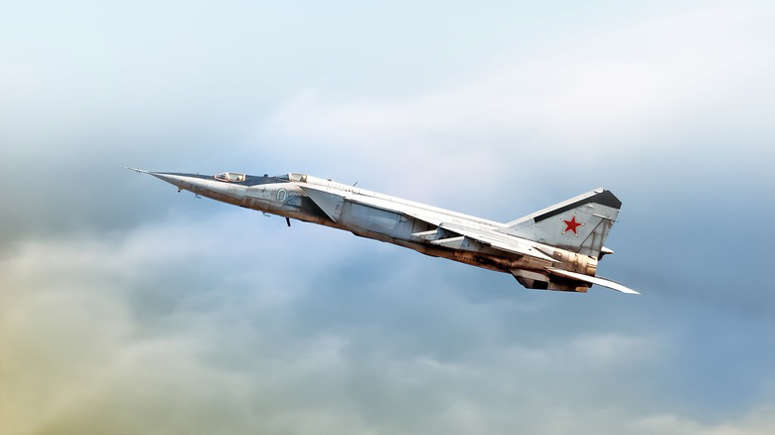
Mikoyan-Gurevich MiG-25 Foxbat
©vaalaa/Shutterstock
Mikoyan-Gurevich MiG-25 Foxbat
The Mikoyan-Gurevich MiG-25 Foxbat travels at a top speed of Mach 2.8, or roughly 2,150 mph at high altitude. That makes it the second fastest jet on Earth behind only the SR-71. The fighter jet has been deployed by multiple militaries since its first flight in 1964. MiGs are primarily used in Russia. These days, only two remain in service and both of them belong to the Syrian Air Force. In addition to fighting, the MiG-25 was also commonly used for recon work. Iraq used the fighter jet often during the Gulf War, specifically for reconnaissance.

It was designed primarily to fly as fast and as high as possible. Its speed is truly impressive, but don't overlook its 67,000-foot maximum altitude. That's what really gives it an advantage over other fighters. The downside is that the jet was quite difficult to maneuver, and it required tons of maintenance to remain effective. In fact, it required a engine replacement every 150 flight hours. It was eventually phased out for the MiG-31, which was slower overall, but featured more advanced technology and better maneuverability.

The MiG-25 Foxbat set several speed and altitude records in its early days. It also had a huge effect on aerospace technology moving forward. The U.S. created the F-15 to counter the MiG-25, but ultimately, the MiG-25's high maintenance costs and focus on speed over agility caused it to age poorly.
North American XB-70 Valkyrie
©Andreas Stroh/Shutterstock
North American XB-70 Valkyrie
The North American XB-70 Valkyrie is a unique bomber-style of fighter jet. Most stat sheets put this jet as having a top speed of around 2,050 mph, which, depending on the altitude, is about Mach 3. It wasn't able to cruise at those speeds and spent most of its time in the sky at a slower, but still impressive Mach 2.5. It was experimental its entire lifetime, but there is enough speed data to know how fast it could go. The plane achieved these speeds by way of six jet engines and being made of lighter, more heat-resistant materials.

In addition to its high speed, the aircraft could also go as high as 70,000 feet, which is much higher than most fighter jets. It was developed in the 1950s and 1960s, and it was meant as a replacement to the iconic B-52 bomber. It never officially went into production, but the U.S. Air Force got its hands on two of them to test the aerodynamics of large supersonic aircraft.

This is where things get really interesting. The bomber's design was eventually switched to recon work where it was rebranded as the RS-70. A few more design tweaks and a former President Lyndon B. Johnson naming flub later, and the RS-70 would finally go into production as the legendary SR-71. Of course, the SR-71 can go faster than the XB-70, but it also isn't a fighter jet.
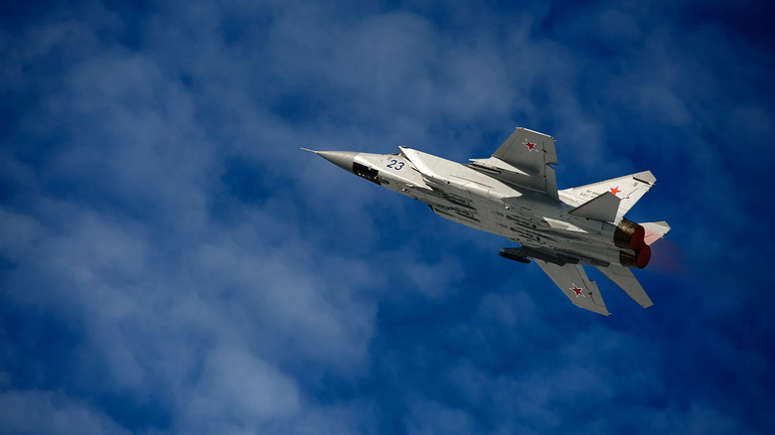
Mikoyan MiG-31
©Nero59/Shutterstock
Mikoyan MiG-31
The Mikoyan MiG-31 Foxhound is the fighter jet that officially replaced the MiG-25 Foxbat. It has a top speed of roughly 1,900 mph. It can do faster bursts for short periods of time, but it risks permanent damage when doing so. The replacement had some notable improvements over the outgoing MiG-25. It was easier to fly at lower altitudes, had improved agility, could fly longer ranges, and its engines didn't need replaced as frequently. The MiG-31 was also made of stronger, lighter materials along with better overall technology. The only downside was that it couldn't go as fast as its predecessor.

The MiG-31 is still used today in several countries. Russia sent it out to Finland, Syria, Kazakhstan, and other places. There are also multiple variants, such as the MiG-31F, MiG-31B, and MiG-31M. These hosted different types of technology, improvements from the original, and other weapons to perform multiple types of missions. There is even an experimental version, dubbed the MiG-31LL, that Russia uses for aircraft testing.

Unlike its predecessor, this one is still widely used. Russia intends to fly them until at least 2030. These days, the Russian Air Force predominately uses the MiG-31BM variant, which is the most recent production model with several improvements over the original. The Russians are in the process of modernizing their fighter jets so that they can deploy as long as possible.
Mikoyan-Gurevich Ye-152
©Alastair T. Gardiner
Mikoyan-Gurevich Ye-152
The Mikoyan-Gurevich Ye-152 is part of the Mikoyan-Gurevich Ye-150 family of fighter jets initially designed for the Soviet Air Defense Forces. Among the family, which includes over half a dozen major variants and even more subvariants, the Ye-152 is the fastest one with a top speed of roughly 1,880 mph at an altitude of 50,525 feet. That's fast enough to put in the upper echelon of quick fighter jets. The jet was powered by a Tumansky R-15B-300 turbojet engine. That is of note because it was the same engine as the MiG-25 Foxbat, except the MiG-25 had two of them. The Ye-152 only had one.

The Ye-152-1 in particular set multiple FAI-recognized speed and altitude world records. That puts it leagues above most other fighter jets. Unfortunately, due to a variety of factors, the Ye-150 series of fighter jets never reached production. Reports state that electronic issues, engine reliability problems, and developmental delays ultimately led to the project being abandoned in the early 1960s. Those same engine reliability problems plagued the MiG-25 Foxbat as well.

Only four Ye-150 family models were ever produced. Today, only the Ye-152M remains. It lives in the Central Air Force Museum in Monino, Russia. Its legacy carries on in other ways. The R-15 series of turbojet engines would eventually get some much needed upgrades. A variant of the engine was put into a Ye-266M, which is an experimental variant of the MiG-25. That lone jet currently holds the world altitude record for ground-launched aircraft at 123,523 ft.
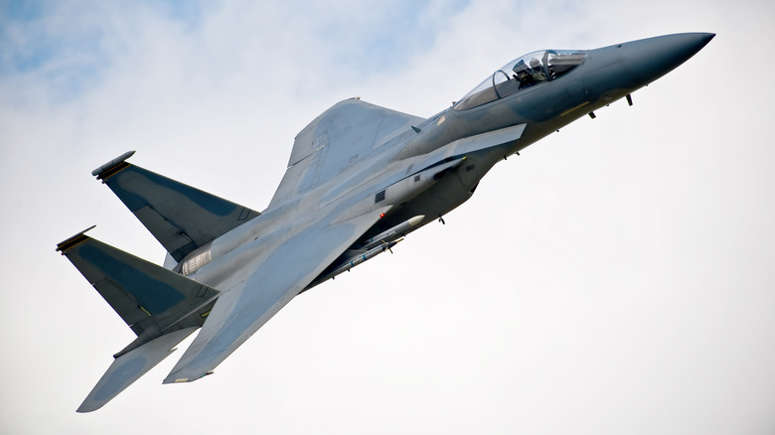
McDonnell Douglas F-15 Eagle
©Robhowarth/Getty Images
McDonnell Douglas F-15 Eagle
The McDonnell Douglas F-15 Eagle is one of the best fighter jets in the U.S. Air Force arsenal. It blends an excellent mix of maneuverability and speed, and some variants can reach speeds of up to 1,875 mph. In general, the base models aren't as fast, but can still do about 1,650 mph. The jet was produced in the 1970s in response to Russia's MiG-25 and MiG-31. Variants were produced throughout the jet's run, including some newer ones for the Persian Gulf War in the early 1990s. The fighter jet is still in service today in a few countries, including the U.S., Japan, and Israel.

The jet has a number of variants, including the F-15E Strike Eagle. Most of them are capable of the same 1,650 mph that the standard version has. In addition, the F-15 has some cool technology. The aforementioned F-15E, for example, can accelerate from idle to maximum power in just four seconds. It also houses a heads-up display that displays a video picture at night that makes everything look like it does during the day. The F-15 series in general was the first U.S. aircraft to have thrust that exceeded the jet's weight, allowing it to accelerate while 100% vertical.

It doesn't have the pop culture relevance of other fighter jets like the F/A-18 Super Hornet from "Independence Day" or the F-14 Tomcats from "Top Gun: Maverick", but it's every bit as awesome as its movie star brethren. Some variants of the F-15 are heading toward retirement, but they are expected to remain in use by the U.S. Air Force for at least a while longer.
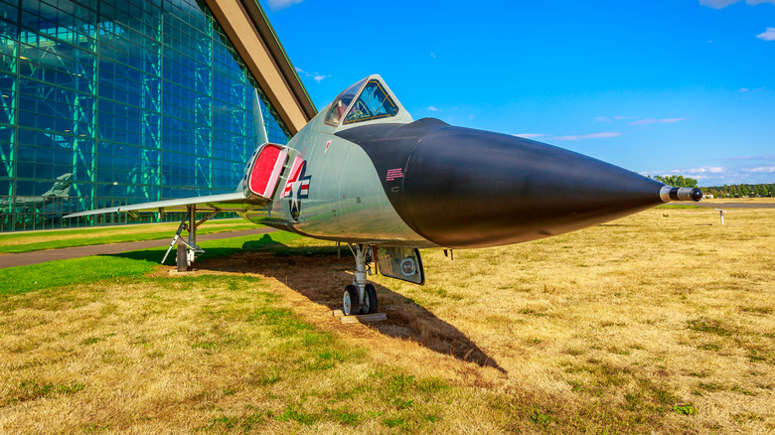
Convair F-106 Delta Dart
©Png Studio Photography/Shutterstock
Convair F-106 Delta Dart
The Convair F-106 Delta Dart is the beginning of a series of fighter jets that have very similar speeds. This one has a top speed of roughly 1,587 mph. It uses the same engine as the F-105 Thunderchief, and the two can go roughly the same speed depending on the altitude. The F-105 was a bomber whereas the F-106 was an interceptor. The aircraft went into production in 1956 and became fully operational for the U.S. Air Force in 1959, just in time for the Vietnam War. It would eventually retire from service in the late 1980s after more powerful fighter jets took its place.

Convair's F-106, a single engine jet fighter, was quite quick for its day. The F-106A variant of the aircraft broke world speed records back in 1959. It was beaten in 1971 by the McDonnell Douglas F-4 Phantom, which housed a dual-engine design. The single engine record would stand for one more year before it was beat by the Ye-152. Enthusiasts dispute that the Ye-152 eclipsed the record, but even if it did, the F-106 was still one quick fighter jet.

There are still some F-106s around today. Most of them are in museums. There is at least one fun story about the F-106. In 1970, a pilot was flying one in Montana. The pilot lost control and ejected from the jet. For some reason, this caused the jet to cease its spinning and the unpiloted F-106 landed itself in a snow-covered field. After minor repairs, that F-106 re-entered service where it would spend another 16 years before retiring to a museum.
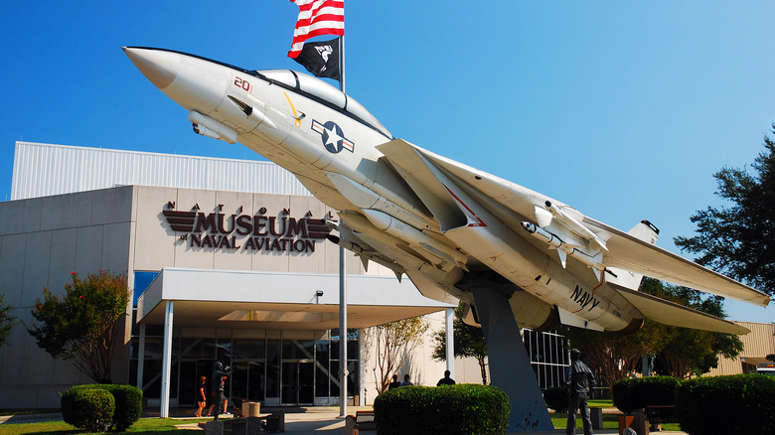
Grumman F-14 Tomcat
©Kirkikis/Getty Images
Grumman F-14 Tomcat
The Grumman F-14 Tomcat is another iconic jet used by the United States armed forces — this time with the U.S. Navy. Its top speed is roughly 1,554 mph. It's perhaps best known as one of the fighter jets used in the original "Top Gun" movie. The jet was excellent even outside of cinema. It could guide six missiles against six different targets while keeping track of 18 additional enemy aircraft up to 195 miles away. In fact, it was such a technological marvel in the 1970s that Russia tried to fish one out of the ocean to figure out how it worked.

The dual-engine jet is certified as a Mach 2 class fighter and joins several others in the 1,500-mph club. While its speed didn't set it apart from others all that much, the fact that it could do so many things did. It was developed as the successor to the popular F-4 Phantom II. Some of its features included variable wings that adjusted based on speed and altitude along with a rotary cannon for up close dogfighting.

Grumman's F-14 got even more advanced over the years. For example, it was fitted with laser-guided bombs during NATO's 1995 intervention in Bosnia. The jet was eventually retired in the early 2000s with the U.S. destroying most of its stock to keep its design secret. The remaining stock are predominately in museums these days. It was replaced by the F/A-18 Super Hornet, which saw its own cinema action in "Top Gun: Maverick".
Sukhoi Su-27
©Dawid Lech/Shutterstock
Sukhoi Su-27
The Sukhoi Su-27 is a legendary fighter jet often compared to the F-15 Eagle. The Su-27 has a top speed of about 1,550 mph, which translates to Mach 2.35 at altitude. The reason for the comparison is that the Soviet Union specifically designed this fighter jet in response to the F-15. It's not quite as quick but matches the F-15 in other areas. It can fly as high as 59,000 ft and it can fly for more than 1,800 miles before needing to refuel. Those are impressive numbers.

The Su-27 officially entered service in 1982 and were immediately implemented in Russia, Ukraine, Belarus, Kazakhstan, Indonesia, and a few others. India joined the Su-27 party in 2002. China also ordered some in 2004 while Mexico added some in 2006. The Su-27 has seen combat as recently as 2023 after Russian forces invaded the Ukraine in 2022.

Powering the Su-27 are two AL-31F turbofan engines. Modern versions have some tweaked engines for performance boosts as well. It's only natural that a jet fighter in production as long as the Su-27 gets some mechanical modifications over the course of its life. It's likely that these will remain in service for decades if it adheres to the notion that military aircraft tend to last about 50 years. However, the Su-35 and Su-57, the successors to the Su-27 with similar top speeds, are already out, so the Su-27's days may be numbered.
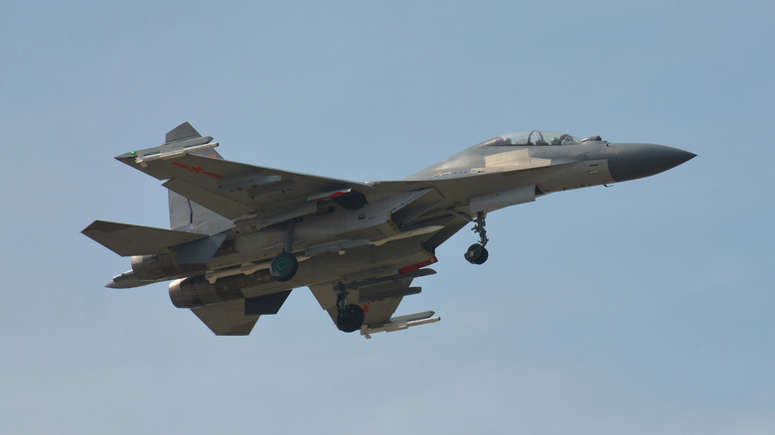
Shenyang J-15
©David Colman/Getty Images
Shenyang J-15
The Shenyang J-15 Flying Shark is an interesting piece of military technology. The base speed of the J-15 is Mach 2.4, or about 1,550 mph depending on altitude. It's one of the newest fighter jets on the list as it was introduced to the world in 2013. It's used exclusively by the People's Liberation Army Naval Air Force in China. As such, it's a little difficult to nail down the full spec sheet of this fighter jet. It's a cousin of the Shenyang J-11 that was released in 1998. However, the J-15 is not technically based on the J-11 despite their similar names.

Instead, the J-11 and J-15 are China's versions of the Sukhoi Su-27 and Su-33, respectively. Thus, it makes sense that these fighter jets are about as fast and well equipped as their Sukhoi counterparts. Early models even used the same AL-31 powerplant as their Su counterparts before switching to the Chinese-made WS-10 in 2022. There are some differences outside of the engine, but at a distance, you'd be forgiven for mistaking one for the other.

The only question mark is how fast the WS-10 engines are. The Chinese have reported the rated speed was Mach 2.4 back in 2017. That's before the WS-10 engines came into service, so there isn't a lot of documentation about how fast the newer engine is with the J-15. Given the dates, the rated speed is most likely with the older AL-31 engine, so newer J-15s may be even faster. There are roughly 50 in operation right now and the jet is still in production today.
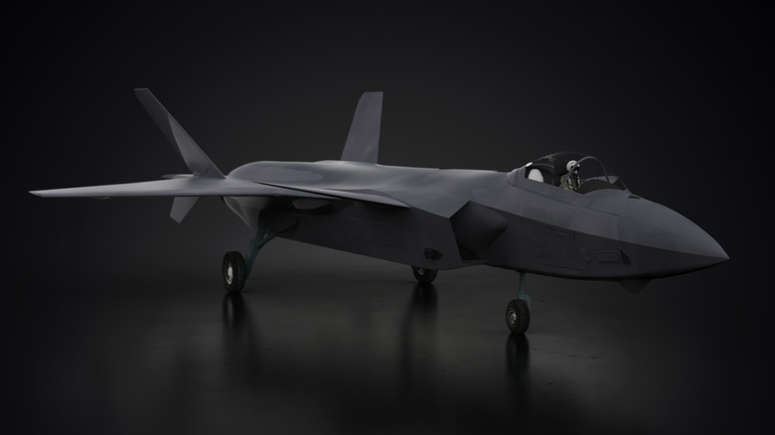
Chengdu J-20
©Bbevren/Getty Images
Chengdu J-20
The Chengdu J-20 is the newest jet fighter on this list courtesy of China. It has a rated speed of Mach 2, which is roughly 1,320 mph depending on altitude. However, Popular Mechanics lists the J-20 as achieving a top speed of Mach 2.55, which is roughly 1,650 mph at altitude. That makes the J-20 the fastest fighter jet that China has right now, but it also doesn't seem like it can sustain flight at that speed for very long. The jet was built with the Chinese-made WS-10 engine, but later variants are getting the newly made WS-15 engines in 2023. The new engines would make its top speed similar to the F-22 Raptor's 1,550 mph. That means there are three potential rated speeds for this jet.

For most fighter jets, almost the complete history is available, including variants, experimental versions, and prototypes. The Chengdu J-20 is right at the beginning of what will likely be a decades-long trek through the Chinese military industrial complex, so there are a lot of things that can still happen with it. There are already a few variants, including the J-20B which is the variant equipped with the new engines. There will be more, so it may end up being even faster by the time it retires.

For now, the Chengdu J-20 is in production and service right now. China seems to have north of 200 of them in service right now, and they make up a decent percentage of China's jet fighters.
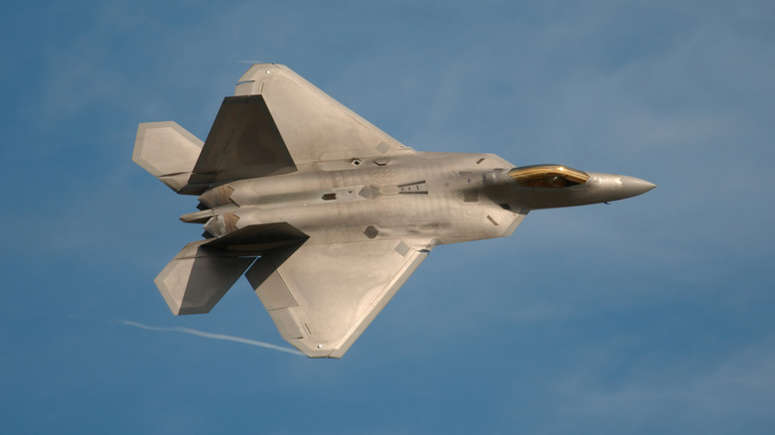
Lockheed Martin F-22 Raptor
©Johnnypowell/Getty Images
Lockheed Martin F-22 Raptor
The Lockheed Martin F-22 Raptor was pressed into service in 2005 when it went into full production. It's rated top speed is somewhere around 1,550 mph, which is more or less the norm for Mach 2-class fighter jets. In addition to its excellent speed, the F-22 Raptor also boasts some serious hardware and technology, including the ability to cruise at Mach 1.5 without using afterburners. In addition, it can carry over 2,000 pounds of munitions and detect enemies well over 200 miles away. There isn't much this fighter can't do when compared to its peers.

While the F-22 is still in U.S. Air Force service today, there is a push to retire some of them early. They are expensive to maintain, and some of the older ones in the fleet would require costly preparation to make them combat ready again. Congress has blocked it so far, but it seems the Air Force is trying each year to get the job done. The broken-down F-22s only make up about 20% of the total number in the fleet, so the U.S. will still have F-22s flying around after some of them are retired.

Other than the older models being retired, the F-22 has caused other problems in military circles. They are quite expensive at $125 million per jet, and the Air Force already has a weighty budget. Additionally, the U.S. is already working on the next generation of fighter jets for its arsenal.
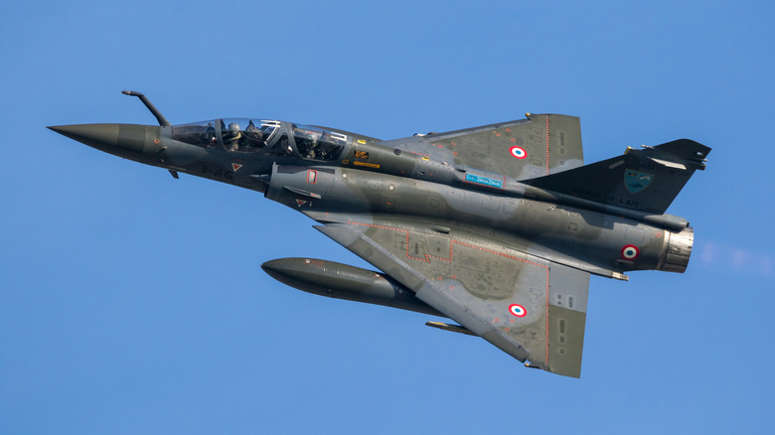
Dassault Mirage 2000
©VanderWolf Images/Shutterstock
Dassault Mirage 2000
The Dassault Mirage 2000 is last on the list, but it is by no means a slow fighter jet. It boasts a maximum speed of Mach 2.2 at high altitude, which translates to roughly 1,450 mph. It began life in 1978 with some variants distributed as recently as 1991. This one is still in use in many countries around the world, including Abu Dhabi, Egypt, France, Greece, India, and Taiwan. The most recent variants came out in the mid-2010s, so this is very much a modern jet fighter.

As such, it has a lot of modern amenities. It can attach up to nine weapons and includes two internally mounted machine guns. There is also digital weapons and navigations systems, something older fighters don't have. The original version was built for the French Air Force, which uses the upgraded models today. It's so popular that there are over 500 of them in operation, which is quite a large number for military aircraft. There are also single- and double-seater versions of the jet along with a variant specifically designed to carry nuclear weapons.

It's hard to say how long the Dassault Mirage 2000 will be in service, but it'll likely be a while. They're still being actively manufactured and air forces on multiple continents use them for a variety of purposes. This one never broke any speed or altitude records like others on this list, but it's still pretty quick overall.

Want the latest in tech and auto trends? Subscribe to our free newsletter for the latest headlines, expert guides, and how-to tips, one email at a time. You can also add us as a preferred search source on Google.


Hoe vind je dit bericht?
Geschreven door peter om 21:19 Stuur door

Scientists tracked faint signals from the stars — and may have turned up hundreds of undiscovered planets

Scientists tracked faint signals from the stars — and may have turned up hundreds of undiscovered planets

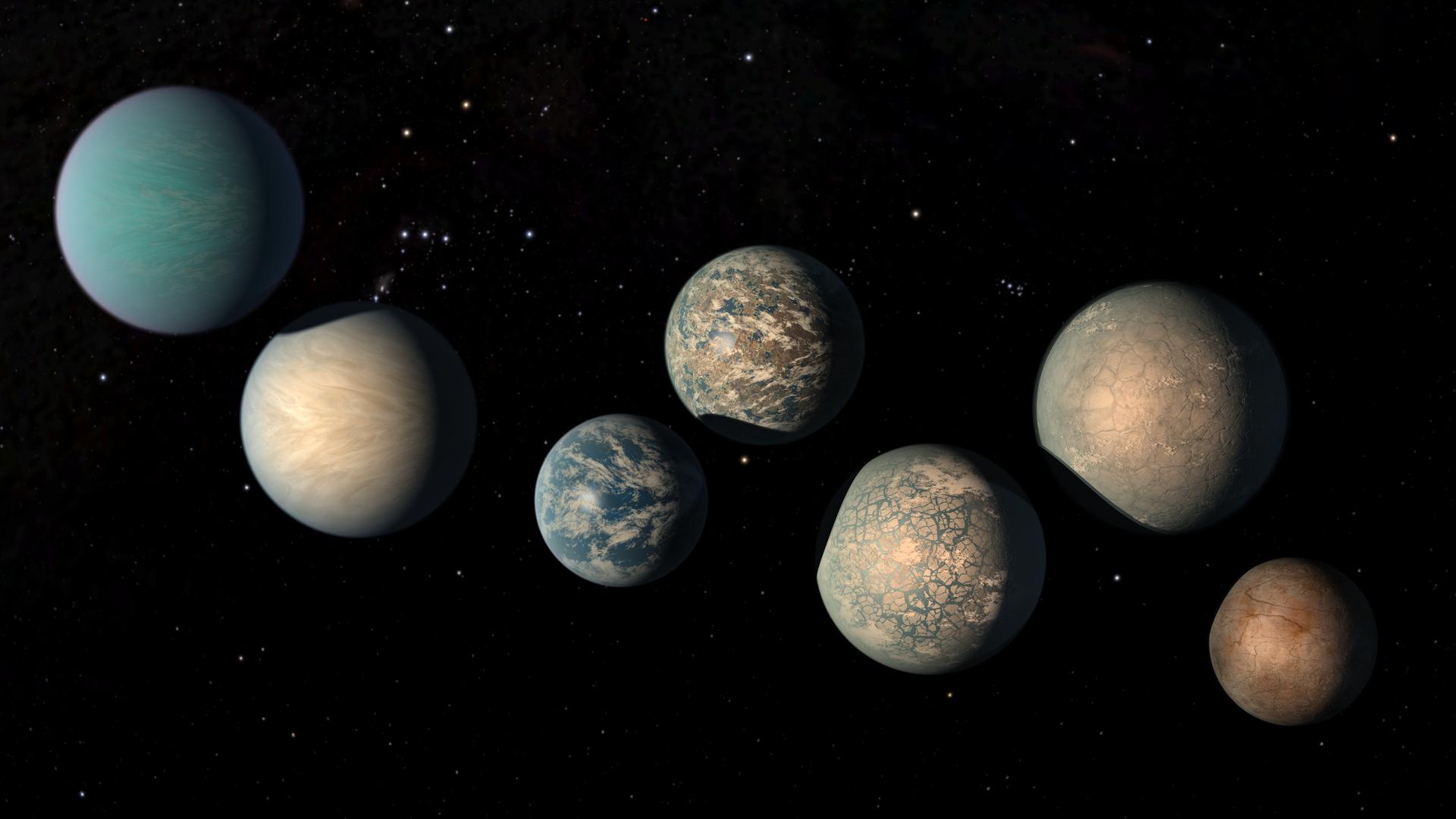
An illustration of a series of brown and blue planets in a dark starry space background

An illustration of the TRAPPIST-1 exoplanets. Astronomers have proposed a new method that could swiftly uncover hundreds of new alien worlds. 

(Image credit: NASA/JPL-Caltech)

Scientists have found a potential shortcut for identifying stars that host planets. The technique, based on specific signals in starlight, could make it easier to search for exoplanets, according to a new study.

The team has already used their new method to turn up half a dozen previously undiscovered planets — but because most of the alien worlds are very close to their stars, they are unlikely to be habitable, the study authors say.

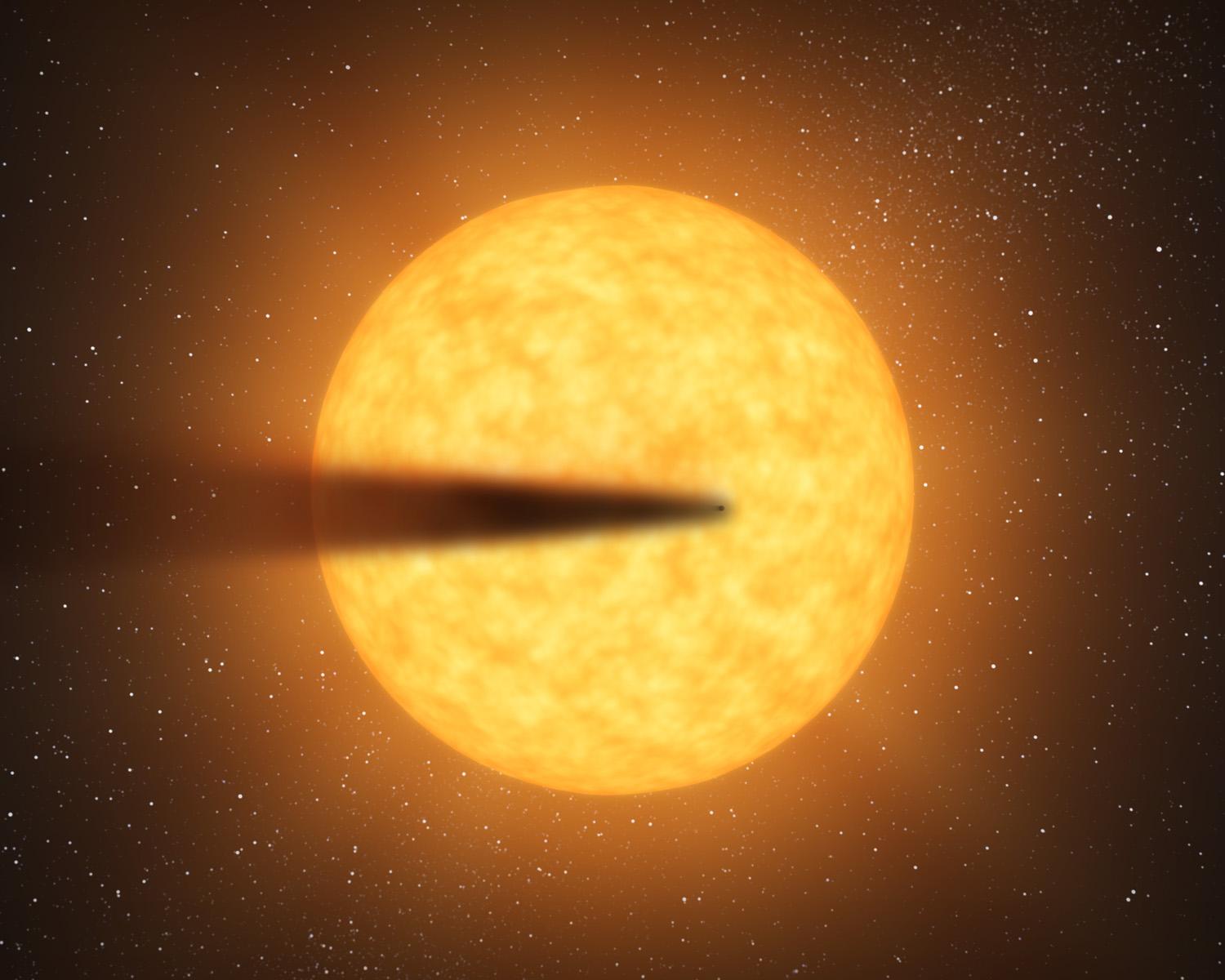
Many of the 6,000-plus known exoplanets are located extremely close to their host stars. This proximity often doesn't turn out well for such close-in worlds, whose surfaces get whipped up by the stars' intense radiation and form comet-like tails of debris. This includes exoplanets like K2-22b, which was analyzed by the James Webb Space Telescope in 2025. The debris typically remains, for millions of years, as a cloud circling the planet's host star.

You may like
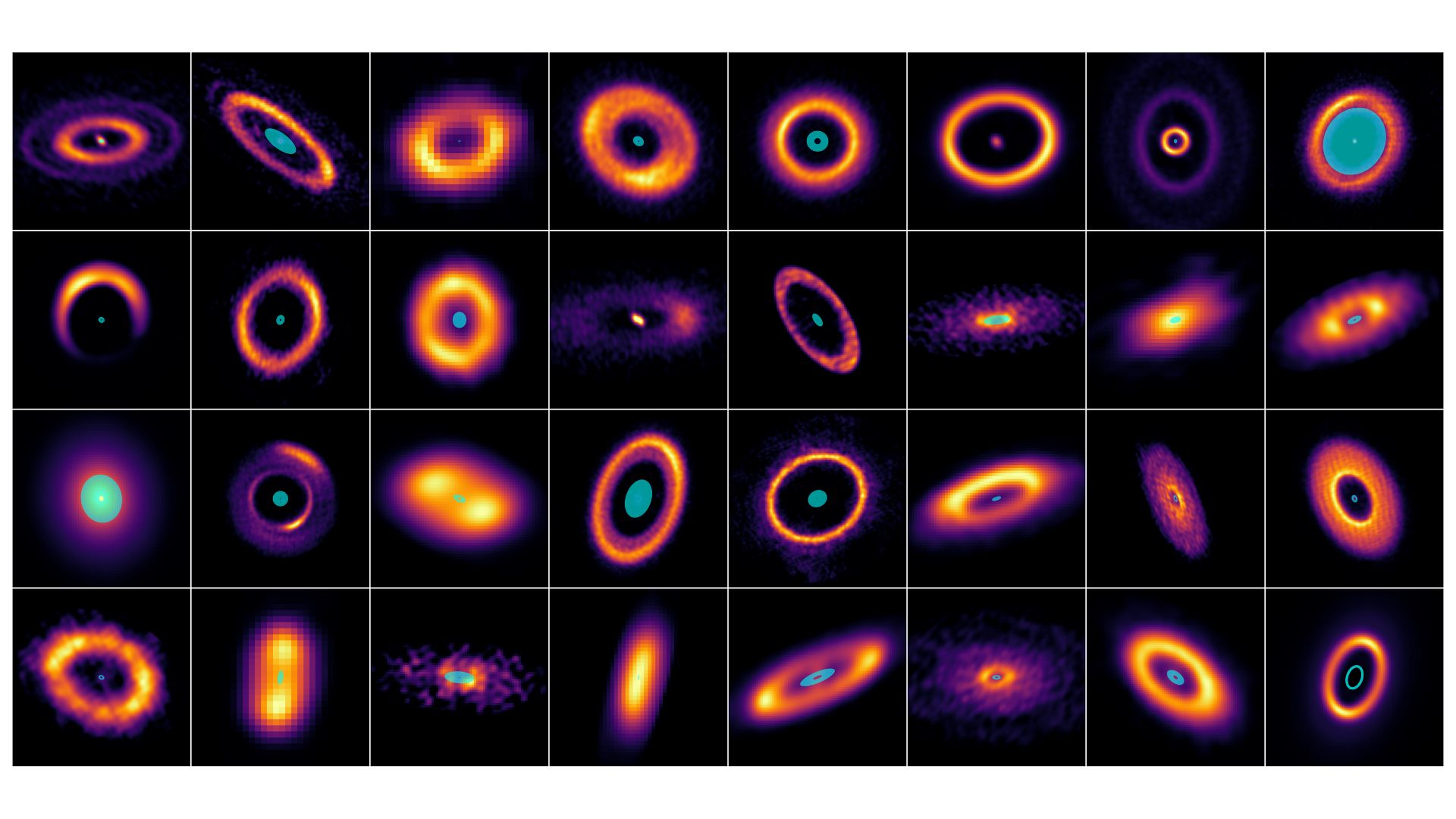
  • A collage of 32 glowing discs on a black background. Each disc shows concentric rings in vivid colours: purple, orange, and yellow, with bright cyan centres. The discs vary in size and orientation, creating a striking pattern of circular and elliptical shapes.

Some objects we thought were planets may actually be tiny black holes from the dawn of time

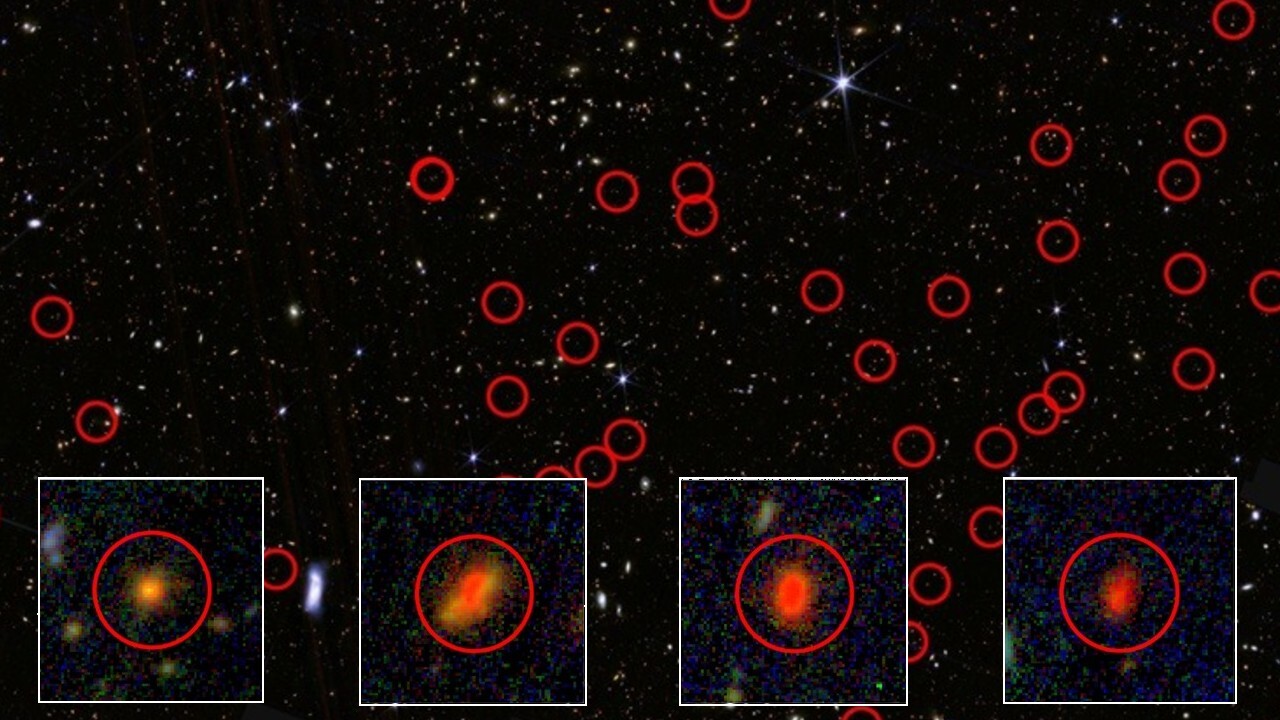
  • A series of red bubble looking spheres over a dark, starry background with four white cutout squares in the front enlarging four of the bubbles to show glowing balls of red light in each of the bubbles.

Mysterious 'dots' discovered by Webb telescope may be the first stars in the universe on the verge of collapse

  • A starry sky above the Arecibo Observatory in Puerto Rico.

SETI scientists reveal 100 'signals of interest' from collapsed Arecibo Observatory

But this clutter could help astronomers pinpoint stars that host undiscovered exoplanets orbiting close to their stars. That's because the debris, which is mainly a mixture of different gases, absorbs some of its parent star's light at specific visible frequencies.

"That absorption could make the star appear artificially [magnetically] less active," Matthew Standing, a research fellow at the European Space Agency's European Space Astronomy Centre in Madrid and the new study's lead author, told Live Science via email. In other words, magnetically inactive stars are potentially good targets in the search for crumbling, close-in exoplanets.

If this hypothesis is confirmed, it could make planet-searching ventures less random.

Exoplanets close to their parent stars, like Kepler-1520b in this illustration, crumble, creating clouds of debris. These clouds surround the host stars and absorb specific wavelengths of their light, making these wavelengths missing in the spectra we see from Earth. By looking for stars that have these signatures in their spectra, scientists have hit upon a method to efficiently identify exoplanets.  (Image credit: NASA/JPL-Caltech)

Signals from the stars

To test the idea, Standing and an international team of collaborators first identified a set of 24 stars with apparently low magnetic activity as part of the Dispersed Matter Planet Project (DMPP), including a handful of stars that the DMPP had analyzed in 2020. The researchers then collected visible-light spectra — the light curves that correspond to wavelengths of electromagnetic radiation that humans can see — from these stars, using telescopes at the European Space Observatory in Chile.

They observed each star at least 10 times for up to two weeks. If a star hosted one or more planets, its gravitational "tugs" on its star would cause it to wobble, which would be visible in the spectra. (This method of identifying exoplanets is called the radial-velocity technique.)

Next, the team used a computational algorithm to determine if such changes in the light curves could correspond to as many as four planets for each star system. The analysis also allowed the researchers to determine how sensitive the survey was and how common close-in planets are around stars with low magnetic activity levels.

The results, published Feb. 28 in the journal Monthly Notices of the Royal Astronomical Society, showed that 14 stars hosted a total of 24 exoplanets, including a total of seven newly discovered worlds in five of these systems.

The team also calculated that the occurrence of exoplanets around the stars they selected was between eight and 10 times higher than in other radial-velocity surveys. This occurrence rate supports the hypothesis that stars that seem magnetically inactive are likely hosts of close-in, highly irradiated exoplanets.

Additionally, the researchers found that the survey was very comprehensive, identifying nearly 95% of exoplanets that were more than 10 times as massive as Earth and orbited their host stars in five days or less.

The team also extrapolated their results to our cosmic neighborhood, curating a list of roughly 16,000 stars lying within 1,600 light-years from the solar system. (For reference, a light-year is the distance light travels in a year — approximately 5.88 trillion miles, or 9.46 trillion kilometers.) From this list, the researchers found 241 stars with similar signatures of low magnetic activity. Given the proportion of exoplanets in the study, they estimate that these stars may host around 300 planets, just waiting to be discovered.

Standing is cautiously enthusiastic about the technique's potential. "If confirmed with larger samples, this method could help make exoplanet searches more efficient," he said.

The team plans to do just that, expanding the size of their sample and continuing to monitor radial-velocity data for signs of planets, he added.

{ https://www.livescience.com/space }

Hoe vind je dit bericht?
Geschreven door peter om 20:43 Stuur door

Ancient 'alien-like' skulls have been found on every continent but Antarctica. Anthropologists are starting to figure out wh

Ancient 'alien-like' skulls have been found on every continent but Antarctica. Anthropologists are starting to figure out why.

For millennia, people have shaped the skull during infancy. Archaeologists are starting to unpack why. 

(Image credit: Nabeel Nezzar)

When the Spanish first reached the Andes, they found something surprising: Many of the locals had long, pointy heads. They discovered that the Collagua, an indigenous group in Peru that was conquered by the Inca, had a practice of shaping the head starting in infancy, before the skull bones fused and soft spots disappeared.

The Spanish jumped to the worst conclusions.

"They said it was this horrible thing and brains bled out of ears," Christina Torres, a bioarchaeologist at the University of California, Riverside, told Live Science. "But that doesn't seem to be the case."

A photograph of a brown human skull in front of a black background, its forehead long and conical as it's been shaped to be flatter and taller
A pre-Inca skull from Paracas that dates to around 1000 B.C. When the Spanish encountered people in the Andes, they found head shaping was common.
Credit: DEA / G. DAGLI ORTI via Getty Images

Prehispanic Indigenous groups were not the only ones to practice head shaping. For centuries, archaeologists have found skulls on every continent except Antarctica that show evidence of "cranial vault modification" — heads shaped to be either flatter or more conical than they would be if left alone.

Given that babies cannot bind their own heads, experts think head shaping was done by caregivers. Now, archaeologists are beginning to uncover clues about why people performed this practice for millennia, particularly in places like the Andes, where the practice has been documented the best.

Through systematic analysis, what experts are uncovering is a profusion of practices and explanations, some of which are baffling or contradictory. In some places, a shaped head may be a marker of group status, while in other places, head shapes differ even among close family members. And in other places, the feature used to identify it — the unusual head shape — may not even have been the intent of the practice, researchers are finding.

"Something as ostensibly shocking as cranial modification may have been almost a routine practice for some children in some time periods," Matthew Velasco, a bioarchaeologist at the University of North Carolina at Chapel Hill who studies head shaping in the Peruvian Andes, told Live Science.

What's more, it likely originated very deep in human history — and emerged in many times and places, Velasco said. "I think we have to start from the assumption that the meaning varies across time and space."

How are heads shaped?

Bone remodels easily when children are young, so a simple strip of wrapped cloth can control how the head grows, much like how a bonsai tree can be shaped and pruned, Torres said. For example, nowadays, babies with plagiocephaly — a flat spot caused by sleeping in one position — are often prescribed helmet therapy to change their head shape.

This was a slow and gradual process done with fabric and pillows.

Christina Torres, bioarchaeologist at the University of California, Riverside

Experts have identified more than two dozen apparatuses that were used to create different head shapes, but "the most typical method would be just wrapping the baby's head circumferentially and making a longer, more conical shape," Torres explained, as this technique requires the least equipment and the least training.

Based on historical records from groups that practiced it, head wrapping began by around 6 months of age in most cultures and ended within a year or two, Tyler O'Brien, a forensic anthropologist at the University of Northern Iowa, wrote in "Boards and Cords" (Bloomsbury Publishing, 2024), a book about the worldwide history of cranial modification. The shaping was likely done by a mother or midwife.

There's not a lot of information, though, on whether this practice was painful, but it does not appear to have had any major consequences for brain development, Torres said.

A black and white photo shows a dark-skinned woman with short hair holding her child, who is wearing a tight series of cloths wrapped around the top of its head to elongate its skull.
Early, biased accounts suggested head shaping could make eyes bug out. However, this baby with a shaped skull likely has bulging eyes because of anemia, one expert suggested.
Credit: Collectie Wereldmuseum (v/h Tropenmuseum), part of the National Museum of World Cultures, CC BY-SA 3.0 via Wikimedia Commons

"There's one instance where [bioarchaeologists] think a child died because of cranial modification, where the head was compressed too much," she said. "That is anomalous, as far as I can tell. This was a slow and gradual process done with fabric and pillows."

So, although Spanish explorers in the Andes said they were shocked by "brains coming out" and explorers in Borneo and Vanuatu said kids' eyes "bulged from their sockets," these subjective accounts are probably greatly exaggerated, O'Brien wrote. In reality, the child likely adapted quickly to any discomfort, and the brain would have conformed to the shape of the skull, resulting in no ill effects on cognition or intelligence.

If not done properly, however, head shaping that involved overly restrictive or infrequently changed bindings could cause infection. "I think the worst thing you could have is a [skin] ulcer that gets infected and then eats through the bone, which does happen," Christine Lee, a bioarchaeologist at the University of Mississippi, told Live Science. Scalp infections and temporomandibular joint (TMJ) issues also may have occurred, Torres said.

Archaeological evidence for head shaping

To identify a shaped head, archaeologists sometimes used visual inspection as well as human skull measurements, known as craniometry. Craniometry has been around since the 19th century, when American naturalist and eugenicist Samuel Morton used cranial traits to create racial hierarchies that have since been debunked.

Although there is no standardized, agreed-upon method to determine if a head has been shaped, archaeologists often use a 3D, mathematical analysis of cranial measurements to see whether the ratio of certain measurements, such as the width, length and height of the skull, are outside the range of what is expected as part of natural variation and are thus likely to have been intentionally shaped.

That analysis suggests that head shaping is widespread in the archaeological record. Cranial modification has been found in skulls from Europe, the Near East, Africa, Asia and Oceania, and it is most strongly associated with the Americas. But that doesn't necessarily mean it was more common there; rather, evidence of shaped heads may have been better preserved in the Andes, where the cool, dry conditions did not degrade mummified remains as quickly, Velasco said.

In fact, the oldest archaeological evidence of head shaping comes from Australia. Two artificially flattened skulls were discovered in the southern state of Victoria at the site of Kow Swamp, which is at least 13,000 years old.

And ancient skulls reveal the practice boomed in the Neolithic period, appearing in Europe around 12,500 years ago, in China around 11,000 years ago, and in what is now Iran around 10,000 years ago, according to O'Brien.

three line drawings of children wearing head-shaping devices
Three examples of types of head shaping apparatuses used by pre-Hispanic people in the Andes.
(Illustration based on: M.J. Allison et al., 1981. La práctica de la deformación craneana entre los pueblos andinos precolombinos. Chungara: Revista de Antropología Chilena 81(7): 250.) | Credit: Quinn Reynolds

Early accounts

Some of the earliest explanations for head shaping, which come largely from Spanish explorers in the Americas, are some of the most suspect. That's because few explorers bothered to ask practitioners why they engaged in head shaping. Instead, these wild stories were often based on rumor or hearsay.

For instance, Christopher Columbus first reported head shaping among the Indigenous people of Hispaniola, the island that encompasses the Dominican Republic and Haiti, in 1492. He illogically guessed that the islanders had flat heads because their mothers pressed them tightly between two wooden planks, causing the skull bones to thicken like helmets and protect them from Spanish blows, according to Pilar Zabala Aguirre, an anthropologist at the Autonomous University of Yucatán in Mexico, who has compiled more than 100 Spanish historical records on the practice.

Other explorers invented different possible explanations: ethnic grouping; high military rank; attributes such as courage, bravery or obedience; the ability to carry heavier loads strapped around the forehead; health improvements; and beauty ideals, Zabala found.

These explanations are even more suspect because they were often tied to racism or beliefs in the superiority of Western culture or even used to explicitly make that argument.

For instance, English physician John Bulwer cataloged various types of body modification in his 1650 book "Anthropometamorphosis," condemning them as disfiguring and an affront to God, according to O'Brien.

It wasn't until the early 20th century that anthropologists moved away from "studying abnormal head shape in the living 'other' and describing it as hideous, frightful, and disgusting," O'Brien wrote, and toward a less-biased understanding of cranial variation.

Changing understanding of the practice

Using those robust, less biased methods, archaeologists are gradually unwrapping some of the mystery surrounding the practice, mostly in the Americas. And what they're finding is not an overarching trend, but a range of reasons and practices.

For instance, the Collagua in Peru ostensibly "told the Spanish that they shaped the heads of their children like the mountain from which they come," Velasco said.

Among the Indigenous Caddo people of Oklahoma, meanwhile, different kinds of shaping reflected membership in different clans, Lee said.

Yet head shaping differed not only within cultures but even within families. Velasco's ongoing research, which involves analyzing the DNA of extended families buried together in the Andes, has revealed that the heads of biologically linked people were often shaped in different ways — so one family member might have an elongated head, while another might have an unmodified, rounded head.

In fact, in some cultures or families, the shapes of the heads may have been the unintended result, rather than the goal, of a practice that was more important to them, such as binding.

"The shape itself might actually be collateral to the practice" in the Andes, Torres said.

In the same way that some people swaddle their children, the same way that there's religious circumcision, you bind the heads of your children because that is what we do to our children.

Christina Torres, bioarchaeologist at the University of California, Riverside

Instead, in some parts of the Americas, head shaping may have lingered simply as a tradition. For instance, in the Andes, the practice may be part of a rite of passage for either the infant or the mother, Torres said. If head shaping began around 6 months of age, that is a time when the baby's first teeth were coming in and weaning foods may have been introduced. There, head shaping may be similar to putting jewelry on a child or baptizing them to protect them, she said.

Among the pre-hispanic people of the Andes, "it's basically a child-rearing practice," Torres said. "In the same way that some people swaddle their children, the same way that there's religious circumcision, you bind the heads of your children because that is what we do to our children."

Skulls in the museum at the ruins of the Mayan city of Tonina, near Ocosingo, Mexico.  The skulls were intentionally modified when the people were babies to have this characteristic shape.
While the most common form of head shaping made the skull conical, other methods made the head flatter. In some areas of the Americas, people in the same family had different head shapes.
Credit: VW Pics via Getty Images

A natural conclusion

In fact, the idea of shaping a head into a conical form may have been presented by birth itself. The infant cranium naturally deforms when it passes through the birth canal, Velasco said.

"When my child was born, for example, he had a slightly conical head," he said. "Birthing presents this possibility to every parent, and it doesn't take much of a leap to feel the supple head of a child and to wrap it, to clothe it."

Thus, it's not surprising that many cultures might have stumbled upon head shaping, given that "anyone who has observed or assisted a human birth will recognize that the human head is malleable," Velasco added.

This recognition of the plasticity of a baby's head may have spurred a need to protect it. For example, among the Maya, modifying an infant's head was likened to putting a roof on a house and was thought to protect the child.

That protection may have then become more metaphorical than physical. In some places, it has "an almost talismanic aspect to it," Lee said, as if something bad might happen to the child if the shaping were not done. "That implies there must be almost a fear of not doing it."

Beauty and 'in-group' status

Outside the Americas, few historical records describe head shaping, but "it seems to have been independently invented in multiple places," Torres said.

Each of these places may have had different justifications for the practice. In prehistoric China and Japan, for instance, head shaping was likely a status marker tied to the elite. Lee thinks it's likely that in ancient Asia, head shaping — similar to foot binding in more recent times — represented an extreme way of achieving a beauty standard.

Similarly, during the fourth to seventh centuries in Europe, head shaping surged in popularity among the Huns, skeletons reveal. Without historical evidence from the Huns detailing the reason for this practice, experts have conjectured that it was a "fashion wave" in the Eurasian steppe that conferred higher social status.

A dark-skinned woman looks to the left, her black braids wrapped around her conical shaped head, with a flat circular ring in the back and two wooden sticks poking through her hair. She stands in front of a tan background with blurred trees behind her
The Mangbetu people of the Congo practiced "lipombo," which made the head long and conical, into the 1900s. The Belgian colonial government outlawed the practice. 
Credit: Michel HUET via Getty Images

But head shaping often leaves subtle traces, meaning people who engaged in the practice may not have looked much different from those who didn't. That suggests the practice was not necessarily a striking visual marker of in-group status, which raises questions about whether that was its purpose.

"Hair hides a lot," Lee said. "There are people today with unusually shaped skulls, and it just doesn't show depending on their haircut." For example, venture capitalist Marc Andreessen and political consultant Roger Stone both have (presumably naturally) pointier-than-average heads.

Modern cases of head shaping

Although cranial vault modification has been going on for tens of thousands of years, it persisted well into the 20th century in parts of Africa, Oceania and Europe.

The Arawe people in Papua New Guinea practiced head shaping as late as the 1930s, according to a study of several villages in 1955. The Arawe used bark-cloth bandages to create what they considered an aesthetically pleasing "long-headed" style.

Among the Mangbetu people of the Congo, the practice of "lipombo" involved tightly wrapping an infant's head with cloth bandages to encourage a long, conical shape thought to be beautiful and powerful. The Belgian colonial government outlawed the practice, which died out in the 1950s.

And in early 20th-century France, some parents chose to band their newborns' heads immediately after birth for up to four years in a practice called "bandeau," which practitioners thought protected babies from injury. The "Toulouse deformity," named after the region where it was practiced, has been captured in a series of historical photos, but bandeau declined in popularity and disappeared by World War I.

"This is not something that is simply a brute barbarian practice that people evolved out of," Velasco said. "It is fairly independent of social complexity."

A sepia-colored photograph with ripped edges shows the side profile of a man facing left with long dark hair wearing a striped shirt. The man's skull is conically shaped and pointed upward.
Head shaping, or "bandeau," was practiced in Toulouse into the 20th century. 
Credit: Didier Descouens, CC BY-SA 4.0 via Wikimedia Commons

RELATED STORIES

The practice of shaping an infant's head to look like an "alien's" may seem foreign or bizarre to us in the 21st century. But the human body has long been a canvas for cultural, spiritual and personal expression.

The earliest known tattoos date back at least 5,000 years in Copper Age Europe, tooth filing and "grills" go back 2,000 years to the Maya, and neck elongation was practiced 1,000 years ago in Southeast Asia. Today, we tend to modify the soft tissues of our bodies through common practices like ear piercing and circumcision, but also more uncommon procedures like horn implants, eyeball tattooing and Brazilian butt lifts.

"Cranial modification is part of a practice that is universal: body modification and presentation," Velasco said. "We all invest our future in our children in different ways. That's how I think about cranial modification. It's like an investment in the future of a child. And when you put it in that way, it's hard not to relate to it."

{ https://www.livescience.com/planet-earth }

Hoe vind je dit bericht?
Geschreven door peter om 20:26 Stuur door

Congress Cleared To Enter Secret UFO Craft Facilities

Congress Cleared To Enter Secret UFO Craft Facilities

Cristina Gomez

Congressman Eric Burlison of Missouri has confirmed he received White House and Pentagon approval to visit the classified facilities where whistleblowers allege recovered non-human craft are being stored and studied. 

According to Burlison, the request covered locations where witnesses report reverse-engineering programs, stored vehicles, and biological material connected to those programs. He named Northrop Grumman, Lockheed Martin, Raytheon, Mitre, and EG&G as suspected contractors involved. The sites fall under the authority of Defense Secretary Pete Hegseth, with some reportedly housing embedded intelligence agencies alongside private contractors.

Burlison has noted a key structural limit on his access. As a member of the House Oversight Committee, he holds a top-level security clearance but is not on the intelligence or armed services committees, which means he cannot independently enter a SCIF — a Sensitive Compartmented Information Facility, where classified conversations take place — without permission from committee chairs he does not sit on. That limitation is precisely why the White House approval for direct facility visits carries significance beyond a routine congressional briefing.

dc2cee_584f0fc8207646199769ba49c06cd1d8~mv2.png

The question of what those facilities contain is supported by credentialed testimony. Dr. James Lacatski, who managed the DIA’s AAWSAP program — the Advanced Aerospace Weapon System Applications Program — published a book in 2023 that cleared the Department of Defense’s security review process, known as DOPSR, before release. In that book, Lacatski stated that the United States was in possession of a craft of unknown origin and had successfully accessed its interior. He later confirmed that he personally observed the craft, describing it as having a streamlined aerodynamic shape with no intakes, no exhaust, no wings, and no control surfaces. When asked whether he saw it fly, he said yes. Dr. Eric Davis, an astrophysicist who served as a scientific advisor to the same program, stated at a congressional briefing in May 2025 that recovered craft are not of this Earth, adding that the world’s major powers have all experienced crashes and recovered vehicles.

Burlison also referenced a detail shared with him in a secure setting — a friendly allied nation reportedly holds an object so large that a building had to be constructed around it, with workers inside unaware of what the structure conceals. He noted that if he is denied access to that specific location while being approved for all others, the denial itself will function as evidence. Steven Greer says it is in South Korea but Burlison has yet to comment on the location. 

Before gaining any official access, Burlison had already made public a piece of footage that speaks to the urgency behind his requests. On October 30, 2024, a U.S. MQ-9 Reaper drone tracked an unidentified object off the coast of Yemen. A second drone fired a hellfire missile at the object. The missile made contact. The object kept flying. Burlison received the footage through an anonymous dead drop and released it publicly at a House Oversight Committee hearing on September 9, 2025, using the constitutional protection of the speech and debate clause to do so.

Luis Elizondo, from AATIP — the Advanced Aerospace Threat Identification Program — testified under oath before the House Oversight Committee in November 2024 that the U.S. is in possession of UAP technologies, as are some adversaries, and described a multi-decade secretive arms race funded by misallocated taxpayer dollars and hidden from elected representatives. The site visit now approved for Burlison represents what may be the first direct physical congressional oversight of the facilities these officials have described.

Sources
 
Hoe vind je dit bericht?
Geschreven door peter om 18:33 Stuur door

US Congressman says he saw UFO video of “intelligently controlled plasma orbs"

US Congressman says he saw UFO video of “intelligently controlled plasma orbs"

US Congressman saw UFO video of “intelligently controlled plasma orbs ...

Image by Cybernews

The Cosmic Report looks at new UFO disclosures from Congressman Eric Burlison and revisits archival material from decades past. Plus we look into what Hilary Clinton said about declassification during her Epstein testimonial.

Speaking with Steven Diener on the UAP Unidentified Alien Podcast, Burlison said he now believes that “there’s something there” after seeing evidence of what he calls “intelligently controlled plasma orbs.”

Burlison also mentioned that these potential alien craft have flown close to American craft and “exhibit playful-type behavior to the point that it seems like they’re flaunting or demonstrating a power capability to us”

When Diener asks Burlison if he’s ever seen these UAP's showing off, Burlison replied, “I’ve seen videos of glowing type orbs demonstrating something that I would never have seen in any other context.”

When asked about the context of this mysterious footage, the Republican representative was understandably guarded, but he did add that “the way in which they move doesn’t seem to be under conventional propulsion.”

“They’re clearly not drones. It almost looks like a ball of plasma that is controlled,” he said.

Credible or incredible?

There is still some way to go in revealing exactly what the Pentagon kept guarded over the decades, but Trump’s executive order is still pending.

Burlison told Diener, “I don’t know what kind of technology can do that, or who is behind that, but…I can definitively say that there’s something there.”

There were contrasting views among the Reddit community. One of the threads acknowledged Burlison's transition from skeptic to believer, while the follow-up paid tribute to his Bill Murray-esque mannerisms.

{ https://bi.cybernews.com/ipvanish-cn-campaign/ }

Hoe vind je dit bericht?
Geschreven door peter om 18:23 Stuur door

In 1996 a Mysterious Crop Circle Appeared Near Stonehenge

In 1996 a Mysterious Crop Circle Appeared Near Stonehenge

In 1996 a Mysterious Crop Circle Appeared Near Stonehenge

Written by Ivan Petricevic

In July 1996, a baffling and intricate crop circle formation known as the Julia Set "materialized" near Stonehenge, reigniting debates about ancient mysteries and possible extraterrestrial  communication

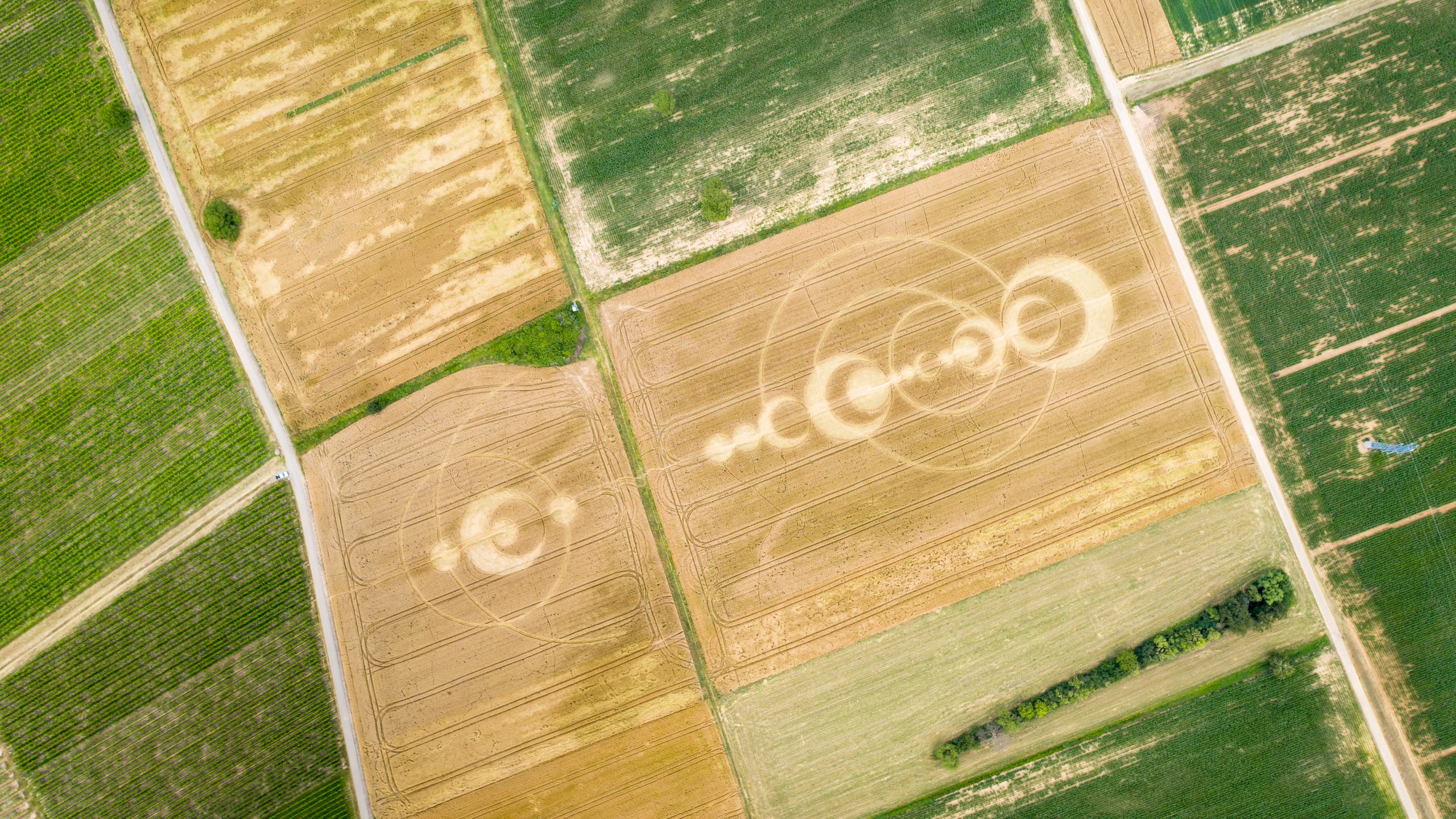
In the summer of 1996, the world was captivated by an extraordinary event near Stonehenge. The appearance of a complex crop circle, known as the Julia Set, opposite this ancient site, sparked widespread fascination. Named after a  mathematical fractal shape, the Julia Set crop circle was characterized by its intricate design and sudden formation. Anecdotes, including reports from a local taxi driver, describe the crop circle as appearing almost instantaneously, fueling speculation about its origin. For many, these patterns in the fields are more than mere artistic expressions; they’re perceived as symbols conveying significant information.

Stonehenge and the Julia Set

The proximity of the Julia Set to Stonehenge has led to intriguing theories about a possible connection between the two. Given Stonehenge’s  historical and archaeological significance, the appearance of such a complex formation nearby raises questions about potential interstellar messages. Theories speculate whether Stonehenge, a site shrouded in mystery, could be a portal to the stars as some proponents would suggest, and if the Julia Set-like crop circles, with mathematical precision, hold a key to reactivating “ancient portals.”

The creation of the Julia Set near Stonehenge has reignited discussions about the capabilities of ancient civilizations. Some theorize that our ancestors were attuned to Earth’s energies and mysterious forces, possessing knowledge now lost to modern humanity. This theory posits that ancient sites like Stonehenge could be remnants of sophisticated technologies, once part of a global network capable of generating significant energy, potentially used for extraterrestrial communication or travel.

The not-so-alien Crop Circles

As we consider the mysteries of Stonehenge and the intriguing crop circle phenomena, it’s important to acknowledge the complexity of human creativity and its role in these enigmas. A notable example of this is the story of Doug Bower and Dave Chorley, two friends who, in the late 1970s, embarked on an unusual artistic endeavor. Using simple tools like planks of wood and ropes, they crafted intricate crop circle designs in fields. Their intention was initially playful, but their creations soon captured global media attention and sparked a wave of imitators worldwide.

Their story, which remained a secret for years, eventually inspired “The Perfect Golden Circle,” a novel by British author Benjamin Myers. The book, set in 1989, follows two characters through the English summer nights as they create complex crop patterns, mirroring the real-life adventures of Bower and Chorley.

An aerial photograph of Crop Circles. Yayimages. An aerial photograph of Crop Circles. Yayimages.

The truth about their crop circle artistry came to light when Bower and Chorley, then aged 67 and 62, confessed to journalist Graham Brough. To verify their claims, Brough examined an archive of over 200 crop circle designs stored at Bower’s residence. These aged designs matched the patterns they claimed to have made over the years, confirming their role in initiating what had become a global phenomenon.

This revelation by Bower and Chorley serves as a reminder of the human capacity for creativity and its power to inspire wonder and speculation. While the origins of Stonehenge remain shrouded in history, the crop circles near this ancient site, once thought to be of mysterious origins, have been partially demystified, illustrating the blend of human ingenuity and the enduring allure of the unknown.

Reimagining Megaliths: Stonehenge as a Cosmic Gateway

The enduring mystery of Stonehenge, coupled with the appearance of the Julia Set, has led some to reimagine these megaliths as more than historical relics. Could they be remnants of the most sophisticated technology ever to exist on Earth? Some have proposed the idea that these structures could have been communication or transportation hubs for alien visitors, but this is a radical reinterpretation. Theories suggest that the stones remaining today might have been left intentionally, awaiting a future where humanity could rediscover and reactivate this lost technology.

The intersection of the Julia Set crop circle and Stonehenge presents a fascinating convergence of past and future, ancient knowledge, and modern inquiry. As we delve deeper into these mysteries, the opportunity to gain a deeper understanding of the ancient builders of these sites presents itself as a fascinating journey. This ongoing exploration into these ancient structures and phenomena not only enriches our knowledge of  history but also holds the potential to inspire future technological innovations. The study of such complex sites like Stonehenge continues to challenge and expand our understanding of human ingenuity and the capabilities of ancient civilizations.

The Julia Set crop circle and Stonehenge stand as beacons of the unknown, challenging our understanding of history,  science, and as some push, the potential for extraterrestrial life. As we strive to decode the messages left by our ancestors, these ancient sites and formations continue to inspire wonder, debate, and the pursuit of knowledge across the ages.

RELATED VIDEOS


{ https://curiosmos.com/ }

Hoe vind je dit bericht?
Geschreven door peter om 17:33 Stuur door

Here are 10 Things You Probably Didn’t Know About Stonehenge

Photo by Jack B on Unsplash, Stonehenge

Here are 10 Things You Probably Didn’t Know About Stonehenge

Written by 

Stonehenge is arguably one of the most famous megalithic monuments in the world. It's also one of the most mysterious, with its prehistoric concentric rings garnering plenty of speculation as to why and how they were constructed.

It is indeed immensely picturesque. I can fancy sitting all a summer’s day watching its shadows shorten and lengthen again and drawing a delicious contrast between the world’s duration and the feeble span of individual experience. There is something in Stonehenge, almost reassuring. If you are disposed to feel that life is instead a superficial matter and that we soon get to the bottom of things, the immemorial gray pillars may serve to remind you of the enormous background of time.

—Henry James

Visitors aren’t allowed to touch the Stones

Since 1977, visitors have been forbidden to touch or come close to the stones. There were cases of tourists damaging the monument. Since people are people and don’t really think at times, there have been occasions when tourists would chip the ancient stones to take home a souvenir from the site.  The ruins are in a delicate condition, and touching the stones could be detrimental to preserving this ancient monument.

Did Aliens build Stonehenge?

Several theories have been proposed throughout the years, and some are truly bizarre. Legends say mighty wizards positioned the stones, and some believe aliens had something to do with Stonehenge. It probably wasn’t aliens, and neither did wizards have something to do with Stonehenge, but we still have absolutely no clue how–and why–the stones were transported from such great distances. Famous Swiss author Erich von Däniken believed that he cracked the code in 1968 when he published his book Chariots of the Gods.  In his book, he claims that Aliens built Stonehenge. Many people still believe in Von Däniken’s theory, but most of it is dismissed as pseudoscience.

Survival of Biblical Flood

Many theories are roaming around regarding Stonehenge, but one is very interesting. Henry Browne wrote it in the first guidebook in 1823.  Henry Browne claims that Stonehenge is one of the monuments that has survived the Biblical Flood. He believes that Stonehenge was finished with construction around the same time as Flood has occurred. There is no real evidence to support this claim, but it is an interesting subject for further discussion.

Stonehenge; a work of Merlin

There is a theory by Geoffrey of Monmouth, who made chronicles of King Arthur legends. He states that the great Wizard Merlin airlifted the stones from Country Kildare in Ireland and placed them on Salisbury Plain as a memorial to the Britons’ massacre. To a modern audience, Geoffrey’s story sounds crazy, but they had no way of explaining or understanding how the stones stood upright in the Middle Ages.  In the past, magic was the only real explanation for the creation of Stonehenge. 

Stonehenge and Druids.

Legend says that Druids built Stonehenge as a place of worship, and it does seem like whoever built it, and he had help from some magic. Religion was brought to the British Isles by Ancient Celtics priests, who came here 3000 years after Stonehenge was built. Although the Druids in ancient times did not see Stonehenge as a place of worship, modern Druids and neo-pagans considered the site sacred. The exact age of Stonehenge is a mystery, and its age is something we should ponder about. 

Stonehenge as Astronomical Tool

Ancient people used Stonehenge for Astronomical purposes as the alignment of Stonehenge stones with astronomical events is extraordinary. Stonehenge faces the northeast, and each stone is diligently placed to track the sun’s movement. Great attention was given to the solstices and equinoxes, which would have been crucial times on the prehistoric calendar. These days would mark the growing and harvest seasons and would have meant life or death for the people. Astroarchaeologists even suspect that the winter solstice would have been more important to people, as it marked the coldest and darkest day, meaning warmth and the growing season were coming.

Stonehenge as Ancient Concert Venue

Archeologists, explorers, and tourists have speculated about the purpose of Stonehenge for centuries. Aside from the usual burial ground and religious temple theories, it is believed it may have had a musical connection. Tourists have reported sounds emanating from Stonehenge, so there might be some truth in it. Dr. Rupert Till believes if Stonehenge weren’t ruined now, the sounds would be amplified by stones. Stonehenge’s bluestones carry a distinctive echo, suggesting that people knew this and specifically sought out the stones.

Stonehenge Was Built In Phases

The old saying, “Rome wasn’t built in a day” can also be applied to Stonehenge, as the British monument was built in various stages. From the Neolithic Period to Bronze Age, the construction of Stonehenge came in phases.  Stonehenge’s circular enclosure (believed to contain bluestones in the past) is the oldest part, dug around 3000 BCE. The massive sarsen stones were brought to the site 500 years later and stood upright to form the trilithons, including the structure we know today. But there were still four more stages of construction after the central monument was complete.

Old As The Pyramids

People think of the Pyramids as the oldest prehistoric monument, but history has proved that Stonehenge is just as ancient as the Egyptian Pyramids. The Great Pyramid of Giza was built around 2500 BCE. The time needed to build one pyramid was around 20 years.  Meanwhile, in old Britain, ancient tribes were busy building and erecting the stone circle at Stonehenge.  The ancient circle surrounding the henge was built some 500 years earlier, and there are many indications that there was a previous structure at the site of the current henge.

More than a Henge

Stonehenge is just one part of a broader sacred landscape that contains many other stones and wooden structures and burials. Part of the site is the henge at Avebury, a much larger stone monument, though somewhat less impressive due to its lack of massive trilithons. 

Archaeologists have also found evidence of widespread prehistoric hunting and a road that may have led to Stonehenge. From what scientists can tell, Salisbury Plain was considered a sacred area long before Stonehenge was constructed. It was known 10,500 years ago three large pine posts, which were totem poles of sorts, were erected at the site. (Rephrase this too) What was known 10,500 years ago?

{ https://curiosmos.com/ }

Hoe vind je dit bericht?
Geschreven door peter om 17:19 Stuur door

Inside the world's largest UFO archive and the evidence governments never released

Inside the world's largest UFO archive and the evidence governments never released

Story byCrisnel Longin
Is US Waging War Against UFOs? ©Danie Franco/Unsplash
Is US Waging War Against UFOs?
©Danie Franco/Unsplash© IBTimes


The Archives of the Unexplained is a 16-room building packed with witness reports, photographs, audio recordings, radar data, and original documents that exist nowhere else. From military encounters to reported crashes, Svahn's archive is a window into the unknown that governments have never fully disclosed.

Rare Documents And Unseen UFO Encounters

Svahn's archive contains files from Japan, Russia, and numerous European countries, many detailing objects retrieved after crashes. Some reports describe radar-tracked crafts executing impossible right-angle turns, while others record near-collisions between helicopters and wingless objects.

Also, the archive preserves stories of the Swedish Ghost Rocket wave of the 1940s, where over 1,400 rocket- and cigar-shaped UFOs plunged into the sea. These events prompted the Swedish government to form specialised military units to investigate the phenomenon. Svahn himself has interviewed eyewitnesses and experiencers, including Betty Hill, famed for the 1961 Barney and Betty Hill abduction case. Outside the abduction, Hill reportedly witnessed a UFO crash near her home, recovering debris she buried in her backyard.

Physical Evidence That Defies Explanation

Among the most intriguing items in the archive are actual pieces of UFO debris. Svahn shows a piece of tungsten from Sweden, recovered after a 1957 encounter in which two carpenters saw a craft hover in front of their car, heating the metal so intensely they could not touch it. Laboratory analysis confirmed its unusual properties.

  • Related video:  2 new UAP videos surface, taken by military drones | Jesse Weber Live

Other artefacts include fragments from an asteroid that crashed in Arizona 50,000 years ago, nearly a kilometre wide and composed mostly of iron with traces of nickel. Such objects offer tangible proof that some UFO encounters involve physical craft and materials, not merely lights in the sky.

The archive is not limited to documents and debris. Eyewitness testimonies capture encounters that blur the line between reality and the bizarre. One woman in Mexico photographed what appeared to be a humanoid with equipment on its back, unseen at the time she took the photo.

Similar accounts in Sweden report beings in suits with protrusions, moving across scrap metal as though defying gravity. Svahn notes that a significant proportion of Swedish witnesses, particularly in hotspots such as Hesselden, Dalarna, and Gotland, report experiences involving lights, crafts, or entities. These accounts suggest that UFO phenomena are more complex than mere space visitors, intertwining with human consciousness and perception.

The Unseen Influence Of Human Consciousness

Svahn emphasises that UFO research is complicated by the interaction between observer and phenomenon. Studies in parapsychology suggest that consciousness itself may play a role in what people witness, making some events appear high in strangeness or even absurd. Historical reports, photographs, and interviews indicate that what humans perceive may be only a fragment of a larger, more intricate reality.

Svahn believes that UFOs may not be extraterrestrial alone but could involve phenomena that interact with our minds in unexpected ways. By preserving every detail, the Archives of the Unexplained provides a foundation for researchers seeking to understand these mysteries, combining the physical, anecdotal, and psychological in one unparalleled collection.

It's a place where governments' secrets, human curiosity, and the unknown converge, offering researchers and the public alike a rare glimpse into the mysteries that have captivated humanity for decades.

Related Articles


Hoe vind je dit bericht?
Geschreven door peter om 17:06 Stuur door

Man spots UFO Over harbor in Liverpool, England March 1, 2026, UAP Sighting News.

Man spots UFO Over harbor in Liverpool, England March 1, 2026, UAP Sighting News.

UFO_England.jpg

Date of sighting: March 1, 2026
Location of sighting: Royal Albert Dock, Liverpool, England
News source: 
UFOs in Liverpool, England...of course, they exist everywhere and this person Gideon says he summoned it to the area. I believe him because I have done it myself in the past. This UFO is a disk shape classic design. It's not a drone, but a manned ship. It has a visible hump on its upper center and it was mostly transparent...similar to the orb I summoned years ago. UFOs can make themselves disappear, or appear little by little, with a mere thought the ships systems can change its shields in a blink of an eye. Yes they have their own ai, like living ships systems that don't just have advanced radar, but also have human radar of thoughts...telepathic radar and can hear it from up to five miles away, depending on the humans experience at focusing. Yes it's real, and yes, he is telling the truth. 
 
The real question is...how much of your lifetime will pass before you yourself try summoning a UFO, orb or entity? You are missing out. 
Scott C. Waring - UFO Sightings Daily 
News states: 
A "classic flying saucer" was spotted hovering over Liverpool's Royal Albert Dock before disappearing with a "pop". Photos shared with the Liverpool ECHO appear to show a disk-shaped object with what a witness described as a "light" at the front.Gideon Allen, 27, who lives in the city centre, claims he spotted the UFO over the River Mersey around 6am on Sunday, March 1. He told the ECHO: "I heard a humming sound and looked up; it was quite low down, hovering and darting over the water by the Albert Dock, towards the car park at Kings Dock."It hovered for a few seconds before flying off into the air toward the left and then, pop, it was gone."Gideon described the object as a "classic flying saucer", but "translucent".
 
UFO_Liverpool.png
Gideon Allen claims he spotted this 'classic flying saucer' hovering over the Albert Dock
(Image: Supplied)

UAP_England.png
Gideon spotted said the 'flying saucer' disappeared with a 'pop'
(Image: Supplied)

UFO_Alien.png

Everything you need to know as UFO seen above Albert Dock:

  • Gideon Allen, 27, claims to have spotted a UFO hovering over the River Mersey and Royal Albert Dock at approximately 6am on Sunday (March 1).
  • Images taken by Gideon show a grey disk with what Gideon described as "a light" towards the front of the supposed craft.
  • Gideon, an actor who lives in the city centre, described the craft as a "classic flying saucer" that was translucent in appearance. He noted that it featured a light on what he assumed was the front and made a distinct humming sound.
  • Gideon said the object hovered and darted over the water toward the Kings Dock car park before flying off and disappearing with a "pop" sound.
  • Gideon, who is to feature in BBC drama 'The Cage' this year, claims to be a magnet for extra-terrestrial activity and previously predicted that sightings in Liverpool would increase after he moved to the city in 2024.
  • Reports of UFOs and aliens made to Merseyside Police reportedly doubled from 17 in 2024 to 34 in 2025.
  • Gideon, who practices witchcraft, believes his "magical, spiritual abilities" might be drawing the objects to the city, or that the visitors are interested in the city's cultural heritage, such as The Beatles.

{  https://www.ufosightingsdaily.com/ }

Hoe vind je dit bericht?
Geschreven door peter om 16:47 Stuur door

Hollywood Embraces Serious UFO Films as Disclosure Looms

Hollywood Embraces Serious UFO Films as Disclosure Looms

Filmmakers from Steven Spielberg to Joseph Kosinski are tackling the topic of unidentified aerial phenomena (UAPs) in a wave of upcoming projec

3D render in the style of a vintage photograph of a flying saucer

Hollywood is increasingly exploring the topic of unidentified aerial phenomena (UAPs) and potential alien life, with a wave of new projects in the works from high-profile filmmakers like Steven Spielberg and Joseph Kosinski. The trend is driven by growing public interest and government acknowledgment of UAP sightings, including congressional hearings and the release of Navy footage. Projects include a historically grounded look at the 1947 Roswell incident, Spielberg's "Disclosure Day" about global panic over proof of aliens, and a UFO-themed thriller from Kosinski. The filmmakers see the current cultural moment as ripe for these stories, with even former presidents Obama and Trump weighing in on the possibility of alien life.

Why it matters

The sudden interest in serious UFO films reflects a broader cultural shift, as the topic of unidentified aerial phenomena has moved from the fringes to the mainstream. With government officials, lawmakers, and even former presidents acknowledging the reality of UAPs, Hollywood sees an opportunity to explore these themes in a more grounded and fact-based way, rather than relying on campy sci-fi tropes. The films could help further destigmatize discussions about the possibility of alien life and shed light on the historical and ongoing investigations into unexplained phenomena.

The details

The upcoming projects span a range of genres and approaches. Producer Bryce Zabel is developing "Unidentified," a fact-based drama that explores the 1947 Roswell incident across three timelines. Spielberg's "Disclosure Day" is billed as a thriller about the global panic that ensues when humanity receives proof of alien existence. Kosinski, director of "Top Gun: Maverick," is helming a "UFO-themed All the President's Men" for Apple Original Films, with input from government whistleblower David Grusch. There's even a reboot of "The X-Files" in the works for Hulu. The filmmakers see the current cultural moment, with increased public and official interest in UAPs, as ripe for these types of stories.

  • In 2026, Steven Spielberg's "Disclosure Day" is set to be released on June 12.
  • In recent weeks, former presidents Barack Obama and Donald Trump have both publicly commented on the possibility of alien life, further fueling public interest in the topic.

The players

An acclaimed filmmaker known for movies like "Close Encounters of the Third Kind" and "E.T. the Extra-Terrestrial," which helped shape popular culture's fascination with UFOs and aliens. Spielberg is now directing the upcoming film "Disclosure Day" about the global impact of proof of alien existence.

  • Joseph Kosinski

The director of "Top Gun: Maverick" is helming a UFO-themed thriller for Apple Original Films, described as a "UFO-themed All the President's Men." The project has input from government whistleblower David Grusch.

  • Bryce Zabel

A producer and podcaster who has packaged a film called "Unidentified" that takes a historically grounded look at the 1947 Roswell incident, with director Sylvain White attached.

  • David Grusch

A government whistleblower who is serving as a consultant on the UFO-themed thriller being directed by Joseph Kosinski.

  • Dan Farah

The filmmaker behind the documentary "The Age of Disclosure," which featured interviews with 34 current and former government officials discussing unidentified aerial phenomena (UAPs).

Got photos?Submit your photos here. ›

What they’re saying

  • “This topic is fascinating and it's been fun to find people who are really into it, because it's a hole you can disappear into when you're talking to the people who are in the middle of it. There's so much information that is not public yet about various things. This movie is going to blow people's minds.”

— Joseph Kosinski, Director (The Hollywood Reporter)

  • “Roswell no longer feels like folklore — it feels like unfinished business. Instead of seeing Roswell as pop culture, our whole package — script, director, IP — treats it like a crime scene. This isn't a movie about little green men. This is about what happens to ordinary people when the impossible crashes into their lives. These two researchers are American heroes who never gave up and found hundreds of witnesses to this event.”

— Bryce Zabel, Producer (The Hollywood Reporter)

  • “Film has always helped usher in cultural transformation and accelerate change. We wouldn't be living through this extraordinary time without the cultural impact Steven Spielberg made with Close Encounters of the Third Kind and E.T. We're now seeing multiple films about the existence of non-human intelligent life being covered up by the U.S. Government because we are living in the age of disclosure—the moment in history in which we learn we are not alone in the universe and that the truth has been kept from us for 80 years.”

— Dan Farah, Filmmaker (The Hollywood Reporter)

What’s next

Steven Spielberg's "Disclosure Day" is set to be released on June 12, 2026, which could further fuel public interest and speculation around the topic of unidentified aerial phenomena and potential alien life.

The takeaway

The sudden wave of serious UFO films in Hollywood reflects a broader cultural shift, as the topic of unidentified aerial phenomena has moved from the fringes to the mainstream. With increased public and official acknowledgment of the reality of UAPs, filmmakers see an opportunity to explore these themes in a more grounded and fact-based way, potentially helping to destigmatize discussions about the possibility of alien life and shed light on ongoing investigations into unexplained phenomena.

{  https://nationaltoday.com/today/ }

Hoe vind je dit bericht?
Geschreven door peter om 22:43 Stuur door

UFOs 'nearly started WW3' by triggering soviet missiles as world was 'minutes from wipe out'

UFOs 'nearly started WW3' by triggering soviet missiles as world was 'minutes from wipe out'

The bizarre incident in 1982 almost set off the Soviet Unions's nuclear weapons which were trained on New York City, which would have triggered almost certain nuclear Armageddon

BY Ashley Pemberton - News Reporter

UFOs are said to have triggered the USSR's nuclear missiles

UFOs are said to have triggered the USSR's nuclear missiles

(Image: Getty Images/Science Photo Library RF)

UFOs almost sparked World War 3 by triggering the Soviet Union's arsenal of nuclear missiles, newly uncovered documents claim. A Red Army propaganda chief said intercontinental ballistic missiles somehow started their launching procedure without authorisation.

The missiles, which were trained on New York City, would have sparked a nuclear Armageddon had they gone off. Soviet files show the chilling incident happened just outside Usovo in Ukraine, at the same time swarms of UFOs were spotted by Red Army soldiers.

Witnesses told Soviet Ministry of Defense investigators the crafts performed unbelievable aerial feats, changed shapes and color, vanished and reappeared, flew at high speeds, and stopped in mid-air, triggering the activation of the missile launch mechanism.

Armageddon would almost certainly have followed if the missiles had launched

Armageddon would almost certainly have followed if the missiles had launched

(Image: Getty Images/iStockphoto)

With just minutes to spare before the missiles launched toward the US, they deactivated when the UFOs flew off, Radar reports.

Details of the incident, which happened in 1982 at the height of Cold War tensions between the communist empire and the US, have been uncovered in a dossier smuggled out of the US by tv reporter George Knapp more than 30 years ago.

The legendary journo, 73, snuck swathes of documents out of Russia in 1993 in a suitcase filled with caviar under the nose of the KGB after the fall of the USSR in 1991. He quietly released them in January, revealing the extent the USSR probed the phenomenon.

The Soviet's nuclear missiles were triggered

The Soviet's nuclear missiles were triggered

(Image: Getty Images/iStockphoto)

The communist government officially deemed UFOs a concoction of war-mongering “American imperialists” in 1953 as tensions between the super powers intensified.

national security advisor named Dr Nikolai Kapranov, revealed the USSR commissioned several studies of UFOs beginning with the “Network-AN” program in 1979.

And it carried on with “Galaxy-MD” from 1981-1985, “Pluton 7” in 1989 and 1990, and the continuing “Thread 3” program.

George Knapp testified before US lawmakers last year

George Knapp testified before US lawmakers last year

(Image: Getty Images)

The files, which also describe other amazing accounts of UFO activity in the USSR, include at least three incidents in which Russian fighter pilots were blown out of the sky by unknown craft.

The reports finally became public three months after Knapp testified before Congress about his UFO investigations.

Nuclear missiles capable of reaching New York were reportedly placed on full alert

Nuclear missiles capable of reaching New York were reportedly placed on full alert

(Image: Getty Images)

The Usovo incident echoes a UFO swarm on Malmstrom Air Force Base in Montana in the US in 1967, where the appearance of a saucer-shaped craft emitting a red glow coincided with the inexplicable failure of nearly a dozen nuclear-armed Minuteman ICBMs.

Robert Salas, the base's deputy missile combat crew commander on that night, testified on Capitol Hill about the incident in 2023.

{ https://www.dailystar.co.uk/ }

Hoe vind je dit bericht?
Geschreven door peter om 22:20 Stuur door

Wat Zijn UFO's? Selectie van Theorieën en Veranderende Wetenschappelijke Standpunten

Wat Zijn UFO's? Selectie van Theorieën en Veranderende Wetenschappelijke Standpunten

Grainy, black and white photo of a flying saucer over a mostly empty desert highway

Voor velen roept de term "UFO" het beeld op van een vliegende schijf die door de nachtelijke lucht zweeft. Maar wat is een UFO eigenlijk?

Joe McBride / Getty Images

Inleiding: Het mysterieuze licht in de nachtelijke hemel

Stel je voor: je kijkt naar de sterrenhemel en ziet plots een helder, bewegend licht dat niet lijkt op een ster of een vliegtuig. Het beweegt met een verbijsterende snelheid, pulseert met een radiantie die je nog nooit hebt waargenomen. In dat moment schiet je meteen de drie letters door je hoofd: U-F-O. En hoewel Hollywood ongetwijfeld heeft bijgedragen aan de wereldwijde fascinatie rond deze mysterieuze verschijnselen, rijst de vraag: wat zijn UFO's echt? Zijn ze buitenaardse voertuigen, of heeft onze interpretatie van deze fenomenen een meer aardse verklaring? In dit artikel duiken we diep in de wereld van UFO's, de verschillende theorieën die erover bestaan, en de veranderingen in de wetenschappelijke houding ten opzichte van deze mysterieuze objecten.

Wat Zijn UFO's?

Technisch gezien staat UFO voor "Unidentified Flying Object". Dit betekent dat het eenvoudigweg een object in de lucht is dat niet onmiddellijk geïdentificeerd kan worden. Het kan bijvoorbeeld gaan om een onbekend vlieg- of lichtverschijnsel dat niet direct herleid kan worden tot een bekende aircraft of natuurlijk fenomeen.

In de volksmond en populaire cultuur wordt de term echter vaak gelijkgesteld aan buitenaardse schepen of voertuigen van extraterrestrale oorsprong. Dit komt doordat veel mensen en media UFO's associëren met de mogelijkheid van buitenaardse intelligentie en het bestaan van andere werelden. Hoewel niet alle UFO-waarnemingen daadwerkelijk buitenaardse oorsprong hebben, blijft de term veelvuldig in gebruik en in de verbeelding gegrift. Het blijft een onderwerp dat zowel wetenschappers, onderzoekers als enthousiastelingen intrigeert, omdat het vragen oproept over de aard van ons universum en de mogelijkheden van buitenaards leven.

Beschrijvingen en waarnemingen

Veel getuigen rapporteren objecten die lichtend zijn, vaak met een glanzend of pulserend oppervlak dat opvalt in de hemel. Deze objecten kunnen stil hangen op één plek, waardoor ze nauwelijks beweging lijken te vertonen, of zigzaggende bewegingen maken, waardoor ze onvoorspelbaar en mysterieus overkomen. Sommigen beschrijven ze als ronde of platte schijven, vergelijkbaar met klassieke ufo-afbeeldingen uit de jaren 50 en 60, terwijl anderen spreken over vormloze lichtbollen of geometrische vormen zoals driehoeken en ruiten.

Wat deze waarnemingen bijzonder maakt, is dat de bewegingen vaak onlogisch lijken voor bekende vliegtuigen of natuurlijke verschijnselen. Een van de meest iconische voorbeelden is het "Tic Tac"-verschijnsel dat in 2004 door Amerikaanse Navy-vliegers werd waargenomen. Dit onbegrijpelijke, snel bewegende object zonder zichtbaar voortstuwingssysteem werd vastgelegd op radar en in videobeelden, en vertoonde bewegingen die onze huidige technologie niet kan verklaren. Dit soort waarnemingen blijft tot op heden een mysterie, dat vragen oproept over de aard van deze objecten en hun mogelijke oorsprong.

Recordjaar voor Belgisch UFO-meldpunt

Technologie en onmogelijkheden

 De waarnemingen die vaak worden gerapporteerd, suggereren dat deze objecten beschikken over technologie die onze huidige wetenschap verre overstijgt. Ze zouden kunnen manoeuvreren zonder geluid of luchtdrukverschijnselen die normaal gesproken gepaard gaan met menselijke vliegtuigen of natuurlijke luchtverschijnselen. Sommige waarnemingen suggereren dat deze objecten snelheden behalen die de limieten van onze huidige rakettechnologie ver te boven gaan, soms sneller dan het licht, volgens de waarnemers.

Bovendien zou een bemanning over zulke objecten moeten beschikken die bestand is tegen enorme g-krachten tijdens scherpe bochten en snelle acceleraties – iets dat met onze huidige middelen onmogelijk lijkt voor menselijke piloten of robots. Deze objecten lijken ook te kunnen verdwijnen en verschijnen op onverwachte plaatsen, wat duidt op geavanceerde technologieën zoals teleportatie of onzichtbaarheid.

Het feit dat deze objecten vaak zonder duidelijke energiebron bewegen, roept vragen op over de aard en oorsprong ervan. Hoewel er geen definitieve bewijzen zijn, blijven deze waarnemingen een fascinerend en intrigerend fenomeen dat de grenzen van onze wetenschap uitdaagt.

De Wetenschappelijke Standpunt over UFO's

Voor een lange periode werden UFO's vooral beschouwd als subjecten voor complottheorieën, sensatiejournalistiek en pseudowetenschap. Mensen die deze fenomenen observeerden, werden vaak afgedaan als fantasierijk of misleid, en de wetenschappelijke gemeenschap was terughoudend om zich uit te spreken over de aard en betekenis ervan. Dit was vooral omdat er simpelweg onvoldoende bewijs was dat de fenomenen buitenaards van aard waren. Wetenschappers wilden geen conclusies trekken op basis van onvolledige of onbetrouwbare gegevens, en bovendien heerst er binnen de wetenschap een sterke voorkeur voor bewijs dat reproduceerbaar en objectief verifieerbaar is. Hierdoor bleef de discussie lang vooral hangen in speculatie en onbewezen theorieën.

  • Skepsis en voorzichtigheid

De wetenschap hanteert een principe van kritische beoordeling en bewijsgerichtheid. Dit betekent dat nieuwe verschijnselen en verklaringen altijd onderworpen worden aan strenge controle en analyse voordat ze als feit worden erkend. De meeste waarnemingen en verklaringen over UFO's berusten op menselijke perceptie, die niet altijd betrouwbaar is. Vaak gaat het om beelden die met camera's of smartphones gemaakt zijn, maar deze kunnen vervormd, onscherp of verkeerd geïnterpreteerd worden. Daarnaast is er een overvloed aan anekdotische verslagen – getuigenissen van mensen die iets gezien zouden hebben – die niet altijd objectief te verifiëren zijn. Bovendien kunnen culturele en psychologische factoren een grote rol spelen in de interpretatie van waarnemingen. Mensen kunnen bijvoorbeeld beeldvorming en interpretaties laten beïnvloeden door populaire cultuur, verhalen uit de media of eigen verwachtingen. Hierdoor blijft het moeilijk om UFO's te beschouwen als een concreet fenomeen dat duidelijk wijst op buitenaards bezoek.

  • Nieuwe wetenschappelijke houding

De afgelopen jaren is er echter een duidelijke verschuiving merkbaar in de manier waarop de wetenschap naar UFO's kijkt. Organisaties zoals NASA en het Amerikaanse ministerie van defensie (DoD) benaderen UFO- en UAP-waarnemingen met meer wetenschappelijke interesse en openheid. In 2020 richtte het Amerikaanse ministerie van defensie bijvoorbeeld de UAP Task Force op, met als doel om systematisch gegevens te verzamelen, te analyseren en te beoordelen. Deze task force probeert de waarnemingen te categoriseren en te begrijpen, en zo een beter beeld te krijgen van de aard van de fenomenen. In september 2023 publiceerde NASA een rapport waarin werd geconcludeerd dat de meeste waarnemingen niet kunnen worden verklaard met de huidige kennis en technologieën. Het rapport benadrukte dat er geen bewijs is dat deze fenomenen buitenaards van aard zijn, maar dat ze wel de aandacht verdienen van de wetenschap omdat ze onduidelijk blijven.

Deze nieuwe houding onderstreept dat de wetenschap niet per definitie afwijzend staat tegenover het fenomeen UFO's. In plaats daarvan is de nadruk komen te liggen op het verzamelen van betrouwbaar bewijs om tot een meer gefundeerde interpretatie te komen. Het belang van systematisch onderzoek en het vermijden van voorbarige conclusies wordt steeds meer erkend. Wetenschappers blijven voorzichtig, maar zijn bereid om open te staan voor nieuwe gegevens die mogelijk de bestaande kennis kunnen uitdagen. Het is duidelijk dat verdere studie en technologische ontwikkeling nodig zijn om de aard van deze fenomenen beter te begrijpen. Door een meer evidence-based aanpak wordt de kans groter dat we in de toekomst tot helderdere inzichten komen over de aard en oorsprong van UFO's, zonder daarbij onnodig te vervallen in speculatie of pseudowetenschap.

Het Betoverende Schilderij: "Vuur in de Hemel"

In de wereld van kunst en cultuur worden UFO's vaak afgebeeld als buitenaardse schepen, vliegende objecten die de mensheid al eeuwenlang fascineren en inspireren. Echter, in historische tijden werden vergelijkbare fenomenen niet altijd geïnterpreteerd als buitenaardse technologie, maar vaker binnen een religieus of mythologisch kader. Deze interpretaties weerspiegelen de overtuigingen, angsten en verwachtingen van de samenleving uit die periode. Een treffend voorbeeld hiervan is het schilderij "Vuur in de Hemel" van Christian Wilhelm Ernst Dietrich, dat een betoverende en mysterieuze voorstelling geeft van hemelse verschijnselen. Dit kunstwerk biedt een venster naar de manier waarop onze voorouders deze fenomenen zagen en interpreteerden, vaak als goddelijke interventies of bovennatuurlijke krachten die de wereld beïnvloeden.

Christian Wilhelm Ernst Dietrich (Dietricy) - Verkündigung an die ...

  • Het schilderij "Vuur in de Hemel" en de symboliek ervan
    Christian Wilhelm Ernst Dietrich was een Duitse schilder uit de 18e eeuw die bekend stond om zijn indrukwekkende landschappen en hemellichamen. Zijn schilderij "Vuur in de Hemel" toont een dramatisch tafereel van een hemel die wordt verlicht door vurige lichten en stralen. De compositie is rijk aan symboliek: de vurige lichten kunnen worden geïnterpreteerd als tekeningen van goddelijke macht, bovennatuurlijke interventies of zelfs apocalyptische gebeurtenissen. Het schilderij straalt een gevoel van verwondering uit, maar ook van angst en onbegrip, wat de menselijke reactie op onbekende fenomenen uitstekend weergeeft. Deze visuele voorstelling weerspiegelt de overtuigingen en mythologische verhalen die in die tijd werden gedeeld over de hemel en het bovennatuurlijke.
  • Historische interpretaties van hemelse verschijnselen
    In de oudheid en middeleeuwen werden zogeheten "hemelse lichten" vaak geïnterpreteerd als goddelijke tekenen of boodschappers van de goden. Bijvoorbeeld, de vurige verschijnselen die men soms zag, werden gezien als manifestaties van de hemelse machten die de mensen waarschuwden of zegeningen boden. Deze interpretaties waren sterk verbonden met religieuze overtuigingen en mythologieën, waarin de hemel werd gezien als een domein van goddelijke aanwezigheid en interventie. Men geloofde dat deze verschijnselen een boodschap waren van de goden of een teken van naderend onheil. Het schilderij "Vuur in de Hemel" vangt deze oude overtuigingen doordat het een dramatische en bovennatuurlijke scène uitbeeldt die bijna religieus aanvoelt.
  • De moderne kijk op hemelse en buitenaardse verschijnselen
    Tegenwoordig worden vergelijkbare fenomenen vaak anders geïnterpreteerd. Wat in de oudheid als goddelijke tekenen werd gezien, wordt nu soms beschouwd als mogelijke UFO-waarnemingen. Met de ontwikkeling van de wetenschap en technologische vooruitgang is onze interpretatie van vreemde lichten en vliegende objecten geëvolueerd. Mensen zoeken nu naar natuurlijke en technologische verklaringen voor dergelijke verschijnselen, zoals atmosferische fenomenen, weerballonnen, of zelfs buitenaardse technologie. Toch blijven sommige waarnemingen mysterieus en onverklaard, wat de mensheid blijft fascineren en tot speculatie aanzet.
  • Psychologie en projectie
    De Zwitserse psychiater Carl Jung was een invloedrijk denker op het gebied van de menselijke perceptie en interpretatie van bovennatuurlijke verschijnselen. Volgens Jung hebben deze verschijnselen geen intrinsieke betekenis op zichzelf, maar worden ze door de waarnemer geïnterpreteerd op basis van hun culturele, persoonlijke en psychologische overtuigingen. Met andere woorden, wat iemand ziet of ervaart, hangt sterk af van hun achtergrond en innerlijke wereld. Jung stelde dat deze interpretaties vaak projecties zijn van innerlijke verlangens, angsten of archetypes die in het collectieve onbewuste van de mensheid voorkomen.
  • De rol van cultuur en overtuigingen
    In verschillende culturen en tijden worden dezelfde verschijnselen totaal verschillend geïnterpreteerd. In sommige samenlevingen werden vreemde lichten en hemelverschijnselen als goddelijke tekenen gezien die goede of slechte tijden aankondigden. In andere culturen werden ze als magische of bovennatuurlijke krachten beschouwd. De interpretatie hangt dus sterk af van de culturele context waarin men leeft. De manier waarop mensen hemelse verschijnselen zien, wordt daardoor gekleurd door de overtuigingen en mythes die binnen die cultuur bestaan.
  • Samenvatting en reflectie
    Kortom, het schilderij "Vuur in de Hemel" biedt niet alleen een visueel spektakel, maar ook een diepgaande reflectie op hoe mensen door de geschiedenis heen hemelse en mysterieuze verschijnselen hebben geïnterpreteerd. Of het nu ging om goddelijke tekenen, mythologische verhalen of moderne UFO-waarnemingen, de menselijke neiging om het onbekende te verklaren binnen een bepaald kader blijft onverminderd bestaan. De rol van psychologie en cultuur speelt hierbij een centrale rol, omdat onze perceptie van externe fenomenen altijd wordt gekleurd door onze innerlijke wereld.

Door de eeuwen heen hebben mensen gezocht naar betekenis in het onbegrijpelijke, en kunstwerken zoals "Vuur in de Hemel" herinneren ons eraan dat onze interpretaties vaak diep verweven zijn met onze overtuigingen en culturele achtergrond. Het blijft een fascinerend onderwerp dat ons uitdaagt om kritisch te kijken naar onze eigen percepties en de verhalen die wij vertellen over de hemel en het onbekende.

Religieuze Interpretaties van UFO's

Historisch gezien werden fenomenen die nu als UFO's worden beschouwd vaak geïnterpreteerd binnen religieuze kaders. Een bekend voorbeeld is de gebeurtenis in Fatima, Portugal, in 1917.

  • Het wonder van de zon

Tijdens de zogenaamde "Mirakel van de Zon" zagen duizenden getuigen een dansende, veranderende zon die leek te spinnen en te veranderen van kleur. Veel van deze waarnemingen werden later verklaard als optische illusies of massale hallucinaties, maar voor de gelovigen was het een goddelijke openbaring.

  • Van paganisme tot christendom

In pre-christelijke tijden zouden dergelijke fenomenen geïnterpreteerd zijn als tekenen van bovennatuurlijke machten of goden. Tegenwoordig worden ze nog steeds door sommigen gezien als tekenen van buitenaardse intelligenties die communiceren via verschijnselen in de lucht. Het belang hiervan ligt in de manier waarop mensen gebeurtenissen interpreteren en betekenis geven op basis van hun wereldbeeld.

Evaluatie van UFO-rapporten en Vreemde Ontvoeringen

Een van de meest besproken aspecten van de UFO-fenomenen betreft de zogenaamde "alien abducties". Mensen rapporteren vaak dat ze door buitenaardse wezens zijn meegenomen, vaak voor medische experimenten of observaties.

  • Onderzoek en verklaringen
  • Deze ervaringen worden vaak onderzocht door artsen en psychologen. Veel deskundigen wijzen op slaapverlamming, hypnagogie en hypnopompische hallucinaties als mogelijke verklaringen. Deze tijdelijke verlamming gecombineerd met visuele en auditieve hallucinaties kunnen worden beïnvloed door stress, angst of culturele verwachtingen.
  • Voorbeeld: Michael Shermer
  • Michael Shermer, een bekende skeptische wetenschapper en schrijver, raakte zelf betrokken bij een vermeende ontvoeringservaring. Hij verklaarde dat hij door slaaptekort en uitputting hallucinaties had die hij interpreteerde als buitenaardse ontmoetingen. Zijn ervaring illustreert hoe de menselijke geest in staat is om overtuigende illusies te creëren, vooral onder stress of vermoeidheid.
  • Neurologische en psychologische factoren

Neuroscientific onderzoek suggereert dat afwijkingen in de temporale kwabgenese en andere hersengebieden kunnen bijdragen aan het ontstaan van dergelijke ervaringen. Mensen kunnen zich herinneringen toeschrijven aan buitenaardse ontmoetingen, terwijl ze eigenlijk hallucinerende of dissociatieve toestanden ervaren.

  • Culturele en psychologische aspecten

Volgens Jung en andere psychologen zoeken mensen in UFO's vaak naar antwoorden op existentiële vragen of proberen ze betekenis te geven aan het onbekende. Abductieverhalen kunnen ook een uiting zijn van onderliggende psychologische processen, zoals zelfreflectie, trauma of het verlangen naar verbondenheid.

De Cultuur en de Veranderende Perceptie: Van UFO naar UAP

De terminologie rondom deze fenomenen evolueert mee met de tijd. Sinds 2020 gebruiken de Amerikaanse overheid en andere instanties de term "Unidentified Aerial Phenomena" (UAP) in plaats van UFO. Dit is niet alleen een semantische wijziging, maar reflecteert ook een nieuwe aanpak om deze verschijnselen wetenschappelijk te benaderen.

  • Het UAP-onderzoek

De UAP Task Force en NASA streven ernaar om gestructureerd data te verzamelen en te analyseren, zonder meteen te concluderen dat het om buitenaardse technologie gaat. Het doel is om eenduidige, betrouwbare informatie te verkrijgen, zodat er geen ruimte meer is voor speculatie en misinformatie.

  • Politieke en militaire betrokkenheid

In 2023 hield het Amerikaanse Congres hoorzittingen waarin veteranen en militaire officials over hun waarnemingen vertelden. Sommige getuigen spraken over geheime programma's voor het reverse-engineeren van ongeïdentificeerde technologieën en zelfs het ophalen van niet-menselijke biologische materialen. Hoewel deze claims controversieel blijven, benadrukken ze het belang van transparantie en verder onderzoek.

  • National security en wetenschap

De militaire en politieke discussies richten zich niet alleen op mogelijke buitenaardse oorsprong, maar ook op het beschermen van nationale veiligheid. Het is cruciaal dat de overheid en wetenschappers samenwerken om te begrijpen wat deze fenomenen werkelijk zijn en welke risico's ze mogelijk vormen.

Conclusie: Wat Zijn UFO's ECHT?

De vraag "Wat zijn UFO's?" blijkt complexer dan het lijkt. Hoewel de cultuur, psychologie en wetenschap verschillende perspectieven bieden, is er momenteel geen sluitend bewijs dat deze fenomenen buitenaardse technologieën zijn. Wat wel duidelijk is, is dat de menselijke perceptie en interpretatie een grote rol spelen in onze waarnemingen.

De recente verschuiving naar de term UAP en de wetenschappelijke inspanningen om data te verzamelen, laten zien dat we serieus werk maken van het begrijpen van deze verschijnselen. Het is een zoektocht die niet alleen de grenzen van de wetenschap uitdaagt, maar ook onze wereldbeelden en overtuigingen.

Voorbeelden ter illustratie:

UFO sightings: New report shows hundreds more UAP incidents than ...

  1. De "Tic Tac" waarneming (2004): Amerikaanse Navy-vliegers zien een onbegrijpelijk snel bewegend object dat geen zichtbaar voortstuwingssysteem heeft. Dit leidde tot een hernieuwde interesse in UAP's en een verhoogde militaire aandacht voor dergelijke fenomenen.

  2. Het "Mirakel van de Zon" in Fatima: Een religieus fenomeen dat door velen werd geïnterpreteerd als een bovennatuurlijk teken, maar dat mogelijk een optische illusie was.

  3. Michael Shermer's ervaring: Een sceptische wetenschapper die door slaaptekort hallucinaties had die hij interpreteerde als een buitenaardse ontmoeting, wat illustratief is voor de kracht van de menselijke geest.

  4. NASA's rapport (2023): Concludeerde dat de meeste UAP-verschijnselen niet kunnen worden verklaard, maar dat geen bewijs bestaat voor buitenaardse oorsprong.

Wat betekent dit voor de toekomst?

Het onderzoek naar UFO's en UAP's blijft evolueren. Met technologische vooruitgang en meer wetenschappelijke transparantie kunnen we wellicht in de toekomst meer duidelijkheid krijgen over deze mysterieuze verschijnselen. Tot die tijd blijven UFO's een bron van verwondering, onderzoek en discussie, en herinneren ze ons eraan dat het universum nog veel geheimen bevat die wachten om ontdekt te worden.

{  PETER2011 }

Hoe vind je dit bericht?
Geschreven door peter om 22:03 Stuur door

Aliens may have been trying to contact Earth for years, scientists claim — here’s why they’re not getting through

Aliens may have been trying to contact Earth for years, scientists claim — here’s why they’re not getting through

E.T. could be phoning home — but we’re not hearing the call.

A new study published in The Astrophysical Journalargues that “space weather” could be distorting incoming transmissions from extraterrestrials.

The paper, penned by researchers at the SETI (Search for Extraterrestrial Intelligence) Institute, claims that searches for alien contact typically look for extremely sharp, narrow frequency spikes.

Radio telescopes under the Milky Way at night. Traditional searches for incoming transmissions from extraterrestrials are programmed to detect sharp, narrow frequency spikes. However, new research shows “space weather” events may be distorting the transmissions, broadening their narrowband signals. This means we may be failing to pick up alien contact. hanmaomin – stock.adobe.com

While scientists have long considered that distortions can occur as radio waves travel across interstellar space, the new paper focuses on what can happen when a distortion arises closer to the source.

“Plasma density fluctuations in stellar winds, as well as occasional eruptive events such as coronal mass ejections, can distort radio waves near their point of origin, effectively ‘smearing’ the signal’s frequency,” a press release about the study stated.

“[Traditional] Searches are often optimized for extremely narrow signals,” Dr Vishal Gajjar, astronomer at the SETI Institute and lead author of the paper, further explained. “If a signal gets broadened by its own star’s environment, it can slip below our detection thresholds, even if it’s there.”

Illustration showing how an ETI signal from an exoplanet is spectrally broadened due to scattering through a turbulent medium, making it harder to detect.

The team developed a practical framework for estimating how much broadening could occur for different types of stars if they were impacted “space weather” conditions. The Astrophysical Journal

To determine whether they may be missing alien communication, they looked at how “space weather” near the point of origin might broaden transmission signals.

They subsequently devised a practical framework for estimating how much broadening could occur for different types of stars if they were impacted such conditions.

The results were jaw-dropping.

For example, the researchers found that M-dwarfs, which make up around 75% of stars in the Milky Way, may be more likely to broaden narrowband signals near their source of origin due to “space weather.”

This means we may be missing signals due to our current mode of detection.

Thus, the researchers say search strategies should be adapted to look for signals that are slightly wider than traditionally expected.

“By quantifying how stellar activity can reshape narrowband signals, we can design searches that are better matched to what actually arrives at Earth, not just what might be transmitted,” Grayce C. Brown, co-author of the study and research assistant at the SETI Institute, declared.

RELATED VIDEOS

{ https://nypost.com/space/ }

Hoe vind je dit bericht?
Geschreven door peter om 22:00 Stuur door

Long-Buried UFO Files Confirming Report Of Glowing Object Over Military Base Finally Declassified

Long-Buried UFO Files Confirming Report Of Glowing Object Over Military Base Finally Declassified

declassified-ufo-files

iStockphoto composite

Newly-declassified government documents from more than thirty years ago reveal how officials concealed a potential UFO encounter at the South Pole.

Records released by Argentina’s Ministry of Foreign Affairs have validated an eyewitness report from 1991 about military personnel and civilian researchers in Antarctica encountering a gigantic flying saucer over their base.

A number of unusual measurements taken at General San Martín Base and the testimony of one of its key figures, meteorological sub-officer Miguel Amaya, have rekindled interest following the recent declassification of official documents obtained under the Law on Access to Public Information.

“These files were sought for more than 15 years,” said Andrea Perez Simondini, who runs the Victoria UFO Museum. “The interesting thing is that in this case, it wasn’t someone directly linked to our campaigns, but an ordinary citizen who dared to use the Law on Access to Public Information. This demonstrates that the tool works and that anyone can get involved.”

What Declassified Files Say About Glowing UFO Over Military Base

What happened on that night in Antarctica?

According to a report by UNO Entre Rios, the UFO encounter occurred at the start of the polar night in April and May of 1991. There were 20 crew members on the site, including both civilian and military scientists.

Around 1:15 a.m. one night, the electronics engineer in charge of ionospheric studies called Amaya. Minutes later, a scientific instrument known as a riometer (Relative Ionospheric Opacity Meter) began to record significant anomalies.

A riometer measures variations in the ionospheric absorption of cosmic radio waves. It enables the study of ionospheric changes, especially in polar regions. According to the testimony, the recording equipment began plotting identical lines simultaneously, which the engineer considered technically impossible. According to the account, the measurements lasted over four hours – an unprecedented length of time.

Amaya said outpost staff asserted that the readings could only have resulted from something generating a huge amount of energy. He compared it to something as large as a city floating over Antarctica or a nuclear aircraft carrier.

“At times, these ‘signals’ would cut out, and everything would continue as normal,” Amaya said in an interview with CEFORA, according to DailyMail.com. “Then, for periods of ten or fifteen minutes, it would start again, sometimes with such force that the needles would jump off the belt.”

A witness reported seeing ‘a huge circle of light’

About 16 hours later, a different base member reportedly noticed “a huge circle of light.” It was moving silently and slowly directly over the building.

“He noticed a huge circle of light, very dim due to the cloud cover, passing above the base, but still visible, and moving very slowly and silently towards the sea,” Amaya claimed.

Amaya said that his superiors instructed him and other members of the base to never discuss what they had witnessed.

The government has now made public for the first time formerly classified images. These images now prove the inexplicable interference with the base’s riometer did, in fact, occur.

This case now “raises expectations for the continued declassification of other files,” Simondini said.

{ https://brobible.com/category/culture/ }

Hoe vind je dit bericht?
Geschreven door peter om 21:49 Stuur door

Runes found in Canadian wilderness baffle archaeologists

Runes found in Canadian wilderness baffle archaeologists

'Why was it carved here? Why this text? There are no answers.'

The symbols can be traced back to Futhark, the oldest known runic alphabet. 

Credit: Ryan Primrose / Ontario Center for Archeological Education

Archaeologists remain baffled by a surprising, seemingly ahistorical find located deep in the Canadian wilderness. But after years of research, analysis, and historical corroboration, an interdisciplinary team has finally made their findings available to the public. Tucked away in a forest approximately 465 miles northwest of Ottawa, a massive slab of bedrock features a hand-etched rendition of the full Lord’s Prayer. But the religious text isn’t inscribed in French or English—it’s composed of over 250 symbols from the oldest known runic alphabet.

The perplexing discovery happened completely by chance, according to the CBC. Hidden for centuries, the stone became exposed only after a tree fell near the town of Wawa, not far from Lake Superior. Closer inspection showed that someone had etched 255 runes into a roughly 4 by 5 foot section of the slab. Additionally, they took time to add a detailed illustration of a boat, an additional 16 runic signs, and 14 X markings.

Photos of the site soon wound up in front of Ryan Primrose, president of the Ontario Center for Archaeological Education, who was immediately stunned by the images.

“It’s certainly among the least expected discoveries of my career. It’s absolutely fascinating,” he told CBC.

Two men working to analyze runic inscription on stone illuminated by floodlight in forest It took years of planning and cooperation to analyze the mysterious stone inscription. Ryan Primrose / OCAE

Futhark runes

However, Primrose didn’t want anyone jumping to conclusions about the inscription. While it’s true that Vikings explored portions of present-day Canada thousands of years ago, he doubted they were responsible for the mystery message.

“We didn’t want to release anything publicly until we had done as much analysis as possible,” said Primrose.

He soon contacted Uppsala University emeritus professor of runology Henrik Williams, and helped the renowned expert arrange a visit to the site the following October.

“I was under a tarpaulin for three hours with a flashlight, looking at the runes and the others were sitting outside freezing,” recalled Williams.

Man laying on stone runic inscription trying to translate it An expert spent three hours scouring the rock for clues to decipher it. Credit: Ryan Primrose / OCAE

The group’s patience and endurance paid off. Williams eventually determined that the message was written with Futhark alphabetic runes. First developed and used by Germanic peoples between the 2nd and 8th centuries CE, Futhark eventually evolved into a simplified version adopted by Scandinavians. Both the Anglo-Saxons and Frisiacs also expanded it into their own variants, but the knowledge of how to read its original iteration died out by the High Middle Ages (around 1000-1300 CE). It wouldn’t be until 1865 that Norwegian scholar Sophus Bugge finally succeeded in deciphering the long-lost language.

People across Europe remained fascinated with runes in the interim, however. During the early 1600s, Swedish polymath (and occultist) Johannes Bureus adopted the symbols into a system that roughly corresponded to his home country’s language. This culminated in the publication of a Swedish language Lord’s Prayer written with the Futhark runes in 1611. But don’t think the Canadian oddity’s story ended there.

Stone slab with runes seen during daylight Researchers hope to turn the stone into a public heritage site. Credit: Ryan Primrose / OCAE

A more recent inscription

“This must have been a Swede,” Primrose said of the etcher. “Were there any Swedes at all here?”

Not during  the 17th century, according to his research. That said, historical documents confirm that Hudson’s Bay Company stationed Swedish workers at trading posts across Canada beginning in the 1800s. And it just so happens that Bureus’ runic Lord’s Prayer was republished during the 19th century.

Taken altogether, Primrose and colleagues now theorize that a Hudson’s Bay Company employee—or employees—are responsible for the labor-intensive project that likely took days, if not weeks to complete.

The conservationists are now working with the local landowners on a leasehold to turn their archaeological discovery into a public heritage site that includes a protective structure to guard it against the elements.

Primrose confessed to being “a little disappointed” that the artifact is likely only a couple centuries old, but plenty of questions still surround the find. Was the site a place for religious gatherings, or the devotional effort of one person? Prior to its exposure, the bedrock also lay under multiple inches of soil. With no other artifacts found nearby, was the prayer intentionally buried?

“The mystery doesn’t fade just because it’s younger than we hoped. Why was it carved here? Why this text? There are no answers,” he said. “And mysteries always draw people in.”

{ https://www.popsci.com/category/science/ }

Hoe vind je dit bericht?
Geschreven door peter om 18:44 Stuur door

Mysterious Stone Structures in Northern Quebec’s Wilderness Spark Debate Over Canada’s Ancient Past

ScreenshotSteve Durand, Founder of LeTerrain, beside one of the rock formations he rounded.
Photography credit LeTerrain.

Mysterious Stone Structures in Northern Quebec’s Wilderness Spark Debate Over Canada’s Ancient Past

A series of unusual stone formations hidden deep in the forests of northern Quebec is drawing new attention, after a local landowner spent nearly a decade documenting a discovery he believes could offer clues to Canada’s prehistoric past.

Steve Durand, founder of LeTerrain, a 400-acre wilderness sanctuary and recently designated Dark Sky Preserve in Quebec, believes he has stumbled upon a part of Canada’s ancient past that has long remained hidden on his property.

A rock musician and producer in a former life, Durand decided to step back from the music industry and return to his roots by moving back home in 2015.

“I was planning to move back to my chosen home and musical community in Montreal,” Durand recently explained in an email to The Debrief. “But I took a little detour to this property on a tip from my mom, actually, and spent two days here just intrigued by the massive private wilderness.”

It was on his second day at the property that Durand says he had what he characterizes as a “blinding epiphany” about one of its seven mountains. “I decided to leave my life in New York, buy the property, and I was living in a 140-year-old off-grid house a month later.”

When Durand initially bought the property, he never considered that there might be something of potential archaeological significance on it.

“I was motivated by the overwhelming beauty of the land,” Durand said, “and I felt connected to it. It fueled my intuition and launched me into this very illogical decision to move off-grid with no real bush experience whatsoever.”

It was only later that he discovered the massive stone formations on the property.  

Following the discovery of the odd stone features, which he now refers to as “monuments,” in a series of videos on his YouTube channel, Durand reached out to locals to see if they might offer any ideas about their history and purpose.

Most area residents, he says, dismissed his discoveries, having been told they were rock piles made by Canada’s early European settlers.

Steve Durand Steve Durand, Founder of LeTerrain, appears alongside one of the rock formations on his property (Image Credit: LeTerrain).

“The locals had been told that it was farmers who made these structures, clearing the fields,” Durand said. However, this theory had several problems. For instance, there was no evidence of farming, nor fields that might have been used for it in the area. In some cases, Durand observed that the stone features even appeared to have been constructed into specific shapes. 

“These are not found near farms or fields; they are found high up in the forested hills,” Durand told The Debrief. “They are found in clusters rather than clearing, they are constructed and built into intentional shapes, they often use extraordinarily heavy stones, and the overall accumulated tonnage of stones worked far exceeds the efforts conceivable of early settlers.” 

Bringing his counter-arguments to the attention of area locals, Durand says he has now “managed to convince many of them that it makes no logical sense” that these features resulted from the work of early settlers farming on remote hilltops.

Following his discovery, Durand began researching possible interpretations of the stone features and their origins—a pursuit that he has maintained for the last decade. 

Durand highlights the formations’ careful workmanship and their clustering into what he calls “megasites,” arguing that the scale and organization imply spiritual or ritual significance for the people who built them. He also suggests the structures may have been aligned with astronomical events, similar to other ancient stone traditions worldwide, and could reflect a large, long-lived culture capable of constructing monuments across a broad region.

“The territory the stoneworks define is quite specific,” Durand said. “Due to the fact that so many megasites are found all around the shores of the ancient Champlain Sea, never below the water line, and never far from the shoreline, I believe that this culture can be dated with reference to the ancient Champlain Sea around 10,000 years before present,” he says. 

While archaeologists have not yet verified Durand’s interpretations, he says the discoveries at LeTerrain raise broader questions about poorly understood prehistoric activity in eastern Canada and whether undiscovered cultural landscapes may still exist in North America’s remote wilderness.

“I believe that these stone constructions are the work of a thus far unrecognized ancient culture that built representational and spiritual stone monuments on a colossal scale,” Durand told The Debrief. “Their culture terraformed landscapes from up here in West Quebec all the way down the Atlantic coast as far as Tennessee.”

Establishing Why and When

Seeking an academic perspective, The Debrief reached out to Andrew A. White, a research archaeologist with the Illinois State Archaeological Survey, for his opinions on Durand’s discoveries.

“The ‘why’ and ‘when’ questions are often tough to answer when we’re trying to interpret a pile or line of rocks made by humans,” White told The Debrief in an email.

As for determining the “why” behind Durand’s discoveries, White says that a range of factors must be considered. “People move rocks around for many different reasons—clearing fields, building walls or house foundations, making monuments, marking important locations, or creating drivelines or corrals for animals,” he said.

“Figuring out the original purpose of a pile or line of stones can be especially difficult in areas where there is more than one possible explanation,” White added. As an example, White points to known examples of how Indigenous groups in eastern North America have, at times, created rock piles for ceremonial or other purposes. White notes, however, that “later colonists created similar-looking piles and lines” as they moved stones from fields to use for homestead and farm buildings.

The “when,” White explained, can be just as tricky to identify when it comes to rock formations.

“We can’t directly date the rocks themselves, so usually we have to find something underneath the rocks that can tell us the maximum age of the surface the rocks were piled on,” White told The Debrief. “If a burned hearth underneath a rock wall dates to a thousand years ago, for example, the wall can’t be older than a thousand years. It could, in fact, have been made much more recently.”

“If I were to pile rocks on top of an archaeological site that is 10,000 years old, after a few decades, the rock pile may appear to be just as ancient as the site it is sitting on top of,” White said, “even though it is much younger.”

“The difficulty of the ‘why’ and ‘when’ questions leaves a lot of room for rock features to be misinterpreted,” White said.

Shapes and Sizes Found

In total, Durand says he has identified a variety of rock formations, ranging from stone walls to serpent-like constructions. Some, he explains, spiral up a hillside, with formations appearing at successive elevations.

“I have found so many different shapes and sizes of both the structures and the stones chosen to build them,” Durrant says. “I’ve found many shapes that recur, and I’ve put them into three main categories: mounds, structures, and infrastructure. The mounds are generally built with small stones and are oval in shape, anywhere from 6 by 10 feet to 30 by 20 feet. They all share the same proportions, differing only in size. I’ve found a cluster of 30 large mounds on one hillside.”

The structures are formed from larger stones, often 4 to 7 feet tall. “I’ve found perfect cylinders, serpentine wavy walls with massive ‘headstones,’ all with very intentional and beautifully designed curvatures,” he says.

Durand goes on to explain that “on one of the megasites, I discovered seven extraordinarily large constructions: platform mounds of smaller stones, 2 to 4 feet tall, 15 to 40 feet in diameter, topped with extremely large stones, some exceeding two tons.”

“The third category is what I call infrastructure,” he says, which Durand interprets as “roadways, pathways, retaining walls, and terracing that connect the mounds and structures within a megasite.”

A map of rock formations found on Steve Durand’s LeTerrain and the surrounding areas (Image Credit: LeTerrain).

Durand also believes the hill’s perimeter may conceal an ancient road. As sand erodes, large stones appear beneath the surface, seemingly placed intentionally along what he interprets as a road base. He says he plans to conduct a ground LiDAR scan to determine whether the feature is indeed an ancient roadway and to estimate its age, although the work would be costly.

“The infrastructure, the stone roads and pathways that you’ve witnessed surrounding Mount Bald serve no apparent logical purpose,” Durand told The Debrief. “They circumvent this one mountain and don’t lead to or from the megasite; they just exist there in three tiers in a kind of spiral of road circling this one mountain and connecting all of the greater structures.”

“Although it’s hard to tell, as 70 to 80 percent of these roads and pathways have been swallowed up by the earth over an extraordinary long period of time,” Durand said.

During a 2025 visit to Durand’s property by The Debrief, one structure, which Durand interprets as a serpent-like formation, stood out among the various stone features.

“The serpent construct is fascinating for many reasons,” Durand explained. “I have found several, and people researching through New England have found hundreds. It’s a recurring shape not only in these stone constructions but also in ancient cultures worldwide.”

“The one here on my land is about 40 feet long by 15 feet wide by four feet high and clearly undulates on both sides quite intentionally,” Durand explained during our visit.

Serpent rock formation Alleged “serpent” rock formation found on the LeTerrain property (Image Credit: Chrissy Newton/The Debrief).

“As you can see, the sides have been very specifically constructed to form this undulating wall,” Durand said. “At one end, we find, as we do with so many others in the area, a very large headstone of between 500 and 800 pounds. I feel it’s noteworthy as well that this serpentine body and head face directly into the setting sun on the winter solstice.”

Currently, the most widely accepted archaeological evidence for the earliest human presence in what is now Canada comes from sites such as Bluefish Caves in the Yukon. Dating to roughly 24,000 years ago, animal bones bearing cut marks from stone tools support the idea that humans occupied Beringia—the land bridge connecting Asia and North America—during the Last Glacial Maximum. Evidence from Bluefish Caves and other ancient North American archaeological sites upended the previously accepted “Clovis-first” model, which argued that human arrival in the Americas began no earlier than around 13,000 years ago. Many Indigenous communities across Canada also maintain oral histories that describe their deep and long-standing presence on these lands.

If confirmed, Durand’s discoveries would add to a growing number of archaeological finds in Canada that have recently attracted attention. Last year, archaeologists in northern Ontario reported the discovery of a rune-inscribed stone slab discovered in remote wilderness near Wawa, featuring 255 characters from the Nordic Futhark alphabet. The inscription was found to be a full rendering of the Lord’s Prayer, along with carvings of a boat and additional markings. Although initially thought to be ancient Viking writing, analysis suggests a much later origin, likely carved by Swedish Hudson’s Bay Company workers in the 19th century as an act of devotion.

Canada has long been home to unique archaeological discoveries. Sites such as the Peterborough Petroglyphs—known to Indigenous communities for generations—depict animals, humans, and symbolic figures, while petroforms and stone alignments across Ontario and the Prairies form large patterned arrangements of stones often linked to ceremonial, navigational, or astronomical purposes. Many of these Indigenous cultural features date back roughly 1,000 to 2,500 years and remain only partly understood, with their meanings preserved primarily through oral traditions.

Consultation, Caution, and What Comes Next

If Durand’s observations are correct, the implications could represent an important addition to Canada’s ancient history; however, the need for proper analysis of the area and its features remains essential.

Archaeologists like Andy White emphasize that stone formations alone are not enough to confirm human construction or cultural intent. Proper excavation, documentation, dating methods, and consultation with Indigenous communities are required before any conclusions can be drawn.

For his part, Durand has begun reaching out to researchers, cultural historians, anthropologists, and Indigenous representatives in an effort to move the investigation forward respectfully and transparently. However, he says he has encountered limited response and, at times, some pushback. One recent past communication was with Quebec’s Ministry of Culture and Communications, which Durand says “reached out to me shortly after my first YouTube video, saying they would be paying me a visit.”

“They sent their experts, spent the day investigating,” Durand told The Debrief. Following that initial visit, Durand said further engagement came in the form of “a couple of years of Zoom calls with their team as I pushed for proper investigation, validation, and protection of the site.”

Ultimately, Durand says representatives with Quebec’s Ministry of Culture told him there was “nothing of archeological interest” to the sites.  

“Which, to me, translates into ‘these are not Algonquin’,” Durand told The Debrief. Nonetheless, officials with Quebec’s Ministry of Culture had reportedly advised Durand not to disturb the sites, “just in case.” 

The Debrief also reached out to Quebec’s Ministry of Culture regarding Durand’s claims, but received no response to our inquiries. 

A First Nations Elder’s Perspective

Peter Ittinuar Freuchen, an Inuk elder and former Canadian Member of Parliament who was instrumental in the formation of Nunavut—the largest and northernmost territory of Canada—also commented on the formations during a YouTube interview on Durand’s Le Terrain channel (seen below), where he notes that traditionally “the Algonquin have been shown these rock structures, and they said these these are not us; these were not made by us.”

“Apparently, government officials have come and looked at these structures and said they were made by the farmers in the area,” Freuchen said, echoing Durand’s interpretations by adding that “there is no reason for the farmers of the area to make these structures whatsoever. They were too busy trying to feed their families.”

“These structures are symbolic,” Freuchen says in the video, suggesting that there may have been “a spiritual reason to be there.”

“If they were not made by the Algonquin … then the conclusion can be made that they were made by people before the Algonquin,” Freuchen says.

Freuchen also notes in the interview that archaeologists have long debated who first arrived on what is now Canadian soil.

“The Inuit and anthropology agree,” Freuchen says in the video, adding “that there were people before we Inuit—we called them the Tuniit—I thinkanthropologists called them the pre-Dorset culture. And there was an overlap when the Inuit came into the Arctic areas, the Tuniit were there. They were a different people, physically—apparently bigger, according to oral history—apparently bigger, stronger physically, but very, very timid, employing very much the same technology that the Inuit have, but not as advanced.”

According to oral histories, the Tuniit gradually died out over time, although anthropological views on the persistence of what is commonly called the Dorset culture into recent centuries differ from accounts in Inuit oral history.

At the interview’s conclusion, Freuchen says that his observations of the stone structures on Durand’s property “astounded” him, adding that they could point to echoes of Canada’s pre-Algonquin culture. 

“If the Algonquin say these are not ours, they were not obviously made by farmers on a whim, or for symbolic or spiritual reasons, the only real conclusion I can come to here as a layman is that these were made pre-Alonquin, and there were people before them here,” Freuchen says. 

Lingering Questions

Durand says that in the future, ground-penetrating radar scans will be conducted to better understand whether anything exists beneath the surface of the hill that could provide additional context for the stone structures, as well as whether their placement could reveal clues to their design. 

For archaeologists like Andy White, such information could offer crucial evidence to help establish when these features were assembled and, ultimately, what the builders’ purpose might have been.

“To get accurate interpretations of these kinds of stone features, you first need evidence that establishes when they were built,” White told The Debrief. “And then you need to work carefully to develop ideas about why they were built.”

“The more independent lines of evidence you can utilize, the better,” White added.

“That’s how you build a convincing case.”

{ https://thedebrief.org/category/science/ }

Hoe vind je dit bericht?
Geschreven door peter om 18:34 Stuur door

NASA Confirms DART Mission was the First Human-Made Object to Alter an Asteroid’s Orbit

NASA DART

Image Credit: NASA

NASA Confirms DART Mission was the First Human-Made Object to Alter an Asteroid’s Orbit

Scientists from NASA’s Jet Propulsion Laboratory (JPL) have confirmed that when the agency’s Double Asteroid Redirection Test (DART) mission intentionally collided with the asteroid moonlet Dimorphos in September 2020, the collision permanently altered the object’s orbit around the sun.

Because Dimorphos is gravitationally locked to the much larger asteroid Didymos, the impact also altered its orbit around the sun. Dimorphos’ orbit around its asteroid companion was also changed by the impact.

Although there was no threat of either asteroid impacting Earth before or after the DART impact, NASA said the confirmation of the orbital changes confirms the agency’s ability to deflect a potentially hazardous object in space off of its current course.

NASA Says Its DART Mission’s Impact Altered a Binary Asteroid System’s Orbit

According to a statement announcing the confirmation, DART’s planned impact with Dimorphos changed the object’s trajectory and ejected a massive cloud of rocky debris into space. This ejection altered the shape of the 560-foot-wide asteroid and added to the overall orbital change.

“Because the debris carried its own momentum away from the asteroid, it gave Dimorphos an explosive thrust — what scientists call the momentum enhancement factor,” the research team explained, adding that more debris gives this enhancement more ‘oomph.’

NASA DART

The Hubble Space Telescope observed two tails of dust ejected from the Didymos-Dimorphos asteroid system several days after NASA’s DART spacecraft impacted the smaller asteroid. Image Credit: NASA, ESA, Jian-Yang Li (PSI), Joe Depasquale (STScI).

A closer analysis of the ejected debris concluded that the momentum enhancement factor for the ejected debris caused by DART’s impact was about two. The research team said this result means the Newtonian reaction from the ejected debris “doubled the punch” of the spacecraft’s energy transfer during impact.

Although the overall effects of the impact and the ejected debris momentum enhancement were relatively small, the team’s analysis did confirm earlier observations suggesting that Dimorphos’ orbital period around its larger partner Didymos had shortened by about 33 minutes per orbit. The data also confirmed that the orbit of the binary asteroids around the Sun was altered by 0.15 seconds.

“The change in the binary system’s orbital speed was about 11.7 microns per second, or 1.7 inches per hour,” said Rahil Makadia, the study’s lead author at the University of Illinois Urbana-Champaign

Such changes are relatively small on a cosmic scale. However, Makadia noted, even a small change in an asteroid’s motion “can make the difference between a hazardous object hitting or missing our planet.”

NASA Near Earth Object Surveyor Purposely Built for Planetary Defense

When discussing the implications of their findings, the JPL team noted that before their study, there were no scientifically verified incidents of a human-made object altering the orbit of a natural object in space. For example, although Didymos was not a threat when it was first detected, the researchers said DATT changing its orbital speed underscores the role of spacecraft as “kinetic impactors” for planetary defense against hazardous space objects found to be on a collision course with Earth.

“Over time, such a small change in an asteroid’s motion can make the difference between a hazardous object hitting or missing our planet,” Makadia explained.

A key component of NASA’s planetary defense plan is the Near-Earth Object (NEO) Surveyor mission. According to the JL team, NEO is the first next-generation space survey telescope built exclusively for planetary defense. Along with characterizing bright objects spotted by other observatories, NEO will be tasked with some of the hardest-to-find near-Earth objects, including dark asteroids and comets that can evade detection since they don’t reflect much visible light.

When discussing the role of kinetic impactors on planetary defense after an object is located and determined to be on a collision course with Earth, the research team said the DART mission offered direct support for the sci-fi-sounding approach.

“The team’s amazingly precise measurement again validates kinetic impact as a technique for defending Earth against asteroid hazards and shows how a binary asteroid might be deflected by impacting just one member of the pair,” Stater explained.

  • Christopher Plain is a Science Fiction and Fantasy novelist and Head Science Writer at The Debrief. Follow and connect with him on X, learn about his books at plainfiction.com, or email him directly at christopher@thedebrief.org.

{ https://thedebrief.org/category/space/ }

Hoe vind je dit bericht?
Geschreven door peter om 18:20 Stuur door

Omwenteling bij NASA: maanlanding op de schop

IMG-2-954x636_1.jpg

Omwenteling bij NASA: maanlanding op de schop

 Yorick La Rivière - Redacteur astronomie/ruimtevaart & Moderator Disqus

NASA hervormt het Artemis-programma ingrijpend. Artemis III niet meer de missie die mensen op de Maan zet, verwordt deze nu een cruciale testmissie in een baan om de aarde, waarbij de beoogde maanlanders van zowel SpaceX als Blue Origin hopelijk gaan aankoppelen met de Orion-capsule. De race tegen China dwingt tot een hoger tempo en standaardisatie.

Het Artemis-programma om de mens terug naar de Maan te brengen, onderging afgelopen week de grootste herziening in jaren. NASA-directeur Jared Isaacman maakte afgelopen vrijdag bekend dat de langverwachte maanlanding met Artemis III niet doorgaat zoals gepland. In plaats daarvan wordt de missie omgevormd tot een essentiële test in een baan om de aarde ergens in 2027, terwijl de eerste maanlanding mét crew in 2028 moet gaan plaatsvinden. De aanpassing moet het programma op termijn versnellen en veiliger maken, te midden van een oplopende ruimtewedloop met China.

De Artemis III missie overzichtskaart, welke gepubliceerd werd door NASA tot aan vorige week, toont dat de plannen voor Artemis III de landing van mensen inhield. Deze poster kan inmiddels aangepast worden, naar één met een bovenschrift ‘Artemis IV’. Afbeelding: NASA

Waar Artemis III jarenlang te boek stond als de missie die de eerste vrouw, de eerste persoon van kleur en de eerste persoon met een niet-Amerikaanse nationaliteit op de maanbodem gaat zetten, wordt het nu een missie die de systemen in de aardebaan gaat beproeven. De geplande lancering is 2027. “We moeten de complexiteit tot het uiterste beperken,” aldus Isaacman tijdens een persconferentie. “Gelijk doorvliegen naar de Maan is niet de weg naar succes.” In plaats daarvan zal de Orion-capsule in een lage aardbaan een rendez-vous en koppeling uitvoeren met “één of beide commerciële landers”, momenteel in ontwikkeling bij de commerciële ruimtevaartbedrijven SpaceX en Blue Origin. Het wordt een algemene systeemcheck: van levensondersteuning en communicatie tot het testen van de nieuwe EVA-ruimtepakken.

Een nieuwe koers voor een nieuwe race

Deze koerswijziging is niet alleen een veiligheidsmaatregel, maar ook een reactie op de mondiale realiteit. “Met geloofwaardige concurrentie van onze grootste geopolitieke tegenstander die met de dag toeneemt, moeten we sneller handelen, vertragingen elimineren en onze doelen bereiken,” benadrukte Isaacman. Concreet betekent dat voor de Space Launch System-raket (SLS) dat de productiefactor fors omhoog moet. Waar de huidige planning uitging van één SLS-vlucht elke drie jaar, mikt NASA nu op een lancering iedere tien maanden. Door het ontwerp van de raket te standaardiseren en vast te houden aan de zogeheten ‘Block 1’-configuratie, wordt de productie eenvoudiger, goedkoper en vooral sneller. “We moeten terug naar de basis en doen wat we weten dat werkt,” aldus Isaacman, verwijzend naar het hoge lanceertempo uit het Apollo- en Gemini-tijdperk, waarin soms meerdere bemenste vluchten per jaar plaatsvonden. Op termijn moet deze versnelling ervoor zorgen dat NASA een gestage stroom van missies naar de Maan kan onderhouden, zonder de jarenlange tussenpozen die het programma tot nu toe kenmerkten.

Waar China stoom maakt voor een bemenste maanlanding in 2030, kiest NASA nu voor een gefaseerde aanpak. De lancering van Artemis II, de eerste bemenste missie rond de Maan, staat gepland voor april, maar ook dat is nog onzeker.

Artemis II terug naar de hangar (en het ruimteweer werkt niet mee)

Vorige week schreven wij al over de noodzaak en beslissing ertoe, maar afgelopen week rolde de Artemis II-raket daadwerkelijk terug naar de Vehicle Assembly Building (VAB) op het Kennedy Space Cente in Florida, om reparaties aan de helium-leidingen en tanks te zullen ondergaan de komende weken.

De Artemis II-raket op de crawler-transporter-2, op 25 februari 2026 op de terugweg naar de VAB (de eindassemblagehal voor de SLS- plus Orion-stackcombinatie). De raket keert terug naar de hangar voor reparaties aan een heliumlek in de bovenste trap. Foto’s: NASA/Kim Shiflett/Brandon Hancock/John Kraus/Cory S Huston

De reparatie aan de raket die heliumlekken vertoonde is nu in volle gang. Maar zelfs als dat probleem is verholpen, dringt een nieuwe zorg zich op: het ruimteweer. Een nieuwe studie, gepubliceerd in de Journal of Geophysical Research, voorspelt een periode van verhoogde kans op ‘superfakkels’ op de Zon. Deze meest krachtige uitbarstingen die onze ster kan produceren, stralen voornamelijk intense röntgenstraling uit en gaan gepaard met geladen deeltjes die gevaarlijk zijn voor ruimtevaarders. De huidige zonnecyclus (Cyclus 25) blijkt uitzonderlijk actief, en pas vorig jaar zagen we nog meerdere krachtige fakkels onze kant op komen. Opvallend genoeg werd het voorspellingsmodel van de onderzoekers onlangs onbedoeld gevalideerd door de ontdekking van vier reusachtige superfakkels die in mei 2024 aan de achterkant van de Zon plaatsvonden, waaronder een X16.5-uitbarsting — gebeurtenissen waarvan de wetenschappers ten tijde van hun berekeningen geen weet hadden.

Wavelet-analyse van ruim vijftig jaar aan zonnevlammen. Links het globale waveletspectrum, en in het midden de wavelet ‘power spectral density’ (PSD) waarop de concentratie van magnetische energie zichtbaar is (rood is hoogste concentratie, blauw laagste). De U-vormige lijn (‘cone of influence’) geeft de randeffecten weer. De gestippelde zwarte lijn in het linkerpaneel toont het significantieniveau. 2026 komt hieruit naar voren als (potentieel) zeer actief, en wellicht niet de beste periode om buiten de Van Allen gordels en Aardse elektromagnetisch schild te reizen. Afbeelding: Velasco Herrera et al. / Journal of Geophysical Research.

Onderzoeker Victor M. Velasco Herrera adviseert dan ook om de lancering van Artemis II uit te stellen tot eind 2026. “Gezien hoe actief de zon nu is, suggereren onze voorspellingen dat uitstel tot eind 2026 een veel veiliger besluit is,” aldus de Mexicaanse wetenschapper. De vier astronauten zouden tijdens zo’n superfakkel buiten de beschermende magnetosfeer van de Aarde extreem veel straling kunnen opvangen, wat het risico op stralingsziekte en lange-termijngezondheidsschade aanzienlijk vergroot.

  • Schrijf je in voor de nieuwsbrief! Ook elke dag vers het laatste wetenschapsnieuws in je inbox? Of elke week? Schrijf je hier in voor de nieuwsbrief!

Race tegen de klok voor de maanlanders

Terwijl NASA de planning herziet, wordt achter de schermen koortsachtig gewerkt aan de voertuigen die de mensen uiteindelijk naar de Maan moeten brengen. SpaceX toonde onlangs de eerste beelden van de Starship V3, de nieuwste prototype variant van hun Starship-raketprogramma. Directeur Elon Musk liet weten veel vertrouwen te hebben in het ontwerp. “Starship V3 SN1 gaat nu grondtests tegemoet. Ik heb er het volste vertrouwen in dat het V3-ontwerp volledige herbruikbaarheid mogelijk zal maken,” aldus Musk op social media. Die herbruikbaarheid is cruciaal: waar eerdere testvluchten nog regelmatig eindigden in explosies bij landing, moet de V3-variant wél steeds veilig terugkeren om snel opnieuw ingezet te kunnen worden. Het bedrijf heeft inmiddels elf testvluchten uitgevoerd, waarvan de laatste twee volledig succesvol waren, al heeft Starship de aardbaan nog niet bereikt.


De nieuwste SpaceX Starship V3 prototype tijdens voorbereidingen voor tests in Starbase, Texas op 26 februari 2026. Het V3-prototype moet uiteindelijk ook gaan dienen als menselijke lander op de Maan, onder de naam ‘HLS’ (Starship Human Landing System). Foto’s: SpaceX.

Tegelijkertijd intensiveert concurrent Blue Origin haar inspanningen. Het bedrijf kondigde aan de commerciële New Shepard-vluchten voor minstens twee jaar te pauzeren. “Het besluit weerspiegelt Blue Origin’s toewijding aan het nationale doel om terug te keren naar de Maan,” aldus het bedrijf in een verklaring. Alle middelen worden nu gericht op de ontwikkeling van de Blue Moon-maanlander, die mogelijk al tijdens de nieuwe Artemis III-missie zijn vuurdoop kan krijgen.

De in ontwikkeling zijnde maanlanders voor het Artemis-programma naast elkaar gezet. Afbeelding: NASA

Starliner leidt tot schoonvegen bij NASA

Tot slot waren er deze week ook bestuurlijke verschuivingen bij NASA, direct gerelateerd aan de problemen met Boeing’s Starliner. Zoals we vorige week al berichtten, werd de eerste bemenste testvlucht van de capsule geherclassificeerd als een ‘Type A-mishap’, dezelfde, meest ernstige categorie als de rampen met de Space Shuttles destijds.

Wat ging er precies mis? Tijdens de ‘Crew Flight Test’ (CFT) in juni 2024, de eerste reis met twee astronauten aan boord, ondervond de Starliner kort na de lancering meerdere technische problemen. Maar liefst vijf stuurmotoren vielen onverwacht uit, terwijl tegelijkertijd verschillende heliumlekkages werden ontdekt in het voortstuwingssysteem. Hoewel Boeing en NASA erin slaagden de meeste stuurmotoren weer operationeel te krijgen, bleef de oorzaak onduidelijk. Het vertrouwen in een veilige terugkeer van de astronauten Suni Williams en Butch Wilmore ontbrak dermate dat NASA uiteindelijk het ingrijpende besluit nam om de capsule leeg terug naar aarde te laten keren. Hun negen maanden durende verblijf aan boord van het ISS eindigde pas in maart 2025 met een terugreis in een SpaceX Crew Dragon. Uit het later gepubliceerde onderzoeksrapport bleek dat de missieleiding destijds niet de juiste ‘mishap’-classificatie had toegekend, mede uit “bezorgdheid over de reputatie van het Starliner-programma”. Directeur Isaacman sprak daarop van een cultuur van wantrouwen die “nooit meer mag voorkomen”.

Boeing’s Starliner arriveert tijdens een testvlucht bij het internationale ruimtestation ISS. Foto: NASA

Die harde conclusies hebben nu geleid tot een wisseling van de wacht. Joel Montalbano en Dana Hutcherson zijn aangesteld als waarnemend leiders van respectievelijk de ‘Space Operations Mission Directorate’ (SOMD) en het ‘Commercial Crew Program’. Directeur Isaacman sprak van “leiderschapsverantwoordelijkheid”. Zo neemt Montalbano de rol over van Ken Bowersox, die met pensioen gaat, terwijl Steve Stich, de voormalige leider van het Commercial Crew Program, een nieuwe functie krijgt als adviseur voor het ‘Human Landing System’ (HLS)-programma, dat de maanlanders van SpaceX en Blue Origin moet gaan afleveren. De wissel moet het vertrouwen in het ISS-programma en de Amerikaanse bemensing van het ruimtestation herstellen, te midden van een toch al turbulente tijd.

Slot

Deze week heeft het Amerikaanse maanprogramma een fundamenteel andere vorm gekregen. Door Artemis III om te vormen tot een testmissie, hoopt NASA niet alleen risico’s te verkleinen, maar ook een hoger lanceertempo te kunnen forceren. Of de nieuwe planning standhoudt te midden van technische tegenslagen, een onvoorspelbare zon en toenemende geopolitieke concurrentie, zal de komende tijden blijken. Eén ding is zeker: de weg naar de Maan is langer, maar ook beter geplaveid dan hij een week geleden nog was.

Elke week lees je op Scientias.nl het laatste ruimtevaart nieuws.

Lees onze recentste artikelen terug:

Uitgelezen? Luister ook eens naar de Scientias Podcast:
 

{ https://scientias.nl/nieuws/astronomie-ruimtevaart/ }

Hoe vind je dit bericht?
Geschreven door peter om 17:36 Stuur door

Life on Mars: Humans will live in huge 'space oases' on the Red Planet in just 15 years, European Space Agency predicts

Life on Mars: Humans will live in huge 'space oases' on the Red Planet in just 15 years, European Space Agency predicts

Imagine a future where humans live in huge 'space oases' on Mars – luxury indoor habitats made of heat-reflective material that grow their own food. 

Robots are sent into the vast Martian wilderness, where they explore without the risk of exhaustion, radiation poisoning or dust contamination. 

Enormous space stations and satellites are manufactured in orbit, AI is trusted to make critical decisions, and the whole solar system is connected by a vast internet network. 

While this sounds like science-fiction, the European Space Agency (ESA) hopes it will become a reality in just 15 years.

In a new report, the agency – which represents more than 20 countries including the UK – outlines an ambitious vision for space exploration by 2040. 

'By 2040, we envision a resilient European presence across Earth's orbits and the solar system,' it says. 

'Expanding into space is not a luxury but a necessity and space is no longer a frontier – it is a territory. 

'It unlocks unknown resources that open new markets and enable scientific breakthroughs.' 

Imagine a future where humans live in huge 'space oases' on Mars - luxury indoor habitats made of heat-reflective material that grow their own food (AI depiction)

Imagine a future where humans live in huge 'space oases' on Mars - luxury indoor habitats made of heat-reflective material that grow their own food (AI depiction) 

In just 15 years from now, human astronauts will roam Mars in practical spacesuits, living and sleeping in protective domes. Pictured, a digital imagining from the ESA report

In just 15 years from now, human astronauts will roam Mars in practical spacesuits, living and sleeping in protective domes. Pictured, a digital imagining from the ESA report

The new report, 'Technology 2040: A Vision For The European Space Agency', shows the public where ESA wants to be 'in the decades to come and the directions for how to get there'. 

As part of its vision, in just 15 years' time, humans will dwell in 'plentiful' habitats called 'space oases' in Earth's orbit and also on the moon, Mars and far beyond.

These white domes will protect humans from cosmic radiation, offering a place for them to sleep, eat and work between trips outside. 

They will be utterly self-sustaining habitats, creating their own power and food, making resupply missions from Earth a thing of the past. 

More than ever before on Earth, humans will rely on autonomous technology akin to the droids in Star Wars to explore the vast planet, about 4,212 miles in diameter. 

Much like 2015 film 'The Martian', plants will thrive in glass-ceilinged greenhouses, giving us foods like potatoes, rice, fungus, tomatoes, and leafy greens. 

ESA says the habitats must protect astronauts from the harsh conditions outside, calling for 'smart radiation shielding materials'. 

They will be packed with high-tech sensing capabilities to forecast, monitor and mitigate variable hazards such as incoming space rocks. 

ESA describes 'space oases' as 'autonomous' self-sustaining habitats, creating their own power and food, making resupply missions from Earth a thing of the past

ESA describes 'space oases' as 'autonomous' self-sustaining habitats, creating their own power and food, making resupply missions from Earth a thing of the past

Much like Matt Damon's character in 'The Martian' (pictured), humans will tend to plants in glass-ceilinged greenhouses, giving us foods like potatoes, rice, fungus, tomatoes, and leafy greens

Much like Matt Damon's character in 'The Martian' (pictured), humans will tend to plants in glass-ceilinged greenhouses, giving us foods like potatoes, rice, fungus, tomatoes, and leafy greens  

Mars is the fourth planet from the sun - a dusty, cold, desert world with a thin atmosphere. Pictured, Mars captured by the Hubble telescope

Mars is the fourth planet from the sun - a dusty, cold, desert world with a thin atmosphere. Pictured, Mars captured by the Hubble telescope

Mars: Facts and figures

  • Orbital period: 687 days
  • Surface area: 55.91 million mi²  
  • Distance from sun: 145 million miles  
  • Gravity: 3.721 m/s²  
  • Radius: 2,106 miles  
  • Moons: Phobos, Deimos 

If and when they land on Mars, comet bodies and asteroids will be mined, their materials put to use for building materials while also being analysed to reveal more about our solar system's history. 

ESA also envisions a future where 'large space structures', like spaceships, satellites, telescopes and space stations, won't be bound by the limitations of the launch vehicles dimensions.

For example, the tennis-court-sized James Webb Space Telescope was painstakingly and expensively designed to fit within its launch rocket 'like a model ship in a bottle' before unfolding in space four years ago.

Instead, such a machine could be manufactured and assembled directly in orbit, or on the surface of the moon or Mars.

Autonomous spacecraft will no longer need gatherings of humans to shepherd them from a distance because they'll have the required intelligence of their own, eliminating the need for ground control.

Space debris, meanwhile, will be recycled and reused to create a 'circular and sustainable' space economy, mitigating environmental impacts. 

To date, human habitation in space has been limited to space stations in low-Earth orbit, where crew members stay for short periods – around six months at most.

But in the near future, people would stay in space for months or years at a time, or eventually move there permanently, making us a multiplanetary species.  

ESA envisions a future where ‘large space structures’, like transporting vessels, satellites, telescopes and space stations, won’t be bound by limitations of launch vehicles dimensions

ESA envisions a future where 'large space structures', like transporting vessels, satellites, telescopes and space stations, won't be bound by limitations of launch vehicles dimensions

The new report, 'Technology 2040: A Vision For The European Space Agency', shows the public where ESA wants to be 'in the decades to come and the directions for how to get there'

The new report, 'Technology 2040: A Vision For The European Space Agency', shows the public where ESA wants to be 'in the decades to come and the directions for how to get there'

article image

ESA says: 'The next steps in human exploration will involve longer stays and farther destinations.

'Key to the success of these undertakings will be the creation of more permanent infrastructure with increased independence from Earth.'

While undoubtedly an exciting vision, ESA and its members no doubt have their work cut out to make it a reality in just 15 years. 

As yet, no human has ventured further from Earth than 248,655 miles, as achieved by the Apollo 13 crew on April 14, 1970. 

In comparison, Mars is 140 million miles from Earth on average, and our only presence there is a collection of debris and rovers in various states of activity. 

NASA and Elon Musk's SpaceX are both planning to put humans on Mars in the next 20 years – but no spaceship yet in existence is ready for the journey. 

The most promising vessel is SpaceX's Starship, which has been designed for long-distance space travel, but it could be decades before it's ready for a Mars trip. 

On Wednesday night, Starship exploded into a bull of flames after a malfunction during a routine ground test in Texas. 

Mars has two miles of WATER buried at its equator - and scientists say it could support the first settlers on the Red Planet 

Despite once being home to lush oceans of liquid water billions of years ago, any traces of H2O on Mars today are well hidden. 

But experts say there's two miles of water buried beneath the surface in an area of the planet's equator, known as the Medusae Fossae Formation (MFF). 

The water is frozen as ice in a layer measuring over two miles (3.7km) thick, according to new data from the Mars Express spacecraft.

If melted, the water would cover the whole of Mars in a layer of liquid up to 8.8 feet (2.7 metres) deep, and would be enough to fill Earth's Red Sea. 

Although melting the ice may require an ambitious drilling operation when astronauts land on Mars, it could potentially be used for drinking or growing crops.

RELATED VIDEOS


{ https://www.dailymail.co.uk/news/index.html }

Hoe vind je dit bericht?
Geschreven door peter om 15:41 Stuur door

President George HW Bush knew about contact between CIA and ALIENS in 1964, new documentary claims

President George HW Bush allegedly knew about an event where aliens and military personas met at a New Mexico Air Force base, according to a new documentary.

The late Bush, who died in 2018 at the age of 94, was reportedly informed after he left office that members of the military had made contact with aliens at Holloman Air Force Base in Southern New Mexico in the 1960s. 

The Republican served as the 41st President of the United States from 1989 to 1993. He had previous served as the director of the CIA in 1976 and was also a decorated Naval aviator. 

When the former president asked for more details, 'he was told that he did not have a need-to-know,' Eric Davis, an astrophysicist, said in Amazon Prime's documentary The Age of Disclosure. 

Bush told Davis about the encounter, which he did not witness, during a 2003 conversation, he told documentarians. It is unclear when Bush learned of the 1964 incident. 

'One of them landed on the tarmac and a non-human entity de-boarded the craft that landed and interacted with uniformed Air Force and civilian CIA personnel,' Davis recalled. 

The documentary focuses on the Legacy Program, a top-secret government UFO-retrieval operation. It features prominent politicians, such as Secretary of State Marco Rubio and New York Senator Kristen Gillibrand. 

UFO whistleblowers have testified that aliens are not only real but are already among us here on Earth.

President George HW Bush learned about a 1964 alien incident after he left office

President George HW Bush learned about a 1964 alien incident after he left office 

When the former president asked for more details, 'he was told that he did not have a need-to-know,' Eric Davis, an astrophysicist who Bush indulged the information to, said

When the former president asked for more details, 'he was told that he did not have a need-to-know,' Eric Davis, an astrophysicist who Bush indulged the information to, said 

In a new documentary titled 'The Age of Disclosure', 34 American military and intelligence veterans claim to have direct knowledge or experience of extraterrestrials.

These experts allege that the United States has orchestrated an elaborate coverup campaign to hide the worldwide race to capture and reverse-engineer alien technology.

Former senior intelligence official Luis Elizondo, the film's lead subject, claims this has been 'the most successful disinformation campaign in the history of the US government, representing 80 years of lies and deception.' 

As the title suggests, these figures argue that it is time for 'disclosure' from the US government, revealing the alien secrets that have supposedly been hidden.

Directed by filmmaker Dan Farah, the film has caused a stir after its premiere at the SXSW film festival in Austin, Texas in March. 

While many have welcomed the new evidence, others remain unconvinced that Farah has succeeded in proving anything new about aliens.

'One of them landed on the tarmac and a non-human entity de-boarded the craft that landed and interacted with uniformed Air Force and civilian CIA personnel,' Davis (pictured) recalled Bush saying

'One of them landed on the tarmac and a non-human entity de-boarded the craft that landed and interacted with uniformed Air Force and civilian CIA personnel,' Davis (pictured) recalled Bush saying

Those in the documentary argue that secretive figures within the government believe that the first country to unlock the secrets of this mysterious technology will become the leading global power for years to come (pictured: the documentary)

Those in the documentary argue that secretive figures within the government believe that the first country to unlock the secrets of this mysterious technology will become the leading global power for years to come (pictured: the documentary)

article image

Those in the documentary argue that secretive figures within the government believe that the first country to unlock the secrets of this mysterious technology will become the leading global power for years to come.

'But the public has no idea. The average person on the street is just completely in the dark,' Farah said.  

In 2017, a New York Times investigation found the existence of the Pentagon's Advanced Aerospace Threat Identification Program (AATIP), which Luis Elizondo, who appears in the documentary, claimed to have been a member of.

Increasing public pressure then led to the disclosure of several Pentagon reports confirming hundreds of UAP sightings by military personnel.

RELATED VIDEOS

{ https://www.dailymail.co.uk/news/index.html }

Hoe vind je dit bericht?
Geschreven door peter om 15:13 Stuur door

De Black Knight Satelliet: Het Mysterie van de Vermeende 13.000 Jaar Oude Omloopbaan rond de Aarde Ontrafelen

13,000-Year-Old Alien Satellite? Unraveling the Black Knight Conspiracy Theory

De Black Knight Satelliet: Het Mysterie van de Vermeende 13.000 Jaar Oude Omloopbaan rond de Aarde Ontrafelen

artist's illustration of the black knight satellite above Earth.

Een artistieke impressie van de veronderstelde Black Knight-satelliet, het middelpunt van een langdurige samenzweringstheorie.

(Beeldbron: Future Plc/All About Space-magazine/Adrian Mann)

Inleiding

Het fenomeen van de Black Knight satelliet heeft al decennia lang de verbeelding van wetenschappers, space-enthousiastelingen en complotdenkers gevangen. Deze mysterieuze objecten in de ruimte worden vaak geassocieerd met oude, mogelijk buitenaardse technologie die al duizenden jaren in een polaire baan om de aarde zou cirkelen. Maar wat is er echt bekend over deze vermeende satelliet en hoe verhouden de wetenschappelijke feiten zich tot de mythen en theorieën? In dit artikel wordt het volledige verhaal ontrafeld, met grote aandacht voor de historische context, wetenschappelijke analyses, mediabeïnvloeding en de grote vraag: bestaat de Black Knight satelliet werkelijk, of is het slechts een modern mythologisch fenomeen?

De Oorsprong van het Mysterie

De eerste vermeldingen van de Black Knight satelliet stammen uit het begin van de 20e eeuw, toen Nikola Tesla in 1899 elektrische experimenten uitvoerde in Colorado Springs. Tijdens deze experimenten zou Tesla elektromagnetische signalen hebben opgevangen die hij beschreef als ritmische, kunstmatig lijkende radiogolven. Hoewel Tesla geen directe verwijzing maakte naar een satelliet, legde deze ontdekking de basis voor de latere speculaties.

Tesla’s signalen vertoonden een opvallende driedelige puls en werden herhaaldelijk opgemerkt in de maanden juli tot december 1899. Tesla geloofde dat deze signalen afkomstig waren van intelligente wezens, mogelijk van Mars of Venus, die contact probeerden te leggen met de aarde. Hoewel deze interpretaties later niet wetenschappelijk bevestigd werden, vormden ze de eerste aanwijzingen voor het bestaan van mysterieuze elektromagnetische uitingen uit de ruimte.

De Rol van Amateurs en de Opkomst van Satelliettracking

Ruim vóór de lancering van de Sovjetspuutnik in 1957, die de officiële start markeerde van het ruimtetijdperk, begonnen amateurs en ingenieurs wereldwijd radiogolven te onderscheppen. In de jaren 1920 en 1930 werden zogenaamde “Long Delayed Echoes” (LDEs) geregistreerd. Dit waren radiogolven die met vertragingen van enkele seconden tot zelfs meer dan een kwartier terugkeerden, wat niet verklaard kon worden door normale reflectie op de maan of atmosfeer.

Nederlandse en Scandinavische onderzoekers zoals Jørgen Hals en Carl Størmer noteerden deze ongebruikelijke echo’s en speculeerden over buitenaardse herkomst. Deze anomalieën werden later beschouwd als mogelijke bewijzen van oude, kunstmatige satellieten die de aarde al eeuwen of zelfs millennia bewaken. De theorie dat er een oude, artificiële satelliet in een polaire baan om de aarde zou cirkelen, kreeg hierdoor een wetenschappelijke onderbouwing uit de eerste observaties van ruimte-echo’s.

Pre-Sputnik Detecties en de Mystiek van Oude Artefacten

In de jaren 1950, nog vóór de officiële lancering van ruimtevaartuigen, werden verschillende waarnemingen gemeld van onbekende objecten in polar banen door militaire radarinstallaties en civiele waarnemers. Deze objecten vertoonden kenmerken die niet overeenkwamen met bekende satellieten of ruimtepuin: ze gingen in retrograde (tegen de draairichting van de aarde in), hadden hoge snelheden en vertoonden elektromagnetische signalen die niet te verklaren waren door natuurlijke oorzaken.

Sommige onderzoekers suggereerden dat deze objecten oude, buitenaardse artefacten konden zijn, mogelijk afkomstig uit een beschaving die duizenden jaren vóór ons had bestaan. De theorie dat een soort “oer-satelliet” al millennia in een baan om de aarde zou hangen, werd hierdoor verder aangejaagd.

De Koude Oorlog en de Verhulling van Onbekende Objecten

Tijdens de Koude Oorlog nam de interesse in ruimtewaarnemingen toe. De Amerikaanse en Sovjetmilitairen ontwikkelden geavanceerde radarsystemen om satellieten te volgen. Al snel werden onverklaarbare objecten opgemerkt die niet overeenkwamen met bekende satellietbanen: zij bewogen in retrograde, hadden hoge snelheden en vertoonden elektromagnetische kenmerken die niet door menselijke technologie verklaard konden worden.

In 1954, toen nog geen enkele natie officieel satellieten had gelanceerd, meldden Amerikaanse en Russische militaire bronnen de detectie van vreemde objecten in polaire banen. Dit leidde tot speculaties dat er al buitenaardse satellieten in de ruimte waren, of dat de aarde werd bewaakt door oude, misschien buitenaardse, kunstmatige objecten.

A photo snapped by astronauts during space shuttle mission STS-88 in 1998 that conspiracists claim shows the "Black Knight."

Een foto genomen door een astronaut tijdens de spaceshuttle-missie STS-88 in 1998 die volgens complottheoretici de 'Black Knight' toont.

(Beeldkrediet: NASA)

De Opkomst van de Media en de Mythologie

In de jaren 1960, na de lancering van de eerste kunstmatige satellieten, bleef het mysterie bestaan. Fotografisch bewijs kwam via de ruimtevaart, zoals de beroemde foto’s van NASA’s STS-88 missie in 1998. Op deze foto’s werd een donker, onregelmatig object zichtbaar dat door velen werd geïnterpreteerd als een buitenaardse satelliet, mogelijk de zogenaamde Black Knight.

De media speelden een grote rol in het versterken van het mythologische karakter: beelden werden digitaal versterkt, en verhalen over oude, mysterieuze objecten in de ruimte werden populair op internet en in documentaires. Zo werd de Black Knight een symbool voor een eeuwenoud buitenaards toezicht, dat mogelijk al sinds de ijzertijd in een baan om de aarde zou hangen.

graphic illustration of the black knight satellite along with information boxes.

De "Black Knight" is eigenlijk puin dat overbleef van een ruimtewandeling tijdens de eerste spaceshuttle-missie naar het Internationaal Ruimtestation in 1998.

(Beeldcredit: Future/Adrian Mann/Verbeterd in Canva door Daisy Dobrijevic)

De Wetenschappelijke Feiten en de Analyse van het Mysterie

Wat zegt de wetenschap over deze verhalen? Ondanks de fascinerende verhalen en de talrijke waarnemingen, wijst de feitelijke data op een andere realiteit.

  1. Radarwaarnemingen en Space Debris

Sinds de jaren 1950 worden alle objecten in de baan om de aarde nauwkeurig gevolgd door systemen zoals het Amerikaanse NORAD en de ESA’s Space Surveillance and Tracking (SST). Deze systemen registreren duizenden objecten, van geslaagde satellieten tot stukjes ruimteafval. Het merendeel van de waargenomen objecten kan worden toegeschreven aan menselijke ruimtevaart, zoals raketonderdelen, afgedankte satellieten en ruimtepuin.

  1. Fotografisch Bewijs en Photometrie

De beroemde foto’s van de NASA-ruimtevaart, inclusief die van de STS-88 missie, tonen vaak objecten die later worden verklaard als losgeraakte isolatiemateriaal of ruimtepuin. Digitale beeldanalyse en fotometrische technieken laten zien dat veel van de vermeende “mystieke” objecten eenvoudige reflecterende materialen zijn, niet buitenaardse constructies.

  1. Radio- en Signaalaanvallen

De radiogolven die Tesla en anderen in de vroege 20e eeuw opmerkten, kunnen verklaard worden door natuurlijke atmosferische en ionosferische fenomenen, zoals reflectie op de ionosfeer of elektromagnetische verstoringen door zonne-activiteit. Vertragingen en echo’s worden nu goed begrepen als gevolg van ionosferische reflecties en golfflectie, niet als communicatie van buitenaardse probes.

  1. Orbitalmechanica en de Onmogelijkheid van Eeuwenlange Satellieten

Volgens de wetten van de beweging en de atmosfeer zouden een kunstmatige satelliet die al 13.000 jaar in een stabiele baan zou hangen, onmogelijk zijn zonder voortdurende correcties. Atmosferische weerstand, gravitatie- en zonnestralingsdruk zorgen ervoor dat objecten in lage banen binnen enkele honderden tot duizend jaar naar de aarde vallen of verbranden. Een satelliet van die leeftijd kan niet bestaan zonder geavanceerde voortstuwingssystemen, die nog niet bekend zijn uit de prehistorie.

What is the Black Knight Satellite?

Wat is de Black Knight Satelliet? 

Hoe verklaar je dan de waargenomen anomalieën? 

Het antwoord ligt in natuurlijke en menselijke oorzaken: ruimtepuin, reflecties van de ionosfeer, en zelfs menselijke satellieten en ruimteafval dat verkeerd geïnterpreteerd wordt.

  • De rol van media en mythologie

De media hebben een grote invloed gehad op de perceptie van de Black Knight. Documentaires, internetfora en YouTube-video’s versterken de mythe, vaak met digitale manipulaties of onjuiste interpretaties van foto’s en signalen. Populair-wetenschappelijke programma’s zoals “Ancient Aliens” hebben het idee van een oude, buitenaardse bewaker versterkt, ondanks het ontbreken van tastbaar bewijs.

  • De invloed van oude mythes en de archeologie

Veel theorieën verbinden de Black Knight met oude beschavingen en mythologische verhalen. Bijvoorbeeld, de Nazca-lijnen en de bijbelse Ezekiel’s wagen worden geïnterpreteerd als bewijzen van buitenaardse technologie. Echter, archeologische en historische studies tonen dat deze symbolen en verhalen culturele interpretaties zijn, niet bewijs van buitenaardse aanwezigheid.

  • De rol van moderne technologie en het internet

In de digitale tijdperk worden mythes snel verspreid en versterkt door sociale media en online gemeenschappen. Amateur-astronomen en UFO-enthousiastelingen delen waarnemingen, foto’s en theorieën. Soms worden echte ruimtewaarnemingen door space agencies verkeerd geïnterpreteerd of bewust overgeëxagereerd om het mysterie levend te houden.

  • Wetenschappelijke consensus

De overgrote meerderheid van de wetenschappelijke gemeenschap is het erover eens dat er geen bewijs is voor een oude, buitenaardse satelliet die al 13.000 jaar in een baan om de aarde zou hangen. De waargenomen anomalieën kunnen worden verklaard door natuurlijke fenomenen en menselijke activiteiten.

Samenvatting en conclusie

Hoewel het verhaal van de Black Knight satelliet fascinerend is en een rijke mythologie bevat, wijst de wetenschap op een andere realiteit. De waarnemingen en foto’s worden toegeschreven aan ruimtepuin, natuurlijke elektromagnetische fenomenen en misinterpretaties. Het idee dat er al eeuwenlang een oude buitenaardse bewaker in een baan om de aarde zou hangen, wordt door de fysica onmogelijk gemaakt.

Eindwoord

Het verhaal van de Black Knight blijft een boeiend cultureel fenomeen, dat de menselijke drang naar het onbekende en het buitenaardse weerspiegelt. Het vormt een bewijs van hoe mythes, media en technologie elkaar kunnen versterken, en hoe belangrijk kritisch denken en wetenschappelijke bewijsvoering zijn in het onderscheiden van feit en fictie.

Bronnen en verdere lezing

  • Bauer, L. A. (1954). Radar reports of satellites. Aviation Week & Space Technology.
  • Seifer, M. J. (1998). Wizard: The life and times of Nikola Tesla. Citadel Press.
  • Tarter, J. (2001). The search for extraterrestrial intelligence (SETI). Annual Review of Astronomy and Astrophysics.
  • Crutzen, P. J., & Stoermer, E. F. (2000). The Anthropocene. Global Change Newsletter.
  • NASA. (1999). Foto’s en rapporten van de STS-88 missie.
  • European Space Agency (ESA). (2020). Space debris: Monitoring and management.
  • National Aeronautics and Space Administration (NASA). (2018). Technosignatures roadmap.

Samenvatting

De Black Knight satelliet is een krachtig cultureel symbool dat voortkomt uit een combinatie van historische waarnemingen, wetenschappelijke anomalieën en mediabeïnvloeding. Hoewel het een intrigerend verhaal blijft dat de menselijke verbeelding prikkelt, is er geen wetenschappelijk bewijs dat het object bestaat zoals het wordt voorgesteld in complottheorieën. In plaats daarvan biedt het een waardevol inzicht in de kracht van mythes en de noodzaak van kritisch wetenschappelijk denken in een wereld vol informatie en desinformatie.

{ PETER2011 }

Hoe vind je dit bericht?
Geschreven door peter om 22:21 Stuur door

Inside the Government’s 80-Year UFO and Alien Cover-Up

Inside the Government’s 80-Year UFO and Alien Cover-Up

Inside the Government’s 80-Year UFO and Alien Cover-Up

By Albert Harmon

For over 80 years, the U.S. government has maintained a massive, secretive program investigating UFOs and non-human technology. This article explores firsthand accounts of contact events, recovered alien crafts, and the challenges posed by extreme secrecy and over-classification. It also discusses the potential for disclosure, the need for amnesty, and the role of political leaders in revealing the truth to the public.

For decades, the topic of UFOs and extraterrestrial life has been shrouded in secrecy and skepticism. However, recent revelations and insider accounts suggest that the U.S. government has been running a massive, covert program investigating non-human crafts and beings for over 80 years. This article delves into the details of this cover-up, the nature of contact events, the challenges faced by scientists and officials, and the prospects for public disclosure.

Contact Events and Encounters

One of the most striking revelations involves multiple contact events between non-human crafts and U.S. military and intelligence officials. A notable incident occurred at Helerman Air Force Base, where two non-human crafts approached the base. One of these crafts landed, and beings described as tall, slender, and humanoid emerged to interact with Air Force and CIA officials. Several individuals involved have gone on record discussing this event.

In another chilling account, a senior intelligence community member described an interaction with a dying non-human being. The being communicated telepathically, conveying the message: "You humans don't know your full potential." Such encounters underscore the profound and mysterious nature of these interactions.

ufo.png?resize=1175%2C675&ssl=1

The Scale and Secrecy of the Legacy Program

Contrary to popular belief that only a handful of people are involved, the legacy program investigating UFOs and alien technology is vast. Thousands of personnel work daily on these matters, making it one of the most extensive and secretive operations in government history.

This program dwarfs even the Manhattan Project in scale and secrecy. While the Manhattan Project, which developed the atomic bomb, had a multi-billion-dollar budget and eventually leaked information, the UFO program has been kept even more tightly under wraps. It involves significant funding, counterintelligence measures, and compartmentalization to prevent leaks.

Compartmentalization and Over-Classification

The program is highly compartmentalized, with different teams assigned specific tasks without full knowledge of the overall project. For example, some teams focus on understanding propulsion systems, while others analyze metallurgy. One intriguing detail is that recovered materials appear to be 3D printed, lacking seams or traditional manufacturing marks.

This extreme secrecy has hindered scientific progress. Scientists and defense contractors often face challenges due to over-classification, which limits access to necessary information and personnel. For instance, a plan to transfer a recovered craft from Lockheed Martin to the UAP (Unidentified Aerial Phenomena) Task Force was abruptly shut down by the CIA, halting further study.

Challenges in Scientific Inquiry and Whistleblowing

Many scientists involved express frustration over the barriers created by secrecy. The inability to share information freely or collaborate openly slows down understanding and innovation. Moreover, whistleblowers face significant risks, including threats to their careers and personal safety.

Stronger legal protections for whistleblowers are urgently needed to encourage insiders to come forward without fear of retaliation. Without such protections, many choose silence over disclosure.

The Need for Amnesty and Full Disclosure

A critical obstacle to transparency is the potential legal and political fallout for those who have lied to Congress, misappropriated funds, or otherwise engaged in wrongdoing to maintain secrecy. To overcome this, some experts advocate for a national security amnesty program. This would allow individuals involved in the program to share their knowledge without fear of prosecution, enabling a comprehensive understanding of what has been learned.

Senator Marco Rubio, featured in the documentary film on this subject, emphasizes that the goal is not to punish but to uncover the truth for the benefit of taxpayers and national security.

Political Leadership and the Path Forward

For true disclosure to occur, a sitting U.S. president may need to publicly acknowledge the reality of non-human technology and the ongoing secret programs. Such a statement would level-set the facts and rally scientific and public support for further research.

Former President Donald Trump has been aware of these issues and reportedly considered making a public announcement during his administration. He tasked Tulsi Gabbard with investigating the matter further. However, entrenched bureaucratic resistance and classification barriers have prevented full transparency.

The release of recent films and increased public interest may provide the momentum needed for a future president to step forward. This would mark a historic moment, akin to President Kennedy's famous speech initiating the space race, inspiring a new era of scientific exploration and international competition.

The Role of Industry Leaders and the Scientific Community

Leaders in the aerospace industry, including SpaceX, are believed to be aware of these secret programs. While public figures like Elon Musk remain discreet, their involvement in space technology suggests they have access to classified information.

A secret screening of the documentary at the National Space Symposium, attended by key industry figures, indicates a growing acknowledgment within the scientific and defense communities.

Conclusion

The government’s 80-year cover-up of UFOs and alien technology represents one of the most significant and complex secrets in modern history. With thousands of people involved, recovered crafts, and direct contact events, the reality of non-human presence and technology is undeniable.

Overcoming the challenges of secrecy, over-classification, and political resistance will require bold leadership, legal reforms, and a cultural shift within the scientific community. The potential benefits for humanity are immense, from technological breakthroughs to a deeper understanding of our place in the universe.

As public awareness grows and insiders come forward, the day may soon come when the truth is finally revealed, ushering in a new chapter in human history.

Copy this article

This article has been created using the same AI that powers Galaxy.ai's YouTube summarizer. You can copy it and easily use it on your website or blog.

RELATED VIDEOS


{ https://galaxy.ai/ }

Hoe vind je dit bericht?
Geschreven door peter om 21:33 Stuur door

Self-Repairing Spacecraft Could Revolutionize Space Travel: Here’s How

Self-Repairing Spacecraft Could Revolutionize Space Travel: Here’s How

ESA’s self-repairing spacecraft technology promises to revolutionize space exploration by reducing mission costs and enhancing spacecraft durability.

Self Repairing Spacecraft Could Revolutionize Space Travel Here's How

© Credit: CompPair

The European Space Agency (ESA) is working on an innovative self-repairing spacecraft technology. This project, created in collaboration with Swiss companies CompPair and CSEM and Belgian firm Com&Sens, focuses on developing a self-healing composite material for space transportation systems. This material, HealTech, is capable of autonomously repairing damage that may occur during space missions. It promises to enhance spacecraft durability, reduce mission costs, and ensure a more sustainable approach to space exploration.

The Technology Behind HealTech: A Self-Repairing Composite

At the heart of this development is a specially designed composite material, which combines carbon fiber reinforced polymers with advanced self-healing properties. As highlighted by the ESA, composite materials are increasingly used in spacecraft because of their strength, lightness, and resistance to corrosion. However, they are also vulnerable to damage, especially when subjected to repeated stresses or impacts during space missions. HealTech has been designed to address these vulnerabilities by incorporating an autonomous repair system. The composite material contains a healing agent that activates when the material is heated, enabling it to repair cracks and minor damages.

Holding Cassandra Test Panel Pillars

Holding Cassandra test panel.
Credit: CompPair

The key to HealTech’s effectiveness lies in the integration of sensors and a heating element into the material. These sensors monitor the structural integrity of the spacecraft and detect damage early on. Once a crack or microfracture is identified, the material is heated through an integrated system of 3D-printed aluminum grids. The heat activates the healing agent inside the composite, allowing the material to self-repair. This self-healing process could significantly reduce the need for costly and time-consuming manual repairs during and after space missions.

Why HealTech Is a Game Changer for Space Transportation

One of the most exciting aspects of HealTech is its potential to transform space transportation. “Implementing this technology into our systems could have enormous benefits for space transportation,” says ESA’s Bernard Decotignie. “It will help develop reusable space infrastructure and reduce mission costs. This really proves what European innovation can do for the space sector.” With reusable launchers and spacecraft becoming an integral part of future space missions, the ability to repair materials autonomously could reduce maintenance costs and improve the longevity of these systems.

Infrared Images Of Cassandra Repair Process On A Test Sample Through Heating Pillars Infrared images of Cassandra repair process on a test sample through heating
Credit: CompPair

The technology could prove especially valuable for missions that involve frequent launches and landings, as it helps reduce the wear and tear that typically occurs with repeated use. In traditional space missions, spacecraft components often suffer from micro-cracking or other forms of stress damage. HealTech addresses these issues by providing a solution that allows spacecraft to repair themselves, thereby extending their operational life and reducing waste.

The Role of CompPair in Revolutionizing Spacecraft Materials

CompPair, the company responsible for developing HealTech, has been at the forefront of innovation in composite materials for space travel. According to Robin Trigueira, CompPair’s Chief Technology Officer, the development of HealTech represents a major leap forward for space technology.

“I’m excited by the autonomy and durability benefits we can bring for future spacecraft and launchers, closing the gap between science fiction and reality! This project is a major step for CompPair in the space sector,” he says. “HealTech is unlocking unprecedented technological advancement for composite material health monitoring and management, clearly highlighting the possibilities brought by healable composites for reusable space structure costs efficiency.”

CompPair’s technology not only promises to make spacecraft more durable but also more autonomous. This autonomous damage repair system will be critical for future space exploration missions, as it reduces the need for human intervention and ensures that spacecraft can operate for longer periods in harsh space environments without the risk of critical damage.

Advancing Spacecraft Durability and Performance

The development of HealTech is not just about improving the repairability of spacecraft; it’s also about enhancing overall spacecraft performance. Cecilia Scazzoli, the Head of Research and Development for CompPair, highlights the potential of HealTech for ensuring the integrity of spacecraft during challenging missions. “I’m thrilled that we have demonstrated that HealTech composites with health monitoring and heating systems show autonomous damage sensing and healing and high resistance to micro-cracking. This makes them suited to the demanding requirements of propellant tanks and reusable space structures, and paves the way for lighter, more maintainable spacecraft components,” she explains.

The integration of self-healing technology into spacecraft could lead to the creation of lighter, more resilient spacecraft components that can withstand the extreme conditions of space travel. This could ultimately help to make space missions more cost-effective and sustainable, as spacecraft will require fewer repairs and replacements over time. The ability to maintain spacecraft in space without the need for frequent service missions or manual repairs could also make long-term missions, such as those to Mars or beyond, more feasible.

RELATED VIDEOS


{ https://dailygalaxy.com/category/space/ }

Hoe vind je dit bericht?
Geschreven door peter om 17:46 Stuur door

Scientists Have Just Successfully Grown Chickpeas in Lunar Soil for the First Time

Scientists Have Just Successfully Grown Chickpeas in Lunar Soil for the First Time

Chickpeas are growing in lunar soil for the first time, but is this discovery the key to feeding astronauts on the Moon?

Scientists Have Just Successfully Grown Chickpeas In Lunar Soil For The First Time

© Credit: Shutterstock

Scientists have successfully grown chickpeas in soil that mimics the Moon’s surface. This exciting achievement, led by researchers at the University of Texas at Austin, could change the future of space travel by showing that astronauts might be able to grow their own food on the Moon during long missions.

As NASA prepares to send astronauts back to the Moon with its Artemis missions, one of the biggest challenges is how to feed them during extended stays. The new research shows that growing food on the Moon might actually be possible, with chickpeas becoming the first crop to thrive in a material designed to simulate lunar soil.

Growing in Simulated Moon Soil

Lunar regolith, the material covering the Moon’s surface, isn’t exactly plant-friendly. It’s made up of tiny particles that lack the organic matter and microorganisms plants need to grow on Earth. Not only that, but it also contains heavy metals that can be harmful to plants.

“The research is about understanding the viability of growing crops on the moon,” said Sara Santos, a postdoctoral fellow at the University of Texas Institute for Geophysics (UTIG), associated with the Jackson School of Geosciences. “How do we transform this regolith into soil? What kinds of natural mechanisms can cause this conversion?”

According to the study, published in the journal Scientific Reports, conducted by the University of Texas and Texas A&M University, simulating this environment on Earth was the first big challenge. To do so, the researchers used simulated moon dirt from Exolith Labs, which closely resembles the regolith brought back during the Apollo missions.

The Relationship Between Chickpea Plants (cp), Arbuscular Mycorrhizae (amf), And Vermicompost (vc) In The Rhizosphere.

The relationship between chickpea plants (CP), arbuscular mycorrhizae (AMF), and vermicompost (VC) in the rhizosphere.

Credit: Scientific Reports

The next step was improving this moon dirt to make it more suitable for growing crops. The team added vermicompost, nutrient-rich material created by earthworms, to the mix. This helped give the chickpeas the nutrients they needed to grow, turning the sterile moon dirt into something much more plant-friendly.

Fungi Helped Chickpeas Survive Moon Soil

What really made this experiment stand out was the use of arbuscular mycorrhizal fungi. These fungi form a partnership with plant roots, helping them absorb nutrients and water, which is especially important in a harsh environment like simulated moon soil. The researchers coated the chickpea seeds with these fungi before planting them.

Chickpea Sprout Emerging From Lunar Soil Simulant

Chickpea sprout emerging from lunar soil simulant.
Credit: University of Texas Institute for Geophysics

The results were promising. As stated in the latest research, chickpeas treated with the fungi survived much longer than those without it. The fungi also helped limit the uptake of harmful metals from the soil, which is a big deal when it comes to growing food on the Moon. Plus, the fungi stuck around in the simulated lunar soil, meaning they could potentially continue to support plant growth over time in future lunar farming systems.

Are Moon-Grown Chickpeas Safe to Eat?

While growing chickpeas on the Moon is an exciting step forward, there’s still a lot more to figure out. Scientists now face the task of determining if these chickpeas are safe to eat. They need to check if the plants absorbed any harmful metals from the soil and whether they’re nutritious enough for astronauts.

Jessica Atkin noted that, the first author of the study, the next phase of research will focus on analyzing the nutritional content of the crops. If everything checks out, this could pave the way for astronauts to grow their own food on the Moon.

“We want to understand their feasibility as a food source,” she said Jessica Atkin.“How healthy are they? Do they have the nutrients astronauts need? If they aren’t safe to eat, how many generations until they are?”

Right now, the scientists are taking a measured approach, advancing one step at a time. This study is just the starting point, with plenty of work ahead before crops grown in space can be a trusted food source for lunar explorers.

{ https://dailygalaxy.com/ }

Hoe vind je dit bericht?
Geschreven door peter om 17:26 Stuur door

Scientists Publish the First Direct Measurement of Space Debris Pollution

Scientists Publish the First Direct Measurement of Space Debris Pollution

Figure 1 from the paper shows the lidar system and how pollution might affect the atmoshpere. Credit - R. Wing et al.

Back in February 2025, a SpaceX rocket that had delivered 22 Starlink satellites to orbit had a malfunction. It failed to execute a planned deorbit burn and drifted for 18 days in orbit before beginning an uncontrolled descent about 100km off the west coast of Ireland. Some parts of the rocket landed in Poland, and while they didn’t injure anybody, there was enough concern about the lack of communication that Poland dismissed the head of its space agency. But that wasn't the only lasting impact of this failure. A new paper from Robin Wing and her colleagues at the Leibniz Institute for Atmospheric Physics, published in Communications Earth & Environment ties that specific rocket reentry to a massive plume of pollution for the first time.

To do this, they used a highly sensitive resonance fluorescence lidar system, located in Kühlungsborn, Germany. But they weren’t doing it specifically to check for the fallout from this launch. They were simply monitoring the upper atmosphere, like atmospheric scientists tend to do. But right around midnight on February 20, 2025, they noticed a spike in lithium vapor levels.

Lithium is not something typically found at high concentrations in the atmosphere, but it is one of the primary components of a Falcon 9 rocket stage. In the atmosphere, lithium levels are regularly around 3 atoms per cubic centimeter. Just 20 hours after the Falcon 9 rocket descended, the density spiked up to 31 atoms per cubic centimeter - crucially at an altitude of between 94.5 and 96.8km.

Fraser discusses the problems of dealing with space junk.

Extraordinary claims require extraordinary evidence, and tying the plume of lithium back to a specific rocket entry will take more than just saying “ohh look, this rocket just crashed, and there are higher lithium levels now.” So the authors turned to atmospheric modeling. They ran 8,000 simulations of backward wind paths from their lidar station in Germany back to the reentry point of the rocket over Ireland. They then checked other possible sources, and everything came back negative.

The lithium itself was an important factor in this determination. As discussed, it exists in the atmosphere in only trace amounts, but even meteorites only supply around 80 grams of the stuff per day to the entire planet. By contrast, a Falcon 9 upper stage has an estimated 30 kilograms of lithium in it, spread throughout lithium-ion batteries as well as an aluminum-lithium alloy hull plating. Another key finding from the paper is that that hull plating would begin melting at precisely 98.2km - matching the observations from the lidar station.

We’ve reported before on the concern scientists are expressing about the chemicals we’re putting into the atmosphere from burning up rocket stages and satellites. This represents the first time a specific incident has been tied to such a pollution plume. But it begs wider questions - what impact will this influx of lithium have on atmospheric chemistry? Since satellites are intentionally deorbited, is there some way we can limit the pollution risk when they do?

CBS coverage of the failed Falcon 9 launch that caused the lithium plume.
Credit - CBS LA YouTube Channel

These are still questions without answers for now. As more and more satellites are launched into megaconstellations to maintain our communications, and we use more and more rockets to do so, they are becoming increasingly important. This paper represents a first step in tracking the actual environmental fallout from an unintentional space debris reentry. It certainly won’t be the last.

Learn More:

{ https://www.universetoday.com/ }

Hoe vind je dit bericht?
Geschreven door peter om 16:54 Stuur door

The 4.6-Billion-Year-Old Tape Recorder Hidden Inside Asteroid Dust

The 4.6-Billion-Year-Old Tape Recorder Hidden Inside Asteroid Dust

Images of the surface of Ryugu taken by the navigation camera on Hayabusa-2. Credit - JAXA, Chiba Institute of Technology, University of Tokyo, Kochi University, Rikkyo University, Nagoya University, Meiji University, University of Aizu, AIST Images of the surface of Ryugu taken by the navigation camera on Hayabusa-2. Credit - JAXA, Chiba Institute of Technology, University of Tokyo, Kochi University, Rikkyo University, Nagoya University, Meiji University, University of Aizu, AIST

Asteroids are critical to unlock our understanding of the early solar system. These chunks of rock and dust were around at the very beginning, and they haven’t been as modified by planetary formation processes as, say, Earth has been. So scientists were really excited to get ahold of samples from Ryugu when they were returned by Hayabusa-2 a few years ago. However, when they started analyzing the magnetic properties of those samples, different research groups came up with different answers. Theorizing those conflicting results came from small sample sizes, a new paper recently published in JGR Planets from Masahiko Sato and their colleagues at the University of Tokyo used many more samples to finally dig into the magnetic history of these first ever returned asteroid samples.

So why would this study be important for understanding the early solar system? When asteroids formed, they were in part affected by the prevailing magnetic fields in the solar system at the time. These magnetic fields are what brought the gas and dust together that would eventually form planets, so understanding their strength (or weakness) is a key input to planetary formation theory.

There is a chance that on a planet itself, the current magnetic fields could impact the measurements. For example, meteorites, which are mainly asteroid samples returned by more natural means, are too affected by their time in Earth’s magnetic field to provide the early solar system insights scientists are looking for. To prevent this contamination, the Ryugu samples were isolated during descent and reentry, and handled extremely carefully once opened.

Fraser talks about the possibility of us mining asteroids.

Even with all those precautions, several different groups that looked at the samples from a magnetic perspective came to wildly different conclusions. One said the samples had a stable magnetic “memory” of the early solar system. Another found that the asteroid had formed in a “dead zone” with no magnetic field to speak of. And yet another argued that whatever magnetic field signals were found in the other studies were just caused by accidental contamination by Earth-based magnetic fields anyway.

According to the new paper, the problem was the small sample size the original papers were based on. In total, other research had only looked at 7 samples returned from the asteroid. To alleviate this problem, the new paper decided to look at 28 of them - four times the amount that had been previously studied, and much better for statistical relevance tests.

Determining if a rock “remembers” the magnetic field it was created in is a delicate process. When magnetic minerals form or cool down inside a magnetic field, their internal microscopic structures, called domains, align in the direction the field was pointing. Once the rock solidifies, those directions are locked in, allowing scientists to see which way the magnetic field was pointing, and how strong it was. But first, the weaker, more modern magnetic contamination must be stripped away, which the scientists did using a process called Stepwise Alternating Field Demagnetization.

John Michael Godier discusses the possibility of contamination of Ryugu samples.
Credit - John Michael Godier YouTube Channel

After being cleaned of modern contaminants, the 28 samples told a relatively clear-cut story. Twenty-three of them had stable magnetic memories locked inside of them, while five didn’t. Interestingly, the strength of the field in the ones that did ranged from 16.3 microTeslas (uT) up to 174 uT - for comparison Earth’s magnetic field is around 50uT. And some of those samples had magnetic memories that pointed in multiple different directions in the same sample.

That last point proved that the memories were not caused by contamination, since Earth’s magnetic field points in only one direction consistently. Those samples in particular must have been magnetized before they were mashed together into Ryugu. When they were, they might have been smashed together surrounded by liquid water. The material holding these magnetic memories, known as framboidal magnetite, forms when liquid water interacts with rock in a process called aqueous alteration. So, at some point in Ryugu’s past, there was flowing liquid water in its core that chemically altered the rock and then locked the magnetic field in when the rock solidified.

The authors estimate that process happened around 3.1 to 6.8 million years after the very first solids were formed in the solar system. So Ryugu truly is an exemplar of the early solar system. Now that we have a better understanding of the magnetic environment in those early times, the next step will be updating planetary formation models with this new information.Who would have thought that a few specks of dirt from a rubble pile floating in space would have such an impact on our wider understanding of the universe.

Learn More:

{ https://www.universetoday.com/ }

Hoe vind je dit bericht?
Geschreven door peter om 15:56 Stuur door

The gold rush of the 21st century: who will be the first to get rich from mining resources on the Moon?

The gold rush of the 21st century: who will be the first to get rich from mining resources on the Moon?

Recently, the whole world’s attention has once again turned to our natural satellite. The Moon, which for decades was considered only a temporary stop on the way to distant worlds, suddenly found itself at the epicenter of global economic and technological strategies. Previously, mining minerals on another planet was considered science fiction, but today it is becoming a real business plan in which various companies are already investing.

The dawn of the industrial era beyond Earth: Astrolab’s FLEX electric harvester conducts its first tests of lunar regolith mining under the supervision of NASA astronauts. Illustration generated by Gemini AI

Over the past year, there has been a significant paradigm shift in space exploration. Elon Musk, whose ambitions to colonize Mars have dominated media headlines for decades, has shifted his focus somewhat. In the near term, SpaceX is increasingly focusing on activities on the lunar surface. The idea is simple but ingenious: use local resources (regolith, ice, and minerals) to build large satellites and bases directly in space, instead of overcoming Earth’s gravity with heavy cargo each time.

A similar shift has taken place within NASA. Whereas previously the focus was on the Gateway orbital station, which was to orbit the Moon, the agency is now increasingly talking about building stationary elements of the base directly on the surface. This “lunar alliance” between the state and private capital has created ideal conditions for the emergence of a new generation of startups.

Duet of dreamers

In March 2026, two ambitious lunar startups, Astrolab and Interlune, officially announced a strategic partnership. Their goal is not just research, but the creation of a full-fledged industrial infrastructure on the Moon.

Astrolab, led by Jarrett Matthews, is developing universal transport platforms (rovers) that are set to become the “workhorses” for NASA and commercial customers. Interlune, led by former Blue Origin president Rob Meyerson, has set itself an even more ambitious goal: to become the first company in the world to extract helium-3 on the Moon.

The fuel of the future and treasure in regolith

Why is helium-3 causing such a stir? This isotope is practically non-existent on Earth in its natural state. Humankind obtains it as a by-product of nuclear reactors or the decay of radioactive substances. However, it has been accumulating on the Moon for billions of years, carried there by solar wind.

Scientists consider helium-3 to be the ideal fuel for future thermonuclear reactors – it can provide clean energy without dangerous radioactive emissions. However, even before the advent of commercial fusion, this resource is critically important. It is indispensable in cryogenic technology and quantum computing, where cooling to temperatures close to absolute zero is required. Interlune already has preliminary contracts to sell thousands of liters of this gas. There is only one problem: it needs to be delivered from the Moon.

The evolution of lunar rovers

The companies’ collaboration will begin with a small but confident step – the FLIP (Flexible Logistics and Exploration) mission. This is a small rover, about the size of a go-kart, which is scheduled to be launched to the Moon at the end of this year aboard Astrobotic’s Griffin landing module.

FLIP will carry a multispectral camera from Interlune on board. Its task is to scan the lunar soil (regolith) and confirm the data on the concentration of helium-3, which scientists previously obtained only on the basis of samples from the Apollo program. This will be the first real “geological exploration” with a focus on industrial extraction.

The next stage will be FLEX – a true giant among rovers. The size of a minivan, this rover has a unique horseshoe-shaped chassis. This design allows it to be the “Swiss Army knife” of space:

  • Transport astronauts over long distances.
  • Transport heavy equipment for base construction.
  • Serve as a platform for the Interlune mobile harvester.

The versatility of FLEX lies in the fact that any payload can be placed under its body – from excavators to scientific laboratories.

Logistics and testing

The implementation of these plans is closely linked to the success of SpaceX Starship. The FLEX rover is expected to be part of one of Starship’s first unmanned missions to the Moon in 2027 or 2028. This will allow equipment of a size previously unimaginable to be delivered to the surface of the satellite.

In parallel with preparations for the flight, the companies have already begun ground tests. Prototype testing will take place at the new Space Institute at Texas A&M University in Houston. This facility, which is being built directly at the Johnson Space Center (NASA), will become the main testing ground for developing technologies for extracting resources in extraterrestrial conditions.

Why is this important for humanity?

The Astrolab and Interlune project is more than just another space mission. It marks the beginning of a transition from passive observation of space to active management of it. If humanity learns to extract energy and materials on the Moon, it will not only open the way to distant planets but also help solve energy and environmental problems on Earth itself.

Today, we are witnessing the birth of a new industry. Space harvesters are just around the corner, and the Moon seems ready to reveal its most precious secrets to those who dare to challenge the void.

We previously reported on how the prototype of a lunar excavator is ready to extract helium-3.

RELATED VIDEOS 


{ https://universemagazine.com/en/articles-en/ }

Hoe vind je dit bericht?
Geschreven door peter om 15:48 Stuur door

Can spacecraft repair themselves?

Can spacecraft repair themselves?

Imagine a satellite that repairs itself in space, removing microcracks. It sounds like science fiction. However, this could become a reality very soon if European engineers succeed in creating a device based on the self-repairing composite they have developed.

Self-repairing material for satellites. Source: www.esa.int

Self-healing material

At first glance, all spacecraft that do not encounter friction in a vacuum can operate practically forever. However, in reality, their structures, especially those made of composite materials, are constantly subjected to complex influences that can lead to their destruction.

But what if spacecraft could repair their own structure when microcracks are detected? This incredible idea may soon become a reality thanks to engineers from the Swiss company CompPair and CSEM and their colleagues at Com&Sens.

They are working on the Cassandra project for the European Space Agency. It involves integrating sensors and heating elements into the composite material. These elements are designed to teach it to heal itself.

Cracks in composite material

In general, composite materials are a very good option for spacecraft. They consist of a reinforcing element immersed in a matrix, which allows combining the advantages of both without their disadvantages. As a rule, these are carbon fibers in a polymer medium, which allows creating very light and strong structures.

However, sooner or later, microcracks will appear in any polymer material, begin to grow, and eventually destroy the entire element. This is precisely the problem that the Cassandra project aims to solve. The approach involves integrating not only reinforcing elements into the composite material, but also sensors and a metal mesh through which an electric current can be passed.

The idea is quite simple. If the sensors detect microcracks in the element, for example, due to a change in stress, current is supplied to the heating elements, which melts the material and closes the breach in integrity.

Research results

However, this is all in theory. In practice, engineers have only conducted initial tests. Various samples ranging in size from 2×10 to 40×40 cm were used for these tests. Damage was inflicted in a controlled manner, as the scientists were primarily interested in whether the sensors would respond adequately to it. However, resistance to thermal shock, i.e., sudden cooling, was also tested at the same time.

In principle, all tests can be considered successful. Microcracks were successfully eliminated. However, engineers did not check thermal stability for nothing. They understand that the technology can only be truly evaluated on a real part. Therefore, next time they will make an entire cryogenic tank out of them.

RELATED VIDEO

{ https://universemagazine.com/en/news-en/science-en/ }

Hoe vind je dit bericht?
Geschreven door peter om 15:35 Stuur door

Traveling at 20% The Speed of Light: Scientists Demonstrate ‘Practical’ Light Sails to Explore the Universe

IKAROS, the first space-probe with a solar sail in flight (artist's depiction), featuring a typical square sail configuration of almost 200 m2.
Image credit: By Andrzej Mirecki - Own work, CC BY-SA 3.0, https://commons.wikimedia.org/w/index.php?curid=14656159

Traveling at 20% The Speed of Light: Scientists Demonstrate ‘Practical’ Light Sails to Explore the Universe

Scientists from Tuskegee University, exploring conceptual light sails for interstellar travel, have demonstrated a photonic light-crystal sail design that is more efficient than earlier designs.

Based on the concept of directed energy propulsion, light sails propelled by massive lasers could accelerate unmanned probes to as fast as 20% the speed of light, enabling missions to nearby stars in a few decades rather than the hundreds of thousands of years conventional chemical rockets would need to reach Earth’s nearest stellar neighbor, Proxima Centauri.

The research team behind the proposed photonic crystal light sail suggests that their design could enable near-term interplanetary missions and potentially lead to longer-term interstellar missions to other star systems.

Light Sails Traveling at 20% Light Speed Could Reach Proxima Centauri in 20 Years

To reach space, humans rely exclusively on chemical rockets. To explore beyond Earth’s orbit, those rockets must carry additional fuel. However, adding fuel adds weight, necessitating even more fuel. Engineers have quantified this trade-off with a mathematical tool called the rocket equation.

While some emerging alternatives, such as electric propulsion, enable satellites to maneuver in orbit or even explore deep space, their low speeds also limit the distances they can travel within a human lifetime. The Debrief has covered some sci-fi-sounding alternatives, such as the Wind Rider plasma magnets and warp drives, but those options are either too slow or too theoretical to serve as viable interstellar propulsion systems.

More recently, researchers have explored the concept of light sails. Similar to the more well-known concept of solar sails that “sail” on the pressure of the solar wind, light sails use the energy from a light source to sail at increasingly faster speeds. This design removes the need for onboard propellant.

Some estimates, such as the proposed Breakthrough Starshot initiative, suggest that current technology could design a light-sail-equipped microprobe driven by a powerful laser capable of reaching up to 20% of the speed of light. At that speed, such a probe could reach Proxima Centauri in a little over 20 years.

light sail light sails light speed

Light sail by Masumi Shibata, courtesy of Breakthrough Initiatives

While a seemingly practical alternative to chemical propulsion, the practical application of light sails has been limited by engineering challenges. For example, current designs propose metal-coated polymer films. These materials offer a favorable combination of energy reflectivity and strength.

However, these designs also absorb some of the directed energy and convert it into heat. Efforts to capture this wasted heat by increasing reflectivity involve adding materials, thereby increasing weight. As a result, designers of light sails have encountered a tradeoff similar to the rocket equation.

How Photonic Light Crystal Sails Increase Reflectivity and Propulsion

According to a statement announcing the proposed photonic light crystal sail design, the sail’s structure consists of nanoscale patterns from three dielectric components. The first layer is composed of germanium pillars, the second of air holes, and the final layer of a polymer matrix.

Where conventional light sails are made of two material photonic structures, the three-layer dielectric material combination of high-index germanium pillars, low-index air voids, and the polymer host form a wavelength-selective photonic bandgap structure that the research team described as “optimized for propulsion-specific reflectivity.”

light sails light speed
Nanoscale features of a laser-driven light sail showing germanium pillars and air holes embedded in a poly(methyl methacrylate) matrix, designed to achieve high wavelength-selective reflectivity. Image Credit: Dimitrov and Harris.

“This configuration establishes a narrow photonic band gap centered at the propulsion wavelength, resulting in high reflectivity within that spectral window while remaining largely transparent outside the designed band,” they explain.

The researchers attributed the exceptional reflectivity of their light sail design to nanoscale patterns in the dielectric materials that control light propagation. They also noted that the ability to arrange materials with different ‘refractive indices,” they were able to create a photonic gap, defined as “a range of wavelengths that cannot pass through the structure and are instead reflected.”

“By designing a narrow photonic band gap aligned with the propulsion laser frequency, the proposed sail can stay mostly transparent to ambient solar radiation while maintaining high reflectivity in the specific operating band,” explained study author Dimitar Dimitrov, an assistant professor at Tuskegee University.

Experiments Confirm Improved Sail Material Performance

To test the concept, the Tuskegee team designed a photonic crystal structure using plane-wave expansion and finite-difference time-domain simulations. After running several simulations, the team achieved approximately 90% reflectivity at a wavelength of 1.2 micrometers.

After the successful simulations, the team fabricated real-world ‘proof-of-concept’ material membranes, such as those used in light sails. Due to the delicate nature of the finished product, the team used electron-beam lithography and vacuum deposition.

“The membranes were fabricated using a sequential nanolithography and material infill process involving patterned polymer templating, selective germanium deposition, lift-off processing, and secondary electron-beam structuring,” they explained.

According to the team, this multi-step fabrication approach allowed them to create three-dielectric photonic crystal architectures “at the sub-200-nanometer scale.” The final versions of the fabricated structures contained 200-millimeter-wide germanium pillars and 400-nanometer-diameter air holes embedded in a 200-nanometer-thick polymer layer.

The team was able to confirm this level of precision engineering and nanoscale patterning with an electron microscope. Dimitrov said demonstrating the feasibility of constructing these precise, multi-dielectric crystal nanostructures was a “key continuation: of the team’s work.

“The results show that these can be engineered to combine low mass, strong wavelength selectivity, and scalable fabrication potential,” the researcher explained.

Devices for Laser-Driven propulsion Enabling Future Interplanetary Exploration

To see if light sails made with their process would maintain reflectivity in simulated spaceflight conditions, the researchers modeled a one-square-meter sail and illuminated it with a 100-kW laser. As hoped, these tests showed that their design could generate continuous thrust. These results also suggested that a light sail made with the three-dielectric material could accelerate a probe to “speeds of several hundred meters per second within one hour under idealized conditions.”

While this speed is far below what would be required for an interstellar mission, the researchers said it is also robust and reflective enough to enable light sails designed for interplanetary missions within our solar system to take a fraction of the time of current rocket-propelled missions. They also concede that further research will be needed before a photonic light crystal sail is deployed in space, while noting that their work “demonstrates a possible pathway from theoretical design to fabrication.”

“Despite current limitations, our research could serve as a foundation for the design and fabrication of multi-dielectric photonic crystal sails,” Dimitrov explained. “It may provide a pathway to experimentally validated, scalable, lightweight devices for laser-driven propulsion, enabling future interplanetary exploration with minimal onboard mass,”

RELATED VIDEOS


{ https://thedebrief.org/category/space/ }

Hoe vind je dit bericht?
Geschreven door peter om 15:16 Stuur door

'Truly extraordinary': Mega-laser shooting at us from halfway across the universe is the brightest 'cosmic beacon' we've ever seen

'Truly extraordinary': Mega-laser shooting at us from halfway across the universe is the brightest 'cosmic beacon' we've ever seen

Hoe vind je dit bericht?
Geschreven door peter om 23:21 Stuur door

De Betty en Barney Hill Ontvoering: Amerika’s Eerste UFO-ontvoering Die Alles Veranderde

Betty en Barney Hill Ontvoering | De Eerste Buitenaardse Ontmoeting Die Amerika Veranderde

De Betty en Barney Hill Ontvoering: Amerika’s Eerste UFO-ontvoering Die Alles Veranderde

Op 19 september 1961 maakten Betty en Barney Hill, een gemengd getrouwd echtpaar uit Portsmouth, New Hampshire, een gebeurtenis die de manier waarop de Verenigde Staten en de wereld naar het onbekende keken voor altijd zou veranderen. Wat begon als een gewone autorit door de White Mountains, werd het toneel van de eerste officieel gedocumenteerde UFO-ontvoering in de Amerikaanse geschiedenis. Deze gebeurtenis zette een nieuwe standaard voor het begrijpen van buitenaardse ontmoetingen, introduceerde concepten die decennia lang de UFO-onderzoeken zouden domineren en beïnvloedde de populaire cultuur op een onvoorstelbare manier.

Couple gazes in awe at a UFO hovering above their vintage car under a moonlit sky, evoking a sense of wonder and mystery.

In dit artikel nemen we je mee op een uitgebreide reis door de gebeurtenissen van dat bewuste nacht, de achtergronden van het echtpaar, de fysieke en psychologische bewijzen, de wetenschappelijke en maatschappelijke gevolgen en de blijvende erfenis van de Betty en Barney Hill-zaak. We bespreken alles dat nodig is om te begrijpen waarom deze gebeurtenis niet alleen een mysterie is, maar ook een venster op de complexiteit van menselijke perceptie, collectief geheugen en culturele invloed.

De Nacht Die Alles Veranderde: 19 september 1961

Het begon als een gewone reis. Betty en Barney Hill waren op weg van hun vakantie in Niagara Falls terug naar huis in Portsmouth, New Hampshire. Ze waren ongeveer drie uur onderweg langs Route 3 door de White Mountains, toen ze plots een opvallend, helder licht aan de hemel zagen dat hun aandacht trok. Betty, een sociale werker, en Barney, een postbode en burgerrechtenactivist, waren geen onbekenden met het observeren van vreemde verschijnselen; ze hadden eerder lichtverschijnselen en onverklaarbare objecten gezien, maar niets bereikte de intensiteit en het detail van wat hen die avond overkwam.

Het licht leek zich te gedragen als een ster, maar beweegde onregelmatig en leek te volgen op een manier die niet overeenkwam met gewoon luchtverkeer. Betty merkte op dat het object, dat aanvankelijk erg klein leek, langzaam dichterbij kwam en uiteindelijk de vorm aannam van een grote, ronde schijf met verlichte ramen en humanoïde figuren zichtbaar door een verrekijker. Barney, nieuwsgierig en bezorgd, haalde zijn verrekijker tevoorschijn en observeerde het fenomeen nauwkeurig. Wat hij zag, was een gestructureerd vaartuig van 12 tot 18 meter doorsnede, met rijen lichtende ramen waarbinnen humanoïde wezens zich bewogen.

Wat daarna gebeurde, markeerde een keerpunt in de geschiedenis van UFO-onderzoek: de twee getuigen herinnerden zich later dat ze werden meegenomen aan boord van het ruimteschip, waar ze medische onderzoeken ondergingen en telepathisch communiceerden met de buitenaardse wezens. Deze herinneringen werden later bevestigd door hypnotische regressie en vormen sindsdien het basispatroon van het moderne abductieverhaal.

Afbeeldingsresultaten voor The Betty and Barney Hill Abduction: America’s First UFO Kidnapping Case That Changed Everything

Universal History Archive/UIG via Getty Images
Barney en Betty Hill waren een Amerikaans koppel dat naar verluidt door buitenaardse wezens werd ontvoerd.

De Achtergrond van Betty en Barney Hill

Het bijzondere aan dit verhaal is niet alleen de gebeurtenis zelf, maar ook wie Betty en Barney waren. In 1961 was een gemengd huwelijk nog bijzonder en controversieel. Betty, een witte vrouw uit Newton, New Hampshire, was werkzaam als sociaal werker en actief in de burgerrechtenbeweging. Barney, een Afro-Amerikaanse postbode, was betrokken bij de NAACP en streed voor gelijke rechten. Hun relatie was een daad van moed in een tijd van raciale segregatie en discriminatie.

Betty kwam uit een middenklassefamilie en had een opleiding gevolgd, waardoor ze een gerespecteerde rol in haar gemeenschap had. Barney was een trotse en actieve burgerrechtenstrijder, die niet alleen voor gelijke rechten vocht, maar ook een voorbeeld was binnen hun gemeenschap. Hun sociale status en reputatie gaven hun getuigenis een zekere geloofwaardigheid, ondanks de ongeloofwaardigheid van het verhaal zelf.

De Reis Van Montreal Naar Portsmouth

De reis begon op 19 september 1961 na een vakantie in Montreal. Het was een donkere, rustige avond. Betty en Barney reden langs Route 3, een bekende route door de White Mountains, en waren zich niet bewust van het onheil dat zou volgen. Rond 22:30 uur zagen Betty een helder, sterachtig object dat zich anders gedroeg dan een gewoon hemellichaam. Aanvankelijk dacht Betty dat het een satelliet of een vliegtuig was, maar al snel werd duidelijk dat het object ongewoon gedrag vertoonde en zich op een onverklaarbare manier bewoog.

Het eerste waarneming was relatief onschuldig: een licht dat in de hemel verscheen en zich leek te bewegen. Maar naarmate Barney de verrekijker gebruikte en het object beter kon bekijken, veranderde de sfeer. Het vaartuig kreeg een gestructureerde vorm met lichtende rijen ramen en humanoïde figuren die binnen zichtbaar waren. Barney beschreef de wezens als kleine, grijze, humanoïde vormen met grote, zwarte ogen. Het was het begin van een ervaring die hun leven voor altijd zou beïnvloeden.

Wat gebeurde er die avond precies?

Het mysterieuze object bleef enkele minuten observeren, terwijl Betty en Barney zich ongemakkelijk begonnen te voelen. Toen het vaartuig begon te dalen en richting hun auto kwam, werden ze achtervolgd door een gevoel van angst. Barney haalde zijn verrekijker uit het dashboard en richtte die op het object. Wat hij zag, was een gestructureerd schip met ramen en menselijke figuren die hem aankeken. Op dat moment voelde Barney een plotselinge angst die hem verlamde, terwijl Betty zich eveneens angstig begon te voelen.

Het bizarre is dat ze zich later niet meer konden herinneren wat er precies gebeurde tijdens de volgende uren. Ze hadden een periode van ongeveer twee uur waarin hun herinneringen ontbraken. Pas later, onder hypnose, zouden ze details terugkrijgen over de medische onderzoeken, de communicatie met de buitenaardse wezens en de terugkeer naar hun auto.

Barney And Betty Hill Under Hypnosis

Charles Walker Collection/Alamy Stock Photo

Dr.Benjamin Simon conducting hypnosis therapy on Betty and Barney Hill.

De "Missing Hours en Physical Evidence"

Het meest opvallende aspect van hun verhaal is de zogeheten 'missing time' — de periode waarin ze geen herinneringen hadden aan wat er gebeurde. Toen Betty en Barney na hun reis thuiskwamen, ontdekten ze dat er iets niet klopte. Hun auto vertoonde onverklaarbare sporen: cirkelvormige inscripties op de motorkap, beschadigingen aan de antenne, en kleine metalen deeltjes in de verf die niet konden worden verklaard door normale slijtage. Betty’s jurk vertoonde scheuren en een roze poeder dat niet te identificeren was. Barney’s schoenen hadden mysterieuze schrammen.

Ze waren uitgeput, verward, en hadden een gevoel dat ze iets buitenaards hadden meegemaakt. Ze hadden ook fysieke klachten: Betty had een pijnlijke, brandende plek op haar huid, en Barney voelde zich erg moe en verward. Het feit dat hun horloges waren gestopt en dat er fysieke sporen op hun auto en kleding waren, gaf het verhaal meer geloofwaardigheid.

Onderzoek en Hypnose

De eerste reactie van Betty en Barney was om medische hulp te zoeken en contact op te nemen met de militaire autoriteiten. Op 21 september 1961 rapporteerden ze hun waarneming aan Pease Air Force Base, die de zaak serieus nam. De militaire autoriteiten begonnen een onderzoek, dat later onderdeel werd van Project Blue Book, het Amerikaanse programma dat UFO-waarnemingen onderzocht.

In de daaropvolgende jaren werden Betty en Barney onder hypnose gebracht door de bekende psychiater Dr. Benjamin Simon. Tijdens deze sessies, begin jaren 60, gaven Betty en Barney gedetailleerde beschrijvingen van de wezens, de ruimtevaartuigen, en de medische onderzoeken. Betty herinnerde zich een driedimensionale sterrenkaart die ze had gezien aan boord van het schip, die later werd bestudeerd door astronomen.

Ufo Described By Betty Hill

Universiteit van New Hampshire 

De UFO gezien door Betty en Barney Hill, zoals getekend door Betty Hill..

De Beschrijvingen van de buitenaardse wezens

De getuigenissen onder hypnose onthulden dat de wezens ongeveer 1,20 tot 1,50 meter groot waren, met grote, zwarte ogen en een grijze huid. Ze droegen strakke, donkere uniforms en vertoonden hiërarchisch gedrag, waarbij één figuur leek op de leider. De communicatie verliep via telepathie, waarbij de wezens geruststellende gedachten overbrachten en geen gesproken taal gebruikten.

De medische onderzoeken omvatten het nemen van haar- en huidmonsters, het inbrengen van een dunne naald in Betty’s navel (wat later werd geïnterpreteerd als een zwangerschapstest) en het afnemen van biologische monsters. Onder hypnose herinnerden Betty en Barney zich dat ze werden onderzocht op een medische tafel in een ruimte met vreemde instrumenten.

De Star Map en de Betekenis

Betty herinnerde zich dat ze aan boord van het schip een sterrenkaart had gezien, die ze later probeerde te tekenen. Haar tekening werd later bestudeerd door amateur-astronoom Marjorie Fish, die suggereerde dat de kaart mogelijk de Zeta Reticuli-sterrenstelsel vertegenwoordigde, ongeveer 39 lichtjaar van de aarde. Hoewel deze interpretatie controversieel is, blijft de sterrenkaart een van de meest besproken elementen van de zaak.

Artist Impression Of Aliens Who Abducted Barney And Betty Hill

Charles Walker Collection/Alamy Stock Photo
Een artistieke weergave van de buitenaardse wezens zoals beschreven door Barney en Betty Hill.

De beschrijvingen van de aliens en de technologie werden onderdeel van de archetypische 'Gray' -alien en vormen sindsdien de basis voor talloze abductieverhalen en popcultuur.

De Reproductie van de Sterrenkaart en de Betekenis

Betty’s tekening van de sterrenkaart werd een belangrijk document. Fish bouwde een driedimensionaal model dat leek overeen te komen met bepaalde nabijgelegen sterrenstelsels. Deze vondst gaf de zaak een wetenschappelijke dimensie, maar werd door de meeste astronomen betwist omdat de interpretatie van de kaart te selectief was en geen sluitend bewijs bood voor buitenaardse afkomst.

Schematic from Betty Hill's sketchMarjorie Fish's interpretation applied to Betty's schematic

Schematic from Betty Hill's sketch Marjorie Fish's interpretation applied to Betty's schematic
Legend:
1) Zeta 1 Reticuli 5) Gliese 86 9) Kappa Fornacis D) 107 Piscium
2) Sun 6) Gliese 59 A) Tau 1 Eridani E) 54 Piscium
3) Alpha Mansae 7) Gliese 86.1 B) 82 Eridani F) Gliese 67
4) Zeta 2 Reticuli 8) Gliese 95 C) Tau Ceti

Betty Hill-kaart en Marjorie Fish-interpretatie

De Impact op de Maatschappij en UFO-onderzoek

De publicatie van het boek The Interrupted Journey door journalist John Fuller in 1966 bracht de zaak in de mainstream. Het boek bevatte transcripties van hypnotische sessies, medische rapporten en uitgebreide analyses. Het werd een bestseller en zette de basis voor het moderne abduction-genre.

De zaak leidde ook tot een televisiefilm in 1975, The UFO Incident, met James Earl Jones en Estelle Parsons, die de gebeurtenissen dramatiserden en miljoenen kijkers bereikten. Dit maakte Betty en Barney Hill beroemdheden en veranderde de perceptie van UFO's in de Amerikaanse samenleving.

De rol van skeptici en onderzoekers

Niet iedereen was overtuigd van de echtheid van de verhalen. Skeptici wezen op de mogelijke rol van slaapverlamming, nachtrusttekort, suggestieve hypnotische technieken en culturele invloeden zoals sciencefictionfilms. Psychologen benadrukten dat herinneringen onder hypnose gemakkelijk kunnen worden vervormd of geïmplant. De sterrenkaart werd vooral als toeval of confirmatiebias gezien.

Aan de andere kant zagen gelovigen in de zaak een bewijs van echte buitenaardse contacten en gebruikten ze de details van de beschrijvingen en fysieke bewijzen om hun overtuiging te versterken.

'Captured', TV Series On 1961 Alien-Abduction Case, In Works From ...

De Betekenis van de Zaak

De Betty en Barney Hill-ontvoering markeerde een keerpunt in de geschiedenis van UFO-onderzoek. Het introduceerde het concept van abducties, het idee dat buitenaardse wezens mensen ontvoeren voor medische experimenten en genetisch onderzoek. Het legde ook de basis voor het archetype van de 'Gray' -alien en de typische medische onderzoeken die in talloze latere verhalen terugkeren.

Daarnaast had de zaak een grote maatschappelijke impact: het was een van de eerste keer dat een gemengd huwelijk publiekelijk getuigde van een buitenaardse ontmoeting, wat een brug sloeg tussen sociale taboes en het universele mysterie van het onbekende.

De Kritiek en de Hedendaagse Reflectie

Sinds de jaren 60 is de zaak uitvoerig bestudeerd en bekritiseerd. Moderne psychologie en neurowetenschap tonen aan dat herinneringen, vooral onder hypnose, niet betrouwbaar zijn en gemakkelijk kunnen worden vervormd door suggestie en culturele invloeden. De fysieke bewijzen, zoals de mysterieuze vlekken op de auto en de metalen deeltjes, werden nooit definitief bevestigd of verklaard.

Tegelijkertijd blijft de zaak een krachtig symbool voor de menselijke zoektocht naar het onbekende en een voorbeeld van hoe verhalen over buitenaardse ontmoetingen worden gevormd door een complexe interactie van psychologie, cultuur en wetenschap.

De Nieuwe Wetenschappelijke Inzichten

Tegenwoordig begrijpen we dat menselijke herinneringen malleus zijn en dat suggestieve technieken zoals hypnose de neiging hebben om valse herinneringen te creëren. De theorie van 'false memory syndrome' wijst op de kracht van de geest om overtuigende maar onware verhalen te fabriceren, vooral onder druk of suggestie.

Daarnaast verklaren technologische en militaire ontwikkelingen in de jaren 50 en 60 dat veel waarnemingen en fenomenen kunnen worden toegeschreven aan geheime vliegtuigprojecten, zoals de U-2 en de SR-71, of aan experimentele technologie die pas later werd bekendgemaakt.

De rol van geheime militaire projecten

In de jaren 60 ontwikkelden de Amerikaanse luchtmacht en defensie-instellingen geavanceerde vliegtuigen en technologieën die voor de burgerwereld onzichtbaar waren. Sommige van deze projecten produceerden ongewone vliegbewegingen en geluiden die door getuigen als buitenaardse verschijnselen werden geïnterpreteerd. De geheime testvluchten over de White Mountains en de regio rond Portsmouth kunnen dus een belangrijke rol hebben gespeeld in de waarnemingen van Betty en Barney.

De conclusies en de blijvende vraagstukken

Ondanks de uitgebreide onderzoeken, de technologische verklaringen en de psychologische analyses, blijven veel vragen onbeantwoord. Was het een echte ontmoeting met buitenaardse wezens? Of een complex samenspel van suggestie, culturele invloeden en geheime militaire experimenten? Of misschien een combinatie van beide?

De zaak blijft een fascinerend voorbeeld van hoe menselijke perceptie, geheugen en cultuur de realiteit kunnen vervormen, vooral bij het omgaan met het onverklaarbare.

De Erfenis en de Betekenis Vandaag

De Betty en Barney Hill-zaak heeft niet alleen de UFO-gemeenschap gevormd, maar ook de manier waarop we denken over geheugen, perceptie en bewijs. Het heeft de dialogen geopend over de betrouwbaarheid van herinneringen, de invloed van cultuur en media, en de grenzen van wetenschappelijke kennis over het onbekende.

Ze symboliseren ook de moed van een gemengd paar dat, ondanks maatschappelijke druk en persoonlijke angsten, besloot hun verhaal te delen. Hun verhaal blijft een krachtig symbool van menselijke nieuwsgierigheid en het verlangen om het universum te begrijpen.

The Mysterious Abduction of Betty and Barney Hill - Vermont's Very Best ...

Conclusie

De ontvoering van Betty en Barney Hill op 19 september 1961 markeerde een keerpunt. Het was de eerste keer dat een dergelijk verhaal op grote schaal werd gedocumenteerd, onderzocht en publiekelijk besproken. Het stelde belangrijke vragen over de aard van herinneringen, de betrouwbaarheid van getuigenissen onder hypnose en de mogelijkheid van buitenaardse intelligentie.

Hoewel veel aspecten van hun verhaal wetenschappelijk worden betwijfeld, heeft de zaak een blijvende invloed op de cultuur, de wetenschap en de manier waarop wij het onbekende benaderen. Het is een verhaal dat ons uitdaagt om verder te kijken dan de bekende horizon, om kritisch te blijven, maar ook om open te staan voor de mysteries die nog altijd in het heelal en in onze eigen geest verborgen liggen.

De Betty en Barney Hill-zaak blijft zo een ultiem symbool voor de menselijke zoektocht naar waarheid, begrip en de grenzen van onze perceptie. Het herinnert ons eraan dat, ondanks alle wetenschap en technologie, het onbekende altijd een stukje verder ligt, wachtend om ontdekt te worden.

GERELATEERDE VIDEO'S

{ PETER2011 }

Hoe vind je dit bericht?
Geschreven door peter om 22:51 Stuur door

2026 – A Year of Unprecedented Focus, History, and Ongoing Research in UFO and UAP Studies: The Oz Files

2026 – A Year of Unprecedented Focus, History, and Ongoing Research in UFO and UAP Studies: The Oz Files

2026 – A Year of UFO UAP Focus, History and Ongoing Research The Oz Files

Introduction and Overview

The year 2026 marks a significant turning point in the global exploration, analysis, and understanding of Unidentified Aerial Phenomena (UAP), commonly known as UFOs. This pivotal year is characterized by a series of commemorative events, renewed scholarly research initiatives, and a surge in public and governmental interest, all pointing toward a transformative era in UAP investigation. The confluence of anniversary celebrations, innovative fieldwork, and high-level official commentary signals what many experts consider a historic juncture in human interaction with the mysterious aerial phenomena that continue to challenge conventional scientific paradigms.

In particular, Australia stands at the forefront of this movement, commemorating the 60th anniversaries of two landmark incidents—the Westall UFO encounter of February 1966 and the Tully “saucer‑nest” event of July 1966. These anniversaries are not only moments for reflection but also catalysts for renewed investigation, documentation, and public engagement. Meanwhile, in Europe and North America, researchers are expanding the archival record, employing advanced technologies, and fostering multidisciplinary approaches to better understand four distinct categories of aerial anomalies.

This comprehensive overview explores the key milestones, ongoing initiatives, classification challenges, and future outlook of UFO and UAP research in 2026, emphasizing the rich historical context and the evolving scientific landscape that underpin this unprecedented year.

Anniversary Milestones and Commemorative Events

The anniversaries of the Westall and Tully incidents serve as focal points for both public fascination and scholarly inquiry. These events have been deeply ingrained in Australian UFO lore, symbolizing early encounters with unexplained aerial phenomena and inspiring generations of researchers and enthusiasts.

1. Westall Incident (February 1966):
This event involved a large crowd of students, teachers, and local residents witnessing a strange flying object near Melbourne. Despite initial skepticism, the incident has gained renewed attention through documentaries, interviews, and academic studies. The 60th anniversary in 2026 has prompted a series of public programs aimed at distinguishing eyewitness testimony from folklore, and at examining physical traces and radar data that may support the accounts.

2.Tully “Saucer-Nest” (July 1966):

One of Australia’s most famous UFO sightings, the Tully case involved multiple witnesses reporting a glowing, saucer-shaped craft that allegedly nested in the rainforest for several hours. Photographs by George Pedley, as well as sketches and contemporary footage, are being showcased at the Australian UFO Festival held in Cardwell, Queensland, from August 6 to 9, 2026. These visual materials serve as vital historical artifacts and investigative tools, bridging the original reports with modern scientific standards.

3. Public Engagement and Academic Discourse:
In Melbourne and Sydney, university-affiliated panels and community forums are bringing together eyewitnesses—former teachers, police officers, and local residents—to share their recollections. These discussions aim to separate verified data from folklore, creating a more robust dataset for future research. Additionally, local museums and archives are hosting exhibitions featuring photographs, sketches, and declassified documents to educate the public and foster transparency.

Expanding Research Initiatives and International Collaboration

The academic and investigative landscape in 2026 is marked by a surge in systematic research efforts, leveraging new technologies and international partnerships.

  • The Hessdalen Lights Project:
    One of the most prominent ongoing investigations is the Hessdalen Lights project in Norway. This initiative involves a consortium of atmospheric scientists, physicists, and UAP investigators who have launched a dedicated podcast series—produced in collaboration with Norwegian research institutions. The latest episodes focus on cataloging nightly luminous phenomena using high-resolution infrared imaging and spectrometry. Dr. Eirik Larsen, lead researcher, emphasizes that these light events form a natural laboratory for understanding low-altitude luminous anomalies that might share underlying physics with other UAP reports worldwide.
  • European Archival and Data Collection Efforts:
    In Scandinavia, archivist Clas Svahn has digitized extensive Cold War-era radar logs, military memos, and civilian sighting reports from Sweden, Denmark, and Norway. Hosted on an open-access platform, this database contains over 3,000 entries—many of which have never been examined or published in scientific literature. This effort aims to provide a comprehensive, searchable repository that can facilitate cross-referencing and pattern analysis, enabling researchers to identify trends and anomalies across decades and regions.
  • North American and UK Initiatives:
    Across the Atlantic, the United Kingdom’s UAP research community has gained momentum. Nick Pope, a former UK Ministry of Defence analyst, has publicly characterized 2026 as a “historic moment” for humanity’s relationship with the unknown. Now heading the UAP research unit at the UK Defence Science and Technology Laboratory, Pope highlights recent congressional hearings and the Pentagon’s 2023 UAP report as evidence that government secrecy is giving way to transparent, multidisciplinary inquiry. Such developments are fostering increased cooperation between military, scientific, and civilian organizations.
  • Governmental and Military Interest:
    The United States continues to lead in official investigations, with the Pentagon’s Unidentified Aerial Phenomena Task Force (UAPTF) releasing declassified reports and encouraging civilian collaboration. Congressional hearings have brought UAP issues into mainstream political discourse, prompting calls for standardized data collection and international cooperation on a scientific basis.

NASA logo next to UFO graphic on space background

Is a UAP a UFO? NASA's new team investigating the unknown

The Classification Challenge: Understanding the Four Phenomena Types

Despite growing interest and data, the field continues to face a fundamental classification challenge—distinguishing among different types of aerial phenomena and understanding their underlying nature.

Nasa Ufos Caught On Tape

The community now generally recognizes four primary categories:

  1. Instrument-Verified Aerial Objects:
    Objects detected through corroborated sensor data, such as radar, infrared imaging, or other instrumentation, providing objective evidence of physical presence and movement.

  2. Visual Sightings with Corroborating Radar Data:
    Eyewitness accounts supported by radar tracks, often involving military or civilian observers who report consistent observations across multiple modalities.

  3. Luminescent Ground-Based Events:
    Phenomena like the Hessdalen Lights or similar ground-based luminous events that are often characterized by their spontaneous appearance, high luminosity, and often mysterious physics.

  4. Cultural-Psychological Reports:
    Accounts influenced by media reports, folklore, or psychological factors, which may not involve physical phenomena but contribute to the overall understanding of public perception and mass psychology related to UAP.

Each category demands an appropriate methodological approach—from high-resolution infrared and radar analysis to sociological surveys and psychological profiling. The challenge lies in developing a unified scientific framework capable of integrating these diverse data sources into a coherent understanding.

Australian Case Studies and Classification:
The Westall incident, primarily documented through eyewitness testimony and limited radar data, falls into the fourth category—cultural-psychological reports—highlighting the importance of contextual analysis. Conversely, the Tully “saucer-nest” involves physical impressions on the ground and military documentation, aligning more with instrument-verified and corroborated sightings.

By studying these contrasting cases side by side, researchers aim to refine criteria for what constitutes credible, scientifically investigable evidence, moving beyond anecdotal reports toward objective, reproducible data.

Outlook and Community Sentiment for 2026 and Beyond

The increasing volume and quality of data, combined with governments’ willingness to declassify and share information, have fostered cautious optimism among UAP researchers and the interested public.

  • Public Engagement and Policy Developments:
    The momentum generated by international collaborations, archival releases, and academic conferences suggests that the next phase of UAP research will be characterized by increased transparency, standardized data collection, and technological innovation. Governments worldwide are starting to acknowledge the importance of understanding these phenomena—not merely for scientific curiosity but also for national security and technological advancement.
  • Scientific and Technological Advances:
    Physicist Albert Pennisi, who recently presented on electromagnetic signatures associated with UAP, notes that “the interdisciplinary dialogue we’re seeing now was unimaginable three decades ago.” His statement echoes the sentiments of many in the field: while sensational headlines still dominate media narratives, rigorous scientific inquiry is gaining ground.
  • Potential Breakthroughs and Challenges:
    While some observers speculate that this convergence might lead to tangible policy changes, technological breakthroughs, or even contact, others caution that the phenomena remain elusive and complex. Nonetheless, the historical and ongoing efforts in 2026 set a foundation for a more systematic, credible approach to studying the unknown.

The question remains whether this “historic moment,” as Nick Pope describes it, will translate into lasting scientific insights, policy shifts, or technological innovations. The signs are promising, and the momentum is undeniable, marking a new era in humanity’s quest to understand the mysterious aerial phenomena that have fascinated and perplexed us for generations.

In Summary:
2026 stands out as a landmark year in the history of UFO and UAP research, characterized by commemorative milestones, innovative scientific investigations, expanded archival resources, and a global community increasingly committed to rigorous, multidisciplinary inquiry. As these efforts continue to unfold, they promise to reshape our understanding of the skies and our place within the broader universe—whether these phenomena are extraterrestrial, atmospheric, or psychological in origin remains to be fully understood, but the journey toward that understanding has never been more active or promising.

{ https://usubjects.com/  }

Hoe vind je dit bericht?
Geschreven door peter om 22:47 Stuur door

Former US Air Force general linked to UFO research goes missing in New Mexico

Former US Air Force general linked to UFO research goes missing in New Mexico

Disappearance of Air Force veteran William Neil McCasland sparks concern as silver alert issued and sheriff’s office appeals to public for information on his whereabouts

Joe Sommerlad

A retired U.S. Air Force general who spent part of his career engaged in UFO research has disappeared in New Mexico.

William Neil McCasland, 68, was last seen around 11 a.m. local time on Friday near Quail Run Court NE in Albuquerque, according to the Bernalillo County Sheriff's Office, which is leading the investigation to find him.

McCasland’s wife said he had left home without his watch or phone, which was considered unusual for a man known to be an experienced outdoorsman, with a passion for hiking and skiing.

The sheriff’s office said a silver alert had been issued for McCasland, indicating particular concern for his wellbeing because he suffers from an unspecified medical condition.
Retired U.S. Air Force general William Neil McCasland has been reported missing in New Mexico
U.S. Air Force

“Our priority is finding Mr McCasland safely,” said Sheriff John Allen. “Our investigators and search teams are working continuously, and we’re coordinating closely with our local, state, and federal partners.

“We’re asking the public to help by checking and preserving any security camera footage from the area and reporting any information immediately.”

One woman has reported a supposed sighting of McCasland, writing on the Albuquerque Trail Running Crew’s Facebook group that she had informed police after spotting a person matching his description on the Whitewash trailhead in Piedra Lisa Canyon, according to The Daily Mail.

McCasland previously worked at the Air Force Research Laboratory at Wright-Patterson in Dayton, Ohio, where the debris from the 1947 Roswell incident in New Mexico was taken for analysis, a subject of ongoing fascination to UFO fans to this day

AP

Colonel Justin Secrest, base commander of the 377th Air Base Wing at Kirtland Air Force Base, where McCasland previously served, told The Albuquerque Journal: “We are coordinating closely with local authorities and defer all updates regarding the search efforts to the Bernalillo County Sheriff's Office.

“Our thoughts are with his family during this difficult time.”

Before entering the private sector after his retirement from service in 2013, McCasland led both the Kirtland base’s Phillips Research Site and the Air Force Research Laboratory at Wright-Patterson in Dayton, Ohio, where he was responsible for managing the Air Force’s $2.2 billion science and technology program, as well as its public-funded research efforts.

Wright-Patterson is a famous name among UFO experts as it was the site at which debris retrieved from the 1947 Roswell incident in New Mexico was analysed and studied.

Official reports state that the material in question really came from fallen Project Mogul balloons, designed to give advance warning of Soviet atomic bomb detonations by detecting their sound waves, and not flying saucers.

Blink-182 frontman Tom DeLonge is passionate about UFOs and claimed McCasland helped him on related projects
Getty

The Dayton base was home to Project Blue Book in the 1950s and 60s and recorded some 12,618 alleged UFO sightings at the height of the Cold War, 701 of which reportedly remain “unidentified.”

McCasland’s name is also known to UFO watchers after it cropped up in emails published by WikiLeaks in 2016 taken from John Podesta, then the campaign manager to Democratic presidential candidate Hillary Cli

Tom DeLonge, guitarist and frontman with the pop-punk band Blink-182, claimed in correspondence with Podesta that McCasland had advised him on disclosure practices and on setting up his To The Stars Inc. company, which is dedicated to promoting extraterrestrial matters.

McCasland has never confirmed or denied his involvement in DeLonge’s UFO research.

RELATED VIDEOS

{ https://www.independent.co.uk/news/world }
Hoe vind je dit bericht?
Geschreven door peter om 21:05 Stuur door

Clues in 'Majestic-12' UFO files the FBI claimed were fake prove secret alien unit was real, researcher claims

Clues in 'Majestic-12' UFO files the FBI claimed were fake prove secret alien unit was real, researcher claims

A trove of controversial UFO documents describing a secret government group tasked with recovering alien spacecraft may be authentic after all.

A researcher claims the long-debated Majestic-12 (MJ-12) papers, dismissed for decades as fake by the FBI, contain official intelligence filing numbers that match real CIA records from the same era.

The documents allege that a group of 12 high-ranking military and scientific officials secretly spent more than two decades investigating crashed alien craft, studying non-human technology and attempting to communicate with extraterrestrials.

The anonymous investigator said the breakthrough came after comparing administrative stamps and file numbers on the MJ-12 papers with those found on publicly released CIA documents from the 1940s and 1950s.

According to the theory, the numbering systems and classification markings used on the controversial UFO papers match formats once used by the US intelligence community.

The researcher examined MJ-12 files shared by Ryan Wood, a UFO investigator and author, who possesses physical copies of documents that first leaked to the public in the 1980s.

Wood told the Daily Mail that the archive includes more than 3,500 government documents referencing the mysterious group and the secret projects it allegedly conducted.

Despite those claims, the FBI previously stamped several of the MJ-12 files as 'bogus,' dismissing them as fabrications and fueling decades of debate about whether the documents were genuine or an elaborate hoax.

According to a new investigation into the MJ-12 files, the documents contain markings that validate their authenticity

According to a new investigation into the MJ-12 files, the documents contain markings that validate their authenticity

The unnamed researcher, writing on Substack under the pseudonym 'MJ12 Logic,' argued that the similarities he discovered while comparing the MJ-12 papers with real CIA documents could not have been forged by someone outside the government.

According to his analysis, several administrative stamps and filing numbers appearing on the controversial UFO papers matched markings used in authentic intelligence records from the same era.

His investigation uncovered identical codes on documents connected to Operation Paperclip, a secret post-World War II program run by US military and intelligence agencies to recruit German scientists and engineers who had worked on advanced Nazi weapons and technology.

The program ultimately helped lay the groundwork for America's space program and the creation of NASA, although many details of Operation Paperclip remained classified for decades.

The researcher found that the same stamp, '834021-,' appears on both the MJ-12 papers and 345 pages of Operation Paperclip documents, which were not declassified until June 22, 2022.

Other markings that appear on both the CIA files and the supposedly fake MJ-12 documents include 'A-1762.1,' 'ER-1-2735,' and 'CIA SI 28-55.'

The researcher argued that these matching administrative codes would have been nearly impossible for a hoaxer to reproduce accurately in the 1980s, when many of the authentic CIA records had not yet been released to the public.

Wood praised the analysis, saying: 'He's doing a great job. He's digging in the right spots and doing a good job of the historical research. It's definitely on point and logical, fair and highly credible.'

An anonymous researcher claimed that the same '834021-' marking on MJ-12 documents appears on real declassified CIA papers from the 1940s and 50s

An anonymous researcher claimed that the same '834021-' marking on MJ-12 documents appears on real declassified CIA papers from the 1940s and 50s

The CIA's declassified archives contains documents with the same markings seen on files referencing MJ-12 that the FBI claimed were fakes

The CIA's declassified archives contains documents with the same markings seen on files referencing MJ-12 that the FBI claimed were fakes

article image

All of these markings were part of numerical filing, registry, routing and control systems used by US intelligence agencies in the 1940s and 1950s.

They formed part of the standard records-management practices used to organize, track and store classified reports during that era.

Since many of those systems were not publicly documented for decades, the researcher argued it would have been extremely difficult for an outsider to replicate them convincingly.

'It's virtually impossible to logically reconcile this supporting evidence with the idea that "Majestic-12" was just some paperwork invented during the 1980s,' the researcher posted on Substack.

Wood also questioned the FBI's long-standing dismissal of the files, noting that agents famously stamped several of the documents 'BOGUS.'

According to Wood, that decision was not based on proof the papers were fabricated but rather on the agencies' inability to determine where the documents originated.

'If you dig in a little deeper, you discover that the FBI is responsible for investigating leaks of classified information,' Wood said. 'They took the document around to all the three-letter agencies and asked, "Did you lose this? Is this out of your files?"'

'Nobody would admit to it. It's no wonder they labeled it bogus and moved on,' he added, suggesting the CIA may have known the documents were genuine all along.

Wood said UFO researchers have spent decades conducting forensic checks on the paper type, typewriter fonts, stamps, dates and internal consistency of the alleged MJ-12 documents.

'Every document has its own authenticity rating, and every document has stronger or weaker authenticity. We take it document by document, but it only takes one, and there are plenty that are in the super highly credible category,' the researcher declared.

UFO researchers have said that the 1947 UFO crash in Roswell, New Mexico 'was the real deal' and led to the creation of the top-secret group Majestic-12

UFO researchers have said that the 1947 UFO crash in Roswell, New Mexico 'was the real deal' and led to the creation of the top-secret group Majestic-12

According to the documents, MJ-12 included Admiral Roscoe Hillenkoetter, the first CIA director, Dr Vannevar Bush, head of US scientific research during World War II, James Forrestal, the first US Secretary of Defense, and General Nathan Twining, the Air Force commander in charge of research and development of new aircraft.

Despite the US intelligence community's attempt to discredit the files as fakes, shocking details involving MJ-12 and a secret face-to-face encounter with alien life were made public through the Ronald Reagan Presidential Library in 1991.

The files, many of which were never added to the CIA's archives, stated that MJ-12 oversaw four specific projects charged with communicating with aliens, researching UFOs, recovering crashed alien ships, and testing out advanced technology.

The MJ-12 files noted it took five years before they finally made successful contact with UFOs in 1959, noting that the group 'established primitive communications with the Aliens,' using binary code sent by radio.

This basic form of communication allegedly led to the meeting between the Air Force and extraterrestrials in 1964, with MJ-12 stating that an 'Air Force officer managed to exchange basic information with the two Aliens.'

The US government has maintained that there has never been any physical proof that UFOs or alien life exists.

In 1988, the US intelligence community added that there were serious inconsistencies and formatting errors in the secret MJ-12 documents, including an alleged briefing on the project addressed to President Eisenhower that agents have called a forgery. 

! https://www.dailymail.co.uk/news/index.html }

Hoe vind je dit bericht?
Geschreven door peter om 18:58 Stuur door

After Nixing Its Artemis 3 Moon Landing, NASA Is Starting to Seriously Lose the Moon Race to China

After Nixing Its Artemis 3 Moon Landing, NASA Is Starting to Seriously Lose the Moon Race to China

China is providing "credible competition," said NASA head Jared Isaacman in an incredible understatement.

A close-up view of the full Moon with a bright, irregular white light pattern radiating outward against a dark background, creating a dramatic and surreal effect.

Illustration by Tag Hartman-Simkins / Futurism. Source: Getty Images

The space race is increasingly looking like China’s to lose.

On Friday, NASA announced that it was dramatically shifting the goal posts for its upcoming Artemis III mission, which was originally intended to land humans on the Moon by 2027. 

Now, under the revised program, there will be no crewed landing with Artemis III. Instead, the mission will serve as a test flight in Earth’s orbit, with a crewed mission being pushed back to a new Artemis IV mission, now slated for early 2028.

The change is part of NASA’s incremental, “back to the basics” approach to development, following years of setbacks. But to many, it’s another sign that the US space program is now lagging behind China’s, despite many figures in the Trump administration talking up a space race with Beijing.

NASA administrator Jared Isaacman alluded to that sense of competition in an announcement of the changes.

“With credible competition from our greatest geopolitical adversary increasing by the day, we need to move faster, eliminate delays, and achieve our objectives,” he said.

The Artemis program has been beset by countless delays and technical challenges. The most recent came last month, when NASA was forced to push back the launch of Artemis II, a mission to send astronauts in orbit around the Moon, twice in a row after leaks were discovered in the mission’s Space Launch System rocket. Problems with the SLS aren’t new: despite development beginning in 2011, the Boeing-built rocket has flown only once, in 2022. Another rocket involved in the program, SpaceX’s Starship, is still far from being ready for primetime, with many of its test flights ending in disastrous explosions.

Artemis’s woes, however, are just one tragedy among a veritable massacre slowly unfolding across NASA. The Trump administration threatened the space agency with immense cuts, though Congress has pushed back, and ejected nearly 4,000 employees through a deferred resignation program.

Some anonymous NASA employees have privately fretted to journalists about the agency’s dire state of affairs.

“We did the worst of all worlds,” one told Wired of the agency’s rudderless approach. “We positioned it as a race without planning to win.”

Taken together, the revamped timeline, plus the general chaos tearing up the agency inside out, does not instill confidence that NASA will be ready to deliver a Moon landing on its pushed-back 2028 date. It wouldn’t be the first time it set out an unrealistic timeline: in 2019, the Trump administration suddenly declared that NASA would have astronauts on the Moon by 2024 — something that everyone in the agency knew was “bullsh*t,” a former top official told Wired.

China, meanwhile, is charting a steady course, and was perhaps being modest when it said it planned to place Chinese astronauts on the Moon “before 2030.” Its lunar program has racked up impressive feat after impressive feat, including successfully returning a regolith sample collected from the far side of the Moon in 2024 using a robotic lander — something that had never been accomplished. A year later, it successfully tested its Lanyue lunar lander.

More on space: 

{ https://futurism.com/ }

Hoe vind je dit bericht?
Geschreven door peter om 17:05 Stuur door

Mars Express has captured craters on the planet’s Arabia Terra

Mars Express has captured craters on the planet’s Arabia Terra

The Arabia Terra is a vast hilly plain on Mars. Recently, the Mars Express spacecraft, which operates in orbit around the red planet, took a picture of this area. It shows how densely cratered it is.

In this new image ESA's Mars Express visits the highlands of Mars, exploring the innumerable craters peppering this ancient part of the red planet. Part of the particularly prominent Trouvelot Crater can be seen to the bottom-right. This image comprises data gathered by Mars Express's High Resolution Stereo Camera (HRSC) on 12 October 2024 (orbit 26233). It was created using data from the nadir channel, the field of view aligned perpendicular to the surface of Mars, and the colour channels of the HRSC. North is to the right. The ground resolution of the original image is approximately 18 m/pixel and the image is centred at about 15°N/255°E. Credit: ESA/DLR/FU Berlin

Arabia Terra

Craters, craters, and yet more craters: this snapshot from ESA's Mars Express is packed full of them, each as fascinating as the last.

This view of the Red Planet – taken by Mars Express’s High Resolution Stereo Camera – shows a slice of Arabia Terra, a large plain in Mars’ ancient highlands. This part of Mars is known for being heavily pockmarked with craters, each formed as a space rock hurtled inwards to collide with the planet.

Ancient ground

The glut of craters seen here is no surprise. Arabia Terra is truly ancient. As a result, it’s had lots of time to add to its impressive crater collection – between 3.7 and 4.1 billion years, in fact.

The main image above shows just a few of these. Some are filled with strikingly dark material, others are home to lighter sands and rippling dunes, while yet others show signs of collapsing walls and worn-away rims.

The most prominent crater seen in the image, extending out of frame to the bottom-right, is Trouvelot Crater. This crater is around 130 km across, and shows signs of being very old: it has a rim that has long since started to crumble away, uneven interior “terraced” walls that have collapsed under their own weight over time, and several smaller overlapping and overlaid craters that have formed since the creation of Trouvelot Crater itself.

These, and other, features are all clearly labeled if you click on the image. Be sure to take a look to easily find features of interest and explore this intriguing landscape in detail.

Counting craters

This image shows Mars’s Trouvelot Crater and the surrounding plains of Arabia Terra in wider context. A large dotted square highlights the area of Mars featured in new images from the ESA Mars Express High Resolution Stereo Camera (HRSC), released in March 2026. The two smaller boxes within mark the precise patch of surface shown in the images, captured by Mars Express on 12 October 2024 (orbit 26233). The elevation of the surface, shown by the bright colours marking the surface of Mars, is indicated by the scale to the bottom-right.

Credit: NASA/USGS.; ESA/DLR/FU Berlin

Variety of relief forms

To the left of Trouvelot Crater sits another basin that appears to be even older and more eroded, with a wall that’s almost completely worn away. Trouvelot cuts through this crater, further indicating that this more deteriorated crater companion was there first.

The floor of this more ancient crater is nearly entirely covered in dark rock, which is rich in minerals such as magnesium, iron, pyroxine, and olivine (known as “mafic” rock, and often created by volcanism). These volcanic rocks may have been thrown up by crater-forming impacts, and later moved around as winds swept across the terrain and gravity pulled material down crater walls.

The other large craters seen here – and across Arabia Terra, beyond the edges of this frame – have similar dark deposits on their floors or walls, indicating that these processes are widespread across this part of Mars.

In Trouvelot Crater, the dark material has been shaped by wind into rippling dunes known as “barchan” dunes. These are characteristically sickle- or crescent-shaped and created when winds predominantly blow in one direction. Mars Express has spotted barchan dunes on Mars before, such as in the planet’s north polar region and near the large volcanic province of Tharsis.

Dark and volcanic

To the left of Trouvelot Crater sits another basin that appears to be even older and more eroded, with a wall that's almost completely worn away. Trouvelot cuts through this crater, further indicating that this more deteriorated crater companion was there first.

The floor of this more ancient crater is nearly entirely covered in dark rock, which is rich in minerals such as magnesium, iron, pyroxine and olivine (known as "mafic" rock, and often created by volcanism). These volcanic rocks may have been thrown up by crater-forming impacts, and later moved around as winds swept across the terrain and gravity pulled material down crater walls.

The other large craters seen here—and across Arabia Terra, beyond the edges of this frame—have similar dark deposits on their floors or walls, indicating that these processes are widespread across this part of Mars.

In Trouvelot Crater, the dark material has been shaped by wind into rippling dunes known as "barchan" dunes. These are characteristically sickle- or crescent-shaped, and created when winds predominantly blow in one direction. Mars Express has spotted barchan dunes on Mars before, such as in the planet's north polar region and near the large volcanic province of Tharsis.

Counting craters

Close-up image showing the dark rock covering the floor of Trouvelot Crater and its ancient companion, with even darker barchan dunes visible at the center-left of the image.

Credit: ESA/DLR/FU Berlin

From dark to light

Sitting amid the dark material in Trouvelot Crater is a sign that other processes have been at play here: a light-toned mound around 20 km long and covered in ridges and grooves.

Such mounds have been spotted elsewhere on Mars – in the nearby Becquerel crater, for example, as seen by Mars Express in 2013 and 2014. They typically show signs of minerals that have come into contact with, or formed in the presence of, water, and are usually far lighter than their surroundings.

Counting craters

Close-up image showing the light-toned mound at the upper left, standing out among the dark rock.

Credit: ESA/DLR/FU Berlin

Water is thought to play a key role in how the mounds themselves form, too, but this is still a topic of debate. The mounds may have formed in a lake or sea in Mars’ past. Alternatively, layers of light-toned rock may have gradually built up as water in and below the Martian surface (“groundwater”) swelled upwards to mix with wind-swept sediments on the crater floor.

This image was captured by one of eight instruments aboard Mars Express: the High Resolution Stereo Camera. The Mars orbiter has been exploring Mars’ many landscapes since it launched in 2003. It has mapped the planet’s surface at unprecedented resolution, in color, and in three dimensions for over two decades, returning insights that have drastically changed our understanding of our planetary neighbor.

Counting craters

Close-up image showing another crater that is visible in the lower left of the main image (to the left of Trouvelot Crater and the ancient companion that it intersects).

Credit: ESA/DLR/FU Berlin

Decades of Mars exploration

This image was captured by one of eight instruments aboard Mars Express: the High Resolution Stereo Camera. The Mars orbiter has been exploring Mars' many landscapes since it launched in 2003. It has mapped the planet's surface at unprecedented resolution, in color, and in three dimensions for over two decades, returning insights that have drastically changed our understanding of our planetary neighbor.


{ https://universemagazine.com/en/articles-en/ }

Hoe vind je dit bericht?
Geschreven door peter om 16:54 Stuur door

The Valensole UFO encounter of the third kind that continues to intrigue

The Valensole UFO encounter of the third kind that continues to intrigue

On July 1, 1965, French farmer Maurice Masse living in Valensole, Provence, saw a metallic UFO landing in his field. Two aliens, about 4 feet tall with large heads and slanted eyes standing besides the UFO. 
Valensole%20UFO%20encounter.png

While watching the event, Masse was paralyzed by a device aimed by the aliens who then boarded the UFO which departed silently. 
Physical evidence of the landing site showed a circular area with permanently damaged vegetation, suggesting intense heat or high-energy output. 
The case remains one of the most famous European "close encounters of the third kind".
  

{ https://ufosightingshotspot.blogspot.com/ }

Hoe vind je dit bericht?
Geschreven door peter om 16:15 Stuur door

NASA Study Suggests Martian Ice Could Preserve Signs of Ancient Life for Millions of Years

(Image Credit: NASA/JPL)

NASA Study Suggests Martian Ice Could Preserve Signs of Ancient Life for Millions of Years

If life once existed on Mars, the most likely place to find evidence of it may be locked away in the planet’s ice.

A new study from NASA’s Goddard Space Flight Center and Penn State finds that organic molecules can survive more than 50 million years when frozen in Martian ice, even under constant cosmic radiation.

The results, published in Astrobiology, suggest that future missions searching for life on Mars might have better luck by drilling into subsurface ice instead of sampling rocks or soil.

Testing Martian Conditions in the Laboratory

To test how long biological material might last on Mars, researchers recreated Martian conditions in the laboratory. They sealed E. coli bacteria in tubes of frozen water and prepared other samples by mixing ice with materials resembling Martian sediment, such as silicate rocks and clay.

The samples were placed in a gamma radiation chamber at Penn State’s Radiation Science and Engineering Center and cooled to –60°F, similar to temperatures found in Mars’s icy regions. The frozen bacteria were then exposed to radiation levels equivalent to about 20 million years of cosmic rays on the Martian surface.

After irradiation, the team kept the samples frozen and sent them to NASA Goddard, where scientists analyzed the number of amino acids that survived. Computer models then simulated another 30 million years of radiation exposure, extending the total preservation period to about 50 million years.

Ice as a Natural Shield

The results showed a clear difference between the sample types. In pure ice, over 10 percent of the amino acids remained after the full 50-million-year simulation. In contrast, samples containing Martian-like sediment broke down about 10 times faster, leaving behind very little organic material.

“Based on the 2022 study findings, it was thought that organic material in ice or water alone would be destroyed even more rapidly than the 10% water mixture,” said lead researcher Alexander Pavlov, a space scientist at NASA Goddard. “So it was surprising to find that the organic materials placed in water ice alone are destroyed at a much slower rate than the samples containing water and soil.”

Researchers think this difference comes from how radiation interacts with minerals. Mixing ice with soil particles forms a thin boundary layer that allows radiation-generated particles to move more freely and damage organic molecules. Solid ice likely traps these byproducts, helping protect sensitive biological compounds from breaking down.

A New Target for Life-Detection Missions

These findings indicate that pure ice deposits or ice-rich permafrost may be the best places for future missions to search for traces of life on Mars.

“Fifty million years is far greater than the expected age for some current surface ice deposits on Mars, which are often less than two million years old,” said Christopher House, a Penn State geosciences professor and co-author of the study. “That means if there are bacteria near the surface of Mars, future missions can find it.”

The research also has implications for other worlds. When the team simulated the colder environments of icy moons like Europa and Enceladus, they found that organic material broke down even more slowly.

This result is promising for NASA’s Europa Clipper mission, which launched in 2024 and is expected to reach Jupiter in 2030. The spacecraft will make multiple flybys to study whether environments beneath Europa’s ice shell could support life.

Digging Beneath the Martian Surface

Finding preserved organic material on Mars will likely depend on how deep future spacecraft can dig. NASA’s Phoenix lander, which reached Mars in 2008, was the first mission to excavate and photograph subsurface ice in the planet’s northern plains.

“There is a lot of ice on Mars, but most of it is just below the surface,” House said. “Future missions need a large enough drill or a powerful scoop to access it, similar to the design and capabilities of Phoenix.”

If ancient microbes ever lived on Mars, this study suggests that their molecular traces could still be present, locked in ice that has stayed frozen for millions of years.

  • Austin Burgess is a writer and researcher with a background in sales, marketing, and data analytics. He holds a Master of Business Administration, a Bachelor of Science in Business Administration, and a Data Analytics certification. His work combines analytical training with a focus on emerging science, aerospace, and astronomical research.

{ https://thedebrief.org/category/space/ }

Hoe vind je dit bericht?
Geschreven door peter om 16:02 Stuur door

Could Aliens Exist?

Could Aliens Exist?

Overview

Christian theologian Brandan Robertson posits that the existence of non-human intelligence is becoming increasingly plausible, to the point where it can almost be considered a fact. His argument hinges on two main pillars: the sheer scale of the universe and the evolving public opinion regarding extraterrestrial life. Robertson’s perspective reflects a broader shift in societal and scientific attitudes, driven by recent developments in space exploration, government disclosures, and changing cultural narratives. He notes that in a 2021 Pew Research poll, a significant majority of Americans expressed belief in the existence of extraterrestrial intelligence, a stark contrast to the skepticism and ridicule often associated with UFO discussions two decades ago. This shift signifies a remarkable transformation in collective consciousness, influenced by both empirical evidence and cultural acceptance.

Furthermore, Robertson emphasizes that scientific confidence is growing. He cites a 2025 survey conducted by Durham University, which found that most astronomers now consider the probability of extraterrestrial intelligence to be high. This scientific consensus is rooted in discoveries such as thousands of exoplanets located within habitable zones, which increase the statistical likelihood that life exists elsewhere in the universe. The discovery and study of these planets, combined with advances in telescope technology and astrophysics, bolster the argument that humanity is not alone. The convergence of scientific evidence and changing public attitudes suggests that the question of extraterrestrial life is transitioning from speculative fiction to a credible scientific and cultural discussion.

Cultural and Scientific Context

The transformation of extraterrestrial life from fringe speculation to a mainstream topic has been driven by a combination of empirical research, technological advancements, and declassification of government information. Over the past decade, astronomers have identified thousands of exoplanets, many of which are situated within the so-called “habitable zone,” where conditions could support life. These discoveries have been facilitated by space telescopes such as Kepler and TESS, which have expanded our understanding of planetary systems beyond our solar system. As a result, the statistical basis for considering life beyond Earth has grown stronger, fueling optimistic estimates in the Drake Equation, which attempts to quantify extraterrestrial civilizations.

On the governmental front, a series of declassified videos and reports have played a significant role in shifting public perception. Although these disclosures do not confirm the existence of alien life, they acknowledge the presence of unidentified aerial phenomena (UAP) as objects worthy of scientific investigation. The Pentagon’s release of videos showing unexplained craft has sparked renewed interest and debate, challenging the long-held notion that such phenomena are merely optical illusions or atmospheric anomalies. Robertson interprets these developments as signs of an “age of disclosure,” suggesting that future revelations are likely to shed light on whether these UAPs are terrestrial, extraterrestrial, or of unknown origin. This period of increased transparency and scientific inquiry creates a fertile environment for further exploration and understanding of these phenomena.

The cultural shift is also reflected in popular media and public discourse. Films, documentaries, and podcasts increasingly explore the possibility of alien life, contributing to a normalization of the topic. This media landscape helps reduce stigma and ridicule, making it easier for scientists, policymakers, and the general public to engage in serious discussions. The cumulative effect of scientific discoveries and government disclosures has created a cultural climate where extraterrestrial life is no longer a taboo subject but a legitimate scientific and philosophical inquiry.

Possibility of Interaction

While Robertson does not suggest that places like Area 51 house actual alien beings, he entertains the possibility that some government officials may possess evidence of interactions with extraterrestrial craft or beings. He points to testimonies from senior Pentagon officials—documented in the documentary Age of Disclosure—who describe encounters with UAP that are potentially “demonic” or of unknown origin. These testimonies, while not definitive proof of extraterrestrial life, indicate that some aspects of these phenomena remain unexplained and warrant further investigation. Robertson emphasizes that the government’s interest and the testimonies of credible witnesses suggest that we may be closer to understanding these encounters than previously thought.

He also acknowledges that some interpretations of UAP encounters are spiritual or supernatural in nature. Certain military and intelligence officials have described some sightings as “demonic,” reflecting a cultural lens that interprets unknown phenomena through spiritual frameworks. Robertson cautions against immediate dismissals or sensationalism, advocating for a sober, scientific approach that considers multiple hypotheses. He suggests that humanity might already possess some evidence or at least have the capacity to acquire it, which could eventually lead to meaningful contact or understanding of non-human intelligences.

Robertson further argues that humanity has already demonstrated its readiness for a serious discussion about non-human intelligence. He cites historical examples such as the moon landing, which was initially met with skepticism but ultimately became a universally celebrated achievement. The societal and technological resilience displayed during such breakthroughs indicates that a future encounter with extraterrestrial life, should it occur, would not necessarily lead to chaos or societal collapse. Instead, he envisions a gradual process of integration where scientific, theological, and philosophical communities collaboratively interpret these phenomena, fostering a more comprehensive understanding of humanity’s place in the cosmos.

Theological Implications

The prospect of extraterrestrial life raises profound questions for Christian theology, a subject Robertson finds especially compelling. If non-human intelligences exist, what does this mean for humanity’s spiritual beliefs, salvation history, and the understanding of God’s creation? Robertson references Vatican astronomer Fr. Richard D’Souza, who in 2025 suggested that discovered intelligent beings could potentially be candidates for baptism. This provocative idea presumes that such beings are subject to original sin and in need of salvation—core doctrines of Christian faith—challenging traditional views on the exclusivity of Christ’s redemptive mission.

This theological speculation opens a Pandora’s box of questions: Would these extraterrestrial beings have souls? Would they be capable of salvation? How would their existence impact doctrines of creation and divine sovereignty? Robertson notes that some theologians argue that if intelligent life exists elsewhere, it could be an extension of God’s divine creativity, and therefore, they might be included within the scope of salvation. Conversely, others believe that the arrival of non-human intelligences could threaten the uniqueness of human redemption and the centrality of Christ’s incarnation.

Many Protestant and Orthodox traditions tend to emphasize humanity’s special status within creation, viewing human beings as the pinnacle of divine creation and the recipients of salvation through Christ. The arrival of extraterrestrial intelligence could challenge these assumptions, prompting a reevaluation of doctrines that place humans at the center of divine plan. Some theologians suggest that such discoveries could lead to a more expansive understanding of divine creation—seeing the universe as a vast, interconnected web of life, all under God's sovereignty.

Robertson emphasizes that these theological questions are not merely speculative but are essential for faith communities to consider. Theological humility is crucial, as believers must remain open to new insights while maintaining doctrinal integrity. The possibility of extraterrestrial life could serve as a catalyst for deeper reflection on God's omnipotence and the nature of salvation. It could also inspire a more inclusive view of divine creation, emphasizing that God's creative power extends beyond human understanding and terrestrial boundaries.

Reactions and Outlook

Reactions from religious communities and conservative commentators have been mixed, often tinged with skepticism or concern. Some evangelical leaders interpret UFO phenomena through a spiritual warfare lens, equating unidentified sightings with demonic activity or spiritual deception. Television personality Michael Knowles and others have publicly labeled certain UFO encounters as “demons,” reflecting a tendency to interpret the unknown within a spiritual battleground framework. These reactions often stem from a desire to protect doctrinal orthodoxy and avoid what is perceived as the threat of secular or pagan influences infiltrating faith.

Robertson cautions against such simplistic interpretations, warning against “idolatry of speculation” and urging believers to approach these phenomena with theological humility. He advocates for a balanced perspective that recognizes the potential significance of extraterrestrial life without succumbing to paranoia or sensationalism. As government disclosures continue and scientific research progresses, Robertson believes that the conversation will shift from sensational headlines to sober theological reflection. This transition offers faith communities an opportunity to engage thoughtfully with one of humanity’s most enduring mysteries: our place in the universe and the possibility of other intelligent life.

Looking ahead, Robertson envisions a future where scientific discoveries, government transparency, and theological inquiry converge to deepen humanity’s understanding of the cosmos. He emphasizes the importance of open dialogue among scientists, theologians, and policymakers to navigate the complex implications of extraterrestrial existence. Such interdisciplinary collaboration could foster a more nuanced worldview—one that appreciates the vastness of creation while grounding our understanding of life and salvation within a divine framework.

In conclusion, the question of whether aliens exist remains one of the most profound and challenging inquiries facing humanity. As evidence accumulates and cultural attitudes evolve, the potential for meaningful interaction and understanding grows. Whether through scientific discovery, theological reflection, or societal adaptation, humanity stands at the cusp of a new chapter—one in which our conception of life, creation, and divine purpose may be fundamentally transformed. The ongoing dialogue promises to be a defining feature of the 21st century’s exploration of our place in the universe, encouraging humility, curiosity, and faith in the face of the unknown.

{  https://usubjects.com/  }

Hoe vind je dit bericht?
Geschreven door peter om 23:08 Stuur door

Facts about UFOs that will blow your mind and change how you see the sky

Facts about UFOs that will blow your mind and change how you see the sky

Written by 

From Pentagon videos to Cold War memos, the record shows how officials logged and studied unexplained sightings.

For most of the 20th century, official talk of unidentified flying objects was easy to dismiss as rumor, hoax, or tabloid fuel. That posture has weakened in recent years as governments have released more material, including military footage and archives that show how agencies tracked reports they could not immediately explain.

The modern term in the United States is “unidentified aerial phenomena,” or UAP, a label used to avoid the cultural baggage attached to “UFO.” Even with that shift, the core issue remains the same: objects or lights reported by credible observers, sometimes with sensor data, that were not identified at the time.

Declassified U.F.O. documents, with limits

Public statements have often emphasized that governments were not treating UFOs as evidence of extraterrestrial craft. Yet declassified collections show sustained bureaucratic attention to reports, especially when officials worried that sightings might reflect foreign technology, misidentified military activity, or gaps in air defense.

AATIP letter about UFOs. AATIP letter about UFOs. Facts about UFOs that will blow your mind and change how you see the sky. AATIP letter about UFOs. AATIP letter about UFOs.

The CIA’s “UFOs: Fact or Fiction” collection summarizes the scope of what it has posted from its files, including the agency’s own historical review, “CIA’s Role in the Study of UFO’s, 1947–90”. The agency frames the material as an archive of what was collected, not a conclusion about what was seen.

In Britain, The National Archives’ UFO reports guide describes how sightings were received and handled over decades, again without endorsing extraordinary explanations.

The Pentagon’s videos, formally released

In April 2020, the U.S. Department of Defense posted a statement confirming the release of three Navy videos that had already circulated widely. The department said it had authorized release of the “historical Navy videos” to “clear up any misconceptions by the public on whether or not the footage that has been circulating was real or whether or not there is more to the videos.” The statement is available from the Department of Defense release page.

The footage, recorded by Navy aircraft sensors, is often described as showing objects moving in unusual ways. The videos are evidence of what the sensors captured and what pilots discussed in the moment, not a definitive identification of what the objects were.

Not all high-profile cases come from defense files. One of the most argued-over examples is the STS-75 “tether” episode, tied to the STS-75 mission in 1996. During the flight, the mission’s tethered satellite system was disrupted, and video recorded bright points that some viewers describe as disc-like objects near the drifting tether.

The basic mission facts are straightforward, and NASA’s summary makes clear the tether was lost and the mission continued gathering data. What the bright points represent has been debated for years, with proposed explanations ranging from imaging artifacts and debris to more exotic claims. The underlying event is real; the interpretation is not settled by the video alone.

The Pentagon studied “exotic” technology concepts

Declassified documents also show how UAP discussions intersected with defense research culture, where unusual reports can be treated as potential intelligence problems. A key paper trail involves the Advanced Aerospace Threat Identification Program, commonly known as AATIP.

A 2009 Defense Intelligence Agency memo about Senator Harry Reid’s request to protect the program under special access procedures can be read in the DIA’s FOIA reading room as “Senator Harry Reid’s Request to Put the Advanced Aerospace Threat Identification Program (AAITP) under Special Access Protection”. The document anchors a core fact that often gets blurred in public debate: senior officials did support a structured effort to study unusual aerospace reports, and they discussed how to handle sensitive methods and findings.

That does not establish that any recovered “craft” existed, or that any material was reverse-engineered. It establishes that the topic reached high levels and was treated, at least by some officials, as worthy of protected research channels.

An Antarctic episode in the record

Antarctic survey report letter. Antarctic survey report letter.

Among the most specific documents in the text is a 1965 letter describing unexplained lights witnessed at Antarctic research stations. Dated October 22, 1965, it includes this passage and must be read on its own terms, as a contemporaneous report:

“On the July 12 this year, the British Antarctic Survey Base on Deception Island (62° 59′ S, Long. 60° 34′ W) reported the following, which I quote as requested:

‘Argentine base (on Deception Island) observed a moving colored light on June 7th, 20th, and July 3. Chilean base (also on Deception) made similar observations on the latter two dates.

Flickering red-green-yellow light observed from British Base 2300 Z July 2 die north; it had moved in two waves quickly from the west then reversed along the course for a short distance before returning again to the north where it remained stationary for about 20 minutes.’

I should comment that our people in the Antarctic did not consider the important event enough to comment until asked. I requested information because of pressure from the B.B.C., N.B.C., and the Press, who acted on a news report put out from Argentina.

Yours sincerely,
V.E. Fuchs.”

The CIA archive, in the agency’s words

The CIA has posted thousands of pages tied to UFO-related reporting and internal handling of the issue. In its own description of the collection:

“This collection catalogs C.I.A. information on this subject from the 1940s through the early 1990s.”

That line appears on the agency’s UFOs: Fact or Fiction collection page. The volume reflects how often reports crossed analysts’ desks, even when many entries were unresolved, secondhand, or never validated.

Older reports, from broadsheets to colonial diaries

Long before jets and radar, strange sky events were recorded in language shaped by the times. One of the most cited examples is an illustrated broadsheet from 1561 describing what later writers recast as a UFO “battle” over Nuremberg. The event is commonly referred to as the 1561 celestial phenomenon over Nuremberg, and the woodcut is often attributed to Hans Glaser, a local artist and printer, as discussed by The Public Domain Review’s overview. The report quoted in the text reads:

“In the morning of April 14, 1561, at daybreak, between 4 and 5 a.m., a dreadful apparition occurred on the sun, and then this was seen in Nuremberg in the city, before the gates, and in the country – by many men and women.

At first, there appeared in the middle of the sun, two blood-red semi-circular arcs, just like the moon in its last quarter. And in the sun, above and below and on both sides, the color was blood, there stood a round ball of partly dull, partly black ferrous color. Likewise, there stood on both sides and as a torus about the sun such blood-red ones and other balls in large number, about three in a line and four in a square, also some alone.

In between these globes, there were visible a few blood-red crosses, between which there were blood-red strips, becoming thicker to the rear and in the front malleable like the rods of reed-grass, which were intermingled, among them two big rods, one on the right, the other to the left, and within the small and big rods there were three, also four and more globes.

These all started to fight among themselves so that the globes, which were first in the sun, flew out to the ones standing on both sides; thereafter, the globes standing outside the sun, in the small and large rods, flew into the sun.

Besides, the globes flew back and forth among themselves and fought vehemently with each other for over an hour. And when the conflict in and again out of the sun was most intense, they became fatigued to such an extent that they all, as said above, fell from the sun down upon the earth ‘as if they all burned’ and they then wasted away on the Earth with immense smoke. After all this, something like a black spear, very long and thick, sighted; the shaft pointed to the east, the point pointed west. Whatever such signs mean, God alone knows…”

(Source: Colman S. Von Kevicsky, “The Ufo Sighting Over Nuremberg in 1561” Official Ufo January 1976. Translation by Ilse Von Jacobi.)

In North America, a frequently cited early account comes from Massachusetts Bay Colony governor John Winthrop, discussed in History.com’s account of the 1639 episode. Such reports show continuity of human experience, not continuity of explanation: before modern astronomy and aviation, unusual atmospheric events were often described in religious or martial terms.

Hot spots, air-raid scares, and radar nights

Modern reporting is also shaped by simple geography and population: more people watching the sky tends to produce more reports. The National UFO Reporting Center’s California index illustrates the scale of self-reported sightings in one large state, though that database is not a verified catalog of confirmed events.

The text highlights several famous U.S. incidents from the mid-20th century. The “Battle of Los Angeles” in February 1942 is well documented as an air-raid alarm and anti-aircraft barrage. The California State Library’s historical note, “The Battle of Los Angeles,” summarizes the episode and the scale of the firing. Later official histories attributed the trigger to war nerves and a weather balloon.

In July 1952, radar operators and pilots reported targets over Washington. The National Archives’ Project Blue Book history explains how the Air Force organized its system for collecting and evaluating UFO data that same year, in part to address public concern and possible national security implications.

The Rendlesham Forest incident in December 1980 remains one of the most cited cases involving U.S. Air Force personnel in Britain. The UK’s National Archives summary notes the role of Lieutenant Colonel Charles Halt, and the underlying document is commonly known as the Halt memo, a short report that became the main official record of the episode.

Speculation, and what can be checked

A few claims in the text point to documents said to be written by major historical figures about “Relationship with Inhabitants of Celestial Bodies.” That is a serious allegation, and it is not supported by the major archival sources cited above. Without a reliable, primary archive reference, it should be treated as unverified.

Churchill’s interest in life beyond Earth, by contrast, is grounded in known material. The rediscovered essay “Are We Alone in the Universe?” and the quote included in the text have been reported and analyzed by outlets including Smithsonian Magazine, which places the line in context of Churchill’s broader engagement with science.

Taken together, the record shows something more modest than the folklore: a long paper trail of sightings, a smaller set of cases with military sensors and formal releases, and an enduring gap between “unidentified” and “identified as extraordinary.” The sky can produce real data and real confusion at the same time

{ https://curiosmos.com/category/unsolved-mysteries/ }

Hoe vind je dit bericht?
Geschreven door peter om 22:41 Stuur door

Siberia's Batagaika Crater Just Keeps Growing, and That's Not Good

Siberia's Batagaika Crater Just Keeps Growing, and That's Not Good

The massive Batagaika megaslump is located in Siberia's permafrost. It was discovered in the 1960s on satellite imagery. Alexander Kizyakov, Lomonosov Moscow State University

Key Takeaways

  • The Batagaika crater, located in Siberia, is a massive, expanding depression in the Earth's surface, formed due to permafrost thaw.
  • Its growth, significantly accelerated since the 1960s due to deforestation and climate change, exposes ancient organic materials and releases greenhouse gases, contributing to a feedback loop that accelerates global warming.
  • This "Gateway to Hell" not only provides valuable paleontological insights but also poses environmental threats.

If you like to peruse the internet for strange, puzzling extreme phenomena — and to be honest, who among us doesn't? — you may already have come across the Batagaika crater. It's a massive, growing hole in the landscape of Siberia that's inspired even serious-minded scientific publications to resort to supermarket tabloid-style terminology such as the Doorway to Hell and the Gateway to the Underworld.

First spotted in the mid-1960s by surveillance satellites that were classified, the Batagaika crater has grown over the past 60 years from an insignificant gully to a massive tadpole-shaped depression that covers 200 acres (81 hectares) and stretches 2/3 of a mile (1 kilometer) in length and is 164 feet (50 meters) deep, according to the U.S. Geological Survey.

"From 1991 to 2018, the crater area increased by almost three times," Sarah Cadieux, a lecturer in New York'sRensselaer Polytechnic Institute's department of Earth and environmental sciences, says via email.

But what is it, exactly, and how did it get there? And why does it keep getting bigger?

1. What Is the Batagaika Crater?

bataiga crater Bataiga megaslump is seen here compared to Meteor Crater in Arizona, which measures 0.75 miles (1.2 kilometers) across and about 600 feet (180 meters) deep. The size of the asteroid that produced Meteor Crater is likely to be about 100 to 170 feet (30 to 50 meters).  Wikimedia/(CC BY-SA 4.0)

One key to understanding the Batagaika crater is to understand that it isn't actually a crater. That's a term reserved for bowl-shaped holes in the ground that are caused by the impact of meteorites (like the Chicxulub crater), volcanic eruptions, or either a natural or man-made explosion of some sort.

Instead, the batagaika "is a retrogressive thaw slump, the largest in the world in fact," explains Roger Michaelides, an assistant professor of Earth and planetary sciences at Washington University in St. Louis. His areas of expertise include permafrost, the term for soil or rock and ice that stays frozen for long periods of time, which is often found in Arctic regions such as Alaska, Greenland and Siberia.

"Retrogressive thaw slumps belong to a class of terrain types called thermokarst that occur in areas underlain by permafrost," Michaelides says in an email.

While a non-scientist might assume that the "perma" in permafrost means that it stays frozen permanently, Michaelides says that isn't necessarily the case.

"With rising air temperatures across the Arctic, permafrost can thaw, and when it thaws it can result in dramatic changes to the landscape," he says. "In areas of ice-rich permafrost, permafrost thaw induces melting of ground ice, which causes the ground to subside and form irregular depressions in the ground surface. Some of these depressions can fill with pooling water and form thermokarst lakes, and sometimes the initiation of thermokarst can result in large gashes and slumps of ground as permafrost continues to thaw and become unstable. That's more or less what happened with the Batagaika crater."

2. How Did the Batagaika Crater Form?

Cutting down forests around the Batagaika crater during the Soviet era altered the thermal equilibrium of the surrounding permafrost landscape, leading to the depression that showed up in half-century-old satellite images.

"Without a vegetation canopy, more thermal energy from the sun was able to thaw permafrost, leading to the formation of a down-slope gully," Michaelides says. "The formation of this gully can lead to even more thaw of permafrost during subsequent summer seasons, which causes the gully to expand and grow larger. As larger surface areas of exposed permafrost are liable to thaw, this process accelerates and a megaslump can form."

This type of thermokarst formation is often a positive feedback loop, he says. That's when permafrost thaws and bacteria break down the organic matter trapped inside. As it releases carbon matter into the atmosphere as greenhouse gases, these gases warm the planet, creating a positive feedback loop that then thaws more permafrost.

"The result is a massive, slowly expanding collapse feature," Michaelides continues. "As permafrost thaws, its structural strength goes from something like concrete to wet mud, and on a sloping land surface like here, this causes the ground to slump."

As Siberia warms at an unprecedented rate due to climate change, the Batagaika crater has continued to grow as well, and is likely to keep getting bigger. "In some areas, the crater is expanding at a rate of tens of meters a year," Michaelides says.

3. The Science of the Batagaika Crater

baby foal The foal carcass of the ancient horse that lived on the territory of Yakutia 42,000 years ago was discovered in the Batagaika crater.  Mammoth Museum of North-Eastern Federal University

In one way, the growth of the Batagaika crater is a gift to science. "As this permafrost thaws, it also reveals a treasure trove of paleontological information in the form of fossils from the last ice age and potentially older," Michaelides explains.

In 2018, for example, scientists found the remains of an extinct baby horse, with well-preserved skin, hair, tail and hooves that died 42,000 years ago. That specimen yielded the oldest sample of liquid blood ever found, according to Live Science.

But the massive slump also is a potentially worrisome environmental omen.

"As permafrost thaws, methane, carbon dioxide and other greenhouse gases previously bound within the frozen permafrost can be released into the atmosphere," Michaelides explains. "This in turn can set off a positive feedback loop of its own. Rates of methane release from degrading permafrost are difficult to quantify, particularly over broad regions, but advances in satellite remote sensing may someday soon enable this type of analysis on regional and Arctic scales."

4. Thaw and Release of Carbon

batagaika crater The Batagaika crater covers 200 acres (81 hectares) and stretches 2/3 of a mile (1 kilometer) in length and is 164 feet (50 meters) deep.  Alexander Kizyakov, Lomonosov Moscow State University

Thawing of permafrost on such large scales not only can yield fossils and preserved remains, like the baby foal, but it also can expose bacteria, carbon and other matter encased in ice for centuries. And that's not a good thing.

"As the crater grows, material that has been frozen and inaccessible for 650,000 years is being exposed. This includes organic matter and carbon," Cadieux says. "It is estimated that permafrost soils hold at least twice as much carbon as the atmosphere does."

Why that's potentially so bad is because microorganisms break down this newly exposed organic matter and release methane and carbon dioxide. If that were to happen slowly and steadily, 220 billion tons (200 billion metric tons) of carbon could be released in about 300 years. But if the permafrost thaws abruptly, it could increase the current permafrost carbon projections by 50 percent, Cadieux explains.

The Arctic has already warmed by almost 5.5 degrees Fahrenheit, (more than 3 degrees Celsius). That's three times faster than the rest of the world. As the air warms, it heats up the ground and thaws more permafrost. Some studies suggest that the sudden collapse of thawing permafrost in the Arctic might double the warming of the planet from greenhouse gases.

There's also the possibility that the Batagaika crater's growth could cause local ecological problems as well, such as further loss of forest, added stress on wildlife and changes to hydrology, Michaelides says, while cautioning that this is not his area of expertise.

5. How Big Could the Batagaika Crater Get?

It's difficult to say. "The underlying mechanisms responsible for its growth — this runaway thermokarst formation superimposed on a downward facing slope — are not going to dissipate," Michaelides says. "As long as the surrounding area is subject to above-zero air temperature for an extended period of the year and there is additional downslope permafrost that the Batagaika megaslump can propagate into, we can expect it to continue growing in size."

Luckily, he says, we have the most advanced satellite Earth imagery available to observe changes. "Permafrost scientists like me who use satellite imagery to study permafrost processes will be able to make use of a host of satellite constellations to monitor the growth of the Batagaika crater in the coming years."

Frequently Asked Questions

  • What causees thermokarst formations like the Batagaika crater?
Thermokarst formations are triggered by the thawing of permafrost, leading to ground subsidence and the creation of large slumps or gashes in the landscape.
  • How does climate change affect the size of the Batagaika crater?
Climate change accelerates the thawing of permafrost, causing the Batagaika crater to expand at an unprecedented rate.

{ https://science.howstuffworks.com/ }

Hoe vind je dit bericht?
Geschreven door peter om 22:09 Stuur door

High-Energy Laser Turns Ordinary Moon Dust into Futuristic Materials for Lunar Colonists

Image by Frank Rietsch from Pixabay

High-Energy Laser Turns Ordinary Moon Dust into Futuristic Materials for Lunar Colonists

A team of Ohio State University (OSU) scientists has revealed a cutting-edge process using an electrically powered high-energy laser that can turn ordinary moon dust into several futuristic materials that can be fabricated into useful tools and materials.

They also added different base materials, such as stainless steel and aluminum-silica ceramics, to the 3D-printed tools and structures made from laser-converted moon dust to determine which materials offered the greatest benefits in terms of strength, simplicity, and durability.

The OSU researchers said their approach could be used by future lunar colonists to create tools, habitats, and other necessary items and structures with only a small amount of material added to the base lunar regolith.

High-Powered Laser and Moon Dust Fused into Different Objects

As procuring actual lunar regolith was impractical, the OSU team started with a simulated moon dust made to match the authentic regolith’s material and chemical composition. According to a statement announcing the process, the team loaded the simulant into a 3D printer and printed rigid, stackable sheets that could be formed into different tools and objects.

To assess the viability of the printed sheets for various manufacturing and construction applications, the research team used a high-energy laser to melt regolith onto a base material, such as stainless steel. This process fused the simulated moon dust to the base material, resulting in a hybrid compost material with unique properties.

For example, tests using a simulant called LHS-1, which mimics the soil found in the lunar highlands, showed that the material did not adhere to stainless steel. However, the same simulated, dark-covered basalt rock moon dust bonded well with alumina-silicate ceramic. The team said they suspect the silicate and lunar regolith bonded well because both compounds form crystals that “enhance thermal stability and mechanical strength.”

“By combining different feedstocks, like metal and ceramics, in the printing process, we found that the final material is really sensitive to the environment,” explained Sizhe Xu, lead author of the study detailing the process and a graduate research associate in industrial systems engineering at The Ohio State University.

Test Reveal Unique Compositions Under Varying Atmospheric Conditions

Because future moon colonists will operate in hazardous conditions, the team tested their moon dust laser fabrication process under various environmental conditions. According to the team’s statement, these tests revealed that the overall quality of a material produced by their approach “depends greatly on the surface onto which the soil is printed.”

“Different environments lead to different properties, which directly affect the mechanical strength and the thermal shock resistance of certain components.”

Rads to Watts DARPA moon Artist’s concept of a future moon base (Credit: ESA – P. Carril)

Along with the material’s manufacture and composition, experiments revealed that environmental factors such as oxygen availability and fabrication factors such as laser power can affect the stability of the final structure made from the hybrid material.

“There are conditions that happen in space that are really hard to emulate in a simulant,” explained Sarah Wolff, senior author of the study and an assistant professor in mechanical and aerospace engineering at Ohio State. “It may work in the lab, but in a resource-scarce environment, you have to try everything to maximize the flexibility of a machine for different scenarios.”

There Are so Many Applications That We’re Working Toward

When discussing potential applications of their high-energy laser-based moon dust fabrication process, the OSU team noted that future lunar colonists will need to be able to build tools and structures using local resources rather than transporting heavy equipment and materials from Earth. They also noted that such tools and structures must be specially engineered to “survive extreme vacuum, dust and thermal environmental conditions.”

“The promise of these technologies would not only save essential mission time but also allow for extended independence as crews travel into deep space,” they explained.

Moving forward, the team is exploring the challenges moon colonists may face when using local resources. For example, their laser uses electric power, which can be generated using solar collectors or other hybrid power architectures.

“There are so many applications that we’re working toward that with new information, the possibilities are endless,” Xu said.

Although the process is designed for future moon colonists, the researchers suggest that their approach could lead to improved, more energy-efficient processes and potentially address material shortages on Earth.

“If we can successfully manufacture things in space using very few resources, that means we can also achieve better sustainability on Earth,” Wolff explained. “To that end, improving the machine’s flexibility for different scenarios is a goal we’re working really hard toward.”

The study “Laser directed energy deposition additive manufacturing of lunar highland regolith simulant” was published in Acta Astronautica.

  • Christopher Plain is a Science Fiction and Fantasy novelist and Head Science Writer at The Debrief. Follow and connect with him on X, learn about his books at plainfiction.com, or email him directly at christopher@thedebrief.org.

RELATED VIDEOS

 { https://thedebrief.org/category/space/ }

Hoe vind je dit bericht?
Geschreven door peter om 21:40 Stuur door

“Maybe We’re Martians!”: Scientists Say Some Microbes Could Survive the Violent Journey Between Planets

Credit: Donald Davis/NASA

“Maybe We’re Martians!”: Scientists Say Some Microbes Could Survive the Violent Journey Between Planets

Asteroid impacts may catapult life from one planet to another, as new research from Johns Hopkins University suggests that hardy bacteria can survive both the violent ejection from a planet and the journey through space.

In a recent paper published in PNAS Nexus, the Johns Hopkins team determined that bacteria can survive not only the intense pressure of an asteroid impact but also the harsh conditions of space. This has major implications for the precautions future space missions will need to take to avoid contaminating other planets with foreign life.

Moving Life From Planet to Planet

“Life might actually survive being ejected from one planet and moving to another,” said senior author K.T. Ramesh. “This is a really big deal that changes the way you think about the question of how life begins and how life began on Earth.”

Space is a violent place, as evidenced by the scars covering most bodies in our solar system. Some of the areas researchers are most interested in investigating on Mars with robotic rovers are the result of ancient impacts, such as Jezero Crater. In a dry riverbed within that crater, the Perseverance Mars rover collected a sample of organic material in 2024 that may represent one of the most significant signs yet of possible life on the Red Planet.

The Johns Hopkins team is investigating the possibility that such strikes could transport living organisms into space, riding on material ejected during an impact—a theory known as lithopanspermia. Meteorites originating on Mars have been discovered on Earth, demonstrating that material can travel from one planet to another. The key question, however, is whether any life could survive the journey.

Can Life Survive Impact?

The Johns Hopkins team was not the first to test this hypothesis, but earlier work was inconclusive. Additionally, those tests focused on common Earth organisms rather than extremophiles that would be more likely to survive on less hospitable planets. For a more realistic evaluation of the lithopanspermia hypothesis, the team developed a method to replicate the pressures involved in an ejection event and focused on a single extremophile: Deinococcus radiodurans.

Native to Chile’s high deserts, Deinococcus radiodurans possesses several traits that the team suspected would make it resilient to space travel. Among these are its tolerance for extreme cold and radiation. Additionally, the microorganism is protected by a thick, self-repairing outer structure.

“We do not yet know if there is life on Mars, but if there is, it is likely to have similar abilities,” Ramesh said.

The impact test involved placing the microbe between two metal plates and firing a projectile at it from a gas gun at 300 mph. Pressures experienced during the impact equaled ten to thirty times those at the bottom of the Mariana Trench, the deepest point in Earth’s oceans. The team found the microorganism remarkably resilient, detecting ruptured membranes and internal damage only at the highest impact levels. In fact, the steel plates broke before the bacteria did.

“We expected it to be dead at that first pressure,” said lead author Lily Zhao. “We started shooting it faster and faster. We kept trying to kill it, but it was really hard to kill.”

Comparing the Results

While the microorganism exceeded researchers’ expectations, asteroid impacts on Mars could be even more powerful than the forces simulated in the laboratory tests. Extremely powerful pressures are measured in gigapascals. The projectile striking the steel plates produced pressures ranging from one to three gigapascals. The higher end of that range was previously believed to be too extreme for life to survive. However, fragments ejected during an asteroid impact may experience pressures approaching five gigapascals.

“We have shown that it is possible for life to survive large-scale impact and ejection,” Zhao said. “What that means is that life can potentially move between planets. Maybe we’re Martians!”

The team says their research suggests future space missions will need to be even more cautious than previously estimated to avoid contaminating one planet with life from another, given how resilient extremophiles may be.

“We might need to be very careful about which planets we visit,” Ramesh added.

To follow up on the relationship between life and space impacts, the team is now investigating whether repeated asteroid impacts might produce even hardier bacterial populations, and whether other organisms—such as fungi—may also be able to withstand impact conditions.

The paper, “Extremophile Survives the Transient Pressures Associated with Impact-Induced Ejection from Mars,” appeared in PNAS Nexus on March 3, 2026.

  • Ryan Whalen covers science and technology for The Debrief. He holds an MA in History and a Master of Library and Information Science with a certificate in Data Science. He can be contacted at ryan@thedebrief.org, and follow him on Twitter @mdntwvlf.

RELATED VIDEOS

 { https://thedebrief.org/category/space/ }

Hoe vind je dit bericht?
Geschreven door peter om 21:20 Stuur door

MUFON March #5 - eNewsletter

MUFON  March #5 - eNewsletter 

NATIONS OF THE WORLD

UNITED STATES 232

CANADA 17

UNITED KINGDOM 11

AUSTRALIA 5

FRANCE 4

AUSTRIA 3

ARGENTINA 3

GERMANY 3

POLAND 2

MEXICO 2

BRAZIL 2

INDIA2

VIETNAM 2

CZECH REPUBLIC 1

MALI 1

BELGIUM 1

GREECE 1

VANUATU 1

CHILE 1

ISRAEL 1

SWITZERLAND 1

SAUDI ARABIA 1

COSTA RICA 1

ITALY 1

TURKEY 1

AZERBAIJAN 1

PHILIPPINES 1

URUGUAY 1

IRAQ 1

SOUTH AFRICA 1  

TOTAL: 305

SHAPE

Circle 51

Unknown 31

Triangle 29

Sphere 25

Other 19

Star-like 16

Ova 15

Disc 14

Cylinder 11

Cigar 9

Square/Rectangular 9

Fireball 8

N/A 5

Diamond 4

Bullet/Missile 3

Blimp 3

Egg 3

Chevron 2

Boomerang 2

Flash 2

Tic Tac 1

Teardrop 1

Saturn-like 1

STATES OF THE U.S.A.

California 22

Texas 16

Florida 15

Washington 11

Illinois 11

Arizona 11

Missouri 10

Pennsylvania 10

Oregon 9

Colorado 8

Nevada 8

Massachusetts 7

New York 7

Minnesota 6

Ohio 6

Wisconsin 6

Michigan 6

Utah 5

Georgia 5

Idaho 5

Tennessee 4

Connecticut 4

Montana 4

Nebraska 4

South Carolina 4

Virginia 3

New Jersey 3

Indiana 3

Kentucky 2

Alabama 2

Maryland 2

Alaska 2

South Dakota 2

North Carolina 1

Iowa 1

Mississippi 1

North Dakota 1

Kansas 1

Oklahoma 1

Vermont 1

Louisiana 1

Maine 1

DISTANCE

< 100 ft 42

101-500 ft 43

501 ft - 1 Mile 43

Over 1 Mile 49

Unknown 27

NO VALUE 14

ERT

Most impressively there were 18 Landings, Hovering, or Takeoffs reported, and 33 Entities observed.

REGISTRATION WILL OPEN IN MID-MARCH

{ 

Hoe vind je dit bericht?
Geschreven door peter om 20:50 Stuur door

Mystery of ancient cosmic ‘snowmen’ floating in deep space has been cracked

Mystery of ancient cosmic ‘snowmen’ floating in deep space has been cracked

coverimages55511461-47c5.jpg?quality=90&strip=all&w=646

This image, taken on January 1, is the clearest view yet of an ancient object in the far reaches of the solar system, which resembles a snowman (Picture: NASA/Johns Hopkins University Applied Physics Laboratory/Southwest Research Institute/Cover Media)

An American student has resolved the longstanding mystery of one our solar system’s strangest objects – cosmic ‘snowmen’ that populate its outer reaches.

Astronomers have long debated why the globular icy objects look the way that they do.

But researchers at Michigan State University now say they have evidence that a surprisingly simple process could explain how these shapes form.

Beyond the turbulent asteroid belt between Mars and Jupiter lies the Kuiper Belt, a vast region past Neptune filled with icy remnants from the birth of the solar system.

These ancient building blocks, known as planetesimals, have remained largely untouched for billions of years.

Around one in ten are “contact binaries” – objects made up of two connected spheres, reminiscent of a snowman.

How they formed without being smashed together by violent collisions has remained an open question.

Now Jackson Barnes, a graduate student at the university, has developed the first computer simulation to show how such two-lobed shapes can arise naturally through gravitational collapse.

This is the process by which matter contracts under its own gravity, overpowering forces that would otherwise pull it apart. The research has been published in Monthly Notices of the Royal Astronomical Society.

coverimages55511459-73df.jpg?quality=90&strip=all&w=646

An artist’s concept of a Kuiper Belt object, again resembling a snowman (Picture: Cover Media)

Earlier computer models treated colliding objects as fluid-like blobs that quickly merged into single spheres, making it impossible to recreate contact binaries.

But using high-performance computing facilities, Barnes’ simulations instead allow objects to retain their strength and settle gently against one another.

Other theories have suggested that rare events or exotic conditions might be required to produce these shapes, but researchers say such explanations are unlikely to account for their apparent abundance.

‘If we think 10% of planetesimal objects are contact binaries, the process that forms them can’t be rare, said earth and environmental science assistant professor Seth Jacobson, the study’s senior author.

‘Gravitational collapse fits nicely with what we’ve observed.’

Contact binaries were first seen in close detail in January 2019, when NASA’s New Horizons spacecraft flew past a Kuiper Belt object later nicknamed Ultima Thule.

The images prompted scientists to re-examine other distant bodies, revealing that about 10% of planetesimals share the same distinctive shape.

In the sparsely populated Kuiper Belt, these objects drift largely undisturbed and are rarely hit by other debris.

coverimages55511460-70fe.jpg?quality=90&strip=all&w=646

An artist’s impression of NASA’s New Horizons spacecraft encountering 2014 MU69, a Kuiper Belt object that orbits one billion miles beyond Pluto (Picture: Cover Media)

In the early history of the Milky Way, the galaxy consisted of a disc of gas and dust. Remnants of that era persist in the Kuiper Belt today, including dwarf planets such as Pluto, along with comets and planetesimals.

Planetesimals are among the first solid bodies to form as dust and pebble-sized material clumps together under gravity. Much like snowflakes compressed into a snowball, they are loose aggregates pulled from clouds of tiny particles.

Barnes’ simulation shows that as one of these clouds rotates, it can collapse inward and split into two separate bodies that begin orbiting each other.

Such binary planetesimals are commonly observed in the Kuiper Belt. Over time, their orbits spiral closer until the pair gently touch and fuse, preserving their rounded shapes.

The reason these fragile-looking structures survive for billions of years, Barnes explains, is simple chance.

In such a remote region, collisions are rare. Without a major impact, there is little to pull the two bodies apart, and many contact binaries show few, if any, impact craters.

Scientists have long suspected gravitational collapse was responsible, but until now they lacked models capable of testing the idea properly.

‘We’re able to test this hypothesis for the first time in a legitimate way,’ Barnes said. ‘That’s what’s so exciting about this paper.’

He believes the model could also help researchers understand more complex systems involving three or more bodies. The team is already working on simulations that better capture the details of the collapse process.

As future space missions venture deeper into the outer solar system, the researchers say the familiar snowman shape may turn out to be far more common than once thought.

RELATED VIDEOS

{ https://metro.co.uk/news/ }

Hoe vind je dit bericht?
Geschreven door peter om 18:04 Stuur door

Hacker claims US government has UFO photos and list of ‘non-terrestrial officers’

Hacker claims US government has UFO photos and list of ‘non-terrestrial officers’

Hacker claims Nasa has list of 'non-terrestrial officers' and UFO photos The Lone Hacker That Found NASA?s Secret Space Fleet [Gary McKinnon Interview]

Gary McKinnon was arrested in 2002 over the hack (Picture: Jesse Michels)

A Scottish hacker accused of carrying out the ‘biggest military computer hack of all time’ on the US government has revealed what he found.

Gary McKinnon, 60, rummaged through 97 US army and authorities websites in the early 1990s from his girlfriend’s aunt’s flat in London.

In an interview on American Alchemy with Jesse Michels aired yesterday, McKinnon said he was hunting for evidence of a UFO cover-up.

One low-quality image he saw showed a shape, ‘a big straight kind of silvery line… cigar-shaped object… smooth… no lines’, above Earth.

He said the image loaded line by line as his dial-up internet struggled, explaining: ‘There’s like blackness, then there’s like slowly a hemisphere started appearing, and I’m thinking that’s a planet.

‘This thing looked very smooth on the outside. There were no lines… no screws and bolts and stuff.’

Hacker claims Nasa has list of 'non-terrestrial officers' and UFO photos The Lone Hacker That Found NASA?s Secret Space Fleet [Gary McKinnon Interview]

The computer expert said there was a list of ‘nonterrestial officers’

(Picture: Jesse Michels)

Hacker claims Nasa has list of 'non-terrestrial officers' and UFO photos The Lone Hacker That Found NASA?s Secret Space Fleet [Gary McKinnon Interview]

The hacker in the early 2000s shortly after his arrest (Picture: Jesse Michels)

McKinnon added: ‘It wasn’t your normal space stuff, so I knew that.’

While scrolling, he alleged that his mouse was suddenly hijacked, saying: ‘They right-clicked, disconnected and boom, that was it. I was cut out.’

He also found a spreadsheet labelled ‘nonterrestrial officers’, referring to something that does not originate from Earth, McKinnon claimed.

He added: ‘It had ship names… and… fleet-to-fleet transfers.’

McKinnon also claimed found testimony from former NASA contractor Donna Hare saying she was shown an image of a disc over Earth.

Such anomalies are scrubbed clean from any images released to the public, Hare said, according to McKinnon.

McKinnon quoted one of her colleagues saying: ‘Well, we always have to airbrush them out before we sell them to the public.’

Nasa has been approached for comment.

Hacking, McKinnon said, isn’t quite being hunched over a computer in a hoodie.

‘I was in my dressing gown up till like four in the morning, smoking weed, drinking beer, just like ride of my life really,’ he said, adding he used a 56k dial-up modem.

McKinnon had spent years interested in UFOs and other space-age tech, like pollution free energy, after seeing an ‘orange light’ in the sky as a child.

Inspired by the Disclosure Project book by Steven Greer, he decided to try to pry open secretive government systems for evidence in March 2001.

McKinnon was arrested by police at his flat in Wood Green, north London, in March 2002, with investigators acting on allegations from the US.

The Pentagon released three videos of UFOs taken by Navy pilots to "clear up misconceptions."

Officials released footage taken in 2004 of Navy pilot tracking a UFO (Picture: Sharilyn Neidhardt)

American authorities said that McKinnon hacked into US army, navy, air force, Department of Defense and Nasa computers 16.

This caused £487,000 worth of damage to computers in 2001 and 2002, officials said.

If he was convicted, McKinnon could have spent 70 years behind bars only for an extradition order to be blocked by then-prime minister, Theresa May, on human rights grounds.

McKinnon, known as ‘Solo’ online, stressed he never acted with malicious intent and positioned himself as a truth-seeker. He admitted to obtaining unauthorised access to US government computer systems.

Asked by Michels why he did this, McKinnon said: ‘I wanted it from the horse’s mouth. I didn’t want to just believe.

‘I wanted to know.’

RELATED VIDEOS


{ https://metro.co.uk/news/ }

Hoe vind je dit bericht?
Geschreven door peter om 17:45 Stuur door

Mysterious never-before-seen egg-like structures found on Mars

Mysterious never-before-seen egg-like structures found on Mars

Hoe vind je dit bericht?
Geschreven door peter om 17:29 Stuur door

Declassified UFO files reveal giant glowing sphere over military base that's been hidden for 35 years

Declassified UFO files reveal giant glowing sphere over military base that's been hidden for 35 years

Declassified documents from over three decades ago have revealed how an encounter with a suspected UFO at the south pole was covered up.

The records unsealed this year by Argentina's Ministry of Foreign Affairs have confirmed an eyewitness account from 1991, when military personnel and civilian researchers in Antarctica detected and then saw a large flying saucer over their base.

Miguel Amaya, a retired Argentine Air Force non-commissioned officer, told UFO investigators in the early 2000s that he was stationed at General San Martín Base, a small scientific and military station on a tiny island in Antarctica in April of that year.

At the start of the polar night, when the sun stays down for months, an alarm went off on the station's riometer, a machine that measures changes in the upper atmosphere.

Despite the three needle pens measuring different heights of the ionosphere, the part of the atmosphere where solar radiation ionizes atoms, all of the needles began drawing the same pattern, which is scientifically impossible.

According to Amaya, outpost personnel claimed that the strange readings could only have been caused by something producing the same energy as a nuclear aircraft carrier or a large city floating over Antarctica.

Hours later, another base member was walking outside during a snowstorm when they allegedly saw 'a huge circle of light' moving slowly and silently right over the building.

The 1991 incident has finally come to light after Amaya claimed he and the other members at General San Martín Base were told never to talk about what they had seen by their superiors.

General San Martín Base, a small scientific and military station in Antarctica used by Argentina

General San Martín Base, a small scientific and military station in Antarctica used by Argentina 

Over 120 feet of paper was reportedly used during the four-and-a-half hour incident at General San Martín Base, with Amaya revealing that the needles were moving so violently they went off the paper multiple times.

'This equipment started registering normally, but after five minutes, the three indicator needles began to make the same marks, which the engineer explained was impossible,' Amaya said in his CEFORA interview, translated to English.

'At times, these "signals" would cut out, and everything would continue as normal. Then, for periods of ten or fifteen minutes, it would start again, sometimes with such force that the needles would jump off the belt.'

The incredible readings started around 1am local time and carried on through the night. Roughly 16 hours later at 10pm, Amaya said a radio operator from the Argentine Army saw the mysterious craft as he left the base on a walk.

'He noticed a huge circle of light, very dim due to the cloud cover, passing above the base, but still visible, and moving very slowly and silently towards the sea,' Amaya claimed in his testimony.

The meteorological observer noted that by the time the man who saw the UFO could call for the rest of the base to come out and view it, the craft had disappeared.

The three needles on the riometer's graphic recorder were supposed to show independent readings because they measured different aspects of radio wave absorption in the ionosphere, which sits 30 to 600 miles above the surface.

Normally, natural events like solar flares or auroras cause different patterns on each needle, since absorption varies by frequency, with lower frequencies getting absorbed more or at different altitudes than higher ones.

Riometer papers from General San Martín Base in 1991 which recorded a strange atmospheric disturbance over Antarctica

Riometer papers from General San Martín Base in 1991 which recorded a strange atmospheric disturbance over Antarctica

Argentina's Ministry of Foreign Affairs revealed that nine rolls of records from the 1991 incident still exist and have been stored in the Argentine Antarctic Institute

Argentina's Ministry of Foreign Affairs revealed that nine rolls of records from the 1991 incident still exist and have been stored in the Argentine Antarctic Institute

This means the needles should have been drawing distinct patterns on the night the UFO was allegedly spotted. For example, one might have shown stronger spikes while another showed milder changes if this had been a normal phenomenon.

This synchronization could only have taken place if a massive, external energy source was directly overhead, overriding the separate signals of the riometer.

An Argentine civilian UFO research group known as CEFORA pushed for the records to be released under the nation’s public information law.

article image

The Ministry of Foreign Affairs confirmed that the original paper rolls, which recorded the strange readings over Antarctica, still exist and have been stored at the Argentine Antarctic Institute.

CEFORA interviewed Amaya about the incident prior to going public with his story on a Spanish radio program in 2009.

CEFORA's director, Andrea Simondini, had been fighting to have the official records of that UFO encounter and others released for more than 15 years.

Now that the records have been unsealed, images proving something unexplainable interfered with the base's riometer have been shared for the first time.

'Now we are going to pursue other cases linked to Antarctica,' Simondini told Uno Entre Ríos.

'This is just the first test case we can verify under this method, and it raises expectations for the continued declassification of other files,' she stressed in a statement translated to English. 

In the US, UFO disclosure has also reached a fever pitch, with President Trump ordering Secretary of War Pete Hegseth and the Pentagon to release all documents related to government investigations on the UFOs and extraterrestrial life.

To this point, however, the US has maintained that there has never been any physical evidence found proving that aliens or non-human spacecraft exist.

RELATED VIDEOS

 { https://www.dailymail.co.uk/news/index.html }

Hoe vind je dit bericht?
Geschreven door peter om 16:10 Stuur door

Problematic Starship disrupts NASA’s plans: Artemis III will not land on the Moon

Problematic Starship disrupts NASA’s plans: Artemis III will not land on the Moon

On the penultimate day of winter, NASA decided to revise the route of its Artemis program space expedition to the Moon. The revised plans no longer mention landing on the surface of our natural satellite.

Illustration of the Starship spacecraft docked with NASA’s Orion orbital module. Credit: Space.com

The most significant change affected the Artemis III mission, which was planned as humanity’s triumphant return to the Moon since Apollo. Previously, it was assumed that this crew would use SpaceX’s giant Starship spacecraft as a landing vehicle. 

Starship HLS spacecraft on the Moon. Illustration: SpaceX

According to the updated plans, the Artemis III flight will take place in 2027, but the astronauts will remain in Earth orbit. Instead of landing, the mission will turn into a grand technological experiment: the Orion capsule is to dock with commercial landing modules. And here lies the intrigue — these will be spacecraft not only from SpaceX, but possibly also from competitors at Blue Origin.

Starship loses priority

The main reason for this decision lies in SpaceX’s hangars. Despite 11 test launches, Starship has not yet reached Earth’s orbit. The pace of development of the mega-rocket does not suit NASA management, which is accustomed to working to a tight schedule.

The SpaceX Starship refueler pumps fuel into another Starship in low Earth orbit (top), as well as the Orion docking with Starship HLS before landing on the Moon. Illustration: SpaceX

Experts believe that the problem lies not only in technology, but also in strategy. “NASA no longer wants to depend on a single contractor,” explains Don Platt, professor at the Florida Institute of Technology. That is why the space agency is deliberately pitting two giants against each other: SpaceX and Blue Origin, creating healthy competition for a place in history.

New strategy: slow but steady

Blue Origin, founded by Amazon owner Jeff Bezos, unexpectedly got a chance to take center stage earlier than planned. Their Blue Moon landing vehicle was being prepared for the Artemis V mission as early as 2030. But now, everything seems to show that NASA wants to test it during Artemis III.

Blue Moon MK1 spacecraft (concept). Source: Blue Origin

The company itself senses victory. In January, Blue Origin suspended its suborbital tourist flights, devoting all its resources to accelerating the development of a lunar module. The company states that this is a deliberate step toward the “national goal of returning to the Moon.”

So now, the first actual landing of astronauts on the Moon has been postponed until at least 2028, when it will be carried out by the Artemis IV mission. Another launch may take place in the same year as part of Artemis V.

NASA has decided to proceed cautiously. The agency plans to increase the frequency of flights, but at the same time standardize the rockets. The more powerful but unproven versions of the Space Launch System (SLS) rockets were temporarily abandoned in favor of the proven Block I configuration.

Get ahead of China

There is a third player in the unfolding race that is making even NASA rush. China plans to land its taikonauts by 2030.

NASA administrator Jared Isaacman makes no secret of his true motives: “Competition from our biggest geopolitical rival is getting tougher every day. We need to move faster.” He compares the new strategy to the approach taken during the Apollo program: gradual increase in flight frequency, logic, and standardization. This, in his opinion, will enable America to once again “achieve the nearly impossible” and not concede primacy to Beijing in the new lunar era.

  • According to NASA

RELATED VIDEOS

{ https://universemagazine.com/en/articles-en/ }

Hoe vind je dit bericht?
Geschreven door peter om 22:24 Stuur door

Meer van UFO'S of UAP'S, ASTRONOMIE, RUIMTEVAART, ARCHEOLOGIE, OUDHEIDKUNDE, SF-SNUFJES EN ANDERE ESOTERISCHE WETENSCHAPPEN - DE ALLERLAATSTE NIEUWTJES

↑ Terug naar de berichten