Naar de inhoud

UFO'S of UAP'S, ASTRONOMIE, RUIMTEVAART, ARCHEOLOGIE, OUDHEIDKUNDE, SF-SNUFJES EN ANDERE ESOTERISCHE WETENSCHAPPEN - DE ALLERLAATSTE NIEUWTJES

UFO's of UAP'S in België en de rest van de wereld
akke.beakke.be
Ontdek de Fascinerende Wereld van UFO's en UAP's: Jouw Bron voor Onthullende Informatie! Ben jij ook gefascineerd door het onbekende? Wil je meer weten over UFO's en UAP's, niet alleen in België, maar over de hele wereld? Dan ben je op de juiste plek! België: Het Kloppend Hart van UFO-onderzoek In België is BUFON (Belgisch UFO-Netwerk) dé autoriteit op het gebied van UFO-onderzoek. Voor betrouwbare en objectieve informatie over deze intrigerende fenomenen, bezoek je zeker onze Facebook-pagina en deze blog. Maar dat is nog niet alles! Ontdek ook het Belgisch UFO-meldpunt en Caelestia, twee organisaties die diepgaand onderzoek verrichten, al zijn ze soms kritisch of sceptisch. Nederland: Een Schat aan Informatie Voor onze Nederlandse buren is er de schitterende website www.ufowijzer.nl, beheerd door Paul Harmans. Deze site biedt een schat aan informatie en artikelen die je niet wilt missen! Internationaal: MUFON - De Wereldwijde Autoriteit Neem ook een kijkje bij MUFON (Mutual UFO Network Inc.), een gerenommeerde Amerikaanse UFO-vereniging met afdelingen in de VS en wereldwijd. MUFON is toegewijd aan de wetenschappelijke en analytische studie van het UFO-fenomeen, en hun maandelijkse tijdschrift, The MUFON UFO-Journal, is een must-read voor elke UFO-enthousiasteling. Bezoek hun website op www.mufon.com voor meer informatie. Samenwerking en Toekomstvisie Sinds 1 februari 2020 is Pieter niet alleen ex-president van BUFON, maar ook de voormalige nationale directeur van MUFON in Vlaanderen en Nederland. Dit creëert een sterke samenwerking met de Franse MUFON Reseau MUFON/EUROP, wat ons in staat stelt om nog meer waardevolle inzichten te delen. Let op: Nepprofielen en Nieuwe Groeperingen Pas op voor een nieuwe groepering die zich ook BUFON noemt, maar geen enkele connectie heeft met onze gevestigde organisatie. Hoewel zij de naam geregistreerd hebben, kunnen ze het rijke verleden en de expertise van onze groep niet evenaren. We wensen hen veel succes, maar we blijven de autoriteit in UFO-onderzoek! Blijf Op De Hoogte! Wil jij de laatste nieuwtjes over UFO's, ruimtevaart, archeologie, en meer? Volg ons dan en duik samen met ons in de fascinerende wereld van het onbekende! Sluit je aan bij de gemeenschap van nieuwsgierige geesten die net als jij verlangen naar antwoorden en avonturen in de sterren! Heb je vragen of wil je meer weten? Aarzel dan niet om contact met ons op te nemen! Samen ontrafelen we het mysterie van de lucht en daarbuiten.

Berichten van 1 april 2026 tot 30 april 2026

The Sahara’s Mysterious “Richat Structure” Makes a Stunning Appearance in New NASA Satellite Images

Richat Structure

(Image Credit: NASA Earth Observatory/Lauren Dauphin)

The Sahara’s Mysterious “Richat Structure” Makes a Stunning Appearance in New NASA Satellite Images

One of Earth’s most impressive natural wonders—the Sahara Desert’s mysterious Richat Structure—just made a striking appearance in new satellite images released by NASA.

The curious feature, located in an isolated region of northern Mauritania on the Sahara’s mountainous Adrar Plateau, was first discovered almost a century ago but had not been photographed until it was spotted by astronauts during the Cold War.

The newest images of this geological marvel, captured on March 5 and 6, 2026, were recently featured as NASA Earth Observatory’s Image of the Day for April 16.

Richat Structure The most recent images of the Sahara’s Richat Structure, captured by the OLI (Operational Land Imager) on Landsat 9 and Landsat 8 on March 5 and March 6, 2026, respectively (Image Credit: NASA Earth Observatory/Lauren Dauphin)

According to a commentary by Adam Voiland accompanying the newest images, the Richat Structure is “a deeply eroded geologic dome formed by the uplift of rock above an underground intrusion of igneous material.”

“Over time, differing erosion rates among rock types in the exposed upper dome led to the development of circular ridges known as cuestas,” Voiland adds. “The orange and gray colors reflect differences in sedimentary and igneous rock types across the structure and the surrounding landscape.”

The Richat Structure is not the only unique feature in the Sahara Desert that features striking concentric geology similar to this. Another example, Jabal Arkanū’s concentric rock rings, found in southeastern Libya, also bear a unique circular appearance, though not quite as striking as its massive Mauritanian counterpart.

A Cold War Discovery

On June 3, 1965, at the height of both the Cold War and the great Space Race between the United States and the Soviet Union, the Gemini IV mission lifted off from Launch Complex 19  at Cape Kennedy Air Force Station in Florida, carried into orbit aboard the Gemini–Titan II, a modified Intercontinental Ballistic Missile.

Only the 10th manned American spaceflight at that time, astronauts James McDivitt and Ed White spent four days in orbit, during which White performed the first American spacewalk, spending nearly 20 minutes outside the spacecraft. The pair made a total of 66 trips around the Earth and conducted several scientific experiments in space.

“The objective of the mission was to test the performance of the astronauts and capsule and to evaluate work procedures, schedules, and flight planning for an extended length of time in space,” reads an official NASA historical summary of the mission. “Secondary objectives included demonstration of extravehicular activity in space, conduct stationkeeping and rendezvous maneuvers, evaluate spacecraft systems, demonstrate the capability to make significant in-plane and out-of-plane maneuvers and use of the maneuvering system as a backup reentry system, and conduct 11 experiments.”

Prior to entering space, McDivitt and White had been asked to photograph the Earth from space, and while doing so, to pay attention to what appeared to be “any large circular features which might be the roots of impact structures.” While passing over one of the planet’s hottest and most unforgiving regions—the Sahara desert—the astronauts spotted something which, to them, did look like it might have been evidence of a crater of some kind, albeit a strange one.

Peering at the astronauts like a massive eye emerging from the Saharan sand was a huge, circular object or structure with a large central area encircled by rings of stone and sand extending in every direction for miles. At nearly 30 miles across, what the Gemini IV astronauts had easily observed—and photographed for the first time from space—had been a feature known as the Richat Structure.

Richat Structure

Image taken during the Gemini IV mission of the Richat Structure as seen from space

(NASA/Public Domain).

Impact Crater, Ancient Volcano, or Something Else?

Although the Apollo era provided Earth with the first images of the mysterious feature, it had actually been discovered decades earlier, at least as early as the 1930s. By 1948, French scientist Jacques Richard-Molard was arguably the first to propose that the mysterious feature might have resulted from a sheet-like intrusion known as a laccolithic thrust.

However, upon its “rediscovery” by the Gemini IV crew in 1965, it was initially thought to have been an impact crater when it was observed from space. However, further studies showed it to have a flat central area and no shock-altered rock, which would have been a telltale indicator of an impact event. Other theories proposed included a volcanic eruption, which was later ruled out in favor of an uplifted region of rock sculpted over time by erosion, although its unusual circular appearance remains mysterious.

According to a Business Insider article from 2016, although questions remain about the structure’s formation, a pair of Canadian geologists speculate that the Eye of the Sahara’s origins began more than 100 million years ago, “as the supercontinent Pangaea was ripped apart by plate tectonics and what are now Africa and South America were being torn away from each other.”

According to the theory, the present dome of rock layers resulted from molten rock that was thrust upward, but never actually reached the surface. Thus, the Sahara’s strange Eye is essentially the geological equivalent of a pimple, surrounded by “ripples” in the form of fault lines. Limestone that was dissolved near the center of the formation by the accumulation of molten rock caused it to collapse, resulting in the breccia formation geologists observe there today.

Eye of the Sahara A past view of the Richat Structure, depicted in false color (NASA/Public Domain).

Archaeology of the Richat Structure

In addition to being a geological wonder, the Richat Structure has yielded a wealth of archaeological data over the years. Ongoing studies at the site continue to assess the duration and extent of human occupation of the Sahara Desert’s most peculiar geological feature. An abundance of Acheulean artifacts has been recovered there, indicating the presence of early archaic humans who lived and hunted in the vicinity of the peculiar formation.

However, most of the archaeological sites observed in the area are associated with quartz outcrops from which early humans may have gathered material for making stone tools. The majority of archaeological locations around the feature lie along its outer ring on the northwestern side, and surveys beginning around 1974 have found little archaeological evidence of human presence within the inner depressions of the structure.

The mysterious Eye of the Sahara has become a landmark for spacefaring shuttle crews since McDivitt and White first spied it from space in 1965. Today, although many unusual natural phenomena have been detected from Earth orbit, the Sahara’s famous Richat Structure remains one of the most impressive natural features visible from space.

  • Editor’s Note: This is an updated version of an article originally published by The Debrief on April 16, 2021.
  • Micah Hanks is the Editor-in-Chief and Co-Founder of The Debrief. A longtime reporter on science, defense, and technology with a focus on space and astronomy, he can be reached at micah@thedebrief.org. Follow him on X @MicahHanks, and at micahhanks.com.

RELATED VIDEOS


I Found Strange Ruins in the Eye of the Sahara. Is This Atlantis?

Sahara Mein Ek Aankh? | Eye of the Sahara Mystery

👉 Wait… why does this look like an eye?

Estructura de Richat: El Ojo del Sahara

10 Places on Earth That Science Still Can’t Explain

 { https://thedebrief.org/category/science/ }

Hoe vind je dit bericht?
Geschreven door peter om 22:11 Stuur door

The Legendary King Gilgamesh Was REAL According to Cuneiform Tablet

The Legendary King Gilgamesh Was REAL According to Cuneiform Tablet

Image portraying a likeness of Gilgamesh, with insert of a cuneiform tablet.

Gary Manners

More than a century after the National Museum of Denmark began acquiring a vast collection of inscribed clay tablets from the ancient Near East, researchers have finally completed a comprehensive analysis of the artifacts. The groundbreaking project, titled "Hidden Treasures: The National Museum's Collection of Cuneiform Tablets," has digitized and cataloged these ancient texts for the first time. Among the most spectacular findings is a royal list that includes the legendary king Gilgamesh, providing rare documentary evidence that the hero of the world's oldest epic poem may have been a real historical figure.

The collaborative effort between the National Museum of Denmark and the University of Copenhagen examined texts that are, in many cases, over 4,000 years old. These documents were written in the now-extinct Sumerian and Akkadian languages using cuneiform writing, a communication system that emerged around 5,200 years ago in ancient Mesopotamia. The project was led by Nicole Brisch of the University of Hamburg and Anne Haslund Hansen of the National Museum, with support from the Carlsberg Foundation, the Augustinus Foundation, and the Edubba Foundation.

Technology used to examine the cuneiform texts

Researchers from the National Museum of Denmark and the University of Copenhagen have analyzed, identified and digitized a large collection of cuneiform tablets.

(Troels Pank Arbøll/University of Copenhagen)

A Royal List That Names Gilgamesh

The specific tablet that has caused such excitement is a school text listing kings who ruled at the end of the third millennium BC. Other known copies of this same royal list also include Gilgamesh, the protagonist of the famous Epic of Gilgamesh. Assyriologist Troels Pank Arbøll, who led the research, was emphatic about its significance:

"This makes this royal list one of the few relics that suggest that Gilgamesh may have really existed. We had no idea that we possessed a copy of that list here in Denmark. It is quite spectacular."

The Sumerian King List is already one of the most important documents in ancient history, but the discovery of a previously unknown copy in Denmark adds a new chapter to its remarkable story.

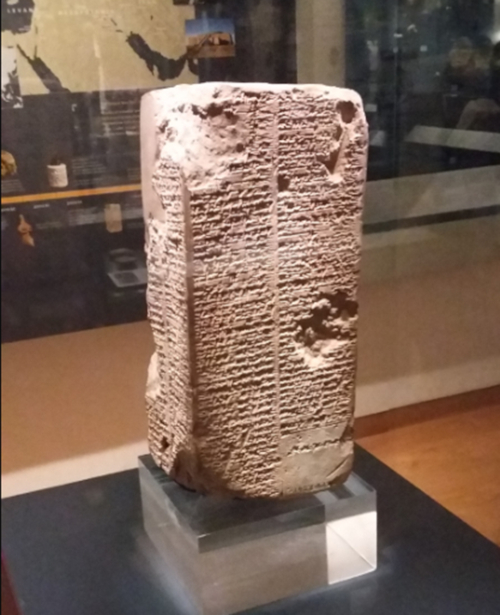
The Sumerian King List stele

The Sumerian King List, an ancient stone prism listing cities in Sumer, their rulers, and the length of their reigns.

(M.atkinsonross / CC BY-SA 4.0)

The collection had sat largely unstudied in the museum's storage rooms for around a century. Thorkild Jacobsen, the first person to earn an Assyriology degree from the University of Copenhagen, donated a significant portion of the holdings in 1939. The application of digital methods and philological work has now enabled researchers to classify a heterogeneous set of documents that include accounting records, letters, medical treatments, and a series of magical spells of enormous historical relevance. The project has made the entire collection publicly available through the Cuneiform Digital Library Initiative, opening it up to scholars worldwide.

Magical Spells and Royal Protection

Beyond the tantalizing evidence of Gilgamesh, the collection revealed a fascinating array of other texts. A significant group of tablets originated from the Syrian city of Hama, which was destroyed and plundered by Assyrian warriors in 720 BC. The Assyrians carried much of the spoils back to their capital, Assur, in present-day Iraq, but left behind some clay tablets in their hurried withdrawal. These texts, nearly 3,000 years old, contain medical treatments and magical spells, and were found among the remains of what archaeologists believe was a large temple library. Arbøll noted that "all the other texts had disappeared," emphasizing the exceptional nature of these surviving fragments, as virtually no other cuneiform tablets on these subjects have been found in the same region from that period.

One text from Hama particularly caught the researchers' attention: an anti-witchcraft ritual designed to ward off misfortunes and political instability that might threaten the Assyrian king. The ceremony took place over an entire night and involved burning small figurines made of wax and clay while an exorcist recited a fixed series of incantations. Researchers were surprised to find this text so far from the Assyrian capital and the rich literary centers of Babylonia, since Hama was located on the periphery of those regions. The presence of such a ritual in Hama underscores the widespread reach of Assyrian magical practices and the deep-seated fears of supernatural threats to royal authority.

Bureaucracy, Beer Receipts, and a Century of Collection

Another group of analyzed texts comes from Danish excavations carried out at Tell Shemshara in northern Iraq in 1957. These tablets consist of correspondence between a local chief and an Assyrian king from around 1800 BC, along with various administrative documents. Such records reflect the highly developed bureaucracy necessary to manage the advanced urban societies of ancient Mesopotamia. As Arbøll recalled, a large number of the cuneiform tablets preserved today testify to this sophisticated administrative culture, which was the very reason for the existence of cuneiform writing in the first place.

Among these administrative texts, researchers found one of the most relatable expressions of ancient daily life: a very ancient beer receipt, confirming that the control of goods and the recording of everyday transactions were already an integral part of life thousands of years ago. The juxtaposition of grand epics featuring Gilgamesh and magical rituals for kings with prosaic beer tabs highlights the diverse and complex nature of Mesopotamian society, captured forever in these enduring clay tablets. The full catalog of cuneiform texts from the National Museum of Denmark has now been published, making these remarkable documents accessible to the world for the first time.

  • Top image: Image portraying a likeness of Gilgamesh, with insert of a cuneiform tablet.
  • Source: AI generated.

By Gary Manners

References

RELATED VIDEOS

The World's First Epic Hero | Gilgamesh's True Story

The Epic of Gilgamesh: The Oldest Story on Earth

The Real History of Gilgamesh | The First Hero Humanity Remembered

{ https://www.ancient-origins.net/news-history-archaeology }

Hoe vind je dit bericht?
Geschreven door peter om 21:28 Stuur door

“What I Saw Was Not Our Technology”: A Navy Officer Breaks the Silence on Mysterious Underwater UFOs

“What I Saw Was Not Our Technology”: A Navy Officer Breaks the Silence on Mysterious Underwater UFOs

From the depths of the ocean, UFOs surface as a Navy officer warns of a threat too real to be ignored.

Written by Ashley Morgan

“what I Saw Was Not Our Technology” A Navy Officer Breaks The Silence On Mysterious Underwater Ufos

© Credit: Shutterstock

An extraordinary new investigation, originally published by Popular Mechanics is drawing fresh attention to a string of unexplained encounters between U.S. Navy personnel and unidentified submerged objects (USOs). These sightings—recorded over decades and across multiple oceans—are now being described by former officers as a legitimate threat and part of a global pattern that defies conventional physics.

Unexplained Encounters During Training Missions

In 2014, Lieutenant Ryan Graves, a U.S. Navy F/A-18 pilot stationed off the coast of Virginia Beach, began to detect anomalies during flight training missions. Initially dismissed as radar glitches, the signals reappeared repeatedly—only this time, they were backed by infrared and optical confirmation.

According to Graves, these unidentified objects could hover completely still or accelerate to supersonic speeds. They were seen across all altitudes, always above or near the ocean. Graves reported seeing a particularly strange object: a black or dark gray cube enclosed in a clear sphere, estimated to be 5 to 15 feet in diameter. It passed within 50 feet of one of the jets. That incident, he later explained, “was the turning point.”

When Graves later spoke with pilots stationed on the USS Nimitz and USS Princeton off the West Coast, he discovered that similar sightings had occurred for years.

Craft That Travel Between Air And Sea

The military has since adopted the term unidentified anomalous phenomena (UAPs) to describe objects like those witnessed by Graves. A growing number of them appear to be transmedium—able to travel from air to sea without slowing down, splashing, or generating turbulence. These transitions contradict what we know about aerodynamics and hydrodynamics.

Rear Admiral Tim Gallaudet, a retired oceanographer and Navy commander, was among the first to review footage of these transmedium encounters, captured in 2015 by jets from the USS Theodore Roosevelt. The craft shown in those videos moved at extraordinary speeds, rotated midair, and left no propulsion trail.

“What I saw was not our technology,” Gallaudet said. “No nation has craft that can move like that.” For him, these phenomena represent a national research priority. He now collaborates with Graves and former Pentagon officials to push for transparency and investigation.

Four Major Incidents Still Unexplained

Several high-profile military encounters continue to raise questions about unidentified submerged objects. In 2004, Navy pilots aboard the USS Nimitz witnessed a Tic Tac–shaped craft that dropped from 80,000 feet to sea level in under one second, with no wings or engines.

  • In 2013, infrared footage from Aguadilla, Puerto Rico captured a spherical object entering the ocean without a splash, resurfacing, then splitting into two before submerging—defying known flight and fluid dynamics.
  • A 1990s incident involved a CH-53 Sea Stallion helicopter crew near Puerto Rico. As they retrieved a drone, a massive dark object rose from below and pulled it back underwater, leaving the pilot stunned.
  • In 2019, the USS Omaha recorded a spherical object hovering over the Pacific before it dropped into the water without any visible splash. A sailor later confirmed similar sightings aboard the USS Jackson in 2023.

This New U.S. Law Could Expose Alien Technology

The volume and consistency of these reports have led to real political action. In 2023, Congress passed the UAP Disclosure Act, mandating federal agencies to catalog, analyze, and disclose data about recovered nonhuman craft and biologics. The legislation marks a shift in how the U.S. treats this topic, acknowledging the possibility of nonhuman intelligence and hinting at secret recovery programs.

Graves and Gallaudet recently briefed Washington officials on the national security implications of USOs. “We’re at a unique moment in history,” Graves said. “People have access to tools that can reveal things. The momentum is building.”

Reflecting on what lies beneath, Gallaudet posed a final theory: “Maybe they lived here for a long time, before we even evolved, and sought safety from the Earth’s atmospheric and geologic cataclysms by creating a habitat or place to live beneath the seafloor… That’s one hypothesis.”


Rear Admiral Tim Gallaudet on Undersea UFOs & USOs – The Navy’s Secret Knowledge..


Nuclear Submarine Captain Reveals UFO Radar Contact 2,000 Feet Below | Tim Gallaudet

{ https://dailygalaxy.com/category/news/ }

Hoe vind je dit bericht?
Geschreven door peter om 20:44 Stuur door

NASA’s Perseverance Detects That 3-Billion-Year-Old Mars Rocks Contain Something Never Seen Before at This Scale

NASA’s Perseverance Detects That 3-Billion-Year-Old Mars Rocks Contain Something Never Seen Before at This Scale

Deep inside rocks formed when water flowed on Mars, researchers have uncovered a surprising clue.


Nasa's Perseverance Detects That 3 Billion Year Old Mars Rocks Contain Something Never Seen Before At This Scale

© Credit: Shutterstock

NASA’s Perseverance rover has spotted unusually high levels of nickel in ancient Mars rocks, pointing to a surprisingly rich chemical environment billions of years ago.

The finding comes from Neretva Vallis and echoes mineral patterns that, on Earth, are sometimes linked to microbial activity. This does not prove that life existed on Mars, but it adds a new piece to a scientific investigation that has been ongoing for years.

Since landing in February 2021, Perseverance has been exploring Jezero crater, a 45-kilometer-wide basin believed to have once held a lake. As reported by Dr. Henry Manelski and his team at Purdue University, the crater shows clear signs of ancient water activity, including river channels and sediment deposits.

The rover eventually reached Neretva Vallis, an old river inlet where sediments dating back about 3 billion years have been preserved.

Record Nickel Levels Found In Martian Bedrock

To analyze the rocks, Perseverance used a mix of laser tools, infrared sensors, and X-ray instruments. Findings published in Nature Communications indicate that nickel showed up in 32 out of 126 rocks analyzed, with concentrations reaching up to 1.1% by weight.

“Generally, nickel is a trace element on the surfaces of Earth and Mars because the vast majority of it migrates into the planets’ cores during their formation. The substantial amount we have detected on the surface places unique constraints on how these rocks formed and were subsequently altered,” explained Henry Manelski.

Nickel Found In Magnesium Sulfate Veins In Jezero Crater Suggests An Authigenic Origin. Nickel found in magnesium-sulfate veins in Jezero crater suggests an authigenic origin. Credit: Manelski & al.

This is the highest nickel level ever measured in Martian bedrock. The element appears alongside iron sulfide minerals and sulfates such as jarosite and akaganeite, which form as these rocks break down over time. He also noted:

“Nickel-rich iron-sulfide is observed on Earth in ancient sedimentary rocks. Iron sulfide weathers easily in oxygen-rich environments, so its presence in ancient terrestrial rocks is one line of evidence used to demonstrate that Earth’s early atmosphere was once very oxygen-poor,” 

Looks Like Earth’s Mineral Formations

Scientists were particularly struck by how these Martian minerals resemble pyrite, a common iron sulfide on Earth. Similar formations on our planet are often associated with microbial processes, especially in low-oxygen environments involving sulfate and iron.

Mineral Veins In Jezero Crater Captured By Perseverance, With Close Ups Of Soap Creek And Seiber Point. Mineral veins in Jezero crater captured by Perseverance, with close-ups of Soap Creek and Seiber Point. Credit: Nature Communications

The same region has also revealed iron sulfides alongside organic carbon compounds. This combination can be linked to biological activity, though it may also result from purely chemical reactions.

“The presence of nickel-rich rocks indicates that, if living organisms had been present on early Mars, nickel may have been available in a form that they could have used.”

An Unresolved Origin

The source of the nickel remains uncertain. Researchers suggest it may come from the breakdown of volcanic rocks or from a nickel-rich meteorite.

“Further research is needed to determine the source of nickel in Neretva Vallis and to investigate possible connections between it and organic matter in this location,” the authors concluded.

Nickel Vs. Iron Levels In Rocks At Dragon Creek (a) With A Close Up Of The Analyzed Surface (b). Nickel vs. iron levels in rocks at Dragon Creek (a) with a close-up of the analyzed surface (b). Credit: Nature Communications

Has NASA Found 3 Billion Year Old Dead Martians Why A Green Crystal Could Be A Biosignature!

What Perseverance Rover Saw Inside Mars' Deepest Crater is Terrifying | Brian Greene

{https://dailygalaxy.com/category/space/ }

Hoe vind je dit bericht?
Geschreven door peter om 20:26 Stuur door

Trump reveals 'very interesting' findings in top secret government UFO files and says they'll be released 'very soon'

Donald Trump made a shocking revelation at a recent speaking event, abruptly announcing that he has instructed Pete Hegseth to release government UFO files. 

The president headlined a Turning Point USA event on Friday at a megachurch in Phoenix, Arizona, where he defended his record in office to a slew of young conservative voters. 

The event is the latest stop in the TPUSA tour across America, where top conservatives are attempting to bolster support for their party among young voters. 

During his remarks, Trump boasted about his Secretary of War, Pete Hegseth, revealing that the Pentagon would soon release documents relating to UFOs and 'unexplained aerial phenomena.' 

'I figured this was a good crowd because you people - you're really into that. I don't know. So I'm pleased to report today, I thought I'd save it for this crowd, because you're a little bit out there, that this process is well underway,' he joked. 

'We found many very interesting documents, I must say. And the first releases will begin very, very soon. So you can go out and see if that phenomena is correct. You'll figure it out. Let me know.' 

The Committee on Oversight and Government Reform's Task Force sent a letter to Hegseth in March, requesting video files related to Unidentified Aerial Phenomena (UAPs) by April 14. 

The letter followed hearings by the House task force in September, where whistleblowers testified that the All-domain Anomaly Resolution Office (AARO), a section of the Department of War, possessed video records of UAPs.

Donald Trump, pictured above speaking at a TPUSA event in Phoenix, revealed that he has directed Secretary of War Pete Hegseth to release UFO files

Donald Trump, pictured above speaking at a TPUSA event in Phoenix, revealed that he has directed Secretary of War Pete Hegseth to release UFO files 

It's unclear what files Trump was referring to in his remarks. Pictured above is a still from a previously released unclassified US government video appearing to show a UAP

It's unclear what files Trump was referring to in his remarks. Pictured above is a still from a previously released unclassified US government video appearing to show a UAP

Defense Secretary Pete Hegseth, pictured above on March 4 at the Pentagon, previously told reporters that his department was 'digging in' to UFO-related files

Defense Secretary Pete Hegseth, pictured above on March 4 at the Pentagon, previously told reporters that his department was 'digging in' to UFO-related files 

'The lack of disclosure regarding the very real threat posed by UAPs in and around US restricted airspace is concerning,' House representatives wrote. 

'The presence of UAPs in and around the sensitive airspaces of US military installations poses a threat to the security of the armed forces and their readiness.'

The letter requested over 45 video files dating back to 2019, including footage of 'cigar-shaped' and 'spherical' UAPs. 

Some clips reportedly captured UAP formations near Iran and Syria, incidents near US bases and airports, and even a 2023 shootdown over Lake Huron. 

Hoe vind je dit bericht?
Geschreven door peter om 17:25 Stuur door

UFOs operating around our planet

UFOs operating around our planet

The video opens with a compilation of various types of unidentified flying objects. Among the strange sightings are cylinder-shaped UFOs and a so-called “Fastwalker,” but the most striking moment features an orange sphere off the coast of Encinitas, California. 
ufos%20are%20here.jpg

The sphere suddenly appears above the ocean’s surface, casting an orange reflection across the water. It moves back and forth in a controlled manner before abruptly diving beneath the surface and vanishing. 
Moments later, it reemerges, only to submerge again. While underwater, its movement is still visible through a series of flashes, until it suddenly bursts back out of the ocean once more. 
This sequence repeats again, until the sphere finally ascends into the sky and disappears over the horizon. 
This brief compilation suggests that a wide variety of advanced technologies, whether man-made or of extraterrestrial origin, may be operating around our planet, often just beyond our understanding.
  

RELATED VIDEOS


BREAKING UFO Sightings WORLDWIDE! Mind Blowing UAP Footage

UFOs Aren’t What You Think | UFO Revelations: Rise of the UAP | Full Documentary

UFOs Confirmed: Latest UFO Footage BREAKING the Internet! Doomsday Event?

{ http://ufosightingshotspot.blogspot.com/ }

Hoe vind je dit bericht?
Geschreven door peter om 16:46 Stuur door

NASA astronaut finds God after returning to Earth: Reid Wiseman breaks down in tears after seeing a cross - as he claims 'it's very hard to fully grasp what we just went through'

He's travelled more than 250,000 miles (402,000km) to the moon and back – but astronaut Reid Wiseman said one of the most emotional experiences of his mission was seeing a cross on his return to Earth.

The Artemis II commander, who says he is 'not religious', was reflecting on his mammoth mission to space during a press conference yesterday.

One reporter asked the crew whether they had experienced any shift in consciousness following their 10–day journey to the dark side of the lunar surface.

Wiseman confirmed he had, referencing a moment that occurred after the team were picked up by the US Navy following their splashdown in the Pacific Ocean.

'I'm not really a religious person but there was no other avenue for me to explain anything or experience anything,' he said.

'So I asked for the chaplain on the Navy ship to just come visit us for a minute. When that man walked in – I'd never met him before in my life – but I saw the cross on his collar and I just broke down in tears.'

Wiseman said it's 'very hard to fully grasp what we just went through' and in the week since the astronauts came back, they have not had time to process their experience.

'It was other–worldly and it was amazing,' he said.

Reid Wiseman described the moment he 'broke down in tears' after seeing a cross on his return to Earth

Reid Wiseman described the moment he 'broke down in tears' after seeing a cross on his return to Earth

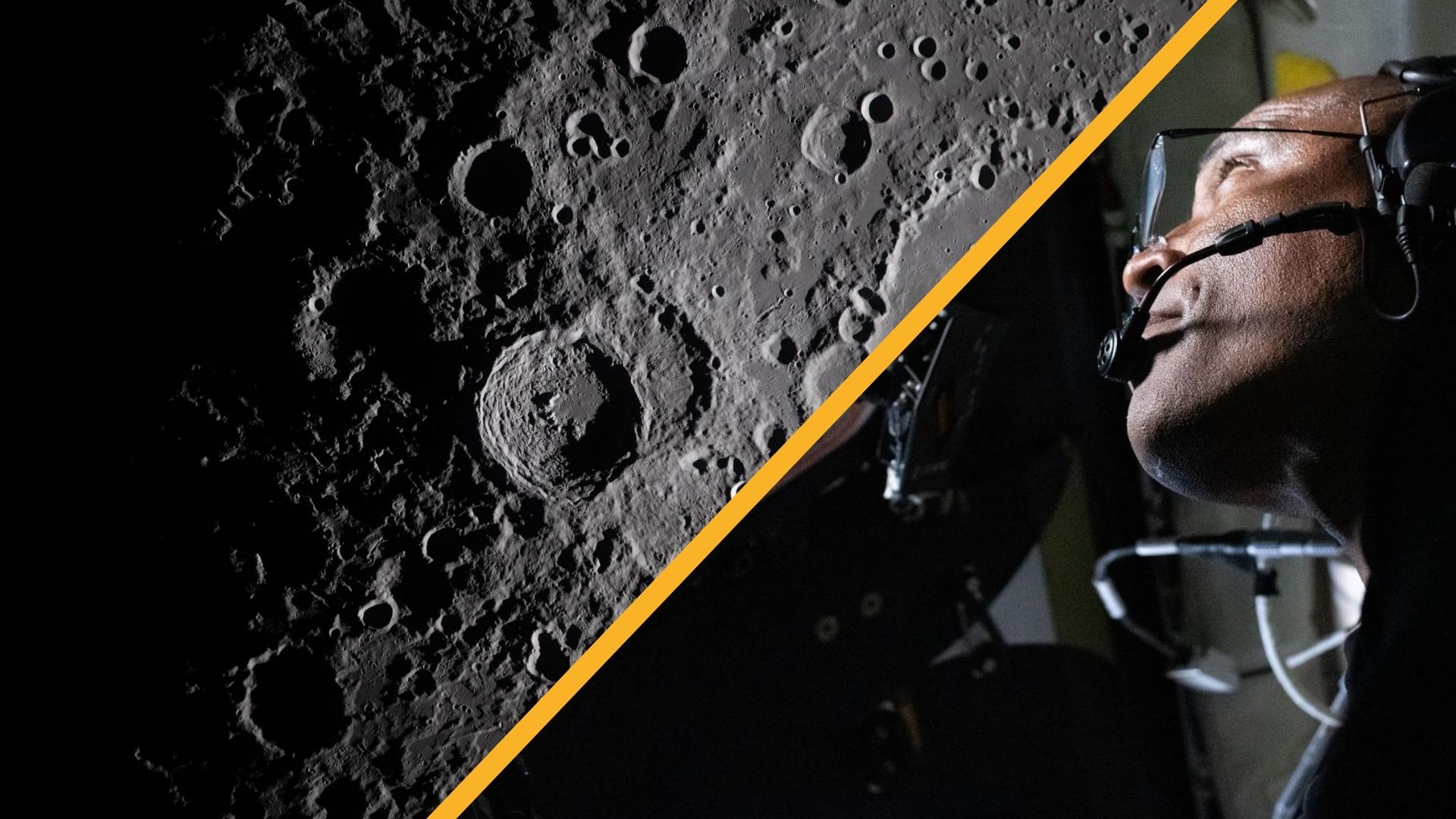
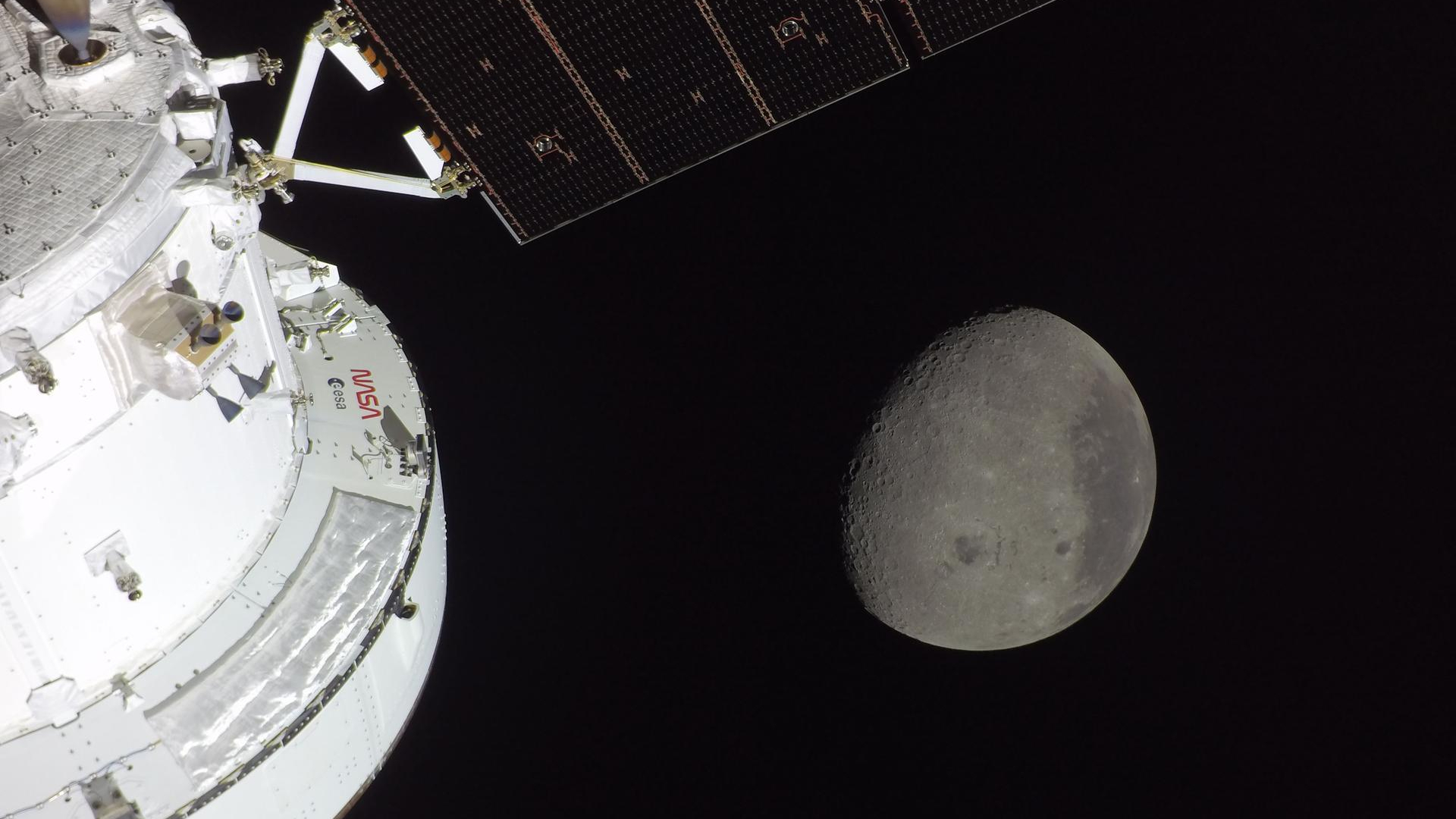
Some of the incredible moments the astronauts witnessed included seeing Earth ¿set¿ over the lunar surface

Some of the incredible moments the astronauts witnessed included seeing Earth 'set' over the lunar surface

Since the Orion spacecraft splashed down last week, the crew have been going through extensive medical and physical testing.

As well as Wiseman, the team consists of pilot Victor Glover and mission specialists Christina Koch and Jeremy Hansen.

They revealed they haven't really had time to properly reflect on their profound feat, which saw them break the record for the farthest humans have ever travelled from Earth.

'We've not had that decompression, we've not had that reflection time,' Wiseman said.

Some of the incredible moments they witnessed included seeing Earth 'set' behind the moon, a rare solar eclipse and observing our home planet suspended in the darkness of space.

'When the sun eclipsed behind the moon, I turned to Victor and said "I don't think humanity has evolved to the point of being able to comprehend what we are looking at right now",' Wiseman said.

Mission specialist Jeremy Hansen said he has been 'trying to find words' to describe the things he saw during the mission.

'But what kept grabbing my attention – when the lighting was right and we were looking out the window – is that I kept seeing this depth to the galaxy,' he said. 'That was mind–blowing for me. The sense I had of fragility and feeling infinitesimally small.'

This photo, titled 'The Artemis II Eclipse', was taken by the crew and shows the moment the moon eclipsed the sun

This photo, titled 'The Artemis II Eclipse', was taken by the crew and shows the moment the moon eclipsed the sun

The cognitive shift that astronauts experience when viewing Earth from space is called the ¿Overview Effect¿

The cognitive shift that astronauts experience when viewing Earth from space is called the 'Overview Effect'

Artemis II crew members: Mission Specialist Christina Koch (L), Mission Specialist Jeremy Hansen (top), Commander Reid Wiseman (R), and Pilot Victor Glover (bottom)

Artemis II crew members: Mission Specialist Christina Koch (L), Mission Specialist Jeremy Hansen (top), Commander Reid Wiseman (R), and Pilot Victor Glover (bottom) 

The 'Overview Effect' explained

This is a cognitive shift reported by astronauts when they see Earth from space.

It often involves a profound sense of awe and a realization of the planet's fragility and interconnectedness. 

Many astronauts describe feeling that national boundaries disappear, replaced by a sense of unity among all people. 

This experience can lead to a deeper commitment to environmental protection and global cooperation. 

Overall, the overview effect highlights how perspective can dramatically change human understanding and values.

The cognitive shift that astronauts experience when viewing Earth from space is called the 'Overview Effect'.

This is characterised by an overwhelming sense of awe, unity and a deeper connection to the planet.

Astronaut Edgar Mitchell became the sixth person to walk on the moon during the Apollo mission in 1971.

After returning to Earth he famously said: 'You develop an instant global consciousness, a people orientation, an intense dissatisfaction with the state of the world, and a compulsion to do something about it.

'From our there on the moon, international politics looks so petty.'

Despite the profoundness of their mission, astronaut Christina Koch revealed the team have been 'sleeping great' since they got back.

But she said: 'Every time I woke up during the first few days I thought I was floating. I truly thought I was floating and I had to convince myself I wasn't.'

She explained that she even let go of a shirt in the air, expecting it to float in front of her. 'It actually surprised me [when it dropped],' she said.

Wiseman also revealed a smoke detector went off on the second–to–last day of the mission, when the team were still 80,000 miles (129,000km) from home.

article image

'It was tense for a few minutes until we got things reconfigured,' he said.

When asked about the Orion capsule, where the crew spent the entirety of the mission, he said: 'There are always things we need to improve – there are ways we need to do better living in space and ways this machine needs to be improved.

'But in my own personal opinion, they could put the Artemis III Orion on the space launch system tomorrow and launch it, and the crew would be in great shape.'

The next Artemis mission will see astronauts test commercial lunar landers in Earth's orbit before the next big step – returning a crew to the surface of the moon by 2028.

Artemis II: Key facts

Launch date: April 1

Mission objective: To complete a lunar flyby, passing the 'dark side' of the moon and test systems for a future lunar landing.

Total distance to travel: 620,000 miles (one million km)

Mission duration: 10 days 

Estimated total cost: $44billion (£32.5billion)

* NASA Space Launch System rocket: $23.8billion (£17.6billion)

* Orion deep–space spacecraft: $20.4billion (£15billion)

Crew: 

+ BCommander Reid Wiseman

+ Pilot Victor Glover

+ Mission Specialist Christina Koch

+ Mission Specialist Jeremy Hansen

Mission Stages:

1. Launch from Kennedy Space Centre Launch Pad 39B

2. Manoeuvre in orbit to raise the perigee using the Cryogenic Propulsion Stage

3.Burn to raise apogee using the Cryogenic Propulsion Stage

4. Detach from Cryogenic Propulsion Stage and perform translunar injection

5. Fly to the moon over four days

6. Complete lunar flyby at a maximum altitude of 5,523 miles (8,889 km) above the moon's surface

7. Return to Earth over four days

8. Separate the crew module from the European Service Module and the crew module adapter

9. Splashdown in the Pacific Ocean  

RELATED VIDEOS

NASA's Reid Wiseman says being 250,000 miles away from earth feels 'majestic'

NASA Astronaut Reveals EVERYTHING | This Is What Really Happened on Artemis II

{ https://www.dailymail.co.uk/sciencetech/index.html }

Hoe vind je dit bericht?
Geschreven door peter om 16:16 Stuur door

White House directs FBI to investigate disappearance of missing scientists

The White House has vowed to leave 'no stone unturned' in its effort to uncover the truth behind the string of missing scientists. 

Press secretary Karoline Leavitt announced Friday on X that President Donald Trump has brought the FBI into the investigation.

'In light of the recent and legitimate questions about these troubling cases, and President Trump’s commitment to the truth, the White House is actively working with all relevant agencies and the FBI to holistically review all of the cases together and identify any potential commonalities that may exist,' Leavitt said.

Several scientists with ties to NASA, nuclear research, aerospace programs and classified projects have vanished or turned up dead in recent years. 

Many of the individuals, including researchers from NASA's Jet Propulsion Laboratory and Los Alamos National Laboratory, had access to sensitive information on space missions, nuclear technology or advanced defense systems, prompting speculation about possible connections. 

On Thursday, Trump revealed he had been briefed on the mysterious cases that have now reached 11.

The President addressed the alarming situation after landing at the White House on Thursday, where he was met by reporters and questioned by FOX News about whether the disappearances and deaths were random or potentially connected.

'Well, I hope it is random, but we are going to know in the next week and a half,' Trump said. 'I just left a meeting on that subject, so pretty serious stuff. Hopefully, coincidence... but some of them were very important people, and we are going to look at it.'

Retired Air Force General William Neil McCasland, 68, vanished from his New Mexico home without his phone, wearable devices or glasses on February 28

Retired Air Force General William Neil McCasland, 68, vanished from his New Mexico home without his phone, wearable devices or glasses on February 28

The President's statements followed a Wednesday briefing at the White House, where Leavitt was also asked about those linked to space or nuclear secrets who have mysteriously died or vanished without a trace.

'I haven't spoken to our relevant agencies about it. I will certainly do that and will get you an answer,' said Leavitt.

'If true, of course, that's definitely something I think this government and administration would deem worth looking into. So let me do that for you,' Leavitt continued.

This disturbing pattern emerged after retired Air Force General William Neil McCasland vanished on February 28.

He was last seen leaving his New Mexico home without his phone, wearable devices or glasses less than two months ago. He was only carrying a pistol and his wife told 911 dispatchers that it appeared he was trying 'not to be found.'

The strange circumstances surrounding the general's disappearance were almost identical to four other missing person cases taking place between May and August 2025 in the Southwest.

Concerningly, all four have been tied to McCasland through his work overseeing the Air Force Research Lab (AFRL), based at Wright-Patterson Air Force Base, which has been rumored to study extraterrestrial technology since the 1947 Roswell UFO crash.

While at Wright-Patterson, McCasland oversaw and reportedly approved the funding for scientist Monica Jacinto Reza's work on a space-age metal for rocket engines called Mondaloy.

Steven Garcia was last seen on August 28 last year. A source has revealed to the Daily Mail that he worked as a government contractor at a key nuclear weapons facility

Steven Garcia was last seen on August 28 last year. A source has revealed to the Daily Mail that he worked as a government contractor at a key nuclear weapons facility

Monica Jacinto Reza, 60, was last seen hiking in the rugged San Gabriel Wilderness area within the Angeles National Forest on the trail to Waterman Mountain summit on June 22 last year

Monica Jacinto Reza, 60, was last seen hiking in the rugged San Gabriel Wilderness area within the Angeles National Forest on the trail to Waterman Mountain summit on June 22 last year

Reza, 60, disappeared while hiking with friends in California on June 22 last year. She had just become the director of the Materials Processing Group at NASA's Jet Propulsion Laboratory.

The three other disappearances all involved workers at some of America's most important nuclear facilities, and all three were last seen walking out of their homes without their phones or keys, just like McCasland.

Steven Garcia, 48, vanished without a trace on August 28 last year. He was last seen leaving his Albuquerque, New Mexico, home on foot, carrying only a handgun. 

An anonymous source told the Daily Mail that Garcia was a government contractor working for the Kansas City National Security Campus (KCNSC), a major facility in Albuquerque that manufactures more than 80 percent of all the non-nuclear components that go into building the military's nuclear weapons.

Anthony Chavez and Melissa Casias both worked at the Los Alamos National Laboratory (LANL), one of the nation's most important nuclear research sites.

Chavez, 79, worked at the lab until his retirement in 2017, although his role there has not been made clear. Casias, 54, was an active administrative assistant at the facility and is believed to have had top security clearance.

Anthony Chavez was an employee at the Los Alamos National Laboratory until 2017. He disappeared without a trace in May last yearMelissa Casias worked at the Los Alamos National Laboratory, a nuclear research facility with ties to Kirtland Air Force Base, where General McCasland was previously stationed

Anthony Chavez (left) and Melissa Casias were both employees at the Los Alamos National Laboratory. Both disappeared within weeks of each other last year
Amy Eskridge was a scientist researching anti-gravity technology before her death in 2022 at age 34

Amy Eskridge was a scientist researching anti-gravity technology before her death in 2022 at age 34

article image

All three were last seen leaving their homes in New Mexico on foot, leaving behind their cars, keys, wallets and phones before disappearing without a trace. Police have not had any updates in the cases since last year.

In addition to the string of disappearances, five scientists in key areas of research have died over the last few years.

Amy Eskridge was just 34 years old when she allegedly died from a self-inflicted gunshot to the head in Huntsville, Alabama, on June 11, 2022. However, neither the police nor the medical examiners have publicly released any details of an investigation ever taking place.

Before her death, she was openly researching and trying to develop anti-gravity technology, a way to control or cancel out gravity, which could revolutionize space travel and energy production.

Nuclear physicist Nuno Loureiro and astrophysicist Carl Grillmair were both shot to death in their homes in recent months. 

Independent investigators have noted that Loureiro's revolutionary work in nuclear fusion may have made him a target of a greater conspiracy against US scientists, as his work may one day upend the energy industry. 

Last year, Claudio Neves Valente was identified by Boston authorities as a suspect in the shooting of Loureiro, as well as two Brown University students, Mukhammad Aziz Umurzokov and Ella Cook. 

After eluding police for days, Valente, 48, died by suicide in a storage unit in Salem, New Hampshire, on December 16.

Nuno Loureiro was leading efforts to create fusion energy, a form of clean energy that could upend the multi-trillion-dollar fossil fuel industryCarl Grillmair was killed by a gunshot wound while on his front porch. The scientist had been studying exoplanets and dark matter at the California Institute of Technology

Scientists Nuno Loureiro (left) and Carl Grillmair were both murdered in their own homes after making significant progress in the fields of nuclear fusion and astrophysics
Jason Thomas was found dead after being pulled from a Massachusetts lake on March 17. He had been missing since December 12

Jason Thomas was found dead after being pulled from a Massachusetts lake on March 17. He had been missing since December 12

Grillmair's work with NASA's NEOWISE and NEO Surveyor has also been linked to the Air Force, as the telescopes used the same systems the military relies on to track satellites and missiles.

Meanwhile, NASA scientists Michael David Hicks and Frank Maiwald, who also worked at the Jet Propulsion Lab, died from unknown circumstances at an early age.

Maiwald, 61, was the lead researcher on a breakthrough that could help future space missions detect clear signs of life on other worlds just 13 months before he died in 2024.

Hicks, whose death came just a year after leaving JPL at age 59, had been involved with the DART Project, NASA’s test to see if humans could deflect dangerous asteroids away from Earth.

NASA's JPL has not commented on the deaths of Maiwald or Hicks, and did not reply to the Daily Mail's inquiries into the nature of the scientists' work before their deaths.

In another mysterious incident, Jason Thomas, a pharmaceutical researcher testing cancer treatments at Novartis, was found dead in a Massachusetts lake on March 17, after disappearing without a trace in December. Local police have claimed there was no foul play suspected.

RELATED VIDEOS

FBI called on to investigate scientists' 'suspicious' deaths, disappearances

11th scientist death emerges in string of missing, dead officials with access to US secrets

10 US Scientists Go Missing: White House Vows To Find Truth | GRAVITAS Highlights

US Investigating the Mysterious Deaths & Disappearances, Trump Calls the Situation Very Serious

Hoe vind je dit bericht?
Geschreven door peter om 15:44 Stuur door

UFO cluster spotted over mysterious base tied to missing Air Force scientist

A massive cluster of unknown flying objects was spotted near Wright-Patterson Air Force Base, a military installation long rumored to be linked to UFO activity.

Witnesses near the Ohio base captured the craft on April 8, showing a silent triangle of glowing lights moving in perfect formation before splitting apart mid-flight.

The lights appeared to drift slowly downward, flickering, pulsing and changing brightness individually as they hovered in the night sky.

Reports described the sighting as having 'no sound, no standard navigation lights, movement unlike any known aircraft, drone swarm or satellite.'

The video was reportedly taken from Rainbow Lakes, a 60-acre outdoor recreational retreat in Fairborn, about four miles from the base.

Wright-Patterson Air Force Base (WPAFB) has drawn renewed attention in recent months, as its research laboratory was previously led by retired Major General William Neil McCasland, who disappeared earlier this year.

McCasland, 68, went missing from his New Mexico home on February 28, reportedly leaving with only hiking boots and a .38-caliber revolver.

He led the Air Force Research Laboratory from May 2011 until his retirement in 2013, a facility long associated in UFO lore with alleged materials recovered after the 1947 Roswell incident.

A massive cluster of unknown flying objects was spotted near Wright-Patterson Air Force Base, a military installation long rumored to be linked to UFO activity

A massive cluster of unknown flying objects was spotted near Wright-Patterson Air Force Base, a military installation long rumored to be linked to UFO activity

WPAFB leads development in aerospace technology, advanced materials, sensors, human performance and AI.

The Daily Mail has contacted WPAFB for comment on the video.

The clip has flooded social media, where users are debating whether the lights are extraterrestrials or parachutists with flares.

One user on X claimed the lights were 'non-human intelligent orbs,' while another user on Reddit shared: 'This is exactly what it looks like when parachuters have flares attached as they’re falling.'

'I agree that is what this looks like. A free-fall team, whether it be military or civilian, gets into their final descent stack after their chutes have already deployed,' a Redditor shared.

'My issue with this is that the cloud ceiling is super low. If this is a training jump, this low a ceiling would cause it to get pushed or canceled. 

'Obviously, it is hard to get an ideal grasp on everything since the video is short and in low light. That said, it looks like we lose visual on the flares intermittently as they pass through the clouds.'

Another Redditor joked, saying, 'They’re coming for more scientists,' likely referring to McCasland, who managed the Air Force's $2.2 billion science and technology program along with additional customer-funded research.

William Neil McCasland, 68, led a laboratory at Wright-Patterson Air Force Base that has long been associated with UFO lore

William Neil McCasland, 68, led a laboratory at Wright-Patterson Air Force Base that has long been associated with UFO lore

The lights appeared to drift slowly downward, flickering, pulsing and changing brightness individually as they hovered in the night sky

The lights appeared to drift slowly downward, flickering, pulsing and changing brightness individually as they hovered in the night sky

The retired general is said to have left his home on foot in February, but authorities have yet to locate any clues for his whereabouts. 

Because several of his personal items were left behind, investigators are trying to determine whether he left voluntarily or encountered trouble shortly after leaving his home. 

A 911 call, capturing a police dispatcher speaking with his wife, Susan Wilkerson, was released earlier this month, in which she can be heard saying that her husband 'had planned not to be found.'

'He's left his phone. He changed his clothes into... I don't know what. I think he's on foot. All of our cars and bicycles are in the garage,' Wilkerson said approximately three hours after McCasland disappeared.

'He turned it off and left it behind, which seems kind of deliberate because he's always got his phone. He has a smartwatch. I don't know if that's with him or not,' Wilkerson continued in audio obtained by the Law&Crime Network.

The clip has flooded social media, where users are debating whether the lights are extraterrestrials or parachuters with flares

The clip has flooded social media, where users are debating whether the lights are extraterrestrials or parachuters with flares

article image

McCasland did not take any of his wearable devices or prescription glasses, leaving without any way to trace him. 

His name became associated with UFO topics after the 2016 WikiLeaks release of emails from John Podesta, Hillary Clinton's campaign chairman.

In the emails, musician Tom DeLonge, founder of Blink-182 and the UFO-focused To The Stars Academy (TTSA), referenced McCasland multiple times, claiming he had advised him on disclosure matters and helped assemble an advisory team.

DeLonge also suggested on a podcast that he was being advised by McCasland and several named and unnamed insiders to carry out a slow disclosure of UAP information to the American public from US government or contractor sources.

He claimed that the US government and contractor groups already possess free energy technology, sometimes referred to as zero-point energy, that could make conventional energy sources obsolete, stating: 'One inch of air could power the US for hundreds of years.'

DeLonge suggested that TTSA was being restrained from releasing all the information government insiders had provided, but that the organization sought investment from private sources to develop this technology for energy and aerospace purposes.

He further stated that TTSA expected to create a working anti-gravity craft, and the company's SEC filing noted that its aerospace division is 'dedicated to finding revolutionary breakthroughs in propulsion, energy and communications.'

An email tied McCasland to Wright-Patterson, alleging he oversaw the lab where Roswell materials were supposedly sent and scheduling emails showed a planned meeting with DeLonge, Podesta, and someone signing as 'Neil McC,' consistent with McCasland.

These claims come from DeLonge and have not been confirmed by McCasland or official records.

There is no public evidence that he participated in UFO crash retrievals, reverse-engineering of non-human technology, or classified extraterrestrial programs.

His documented work focused on advanced aerospace research, which has fueled speculation about experimental propulsion and unidentified phenomena in defense circles.

RELATED VIDEOS

UFO orbs over U.S military base connected to missing alien research scientists 2026

Massive UFO Spotted Near Military Bases? BOMBSHELL FOOTAGE!

The Mystery Of The Missing UFO Scientists | Vantage on Firstpost | 4K

{ https://www.dailymail.co.uk/sciencetech/index.html }

Hoe vind je dit bericht?
Geschreven door peter om 15:05 Stuur door

Trump's UFO disclosure takes step forward as world waits with bated breath

Trump's UFO disclosure takes step forward as world waits with bated breath

President Donald Trump's UFO disclosure appears to be moving forward after a government-linked website believed to be tied to transparency suddenly showed signs of activity. 

The federal domain aliens.gov, which previously appeared inactive, is now returning an SSL error, a technical signal that the address may be connected to a live server but is not yet fully configured for public access.

An SSL error typically occurs when a server has been set up, but the digital certificate required to establish a secure connection has not been obtained. 

This usually means the domain is no longer dormant and may be undergoing development, even if no visible content has been published.

Cybersecurity experts note that such changes are common during routine website setup and do not necessarily indicate that a public platform is about to launch. 

Government agencies frequently register and configure domains months or even years before unveiling new websites, often using them first for internal testing, staging environments, or placeholder systems.

The step forward comes nearly one month after the domain, linked to the Executive Office of the President, was flagged by an automated tracker of federal websites.

The website appeared to align with Trump's February order to release files related to UFOs, also known as UAPs, and potential extraterrestrial activity.

President Donald Trump's UFO disclosure appears to be moving forward after a government-linked website believed to be tied to transparency suddenly showed signs of activity

President Donald Trump's UFO disclosure appears to be moving forward after a government-linked website believed to be tied to transparency suddenly showed signs of activity

While the website appears to be moving forward, cybersecurity experts note that such changes are common during routine website setup and do not necessarily indicate that a public platform is about to launch.

Government agencies frequently register and configure domains months or even years before unveiling new websites, often using them first for internal testing, staging environments, or placeholder systems.

However, the timing of the change has fueled speculation online, particularly as pressure mounts in Washington to release additional records related to unidentified aerial phenomena (UAP). 

Lawmakers and defense officials have in recent months renewed calls for greater transparency surrounding decades of classified material tied to unexplained aerial sightings.

Trump has gone quiet about his plans to release government files related to UFOs and extraterrestrial life. However, the war with Iran began shortly after he announced it in February. But other government officials have not forgotten.

Republican Rep. Anna Paulina Luna penned a letter to the US Secretary of Defense on April 1, ordering Pete Hegseth to deliver 46 specific clips no later than April 14, 2026.

Lawmakers said the videos could reveal patterns of activity near sensitive military sites and help determine whether the objects pose a potential national security threat.

The requested footage includes dozens of military-recorded encounters showing spherical, cigar-shaped and Tic Tac-like objects spotted over war zones, oceans and sensitive airspace around the world.

Domain information for aliens.gov, showing its status, nameservers, and registration dates.

The federal domain aliens.gov, which previously appeared inactive, is now returning an SSL error, a technical signal that the address may be connected to a live server but is not yet fully configured for public access

Some clips reportedly captured UAP formations near Iran and Syria, incidents near US bases and airports and even a 2023 shootdown over Lake Huron.

The threats extend beyond mysterious sightings, highlighting the danger unidentified objects pose when they appear near restricted airspace, military bases and active training zones.

Luna, however, said Tuesday afternoon on X that 'no one from the Pentagon had responded until we reached out, and it appears that someone did not pass the letter to the appropriate authorities.'

'How convenient,' the Florida representative added, noting that while she considers Hegseth a friend and supporter of President Donald Trump, 'the president has authorized the release, so whoever is trying to be cute at the Pentagon can take a hike.'

RELATED VIDEOS

NEW BURCHETT says its time for UFO disclosure and the stuff he has seen is WILD.

Rep. Tim Burchett on UFO disclosure: 'America is just ready'

Congressman Burchett: UFO Files Would Keep You Up at Night

{ https://www.dailymail.co.uk/sciencetech/index.html }

Hoe vind je dit bericht?
Geschreven door peter om 23:44 Stuur door

The longest-living people in the Bible

The longest-living people in the Bible

The longest-living people in the Bible

©Getty Images

The longest-living people in the Bible
How old is old? Say 70 years, 80 years, 90 years? Well, there are some figures in the Bible who lived to be nearly 1,000 years old! Most of the oldest people are from the Book of Genesis, in the Hebrew Bible and the Christian Old Testament. These biblical seniors include men and women, individuals whose lifespans average hundreds of years. So, just who are these pious pensioners, and how long did they live?

READ  through and start counting down the years.

Joshua

©Getty Images

Joshua
Joshua, Moses' assistant in the books of Exodus and Numbers, lived to 110 in the Bible.

Joseph

©Public Domain

Joseph
Joseph, the first son of Jacob and Rachel, was an important figure in the Hebrew Bible's Book of Genesis and in the Quran. He too was 110 when he died.

Moses

©Getty Images

Moses
According to both the Bible and the Quran, Moses was the leader of the Israelites: He is one of the most important prophets in Christianity and Islam, and died aged 120.

Rebekah

©Getty Images

Rebekah
Rebekah appears in the Hebrew Bible as the wife of Isaac and the mother of Jacob and Esau. She was at least 120 years old when she passed away.

Aaron

©Getty Images

Aaron
The prophet Aaron, elder brother of Moses, also appears in the Hebrew Bible, as well as in the New Testament and the Quran. He lived to 123.

Miriam

©Getty Images

Miriam
Aged at least 125 years old when she died, Miriam is described in the Hebrew Bible as the daughter of Amram and Jochebed, and the older sister of Moses and Aaron.

Sarah

©Public Domain

Sarah
Sarah, a biblical matriarch and prophetess identified in Judaism, Christianity, and Islam, was 127 years old when she died.

Jehoiada

©Getty Images

Jehoiada
Described in the Hebrew Bible as a prominent priest in the kingdom of Judah, Jehoiada passed away at 130 years old.

Laban

©Getty Images

Laban
Laban is a figure in the Book of Genesis of the Hebrew Bible. He was the brother of Rebekah, the woman who married Isaac and bore Jacob. Laban was said to be at least 130 years old when he died.

Levi

©Getty Images

Levi
According to the Book of Genesis, Levi was the third of the six sons of Jacob and Leah (Jacob's third son), and the founder of the Israelite Tribe of Levi. He lived until 137.

Ishmael

©Public Domain

Ishmael
Also according to the Book of Genesis account, Ishmael, the first son of Abraham, was 137 when he died. He's depicted here as a youngster hunting.

Esau

©Getty Images

Esau
Esau, seen here with Jacob, is the elder son of Isaac in the Hebrew Bible. He's mentioned in the Book of Genesis. Esau likely lived to 147.

Jacob

©Getty Images

Jacob
Jacob, later given the name Israel, is regarded as a patriarch of the Israelites. Jacob died at the age of 147.

Nahor, son of Serug

©Getty Images

Nahor, son of Serug
Nahor is the son of Serug, according to the Hebrew Bible. He is said to have lived to the age of 148 years old.

Abraham

©Public Domain

Abraham
The story of the life of Abraham, who lived to 175 years old, is told in the narrative of the Book of Genesis in the Hebrew Bible.

Isaac

©Getty Images

Isaac
According to the narratives in the Abrahamic religions, Isaac, one of the three patriarchs of the Israelites, died aged 180.

Terah, son of Nahor

©Getty Images

Terah, son of Nahor
The biblical figure in the Book of Genesis known as Terah lived an impressive 205 years. He is the son of Nahor.

Job

©Public Domain

Job
Job is the central figure of the Book of Job in the Bible. He is said to have lived at least to 210 years old.

Serug

©Getty Images

Serug
According to the Book of Genesis, Serug is the son of Reu and the father of Nahor. He's also the great-grandfather of Abraham. He died at 230 years old.

Enoch

©Getty Images

Enoch
A biblical figure and patriarch prior to Noah's flood, and the son of Jared and father of Methuselah, Enoch lived 365 years before he was taken by God, according to the Book of Genesis.

Eber

©Getty Images

Eber
Eber is an ancestor of the Ishmaelites and the Israelites according to the Table of Nations in the Book of Genesis and the Books of Chronicles. The Hebrew Bible records Eber dying at age 464.

Shem

©Getty Images

Shem
Shem was one of the sons of Noah in the Bible. Genesis 11:10 records that Shem was 600 years old when he died.

Lamech

©Public Domain

Lamech
According to the Masoretic Text in the Hebrew Bible, Lamech, the father of Noah, attained an age at death of 777.

Mahalalel

©Getty Images

Mahalalel
The grandfather of Enoch and subsequently the ancestor of Noah, Mahalalel reached the age of 895 before he died.

Enos

©Getty Images

Enos
Enos is mentioned in the Book of Genesis in the Hebrew Bible. He is one of just a few that lived beyond 900 years, his death occurring at age 905. Enos is one of the many figures depicted on Lyon Cathedral's astonishing stained glass windows.

Seth Bible

©Getty Images

Seth
Seth is the third son of Adam and Eve. According to the Hebrew Bible, he had two brothers: Cain and Abel. Seth outlived both his siblings, reaching 912 years old.

Adam

©Getty Images

Adam
Adam, meanwhile, is said to have lived to 930 years old.

Noah

©Getty Images

Noah
Noah's story appears in the Hebrew Bible and is referenced in various other books of the Bible, including the New Testament. Passing away at age 950, he is the third oldest person in the Bible.

Jared

©Getty Images

Jared
Jared is mentioned in the Book of Genesis as a sixth-generation descendant of Adam and Eve. He died aged 962, the second oldest figure in the Bible.

Methuselah

©Getty Images

Methuselah
At 969 years old, the biblical patriarch Methuselah has the longest lifespan of all those given in the Bible.

Sources:

  • (Bible Study Tools)
  • (Statista)
  • (Adventist Record)


SHOCKING: The Real Reason People Lived So Long in the Old Testament

Why Did They Live Up to 900 Years? The Bible Reveals the Forgotten Mystery!

{ https://www.starsinsider.com }

Hoe vind je dit bericht?
Geschreven door peter om 22:32 Stuur door

Steven Spielberg says 'Disclosure Day' is closer to truth than fiction

Steven Spielberg says 'Disclosure Day' is closer to truth than fiction

James Powel - USA TODAY


Steven Spielberg’s Disclosure Day Looks Bigger Than an Alien Invasion

LAS VEGAS – Director Steven Spielberg confirmed that aliens are the subject of his upcoming film "Disclosure Day" and debuted new footage during the Universal Studios presentation at CinemaCon in Las Vegas on April 15.

"I’ve been curious ever since I was a little kid about what’s happening in the night sky," he told the audience, saying that the possibility of extraterrestrial life sparks his creativity.

Spielberg's return to the summer blockbuster appears to follow Josh O'Connor's character, Daniel Kelner, fighting to reveal the existence of extra-terrestrial life along with Emily Blunt and Colman Domingo. Connor and Blunt appear to play characters that are possessed by aliens. Colin Firth appears to lead a shadowy government entity tasked with keeping the existence of aliens secret.

The "Jaws" filmmaker said the film was "way closer to truth than to fiction."

He pointed to a 2017 New York Times report on the existence of the Advanced Aerospace Threat Identification Program for the return to the subject he's explored in "E.T. the Extra-Terrestrial" and "Close Encounters of the Third Kind" saying that it made him curious again.

89634894007-afp-2270986767.jpg?width=2560

Filmmaker Steven Spielberg arrives on stage during Universal Pictures and Focus Features presentation at CinemaCon at The Colosseum at Caesars Palace in Las Vegas, Nev. … Show more   
VALERIE MACON, AFP via Getty Images

Christopher Nolan Talks The Odyssey - CinemaCon 2026

"I truly believe that this movie is going to answer questions and cause you to ask a lot of questions," Spielberg said.

The multi-Oscar award winner said that he has been highly protective of the film's third act due to younger audiences using marketing materials to anticipate plot points in upcoming films.

"All you need to get from the beginning to the end is a seatbelt," he said.

Domingo, who introduced and interviewed Spielberg, announced that film titan won the Motion Picture Association's' America 250 award.

"Steven Spielberg defines what Americans think when they think of movies," MPA Chairman Charles Rivkin said when he presented the award.

In his acceptance speech, the Oscar-winner recounted the story of him falling in love with film and showing movies for charity in his childhood home in Phoenix and making money by "charging 12-cents for popcorn."

89651604007-gty-2271693312.jpg?crop=4531,3394,x230,y0

"Nothing could compete with sitting in the first three rows of a movie palace (and) watching a Cecil B. DeMille epic with color by Technicolor," Spielberg said.

He called for studios to expand the exclusive theater window for films and rely less on already produced intellectual property. "If all we make is known branded IP we're going to run out of gas and we're going to run out of gas very quickly," he added.

RELATED VIDEOS

Steven Spielberg shows the ALIEN in fresh 'Disclosure Day' CinemaCon footage - Psicoactivo #964

Spielberg's Disclosure Day - Need To Know (December 2025)

{ https://eu.usatoday.com/entertainment/ }

Hoe vind je dit bericht?
Geschreven door peter om 21:28 Stuur door

Methane emerges from interstellar comet 3I/ATLAS as it exits the solar system

Methane emerges from interstellar comet 3I/ATLAS as it exits the solar system

These observations by NASA's SPHEREx show the infrared light emitted by the dust, water, organic molecules, and carbon dioxide contained within comet 3I/ATLAS's coma during the mission's December 2025 campaign. Credit: NASA/JPL-Caltech

Interstellar comet 3I/ATLAS is now on its way out of our solar system, never to return. The comet was only the third-ever detected object to originate from outside our solar system. Traveling at high speeds, it looped around the sun within 1.5 AU (one AU, or astronomical unit, is the distance between Earth and the sun) in October 2025; as of April, it is now past the orbit of Jupiter on its way out of the solar system.

3I/ATLAS is over a kilometer wide and is made up of dust and ices from the far-off planetary system where it originated. Using the advanced instrumentation of the James Webb Space Telescope (JWST), Caltech researchers examined the mid-infrared signatures (wavelengths of light 10 times longer than those humans see) that emitted from 3I/ATLAS as it approached the sun in an effort to understand the distant environment in which the comet formed. The paper is published in The Astrophysical Journal Letters.

"It's a very interesting object," says Caltech graduate student Matthew Belyakov, lead author on the new paper. "It has been traveling through the galaxy for at least a billion years. The high speed at which it flew past us gave just a narrow window to study it."

During our own solar system's formation, countless planetesimals—small clumps of rock and ice—coalesced together to build up Earth and other planets. 3I/ATLAS is an example of a planetesimal from another planetary system, and, as such, it contains different ratios and compositions of chemical compounds than the objects in our own. Instruments on JWST can detect and map many of these compounds coming off the comet and give an indication of where it formed in its own native system.

Interstellar comet shows methane in solar journey

Top: median-stacked images derived from the fully calibrated Channel 2 data cubes for the six successful JWST/MIRI observations of 3I. A logarithmic stretch has been applied to accentuate the extended dust coma. The sunward and target velocity directions are indicated. The panels are labeled with the corresponding date and spectral grating setting. The first three observations suffered from poor pointing, due to an uncertain ephemeris. There is low-level striping due to numerical artifacts from the IFU data-cube building process. Bottom: spectra of 3I extracted using a 1″ diameter circular aperture. Observations 2, 4, and 6 (blue) are combined into a single spectrum, by normalizing individual segments to align across their overlapping wavelengths. The spectra from Observations 13 and 15 (orange) are unaltered, illustrating the significant decrease in flux as the comet passed from a heliocentric distance of 2.20 to 2.54 au. The main H2O, CO2, CH4, and Ni fluorescence features are marked. The inset panel provides a zoomed-in view of the CO2 primary and hot bands. Credit: The Astrophysical Journal Letters (2026). DOI: 10.3847/2041-8213/ae5700

Two other interstellar objects previously visited our solar system: The first, designated 1I and known as "Oumuamua, did not exhibit comet-like activity when it was discovered in 2017; the second, 2I/Borisov, found in 2019, was relatively faint. In contrast, 3I/ATLAS is a very bright comet, making it a prime target to analyze with the sophisticated instrumentation on JWST.

The comet's surface has been irradiated by cosmic rays on its long journey, and so its most volatile surface ices—such as methane—were only weakly outgassing as it approached Earth. However, as 3I/ATLAS was leaving our solar system in December, Belyakov's JWST analysis showed that the comet began increasingly emitting methane as it was warmed by our sun. This change indicated that 3I/ATLAS had shed its ancient outer surface and began to melt its inner icy layers—which means that observations taken of 3I after its close approach reveal the underlying composition of this unique object, not just the chemistry of its topmost irradiated layers.

"JWST is going to look at 3I/ATLAS one more time this spring," Belyakov says. "It's already getting tough to observe; it's now out by Jupiter."

The team also observed the dust composition of 3I/ATLAS, to be reported in a forthcoming paper.

Publication details
  • Matthew Belyakov et al, The Volatile Inventory of 3I/ATLAS as Seen with JWST/MIRI, The Astrophysical Journal Letters (2026). DOI: 10.3847/2041-8213/ae5700

Journal information: 

RELATED VIDEOS

Something From Outside Our Solar System Just Flew Past The Sun — 3I Atlas Explained

A huge object from deep space has suddenly appeared – and is heading towards 3I/ATLAS.

China Finally SHOWS First Real Image of 3I/ATLAS — And NASA Can’t Explain What It Is!

The Lost Science of 3I Atlas | A Quiet Documentary !!
Hoe vind je dit bericht?
Geschreven door peter om 20:56 Stuur door

The dreams that indicate you're about to DIE: Terminally ill people reveal their most common visions – including being reunited with lost loved ones and seeing the light

The dreams that indicate you're about to DIE: Terminally ill people reveal their most common visions – including being reunited with lost loved ones and seeing the light

It's something many of us regularly think about – what happens when you're about to die? 

Now, scientists have revealed the dreams you'll probably have as you near your end. 

Experts from Azienda USL–IRCCS di Reggio Emilia surveyed more than 200 carers of terminally ill people about their end–of–life dreams and visions (ELDVs). 

And the results revealed several common themes. 

Many reported vivid dreams featuring lost loved ones, while others saw symbols of transition, including doors, stairways and light. 

According to the researchers, these themes may offer psychological relief and meaning to people facing end of life. 

'[ELDVs] carry an important relational potential,' the researchers explained in their study, published in the journal Death Studies.

'Talking about ELDVs allows patients to approach otherwise unspeakable topics through a symbolic mode of expression, bypassing the obstacles of rational language, which can instead trigger defensive reactions such as denial.'

It's something many of us regularly think about ¿ what happens when you're about to die? Now, scientists have revealed the dreams you'll probably have as you near your end (stock image)

It's something many of us regularly think about – what happens when you're about to die? Now, scientists have revealed the dreams you'll probably have as you near your end (stock image)

There have already been several studies on near–death experiences, and the visions people experience during them. 

However, until now, little has been known about the dreams people experience when they're about to die. 

'Despite their prevalence and relational significance, ELDVs still lack a clear cultural and clinical understanding,' the team, led by Elisa Rabitti, explained.

'Patients often hesitate to disclose them due to fear of ridicule, judgment, or being perceived as confused and may minimize their importance when they do share them.'

To get to the bottom of it, the team surveyed 239 palliative care doctors, nurses, and psychologists about the dreams their terminally ill patients had told them. 

The results revealed several common themes. 

Firstly, many participants experienced encounters with deceased loved ones. 

'One professional, for instance, recounted a patient who dreamed of her husband saying, "I'm waiting for you," interpreting this as a sign of inner peace and acceptance of death,' the researchers explained. 

Many reported vivid dreams featuring lost loved ones (stock image), while others reported symbols of transition, including doors, stairways and light

Many reported vivid dreams featuring lost loved ones (stock image), while others reported symbols of transition, including doors, stairways and light

Others saw symbols of transition, such as doors, stairways, or light. 

For example, one patient described herself 'climbing barefoot toward an open door filled with light'. 

Some of the dreams were described as unsettling or distressing.   

'One participant recalled a patient who dreamed that "a monster with my mother’s face was dragging me down," an image the professional perceived as reflecting unresolved emotional conflict or fear of letting go,' the team explained. 

In contrast, other dreams conveyed beauty or serenity – often through natural or symbolic imagery. 

article image

For example, one patients described seeing a 'white horse galloping along the shoreline.' 

The reason for these different visions remains unclear. 

However, several of the healthcare professionals put forward their suggestions. 

'Some participants suggested that comforting dreams, especially those involving deceased loved ones, might be understood as psychospiritual coping mechanisms,' the researchers explained. 

'While distressing visions might indicate unmet clinical or emotional needs.' 

WHAT DOES DYING FEEL LIKE?

Scientists reported in October 2017 that they had discovered a person's consciousness continues to work after the body has stopped showing signs of life.

That means they may be aware of their own death and there is evidence to suggest someone who has died may even hear their own death being announced by medics.

A team from New York University Langone School of Medicine investigated the topic through twin studies in Europe and the US of people who have suffered cardiac arrest and 'come back' to life, in the largest study of its kind.

Study author Dr Sam Parnia told Live Science: 'They'll describe watching doctors and nurses working and they'll describe having awareness of full conversations, of visual things that were going on, that would otherwise not be known to them.'

He said these recollections were then verified by medical and nursing staff who reported their patients, who were technically dead, could remember details of what they were saying.

Doctors define death based on when the heart no longer beats, which then immediately cuts off blood supply to the brain.

Once that happens, blood no longer circulates to the brain, which means brain function halts almost instantaneously.

You lose all your brain stem reflexes, including your gag reflex and your pupil reflex.

The brain's cerebral cortex, which is responsible for thinking and processing information from the five senses, also instantly flatlines.

This means that within two to 20 seconds, no brainwaves will be detected on an electric monitor.

This sparks a chain reaction of cellular processes that will result in the death of brain cells. 

However this can take hours after the heart has stopped, researchers said.

{ https://www.dailymail.co.uk/sciencetech/index.html }

Hoe vind je dit bericht?
Geschreven door peter om 20:40 Stuur door

UFO-linked scientist who warned 'my life is in danger' before she was found dead at 34 becomes ELEVENTH mysterious case

UFO-linked scientist who warned 'my life is in danger' before she was found dead at 34 becomes ELEVENTH mysterious case

A scientist experimenting with anti-gravity tech was found dead at 34 after warning that her life could be in danger, marking another mysterious case of deaths and disappearances in recent years. 

Amy Eskridge was just 34 years old when she allegedly died from a self-inflicted gunshot to the head in Huntsville, Alabama on June 11, 2022. However, neither the police nor the medical examiners have publicly released any details of an investigation ever taking place.

Before her death, she was openly researching and trying to develop anti-gravity technology, a way to control or cancel out gravity, which could revolutionize space travel and energy production.

Anti-gravity propulsion has also been widely discussed by UFO researchers, who have claimed this advanced technology is what allows alien spacecraft to achieve impossible speeds. 

Conspiracy theorists have also claimed the US military has been experimenting with this technology for years, but the government has denied that alien technology exists.

In 2020, Eskridge stated she was planning to present novel foundational work regarding antigravity but needed approval from NASA. 

Since her passing, shocking details, including an unearthed interview with Eskridge herself and independent findings submitted to Congress have claimed that the death was not a suicide and was instead part of an elaborate 'murder' conspiracy.

Eskridge's death marks the eleventh person with ties to America's space or nuclear secrets who has died or mysteriously vanished in recent years, putting US national security experts on edge. 

Amy Eskridge (Pictured) was a scientist researching anti-gravity technology before her death in 2022 at age 34

Amy Eskridge (Pictured) was a scientist researching anti-gravity technology before her death in 2022 at age 34

The Daily Mail has reached out to Eskridge's family as well as medical officials in Huntsville for comment on the circumstances surrounding her death.

The scientist also claimed that she specifically co-founded her research company, The Institute for Exotic Science, to create a 'public-facing persona to disclose anti-gravity technology.'

Eskridge said during the podcast: 'If you stick your neck out in public, at least someone notices if your head gets chopped off.

'If you stick your neck out in private... they will bury you, they will burn down your house while you're sleeping in your bed and it won't even make the news. That's why the institute exists,' she warned.

However, the Institute for Exotic Science has apparently closed since its co-founder's death, and its website is no longer accessible. 

Files of the company's records and mission statement have emerged online, including detailed studies of anti-gravity propulsion and pictures of alleged UFO-inspired aircraft.

Eskridge had founded the institute with her father, Richard Eskridge, a retired NASA engineer who specialized in plasma physics and fusion technology - another form of advanced propulsion. He reportedly served as the lab's Chief Technology Officer.

In 2018, Eskridge and her father delivered a presentation on behalf of their company, HoloChron Engineering, describing both historical and modern experiments related to gravity modification, including alleged black projects said to be developing triangular antigravity craft known as the 'TR3B.' 

Amy Eskridge was the co-founder of The Institute for Exotic Science, along with her father, former NASA scientist Richard Eskridge

Amy Eskridge was the co-founder of The Institute for Exotic Science, along with her father, former NASA scientist Richard Eskridge

According to documents shared online, the now-closed research company was working on anti-gravity technology they claimed had been used in UFO-inspired aircraft

According to documents shared online, the now-closed research company was working on anti-gravity technology they claimed had been used in UFO-inspired aircraft

Eskridge spoke in a 2020 podcast interview where she had detailed a plan for the public disclosure of UFOs and extraterrestrials, but feared the threats against her were growing more and more dire.

Eskridge said: 'I need to disclose soon, man. I need to publish soon because it's like escalating. It's getting more and more aggressive. This has been going on for like four or five years, and over the past 12 months, it's been escalating, like more aggressive, more invasive digging through my underwear drawer and sexual threats.' 

Before her death, Eskridge contacted retired British intelligence officer Franc Milburn for help investigating the incidents of harassment and intimidation she was allegedly the victim of, with Milburn ultimately concluding that her death was not from suicide.

article image

Both Eskridge and Milburn documented multiple occasions where she had been subjected to physical and psychological attacks, including an unknown suspect firing a 'directed energy weapon' at her, causing burns across her body using powerful microwaves.

Milburn's findings were submitted to Congress by independent investigators in 2023.

Journalist Michael Shellenberger testified before a public hearing on Unidentified Anomalous Phenomena that Eskridge was 'murdered by a “private aerospace company” in the US because she was involved in the UAP conversation.'

Milburn said on the fringe science radio show Coast to Coast AM: 'Somebody was after her work. It was either one of two main objectives. One, trying to get her to desist from doing the work, and two, with these attacks, with the harassment, and the directed energy weapon attacks, to actually stop her, to debilitate her so she was unable to do the work.'

Eskridge's story appears to continue a growing trend of dead scientists who were researching key areas of technology or space exploration around the time they were murdered or found dead.

Since Eskridge died in 2022, five other prominent researchers have died, including two who were murdered in their own homes. 

Nuno Loureiro, 47, was assassinated at his home in the Boston suburb of Brookline on December 15, 2025. Authorities said the gunman was Claudio Neves Valente, a former classmate from Portugal.

However, a former FBI official and independent investigators have noted that Loureiro's revolutionary work in nuclear fusion may have made him a target of a greater conspiracy against US scientists.

Similar to Eskridge's work with anti-gravity technology as a potential source for energy production and long-distance travel, Loureiro's research centered on plasma physics, the study of super-hot, ionized gases, and how to apply them to fusion energy, a promising clean power source.

A breakthrough in this field could disrupt the trillion-dollar fuel industry by reducing demand for oil, gas, and coal, especially for generating power and transportation. High-demand users like data centers could also switch to fusion for reliable, green energy.

Another scientist was gunned down in an unprovoked attack at his home in California. Astrophysicist Carl Grillmair, 67, was killed on February 16, 2026, after being shot on his front porch around 6am local time.

The scientist had worked on the NEOWISE and NEO Surveyor, NASA's infrared telescope projects that track asteroids but use the same physics as military systems for tracking satellites and missiles.

The Los Angeles County Sheriff's Department named Freddy Snyder, 29, as a person of interest in Grillmair's homicide case and later charged the man with murder, carjacking and burglary.

Nuno Loureiro was leading efforts to create fusion energy, a form of clean energy that could upend the multi-trillion-dollar fossil fuel industryCarl Grillmair was killed by a gunshot wound while on his front porch. The scientist had been studying exoplanets and dark matter at the California Institute of Technology

Scientists Nuno Loureiro (left) and Carl Grillmair (right) were both murdered in their own homes after making significant progress in the fields of nuclear fusion and astrophysics

Meanwhile, NASA scientists Michael David Hicks and Frank Maiwald, who both worked at the space agency's Jet Propulsion Lab in California, died from unknown circumstances at an early age. 

Maiwald, 61, was the lead researcher on a breakthrough that could help future space missions detect clear signs of life on other worlds just 13 months before he died in 2024.

Hicks, who passed away in 2023 just a year after leaving JPL at age 59, had been involved with the DART Project, NASA's test to see if humans could deflect dangerous asteroids away from Earth.

NASA'S JPL has not commented on the deaths of Maiwald or Hicks, and did not reply to the Daily Mail's inquiries into the nature of the scientists' work before their deaths.

In another mysterious incident, Jason Thomas, a pharmaceutical researcher testing cancer treatments at Novartis, was found dead in a Massachusetts lake on March 17, 2026, after disappearing without a trace three months earlier. Local police have claimed there was no foul play suspected.

As for the individuals who disappeared and still have not been found, four cases have been connected to missing Air Force General William Neil McCasland, who allegedly had knowledge of the government's nuclear and UFO-related secrets.

Tennessee Congressman Tim Burchett told WABC radio in New York that McCasland had been the key figure in America's secret research into UFO and extraterrestrial technology before his retirement.

Burchett claimed: 'He's the guy that had a lot of nuclear secrets. I've been told by several sources that he was the gatekeeper for the UFO stuff.'

William Neil McCasland, 68, was last seen around 11am on February 27 near Quail Run Court NE in Albuquerque, the Bernalillo County Sheriff's Office said

William Neil McCasland, 68, was last seen around 11am on February 27 near Quail Run Court NE in Albuquerque, the Bernalillo County Sheriff's Office said

The strange circumstances surrounding the general's disappearance on February 27 in New Mexico were almost identical to the four missing person cases taking place between May and August 2025 in the Southwest.

Nuclear research workers Steven Garcia, Anthony Chavez, and Melissa Casias and NASA scientist Monica Reza have all been tied to McCasland through his work overseeing the Air Force Research Lab (AFRL).

AFRL is also based at Wright-Patterson Air Force Base, which has been rumored to study extraterrestrial technology since the 1947 Roswell UFO crash.

While at Wright-Patterson, McCasland oversaw and reportedly approved the funding for Reza's work on a space-age metal for rocket engines called Mondaloy.

Reza, 60, disappeared while hiking with friends in California on June 22, 2025. She had just become the director of the Materials Processing Group at NASA's Jet Propulsion Laboratory.

The three other disappearances all involved workers at some of America's most important nuclear facilities, and all three were last seen walking out of their homes without their phones or keys, just like McCasland.

An anonymous source told the Daily Mail that McCasland also oversaw research at New Mexico's Kirtland Air Force Base during his career, which works closely with the country's nuclear labs on national security projects.

'That entire mission runs out of Kirtland Air Force Base. A big part of it, including the technology and the production of the technology that they use, is all built in Albuquerque. So McCasland would have absolutely known and been to these facilities,' the source revealed.

RELATED VIDEOS

UFO mystery: Stable of deceased, missing scientists grows | Jesse Weber Live

22 Missing ufo Scientists The 2026 Signal Found Under Antarctica 🔍

{ https://www.dailymail.co.uk/sciencetech/index.html }

Hoe vind je dit bericht?
Geschreven door peter om 20:24 Stuur door

EXCLUSIVE - Dead Los Alamos chief's secret UFO files revealed in stunning drop: '100% proof'

Scientist claims the universe has SEVEN dimensions

By WILIAM HUNTER, SENIOR SCIENCE & TECHNOLOGY REPORTER

It might sound like something from The Matrix, but scientists now say that our universe has seven dimensions.

In addition to the four dimensions we normally experience – height, length, depth, and time – physicists argue that there are three extra 'folded' layers of reality.

Far from being science fiction, researchers believe it could solve one of the most stubborn problems in the history of physics.

According to the researchers, this wild theory finally explains what happens to black holes when they die.

Scientists used to think that black holes were cosmic voids from which nothing could ever escape.

But in the 1970s, Stephen Hawking realised that black holes emit radiation, slowly evaporating away as time goes by. 

The problem is that this appears to violate one of quantum physics' most important rules, creating something called the information paradox.

A group of researchers now say they have found a solution to this 50–year–old conundrum – but it only works if the universe really has seven dimensions.

Scientists say that the universe actually has seven dimensions, the four we are used to experiencing - length, height, depth, and time - as well as three more 'hidden' layers of reality that tangle together in knots

Scientists say that the universe actually has seven dimensions, the four we are used to experiencing – length, height, depth, and time – as well as three more 'hidden' layers of reality that tangle together in knots 

The information paradox stems from a rule in quantum physics which states that information cannot be destroyed.

Co–author Richard Pinčák, a senior researcher at the Slovak Academy of Sciences, told the Daily Mail: 'Imagine you throw a book into a fire.

'The book is destroyed, but in principle you could reconstruct every word from the smoke, ash, and heat — the information is scrambled, not lost.'

However, according to Hawking, black holes should eventually evaporate away into nothingness, taking all the information they once contained with them.

This appears to be a fundamental clash between the 'classical' laws of physics ruling big objects like black holes, and the quantum laws that govern things on the smallest scales.

Dr Pinčák's unique solution to this paradox stems from a novel way of understanding the structure of spacetime itself.

According to Einstein's theories, spacetime is like a four–dimensional sheet that can twist, bend, and stretch in the presence of strong gravitational fields.

But according to some modern theories, spacetime actually has seven dimensions, including three that we can't normally see.

This theory helps to solve the puzzle of what happens when black holes evaporate and vanish. They appear to disappear, but this violates one of the rules of quantum physics

This theory helps to solve the puzzle of what happens when black holes evaporate and vanish. They appear to disappear, but this violates one of the rules of quantum physics

'We experience three dimensions of space and one of time – four dimensions in total,' says Dr Pinčák.

'Our model proposes that the universe actually has seven dimensions: the four we know, plus three tiny extra dimensions curled up so tightly that we cannot directly perceive them.'

This means that spacetime can not only fold, but twist – creating a new physical effect known as torsion.

It turns out that this so–called 'torsion field' is key to understanding what happens to black holes when they appear to vanish.

According to the researchers' theory, as a black hole evaporates away to the smallest scales possible, its seven dimensions essentially tangle into a knot.

When this knot becomes small enough, the folding of these hidden dimensions creates an outward force that prevents the black hole from collapsing entirely.

This leaves behind an astonishingly tiny remnant, some 10 billion times smaller than an electron.

However, this twisted knot of hidden dimensions still holds onto all the information that fell into the black hole like a tiny permanent memorial.

Instead of disappearing, black holes shrink so much that their hidden dimensions knot and twist into a shape that keeps them stable forever. This is called a 'torsion-stabilized black hole remnant'

Instead of disappearing, black holes shrink so much that their hidden dimensions knot and twist into a shape that keeps them stable forever. This is called a 'torsion–stabilized black hole remnant'

This means that the information is never lost because the black hole never really vanishes, resolving the apparent problem of the information paradox.

The exciting part of this theory is that it might also help solve a few of physics' thorniest issues.

The researchers say the three hidden dimensions and the torsion field is enough to produce the pattern of interactions behind the Higgs mechanism, otherwise known as the 'God particle', which gives other particles mass.

The researchers suggest that these black hole remnants could even make up dark matter, the invisible substance that makes up 27 per cent of the universe's mass.

article image

If they are right, scientists should be able to detect particles with extra dimensions known as 'Kaluza–Klein particles'.

However, these are about 14 orders of magnitude heavier than the most massive known elementary particle and seven orders of magnitude beyond the reach of the Large Hadron Collider.

Researchers may be able to find traces of these seven–dimensional structures in the Cosmic Microwave Radiation left over from the Big Bang or in ancient ripples in spacetime called primordial gravitational waves.

Yet the technology required for these experiments still remains far off, leaving this solution to the mystery of black holes as just another tantalising possibility.

BLACK HOLES HAVE A GRAVITATIONAL PULL SO STRONG NOT EVEN LIGHT CAN ESCAPE

Black holes are so dense and their gravitational pull is so strong that no form of radiation can escape them - not even light.

They act as intense sources of gravity which hoover up dust and gas around them. Their intense gravitational pull is thought to be what stars in galaxies orbit around.

How they are formed is still poorly understood. Astronomers believe they may form when a large cloud of gas up to 100,000 times bigger than the sun, collapses into a black hole.

Many of these black hole seeds then merge to form much larger supermassive black holes, which are found at the centre of every known massive galaxy.

Alternatively, a supermassive black hole seed could come from a giant star, about 100 times the sun's mass, that ultimately forms into a black hole after it runs out of fuel and collapses.

When these giant stars die, they also go 'supernova', a huge explosion that expels the matter from the outer layers of the star into deep space. 

RELATED VIDEOS

Genesis | The Seventh Dimension: Seven Laws of the Universe

The 7 Levels of The Universe | Space Documentary 2025

The Seven Dimensions of Genesis: A Scalar Light Architecture

{ https://www.dailymail.co.uk/sciencetech/index.html }

Hoe vind je dit bericht?
Geschreven door peter om 18:46 Stuur door

Spinning discs, glowing green underwater UFO: The U.S. Navy’s 1952 and 1992 cases

Spinning discs, glowing green underwater UFO: The U.S. Navy’s 1952 and 1992 cases

Richard Dolan delves into the U.S. Navy’s largely forgotten history with UFOs and USOs, uncovering a series of dramatic encounters spanning decades. From multiple incidents aboard the nuclear-armed USS Franklin D. Roosevelt during NATO’s Operation Mainbrace to the unsettling 1992 Pebble Beach Dome Attack, Dolan brings these overlooked cases back into focus. 
us%20navy%20ufo%20encounters%201952-1992.jpg

In this detailed historical analysis, he examines four well-documented UFO and USO sightings involving allied forces in the North Sea, including John W. Kilburn’s confirmed observation of a spinning disc. These events unfolded against the backdrop of Cold War nuclear tensions, raising questions about a possible non-human interest in U.S. naval operations and capabilities. 
The video also explores the disturbing April 2, 1992, case near Pebble Beach, where witnesses described a glowing green underwater dome projecting a beam of light and emitting a high-pitched ringing sound. The encounter reportedly caused panic and long-term trauma for a mother and daughter, who later filed a report with the National UFO Reporting Center. 
Drawing on decades of research, Dolan connects these “lost” incidents to a broader pattern involving government secrecy, credible military testimony, and the ongoing push for transparency and disclosure surrounding UFOs and UAPs.
  
RELATED VIDEOS

Ep. 8 | The Basement Office | Underwater UFOs add to US Navy mystery | New York Post

Response and Analysis of Recent UFO Disclosures from the US Military

Navy Rear Admiral speaks out about UAP sightings in new paper

{ http://ufosightingshotspot.blogspot.com/ }

Hoe vind je dit bericht?
Geschreven door peter om 17:11 Stuur door

Video Shows Amazon Delivery Drone Dropping Package Directly Onto Concrete, Smashing Its Delicate Contents

Video Shows Amazon Delivery Drone Dropping Package Directly Onto Concrete, Smashing Its Delicate Contents

"It does drop from 10 feet in the air."

A cardboard Amazon Prime package is shown falling through a bright blue sky with scattered white clouds. The package appears slightly blurred, indicating motion.

Illustration by Tag Hartman-Simkins / Futurism.

Source: Getty Images

Over the past few months, Amazon has been rapidly deploying its Prime delivery drones to cities across the US, from Arizona to Florida.

The drones promise to enable the delivery of small parcels to suburbanites in under two hours, for a modest fee of $4.99. But as more and more videos are starting to show, they might also be delivering a lot of broken glass.

In one clip, teacher-turned-influencer Tamara Hancock explores what happens if you order something fragile. In the comments under a previous video about Amazon drone delivery that shows the drones dropping cargo from a surprising height, the “number one question is, what if [I order] something fragile?” Hancock says in her latest.

To test it, she bought a container of blue raspberry syrup, to be delivered by drone. She notes that the bottle could be plastic or glass, but since “it does drop from 10 feet in the air,” it could go bust either way.

After Hancock waits an hour or so for the drone to descend, the moment arrives and the drone plops Hancock’s syrup directly onto the concrete, which isn’t a good sign.

“It’s definitely broken,” the influencer observes as she surveys the damage, a sticky mess of blue raspberry ooze. The bottle ended up being plastic, so if that can’t survive, it’s extremely unlikely a glass one will.

I tried ordering a breakable item by drone! (It didn’t go well) thumbnail

I tried ordering a breakable item by drone! (It didn’t go well)

Hancock’s clip isn’t the only one making the rounds. Take a delivery captured in Nashville just a few days ago, one of Amazon’s latest testing grounds for drone service. The clip, likely captured by the customer, shows a hulking white-and-blue drone descend down beneath the treeline, not unlike a dog trying to do its business.

Unlike a dog, the Prime drone keeps a healthy distance of 10 feet away from the ground at all times. When it drops it load — which plops out of a compartment on the thing’s underside — the package tumbles all the way down to the ground, rolling a little on impact.

This seems to be the norm for most Amazon drone deliveries (for an added bonus, the powerful drone propellers will even stir up your yard, kicking up any loose leaves or debris you forgot to rake up.)

As Hancock puts it in her video: “should you order it by drone? I guess it depends on how badly you need it.”

More on Amazon: 


Amazon Delivery Drone Drops Package in Backyard

{ https://futurism.com/ }

Hoe vind je dit bericht?
Geschreven door peter om 23:38 Stuur door

DESI (Dark Energy Spectroscopic Instrument) completes creation of the most accurate 3D map of the Universe

The Dark Energy Spectroscopic Instrument. is making a 3D map of the Universe. Credit: National Optical-Infrared Astronomy Research Laboratory

The Dark Energy Spectroscopic Instrument.

Credit: National Optical-Infrared Astronomy Research Laborato

DESI (Dark Energy Spectroscopic Instrument)  completes creation of the most accurate 3D map of the Universe

The astrophysics community is celebrating the conclusion of a landmark event. The Dark Energy Spectroscopy Instrument (DESI), based at the Kitt Peak National Observatory in Arizona, has officially completed its five-year primary mission. The result of this meticulous work is the largest and most accurate three-dimensional map of the Universe in human history.

A section of the massive 3D map of the Universe created by DESI

Last night, DESI recorded its latest data, bringing the total count to an incredible figure: more than 47 million galaxies and quasars, as well as about 20 million stars in our galaxy and its vicinity. This huge amount of data spans an enormous period of time—more than 11 billion years of cosmic history—allowing scientists to see how our Universe has evolved practically from the moment of its birth. 

How DESI operates

The technological complexity of DESI is just as impressive as the data it collects. The device is equipped with 5,000 tiny fiber-optic “robot eyes.” Each of these manipulators is capable of targeting a separate galaxy with pinpoint accuracy, allowing the spectra of thousands of objects to be recorded simultaneously. At least 80 GB of data was made available to the researchers every night.

The light received is analyzed by ten spectrographs, which determine not only the object’s position but also its chemical composition and the rate at which it is receding from us. It is precisely because of this efficiency that DESI has managed to collect six times more cosmological data than all previous similar projects combined. Over the course of five years of observations, the instrument has scanned two-thirds of the northern sky, creating a detailed “map” of the cosmic structure.

Mystery of Dark Energy

The primary goal of DESI is to unravel the nature of dark energy, the mysterious force that accounts for about 68.7% of the universe’s total mass and is causing it to expand at an ever-increasing rate. Understanding this force is the key to answering the question of how our Universe will come to an end: whether it will freeze in endless expansion or, perhaps, tear itself apart into atoms.

A 3D map of the Universe, as seen through the “eyes” of the Dark Energy Spectroscopy Instrument

Until recently, it was believed that dark energy was a constant—an unchanging quantity that remained uniform over time. However, in 2025, the initial results of the DESI analysis caused a veritable scientific earthquake. Preliminary analysis of data from the instrument’s first three years of operation suggested that dark energy may evolve and change over time. If this is confirmed by a complete set of data, we will have to reevaluate the fundamental laws of cosmology and the entire standard model of the universe.

Crisis or revolution?

Although the official registration of the sites has been completed, the real work for the scientists is only just beginning. Adam Myers, one of DESI’s operations managers, notes that the team is incredibly proud of the project, which many have been working on for over a decade. Cosmologists around the world are now focused on deciphering the “subtle details” in the final dataset.

The “full picture” is now available, but the volume of data is so vast that scientists haven’t even finished analyzing the first set of results yet. However, one thing is already clear: there are surprises in store for us. Additional datasets and advanced analytical methods will make it possible to identify even the slightest deviations from existing theories.

Beyond the plan

Although the initial survey has been completed, DESI is not “retiring.” Scientists have already launched a parallel project, the Bright-Time Survey, which studies the effect of moonlight on distant objects, and plan to continue their observations until at least 2028.

Plans include a follow-up survey of hard-to-reach regions of the sky and the study of dark matter. In addition to addressing global cosmological questions, DESI will help us study the Milky Way’s “neighbors” in detail: dwarf galaxies and stellar streams—the remnants of smaller star systems that our galaxy once absorbed.

As the participants in the collaboration say, we are venturing into uncharted territory. We don’t know exactly what we’ll find in the depths of this massive data archive, but it will certainly change our understanding of humanity’s place in the vastness of space. Stay tuned—space is just beginning to reveal its true nature.

We previously reported on how dark energy evolves and weakens.

RELATED VIDEOS

DESI Completes 3D Map of the Universe!

Fly through DESI's 3D map of the Universe

Visualisation showing how DESI’s map of the Universe accumulated over five years

Time-lapse video showing the sky over Kitt Peak National Observatory, 12–13 February 2024. During that time, DESI observed around 200,000 galaxies

{ https://universemagazine.com/en/news-en/science-en/ }

Hoe vind je dit bericht?
Geschreven door peter om 23:23 Stuur door

9,000-Year-Old Structures Deep Beneath the Great Lakes Reveal Archaeological Evidence of an Ancient “Lost World”

Underwater archaeologists examine the features at the base of Lake Huron
(Image Credit: John O'Shea/Tane Casserly)

9,000-Year-Old Structures Deep Beneath the Great Lakes Reveal Archaeological Evidence of an Ancient “Lost World”

It began with a curious discovery: a series of unusual structures located more than 100 feet below the surface of Lake Huron, first detected in 2008.

What resulted was an ongoing investigation of curious sunken features beneath the Great Lakes, which are helping to reveal clues to a lost chapter in the prehistory of the ancient Americas, and the lives of its late Paleoindian-period inhabitants.

Close to 9,000 years ago, humans who once thrived on a land bridge that existed in a now submerged region deep within Lake Huron were assembling campsites, hunting pits, and “drive lanes” to aid in hunting caribou using the region’s local stone.

Following their discovery nearly two decades ago, researchers at the University of Michigan have continued to document these remarkable archaeological features, which are regarded as the earliest evidence of human activity ever discovered at the bottom of the Great Lakes.

Lost World of the Ancient Caribou Hunters

Since their initial detection, John O’Shea, curator of Great Lakes Archaeology in the Museum of Anthropology and professor in the Department of Anthropology, has become something of an evangelist for the remarkable discoveries preserved at the bottom of Lake Huron, frequently giving talks to historical societies and archaeology groups about their significance.

“We have been working continuously out in Lake Huron since 2008, and will be continuing the work this summer,” O’Shea recently told The Debrief. Since the initial detection of stone structures on the lake’s bottom, O’Shea says that several additional features have been identified, adding to the expanding picture of what the lives of the region’s ancient caribou hunters must have been like.

John O'Shea Professor John O’Shea, shown while working in the field (Image Credit: John O’Shea)

“To date, we have identified 80 locations with likely stone constructions,” O’Shea says. Most of these newly identified structures include drive lanes like those initially discovered in 2008, in addition to hunting blinds, and also caches of stone where ancient hunters had left behind material that could later be used to fashion lithic tools needed for hunting and processing caribou.

O’Shea says these 9,000-year-old features are mainly associated with the Lake Stanley low stand in Lake Huron.

“A summary of the research current to 2015 is published in the Museum of Anthropology Memoir series,” O’Shea told The Debrief. “I recently presented an update of developments since that time at the recent Society for Historical Archaeology meetings in Detroit this past January.”

A Sunken World Resurfaces

Involved since their initial discovery in the early 2000s, O’Shea said in a statement in 2009 that the discovery marked “the first time we’ve identified structures like these on the lake bottom,” adding that they were of great importance “because the entire ancient landscape has been preserved and has not been modified by farming, or modern development.”

“That has implications for ecology, archaeology and environmental modeling,” O’Shea said.

Reflecting on how the research initially came about during a 2023 lecture, O’Shea said the two factors that led to the discoveries had been the initial publication of data about the subsurface features of the Great Lakes by NOAA. Around this same time, O’Shea had been reading a book about the methods used by modern-day Siberian reindeer herders.

“In that book they were talking about how do these very small groups of families manage a herd of thousands of semi-domesticated reindeer?” he said. “And it turns out when they wanted the reindeer to move from one pasture to another, they went out … and cut brush, and laid it on the ground, and this was enough to deflect the movement of the animals.”

“And it was kind of seeing these two things together,” O’Shea says. “You know, out there, there’s gonna be rock. Maybe they were doing this.” What followed was a high-risk National Science Foundation-funded research effort, and soon afterward, the confirmation that such practices had indeed once occurred on portions of the ancient landscape now submerged.

Those discoveries also led to the publication of a paper, in which O’Shea and his co-author Guy Meadows, the director of the Marine Hydrodynamics Laboratories and a professor in the departments of Naval Architecture and Marine Engineering, and Atmospheric, Oceanic and Space Sciences at the University of Michigan, detailed the ancient features which had been preserved on the lake bottom for thousands of years.

Lake Huron archaeology
Above: Acoustic images of the base of Lake Huron revealing a Lake Stanley-age watercourse, along with possible hunting structures and camp sites
(Image Credit:O’Shea,Meadows/PNAS/https://www.pnas.org/doi/full/10.1073/pnas.0902785106)

One of the most significant features of their study was a 1,148-foot structure that appears to be the remnants of an ancient caribou drive lane, not unlike the Siberian varieties O’Shea had read about, and also similar to ones still seen today on Victoria Island and in other locations in subarctic Canada.

A Lost Land Bridge is Revealed

Stretching for more than 100 miles between Presque Isle, Michigan, and Point Clark, Ontario, the 9000-year-old features are located on the surface of an ancient ridge that was still exposed many thousands of years ago.

This ten-mile-wide feature, formally known as the Alpena-Amberley ridge, once formed a natural bridge across the region, where water from melting glaciers at the end of the last Ice Age steadily began filling the region’s basins more than 10,000 years ago. For a time, the ridge offered a unique opportunity for the region’s ancient hunters, whose mark was left in stone on the ancient landscape long before it was consumed by Lake Huron’s rising waters.

Many similar sites from this period are believed to exist along coastal regions as well, although, unlike the Great Lakes, those areas have been so covered by sediment over time that their rediscovery now would be almost impossible. By contrast, the archaeological features on the base of Lake Huron are almost devoid of the sediments that entomb their coastal counterparts and are also remarkably well preserved.

It was long suspected that the ancient Alpena-Amberley ridge would be a prime candidate for preserved archaeological remains, but their discovery had remained elusive until 2008. By narrowing their search based on models of the ridge as it would have appeared before Huron’s water levels began rising between 10,000 and 7,500 years ago, reconstructions of the ancient land bridge soon produced several candidate locations to begin their search.

That educated guesswork paid off, and with the assistance of computer science professor Robert Reynolds from Wayne State University, the team discovered archaeological features during scans of their three primary candidate locations using sonar technologies and remote-controlled underwater vehicles equipped with cameras.

Answers to Ancient Questions

For many years, very little was known about the earliest inhabitants of the region, primarily because the archaeological evidence of their presence had been submerged by the rising waters that became the Great Lakes.

Thanks to the ongoing efforts of O’Shea and his colleagues, some of the previously unanswered questions about this mysterious period in America’s prehistory have gradually come into focus. Much of this work was chronicled in the 2015 volume Caribou Hunting in the Upper Great Lakes: Archaeological, Ethnographic, and Paleoenvironmental Perspectives, for which O’Shea was an editor, and which offers a comprehensive overview of the underwater Paleoindian archaeology of the Great Lakes.

“Without the archeological sites from this intermediate time period, you can’t tell how they got from point A to point B, or Paleo-Indian to Archaic,” O’Shea said of the 2009 research.

“This is why the discovery of sites preserved beneath the lakes is so significant.”

O’Shea and Meadows’ study, “Evidence for early hunters beneath the Great Lakes,” appeared in Proceedings of the National Academy of Sciences.

  • Micah Hanks is the Editor-in-Chief and Co-Founder of The Debrief. A longtime reporter on science, defense, and technology with a focus on space and astronomy, he can be reached at micah@thedebrief.org. Follow him on X @MicahHanks, and at micahhanks.com.
RELATED VIDEOS

A Lost Civilization Is Sitting on the Bottom of the Great Lakes — 9,000 Years Hidden

What Lies Beneath the Great Lakes Will CHANGE History Forever

9,000-Year-Old Prehistoric Megastructure Found Beneath Lake Michigan — Discovery Shatters History

{ https://thedebrief.org/category/science/ }

Hoe vind je dit bericht?
Geschreven door peter om 22:53 Stuur door

Discovering Extraterrestrials Offers Benefits, Not An Existential Risk

Discovering Extraterrestrials Offers Benefits, Not An Existential Risk

In 2010, Stephen Hawking warned that aliens might pose an existential risk to humanity, and that we should therefore be careful about broadcasting our existence to interstellar space.

Six years later, I hosted Hawking for a Passover Seder at my home. However, this was a year before the anomalous interstellar object `Oumuamua was discovered in 2017, the same year I became interested in the possible passage of extraterrestrial technological objects near Earth.

After thinking about this topic over the past six years since the discovery of `Oumuamua’s anomalies, I now respectfully disagree with Hawking on this matter.

Stephen Hawking The author with the late physicist Stephen Hawking in 2016 (Credit: Avi Loeb).

First, our modern science and technology are only a century old. The basic principles of Quantum Mechanics, which establish the foundation for our electronic devices, computer technology, and artificial intelligence (AI), were discovered merely a century ago. This period represents merely one part in a hundred million of the typical age of habitable exoplanets in the Milky Way galaxy.

Other civilizations are unlikely to be synchronized to the precision of a century with our phase of technological development because their stars formed billions of years before the Sun. If they were seeking terrestrial resources, they would have reached Earth long before we developed our modern science. Moreover, we did not reach them as of yet, and so by reaching us first – they would demonstrate that they are farther along in their technological progress. From a cosmic perspective, they are likely to have benefitted from thousands, millions or even billions of years of scientific progress. The slow spacecraft that they launched early on were overtaken and outnumbered by advanced probes that they manufactured subsequently.

Given these cosmic circumstances, advanced extraterrestrials would not be threatened by our current scientific knowledge. Our species would look as insignificant as an ant colony in the crack of a pavement appearing to the eyes of a fast biker.


Stephen Hawking’s Chilling Alien Warning: Are We in Danger? | WION Podcast

Since extraterrestrial technologies will likely be far more advanced, we can benefit greatly from encountering them. For that reason, we must proactively search for technological probes near Earth as a learning opportunity about our cosmic neighbors. This is the rationale behind the Galileo Project that I lead. The Project’s team assembled a new observatory on Harvard University property, which is already providing fresh data that AI software is analyzing in search of extraterrestrial technological objects near Earth.  We also plan an expedition to study the composition of the fragments left over from the first interstellar meteor, IM1, which was tougher than all other meteors in the CNEOS catalog of NASA, including those made of iron.

An encounter with a superior form of extraterrestrial technology would offer humanity the opportunity to acquire new scientific knowledge that goes beyond what we had learned over the past century. It would also provide us with a glimpse at our own technological future, offering a quantum leap if we will be wise enough to import its innovative content into our terrestrial life. By using our own AI systems to interpret extraterrestrial AI probes, entrepreneurs could manufacture new products in our future economy. At the very least, our own AI systems may learn how to imitate extraterrestrial AI astronauts, giving the traditional “imitation game” of Alan Turing a new meaning. The discovery of interstellar visitors may also inspire new aspirations of humans for interstellar space travel.

Second, my take on `survival of the fittest’ in interstellar space favors a wise, peace-seeking, space-exploring species, because aggressive or militaristic versions are likely to get bruised by conflicts and therefore have a shorter lifespan.

Encountering a peaceful neighbor would be a teaching moment for us. We might be reminded of John Lennon’s words: “Imagine all the people living life in peace,” and choose to re-allocate our current global military budget of 2 trillion dollars per year to space exploration, allowing us to send tens of billions of probes towards every star in the Milky Way galaxy by the end of the 21st Century. The most successful space explorers from the billions of habitable Earth-size exoplanets could have accomplished this goal by now. Most Sun-like stars formed billions of years before the Sun, and it takes less than a billion years for an interstellar probe using chemical propulsion, like Voyager 1, Voyager 2, Pioneer 10, Pioneer 11, and New Horizons, to travel across the disk of stars in the Milky Way galaxy.

The question of whether we live in a reality where interstellar probes are visiting the inner solar system can be answered by looking through our telescopes, the way Galileo Galilei realized that the Earth is not at the center of the Universe. Confirming that they do would remove any centrality we assign to our technological achievements within the Universe.

Based on our own spacecraft, most interstellar probes will likely be smaller than a football field, the size of `Oumuamua. Such small objects would be too faint for our survey telescopes, including the forthcoming Vera C. Rubin Observatory, to detect them from their reflection of sunlight within the Earth-Sun separation. Probes with non-conventional propulsion might not be detectable because they are moving too fast, potentially up to a fraction of the speed of light. The Starshot project, for which I chair the scientific advisory board and which Hawking celebrated in his 2016 speech at my home, aims to do just that. Any Starshot-like probes moving through the solar system at semi-relativistic speeds would be missed by the current software employed by astronomers to monitor our sky.

Altogether, I hold the optimistic view that encountering extraterrestrial probes would promote our scientific knowledge and, through that, advance our status in the class of intelligent civilizations. The Webb telescope shows us that the sky is full of stars and galaxies in every direction, with plenty of potential hubs for neighbors.

And there are also societal benefits to extraterrestrial encounters. Recognizing smarter kids in our cosmic neighborhood should convince us that the differences among us Earthlings are insignificant, and we should treat each other as equal members of the human species. Perhaps this will finally lead us to fulfill Lennon’s wish. Here’s hoping that searching through the third dimension of space will bring us more wisdom than exhibited by our bruising history of wars on the two-dimensional surface of the rock we call Earth.

Perhaps I am naïve, but I believe that life is often a self-fulfilling prophecy. If we do not search for new knowledge, we will never find it. And if we do not imagine a mutually-beneficial relationship with our neighbors, we will miss the opportunity to benefit from them.  In my forthcoming book Interstellar, I outline how our future might be better than our past thanks to the inspiration we draw from extraterrestrials. It is up to us to imagine scientific prosperity rather than terror in humanity’s future.

  • Avi Loeb is the head of the Galileo Project, founding director of Harvard University’s – Black Hole Initiative, director of the Institute for Theory and Computation at the Harvard-Smithsonian Center for Astrophysics, and the former chair of the astronomy department at Harvard University (2011-2020). He chairs the advisory board for the Breakthrough Starshot project, and is a former member of the President’s Council of Advisors onScience and Technology and a former chair of the Board on Physics and Astronomy of the National Academies. He is the bestselling author of “Extraterrestrial: The First Sign of Intelligent Life Beyond Earth” and a co-author of the textbook “Life in the Cosmos”, both published in 2021. His new book, titled “Interstellar”, is scheduled for publication in August 2023.

What Happens If We’re Contacted By Aliens?

{ https://thedebrief.org/category/science/ }

Hoe vind je dit bericht?
Geschreven door peter om 22:32 Stuur door

Lucid Dreaming Could Allow People to Experience Other Genders, or Even Other Life Forms, New Research Suggests

lucid dreaming

Lucid Dreaming Could Allow People to Experience Other Genders, or Even Other Life Forms, New Research Suggests

A new peer-reviewed study suggests that some lucid dreamers may be able to experience “dream-body transformation” into animals, or even another gender, while remaining fully aware that they are dreaming. 

Lucid dreaming describes a unique dreaming state in which the dreamer becomes aware that they are dreaming. This hybrid state of consciousness allows the dreamer to gain conscious control over the elements within the dream.

A lucid dream can allow you to influence what happens when you are dreaming.

In a new study conducted by the California-based company REMSpace, researchers argue they have uncovered a previously unexplored form of neuroplasticity that operates at the level of personal identity.

Gender Defined 

In recent years, debates about gender have been controversial in Western countries. To add context to this article and the gender debate, understanding the term’s origins could help.

“The word ‘Gender’ originates from Latin genus, and means ‘Kind’ or ‘Type,’ and it was first used in Grammar prior to its use in describing Identity,” says Dr. Lori Bohn, a board-certified psychiatric-mental health nurse practitioner and medical director at Voyager Recovery Center.

“The modern distinction between ‘Sex’ and ‘Gender’ did begin to take shape in Psychology and Sexology in the Mid-Twentieth Century via John Money,” Bohn said in an email to The Debrief.

“John Money is probably the first one to introduce the term “gender identity”, which he thought to be the private experience of gender role,” according to Professor Daphna Joel, School of Psychological Sciences and Sagol School of Neuroscience from Tel-Aviv University, who is also a member of The NeuroGenderings Network, an international group of researchers in gender studies and neuroscience.

“So for Money, there was a strong link between what people do (including sexual behavior) and their gender identity,” Professor Joel told The Debrief. Joel went on to explain how Robert Stoller, American professor of psychiatry at UCLA Medical School and a researcher at the UCLA Gender Identity Clinic, was the first to use the term in the sense of “a person’s inner, psychological sense of being male or female.”

“This is already divorced from gender roles, and is more similar to how we now understand gender identity and the type of identity the researchers asked the participants to manipulate in their lucid dream,” Joel adds. “Note, however, that the meaning of the term ‘gender identity’ in more recent years is also divorced from the body being male or female (as there are many more gender identities than sex categories).”

Of the new lucid dreaming study, Joel, who was not involved in the research, says it demonstrates that people can embody the body of the other sex, as they can with animals.

“Does their ‘gender identity’ or ‘identity’ also change while doing this (to the identity of the other sex/gender or of an animal)? At least the descriptions of some of the lucid dreams suggest there are also psychological components to the body transformation,” Joel said.

“We don’t know where or how gender identity is constructed in the brain, but in principle, if an experiment like this has been done while brain activity is scanned with MRI, we could have gain information regarding which brain circuits/regions change their activity as a person manages to transform their body into a wolf or the other sex,” Joel adds.

The Debrief also reached out to Luigi Sciambarella, Chief R&D Officer & Trainer from The Monroe Institute, who offered perspectives on the new study in terms of its implications to consciousness studies.  

“In a dream, you are simultaneously the environment, the characters, and the observing perspective,” Sciambarella said. “From that standpoint, identity is clearly not fixed in the way we often assume in waking life. It can shift rapidly depending on context, attention, and expectation. In that sense, consciousness does appear capable of constructing a sense of self moment by moment.”

Lucid Dreaming Explained – The Neuroscience of Waking Up Inside Your Dreams

The Study 

“Our study was conducted in The Project Elijah, where we have hundreds of advanced lucid dreamers who test our hypotheses in lucid dreams,” said Michael Raduga, founder and CEO of REMSpace and one of the new study’s authors. “Using the data, we’ve already published a few papers (since 2020).”

Raguda explains that gender within the study was used  “in a phenomenological sense (how participants experienced their body and identity within the dream).” But also states that the team “did not strictly distinguish between biological sex and gender identity.”

“The study was not designed to comprehensively categorize all gender identities because we were glad to find a large enough sample of lucid dreamers just to accomplish the study,” Raduga told The Debrief in an email, noting that “Participants reported transformations relative to their own waking identity.”

“The analysis focused on the transformation experience itself,” Raduga said.

The researchers asked participants to attempt to reach a lucid dreaming state and, once in the dream, to try to alter their bodies. When the data were collected after each test, a surprising 79% reported some form of transformation, with around 85% reporting that they embodied an animal, specifically a wolf.

“The 79% reflects participants reporting some degree of transformation, not complete success. Full transformation into the opposite gender was less common, with many reports describing partial changes,” said Raduga.

After the lucid dreaming test, many participants said what they experienced wasn’t just imagination, and that they felt fully embodied during these dream-body transformations. Participants noted changes in their senses, anatomy, movement, and behavior, as well as shifts in their emotions and perceptions.

“This study points to a form of neuroplasticity operating at the level of the self,” says Raduga. “It suggests that the sense of identity is not a fixed construct, but a dynamic process that can be intentionally modified under specific conditions.” 

According to one male participant described in the study, “I found myself near the mirror and twirled around. The transformation didn’t work the first time, but on the second try, I saw in the mirror a very beautiful woman, somewhat like me, with long hair and a beautiful body. I touched my breasts (they were large) and felt a pleasant sensation, then I decided to touch my vagina, but I didn’t experience any pleasant sensations. I just felt it.”

In another instance, a female participant described her experience: “While walking around the apartment, I began to imagine myself as a man. Almost immediately, my back became wider, my gait became masculine, and I felt more confident inside, as if I was no longer afraid of anything.”

To verify that the study participants were genuinely experiencing these changes rather than imagining or reconstructing them after waking, Raduga said the research team employed a specific system.

“We use a specific system to sort out imagined reports from actual ones,” Raduga told The Debrief. “It consists of a few rules and semantic markers that we use before accepting any single report.”

While the system is not flawless, Raduga says that “for non-lucid dreamers, it is almost impossible to submit a report that we will count,” describing their system as “a standard approach for studies like this.”

  • Consciousness

Based on their analysis of reports that passed the study’s screening, Raduga says that, in many instances, participants experienced difficulty undergoing the requested dream-body transformations.

“It appeared that, for psychological/cultural reasons, for many people, it is hard to transform into the opposite gender,” Raduga told The Debrief. “That is why it was much easier to transform into an animal. As a result, many people couldn’t fully accomplish the task. Some even got stuck in a transitional ‘hermaphrodite’ stage, being both man and woman.”

A Critical Eye

Not all the professionals The Debrief spoke with were entirely convinced by the study’s findings. While applying a critical eye to new research, Sciambarella said he finds the results interesting from a phenomenological standpoint, however, and suggests that lucid dreaming may involve dramatic shifts in body representation, spatial perspective, and identity. This fits with wider findings in dream research suggesting that the “sense of self is known to be fluid and context-dependent.”

Still, Sciambarella cautions others when reading this study that interpreting these findings as evidence about gender identity or the fundamental nature of consciousness, since the study relies primarily on self-reported experiences and asks participants to intentionally imagine specific transformations.

“The methodology relies heavily on self-report, with participants following explicit instructions to imagine specific transformations,” Sciambarella told The Debrief. “That introduces a significant role for suggestion, expectation, and imaginative compliance, which makes it difficult to separate genuine insight into identity from guided experiential content.”

“Lucid dreaming highlights the flexibility of experienced identity,” Sciambarella said, though adding that “this study alone doesn’t provide strong evidence about the underlying structure or origin of gender identity, nor does it settle broader questions about the nature of consciousness.”

Defining Lucid Dreaming & Out-of-Body Experiences with Dr. Albert Taylor

Exploring Gender 

While the term gender is not clearly defined in the recent study, nor is the gender preference of many participants, Raduga explains that “we did not collect participants’ gender identity beyond basic fields, so we cannot identify transgender participants. Maybe some of them have participated, but we don’t know it,” he said, adding that this would “be an interesting idea for a follow-up study.”

“By studies like this, and given the unique features of lucid dreaming (awareness without physical limitations), we explore the fundamental psychophysiological boundaries of perception,” Raduga explained. “For example, if gender identity can be intentionally altered, even within a lucid dream, it may reveal underlying mechanisms of human behavior and help explain the spectrum of sexual self-identification.”

Studies like this, Raduga argues, could also help to foster more understanding and empathy for those who are transgender, and thereby may encourage positive societal shifts.

However, Joel also suggests that “society abuses science against marginalized groups,” and she believes the results of a study like this one could similarly be misused, adding that “I would prefer that people would use the results of this study to inspire imaging (in LD,  in daydreaming or guided imagination) how it feels to be in someone else’s body, to increase tolerance, sympathy, and empathy for others.”

The Future of Lucid-Dreaming Research

Lucid dreaming is gaining traction as a potential tool for exploring consciousness and self-perception. Researchers like Raduga believe that a dreamer’s ability to intentionally alter their dream identities or genders could provide meaningful insights on an academic level and help those who may be struggling with gender identity and transitions, all while exploring those possibilities in a safe place.

As their research progresses, Raduga and his team say they plan to go beyond the limits of gender and animal embodiment.

“We’re conducting at least a few more experiments regarding bodily perceptions in lucid dreams,” Raduga says, which include dreams where individuals may be able to experience “having more limbs … or separating some body parts to observe the connectivity of visual and bodily perceptions.” 

{ https://thedebrief.org/category/science/ }

Hoe vind je dit bericht?
Geschreven door peter om 22:13 Stuur door

This humanoid robot does all your housework for you ‪—‬ and its makers say it's ready for your home

This humanoid robot does all your housework for you ‪—‬ and its makers say it's ready for your home

A white humanoid robot stands over a kitchen stove, holding utensils.

UniX AI's humanoid Panther robot cooks breakfast in the kitchen. 

(Image credit: UniX AI)

Could a humanoid robot perform household chores for you? Soon, that might be the case. Chinese robotics company UniX AI has announced the release of Panther, a humanoid service robot designed to help with common household tasks.

The robot ‪—‬ which weighs 176 pounds (80 kilograms) and stands 5 feet, 3 inches (1.6 meters) tall ‪—‬ can operate for up to 12 hours on a charge, its engineers announced in a statement. In addition to releasing a promotional video showing Panther performing chores like making the bed, cleaning countertops and toilets, and cooking breakfast, UniX AI has started commercial deliveries of the model — suggesting it's ready to be deployed in a real-world setting.

"UniX AI is not only building advanced technology and products, we are bringing robots into homes, hotels, public spaces, and security operations, making them reliable productivity tools for society," Fred Yang, founder and CEO of UniX AI, said in the statement.


Panther Robot in Action | AI-Powered Humanoid for Real-World Tasks
You may like
  • Screenshot of a dancing robot with its arms in the air.

Watch awkward Chinese humanoid robot lay it all down on the dance floor

  • Unitree's humanoid robot donning traditional wear in a kung-fu demonstration

Humanoid robots show off creepily impressive kung-fu moves during Lunar New Year festival in China

  • Screenshot of a robots face with lips parted,.

Creepy humanoid robot face learned to move its lips more accurately by staring at itself in the mirror, then watching YouTube

UniX AI's humanoid Panther robot makes the bed.  (Image credit: UniX AI)

A stable service robot

To accomplish household chores, Panther uses two of the world's first mass-produced 8-DoF bionic arms, which give the robot joints with 34 degrees of freedom, UniX AI representatives said.

At the end of its arms are intelligent "grippers" that adapt to different shapes and sizes of items that the robot can grab. In the promotional video, Panther is seen holding a plastic spatula when frying an egg and a toilet brush when cleaning the toilet. The robot even washes its hands in the sink at the end of the video, drying off its grippers on a bath towel.

Panther's body can extend vertically by 31 inches (80 centimeters) to access hard-to-reach areas from tall shelves to ground level. It uses binocular vision and a webcam to see its surroundings.

Whereas other humanoid robots rely on legged locomotion and thus have a higher tendency of falling, Panther uses an omnidirectional four-wheel steering and four-wheel drive (4WS+4WD) chassis, allowing it to smoothly maneuver varying indoor environments.

It uses both lidar and ultrasonic sensors to determine its spatial position and moves around 6 feet (1.89 m) per second — roughly the speed of a brisk walk. UniX AI representatives noted in the statement that engineers focused less on building the "most human-like robot" and more on making sure the model could accomplish a variety of tasks with stability and flexibility.

Taking on multiple tasks

In early tests and demonstrations, Panther handled multiple prompts, including making tea, cleaning the kitchen, and operating a washing machine. To do this, Panther runs on UniX AI's integrated technology stack, which includes imitation learning and long-term task planning so that it can perform tasks seamlessly one step at a time.

Engineers designed Panther for a wide range of applications in addition to housework, including assistance in retail, reception, guided tours, elderly care, companionship, research and education.

The price of this model could not be found on UniX AI's website.

RELATED, SEE MORE

PANTHER DOMESTIC ROBOT BY UNIX AI

ROBOT DOMESTICO PANTHER DI UNIX AI

{ https://www.livescience.com/space }

Hoe vind je dit bericht?
Geschreven door peter om 21:56 Stuur door

EXCLUSIVE : Dead Los Alamos chief's secret UFO files revealed in stunning drop: '100% proof'

A senior cybersecurity official at one of America's most secretive nuclear laboratories died several years ago, leaving behind files that an insider claimed reveal classified UFO studies that were never intended to become public.

The documents, described as containing internal memos, scientific reports and historic images, were allegedly discovered among the belongings of the former head of cybersecurity at Los Alamos National Laboratory (LANL).

After the official's death, his son Johnny was sorting through personal effects when he reportedly stumbled upon files labeled with references to 'atmospheric anomalies.' The identities of the deceased staff member and his son are being withheld to protect their privacy and safety. 

What initially appeared to be routine paperwork quickly raised alarm when the material appeared to detail classified scientific research into unidentified flying objects.

The discovery was later passed to investigative journalist Jeremy Corbell, who said the contents shocked even him. 'This is a real scientific study at the classified level within our military of UFOs,' he told the Daily Mail.

Corbell, who featured the details in his new documentary Sleeping Dog, set for release on May 12, claimed the material included records of high-level government meetings and scientific studies linked to UFO propulsion systems.

He described the documents as evidence that the US government had been studying unidentified craft far earlier than publicly acknowledged.

'Los Alamos was always a place where there were elements of the study of the UFO phenomenon… these documents are 100 percent proof that Los Alamos was taking it very seriously,' Corbell said.

A senior cybersecurity official at one of America's most secretive nuclear laboratories died, leaving behind files that an insider claimed reveal classified UFO studies that were never intended to become public

The documents, described as containing internal memos, scientific reports and historic images, were allegedly discovered among the belongings of the former head of cybersecurity at Los Alamos National Laboratory (LANL)

The documents, described as containing internal memos, scientific reports and historic images, were allegedly discovered among the belongings of the former head of cybersecurity at Los Alamos National Laboratory (LANL)

The case is now drawing renewed attention to LANL, a laboratory long associated with nuclear weapons development and deep government secrecy.

The lab, located in northern New Mexico, approximately 35 miles northwest of Santa Fe, is linked to UFO lore primarily through its proximity to New Mexico's 'Nuclear Triangle' and reported sightings of 'green fireballs' near atomic sites in the late 1940s. 

As a premier nuclear research facility, it has been connected to Cold War atmospheric surveillance, classified aerial research and conspiracy theories regarding retrieved technology, including unverified worker claims of alien materials stored at TA-33. 

According to Corbell, the discovery began when the cybersecurity chief's son began reviewing stored materials left behind after his father's death.

'This kid, after his dad passed away, starts going through and realizes, "oh, this is some heavy stuff,"' Corbell said.

In Corbell's Sleeping Dog, a film by Michael Lazovsky, he receives a package from Johnny, bursting with files reportedly from LANL.

Johnny told Corbell on the phone that the files included 'official documents from the lab that talk about meetings they had about atmospheric anomalies.'

'There's also some information in there about Russian sightings,' Johnny can be heard saying to Corbell over the phone.

The lab, located in northern New Mexico, approximately 35 miles northwest of Santa Fe, has a historical and ongoing connection to UFOs

The lab, located in northern New Mexico, approximately 35 miles northwest of Santa Fe, has a historical and ongoing connection to UFOs

A cylinder-shaped UFO from the files sent to Corbell

A cylinder-shaped UFO from the files sent to Corbell

Corbell told the Daily Mail: 'I mean, everything from original Polaroids of very studied UFO cases throughout history, to internal memos and documents of when they have meetings and they're discussing this at a high-level government capacity.'

Corbell shared several pages with the Daily Mail showing what appeared to be mysterious saucer-like craft, crop circles etched across fields and a cylinder-shaped UFO.

There was also a document titled Illustrations and Photos by the Gulf Breeze Witness, which contains dozens of witness sketches and photographic enlargements depicting unidentified flying objects repeatedly seen over the coastal Florida town between 1987 and 1991.

The files pointed to a sustained pattern of sightings rather than isolated incidents. 

Many witnesses described disc-shaped craft with rows of bright white lights, red and green flashing lights and visible 'portholes,' with some objects estimated to be 10 to 20 feet tall and up to 120 feet wide, hovering silently above homes, shorelines and wooded areas.

Several photographs attributed to key witness Ed Walters show glowing objects with overexposed white centers surrounded by red or blue-green halos.

Later images appear to show ejected material or protrusions from the craft, details that investigators highlighted as unusual visual characteristics.

Across multiple pages, the appendix documents repeated sightings of glowing red, white and yellow objects moving across the sky, sometimes leaving thick luminous trails or streaks, reinforcing claims from residents that the sightings occurred frequently and over several years.

There was also a document from 1987 titled Illustrations and Photos by the Gulf Breeze Witness, which contains dozens of witness sketches and photographic enlargements depicting unidentified flying objects repeatedly seen over the coastal Florida town between 1987 and 1991

There was also a document from 1987 titled Illustrations and Photos by the Gulf Breeze Witness, which contains dozens of witness sketches and photographic enlargements depicting unidentified flying objects repeatedly seen over the coastal Florida town between 1987 and 1991

Several photographs attributed to key witness Ed Walters show glowing objects with overexposed white centers surrounded by red or blue-green halos

Several photographs attributed to key witness Ed Walters show glowing objects with overexposed white centers surrounded by red or blue-green halos

Corbell claimed that some of the names listed in the documents were recognizable to him as scientists he had encountered during previous investigations.

'I start noticing, I know some of the names. I know some of the scientists personally. They've never told me that they did these studies on UFOs,' he said.

He further suggested that the material pointed to decades of government attention on unexplained aerial phenomena.

Los Alamos National Laboratory, located in New Mexico, played a central role in the development of the atomic bomb during World War II and continues to support US national security and nuclear research programs.

The facility has long been associated with high-level classified work, making any claims of additional secret research particularly sensitive.

Corbell said he spent years verifying the authenticity of the materials before discussing them publicly, noting that intelligence agencies often attempt to identify or pressure sources connected to UFO-related investigations.

The files included several pictures of crop circles from undisclosed locations

The files included several pictures of crop circles from undisclosed locations

The files were obtained by the son of a deceased lab cyber chief, who sent them to investigative journalist Jeremy Corbell, above

The files were obtained by the son of a deceased lab cyber chief, who sent them to investigative journalist Jeremy Corbell, above

'I've researched them down… I've gone to every single author that I could find that's still alive, and I said, "Can you talk about this now?"' he said.

Despite his claims, Corbell acknowledged that the documents alone may not convince skeptics but insisted they confirm longstanding suspicions about government secrecy surrounding UFO programs.

'There's nothing I would say revelatory to me in these documents, but it's confirmation that I'm on the right track,' he said.

He also warned that whistleblowers connected to classified programs often fear retaliation, adding that some individuals have reported threats after speaking publicly.

'There have been some situations that give everybody pause… whistleblowers have been squeezed,' Corbell said.

The release of the material is expected to coincide with the upcoming documentary, which Corbell said aims to bring hidden information into public view and spark renewed debate over what governments may know about unidentified aerial phenomena.

For now, the claims remain controversial, but the alleged discovery of files linked to a senior Los Alamos official has added another chapter to the growing public fascination with UFO secrecy and national security.

{ https://www.dailymail.co.uk/sciencetech/index.html }

Hoe vind je dit bericht?
Geschreven door peter om 21:34 Stuur door

The immense power of black holes: Scientists record 'dancing jets' as powerful as 10,000 SUNS coming from voids

The immense power of black holes has been revealed, as scientists make the first accurate measurements of a distant void.

Using a radio telescope scanning the entire planet, scientists recorded the 'dancing jets' erupting from a black hole 7,000 light–years from Earth.

These jets unleash power equivalent to the output of 10,000 suns and travel at 150,000 km per second – nearly half the speed of light.

However, the terrifying fountains of superheated matter only use about 10 per cent of the energy gobbled up by the black hole as it feeds.

These incredible discoveries come from a binary system called Cygnus X–1, which is home to a supermassive star and a black hole.

The supermassive star creates enormous solar winds, kicking out 100 million times more mass every second than our sun at speeds three to four times as high.

Those winds are so powerful that they actually bend the jets by about two degrees, like wind buffeting the water emerging from a fountain.

Co–author Professor James Miller–Jones, of Curtin University, told the Daily Mail: 'Since we know how strong the wind from the star is, we know how much force it creates on the jet. This allows us to figure out how powerful the jet is.'

Scientists have revealed the immense power of a black hole as they make the first accurate measurements of the jets emerging from a void around 7,000 light-years from Earth

Scientists have revealed the immense power of a black hole as they make the first accurate measurements of the jets emerging from a void around 7,000 light–years from Earth

Black holes are some of the strangest objects in the entire universe, containing matter so dense that not even light can escape their gravitational pull.

However, while these super–dense objects absorb light, they also create a spectacular burst of energy in the form of black hole jets.

As matter is pulled in, it orbits the black hole like water circling the drain, accelerating to velocities approaching the speed of light.

Professor Miller–Jones says: As matter spirals in towards a black hole, it carries magnetic fields with it, and as these magnetic field lines get wound up, they help launch the jet.'

The jets from the biggest black holes can stretch several light–years out from the black hole, pumping vast amounts of energy into the surrounding area.

Understanding how powerful these jets really are is extremely important if you want to work out how fast a black hole is really feeding and growing.

Scientists can work out how fast it is eating by measuring X–rays released by the matter falling in, but they also need to know how much matter is being shot out in the jets.

Together, these measurements would give astronomers the black hole's 'energy budget', which Professor Miller–Jones says is 'a bit like counting calories, only for a black hole'.

These incredible discoveries come from a binary system called Cygnus X-1, which is home to a supermassive star that bends the 'dancing jets' emerging from its neighbouring black hole with solar wind

These incredible discoveries come from a binary system called Cygnus X–1, which is home to a supermassive star that bends the 'dancing jets' emerging from its neighbouring black hole with solar wind

Scientists measured how much the solar wind bent the black hole jets over time to work out how much energy these contained, revealing that they release the power of 10,000 suns

Scientists measured how much the solar wind bent the black hole jets over time to work out how much energy these contained, revealing that they release the power of 10,000 suns

The issue is that scientists have only been able to measure the average energy going into the jets over tens of thousands of years.

This is done by looking at how the jets inflate bubbles in surrounding gases, but it isn't the most reliable method.

'We can’t accurately compare that to the black hole feeding rate from the X–rays, since we don’t have measurements of how fast it was feeding thousands of years ago,' says Professor Miller–Jones.

'This new measurement finally allows us to accurately determine what fraction of the energy available from the matter falling in is able to be channelled into the jets.'

This is great news for astronomers because our best theories about how black holes work suggest that the physics should be the same no matter how big the black hole is.

That means this one accurate measurement can 'anchor' future studies of black holes, whether they are 'five or five billion times the mass of the Sun'.

In turn, that discovery should help astronomers get a better understanding of how the universe as a whole reached its current state.

The jets from supermassive black holes play a key role in determining how planets, stars, and galaxies form.

Using a series of images, the scientists also worked out that the jets are travelling at a velocity of 150,000 metres per second - about half the speed of light

Using a series of images, the scientists also worked out that the jets are travelling at a velocity of 150,000 metres per second – about half the speed of light 

article image

In some cases, black hole jets can even inflate bubbles of gas that exceed the size of the host galaxy itself, exerting a profound impact on the galaxy's evolution. 

Lead author Dr Steve Raj Prabu, of the University of Oxford, told the Daily Mail: 'This process, known as “feedback”, plays a crucial role in regulating how galaxies grow and evolve.

'In large–scale simulations of the Universe, scientists have had to assume how efficient black holes are at converting infalling energy into jets.'

'Our result provides the first direct observational measurement of this efficiency, giving these simulations a much firmer observational foundation.'

BLACK HOLES HAVE A GRAVITATIONAL PULL SO STRONG NOT EVEN LIGHT CAN ESCAPE

Black holes are so dense and their gravitational pull is so strong that no form of radiation can escape them - not even light.

They act as intense sources of gravity which hoover up dust and gas around them. Their intense gravitational pull is thought to be what stars in galaxies orbit around.

How they are formed is still poorly understood. Astronomers believe they may form when a large cloud of gas up to 100,000 times bigger than the sun, collapses into a black hole.

Many of these black hole seeds then merge to form much larger supermassive black holes, which are found at the centre of every known massive galaxy.

Alternatively, a supermassive black hole seed could come from a giant star, about 100 times the sun's mass, that ultimately forms into a black hole after it runs out of fuel and collapses.

When these giant stars die, they also go 'supernova', a huge explosion that expels the matter from the outer layers of the star into deep space. 


Cygnus X-1: The Most Massive Black Hole Near Earth

Cygnus X-1: The First Black Hole Ever Detected | Documentary for Sleep

{ https://www.dailymail.co.uk/sciencetech/index.html }

Hoe vind je dit bericht?
Geschreven door peter om 21:10 Stuur door

White House finally breaks silence on 10 missing scientists... but leaves more questions to be answered

The White House has broken their silence on the disturbing string of deaths and disappearances involving scientists with knowledge of America's biggest secrets.

During Wednesday's briefing at the White House, Press Secretary Karoline Leavitt was asked for the first time about the ten people linked to space or nuclear secrets who have mysteriously died or vanished without a trace since 2023.

When asked if the Trump Administration was aware of the incidents and if the US intelligence community was already investigating whether they were connected, Leavitt did not have a definitive answer for reporters.

The press secretary said: 'I haven't spoken to our relevant agencies about it. I will certainly do that, and will get you an answer.'

'If true, of course, that's definitely something I think this government and administration would deem worth looking into. So let me do that for you,' Leavitt continued.

The comments have been immediately met with criticism from the public, who claimed without evidence that federal officials have not been taking the pattern seriously or have been working to cover it up.

'Does that infer that they’re not looking into it now? For crying out loud there was a general involved,' one person said, referring to retired Air Force General William Neil McCasland, who vanished on February 27.

McCasland's disappearance set off a flurry of activity by independent investigators looking for clues. What they found was a series of links to multiple nuclear officials who have gone missing and a string of scientists who were either murdered or found dead.

White House Press Secretary Karoline Leavitt spoke about the ten missing or dead people tied to US nuclear or space secrets since 2023

White House Press Secretary Karoline Leavitt spoke about the ten missing or dead people tied to US nuclear or space secrets since 2023


'Truly sad that somebody has to bring it up before they look into it. Scientists with sensitive information that many of our enemies would absolutely love to have and do have now. They were NOT abducted by aliens,' one person posted on social media.

'That's code for stop noticing and shut up,' another skeptic claimed.

'FINALLY! You mean she didn’t know until today??? I call B*******!!' one X user commented. 

Among the most prominent voices dissatisfied with the government's response to the alleged national security threat has been Tennessee Congressman Tim Burchett, who has claimed McCasland was deeply tied to the country's secret UFO programs.

Burchett previously told the Daily Mail he had been demanding answers regarding the search for the retired general and others, but had received no answers from the US intelligence community - including the so-called 'alphabet agencies' such as the FBI.

'I've been constantly ran down different rabbit holes with them, so I don't have any need to talk to them at all,' the congressman said in March.

'The numbers seem very high in these certain areas of research. I think we'd better be paying attention, and I don't think we should trust our government.'

The Daily Mail has reached out to Burchett's office for comment on the White House response on Wednesday.

McCasland, 68, was the most recent official to disappear, as he was last seen leaving his New Mexico home without his phone, wearable devices or glasses less than two months ago. He was only carrying a pistol and his wife told 911 dispatchers that it appeared he was trying 'not to be found.'

William Neil McCasland, 68, was last seen around 11am on February 27 near Quail Run Court NE in Albuquerque, the Bernalillo County Sheriff's Office said

William Neil McCasland, 68, was last seen around 11am on February 27 near Quail Run Court NE in Albuquerque, the Bernalillo County Sheriff's Office said

article image

The strange circumstances surrounding the general's disappearance were almost identical to four other missing person cases taking place between May and August 2025 in the Southwest. 

Concerningly, all four have been tied to McCasland through his work overseeing the Air Force Research Lab (AFRL), based at Wright-Patterson Air Force Base, which has been rumored to study extraterrestrial technology since the 1947 Roswell UFO crash.

While at Wright-Patterson, McCasland oversaw and reportedly approved the funding for scientist Monica Jacinto Reza's work on a space-age metal for rocket engines called Mondaloy.

Reza, 60, disappeared while hiking with friends in California on June 22, 2025. She had just become the director of the Materials Processing Group at NASA's Jet Propulsion Laboratory.

The three other disappearances all involved workers at some of America's most important nuclear facilities, and all three were last seen walking out of their homes without their phones or keys, just like McCasland.

Anthony Chavez (pictured) was an employee at the Los Alamos National Laboratory until 2017. He disappeared without a trace in May 2025Melissa Casias worked at the Los Alamos National Laboratory, a nuclear research facility with ties to Kirtland Air Force Base, where General McCasland was previously stationed

Anthony Chavez (Left) and Melissa Casias (Right) were both employees at the Los Alamos National Laboratory. Both disappeared within weeks of each other in 2025
Steven Garcia (Pictured) was last seen leaving his New Mexico home with a handgun and no phone, keys or wallet

Steven Garcia (Pictured) was last seen leaving his New Mexico home with a handgun and no phone, keys or wallet

Steven Garcia, 48, vanished without a trace on August 28, 2025. He was last seen leaving his Albuquerque, New Mexico home on foot, carrying only a handgun.

An anonymous source told the Daily Mail that Garcia was a government contractor working for the Kansas City National Security Campus (KCNSC), a major facility in Albuquerque that manufactures more than 80 percent of all the non-nuclear components that go into building the military's nuclear weapons.

Anthony Chavez and Melissa Casias both worked at the Los Alamos National Laboratory (LANL), one of the nation's most important nuclear research sites.

Chavez, 79, worked at the lab until his retirement in 2017, although his role there has not been made clear. Casias, 54, was an active administrative assistant at the facility and is believed to have had top security clearance.

All three were last seen leaving their homes in New Mexico on foot, leaving behind their cars, keys, wallets and phones before disappearing without a trace. Police have not had any updates in the cases since last year.

In addition to the string of disappearances, five scientists in key areas of research have died over the last three years, including two who were murdered in their own homes.

Nuclear physicist Nuno Loureiro and Astrophysicist Carl Grillmair were both shot to death in their homes in recent months. 

Independent investigators have noted that Loureiro's revolutionary work in nuclear fusion may have made him a target of a greater conspiracy against US scientists, as his work may one day upend the energy industry.

Grillmair's work with NASA's NEOWISE and NEO Surveyor has also been linked to the Air Force, as the telescopes used the same systems the military relies on to track satellites and missiles.

Nuno Loureiro was leading efforts to create fusion energy, a form of clean energy that could upend the multi-trillion-dollar fossil fuel industryCarl Grillmair was killed by a gunshot wound while on his front porch. The scientist had been studying exoplanets and dark matter at the California Institute of Technology

Scientists Nuno Loureiro (left) and Carl Grillmair (right) were both murdered in their own homes after making significant progress in the fields of nuclear fusion and astrophysics

Meanwhile, NASA scientists Michael David Hicks and Frank Maiwald, who also worked at the Jet Propulsion Lab, died from unknown circumstances at early ages. 

Maiwald, 61, was the lead researcher on a breakthrough that could help future space missions detect clear signs of life on other worlds just 13 months before he died in 2024.

Hicks, who passed away just a year after leaving JPL at age 59, had been involved with the DART Project, NASA’s test to see if humans could deflect dangerous asteroids away from Earth.

NASA JPL has not commented on the deaths of Maiwald or Hicks, and did not reply to the Daily Mail's inquiries into the nature of the scientists' work before their deaths.

In another mysterious incident, Jason Thomas, a pharmaceutical researcher testing cancer treatments at Novartis, was found dead in a Massachusetts lake on March 17, 2026, after disappearing without a trace in December 2025. Local police have claimed there was no foul play suspected.

RELATED VIDEOS

10 US Scientists Go Missing: White House Vows To Find Truth Behind Missing Researchers | GRAVITAS

US Scientists Missing Since 2023?, White House Reacts To Reports Of 'Disappeared' Nuclear Scientists
Mystery deepens: White House ‘looking into’ disappearances of US scientists

{ https://www.dailymail.co.uk/sciencetech/index.html }

Hoe vind je dit bericht?
Geschreven door peter om 20:38 Stuur door

Unknown evidence in Antartica, Reptilian Face Found! April 15, 2026, UFO Sightings Daily

Unknown evidence in Antartica, Reptilian Face Found! April 15, 2026, UFO Sightings Daily

stollen%20from%20Scott%20Waring%20of%20UFO%20Sightings%20Daily%20site.png
Date of discovery: April 14, 2026
Location of discovery: Antarctica
Source: Google map at 79°56'17.82"S 81°45'55.59"W
Hey all, I found this last week and just got around to posting it. Been busy this week. 
 
This is a reptilian face of a thin human/reptile alien hybrid species. Yes, even reptilians want in on controlling and benefiting from high and powerful positions in the human culture. This is proof that they were succeeding already thousands of years ago. Reptilians are the one species of alien that really gets upset about humans and would much rather eat a human than invite it over to have dinner with. 
This is 100% proof reptilians did hybrid programs and succeeded in Antarctica. 
Scott C. Waring - UFO Sightings Daily 

{ https://www.ufosightingsdaily.com/ }

Hoe vind je dit bericht?
Geschreven door peter om 17:54 Stuur door

Mysterious Objects Over Naples, Italy April 12, 2026 UFO Sightings Daily

Mysterious Objects Over Naples, Italy April 12, 2026 UFO Sightings Daily

UAP_news.png
UFO_news.png

Date of sighting: April 12, 2026
Location of sighting: Naples, Italy
Source: Email report at scwaring @yahoo.com 
 
This just in to my email this morning. A young lady in Italy captured this breathtaking display of lights that are UFOs entering the earths atmosphere but are letting off gasses to try to hide who and what they are from humans watch on the ground. These objects are obviously going too slow to be e meteor but aliens give the old college try anyways. Nailed them again! 
Scott C. Waring - UFO Sightings Daily 
 
Eyewitness states: 
Hello everyone, I’m the author of the video 😊 It was spectacular—a fantastic fireball ☄️✨ It was the first time I had ever seen one, and in person it was even more impressive and bright 🤩 It lasted about 10 seconds. I saw it in Naples, Italy, at 5:45 AM 🌅 It was amazing! 🌟 

Mysterious Objects Over Naples, #Italy April 12, 2026 #UFO #UAP #Paranormal #Alien Sighting #News

{ https://www.ufosightingsdaily.com/ }

Hoe vind je dit bericht?
Geschreven door peter om 17:50 Stuur door

Discover the truth about Jesus Christ

Discover the truth about Jesus Christ

People who claimed to be Jesus

©Shutterstock

Discover the truth about Jesus Christ
Jesus Christ is a central figure in Christianity, with his life story forming the foundation of the New Testament in the Bible. Depending on your beliefs, Jesus can be viewed as either the Messiah or a historical figure (or both). While the Bible provides insights into his life, there are few surviving historical records from his era. As a result, secular historians face challenges in sourcing information about Jesus beyond religious texts. Nonetheless, recent decades have seen intriguing findings. Some corroborate biblical narratives, while others tell a very different story.

Read through the gallery to find out what historians have uncovered about the life of Jesus Christ.

Sources

©Getty Images

Sources
Although references to Jesus beyond the Bible are limited, historian André Chevitarese explains that a handful of authors have recorded comparable details about his life.

Sources

©Getty Images

Sources
The most recognized written accounts are associated with Flavius Josephus, a Jewish scholar from the 1st century CE. In his work 'Antiquities of the Jews,' Josephus mentions Jesus on two occasions.

Appearance

©Getty Images

Appearance
A specialist in forensic science, British researcher Richard Neave used his expertise to reconstruct the face of an average adult from the era in which Jesus lived. The outcome revealed a dark-skinned man with short hair—a stark contrast to the conventional portrayal of Jesus as a fair-skinned individual with long hair and blue eyes.

God's messenger

©Shutterstock

God's messenger
The Gospel of Luke highlights that Jesus possessed considerable knowledge from a young age.

Stance on homosexuality

©Shutterstock

Stance on homosexuality
An often overlooked fact is that the Bible does not record Jesus condemning homosexuality. In fact, he never even mentioned it.

Birthday

©Shutterstock

Birthday
Despite the widespread celebration of Christmas on December 25, it's worth noting that the New Testament doesn't specify the actual day of Jesus' birth.

Jesus wasn't born on December 25

©Shutterstock

Jesus wasn't born on December 25
Based on research, it is suggested that Jesus' birth is more likely to have occurred between May and November—the hottest months in Israel.

Three Wise Men

©Shutterstock

Three Wise Men
Upon spotting the guiding star signaling the birth of Christ, the Three Wise Men embarked on their journey to Bethlehem. Researchers have retraced their probable route and determined that it would have taken them approximately two years to reach their destination. This means that they couldn't have visited Jesus in the stable shortly after his birth.

Star of Bethlehem

©Getty Images

Star of Bethlehem
Astronomers theorize that the star that heralded Jesus' birth could have resulted from a conjunction between Saturn and Jupiter. This astronomical occurrence took place in the Pisces constellation in 7 BCE.

Nazareth

©Shutterstock

Nazareth
The town of Nazareth held little significance and was relatively small. It's even playfully criticized in the Gospel of John. In this context, Philip the Apostle informs Nathanael that the Messiah has been discovered in Nazareth, to which Nathanael responds, "Can anything good come from Nazareth?"

Career

©Shutterstock

Career
The Greek term for Jesus's occupation is "tekton." While "carpenter" is the frequently used translation, scholars clarify that the term encompassed craftsmen and builders. It's more probable that Jesus worked as a mason.

Wealth

©Getty Images

Wealth
His lineage can be traced back to King David, a figure known for his considerable wealth in biblical history. Various aspects of Jesus' life also indicate that his family was relatively affluent.

Stable

©Shutterstock

Stable
The misconception of Jesus being poor likely stems from the fact that he was born in a stable. However, this was primarily due to unfortunate circumstances. A census was underway in Bethlehem precisely when Mary was going into labor, leading to an influx of people from nearby areas to the town. With all the inns already occupied, the couple had no choice but to seek shelter in a stable for Mary to give birth.

Clothes

©Getty Images

Clothes
During his crucifixion, Jesus is mentioned to have been clothed in a distinctive tunic that was typically worn by wealthier individuals of that era. The Bible says that the soldiers even fought amongst themselves over who got to keep his clothes.

Fulfilled Old Testament prophecies about Jesus

©Getty Images

Fulfilled Old Testament prophecies about Jesus
There are those who hold reverence for the teachings attributed to Jesus but reject the notion that these teachings were divinely bestowed upon him by God.

A philosopher and humanitarian

©Shutterstock

A philosopher and humanitarian
For Christian atheists, Jesus isn't seen as the offspring of an omnipotent deity; instead, he's regarded as a philosopher and humanitarian.

The sacred book of Islam

©Getty Images

The sacred book of Islam
In the Quran, the holy text of Islam, Jesus is referenced more frequently than the Prophet Muhammad. Jesus is mentioned 25 times, whereas Muhammad is mentioned only four times.

Prophet

©Shutterstock

Prophet
In Islam, Jesus is acknowledged as a prophet, although he is not considered the son of God. Interestingly, there is a designated tomb for Jesus Christ next to Muhammad's tomb in Medina, Saudi Arabia.

Divine rage

©BrunoPress

Divine rage
While filming Mel Gibson's 2004 movie, 'The Passion of the Christ,' two people were struck by lightning. One of them was Jim Caviezel, the actor who portrayed Jesus in the film.

More lightning...

©Shutterstock

More lightning...
A 65 ft (20 m) statue of Jesus situated beside a church in Monroe, Ohio, was hit by lighting, which caused it to burst into flames. It was completely destroyed.

Siblings

©Getty Images

Siblings
According to historical accounts, Jesus had four brothers and at least two sisters. The names of his brothers were James, Joseph, Jude, and Simon. There are theories suggesting that these brothers might have been his father's sons from a previous marriage or even cousins. In the Bible, Jesus' brother James (pictured) is tragically stoned to death.

Sentencing

©Shutterstock

Sentencing
Following 15 years of excavation efforts, archaeologist Amit Re'em and his team successfully unearthed Herod's Palace. Situated in the western region of Jerusalem, this palace is historically recognized as the site where Jesus was condemned to death.

Married?

©Getty Images

Married?
An astonishing ancient text originating from the 9th century CE was verified by historians and revealed to the public in 2012. This document, sometimes called the "lost gospel," suggests that Jesus was married. The text also contains references to the name Mary, prompting some to speculate that his wife could have been Mary Magdalene.

Burden of the cross

©Getty Images

Burden of the cross
Evidence indicates that Jesus likely bore only the horizontal component of the cross, known as the patibulum. Due to its weight of approximately 60 pounds (27 kg), he probably dragged the cross instead of carrying it on his back.

The crucifixion

©Shutterstock

The crucifixion
Contrary to common depictions, historical understanding suggests that Jesus was not crucified through his hands but rather through his wrists. If his hands had been used, they likely would torn due to his body weight and he would have fallen.

The crucifixion

©Shutterstock

The crucifixion
While the process of death by crucifixion could theoretically last for days, Jesus died around six hours after it began. The crucifixion took place around 9 am, and he passed away at approximately 3 pm that same afternoon.

Death

©Getty Images

Death
According to the Bible, Jesus' death is believed to have taken place on Good Friday.

Death

©Shutterstock

Death
Historians have deduced that Jesus' death likely took place in either 30 or 33 CE. Clues derived from records on figures such as Pontius Pilate and Tiberius suggest that 33 CE is more likely the year of his death.

Sources:

  • (Britannica)
  • (History)
  • (Live Science)
  • (Deseret News)
  • (CNN)
  • (NPR)

See also: 

RELATED


40 Facts About Jesus Christ | Biblical Truths Every Christian Should Know
Who Is Jesus Christ? Discover the True Identity of the Savior
The Life of Jesus Christ | From Crucifixion to Resurrection and the Rise of the Early Church

{ Stars Insider }

Hoe vind je dit bericht?
Geschreven door peter om 17:41 Stuur door

Huge hidden cave under castle with prehistoric hippo bones 'once in a lifetime' find

Huge hidden cave under castle with prehistoric hippo bones 'once in a lifetime' find

Rosie Mercer - BBC Wales

A cave hidden beneath an 11th Century castle in Pembrokeshire is a "truly remarkable site" which could rewrite Britain's prehistory, researchers say.

Exterior shot of Pembroke Castle

Pembroke Castle has long been an important archaelogical area

 (Image: University of Aberdeen)

Small digs of the cave under Pembroke Castle, known as Wogan Cavern, have so far uncovered "extremely rare" evidence of early humans and animals - including the bones of a hippopotamus which roamed Wales 120,000 years ago.

The University of Aberdeen will now lead a larger five-year exploration of the site, which archaeologists hope could reveal "a great deal about our early prehistoric forebears".

"There is no other site like it in Britain – it is a once in a lifetime discovery," said Dr Rob Dinnis from the University of Aberdeen.

University of Aberdeen Pembroke Castle, on the banks of a river and surrounded by trees. It has tall and uneven stone walls

Pembroke Castle, the birthplace of Henry Tudor, is a popular tourist attraction

Wogan Cavern, thought to have been dug out by the Victorians, is accessed via a spiral staircase from the castle.

Measuring 23m (75ft) in length, with a height of up to 10m (32ft), the cave has been described as "enormous".

It was long assumed that there was little archaeological material left at the site, but small excavations between 2021 and 2024 uncovered evidence of both humans and animals over more than 100,000 years - including stone tools and mammoth, hippo and woolly rhinoceros bones.

Inside the cave where an excavation is taking place

Archaeologists say the site is a "once in a lifetime discovery"

(Image: University of Aberdeen)

The bones have been described as well preserved, and researchers said the cave was emerging as one of the most important prehistoric archives in Britain.

Dinnis, who directed the initial digs and will lead the new excavation project, said he was optimistic about what they would uncover.

"Despite the limited work done so far, we can already say that Wogan Cavern is a truly remarkable site," he said.

University of Aberdeen A molar from a woolly rhino, discovered during earlier digs at the cave

A molar from a woolly rhino, discovered during smaller digs at the cave

"Not only is there extremely rare evidence for early Homo sapiens, there are also hints at even earlier human occupation, probably by Neanderthals.

"There is no other site like it in Britain – it is a once in a lifetime discovery. With this new project we can learn a great deal about our early prehistoric forebears, about how they lived and what their worlds looked like.

"We are optimistic that the cave can chart a long sequence of human activity, from hunter-gatherers living there immediately after the last Ice Age around 11,500 years ago, back to Britain's earliest Homo sapiens between 45,000 and 35,000 years ago, and maybe also earlier traces likely left by Neanderthals.

"We have also found hippo bones, which probably date to the last interglacial period, around 120,000 years ago. The site could therefore tell us about how multiple changes in climate and environment affected people living there over 100,000 years or more."

University of Aberdeen Archaeologist wearing a boiler suit is digging at the site

The five-year excavation is set to begin in May

The university will lead on the exploration supported by the Pembroke Castle Trust, which said the finds from Wogan Cavern would be curated and kept in Pembroke.

For Pembroke Castle – the birthplace of Henry Tudor and a popular tourist attraction – the project represents an exciting new chapter in its history.

"This is incredibly exciting news for everyone at the castle," said manager Jon Williams.

"We have watched with great interest as Wogan Cavern has started to reveal its secrets – it's very different from the medieval history we usually deal with at the castle."

The new excavations are scheduled to begin at the end of May.

{ https://www.bbc.com/ }

Hoe vind je dit bericht?
Geschreven door peter om 16:41 Stuur door

Roswell Revisited 2026 (The Ultimate Historical Pictorial timeline)

Revisiting Roswell with Michael Schratt - YouTube

Roswell Revisited 2026 (The Ultimate Historical Pictorial timeline)

Michael Schratt

Roswell.png

Roswell Revisited 2026
(The Ultimate Historical Pictorial timeline)

In this presentation, Michael Schratt (Military Aerospace Historian) re-visits the Roswell case of July 1947. Using new technology along with the book Witness to Roswell (Don Schmitt and Tom Carey), every significant event/scene has finally been illustrated to make this famous UFO Crash/Retrieval case “come alive”.

Overview

In a newly released video, independent researcher Michael Schratt presents an illustrated chronology of the 1947 Roswell incident that expands on the earlier investigations of historians Paul Schmitt and Kevin Carey. The 30‑minute presentation, titled Roswell Revisited 2026, combines newly digitised photographs, declassified documents and a series of eyewitness testimonies to construct what Schratt describes as “the most complete timeline to date.” While the mainstream narrative continues to attribute the debris to the classified Project Mogul balloon, Schratt argues that the pattern of military actions, material descriptions and subsequent testimonies point to an “extraterrestrial or extradimensional” event that has been systematically concealed.

Chronology of Key Events

Schratt’s timeline begins on July 2, 1947 at 11:59 p.m., when a lightning strike allegedly caused an “egg‑shaped” craft to explode over the Foster Ranch near Corona, New Mexico, scattering debris that included a metallic “tin‑foil” material, a memory‑metal that re‑formed after being crushed, and I‑beams bearing what he calls “purple, Asian‑like hieroglyphics.” The following day, rancher Mac Brazel and a local boy, Timothy Dee Proctor, discovered the field. Between July 4 and July 6, Brazel showed fragments at a rodeo and a bar before reporting the find to Chaves County Sheriff George Wilcox on July 6.

On July 7, Major Jesse Marcel and CIC officer Sheridan Cavitt arrived, and an “archaeologist and students” reportedly located a 13‑foot escape pod 35 miles north of Roswell, containing two deceased entities and a survivor. The next day, Colonel William Blanchard issued the famous press release announcing the capture of a “flying saucer.” By July 9, General Roger Ramey publicly re‑characterised the debris as a weather balloon, and the alleged alien bodies and pod were moved to Hangar P‑3 (Building 84) at Roswell Army Airfield. Schratt notes that the military allegedly employed industrial‑vacuum equipment to remove all trace evidence from the site.

Witnesses and Testimony

The video highlights several individuals whose statements have resurfaced in recent declassification efforts. Mac Brazel is portrayed as having been “quietly compensated” after his discovery, a claim supported by a 1952 purchase record for a new truck. Major Jesse Marcel, who handled the material, maintained that the alloys were “not of this world,” a sentiment echoed by his son, Jesse Marcel Jr., who recalled childhood memories of the hieroglyphic symbols. Former 509th Bomb Group sergeant William “Bud” Taylor described the interior of the pod as containing “fiber‑optic cables, flat‑screen monitors and humanoid corpses.”

Additional testimony cited includes pilot Oliver “Pappy” Henderson, whose wife Sappho Henderson later confirmed his private admissions of transporting the craft to Wright Field, and Colonel Philip Corso, who alleged that recovered technology was deliberately “seeded” into corporations such as IBM and Hughes Aircraft. While these accounts have not been independently verified, they form a core part of Schratt’s argument that the incident had long‑term technological ramifications.

Evidence, Counter‑Claims, and Context

Schratt confronts the official Project Mogul explanation by pointing to the “memory metal” and the hieroglyphic markings, which he argues lack any known terrestrial analogue. He also references the **full‑body cavity searches of

RELATRF VIDEOS

The Truth Behind the Roswell UFO Incident (What They Didn’t Tell You) #docomentry

Roswell: The World’s Biggest Alien Cover-Up Finally Exposed

Roswell and Area 51: What's behind the UFO legend? | ZDFinfo Documentary

{ https://www.vibewire.com.au/ }

Hoe vind je dit bericht?
Geschreven door peter om 22:43 Stuur door

NASA’s Latest Rover Images Reveal Possible Winged Insect and Predator Life Forms on Mars

NASA’s Latest Rover Images Reveal Possible Winged Insect and Predator Life Forms on Mars


Ohio University entomologist examines NASA Curiosity rover images and claims they reveal insect and reptile forms on the Martian surface.

Nasa Rover Photos Show Objects Resembling Insects And Reptiles

© NASA Rover Photos Show Objects Resembling Insects And Reptiles.

Image credit: CBSI/CNET

The bees appear to vary in size. Some show wings. Others display segmented bodies and what look like jointed legs frozen mid-stride across the rust-colored regolith of Gale Crater.

William Romoser, an entomologist who spent decades studying arthropods, has spent years examining publicly available imagery from NASA’s Curiosity rover. What he sees is unambiguous: insect-like creatures in flight, arthropod forms sheltering in burrows, and the fossilized remains of reptile-like organisms scattered across the Martian surface.

His analysis, presented at the 2019 National Meeting of the Entomological Society of America, has recently resurfaced in science media coverage, reviving a debate about what the rover’s cameras may have actually captured.

Nasa Rover Captures Possible Insect Like Life On Mars, Showing Wings And Legs.

NASA rover captures possible insect-like life on Mars, showing wings and legs.

Credit: William Romoser

Romoser’s claims are not subtle. He identifies specific anatomical features across multiple rover images, including what he describes as compound eyes, wing venation patterns, and specialized appendages consistent with terrestrial arthropods.

“The ‘bees’ appear to vary in size and type,” Romoser stated during his presentation. “Several characteristic insect/arthropod anatomical features were identifiable, not all on the same individual, but as a mosaic among individuals.”

One image sequence, he contends, captures an organism performing an acrobatic flight maneuver that begins with a steep dive and ends with a level trajectory, a motion pattern familiar to anyone who has watched insects navigate open air. He further argues that the insect-like fauna he has catalogued appear to be sheltering in caves, nesting in burrows beneath the surface, and occupying specialized structures carved into the Martian terrain.

Flight Maneuvers and Fossilized Predators in Rover Imagery

The Curiosity rover images that Romoser analyzed extend beyond winged forms. He points to additional photographs that he interprets as reptile-like fossils, including one specimen that bears what he describes as a distinct head structure with bilateral symmetry resembling an Eastern King Snake. The fossilized form, according to his presentation, shows evidence of a large mouth capable of gaping, a feature he associates with predatory behavior.

In some of the rover photographs he examined, Romoser suggests the reptile-like organisms appear to be preying upon the smaller insect-like forms. This interpretation implies a functioning ecosystem with trophic relationships, a claim that would require extraordinary evidence to substantiate.

Insect And Reptile Resemblances On Mars

Insect and reptile resemblances on Mars. Credit: William Romoser

The entomologist acknowledged that his findings could open new avenues of scientific inquiry. “Given evidence for the presence of insect/arthropod and reptile-like organisms beyond the confines of Earth, perhaps ‘astroentomology’ and ‘astroherpetology’ will emerge as important topics within the field of astrobiology,” he said.

The researcher behind the claims joined the Ohio University faculty in 1965 and built a career focused on medical entomology and tropical disease research. His documented expertise does not include planetary geology or remote sensing analysis. The Mars research represents a departure from the mosquito and arbovirus work that defined his academic career.

What Curiosity Actually Found in Gale Crater

Curiosity landed in Gale Crater on August 6, 2012, carrying the most sophisticated suite of scientific instruments ever deployed to another planet. The rover’s 10 instruments include 17 cameras, a laser that vaporizes rock from a distance to analyze chemical composition, and a drill that has now collected 42 powdered rock samples from the Martian surface.

The mission’s core objective is straightforward: determine whether Gale Crater ever possessed environmental conditions suitable for microbial life. Curiosity has delivered definitive answers. It found ancient streambeds, identified long-lived lake systems, and detected organic molecules preserved in billion-year-old mudstone. In February 2026, researchers reported that non-biological processes could not fully explain the abundance of organic compounds detected in Martian samples.

Nasa Rover Images Show Possible Insect Like Creatures On Mars, With Labeled Features Such As Wings, Thorax, And Abdomen.

NASA rover images show possible insect-like creatures on Mars, with labeled features such as wings, thorax, and abdomen.

Credit: William Romoser

Nowhere in Curiosity’s published scientific findings does the mission team report visual confirmation of macroscopic organisms. The rover continues its traverse across Gale Crater, recently spending six months examining boxwork formations, a type of fractured geologic structure that resembles spiderwebs when viewed from above. The rover’s cameras have captured thousands of images showing sedimentary layers, wind-sculpted rocks, and mineral veins left behind by ancient groundwater.

Pareidolia and the Search for Patterns in Martian Rocks

Scientists who evaluate claims of Martian life in rover imagery consistently point to pareidolia as the most plausible explanation. The phenomenon describes the brain’s tendency to impose familiar patterns on random visual information. It explains why people see faces in electrical outlets, animals in cloud formations, and, in this case, insects in wind-eroded rocks.

Mars possesses no shortage of oddly shaped geology. Billions of years of volcanic activity, impact cratering, ancient water flow, and relentless wind abrasion have sculpted the surface into forms that can trick the eye under certain lighting conditions. Features that appear organized or biological in one rover image often resolve into ordinary rock when photographed from a different angle or with higher-resolution instruments.

Readers responding to the resurfaced research noted the pattern recognition phenomenon at work. One observer remarked that seeing shapes in Martian rocks is “like seeing sheep in the clouds.” Others drew comparisons to blurry Bigfoot photographs, where ambiguous visual information invites the mind to fill in missing details.


Insects and Reptiles on Mars? NASA Rover Images Spark Debate

{ https://indiandefencereview.com/category/science/ }

Hoe vind je dit bericht?
Geschreven door peter om 22:21 Stuur door

There were 'audible screams of delight': Why Artemis II sightings of meteor flashes on the moon have scientists giddy

There were 'audible screams of delight': Why Artemis II sightings of meteor flashes on the moon have scientists giddy

Hoe vind je dit bericht?
Geschreven door peter om 21:58 Stuur door

Pentagon slammed over secret UFO 'cover-up' as 46 clips of alien formations kept hidden

Pentagon slammed over secret UFO 'cover-up' as 46 clips of alien formations kept hidden

The Pentagon faces claims of hiding bombshell footage after defying a deadline to release 46 secret UFO videos showing possible alien activity near military bases

BY Liam Randall News Reporter

Grainy footage of a UFO

The Pentagon has failed to hand over 46 top-secret UFO videos

The Pentagon has been accused of a calculated "cover-up" after dodging a deadline to hand over 46 top-secret UFO videos.

Furious lawmakers are demanding answers after defence chiefs failed to produce the bombshell footage, which reportedly shows "Tic Tac" shaped objects and eerie formations over global hotspots, by the April 14 cut-off. The ultimatum was triggered by Republican Rep. Anna Paulina Luna, who issued a direct order to US Secretary of Defense Pete Hegseth at the start of the month.

But as the deadline lapsed on Tuesday, the Florida congresswoman revealed she had been met by a wall of silence from military top brass.

Rep. Anna Paulina Luna speaks in front a House Committee hearing at Capitol Hill in Washington

Rep. Anna Paulina Luna says she has been met by a wall of silence

(Image: AP)

Taking to X (formerly Twitter), she said: "No-one from the Pentagon had responded until we reached out and it appears that someone did not pass the letter to the appropriate authorities."

The snub is particularly explosive given that President Donald Trump has reportedly greenlit the declassification.

Luna added: "How convenient. The president has authorized the release, so whoever is trying to be cute at the Pentagon can take a hike."

The 46 missing clips are said to be a holy grail for UFO hunters, featuring "Tic Tac," cigar-shaped and spherical crafts, along with high-speed manoeuvres over the Persian Gulf, Afghanistan and the East China Sea.

They are also said to show co-ordinated formations buzzing US warships and nuclear submarines, as well as the 2023 shootdown of a mystery object over Lake Huron. One specific file, dated November 23, 2020, allegedly shows a "massive disc" weaving through clouds over the Afghanistan-Pakistan border.

The footage was previously teased by investigative truth-seekers Jeremy Corbell and George Knapp. Lawmakers fear the alien formations pose a "national security threat" to restricted airspace and military zones.

In her letter, Luna, who chairs the House Federal Secrets Task Force, said: "The continued lack of transparency surrounding these anomalies and the potential national security threat they pose is troubling."

She noted that whistleblowers have confirmed the All-domain Anomaly Resolution Office (AARO) is sitting on even more recordings that the public has never seen.

The news has sparked anger online, with taxpayers accusing "rogue federal employees" of hiding the truth to protect their budgets.

One user wrote: "The American people want all this declassified. There's zero reason for any of it to be kept secret."

Another hit out at the stalling, saying: "Isn't it amazing, how our government won't listen to itself? Or the will of the people?"

Back in February, Trump took to Truth Social to promise a new era of transparency, vowing to release files on "alien and extraterrestrial life."

Rumours of a massive data dump have only grown louder following reports that the White House has officially registered the domain Aliens.gov. While the site currently remains a blank page, it has been flagged by federal domain trackers as an active government asset.

Despite the digital infrastructure being laid, officials have yet to confirm a release date, leaving the public in a frustrating state of limbo.

RELATED

LATEST: THE UFO COVER-UP IS BIGGER THAN YOU THINK

Pentagon accused of ‘cover-up’ after failing to release UFO videos by deadline

{ https://www.dailystar.co.uk/news/weird-news/ }

Hoe vind je dit bericht?
Geschreven door peter om 21:32 Stuur door

What Will the UFO Files Reveal? 3 Possibilities

What Will the UFO Files Reveal? 3 Possibilities

By Joe Edwards

Live News Reporter

With the U.S. government poised to release a tranche of UFO‑related files, experts are weighing what the documents might reveal.

What’s Been Said About the File Release?

Interest in otherworldly phenomena skyrocketed earlier this year following remarks made by both President Donald Trump and former President Barack Obama.

Trump announced in February that he would be directing Defense Secretary Pete Hegseth and other relevant departments and agencies to start identifying and releasing UFO-related government files. The announcement came after Obama told political commentator Brian Tyler Cohen, “they’re real, but I haven't seen them,” when asked about the existence of alien life during a rapid-fire portion of an interview.

Obama soon after clarified his comments, however, writing on social media: “Statistically, the universe is so vast that the odds are good there’s life out there. But the distances between solar systems are so great that the chances we’ve been visited by aliens is low, and I saw no evidence during my presidency that extraterrestrials have made contact with us.”

"President Trump directed the Department of War to begin the process of identifying and releasing government files related to alien and extraterrestrial life, unidentified aerial phenomena, and unidentified flying objects because he is the most transparent President in history. Stay tuned," White House press secretary Anna Kelly told Newsweek.

Hegseth told reporters in February he did not have a timeline for the file release requested by Trump.

“I don't want to oversell how much time it will take, right? We're digging in. We're going to be in full compliance with that executive order, eager to provide that for the president. So, there'll be more coming on that as far as the process of what we'll do,” he said.

Florida Republican Anna Paulina Luna hit out at the Pentagon on Tuesday after a deadline for handing over dozens of videos documenting apparent encounters with UFOs, also referred to as Unidentified Anomalous Phenomena (UAPs), passed.

A letter signed by Luna and dated March 31, had requested over 45 video files that reportedly include spherical, cigar-shaped and "Tic Tac"-like objects recorded by U.S. military platforms over war zones, oceans and restricted airspace, with incidents said to include activity near Iran, Syria, U.S. bases and airports and a 2023 incident over Lake Huron. 

“No one from the Pentagon had responded until we reached out, and it appears that someone did not pass the letter to the appropriate authorities. How convenient,” Luna wrote on X on Tuesday. “Nonetheless, we will be getting the requested list. We are not waiting for a briefing at some unspecified future date.”

GettyImages-2234549992.jpg?w=1600&quality=80&webp=1
A video of an alleged UAP is played as (L-R) witness U.S. Navy Senior Chief Petty Officer Alexandro Wiggins, UAP journalist George Knapp, witness U.S. Air Force veteran Dylan Borland, and Senior Policy Counsel at the Project On Government Oversight Joe Spielberger testify before the House Oversight Committee on September 9, 2025.
Kevin Dietsch/Getty Images

Satellite Imagery and Alleged Crash Site Materials

Harvard physicist Avi Loeb told Newsweek that the most anomalous data has thus far remained obscured to the public, “and may include high-resolution satellite imagery or materials from alleged crash sites.”

“Determining the nature of that evidence is extremely important for national security. It could indicate technological developments by adversarial nations. Even if that turns out not to be the case, studying the evidence is never a waste of time. It strengthens our ability to protect our nation.”

Loeb said he hopes lawmakers will have an opportunity to review evidence previously held in secrecy.

“The images and videos released publicly so far are not of high scientific quality. Without precise distance measurements, it is difficult to determine velocities or accelerations. However, the underlying data may contain clues that scientists can analyze rigorously," he said.

“For example, if materials were recovered from a crash site, it would be straightforward to test whether they originated beyond the solar system. Even a gram of material is sufficient for isotope analysis using a mass spectrometer. All materials in our solar system formed from the same reservoir. Material from another star would likely exhibit isotopic signatures shaped by a different stellar environment,” Loeb said.

“Science can help the government and Congress determine whether any evidence collected over the past century may be of interstellar origin.”

Clues to Other Life in the Universe

Janna Levin, a professor of physics and astronomy at Barnard College of Columbia University, told CBS News that astronomers are “very excited” at the possibility that the released documents could contain clues about life in the universe, which “still seems rare.”

Levin clarified that astronomers are interested in microbes—organisms responsible for the origin of life on Earth.

"If there is anything in them, it would be really thrilling," Levin said, but added, "If there are claims of actual technologies from other civilizations—I don't think anyone is actually expecting that, scientifically. I think if you're expecting that, you're going to be disappointed."    

Sighting Reports...but a Lot of Administrative Files

Like Levin, other experts have also indicated that those hoping for more shocking revelations may be in for disappointment.

Greg Eghigian, a historian of science and medicine and professor at Penn State University, told CNN that while the release may include military or civilian sighting reports, as well as information on how extensively agencies investigated reported sightings, it will likely include many documents considered “unbelievably boring” to most.

“It’s going to be a lot of administrative files: Who does what? How much did we spend on paper clips?” he said.

Former director of the Department of Defense's All-domain Anomaly Resolution Office (AARO), which investigates UFOs, Sean Kirkpatrick told CBS News that anyone hoping for evidence of alien life on Earth could be frustrated.

“There are going to be unsatisfied people," he said. “You're going to have a bunch of people who are going to continue to cry conspiracy, they're going to say there's a cover-up.”

Kirkpatrick said that during his tenure leading AARO, investigators found no evidence of extraterrestrial life or alien technology on Earth. While he indicated he would have welcomed discovering alien technology, Kirkpatrick concluded that the likelihood of intelligent extraterrestrials on Earth is “little to none,” though he believes life likely exists elsewhere in the universe.

RELATED VIDEOS

46 UFO Files Deleted. The Surviving Record Reveals What They Were Hiding.

The Pattern Nobody Can Explain | UFO Evidence 2026

Trump’s UAP Files Revealed Underwater UFOs & Extinct Aliens Explained

{ https://www.newsweek.com/ }

Hoe vind je dit bericht?
Geschreven door peter om 21:13 Stuur door

What is dark matter? Elusive substance could be made of black holes from a different UNIVERSE, scientist claims

What is dark matter? Elusive substance could be made of black holes from a different UNIVERSE, scientist claims

By WILIAM HUNTER, SENIOR SCIENCE & TECHNOLOGY REPORTER

Dark matter could be even weirder than we thought, as a scientist claims the elusive substance could be made of black holes from a different universe.

Astronomers believe that dark matter makes up around 27 per cent of the universe's mass and holds galaxies together like gravitational glue.

Most scientists believe the strange material is made of an undiscovered particle that doesn't absorb or reflect normal light.

But a new theory suggests that dark matter might really be made of ancient black holes that existed before the Big Bang.

These 'relic' black holes from another universe are small, packed with mass, and would be totally invisible except for their gravitational tug.

According to Professor Enrique Gaztanaga, from the University of Portsmouth, this makes them the prime suspect in the search for dark matter.

The key to this bold suggestion is the suggestion that there was a universe before our current one, and the Big Bang was just the transition between the two.

Professor Gaztanaga says: 'The idea is that dark matter may not be a new particle, but instead a population of black holes formed in a previous collapsing phase and bounce of the Universe.'

The mysterious substance known as dark matter could really be made up of black holes from another universe, according to a scientist 

According to the most common theory, the universe began as an infinitely dense point known as a 'singularity'.

This singularity then exploded out in a rapid phase of expansion known as inflation, the lingering energy from which we can still see as the Cosmic Microwave Background.

However, some scientists don't like the idea of a singularity because their infinitely dense interiors appear to break down the fundamental rules of physics as we know them.

To get around this issue, Professor Gaztanaga suggests we might live in a 'bouncing' universe.

According to this view, the universe collapsed in on itself at the end of its previous phase, falling inwards to an enormously, but not infinitely, dense point.

As the universe became more and more dense, it eventually hit a point where it 'bounced', rushing outwards in a period of inflation to form the universe we currently live in.

'The Big Bang corresponds to a bounce from a previous collapsing phase, rather than the absolute beginning of everything,' Professor Gaztanaga told the Daily Mail.

'So it is the start of the expansion we observe, but not necessarily the beginning of time itself.'

According to this theory, the Big Bang was not the start of the universe but simply a transition from a previous universe's collapse to our current one. Black holes from the earlier might have survived this transition and now make up dark matter

According to this theory, the Big Bang was not the start of the universe but simply a transition from a previous universe's collapse to our current one. Black holes from the earlier might have survived this transition and now make up dark matter 

What makes this idea so important for dark matter is that Professor Gaztanaga says that black holes might have survived the collapse.

That means the black holes formed by the collapsing galaxies of the last universe could still be floating around our universe today.

Professor Gaztanaga says: 'These 'relic' black holes would survive into the expanding phase we observe today and behave exactly like dark matter: they interact gravitationally, but do not emit light.'

Although this sounds far–fetched, it actually helps avoid some thorny problems plaguing our current theory.

Scientists neither need to explain away the infinite density of the singularity nor add any mysterious extra particle to explain dark matter.

Likewise, the relic black hole theory could help explain some of the most puzzling discoveries made by the James Webb Space Telescope (JWST).

While peering back to capture some of the earliest light in the universe, the JWST found a group of very bright, red dots only a few hundred million years after the Big Bang.

Scientists think that these are rapidly growing black holes, potentially even ones that would become supermassive black holes in the hearts of galaxies.

The existence of these 'relic' black holes could explain the mysterious 'little red dot' black hole discovered by the James Webb Space Telescope, just a few hundred million years after the Big Bang

The existence of these 'relic' black holes could explain the mysterious 'little red dot' black hole discovered by the James Webb Space Telescope, just a few hundred million years after the Big Bang 

Our current understanding of the universe can't explain how they would have gotten so big, so fast.

But if relic black holes were already there at the very start of the universe, they would have had a massive head start that allowed them to grow much larger than expected.

article image

Professor Gaztanaga admits there is still a lot of work to be done before his idea can be confirmed.

Scientists will need to test this theory against the data from the gravitational wave backgrounds and precise measurements of the Cosmic Microwave Background.

Professor Gaztanaga says: 'The key question is which idea matches observations — and that's something we can test.'

But if this theory could be proven, it would simultaneously solve two of the biggest puzzles facing scientists today.

Dark matter: The mysterious substance that makes up 27% of the universe that scientists cannot confirm

Dark matter is a hypothetical substance said to make up roughly 27 per cent of the universe.

The enigmatic material is invisible because it does not reflect light, and has never been directly observed by scientists.

Astronomers know it to be out there because of its gravitational effects on known matter.

The European Space Agency says: 'Shine a torch in a completely dark room, and you will see only what the torch illuminates.

Dark matter is a hypothetical substance said to make up roughly 27 per cent of the universe. It is thought to be the gravitational 'glue' that holds the galaxies together (artist's impression)

Dark matter is a hypothetical substance said to make up roughly 27 per cent of the universe. It is thought to be the gravitational 'glue' that holds the galaxies together (artist's impression)

'That does not mean that the room around you does not exist.

'Similarly we know dark matter exists but have never observed it directly.'

The material is thought to be the gravitational 'glue' that holds the galaxies together.

Calculations show that many galaxies would be torn apart instead of rotating if they weren't held together by a large amount of dark matter.

Just five per cent the observable universe consists of known matter such as atoms and subatomic particles.

RELATED VIDEOS


Dark Matter Explained: And Why Some Physicists Doubt it

Dark Matter: The Invisible Mystery of the Universe - Exploring The Universe

Why doesn’t dark matter collapse into black holes?

{ https://www.dailymail.co.uk/sciencetech/index.html }

Hoe vind je dit bericht?
Geschreven door peter om 18:12 Stuur door

Pentagon accused of 'cover-up' after failing to release UFO videos by deadline

Pentagon accused of 'cover-up' after failing to release UFO videos by deadline

The US Pentagon has been slammed for missing a strict deadline to release Unidentified Anomalous Phenomena (UAP) videos, with critics calling it a 'cover-up.'

Republican Rep. Anna Paulina Luna penned a letter to the US Secretary of Defense on April 1, ordering Pete Hegseth to deliver 46 specific clips no later than April 14, 2026.

Lawmakers said the videos could reveal patterns of activity near sensitive military sites and help determine whether the objects pose a potential national security threat.

The requested footage includes dozens of military-recorded encounters showing spherical, cigar-shaped and Tic Tac-like objects spotted over war zones, oceans and sensitive airspace around the world.

Some clips reportedly captured UAP formations near Iran and Syria, incidents near US bases and airports and even a 2023 shootdown over Lake Huron.

The threats extend beyond mysterious sightings, highlighting the danger unidentified objects pose when they appear near restricted airspace, military bases and active training zones.

Luna, however, said Tuesday afternoon on X that 'no one from the Pentagon had responded until we reached out, and it appears that someone did not pass the letter to the appropriate authorities.'

'How convenient,' the Florida representative added, noting that while she considers Hegseth a friend and supporter of President Donald Trump, 'the president has authorized the release, so whoever is trying to be cute at the Pentagon can take a hike.'

Some clips reportedly captured UAP formations near Iran and Syria, incidents near US bases and airports and even a 2023 shootdown over Lake Huron (stock)

Some clips reportedly captured UAP formations near Iran and Syria, incidents near US bases and airports and even a 2023 shootdown over Lake Huron (stock)

She chairs a House Federal Secrets Task Force focused on investigating UAPs, declassifying federal records and protecting whistleblowers.

In the early April letter, she wrote: 'The continued lack of transparency surrounding these anomalies and the potential national security threat they pose is troubling.'

She added that the Task Force held a hearing on September 9, 2025, to discuss those concerns.

'Whistleblowers informed the Task Force that AARO possesses additional video records of potential UAP sightings,' she wrote.

'To continue its investigation, the Task Force requests certain video files related to UAP sightings.'

Anna Paulina Luna chairs a House Federal Secrets Task Force focused on investigating UAP, declassifying federal records and protecting whistleblowers

Anna Paulina Luna chairs a House Federal Secrets Task Force focused on investigating UAP, declassifying federal records and protecting whistleblowers

The requested footage reportedly shows spherical objects weaving through clouds, hovering over open water and repeatedly appearing near US warships and submarines.

Several clips were captured by fighter jets, surveillance aircraft and drones operating in regions such as the Persian Gulf, Afghanistan and the East China Sea.

In multiple cases, more than one object was tracked moving at high speeds at the same time, raising concerns about possible coordinated activity near sensitive military operations.

One of the requests: 'Spherical UAP over AFG in and out of clouds, 11/23/20,' is a video reportedly showing a massive disc weaving in and out of cloud cover.

Investigative journalists Jeremy Corbell and George Knapp, who leaked parts of the clip, said the footage was recorded by government personnel over the Afghanistan-Pakistan border in November 2020.

The object was spotted during a reconnaissance mission by a high-altitude Air Force platform.

RELATED VIDEOS

Pentagon accused of ‘cover-up’ after failing to release UFO videos by deadline

Pentagon accused of ‘cover-up’ after failing to release UFO videos by deadline

Congress Demanded UFO Files By April 14. The Pentagon Went Silent.

{ https://www.dailymail.co.uk/sciencetech/index.html }

Hoe vind je dit bericht?
Geschreven door peter om 17:55 Stuur door

Jacques Vallée: Pursuing Unidentified Aerial Phenomena and ‘Impossible Futures’

Jacques Vallée: Pursuing Unidentified Aerial Phenomena and ‘Impossible Futures’

ON APRIL 17, 2013, attendees at an independently organized TEDx event in Geneva, Switzerland, were offered a glimpse at a seemingly impossible future.

Presented under the theme of “eCulture 360° and Wikinomics”, the event offered something unique even to a gathering of some of the most renowned international speakers on science and technology: the organizers billed it as a “TEDx with the opportunity to meet Jacques Vallée, one of the founder[s] of ARPANET, the first version of the Internet.”

Vallée’s lecture at the event, titled “The Age of Impossible: Anticipating Discontinuous Futures,” dealt with how the speed at which modern technology accelerates has resulted in events that would have seemed impossible to many people only years before they transpired. With examples ranging from the collapse of General Motors in 2009 to Bernie Madoff’s role in the financial crisis of 2007-2008, Vallee presented what he called a “Typology of the Impossible” that hinged on four main kinds of scenarios: events that escalated too quickly, convergences of “low-p scenarios,” events that appear to violate current cultural norms, and finally, scenarios that involve the appearance of a “completely alien concept within a particular culture.”

“There are many things in our culture today that fit that model,” Vallée said at one point during the talk, as he described historical instances where things that seemed unimaginable at one time later became technological norms. Such things, Vallee said, “are possible, but we cannot imagine them. The public is not aware that they can be done. History provides many examples, and the internet itself is an example of something that was unimaginable.”

After discussing his own part in helping create ARPANET, Vallée went on to share several more examples from recent history where unforeseen scientific advancements occurred, seemingly out of the blue.

“And finally,” the scientist said, never evincing a change in his measured tone and demeanor, “the Pentagon could not imagine that fast, erratic, mobile, oval objects in the sky were anything other than mental illusions, and they…” After a brief pause, Vallée cryptically added, “and you can fill out the answers in the next few years.”

Despite his success as a venture capitalist and “co-creator of the Internet”, most of the attendees at the 2013 TEDx event in Geneva were likely aware of what Vallée is best known for: his decades of involvement with the study of unidentified aerial phenomena. As a young computer scientist and astronomer in the 1960s, Vallee not only worked alongside Northwestern University astronomer J. Allen Hynek, the official scientific advisor to the U.S. Air Force’s Project Blue Book but also authored Anatomy of a Phenomenon, one of the earliest popular books written on the UFO subject by a professional scientist. Though he never uttered any of the popular names or abbreviations for the phenomenon, it was obvious what Vallee had been alluding to during this brief, passing reference to “oval objects” during his talk.

At least at that time, what had not been so obvious had been why Vallée specifically referenced the Pentagon’s relationship to UAP, nor why a series of seemingly impossible future events might come to pass involving this subject “in the next few years.”

THE CALL FROM DR. VALLÉE came through earlier than I expected.

The scientist’s voice, softened by age yet still resonant with the French he learned as a youth in Pontoise before emigrating to America many decades ago, was unmistakable to me, having heard it in many interviews and documentaries over the years. Vallée, now 83, is a man whose work in the study of unidentified aerial phenomena is only one finger on the glove of his impressive resume, spanning decades of work in astronomy, physics, computer science, and venture capitalism.

As evidenced by his billing at the TEDx event in 2013, one could indeed argue that Vallée is partly responsible for the creation of the Internet, although the affable Frenchman is modest on this point, nearly to a fault. This much was evident almost immediately as we began our discussion, and I wasted no time in bringing up the talk in Geneva and some of the intriguing hints he had dropped at that time.

“I’ve seen the development and the unfolding of a number of technologies,” Vallée told me during our call. “Very often what happens is that a discovery is made, and everyone agrees that it is important, and people write papers, and so on. And then it disappears.”

Vallée

Vallée with collaborator and fellow author Chris Aubeck

(Credit: Chris Aubeck).

“You know, the Arpanet was essentially dead for a while,” Vallée recalls from his years working on the project decades ago. “Until [the] National Science Foundation picked up the funding, thinking that there would be several internets.” Initially a simple matter of accounting, the NSF initially believed it would be easier to fund three separate projects that looked at using networks through which computers could connect for purposes of communication.

“And then they picked it up from the DOD, and it became the Internet, as we know it now.”

Vallée offered several similar examples of predecessors to the Internet—not all of them American innovations—a point which Vallée emphasized as he shifted back to our subject of greater mutual interest: UAP.

“When I watched the meetings in Congress recently, all they talk about is American cases,” Vallee said. “And among American cases, all they talk about is military cases.”

“I can tell you, having developed a lot of databases over the years, the U.S. is less than 2% of the habitable surface of the Earth,” Vallée said.

“So, if this is extraterrestrial, what about the other 98%?”

THE PATH THAT BROUGHT Vallée into the tempest that is the study of unidentified aerial phenomena is a long one, which stems back to his early years in Pontoise at an age when the world was still at war.

“There are things you don’t forget,” Vallée said during our call, describing his memories of seeing American aircraft being shot down over his town when he was five years old.

“I remember seeing the crew dropping out in parachutes and the Germans shooting at them.”

By 1945, the war had ended, although fears of a return to conflict lingered throughout parts of Europe. To the north, reports of ghostly “rockets” over countries like Sweden in the summer of 1946 kept many guessing whether the Soviets were conducting tests, perhaps with a form of secret new aerial weapon they had captured from the Germans. The following year, an all-new kind of paranoia would erupt across the Atlantic, as American newspapers were flooded with stories of “flying saucers” seen careening through the skies, especially in airspace around sites of importance to U.S. national security.

By the Autumn of 1954, as the wave of sightings of strange objects was cresting over North America, France was having its own torrent of reports of similar phenomena. Major newspapers like L’Aurore and France-Soir were carrying stories about unidentified flying objects almost daily, and Vallée began collecting clippings of stories like those of Marius Dewilde, a railroad worker who described his observation of a pair of diminutive “robots” next to a dark machine resting on the train tracks.

The reports seemed incredible, and very well might have remained so had it not been for what occurred the following year in May 1955, when Vallée had his own sighting.

“My mother saw it first,” he would later recall of the incident. She had been working in the garden when Vallée, sixteen at the time, heard her screaming for him and his father. Vallée made his way from the attic where his father’s woodworking shop was located, and down three flights of stairs just in time to observe a metallic disc-shaped object “with a clear bubble on top” as it hovered over the nearby church of Saint-Maclou.

Pontoise

A modern view of Pontoise with the Cathédrale Saint-Maclou visible in the distance

(Credit: Rozinante/CC BY-SA 4.0).

The object reminded them of the parachutists the family had watched descending from the skies during the war. His mother, who continued watching it, recalled how it sped away, leaving only a few wisps of white vapor where the object had been. Vallée would later learn that a schoolmate nearby had also noticed the object, observing it through binoculars.

Despite his father’s disapproval, Vallée maintained his interest in these unusual aerial objects. “I realized,” he would later write in his journal, “that I would forever be ashamed of the human race if we simply ignored ‘their’ presence.” The young Frenchman began to educate himself on the topic by reading the works of Aimé Michel, one of the earliest serious French researchers to undertake the study of unusual aerial phenomena. It was an interest he maintained through his college years, completing his degree in mathematics at the University of Paris in 1959 and going on to receive his M.S. from the University of Lille Nord de France two years later. By 1961, Vallée was employed at the Paris Observatory as an astronomer with its artificial satellite service, tracking space objects through theodolites by night.

“Naively, I started work here with great enthusiasm, assuming that we would be engaged in genuine research,” Vallée would recall of his years at the observatory. “That is not what I found.” In July of 1961, he and the other astronomers recalled a few instances where they observed objects passing overhead that they could not identify. “The next morning,” he recalled of one incident, his superior “simply confiscated the tape and destroyed it.” Vallée inquired as to why they hadn’t sent this seemingly important information along with their normal Telex tape dispatches to U.S. Navy officials in Paris.

“The Americans would laugh at us,” his superior scoffed.

Having his fill of the prevailing attitudes in Paris, by 1962, Vallée had emigrated to the United States, first working at the University of Texas, Austin, as a research associate in astronomy, and thereafter for a short stint at the McDonald Observatory, where he helped to compile the first informational map of the planet Mars with fellow French astronomer Gérard de Vaucouleurs. However, by the summer of 1963, Vallée was looking ahead at new opportunities, one of which arrived following a meeting in September with astronomer J. Allen Hynek, chair of Northwestern University’s astronomy department, who helped the young scientist find work as a systems analyst on campus. Hynek, at the time the scientific advisor to the U.S. Air Force’s Project Blue Book UFO investigation, was a natural ally; not only would he serve as a mentor to Vallée, who went on to receive his Ph.D. from the institution in 1967, but for years thereafter the two would remain close colleagues in the pursuit of their mutual interest.
Hynek-and-Vallee.jpeg

An undated photo of astronomer J. Allen Hynek and Jacques Vallée

(public domain).

However, by the late 1960s, it seemed evident that scientific opinions on the UFO subject in the United States had finally begun to sour, despite the efforts of Hynek, Vallée, and a close network of like-minded scientists looking into the problem. By the end of 1968, the University of Colorado UFO Project, a U.S. Air Force-funded study headed by physicist Edward U. Condon, had delivered its findings; in an introductory summary to the lengthy report, Condon wrote that “nothing has come from the study of UFOs in the past 21 years that has added to scientific knowledge,” adding that “further extensive study of UFOs probably cannot be justified in the expectation that science will be advanced thereby.”

Vallée, musing over the Condon study during our call, remembered his incredulity at the time he first heard about its conclusions.

“That’s an interesting chapter in science,” he said. “Or the failure of science.”

By then, Vallee had already returned to France. As he, his wife Janine, and their son, Oliver, were acclimating to life in Europe again, Vallée was quietly readjusting his approach to the UFO question.

“Once I was back in France, in a way, it served to give me the space to rethink what we had done,” Vallée told me. “I mean, I knew the Condon Committee was a joke… and that science was somewhere else. So it forced me to ask some fundamental questions that I would not have asked if I had stayed at Northwestern.”

“So I thought, where does all this come from, anyway?”

Vallée began haunting the old Paris bookshops, acquiring rare historical texts and early treatises on the sciences. An interesting question had begun to form in his mind, as he recorded in a journal entry on October 29, 1967: What about the forgotten accounts of Little People, of Elementals, of Leprechauns? If these beings are part of the same phenomenon we see now, what does that mean for their nature? Are we necessarily dealing with extraterrestrials?

“I found that the phenomenon has always been there,” Vallée says of his years spent mining observations of unusual aerial phenomena from texts that date back to classical antiquity. “Of course, they are describing it in the language of the time,” he notes, “but they are describing something that’s very, very much like what I get from witnesses today.”

The fruits of such musings culminated in Vallée’s seminal 1969 effort, Passport to Magonia, widely regarded as one of his most influential early works and, paradoxically, the effort that cast him as a pariah in the eyes of many of his ufological peers.

Magonia

Mass market paperback edition of Passport to Magonia

(Credit: Archives for the Unexplained)

“At first, it was completely rejected.” he says, recalling one UFO magazine that featured his likeness shortly after Magonia was published, accompanied by the headline, “Vallée has gone off the deep end.” Today, Vallée laughs about the chiding he received from his peers, and I note a hint of nostalgia about those early works behind the dry chuckle that emerges.

“Maybe the truth was in the deep end.”

OVER THE COURSE OF the ensuing decades, Vallée would continue to challenge the extraterrestrial hypothesis favored particularly among American UFO researchers. Parallel to this effort, his professional career brought him into work with the Institute for the Future in the mid-1970s, where he worked as principal investigator on the National Science Foundation computer networking project that gave rise to one of the earliest iterations of the ARPANET conferencing system. In the following decade, Vallée would become involved in venture capitalism, first as a partner at Sofinnova, then moving on to become a general partner in multiple different Silicon Valley funds, including his involvement in private investments today.

As his professional career flourished, Vallée never lost sight of his fascination with strange aerial phenomena. He authored a string of follow-ups to Magonia on the topic of UFOs throughout the 1970s and 80s, each continuing to build on the premise that the phenomenon could be far more complex than conventional opinions on UFOs would offer. His pioneering work continued to garner attention along the way, even serving as the inspiration for Claude Lacombe, a French scientist portrayed by actor François Truffaut in Stephen Spielberg’s classic film Close Encounters of the Third Kind. 

Lacombe

Actor François Truffaut in Stephen Spielberg’s Close Encounters of the Third Kind (fair use).

In the 1990s, Vallée authored a trilogy of books that focused on the prospects of alien contact. However, he always maintained a healthy distance from drawing conclusions about what any exotic technologies behind UFOs might represent. It was also during this period that Vallée began working with real estate developer Robert Bigelow’s National Institute for Discovery Science (NIDS), a privately funded scientific research effort that looked at UFOs and related phenomena.

In July 2014, Vallée presented a paper at the GEIPAN International Workshop in Paris, France, titled “Unidentified Aerial Phenomena: A Strategy for Research,” offering both a snapshot of what he had learned about the complexities of the phenomenon over several decades of study, as well as what he believed might be a path toward more fruitful future research.

“After years of ideological arguments based on anecdotal data the field of UAP research appears ready to emerge into a more mature phase of reliable study,” Vallée wrote in the paper’s abstract. Citing the mounting scientific interest in UAP around the world, based in part on documents conveying an official military interest in these phenomena, the scientist argued that the path forward would require the analysis of hard data, paired with intelligently informed theoretical studies.

“Without pre-judging the origin and nature of the phenomena, a range of opportunities arise for investigation,” Vallée wrote, warning that “such projects need to generate new hypotheses and test them in a rigorous way against the accumulated reports of thousands of observers.”

The problem was that in 2014, despite the existence of several notable independent catalogs containing information on historical incidents, there was no single collection of reliable UAP reports—a centralized database, in other words—upon which such studies could rely. This had been part of what prompted Vallée to assemble such a database for NIDS, work that would later carry over as Bigelow’s efforts moved out of the private sector and into the official world as part of the Defense Intelligence Agency’s Advanced Aerospace Weapons Systems Application Program (AAWSAP).

Vallée

(Credit: Jacques Vallée/fair use)

“In the United States the National Institute for Discovery Science (“NIDS”) and the Bigelow Aerospace Corporation have initiated a series of special catalogues to safeguard their own reports from public sources and from their staff,” Vallée wrote in his 2014 paper, adding that he had been asked to develop a UAP data warehouse containing 11 individual databases.

“The project is known as ‘Capella,’” it stated.

According to slides accompanying Vallée’s 2014 presentation, the Capella project focused on several areas that ranged from patterns emerging from UAP data to possible physics underlying the phenomenon and its impact on humans.

During our call, Vallée spoke candidly about the project and what he hopes it might still be used to achieve.

“There is such a database. It is the one we built as part of the AATIP/BAASS project in Las Vegas,” Vallée told me. Comprising roughly 260,000 cases from countries around the world, the scientist said during our call that the Capella database had been one of the major focal points of the program.

“Contrary to what people believe, [Capella] is the largest part of the budget that was spent on the classified project,” Vallée said. This included paying for translations of incident reports from Russian, Spanish, Portuguese, and several other languages into English, and providing funding for teams that conducted additional research on-site.

“It was a large effort for two years, Vallée said, though he added that in reality, “probably close to fifty or sixty years of work went into the database.” Although Capella constitutes what is arguably the most extensive database containing information on UAP ever built, don’t expect to see it any time soon; it remains classified as a part of the data developed under the DIA’s AAWSAP program managed by James Lackatski between 2008 and 2010.

“The database is still classified, to my knowledge,” Vallée said during our call, prompting me to ask whether such a vast amount of historical information on the UAP subject shouldn’t be made publicly available.

Speaking with The Debrief in December 2021, Mark Rodeghier, Ph.D., director of the J. Allen Hynek Center for UFO Studies and a longtime colleague of Vallée, expressed frustration over previous statements made by Colm Kelleher, Ph.D., another of the scientists who worked on the AAWSAP program, who noted that much of the AAWSAP data will likely remain classified.

“I mean, isn’t that discouraging, disappointing, [and] ridiculous,” Rodeghier told The Debrief. “It’s not work on how we can get a hypersonic missile. It’s UFO investigations. How can that be classified at this point? And the answer, of course, is that it shouldn’t be classified now.”

During our call, Vallée expressed similar sentiments to Rodeghier’s, although he also defended Capella’s current classified status on account of some of the information it protects.

“You make a good point,” Vallée told me. “That’s the kind of thing that should be accessible to science,” although adding that “it will be accessible to very highly competent people who can continue to look at it under the proper classification.”

“I think it’s properly classified,” Vallée added, “because it contains a lot of medical data that should be private.” However, he said that he thinks that over time, perhaps portions can be “sanitized” for release to the public, “so that we don’t invade the privacy of individuals who have reported those things, especially their medical data.”

“It’s not classified for any military or intelligence reason as far as I know,” Vallée said. “But I’m not part of the project anymore.” Vallée noted that even he no longer has access to Capella, although several longtime colleagues of his who still work in government do.

“I’m very proud to have worked on that,” Vallée said. “It’s probably the high water mark in the computer study of UFOs so far.”

“But as we know, the high water mark is going to go even higher after this.”

DESPITE HIS OWN LEVEL of involvement with government UAP studies, as well as the level of interest generated by videos of unidentified objects collected by the U.S. military—the existence of which Vallée himself hinted at in Geneva as early as 2013—the 83-year-old scientist still doesn’t necessarily hold military UAP data in higher regard than that collected by civilians.

“The military cases in the databases I know of are less than ten percent in every country,” Vallee said during our call. “They are really good because the military has radar. They have, of course, planes that can chase the objects… pilots who are very well trained and very well positioned to give a description.”

“Those are excellent reports,” Vallée concedes. “But what about the farmer in the field, who sees [an object] close to him, and has traces, and has materials? Who has felt physiological reactions?”

“What about those cases?” he asks. “They are full of information.”

Vallée’s appreciation for UAP information collected from non-governmental sources is particularly evident in his latest book, Trinity: The Best-Kept Secret, coauthored with Italian journalist Paola Leopizzi Harris. In it, they unravel the story of two men, Jose Padilla and Reme Baca, who claim to have witnessed the crash of an unusual aircraft near San Antonito, New Mexico, in August 1945. Padilla, who went on to become a State Trooper in Rowland Heights, California, maintained that as children, he and Baca had seen a large, dull-gray avocado-shaped object—along with its frantic occupants—where it had apparently crashed near his family’s ranch. The object, they say, was later recovered by the military.

Vallée

Vallée while conducting field research in New Mexico in advance of the publication of Trinity: The Best-Kept Secret 

(Credit: Jacques Vallée).

In a newly updated second edition of the book, Vallée and Harris present additional witness testimony they have gathered about the alleged incident, which includes an observation of the crash remembered by the family of Lt. Colonel William J. Brothy, who at the time had been piloting a B-25 on a training mission. According to Brothy, he and his crew had flown over the site and recalled, “There were a lot of pieces.”

In Trinity, Vallée emphasizes what he believes are undeniable similarities between descriptions of the 1945 incident and a UAP landing in New Mexico observed by police officer Lonnie Zamora in 1964. Then, the following year another strikingly similar incident occurred near Valensole, France, involving the close observation of a landed craft and its apparent pilot or occupant.

“There is a case in Valensole, in France, and the case in Socorro. The object is identical to the Trinity object,” Vallée said. “And the [occupants] are identical to the creatures that Mr. Padilla is describing to me at Trinity, that he saw.”

“I was involved in Socorro, and I was involved in Valensole. Those are cases I know very well,” Vallée said, adding that Trinity contains new information on the Socorro case, once referred to by Hector Quintanilla, director of the U.S. Air Force’s Project Blue Book at the time of the incident, as being “the best documented case on record.”

Today, much of Vallée’s research is focused on the collection and study of material samples believed to have been collected from UAP. Compared with his earlier work, which challenged popular notions about extraterrestrials being associated with UAP, this might surprise longtime followers of the scientist’s work. For Vallée, however, it is only the next phase in the many decades he has spent working toward resolving the mystery.

“It’s all one thing,” Vallée said during our call. “The first book I wrote was Anatomy of a Phenomenon, which… I took as a study of extraterrestrial intelligence in general, and how it was I thought UFOs illustrated the idea of life elsewhere and intelligence elsewhere… that’s definitely the place from which we started.”

“Then, when I started working with Dr. Hynek, and I started working with—in those days, it was just called ‘computer catalogs,’ it wasn’t dignified as databases or data warehouses—but those catalogs held thousands of cases. My first complete catalog was donated to the Condon Committee at the University of Colorado, when they did the study funded by the Air Force.”

“Which,” Vallée notes, “to my surprise, concluded the problem didn’t exist. So, we’ve come a long way from that.”

Given his level of involvement in working to resolve the UAP question—an effort now spanning more than six decades, including his involvement in official government UAP investigations in several countries and having authored some of the most popular books ever written on the subject—perhaps the most surprising thing expressed by Vallée during our discussion had been his predictions about how he thinks his own work will be remembered by future generations.

“I think everything I’ve done, and everything my contemporaries have done, is going to be forgotten,” he said, mirroring his observations of the invention, and subsequent reinvention, of so many other innovations in science over time, not least among them the World Wide Web.

“And then in a few years, it’s going to be reinvented by, you know, great people at Stanford and Harvard in a new way,” he tells me, accompanied by the distinctive chuckle I had by now come to expect after one of his witty responses.

“That’s always the way science works.”

  • Micah Hanks is Editor-in-Chief and Co-Founder of The Debrief. Follow his work at micahhanks.com and on Twitter: @MicahHanks. 
RELATED VIDEOS

What's REALLY Behind UFO Sightings Dr. Jacques Vallee Speaks Out

Dr. Jacques Vallée: UAP Encounters, Patterns, and the Signals of Intelligence | The Sol Forum #4

Shocking UFO Case Studies You Haven't Heard!

{ https://thedebrief.org/category/science/ }

Hoe vind je dit bericht?
Geschreven door peter om 17:35 Stuur door

Archaeologists Unearthed a 6,200-Year-Old Megastructure. Its Purpose Is Still a Mystery.

Archaeologists Unearthed a 6,200-Year-Old Megastructure. Its Purpose Is Still a Mystery.

Tim Newcomb

3e9b934681e52d6b7878a3c39f2ee25c

Archaeologists Found an Ancient Megastructure

Jakub Specjalski - Getty Images

Here’s what you’ll learn when you read this story:

  • Archaeologists in Romania have uncovered portions of an ancient megastructure from around 6,200 years ago.

  • The oak-floor building was located at the entrance to a settlement that included roughly 45 houses.

  • The megastructure is only the sixth of its kind ever found, and experts are planning further research and excavation at the site.

Excavations in the hills of northeastern Romania have unearthed one of the world’s oldest known megastructures, a massive communal building dating to around 4000 B.C.E. that still holds plenty of secrets after only a quarter of the site has been excavated.

The building sits at the center of a settlement called Stăuceni-Holm in Romania’s Botoșani County, a site first identified in the 1960s but not excavated until 2023. It belongs to the Cucuteni-Trypillia culture, a network of farming communities that spread across modern-day Romania, Moldova, and Ukraine from roughly 4800 to 3000 B.C.E. According to a study published in PLOS ONE, the structure is only the sixth megastructure from this culture ever to be excavated, and radiocarbon dating makes it one of the earliest examples on record.

Romania dig reveals 6,200-year-old megastructure with unknown purpose

Romania dig reveals 6,200-year-old megastructure with unknown purpose

© Zehra Rekibe Başol/Pexels

At roughly 350 square meters, the building dwarfs the ordinary houses around it, and its prominent position near the settlement's entrance suggests that it played a special communal role. The Stăuceni-Holm settlement itself is relatively modest, home to an estimated 320 to 350 people, far smaller than some Cucuteni-Trypillia mega-sites in Ukraine that likely housed thousands. Yet even this smaller community built the same kind of oversized gathering place, a pattern that suggests megastructures were a standard organizational feature of the culture rather than a phenomenon limited to its largest towns. With three-quarters of the site still unexcavated, researchers expect the building has much more to reveal about how these early European communities lived and governed themselves.

The megastructure’s scale suggests that it held great significance for the people who built it. The rectangular building of over 3,700 square feet sat between defensive ditches and a palisade system at the entrance to the settlement. At three to five times larger than any of the homes, the structure offers a stark contrast to the rest of the settlement.

Inside, the oak wood floor covered in burnt clay contained a dense concentration of pottery pieces, including a “remarkable” example of a carved bull’s head attached to a bowl. Excavations also revealed a conical idol with an unknown purpose, although it’s a common find among Cucuteni sites. Three ladles were found, including one with painted patterns, along with a grooved pottery vessel painted in red ochre. Flint tools were found throughout the building.

Originally, the megastructure may have had an upper floor built like an open-air terrace. The inner portion had several rooms, likely for living, cooking, storage, and maybe even ritual purposes. Amid the remains of cereals and fruits, the team found henbane seeds, a psychotropic plant common in both medicinal and ritual use over 6,000 years ago.

While early geomagnetic surveys indicated the building featured hearths and storage pits, actual excavation proved that wrong. The authors wrote that at this stage of the research it’s “unrealistic to consider the function of the building as storage building or a communal place for consumption of food.” And there’s no real indication it was strictly a cult building. “Perhaps the megastructure was just a bigger house for a bigger family, a communal building for decision making, or a meeting place for special high-ranking inhabitants reflecting the change toward a more hierarchized organization of the community,” they wrote.

You Might Also Like

{ https://ca.news.yahoo.com/ }

Hoe vind je dit bericht?
Geschreven door peter om 16:20 Stuur door

'God of chaos' asteroid will be visible with the naked eye, NASA says

'God of chaos' asteroid will be visible with the naked eye, NASA says

JULIA JACOBO
An illustration shows OSRIS-APEX as it watches the asteroid Apophis skim Earth in 2029

An illustration shows NASA's OSRIS-APEX spacecraft as it watches the asteroid Apophis zoom past Earth in April 2029. 

(Image credit: Robert Lea/NASA)

A rare asteroid will soon be visible to the naked eye in a rare celestial event, according to astronomers.

Asteroid 99942 Apophis – named after the Egyptian deity of chaos, darkness and fire – is expected to safely pass close to Earth on April 13, 2029, according to NASA.

NASA - PHOTO: Near-Earth asteroid Apophis is a potentially hazardous asteroid that will safely pass close to Earth on April 13, 2029.

The asteroid will pass within roughly 20,000 miles of Earth – nearly 12 times closer than the moon's average distance from Earth, and closer than many satellites in geosynchronous orbit – making it one one of the closest approaches ever recorded for an object if its size and a "very rare event," according to NASA.

The approach will be visible to observers on the ground in the Eastern Hemisphere, weather permitting, according to NASA. It will be close enough that sky-watchers won't need a telescope or binoculars to see it, astronomers say.

When Apophis was first discovered in 2004, it was labeled a potentially hazardous asteroid because of the possibility that it could impact Earth in 2029, 2036 or 2068, according to NASA.

After closely tracking the asteroid and its orbit using optical telescopes and ground-based radar, astronomers are now confident that there is no risk of Apophis impacting Earth for at least 100 years.

ESA - Science Office - PHOTO: On April 13, 2029, Apophis will pass less than 32,000 km from Earth’s surface.

The Earth's gravitational pull could change the asteroid's orbit around the sun as it passes in 2029, making the orbit slightly larger or the orbital period slightly longer, but the risk of impact with Earth will remain the same, NASA says. Its close passage will also afford astronomers around the world the opportunity to learn more about the asteroid.

Apophis is the Greek name for the Egyptian god known as Apep. The name was proposed by the astronomers who discovered the asteroid: Roy Tucker, David Tholen and Fabrizio Bernardi of the Kitt Peak National Observatory near Tucson, Arizona.

NASA/JPL-Caltech and NSF/AUI/GBO - PHOTO: These images of asteroid Apophis were recorded in March 2021 by radio antennas at the Deep Space Network’s Goldstone complex in California and the Green Bank Telescope in West Virginia.

The asteroid is a relic of the early solar system from about 4.6 billion years ago, made of leftover raw material that was never part of a planet or moon, according to NASA. Though its exact size and shape is unknown, it has a mean diameter of about 1,115 feet and a long axis of at least 1,480 feet.

Apophis' surface is weathered due to eons of exposure to space weather, including solar wind and cosmic rays, according to the Massachusetts Institute of Technology.

Observatories around the world and in space will observe the asteroid's historic approach to Earth in order to better understand its physical properties.

Smith Collection/gado via Getty Images - PHOTO: Egyptian Snake-God Apep (Apophis)

NASA has redirected a spacecraft to rendezvous with Apophis shortly after its close approach in 2029, while the European Space Agency is sending a spacecraft to study it.

When the April 2029 flyby occurs, Apophis will become a member of the "Apollo" group, the family of asteroids that cross Earth's orbit but that themselves have orbits around the sun that are wider than the Earth's, according to the ESA.


The God of Chaos Asteroid Apophis is coming April 13 2029

THE END OF EARTH ☠️🔥 Apophis Will Pass Shockingly Close in 2029 #spacefacts #universe

{ https://www.yahoo.com/news/ }

Hoe vind je dit bericht?
Geschreven door peter om 16:04 Stuur door

Artemis II isn’t the farthest human spaceflight, and it’s not even close

Artemis II isn’t the farthest human spaceflight, and it’s not even close

Joseph Shavit
f31d5d51daf98f52981f801e8c90622a
Artist impression of Artemis II: Orion and its European Service Module as they separate from the second stage of NASA's Space Launch System rocket, the Interim Cryogenic Propulsion Stage (ICPS).
(CREDIT: ESA-D. Ducros)

Artemis II, NASA’s first crewed mission of the Artemis era, sent four astronauts on a sweeping journey around the Moon before bringing them safely back to Earth. The mission carried the crew farther from Earth than any humans had traveled before, using a free-return trajectory that looped around the Moon and set up a fiery return through Earth’s atmosphere. It ended with Orion splashing down in the Pacific Ocean after nearly 11 days in space, closing out a mission designed to test the spacecraft, its life-support systems, and the agency’s readiness for future lunar expeditions.

According to NASA, the mission reached a maximum distance of 252,760 miles from Earth, passed within about 4,070 miles of the lunar surface, and covered 695,081 miles from launch to splashdown. By the measure of how far humans had ever gotten from home, Artemis II set a new record.

That is not the same record as longest trip.

A simple everyday comparison helps. A former job might have been 20 miles from your house. A new one could sit only 10 miles away. But if the route to the closer job snakes through bad roads and detours, your odometer might still rack up 30 miles. The closer destination becomes the longer drive.

Artemis II trajectory showing the crewed spacecraft’s journey from Earth around the Moon. (CREDIT: Canadian Space Agency)
Artemis II trajectory showing the crewed spacecraft’s journey from Earth around the Moon.
(CREDIT: Canadian Space Agency)

That is essentially what happened here.

One kind of distance, not every kind

Artemis II went farther outward than any earlier crewed mission. It headed toward the Moon, looped around it, and came back to Earth. So when NASA describes it as the farthest human spaceflight, the claim holds up, but in a very specific sense. Artemis II set the record for maximum distance from Earth, not for total miles traveled.

That distinction matters because another lunar mission still leads in NASA’s own mileage totals.

Apollo 17, the final crewed Moon landing mission, lasted 12 days, 13 hours, and 52 minutes, according to NASA’s mission page. It spent 75 hours on the lunar surface, completed 75 revolutions, and traveled 1,484,933.8 miles. Artemis II’s published total was 695,081 miles.

By NASA’s own figures, Apollo 17 covered a little more than twice as much ground.

The gap is striking, especially since Artemis II just set the record for getting farthest from Earth. The explanation is less mysterious than it first sounds. Artemis II flew by the Moon. Apollo 17 got there and did much more.

Where Apollo 17 built its lead

Once Apollo 17 reached the Moon, the mission did not simply swing around and head home. It entered lunar operations, circled the Moon again and again, landed, remained on the surface for more than three days, launched back into space, and then returned to Earth.

Apollo 17 astronaut Gene Cernan, the last man on the moon, is seen here on the lunar surface in December 1972. (CREDIT: NASA)
Apollo 17 astronaut Gene Cernan, the last man on the moon, is seen here on the lunar surface in December 1972.
(CREDIT: NASA)

NASA’s public mission page does not break that 1.48 million-mile total into a detailed accounting. Still, it provides enough to explain why Apollo 17’s number climbs so much higher than Artemis II’s.

The biggest clue is the 75 revolutions.

A rough geometric estimate helps show the scale. A low orbit around the Moon runs a little more than 7,000 miles per lap. Over 75 revolutions, that alone adds up to more than 500,000 miles. Then come the descent to the surface, the ascent back to orbit, and the other local maneuvers near the Moon.

That estimate is not an official NASA breakdown. It is a back-of-the-envelope way to understand the mission profile. Even so, it points in the same direction as the published totals. Apollo 17 racked up its extra miles because it spent far longer operating in the Moon’s neighborhood.

Artemis II did not.

It went out, looped around, and came back.

A bigger frame changes the leaderboard

There is also another way to think about travel in space, though it is separate from NASA’s official mission-mileage totals.

NASA says Earth sits about 93 million miles from the Sun and takes 365.25 days to complete one orbit. (CREDIT: Wikimedia / CC BY-SA 4.0)
NASA says Earth sits about 93 million miles from the Sun and takes 365.25 days to complete one orbit.
(CREDIT: Wikimedia / CC BY-SA 4.0)

NASA says Earth sits about 93 million miles from the Sun and takes 365.25 days to complete one orbit. That works out to roughly 1.61 million miles of travel per day around the Sun. By that measure, every crewed mission is also being carried through space by the motion of the Earth-Moon system.

Using that frame, Apollo 17’s 12.58-day mission corresponds to roughly 20.2 million miles of solar-orbit travel. Artemis II’s 10.98-day mission comes out to about 17.6 million miles.

Those are not NASA’s official mission-distance numbers. They are separate calculations based on NASA’s Earth-orbit facts and the length of each mission. They help clarify what NASA’s published totals are measuring, and what they are not.

Apollo 17’s official 1,484,933.8 miles and Artemis II’s official 695,081 miles make the most sense in the Earth-Moon flight frame. If solar motion were part of the official count, both totals would be dramatically larger.

That point cuts both ways. It means solar motion is real, but it does not explain why Apollo 17 beats Artemis II in NASA’s official numbers. That advantage still comes from what Apollo 17 did around the Moon.

The stations run away with it

Once the frame widens to include the Sun, lunar missions stop looking like the mileage champions.

Long-duration space stations take over almost immediately.

The ISS as seen from Space Shuttle Atlantis during STS-132, pictured in May 2010. (CREDIT: Wikimedia / CC BY-SA 4.0)
The ISS as seen from Space Shuttle Atlantis during STS-132, pictured in May 2010.
(CREDIT: Wikimedia / CC BY-SA 4.0)

The reason is simple. If Earth moves about 1.6 million miles per day around the Sun, then any occupied station is also covering that distance day after day, week after week, year after year. On top of that, the station is circling Earth the whole time.

By this method, the International Space Station sits in a category of its own. NASA says the ISS has been continuously occupied since November 2, 2000 and travels around Earth at about 17,500 miles per hour. From November 2, 2000 to April 13, 2026, that uninterrupted human presence spans about 9,293 days. Earth’s motion around the Sun over that stretch adds up to about 14.86 billion miles. The station’s own orbit adds about 3.90 billion miles. Together, that comes to roughly 18.76 billion miles traveled while humans were aboard.

Mir also leaves the lunar missions far behind by the same method. NASA says human occupancy resumed in September 1989 and continued without interruption for 10 years, until August 1999. NASA also says Mir traveled at an average speed of 17,885 miles per hour. Over that inhabited stretch, Earth’s motion around the Sun accounts for about 5.84 billion miles, while Mir’s orbit adds another 1.57 billion. Combined, that comes to about 7.41 billion miles.

Even Skylab looks surprisingly strong once the calculation changes. NASA says its three crewed stays lasted 28 days, 59 days, and 84 days. NASA also says Skylab orbited at about 435 kilometers altitude and completed one orbit every 93 minutes. Using solar motion plus Skylab’s own movement around Earth, the three inhabited stays work out to about 56.3 million miles, 118.6 million miles, and 168.9 million miles.

These are estimate-based totals, not official NASA mileage tallies. They combine Earth’s orbit around the Sun with each station’s orbit around Earth, and they count only periods when humans were continuously aboard. That makes them useful for comparison, but not interchangeable with NASA’s official mission-distance figures.

Practical implications

What this really changes is the language around space records.

Artemis II holds the record for the greatest distance from Earth ever reached by humans. Apollo 17, using NASA’s own mission totals, traveled many more miles. In a wider Sun-centered frame, long-occupied stations overwhelm both of them.

That does not shrink Artemis II’s achievement. It sharpens it.

The mission took humans farther from Earth than any mission before it. But farthest from home and longest trip are not the same measurement, and space makes that difference impossible to ignore.

The original story “Artemis II isn’t the farthest human spaceflight, and it’s not even close” is published in The Brighter Side of News.

Related Stories
RELATED

It's official! Artemis 2 breaks Apollo 13 distance record - Farthest-ever humans from Earth
Hoe vind je dit bericht?
Geschreven door peter om 15:36 Stuur door

Subaru telescope captures comet 3I/ATLAS composition change

Subaru telescope captures comet 3I/ATLAS composition change

Subaru telescope captures comet 3I/ATLAS composition change

Interstellar comet 3I/ATLAS (C/2025 N1) captured by the Subaru Telescope on December 13, 2025 (Hawaii-Aleutian Standard Time). This image was created by combining three different wavelengths: V-band (550 nanometers, depicted in blue), R-band (660 nanometers, depicted in green), and I-band (805 nanometers, depicted in red). Credit: NAOJ

The Subaru Telescope observed the interstellar comet 3I/ATLAS on January 7, 2026, after it made its closest approach to the sun. By observing colors in the coma around the comet, astronomers could estimate the ratio of carbon dioxide to water. This ratio is much lower than that inferred from earlier observations by space telescopes. These findings suggest that the chemistry of the coma is evolving over time and offers clues to the structure of comet 3I/ATLAS. The work appears in The Astronomical Journal.

Comet 3I/ATLAS (C/2025 N1) has garnered much attention as a comet which originated outside of the solar system. A research group led by Yoshiharu Shinnaka of the Koyama Space Science Institute, Kyoto Sangyo University, used the Subaru Telescope to observe comet 3I/ATLAS after perihelion, the comet's closest approach to the sun. The team applied analytical methods and expertise accumulated through investigations of solar system comets to the data.

From this analysis, the team was able to estimate the ratio of carbon dioxide (CO2) to water (H2O) in the coma, the cloud of gas around the nucleus of the comet. Because the gas in the coma comes from the nucleus, the coma composition provides hints to the composition of the nucleus.

Thanks to its notoriety, 3I/ATLAS had already been observed by space telescopes prior to perihelion. The CO2/H2O ratio calculated from the Subaru Telescope data was lower than the ratio suggested by the space telescope data. This change is consistent with the idea that the composition of the nucleus's interior differs from that of the exterior, and as 3I/ATLAS heated up during its pass by the sun, gas started to escape from different parts of the nucleus.

Shinnaka comments, "With the full-scale operation of survey telescopes in the coming years, many more interstellar objects are expected to be discovered. By applying the observational and analytical techniques we have developed through studies of solar system comets to interstellar objects, we can now directly compare comets hailing from both inside and outside the solar system and explore differences in their composition and evolution.

"Through studies of such objects, we hope to gain a deeper understanding of how planetesimals and planets formed in a wide variety of stellar systems, including our own solar system."

Publication details

Journal information: 

RELATED VIDEOS

FINALLY! 3I Atlas nucleus photographed by James Webb, and an astonishing discovery is made!

Comet 3I ATLAS Did Something We Never Expected — I Took a Picture

Avi Loeb: Scientists find ‘alien-like’ water on 3I/ATLAS comet | ChicagoLIVE

{ https://phys.org/space-news/ }

Hoe vind je dit bericht?
Geschreven door peter om 15:19 Stuur door

Rep. Luna, Lawmakers Demand UFO Videos by April 14

dc2cee_fefc0ab0fa4c45b8a5c42150caaa78c8~mv2.png

Rep. Luna, Lawmakers Demand UFO Videos by April 14

By Sandy Fitzgerald

Lawmakers are giving War Department Secretary Pete Hegseth and other federal agencies until April 14 to turn over dozens of classified UFO videos while warning the unidentified objects could pose a threat to U.S. military operations.


Lawmaker asks Hegseth to release UAP videos citing national security concerns

Rep. Anna Paulina Luna, R-Fla., sent a letter to Hegseth requesting 46 specific Unidentified Anomalous Phenomena (UAP) videos, and said in a statement that the lack of disclosure "regarding the very real threat" posed by the objects being near U.S. restricted airspace is "concerning," The Daily Mail reported Wednesday. 

"The presence of UAPs in and around the sensitive airspaces of U.S. military installations poses a threat to the security of the armed forces and their readiness," Luna said.

Lawmakers are seeking footage of encounters recorded by the military that shows spherical, cigar-shaped, and Tic Tac-like objects observed over war zones, oceans, and restricted airspace.

Some of the clips reportedly show formations near Iran and Syria, incidents near U.S. bases and airports, and a 2023 shootdown over Lake Huron.


Who is US Defence Secretary Pete Hegseth? | BBC Americast

The videos could help identify patterns of activity near sensitive sites and assess whether the objects present a national security risk, lawmakers say.

Luna chairs the House Federal Secrets Task Force, which is investigating UAP sightings, declassifying federal records, and working with whistleblowers.

She said the panel has received incomplete responses from the All-domain Anomaly Resolution Office, or AARO, which is tasked with analyzing such incidents.

The letter follows a September 2025 hearing in which whistleblowers told lawmakers that additional UAP video records exist.

Congressional Letter

Congressional Letter

Among the requested materials is footage labeled "Spherical UAP over AFG in and out of clouds, 11/23/20," reportedly recorded during a reconnaissance mission near the Afghanistan-Pakistan border.

Investigative journalists Jeremy Corbell and George Knapp previously released portions of that video.

Other clips were captured by fighter jets, drones and surveillance aircraft operating in regions including the Persian Gulf, Afghanistan, and the East China Sea.

In several cases, multiple objects were tracked moving at high speeds simultaneously, raising concerns about coordinated activity.

Officials have warned the unidentified craft could be conducting surveillance, testing U.S. defenses, or interfering with aircraft, posing risks to pilots and military readiness.

The push for disclosure comes after President Donald Trump ordered the release of government files related to UAPs and extraterrestrial phenomena on Feb. 19.

Florida Rep. Luna Demands of 40 Secret UAP Videos - WIOD

Hegseth said in February that the War Department is working to comply with the order.

"I did not have that on my bingo card at all," Hegseth said at the time. "We've got our people working on it right now. We're going to be in full compliance with that executive order, eager to provide that for the president."

He added that he does not yet know how long it will take to review and release all relevant materials.

Sandy Fitzgerald ✉

Sandy Fitzgerald has more than three decades in journalism and serves as a general assignment writer for Newsmax covering news, media, and politics. 

{ https://www.newsmax.com/ }

Hoe vind je dit bericht?
Geschreven door peter om 23:54 Stuur door

Artemis II mission encountered Microsoft glitches in deep space

Artemis II mission encountered Microsoft glitches in deep space

Even if you’re hundreds of thousands of kilometers away from Earth aboard the Orion spacecraft, that doesn’t guarantee you’ll be spared the everyday problems familiar to every office worker. During the live broadcast of the Artemis II mission, viewers witnessed not only majestic scenery but also a humorous—albeit somewhat stressful—moment: the astronauts’ struggle with Microsoft software.

NASA astronaut and Artemis II mission commander Reid Wiseman looks out the window of the Orion spacecraft. The Outlook illustration was added to the lower display “as a joke”; in reality, telemetry was displayed there, and the software glitch actually occurred on a Windows-based tablet. Photo: NASA

Attentive social media users, particularly on BlueSky, noticed an unexpected exchange between the crew and Mission Control in Houston. Instead of reporting on orbital parameters, Commander Reid Wiseman was forced to complain about glitches with his email.

About 13 hours into the flight, Wiseman reported, “I see that I have two instances of Microsoft Outlook running, and neither of them is working.” The phrase instantly went viral. Users joked that sending people to the moon is difficult, but making them use Outlook while they’re there is downright cruel.

NASA astronaut and Artemis II mission commander Reid Wiseman. Photo: NASA

The problem was so serious that specialists on Earth had to connect to the spacecraft’s systems remotely to “resurrect” the email client. An hour later, the problem was resolved, even though the program continued to display an “offline” status—a phenomenon NASA experts described as “expected behavior.”

Why use Windows in space?

To many readers, the presence of ordinary commercial software on board a multibillion-dollar spacecraft may seem strange. However, this is part of the COTS (Commercial Off-The-Shelf) strategy.

A “selfie” of the Orion spacecraft returning to Earth after a lunar flyby as part of the Artemis II mission. Photo: NASA

It is important to understand that Orion’s mission-critical flight systems rely on specialized, radiation-resistant hardware and unique software that has undergone years of testing. However, for everyday tasks—such as checking schedules, writing personal letters to family, or reading instructions—astronauts use standard Windows tablets and laptops. This allows the crew to work in a familiar interface without tying up the resources of the main onboard computers for administrative tasks.

Battle with the toilet

While searching for information about Microsoft Outlook in the broadcast, the researchers stumbled upon another, more physiological problem facing the mission. Almost at the very start of the flight, a warning light indicating a malfunction in the waste disposal system (UWMS) lit up on the control panel.

In this photo, astronaut Christina Koch is illuminated by a screen inside the darkened Orion spacecraft on the third day of the Artemis II mission. To the right, Canadian Space Agency astronaut Jeremy Hansen looks out one of the windows. Source: NASA

As it turned out later, the urine drain fan jammed two hours after takeoff. In microgravity, this is not merely an inconvenience but a serious technical hazard: without forced airflow, the liquid does not flow into the collection container but instead begins to scatter chaotically throughout the cabin.

Fortunately, one of the astronauts had experience as a maintenance engineer; he managed to reach the mechanism and manually clear the jam. NASA confirmed that the system had resumed operation, but the incident served as yet another reminder that in space, even the slightest fan malfunction can turn a triumphant mission into an ordeal of endurance.

RELATED VIDEOS


The Artemis 2 "Dead Zone" Incident: What They Found at 252,756 Miles

Artemis II Astronauts Got a Microsoft Outlook Error in Space — Michio Kaku Explains

NASA Artemis II Faces Critical Digital Glitch in Deep Space Systems

{ https://universemagazine.com/en/articles-en/ }

Hoe vind je dit bericht?
Geschreven door peter om 23:33 Stuur door

The Zhamanshin Impact Event Was Likely Much More Destructive Than Thought


The Zhamanshin Impact Event Was Likely Much More Destructive Than Thought

The Meteor Crater or Barringer Crater in Arizona is only about 50,000 years old and is the most well-preserved crater on Earth. Ancient craters like the Zhamanshin crater in Kazakhstan are far less well-preserved, and measuring its actual size is challenging becuase it was created almost one million years ago. New research shows that the Zhamanshin crater could be twice as large as thought, and far more destructive. Image Credit: By National Map Seamless Server - NASA Earth Observatory, Public Domain, https://commons.wikimedia.org/w/index.php?curid=7549781

The Meteor Crater or Barringer Crater in Arizona is only about 50,000 years old and is the most well-preserved crater on Earth. Ancient craters like the Zhamanshin crater in Kazakhstan are far less well-preserved, and measuring its actual size is challenging becuase it was created almost one million years ago. New research shows that the Zhamanshin crater could be twice as large as thought, and far more destructive. Image Credit: By National Map Seamless Server - NASA Earth Observatory, Public Domain, https://commons.wikimedia.org/w/index.php?curid=7549781

Earth and the course of life on Earth have been shaped by impacts. Scientists have uncovered links between massive impacts and changes in climate that altered the planet forever. But the further scientists look into the past to try to understand these changes, the more difficult it is to link them together.

Impact craters don't retain their shapes for long on Earth. When examining ancient craters, researchers are dealing with degraded structures that don't reveal all of the impactor's secrets. Impactor size, angle of impact, velocity, even the composition of the impactor can all change a crater's shape, making it difficult to determine how energetic the impact was, and impact energy is critical to understanding how impacts shaped life on Earth.

The Zhamanshin impact crater in Kazakhstan is believed to be the most recent hypervelocity cratering impact event. The impactor struck Earth around 900,000 years ago during the Pleistocene. It may have caused a nuclear winter, but scientists think it wasn't powerful enough to trigger a mass extinction.

The Zhamanshin crater is visible on the surface and measures about 14 km in diameter. The belief that it was not powerful enough to cause an extreme aftermath is based largely on that crater size. But new research is casting doubt on that measurement, which in turn casts doubt on the effects of the impact. Could the Zhamanshin impact have triggered more powerful changes than thought?

The new research is titled "The Zhamanshin Impact Event: Potential Implications for Environmental Responses and Biological Linkages on Earth and Beyond." It's been submitted to the Planetary Science Journal, and is currently available at arxiv.org. The lead author is James Garvin from the Sciences and Exploration Directorate at NASA's Goddard Space Flight Center.

There are a handful of complex impact craters from the last 1 million years, and they're all degraded to different degress by erosion. "Zhamanshin is the youngest (< 0.90 Ma) and likely best-preserved complex impact structure known within the Earth record within the past one million years," the authors write.

The Zhamanshin impact crater is located in Kazakhstan. Image Credit: Garvin et al. 2026. PSJ.

The Zhamanshin impact crater is located in Kazakhstan.

Image Credit: Garvin et al. 2026. PSJ.

It may seem difficult to get the size of an impact crater wrong, especially one that was created only 900,000 years ago. But lead author Garvin has been arguing for years that some craters, including Zhamanshin, are actually multi-ringed craters with outer rings at large distances from the easily visible inner rings. These rings don't pop out of the landscape in visual images, but remote-sensing techniques like LiDAR can detect them.

"Analysis designed to reduce uncertainty in the dimensions of the Zhamanshin structure employing high resolution topography demonstrated that it likely generated a ~ 26.5 km diameter multi-ring crater," the authors write. "This is at least two times larger than the current best estimates."

The researchers measured the elevation of small peaks in the area around the main crater to determine the size of the outer rings.

The top row shows measurements of small peaks in the region around the main crater. The middle row shows different ring solutions. The bottom panel shows the final apparent outer ring solution. Image Credit: Garvin et al. 2026. PSJ.

The top row shows measurements of small peaks in the region around the main crater. The middle row shows different ring solutions. The bottom panel shows the final apparent outer ring solution.

Image Credit: Garvin et al. 2026. PSJ.

They also used five different types of Digital Elevation Models (DEM) from LiDAR and other data sources to determine the diameter of the entire crater.

This is the highest spatial resolution elevation data available for the Zhamanshin impact region. The red dotted line shows the predicted outer ring of the crater. Image Credit: Garvin et al. 2026. PSJ.

This is the highest spatial resolution elevation data available for the Zhamanshin impact region. The red dotted line shows the predicted outer ring of the crater.

Image Credit: Garvin et al. 2026. PSJ.

Size matters in craters because it's directly linked to impact energy. If Zhamanshin is two times larger than thought, then its impact energy and effect on Earth were also far more pronounced.

"Using a range of accepted impactor sizes, velocities, compositions, and angles of impact, such impacts typically yield kinetic energies of impact over 240,000 Megatons (TNT)," the researchers explain. The combined explosive power of both WW2 atomic bombs was only about 35 kilotons.

That puts the Zhamanshin impact in the same category as other more energetic explosions throughout Earth's history, like the eruptions that occurred in the Yellowstone Caldera. These events were powerful enough to create global climate impacts. "The factor of two discrepancy in the dimensions of Zhamanshin increases the kinetic energy yield by factors of 7-10, with significantly larger environmental consequences," the researchers write.

An oblique view of the crater DEM. The solid red line indicates the 12.5 km inner ring diameter. The dotted red line indicates the 26.4-26.8 km predicted outer ring. Image Credit: Garvin et al. 2026. PSJ.

An oblique view of the crater DEM. The solid red line indicates the 12.5 km inner ring diameter. The dotted red line indicates the 26.4-26.8 km predicted outer ring.

Image Credit: Garvin et al. 2026. PSJ.

In the researchers' view, it's critical to examine Zhamanshin in this context, since it could be responsible for abrupt climate changes with biological consequences that happened around 900,000 years ago. "Quantitative study of Earth’s hypervelocity impacts is essential as they could have affected plant and animal populations amidst various environmental challenges during periods of known climate variations," Garvin and his colleagues explain.

The issue is that Zhamanshin's outer rings are not clearly visible. Previous research by Garvin and others has shown that the crater has been modified by erosion. Research also shows that the outer ring region is covered in loess. Loess is wind-blown silt that formed during the last ice age as glaciers ground rocks into dust. The loess is obscuring the full extent of the crater's outer rings, according to this research.

"The deposition of widespread loess atop the landscape further subdues its relief in comparison to other contemporaneous complex craters," the authors explain. Runoff from the nearby Aral Sea could also help explain why the crater's full extent has been difficult to discern.

So if the Zhamanshin impact was far more powerful than thought, what does that mean for our understanding of Earth at the time?

"The environmental consequences of a ~ 26.5 km diameter impact cratering event in the ~ 870,000 (± 20,000) yr (BCE) time interval of Earth history (early Middle Pleistocene Transition) have not previously been considered," the authors write. "The duration of the post-impact events and whether they were of consequence to regional (or beyond) biological systems is not known nor established at this time."

The authors write that further analysis of climate records from this time period involving pollen, spores, and even fossilized plankton, could discover any biological effects from the Zhamanshin impact. "The terrestrial impact record for the past one million years is of known consequence to the evolution of biological systems on Earth and additional efforts to unravel its incomplete history are compelling, considering key goals associated with planetary protection of Earth," the researchers explain.

Researchers have uncovered changes on Earth following the Zhamanshin impact. The impact occurred during the Mid-Pleistocene Transition, when the behavior of Earth's glaciers changed significantly. The two may be linked, but as of now there's no direct evidence connecting them via cause and effect. "The duration of the post impact events and whether they were of consequence to regional (or beyond) biological systems is not known nor established at this time," the authors write.

As the climate changes, the landscape changes. Climate, landscape, and biological changes are all interrelated, something that won't surprise Universe Today readers. While impactors from space have an external source, once they impact Earth, they become part of these interrelating cycles and cause-effect relationships. Where exactly Zhamanshin fits in isn't clear, but if it was so much more powerful than originally thought, it must have played a role.

"These initial results, while suggestive, require follow on research in the form of regional geophysical surveys like those conducted at complex impact structures such as Haughton and others including the Ries impact event at ~ 14.8 Ma," the authors write.

If these results lead to a better understanding of actual impact crater sizes, then the results also apply to other planets.

"Extending this work to the most recent multi-ringed complex impact events on Mars is another fertile area of research to be considered in an astrobiological context and in support of NASA’s Moon to Mars exploration priorities," the authors conclude.


T
op 10 Largest Craters on Earth | Vredefort, Chicxulub & More 🌍💥 #rankedreality #viral #short

{ https://www.universetoday.com/ }

Hoe vind je dit bericht?
Geschreven door peter om 22:23 Stuur door

1.5 Mile Long UFO Docked In Crater On Earths Moon, UFO Sightings Daily

1.5 Mile Long UFO Docked In Crater On Earths Moon, UFO Sightings Daily

UFO_moon.png

Date of discovery: April 13, 2026
Location of discovery: Earths Moon
Coordinates: 24.1° S / 127.8° E
NASA source: 
 
Hey all, I just found this today, it's 100% new to me. Although I have reported other similar size UFOs years ago, but the NASA coordinates for that one are a bit different, but in the general area close by. I found a 1.5 mile long UFO on Earths moon in an old Apollo 17 NASA archive. The UFO is docked at its nose are upon the edge of the crater and the rest of the ship is floating above the ground. The ship is really large and closely resembles the Star Trek Voyager ship. The material the ship is made of is a whitish shiny white, and as most of you have heard, white UFOs are in the majority in UFO reports worldwide. The UFO is sitting on the edge of Mare Serenitatis, which is an area explored by Apollo 17 and for good reason, who wouldn't want to explore, record data, video, take samples and possibly salvage this 1.5 mile long alien ship full of delicious ET tech? I know I would. 
 
Scott C. Waring - UFO Sightings Daily 
 
PS, This UFO coordinates: 24.1° S / 127.8° E 
Back in 2011 I found a bigger one at: 22° S / 128.5° E 
 
See how close they are? There is an alien docking station in this area on the moon. Here is the link to the 2011 post with its photos and NASA source: 
UAP%20on%20moon.jpg

ship%20on%20moon.png

UAP-moon.png

unknown.png
RELATED

Aliens and Astronauts UFOs on the Moon | UFO ENCOUNTERS

{ https://www.ufosightingsdaily.com/ }

Hoe vind je dit bericht?
Geschreven door peter om 22:09 Stuur door

Egypt's Great Pyramid history shattered as new 'evidence' reveals how the ancient structure was really built

Egypt's Great Pyramid history shattered as new 'evidence' reveals how the ancient structure was really built

The mystery of how Egypt’s Great Pyramid was built may finally be solved.

For decades, experts have struggled to explain how ancient workers lifted and positioned millions of huge stone blocks - some weighing up to 15 tons - without modern machinery. No written records reveal how they did it.

Now, a new study suggests the Pyramid of Khufu was built using a hidden spiral ramp running inside the structure.

Computer scientist Vicente Luis Rosell Roig believes workers used an ‘edge ramp’ - a sloping path along the pyramid’s outer edges that was gradually covered as each new layer was added.

Instead of relying on massive external ramps, this would have allowed workers to move stones steadily upward, one level at a time.

The scale of the project is staggering. The pyramid stretches around 755 feet along each side of its base and rises to about 481 feet.

Historians estimate it was built from roughly 2.3 million stone blocks - a feat that required extraordinary planning and coordination during Pharaoh Khufu’s reign.

The new model also sheds light on how long the construction may have taken.

The construction of Egypt's Great Pyramid has long baffled archaeologists, with no surviving ancient texts explaining how its massive stone blocks were lifted and assembled so quickly

Simulations suggest blocks could have been placed every four to six minutes - a fast, consistent pace.

At that rate, the pyramid could have been completed in just 14 to 21 years.

When quarrying, transport, and breaks for workers are factored in, the total timeline rises to around 20 to 27 years, in line with existing estimates.

Crucially, the theory could also explain why mysterious empty spaces have been detected inside the pyramid. It suggests parts of the hidden ramp could still be inside.

'Old Kingdom technology precluded iron tools, wheeled heavy transport, and compound pulleys, but allowed copper chisels, water-lubricated sledges, ropes, levers, earthen works, and Nile barges,' Rosell Roig said in a study in NPJ Heritage Science, published in March 2026.

'Accordingly, we bound ramp slope, lane width/clearance, and friction, and evaluate the dispatch headway (time between placing successive blocks) required to satisfy the 20–27-year window, encoding these constraints as model parameters.'

For centuries, experts have debated how ancient builders managed to raise such massive materials with limited technology while maintaining the pyramid's precise geometry.

Many earlier ramp theories struggled to explain how construction could continue efficiently without creating obstacles or requiring vast amounts of additional material.

Now, a new study proposes that the Pyramid of Khufu may have been built using a sophisticated hidden ramp system capable of moving stone blocks every few minutes

Now, a new study proposes that the Pyramid of Khufu may have been built using a sophisticated hidden ramp system capable of moving stone blocks every few minutes

Rosell Roig's research aimed to address these challenges by combining multiple forms of analysis into a single system.

According to the study, he built a computer model that simulated how stones were moved and how the structure stayed stable as it rose layer by layer.

At the center of the system is the ramp itself, a gradual path built into the pyramid's outer structure rather than relying on massive external ramps.

article image

Sections of the outer stone layers were temporarily left open to form the upward path, then filled in as work progressed, removing visible evidence of the ramp once construction was complete.

Rosell Roig described this method as 'a helical path formed by omitting and backfilling perimeter courses,' allowing the ramp to rise alongside the structure.

Timing proved to be one of the most important elements of the study. The model calculated that maintaining steady block placement intervals would allow construction to proceed within realistic historical timeframes.

When expanded to include additional logistical steps such as quarrying stone and transporting materials along the Nile, the overall construction window increased but remained consistent with accepted estimates.

Structural stability was another major focus, with staged finite-element analysis used to simulate the pressure created as each new layer of stone was added to the growing monument. 

The results showed that 'stresses and settlements remain within plausible limits for Old Kingdom limestone under self-weight,' indicating the structure could support its own immense mass throughout construction.

The model was also tested against physical observations already detected inside the pyramid. Imaging technology has revealed unexplained internal spaces, and the study found that the proposed ramp geometry corresponds with those features.

This design would have allowed workers to move stone blocks steadily upward without constructing massive external ramps that would have required enormous amounts of additional material

This design would have allowed workers to move stone blocks steadily upward without constructing massive external ramps that would have required enormous amounts of additional material

That alignment suggests the voids may not be accidental gaps, but structural elements created as part of the building process.

A key strength of the model is its ability to be tested. Rather than offering an unprovable idea, the research outlines measurable physical markers that archaeologists could investigate.

These include 'falsifiable predictions (edge-fill signatures, corner wear),' referring to specific patterns expected where ramps were filled in or where heavy traffic would have caused repeated wear.

According to Rosell Roig, the model helps solve several long-standing questions about how the pyramid was constructed efficiently without leaving visible traces.

He wrote that the system 'helps reconcile throughput, survey access, and zero-footprint closure,' meaning it allows construction to remain efficient while preserving the pyramid's final appearance.

By combining logistics, geometry and structural modeling into a single framework, the study presents what it describes as a workable construction pathway grounded in measurable constraints.

If future archaeological investigations confirm the predicted physical evidence, the findings could reshape modern understanding of how one of the world's most famous monuments was built, not through brute force alone, but through careful planning, engineering precision and a construction method designed to disappear into the finished structure itself.

RELATED VIDEOS


How the Egyptians Built the Great Pyramid of Giza with 2.3 Million Stone Blocks

The Great Pyramid: How Did They Really Build It?

Inside the Great Pyramid! Evidence That Changes Everything About Ancient Egypt. AI Reconstruction

{ https://www.dailymail.co.uk/sciencetech/index.html }

Hoe vind je dit bericht?
Geschreven door peter om 21:53 Stuur door

'Welcome home!' Watch the heartwarming moment the recovery crew opened Integrity's hatch after NASA's Artemis II astronauts splashed down following their historic moon mission

Footage has revealed the heartwarming moment a recovery crew opened Integrity's hatch, waving and smiling as they greeted NASA's astronauts following their historic moon mission.

The team arrived back on Earth in the early hours of Saturday after completing a 10–day journey that took them 252,756 miles (406,771 km) from home.

Their spacecraft reached blistering speeds of up to 25,000 miles per hour as it burned through the atmosphere.

Parachutes were deployed to slow its descent before it splashed down in the Pacific Ocean off the coast of San Diego, California.

A recovery team raced to the capsule, with a newly–released video showing them popping open the hatch and climbing inside to greet Reid Wiseman, Victor Glover, Christina Koch and Jeremy Hansen.

They could be heard shouting 'welcome home' as they gave fist bumps to the crew, who beamed with joy after returning to Earth.

Commander Wiseman shared the video on social media with the caption: 'Jesse, Steve, Laddy and Vlad…such an incredible feeling to welcome you aboard Integrity after a nearly 700,000–mile journey.

'Forever thankful for your service to our crew and the nation.'

Footage has revealed the heartwarming moment a recovery crew opened Integrity's hatch, waving and smiling as they greeted NASA's astronauts following their historic moon mission

Footage has revealed the heartwarming moment a recovery crew opened Integrity's hatch, waving and smiling as they greeted NASA's astronauts following their historic moon mission 

Pilot Victor Glover had a huge smile on his face as he fist¿bumped one of the rescue team members

Pilot Victor Glover had a huge smile on his face as he fist–bumped one of the rescue team members

The splashdown marked the end of a 10–day journey that took the crew around the moon and farther than any humans have ever travelled in space.

NASA officials called the Artemis II mission a total success, with the capsule splashing down exactly where the space agency had planned.

Re–entry to Earth's atmosphere began just after 12:30am (UK time) on Saturday morning, with the Orion crew module blasting away from the spacecraft's service module.

The separation exposed the craft's heat shield, which protected the astronauts as they plunged through Earth's atmosphere, experiencing temperatures up to 2,760°C – just under half the surface temperature of the sun.

At this point, mission control lost contact with the spacecraft for six minutes as Orion collided with the upper atmosphere, causing what scientists called a 'plasma buildup.'

Once the radio blackout cleared as planned, Orion successfully deployed its parachutes and safely landed in the Pacific without incident.

A slight communications glitch between the astronauts waiting in the water and the US Navy recovery teams delayed the crew's exit from the craft.

But once flight surgeons were able to board the capsule, they were able to give all four astronauts a clean bill of health.

Delighted viewers said the video had brought them to tears. Pictures: Mission specialist Christina Koch

Delighted viewers said the video had brought them to tears. Pictures: Mission specialist Christina Koch

The video provides a different perspective to this one previously released, which shows the rescue team extracting the astronauts from the capsule

The video provides a different perspective to this one previously released, which shows the rescue team extracting the astronauts from the capsule

Victor Glover, left, and Christina Koch, right, after successfully splashing down following their historic moon mission

Victor Glover, left, and Christina Koch, right, after successfully splashing down following their historic moon mission

The rescue team could be heard shouting 'four green' as they opened the hatch, indicating that all four astronauts appeared healthy and well.

Delighted viewers have commented on the clip, with one remarking: 'Best unboxing video I've ever seen!'

Another said: 'Look at the astronauts waiting so cutely. And you can tell the recovery crew have the bets vibes!'

And someone else added: '"Welcome home" are actually such beautiful words.'

Once they had been recovered from the Orion module, the crew were examined by doctors on the John P Murtha, the naval vessel that was sent to pick them up.

All four astronauts were able to walk by themselves, in stark contrast to previous long–duration space flights where crew had to be carried by medical personnel.

They were then flown ashore by helicopter and taken to NASA's Johnson Space Center in Houston to be reunited with their families.

Dr Lori Glaze, NASA's deputy administrator, said her team was 'thrilled' to have the four astronauts home safely.

Shawn Quinn, manager of NASA's Exploration Ground Systems Program, added: 'We accomplished what we set out to do. It's good to be NASA, and it's good to be an American today.'

President Donald Trump added his congratulations Friday night and invited the crew to the White House.

'I look forward to seeing you all at the White House soon,' he posted on Truth Social. 'We'll be doing it again and then, next step, Mars!'

The Artemis II mission began back on April 1 with a successful launch from the Kennedy Space Center in Florida.

article image

After orbiting Earth the crew set off on a four–day trip to the moon, where they would travel around the dark side and break the decades–old record of Apollo 13 for the farthest distance from Earth humans have ever travelled.

While the Apollo crew travelled 248,655 miles from Earth in 1970, Artemis II reached a maximum distance of 252,756 miles on day six of their mission.

While conducting their lunar flyby, the astronauts also named two new craters discovered on the lunar surface – including one Carroll after the late wife of mission commander Wiseman.

Amit Kshatriya, the associate administrator of NASA, said Artemis II was the 'most important human space exploration mission in decades.'

Artemis II: Key facts

Launch date: April 1

Mission objective: To complete a lunar flyby, passing the 'dark side' of the moon and test systems for a future lunar landing.

Total distance to travel: 620,000 miles (one million km)

Mission duration: 10 days 

Estimated total cost: $44billion (£32.5billion)

* NASA Space Launch System rocket: $23.8billion (£17.6billion)

* Orion deep–space spacecraft: $20.4billion (£15billion)

Crew: 

+ Commander Reid Wiseman

+ Pilot Victor Glover

+ Mission Specialist Christina Koch

+ Mission Specialist Jeremy Hansen

Mission Stages:

1. Launch from Kennedy Space Centre Launch Pad 39B

2. Manoeuvre in orbit to raise the perigee using the Cryogenic Propulsion Stage

3. Burn to raise apogee using the Cryogenic Propulsion Stage

4. Detach from Cryogenic Propulsion Stage and perform translunar injection

5. Fly to the moon over four days

6. Complete lunar flyby at a maximum altitude of 5,523 miles (8,889 km) above the moon's surface

7. Return to Earth over four days

8. Separate the crew module from the European Service Module and the crew module adapter

9. Splashdown in the Pacific Ocean  


Recovery team opens Artemis II hatch as astronauts splash down off San Diego coast

'Welcome home'New video shows recovery team reaching Artemis II crew after splashdown#shorts

{ https://www.dailymail.co.uk/sciencetech/index.html }

Hoe vind je dit bericht?
Geschreven door peter om 21:35 Stuur door

The sun is tearing an asteroid to pieces, and Earth is now flying through the fallout

The sun is tearing an asteroid to pieces, and Earth is now flying through the fallout

This composite image shows the 2019 Geminid meteors and a meteorite-dropping fireball captured by a camera on La Palma island, Spain. Credit: Global Meteor Network.

Across Earth, every night, thousands of automated stargazers are waiting to take pictures of shooting stars. I am one of the scientists who study these meteors.

Most movies and news alerts focus on large asteroids that could destroy Earth. And your phone notifies you every few months that an object nine washing machines wide is going to just narrowly skim past. However, the small dust and rubble that enter our atmosphere daily tell an equally interesting story.

My planetary science colleagues and I use camera observations of the night sky to better understand dust, car-sized asteroids and debris from comets in our solar system.

In a study published in March 2026 in the The Astrophysical Journal , I searched through millions of meteor observations collected by all-sky camera networks based in Canada, Japan, California and Europe and found a small, recently formed cluster. The 282 meteors associated with this cluster tell the story of an asteroid that got a little too close to the sun.

Meteor formation

When a sand-sized crumb of space rock hits our atmosphere, it heats up almost instantly, vaporizing its surface layer and turning it into an electrically charged gas. The whole fragment starts to glow—this is what we call a meteor. If the object is larger, like a boulder, and brighter, it's called a bolide or a fireball. On average, these objects hit our atmosphere going over 15 miles per second. For small dust or sand-sized objects, the whole process lasts only a fraction of a second before they completely disappear.

Most of these sand-sized fragments in the solar system originate from comets—cold, icy objects from the outer reaches of the solar system. As comets pass by the sun, their icy components turn to gas, releasing tons of dust. This is why comets are often called "dirty snowballs" and appear fuzzy in telescopic images.

Asteroids, on the other hand, are leftovers from the early solar system that formed closer to the sun. They are dry and rocky, and do not have the same ices that give comets their characteristic tails.


Humanity’s First Comet Landing – The 67P footage

What does it mean to be active?

Astronomers call an asteroid or comet "active" when it sheds dust, gas or larger fragments. This activity is caused by some external force on the object in space, like heat from the sun, a small impact, or when asteroids spin too fast and fly apart.

Understanding and identifying activity helps scientists better understand how these objects change over time.

For comets, sublimation of ices—when solid ice turns directly into gas, skipping the liquid phase—is the primary culprit. However, for asteroids, the reason for activity can vary greatly.

For example, NASA's OSIRIS-REx mission, which launched into space to study an asteroid named Bennu, saw activity from its surface, with heat stress and small impacts among the leading explanations.

Other sources for asteroid activity include breakup when an asteroid spins too fast, tidal forces ripping apart asteroids during close encounters with a planet, or gas release.

Researchers most commonly search for activity using telescopes. Astronomers can look for a "tail" or fuzziness around the object. This tail is a clear sign that there is gas and dust around the body. But there is another way to search for activity—meteor showers.

I found a new meteor shower, and it comes from an asteroid getting broken down by the sun

The near-Earth asteroid Bennu (approximately 550 yards wide) ejected particles from its surface, which were observed by NASA’s OSIRIS-REx spacecraft.

Credit: NASA/Goddard/University of Arizona/Lockheed Martin

Finding hidden asteroids via meteor showers

The most famous active asteroid is 3200 Phaethon. It is the parent body of the Geminid meteor shower that occurs every year in mid-December. During past close approaches with the sun, Phaethon released vast amounts of dust and larger fragments. These morsels of Phaethon have spread out along its entire orbit over time, leading to the present Geminid meteor stream.

Each meteor shower we observe occurs when Earth passes through one of these debris streams. So if astronomers can detect meteor showers, they can also be used to find active objects in space.

At first, debris shed by an asteroid or comet travels closely together. Imagine squeezing a single drop of food dye into a moving stream of water: Initially, the dye stays in a tight, concentrated cloud. But as it flows, the water's swirling currents pull at the dye, causing it to spread out and fade.

In space, the gravitational tugs from passing planets act like those currents. They pull on the individual meteor fragments in slightly different ways, causing the once-tight stream to gradually drift apart until it completely dilutes into the background dust of our solar system.

I found a new meteor shower, and it comes from an asteroid getting broken down by the sun

This diagram shows the radiant—the point in the night sky from which meteors of the newly discovered shower appear to originate.

Credit: Patrick Shober—NASA JSC

The discovery of a rock-comet

In a study published in March 2026 in the Astrophysical Journal, I used millions of observations of meteors to search for recent, unknown activity from asteroids near Earth. I found one clear cluster of 282 meteors that stood out.

What makes this discovery so exciting is that we are essentially witnessing a hidden asteroid being baked to bits. This newly confirmed meteor stream follows an extreme orbit that plunges almost five times closer to the sun than Earth does.

Based on how these meteors break apart when they hit our atmosphere, we can tell they are moderately fragile, but tougher than stuff from comets. This finding tells us that intense solar heat is literally cracking the asteroid's surface, baking out trapped gases and causing it to crumble. This is likely a major source of past Phaethon activity and the main reason the meteorites on Earth are so diverse.

The search for the source

Why does finding a hidden, crumbling asteroid matter? Meteor observations act as a uniquely sensitive probe that lets us study objects that are completely invisible to traditional telescopes.

Beyond solving astronomical mysteries, analyzing this debris helps us understand the physical evolution of asteroids and comets in our solar system. More importantly, it reveals hidden populations of near-Earth asteroids, which is vital information for planetary defense.

The new meteor shower's parent asteroid remains elusive. However, NASA's NEO Surveyor mission, launching in 2027, offers a promising solution. This space telescope, dedicated to planetary defense and the discovery of dark, hazardous, sun-approaching asteroids, will be the ideal tool for searching for the shower's origin.

Publication details
  • Patrick M. Shober, Asteroidal Activity among Meteor Datasets: Confirmed New "Rock-comet" Stream and Search for a Tidal-disruption Signature, The Astrophysical Journal (2026). DOI: 10.3847/1538-4357/ae4bde

Journal information: 


Sounds of comet 67P #spacemusic #astronomy #solarsystem #space #universe #comet #67p
Hoe vind je dit bericht?
Geschreven door peter om 21:35 Stuur door

The sun is tearing a huge asteroid to pieces – and now Earth is flying directly through the fallout, scientists warn

The sun is tearing a huge asteroid to pieces – and now Earth is flying directly through the fallout, scientists warn

The sun is tearing a huge asteroid to pieces – and now Earth is flying right through the fallout, a NASA scientist has warned.

Searching through millions of meteor observations, scientists spotted a cluster of 282 shooting stars that seemed to emerge from the same point in space.

According to the researchers, these pieces of rocky debris are the aftermath of a crumbling asteroid, or rock–comet, that got a little too close to the sun.

Now, as our planet sweeps through the rock–comet's cluttered wake, keen stargazers on Earth will be able to spot a brand–new meteor shower lighting up the sky.

Meteor showers occur when Earth moves through a cloud of dust and small rocks littering space, which fall into the atmosphere and burn up with a dazzling flash.

Earth's latest meteor shower, dubbed M2026–A1, will be visible each year from March 16 to April 7.

While it won't be as spectacular as better–known meteor showers, this stunning display gives scientists a unique insight into the doomed rock–comet that created it.

Lead author Dr Patrick Shober, from NASA's Johnson Space Centre, wrote in The Conversation: 'What makes this discovery so exciting is that we are essentially witnessing a hidden asteroid being baked to bits.'

The sun is tearing a huge asteroid to pieces, leaving a wake of debris that Earth is now passing through

The sun is tearing a huge asteroid to pieces, leaving a wake of debris that Earth is now passing through

Each day, thousands of tiny space rocks fall to Earth and burn up in the atmosphere to produce glowing meteorites.

As they collide with particles of air at speeds over 15 miles (24 km) per second, their outer layers are instantly vaporised into an electrically charged gas, which glows brightly enough to be seen with the naked eye.

In the solar system, the majority of these sand–sized particles are produced by comets or asteroids breaking up into tiny pieces.

When an icy comet or rocky asteroid starts to crumble – either due to heating, or a collision with another object – scientists say that it has become 'active'.

When astronomers want to track down these active objects, they can either look for the glowing tail that is the tell–tale sign of a comet, or watch for the meteor showers produced by their trail of wreckage.

By carefully examining this small cluster of meteors, Dr Shober has managed to reconstruct their origin.

What makes this meteor shower so unique is that it appears to originate from a rare type of object known as a 'rock–comet'.

Most meteor showers come from comets, which disintegrate as their icy surfaces jump from solid to gas, in a process known as sublimation, as they approach the sun.

The wreckage of the rocky asteroid has created a new annual meteor shower which can be seen emerging from the area around Libra and Virgo between March 26 and April 7

The wreckage of the rocky asteroid has created a new annual meteor shower which can be seen emerging from the area around Libra and Virgo between March 26 and April 7

When and where can you see the new meteor shower?

Dates active: March 26 to April 7

Radiant: Between the constellations Libra, Virgo, and Corvus

Asteroids can become active when they are torn apart by the gravitational forces of a nearby planet or spin too fast, but they can also act like comets under certain conditions.

When a dry, rocky asteroid gets extremely close to the sun or faces extreme forces, it can also start to break up into a dusty wake that glows just like a comet's tail.

Dr Shober says: 'Based on how these meteors break apart when they hit our atmosphere, we can tell they are moderately fragile, but tougher than stuff from comets. This finding tells us that intense solar heat is literally cracking the asteroid's surface, baking out trapped gases and causing it to crumble.'

The asteroid's dramatic self–destruction is a product of its 'extreme orbit', plunging almost five times closer to the sun than Earth does.

article image

Dr Shober says that this discovery 'reveals hidden populations of near–Earth asteroids, which is vital information for planetary defence'.

However, although the meteor shower is strong evidence, the parent asteroid remains elusive.

The chances of spotting the relatively dark and fast–moving object from Earth are slim, but Dr Shober is holding out hopes for NASA's NEO Surveyor mission launching in 2027.

He says: 'This space telescope, dedicated to planetary defence and the discovery of dark, hazardous, sun–approaching asteroids, will be the ideal tool for searching for the shower's origin.'

Explained: The difference between an asteroid, meteorite and other space rocks

An asteroid is a large chunk of rock left over from collisions or the early solar system. Most are located between Mars and Jupiter in the Main Belt.

A comet is a rock covered in ice, methane and other compounds. Their orbits take them much further out of the solar system.

A meteor is what astronomers call a flash of light in the atmosphere when debris burns up.

This debris itself is known as a meteoroid. Most are so small they are vapourised in the atmosphere.

If any of this meteoroid makes it to Earth, it is called a meteorite.

Meteors, meteoroids and meteorites normally originate from asteroids and comets.

For example, if Earth passes through the tail of a comet, much of the debris burns up in the atmosphere, forming a meteor shower.


{ https://www.dailymail.co.uk/sciencetech/index.html }

Hoe vind je dit bericht?
Geschreven door peter om 21:03 Stuur door

Meer van UFO'S of UAP'S, ASTRONOMIE, RUIMTEVAART, ARCHEOLOGIE, OUDHEIDKUNDE, SF-SNUFJES EN ANDERE ESOTERISCHE WETENSCHAPPEN - DE ALLERLAATSTE NIEUWTJES

↑ Terug naar de berichten