Naar de inhoud

UFO'S of UAP'S, ASTRONOMIE, RUIMTEVAART, ARCHEOLOGIE, OUDHEIDKUNDE, SF-SNUFJES EN ANDERE ESOTERISCHE WETENSCHAPPEN - DE ALLERLAATSTE NIEUWTJES

UFO's of UAP'S in België en de rest van de wereld
akke.beakke.be
Ontdek de Fascinerende Wereld van UFO's en UAP's: Jouw Bron voor Onthullende Informatie! Ben jij ook gefascineerd door het onbekende? Wil je meer weten over UFO's en UAP's, niet alleen in België, maar over de hele wereld? Dan ben je op de juiste plek! België: Het Kloppend Hart van UFO-onderzoek In België is BUFON (Belgisch UFO-Netwerk) dé autoriteit op het gebied van UFO-onderzoek. Voor betrouwbare en objectieve informatie over deze intrigerende fenomenen, bezoek je zeker onze Facebook-pagina en deze blog. Maar dat is nog niet alles! Ontdek ook het Belgisch UFO-meldpunt en Caelestia, twee organisaties die diepgaand onderzoek verrichten, al zijn ze soms kritisch of sceptisch. Nederland: Een Schat aan Informatie Voor onze Nederlandse buren is er de schitterende website www.ufowijzer.nl, beheerd door Paul Harmans. Deze site biedt een schat aan informatie en artikelen die je niet wilt missen! Internationaal: MUFON - De Wereldwijde Autoriteit Neem ook een kijkje bij MUFON (Mutual UFO Network Inc.), een gerenommeerde Amerikaanse UFO-vereniging met afdelingen in de VS en wereldwijd. MUFON is toegewijd aan de wetenschappelijke en analytische studie van het UFO-fenomeen, en hun maandelijkse tijdschrift, The MUFON UFO-Journal, is een must-read voor elke UFO-enthousiasteling. Bezoek hun website op www.mufon.com voor meer informatie. Samenwerking en Toekomstvisie Sinds 1 februari 2020 is Pieter niet alleen ex-president van BUFON, maar ook de voormalige nationale directeur van MUFON in Vlaanderen en Nederland. Dit creëert een sterke samenwerking met de Franse MUFON Reseau MUFON/EUROP, wat ons in staat stelt om nog meer waardevolle inzichten te delen. Let op: Nepprofielen en Nieuwe Groeperingen Pas op voor een nieuwe groepering die zich ook BUFON noemt, maar geen enkele connectie heeft met onze gevestigde organisatie. Hoewel zij de naam geregistreerd hebben, kunnen ze het rijke verleden en de expertise van onze groep niet evenaren. We wensen hen veel succes, maar we blijven de autoriteit in UFO-onderzoek! Blijf Op De Hoogte! Wil jij de laatste nieuwtjes over UFO's, ruimtevaart, archeologie, en meer? Volg ons dan en duik samen met ons in de fascinerende wereld van het onbekende! Sluit je aan bij de gemeenschap van nieuwsgierige geesten die net als jij verlangen naar antwoorden en avonturen in de sterren! Heb je vragen of wil je meer weten? Aarzel dan niet om contact met ons op te nemen! Samen ontrafelen we het mysterie van de lucht en daarbuiten.

Berichten van 1 mei 2026 tot 31 mei 2026

Obama Says UFO Disclosure Won’t Happen: “Government Is Terrible at Keeping Secrets”

Obama Says UFO Disclosure Won’t Happen: “Government Is Terrible at Keeping Secrets”

The former president on why those waiting for Trump to disclose the existence of aliens are sure to be disappointed, and insisting first contact "hasn't happened yet."

The Late Show with Stephen Colbert and guest President Barack Obama during Tuesday’s May 5, 2026 show.

The Late Show with Stephen Colbert and guest President Barack Obama during Tuesday’s May 5, 2026 show. 

Scott Kowalchyk/CBS

Bad marketing news for Steven Spielberg’s Disclosure Day.

Despite the Trump administration and some members of Congress repeatedly teasing the pending release of documents that might prove the existence of extraterrestrial life, former President Barack Obama firmly insists the government isn’t actually hiding anything of true significance on the topic.

In a sitdown with Stephen Colbert for CBS’ The Late Show, Obama sought to firmly clarify his viral comment earlier this year about aliens being “real” and threw cold water on the idea that the government is hiding any legit evidence of alien life or ships from other worlds.

Colbert first told Obama “nobody believed you” when the former president tried to walk back his tantalizing original statement — clarifying that he meant aliens were real somewhere in the universe — and asked him to be honest.

“Here’s the thing: For those of you who still think that we’ve gotten little green men underground somewhere, one of the things you learn as president is the government is terrible at keeping secrets,” Obama said. “This idea of conspiracy theories — if there were aliens or alien spaceships or anything under the control of the United States government that we knew about, seen, photographs, what have you … I promise you some guy guarding the installation would have taken a selfie with one of the aliens and sent it to his girlfriend to impress her. There would be leaks.”

Obama added that he hoped alien life was real and had a suggestion as to who the human race should send as an emissary for first contact: Himself.

“First contact, I think I would be a good emissary for the planet,” Obama said. “I’ve got some experience at statecraft and diplomacy. I’m friendly. So I actually think I could do a pretty good job.”

Then Obama added emphatically: “But it hasn’t happened yet.”

Last week, Trump said the Pentagon is preparing to release some “very interesting” UFO files. “We’re going to be releasing a lot of things that we haven’t,” he said. “I think some of it’s going to be very interesting to people.” In April, Trump said, “The first [UFO] releases will begin very, very soon… So you can go out and see if that phenomena is correct. You’ll figure it out.”

Trump has positioned himself as a disclosure president, previously ordering the release of records concerning the assassinations of President John F. Kennedy, Sen. Robert F. Kennedy and Martin Luther King Jr., but the documents didn’t reveal much that was new.

The UFO buzz has become intertwined with the excitement surrounding the upcoming release of Spielberg’s Disclosure Day, which chronicles what might happen if humanity suddenly discovered we are not alone in the universe.

{ https://www.hollywoodreporter.com/c/news/ }

Hoe vind je dit bericht?
Geschreven door peter om 22:44 Stuur door

NASA scientist who 'died three times' saw the same thing every time... and it wasn't the pearly gates of Heaven

 NASA scientist who 'died three times' saw the same thing every time... and it wasn't the pearly gates of Heaven

A NASA scientist has claimed she did not just die once, but three times, and saw the exact same thing each time.

Ingrid Honkala, 55, an oceanographer who has worked with NASA, said she had near-death experiences at the ages of two, 25 and 52.

While each incident unfolded differently, she said the outcome was identical: she entered a strange state of complete calm, with no fear, no sense of time and a feeling of separating from her physical body

Honkala described becoming 'pure awareness,' immersed in what she calls a vast, interconnected consciousness filled with light, clarity and peace.

She claimed this was not a fleeting hallucination, but a consistent experience she returned to every time she came close to death.

The scientist now believes these moments offered a glimpse into what lies beyond human life, challenging the idea that consciousness ends when the body shuts down.

Her claims, which blur the line between science and spirituality, are already sparking debate over what really happens when we die.

And despite skepticism, she insisted the experiences were more real than anything she had felt in the physical world.

Ingrid Honkala, 55, an oceanographer who has worked with NASA, said she had near-death experiences at the ages of two, 25 and 52

Ingrid Honkala, 55, an oceanographer who has worked with NASA, said she had near-death experiences at the ages of two, 25 and 52

Honkala said her first brush with death came when she was just two years old after falling into a tank of icy water at her home in Bogotá, Colombia.

She recalled the initial shock and panic of struggling to breathe, before everything suddenly shifted.

'Instead of fear, a deep calm came over me,' she told Jam Press. 'The panic disappeared and was replaced by an overwhelming sense of peace and stillness.'

She described the moment as if her awareness separated from her body, allowing her to see herself floating lifeless in the water.

'At that moment, I no longer felt like a child in a body but like pure consciousness, a field of awareness and light,' Honkala said.

According to her, time seemed to disappear entirely, along with fear, thoughts, and even the sense of being an individual.

Instead, she felt completely connected to everything around her.

'It felt like being immersed in a vast intelligence filled with love, clarity and peace,' she explained.

While each incident unfolded differently, she said the outcome was identical: she entered a strange state of complete calm, with no fear, no sense of time, and a feeling of separating from her physical body

While each incident unfolded differently, she said the outcome was identical: she entered a strange state of complete calm, with no fear, no sense of time, and a feeling of separating from her physical body

In one of the most extraordinary parts of her account, Honkala claimed she could see her mother several blocks away and somehow communicate with her without speaking.

Her mother later rushed home and found her daughter unconscious in the water, a detail Honkala said matched what she had seen during the experience.

The incident, she said, changed her life forever. 'From that moment forward, I no longer feared death,' she said.

Honkala went on to have two more near-death experiences later in life, one during a motorcycle crash at 25 and another at 52 when her blood pressure dropped during surgery.

Despite the very different circumstances, she said each experience brought her back to the same place.

Each time, she claimed, she entered the same peaceful state of awareness beyond her physical body.

While many scientists argue that near-death experiences are the result of brain activity under extreme stress, Honkala believes they point to something far deeper.

'These experiences transformed my understanding of life itself,' she said.

'Instead of seeing ourselves as isolated individuals struggling to survive, I began to understand that we may be expressions of consciousness experiencing life through a physical form.'

She now believes death is not the end, but a transition. 'From that perspective, death does not feel like the end of existence, it feels more like a transition in the continuum of consciousness,' she said.

Despite her extraordinary claims, Honkala went on to build a successful scientific career.

She earned a PhD in Marine Science and worked in environmental research, including collaborations with NASA and the US Navy, adding that her near-death experiences actually fueled her desire to understand reality through science.

'I wanted to understand the nature of reality through observation and research,' she explained.

While she largely kept her experiences private for years, she now believes science and spirituality may not conflict.

Instead, she argued they could be exploring the same unanswered questions from different angles.

Her upcoming book, Dying to See the Light: A Scientist's Guide to Reawakening, dives deeper into her experiences and what they could mean for our understanding of consciousness.

👼Near-Death Experience: From Terror to Absolute Peace ~ Dr. Ingrid Honkala

Episode 166 - Dr. Ingrid Honkala, 4 Near Death Experiences, Beings of Light & much more!

 { https://www.dailymail.com/sciencetech/index.html }

Hoe vind je dit bericht?
Geschreven door peter om 22:31 Stuur door

Religious leaders told 'prepare now' for UFO disclosure to unleash Bible-changing revelations

Influential pastors are claiming that they have been told to prepare their followers for shocking revelations about UFOs which may upend belief in the Bible.

Perry Stone, a well-known evangelist, author and Bible teacher from Tennessee, warned that fellow pastors were recently invited to a secret meeting with US intelligence officials to prepare for the release of secret files on extraterrestrials.

According to Stone, the officials warned a small group of pastors with a large reach in the Christian community that the government was about to release reports and possibly videos of aliens and spacecraft which were not from this planet.

In the April 27 video posted to his YouTube channel, the evangelist claimed that pastors were told about the existence of 'reptilian' creatures, UFOs and materials from a non-human origin and 'other things that almost sound like something out of a sci-fi movie.'

On February 19, President Trump ordered the Pentagon and Secretary of War Pete Hegseth to release all information the government possesses regarding UFOs and alien life.

Last week, Trump said that the first files would be released 'very, very soon' and would contain some 'very interesting' things for the public.

However, officials in this secret meeting allegedly said the information on its way may cause some Christians to question how the universe was created and even lose faith in religion.

Stone said: 'You're going to have people who are going to say if there are galaxies and there are allegedly other creations in the galaxies, then the whole creation story is a myth, and you're going to have people that's going to apostatize and turn from the Christian faith because they have no answer for what they're about to hear.'

Pastor Perry Stone (Pictured) revealed that fellow religious leaders were allegedly invited to a meeting with government officials to discuss UFO disclosure

Pastor Perry Stone (Pictured) revealed that fellow religious leaders were allegedly invited to a meeting with government officials to discuss UFO disclosure

The November 2025 documentary 'The Age of Disclosure' alleged that there's been an 80-year cover-up on UFOs and alien technology

The November 2025 documentary 'The Age of Disclosure' alleged that there's been an 80-year cover-up on UFOs and alien technology

Stone also claimed in the April 27 video government officials warned these religious leaders that non-Christians might panic and turn to churches for answers.

'They're going to freak out and they're going to come to pastors, ministers, and teachers and say, "What is this? Is this really real?"'

This reported meeting involved approximately six Christian leaders, including Bishop Alan DiDio of the Revival Nation Church, who confirmed that he was a part of the extraordinary gathering.

DiDio said: 'It seems like a half a dozen people were gathered in an Airbnb in the mountains of Tennessee discussing an investigation that's going on in the United States government against crimes they have committed in the process of retrieving and reverse engineering um technology from non-human intelligence.'

'The meeting also went forward to discuss the propaganda plan that was in place leading up to disclosure,' the pastor added in a March 7 livestream on YouTube.

Another reported attendee, American evangelist and podcaster Tony Merkel, added that the government officials who held the meeting expressed concerns about the impact of UFO disclosure on organized religion.

Merkel said: 'I came in contact with these guys more than a year ago now, and I've been in touch with them, communicating with them, and their heart is to prepare the body of Christ for what's coming.

'These guys are part of, let's just say they're Christians in intelligence operations and they are specifically geared towards, initially, it was to gather evidence and data on what's actually going on behind the scenes within the disclosure community.'

Videos of orbs taken by the US Air Force (Pictured) are among dozens of recordings which may be part of the Trump Administration's UFO disclosure releases

Videos of orbs taken by the US Air Force (Pictured) are among dozens of recordings which may be part of the Trump Administration's UFO disclosure releases

The three pastors also warned that when the US government finally releases the historic report about UFOs and extraterrestrials, it will not just be surprising news, they believe it will be part of a plot designed to pull people away from faith in Jesus.

The men compared it to what the Bible calls the 'great deception' in end times prophecies.

Stone explained that supposed revelations about aliens could make the Bible’s creation account look like a myth, causing believers to 'fall away' from the teachings of Christianity.

Merkel and DiDio went further, saying the disclosure had already been set up to paint Christians as the 'bad guys' who were holding humanity back, with people being told: 'You were close, Christians. You were close. That's right. But no cigar. And here's what it actually is.'

All three men urged churches to get ready now so believers would not be shocked or deceived, but instead stay grounded in the Bible and their belief in Jesus when this 'great deception' arrives.

While religious leaders have allegedly been warned about the coming UFO files, multiple government officials have also tied the alleged existence of alien life directly to events and beings written about in the Bible.

Vice President JD Vance said in March: 'I don’t think they’re aliens. I think they’re demons.'

He previously declared himself a 'UFO lunatic' and was committed to 'get to the bottom' of answering whether aliens exist or not.

Congressman Eric Burlison of Missouri revealed video of a US military drone striking an orb-shaped UFO with a missile, which bounced off and did not stop the craft

Congressman Eric Burlison of Missouri revealed video of a US military drone striking an orb-shaped UFO with a missile, which bounced off and did not stop the craft

Meanwhile, Congresswoman Anna Paulina Luna of Florida has repeatedly urged the public to read the Book of Enoch, an ancient Jewish religious text, written in stages between 300 and 100 BC.

Luna, who is chairwoman of the House Oversight Committee tasked with declassifying government secrets, has repeatedly claimed that alien encounters disclosed to her in classified briefings appeared to have a stunning similarity to events in biblical times.

Instead of aliens, the congresswoman has called these alleged creatures 'interdimensional beings,' noting that the Book of Enoch tells of 200 angels, known as Watchers, who descended to Earth and mated with human women.

Last year, Luna told podcast host Joe Rogan: 'Have I seen a spaceship personally? No. Have I seen evidence of this? Yes. Have I seen photo documentation of aircraft that I believe were not made by mankind? Yes. Is there historical significance to this? Yes.'

'Is there multiple events that go back to, I would argue, maybe even before the time of Christ, that have been documented in text? Yes,' she continued during the August 2025 episode.

RELATED VIDEOS

'GREAT DECEPTION': Pastors Told 'Prepare Now' for UFO Disclosure, Existence of 'Reptilian' Creatures

THE ALIEN DISCLOSURE WARNING: WHAT THESE PASTORS SAY IS COMING… AND WHY IT MATTERS!!!

U.S. INTELLIGENCE WARNS RELIGIOUS LEADERS OF UFO/ALIEN DISCLOSURE WITH MIDWEST NIGHT WATCHERS

 Pastors Freaking Out! Told To Prepare NOW! FBI Director Confirms! Bible Changing Event?! 

{ https://www.dailymail.com/sciencetech/index.html }

Hoe vind je dit bericht?
Geschreven door peter om 22:12 Stuur door

UFO disclosure to come in days as first batch of files is sent for public release

The first batch of secret files on UFOs has been submitted for release as the public disclosure of alien life may only be days away.

FBI Director Kash Patel revealed on Tuesday that the first wave of documents the US government has been keeping on alleged UFO encounters was already sent to the interagency committee assembled by the White House.

According to Patel, those files will be released to the public 'in the very near future.'

The FBI director said on the Hang Out with Sean Hannity podcast: 'We already delivered our first tranche of information to that committee and they’re going to be publicly releasing this information very soon.'

'We are all for it. There’s nothing in this subject that we’re talking about that we don’t want released.'

Patel, 46, noted that the process was being led by the US Department of War and Secretary Pete Hegseth after the February 19 order by President Trump to disclose what the intelligence community has discovered about extraterrestrials.

Although Patel said his bureau had delivered a portion of these files to the team at the Pentagon handling alien disclosure, the FBI director said he personally did not have any information on whether the US had ever recovered alien bodies from crashed UFOs.

Speaking about the message President Trump sent to his agency, Patel said: 'The American public wants the documents. We've already delivered the documents. They're coming out. That's it.'

FBI Director Kash Patel (Pictured) has confirmed that the first batch of UFO files has been delivered to the committee handling their release to the public
+6
View gallery

FBI Director Kash Patel (Pictured) has confirmed that the first batch of UFO files has been delivered to the committee handling their release to the public

The Pentagon has been placed in charge of releasing decades of files regarding UFO encounters to the public
+6
View gallery

The Pentagon has been placed in charge of releasing decades of files regarding UFO encounters to the public

As America creeps closer to the apparent disclosure of alien life, famed UFO whistleblower and Air Force veteran David Grusch claimed that forces within the US government were still working to cover up the files before their release.

While speaking with Chris Farrell on Judicial Watch, Grusch said: 'I see a lot of power plays, a lot of games, a lot of positioning. Certain agencies are moving people into positions to kind of control the information release.'

The Pentagon has already been slammed by Congress for missing a strict deadline to release nearly four dozen videos allegedly containing recordings of UFOs.

Congresswoman Anna Paulina Luna penned a letter to Secretary Hegseth on April 1, ordering the Pentagon to deliver 46 specific clips no later than April 14, 2026.

Lawmakers had said the videos could reveal patterns of activity near sensitive military sites and help determine whether the objects pose a potential national security threat. It is not known if those videos have been delivered.

Despite the actions he referred to as 'shenanigans,' Grusch said on Tuesday that he believed UFO disclosure would reach a tipping point within the next 60 to 90 days. 

'I certainly know what Congress is doing, and I won't reveal that here, but I do see a lot of pressure to get the substantiative empirical holdings that I've talked about, not videos or anything like that, out in the ether,' the whistleblower detailed.

Grusch, who is now an advisor to Congressman Eric Burlison, spent 14 years in the Air Force before working as an intelligence officer for the National Reconnaissance Office, which builds and launches surveillance satellites for the Pentagon.

The Pentagon has missed its deadline set my Luna to release 46 videos believed to show UFOs flying over war zones
+6
View gallery

The Pentagon has missed its deadline set my Luna to release 46 videos believed to show UFOs flying over war zones 

article image

He eventually became a whistleblower, testifying before Congress in 2023, after allegedly learning that elements of the US government had been hiding UFO retrieval and reverse-engineering programs for decades.

The widespread speculation about what information may be coming in the first batch of files has already caused concern among influential faith leaders, including a group of Christian pastors who claimed they were contacted by elements of the US government.

Bishop Alan DiDio of the Revival Nation Church revealed during a March 7 podcast with other faith leaders that he was one of six Christian pastors invited to a secret meeting with US intelligence officials to prepare for UFO disclosure.

According to DiDio, fellow attendee and American evangelist Tony Merkel, and Tennessee pastor Perry Stone, who did not go to the reported meeting, officials believed the coming release would cause many Christians to lose faith in religion.

Stone said in an April 27 video on YouTube: 'They're going to freak out and they're going to come to pastors, ministers, and teachers and say, "What is this? Is this really real?"'

Stone's claims about the meeting, which went viral online, were later confirmed by DiDio, who said the meeting recently took place in 'an Airbnb in the mountains of Tennessee.'

On Tuesday, Congresswoman Luna publicly requested that the Christian bishop reveal which intelligence officials held this meeting.

Lawmakers want to know which intelligence officials took part in an alleged meeting with Christian pastors which discussed UFO disclosure

Lawmakers want to know which intelligence officials took part in an alleged meeting with Christian pastors which discussed UFO disclosure

Luna has been put in charge of the House Oversight committee tasked with declassifying government secrets, including what US agencies know about extraterrestrial intelligence.

Although President Trump has publicly remained skeptical about the existence of alien life, he recently revealed that the UFO files would contain some 'very interesting' things for the public, echoing Patel's claim that the files would emerge 'very, very soon.'

During a meeting with the crew of NASA's Artemis II moon mission, the president also noted that he had spoken with military pilots who revealed incidents involving what they believed were non-human craft.

'I interviewed some pilots. Very solid people, and they said they saw things that you wouldn't believe,' Trump said.

To this point, the US government and the Pentagon have maintained for decades that there has never been physical evidence that UFOs and alien life exists.

{ https://www.dailymail.com/sciencetech/index.html }

Hoe vind je dit bericht?
Geschreven door peter om 21:50 Stuur door

Archaeologists reveal wooden secret beneath ancient stone island

Archaeologists reveal wooden secret beneath ancient stone island

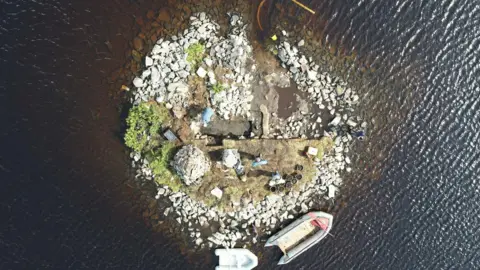
PA Media An artificial island built from large white stones in a Scottish loch - captured from above

PA Media
From above, the island - or crannog - looks like it is made from stone

An ancient artificial island in a loch on the Isle of Lewis was built entirely on a wooden platform, archaeologists have discovered.

From above, the Neolithic island - or crannog - in Loch Bhorgastail appears to be made of stone, though it was known that there was some timber underneath it.

5,000-year-old artificial island hidden in Scottish loch predates Stonehenge

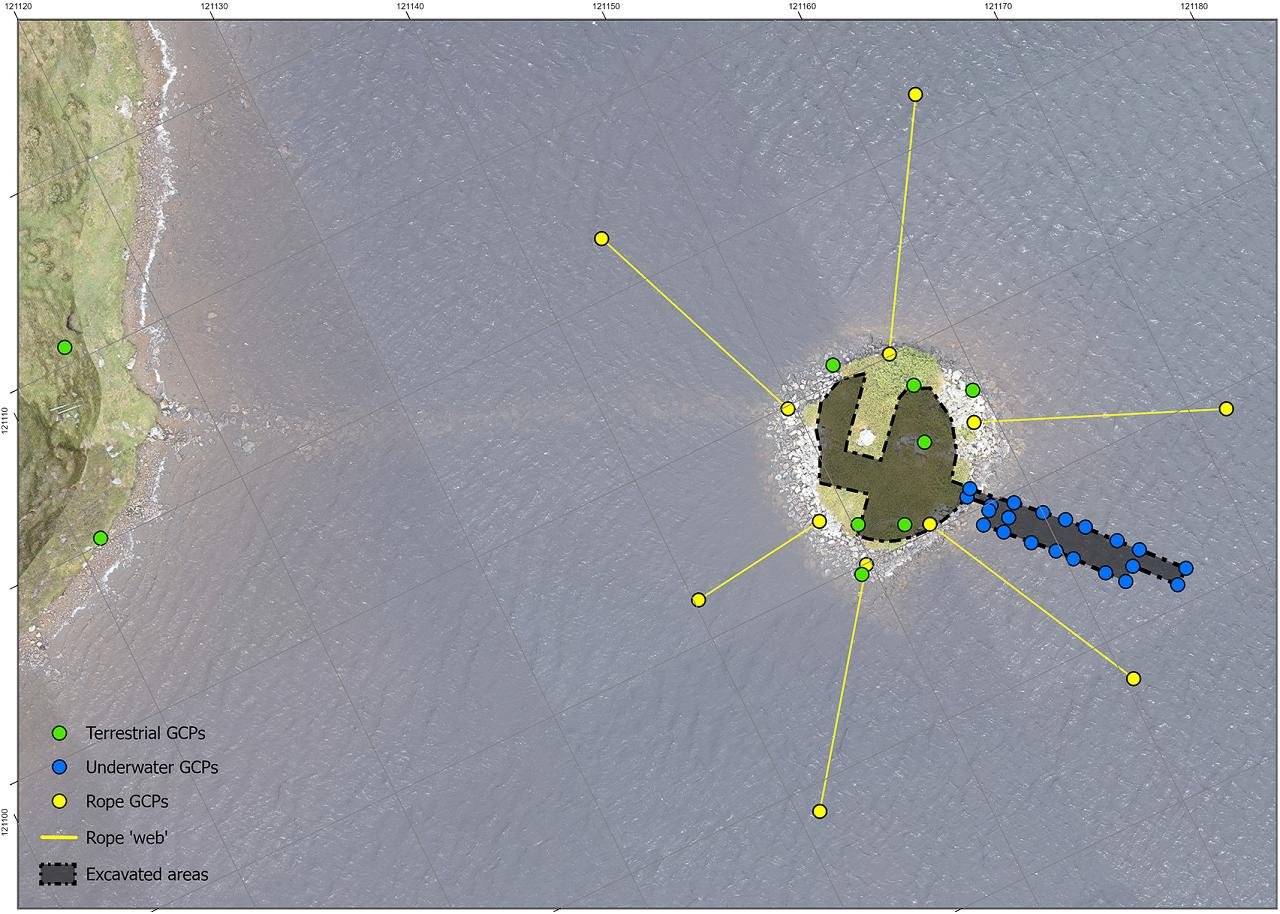
Ground control points used for UAS and underwater surveys at Loch Bhorgastail, showing the distribution of terrestrial, underwater, and rope-mounted control points across the land–water interface.

Credit: Blankshein et al., Advances in Archaeological Practice (2026)

Archaeologists reveal secrets of prehistoric human-made island

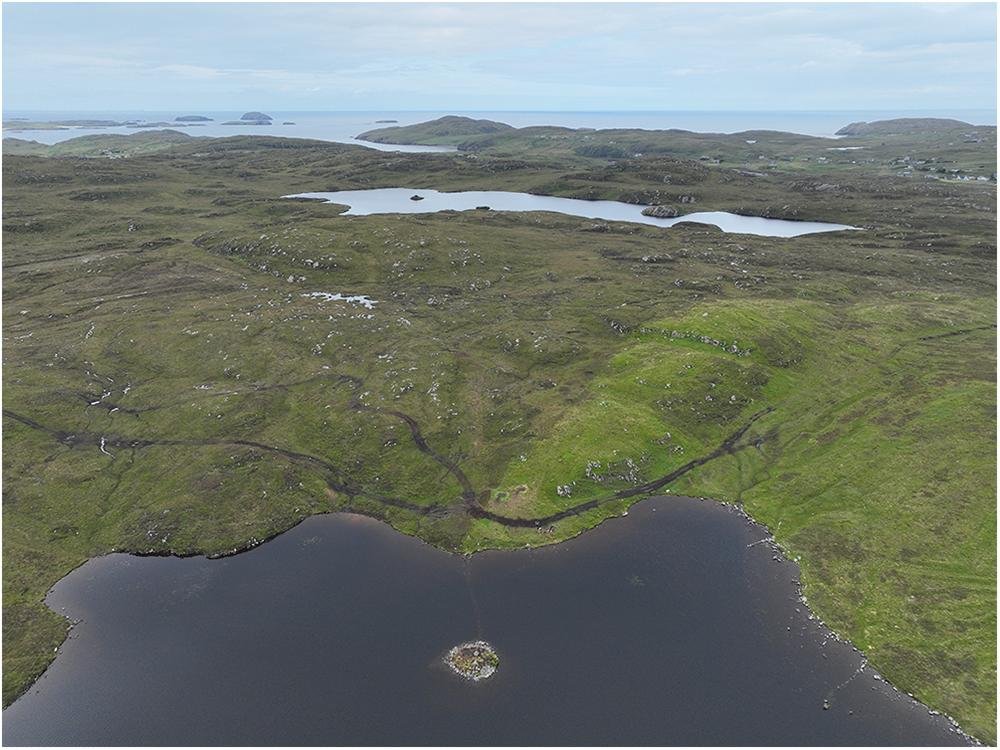
The crannog at Loch Bhorgastail.

Credit: University of Southampton

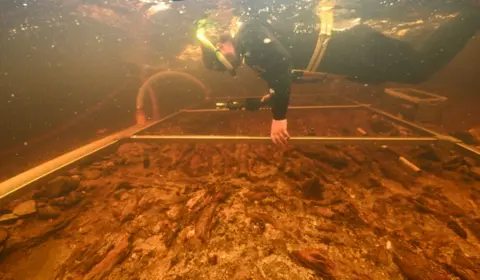
However, researchers from the University of Southampton carried out an excavation and have revealed that wood was used to support the whole structure.

The group dated their findings between 3500 and 3300 BC - around the early Bronze Age - and said the technique would have been used at other nearby sites throughout the Outer Hebrides.

5,000-year-old artificial island hidden in Scottish loch predates Stonehenge

Plan view of stone and timber elements above and below the waterline, digitized from multiple integrated photogrammetry survey datasets.

Credit: Blankshein et al., Advances in Archaeological Practice (2026)

University of Southampton archaeologist, Dr Stephanie Blankshein, said: "When we actually started excavating is when we realised that it was actually this coherent, quite large timber structure that was under what you would see as the stone island today.

"While we still don't know exactly why these islands were built, the resources and labour required to construct them suggests not only complex communities capable of such feats, but also the great significance of these sites."

As well as the layered wood and brushwood construction under the stone, archaeologists found hundreds of pieces of Neolithic pottery in the surrounding water.

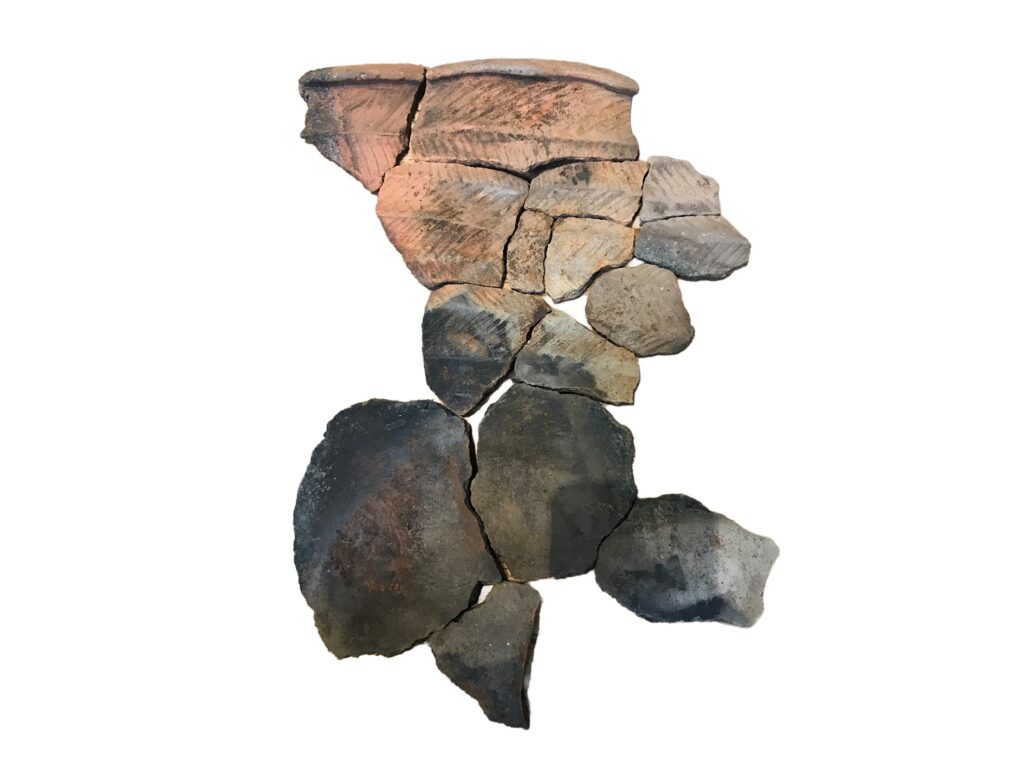
PA Media A pair of hands holds a tray containing broken pieces of ancient pottery

Crannogs are small artificial islands that are typically thousands of years old, and hundreds of them exist in Scotland's lochs.

The site in Loch Bhorgastail was first discovered in 2009.

Through fieldwork carried out since 2021, the archaeologists have revealed the different stages of development of the crannog.

They discovered that it was first established more than 5,000 years ago and started out as a circular wooden platform, around 23m (75ft) across, topped with brushwood.

Around 2,000 years later in the Middle Bronze Age, another layer of brushwood and stone were added, with more activity around 1,000 years after that during the Iron Age.

A stone causeway, now underwater, leads from the loch shore to the island.

PA Media A diver floating in shallow water, holding what appears to be a metal frame just over the water bed. The diver appears to be examining a wooden platform nestled in the rocky, sandy bed.
PA Media
Archaeologists found that the whole island was built on a wooden platform

As part of the fieldwork, the researchers created images of how the island looks above and below the water line using the science of photogrammetry.

This is when photographs of the subject are taken from multiple different angles and then "stitched" together by specialist software to create a high resolution digital model.

5,000-year-old artificial island hidden in Scottish loch predates Stonehenge

Aerial view of the Loch Bhorgastail crannog, illustrating the site context and land–water interface in which integrated terrestrial and underwater survey methods are applied.

Credit: Blankshein et al., Advances in Archaeological Practice (2026)

Carrying out photogrammetry in shallow water, such as that around the crannog, poses difficulties so the archaeologists created a new technique for doing so during their fieldwork.

They used two small waterproof cameras – with low-light performance and a wide-field of view.

These were locked at a set distance apart on a frame, providing precise overlapping of imagery, to help compensate for any missing or disrupted data.

The cameras were manoeuvred through the water by a diver with positioning controlled to centimetre accuracy, which is said to match that achieved by an aerial drone.

The-crannogs-timber-platform-below-the-waterline-1024x634.jpg

The crannog’s timber platform below the waterline.

Credit: University of Southampton

Fragments of a Neolithic pot found near the crannog. Credit: University of Southampton

Fragments of a Neolithic pot found near the crannog.

Credit: University of Southampton

Their technique is described in a newly published article in the journal Advances in Archaeological Practice.

The images were created alongside experts from the University of Reading.

RELATED 

Drone Footage of Wales | Craig Goch Dam & Snowdonia Landscapes | Cinematic 4K

{ https://www.bbc.com/news }

Hoe vind je dit bericht?
Geschreven door peter om 20:50 Stuur door

Burchett: Here's What the Government Knows About UFOs

UFOs-Disclosure

Burchett: Here's What the Government Knows About UFOs

Government-UFOs.png

What Is Disclosure

My photo
UFOs-Disclosure
Bellingham, Northumberland, United Kingdom
UFO ET DISCLOSURE "Disclosure" is the name given to the announcement by various world governmental leaders that we are not alone in the universe and that, in fact, many races of galactic human beings are here around this planet and have been for some time. They are here on peaceful missions, a fact which governments have generally kept hidden from their people until very recently.

Disclosure ends the period of secrecy that extends back to at least 1947 and probably much earlier. The practice of denying that ET UFOs or spacecraft exist has been a policy followed by most governments for varying reasons, some laudable, most unfortunately not. The era in which the existence of other civilizations technologically and spiritually more evolved than ours has been denied is now ending and a new era of galactic contact and cooperation is beginning.

Sean Spicer:

Will we ever get the truth about UFOs/UAPs?

Featuring:
Rep. Tim Burchett
U.S. Congressman | Tennessee, District 2


YouTube link:

{ https://ufos-disclosure.blogspot.com }

Hoe vind je dit bericht?
Geschreven door peter om 00:25 Stuur door

Top 5 innovations in the world of robots: From humanoids to autonomous AI

Top 5 innovations in the world of robots: From humanoids to autonomous AI

The global industrial robot market has reached a record high of $16.7 billion. This isn’t just a rise in sales—the industry is undergoing structural changes that will shape the future of manufacturing in the coming years.

Infographic showing the five key industry trends according to the International Federation of Robotics (IFR). Source: ifr.org

1. Intelligence instead of rules

In its annual report, the International Federation of Robotics (IFR) identified five key trends for 2026. First and foremost is the rapid adoption of artificial intelligence. Analytical AI enables machines to predict breakdowns before they occur and to autonomously plan routes within warehouses. 

Generative AI has taken a step further: instead of rigidly defined algorithms, it now learns new tasks through simulations and understands commands in natural language. The combination of both approaches—known as agent-based AI—is designed to enable machines to act independently in truly unpredictable conditions.

2. Digital and physical worlds are converging

Another trend is the convergence of information technology and operational technology. Put simply: data processing systems and systems for managing physical processes used to exist in parallel and had almost no interaction. Now these barriers are breaking down. 

The actual exchange of data between the digital and physical layers gives robots greater context and flexibility—and forms the foundation of what is known as the Fourth Industrial Revolution.

3. Humanoids are coming out of the labs

The third area is humanoid robotics. Companies and research teams are moving from prototypes to actual deployments in manufacturing facilities and warehouses. The automotive industry has taken the lead in this field. 

However, in order for humanoids to compete with conventional automation, they have to meet strict industrial requirements: keep up with the pace of the production cycle, not consume too much energy, and not require excessive maintenance. The IFR notes that the key criterion for success is achieving human-level agility and productivity.

4. Safety and New Risks

The increasing autonomy of machines makes it more difficult to monitor and verify their behavior. Connecting robots to cloud platforms creates new vulnerabilities: experts are noting an increase in attempts to hack controllers and gain unauthorized access to systems. 

Privacy is also a concern—devices collect video, audio, and sensor data streams. Deep learning models are often unable to explain their own decisions even to their developers, and the legal framework for determining liability for AI actions is still taking shape.

5. A partner, not a replacement

The fifth trend concerns the labor market. Robots are increasingly viewed not as a threat to employment, but as a solution to the shortage of skilled workers. IFR emphasizes that the successful implementation of automation depends on whether employees themselves are involved in the process. 

Governments and companies are investing in reskilling programs so that people can compete in an economy where automation is becoming the norm.

Top 5 New Humanoid Robots Ranked at CES 2026 (AI NEWS)

TIMELAPSE of Future Humanoid Robots (2029 - 2200+)

{ https://universemagazine.com/en/news-en/science-en/ }

Hoe vind je dit bericht?
Geschreven door peter om 00:15 Stuur door

Better ways to search for extraterrestrial civilizations

Better ways to search for extraterrestrial civilizations

Benjamin Zuckerman, a researcher at the University of California, has proposed a new approach to the search for extraterrestrial civilizations. He believes that aliens will not transmit signals in all directions, but rather in a narrow, directed beam.

Where should we look for extraterrestrial life? Source: www.nbcnews.com

A new approach to the search for extraterrestrial civilizations

When searching for signs of extraterrestrial intelligence, it’s helpful to know exactly what you’re looking for and to do so in the most effective way possible. However, as Benjamin Zuckerman, an astrophysicist and professor emeritus in the Department of Physics and Astronomy at the University of California, Los Angeles (UCLA), writes, this has generally not been done until now.

Zuckerman suggests examining an approach to the search using the electromagnetic spectrum, drawing on astronomical surveys conducted independently of the search for extraterrestrial intelligence (SETI), and proposes an improved search methodology developed based on his research.

Since, by all accounts, there are no alien probes in our Solar System, his methodology leads to the conclusion that “no alien civilization has passed within 100 light-years of Earth over the past few billion years.” His work was published in The Astrophysical Journal.

Limited capabilities for detecting isotropic signals

Most published works (at least those written by humans) have been based on the assumption that extraterrestrial intelligence (ET) would have limited energy resources—the electricity available to extraterrestrials would become increasingly difficult to generate, and its supply would ultimately be limited. It was believed that, to optimize the signal-to-noise ratio on the receiving end, ET would use very narrow bandwidths for both transmission and reception.

That is why people searching for radio signals use algorithms that analyze very narrow frequency bands, spanning just a few hertz. “Even with the use of modern equipment and software, the total bandwidth that has been achieved today amounts to only ‘a tiny fraction of the entire radio and microwave frequency spectrum,’” writes Zuckerman.

In 1964, Soviet astrophysicist Nikolai Kardashev, known for his Kardashev scale—which classifies civilizations based on their energy consumption—proposed the hypothesis that any signal transmitted by extraterrestrials would be isotropic, meaning it would have the same intensity in all directions rather than being directional. In any given direction, an isotropic signal would be weak, which limits its power, and this view has since influenced scientific research within the SETI program.

Why directed signals change everything

Zuckerman puts forward the exact opposite hypothesis—that any extraterrestrial civilizations would choose to send highly directional signals, so limited power would not be a serious problem. In this case, he writes, the most uncertain factor for us will be the signal’s wavelength (or, alternatively, its frequency), so we should investigate a much broader range of the electromagnetic spectrum—not only radio waves, but at least infrared and visible light as well. But this is “very difficult” to do using existing SETI radio search programs.

As Zuckerman writes, for neighboring technological civilizations that engage in targeted communication and make “every technological effort to establish contact,” power limitations—and consequently, filtering through very narrow bandwidths on Earth—are “irrelevant.” 

This scenario allows civilizations conducting searches and receiving signals to “accidentally discover an alien transmitter during electromagnetic surveys of the sky conducted for reasons unrelated to SETI.” Any such signals would be calling out to us—if we were looking in the right direction—simply by conducting routine astronomical observations with modest telescopes.

Narrowing the search to stars similar to the Sun

Zuckerman took into account five relevant observational parameters: distance, direction, sensitivity (power received per square meter per hertz), wavelength (or frequency), and time.

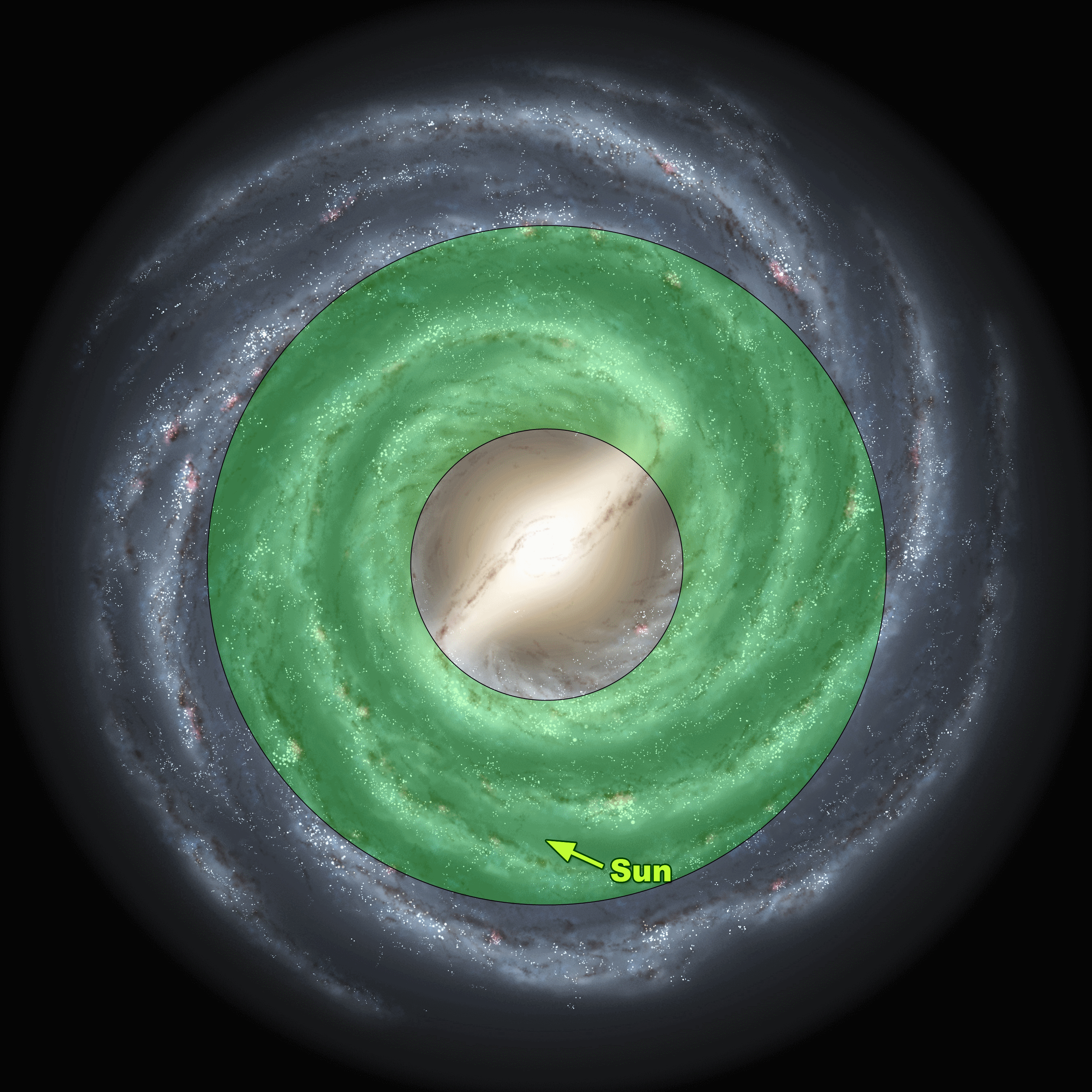
He suggested that any extraterrestrial life discovered would, like ours, be based on water; therefore, their planet must be located in the habitable zone around its star, where liquid water exists on at least part of its surface. The planet’s star must be similar to the Sun; only stars with a mass less than 1.25 times that of the Sun live long enough (4.5 billion years) for such a technological civilization to evolve on the planet.

According to Zuckerman’s estimates, a targeted SETI search program would likely need to observe 300,000 stars within a radius of 200 parsecs (650 light-years) to cover all the old stars—those that have existed in the Earth’s atmosphere over the past two billion years, during which oxygen has existed in Earth’s atmosphere as a result of the Great Oxidation Event—about two million such stars have passed within 100 light-years of our solar system.

Based on many such astronomical, astrophysical, and SETI considerations, and given that many other all-sky surveys of stars in the radio and optical spectrum could detect continuous, strong signals deliberately transmitted (via highly directional transmissions) with the aim of attracting attention, Zuckerman arrives at the aforementioned limit: “No alien civilization has passed within 100 light-years of Earth over the past few billion years.”

Need for further research

Although some parts of the radio and infrared bands have not yet been explored, according to Zuckerman, a broad-band study of old, Sun-like stars—from radio frequencies to the visible spectrum—is needed. This will allow us to expand the scope of the search and, for the first time, obtain a numerical estimate of the number of extraterrestrial civilizations capable of communication. 100,000, or perhaps even 10,000.

Zuckerman said he had spoken with some of SETI’s leading astronomers, and none of them had criticized him. The same applies to other astronomers who are not SETI experts but are sufficiently qualified to evaluate its work and claims. But, he adds, “although the jury has not yet reached a decision, various pieces of evidence suggest that the verdict will be this: we are alone in our little corner of the Milky Way galaxy.”

{ https://universemagazine.com/en/articles-en/ }

Hoe vind je dit bericht?
Geschreven door peter om 23:59 Stuur door

Battle for androids: Meta acquires brain for robots

Meta has acquired a startup that develops artificial intelligence for humanoid robots. The company aims to create an open software platform for the industry—similar to how Google once built Android for smartphones. The financial terms of the deal have not been disclosed.

Illustrative image. Humanoid robots are the main focus for tech giants in 2026.

What is ARI?

Assured Robot Intelligence (ARI) is a startup that developed so-called foundational models—basic artificial intelligence algorithms that enable machines to understand human behavior and adapt to unpredictable situations in real-world environments. 

Precisely this inability to generalize—to understand new situations without prior programming—is the key problem that no company in the field of humanoid robotics has yet solved. The entire team, including co-founders Xiaolong Wang and Lerrel Pinto, will join the Meta Superintelligence Labs division.

Why now?

Wang wrote on X that they understood from the start that achieving the company’s goals meant training a “truly versatile physical agent.” He is now convinced that such an agent must be a humanoid, and that its training will be based directly on human experience. According to him, Meta has access to “the key components needed to realize this vision.”

The deal comes amid a fierce race among tech giants. Amazon acquired the startup Fauna Robotics—where Pinto previously worked—for its own humanoid robot project. Tesla is promoting the Optimus line and is already converting part of its Fremont factory to produce them. 

According to forecasts by the research firm Kaiso Research, the global market for humanoid robotics is expected to grow from $2.64 billion in 2024 to $38.4 billion by 2035. Software—the very segment that ARI is strengthening—is already the fastest-growing sector.

Software as a priority

Meta CTO Andrew Bosworth explained the company’s strategy back in 2025: “Software is the bottleneck.” The idea is to develop licensed software for the entire industry—just as Android has become the operating system for thousands of different devices. 

The acquisition of ARI fits into this logic: instead of investing in expensive hardware, we are acquiring scalable software expertise.


Meta Just Bought the Android for Robots

Meta Humanoid Robotics: ARI Deal Pushes Physical AI Ambitions — Meta Humanoid Robotics Watch

Why Meta Just Acquired Humanoid AI Startup Assured Robot Intelligence

{ https://universemagazine.com/en/articles-en/ }

Hoe vind je dit bericht?
Geschreven door peter om 23:51 Stuur door

Hollow‑Earth myths and Nazi UFOs on TikTok are bringing white supremacism into the mainstream

TikTok, The Conversation

Hollow‑Earth myths and Nazi UFOs on TikTok are bringing white supremacism into the mainstream

Eighty-one years after Adolf Hitler died by his own hand in a Berlin bunker, a viral video on TikTok shows an AI-generated vision of the Nazi dictator standing in Antarctica, shoulders broad and face smiling, sipping a White Monster Energy drink while Men at Work’s iconic song Down Under plays.

It’s an absurd image, but one that makes sense in the context of the “Agartha” trend on TikTok, which is quietly bringing white supremacist narratives into the mainstream to be seen by millions of users.

The modern myth of Agartha, a supposed utopia hidden inside the hollow Earth, was constructed from older pieces by esoteric authors after the second world war. It blends “Aryan” white supremacist themes with ideas of an occult SS and Third Reich spaceships.

Literal belief in hollow-Earth myths or Nazi UFOs is not the point. Instead, it’s an aesthetic – one that can host both coded far-right messages and explicit ones, fused with pop-cultural references such as the White Monster Energy meme.

Mainstreaming through borderline content

Agartha videos on social media are “awful but lawful”: the content is objectionable but legal. It allows extremists to embed their narratives into mainstream social media spaces, without triggering moderation or outright rejection by the audience. As a result, they can reach large, young audiences.

To understand how the underlying esoteric myths are used, we analysed a network of more than 43,000 Agartha-related TikTok videos and closely studied selected examples. This analysis is part of an ongoing project led by researchers at Neu-Ulm University of Applied Sciences in Germany. The goal is to understand how extremists abuse platform features to carry radical narratives into the mainstream.

We identified four key mechanisms which far-right actors use to push radical narratives to unsuspecting audiences: aesthetic camouflage, dog-whistles and split-second glimpses, network building, and weaponised irony. Let’s unpack each of these terms.

Aesthetic camouflage

Moderation systems on social media platforms aim to remove overt extremist propaganda. These systems work imperfectly, but overt propaganda is unlikely to reach mass audiences before being removed.

Instead, far-right actors often use generative AI to mask racial ideology behind seemingly benign tropes from science fiction and fantasy. This allows a “de-demonising” of their ideas. Elf-like depictions of the “Aryan” inhabitants of Agartha, or footage of an underground utopia, make the idea of a white ethnostate seem palatable.

The engaging aesthetic keeps people watching longer. In turn, this triggers the algorithm to push the video to wider audiences.

Dog whistles and split-second provocations

Far-right actors infuse their content with dog whistles that communicate to a certain audience without triggering moderation.

Our research identified recurring visual symbols in Agartha videos. “Raw milk” signals white supremacy. The number 271, which appears in hundreds of the videos, is a code for Holocaust denial.

A smiling man in front of a sign reading 271k.
The number 271 in Agartha videos hints at the idea that ‘only’ 271,000 people died in the Holocaust.  TikTok

Agartha videos also sometimes include overt extremist markers such as the Hakenkreuz (the Nazi symbol of the “hooked cross” or swastika). They are often flashed for only fractions of a second.

This is a calculated provocation. It tests and pushes platform boundaries, normalising the presence of far-right markers and slowly desensitising viewers. At the same time, successful inclusion of forbidden symbols in videos with viral reach serves as a badge of honour within the in-group.

An obscured swastika can be seen in the background of an image showing two blond women, one with lightning coming from her eyes.
Overt far-right markers such as the Hakenkreuz or swastika are usually only briefly glimpsed in Agartha videos.  TikTok

Building network bridges

The Agartha community is not an isolated echo chamber. Our analysis shows the Agartha network connects to others on TikTok. Around 87% of these connections come via the inclusion of mundane, mainstream hashtags on Agartha videos.

Extremists may deliberately “hijack” benign, high-traffic hashtags, such as #roblox or #loganpaul, to push their content into everyday feeds. Agartha is also strongly connected to gym and fitness content. Hashtags such as #gymtok serve as a bridge, potentially funnelling users towards radical narratives.

Smiling man with glowing eyes points at the camera.
A looksmaxxer shown in an Agartha video with the Nazi ‘black Sun’ symbol in the background.  TikTok

Here, we also observed targeted appeals. Agartha videos would commonly include hashtags associated with “looksmaxxing” – a trend for extreme physical self-optimisation – to push their videos towards audiences seen as potentially susceptible, such as insecure young men. Well-known looksmaxxers were also sometimes depicted in Agartha videos.

Weaponised irony

As the example of Adolf Hitler drinking a Monster Energy illustrates, Agartha videos rely heavily on absurd situations, frequently co-opting mainstream social media trends.

Because White Monster Energy is a popular meme within non-extremist spaces, users familiar with the trend are particularly likely to get algorithmic recommendations fused with extremist narratives.

An AI-generated muscly shirtless man drinking a can of drink
Video creators have used this AI-generated image of an aged, muscly man to represent Adolf Hitler drinking a White Monster energy drink in an Agartha video. TikTok

Similarly, actors superimpose mainstream figures into Agartha to force association, such as YouTuber Logan Paul or actor Mads Mikkelsen.

Such co-opting is also done through music, with many hollow-Earth edits set to Men at Work’s 1980s hit Down Under. The track serves as a darkly ironic nod to the subterranean utopia.

This increases the chances for algorithmic amplification while providing creators with plausible deniability. Criticisms can be dismissed as a misunderstanding of dark humour or current trends.

Recognising the threat

Agartha is more than just a digital resurfacing of fringe occultism. It is a blueprint for how to design extremist content for algorithmically curated short-video platforms.

It’s also a reminder that extremist content on social media does not exist in isolation. Instead, it lives in what researchers call “hybridised spaces”, where users move in and out of extremist discourse. In such spaces, borderline content, outright extremism, mundane trends and humour blend seamlessly – and participants may find their mainstream interests lead them to radical narratives.

{ https://theconversation.com/europe }

Hoe vind je dit bericht?
Geschreven door peter om 23:32 Stuur door

UFO-linked scientist claimed a top secret energy weapon blasted her before her death... now the Pentagon admits they are real

UFO-linked scientist claimed a top secret energy weapon blasted her before her death... now the Pentagon admits they are real

A futuristic weapon often dismissed as a conspiracy theory has been publicly acknowledged as being part of the US military's vast arsenal. 

The US Department of War chose 'Star Wars Day' on May 4 to state that 'directed energy weapons are a fine addition to our arsenal.'

Directed energy weapons are devices capable of firing rays of energy, such as microwaves, at a target. Simply put, they fire lasers at the enemy, often to scramble and physically damage electronic equipment.

In the Pentagon's post on social media, they confirmed that DEWs produced 'beams of concentrated electromagnetic energy or atomic or subatomic particles.'

Monday's post cemented decades of rumors that the military has been working on futuristic weaponry that was once thought of as science fiction or unrealistic experiments by Pentagon researchers.

However, the revelation comes as stunning claims from a dead scientist were recently unearthed, alleging that she was the target and victim of a DEW attack in her own home in 2022.

Amy Eskridge, who reportedly took her own life on June 11, 2022 at age 34, shared shocking images that allegedly showed the damage these weapons could cause to the human body.

Pictures and text messages shared with the Daily Mail by a former British intelligence officer revealed burned skin, lesions and painful blisters Eskridge allegedly suffered after a beam from a DEW was fired into her home by an unknown assailant.

The Pentagon's Chief Technology Officer revealed on May 4 that laser weapons are 'a fine addition' to the US military

The Pentagon's Chief Technology Officer revealed on May 4 that laser weapons are 'a fine addition' to the US military

Amy Eskridge (Pictured) was a scientist researching anti-gravity technology before her death in 2022 at age 34

Amy Eskridge (Pictured) was a scientist researching anti-gravity technology before her death in 2022 at age 34

Franc Milburn, a retired paratrooper, investigated the Eskridge case and concluded she was 'murdered by a "private aerospace company"' to stop her research on futuristic propulsion technology and national security threats.

The images shared by Milburn also revealed how a microwave from an alleged DEW scorched the window of Eskridge's Huntsville, Alabama home as the beam passed through the glass.

Eskridge's death was reportedly ruled a suicide from a gunshot wound to the head, but the scientist allegedly consulted a former CIA weapons expert about the DEW attack in early 2022.

On May 19, 2022, Milburn said Eskridge messaged him to say: 'My ex-CIA weapons guy on my team saw my hands when they were burned really badly a couple months ago, and he saw that window pane in person,' she wrote.

'He said he had built things like that, and that it was most likely an RF k-band emitter run by five car batteries strung together from inside an SUV.'

While there has been no physical evidence to confirm Eskridge and Milburn's claims regarding a DEW attack, the theory that such a weapon uses a k-band emitter does match what the military is currently using in its laser weapon tests.

The k-band is a specific range of invisible radio waves, or microwaves, that military directed energy weapons can use to send out powerful beams at enemy targets.

These beams can travel well, focus tightly on a target and are especially good at damaging electronics inside drones, missiles or vehicles from a distance.

Eskridge's death was reportedly ruled a suicide from a gunshot wound to the head, but the scientist allegedly consulted a former CIA weapons expert about the DEW attack in early 2022

Eskridge's death was reportedly ruled a suicide from a gunshot wound to the head, but the scientist allegedly consulted a former CIA weapons expert about the DEW attack in early 2022

Directed energy weapons fire concentrated beams of microwaves or other particles at a target to disable electronics

Directed energy weapons fire concentrated beams of microwaves or other particles at a target to disable electronics

Franc Milburn shared a picture, which he claims shows Eskridge's hands burned and discolored after allegedly being struck by a 'directed energy weapon'

Franc Milburn shared a picture, which he claims shows Eskridge's hands burned and discolored after allegedly being struck by a 'directed energy weapon'

article image

Monday's statement came from the X account of the Department of War's Chief Technology Officer, Emil Michael, who oversees the Pentagon's entire research, development and prototyping operations.

Michael's profile on the Department of War website states that his mission is to 'accelerate the transition of breakthrough technologies from prototype to operational reality, ensuring that the US military maintains its technological edge.'

Although DEW technology was first mentioned in the 1960s and first deployed in 2014 by the Navy, there has not been any public mention by the US government or the Pentagon about using these weapons against people.

Over the last decade, the Pentagon's 'idea factory,' known as DARPA, has worked on multiple projects aimed at creating a new wave of directed energy devices for use against enemy drones, missiles, rockets, vehicles and computers.

A Pentagon official told the Daily Mail that the military's current focus is on six 'new critical technology areas,' including Scaled Directed Energy, or SCADE.

'The Department is continuing to scale and integrate these high-energy solutions to make our arsenal more lethal, precise, and cost-effective,' the officials said in a statement on Tuesday.

Large DEW have been used by the military to shoot down enemy missiles and drones

Large DEW have been used by the military to shoot down enemy missiles and drones

The technology is thought to be more cost effective than using bullets because each beam costs only a few dollars to emit

The technology is thought to be more cost effective than using bullets because each beam costs only a few dollars to emit

The official website of Congress even has a detailed section acknowledging the existence, uses and funding for the government's research and development of these futuristic weapons.

According to that report, the Pentagon requested $789.7 million for directed energy weapons programs during the 2025 fiscal year.

However, some of the research has also been handled by outside companies, including those in the aerospace field, with deep ties to national defense.

That includes defense technologies company AeroVironment, which developed the laser weapon shown in the Pentagon's social media post - the Locust X3.

The Locust is a truck or ship-mountable system that shoots a powerful, invisible beam at the speed of light to quickly destroy or disable enemy drones, especially small and medium-sized threats.

According to the military, these weapons have also become a more cost-effective solution to shooting down enemy drones, as each beam only costs a few dollars to fire and does not require bullets or bombs, which have limited supplies.

The Pentagon official added: 'By scaling and delivering on the priorities driven under the SCADE CTA, the Joint Force will be able to neutralize adversarial threats with unparalleled precision at a low cost-per-shot.' 


'I did NOT Kill myself': NASA Scientist CHILLING Last Text Before Death | Trump’s Link EXPOSED!

What Happened to the Scientists?

{ https://www.dailymail.com/sciencetech/index.html }

Hoe vind je dit bericht?
Geschreven door peter om 23:20 Stuur door

The Body Gap: Researchers Warn AI Lacks the Physical Grounding That Shapes Human Thought

AI meatspace

Image by enio from Pixabay

The Body Gap: Researchers Warn AI Lacks the Physical Grounding That Shapes Human Thought

As AI and humans move closer to what some describe as the singularity, the distinction between being human and not may hinge on what researchers are calling the “body gap.” A new perspective from a UCLA Health team argues that today’s artificial intelligence systems can describe human experience but fundamentally lack the lived, bodily grounding that shapes how humans think, decide, and behave.

Coined “the body gap,” this may represent not just a philosophical limitation, but a practical concern for AI safety and alignment. The concept hinges on two key ideas: external embodiment (a system’s ability to perceive and act in the world) and internal embodiment (a continuous awareness of internal bodily states such as fatigue, uncertainty, stress, or need).

“Without a body or analogous internal physiology, AI systems may approximate, simulate, or even convincingly reproduce the expression of understanding,” said Akila Kadambi, the study’s first author and a postdoctoral fellow in the Department of Psychiatry and Biobehavioral Sciences at UCLA’s David Geffen School of Medicine. “But Simulation is not the same as experience.”

“On that view, an AI could be highly intelligent, or even sentient in some abstract sense, yet still lack the embodied grounding that characterizes human understanding,” Kadambi said in an email to The Debrief.

At its core, human cognition is shaped by connection, not isolation. The researchers point to even simple actions—like passing the salt across a table—as examples of how behavior is informed by more than the task itself. Such actions draw on a lifetime of sensorimotor experience: how objects feel, how distances are judged, and the social context or intent behind the interaction. In other words, human behavior is deeply contextual. The brain continuously integrates this external input with internal bodily signals, creating a feedback loop that influences attention, memory, and decision-making. According to the UCLA researchers, AI systems lack this internal layer.

“While there is a current focus in world modeling on external embodiment, such as our outward interactions with the world, far less attention is given to internal dynamics, or what we term ‘internal embodiment,’” Kadambi said. “In humans, the body acts as our experiential regulator of the world, as a kind of built-in safety system.”

“If you’re uncertain, if you’re depleted, if something conflicts with your survival, your body registers that,” she added. “AI systems right now have no equivalent. They can sound experiential, whether they should be or not, and that’s a real problem for many reasons, especially when these systems are being deployed in consequential settings.”

Kadambi explains that current AI models can produce human-like language without having any lived experience to match what those words really mean. 

The study also highlights experiments involving point-light displays, in which several advanced AI systems failed to recognize patterns that humans readily identify as human movement. Instead, the systems interpreted them as unrelated shapes or even astronomical phenomena. When the displays were altered, the systems’ performance deteriorated further, suggesting a fragile and unrealistic mode of perception—one that contrasts sharply with the stability provided by embodied human experience.

The researchers argue that this limitation could have implications for human safety as AI systems are deployed more broadly in everyday settings.

“By contrast, current AI systems have no equivalent mechanism. They process inputs and generate outputs without any persistent internal state that regulates how they behave over time,” said Dr. Marco Iacoboni, professor in the Department of Psychiatry and Biobehavioral Sciences at the David Geffen School of Medicine and a senior author on the recent paper.

“This is not just a performance limitation, but also a safety limitation. Without internal costs or constraints, an AI system has no intrinsic reason to avoid overconfident errors, resist manipulation, or behave consistently.”

To address this issue, the paper proposes a “dual-embodiment framework.” The idea would be to enable AI systems to connect more directly with the external world while also incorporating internal “check-in” processes—loosely analogous to an inner voice—that could help regulate behavior.

The authors also call for the development of new evaluation benchmarks. Rather than focusing solely on whether AI can identify objects or complete tasks, future assessments should examine whether systems can maintain stability under uncertainty and demonstrate self-regulation.


Why AI Needs Physics to Understand Human Intent: The SIMPLE Model & PHASE Dataset

{ https://thedebrief.org/category/science/ }

Hoe vind je dit bericht?
Geschreven door peter om 22:42 Stuur door

Hantavirus outbreak could just be the beginning: Scientists issue urgent warning about spillover of other rodent–borne viruses amid rising global temperatures READ MORE: More than 20 Brits battling to get off rat virus vessel By WILIAM HUNTER, SENIO

Hantavirus outbreak could just be the beginning: Scientists issue urgent warning about spillover of other rodent–borne viruses amid rising global temperatures

The recent outbreak of hantavirus on a cruise ship could just be the beginning, scientists have warned.

In an ominous new study, researchers reveal that climate change will lead to enhanced 'spillover' of rodent–borne viruses.

As global temperatures rise and rodent populations shift, deadly arenaviruses will be driven into areas that have never faced these diseases before.

Researchers predict this will trigger outbreaks that threaten to reach 'millions' of people across South America.

The warning comes as more than 20 Brits remain trapped aboard a cruise ship infected with rat–borne hantavirus off the coast of Cape Verde.

Three passengers have now died after contracting the viral infection, including a Dutch couple and a German national.

The Dutch–flagged MV Hondius had previously docked in Argentina, where both hantavirus and arenaviruses kill dozens every year.

However, the researchers warn that similar outbreaks will only become more common the faster the climate warms.

Scientists predict that climate change will lead to a massive spread of rodent-borne viruses in South America

Scientists predict that climate change will lead to a massive spread of rodent–borne viruses in South America 

Like hantavirus, arenaviruses are hosted by rodents and usually spread to humans from animals rather than person–to–person infection.

These extremely common but poorly studied infections include Guanarito virus in Venezuela and Colombia, Machupo virus in Bolivia and Paraguay, and Junin virus in Argentina.

Infection causes severe hemorrhagic fevers with high hospitalisation rates, with fatality rates between five and 30 per cent.

Since these diseases are spread by rodents, their impact is closely connected to changes in rodent habitats.

However, studies have shown that the warming climate is producing dramatic changes in the ranges of disease–spreading animals.

Previous research has shown that factors such as temperature and precipitation have a massive impact on the risk of rodent–borne diseases such as Lassa fever and hantavirus.

Meanwhile, the distribution of the drylands vesper mouse, which transmits Argentine Hemorrhagic Fever, will undergo 'substantial changes' due to climate change.

In their paper, the researchers use machine learning to combine climate projections, population density predictions, infection risks, and habitat suitability for six rat and mouse species linked to the viruses.

As the climate becomes hotter, the habitats of rodents which carry arenaviruses will shift. This will bring more rodents into contact with humans

As the climate becomes hotter, the habitats of rodents which carry arenaviruses will shift. This will bring more rodents into contact with humans 

This comes as more than 20 Brits remain trapped aboard a cruise ship infected with rat-borne hantavirus off the coast of Cape Verde. The infection has already killed three passengers, including a Dutch couple and a German national

This comes as more than 20 Brits remain trapped aboard a cruise ship infected with rat–borne hantavirus off the coast of Cape Verde. The infection has already killed three passengers, including a Dutch couple and a German national  

What are arenaviruses?

Arenaviruses are a group of 'segmented genome RNA viruses' that are hosted by rodents.

They include the Guanarito virus in Venezuela and Colombia, Machupo virus in Bolivia and Paraguay, and Junin virus in Argentina.

They are very similar to hantaviruses, which are also spread by rodents in South America.

Like hantaviruses, arenaviruses have no known antiviral treatment. 

Infection leads to hemorrhagic fevers that kill five to 30 per cent of patients depending on the virus. 

This revealed that the infection risk posed by these dangerous diseases would change dramatically in the next 20 to 40 years under different climate change scenarios.

Lead author Dr Pranav Kulkarni, of the UC Davis Weill School of Veterinary Medicine, says: 'As climate change accelerates, our study shows how the outbreak risk of dangerous New World arenaviruses could ride on shifting rodent populations to reach millions more people across South America.'

The new model shows that the guanarito virus, which is currently contained to central Venezuela, will spread to parts of Colombia, the border regions of Suriname, and northern parts of Brazil.

The machupo virus, which causes often fatal Bolivian Hemorrhagic Fever, will expand from the flatlands of Bolivia to the Andes foothills and mountain regions.

Meanwhile, the Junin virus that causes Argentine Hemorrhagic Fever will move out of the grassland areas and expand to the rest of Argentina.

This will reduce the risk in some areas that have already learned to deal with the disease, but increase the dangers of infection in others.

In all cases, Dr Kulkarni and his co–authors warn that populations with little or no prior exposure will be encountering these viruses for the first time, potentially increasing their vulnerability to infection and severe disease.

Senior author Dr Pranav Pandit says: 'Our study connects the dots between changing climatic conditions and land use, shifting rodent populations and human infection risk, making it possible to see where the next generation of zoonotic arenaviral outbreaks could emerge.'

Modelling shows that climate change will cause significant changes in the habitat of the drylands vesper mouse, which transmits Argentine Hemorrhagic Fever

Modelling shows that climate change will cause significant changes in the habitat of the drylands vesper mouse, which transmits Argentine Hemorrhagic Fever

These changes were primarily driven by expanding agricultural and urban areas, bringing more humans into the habitats of rodents capable of carrying arenaviruses.

Combined with climate–driven changes in the rodents' habitats, triggered by temperature and precipitation shifts, major outbreaks in previously safe areas are likely.

This research comes after an outbreak of rodent–borne hantavirus left a luxury cruise ship stranded at sea.

The MV Hondius vessel has been anchored in the Atlantic since Sunday, following the death of three passengers after an outbreak of the deadly disease.

article image

Around 150 people remain aboard the vessel following the deaths and illnesses, while the World Health Organisation has confirmed six cases of hantavirus.

It is suspected that the virus may have been transmitted during a stop in South America, either directly to humans or to rodents aboard the ship.

A spokesperson for the Netherlands' National Institute for Public Health and the Environment told Reuters: 'You could imagine, for example, that rats on board the ship transmitted the virus," he said.

'But another possibility is that during a stop somewhere in South America, people were infected, for instance via mice, and became ill that way.'

ZOONOTIC DISEASES: THESE ARE VIRUSES USUALLY STARTED IN WILD ANIMALS THAT CAN PASS TO OTHER SPECIES AND SURVIVE

Zoonotic diseases are able to pass from one species to another.

The infecting agent - called a pathogen - in these diseases is able to cross the species border and still survive. 

They range in potency, and are often less dangerous in one species than they are in another. 

In order to be successful they rely on long and direct contact with different animals.  

Common examples are the strains of influenza that have adapted to survive in humans from various different host animals. 

H5N1, H7N9 and H5N6 are all strains of avian influenza which originated in birds and infected humans.

These cases are rare but outbreaks do occur when a person has prolonged, direct exposure with infected animals. 

The flu strain is also incapable of passing from human to human once a person is infected.  

A 2009 outbreak of swine flu - H1N1 - was considered a pandemic and governments spent millions developing 'tamiflu' to stop the spread of the disease. 

Influenza is zoonotic because, as a virus, it can rapidly evolve and change its shape and structure.  

There are examples of other zoonotic diseases, such as chlamydia. 

Chlamydia is a bacteria that has many different strains in the general family. 

This has been known to happen with some specific strains, Chlamydia abortus for example.

This specific bacteria can cause abortion in small ruminants, and if transmitted to a human can result in abortions, premature births and life-threatening illnesses in pregnant women.


What is hantavirus and how is it spread? | BBC News
Hoe vind je dit bericht?
Geschreven door peter om 22:15 Stuur door

Ark of the Covenant's final resting place pinpointed in new search

Ark of the Covenant's final resting place pinpointed in new search

Story by Stacy Liberatore

Ark of the Covenant's final resting place pinpointed in new search

©CC Composite Editor

The location of a chest believed to contain the Ten Commandments has long been a mystery, but archaeologists may be closer to finding the lost Ark of the Covenant. According to the Bible, the sacred relic was built by the Israelites shortly after fleeing Egypt around the 13th century BC, with Moses placing the Ten Commandments inside. Historians believe the Ark was kept inside the Holy of Holies, the innermost chamber of Jerusalem's ancient temple, before vanishing during the Babylonian sack of the city in 586 BC. Now archaeologist Dr Chris McKinny has proposed the Ark could be hidden within underground spaces in the City of David, just south of Jerusalem's Temple Mount. Researchers plan to scan underground spaces in the area using powerful technology designed to detect hidden cavities and buried metals deep beneath the surface.

Use of Muon Detection Technology in Archaeology

©Shutterstock / A.Pushkin

Use of Muon Detection Technology in Archaeology

The method relies on muon detectors, instruments that track tiny subatomic particles created when cosmic rays from space strike Earth's atmosphere, allowing scientists to see deep underground and detect hidden chambers without digging. Early scans of the area have revealed previously unknown voids and structures beneath the ancient landscape, aligning with the hidden tunnel theory. If the technology is eventually extended beneath the Temple Mount, McKinny and his team believe the Ark could be detected , if it still exists, because it is said to be plated with gold inside and out. McKinny does not claim to have discovered the Ark of the Covenant or to know its exact location with certainty.

However, in his documentary Legends of the Lost Ark , released April 7, he explores three major ancient traditions describing what may have happened to the relic after the Babylonian destruction of Jerusalem's First Temple in 586 BC. According to McKinny, each account suggests the Ark was deliberately hidden to protect it from invading forces rather than destroyed or captured.

Advanced Imaging Methods for Underground Exploration

©Getty Images

Advanced Imaging Methods for Underground Exploration
McKinny also expressed optimism about emerging technology that could one day allow him and his team to digitally examine underground spaces without disturbing sacred ground. He pointed to advances in imaging tools such as ground-penetrating radar, seismic scanning, electrical resistivity tomography and other remote-sensing technologies capable of mapping hidden structures beneath the surface, All Israel News reported. According to McKinny, such tools could eventually help identify tunnels, chambers and concealed spaces beneath the Temple Mount, an area he described as one of archaeology's biggest blind spots because traditional excavation using 'the spade or the trowel' is largely forbidden.

He stressed that this remains a long-term possibility rather than an active excavation project. In a recent interview, McKinny said he is 'excited and hopeful for what will come from that,' while acknowledging that significant religious, political and logistical barriers still stand in the way of such work. Despite growing interest in advanced scanning methods, McKinny maintains a cautious approach, focusing primarily on ancient texts and historical traditions rather than dramatic excavation efforts.

Ark of the Covenant's final resting place pinpointed in new search

©Daily Mail

Ark of the Covenant's final resting place pinpointed in new search
The stories draw from early Jewish sources, including the Book of 2 Maccabees and other historical traditions. The first and most widely discussed theory, often called the Mount Legend, suggests the Ark was hidden beneath the Temple Mount in Jerusalem. The Temple Mount is the holiest site in Judaism and central to biblical history, widely believed to be the place where Abraham prepared to sacrifice Isaac. Located in Jerusalem's Old City, the 36-acre raised compound once housed Solomon's Temple, known as the First Temple, and later the rebuilt Second Temple, serving as the spiritual center of Israelite worship and the symbolic dwelling place of God's presence. In this tradition, priests are said to have concealed sacred items in underground chambers or tunnels beneath the temple complex shortly before the Babylonian siege. This theory has fueled centuries of speculation about hidden chambers beneath the Temple Mount and remains one of the most widely debated possibilities among modern researchers. A second account, known as the Rock Legend, describes the prophet Jeremiah hiding the Ark at a mysterious rocky site located between two mountains.

Ark of the Covenant's final resting place pinpointed in new search

©Shutterstock / P Maxwell Photography

Ark of the Covenant's final resting place pinpointed in new search
Jeremiah was a major biblical prophet who lived in Jerusalem during the final years before the city's destruction, making him a central figure in many accounts of the Ark's disappearance. The precise location described in the texts remains unclear, with some scholars suggesting it could refer to a wilderness region near Jerusalem or a more remote mountainous area. The third and oldest tradition, often referred to as the Mount Nebo Legend, appears in the ancient text 2 Maccabees. It claims Jeremiah carried the Ark, along with other sacred objects, to a cave or tomb on Mount Nebo, the mountain traditionally associated with the death of Moses.

Some interpretations suggest the Ark may have been hidden near the place believed to be Moses' burial site, though later traditions have complicated efforts to pinpoint the exact location. Despite their differences, McKinny noted that all three legends share key similarities. Each places Jeremiah at the center of efforts to safeguard the Ark, situates the events shortly before Jerusalem's fall, and suggests the relic was intentionally hidden rather than lost in battle.


What Happened to the Ark of the Covenant?

{ ©Daily Mail }

Hoe vind je dit bericht?
Geschreven door peter om 21:46 Stuur door

Trump promises to release UFO files

Trump promises to release UFO files

An observatory on the moon

©The Daily Digest

The truth is out there?
As long as humanity can remember, people have been looking into the stars with awe and curiosity, trying to figure out the mysteries of the universe. Now one unlikely source might help solve one piece of this cosmic puzzle.

A top issue for many Americans

©The Daily Digest

Trump's promise
Newsweek reports that US President Donald Trump has promised that his administration will release documents pertaining to UFO-related activity.

New hope for the Democrats

©The Daily Digest

Seeing things you wouldn't believe
The US president didn’t give a specific date for the release, only saying that it would be soon and teasing that it includes files containing accounts “you wouldn’t believe.”

©The Daily Digest

Executive order
“As you remember, I recently directed the Secretary of War to begin releasing government files relating to UFOs and unexplained aerial phenomena,” Trump said, as cited by NBC.

Trump hanging out with a former mob boss

©The Daily Digest

The process is underway
The US president added that “this process is well underway, and we found many very interesting documents, I must say, and the first releases will begin very, very soon.”

The people Vs. The United States

©Provided by The Daily Digest

Pressure from the US Congress
Lawmakers in the US Congress have been pressuring the White House to disclose files related to unidentified aerial phenomena, or UAPs.

Moving away from UFOs

©The Daily Digest

Moving away from UFOs
The scientific community has adopted the term UAP as a way to move away from the term unidentified flying object, or UFO, due to the older term's association with flying saucers.

Federal secrets?

©The Daily Digest

Image: US House of Representatives

Federal secrets?
One of them is Florida Republican Representative Anna Paulina Luna, who chairs the House Oversight Task Force on the Declassification of Federal Secrets.

'Nonhuman origin'

©The Daily Digest

'Nonhuman origin'
According to Newsweek, Luna claims to have seen things she cannot explain. “I have observed things that are of nonhuman origin and creation. That’s my opinion,” the Florida congresswoman revealed in a podcast.

The new rules are…

©The Daily Digest

The All-domain Anomaly Resolution Office
Since 2022, the US Congress has been looking more closely at the existence of UAPs, holding hearings on military sightings, intelligence reports, and the Pentagon’s All-domain Anomaly Resolution Office (AARO).

Never-before-seen information

©The Daily Digest

Image: iammrcup / Unsplash

Never-before-seen information
A spokesperson for the Defense Department said in a statement to NBC News that AARO was “working in close coordination with the White House and across federal agencies to consolidate existing UAP records collections and facilitate the expeditious release of never-before-seen UAP information.”

What Obama had to say

©The Daily Digest

What Obama had to say
Trump isn’t the only US president to hint at the possibility that we aren’t alone in the universe. NBC points out that back in February, former US president Barack Obama shared his belief that we aren't alone in space.

A red line crossed

©The Daily Digest

Personal belief vs. presidential information
However, Obama explained that he didn’t actually see any evidence of alien life during his time at the White House, but rather he was speaking about probability.

The United States is eyeing Iran

©The Daily Digest

'Very interesting'
“Anything having to do with UFOs or related material we are going to be releasing. And I think a lot of it is going to be very interesting,” Trump remarked, as quoted by Newsweek.

From the U.S. to Iran

©The Daily Digest

On air
The US president claims to have been speaking with Air Force personnel: “I’ve interviewed people my first term primarily, but I interviewed some pilots, very solid people, and they said they saw things that you wouldn’t believe. So you’re going to be reading about it.”

There's always a catch

©The Daily Digest

There's always a catch
However, NBC points out that despite Trump’s tantalizing words, the US president has not said he actually believes these sightings have been extraterrestrial in origin.

Other famous conspiracy theories

©The Daily Digest

Other famous conspiracy theories
In the past, the US president has made bombastic announcements about releasing classified documents pertaining to high-profile mysteries such as the Kennedy assassination or the killing of Martin Luther King.

Obsessed

©The Daily Digest

Just a distraction?
Critics have regarded the expectation around these file releases as a way to distract the press and the public from more relevant information withheld by the US government, such as the Epstein files.

rRELATED VIDEOS

Trump Orders UFO Files To Be Released And Something Disturbing Is Happening

US NEWS LIVE: What's Hidden in the Government's UFO Files? Trump Orders Full Declassification

{ ©The Daily Digest }

Hoe vind je dit bericht?
Geschreven door peter om 21:25 Stuur door

UFO from Steven Spielberg’s ‘Disclosure Day’ Fully Revealed in New Images

UFO from Steven Spielberg’s ‘Disclosure Day’ Fully Revealed in New Images

Disclosure Day

We recently got our tease of an extraterrestrial in Steven Spielberg‘s upcoming sci-fi film Disclosure Day, and now we’re getting a full look at their UFO, courtesy of EW.

A set of new images has been released, offering the first glimpse at one of the alien spacecrafts in Spielberg’s latest sci-fi thriller, which I keep thinking might be a super secret sequel to Close Encounters of the Third Kind.

Based on everything we’re seeing, Disclosure Day looks like it has every chance of capturing the magic of Spielberg’s previous sci-fi wonders. Fingers crossed that that’s the case.

The film stars Emily Blunt (Oppenheimer, A Quiet Place), Josh O’Connor (Challengers, The Crown), Colin Firth (The King’s Speech, Kingsman franchise), Eve Hewson (Bad Sisters, The Perfect Couple), and Colman Domingo (Sing Sing, Rustin).

Spielberg teased at CinemaCon: “All you need to get from the beginning to the end (of this movie) is a seatbelt.”

Uncover the secrets of Disclosure Day when the film lands in theaters on June 12th via Universal Pictures.


“Are Aliens Already Here? Disclosure Day Full Story Explained | Spielberg’s Shocking Vision”

David Grusch Drops Bombshell News About UFO Disclosure

{ https://www.dreadcentral.com/category/news/ }

Hoe vind je dit bericht?
Geschreven door peter om 23:30 Stuur door

Trump Hints 'Very Interesting' UFO Files For Upcoming Disclosure; Will It Reveal These Top 10 Alien Mysteries?

Trump Hints 'Very Interesting' UFO Files For Upcoming Disclosure; Will It Reveal These Top 10 Alien Mysteries?

Or will it be another bummer?

Trump Hints 'Very Interesting' UFO Files For Upcoming Disclosure; Will It Reveal These Top 10 Alien Mysteries?

President Donald Trump has directed the Pentagon to release classified UFO-related files, calling the contents "very interesting" and suggesting revelations are imminent. Whether this delivers genuine transparency or another round of already-known information remains to be seen.

In February, Trump signed a directive ordering federal agencies to release records related to extraterrestrial life and unidentified aerial phenomena (UAP). The Pentagon's All-domain Anomaly Resolution Office (AARO) — created by Congress in 2022 specifically to investigate UAP incidents and declassify material — is now coordinating with the White House on what it calls "never-before-seen UAP information."

AARO's 2024 report documented hundreds of new UAP incidents. Its conclusion: no confirmed evidence that the U.S. government has ever verified alien technology. A second report covering more recent sightings is pending.

"I've interviewed some pilots, very solid people," Trump told supporters at a Turning Point USA event in April. "They said they saw things that you wouldn't believe."

10 Bizarre Cases That Refuse to Go Away

These are not tabloid stories. They involve military personnel, commercial pilots, air traffic controllers, and thousands of ordinary witnesses. None has been fully explained to everyone's satisfaction.

1. The Phoenix Lights (1997) — Phoenix, Arizona

Thousands of residents watched a massive V-shaped formation of lights move silently across the sky. The U.S. Air Force attributed it to military flares. Many witnesses, including the state's governor at the time, remained unconvinced.

2. The Nimitz Incident (2004) — Pacific Ocean

U.S. Navy fighter pilots encountered an object off the California coast that outperformed everything known in aviation — no visible propulsion, no exhaust, instant acceleration. The encounter was filmed and later officially released by the Pentagon.

3. The Tic Tac Incident (2004) — Pacific Ocean

A related but distinct Navy encounter during the same exercise period. Pilots described a white, oblong object matching no known aircraft profile. The footage became one of the most studied UAP videos in history.

4. The Rendlesham Forest Incident (1980) — Suffolk, England

U.S. Air Force personnel stationed at RAF Bentwaters reported a craft landing in Rendlesham Forest over multiple nights. One deputy base commander later described inscribed symbols on its hull.

5. The Belgian UFO Wave (1989–1990) — Belgium

Over several months, thousands of civilians and police officers reported large, silent, triangular craft with lights. The Belgian Air Force scrambled F-16s twice. Radar confirmed the objects.

6. The Cash-Landrum Incident (1980) — Texas

Betty Cash, Vickie Landrum, and Vickie's grandson encountered a diamond-shaped, fire-emitting object on a rural road. All three developed symptoms consistent with radiation exposure. They sued the U.S. government. The case was dismissed—not because their injuries were disputed, but because the government denied owning any such craft!

7. The Westall UFO (1966) — Melbourne, Australia

Over 200 students and teachers at two schools watched a disc-shaped object descend, hover, and fly away at speed. Multiple witnesses reported that men in dark suits arrived quickly afterward and told them to say nothing.

8. The Shag Harbour Incident (1967) — Nova Scotia, Canada

A glowing object crashed into the water off Shag Harbour. The Royal Canadian Mounted Police, Coast Guard, and civilian witnesses all filed reports. Divers found nothing. It remains an officially unsolved case in Canadian government files.

9. The Hudson Valley Wave (1980s) — New York

Over several years, thousands of Hudson Valley residents — including police officers and IBM engineers — reported a massive, slow-moving, boomerang-shaped craft with multicolored lights. Witness accounts were detailed and consistent.

10. The Chicago O'Hare Sighting (2006) — Chicago, Illinois

United Airlines employees and pilots at O'Hare International Airport observed a metallic disc hovering over Gate C-17. It shot straight up through cloud cover, leaving a perfectly circular hole. The FAA declined to investigate, citing no radar confirmation.

What Disclosure Could Realistically Reveal

The honest answer is probably less than the buildup suggests, possibly more than officials are comfortable with. Most serious UAP researchers aren't expecting alien proof. What they want is raw data, e.g., radar logs, cockpit footage, and incident reports that have been withheld under national security classifications. Even partial release could reframe some of the cases above.

{ https://in.mashable.com/science }

Hoe vind je dit bericht?
Geschreven door peter om 23:14 Stuur door

Trump drops hints of what's coming in new batch of UFO files set for release

FILE PHOTO: Aerial view of the United States military headquarters, the Pentagon

Trump drops hints of what's coming in new batch of UFO files set for release

WASHINGTON (AP) — President Donald Trump says the Pentagon is preparing to release some "very interesting" UFO files uncovered by his administration, generating a mix of buzz and skepticism as he hints at new revelations around questions of alien life.

AP26091575050447

An audience member wears a UFO pin during a House Oversight and Accountability subcommittee hearing on UFOs, July 26, 2023, on Capitol Hill in Washington.

(AP Photo/Nathan Howard, File)

Trump started stoking interest in the extraterrestrial in February, directing federal agencies to release their records related to extraterrestrial life and UFOs. Since then, he has built suspense with tantalizing updates, teasing an imminent release of documents never before shared by the U.S. government.

"We're going to be releasing a lot of things that we haven't," Trump said Wednesday at a White House event celebrating NASA astronauts. "I think some of it's going to be very interesting to people."

Trump has relished in portraying himself as the president who spills the secrets. In the first week returning to office, he ordered the release of records related to the assassinations of President John F. Kennedy, Sen. Robert F. Kennedy and Martin Luther King Jr. The disclosures revealed little beyond what was already known.

In the buildup to that release, Trump said "the American people deserve transparency and truth." Now, as he turns to the sky, the president has struck a similar tone, suggesting answers to decades-old questions may be on the way. His February directive on social media called for transparency around "alien and extraterrestrial life, unidentified aerial phenomena (UAP), and unidentified flying objects (UFOs)."

"The first releases will begin very, very soon," he told supporters in April at a Turning Point USA event in Phoenix. "So you can go out and see if that phenomena is correct. You'll figure it out."

An expert cautions against raising expectations

Even before Trump's directive, the Pentagon was years into a process to declassify and release government documents related to UFOs, now often referred to as unexplained anomalous phenomena, or UAP.

Citing concerns over national security, Congress created an office in 2022 to investigate UAP and declassify as much material as possible. The office's 2024 debut report revealed hundreds of new UAP incidents but found no evidence that the U.S. government had ever confirmed a sighting of alien technology. A second report covering more recent sightings is expected to come soon.

That agency, the All-domain Anomaly Resolution Office, is now working with the White House to release "never-before-seen UAP information," according to a Pentagon statement.

The office's previous director, however, said Trump's promises were bluster, a "shiny object" to distract Americans from the war with Iran. Sean Kirkpatrick, a physicist and former career intelligence officer who led the office until 2023, said he has seen the government's records and believes there are no bombshell revelations to be found.

"Readers should not get their hopes up that there's going to be some document with photos, interviewing the aliens when they came down," he said. "Because that just doesn't exist."

Videos purporting to show alien technology tend to have mundane explanations, he said. Modern infrared cameras used by the U.S. military often capture jet engines and other hot objects in a long thermal bloom, which, Kirkpatrick said, explains viral videos of speedy, pill-shaped objects.

Pentagon not forthcoming on UAP reports, GOP-led panel says

On Capitol Hill, those types of videos have caught the attention of a small group of Trump-aligned Republicans who insist the Pentagon is holding back secrets.

The Task Force on the Declassification of Federal Secrets has been conducting its own investigation into reports of mysterious aircraft near U.S. military installations, which the panel says pose a threat to national security and the armed forces.

Last fall, the task force heard testimony from current and former service members who described UAP encounters. In one case, a senior Navy officer said he was off the coast of California in 2023 when he saw a glowing "Tic Tac" shaped object emerge from the ocean and link up with three similar objects. They sped away in an instant, he said.

Trump's interest in the subject has energized congressional Republicans, including Florida Rep. Anna Paulina Luna, an Air Force veteran who co-chairs the task force. Luna has criticized what she calls "less than adequate" transparency from the Pentagon.

In a March letter to Defense Secretary Pete Hegseth, Luna demanded dozens of UAP videos identified by whistleblowers and labeled with names such as "Spherical UAP in clouds." Her deadline for Hegseth came and went, and no videos were produced.

Trump's entry to the UFO fray drew applause from Luna, who last year told podcaster Joe Rogan that she has seen evidence of "interdimensional beings." The Pentagon "can't hide from our docs request anymore!" Luna said on social media after Trump's directive.

Vance professes to be 'obsessed' with UFO files

Trump appears skeptical about the existence of extraterrestrial life. Addressing the Turning Point USA crowd in Phoenix, he said, "I figured this was a good crowd because I know you people, you're really into that. I don't know if I am."

Why he made the revelation at that event, held at a megachurch, is unclear. A day earlier, Trump had spoken in Las Vegas, not far from Area 51, a top-secret Cold War test site that has fueled UFO conspiracy theories.

Vice President JD Vance has described himself as "obsessed" with UFO files. In March, he said he has been trying to find time to investigate Area 51 since he took office.

"I've still got three more years as vice president," Vance told conservative podcaster Benny Johnson. "I will get to the bottom of the UFO files." Invoking his Christian faith, Vance said he believes sightings reported to be aliens are actually the work of spiritual demons.

Even before Trump tackled the topic, alien buzz was already in the air.

It's back in Hollywood with an upcoming Steven Spielberg movie, "Disclosure Day." Former President Barack Obama made a splash in February when he declared on a podcast that aliens are real. He later clarified that he had seen no evidence but that "the odds are good there's life out there."

Trump is hardly the first president drawn to UFO mysteries. President Bill Clinton has said he once ordered a review of the Roswell Incident — something had crashed in 1947 at a New Mexico ranch and officials later said the debris was the remnants of a high-altitude weather balloon — around its 50th anniversary in 1997. Presidents Jimmy Carter and Ronald Reagan claimed to have seen UFOs before their time in the White House.

The U.S. government has been investigating UFO reports since the 1940s, in part to determine if they represent advanced technology from competing nations or "evidence of off-world technology," according to the Defense Department's 2024 report.

In online communities devoted to UFOs, some see Trump's promise as a step in the right direction; others believe it will come to nothing. For people who follow the topic closely, promises of big revelations have never lived up to the hype, said Greg Eghigian, a Pennsylvania State University professor who wrote a book on the history of UFO sightings.

"There is almost no satisfaction that is possible for many of the really die-hard folks," he said. "So in a sense, I think disappointment can almost be guaranteed to be expected no matter what comes out of this."


President Trump hints at upcoming UFO document release

UFO Files Incoming? Donald Trump Hints at Major Reveal

{ https://www.pbs.org/newshour/ }

Hoe vind je dit bericht?
Geschreven door peter om 22:44 Stuur door

De Euphrates Rivier Droogt Uit: Een Oud Bijbels Voorspellingswonder in Hedendaagse Wetenschap

De Euphrates Rivier Droogt Uit: Een Oud Bijbels Voorspellingswonder in Hedendaagse Wetenschap

Four Angels

Inleiding

De Euphrates, een van de meest iconische rivieren uit de oudheid, speelt sinds duizenden jaren een centrale rol in de ontwikkeling van de Mesopotamische beschaving, vaak aangeduid als de bakermat van de menselijke beschaving. Deze rivier, samen met de Tigris, vormde de vruchtbare strook tussen de twee, het zogenaamde "Twaalfde Land" of "Land tussen de Rivieren". In de hedendaagse tijd worden de veranderingen in de waterstanden van de Euphrates vaak besproken in het kader van klimaatverandering, geopolitieke conflicten en ecologische achteruitgang. Wat echter opmerkelijk is, is dat de Bijbel, geschreven meer dan 2000 jaar geleden, voorspellingen bevat die lijken te verwijzen naar de drooglegging van deze rivier.

A map of the Tigris-Euphrates River Basin in the Middle East.

Eufraat Rivier Kaart: het Tigris-Eufraat Rivierbekken in het Midden-Oosten.

Afbeelding: Alejo Miranda/Shutterstock.com

Dit artikel onderzoekt de recente ontwikkelingen rondom de Euphrates, de historische en religieuze contexten van de voorspellingen, en de wetenschappelijke verklaringen voor de afname van de waterstanden. We analyseren ook de mogelijke implicaties voor de toekomst, zowel op lokaal als mondiaal niveau.

euphrates river biblical significance

Oorsprong in Turkije en stromend door Syrië en Irak, mondt de rivier haar 1.740 mijl lange tocht uit door in de Perzische Golf te stromen. Dit uitgestrekte waterlichaam voedde de Sumerische, Babylonische en Assyrische rijken, verrijkte hun land, bevorderde de handel en maakte transport mogelijk. Oude centra van beschaving, waaronder Ur, Babylon en Nineve, bloeiden op haar oever

De geografische en historische context van de Euphrates

  • Geografische ligging en belang

De Euphrates ontspringt in de bergen van Turkije, stroomt door Syrië en Irak, en mondt uit in de Perzische Golf. Met een lengte van ongeveer 2.800 kilometer is het een van de langste rivieren van West-Azië. De rivier voorziet in irrigatie voor grote landbouwgebieden en is van vitaal belang voor de watervoorziening van miljoenen mensen.

  • Historisch belang

De regio rondom de Euphrates was de geboorteplaats van enkele van de oudste beschavingen, waaronder de Sumeriërs, Akkadiërs, Babyloniërs en Assyriërs. De rivier was essentieel voor de ontwikkeling van steden zoals Babylon en Ur, en vormde de levensader voor handel, irrigatie en religieuze activiteiten.

Bijbelse voorspellingen over de Euphrates

  • Beschrijving uit de Bijbel

De Bijbel bevat meerdere verwijzingen naar de Euphrates. In het boek Openbaring wordt gesproken over de rivier als onderdeel van apocalyptische gebeurtenissen:

"En de zesde engel blies zijn bazuin; en ik hoorde een stem uit de vier horens van de gouden altaren, die vóór God waren, die zeiden tot de zesde engel: 'Gooit de vier engelen die vastgebonden zijn aan de grote rivier de Eufraat los.'" (Openbaring 9:13-14)

Daarnaast wordt in Jesaja en Jeremia verwezen naar de Euphrates in verband met de vernietiging en de verovering van steden.

  • Interpretatie en profetische betekenis

Velen geloven dat deze passages symbolisch zijn, maar sommige interpreteren ze letterlijk en zien ze als voorspellingen over toekomstige gebeurtenissen, waaronder de uitdroging van de rivier. Het idee dat een profetie uit duizenden jaren geleden kan verwijzen naar de huidige drooglegging van de Euphrates fascineert wetenschappers, theologen en milieudeskundigen.


De Eufraat Droogt Op... En Het Is Beangstigend 📉👼 NASA bevestigt dat de Eufraat opdroogt, maar de Bijbel voorspelde dit al 2.000 jaar geleden. Openbaring 9:14 waarschuwt dat vier

De recente ontwikkelingen: Euphrates in het heden

  • Hydrologische veranderingen en waterpeilen

De afgelopen decennia is de waterstand van de Euphrates drastisch gedaald. Volgens rapporten van de Verenigde Naties en lokale waterautoriteiten bevindt de rivier zich momenteel in een kritieke toestand. In sommige delen is de waterstand zodanig afgenomen dat irrigatie en drinkwatervoorziening ernstig worden bedreigd.

The Euphrates River and the Keban Dam Reservoir are pictured in eastern Turkey from the International Space Station.

De Eufraat en het Keban-damreservoir zijn te zien in het oosten van Turkije vanuit het Internationale Ruimtestation.

Afbeelding: NASA

  • Oorzaken van de droogte

De afname van de waterstanden kan worden toegeschreven aan meerdere factoren:

  1. Klimaatverandering: Verhoogde temperaturen en veranderende neerslagpatronen leiden tot minder regenval en smeltwater, waardoor de waterinlaat uit de bergen afneemt.
  2. Dammenbouw en watergebruik: Turkije, Syrië en Irak hebben grote dammen gebouwd, zoals de Atatürk-dam en de Tabqa-dam, die de waterstroom reguleren en verminderen. Deze dammen worden vooral gebruikt voor irrigatie en energieproductie, maar beperken de natuurlijke afvloeiing.
  3. Overmatige wateronttrekking voor landbouw: De regio kent intensieve irrigatieactiviteiten die de waterreserves verder uitputten.
  4. Politieke en economische conflicten: Instabiliteit in de regio leidt tot ontoereikend waterbeheer en gebrek aan gezamenlijke waterverdeling.
  • Consequenties voor de regio

De droogte heeft verstrekkende gevolgen voor de landbouw, volksgezondheid en de ecologie. Boeren kunnen hun gewassen niet verbouwen, wat leidt tot voedseltekorten. Waterbronnen worden schaars, wat conflicten kan aanwakkeren tussen de betrokken landen.

Boats on dried cracked earth during a drought in the Southern Marshes of Iraq

Boten op opgedroogde, gebarsten grond tijdens een droogte in de Zuidelijke Moerassen van Irak.

Beeldcredits: John Wreford/Shutterstock.com.

Wetenschappelijke verklaringen voor de droogte

  • Klimaatwetenschap en hydrologie

Studies tonen aan dat de regio onder invloed staat van een semi-aride klimaat, waarin kleine veranderingen in neerslagpatronen grote invloed hebben op de waterstanden. Recent onderzoek wijst uit dat de temperatuurstijging sinds de 20e eeuw gemiddeld 1,2°C is geweest, met een significant effect op de verdamping en de waterbalans.

  • Impact van dammen en waterbeheer

De bouw van grote dammen in Turkije en andere landen heeft geleid tot een vermindering van de waterstroom in de Euphrates. Een rapport van het International Crisis Group benadrukt dat deze dammen niet alleen de stroom beperken, maar ook de natuurlijke sedimentatie en de waterkwaliteit beïnvloeden.

  • Ecologische en klimatologische modellen

Modellen van klimaatverandering voorspellen dat de regio in de komende decennia verder zal uitdrogen, tenzij er effectieve waterbeheerstrategieën worden geïmplementeerd. Sommige wetenschappers waarschuwen dat de Euphrates mogelijk volledig kan opdrogen, wat een catastrofale impact zou hebben op de regio.

De Bijbelse voorspelling en de actualiteit: een wetenschappelijke analyse

  • Vergelijking tussen profetie en waarnemingen

Het is opmerkelijk dat de Bijbelse teksten spreken over de droogte van de Euphrates, terwijl moderne gegevens de afname van de waterstand bevestigen. Hoewel interpretaties verschillen, lijkt de historische tekst een voorspellende waarde te hebben in de context van de huidige ecologische crisis.

De rivier de Eufraat droogt op - Bijbelprofetie uitgelegd
  • Symboliek versus letterlijke interpretatie

Sommigen beschouwen de Bijbelse voorspelling als symbolisch, bedoeld om spirituele lessen over veroordeling en herstel over te brengen. Anderen zien het als een letterlijke voorspelling die nu wordt gerealiseerd. De wetenschap kan niet bevestigen of ontkennen de spirituele of prophetische betekenis, maar kan wel de fysieke veranderingen documenteren.

Implicaties voor de toekomst

  • Ecologische en humanitaire gevolgen

De verdere drooglegging van de Euphrates zou leiden tot verwoestende gevolgen voor de regio: massale migraties, toenemende conflicten, verlies van biodiversiteit en een ernstige crisis in de watervoorziening.

  • Geopolitieke spanningen

Water wordt steeds meer een strategisch en politiek instrument. De regio's die afhankelijk zijn van de Euphrates staan onder druk om gezamenlijk waterbeheer te organiseren. Het ontbreken van samenwerking kan leiden tot escalaties en conflicten.

  • Klimaatadaptatie en oplossingen

Om de calamiteit te voorkomen, zijn ingrijpende maatregelen nodig, waaronder:

* Verbetering van waterbeheer en efficiënter gebruik

* Internationale samenwerking tussen Turkije, Syrië en Irak

* Investeringen in duurzame watertechnologieën

* Klimaatmitigatie om de opwarming te beperken

Spirituele en ethische overwegingen

De voorspelling uit de Bijbel herinnert ons aan de verbondenheid tussen religieuze teksten, ecologische realiteit en menselijke verantwoordelijkheid. Het onderstreept de urgentie om de natuur te beschermen en duurzame oplossingen te zoeken.

Conclusie

De drooglegging van de Euphrates is een complexe crisis die wordt beïnvloed door natuurlijke en menselijke factoren. De historische Bijbelse voorspelling lijkt op een intrigerende wijze te resoneren met de actuele gebeurtenissen, wat vragen oproept over de relatie tussen religieuze profetieën en wetenschappelijke waarnemingen. Het is essentieel dat de internationale gemeenschap zich inzet voor duurzaam waterbeheer en klimaatmaatregelen om de regio te redden van verdere achteruitgang.

De situatie onderstreept ook de noodzaak van een holistische benadering, waarin wetenschap, politiek, religie en ethiek samenwerken om een duurzame toekomst te waarborgen. De Euphrates, de rivier die ooit de bakermat was van beschaving, moet worden beschermd zodat haar water niet volledig verdwijnt, en haar betekenis voor de mensheid niet verloren gaat.

Bronnen en verdere lectuur

  • United Nations Environment Programme (UNEP) rapporten over de Euphrates
  • Wetenschappelijke artikelen over klimaatverandering in West-Azië
  • Bijbelvertalingen en interpretaties van Openbaring, Jesaja en Jeremia
  • Studies over waterbeheer en dammenbouw in Turkije, Syrië en Irak
  • Rapporten van de International Crisis Group over regionale conflicten en water

Einde van het artikel

Deze analyse benadrukt de urgentie van het begrijpen en aanpakken van de watercrisis rondom de Euphrates, en nodigt uit tot reflectie over de rol van oude voorspellingen in de moderne wereld.

{ PETER2011 }

Hoe vind je dit bericht?
Geschreven door peter om 21:54 Stuur door

Old footage of UFO crash near White Sands still sparks debate

Old footage of UFO crash near White Sands still sparks debate

Footage dated June 1996 shows a bright, oval-shaped object descending rapidly toward the desert near White Sands Missile Range. The object appears to strike the ground, bounce or skip, and then slam down again before breaking apart into fragments. Due to its grainy, VHS-era quality, the footage makes it difficult to clearly identify what is being seen. 
ufo%20crash%20white%20sands.jpg
Footage dated June 1996 exhibits a shiny, oval-shaped object descending quickly towards the desert close to White Sands Missile Vary. The article seems to strike the bottom, bounce or skip, after which slam down once more earlier than breaking up into fragments. On account of its grainy, VHS-era high quality, the footage makes it tough to obviously determine what’s being seen. 
White Sands is a major U.S. military testing facility, where rockets, missiles, and experimental technologies are routinely evaluated. Many analysts believe the glowing object is likely a missile or test vehicle, with its unusual appearance caused by engine exhaust and camera exposure effects. 
However, some UFO researchers argue that it could represent a classified experimental craft rather than a conventional missile. Certain groups associated with extraterrestrial research have suggested it may have been a form of “classified craft testing,” pointing to the object’s unusual behavior—particularly the apparent bounce and persistent glow, as not easily explained by known technology. 
White Sands has a long history of both legitimate military testing and reported UFO sightings, which continues to fuel speculation. As a result, the so-called “1996 White Sands UFO crash” remains unconfirmed. 
Ultimately, the footage stands as a mysterious clip, still debated today as either a weapons test or something more unconventional, depending on interpretation.
  

This video appears to show a UFO crashing near the White Sands Missile Range circa 1996 or 1997.

{ http://ufosightingshotspot.blogspot.com/ }

Hoe vind je dit bericht?
Geschreven door peter om 21:09 Stuur door

EXCLUSIVE - Listen to chilling phone calls from UFO-linked scientist that expose shock kidnapping attempt… casting new doubts on her 'suicide'

EXCLUSIVE - Listen to chilling phone calls from UFO-linked scientist that expose shock kidnapping attempt… casting new doubts on her 'suicide'

Phone calls allegedly made by a young scientist researching technology that could revolutionize space travel have raised new questions regarding her reported suicide. 

Amy Eskridge, 34, was found dead on June 11, 2022, with a gunshot wound to the head. While her death was ruled a suicide, new information has been unearthed that points to the scientist being spied on and threatened for years.

Franc Milburn, a retired British paratrooper and intelligence officer who claimed to have been in contact with Eskridge before her death, shared phone calls with the Daily Mail, which exposed an alleged attempt to abduct or attack the researcher at a local airport.

A voice said by Milburn to be Eskridge's detailed how US military and airport officials were monitoring her movements and allegedly thwarted an attempt to kidnap her while she was flying from Virginia to her Alabama home in 2021. 

New videos and text exchanges shared with the Daily Mail also detailed how Eskridge had allegedly discovered someone trespassing on her property in Huntsville, Alabama, tampering with her car and threatening her with sexual violence.

Milburn said: 'Going through messages and imagery and voice media from late 2021 Amy sent to me, it is clear that she was concerned for her safety and that there was malign activity occurring at her home and at locations she was visiting.'

Eskridge had publicly stated that she feared for her safety due to the nature of her work for the US government and on the development of technology, which has been linked to space-age propulsion allegedly used by extraterrestrial spacecraft.

The scientist had also repeatedly claimed she was not suicidal, and that she was physically attacked with a directed energy weapon -a device that fires dangerous rays, including microwaves, at a target.

Amy Eskridge (Pictured) was a scientist researching anti-gravity technology before her death in 2022 at age 34

Amy Eskridge (Pictured) was a scientist researching anti-gravity technology before her death in 2022 at age 34

Text messages allegedly sent by Eskridge to former British intelligence officer Franc Milburn detailed a campaign of harassment against her for years

Text messages allegedly sent by Eskridge to former British intelligence officer Franc Milburn detailed a campaign of harassment against her for years

Eskridge, a graduate of the University of Alabama in Huntsville, had co-founded The Institute for Exotic Science with her father, Richard Eskridge, in 2018, a company focused on 'speculative research,' including the creation of gravity-defying engines.

This technology has been linked to extraterrestrials by UFO researchers who claim anti-gravity propulsion has been responsible for the unexplainable sightings of aircraft moving at incredible speeds and in ways that defy the laws of physics.

The scientist claimed that her research on this technology and on new national security scanners for the US Department of Homeland Security set off a harassment and intimidation campaign aimed at stopping her company's work.

This allegedly included break-ins at her home, attempts to drug her and her colleagues, threatening phone calls and even acts of sabotage on Eskridge's car.

A newly unearthed incident shared by Milburn focused on a chilling incident while Eskridge was flying home after Thanksgiving, and the US military allegedly had to step in to prevent her from being abducted in two different states.

A voice believed to be Eskridge said: 'My side obviously noticed immediately. When we got to the airport in Virginia to fly home, they just waved me through security, didn't check my ID, didn't check my ticket.'

'They were like "leave your shoes on, don't take your bag off, just walk through the scanner." They just wanted me to get behind the f****** security barrier as quickly as humanly possible.'

'We discovered what was up when we got back [to Alabama] and the car battery was drained, the pepper spray was emptied... but they just had a f****** colonel walk out of the airport behind me,' she continued.

Eskridge, a graduate of the University of Alabama in Huntsville, had co-founded The Institute for Exotic Science with her father, Richard Eskridge, in 2018, a company focused on 'speculative research,' including the creation of gravity-defying engines

Eskridge, a graduate of the University of Alabama in Huntsville, had co-founded The Institute for Exotic Science with her father, Richard Eskridge, in 2018, a company focused on 'speculative research,' including the creation of gravity-defying engines 

Milburn previously shared a picture, which he claims shows Eskridge's hands burned and discolored after she was allegedly struck by a 'directed energy weapon'

Milburn previously shared a picture, which he claims shows Eskridge's hands burned and discolored after she was allegedly struck by a 'directed energy weapon'

article image

Eskridge added that this military colonel had no luggage, nor did she believe he was even a passenger at the airport in Huntsville.

Moreover, Eskridge said the colonel was parked right next to her at the airport and immediately offered to use his jumper cables once the scientist discovered her vandalized car.

'So the colonel jumped my car, and then I went along my merry way, totally traumatized but also totally ok.'

Another call believed to be from Eskridge referred to the incident as a 'snatch attempt' and discussed how the researcher was warning colleagues to avoid attending scientific conferences over fears of an attempt against their lives.

Milburn, who conducted his own investigation and has claimed Eskridge was murdered, said: 'I hope the FBI will conduct a thorough investigation of all the incidents leading up to her death, wherever the investigation may lead - to foreign actors or to domestic ones.'

A video allegedly shared by Eskridge on October 29, 2021 also revealed what the scientist considered a home invasion at her Huntsville residence, with an unknown suspect leaving a large boot print in the ground outside the home for Eskridge to find.

Eskridge can be heard tracing the individual's path from her driveway to the outdoor garbage bins to an area near her home.

The 34-year-old had previously claimed that her home had been broken into on multiple occasions, with someone leaving clear signs that an intruder had entered to intimidate her.

An image of a boot print allegedly outside Amy Eskridge's home in Alabama, taken in 2021

An image of a boot print allegedly outside Amy Eskridge's home in Alabama, taken in 2021

Eskridge had publicly claimed that her home had been broken in to on multiple occasions by suspects trying to intimidate her into stopping her research

Eskridge had publicly claimed that her home had been broken in to on multiple occasions by suspects trying to intimidate her into stopping her research

Milburn also shared a series of text messages said to be from Eskridge, which detailed additional incidents where her or a loved one's car was broken into and had the battery drained.

The late scientist reportedly told Milburn that she was uncertain if groups attempting to derail her work had been sabotaging her car or if it was an act of the US government to make her more aware of the alleged threats against her.

However, hours before appearing on a livestream interview to discuss her work, texts detailed how Eskridge allegedly received chilling voicemails claiming her research was being monitored and threatening her with sexual violence.

The 'garbled' also allegedly warned Eskridge that Twitter campaigns were being designed to discredit her work and link the research back to Russian websites.

'That's nothing new, I guess,' Eskridge allegedly wrote during the text exchange with Milburn.

Eskridge's father, a former NASA scientist, has publicly rejected claims that his daughter was murdered. The Daily Mail has attempted to contact Richard Eskridge for comment.

Key members of the House Oversight Committee, including Congressman Eric Burlison of Missouri, have sided with Milburn's assessment that the death warranted further investigation.

However, President Trump said in the Oval Office on Thursday that a string of recent deaths and disappearances among scientists and nuclear officials like Eskridge did not appear to have a connection to an organized plot against US researchers.

'Some of them we looked at were very sad cases. Some were sick. Some left this Earth self-inflicted. Some had other things. So far, we're finding that there's not much of a connection,' Trump revealed. 


'I did NOT Kill myself': NASA Scientist CHILLING Last Text Before Death | Trump’s Link EXPOSED!

{ https://www.dailymail.com/news/index.html }

Hoe vind je dit bericht?
Geschreven door peter om 21:08 Stuur door

Major newspaper claims Air Force created alien tech stories at Area 51 to mislead public

Major newspaper claims Air Force created alien tech stories at Area 51 to mislead public

Release of new documentary stirs up renewed interest in Area 51 lore

Area 51 Conspiracy Theories: Aliens in the United States | Britannica

LAS VEGAS (KLAS) — Did the Air Force create the stories about alien technology being stashed and tested at Area 51?

A major newspaper said the whole thing was made up by the Air Force in order to mislead the American public and our adversaries.

It remains unclear why officials presented subordinates with the fake briefings, with rumors speculating it could have been used as a loyalty test or to spread misinformation.

The release of a new documentary film has stirred up renewed interest in Area 51 lore. But was it all propaganda?

This new version of what happened 37 years ago was published in The Wall Street Journal, a highly respected newspaper, but is it true?

Those who were present when the story exploded back in 1989 think the Air Force is engaged in a form of reverse engineering, that is, rewriting history.

For nearly 40 years, the family, which owns the tiny desert outpost, formerly known as the Rachel bar and grill, has openly embraced the now familiar lore about exotic, possibly alien technology being tested at Area 51, the world’s best-known supposedly secret military base.

The town of Rachel and its now-famous watering hole are the closest stop-overs to the groom lake base, and base workers are a core clientele. In late 1989, the owners, Joe and Pat Travis, came up with a new theme and name for their struggling business.

The late Joe Travis saw the change as a slam-dunk marketing opportunity, a way to capitalize on the new flow of visitors drawn to Rachel by stories of alien tech being tested inside the forbidden zone of Area 51.

Aliens or Secret Weapons? The Area 51 Mystery Explained

Public interest exploded starting in May 1989 when KLAS aired an interview with an anonymous former government employee who told an outrageous story.

“Well, there are several actual nine flying saucers, flying discs of extraterrestrial origin,” a man named “Dennis” told KLAS at the time.

Within days of that interview, curious people began flocking to the outskirts of Area 51 to watch the skies. Within months, tour buses filled with scores of the UFO-curious poured into the desert.

And when the identity of the whistleblower, Bob Lazar, was revealed in November 1989, public interest went into the stratosphere.

Media from all over the world beat a path to the door of Area 51. Every day since then, aviation watchers and UFO believers have staked out vantage points to watch the skies over Groom Lake for whatever might be flying… of earthly origin or not.

For Area 51 security, it’s been a nightmare. A huge array of cameras and sensors was installed around the perimeter. The so-called cammo dudes had to be positioned 24-7 at every possible entry point to handle the hordes who foolishly tried to slip in.

F-117A stealth fighter jet in flight

The Area 51 conspiracy theory was planted to hide the development of the F-117, the world's first stealth fighter jet.

REUTERS

Things grew even more complicated when the state of Nevada dedicated the world’s first extraterrestrial highway, the local baseball team was renamed the 51’s, countless products such as posters, tee shirts, trinkets, rock bands, and video games were launched, and the once secret base became known all over the world via books, TV shows, and blockbuster movies.

Eventually, the notoriety caused even bigger headaches for the base when thousands gathered in 2019 with the stated intention of storming Area 51 all at once.

Did all of this chaos and irritation happen on purpose?

That’s an allegation reported recently by The Wall Street Journal. The story alleges that an unnamed Air Force officer, on an unknown date, created the UFO myth by handing over fake UFO photos to the owners of an unspecified bar near the base.

The plan was to confuse the public and eventually discourage people from paying attention to what was really being flown out of Groom Lake at the time, most notably the F-117 stealth fighter. The owners of the bar in question think the tall tale is laughable.

Security guard with dog at Area 51 gate.

Several of the theories stemmed from the agency’s need to keep its newly developed aircraft and weapons programs concealed near Area 51. AP

George Knapp: “It’s possible somebody came out with fake photos and gave them to you. That isn’t why you made the change?”

Pat: “No, no.”

The F-117 was no secret to folks in rural Nevada. They’d seen it flying many times, along with other more exotic objects in the sky. The existence of the plane had been reported by KLAS TV and other media as far back as the early 80’s.

UFO sightings over Nevada date back to the 1940’s. If the Air Force plan was to use fake UFO photos to confuse or discourage further interest in Area 51 projects, it was a miserable failure and had the exact opposite effect.

George Knapp: “So we’re going to tell people we’re testing alien technology instead. How did that work out?”

Pat: “That doesn’t make sense, doesn’t make sense.”

“Remember, years ago they wrote you and I off because we would talk about this?” Area 51 Research Center owner George Harris said.

Aerial view of the Pentagon.

One the rumors stemmed from years of officers hazing subordinates about the existence of a supposed UFO program, a well-known practice the Pentagon put a stop to in 2023.

AP

Nevada business owner and military veteran George Harris has had a lifelong interest in the UFO topic and is one of the few civilians without a security clearance allowed to cross into Area 51.

Harris founded the Alien Research Center, a UFO-themed store in Hiko, where the E.T. Highway begins. He also launched a successful brand, Alien Tequila. His property was one of the hubs during the storm Area 51 event. He says he worked in psychological warfare programs while in the army and recognizes the necessity of cover stories and disinformation at times, but thinks the fake photo ruse, if it’s true, was pretty lame.

“The sadness of the whole process is that they actually thought it was going to scare everybody away, and everybody would stay away? Hey, actually, the cover-up is how the government fueled the whole UFO story. That’s how they fueled it,” Harris added.

The CIA tried its own hand at rewriting history, claiming in a report that half of all UFO incidents in the 50s and 60s were caused by CIA spy planes, the U-2 and SR-71. The story was ridiculous. U-2’s don’t hover over homes, and SR-71’s don’t land in people’s backyards. Neither of the gangly planes look like flying saucers. When those two planes were launched, there was no spike in UFO reports whatsoever.

Grainy black and white video still of unidentified aerial phenomena.

The report raises questions about new reports of UFOs released by the Pentagon, including this 2020 footage from Navy pilots.

DoD/AFP via Getty Images

{ https://www.8newsnow.com/mystery-wire/ }

Hoe vind je dit bericht?
Geschreven door peter om 23:35 Stuur door

The 2029 Asteroid threat: how the world is preparing for Apophis’s visit

The 2029 Asteroid threat: how the world is preparing for Apophis’s visit

The asteroid Apophis will pass by Earth in 2029 at a distance closer than some communications satellites—and this flyby is pushing private companies to take on some of the responsibility for planetary defense. A California-based startup has announced the first commercial mission to the asteroid in deep space, which is set to accompany Apophis before and after its close approach to Earth.

Illustration of asteroid Apophis passing by Earth in 2029 at a distance of approximately 32,000 km. Source: ESA Science Office / Earth added in Canva Pro via Space.com

What is the Apophis EX mission?

The startup ExLabs presented the Apophis EX project at the 41st Space Foundation Space Symposium, held in Colorado Springs from April 13–16, 2026. 

The plan is for the spacecraft to intercept Apophis as it approaches Earth, collect scientific data on its dynamics and physical characteristics, and then track it after it passes by. Specifically, this data is intended to be used to refine collision risk models and develop strategies for avoiding hazardous objects.

Why planetary protection needs business

James Orsulak, co-founder of ExLabs and president of the Planetary Protection Foundation, speaks candidly about the limitations of government funding. “NASA’s planetary defense budget is less than one percent of the total space agency. That’s not enough to ever do anything,” he said. 

Former NASA Administrator Jim Bridenstine, who also participated in the symposium, supported the idea that the government should become one of the customers of the commercial market, rather than the sole player. Competition among private suppliers lowers costs and accelerates innovation.

What are our options?

During a panel discussion, Edward Lu—a former NASA astronaut, director of the Asteroid Institute, and co-founder of the B612 Foundation—emphasized that there was no single best technology for deflecting asteroids. On the table are gravitational tugs, ion beams, kinetic impacts, nuclear explosions, and other approaches. 

The choice of method depends on the specific situation, and all of these approaches require practical application, not just theoretical calculations. “High flight frequency ensures safety, reliability, and cost savings. We are approaching the point where we will be able to build a spacecraft in a year. This is entirely feasible,” said Lu.

Apophis Live

The mission’s organizers want to turn the 2029 flyby into an event of global significance—literally. ExLabs is in talks to broadcast the event in IMAX format and live. 

According to him, the audience could exceed that of the Super Bowl. Apophis, by the way, will be visible to the naked eye—a rare occurrence for an object of that size.

We previously wrote about the Chinese mission to Apophis.


The Real Danger of Asteroid Apophis : What You Need to Know

Asteroid Apophis 2029 The REAL Threat You Need to Know About

{ https://universemagazine.com/en/articles-en/ }

Hoe vind je dit bericht?
Geschreven door peter om 22:27 Stuur door

The Structure of the Milky Way: An Examination of Our Galactic Organization

The Structure of the Milky Way: An Examination of Our Galactic Organization

The bright band that stretches across the night sky on a clear night is neither a cloud nor a nebula. There are billions of stars. And all of them, together with our Sun, are part of a single gigantic structure – the Milky Way galaxy. We live inside it. And that is precisely what makes studying it so challenging and so fascinating.

A model image of the Milky Way viewed from above the disk – the spiral arms and the central bulge are visible. Source: ESA / Gaia / DPAC, Stefan Payne-Wardenaar — esa.int

Imagine you were asked to describe the city where you live, but you were not allowed to leave your apartment or look out the window. This is exactly the situation astronomers found themselves in when they first began seriously studying the Milky Way. We are inside the Galaxy, approximately 26,000 light-years from its center, and we have no telescope that could be positioned beyond its boundaries. Everything we know about the structure of our cosmic home is the result of observations from within, mathematical models, and, ultimately, the detective work of several generations of scientists.

How did we even realize that we live in a galaxy?

For a long time, people did not know that the band in the sky was made up of billions of individual stars. Galileo Galilei took the first step in 1610 when he pointed his telescope at the Milky Way and saw countless stars that are invisible to the naked eye. But it is one thing to see the stars, and quite another to understand how they are arranged in space.

The Milky Way above the horizon of Cerro Paranal in Chile, home to the European Southern Observatory’s Very Large Telescope (VLT). Source: ESO

In 1785, British astronomers William Herschel and his sister Caroline attempted to map the Milky Way by counting stars. They pointed their telescope at more than 600 different sections of the sky and counted how many stars were visible in each direction. The logic was simple: where there were more stars, the Milky Way must be wider. The result was the first quantitative map of the Milky Way – and according to it, the entire galaxy was supposed to be only about 6,000 light-years in diameter, whereas its actual size exceeds 100,000. And we found ourselves almost at its center. Herschel simply did not know that there was dust between the stars that absorbs light and prevents us from seeing distant objects. That is precisely why the number of visible stars in all directions was roughly the same – hence the illusion that we are at the center.

William Herschel’s Map of the Milky Way (1785). This was the first attempt to graphically depict the shape of our galaxy based on a count of stars, with the Sun located near the center of the model.
Source: Philosophical Transactions of the Royal Society of London

A true breakthrough occurred at the beginning of the 20th century. American astronomer Harlow Shapley turned his attention to globular clusters – huge groups of tens and hundreds of thousands of stars that are visible much farther away than individual stars. He measured the distances to 93 such clusters and discovered something unexpected: they are all distributed unevenly and concentrated on one side of the sky – in the direction of the constellation Sagittarius. If the clusters surround the center of the Galaxy, then that is where it must be. But the Sun is not there at all. Shapley showed that we are far from the center of our own galactic home.

Radio telescopes helped to finally reveal the structure of the Milky Way. Unlike visible light, radio waves pass through interstellar dust. In the 1950s, astronomers began mapping the Galaxy using the radio emissions of neutral hydrogen, and it was in this way that its spiral structure was first reliably confirmed in 1953.

An image of the center of the Milky Way captured by the MeerKAT radio telescope. Radio waves allow us to see through dense dust clouds, revealing unique magnetic filaments and turbulent processes around the galaxy’s core. Source: SARAO

Construction: bar, disc, and arms

The Milky Way is a spiral galaxy with a bar. At its center lies not just a cluster of stars, but an elongated bar that stretches for tens of thousands of light-years, with spiral arms extending from its ends. This structure is found in about two-thirds of spiral galaxies. The presence of a bar in the Milky Way was confirmed by NASA’s Spitzer Space Telescope in 2005, revealing that it is larger than previously thought.

A disk extends around the bar – a flat, rotating structure where most of the Galaxy’s stars and gas are concentrated. The disk has a diameter of about 100,000 light-years, while its thickness in the region of the spiral arms is only about 1,000 light-years. Astronomers distinguish between the thin disk, where young stars and active star formation are concentrated, and the thick disk, which contains older stars.

The spiral arms rotate along with the Galaxy, but they are not rigid structures. They are more like density waves: regions of concentrated gas and dust where new stars are actively forming, shining very brightly, albeit for a short time. That is why the arms are so bright. There are also a large number of stars between the arms, but they are older and dimmer, so they do not create such a distinct pattern.

A modern model of the Milky Way’s structure, based on data from the Spitzer Space Telescope. The image shows the main arms, the central bar, and the Sun’s location in the Orion Arm. Source: NASA / JPL-Caltech. Source: Wikipedia

The Milky Way disk is not perfectly flat – at its periphery, it exhibits a distinct S-shaped warp, resembling a warped vinyl record. Astronomers have been aware of this phenomenon since the 1950s. Data from the European Space Agency’s (ESA) Gaia mission has revealed that this warp is not static – it slowly rotates, completing one full rotation every 600-700 million years. The most likely cause is the gravitational influence of a smaller galaxy colliding with ours. One of the candidates is believed to be the Sagittarius Dwarf Galaxy.

But even now, our picture of our own galactic home remains incomplete. The disk plane, filled with dust and gas, blocks our view in visible light – this region is called the zone of avoidance. It covers about 20% of the visible sky, effectively shielding everything beyond it from optical telescopes. What exactly lies there – individual galaxies or colossal structures such as the Great Attractor – can only be determined through radio and infrared observations. The complete picture of this part of the cosmos remains fragmented to this day.

Our galactic address

But before we delve into how the Galaxy is structured, it is worth understanding exactly where we are located within it. To be precise, our address in the Universe is roughly as follows: the Orion Arm, the Milky Way, the Local Group, the Virgo Supercluster, and the Laniakea Supercluster.

Begin with the closer one. The Sun is located in the Orion Arm – a relatively small spiral arm between two larger arms: the Perseus Arm (on the outer edge) and the Sagittarius-Carina Arm (closer to the center). We are about 26,000 light-years from the center of the Galaxy – roughly half the radius of the visible disk. Neither the center nor the periphery.

This is significant not only in an abstract sense. Astronomers identify what is known as the galactic habitable zone – a region at a certain distance from the center where conditions are considered most favorable for the existence of planets rich in complex carbon-based compounds. Too close to the core means intense radiation and a high density of stars with frequent dangerous events. Too far away means a lack of heavy elements necessary for the formation of rocky planets. The Sun is located roughly within this zone.

The galactic habitable zone in the Milky Way. Source: NASA / JPL-Caltech

Our Sun does not stand still – it orbits the center of the Milky Way at a speed of about 828,000 km/h. Despite this speed, a single full orbit takes approximately 230 million years. Astronomers have even given this cycle a name – the galactic year. Over the course of Earth’s existence, our solar system has only managed to circle the center of the Galaxy about 20 times. When our star last completed this cycle, the first dinosaurs had just appeared on Earth, and the supercontinent Pangea had begun to break apart.

The motion of the Solar System within the Milky Way. Our Sun completes one full orbit around the galactic center in approximately 225-250 million years. Source: NASA / JPL-Caltech

The Heart of the Galaxy: Sagittarius A*

Hidden at the very center of the Milky Way is an object that cannot be seen directly – a thick cloud of gas and dust, opaque to visible light, stands between us and it. But astronomers have determined what lies there by other means.

A new view of the supermassive black hole at the center of our galaxy, showing the structure of the magnetic fields around its “shadow.” Source: EHT Collaboration, via eso.org

Since the 1990s, telescopes have been tracking the movements of stars in the immediate vicinity of the galactic center. We call them S-stars, and they move extremely fast. One of them, S2, completes a full orbit in 16 years, accelerating at its closest point to nearly 3% of the speed of light. Another, S4714, reached 8% of the speed of light at its closest approach to Sagittarius A* – at a distance comparable to that between the Sun and Saturn. It was these observations that convinced the scientific community: a supermassive compact object is located at the center of the Galaxy. For this discovery, Reinhard Genzel and Andrea Ghez were awarded the 2020 Nobel Prize in Physics.

Calculations have shown that to keep S-stars on such trajectories, there must be an object at the center with a mass of about 4 million solar masses, compressed into a very small volume. This is Sagittarius A*– a supermassive black hole. In May 2022, the international Event Horizon Telescope collaboration published the first direct image: a ring of light surrounding a dark shadow – the shadow of the black hole itself.

The center of the Galaxy is an extremely dynamic place. In addition to Sagittarius A*, it contains dense molecular clouds, clusters of young massive stars, and, according to researchers, black holes formed from individual massive stars. A detailed picture of this region is still being refined.

Halos and absorption lines

The Milky Way is not just a disk with spiral arms. Encircling this entire structure is a galactic halo – a sparse spherical region containing old, isolated stars and globular clusters – that extends far beyond the visible disk.

An artist’s illustration depicting the external structure of the Milky Way: from the central bulge to the stellar streams in the halo. The image is based on scientific data from NASA/ESA

It is within the halo that traces of the galaxy’s past have been preserved. The Gaia mission helped reveal that approximately 10 billion years ago, the Milky Way absorbed a smaller galaxy, which researchers have named Gaia-Enceladus. Traces of this merger – the characteristic motion of large groups of stars within the halo – can still be detected in observational data. This is not the only such absorption in the history of the Galaxy, as it gradually accumulated its mass by incorporating smaller neighbors.

The Milky Way also contains about 150 known globular clusters – dense spherical groups of hundreds of thousands of old stars orbiting the Galaxy in elongated orbits. It is these clusters that have been key to understanding the true size of the Milky Way – astronomer Harlow Shapley used their distribution to determine the location of the Galaxy’s center.

Today, several satellite galaxies orbit the Milky Way. The most prominent of these are the Large and Small Magellanic Clouds, which are visible to the naked eye from the Southern Hemisphere. These are small structures gravitationally bound to us. The Sagittarius Dwarf System is also part of this family, and, according to research, has crossed our disk several times, leaving behind stellar streams – long chains of stars stretched out by gravity. Gaia has detected over a hundred such structures – silent witnesses to billions of years of accretion.

Age and place, among others

The Milky Way is one of the oldest members of the Local Group. The oldest stars in it are about 13.6 billion years old – almost as old as the universe itself. Yet its formation is still not complete.

In terms of size, the Milky Way is a large galaxy containing, according to various estimates, between 100 and 400 billion stars. We are the second-largest member of the Local Group – a gravitationally bound family of more than fifty predominantly dwarf galaxies. The largest galaxy in this group is Andromeda, and it is steadily approaching us. Our group is part of the Virgo Supercluster, which in turn is part of an even larger structure – the Laniakea Supercluster, with a diameter of about 500 million light-years.

Layout and composition of the Local Group of galaxies. Source: NASA / Andrew Z. Colvin.
English version: uk.wikipedia.org

The Andromeda Galaxy and the Milky Way are approaching each other at a speed of about 110 km/s, or 396,000 km/h. Every hour, they cover a distance nearly equal to the distance from Earth to the Moon. It was long believed that a collision was almost inevitable and would occur in about 4-4.5 billion years. However, a 2025 study combining data from the Hubble and Gaia telescopes showed that the probability of a direct collision within this timeframe is only about 2%. In roughly half of the computer simulations, the two giants fly past each other and may only gradually merge under the influence of gravity. The future of our galactic home remains an open question.

An artist’s illustration of the early stages of interaction between the Milky Way and the Andromeda Galaxy. The image is based on scientific models from NASA/ESA

The invisible skeleton

Astronomers have long noticed something strange: stars at the edges of the Milky Way move just as fast as those much closer to the center. According to Newton’s law of universal gravitation and Kepler’s laws, velocity should decrease as the distance from the center of mass increases.

In planetary systems, it makes perfect sense: the farther a planet is from its central star, the slower it moves. This is exactly how Neptune moves compared to Mercury. For a galaxy where most of the visible mass is concentrated at the center, the same rule should apply – stars at the edges should rotate more slowly than those closer to the core.

But they aren’t slowing down. In the 1970s, American astronomer Vera Rubin, along with her colleague Kent Ford, measured the velocities of stars in spiral galaxies and discovered something unexpected: stars on the outskirts were moving at the same speed as those in the center. The graph of these speeds should have dropped toward the edges, but it remained flat. Rubin checked dozens of galaxies. The pattern repeated itself. “What you see in a spiral galaxy,” she said, “is not what you get.”

There is one explanation: in addition to visible matter, galaxies contain a vast amount of invisible mass – dark matter. It neither emits nor reflects light, but it has mass and, therefore, gravity. It is dark matter that keeps the stars from flying apart and produces the flat rotation curve that Rubin discovered.

An artist’s rendering of a dark matter halo forming a structure (“skeleton”) around the Milky Way

According to current estimates, dark matter accounts for about 85% of a galaxy’s total mass. It forms a gigantic invisible halo around the visible disk – a dark matter halo – which, according to calculations, can extend for nearly 2 million light-years. This is approximately 20 times larger than the diameter of the visible disk.

Exactly what dark matter is remains unknown. No one has yet managed to directly detect any of the particles that make it up. This is one of the biggest unresolved questions in modern physics.

The map is not yet complete

In 2025, the Gaia satellite completed its active phase of surveying the sky. Over the course of eleven years of operation, it recorded more than three trillion measurements of approximately two billion stars – the most accurate three-dimensional map of the Milky Way ever created. The next major data release, Gaia DR4, is expected in 2026.

A view of the entire sky from the Gaia mission, showing the brightness and color of stars. Credit: ESA / Gaia / DPAC. Acknowledgment: A. Moitinho. License: CC BY-SA IGO 3.0, available at esa.int

And yet, even now, the picture is far from complete. The exact number of spiral arms, the detailed structure of the central region, and the full distribution of dark matter – all of these are still being refined. As one of the mission’s scientific visualizers noted: “Distant parts of the Milky Way remain educated guesses based on incomplete data.”

The Milky Way has been studied from the inside for several hundred years. Each new generation of instruments reveals details that their predecessors could not see. The next release of Gaia data will change some of what we currently believe to be known.


The Milky Way Explained: A Short Tour of Our Galaxy

The Dynamic Structure of the Milky Way 🌟

{ https://universemagazine.com/en/articles-en/ }

Hoe vind je dit bericht?
Geschreven door peter om 21:56 Stuur door

Something Deep in the Ocean is Causing Global Sea Levels to Rise—Now Scientists Reveal What’s Driving the Anomaly

sea level rise

(Image Credit: C. Palmer/Unsplash)

Something Deep in the Ocean is Causing Global Sea Levels to Rise—Now Scientists Reveal What’s Driving the Anomaly

Scientists tracking factors driving a global rise in sea levels in recent years say a key missing piece of the puzzle has finally been revealed.

For many years, climate scientists have worked to balance what they call the “global mean sea level (GMSL) budget,” which describes a range of contributors to global sea level rise. Among these factors are melting ice sheets, glacier loss, and the expansion of seawater as it warms.

Until around a decade ago, it was believed that all the factors that govern such processes were known. That changed in recent years, as an apparent discrepancy surfaced: the real-world sea level observations appeared to be outpacing what known factors by themselves could explain. So what could be driving the anomaly?

Now, an answer to this lingering mystery may finally be at hand, according to new research that appeared in the journal Earth’s Future, which identifies what could be the lynchpin in this mystery: warming that is occurring deep within the ocean.

Heat from Deep Below

The new research, led by Anny Cazenave of the Laboratory of Space Geophysical and Oceanographic Studies in France, and undertaken by an international team of colleagues, revealed that heat absorption in ocean layers at depths greater than 2,000 meters plays a significant role in rising sea levels.

Incorporating this deep ocean warming into current models, the previously unexplained aspects of recent global sea level rise that scientists have observed since 2016 can largely be accounted for, the researchers say.

According to new estimates, deep ocean heating likely contributes to nearly 0.4 millimeters of sea level rise that occurred annually between 2005 and 2022, which amounts to almost ten percent of the total increase recorded during that period.

That may seem like a small amount, but in the broader context of sea level changes scientists have observed, it is significant enough that the imbalance was initially deemed an anomaly, and a concerning one.

However, understanding the role of this newly recognized factor presented a challenge, since the majority of direct measurements of ocean conditions appear to arise from the global network of more than 4,000 Argo floats, which are instruments that measure factors including salinity, pressure, and temperature as they make their way through the uppermost 2000 meters of the Earth’s oceans.

Through their movement, the Argo floats capture data that is transferred to satellites, offering a game-changing ability for scientists to collect information about our oceans, including their heat content. However, due to the depths at which they operate, these devices do not collect data from some of the ocean’s deepest waters.

This is significant, as the ocean’s deepest volumes lie in the regions where the scientific capabilities of Argo floats cannot reach.

A New Approach to Gathering Deep Ocean Data

To overcome this, Cazenave and the research team employed reanalysis, a method that combines existing observations with advanced computer models to estimate conditions under circumstances that cannot be directly measured, such as those occurring within the deepest regions of the ocean.

This approach was employed with a new reanalysis system called CIGAR, which reconstructed temperature changes in the deep ocean and integrated the results with existing data compiled in various other datasets. Among these were satellite data that included information on ocean mass obtained by the GRACE satellite program, as well as glacier and ice sheet mass loss, and changes in land water storage.

With the combined data, Cazenave and her international collaborators successfully generated a more complete image of the broader forces that are currently driving sea level rise.

Deep Ocean Climate Mysteries

A significant finding from the new research involves the deep ocean climate system, the dynamics of which remain somewhat mysterious. Although upper layers of Earth’s oceans are well-known reservoirs for heat, the team’s new work reveals that the same can be said of deeper ocean waters, which also absorb large amounts of energy.

Fundamentally, this heat absorption contributes to the greater expansion of the ocean and, of key importance to the new research, also the anomalous sea level rise observed in recent years.

Along with the new light it sheds on this phenomenon, the team’s discovery also raises some new questions, including what the broader causes are that drive the warming observed in the deep ocean. One possibility is that natural climate variability could be at play, although anthropogenic factors could also be responsible, if not a combination of both.

Future research using advanced climate models will aim to better understand these processes, and ultimately, the team’s new work highlights the complexity of our planet’s climate, as well as the importance of studying the processes that often require the most challenging measurement.

The team’s study, “Evidence of Increased Deep Ocean Warming From a Sea Level Budget Approach,” was published in Earth’s Future.

  • Micah Hanks is the Editor-in-Chief and Co-Founder of The Debrief. A longtime reporter on science, defense, and technology with a focus on space and astronomy, he can be reached at micah@thedebrief.org. Follow him on X @MicahHanks, and at micahhanks.com.

Sea Level Rise 1993 to 2025 Through a Porthole View

What Causes Sea Level Rise?

{ https://thedebrief.org/category/science/ }

Hoe vind je dit bericht?
Geschreven door peter om 21:18 Stuur door

This Man Claims His CIA‑Funded Father Discovered “The Nine” – A Group of Cosmic Entities Guiding Earth and Overseeing the Universe

The Nine

This Man Claims His CIA‑Funded Father Discovered “The Nine” – A Group of Cosmic Entities Guiding Earth and Overseeing the Universe

This Man, whose father was a CIA-funded physician, claims that a group of high-level entities called “The Nine” oversee the universe and guide what happens on Earth as part of a bigger cosmic plan. On the Danny Jones Podcast, Andy Puharich, the son of Andrija Puharich, and filmmaker Greg Mallozzi shared a bizarre story about entities called “The Nine.”

Andrija Puharich was a medical doctor from Northwestern Medical School who became a pioneer in ESP and psychic research in the 1940s and 1950s, long before it was popular. He was deeply interested in the brain, the human mind, and what hidden abilities people might have. He worked with famous figures like Itzhak Bentov, helped “discover” Uri Geller, and was involved with the Stanford Research Institute (SRI), Hal Puthoff, and other big names in remote viewing and psychic studies, but he stayed mostly in the shadows and never became a famous public figure.

Andy talks about how his father worked with different psychics and healers before Uri Geller. One example is the Brazilian healer Zé Arigó, whose sudden death ended that line of research and pushed Puharich to look for a new subject. Later, he heard about Uri Geller in Israel and went there, either on his own curiosity or possibly on a mission connected to the CIA, depending on which story you believe.

In Israel, he watched Uri’s shows, ran simple tests in a hotel room, and became convinced that at least some of Uri’s abilities were real. He then brought Uri to the United States to be tested under strict lab conditions at Stanford, where cameras and controls tried to rule out cheating. This is where Uri’s international career as a psychic “superstar” began, although Puharich himself cared more about science than show business.


According to them, researchers like New York Times bestselling author Annie Jacobsen suggested that Israeli scientists and officials were more open to spiritual and mystical ideas linked to psychic research, while American institutions were more closed and materialistic. In Israel, Puharich felt he could explore channeling, “The Nine,” and more “far out” ideas with open‑minded people like Itzhak Bentov, who was almost an Israeli version of Puharich. Bentov was both a scientist and an intelligence asset, part of a group of Israeli scientists in the 1960s closely tied to intelligence services.

Greg said these beings are described more like divine spirits or cosmic minds than classic aliens in spaceships, because they are never described as having a body, a planet, or a star system, such as “we come from Zeta Reticuli.” Instead, they present themselves as a kind of council of minds that can be contacted through trance and channeling.

The story begins in 1953, when an Indian doctor named Dr. Dhundiraj G. Vinod walked into Andrija Puharich’s lab and showed psychic abilities to convince Puharich he was genuine. He then went into a trance and started channeling a collective entity that called itself “The Nine,” speaking as if they were “nine principles of nature” or forces that govern reality.

This was the first time The Nine appeared in Puharich’s work, and this happened while he was already doing psychic research with funding and interest from the U.S. military and intelligence circles.

Many years later, in the early 1970s, The Nine “came back through other people. Uri Geller, in the 1970s, claimed he had contact with The Nine or with a related controlling entity called Spectra, and said he had channeled The Nine, though the filmmaker is not sure whether that part is true. Then a powerful medium named Phyllis Schlemmer began to channel The Nine very clearly and often, giving long messages about Earth’s history and the role of alien civilizations and higher beings in guiding humanity.

Puharich was convinced these channels were real and built a whole project around them. He helped create a group sometimes known as “Lab Nine,” bringing together Phyllis and others, organizing meditations, trips, and group trance sessions to strengthen the connection with The Nine. From these sessions came the material that later appeared in the book “Briefing for the Landing on Planet Earth,” which describes The Nine as extraterrestrial or extra‑dimensional intelligences managing Earth as part of a larger cosmic program.

In the interview, they explain that The Nine are said to be “above” all the other entities that sometimes come through channels. There are many smaller spirits or beings mentioned in the material, but the Nine are described as the top level, the head controllers who oversee the universe, watch what happens on this planet, and “make sure” some events do or do not happen according to a bigger plan. They communicate only through special psychics in trance, and in this story, they have used just a few main human channels over the decades: first,t Dr. Vinod in the 1950s, then apparently Uri Geller in the early 1970s, and then Phyllis Schlemmer in the late 1970s

The “nine forces of nature” idea comes from how The Nine first described themselves through Dr. Vinod, calling themselves the nine principles or forces behind nature. Later channeling, especially through Phyllis, added more detail: they talked about the early history of Earth, how alien or higher civilizations influenced human development, and how new knowledge and “higher physics” could be given through special people.

Read also:

Puharich believed that equations and technical information coming through some of these channels were pieces of a new, higher science from another world, and he hoped to collect enough of it to build a new understanding of the universe.

The intelligence agencies were tightly woven around Puharich’s work, which makes the whole thing feel like a spooky intelligence–occult mix. The filmmaker shows that in the 1950s,s Puharich’s psychic lab was funded by the U.S. Army and visited by people linked to the CIA, and there are actual letters between Puharich and the office of CIA director Allen Dulles. Later in life, after his house burned down when he was warned not to publish certain information, Puharich himself became convinced the CIA was trying to shut him up, and he developed a deep hatred and fear of them.

Because of this overlap, researchers and conspiracy writers now ask why, in a lab financed by the military and intelligence, a psychic suddenly starts to contact a group of universe‑controlling entities while very rich and powerful people sit in on the sessions.

They also point out that Gene Roddenberry, the creator of Star Trek, attended some nine sessions at Puharich’s place and even tried channeling them, which later fed claims that parts of Star Trek, like “Deep Space Nine,” were inspired by these beings.

This mix of cosmic beings, occult channeling, high‑level guests, and intelligence funding gives rise to the conspiracy that agencies might secretly fear or at least take very seriously what The Nine represent, or might try to use the myth of The Nine for psychological experiments and spiritual manipulation.

For years, Andy remained skeptical, even as he heard his father’s stories and met Uri Gelle,r who was living in their house. Two things shifted him: first reading the book “Briefing for the Landing on Planet Earth,” which describes his father’s later work with Phyllis and Sir John Whitmore (a British aristocrat, and key collaborator with Andrija Puharich in channeling “The Nine”)and presents The Nine as real extraterrestrial or extra‑dimensional entities in contact with his father; and second, his own UFO sighting in 1985 at his father’s North Carolina house, when a predicted craft appeared as a silent, multicolored array of lights moving slowly over the treetops. That experience made him feel the whole story, including his father’s contact with The Nine, had real weight.

Andy and Greg stress how unresolved the whole topic remains. As they sit today, after going through tapes, documents, and archives, they still cannot say what The Nine really were: genuine cosmic intelligences, an intelligence‑community manipulation, a group psychodrama, or some mix of these. They find it strange that no one now seems to be openly channeling The Nine in the same way, and that their story is tightly tied to that one period, with those few people around Puharich. For them, The Nine remain both a mystical “council of intelligences” overseeing the universe and a deep rabbit hole of Cold War psychic research, spies, and high‑society spiritual experiments that have never been fully explained.

RELATED VIDEOS

Dr. Andrija Puharich, The Nine & UFO Disclosure's darkest and stigmatized reality - Psicoactivo #995

How Did Puharich Really Die? His Son Reveals the Truth | Andy Puharich & Greg Mallozzi

Someone Burned Down His Lab to Hide THIS Research | Andy Puharich & Greg Mallozzi

{ https://howandwhys.com/ }

Hoe vind je dit bericht?
Geschreven door peter om 20:28 Stuur door

Trump gives hints of what's coming in a new batch of UFO files

Trump gives hints of what's coming in a new batch of UFO files


Trump Signals Major UFO Reveal Soon | Secret Files To Be Released
By COLLIN BINKLEY - Associated Press AP logo

WASHINGTON -- President Donald Trump says the Pentagon is preparing to release some "very interesting" UFO files uncovered by his administration, generating a mix of buzz and skepticism as he hints at new revelations around questions of alien life.

Trump started stoking interest in the extraterrestrial in February, directing federal agencies to release their records related to extraterrestrial life and UFOs. Since then, he has built suspense with tantalizing updates, teasing an imminent release of documents never before shared by the U.S. government.

"We're going to be releasing a lot of things that we haven't," Trump said Wednesday at a White House event celebrating NASA astronauts. "I think some of it's going to be very interesting to people."

Trump has relished in portraying himself as the president who spills the secrets. In the first week returning to office, he ordered the release of records related to the assassinations of President John F. Kennedy, Sen. Robert F. Kennedy and Martin Luther King Jr. The disclosures revealed little beyond what was already known.

In the buildup to that release, Trump said "the American people deserve transparency and truth." Now, as he turns to the sky, the president has struck a similar tone, suggesting answers to decades-old questions may be on the way. His February directive on social media called for transparency around "alien and extraterrestrial life, unidentified aerial phenomena (UAP), and unidentified flying objects (UFOs)."

"The first releases will begin very, very soon," he told supporters in April at a Turning Point USA event in Phoenix. "So you can go out and see if that phenomena is correct. You'll figure it out."

An expert cautions against raising expectations

Even before Trump's directive, the Pentagon was years into a process to declassify and release government documents related to UFOs, now often referred to as unexplained anomalous phenomena, or UAP.

Citing concerns over national security, Congress created an office in 2022 to investigate UAP and declassify as much material as possible. The office's 2024 debut report revealed hundreds of new UAP incidents but found no evidence that the U.S. government had ever confirmed a sighting of alien technology. A second report covering more recent sightings is expected to come soon.

That agency, the All-domain Anomaly Resolution Office, is now working with the White House to release "never-before-seen UAP information," according to a Pentagon statement.

The office's previous director, however, said Trump's promises were bluster, a "shiny object" to distract Americans from the war with Iran. Sean Kirkpatrick, a physicist and former career intelligence officer who led the office until 2023, said he has seen the government's records and believes there are no bombshell revelations to be found.

"Readers should not get their hopes up that there's going to be some document with photos, interviewing the aliens when they came down," he said. "Because that just doesn't exist."

Videos purporting to show alien technology tend to have mundane explanations, he said. Modern infrared cameras used by the U.S. military often capture jet engines and other hot objects in a long thermal bloom, which, Kirkpatrick said, explains viral videos of speedy, pill-shaped objects.

Pentagon not forthcoming on UAP reports, GOP-led panel says

On Capitol Hill, those types of videos have caught the attention of a small group of Trump-aligned Republicans who insist the Pentagon is holding back secrets.

The Task Force on the Declassification of Federal Secrets has been conducting its own investigation into reports of mysterious aircraft near U.S. military installations, which the panel says pose a threat to national security and the armed forces.

Last fall, the task force heard testimony from current and former service members who described UAP encounters. In one case, a senior Navy officer said he was off the coast of California in 2023 when he saw a glowing "Tic Tac" shaped object emerge from the ocean and link up with three similar objects. They sped away in an instant, he said.

Trump's interest in the subject has energized congressional Republicans, including Florida Rep. Anna Paulina Luna, an Air Force veteran who co-chairs the task force. Luna has criticized what she calls "less than adequate" transparency from the Pentagon.

In a March letter to Defense Secretary Pete Hegseth, Luna demanded dozens of UAP videos identified by whistleblowers and labeled with names such as "Spherical UAP in clouds." Her deadline for Hegseth came and went, and no videos were produced.

Trump's entry to the UFO fray drew applause from Luna, who last year told podcaster Joe Rogan that she has seen evidence of "interdimensional beings." The Pentagon "can't hide from our docs request anymore!" Luna said on social media after Trump's directive.

Vance professes to be 'obsessed' with UFO files

Trump appears skeptical about the existence of extraterrestrial life. Addressing the Turning Point USA crowd in Phoenix, he said, "I figured this was a good crowd because I know you people, you're really into that. I don't know if I am."

Why he made the revelation at that event, held at a megachurch, is unclear. A day earlier, Trump had spoken in Las Vegas, not far from Area 51, a top-secret Cold War test site that has fueled UFO conspiracy theories.

Vice President JD Vance has described himself as "obsessed" with UFO files. In March, he said he has been trying to find time to investigate Area 51 since he took office.

"I've still got three more years as vice president," Vance told conservative podcaster Benny Johnson. "I will get to the bottom of the UFO files." Invoking his Christian faith, Vance said he believes sightings reported to be aliens are actually the work of spiritual demons.

Even before Trump tackled the topic, alien buzz was already in the air.

It's back in Hollywood with an upcoming Steven Spielberg movie, "Disclosure Day." Former President Barack Obama made a splash in February when he declared on a podcast that aliens are real. He later clarified that he had seen no evidence but that "the odds are good there's life out there."

Trump is hardly the first president drawn to UFO mysteries. President Bill Clinton has said he once ordered a review of the Roswell Incident - something had crashed in 1947 at a New Mexico ranch and officials later said the debris was the remnants of a high-altitude weather balloon - around its 50th anniversary in 1997. Presidents Jimmy Carter and Ronald Reagan claimed to have seen UFOs before their time in the White House.

The U.S. government has been investigating UFO reports since the 1940s, in part to determine if they represent advanced technology from competing nations or "evidence of off-world technology," according to the Defense Department's 2024 report.

In online communities devoted to UFOs, some see Trump's promise as a step in the right direction; others believe it will come to nothing. For people who follow the topic closely, promises of big revelations have never lived up to the hype, said Greg Eghigian, a Pennsylvania State University professor who wrote a book on the history of UFO sightings.

"There is almost no satisfaction that is possible for many of the really die-hard folks," he said. "So in a sense, I think disappointment can almost be guaranteed to be expected no matter what comes out of this."

RELATED


Political Distraction? Trump orders release of classified UFO files!

"Saw Things You Wouldn't Believe...": Trump On Releasing 'UFO' Files
Hoe vind je dit bericht?
Geschreven door peter om 18:30 Stuur door

Loeb to Newsmax: UFO Releases May Come in Waves

Loeb to Newsmax: UFO Releases May Come in Waves

By Solange Reyner 

Pentagon plans to release UFO files soon | Wake Up America

Astrophysicist Avi Loeb said President Donald Trump's pledge to release government information on unidentified flying objects will likely occur in phases, beginning with the publication of additional video evidence, while raising the possibility of major scientific and national security implications.

Speaking on Newsmax's "Saturday Agenda," Loeb said, "there probably will be several waves of release," with "the first one" likely to involve "videos, video files."

He noted that previous footage made public has often been "blurry" and "not very informative," adding, "my hope is that we will see something more consequential, interesting, intriguing."

Trump has promised to expand public access to information on unidentified aerial phenomena, an issue that has gained increased attention in Washington in recent years.

Loeb said the importance of any new material will depend on whether it can be explained by known technologies. "If we see objects in the sky that we cannot fully understand, the members of the Pentagon intelligence agencies cannot figure out," he said, "there are two possibilities.

"Either adversarial nations are using technologies that we are not aware of, or maybe we're dealing with something beyond this Earth, or non-human made objects."

Loeb to Newsmax: UFO Releases May Come in Waves

Loeb to Newsmax: UFO Releases May Come in Waves

He said either outcome would be significant, calling it "a learning experience" with implications for both national security and scientific advancement.

"At the very minimum, it's important for national security if it's produced by humans," he said, but added that even a single confirmed case of non-human technology would be transformative.

"If we happen to find even one out of a million objects that was not produced by humans and is technological, it would be the biggest discovery of human history," Loeb said, adding that Trump "will go down in history as the person who allowed the scientific community to learn that."

Loeb also pointed to the potential for such discoveries to unlock new technological possibilities, suggesting there may be methods of propulsion or maneuvering beyond current capabilities.

However, he cautioned that the most sensitive data may not be immediately released.

"There must be some data from satellites and other sources that we cannot release because it was obtained by classified sensors," he said, noting concerns about exposing U.S. capabilities to adversaries.

"It's unclear whether the most intriguing data will be released in the first wave," Loeb said, but added, "if there is something there, we should all know about it."

{ https://www.newsmax.com/newsmax-tv/ }

Hoe vind je dit bericht?
Geschreven door peter om 18:16 Stuur door

Mysterious deaths of UFO researchers stretch back decades as chilling pattern emerges

Mysterious deaths of UFO researchers stretch back decades as chilling pattern emerges

The recent probe into a collection of missing scientists has reignited the debate over a decades-old string of deaths among those researching UFOs. 

There have been at least 11 deaths and disappearances among prominent scientists, nuclear officials and experts linked to UFOs, such as retired Major General William Neil McCasland, since 2022.

Federal investigators have been looking into the cases, with FBI Director Kash Patel saying that the bureau is 'spearheading the effort' to uncover any possible links between cases.

However, UFO researcher Timothy Hood and others have alleged that there was a much older series of deaths, including mysterious 'suicides,' stretching back to the late 1940s - also known as the dawn of the UFO era.

Conspiracy theorists have suggested that hundreds of deaths could be linked to exotic research, including staged plane crashes and incidents made to look as if researchers took their own lives.

Nigel Watson, author of Portraits of Alien Encounters Revisited, told the Daily Mail that many of these suspicious events took place shortly after early civilian researchers and even military officers investigated witness reports of UFO sightings.

To this point, the US government has maintained that there has never been any evidence of UFOs or extraterrestrials, dismissing many incidents as explainable phenomena such as weather balloons or bird sightings.

However, many of the incidents researched by Hood and written about by Watson involved physical encounters with strange aircraft - including one incident which sent deadly debris raining down from the sky.

Kenneth Arnold (Pictured) was one of several people who spotted flying saucers over the US in 1947

Kenneth Arnold (Pictured) was one of several people who spotted flying saucers over the US in 1947

One of the most notorious cases allegedly took place at the start of the 'flying saucer' era in 1947.

Harold A Dahl, along with his son Charles and two crewmen, was in a tugboat off Maury Island in Puget Sound between Washington State's Seattle and Tacoma.

The men said they saw six golden and silver doughnut-shaped objects flying above them, with one 'wobbling' before releasing a rain of thin metallic strips and black lumps.

One struck the boy's arm, burning him, while others killed their dog. Dahl's boss, Fred Lee Crisman, visited the site and recovered some of the debris.

Dahl was then confronted by a dark-suited man driving a black sedan, who drove him to a diner in Tacoma and warned him to keep silent about the entire incident.

Kenneth Arnold, who had spotted flying saucers just days earlier, asked for help from Air Force Intelligence.

On July 31, 1947, Captain William Davidson and Lieutenant Frank M Brown were dispatched to Tacoma, but found no evidence of a rain of molten lead, and thought the sample fragments were slag from a smelting plant.

Davidson and Brown died when their B-25 crashed on their way back to base. Many of the samples and photographs associated with the case have vanished.

In 1947, a group of doughnut-shaped objects allegedly dropped burning debris down on Harold Dahl and his son. The incident ended up killing their dog (Stock Image)

In 1947, a group of doughnut-shaped objects allegedly dropped burning debris down on Harold Dahl and his son. The incident ended up killing their dog (Stock Image)

article image

Watson said: 'As they were returning to their base at Hamilton Field, California, the port engine of their B-25 aircraft caught fire and they were killed when [they] crashed near Kelso, Washington State.'

'An anonymous caller to the local newspaper, named the victims before the crash was made public and claimed the aircraft was shot down by a 20mm cannon because it was carrying fragments of a flying saucer,' the author continued.

'Two men and a dog had been killed, and Kenneth Arnold was nearly added to the list. When he took off from Tacoma, his engine failed, and he had to make a crash landing. On checking his aircraft, he found that his fuel valve had been switched off. Paul Lance, a reporter for the Tacoma Times, who covered this story, died suddenly two weeks later of meningitis.'

Watson said that many ufologists have suspected the case was an elaborate hoax that got out of hand, and may have been instigated by US intelligence agencies to discredit Kenneth Arnold's original sighting.

To further stoke the conspiracy fires, Crisman was later investigated in a case related to the assassination of President Kennedy.

A district attorney writing in a press release said: 'Mr. Crisman has been engaged in undercover activity for a part of the industrial warfare complex for years.'

Other UFO researchers have died under extremely mysterious circumstances, with relatives refusing to accept the 'official explanation.'

New York-based UFO researcher Jennifer Stevens said she was contacted by two boys in February 1968 who claimed to have seen a 'glowing fireball' over the Mohawk River.

Crisman was later investigated in a case related to the John F Kennedy assassination after allegedly recovering UFO debris

Crisman was later investigated in a case related to the John F Kennedy assassination after allegedly recovering UFO debris

The boys' friend thought he saw a white-suited humanoid in the bushes, highlighting a series of similar sightings in that area at the time.

Another 16-year-old boy's body was found nearby after leaving a note with his grandparents to say he was going for a walk.

Watson wrote: 'The coroner's verdict was death from exposure, but Stevens was convinced that his death was connected to UFO activity in the area.'

'She noted that the boy's tracks in the snow indicated he had been running at first, then it seemed as if something had dragged him from above.'

After the sighting, Stevens' husband, Peter, was accosted by a man who allegedly said: 'People who look for UFOs should be very careful.'

The 'saturnine' man contacted Mr Stevens in a store in downtown Schenectady and reportedly claimed: 'There have been people watching the sky every night down by the river in Scotia.'

Max Spiers (Pictured) claimed to have survived a secret government 'super soldier' program

Max Spiers (Pictured) claimed to have survived a secret government 'super soldier' program

Shortly afterwards, Peter Stevens, a healthy man in his 30s, died suddenly, and Jennifer Stevens 'retired' from UFO investigations.

Watson said: 'Many of these cases could be coincidences or people trying to make something out of nothing. There are certainly some strange incidents.'

In 1971, researcher Otto Binder claimed that 137 UFO investigators had died in mysterious circumstances during the 1960s. 

These strange incidents include multiple reported 'suicides' among the UFO community, which have been met with suspicion over the decades.

UFO researcher Philip Schneider claimed that he was being followed by 'government vans' and attempts had been made to run him off the road.

In January 1996, a friend broke into Schneider's apartment in Wilsonville, Oregon, where his dead body had been rotting for several days.

Initially, it was presumed he had died from a stroke, but then rubber tubing was reportedly found wrapped and knotted around his neck.

Watson revealed that the 'official verdict was suicide but his former wife, Cynthia, and several friends could not accept this.'

In 1996, UFO researcher Philip Schneider claimed that he was being followed by 'government vans' and attempts had been made to run him off the road

In 1996, UFO researcher Philip Schneider claimed that he was being followed by 'government vans' and attempts had been made to run him off the road

'He was found with his legs under his bed and his head resting on the seat of his wheelchair - an unusual position for a suicide - and there was blood nearby that did not seem to be Schneider's. His lecture material and UFO writings were missing from the apartment, yet valuables had gone untouched.'

Watson said that many of the cases were murkier than they seem, with UFO experts claiming that deaths which have been ruled accidents or suicides were in fact murders.

There is also a hotspot in South America, where 'UFO deaths' may actually have been related to military operations.

Other deaths seized on by conspiracy theorists have turned out to have natural explanations.

In 2016, conspiracy theorist and UFO hunter Max Spiers feared he would be murdered and told his mother to 'investigate' if anything happened to him shortly before his death.

Spiers, who claimed to have survived a secret government 'super soldier' program, was found dead at the house of friend Monika Duval in Poland, allegedly after 'vomiting black fluid.'

Conspiracy fans were convinced Spiers was killed to silence him, with his own cryptic writings about conspiracies stirring the pot.

However, an inquest found he died from taking a combination of powerful prescription drugs, including Oxycodone and Xanax, while suffering from pneumonia.

Local police were heavily criticized for their initial investigation, which allowed rumors about the incident to flourish.

Coroner Christopher Sutton-Mattocks said: 'Max was a conspiracy theorist and a well-known one at that.'

'If there was anything that was bound to excite the interest of other conspiracy theorists, it was the wholly incompetent initial investigation into his death.'

In fact, officials determined that Spiers fell asleep on Duval's sofa after taking about 10 tablets of a Turkish form of Xanax, after reportedly purchasing a pharmacy's 'entire stock' while on holiday.

A post-mortem examination also found deadly levels of oxycodone, an opioid, in his system.

Watson said: 'Many of these stories sound outlandish and many of these deaths do have credible explanations.'

'So they don't go much beyond the UFO community and they only get reported as individual incidents, when you collect the information together, there are a surprising number of ufologists who have died in strange ways and circumstances since the 1950s.'

RELATED VIDEOS

Mysterious Deaths in UFO Research: Scientists & Investigators Who Died Under Strange Circumstances

Dead Men Tell No Tales: The UFO Hitlist

{ https://www.dailymail.com/sciencetech/index.html }

Hoe vind je dit bericht?
Geschreven door peter om 17:55 Stuur door

Three key forces driving UFO disclosure as Trump prepares file release

Three key forces driving UFO disclosure as Trump prepares file release

The long-awaited moment of UFO disclosure may finally be approaching,  and one veteran lobbyist believes three powerful forces are driving it forward.

President Donald Trump said on Wednesday that 'it is going to be interesting' when the UFOs are released 'in the near future.'

Stephen Bassett, one of America's longest-serving UFO disclosure advocates, told the Daily Mail that mounting pressure from the public, political turmoil and growing fears of global conflict are pushing the United States toward what he believes could be a historic revelation.

According to Bassett, those forces have converged at a moment of rising international tension that he fears could spiral into catastrophic conflict.

Nearly 80 years after the first flying saucer reports stunned the world, he believes the momentum behind disclosure is now impossible to ignore.

Public fascination with UFOs has surged into the mainstream, while political crises and global instability have intensified scrutiny of government secrecy.

Bassett argued that these combined pressures are creating conditions unlike anything seen before in modern history.

If disclosure happens, he believes it could become what he described as the most significant revelation in human history.   

Donald Trump has promised to release UFO files, saying, 

Donald Trump has promised to release UFO files, saying, 'This process is well under way, and we found many very interesting documents, I must say.'

Trump reignited the debate about UFO disclosure earlier this year when he announced plans to release classified files tied to alien life and unidentified aerial phenomena.

In February, Trump wrote on Truth Social:'Based on the tremendous interest shown, I will be directing the Secretary of War, and other relevant Departments and Agencies, to begin the process of identifying and releasing Government files related to alien and extraterrestrial life, unidentified aerial phenomena (UAP), and unidentified flying objects (UFOs).'

For Bassett, those statements represented the culmination of nearly three decades of advocacy aimed at forcing the federal government to acknowledge what he believes is long-standing evidence of extraterrestrial contact.

Such an announcement, he believes, would surpass nearly every other historical moment in significance.

Revealing the truth about UFOs would be 'the single most important act of any head of state in the history of the human race,' according to B

The second force, Bassett argued, involves political turmoil and scandals that dominate the public conversation.

Republican representative Thomas Massie described the push to release UFO files in starkly different terms, calling it 'the ultimate weapon of mass distraction.'

'The Epstein files aren't going away... even for aliens,' Massie shared in a statement.

Bassett, however, insisted that disclosure momentum has been building across administrations for decades, regardless of shifting political controversies.

Multiple presidents were aware of extraterrestrial activity but chose not to publicly acknowledge it.

Jimmy Carter reported seeing a UFO in 1969, and as a candidate, he promised to release all US information on UFOs, but once in office, he refused, citing potential defense implications. 

Former President Jimmy Carter, he claimed, was tempted to reveal the truth but was ultimately prevented from doing so.

Then came former President Barack Obama, who said that when he took office, he asked about the existence of aliens and was told there was no evidence of extraterrestrial contact, later clarifying on a podcast that unidentified aerial phenomena are real but that he had not seen proof of a government cover-up. 

Trump himself, according to Bassett, may not have initially been drawn to the UFO issue, but growing pressure from within government has made it increasingly difficult to ignore.

The third and most alarming force, Bassett believes, is rising global instability and the growing threat of nuclear conflict.

He argued that humanity's long history with nuclear weapons may be closely tied to the extraterrestrial phenomenon itself.

Bassett said: 'It's not a coincidence that the engagement of this planet by these non-humans and their technology, which may have happened in the past various times, literally explodes after the bombs are dropped on Hiroshima and Nagasaki.

'They have hovered over bases and turned off ICBMs on a number of occasions in the US and in Russia. The evidence for that is finally coming.'

'I have concluded, not casually, that that is at the centre of the engagement right now. We've been heading for another nuclear weapons use that will probably trigger an absolute cataclysm.

The growing risk of nuclear weapons use, he said, appears to be at the center of what he views as current activity, warning that another detonation could trigger catastrophic consequences. 

That looming possibility, he argued, is closely tied to what he believes is motivating extraterrestrial involvement, with disclosure seen as a crucial step toward potential open contact and, ultimately, eliminating nuclear weapons before civilization suffers irreversible damage. 

Bassett believes these forces are converging at a uniquely dangerous moment in history, creating what he views as the perfect conditions for disclosure.

The push toward transparency, he suggested, may not be driven solely by human forces.

'It will be the greatest paradigm shift in world view, in human history. It is not an accident that, as we approach disclosure, which I believe the extraterrestrials have been leaning towards for some time,' Bassett said.

'In other words, they're not opposing it. They've been kind of helping to advance it under their own agenda.'

The potential impact of disclosure, he believes, would unfold gradually but with enormous consequences.

To illustrate the scale of change, Bassett compared the revelation to a ripple spreading across water, growing larger and more powerful over time.

'This is the equivalent of dropping a pebble into that pond, and the waves that start are small, not large, but as they get further and further from the impact point, they get larger and larger and larger until they're almost synonymic proportion at some point down the line, that is how disclosure is going to impact the world,' he said.

RELATED 


US NEWS LIVE: What's Hidden in the Government's UFO Files? Trump Orders Full Declassification
‘Saw things you wouldn't believe’: Trump promises UFO files coming soon

{ https://www.dailymail.com/sciencetech/index.html }

Hoe vind je dit bericht?
Geschreven door peter om 17:29 Stuur door

The Serpo Mission: Inside One of the Most Controversial UFO Conspiracy Stories Ever Told

The Serpo Mission: Inside One of the Most Controversial UFO Conspiracy Stories Ever Told

ufos-2-1024x576.jpg

Few alleged UFO narratives have generated as much fascination, skepticism, and debate as the story of Project Serpo, sometimes referred to as Project Crystal Knight. Presented by former Air Force Office of Special Investigations agent Richard Doty, this extraordinary account claims that the United States secretly participated in an interstellar exchange program with extraterrestrial beings from the Zeta Reticuli star system.

According to the story, the origins of Project Serpo trace back to the infamous 1947 Roswell incident. Doty describes not one but two alleged UFO crashes near Corona, New Mexico. In this version, U.S. military forces recovered advanced alien craft technology and, more significantly, a surviving extraterrestrial biological entity, nicknamed “Ebe.”

The Roswell Survivor and Alleged Contact

Doty claims the surviving alien was transported to Los Alamos National Laboratory, where communication was eventually established. Through Ebe, U.S. intelligence reportedly gained access to advanced technologies, including an extraordinary faster-than-light communication system capable of sending signals to Ebe’s home planet in roughly nine months rather than decades.

This planet was allegedly designated “Serpo,” a name Doty claims stood for “Secret Extraterrestrial Remote Planet Operations.” Communication stations were supposedly built in New Mexico, Australia, Peru, and Chile to maintain contact with Serpo’s civilization.

While these assertions remain unsupported by mainstream evidence, they form the backbone of one of modern ufology’s most controversial legends.

The Human-Alien Exchange Program

Perhaps the most remarkable claim is that, during the 1960s, the U.S. government organized a highly classified mission in which carefully selected American military personnel traveled to Serpo aboard alien spacecraft.

The mission allegedly involved:

  • A team of specially trained astronauts
  • 42 months of secret preparation
  • Identity erasure through intelligence “sheep dipping”
  • A projected 10-year stay on Serpo
  • Approximately 90,000 pounds of supplies and equipment

In exchange, extraterrestrial visitors were reportedly sent to Earth as diplomatic representatives.

According to anonymous intelligence insiders, the astronauts spent over a decade on Serpo, documenting alien society, biology, culture, and technology. Mission logs allegedly included 1,800 pages of notes and more than 600 cassette recordings detailing their experiences.

The Missing Tapes and Classified Logs

One of the story’s most intriguing aspects is the alleged existence of detailed mission evidence.

Doty references:

  • Hundreds of recorded audio tapes
  • Extensive written mission logs
  • Interviews with supposed surviving crew members
  • Testimony from retired Defense Intelligence Agency officials

These materials were reportedly circulated through UFO researcher Victor Martinez’s website in the mid-2000s before disappearing. The original tapes are said to have vanished, possibly recovered by intelligence agencies.

The absence of verifiable physical evidence remains one of the strongest arguments against the story’s credibility.

Fact, Fiction, or Cold War Disinformation?

Even Doty acknowledges the possibility that Project Serpo may have been an elaborate disinformation campaign designed during the Cold War.

If true, the objective may have been psychological warfare:

  • Convincing the Soviet Union that the U.S. possessed extraterrestrial alliances
  • Suggesting access to advanced propulsion or weapons systems
  • Deterring potential aggression through technological intimidation

This theory aligns with known intelligence strategies used throughout the Cold War, when deception operations were routinely employed to manipulate adversaries.

Scientific Challenges

A major weakness in the Serpo narrative lies in the scientific inconsistencies.

Doty himself questions:

  • Faster-than-light travel feasibility
  • Different reported physics on Serpo
  • Biological survivability during prolonged interstellar travel
  • Lack of reproducible technological proof

Given that Serpo is allegedly located within the Milky Way, conventional scientific understanding suggests the laws of physics should remain constant, raising serious doubts about many claims.

Why the Serpo Story Endures

Despite its questionable evidence, Project Serpo continues to captivate UFO enthusiasts because it combines:

  • Roswell mythology
  • Government secrecy
  • Alien diplomacy
  • Space exploration
  • Cold War intrigue

Its blend of intelligence insiders, anonymous leaks, and missing classified materials makes it one of the most enduring conspiracy theories in UFO culture.

The Serpo Mission remains suspended between extraordinary possibility and elaborate deception. Supporters see it as hidden proof of human contact with extraterrestrial civilizations, while critics view it as a carefully constructed intelligence myth.

Without definitive evidence, Project Serpo remains what it has always been: one of the most provocative and controversial stories in UFO history.

Whether it represents suppressed truth or strategic fiction, the legend of Serpo continues to fuel speculation about humanity’s place in the cosmos.

RELATED VIDEOS

Project Serpo: The Alien Exchange Program They Tried to Bury

PROJECT SERPO: 12 US MILITARY PERSONNEL SENT TO AN ALIEN PLANET! DISINFORMATION OR REVELATION?

UFOs Revisited: Project Serpo | Episode 13 | The Secret Human Exchange with Aliens

{ https://www.latest-ufo-sightings.net/ }

Hoe vind je dit bericht?
Geschreven door peter om 17:03 Stuur door

NASA Documents Show Renewed Internal Planning on How to Announce Discovery of Extraterrestrial Life

NASA Documents Show Renewed Internal Planning on How to Announce Discovery of Extraterrestrial Life

Hoe vind je dit bericht?
Geschreven door peter om 00:00 Stuur door

Is the Large Magellanic Cloud a First-Time Visitor?

Is the Large Magellanic Cloud a First-Time Visitor?

Artist's image of the LMC and Milky way and their assocaited coronas. Credit - NASA, ESA, Leah Hustak (STScI) Artist's image of the LMC and Milky way and their assocaited coronas. Credit - NASA, ESA, Leah Hustak (STScI)

Our most massive satellite galaxy, the Large Magellanic Cloud (LMC), has been the center of a heated debate in the astrophysics community over the last few years. That debate centers on whether this is the LMC’s first or second “pass” by the Milky Way itself - and it has huge implications for the evolution of our galaxy given the disruption such a large grouping of stars has. A new paper from Scott Lucchini, Jiwon Jesse Han, Sapna Mishra, and Andrew J. Fox and his co-authors, currently available in pre-print on arXiv, provides what they claim to be definitive evidence that this is, in fact, the first time LMC has encountered the Milky Way.

To understand the debate, it’s best to look at its history. For decades, there was an ongoing debate about the orbital path of the LMC. The discussion centered around a collisionless N-body dynamics model that tracked stars and their gravity. But back in 2024, physicist Eugene Vasiliev released a stunning paper that presented an argument that the LMC might have first passed the Milky Way 6-8 billion years ago at a distance of roughly 100 kiloparsecs.

Upon release of that paper, the debate was reignited. Vasiliev posited that, if the Milky Way’s dark energy halo was anisotropic (meaning the velocities of dark matter particles are skewed in certain directions), the current speed and position of the LMC would align perfectly with a “second pass” orbit. Dr. Lucchini and his co-authors are firmly on the other side of that argument.

Anton Petrov discusses the Large Magellanic cloud and what it means for the future of our own galaxy.
Credit - Anton Petrov YouTube Channel

They released two papers directly tackling the idea. First was paper tracing trajectories of “hypervelocity stars” that had been previously ejected by the LMC’s central black hole. They found that the stellar dynamics of these fast-moving stellar objects aligned with both a first pass and second pass model. In other words, it did nothing to settle the argument.

So they began looking for a second, more definitive option. That option presented itself through an unexpected avenue - hydrodynamics. Using a software simulation package known as GIZMO, they combined rigid, analytical dark matter models of both the LMC and Milky way with “live” gas particles representing the mediums surrounding the two galaxies. Once they ran the simulations, they used another software package called Trident to generate mocked up data that would be expected in the ultraviolet spectroscopic observations of the simulated gas.

After they had their simulated data, they began to compare it to observational data - specifically Carbon IV and Hydrogen II absorption data from background quasars, located past the LMC itself. The results were conclusive - the simulation beautifully reproduced the observed velocity and column density profiles of the modern LMC. Just as conclusively, the model of a second-pass does not fit as well. Specifically, the LMC’s time spent “swimming” through the Milky Way’s gas in this scenario results in a much smaller “corona” - the massive halo of warm, ionizing gas surrounding the galaxy.

Video describing how the LMC could survive a collision with the Milky Way’s halo.
Credit - European Space Agency YouTube Channel

While those results seem very cut and dry, there are a few simplifications the authors took in the interest of saving computing capacity. The Small Magellanic Cloud (SMC) was completely excluded from the simulation, and it actually contributes a majority of the neutral gas in the Magellanic Streams that both galaxies trail. Ignoring this could significantly alter the gas profile, the authors note. Also, the simulations massively simplified the Corona itself, using a warm-hot, single-phase model instead of the massively complicated multi-phase reality - largely in a nod to saving computational power.

Ultimately, these two papers together offer a brilliant tie-breaker in this debate. However, they weren’t the only ones contributing to the debate. A few weeks before these two papers were released, an independent team utilizing the Subaru Hyper Suprime-Cam published a paper that showcased stars sitting around 30kpc out in the Milky Way’s halo. This tidal debris aligns well with Vasiliev’s second-passage model, and is recent enough that the other side of the debate hasn’t yet had time to process counter arguments.

In other words, it's still not clear whether or not this is our first rodeo with the Large Magellanic Cloud. Hopefully upcoming missions, such as NASA’s Aspera mission, will allow us to look directly at the morphology and distribution of the Magellanic gas more closely. But until then, the debate will continue in the pages of academic journals.

Learn More:

RELATED VIDEOS

A Journey Through the Large Magellanic Cloud | Documentary for Sleep

The Magellanic Clouds: Our Sky's Least-Seen Landmarks

{ https://www.universetoday.com/ }

Hoe vind je dit bericht?
Geschreven door peter om 23:30 Stuur door

Avi Loeb talks UFO disclosure, interstellar objects and the search for alien life |

Avi Loeb talks UFO disclosure, interstellar objects and the search for alien life | ChicagoLIVE

Harvard astronomer Avi Loeb joined ChicagoLIVE to discuss new developments in the search for extraterrestrial life, including potential UFO data releases and his Galileo Project research. He also explained how new telescopes, better data and future space missions could help answer whether we’re alone in the universe.

Avi Loeb talks UFO disclosure, interstellar objects and the search for alien life | ChicagoLIVE

{ https://www.fox32chicago.com/ }

Hoe vind je dit bericht?
Geschreven door peter om 23:06 Stuur door

Remembering Nick Pope: 1965 - 2026

Nick Pope

Remembering Nick Pope: 1965 - 2026

The late Nick Pope made his name as a top UFO expert on Sky HISTORY’s Ancient Aliens. Here’s how he went from the UK’s Ministry of Defence to TV fame.

Is extraterrestrial life really out there? It’s a question that has flummoxed generations of UFOlogists, but some have come much closer than others to solving the mystery. There’s one particular voice many of our viewers will have heard quite often when the possibility of alien existence is discussed on TV…

It’s Nick Pope, the author and former civil servant who recently passed away at the age of 60 on 6th April 2026. The British-born media commentator was a regular on TV screens, appearing on a wealth of Sky HISTORY and BLAZE shows, most famously Ancient Aliens.

What made Nick especially watchable was his inside knowledge from years of manning the UFO desk at the UK’s Ministry of Defence (MoD). So, how did Nick develop his passion for exploring the unexplained, and cement his reputation as the UK’s leading UFO expert?

Meet the real-life Fox Mulder: Nick Pope talks UFOs, cliches and busts ...

Nick Pope joins the Ministry of Defence

Nick Pope was born on 19th September 1965 to aeronautical engineer George Pope and his wife Rosemary. It seems like a future at the MoD was in the young Nick’s blood, as his father worked at the Farnborough base of the ministry’s Royal Aircraft Establishment.

Nick started his own MoD career in 1985, working as a civil servant. He was transferred between several positions during his time at the MoD, eventually boarding its UFO programme in 1991.

Nick later recalled that this programme lacked its own formal, catchy name, unlike its equivalent in the United States, ‘Project Blue Book’. This is reportedly because the UK government wanted to play down the true extent of its own interest in investigating UFO sightings.

In secret, though, ministers feared that UFOs (or UAPs – ‘Unidentified Aerial Phenomena’) could actually have major implications for British national security. Nick stayed at the UFO desk for three years, scrutinising UFO reports to identify potential defence risks to the UK.

Interview with Nick Pope: The man who investigated Aurora for the UK ...

Nick’s rise as a media personality

In 1996, Nick brought out the ufology book Open Spies, Closed Minds. Even long after leaving the UFO desk, Nick remained keenly interested in the subject. When the MoD decided to declassify and release its UFO files in the Noughties, Nick was even approached to help with the publicity drive.

By doing interviews with the media, Nick essentially became the face of the MoD’s new-found transparency concerning its UFO projects. The MoD eventually closed its UFO desk in 2009, having deemed it surplus to the UK’s defence requirements.

Possible UFOs seen swarming US Navy ship | Fox News Video

Nick Pope finds new fame on TV

Since it started airing in 2010, the Sky HISTORY series Ancient Aliens has extensively explored the ‘ancient astronaut’ theory. Have aliens really been among us for millennia? Nick Pope has had his say on that question as one of the show’s frequent guests.

One fan-favourite moment came in the 12th season, when Nick accompanied fellow series regular Giorgio A Tsoukalos on a trip to see Rudloe Manor. This Wiltshire site has been dubbed ‘Britain’s Area 51’, as it is alleged to have held downed alien spacecraft.

Nick has also contributed to many other UFO shows. He has spoken about the Rendlesham Forest incident, ‘Britain’s Roswell’, on Sky HISTORY’s History’s Greatest Mysteries. Nick has also appeared on the BLAZE shows UFO Encounters UK and Indistinguishable From Magic.

MoD won't investigate UFOs but admits not seeing classified US report ...

MoD won't investigate UFOs but admits not seeing classified US report

Nick Pope dies after cancer diagnosis

In February 2026, Nick broke some devastating news on social media. ‘A while ago, following some digestive issues, I was diagnosed with oesophageal cancer. Unfortunately, it’s Stage 4 and has metastasized to my liver.’ The sadly meant that the cancer was incurable.

Nick took the opportunity to reflect fondly on his ‘amazing’ life and career. ‘The things I’ve done; the places I’ve been; the people I’ve met; and the secrets I’ve been privy to. I wouldn’t have swapped it for the world.’

The following 6th April, Nick’s wife Elizabeth Weiss revealed on social media: ‘My heart is breaking. Nick passed away this afternoon at our home.’ Noting that Nick had been doing interviews even in the last few weeks of his life, she enthused: ‘I was so lucky to have met and to have married Nick. He was a wonderful husband.’

RELATED VIDEOS

A Brief Nick Pope Tribute (Live) | Remembering a UFO Icon

Remembrance of Nick Pope (1965 -2026)

Remembering Nick Pope Memorial Video 09/19/1965 to 04/06 2026 by Melanie Aguirre

{ https://www.history.co.uk/articles }

Hoe vind je dit bericht?
Geschreven door peter om 22:55 Stuur door

Interdimensional Beings exist - proof is coming, congresswoman claims

Interdimensional Beings exist - proof is coming, congresswoman claims

Recently U.S. President Donald Trump stated that the process of identifying and declassifying government files related to alien and extraterrestrial life, as well as unidentified flying objects (UFOs), is underway. He described the upcoming release of these secret UFO files as containing “very interesting documents.” 
interdimensional%20beings%20paralell%20universe.png

Meanwhile, some government insiders have already begun speaking about information that remains hidden from the public. 
Among them is U.S. Representative Anna Paulina Luna, who recently made striking remarks about the possibility of “interdimensional beings.” Luna has been a vocal advocate for UFO transparency and continues to push, alongside other lawmakers, for the declassification of government held information related to UAPs and their possible origins. 
Luna stated she is “very confident” that interdimensional beings exist, claiming she has reviewed non-public evidence supporting this view. She said credible witnesses, including military personnel, have reported encounters with UAPs (Unidentified Anomalous Phenomena) that appear to operate outside known space-time dimensions. She also claimed to have seen classified images of UAPs that she believes were not created by humans. 
According to Luna, these entities may not travel through space in the conventional sense but instead move through or manipulate space-time itself. She suggested the possibility that the U.S. government has engaged in reverse-engineering related technologies, while also “gatekeeping” information through what she described as a protective system that limits public awareness. 
The concept of interdimensional beings is rooted in both advanced physics and ancient traditions. In modern science, String Theory proposes the existence of up to 10 dimensions, allowing for the possibility of hidden spatial realms beyond human perception. This has led to speculation that some unexplained phenomena may originate not from distant planets, but from entirely different dimensions.
  
RELATED VIDEOS

Rep. Anna Paulina Luna Says She's Seen Evidence of Interdimensional Beings

Interdimensional Beings have visited us, Congresswoman Claims – What might it mean?

FL Rep Paulina-Luna Drops INTERDIMENSIONAL BOMBSHELL On Rogan: Items 'NOT MADE by MANKIND' | RISING

{ http://ufosightingshotspot.blogspot.com/ }

Hoe vind je dit bericht?
Geschreven door peter om 22:27 Stuur door

How time travel could work: Scientists have uncovered a way to send messages into the PAST

How time travel could work: Scientists have uncovered a way to send messages into the PAST

Time machines may seem better suited to science fiction than the physics lab, but experts say this futuristic technology could become a reality.

Researchers have revealed how time travel could really work by using the laws of quantum physics.

While their method won't let you hop back to the time of the dinosaurs, scientists say it could be possible to send messages into the past.

The researchers even say this mind–bending technique would work just like in Christopher Nolan's sci–fi epic, Interstellar.

In the movie, an astronaut played by Matthew McConaughey sends a message to his daughter in the past by moving the hands on her watch.

Although the reality wouldn't be so cinematic, the researchers argue that this 'causal loop' resembles the way real time travel would work.

Co–author Dr Kaiyuan Ji, a researcher at Cornell University, told New Scientist: 'The father remembers how the daughter decodes his future message.

'So he can instruct himself on what is the best way to encode the message.'

Scientists have uncovered a way to send messages backwards in time, and they say it works just like a scene from Christopher Nolan's sci-fi epic Interstellar

Scientists have uncovered a way to send messages backwards in time, and they say it works just like a scene from Christopher Nolan's sci–fi epic Interstellar 

It might seem surprising, but there is actually nothing in the laws of physics as we understand them that makes time travel impossible.

According to the laws of general relativity, which are the best description of the universe we have, everything moves through the fabric of space and time on a set path.

One possible path that something can follow is known as a closed time–like curve (CTC).

Something travelling on a CTC moves into the future before looping back on itself via the past to end up exactly where it started.

The laws of physics allow for these loops to form, but actually making one on a large scale requires twisting spacetime with a literally infinite amount of energy.

However, on the very, very small scale, structures like CTCs might form naturally through the laws of quantum physics.

On the quantum level, two particles can become 'entangled', which means that what happens to one particle affects the other even if they are light–years apart.

One possible way to explain this effect, which Einstein called 'spooky action at a distance', is to say that one particle is actually sending messages backwards in time to the other.

The laws of physics allow for the creation of 'closed time-like curves', structures in spacetime like wormholes that loop backwards in time. On the quantum scale, scientists say these can be created using entangled particles

The laws of physics allow for the creation of 'closed time–like curves', structures in spacetime like wormholes that loop backwards in time. On the quantum scale, scientists say these can be created using entangled particles

How to send a message back in time

Create a quantum system with two entangled particles.

These particles form a closed time–like curve.

Altering one particle creates a change in the other, sending information backwards through time.

If you remember how the message was decoded in the past, you can use this to change how you encode the message in the future.

That allows you to send legible messages, no matter how noisy the connection is.

Rather than assuming that they are part of one massive system or that they are sending information faster than light speed, the particles' 'sensitivity' is explained by their receiving messages in the past that tell them how to react later.

That might sound absolutely mad, but in 2010, scientists actually came up with a way of mimicking closed time–like curves using entangled particles.

Professor Seth Lloyd, a quantum physicist from the Massachusetts Institute of Technology, says: 'It was the equivalent of sending a photon a few nanoseconds backwards in time, and having it try to kill its former self.'

What this creates is a bit like a telephone with a direct connection to another device a few moments earlier.

In theory, you could use something like this to pass messages back to yourself in the past.

Just like a real phone line, the connection on a CTC isn't always going to be perfect, and noise or disruption will make it hard to pass information with 100 per cent accuracy.

Professor Lloyd says: 'Nobody's built an actual physical, closed time–like curve, and there are reasons to think it's very hard to make one. But all channels are noisy.'

This is where an insight from Matthew McConaughey in Interstellar comes in handy.

In Interstellar, an astronaut played by Matthew McConaughey sends a message to his daughter in the past by moving the hands on her watch. Since he knows how his daughter decodes the message, he can encode it in a way that makes the information legible

In Interstellar, an astronaut played by Matthew McConaughey sends a message to his daughter in the past by moving the hands on her watch. Since he knows how his daughter decodes the message, he can encode it in a way that makes the information legible

In their new paper, accepted for publication in Physical Review Letters, Professor Lloyd and his co–authors write: 'The father, who is in the future, may retrieve his memory of past events he has witnessed, even including the daughter's decoding of the message which he is about to send!

'It would thus not be surprising that he will consult his memory of the daughter's decoding when encoding his message, so as to maximize the efficiency of the communication.'

Essentially, if you've already watched someone struggle to piece together your garbled message, you should know how to send it so that it's easier for them to decode.

article image

Even if the connection is very noisy, a backwards time–travelling message would still be legible.

The slightly weird conclusion of this is that sending messages backwards in time is likely to be clearer than sending a message in normal time.

Although no one has built a real closed time–like curve, Professor Lloyd says it should be fairly easy to turn this new idea into an experiment on the quantum level.

That could let scientists investigate how information is transmitted through 'noisy channels' and even improve real–life communication methods.

WHAT IS QUANTUM ENTANGLEMENT?

In quantum physics, entangled particles remain connected so that actions performed by one affects the behaviour of the other, even if they are separated by huge distances.

This means if you measure, 'up' for the spin of one photon from an entangled pair, the spin of the other, measured an instant later, will be 'down' - even if the two are on opposite sides of the world.

Entanglement takes place when a part of particles interact physically. 

A breakthrough in testing Einstein’s ‘spooky action at a distance’ could pave the way for ultra-secure quantum communication. Scientists have been investigating how pairs of photons can be used to form a link across great distances, in quantum entanglement. Artist's impression

In quantum physics, entangled particles remain connected so that actions performed by one affects the behaviour of the other, even if they are separated by huge distances (artist's impression) 

For instance, a laser beam fired through a certain type of crystal can cause individual light particles to be split into pairs of entangled photons.

The theory that so riled Einstein is also referred to as 'spooky action at a distance'. 

Einstein wasn't happy with theory, because it suggested that information could travel faster than light

RELATED VIDEOS

Time Travel Breakthrough: New Technique Revolutionizes Communication!

The Mystery of Time | Through the Wormhole | Science Channel

What If Time Travel Could Really Happen? | Documentary For Night

{ https://www.dailymail.com/sciencetech/index.html }

Hoe vind je dit bericht?
Geschreven door peter om 21:26 Stuur door

CIA's mind-control program in turmoil after scientist's mysterious death

CIA's mind-control program in turmoil after scientist's mysterious death

A congressional hearing to examine the CIA's secretive mind-control program has been set for this month.

Florida Rep Anna Paulina Luna announced on Wednesday that the Task Force on the Declassification of Federal Secrets will hold a hearing on the Cold War-era MKUltra program on May 13.

The CIA's MKUltra program, conducted from 1953 to 1964, aimed to develop procedures and drugs for interrogations, weakening individuals and forcing confessions through brainwashing and psychological torture.

Luna had pushed to restart congressional hearings on the matter in February, citing a Daily Mail article that reported a newly surfaced document on mind-control experiments had been placed in the CIA’s reading room the year before.

The renewed focus has placed the CIA’s MKUltra program back under the microscope, particularly its use of drugs, hypnosis and psychological testing on human subjects, as well as the death of one of its scientists. 

Dr Frank Olson, a biological warfare scientist, was covertly dosed with LSD at a meeting and died nine days later after falling out of his hotel room in New York City, which was declared a suicide - although some people, including family members, believe he was murdered.

A total of 144 projects were carried out under MKUltra during that period, highlighting the vast scale of the CIA's secret experimentation program.

One such document from 1956 detailed how the CIA considered testing the substances on foreign nationals, but ultimately concluded that 'unwitting testing on American citizens must be continued.' 

Anna Paulina Luna had pushed to restart congressional hearings on the matter, citing a February Daily Mail article that reported a newly surfaced document on mind-control experiments had been placed in the CIA’s reading room the year before

Anna Paulina Luna had pushed to restart congressional hearings on the matter, citing a February Daily Mail article that reported a newly surfaced document on mind-control experiments had been placed in the CIA’s reading room the year before

Pictured is Dr Frank Olson with his wife Alice and their children (L-R) Eric, Lisa and Nils

Pictured is Dr Frank Olson with his wife Alice and their children (L-R) Eric, Lisa and Nils

A CIA spokesperson previously told DailyMail.com: 'The MKULTRA program ran from 1953 until the lack of productive results and ethical concerns about unwitting testing led to its cessation in 1963.

'CIA is committed to transparency regarding this chapter of its history, including by declassifying information on the programs and making it publicly available on CIA.gov.' The Daily Mail has contacted the CIA for comment regarding the hearing announcement.

MKUltra has become a renewed focus on Capitol Hill, with lawmakers raising concerns about the program's controversial past.

Tennessee Congressman Tim Burchett raised the experiments with the Daily Mail this week, comparing them to what he believes is unfolding within the US scientific community as the White House investigates cases of missing and dead scientists.

'I just go back to the whole concept of MKUltra. They kidnapped people and loaded them up with acid or other mind-altering drugs. They tried to erase their memories,' he said.

'They were sued in court. Then they claimed it didn't exist. In 1975, they ordered records destroyed, and later admitted it had existed but no longer did. Which lies are we supposed to believe?'

Olson was one of at least eight men given LSD on November 19, 1953, as part of an MKUltra experiment, Paul Vidich, Olson's nephew, previously told the Daily Mail.

In statements made during a 1977 hearing about the activities of the CIA, according to Gottlieb, a 'very small dose' of LSD was added to the bottle of Cointreau, which was served after dinner. 

The CIA was testing drugs and other techniques on American citizens during the 1950s and 60s to develop new interrogation processes, such as mind control. Former US Deputy Director of the CIA Allen Dulles (pictured) ordered the agency to develop mind-controlling drugs

The CIA was testing drugs and other techniques on American citizens during the 1950s and 60s to develop new interrogation processes, such as mind control. Former US Deputy Director of the CIA Allen Dulles (pictured) ordered the agency to develop mind-controlling drugs 

In the days that followed, Olson became paranoid, barely ate and even threw away his wallet, identification badge and money after believing his boss, Vincent Ruwet, had instructed him to do so.

Olson was scheduled to travel to a mental health facility on November 27. At approximately 2.45am on November 28, 1953, Ruwet received a call from Dr Sidney Gottlieb reporting that Olson had died.

Olson's body was later found outside the Statler Hotel, where he had been staying on the 13th floor.

Vidich said his uncle had 'moral qualms about the nature of the work he was doing' and was eventually seen as a security risk.

'Getting thrown out the window was a very convenient way of disposing of a national security risk,' he added. 'To summarize my view, he was murdered.'

His family was not allowed to see his body and was told he had suffered severe facial injuries in the fall and had taken his own life.

Later reports confirmed that Olson had LSD in his system at the time of his death.

The National Security Archive published more than 1,200 pages of MKUltra documents in 2025, detailing the scope of the experiments.

Subjects included criminals, mental patients, drug addicts, Army soldiers and ordinary citizens who were given drugs without their knowledge.

Gangster James 'Whitey' Bulger, a former organized crime boss, was used as a test subject in 1957 while an inmate at the Atlanta penitentiary. He explained he was one of eight convicts in a panic and paranoid state while in MKUltra

Gangster James 'Whitey' Bulger, a former organized crime boss, was used as a test subject in 1957 while an inmate at the Atlanta penitentiary. He explained he was one of eight convicts in a panic and paranoid state while in MKUltra

Gangster James 'Whitey' Bulger was among those used as a test subject in 1957 while imprisoned at the Atlanta penitentiary.

He later described experiencing paranoia and hallucinations during the experiments.

'Total loss of appetite. Hallucinating. The room would change shape. Hours of paranoia and feeling violent,' Bulger wrote.

The NSA said in a statement: 'The CIA conducted terrifying experiments using drugs, hypnosis, isolation, sensory deprivation and other extreme techniques on human subjects, often US citizens, who frequently had no idea what was being done to them.'

While most documents were destroyed in 1973, a 1975 investigation led by Senator Frank Church exposed the existence of the MKUltra program.

That investigation sparked widespread public outrage and criticism of the CIA's practices.

It also led to the creation of permanent congressional oversight committees for intelligence agencies.

RELATED VIDEOS
CIA Scientist Murdered After Secret LSD Mind Control Experiments

MKUltra: The CIA's Horrifying Mind Control Experiments

Mind Control Hidden Behind a “Suicide” Case | Peter Turnbull | Stephen Mulrine | BBC RADIO

{ https://www.dailymail.com/sciencetech/index.html }

Hoe vind je dit bericht?
Geschreven door peter om 21:00 Stuur door

Top scientist shares unsettling theory about what happens after death

One of America's most popular scientists has revealed what happens after we die - and why it led him to choose a burial over being cremated.

Neil deGrasse Tyson, the famed astrophysicist, writer and podcast host, recently explained the science of what happens after death, revealing how the human body breaks down and is consumed by microbes and bacteria, feeding on a person's leftover chemical energy.

Since scientists believe energy cannot be created or destroyed, Tyson noted that a person's body is still full of energy, mostly from the food they took in over the years, even after the heart and brain stop functioning.

That leaves two options people have for releasing this energy. One is cremation, which sees a person's remaining energy converted to heat after the body is burned, which then travels out into space.

The other choice is a traditional burial, which lets the body decompose naturally, allowing the Earth's microscopic organisms to absorb all of your remaining energy in the endless cycle of renewal between humans and nature. 

Tyson said: 'That's my choice. So that the energy content of my body, which is still there when you die, your molecules were built up from your lifetime of eating and exercising and the building of your organs and your muscles and other tissue.'

'In death, those molecules still contain energy. If I'm buried and I decompose, all that energy gets absorbed by microbes, by flora and fauna dining upon my body the way I have dined upon flora and fauna my whole life. In that way, giving back to the Earth.'

While the astrophysicist chose a burial for himself, he revealed that cremation did not mean people were wasting their energy, and even said their final journey would have more far-reaching consequences.

Neil deGrasse Tyson (Pictured) revealed that the human body is still full of energy that is not destroyed when the body dies

Neil deGrasse Tyson (Pictured) revealed that the human body is still full of energy that is not destroyed when the body dies

Tyson declared his intention to be buried in order to return his energy to nature and 'give back' to the environment (Stock Image)

Tyson declared his intention to be buried in order to return his energy to nature and 'give back' to the environment

(Stock Image)

Tyson explained that the heat produced by cremating a body does not stay on Earth. Instead, that radiation is capable of reaching other planets within our galaxy.

'The energy content of those molecules, it doesn't go away. It gets transferred to heat that then radiates infrared energy that was once the energy content of the molecules of your body, radiates it out into space, moving at the speed of light,' the scientist detailed on his StarTalk podcast on March 31.

From the moment someone is cremated, Tyson said their loved ones could actually keep a timeline of where their radiant energy had traveled to in the Milky Way.

'If they were cremated four years ago, they would have reached the nearest star system, Alpha Centauri. So that in a way you're still a part of the universe just in a different form.'

Tyson's thoughts on what happens after death were more than just a theory. The scientist's comments were grounded in some of the most fundamental laws of science.

It all begins with the first law of thermodynamics, also known as the law of conservation of energy. The law states that energy cannot be created or destroyed; it can only be changed from one form to another.

In this case, the chemical energy, which had been stored in a person's molecules mostly from everything they ate or drank, will transform either through decomposition or cremation.

In a natural burial, decomposition is carried out by bacteria, fungi and other microbes that break down the body’s proteins, fats and carbohydrates after death.

Tyson noted that cremation releases the energy of a deceased person into space in the form of radiation, which then moves through the cosmos (Stock Image)

Tyson noted that cremation releases the energy of a deceased person into space in the form of radiation, which then moves through the cosmos

(Stock Image)

article image

This process converts most of the original chemical energy into heat that warms the soil. However, a small portion of a person's remains becomes new chemical energy stored in the microbes and is then passed up the food chain to more complex plants and animals.

Tyson's comments have been viewed more than a million times and sparked a public conversation about how people want their remains handled once they die.

However, many of his followers disagreed with his funeral plans and chose cremation for themselves.

'I will return to the stars,' one person replied.

'That travelling to Alpha Centauri at the speed of light sounds much more romantic and appealing than being eaten by bugs,' another commenter said.

'Being eaten by bugs and microbes, the particles you're composed of get recycled on Earth and stay a useful resource for long past your passing. One day you'll be a tiny but functional part of billions of creatures and plants,' one person countered.

Some of the replies to the StarTalk YouTube channel claimed that modern coffins would make it much harder for a person's microbes to actually reach the soil and contribute to Earth's ecosystem.

Others suggested opting for a 'green burial,' where people request their remains to be placed directly in the ground without embalming chemicals, metal caskets or concrete vaults.

Families or burial grounds often plant a tree right above the grave. As the body decomposes, it releases nutrients such as nitrogen, phosphorus and potassium into the soil - exactly what a young tree needs to grow strong.

RELATED VIDEOS

Top 10 Theories About What Happens After We Die

8 Disturbing Scientific Theories About What Happens After Death

{ https://www.dailymail.com/sciencetech/index.html }

Hoe vind je dit bericht?
Geschreven door peter om 20:32 Stuur door

NASA Tests Prototype ‘Magnetoplasmadynamic’ Electric Propulsion Thruster Designed to Power Future Trips to Mars

magnetoplasmadynamic electric propulsion thruster

Image Credit: NASA Space Nuclear Propulsion (SNP) Program.

NASA Tests Prototype ‘Magnetoplasmadynamic’ Electric Propulsion Thruster Designed to Power Future Trips to Mars

A team from NASA’s Jet Propulsion Laboratory (JPL), in collaboration with researchers from Princeton University and NASA’s Glenn Research Center in Cleveland, has announced the successful test of a prototype advanced electric thruster propulsion system 25 times more powerful than the electric thruster powering NASA’s Psyche mission.

According to a JPL statement announcing the achievement, “for the first time in years and at power levels exceeding any previous test in the United States,” the team successfully engaged a magnetoplasmadynamic (MPD) thruster that uses lithium metal vapor as a propellant. The JPL team said that the prototype electric thruster, which could one day carry humans to Mars, achieved power levels “beyond the highest-power electric thrusters on any of the agency’s current spacecraft,” while also providing researchers with valuable data on the sci-fi-sounding technology.

This marks the first time in the United States that an electric propulsion system has operated at power levels this high,” said NASA Administrator Jared Isaacman of the successful test, which is part of the agency’s Space Nuclear Propulsion (SNP) program. “We will continue to make strategic investments that will propel that next giant leap.”

magnetoplasmadynamic electric thruster propulsion The prototype thruster is enclosed in JPL’s condensable metal propellant (CoMeT) vacuum facility, a unique national asset designed to safely test thrusters using metal-vapor propellants as part of potential megawatt-class electric propulsion systems. Image Credit: NASA/JPL-Caltech.

NASA JPL’s Prototype Electric Thruster Propulsion System 25X More Powerful Than Psyche

During a series of five ignitions at JPL’s Electric Propulsion Lab, which houses the condensable metal propellant vacuum facility where electric thrusters that use metal propellants can be tested safely, the MPD thruster’s tungsten electrode reached over 5,000 degrees Fahrenheit (2,800 degrees Celsius).

Thanks to the facility’s high-energy capacity, the team achieved power levels of “up to 120 kilowatts.” As noted, that exceeds the highest power output of any electric thrusters of any NASA spacecraft, including the advanced propulsion system currently powering Psyche past 124,000 mph via a small yet steady force.

“Designing and building these thrusters over the last couple of years has been a long lead-up to this first test,” said James Polk, senior research scientist at JPL. “It’s a huge moment for us because we not only showed the thruster works, but we also hit the power levels we were targeting. And we know we have a good testbed to begin addressing the challenges to scaling up.”

magnetoplasmadynamic thruster electric propulsion thruster technology JPL senior research scientist James Polk peers into the condensable metal propellant (CoMeT) vacuum facility at JPL’s Electric Propulsion Lab, where a high-power electric thruster prototype his team developed was being put to the test in February 2026. Image Credit: NASA/JPL-Caltech

Magnetoplasmadynamic Thruster Accelerates Liquid Metal Lithium Plasma

The current crop of electric propulsion thrusters uses energy collected from the Sun to accelerate small amounts of propellant. This small but steady expulsion of ionized gas produces a low, continuous thrust that can reach speeds well beyond those of conventional chemical rockets, given enough time.

The MPD technology featured in the latest tests has been researched since the 1960s. According to the JPL team’s statement, the MPD thrusters differ from existing thrusters by using high currents to interact with a magnetic field and electromagnetically accelerate lithium plasma, resulting in a minute yet significant thrust. Still, according to the JPL statement, the lithium-fed thruster has “never flown operationally.”

NASA is exploring electric propulsion, including MPD technology, due to its significant cost savings over conventional rockets. The JPL team said that these devices can use “up to 90% less propellant” than traditional, high-thrust chemical rockets used to escape Earth’s gravitational pull. As part of the agency’s original Dawn and Deep Space-1 missions. Polk has translated that experience in electric propulsion into the development of lithium-fed MOD thrusters.

“Lithium-fed MPD thrusters have the potential to operate at high power levels, use propellant efficiently, and provide significantly greater thrust than currently flying electric thrusters,” the team explained. “Fully developed and paired with a nuclear power source, they could reduce launch mass and support payloads required for human Mars missions.”

“We Haven’t Lost Sight of Mars”

Moving forward, the JPL-led team said the high temperatures emitted by MPD thrusters during their tests will make providing ruggedized components capable of withstanding them “a key challenge.” They will also use the coming years to pursue power levels “between 500 kilowatts and 1 megawatt per thruster.”

Because engineers have projected that a Mars mission could require anywhere from two to four megawatts of power to reach the planet in a proper time, a final spacecraft design may incorporate multiple MPD thrusters capable of operating “for more than 23,000 hours” straight.

When discussing the successful electric propulsion thruster test, Isaacman said it demonstrates “real progress” toward the agency’s long-term goal of sending an American astronaut to the Red Planet.

“At NASA, we work on many things at once, and we haven’t lost sight of Mars,” The NASA administrator said.

To learn about NASA’s current nuclear efforts, visit: https://www.nasa.gov/ignition/

  • Christopher Plain is a Science Fiction and Fantasy novelist and Head Science Writer at The Debrief. Follow and connect with him on X, learn about his books at plainfiction.com, or email him directly at christopher@thedebrief.org.

JPL Tests Next-Generation Electric Thruster

{ https://thedebrief.org/category/space/ }

Hoe vind je dit bericht?
Geschreven door peter om 23:37 Stuur door

Occam’s Robot? Harvard Researchers Build a Swarm of Simple Robots Called ‘RAnts’ That Can Collectively Build and Destroy Complex Structures

RAnts ants complex structures

Image Credit: L. Mahadevan / Harvard SEAS.

Occam’s Robot? Harvard Researchers Build a Swarm of Simple Robots Called ‘RAnts’ That Can Collectively Build and Destroy Complex Structures

Instead of building increasingly complex robotic systems to carry out even more complex tasks, Harvard University researchers have developed a fleet of ant-inspired simple robots called “RAnts” that can use environmental cues and minimal physical rules to carry out complex activities, including spontaneously organizing to build or dismantle complex structures without detailed instructions or a team leader.

The team behind the robotic ants said the work shows how a decentralized swarm of insects or robots can coordinate activities to complete tasks without a detailed plan or centralized control, using simple cues and rules.

Along with offering potentially invaluable insights into how both biological systems and future autonomous robotic systems work together and helping refine experimental models used to study animal behavior, the team suggested that simplified bio-inspired robotic swarms could be designed to carry out complex tasks in hazardous or hard-to-reach environments that pose challenges for human technicians, including applications in planetary exploration.

Rants Replace Pheromones with ‘Photormones’ to Coordinate Activities

Many animals work together to achieve a common goal, but ants have continued to fascinate scientists for their ability to build massive, intricate, climate-controlled structures despite their comparatively simple neurological system. As the Harvard team noted, ants also complete these complex structures without a blueprint or “worksite foreman” directing the process.

Instead of using a complex, pre-planned approach, insects like termites and ants that work together to build entire structures employ a technique called stigmergy. According to the Harvard team, stigmergy is a process in which individual members “modify” their environments and respond to those modifications. For ants, this process involves the emission of pheromones that other ants detect and respond to.


To replicate stigmergy for Rants, team leader Professor L. Mahadevan, whose lab has studied social insect communities for several years, also showed that robotic ants could achieve similar coordinated tasks, essentially replacing chemical pheromones with visible, light-based “photormones.” According to the professor, photormones are light fields that operate as “digital stand-ins” for insect pheromone fields.

In practical terms, each individual RAnt is designed to sense gradients in the photormone field the same way an ant would sense gradients in the pheromone field and leave behind similar signals as it moves. The team said this process creates a “feedback loop between robots and their environment,” enabling coordinated activities across the entire swarm.

The Three Simple Rules That Trigger ‘Sophisticated’ Behaviors

Eerily reminiscent of Isaac Asimov’s “Three Laws of Robotics” from the ‘I, Robot‘ series, the Harvard robotics team programmed the RAnts with three basic rules. The first rule is to always follow the gradients in the photormone signal. The second rule is to pick up and transport building blocks in response to the photormone cues, and the third rule is to deposit materials when “signal thresholds” are met.

Although they sound basic, the team noted that these simple rules “nonetheless trigger sophisticated behaviors.” For example, they noted that robots programmed with these three rules “spontaneously cluster to form nucleation sites,” where the first phases of individual structures begin to emerge.

RAnts complex structures

An illustration of how the collective, decentralized behavior of ants has inspired experiments with cooperative robots that can complete tasks without central control.

Image Credit: L. Mahadevan / Harvard SEAS.

According to the researchers, these collective nucleation sites arise through a mechanism termed “trapping instability.” When robots enter this area, they are temporarily confined by the photormone signals they are actively generating.

Over time, more Rants converge on the nucleation sites, accelerating the construction process. The team says that this seemingly simple set of rules results in “organized aggregates of building material.”

After some experimentation, the researchers discovered that the robot swarm’s behavior could be ‘tuned’ by adjusting two parameters. The first parameter, called “cooperation strength,” governs how strongly a robot follows the signal gradient. The second parameter, called “deposition rate,” dictates whether a robot deposits or removes material. Depending on the setting of these two parameters, the team could switch the RAnt swarm between structure construction and demolition.

Kilobots_570.gif

Borrowing a page out of nature's handbook, a team of researchers at Harvard University have developed a fleet of miniscule robots that can arrange themselves into complex configurations without the use of a core artificial intelligence. Equal parts automaton and swarming hive, each of the Kilobots the team used to demonstrate their research are a little larger than a penny.

Potential SOlutions in Hazardous Environment COnstruction and Planetary Exploration

When discussing the implications of their RAnt swarm capable of creating complex structures, Professor Mahadevan and colleagues highlighted the refreshingly basic nature of their approach.

“Our new study shows how simple, local rules can lead to the emergence of complex task completion that is self-organized and thus robust and adaptive,” he explained.

The Lola England de Valpine Professor of Applied Mathematics, Organismic and Evolutionary Biology, and Physics at SEAS and FAS also noted that his team’s work introduced the concept of ‘exbodied intelligence,’ “where collective cognition arises not solely from individual agents, but from their ongoing interaction with an evolving environment.”

Although the RAnts are still confined to the lab setting, the research teams’ findings could lead to applications in autonomous construction in hazardous environments, planetary exploration, and experimental models for studying animal behavior.

The study “Robotectonics: Emergent Phototactic Aggregation-Disaggregation in Swarms” was published in PRX Life.

  • Christopher Plain is a Science Fiction and Fantasy novelist and Head Science Writer at The Debrief. Follow and connect with him on X, learn about his books at plainfiction.com, or email him directly at christopher@thedebrief.org.

{ https://thedebrief.org/category/science/ }

Hoe vind je dit bericht?
Geschreven door peter om 22:31 Stuur door

Kunnen NASA en SpaceX binnen tien jaar een maanbasis bouwen?

Kunnen NASA en SpaceX binnen tien jaar een maanbasis bouwen?

Experts zeggen dat het bouwen van een maanbasis binnen het volgende decennium, zoals NASA en Elon Musk willen, vereist dat we oplossingen vinden voor problemen die we nog niet volledig begrijpen.

An illustration of two astronauts boarding a rocket on the moon

Een illustratie van twee astronauten die een raket op de maan betreden. NASA en Elon Musk hebben beiden interesse getoond in het opbouwen van een permanente menselijke aanwezigheid op de maan in het volgende decennium. Maar wat zegt de wetenschap?
(Beeldcredit: Getty Images)

De menselijke verkenning van de ruimte heeft altijd de verbeelding van velen gewekt. Sinds de eerste maanlanding in 1969 is de maan een symbool geworden van menselijke ambitie en technologische vooruitgang. Tegenwoordig, in het tijdperk van hernieuwde interesse in de maan en de ruimte, vragen velen zich af: kunnen NASA en SpaceX binnen tien jaar een werkende maanbasis bouwen? In dit artikel onderzoeken we de technologische, logistieke en beleidsmatige factoren die hierbij een rol spelen, en evalueren we de haalbaarheid van zo’n ambitieuze doelstelling.

1. De huidige stand van de maanprogramma's

1.1 NASA's Artemis-programma

NASA heeft met haar ambitieuze Artemis-programma grote plannen om tegen het einde van dit decennium opnieuw mensen op de maan te laten landen. Het Artemis-programma vertegenwoordigt een nieuwe fase in de menselijke ruimtevaart, gericht op het herstellen van de menselijke aanwezigheid op de maan en het leggen van de basis voor toekomstige interplanetaire reizen. Een van de eerste belangrijke mijlpalen was de succesvolle uitvoering van Artemis I in 2022, een onbemande testvlucht waarbij de nieuwe Space Launch System (SLS) en de Orion-ruimtevaartuig werden ingezet. Deze missie had als doel om de werking van de krachtigste lanceerinfrastructuur ooit ontwikkeld te testen, evenals de systemen van de Orion-ruimtevaartuig die bedoeld zijn voor bemande missies. De vlucht bracht Orion rond de maan en keerde veilig terug naar aarde, wat een belangrijke stap was in het valideren van de technologieën die nodig zijn voor toekomstige bemande missies.

Na Artemis I volgt Artemis II, een bemande testvlucht die gepland staat om de crew-capaciteit en de levensonderhoudssystemen van Orion verder te testen. Hierbij zullen astronauten voor de eerste keer sinds de Apollo-missies opnieuw naar de maan reizen, zij het zonder landingsactiviteiten. Vervolgens staat Artemis III op de planning, die bedoeld is om de eerste bemande maanlanding sinds 1972 te realiseren. Tijdens deze missie zal een team van astronauten naar de zuidpool van de maan reizen, een locatie die bijzonder interessant is vanwege de aanwezigheid van ijs en andere hulpbronnen die mogelijk kunnen worden gebruikt voor verdere exploratie en toekomstige missies. Het uiteindelijke doel van het Artemis-programma is niet alleen het landen op de maan, maar ook het opzetten van een duurzame aanwezigheid. Dit omvat de ontwikkeling van een permanente basis, vaak aangeduid als de Lunar Gateway en een maanbasis, die als uitvalsbasis kunnen dienen voor verdere verkenningen, wetenschappelijk onderzoek en mogelijk zelfs voor het testen van technologieën die nodig zijn voor reizen naar Mars.

Hoe NASA van plan is een maanbasis te bouwen (Artemis uitgelegd)

De plannen omvatten ook het samenwerken met internationale partners en commerciële ruimtevaartbedrijven om een robuust ecosysteem te creëren dat de menselijke aanwezigheid op de maan kan ondersteunen en uitbreiden. Door middel van deze aanpak hoopt NASA niet alleen de technologische en wetenschappelijke kennis te vergroten, maar ook de economische en strategische belangen in de ruimte te versterken. Het Artemis-programma symboliseert een hernieuwde ambitie om de menselijke aanwezigheid in de ruimte uit te breiden en nieuwe grenzen te verkennen, met een lange termijn visie op het mogelijk maken van een permanente menselijke aanwezigheid buiten de aarde.

1.2 SpaceX en de Starship

SpaceX, het ruimtevaartbedrijf opgericht door Elon Musk, ontwikkelt momenteel de Starship, een volledig herbruikbaar ruimtevaartuig dat ontworpen is voor interplanetaire reizen. Starship wordt gezien als een revolutionaire technologie die de manier waarop mensen en materialen naar de maan, Mars en verder kunnen worden vervoerd aanzienlijk zal veranderen. Het ontwerp van Starship omvat een grote, krachtige capsule die in staat is om grote hoeveelheden vracht en passagiers te vervoeren, en die na elke missie weer kan worden teruggevlogen en hergebruikt. Dit herbruikbare aspect is essentieel om de kosten van ruimtereizen aanzienlijk te verlagen en de frequentie van missies te verhogen.

Elon Musk heeft herhaaldelijk aangegeven dat hij binnen enkele jaren een maan- en Mars-missie met Starship wil uitvoeren. Volgens zijn plannen moet Starship in staat zijn om grote aantallen mensen en grote hoeveelheden materialen te vervoeren, waardoor het mogelijk wordt om niet alleen wetenschappelijke missies uit te voeren, maar ook toekomstige kolonies op andere planeten te ondersteunen. De ontwikkeling van Starship is echter niet zonder uitdagingen. Technisch gezien is het een zeer complex project, dat onderhevig is aan talrijke regelgevende en veiligheidsvraagstukken. Testvluchten worden voortvarend uitgevoerd, maar er blijven nog veel technische problemen die moeten worden opgelost, zoals het verbeteren van de betrouwbaarheid, het verminderen van gewicht en het verhogen van de veiligheid voor de bemanning. Daarnaast moet SpaceX samenwerken met nationale en internationale regelgevende instanties om de goedkeuringen te verkrijgen die nodig zijn voor bemande en commerciële ruimtemissies.

De vooruitgang die SpaceX boekt met Starship wordt nauwlettend gevolgd door de ruimtevaartgemeenschap en potentiële klanten. Verschillende landen en bedrijven tonen belangstelling voor de mogelijkheden die Starship biedt, vooral vanwege de lage kosten en de grote capaciteit. Musk’s visie is dat Starship niet alleen een voertuig is voor verkenning, maar ook een platform voor het opbouwen van een permanent menselijk presence op andere planeten. De ontwikkeling van deze technologische mijlpaal zou de deur openen naar een nieuw tijdperk van ruimtevaart, waarin interplanetaire reizen mogelijk worden en de menselijke soort zich kan vestigen buiten de aarde.

Kortom, zowel NASA’s Artemis-programma als de ontwikkeling van SpaceX’s Starship vertegenwoordigen de nieuwste hoofdstukken in de menselijke ruimtevaart. Terwijl NASA zich richt op het herstellen van de menselijke aanwezigheid op de maan en het opzetten van een duurzame basis, streeft SpaceX ernaar om technologieën te ontwikkelen die reizen naar andere planeten haalbaar maken. Samen vormen deze initiatieven de basis voor een toekomst waarin de mensheid haar grenzen in de ruimte verder zal verleggen en nieuwe werelden zal ontdekken

2. Technologische uitdagingen

De bouw en het onderhouden van een maanbasis vereisen een grote hoeveelheid geavanceerde technologieën en infrastructuur. Deze technologische uitdagingen zijn complex en vereisen uitgebreide research, ontwikkeling en testen. In dit hoofdstuk worden de belangrijkste aspecten van deze uitdagingen nader toegelicht, waaronder de ontwikkeling van de benodigde infrastructuur, de materialen en bouwtechnieken, en de gezondheids- en veiligheidsaspecten voor astronauten.

Hoe SpaceX de eerste maanbasis zal bouwen

2.1 Ontwikkeling van de benodigde infrastructuur

Het fundament voor een succesvolle maanbasis ligt in het creëren van een robuuste en betrouwbare infrastructuur die onder de extreme omstandigheden op de maan functioneert. Dit omvat verschillende kerncomponenten:

  • Landedoes:

Het landingsysteem moet veilig en efficiënt grote hoeveelheden materieel, wetenschappelijke instrumenten en leefvoorzieningen op de maan kunnen afleveren. Dit vereist precisie in de landingslocatie, zodat de basis niet wordt getroffen door maanbevingen of stofwolken die het landingsproces kunnen verstoren. Daarnaast moeten deze systemen herbruikbaar of herbruikbaar zijn, om kosten te besparen en logistieke efficiëntie te vergroten. Innovaties zoals gerobotiseerde landingsmodules en automatische landingshulpsystemen worden volop ontwikkeld om de veiligheid te verhogen.

  • Levensondersteuning:

Voor een langdurige aanwezigheid op de maan zijn robuuste systemen voor zuurstofproductie, waterhergebruik, voedselvoorziening en afvalbeheer noodzakelijk. Zuurstof kan bijvoorbeeld worden geproduceerd uit maanregolith of door elektrolyse van water dat door de missie wordt meegebracht of lokaal wordt gewonnen. Waterhergebruikssystemen moeten efficiënt omgaan met afvalwater en condensaat, terwijl voedselvoorziening mogelijk wordt gemaakt door geavanceerde kweekmethoden zoals hydrocultuur en aeroponics. Het ontwikkelen van gesloten levensondersteuningssystemen die autonoom functioneren, is cruciaal voor het minimaliseren van afhankelijkheid van de aarde.

  • Energievoorziening:

Een stabiele energievoorziening is essentieel voor het functioneren van de basis. Zonnepanelen vormen de voornaamste duurzame energiebron, aangezien de maan lange perioden van zonlicht kent. Echter, tijdens de donkere maanden of 'maannachten' van ongeveer 14 aardse dagen, is er behoefte aan alternatieve energiebronnen. Nucleaire generators, zoals radio-isotoop-thermo-elektrische generators (RTG’s), bieden betrouwbare energie gedurende deze perioden. Het ontwikkelen van efficiënte opslagtechnologieën voor energie, zoals batterijen en condensatoren, zorgt ervoor dat de basis 24/7 operationeel kan blijven.

  • Communicatie:

Een betrouwbare communicatie-infrastructuur met de aarde en tussen verschillende onderdelen van de maanbasis is onmisbaar voor operationeel beheer, wetenschappelijk onderzoek en veiligheid. Dit omvat het gebruik van hoge-snelheid satellietverbindingen, redundante systemen en geavanceerde databeveiliging. Omdat de afstand tussen de maan en de aarde enige vertraging oplevert (ongeveer 1,3 seconden), moeten communicatiesystemen ook autonoom kunnen functioneren om snel te kunnen reageren op noodgevallen.

Het ontwikkelen, testen en perfectioneren van deze systemen op aarde en op de maan zelf vormt een enorme technische uitdaging. Het vereist nauwkeurige simulaties en uitgebreide veldtesten, wat jaren kan duren voordat alles betrouwbaar is en klaar voor langdurige menselijke aanwezigheid.

How SpaceX Will Build The First Moon Base | The Futurist Space ...

2.2 Materialen en bouwtechnieken

De bouw van een maanbasis stelt hoge eisen aan de gebruikte materialen en technieken. De extreme temperaturen variëren van wel 127°C tijdens de dag tot -173°C tijdens de nacht. Daarnaast wordt de structuur blootgesteld aan schadelijke straling, krachtige maanbevingen en stof dat zich in alle richtingen verspreidt. Om deze omstandigheden het hoofd te bieden, moeten materialen bijzonder bestendig en lichtgewicht zijn.

Een veelbelovende aanpak is het gebruik van lokale materialen, zoals maanregolith, dat de basismaterialen kan vervangen of aanvullen. Onderzoek richt zich op de mogelijkheden van 3D-printen met regolith, waardoor structuren direct op de maan kunnen worden gebouwd zonder dat alles vanaf aarde moet worden aangevoerd. Dit vermindert de kosten aanzienlijk en maakt de bouw efficiënter. Experimentele prototypes van 3D-geprinte structuren laten zien dat het mogelijk is om stevige en isolerende muren te maken met maanmateriaal. Echter, het opschalen van deze technologie tot volledige basisstructuren is nog in een experimenteel stadium en vereist verdere ontwikkeling.

Naast de toepassing van lokale materialen worden ook composieten en metalen getest die bestand zijn tegen de harde omstandigheden op de maan. Onderzoek naar nieuwe bouwtechnieken, zoals het gebruik van robotarmen en autonome bouwrobots, speelt een sleutelrol in het versnellen van de bouwprocessen en het verminderen van risico’s voor menselijke arbeiders.

Door deze innovaties kunnen toekomstige maanbases niet alleen sneller worden gebouwd, maar ook duurzamer en beter bestand tegen de omgeving.

2.3 Gezondheid en veiligheid van astronauten

Het langdurig verblijf op de maan brengt aanzienlijke gezondheidsrisico’s met zich mee. Een van de grootste bedreigingen is de blootstelling aan straling. De maan heeft geen magnetisch veld of dikke atmosfeer zoals de aarde, waardoor kosmische straling en zonne-energiereizen direct op de astronauten kunnen inwerken. Deze straling verhoogt het risico op kanker, beschadigt cellen en kan leiden tot andere gezondheidsproblemen. Daarom worden er speciale schuilplaatsen of 'stralingsschuilplaatsen' gebouwd, die onder de grond of met extra beschermlagen worden uitgerust.

Daarnaast is gewichtloosheid of microzwaartekracht een andere uitdaging. Langdurige gewichtloosheid kan leiden tot spierverlies, botdichtheidsafname, verminderde cardiovasculaire functies en andere gezondheidsproblemen. Om dit tegen te gaan, worden regelmatige lichaamsbewegingen en technologische hulpmiddelen ingezet, zoals loopbanden en weerstandstrainers die speciaal voor de maanbasis worden ontwikkeld.

Medische voorzieningen aan boord van de basis moeten in staat zijn om basisziekten te behandelen, verwondingen te verzorgen en eerste hulp te bieden. Ook wordt onderzoek gedaan naar het gebruik van telemedicine, waarbij artsen op aarde medische begeleiding kunnen bieden via geavanceerde communicatietechnologieën. Voor ernstigere medische problemen wordt gewerkt aan het ontwikkelen van robotchirurgie en autonome medische systemen die snel kunnen ingrijpen.

Tot slot is het psychologisch welzijn van astronauten van groot belang. Een lange missie in een geïsoleerde en beperkte omgeving kan leiden tot gevoelens van eenzaamheid, stress en conflicten. Daarom worden er speciale programma’s ontwikkeld om de mentale gezondheid te ondersteunen, zoals virtuele realiteit voor ontspanning en communicatie met familie en vrienden op aarde.
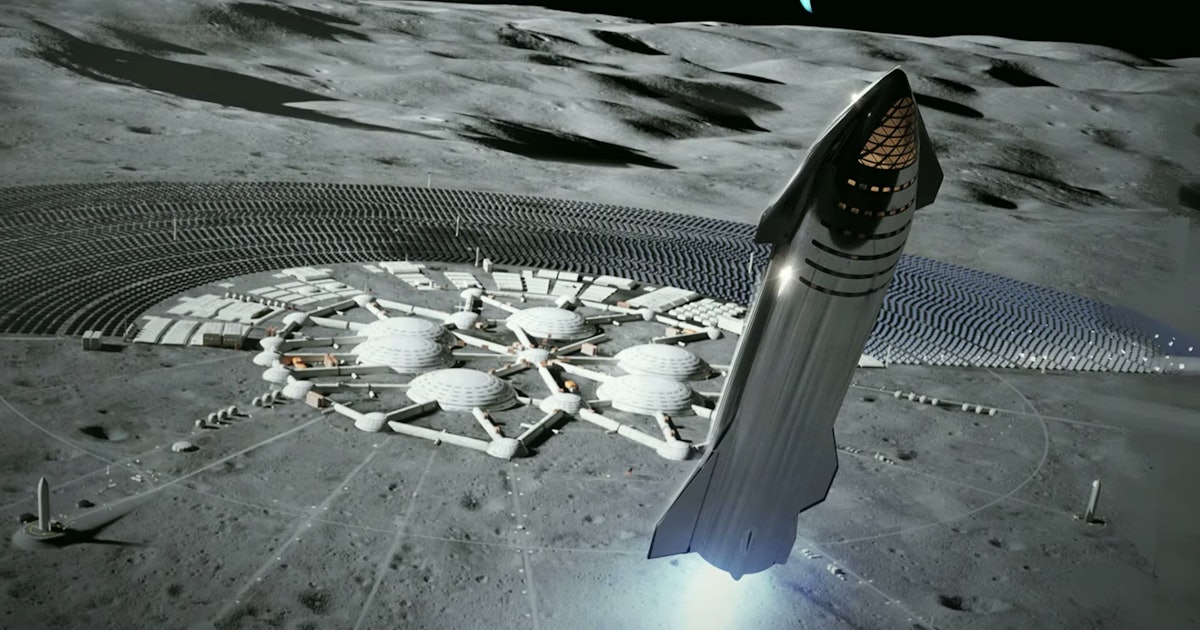
Lunar base: How NASA's moon water discovery could support human habitats

Kortom, het waarborgen van de gezondheid en veiligheid van astronauten op de maan vereist een multidisciplinaire aanpak, waarin technologische innovaties hand in hand gaan met medische en psychologische ondersteuning. Alleen door deze uitdagingen effectief aan te pakken, kan een duurzame en veilige menselijke aanwezigheid op de maan worden gerealiseerd.

3. Logistieke en financiële overwegingen

3.1 Kostenramingen

Het bouwen van een maanbasis is een project van uitzonderlijke omvang dat enorme financiële middelen vereist. Volgens schattingen wordt de totale kostprijs voor zo’n initiatief vaak op tientallen miljarden dollars geschat. Dit bedrag omvat niet alleen de bouw en inrichting van de basis zelf, maar ook de ontwikkeling van de benodigde technologieën, de logistieke ondersteuning, en de operationele kosten gedurende de eerste jaren van gebruik.

NASA heeft voor haar Artemis-programma, dat gericht is op het terugbrengen van mensen naar de maan en het opzetten van een duurzame aanwezigheid, een budget van ongeveer 35 miljard dollar uitgetrokken tot 2024. Dit bedrag dekt onder andere de ontwikkeling van nieuwe lanceermiddelen, de bouw van landingsmodules, en het testen van technologieën die nodig zijn voor langdurig verblijf op de maan. Echter, dit is slechts een deel van de totale kosten die gemoeid zullen zijn met het oprichten van een volledige maanbasis. Naarmate het project vordert en meer complexe systemen worden ontwikkeld, zullen de kosten waarschijnlijk verder toenemen.

Privébedrijven zoals SpaceX investeren miljarden in de ontwikkeling van hun ruimtevaartuigen, zoals de Starship. Hoewel de exacte kosten voor het construeren van een maanbasis met behulp van deze systemen nog niet volledig bekend zijn, wordt algemeen aangenomen dat de inzet van herbruikbare lanceersystemen en geavanceerde technologieën de kosten op de lange termijn kunnen verlagen. Toch blijft de financiële investering immens, en het vinden van voldoende financiering en investeerders is een grote uitdaging.

Bovendien spelen factoren zoals kostenstijgingen door technologische complexiteit, onvoorziene technische problemen en de behoefte aan langdurige operationele ondersteuning een grote rol bij het bepalen van het totale budget. Het is dus duidelijk dat het realiseren van een maanbasis een van de meest kostbare en complexe projecten in de geschiedenis van de ruimtevaart zal zijn.

3.2 Logistieke keten en bevoorrading

De logistiek rondom het opzetten en onderhouden van een maanbasis vormt een van de grootste uitdagingen. Het transporteren van grote hoeveelheden materiaal, zoals bouwmaterialen, voedsel, water, brandstof en reserveonderdelen, vereist een uiterst efficiënte en betrouwbare logistieke keten. De frequentie en betrouwbaarheid van lanceringen en landingen zullen hierbij cruciaal zijn.

SpaceX’s Starship en vergelijkbare lanceersystemen worden vaak genoemd als belangrijke middelen om deze logistieke keten te ondersteunen. Dankzij hun grote laadvermogen en herbruikbaarheid kunnen ze grote hoeveelheden materiaal in één keer naar de maan brengen, wat de kosten en de complexiteit aanzienlijk kan verminderen. Daarnaast moet er ook rekening gehouden worden met de planning en timing van leveringen, zodat de basis continu operationeel kan blijven.

Een andere belangrijke overweging is de afhankelijkheid van aardse bevoorrading. Om de kosten te drukken en de zelfvoorzienendheid te vergroten, wordt er gekeken naar het gebruik van lokale hulpbronnen op de maan zelf. Denk hierbij aan het winnen van water uit ijslagen in de poolgebieden, het produceren van zuurstof en brandstof uit maanmateriaal, en het recyclen van afvalstoffen. Het ontwikkelen van technologieën voor in-situ resource utilization (ISRU) is essentieel om de zelfvoorzienendheid te vergroten en de logistieke last vanuit de aarde te verminderen.

Het opzetten van een robuust logistiek systeem dat zowel de levering van benodigdheden als het beheer van afval en reserveonderdelen mogelijk maakt, vereist nauwkeurige planning en geavanceerde technologieën. De logistieke keten moet bestand zijn tegen de extreme omstandigheden op de maan, zoals grote temperatuurschommelingen, stralingsniveaus en de trillingen tijdens lanceringen en landing.

3.3 Samenwerking en internationale partnerschappen

Gezien de enorme kosten en technische complexiteit van het bouwen en onderhouden van een maanbasis, is internationale samenwerking onontbeerlijk. Geen enkele ruimtevaartorganisatie of private partij kan dit omvangrijke project alleen realiseren. Daarom werken NASA, ESA (European Space Agency), Roscosmos (Russische ruimtevaartorganisatie), en andere landen en organisaties nauw samen om kennis, technologie en middelen te delen.

De samenwerking brengt verschillende voordelen met zich mee. Zo kunnen kosten worden gedeeld, waardoor de financiële last voor individuele partijen wordt verminderd. Daarnaast kunnen technologische expertise en ervaring worden uitgewisseld, wat de kwaliteit en veiligheid van het project ten goede komt. Internationale partners kunnen ook bijdragen aan de ontwikkeling van infrastructuur, zoals communicatie- en navigatiesystemen, en het opzetten van onderzoeksfaciliteiten op de maan.

Private partners zoals SpaceX spelen hierbij een belangrijke rol door innovatieve oplossingen en kosteneffectieve lanceermiddelen te bieden. Ze brengen flexibiliteit en technologische vooruitgang in het project, maar moeten daarbij ook voldoen aan strenge veiligheids- en kwaliteitsnormen die gelden voor overheidsinitiatieven.

Een goede samenwerking vereist daarom duidelijke afspraken over verantwoordelijkheden, financiën, technologische standaarden en veiligheidsprotocollen. Het opzetten van een internationaal consortium dat gezamenlijk de doelen en strategieën bepaalt, is essentieel om de complexiteit van het project te beheren en het succesvol te laten verlopen.

Hoe NASA van plan is een permanente Artemis-moonbasis te bouwen voor menselijk overleven

Wetenschapsdocumentaire

Kortom, de logistieke en financiële overwegingen vormen de kern van het succes van een maanbasis. Door een zorgvuldig uitgewerkte kostenraming, een betrouwbare logistieke keten en sterke internationale partnerschappen, wordt de weg geëffend voor een duurzame menselijke aanwezigheid op de maan. Het realiseren van zo’n basis zal niet alleen technische uitdagingen vergen, maar ook internationale samenwerking en strategisch financieel beleid dat gericht is op lange termijn succes.

4. Beleidsmatige en regelgevende aspecten

4.1 Internationale verdragen en regelgeving
De ruimtevaart wordt gereguleerd door een reeks internationale verdragen en overeenkomsten die het gebruik en de exploitatie van de ruimte en hemellichamen regelen. Eén van de belangrijkste documenten is het Verdrag inzake het gebruik van het Verkeersruimte, de maan en andere hemellichamen uit 1967, ook wel het Ruimterechtverdrag genoemd. Dit verdrag stelt dat de maan en andere hemellichamen voor iedereen vrij toegankelijk zijn, en verbiedt het claims van soevereiniteit door landen of particuliere entiteiten. Tegelijkertijd benadrukt het belang van het voorkomen van milieuschade en het beschermen van het ruimte- en maanmilieu. Bij het opzetten van een maanbasis moeten landen en particuliere organisaties voldoen aan deze internationale regels en mogelijk nieuwe afspraken maken om praktische en juridische obstakels weg te nemen. Daarnaast bestaan er andere verdragen en richtlijnen, zoals het Verdrag inzake ruimtemissies (1986), dat de aansprakelijkheid regelt bij schade veroorzaakt door ruimteactiviteiten, en de principes voor milieubescherming in de ruimte. Het is cruciaal dat deze regelgeving wordt bijgewerkt en aangevuld om de complexe realiteit van een permanente aanwezigheid op de maan te ondersteunen, inclusief kwesties rondom eigendomsrechten, resource-extractie en milieubescherming.

4.2 Veiligheid en aansprakelijkheid
Een van de grootste beleidsmatige uitdagingen bij het bouwen en onderhouden van een maanbasis is het waarborgen van de veiligheid van astronauten en het voorkomen van conflicten over gebruiksrechten en hulpbronnen. De risico’s van ruimtevaart zijn groot, variërend van stralingsrisico’s tot technische storingen en ongelukken. Daarom worden er door NASA en andere ruimtevaartorganisaties uitgebreide protocollen en veiligheidsmaatregelen ontwikkeld voor ruimte-missies. Deze protocollen moeten niet alleen de fysieke veiligheid van de bemanning waarborgen, maar ook de operationele integriteit van de maanbasis. Daarnaast is de aansprakelijkheid bij schade een complex aspect; wie is verantwoordelijk als bijvoorbeeld een ruimtevaartuig schade veroorzaakt aan de maanbasis of derden? Het internationale recht voorziet hierin in bepaalde regels, maar de praktische toepassing op lange termijn vereist vaak bilaterale of multilaterale overeenkomsten. Het opstellen van duidelijke aansprakelijkheidsregels en het verzekeren van de veiligheid blijven daarom prioriteiten voor beleidsmakers.

De Ruimterace (Terug) naar de Maan: Artemis, Maanbases en Concurrentie Buiten de Omloopbaan

4.3 Politieke wil en publieke steun
De ambitie om binnen tien jaar een operationele maanbasis te bouwen, is afhankelijk van politieke wil en publieke steun. Politiek leiders moeten besluiten nemen over de benodigde investeringen, regelgeving en internationale samenwerking. Veranderingen in beleidsprioriteiten, bijvoorbeeld door nieuwe regeringen of geopolitieke spanningen, kunnen de voortgang vertragen of zelfs blokkeren. Daarnaast speelt publieke interesse en steun een essentiële rol. Een breed draagvlak onder de bevolking en de betrokkenheid van het publiek kunnen de politieke besluitvorming versterken en financiering veiligstellen. Het is daarom belangrijk dat regeringen en ruimtevaartorganisaties transparant zijn over de plannen, de voordelen benadrukken en inspelen op publieke zorgen en verwachtingen. Daarnaast moeten internationale samenwerkingen en publiek-private partnerschappen worden versterkt om de benodigde middelen en expertise te bundelen. Alleen door een combinatie van politieke vastberadenheid, maatschappelijke betrokkenheid en internationale diplomatie kan de realisatie van een maanbasis binnen de gestelde termijn worden gerealiseerd.

5. Tijdslijn en haalbaarheid

5.1 Technische tijdslijn

De komende jaren worden cruciaal voor de ontwikkeling van maanmissies en de bouw van een permanente aanwezigheid op de maan. In 2024 en 2025 ligt de focus op het afronden van de Artemis II- en Artemis III-missies, die respectievelijk de eerste bemande vlucht rond de maan en de eerste landing van een mens op de maan in decennia vertegenwoordigen. Deze missies vormen de fundering voor verdere exploratie en infrastructuurontwikkeling. Daarnaast wordt in deze periode ook gewerkt aan de verdere ontwikkeling van de SpaceX Starship, een herbruikbare raket die mogelijk de belangrijkste tool wordt voor het transport van mensen en materialen naar de maan.

  • Van 2025 tot 2027 verschuift de aandacht naar het opzetten van testfaciliteiten en het uitvoeren van eerste landingen en proefopstellingen op de maan. Tijdens deze periode zullen verschillende landingen plaatsvinden om de technische en logistieke aspecten te testen, zoals het veilig landen en opstijgen, het installeren van basisvoorzieningen en het testen van duurzame systemen voor levensonderhoud en energie. Het opzetten van basisfaciliteiten, zoals tijdelijke habitats, energieopslag en communicatie-infrastructuur, vormt hierbij een prioriteit. Dit is essentieel om de technologische en operationele uitdagingen te begrijpen en op te lossen.
  • In de periode van 2027 tot 2029 wordt gewerkt aan de uitbreiding en verfijning van de infrastructuur. De focus ligt op het versterken van basisfaciliteiten en het implementeren van duurzame systemen die langdurige menselijke aanwezigheid mogelijk maken. Denk hierbij aan het ontwikkelen van geavanceerdere habitats, recycling- en energiesystemen, en het verbeteren van transportmogelijkheden op en rond de maan. Het doel is om een functionele en semi-permanente basis te creëren die kan dienen als uitvalsbasis voor verdere verkenning en wetenschappelijk onderzoek.
  • Het jaar 2030 wordt vaak genoemd als het moment waarop een volledige, functionele maanbasis mogelijk gerealiseerd kan worden. Hoewel dit een ambitieuze doelstelling is, zou het betekenen dat de basis operationeel en zelfvoorzienend is, met voldoende infrastructuur om langdurige bewoning en wetenschappelijke activiteiten te ondersteunen. Hoewel het realistisch is dat de eerste basis nog klein en eenvoudig zal zijn, vormt dit jaar een belangrijke mijlpaal in de mensheid’s ruimtevaartgeschiedenis.

5.2 Kritische factoren voor succes

Het succesvol realiseren van de geplande tijdslijn hangt af van verschillende kritische factoren. Allereerst zijn technologische doorbraken essentieel. Vooral op het gebied van bouwmaterialen die bestand zijn tegen de extreme omstandigheden op de maan, systemen voor levensonderhoud die betrouwbaar en efficiënt zijn, en energievoorziening die zowel duurzaam als krachtig is. Innovaties zoals 3D-printen van bouwmaterialen uit lokale grondstoffen kunnen hierbij een grote rol spelen.

Daarnaast is financiering en beleid van groot belang. Een stabiel, toereikend budget moet continu beschikbaar blijven om de lange termijnprojecten te ondersteunen. Politieke steun op nationaal en internationaal niveau is noodzakelijk om de benodigde middelen en regelgeving te garanderen. Zonder voldoende financiële middelen kunnen plannen vertragen of zelfs stilvallen.

Internationale samenwerking speelt eveneens een sleutelrol. Door gedeelde middelen, kennis en expertise kunnen de kosten worden gedeeld en de technologische ontwikkeling versneld. Samenwerking tussen landen, ruimtevaartorganisaties en commerciële partijen biedt de beste kansen op succes en het vermijden van dubbele inspanningen.

Tot slot is de ervaring die wordt opgedaan uit eerdere missies en proefprojecten cruciaal. Elke missie biedt waardevolle lessen over technische uitdagingen, operationele procedures en menselijke factoren. Deze kennis kan worden gebruikt om toekomstige missies efficiënter en veiliger te maken.

5.3 Realistische inschatting

Hoewel de plannen voor een maanbasis binnen tien jaar ambitieus en uitdagend zijn, is het niet onmogelijk. Technologische, logistieke en beleidsmatige obstakels maken het realiseren van een volledige en uitgebreide basis wel complex. Toch is een haalbare strategie het starten met een kleine en functionele basis die in de loop der jaren kan worden uitgebreid en verfijnd.

In eerste instantie zal de basis waarschijnlijk bestaan uit eenvoudige habitats, basisvoorzieningen en energievoorzieningen die voldoende zijn voor korte verblijven en wetenschappelijk onderzoek. Naarmate de technologie vordert en meer ervaring wordt opgedaan, kunnen deze faciliteiten worden uitgebreid en verbeterd, waardoor een duurzame en langdurige menselijke aanwezigheid mogelijk wordt. Het proces van ontwikkeling zal waarschijnlijk gefaseerd verlopen, waarbij elk succes en elke leermoment wordt benut om verdere stappen te zetten.

Kortom, hoewel er grote uitdagingen liggen, maken technologische innovaties, internationale samenwerking en een strategische aanpak het mogelijk om binnen tien jaar een basis op de maan te realiseren. Het blijft echter een project dat voortdurende inzet, financiering en innovatie vereist om uiteindelijk te leiden tot een volwaardige menselijke aanwezigheid op de maan.

NASA's plan om een permanente maanbasis te bouwen in de donkerste krater
RUIMTEDOCUMENTAIRE

6. Conclusie

Kunnen NASA en SpaceX binnen tien jaar een maanbasis bouwen?

Kortom, hoewel zowel NASA als SpaceX beschikken over de technologische expertise en financiële middelen om de eerste stappen te zetten richting een maanbasis, zijn er aanzienlijke uitdagingen die de realisatie binnen tien jaar in de weg staan. De ontwikkeling van de benodigde infrastructuur, het overwinnen van technische obstakels, het waarborgen van astronautveiligheid, en het navigeren door politieke en regelgevingstechnische kwesties maken dat het bouwen van een volledige, duurzame maanbasis binnen tien jaar een zeer ambitieus doel blijft.

Echter, met de huidige ontwikkelingen en de vastberadenheid van de betrokken organisaties, is het mogelijk dat in deze periode een eerste basis of proefopstellingen gerealiseerd worden, die later kunnen uitgroeien tot een volwaardige maanbasis. Het is belangrijk te beseffen dat ruimteverkenning altijd gepaard gaat met onzekerheden en dat de reis naar een maanbasis een proces is van voortdurende innovatie en samenwerking.

In samenvatting: Het is uiterst uitdagend, maar niet onmogelijk, dat NASA en SpaceX binnen tien jaar een functionerende maanbasis kunnen realiseren. Het vereist een combinatie van technologische doorbraken, stevige financiering, internationale samenwerking en een duidelijke beleidsrichting. Wat zeker is, is dat deze ambitie de komende jaren de ruimtevaartwereld zal blijven stimuleren en inspireren, en dat de weg naar de maan een belangrijk hoofdstuk zal blijven in de menselijke verkenning van het heelal.

  • NOTA PETER2011: Dit artikel is gebaseerd op de stand van de techniek en beleidsmatige ontwikkelingen tot oktober 2023. De ruimtevaartsector evolueert snel, en toekomstige doorbraken kunnen de haalbaarheid van een maanbasis binnen tien jaar beïnvloeden.


Hoe NASA Een Stad Op De Maan Zal Bouwen

{ PETER2011 }

Hoe vind je dit bericht?
Geschreven door peter om 22:02 Stuur door

Animal Found On Mars In Recent NASA rover Photos, April 30, 2026, UFO Sighting News.

Animal Found On Mars In Recent NASA rover Photos, April 30, 2026, UFO Sighting News.

animal%20on%20Mars.png

Date of discovery: April 30, 2026
Location of discovery: Mars
Source photo: 
Hey check this out. I was looking over some photos of Mars and found some intriguing things. I found several faces which are remnants of statues sculpted thousands of years ago and I also found an animal that closely resembles a tortoise. 
 
The animal is hand size and has a tortoise shell and its head and legs all appear the same as a tortoise. With Tortoises being desert animals living in the driest areas, it makes sense that such creatures exist on Mars too. 
 
The two faces I found are from ancient sculptures made from a mixture of the dirt/clay found on the surface of Mars and sculpted into faces of those who passed before them. The faces are different and one is much older than the other if you take into consideration the weathering. 
Scott C. Waring - UFO Sightings Daily
 
face%20on%20mars.png


tortoise%20on%20mars.png
Mars%20life.png
 
Mars%20face.png
RELATED VIDEOS

Mars - Animal Instinct ? Petrified ? ArtAlienTV 4K

What Was REALLY Found on Mars? 20 Shocking Facts!

{ https://www.ufosightingsdaily.com/ }

Hoe vind je dit bericht?
Geschreven door peter om 19:56 Stuur door

Meer van UFO'S of UAP'S, ASTRONOMIE, RUIMTEVAART, ARCHEOLOGIE, OUDHEIDKUNDE, SF-SNUFJES EN ANDERE ESOTERISCHE WETENSCHAPPEN - DE ALLERLAATSTE NIEUWTJES

↑ Terug naar de berichten