Ontdek de Fascinerende Wereld van UFO's en UAP's: Jouw Bron voor Onthullende Informatie!
Ben jij ook gefascineerd door het onbekende? Wil je meer weten over UFO's en UAP's, niet alleen in België, maar over de hele wereld? Dan ben je op de juiste plek!
België: Het Kloppend Hart van UFO-onderzoek
In België is BUFON (Belgisch UFO-Netwerk) dé autoriteit op het gebied van UFO-onderzoek. Voor betrouwbare en objectieve informatie over deze intrigerende fenomenen, bezoek je zeker onze Facebook-pagina en deze blog. Maar dat is nog niet alles! Ontdek ook het Belgisch UFO-meldpunt en Caelestia, twee organisaties die diepgaand onderzoek verrichten, al zijn ze soms kritisch of sceptisch.
Nederland: Een Schat aan Informatie
Voor onze Nederlandse buren is er de schitterende website www.ufowijzer.nl, beheerd door Paul Harmans. Deze site biedt een schat aan informatie en artikelen die je niet wilt missen!
Internationaal: MUFON - De Wereldwijde Autoriteit
Neem ook een kijkje bij MUFON (Mutual UFO Network Inc.), een gerenommeerde Amerikaanse UFO-vereniging met afdelingen in de VS en wereldwijd. MUFON is toegewijd aan de wetenschappelijke en analytische studie van het UFO-fenomeen, en hun maandelijkse tijdschrift, The MUFON UFO-Journal, is een must-read voor elke UFO-enthousiasteling. Bezoek hun website op www.mufon.com voor meer informatie.
Samenwerking en Toekomstvisie
Sinds 1 februari 2020 is Pieter niet alleen ex-president van BUFON, maar ook de voormalige nationale directeur van MUFON in Vlaanderen en Nederland. Dit creëert een sterke samenwerking met de Franse MUFON Reseau MUFON/EUROP, wat ons in staat stelt om nog meer waardevolle inzichten te delen.
Let op: Nepprofielen en Nieuwe Groeperingen
Pas op voor een nieuwe groepering die zich ook BUFON noemt, maar geen enkele connectie heeft met onze gevestigde organisatie. Hoewel zij de naam geregistreerd hebben, kunnen ze het rijke verleden en de expertise van onze groep niet evenaren. We wensen hen veel succes, maar we blijven de autoriteit in UFO-onderzoek!
Blijf Op De Hoogte!
Wil jij de laatste nieuwtjes over UFO's, ruimtevaart, archeologie, en meer? Volg ons dan en duik samen met ons in de fascinerende wereld van het onbekende! Sluit je aan bij de gemeenschap van nieuwsgierige geesten die net als jij verlangen naar antwoorden en avonturen in de sterren!
Heb je vragen of wil je meer weten? Aarzel dan niet om contact met ons op te nemen! Samen ontrafelen we het mysterie van de lucht en daarbuiten.
NASA Instrument Bound for Titan Could Reveal Chemistry Leading to Life
A new NASA mission to Saturn’s giant moon, Titan, is due to launch in 2027. Whendiscovery that could bring about a new understanding of the development of life in the universe. This mission, called Dragonfly, will carry an instrument called the Dragonfly Mass Spectrometer (DraMS), designed to help scientists hone in on the chemistry at work on Titan. It may also shed light on the kinds of chemical steps that occurred on Earth that ultimately le it arrives in the mid-2030s, it will begin a journey of d to the formation of life, called prebiotic chemistry.
This illustration shows NASA’s Dragonfly rotorcraft-lander approaching a site on Saturn’s exotic moon, Titan. Taking advantage of Titan’s dense atmosphere and low gravity, Dragonfly will explore dozens of locations across the icy world, sampling and measuring the compositions of Titan's organic surface materials to characterize the habitability of Titan’s environment and investigate the progression of prebiotic chemistry.
Credits: NASA/JHU-APL
Titan's abundant complex carbon-rich chemistry, interior ocean, and past presence of liquid water on the surface make it an ideal destination to study prebiotic chemical processes and the potential habitability of an extraterrestrial environment.
DraMS will allow scientists back on Earth to remotely study the chemical makeup of the Titanian surface. “We want to know if the type of chemistry that could be important for early pre-biochemical systems on Earth is taking place on Titan,” explains Dr. Melissa Trainer of NASA’s Goddard Space Flight Center, Greenbelt, Maryland.
The colorful globe of Saturn's largest moon, Titan, passes in front of the planet and its rings in this true color snapshot from NASA's Cassini spacecraft.
Credits: NASA/JPL-Caltech/Space Science Institute
Trainer is a planetary scientist and astrobiologist who specializes in Titan and is one of the Dragonfly mission’s deputy principal investigators. She is also lead on the DraMS instrument, which will scan through measurements of samples from Titan’s surface material for evidence of prebiotic chemistry.
To accomplish this, the Dragonfly robotic rotorcraft will capitalize on Titan’s low gravity and dense atmosphere to fly between different points of interest on Titan’s surface, spread as far as several miles apart. This allows Dragonfly to relocate its entire suite of instruments to a new site when the previous one has been fully explored, and provides access to samples in environments with a variety of geologic histories.
At each site, samples less than a gram in size will be drilled out of the surface by the Drill for Acquisition of Complex Organics (DrACO) and brought inside the lander’s main body, to a place called the “attic” that houses the DraMS instrument. There, they will be irradiated by an onboard laser or vaporized in an oven to be measured by DraMS. A mass spectrometer is an instrument that analyzes the various chemical components of a sample by separating these components down into their base molecules and passing them through sensors for identification.
“DraMS is designed to look at the organic molecules that may be present on Titan, at their composition and distribution in different surface environments,” says Trainer. Organic molecules contain carbon and are used by all known forms of life. They are of interest in understanding the formation of life because they can be created by living and non-living processes.
Mass spectrometers determine what’s in a sample by ionizing the material (that is, bombarding it with energy so that the atoms therein become positively or negatively charged) and examining the chemical composition of the various compounds. This involves determining the relationship between the weight of the molecule and its charge, which serves as a signature for the compound.
DraMS was developed in part by the same team at Goddard which developed the Sample Analysis at Mars (SAM) instrument suite aboard the Curiosity rover. DraMS is designed to survey samples of Titanian surface material in situ, using techniques tested on Mars with the SAM suite.
Trainer emphasized the benefits of this heritage. Dragonfly’s scientists did not want to “reinvent the wheel” when it came to searching for organic compounds on Titan, and instead built on established methods which have been applied on Mars and elsewhere. “This design has given us an instrument that’s very flexible, that can adapt to the different types of surface samples,” says Trainer.
DraMS and other science instruments on Dragonfly are being designed and built under the direction of the Johns Hopkins Applied Physics Laboratory in Laurel, Maryland, which manages the mission for NASA and is designing and building the rotorcraft-lander. The team includes key partners at Goddard, the French space agency (CNES, Paris, France), which is providing the Gas Chromatograph Module for DraMS that will provide an additional separation after leaving the oven, Lockheed Martin Space, Littleton, Colorado, NASA Ames Research Center at Moffett Federal Airfield in California's Silicon Valley, NASA Langley Research Center, Hampton, Virginia, NASA Jet Propulsion Laboratory, Pasadena, California, Penn State University, State College, Pennsylvania, Malin Space Science Systems, San Diego, California, Honeybee Robotics, Brooklyn, New York, the German Aerospace Center (DLR), Cologne, Germany, and the Japan Aerospace Exploration Agency (JAXA), Tokyo, Japan.
Dragonfly is the fourth mission in NASA’s New Frontiers program. New Frontiers is managed by NASA's Marshall Space Flight Center in Huntsville, Alabama, for the agency's Science Mission Directorate Washington.
By: Nick Oakes
NASA Goddard Space Flight Center, Greenbelt, Maryland
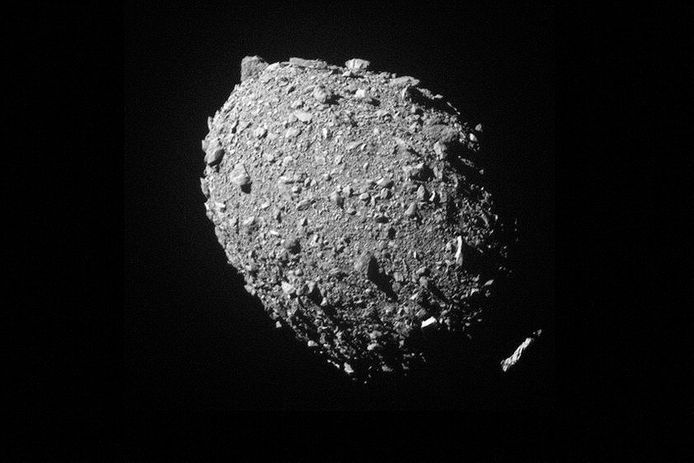
Asteroïde met bijnaam ‘City Killer’ passeert tussen aarde en maan, toch stellen wetenschappers ons gerust
Een asteroïde die groot genoeg is om een hele stad te vernietigen, zal dit weekend tussen de aarde en de maan passeren. Toch is er geen reden tot paniek, want de asteroïde zal geen botsing maken. Voor wetenschappers is het wel heel interessant om het object van dichtbij te bestuderen.
Er komen wel vaker ruimterotsen voorbij, maar volgens NASA is het toch zeldzaam dat een asteroïde van zo’n formaat zo dichtbij komt. Volgens het ruimteagentschap gebeurt dit slechts één keer per tien jaar. Wetenschappers schatten de grootte op een diameter tussen 40 en 90 meter.
De asteroïde die een maand geleden werd ontdekt en bekendstaat als ‘2023 DZ2', zal zaterdag met een snelheid van ongeveer 28.000 kilometer per uur langs de aarde vliegen. Die ontmoeting biedt astronomen de kans om een ruimterots vanop iets meer dan 68.000 km afstand te bestuderen. Op minder dan de helft van de afstand tot de maan zal de asteroïde zichtbaar zijn door verrekijkers en kleine telescopen.
“Er is geen kans dat deze ‘City Killer’ de aarde zal treffen, maar zijn dichte nadering biedt een geweldige kans voor waarnemingen”, zei Richard Moissl van het Europees Ruimteagentschap in een verklaring.
Veel bijleren
NASA ziet het als een goede oefening voor planeetverdediging. “Het kan ons veel leren over wat we moeten doen bij een gevaarlijke asteroïde in de toekomst”, aldus het ruimteagentschap.
De asteroïde komt pas in 2026 weer onze kant op. Aanvankelijk leek er een kleine kans te bestaan dat hij bij terugkeer de aarde zou raken, maar wetenschappers hebben dat inmiddels uitgesloten.
Ringcam Sees UFO Hovering Over Lawn! Pennsylvania, 3-19, 2023, UFO Sighting News.
Date of sighting: March 19, 2023
Location of sighting: Pennsylvania, USA Source: MUFON
This was caught by a Ringcam. A glowing disk was seen hovering over a guys front lawn. The UFO was about a foot above the ground and there was a thick beam of light coming from the craft to the ground. Also a myst all around the ground below it. I often say that UFOs are most frequently seen during sunset and sunrise due to the angle of the sun, the person and the UFO, which allows the cloaked UFO to be seen from a few seconds to a few minutes. This UFO is small, so any occupants would be 6-8 inches tall. The same size as the small statues of human like beings I have found on Mars, in NASA photos. 100% proof that aliens exist and may be found in your own front yard.
Scott C. Waring - Taiwan
Eyewitness states:
Small glowing disc with a beam coming down from the center in yard. This was caught on ring camera in the middle of the night. A purple streak goes around it and it looks like there is a red bush behind it, but there is no bush there.
Mysterious Daytime UFO Sighting: Man and His Dog Encounter a Puzzling Orb in March 2023
March 2023, somewhere in the United States – In a remarkable daytime UFO sighting, a man walking his dog named Hero stumbled upon a mysterious orb hovering low over a field. The exact location of this strange encounter remains unknown, but the video captured by the man has gone viral, generating considerable buzz and prompting discussions around the nature of the enigmatic object.
The video begins with the man noticing an odd, seemingly metallic orb in the sky. He can be heard exclaiming, “Um, what is that?” The bewildered man loses sight of the object briefly, only to spot it again and continue recording. He notes that he and Hero are alone in the field, emphasizing that there is no one around who could be operating a drone or similar device.
The orb appears to gyrate in a peculiar way, drawing the man’s attention and raising questions about its origin. He speculates that it could be a balloon, but dismisses the idea given its strange movements and the way it appeared out of nowhere. Instead, he wonders if it could be a government-controlled object. He points out a nearby tree, claiming the orb seemed to have “lodged” itself from that spot before taking to the air.
As the video continues, the man struggles to keep the orb in view, finally losing sight of it entirely. He ponders the possibilities, remarking, “I have no clue what this is right now.” The unsettling encounter leaves him, and the thousands who have viewed the video, questioning the nature of the bizarre object.
Theories surrounding the sighting range from the mundane to the fantastical. Some argue that it could be a weather balloon, while others suggest the possibility of advanced military technology. The more outlandish theories propose that the orb is a genuine extraterrestrial craft, citing its enigmatic movements as evidence.
The video’s authenticity and the true identity of the orb remain topics of heated debate. While the footage has captured the imagination of countless individuals, skeptics argue that the video could be an elaborate hoax or the result of digital manipulation. As of now, the orb’s true nature remains an unsolved mystery that continues to baffle and intrigue those who come across this curious daytime UFO sighting.
Check out the video bellow! Also includes a stabilized footage!
Triangular UFOs: A Historical Journey Through Unexplained Phenomena
Triangular UFO sightings have been a constant presence in the world of ufology, capturing the interest of researchers and enthusiasts alike. Despite being overshadowed by the more traditional disc-shaped UFOs, these mysterious triangular objects have left their mark throughout history, with reports often displaying remarkable consistency. In the video bellow the article, David Marler explores some of the most intriguing triangular UFO sightings from the past, highlighting the persistence of this enigmatic phenomenon. Here are just few of them:
The Early Days: 1950s and 1960s
Although the heyday of UFO sightings began in the late 1940s, it wasn’t until the 1950s that triangular UFOs started to garner attention. One of the earliest recorded sightings occurred in Amarillo, Texas, in 1965. A police officer and his wife reported observing a silent, triangular object with lights at each corner hovering in the sky. This sighting marked the beginning of many more similar reports, with witnesses describing slow-moving, soundless, and mysterious triangular aircraft.
The Lumberton Wave was a series of sightings that took place in Lumberton, North Carolina, in 1975. Residents reported observing a large, silent, triangular object with bright lights at each corner. This object was known to hover for extended periods before moving away at incredible speeds. Notably, a police officer clocked the object at 200 miles per hour with a speed gun. This wave of sightings attracted the attention of UFO investigator Dr. J. Allen Hynek, who found the testimonies to be credible and unexplainable.
Memphis, Tennessee: 1977
In 1977, multiple police officers from various precincts around Memphis, Tennessee, reported witnessing a large triangular object in the sky. One officer, Lamar Todd, shared his experience of observing the silent, hovering object for several minutes before it disappeared across the horizon in a matter of seconds. Interestingly, this sighting occurred just days before the release of the movie Star Wars, challenging the idea that cultural influences were responsible for these reports.
Consistent Characteristics and the Search for Answers
Throughout the years, triangular UFO sightings have displayed remarkable consistency in their descriptions. Witnesses often report slow, silent flight; hovering capabilities; and unconventional lighting configurations. While some modern sightings might be explained by advanced military aircraft, the historical presence of these objects suggests a more complex explanation.
As researchers continue to investigate and compile data on triangular UFOs, collaboration between official agencies, independent investigators, and organizations like MUFON will be crucial to further our understanding of this enigmatic phenomenon. By preserving historical data and exploring new cases, we may one day unveil the truth behind these mysterious triangular objects.
JAMES WEBB DISCOVERS COLDEST ICE IN KNOWN UNIVERSE, HARBORING MOLECULES ESSENTIAL FOR LIFE
"THESE OBSERVATIONS OPEN A NEW WINDOW ON THE FORMATION PATHWAYS FOR THE SIMPLE AND COMPLEX MOLECULES THAT ARE NEEDED TO MAKE THE BUILDING BLOCKS OF LIFE."
NASA
Catch Em Cold
The James Webb Space Telescope, which at this point can safely be described as an inveterate record breaker, has spotted yet another superlative cosmic curiosity: the coldest ice in the known universe.
According to a new study published in the journal Nature Astronomy, that interstellar ice got as cold as minus 440 degrees Fahrenheit — just under 11 Kelvin, and spitting distance from absolute zero.
The frigid formations were found as part of a star-forming molecular cloud residing in a region of space called Chamaeleon I, in the southern reaches of the Chamaeleon constellation, approximately 500 light years from Earth. Thanks to the Webb's powerful Near Infrared Camera (NIRCam) and a healthy, illuminating backdrop of starlight, astronomers were able to spot the frozen molecules that would have hitherto gone unnoticed.
"The ices show up as dips against a continuum of background starlight," said study co-author Klaus Pontoppidan from the Space Telescope Science Institute in a statement. "In regions that are this cold and dense, much of the light from the background star is blocked, and Webb's exquisite sensitivity was necessary to detect the starlight and therefore identify the ices in the molecular cloud."
Ice Spice
Tantalizingly, the ice also includes vital elements to forming a habitable planet, collectively known as CHONS: carbon, hydrogen, oxygen, nitrogen, and sulfur. Some, the scientists found, came in the form of organic molecules like methanol and possibly ethanol, as well as other compounds essential to life including carbon dioxide, ammonia, methane, and of course, water.
And that could have massive implications on our understanding of the occurrence of life in the universe, the scientists say.
"Our identification of complex organic molecules, like methanol and potentially ethanol, also suggests that the many star and planetary systems developing in this particular cloud will inherit molecules in a fairly advanced chemical state," explained study co-author Will Rocha, an astronomer at Leiden Observatory, in the statement. "This could mean that the presence of precursors to prebiotic molecules in planetary systems is a common result of star formation, rather than a unique feature of our own solar system."
The scientists were also able to measure the amount of sulfur trapped in the icy dust for the first time, and while the amount was less than expected, they believe that indicates that other CHONS are still present but are trapped in more solid materials and thus avoid detection.
Some details to iron out notwithstanding, the findings may prove essential in understanding the formation of organic molecules.
"These observations open a new window on the formation pathways for the simple and complex molecules that are needed to make the building blocks of life," said study lead author and Leiden astronomer Melissa McClure.
The aurora borealis might appear in skies from Washington to New York, lighting up the night with beautiful colors, as a stream of electrically charged particles called "solar wind" hits the poles and reacts with molecules in the atmosphere.
The Northern Lights are typically only visible closer to the Arctic Circle, but a forecast from the Space Weather Prediction Center shows they could creep further south as strong solar winds arrive, lighting up the skies with beautiful colors.
As of Wednesday morning, the aurora forecast predicted a "Kp index" of 6 on Friday. That's a measure for the strength of the Northern Lights. It indicates that the aurora may occur halfway between the green and yellow lines in the below image:
These solar winds are coming from a giant coronal hole on the Sun.
The giant dark spot is not an actual hole in the way you might be thinking. Rather, it's an area of the ultra-hot outer layer of the Sun's atmosphere (the corona) that's cooler in temperature than its surroundings, and therefore not glowing as bright.
The 'hole' in the Sun's atmosphere. (NASA/Solar Dynamics Observatory)
This one is very large: the size of about 20-30 Earths lined up back-to-back, Alex Young, the associate director for science at NASA Goddard's Heliophysics Science Division, previously told Insider.
As that giant hole spread across the corona, it blasted strong, high-speed solar winds into space, in the direction of Earth. Those winds don't pose a threat, since the atmosphere shields us and they're not strong enough to cause widespread radio or power blackouts, as some powerful solar storms have in the past.
Because of the approaching eruption of solar particles, the Space Weather Prediction Center issued a watch for a moderate geomagnetic storm on Friday.
That's the magnetic-field chaos that ensues when those high-speed particles hit Earth. Our planet's magnetic field channels them toward the North and South Poles, where they set off a beautiful, ethereal glow. Stronger geomagnetic storms can interfere with GPS, radio, and power grids.
But moderate geomagnetic storms are more benign. They have previously driven the aurora lights as far south as New York and Idaho.
NASA MARS ROVER FINDS METALLIC OBJECT THAT SMASHED DOWN ON SURFACE
OKAY, THAT'S PRETTY AWESOME.
NASA
Cacao Nibs
NASA's Curiosity Mars rover has stumbled across yet another fascinating discovery while exploring the planet's barren surface.
This time, it appears to be an iron-nickel meteorite dubbed Cacao, which measures roughly a foot across and can be seen in an ultra-high resolution image, stitched together from 19 individual photos taken by the rover on January 28.
The mysterious object's lovely silver metallic hue stands out like a sore thumb in the surrounding, rust-colored landscape, a sulfate-bearing region of the Red Planet's Mount Sharp.
"Rock. Rock. Rock. Rock. Rock. Rock. METEORITE!" the rover's official Twitter account wrote. "It's not uncommon to find meteorites on Mars — in fact, I've done it a few times! But a change in scenery's always nice."
Pet Rock
Unfortunately, Curiosity, which has been roaming the surface for well over a decade now, isn't equipped to take a sample from Cacao and bring it back home. That's one of the main objectives of the rover's cousin Perseverance, the only other active rover currently roaming the surface of Mars, which has been industriously picking up samples of Martian rock and soil.
The meteorite could still allow scientists to glean insights into the Red Planet's ancient past or whether it once hosted life. The scars and indentations on Cacao's surface were likely formed as it made its way through the planet's atmosphere, as Universe Today reports, despite the planet's thin atmosphere.
Iron nickel meteorites are also the rarest kinds of meteorites and stand a very good chance of surviving their journey through either Mars' or Earth's atmosphere.
The Beast
As the Curiosity team points out in its update, the rover has come across several meteorites not unlike Cacao, from the golf ball-sized "egg rock" it found in 2016, to the massive seven-foot iron meteorite "Lebanon" — or "the Beast" — meteorite in 2014.
But there's only so much the scientists will be able to learn about Curiosity's newest find.
"There’s no way to date these," the team admitted in a Twitter reply. "But it could have been here millions of years!"
The ancient Egyptians were masterful innovators when it came to warfare, with a diverse and deadly arsenal of weaponsat their disposal. From the iconic khopesh sword, with its curved blade designed for close-quarters combat, to the powerful composite bow capable of piercing armor at great distances, their weapons were designed to strike fear into the hearts of their enemies.
But it wasn't just the weapons themselves that made the ancient Egyptian military so formidable. They also employed clever tactics and strategies to gain the upper hand in battle, such as the use of chariots and skirmishers to harass enemy troops.
Through a closer examination of the weapons and tactics of ancient Egypt, we can gain a better understanding of their military might and the role they played in shaping the history of the ancient world.
Spherical Shaped UFO witnessed on 3/17/23 114 Ml in Riverview FL & traveling towards the Cape Canaveral FL. Video Source MUFON Case Numbers 129796,129790,129793
UFO Spotted In The Footage Of The Russian Jet Taking Down A American Drone. March 14, 2023
This footage was captured when the MQ-9 Reaper drone was seen pointing backwards as the Russian Sukhoi SU-27 fighter jet began its approach and shows the interaction between the surveillance drone and the Russian fighter jet over the Black Sea but also in the footage we can see this UFO "Orb" fly into view. I feel that on the time of the release of this footage the Pentagon officials might have missed this object but we didn't...
Revolutionary 100-Kilometer Space Telescope [NIAC 2023]
There are radio wavelengths that we can't see from Earth. And to observe them from space, we need a truly huge telescope. Mary Knapp and her team proposed a project that can allow us to build such a telescope and they just recently got a NIAC grant for it.
And exploration of three scientific papers on the UFO Phenomenon, two very recent, in relation to the US government and Harvard's Galileo Project probes into the UFO UAP phenomenon.
Papers:
"Preliminary Assessment: Unidentified Aerial Phenomena", United States Office of the Director of National Intelligence, 2021 https://www.dni.gov/files/ODNI/docume...
Relativity's 3D-printed rocket launches but fails to reach orbit after 2nd stage anomaly
Relativity's Terran 1 rocket launched from Launch Complex 16 in Cape Canaveral, Florida on March 22, 2023. The rocket successfully made it through Max-Q and completed first stage separation but an anomaly with the second stage resulted in failure to reach orbit.
First 3D Printed Rocket Reaches Space But Engine Fails Before Orbit
Relativity Space have been getting a lot of attention for 3D printing their rockets, some of the largest 3D printed structures ever seen are coming from their custom 3D printing systems. Last night was their Debut launch after 2 previous scrubs, and while the initial launch and ascent worked well the 2nd stage engine failed to generate enough thrust to make orbit, appearing to light and die. So what can we learn?
Rarest Atmospheric Phenomena Ever Caught on Camera
Supralateral arcs, ice pillars and sun pillars. For beautiful meteorite rings and more, check out https://www.thorum.com and use the code "ASTRUM" at checkout to get 20% off a truly unique ring!
Meer van UFO'S of UAP'S, ASTRONOMIE, RUIMTEVAART, ARCHEOLOGIE, OUDHEIDKUNDE, SF-SNUFJES EN ANDERE ESOTERISCHE WETENSCHAPPEN - DE ALLERLAATSTE NIEUWTJES


 NASA Instrument Bound for Titan Could Reveal Chemistry Leading to Life