Ontdek de Fascinerende Wereld van UFO's en UAP's: Jouw Bron voor Onthullende Informatie!
Ben jij ook gefascineerd door het onbekende? Wil je meer weten over UFO's en UAP's, niet alleen in België, maar over de hele wereld? Dan ben je op de juiste plek!
België: Het Kloppend Hart van UFO-onderzoek
In België is BUFON (Belgisch UFO-Netwerk) dé autoriteit op het gebied van UFO-onderzoek. Voor betrouwbare en objectieve informatie over deze intrigerende fenomenen, bezoek je zeker onze Facebook-pagina en deze blog. Maar dat is nog niet alles! Ontdek ook het Belgisch UFO-meldpunt en Caelestia, twee organisaties die diepgaand onderzoek verrichten, al zijn ze soms kritisch of sceptisch.
Nederland: Een Schat aan Informatie
Voor onze Nederlandse buren is er de schitterende website www.ufowijzer.nl, beheerd door Paul Harmans. Deze site biedt een schat aan informatie en artikelen die je niet wilt missen!
Internationaal: MUFON - De Wereldwijde Autoriteit
Neem ook een kijkje bij MUFON (Mutual UFO Network Inc.), een gerenommeerde Amerikaanse UFO-vereniging met afdelingen in de VS en wereldwijd. MUFON is toegewijd aan de wetenschappelijke en analytische studie van het UFO-fenomeen, en hun maandelijkse tijdschrift, The MUFON UFO-Journal, is een must-read voor elke UFO-enthousiasteling. Bezoek hun website op www.mufon.com voor meer informatie.
Samenwerking en Toekomstvisie
Sinds 1 februari 2020 is Pieter niet alleen ex-president van BUFON, maar ook de voormalige nationale directeur van MUFON in Vlaanderen en Nederland. Dit creëert een sterke samenwerking met de Franse MUFON Reseau MUFON/EUROP, wat ons in staat stelt om nog meer waardevolle inzichten te delen.
Let op: Nepprofielen en Nieuwe Groeperingen
Pas op voor een nieuwe groepering die zich ook BUFON noemt, maar geen enkele connectie heeft met onze gevestigde organisatie. Hoewel zij de naam geregistreerd hebben, kunnen ze het rijke verleden en de expertise van onze groep niet evenaren. We wensen hen veel succes, maar we blijven de autoriteit in UFO-onderzoek!
Blijf Op De Hoogte!
Wil jij de laatste nieuwtjes over UFO's, ruimtevaart, archeologie, en meer? Volg ons dan en duik samen met ons in de fascinerende wereld van het onbekende! Sluit je aan bij de gemeenschap van nieuwsgierige geesten die net als jij verlangen naar antwoorden en avonturen in de sterren!
Heb je vragen of wil je meer weten? Aarzel dan niet om contact met ons op te nemen! Samen ontrafelen we het mysterie van de lucht en daarbuiten.
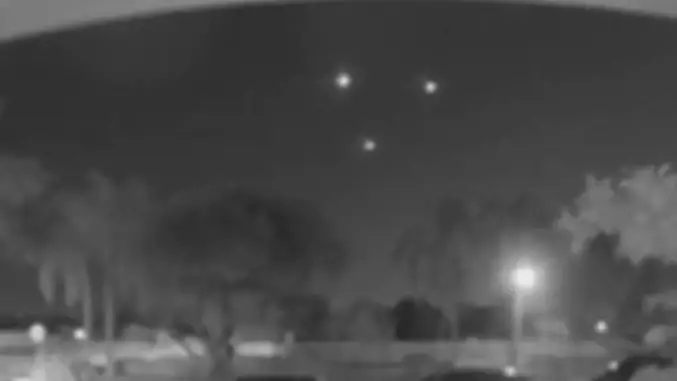
Three Lights In Triangle Formation, Sunrise, Florida 3-17-2023, UFO Sighting News.
Date of sighting: March 23, 2023
Location of sighting: Sunrise, Florida, USA
Source: MUFON
Hey all, I believe this is not three UFOs, but a single large triangle craft that has its propulsion systems visible. This cloaked craft, could it be a secret military TR3B descendant? I believe so. This is so close to town, so close to the Palm Beach area where I found a secret military testing area for the hypersonic missile at
26°55'42.64"N 80°20'23.97"W on Google Earth map. I believe this UFO may be alien technology in USAF hands, being tested by them. The coordinates I give is a testing are from which it may have come. There are also some rocket part all over the area. Also if you hit time machine (date in lower left corner) you can see the hypersonic missile in different places, parking lot, edge of runway, runway and more. This is US military.
Scott C. Waring - Taiwan
Eyewitness states:
Sunrise, FLA. 3.17.23. Three UFO’s forming triangle moving in straight line, caught on RING camera. Near the end of the video, two disappear.
Below is a US military TR3B recorded in France back in 2009 and sent to me 14 years ago. US military project Aurora.
Mysterious UFO Sighting in Sunrise, FL: The Triangular Formation – 2 VIDEOS!
Triangle UFO over Sunrise, Florida
On the night of March 17th, 2023, a peculiar UFO sighting took place in Sunrise, Florida, leaving residents and UFO enthusiasts intrigued and seeking answers. Eyewitnesses reported seeing three unidentified flying objects forming a distinct triangular formation in the night sky.
The extraordinary sighting, which occurred around 9:30 PM, was captured on two different recording devices – a home security RING camera and a smartphone. This lends further credibility to the event, as the multiple perspectives provide corroborating evidence of the unusual aerial phenomenon.
The videos show three bright, glowing orbs hovering steadily in the sky, forming what appears to be a perfect triangle. These mysterious objects flew slowly for several minutes, allowing ample time for witnesses to observe and record their presence.
As the event unfolded, two of the three UFOs suddenly vanished from sight, leaving only one remaining in the sky. This unusual occurrence was also captured on both videos, adding to the overall mystique of the sighting.
The triangular formation observed in the videos has become a point of fascination for UFO enthusiasts, as it is reminiscent of past sightings and encounters with alleged unidentified aircraft. Theories range from secret military operations to extraterrestrial visitors; however, no concrete evidence has been provided to support any specific explanation.
The Sunrise, Florida UFO sighting has captured the imagination of many, and as with similar events in the past, it is likely to remain a subject of debate and fascination for years to come.
Theia, perhaps as big as the proto-Earth, would have delivered its densest rocks inside the planet.
HAGAI PERETS
Scientists have long agreed that the Moon formed when a protoplanet, called Theia, struck Earth in its infancy some 4.5 billion years ago. Now, a team of scientists has a provocative new proposal: Theia's remains can be found in two continent-size layers of rock buried deep in Earth's mantle.
For decades, seismologists have puzzled over these two blobs, which sit below West Africa and the Pacific Ocean and straddle the core like a pair of headphones. Up to 1000 kilometers tall and several times that wide, "they are the largest thing in the Earth's mantle," says Qian Yuan, a Ph.D. student in geodynamics at Arizona State University (ASU), Tempe. Seismic waves from earthquakes abruptly slow down when they pass through the layers, which suggests they are denser and chemically different from the surrounding mantle rock.
The large low-shear velocity provinces (LLSVPs), as seismologists call them, might simply have crystallized out of the depths of Earth's primordial magma ocean. Or they might be dense puddles of primitive mantle rock that survived the trauma of the Moon-forming impact. But based on new isotopic evidence and modeling, Yuan believes the LLSVPs are the guts of the alien impactor itself. "This crazy idea is at least possible," says Yuan, who presented the hypothesis last week at the Lunar and Planetary Science Conference.
The idea has rattled around lab corridors and conference halls for years. But Edward Garnero, a seismologist at ASU Tempe who was not involved in the work, says it's the first time anyone has marshaled multiple lines of evidence and mounted a serious case for it. "I think it's completely viable until someone tells me it's not."
Evidence from Iceland and Samoa suggests the LLSVPs have existed since the time of the Moon-forming impact, says Sujoy Mukhopadhyay, a geochemist at the University of California (UC), Davis, who considers Yuan's idea plausible but is open to other explanations. Seismic imaging has traced plumes of magma that feed volcanoes on both islands all the way down to the LLSVPs. Over the past decade, Mukhopadhyay and others have discovered that lavas on the islands contain an isotopic record of radioactive elements that formed only during the first 100 million years of Earth history.
Moreover, a new picture of the Moon-forming impactor suggests it could have delivered a cargo of dense rock deep inside Earth. The impact theory was developed in the 1970s to explain why the Moon is dry and doesn't have much of an iron core: In a cataclysmic impact, volatiles like water would have vaporized and escaped, while a ring of less dense rocks thrown up in the collision would have eventually coalesced into the Moon. The theory invoked an impactor the size of Mars or—in recent variants—much smaller. But recent work from Yuan's co-author, ASU Tempe astrophysicist Steven Desch, suggests Theia was nearly as big as Earth.
In studies of Apollo Moon rocks, Desch and his colleagues measured the ratios of hydrogen to deuterium, a heavier hydrogen isotope. Light hydrogen was far more abundant in some of the Moon samples than in Earth rocks, they found. To capture and hold onto so much light hydrogen, Theia must have been massive, they proposed in a 2019 study in Geochemistry. It must also have been quite dry, as any water, which is naturally enriched in heavy hydrogen during its formation in interstellar space, would have raised the overall deuterium levels. Such a dry, large protoplanet would have separated into layers with an iron-depleted core and an iron-rich mantle, Desch says, some 2% to 3.5% denser than present-day Earth.
Even before Yuan learned of Desch's density estimates, he was modeling Theia's fate. His model suggests that after the collision, Theia's core would have quickly merged with Earth's. He also probed the fate of Theia's mantle, varying Theia's size and density to see what conditions would have allowed the material to persist, rather than mixing in, and sink to the mantle's base. The simulations consistently showed that mantle rocks 1.5% to 3.5% denser than Earth's would survive and end up as piles near the core. The result lined up perfectly with Desch's deuterium evidence. "It's this sweet spot for the density," Desch says.
A massive Theia would also explain the scale of the LLSVPs, which together contain six times more mass than the Moon. If they are extraterrestrial, Yuan says, only an impactor as large as Theia could have delivered them.
There are many caveats, however, including the fuzzy evidence for the LLSVPs themselves. Their pilelike structure could simply be an illusion created by models of the interior that rely on low frequency seismic waves, which blur small differences, Barbara Romanowicz, a seismologist at UC Berkeley, and Anne Davaille, a geophysicist at Paris-Saclay University, suggested in a study in Tectonics last year. Rather than reaching up 1000 kilometers, the piles may rise only a few hundred kilometers before breaking off into branched plumes. "There may be holes in them," Romanowicz says. "They may be a bundle of tubes."
Smaller or less monolithic LLSVPs would also be consistent with a forthcoming analysis that finds the LLSVPs are densest at the bottom, says Harriet Lau, a geophysicist at UC Berkeley. The analysis relies on two ways of imaging the deep Earth: using GPS stations to measure the way the Moon's tidal pull stretches Earth, and seismometers to sense how Earth's natural vibrations pass through the deep mantle. "Perhaps the real story behind the density is the distribution depth," she says.
Less massive LLSVPs could complicate the idea that Theia was nearly the size of a proto-Earth, says Jennifer Jenkins, a seismologist at Durham University. Yuan's picture, she adds, "is not inconsistent with what we know, but I'm not entirely convinced."
Desch says the team could test its idea by looking for geochemical similarities between the island lavas and rocks from the Moon's mantle. None of the Apollo samples capture the unaltered mantle, which is one reason scientists want samples from the Moon's largest impact crater, on its south pole, where such rocks may be exhumed. NASA and China are both planning robotic missions to the south pole this decade, and it is a leading candidate site for NASA's return of astronauts to the Moon.
If Theia's remnants do lie deep in Earth's mantle, they may not be alone. Seismologists are increasingly seeing small, ultradense pockets of material in the deep mantle, only a few hundred kilometers across, often near the edges of the LLSVPs. Maybe they are the sunken remnants of iron-rich cores from other miniature planets that hit early Earth, Jenkins says. Theia, in fact, might be just one grave in a planetary cemetery.
*Correction, 24 March, 1:30 p.m.: An earlier version of this story misstated Qian Yuan's Ph.D. focus.
THE WEBB TELESCOPE IS SO POWERFUL, IT SPOTTED A DUST STORM ON A PLANET IN A DIFFERENT STAR SYSTEM
"EVER HAD HOT SAND WHIP ACROSS YOUR FACE?"
GETTY / FUTURISM
Dark and Stormy
For the first time ever, a dust storm has been observed outside of our Solar System — and naturally, it was the powerful James Webb Space Telescope that made the discovery.
A press release on the Space Telescope Science Institute's Webbite details the JWST-detected storm, which took place on exoplanet VHS 1256 b, a "massive brown dwarf" planet located about 40 lightyears from Earth.*
"Ever had hot sand whip across your face?" the press release quips. "That’s a soothing experience compared to the volatile conditions discovered high in the atmosphere of planet VHS 1256 b."
The JWST was able not only to observe the distant dust storm, but also to determine what its atmosphere is made of: "silicate particles, ranging from fine specks to small grains."
"The team projects that the silicates swirling in these clouds periodically get too heavy and rain into the depths of the planet’s atmosphere," reads the release. "Webb’s observations also show clear signatures of water, methane and carbon monoxide, and provide evidence for carbon dioxide."
So Much Data
Pretty much everything about VHS 1256 b — a name that, honestly, sounds more like something you'd put in a VCR than a planet — seems extreme, per its descriptions on the STScI site.
As the BBC notes in its reporting on the Webb discovery, the planet that was first detected in 2015 by the Vista telescope in Chile is what's known as a "super Jupiter," with an atmosphere similar to our Solar System's gas giant but way bigger, between 12 to 18 times the mass.
While other telescopes have been able to gather in a piecemeal fashion as much information as Webb has about VHS 1256 b, this is the first time one telescope has gotten so much data at once.
"No other telescope has identified so many features at once for a single target," the University of California Santa Cruz's Andrew Skemer, who co-wrote the team's forthcoming paper in The Astrophysical Journal Letters, said. "We’re seeing a lot of molecules in a single spectrum from Webb that detail the planet’s dynamic cloud and weather systems."
The JWST has done it again, folks — and, as always, we simply love to see it.
NASA’s Webb Spots Swirling, Gritty Clouds on Remote Planet
Researchers observing with NASA’s James Webb Space Telescope have pinpointed silicate cloud features in a distant planet’s atmosphere. The atmosphere is constantly rising, mixing, and moving during its 22-hour day, bringing hotter material up and pushing colder material down. The resulting brightness changes are so dramatic that it is the most variable planetary-mass object known to date. The team, led by Brittany Miles of the University of Arizona, also made extraordinarily clear detections of water, methane and carbon monoxide with Webb’s data, and found evidence of carbon dioxide. This is the largest number of molecules ever identified all at once on a planet outside our solar system.
Cataloged as VHS 1256 b, the planet is about 40 light-years away and orbits not one, but two stars over a 10,000-year period. “VHS 1256 b is about four times farther from its stars than Pluto is from our Sun, which makes it a great target for Webb,” Miles said. “That means the planet’s light is not mixed with light from its stars.” Higher up in its atmosphere, where the silicate clouds are churning, temperatures reach a scorching 1,500 degrees Fahrenheit (830 degrees Celsius).
This illustration conceptualizes the swirling clouds identified by the James Webb Space Telescope in the atmosphere of exoplanet VHS 1256 b. The planet is about 40 light-years away and orbits two stars that are locked in their own tight rotation. Its clouds, which are filled with silicate dust, are constantly rising, mixing, and moving during its 22-hour day.
Credits: Illustration: NASA, ESA, CSA, Joseph Olmsted (STScI)
Within those clouds, Webb detected both larger and smaller silicate dust grains, which are shown on a spectrum. “The finer silicate grains in its atmosphere may be more like tiny particles in smoke,” noted co-author Beth Biller of the University of Edinburgh in Scotland. “The larger grains might be more like very hot, very small sand particles.”
VHS 1256 b has low gravity compared to more massive brown dwarfs, which means that its silicate clouds can appear and remain higher in its atmosphere where Webb can detect them. Another reason its skies are so turbulent is the planet’s age. In astronomical terms, it’s quite young. Only 150 million years have passed since it formed – and it will continue to change and cool over billions of years.
In many ways, the team considers these findings to be the first “coins” pulled out of a spectrum that researchers view as a treasure chest of data. In many ways, they’ve only begun identifying its contents. “We’ve identified silicates, but better understanding which grain sizes and shapes match specific types of clouds is going to take a lot of additional work,” Miles said. “This is not the final word on this planet – it is the beginning of a large-scale modeling effort to fit Webb’s complex data.”
Although all of the features the team observed have been spotted on other planets elsewhere in the Milky Way by other telescopes, other research teams typically identified only one at a time. “No other telescope has identified so many features at once for a single target,” said co-author Andrew Skemer of the University of California, Santa Cruz. “We’re seeing a lot of molecules in a single spectrum from Webb that detail the planet’s dynamic cloud and weather systems.”
A research team led by Brittany Miles of the University of Arizona used two instruments known as spectrographs aboard the James Webb Space Telescope, one on its Near Infrared Spectrograph (NIRSpec) and another on its Mid-Infrared Instrument (MIRI) to observe a vast section of near- to mid-infrared light emitted by planet VHS 1256 b. They plotted the light on the spectrum, identifying signatures of silicate clouds, water, methane and carbon monoxide. They also found evidence of carbon dioxide.
Credits: Image: NASA, ESA, CSA, J. Olmsted (STScI); Science: Brittany Miles (University of Arizona), Sasha Hinkley (University of Exeter), Beth Biller (University of Edinburgh), Andrew Skemer (University of California, Santa Cruz)
The team came to these conclusions by analyzing data known as spectra gathered by two instruments aboard Webb, the Near-Infrared Spectrograph (NIRSpec) and the Mid-Infrared Instrument (MIRI). Since the planet orbits at such a great distance from its stars, the researchers were able to observe it directly, rather than using the transit technique or a coronagraph to take this data.
There will be plenty more to learn about VHS 1256 b in the months and years to come as this team – and others – continue to sift through Webb’s high-resolution infrared data. “There’s a huge return on a very modest amount of telescope time,” Biller added. “With only a few hours of observations, we have what feels like unending potential for additional discoveries.”
What might become of this planet billions of years from now? Since it’s so far from its stars, it will become colder over time, and its skies may transition from cloudy to clear.
The researchers observed VHS 1256 b as part of Webb’s Early Release Science program, which is designed to help transform the astronomical community’s ability to characterize planets and the disks where they form.
The team's paper, entitled “The JWST Early Release Science Program for Direct Observations of Exoplanetary Systems II: A 1 to 20 Micron Spectrum of the Planetary-Mass Companion VHS 1256-1257 b,” will be published in The Astrophysical Journal Letters on March 22.
The James Webb Space Telescope is the world’s premier space science observatory. Webb will solve mysteries in our solar system, look beyond to distant worlds around other stars, and probe the mysterious structures and origins of our universe and our place in it. Webb is an international program led by NASA with its partners, ESA (European Space Agency) and the Canadian Space Agency.
Media Contacts:
Laura Betz
NASA's Goddard Space Flight Center, Greenbelt, Md.
NASA calls on China to be 'open and transparent' with its lunar missions after revelation that its potential landing sites OVERLAP with US destinations on the moon's south pole
NASA identified 13 potential landing sites for Artemis 3, while China's Chang'e-7 also picked three sites near the moon's south pole that overlap with the US
'We encourage transparency and peaceful exploration of space, per the tenets of the Artemis Accords and the Outer Space Treaty,' NASA said
Chang'e-7 is set for 2024 - it will be uncrewed and consist of an orbiter, lander, a mini hopping probe and a rover - while Artemis 3 is set for 2025
'Just as the lunar South Pole is of scientific interest to NASA, it is also of scientific interest to other nations, so overlap ... is to be expected,' NASA said
NASA has called on China to be 'open and transparent' with its lunar missions following a revelation of overlap between the two nations in potential landing sites near the moon's south pole.
'Just as the lunar South Pole is of scientific interest to NASA, it is also of scientific interest to other nations, so overlap in potential landing regions is to be expected,' NASA told DailyMail.com.
The American space agency earlier this month identified 13 potential landing sites for the Artemis 3 crewed mission that's currently scheduled for late 2025 and will be the first time Americans set foot on the lunar surface in a half century.
In a Chinese journal article on possible landing sites authored by Chang'e-4 lunar mission commander Zhang He and others, 10 spots are mentioned. Artemis 3 and Chang’e-7 both identify sites near Shackleton, Haworth and Nobile craters as potential landing zones.
'We’ll continue to share our plans with the world as we are able, and hope that other nations will share their plans with us. We encourage transparency and peaceful exploration of space, per the tenets of the Artemis Accords and the Outer Space Treaty,' the American space agency said.
NASA has called on China to be 'open and transparent' with its manned lunar missions following a revelation of overlap in potential landing sites near the moon's south pole between the two countries
'In exploring the Moon, we will follow what we have spelled out in the Artemis Accords—that we will be transparent about all activities, operate in a safe and responsible manner, and avoid harmful interference,' NASA added.
'We want to be as open with the international community as we can, and as a recent example, we announced 13 candidate landing regions for Artemis III.'
The space agency already discusses its plans at several forums, including the International Space Exploration Coordination Group (ISECG), of which China is a member.
Chang'e-7, which is named after the Chinese moon goddess Chang'e, will be uncrewed and consist of an orbiter, lander, a mini hopping probe and a rover, is set for 2024.
The American space agency earlier this month identified 13 potential landing sites for the Artemis 3 crewed mission that's currently scheduled for late 2025 and will be the first time Americans set foot on the lunar surface in a half century
The overlapping sites are partly the result that region of the moon's higher elevation, good lighting and proximity to shadowed craters that may trap water-ice, according to SpaceNews, which first reported the news
The overlapping sites are partly the result that region of the moon's higher elevation, good lighting and proximity to shadowed craters that may trap water-ice, according to SpaceNews, which first reported the overlap.
It remains to be seen how the rival nations would deal with potential conflicts due to the 2011 Wolf Amendment - which prohibits NASA from using government funds to engage in direct, bilateral cooperation with the Chinese government and China-affiliated organizations without explicit authorization from Congress and the FBI.
However, in 2015 the Obama administration began something called the U.S.-China Civil Space Dialogue, which allowed for discussion of space matters; that was continued into the Trump administration.
A State Department spokesperson told the space outlet on background: 'The last U.S.-China Civil Space Dialogue was in 2017. There are no plans presently for another civil space dialogue. Should a civil space dialogue be scheduled, the United States will announce at the appropriate time.
'We have and will continue to keep the lines of communication open with Beijing, including on issues of spaceflight safety.'
Sarah Noble, Artemis lunar science lead for NASA’s Planetary Science Division, said in a previous statement: ‘Several of the proposed sites within the regions are located among some of the oldest parts of the moon, and together with the permanently shadowed regions, provide the opportunity to learn about the history of the Moon through previously unstudied lunar materials.’
'In exploring the Moon, we will follow what we have spelled out in the Artemis Accords—that we will be transparent about all activities, operate in a safe and responsible manner, and avoid harmful interference,' NASA said
NASA officials have said they will narrow down their list about 18 months before Artemis 3 so they can prepare for potential landings at each site.
There has been a recent war of words between the two countries over space activities.
Last month, NASA administrator Bill Nelson told a German newspaper that China is planning to take over the moon.
'We must be very concerned that China is landing on the moon and saying: 'It's ours now and you stay out',' he said.
China expressed its displeasure quickly.
Zhao Lijian, a spokesman at the Chinese foreign ministry, said in a statement: 'This is not the first time that the head of the US National Aeronautics and Space Administration has ignored the facts and spoken irresponsibly about China.
'The US side has constantly constructed a smear campaign against China's normal and reasonable outer space endeavors, and China firmly opposes such irresponsible remarks.'
Christopher Newman, professor of space law and policy at Northumbria University in the United Kingdom, told SpaceNews that 'this is a genuine opportunity for collaboration and cooperation between the two giant powers, and would be an opportunity to show all the rhetoric about space exploration being more than geopolitical in nature.'
'However, in reality it is not hard to see why they both want the same spots. It is prime lunar real estate for in-situ resource utilization. This could be the first potential point of conflict over resources beyond Earth,' he added.
A recent article in Beijing's Global Times said: 'Space observers also pointed out that as NASA is trying hard to relive its Apollo glories, China is working on innovative plans to carry out its own crewed moon landing missions.'
Artemis III: NASA’s First Human Mission to the Lunar South Pole
Humans have always been drawn to explore, discover, and learn as much as we can about the world—and worlds—around us. This isn’t always easy, but it’s in our nature. For the benefit of all humanity, NASA and its partners will land the first woman and first person of color on the surface of the Moon with Artemis.
Following two Artemis test missions, Artemis III, currently planned for 2025, will mark humanity’s first return to the lunar surface in more than 50 years. NASA will make history by sending the first humans to explore the region near the lunar South Pole.
On the way
NASA’s Space Launch System rocket carrying the Orion spacecraft launches on the Artemis I flight test, Wednesday, Nov. 16, 2022, from Launch Complex 39B at NASA’s Kennedy Space Center in Florida. NASA’s Artemis I mission is the first integrated flight test of the agency’s deep space exploration systems: the Orion spacecraft, Space Launch System (SLS) rocket, and ground systems. SLS and Orion launched at 1:47 a.m. EST, from Launch Pad 39B at the Kennedy Space Center.
Credits: NASA/Joel Kowsky
NASA’s Orion spacecraft will be the crew’s ride to and from Earth and into and out of lunar orbit. Orion is the only spacecraft capable of returning crews to Earth at lunar reentry velocities. On the successful Artemis I mission, Orion’s uniquely designed heat shield was recently tested under these extreme reentry conditions. Four astronauts will depart from Launch Pad 39B at Kennedy Space Center in Florida atop the Space Launch System (SLS), the only rocket powerful enough to send Orion, its crew, and their supplies to the Moon in a single launch. The crew will be selected from among the most diverse astronaut corps in history, each equipped with unique skills and intensively trained.
First the crew will launch to Earth orbit where they will perform systems checks and solar panel adjustments on Orion. Then, a powerful push from SLS’s interim cryogenic propulsion stage will help Orion perform a translunar injection maneuver, setting its course to the Moon.
For several days, the crew will travel toward the Moon and perform corrective engine burns to intercept the Moon’s gravitational field. At the right time and location, Orion will perform a series of two engine burns to place the spacecraft in a lunar Near-Rectilinear Halo Orbit (NRHO). From hundreds of potential orbits, NASA selected NRHO to achieve long-term Artemis goals. NRHO will provide near-constant communications with Earth and access to sites all over the Moon. Because it is gravitationally balanced between Earth and the Moon, this orbit will maximize fuel efficiency. On future missions, NASA and its partners will assemble the Gateway lunar space station in NRHO to serve as a hub for Artemis missions.
NASA has selected SpaceX to provide the human landing system that will transport Artemis III astronauts from Orion in lunar orbit to the surface of the Moon and back again. SpaceX plans to use a unique concept of operations to increase the overall efficiency of their lander. After a series of tests, SpaceX will fly at least one uncrewed demo mission that lands Starship on the lunar surface. When Starship has met all of NASA’s requirements and high standards for crew safety, it will be ready for its first Artemis mission.
Before the crew launch, SpaceX will launch a storage depot to Earth orbit. A series of reusable tankers will carry propellant to the storage depot to fuel the human landing system. The uncrewed Starship human landing system will then launch to Earth orbit and rendezvous with the storage depot to fill its tanks before executing a translunar injection engine burn and traveling approximately six days to NRHO where it will await the Artemis III crew.
When both spacecraft have arrived in NRHO, Orion will dock with the Starship human landing system in preparation for the first lunar surface expedition of the 21st century. Once the crew and their supplies are ready, two astronauts will board Starship and two will remain in Orion. Orion will undock and back away from Starship to remain in NRHO for roughly one orbit around the Moon, lasting about 6.5 days. This will match the length of the surface expedition, so as Orion completes its orbit, the two person surface crew will finish their work on the surface in time to launch back up to meet the spacecraft.
NASA has its sights set on locations around the South Pole for the Artemis era of human lunar exploration. Extreme, contrasting conditions make it a challenging location for Earthlings to land, live, and work, but the region’s unique characteristics hold promise for unprecedented deep space scientific discoveries. Using advanced technology including autonomous systems, the crew inside of Starship will land at a carefully selected site within a 100-meter radius.
On the Moon
Illustration of SpaceX Starship human landing system design.
Credits: SpaceX
After touchdown, the surface crew’s first task will be to ensure all systems are ready for their lunar surface stay. Then they will rest, eat, and recharge for the first full day of the expedition.
During their time on the Moon, the astronauts will do scientific work inside Starship and conduct a series of moonwalks, exiting Starship to explore the surface. The astronauts will don advanced spacesuits, exit through an airlock, and descend on Starship’s elevator. NASA has selected Axiom Space to provide the Artemis III surface suits and spacewalk systems. These suits will give the astronauts increased range of motion and flexibility to explore more of the landscape than on previous lunar missions.
During their moonwalks, the astronauts will take pictures and video, survey geology, retrieve samples, and collect other data to meet specific scientific objectives. The view from the lunar South Pole region will look very different from the photos taken on Apollo missions in the Moon’s equatorial region. The Sun will hover just above the horizon, casting long, dark shadows across the terrain, which the crew will explore using headlamps and navigational tools. The information and materials collected by Artemis III astronauts will increase our understanding of the mysterious South Pole region, the Moon, and our solar system.
Mission control teams on the ground will be in contact with the crew as they relay what they see, hear, and feel. Through mission coverage and the ability to send high quality images and video to the ground with advanced communication technology, they will be sharing a unique new human experience with the world.
On the journey home
On flight day 25 of the Artemis I mission, Orion captured this photo of the Earth from a camera mounted on one of its solar arrays.
Credits: NASA
When their surface expedition is complete, the two astronauts will lift off the surface of the Moon and head back to NRHO in Starship to reunite with their crewmates in Orion. After docking, the crew will spend up to five days in orbit, transferring samples between the vehicles and preparing for the journey back to Earth.
When they reach the optimal NRHO departure point, with all four astronauts back in Orion, they will undock and ignite Orion’s engines, slinging the spacecraft past the Moon, and allowing it to coast toward Earth. The crew will travel about 24,855 miles (about 40,000 kilometers) per hour during reentry into Earth’s atmosphere. Assisted by 11 parachutes, the spacecraft will splash down in the Pacific Ocean where it and the crew will be retrieved with support from the U.S. Coast Guard and U.S. Navy.
Artemis III will be one of the most complex undertakings of engineering and human ingenuity in the history of deep space exploration to date. The astronauts' observations, samples, and data collected will expand our understanding of our solar system and home planet, while inspiring the next generation.
This mission will usher in a future in which humans consistently access the Moon, and human planetary exploration missions are within reach. Each Artemis mission will increase our knowledge, refine our operations, and prove our technology as we prepare for the first human mission to Mars.
Artemis III Mission Map
Artemis III will be humanity’s return to the lunar surface and NASA will make history by sending the first humans to the lunar South Pole region.
Credits: NASA
To learn more and get the latest updates, follow @NASAArtemis on Facebook, Instagram, and Twitter, and subscribe to theArtemis Blog.
Driven by powerful stellar winds, expanding shrouds of gas and dust frame hot, luminous star Wolf-Rayet 124 in this sharp infrared view. The eye-catching 6-spike star pattern is characteristic of stellar images made with the 18 hexagonal mirrors of the James Webb Space Telescope. About 15,000 light-years distant toward the pointed northern constellation Sagitta, WR 124 has over 30 times the mass of the Sun.
Produced in a brief and rarely spotted phase of massive star evolution in the Milky Way, this star's turbulent nebula is nearly 6 light-years across. It heralds WR 124's impending stellar death in a supernova explosion. Formed in the expanding nebula, dusty interstellar debris that survives the supernova will influence the formation of future generations of stars.
7 Amazing Ancient Technologies Too Advanced for Their Time (Video)
Throughout history, there have been many civilizations that have left their mark on the world through their impressive architectural feats, artistic creations, and innovative technologies. While some of these ancient technologies have been lost to time, others continue to mystify and amaze us today.
From the amazing machinery used to build the pyramids, to the advanced weaponry of ancient China and the invention of the Egyptian war chariot , there are countless examples of ancient technologies that were far ahead of their time. But how did these ancient civilizations manage to achieve such remarkable feats without the benefit of modern technology? Join us as we explore some of the most incredible ancient technologies that continue to inspire wonder and admiration today.
Glowing Object Near Aircraft Over Adelaide. South Australia, March 22, 2023, UFO Sighting News.
Date of sighting: March 22, 2023 Location of sighting: Adelaide, South Australia
This UFO was visible for only a few seconds, but the photographer was able to quickly snap a few shots for us. Here we see object in the upper left corner and the aircraft in the lower right. The UFO was so bright it almost looked like a cloud, but no cloud could move that fast or far from the camera in four seconds. The speed, the color and the fact its so close to the plane all indicate its a alien scout ship, data gathering for sending back to a home planet. This UFO is very bright and it is not a drone, but an actual piloted craft.
Scott C. Waring - Taiwan
Eyewitness states:
On the 22-3-2023 at 11.17 am, I was photographing an airliner flying out of Adelaide South Australia, when an extremely bright object appeared in my view finder. The object appeared at the top of the view finder, coming in from the north-west, and descending rapidly to the bottom of the view finder heading east. It was visible for about four seconds
Meer van UFO'S of UAP'S, ASTRONOMIE, RUIMTEVAART, ARCHEOLOGIE, OUDHEIDKUNDE, SF-SNUFJES EN ANDERE ESOTERISCHE WETENSCHAPPEN - DE ALLERLAATSTE NIEUWTJES


 Three Lights In Triangle Formation, Sunrise, Florida 3-17-2023, UFO Sighting News.