Ontdek de Fascinerende Wereld van UFO's en UAP's: Jouw Bron voor Onthullende Informatie!
Ben jij ook gefascineerd door het onbekende? Wil je meer weten over UFO's en UAP's, niet alleen in België, maar over de hele wereld? Dan ben je op de juiste plek!
België: Het Kloppend Hart van UFO-onderzoek
In België is BUFON (Belgisch UFO-Netwerk) dé autoriteit op het gebied van UFO-onderzoek. Voor betrouwbare en objectieve informatie over deze intrigerende fenomenen, bezoek je zeker onze Facebook-pagina en deze blog. Maar dat is nog niet alles! Ontdek ook het Belgisch UFO-meldpunt en Caelestia, twee organisaties die diepgaand onderzoek verrichten, al zijn ze soms kritisch of sceptisch.
Nederland: Een Schat aan Informatie
Voor onze Nederlandse buren is er de schitterende website www.ufowijzer.nl, beheerd door Paul Harmans. Deze site biedt een schat aan informatie en artikelen die je niet wilt missen!
Internationaal: MUFON - De Wereldwijde Autoriteit
Neem ook een kijkje bij MUFON (Mutual UFO Network Inc.), een gerenommeerde Amerikaanse UFO-vereniging met afdelingen in de VS en wereldwijd. MUFON is toegewijd aan de wetenschappelijke en analytische studie van het UFO-fenomeen, en hun maandelijkse tijdschrift, The MUFON UFO-Journal, is een must-read voor elke UFO-enthousiasteling. Bezoek hun website op www.mufon.com voor meer informatie.
Samenwerking en Toekomstvisie
Sinds 1 februari 2020 is Pieter niet alleen ex-president van BUFON, maar ook de voormalige nationale directeur van MUFON in Vlaanderen en Nederland. Dit creëert een sterke samenwerking met de Franse MUFON Reseau MUFON/EUROP, wat ons in staat stelt om nog meer waardevolle inzichten te delen.
Let op: Nepprofielen en Nieuwe Groeperingen
Pas op voor een nieuwe groepering die zich ook BUFON noemt, maar geen enkele connectie heeft met onze gevestigde organisatie. Hoewel zij de naam geregistreerd hebben, kunnen ze het rijke verleden en de expertise van onze groep niet evenaren. We wensen hen veel succes, maar we blijven de autoriteit in UFO-onderzoek!
Blijf Op De Hoogte!
Wil jij de laatste nieuwtjes over UFO's, ruimtevaart, archeologie, en meer? Volg ons dan en duik samen met ons in de fascinerende wereld van het onbekende! Sluit je aan bij de gemeenschap van nieuwsgierige geesten die net als jij verlangen naar antwoorden en avonturen in de sterren!
Heb je vragen of wil je meer weten? Aarzel dan niet om contact met ons op te nemen! Samen ontrafelen we het mysterie van de lucht en daarbuiten.
Glowing Object Near Aircraft Over Adelaide. South Australia, March 22, 2023, UFO Sighting News.
Date of sighting: March 22, 2023 Location of sighting: Adelaide, South Australia
This UFO was visible for only a few seconds, but the photographer was able to quickly snap a few shots for us. Here we see object in the upper left corner and the aircraft in the lower right. The UFO was so bright it almost looked like a cloud, but no cloud could move that fast or far from the camera in four seconds. The speed, the color and the fact its so close to the plane all indicate its a alien scout ship, data gathering for sending back to a home planet. This UFO is very bright and it is not a drone, but an actual piloted craft.
Scott C. Waring - Taiwan
Eyewitness states:
On the 22-3-2023 at 11.17 am, I was photographing an airliner flying out of Adelaide South Australia, when an extremely bright object appeared in my view finder. The object appeared at the top of the view finder, coming in from the north-west, and descending rapidly to the bottom of the view finder heading east. It was visible for about four seconds
Fighter jet followed by black cube over Texas, March 21, 2023, UFO Sighting News.
Date of sighting: March 21, 2023
Location of sighting: Texas, USA
Source: MUFON
Guys this is something big. This black craft has many sides, like a diamond of sorts, but black. The eyewitness said it seemed to have an aura, but it didn't come out on camera, however a screenshot quickly confirms that detail. A glowing aura is seen around the UFO above. This means its some sort of energy field from its propulsion. It was following an old military jet, maybe monitoring it, scanning and gathering data to send back to its homeworld. For many alien species, oxygen would be like us breathing propane gas, so they send probes to gather info to learn about us.
Scott C. Waring - Taiwan
Eyewitness states:
F-111 fighter jet flew west to east over the house. I thought was strange, never see fighter jets in this area. Also I thought they were decommissioned. Seconds later a strange orb like object flew from the area the jet left to the north then turned west out of sight. My wife got me to film it with my iPhone. Zoomed in seems to have a glow about it looks almost like an octagon shaped ball. It seemed to fly fast then slow to almost a stop then turned west till out of view.
Lights Flash And Shoot Off, Pennsylvania March 16, 2023, UFO Sighting News. Video.
Date of sighting: March 16, 2023
Location of sighting: Pennsylvania, USA
The report didn't cite the city, but this glowing light was caught as a guy went onto the back deck having a smoke. The light flashed on and off several times and then suddenly shot off into the distance. The flashing is the UFOs powering up and there are two objects side by side shooting away. The UFOs may have come from an underground base about 5 miles below the surface and materialized in the sky above the neighborhood.
Scott C. Waring - Taiwan
Eyewitness states:
This video was captured off the deck of my residence. Strange lights that speeded away.
Fast moving underwater UFO/USO caught on film by deep ocean ROV
On June 29, 2019 a deep ocean ROV (remotely operated vehicle) captured at a depth of 1789 meters a UFO/USO passing the ROV at high speed.
This USO/UFO footage was filmed with a work class ROV at an ocean depth of 5870 Feet (1789 Meters) in the Gulf of Mexico. The USO was untethered and was operating at a depth that prevented any kind of remote operation.
While the footage quality isn't excellent, ROV operators that have seen the footage have no idea what the object may have been but concluded that it is not organic.
The USO demonstrated advanced AI operation, construction, and power management capabilities that are not known in the commercial ROV world.
This footage is further proof that these USOs do exist and have been with us for as long as airborne UFOs have. We only need to recognize and understand this phenomenon whether they are of extraterrestrial origin or military.
Unraveling the Texas UFO Puzzle: Fighter Jet and Glowing Octagonal Object
UFO filmed over Texas
On the evening of March 21, 2023, a bizarre UFO sighting took place over the skies of Texas, leaving residents baffled and sparking curiosity across the nation. The witness, who managed to capture the event on video using his iPhone, reported seeing an F-111 fighter jet flying low over his house, followed by a strange orb-like object just seconds later.
The witness described the jet flying from west to east over his home, which he found peculiar, as fighter jets are not commonly seen in the area. Furthermore, he noted that F-111 fighter jets were decommissioned, adding another layer of mystery to the sighting.
UFO sighting report
Just moments after the jet’s appearance, the witness and his wife spotted a round object flying through the sky. Initially thought to be a balloon, the object seemed to have an octagonal shape and emitted a glowing aura. The UFO traveled from the area where the jet had disappeared, first heading north before making a sharp turn westward and vanishing from sight.
The video, shot on an iPhone, clearly shows the unidentified object moving at varying speeds. At times, the object appeared to be flying quickly, while at other moments, it seemed to slow down to an almost complete stop before changing direction.
The mysterious sighting has raised several questions, such as why an F-111 fighter jet, which is no longer in service, would be present in the area. Additionally, the erratic movements and glowing appearance of the unidentified object defy conventional explanations.
As of now, there has been no official comment from the military or aviation authorities on the incident. However, the video evidence and witness account have intrigued UFO enthusiasts and the general public alike, prompting further investigations into the event.
As we await answers, the enigmatic UFO sighting over Texas serves as a reminder that there is still much to learn about our skies and the potential for unexplained phenomena. Whether the object turns out to be a military experiment, an advanced drone, or something more otherworldly, this incident has undoubtedly captured the imagination of people all around the world.
How Metal Artists In India Are Keeping A 4,500-Year-Old Craft Alive (Video)
Despite the challenges, metal artists in India are working to keep the ancient craft of Dhokra art alive. This traditional craft involves the use of a non-ferrous metal, often brass or bronze, to create intricate and detailed sculptures. The process of creating Dhokra art, which has endured for over four millennia, involves a combination of wax casting and metal casting techniques, resulting in unique and one-of-a-kind pieces.
To ensure the survival of this craft, metal artists are working to adapt and evolve their techniques, while also educating younger generations about the art form. By incorporating modern technologies and experimenting with new materials, these artists are finding new ways to produce Dhokra art and keep the tradition alive for future generations to appreciate and enjoy.
15 of Ancient History’s Most Ingenious Siege Weapons (Video)
Warfare has been a constant throughout human history, and with it, the development of increasingly sophisticated weaponry to overcome defensive fortifications. The ancient world was no exception, and siege warfare was a common tactic used to conquer enemy cities and strongholds. To accomplish this, ancient armies employed an array of ingenious siege weapons that varied from simple battering rams to complex machines capable of launching projectiles with deadly accuracy.
From the ballista, a giant crossbow first used by the ancient Greeks, to the trebuchet, which could hurl projectiles weighing over 1,000kg with ease, our ancestors were no slouches when it came to creating devastating weaponry. As technology advanced, so did the sophistication of these ancient siege weapons , with some armies even employing early forms of flamethrowers and chemical weapons. While the brutality of ancient siege warfare may seem barbaric by modern standards, the ingenuity and engineering prowess displayed in these ancient siege weapons are a testament to humanity's endless quest for innovation and advancement.
Experten waarschuwen in nieuw rapport voor “klimaat-tijdbom”: “Nú handelen voor leefbare toekomst”
Zelfs als de uitstoot van broeikasgassen de komende jaren drastisch vermindert, is het “waarschijnlijk” dat de opwarming van de aarde in de nabije toekomst boven de 1,5 graad Celsius uitkomt. Dat blijkt uit een nieuw rapport van het IPCC, het klimaatpanel van de Verenigde Naties. De klimaatwetenschappers zien tal van “uitvoerbare en effectieve” opties om de uitstoot te verlagen. “Als we nú handelen, kunnen we nog steeds een leefbare en duurzame toekomst voor iedereen veiligstellen”, zegt IPCC-voorzitter Hoesung Lee.
In het rapport beschrijven de wetenschappers hoe de klimaatverandering evolueert en wat de gevolgen ervan zijn. De grens van anderhalve graad wordt in de meeste scenario’s al tussen 2030 en 2035 bereikt. Maar als er onmiddellijk wordt ingegrepen, kan de overschrijding nog beperkt blijven, klinkt het.
Volgens de wetenschappers bedraagt de opwarming momenteel al 1,1 graden Celsius en is die zonder twijfel veroorzaakt door de mens. Het IPCC schrijft bovendien dat “elke toename van de opwarming van de aarde de gevaren zal intensiveren”. Het gaat dan onder meer om intensere hittegolven, zwaardere regenval en extreme droogte.
Zowat 3,3 tot 3,6 miljard mensen, voornamelijk in de armste landen, wonen momenteel al in een gebied dat zeer kwetsbaar is voor de klimaatverandering. Dat terwijl zij eigenlijk het minst hebben bijgedragen aan die opwarming.
Volgens onze weervrouw Jill Peeters gaat het veel moeite kosten om ons klimaat te redden. “We weten dit al lang, maar het blijft choquerend”, zegt ze bij HLN LIVE. “Het is een existentiële crisis die sneller gaat dan je je kan voorstellen.” Om de situatie te verbeteren is het volgens Peeters dan ook nodig om “nu meteen in gang te schieten”.
Uitstoot dringend naar beneden
Volgens het rapport stevenen we nog steeds af op een opwarming van zo’n 3 graden aan het einde van deze eeuw, ten opzichte van voor de industrialisatie. Het panel ziet dan ook veel redenen om snel werk te maken van de uitstootverlaging. Als ons energiesysteem snel van fossiele brandstoffen afstapt, zal ook de luchtkwaliteit verbeteren en dat is goed voor de gezondheid van de mensen. Alleen al de economische voordelen daarvan zouden volgens het IPCC “grofweg gelijk, of mogelijk groter” zijn dan de kosten.
Er is nog een kans om een duurzame toekomst voor iedereen te garanderen, maar die slinkt zienderogen.
IPCC-klimaatpanel
Om de doelstelling van 1,5 graad in leven te houden, moet de uitstoot van broeikasgassen tegen 2050 netto-nul bedragen. Dat wil zeggen dat er niet meer broeikasgassen mogen vrijkomen dan dat er kunnen worden opgeslagen of uit de atmosfeer worden weggenomen. “Er is nog een kans om een duurzame toekomst voor iedereen te garanderen, maar die slinkt zienderogen”, waarschuwen de wetenschappers.
Verschillende oplossingen zijn al voorhanden, stelt het IPCC, maar het huidige beleid hinkt achterop. Bovendien zijn ook de geldstromen niet goed afgestemd. Zo vloeit er nog altijd meer geld naar fossiele brandstofprojecten dan naar de aanpak van de klimaatverandering, klinkt het.
De wetenschappers stellen voor om de uitstoot van broeikasgassen op de volgende manieren te verlagen:
Het energiesysteem moet klimaatneutraal worden, bijvoorbeeld door over te gaan op zonne- en windenergie, aardwarmte of waterkracht
Ecosystemen en bossen moeten worden hersteld
De uitstoot van het broeikasgas methaan – afkomstig uit afval, de landbouw en fossiele brandstoffen – moet worden gereduceerd. Methaan houdt op korte tijd immers heel veel warmte in de atmosfeer vast
Mensen moeten minder zuivel en vlees consumeren
“Klimaat-tijdbom ontmantelen”
VN-secretaris-generaal António Guterres roept rijke landen op om sneller klimaatneutraal te worden, liefst al in 2040. Dat is nodig om de “klimaat-tijdbom” te ontmantelen, zei hij in een videoboodschap op de persconferentie van het IPCC. “De mensheid bevindt zich op dun ijs. En dat ijs smelt snel”, aldus de VN-baas.
Guterres benadrukte de rijke landen met hun industrialisatie in het verleden al veel meer broeikasgassen hebben uitgestoten dan arme landen. Verder zei hij dat opkomende economieën rond 2050 klimaatneutraal moeten zijn.
Milieuorganisatie Greenpeace België zoomt ook in op ons land, want in juni moet België een nieuw nationaal energie- en klimaatplan indienen bij de Europese Commissie. Die onderhandelingen zitten echter al even in het slop. Vooral Vlaanderen, verantwoordelijk voor 70 procent van de Belgische uitstoot, zou zich verzetten tegen ambitieuzere doelstellingen. “Rijke landen zoals België, en regio’s zoals Vlaanderen, hebben als historische uitstoters een enorme verantwoordelijkheid”, aldus de organisatie.
Oxfam België noemt het IPCC-rapport “het rapport van de laatste kans”. Volgens Oxfam mag iedereen op aarde nog maar minder dan 2,2 ton CO2 per jaar uitstoten om de uitstoot tegen 2030 wereldwijd te halveren. Een kaap die de rijkste 1 procent in amper twaalf dagen rondt. “We hebben een snelle afbouw van fossiele brandstoffen nodig, anders wachten ons nog catastrofes.”
This USO/UFO footage was filmed with a work class ROV at an ocean depth of 5870 Feet (1789 Meters) in the Gulf of Mexico. While the footage quality isn't excellent, ROV operators that have seen the footage have concluded that it is not organic. The USO was untethered and was operating at a depth that prevented any kind of remote operation. If it was of Russian or Chinese origin, the USO demonstrated advanced AI operation, construction, and power management capabilities that are not known in the commercial ROV world.
USOs have been sighted before by commercial ROV pilots, but this is the first footage (as far as we know) to ever see the light of day.
Peruvian Archaeologists Uncover Two-faced Moche Men with Cosmic Connections
Painted on a pillar within a ceremonial hall, archaeologists have found a 1,400-year-old “two faced man”, with cosmic associations.
The Moche culture was a pre-Columbian civilization that thrived between 100 BC and 700 AD, farming and fishing, in the northern coastal region of Peru. Known for their exquisite pottery featuring animals, people, and scenes from everyday life, they were also skilled metalworkers and produced fine gold and silver jewelry.
Now, a team of archaeologists have discovered two 1,400-year-old murals depicting two-faced men within a ceremonial hall. According to a report in Live Science , the two-faced men might refer to sacrifice, and "cosmic realms".
Upper and lower men are visible here on the pillar. Archaeologist Gabriela Cervantes Quequezana examines the imagery of the painted pillar.
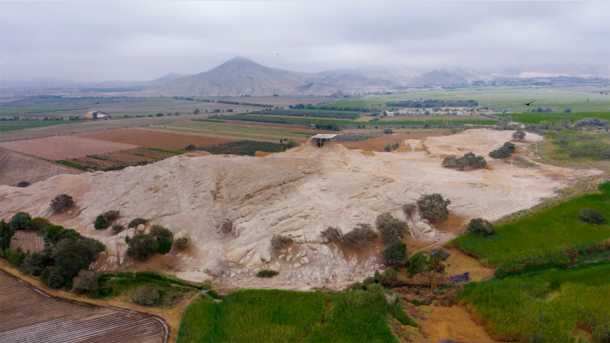
Two murals of two-faced men holding unusual treasures were unearthed by archaeologists in August 2022 at the 1,400-year-old archaeological site of Pañamarca. Located in Peru's lower Nepeña Valley province of Huari, in the Ancash region of coastal Peru, the site features a large complex of stone structures including a central plaza, several temples, and residential areas. The murals were drawn between 550 AD and 800 AD, at the height of the Moche people’s rule of northern coastal Peru.
The archaeological work was conducted by the Archaeological Research Project (PIA) “ Paisajes Arqueológicos de Pañamarca ” which is collaboratively led by the international team of Jessica Ortiz Zevallos, Lisa Trever of Columbia University and Michele Koons of the Denver Museum of Nature & Science (DMNS).
Interpreting The Painted Pillar
The two murals both adorn the same pillar within a large ceremonial hall. One of the murals, located at the top of the pillar, features a man with two faces holding a feather fan in one hand, and in the other hand he holds a goblet with four hummingbirds drinking from it. The second two-faced man is painted on the lower aspect of the pillar and has a moving feather fan in one hand and a stick-like object in the other.
Two images of two-faced men have been discovered at the Moche site of Pañamarca, Peru. Left; The upper figure painted on the pillar holding a goblet feeding hummingbirds, and a feather fan. Right; the lower figure holding a fan and an unidentified stick-like object.
Both of the two-faced men are depicted with headdresses or crowns and wearing colorful clothing held tight with sizable belts. Lisa Trever is an associate professor of pre-Columbian art history and archaeology at Columbia University , who led the discovery team, and she told Live Science that the reason the Moche artists depicted these two men “is a mystery.”
Dr. Trever suspects that the ancient artists may have been “experimenting with how to show movement, and two narrative moments at once." Furthermore, the archaeologist suspects the two men “may be deities,” but she added that this is uncertain because most depictions of deities in Moche art have non-human aspects “like fangs, or the faces or tails or wings of various creatures.” But these two murals, even though they have two faces, “seem entirely human," Trever noted.
Since uncovering the first mural in 1958, archaeologists have been studying the ceremonial hall at Pañamarca, now for over 60 years. Putting the depictions of two headed men in context, other murals within the ceremonial hall depict a priestess, a serpent and a bat. And according to a statement by the team, despite six decades of study, much of the hall is still unexcavated and it is thought that many more murals are awaiting discovery.
Panoramas of the Moche complex under excavation at Pañamarca.
(Aerial drone photography by J. Antonio Ochatoma Cabrera/ Panamarca)
Exploring Cosmic Connections
Trever said one of the interesting things about the hall is the unusual density of paintings within it. This means the team can only excavate selected aspects of the building each archaeological field season. Trever said the team still has a lot of questions about the architecture and its functions and that it's still unknown how the Moche used this ritual space.
What is known about the ceremonial hall, however, is that it was reserved for use only by priests. The narrow passages and interior spaces suggest ritual use, and that “it was not a public space." Trever added it was probably open to “the leaders or elders of the community at Pañamarca." Edward Swenson , director of the Archaeology Centre at the University of Toronto, told Live Science that the two-faced men might have represented “a mortal wearing a mask and thus impersonating or becoming one with [the] supernatural." Furthermore, a connection with the gods might also be indicated in the detail of the hummingbirds drinking from the goblet.
Picking From the Peruvian Pantheon
Swenson said he interprets the hummingbirds drinking from the cup as “a powerful invocation of the centrality of sacrifice in Moche worldview." He added that sacrifice served as “a critical mechanism to ensure the circulation of life-giving fluids between beings and cosmic realms."
Like the Inca of Peru, the Moche people worshipped a wide variety of gods and deities associated with nature, agriculture, and fertility. Their primary gods included “Ai-Apaec,” a god of sacrifice and warfare; the “Decapitator,” who was a god of death and the underworld; and the Moon Goddess, who was associated with fertility, childbirth, and the menstrual cycle. It might be the case that the hummingbird was regarded as a messenger of the gods, transferring sacrificed human souls to the other world/s.
Top image: The two-faced Moche man figure painted on the lower part of the pillar. Two images of two-faced men have been discovered at the Moche site of Pañamarca, Peru.
Meer van UFO'S of UAP'S, ASTRONOMIE, RUIMTEVAART, ARCHEOLOGIE, OUDHEIDKUNDE, SF-SNUFJES EN ANDERE ESOTERISCHE WETENSCHAPPEN - DE ALLERLAATSTE NIEUWTJES


 Glowing Object Near Aircraft Over Adelaide. South Australia, March 22, 2023, UFO Sighting News.