Ontdek de Fascinerende Wereld van UFO's en UAP's: Jouw Bron voor Onthullende Informatie!
Ben jij ook gefascineerd door het onbekende? Wil je meer weten over UFO's en UAP's, niet alleen in België, maar over de hele wereld? Dan ben je op de juiste plek!
België: Het Kloppend Hart van UFO-onderzoek
In België is BUFON (Belgisch UFO-Netwerk) dé autoriteit op het gebied van UFO-onderzoek. Voor betrouwbare en objectieve informatie over deze intrigerende fenomenen, bezoek je zeker onze Facebook-pagina en deze blog. Maar dat is nog niet alles! Ontdek ook het Belgisch UFO-meldpunt en Caelestia, twee organisaties die diepgaand onderzoek verrichten, al zijn ze soms kritisch of sceptisch.
Nederland: Een Schat aan Informatie
Voor onze Nederlandse buren is er de schitterende website www.ufowijzer.nl, beheerd door Paul Harmans. Deze site biedt een schat aan informatie en artikelen die je niet wilt missen!
Internationaal: MUFON - De Wereldwijde Autoriteit
Neem ook een kijkje bij MUFON (Mutual UFO Network Inc.), een gerenommeerde Amerikaanse UFO-vereniging met afdelingen in de VS en wereldwijd. MUFON is toegewijd aan de wetenschappelijke en analytische studie van het UFO-fenomeen, en hun maandelijkse tijdschrift, The MUFON UFO-Journal, is een must-read voor elke UFO-enthousiasteling. Bezoek hun website op www.mufon.com voor meer informatie.
Samenwerking en Toekomstvisie
Sinds 1 februari 2020 is Pieter niet alleen ex-president van BUFON, maar ook de voormalige nationale directeur van MUFON in Vlaanderen en Nederland. Dit creëert een sterke samenwerking met de Franse MUFON Reseau MUFON/EUROP, wat ons in staat stelt om nog meer waardevolle inzichten te delen.
Let op: Nepprofielen en Nieuwe Groeperingen
Pas op voor een nieuwe groepering die zich ook BUFON noemt, maar geen enkele connectie heeft met onze gevestigde organisatie. Hoewel zij de naam geregistreerd hebben, kunnen ze het rijke verleden en de expertise van onze groep niet evenaren. We wensen hen veel succes, maar we blijven de autoriteit in UFO-onderzoek!
Blijf Op De Hoogte!
Wil jij de laatste nieuwtjes over UFO's, ruimtevaart, archeologie, en meer? Volg ons dan en duik samen met ons in de fascinerende wereld van het onbekende! Sluit je aan bij de gemeenschap van nieuwsgierige geesten die net als jij verlangen naar antwoorden en avonturen in de sterren!
Heb je vragen of wil je meer weten? Aarzel dan niet om contact met ons op te nemen! Samen ontrafelen we het mysterie van de lucht en daarbuiten.
Wetenschappers zien zich genoodzaakt de grote wijzer van de doemdagklok te verschuiven. En niet de goede kant op. De beweging is grotendeels te wijten aan de oorlog in Oekraïne.
Dat heeft het Bulletin of the Atomic Scientists vandaag bekend gemaakt. De klok staat nu op 90 seconden voor middernacht. En daarmee is een droevige mijlpaal bereikt; nog nooit stond de doemdagklok (zie kader) zo dicht bij middernacht als nu.
Over de klok De doemdagklok werd in 1947 in het leven geroepen om in één oogopslag weer te kunnen geven in hoeverre de mensheid erop afstevent de planeet (en misschien zelfs zichzelf) te vernietigen. Daarbij wordt de klok steevast op een aantal minuten voor middernacht gezet, waarbij middernacht dus symbool staat voor de apocalyps. Waar in 1947 de grootste dreiging daarbij nog uitging van kernwapens hebben wetenschappers in de loop der jaren verschillende nieuwe dreigingen in overweging moeten nemen alvorens te besluiten over de stand van de wijzers van de doemdagklok. Zo wordt sinds 2007 bijvoorbeeld ook de dreiging van catastrofale effecten van klimaatverandering meegenomen. Waar de wijzers van de doemdagklok temidden van al het tumult in de wereld op uitkomen wordt met enige regelmaat besproken binnen een speciaal comité – het Bulletin’s Science and Security Board – waarin vooraanstaande wetenschappers zitting hebben.
Kernwapens Dat de wijzers van de klok – die vorig jaar nog op 100 seconden voor middernacht stonden – iets verder zijn opgeschoven, heeft voornamelijk te maken met de oorlog in Oekraïne. Met enige regelmaat dreigt Rusland daarbij met de inzet van kernwapens en dat laat zien dat escalatie – hetzij met opzet of per ongeluk – een reëel gevaar is, zo betogen de wetenschappers.
Daarnaast wijzen de onderzoekers erop dat Rusland erop blijft hameren dat Oekraïne van plan zou zijn om chemische en biologische wapens in te zetten. Het doet vrezen dat Rusland er zelf over denkt dergelijke wapens – die het volgens experts nog altijd ontwikkelt – in te zetten, aldus het comité.
Eerdere tijden De laatste keer dat de doemdagklok verzet werd, was in 2020. Toen werd deze van 2 minuten voor middernacht (in 2019) verzet naar 100 seconden voor middernacht. Dat was al ongeëvenaard: nog nooit stond de klok zo dicht bij middernacht. En in 2021 en 2022 bleef de klok op die tijd staan. En nu is de klok dus nog wat verder vooruitgezet, naar 90 seconden voor middernacht. Een nieuw record in de geschiedenis van de doemdagklok die in 1947 op 7 minuten voor middernacht werd gezet om in 1953 – de Koude Oorlog was in volle gang – voor het eerst gevaarlijk dicht bij middernacht in de buurt te komen: de klok werd in dat jaar op 2 minuten voor 12 gezet. In de eerste jaren erna komt de klok niet meer zo dicht bij middernacht en in 1991 wordt zelfs een tijd van 17 minuten voor 12 genoteerd. In de periode daarna gaat het vrij snel bergafwaarts; van 14 minuten voor 12 in 1995 naar 7 minuten voor 12 in 2002. Nog eens tien jaar later staat de klok op 5 voor 12 en in 2018 komt deze op het niveau van 1953, met een tijd van 2 voor 12, waarna de wijzers vervolgens dus nog iets dichter naar middernacht kruipen.
Kernramp Daarnaast zijn er op dit moment ook grote zorgen over het feit dat Rusland er tijdens deze bloedige oorlog niet voor terugdeinst ook de kerncentrales in Tsjernobyl en Zaporizhzhia te beschieten. Daarmee worden internationale protocollen aan de laars gelapt en is er een kans dat het een keertje misgaat, met het vrijkomen van radioactieve materialen tot gevolg.
New START Ook is er bezorgdheid rond New START, het laatste bestaande kernwapenverdrag tussen Rusland en de VS dat in 2026 afloopt. Nu de relatie tussen beide grootmachten bekoeld is, lijken onderhandelingen over verlenging ver weg. En daarmee kan dit verdrag zomaar aflopen. Daarmee zou ook een einde komen aan wederzijdse inspecties, waardoor het onderling wantrouwen toeneemt en een nieuwe kernwapenwedloop op de loer ligt.
Klimaat Ook voor het klimaat is de oorlog in Oekraïne en de ijzige betrekkingen tussen Rusland en de rest van de wereld slecht nieuws. Landen die eerder afhankelijk waren van Russisch gas en olie zoeken wanhopig naar nieuwe leveranciers, waardoor er in plaats van minder nu juist meer geïnvesteerd wordt in bijvoorbeeld de gaswinning.
“De Russische invasie van Oekraïne heeft de kans op het gebruik van kernwapens en biologische en chemische wapens vergroot, de reactie van de wereld op klimaatverandering verlamd en internationale pogingen om andere wereldproblemen aan te pakken, beperkt,” zo concluderen de onderzoekers. Het is dan ook van het grootste belang dat er gewerkt wordt aan vrede in Oekraïne. “Een manier vinden om serieus te onderhandelen over vrede kan de kans op escalatie flink terugdringen. In deze tijd van ongeëvenaarde wereldwijde dreiging is gecoördineerde actie vereist en elke seconde telt.”
The Bulletin of the Atomic Scientists annually sets the Doomsday Clock to show how close humanity is to destroying itself.
Moving the clock from 100 seconds to midnight to 90 seconds was a decision brought by the Russian invasion of Ukraine, among other factors.
The Doomsday Clock was created in 1947 and has moved over 20 times since its introduction.
When the Bulletin of Atomic Scientists unveiled the world’s first Doomsday Clock in 1947—a symbolic example of how close humanity is to destroying itself—they set the time at 17 minutes until midnight. Well, time’s rapidly running out.
This morning, the Bulletin just updated its Doomsday Clock for 2023, and it’s now just 90 seconds away from midnight—a 10-second march closer than the past few years.
“We are living in a time of unprecedented danger, and the Doomsday Clock time reflects that reality,” Rachel Bronson, president and CEO of the Bulletin of the Atomic Scientists, said in a press release. “Ninety seconds to midnight is the closest the clock has ever been set to midnight, and it's a decision our experts do not take lightly.”
RELATED STORY
Earth Is in the Middle of a Mass Extinction Event
The Bulletin of the Atomic Scientists was founded in 1945 by Albert Einstein, J. Robert Oppenheimer, Eugene Rabinowitch, and other scientists involved in developing the first atomic weapons. They believed their work created man-made threats to human existence. Two years later, they introduced the Doomsday Clock to show the world’s vulnerability to catastrophe from nuclear weapons, technology, and other factors.
The 2023 Doomsday Clock shift—the clock had been set at 100 seconds to midnight since 2020—is due largely, but not exclusively, thanks to Russia’s continued invasion of Ukraine and the increased risk of nuclear escalation for every month the two countries remain in conflict. The Bulletin says continued threats from climate crisis, and the breakdown of institutions needed to mitigate risks associated with advancing technologies and biological threats, also contributed to the shift.
From the Bulletin’s statement:
“Russia’s war on Ukraine has raised profound questions about how states interact, eroding norms of international conduct that underpin successful responses to a variety of global risks. And worst of all, Russia’s thinly veiled threats to use nuclear weapons remind the world that escalation of the conflict—by accident, intention, or miscalculation—is a terrible risk. The possibility that the conflict could spin out of anyone’s control remains high.”
Along with the Russian aggression, the scientists also warn about a Russian-American treaty covering nuclear weapons that expires in February 2026, as well as the continued expansion of nuclear weapon capabilities in China, North Korea, Iran, and India.
To add to the mix, the Bulletin says the climate crisis is worsening, bio-threats—including laboratory accidents—are greater now than ever before, and disruptive technology has grown in concern.
“The Doomsday Clock is sounding an alarm for the whole of humanity,” said Mary Robinson, former United Nations high commissioner for human rights. “We are on the brink of a precipice.”
The Book of Enoch (or I Enoch) wasn’t included in the Biblical canon due to the belief Enoch himself didn’t author most of the book and that I Enoch wasn’t divinely inspired by God.
The Book of Enoch The Book of Enoch is not found in any Christian Bibles (regardless the Bible version)– with the exception of the Ethiopian Orthodox church. I Enoch was at first accepted in the Christian Church, but later left out of the Biblical canon. There remains some hype around it due to the fascination of marginal (and some heretical) Christian groups such as the Manicheans.
Who Was Enoch in the Bible?
Enoch was the son of Jared, making him the great-grandfather of Noah (Genesis 5:18). As we see in Genesis 5:24, Enoch is one of two people in the scriptures not to die – but to be taken up directly by God. He would have been seven generations after Adam and Eve. He likely spoke the same language as them, and might have been just as tall as them.
We also see Enoch praised in the book of Hebrews in what many call the “Hall of Faith:”
By faith Enoch was taken up so that he should not see death, and he was not found, because God had taken him. Now before he was taken he was commended as having pleased God.
The Book of Enoch (or I Enoch) is actually a combination of several separate works written between the time of Enoch and all the way up through 137 BC. The book is full of predictions and messianic prophecies. While some have been proven true, much of the book is proven wrong and historically inaccurate, leading Biblical scholars to refer to it as an Apocryphal writing.
Concerns Over the Book of Enoch
So why was the Book of Enoch left out of Old Testament canon? The biggest reason is that scholars doubt its authenticity. Perhaps Enoch did write portions of it, but most scholars believe different sections were changed and added to by other authors throughout time. In fact, some theorize that one section covering astronomy was written in the 2nd century AD by a Jewish Christian who wished to contribute his own thoughts and speculations with the authority of Enoch.
Because of these concerns, no Biblical scholar believes the book was actually written by the Enoch of the scriptures. There’s far too much evidence it had been tampered with and added to – especially in the years leading up to the birth of Jesus.
Are some portions written by Enoch and valid? Possibly. But our church fathers ultimately made the decision to exclude it from canon.
Unidentified Aerial Phenomena: Insights from Two Experienced Fighter Pilots
Unidentified Aerial Phenomena (UAP), commonly known as UFOs, have long been a subject of fascination and debate. Recently, the discussion has gained new momentum, with more former military personnel coming forward to share their experiences. In a candid interview, two retired fighter pilots, Chris Lehto and Ryan Graves, discuss their encounters with UAPs and the need for more investigation into the phenomenon. Both pilots have extensive experience, with Lehto having flown F-16s and Graves piloting F/A-18 Super Hornets during their military careers.
The Americans for Safe Aerospace Initiative
During the interview, Graves talks about his involvement with the Americans for Safe Aerospace (ASA), an organization that aims to raise awareness about UAPs and their potential implications on national security and aerospace safety. ASA collaborates with experts in various fields, including military personnel, scientists, and engineers, to study and analyze these enigmatic objects.
Graves’ Briefing at the American Institute of Aeronautics and Astronautics
As part of his efforts to raise awareness, Graves presented a briefing at the American Institute of Aeronautics and Astronautics (AIAA), discussing his encounters with UAPs and the need for further research. He emphasized that these objects exhibit advanced capabilities, such as high speeds and rapid acceleration, which are beyond the known capabilities of existing aircraft.
A common argument against the existence of UAPs is that they could be balloons or other man-made objects. However, both Lehto and Graves dismiss this notion, stating that they have encountered balloons during their flying careers and can easily distinguish them from UAPs. They believe that the objects they’ve encountered are not balloons, given their unique flight characteristics and the fact that they were detected within close range.
Interesting Radar Contacts
During their time in service, both pilots had encountered radar contacts with unusual characteristics that were later identified as UAPs. These objects displayed advanced flight capabilities, such as rapid acceleration and instant changes in direction, which are not typical of conventional aircraft.
The ‘Gimbal’ Video and Nimitz Radar Data
Graves shares his insights on the famous ‘Gimbal’ video, which shows an object rotating in mid-air. He believes that the object in the video is not a balloon, given its flight characteristics and proximity to the aircraft. He also discusses the Nimitz radar data, which shows unexplained aerial objects moving at incredible speeds. Graves highlights the classification issues surrounding these incidents, as UAP encounters are often classified at a higher level, making it challenging for researchers to access and analyze relevant data.
The interview between Chris Lehto and Ryan Graves sheds light on the experiences of two experienced fighter pilots who have encountered UAPs during their military careers. Their insights underline the need for further investigation into this phenomenon, as the potential implications on national security and aerospace safety cannot be ignored. As more military personnel come forward to share their experiences, the conversation surrounding UAPs is likely to gain more traction and, perhaps, lead to a better understanding of these mysterious objects.
From time immemorial, people had the need to venerate objects of great significance: religious relics, mythical symbols, or depictions of holy figures. And as if answering this need, the religious establishment has provided. Throughout time relics have been widely worshiped throughout the world. Some of them are relics in the true meaning of that term: holy items of ancient times that are a marvel to witness. Then again, some relics are simply strange and bizarre. Reading about them we can easily explore the limits of human belief and analyze the complex anatomies of faith.
The Fairy Flag is one of the MacLeod Clan relics in Scotland, said to have been gifted to the MacLeod chiefs by fairy folk. ( Public domain )
1. The Fairy Flag: Strange Relic of the MacLeod Clan in Scotland
A relic is not necessarily a religious item. Some of them can be important heirlooms and artifacts with a lengthy heritage and history. One such item is the so-called Fairy Flag, a venerated and very old heirloom of the Chiefs of the Scottish Clan MacLeod . Known in Scottish as Am Bratach Sìth, it is kept in the clan’s seat at Dunvegan Castle and is considered an indivisible part of their heritage.
The Fairy Flag is made from silk that originated in the far east, denoting its luxury status on the remote Isle of Skye. Being very old, it is now quite torn and tattered, and covered with tiny red “elf spots.” Shrouded in mystery, this strange relic has attained legendary status and is said to have magical properties and plenty of healing powers . Its origins are somewhat enigmatic, and the legends state that the MacLeod chiefs were presented with the flag by fairy folk . However, scholars suggested that its origins might lie not with the fairies, but in the Crusades, or the Viking invasions, for whom it could have been a raven banner. Nevertheless, it remains as one of the most precious and strangest in Scotland.
The footprints of the Prophet Mohammad is a selection of artifacts that can be visited across the Islamic world. ( epic_images / Adobe Stock)
2. The Footprints of Muhammad: Petrified Relics of the Prophet
The founder of Islam, the Prophet Muhammad is the most venerated figure of this widespread religion. Accordingly, just like in Christianity, religious relics associated with him are aplenty. But one stands out as quite peculiar: the petrified footprint of Muhammad. Some Muslims believe that wherever the prophet stepped, his left foot made an impression that remained fixed in place.
According to numerous written and oral sources, this prophet left numerous such footprints across the Arabic world. One such alleged footprint is located in the Topkapi Palace in Istanbul, where it is venerated by thousands of believers every year. Some other notable examples of his preserved footprints are located in the mausoleum of Qaitbey in Cairo, or in the Mosque of the Footprint in Qadam, just south of Damascus and directly on the pilgrimage route to Mecca.
Numerous legends are associated with these peculiar relics. One legend says that a royal eunuch of the Nizam (Muslim Indian sovereign) once discovered an imprint after being guided to it by a dream vision of the prophet himself. Whatever one might believe, a petrified footprint is certainly a strange phenomenon, and also one that is quite difficult to skillfully replicate or fake.
Detail from The Circumcision of Jesus by Friedrich Herlin, an event described in the Gospel of Luke. ( Public domain )
3.The Holy Prepuce of Jesus Christ
Possibly one of the strangest relics in the world, the Holy Prepuce - also known as the Holy Foreskin - is just another in a long line of relics associated with Jesus Christ . This relic allegedly originates from the circumcision of Christ, and became an important religious item in the early periods of Christianity. Numerous healing powers have been attributed to this foreskin, and it was soon claimed as a prized item by several churches in Europe.
Alongside the umbilical cord of Christ, the foreskin had a long and turbulent journey in medieval Europe. In 800 AD, it was given as a present to Pope Leo III by King Charlemagne, who most likely received the relic as a present from the Byzantine Empress Irene. The Pope housed the relic in a lavish jeweled gold cross, which was kept under the altar of the Chapel of Saint Lawrence in Rome.
Alas, with the Sack of Rome in 1527, the jeweled cross with Jesus’ foreskin was looted, and later retrieved in a village north of Rome, Calcata, where it was reportedly kept until 1983, when it was yet again stolen. However, its authenticity at that time was dubious at best, and the actual existence of the Holy Foreskin remains a big enigma. Nevertheless, as far as strange relics go, the veneration of a foreskin is definitely a strange practice.
The discovery of the Antikythera Mechanism in a shipwreck off the coast of the Greek island of Antikythera proves the existence of advanced technology as far back as 100 BC. (Tilemahos Efthimiadis / CC BY 2.0 )
5. The Antikythera Mechanism: The Ancient Analogue Computer
Just like religious relics carry a lot of importance for believers, so do the relics of ancient civilizations bear importance for history enthusiasts all over the world. The Antikythera Mechanism remains one of the strangest and most enigmatic discoveries connected with the ancient Greeks, puzzling the scientists to this very day. It was discovered in 1901 off the coast of the Greek island called Antikythera, within a shipwreck at a depth of 45 meters.
The complex gears and mechanism pieces that comprise it were soon recognized, and since then this item has been recognized as one of the world’s first analogue computers. What makes it so strange is the time in which it was built. Being made in roughly 100 BC, it is surprisingly advanced and seems almost futuristic in many ways.
This device is a complex clockwork mechanism that contains more than 30 delicate bronze gears. Scientists proposed that it was used as an orrery, used by the Ancient Greeks to predict astronomical positions and eclipses. Such knowledge could be used for calendar and astrological purposes and provide them with this information decades in advance. As such it is certainly one of the most enigmatic relics of the ancient world.
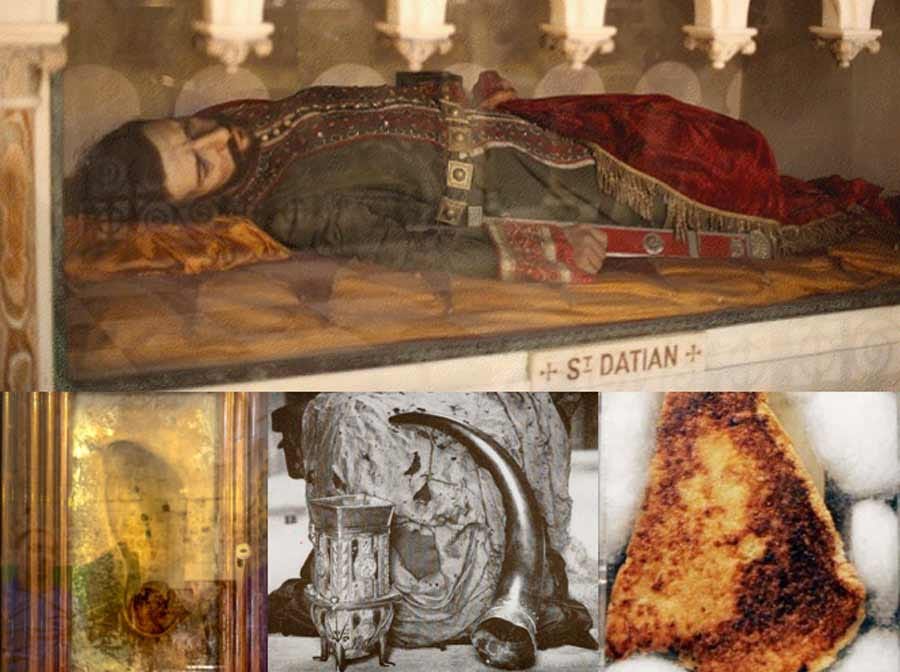
Golden Palace Events purchased the bizarre religious relic, a grilled cheese sandwich with a depiction of the face of the Virgin Mary, back in 2004 for a stunning $28,000!
Yup, you read that right. When it comes to religious relics, the options become limitless. Not all religious relics were discovered in ancient history. The old toast and sandwich manifestation of holy figures is the true relic of modern times, as strange as it may seem. A woman from Fort Lauderdale in Florida, USA, named Diana Duyser, sold her 10-year-old grilled cheese sandwich in 2004 - with one bite taken out of it - for $28,000 on an online auction! But it was no ordinary grilled cheese sandwich: it allegedly bore the image of the face of the Virgin Mary . Mrs. Duyser kept the sandwich sealed for 10 years before deciding to try and sell it - she never assumed it would fetch such a stellar price.
For the faithful, it could be called a miracle. However, those with a bit more reason will realize that it is simply a curious coincidence: the dark crust formed a pattern that surprisingly accurately depicts a female face. This strange modern-day relic was bought by an online casino, the Golden Palace, whose representatives say that they quickly understood the novelty of such a “recognizable part of modern pop culture.” They did not hesitate to pay $28,000 (£20,113) to own it. This makes it the world’s most expensive grilled cheese sandwich!
Wax effigy of St. Datian at the Church of the Most Holy Redeemer in New York. ( Village Preservation Blog )
7.The Remains of St. Datian in New York
The tradition of Catacomb Saints spread like wildfire through the Christian world, when holy relics and preserved skeletons of “saints” began emerging throughout the world. One such holy relic is considerably stranger than the others, and it found its way all the way to New York. This relic is the body of Saint Datian.
This odd relic is housed in a glass sarcophagus in the Church of the Most Holy Redeemer in East Village, New York City. Not much is known about Saint Datian. In fact, this saint is virtually unknown in preserved written sources. It is possible that Datian was a cruel roman leader who persecuted Christians zealously, but later repented, became a monk, and was later martyred.
The remains (bones) of this saint arrived at the church in 1892 and were housed in a lifelike wax effigy. The relics were donated to the church by a wealthy Italian lady, but the earlier origins of the bones remain a mystery. But some people quickly placed the authenticity of these remains into question. As early as 1897 it was suggested that the encased remains are actually those of a police officer shot and killed while defending the church from a burglary. This belief remained widespread until the late 1940’s. The truth about this strange relic remains unknown.
The Lion-Man of the Hohlenstein-Stadel was discovered in a cave in 1939 in Germany and is considered the oldest zoomorphic figurine in the world. (Izquierda: Dagmar Hollmann / CC BY-SA 3.0 . Derecha: Thilo Parg / CC BY-SA 3.0 )
8. The Lion-Man of the Hohlenstein-Stadel: Prehistoric Ivory Relic
Religion - whether monotheistic or polytheistic - has deep and ancient origins. What beliefs did our earliest ancestors have? Have some of their ancient relics survived until today? The Lion-man, known also as Löwenmensch, is an elaborate prehistoric mammoth ivory figurine that quite possibly depicts an ancient mythical being worshipped by the prehistoric man. In 1939 it was discovered in a cave in Germany and is considered the oldest zoomorphic figurine in the world. Dated to the Upper Paleolithic, it is roughly 40,000 years old and was made from mammoth ivory .
Researchers came to a conclusion that the lion-headed figure was an important part of the mythology of the Paleolithic humans inhabiting this region. It also might be one of the earliest connections with shamanism. It deepens the mystery of numerous Paleolithic depictions of “beast-men,” like the bird-headed man from the Lascaux Cave , the lion-woman from Chauvet Cave , or the stag-headed “Sorcerer” from the Trois Frères cave. Prehistory was undoubtedly strange, seen now from our modern point of view, and ancient relics are all that remains of their belief systems.
The Chapel of the Milk Grotto of Our Lady in Bethlehem takes its name from the belief that the Virgin Mary found refuge in a cave with the infant Jesus and a drop of her milk fell on the cave floor, turning it white. ( Renáta Sedmáková / Adobe Stock)
9. Breast Milk of the Virgin Mary in Bethlehem
Another in a long line of strange Christian relics is the so-called breast milk of the Virgin Mary . “The Nursing Madonna,” or Maddona Lactans , has been often depicted in Christian religious art, nurturing the baby Jesus at her breast. But did you know that her breast milk is venerated as a relic? It is situated in the Chapel of the Milk Grotto of Our Lady in Bethlehem, some 10km south of Jerusalem. Ever since the Byzantine Era, this site has been frequented as one of the major Christian pilgrimage sites. It is believed that Virgin Mary found refuge in this grotto with infant Jesus, and while she breastfed him a drop of her milk fell on the cave floor and turned it white.
Pilgrims visit this site, especially those couples seeking to conceive a child as the faithful believe that this shrine helps those suffering with infertility. The Catholic officials sought to capitalize on this belief, selling limestone powder made from the stone of the grotto, which ought to be diluted in water and drank. It supposedly helps cure infertility. You thought that veneration of a foreskin is strange? How about drinking powdered cave floor? This strange relic is as strange as can be.
10. The Venus of Hohle Fels: 40,000-Year-Old Ivory Sculpture
Venus figurines are the most iconic relics of the world’s earliest history. These fertility symbols were one of the major cultic items for early humans, and pose a great insight into their cryptic and mysterious beliefs. The Venus Of Hohle Fels is one of the strangest of all ancient relics, and can be interpreted in many ways. Unearthed in the Hohle Fels cave in Germany, this ivory sculpture is dated to the very beginning of the Upper Paleolithic period, some 40,000 years ago. It is the oldest, undisputed depiction of a human being and gives us a crucial glimpse into the earliest origins of Cro-Magnons in Europe.
This relic might look strange to us, but for the early man it might have been a revered mythical concept. It depicts a buxom - perhaps even obese - woman with enormous breasts, a large (pregnant) belly, and a prominent vulva. These are clear connections with fertility. It can be easily understood that life was quite hard in the Upper Paleolithic and infant death rates could have been quite high. People were also probably malnourished and lean, so a depiction of a buxom, hale, and fat woman could have been an ideal of health, fertility, prosperity, and good life. Either way, we will never know the true meaning of the Venus figurines, and this one remains a truly strange ancient relic.
Top image: The relics humans have chosen to worship over the course of human history can often help us understand the extent of belief systems and the anatomies of faith.
Marvels of human creativity and engineering prowess, these top 15 rock sculptures captivate the imagination and inspire awe. Among these awe-inspiring rock sculptures are the towering Colossal Statue of Shapur, the remarkableGopachal Jain monuments , the poignant Lion of Lucerne, the imposing Apennine Colossus , and the serene Avukana Buddha. These extraordinary feats of artistry and craftsmanship have withstood the test of time, leaving an indelible mark on the landscape and serving as a testament to the heights of human achievement. As diverse as the cultures and epochs they represent, these magnificent rock sculptures continue to fascinate and enchant visitors from around the world, offering a glimpse into the boundless potential of human creativity and our enduring connection to the natural world.
University of California, Los Angeles assistant professor Artur Davoyan recently proposed a pellet-beam propulsion concept that could send a large spacecraft into interstellar space.
The concept, which has the potential to allow us to propel a spacecraft to another star system within our lifetime, was recently awarded a $175,000 grant by NASA's Innovative Advanced Concepts (NIAC) program.
A new space laser propulsion concept
Today's chemical rockets are simply not fast enough to take us far beyond our solar system within any reasonable timeframe. That's why Davoyan proposed a new concept to propel spacecraft using pellet-beam propulsion.
The new concept was partly inspired by Breakthrough Starshot, a $100 million initiative announced by Russian-born philanthropist Yuri Milner in 2016. Breakthrough Starshot proposed using millions of lasers trained on a tiny probe with a light sail to send it to our nearest star, Proxima Centauri, in as little as 20 years.
For Dayovan's pellet-beam propulsion concept, he and his team proposed using two spacecraft. One would set off towards interstellar space, while the other would go into orbit around Earth. From there, the orbital spacecraft would fire thousands of tiny metallic pellets at the interstellar spacecraft every second. It would also either fire a 10-megawatt laser beam at the interstellar probe or align a laser fired from the ground toward the interstellar craft.
That laser would hit the pellets and heat them to the point that a layer is removed and become plasma. That plasma accelerates the pellet remnants, and the pellet beam provides thrust that propels the spacecraft at enormous speeds.
Dayovan also proposed an alternative method where an onboard magnetic field-generating device could deflect the pellets and propel the craft forward.
Traveling into deep space at 480,000 km/h
The Breakthrough Starshot concept aims to propel its probe at 20 percent the speed of light, though it seeks to use a tiny probe only capable of carrying a basic camera.
Dayovan believes the pellet-beam propulsion system could propel a 1-ton probe at speeds of up to roughly 480,000 kilometers per hour (300,000 miles per hour), meaning it would be 10 times faster than chemical propulsion systems for traditional rockets. It would also be fast enough to overtake Voyager 1 — the farthest human-made spacecraft from Earth — in only five years.
Thanks to NASA's NIAC program, Dayovan, and his team now have $175,000 in funding to demonstrate the concept's feasibility. Much like with Breakthrough Starshot, the new concept relies on significant advances in laser design, meaning it will be some time before we see a pellet-beam propulsion system take to the skies.
A NASA-funded team of researchers has identified a lunar pit on the moon that’s always a balmy 63 degrees Fahrenheit — suggesting it could be the perfect place for future astronauts to establish a moon base.
The challenge:
NASA plans to return humans to the moon as soon as 2025, with the goal of establishing a long-term presence on the lunar surface. The hope is that this will give astronauts enough time to conduct the research needed to eventually send people to Mars and beyond.
Finding a safe location for future astronauts to set up a moon base is essential to NASA’s exploration plans, but the moon is not a hospitable place for people.
Surface temperatures on the moon range from -280 F at night to 260 F during the day.
Because the moon doesn’t have an atmosphere or magnetic field, astronauts will be exposed to about 200 times as much radiation as people on Earth. The lack of an atmosphere makes meteorite strikes on the moon harder and faster than on Earth, too, so space rocks and impact debris are another threat.
The moon’s day-night cycle is nearly 30 Earth-days long, so astronauts will also need to get used to 15 straight days of darkness and light. They’ll need to deal with the moon’s extreme temperatures, too, which can range from a frigid -280 F at night to a blistering 260 F during the day.
Underground moon base:
Lava tubes — subterranean tunnels created more than two billion years ago when the moon was volcanically active — could be the answer to astronauts’ housing problem.
Since 2009, astronomers have discovered 16 pits on the moon’s surface that they believe formed when the roof of a lunar lava tube caved in. Future astronauts could potentially access a tube through a lunar pit and build a moon base within the cave.
This would protect astronauts from space radiation and meteorites, while still offering them direct access to the moon’s surface. And now, new research suggests it would help them avoid the moon’s wild temperature fluctuations, too.
Cozy cave: Using computer models and data collected by a thermal camera aboard NASA’s Lunar Reconnaissance Orbiter, researchers have determined that temperatures within the shaded part of one lunar pit remain about 63 F during the entire day-night cycle.
They believe this is due to the pit’s overhang preventing the area under it from getting too hot during the day, while also trapping heat from radiating out of the pit at night.
“Humans evolved living in caves, and to caves we might return when we live on the moon.”
DAVID PAIGE
Getting in and out of the pit wouldn’t be easy — the bottom is 328 feet below the moon’s surface, so it’d be like rappelling down a 30-story building. But if NASA can make it work, astronauts wouldn’t have to expend energy on yet-to-be-invented climate control systems for their future moon base.
“Humans evolved living in caves, and to caves we might return when we live on the moon,” said study co-author David Paige.
There's a growing consensus among astronomers that beyond the gas giants of the outer solar system lurks a mysterious object — perhaps a black hole — influencing the massive cloud of small, icy bodies in the Oort cloud.
And it turns out there is some evidence to suggest this hypothesis might be right. No one is sure how a planet massive enough to affect the cloud of icy leftovers from the solar system's birth could form at such a great distance from the sun. "All we know is that there's an object of a certain mass out there," said Theorist Jakub Scholtz of the U.K.'s Durham University, in a New Scientist report. "The observations we have can't tell us what that object is."
And Scholtz suspects it might be a primordial black hole forged during the big bang — when the universe exploded into existence. But how can we know for sure, and what else could this show us about the universe?
Planet nine might be a primordial black hole
The object — generally dubbed Planet Nine — has remained a subject of intense scrutiny and disagreement among scientists for years, and should be between five and 15 times Earth's mass. No one has seen it, but if it's a primordial black hole, it would likely be no larger than a grapefruit, and remain totally undetectable to human observation unless we witnessed a distant object plunging to its doom into the tiny maw of the event horizon.
The closest confirmed black hole to Earth lies in a triple-star system called HR 6819, roughly 1,000 light-years away. It's about four times the mass of the sun — comparatively light in the scope of the universe. But evidence is mounting that tiny, primordial black holes are abundant throughout the universe, the nearest of which might be a quick, 10-year trip away aboard NASA's New Horizons spacecraft. New Horizons made headlines back in 2015 when it made a rapid flyby of Pluto and its moon, Charon — providing scientists (and everybody else) with the first clear pictures of the former ninth planet.
An illustration of the rubble pile asteroid Itokawa.
Credit: Kevin M. Gill
Batting away an asteroid as demonstrated by NASA last year might be the best solution to preventing rogue space rocks hitting Earth.
Defending earth from rogue space rocks roared back into the public consciousness in 2022 with the film Don’t Look Up and NASA’s successful Double Asteroid Redirection Test (DART) last year, but now Australian researchers at Curtin University have produced research supporting the use of kinetic impacts to alter the course of ‘rubble pile’ asteroids.
Although asteroids might conjure up pictures of gargantuan, solid rocks floating in space, rubble piles are the result of tiny rocks and dust particles coalescing under very weak, gravitational attraction.
“If you want to create your own rubble pile [asteroid], just go into your backyard, take a rock, [hit with] a sledgehammer and smack the rock to oblivion,” says lead researcher Professor Fred Jourdan.
“There’s going to be small pebbles, there’s going to be dust, and a lot of area between, and that’s exactly what a rubble pile is: the difference on Earth is that it just collapses in its own way, in space it’s bound by its own gravity.
“Everything, all those rocks, are attracted by each other.”
But even though this weak gravity might bring all these rocks together in a loose coalition, separating them appears to be decidedly difficult.
Studying dust samples from the Sydney Harbour Bridge sized Itokawa asteroid, Jourdan and his colleagues found these rubble piles can take a beating.
Itokawa probably formed after a massive space impact around 4.2 billion years ago causing its parent asteroid to fragment. That means the asteroid is almost as old as our solar system.
During that time, it’s had countless collisions with other space rocks and remained intact throughout.
That means it’s probably not going to shatter if an object was to be deliberately smashed into it, as NASA did with the asteroid Dimorphos last year.
“What we found is that a rubble pile, despite the constant bombardment, can take a beating, and it has for more than 4.2 billion years,” Jourdan says.
“DART didn’t try to destroy the asteroid, it just tried to push it out of the way, and that’s exactly what we say.
“Because it’s so resistant, you can bombard it with other stuff more aggressive that’s going to be able to push the asteroid out of the way, without completely destroying it.
“We don’t want to destroy these asteroids, if you did, you might get plenty of fragments and this might be, in some cases, even worse than one single fragment.”
Jourdan’s team also suggested going for the nuclear option might be a viable option if kinetic impact was ruled out.
But rather than launching a high-powered warhead into the asteroid to vaporise it, the detonation of such a weapon in close proximity to the asteroid would provide a suitable shockwave to steer the rubble pile out of the way.
The Curtin team will next take samples from the larger asteroid Bennu which was probed by NASA’s OSIRIS-REx mission for study later this year, and will also take receipt of samples from the Martian moon Phobos at the end of the decade.
Meer van UFO'S of UAP'S, ASTRONOMIE, RUIMTEVAART, ARCHEOLOGIE, OUDHEIDKUNDE, SF-SNUFJES EN ANDERE ESOTERISCHE WETENSCHAPPEN - DE ALLERLAATSTE NIEUWTJES


 De apocalyps was nog nooit zo dichtbij: doemdagklok nu op 90 seconden voor middernacht