Ontdek de Fascinerende Wereld van UFO's en UAP's: Jouw Bron voor Onthullende Informatie!
Ben jij ook gefascineerd door het onbekende? Wil je meer weten over UFO's en UAP's, niet alleen in België, maar over de hele wereld? Dan ben je op de juiste plek!
België: Het Kloppend Hart van UFO-onderzoek
In België is BUFON (Belgisch UFO-Netwerk) dé autoriteit op het gebied van UFO-onderzoek. Voor betrouwbare en objectieve informatie over deze intrigerende fenomenen, bezoek je zeker onze Facebook-pagina en deze blog. Maar dat is nog niet alles! Ontdek ook het Belgisch UFO-meldpunt en Caelestia, twee organisaties die diepgaand onderzoek verrichten, al zijn ze soms kritisch of sceptisch.
Nederland: Een Schat aan Informatie
Voor onze Nederlandse buren is er de schitterende website www.ufowijzer.nl, beheerd door Paul Harmans. Deze site biedt een schat aan informatie en artikelen die je niet wilt missen!
Internationaal: MUFON - De Wereldwijde Autoriteit
Neem ook een kijkje bij MUFON (Mutual UFO Network Inc.), een gerenommeerde Amerikaanse UFO-vereniging met afdelingen in de VS en wereldwijd. MUFON is toegewijd aan de wetenschappelijke en analytische studie van het UFO-fenomeen, en hun maandelijkse tijdschrift, The MUFON UFO-Journal, is een must-read voor elke UFO-enthousiasteling. Bezoek hun website op www.mufon.com voor meer informatie.
Samenwerking en Toekomstvisie
Sinds 1 februari 2020 is Pieter niet alleen ex-president van BUFON, maar ook de voormalige nationale directeur van MUFON in Vlaanderen en Nederland. Dit creëert een sterke samenwerking met de Franse MUFON Reseau MUFON/EUROP, wat ons in staat stelt om nog meer waardevolle inzichten te delen.
Let op: Nepprofielen en Nieuwe Groeperingen
Pas op voor een nieuwe groepering die zich ook BUFON noemt, maar geen enkele connectie heeft met onze gevestigde organisatie. Hoewel zij de naam geregistreerd hebben, kunnen ze het rijke verleden en de expertise van onze groep niet evenaren. We wensen hen veel succes, maar we blijven de autoriteit in UFO-onderzoek!
Blijf Op De Hoogte!
Wil jij de laatste nieuwtjes over UFO's, ruimtevaart, archeologie, en meer? Volg ons dan en duik samen met ons in de fascinerende wereld van het onbekende! Sluit je aan bij de gemeenschap van nieuwsgierige geesten die net als jij verlangen naar antwoorden en avonturen in de sterren!
Heb je vragen of wil je meer weten? Aarzel dan niet om contact met ons op te nemen! Samen ontrafelen we het mysterie van de lucht en daarbuiten.
The Pyramid-Shaped UAP Over Kryvyi Rih, Ukraine: A Mysterious Encounter Caught on Video by Two Witnesses
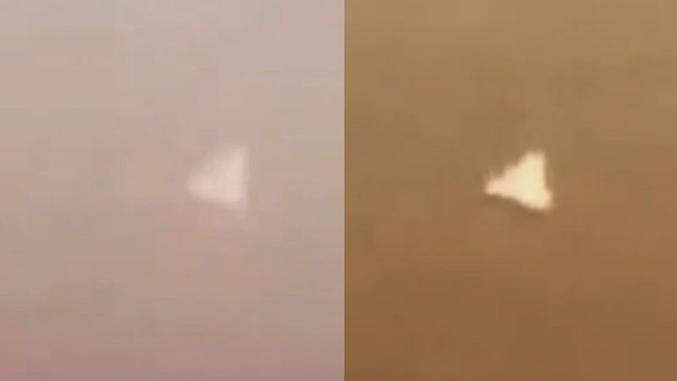
Triangle UFO over Ukraine
A recent video has been making rounds on the internet, showing what appears to be a pyramid-shaped UFO hovering over Kryvyi Rih, a city in central Ukraine. The video was allegedly captured in December 2022 by two separate witnesses, both of whom managed to record footage of the strange object. The video has since been shared on various social media platforms, sparking a flurry of discussion and debate around what it could be.
The first witness footage shows a glowing triangular object hovering in the sky, with what appears to be a faint white light emanating from its tip. The second video was captured from a moving vehicle, and shows the same triangular object hovering in the distance, seemingly stationary as the camera shakes slightly from the car’s motion. In the background, the witness can be heard exclaiming in Ukrainian, “It’s not in the clouds, it’s over there!” as she points towards the object.
The video has generated a lot of buzz on Reddit, with users speculating on what the object could be. Some have suggested that it could be a drone, while others have pointed out the triangular shape is often associated with secret military technology. One user even claimed to have seen a similar object in Zacatecas, Mexico in 2018, describing it as yellowish before turning white/light blue, and hovering without making any noise.
However, others have raised doubts about the video’s authenticity. One Reddit user pointed out that the second video appears to show the triangular object as a fixed point around which the camera shakes, which would be difficult to fake convincingly. Another user pointed out that the triangular shape is often associated with American military technology, and questioned why such covert tech would be flown above Ukraine.
This video is a fascinating glimpse into the ongoing mystery of UAP sightings. As more people turn to social media to share their sightings, it’s likely that we will see more videos like this in the future. Whether they represent actual evidence of extraterrestrial visitation, secret military technology, or something else entirely, remains to be seen.
Astronomers have detected enormous shockwaves rattling the cosmic web that connects all galaxies in the universe, offering vital clues on how the largest structures in space were shaped.
A simulation of the cosmic web showing shock waves producing radio waves (pink) as they crash through magnetic fields (blue).
(Image credit: F. Vazza/D. Wittor/J. West)
For the first time, astronomers have spotted enormous, galaxy-scale shock waves rattling the "cosmic web" that connects nearly all known galaxies. These cosmic waves could reveal clues about how the largest objects in the universe were sculpted.
(Photo : Pixabay / Geralt)
The discovery was made by stitching and stacking thousands of radio telescope images together, which revealed the soft "radio glow" produced by shock waves from colliding matter in our universe's biggest structures.
The cosmic web is a gigantic network of crisscrossing celestial superhighways paved with hydrogen gas and dark matter. Galaxies tend to form where multiple strands of the web intersect, often in clusters numbering in the hundreds of thousands. Now a new study, published Feb. 15 in the journal Science(opens in new tab), could provide vital clues into the nature of the mysterious magnetic fields that stretch beside these tendrils.
"Magnetic fields pervade the universe — from planets and stars to the largest spaces in-between galaxies," lead author Tessa Vernstrom(opens in new tab), an astronomer at the International Centre for Radio Astronomy Research in Crawley, Australia, said in a statement(opens in new tab). "However, many aspects of cosmic magnetism are not yet fully understood, especially at the scales seen in the cosmic web."
Taking shape in the chaotic aftermath of the Big Bang, the cosmic web's tendrils formed as clumps of matter from the roiling particle-antiparticle broth of the young universe — whose rapid expansion pushed the filaments outwards to form an interconnected soap-sud structure of thin films surrounding countless, mostly empty voids.
Far from being completely frozen in place, the cosmic web's matter can sometimes violently collide. When matter in the web merges, enormous shock waves send charged particles ricocheting through the web's magnetic fields, causing the particles to emit a faint radio wave glow. These shock waves have been spotted around some of the universe's largest galaxy clusters, but until now they were never observed around the web itself.
"These shock waves give off radio emissions which should result in the cosmic web 'glowing' in the radio spectrum, but it had never really been conclusively detected due to how faint the signals are," Vernstrom said.
To search for the faint signals, the researchers used data from the Global Magneto-Ionic Medium Survey, the Planck Legacy Archive, the Owens Valley Long Wavelength Array and the Murchison Widefield Array to stack radio imaging from 612,025 galaxy cluster pairs, grouped together if they were close enough to be directly connected by cosmic web tendrils. This stacking helped boost the faint radio emissions from the shock waves beyond noisy background effects.
Then, by looking only for polarized radio waves — whose rays vibrate at the same angle as each other and were predicted in simulations to be emitted by the shock waves — the researchers found the signal.
"As very few sources emit polarised radio light, our search was less prone to contamination and we have been able to provide much stronger evidence that we are seeing emissions from the shock waves in the largest structures in the universe, which helps to confirm our models for the growth of this large-scale structure," Vernstrom said.
Now that the shock waves' existence has been confirmed, they could be used to probe the nature of the enormous magnetic fields that suffuse the web, which play an unknown role in shaping the universe.
ALIEN-DETECTING AI FINDS EIGHT "SUSPICIOUS" SIGNALS
WHEN THE SCIENTISTS ARE STUMPED, YOU KNOW THEY'RE ONTO SOMETHING.
GETTY / FUTURISM
Strange Signals
A group that's at the forefront of the search for alien life has found some strange radio signals from space — and they're as confused by their origins as we are.
Speaking to New Atlas, University of Toronto student Peter Ma described the incredible — and "suspicious" — findings from a new machine learning algorithm he developed and brought to Breakthrough Listen, an Australia-based program that's pioneering new frontiers in the search for extraterrestrial intelligence (SETI).
"Eight signals looked very suspicious, but after we took another look at the targets with our telescopes, we didn’t see them again," Ma told New Atlas. "It’s been almost five to six years since we took the data, but we still haven’t seen the signal again. Make of that what you will."
Stumped
As Ma tells the science outlet, the process of identifying potentially intelligent radio signals from deep space is grueling. After training the algorithm on simulated extraterrestrial signals that would be of interest, Breakthrough Listen's researchers then fed the machine a previously-studied dataset of 3 million radio signals, and then manually combed through everything it flagged.
In the case of their most recent study, published last month in the journal Nature Astronomy, the algorithm fed back a whopping 20,515 "signals of interest," and after going through them all, the team narrowed it down to eight truly weird potential "technosignatures."
Tick Tick Boom
Writing in The Conversation following the publication of the Nature paper, Breakthrough Listen astronomer Daniel Price prophesied that humanity is on the verge of an AI "Big Bang" — and that his organization's work is at the forefront of this somewhat-welcome cataclysm.
Price admits in his editorial that it's probable those eight suspicious signals are "rare cases of radio interference" than legitimate signs of extraterrestrial life, but he argued they're nevertheless worthy of study for no other reason than helping humans (and their AI assistants) know what can be explained and what can't.
"If astronomers do manage to detect a technosignature that can’t be explained away as interference, it would strongly suggest humans aren’t the sole creators of technology within the Galaxy," he wrote. "This would be one of the most profound discoveries imaginable."
And honestly, we couldn't put it any better than that.
View larger. | Andromeda galaxy actual size? Yes. This image truly depicts what the night sky would look like if the Andromeda galaxy – the galaxy next door – were brighter. Original background shot of the moon by Stephen Rahn. Andromeda galaxy image via NASA. Composite photo by Tom Buckley-Houston. The composite showed up on Reddit a few years ago. Not convinced? Here’s a similar image via APOD. As the Andromeda-Milky Way merger continues, the Andromeda galaxy will appear bigger – and bigger – in our sky.
Milky Way and Andromeda merger has begun
The Andromeda galaxy, the nearest spiral galaxy to our Milky Way, isn’t noticeable in our night sky, unless you look for it. Underdark skies, however, you can see it without optical aid, but only as a barely visible fuzzy patch of light. But one day, far in the future, Andromeda will be bright in our sky, growing larger and larger … as it gets closer and closer to us. And even though the two galaxies are still 2.5 millionlight-years apart, the eventual merger of our two galaxies has, in fact, already begun.
The Andromeda galaxy is currently racing toward our Milky Way at a speed of about 70 miles (113 km) per second. With this in mind, our merger will occur five billion years from now. But, in August 2020, the peer-reviewedAstrophysical Journal published new research revealing that the collision between our galaxies is already underway.
The news about the Andromeda galaxy came from Project AMIGA, which uses the Hubble Space Telescope to look at the deep-space surroundings of the Andromeda galaxy. AMIGA stands for Absorption Map of Ionized Gas in Andromeda. NASA called it:
… the most comprehensive study of a halo surrounding a galaxy.
The Andromeda galaxy, our Milky Way and other galaxies all sit enshrouded in a large envelope – called a galactic halo – which consists of gas, dust and stray stars. The halos of galaxies are faint, so faint, in fact, that detecting them is not an easy feat. These astronomers measured the size of the halo of the Andromeda galaxy by looking at how much it absorbed light from background quasars. They were surprised to find that the Andromeda galaxy’s halo stretches much, much farther beyond its visible boundaries.
Indeed, it extends as far as half the distance to our Milky Way (1.3 million light-years) and even farther in other directions (up to 2 million light-years).
Are the halos touching yet?
So, does this mean the halos of the Andromeda and Milky Way galaxies are touching?
It turns out that, from our vantage point inside the Milky Way, we cannot easily measure the characteristics of our galaxy’s halo. However, because the two galaxies are so similar in size and appearance, scientists assume that the halo of the Milky Way would also be similar.
In other words, it’s the faint halos of the galaxies that indeed appear to have started to touch one another. Thus, in a manner of speaking, the collision between our two galaxies has already started.
Visualizing Andromeda’s halo in our sky
Observing 43 background quasars, scientists used the Hubble Space Telescope to map out the halo of the closest spiral galaxy to our Milky Way, the Andromeda galaxy. The light from these very distant quasars (emission from very bright galaxies fueled by a central supermassive black hole) is absorbed as it travels through the halo. By studying the change in absorption depending on where in the halo you look, scientists not only see the large extent of the halo but also what it consists of.
Illustration via NASA/ ESA/ E. Wheatley (Space Telescope Science Institute).
This illustration depicts what the Andromeda galaxy’s gaseous halo might look like if it were visible to humans on Earth. At 3 times the size of the Big Dipper, the halo would easily be the biggest feature in the nighttime sky, according to NASA. Recent measurements of the halo show that the collision between the Milky Way and Andromeda galaxies has already begun. Image via NASA/ ESA/ J. DePasquale and E. Wheatley (STScI)/ Z. Levay.
So what will the Andromeda merger look like?
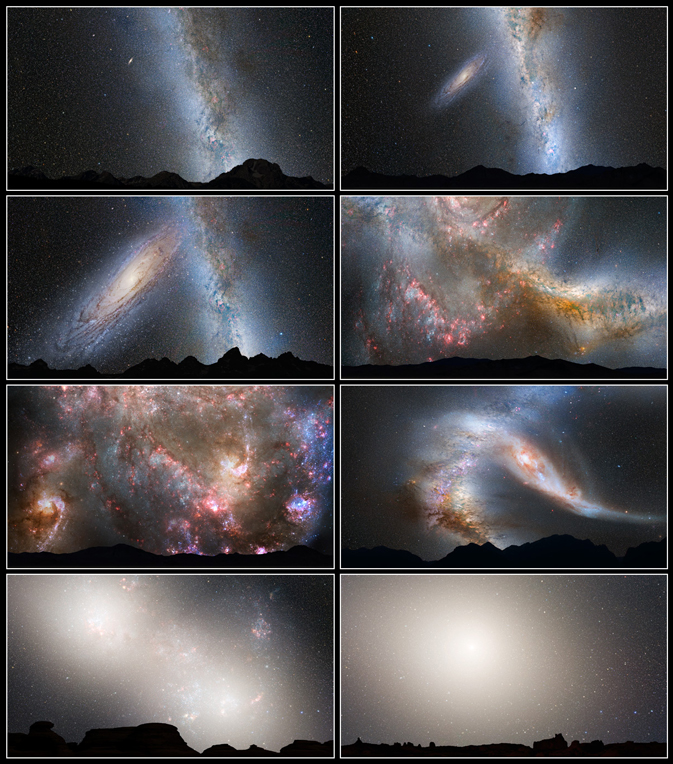
NASA released the images below in 2012. They are artist’s concepts of what someone on Earth might see as the Andromeda galaxy hurtles toward us.
The depictions below are based on painstaking Hubble Space Telescope measurements of the motion of the Andromeda galaxy, with computer modeling of the inevitable collision between the two galaxies. Also, a series of studies published in 2012 showed that – rather than glancing off each other, as merging galaxies sometimes do – our Milky Way galaxy and the Andromeda galaxy will in fact merge to form a single big elliptical, or football-shaped, galaxy.
Whether it’s fully a head-on collision or more of a glancing blow doesn’t really affect the end result.
And that is a new, giant elliptical galaxy.
View larger. | The merger between our Milky Way and neighboring Andromeda. 1st row, left: Present day. 1st row, right: In 2 billion years, the disk of the approaching Andromeda galaxy is noticeably larger. 2nd row, left: In 3.75 billion years, Andromeda fills the field of view. 2nd row, right: In 3.85 billion years, the sky is ablaze with new star formation. 3rd row, left: In 3.9 billion years, star formation continues. 3rd row, right: In 4 billion years, Andromeda is tidally stretched and the Milky Way becomes warped. 4th row, left: In 5.1 billion years, the cores of the Milky Way and Andromeda appear as a pair of bright lobes. 4th row, right: In 7 billion years, the merged galaxies form a huge elliptical galaxy, its bright core dominating the nighttime sky. Image via NASA/ ESA/ Z. Levay and R. van der Marel, STScI/ T. Hallas/ A. Mellinger.
Another video of the Andromeda merger
The Milky Way and Andromeda galaxies, however, won’t be the only ones involved in this merger. As shown in the video below, the other large galaxy in our Local Group of galaxies, that is, M33, aka the Triangulum galaxy, will also play a role.
In the video below, you’ll recognize the Triangulum galaxy as the smaller object near the Andromeda and Milky Way galaxies. Although the Triangulum galaxy likely won’t join the merger, it may, nevertheless, at some point strike our Milky Way while engaged in a great cosmic dance with the two larger galaxies.
What happens to stars and planets when galaxies merge?
Across the universe, galaxies are colliding with each other. Astronomers observe galactic collisions – or their aftermaths – with the aid of powerful telescopes. In some ways, when a galactic merger takes place, the two galaxies are like ghosts; they simply pass through each other. That’s because stars inside galaxies are separated by such great distances. Thus the stars themselves typically don’t collide when galaxies merge.
That said, the stars in both the Andromeda galaxy and our Milky Way will be affected by the merger. The Andromeda galaxy contains about a trillion stars. Meanwhile, the Milky Way has about 300 billion stars. Stars from both galaxies will be thrown into new orbits around the newly merged galactic center. For example, according to scientists involved in the 2012 studies:
It is likely the sun will be flung into a new region of our galaxy …
And yet, they said,
… our Earth and solar system are in no danger of being destroyed.
Will humanity see the Andromeda merger?
So, how about life on Earth? Will earthly life survive the merger? Well, the sun will eventually become a red giant in about 7.5 billion years, when it will increase in size and consume the Earth. But even before then, the luminosity, or intrinsic brightness, of the sun will increase. This will happen, ultimately, in a timeline of about four billion years.
As solar radiation reaching the Earth increases, Earth’s surface temperature will increase. We may undergo a runaway greenhouse effect, similar to that going on now on the planet next door, Venus. So there’s a good change that earthly life won’t be around when the merger concludes.
But by that time, maybe some earthly inhabitants will have become space-faring. Perhaps we’ll have left Earth, and even our solar system. We may still get the view of Andromeda crashing into the Milky Way, just from a slightly different perspective.
Newborn stars sculpt their galaxies in new James Webb telescope images
JWST’s sharp infrared eyes reveal stunning new details invisible to previous observatories
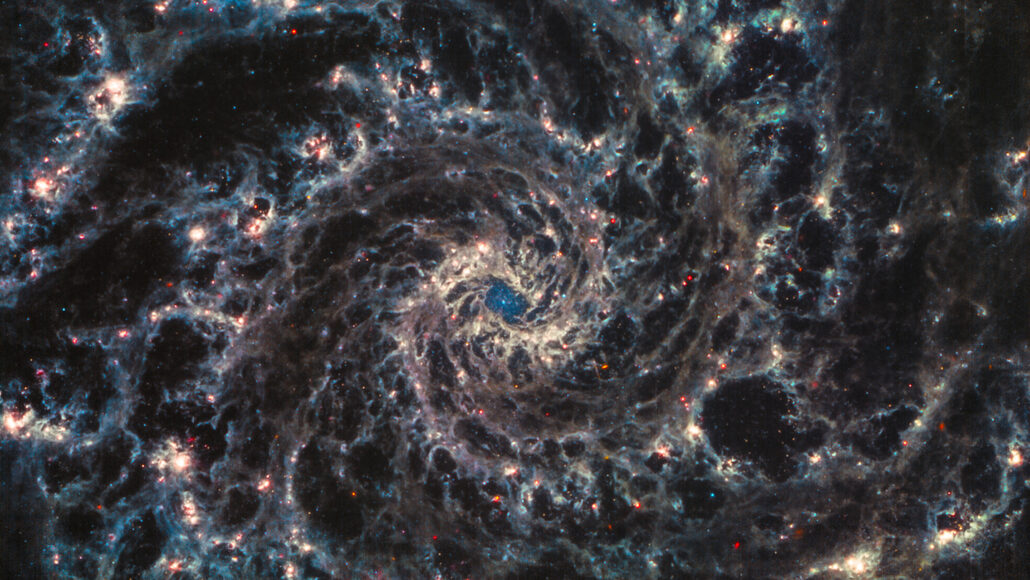
New JWST images of face-on spiral galaxies like NGC 628 (shown) reveal whorls of gas and dust, pockmarked with dark voids. These voids are thought to be bubbles in the gas and dust created by radiation from young, massive stars, and by supernovas.
A gaggle of galaxies crackle with intricate detail in new images from the James Webb Space Telescope. JWST’s sharp infrared eyes are revealing how newborn stars shape their surroundings, giving hints to how stars and galaxies grow up together.
“We were just blown away,” says Janice Lee, an astronomer at the University of Arizona in Tucson. She and more than 100 astronomers reported on scientists’ first look at these galaxies with JWST in a special February issue of the Astrophysical Journal Letters.
Before JWST launched in December 2021, Lee and her colleagues selected 19 galaxies that, if observed with the telescope, they thought could reveal new details of the life cycles of stars (SN: 1/24/22). These galaxies are relatively close, within 65 million light-years of the Milky Way, and all have different types of spiral structures. The team had observed the galaxies with many observatories, but parts of the galaxies had always looked flat and featureless.
“With [JWST], we’re seeing structure down to the very smallest scales,” Lee says. “For the first time, we’re seeing the youngest sites of star formation in a lot of these galaxies.”
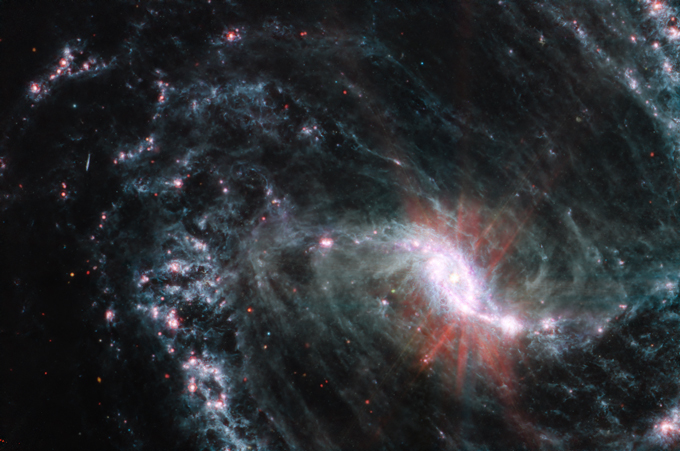
Astronomers are using JWST to study several galaxies with different types of spiral structures to compare how their stars form. NGC 1365 (shown) has a bright bar in its core that connects its spiral arms. JWST detected glowing dust in this galaxy’s center that had been obscured in previous observations.SCIENCE: NASA, ESA, CSA, JANICE LEE/NOIRLAB; IMAGE PROCESSING: ALYSSA PAGAN/STSCI
In the new images, the galaxies’ faces are pockmarked by dark voids amid glowing filaments of gas and dust. Comparisons to Hubble Space Telescope images reveal that these voids are bubbles carved out of the gas and dust by high-energy radiation from newborn stars in their centers.
Then, when the most massive of those stars reach the end of their life and explode, that gas gets pushed out even more. Some of the larger bubbles have smaller bubbles on their edges, which could indicate spots where the gas pushed by dying stars has started to build new stars.
Comparing these processes in different types of spiral galaxies will help astronomers understand how the galaxies’ shapes and properties influence the life cycles of their stars, and how the galaxies grow and change with their stellar denizens.
“We’ve only studied the first few [of the 19 selected] galaxies,” Lee says. “We need to study these things in the full sample to understand how the environment changes … how stars are born.”
Artist's impression of astronauts on the lunar surface, as part of the Artemis Program. Lunar explorers will need communication and navigation aids while on the surface, including a common time zone. Credit: NASA
Artemis astronauts are returning to the Moon, and they’ll be following in Apollo’s footsteps when they go. But things are different this time. Not only is technology far more advanced, but so is the way we think about technology and how we design it.
A new paper shows how two of modern technology’s offspring— virtual reality (VR) and user-centred design (UCD)—can be brought to bear on the Artemis Program.
The Apollo era was 50 years ago now, and society has changed a lot. Computers are ubiquitous today, whereas, during the Apollo era, computers were confined to the realm of specialists. Those specialists had intimate knowledge of how computers and software worked, and they were the ones who used it.
But in modern times, powerful computer technology is in everyone’s hands. The widespread use of computers triggered a change in how society thinks about computers. Since the vast majority of users know very little about computers, the way they’re designed has changed. Instead of being tied to engineering constraints and built for specialists, computers and computer-reliant technologies are now designed with users in mind. Terms like user-centred design (UCD) and human-computer interface (HCI) encapsulate the change.
The only way to make technology effective for regular people is to make sure the design of the technology is centred on average users. That’s how user-centred design (UCD) came to be. It’s a process where technology designers focus on the users in each stage of the design process. The authors of a new paper think that UCD can be employed more effectively in Artemis, and virtual reality (VR) is the tool that can do it.
Astronauts typically train on prototypes of the actual equipment they’ll use on their missions. At one point, NASA evaluated lunar motorcycles for Apollo 15. NASA tested the motorcycle on a KC135A aircraft in a reduced gravity maneuver to mimic the Moon’s weaker gravity.
NASA tested a lunar motorcycle during reduced gravity maneuvers on a KC135A aircraft. Notice the padded walls. Image Credit: NASA
Astronauts also train in Earthly environments that are analogues of the Moon or the ISS. They head to deep dark caves that mimic the deep darkness in lunar craters or dry, dusty, boulder-strewn regions to mimic the lunar surface. They also train in special facilities like buoyancy pools that mimic the reduced gravity on the ISS.
The Neutral Buoyancy Laboratory (NBL) is an astronaut training facility and neutral buoyancy pool operated by NASA and located at the Sonny Carter Training Facility near the Johnson Space Center in Houston, Texas. It holds 23 million litres (6.2 million gallons) of water and contains mock-ups of the ISS modules. Image Credit: By NASA Goddard Photo and Video – https://www.flickr.com/photos/24662369@N07/49565807881/, CC BY 2.0, https://commons.wikimedia.org/w/index.php?curid=87326373
This kind of training is expensive and time-consuming, and that limits the amount of training that can be done. Using prototypes of actual mission equipment to train astronauts also adds to mission costs. But for Artemis, astronauts could make use of VR to prepare for their missions to the Moon, and it’s a lot less expensive than testing motorcycles inside aircraft or building massive pools with replica spacecraft in them.
The authors describe how using VR to train astronauts can bring UCD into a planning process that’s dominated by engineering constraints. It can be a more effective use of time and less expensive.
The paper focuses on the European Large Logistics Lander (EL3.) The EL3 will be part of the Heracles mission to the lunar south pole. Heracles also includes a rover and a lunar ascent vehicle.
This illustration shows the EL3, including the lander, the rover, and the ascent vehicle. Image Credit: ESA
Lunar exploration is becoming more and more complex and requires greater levels of preparedness. The lunar environment is challenging to operate in because of weaker gravity, ubiquitous fine lunar dust, the limitations to the field of view and maneuverability inside space suits. Add mental and physical fatigue, lighting extremes, including pitch-black darkness, and thermal and atmospheric conditions. The backdrop for all of these challenges is a general uncertainty that the paper’s authors describe as “… often ambiguous mission criteria and still largely undefined operational scenarios.”
The lunar south pole is a region characterized by lighting extremes. The interiors of deep craters are in perpetual darkness, while higher elevations are bathed in perpetual sunlight. Typically, astronauts train in environments that are analogs of those conditions, like the aforementioned dark caves.
These are considered classical approaches to astronaut training. But they have their limitations. They’re expensive and logistically complex. That means that they can’t be employed as often as they should be and that there are fewer test subjects. This prohibits the implementation of elements of UCD like rapid prototyping and participatory design, where users give feedback and designers respond. UCD is iterative, meaning users try things out and give feedback, designers create new prototypes for users to test, and they give their feedback again. The end result is more strongly aligned with actual use.
The paper shows how VR can be used to introduce UCD into astronaut training and equipment design and bypass some of the expense and time involved with classical approaches. Space missions are notorious for going over budget and for being delayed, and VR can help with that, according to the authors.
This is not a huge stretch. VR is used in other endeavours that involve hazards and specialized equipment, like defence, aerospace, and resource extraction.
But so far, space agencies haven’t made widespread use of VR to train astronauts. The authors wrote their paper to show how that could change and to explain the benefits VR can bring to space missions. “… this paper investigates <the> potential use of Virtual Reality to simulate field studies and thus facilitate rapid and resource-efficient user-centred assessments of early-stage lunar surface prototypes.”
NASA has some experience with using VR to train astronauts. They used VR to train the Hubble space telescope flight team for a repair mission in 1993. They also use both VR and augmented reality (AR) on the ISS.
But VR can play a larger role, just as it does in non-space-related endeavours. VR-centered design methods are already leading the way in things like autonomous vehicles, healthcare, and complex robotic systems.
According to the authors, studies on VR have “… demonstrated the ability of VR simulations to gather a wide range of relevant user feedback on topics including usability, human factors and ergonomics, safety and acceptability. By collecting such feedback in early stages of a project lifecycle, development teams have been able to better anticipate potential problems and lower risks for the overall production processes, resulting in a reduction in development and manufacturing costs.”
VR and UCD can bring those same benefits to Artemis, the authors explain.
To test their idea, the team carried out a simulated field study in a VR-based lunar operations scenario. They created a VR mock-up of the EL3, including cargo containers, a transport cart, an EVA suit, and a ladder to reach the lander. The team also created a virtual lunar landscape matching the lunar south pole and used it as the backdrop. They combined it all into a simulated cargo reception and off-loading scenario in a lunar environment. Then they invited relevant experts to test out their simulation.
This image shows the 3D model of the lander and related elements. Image Credit: Nilsson et al. 2023
The team recruited 20 hand-picked participants, including engineers, scientists, trainers, and two astronauts. All of the participants had some prior experience with VR, and three of the 20 described their experience as limited or very limited. The participants completed the cargo task without any time limits.
This table from the paper lists the job titles and areas of expertise of each participant. Image Credit: Nilsson et al. 2023
Overall, the participants took to the simulation quite well, having no trouble managing the VR controllers or completing the scenario. But some problems emerged in their feedback, and that feedback demonstrates exactly how VR and UCD can strengthen the Artemis missions to the Moon.
The lighting was difficult to work in since the Sun is so near to the horizon at the lunar south pole. Every object cast a long shadow, putting much of the simulation into total darkness. “The unique lighting conditions on the Moon’s south pole and their impact on future crew operations formed perhaps the most persistently recurring theme in our participants’ accounts,” the authors write. The darkness made even basic tasks like walking more difficult. It was particularly difficult when participants walked with the Sun at their backs, as their own deep shadow obscured their foot placement.
Conceptual illustration of permanently shadowed, shallow icy craters near the lunar south pole. Some regions in deeper craters are in perpetual darkness. Credits: UCLA/NASA
Several participants pointed out that their EVA headlamps were not bright enough to illuminate their paths. That kind of feedback is exactly what UCD is all about. The headlamp brightness can be increased during the next simulation, and participants can offer their feedback again.
The participant referred to as Manager 1 gave this feedback: “As you can see, there are these rocks for example. . .if you bump into this, you could fall down, or you could damage your suit. So what I tried to do was to go around in the light. I don’t expect the astronauts to work in complete shadow. Normally, what they would do. . . during EVAs on the space station they have lights on their helmets. This light will need to be more powerful than what I have here.”
This image shows astronaut Robert Behnken during an EVA in 2010. Note the headlamp on the side of the helmet. In order to operate in the lunar south pole’s deep shadows, a much brighter light will be needed. But how bright? Image Credit: NASA.
Some participants also noted that the beam width was too narrow. That can also be changed for the next simulation. The UCD process can repeat until the headlamp meets the user’s needs.
On the other hand, it became clear that when forced to face the Sun directly, the light can be overwhelming. Reflective surfaces on the lander and other equipment were also too bright, leading to problems. Thanks to UCD, the next simulation can change those surfaces to reduce glare.
VR and UCD can help with ergonomics, too. “Having the option to experience prototypes interactively using an immersive 3D technology sparked numerous reflections concerning their dimensions and ergonomic appropriateness,” the authors write.
The handles on the cargo containers were difficult to grasp with EVA gloves. They’re too small, and both of the astronaut participants pointed this out.
Astronaut 1 said: “Everything we do with our hands in spacesuits needs to be big. The gloves are bulky and have very little dexterity. Little to none. It’s actually one of the main concerns of any extravehicular activity, how dexterous you can be. So if you want to help and make a design that is a little more conducive to productivity and speed. . . in this case I’d like to have a handle. A big fat handle that I could use while doing EVA. When I look at these, these are not EVA interfaces.”
This is another opportunity for UCD to play a role. Change the size of the handles in the VR simulation, test again, and then change and test again until it’s optimal.
The true bulkiness of a spacesuit becomes clear when an astronaut removes their helmet, as in this official portrait of Italian astronaut Samantha Cristoforetti. Note the bulkiness of the gloves and their lack of dexterity. Image Credit: NASA/ESA
The paper presents other instances where the VR simulation enabled valuable feedback that could lead to improvements. But the authors were also clear about the limitations of their simulation. The simulation lacked what’s called haptic feedback. Most participants said that without that feedback, they couldn’t assess the center of mass of objects like cargo containers, making more detailed feedback difficult.
The simulation also couldn’t accurately mimic the difficulty of moving around in a bulky xEMU (Exploration Extra-Vehicular Mobility Unit.) “… Instructor 4 and Scientist 2 both argued that properly evaluating some procedures, such as climbing a ladder, can only be done once the suit limitations are fully taken into account,” the authors write.
VR isn’t perfect, but this study shows that it can be a powerful tool. Physical prototyping is expensive and time-consuming, as is training in analogue environments or facilities like neutral buoyancy pools. This study shows how some prototyping and training can be off-loaded to VR simulations as it has in other realms like surgery and mining.
“Interactive simulations in VR provide the means for rapid assessment and iterative development of novel design concepts without incurring many of the financial, logistical or temporal costs typically associated with real-world prototype deployments,” the authors write in their conclusion.
VR simulations also allow more participants, and that means more feedback from more users, which strengthens design processes. Designers can’t think of everything, and neither can one set of users. By being available to more participants, the feedback will be broader and deeper.
Testing motorcycles in large aircraft is likely a thing of the past, and so are some of the clumsy design processes from the past. While the Moon hasn’t changed, what we expect from lunar exploration has changed, and how astronauts prepare is also changing. Virtual reality is a powerful tool that can help astronauts be more thoroughly prepared for more demanding missions.
And if Artemis is going to succeed in its ambitious goals, thorough preparation is key.
NASA SURPRISED WHEN SCHOOL CHILDREN DISCOVER THAT EPIPENS BECOME TOXIC IN SPACE
HAVING AN ALLERGIC REACTION IN SPACE COULD BE SERIOUSLY DANGEROUS.
IMAGE BY GETTY IMAGES/FUTURISM
A group of gifted elementary school students has discovered that EpiPens, life-saving devices that inject epinephrine in the case of a severe allergic reaction, can turn poisonous after being launched into space — more evidence of the harrowing effects space radiation can have on the health of astronauts.
The students helped researchers at the University of Ottawa in Canada investigate whether the devices could be safely used in space by astronauts.
But there's some bad news: just relatively small amounts of space radiation caused the epinephrine to break down, turning it into a health hazard instead of a lifesaver — something that was previously unknown to NASA, Live Science reports.
The students from St. Brother André Elementary School’s Program for Gifted Learners (PGL) had samples of epinephrine, both by themselves and inside of EpiPens, launched into space as part of NASA's Cubes in Space program.
The University of Ottawa's Faculty of Science then analyzed the returned samples and found that the epinephrine was only 87 percent pure due to cosmic radiation, according to a statement.
The remaining 13 percent turned into benzoic acid derivatives, which are extremely poisonous.
"As part of the Cubes in Space, two cubes were put together by the students, with one going on a rocket and the other on a high-altitude balloon," said University of Ottawa chemistry professor Paul Mayer in the statement. "The ‘after’ samples showed signs that the epinephrine reacted and decomposed."
“In fact, no epinephrine was found in the ‘after’ EpiPen solution samples," he added. "This result raises questions about the efficacy of an EpiPen for outer space applications and these questions are now starting to be addressed by the kids in the PGL program."
The experiment could have lasting effects on how we treat allergic reactions in space.
"This result raises questions about the efficacy of an EpiPen for outer space applications and these questions are now starting to be addressed by the kids in the [Program for Gifted Learners] program," Mayer said.
Fortunately, not all is lost. There may be a way to package EpiPen solutions in a way that doesn't expose them to cosmic radiation — an invention that could save an astronaut's life in the future.
UFO Recorded Entering Mexico Volcano Popocatepetl, 3-2-2023, UFO Sighting News.
Date of sighting: March 2, 2023
Location of sighting: Popocatepetl, Mexico
Saw this craft and thought wow, thats something right there. Its huge, the mouth of the volcano is 600 meters across and this is at least 1/6th that at 100 meters wide! The tail of the object is evenly as it comes down, but then suddenly as it enters the volcano the tail becomes super thin! That means the craft suddenly slowed down! 100% proof that this is an intelligently controlled craft.
Unieke kwantummagnetometer van UHasselt-studenten klaar voor ruimtevlucht naar ISS
Na jaar aan boord van ruimtestation ISS komt magnetische veldsensor van studententeam van UHasselt terug thuis
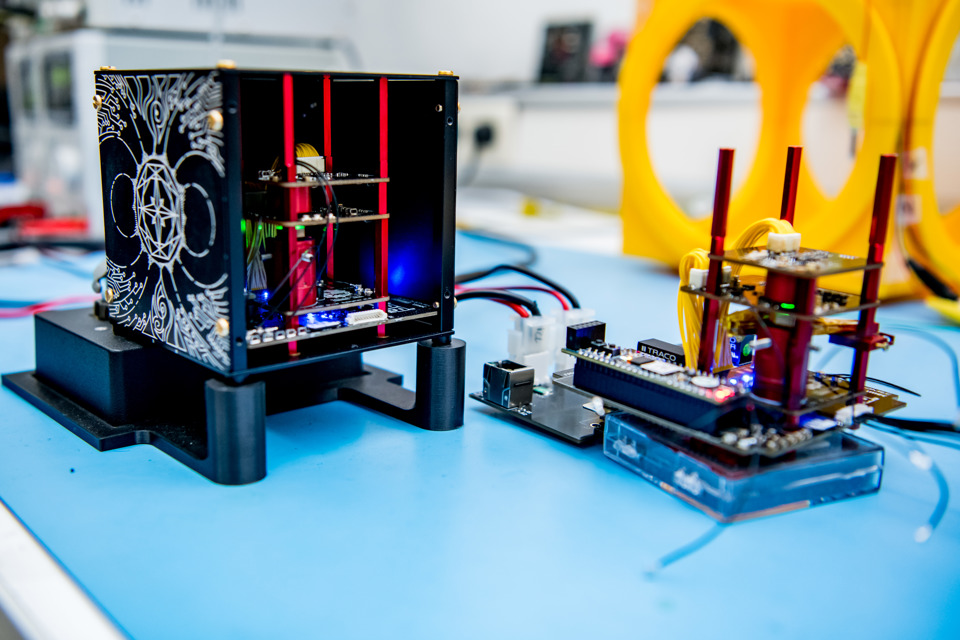
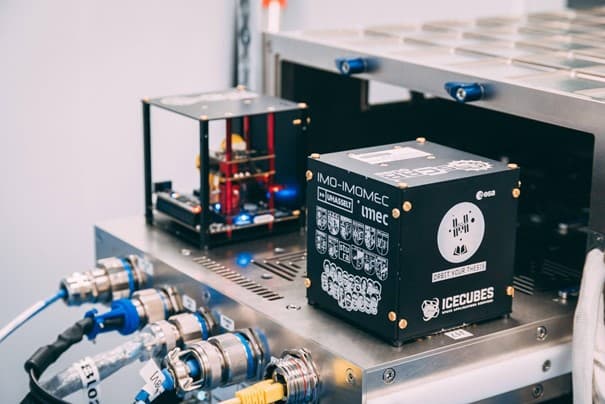
De magnetische veldsensor van de UHasselt is terug thuis. Het kleine kubusje dat aan boord van het ISS data heeft verzameld over het magnetisch veld van de aarde, is ontwikkeld door studententeam OSCAR-QUBE.
Radio 2, Lieven Roux
"De magnetische veldsensor is terug op aarde", zegt Boo Carmans, doctoraatsstudente in de Fysica en lid van studententeam OSCAR-QUBE. "Een aantal jaar geleden hebben we een magnetische veldsensor of magnetometer gebouwd", zegt Carmans. "In een jaar heeft ons studententeam dat ontwikkeld. De magnetometer is naar het Internationaal Ruimtestation (ISS) gestuurd, waar het een jaar rond de aarde heeft gevlogen. Vanaf daar hebben we continu data verzameld over het magneetveld van onze planeet. Nu komt hij terug in ons lab te staan, waar we hem verder kunnen onderzoeken."
rechts: Boo Carmans
OSCAR-QUBE is een interdisciplinair team van studenten van de UHasselt. Een aantal jaar geleden deden ze mee aan een wedstrijd van het Europees Ruimteagentschap (ESA). "Dat was een wedstrijd voor studententeams van over heel de Europese Unie", vertelt Carmans. "De winnaar mocht zijn experimenten naar het ISS sturen en wij hebben toen gewonnen."
"Kennis over het magnetisch veld van de aarde is belangrijk omdat we het bijvoorbeeld kunnen gebruiken om vliegtuigen te navigeren of voor nog andere toepassingen zoals een MRI-scanner", legt Carmans uit.
Het studententeam heeft hun succesvolle project vandaag mogen presenteren in de universiteitshal van de UHasselt.
Opnieuw naar de ruimte
"ESA heeft ons de mogelijkheid gegeven om samen met een team van hen een vernieuwde versie te maken van de magnetometer", zegt Remy Vandebosch van OSCAR-QUBE. "De magnetometer is een kubus van 3 keer 10 centimeter. De nieuwe magnetometer zou nog kleiner kunnen worden." De Young Graduate Trainees van ESA (YPSAT) vroegen het team om een nieuwe magnetometer te laten meevliegen aan boord van de Ariane 6 raket. Deze raket zal voor het eerst gelanceerd worden in 2024. Tegen het einde van de maand mei moet het studententeam zijn nieuwe magnetometer aan ESA bezorgen.
OSCAR-QUBE. On the right: the flight model that has been launched to ISS. On the left (exposed): the ground model that resides in the lab for reference.
De OSCAR-QUBE, de diamantgebaseerde kwantummagnetometer van het studententeam van de UHasselt heeft op de campus van Diepenbeek een centrale plek gekregen nadat hij een jaar lang aan boord van ruimtestation ISS was verbleven. De magnetometer werd daar gebruikt om het magnetische veld rond de aarde in beeld te brengen.
Op 29 augustus 2021 bevond de kwantummagnetometer zich aan boord van de SpaceX CRS 23-raket toen die koers zette naar het ruimtestation ISS. Tijdens zijn verblijf in de ruimte zond de magnetometer vanuit de ruimte 231 gigabyte aan data van de metingen van het magnetische veld rond de aarde door naar de UHasselt-campus in Diepenbeek. Op 20 augustus 2022 keerde de magnetometer aan boord van de SpaceX CRS 25-capsule terug naar de aarde.
"Doel van het experiment was om te onderzoeken of onze technologie, waarbij we een synthetische diamant omvormen tot een ultragevoelige sensor met kwantumeigenschappen, stand kon houden in de ruimte", zo legt teamleider Jaroslav Hruby uit. "Daar zijn we mooi in geslaagd. En dat voor een sensor van slechts een paar millimeter groot."
De studenten van OSCAR-QUBE willen nu ook hun mede-studenten inspireren om groots te dromen. Daarom kreeg de magnetometer woensdag een centrale plek op de campus van Universiteit Hasselt in Diepenbeek. "En de magnetometer zal metingen van het magnetische veld blijven uitvoeren", zegt Sebastiaan Vanspauwen, lid van OSCAR-QUBE. "Op een monitor kan je het magnetische veld blijven aflezen."
Bovendien gaat er op vraag van de Young Graduate Trainees van ESA (YPSAT) in 2024 een nieuwe OSCAR-QUBE opnieuw de ruimte in met een Ariane 6-raket. "We zijn nu volop aan het werk om een nieuwe sensor, de OSCAR-QUBE+ genaamd, te ontwikkelen", zegt Yarne Beerden, lid van OSCAR-QUBE. Eind mei moet de nieuwe magnetometer aan de ESA bezorgd worden.
Meer van UFO'S of UAP'S, ASTRONOMIE, RUIMTEVAART, ARCHEOLOGIE, OUDHEIDKUNDE, SF-SNUFJES EN ANDERE ESOTERISCHE WETENSCHAPPEN - DE ALLERLAATSTE NIEUWTJES


 The Pyramid-Shaped UAP Over Kryvyi Rih, Ukraine: A Mysterious Encounter Caught on Video by Two Witnesses